 エドガーで原本を確認する
| ☐ | REGISTRATION STATEMENT PURSUANT TO SECTION 12(b) OR 12(g) OF THE SECURITIES EXCHANGE ACT OF 1934 |
| ☒ | ANNUAL REPORT PURSUANT TO SECTION 13 OR 15(d) OF THE SECURITIES EXCHANGE ACT OF 1934 |
or |
|
| ☐ | TRANSITION REPORT PURSUANT TO SECTION 13 OR 15(d) OF THE SECURITIES EXCHANGE ACT OF 1934 |
or |
|
| ☐ | SHELL COMPANY REPORT PURSUANT TO SECTION 13 OR 15(d) OF THE SECURITIES EXCHANGE ACT OF 1934 |
| Title of Each Class |
Trading Symbol |
Name of Each Exchange on Which Registered | ||
| American depositary shares (each American depositary share representing eight Class A ordinary shares, par value US$0.000000625 per share) |
BIDU |
The Nasdaq Stock Market LLC (The Nasdaq Global Select Market) | ||
Class A ordinary shares, par value US$0.000000625 per share
|
The Nasdaq Stock Market LLC (The Nasdaq Global Select Market) | |||
Class A ordinary shares, par value US$0.000000625 per share |
9888 |
The Stock Exchange of Hong Kong Limited |
| * | Not for trading, but only in connection with the listing on The Nasdaq Global Select Market of American depositary shares. |
| Large accelerated filer ☒ | Accelerated filer ☐ |
Non-accelerated filer ☐ |
Emerging growth company ☐ |
| U.S. GAAP ☒ | International Financial Reporting Standards as issued by the International Accounting Standards Board ☐ | Other ☐ |
TABLE OF CONTENTS
| 1 | ||||||
| 2 | ||||||
| 3 | ||||||
| Item 1. | 3 | |||||
| Item 2. | 3 | |||||
| Item 3. | 3 | |||||
| Item 4. | 90 | |||||
| Item 4A. | 155 | |||||
| Item 5. | 155 | |||||
| Item 6. | 190 | |||||
| Item 7. | 205 | |||||
| Item 8. | 207 | |||||
| Item 9. | 209 | |||||
| Item 10. | 209 | |||||
| Item 11. | 224 | |||||
| Item 12. | 225 | |||||
| 230 | ||||||
| Item 13. | 230 | |||||
| Item 14. | Material Modifications to the Rights of Security Holders and Use of Proceeds |
230 | ||||
| Item 15. | 230 | |||||
| Item 16A. | 230 | |||||
| Item 16B. | 231 | |||||
| Item 16C. | 231 | |||||
| Item 16D. | 231 | |||||
| Item 16E. | Purchases of Equity Securities by the Issuer and Affiliated Purchasers |
232 | ||||
| Item 16F. | 232 | |||||
| Item 16G. | 232 | |||||
| Item 16H. | 232 | |||||
| Item 16I. | Disclosure Regarding Foreign Jurisdictions that Prevent Inspections |
232 | ||||
| Item 16J. | 233 | |||||
| Item 16K. | 233 | |||||
| 234 | ||||||
| Item 17. | 234 | |||||
| Item 18. | 234 | |||||
| Item 19. | 234 | |||||
| 247 | ||||||
| F-1 | ||||||
i
INTRODUCTION
In this annual report, except where the context otherwise requires and for purposes of this annual report only:
| • | “ADSs” refer to our American depositary shares, each ADSs representing eight Class A ordinary shares; |
| • | “China” or “PRC” refers to the People’s Republic of China, including Hong Kong, Macau and Taiwan; and “mainland China” refers to the People’s Republic of China, excluding Hong Kong, Macau and Taiwan; |
| • | “Class A ordinary shares” refer to Class A ordinary shares of the share capital of our company with a par value of US$0.000000625 each, conferring a holder of a Class A ordinary share one vote per share on all matters submitted for voting at general meetings of our company; |
| • | “Class B ordinary shares” refer to Class B ordinary shares of the share capital of our company with a par value of US$0.000000625 each, conferring weighted voting rights in our company such that a holder of a Class B ordinary share is entitled to 10 votes per share on all matters submitted for voting at general meetings of our company; |
| • | “Hong Kong” or “HK” or “Hong Kong S.A.R.” refers to the Hong Kong Special Administrative Region of the PRC; |
| • | “Hong Kong Listing Rules” refer to the Rules Governing the Listing of Securities on The Stock Exchange of Hong Kong Limited, as amended or supplemented from time to time; |
| • | “Hong Kong Share Registrar” refers to Computershare Hong Kong Investor Services Limited; |
| • | “Hong Kong Stock Exchange” refers to The Stock Exchange of Hong Kong Limited; |
| • | “Main Board” refers to the stock market (excluding the option market) operated by the Hong Kong Stock Exchange which is independent from and operated in parallel with the Growth Enterprise Market of the Hong Kong Stock Exchange; |
| • | “MAU,” or monthly active user, refers to the number of mobile devices that launched our mobile apps during a given month; |
| • | “our company” refers to Baidu, Inc., which is not a PRC operating company but a Cayman Islands holding company with operations primarily conducted through (i) our mainland China subsidiaries and (ii) contractual arrangements with the variable interest entities, or the VIEs, based in mainland China. This structure entails unique risks to investors, see “Item 3.D. Key Information—Risk Factors—Risks Related to our Corporate Structure” for more details; |
| • | “RMB” or “Renminbi” refers to the legal currency of mainland China; |
| • | “SFO” refers to the Securities and Futures Ordinance (Chapter 571 of the Laws of Hong Kong), as amended or supplemented from time to time; |
| • | “shares” or “ordinary shares” refer to our ordinary shares, which include both Class A ordinary shares and Class B ordinary shares; |
| • | “user traffic” or “traffic” refers generally to page views of a website, with “page views” measuring the number of web pages viewed by internet users over a specified period of time except that multiple page views of the same page viewed by the same user on the same day are counted only once; |
| • | “U.S. GAAP” refers to generally accepted accounting principles in the United States; |
| • | “we,” “us,” “our,” or “Baidu” refers to Baidu, Inc., its subsidiaries, and, in the context of describing our operations and consolidated financial information, the variable interest entities established in mainland |
1
| China and other consolidated affiliated entities in which we do not have any equity ownership but whose financial results have been consolidated into our consolidated financial statements based solely on contractual arrangements in accordance with U.S. GAAP. These variable interest entities include, but are not limited to, Beijing Baidu Netcom Science Technology Co., Ltd., or Baidu Netcom, Beijing Perusal Technology Co., Ltd., or Beijing Perusal, Beijing iQIYI Science & Technology Co., Ltd., or Beijing iQIYI. See “Item 4. Information on the Company—C. Organizational Structure” for an illustrative diagram of our corporate structure; |
| • | “iQIYI” refers to iQIYI, Inc., a company incorporated in the Cayman Islands listed on Nasdaq under the symbol “IQ” and one of our subsidiaries; |
| • | “$,” “dollars,” “US$” or “U.S. dollars” refers to the legal currency of the United States; and |
| • | all discrepancies in any table between the amounts identified as total amounts and the sum of the amounts listed therein are due to rounding. |
On March 1, 2021, Baidu, Inc. effected a change to its authorized share capital by 1-to-80 subdivision of shares. Concurrently, Baidu, Inc. effected a proportionate change in ADS to Class A ordinary share ratio from 10 ADSs representing 1 Class A ordinary share to each ADS representing 8 Class A ordinary shares, or the Share Subdivision. Such changes been reflected retroactively throughout this document.
FORWARD-LOOKING INFORMATION
This annual report on Form 20-F contains forward-looking statements that reflect our current expectations and views of future events. These statements are made under the “safe harbor” provisions of the U.S. Private Securities Litigation Reform Act of 1995. You can identify these forward-looking statements by terminology such as “may,” “will,” “expect,” “anticipate,” “future,” “intend,” “plan,” “believe,” “estimate,” “is/are likely to” or other similar expressions. We have based these forward-looking statements largely on our current expectations and projections about future events and financial trends that we believe may affect our financial condition, results of operations, business strategy and financial needs. These forward-looking statements include, but are not limited to:
| • | our operations and business prospects; |
| • | our business and operating strategies and our ability to implement such strategies; |
| • | our ability to develop and manage our operations and business; |
| • | competition for, among other things, capital, technology and skilled personnel; |
| • | our ability to control costs; |
| • | our ability to identify and conduct investments and acquisitions, obtain regulatory approvals from government authorities, as well as integrate acquired target(s); |
| • | changes to regulatory and operating conditions in the industry and geographical markets in which we operate; |
| • | our dividend policy; and |
| • | all other risks and uncertainties described in “Item 3.D. Key Information—Risk Factors.” |
We would like to caution you not to place undue reliance on these forward-looking statements and you should read these statements in conjunction with the risk factors disclosed in “Item 3.D. Key Information—Risk Factors.” Those risks are not exhaustive. We operate in a rapidly evolving environment. New risks emerge from time to time and it is impossible for our management to predict all risk factors, nor can we assess the impact of all factors on our business or the extent to which any factor, or combination of factors, may cause actual results to differ from those contained in any forward-looking statement.
2
We do not undertake any obligation to update or revise the forward-looking statements except as required under applicable law.
Unless otherwise noted, all translations from Renminbi to U.S. dollars and from U.S. dollars to Renminbi in this annual report are made at a rate of RMB7.2993 to US$1.00, the exchange rate in effect as of December 31, 2024 as set forth in the H.10 statistical release of The Board of Governors of the Federal Reserve System. We make no representation that any Renminbi or U.S. dollar amounts could have been, or could be, converted into U.S. dollars or Renminbi, as the case may be, at any particular rate, or at all.
PART I
| Item 1. | Identity of Directors, Senior Management and Advisers |
Not applicable.
| Item 2. | Offer Statistics and Expected Timetable |
Not applicable.
| Item 3. | Key Information |
Our Corporate Structure and Contractual Arrangements with the Variable Interest Entities
Baidu, Inc. is not a PRC operating company but a Cayman Islands holding company with operations primarily conducted through (i) our subsidiaries incorporated in mainland China, or mainland China subsidiaries, and (ii) contractual arrangements with the variable interest entities based in mainland China. Our internet content services, value-added telecommunication-based services, internet map services, online audio and video services and mobile application distribution businesses in mainland China have been conducted through the applicable VIEs in order to comply with the laws and regulations of mainland China, which restrict and impose conditions on foreign direct investment in companies involved in the provision of such businesses. Accordingly, we operate these businesses in mainland China through the variable interest entities, and rely on contractual arrangements among Baidu, Inc./iQIYI, Inc., our mainland China subsidiaries, the variable interest entities and their nominee shareholders to control the business operations of the variable interest entities. External revenues contributed by the variable interest entities accounted for 47%, 45% and 44% of our total external revenues for the years ended December 31, 2022, 2023 and 2024, respectively. As used in this annual report, “our company” refers to Baidu, Inc., whereas “we,” “us,” “our,” or “Baidu” refers to Baidu, Inc., its subsidiaries, and, in the context of describing our operations and consolidated financial information, the variable interest entities in mainland China and all of the variable interest entities are domestic companies incorporated in mainland China in which we do not have any equity ownership but whose financial results have been consolidated into our consolidated financial statements based solely on contractual arrangements in accordance with U.S. GAAP. Investors in our ADSs are not purchasing equity interest in the variable interest entities in mainland China but instead are purchasing equity interest in a holding company incorporated in the Cayman Islands.
Baidu, Inc./iQIYI, Inc., our mainland China subsidiaries, the variable interest entities and their nominee shareholders have entered into a series of contractual agreements. These contractual arrangements:
| • | enable us to receive the economic benefits that could potentially be significant to the variable interest entities in consideration for the services provided by our subsidiaries; |
| • | effectively assigned all of the voting rights underlying the nominee shareholders’ equity interest in the variable interest entities to us; and |
| • | enable us to hold an exclusive option to purchase all or part of the equity interests in the variable interest entities when and to the extent permitted by the laws of mainland China. |
3
These contractual arrangements generally include shareholder voting rights trust agreements or proxy agreements, exclusive equity purchase and transfer option agreements or exclusive purchase option agreements, loan agreements, operating agreements or business operation agreements, exclusive technology consulting and services agreements, and equity pledge agreements, as the case may be. As for some of the variable interest entities, our subsidiaries have entered into additional business cooperation agreements, power of attorney, license agreements and/or commitment letters (as the case may be) with these variable interest entities and their respective shareholders. Terms contained in each set of contractual arrangements with the variable interest entities and their respective shareholders are substantially similar. As a result of the contractual arrangements, the shareholders of the variable interest entities effectively assigned all of their voting rights underlying their equity interest in the variable interest entities to the primary beneficiaries of these companies, which gives our company or its subsidiaries/iQIYI the power to direct the activities that most significantly impact the variable interest entities’ economic performance. The individual nominee shareholders of Baidu Netcom, Beijing Perusal and Beijing iQIYI, the variable interest entities, are directors or members of senior management of us or iQIYI. We or iQIYI consider such people suitable to act as the nominee shareholders of these variable interest entities because of, among other considerations, their contribution to us or iQIYI, their competence and their length of service with and loyalty to us or iQIYI. For more details of these contractual arrangements, see “Item 4. Information on the Company—C. Organizational Structure—Contractual Arrangements with the Variable Interest Entities and Other Consolidated Affiliated Entities and their Shareholders.”
However, the contractual arrangements may not be as effective as direct ownership in providing us with control over the variable interest entities and we may incur substantial costs to enforce the terms of the arrangements. If the variable interest entities or the nominee shareholders fail to perform their respective obligations under the contractual arrangements, we could be limited in our ability to enforce the contractual arrangements that effectively assigned us the voting rights in the variable interest entities, and these agreements have not been tested in the courts of mainland China. Furthermore, if we are unable to maintain such effective assignment, we would not be able to continue to consolidate the financial results of these entities in our financial statements. See “Item 3.D. Key Information—Risk Factors—Risks Related to Our Corporate Structure—Our contractual arrangements with the variable interest entities in mainland China and the individual nominee shareholders may not be as effective in providing control over these entities as direct ownership” and “Item 3.D. Key Information—Risk Factors—Risks Related to Our Corporate Structure—The individual nominee shareholders of the variable interest entities may have potential conflicts of interest with us, which may adversely affect our business. We do not have any arrangements in place to address such potential conflicts.”
There are also substantial uncertainties regarding the interpretation and application of current and future laws, regulations and rules of mainland China regarding the status of the rights of our Cayman Islands holding company with respect to its contractual arrangements with the variable interest entities and their nominee shareholders. It is uncertain whether any new laws or regulations of mainland China relating to variable interest entity structures will be adopted or if adopted, what they would provide. If we or any of the variable interest entities is found to be in violation of any existing or future laws or regulations of mainland China, or fail to obtain or maintain any of the required permits or approvals, the PRC regulatory authorities would have broad discretion in accordance with the applicable laws and regulations to take action in dealing with such violations or failures. See “Item 3.D. Key Information—Risk Factors—Risks Related to Our Corporate Structure—Laws and regulations of mainland China governing our businesses and the validity of certain of our contractual arrangements are uncertain. If we are found to be in violation, we could be subject to sanctions. In addition, changes in the laws and regulations of mainland China or changes in interpretations thereof may materially and adversely affect our business.”
Our operations are primarily conducted in mainland China through (i) our mainland China subsidiaries and (ii) contractual arrangements with the variable interest entities based in mainland China, and revenues are primarily generated from mainland China. Though the PRC Foreign Investment Law does not explicitly classify contractual arrangements as a form of foreign investment, the definition of “foreign investment” thereunder is relatively wide and contains a catch-all provision which includes investments made by foreign investors through means stipulated in laws or administrative regulations or other methods prescribed by the State Council.
4
Therefore, there is no assurance that foreign investment via contractual arrangement would not be interpreted as a type of indirect foreign investment activities in the future. If any of the variable interest entities were deemed as a foreign-invested enterprise under any such future laws, administrative regulations or provisions and any of our business would be included in any negative list or other form of restrictions on foreign investment, we may need to take further actions to comply with such future laws, administrative regulations or provisions. Such actions may have a material and adverse impact on our business, financial condition, result of operations and prospects. In addition, if the PRC regulatory authorities were to find our legal structure and contractual arrangements to be in violation of any laws, administrative regulations or provisions of mainland China, we are uncertain what impact of above PRC regulatory authorities’ actions would have on us and our ability to consolidate the variable interest entities in the consolidated financial statements. For more details, see “Item 3.D. Key Information—Risk Factors—Risks Related to Doing Business in China—Uncertainties exist with respect to the interpretation and implementation of the PRC Foreign Investment Law and its implementation regulations and how it may impact the viability of our current corporate structure, corporate governance and business operations.”
Our corporate structure is subject to risks associated with our contractual arrangements with the variable interest entities. Our company and its investors may never have a direct ownership interest in the businesses that are conducted by the variable interest entities. Uncertainties in the PRC legal system could limit our ability to enforce these contractual arrangements, and these contractual arrangements have not been tested in a court of law. If the PRC government finds that the agreements that establish the structure for operating our business in mainland China do not comply with the laws and regulations of mainland China, or if these regulations or the interpretation of existing regulations change or are interpreted differently in the future, we and the variable interest entities could be subject to severe penalties or be forced to relinquish our interests in those operations. This would result in the variable interest entities being deconsolidated. The majority of our assets, including the necessary licenses to conduct business in mainland China, are held by the variable interest entities. A significant part of our revenues are generated by the variable interest entities. An event that results in the deconsolidation of the variable interest entities would have a material effect on our operations and result in the value of the securities of our company diminish substantially or even become worthless. Our company, our mainland China subsidiaries and the variable interest entities, and investors of our company face uncertainty about potential future actions by the PRC government that could affect the enforceability of the contractual arrangements with the variable interest entities and, consequently, significantly affect the financial performance of the variable interest entities and our company as a whole. Baidu, Inc. may not be able to repay its indebtedness, and the Class A ordinary shares or ADSs of our company may decline in value or become worthless, if we are unable to assert our contractual control rights over the assets of our mainland China subsidiaries and the variable interest entities that conduct all or substantially all of our operations. For a detailed description of the risks associated with our corporate structure, please refer to risks disclosed under “Item 3.D. Key Information—Risk Factors—Risks Related to Our Corporate Structure.”
Our company and the variable interest entities face various risks and uncertainties related to doing business in China. For example, we face risks associated with regulatory approvals on offshore offerings, antimonopoly regulatory actions, and oversight on cybersecurity and data privacy. These risks could result in a material adverse change in our operations and the value of our ADSs, significantly limit or completely hinder our ability to continue to offer securities to investors, or adversely affect the value of such securities. For a detailed description of risks related to doing business in China, see “Item 3.D. Key Information—Risk Factors—Risks Related to Doing Business in China.”
PRC government’s certain administrative measures in regulating (i) our operations and (ii) offerings conducted overseas by, and foreign investment in, China-based issuers, could significantly limit or completely hinder our ability to offer or continue to offer securities to investors. Implementation of industry-wide regulations, including data security or anti-monopoly related regulations, in this nature may result in adverse effect on the value of such securities. For more details, see “Item 3.D. Key Information—Risk Factors—Risks Related to Doing Business in China—Any failure to meet the PRC government’s complex regulatory requirements on our business operation could have a material adverse effect on our operations and the value of our securities.”
5
Risks and uncertainties arising from the PRC legal system, including risks and uncertainties regarding the enforcement of laws and quickly evolving rules and regulations in mainland China, could result in a material adverse change in our operations and the value of our ADSs. For more details, see “Item 3.D. Key Information—Risk Factors—Risks Related to Doing Business in China—Uncertainties exist with respect to the interpretation and implementation of the PRC Foreign Investment Law and its implementation regulations and how it may impact the viability of our current corporate structure, corporate governance and business operations.”
The Holding Foreign Companies Accountable Act
Pursuant to the Holding Foreign Companies Accountable Act, which was enacted on December 18, 2020 and further amended by the Consolidated Appropriations Act, 2023 signed into law on December 29, 2022, or the HFCAA, if the Securities and Exchange Commission, or the SEC, determines that we have filed audit reports issued by a registered public accounting firm that has not been subject to inspections by the Public Company Accounting Oversight Board, or the PCAOB, for two consecutive years, the SEC will prohibit our shares or the ADSs from being traded on a national securities exchange or in the over-the-counter trading market in the United States. On December 16, 2021, the PCAOB issued a report to notify the SEC of its determination that the PCAOB was unable to inspect or investigate completely registered public accounting firms headquartered in mainland China and Hong Kong, including our auditor. In April 2022, the SEC conclusively listed us as a Commission-Identified Issuer under the HFCAA following the filing of our annual report on Form 20-F for the fiscal year ended December 31, 2021. On December 15, 2022, the PCAOB issued a report that vacated its December 16, 2021 determination and removed mainland China and Hong Kong from the list of jurisdictions where it is unable to inspect or investigate completely registered public accounting firms. For this reason, we were not identified as a Commission-Identified Issuer under the HFCAA after we filed our annual report on Form 20-F for the fiscal year ended December 31, 2023 and do not expect to be so identified after we file this annual report on Form 20-F for the fiscal year ended December 31, 2024. Each year, the PCAOB will determine whether it can inspect and investigate completely audit firms in mainland China and Hong Kong, among other jurisdictions. If the PCAOB determines in the future that it no longer has full access to inspect and investigate completely accounting firms in mainland China and Hong Kong and we use an accounting firm headquartered in one of these jurisdictions to issue an audit report on our financial statements filed with the SEC, we would be identified as a Commission-Identified Issuer following the filing of the annual report on Form 20-F for the relevant fiscal year. There can be no assurance that we would not be identified as a Commission-Identified Issuer for any future fiscal year, and if we were so identified for two consecutive years, we would become subject to the prohibition on trading under the HFCAA. See “Item 3.D. Key Information—Risk Factors—Risks Related to Doing Business in China—The PCAOB had historically been unable to inspect our auditor in relation to their audit work performed for our financial statements and the inability of the PCAOB to conduct inspections of our auditor in the past has deprived our investors with the benefits of such inspections.” and “Item 3.D. Key Information—Risk Factors—Risks Related to Doing Business in China—Our ADSs may be prohibited from trading in the United States under the HFCAA in the future if the PCAOB is unable to inspect or investigate completely auditors located in China. The delisting or prohibition of trading of the ADSs, or the threat of their being delisted or prohibited from trading, may materially and adversely affect the value of your investment.”
Permissions Required from the PRC Government Authorities for Our Operations
We conduct our business primarily through our subsidiaries and the variable interest entities in mainland China. Our operations in mainland China are governed by the laws and regulations of mainland China.
6
As of the date of this annual report, our mainland China subsidiaries and the variable interest entities have obtained the requisite licenses and permits from the PRC government authorities that are material for the business operations of our subsidiaries and the variable interest entities in mainland China, including, among others, the Value-Added Telecommunication Business Operating License, the Internet News Information Service License, the Short Messaging Service Access Code Certificate, the Online Audio/Video Program Transmission License, the Radio and Television Program Production License, the Surveying and Mapping Qualification Certificate for internet map services, the Internet Culture Business Permit, the Publication Business Operating License, the Filing Certificate for Internet Drug and Medical Devices Information Services/the Qualification Certificate for Internet Drug Information Services, the Human Resource Services License, the Filing Certificate for the Online Transaction Platform, the Filing Certificate for Business of Category II Medical Devices, the Registration Certificate for Medical Devices, the Food Business License/the Filing Certificate for Sales of Pre-Packaged Foods, the Medicine Business License, the Filing Certificate for the Online Publication Transaction Platform, the Internet Domain Name Services License, the Medical Device Operation License, the Filing Certificate for Third-Party Platform Provider of Online Trading Service for Drugs and the Filing Certificate for Third-Party Platform Provider of Online Trading Service for Medical Device, the Practice License of Medical Institutions, the Internet Religious Information Service License, the Filing Information Form of Third Party Platform Providers of Online Food Trading, the Aquatic Wildlife Operation and Utilization License, the Filing Certificate for Customs Clearance, the Foreign-Related Investigation License, the Online Taxi-Hailing Operation License and certain permits for road testing and demonstration application and/or commercial operations of autonomous driving vehicles. Given the uncertainties of interpretation and implementation of relevant laws and regulations and the enforcement practice by the government authorities, we may be required to obtain additional licenses, permits, filings or approvals for our businesses and services in the future. For more detailed information, see “Item 3.D. Key Information—Risk Factors—Risks Related to Doing Business in China—We may be adversely affected by the complexity, uncertainties and changes in the regulations of internet and related business and companies in mainland China.”
Furthermore, in connection with our historical issuance of securities to foreign investors, we, our mainland China subsidiaries and the variable interest entities, (i) are not required to obtain permission from the China Securities Regulatory Commission, or the CSRC, (ii) are not required to go through a cybersecurity review by the Cyberspace Administration of China, or the CAC, and (iii) have not been asked to obtain permission from the CSRC or the CAC by any PRC government authority.
However, the PRC government has promulgated certain regulations and rules to exert more oversight and control over offerings that are conducted overseas and/or foreign investment in China-based issuers. On February 17, 2023, the CSRC released the Trial Administrative Measures of Overseas Securities Offering and Listing by Domestic Companies and five supporting guidelines, or, collectively, the Filing Rules, which took effect on March 31, 2023. According to the Filing Rules, domestic companies in mainland China that directly or indirectly offer or list their securities in an overseas market are required to file with the CSRC. In addition, an overseas listed company must also submit the filing with respect to its follow-on offerings, issuance of convertible corporate bonds and exchangeable bonds, and other equivalent offering activities, within a specific time frame requested under the Filing Rules. Therefore, we will be required to file with the CSRC for our overseas offering of equity and equity linked securities in the future within the applicable scope of the Filing Rules. For more detailed information, see “Item 3.D. Key Information—Risk Factors—Risks Related to Doing Business in China—The approval of and/or filing with the CSRC or other PRC government authorities may be required in connection with our offshore offerings under the laws of mainland China, and, if required, we cannot predict whether or for how long we will be able to obtain such approval or complete such filing.”
Cash Flows through Our Organization
Baidu, Inc. is a holding company with no operations of its own. We conduct our operations in mainland China primarily through our subsidiaries and the variable interest entities in mainland China. As a result, although other means are available for us to obtain financing at the holding company level, Baidu, Inc.’s ability to pay dividends to the shareholders and to service any debt it may incur may depend upon dividends paid by our mainland China subsidiaries and license and service fees paid by the variable interest entities. If any of our subsidiaries incurs debt on its own behalf, the instruments governing such debt may restrict its ability to pay dividends to Baidu, Inc. In addition, our mainland China subsidiaries are permitted to pay dividends to Baidu, Inc. only out of their retained earnings, if any, as determined in accordance with PRC accounting standards and regulations.
7
Further, our mainland China subsidiaries and the variable interest entities are required to make appropriations to certain statutory reserve funds or may make appropriations to certain discretionary funds, which are not distributable as cash dividends except in the event of a solvent liquidation of the companies. For more details, see “Item 5.B. Operating and Financial Review and Prospects—Liquidity and Capital Resources—Holding Company Structure.”
Under the laws and regulations of mainland China, our mainland China subsidiaries and the variable interest entities are subject to certain restrictions with respect to paying dividends or otherwise transferring any of their net assets to us. Remittance of dividends by a wholly foreign-owned enterprise out of mainland China is also subject to examination by the banks designated by State Administration of Foreign Exchange, or SAFE. The amounts restricted include the paid-up capital and the statutory reserve funds of our mainland China subsidiaries and the net assets of the variable interest entities in which we have no legal ownership, totaling RMB47.3 billion, RMB48.0 billion and RMB48.1 billion (US$6.6 billion) as of December 31, 2022, 2023 and 2024, respectively. For risks relating to the fund flows of our operations in mainland China, see “Item 3.D. Key Information—Risk Factors—Risks Related to Doing Business in China—Our subsidiaries and the variable interest entities in mainland China are subject to restrictions on paying dividends and making other payments to our holding company.”
From 2022 to 2024, certain of our mainland China subsidiaries have declared and distributed profits earned to Baidu (Hong Kong) Limited for an aggregate amount of RMB23.7 billion (US$3.2 billion); the dividend payments are subject to withholding tax. In addition, in 2024, Baidu Inc. received RMB15.2 billion (US$2.1 billion) as cash distributions from one of its subsidiaries. We have made tax provisions based on the corresponding tax rate. If our mainland China subsidiaries further declare and distribute profits earned after January 1, 2008 in the future, the dividend payments will be subject to withholding tax, which will increase our tax liability and reduce the amount of cash available to our company. For the potential distributable profits to be distributed to our qualified Hong Kong incorporated subsidiary, the deferred tax liabilities are accrued at a 5% withholding tax rate. For more information on related risks, please see “Item 3.D. Key Information—Risk Factors—Risks Related to Doing Business in China—If our mainland China subsidiaries declare and distribute dividends to their respective offshore parent companies, we will be required to pay more taxes, which could have a material and adverse effect on our result of operations.”
Under the laws of mainland China, Baidu Inc. may provide funding to our mainland China subsidiaries only through capital contributions or loans, and to the variable interest entities only through loans, subject to satisfaction of applicable government registration and approval requirements.
For the years ended December 31, 2022, 2023 and 2024, Baidu, Inc. provided loans with principal amount of RMB11.0 billion, RMB24.4 billion and RMB67.6 billion (US$9.3 billion), respectively, to its subsidiaries, and the subsidiaries repaid principal amount of RMB12.6 billion, RMB27.1 billion and RMB66.8 billion (US$9.1 billion), respectively, to Baidu, Inc.
For the years ended December 31, 2022, 2023 and 2024, the subsidiaries of Baidu, Inc. provided loans with principal amount of RMB22.3 billion, RMB21.4 billion and RMB39.2 billion (US$5.4 billion), respectively, to Baidu, Inc. and Baidu, Inc. repaid principal amount of RMB3.1 billion, RMB23.3 billion and RMB25.2 billion (US$3.5 billion), respectively, to its subsidiaries.
For the years ended December 31, 2022, 2023 and 2024, loans for the amounts of RMB65 million, RMB58 million and RMB434 million (US$59 million), respectively, were provided to the nominee shareholders to fund the capitalization of the variable interest entities for which the Company does not intend to seek repayment, and nil was repaid by the nominee shareholders.
For the years ended December 31, 2022, 2023 and 2024, the variable interest entities received RMB5.4 billion, RMB1.5 billion and RMB9.8 billion (US$1.3 billion), respectively, as capital contributions or loans from the subsidiaries of Baidu, Inc. and the variable interest entities repaid principal amount of RMB6.5 billion, RMB5.2 billion and RMB698 million (US$96 million), respectively, to the subsidiaries.
8
For the years ended December 31, 2022, 2023 and 2024, the variable interest entities did not provide loans to the subsidiaries of Baidu, Inc. and the subsidiaries repaid principal amount of RMB200 million, RMB345 million and nil, respectively, to the variable interest entities.
Baidu, Inc. has not declared or paid any cash dividends, nor does it have any present plan to pay any cash dividends on its ordinary shares in the foreseeable future. We currently intend to retain most, if not all, of our available funds and any future earnings to operate and expand our business. See “Item 8. Financial Information—A. Consolidated Statements and Other Financial Information—Dividend Policy.” For mainland China and United States federal income tax considerations of an investment in our ADSs, see “Item 10. Additional Information—E. Taxation.”
| A. | [Reserved] |
The following table presents the selected consolidated financial information for our company. The selected consolidated statements of comprehensive income data and cash flow data for the three years ended December 31, 2022, 2023 and 2024 and the consolidated balance sheets data as of December 31, 2023 and 2024 have been derived from our audited consolidated financial statements, which are included in this annual report beginning on page F-1. The selected consolidated statements of comprehensive income data and cash flow data for the years ended December 31, 2020 and 2021 and the selected consolidated balance sheets data as of December 31, 2020, 2021 and 2022 have been derived from our audited consolidated financial statements for the years ended December 31, 2020, 2021 and 2022, which are not included in this annual report. Our historical results do not necessarily indicate results expected for any future periods. The selected consolidated financial data should be read in conjunction with, and are qualified in their entirety by reference to, our audited consolidated financial statements and related notes and “Item 5. Operating and Financial Review and Prospects” below. Our audited consolidated financial statements are prepared and presented in accordance with U.S. GAAP.
| Year Ended December 31, | ||||||||||||||||||||||||
| 2020 | 2021 | 2022 | 2023 | 2024 | ||||||||||||||||||||
| RMB | RMB | RMB | RMB | RMB | US$ | |||||||||||||||||||
| (In millions, except per share and per ADS data) | ||||||||||||||||||||||||
| Consolidated Statements of Comprehensive Income Data: |
||||||||||||||||||||||||
| Revenues: |
||||||||||||||||||||||||
| Online marketing services |
72,840 | 80,695 | 74,711 | 81,203 | 78,563 | 10,763 | ||||||||||||||||||
| Others |
34,234 | 43,798 | 48,964 | 53,395 | 54,562 | 7,475 | ||||||||||||||||||
|
|
|
|
|
|
|
|
|
|
|
|
|
|||||||||||||
| Total revenues |
107,074 | 124,493 | 123,675 | 134,598 | 133,125 | 18,238 | ||||||||||||||||||
|
|
|
|
|
|
|
|
|
|
|
|
|
|||||||||||||
| Operating costs and expenses: |
||||||||||||||||||||||||
| Cost of revenues |
55,158 | 64,314 | 63,935 | 65,031 | 66,102 | 9,056 | ||||||||||||||||||
| Selling, general and administrative |
18,063 | 24,723 | 20,514 | 23,519 | 23,620 | 3,236 | ||||||||||||||||||
| Research and development |
19,513 | 24,938 | 23,315 | 24,192 | 22,133 | 3,032 | ||||||||||||||||||
|
|
|
|
|
|
|
|
|
|
|
|
|
|||||||||||||
| Total operating costs and expenses |
92,734 | 113,975 | 107,764 | 112,742 | 111,855 | 15,324 | ||||||||||||||||||
|
|
|
|
|
|
|
|
|
|
|
|
|
|||||||||||||
| Operating profit |
14,340 | 10,518 | 15,911 | 21,856 | 21,270 | 2,914 | ||||||||||||||||||
|
|
|
|
|
|
|
|
|
|
|
|
|
|||||||||||||
| Total other income (loss), net |
8,750 | 260 | (5,799 | ) | 3,342 | 7,352 | 1,007 | |||||||||||||||||
|
|
|
|
|
|
|
|
|
|
|
|
|
|||||||||||||
| Income before income taxes |
23,090 | 10,778 | 10,112 | 25,198 | 28,622 | 3,921 | ||||||||||||||||||
|
|
|
|
|
|
|
|
|
|
|
|
|
|||||||||||||
| Income taxes |
4,064 | 3,187 | 2,578 | 3,649 | 4,447 | 609 | ||||||||||||||||||
|
|
|
|
|
|
|
|
|
|
|
|
|
|||||||||||||
| Net income |
19,026 | 7,591 | 7,534 | 21,549 | 24,175 | 3,312 | ||||||||||||||||||
|
|
|
|
|
|
|
|
|
|
|
|
|
|||||||||||||
| Less: Net (loss) income attributable to non-controlling interests |
(3,446 | ) | (2,635 | ) | (25 | ) | 1,234 | 415 | 57 | |||||||||||||||
|
|
|
|
|
|
|
|
|
|
|
|
|
|||||||||||||
| Net income attributable to Baidu, Inc. |
22,472 | 10,226 | 7,559 | 20,315 | 23,760 | 3,255 | ||||||||||||||||||
|
|
|
|
|
|
|
|
|
|
|
|
|
|||||||||||||
9
| As of December 31, | ||||||||||||||||||||||||
| 2020 | 2021 | 2022 | 2023 | 2024 | ||||||||||||||||||||
| RMB | RMB | RMB | RMB | RMB | US$ | |||||||||||||||||||
| (In millions) | ||||||||||||||||||||||||
| Consolidated Balance Sheets Data: |
||||||||||||||||||||||||
| Cash and cash equivalents |
35,782 | 36,850 | 53,156 | 25,231 | 24,832 | 3,402 | ||||||||||||||||||
| Restricted cash |
758 | 10,821 | 11,330 | 11,503 | 11,697 | 1,602 | ||||||||||||||||||
| Short-term investments, net(1) |
126,402 | 143,243 | 120,839 | 168,670 | 102,608 | 14,057 | ||||||||||||||||||
| Total assets |
332,708 | 380,034 | 390,973 | 406,759 | 427,780 | 58,606 | ||||||||||||||||||
| Short-term loans |
3,016 | 4,168 | 5,343 | 10,257 | 10,669 | 1,462 | ||||||||||||||||||
| Long-term loans, current portion |
7,427 | 2 | — | 2 | 168 | 23 | ||||||||||||||||||
| Long-term loans |
— | 12,629 | 13,722 | 14,223 | 15,596 | 2,137 | ||||||||||||||||||
| Notes payable, current portion |
— | 10,505 | 6,904 | 6,029 | 8,026 | 1,100 | ||||||||||||||||||
| Notes payable |
48,408 | 43,120 | 39,893 | 34,990 | 27,996 | 3,835 | ||||||||||||||||||
| Convertible senior notes, current portion(2) |
4,752 | — | 8,305 | 2,802 | 242 | 33 | ||||||||||||||||||
| Convertible senior notes(2) |
11,927 | 12,652 | 9,568 | 8,144 | 8,351 | 1,144 | ||||||||||||||||||
| Total liabilities |
140,865 | 156,082 | 153,168 | 144,151 | 144,168 | 19,751 | ||||||||||||||||||
| Total Baidu, Inc. shareholders’ equity |
182,696 | 211,459 | 223,478 | 243,626 | 263,620 | 36,116 | ||||||||||||||||||
| (1) | We adopted Accounting Standards Update (ASU) No. 2016-13, Financial Instruments-Credit Losses (Topic 326): Measurement of Credit Losses on Financial Instruments, or ASU 2016-13, on January 1, 2020, which requires the measurement and recognition of expected credit losses for financial assets held at amortized cost. ASU 2016-13 replaces the existing incurred loss impairment model with an expected loss methodology, resulting in more timely recognition of credit losses. |
| (2) | We adopted ASU No. 2020-06, Accounting for Convertible Instruments and Contracts in an Entity’s Own Equity, or ASU 2020-06, on January 1, 2022 using a modified retrospective transition method. Following the adoption of ASU 2020-06, all of the proceeds received from the issuance of the existing notes have been recorded as a liability on the balance sheet in accordance with ASC 470-20. The difference between the principal amount of each of the existing notes and net proceeds from the issuance is considered debt discount and is amortized at their respective effective interest rates to accrete the carrying value of the existing notes to its face value on the respective put dates of the existing notes. |
| Year Ended December 31, | ||||||||||||||||||||||||
| 2020 | 2021 | 2022 | 2023 | 2024 | ||||||||||||||||||||
| RMB | RMB | RMB | RMB | RMB | US$ | |||||||||||||||||||
| (In millions) | ||||||||||||||||||||||||
| Consolidated Cash Flow Data: |
||||||||||||||||||||||||
| Net cash provided by operating activities |
24,200 | 20,122 | 26,170 | 36,615 | 21,234 | 2,909 | ||||||||||||||||||
| Net cash used in investing activities |
(27,552 | ) | (31,444 | ) | (3,944 | ) | (50,397 | ) | (8,555 | ) | (1,172 | ) | ||||||||||||
| Net cash provided by/(used in) financing activities |
5,665 | 23,396 | (6,390 | ) | (14,162 | ) | (13,759 | ) | (1,885 | ) | ||||||||||||||
| Net increase/(decrease) in cash, cash equivalents and restricted cash |
2,101 | 11,131 | 17,565 | (27,662 | ) | (985 | ) | (135 | ) | |||||||||||||||
Financial Information Related to the Variable Interest Entities
The following tables present the condensed consolidating schedule of financial performance, financial position and cash flows for Baidu, Inc., its wholly owned subsidiaries that are the Primary Beneficiaries of the VIEs under U.S. GAAP, or the Primary Beneficiaries of VIEs excluding Baidu, Inc., its other subsidiaries that are not the Primary Beneficiaries of VIEs, or the “Other Subsidiaries, the VIEs and VIEs’ subsidiaries that we consolidate for the periods and as of the dates presented.
| • | “Baidu Inc.” is our holding company in the Cayman Islands, and the primary beneficiary of the VIEs including Baidu Netcom, Beijing Perusal, and other VIEs. “Primary Beneficiaries of VIEs excluding Baidu, Inc.” mainly refer to iQIYI, Inc., the primary beneficiary of Beijing iQIYI and other iQIYI VIEs. |
| • | “Other Subsidiaries” refer to the sum of non-VIE subsidiaries, which mainly include Baidu Online Network Technology (Beijing) Co., Ltd., or Baidu Online, Baidu (China) Co., Ltd., or Baidu China, Baidu.com Times Technology (Beijing) Co., Ltd., or Baidu Times, Beijing QIYI Century Science & Technology Co., Ltd., or Beijing QIYI Century, a wholly-owned foreign enterprise of iQIYI, Inc., and |
10
| other wholly-owned subsidiaries, which mainly provide online marketing services to external customers. In addition, as instructed by the primary beneficiaries of the VIEs, certain wholly-owned subsidiaries including Baidu Online and Beijing QIYI Century also provide long-term loans to the nominee shareholders of the VIEs to fund the capitalization of these entities as well as exclusive technology consulting and services to the VIEs. |
| • | “VIEs and VIEs’ subsidiaries” refer to the sum of Baidu Netcom, Beijing Perusal, Beijing iQIYI and other iQIYI VIEs, and other VIEs. |
Selected Condensed Consolidating Statements of Comprehensive Income Information
| For the Year Ended December 31, 2024 | ||||||||||||||||||||||||
| Baidu Inc. |
Primary Beneficiaries of VIEs excluding Baidu, Inc. |
Other Subsidiaries |
VIEs and VIEs’ subsidiaries |
Eliminations | Consolidated Total |
|||||||||||||||||||
| RMB (In millions) |
||||||||||||||||||||||||
| Revenues |
— | 5 | 91,045 | 66,755 | (24,680 | ) | 133,125 | |||||||||||||||||
| Share of income of the VIEs and VIEs’ subsidiaries |
2,625 | 453 | — | — | (3,078 | ) | — | |||||||||||||||||
| Net income |
23,760 | 668 | 22,839 | 2,625 | (25,717 | ) | 24,175 | |||||||||||||||||
| For the Year Ended December 31, 2023 | ||||||||||||||||||||||||
| Baidu Inc. |
Primary Beneficiaries of VIEs excluding Baidu, Inc. |
Other Subsidiaries |
VIEs and VIEs’ subsidiaries |
Eliminations | Consolidated Total |
|||||||||||||||||||
| RMB (In millions) |
||||||||||||||||||||||||
| Revenues |
— | 22 | 92,326 | 67,001 | (24,751 | ) | 134,598 | |||||||||||||||||
| Share of income of the VIEs and VIEs’ subsidiaries |
4,021 | 501 | — | — | (4,522 | ) | — | |||||||||||||||||
| Net income |
20,315 | 1,819 | 19,235 | 4,202 | (24,022 | ) | 21,549 | |||||||||||||||||
| For the Year Ended December 31, 2022 | ||||||||||||||||||||||||
| Baidu Inc. |
Primary Beneficiaries of VIEs excluding Baidu, Inc. |
Other Subsidiaries |
VIEs and VIEs’ subsidiaries |
Eliminations | Consolidated Total |
|||||||||||||||||||
| RMB (In millions) |
||||||||||||||||||||||||
| Revenues |
— | 14 | 82,471 | 62,121 | (20,931 | ) | 123,675 | |||||||||||||||||
| Share of income of the VIEs and VIEs’ subsidiaries |
158 | 164 | — | — | (322 | ) | — | |||||||||||||||||
| Net income (loss) |
7,559 | (272 | ) | 11,640 | 212 | (11,605 | ) | 7,534 | ||||||||||||||||
11
Selected Condensed Consolidating Balance Sheets Information
| As of December 31, 2024 | ||||||||||||||||||||||||
| Baidu, Inc. |
Primary Beneficiaries of VIEs excluding Baidu, Inc. |
Other Subsidiaries |
VIEs and VIEs’ subsidiaries |
Eliminations | Consolidated Total |
|||||||||||||||||||
| RMB (In millions) |
||||||||||||||||||||||||
| Assets |
||||||||||||||||||||||||
| Cash and cash equivalents |
2,383 | 936 | 19,522 | 1,991 | — | 24,832 | ||||||||||||||||||
| Short-term investments, net |
16,171 | — | 80,964 | 5,473 | — | 102,608 | ||||||||||||||||||
| Accounts receivable, net |
— | — | 2,973 | 7,131 | — | 10,104 | ||||||||||||||||||
| Others |
5 | 39 | 20,061 | 11,200 | — | 31,305 | ||||||||||||||||||
| Total current assets |
18,559 | 975 | 123,520 | 25,795 | — | 168,849 | ||||||||||||||||||
| Fixed assets, net |
213 | — | 17,306 | 12,583 | — | 30,102 | ||||||||||||||||||
| Intangible assets, net |
— | — | 51 | 721 | — | 772 | ||||||||||||||||||
| Licensed copyrights, net |
— | — | 5,273 | 1,657 | — | 6,930 | ||||||||||||||||||
| Produced content, net |
— | — | 1,277 | 13,418 | — | 14,695 | ||||||||||||||||||
| Long-term investments, net |
850 | 291 | 24,170 | 16,410 | — | 41,721 | ||||||||||||||||||
| Long-term time deposits and held-to-maturity investments |
10,970 | — | 84,181 | 3,384 | — | 98,535 | ||||||||||||||||||
| Investments in subsidiaries |
278,261 | 2,888 | — | — | (281,149 | ) | — | |||||||||||||||||
| Contractual interests in the VIEs and VIEs’ subsidiaries(1) |
5,477 | — | 24,236 | — | (29,713 | ) | — | |||||||||||||||||
| Operating lease right-of-use assets |
— | — | 4,463 | 6,435 | — | 10,898 | ||||||||||||||||||
| Others |
— | 151 | 35,552 | 19,575 | — | 55,278 | ||||||||||||||||||
| Total non-current assets |
295,771 | 3,330 | 196,509 | 74,183 | (310,862 | ) | 258,931 | |||||||||||||||||
| Amounts due from the entities within Baidu(2) |
569 | 22,801 | — | — | (23,370 | ) | — | |||||||||||||||||
| Total assets |
314,899 | 27,106 | 320,029 | 99,978 | (334,232 | ) | 427,780 | |||||||||||||||||
| Liabilities |
||||||||||||||||||||||||
| Accounts payable and accrued liabilities |
698 | 21 | 22,197 | 18,527 | — | 41,443 | ||||||||||||||||||
| Customers’ deposits and deferred revenue |
— | — | 5,873 | 8,751 | — | 14,624 | ||||||||||||||||||
| Operating lease liabilities |
— | — | 143 | 3,160 | — | 3,303 | ||||||||||||||||||
| Others |
8,026 | 242 | 4,042 | 9,273 | — | 21,583 | ||||||||||||||||||
| Total current liabilities |
8,724 | 263 | 32,255 | 39,711 | — | 80,953 | ||||||||||||||||||
| Operating lease liabilities |
— | — | 126 | 4,847 | — | 4,973 | ||||||||||||||||||
| Others |
42,555 | 8,351 | 4,831 | 2,505 | — | 58,242 | ||||||||||||||||||
| Total non-current liabilities |
42,555 | 8,351 | 4,957 | 7,352 | — | 63,215 | ||||||||||||||||||
| Amounts due to the entities within Baidu(2) |
— | — | 8,255 | 20,316 | (28,571 | ) | — | |||||||||||||||||
| Total liabilities |
51,279 | 8,614 | 45,467 | 67,379 | (28,571 | ) | 144,168 | |||||||||||||||||
| Redeemable noncontrolling interests |
— | 5,600 | 4,156 | 114 | — | 9,870 | ||||||||||||||||||
| Equity |
||||||||||||||||||||||||
| Total Baidu shareholders’ equity(3) |
263,620 | 5,575 | 270,373 | 29,713 | (305,661 | ) | 263,620 | |||||||||||||||||
| Noncontrolling interests |
— | 7,317 | 33 | 2,772 | — | 10,122 | ||||||||||||||||||
| Total equity |
263,620 | 12,892 | 270,406 | 32,485 | (305,661 | ) | 273,742 | |||||||||||||||||
| Total liabilities, redeemable noncontrolling interests, and |
314,899 | 27,106 | 320,029 | 99,978 | (334,232 | ) | 427,780 | |||||||||||||||||
12
| As of December 31, 2023 | ||||||||||||||||||||||||
| Baidu, Inc. |
Primary Beneficiaries of VIEs excluding Baidu, Inc. |
Other Subsidiaries |
VIEs and VIEs’ subsidiaries |
Eliminations | Consolidated Total |
|||||||||||||||||||
| RMB (In millions) |
||||||||||||||||||||||||
| Assets |
||||||||||||||||||||||||
| Cash and cash equivalents |
5,463 | 406 | 14,524 | 4,838 | — | 25,231 | ||||||||||||||||||
| Short-term investments, net |
4,338 | — | 159,277 | 5,055 | — | 168,670 | ||||||||||||||||||
| Accounts receivable, net |
— | — | 3,206 | 7,642 | — | 10,848 | ||||||||||||||||||
| Others |
13 | 42 | 17,165 | 8,286 | — | 25,506 | ||||||||||||||||||
| Total current assets |
9,814 | 448 | 194,172 | 25,821 | — | 230,255 | ||||||||||||||||||
| Fixed assets, net |
217 | — | 18,659 | 9,084 | — | 27,960 | ||||||||||||||||||
| Intangible assets, net |
— | — | 46 | 835 | — | 881 | ||||||||||||||||||
| Licensed copyrights, net |
— | — | 5,016 | 1,951 | — | 6,967 | ||||||||||||||||||
| Produced content, net |
— | — | 1,028 | 12,349 | — | 13,377 | ||||||||||||||||||
| Long-term investments, net |
423 | 354 | 29,752 | 17,428 | — | 47,957 | ||||||||||||||||||
| Long-term time deposits and held-to-maturity investments |
2,528 | — | 21,808 | 330 | — | 24,666 | ||||||||||||||||||
| Investments in subsidiaries |
298,642 | 958 | — | — | (299,600 | ) | — | |||||||||||||||||
| Contractual interests in the VIEs and VIEs’ subsidiaries(1) |
3,654 | — | 23,859 | — | (27,513 | ) | — | |||||||||||||||||
| Operating lease right-of-use assets |
— | — | 4,610 | 6,241 | — | 10,851 | ||||||||||||||||||
| Others |
— | 152 | 32,427 | 11,266 | — | 43,845 | ||||||||||||||||||
| Total non-current assets |
305,464 | 1,464 | 137,205 | 59,484 | (327,113 | ) | 176,504 | |||||||||||||||||
| Amounts due from the entities within Baidu(2) |
— | 24,823 | — | — | (24,823 | ) | — | |||||||||||||||||
| Total assets |
315,278 | 26,735 | 331,377 | 85,305 | (351,936 | ) | 406,759 | |||||||||||||||||
| Liabilities |
||||||||||||||||||||||||
| Accounts payable and accrued liabilities |
572 | 41 | 20,719 | 16,385 | — | 37,717 | ||||||||||||||||||
| Customers’ deposits and deferred revenue |
— | — | 6,620 | 8,007 | — | 14,627 | ||||||||||||||||||
| Operating lease liabilities |
— | — | 225 | 2,883 | — | 3,108 | ||||||||||||||||||
| Others |
6,029 | 2,802 | 5,387 | 6,781 | — | 20,999 | ||||||||||||||||||
| Total current liabilities |
6,601 | 2,843 | 32,951 | 34,056 | — | 76,451 | ||||||||||||||||||
| Operating lease liabilities |
— | — | 120 | 4,920 | — | 5,040 | ||||||||||||||||||
| Others |
49,115 | 8,144 | 3,568 | 1,833 | — | 62,660 | ||||||||||||||||||
| Total non-current liabilities |
49,115 | 8,144 | 3,688 | 6,753 | — | 67,700 | ||||||||||||||||||
| Amounts due to the entities within Baidu(2) |
15,936 | — | 696 | 13,985 | (30,617 | ) | — | |||||||||||||||||
| Total liabilities |
71,652 | 10,987 | 37,335 | 54,794 | (30,617 | ) | 144,151 | |||||||||||||||||
| Redeemable noncontrolling interests |
— | 6,090 | 3,261 | 114 | — | 9,465 | ||||||||||||||||||
| Equity |
||||||||||||||||||||||||
| Total Baidu shareholders’ equity(3) |
243,626 | 3,060 | 290,746 | 27,513 | (321,319 | ) | 243,626 | |||||||||||||||||
| Noncontrolling interests |
— | 6,598 | 35 | 2,884 | — | 9,517 | ||||||||||||||||||
| Total equity |
243,626 | 9,658 | 290,781 | 30,397 | (321,319 | ) | 253,143 | |||||||||||||||||
| Total liabilities, redeemable noncontrolling interests, and |
315,278 | 26,735 | 331,377 | 85,305 | (351,936 | ) | 406,759 | |||||||||||||||||
Note:
| (1) | It represents the elimination of the contractual interests in the VIEs and VIEs’ subsidiaries, which includes contractual interests in the VIEs through loans to nominee shareholders or capital contributions and the primary beneficiaries’ share of income (loss) from the VIEs and VIEs’ subsidiaries. |
13
| (2) | It represents the elimination of intercompany balances among Baidu, Inc., the primary beneficiaries, other subsidiaries and the VIEs and VIEs’ subsidiaries. The short-term loans and long-term loans provided to the VIEs and VIEs’ subsidiaries were RMB11.9 billion (US$1.6 billion) and RMB9.9 billion (US$1.4 billion), respectively, as of December 31, 2024 and RMB9.9 billion and RMB3.4 billion, respectively, as of December 31, 2023. |
| (3) | The loans provided to the nominee shareholders were RMB19.6 billion (US$2.7 billion) and RMB19.2 billion as of December 31, 2024 and 2023, respectively, which will mature from 2027 to 2047. The loans provided to the nominee shareholders were to fund the capitalization of the VIEs for which the Company does not intend to seek repayment. The term of all such loans provided to the nominee shareholders has historically been extended prior to their respective original maturity dates, and we will continue to extend the term of all outstanding loans before they become due. |
Selected Condensed Consolidating Cash Flows Information
| For the Year Ended December 31, 2024 | ||||||||||||||||||||||||
| Baidu, Inc. |
Primary Beneficiaries of VIEs excluding Baidu, Inc. |
Other Subsidiaries |
VIEs and VIEs’ subsidiaries |
Eliminations | Consolidated Total |
|||||||||||||||||||
| RMB (In millions) |
||||||||||||||||||||||||
| Net cash provided by/(used in) operating activities(1) |
13,872 | (10 | ) | 30,096 | (7,363 | ) | (15,361 | ) | 21,234 | |||||||||||||||
| Net cash (used in)/provided by investing activities |
(18,763 | ) | 3,496 | (6,520 | ) | (7,584 | ) | 20,816 | (8,555 | ) | ||||||||||||||
| Including: Cash contribution to VIEs and VIEs’ subsidiaries(2)(3) |
— | — | (434 | ) | — | 434 | — | |||||||||||||||||
| Loans provided to VIEs and VIEs’ subsidiaries(4) |
— | (11 | ) | (9,380 | ) | — | 9,391 | — | ||||||||||||||||
| Loans repayments from VIEs and VIEs’ subsidiaries(4) |
— | — | 698 | — | (698 | ) | — | |||||||||||||||||
| Net cash provided by/(used in) financing activities(1) |
1,938 | (2,968 | ) | (19,372 | ) | 12,098 | (5,455 | ) | (13,759 | ) | ||||||||||||||
| Including: Cash contribution to VIEs and VIEs’ subsidiaries(2)(3) |
— | — | — | 434 | (434 | ) | — | |||||||||||||||||
| Loans provided to VIEs and VIEs’ subsidiaries(4) |
— | — | — | 9,391 | (9,391 | ) | — | |||||||||||||||||
| Loans repayments from VIEs and VIEs’ subsidiaries(4) |
— | — | — | (698 | ) | 698 | — | |||||||||||||||||
14
| For the Year Ended December 31, 2023 | ||||||||||||||||||||||||
| Baidu, Inc. |
Primary Beneficiaries of VIEs excluding Baidu, Inc. |
Other Subsidiaries |
VIEs and VIEs’ subsidiaries |
Eliminations | Consolidated Total |
|||||||||||||||||||
| RMB (In millions) |
||||||||||||||||||||||||
| Net cash (used in)/provided by operating activities(1) |
(2,012 | ) | (361 | ) | 33,660 | 5,328 | — | 36,615 | ||||||||||||||||
| Net cash provided by/ (used in) investing activities |
2,592 | 237 | (41,608 | ) | (2,381 | ) | (9,237 | ) | (50,397 | ) | ||||||||||||||
| Including: Cash contribution to VIEs and VIEs’ subsidiaries(2)(3) |
— | — | (58 | ) | — | 58 | — | |||||||||||||||||
| Loans provided to VIEs and VIEs’ subsidiaries(4) |
— | — | (1,492 | ) | — | 1,492 | — | |||||||||||||||||
| Loans repayments from VIEs and VIEs’ subsidiaries(4) |
— | — | 5,150 | — | (5,150 | ) | — | |||||||||||||||||
| Net cash used in financing activities(1) |
(13,881 | ) | (3,863 | ) | (3,657 | ) | (1,998 | ) | 9,237 | (14,162 | ) | |||||||||||||
| Including: Cash contribution to VIEs and VIEs’ subsidiaries(2)(3) |
— | — | — | 58 | (58 | ) | — | |||||||||||||||||
| Loans provided to VIEs and VIEs’ subsidiaries(4) |
— | — | — | 1,492 | (1,492 | ) | — | |||||||||||||||||
| Loans repayments from VIEs and VIEs’ subsidiaries(4) |
— | — | — | (5,150 | ) | 5,150 | — | |||||||||||||||||
15
| For the Year Ended December 31, 2022 | ||||||||||||||||||||||||
| Baidu, Inc. |
Primary Beneficiaries of VIEs excluding Baidu, Inc. |
Other Subsidiaries |
VIEs and VIEs’ subsidiaries |
Eliminations | Consolidated Total |
|||||||||||||||||||
| RMB (In millions) |
||||||||||||||||||||||||
| Net cash (used in)/provided by operating activities(1) |
(2,418 | ) | (161 | ) | 25,664 | 2,938 | 147 | 26,170 | ||||||||||||||||
| Net cash provided by/ (used in) investing activities |
2,753 | (2,773 | ) | (21,268 | ) | (1,898 | ) | 19,242 | (3,944 | ) | ||||||||||||||
| Including: Cash contribution to VIEs and VIEs’ subsidiaries(2)(3) |
— | — | (65 | ) | — | 65 | — | |||||||||||||||||
| Loans provided to VIEs and VIEs’ subsidiaries(4) |
— | — | (5,313 | ) | — | 5,313 | — | |||||||||||||||||
| Loans repayments from VIEs and VIEs’ subsidiaries(4) |
— | — | 6,480 | — | (6,480 | ) | — | |||||||||||||||||
| Net cash provided by/ (used in) financing activities(1) |
6,054 | 5,580 | 1,429 | (64 | ) | (19,389 | ) | (6,390 | ) | |||||||||||||||
| Including: Cash contribution to VIEs and VIEs’ subsidiaries(2)(3) |
— | — | — | 65 | (65 | ) | — | |||||||||||||||||
| Loans provided to VIEs and VIEs’ subsidiaries(4) |
— | — | — | 5,313 | (5,313 | ) | — | |||||||||||||||||
| Loans repayments from VIEs and VIEs’ subsidiaries(4) |
— | — | — | (6,480 | ) | 6,480 | — | |||||||||||||||||
Note:
| (1) | For the years ended December 31, 2022, 2023 and 2024, Baidu Inc. received nil, nil and RMB15.2 billion (US$2.1 billion), respectively, as cash distributions from one of its subsidiaries. |
| (2) | For the years ended December 31, 2022, 2023 and 2024, the primary beneficiaries designated its subsidiaries to provide loans totaling RMB65 million, RMB58 million and RMB434 million (US$59 million), respectively, to the nominee shareholders to fund the capitalization of the VIEs and VIEs’ subsidiaries for which the primary beneficiaries do not intend to seek repayment, and nil was repaid by the nominee shareholders. |
| (3) | For the years ended December 31, 2022, 2023 and 2024, the VIEs and VIEs’ subsidiaries did not receive capital contribution from other subsidiaries. |
| (4) | For the years ended December 31, 2022, 2023 and 2024, the VIEs and VIEs’ subsidiaries received RMB5.3 billion, RMB1.5 billion and RMB9.4 billion (US$1.3 billion), respectively, as loans from other subsidiaries and the VIEs and VIEs’ subsidiaries repaid principal amounts of RMB6.5 billion, RMB5.2 billion and RMB698 million (US$96 million), respectively, to other subsidiaries. |
16
| B. | Capitalization and Indebtedness |
Not applicable.
| C. | Reasons for the Offer and Use of Proceeds |
Not applicable.
| D. | Risk Factors |
Summary of Risk Factors
An investment in our ADSs or Class A ordinary shares involves significant risks. Below is a summary of material risks we face, organized under relevant headings. All the operational risks associated with being based in and having operations in mainland China also apply to operations in Hong Kong. With respect to the legal risks associated with being based in and having operations in mainland China, the laws, regulations and the discretion of mainland China government authorities discussed in this annual report are expected to apply to mainland China entities and businesses, rather than entities or businesses in Hong Kong which operate under a different set of laws from mainland China. These risks are discussed more fully in Item 3.D. Key Information—Risk Factors.
Risks Related to Our Business and Industry
| • | If we fail to retain existing customers or attract new customers for our online marketing services, our business, results of operations and growth prospects could be seriously harmed; |
| • | Our business and results of operations could continue to be materially and adversely affected by the challenging macroeconomic environment impacting online marketing demand; |
| • | Our business depends on a strong brand. If we are unable to maintain and enhance our brand, or if there is negative publicity related to our products and services, our employees, or our business practices, our business and results of operations may be harmed; |
| • | We may not be able to achieve the anticipated benefits of our recent acquisition of YY Live, and face other risks associated with the acquisition and the operation of YY Live; |
| • | We face significant competition and may suffer from loss of users and customers as a result; |
| • | If our expansions into new businesses are not successful, our results of operation and growth prospects may be materially and adversely affected; |
| • | We have made significant investments in foundation models and generative AI and may face uncertainties with respect to their commercialization and the evolving laws and regulations applicable to us; |
| • | We have experienced slowdowns and declines in our revenues, and we may sustain net loss from time to time, and we may experience downward pressure on our operating and profit margins in the future; |
| • | Potential issues in the adoption and use of artificial intelligence in our product offerings may result in reputational harm or liability; |
| • | If we fail to continue to innovate and provide products, services and high-quality internet experience that attract and retain users, we may not be able to remain competitive; we may expend significant resources in order to remain competitive; and |
| • | Our business is subject to complex and evolving Chinese and international laws and regulations, including those regarding data privacy and cybersecurity. Failure to comply with these laws and |
17
| regulations would result in claims, penalties, damages to our reputation and brand, or declines in user growth or engagement, or otherwise harm our business. |
Risks Related to Our Corporate Structure
| • | Our company is a Cayman Islands holding company with no equity ownership in the variable interest entities and we conduct our operations in mainland China through (i) our mainland China subsidiaries and (ii) the variable interest entities with which we have maintained contractual arrangements. Investors in our Class A ordinary shares or the ADSs thus are not purchasing equity interest in the variable interest entities in mainland China but instead are purchasing equity interest in a Cayman Islands holding company. If the PRC government deems that our contractual arrangements with the variable interest entities do not comply with mainland China’s regulatory restrictions on foreign investment in the relevant industries, or if these regulations or the interpretation of existing regulations change or are interpreted differently in the future, we could be subject to severe penalties or be forced to relinquish our interests in those operations. Our holding company in the Cayman Islands, the variable interest entities, and investors of our company face uncertainty about potential future actions by the PRC government that could affect the enforceability of the contractual arrangements with the variable interest entities and, consequently, significantly affect the financial performance of the variable interest entities and our company as a group; |
| • | Our contractual arrangements with the variable interest entities in mainland China and the individual nominee shareholders may not be as effective in providing control over these entities as direct ownership; and |
| • | We are in the process of registering the pledges of equity interests by nominee shareholders of some of the variable interest entities, and we may not be able to enforce the equity pledges against any third parties who acquire the equity interests in good faith in the relevant variable interest entities before the pledges are registered. |
Risks Related to Doing Business in China
| • | Changes in China’s economic, political or social conditions or government policies could have a material and adverse effect on our business and operations; |
| • | The approval of and/or filing with the CSRC or other PRC government authorities may be required in connection with our offshore offerings under the laws of mainland China, and, if required, we cannot predict whether or for how long we will be able to obtain such approval or complete such filing; |
| • | There are uncertainties regarding the interpretation and enforcement of PRC laws, rules and regulations; |
| • | We may be adversely affected by the complexity, uncertainties and changes in the regulations of internet and related business and companies in mainland China; |
| • | Any failure to meet the PRC government’s complex regulatory requirements on our business operation could have a material adverse effect on our operations and the value of our securities; |
| • | Any failure or perceived failure by us to comply with the enacted Guidelines to Anti-Monopoly in the Field of Internet Platforms and other anti-monopoly laws and regulations may result in governmental investigations or enforcement actions, litigation or claims against us and could have an adverse effect on our business, financial condition and results of operations; |
| • | It may be difficult for overseas regulators to conduct investigation or collect evidence within mainland China; |
| • | The PCAOB had historically been unable to inspect our auditor in relation to their audit work performed for our financial statements and the inability of the PCAOB to conduct inspections of our auditor in the past has deprived our investors with the benefits of such inspections; and |
18
| • | Our ADSs may be prohibited from trading in the United States under the HFCAA in the future if the PCAOB is unable to inspect or investigate completely auditors located in China. The delisting or prohibition of trading of the ADSs, or the threat of their being delisted or prohibited from trading, may materially and adversely affect the value of your investment. |
Risks Related to our ADSs and Class A Ordinary Shares
| • | The trading price of our ADSs and/or our Class A ordinary shares has been and is likely to continue to be volatile regardless of our operating performance; |
| • | We adopt different practices as to certain matters as compared with many other companies primarily listed on the Hong Kong Stock Exchange; |
| • | Substantial future sales or perceived potential sales of our Class A ordinary shares and/or ADSs in the public market could cause the price of our Class A ordinary shares and/or ADSs to decline; and |
| • | The different characteristics of the capital markets in Hong Kong and the U.S. may negatively affect the trading prices of our Class A ordinary shares and/or ADSs. |
Risks Related to Our Business and Industry
If we fail to retain existing customers or attract new customers for our online marketing services, our business, results of operations and growth prospects could be seriously harmed.
We generate a substantial majority of our revenues from online marketing services. Our online marketing customers will not continue to do business with us if their investment does not generate sales leads and ultimately consumers, or if we do not deliver their web pages in an appropriate and effective manner. Our online marketing customers may choose to discontinue their business with us, which are not subject to fixed-term contracts. In addition, third parties may develop and use certain technologies to block the display of our customers’ advertisements and other marketing products on our Baidu platform, which may in turn cause us to lose customers and adversely affect our results of operations. Furthermore, as our P4P services enable our customers to bid for priority placement of their paid sponsored links, we may lose customers if they find the bidding mechanism not cost effective or otherwise not attractive. Additionally, if our users do not increase their engagement on our platform, or our content ecosystem fails to offer rich and quality content that meets users’ tastes and preferences, or our users spend more time with or otherwise satisfy their content consumption demands on competing platforms, or we otherwise experience user traffic decline due to any reason, it would be difficult for us to attract new customers or retain existing customers. If our customers determine that their expenditures on our platform do not generate the returns they expect, they may allocate a greater portion or all of their advertising budgets to other advertising channels, such as other online marketing platforms, television and outdoor media, and reduce or discontinue business with us. Since most of our customers are not bound by long-term contracts, they may amend or terminate their advertising arrangements with us with little advance notice under certain circumstances. Failure to retain our existing customers or attract new customers for our online marketing services could seriously harm our business, results of operations and growth prospects. We have recorded substantial customer deposits and deferred revenue, which mainly consist of deposits received from certain customers of our online marketing services. If we are unable to fulfill our obligation in respect of such customer deposits and deferred revenue, we may have to refund the balance to our customers and our cash flow and liquidity position would be materially adversely affected.
We have in the past removed, and may in the future again remove, questionable listings or advertisements to ensure the quality and reliability of our search results and/or information feed. Such removal, whether temporary or permanent, may cause affected customers to discontinue their business with us or negatively impact our relationships with affected Baidu Union partners. We also examine the relevant business licenses and bank accounts of prospective customers prior to business engagement, as a quality control measure. In addition, we have taken steps to implement measures requested by PRC regulatory authorities, such as modifying paid search practices and limiting negative publicity advertisements in connection with certain industries.
19
We have also proactively implemented numerous additional measures to deliver a better user experience and build a safer and more trustworthy platform for users. Such measures have had a negative impact on the number of customers and our revenues, although we believe such impact is likely to be temporary. Regulations on online marketing services in mainland China are evolving, and uncertainties remain with respect to the implementation of and compliance with new regulations that may emerge, which in turn may have a material adverse impact on our business, results of operations and growth prospects.
Our business and results of operations could continue to be materially and adversely affected by the challenging macroeconomic environment impacting online marketing demand.
Online marketing services continue to be a primary source of our revenues. While revenues from online marketing services declined in 2022, mainly due to the weakness in online advertising demand as our customers faced a challenging macroeconomic environment in their respective industries and in the general economy, in part due to the significant adverse impact of the COVID-19 pandemic, they increased in 2023. Revenues from online marketing services declined in 2024, primarily due to weakness in certain offline sectors impacted by persistent macroeconomic challenges. Our business and results of operations could continue to be materially and adversely affected by the challenging macroeconomic environment as well as by trends in online marketing through internet searches or feeds. With the evolution of the internet in China, customers have many channels to conduct online marketing and promotions. As users may not spend as much time on search-plus-newsfeed as they do on other types of internet platforms, many current and potential customers may not allocate as much of their marketing budgets to online marketing through search-plus-newsfeed, as compared to other methods of online marketing. Our ability to increase revenue and profitability from online marketing may be adversely impacted by a number of factors, many of which are beyond our control, including but not limited to:
| • | difficulties associated with developing and maintaining a larger user base with demographic characteristics attractive to online marketing customers and maintaining and increasing user engagement; |
| • | increased competition and potential re-allocation of marketing budgets and downward pressure on online marketing prices, for example, resulting from an oversupply of advertising inventory released into the market; |
| • | higher customer acquisition costs due in part to the limited experience of small to medium-sized enterprises, or SMEs, with the internet as a marketing channel or due to competition; |
| • | decreased use of our search and paid click because search queries are increasingly being undertaken via voice-activated smart devices, apps, social media or other online platforms; |
| • | ineffectiveness of our online marketing delivery, tracking and reporting systems; |
| • | decreased use of internet or online marketing in China; and |
| • | tightened regulatory environment in mainland China’s internet space. |
Our business depends on a strong brand. If we are unable to maintain and enhance our brand, or if there is negative publicity related to our products and services, our employees, or our business practices, our business and results of operations may be harmed.
We believe that our brand “Baidu” has contributed significantly to the success of our business. We also believe that maintaining and enhancing the “Baidu” brand is critical to increasing the number of our users, customers, Baidu Union partners and content providers, as well as to expanding our developer communities and to attracting and retaining enterprise and public sector customers and partners. We have conducted various marketing and brand promotion activities, but we cannot assure you that these activities will achieve the brand promotion effect that we expect. If we fail to maintain and further promote the “Baidu” brand, or if we incur excessive expenses in this effort, our business and results of operations may be materially and adversely affected.
20
In addition, any negative publicity about us, our products and services, our employees, our business practices, our search results or the platform to which our search results link, regardless of its veracity, could harm our brand image and in turn adversely affect our business and results of operations. We cannot assure you that we will be able to defuse negative publicity to the satisfaction of our investors, users, customers and business partners. From time to time, there has been negative publicity about us, our brand image, our value proposition and our business practice, which has adversely affected our public image and reputation during certain periods of intense negative publicity. Moreover, our platform and services by nature may from time to time be related to, or perceived to be related to, certain controversial public events or discussion, leading to public criticism against us. The negative publicity surrounding similar incidents have resulted in significant adverse impact on our public image and reputation. Intense negative publicity may divert our management’s attention and may adversely impact our business. We cannot assure you that our brand, public image and reputation will not be materially and adversely affected in the future.
We may not be able to achieve the anticipated benefits of our recent acquisition of YY Live, and face other risks associated with the acquisition and the operation of YY Live.
Baidu (Hong Kong) Limited, our wholly-owned subsidiary, entered into a share purchase agreement on November 16, 2020 with JOYY Inc. and certain of its affiliates, which are collectively referred to as JOYY, to acquire JOYY’s domestic video-based entertainment live streaming business in China, known as YY Live, for an aggregate price of approximately US$3.6 billion. In accordance with that agreement, as amended including on February 7, 2021, which we refer to as the prior agreement, we paid US$1.9 billion, after considering working capital adjustment of US$0.1 billion, to JOYY and its designated escrow account, and deposited US$1.6 billion into several escrow accounts in February 2021. The closing conditions provided for in the prior agreement, including the necessary regulatory approvals from government authorities, had not been fully satisfied as of the long stop date of December 31, 2023. On January 1, 2024, we exercised our right to terminate the prior agreement in accordance with its terms. After negotiation with JOYY on next steps following the termination, Baidu (Hong Kong) Limited entered into new agreements on February 25, 2025 with JOYY to acquire, and acquired, YY Live for an aggregate price of approximately US$2.1 billion. As part of this transaction, the US$1.6 billion that we deposited into escrow accounts in accordance with the prior agreement was fully released to us.
We can give no assurance that the acquisition of YY Live will bring the anticipated benefits and opportunities to us. With limited experience in operating the online live streaming business, we may not be able to successfully integrate YY Live into our existing business, and even assuming success in integration, there can be no assurance that the YY Live business will perform as intended, particularly in light of the underwhelming performance of the live streaming industry in recent years. If our integration or operation strategy is implemented ineffectively or if impacted by unforeseen negative economic or market conditions, we may not realize the full anticipated benefits of the acquisition of YY Live. Any failure to meet the challenges involved in realizing the anticipated benefits of the acquisition of YY Live may cause an interruption of, or a loss of momentum in, our activities and may materially and adversely affect our financial performance and results of operations. The acquisition and integration of the businesses may result in material unanticipated problems, expenses, liabilities, competitive responses and diversion of management’s attention, and we may record impairment charges in connection therewith if the anticipated benefits of the acquisition fail to realize. For example, pending or threatened lawsuits and regulatory actions involving YY Live could subject us to liabilities and cause us to suffer significant losses. In addition, we cannot rule out the possibility that significant problems and liabilities could have failed to be identified or their extent could have failed to be fully appreciated by us prior to the closing of the acquisition, in which case we may suffer significant losses but we would have no or extremely limited indemnification rights against JOYY under the acquisition agreements. We are also facing challenges and potential penalty arising from not being in compliance with the regulatory approval requirements in relation to this acquisition. See “Item 3.D. Key Information—Risk Factors—Risks Related to Our Business and Industry—Any failure or perceived failure by us to comply with the enacted Guidelines to Anti-Monopoly in the Field of Internet Platforms and other anti-monopoly laws and regulations may result in governmental investigations or enforcement actions, litigation or claims against us and could have an adverse effect on our business, financial condition and results of operations.”
21
We would be subject to and may not be able to successfully manage a variety of additional risks associated with integrating YY Live with us. These risks include, but are not limited to:
| • | the online live streaming business is based on a relatively new business model in a relatively new market in which user demand may change or decrease substantially; |
| • | challenges in the integration of operations and systems and in managing the expanded operations of a larger and more complex company; |
| • | challenges in achieving anticipated business opportunities and growth prospects from integrating YY Live with the rest of our businesses; |
| • | rules and measures governing online live streaming businesses and hosts, both in and outside of mainland China, are complex and evolving, and we may not be able to navigate such complex regulatory environment or to respond to future changes in regulatory environment in an effective and timely manner; |
| • | we may face significant risks related to the content and communications on YY Live, as a majority of the communications on YY Live are conducted in real time, and we are unable to verify the sources of all information posted thereon or examine the content generated by users before it is posted; |
| • | the revenue model for online live streaming may not remain effective, and we may not be able to retain existing users, attract new users, keep users engaged and attract more paying users; |
| • | the live-streaming industry has faced challenges in recent years, which may adversely affect YY Live’s operating and financial performance; |
| • | we may be subject to liabilities arising from lawsuits and regulatory actions involving YY Live; |
| • | we may not be able to retain or attract popular talents such as performers, channel managers, professional game players, commentators and hosts for our live streaming platform or these talents may fail to draw fans or participants; and |
| • | unanticipated additional costs and expenses resulting from integrating into our business additional personnel, operations, products, services, technology, internal controls and financial reporting responsibilities. |
We face significant competition and may suffer from loss of users and customers as a result.
We face significant competition in almost every aspect of our business. For our Baidu Core businesses, our primary competitors are mainly internet companies, online marketing platforms in China, other search engines, players in Generative AI and foundation models and cloud services providers. We compete with these entities for both users and customers on the basis of user traffic, cyber security quality (relevance) of search (and other marketing and advertising) results, availability and user experience products and services, distribution channels and the number of associated third-party websites. iQIYI competes with other internet media and entertainment services, such as internet and social platforms and short-form video platforms, as well as major TV stations. iQIYI competes with these market players for both users and advertising customers, and primarily on the basis of obtaining IP rights to popular content, conducting brand promotions and other marketing activities, and making investments in and acquisitions of business partners. See “Item 4.B. Information on the Company—Business Overview—Competition.” Some of our competitors have significant financial resources and long operating histories and are experienced in attracting and retaining their users, accommodating their users’ habits and preferences and managing customers. They may use their experience and resources to compete with us in a variety of ways, including competing for users and their time, customers, third-party agents, content, strategic partners and networks of third-party websites/wapsites, investing more heavily in research and development and making investments and acquisitions.
22
Our business environment is rapidly evolving and competitive. Our business faces changing technologies, shifting user needs, and frequent introductions of rival products and services. Some of our competitors in the search sector may have innovative business models, extensive distribution network or proprietary content or technologies that may offer better user experience and better customer services, and they may use these resources to develop new products, make acquisitions, invest research and development and talent, and compete aggressively for users, advertisers, customers, traffic and content. If any of our competitors provides comparable or better Chinese language search and feed experience, internet video services, or cloud services, our user traffic could decline significantly. Additionally, if the channels and properties that we use to distribute services or products to our users and customers are no longer available to us, we may experience a decline in user traffic. Any such decline in traffic could weaken our brand and result in loss of users and customers, which could have a material and adverse effect on our results of operations.
There are vertical service providers in the forms of mobile apps and/or websites that allow users to search within their closed ecosystems. These players often purchase traffic from search engines and try to retain their users by offering comprehensive services on their platforms. As these vertical service providers expand, though they will continue to acquire traffic from search engines, their reliance on search engines may decline, especially if they can consolidate their industry verticals.
We also face competition from other types of advertising media, including traditional advertising media, such as newspapers, magazines, yellow pages, billboards, other forms of outdoor media, television and radio, mobile apps, webcasting and online video. Large companies in China generally allocate, and may continue to allocate, a limited portion of their budgets to online marketing, as opposed to traditional advertising and other forms of advertising media. If these companies do not devote a larger portion of their marketing budgets to online marketing services provided by us, or if our existing customers reduce the amount they spend on online marketing, our results of operations and growth prospects could be adversely affected.
If our expansions into new businesses are not successful, our results of operation and growth prospects may be materially and adversely affected.
As part of our growth strategy, we enter into new businesses from time to time to generate additional revenue streams and through our development of new business lines or strategic investments in or acquisitions of other businesses. Expansions into new businesses may present operating, marketing and compliance challenges that differ from those that we currently encounter.
We have invested significant resources in the research and development of AI technology and have made significant progress in the commercialization of AI-enabled offerings, including in-app services, cloud services and solutions, intelligent driving services and solutions and smart devices and services. We plan to continue to invest capital and other resources into our AI-enabled business operations, in particular, generative AI and foundation models. However, AI technology is rapidly evolving with significant uncertainties, and we cannot assure you that our investment and exploration in AI technology and AI-enabled products and services will be successful. Our operating results may also suffer if our innovation is not responsive to the needs of our users, customers and partners, inappropriately timed with market opportunities, or marketed ineffectively. For example, we have limited experience with operating and scaling AI-enabled business, including cloud services and solutions, intelligent driving services and solutions and smart devices and services, which could subject us to various challenges and risks, including developing and managing relationships with enterprises and public sector customers and partners, who are likely to have different needs and preferences from our existing customers, users and partners, highly competitive procurement processes, instances of corrupt practices or other illegal gains, longer receivable payment cycles and lower collection rates. We also may not alter our business practices in time to avoid or reduce adverse effects from any of the foregoing risks. In addition, our AI-enabled business requires very different products and services, sales and marketing channels and internal operational systems and processes. These requirements could disrupt our current operations and harm our financial condition and operating results, especially during the initial stage of investment, development and scaling of our new AI-enabled offerings.
23
We may also enter into other markets and industries/industry verticals that are new to us through organic business initiatives or investment and acquisitions, such as robotaxis, intelligent electric vehicles, e-commerce, short-video, and healthcare vertical including internet hospital, which may subject us to different and unforeseen risks. However, we cannot assure you that such efforts will be successful due to various factors such as potential regulatory actions taken by government authorities in these new markets. For these new markets and industries/industry verticals, we may not have sufficient experience and may not be able to navigate the rapidly evolving regulatory environment or forecast and meet the continually changing demands and preferences for products and services. For instance, our intelligent electric vehicles business has incurred substantial losses due to various unfavorable factors, and these factors may continue to adversely affect our future performance. Some of these new markets and industries/industry verticals are emerging with relatively novel and untested business models. For example, we may sell our robotaxi vehicles to third parties and enter into arrangements that subject us to significant terms and conditions in connection with such sale, including but not limited to, material maintenance cost, sales related warranties and product liability claims, which could have a material adverse impact on our business. Any of the foregoing could pose significant challenges to us. We may not realize the anticipated benefits of our investments or acquisitions due to the uncertainties related to the performance and valuation of the relevant targets, or failure to integrate the targets into our existing business, or difficulty in operating the acquired business with our existing expertise and resources. See also “—Our strategy of investments and acquiring complementary businesses and assets may fail.”
It is uncertain whether our strategies will attract users and customers or generate the revenue required to succeed. If we fail to generate sufficient usage of our new products and services, we may not grow revenue in line with the significant resources we invest in these new businesses. This may negatively impact gross margins and operating income. Commercial success of our expansion into new business areas depends on many factors, including innovativeness, competitiveness, effectiveness of distribution and marketing, and pricing and investments strategies, especially in the early stage of competition for market share. For example, in the generative AI and foundation model sector, our current and potential competitors range from large and established technology companies to emerging start-ups. Some competitors can use their experience, resources and network in ways that could affect our competitive position, including making acquisitions, continuing to invest heavily in research and development and in talents, aggressively initiating intellectual property claims (whether or not meritorious), and continuing to compete aggressively for customers, partners and investees. Our competitors may be able to innovate and provide products and services faster than we can or may foresee product-and-service needs before we do. As a result, we may not achieve significant revenues from our new business areas for several years, or at all, and may incur significant losses during the process and fail to recoup our investments. On the other hand, market conditions and general acceptance of products and services could be adversely impacted if other players in the market fail to adopt appropriate business and operational model, develop and offer successful products and services and develop and adapt appropriate technologies and infrastructure. If the markets of our new businesses, such as intelligent driving and electric vehicle, do not develop and grow as we anticipate, we may incur significant loss from our new businesses and our growth prospects may be materially adversely impacted.
In addition, we may encounter regulatory uncertainties related to new business areas that we enter into. The laws and regulations related to AI technology and products are at an early stage of development and still evolving in mainland China. The effects of such laws and regulations remain unclear and may add uncertainties to the development and operation of our AI-related business. For example, as mainland China’s regulatory framework on autonomous driving evolves, we may be required to comply with approval and other compliance requirements for autonomous driving road test, operation and commercialization, internet security and related data collection and sharing promulgated by PRC government authorities from time to time. In addition, since legislations and regulations for generative AI continue to improve in mainland China, our generative AI business also needs to meet additional compliance requirements from PRC government authorities. See “Item 4.B. Information on the Company—Business Overview—Regulations—Regulations on Artificial Intelligence.” We may confront other challenges as we enter new business domains, including the lack of adoption of new products and services, the lack of management talent in the new business, cost management and other factors required for the expansion of new businesses.
24
We have made significant investments in foundation models and generative AI and may face uncertainties with respect to their commercialization and the evolving laws and regulations applicable to us.
Foundation models and generative AI technologies have developed rapidly in recent years. Following ChatGPT’s launch in November 2022, people around the world have tested and embraced a number of generative AI chatbots and foundation models such as Gemini, Kimi and DeepSeek. We have made significant investments in foundation models and generative AI and have also allocated significant resources in these areas, including human resources and infrastructure updates. However, foundation models and generative AI are in the initial stages of development and there is no proven business model for commercializing the new technologies. We also face intense competition in these fields as many players in these fields have also devoted significant resources in the research and development of these technologies. In addition, the regulatory and legal framework on generative AI of mainland China is also evolving rapidly. In recent years, the PRC government authorities have released a series of laws and regulations related to generative AI services, including the Administration Provisions on Algorithmic Recommendation of Internet Information Services, the Administrative Provisions on Deep Synthesis of Internet Information Services and the Interim Measures on the Management of Generative AI Services. See “Item 4.B. Information on the Company—Business Overview—Regulations—Regulations on Artificial Intelligence—Regulations on Generative AI.” However, these laws and regulations related to generative AI services are relatively new, and the competent government authorities of mainland China may introduce additional or more detailed laws and regulations to oversee the generative AI services. Therefore, we may need to comply with more compliance requirements in the field of generative AI, which may increase our compliance costs. We also face uncertainties with respect to such evolving laws and regulations as well as their interpretations and our business operations and development may be affected as a result.
We have experienced slowdowns and declines in our revenues, and we may sustain net loss from time to time, and we may experience downward pressure on our operating and profit margins in the future.
In recent years, we experienced a slow-down in revenue growth, including decreases from 2021 to 2022 and from 2023 to 2024, due to various factors such as macroeconomic environment and the impact of the COVID-19 pandemic. We could continue to experience a decline in our revenues, as a result of a number of factors, including changes in the mix of products and services, customer demographics, industry and channel, changes in policy or policy implementation, increase in market competition for marketing and/or new AI offerings, and decrease in pricing arising from an oversupply of advertising inventory in the market, which has been witnessed since 2019. We may also experience a decline in our revenue or revenue growth rate, if there is a decrease in the rate of adoption for our products, services and technologies, or deceleration or decline in demand for platforms used to access our services, among other factors.
Our operating margin and net income attributable to us as a percentage of revenue fluctuated notably from 2020 to 2024 due to various factors such as the macroeconomic environment and the impact of the COVID-19 pandemic. We may experience downward pressure on our operating margin from increasing competition, revenue growth slower than expenses, and increased costs and expenses from many aspects of our business, including within online marketing where revenue growth does not keep up with traffic cost growth and related infrastructure costs to support our online properties, such as Baidu App, video-related and other products requiring huge data transmission and computing power. We may also need to pay increased fees for our distribution channels and incur increased costs to promote new products and services as well as to invest in AI technologies. Further, the expiration of temporary tax exemptions or reductions and the impact of international tax frameworks such as the two-pillar solution to address the tax challenges of the digitalization of the economy may dampen our operating margin. We may also experience downward pressure on our operating margin resulting from a variety of factors, such as the expansion of our business into new areas, including generative AI, foundation models, AI cloud, intelligent driving, all of which have margins much lower than that of online marketing. Our operating margin may also be negatively impacted from a greater proportion of revenue contributed by new business areas, which has grown faster than online marketing.
25
In addition, we may also sustain net loss from time to time due to investment impairment and foreign currency fluctuation. The declining operating margin and investment impairment have led to our experiencing net losses in several quarters since 2020, and there is no guarantee that we will not experience loss in the future.
Due to these factors and the evolving nature of our business, our historical revenue growth rate, historical operating margin and historical profitability may not be indicative of our future performance.
Potential issues in the adoption and use of artificial intelligence in our product offerings may result in reputational harm or liability.
We are building AI, including foundation models and generative AI, into many of our product offerings and we expect this element of our business to be a driver for our future growth. We envision a future in which AI operates in our services and applications, such as search-plus-feed, cloud services and solutions, intelligent driving services and solutions and Xiaodu smart devices and services, and the cloud helps our customers become more productive. As with many disruptive innovations, AI presents risks and challenges that could affect its adoption, and, therefore, our business. Our products and services based on AI may not be adopted by our users or customers. AI algorithms may be flawed. Datasets may be insufficient or contain biased information. Inappropriate or controversial data practices by us or others, including the inappropriate collection of data and potential data misuse, could impair the acceptance of our AI solutions. Our AI-generated content offerings may not be able to compete against those of our competitors. In addition, AI services may involve complex intellectual property issues. However, the laws and regulations in mainland China are still evolving and are subject to further interpretation and implementation. Therefore, AI-generated content could lead to copyright and other legal disputes for which legal liability may not be clearly prescribed by law. Such deficiencies could undermine the decisions, predictions or analysis produced by AI applications, subjecting us to legal liability and potential harm to our brand or reputation. The laws and regulations in mainland China regarding AI are gradually improving, and they require AI service providers or technology supporters to avoid such deficiencies to the maximum extent possible. Although we believe that we have taken necessary measures according to the applicable laws, we cannot guarantee that we will always meet the regulatory requirements in the future. Furthermore, because AI technology is highly complex and rapidly developing, laws and regulations regarding AI may not always address the latest issues in AI and it is not possible to predict all of the legal or regulatory risks that may arise relating to the adoption and use of AI. If we fail to meet legal and regulatory requirements, we may be subject to penalties. In addition, some AI scenarios present ethical issues. If we enable or offer AI solutions that are controversial because of their impact on human rights, privacy, employment, or other social issues, we may experience reputational harm or be exposed to liability.
If we fail to continue to innovate and provide products, services and high-quality internet experience that attract and retain users, we may not be able to remain competitive; we may expend significant resources in order to remain competitive.
Our success depends on providing products and services to attract users and enable users to have a high-quality internet experience. In order to attract and retain users and compete against our competitors, we must continue to invest significant resources in research and development to enhance our AI or other new technologies, improve our existing products and services, and introduce additional high-quality products and services. If we are unable to anticipate user preferences or industry changes, enhance the quality of our products and services on a timely basis or fail to provide sufficient content, or provide other consumer-facing services and products, including our maps and smart devices, to our users’ satisfaction, we may suffer a decline in the size of our user base. Our results of operations may also suffer if our innovations do not respond to the needs of our users, are not appropriately timed with market opportunities or are not effectively brought to market. As search, marketing and AI technologies and new forms of devices and apps continue to develop, we may expend significant resources in research and development and strategic investments and acquisitions in order to remain competitive.
26
If we fail to keep up with technological advancements and upgrades, our business, results of operations and financial condition may be materially and adversely affected.
Our businesses operate in industries that are subject to rapid technological advancements, upgrades and changing consumer needs. Our success will depend on our ability to keep up with the latest developments in technology innovations and commercialization and if we fail to do so successfully, the demand for our products, solutions and services may decline. For instance, applications of technologies similar to ChatGPT to our products and services to cater to consumer needs may be essential for us to remain competitive in the market. In addition, research and development of technological changes and innovations will typically require substantial capital expenditures as well as upgrades of products or services. Furthermore, we may not execute successfully on our development strategy, including because of challenges with regard to technical hurdles that we fail to overcome in a timely fashion. In addition, changes in user behavior resulting from technological developments may also adversely affect us. For example, the number of people accessing the internet through mobile devices and internet of things, or IoTs, such as smartphones, tablets and smart (voice-activated internet) home devices, has increased in recent years, and we expect this trend to continue while 5G and more advanced mobile communications technologies are broadly implemented. If we fail to develop products and technologies that are compatible with all mobile devices, IoTs and operating systems, or if the products and services we develop are not widely accepted and used by users of various mobile devices and IoTs, our position in the internet and AI sectors may be adversely affected. In addition, the widespread adoption of new internet, networking or telecommunications technologies or other technological changes could require substantial expenditures to modify or integrate our products, services or infrastructure. As such, if we fail to adapt our products and services to technological innovations in an effective and timely manner, our business, financial condition and results of operations could be materially and adversely affected.
If our content ecosystem fails to continually offer quality content in a cost effective manner, we may experience declines in user traffic and user engagement, our business and results of operations may be harmed.
Our content ecosystem consists of products developed for our partners, such as Baijiahao, Smart Mini Program, Managed Page, Baidu Union, and internally developed content and services products, such as Baidu Knows, Baidu Wiki, Baidu Health, Baidu Wenku, Baidu Experience, Baidu Post, Haokan, and iQIYI. The success of our content ecosystem depends on our ability to attract content creators and producers to contribute quality content to our platform by leveraging our user traffic and enhance user engagement through the provision of attractive content, so as to create a virtuous cycle. We have relied, and will continue to rely, on third parties for the majority of the content offered in our content ecosystem and some of our products include third party intellectual property. As the competition for quality content becomes increasingly intense in China, we cannot assure you that we will be able to manage our content acquisition costs effectively and generate sufficient revenues to outpace future increase in content spending. We may also be unable to renew some of our content or intellectual property licensing agreements upon their expiration or termination and any renewal of the content or intellectual property licensing agreements may involve higher costs or less favorable terms. If we are not able to license popular premium content on commercially reasonable terms or renew our content or intellectual property licensing agreements, our financial condition and results of operations may be materially and adversely affected. We have undertaken commitments of future minimum payments under non-cancellable agreements for some of the produced content and licensed copyrights. If the content does not achieve anticipated popularity and commercial success, such commitments may not be recoverable. In addition, we rely on users to contribute content to our various products, including Baijiahao, Baidu Knows, Baidu Wiki, Baidu Health, Baidu Experience, Baidu Post, Baidu Wenku, Haokan and iQIYI’s user generated content. If these parties fail to develop and maintain high-quality and engaging content, if our desired premium content becomes exclusive to our competitors, if we are unable to continue to grow our content offerings and stay competitive vis-à-vis other content platforms, or if a large number of our existing relationships are terminated, the attractiveness of our content offerings to users may be severely impaired. If we are unable to offer content that meets users’ tastes and preferences on a continuing basis, including continually upgrading our content recommendation engines and in a cost effective manner, our user experience may deteriorate, we may suffer from reduced user traffic, our business and results of operations may be harmed.
27
We have been and may again be subject to legal proceedings, claims and investigations and could be adversely impacted by unfavorable results of legal proceedings and investigations.
We are subject to various legal proceedings, claims and government investigations, penalties or actions that have arisen in the ordinary course of business and have not yet been fully resolved, and new legal proceedings, claims, regulatory investigations, penalties or actions may arise in the future. In addition, agreements entered into by us sometimes include indemnification provisions which may subject us to costs and damages in the event of a claim against an indemnified third party. The existence of litigation, claims, governmental investigations and proceedings have adversely affected and may continue to adversely affect our reputation, business and the trading price of our securities. For example, in 2020, we and certain of our current and former officers, along with iQIYI and certain of its current and former officers and directors, were named as defendants in various federal putative securities class actions, which were later consolidated into two related actions. The consolidated actions were dismissed on September 30, 2024. For more details, see “Item 8.A. Financial Information—Consolidated Statements and Other Financial Information—Legal Proceedings.” We or iQIYI may be involved in more class action lawsuits in the future. Regardless of the merit of particular claims, legal proceedings, government investigations and proceedings may result in reputational harm, or may be expensive, time consuming, disruptive to our operations and distracting to management. In the event we or iQIYI do not prevail or we or iQIYI enter into settlement arrangements in any proceedings or investigations, we or iQIYI may incur significant expenses which may materially adversely affect our results of operations.
The outcome of legal proceedings and investigations is inherently uncertain. If one or more legal matters were resolved against us or an indemnified third party in a reporting period for amounts in excess of management’s expectations, our financial condition and operating results for that reporting period could be materially adversely affected. Further, such an outcome could result in significant compensatory, punitive or trebled monetary damages, disgorgement of revenue or profits, remedial corporate measures or injunctive relief against us that could materially adversely affect our financial condition and operating results.
In addition to the content developed and posted on our platform by ourselves, our users may post information on Baidu Post, Baidu Knows, Baidu Wiki, Baidu Wenku and other sections of our platform, our content providers may provide content through Baijiahao platform and our P4P customers may create text-based descriptions, image descriptions and other phrases to be used as text, images or keywords in our search listings, and users can also use our personal cloud computing service to upload, store and share documents, images, audio and videos on our cloud servers. We have been and may continue to be subject to claims and investigations for intellectual property ownership and infringement, defamation, negligence or other legal theories based on the content found on our platform, the results in our paid search listings or our other products and services, which, with or without merit, may result in diversion of management attention and financial resources and negative publicity for our brand and reputation. See “Item 8.A. Financial Information—Consolidated Statements and Other Financial Information—Legal Proceedings.” Furthermore, if the content posted on our platform or found, stored or shared through our other products and services contains information that government authorities find objectionable, our platform or relevant products or services may be shut down and we may be subject to other penalties. See “—Risks Related to Doing Business in China—We may be subject to liability for information displayed on or linked to our websites, mobile apps, Smart Mini Program or Managed Page and negative publicity in international media, and our business may be adversely affected as a result.”
We have been, and may again in the future be, subject to claims, investigations or negative publicity based on the results in our paid search listings. Claims have been filed against us after we allowed certain customers to register keywords containing trademarks, trade names or brand names owned by others and displayed links to such customers’ websites in our paid search listings. While we maintain a database of certain well-known trademarks and continually update our system algorithms and functions to guard against customers keywords containing the well-known trademarks that are owned by others, it is not possible for us to completely prevent our customers from bidding on keywords that contain trademarks, trade names or brand names owned by others.
28
There has been negative publicity about fraudulent information in our paid search listings. Although we have been continually enhancing our technology, control and oversight to prevent fraudulent websites, web pages and information from appearing in our paid search listings, there is no guarantee that the measures we have taken are effective at all times. Claims, investigations and negative publicity based on the results in our paid search listings, regardless of their merit, may divert management attention, severely disrupt our operations, adversely affect our results of operations and harm our reputation.
Our increasing focus on cloud-based services presents execution, competitive and compliance risks. Baidu Core’s results of operations and financial performance may be materially adversely affected by our ability to develop cloud-based services and generate sufficient usage of such services.
A growing part of our business involves cloud-based services available across a spectrum of computing devices. Our Baidu Core cloud services revenue was RMB21.9 billion (US$3.0 billion) in 2024, increasing by 17% from 2023. We are devoting significant resources to provide cloud infrastructure and other services to enterprises and individuals. At the same time, our competitors are rapidly developing and deploying their cloud-based solutions and services. Pricing, technology and delivery models are evolving. Devices and form factors influence how users access services in the cloud and sometimes the user’s choice of which suite of cloud-based services to use. Intense price competition among our competitors may affect our pricing strategy and our financial performance. Further, weakened macroeconomic conditions could lead to reduced IT spending by enterprises, which may adversely affect our revenue and growth prospects. Our success in cloud-based services strategy will depend on the level of adoption of our products and services. We may not establish market share sufficient to achieve scale necessary to achieve our business objectives or recoup costs incurred to build and maintain infrastructure to support our cloud-based services. It is uncertain whether our strategies will attract the users or generate the revenue required to succeed. If we fail to generate sufficient usage of our new products and services, we may not grow revenue in line with the costs associated with infrastructure development and research and development investments. This may negatively and materially impact our results of operations and financial performance.
The development of cloud-based services is accompanied by regulatory compliance risks. For example, PRC government authorities are increasing enforcement efforts against non-compliance relating to companies operating content delivery networks, internet data centers, and internet service providers. However, the interpretation and application of laws in mainland China and other jurisdictions are often uncertain and in flux, and any failure or perceived failure to comply with all applicable laws and regulations may result in legal proceedings or regulatory actions against us, and could have a material adverse effect on our business and results of operations.
In the past, our peers have experienced data security and infrastructure stability issues arising out of their cloud services. Tension in the supply of internet data centers and electricity may affect the efficient allocation of cloud infrastructure in mainland China’s major cities. Further, trade tensions with the U.S. may affect the consistent supply of GPUs, which are critical components to the operation of cloud-based services. Our cloud services may also encounter similar issues, which could have a material and adverse impact on our brand, operations and financial performance. See also “—Risks Related to Our Business and Industry—Rising international political tensions, including changes in U.S. and international trade policies and investment related regulations, particularly with regard to China, may adversely impact our business and operating results.”
Liability claims against, or any unauthorized control or manipulation of our autonomous driving systems, could result in the loss of confidence in us, our brands and our products, and harm our business.
Our Intelligent Driving platform contains complex information technology systems. We have designed, implemented and tested security measures intended to prevent unauthorized access to our Intelligent Driving platform, but there can be no assurance that vulnerabilities will not be identified in the future, or that our remediation efforts will be successful.
29
Hackers have reportedly attempted, and may attempt in the future, to gain unauthorized access to modify, alter and use our Intelligent Driving platform to gain control of, or to change, functionality, user interface and performance characteristics of vehicles utilizing our Intelligent Driving platform, or to gain access to data stored in or generated by the vehicles. Any unauthorized access to or control of autonomous driving vehicles or their systems or any loss of data could result in death and personal injury, and legal claims or proceedings against us.
Our Intelligent Driving platform may be involved in crashes resulting in property damage, death or personal injury in the future, and such crashes may be the subject of significant public attention. We may face claims related to any misuse or failure of new technologies that we are pioneering, including our Intelligent Driving platform and related solutions, such as smart transportation. A successful product liability claim against us could require us to pay substantial monetary damages.
Moreover, product liability claims or reports of unauthorized access to our Intelligent Driving platform or data, regardless of their veracity, could generate substantial negative publicity about our products and business and could have material adverse impact on our brand, business, prospects and operating results.
We may face challenges in connection with developing, manufacturing and marketing new Xiaodu smart products in response to changing customer requirements, new technologies and market competition.
The market for our Xiaodu smart products is characterized by rapidly changing technology, evolving industry standards, short product life cycles, frequent new product introductions, continual improvement in product price and performance characteristics, and price and feature sensitivity on the part of consumers and businesses. As a result, we must continually introduce new products and technologies and enhance existing products in order to remain competitive.
The success of our Xiaodu smart products depends on several factors, including our ability to:
| • | anticipate technology and market trends; |
| • | develop innovative new products and enhancements on a timely basis; |
| • | distinguish our products from those of our competitors; |
| • | manufacture and deliver high-quality products in sufficient volumes at competitive cost structure; |
| • | establish strong, efficient online and offline distribution channels; |
| • | price our products competitively; |
| • | develop a vibrant DuerOS skills store and a large developer community to increase user stickiness and loyalty; and |
| • | innovate post-hardware sales monetization models. |
If we are unable to develop, manufacture, market and introduce enhanced or new Xiaodu smart products in a timely manner in response to changing market conditions or customer requirements, including changing fashion trends and styles, it will materially adversely affect our business, revenue growth, financial condition and results of operations. Furthermore, as we develop new generations of products more quickly, we expect that the pace of product obsolescence will increase concurrently. The disposition of inventories of excess or obsolete products may result in reductions to our operating margins and materially and adversely affect our earnings and results of operations. We also face uncertainties with respect to the evolving laws and regulations that are or may be applicable to our Xiaodu smart products. For instance, a significant portion of our Xiaodu smart product users are minors, whose use of generative AI and large language models is increasingly being regulated. Additionally, our Xiaodu smart products provide content distribution services that may be subject to further regulatory restrictions.
30
There is no guarantee that our Xiaodu smart products will not be subject to new regulatory requirements in the future that could potentially impose limits on various aspects such as research and development, sales, marketing, and pricing strategies associated with our products.
The success of our Xiaodu smart products depends on the continued growth of the smart device market, our ability to establish and maintain the brand and market share and compete with other companies, and our ability to monetize through services after the initial hardware sale.
We have invested significant resources in the “Xiaodu” brand and the research and development of Xiaodu smart products. If the smart device market does not continue to grow or grow in unpredictable ways, or we fail to maintain and further promote the “Xiaodu” brand, our revenue may fall short of expectations and our operating results may be harmed. Also, we have continued to offer sales discounts on Xiaodu smart products to attract customers, build our brand and gain market share. Offering such discounts negatively affects our financial performance in the short term. We cannot assure you that our decision to offer such sales discounts is producing, or will produce, positive outcomes for our results of operations. The market for smart devices may not continue to grow; even if it does, we may not be successful in developing and selling devices that appeal to consumers or gain sufficient market acceptance, which typically takes longer in the smart device market. To succeed in this market, we will need to design, produce and sell innovative and compelling products and partner with other businesses that enable us to capitalize on new technologies, some of which have developed or may develop and sell smart devices of their own. We are currently exploring different business models with Xiaodu smart devices, and exploring different monetization model through services after hardware sales, such as membership, advertising and revenue sharing from distribution of third-party skills.
Whether we will be able to achieve profitability in smart devices depends in part on our ability to generate revenue through services after the initial hardware sale at a level sufficient to cover associated operating expenses, but there can be no assurance that we will succeed in formulating and implementing the appropriate business and monetization model. Moreover, competition from other companies that seek to provide smart devices will adversely affect our profitability.
We face a number of manufacturing, supply chain, distribution channel and inventory risks as well as product quality and financing risks that, if not properly managed, could harm our financial condition, operating results, and prospects.
We rely on third parties to manufacture our Xiaodu smart products, to design certain of our components and parts, and to participate in the distribution of our products. Our business could be negatively affected if we are not able to engage these companies with the necessary capabilities or capacity on reasonable terms, or if those we engage fail to meet their obligations (whether due to financial difficulties or other reasons), or make adverse changes in the pricing or other material terms of our arrangements with them.
We may experience supply shortages and price increases driven by a variety of factors, such as raw material availability, manufacturing capacity, labor shortages, tariffs, trade disputes and barriers, natural disasters, and significant changes in the financial or business condition of our suppliers. We may experience shortages or other supply chain disruptions that could negatively affect our operations. In addition, some of the components we use in our Xiaodu smart products are available only from a single source or limited sources, and we may not be able to find replacement vendors on favorable terms in the event of a supply chain disruption.
Our Xiaodu smart products may have quality issues resulting from design, manufacturing, or operations. Sometimes, these issues may be caused by components we purchase from other manufacturers or suppliers. Aging components of our products may also cause quality risks, leading to user complaints. If the quality of our Xiaodu smart products does not meet expectations or are defective, it could harm our reputation, financial condition, and operating results.
31
We are exposed to significant inventory risks that may adversely affect our operating results as a result of seasonality, new product launches, rapid changes in product cycles and pricing, defective merchandise, changes in consumer demand and consumer spending patterns, and other factors. We endeavor to accurately predict these trends and avoid overstocking or understocking issues. Demand for our Xiaodu smart products, however, can change significantly between the time inventory or components are ordered and the date of sale. We may misjudge customer demand, resulting in inventory buildup and possible significant inventory write-down. It may also make it more difficult for us to inspect and control quality and ensure proper handling, storage and delivery. We may experience higher return rates on new products, receive more customer complaints about them and face costly product liability claims as a result of selling them, which would harm our brand and reputation as well as our financial performance.
Smart Living Group (SLG) encompasses our DuerOS and Xiaodu operations. Our majority-owned subsidiary, which operates SLG, completed its first and second rounds of funding between 2020 and 2022. Historically, it has experienced operating losses. If SLG is unable to satisfy its cashflow needs by generating sufficient cash from its operations in the near future, it may have to rely on subsequent round(s) of financing. If SLG’s operating cashflow does not improve and if SLG fails to conduct financing on reasonable terms, it may not be able to continue its business operations, which may adversely impact our results of operations and financial performance.
Furthermore, we cooperate with various distribution partners when providing services for enterprise customers. Maintaining strong relationships with these partners is important for our results of operations. There can be no assurance that the distribution partners we currently cooperate with will continue to meet their payment obligations or will continue the cooperation with us on commercially acceptable terms, or at all, after the terms of the current agreements expire. Our ability to provide services to enterprise customers depends in part on the stability of distribution partners. If we are unable to maintain our relationship with existing distribution partners or develop relationships with new distribution partners, our operations and financial performance may be adversely affected.
Du Xiaoman’s financial services business may subject us to operational and reputational risks, which may have a material adverse effect on our business, results of operations and financial condition.
In August 2018, we completed the divestiture of a majority equity stake in our financial services business unit, which has been rebranded as Du Xiaoman Financial and subsequently further rebranded as Du Xiaoman. After the divestiture, we hold a non-controlling equity interest in Du Xiaoman and have since then deconsolidated the financial results of Du Xiaoman from our consolidated financial statements in accordance with U.S. GAAP. Du Xiaoman runs a one-stop financial services platform which offers end-consumer credit enablement, supply chain financing, wealth management, digital payment and fintech solutions services, in order to serve end-users’ needs. We are still the largest shareholder of Du Xiaoman and would be exposed to losses from Du Xiaoman.
The laws and regulations of mainland China concerning the internet finance industry are continually evolving and improving. Although to our knowledge Du Xiaoman has taken careful measures to comply with the laws and regulations that are applicable to its financial services, the PRC government authorities may promulgate new policies, rules and regulations regulating the internet finance industry. For example, the People’s Bank of China issued the Announcement of the People’s Bank of China [2021] No. 3 on March 12, 2021. In accordance with this announcement, when credit business institutions market loan products through websites, mobile applications, posters or similar channels, they must explicitly indicate the applicable annualized loan interest rate to the borrower in a conspicuous manner, and specify such annualized interest rate in the loan contract. It is allowed to indicate the daily interest rate or the monthly interest rate at the same time only if they are not displayed in a manner more conspicuous than the annualized interest rate. Under this announcement, “credit business institutions” include, among others, deposit financial institutions, consumer financing companies, micro-loan companies and online platforms providing advertisement and displaying services to credit business operators.
32
In order to thoroughly implement the risk-based anti-money laundering method and improve the ability of financial institutions to identify the risks on money laundering and terrorist financing, the Anti-Money Laundering Bureau of the People’s Bank of China formulated and issued the Guidelines on Self-Assessment of Money Laundering and Terrorist Financing Risks of Corporate Financial Institutions in 2021, which are applicable to all types of financial institutions and non-bank payment institutions. These guidelines provide guidance for such institutions to implement risk self-assessment and effectively make use of the results of such assessment, and require such institutions to complete the comprehensive risk self-assessment consistent with these guidelines for the first time by the end of 2022. Du Xiaoman has set up an institutional money laundering risk assessment mechanism to fully understand the key money laundering and terrorist financing risks faced it faces, fully optimize the allocation of anti-money laundering resources, and prevent its financial products and businesses from being exploited by criminals in illegal and criminal fund cleaning activities.
The People’s Bank of China and other six PRC government authorities issued a draft of Administration Measures for Online Marketing of Financial Products for public comments on December 31, 2021. These draft administration measures regulate the actions of third-party platform operators who are entrusted by financial institutions to promote financial products on the internet, as well as the content and methods of marketing and propagandizing financial products. On December 31, 2024, the National Financial Regulatory Administration issued the Interim Measures for the Supervision and Administration of Micro-Loan Companies, which became effective on the same date. These interim administrative measures provide regulatory requirements for the business operation, corporate governance, consumer rights and interests protection of micro-loan companies. Pursuant to these interim administrative measures, a micro-loan company shall not release or sell by proxy the financial products such as wealth management, trust and fund, and shall not purchase financial products other than fixed income securities. If a micro-loan company conducts marketing activities to acquire customers, releases loan products or provides loans through websites, mobile applications, mini programs and other internet platforms (including internet platforms of such micro-loan company and other institutions with which such micro-loan company cooperates), it shall report the information of such websites, mobile applications, mini programs and other internet platforms and details of products to the local financial governmental authority. However, as of the date of this annual report, these interim administrative measures are relatively new and subject to interpretation by the regulators in practice.
As we hold a non-controlling equity interest in Du Xiaoman and do not control Du Xiaoman’s business conduct and operations, we cannot assure you that the practices of Du Xiaoman would not be deemed to violate any applicable laws or regulations, nor can we ensure that all business cooperators on Du Xiaoman’s platform meet all the regulatory compliance requirements. If Du Xiaoman were deemed to violate any current or future applicable laws or regulations, we may be exposed to negative publicity as a result of the potential misconception that Du Xiaoman is still part of our consolidated group. Many internet financial platforms, including Du Xiaoman, have removed deposit products from their platforms. Events like this may expose us to negative publicity as well.
Interruption or failure of our own information technology and communications systems or those of third-party service providers we rely upon, as well as of AI related resources we acquire from third-party suppliers, could impair our ability to provide products and services, which could damage our reputation and harm our results of operations.
Our ability to provide products and services depends on the continuing operation of our information technology and communications systems. Any damage to or failure of our systems could interrupt our services. Service interruptions could reduce our revenue and profit and damage our brand if our systems are perceived to be unreliable. Our systems are vulnerable to damage or interruption as a result of terrorist attacks, wars, earthquakes, floods, fires, power loss, telecommunications failures, health epidemics, undetected errors or “bugs” in our software, computer viruses, interruptions in access to our platform through the use of “denial of service” or similar attacks, hacking or other attempts to harm our systems, and similar events. Some of our systems are not fully redundant, and our disaster recovery planning does not account for all possible scenarios. We have experienced service disruptions in the past which adversely affected our user experience.
33
Our servers, which are hosted at third-party or our own internet data centers, are vulnerable to break-ins, sabotage and vandalism. The occurrence of natural disasters or closure of an internet data center by a third-party provider without adequate notice could result in lengthy service interruptions. In addition, our domain names are resolved into internet protocol (IP) addresses by systems of third-party domain name registrars and registries. Any interruptions or failures of those service providers’ systems, which are beyond our control, could significantly disrupt our own services. If we experience frequent or persistent system failures on our platform, whether due to interruptions and failures of our own information technology and communications systems or those of third-party service providers that we rely upon, our reputation and brand could be severely harmed. The steps we take to increase the reliability and redundancy of our systems may cause us to incur heavy costs and reduce our operating margin, and may not be successful in reducing the frequency or duration of service interruptions. We have made significant investments in foundation model and generative AI, and made significant prepayments to acquire relevant resources from third-party suppliers. Any failure of these suppliers to provide such resources, or a failure to replace any such supplier at a reasonable cost, could have a material adverse effect on our business and operations.
We may not be able to manage our expanding operations effectively.
We expect to continue to expand our operations as we grow our user and customer base and explore new opportunities. To manage the further expansion of our business and growth of our operations and personnel, we need to continually improve our operational and financial systems, procedures and controls, and expand, train, manage and maintain good relations with our growing employee base. We have experienced labor disputes in the past and may experience the same in the future. Although these disputes were resolved promptly, we cannot assure you that there will not be any new labor disputes in the future.
We expect our AI-enabled business to become a key revenue driver for Baidu Core, and believe our future growth relies on the success of our AI-enabled business. Our systems and processes were designed in the past to support our mobile ecosystem business operations. For our AI-enabled business operations to be successful, we must be able to attract industry expertise and talents, and adapt to systems and processes suitable for the enterprise and public sector business environment. If we are unable to do so, we may not be competitive in these markets and our AI-enabled business offerings will not be successful. In addition, we must maintain and expand our relationships with other websites, internet companies and other third parties. Our current and future personnel, systems, procedures and controls may not be adequate to support our expanding operations, and consequently our financial condition and operating results may be materially and adversely affected.
We may face intellectual property infringement claims and other related claims, which could be time-consuming and costly to defend and may result in an adverse impact over our operations.
Internet, technology and media companies are frequently involved in litigation based on allegations of infringement of intellectual property rights, unfair competition, invasion of privacy, defamation and other violations of other parties’ rights. The validity, enforceability and scope of protection of intellectual property in internet-related and AI-related industries, particularly in mainland China, are still evolving and subject to further clarification and interpretation. The evolving laws and regulations on the protection of intellectual property may require us to take more actions to prevent from infringing third-parties’ intellectual property. If we cannot take the necessary actions in time, disputes may arise alleging us to infringe certain third-parties’ intellectual property. As we face increasing competition and as litigation becomes more common in mainland China in resolving commercial disputes, we face a higher risk of being the subject of intellectual property infringement claims. We may be subject to administrative actions brought by the PRC competent government authorities such as the PRC National Copyright Administration and in the most severe scenario, criminal prosecution for alleged copyright infringement, and as a result may be subject to fines and other penalties and be required to discontinue infringing activities.
34
Our search products and services link to materials in which third parties may claim ownership of trademarks, copyrights or other rights. As we adopt new technologies and roll out new products and services, we face the risk of being subject to intellectual property infringement claims that may arise from our use of new technologies and provision of new products and services. Our products and services including those based on content storage and sharing, such as Baidu Knows, Baidu Wiki, Baidu Wenku, Baidu Post, Baidu Drive, Baijiahao, Haokan, and iQIYI’s user-generated content, allow our users to upload, store and share documents, images, audio and videos on our servers, or share, link to or otherwise provide access to contents from other websites, and we also operate distribution platforms whereby developers can upload, share and sell their apps or games to users. Although we have made commercially reasonable efforts to request users or developers to comply with applicable intellectual property laws, we cannot ensure that all of our users or developers have the rights to upload or share these contents or apps. In addition, we have been and may continue to be subject to copyright or trademark infringement and other related claims from time to time, in China and internationally.
We have been making continuous efforts to keep ourselves informed of and to comply with all applicable laws and regulations affecting our business. However, the laws and regulations of mainland China are complex and evolving, and uncertainties still exist with respect to the interpretation of the legal standards for determining liabilities of internet search and other internet service providers for (a) providing links to content on third-party websites that infringe upon others’ copyrights or hosting such content, (b) providing information storage space, file sharing technology or other internet services that are used by internet users to disseminate such content, or (c) providing information generated by AI. The Supreme People’s Court of the PRC promulgated a judicial interpretation on infringement of the right of dissemination through the internet in December 2012, with amendments that came into effect on January 1, 2021. This judicial interpretation, like certain court rulings and certain other judicial interpretations, provides that the courts will place the burden on internet service providers to remove not only links or contents that have been specifically mentioned in the notices of infringement from right holders, but also links or contents they “should have known” to contain infringing content. The interpretation further provides that where an internet service provider has directly obtained economic benefits from any content made available by an internet user, it has a higher duty of care with respect to internet users’ infringement of third-party copyrights. A guidance on the trial of audio/video sharing copyright disputes promulgated by the Higher People’s Court of Beijing in December 2012 provides that where an internet service provider has directly obtained economic benefits from any audio/video content made available by an internet user who has no authorization for sharing such content, the internet service provider shall be presumed to be at fault. These interpretations could subject us to significant administrative burdens and litigation risks. The PRC Civil Code promulgated in 2020 has further elaborated the circumstances where internet service providers may be found liable for the infringement of third parties. See “Item 4.B. Information on the Company—Business Overview—Regulations—Regulations on Tort Liability.” The PRC Copyright Law, which became effective in June 2021, further provides that the competent copyright authority may require compliance from the relevant parties in the process of investigating the infringing activities.
We conduct our business operations primarily in mainland China. However, as we expand our operations outside of China, we may be subject to intellectual property infringement claims brought against us in jurisdictions outside of China. We cannot assure you that we will not be subject to intellectual property infringement lawsuits or other proceedings in jurisdictions other than mainland China.
Intellectual property litigation is expensive, time-consuming and could divert resources and management attention from the operations of our business. We are currently named as defendant in certain copyright infringement suits in connection with Baidu Feed, P4P, Baidu Post, Baidu Search, iQIYI, Baidu Wenku, Baidu Drive, Baijiahao, Haokan, Xiaodu and certain other products or services. See “Item 8.A. Financial Information—Consolidated Statements and Other Financial Information—Legal Proceedings.” There is no guarantee that the courts will accept our defenses and rule in our favor. If there is a successful claim of infringement, we may be required to discontinue the infringing activities, pay substantial fines and damages and enter into royalty or license agreements that may not be available on commercially acceptable terms, if at all. Our failure to obtain a license of the rights on a timely basis could harm our business. Any intellectual property litigation by third parties and/or negative publicity alleging our intellectual property infringement could have an adverse effect on our business, reputation, financial condition or results of operations.
35
To address the risks relating to intellectual property infringement, we may have to substantially modify, limit or terminate some of our search services. Any such change could materially affect user experience and in turn have an adverse impact on our business.
Our strategy of investments and acquiring complementary businesses and assets may fail.
As part of our business strategy, we have pursued, and intend to continue to pursue, selective strategic investments and acquisitions of businesses and assets that complement our existing business and help us execute our growth strategies. For example, we invested in Trip.com Group Limited (formerly known as Ctrip).
We intend to make other strategic investments and acquisitions in the future if suitable opportunities arise. Investments and acquisitions involve uncertainties and risks, including, but not limited to:
| • | potential ongoing financial obligations and unforeseen or hidden liabilities, including liability for infringement of third-party copyrights or other intellectual property; |
| • | failure to achieve the intended objectives, benefits or revenue-enhancing opportunities, |
| • | non-occurrence of anticipated or speculative transactions and any resulting negative impact; |
| • | costs and difficulties of integrating acquired businesses and managing a larger business; |
| • | in the case of investments where we do not obtain management and operational control, lack of influence over the controlling partner or shareholder, which may prevent us from achieving our strategic goals in the investments; |
| • | possible unsatisfactory operational or financial performance, including financial loss, or fraudulent activities of a target business; |
| • | possible loss of key employees of a target business; |
| • | potential claims or litigation regarding our board’s exercise of its duty of care and other duties required under applicable law in connection with any of our significant acquisitions or investments approved by the board; |
| • | diversion of resources and management attention; |
| • | regulatory hurdles and compliance risks, including the anti-monopoly and competition laws, rules and regulations of mainland China and other jurisdictions and the enhanced compliance requirement for outbound acquisitions and investment under the laws and regulations of mainland China; |
| • | in the case of acquisitions of businesses or assets outside of China, the need to integrate operations across different business cultures and languages and to address the particular economic, currency, political, and regulatory risks associated with specific countries; and |
| • | potential fair value changes, which impact our profits. |
Any failure to address these risks successfully may have a material and adverse effect on our financial condition and results of operations. Investments and acquisitions may require a significant amount of capital, which would decrease the amount of cash available for working capital or capital expenditures. In addition, if we use our equity securities to pay for investments and acquisitions, the value of our listed securities may be diluted. If we borrow funds to finance investments and acquisitions, such debt instruments may contain restrictive covenants that could, among other things, restrict us from distributing dividends. Moreover, acquisitions may also generate significant amortization expenses related to intangible assets. We are required to test our intangible assets and goodwill for impairment annually or more frequently if events or changes in circumstances indicate that they may be impaired. We may also incur investment loss or impairment charges to acquired businesses and assets.
36
Our business is subject to complex and evolving Chinese and international laws and regulations, including those regarding data privacy and cybersecurity. Failure to comply with these laws and regulations would result in claims, penalties, damages to our reputation and brand, or declines in user growth or engagement, or otherwise harm our business.
We are required by privacy and data protection laws in mainland China and other jurisdictions, including, without limitation, the PRC Cybersecurity Law and the PRC Data Security Law, to ensure the confidentiality, integrity and availability of the information of our users, customers, third-party agents, content providers and Baidu Union partners, and other data, which is also essential to maintaining their confidence in our online products and services.
In recent years, the PRC government authorities have increasingly focused on safeguarding information and data security. The PRC Cybersecurity Law provides that network operators must fulfill their obligations to safeguard network security during the course of conducting business and providing services. Network service providers must take technical and other necessary measures as required by laws, regulations and mandatory requirements to safeguard the operation of networks, respond to network security effectively, prevent illegal and criminal activities and maintain the integrity, confidentiality and usability of network data. Pursuant to the Regulations on Protection of Critical Information Infrastructure, which became effective in September 2021, critical information infrastructure means any important network facilities or information systems of the important industry or field, which may endanger national security, people’s livelihood and public interest in case of damage, function loss or data leakage. If a company is designated as a critical information infrastructure operator, it must comply with specific obligations mandated by applicable cybersecurity laws and regulations, which include, among others, that any personal information and important data collected and generated in operations within mainland China must be stored within the territory of mainland China. However, these PRC laws and regulations relating to cybersecurity are relatively new, and the applicable scope of these laws and regulations, including the applicable scope of “critical information infrastructure” under the current regulatory regime, remains unclear and shall be subject to more interpretation from the competent government authorities.
Since 2021, the PRC government authorities have also promulgated a series of laws and regulations to build a system for cybersecurity review. The PRC Data Security Law, which took effect in September 2021, provides for a security review procedure for the data activities that may affect national security. Pursuant to the Cybersecurity Review Measures, which was published by the CAC and became effective in February 2022, critical information infrastructure operators that procure internet products and services, as well as network platform operators engaging in data processing activities, must be subject to a cybersecurity review if their activities affect or may affect national security. A cybersecurity review could result in significant costs and expose such critical information infrastructure operators to various challenges, both throughout the review process and in the course of implementing the required improvements to their cybersecurity protocols. Since the Cybersecurity Review Measures provide no further explanation or interpretation on the determination of “affecting national security,” there remain uncertainties as to whether our data processing activities may be deemed to affect national security. In addition, network platform operators holding over one million users’ personal information must apply for a cybersecurity review with the Cybersecurity Review Office before any public offering in a foreign country. Moreover, the State Council also issued the Regulations on the Network Data Security on September 24, 2024, which became effective on January 1, 2025. According to the Regulations on the Network Data Security, where network data processors carry out network data processing activities that have affected or may affect national security, they shall undergo a national security review in accordance with the relevant laws and regulations. See “Item 4.B. Information on the Company—Business Overview—Regulations—Regulations on Information Security” for more details.
Moreover, the PRC government authorities are also improving the legal system on the protection of the personal information. On August 20, 2021, the Standing Committee of the National People’s Congress promulgated the PRC Personal Information Protection Law, which integrates the scattered rules with respect to personal information rights and privacy protection and took effect on November 1, 2021.
37
In addition, the CAC and three other authorities jointly issued the Rules on the Scope of Necessary Personal Information for Common Types of Mobile Internet Applications, which specify the scope of necessary personal information to be collected each for a variety of common mobile internet applications, such as maps and navigation apps, online ride-hailing apps, instant messaging apps and online community apps. See “Item 4.B. Information on the Company—Business Overview—Regulations—Regulations on Internet Privacy” for more details.
The PRC government authorities also further enhanced the supervision and regulation of cross-border data transmission. Pursuant to the Measures for the Security Assessment of Cross-border Data Transfer, which became effective in September 2022, data processors will be subject to security assessment conducted by the CAC prior to any cross-border transfer of data if the transfer involves certain types of data such as important data. See “Item 4.B. Information on the Company—Business Overview—Regulations—Regulations on Information Security” for more details.
The PRC Cybersecurity Law, the PRC Data Security Law, the PRC Personal Information Protection Law and the other related laws and regulations as mentioned above are relatively new and subject to interpretation by the regulators. Although we only gain access to user information that is necessary for, and relevant to, the services we provide, the data we obtain and use may include information that is deemed as “personal information,” “network data” or “important data” under the relevant data privacy and protection laws and regulations. As such, we have implemented a series of measures to ensure that we comply with the laws and regulations in the collection, use, disclosure, sharing, storage, and security of user information and other data. Although we believe that we have complied with such laws and regulations related to cybersecurity, data privacy and personal information protection in all material aspects, the measures we have implemented could still be deemed insufficient, improper, or even invasive of user privacy by the government authorities, which may result in penalties, including fines, suspension of business activities, restrictions on new user registrations (even temporarily) and revocation of licenses. Consequently, our reputation and results of operations could be materially and adversely affected. In addition, the activities of third parties such as our customers and business partners are beyond our control. If our business partners violate the laws and regulations relating to cybersecurity, data privacy and personal information protection, or fail to fully comply with the service agreements with us, or if any of our employees fails to comply with our internal control measures and misuse the information, we may be subject to penalties and other legal liabilities. As part of the efforts by the CAC and other regulators to enhance data protection, a wide number of apps and companies have been reprimanded since the first half of 2021, including certain Baidu apps. We have updated the apps and are committed to keeping our apps fully compliant with the requirements of the CAC. Nevertheless, due to the rapidly evolving regulatory requirements, we still cannot guarantee you that we will not be subject to more similar rectification requests from the government authorities or that we will fully comply with all applicable rules and regulations at all times. In addition, as the enforcement regime with regard to cybersecurity, data security, data privacy and personal information protection has been evolving and PRC regulators have been increasingly focusing on regulation in these areas, some of our business operations, in particular our cloud services, may be subject to enhanced oversight and scrutiny. As a result, we may be involved with enquiries, claims, complaints or other administrative actions from time to time, which are subject to the uncertainties associated with the evolving legislative activities and varied local enforcement practices. Any failure or perceived failure to comply with all applicable data privacy and protection laws and regulations or to take prompt rectification actions as required by the enforcement authorities, any failure or perceived failure of our business partners to do so, or any failure or perceived failure of our employees to comply with our internal control measures, may result in negative publicity and legal proceedings or regulatory actions against us, and could damage our reputation, discourage current and potential users and customers from using our products or services and subject us to fines, damages and rectification, which could have a material adverse effect on our business and results of operations.
Besides the evolving regulatory requirements on cybersecurity and data privacy in mainland China, there are also a number of legislative proposals in the European Union, the United States, at both the federal and state level, as well as other jurisdictions that could impose new obligations in areas affecting our business.
38
For instance, on February 28, 2024, the Biden administration issued an executive order titled “Preventing Access to Americans’ Bulk Sensitive Personal Data and United States Government-Related Data by Countries of Concern.” This executive order aims to prohibit and restrict the transfer of substantial quantities of personal data belonging to U.S. individuals, as well as certain data pertaining to the U.S. government, to countries of concern, including China. The types of personal data of U.S. citizens that fall under the purview of this executive order encompass, but are not limited to, biometric identifiers, human genomic information, and confidential health and financial records, subject to bulk collection thresholds that range from one hundred to one million. On December 27, 2024, the U.S. Department of Justice issued a final rule implementing this executive order. The final rule implements a regulatory framework that protects bulk U.S. sensitive personal data and government-related data from countries of concern, including China, and prohibits or restricts U.S. persons from engaging in certain data transactions concerning such data with countries of concern and their covered persons. Our data practices may be deemed inconsistent with new laws or regulations concerning data protection and transfer, or the interpretation and application of existing laws or regulations concerning data protection and transfer, which are often uncertain and in flux. The introduction of new products or other actions that we may take may subject us to additional laws, regulations or other government scrutiny. Complying with new laws and regulations could cause us to incur substantial costs or require us to change our business practices in a manner materially adverse to our business. For example, if new laws and regulations promulgated in the future impose restrictions on selling demographically targeted advertising, it could increase our cost and the complexity to provide such services such that we may become less attractive to online advertising customers. In addition, some countries are considering or have passed legislation implementing data protection requirements or requiring local storage and processing of data or similar requirements that could increase the cost and complexity of delivering our services.
Any failure or perceived failure by us to prevent information security breaches or to comply with data security and privacy policies or related legal obligations, or any compromise of security that results in the unauthorized use, release or transfer of personally identifiable information or other data, could cause our users to lose trust in us and expose us to legal claims or penalties. Any perception by the public that privacy of user information or data security are becoming increasingly unsafe or vulnerable to attacks could inhibit the growth of our products and services generally. We expect that these areas will be subject to greater public scrutiny and attention from regulators and more frequent and rigid investigation or review by regulators, which will increase our compliance costs and subject us to heightened risks and challenges. We may have to spend much more personnel cost and time evaluating and managing these risks and challenges in connection with our products and services in the ordinary course of our business operations, and cooperated and will keep cooperating in the future with the competent regulators in these respects. If we are unable to manage these risks, we could become subject to penalties, including fines, suspension of business and revocation of required licenses, and our reputation and results of operations could be materially and adversely affected.
Our business may be adversely affected if we were found to have failed to fulfill the additional obligations under the online advertising rules.
Although the PRC Advertising Law has not specified “paid search results” as a form of advertising, the Administrative Measures for Internet Advertising, which was promulgated and amended by the State Administration for Market Regulation, or the SAMR, on February 25, 2023 and became effective on May 1, 2023, characterize “paid search results” as a form of internet advertising from the perspective of regulating the online advertising business. Pursuant to such measures, we are subject to additional legal obligations to monitor our P4P customers’ listings on our website during the course of our provision of P4P services. For example, we must examine, verify and record identity information of our P4P customers, such as the customer’s name, address and contact information, and maintain an updated verification of such information on a regular basis. Moreover, we must examine supporting documentation provided by our P4P customers. Where a special government review is required for specific categories of advertisements before posting, we must confirm that the review has been performed and approval has been obtained. If the content of the advertisement is inconsistent with the supporting documentation, or the supporting documentation is incomplete, the advertisement cannot be published. With respect to the promotion of goods or services in the form of paid listing, advertising distributors shall indicate them conspicuously as an advertisement to distinguish them from the natural search results.
39
Publishing and distributing advertisements by means of internet shall not affect the normal internet access by users, and it is prohibited to insert advertisements in the form of paid listing into the search results of government service websites, webpages, internet apps, official accounts, etc. The advertisers, operators and publishers of internet advertisements containing links shall examine the contents in the next level link that are related to the front-end advertisements. In addition to the Administrative Measures for Internet Advertising, the PRC government may, from time to time, promulgate more detailed or new advertising laws and regulations to impose further requirements on online advertising services in specific fields, such as medical, pharmaceutical, health care, after-school tutoring and other similar businesses. For example, the Circular on the Administration of After-School Tutoring Advertisement jointly issued by the SAMR and seven other authorities on November 3, 2021 prohibits new media, internet platforms and other mainstream media from publishing or broadcasting any advertisement of after-school tutoring services targeted at pre-school children and primary and middle school students. We cannot assure you that we will be in compliance with the requirements under these more detailed or new laws and regulations and failure to comply with these obligations may subject us to fines and other administrative penalties. If advertisements shown on our platform are in violation of applicable advertising laws and regulations, or if the supporting documentation and government approvals provided to us by our P4P customers in connection with the advertising content are not complete or accurate, we may be subject to legal liabilities and our reputation could be harmed. Furthermore, we may modify the operation of our online marketing business and curb advertisements of certain restricted sectors in order to meet the evolving compliance requirements on the industry, which may adversely affect our online marketing revenue. See “Item 4.B. Information on the Company—Business Overview—Regulations—Regulations on Advertisements and Online Advertising.”
We may be subject to patent infringement claims with respect to our P4P platform.
Our technologies and business methods, including those relating to our P4P platform, may be subject to third-party claims or rights that limit or prevent their use. We applied for certain patents in mainland China for our P4P platform, but some of our applications were rejected on the ground that they are not patentable. Certain companies have been granted patents in the United States relating to P4P platforms and similar business methods and related technologies. While we believe that we are not subject to U.S. patent laws since we conduct our business operations primarily in mainland China, we cannot assure you that U.S. patent laws would not be applicable to our business operations, or that holders of patents relating to a P4P platform would not seek to enforce such patents against us in the United States or mainland China.
Many parties are actively developing and seeking protection for internet-related technologies, including patent protection. They may hold patents issued or pending that relate to certain aspects of our technologies, products, business methods or services. Any patent infringement claims, regardless of their merits, could be time-consuming and costly to us. If we were sued for patent infringement claims with respect to our P4P platform and were found to infringe upon the patents and were not able to adopt non-infringing technologies, we may be severely limited in our ability to operate our P4P platform, which would have a material and adverse effect on our results of operations and prospects.
Our business may be adversely affected by third-party software apps or practices that interfere with our receipt of information from, or provision of information to, our users, which may impair our users’ experience.
Our business may be adversely affected by third-party malicious or unintentional software apps that make changes to our users’ computers and interfere with our products and services. These software apps may change our users’ internet experience by hijacking queries to our platform, altering or replacing our search results, or otherwise interfering with our ability to connect with our users. The interference often occurs without disclosure to or consent from users, resulting in a negative experience, which users may associate with our platform. These software apps may be difficult to remove or disable, may reinstall themselves and may circumvent other apps’ efforts to block or remove them.
40
In addition, our business may be adversely affected by the practices of third-party website owners, content providers and developers which interfere with our ability to crawl and index their web pages and contents including apps. The ability to provide a superior user experience is critical to our success. If we are unable to successfully combat malicious third-party software apps that interfere with our products and services, our reputation may be harmed. If a significant number of website owners, content providers and developers prevent us from indexing and including their high-quality web pages and content including apps in our search results, or if we cannot effectively combat web spam from low-quality and irrelevant content websites, the quality of our search results may be impaired, which may damage our reputation and deter our current and potential users from using our products and services.
We may not be able to prevent others from unauthorized use of our intellectual property, which could harm our business and competitive position.
We rely on a combination of copyright, trademark and trade secret laws, as well as nondisclosure agreements and other methods to protect our intellectual property rights. The protection of intellectual property rights in mainland China may not be as effective as those in the United States or other jurisdictions. The steps we have taken may be inadequate to prevent the misappropriation of our technology. Reverse engineering, unauthorized copying or other misappropriation of our technologies could enable third parties to benefit from our technologies without paying us. Moreover, unauthorized use of our technology could enable our competitors to offer products and services that compete with ours, which could harm our business and competitive position. We have in the past resorted to litigation to enforce our intellectual property rights, and may have to do so from time to time in the future. There is no guarantee that the competent courts will accept our claims and rule in our favor. Such litigation may result in substantial costs and diversion of resources and management attention.
Our success depends on the continuing and collaborative efforts of our management team and other key personnel, and our business may be disrupted if we lose their services and are not able to find their successors in a timely manner.
Our success depends heavily upon the continuing services of our management team, in particular our chairman and chief executive officer, Robin Yanhong Li. If one or more of our executives or other key personnel are unable or unwilling to continue in their present positions and we are not able to find their successors in a timely manner, our business may be disrupted and our financial condition and results of operations may be adversely affected. Competition for management and key personnel is intense, the pool of qualified candidates is limited, and we may not be able to retain the services of our executives or key personnel, or attract and retain experienced executives or key personnel in the future.
If any of our executives or other key personnel joins a competitor or forms a competing company, we may not be able to successfully retain customers, key agents, know-how and key personnel. Each of our executive officers and key employees has entered into an employment agreement with us, containing confidentiality and non-competition provisions. If any disputes arise between any of our executives or key personnel and us, we cannot assure you the extent to which any of these agreements may be enforced.
We rely on highly skilled personnel. If we are unable to retain or motivate them or hire additional qualified personnel, we may not be able to grow effectively.
Our performance and future success depend on the talents and efforts of highly skilled individuals. We will need to continue to identify, hire, develop, motivate and retain highly skilled personnel for all areas of our organization and business operations. Competition for qualified employees in the industries we operate in is intense. Our continued ability to compete effectively depends on our ability to attract new employees and to retain and motivate our existing employees. As competitions in our industries intensify, it may be more difficult for us to hire, motivate and retain highly skilled personnel. In general, if we do not succeed in attracting additional highly skilled personnel or retaining or motivating our existing personnel, we may be unable to grow effectively.
41
In certain emerging industry, such as autonomous driving, foundation models and generative AI, many players with sufficient funds would heavily devote their resources to compete for talents with us. To keep our competitiveness and market position, we would need to, among others, recruit, train and retain our key talents and employees, in particular research and development personnel. If we fail to do so, we may lag behind with respect to the ever-emerging and cutting-edge technologies in the emerging industry, and our prospects in such industry would be ultimately harmed.
We are exposed to significant downward adjustments or impairments in the market values of our investments, which may materially affect our financial results.
As part of our business strategy, we have investments in both private and public companies. Fair values of these investments can be negatively impacted by fluctuations in the share prices of public companies we own, the fair value of private companies we own, liquidity, credit deterioration or losses, financial results, foreign exchange rates, changes in interest rates, or other factors. For equity investments without readily determinable fair value and do not qualify for the net asset value practical expedient of the investment, we elected to use the measurement alternative to measure those investments at cost, less any impairment, plus or minus changes resulting from observable price changes in orderly transactions for identical or similar investments of the same issuer, if any. Equity investments with readily determinable fair values are measured at fair value, and any changes in fair value are recognized in earnings. The impairment and change of equity investments’ fair value could result in significant fluctuation of our financial condition and operating results.
For example, we have recognized impairment charges on our long-term investments from 2022 to 2024 due to the impact of COVID-19, regulatory and competitive environment of the industries, circumstances of our invested companies and other factors. We may still suffer significant impairment loss or downward adjustments of our investments in the future, due to deterioration in global economic conditions or escalation of geopolitical conflicts or other factors. The carrying amounts of short-term investments, long-term investments, and long-term time deposits and held-to-maturity investments as of December 31, 2024 were RMB102.6 billion (US$14.1 billion), RMB41.7 billion (US$5.7 billion) and RMB98.5 billion (US$13.5 billion), respectively. The value or liquidity of our investments could decline and result in a material impairment, which could materially adversely affect our financial condition and operating results.
We are subject to risks and uncertainties faced by companies in a rapidly evolving industry.
We operate in the rapidly evolving internet industry, which makes it difficult to predict our future results of operations. Accordingly, you should consider our future prospects in light of the risks and uncertainties experienced by companies in evolving industries. Some of these risks and uncertainties relate to our ability to:
| • | maintain our leading position in the Chinese-language internet search market; |
| • | offer attractive, useful and innovative products and services to attract and retain a larger user base; |
| • | procure content from studios and other content providers, as well as distribution channels and other licensors of content; |
| • | attract users’ continuing use of internet search services; |
| • | retain existing customers and attract additional customers and increase spending per customer; |
| • | evaluate the credit worthiness and collectability of accounts receivables from an evolving variety of customers, whose failure to pay us in a timely manner may adversely affect our liquidity position; |
| • | retain members and attract new members of iQIYI’s membership services; |
| • | upgrade our technology to support increased traffic and expanded product-and-service offerings; |
| • | further enhance our brand; |
42
| • | respond to competitive market conditions; |
| • | respond to evolving user preferences or industry changes; |
| • | respond to changes in the regulatory environment and manage legal risks, including those associated with intellectual property rights; |
| • | maintain effective control of our costs and expenses; |
| • | execute our strategic investments and acquisitions and post-acquisition integrations effectively; |
| • | attract, retain and motivate qualified personnel and maintain good relations with a young and growing work force; and |
| • | build profitable operations in new markets and other overseas internet markets we have entered into. |
If we are unsuccessful in addressing any of these risks and uncertainties, our business may be materially and adversely affected.
Our expansion into new geographical areas and jurisdictions involves inherent risks, which may adversely affect our business and results of operations.
Our expansion into new geographical areas and jurisdictions involves new risks and challenges associated with such new markets, such as obtaining permit to conduct test driving and further, commercial operation, of our intelligent driving services in these new geographical areas and jurisdictions. We may also need to adjust our pricing policies to adapt to local economic condition. Furthermore, our expansion into international markets will require us to respond timely and effectively to rapid changes in market conditions in the relevant countries and regions. Our success in international expansion partially depends on our ability to succeed in different legal, regulatory, economic, environmental, social, and political conditions which we have little control over. Our business operations in new geographical areas and jurisdictions may be disrupted by changes in local laws, regulations and policies. We cannot assure that we will be able to execute on our business strategy or that our product and service offerings will be successful in such markets.
Our indebtedness could adversely affect our financial condition and our ability to obtain additional capital on reasonable terms when necessary.
As of December 31, 2024, we had an aggregate of RMB71.0 billion (US$9.7 billion) of outstanding indebtedness (including loans, convertible senior notes and notes payable), which will mature between 2025 and 2031, which include RMB13.6 billion (US$1.9 billion) of outstanding indebtedness of iQIYI. On April 2, 2021, we entered into a five-year term and revolving facilities agreement with a group of 22 arrangers, pursuant to which we are entitled to borrow US$3.0 billion with a term of five years and we have drawn down US$2.0 billion (RMB14.6 billion) loan under the facility commitment. In 2024, we canceled US$1.0 billion unused revolving loan lines under the facility commitment. See “Item 5.B. Operating and Financial Review and Prospects—Liquidity and Capital Resources.” We may incur additional indebtedness in the future. Our current and future debt requires us to dedicate a portion of our cash flow to service interest and principal payments and may limit our ability to engage in other transactions. Our ability to pay interest and repay the principal for our indebtedness is dependent upon our ability to manage our business operations, generate sufficient cash flows, raise additional capital and the other factors discussed in this section. There can be no assurance that we will be able to manage any of these risks successfully.
Certain of our outstanding indebtedness include financial and other covenants. For example, certain of these covenants require iQIYI to maintain minimum liquidity or pertain to iQIYI’s solvency or listing status. If we fail to comply with these covenants and are unable to remedy or obtain a waiver or amendment, an event of default would result. If an event of default were to occur, the lenders could, among other things, declare outstanding amounts due and payable. In addition, outstanding notes of Baidu, Inc. contain customary cross default and cross acceleration provisions, which would permit the notes holders to accelerate the repayment of these notes.
43
In particular, for certain of the outstanding notes of Baidu, Inc., an event of default or declaration of acceleration under the indebtedness of principal controlled entities, such as iQIYI, could also result in an event of default under such notes of Baidu, Inc., which would permit the notes holders to accelerate the repayment of such notes of Baidu, Inc. For more detailed description of cross default and cross acceleration provisions under these notes, see “Item 5.B. Operating and Financial Review and Prospects—Liquidity and Capital Resources.” If the payment of any of our outstanding notes is accelerated, we may be required to renegotiate, repay or refinance these obligations and may not have sufficient funds available to repay it, and our liquidity and financial position would be materially and adversely affected.
We may require additional capital to support our business growth or to respond to business opportunities, challenges or unforeseen circumstances. Our ability to obtain additional capital, if and when required, will depend on our business plans, investor demand, our operating performance, the condition of the capital markets, and other factors, and our indebtedness may limit our ability to borrow additional funds. We may have difficulty incurring new debt on terms that we would consider to be commercially reasonable. In addition, we may also need to refinance a portion or all of our outstanding debt as it matures. There is a risk that we may not be able to refinance existing debt or that the terms of any refinancing may not be as favorable as the terms of our existing debt.
iQIYI has significant working capital requirements, and our controlling interest in iQIYI may be diluted if iQIYI raises additional capital by issuing and selling additional equity in the future.
iQIYI, our controlled subsidiary listed on the Nasdaq Global Select Market, had experienced a working capital deficit as of December 31, 2022, 2023 and 2024. There is no assurance that iQIYI will be able to improve its working capital position and achieve working capital surplus, although iQIYI will take actions to manage its working capital. In March 2022, iQIYI issued ordinary shares for a total cash purchase price of US$285 million in a private placement transaction. In December 2022, iQIYI issued US$500 million convertible senior notes due January 2028 to PAGAC IV-1 (Cayman) Limited, PAG Pegasus Fund LP and/or their affiliates, collectively referred to as PAG in this annual report. In February 2023, iQIYI issued to PAG an additional US$50 million principal amount of such notes upon its exercise to subscribe for additional notes in full. In January 2023, iQIYI completed a registered follow-on public offering of iQIYI’s ordinary shares in the form of ADSs and received net proceeds of US$500 million in aggregate. In March 2023, iQIYI completed an offering of US$600 million in aggregate principal amount of 6.50% convertible senior notes due March 2028, or the iQIYI 2028 Convertible Notes. In February 2025, iQIYI completed an offering of US$350 million in aggregate principal amount of 4.625% convertible senior notes due March 2030, or the iQIYI 2030 Convertible Notes. There can be no assurance that iQIYI will be able to raise additional equity or debt financing on terms that are acceptable to iQIYI in the future. Any failure to do so as and when necessary could materially adversely affect iQIYI’s liquidity, results of operations, financial condition and ability to operate. In addition, when iQIYI obtains additional financing by issuing and selling additional equity or equity-linked securities, such as convertible bonds, our interest in iQIYI will be diluted.
iQIYI operates in a capital intensive industry and requires a significant amount of cash to fund its operations, content acquisitions and technology investments. If iQIYI cannot obtain sufficient capital, its business, financial condition and prospects may be materially and adversely affected.
The operation of an internet video streaming platform requires significant and continuous investment in content and technology. Producing high-quality original content is costly and time-consuming and will typically take a long period of time to realize returns on investment, if at all. To date, iQIYI has financed its operations primarily with net cash generated from financing activities such as placements of shares, convertible senior notes and asset-based securities, bank loans, and the proceeds from its initial public offering and offering of securities. In order to implement its growth strategies, iQIYI will incur additional capital in the future to cover, among others, costs to produce and license content. iQIYI may need to obtain additional financing, including equity offerings or debt financing, to fund the operation and expansion of business.
44
iQIYI’s ability to obtain additional financing in the future, however, is subject to a number of uncertainties, including those relating to:
| • | iQIYI’s future business development, financial condition and results of operations; |
| • | general market conditions for financing activities by companies in iQIYI’s industry; and |
| • | macro-economic and other conditions in mainland China and elsewhere. |
As a public company with a growing business, iQIYI expects to increasingly rely on net cash provided by operating activities, financing through capital markets and commercial banks for its liquidity needs. However, iQIYI cannot assure you that it will be successful in its efforts to further diversify its sources of liquidity and obtain financing. In addition, certain financing may pose additional capital needs on iQIYI, for example, the potential redemption by holders of iQIYI’s convertible notes. Further, inability to maintain liquidity or solvency might result in default under iQIYI’s existing indebtedness, which would pose additional repayment needs and negatively impact iQIYI’s ability to raise more funds through new financing. Moreover, deterioration in global economic conditions or escalation of geopolitical conflicts may adversely impact iQIYI’s ability to secure additional financing. If iQIYI cannot obtain sufficient capital to meet its capital needs, iQIYI may not be able to execute its growth strategies and its business, financial condition and prospects may be materially and adversely affected.
Our results of operations may fluctuate, which makes our results difficult to predict and could cause our results to fall short of expectations.
Our results of operations may fluctuate as a result of a number of factors, many of which are beyond our control. For these reasons, comparing our results of operations on a period-to-period basis may not be meaningful, and you should not rely on our past results as an indication of our future performance. Our quarterly and annual revenues and costs and expenses as a percentage of our revenues may be significantly different from our historical or projected figures. Our results of operations in future quarters may fall below expectations. We have ceased or downsized certain of our business, such as games and education, in the past year due to the changing business and regulatory environment in China, which had an adverse effect on our financial results. We cannot assure you that similar cessation or downsize of business will not take place in the future, and our financial results may be adversely affected. Any of the foregoing could cause the price of our ADSs to fall. Any of the risk factors listed in this “Risk Factors” section, and in particular the following factors, could cause our results of operations to fluctuate from quarter to quarter:
| • | general economic conditions in China and economic conditions specific to the internet, internet search and feed, and online marketing industries; |
| • | our ability to continue to attract users to our platform despite the emergence of mobile apps and other services; |
| • | our ability to retain existing customers, attract additional customers and increase spending per customer; |
| • | the announcement or introduction of new or enhanced products and services by us or our competitors; |
| • | the introduction of new technology by us or our competitors; |
| • | the amount and timing of operating costs and capital expenditures related to the maintenance and expansion of our businesses, operations and infrastructure; |
| • | the results of our acquisitions of, or investments in, other businesses or assets; |
| • | Mainland China’s regulations or government actions pertaining to activities on the internet, including various forms of entertainment, online payment and activities otherwise affecting our online marketing customers, and those relating to the products and services we provide; |
45
| • | unforeseen events, such as negative publicity arising from widespread media coverage and other sources and labor disputes, or unexpected cessation or downsize of existing business; and |
| • | geopolitical events, natural disasters or epidemics. |
Because of the rapid growth of our business, our historical results of operations may not be useful to you in predicting our future results of operations. Our user traffic tends to be seasonal. For example, we generally experience less user traffic during public holidays and other special event periods in China. In addition, advertising and other marketing spending in China has historically been cyclical, reflecting overall economic conditions as well as budgeting and buying patterns. As we continue to grow, we expect that the cyclicality and seasonality in our business may cause our results of operations to fluctuate.
A severe and prolonged downturn in the Chinese or global economy could materially and adversely affect our business, results of operations and financial condition.
COVID-19 had a severe and negative impact on the Chinese and the global economy from 2020 through 2022, and the global macroeconomic environment still faces numerous challenges. The growth rate of the Chinese economy has been slowing since 2010 and the Chinese population began to decline in 2022. The Russia-Ukraine conflict, the Hamas-Israel conflict and the attacks on shipping in the Red Sea have heightened geopolitical tensions across the world. The impact of the Russia-Ukraine conflict on Ukraine food exports has contributed to increases in food prices and thus to inflation more generally. There have also been concerns about the relationship between China and other countries which may potentially have economic effects. In particular, there is significant uncertainty about the future relationship between the United States and China with respect to a wide range of issues including trade policies, treaties, government regulations and tariffs. Economic conditions in China are sensitive to global economic conditions, as well as changes in domestic economic and political policies and the expected or perceived overall economic growth rate in China. In addition, SMEs as our customers are more vulnerable to changes in macroeconomic conditions. If macroeconomic conditions deteriorate, SMEs may be directly hit, which in turn may lead to higher default rates or decreasing borrowings. As a result, any severe or prolonged slowdown in the global or Chinese economy may materially and adversely affect our business, results of operations and financial condition.
Rising international political tensions, including changes in U.S. and international trade policies and investment related regulations, particularly with regard to China, may adversely impact our business and operating results.
The U.S. government has made statements and taken certain actions that may lead to changes in U.S. and international trade policies towards China. It remains unclear what additional actions, if any, will be taken by the U.S. or other governments with respect to international trade agreements, the imposition of tariffs on goods imported into the United States, tax policy related to international commerce, or other trade matters.
We are closely monitoring potential changes in U.S. trade policy and assessing the potential impact of these and other trade policy changes on our business operations and financial performance. For example, during the 2024 U.S. presidential campaign, then-candidate Trump said he would impose tariffs as high as 60 percent on Chinese goods. In February 2025, the U.S. administration imposed a 10 percent duty on Chinese imports, and the tariff rates increased further to 20 percent in March 2025. Authorities in China announced tariffs over select U.S. products and regulatory investigation against U.S. companies in response to the tariff imposed by the U.S. While cross-border business is not a primary area of focus for us, any unfavorable government policies on international trade, such as capital controls or tariffs, may affect the demand for our products and services, the competitive position of our products, or prevent us from selling products in certain countries. If any new tariffs, legislation and/or regulations are implemented, existing trade agreements are renegotiated or, in particular, the U.S. government takes further actions due to ongoing U.S.-China trade tensions, such changes could have an adverse effect on our business, financial condition, and results of operations.
46
In addition, we have been closely monitoring policies in the United States designed to restrict certain Chinese companies from supplying or operating in the U.S. market. These policies include the Clean Network project initiated by the U.S. Department of State in August 2020, the Executive Order on Protecting America’s Sensitive Data from Foreign Adversaries published in June 2021, and new authorities granted to the Department of Commerce to prohibit or restrict the use of certain information and communications technology and services from Chinese companies. Utilizing these new authorities, in January 2025, the Department of Commerce Bureau of Industry and Security (BIS) announced a final rule prohibiting transactions involving the sale or import of connected vehicles when the integrated software has a sufficient nexus to China. Additionally, the U.S. Department of Defense has included dozens of prominent Chinese companies on its list of “Chinese military companies” (CMC) that are “operating directly or indirectly in the United States” in accordance with Section 1260H of the National Defense Authorization Act. Furthermore, entities on the CMC list and their subsidiaries are currently prohibited from receiving contracts or other funding from the U.S. Department of Homeland Security. Effective June 30, 2026, entities on this list and their controlled affiliates will be prohibited from entering into contracts with the U.S. Department of Defense for the procurement of goods, services, or technology. As of June 30, 2027, the U.S. Department of Defense will be prohibited from purchasing goods or services produced or developed by entities on the list indirectly through third parties.
While a substantial majority of our business is conducted in mainland China, policies like these may deter U.S. users from accessing and/or using our search engine, apps and other products in the United States, which could adversely impact our user experience and reputation. Similarly, India has, since 2020, permanently banned a large number of apps, many of which are China-based (including our apps), based on national security concerns and escalating regional political and trade tensions. Such government measures, and potential subsequent developments, are beyond our control, and could have a negative effect on our business.
Likewise, we are monitoring policies in the United States aimed at restricting the export of items and technology subject to U.S. jurisdiction to Chinese companies. The United States and various foreign governments have imposed license requirements and restrictions on the export of technologies and products to China, or voiced the intention to do so. For instance, since 2022, the United States has imposed increasingly strict export control measures relating to exports of semiconductors to China. In October 2023, BIS promulgated two new rules that expanded export controls to cover a broader array of advanced semiconductors and semiconductor manufacturing equipment. The rules also introduced end-use controls for any company headquartered in China or whose ultimate parent is headquartered in China, and established new licensing requirements for additional countries. Similarly, in January 2025, BIS released an interim final rule that established licensing requirements for the export of advanced computing integrated circuits that facilitate advanced artificial intelligence (AI) research and development, as well as certain AI model technology. The rule prohibits the export of such items to any company headquartered in China or whose ultimate parent is located in China. These measures also restrict the ability of U.S. persons to provide “support” for semiconductor manufacturing and related activities in China and may seriously affect the ability of Chinese companies to purchase or obtain certain semiconductor manufacturing equipment or advanced chips. We have invested significant resources in the research and development of AI technology and expect this element to be a driver for our future growth. However, the introduction of a series of export control measures in recent years could potentially impose limitations on our access to advanced semiconductor technologies, which may hinder the process of the research and development of our AI technology and capabilities. As a result, our future business, operating results, and our financial performance may be materially and adversely affected.
The United States has also taken efforts to limit U.S. investment in China. On October 28, 2024, the U.S. Department of the Treasury issued a final rule to prohibit U.S. investment in Chinese companies active in developing certain national security technologies (Outbound Investment Rule). The Outbound Investment Rule targets investments involving persons and entities associated with “countries of concern,” a designation currently limited to China. In effect since January 2025, the Outbound Investment Rule imposes investment prohibitions and notification requirements on a range of investments in companies engaged in activities relating to three sectors: (i) semiconductors and microelectronics, (ii) quantum technologies, and (iii) artificial intelligence systems.
47
Persons from countries of concern engaged in these activities are defined as “covered foreign persons.” Investments by U.S. persons subject to the Outbound Investment Rule include the acquisition of equity or a contingent equity interest, the provision of certain debt financing, the conversion of contingent equity interest into equity interest, involvement in a greenfield or brownfield investment, entrance into a joint venture, and the acquisition of a limited partner interest in non-U.S. pooled investment fund. Separately, the United States has also restricted U.S. persons from investing in publicly traded securities of “Chinese Military-Industrial Complex” companies identified by the Treasury Department.
The Outbound Investment Rule and Chinese Military-Industrial Complex restrictions are aimed at exerting greater U.S. government oversight of U.S. direct and indirect investments involving China, and they may introduce new hurdles and uncertainties for cross-border collaborations, investments, and funding opportunities of China-based companies. Importantly, the Outbound Investment Rule excludes some investments from the scope of covered transactions, including those in publicly traded securities listed on a national stock exchange. U.S. persons’ acquisitions of publicly traded securities, such as our ADSs, will therefore be exempted from the scope of covered transactions under the Outbound Investment Rule. But if we are deemed to be a covered foreign person engaged in the development of specified AI technologies and services, and therefore subject to the Outbound Investment Rule, our ability to raise capital or contingent equity capital from U.S. investors would be limited and could negatively affect our stock price. As a result, our financial condition, business, results of operations and prospects could also be adversely affected.
On February 21, 2025, the White House released the “America First Investment Policy” memorandum, or the Investment Policy, which outlined several initiatives to restrict investments involving China. While legislative and regulatory actions are required to effect these proposed changes, the Investment Policy may expand enforcement against inbound investment from China to the United States by potentially implementing broader, sector-based restriction on PRC investments in the U.S., expanding CFIUS’ jurisdiction over greenfield investment by Chinese companies, and replacing open-ended mitigation agreements with mitigation agreements prescribing specific timeframes and concrete actions. Additionally, the Investment Policy proposes to create restrictions on U.S. investments in China additional to those already imposed under the Outbound Investment Rule, by potentially expanding industry sectors covered in sectors by existing U.S. outbound investment regulations, supplementing outbound investment restrictions with sanctions, and directing a review to suspend or terminate the 1984 United States-The People’s Republic of China Income Tax Convention. As the Investment Policy and its related legislative and regulatory proposals are still relatively new, it is unclear how these policies, and any future policies concerning investments between the U.S. and China, will be interpreted, amended and implemented by U.S. government authorities. These policies may restrict our ability to implement our investment strategy and could adversely affect our business and prospects.
Measures such as these could deter suppliers in the United States and/or other countries that impose export controls and other restrictions from providing technologies and products to, making investments in, or otherwise engaging in transactions with Chinese companies. As a result, Chinese companies may have to identify and secure alterative supplies or sources of financing, which they may not be able to do so in a timely manner and at commercially acceptable terms, or at all. In addition, Chinese companies may have to limit and reduce their research and development and other business activities, or cease conducting transactions, with parties in the United States and other countries that impose export controls or other restrictions. Like other Chinese companies, our business, financial condition and results of operations could be adversely affected as a result.
Failure to retain key third-party agents or attract additional third-party agents, or termination of our relationship with third-party agents could materially and adversely affect our business. Moreover, there is no assurance that our direct sales model in some key geographic markets will continue to be successful.
We rely, to a large extent, on a nationwide distribution network of third-party agents for our sales to, and collection of payment from, our customers. The operations and conduct of such third-party agents are beyond our control. They may fail to provide quality services to our customers or otherwise breach their contracts with our customers, or experience operational or financial difficulties or run out of business, or engage in misconduct with respect to our sales and our customers.
48
If any of the foregoing issues arise, we may terminate our relationship with third-party agents, lose customers and our results of operations may be materially and adversely affected. In addition, since most of third-party agents are not bound by long-term contracts, we cannot assure you that we will continue to maintain favorable relationships with them. If we fail to retain key third-party agents or attract additional ones on terms that are commercially reasonable, our business and results of operations could be materially and adversely affected. We may decide to terminate existing third-party agents and transition to new ones or to our own distribution channel. If we decide and fail to smoothly transition our business to new third-party agents or to our own distribution channel, our business and results of operations could be materially and adversely affected.
We have transitioned to using our direct sales force to serve customers in some key geographic markets, such as Beijing, Shanghai and other cities. There is no assurance that our direct sales model in those markets will continue to be successful. If we fail to maintain an adequate direct sales force, retain existing customers and continue to attract new customers in those markets, our business, results of operations and prospects could be materially and adversely affected.
We may not be able to detect or prevent misconduct committed by our employees or third parties.
Misconduct by our employees, such as unauthorized business transactions, bribery, corruption and breach of our internal policies and procedures, or by consultants or other third parties, such as breach of law, may be difficult to detect or prevent. It could subject us to financial loss and sanctions imposed by government authorities while seriously damaging our reputation. This may also impair our ability to effectively attract prospective users, develop customer loyalty, obtain financing on favorable terms and conduct other business activities. Our risk management systems, information technology systems and internal control procedures are designed to monitor our operations and overall compliance. Historically we have identified certain incidents of employee and third-party misconduct. Although we have zero tolerance towards any illegal activities and have put in place internal policies and procedures against employee misconduct, however, there can be no assurance we will be able to identify non-compliance or illegal activities promptly, or at all. Furthermore, it is not always possible to detect and prevent misconduct committed by our employees or third parties, and the precautions we take to prevent and detect such activities may not be effective. This may materially and adversely affect our business, brand, financial condition and results of operations.
We rely on Baidu Union partners for a significant portion of our revenues. If we fail to retain existing Baidu Union partners or attract additional members, our revenue growth and profitability may be adversely affected.
We pay Baidu Union partners a portion of our revenues as we leverage traffic of the Baidu Union partners’ internet properties. Some of Baidu Union partners, however, may compete with us in one or more areas of our business. Therefore, they may decide in the future to terminate their relationships with us. If Baidu Union partners decide to use a competitor’s or their own internet search services, or if our competitors offer more attractive prices to bid for union traffic, our user traffic may decline, which may adversely affect our revenues. If we fail to attract additional Baidu Union partners, our revenue growth may be adversely affected. In addition, if we have to share a larger portion of our revenues to retain existing Baidu Union partners or attract additional partners, our profitability may be adversely affected.
Our overseas operations may not be successful.
We have launched products and services in local languages to internet users in several countries. It is uncertain when the operation will become profitable, if at all. In particular, we rely on local telecommunication operators and service providers to provide us with network services and data center hosting services, and our systems for these international products and services are not redundant across different regions and data centers. Any interruption to the internet infrastructure or any data center may render our products and services in the region unavailable.
49
We face certain risks inherent in doing business internationally, including:
| • | difficulties in developing, staffing and simultaneously managing a foreign operation as a result of distance, language and cultural differences; |
| • | challenges in formulating effective local sales and marketing strategies targeting users from various jurisdictions and cultures, who have a diverse range of preferences and demands; |
| • | challenges in identifying appropriate local business partners and establishing and maintaining good working relationships with them; |
| • | dependence on local platforms in marketing our international products and services overseas; |
| • | challenges in selecting suitable geographical regions for international business; |
| • | longer customer payment cycles; |
| • | currency exchange rate fluctuations; |
| • | political or social unrest or economic instability; |
| • | compliance with applicable foreign laws and regulations and unexpected changes in laws or regulations; |
| • | exposure to different tax jurisdictions that may subject us to greater fluctuations in our effective tax rate and potentially adverse tax consequences; and |
| • | increased costs associated with doing business in foreign jurisdictions. |
One or more of these factors could harm our overseas operations and consequently, could harm our overall results of operations.
If we are unable to adapt or expand our existing technology infrastructure to accommodate greater traffic, content or additional customer requirements, our business may be harmed.
Our Baidu platform regularly serves a large number of users and customers and delivers a large number of daily page views. Our technology infrastructure is highly complex and may not provide satisfactory service in the future, especially as the number of users and customers increases. We may be required to upgrade our technology infrastructure to keep up with the increasing traffic on our Baidu platform, such as increasing the capacity of our servers and the sophistication of our software. If we fail to adapt our technology infrastructure to accommodate greater traffic or customer requirements, our users and customers may become dissatisfied with our services and switch to our competitors’ websites, which could harm our business.
If we fail to detect fraudulent click-throughs, our customers’ confidence in us could be damaged and our revenues could decline.
We are exposed to the risk of click-through fraud on our paid search results. Click-through fraud occurs when a person clicks paid search results for a reason other than to view the underlying content of search results. Although our anti-spam algorithms and tools can identify and respond to spam web pages quickly and effectively and thus capture and prevent some fraudulent click-throughs, there is no assurance that our anti-spam technology is able to detect and stop all fraudulent click-throughs. If we fail to detect fraudulent clicks or otherwise are unable to prevent this fraudulent activity, the affected customers may experience a reduced return on investment in our online marketing services and lose confidence in the effectiveness of our services, and we may issue refunds to our customers. If this happens, we may be unable to retain existing customers or attract new customers for our online marketing services, and our online marketing revenues could decline. In addition, affected customers may also file legal actions against us claiming that we have over-charged or failed to refund them. Any such claims or similar claims, regardless of their merits, could be time-consuming and costly for us to defend against and could also adversely affect our brand and our customers’ confidence in the effectiveness of our services.
50
We experienced a number of incidents involving fraudulent click-throughs in recent years. Although the amount of revenue involved in these incidents was immaterial, such cases of fraudulent click-throughs, if occurring on a large-scale and widespread manner, may damage the reputation of our search ecosystem.
The successful operation of our business depends upon the performance and reliability of the internet infrastructure and fixed telecommunications networks in China.
Our business depends on the performance and reliability of the internet infrastructure in China. Almost all access to the internet is maintained through state-owned telecommunication operators under the administrative control and regulatory supervision of the PRC Ministry of Industry and Information Technology, or the MIIT. In addition, the national networks in mainland China are connected to the internet through international gateways controlled by the PRC government. These international gateways are the only channels through which a domestic user can connect to the internet. It is unpredictable whether a more sophisticated internet infrastructure will be developed in mainland China. We may not have access to alternative networks in the event of disruptions, failures or other problems with mainland China’s internet infrastructure. In addition, the internet infrastructure in mainland China may not support the demands associated with continued growth in internet usage.
We rely heavily on China Telecommunications Corporation, China United Network Communications Group Company Limited, and China Mobile Communications Corporation to provide us with network services and data center hosting services. We have entered into contracts with various local branches or subsidiaries of China Telecommunications Corporation, China United Network Communications Group Company Limited and China Mobile Communications Corporation to obtain data communications capacity. We have limited access to alternative services in the event of disruptions, failures or other problems with the fixed telecommunications networks of these companies, or if these companies otherwise fail to provide the services. Any unscheduled service interruption could damage our reputation and result in a decrease in our revenues. Furthermore, we have no control over the costs of the services provided by these telecommunication companies. If the prices that we pay for telecommunications and internet services rise significantly, our gross margins could be adversely affected. In addition, if internet access fees or other charges to internet users increase, our user traffic may decrease, which in turn may harm our revenues.
Security breaches and improper access to or disclosure of our data or user data, or any system failure or compromise of our security, could harm our reputation and adversely affect our business.
Our business is prone to cyber-attacks seeking unauthorized access to our data or user data or to disrupt our ability to provide services. Any failure to prevent or mitigate security breaches and improper access to or disclosure of our data or user data, such as personal information, including names, accounts, user IDs and passwords, and payment or transaction related information, could result in the loss or misuse of such data, which could cause a loss or give rise to liabilities to the owners of confidential information, such as our users, customers, third-party agents, content providers and Baidu Union partners, subject us to penalties imposed by administrative authorities, and disrupt our operations. For example, Baidu Drive provides services to many individual users who may upload sensitive personal information and documents of significance to Baidu Drive. In the event of an unauthorized access, such information and documents might be leaked or even further sold through illegal means. In addition, computer malware, viruses, social engineering (predominantly spear phishing attacks), and general hacking have become more prevalent in our industry, have occurred on our systems in the past, and may occur again on our systems in the future. We also regularly encounter attempts to create false or undesirable user accounts, purchase ads, or take other actions on our platform for purposes such as spamming, spreading misinformation, or other objectionable ends. As a result of our prominence, the size of our user base, and the types and volume of personal data on our systems, we believe that we are a particularly attractive target for such breaches and attacks. Such attacks may cause interruptions to the services we provide, degrade the user experience, cause users or customers to lose confidence and trust in our products and services, impair our internal systems, or result in financial harm to us.
51
We have adopted strict information security policies and deployed advanced measures to implement the policies, including, among others, advanced encryption technologies. However, we may not be able to implement adequate preventative measures or prevent compromises or breaches of our preventative measures due to the evolution of the sophistication of cyber-attacks, advances in technology, an increased level of sophistication and diversity of our products and services, an increased level of expertise of hackers, new discoveries in the field of cryptography or others, software bugs or other technical malfunctions, employee, contractor, or vendor error or malfeasance, government surveillance, or other evolving threats. As a result, we may incur significant costs in protecting against or remediating cyber-attacks.
In addition, some of our developers or other partners, such as those that help us measure the effectiveness of advertisements, may receive or store information provided by us or by our users through mobile or web applications integrated with our products. We provide limited information to such third parties based on the scope of services provided to us. However, if these third parties fail to adopt or adhere to adequate data security practices, or in the event of a breach of their networks, our data or our users’ data may be improperly accessed, used, or disclosed.
Affected users or government authorities could initiate legal or regulatory actions against us in connection with any actual or perceived security breaches or improper disclosure of data, which could cause us to incur significant expense and liabilities or result in orders or consent decrees forcing us to modify our business practices. Such incidents or our efforts to remediate such incidents may also result in a decline in our user base or engagement levels. Any of these events could have a material and adverse effect on our business, reputation, or results of operations.
Defects or errors in our products or services could diminish demand for our products or services, harm our business and results of operations and subject us to liability.
Our customers use our products for important aspects of their personal lives or businesses. Any errors, defects or disruptions to our products and any other performance problems with our products could damage our customers’ personal lives or businesses and, in turn, hurt our brand and reputation. We provide regular updates to our products, which have in the past contained, and may in the future contain, undetected errors, failures, vulnerabilities and bugs when first introduced or released. Real or perceived errors, failures or bugs in our products could result in negative publicity, loss of or delay in market acceptance of our platform, loss of competitive position, lower customer retention or claims by customers for losses sustained by them. In such an event, we may be required, or may choose, for customer relations or other reasons, to expend additional resources in order to help correct the problem. In addition, we may not carry insurance to compensate us for any losses that may result from claims arising from defects or disruptions in our products. As a result, our reputation and our brand could be harmed, and our business, results of operations and financial condition may be adversely affected.
Concerns and unfavorable media coverage relating to our privacy practices could damage our reputation, deter current and potential users and customers from using our products and services and negatively impact our business.
The internet industry is facing significant challenges with respect to information security and privacy, including the storage, transmission and sharing of confidential information. The general public, our users, customers, third-party agents, content providers and Baidu Union partners are increasingly aware of the vulnerability of confidential and private information. We will continue to experience media or regulatory scrutiny of our actions or decisions regarding user privacy, content or advertising. Furthermore, concerns have been expressed from time to time about whether our products, services or processes could compromise the privacy of users and others.
52
We transmit and store confidential and private information of our users, customers, third-party agents, content providers and Baidu Union partners, such as personal information, including names, accounts, user IDs and passwords, and payment or transaction related information. Historically there has been negative publicity or media reports making allegations about our practice, and we cannot rule out similar possibilities of such in the future. Although we strive to comply with all privacy related requirements, we cannot guarantee that our products or services are at all times without defect due to the complexity and rapid evolvement of technology, etc. Concerns about our practices with regard to the collection, use, disclosure, or security of personal information or other privacy related matters, and any negative publicity on our information safety or privacy protection mechanism and policy, even if unfounded, has in the past, and could adversely affect our business and results of operations and financial condition. Such concerns and negative publicity could damage our reputation and brand, and have an adverse effect on the size, engagement and loyalty of our user base, which could adversely affect our business and results.
If we fail to maintain an effective system of internal control over financial reporting, we may lose investor confidence in the reliability of our financial statements.
We are subject to reporting obligations under the U.S. securities laws. The SEC, as required by Section 404 of the Sarbanes-Oxley Act of 2002, adopted rules requiring every public company to include a management report on the company’s internal control over financial reporting in its annual report, which contains management’s assessment of the effectiveness of its internal control over financial reporting. In addition, an independent registered public accounting firm must attest to and report on the effectiveness of the company’s internal control over financial reporting.
Our management has concluded that our internal control over financial reporting was effective as of December 31, 2024. See “Item 15. Controls and Procedures.” Our independent registered public accounting firm has issued an attestation report, which has concluded that our internal control over financial reporting was effective in all material aspects as of December 31, 2024. However, if we fail to maintain an effective system of internal control over financial reporting in the future, our management and our independent registered public accounting firm may not be able to conclude that we have effective internal control over financial reporting at a reasonable assurance level. This could in turn result in loss of investor confidence in the reliability of our financial statements and negatively impact the trading price of our Class A ordinary shares and ADSs. Furthermore, we have incurred and anticipate that we will continue to incur considerable costs, management time and other resources in an effort to comply with Section 404 of the Sarbanes-Oxley Act and other requirements.
Termination or other changes of related party transactions in the ordinary course of business may have an adverse impact on our results of operations and financial performance.
Certain parties with which we transact may be deemed as our related parties by virtual of our equity interests in or significant influence over them. We have entered into transactions with these related parties in the ordinary course of business such as providing online marketing, cloud and/or other services to them. In 2022, 2023 and 2024, we had related party transactions of RMB4.4 billion, RMB4.5 billion and RMB2.7 billion (US$374 million) in aggregate, respectively, in connection with online marketing and other services provided to related parties in our ordinary course of business. Please refer to “Item 7. Major Shareholders and Related Party Transactions” for more details. However, such related party transactions may discontinue in the future for a variety of reasons, such as the development status of relevant business or our relationship with the relevant parties. For example, a party may cease to be our related party, when we strategically dispose of our equity interests or otherwise cease to have significant influence over it, and such change in relationship may adversely affect our transactions and other business collaboration with the party. In addition, if we later on acquire a controlling stake in a related party or otherwise consolidate its results into our consolidated financial statements, our transactions with such party will no longer be related party transactions, and will not contribute to our financial results on a consolidated basis. Although we do not rely on these related party transactions, such change in relationship and/or transactions with related parties may have an adverse impact on our results of operations and financial performance.
53
We may have exposure to greater than anticipated tax liabilities.
We are subject to enterprise income tax, value-added tax and other taxes in many provinces and cities in mainland China and our tax structure is subject to review by various local tax authorities. The determination of our provision for income tax and other tax liabilities requires significant judgment. In the ordinary course of our business, there are many transactions and calculations where the ultimate tax determination is uncertain. For example, if our P4P service is classified as a form of advertisement distribution service, we may be required to pay a cultural business construction fee. See “Item 5.A. Operating and Financial Review and Prospects—Operating Results—Taxation.” In addition, if this classification of P4P services were to be retroactively applied, we might be subject to sanctions, including payment of delinquent fees and fines for the revenues generated from our P4P services prior to the classification. Moreover, under the PRC Enterprise Income Tax Law, or the EIT Law, the PRC tax authorities may impose reasonable adjustments on taxation if they have identified any related party transactions that are inconsistent with arm’s-length principles. Particularly, pursuant to the Administrative Measures for Special Tax Adjustment and Investigation and Mutual Consultation Procedures issued by the State Administration of Tax in March 2017, if a mainland China enterprise makes an outbound payment to its overseas related party which undertakes no functions, bears no risks or has no substantial operation or activities and such payment is inconsistent with arm’s-length principles, the tax authorities may carry out a special tax adjustment based on the full amount deducted prior to tax. Although we believe all our related party transactions, including all payments by our mainland China subsidiaries and the variable interest entities to our non-mainland China entities, are made on an arm’s-length basis and our estimates are reasonable, the ultimate decisions by the tax authorities may differ from the amounts recorded in our financial statements and may materially affect our financial results in the period or periods for which such determination is made.
Furthermore, due to shifting economic and political conditions, tax policies and laws, tax rates in various jurisdictions may be subject to significant changes in ways that could impair our financial results. Various jurisdictions around the world have enacted or are considering enacting digital services taxes, which could lead to inconsistent and potentially overlapping international tax regimes applicable to highly-digitalized businesses. In 2021, the Organization for Economic Cooperation and Development announced an Inclusive Framework on Base Erosion and Profit Shifting including Pillar Two Model Rules defining the global minimum tax, which calls for the taxation of large multinational corporations at a minimum rate of 15%. Subsequently, multiple sets of administrative guidance have been issued. Various tax jurisdictions have either recently enacted legislation to adopt certain components of the Pillar Two Model Rules beginning in 2024 with the adoption of additional components in later years or announced their plans to enact such legislation in future years. We will continue to evaluate the impact of such legislative initiatives in the tax jurisdictions we operate in. There are uncertainties on the rules and implementations and there is no guarantee that this will not affect our financial results.
In addition, our mainland China subsidiaries and the variable interest entities providing advertising services are exempted from cultural business construction fee for 2020 and 2021 and enjoy a 50% reduction of cultural business construction fee from January 1, 2022 to December 31, 2024. The 50% reduction is currently extended to December 31, 2027, and there is no assurance that the 50% reduction will continue after 2027.
We are subject to changing laws and regulations regarding regulatory matters, corporate governance and public disclosures that have increased both our costs and the risk of non-compliance.
We are subject to rules and regulations by various governing bodies, including, for example, the SEC, which is charged with the protection of investors and the oversight of companies whose securities are publicly traded, and the various regulatory authorities in China and the Cayman Islands, and to new and evolving regulatory measures under applicable law. Our efforts to comply with new and changing laws and regulations have resulted in and are likely to continue to result in, increased general and administrative expenses and a diversion of management time and attention from revenue-generating activities to compliance activities.
Moreover, because these laws, regulations and standards change over time and are subject to varying interpretations, their application in practice may evolve as new guidance becomes available. This evolution may result in ongoing uncertainty regarding compliance matters and additional costs due to continuous revisions of our disclosure and governance practices.
54
If we fail to address and comply with these regulations and any subsequent changes, we may face penalties and our business could suffer harm. For example, on December 29, 2023, the Standing Committee of the National People’s Congress promulgated the Amended PRC Company Law, which came into effect on July 1, 2024 and supersede the PRC Company Law which was amended in October 2018. The amended PRC Company Law imposes stricter requirements on capital contributions for companies established in the PRC. On July 1, 2024, the State Council released the Provisions of the State Council on Implementing the Registered Capital Registration and Management System under the Amended PRC Company Law. These provisions further specify the detailed requirements and measures for the registration and management of registered capital under the Amended PRC Company Law. See “Item 4.B. Information on the Company—Business Overview—Regulations—Regulations on Corporate Governance” for details. According to the Amended PRC Company Law, we may need to fulfill capital contribution obligations to our subsidiaries or provide financial support to the nominee shareholders of the variable interest entities within a much shorter time frame than currently required. However, since the amended PRC Company Law and the relevant regulations are still relatively new, there remains uncertainty regarding the implementation and interpretation of these laws and regulations. We will closely monitor the legislative developments related to the amended PRC Company Law and its implementation measures to assess the potential impact on us in a timely manner.
We have limited business insurance coverage.
We have purchased insurance to cover certain liabilities, properties, product quality and employees in connection with certain aspects of our businesses. However, we only have limited business liability or disruption insurance coverage for our operations in mainland China. Any business disruption may result in our incurring substantial costs and the diversion of our resources.
We face risks related to health epidemics, severe weather conditions and other outbreaks.
In recent years, there have been outbreaks of health epidemics in China and globally, including the outbreak of COVID-19 pandemic. COVID-19 resulted in quarantines, travel restrictions, and temporary closure of businesses and facilities in China and worldwide between 2020 and 2022. For its impact on our financial results, please see “Item 5. Operating and Financial Review and Prospects.” Potential impacts of health epidemics may include, but are not limited to, the following:
| • | temporary closure of offices, travel restrictions or suspension of services of our customers and suppliers may negatively affect the demand for our services; |
| • | our customers in industries that are negatively impacted by epidemics, including the healthcare, travel, offline education, franchising, auto/transportation and real estate/home furnishing sectors, may reduce their budgets on online advertising and marketing, which may materially adversely impact our revenue from online marketing services; |
| • | our customers may require additional time to pay us or fail to pay us at all, which could significantly increase the amount of accounts receivable and require us to record additional allowances for doubtful accounts; |
| • | the business operations of our third-party agents could be negatively impacted, which may negatively impact our distribution channel, or result in loss of customers or disruption of our services, which may in turn materially adversely affect our financial condition and operating results; |
| • | any disruption of our supply chain, logistics providers or customers could adversely impact our business and results of operations, including causing us or our suppliers to cease manufacturing Xiaodu smart devices for a period of time or materially delay delivery to customers, which may also lead to loss of customers, as well as reputational, competitive and business harm to us; |
55
| • | many of our customers, third-party agents, suppliers and other partners are SMEs, which may not have strong cash flows or be well capitalized, and may be vulnerable to a pandemic and slowing macroeconomic conditions; |
| • | the global stock markets may experience significant declines and the private and public companies that we have invested in could be materially adversely affected, which may lead to significant impairment in the fair values of our investments and in turn materially adversely affect our financial condition and operating results; and |
| • | corporate social responsibility initiatives we put forth in response to epidemics may negatively affect our financial condition and operating results. |
Risks Related to Our Corporate Structure
Laws and regulations of mainland China governing our businesses and the validity of certain of our contractual arrangements are uncertain. If we are found to be in violation, we could be subject to sanctions. In addition, changes in the laws and regulations of mainland China or changes in interpretations thereof may materially and adversely affect our business.
Current laws and regulations of mainland China place certain restrictions and conditions on foreign ownership of certain areas of businesses. For example, pursuant to the Special Administrative Measures (Negative List) for Foreign Investment Access (2024 Version), foreign investors are not allowed to own more than 50% of the equity interests in a value-added telecommunication service provider (excluding e-commerce, domestic multiparty communications, store-and-forward and call centers). In addition, foreign investors are prohibited from investing in companies engaged in internet culture businesses (except for music) and radio and television program production businesses.
We and our mainland China subsidiaries are still considered foreign persons or foreign-invested enterprises under the laws related to foreign investment of mainland China. As a result, we and our mainland China subsidiaries are subject to legal restrictions on or conditions for foreign ownership of various industries, including the aforementioned ones. Due to these restrictions and conditions, we operate our platform and conduct business in certain restricted or prohibited industries in mainland China through the variable interest entities. As all the nominee shareholders of the variable interest entities are either citizens of mainland China or domestic enterprises in mainland China, these entities are therefore considered as domestic enterprises under the laws of mainland China. The “nominee shareholders” refer to those shareholders who have entered into exclusive equity purchase and transfer option agreements and equity pledge agreements with us as part of the contractual arrangements. Our contractual arrangements with the variable interest entities and the nominee shareholders allow us to have the power to direct the activities of these entities that most significantly impact their economic performance. These contractual arrangements demonstrate our ability and intention to continue to exercise the ability to absorb losses or receive economic benefits that could potentially be significant to the variable interest entities. In 2022, 2023 and 2024, we derived 47%, 45% and 44% of our external revenues from the variable interest entities, respectively.
However, our company is a Cayman Islands holding company with no equity ownership in the variable interest entities and we conduct our operations in mainland China through (i) our mainland China subsidiaries and (ii) the variable interest entities with which we have maintained contractual arrangements. Investors in our Class A ordinary shares or the ADSs thus are not purchasing equity interest in the variable interest entities in mainland China but instead are purchasing equity interest in a Cayman Islands holding company. If the PRC government deems that our contractual arrangements with the variable interest entities do not comply with mainland China’s regulatory restrictions on foreign investment in the relevant industries, or if these regulations or the interpretation of existing regulations change or are interpreted differently in the future, we could be subject to severe penalties or be forced to relinquish our interests in those operations. Baidu, Inc. may not be able to repay our indebtedness, and our shares may decline in value or become worthless, if we are unable to assert our contractual control rights over the assets of the variable interest entities.
56
Our holding company in the Cayman Islands, the variable interest entities, and investors of our company face uncertainty about potential future actions by the PRC government that could affect the enforceability of the contractual arrangements with the variable interest entities and, consequently, significantly affect the financial performance of the variable interest entities and our company as a group.
There are substantial uncertainties regarding the interpretation, application and change of the laws and regulations of mainland China, including, but not limited to, the laws and regulations governing our business, or the enforcement and performance of our contractual arrangements with the variable interest entities, including but not limited to Baidu Netcom and the nominee shareholders. These laws and regulations may be subject to change, and their official interpretation and enforcement may involve substantial uncertainty. The application and interpretation of new laws and regulations that affect existing and proposed future businesses may also have retroactive effect. Due to the uncertainty and complexity of the regulatory environment, we cannot assure you that we would always be in full compliance with applicable laws and regulations, the violation of which may have adverse effect on our business and our reputation.
Although we believe we, our mainland China subsidiaries and the variable interest entities comply with current laws and regulations of mainland China, we cannot assure you that the PRC government would agree that our contractual arrangements comply with the licensing, registration or other regulatory requirements of mainland China, with existing policies or with requirements or policies that may be adopted in the future. The PRC government has discretion in determining rectifiable or punitive measures for non-compliance with or violations of the laws and regulations of mainland China. If the PRC government determines that we or the variable interest entities do not comply with applicable law, it could revoke the variable interest entities’ business and operating licenses, require the variable interest entities to discontinue or restrict the variable interest entities’ operations, restrict the variable interest entities’ right to collect revenues, block the variable interest entities’ websites, require the variable interest entities to restructure their operations, impose additional conditions or requirements with which the variable interest entities may not be able to comply, impose restrictions on the variable interest entities’ business operations or on their customers, or take other regulatory or enforcement actions against the variable interest entities that could be harmful to their business. Any of these or similar occurrences could significantly disrupt our or the variable interest entities’ business operations or restrict the variable interest entities from conducting a substantial portion of their business operations, which could materially and adversely affect the variable interest entities’ business, financial condition and results of operations. If any of these occurrences results in our inability to direct the activities of any of the variable interest entities that most significantly impact its economic performance, and/or our failure to receive the economic benefits from any of the variable interest entities, we may not be able to consolidate these entities in our consolidated financial statements in accordance with U.S. GAAP.
In October 2024, Yangshipin Integrated Media Development Co., Ltd. completed its investment of approximately RMB0.3 million in Beijing iQIYI to acquire 1% of Beijing iQIYI’s enlarged registered capital. Yangshipin Integrated Media Development Co., Ltd. is not a party to the contractual arrangements currently in effect among Beijing iQIYI, Beijing QIYI Century, and other shareholder of Beijing iQIYI. Therefore, we are unable to mandatorily purchase, or have Yangshipin Integrated Media Development Co., Ltd. pledge, the 1% equity interests in Beijing iQIYI in the same manner as agreed under existing contractual arrangements, nor are we granted the authorization of the voting rights of the 1% equity interests. We believe iQIYI, Inc. still controls and is the primary beneficiary of Beijing iQIYI for accounting purposes, as it continues to have a controlling financial interest in Beijing iQIYI pursuant to ASC 810-10-25-38A after the issuance of such 1% equity interests.
Our contractual arrangements with the variable interest entities in mainland China and the individual nominee shareholders may not be as effective in providing control over these entities as direct ownership.
Since the laws of mainland China restrict or impose conditions on foreign equity ownership in, among other areas, the internet content services, value-added telecommunication-based services, internet map services, online audio and video services and mobile application distribution companies in mainland China, we operate our platform and conduct these businesses through the variable interest entities in mainland China.
57
We have no equity interest in any of these entities and must rely on contractual arrangements to control and operate the businesses and assets held by the variable interest entities, including the domain names and trademarks that have been transferred from our subsidiaries to the variable interest entities in accordance with requirements of the laws of mainland China. These contractual arrangements may not be as effective in providing control over these entities as direct ownership. For example, the variable interest entities and the individual nominee shareholders could breach their contractual arrangements with us by, among other things, failing to operate our business, such as using the domain names and trademarks our subsidiaries have transferred to them or maintaining our platform, in an acceptable manner or taking other actions that are detrimental to our interests. If the variable interest entities or the individual nominee shareholders fail to perform their obligations under these contractual arrangements, we may have to incur substantial costs to enforce such arrangements, and rely on legal remedies under the laws of mainland China, including contract remedies, which may not be sufficient or effective. If we are unable to enforce these contractual arrangements, or if we suffer significant delay or other obstacles in the process of enforcing these contractual arrangements, we may not be able to have the power to direct the activities that most significantly affect the economic performance of the variable interest entities, and we may lose control over the assets owned by the variable interest entities, including our baidu.com domain name and website, and any other domain names and websites we have access to may not attract a large number of users and customers at the same level as baidu.com. As a result, our ability to conduct our business may be materially and adversely affected, and we may not be able to consolidate the financial results of the relevant variable interest entities into our consolidated financial statements in accordance with U.S. GAAP, which may materially and adversely affect our results of operations and damage our reputation. In addition, we have entered into similar contractual arrangements with other consolidated affiliated entities and their nominee shareholders in other jurisdictions. Similar to the potential risks associated with the contractual arrangement in the mainland China, the effectiveness and enforceability of such contractual arrangements may also be subject to the laws and precedents of the respective jurisdictions.
Our contractual arrangements with the variable interest entities in mainland China may result in adverse tax consequences to us.
As a result of our corporate structure and the contractual arrangements between our subsidiaries and each of the variable interest entities in mainland China, we would be subject to adverse tax consequences if the PRC tax authorities were to determine that the contracts between our subsidiaries and these variable interest entities were not on an arm’s-length basis and therefore constituted a favorable transfer pricing. Under the EIT Law, an enterprise must submit its annual tax return together with information on related-party transactions to the PRC tax authorities. The PRC tax authorities may impose reasonable adjustments on taxation if they have identified any related party transactions that are inconsistent with arm’s-length principles. For example, the PRC tax authorities could request that the variable interest entities adjust their taxable income upward for PRC tax purposes. Such adjustment could adversely affect us by increasing the variable interest entities’ tax expenses without reducing our subsidiaries’ tax expenses, which could subject the variable interest entities to interest due on late payments and other penalties for under-payment of taxes.
The individual nominee shareholders of the variable interest entities may have potential conflicts of interest with us, which may adversely affect our business. We do not have any arrangements in place to address such potential conflicts.
We have designated individuals who are PRC nationals to be the nominee shareholders of the variable interest entities in mainland China. For example, Robin Yanhong Li, our chairman, chief executive officer and co-founder, is also the principal nominee shareholder of Baidu Netcom, which is the principal variable interest entity.
Although the individual nominee shareholders are contractually obligated to act in good faith and in our best interest, they may still have potential conflicts of interest with us. For example, some individual nominee shareholders of the variable interest entities do not have a significant equity stake in our company other than the share options granted to them. We cannot assure you that when conflicts of interest arise, any or all of these individuals will act in the best interests of our company or such conflicts will be resolved in our favor.
58
In addition, these individuals may breach, cause the variable interest entities to breach or refuse to renew, the existing contractual arrangements with us. Currently, we do not have any arrangements to address potential conflicts of interest between these individuals and our company, except that we could exercise our transfer option under the exclusive equity purchase and transfer option agreement with the relevant individual nominee shareholder to request him/her to transfer all of his/her equity ownership in the relevant variable interest entity to a mainland China entity or individual designated by us. We rely on Mr. Robin Yanhong Li, who is also a director of our company, to abide by the Cayman Islands law, which provides that directors owe a fiduciary duty to the company, and those who are also directors or officers of our mainland China subsidiaries to abide by the laws of mainland China, which provides that directors and officers owe a fiduciary duty to the company. Such fiduciary duty requires directors and/or officers to act in good faith and in the best interests of the company and not to use their positions for personal gains. There are, however, no specific provisions under the Cayman Islands law or the laws of mainland China on how to address potential conflicts of interest. If we cannot resolve any conflict of interest or dispute between us and the individual nominee shareholders of the variable interest entities, we would have to rely on legal proceedings, which could disrupt our business, distract management and subject us to substantial uncertainty as to the outcome of any such legal proceedings.
We may be unable to collect long-term loans to the nominee shareholders of the variable interest entities in mainland China.
As of December 31, 2024, we have made long-term loans in an aggregate principal amount of RMB19.6 billion (US$2.7 billion) to the nominee shareholders of the variable interest entities. We extended these loans to enable the nominee shareholders to fund the capitalization of these entities. We may in the future provide additional loans to the nominee shareholders of the variable interest entities in mainland China in connection with any increase in their capitalization to the extent necessary and permissible under applicable law. Our ability to ultimately collect these loans will depend on the profitability of these variable interest entities and their operational needs, which are uncertain. As of the date of this annual report, we do not have any repayment schedule with respect to such loans to the nominee shareholders of the variable interest entities.
We are in the process of registering the pledges of equity interests by nominee shareholders of some of the variable interest entities, and we may not be able to enforce the equity pledges against any third parties who acquire the equity interests in good faith in the relevant variable interest entities before the pledges are registered.
Pursuant to equity pledge agreements under the contractual arrangements, the nominee shareholders of each of the variable interest entities should pledge all of their equity interests in the relevant variable interest entities to our subsidiaries. An equity pledge agreement becomes effective among the parties upon execution. However, according to the PRC Civil Code, which became effective from January 1, 2021, an equity pledge is not perfected as a security property right unless it is registered with the local administration for market regulation. We are still in the process of registering the pledge relating to certain variable interest entity(ies), relating to recent equity interest transfers and capital increase. Prior to the completion of the registration, we may not be able to successfully enforce the equity pledge against any third parties who have acquired property right interests in good faith in the equity interests in the relevant variable interest entity(ies).
If the chops of our mainland China subsidiaries and the variable interest entities are not kept safely, are stolen or are used by unauthorized persons or for unauthorized purposes, the corporate governance of these entities could be severely and adversely compromised.
In mainland China, a company chop or seal serves as the legal representation of the company towards third parties even when unaccompanied by a signature. Each legally registered company in mainland China is required to maintain a company chop, which must be registered with the local Public Security Bureau. In addition to this mandatory company chop, companies may have several other chops which can be used for specific purposes. The chops of our mainland China subsidiaries and the variable interest entities are generally held securely by personnel designated or approved by us in accordance with our internal control procedures.
59
To the extent those chops are not kept safely, are stolen or are used by unauthorized persons or for unauthorized purposes, the corporate governance of these entities could be severely and adversely compromised and those corporate entities may be bound to abide by the terms of any documents so chopped, even if they were chopped by an individual who lacked the requisite power and authority to do so. In addition, if the chops are misused by unauthorized persons, we could experience disruption to our normal business operations. We may have to take corporate or legal action, which could involve significant time and resources to resolve while distracting management from our operations.
Risks Related to Doing Business in China
Changes in China’s economic, political or social conditions or government policies could have a material and adverse effect on our business and operations.
Most of our business operations are conducted in mainland China. Accordingly, our business, results of operations, financial condition and prospects are affected by economic, political and social conditions in China generally and by continued economic growth in China as a whole.
As a developing country, China’s economy differs from the economies of most developed countries in many respects, including level of development, growth rate, control of foreign exchange and allocation of resources. In recent decades, the PRC government has implemented a series of reform measures, including among others, emphasizing the utilization of market forces for economic reform and the establishment of improved corporate governance in business enterprises. Meanwhile, a considerable portion of productive assets in mainland China is still owned by the government. In addition, the PRC government also plays a certain role in regulating industry development and has extensive influence over China’s economic growth through allocating resources, foreign exchange control, and setting monetary and fiscal policy.
Although mainland China’s economy has grown significantly in the past decades, growth has been uneven, both geographically and among various sectors of the economy. Some of the government measures aim to benefit the overall Chinese economy, but may unexpectedly have a negative effect on us. For example, our financial condition and results of operations may be adversely affected by government control over capital investments or changes in tax regulations. Some of the stimulus measures designed to boost the Chinese economy may unexpectedly cause higher inflation, which could adversely affect our results of operations and financial condition. For example, certain operating costs and expenses, such as employee compensation and office operating expenses, may increase as a result of higher inflation. Additionally, because a substantial portion of our assets consists of cash and cash equivalents, restricted cash and short-term investments, high inflation could significantly reduce the value and purchasing power of these assets.
There are uncertainties regarding the interpretation and enforcement of PRC laws, rules and regulations.
We conduct our business primarily through our subsidiaries and the variable interest entities in mainland China. Our operations in mainland China are governed by the laws and regulations of mainland China. Our subsidiaries are generally subject to laws and regulations applicable to foreign investments in mainland China. As a civil law jurisdiction, the legal system of mainland China is based on written statutes. Prior court decisions may be cited for reference but have limited precedential value.
The laws and regulations of mainland China have significantly enhanced the protections afforded to various forms of foreign investments in mainland China for the past decades. However, because certain laws and regulations are relatively new, and because of the limited volume of published decisions and their nonbinding nature, the interpretation and enforcement of these laws and regulations involve uncertainties.
Furthermore, the legal system of mainland China is based in part on government policies and mainland China is geographically large and divided into various provinces and municipalities. As such, different regulations and policies may have different and varying applications and interpretations in different parts of mainland China, and it is possible that we may not be aware in a timely manner that we have been identified to be in violation of these policies and rules until sometime after the occurrence of the violation.
60
In addition, certain administrative and court proceedings in mainland China may result in substantial costs and diversion of resources and management attention.
PRC government has complex regulatory requirements on the conduct of our business and it has recently promulgated certain regulations and rules to exert more oversight over offerings that are conducted overseas and/ or foreign investment in mainland China-based issuers. Such action could significantly limit or hinder our ability to offer or continue to offer securities to investors and cause the value of such securities to significantly decline.
We may be adversely affected by the complexity, uncertainties and changes in the regulations of internet and related business and companies in mainland China.
The PRC government regulates the internet and related industry extensively, including foreign ownership of, and the licensing and permit requirements pertaining to, companies in the internet industry. These internet-related laws and regulations are rapidly developing and evolving, and thus their interpretation and enforcement, and under certain circumstances, the compliance requirements still involve significant uncertainties. For example, we only have contractual control over our websites. We do not own the websites due to the restriction of foreign investment in businesses providing value-added telecommunications services in mainland China, including online information services.
The licensing requirements relating to the internet business in mainland China are uncertain and evolving. This means that permits, licenses or operations at some of our mainland China subsidiaries and the variable interest entities may be subject to challenge, or we may not be able to obtain or renew certain permits or licenses, including, without limitation, several Value-Added Telecommunication Business Operating Licenses, which are issued by the MIIT or local branches of the MIIT, an Internet News License, which is issued by the CAC, a Short Messaging Service Access Code Certificate, which is issued by the MIIT, several Online Audio/Video Program Transmission Licenses, which are issued by the State Administration of Press, Publication, Radio, Film and Television (the corresponding regulatory body currently known as National Radio and Television Administration, or the NRTA), several Radio and Television Program Production Licenses, which are issued by the local bureaus of the NRTA, a Surveying and Mapping Qualification Certificate for internet map services, which is issued by the National Administration of Surveying, Mapping and Geo-information, several Internet Culture Business Permits, which are issued by the local bureaus of the then Ministry of Culture, or the Ministry of Culture and Tourism which has replaced the Ministry of Culture, a Publication Business Operating License, which is issued by the local bureau of the State Administration of Press, Publication, Radio, Film and Television or the National Press and Publication Administration, a Filing Certificate for Internet Drug and Medical Devices Information Services or the Qualification Certificate for Internet Drug Information Services, which is issued by provincial branch of the State Food and Drug Administration (the corresponding regulatory body currently known as the National Medical Products Administration), a Human Resource Services License, which is issued by the local bureau of the Ministry of Human Resources and Social Security, a Filing Certificate for the Online Transaction Platform, which is issued by Beijing News and Publications Bureau, a Filing Certificate for Business of Category II Medical Devices, which is issued by Haidian Branch of Beijing Administration for Market Regulation, a Registration Certificate for Medical Devices, which is issued by Beijing Medical Products Administration, a Food Business License, which is issued by Zengcheng Branch of Guangzhou Administration for Market Regulation, a Filing Certificate for Sales of Pre-Packaged Foods, which is issued by the Haidian Branch of Beijing Administration for Market Regulation, a Medicine Business License, which is issued by Guangdong Medical Products Administration, a Filing Certificate for the Publication Online Transaction Platform, which is issued by Shanghai News and Publications Bureau, an Internet Domain Name Services License, which is issued by Beijing Communications Administration, a Medical Device Operation License, which is issued by Guangzhou Administration for Market Regulation, a Filing Certificate for Third-Party Platform Provider of Online Trading Service for Drugs, which is issued by Beijing Medical Products Administration, a Filing Certificate for Third-Party Platform Provider of Online Trading Service for Medical Devices, which is issued by Beijing Medical Products Administration, the Practice Licenses of Medical Institutions, which are issued by the local competent government authorities of Yinchuan and Hainan, an Internet Religious Information Service License, which is issued by Beijing Ethnic and Religious Affairs Commission, a Filing Information Form of Third Party Platform Providers of Online Food Trading, which is issued by Beijing Medical Products Administration, an Aquatic Wildlife Operation and Utilization License, which is issued by Guangzhou Agriculture and Rural Affairs Bureau, a Filing Certificate for Customs Clearance, which is issued by the Zhongguancun Branch of Beijing Customs, a Foreign-Related Investigation License, which is issued by the National Bureau of Statistics, several Online Taxi-Hailing Operation Licenses and several permits for road testing, demonstration application and/or commercial operation of autonomous driving vehicles, which are issued by the local competent administrations in certain cities in mainland China.
61
Violation of the laws and regulations governing these licenses, approvals, filings or qualifications may result in penalties and even suspension or revocation of the licenses, approvals, filings or qualifications. Failure to obtain, maintain or renew these permits and licenses may significantly disrupt our business, or subject us to sanctions, requirements to increase capital or other conditions or enforcement, or compromise enforceability of related contractual arrangements, or have other harmful effects on us.
New laws and regulations may be promulgated to regulate internet activities, including online advertising and internet cultural activities. Other aspects of our online operations may be further regulated in the future. If these new laws and regulations are promulgated, additional licenses may be required for our online operations. If our operations do not comply with these new regulations at the time they become effective, or if we fail to obtain any licenses required under these new laws and regulations, we could be subject to penalties.
We provide value-added telecommunications services through the variable interest entities, which hold the required licenses. In July 2006, the MIIT issued the Notice of the Ministry of Industry and Information Technology on Intensifying the Administration of Foreign Investment in Value-Added Telecommunications Services. This notice prohibits domestic telecommunication service providers from leasing, transferring or selling telecommunication business operating licenses to any foreign investor in any form, or providing any resources, sites or facilities to any foreign investor for their illegal operation of a telecommunication business in mainland China. According to this notice, either the holder of a Value-Added Telecommunication Business Operating License or its shareholders must directly own the domain names and trademarks used by the license holder in its provision of value-added telecommunications services. The major variable interest entities hold the necessary assets that are material to the operation of our business, including domain names, personnel, facilities and most of our intellectual property rights.
As we enter into new businesses, we may encounter additional regulatory uncertainties. For example, the current legal framework of mainland China on autonomous cars or autonomous driving is relatively new and evolving. Pursuant to the local rules and regulations in various cities including Beijing, Shanghai, Chongqing, Guangzhou, Wuhan and other cities, any entity intending to conduct a road testing, demonstration application of autonomous driving vehicles and/or commercial operations in these cities must file an application for road testing, demonstration application and/or commercial operations with a designated local agency supervising road testing, operation and commercialization of autonomous vehicles in these cities. It also remains uncertain what additional compliance requirements we need to meet in order to undertake a road testing, operation and commercialization of our autonomous driving cars in other locations in mainland China. Baidu has obtained permission to conduct road testing in Beijing, Shanghai, Guangzhou, Shenzhen, Chongqing, Wuhan, Changsha, Chengdu, Hefei, Yangquan, Wuzhen and certain other cities or regions. It has also achieved the qualification for remote driving commercialization demonstration, allowing it to carry out fully driverless pilot commercialization in Wuhan, Chongqing, Beijing and Shenzhen. In addition, it has received the remote driving road test permit in Shanghai, along with the qualification to demonstrate remote driving with passenger carriage in Guangzhou. Furthermore, Baidu has secured the qualification for pilot commercialization in Beijing, Shanghai, Shenzhen, Chongqing, Wuhan, Changsha, Hefei, Wuzhen and Yangquan. In particular, Baidu has obtained the permits to charge fees for driverless ride-hailing services (with a safety operator in the vehicles, but not behind the steering wheel) on public roads in Beijing in July 2022, and obtained the permits for fully driverless ride-hailing services on open roads in Chongqing and Wuhan in August 2022. There is no guarantee that the road testing, demonstration application and/or commercial operations of our autonomous driving cars in other locations fully complies with local laws and regulations.
62
If our road testing, demonstration application and/or commercial operations are deemed by local enforcement authority as a violation of the applicable traffic and transportation laws, in addition to being warned or fined according to the laws and regulations on road traffic safety, we may also have to suspend the road testing, the demonstration application and/or commercial operations, which may result in that the progress of our research and development of autonomous cars will be adversely affected and our revenue from driverless ride-hailing services will decline. We also engage in generative AI business which is a new business area in mainland China. The regulatory and legal framework on generative AI is evolving rapidly and may not sufficiently cover all aspects of the research, development and application of generative AI in mainland China. The PRC government authorities have gradually accelerated the pace of legislation for generative AI related technologies including algorithm recommendation and deep synthesis in recent years. Since the end of 2021, PRC government authorities have released a series of regulations on generative AI. See “Item 4.B. Information on the Company—Business Overview—Regulations—Regulations on Artificial Intelligence—Regulations on Generative AI.” However, since some of such laws and regulations are still relatively new and significant uncertainties exist with respect to the interpretation and implementation of such laws and regulations, we cannot assure whether we will be able to comply with the requirements of such laws and regulations in a timely manner or at all. If we are unable to obtain the necessary approvals or if we have any dispute with any third party relating to intellectual property or data security, our business operation may be adversely affected.
The interpretation and application of existing laws, regulations and policies and possible new laws, regulations or policies of mainland China relating to the internet industry have created substantial uncertainties regarding the legality of existing and future foreign investments in, and the businesses and activities of, internet businesses in mainland China, including our business.
Any failure to meet the PRC government’s complex regulatory requirements on our business operation could have a material adverse effect on our operations and the value of our securities.
We conduct our business primarily through the variable interest entities and the variable interest entities’ subsidiaries in mainland China. The PRC government has significant oversight over the conduct of our business according to the laws and regulations of mainland China. However, since the PRC legal system continues to rapidly evolve and many laws and regulations are relatively new, the interpretation and enforcement of these laws, regulations and rules involve uncertainties. Any failure to meet the PRC government’s complex regulatory requirements due to such uncertainties could have a material adverse effect on our operation and/or the value of our listed securities. Also, the PRC government has recently promulgated certain regulations and rules to exert more oversight and control over offerings that are conducted overseas and/or foreign investment in China-based issuers. For example, on July 6, 2021, the relevant PRC government authorities made public the Opinions on Strictly Scrutinizing Illegal Securities Activities in Accordance with the Law, which emphasize the need to strengthen the administration over illegal securities activities and the supervision on overseas listings by mainland China-based companies. On February 17, 2023, the CSRC released the Trial Administrative Measures of Overseas Securities Offering and Listing by Domestic Companies and five supporting guidelines, which took effect on March 31, 2023. Pursuant to the Filing Rules, domestic companies that seek to offer or list their securities in an overseas market, whether directly or indirectly, are required to fulfill a filing procedure and report relevant information to the CSRC. On December 28, 2021, the CAC issued the Cybersecurity Review Measures, which require that network platform operators holding over one million users’ personal information are required to apply for a cybersecurity review with the Cybersecurity Review Office before any public offering in a foreign country. On September 24, 2024, the State Council also issued the Regulations on the Network Data Security, which provide that where network data processors carry out network data processing activities that have affected or may affect national security, they shall undergo a national security review in accordance with the relevant laws and regulations. Since the Opinions on Strictly Scrutinizing Illegal Securities Activities in Accordance with the Law, the Filing Rules, the Cybersecurity Review Measures, and the Regulations on the Network Data Security are relatively new and remain unclear on how they will be interpreted, amended and implemented by the PRC government authorities, it remains uncertain whether we can obtain the specific regulatory approvals from, and complete the required filings with the CSRC, CAC or any other PRC government authorities for our future securities offering in a timely basis or at all.
63
If we are unable to obtain such approvals or complete such filings, or such approvals or filings are rescinded even if obtained, our ability to continue to offer securities to investors will be significantly limited or completely hindered and the value of such securities may be significantly declined. In addition, implementation of industry-wide regulations directly targeting our operations could result in adverse effect on the value of our securities. Therefore, investors of our company and our business face potential uncertainty if we fail to meet the PRC government’s regulatory requirements on our operation.
Any failure or perceived failure by us to comply with the enacted Guidelines to Anti-Monopoly in the Field of Internet Platforms and other anti-monopoly laws and regulations may result in governmental investigations or enforcement actions, litigation or claims against us and could have an adverse effect on our business, financial condition and results of operations.
The PRC anti-monopoly enforcement agencies have in recent years strengthened enforcement under the PRC Anti-monopoly Law. The SAMR was formed in March 2018 to take over, among other things, the anti-monopoly enforcement functions from other government authorities, and has since then continued to strengthen anti-monopoly enforcement. In November 2021, the National Anti-monopoly Bureau was inaugurated by the State Council, which aims to further implement the fair competition policies, and strengthen anti-monopoly supervision in mainland China, especially to strengthen oversight and law enforcement in areas involving platform economy, innovation, science and technology, information security and people’s livelihood.
In addition to improving the anti-monopoly enforcement agencies, the PRC government is also enhancing its anti-monopoly laws, regulations and guidance in recent years. In September 2020, the SAMR issued Anti-monopoly Compliance Guideline for Operators, which encourages, under the PRC Anti-monopoly Law, operators to establish anti-monopoly compliance management systems to prevent anti-monopoly compliance risks. In particular, in February 2021, the Anti-monopoly Commission of the State Council officially promulgated Guidelines to Anti-Monopoly in the Field of Internet Platforms. Pursuant to an official interpretation from the Anti-monopoly Commission of the State Council, these guidelines mainly cover five aspects, including general provisions, monopoly agreements, abuse of market dominance, concentration of undertakings, and abuse of administrative powers that eliminate or restrict competition. These guidelines prohibit certain monopolistic acts of internet platforms so as to protect market competition and safeguard interests of consumers and undertakings participating in internet platform economy, including without limitation, prohibiting companies with dominant position from abusing their market dominance (such as discriminating customers in terms of pricing and other transactional conditions using big data and analytics, coercing counterparties into exclusivity arrangements through entering into written or oral agreements or using technologies to block competitors’ interface or reduce positions in search results of goods displays, using bundle services to sell different services or products, compulsory collection of unnecessary user data). In addition, these guidelines also reinforce anti-monopoly merger review for internet platform related transactions to safeguard market competition. In practice, the PRC government authority also strengthens the supervision of monopoly and other unfair competition acts, and requests to establish a new order of the platform economy. In April 2021, the SAMR, together with certain other PRC government authorities convened an administrative guidance meeting, focusing on the problem of requiring the operators on the platform to choose “one out of two” competitive platforms and other prominent problems, requesting major internet companies to conduct self-inspection and rectification on the activities which may violate anti-monopoly, anti-unfair competition, tax and other related laws and regulations, to comply with the laws and regulations strictly and to be subject to public supervision. In addition, many internet companies, including the over 30 companies which attended such administrative guidance meeting, were required to conduct a comprehensive self-inspection and make necessary rectification accordingly. The SAMR stated it would organize and conduct inspections on the companies’ rectification results. If any companies were found to conduct illegal activities, more severe penalties would be imposed on them in accordance with the laws. We completed such self-inspection and did not receive any further inquiry from the government authorities. We cannot assure you that our business operations comply with such regulations and authorities’ requirements in all respects. If any non-compliance is raised by the authorities and determined against us, we may be subject to fines and other penalties.
64
According to the PRC Anti-monopoly Law and related regulations, companies undertaking certain investments and acquisitions relating to business in China must notify and obtain approval from the PRC anti-monopoly enforcement agencies before completing any transaction where the parties’ revenues exceed certain thresholds and the buyer would obtain control of, or decisive influence over, the other party, or any transaction that would otherwise trigger the merger control filing obligations. As part of the PRC government authorities’ measures to strengthen antimonopoly supervision, the PRC Anti-monopoly Law, which was amended and became effective on August 1, 2022, raises the maximum fines for failure to file for concentration of undertakings, and introduces a “stop-clock mechanism” which may prolong the length of period for concentration review. In addition, on January 22, 2024, the State Council of the PRC released the revised Provisions of the State Council on the Threshold for the Filing of Concentration of Undertakings, which raise the filing threshold of revenue, and provide that certain transactions should also be reported to the anti-monopoly authority even if the revenue threshold is not met. Under these provisions, certain acquisition or investment transactions between one party with large revenue, like us, and small-scale enterprises, may be also subject to the filing of concentration of undertakings. See “Item 4.B. Information on the Company—Business Overview—Regulations—Regulations on Anti-Monopoly and Unfair Competition Matters related to Internet Platform Companies.”
In addition to amending certain laws and regulations related to concentrations of undertaking, the PRC government has also expanded the scope of the concentrations of undertaking subject to examination. To our knowledge, there had been few precedents where internet companies with a VIE structure were investigated for being involved in the concentrations of undertaking before year of 2020. It had been long debated whether transactions involving internet companies with a VIE structure are subject to prior filing of notification requirements, since filing of notification of concentration of undertaking made by some internet companies were not accepted in the past. Due to such regulatory history in the industry and as a matter of common industry practice at the time, we did not file prior notification of concentrations of undertaking in the past. However, since 2020, the SAMR has indicated a change of its regulatory practice in this regard by publishing cases of concentration of undertaking involving a VIE structure, explicit inclusion for the first time of the filing requirement for concentrations involving a VIE structure in the anti-monopoly regulations and rules and penalizing certain internet companies with a VIE structure for failure to file prior notifications of implementing concentrations. Hence, starting from 2020, the SAMR has been reviewing historical cases of concentrations of undertaking of internet companies with a VIE structure, and past failure to file prior notification of concentrations of undertaking may be investigated and penalized.
We previously received enquiries from the SAMR related to failure to file prior notification of concentrations of undertaking, and with respect to certain past transactions for which we failed to file the prior notification, we were fined an amount of RMB500,000 for each case. There can be no assurance that we will not be subject to more enquiries or penalties in the future. If the anti-monopoly authority determines we, in the past or in the future, have failed to file other concentrations which are subject to the prior notification, we may be subject to penalty, and in extreme case being ordered to terminate the contemplated concentration, to dispose of our equity or asset within a prescribed period, to transfer our business within a prescribed time or to take any other necessary measures to restore to the pre-concentration status.
Due to the enhanced enforcement of and tightened regulatory requirements under the Amended Anti-Monopoly Law, we may receive greater scrutiny and attention from regulators and more frequent and stringent investigation or review by regulators, which will increase our compliance costs and subject us to heightened risks and challenges. In addition, there are significant uncertainties on the evolving legislative activities and varied local implementation practices of anti-monopoly and competition laws and regulations in mainland China. We may have to spend more resources and time evaluating and managing these risks and challenges in connection with our products and services as well as our investments in our ordinary business course to avoid any failure to comply with these regulations. Any failure or perceived failure by us to comply with the enacted Guidelines to Anti-Monopoly in the Field of Internet Platforms and other anti-monopoly laws and regulations may result in governmental investigations or enforcement actions, lawsuits or claims against us and could have an adverse effect on our business, financial condition and results of operations.
65
We are subject to various economic sanction and export control laws.
We are subject to various economic and trade sanctions laws in different jurisdictions. For example, U.S. economic sanctions prohibit the provision of products and services to countries, governments, and persons targeted by U.S. sanctions, including specific license requirements for the export, re-export and/or transfer of specified items. United Kingdom financial sanctions and European Union sanctions also have similar regime to prohibit the provision of products and services to countries, governments and persons on their respective target list.
In December 2023, the Ministry of Commerce and the Ministry of Technology jointly promulgated the amended Catalog of Technologies Prohibited or Restricted from Export of the PRC, which superseded the No. 38 Announcement in 2020 on Adjusting and Promulgating the Catalogue of Technologies Prohibited or Restricted from Export of the PRC and provided that certain technologies on interactive interface of AI, voice recognition and speech synthesis which are specially used in Chinese and minority languages in the PRC and personalized information push service technology based on data analysis could be restricted for export from mainland China without approval. According to the Administrative Measures on the Import and Export of Technologies of the PRC, which were revised by the State Council in November 2020, if we would like to conduct any type of cross-border technology service or cooperation involving certain AI technologies which are or may be (subject to determination by the government authority) restricted from export, we would be required to apply for approval from the provincial competent commercial department before entering into any substantial stage of negotiation or execution of any technology export contract. If and after such contract is executed, we must apply for an export certificate and such contract would only come into effect after the competent commercial department has granted us the permit. Such process may be time consuming and there is no guarantee that such permit would always be granted, which could negatively affect our potential cross-border technology service or cooperation.
While we believe that we have been, and that we continue to be, in compliance with applicable economic sanction and export control laws, our failure to employ appropriate safeguards with respect to users located in countries that are targets of economic sanctions or export control may result in a violation of such laws and regulations. Non-compliance with applicable governmental economic sanctions or export control laws could subject us to adverse media coverage, investigations, severe administrative, civil and possibly criminal sanctions, and expenses related to remedial measures and legal expenses, which could materially and adversely affect our reputation, business, financial condition, results of operations and prospects.
There are uncertainties associated with the laws and regulations of mainland China on virtual assets, and therefore it is not clear what liabilities, if any, we may have relating to the loss of virtual assets by our users.
While participating on our platform, our users may acquire, purchase and accumulate certain virtual assets, such as gifts or certain statuses and privileges. Such virtual assets can be important to users and have monetary value and, in some cases, can be cashed to actual money. However, virtual assets may become lost for various reasons, often through unauthorized use of the account of one user by other users and occasionally through data loss caused by delays in network service, network crashes or hacking activities. Currently, since the legislation of mainland China on virtual assets are still developing and evolving, uncertainties still exist as to who the legal owner of virtual assets is, whether and how the ownership of virtual assets is protected by law, and whether an operator of a platform would have any liability, whether in contract, tort or otherwise, to users or other interested parties, for loss of such virtual assets. Some judgments of the courts of mainland China ordered certain online platform operators liable for losses of virtual assets by platform users, and have ordered online platform operators to restore the lost virtual items to users or pay damages and losses. In case of a loss of virtual assets, we may be sued by our users and held liable for losses, which may negatively affect our reputation, business, financial condition, results of operations and prospects. We have been involved in virtual items related lawsuits in the past, and we cannot assure you that such lawsuits will not be brought against us again in the future.
66
Uncertainties exist with respect to the interpretation and implementation of the PRC Foreign Investment Law and its implementation regulations and how it may impact the viability of our current corporate structure, corporate governance and business operations.
On January 1, 2020, the PRC Foreign Investment Law and the Regulations for Implementation of the PRC Foreign Investment Law came into effect and replaced the trio of prior laws regulating foreign investment in mainland China, namely, the Sino-foreign Equity Joint Venture Enterprise Law, the Sino-foreign Cooperative Joint Venture Enterprise Law and the Wholly Foreign-invested Enterprise Law, together with their implementation rules and ancillary regulations. The PRC Foreign Investment Law and its implementation regulations embody an expected regulatory trend of mainland China to rationalize its foreign investment regulatory regime in line with prevailing international practice and the legislative efforts to unify the corporate legal requirements for both foreign and domestic investments. However, there are still uncertainties in relation to the interpretation and implementation of the PRC Foreign Investment Law and its implementation regulations. For instance, under the PRC Foreign Investment Law, “foreign investment” refers to the investment activities directly or indirectly conducted in mainland China by foreign individuals, enterprises or other entities. Though it does not explicitly classify contractual arrangements as a form of foreign investment, there is no assurance that foreign investment via contractual arrangement would not be interpreted as a type of indirect foreign investment activities under the definition in the future. In addition, the definition contains a catch-all provision which includes investments made by foreign investors through means stipulated in laws or administrative regulations or other methods prescribed by the State Council. Therefore, it still leaves leeway for future laws, administrative regulations or provisions promulgated by the State Council to provide for contractual arrangements as a form of foreign investment. In any of these cases, it will be uncertain whether our contractual arrangements will be deemed to be in violation of the market access requirements for foreign investment under the laws and regulations of mainland China. Furthermore, if future laws, administrative regulations or provisions prescribed by the State Council mandate further actions to be taken by companies with respect to existing contractual arrangements, we may face substantial uncertainties as to whether we can complete such actions in a timely manner, or at all.
If any of the variable interest entities were deemed as foreign invested enterprise under any such future laws, administrative regulations or provisions and any of our business were included in any negative list or other form of restrictions on foreign investment, we may need to take further actions to comply with such future laws, administrative regulations or provisions. Such actions may have a material and adverse impact on our business, financial condition, result of operations and prospects. If we or any of the variable interest entities is found to be in violation of any existing or future laws, administrative regulations or provisions of mainland China, or fail to obtain or maintain any of the required permits or approvals, the PRC regulatory authorities would have broad discretion to take corresponding action regarding such violations or failures to such entities, such as:
| • | order to immediately terminate prohibited investment activities and to take certain measures to return to the pre-investment status; |
| • | order to rectify within prescribed period and to take necessary measures to comply with such laws, administrative regulations or provisions; |
| • | revocation of such entities’ business licenses and/or operating licenses; |
| • | shutting down of our website, or discontinuance or restriction on any transactions between certain of our mainland China subsidiaries with them; |
| • | fines, confiscation of the income from our mainland China subsidiaries or the variable interest entities, or other requirements with which we or the variable interest entities may not be able to comply; |
| • | order to restructure our ownership structure, corporate governance and business operations, including terminating the contractual arrangements with the variable interest entities and deregistering the equity pledges of the variable interest entities, which in turn would affect our ability to consolidate, derive economic interests from, or impose control over the variable interest entities; or |
67
| • | restriction or prohibition on our use of the proceeds of any financing outside mainland China to finance our business operations in mainland China, and other regulatory or enforcement actions that could be harmful to our business. |
Any of the above penalties may result in a material and adverse effect on our business operation. In addition, if the PRC regulatory authorities were to find our legal structure and contractual arrangements to be in violation of any laws, administrative regulations or provisions of mainland China, we are uncertain what impact of above PRC regulatory authorities’ actions would have on us and our ability to consolidate the variable interest entities in the consolidated financial statement. If any of these regulatory actions result in us losing our right to direct the activities of the variable interest entities or to receive substantially all the economic benefits and residual returns from the variable interest entities and we are not able to restructure our ownership structure and operations in a satisfactory manner, we would no longer be able to consolidate the financial results of the variable interest entities in the consolidated financial statements. Any of the above results, or any other significant unfavorable actions that might be imposed on us in this event, would have an adverse effect on our business, financial condition, results of operations and prospects. Failure to take timely and appropriate measures to cope with any of these or similar regulatory compliance challenges could materially and adversely affect our current corporate structure, corporate governance and business operations.
It may be difficult for overseas regulators to conduct investigation or collect evidence within mainland China.
Shareholder claims or regulatory investigation that are common in the United States generally are difficult to pursue as a matter of law or practicality in mainland China. For example, in mainland China, there are significant legal and other obstacles to providing information needed for regulatory investigations or litigation initiated outside mainland China. Although the authorities in mainland China may establish a regulatory cooperation mechanism with the securities regulatory authorities of another country or region to implement cross-border supervision and administration, such cooperation with the securities regulatory authorities in the United States may not be efficient in the absence of mutual and practical cooperation mechanism. Furthermore, according to Article 177 of the PRC Securities Law, which became effective in March 2020, no overseas securities regulator is allowed to directly conduct investigation or evidence collection activities within the territory of mainland China. While detailed interpretation of or implementation rules under this Article 177 have yet to be promulgated, the inability for an overseas securities regulator to directly conduct investigation or evidence collection activities within mainland China may further increase difficulties faced by you in protecting your interests. See also “—Risks Related to Our ADSs and Class A Ordinary Shares—Certain judgments obtained against us by our shareholders may not be enforceable.” for risks associated with investing in us as a Cayman Islands company.
We may be subject to liability for information displayed on or linked to our websites, mobile apps, Smart Mini Program or Managed Page and negative publicity in international media, and our business may be adversely affected as a result.
The PRC government has adopted regulations governing internet access and distribution of news and other information over the internet. Under these regulations, internet content providers and internet publishers are prohibited from posting or displaying over the internet content that, among other things, violates the laws and regulations of mainland China, impairs the national dignity of China, contains terrorism or extremism content, or is reactionary, obscene, superstitious, fraudulent or defamatory. Failure to comply with these requirements may result in the revocation of licenses to provide internet content and other licenses and the closure of the concerned websites. In the past, failure to comply with these requirements has resulted in the closure of certain websites. The website operator may also be held liable for the information displayed on or linked to the website or the mobile apps.
In particular, the MIIT has published regulations that subject website operators to potential liability for content displayed on their websites or mobile apps and the actions of users and others using their systems, including liability for violations of the laws and regulations of mainland China prohibiting the dissemination of content deemed to be socially destabilizing.
68
The Ministry of Public Security has the authority to order any local internet service provider to block any internet website at its sole discretion. From time to time, the Ministry of Public Security has stopped the dissemination over the internet of information which it believes to be socially destabilizing. The State Secrecy Bureau is also authorized to block any website it deems to be leaking state secrets or failing to meet the regulations relating to the protection of state secrets in the dissemination of online information. Furthermore, we are required to report any suspicious content to the government authorities, and to undergo computer security inspections. If we fail to implement the relevant safeguards against security breaches, our websites may be shut down and our business and ICP licenses may be revoked. In addition, the CAC has, from time to time, also issued rules enhancing the internet service provider’s obligations to monitor information displayed on its information platform and prevent dissemination of illegal contents. See “Item 4.B. Information on the Company—Business Overview—Regulations—Regulations on Value-Added Telecommunications Services and Internet Content Services—Regulations on Content.”
The PRC Anti-Terrorism Law, which took effect on January 1, 2016 and was amended on April 27, 2018, further requires internet service providers to verify the identity of their users, and to not provide services to anyone whose identity is unclear or who declines verification. Although the identity verification requirements are already embodied in some internet related regulations, the PRC Anti-Terrorism Law extends these requirements to all types of internet services. The internet service providers are also required to provide technical interfaces, decryption and other technical support and assistance for the competent departments to prevent and investigate terrorist activities. See “Item 4.B. Information on the Company—Business Overview—Regulations—Regulations on Information Security” for more details.
Although we attempt to monitor the content in our search results, mobile apps, online communities such as Baidu Post, Smart Mini Programs and Managed Page, we are not able to control or restrict the content of other internet content providers linked to or accessible through our websites, mobile apps, or content generated or placed on our Baidu Post message boards, mini programs, Managed Page, or our other online communities by our users. To the extent that PRC regulatory authorities find any content displayed on our websites or mobile apps illegal, they may require us to limit or eliminate the dissemination of such information on our websites or mobile apps. To the extent that PRC regulatory authorities find any content displayed on our websites or mobile apps objectionable, they may suggest that we limit or eliminate the dissemination of such information on our websites or mobile apps. If third-party websites linked to or accessible through our websites or mini programs accessible through our mobile apps conduct unlawful activities such as online gambling, PRC regulatory authorities may require us to report such unlawful activities to the authorities and to remove the links to such websites or mobile apps, or they may suspend or shut down the operation of these third-party websites. PRC regulatory authorities may also temporarily block access to certain websites or mobile apps for a period of time for reasons beyond our control. Any of these actions may reduce our user traffic and adversely affect our business. In addition, we have been and may be subject to penalties in the future for violations of those regulations arising from information displayed on or linked to our websites or mobile apps, including a suspension or shutdown of our online operations. Although we make our best efforts to closely monitor and filter the contents displayed and disseminated on our Baidu App and other products, we cannot assure you that incidents of similar type would not take place in the future. Moreover, our compliance with mainland China’s regulations governing internet access and distribution of news and other information over the internet may subject us to negative publicity or even legal actions outside of mainland China.
Discontinuation of any of the preferential income tax treatments currently available to us in mainland China could have a material and adverse effect on our result of operations and financial condition.
Pursuant to the EIT Law, as further clarified by subsequent tax regulations implementing the EIT Law, foreign-invested enterprises and domestic enterprises are subject to enterprise income tax at a uniform rate of 25%. Certain enterprises may benefit from a preferential tax rate of 15% under the EIT Law if they qualify as “High and New Technology Enterprises strongly supported by the state,” subject to certain general factors described in the EIT Law and the related regulations.
69
Furthermore, a “High and New Technology Enterprise” can claim a super deduction for eligible research and development expenses, receiving a 175% super deduction from January 1, 2018 to September 30, 2022, and a 200% super deduction from October 1, 2022 onwards.
A number of our mainland China subsidiaries and the variable interest entities are entitled to enjoy a preferential tax rate of 15% due to their qualification as “High and New Technology Enterprise,” which are subject to renewal every three years. If any or some of these mainland China subsidiaries and variable interest entities fail to maintain the “High and New Technology Enterprise” qualification, their applicable enterprise income tax rate will increase to 25%. Certain of our mainland China subsidiaries and the variable interest entities enjoy a 200% super deduction for eligible research and development expenses. However, there is no assurance that the 200% super deduction preferential policy will continue in the future.
Discontinuation of any of the above-mentioned preferential income tax treatments currently available to us in mainland China could have a material and adverse effect on our result of operations and financial condition. We cannot assure you that we will be able to maintain our current effective tax rate in the future.
If our mainland China subsidiaries declare and distribute dividends to their respective offshore parent companies, we will be required to pay more taxes, which could have a material and adverse effect on our result of operations.
Under the EIT Law and related regulations, dividends, interests, rent or royalties payable by a foreign-invested enterprise, such as our mainland China subsidiaries, to any of its foreign non-resident enterprise investors, and proceeds from any such foreign enterprise investor’s disposition of assets (after deducting the net value of such assets) are subject to a 10% withholding tax, unless the foreign enterprise investor’s jurisdiction of incorporation has a tax treaty with mainland China that provides for a reduced rate of withholding tax. Undistributed profits earned by foreign-invested enterprises prior to January 1, 2008 are exempted from any withholding tax. The British Virgin Islands, where Baidu Holdings Limited, the sole shareholder of certain of our mainland China subsidiaries such as Baidu Online, is incorporated, does not have such a tax treaty with mainland China. Hong Kong has a tax arrangement with mainland China that provides for a 5% withholding tax on dividends subject to certain conditions and requirements, such as the requirement that the Hong Kong resident enterprise owns at least 25% of the mainland China enterprise distributing the dividend at all times within the 12-month period immediately preceding the distribution of dividends and be a “beneficial owner” of the dividends. For example, Baidu (Hong Kong) Limited, which directly owns our mainland China subsidiaries Baidu China and Baidu Times, is incorporated in Hong Kong.
However, if Baidu (Hong Kong) Limited is not considered to be a Hong Kong tax resident enterprise or the beneficial owner of dividends paid or to be paid to it by Baidu China and Baidu Times under the tax circulars promulgated in February 2009 and 2018, such dividends would be subject to withholding tax at a rate of 10%. See “Item 5.A. Operating and Financial Review and Prospects—Operating Results—Taxation—Mainland China Enterprise Income Tax.” If our mainland China subsidiaries further declare and distribute profits earned after January 1, 2008 to us in the future, such payments will be subject to withholding tax, which will further increase our tax liability and reduce the amount of cash available to our company.
We may be deemed a mainland China resident enterprise under the EIT Law, which could subject us to mainland China’s taxation on our global income, and which may have a material and adverse effect on our results of operations.
Under the EIT Law and related regulations, an enterprise established outside of mainland China with “de facto management body” within mainland China is considered a mainland China resident enterprise and is subject to enterprise income tax at the rate of 25% on its worldwide income as well as PRC enterprise income tax reporting obligations.
70
The related regulations define the term “de facto management body” as “the establishment that exercises substantial and overall management and control over the production, business, personnel, accounts and properties of an enterprise.” The State Administration of Taxation issued the Notice Regarding the Determination of Chinese-Controlled Offshore-Incorporated Enterprises as PRC Tax Resident Enterprises on the basis of de facto management bodies, issued on April 22, 2009 and further amended on December 29, 2017, or the SAT Circular 82, in April 2009, which provides certain specific criteria for determining whether the “de facto management body” of a Chinese-controlled overseas-incorporated enterprise is located in mainland China. The State Administration of Taxation issued additional rules to provide more guidance on the implementation of SAT Circular 82 in July 2011, and issued an amendment to SAT Circular 82 delegating the authority to its provincial branches to determine whether a Chinese-controlled overseas-incorporated enterprise should be considered a mainland China resident enterprise, in January 2014. See “Item 5.A. Operating and Financial Review and Prospects—Operating Results—Taxation—Mainland China Enterprise Income Tax.” Although the SAT Circular 82, the additional guidance and amendment apply only to overseas registered enterprises controlled by mainland China enterprises, not to those controlled by mainland China individuals or foreigners, the criteria set forth in SAT Circular 82 may reflect the State Administration of Taxation’s general position on how the “de facto management body” test should be applied in determining the tax resident status of offshore enterprises, regardless of whether they are controlled by enterprises or individuals of mainland China. If we are deemed a mainland China resident enterprise, we may be subject to enterprise income tax at 25% on our global income, except that the dividends we receive from our mainland China subsidiaries may be exempt from enterprise income tax to the extent such dividends are deemed as “dividends among qualified mainland China resident enterprises.” If we are deemed a mainland China resident enterprise and earn income other than dividends from our mainland China subsidiaries, a 25% enterprise income tax on our global income could significantly increase our tax burden and materially and adversely affect our cash flow and profitability.
Under the tax laws of mainland China, dividends payable by us and gains on the disposition of our shares or ADSs may be subject to mainland China taxation.
If we are considered a mainland China resident enterprise under the EIT Law, our shareholders and ADS holders who are deemed non-resident enterprises may be subject to enterprise income tax at the rate of 10% upon the dividends payable by us or upon any gains realized from the transfer of our shares or ADSs, if such income is deemed derived from mainland China; provided that (i) such foreign enterprise investor has no establishment or premises in mainland China, or (ii) it has establishment or premises in mainland China but its income derived from mainland China has no real connection with such establishment or premises. If we are required under the EIT Law to withhold mainland China income tax on our dividends payable to our non-mainland China resident enterprise shareholders and ADS holders, or if any gains realized from the transfer of our shares or ADSs by our non-mainland China resident enterprise shareholders and ADS holders are subject to enterprise income tax, your investment in our shares or ADSs could be materially and adversely affected.
Furthermore, if we are considered a mainland China resident enterprise and the PRC tax authorities consider dividends we pay with respect to our shares or ADSs and the gains realized from the transfer of our shares or ADSs to be income derived from sources within mainland China, it is possible that such dividends and gains earned by non-resident individuals may be subject to mainland China individual income tax at a rate of 20%. If we are required under the tax laws of mainland China to withhold mainland China income tax on dividends payable to our non-mainland China investors that are non-resident individuals or if you are required to pay mainland China income tax on the transfer of our shares or ADSs, the value of your investment in our shares or ADSs may be materially and adversely affected.
Our subsidiaries and the variable interest entities in mainland China are subject to restrictions on paying dividends and making other payments to our holding company.
Baidu, Inc. is our holding company incorporated in the Cayman Islands. As a result of the holding company structure, it currently relies on dividend payments from our subsidiaries in mainland China. However, the regulations of mainland China currently permit payment of dividends only out of accumulated profits, as determined in accordance with PRC accounting standards and regulations. Our subsidiaries and the variable interest entities in mainland China are also required to set aside a portion of their after-tax profits according to PRC accounting standards and regulations to fund certain reserve funds.
71
The PRC government also imposes controls on the conversion of RMB into foreign currencies and the remittance of foreign currencies out of mainland China. We may experience difficulties in completing the administrative procedures necessary to obtain and remit foreign currency. See “—Governmental control of currency conversion may affect the value of your investment.” Furthermore, if our subsidiaries or the variable interest entities in mainland China incur debt on their own in the future, the instruments governing the debt may restrict their ability to pay dividends or make other payments. If our subsidiaries and the variable interest entities in mainland China are unable to pay dividends or make other payments to us, we may be unable to pay dividends on our ordinary shares and ADSs.
Governmental control of currency conversion may affect the value of your investment.
The PRC government imposes controls on the convertibility of RMB into foreign currencies and, in certain cases, the remittance of foreign currency out of mainland China. We receive most of our revenues in RMB. Under our current structure, our income at the Cayman Islands holding company level will primarily be derived from dividend payments from our mainland China subsidiaries. Shortages in the availability of foreign currency may restrict the ability of our mainland subsidiaries and the variable interest entities to remit sufficient foreign currency to pay dividends or other payments to us, or otherwise satisfy their foreign currency denominated obligations. Under existing foreign exchange regulations of mainland China, payments of current account items, including profit distributions, interest payments and expenditures from trade-related transactions, can be made in foreign currencies without prior approval from the SAFE by complying with certain procedural requirements. However, approval from appropriate government authorities is required where RMB is to be converted into foreign currency and remitted out of mainland China to pay capital expenses such as the repayment of loans denominated in foreign currencies. The PRC government may also at its discretion restrict access in the future to foreign currencies for current account transactions. If the foreign exchange control system prevents us from obtaining sufficient foreign currency to satisfy our currency demands, we may not be able to pay dividends in foreign currencies to our shareholders or ADS holders.
Mainland China’s regulation of loans to and direct investment in entities in mainland China by offshore holding companies and governmental control of currency conversion may delay or prevent us from making loans to our mainland China subsidiaries, the variable interest entities and certain related parties, or making additional capital contributions to our mainland China subsidiaries, which could adversely affect our ability to fund and expand our business.
Baidu, Inc. is our offshore holding company conducting operations in mainland China through our mainland China subsidiaries and the variable interest entities. We may make loans to our mainland China subsidiaries and the variable interest entities, or we may make additional capital contributions to our mainland China subsidiaries. Loans by Baidu, Inc. or any of our offshore subsidiaries to our mainland China subsidiaries, which are treated as foreign-invested enterprises under the laws of mainland China, or to the variable interest entities are subject to the regulations and foreign exchange loan registrations of mainland China. Such loans to any of our mainland China subsidiaries and the variable interest entities to finance their activities cannot exceed a statutory upper limit and must be filed with SAFE through the online filing system of SAFE pursuant to the applicable regulations of mainland China. We may also decide to finance our mainland China subsidiaries by means of capital contributions, in which case the mainland China subsidiary is required to register the details of the capital contribution with the local branch of SAMR and submit a report on the capital contribution via the online enterprise registration system to the Ministry of Commerce. Meanwhile, we are not likely to finance the activities of the variable interest entities by means of capital contributions given the mainland China’s legal restrictions on foreign ownership of internet content services, value-added telecommunication-based services, internet map services, online audio and video services and mobile application distribution businesses.
In May 2014, SAFE promulgated the Provisions on the Foreign Exchange Administration Rules on Cross-border Guarantee, which, along with the PRC Foreign Currency Administration Rules, provides that failure to register a cross-border guarantee may subject the violator to order to rectify, warning and a fine no more than RMB300,000.
72
In June 2016, SAFE promulgated SAFE Circular No. 16, which removed certain restrictions previously provided under several SAFE circulars in respect of conversion by a foreign-invested enterprise of foreign currency registered capital into RMB and use of such RMB capital. However, SAFE Circular No. 16 continues to prohibit foreign-invested enterprises from, among other things, using RMB fund converted from its foreign exchange capitals for expenditure beyond its business scope, and providing loans to non-affiliated enterprises except as permitted in the business scope. On October 23, 2019, the SAFE issued the Circular on Further Promoting Cross-border Trade and Investment Facilitation. Among others, this circular relaxes prior restrictions and allows foreign-invested enterprises that do not have equity investments in their approved business scope to use their capital obtained from foreign exchange settlement to make domestic equity investments as long as the investments are real and in compliance with the foreign investment-related laws and regulations.
In light of the various requirements imposed by the regulations of mainland China on loans to and direct investment in entities in mainland China by offshore holding companies, including SAFE Rules and Circulars referred to above, we cannot assure you that we will be able to complete the necessary government registrations or filings on a timely basis, if at all, with respect to existing and future loans by us to our mainland China subsidiaries, the variable interest entities and certain related parties or additional capital contributions by us to our mainland China subsidiaries, and conversion of such loans or capital contributions into RMB. If we fail to complete such registrations or filings, our ability to capitalize or otherwise fund our operations in mainland China may be negatively affected, which could adversely affect our ability to fund and expand our business.
Mainland China’s regulations relating to the establishment of offshore special purpose companies by domestic residents may limit our ability to inject capital into our mainland China subsidiaries, limit our subsidiaries’ ability to increase their registered capital or distribute profits to us, or may otherwise adversely affect us.
On July 4, 2014, SAFE promulgated the Circular on Relevant Issues Concerning Foreign Exchange Control on Domestic Residents’ Offshore Investment and Financing and Roundtrip Investment through Special Purpose Vehicles, or SAFE Circular No. 37. SAFE Circular No. 37 requires domestic residents to register with local branches of SAFE in connection with their direct establishment or indirect control of an offshore entity, for the purpose of overseas investment and financing, with such domestic residents’ legally owned assets or equity interests in domestic enterprises or offshore assets or interests, referred to in SAFE Circular No. 37 as a “special purpose vehicle.” The term “control” under SAFE Circular No. 37 is broadly defined as the operation rights, beneficiary rights or decision-making rights acquired by the domestic residents in the offshore special purpose vehicles or domestic companies by such means as acquisition, trust, proxy, voting rights, repurchase, convertible bonds or other arrangements. SAFE Circular No. 37 further requires amendment to the registration in the event of any changes with respect to the basic information of the special purpose vehicle, such as changes in a domestic resident individual shareholder, name or operation period; or any significant changes with respect to the special purpose vehicle, such as increase or decrease of capital contributed by domestic individuals, share transfer or exchange, merger, division or other material event. If the shareholders of the offshore holding company who are mainland China domestic residents do not complete their registration with the local SAFE branches, the mainland China subsidiaries may be prohibited from distributing their profits and proceeds from any reduction in capital, share transfer or liquidation to the offshore company, and the offshore company may be restricted in its ability to contribute additional capital to its mainland China subsidiaries. Moreover, failure to comply with SAFE registration and amendment requirements described above could result in liability under the laws of mainland China for evasion of applicable foreign exchange restrictions. On February 28, 2015, SAFE promulgated a Notice on Further Simplifying and Improving Foreign Exchange Administration Policy on Direct Investment, which became effective on June 1, 2015. In accordance with this notice, entities and individuals are required to apply for foreign exchange registration of foreign direct investment and overseas direct investment, including those required under the SAFE Circular No. 37, with qualified banks, instead of SAFE. The qualified banks, under the supervision of SAFE, directly examine the applications and conduct the registration.
73
In addition, our shareholders who are entities in mainland China must complete their overseas direct investment filings according to applicable laws and regulations regarding the overseas direct investment by such entities, including certificates, filings or registrations with the Ministry of Commerce and the NDRC, or the local branch of the Ministry of Commerce and the NDRC based on the investment amount, invested industry or other factors thereof, and should also update or apply for amendment in respect to the certificates, filings or registrations in the event of any significant changes with respect to the offshore investment.
We have notified holders of ordinary shares of our company whom we know are domestic residents of mainland China to register with the local SAFE branch and update their registrations as required under the SAFE regulations described above. We are aware that Mr. Robin Yanhong Li, our chairman, chief executive officer and principal shareholder, who is a domestic resident of mainland China, has registered, and updated registration when required, with the local SAFE branch. We, however, cannot provide any assurances that all of our shareholders or ADS holders who are domestic residents will file all applicable registrations or update previously filed registrations as required by these SAFE regulations. The failure or inability of our domestic resident shareholders to comply with the registration procedures or other applicable regulations of mainland China may subject the domestic resident shareholders to fines and legal sanctions, restrict our cross-border investment activities, or limit our mainland China subsidiaries’ ability to distribute dividends to or obtain foreign exchange-dominated loans from our company.
As it is uncertain how the SAFE regulations described above and any future regulation concerning offshore or cross-border transactions will be interpreted, amended or implemented, we cannot predict how these regulations will affect our business operations or future strategy. For example, we may be subject to more stringent review and approval process with respect to our foreign exchange activities, such as remittance of dividends and foreign currency-denominated borrowings, which may adversely affect our results of operations and financial condition. In addition, if we decide to acquire a domestic company, we cannot assure you that we or the owners of such company will be able to obtain the necessary approvals or complete the necessary filings and registrations required by the SAFE regulations. This may restrict our ability to implement our acquisition strategy and could adversely affect our business and prospects.
Failure to comply with mainland China’s regulations regarding the registration requirements for employee stock ownership plans or share option plans may subject the plan participants in mainland China or us to fines and other legal or administrative sanctions.
In February 2012, SAFE promulgated the Notices on Issues concerning the Foreign Exchange Administration for Domestic Individuals Participating in Stock Incentive Plan of Overseas Publicly-Listed Company, replacing the earlier rules promulgated in March 2007. Under the notices, domestic residents of mainland China who are granted stock options by an overseas publicly listed company are required, through a domestic agent or domestic subsidiary in mainland China of such overseas publicly listed company, to register with the SAFE and complete certain other procedures. We and our domestic resident employees who have been granted stock options are subject to these regulations. We have designated our mainland China subsidiary Baidu Online to handle the registration and other procedures required by the notices. However, if we or our domestic optionees fail to comply with these regulations on a timely basis, we or our domestic optionees and their local employers may be subject to fines and legal sanctions.
Mainland China’s regulations establish complex procedures for some acquisitions conducted by foreign investors, which could make it more difficult for us to pursue growth through acquisitions in mainland China.
The Regulations on Mergers and Acquisitions of Domestic Enterprises by Foreign Investors, adopted by six PRC regulatory agencies in August 2006 and amended in June 2009, among other things, established additional procedures and requirements that could make merger and acquisition activities by foreign investors more time-consuming and complex. In addition, the Implementing Rules Concerning Security Review on the Mergers and Acquisitions by Foreign Investors of Domestic Enterprises issued by the Ministry of Commerce in August 2011 specify that mergers and acquisitions by foreign investors involved in “an industry related to national security” are subject to strict review by the Ministry of Commerce, and prohibit any activities attempting to bypass such security review, including by structuring the transaction through a proxy or contractual control arrangement.
74
We believe that our business is not in an industry related to national security, but we cannot preclude the possibility that the competent PRC government authorities may publish explanations contrary to our understanding or broaden the scope of such security reviews in the future, in which case our future acquisitions and investment in mainland China, including those by way of entering into contractual control arrangements with target entities, may be closely scrutinized or prohibited. Moreover, according to the Anti-Monopoly Law, as amended, the SMAR should be notified in advance of any concentration of undertaking if certain filing thresholds are triggered. We may grow our business in part by directly acquiring complementary businesses in mainland China. Complying with the requirements of the laws and regulations mentioned above and other regulations of mainland China to complete such transactions could be time-consuming, and any required approval processes, including obtaining approval from the SMAR, may delay or inhibit our ability to complete such transactions, which could affect our ability to expand our business or maintain our market share. Our ability to expand our business or maintain or expand our market share through future acquisitions would as such be materially and adversely affected.
In December 2020, the NDRC and the Ministry of Commerce promulgated the Measures for the Security Review of Foreign Investment, which came into effect on January 18, 2021. See “Item 4.B. Information on the Company—Business Overview—Regulations—Regulations on Foreign Investment” for more details. Official guidance has not been issued by the designated office in charge of such security review yet. At this stage, the interpretation of those measures remains unclear in many aspects, such as what would constitute “important information technology and internet services and products” and whether these measures may apply to foreign investment that is implemented or completed before the enactment of these new measures. As our business may be deemed to constitute the foregoing circumstances, we cannot assure you that our current business operations will remain fully compliant, or we can adapt our business operations to new regulatory requirements on a timely basis, or at all.
The approval of and/or filing with the CSRC or other PRC government authorities may be required in connection with our offshore offerings under the laws of mainland China, and, if required, we cannot predict whether or for how long we will be able to obtain such approval or complete such filing.
The Regulations on Mergers and Acquisitions of Domestic Enterprises by Foreign Investors adopted by six PRC regulatory agencies in 2006 and amended in 2009, require an overseas special purpose vehicle formed for listing purposes through acquisitions of domestic companies in mainland China and controlled by Domestic persons or entities of mainland China to obtain the approval of the CSRC prior to the listing and trading of such special purpose vehicle’s securities on an overseas stock exchange. The interpretation and application of the regulations remain unclear, and our offshore offerings may ultimately require approval of the CSRC. If the CSRC approval is required, it is uncertain whether we can or how long it will take us to obtain the approval and, even if we obtain such CSRC approval, the approval could be rescinded. Any failure to obtain or delay in obtaining the CSRC approval for any of our offshore offerings, or a rescission of such approval if obtained by us, would subject us to sanctions imposed by the CSRC or other PRC regulatory authorities, which could include fines and penalties on our operations in mainland China, restrictions or limitations on our ability to pay dividends outside of mainland China, and other forms of sanctions that may materially and adversely affect our business, financial condition, and results of operations.
On July 6, 2021, the PRC government authorities issued Opinions on Strictly Cracking Down Illegal Securities Activities in Accordance with the Law. These opinions emphasized the need to strengthen the administration over illegal securities activities and the supervision on overseas listings by mainland China-based companies and proposed to take effective measures, such as promoting the construction of relevant regulatory systems to deal with the risks and incidents faced by mainland China-based overseas-listed companies. As a follow-up, on February 17, 2023, the CSRC, as approved by the State Council, released the Trial Administrative Measures of Overseas Securities Offering and Listing by Domestic Companies and five supporting guidelines, which took effect on March 31, 2023.
75
The Filing Rules establish a new filing-based regime to regulate overseas offerings of stocks, depository receipts, convertible corporate bond, or other equity securities, and overseas listing of these securities for trading, by domestic companies. According to the Filing Rules, domestic companies that directly or indirectly offer or list their securities in an overseas market should file with the CSRC. Specifically, the examination and determination of an indirect offering and listing will be conducted on a substance-over-form basis, and an offering and listing should be considered as an indirect overseas offering and listing by a domestic company if the issuer meets both of the following conditions: (i) any of the revenue, profits, total assets or net assets of such domestic company in the most recent financial year account for more than 50% of the corresponding data in the issuer’s audited consolidated financial statements for the same period; and (ii) the majority of its business operations are conducted in mainland China or its principal place of business is located in the mainland China, or the majority of senior management in charge of business operations are Chinese citizens or have domicile in the mainland China. According to the Filing Rules, the issuer or its affiliated domestic company, as the case may be, must file with the CSRC for its initial public offering, follow-on offering and other equivalent offering activities. Particularly, a listed company like us is required to submit the filing with respect to its follow-on offerings, issuance of convertible corporate bonds and exchangeable bonds, and other equivalent offering activities, within a specific time frame. Failure to comply with the filing requirements may result in an order of rectification, a warning and fines to the relevant domestic companies, and a warning and fines on the controlling shareholder, the actual controller and other responsible persons. The Filing Rules also sets forth certain regulatory red lines for overseas offerings and listings by domestic enterprises and additional reporting obligations for listed companies in the case of material changes. For more details of the Filing Rules, please refer to “Item 4.B. Information on the Company—Business Overview—Regulation—Regulations on Overseas Offering and Listing.”
In a Q&A released on the CSRC’s official website, the respondent CSRC official stated that the domestic companies which have listed their securities in the overseas market as of March 31, 2023 will be regarded as the existing overseas listed companies, which will not be required to file with the CSRC until they conduct any new offerings subject to the filing requirements under Filing Rules. The Q&A also addressed the contractual arrangements and pointed out that, as for companies with contractual arrangements seeking overseas offering, the CSRC will solicit opinions from the regulatory authorities and complete the filing procedures for companies with contractual arrangements complying with the laws and regulations. If we fail to file with the CSRC in a timely manner or at all, for any future offering (including, among others, follow-on offerings, issuance of convertible corporate bonds and exchangeable bonds, and other equivalent offering activities) pursuant to the Filing Rules due to our contractual arrangements, our ability to raise or utilize funds could be materially and adversely affected, and we may even need to unwind our contractual arrangements or restructure our business operations to rectify the failure to complete the filings. However, as the Filing Rules were promulgated only recently, there remain substantial uncertainties as to their interpretation, application, and enforcement and how they will affect our operations and our future financing.
On February 24, 2023, the CSRC, jointly with other government authorities, promulgated the revised Provisions on Strengthening Confidentiality and Archives Management of Overseas Securities Issuance and Listing by Domestic Enterprises, which took effect on March 31, 2023. According to these provisions, domestic companies, whether offering and listing securities overseas directly or indirectly, must strictly abide the applicable laws and regulations when providing or publicly disclosing, either directly or through their overseas listed entities, documents and materials to securities services providers such as securities companies and accounting firms or overseas regulators in the process of their overseas offering and listing. If such documents or materials contain any state secrets or government authorities work secrets, domestic companies must obtain the approval from competent government authorities according to the applicable laws, and file with the secrecy administrative department at the same level with the approving government authority. Furthermore, these provisions also provides that securities companies and securities service providers shall also fulfill the applicable legal procedures when providing overseas regulatory institutions and other relevant institutions and individuals with documents or materials containing any state secrets or government authorities work secrets or other documents or materials that, if divulged, will jeopardize national security or public interest.
76
See “Item 4.B. Information on the Company—Business Overview—Regulations—Regulations on Overseas Offering and Listing.” Since these provisions were promulgated only recently, substantial uncertainties still exist with respect to the interpretation and implementation of such provisions and how they will affect us.
In addition, we cannot assure you that any new rules or regulations promulgated in the future will not impose additional requirements on us. If it is determined in the future that any additional approval and filing from the CSRC or other regulatory authorities or other procedures, including the cybersecurity review under the Measures for Cybersecurity Review and the draft of Regulations on the Network Data Security, are required for our offshore offerings, it is uncertain whether we can or how long it will take us to obtain such approval or complete such filing procedures and any such approval or filing could be rescinded or rejected. Any failure to obtain or delay in obtaining such approval or completing such filing procedures for our offshore offerings, or a rescission of any such approval or filing if obtained by us, would subject us to sanctions by the CSRC or other PRC regulatory authorities for failure to seek CSRC approval or filing or other government authorization for our offshore offerings. These regulatory authorities may impose fines and penalties on our operations in mainland China, limit our ability to pay dividends outside of mainland China, limit our operating privileges in mainland China, delay or restrict the repatriation of the proceeds from our offshore offerings into mainland China or take other actions that could materially and adversely affect our business, financial condition, results of operations, and prospects, as well as the trading price of our listed securities. The CSRC or other PRC regulatory authorities also may take actions requiring us, or making it advisable for us, to halt our offshore offerings before settlement and delivery of the shares offered. Consequently, if investors engage in market trading or other activities in anticipation of and prior to settlement and delivery, they do so at the risk that settlement and delivery may not occur. In addition, if any regulatory authorities later promulgate new rules or explanations requiring that we obtain their approvals or accomplish the required filing or other regulatory procedures for our prior offshore offerings, we may be unable to obtain a waiver of such approval requirements, if and when procedures are established to obtain such a waiver. Any uncertainties or negative publicity regarding such approval requirement could materially and adversely affect our business, prospects, financial condition, reputation, and the trading price of our listed securities.
The PCAOB had historically been unable to inspect our auditor in relation to their audit work performed for our financial statements and the inability of the PCAOB to conduct inspections of our auditor in the past has deprived our investors with the benefits of such inspections.
Our auditor, the independent registered public accounting firm that issues the audit report included elsewhere in this annual report, as an auditor of companies that are traded publicly in the United States and a firm registered with the PCAOB, is subject to laws in the United States pursuant to which the PCAOB conducts regular inspections to assess its compliance with the applicable professional standards. The auditor is located in mainland China, a jurisdiction where the PCAOB was historically unable to conduct inspections and investigations completely before 2022. As a result, we and investors in the ADSs were deprived of the benefits of such PCAOB inspections. The inability of the PCAOB to conduct inspections of auditors in China in the past has made it more difficult to evaluate the effectiveness of our independent registered public accounting firm’s audit procedures or quality control procedures as compared to auditors outside of China that are subject to the PCAOB inspections. On December 15, 2022, the PCAOB issued a report that vacated its December 16, 2021 determination and removed mainland China and Hong Kong from the list of jurisdictions where it is unable to inspect or investigate completely registered public accounting firms. However, if the PCAOB determines in the future that it no longer has full access to inspect and investigate completely accounting firms in mainland China and Hong Kong, and we use an accounting firm headquartered in one of these jurisdictions to issue an audit report on our financial statements filed with the SEC, we and investors in our ADSs would be deprived of the benefits of such PCAOB inspections again, which could cause investors and potential investors in the ADSs to lose confidence in our audit procedures and reported financial information and the quality of our financial statements.
77
Our ADSs may be prohibited from trading in the United States under the HFCAA in the future if the PCAOB is unable to inspect or investigate completely auditors located in China. The delisting or prohibition of trading of the ADSs, or the threat of their being delisted or prohibited from trading, may materially and adversely affect the value of your investment.
Pursuant to the HFCAA, if the SEC determines that we have filed audit reports issued by a registered public accounting firm that has not been subject to inspections by the PCAOB for two consecutive years, the SEC will prohibit our shares or ADSs from being traded on a national securities exchange or in the over-the-counter trading market in the United States.
On December 16, 2021, the PCAOB issued a report to notify the SEC of its determination that the PCAOB was unable to inspect or investigate completely registered public accounting firms headquartered in mainland China and Hong Kong, and our auditor was subject to that determination. In April 2022, the SEC conclusively listed us as a Commission-Identified Issuer under the HFCAA following the filing of our annual report on Form 20-F for the fiscal year ended December 31, 2021. On December 15, 2022, the PCAOB removed mainland China and Hong Kong from the list of jurisdictions where it is unable to inspect or investigate completely registered public accounting firms. For this reason, we were not identified as a Commission-Identified Issuer under the HFCAA after we filed our annual report on Form 20-F for the fiscal year ended December 31, 2023 and do not expect to be so identified after we file this annual report on Form 20-F for the fiscal year ended December 31, 2024.
Each year, the PCAOB will determine whether it can inspect and investigate completely audit firms in mainland China and Hong Kong, among other jurisdictions. If the PCAOB determines in the future that it no longer has full access to inspect and investigate completely accounting firms in mainland China and Hong Kong and we use an accounting firm headquartered in one of these jurisdictions to issue an audit report on our financial statements filed with the SEC, we would be identified as a Commission-Identified Issuer following the filing of the annual report on Form 20-F for the relevant fiscal year. In accordance with the HFCAA, our securities would be prohibited from being traded on a national securities exchange or in the over-the-counter trading market in the United States if we are identified as a Commission-Identified Issuer for two consecutive years in the future. Although our Class A ordinary shares have been listed on the Hong Kong Stock Exchange and the ADSs and Class A ordinary shares are fully fungible, we cannot assure your that an active trading market for our Class A ordinary shares on the Hong Kong Stock Exchange will be sustained or that the ADSs can be converted and traded with sufficient market recognition and liquidity, if our shares and ADSs are prohibited from trading in the United States. A prohibition of being able to trade in the United States would substantially impair your ability to sell or purchase our ADSs when you wish to do so, and the risk and uncertainty associated with delisting would have a negative impact on the price of our ADSs. Also, such a prohibition would significantly affect our ability to raise capital on terms acceptable to us, or at all, which would have a material adverse impact on our business, financial condition, and prospects.
Proceedings instituted by the SEC against certain PRC-based accounting firms, including the auditor of our consolidated financial statements included in this annual report, could result in financial statements being determined to not be in compliance with the requirements of the Securities Exchange Act of 1934, as amended, or the Exchange Act.
In December 2012, the SEC brought administrative proceedings against five accounting firms in China, including the auditor of our consolidated financial statements included in this annual report, alleging that they had refused to produce audit work papers and other documents related to certain other China-based companies under investigation by the SEC. On January 22, 2014, an initial administrative law decision was issued, censuring these accounting firms and suspending four of these firms from practicing before the SEC for a period of six months. The decision is neither final nor legally effective unless and until reviewed and approved by the SEC. On February 12, 2014, four of these PRC-based accounting firms appealed to the SEC against this decision.
78
In February 2015, each of the four PRC-based accounting firms agreed to a censure and to pay a fine to the SEC to settle the dispute and avoid suspension of their ability to practice before the SEC. The settlement requires the firms to follow detailed procedures to seek to provide the SEC with access to Chinese firms’ audit documents via the CSRC. If the firms fail to meet specified criteria, during a period of four years starting from the settlement date, the SEC retains authority to impose a variety of additional remedial measures on the firms depending on the nature of the failure. Additional remedies for any future noncompliance could include, as appropriate, an automatic six-month bar on a single firm’s performance of certain audit work, commencement of additional proceedings against a firm, or in extreme cases the resumption of the current proceeding against all four firms.
The audit committee is aware of the policy restriction and regularly communicated with our independent auditor to ensure compliance. If additional remedial measures are imposed on the China-based “big four” accounting firms, including our independent registered public accounting firm, in administrative proceedings brought by the SEC alleging the firms’ failure to meet specific criteria set by the SEC with respect to requests for the production of documents, we could be unable to timely file future financial statements in compliance with the requirements of the Exchange Act. The settlement did not require the firms to admit to any violation of law and preserves the firms’ legal defenses in the event the administrative proceeding is restarted.
In the event that the SEC restarts the administrative proceedings, depending upon the final outcome, listed companies in the United States with major PRC operations may find it difficult or impossible to retain auditors in respect of their operations in the PRC, which could result in financial statements being determined to not be in compliance with the requirements of the Exchange Act, including possible delisting. Moreover, any negative news about the proceedings against these audit firms may cause investor uncertainty regarding China-based, United States-listed companies and the market price of our ADSs may be adversely affected.
If the auditor of our consolidated financial statements included in this annual report were denied, even temporarily, the ability to practice before the SEC and we were unable to timely find another registered public accounting firm to audit and issue an opinion on our financial statements, our financial statements could be determined not to be in compliance with the requirements of the Exchange Act. Such a determination could ultimately lead to our delisting from the Nasdaq Global Select Market or deregistration from the SEC, or both, which would substantially reduce or effectively terminate the trading of our ADSs in the United States.
Fluctuation in exchange rates could have a material and adverse effect on our results of operations and the value of your investment.
The conversion of Renminbi into foreign currencies, including U.S. dollars, is based on rates set by the People’s Bank of China and by the Board of Governors of the Federal Reserve System. The value of Renminbi against the U.S. dollar and other currencies is affected by changes in China’s political and economic conditions and by China’s foreign exchange policies, among other things. We cannot assure you that Renminbi will not appreciate or depreciate significantly in value against the U.S. dollar in the future. It is difficult to predict how market forces or PRC or U.S. government policy may impact the exchange rate between Renminbi and the U.S. dollar in the future.
Our revenues and costs are mostly denominated in RMB. Any significant revaluation of RMB may materially and adversely affect our cash flows, revenues, earnings and financial position, and the value of, and any dividends payable on, our ADSs in U.S. dollars. For example, to the extent that we need to convert U.S. dollars into RMB for our operations, appreciation of the RMB against the U.S. dollar would have an adverse effect on the RMB amount we would receive from the conversion. Conversely, if we decide to convert our RMB into U.S. dollars for the purpose of making payments for dividends on our ordinary shares or ADSs, repaying our U.S. dollar denominated notes or other payment obligations or for other business purposes, appreciation of the U.S. dollar against the RMB would have a negative effect on the U.S. dollar amount available to us. In addition, appreciation or depreciation in the value of the RMB relative to U.S. dollars would affect our financial results reported, regardless of any underlying change in our business or results of operations, as RMB is our reporting currency. For example, an appreciation of RMB against the U.S.
79
dollar would result in foreign currency translation losses for financial reporting purposes when we translate our U.S. dollar denominated financial assets into RMB, our reporting currency, and foreign exchange losses reported in earnings for certain RMB denominated loans that overseas entities borrowed from our entities in mainland China. Conversely, a depreciation of RMB against the U.S. dollar would result in foreign currency translation losses for financial reporting purposes when we translate our U.S. dollar denominated notes and other indebtedness into RMB. Moreover, a significant depreciation of the RMB against the U.S. dollar may significantly reduce our earnings translated in the U.S. dollars, which in turn could adversely affect the price of our ADSs.
In 2024, we entered into some hedging transactions in an effort to reduce our exposure to foreign currency exchange risk. While we may decide to enter into more hedging transactions in the future, the availability and effectiveness of these hedges may be limited and we may not be able to adequately hedge our exposure or at all. In addition, our currency exchange losses may be magnified by the exchange control regulations of mainland China that restrict our ability to convert RMB into foreign currency. As a result, fluctuations in exchange rates may have a material adverse effect on your investment.
We face uncertainties with respect to indirect transfers of equity interests in mainland China resident enterprises by their non-mainland China holding companies. Enhanced scrutiny over acquisition transactions by the PRC tax authorities may have a negative impact on potential acquisitions we may pursue in the future.
In February 2015, the State Administration of Tax issued a Public Notice Regarding Certain Corporate Income Tax Matters on Indirect Transfer of Properties by Non-Tax Resident Enterprises, or Public Notice 7. Public Notice 7 extends its tax jurisdiction to not only indirect transfers but also transactions involving transfer of other taxable assets, through the offshore transfer of a foreign intermediate holding company. Public Notice 7 also brings challenges to both the foreign transferor and transferee (or other person who is obligated to pay for the transfer) of the taxable assets. Where a non-resident enterprise conducts an “indirect transfer” by transferring the taxable assets indirectly by disposing of the equity interests of an overseas holding company, the non-resident enterprise being the transferor, or the transferee, or the entity in mainland China which directly owned the taxable assets may report to the tax authority such indirect transfer. Using a “substance over form” principle, the PRC tax authority may re-characterize such indirect transfer as a direct transfer of the equity interests in the mainland China tax resident enterprise and other properties in mainland China. As a result, gains derived from such indirect transfer may be subject to mainland China enterprise income tax, and the transferee or other person who is obligated to pay for the transfer is obligated to withhold the applicable taxes, currently at a rate of up to 10% for the transfer of equity interests in a mainland China resident enterprise. However, Public Notice 7 provides safe harbors for internal group restructurings and the purchase and sale of equity through a public securities market. On October 17, 2017, the State Administration of Taxation issued the Announcement of the State Administration of Taxation on Issues Concerning the Withholding of Non-resident Enterprise Income Tax at Source, or SAT Bulletin 37, which came into effect on December 1, 2017. SAT Bulletin 37 further clarifies the practice and procedure of the withholding of non-resident enterprise income tax. Pursuant to Public Notice 7 and SAT Bulletin 37, both the transferor and the transferee may be subject to penalties under the tax laws of mainland China if the transferee fails to withhold the taxes and the transferor fails to pay the taxes.
We face uncertainties with respect to the reporting and consequences of private equity financing transactions, share exchange or other transactions involving the transfer of shares in our company by investors that are non-mainland China resident enterprises, or sale or purchase of shares in other non-mainland China resident companies or other taxable assets by us. Our company and other non-resident enterprises in our group may be subject to filing obligations or being taxed if our company and other non-resident enterprises in our group are transferors in such transactions, and may be subject to withholding obligations if our company and other non-resident enterprises in our group are transferees in such transactions, under Public Notice 7 and SAT Bulletin 37. For the transfer of shares in our company by investors that are non-mainland China resident enterprises, our mainland China subsidiaries may be requested to assist in the filing under Public Notice 7 and SAT Bulletin 37. As a result, we may be required to expend valuable resources to comply with Public Notice 7 and SAT Bulletin 37 or to request the relevant transferors from whom we purchase taxable assets to comply with these circulars, or to establish that our company and other non-resident enterprises in our group should not be taxed under these circulars.
80
The PRC tax authorities have the discretion under Public Notice 7 and SAT Bulletin 37 to make adjustments to the taxable capital gains based on the difference between the fair value of the taxable assets transferred and the cost of investment. If the PRC tax authorities make adjustments to the taxable income of the transactions under Public Notice 7 and SAT Bulletin 37, our income tax costs associated with such transactions will be increased, which may have an adverse effect on our financial condition and results of operations. We have made acquisitions in the past and may conduct additional acquisitions in the future. We cannot assure you that the PRC tax authorities will not, at their discretion, adjust any capital gains and impose tax return filing obligations on us or require us to provide assistance to them for the investigation of any transactions we were involved in. Heightened scrutiny over acquisition transactions by the PRC tax authorities may have a negative impact on potential acquisitions we may pursue in the future.
Risks Related to Our ADSs and Class A Ordinary Shares
The trading price of our ADSs and/or our Class A ordinary shares has been and is likely to continue to be volatile regardless of our operating performance.
The trading price of our ADSs has been and is likely to continue to be volatile, and could fluctuate widely in response to a variety of factors, many of which are beyond our control. Likewise, the trading price of our Class A ordinary shares can be volatile for similar or different reasons. Factors impacting the price and trading volume of our listed securities include, but are not limited to, the following:
| • | actual or anticipated fluctuations in our quarterly results of operations and changes or revisions of our expected results, as well as our margins and profitability; |
| • | changes in financial estimates by securities research analysts; |
| • | conditions in internet search and online marketing markets; |
| • | changes in the operating performance or market valuations of other internet search or internet companies; |
| • | announcements by us or our competitors or other internet companies of new product-and-service offerings, acquisitions, strategic partnerships, joint ventures, capital raisings or capital commitments; |
| • | success or failure of our new business initiatives or the development or growth of the new markets we enter into; |
| • | addition to or departure of key personnel; |
| • | public perception or negative news about our products or services or potential investments or acquisitions; |
| • | our share repurchase program; |
| • | fluctuations of exchange rates between RMB and the U.S. dollar; |
| • | litigation, government investigation or other legal or regulatory proceeding; and |
| • | general economic or political conditions in China or elsewhere in the world. |
In addition, the stock market in general, and the performance and fluctuation of the market prices for internet-related companies and other companies with operations mainly in China in particular, may affect the volatility in the prices of and trading volumes for our listed securities. The securities of some China-based companies that have listed their securities in the United States and/or Hong Kong have experienced significant volatility that often has been unrelated to the operating performance of such companies, including, in some cases, substantial declines in the trading prices of their securities. The trading performances of these companies’ securities may affect the attitudes of investors towards Chinese companies listed in the United States and/or Hong Kong in general, which consequently may impact the trading performance of our listed securities, regardless of our actual operating performance.
81
In addition, any negative news or perceptions about inadequate corporate governance practices or fraudulent accounting, corporate structure or other matters of other Chinese companies may also negatively affect the attitudes of investors towards Chinese companies in general, including us, regardless of whether we have engaged in any inappropriate activities. In particular, the global financial crisis, the ensuing economic recessions and deterioration in the credit market in many countries have contributed and may continue to contribute to extreme volatility in the global stock markets. These broad market and industry fluctuations may adversely affect the market price of our listed securities. Volatility or a lack of positive performance in the price of our listed securities may also adversely affect our ability to retain key employees, most of whom have been granted options or other equity incentives.
We adopt different practices as to certain matters as compared with many other companies primarily listed on the Hong Kong Stock Exchange.
We completed our public offering in Hong Kong in March 2021 and the trading of our Class A ordinary shares on the Hong Kong Stock Exchange commenced on March 23, 2021 under the stock code “9888.” As a company listed on the Hong Kong Stock Exchange pursuant to Chapter 19C of the Hong Kong Listing Rules, we are not subject to certain provisions of the Hong Kong Listing Rules pursuant to Rule 19C.11, including, among others, rules on notifiable transactions, connected transactions, share option schemes, content of financial statements as well as certain other continuing obligations. In addition, in connection with the listing of our Class A ordinary shares on the Hong Kong Stock Exchange, we have applied for a number of waivers and/or exemptions from strict compliance with the Hong Kong Listing Rules, the SFO and the Companies (Winding Up and Miscellaneous Provisions) Ordinance and have applied for a ruling under the Takeovers Codes. As a result, we have adopted different practices as to those matters as compared with other companies primarily listed on the Hong Kong Stock Exchange that do not enjoy those exemptions or waivers.
Furthermore, if 55% or more of the total worldwide trading volume, by dollar value, of our Class A ordinary shares and ADSs over our most recent fiscal year takes place on the Hong Kong Stock Exchange, the Hong Kong Stock Exchange will regard us as having a dual primary listing in Hong Kong and we will no longer enjoy certain exemptions or waivers from strict compliance with the requirements under the Hong Kong Listing Rules, the Companies (Winding Up and Miscellaneous Provisions) Ordinance, the Takeovers Codes and the SFO, which could result in us having to amend our corporate structure and articles of association and our incurring of incremental compliance costs. Notwithstanding the foregoing, in the event that the Hong Kong Stock Exchange deemed us as having a dual primary listing in Hong Kong, we will be permitted to retain our existing weighted voting rights structure and our variable interest entity structure.
Substantial future sales or perceived potential sales of our Class A ordinary shares and/or ADSs in the public market could cause the price of our Class A ordinary shares and/or ADSs to decline.
Sales of our Class A ordinary shares and/or ADSs in the public market, or the perception that these sales could occur, could cause the market price of our Class A ordinary shares and/or ADSs to decline. Such sales also might make it more difficult for us to sell equity or equity-related securities in the future at a time and price that we deem appropriate. If any existing shareholder or shareholders sell a substantial amount of our Class A ordinary shares and/or ADSs, the prevailing market price for our Class A ordinary shares and/or ADSs could be adversely affected. In addition, if we pay for our future acquisitions in whole or in part with additionally issued ordinary shares, your ownership interests in our company would be diluted and this, in turn, could have a material and adverse effect on the price of our Class A ordinary shares and/or ADSs.
If securities or industry analysts do not publish research or publish inaccurate or unfavorable research about our business, the market price for our Class A ordinary shares and/or ADSs and trading volume could decline.
The trading market for our Class A ordinary shares and/or ADSs will depend in part on the research and reports that securities or industry analysts publish about us or our business.
82
If research analysts do not maintain adequate research coverage or if one or more of the analysts who covers us downgrades our Class A ordinary shares and/or ADSs or publishes inaccurate or unfavorable research about our business, the market price for our Class A ordinary shares and/or ADSs would likely decline. If one or more of these analysts cease coverage of us or fail to publish reports on us regularly, we could lose visibility in the financial markets, which, in turn, could cause the market price of or trading volume for our Class A ordinary shares and/or ADSs to decline.
Techniques employed by short sellers may drive down the market price of our listed securities.
Short selling is the practice of selling securities that a seller does not own but rather has borrowed from a third party with the intention of buying identical securities back at a later date to return to the lender. Short sellers hope to profit from a decline in the value of the securities between the sale of the borrowed securities and the purchase of the replacement shares, as short sellers expect to pay less in that purchase than they received in the sale. As it is in short sellers’ interest for the price of the security to decline, many short sellers publish, or arrange for the publication of, negative opinions and allegations regarding the relevant issuer and its business prospects in order to create negative market momentum and generate profits for themselves after selling a security short. These short attacks have, in the past, led to selling of shares in the market.
Public companies listed in the United States that have substantially all of their operations in China have been the subject of short selling. Much of the scrutiny and negative publicity has centered on allegations of, among other things, lack of effective internal control over financial reporting resulting in financial and accounting irregularities and mistakes, inadequate corporate governance policies or a lack of adherence thereto and, in many cases, allegations of fraud. As a result, many of these companies have conducted or are now conducting internal and external investigations into the allegations and, in the interim, are subject to shareholder lawsuits and/or SEC enforcement actions.
iQIYI has historically been and may in the future be subject to unfavorable allegations made by short sellers. See “Item 8.A. Financial Information—Consolidated Statements and Other Financial Information—Legal Proceedings.” We may also become the subject of other short seller attacks from time to time in the future and class actions or regulatory enforcement actions derivative of such short seller attacks or actions of a similar nature. Any such allegations may be followed by periods of instability in the market price of our Class A ordinary shares and/or ADSs and negative publicity. If and when we become the subject of any unfavorable allegations, whether such allegations are proven to be true or untrue, we may have to expend a significant amount of resources to investigate such allegations and/or defend ourselves, including in connection with class actions or regulatory enforcement actions derivative of such allegations. While we believe we would strongly defend against any such short seller attacks, we may be constrained in the manner in which we can proceed against the relevant short sellers by principles of freedom of speech, applicable state law or issues of commercial confidentiality. Such a situation could be costly and time-consuming, and could divert management’s attention from the day-to-day our operations. Even if such allegations are ultimately proven to be groundless, allegations against us could severely impact the market price of our securities and our business operations.
We cannot guarantee that any share repurchase program will be fully consummated or that any share repurchase program will enhance long-term shareholder value, and share repurchases could increase the volatility of the price of our Class A ordinary shares and/or ADSs and could diminish our cash reserves.
Our board of director have authorized a few share repurchase programs in recent years, some of which were not fully consummated:
| • | On May 13, 2020, our board of directors authorized a share repurchase program for the repurchase of up to US$1.0 billion of our ADSs or shares, effective until July 1, 2021. On August 6, 2020, our board of directors approved a change to the 2020 share repurchase program, increasing the repurchase authorization from US$1 billion to US$3 billion and extending the effective time through December 31, 2022. On December 8, 2020, our board of directors approved a further increase in the repurchase authorization from US$3 billion to US$4.5 billion. |
83
| • | In February 2023, our board of directors authorized a new share repurchase program, under which we may repurchase up to US$5.0 billion of our ADSs or shares, effective until December 31, 2025. |
Our board of directors also has the discretion to authorize additional share repurchase programs in the future. The share repurchase programs do not obligate us to repurchase any specific dollar amount or to acquire any specific number of ADSs and/or shares. We cannot guarantee that any share repurchase program will enhance long-term shareholder value. The share repurchase programs could affect the price of our listed securities and increase volatility and may be suspended or terminated at any time, which may result in a decrease in the trading price of our Class A ordinary shares and/or ADSs. Furthermore, share repurchases could increase the volatility of the price of our Class A ordinary shares and/or ADSs and could diminish our cash reserves.
Because we do not expect to pay dividends in the foreseeable future, you must rely on price appreciation of our Class A ordinary shares and/or ADSs for return on your investment.
We currently do not expect to pay any cash dividends in the foreseeable future. Therefore, you should not rely on an investment in our Class A ordinary shares and/or ADSs as a source for any future dividend income.
Our board of directors has complete discretion as to whether to distribute dividends. In addition, our shareholders may by ordinary resolution declare a dividend, but no dividend may exceed the amount recommended by our board of directors. In either case, the declaration of dividend will be subject to our memorandum and articles of association and certain restrictions under Cayman Islands law. Even if our board of directors decides to declare and pay dividends, the timing, amount and form of future dividends, if any, will depend on, among other things, our future results of operations and cash flow, our capital requirements and surplus, the amount of distributions, if any, received by us from our subsidiaries, our financial condition, contractual restrictions and other factors deemed relevant by our board of directors. Accordingly, the return on your investment in our Class A ordinary shares and/or ADSs will likely depend entirely upon any future price appreciation of our Class A ordinary shares and/or ADSs. There is no guarantee that our Class A ordinary shares and/or ADSs will appreciate in value or even maintain the price at which you purchased the Class A ordinary shares and/or ADSs. You may not realize a return on your investment in our Class A ordinary shares and/or ADSs and you may even lose your entire investment in our Class A ordinary shares and/or ADSs.
Holders of our ADSs may not have the same voting rights as the holders of our ordinary shares and may not receive voting materials in time to be able to exercise your right to vote.
Except as described in this annual report and in the deposit agreement, holders of our ADSs will not be able to exercise voting rights attached to the shares evidenced by our ADSs on an individual basis. Holders of our ADSs will appoint the depositary or its nominee as their representative to exercise the voting rights attached to the shares represented by the ADSs. Holders of our ADSs may not receive voting materials in time to instruct the depositary to vote, and it is possible that you, or persons who hold their ADSs through brokers, dealers or other third parties, will not have the opportunity to exercise a right to vote. Upon our written request, the depositary will mail to holders of our ADSs a shareholder meeting notice which contains, among other things, a statement as to the manner in which their voting instructions may be given, including an express indication that such instructions may be given or deemed given to the depositary to give a discretionary proxy to a person designated by us if no instructions are received by the depositary from ADS holders on or before the response date established by the depositary. However, no voting instruction will be deemed given and no such discretionary proxy will be given with respect to any matter as to which we inform the depositary that (i) we do not wish such proxy given, (ii) substantial opposition exists, or (iii) such matter materially and adversely affects the rights of shareholders.
Holders of our ADSs may not be able to participate in rights offerings and may experience dilution of their holdings as a result.
We may from time to time distribute rights to our shareholders, including rights to acquire our securities. Under the deposit agreement for the ADSs, the depositary will not offer those rights to ADS holders unless both the rights and the underlying securities to be distributed to ADS holders are either registered under the Securities Act of 1933, or exempt from registration under the Securities Act with respect to all holders of ADSs.
84
We are under no obligation to file a registration statement with respect to any such rights or underlying securities or to endeavor to cause such a registration statement to be declared effective. In addition, we may not be able to take advantage of any exemptions from registration under the Securities Act. Accordingly, holders of our ADSs may be unable to participate in our rights offerings and may experience dilution in their holdings as a result.
Holders of our ADSs may not receive cash dividends, if any, if the depositary decides it is impractical to make them available to ADS holders.
The depositary will pay cash dividends on the ADSs only to the extent that we decide to distribute dividends on our Class A ordinary shares or other deposited securities, and we do not have any present plan to pay any cash dividends on our ordinary shares in the foreseeable future. To the extent that there is a distribution, the depositary of our ADSs has agreed to pay to ADS holders the cash dividends or other distributions it or the custodian receives on our Class A ordinary shares or other deposited securities after deducting its fees and expenses. ADS holders will receive these distributions in proportion to the number of Class A ordinary shares that their ADSs represent. However, the depositary may, at its discretion, decide that it is inequitable or impractical to make a distribution available to any holders of ADSs. In these cases, the depositary may decide not to distribute such property to holders of our ADSs.
Holders of our ADSs may be subject to limitations on transfer of your ADSs.
The ADSs are transferable on the books of the depositary. However, the depositary may close its transfer books at any time or from time to time when it deems expedient in connection with the performance of its duties. In addition, the depositary may refuse to deliver, transfer or register transfers of ADSs generally when our books or the books of the depositary are closed, or at any time if we or the depositary deems it advisable to do so because of any requirement of law or of any government or governmental body, or under any provision of the deposit agreement, or for any other reason.
Certain judgments obtained against us by our shareholders may not be enforceable.
We are incorporated in the Cayman Islands, and conduct most of our operations in mainland China through our subsidiaries and the variable interest entities in mainland China. A majority of our executive officers and directors do not reside in the United States or Hong Kong and some or all of the assets of these persons are not located in the United States or Hong Kong. As a result, it may not be possible to effect service of process within the United States, Hong Kong or elsewhere outside of mainland China upon our executive officers, including with respect to matters arising under U.S. federal securities laws or applicable state securities laws, Hong Kong laws or otherwise.
It may also be difficult or impossible for you to bring an action against us or against our directors and executive officers in the Cayman Islands or in mainland China in the event that you believe that your rights have been infringed under the securities laws or otherwise. Even if you are successful in bringing an action of this kind, the laws of the Cayman Islands and of mainland China may render you unable to enforce a judgment against our assets or the assets of our directors and executive officers.
Although there is no statutory enforcement in the Cayman Islands of judgments obtained in Hong Kong courts or federal or state courts of the United States (and the Cayman Islands are not a party to any treaties for the reciprocal enforcement or recognition of such judgments), the courts of the Cayman Islands will, at common law, recognize and enforce a foreign monetary judgment of a foreign court of competent jurisdiction without any re-examination of the merits of the underlying dispute based on the principle that a judgment of a competent foreign court imposes upon the judgment debtor an obligation to pay the liquidated sum for which such judgment has been given, provided such judgment (i) is given by a foreign court of competent jurisdiction, (ii) imposes on the judgment debtor a liability to pay a liquidated sum for which the judgment has been given, (iii) is final, (iv) is not in respect of taxes, a fine or a penalty, and (v) was not obtained in a manner and is not of a kind the enforcement of which is contrary to natural justice or the public policy of the Cayman Islands.
85
However, the Cayman Islands courts are unlikely to enforce a judgment obtained from the U.S. courts or Hong Kong courts under civil liability provisions of the U.S. federal securities law or Hong Kong law if such judgment is determined by the courts of the Cayman Islands to give rise to obligations to make payments that are penal or punitive in nature. Because such a determination has not yet been made by a court of the Cayman Islands, it is uncertain whether such civil liability judgments from U.S. or Hong Kong would be enforceable in the Cayman Islands.
Our corporate affairs are governed by our memorandum and articles of association and by the Cayman Islands Companies Act (As Revised) and common law of the Cayman Islands. The rights of shareholders to take legal action against our directors and us, actions by minority shareholders and the fiduciary responsibilities of our directors to us under Cayman Islands law are to a large extent governed by the common law of the Cayman Islands. The common law of the Cayman Islands is derived in part from comparatively limited judicial precedent in the Cayman Islands as well as from English common law, which has persuasive, but not binding, authority on a court in the Cayman Islands. The rights of our shareholders and the fiduciary duties of our directors under Cayman Islands law are not as clearly established as they would be under statutes or judicial precedents in the United States. In particular, the Cayman Islands has a less developed body of securities laws as compared to the United States, and provides significantly less protection to investors. In addition, with respect to Cayman Islands companies, plaintiffs may face special obstacles, including but not limited to those relating to jurisdiction and standing, in attempting to assert derivative claims in state or federal courts of the United States.
The recognition and enforcement of foreign judgments are provided for under the PRC Civil Procedures Law. The courts of mainland China may recognize and enforce foreign judgments in accordance with the requirements of the PRC Civil Procedures Law based either on treaties between mainland China and the country where the judgment is made or on principles of reciprocity between jurisdictions. Mainland China does not have any treaties or other forms of reciprocity with the United States that provide for the reciprocal recognition and enforcement of foreign judgments. In addition, according to the PRC Civil Procedures Law, the courts of mainland China will not enforce a foreign judgment against us or our director and officers if they decide that the judgment violates the basic principles of the laws of mainland China or national sovereignty, security or public interest. As a result, it is uncertain whether and on what basis a court of mainland China would enforce a judgment rendered by a court in the United States.
As a result of all of the above, our public shareholders may have more difficulty in protecting their interests through actions against our management, directors or major shareholders than would shareholders of a corporation incorporated in a jurisdiction in the United States or in Hong Kong.
Since our company is a Cayman Islands exempted company, the rights of our shareholders may be more limited than those of shareholders of a company organized in the United States or Hong Kong.
Under the laws of some jurisdictions in the United States, majority and controlling shareholders generally have certain fiduciary responsibilities to the minority shareholders. Shareholder action must be taken in good faith, and actions by controlling shareholders which are obviously unreasonable may be declared null and void. Cayman Islands law protecting the interests of minority shareholders may not be as protective in all circumstances as the law protecting minority shareholders in some U.S. jurisdictions. In addition, the circumstances in which a shareholder of a Cayman Islands company may sue the company derivatively, and the procedures and defenses that may be available to the company, may result in the rights of shareholders of a Cayman Islands company being more limited than those of shareholders of a company organized in the United States.
Furthermore, our directors have the power to take certain actions without shareholder approval which would require shareholder approval under Hong Kong law and the laws of most U.S. jurisdictions. The directors of a Cayman Islands company, without shareholder approval, may implement a sale of any assets, property, part of the business, or securities of the company.
86
Our ability to create and issue new classes or series of shares without shareholders’ approval could have the effect of delaying, deterring or preventing a change in control without any further action by our shareholders, including a tender offer to purchase our ordinary shares at a premium over then current market prices.
Furthermore, our articles of association are specific to us and include certain provisions that may be different from common practices in Hong Kong, such as the absence of requirements that the appointment, removal and remuneration of auditors must be approved by a majority of our shareholders.
Our dual-class ordinary share structure with different voting rights could discourage others from pursuing any change of control transactions that holders of our Class A ordinary shares and ADSs may view as beneficial.
Our ordinary shares are divided into Class A ordinary shares and Class B ordinary shares. Holders of Class A ordinary shares are entitled to one vote per share, while holders of Class B ordinary shares are entitled to ten votes per share. We issued Class A ordinary shares represented by our ADSs in our initial public offering. Our co-founder, chairman and chief executive officer, Robin Yanhong Li, who acquired our shares prior to our initial public offering, holds our Class B ordinary shares. Each Class B ordinary share is convertible into one Class A ordinary share at any time by the holder thereof, while Class A ordinary shares are not convertible into Class B ordinary shares under any circumstances. Upon any transfer of Class B ordinary shares by a holder thereof to any person or entity which is not an affiliate (as defined in our memorandum and articles of association) of such holder, such Class B ordinary shares will be automatically and immediately converted into the equal number of Class A ordinary shares. In addition, if at any time Robin Yanhong Li and his affiliates (as defined in our memorandum and articles of association) collectively own less than 5% of the total number of the issued and outstanding Class B ordinary shares, each issued and outstanding Class B ordinary share will be automatically and immediately converted into one Class A ordinary share, and we should not issue any Class B ordinary shares thereafter.
Due to the disparate voting powers attached to these two classes, certain shareholders have significant voting power over matters requiring shareholder approval, including election of directors and significant corporate transactions, such as a merger or sale of our company or our assets. This concentrated control could discourage or prevent others from pursuing any potential merger, takeover or other change of control transactions with our company, which could deprive our shareholders and ADS holders of an opportunity to receive a premium for their shares or ADSs as part of a sale of our company and might reduce the price of our Class A ordinary shares and/or ADSs.
Our articles of association contain anti-takeover provisions that could adversely affect the rights of holders of our ordinary shares and/or ADSs.
Our articles of association include certain provisions that could limit the ability of others to acquire control of our company, and therefore may deprive the holders of our ordinary shares and ADSs of the opportunity to sell their ordinary shares or ADSs at a premium over the prevailing market price by discouraging third parties from seeking to obtain control of our company in a tender offer or similar transactions. These provisions include the following:
| • | A dual-class ordinary share structure. |
| • | Our board of directors has the authority, without approval by the shareholders, to issue up to a total of 800,000,000 preferred shares in one or more series. Our board of directors may establish the number of shares to be included in each such series and may fix the designations, preferences, powers and other rights of the shares of a series of preferred shares. |
87
| • | Our board of directors has the right to elect directors to fill a vacancy created by the increase of the board of directors or the resignation, death or removal of a director, which prevents shareholders from having the sole right to fill vacancies on our board of directors. |
We are a foreign private issuer within the meaning of the rules under the U.S. Exchange Act, and as such we are exempt from certain provisions applicable to U.S. domestic public companies.
Because we qualify as a foreign private issuer under the U.S. Exchange Act, we are exempt from certain provisions of the securities rules and regulations in the United States that are applicable to U.S. domestic issuers, including:
| • | the rules under the U.S. Exchange Act requiring the filing with the SEC of quarterly reports on Form 10-Q or current reports on Form 8-K; |
| • | the sections of the U.S. Exchange Act regulating the solicitation of proxies, consents, or authorizations in respect of a security registered under the U.S. Exchange Act; |
| • | the sections of the U.S. Exchange Act requiring insiders to file public reports of their stock ownership and trading activities and liability for insiders who profit from trades made in a short period of time; and |
| • | the selective disclosure rules by issuers of material nonpublic information under Regulation FD. |
We are required to file an annual report on Form 20-F within four months of the end of each fiscal year. In addition, we intend to publish our results on a quarterly basis as press releases, distributed pursuant to the rules and regulations of Nasdaq. Press releases relating to financial results and material events will also be furnished to the SEC on Form 6-K. However, the information we are required to file with or furnish to the SEC will be less extensive and less timely compared to that required to be filed with the SEC by U.S. domestic issuers. As a result, you may not be afforded the same protections or information that would be made available to you were you investing in a U.S. domestic issuer.
As a Cayman Islands exempted company listed on Nasdaq, we are subject to Nasdaq corporate governance listing standards. However, Nasdaq rules permit a foreign private issuer like us to follow the corporate governance practices of its home country. Certain corporate governance practices in the Cayman Islands, which is our home country, may differ significantly from Nasdaq corporate governance listing standards. For example, neither the Companies Act (As Revised) of the Cayman Islands nor our memorandum and articles of association requires a majority of our directors to be independent and we could include non-independent directors as members of our compensation committee and nominating committee, and our independent directors would not necessarily hold regularly scheduled meetings at which only independent directors are present. We convened an extraordinary general meeting in December 2021 to revise our memorandum and articles of association, so that we are required to convene an annual general meeting each year. Accordingly, we held annual general meetings in June 2022, 2023 and 2024. If we choose to follow other home country practice in the future, our shareholders may be afforded less protection than they otherwise would under Nasdaq corporate governance listing standards applicable to U.S. domestic issuers.
There can be no assurance that we will not be a passive foreign investment company, or PFIC, for United States federal income tax purposes for any taxable year, which could result in adverse U.S. federal income tax consequences to U.S. Holders of our ADSs or ordinary shares.
A non-U.S. corporation, such as us, will be considered a PFIC for U.S. federal income tax purposes for any taxable year if either (i) at least 75% of its gross income is passive income or (ii) at least 50% of the value of its assets (generally determined on a quarterly basis) is attributable to assets that produce or are held for the production of passive income. The value of our assets is generally determined by reference to the market price of the ADSs and ordinary shares, which may fluctuate considerably. In addition, because PFIC status is a fact-intensive determination made on an annual basis, no assurance may be given with respect to our PFIC status for the current or any future taxable year.
88
Based on the market price of our ADSs and ordinary shares, the value of our assets, and the composition of our assets and income, we believe that we were a PFIC for the taxable year ended December 31, 2024. However, no assurance can be given with respect to our PFIC status in the current taxable year or foreseeable taxable years, because the determination of whether we will be a PFIC is a factual determination made annually that will depend, in part, upon the composition of our income and assets. Fluctuations in the market price of our ordinary shares and/or ADSs may also cause us to be a PFIC for the current or future taxable years because the value of our assets for purposes of the asset test, including the value of our goodwill and other unbooked intangibles, may be determined by reference to the market price of our ordinary shares and/or ADSs from time to time (which may be volatile). The composition of our income and assets will also be affected by how, and how quickly, we use our liquid assets. If we deploy significant amounts of cash and investments for active purposes, we may be less likely to be classified as a PFIC for the current or future taxable years.
Under the circumstances that we are classified as a PFIC for any taxable year during which a U.S. Holder (as defined below) held an ADS or an ordinary share, certain adverse U.S. federal income tax consequences could apply to the U.S. Holder. Further, if we are classified as a PFIC for any year during which a U.S. Holder holds our ADSs or ordinary shares, we will generally continue to be treated as a PFIC for all succeeding years during which such U.S. Holder holds our ADSs or ordinary shares. U.S. Holders of our ADSs or ordinary shares are urged to consult their tax advisors concerning the United States federal income tax consequences regarding the impact that we are classified as a PFIC. See “Item 10.E. Additional Information—Taxation—U.S. Federal Income Tax Considerations—Passive Foreign Investment Company.”
The different characteristics of the capital markets in Hong Kong and the U.S. may negatively affect the trading prices of our Class A ordinary shares and/or ADSs.
We are subject to Hong Kong and Nasdaq listing and regulatory requirements concurrently. The Hong Kong Stock Exchange and Nasdaq have different trading hours, trading characteristics (including trading volume and liquidity), trading and listing rules, and investor bases (including different levels of retail and institutional participation). As a result of these differences, the trading prices of our Class A ordinary shares and our ADSs may not be the same, even allowing for currency differences. Fluctuations in the price of our ADSs due to circumstances peculiar to the U.S. capital markets could materially and adversely affect the price of our Class A ordinary shares, or vice versa. Certain events having significant negative impact specifically on the U.S. capital markets may result in a decline in the trading price of our Class A ordinary shares notwithstanding that such event may not impact the trading prices of securities listed in Hong Kong generally or to the same extent, or vice versa. Because of the different characteristics of the U.S. and Hong Kong capital markets, the historical market prices of our ADSs may not be indicative of the trading performance of our Class A ordinary shares.
Exchange between our Class A ordinary shares and our ADSs may adversely affect the liquidity and/or trading price of each other.
Subject to compliance with U.S. securities law and the terms of the deposit agreement, holders of our Class A ordinary shares may deposit Class A ordinary shares with the depositary in exchange for the issuance of our ADSs. Any holder of ADSs may also surrender ADSs and withdraw the underlying Class A ordinary shares represented by the ADSs pursuant to the terms of the deposit agreement for trading on the Hong Kong Stock Exchange. In the event that a substantial number of Class A ordinary shares are deposited with the depositary in exchange for ADSs or vice versa, the liquidity and trading price of our Class A ordinary shares on the Hong Kong Stock Exchange and our ADSs on Nasdaq may be adversely affected.
89
The time required for the exchange between Class A ordinary shares and ADSs might be longer than expected and investors might not be able to settle or effect any sale of their securities during this period, and the exchange of Class A ordinary shares into ADSs involves costs.
There is no direct trading or settlement between Nasdaq and the Hong Kong Stock Exchange on which our ADSs and our Class A ordinary shares are respectively traded. In addition, the time differences between Hong Kong and New York and unforeseen market circumstances or other factors may delay the deposit of Class A ordinary shares in exchange of ADSs or the withdrawal of Class A ordinary shares represented by the ADSs. Investors will be prevented from settling or effecting the sale of their securities during such periods of delay. In addition, there is no assurance that any exchange of Class A ordinary shares into ADSs (and vice versa) will be completed in accordance with the timelines investors may anticipate.
Furthermore, the depositary for the ADSs is entitled to charge holders fees for various services including for the issuance of ADSs upon deposit of Class A ordinary shares, cancelation of ADSs, distributions of cash dividends or other cash distributions, distributions of ADSs pursuant to share dividends or other free share distributions, distributions of securities other than ADSs and annual service fees. As a result, shareholders who exchange Class A ordinary shares into ADSs, and vice versa, may not achieve the level of economic return the shareholders may anticipate.
We are exposed to risks associated with any potential spin-off of one or more of our businesses.
We are exposed to risks associated with any potential spin-off of one or more of our businesses. While we do not have any specific plans with respect to the timing or details of any potential spin-off listing as at the date of this annual report, we continue to explore the ongoing financing requirements for our various businesses and may consider a spin-off listing on the Hong Kong Stock Exchange for one or more of those businesses. As of the date of this annual report, we have not identified any target for a potential spin-off, as a result we do not have any information relating to the identity of any spin-off target or any other details of any spin off and accordingly, there is no material omission of any information relating to any possible spin-off in this document. We cannot assure you that any spin-off will ultimately be consummated, and any such spin-off will be subject to market conditions at the time and approval by the listing committee of the Hong Kong Stock Exchange. In the event that we proceed with a spin-off, our company’s interest in the entity to be spun-off (and its corresponding contribution to the financial results of our company) will be reduced accordingly.
| Item 4. | Information on the Company |
| A. | History and Development of the Company |
Our company was incorporated in the Cayman Islands in January 2000. In December 2008, our shareholders approved a change in the name of our company from Baidu.com, Inc. to Baidu, Inc. In December 2021, our shareholders approved a change in the name of our company from Baidu, Inc. to the dual foreign name Baidu, Inc. 百度集團股份有限公司.
Since our inception, we have conducted our operations in mainland China principally through Baidu Online, our wholly owned subsidiary in Beijing, China. Since June 2001, we also have conducted part of our operations in mainland China through Baidu Netcom, a variable interest entity in Beijing, China, which holds the licenses and approvals necessary to operate our platform and provide internet content services, value-added telecommunication-based services, internet map services, online audio and video services and mobile application distribution businesses. In subsequent years, we have established additional subsidiaries inside and outside of mainland China and assisted in establishing additional variable interest entities in mainland China to conduct part of our operations.
On August 5, 2005, we listed our ADSs on The NASDAQ National Market (later renamed The Nasdaq Global Market) under the symbol “BIDU,” with each ADS representing one Class A ordinary share at the time. Our ADSs are currently traded on The Nasdaq Global Select Market.
90
On May 12, 2010, we effected a change of the ADS to Class A ordinary share ratio from 1 ADS representing 1 Class A ordinary share to 10 ADSs representing 1 Class A ordinary share. The ratio change had the same effect as a 10-for-1 ADS split.
In November 2012, we obtained the controlling interest in iQIYI, Inc., or iQIYI, a prior equity method investee, and have since then consolidated its financial results into our consolidated financial statements. In May 2013, we acquired the online video business of PPStream Inc. and merged it with iQIYI, and since then have consolidated its financial results into our consolidated financial statements. iQIYI completed its initial public offering in March 2018 and iQIYI’s American Depositary Shares trade on the Nasdaq Global Select Market under the symbol “IQ.” We continue to control iQIYI and consolidate its financial results into our own in accordance with U.S. GAAP.
In April 2018, we entered into definitive agreements with certain investors relating to our divestiture of a majority equity stake in our financial services business, which provides consumer credit, wealth management and other financial services and had been renamed as Du Xiaoman. The divestiture was completed in August 2018, following which we held a minority equity interest in Du Xiaoman, which was accounted for as an equity method investment. We have deconsolidated the financial results of Du Xiaoman from our consolidated financial statements in accordance with U.S. GAAP.
We closed Series A financing of our smart living business, known as Smart Living Group, at a post-money valuation of approximately RMB20 billion (US$2.9 billion) in November 2020, and two rounds of Series B financing at a US$5.1 billion post-money valuation, in August 2021 and September 2022, respectively. SLG operates DuerOS voice assistant and DuerOS-powered smart devices. We continued to consolidate the financial results of SLG into our own in accordance with U.S. GAAP as a majority shareholder.
We entered into definitive agreements with JOYY in November 2020, which were subsequently amended and supplemented, including in February 2021, to acquire YY Live, which includes the YY mobile app, the YY.com website and PC YY, among other things, for an aggregate purchase price of approximately US$3.6 billion in cash, subject to certain adjustments. The closing of this acquisition was subject to certain conditions, including, among others, obtaining the necessary regulatory approvals from government authorities, and the share purchase agreement was subject to termination by either party if the closing did not occur by the long stop date. Despite our good faith efforts, the closing conditions provided for in the share purchase agreement had not been fully satisfied as of December 31, 2023, the long stop date. On January 1, 2024, we exercised our right to terminate the prior agreement in accordance with its terms. After negotiation with JOYY on next steps following the termination, Baidu (Hong Kong) Limited entered into new agreements on February 25, 2025 with JOYY to acquire, and acquired, YY Live for an aggregate price of approximately US$2.1 billion. See “Item 3.D. Key Information—Risk Factors—Risks Related to Our Business and Industry—We may not be able to achieve the anticipated benefits of our recent acquisition of YY Live, and face other risks associated with the acquisition and the operation of YY Live.”
On March 1, 2021, our shareholders approved and effected a change to our authorized share capital by a 1-to-80 subdivision of shares. Concurrently, we effected a proportionate change in our ADS to Class A ordinary share ratio from 10 ADSs representing 1 Class A ordinary share to each ADS representing 8 Class A ordinary shares.
On March 23, 2021, our Class A ordinary shares commenced trading on the Main Board of the Hong Kong Stock Exchange under the stock code “9888.” We raised approximately US$3.1 billion in net proceeds from our global offering in connection with the listing in Hong Kong after deducting underwriting commissions, share issuance costs and the offering expenses.
Our principal executive offices are located at Baidu Campus, No. 10 Shangdi 10th Street, Haidian District, Beijing 100085, the People’s Republic of China. Our telephone number at this address is +86 (10) 5992-8888.
91
| B. | Business Overview |
Our mission is to make the complicated world simpler through technology.
We are a leading AI company with a strong internet foundation. We have been consistently investing in AI since 2010 to advance our technological capabilities, enhance our search functionality and boost overall monetization. The breadth and depth of our AI capabilities provide the differentiating foundational technologies that power all of our businesses.
We are in the midst of a broad-based platform shift driven by generative AI and foundation models that is set to revolutionize every industry. To capture this opportunity, we launched ERNIE Bot, our conversational AI bot powered by ERNIE, our in-house foundation model, in the first quarter of 2023. We have continued to expand the ERNIE family of models. In May 2023, we launched ERNIE 3.5, which served as the latest foundation model powering ERNIE Bot at that time. According to the International Data Corporation (IDC)’s latest report on the technological abilities of AI models, issued in July 2023, ERNIE 3.5 excelled in many areas, such as algorithm, industry coverage, developer tools and ecosystem. In October 2023, we launched ERNIE 4.0 (EB4), our most advanced foundation model at the time. EB4 is a GPT4-type of model, displaying human-level performance in understanding, content generation, complex reasoning and memory retention. These capabilities are crucial for developing AI-native applications and solutions. In June 2024, we launched ERNIE 4.0 Turbo, which provides superior capabilities for typical use cases and is designed to run faster and at lower cost compared to ERNIE 4.0. We also introduced a number of lightweight models to enrich the ERNIE family of models. We have been using the ERNIE family of models to renovate our products and offerings in order to provide AI-native experiences.
We are one of the very few companies in the world that offers a full AI stack of four layers, including cloud infrastructure, deep learning framework developed in-house, foundation models, and applications. Baidu AI Cloud was ranked the No.1 AI cloud provider for the fifth consecutive year, according to IDC’s 2023 report on China’s AI public cloud market.
We are the market leader in autonomous driving and we are the first recipient of driverless licenses in China and the U.S. As of February 2025, we have commenced 100% fully driverless operations across China.
Baidu was founded as a search engine business in 2000 with the belief that technology can change the way people discover and consume information. At the heart of Baidu search is its ability to better understand a user’s search queries and to answer these queries by matching the most relevant information in ranked search results. To achieve this, we continually innovate and develop new technologies and products that enhance Baidu search user experience. We began to use AI a decade ago to power these technologies in order to better match user search intent with the large amount of information on the internet. For instance, our natural language processing, an AI capability, enables the understanding of important details of a query, particularly in complex conversational queries. This helps optimize search results returned and increase the satisfaction rate of users. Years of tagging, understanding and intelligently processing all forms of content on the internet—text, images and videos—with AI has enabled us to further develop leading AI technologies and commercialize them through products and services for consumers, enterprises and the public sector. Our ability to continually invest heavily in research and development is made possible by the durable revenue that we generated as a leading Internet platform.
PaddlePaddle and ERNIE developer community grew to 19.24 million by the end of 2024. The more developers and businesses use our AI models, tool kits and services, the better our AI capabilities become, which in turn further increases the attractiveness of our business communities. This network effect helps us obtain unique insights into different kinds of products and services that are in demand and have real-world applications across different industries, setting a strong foundation for us to make investment decisions and lead with technology, products and services in the markets that we have entered.
92
Our businesses span across an ecosystem of hundreds of millions of users, tens of millions of developers and hundreds of thousands of enterprises. Our usage of a strong technology foundation to support an open platform business model not only draws participants into our ecosystem, but also adds richness and vibrancy to our ecosystem, strengthening the long-term prospect and vitality of our business overall.
Over the past two decades, we have demonstrated a track record for long-term growth and strong profitability, which has enabled us to invest in a diversified portfolio of products and services with large market opportunities and further improve our long-term growth prospects. Through years of investment in research, AI chip design, developer community, patents and talent development, we are applying AI to innovative use cases and new monetization opportunities. Baidu Core, which excludes iQIYI, contributed over 70% of our total revenues during 2022, 2023 and 2024. Baidu Core mainly provides search-based, feed-based, and other online marketing services, as well as products and services from new AI initiatives in the following three growth engines:
| • | Mobile Ecosystem: a portfolio of over one dozen apps, including Baidu App, ERNIE Bot, which serves as a versatile, multi-round conversational AI assistant on both PC and mobile, Haokan and Baidu Post, which provides an open platform that aggregates a wide range of third-party, long-tail content and services through our AI building blocks and which helps communities connect and share knowledge and information; |
| • | AI Cloud: including (i) enterprise and public sector cloud service, which offers a full suite of cloud services and solutions, including IaaS (infrastructure as a service), PaaS (platform as a service) and SaaS (software as a service), and is uniquely differentiated by our AI solutions and (ii) personal cloud service; and |
| • | Intelligent Driving & Other Growth Initiatives: consisting of (i) intelligent driving, including Apollo Go autonomous ride-hailing services and Baidu Apollo’s auto solutions (Apollo Self-Driving Solutions and DuerOS for Auto), (ii) Xiaodu smart devices powered by DuerOS smart assistant, and (iii) AI chips. |
At the core of our Mobile Ecosystem is Baidu App, which is the leading search-plus-feed app in China with a MAU of 679 million in December 2024. Unlike most mobile apps, which direct traffic to a closed ecosystem, Baidu App aggregates content and services from third-party apps and websites by means of our AI building blocks, and directs traffic to third-party content and service providers with native-app like experience. Baidu App continues to grow our huge offering of third-party content and services by leveraging our network partners of Baijiahao (BJH) Accounts, Smart Mini Program, Managed Page and ERNIE Agents under an open-platform model. We also incorporated AI-generated content to further enrich our content offerings on Baidu App as we leverage the ERNIE family of models to renovate our product and offerings. Our decade-long experience with AI and the development of a powerful knowledge graph allow us to match user intent with long-tail, third-party content and services on our open platform.
Our Mobile Ecosystem also includes a portfolio of over one dozen apps in addition to Baidu App, such as Haokan and Baidu Post, providing a platform for people to discover and consume information through search and feed and to interact and engage with creators, publishers, service providers and merchants. This native-app like experience from user acquisition to user relationship management to closed loop transactions demonstrates our value to merchants, enabling them to perform user life-time management on our platform, and has made Baidu App a leading online marketing services provider for both search and feed. Within our Mobile Ecosystem, we serve our customers by enabling them to tap into our massive user base. We generate revenue primarily from providing search, feed and other marketing services, which account for a majority of our total revenues in 2022, 2023 and 2024. We have made extensive use of AI technologies to develop innovative marketing services, such as dynamic ads, which recommend products from our marketing customers most fitting to each search user. Our marketing cloud also provides innovative AI capabilities to our marketing customers, so that users can still make product inquiries during non-business hours. In addition, the user engagement and user logins that have developed on our platform are enabling us to diversify monetization beyond online marketing into other services, such as Baidu Health.
93
Our AI Cloud includes two parts: (i) enterprise and public sector cloud, and (ii) personal cloud. Our enterprise and public sector cloud offers a full suite of cloud services and solutions, including IaaS, PaaS, and SaaS, and is differentiated by our AI capabilities. We offer some integrated AI solutions for enterprises in China’s traditional industries and the public sector, helping them improve efficiency and productivity. Our solutions are specialized for certain use cases in traditional industries, including our quality inspection and patrol inspection solutions, ACE Smart Transportation and AI solutions for predicting water consumption and automatically adjusting water supply. Generative AI and foundation model have provided us with greater opportunities and strengthened our advantages in AI. We help enterprises train and fine-tune their customized models on our public cloud, and help them build AI applications, in particular, leveraging ERNIE API. Our cloud services cover various industries, including manufacturing, the public sector, energy and utilities, financial services, and internet/media.
Intelligent Driving & Other Growth Initiatives consists of promising businesses in development with huge market opportunities, and some are at early-stage commercialization with a growing customer base. We are a market leader in intelligent driving and smart devices, and we are pursuing these large growth opportunities by leveraging our unique AI capabilities, data insights and internally developed chips. Apollo Go provides autonomous ride-hailing service. In January 2025, the accumulated rides provided to the public by Apollo Go exceeded 9 million. As of February 2025, Apollo Go has commenced 100% fully driverless operations across China.
In Beijing, Apollo Go has begun to charge fees for the autonomous ride-hailing services on open roads since November 25, 2021, and was granted the permits to charge fees for the driverless ride-hailing services on public roads on July 20, 2022, with no safety operator behind the steering wheel. Apollo Go received Beijing’s first license to test vehicles with no driver or safety operator in the car on December 30, 2022, and has charged fees since August 10, 2023. In Chongqing, Apollo Go has begun to charge fees for the autonomous ride-hailing services on open roads since February 18, 2022, and started offering fully driverless ride-hailing services on open roads and started charging passengers for fully driverless ride-hailing services on open roads on August 8, 2022. In October 2024, Apollo Go achieved 100% fully driverless operations in Chongqing. In Wuhan, Apollo Go started offering fully driverless ride-hailing services on open roads and received the permits to collect fees from the passengers on August 8, 2022. On June 19, 2024, Apollo Go started offering 100% fully driverless operations in practically the entire Wuhan municipality. Apollo Go received permits to offer fully driverless ride-hailing services to the public in Shenzhen Pingshan in May 2023. In July 2023, Apollo Go was also granted permits to conduct fully driverless testing on open roads in Shanghai’s Pudong area. Furthermore, in November 2024, Apollo Go was granted permits to conduct autonomous driving testing on public roads in Hong Kong, making Apollo Go the first and only of its kind to receive robotaxi testing authorization in the region. This marks Apollo Go’s first entry into a left-hand traffic market.
Our strong brand and market leadership in autonomous driving has been carried over to intelligent driving. Apollo is a well-recognized brand among automakers. We have partnered with many domestic and global automakers to power their passenger vehicles with Baidu Apollo’s auto solutions.
Xiaodu ranked No.1 in smart display shipments and smart speaker shipments in China for the first nine months of 2024, according to IDC. We believe these initiatives will strengthen our revenue drivers for long-term growth.
iQIYI produces, aggregates and distributes a wide variety of long-form videos. iQIYI’s content ecosystem is further enriched by a broad spectrum of mini and short dramas, as well as a diverse range of other videos. iQIYI’s extensive portfolio encompasses primarily iQIYI original content and licensed content.
We believe we have built a large and strong portfolio of products and services to give Baidu the scale necessary to invest heavily in technology, while optimizing our future for sustainable long-term growth. We derive significant synergies by incorporating the AI developed for search into other parts of our business.
94
For example, large daily use of our visual search and voice search may be used to improve Apollo sensing capability and DuerOS speech recognition capabilities.
Our operations are primarily conducted in mainland China. For the year ended December 31, 2024, more than 96% of our group’s total revenues were generated from mainland China, and as of December 31, 2024, more than 74% of our group’s total assets were based in mainland China.
Baidu Core
Baidu Core—Mobile Ecosystem
Baidu Mobile Ecosystem provides a platform for people to discover and consume information through search and feed and facilitate interaction and engagement among users, creators, service providers, and merchants, alike. In particular, our ecosystem allows merchants, creators, publishers and service providers to acquire users, interact with users by provide information, content, products and services, and transact with users. This marketing funnel approach from user acquisition to user engagement to monetization demonstrates our value to merchants, allowing them to build a life-time relationship of users. In addition, this platform-centric approach has enabled our Mobile Ecosystem to start diversifying commercialization beyond online marketing into other services.
Products and Services for Users
Baidu App. Our flagship app enables users to access our search, feed, content and other services through mobile devices. Baidu App offers twin-engine search and feed functions that leverage our AI-powered algorithms and deep user insight to offer users a compelling experience. Through the building blocks of BJH accounts, Smart Mini Program, Managed Page and ERNIE Agents, Baidu App provides users with single log-on, native-app-like experience to a wide range of information and services dispersed across isolated mobile apps and HTML5 websites, as well as merchants a full suite of marketing cloud services. Baidu App’s spanning mobile ecosystem has resulted in more users logging in. In December 2024, MAUs of Baidu App reached 679 million.
| • | Baidu Search. Users can access our search and other services through Baidu’s properties and Baidu Union partners’ properties. In addition to text inputs, users can conduct AI-powered voice search and visual search. Voice search integrates speech recognition and search technologies to enhance the user experience by providing a more natural and convenient input modality. Visual search enables the use of smart phone cameras to capture images and retrieve related content and services on the internet. For example, users can take a photo of a plant or a pet, to identify the species. We also endeavor to improve the search experience, through other AI-powered products, such as One Shot (previously known as Top 1), to satisfy user queries with the first displayed search result, which we believe will be an important capability with the adoption of smart devices with smaller screens. In addition, we offer vertical search, such as video search and online literature search to our users. |
| • | Baidu Feed. Baidu Feed provides users with personalized timeline based on their demographics and interests. Baidu Feed complements our core search product, leverages Baidu AI recommendation algorithms and monetization platform, and contributes to user engagement and retention, including content sharing, likes, and comments. Baidu Feed provides text-to-speech function to help users consume internet content hands free, as well as leverages its large traffic to distribute video content from Baijiahao, Haokan, iQIYI and third parties. |
| • | Baidu Health. Baidu Health helps users find the doctor and hospital that best suit their different healthcare needs through our AI building blocks. By doing so, Baidu Health provides doctors and hospitals more efficient online presence through Baidu Healthcare Wiki short-term videos, live streaming seminars and telemedicine, as well as providing them with hosted management tools to remain in contact with their patients efficiently, such as messaging, appointment, re-scheduling and monitoring of treatment plans. |
95
Haokan. Haokan offers a wide variety of user generated and professionally produced short videos, usually several minutes long, in coordination with MCNs (multiple channel network). Haokan allows users to upload, view, search, rate, share, favorite, comment, and follow. Video creators and curators can distribute their content to build a fan base and receive revenue share for their content contribution.
Internally Developed Knowledge-and-Information-Centric Products. Our content and services ecosystem also includes a comprehensive portfolio of knowledge and information products developed internally, in partnership with professionals, reputable organizations and other users. For example, we provided live streaming content from healthcare industry experts in 2020, to help users better understand and cope with the COVID-19 pandemic.
| • | Baidu Wiki. A leading wiki in China compiled by experts in specialized fields featuring high-quality columns and videos, such as Encyclopedia of Intangible Cultural Heritage, Digital Museum and Recorder of History. |
| • | Baidu Knows. An online community where users can pose questions to other users, such as individuals, professionals, and enterprises. Baidu Knows leverages Baidu’s search capabilities to help users find answers to their questions on the internet fast and efficiently, while at the same time allowing various partners of Baidu Knows to engage with their targeted users. |
| • | Baidu Experience. An online platform where users share daily knowledge and experience, providing practical tips and interesting perspectives in areas, such as software, lifestyle, and games, etc. |
| • | Baidu Post. A social media built on topical online communities. Users can post text, image, audio and video content and reply to original curation, forming valuable discussion groups. Baidu Post draws new users through close integration with search and user generated content, and has been a popular platform for celebrity fans, online game players, and online novel readers to share topical discussions, especially about current trends. |
| • | ERNIE Bot. Our new AI-native product, serves as a versatile, multi-round conversational AI assistant on both PC and mobile. Starting from November 1, 2023, EB4 has been open to the public through ERNIE Bot at a subscription fee. This marks us as the first company in China to implement user charges, distinguishing us from other models in the market. |
Products and Services for Partners
We attract numerous partners to our platform through our AI building blocks and Baidu Union, which help create opportunities for us to work with our partners in research and development and other business cooperation and establish long term business relationships.
AI Building Blocks. The app installation costs have been rising, causing app developers to take interest in offering their content and services on Baidu App with native-like app experience. Similarly, website owners are experiencing the challenge to grow their business while open in-app search queries are outgrowing browser search queries. To help app developers and website owners grow their business and leverage their traffic more efficiently with AI-powered tools and capabilities, we offer Smart Mini Program, Managed Page and ERNIE Agents to our partners, respectively. We also offer BJH accounts to enable content providers to place their content on our publisher network and make their content searchable.
| • | Baijiahao (BJH Accounts). Our publisher network aggregates articles, photos, short videos, live videos, and augmented reality clips from MCNs, media outlets, and other professional sources, for distribution through search, feed, and short video products. |
| • | Smart Mini Program (SMP). App developers may share their content and services in Baidu App with native-app like experience through increasingly popular applets, known as Smart Mini Program. Users can now search for and access content and services that historically were only available in standalone apps within Baidu App, without having to download and maintain so many apps on their phones. |
96
| • | Managed Page. Managed Page is a hosted mobile alternative for website owners. Site owners may open an account on our platform, use our tools and services powered by AI and engage with users without having to maintain their own site and pay for server, software and bandwidth costs. Managed Page comes with industry-specific templates and is designed to provide users with more reliable and secure information. Managed Page reached 48% of Baidu Core 2024 online marketing revenue. |
| • | ERNIE Agents. Powered by Gen-AI and foundation models, ERNIE Agents empower our partners to provide content and services in a more intelligent and interactive way, while delivering an AI-native user experience within our mobile ecosystem. |
Baidu Union. We match the promotional links of our online marketing services customers to the online properties of Baidu Union partners, which consists of a large number of partners, such as third-party websites, wap sites and mobile apps. Some Baidu Union partners, such as online portal websites and internet cafes, also embed our products and services, such as Baidu Search or a search function powered by Baidu Search, onto their online properties, which allows Baidu Union partners to provide high-quality, relevant search results to their users without incurring the cost of development and maintenance for advanced search capabilities and monetize their traffic through revenue sharing arrangements with us. Baidu Union partners may use our content recommendation system to provide feed content and ads to their users. We typically pay our Baidu Union partners a portion of the online marketing revenues based on pre-arranged agreements.
In addition, we also enter into arrangements with Baidu Union partners to provide our search engine in their browsers. We typically pay such Baidu Union partners a fee based on prearranged agreements.
Products and Services for Customers
We deliver online marketing services through our network of third-party agents and our direct sales team to a diverse customer base consisting of SMEs across industries, including healthcare, retail, e-commerce, entertainment and media, online games, business services, life services, and transportation.
Our online marketing services enable the delivery of comprehensive, rich, and diversified marketing offerings to fulfill customer needs. Our online marketing services include P4P (pay for performance) services and others. We generate revenues primarily from the sale of P4P online marketing services and other marketing services to our customers, which accounts for a majority of our total revenue for the years ended December 31, 2022, 2023 and 2024.
P4P. Our P4P services allow customers to bid for priority placement of paid sponsored links and reach users who search for information related to their products or services. We charge our customers on a cost-per-click basis. Customers may choose to purchase search, feed and other online marketing services and have the option to set daily allowances. As our partners adopt Smart Mini Programs, Managed Page and ERNIE Agents, some of them have begun to use these properties as their landing page, in lieu of their own mobile apps and websites.
Search marketing services are mainly provided to customers through our proprietary online marketing system which drives monetization efficiency by improving relevance in paid search and optimizing value for our customers.
Feed marketing services usually comprise image-based or video-based advertising, appearing between the feed headlines or within the feed content. It is powered by Baidu AI in order to better match goods and services providers with their targeted audience while optimizing user experience.
Others. Our other marketing services comprise display-based marketing services and other online marketing services based on performance criteria other than cost per click (CPC). Customers can choose different mix of our service offerings to optimize their return on investment. Brand Zone allows customers to display integrated text, logo, image, and video in a structured and uniform manner on a prominent position of the search result page or in vertical search products, such as Baidu Knows.
97
Programmatic marketing platform supports the placement of advertisement using standard, intelligent, or customized creativity, different purchasing methods (guaranteed delivery or real time bidding), and multiple payment methods.
Marketing cloud platform. Our marketing cloud platform integrates one-stop-shop media purchase with CRM (client relationship management) functionalities, to allow our customers to purchase brand and performance-based marketing services, build audience and user engagement, generate leads and maintain relationships with users, leveraging tools and services powered by Baidu AI. Our marketing cloud platform helps us better understand our customers’ needs and enables our customers to leverage Baidu’s AI to simplify their marketing process and improve the effectiveness of their marketing efforts.
Our Mobile Ecosystem, built upon Baidu App as well as a dozen other apps, offers a wide range of third-party content and services to hundreds of millions of users, typically free of charge. Our AI building blocks and other products and services for partners have attracted millions of partners to become participants in our Mobile Ecosystem and generate content and services onto our platform and to tap into our over-half-a-billion user base. The more partners we bring into our Mobile Ecosystem, the better we become at providing users with a more comprehensive reach and cover content and services in more diversified formats than competing products, which in turn attracts more users and partners to our Mobile Ecosystem. For our Mobile Ecosystem business, we generate a substantial majority of our revenues from the provision of online marketing services to our customers through both direct sales and third-party agents. We charge our customers periodically based on usage while requiring certain customers to pay a deposit. We also offer certain customers credit terms. In addition to offering ads on our platform, we serve promotional ads from our customers on the apps or website properties of Baidu Union partners. We also power the search engines of Baidu Union partners.
Baidu Core—AI Cloud
Our AI Cloud includes two parts: (i) enterprise and public sector cloud, and (ii) personal cloud. Our enterprise and public sector cloud offers a full suite of cloud services and solutions, including IaaS, PaaS and SaaS, and is differentiated by our AI capabilities. Enterprises and the public sector have been the growth engine for the cloud revenue. Combined with our effective marketing capabilities, we have been able to demonstrate the ability to cross-sell and up-sell additional products and services to existing customers, which in turn enables us to more efficiently grow our cloud business.
Building on this progress, generative AI and large language model have brought us a lot of opportunities, which have strengthened our competitive advantages in cloud and increased our total addressable market. Leveraging our unique four-layer AI infrastructure and years of experience in building and using foundation models, we are empowering a growing number of customers to efficiently build their own models and utilize the ERNIE API for model training, fine-tuning, and the development of AI-native applications and solutions. Demand for our AI infrastructure and foundation models has fueled the growth of our AI Cloud business.
Our IaaS provides our customers the flexibility to quickly scale or cut back on their cloud computing needs without having to provide huge capital layout upfront. Our IaaS business benefited from multi-cloud strategies adopted by many of our customers.
We also provide enterprise customers with cloud solutions, usually consisting of PaaS and SaaS, that leverage the unique AI capabilities. For example, we helped a manufacturing enterprise improve their production and operations using our computer vision capabilities, enhancing their efficiency.
We empower our customers to achieve greater efficiency and scalability with ERNIE. For example, in the recruitment industry, we leveraged ERNIE’s API capabilities to upgrade the matching process between job descriptions and resumes. This smart matching enhancement reduced labor costs, improved operational efficiency, and enabled the customer to expand its services to a broader client base, thereby increasing revenue potential and showcasing the tangible benefits of integrating ERNIE into operations.
98
The industry know-how from our existing businesses, such as our Mobile Ecosystem and iQIYI, also provides valuable insights on how to tailor AI Cloud solutions to customers in the technology and media industries.
For the personal cloud, we offer Baidu Drive, which allows users to store and retrieve photos, videos, and other files on AI Cloud, along with other capabilities, such as group share and data transfer. We also leveraged ERNIE to transform Baidu Wenku into a one-stop shop for various document creation needs. Personal cloud service contributed a small portion of total cloud revenues.
For AI Cloud, we generate revenue by providing cloud services and solutions to enterprise clients, consumers and the public sector directly or through solution integrators for a lump-sum fee or on a subscription basis. We also generate revenue from Baidu Drive and Baidu Wenku from membership services provided to individual customers. Baidu Core’s cloud services revenue reached RMB21.9 billion (US$3.0 billion) in 2024, increasing by 17% from 2023.
Baidu Core—Intelligent Driving & Other Growth Initiatives
Intelligent Driving & Other Growth Initiatives include developments with large total addressable markets and earlier-stage commercialization with a growing customer base, including Apollo intelligent driving and DuerOS smart assistant.
Intelligent Driving
Intelligent driving, including Apollo Go robotaxi fleets (autonomous ride-hailing service), Baidu Apollo auto solutions (Apollo Self-Driving Services and DuerOS for Auto), leverage AI and other technologies to make a vehicle, or fleet of vehicles, more intelligent, all with the ultimate goal to be autonomous.
We are the market leader in autonomous driving in China in terms of number of rides Apollo Go completed. The industry definition for L4 autonomous driving is that the vehicles are capable to drive themselves without human interactions but will be restricted to known use cases, or in most environments and road conditions. Apollo Go has already received permits for providing driverless ride-hailing services on open roads and received the permits to collect fees from the passengers in Beijing, Shenzhen, Wuhan and Chongqing. A well-known research firm named Apollo as one of the two global leaders in autonomous driving in its report for the fourth quarter of 2024, recognizing us as the top-tier autonomous driving company from China.
In addition, the services and solutions of intelligent driving are compatible with our smart transportation solutions, which leverage each other to gain a better understanding of traffic and road conditions, as well as to improve cost efficiency. Our leadership in autonomous driving, industry know-how, operating experience, transportation ecosystem understanding (from our smart transportation projects and maps), and cost advantage give us strong competitive advantages in leading the development of the intelligent driving industry.
Apollo Go, our robotaxi. Robotaxi fleet operation represents a massive opportunity. Luobokuaipao, the mobile application of Apollo Go, is available for free download from all the major app stores in China. In January 2025, the accumulated rides provided to the public by Apollo Go exceeded 9 million. Since February 2025, Apollo Go has commenced 100% fully driverless operations across China.
In Wuhan and Chongqing, Apollo Go started offering fully driverless ride-hailing services on open roads and received the permits to collect fees from passengers on August 8, 2022. Apollo Go has been offering 100% fully driverless ride-hailing services in practically the entire Wuhan municipality since June 2024 and in Chongqing since October 2024.
99
In Beijing, Apollo Go has begun to charge fees for the autonomous ride-hailing services (with a safety operator behind the steering wheel) on open roads since November 25, 2021 and was granted the permits to charge fees for the driverless ride-hailing services (with a safety operator in the vehicles, but not behind the steering wheel) on public roads on July 20, 2022. On December 30, 2022, Apollo Go received Beijing’s first license to test vehicles with no driver or safety operator in the car. Since August 10, 2023, Apollo Go has charged fees for fully driverless ride-hailing services.
Apollo Go also received permission to offer fully driverless ride-hailing services to the public in Shenzhen Pingshan area in the second quarter of 2023.
Apollo Go received permits to conduct fully driverless testing on open roads in Shanghai Pudong area in July 2023.
Furthermore, in November 2024, Apollo Go was granted permits to conduct autonomous driving testing on public roads in Hong Kong, becoming the first and only of its kind to receive robotaxi testing authorization in the region. This marks Apollo Go’s first entry into a left-hand traffic market.
In June 2021, we introduced Apollo Moon, our 5th generation Apollo robotaxi vehicle. In July 2022, we unveiled our 6th generation robotaxi vehicle Apollo RT6. RT6 is the first steering wheel-free, all electric model designed for fully driverless autonomous driving. Apollo RT6 is distinct from the previous generations that had otherwise been retrofitted on conventional vehicles. RT6 has been operating on public roads in multiple cities in China since October 2024.
Baidu established the Technology Ethics Committee in October 2023 to guide the practices of technology professionals.
Baidu Apollo’s auto solutions (Apollo Self-Driving Services and DuerOS for Auto). We have been investing in autonomous driving technology to provide automakers with self-driving services. Under Apollo Self-Driving, we offer HD Map, AVP (automated valet parking) and ANP (Apollo navigation pilot). We introduced AVP (our automated valet parking) services in 2018, which allow a driver to get out of the car upon arrival at his or her destination and our solution would enable the vehicle to autopark, and to direct the vehicle to automatically drive to driver’s location out of the parking lot. In December 2020, we introduced ANP (Apollo navigation pilot) services, which leverage our autonomous driving capabilities. These products are in the early stage of monetization and their revenue contribution is insignificant.
Baidu Maps. A voice-enabled mobile app providing users with travel-related services, including POI (point of interest) search, route planning, precise navigation, taxi-hailing service and real-time traffic condition information. Baidu Maps also provides professional and stable map services to business partners across different sectors. In 2022, we integrated Baidu Map into our Intelligent Driving Group to create synergies between the Baidu Map app and the map solutions for the auto industry.
Other Growth Initiatives
DuerOS Smart Assistant. DuerOS is a leading smart assistant for the Chinese language, which powers first-party Xiaodu home smart devices as well as third-party smart phones, children smart watches, smart TVs and smart cars. DuerOS is differentiated by its multi-round conversation AI capabilities, as well as by DuerOS skills store, which offers thousands of skills in wide ranging genres, including short and long videos, online games, education services, video conferencing and other visually oriented activities. In August 2021 and September 2022, Xiaodu completed two rounds of Series B financing at a valuation of US$5.1 billion with us retaining super-majority shareholding. While we generate revenue primarily from the sale of our smart assistant devices to our customers directly and through our distribution network, Xiaodu services revenue, such as membership and advertising, already surpassed 23% of Xiaodu revenues.
100
Xiaodu ranked No.1 in smart display shipments and smart speaker shipments in China for the first nine months of 2024, according to IDC.
iQIYI
iQIYI is a leading provider of online entertainment video services in mainland China. Since the beginning, iQIYI has always put content and users at the center, orienting each of its business strategies around delivering superior-quality content and user-friendly entertainment experience. Artistically crafted and imbued with industry expertise distilled from over a decade of operational experience, many iQIYI original titles have secured their places among the most successful IP franchises in the history of Chinese popular entertainment. Designed and refined by its engineers with a deep understanding of the evolving user preferences, iQIYI’s products continue to offer superior entertainment experience for users.
iQIYI’s platform features a variety of premium video content, in particular iQIYI original dramas and shows. With in-house studios spearheading its original content production, iQIYI is home to many acclaimed original drama series and variety show franchises, and has successfully serialized its original content into blockbuster sequels to accumulate and amplify IP value over time. iQIYI’s in-house content production studios, together with its experienced supporting teams, help it industrialize content production, amass creative talents and produce premium content efficiently. iQIYI’s original content also includes content produced in collaboration with third-party partners. As of December 31, 2024, iQIYI’s comprehensive and diversified video content library boasted over 40,000 professionally produced long-form content titles, including drama series, variety shows, films, cartoons, animations, and others, along with approximately 10,000 mini-dramas.
Videos
iQIYI produces, aggregates and distributes a wide variety of long-form videos. iQIYI’s content ecosystem is further enriched by a broad spectrum of mini and short dramas, as well as a diverse range of other videos. iQIYI’s extensive portfolio encompasses primarily iQIYI original content and licensed content.
Long-Form Videos
iQIYI Original content. iQIYI’s original content includes content produced in-house and content produced in collaboration with third-party partners. iQIYI has a diversified portfolio that includes:
| • | original dramas, such as War of Faith (追风者), Strange Tales of Tang Dynasty II To the West (唐朝诡事录之西行), and Drifting Away (漂白) which broke its internal 10,000 iQIYI popularity index score; |
| • | variety shows, such as the multi-season The Rap of China (新说唱), Become A Farmer (种地吧), and new IP The King of Stand-up Comedy (喜剧之王单口季); |
| • | movies, such as The Comeback (零号追杀), Rob & Roll (临时劫案), and Wolf Hiding (怒潮); and |
| • | cartoons and animations, such as the multi-season Deer Squad (无敌鹿战队) and Princess Doremi (音乐公主爱美莉), the long-running The Great Ruler (大主宰年番), and new IP How Dare You (成何体统). |
iQIYI obtains the IP through production, adaptation or purchase from third parties, while the partners, typically established entertainment production companies, are responsible for content development and production. iQIYI maintains a high degree of control during the content development and production process.
iQIYI also adapts video IP into multiple entertainment products, such as online games, animations, online literature, and derivative merchandise.
Licensed content. In addition to original content, iQIYI also provides users with a selection of professionally produced content that is produced by and licensed from third parties. Leveraging iQIYI’s expertise in content selection, iQIYI has successfully debuted well-received titles such as the drama series We Are Criminal Police (我是刑警), A Journey to Love (一念关山), A Lifelong Journey (人世间), and the variety show Keep Running (奔跑吧).
101
iQIYI’s licensed content library also features movies, animations, documentaries and other content.
iQIYI licensed video content is typically procured from third parties at fixed rates for a specified term. The average term of licenses varies depending on the type of content, with films having an average term of 14 years and drama series an average term of 15 years. Payments of licensing fees are generally made in installments upon signing of the contacts and during the license period. iQIYI also exchanges rights to distribute licensed content with other online video streaming services to enrich its content library. In certain cases, iQIYI has the right of first refusal to purchase new content produced by the licensor.
iQIYI leverages its content procurement team’s insights and its AI-based big data analytics capabilities to optimize content procurement. iQIYI has established partnerships with content providers to ensure access to high-quality content. These partners include leading domestic drama series production companies, film production companies and TV stations, “Big Five” Hollywood production studios, and top TV networks in the U.S.
Mini and Short Dramas
Starting in 2024, iQIYI is enhancing its content offerings by strategically integrating mini and short dramas to complement our extensive long-form content portfolio. Mini dramas, featuring episodes primarily one to five minutes long, are being optimized for vertical screen viewing, while short dramas, ranging primarily five to twenty minutes per episode, are designed for horizontal or vertical screen viewing. Mini and short dramas differ from long-form videos in format, storytelling style, and audience reach, catering specifically to users seeking quick entertainment breaks.
Through introducing mini and short dramas, iQIYI aim to cater to diverse user preferences and viewing scenarios.
This diversified content approach is designed to broaden iQIYI’s user reach while enhancing user satisfaction and loyalty, and drive monetization opportunities over time.
Other Video Content
iQIYI offers a broad base of other video content with all kinds of genres, formats, and running times, such as internet movies and dramas, mini variety shows and animations, grassroot or influencer uploaded videos, edited video clips, and video blogs. iQIYI’s other video content expands its library and allows it to capture a broader user base, drive user engagement and enhance user stickiness.
iQIYI generates revenues primarily through membership services, online advertising and content distribution. iQIYI also generates revenues from other monetization methods, including online games, IP licensing, talent agency, online literature and other licensing.
Membership Services. iQIYI’s membership services provide subscribing members with a choice of various membership privileges. iQIYI’s current membership program consists of multiple packages, tailored for individuals and families. Both individual and family packages include an ad-supported basic service tier and a standard service tier. Moreover, the family package also features a premium service tier. Each membership plan is offered at a different price and provides subscribing members with access to a large collection of subscribing members-only content comprised of long-form videos, mini and short dramas, online literature and others. Subscribing members also enjoy earlier access to certain content aired on the iQIYI platform and a bundle of viewing functions and features. iQIYI’s members primarily include subscribing members and, to a lesser extent, users who gain access to our premium content library through paid video-on-demand service. iQIYI reviews and evaluates the scope and the price of its membership services periodically, and may adjust based on evolving market needs from time to time.
102
iQIYI assesses and improves its membership services to better meet the evolving user demand. In 2024, iQIYI further enhanced its membership services by introducing the “Extra Member” feature, enabling monthly auto-renewing Golden VIP members to add a separate account for just RMB8 per month. Each account, both the primary and the add-on, will maintain separate user profiles to ensure an uninterrupted and personalized viewing experience.
Online Advertising. The prices of iQIYI’s advertising services depend upon various factors, including form and size of the advertising, level of sponsorship, popularity of the content or event in which the advertisements will be placed, and specific targeting requirements. iQIYI offers both brand advertising service and performance-based advertising service.
Content Distribution. iQIYI monetizes and enriches its content through content distribution. iQIYI sub-licenses content within its authorized scope to TV stations and other internet video streaming services. iQIYI also enters into barter agreements to exchange internet broadcasting rights of licensed content with other internet video streaming services. The barter agreement provides the licensee with the right to broadcast the licensed content, and the licensor retains the right to continue broadcasting and/or sub-licensing the exchanged content. We distribute our selected content not only to third-party platforms in mainland China but also to regions outside of mainland China. iQIYI also distributes theatrical movies invested by iQIYI to offline movie theaters.
Others. iQIYI’s other monetization models include online games, IP licensing, talent agency, online literature, other licensing and others.
Technology
We focus on technology and innovation. To stay at the forefront of the internet industry and to achieve long-term growth and success, we invest heavily in research and development. We have established several research labs in China and the United States, to enhance our research and development capabilities, including AI and other areas.
Baidu AI
We have been investing in AI since 2010, and we have opened up our AI platform to a large community of developers, which helps improve our AI capabilities and accelerate large-scale implementation of our AI. By doing so, we are turning the world’s most advanced AI capabilities into platforms for customers, developers and partners.
Our AI capabilities are powered by our self-developed four-layer AI stack, which includes cloud infrastructure, our in-house developed deep learning framework PaddlePaddle, our self-developed ERNIE foundation models, and applications.
AI Capabilities. In 2022, Baidu released ERNIE 3.0 Titan, a pre-training language model with 260 billion parameters. ERNIE 3.0 Titan is trained on a vast knowledge graph and massive unstructured data.
Baidu released ERNIE Bot, our conversational AI bot powered by ERNIE, our in-house foundation model in the first quarter of 2023. This launch demonstrated our significant investments and achievements in AI over the past ten years. In 2024, Baidu continued to upgrade ERNIE. Baidu launched ERNIE 3.5 in May 2023 and launched ERNIE 4.0 (EB4) in October 2023. According to IDC’s latest report on the technological abilities of AI models, issued in July 2023, ERNIE 3.5 excels in many areas, such as algorithm, industry coverage, developer tools and ecosystem. We believe that EB4 is a GPT4-type of model, displaying human-level performance in understanding, content generation, complex reasoning and memory retention.
103
In June 2024, Baidu expanded the ERNIE family of models with the launch of ERNIE 4.0 Turbo, offering superior capabilities for typical use cases, and designed to run faster and at lower costs compared to ERNIE 4.0. These capabilities are crucial for developing AI-native applications and solutions. Baidu’s ERNIE family of models has been accessible to users and enterprises. In December 2024, ERNIE handled approximately 1.65 billion API calls daily.
In terms of software and hardware integration, Baidu’s independently developed AI chip, Baidu AI Chip, optimized for voice, natural language processing, image and other AI technologies, is capable of supporting deep learning frameworks such as PaddlePaddle, and flexibly supports training and prediction, making AI models more efficient in computing and within the application. Separately, Baidu also works with partners to build hardware ecology. As of December 31, 2024, PaddlePaddle has been equipped with more than 60 series of chips.
PaddlePaddle. PaddlePaddle is Baidu’s deep learning framework developed in-house, which we open-sourced in 2016. PaddlePaddle aims to solve a real problem for the public service sector and traditional industries, and enables developers to implement AI technologies efficiently. PaddlePaddle provides: (i) a deep learning framework based on programming logic enabling both development flexibility and stability; (ii) the ultra-large-scale training capacity for real-time updates of trillion-level parameters of deep learning models; (iii) end-to-end deployment of high-performance inference engines designed for diverse platforms and devices; and (iv) open-source industry-grade models covering a wide range of applications. PaddlePaddle has boosted the diversification and scaling of AI applications. By the end of 2024, the PaddlePaddle and ERNIE developer community grew to 19.24 million. Developers, academic institutes, enterprises, government administrations and hardware OEMs works together on PaddlePaddle, allowing PaddlePaddle to cultivate various industry models. As a result, PaddlePaddle is well capable to run through the entire AI industry chain, from hardware adaptation to model training, inference deployment and application, consolidating the foundation of industrial intelligence and accelerating the pace of intelligent upgrading. In addition, Baidu has partnered with academics and industry to develop AI talents. EasyDL and BML (a full-featured AI development platform) are PaddlePaddle’s enterprise versions.
AI Chips. Baidu AI Chip, which was introduced in 2018, is a cloud-to-edge AI chip specifically designed for Baidu’s computing environment. Baidu AI chips have been used for our search engine, cloud, and Xiaodu’s business needs, while powering our deep learning computing needs.
We have also developed a proprietary technological infrastructure which consists of technologies for search, marketing services, and large-scale systems. Our established infrastructure serves as the backbone for AI, mobile and PC platforms.
Mobile Ecosystem Technologies
Search Technologies
Our search is powered by a set of industry-leading technologies, including the following, among others:
Ranking. We compare search queries with the content on web pages to help determine relevance. We have significantly improved the relevancy, freshness and authority of ranking using our machine learning modules to analyze the rich content on the internet and user intent, to prioritize the search results. We began using machine learning in 2010, to better understand the semantics beyond simple text of the search keywords, and in 2013, we began to apply deep learning in our search ranking system, which is playing an increasingly important role. In 2019, we began to develop One Shot (satisfying user with the first search result) by significantly enhancing the results of question parsing and analysis, answer matching, extraction, page content understanding and other aspects of our search engine, which has greatly improved user satisfaction with our search products.
104
Multi-modal search. We have greatly improved the accuracy of speech recognition in scenarios, such as long sentences, mixed Chinese and English, and strong accent, and thus significantly improve user satisfaction of our speech search. We have built a terminal visual interaction engine v1.0 for visual search and facilitated the implementation of convolutional neural network models, reducing the training costs through unsupervised or semi-supervised models.
Marketing Services Technologies. Our marketing services platform serves billions of relevant, targeted sponsored links each day based on search terms users enter or content they view on web pages or in our apps. Our key marketing services technologies include Phoenix Nest, a web-based auction system to enable customers to bid for keywords and automatically deliver relevant, targeted promotional links on Baidu’s properties and Baidu Union partners’ properties. Designed to generate more relevant results, Phoenix Nest helps customers to identify popular keywords and provides them with tools for budget management and marketing effectiveness measurement.
Large-Scale Systems and Technologies. Our large scale and massive amounts of user traffic require our systems to efficiently and effectively allocate resources among the products and services in our large product portfolio. Our key large-scale systems and technologies include our internally developed automated management platform for large size clusters, which enables us to intelligently manage and allocate resources and automatically debug and relocate services, thereby, allowing the huge volume of requests on Baidu search platform to function stably across multiple internet data centers and a large network of servers.
Research and Development
We have a team of experienced engineers who are based mostly in Beijing, Shanghai and Shenzhen, China. We also have development centers in Sunnyvale, California. We compete aggressively for engineering and recruit most of our engineers locally and have established various recruiting and training programs with leading universities in China. We have also recruited experienced engineers globally.
In the years ended December 31, 2022, 2023 and 2024, our research and development expenditures were RMB23.3 billion, RMB24.2 billion and RMB22.1 billion (US$3.0 billion), representing 19%, 18% and 17% of our total revenues, respectively. Our research and development expenses primarily consist of salaries and benefits for research and development personnel, server depreciation expenses and server custody fees. We expense research and development costs as they are incurred, except for capitalized software development costs that fulfill the capitalization criteria.
Intellectual Property
We rely on a combination of patent, trademark, copyright and trade secret protection laws in mainland China and other jurisdictions, as well as confidentiality procedures and contractual provisions, to protect our intellectual property and our brand. We have 25,096 issued patents in mainland China covering invention, utility model and design, and intend to apply for more patents to protect our core technologies and intellectual property. We also enter into confidentiality, non-compete and invention assignment agreements with our employees and consultants, and nondisclosure agreements with selected third parties. “百度”, our company’s name “Baidu” in Chinese, has been recognized as a well-known trademark in China by the Trademark Office of National Intellectual Property Administration. In addition to owning “
 ” and the related logos, we have applied for registration of various other trademarks. We also have registered certain trademarks in the United States, Australia, Brazil, Canada, Hong Kong, India, Indonesia, Japan, Malaysia, Mexico, New Zealand, Russia, Singapore, South Africa, South Korea, Thailand, the European Union and several other jurisdictions. In addition, we have registered our domain name baidu.com and certain other domain names with authorized registrars of ICANN (Internet Corporation for Assigned Names and Numbers). We have also successfully become designated Registry Operator for .baidu top-level domain names by ICANN.
105
Internet, technology and media companies are frequently involved in litigation based on allegations of infringement or other violations of intellectual property rights. Furthermore, the application of laws governing intellectual property rights in mainland China and abroad is uncertain and evolving and could involve substantial risks to us. See “Item 3.D. Key Information—Risk Factors—Risks Related to Our Business and Industry—We may face intellectual property infringement claims and other related claims, which could be time-consuming and costly to defend and may result in an adverse impact over our operations” and “—We may be subject to patent infringement claims with respect to our P4P platform.”
Sales and Distribution
We offer products and services for Baidu Mobile Ecosystem through our network of third-party agents and our direct sales team. We typically enter into framework sales agreements with third-party agents, where third-party agents will sell online marketing services to customers such as SMEs, domestic businesses and multinational companies on our behalf. The sales agreements typically limit the industry focus of the third-party agents. The third-party agents provide our online marketing customers with numerous services, including identifying customers, collecting payments, assisting customers in setting up accounts with us, suggesting keywords to maximize return on investment and engaging in other marketing and educational services aimed at acquiring customers. We have direct sales presence in Beijing, Shanghai, Guangzhou, Shenzhen, and other cities, covering the major regional markets for our online marketing services and other services. We cover our key accounts through direct sales team and enter into agreements with such key accounts directly.
For AI Cloud, we sell our cloud solutions including IaaS, PaaS and SaaS to our enterprise clients directly or through solution integrators. We offer smart transportation solutions directly to provide tailored solutions to meet the specific needs of our clients.
For Intelligent Driving & Other Growth Initiatives, we sell our products and services to our clients directly and through our third-party agents.
iQIYI’s brand advertising is sold through third-party advertising agencies, including members of American Association of Advertising Agencies, or 4As, and leading Chinese advertising agencies, as well as through a direct sales force. Feed advertising services is sold primarily through third-party advertising agencies, whose existing long-term relationships and network resources we strategically leverage, to increase our sales and expand our advertiser base.
Marketing
We focus on continually improving the quality of our products and services, as we believe satisfied users and customers are more likely to recommend our products and services to others. Through these efforts and the increased use of internet in China, we have built our brand with modest marketing expenditures.
We have implemented a number of marketing initiatives designed to promote our brand awareness among potential users, customers and Baidu Union partners. In addition to our brand positioning in the market, we have also initiated a series of marketing activities to promote our products and technologies among existing and potential users and customers, including, but not limited to, Baidu World Conference.
Competition
For Baidu Core business, our primary competitors are mainly internet companies and online marketing platforms in China. We compete with these entities for both users and customers on the basis of user traffic, cyber security, quality (relevance) of search (and other marketing and advertising) results, availability and user experience of products and services, distribution channels and the number of associated third-party websites. We also face competition from U.S.-based internet search providers providing Chinese language services and online marketing platforms, as well as traditional advertising media.
106
Online Marketing Platforms, Internet, Cloud and Smart Device Companies in China. Chinese internet companies, such as Alibaba, Tencent, ByteDance and Xiaomi offer a broad range of online services, including search, feed, cloud services and smart devices, as well as foundation models and a diversified of AI native applications powered by foundation models. These companies have widely recognized brand names in China and significant financial resources. Furthermore, some of these companies are private and are able to expend significant resources without consideration for near-term return on investment. We compete with these companies primarily for user traffic, user time, content, advertising budget, marketing resources and enterprise customers, in particular in the traditional industries and the public service sector. We leverage our AI technology, user traffic, product design and various marketing to enhance users’ reliance on and customers’ stickiness on our platforms and services.
U.S.-based Internet Search Providers and Online Marketing Platforms. U.S.-based internet search providers and online marketing platforms, such as Microsoft, Google and Facebook, have a strong global presence, well established brand names, more users and customers and significantly greater financial resources than we do. We may also continue to face competition from other existing competitors and new entrants in the markets of Chinese language search and online marketing.
Other Advertising Media. Other advertising media, such as newspapers, yellow pages, magazines, billboards, other forms of outdoor media, television, radio and mobile apps compete for a share of our customers’ marketing budgets.
AI Cloud. We compete with Huawei and Kingsoft cloud for our cloud offerings. In addition, we have observed that telecom providers have been growing their cloud business, which has resulted in some changes in China’s cloud industry.
Intelligent Driving. In the field of self-driving services, we compete with self-driving system providers and automakers, which are working on their in-house self-driving solutions. In the field of robotaxi services, we compete with other autonomous ride-hailing service providers.
iQIYI faces competition for content sourcing, user traffic and advertising customers from other providers of online entertainment video services in mainland China, primarily including Tencent Video, Youku, Mango TV and Bilibili. iQIYI also competes with other internet media and entertainment services, such as internet and social platforms and short- or mini-form video platforms, as well as major TV stations.
Our user traffic tends to be seasonal. For example, we generally experience less user traffic during public holidays and other special event periods in China. In addition, advertising and other marketing spending in China has historically been cyclical, reflecting overall economic conditions as well as budgeting and buying patterns. Our results of operations may fluctuate due to the cyclicality and seasonality in our business.
Our Environmental, Social and Governance (ESG) Initiatives
We are committed to corporate social responsibility and meeting society’s changing needs despite the challenging economic environment. We have established an internal environmental, social and governance communications and management mechanism to comprehensively improve our corporate governance and benefit society.
Following the UN’s 17 Sustainable Development Goals (SDGs), we have continually improved our corporate social responsibility initiatives under the guidance of our ESG framework. We appreciate the oversight, guidance and feedback from different parties and are committed to collaborating closely with domestic and international organizations to support broader industry-wide ESG practices, to explore multi-dimensional use cases for our technology, to empower traditional industries with our capabilities and to promote a healthier lifestyle and the long-term sustainability of our society. In June 2021, we announced our goal to become carbon neutral by 2030.
107
In 2023, Baidu established the Technology Ethics Committee to guide the practices of technology professionals. In September 2024, Forbes China placed Baidu on its 2024 China ESG 50 list. In October 2024, Baidu was upgraded from the prior ‘BBB’ rating to an ‘A’ rating by MSCI ESG Research. In 2025, we earned a position in the global edition of the S&P Global Sustainability Yearbook for the first time, demonstrating our further advancement in ESG performance. The selection stems from a comprehensive evaluation of 7,690 companies globally as part of the S&P Global 2024 Corporate Sustainability Assessment, underscoring Baidu’s sustainability practices.
Baidu released its annual ESG Report on May 13, 2024, which details Baidu’s latest ESG policies and sustainability initiatives.
Environmentally Sustainable Mindset
We are a strong supporter of the Ten Principles of the United Nations Global Compact and the UN’s 17 Sustainable Development Goals (SDGs). We are committed to the goal of achieving carbon neutrality by 2030 at the group operational level. To this end, we continue to pursue our emission reduction pathways in data centers, office buildings, carbon offsets, intelligent transportation, AI cloud and supply chain. Starting from 2020, we have taken measurements for all Scope 1, Scope 2, and Scope 3 emissions, inviting third-party professional institutions to verify and certify the results. These results are disclosed in our ESG report accordingly. We are committed to making Baidu a low-carbon, energy-efficient and eco-friendly company through concrete actions. For example, to improve energy efficiency, we implemented various power supply solutions including HVDC offline and BBU (Battery Back-up Unit) in our data centers. Furthermore, our data centers are equipped with large-scale water cooling systems with a free cooling module and OCU (Overhead Cooling Unit) supplemented by fine-tuning operation optimization. As a result of these measures, we optimized the power usage effectiveness (PUE) of our data centers and further reduced our carbon emissions. Baidu Yangquan Data Center was awarded the Carbon Neutral Data Center Leader (5A) certification, making it the first data center with the highest low-carbon level in China. We have also adopted various photovoltaic power generation technologies that increase the use of renewable energy in office buildings, as well as energy conservation measures, such as recycling heat energy and introducing electric commuter shuttle busses on our campus to make our offices more environmentally friendly.
While we rigorously implement environmentally sustainable policies and initiatives, we are also committed to presenting our users with green products and services, fulfilling our social responsibilities and diligently promoting our green ideas to the general public. For example, we have built our intelligent and green transportation ecosystem, relying on intelligent connected vehicle technology to comprehensively upgrade vehicles, roads and modes of travel. Baidu’s V2X deployed in Beijing and smart signal control system adopted by Baoding help reduce carbon emissions by about 17,000 tons and 41,600 tons annually respectively. We provide enterprises with AI Cloud solutions, promoting the sustainable development in many industries such as energy and textile. Baidu Maps provide users with low-carbon services, helping users to optimize their low-carbon routes, offering users with Navigation Services for New Energy Vehicles (NEVs). Our efforts promote the spread of green consumption among users. We have received various awards in recognition of our ESG efforts.
Building Social Trust and Developing Talent
Cybersecurity and Privacy Protection. As a reputable high-tech company serving a large community of users, we put data privacy protection and data security as our top priorities. In October 2021, we established a data management committee to further improve our policies and oversight over data management. Revolving around the dimensions of security, safety, and privacy, we built a research team filled with top-notch security experts. Focusing on our full stack of AI products and ecosystem, the team concentrates on cutting-edge technology, including vulnerability defense, AI security, security testing, privacy computing, etc., and developed and deployed multi-layer defense system. With their efforts, Baidu created a leading security technology system oriented for the AI-native cloud.
108
We communicate with our users in an easy-to-understand manner to help them understand their rights under applicable laws and regulations. Through our data privacy and data security policies, users can learn about and control how their data is used and provide consent for data collection when necessary. We have put in place a comprehensive auditing mechanism across our business to keep track of the data privacy and data security actions taken throughout the lifecycle of our products and services. We utilize a complete set of data privacy and data security management systems that allow us to continually review and improve our processes. Guided by the principles of legal compliance, hierarchical protection, consistency of rights and responsibilities and continuous optimization, we have set up the mechanism for data security across the entire life cycle of products. This mechanism is designed to protect user privacy, validate the protection and legitimacy of data, and continuously maintain a secure state of operations. We have designed the General Privacy Policies and have drawn up specific privacy policies for individual products and services. We have also built an independent one-stop privacy protection platform, from which users can learn about our data privacy policies and provide feedback. We believe that we can make a complex world simpler through AI, but such vision can only be realized if AI is used properly.
In 2024, we removed over 91.18 million pieces of harmful information through manual content moderation and over 59.57 billion pieces through automatic content moderation. The core data of content moderation were disclosed on a quarterly basis.
Outlook on Talent and Organizational Development. Our employees are our most important asset. To promote work-life balance for our employees, we have adopted flexible working arrangements and a system of paid leave and compensatory leave, in addition to statutory annual leave. Since 2019, we have been working with an insurance company to introduce commercial healthcare coverage for both our employees and their parents. We are an early adopter among Chinese internet companies to offer such customized coverage. Moreover, we provide a multitude of benefits to our employees and their family members, including pregnant and nursing employees. We cater for female employees via return-to-work celebrations after childbirth, a maternity room to give breastfeeding mothers privacy, gift bags on Women’s Day, and a women’s club that encourages communication and the organization of activities.
To better understand employees’ level of satisfaction, assist employees in addressing work challenges and improve our overall work environment, we conduct annual human capital assessment surveys with all of our employees. We also provide a variety of channels for employees to provide feedback and file complaints. We fully respect and value our employees’ suggestions and feedback.
We value training and development of our employees. We have developed a robust talent training system, Online Baidu School learning platform, which is aimed at elevating the caliber and job proficiency of AI professionals, and facilitating their comprehensive growth in pivotal areas such as practical skills, AI expertise and industry acumen. In 2024, the platform introduced 85 courses related to AI-native R&D trainings, enriching our employees’ access to learning materials on AI. In 2024, employees’ average training hours reached 31.6 hours.
As a signatory to the United Nations Global Compact, Baidu observes international treaties such as the Universal Declaration of Human Rights, the UN Guiding Principles on Business and Human Rights, and the ILO Declaration on Fundamental Principles and Rights at Work, and has formulated the Baidu Human Rights Policy and indicators. In the Human Rights Policy, we state we are committed to and guarantee a respectful and dignified work environment for all employees. We provide equal opportunities for everyone in recruiting, hiring, training, promotion, and compensation and benefits, and strictly prohibit discrimination on the basis of gender, race, ethnicity, color, age, nationality, religion, physical disability, marital status, or other characteristics protected by law. We have zero-tolerance policies for any form of harassment, abuse, and coercion in the workplace and in any work-related environment outside the company. We protect all employees, especially women, from unfair treatment and retaliation. According to human rights tracking indicators, we regularly conduct assessments of the human rights impacts on ourselves and relevant parties.
109
Innovation and Practice in Social Responsibility
We care about the society that we live in, and we encourage our employees across different product lines to leverage Baidu AI technologies to make our community a better place for everyone. Baidu has made outstanding achievements in protecting vulnerable groups, including the elderly, deaf and hard-of-hearing (DHH) and minors. In March 2022, AI Cloud’s digital avatar platform XiLing launched an AI sign language platform, breaking down communication barriers for the deaf and hard-of-hearing with our automated sign language translation in place. Additionally, our Baidu App (Big Character Version) features a simpler and clearer interface and functions, designed to reduce accessibility barriers for the elderly. Furthermore, we continued to attach great importance to the protection of minors.
We have been committed to addressing social problems with honors social responsibility as a corporate citizen. In 2024, Baidu donated RMB 1 million to the Tibet Autonomous Region and provided necessary living supplies and emergency psychological rescue to disaster-stricken communities.
Building on our close communication and collaboration with all stakeholders, we will continue to benefit our society. As part of our efforts to create value for our society, we attach great importance to communication and engagement with our users, partners, social organizations and third-party agencies.
Regulations
We operate our business in an increasingly complex legal and regulatory environment. This section summarizes the principal laws and regulations of mainland China relating to our business.
In the opinion of Han Kun Law Offices, our PRC legal counsel, (i) the ownership structure relating to the variable interest entities complies with current laws and regulations of mainland China; (ii) subject to the disclosure and risks disclosed under “Item 3.D. Key Information—Risk Factors—Risks Related to Our Corporate Structure,” “—Risks Related to Doing Business in China” and “—Regulations,” our contractual arrangements with the variable interest entities and the nominee shareholders constituted legal, valid and binding obligation of all parties to these arrangements and the execution, delivery, and performance of the variable interest entities and the nominee shareholders do not violate (x) any provisions of the articles of association and business licenses of such variable interest entity and (y) any current laws or regulations of mainland China; and (iii) subject to the disclosure and risks disclosed under “Item 3.D. Key Information—Risk Factors—Risks Related to Our Corporate Structure,” “—Risks Related to Doing Business in China” and “—Regulations,” the business operations of the variable interest entities, as described herein, comply with current laws and regulations of mainland China in all material respects.
Our business is subject to evolving laws and regulatory requirements of mainland China, including, among others, the laws and regulations governing internet-related industry and AI-related industry. There are substantial uncertainties regarding the interpretation and application of existing or proposed PRC laws and regulations. We cannot assure you that the PRC regulatory authorities would find that our corporate structure and our business operations comply with PRC laws and regulations. If the PRC government finds us to be in violation of applicable PRC laws and regulations, we may be required to pay fines and penalties, obtain certain licenses or permits and change, suspend or discontinue our business operations until we comply with the applicable PRC laws and regulations.
Regulations on Corporate Governance
On December 29, 2023, the Standing Committee of the National People’s Congress promulgated the amended PRC Company Law, which came into effect on July 1, 2024, to supersede the PRC Company Law which was amended in October 2018. The Amended PRC Company Law has made material amendments on corporate governance and shareholders rights of the PRC companies, including, among others, the statutory period for payment of registered capital, the setting of the board of directors and the board of supervisors, and transfer of equity interests in a company.
110
With respect to the period for payment of the registered capital, pursuant to the amended PRC Company Law, all shareholders of a PRC limited liability company shall fully pay up the registered capital subscribed for by such shareholders within five years since the date of establishment of such PRC limited liability company, unless otherwise provided by laws and regulations. With respect to any company established before the effective date of the amended PRC Company Law, the period of capital contribution provided in its articles of association shall be amended to meet the time limit provided in the Amended PRC Company Law if such period of capital contribution in its articles of association exceeds that as required by the amended PRC Company Law; with respect to any company whose period of capital contribution or amount of the registered capital are obviously abnormal, the competent government authority may require such company to adjust its period of capital contribution or amount of the registered capital in a timely manner. The amended PRC Company Law provides that the detailed implementation measures for the aforesaid provisions will be formulated by the State Council of the PRC. If any shareholder fails to make capital contributions on schedule and in full as provided in the articles of association, the company shall send a written notice requesting such shareholder to pay up all overdue registered capital within a grace period no less than sixty days from the issuance date of such notice. If, upon the expiration of the foregoing grace period, such shareholder still hasn’t fulfilled the obligation of capital contribution with respect to such overdue registered capital, the company may, upon adoption of the resolution of the board of directors, send a notice of forfeiture to such shareholder in writing. Since the issuance date of the foregoing notice, such shareholder shall forfeit the equity interests for which the capital contribution has not been paid up. The forfeited equity interests shall be transferred or cancelled in accordance with the applicable laws. On July 1, 2024, the State Council of the PRC issued the Provisions on Implementing the Registered Capital Registration and Management System under the PRC Company Law, which further specify the detailed requirements and measures of the registration and management of registered capital under the amended PRC Company Law. Pursuant to such provisions, there shall be a three-year interim period from July 1, 2024 to June 30, 2027 for the existing companies to adjust their periods of capital contribution. If the period of capital contribution of a company established before the effective date of the amended PRC Company Law exceeds the period prescribed under the Amended PRC Company Law, such company shall make an adjustment within the foregoing interim period to meet the requirements under the Amended PRC Company Law. The adjusted period of capital contribution shall be recorded in such company’s articles of association, and shareholders shall make capital contributions in full within such adjusted period. If a company fails to adjust the period of capital contribution and its registered capital in accordance with these provisions, the competent enterprise registration authority may order such company to make rectification.
With respect to the board of directors and the board of supervisors, the amended PRC Company Law eliminates the upper limit on the number of the directors of a limited liability company, and stipulates that a limited liability company with more than 300 employees shall have an employee representative in its board of directors, unless this company has set up a board of supervisors with employee representative(s) as the member(s). In addition, after the effective date of the amended PRC Company Law, limited liability companies, joint stock limited companies with small scale or a small number of shareholders and wholly state-owned companies may set up an audit committee to replace the functions and powers of the board of supervisors, and such companies may not set the board of supervisors or any supervisor.
With respect to the transfer of equity interest of a limited liability company, the amended PRC Company law stipulates that the shareholders of a limited liability company may transfer the equity interest without the consent of other shareholders, provided that such shareholder shall notify other shareholders in writing with respect to transfer of such equity interest. Other shareholders will be regarded as giving up the right of first refusal if they fail to reply within 30 days after receiving the written notice. If a shareholder transfers the equity interest held by it, it shall notify the company in writing to request the company (i) to change the register of shareholders and (ii) to register the change with the competent enterprise registration authority. If the company refuses or fails to respond, the transferee and transferor may file a lawsuit with the competent court.
111
Regulations on Foreign Investment
On January 1, 2020, the PRC Foreign Investment Law and the Regulations for Implementation of the PRC Foreign Investment Law came into effect and became the principal laws and regulations governing foreign investment in mainland China, replacing the trio of prior laws regulating foreign investment in mainland China, namely, the Sino-foreign Equity Joint Venture Enterprise Law, the Sino-foreign Cooperative Joint Venture Enterprise Law and the Wholly Foreign-invested Enterprise Law, together with their implementation rules and ancillary regulations.
According to the PRC Foreign Investment Law, “foreign investment” refers to the investment activities conducted directly or indirectly in mainland China by foreign individuals, enterprises or other entities, including the following circumstances: (i) the establishment of foreign-invested enterprises in mainland China by foreign investors solely or jointly with other investors, (ii) a foreign investors’ acquisition of shares, equity interests, property portions or other similar rights and interests of enterprises in mainland China, (iii) investment in new projects in mainland China by foreign investors solely or jointly with other investors, and (iv) investments made by foreign investors through means stipulated in laws or administrative regulations or other methods prescribed by the State Council.
The PRC Foreign Investment Law has adopted a reformed system with respect to foreign investment administration, under which the PRC government applies national treatment to foreign investors in terms of investment entry and the foreign investor needs to comply with the requirements as provided in the negative list for foreign investment. The negative list will be issued by, amended or released upon approval by the State Council, from time to time. The negative list will consist of a list of industries in which foreign investments are prohibited and a list of industries in which foreign investments are restricted. Foreign investors will be prohibited from making investments in prohibited industries, while foreign investments must satisfy certain conditions stipulated in the negative list for investments in restricted industries. Foreign investments and domestic investments in industries outside the scope of the prohibited industries and restricted industries stipulated in the negative list will be treated equally. On December 30, 2019, the Ministry of Commerce and the SAMR jointly promulgated the Measures for Information Reporting on Foreign Investment, which became effective on January 1, 2020. Pursuant to the measures, where a foreign investor directly or indirectly carries out investment activities in mainland China, the foreign investor or the foreign-invested enterprise must submit the investment information to the competent commerce department for further handling.
In December 2020, the NDRC and the Ministry of Commerce promulgated the Measures for the Security Review of Foreign Investment, which came into effect on January 18, 2021. The NDRC and the Ministry of Commerce established a working mechanism office in charge of the security review of foreign investment. Such measures define foreign investment as direct or indirect investment by foreign investors in mainland China, which includes (i) investment in new onshore projects or establishment of wholly foreign owned onshore companies or joint ventures with foreign investors; (ii) acquiring equity or asset of onshore companies by merger and acquisition; and (iii) onshore investment by and through any other means. Investment in certain key areas with bearing on national security, such as important cultural products and services, important information technology and internet services and products, key technologies and other important areas with bearing on national security which results in the acquisition of de facto control of investee companies, must be filed with a specifically established office before such investment is carried out. What may constitute “onshore investment by and through any other means” or “de facto control” could be broadly interpreted under such measures. It is likely that control through contractual arrangement be regarded as de facto control based on provisions applied to security review of foreign investment in the free trade zone. Failure to make such filing may subject such foreign investor to rectification within prescribed period, and will be recorded as negative credit information of such foreign investor in the national credit information system, which would then subject such investors to joint punishment. If such investor fails to or refuses to undertake such rectification, it would be ordered to dispose of the equity or asset and to take any other necessary measures so as to return to the status quo and to erase the impact to national security.
112
Regulations on Value-Added Telecommunications Services and Internet Content Services
Value-added telecommunications services and Internet content services. The Telecommunications Regulations of the PRC promulgated by the PRC State Council in September 2000, which were most recently amended in February 2016, categorize all telecommunication businesses in mainland China as either basic or value-added. Pursuant to the Telecommunications Regulations, commercial operators of value-added telecommunications services must first obtain a Value-Added Telecommunication Business Operating License from the MIIT or its provincial level counterparts. The Administrative Measures for Telecommunication Business Operating License, promulgated by the MIIT with latest amendments becoming effective in September 2017, set forth the types of licenses required for value-added telecommunications services and the qualifications and procedures for obtaining such licenses. For example, a value-added telecommunications service operator providing commercial value-added services in multiple provinces is required to obtain an inter-regional license, whereas a value-added telecommunications service operator providing the same services in one province is required to obtain a local license. Baidu Netcom and some of the other variable interest entities in mainland China hold such Value-Added Telecommunication Business Operating Licenses.
Internet content services, or ICP services, are classified as one of the value-added telecommunication businesses. The Administrative Measures on Internet Information Services, promulgated by the PRC State Council in September 2000 and most recently amended on December 6, 2024, require companies engaged in the provision of commercial internet content services to obtain a Value-added Telecommunication Business Operation Permit for ICP services, or an ICP license from the government authorities before providing any commercial internet content services within mainland China. “Commercial internet content services” generally refer to provision of information service through public telecommunication network or internet for a fee. The Catalog of Classification of Telecommunications Services promulgated by the MIIT in December 2015 and amended in June 2019 further divides ICP services into information publication platform and delivery services, information search and inquiry services, information communities platform services, instant message services, and information security and management services. We do not believe our P4P services conducted by our certain mainland China subsidiaries are categorized as part of internet content services that require an ICP license under these regulations. Although Baidu Online conducts part of the P4P business by, among other things, examining and filtering P4P keywords, interacting with potential P4P customers, engaging in sales activities with our customers, P4P search results are displayed on the websites operated by Baidu Netcom, including baidu.com. Baidu Netcom, as the owner of our domain name baidu.com and holder of the necessary licenses and approvals, such as an ICP license, operates the website to list P4P search results and display other marketing and advertising content as an online marketing service provider.
In June 2020, the MIIT promulgated the Notice regarding Strengthening the Management of Call Center Business, which has strengthened the management on the admittance, codes, accessing, operation activities and certain other items.
Regulations on Content. National security considerations are an important factor in the regulation of internet content in the PRC. The National People’s Congress, the PRC’s national legislature, has enacted laws with respect to maintaining the security of internet operation and internet content. Under these laws and applicable regulations, violators may be subject to penalties, including criminal sanctions, for internet content that:
| • | opposes the fundamental principles stated in the PRC constitution; |
| • | compromises national security, divulges state secrets, subverts state power or damages national unity; |
| • | harms the dignity or interests of the state; |
| • | incites ethnic hatred or racial discrimination or damages inter-ethnic unity; |
| • | undermines the PRC’s religious policy or propagates heretical teachings or feudal superstitions; |
| • | disseminates rumors, disturbs social order or disrupts social stability; |
113
| • | disseminates obscenity or pornography, encourages gambling, violence, murder or fear or incites the commission of a crime; |
| • | insults or slanders a third party or infringes upon the lawful rights and interests of a third party; or |
| • | is otherwise prohibited by law or administrative regulations. |
ICP operators are required to monitor their websites, including electronic bulletin boards. They may not post or disseminate any content that falls within the prohibited categories and must remove any such content from their websites. The PRC government may shut down the websites of ICP license holders that violate any of the above-mentioned content restrictions and revoke their ICP licenses. For instance, in 2017, the CAC issued a series of regulatory documents providing that an ICP operator is obligated to monitor contents displayed and disseminated by users on its platform. These regulations apply to online services, including (i) online forum and community service, which allows users to publish information and interact with other users on an online forum, post bar or other form of online communities, (ii) online follow-up comment service, which allows users to post threads, reply to original content, leave messages and engage in live commenting with texts, symbols, expressions, pictures, audio/video on a website, mobile app or other forms of interactive platform; (iii) online group chat information service, which allows users to communicate and exchange information in a cyberspace created by the users on an online platform; (iv) online official account information service, which allows users to post texts, pictures, audio/video and other information in the form of an official account registered by the user on a website, mobile app or other network platform. Pursuant to these regulations, a service provider is required to, among others, (x) register and verify the identity information of each user, and (y) in the case of publication or dissemination of prohibited contents on the platform, take prompt rectification measures, including removing and terminating transmission of the illegal content, restricting the user right of the offender, banning the user account and shutting down the relevant forum or channel, and report to the regulatory authority. On January 22, 2021, the CAC revised and promulgated the Administrative Provisions on the Information Services Provided through Official Accounts of Internet Users, which requires, among others, that information service platforms for public accounts are required to perform their responsibilities, establish systems such as those for the hierarchical or classified management of public accounts, ecological governance, copyright protection, and credit evaluation, and improve management measures such as public account registration verification, qualification examination, and disclosure of public account registrants. On November 16, 2022, the CAC amended and promulgated the Administrative Provisions on Internet Comment Posting Services, which came into effect on December 15, 2022. According to such provisions, the follow-up comment service providers must conduct standardized management of the follow-up comment service users and the producers and operators of official accounts according to the user service agreement. For the follow-up comment services users who release any illegal and negative information content, the service providers must take the measures including, among others, warning and reminding, refusing to release and deleting such illegal and negative information content, restricting such accounts’ functions, suspending such accounts updating, shutting down such accounts and prohibiting re-registration of such accounts in accordance with laws, and keep the relevant records. For the producers and operators of official accounts who fail to fulfill their management obligations resulting that any illegal and negative information content appears in the follow-up comments, the service providers must take such measures as warning and reminding, deleting such illegal and negative information, suspending the follow-up comment area functions till permanently shutting down the follow-up comment area, restricting such account functions, suspending such accounts updating, shutting down such accounts and prohibiting re-registration of such accounts in accordance with laws, and keep records and timely report such violations to the cyberspace administrations.
In addition, in November 2018, the CAC issued a notice to require ICP operators to conduct security assessments on their internet information services if their services include forums, blogs, microblogs, chat rooms, communication groups, public accounts, short videos, online live-streaming, information sharing, mini programs or such other functions that provide channels for the public to express opinions or have the capability of mobilizing the public to engage in specific activities. ICP operators must conduct self-assessment on, among others, the legality of new technology involved in the services and the effectiveness of security risk prevention measures, and file the assessment report to local competent internet information office and public security authority.
114
At the end of 2019, the CAC issued the Provisions on the Management of Network Information Content Ecology, which became effective on March 1, 2020, to further strengthen the regulation and management of network information content. Pursuant to these provisions, each network information content service platform is required, among others, (i) not to disseminate any information prohibited by laws and regulations, such as information jeopardizing national security; (ii) to strengthen the examination of advertisements published on such network information content service platform; (iii) to promulgate management rules and platform convention and improve user agreement, such that such network information content service platform could clarify users’ rights and obligations and perform management responsibilities required by laws, regulations, rules and convention; (iv) to establish convenient means for complaints and reports; and (v) to prepare annual work report regarding its management of network information content ecology.
On September 15, 2021, the CAC promulgated the Opinions on Further Enforcing Responsibilities on Website Platforms as the Main Responsible Party for Information Content Management. In accordance with the Opinions, website platforms are required to perform specific responsibilities as the main responsible party for information content management, including, among others, enhancing the platform community rules, strengthening the regulation and management of accounts, improving the content vetting mechanism, improving the quality of information content, managing the dissemination of information content, and strengthening the management of key functions.
In addition, on June 12, 2024, the CAC and other three authorities jointly promulgated the Provisions on Governance of Cyber Violence Information, which came into effect on August 1, 2024. Pursuant to the provisions, network information service providers shall (i) perform their primary responsibilities for managing network information contents, (ii) establish and improve the mechanism for governance of cyberviolence information, and (iii) improve the systems for user registration, account management, personal information protection, information release review, monitoring and early warning, and identification and handling, among others. When discovering illegal information and unhealthy information involving cyberviolence, the network information service providers shall forthwith stop the transmission of such information, take measures such as deleting, shielding and disconnecting links, keep relevant records, and report the case to relevant authorities. In the case of a suspected criminal offence, the network information service providers shall promptly report such case to the public security authority, with relevant clues provided, and cooperate in investigation and handling in accordance with laws.
Restrictions on Foreign Ownership in Value-Added Telecommunications Services. Foreign ownership in value-added telecommunication services is governed by the State Council according to the Provisions on Administration of Foreign-Invested Telecommunications Enterprises, which were recently amended on March 29, 2022 and became effective on May 1, 2022. According to these provisions, a foreign investor’s beneficial equity ownership in an entity providing value-added telecommunications services in mainland China is generally not permitted to exceed 50% unless otherwise permitted by laws and regulations. Although these provisions deleted the prior requirement that major foreign investors holding equity in enterprises providing value-added telecommunications services in mainland China must have a good track record and operational experience in providing these services, the PRC government authorities have not promulgated any implementation rules in line with these new changes. Accordingly, there are uncertainties as to whether foreign investors without a good track record and operational experience in providing these services may qualify as major foreign investors in value-added telecommunications enterprises. Although the Special Administrative Measures (Negative List) for Foreign Investment Access (2024 Version) allow a foreign investor to own more than 50% of the total equity interest in an e-commerce business, a domestic multi-party communication business, an information storage and re-transmission business and a call center business, other requirements provided by these provisions still apply. We believe that it would be impracticable for us to acquire any equity interest in the variable interest entities without diverting management attention and resources. Moreover, we believe that our contractual arrangements with these entities and the individual nominee shareholders allow us to have the power to direct the activities of these entities that most significantly impact their economic performance. Accordingly, we currently do not plan to acquire any equity interest in any of the variable interest entities.
115
A Notice on Intensifying the Administration of Foreign Investment in Value-Added Telecommunications Services, issued by the MIIT in July 2006, prohibits domestic telecommunication service providers from leasing, transferring or selling Telecommunication Business Operating Licenses to any foreign investor in any form, or providing any resources, sites or facilities to any foreign investor for their illegal operation of a telecommunication business in mainland China. Pursuant to this notice, either the holder of a Value-Added Telecommunication Business Operating License or its shareholders must directly own the domain names and trademarks used by such license holder in its provision of value-added telecommunications services. The notice further requires each license holder to have the necessary facilities, including servers, for its approved business operations and to maintain the facilities in the regions covered by its license. If a license holder fails to comply with the requirements in the notice or cure any non-compliance, the MIIT or its local counterparts have the discretion to take measures against the license holder, including revoking its Value-added Telecommunication Business Operating License. Based on the Notice Regarding the Strengthening of Ongoing and Post Administration of Foreign Investment Telecommunication Enterprises issued by the MIIT in October 2020, the MIIT will not issue Examination Letter for Foreign Investment in Telecommunication Business. Foreign invested enterprises would need to submit relevant foreign investment materials to the MIIT for the establishment or change of telecommunication operating permits.
On April 8, 2024, the MIIT issued the Circular on Launching the Pilot Program of Expanding the Opening-up of Value-Added Telecommunications Services, which states that in the pilot areas, the foreign shareholding restrictions on (i) the internet data center, (ii) the content delivery network, (iii) the internet service providers, (iv) the online data processing and transaction processing, (v) the information dissemination platform and delivery services (but excluding internet news information services, online publishing services, online audiovisual services, and internet cultural services), and (vi) the information protection and processing services will be removed. According to this circular, the “pilot areas” include Beijing Comprehensive Demonstration Zone for Expanding Opening-up in the Service Sector, the Lin-Gang Special Area of Shanghai Pilot Free Trade Zone and the Pioneering Area in Socialist Modernization, the Hainan Free Trade Port, and the Shenzhen Pilot Demonstration Area of Socialism with Chinese Characteristics. This circular also clarifies the foreign invested telecommunication enterprise that intends to provide the aforesaid value-added telecommunications services in the pilot areas shall apply to the MIIT for obtaining the official approval of the pilot program of telecommunications services, comply with the applicable laws and regulations when providing telecommunications services, and accept and cooperate with the supervision and administration of the telecommunication administrations and the relevant competent authorities.
Due to the restrictions under these regulations of mainland China, we operate our websites mainly through the variable interest entities, such as Baidu Netcom. Baidu Netcom is a variable interest entity, and is considered a domestic entity in mainland China under laws of mainland China given that the nominee shareholders are citizens of mainland China.
Baidu Netcom and some of the other variable interest entities in mainland China hold Value-Added Telecommunication Business Operating Licenses. In compliance with the Notice of the MIIT on Intensifying the Administration of Foreign Investment in Value-Added Telecommunications Services, Baidu Netcom owns the necessary domain names and trademarks, including pending trademark applications, and has the necessary personnel and facilities to operate our websites.
Regulations on Mobile Internet Applications
In June 2016, the CAC promulgated the Administrative Provisions on Mobile Internet Application Information Services, which were most recently amended on June 14, 2022 and became effective on August 1, 2022. Pursuant to these provisions, a mobile internet app refers to an app software that runs on mobile smart devices to provide users with information services. Mobile internet app providers refer to the owners or operators of mobile internet apps which provide information services. Internet app distribution platforms refer to mobile internet information services providers which provide distribution services related to releasing, downloading and dynamic loading of internet apps.
116
Pursuant to these provisions, internet app providers must comply with the provisions on the scope of necessary personal information when engaging in personal information processing activities and should not compel users to agree to non-essential personal information collection or ban users from their basic functional services due to their refusal of providing unnecessary personal information. Internet app providers should not provide the relevant services to the users who fail to submit real identity information or use fraudulent identity information of other organizations or persons for fake registration. Internet app providers are also required to establish sound information content review and management mechanism, take sound management measures such as user registration, account management, information review, daily inspection and emergency disposal, and be staffed with professionals and technical ability appropriate to the service scale. Furthermore, internet app providers who launch new technologies, applications or functions with the attribute of public opinion or the capability of social mobilization should conduct security assessment in accordance with the applicable laws and regulations. If an internet app provider violates these regulations, internet app distribution platforms may issue warnings, suspend the release of its applications, or terminate the sale of its applications, and/or report the violations to government authorities, and the application provider may be imposed administrative penalty by the CAC and the competent authorities in accordance with the laws and regulations.
In December 2016, the MIIT promulgated the Interim Measures on the Administration of Pre-Installation and Distribution of Applications for Mobile Smart Terminals, which came into effect on July 1, 2017. The Interim Measures aim to enhance the administration of mobile apps, and require, among others, that mobile phone manufacturers and internet information service providers must ensure that a mobile app, as well as its ancillary resource files, configuration files and user data can be uninstalled by a user on a convenient basis, unless it is a basic function software, which refers to a software that supports the normal functioning of the hardware and operating system of a mobile smart device. On July 21, 2023, the MIIT promulgated the Notice of the Record-filing of Mobile Internet Apps, pursuant to which, operators of mobile internet apps which engage in internet information services within the territory of mainland China shall complete the record-filing formalities. Any operator shall not conduct the internet information services via mobile internet apps before the completion of the record-filing formalities with respect to such mobile internet apps.
Since 2021, the PRC government has taken steps to strengthen the supervision on the utilization of algorithm in the field of internet information service. On September 17, 2021, the CAC and eight other authorities jointly promulgated the Notice on Promulgation of the Guiding Opinions on Strengthening the Comprehensive Governance of Algorithm-Related Internet Information Services, which provides that, among others, enterprises must establish an algorithmic security responsibility system and a technology ethics vetting system, improve the algorithmic security management organization, strengthen risk prevention and control, and improve the capacity to respond to algorithmic security emergencies.
On September 20, 2023, the State Council promulgated the Regulation on the Protection of Minors in Cyberspace, or Cyberspace Regulation on Minors Protection, which became effective on January 1, 2024. Pursuant to the Cyberspace Regulation on Minors Protection, a network platform service provider with a substantial number of minor users or with a significant impact on the minor population shall fully fulfill the following obligations, including, among others, (i) fully considering the characteristics of the physical and mental development of minors when designing, researching, developing and operating network platform services, regularly assessing the impact of the protection of minors in cyberspace; (ii) providing a special mode or zone for minors to facilitate the minors to access products or services on the platform that are beneficial for their physical and mental well-being; (iii) establishing and improving a compliance system for the protection of minors in the cyberspace in accordance with the applicable laws and regulations, and establishing an independent body primarily composed of external members to supervise the protection of minors in the cyberspace; and (iv) terminating services to any product or service provider on the platform that gravely harms the physical and mental well-being of minors or otherwise infringe on their lawful rights and interests. Network services providers who provide the services of information publishing and instant messaging to minors shall require the minors or their guardians to provide the real identity information of the minors in accordance with laws. Network services providers who provide services such as online games, online live-streaming, online audio and video, and online social contact shall take measures to reasonably restrict the amount of single consumption and daily cumulative consumption of minors of different ages during the use of such services, and shall not provide minors with paid services which do not match their capacity for civil conduct.
117
The personal information processors shall conduct compliance audit regarding their compliance with laws and regulations in the processing of the personal information of minors each year, and report the audit results to the cyberspace authority and other government authorities in a timely manner.
On March 15, 2024, the State Council promulgated the Regulation on the Implementation of the Law of the PRC on the Protection of Consumer Rights and Interests, which came into effect on July 1, 2024. Pursuant to these regulations, if a business operator provides services by means of automatic extension or automatic renewal, it shall draw the attention of consumers to the same in a prominent way before consumers’ acceptance of such services and the date of automatic extension or automatic renewal. With regard to the violation of the foregoing provisions by any business operator, if other relevant laws and regulations stipulate on punishment methods, such provisions of laws and regulations shall prevail; in the absence of such provisions, the competent market regulators or any other relevant administrative authorities shall order the business operator to make correction, and may, depending on the seriousness of the violation, separately or concurrently impose a warning, confiscation of illegal income, a fine ranging from one to five times of the illegal income, or a fine of not more than RMB 300,000 if there is no illegal income. More seriously, the business operator may be ordered to suspend operation for rectification and its business license may be revoked.
Regulations on Internet Information Search Service
In June 2016, the CAC promulgated the Administrative Provisions on Internet Information Search Services, which took effect on August 1, 2016. Pursuant to these provisions, internet information search service refers to the service whereby users can search for information that is collected from the internet and processed by computer technology. These provisions requires that an internet information search service provider must not publish any information or contents prohibited by law in the form of links, abstracts, snapshots, associative words, related search or recommendations or otherwise. If an internet information search service provider identifies any search results that contain any information, website or app that is prohibited by law, it must stop displaying the search results, record the infraction and report it to the government authority. In addition, an internet information search service provider is prohibited from seeking illegitimate interest by means of unauthorized disconnection of links, or provision of search results containing false information. If an internet information search service provider engages in paid search services, it must examine and verify the qualifications of its customers of the paid search services, specify the maximum percentage of search results as paid search results on a webpage, clearly distinguish paid search results from natural search results, and notably identify the paid search information item by item.
Regulations on Advertisements and Online Advertising
The PRC government regulates advertising, including online advertising, principally through the SAMR. The PRC Advertising Law, as amended on April 29, 2021, outlines the regulatory framework for the advertising industry and allows foreign investors to own up to all equity interests in PRC advertising companies.
We conduct our value-added telecommunication-based online advertising business through Baidu Netcom, which is one of the variable interest entities in mainland China and holds a business license that covers value-added telecommunication-based online advertising in its business scope. Our subsidiaries Baidu Times and Baidu China have also expanded their respective business license to cover advertising in their respective business scope.
Advertisers, advertising operators and advertising distributors are required by PRC advertising laws and regulations to ensure that the content of the advertisements they prepare or distribute is true and in full compliance with applicable laws and regulations. For example, pursuant to the PRC Advertising Law, advertisements must not contain terms such as “the state-level,” “the highest grade,” “the best” or other similar words.
118
In addition, where a special government review is required for certain categories of advertisements before publishing, the advertisers, advertising operators and advertising distributors are obligated to confirm that such review has been performed and approvals have been obtained. Pursuant to the PRC Advertising Law, advertisements distributed on the internet should not affect the normal use of internet by users. Particularly, advertisements distributed on internet pages such as pop-up advertisements must indicate a conspicuous mark for “close” to ensure the close of such advertisements by one click. Where internet information service providers know or should know that illegal advertisements are being distributed using their services, they must prevent such advertisements from being distributed.
In addition to the above regulations, the Administrative Measures for Internet Advertising promulgated by the SAMR on February 25, 2023 and effective on May 1, 2023 also set forth certain compliance requirements for online advertising businesses. Pursuant to the Administrative Measures for Internet Advertising, an internet advertisement shall be identifiable as an advertisement by consumers. With respect to the promotion of goods or services in the form of paid listing, advertising distributors shall indicate them conspicuously as an advertisement to distinguish them from the natural search results. Publishing and distributing advertisements by means of internet shall not affect the normal internet access by users, and it is prohibited to insert advertisements in the form of paid listing into the search results of government service websites, webpages, internet apps, official accounts, etc. With respect to the internet advertisements which are published in the form of pop-up or otherwise, the advertisers and advertising distributors shall clearly mark the closure sign to ensure that such advertisements could be closed by one click. Furthermore, in accordance with the Administrative Measures for Internet Advertising, the advertising operators and distributors shall establish, improve and implement the registration, review and file management system of internet advertising business, which shall include, among others: (a) to examine and register advertisers’ real identity, address and effective contact information, establish, regularly check and update advertising archives, record and save the electronic data of advertising activities; and (b) to examine the relevant supporting documents and the content of the advertisements. With respect to the internet advertisements which are published by means of algorithmic recommendation or otherwise, the rules on the algorithmic recommendation service and the record of advertisement placement shall be included in the advertisement archives.
On August 22, 2024, the SMAR promulgated the Guideline on Regulatory Enforcement concerning the Identifiability of Internet Advertising. The guideline further specifies the criteria and requirements on the identifiability of internet advertisements. Pursuant to the guideline, the identifiability of internet advertisements refers to the distinguishability of internet advertisements from other non-advertisement information, which enables consumers to identify them as advertisements. Advertising distributors may enhance the identifiability of internet advertisements by means of text annotation and voice prompts. If text annotations are adopted, “advertisement” shall be conspicuously indicated. If voice prompts are adopted, the relevant content shall be clearly indicated as an “advertisement” through clear voice. If the commodities or services advertised and ranked according to bidding for priority placement are not prominently marked (or clearly indicated) the word “advertisement,” the competent governmental authorities shall investigate and penalize such acts.
Regulations on Artificial Intelligence
We engage in the research and development of artificial intelligence (AI) technology and products, specifically autonomous driving vehicles and generative AI. The PRC government has issued a series of guidelines to encourage and support the research and development of AI technology, such as the Three-Year Implementing Plan for Internet Plus Artificial Intelligence issued in May 2016, the Development Planning on the New Generation of Artificial Intelligence issued in July 2017 and the Development Plan for the Big Data Industry during the “14th Five-Year Plan” Period issued in November 2021.
Regulations on Autonomous Driving Vehicles. The MIIT, the Ministry of Public Security and the Ministry of Transport jointly promulgated the Administrative Rules of Road Testing and Demonstration Application of
119
Intelligent Connected Vehicles (for Trial Implementation) on July 27, 2021, which became effective on September 1, 2021. Pursuant to these rules, a qualified entity to conduct road testing of intelligently connected vehicles must meet the following conditions, including, among others: (i) it must be an independent legal person registered within the territory of mainland China; (ii) it must have the capabilities concerning intelligently connected vehicles, such as the capabilities of manufacturing automobiles and spare parts thereof, the capabilities of research and development of technologies, or the capabilities of experiments and tests; (iii) it must be capable of paying civil compensation for potential damages caused by the road testing of intelligently connected vehicles; (iv) it must have the evaluation rules for the testing of self-driving functions of intelligently connected vehicles; (v) it must have the ability to conduct real-time remote monitoring of the vehicles on road testing; (vi) it must have the ability to record, analyze and reproduce the events related to road test vehicles; (vii) it must have the ability to guarantee the network security for tested vehicles and remote monitoring platforms; and (viii) other conditions specified in applicable laws, administrative regulations and rules. An eligible entity may apply to conduct experimental operation of intelligently connected vehicles in prescribed roads and areas. Prior to starting a road testing, a road-testing entity must submit a self-declaration on safety of the road testing, and such self-declaration should be confirmed by the competent government authority on the provincial or municipal level. The testing duration for a road testing should not exceed 18 months in principle, and should not exceed the validity period of the quality certificate of safety technical inspection and the insurance voucher of the tested vehicle. A road-testing entity or the experimental operation entity must submit a periodic report every 6 months to the competent government authority on the provincial or municipal level and provide a summary report within 1 month upon conclusion of the road testing or experimental operation. The entity responsible for the road testing or the experimental operation must report information on the traffic accidents during the road testing or experimental operation to the competent authorities on a monthly basis. In case of any traffic violation occurred during the road test or demonstration application, the traffic administrative department of the public security department must impose the penalties (including, among others, fines or warning) on the driver in accordance with the laws and regulations on road traffic safety. In the case of serious injuries or deaths of any person or serious damage of a vehicle, the entity responsible for the road testing or the experimental operation must report such accident to the competent government authority on the provincial or municipal level within 24 hours through the information system, and if such subject fails to report as required, its road testing or experimental operation activities may be suspended for 24 months. Some local governments, such as Beijing, Shanghai, Chongqing, Hunan and Tianjin, have issued local rules and regulations to regulate road testing of autonomous driving cars accordingly.
In addition, the PRC government has strengthened regulation of the network security and data security of the Internet of Vehicles (IoV) since 2021. On September 15, 2021, the MIIT issued the Circular on Strengthening the Network Security and Data Security of IoV. This Circular provides that all enterprises related to IoV must establish management systems for network security and data security, specify the responsible person and management bodies, and perform network security and data security-related protection responsibilities. The Circular also requires that all enterprises related to IoV must monitor, prevent, and promptly tackle cybersecurity risks and threats to ensure that data can be effectively protected and legally used and that the relevant IoV can be operated safely and stably. On March 7, 2022, the MIIT issued the Guidelines for the Construction of Network Security and Data Security Standard System for IoV, which specifies the safety standards and requirements covering terminal and facility security, network communication security, data security, application service security and security guarantee and support.
On August 16, 2021, the CAC and four other authorities jointly promulgated the Several Provisions on Automotive Data Security Management (for Trial Implementation), which took effect on October 1, 2021. These provisions require that automotive data processors should avoid excessive collection and illegal use of data and adhere to certain protocols such as “no collection by default” and “data masking” when carrying out data processing activities. These provisions emphasize that if it is indeed necessary to provide any important data overseas due to the business needs of an automotive data processer, the automotive data processer must complete a prior security assessment on outbound data transfer and should not provide any important data overseas beyond the scope determined in such security assessment.
120
On April 28, 2021, the National Information Security Standardization Technical Committee issued a draft of the Safety Requirements for Data Collected by Internet of Vehicles (IoV), and on October 19, 2021, the National Information Security Standardization Technical Committee further issued the Security Requirements of Vehicle Collected Data (Draft for comments). The Security Requirements of Vehicle Collected Data (Draft for comments) specifies the security requirements on the transfer, storage, outbound transfer and other dispositions of vehicle collected data. Specifically, certain types of vehicle collected data, such as those collected through sensors within the vehicle cockpit and location and route data, should not be transferred outside mainland China. Besides, outbound transfer of operational data should be subject to the data cross-border transfer security assessment conducted by national cyberspace authorities.
On November 21, 2023, in order to encourage and regulate the application of autonomous vehicles in transport services, the Ministry of Transport issued the Guideline on Transport Safety and Service for Autonomous Vehicles (Trial Implementation). Pursuant to the guideline, transport service on roads using autonomous vehicles shall be carried out within designated areas and shall pass the road traffic safety assessment in accordance with laws. The operators using autonomous vehicles in urban public bus passenger transport business, taxi passenger transport business and general passenger and cargo transport business shall complete the registration as the market entities pursuant to the applicable laws, and the corresponding business categories shall be registered into their business scope. The autonomous vehicles engaged in road transport shall satisfy the requirements of the national standards and technical specifications, complete motor vehicle registration in accordance with laws, obtain motor vehicle license plates and motor vehicle driving licenses. The autonomous-driving transport operators shall assume the main responsibility of safety, and shall clearly inform other traffic participants of their autonomous-driving identity with eye-catching patterns, words or colors on the vehicle body.
On November 17, 2023, the MIIT, the Ministry of Transport, the Ministry of Public Security and the Ministry of Housing and Urban-Rural Development jointly issued the Notice of Launching the Pilot Program of Market Access and Road Passage for Intelligent Connected Vehicles. Pursuant to such notice, intelligent connected vehicles which have obtained the permits to run on roads shall carry out pilot road traffic in specified areas. Users of the pilot programs shall purchase insurance for their vehicles, apply for vehicle registration, monitor the operation status of vehicles and strengthen the guarantee for vehicle operation safety as required. Pilot automobile manufacturers shall assume the principal responsibility for the quality and production consistency of intelligent connected vehicles, shall be strictly prohibited from any unauthorized change of autopilot function and shall strictly complete the commitment of software upgrading management and record-filing. Pilot users shall assume the principal responsibilities in respect of road traffic safety, network security and data security, and establish sound safety management systems and measures, to ensure vehicle operation safety.
On July 26, 2024, the Ministry of Natural Resources issued the Circular on Strengthening the Security Management of Surveying and Mapping Geographic Information for Intelligent Connected Vehicles. Pursuant to this circular, the collection, storage, transmission and processing of spatial coordinates, live images (videos, images and other environment perception data), point clouds and their attribute information and other geoinformation data (including road topology data) of intelligent connected vehicles and surrounding road facilities during their operation, service and testing, belong to the surveying and mapping activities specified in the PRC Surveying and Mapping Law, and shall be regulated and administered in accordance with laws and regulations on surveying and mapping. Basic maps, advanced driver assistance maps, high-precision maps and automatic driving maps used in intelligent connected vehicles are electronic navigation maps. The collection, storage, transmission and processing of geoinformation data transmitted back by intelligent connected vehicles as well as the production of maps shall be undertaken by the institutions that have the qualification for producing electronic navigation maps and other surveying and mapping qualifications.
Regulations on Generative AI. Prior to 2022, the provisions on the generative AI technology are stipulated in the regulations and rules about internet information services dispersedly. For example, according to the Provisions on the Management of Network Information Content Ecology issued by the CAC at the end of 2019, a network information content service platform must not, among others, (i) utilize new technologies such as deep-learning and virtual reality to engage in activities prohibited by laws and regulations; (ii) engage in online traffic fraud, malicious traffic rerouting and other activities related to fraudulent account, illegal transaction account or maneuver of users’ account; or (iii) infringe a third party’s legitimate rights or seek illegal interests by way of interfering with information display.
121
According to the Administrative Provisions on Online Audio-visual Information Services jointly issued by the CAC, the Ministry of Culture and Tourism and the NRTA on November 18, 2019, the production, release and dissemination of any unauthentic audio-visual information by use of any new applications and technologies bases on deep learning and virtual reality must be labeled in a prominent manner by the online audio-visual information service providers and users. Furthermore, any online audio-visual information service providers and users should not produce, release or disseminate false news by use of new applications and technologies based on deep learning and virtual reality.
Since the end of 2021, the PRC government authorities specially promulgated certain laws to regulate the algorithmic recommendation and deep synthesis technology which are closely related to the generative AI technology. On December 31, 2021, the CAC, the MIIT, the Ministry of Public Security and the SAMR jointly issued the Administration Provisions on Algorithmic Recommendation of Internet Information Services, which became effective on March 1, 2022. These provisions stipulates that algorithmic recommendation service providers must (i) fulfill their responsibilities for algorithm security, (ii) establish and strengthen management systems for algorithm mechanism examination, ethical review in technology, user registration, information release examination, protection of data security and personal information, anti-telecom and network fraud, security assessment and monitoring, emergency response to security incidents, etc., and (iii) formulate and publish rules governing algorithmic recommendation related service. The provider of algorithmic recommendation services should not use the services to (i) carry out any illegal activity which may endanger national security and social public interest, disturb economic order and social order, or infringe third parties’ legal interest, or (ii) spread any information prohibited by laws or regulations. Besides, it should not take advantage of algorithms to impose unreasonable restrictions on other information service providers, or hinder or obstruct the normal operation of their legal services. The providers of algorithmic recommendation services with the characteristics of public opinion or capacity of social mobilization must complete the filing with the CAC’s filing system within ten business days after the launch of its service.
On November 25, 2022, the CAC, MIIT and Ministry of Public Security jointly issued the Administrative Provisions on Deep Synthesis of Internet Information Services, which took effect on January 10, 2023. According to these provisions, deep synthesis technology refers to any technology that utilizes deep learning, virtual reality or any other generative or synthetic algorithm to produce text, images, audio, video, virtual scenes or other network information. These provisions emphasize that the providers of deep synthesis services, as the primary entities responsible for the information security, should not use deep synthesis services to engage in activities prohibited by laws and regulations. If the CAC and other competent government authorities find that the deep synthesis service has a serious information security risk, they can require the deep synthesis service providers and technical supporters to suspend information update, user account registration or other related services in accordance with their duties and applicable laws. Deep synthesis service providers and technical supporters shall take measures to rectify and eliminate hidden dangers and a violation of such provisions shall subject them to punishment in accordance with the laws and regulations. If the act of deep synthesis services providers and/or technical supporters constitutes a violation of the administration of public security, they shall be punished according to the laws related to the administration of public security. If the act constitutes a crime, such deep synthesis service provider and/or technical supporter shall be prosecuted for criminal responsibility.
On July 10, 2023, the CAC, MIIT, NDRC, Ministry of Public Security and other PRC government authorities jointly issued the Interim Measures on the Management of Generative AI Services, or the Generative AI Services Measures, which became effective on August 15, 2023. According to the Generative AI Services Measures, “generative AI technology” refers to models and related technology with the ability to generate text, images, audios, videos, or other content, and “generative AI service provider” refers to any organization or individual that utilizes generative AI technology to provide generative AI services (including the organizations or individuals providing such services through the provision of a programmable interface or other means).
122
Generative AI service providers shall carry out pre-training, optimization training, and other training data processing activities in accordance with applicable laws and regulations, including, among others, (i) using data and basic models with lawful sources, (ii) not infringing the intellectual property rights owned by others, (iii) obtaining the prior consent from individuals in accordance with the applicable laws and regulations if the training data contains any personal information, and (iv) taking effective measures to improve the quality of training data and to enhance the authenticity, accuracy, objectivity and diversity of training data. Generative AI service providers shall also assume the responsibility as a producer of online information content and personal information processor in accordance with applicable laws, fulfill online information security obligations, enter into service agreements with the users, and label images, videos, and other contents generated by use of generative AI technology pursuant to the Administrative Provisions on Deep Synthesis of Internet Information Services. Any generative AI service provider with the characteristics of public opinion or capacity of social mobilization shall conduct security assessment, and complete the formalities for algorithm filing, change or deregistration in accordance with the Administration Provisions on Algorithmic Recommendation of Internet Information Services. The generative AI service providers who violate the Generative AI Services Measures will be punished in accordance with the applicable laws and regulations. If there is no provision in laws or regulations, the competent government authority shall, in accordance with its functions and duties, issue a warning to such generative AI services providers, circulate a notice of criticism and order such generative AI services providers to correct within a time limit. Those who refuse to make corrections or whose circumstances are serious shall be ordered to suspend the provision of relevant services. If the violation of the Generative AI Services Measures by such generative AI services providers constitutes an act violating the administration of public security, they shall be punished according to the laws related to the administration of public security. If the violation constitutes a crime, such generative AI service provider shall be prosecuted for criminal responsibility.
On September 7, 2023, the PRC Ministry of Science and Technology and other nine PRC government authorities jointly issued the Measures for Science and Technology Ethics Reviews (for Trial Implementation). According to these measures, organizations conducting life sciences, medicine, artificial intelligence or other science and technology activities, of which the research content involves sensitive areas of science and technology ethics, shall establish a science and technology ethics review committee, and the research and development of algorithm models, applications, and systems with the capability to mobilize public opinions and guide social consciousness shall be subject to the ethics review. Moreover, as one of the key contents of the ethics review, with respect to the science and technology activities involving data and algorithms, (i) the data collection, data storage, data processing, data use and other data handling activities, as well as the research and development of new data technologies, shall comply with relevant national data security and personal information protection laws and regulations, and there should be proper data security risk monitoring and contingency plans; and (ii) the design, implementation and application of algorithms, models and systems shall adhere to the principles of fairness, equity, transparency, reliability and controllability, and comply with relevant national requirements.
On March 7, 2025, the CAC and other three PRC government authorities jointly issued the Measures for Identification of AI Generated Synthetic Contents, which will take effect on September 1, 2025. According to these measures, identifications of AI-generated synthetic contents include explicit identifications and implicit identifications, among which, (i) explicit identifications refer to the identifications added to the generated synthetic contents or interactive scene interface, which are presented in text, sound, graphics, etc., and may be clearly perceived by users, and (ii) implicit identification refers to the identifications added to the file data of generated synthetic contents by taking technical measures, which are not easily perceived by users. If the generated synthetic services provided by the service providers fall within the scope of intelligent dialogue, intelligent writing, synthetic voice, face generation, immersive scene generation or other deep synthesis services with the function of generating or significantly changing information content, which may lead to public confusion or misidentification, explicit identifications shall be added to the generated synthesis contents. Service providers shall add the implicit identifications in the metadata of the documents of generated synthetic contents, which shall include the attribute information of the generated synthetic contents, name or code of the service providers, content serial number and other production element information. Meanwhile, the service providers are encouraged to add implicit identifications in such forms as digital watermarks, to the generated synthetic contents.
123
We had completed the necessary security assessment and algorithm filing in accordance with the Generative AI Services Measures and other applicable laws and regulations before we launched Ernie Bot to the public.
Regulations on News Display
Displaying news on a website and disseminating news through the internet is highly regulated in the PRC. The Provisional Measures for Administrating Internet Websites Carrying on the News Displaying Business, jointly promulgated by the State Council News Office and the MIIT in November 2000, require an ICP operator (other than a government authorized news unit) to obtain an approval from the State Council News Office to post news on its website or disseminate news through the internet. Furthermore, the disseminated news must come from government-approved sources pursuant to contracts between the ICP operator and the sources, copies of which must be filed with the government authorities.
In May 2017, the CAC issued the Provisions on the Administration of Internet News Information Services and their implementing rules, which became effective on June 1, 2017. Pursuant to these provisions and their implementing rules, if an entity intends to provide internet news information service, it is required to obtain an approval from the State Council News Office and receive an Internet News Information Service License. Internet news information service refers to editing, publishing and reprinting and the dissemination platform service of internet news through internet websites, mobile apps, forums, blogs, micro-blogs, official accounts, instant message tools, live-streaming and other similar means. Pursuant to these provisions, no internet news information service organizations may take the form of a foreign-invested enterprise, whether a joint venture or a wholly foreign-owned enterprise, and no cooperation between internet news information service organizations and foreign-invested enterprises is allowed prior to the security evaluation by the CAC. On March 12, 2022, the NDRC and the Ministry of Commerce issued the Negative List for Market Access (2022 Version), which specifies the prohibition of illegal engagement in news media business, and further emphasizes that non-state capital should not engage in the gathering, editing, broadcasting and distribution of news information. Baidu Netcom obtained the Internet News Information Service License, which permits it to publish internet news pursuant to the PRC laws and regulations, in December 2006, and such license most recently expired on October 15, 2024. As of the date of this annual report, Baidu Netcom is still in the process of renewing such license.
Regulations on Internet Culture Activities
The Provisional Measures for the Internet Culture Administration, promulgated by the Ministry of Culture, the predecessor of the Ministry of Culture and Tourism, and with the latest amendment becoming effective in December 2017, require ICP operators engaging in “internet culture activities” to obtain a permit from the Ministry of Culture. The “internet culture activities” include, among other things, online dissemination of internet cultural products and the production, reproduction, importation, distribution and broadcasting of internet cultural products. In May 2019, the Ministry of Culture and Tourism issued the Circular regarding Adjusting the Scope of Approval of Internet Culture Business Permit and Further Regulating Approval Matters to adjust the applicable scope of the Internet Culture Business Permit. Pursuant to the circular, the Ministry of Culture and Tourism will no longer be the authority supervising the online game industry and therefore the business scope of an Internet Culture Business Permit issued by it and its local counterparts will only cover internet cultural products including online music, online plays or programs, online performance, online works of art, online cartoon and exhibition and online matches, but exclude online games. Imported internet cultural products are subject to content review by the Ministry of Culture and Tourism before they are disseminated online, while domestic internet cultural products must be filed with the local branch of the Ministry of Culture within 30 days following the online dissemination. Service providers are also required to conduct self-review of the content of internet cultural products before they are put on the internet or submitted to the Ministry of Culture for approvals or filings. Baidu Netcom was granted an Internet Culture Business Permit in April 2007, which was last renewed again in March 2023 and remains valid until April 2026.
124
Some other entities in our group have also obtained an Internet Culture Business Permit.
The Several Suggestions on the Development and Administration of Internet Music, issued by the Ministry of Culture and becoming effective in November 2006, reiterate the requirement for an internet service provider to obtain the Internet Culture Business Permit to carry on any business of internet music products. In addition, foreign investors are prohibited from engaging in the internet culture business operation.
In October 2015, the Ministry of Culture promulgated a notice, which took effect on January 1, 2016, to further strengthen its regulation over online music, including requiring online platforms that allow users to upload self-created or performed music to set up real-time monitoring systems and requiring online music service providers to make quarterly filings of information related to their content self-review with the local counterpart of the Ministry of Culture from April 1, 2016.
The Regulations for the Administration of Audio and Video Products, as released by the State Council in December 2001 and last amended in December 2024, require that the publication, production, duplication, importation, wholesale, retail and renting of audio and video products are subject to a license issued by competent authorities.
Regulations on Internet Publishing
In February 2016, the State Administration of Press, Publication, Radio, Film and Television (currently known as the National Press and Publication Administration, or the NPPA), and the MIIT jointly issued the Administrative Provisions on Internet Publishing Service, which took effect on March 10, 2016. These provisions require that any entity engaged in the provision of online publications to the public via information networks obtain an Internet Publication License from the NPPA. Online publications refer to digital works with editing, production, processing and other publishing features, provided to the public via information networks, which mainly include: (i) informative and thoughtful text, pictures, maps, games, animation, audio and video digitizing books and other original digital works in fields such as literature, art and science, (ii) digital works consistent with the content of published books, newspapers, periodicals, audio-visual products and electronic publications, (iii) the network literature database or other digital works formed through aforementioned works by selecting, organizing, compiling and other means, and (iv) other types of digital works determined by the NPPA. The servers and storage facilities used by internet publishers must be located within the territory of mainland China. These provisions also provide that when an internet service provider provides manual intervention search ranking, advertising, promotion and other services to customers that provide internet publishing services, it is required to check and examine the Internet Publication Licenses obtained by the customers and the business scope of such licenses.
Regulations on Production and Operation of Audio/Video Programs
Under the Regulations on the Administration of Production of Radio and Television Programs issued by the State Administration of Radio, Film and Television, or the SARFT (currently known as NRTA) in July 2004 and recently partly amended in October 2020, any entities that engage in the production of radio and television programs are required to apply for a Permit for Production and Operation of Radio and TV Programs from the competent administrative authority. Entities with this permit must conduct their business operations in compliance with the approved scope of production and operation. On August 8, 2022, the NRTA released the Administrative Provisions on the Production and Operation of Radio, Television and Online Audio-visual Programs (Draft for Comment) to solicit public opinions by September 8, 2022, which provided explicitly that any overseas organization, foreign individual or foreign-invested enterprise should not conduct the business of programs production and operation. Such draft further proposed the self-discipline requirements for industry organizations and entities, rules on the prohibited content in the programs, regulations on film remuneration and prohibitions on false publicity of audience ratings and click-through rates. The Administrative Provisions on the Production and Operation of Radio, Television and Online Audio-visual Programs will supersede the Administration of Production of Radio and Television Programs upon it becoming effective.
125
On March 17, 2010, the SARFT issued the Internet Audio/Video Program Services Categories (Provisional), or the Provisional Categories, which were amended on March 10, 2017. The amended Provisional Categories classified internet audio/video programs into four categories, which are further divided into seventeen sub-categories.
In 2022, the PRC government authorities further strengthened the supervision on the network dramas (including network mini plays). On April 29, 2022, the NRTA issued the Circular on Matters regarding Administration on Service of Domestic Network Dramas Distribution License, which took effect on June 1, 2022. Pursuant to this circular, the PRC government adopts a licensing system to the distribution of domestic network dramas, and the distribution of domestic key network dramas is required to obtain the Network Dramas Distribution License issued by the competent government authorities of radio and television in accordance with the applicable laws. On November 14, 2022, the NRTA issued the Circular on Further Strengthening the Management of the Network Mini Plays and Implementing the Creation Improvement Plan, which became effective on the same date. Network mini plays refers to the network dramas with dozens of seconds to around 15 minutes running for each episode. Pursuant to this circular, the operators of network mini plays are required to obtain the Online Audio/Video Program Transmission License or be managed by the administrative authorities of radio and television in accordance with applicable regulations. All network mini plays to be transmitted online must have passed the content review by the administrative authorities of radio and television and must have obtained the Network Dramas Distribution License or completed the filing of internet audio and video programs in accordance with the regulations on network dramas.
Regulations on Broadcasting Audio/Video Programs through the Internet
In December 2007, the SARFT and the MIIT jointly promulgated the Rules for the Administration of Internet Audio and Video Program Services, commonly known as “Document 56,” which took effect on January 31, 2008 and was further amended on August 28, 2015. Pursuant to Document 56, an online audio/video service provider must obtain an Online Audio/Video Program Transmission License, which has a term of three years, and operate in accordance with the scope of the business as stipulated in the license. Furthermore, Document 56 requires all online audio/ video service providers to be either wholly state-owned or state-controlled. According to some official answers to press inquiries published on the SARFT’s website in February 2008, officials from the SARFT and the MIIT clarified that online audio/video service providers that already had been operating lawfully prior to the issuance of Document 56 may re-register and continue to operate without becoming state-owned or controlled; provided that the providers have not engaged in any unlawful activities. This exemption will not be granted to online audio/video service providers established after Document 56 was issued. In addition, foreign-invested enterprises are not allowed to engage in the above-mentioned businesses. On March 16, 2018, the NRTA issued the Notice on Further Regulating the Transmission Orders of Internet Audio and Video Program, pursuant to which, among others, (i) online streaming platforms should not illegally capture, edit, or reprogram audio-video programs, (ii) the movie clips and prevue broadcasted on the platform must come from the licensed broadcasting and television programs; and (iii) the platform must verify qualifications of sponsors for programs on the platform and must refrain from accepting sponsorship or advertising from or cooperating in any other form with any unlicensed online audio/video service providers.
According to Document 56 and other laws and regulations, audio-video programs provided by the entities supplying internet audio-video program services should not contain any illegal content or other content prohibited by the laws and regulations, such as any content against the basic principles in the PRC Constitution, any content that damages the sovereignty of the country or national security, and any content that disturbs social order or undermine social stability. An audio-video program that has already been broadcast must be retained in full for at least 60 days. Movies, television programs and other media content used as internet audio-video programs must comply with the administrative regulations on programs broadcasts through radio, movie and television channels.
126
Entities providing services related to internet audio-video programs should immediately delete the audio-video programs violating laws and regulations, keep relevant records, report to authorities and implement other regulatory requirements.
On October 31, 2018, the NRTA issued the Notice on Further Strengthening the Management of Radio and Television and Network Audiovisual Cultural Programs, or Notice 60. According to Notice 60, all radio and television broadcasting institutes, network audiovisual program service institutes and program production institutes must stick to the right political direction and strengthen value guidance; pursue people-centered creative orientation to curb bad tendencies such as pursuing celebrities, pan-entertainment and so on; persist in providing high-quality content, constantly innovate programs, and strictly control the remuneration of guests; and strengthen the governance of TV series, network series (including network movies) to promote the benign development of the industry; must strengthen the use and management of ratings (click-through rate) survey data and resolutely crack down on ratings (click-through rate) forgeries, etc.
On May 27, 2016, the State Administration of Press, Publication, Radio, Film and Television issued the Notice on Relevant Issues concerning Implementing the Approval Works of Upgrading Mobile Internet Audio-Video Program Service. This notice provides that the mobile internet audio-video program services shall be deemed internet audio-video program service. Entities which have obtained the approvals to provide the internet audio-video program services may use mobile WAP websites or mobile applications to provide audio-video program services. Entities with regulatory approvals may operate mobile applications to provide the audio-video program services. The types of the programs should be within the permitted scope as provided in the licenses and such mobile applications are required to be filed with the NRTA and/or SFB.
On October 8, 2021, the Administrative Provisions on Minor-oriented Programs was revised by the NRTA and has become effective on the same date. According to these provisions, network audio-visual programs with minors as their main participants or recipients should not contain any contents which are harmful to the minors, such as violence, pornography, heresy, superstition, drug taking and other illegal contents. On November 18, 2019, the CAC, the Ministry of Culture and Tourism and the NRTA jointly issued the Administrative Provisions on Online Audio-visual Information Services, or Circular No. 3, which took effective on January 1, 2020. According to the Circular No. 3, Online Audio-visual Information Services refer to the services of producing, publishing and disseminating audio-visual information offered to the public via internet platforms, such as websites and application programs. Circular No. 3 requires that no individual or entity is allowed to (i) use the online audio-visual information services or related technologies to engage in any activities which may jeopardize national security, undermine social stability or infringe legitimate right of others; (ii) produce, publish or disseminate any audio-visual information prohibited by the laws and regulations, such as internet rumors. A provider of audio-visual information services must establish, maintain and optimize a rumors refuting regime, under which once it identifies that any user of audio-visual information services produces, publishes or disseminates any rumor by virtue of the technology of producing forged pictures or audio-visual information based on deep-learning or virtual reality, such provider must take measures to refute such rumors in a timely manner and file such situations with the competent authorities governing internet information, culture and tourism, and radio and television.
Baidu Netcom has renewed its Online Audio/Video Program Transmission License, which remains valid until July 2027. Beijing iQIYI has an Online Audio/Video Program Transmission License that is valid until October 2027. Another entity in our group has an Online Audio/Video Program Transmission License that is valid until March 2026.
Regulations on Live Streaming
In November 2016, the CAC promulgated the Administrative Provisions on Internet Live-streaming Service, which took effect on December 1, 2016. Pursuant to the Administrative Provisions, internet live-streaming service refers to continuous publishing of real-time information to the public on internet by means of video, audio, graphics, text or other forms, and an internet live-streaming service provider refers to an operator of the platform providing internet live-streaming service.
127
In accordance with the administrative provisions, an internet live-streaming service provider must verify and register the identity information of publishers of live-streaming programs and users on its platform, and file the identity information of the publishers with the local government authority for record. Any internet live-streaming service provider engaging in news service must obtain internet news information service qualification and operate within the permitted scope of such qualification. In September 2016, the State Administration of Press, Publication, Radio, Film and Television issued the Circular on Strengthening Administration of Live-streaming Service of Network Audio/Video Programs. Pursuant to the circular, any entity that intends to engage in live audio/video broadcasting of major political, military, economic, social, cultural or sport events or activities, or live audio/video broadcasting of general social or cultural group activities, general sporting events or other organizational events, must obtain an Online Audio/Video Program Transmission License with a permitted operation scope covering the above business activities. Any entity or individual without qualification is prohibited from broadcasting live audio/radio programs involving news, variety shows, sports, interviews, commentary or other forms of programs through any online live-streaming platform or online live broadcasting booth, nor are they permitted to start a live broadcasting channel for any audio or radio programs. In addition, no entity or individual other than licensed radio stations or television stations are allowed to use “radio station,” “television station,” “broadcasting station,” “TV” or other descriptive terms exclusive to television and radio broadcasting organizations to engage in any business on the internet without approval. Furthermore, the CAC issued a notice in July 2017 which requires operators of internet news and information reproduction and broadcasting services, including commercial website apps that contain live-streaming features, and other internet live-streaming services, to file with the local CAC starting from July 15, 2017. The Circular on Tightening the Administration of Internet Live-Streaming Services jointly issued jointly by the MIIT, the CAC and several other government agencies in August 2018 reiterates the license requirements for online-streaming service providers and requires the operator to file with the local public security authority within 30 days after it commences the service online.
The SAMR has promulgated the Guidance regarding Strengthening the Supervision over Marketing Activities by Internet Live-Streaming in November 2020 to further regulated marketing activities by internet live-streaming. The NRTA also issued a circular on the Strengthening Management of Live-Streaming of Internet Shows and Electronic Commerce in November 2020 to provide instruction to online marketing activities through live-streaming. Platforms providing live-streaming of internet show or electronic commerce must register with National Internet Video-audio Platform Information Management System no later than November 30, 2020. The overall ratio of front-line content reviewers to live-streaming rooms on such platforms should be no less than 1:50. The training for content reviewers should be strengthened and content reviewers who have passed the training should be registered in the Reviewer Information Management System. A platform must report the number of its live-streaming rooms, streamers and content reviewers to the provincial branch of the NRTA on a quarterly basis. internet show live-streaming platforms must tag content of live-streaming rooms and corresponding streamers by category. A streamer cannot change the category of the programs tagged in his or her live-streaming room without prior approval from the platform. Users that are minors or without real-name registration are prohibited from virtual tipping, and platforms must cap the amount of virtual tipping per time, per day, and per month. When the virtual tipping by a user reaches half of the daily/monthly limit, a consumption notification from the platform and a confirmation from the user by text messages or other means are required before the processing the next transaction. When the amount of virtual tipping by a user reaches the daily/ monthly limit, the platform must suspend the virtual tipping function for such user for that day or month. To host any electronic commerce promotion events such as E-commerce Festival, E-commerce Day or Promotion Day in the forms of live-streaming rooms, live performances, live variety shows and other live programs, the platforms should register the information of guests, streamers, content and settings with the local branch of NRTA 14 business days in advance. internet electronic commerce live-streaming platforms should conduct qualification examination and real-name authentication on businesses and individuals providing live-streaming marketing services and keep complete examination and authentication records, and should not enable imposters or businesses or individuals without qualification or real-name registration to conduct live-streaming marketing services.
128
On February 9, 2021, the CAC and six other authorities jointly promulgated the Guiding Opinions on Strengthening the Standardized Management of Online Live Streaming, which became effective on the same date. Pursuant to these opinions, online live streaming platforms are required to, among others, (i) establish and improve their system for standardized classified and hierarchical management of live streaming accounts, the management rules for online rewards services, and the management system for sales through live streaming, (ii) set limits on the maximum amount of rewards accepted by a live streamer during a single live stream, and (iii) set a reasonable upper limit for the value of a single virtual product and the amount of a single reward.
On March 12, 2022, the NDRC and the MOC issued the Negative List for Market Access (2022 Version), which provides that, among others, non-state capital should not engage in live streaming and broadcasting of events and activities involving politics, economy, military affairs, diplomatic affairs, major social events, culture, science and technology, public health, education and sports and such other activities and events related to political direction, public opinion orientation and value orientation. The scope of these restricted subject matters for live streaming and broadcasting is relatively broad and vague, and is subject to further clarifications and interpretations by the regulator.
On June 8, 2022, the NRTA and the Ministry of Culture and Tourism jointly released the Code of Conduct for Livestreaming Hosts, which came into effect on the same day. According to such code, online performance platforms, online audio-visual platforms and brokerage agencies must strictly perform their statutory obligations, establish and improve the entry, training, daily management, performance scoring files and “red and yellow card” management and other internal systems and norms on livestreaming hosts. The livestreaming hosts who violate the applicable regulations and rules should be warned, and the livestreaming hosts with serious problems and repeated indiscipline shall be included in the “blacklist” or “warning list” and be prohibited from conducting any livestreaming activities by use of any account of any platform.
Regulations on Internet Map Services
According to the Administrative Rules of Surveying Qualification Certificate, as most recently amended by Ministry of Natural Resources on June 7, 2021, which became effective on July 1, 2021, the provision of internet map services by any non-surveying and mapping enterprise is subject to the approval of the competent departments of natural resources and requires a Surveying and Mapping Qualification Certificate. internet maps refer to maps called or transmitted through the internet. Pursuant to the Notice on Further Strengthening the Administration of Internet Map Services Qualification issued by the National Administration of Surveying, Mapping and Geo-information in December 2011, any entity without a Surveying and Mapping Qualification Certificate for internet map services is prohibited from providing any internet map services. According to the Provisions on the Administration of Examination of Maps most recently amended on July 24, 2019, subject to limited exceptions, an enterprise must first apply for an approval by the regulatory authority, if it intends to engage in any of the following activities: (i) publication, display, production, posting, import or export of a map or a product attached with a map, (ii) re-publication, re-display, re-production, re-posting, re-import or re-export of a map the content of which has been changed after it is approved, or other commercial products attached with such a map, and (iii) publication or display of a map or a product attached with a map overseas. The operator of an approved internet map is required to file the updated contents of the map with the regulatory authority semiannually, and re-apply for a new approval of the map when the two-year term of the existing approval expires.
Baidu Netcom provides online traffic information inquiry services as well as internet map services and has obtained a Surveying and Mapping Qualification Certificate for internet map services. Another entity in our group has also obtained the Surveying and Mapping Qualification Certificate. In accordance with the Provisions on the Administration of Examination of Maps, we have applied and will apply for examination and approval of the continually iterative and updated maps that are used in our products.
129
Regulations on Intellectual Property Rights
The PRC has adopted legislation governing intellectual property rights, including patents, copyrights, trademarks, and domain names.
Patent. The PRC Patent Law provides for patentable inventions, utility models and designs, which must meet three conditions: novelty, inventiveness and practical applicability. The State Intellectual Property Office under the State Council is responsible for examining and approving patent applications. A patent is valid for a term of twenty years in the case of an invention, a term of fifteen years in the case of designs and a term of ten years in the case of utility models.
Copyright. The PRC Copyright Law and its implementation rules extend copyright protection to products disseminated over the internet and computer software. There is a voluntary registration system administered by the China Copyright Protection Center. Creators of protected works enjoy personal and property rights, including, among others, the right of disseminating the works through information networks.
Pursuant to the PRC regulations, rules and interpretations, ICP operators will be jointly liable with the infringer if they (a) participate in, assist in or abet infringing activities committed by any other person through the internet, (b) are or should be aware of the infringing activities committed by their website users through the internet, or (c) fail to remove infringing content or take other action to eliminate infringing consequences after receiving a warning with evidence of such infringing activities from the copyright holder. The court will determine whether an internet service provider should have known of their internet users’ infringing activities based on how obvious the infringing activities are by taking into consideration a number of factors, including (i) the information management capabilities that the provider should have based on the possibility that the services provided by it may trigger infringing acts, (ii) the degree of obviousness of the infringing content, (iii) whether it has taken the initiative to select, edit, modify or recommend the contents involved, (iv) whether it has taken positive and reasonable measures against infringing acts, and (v) whether it has set up convenient programs to receive notices of infringement and made timely and reasonable responses to the notices. Where an internet service provider has directly obtained economic benefits from any contents made available by an internet user, it should have a higher duty of care with respect to the internet user’s act of infringement of others’ copyrights. Advertisements placed for or other benefits particularly connected with specific contents may be deemed as direct economic benefits from such contents, but general advertising fees or service fees charged by an internet service provider for its internet services will not be included. In addition, where an ICP operator is clearly aware of the infringement of certain content against another’s copyright through the internet, or fails to take measures to remove relevant contents upon receipt of the copyright holder’s notice, and as a result, it damages the public interest, the ICP operator could be ordered to stop the tortious act and be subject to other administrative penalties such as confiscation of illegal income and fines. An ICP operator is also required to retain all infringement notices for a minimum of six months and to record the content, display time and IP addresses or the domain names related to the infringement for a minimum of 60 days.
Pursuant to the Copyright Law and its implementation rules, creators of protected works enjoy personal and property rights such as the right of disseminating the works through information networks. In addition, the Regulations for the Protection of Information Network Transmission Right promulgated by the State Council on May 18, 2006, and amended on January 30, 2013, specify the rules on a safe harbor for use of copyrights and copyright management technology. An internet service provider may be exempted from liabilities for providing links to infringing or illegal content or providing other internet services which are used by its users to infringe others’ copyright, if it does not know and does not have constructive knowledge that such content is infringing upon other parties’ rights or is illegal. However, if the legitimate owner of the content notifies the internet service provider and requests removal of the links to the infringing content, the internet service provider would be deemed to have constructive knowledge upon receipt of such notification, but would be exempted from liabilities if it removes or disconnects the links to the infringing content at the request of the legitimate owner. At the request of the alleged infringer, the internet service provider should immediately restore links to content previously disconnected upon receipt of initial non-infringing evidence.
130
We have adopted measures to mitigate copyright infringement risks. For example, our policy is to remove links to web pages and materials uploaded by the users if we know these web pages or materials contain materials that infringe upon third-party rights or if we are notified by the legitimate copyright holder of the infringement with proper evidence.
Software Products. The Regulation for the Protection of Computer Software promulgated by the State Council on December 20, 2001 and last amended on January 30, 2013. To further implementing this regulation, the Computer Software Copyright Registration Measures promulgated by the China Copyright Office on February 20, 2002, regulates software copyright registration, exclusive licensing contracts of software copyright and transfer agreements. Although such registration is not mandatory under applicable PRC laws, software copyright owners are encouraged to go through the registration process and registered software may receive better protection.
Trademark. The PRC Trademark Law and its implementation rules protect registered trademarks. The Trademark Office of National Intellectual Property Administration handles trademark registrations and grants a term of ten years to registered trademarks. Trademark license agreements should be filed with the Trademark Office of National Intellectual Property Administration for record. “百度” is recognized as a well-known trademark in China by the Trademark Office of National Intellectual Property Administration. In addition to owning “百度” and the related logos, we have applied for registration of various other trademarks.
Domain name. Domain names are protected under the Administrative Measures on the Internet Domain Names promulgated by the MIIT in August 2017, which became effective in November 2017. The MIIT is the major regulatory body responsible for the administration of the internet domain names of mainland China, and under the supervision of the MIIT, the China Internet Network Information Center is responsible for the daily administration of “.cn” domain names and Chinese domain names. According to the Circular on Administration of the Use of Domain Names for Internet Information Services issued by the MIIT in November 2017, only the internet information service provider itself or the shareholder(s), principal or senior management officer(s) of the internet information service provider are eligible to register the domain names used for the internet information services. We have registered baidu.cn, baidu.com.cn and certain other domain names with registrars accredited by the China Internet Network Information Center.
Regulations on Information Security
The National People’s Congress has enacted legislation that prohibits use of the internet that breaches the public security, disseminates socially destabilizing content or leaks state secrets. Breach of public security includes breach of national security and infringement on legal rights and interests of the state, society or citizens. Socially destabilizing content includes any content that incites defiance or violations of PRC laws or regulations or subversion of the PRC government or its political system, spreads socially disruptive rumors or involves cult activities, superstition, obscenities, pornography, gambling or violence. State secrets are defined broadly to include information concerning PRC national defense, state affairs and other matters as determined by the PRC authorities.
Pursuant to applicable regulations, ICP operators must complete mandatory security filing procedures and regularly update information security and monitoring systems for their websites with local public security authorities, and must also report any public dissemination of prohibited content.
In December 2015, the Standing Committee promulgated the PRC Anti-Terrorism Law, which took effect on January 1, 2016 and was amended on April 27, 2018. According to the PRC Anti-Terrorism Law, telecommunication service operators or internet service providers must (i) carry out pertinent anti-terrorism publicity and education to society; (ii) provide technical interfaces, decryption and other technical support and assistance for the competent departments to prevent and investigate terrorist activities; (iii) implement network security and information monitoring systems as well as safety and technical prevention measures to avoid the dissemination of terrorism information, delete the terrorism information, immediately halt its dissemination, keep relevant records and report to the competent departments once the terrorism information is discovered; and (iv) examine customer identities before providing services.
131
Any violation of the PRC Anti-Terrorism Law may result in severe penalties, including substantial fines.
In November 2016, the Standing Committee promulgated the PRC Cybersecurity Law, which took effect on June 1, 2017. In accordance with the Cybersecurity Law, network operators must comply with applicable laws and regulations and fulfill their obligations to safeguard network security in conducting business and providing services. Network service providers must take technical and other necessary measures as required by laws, regulations and mandatory requirements to safeguard the operation of networks, respond to network security effectively, prevent illegal and criminal activities, and maintain the integrity, confidentiality and usability of network data. On September 12, 2022, the CAC released the Decision on Amending the PRC Cybersecurity Law (Draft for Comments) to solicit public opinions by September 29, 2022, aiming to further protect the cybersecurity and effectively ensure the alignment between the PRC Cybersecurity Law and other newly promulgated laws and regulations. On August 20, 2021, the Standing Committee of the National People’s Congress adopted the PRC Personal Information Protection Law, which took effect on November 1, 2021. The PRC Personal Information Protection Law integrated the scattered rules with respect to personal information rights and privacy protection.
For the further purposes of regulating data processing activities, safeguarding data security, promoting data development and utilization, protecting the lawful rights and interests of individuals and organizations, and maintaining national sovereignty, security, and development interests, on June 10, 2021, Standing Committee published the PRC Data Security Law, which took effect on September 1, 2021. The PRC Data Security Law requires data processing, which includes the collection, storage, use, processing, transmission, provision, publication of data, to be conducted in a legitimate and proper manner. The PRC Data Security Law provides for data security and privacy obligations on entities and individuals carrying out data activities. The PRC Data Security Law also introduces a data classification and hierarchical protection system based on the importance of data in economic and social development, and the degree of harm it may cause to national security, public interests, or legitimate rights and interests of individuals or organizations if such data are tampered with, destroyed, leaked, illegally acquired or illegally used. The appropriate level of protection measures is required to be taken for each respective category of data. For example, a processor of important data is required to designate the personnel and the management body responsible for data security, carry out regular risk assessments of its data processing activities and file the risk assessment reports with the competent authorities. State core data, i.e., data having a bearing on national security, the lifelines of national economy, people’s key livelihood and major public interests, should be subject to stricter management system. Moreover, the PRC Data Security Law provides a national security review procedure for those data activities which affect or may affect national security and imposes export restrictions on certain data and information. In addition, the PRC Data Security Law also provides that any organization or individual within the territory of mainland China should not provide any foreign judicial body and law enforcement body with any data without the approval of the competent PRC government authorities. As the laws and regulations on the data security and personal information protection of mainland China (including the PRC Data Security Law and the PRC Personal Information Protection Law) are evolving and there still exists uncertainties on the interpretation and implementation of such laws and regulations, we may be required to make further adjustments to our business practices to comply with such laws and regulations.
On July 6, 2021, certain PRC regulatory authorities issued Opinions on Strictly Cracking Down on Illegal Securities Activities, which, among others, provides for improving the laws and regulations on data security, cross-border data transmission, and confidential information management. It provided that efforts will be made to revise the regulations on strengthening the confidentiality and file management relating to the offering and listing of securities overseas, to implement the responsibility on information security of overseas listed companies, and to strengthen the standardized management of cross-border information provision mechanisms and procedures.
On December 28, 2021, the CAC issued the amended Cybersecurity Review Measures, which became effective on February 15, 2022 and replaced the Cybersecurity Review Measures promulgated in April 2020.
132
The scope of review under the Cybersecurity Review Measures extends to critical information infrastructure operators that intend to purchase internet products and services and network platform operators engaging in data processing activities, which affect or may affect national security. According to Article 7 of the Measures, network platform operators who possess personal information of over a million users are required to apply to the Cybersecurity Review Office for cybersecurity reviews before listing in a foreign country. Besides, the Cybersecurity Review Measures also provide that if the authorities consider that certain network products and services and data processing activities affect or may affect national security, the authorities may initiate a cybersecurity review even if the operators do not have an obligation to report for a cybersecurity review under such circumstances. The Cybersecurity Review Measures also elaborate the factors to be considered when assessing the national security risks of the relevant activities, including among others, risks of core data, important data or a large amount of personal information being stolen, leaked, destroyed, and illegally used or illegally exited the country, risks of critical information infrastructure, core data, important data or a large amount of personal information data being affected, controlled and maliciously used by foreign governments after a listing, and risks associated with internet information security.
On July 30, 2021, the State Council issued the Regulations on Protection of Critical Information Infrastructure. Pursuant to these regulations, critical information infrastructure means the important network facilities or information systems of key industries or fields such as public communication and information service, energy, transportation, water conservation, finance, public services, e-government affairs and national defense science, and important network facilities or information systems which may endanger national security, people’s livelihood and public interest once there occur damage, malfunctioning or data leakage to them. These regulations provide that no individual or organization may carry out any illegal activity of intruding into, interfering with, or sabotaging any critical information infrastructures, or endanger the security of any critical information infrastructures. The regulations also require that critical information infrastructure operators must establish a cybersecurity protection system and accountability system, and that the main responsible person of a critical information infrastructure operator should take full responsibility for the security protection of the critical information infrastructures operated by it. In addition, administration departments of each important industry and sector should be responsible for formulating the rule of critical information infrastructure determination applicable to their respective industry or sector, and determine the critical information infrastructure operators in their industry or sector.
On July 12, 2021, the MIIT and two other authorities jointly issued the Provisions on the Administration of Security Vulnerabilities of Network Products. Such provisions state that, no organization or individual may abuse the security vulnerabilities of network products to engage in activities that endanger network security, or to illegally collect, sell, or publish the information on such security vulnerabilities. Anyone who is aware of the aforesaid offenses should not provide technical support, advertising, payment settlement and other assistance to the offenders. According to the Provisions, network product providers, network operators, and platforms collecting network product security vulnerabilities must establish and improve channels for receiving network product security vulnerability information and keep such channels available, and retain network product security vulnerability information reception logs for at least six months. The Provisions also bans provision of undisclosed vulnerabilities to overseas organizations or individuals other than to the product providers.
On July 7, 2022, the CAC promulgated the Measures for the Security Assessment of Cross-border Data Transfer, which became effective on September 1, 2022. In accordance with these measures, data processors will be subject to security assessment conducted by the CAC prior to any cross-border transfer of data if the transfer involves (i) important data; (ii) personal information transferred overseas by operators of critical information infrastructure or a data processor that has processed personal data of more than one million persons; (iii) personal information transferred overseas by a data processor who has already provided personal data of 100,000 persons or sensitive personal data of 10,000 persons overseas since January 1 of last year; or (iv) other circumstances as requested by the CAC.
133
Furthermore, data processors are required to conduct self-assessment on the risks of cross-border data transfer prior to their applying for the security assessment and focus on assessment of the following significant matters, including, among others: (i) the legality and necessity of the purpose, scope and method of cross-border data transfer; (ii) the scale, scope, type and sensitivity of data transferred overseas, and risks to the national security, public interests or legitimate rights of individuals or organizations caused by such cross-border data transfer; (iii) the responsibilities and obligations that the overseas recipient of such data promises to undertake, and whether such overseas recipient’s management and technical measures and capabilities for performing its responsibilities and obligations can guarantee the security of cross-border data transfer; (iv) the risks that the data transferred overseas may be falsified, destroyed, divulged, lost, transferred, illegally obtained or illegally used during and after the cross-border transfer; (v) whether contracts or other legally binding documents entered into with the overseas recipient have fully stipulated the responsibilities and obligations to protect data security. In addition, any cross-border data transfer activities conducted in violation of the Measures for the Security Assessment of Cross-border Data Transfer before the effectiveness of such measures are required to be rectified within six months of the effectiveness date thereof.
On March 22, 2024, the CAC promulgated the Provisions on Promoting and Regulating Cross-border Data Flow, which came into effect on the same date. To provide data abroad, any data processor shall apply the security assessment to the national cyberspace administration through the cyberspace administration authority at the provincial level at its locality if it satisfies either of the following condition: (i) where a critical information infrastructure operator provides personal information or important data abroad; or (ii) where any data processor other than a critical information infrastructure operator provides important data abroad or provides personal information (excluding sensitive personal information) of no less than 1 million individuals or sensitive personal information of not less than 10,000 individuals, accumulatively as of January 1 of the current year, to overseas parties. Where any data processor other than a critical information infrastructure operator provides abroad the personal information (excluding sensitive personal information) of not less than 100,000 but not more than 1 million individuals, or the sensitive personal information of not more than 10,000 individuals, accumulatively as of January 1 of the current year, it shall enter into a standard contract with overseas recipients for provision of personal information abroad or go through the authentication on protection of personal information in accordance with laws. On January 3, 2025, the CAC issued the Draft Measures for Authentication on Protection of Personal Information for Cross-Border Transfer of Personal Information for public comments, to provide further guidance and regulatory requirements on authentication on protection of personal information for cross-border transfer of personal information.
On September 24, 2024, the State Council promulgated the Regulations on the Network Data Security, which came into effect on January 1, 2025. Pursuant to these regulations, a network data processer processing the personal information of more than 10 million individuals shall comply with the provisions governing the important data processers. An important data processor shall carry out the risk assessment before any network data is provided by such important data processor, or such important data processor is entrusted to process or jointly process the network data. In addition, the important data processor shall also carry out risk assessments of their network data processing activities every year and submit risk assessment reports to relevant authorities at or above the provincial level. These regulations also stipulate the obligations of the Network platform service providers. Network platform service providers shall specify the network data security protection obligations of third-party product and service providers who access their platforms, through platform rules, contracts or otherwise, and urge third-party product and service providers to strengthen network data security management. Network platform service providers recommending information to individuals in an automatic decision-making manner shall set up a personalized recommendation closing option that is easy to understand, access and operate, and provide users with such functions as refusing to receive recommended information and deleting user tags targeted at their personal characteristics. Where the service provider of a large network platform, which refers to a network platform with more than 50 million registered users or more than 10 million monthly active users, complex business types, and network data processing activities having a significant impact on national security, economic operation, national welfare and people’s livelihood, provides cross-border network data, it shall comply with the administrative requirements of the State on cross-border data security management and improve the relevant technical and administrative measures to prevent cross-border security risks of network data.
In addition, the State Secrecy Bureau has issued provisions authorizing the blocking of access to any website it deems to be leaking state secrets or failing to comply with the legislation regarding the protection of state secrets during online information distribution.
134
Specifically, internet companies in mainland China with bulletin boards, chat rooms or similar services must apply for specific approval prior to operating such services.
Furthermore, the Provisions on Technological Measures for Internet Security Protection, promulgated by the Ministry of Public Security and became effective in March 2006, require all ICP operators to keep records of certain information about its users (including user registration information, log-in and log-out time, IP address, content and time of posts by users) for at least 60 days and submit the above information as required by laws and regulations. The Decision on Strengthening Network Information Protection, which was promulgated by the PRC National People’s Congress in December 2012, states that ICP operators must request identity information from users when ICP operators provide information publication services to the users. If ICP operators come across prohibited information, they must immediately cease the transmission of such information, delete the information, keep relevant records, and report to the government authorities.
On October 21, 2019, the Supreme People’s Court and the Supreme People’s Procuratorate of the PRC jointly issued the Interpretations on Certain Issues Regarding the Applicable of Law in the Handling of Criminal Case Involving Illegal Use of Information Networks and Assisting Committing Internet Crimes, which came into effect on November 1, 2019, and further clarifies the meaning of Internet service provider and the severe situations of the relevant crimes.
Regulations on Internet Privacy
The PRC Constitution states that PRC law protects the freedom and privacy of communications of citizens and prohibits infringement of these rights. In recent years, PRC government authorities have enacted legislation on internet use to protect personal information from any unauthorized disclosure. The Decision on Strengthening Network Information Protection provides that electronic information that identifies a citizen or involves privacy of any citizen is protected by law and must not be unlawfully collected or provided to others. ICP operators collecting or using personal electronic information of citizens must specify the purposes, manners and scopes of information collection and uses, obtain consent of the relevant citizens, and keep the collected personal information confidential. ICP operators are prohibited from disclosing, tampering with, damaging, selling or illegally providing others with, collected personal information. ICP operators are required to take technical and other measures to prevent the collected personal information from any unauthorized disclosure, damage or loss. The Administrative Measures on Internet Information Services prohibit an ICP operator from insulting or slandering a third party or infringing upon the lawful rights and interests of a third party. According to the Provisions on Protection of Personal Information of Telecommunication and Internet Users, which was promulgated by the MIIT and became effective in September 2013, telecommunication business operators and ICP operators are responsible for the security of the personal information of users they collect or use in the course of their provision of services. Without obtaining the consent from the users, telecommunication business operators and ICP operators may not collect or use the users’ personal information. The personal information collected or used in the course of provision of services by the telecommunication business operators or ICP operators must be kept in strict confidence, and may not be divulged, tampered with or damaged, and may not be sold or illegally provided to others. The ICP operators are required to take certain measures to prevent any divulgence of, damage to, tampering with or loss of users’ personal information. In accordance with the PRC Cybersecurity Law, network operators are required to collect and use personal information in compliance with the principles of legitimacy, properness and necessity, and strictly within the scope of authorization by the subject of personal information unless otherwise prescribed by laws or regulations. In the event of any unauthorized disclosure, damage or loss of collected personal information, network operators must take immediate remedial measures, notify the affected users and report the incidents to the authorities in a timely manner. If any user knows that a network operator illegally collects and uses his or her personal information in violation of laws, regulations or any agreement with the user, or the collected and stored personal information is inaccurate or wrong, the user has the right to request the network operator to delete or correct the relevant collected personal information.
135
The telecommunications authorities are further authorized to order ICP operators to rectify unauthorized disclosure. ICP operators are subject to legal liability, including warnings, fines, confiscation of illegal gains, revocation of licenses or filings, closing of websites, administrative punishment, criminal liabilities, or civil liabilities, if they violate the provisions on internet privacy. Pursuant to the Ninth Amendment to the Criminal Law issued by the Standing Committee in August 2015 and becoming effective in November 2015, the standards of crime of infringing citizens’ personal information were amended accordingly and the criminal culpability of unlawful collection, transaction, and provision of personal information has been reinforced. In addition, any ICP provider that fails to fulfill the obligations related to internet information security administration as required by applicable laws and refuses to rectify upon orders, will be subject to criminal liability for (i) any dissemination of illegal information in large scale; (ii) any severe effect due to the leakage of the client’s information; (iii) any serious loss of evidence of criminal activities; or (iv) other severe situations, and any individual or entity that (x) sells or provides personal information to others unlawfully, or (y) steals or illegally obtains any personal information, will be subject to criminal liability in severe situations. In addition, the Interpretations of the Supreme People’s Court and the Supreme People’s Procuratorate of the PRC on Several Issues Concerning the Application of Law in Handling Criminal Cases of Infringing Personal Information, effective in June 2017, have clarified certain standards for the conviction and sentencing in relation to personal information infringement. The PRC government has the power and authority to order ICP operators to turn over personal information if an internet user posts any prohibited content or engages in illegal activities on the internet. The PRC Civil Code further provides in a stand-alone chapter of right of personality and reiterate that the personal information of a natural person shall be protected by the law. Any organization or individual should legitimately obtain such personal information of others in due course on a need-to-know basis and ensure the safety and privacy of such information, and refrain from excessively handling or using such information.
With respect to the security of information collected and used by mobile apps, pursuant to the Announcement of Conducting Special Supervision against the Illegal Collection and Use of Personal Information by Apps, which was issued on January 23, 2019, app operators should collect and use personal information in compliance with the PRC Cybersecurity Law and should be responsible for the security of personal information obtained from users and take effective measures to strengthen the personal information protection. Furthermore, app operators should not force their users to make authorization by means of bundling, suspending installation or in other default forms and should not collect personal information in violation of laws, regulations or breach of user agreements. Such regulatory requirements were emphasized by the Notice on the Special Rectification of Apps Infringing upon User’s Personal Rights and Interests, which was issued by the MIIT on October 31, 2019. On November 28, 2019, the CAC, the MIIT, the Ministry of Public Security and the SAMR jointly issued the Methods of Identifying Illegal Acts of Apps to Collect and Use Personal Information. This regulation further illustrates certain commonly-seen illegal practices of apps operators in terms of personal information protection, including “failure to publicize rules for collecting and using personal information,” “failure to expressly state the purpose, manner and scope of collecting and using personal information,” “collection and use of personal information without consent of users of such App,” “collecting personal information irrelevant to the services provided by such app in violation of the principle of necessity,” “provision of personal information to others without users’ consent,” “failure to provide the function of deleting or correcting personal information as required by laws” and “failure to publish information such as methods for complaints and reporting.” Among others, any of the following acts of an app operator will constitute “collection and use of personal information without consent of users”: (i) collecting an user’s personal information or activating the permission for collecting any user’s personal information without obtaining such user’s consent; (ii) collecting personal information or activating the permission for collecting the personal information of any user who explicitly refuses such collection, or repeatedly seeking for user’s consent such that the user’s normal use of such app is disturbed; (iii) any user’s personal information which has been actually collected by the app operator or the permission for collecting any user’s personal information activated by the app operator is beyond the scope of personal information which such user authorizes such app operator to collect; (iv) seeking for any user’s consent in a non-explicit manner; (v) modifying any user’s settings for activating the permission for collecting any personal information without such user’s consent; (vi) using users’ personal information and any algorithms to directionally push any information, without providing the option of non-directed pushing such information; (vii) misleading users to permit collecting their personal information or activating the permission for collecting such users’ personal information by improper methods such as fraud and deception; (viii) failing to provide users with the means and methods to withdraw their permission of collecting personal information; and (ix) collecting and using personal information in violation of the rules for collecting and using personal information promulgated by such app operator.
136
On August 22, 2019, the CAC promulgated the Children Information Protection Provisions, which took effect on October 1, 2019, requiring that before collecting, using, transferring or disclosing the personal information of a child, the internet service operator should inform the child’s guardians in a noticeable and clear manner and obtain their consents. Meanwhile, internet service operators should take measures like encryption when storing children’s personal information. On March 12, 2021, the CAC and three other authorities jointly issued the Rules on the Scope of Necessary Personal Information for Common Types of Mobile Internet Applications. The Rules specifies the scope of necessary personal information to be collected each for a variety of common mobile internet applications, such as maps and navigation apps, online ride-hailing apps, instant messaging apps, online community apps. Operators of such apps should not refuse to provide basic services to users on the ground of users’ refusal to provide their personal non-essential information.
On August 20, 2021, the Standing Committee adopted the PRC Personal Information Protection Law which took effect on November 1, 2021. The PRC Personal Information Protection Law integrates provisions from several rules with respect to personal information rights and privacy protection. According to the PRC Personal Information Protection Law, personal information refers to information related to identified or identifiable natural persons which is recorded by electronic or other means (excluding the anonymized information). The PRC Personal Information Protection Law provides the circumstances under which a personal information processor could process personal information, such as where the consent of the individual concerned is obtained and where it is necessary for the conclusion or performance of a contract to which such individual is a party to such contract. In addition, it imposes further obligations on a personal information processor that provides for basic internet platform services, has large amount of users, has complicated business activities, including, among others, formulating of an independent institution mainly comprising of outside members to supervise personal information processing activities, termination of provision of services for product or service providers on the platform whose personal information processing activities are in material violation of laws and regulations, and issuing personal information protection social responsibilities reports regularly. The PRC Personal Information Protection Law also requires, among others, that (i) the processing of personal information should have a clear and reasonable purpose which should be directly related to the processing purpose, in a method that has the least impact on personal rights and interests, and (ii) the collection of personal information should be limited to the minimum scope necessary to achieve the processing purpose to avoid the excessive collection of personal information. Different types of personal information and personal information processing will be subject to various rules on consent, transfer, and security. Entities handling personal information should bear responsibilities for their personal information handling activities, and adopt necessary measures to safeguard the security of the personal information they handle. The entities failing to comply could be ordered to correct, or suspend or terminate the provision of services, and face confiscation of illegal income, fines or other penalties.
On December 8, 2022, the MIIT issued the Administrative Measures on Industry and Information Technology Data Security (Trial Implementation), which took effect on January 1, 2023. According to such administrative measures, based on the degree of potential damage to national security, public interests or the legitimate rights and interests of individuals and organizations caused by tampering with, destruction, leakage or illegal acquisition or use of the data, industry and information technology data are classified into three categories, i.e., general data, important data and core data. Industry and information technology data processors are required to file the catalogs of their important data and core data with the local industrial government authorities for record. Furthermore, processors of important data and core data must, on their own or by entrusting third-party evaluation agencies, conduct risk assessment on their data processing activities at least once a year and submit risk assessment reports to the local industrial government authorities.
137
On February 12, 2025, the CAC issued the Administrative Measures for Personal Information Protection Compliance Audit, which will take effect on May 1, 2025. According to these administrative measures, any personal information processor who processes personal information of more than 10 million individuals shall carry out the personal information protection compliance audit at least once each two years. Any personal information processor who processes personal information of more than 1 million individuals shall designate a specific officer to be responsible for the compliance audit of its personal information protection. Any personal information processor providing important internet platform services, with a large number of users and with the complicated business types shall establish an independent institution mainly composed of external personnel to supervise the personal information protection compliance audit. After completion of compliance audit, the personal information processors shall submit the compliance audit report issued by the agency to the protection authorities. Any personal information processor which violates these provisions shall be punished in accordance with the PRC Personal Information Protection Law, the Regulations on the Network Data Security and other relevant laws and regulations. If the violation constitutes a crime, such personal information processor shall be prosecuted for criminal responsibility.
Regulations on Anti-Monopoly and Unfair Competition Matters related to Internet Platform Companies
The PRC Anti-monopoly Law, which was promulgated on August 1, 2008 and most recently amended on June 24, 2022, prohibits monopolistic conduct such as entering into monopoly agreements, abusing market dominance and concentration of undertakings conducted illegally that may have the effect of eliminating or restricting competition. The amended PRC Anti-monopoly Law increases the fines for illegal concentration of business operators to “no more than ten percent of its preceding year’s sales revenue if the concentration of business operator has or may have an effect of excluding or limiting competition; or a fine of up to RMB5 million if the concentration of business operator does not have an effect of excluding or limiting competition.” The amended PRC Anti-monopoly Law also proposes for the authority to investigate any concentration where there is evidence that such concentration has or may have the effect of eliminating or restricting competition, even if such concentration does not reach the filing threshold. In addition, the amended PRC Anti-monopoly Law introduces a “stop-clock mechanism” which may prolong the review process for the concentration.
On January 22, 2024, the State Council released the Provisions of the State Council on the Threshold for the Filing of Concentration of Undertakings mainly to optimize the filing standard. These provisions significantly adjust the revenue threshold of merger control filing to either one of the following two conditions: (i) the worldwide revenue of all business operators involved in the concentration exceeds RMB12 billion (increased from the previous threshold of RMB10 billion) collectively in the last fiscal year, and the revenue in mainland China of at least two business operators among them each exceeds RMB800 million (increased from the previous threshold of RMB400 million) in the last fiscal year; or (ii) the revenue in mainland China of all the business operators involved in the concentration exceeds RMB4 billion (increased from the current threshold of RMB2 billion) collectively in the last fiscal year, and the revenue in mainland China of at least two business operators among them each exceeds RMB800 million (increased from the current threshold of RMB400 million) in the last fiscal year. Furthermore, if there is evidence indicating that the concentration of business operator has or may have an effect of excluding or limiting competition, the anti-monopoly authority may order the operators to file for clearance, regardless of the threshold standard.
On February 7, 2021, the Anti-monopoly Commission of the State Council officially promulgated the Guidelines to Anti-Monopoly in the Field of Internet Platforms. Pursuant to an official interpretation from the Anti-monopoly Commission of the State Council, these guidelines mainly cover five aspects, including general provisions, monopoly agreements, abusing market dominance, concentration of undertakings, and abusing of administrative powers eliminating or restricting competition. These guidelines prohibit certain monopolistic acts of internet platforms so as to protect market competition and safeguard interests of consumers and undertakings participating in internet platform economy, including, without limitation, prohibiting platforms with dominant position from abusing their market dominance (such as discriminating customers in terms of pricing and other transactional conditions using big data and analytics, coercing counterparties into exclusivity arrangements through entering into written or oral agreements or using technology means to block competitors’ interface or reduce positions in search results of goods displays, using bundle services to sell different services or products, compulsory collection of unnecessary user data).
138
In addition, the guidelines also reinforce antitrust merger review for internet platform related transactions to safeguard market competition.
On May 6, 2024, the SMAR promulgated the Interim Provisions on Anti-Unfair Competition on the Internet, which came into effect on September 1, 2024. Pursuant to the provisions, a platform operator with competitive advantages, without justifiable reasons, shall not make use of technical means to abuse the advantages in background transaction data, traffic and other information and management rules, to impede or disrupt the normal operation of cyber goods or services legally provided by other business operators and disrupt the fair competition order of the market by shielding any third party’s operating information or unjustifiably interfering with the display order of goods or otherwise. A platform operator shall not take advantage of service agreements, transaction rules or other means to impose unreasonable restrictions on or attach unreasonable conditions to the transactions of the business operators using the platform, the transaction price and the transactions with other business operators.
Regulations on Internet Drug Information Services
According to the Provisions on the Administration of Internet Drug Information Services, which were promulgated by the State Food and Drug Administration and most recently amended in November 2017, an enterprise publishing drug-related information must obtain a qualification certificate from the provincial-level food and drug administration before it applies for the ICP license or files with the MIIT or its local provincial-level counterpart. In addition, the Standing Committee further amended the Drug Administration Law on August 26, 2019, which became effective on December 1, 2019. An ICP service operator that provides information regarding drugs or medical devices must obtain an Internet Drug Information Service Qualification Certificate from the applicable provincial level administrative authority.
Baidu Netcom firstly obtained the Qualification Certificate for Internet Drug Information Services in November 2007. On December 21, 2021, to comply with the requirements of the competent government authorities in Beijing, Baidu Netcom obtained the Filing Certificate for Internet Drug and Medical Devices Information Services to replace the Qualification Certificate for Internet Drug Information Services, and such filing certificate of Baidu Netcom has been renewed on June 13, 2022. In addition, we have several other entities in our group that have obtained the Qualification Certificate for Internet Drug Information Services.
Regulations on Internet Healthcare
According to the Guiding Opinions on Vigorously Advancing the “Internet Plus” Action issued by the State Council on July 1, 2015, internet enterprises are encouraged to cooperate with medical institutions in establishing online medical information platforms, strengthen the integration of regional health care service resources, and make full use of the internet, Big Data and other means to improve the capability to prevent and control major diseases and unexpected public health incidents. The General Office of the State Council issued the Opinions on Promoting the Development of “Internet Plus Health Care” on April 25, 2018, which encouraged medical institutions to apply the internet and other information technologies to expand the space and content of medical services, and develop an online-offline integrated medical service model covering stages before, during and after diagnosis. The development of internet hospitals depending on medical institutions should be permitted. Medical institutions may use internet hospital as the second name and, based on physical hospitals, use internet technology to provide safe and appropriate medical services, allowing online re-diagnosis for some common diseases and chronic diseases. After reviewing documents of the medical records and profiles of patients, doctors should be allowed to prescribe online for some common diseases and chronic diseases.
139
According to the Measures for the Administration of Internet Hospitals (for Trial Implementation) issued on July 17, 2018, any entity applying for establishment of an internet hospital is required to submit an application to the competent registration authority of the physical medical institution supporting such internet hospital, and submit the application form, the feasibility research report on establishment of such internet hospital, the address of the physical medical institution supporting such internet hospital, and the agreement jointly signed by the applicant and the physical medical institution in relation to establishment of an internet hospital through cooperation. If a physical medical institution intends to establish an internet hospital information platform through cooperation with a third-party institution, the relevant cooperation agreement should be submitted to competent registration authority of such physical medical institution. The Measures for the Administration of Internet Hospitals (for Trial Implementation) also clarify that internet hospitals must adopt information security protection measures for Level 3 information system in accordance with the information security laws and regulations. Doctors can only provide follow-up diagnosis services through internet hospitals for patients that have been diagnosed with certain common diseases or chronic diseases, unless the patients are in physical hospitals and the doctors in the physical hospital invites other doctors to provide diagnosis services through internet hospital.
According to the Measures for the Administration of Internet Diagnosis and Treatment (for Trial Implementation) issued on July 17, 2018, internet diagnosis and treatment activities must be provided by the medical institutions that have obtained a “Practicing License for Medical Institution.” If a medical institution intends to establish an information and services platform for internet diagnosis and treatment activities through cooperation with a third-party institution, the relevant cooperation agreement should be submitted to competent registration authority of such medical institution. The internet-based diagnosis services provided by a medical institution must be consistent with its diagnosis and treatment subjects. Physicians and nurses carrying out internet diagnosis and treatment activities should be recorded and registered in the national electronic registration system of physicians and nurses. A medical institution must conduct electronic real-name verification for the medical staff members carrying out internet diagnosis and treatment activities.
Regulations on Online Games
Pursuant to the Administrative Provisions on Internet Publishing Service and the Circular on Mobile Game Publishing Service, the online games services provided on websites by online game operator partners may be deemed as a type of “online publication service,” and may be required to obtain an Internet Publication License from the NPPA. The required approval by the NNPA of each online game provided on our websites is handled by our online game operator partners.
In September 2009, the General Administration of Press and Publication (currently known as the NPPA) together with several other government agencies issued Notice Regarding the Consistent Implementation of the “Measures on Three Provisions” of the State Council and the Relevant Interpretations of the State Commission Office for Public Sector Reform and the Further Strengthening of the Administration of Examination and Approval of Online Games and the Examination and Approval of Imported Online Games, or the Circular 13, which explicitly prohibits foreign investors from participating in online game operating businesses through wholly-owned enterprises, equity joint ventures or cooperative joint ventures in mainland China. Circular 13 expressly prohibits foreign investors from gaining control over or participating in mainland China operating companies’ online game operations through indirect means, such as establishing joint venture companies, entering into contractual arrangements with or providing technical support to the operating companies, or through a disguised form, such as incorporating user registration, user account management or payment through game cards into online game platforms that are ultimately controlled or owned by foreign investors. Certain foreign companies offer online games provided by their game operator partners on websites or through smartphone app distribution platforms which are owned and operated by their variable interest entities under contractual agreements. If such contractual arrangements were deemed to be “indirect means” or “disguised form” under Circular 13, such contractual arrangements may be challenged by the NPPA or other government authorities. If we were found to be in violation of Circular 13 in the operation of our online game platform, the NNPA, in conjunction with the regulatory authorities, would have the power to investigate and deal with such violations, including in the most serious cases, suspending and revoking the relevant licenses and registrations.
140
In October 2019, the NPPA promulgated the Circular on Preventing Minors from Developing Online Game Addictions, which mandates that online game operators take, among others, the following measures to prevent minors from being addicted to online games: (i) the operator must ensure that its online game users use valid and true identity information to register their game accounts; (ii) the operator must strictly control the time slot and duration allowed for minors to log in and play online games to the extent that it should not provide any game service for the minors in any form from 10:00 PM each day to 8:00 AM the next day, and the length of time a minor spends in playing its online games must not exceed three hours accumulatively on each statutory holiday and one and a half hours on each business day; and (iii) the online game operator should not offer any paid services to minors that are not suitable for their civil capacity. According to such circular, these requirements are pre-conditions for an operator to publish and operate any online game.
On August 30, 2021, the NPPA issued the Circular of the National Press and Publication Administration on Further Strengthening Regulation to Effectively Prevent Online Gaming Additions among Minors, which became into effect on September 1, 2021. After the effective date of this Circular, online game companies must provide minors only with one hour of online game services at prescribed periods, namely between 8 pm and 9 pm on Fridays, Saturdays, Sundays and public holidays. The Circular reinstates that online game companies must strictly implement the real-name registration and login requirements for online game user accounts. All online games should be connected to the NPPA’s real-name verification system for anti-online game addiction purpose. Online game users should use real and valid identity information to register for game accounts and log in to online games. Online game companies should not provide gaming services in any form (including visitor experience mode) to users who have not registered or logged in with their real names.
On December 22, 2023, the NPPA issued the Draft Administrative Measures on Online Games for public comment until January 22, 2024, which stipulates, among others, (i) not only that the publishers of online games shall obtain the Internet Publication Licenses, the operators engaged in online game business operations such as online game operation and online game coin issuance and trading services shall also obtain the Internet Publication Licenses with the scope of the online game business operations; (ii) publishers and operators of the online game shall carry out the game publication and operation within one year from the date of obtaining the online game approval, or otherwise they shall timely explain the reasons in writing to the competent government authority; (iii) compulsory battles, inducement rewards for daily login, first recharge and continuous recharge, and rewards in large amounts in online game live-streaming shall be prohibited in online games; (iv) publishers and operators of online games shall not provide or connive at high-price trading of virtual items in the form of speculation or auction, shall set the limit of user recharge and publicize such limitations in the service rules of online games, and shall provide pop-up warning to users for irrational consumption behaviors; (v) online game publishers and operators shall submit written annual report to the competent government authority in accordance with applicable regulations, which shall include, among others, the implementation of online game management laws and policies, rewards and punishments, the performance of online game publishing and operation, the issuance and trade of online game coins, and the internal management of the current year.
Regulations on Online Game Virtual Currency
The Interim Administration Measures of Online Games, which has been repealed on July 10, 2019 (while no other regulation has been issued or promulgated as of the date of this annual report to replace this regulation) require companies that (i) issue online game virtual currency (including prepaid cards and/or pre-payment or prepaid card points) or (ii) offer online game virtual currency transaction services to apply for the Internet Culture Business Permit from provincial branches of the Ministry of Culture. The regulations prohibit companies that issue online game virtual currency from providing services that would enable the trading of such virtual currency. Any company that fails to submit the requisite application will be subject to sanctions, including, but not limited to, termination of operation, confiscation of incomes and fines. The regulations also prohibit online game operators from allocating virtual items or virtual currency to players based on random selection through lucky draw, wager or lottery that involve cash or virtual currency directly paid by the players. In addition, companies that issue online game virtual currency must comply with certain specific requirements. For example, online games virtual currency can only be used for products and services related to the issuance company’s own online games.
141
Pursuant to the Circular on Regulating Online Game Operation and Strengthening Interim and Ex Post Supervision issued by the Ministry of Culture in December 2016, which took effect on May 1, 2017 and repealed on August 19, 2019, an online game operator must not allow online game virtual currency to exchange for legal currency or items, except in the case of termination of online game operation where the online game operator may refund the balance of online game virtual currency to players in the form of legal currency or in other means acceptable to the players. Moreover, pursuant to the circular, regulations applicable to online game virtual currency also apply to such other virtual items where the virtual items are issued by the online game operator, can be exchangeable for other virtual items or value-added services related to the games, and can be purchased with legal currency or online game virtual currency or exchanged for online game virtual currency.
On December 22, 2023, the NPPA issued the Draft Administrative Measures on Online Games for public comment, pursuant to which, one enterprise shall not engage in the issuance and trading service of online game currency at the same time. With respect to the issuance of online game coins, the Draft Administrative Measures on Online Games emphasizes again that: (i) online game coins shall only be used to the extent of the exchange of online game products and services provided by such issuers, and shall not be used for payment, purchase of physical items or exchange of products and services of other service providers; (ii) the issuance of online game coins shall not be issued for purpose of maliciously occupying players’ prepaid funds, and the standards for the issuance and purchase of online game coins shall be transparent and reasonable; and (iii) the service of exchanging online game coins for legal currency shall be prohibited. With respect to the trading service of online game coins, the Draft Administrative Measures on Online Games provides that, among others, (i) trading services shall not be provided for any unapproved online games; (ii) anonymous digital RMB wallets shall be prohibited from being provided to players; and (iii) technical measures shall be taken to effectively supervise the transaction process, and the transactions with illegal and suspicious behaviors shall be reported to the competent government authority in a timely manner to avoid convenience for online gambling, online fraud and other illegal behaviors. In addition, according to the Draft Administrative Measures on Online Games, virtual items issued by online game publishers and operators, which are directly purchased by players with legal currency, purchased or exchanged by players with online game coins, and which can be directly exchanged into other virtual items or value-added services in the games, shall be regulated as online game coins. Publishers and operators of online games shall not convert virtual items of online games obtained by players into legal currency.
Regulations on Overseas Offering and Listing
On July 6, 2021, the PRC government authorities issued Opinions on Strictly Cracking Down Illegal Securities Activities in Accordance with the Law. These opinions emphasized the need to strengthen the administration over illegal securities activities and the supervision on overseas listings by mainland China-based companies and proposed to take effective measures, such as promoting the construction of the regulatory systems to deal with the risks and incidents faced by mainland China-based overseas-listed companies.
On September 6, 2024, the NDRC and the MOC jointly issued the Special Administrative Measures (Negative List) for Foreign Investment Access (2024 Version), which became effective on November 1, 2024, to supersede the Special Administrative Measures (Negative List) for Foreign Investment Access (2021 Version). Pursuant to such measures, if a domestic company engaging in the prohibited business stipulated in the 2024 negative list seeks an overseas offering and listing, it must obtain the approval from the competent government authorities. Besides, the foreign investors of the company should not be involved in the company’s operation and management, and their shareholding percentage are subject, mutatis mutandis, to the regulations on the domestic securities investments by foreign investors.
On February 17, 2023, the CSRC, as approved by the State Council, released the Trial Administrative Measures of Overseas Securities Offering and Listing by Domestic Companies and five supporting guidelines, or the Filing Rules collectively. According to the Filing Rules, domestic companies in mainland China that directly or indirectly offer or list their securities in an overseas market, are required to file with the CSRC.
142
Specifically, the securities under the Filing Rules refer to stocks, depositary receipts, convertible corporate bonds, exchangeable bonds and other equity-linked securities to be issued and offered in overseas markets by domestic companies directly or indirectly, while a direct offering and listing refers to the overseas offering and listing of a joint-stock company incorporated in mainland China, and an indirect offering and listing refers to the overseas offering and listing of a domestic company which conducts its business operations primarily in mainland China, in the name of an offshore company and based on the underlying equities, assets, earnings or similar interests of the domestic company. In particular, the determination of an indirect offering and listing will be conducted on a “substance over form” basis, and an offering and listing should be considered as an indirect overseas offering and listing by a domestic company if the issuer meets both of the following conditions: (i) any of the revenue, profits, total assets or net assets of such domestic company in the most recent financial year account for more than 50% of the corresponding data in the issuer’s audited consolidated financial statements for the same period; and (ii) the majority of its business operations are conducted in mainland China or its principal place of business is located in mainland China, or the majority of senior management in charge of business operations are Chinese citizens or have domicile in the mainland China. According to the Filing Rules, an overseas offering and listing is prohibited under any of the following circumstances: (i) if the intended securities offering and listing is specifically prohibited by the laws, administrative regulations and national provisions; (ii) if the intended securities offering and listing may constitute a threat to or endangers national security as reviewed and determined by competent authorities under the State Council in accordance with law; (iii) the domestic companies or their controlling shareholders or actual controllers have committed corruption, bribery, embezzlement, misappropriation of property, or other criminal offenses disruptive to the order of the socialist market economy in the past three years; (iv) the domestic companies are currently under investigations in connection with suspicion of having committed criminal offenses or material violations of applicable laws and regulations, and there is still no explicit conclusion; (v) there are material ownership disputes over the shareholdings held by the controlling shareholder or the shareholder under the control of the controlling shareholder or the actual controllers.
According to the Filing Rules, the issuer or its affiliated domestic company, as the case may be, is required to file with the CSRC (i) with respect to its initial public offering and listing and its subsequent securities offering in an overseas market different from the market where it has listed, within three business days after its submission of listing application documents to the regulator in the place of intended listing, (ii) with respect to its follow-on offering in the same overseas market where it has listed (including issuance of any corporate convertible bonds, exchangeable bonds and other equity-linked securities, but excluding the offering for employees incentive, dividend distribution by shares and share split), within three business days after completion of such follow-on offering, (iii) with respect to listing by means of single or multiple acquisitions, share swap, transfers of shares and similar transactions, within three business days after its initial filing of the listing application or the first public announcement of the transaction, as case may be. Failure to comply with the filing requirements may result in an order of rectification, a warning and fines up to RMB10 million to the non-compliant domestic companies, and the directly responsible persons of the companies will be warned and fined between RMB500,000 and RMB5 million. Furthermore, if the controlling shareholder and the actual controller of the non-compliant companies organizes or instigates the breach, they will be fined between RMB1 million and RMB10 million. In addition to above filing requirements, the Filings Rules also requires an issuer to report to the CSRC within three business days after occurrence of any the following events: (i) its change of control; (ii) its being subject to investigation or sanctions by any overseas securities regulators or overseas authorities; (iii) its change of listing status or listing segment; (iv) voluntary or mandatory delisting; and (v) material change of its principal business operations to the extent that it ceases to be subject to the filing requirements of the Filing Rules.
On February 24, 2023, the CSRC, jointly with other government authorities, promulgated the revised Provisions on Strengthening Confidentiality and Archives Management of Overseas Securities Issuance and Listing by Domestic Enterprises, effective on March 31, 2023. According to these provisions, domestic companies, whether offering and listing securities overseas directly or indirectly, must strictly abide by the applicable laws and regulations, enhance the sense of confidentiality, improve the archives management system, and take necessary measures to implement the confidentiality and archives management responsibilities when providing or publicly disclosing, either directly or through their overseas listed entities, documents and materials to securities services providers such as securities companies and accounting firms or overseas regulators in the process of their overseas offering and listing.
143
In the event that such documents or materials contain any information related to state secrets or government authorities work secrets, domestic companies must obtain the approval from competent government authorities according to the applicable laws, and file with the secrecy administrative department at the same level with the approving government authority; and in the event that such documents or materials, if divulged, will jeopardize national security or public interest, domestic companies should strictly fulfill the procedures stipulated by applicable laws and regulations. Furthermore, domestic companies should also provide a written statement about whether they have completed the approval or filing procedures as above when providing documents and materials to securities companies and securities service providers, and the securities companies and securities service providers should properly retain such written statements for inspection.
Securities companies and securities service providers shall also fulfill the applicable legal procedures according to the revised Provisions on Strengthening Confidentiality and Archives Management of Overseas Securities Issuance and Listing by Domestic Enterprises when providing overseas regulatory institutions and other institutions and individuals with documents or materials containing any state secrets or government authorities work secrets or other documents or materials that, if divulged, will jeopardize national security or public interest.
Regulations on Foreign Exchange
Foreign Currency Exchange. Pursuant to the Foreign Currency Administration Rules, as most recently amended in 2008, and various regulations issued by SAFE and other PRC government authorities, RMB is freely convertible to the extent of current account items, such as trade related receipts and payments, interest and dividends. Capital account items, such as direct equity investments, loans and repatriation of investment, unless expressly exempted by laws and regulations, still require prior approval from SAFE or its provincial branch for conversion of RMB into a foreign currency, such as U.S. dollars, and remittance of the foreign currency outside of mainland China.
In August 2008, SAFE issued the Circular on the Relevant Operating Issues Concerning the Improvement of the Administration of the Payment and Settlement of Foreign Currency Capital of Foreign-Invested Enterprises, or SAFE Circular 142, regulating the conversion by a foreign-invested enterprise of foreign currency-registered capital into RMB by restricting how the converted RMB may be used. In addition, SAFE promulgated Circular 45 on November 9, 2011 in order to clarify the application of SAFE Circular 142. Under SAFE Circular 142 and Circular 45, the RMB capital converted from foreign currency registered capital of a foreign-invested enterprise may only be used for purposes within the business scope approved by the applicable administrative authority and may not be used for equity investments within mainland China. In addition, SAFE strengthened its oversight of the flow and use of RMB capital converted from foreign currency registered capital of foreign-invested enterprises. The use of RMB capital may not be changed without SAFE’s approval, and RMB capital may not in any case be used to repay RMB loans if the proceeds of the loans have not been used.
To further reform the foreign exchange administration system in order to satisfy and facilitate the business and capital operations of foreign-invested enterprises, SAFE issued the Circular on the Relevant Issues Concerning the Launch of Reforming Trial of the Administration Model of the Settlement of Foreign Currency Capital of Foreign-Invested Enterprises in Certain Areas in July 2014, which became effective on August 4, 2014. This circular suspends the application of SAFE Circular 142 in certain areas and allows a foreign-invested enterprise registered in these areas with a business scope including “investment” to use the RMB capital converted from foreign currency registered capital for equity investments within mainland China. SAFE released the Notice on the Reform of the Administration Method for the Settlement of Foreign Exchange Capital of Foreign-invested Enterprises or SAFE Circular 19, in March 2015, which came into force and superseded SAFE Circular 142 on June 1, 2015.
144
Circular 19 allows foreign-invested enterprises to settle their foreign exchange capital on a discretionary basis according to the actual needs of their business operation and provides the procedures for foreign-invested companies to use Renminbi converted from foreign currency-denominated capital for equity investment. Nevertheless, Circular 19 also reiterates the principle that Renminbi converted from foreign currency-denominated capital of a foreign-invested company may not be directly or indirectly used for purposes beyond its business scope.
In June 2016, SAFE issued the Circular on Reforming and Regulating Policies on the Control over Foreign Exchange Settlement of Capital Accounts, or Circular 16, which took effect on the same day. Compared to Circular 19, Circular 16 provides that discretionary foreign exchange settlement applies to foreign exchange capital, foreign debt offering proceeds and remitted foreign listing proceeds, and the corresponding Renminbi obtained from foreign exchange settlement are not restricted from extending loans to related parties or repaying the intercompany loans (including advances by third parties). However, there still exist substantial uncertainties with respect to the interpretation and implementation of Circular 16 in practice.
In November 2012, SAFE promulgated the Circular of Further Improving and Adjusting Foreign Exchange Administration Policies on Direct Investment, as amended, which substantially amends and simplifies the foreign exchange procedure. Pursuant to this circular, the opening of various special purpose foreign exchange accounts, such as pre-establishment expenses accounts, foreign exchange capital accounts and guarantee accounts, the reinvestment of RMB proceeds by foreign investors in mainland China, and remittance of foreign exchange profits and dividends by a foreign-invested enterprise to its foreign shareholders no longer require the approval or verification of SAFE, and multiple capital accounts for the same entity may be opened in different provinces, which was not possible previously. In addition, SAFE promulgated the Circular on Printing and Distributing the Provisions on Foreign Exchange Administration over Domestic Direct Investment by Foreign Investors and the Supporting Documents in May 2013, as amended, which specifies that the administration by SAFE or its local branches over direct investment by foreign investors in mainland China should be conducted by way of registration and banks should process foreign exchange business relating to the direct investment in mainland China based on the registration information provided by SAFE and its branches.
After a Notice on Further Simplifying and Improving Foreign Exchange Administration Policy on Direct Investment became effective on June 1, 2015, instead of applying for approvals regarding foreign exchange registrations of foreign direct investment and overseas direct investment from SAFE, entities and individuals will be required to apply for such foreign exchange registrations from qualified banks. The qualified banks, under the supervision of SAFE, directly examine the applications and conduct the registration.
On October 23, 2019, SAFE issued the Circular on Further Promoting Cross-border Trade and Investment Facilitation. Among others, this circular relaxes the prior restrictions and allows the foreign-invested enterprises without equity investment as in their approved business scope to use their capital obtained from foreign exchange settlement to make domestic equity investment as long as the investments are real and in compliance with the foreign investment-related laws and regulations. In addition, this circular stipulates that qualified enterprises in certain pilot areas may use their capital income from registered capital, foreign debt and overseas listing, for the purpose of domestic payments without providing authenticity certifications to the relevant banks in advance for those domestic payments. Payments for transactions that take place within mainland China must be made in RMB. Foreign currency revenues received by companies in mainland China may be repatriated into mainland China or retained outside of mainland China in accordance with requirements and terms specified by SAFE.
Dividend Distribution. Wholly foreign-owned enterprises and Sino-foreign equity joint ventures in mainland China may pay dividends only out of their accumulated profits, if any, as determined in accordance with PRC accounting standards and regulations. Additionally, these foreign-invested enterprises may not pay dividends unless they set aside at least 10% of their respective accumulated profits after tax each year, if any, to fund certain reserve funds, until such time as the accumulative amount of such fund reaches 50% of the enterprise’s registered capital. In addition, these companies also may allocate a portion of their after-tax profits based on PRC accounting standards to employee welfare and bonus funds at their discretion.
145
These reserves are not distributable as cash dividends.
Regulations governing abovementioned dividend distribution arrangements have been replaced by the PRC Foreign Investment Law and its implantation rules, which do not provide specific dividend distribution rules for foreign invested enterprises. However, the PRC Foreign Investment Law and its implementation rules provide that after the conversion from a wholly foreign-owned enterprise or sino-foreign equity joint venture to a foreign invested enterprise under the PRC Foreign Investment Law, distribution method of gains agreed in the joint venture agreements may continue to apply.
Foreign Exchange Registration of Offshore Investment by Domestic Residents of Mainland China. On July 4, 2014, SAFE promulgated the Circular on Relevant Issues Concerning Foreign Exchange Control on Domestic Residents’ Offshore Investment and Financing and Roundtrip Investment through Special Purpose Vehicles, or SAFE Circular No. 37. SAFE Circular No. 37 requires domestic residents to register with local branches of SAFE in connection with their direct establishment or indirect control of an offshore entity, for the purpose of overseas investment and financing, with such domestic residents’ legally owned assets or equity interests in domestic enterprises or offshore assets or interests, referred to in SAFE Circular No. 37 as a “special purpose vehicle.” The term “control” under SAFE Circular No. 37 is broadly defined as the operation rights, beneficiary rights or decision-making rights acquired by the domestic residents in the offshore special purpose vehicles or domestic companies by such means as acquisition, trust, proxy, voting rights, repurchase, convertible bonds or other arrangements. SAFE Circular No. 37 further requires amendment to the registration in the event of any changes with respect to the basic information of the special purpose vehicle, such as changes in a domestic resident individual shareholder, name or operation period; or any significant changes with respect to the special purpose vehicle, such as an increase or decrease of capital contributed by domestic individuals, a share transfer or exchange, merger, division or other material event. If the shareholders of the offshore holding company who are domestic residents do not complete their registration with the local SAFE branches, the mainland China subsidiaries may be prohibited from distributing their profits and proceeds from any reduction in capital, share transfer or liquidation to the offshore company, and the offshore company may be restricted in its ability to contribute additional capital to its mainland China subsidiaries. Moreover, failure to comply with the SAFE registration and amendment requirements described above could result in liability under laws of mainland China for evasion of applicable foreign exchange restrictions. We have notified holders of ordinary shares of our company whom we know are domestic residents to register with the local SAFE branch and update their registrations as required under the SAFE regulations described above. After the Notice on Further Simplifying and Improving Foreign Exchange Administration Policy on Direct Investment became effective on June 1, 2015, entities and individuals are required to apply for foreign exchange registration of foreign direct investment and overseas direct investment, including those required under SAFE Circular No. 37, with qualified banks, instead of SAFE. The qualified banks, under the supervision of SAFE, directly examine the applications and conduct the registration. We are aware that Mr. Robin Yanhong Li, our chairman, chief executive officer and principal shareholder, who is a domestic resident, has registered with the local SAFE branch. We, however, cannot provide any assurances that all of our shareholders who are domestic residents will file all applicable registrations or update previously filed registrations as required by these SAFE regulations. The failure or inability of our domestic resident shareholders to comply with the registration procedures may subject the domestic resident shareholders to fines and legal sanctions, restrict our cross-border investment activities, or limit our mainland China subsidiaries’ ability to distribute dividends to or obtain foreign exchange dominated loans from our company.
Under the Administration Measures on Individual Foreign Exchange Control issued by the People’s Bank of China in December 2006 and its implementation rules issued in January 2007 and revised in May 2016, all foreign exchange matters involved in employee share ownership plans and share option plans in which citizens of mainland China participate require approval from SAFE or its authorized branch. In February 2012, SAFE promulgated the Notices on Issues Concerning the Foreign Exchange Administration for Domestic Individuals Participating in Stock Incentive Plans of Overseas Publicly-Listed Companies.
146
Under these notices, domestic residents who are granted stock options by an overseas publicly listed company are required, through a domestic agent or domestic subsidiary of such overseas publicly listed company, to register with SAFE and complete certain other procedures. We and our domestic resident employees who have been granted stock options are subject to these regulations. We have designated our mainland China subsidiary Baidu Online to handle the registration and other procedures required by these notices. Failure of the option holders to complete their SAFE registrations may subject these domestic employees to fines and legal sanctions and may also limit the ability of the overseas publicly listed company to contribute additional capital into its mainland China subsidiary and limit the mainland China subsidiary’s ability to distribute dividends.
Regulation on Product Quality
Products made in mainland China are subject to the PRC Product Quality Law, which was promulgated on February 22, 1993 and most recently amended on December 29, 2018. According to the PRC Product Quality Law, a seller of a product should be responsible for repairing, replacing or returning the product with any of the following defects, and should compensate for the damages incurred by consumers who bought such defective product: (i) the product does not have the usability which such product should have and there are no prior indications about such situation; (ii) the actual quality of such product fails to comply with the standards specified on such product or the package of such product; and (iii) the actual quality of such product fails to meet the quality status specified by way of product specifications and samples. After the seller performs its obligation of repairing, replacing and returning the defective product and/or compensating for the customers’ damages, such seller is entitled to seek reimbursement from the manufacturer of such product, if it could be proved that the defect is caused by the manufacturer. According to the PRC Product Quality Law, a manufacturer of a product should be responsible to compensate for the damages to any person caused by the defect of such product, unless the manufacturer is able to prove that: (i) it did not circulate the product; (ii) the defect did not exist at the time when the product was circulated; or (iii) scientific or technologic knowledge at the time when such product was circulated was not such that it allowed the defect to be discovered.
Regulations on Tort Liability
The National People’s Congress adopted the PRC Civil Code on May 28, 2020, which came into effect on January 1, 2021 and revoked the PRC Tort Liability Law. The PRC Civil Code provides that internet users and internet service providers shall bear tortious liabilities in the event that they infringe upon other persons’ rights and interests through the internet. It has further elaborated on “safe harbor” rule with respect to an internet service provider from both the aspects of notice and counter notice, including (i) upon receiving notice from the right holder, promptly adopting necessary protective measures such as deletion, screening or disconnection of hyperlinks and reefing right holder’s notice to disputed internet user; and (ii) upon receiving counter-notice from the disputed internet user, referring such counter-notice to the claiming right holder and informing him/her to take other corresponding measures such as filing complaint with competent authorities or suit with courts. The PRC Civil Code has also provided that where the internet service provider knew or should have known the infringing acts of the internet user, it must be severally liable with such internet user. As for product liability, the PRC Civil Code provides additional mitigation measures such as stop selling of defective products and stipulated that the seller and manufacturer should also be liable for expanded damages caused by such defective products if no mitigation measures are provided or not sufficient. If a recall of defective product is required, the seller and the manufacturer should be responsible to undertake fees paid by infringed users.
Regulations on Labor
The PRC Labor Contract Law, which became effective in January 2008 and last amended in December 2012, and its implementation rules, impose more restrictions on employers and have been deemed to increase labor costs for employers, compared to the PRC Labor Law, which became effective in January 1995. For example, pursuant to the Labor Contract Law, an employer is obliged to sign a labor contract with an unlimited term with an employee if the employer continues to hire the employee after the expiration of two consecutive fixed-term labor contracts.
147
The employer has to compensate the employee upon the expiration of a fixed-term labor contract, unless the employee refuses to renew such contract on terms the same as or more favorable to the employee than those contained in the expired contract. The employer also has to indemnify an employee if the employer terminates a labor contract without a cause permitted by law. In addition, under the Regulations on Paid Annual Leave for Employees, which became effective in January 2008, employees who have served more than one year for an employer are entitled to a paid vacation ranging from 5 to 15 days per year, depending on their length of service. Employees who waive such vacation time at the request of employers must be compensated for three times their regular salaries for each waived vacation day.
In addition, according to the PRC Social Insurance Law and the Regulations on the Administration of Housing Provident Funds, employers in mainland China must provide employees with welfare schemes covering pension insurance, unemployment insurance, maternity insurance, work-related injury insurance, medical insurance and housing provident funds.
Regulations on Taxation
For a discussion of applicable tax regulations of mainland China, see “Item 5.A. Operating and Financial Review and Prospects—Operating Results—Taxation.”
| C. | Organizational Structure |
The following is a list of our principal subsidiaries and the variable interest entities as of the date of this annual report on Form 20-F:
| Name |
Place of Formation |
Relationship |
||
| Baidu Holdings Limited |
British Virgin Islands | Wholly owned subsidiary | ||
| Baidu (Hong Kong) Limited |
Hong Kong | Wholly owned subsidiary | ||
| Baidu Online Network Technology (Beijing) Co., Ltd. |
Mainland China | Wholly owned subsidiary | ||
| Baidu (China) Co., Ltd. |
Mainland China | Wholly owned subsidiary | ||
| Baidu.com Times Technology (Beijing) Co., Ltd |
Mainland China | Wholly owned subsidiary | ||
| Dulian Network Technology (Hainan) Co., Ltd |
Mainland China | Wholly owned subsidiary | ||
| Beijing Baidu Netcom Science Technology Co., Ltd. |
Mainland China | Variable interest entity | ||
| Beijing Perusal Technology Co., Ltd |
Mainland China | Variable interest entity | ||
| iQIYI, Inc. |
Cayman Islands | Majority-owned subsidiary | ||
| Beijing QIYI Century Science & Technology Co., Ltd |
Mainland China | Majority-owned subsidiary | ||
| Beijing iQIYI Science & Technology Co., Ltd |
Mainland China | Variable interest entity | ||
| Beijing Duyou Information Technology Co., Ltd |
Mainland China | Wholly owned subsidiary |
148
The following diagram illustrates our corporate structure, including our principal subsidiaries and the variable interest entities as of the date of this annual report on Form 20-F:
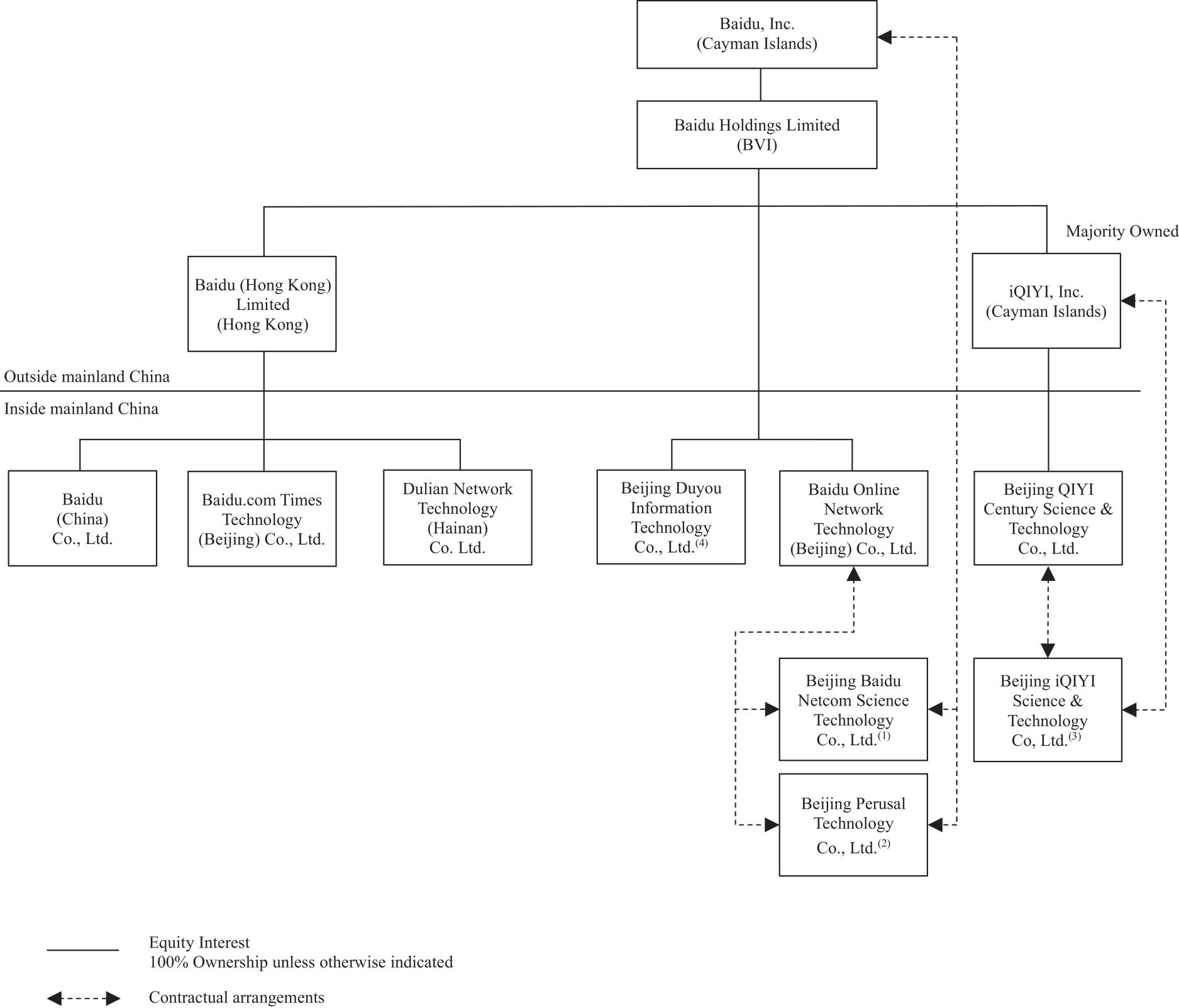
Notes:
| (1) | Beijing Baidu Netcom Science Technology Co., Ltd. is 99.5% owned by Mr. Robin Yanhong Li, our chairman and chief executive officer, and 0.5% owned by Ms. Shanshan Cui, an executive officer of ours. Please see “Item 6.E. Directors, Senior Management and Employees—Share Ownership” for details of Mr. Robin Yanhong Li’s beneficial ownership in our company. Ms. Shanshan Cui’s beneficial ownership of our company is less than 1% of our total issued and outstanding shares. |
| (2) | Beijing Perusal Technology Co., Ltd. is 50% owned by Ms. Shanshan Cui and 50% owned by Mr. Zhixiang Liang. Both Ms. Shanshan Cui and Mr. Zhixiang Liang are our employees, and their respective beneficial ownership in our company is less than 1% of our total issued and outstanding shares. |
| (3) | Mr. Xiaohua Geng holds 99% of the equity interests in Beijing iQIYI Science & Technology Co., Ltd. and Yangshipin Integrated Media Development Co., Ltd., a third-party minority shareholder, holds 1% of the equity interests in Beijing iQIYI Science & Technology Co., Ltd. |
| (4) | Baidu Holdings Limited indirectly controls Beijing Duyou Information Technology Co., Ltd through its wholly owned subsidiaries. |
Contractual Arrangements with the Variable Interest Entities and Other Consolidated Affiliated Entities and their Shareholders
The laws and regulations of mainland China restrict and impose conditions on foreign investment in, among other areas, internet content services, value-added telecommunication-based services, internet map services, online audio and video services and mobile application distribution businesses.
149
Accordingly, we operate these businesses in mainland China through the variable interest entities. We have entered into a series of contractual arrangements with the variable interest entities and the nominee shareholders of the variable interest entities. These contractual arrangements:
| • | enable us to receive the economic benefits that could potentially be significant to the variable interest entities in consideration for the services provided by our subsidiaries; |
| • | effectively assigned all of the voting rights underlying the nominee shareholders’ equity interest in the variable interest entities to us; and |
| • | enable us to hold an exclusive option to purchase all or part of the equity interests in the variable interest entities when and to the extent permitted by the laws of mainland China. |
These contractual agreements among our company/iQIYI and our subsidiaries, the variable interest entities and their respective shareholders generally include proxy agreements or shareholder voting rights trust agreements, exclusive equity purchase and transfer option agreements or exclusive purchase option agreements, loan agreements, operating agreements or business operation agreements, exclusive technology consulting and services agreements, and equity pledge agreements, as the case may be. As for some of the variable interest entities, our subsidiaries have entered into additional business cooperation agreements, power of attorney, license agreements and/or commitment letters (as the case may be) with these variable interest entities and their respective nominee shareholders. We do not have any equity interests in the variable interest entities and these contractual agreements are not equivalent to equity ownership in the business of the variable interest entities. Despite the lack of equity majority ownership, as a result of the contractual arrangements, the shareholders of the variable interest entities effectively assigned all of their voting rights and economic interests underlying their equity interest in the variable interest entities to the primary beneficiaries of these companies, which gives our company/iQIYI the power to direct the activities that most significantly impact the variable interest entities’ economic performance. In addition, through the other exclusive agreements, which consist of exclusive equity purchase and transfer option agreements/exclusive purchase option agreements or commitment letters, operating agreements/business operation agreements, exclusive technology consulting and services agreements and license agreements, the primary beneficiaries, by themselves or by their wholly-owned subsidiaries in mainland China, demonstrate their ability and intention to continue to exercise the ability to absorb losses or receive economic benefits that could potentially be significant to the variable interest entities. The variable interest entities are subject to operating risks, which determine the variability of our company’s interest in those entities. Based on these contractual arrangements, we consolidate the variable interest entities as required by Accounting Standards Codification (ASC) Topic 810, Consolidation. The individual nominee shareholders of Baidu Netcom, Beijing Perusal and Beijing iQIYI, the variable interest entities, are directors or members of senior management of our company/ iQIYI. We/iQIYI consider such people suitable to act as the nominee shareholders of these variable interest entities because of, among other considerations, their contribution to our company/iQIYI, their competence and their length of service with and loyalty to our company/iQIYI. If the variable interest entities or the nominee shareholders fail to perform their respective obligations under the contractual arrangements, we could be limited in our ability to enforce the contractual arrangements that effectively assigned us the voting rights and/or economic interests in the variable interest entities. Furthermore, if we are unable to maintain such effective assignment, we would not be able to continue to consolidate the financial results of the variable interest entities in our financial statements. In 2022, 2023 and 2024, we derived 47%, 45% and 44% of our external revenues from the variable interest entities, respectively. Based on the book value of Baidu Netcom and Beijing Perusal and taking into account major adjustments for intra-group transactions, the revenue contribution of Baidu Netcom to us for each of the years ended December 31, 2022, 2023 and 2024 was 15%, 13% and 17%, respectively, and the revenue contribution of Beijing Perusal was all 0% for each of the same periods. For a detailed revenue contribution, see “Item 3.A. [Reserved]—Financial Information Related to the Variable interest Entities.” For a detailed description of the regulatory environment that necessitates the adoption of our corporate structure, see “Item 4.B. Information on the Company—Business Overview—Regulations.” For a detailed description of the risks associated with our corporate structure, see “Item 3.D. Key Information—Risk Factors—Risks Related to Our Corporate Structure.”
150
The following is a summary of the material provisions of the contractual arrangements relating to Baidu Netcom, Beijing Perusal and Beijing iQIYI.
Proxy Agreements/Shareholder Voting Rights Trust Agreements/Power of Attorney
Pursuant to the proxy agreement amongst our company and the nominee shareholders of Baidu Netcom, the nominee shareholders of Baidu Netcom agree to entrust all the rights to exercise their voting power and any other rights as shareholders of Baidu Netcom to the person(s) designated by our company. Each of the nominee shareholders of Baidu Netcom has executed an irrevocable power of attorney to appoint the person(s) designated by our company as their attorney-in-fact to vote on their behalf on all matters requiring shareholder approval. Any action taken by such attorney-in-fact in relation to the entrusted rights should be directed and approved by our company. The proxy agreement will be in effect for an unlimited term unless terminated in writing by our company. Each of the powers of attorney will be in effect for as long as the relevant nominee shareholder of Baidu Netcom holds any equity interests in Baidu Netcom.
Each of the proxy agreements or shareholder voting rights trust agreements amongst our company and the shareholders of Beijing Perusal and between Beijing QIYI Century and the individual shareholder of Beijing iQIYI contains substantially the same terms as those described above. Each of the proxy agreements or shareholder voting rights trust agreements will be in effect for an unlimited term unless terminated in writing by our company or other subsidiaries. Each of the powers of attorney or shareholder voting rights trust agreements will be in effect for as long as the shareholder of Beijing Perusal or Beijing iQIYI, holds any equity interests in Beijing Perusal or Beijing iQIYI, as the case may be.
Exclusive Equity Purchase and Transfer Option Agreement or Exclusive Purchase Option Agreements
Pursuant to the exclusive equity purchase and transfer option agreement by and among our company, Baidu Online, Baidu Netcom and the nominee shareholders of Baidu Netcom, the nominee shareholders of Baidu Netcom have irrevocably granted our company or its designated person(s) (including Baidu Online) an exclusive option to purchase, to the extent permitted under the laws of mainland China, all or part of the equity interests in Baidu Netcom for the cost of the initial contributions to the registered capital or the minimum amount of consideration permitted by applicable laws of mainland China. The nominee shareholders must remit to Baidu Online any amount that is paid by Baidu Online in connection with the purchased equity interest as requested by our company or its designated person(s) (including Baidu Online) to the extent permitted by the applicable laws. Our company or its designated person(s) have sole discretion to decide when to exercise the option, whether in part or in full amount. Any and all dividends and other capital distributions from Baidu Netcom to the nominee shareholders must be repaid to Baidu, Inc. in full amount. Our company or its designated person(s) (including Baidu Online) also have the exclusive right to cause the nominee shareholders of Baidu Netcom to transfer their equity interest in Baidu Netcom to our company or any designated third party. Our company will provide unlimited financial support to Baidu Netcom, if Baidu Netcom becomes in need of any form of reasonable financial support in the normal operation of business. If Baidu Netcom were to incur any loss and as a result cannot repay any loans from our company (through Baidu Online), our company will unconditionally forgive any such loans to Baidu Netcom upon provision by Baidu Netcom of sufficient proof for its loss and incapacity to repay. In addition, the shareholders of Baidu Netcom must appoint the candidates recommended by Baidu Online as their representatives on Baidu Netcom’s board of directors. The agreement will terminate upon the transfer by the nominee shareholders of Baidu Netcom of all their equity interests in Baidu Netcom to our company or its designated person(s) or upon expiration of the term of business of our company or Baidu Netcom.
Each of the exclusive equity purchase and transfer option agreements/exclusive purchase option agreements amongst our company, Baidu Online, Beijing Perusal and its shareholders and iQIYI, Beijing QIYI Century, Beijing iQIYI and its individual shareholder contains substantially the same terms as those described above, except that the initial term of the amended and restated exclusive purchase option agreement amongst iQIYI, Beijing QIYI Century, Beijing iQIYI and its shareholder is ten years, which has been extended to November 22, 2032, and can be further renewed at iQIYI’s discretion.
151
Exclusive Technology Consulting and Services Agreement
Pursuant to the exclusive technology consulting and services agreement between Baidu Online and Baidu Netcom, Baidu Online has the exclusive right to provide Baidu Netcom technology consulting and services related to, among other things, the maintenance of servers, software development, design of advertisements, and e-commerce technical services. Baidu Online owns the intellectual property rights resulting from the performance of this agreement. Baidu Netcom agrees to pay service fees to Baidu Online and Baidu Online has the right to adjust the service fees at its sole discretion without the consent of Baidu Netcom. The agreement will be in effect for an unlimited term, until the term of business of one party expires and extension is denied by the approval authorities.
Each of the exclusive technology consulting and services agreements between Baidu Online and Beijing Perusal and Beijing QIYI Century and Beijing iQIYI contains substantially the same terms as those described above, except that the terms regarding the determinant of the service fees may differ and that the initial term of the exclusive technology consulting and services agreement between Beijing QIYI Century and Beijing iQIYI dated November 23, 2011 is ten years, and has been extended to November 23, 2031, and can be further renewed at the discretion of Beijing QIYI Century.
In 2022, 2023 and 2024, Baidu Netcom and Beijing Perusal did not pay any service fees to Baidu Online.
Operating Agreement or Business Operation Agreement
Pursuant to the operating agreement amongst Baidu Online, Baidu Netcom and the nominee shareholders of Baidu Netcom, Baidu Online provides guidance and instructions on Baidu Netcom’s daily operations, financial affairs and employment and dismissal of staff. In addition, Baidu Online agrees to guarantee Baidu Netcom’s performance under any agreements or arrangements relating to Baidu Netcom’s business arrangements with any third party. In return, Baidu Netcom agrees that without the prior consent of Baidu Online, Baidu Netcom will not engage in any transactions that could materially affect the assets, liabilities, rights or operations of Baidu Netcom, including, without limitation, incurrence or assumption of any indebtedness, sale or purchase of any assets or rights, incurrence of any encumbrance on any of its assets or intellectual property rights in favor of a third party or transfer of any agreements relating to its business operation to any third party. The agreement will be in effect for an unlimited term, until the term of business of one party expires and extension is denied by the approval authorities.
The operating agreement amongst Baidu Online, Beijing Perusal and its shareholders contains substantially the same terms as those described above.
Pursuant to the amended and restated business operation agreement dated January 30, 2013 amongst Beijing QIYI Century, Beijing iQIYI and its individual shareholder, Beijing QIYI Century provides guidance and instructions on Beijing iQIYI’s daily operations and financial affairs. In addition, Beijing QIYI Century agrees to guarantee Beijing iQIYI’s performance under any agreements or arrangements relating to Beijing iQIYI’s business arrangements with any third party. The agreement can only be unilaterally revoked by Beijing QIYI Century. The initial term of the agreement is ten years, which has been extended for another ten years to January 30, 2033, and can be further extended at Beijing QIYI Century’s discretion.
Loan Agreements
Pursuant to loan agreements amongst Baidu Online and the nominee shareholders of Baidu Netcom, Baidu Online provided loans with an aggregate amount of RMB13.4 billion to the nominee shareholders of Baidu Netcom solely for the latter to fund the capitalization of Baidu Netcom.
152
The loans can be repaid only with the proceeds from the sale of the nominee shareholders’ equity interest in Baidu Netcom to Baidu Online or its designated person(s). The term of the loan agreements with the two nominee shareholders of Baidu Netcom will expire on July 9, 2029 and August 19, 2029, respectively, and can be extended with the written consent of both parties before its expiration.
Pursuant to loan agreements amongst the shareholders of Beijing Perusal and Baidu Online, the amount of loans extended to the respective shareholders of Beijing Perusal is RMB3.2 billion. The term of the loan agreements will expire on March 30, 2028 and October 29, 2029, respectively, and can be extended with the written consent of both parties before its expiration. Each of the loan agreements amongst Baidu Online and the respective shareholders of Beijing Perusal, and Beijing QIYI Century and the individual shareholder of Beijing iQIYI, contains substantially the same terms as those described above, except that the amount of the loans and that the contract expiration date varies. The term of the loan agreement amongst Beijing QIYI Century and the individual shareholder of Beijing iQIYI will expire on June 23, 2031 and can be further extended upon the written notification from Beijing QIYI Century.
Equity Pledge Agreement
Pursuant to the equity pledge agreement amongst Baidu Online and the nominee shareholders of Baidu Netcom, the nominee shareholders of Baidu Netcom must pledge all of their equity interests in Baidu Netcom to Baidu Online to guarantee their obligations under the loan agreements and Baidu Netcom’s performance of its obligations under the exclusive technology consulting and service agreement. If Baidu Netcom or the nominee shareholders breach their respective contractual obligations, Baidu Online, as the pledgee, will be entitled to certain rights, including the right to sell the pledged equity interests. The nominee shareholders of Baidu Netcom agree not to dispose of the pledged equity interests or take any actions that would prejudice Baidu Online’s interest. The equity pledge agreement will terminate on the date when Baidu Netcom and its shareholders have completed all their respective obligations under the exclusive technology consulting and service agreement and the loan agreements, but such equity pledge will expire two years after expiration of the term of the obligations of Baidu Netcom and its shareholders under the exclusive technology consulting and service agreement and the loan agreements if they fail to fulfill such obligations thereunder.
Each of the equity pledge agreements amongst Baidu Online and the shareholders of Beijing Perusal and Beijing QIYI Century and the individual shareholder of Beijing iQIYI contains substantially the same terms, including its term to expiration, as those described above.
Business Cooperation Agreement
Pursuant to the business cooperation agreement between Beijing QIYI Century and Beijing iQIYI effective November 23, 2011, Beijing iQIYI agrees to provide Beijing QIYI Century with services, including internet information services, online advertising and other services reasonably necessary within the scope of Beijing QIYI Century’s business. Beijing iQIYI agrees to use technology services provided by Beijing QIYI Century on its platform, including, but not limited to, P2P download and video on-demand systems. Beijing QIYI Century agrees to pay specified service fees to Beijing iQIYI as consideration for the internet information services and other services provided by Beijing iQIYI. Beijing iQIYI has the right to waive the service fees at its discretion. The initial term of this agreement is ten years, which has been extended for another ten years to November 23, 2031, and can be further renewed at Beijing QIYI Century’s discretion.
License Agreements
Baidu Online and Baidu Netcom have entered into a software license agreement and a web layout copyright license agreement. Pursuant to these license agreements, Baidu Online has granted to Baidu Netcom the right to use, including, but not limited to, a software license and a web layout copyright license. Baidu Netcom may only use the licenses in its own business operations.
153
Baidu Online has the right to adjust the service fees at its sole discretion. The software license agreement and web layout copyright license agreement have been renewed since their original expiration and are in effect for an unlimited term, until the term of business of one party expires and extension is denied by the approval authorities.
The web layout copyright license agreements that Baidu Online has entered into with Beijing Perusal contain substantially the same terms as those between Baidu Online and Baidu Netcom described above. The agreement is in effect for an unlimited term, until the term of business of one party expires and extension is denied by the approval authorities.
Pursuant to the trademark license agreement and the software usage license agreement between Beijing QIYI Century and Beijing iQIYI effective November 23, 2011, Beijing QIYI Century granted a non-exclusive and non-transferable license, without sublicensing rights, to Beijing iQIYI to use its trademarks and software. Beijing iQIYI may only use the licenses in its own business operations. Beijing QIYI Century has the right to adjust the service fees at its sole discretion. The initial term of the two agreements is five years. The software usage license agreement may be extended upon the written consent of Beijing QIYI Century, and has been extended to December 1, 2031, and is further renewable at the discretion of Beijing QIYI Century. The trademark license agreement is automatically extended for successive one-year periods after its expiration unless Beijing QIYI Century early terminates the agreement in accordance with the provisions of the agreement.
Commitment Letters
Pursuant to the commitment letter dated January 30, 2013, under the condition that Beijing iQIYI remains as a variable interest entity of iQIYI under United States generally accepted accounting principles and the relevant contractual arrangements remain in effect, iQIYI commits to provide unlimited financial support to Beijing iQIYI, if Beijing iQIYI requires any form of reasonable financial support for its normal business operations. If Beijing iQIYI incurs any losses and as a result cannot repay its loans from iQIYI and Beijing QIYI Century, one of iQIYI’s subsidiaries, iQIYI and Beijing QIYI Century would unconditionally forgive their loans to Beijing iQIYI, if Beijing iQIYI provides sufficient proof for its loss and incapacity to repay.
The commitment letters executed by other iQIYI VIEs contain terms similar to the terms described above.
Through design of the aforementioned agreements, the nominee shareholders of these variable interest entities have effectively assigned their full voting rights to our company/iQIYI, which gives our company/iQIYI the power to direct the activities that most significantly impact the variable interest entities’ economic performance. Our company/iQIYI obtains the ability to approve decisions made by the variable interest entities and the ability to acquire the equity interests in the variable interest entities when permitted by the laws of mainland China. Our company/iQIYI is obligated to absorb losses of the variable interest entities that could potentially be significant to the variable interest entities through providing unlimited financial support to the variable interest entities or is entitled to receive economic benefits from the variable interest entities that could potentially be significant to the variable interest entities through the exclusive technology consulting and service fees. As a result of these contractual arrangements, our company/iQIYI is determined to be the primary beneficiary of these variable interest entities and we consolidate these variable interest entities through our company/iQIYI as required by Accounting Standards Codification Topic 810, Consolidation.
We have also entered into contractual arrangements with several other variable interest entities and their respective nominee shareholders, including iQIYI’s other variable interest entities and their respective nominee shareholders, through some of our subsidiaries other than Baidu Online and Beijing QIYI Century, which result in our company/iQIYI or relevant subsidiaries, as the case may be, being the primary beneficiaries of the relevant variable interest entities. As a result of these contractual arrangements, we consolidate these other variable interest entities through the subsidiaries as required by Accounting Standards Codification Topic 810, Consolidation. In addition, we have entered into similar contractual arrangements with consolidated affiliated entities and their shareholders in certain other jurisdictions.
154
| D. | Property, Plant and Equipment |
Our corporate headquarters, Baidu Campus, is located in Shangdi, Haidian district of Beijing. We own the office building of Baidu Campus and a nearby office building, Baidu Science Park, which is located in Malianwa, Haidian district of Beijing. Besides Beijing, we own and occupy office buildings in Shanghai and Shenzhen.
We also lease offices in Beijing, many other cities in mainland China and places outside of mainland China, including in the United States, Canada, Hong Kong, Malaysia, Japan, Thailand and Singapore.
Our servers are hosted at the internet data centers of major telecom operators, including China Telecom, China Unicom and China Mobile, in over ten selected cities across China. Our content delivery network covers most of the major cities in mainland China.
In 2022, we completed the second-phase construction of our cloud computing centers in Yangquan, Dingxing and Xushui, which all serve as our internet data centers in China.
| Item 4A. | Unresolved Staff Comments |
Not Applicable.
| Item 5. | Operating and Financial Review and Prospects |
The following discussion of our financial condition and results of operations is based upon, and should be read in conjunction with, our audited consolidated financial statements and the related notes included in this annual report on Form 20-F. This report contains forward-looking statements. See “Forward-Looking Information.” In evaluating our business, you should carefully consider the information provided under the caption “Item 3.D. Key Information—Risk Factors” in this annual report on Form 20-F. We caution you that our businesses and financial performance are subject to substantial risks and uncertainties.
| A. | Operating Results |
Overview
We are a leading AI company with a strong internet foundation. We have been consistently investing in AI since 2010 to solidify our technology advancement, improve search capabilities and boost overall monetization. The breadth and depth of our AI capabilities provide the differentiating foundational technologies that power all of our businesses.
We generated total revenues of RMB123.7 billion, RMB134.6 billion and RMB133.1 billion (US$18.2 billion) in 2022, 2023 and 2024, respectively. Our operating profits were RMB15.9 billion, RMB21.9 billion and RMB21.3 billion (US$2.9 billion) in 2022, 2023 and 2024, respectively. Net income attributable to Baidu, Inc. were RMB7.6 billion, RMB20.3 billion and RMB23.8 billion (US$3.3 billion) in 2022, 2023 and 2024, respectively.
Revenues
Baidu Core. Baidu Core revenues primarily comprise of (i) P4P online marketing services that include search and feed; (ii) other online marketing services, including display advertisement and based on performance criteria other than CPC; (iii) cloud services; (iv) smart devices and services; (v) non-marketing consumer-facing services such as membership; and (vi) intelligent driving. We expect Baidu Core to continue to generate a majority of our revenues.
A majority of Baidu Core revenues are derived from online marketing services. Our P4P platform is an online marketplace that introduces internet search users to customers, who pay us a fee based on click-throughs for priority placement of their links in the search results.
155
We also provide feed online marketing services to our customers. Our feed platform helps customers target relevant feed users, and customers pay us based on a CPC basis, cost-per-thousand impressions (CPM) or advertisement displays of their products. In addition, we provide our customers with other performance-based and display-based online marketing services.
Our cloud services include enterprise and public sector cloud, and personal cloud. Our enterprise and public sector cloud offers a full suite of cloud services and solutions, including IaaS, PaaS, and SaaS, and is differentiated by our AI capabilities. Enterprises and the public sector have been the growth engine for our cloud revenue. For the personal cloud service, we offer Baidu Drive, which allows users to store and retrieve photos, videos, and other files on AI Cloud, along with other capabilities, such as group share and data transfer. We also leveraged ERNIE to transform Baidu Wenku into a one-stop shop for various document creation needs. Personal cloud service contributed a small portion of total cloud revenues.
Apart from the online marketing services and cloud services, Baidu Core also generates revenue by providing products and services ranging from smart devices and services, non-marketing consumer-facing services and intelligent driving.
iQIYI. iQIYI is a leading provider of online entertainment video services in mainland China. iQIYI remains focused on high-quality content and user experience. iQIYI provides its users with a variety of products and services encompassing online video, online games, online literature, comics and others. iQIYI generates revenues through membership services, online advertising services and a suite of other monetization methods.
iQIYI offers membership packages to provide its members with (i) access to streaming of a library of premium content, (ii) certain commercial skipping and other viewing privileges, and (iii) merchandise selection and privilege. iQIYI’s online marketing services are in the form of brand advertising and performance-based advertising.
Operating Costs and Expenses
Our operating costs and expenses consist of cost of revenues, selling, general and administrative expenses, and research and development expenses. Share-based compensation expenses are allocated among these three categories, based on the nature of the work of the employees who have received share-based compensation.
Cost of Revenues
Our cost of revenues primarily consist of content costs, traffic acquisition costs, bandwidth costs, depreciation costs, server custody fees, cost of goods sold, salaries and benefits for operation and service personnel and other operational cost.
Selling, General and Administrative Expenses
Our selling, general and administrative expenses primarily consist of promotional and marketing expenses, salaries and benefits for our sales, marketing, general and administrative personnel, and legal, accounting and other professional services fees.
Research and Development Expenses
Research and development expenses primarily consist of salaries and benefits for research and development personnel, server depreciation expenses and server custody fees. We expense research and development costs as they are incurred, except for capitalized software development costs that fulfill the capitalization criteria.
156
Taxation
Cayman Islands
Under the current laws of the Cayman Islands, we are not subject to tax on income or capital gains. Additionally, no Cayman Islands withholding tax will be imposed on dividend payments we make.
Hong Kong
Subsidiaries in Hong Kong are subject to Hong Kong profits tax rate of 16.5% and foreign-derived income is exempted from income tax. There is no withholding tax upon payment of dividends by the subsidiaries incorporated in Hong Kong to its shareholders.
Mainland China Enterprise Income Tax
Mainland China’s statutory enterprise income tax rate is 25%. An enterprise may benefit from a preferential tax rate of 15% under the EIT Law if it qualifies as a “High and New Technology Enterprise” strongly supported by the state. Pursuant to the Administrative Measures on the Recognition of High and New Technology Enterprises, as amended in January 2016, the provincial counterparts of the Ministry of Science and Technology, the Ministry of Finance and the State Administration of Taxation make a joint determination on whether an enterprise is qualified as a “High and New Technology Enterprise,” or HNTE, under the EIT Law. In making such determination, these government agencies consider, among other factors, ownership of core technology, whether the key technology supporting the core products or services falls within the scope of high and new technology strongly supported by the state as specified in the administrative measures, the ratios of research and development personnel to total personnel, the ratio of research and development expenditures to annual sales revenues, the ratio of revenues attributed to high and new technology products or services to total revenues, and other measures set forth in the guidance. A “High and New Technology Enterprise” certificate is effective for a period of three years. Further, preferential enterprise income tax rates are available for qualified Software Enterprises whereby entities are entitled to full exemption from enterprise income tax for two years beginning from their first profitable calendar year and a 50% reduction for the subsequent three calendar years.
Certain PRC subsidiaries and VIEs, including Baidu Online, Baidu China, Baidu International and Baidu Netcom, etc. are qualified HNTEs and enjoy a reduced tax rate of 15% for the years presented, which will expire from 2025 to 2027. An entity could re-apply for the HNTE certificate when the prior certificate expires. Historically, all of the Company’s subsidiaries and VIEs have successfully renewed their certificates when the prior ones expired. Certain subsidiaries enjoyed a reduced tax rate as qualified Software Enterprise for the years presented, which will expire from 2025 to 2027.
If our mainland China subsidiaries or the variable interest entities that have enjoyed preferential tax treatment no longer qualify for the preferential treatment, we will consider available options under applicable law that would enable us to qualify for alternative preferential tax treatment. To the extent we are unable to offset the impact of the expiration of existing preferential tax treatment with new tax exemptions, tax incentives or other tax benefits, the expiration of existing preferential tax treatment may cause our effective tax rate to increase. The amount of income tax payable by our mainland China subsidiaries and the variable interest entities in the future will depend on various factors, including, among other things, the results of operations and taxable income of, and the statutory tax rate applicable to, each of the entities. Our effective tax rate depends partially on the extent of the relative contribution of each of our subsidiaries and the variable interest entities to our consolidated taxable income.
Withholding Tax
Under the EIT Law and its implementation rules, dividends, interests, rent or royalties payable by a foreign-invested enterprise, such as our mainland China subsidiaries, to any of its non-resident enterprise investors, and proceeds from any such non-resident enterprise investor’s disposition of assets (after deducting the net value of such assets) are subject to enterprise income tax at the rate of 10%, namely withholding tax, unless the non-resident enterprise investor’s jurisdiction of incorporation has a tax treaty or arrangement with mainland China that provides for a reduced withholding tax rate or an exemption from withholding tax.
157
The Notice on Several Preferential Policies regarding Enterprise Income Tax Law jointly promulgated by the Ministry of Finance and State Administration of Taxation in February 2008, clarifies that undistributed profits earned by foreign-invested enterprises prior to January 1, 2008 will be exempted from any withholding tax.
The British Virgin Islands, where Baidu Holdings Limited, the sole shareholder of certain of our mainland subsidiaries such as Baidu Online, is incorporated, does not have such a tax treaty with mainland China.
Hong Kong, where Baidu (Hong Kong) Limited, our wholly owned subsidiary and the sole shareholder of certain of our mainland China subsidiaries such as Baidu Times and Baidu China, is incorporated, has a tax arrangement with mainland China that provides for a lower withholding tax rate of 5% on dividends subject to certain conditions and requirements, such as the requirement that the Hong Kong resident enterprise own at least 25% of the mainland China enterprise distributing the dividend at all times within the 12-month period immediately preceding the distribution of dividends and be a “beneficial owner” of the dividends. However, pursuant to Circular on Issues Concerning Implementing Dividend Clauses of Tax Treaties issued by the State Administration of Taxation in February 2009, if the PRC tax authorities determine, in their discretion, that a company benefits from the reduced withholding tax rate on dividends due to a structure or arrangement designed for the primary purpose of obtaining favorable tax treatment, the PRC tax authorities may adjust the preferential tax treatment. Moreover, pursuant to Circular on Several Issues regarding the “Beneficial Owner” in Tax Treaties, issued by the State Administration of Taxation in February 2018, which became effective from April 1, 2018, a resident of a contracting state will not qualify for the benefits under the tax treaties or arrangements, if it is not the “beneficial owner” of the dividend, interest and royalty income. According to this circular, a “beneficial owner” is required to have ownership and the right to dispose of the income or the rights and properties giving rise to the income, and generally engage in substantive business activities. An agent or conduit company will not be regarded as a “beneficial owner” and, therefore, will not qualify for treaty benefits. A conduit company normally refers to a company that is set up primarily for the purpose of evading or reducing taxes or transferring or accumulating profits. In addition, pursuant to Bulletin on Administrative Measures on Treaties Benefit for Non-resident Taxpayers, issued by the State Administration of Taxation in October 2019, non-resident enterprises are not required to obtain pre-approval from the tax authority in order to enjoy the reduced withholding tax rate. Instead, non-resident enterprises may, if they determine by self-assessment that the prescribed criteria to enjoy the tax treaty benefits are met, directly apply for the reduced withholding tax rate, and file necessary forms and supporting documents when performing tax filings, which will be subject to post-filing examinations by the tax authorities.
From 2022 to 2024, certain of our mainland China subsidiaries have declared and distributed profits earned to Baidu (Hong Kong) Limited, the dividend payments are subject to withholding tax. In addition, in 2024, Baidu Inc. received RMB15.2 billion (US$2.1 billion) as cash distributions from one of its subsidiaries. We have made tax provisions based on the corresponding tax rate. If our mainland China subsidiaries further declare and distribute profits earned after January 1, 2008 to us in the future, the dividend payments will be subject to withholding tax, which will increase our tax liability and reduce the amount of cash available to our company. For the potential distributable profits to be distributed to our qualified Hong Kong incorporated subsidiary, the deferred tax liabilities are accrued at a 5% withholding tax rate. For more information on related risks, please see “Item 3.D. Key Information—Risk Factors—Risks Related to Doing Business in China—If our mainland China subsidiaries declare and distribute dividends to their respective offshore parent companies, we will be required to pay more taxes, which could have a material and adverse effect on our result of operations.”
Tax Residence
Under the EIT Law and its implementation rules, an enterprise established outside of mainland China with “de facto management body” within mainland China is considered a resident enterprise and will be subject to enterprise income tax at the rate of 25% on its worldwide income.
158
The term “de facto management body” refers to “the establishment that exercises substantial and overall management and control over the production, business, personnel, accounts and properties of an enterprise.” Pursuant to SAT Circular 82, issued by the State Administration of Taxation in April 2009, an overseas registered enterprise controlled by a mainland China company or a mainland China company group will be classified as a “resident enterprise” with its “de facto management body” located within mainland China if the following requirements are satisfied: (i) the senior management and core management departments in charge of its daily operations are mainly located in mainland China; (ii) its financial and human resources decisions are subject to determination or approval by persons or bodies located in mainland China; (iii) its major assets, accounting books, company seals, and minutes and files of its board and shareholders’ meetings are located or kept in mainland China; and (iv) no less than half of the enterprise’s directors or senior management with voting rights reside in mainland China. The State Administration of Taxation issued additional rules to provide more guidance on the implementation of SAT Circular 82 in July 2011, and issued an amendment to SAT Circular 82 delegating the authority to its provincial branches to determine whether a Chinese-controlled overseas-incorporated enterprise should be considered a mainland China resident enterprise, in January 2014. Although the SAT Circular 82, the additional guidance and its amendment only apply to overseas registered enterprises controlled by mainland China enterprises and not those controlled by mainland China individuals or foreigners, the determining criteria set forth in the circular may reflect the State Administration of Taxation’s general position on how the “de facto management body” test should be applied in determining the tax resident status of offshore enterprises, regardless of whether they are controlled by mainland China enterprises, individuals or foreigners.
If our offshore entities are deemed mainland China resident enterprises, these entities may be subject to enterprise income tax at the rate of 25% on their global incomes, except that the dividends distributed by our mainland China subsidiaries may be exempt from enterprise income tax to the extent such dividends are deemed “dividends among qualified resident enterprises.” For more information on related risks, please see “Item 3.D. Key Information—Risk Factors—Risks Related to Doing Business in China—We may be deemed a mainland China resident enterprise under the EIT Law, which could subject us to mainland China’s taxation on our global income, and which may have a material and adverse effect on our results of operations.”
Should our offshore entities be deemed as mainland China resident enterprises, such changes could significantly increase our tax burden and materially and adversely affect our cash flow and profitability.
Mainland China Urban Maintenance and Construction Tax and Education Surcharge
Any entity, foreign-invested or purely domestic, or individual that is subject to consumption tax and value-added tax is also required to pay mainland China urban maintenance and construction tax. The rates of urban maintenance and construction tax are 7%, 5% or 1% of the amount of consumption tax and value-added tax actually paid depending on where the taxpayer is located. All entities and individuals who pay consumption tax and value-added tax are also required to pay education surcharges at a rate of 3%, and local education surcharges at a rate of 2%, of the amount of value-added tax and consumption tax actually paid.
159
Results of Operations
The following table sets forth a summary of our consolidated results of operations for the periods indicated. The period-to-period comparisons of results of operations should not be relied upon as indicative of future performance.
| Year ended December 31, | ||||||||||||||||
| 2022 | 2023 | 2024 | ||||||||||||||
| RMB | RMB | RMB | US$ | |||||||||||||
| (in millions) | ||||||||||||||||
| Consolidated Statements of Comprehensive Income Data |
||||||||||||||||
| Revenues: |
||||||||||||||||
| Online marketing services |
74,711 | 81,203 | 78,563 | 10,763 | ||||||||||||
| Others |
48,964 | 53,395 | 54,562 | 7,475 | ||||||||||||
|
|
|
|
|
|
|
|
|
|||||||||
| Total revenues |
123,675 | 134,598 | 133,125 | 18,238 | ||||||||||||
|
|
|
|
|
|
|
|
|
|||||||||
| Operating costs and expenses(1): |
||||||||||||||||
| Cost of revenues |
63,935 | 65,031 | 66,102 | 9,056 | ||||||||||||
| Selling, general and administrative |
20,514 | 23,519 | 23,620 | 3,236 | ||||||||||||
| Research and development |
23,315 | 24,192 | 22,133 | 3,032 | ||||||||||||
|
|
|
|
|
|
|
|
|
|||||||||
| Total operating costs and expenses |
107,764 | 112,742 | 111,855 | 15,324 | ||||||||||||
|
|
|
|
|
|
|
|
|
|||||||||
| Operating profit |
15,911 | 21,856 | 21,270 | 2,914 | ||||||||||||
|
|
|
|
|
|
|
|
|
|||||||||
| Total other (loss) income, net |
(5,799 | ) | 3,342 | 7,352 | 1,007 | |||||||||||
|
|
|
|
|
|
|
|
|
|||||||||
| Income before income taxes |
10,112 | 25,198 | 28,622 | 3,921 | ||||||||||||
|
|
|
|
|
|
|
|
|
|||||||||
| Income taxes |
2,578 | 3,649 | 4,447 | 609 | ||||||||||||
|
|
|
|
|
|
|
|
|
|||||||||
| Net income |
7,534 | 21,549 | 24,175 | 3,312 | ||||||||||||
|
|
|
|
|
|
|
|
|
|||||||||
| Less: Net (loss) income attributable to non-controlling interests |
(25 | ) | 1,234 | 415 | 57 | |||||||||||
|
|
|
|
|
|
|
|
|
|||||||||
| Net income attributable to Baidu, Inc. |
7,559 | 20,315 | 23,760 | 3,255 | ||||||||||||
|
|
|
|
|
|
|
|
|
|||||||||
|
|
||||||||||||||||
| Year ended December 31, | ||||||||||||||||
| 2022 | 2023 | 2024 | ||||||||||||||
| RMB | RMB | RMB | US$ | |||||||||||||
| (in millions) | ||||||||||||||||
| (1) Share-based compensation expenses are allocated in operating costs and expenses as follows: |
|
|||||||||||||||
| Cost of revenues |
409 | 590 | 461 | 63 | ||||||||||||
| Selling, general and administrative |
1,750 | 1,678 | 1,427 | 195 | ||||||||||||
| Research and development |
4,629 | 4,077 | 2,896 | 397 | ||||||||||||
|
|
|
|
|
|
|
|
|
|||||||||
| Total |
6,788 | 6,345 | 4,784 | 655 | ||||||||||||
|
|
|
|
|
|
|
|
|
|||||||||
Year Ended December 31, 2024 Compared to Year Ended December 31, 2023
Consolidated revenues. Our total revenues in 2024 were RMB133.1 billion (US$18.2 billion), decreasing by 1% from 2023.
Our online marketing revenues for Baidu Core in 2024 were RMB73.0 billion (US$10.0 billion), decreasing by 3% from 2023, mainly due to weakness in certain offline sectors, such as healthcare, real estate and home furnishing, which were particularly impacted by persistent macroeconomic challenges. During 2024, we continued AI-driven search renovation to enhance our monetization potential.
160
Our online marketing revenues for iQIYI in 2024 were RMB5.7 billion (US$783 million), decreasing by 8% from 2023, primarily due to the decrease in the brand advertising business, partially offset by the growth of performance-based advertising business.
Other revenues in 2024 were RMB54.6 billion (US$7.5 billion), increasing by 2% from 2023, mainly driven by AI Cloud business. For a detailed description, see “—Segment Revenues.”
Consolidated operating costs and expenses. Our total operating costs and expenses decreased by RMB887 million, or 1%, from RMB112.7 billion in 2023 to RMB111.9 billion (US$15.3 billion) in 2024.
Cost of Revenues. Our cost of revenues increased by RMB1.1 billion, or 2%, from RMB65.0 billion in 2023 to RMB66.1 billion (US$9.1 billion) in 2024, primarily due to the following factors:
| • | An increase of RMB1.6 billion in traffic acquisition costs, which arose from increasing union revenues. |
| • | An increase of RMB1.3 billion in bandwidth costs and server custody fees, mainly related to development of AI cloud business. |
| • | A decrease of RMB820 million in depreciation costs, mainly due to the revision of servers’ estimated useful lives from five to six years to reflect actual usage. |
| • | A decrease of RMB662 million in content costs, mainly due to iQIYI’s lighter content slate. |
Selling, General and Administrative Expenses. Our selling, general and administrative expenses were RMB23.6 billion (US$3.2 billion) in 2024, which remained generally flat from RMB23.5 billion in 2023.
Research and Development Expenses. Our research and development expenses decreased by RMB2.1 billion, or 9%, from RMB24.2 billion in 2023 to RMB22.1 billion (US$3.0 billion) in 2024, primarily due to a decrease in personnel-related expenses.
Operating profit. As a result of the foregoing, we generated an operating profit of RMB21.3 billion (US$2.9 billion) in 2024, a 3% decrease from RMB21.9 billion in 2023.
Total other (loss) income, net. Our total other income, net was RMB7.4 billion (US$1.0 billion) in 2024, representing a 120% increase from RMB3.3 billion in 2023, primarily due to a decrease in pickup of losses from an equity method investment, which modified certain terms of its preferred shares and resulted in significant loss pickup in 2023.
Income taxes. Our income tax expense was RMB4.4 billion (US$609 million) in 2024, representing a 22% increase from RMB3.6 billion in 2023, primarily due to the increased provision for withholding tax.
Net income attributable to Baidu, Inc. As a result of the foregoing, net income attributable to Baidu, Inc. increased from RMB20.3 billion in 2023 to RMB23.8 billion (US$3.3 billion) in 2024.
Year Ended December 31, 2023 Compared to Year Ended December 31, 2022
Consolidated revenues. Our total revenues in 2023 were RMB134.6 billion, increasing by 9% from 2022.
Our online marketing revenues for Baidu Core in 2023 were RMB75.1 billion, increasing by 8% from 2022, primarily due to an increase of service demand from our customers in certain industries, including travelling, e-commerce, healthcare, and entertainment and media, which in turn benefited from the recovery of general economy and the macroeconomic environment for these industries.
Our online marketing revenues for iQIYI in 2023 were RMB6.2 billion, increasing by 17% from 2022, as a result of the growth of performance-based advertising business and, to a lesser extent, the growth in the brand advertising business.
161
Other revenues in 2023 were RMB53.4 billion, increasing by 9% from 2022, mainly driven by cloud and other AI-powered businesses. For a detailed description, see “—Segment Revenues.”
Consolidated operating costs and expenses. Our total operating costs and expenses increased by RMB4.9 billion, or 5%, from RMB107.8 billion in 2022 to RMB112.7 billion in 2023.
Cost of Revenues. Our cost of revenues increased by RMB1.1 billion, or 2%, from RMB63.9 billion in 2022 to RMB65.0 billion in 2023, primarily due to the following factors:
| • | An increase of RMB1.1 billion in traffic acquisition costs, which arose from increasing union revenues. |
| • | Total other cost of revenues remained essentially unchanged compared to 2022. The growth of cost of revenues was slower than the growth of revenues due to our continuous improvement of operational efficiency, including optimizing gross margin of AI Cloud business, SLG, iQIYI, etc. |
Selling, General and Administrative Expenses. Our selling, general and administrative expenses increased by RMB3.0 billion, or 15%, from RMB20.5 billion in 2022 to RMB23.5 billion in 2023, primarily due to an increase in channel spending and promotional marketing expenses.
Research and Development Expenses. Our research and development expenses increased by RMB877 million, or 4%, from RMB23.3 billion in 2022 to RMB24.2 billion in 2023, primarily due to an increase in server depreciation expenses and server custody fees which support Gen-AI research and development inputs.
Operating profit. As a result of the foregoing, we generated an operating profit of RMB21.9 billion in 2023, a 37% increase from RMB15.9 billion in 2022.
Total other (loss) income, net. Our total other income, net was RMB3.3 billion, compared to total other loss, net of RMB5.8 billion in 2022, mainly due to a fair value gain of RMB198 million from long-term investments in 2023, compared to a fair value loss of RMB3.9 billion in 2022, as well as a decrease of RMB2.2 billion in impairment of long-term investments.
Income taxes. Our income tax expense was RMB3.6 billion in 2023, representing a 42% increase from RMB2.6 billion in 2022, primarily due to an increase in profit before tax.
Net income attributable to Baidu, Inc. As a result of the foregoing, net income attributable to Baidu, Inc. increased from RMB7.6 billion in 2022 to RMB20.3 billion in 2023.
162
Segment Revenues
The following table sets forth our revenues by segment and the year-over-year change rate for the periods indicated, with each segment revenues including inter-segment revenues:
| Year ended December 31, | ||||||||||||||||||||||||
| 2022 | 2023 | 2024 | ||||||||||||||||||||||
| RMB | RMB | YoY% | RMB | US$ | YoY% | |||||||||||||||||||
| (In millions, except percentages) | ||||||||||||||||||||||||
| Baidu Core |
||||||||||||||||||||||||
| Online marketing services |
69,522 | 75,112 | 8 | 72,972 | 9,997 | (3 | ) | |||||||||||||||||
| Cloud services |
17,721 | 18,718 | 6 | 21,860 | 2,995 | 17 | ||||||||||||||||||
| Others |
8,188 | 9,635 | 18 | 9,880 | 1,353 | 3 | ||||||||||||||||||
|
|
|
|
|
|
|
|
|
|
|
|
|
|||||||||||||
| Subtotal |
95,431 | 103,465 | 8 | 104,712 | 14,345 | 1 | ||||||||||||||||||
|
|
|
|
|
|
|
|
|
|
|
|
|
|||||||||||||
| iQIYI |
||||||||||||||||||||||||
| Online advertising services |
5,332 | 6,224 | 17 | 5,714 | 783 | (8 | ) | |||||||||||||||||
| Membership services |
17,711 | 20,314 | 15 | 17,763 | 2,434 | (13 | ) | |||||||||||||||||
| Content distribution |
2,562 | 2,459 | (4 | ) | 2,847 | 390 | 16 | |||||||||||||||||
| Others |
3,393 | 2,876 | (15 | ) | 2,901 | 397 | 1 | |||||||||||||||||
|
|
|
|
|
|
|
|
|
|
|
|
|
|||||||||||||
| Subtotal |
28,998 | 31,873 | 10 | 29,225 | 4,004 | (8 | ) | |||||||||||||||||
|
|
|
|
|
|
|
|
|
|
|
|
|
|||||||||||||
| Intersegment eliminations |
(754 | ) | (740 | ) | (2 | ) | (812 | ) | (111 | ) | 10 | |||||||||||||
|
|
|
|
|
|
|
|
|
|
|
|
|
|||||||||||||
| Total revenue |
123,675 | 134,598 | 9 | 133,125 | 18,238 | (1 | ) | |||||||||||||||||
|
|
|
|
|
|
|
|
|
|
|
|
|
|||||||||||||
Baidu Core
2024 compared to 2023
Baidu Core revenue was RMB104.7 billion (US$14.3 billion) in 2024, increasing by 1% compared to RMB103.5 billion in 2023.
Online marketing revenues of Baidu Core in 2024 were RMB73.0 billion (US$10.0 billion), decreasing by RMB2.1 billion, or 3%, compared to RMB75.1 billion in 2023, primarily due to weakness in certain offline sectors, such as healthcare, real estate and home furnishing, which were particularly impacted by persistent macroeconomic challenges. During 2024, we continued AI-driven search renovation to enhance our monetization potential.
Revenues from Baidu Core’s cloud services and others are included in “Others” in the consolidated statements of comprehensive income.
Cloud services revenue of Baidu Core in 2024 were RMB21.9 billion (US$3.0 billion), increasing by RMB3.2 billion, or 17%, compared to RMB18.7 billion in 2023, mainly due to an increase in scale for both cloud solution projects and IaaS, standardizing AI cloud solutions and applications for scale, and an increase in subscription for personal cloud service, partially offset by a decrease in cloud solution revenue generated from the smart transportation industry.
Baidu Core’s other revenues in 2024 were RMB9.9 billion (US$1.4 billion), increasing by RMB245 million, or 3%, compared to RMB9.6 billion in 2023, mainly due to increase in intelligent driving services.
2023 compared to 2022
Baidu Core revenue was RMB103.5 billion in 2023, increasing by 8% compared to RMB95.4 billion in 2022.
163
Online marketing revenues of Baidu Core in 2023 were RMB75.1 billion in 2023, increasing by RMB5.6 billion, or 8%, compared to RMB69.5 billion in 2022, primarily due to an increase of service demand from our customers in certain industries, including travelling, e-commerce, healthcare, and entertainment and media, which in turn benefited from the recovery of general economy and macroeconomic environment in these industries. We leverage our AI technology, user traffic, product design and various marketing to enhance users’ reliance on and customers’ stickiness on our platforms and services.
Revenues from Baidu Core’s cloud services and others are included in “Others” in the consolidated statements of comprehensive income.
Cloud services revenue of Baidu Core in 2023 were RMB18.7 billion, increasing by RMB1.0 billion, or 6%, compared to RMB17.7 billion in 2022, mainly due to an increase in scale for IaaS, standardizing AI cloud solutions and applications for scale, and an increase in subscription for personal cloud service, partially offset by a decrease in cloud solution revenue generated from the smart transportation industry.
Baidu Core’s other revenues in 2023 were RMB9.6 billion, increasing by RMB1.4 billion, or 18%, compared to RMB8.2 billion in 2022, mainly due to increase in Apollo Self-Driving Services and Xiaodu smart devices and services.
iQIYI
2024 compared to 2023
iQIYI revenue was RMB29.2 billion (US$4.0 billion) in 2024, decreasing by RMB2.7 billion, or 8%, from RMB31.9 billion in 2023.
iQIYI online advertising services revenue are included in “Online marketing revenue” in the consolidated statements of comprehensive income.
iQIYI’s online advertising revenues in 2024 were RMB5.7 billion (US$783 million), decreasing by RMB510 million, or 8%, from RMB6.2 billion in 2023, primarily due to the decrease in the brand advertising business, partially offset by the growth of performance-based advertising business.
Revenue from iQIYI membership services, content distribution, and others are included in “Others” in the consolidated statements of comprehensive income.
Membership revenue of iQIYI in 2024 were RMB17.8 billion (US$2.4 billion), decreasing by RMB2.5 billion, or 13%, from RMB20.3 billion in 2023, primarily due to a lighter content slate.
iQIYI’s content distribution revenue increased by RMB388 million, or 16%, from RMB2.5 billion in 2023 to RMB2.8 billion (US$390 million) in 2024, primarily attributable to the increase in the barter transactions.
iQIYI’s other revenue in 2024 were RMB2.9 billion (US$397 million), which remained generally flat from RMB2.9 billion in 2023.
2023 compared to 2022
iQIYI revenue was RMB31.9 billion in 2023, increasing by RMB2.9 billion, or 10%, from RMB29.0 billion in 2022.
iQIYI online advertising services revenue are included in “Online marketing revenue” in the consolidated statements of comprehensive income.
164
iQIYI’s online advertising revenues in 2023 were RMB6.2 billion, increasing by RMB892 million, or 17%, from RMB5.3 billion in 2022, primarily driven by the growth of performance-based advertising business and, to a lesser extent, the growth in the brand advertising business.
Revenue from iQIYI membership services, content distribution, and others are included in “Others” in the consolidated statements of comprehensive income.
Membership revenue of iQIYI in 2023 were RMB20.3 billion, increasing by RMB2.6 billion, or 15%, from RMB17.7 billion in 2022, primarily driven by the growth in iQIYI’s average revenue per membership during a month, or monthly ARM, the average daily number of total subscribing members of the year and iQIYI’s continuous efforts in refining operations to improve user experience and monetization capabilities.
iQIYI’s content distribution revenue decreased by RMB103 million, or 4%, from RMB2.6 billion in 2022 to RMB2.5 billion in 2023, primarily attributable to the decrease in barter transactions, partially offset by the increase in cash transactions and revenue from distribution of theatrical movies invested by iQIYI during 2023.
iQIYI’s other revenue in 2023 were RMB2.9 billion, decreasing by RMB517 million, or 15%, from RMB3.4 billion in 2022, primarily due to the deconsolidation of live broadcasting business.
Segment Operating Costs and Expenses
The following table sets forth our operating costs and expenses by segment and the year-over-year change rate for the periods indicated, with each segment operating costs and expenses including inter-segment costs and expenses:
| Year ended December 31, | ||||||||||||||||||||||||
| 2022 | 2023 | 2024 | ||||||||||||||||||||||
| RMB | RMB | YoY% | RMB | US$ | YoY% | |||||||||||||||||||
| (In millions, except percentages) | ||||||||||||||||||||||||
| Operating Costs and Expenses: |
||||||||||||||||||||||||
| Baidu Core |
80,897 | 84,640 | 5 | 85,234 | 11,677 | 1 | ||||||||||||||||||
| iQIYI |
27,686 | 28,884 | 4 | 27,414 | 3,756 | (5 | ) | |||||||||||||||||
Baidu Core. Operating costs and expenses of Baidu Core mainly consist of personnel-related costs and expenses, traffic acquisition costs, marketing and promotion spending, depreciation costs and expenses, server custody fees, bandwidth costs, costs of goods sold, content costs and other costs related to new AI business.
Cost of revenues. The cost of revenues of Baidu Core increased by 5% from RMB42.6 billion in 2023 to RMB44.8 billion (US$6.1 billion) in 2024, primarily due to the following factors:
| • | An increase of RMB1.4 billion in traffic acquisition costs, which arose from increasing union revenues. |
| • | An increase of RMB1.3 billion in bandwidth costs and server custody fees, mainly related to development of AI cloud business. |
| • | A decrease of RMB696 million in depreciation costs, mainly due to the revision of servers’ estimated useful lives from five to six years to reflect actual usage. |
The cost of revenues of Baidu Core increased by 1% from RMB42.4 billion in 2022 to RMB42.6 billion in 2023, primarily due to an increase in traffic acquisition costs, which arose from increasing union revenues and a decrease in other cost of revenues due to our continuous improvement of operational efficiency, including optimizing gross margin of AI Cloud business, SLG, etc.
165
Selling, general and administrative expenses. The selling, general and administrative expenses of Baidu Core increased by 2% from RMB19.6 billion in 2023 to RMB20.0 billion (US$2.7 billion) in 2024, primarily due to an increase in channel spending and promotional marketing expenses.
The selling, general and administrative expenses of Baidu Core increased by 15% from RMB17.1 billion in 2022 to RMB19.6 billion in 2023, primarily due to an increase in channel spending and promotional marketing expenses.
Research and development expenses. The research and development expenses of Baidu Core decreased by 9% from RMB22.4 billion in 2023 to RMB20.4 billion (US$2.8 billion) in 2024, primarily due to a decrease in personnel-related expenses.
The research and development expenses of Baidu Core increased by 5% from RMB21.4 billion in 2022 to RMB22.4 billion in 2023, primarily due to an increase in server depreciation expenses and server custody fees which support Gen-AI research and development inputs.
iQIYI. Operating costs and expenses of iQIYI mainly consist of content costs, personnel-related costs and expenses, traffic acquisition costs, marketing and promotion spending, payment platform charges, server custody fees and bandwidth costs.
Cost of revenues. The cost of revenues of iQIYI decreased by 5% from RMB23.1 billion in 2023 to RMB22.0 billion (US$3.0 billion) in 2024, primarily due to a decrease in the content cost, which was mainly due to a lighter content slate.
The cost of revenues of iQIYI increased by 4% from RMB22.3 billion in 2022 to RMB23.1 billion in 2023.
Selling, general and administrative expenses. The selling, general and administrative expenses of iQIYI decreased by 8% from RMB4.0 billion in 2023 to RMB3.7 billion (US$504 million) in 2024, primarily due to decreased marketing and promotional expenses, which was due to the less spending on user acquisition channels and content promotions.
The selling, general and administrative expenses of iQIYI increased by 16% from RMB3.5 billion in 2022 to RMB4.0 billion in 2023, primarily due to increased marketing and promotional expenses, which was due to the higher spending on user acquisition channels and content promotions.
Research and development expenses. The research and development expenses of iQIYI was RMB1.8 billion (US$244 million) in 2024, which remained generally flat from RMB1.8 billion in 2023.
The research and development expenses of iQIYI decreased by 7% from RMB1.9 billion in 2022 to RMB1.8 billion in 2023, primarily due to decreased personnel compensation expenses.
Critical Accounting Policies and Estimates
We prepare financial statements in accordance with U.S. GAAP, which requires us to make judgments, estimates and assumptions that affect the reported amounts of our assets and liabilities and the disclosure of our contingent assets and liabilities at the end of each fiscal period and the reported amounts of revenues and expenses during each fiscal period. We continually evaluate these judgments and estimates based on our own historical experience, knowledge and assessment of current business and other conditions, our expectations regarding the future based on available information and assumptions that we believe to be reasonable, which together form our basis for making judgments about matters that are not readily apparent from other sources. Since the use of estimates is an integral component of the financial reporting process, our actual results could differ from those estimates. Some of our accounting policies require a higher degree of judgment than others in their application.
166
The selection of critical accounting policies, the judgments and other uncertainties affecting application of those policies and the sensitivity of reported results to changes in conditions and assumptions are factors that should be considered when reviewing our financial statements. For further information on our critical accounting policies, see Note 2 to our consolidated financial statements. We believe the following accounting policies involve the most significant judgments and estimates used in the preparation of our financial statements.
Fair Value Measurements of Non-Marketable Equity Investments
We measure certain financial instruments at fair value on a nonrecurring basis, consisting primarily of our non-marketable equity investments. These investments are accounted for under the measurement alternative and are measured at cost, less impairment, subject to upward and downward adjustments resulting from observable price changes for identical or similar investments of the same issuer. These adjustments require quantitative assessments of the fair value of equity investments, primarily using a market approach, which requires the use of unobservable inputs, such as selection of comparable companies and multiples, expected volatility, discount for lack of marketability and probability of exit events as it relates to liquidation and redemption preferences when applicable. Non-marketable equity investments are also evaluated for impairment, based on qualitative factors including the companies’ financial and liquidity position and access to capital resources, among others. When indicators of impairment exist, we also prepare quantitative measurements of the fair value of our equity investments using market approach with unobservable inputs. Our estimates of these inputs require subjective management judgment and are inherently uncertain. The fair value information is sensitive to changes in the unobservable inputs used to determine fair value and such changes could result in the fair value at the reporting date to be different from the fair value presented. When our assessment indicates that an impairment exists, we write down the investment to its fair value.
Amortization of content assets
Based on factors including historical and estimated future viewership consumption patterns, our content assets (licensed copyrights and produced content) are amortized using an accelerated method by content categories over the shorter of each content’s contractual period or estimated useful lives within ten years, beginning with the month of first availability. We review factors that impact the amortization of the content assets on a regular basis, such as the estimates of future viewership consumption patterns and estimated useful lives. Our estimates related to these factors require complex and subjective management judgment and any changes in our estimates of future viewership consumption patterns and estimated useful lives may cause us to realize different amounts of amortization in future periods.
Consolidation of Variable Interest Entities
In order to comply with the laws and regulations of mainland China limiting foreign ownership of or imposing conditions on internet content services, value-added telecommunication-based services, online audio and video services, and mobile application distribution businesses, we operate our websites and conduct our internet content services, value-added telecommunication-based services, online audio and video services, and mobile application distribution businesses through the variable interest entities in mainland China by means of contractual arrangements. We have entered into certain exclusive agreements with the variable interest entities directly or through our subsidiaries, which obligate us to absorb losses of the variable interest entities’ that could potentially be significant to the variable interest entities or entitle the primary beneficiaries to receive economic benefits from the variable interest entities that could potentially be significant to the variable interest entities. In addition, we have entered into certain agreements with the variable interest entities and the nominee shareholders of variable interest entities directly or through our subsidiaries, which enable us to direct the activities that most significantly affect the economic performance of the variable interest entities. Based on these contractual arrangements, we consolidate the variable interest entities as required by ASC Topic 810, Consolidation, because we hold the variable interests of the variable interest entities directly or through the subsidiaries, which are the primary beneficiaries of the variable interest entities. We will reconsider the initial determination of whether a legal entity is a variable interest entity upon certain events listed in ASC 810-10-35-4 occurring.
167
We will also continuously reconsider whether we are the primary beneficiaries of the variable interest entities as facts and circumstances change. See “Item 3.D. Key Information—Risk Factors—Risks Related to Our Corporate Structure.”
Segment Reporting
As of December 31, 2022, 2023 and 2024, we had two reportable segments, Baidu Core and iQIYI. Baidu Core mainly provides search-based, feed-based, and other online marketing services, cloud services, products and other services from our new AI initiatives. iQIYI produces, aggregates and distributes a wide variety of professionally produced content, as well as a broad spectrum of other video content, in a variety of formats.
Our chief executive officer, who has been identified as the chief operating decision maker, reviews the operating results of Baidu Core and iQIYI, to allocate resources and assess our performance. Accordingly, the financial statements include segment information which reflects the current composition of the reportable segments in accordance with ASC Topic 280, Segment Reporting.
Revenue Recognition
Our revenues are derived principally from online marketing service and others. Revenue is recognized when control of promised goods or services is transferred to our customers in an amount of consideration to which an entity expects to be entitled to in exchange for those goods or services. Revenue is recorded net of value-added tax.
For arrangements that include multiple promised goods or services, we would evaluate all of the performance obligations in the arrangement to determine whether each performance obligation is distinct. For arrangements with multiple distinct performance obligations, each distinct performance obligation is separately accounted for and the total consideration is allocated to each performance obligation based on their relative standalone selling price at contract inception. We generally determine standalone selling prices based on the prices charged to customers on a standalone basis or estimates it using an expected cost plus margin approach. For arrangement with multiple components that are not distinct within the context of the contract because they have significant integration and the customer can only benefit from these promised goods or services in conjunction with one another, we account for them as one performance obligation.
Our revenue recognition policies by types are as follows:
| (1) | Online marketing services |
Performance-based online marketing services
Our P4P platform enables customers to bid for priority placement of paid sponsored links and reach users who search for information related to their products or services. P4P online marketing customers can choose from search-based and feed-based online marketing services, and select criteria for their purchase, such as daily spending limit and user profile targeted. Revenue is recognized when all of the revenue recognition criteria are met, which is generally when a user clicks on one of the customer-sponsored links or feed-based marketing.
To the extent we provide online marketing services based on performance criteria other than CPC, revenue is recognized when the specified performance criteria are met along with the satisfaction of other applicable revenue recognition criteria.
Baidu Union online marketing services
Baidu Union is a program through which we expand distribution of its customers’ sponsored links or advertisements by leveraging the traffic of Baidu Union partners’ online properties. We acquire traffic from Baidu Union partners and are responsible for service fulfillment and pricing.
168
The services which we provided to customers through Baidu Union partners’ online properties include CPC, other performance-based online marketing services and online display advertising services. These services are provided in the same way to customers as those through Baidu’s own platforms or properties. As the principal, we recognize revenue from Baidu Union on a gross basis. Payments made to Baidu Union partners are recorded as traffic acquisition costs, which are included in “Cost of revenues” in the consolidated statements of comprehensive income.
Online display advertising services
We provide online display advertising services to our customers by integrating text description, image and/ or video, and displaying the advertisement in the search result, in Baidu Feed, which provides users with personalized timeline based on their demographics and interests, or on other properties. We recognize revenue on a pro rata basis over the contractual term for cost per time advertising arrangements, commencing on the start date of the display advertisement, or based on the number of times that the advertisement has been displayed for cost per thousand impressions advertising arrangements.
Collection
Certain customers of online marketing services are required to pay a deposit before using our services and are sent automated reminders to replenish their accounts when the balance falls below a designated amount. The deposits received are recorded as “Customer deposits and deferred revenue” on the consolidated balance sheets. The amounts due to us are deducted from the deposited amounts when users click on the paid sponsored links in the search results or other performance criteria have been satisfied. In addition, we offer payment terms to third-party agents and advertisers based on their historical marketing placements and credibility, consistently with industry practice.
Payment terms and conditions vary by customer and are based on the billing schedule established in our contracts or purchase orders with customers, but we generally provide credit terms to customers within one year; therefore, we have determined that our contracts do not include a significant financing component.
Sales incentives
We provide major sales incentives to third-party agents, which are identified as customers, that entitle them to receive price reduction on the online marketing services by meeting certain cumulative consumption requirements. We account for these incentives granted to customers as variable consideration and net them against revenue. The amount of variable consideration is measured based on the expected value of incentives to be provided to customers.
| (2) | Others |
Video Membership services
We offer membership services to subscribing members with various privileges, which primarily include access to exclusive and ad-free streaming of premium content 1080P/4K high definition video, eXave Max, Dolby Audio, and accelerated downloads and others. When the receipt of membership fees is for services to be delivered over a period of time, the receipt is initially recorded as “Customer deposits and deferred revenue” and revenue is recognized ratably over the membership period as services are rendered. Membership services revenue also includes fees earned from subscribing members for on-demand content purchases and early access to premium content. We are the principal in our relationships where partners, including consumer electronics manufacturers (TVs and cell phones), mobile operators, internet service providers and online payment agencies, provide access to the membership services or payment processing services as we retain control over its service delivery to its subscribing members. Typically, payments made to the partners, are recorded as “Cost of revenues.” For the sale of the right to other membership services through strategic cooperation with other parties, we recognize revenue on a net basis when we do not control the specified services before they are transferred to the customer.
169
Content distribution
We generate revenues from sub-licensing content assets within the authorized scope for cash or through nonmonetary exchanges mainly with other online video broadcasting companies, as well as from the release of feature films for exhibition in theaters. For cash sub-licensing transactions, we are entitled to receive the sub-license fee under the sub-licensing arrangements and do not have any future obligation once we have provided the underlying content to the sub-licensee (which is provided at or before the beginning of the sub-license period). The sub-licensing of content assets represents a license of functional intellectual property which grants a right to use our content assets, and is recognized at the point in time when the content asset is made available for the customer’s use and benefit.
We also enter into nonmonetary transactions to exchange online broadcasting rights of content assets with other online video broadcasting companies from time to time. The exchanged content assets provide rights for each party to broadcast the content assets received on its own platform only. Each transferring party retains the right to continue broadcasting the exclusive content on its own platform and/or sublicense the rights to the content it surrendered in the exchange. We account for these nonmonetary exchanges based on the fair value of the asset received. Barter revenues are recognized in accordance with the same revenue recognition criteria above. We estimate the fair value of the content assets received using a market approach based on various factors, including the purchase price of similar non-exclusive and/or exclusive contents, broadcasting schedule, cast and crew, theme, popularity, and box office. The transaction price of barter transaction is calculated on an individual content asset basis. For a significant barter transaction, we further review the fair value by analyzing against the cost of the content assets bartered out and/or engage a third-party valuation firm to assess the reasonableness of its fair value. The attributable cost of sublicensing transactions, whether for cash or through nonmonetary exchanges, is recognized as cost of revenues through the amortization of the sublicensing right component of the exclusive content assets.
Cloud service
We provide enterprise and public sector cloud services and personal cloud services, generally on either a subscription or consumption basis. For enterprise and public sector cloud services, we offer a full suite of cloud services and solutions, including IaaS (infrastructure as a service), PaaS (platform as a service) and SaaS (software as a service). For personal cloud services, we offer Baidu Drive, which allows users to store and retrieve photos, videos, and other files on cloud, along with other capabilities, such as group share and data transfer. We generate revenue from Baidu Drive membership services provided to individual customers. Revenue related to enterprise and public sector cloud services provided on a subscription basis is recognized ratably over the contract period. Revenue related to enterprise and public sector cloud services provided on a consumption basis, such as the amount of storage used in a period, is recognized based on the customer’s utilization of such resources. Revenue related to personal cloud services is recognized ratably over the membership period as services are rendered and the receipt of membership fees for services to be delivered over a period of time is initially recorded as “Customer deposits and deferred revenue.”
We provide cloud solutions for our customers in specific industries, such as smart transportation, finance, manufacturing, energy, telecom and media. Revenue related to cloud solutions which mainly include significant integrated hardware, software licensing and installation service, is recognized over time if one of the following criteria is met: (i) the customer simultaneously receives and consumes the benefits as we perform; (ii) our performance creates or enhances an asset that the customer controls as the asset is created or enhanced; or (iii) the asset delivered has no alternative use and we have an enforceable right to payment for performance completed to date. For performance obligations satisfied over time, we recognize revenue over time by measuring the progress toward complete satisfaction of a performance obligation.
170
Otherwise, revenue is recognized at a point in time when a customer obtains control of a promised asset or service and we satisfy our performance obligation.
Baidu Apollo Auto Solutions
Revenue related to Baidu Apollo auto solutions (Apollo Self-Driving Services and DuerOS for Auto), which mainly includes software licensing, are recognized when earned in accordance with the terms of the underlying agreement. Generally, revenue is recognized at a point in time when the intellectual property is made available for the customer’s use and benefit.
Sales of hardware
We mainly sell Xiaodu smart device hardware products via third-party agents or directly to end customers. Revenue from the sales of hardware is recognized when control of the goods is transferred to customers, which generally occurs when the products are delivered and accepted by our customers. Revenue is recorded net of sales incentives and return allowance.
Contract assets and contract liabilities
Payment terms and conditions vary by customer and are based on the billing schedule established in our contracts or purchase orders with customers, although terms generally include a requirement of payment within one year.
Timing of revenue recognition may differ from the timing of invoicing to customers. For certain services customers are required to pay before the services are delivered to the customer. When either party to a revenue contract has performed, we recognize a contract asset or a contract liability on the consolidated balance sheets, depending on the relationship between the entity’s performance and the customer’s payment.
Contract liabilities were mainly related to fees for membership services to be provided over the membership period, which were included in “Customer deposits and deferred revenue” and “Deferred revenue” on the consolidated balance sheets.
Contract assets mainly represent unbilled amounts related to our rights to consideration for online marketing services and cloud services delivered and were included in “Other current assets, net” on the consolidated balance sheets.
We do not disclose the value of unsatisfied performance obligations for (i) contracts with an original expected length of one year or less and (ii) contracts for which we recognize revenue at the amount to which it has the right to invoice for services performed.
Share-based Compensation
We account for share-based compensation in accordance with ASC Topic 718, Compensation-Stock Compensation. We have elected to recognize share-based compensation using the straight-line method for all share-based awards issued with no performance conditions. For awards with performance conditions, compensation cost is recognized on an accelerated basis if it is probable that the performance condition will be achieved.
Forfeitures are estimated based on historical experience and are periodically reviewed. Cancellation of an award accompanied by the concurrent grant of a replacement award is accounted for as a modification of the terms of the cancelled award, or modified awards. The compensation costs associated with the modified awards are recognized if either the original vesting condition or the new vesting condition is achieved.
171
Total recognized compensation cost for the awards is at least equal to the fair value of the awards at the grant date unless at the date of the modification the performance or service conditions of the original awards are not expected to be satisfied. The incremental compensation cost is measured as the excess of the fair value of the replacement award over the fair value of the cancelled award at the cancellation date. Therefore, in relation to the modified awards, we recognize share-based compensation over the vesting periods of the replacement award, which comprises (i) the amortization of the incremental portion of share-based compensation over the remaining vesting term, and (ii) any unrecognized compensation cost of the original award, using either the original term or the new term, whichever results in higher expenses for each reporting period.
Income Taxes
We recognize income taxes under the liability method. Deferred income taxes are recognized for differences between the financial reporting and tax bases of assets and liabilities at enacted tax rates in effect for the years in which the differences are expected to reverse. We record a valuation allowance against the amount of deferred tax assets that we determine is not more-likely-than-not to be realized. The effect on deferred taxes of a change in tax rates is recognized in earnings in the period that includes the enactment date.
Deferred income taxes are recognized on the undistributed earnings of subsidiaries, which are presumed to be transferred to the parent company and are subject to withholding taxes, unless there is sufficient evidence to show that the subsidiary has invested or will invest the undistributed earnings indefinitely or that the earnings will be remitted in a tax-free liquidation.
We apply the provisions of ASC Topic 740, Income Taxes (“ASC 740”) in accounting for uncertainty in income taxes. ASC 740 clarifies the accounting for uncertainty in income taxes by prescribing the recognition threshold a tax position is required to meet before being recognized in the financial statements. We have elected to classify interest and penalties related to an uncertain tax position (if and when required) as part of income tax expense in the consolidated statements of comprehensive income. We do not expect the amount of unrecognized tax benefits to increase significantly in the next 12 months. In general, the PRC tax authorities have up to five years to conduct examinations of the tax filings of our PRC subsidiaries. Accordingly, the PRC subsidiaries’ tax years of 2019–2024 remain open to examination by the respective tax authorities. We may also be subject to the examination of the tax filings in other jurisdictions, which are not material to the consolidated financial statements.
Long-term investments
Our long-term investments consist of equity method investments, equity investments with readily determinable fair value, equity investments without readily determinable fair value, equity investments in private equity funds, other investments accounted for at fair value and available-for-sale debt investments.
Investments in entities in which we can exercise significant influence but does not own a majority equity interest or control are accounted for using the equity method of accounting in accordance with ASC Topic 323, Investments-Equity Method and Joint Ventures. Under the equity method, we initially record its investment at cost and the difference between the cost of the equity investee and the amount of the underlying equity in the net assets of the equity investee is accounted for as if the investee were a consolidated subsidiary. We subsequently adjust the carrying amount of our investment to recognize our proportionate share of each equity investee’s net income or loss into earnings after the date of investment and its share of each equity investee’s movement in accumulated other comprehensive income or loss is recognize in other comprehensive (loss) income. When calculating our proportionate share of each equity investee’s net income or loss, we adjust the net income or loss of equity investee to include accretion of preferred stock that is classified in temporary equity in the investee’s financial statements into earnings. We will discontinue applying the equity method if an investment (plus additional financial support provided to the investee, if any) has been reduced to zero. When we have other investments in the equity-method investee and we are not required to advance additional funds to the investee, we would continue to report its share of equity method losses in our statements of comprehensive income after our equity-method investment in ordinary shares has been reduced to zero, to the extent of and as an adjustment to the adjusted basis of our other investments in the investee.
172
Such losses are first applied to those investments of a lower liquidation preference before being further applied to the investments of a higher liquidation preference. We adopted a one-quarter lag in reporting for our share of equity income (loss) to a majority of our equity method investees.
We evaluate the equity method investments for impairment at each reporting date, or more frequently if events or changes in circumstances indicate that the carrying amount of the investment might not be recoverable. Factors considered by us when determining whether an investment has been other-than-temporarily-impaired, includes, but are not limited to, the length of the time and the extent to which the market value has been less than cost, the financial condition and near-term prospects of the investee, and our intent and ability to retain the investment until the recovery of its cost. An impairment loss on the equity method investments is recognized in earnings when the decline in value is determined to be other-than-temporary and is allocated to the individual net assets underlying equity method investments in the following order: 1) reduce any equity method goodwill to zero; 2) reduce the individual basis differences related to the investee’s long-lived assets pro rata based on their amounts relative to the overall basis difference at the impairment date and 3) reduce the individual basis difference of the investee’s remaining assets in a systematic and rational manner.
For equity investments in private equity funds, over which we do not have the ability to exercise significant influence, are measured using the net asset value per share based on the practical expedient in ASC Topic 820, Fair Value Measurements and Disclosures (“ASC 820”), or NAV practical expedient.
For equity investments without readily determinable fair value and do not qualify for the NAV practical expedient of the investment, we elected to use the measurement alternative to measure those investments at cost, less any impairment, plus or minus changes resulting from observable price changes in orderly transactions for identical or similar investments of the same issuer, if any. Significant judgments are required to determine (i) whether observable price changes are orderly transactions and identical or similar to an investment held by us, and (ii) the selection of appropriate valuation methodologies and underlying assumptions, including expected volatility and the probability of exit events as it relates to liquidation and redemption features used to measure the price adjustments for the difference in rights and obligations between instruments. Equity investments with readily determinable fair values are measured at fair value, and any changes in fair value are recognized in “Others, net” in the consolidated statements of comprehensive income.
For equity investments measured at fair value with changes in fair value recorded in earnings, we do not assess whether those investments are impaired. For equity investments that we elect to use the measurement alternative, we make a qualitative assessment considering impairment indicators to evaluate whether investments are impaired at each reporting date. Impairment indicators considered include, but are not limited to, a significant deterioration in the earnings performance or business prospects of the investee, including factors that raise significant concerns about the investee’s ability to continue as a going concern, a significant adverse change in the regulatory, economic, or technologic environment of the investee and a significant adverse change in the general market condition of either the geographical area or the industry in which the investee operates. If a qualitative assessment indicates that the investment is impaired, we estimate the investment’s fair value in accordance with the principles of ASC 820. If the fair value is less than the investment’s carrying value, we recognize an impairment loss in earnings equal to the difference between the carrying value and fair value.
In accordance with ASC Subtopic 946-320, Financial Services—Investment Companies, Investments—Debt and Equity Securities, our consolidated investment company accounts for long-term equity investments in unlisted companies at fair value. These investments were initially recorded at their transaction price net of transaction costs, if any. Fair values of these investments are re-measured at each reporting date in accordance with ASC 820.
173
Available-for-sale debt investments are convertible debt instruments and investments in preferred shares that are currently redeemable at our option, which are measured at fair value. Interest income is recognized in earnings. All other changes in the carrying amount of these debt investments are recognized in other comprehensive (loss) income.
Long-term time deposits and held-to-maturity investments
Long-term time deposits and held-to-maturity investments were mainly deposits in commercial banks and wealth management products issued by commercial banks and other financial institutions with maturities of greater than one year.
Investments in debt securities with maturities of greater than one year that we have positive intent and ability to hold to maturity are classified as long-term held-to-maturity investments and stated at amortized cost less allowance for credit losses.
The allowance for credit losses of the held-to-maturity debt investments reflects the Group’s estimated expected losses over the contractual lives of the held-to-maturity debt investments and is charged to “Others, net” in the consolidated statements of comprehensive income. Estimated allowance for credit losses is determined by considering reasonable and supportable forecasts of future economic conditions in addition to information about past events and current conditions.
Licensed Copyrights, net
Licensed copyrights consist of professionally-produced content such as films, drama series, mini and short dramas, variety shows and other video content acquired from external parties. The license fees are capitalized and, unless prepaid, a corresponding liability is recorded when the cost of the content is known, the content is accepted by us in accordance with the conditions of the license agreement and the content is available for its first showing on our platforms. Licensed copyrights are presented on the consolidated balance sheets as current and non-current, based on estimated time of usage.
Our licensed copyrights include the right to broadcast and, in some instances, the right to sublicense. The broadcasting right, refers to the right to broadcast the content on its own platforms and the sublicensing right, refers to the right to sublicense the underlying content to external parties. When licensed copyrights include both broadcasting and sublicensing rights, the content costs are allocated to these two rights upon initial recognition, based on the relative proportion of the estimated total revenues that will be generated from each right over its estimated useful lives.
For the right to broadcast the contents on its own platforms that generates online advertising and membership services revenues, the content costs are amortized based on factors including historical and estimated future viewership patterns, using an accelerated method by content categories over the shorter of each content’s contractual period or estimated useful lives within ten years, beginning with the month of first availability. Content categories accounting for most of our content include newly released drama series, newly released films, animations, library drama series and library films. Estimates of future viewership consumption patterns and estimated useful lives are reviewed periodically, at least on an annual basis and revised, if necessary. Revisions to the amortization patterns are accounted for as a change in accounting estimate prospectively in accordance with ASC Topic 250, Accounting Changes and Error Corrections.
For the right to sublicense the content to external parties that generates direct content distribution revenues, the content costs are amortized based on its estimated usage pattern and recorded as cost of revenues.
Produced Content, net
We produce original content in-house and in collaboration with external parties. Produced content primarily consists of films, episodic series, mini and short dramas, variety shows and animations. The costs incurred in the physical production of original content include direct production costs, production overhead and acquisition costs.
174
Produced content also includes cash expenditures made to acquire a proportionate share of certain rights to films including profit sharing, distribution and/or other rights. Exploitation costs are expensed as incurred. Participation costs are accrued using the individual-film-forecast-computation method, which recognizes the costs in the same ratio as the associated ultimate revenue. Production costs for original content that are predominantly monetized in a film group are capitalized. Production costs for original content predominantly monetized on its own are capitalized to the extent that they are recoverable from total revenues that are expected to be earned, or ultimate revenue; otherwise, they are expensed as cost of revenues.
Ultimate revenue estimates include revenue expected to be earned from all sources, including exhibition, licensing, or exploitation of produced content if we have demonstrated a history of earning such revenue. We estimate ultimate revenue to be earned during the estimated useful lives of produced content based on anticipated release patterns and historical results of similar produced content, which are identified based on various factors, including cast and crew, target audience and popularity. The capitalized production costs are reported separately as noncurrent assets with caption of “Produced content, net” on the consolidated balance sheets.
Based on factors including historical and estimated future viewership consumption patterns, we amortize produced content that is predominantly monetized in a film group. For produced content that is monetized on its own, we consider historical and estimated usage patterns to determine the pattern of amortization. Based on the estimated patterns, we amortize produced content using an accelerated method over its estimated useful lives within ten years, beginning with the month of first availability and such costs are included in “Cost of revenues” in the consolidated statements of comprehensive income.
Impairment of licensed copyrights and produced content
Our business model is mainly subscription and advertising based, as such the majority of our content assets (licensed copyrights and produced content) are predominantly monetized with other content assets, whereas a smaller portion of our content assets are predominantly monetized at a specific title level such as variety shows and investments in a proportionate share of certain film rights including profit sharing, distribution and/or other rights. Because the identifiable cash flows related to content launched on our mainland China platform are largely independent of the cash flows of other content launched on our overseas platform, we have identified two separate film groups. We review our film groups and individual content for impairment when there are events or changes in circumstances that indicate the fair value of a film group or individual content may be less than its unamortized costs. Examples of such events or changes in circumstances include, a significant adverse change in technological, regulatory, legal, economic, or social factors, that could affect the fair value of the film group or the public’s perception of a film or the availability of a film for future showings, a significant decrease in the number of subscribers or forecasted subscribers, or the loss of a major distributor, a change in the predominant monetization strategy of a film that is currently monetized on its own, actual costs substantially in excess of budgeted costs, substantial delays in completion or release schedules, or actual performance subsequent to release failing to meet expectations set before release such as a significant decrease in the amount of ultimate revenue expected to be recognized.
When such events or changes in circumstances are identified, we assess whether the fair value of an individual content (or film group) is less than its unamortized film costs, determines the fair value of an individual content (or film group) and recognizes an impairment charge for the amount by which the unamortized capitalized costs exceed the individual content’s (or film group’s) fair value. We mainly use a discounted cash flow approach to determine the fair value of an individual content or film group, of which the most significant inputs include the forecasted future revenues, costs and operating expenses attributable to an individual content or the film group and the discount rate. An impairment loss attributable to a film group is allocated to individual licensed copyrights and produced content within the film group on a pro rata basis using the relative carrying values of those assets as we cannot estimate the fair value of individual contents in the film group without undue cost and effort.
175
Business Combinations
We account for our business combinations using the acquisition method in accordance with ASC Topic 805, Business Combinations. The acquisition method requires that the consideration transferred to be allocated to the assets, including separately identifiable assets and liabilities we acquired, based on their estimated fair values. The consideration transferred in an acquisition is measured as the aggregate of the fair values at the date of exchange of the assets given, liabilities incurred, and equity instruments issued as well as the contingent considerations as of the acquisition date. The costs directly attributable to the acquisition are expensed as incurred. Identifiable assets, liabilities and contingent liabilities acquired or assumed are measured separately at their fair value as of the acquisition date, irrespective of the extent of any noncontrolling interests. The excess of (i) the total of cost of acquisition, fair value of the noncontrolling interests and acquisition date fair value of any previously held equity interests in the acquiree over (ii) the fair value of the identifiable net assets of the acquiree, is recorded as goodwill. If the cost of acquisition is less than the fair value of the net assets of the subsidiary acquired, the difference is recognized directly in earnings.
In a business combination achieved in stages, we re-measured our previously held equity interest in the acquiree immediately before obtaining control at its acquisition-date fair value and the re-measurement gain or loss, if any, is recognized in “Others, net” in the consolidated statements of comprehensive income.
The determination and allocation of fair values to the identifiable assets acquired, liabilities assumed and noncontrolling interests are based on various assumptions and valuation methodologies requiring considerable judgment from management. The most significant variables in these valuations are discount rates, the number of years on which to base the cash flow projections, as well as the assumptions and estimates used to determine the cash inflows and outflows. We determine discount rates to be used based on the risk inherent in the related activity’s current business model and industry comparisons.
| B. | Liquidity and Capital Resources |
As of December 31, 2024, we had RMB139.1 billion (US$19.1 billion) in cash, cash equivalents, restricted cash and short-term investments, and the variable interest entities had RMB7.5 billion (US$1.0 billion) of cash, cash equivalents, restricted cash, and short-term investments. The cash and cash equivalents consist of cash on hand and investments in interest-bearing demand deposit accounts, time deposits, money market funds and other liquid investments which have original maturities of three months or less. The restricted cash primarily consists of amounts deposited and held in escrow for the proposed acquisition of YY Live under a prior share purchase agreement, which has been terminated. After negotiation with JOYY on next steps following the termination, Baidu (Hong Kong) Limited entered into new agreements on February 25, 2025 with JOYY to acquire, and acquired, YY Live for an aggregate price of approximately US$2.1 billion. As part of this transaction, the US$1.6 billion that we deposited into escrow accounts in accordance with the prior agreement was fully released to us. See “Item 3.D. Key Information—Risk Factors—Risks Related to Our Business and Industry—We may not be able to achieve the anticipated benefits of our recent acquisition of YY Live, and face other risks associated with the acquisition and the operation of YY Live.” The short-term investments primarily consist of fixed-rate and adjustable-rate debt investments with original maturity of less than one year.
We believe that our current cash, cash equivalents, restricted cash and short-term investments and anticipated cash flow from operations will be sufficient to meet our anticipated cash needs, including our cash needs for working capital, capital expenditures and debt repayment, for at least the next 12 months. We may, however, require additional cash due to changing business conditions or other future developments, including any investments or acquisitions we may decide to pursue, and we may incur additional indebtedness (such as loans, convertible senior notes and notes) in the future.
Furthermore, cash transfers from our mainland China subsidiaries to their parent companies outside of mainland China are subject to PRC government control of currency conversion. Shortages in the availability of foreign currency may restrict the ability of our mainland China subsidiaries and the variable interest entities to remit sufficient foreign currency to pay dividends or other payments to their parent companies outside of mainland China or our company, or otherwise satisfy their foreign currency denominated obligations.
176
See “Item 3.D. Key Information—Risk Factors—Risks Related to Doing Business in China—Governmental control of currency conversion may affect the value of your investment.” As of December 31, 2024, our mainland China subsidiaries and the variable interest entities held RMB95.2 billion (US$13.0 billion) of cash, cash equivalents, restricted cash, and short-term investments, RMB163 million (US$22 million) of which were in the form of foreign currencies. As of December 31, 2024, we have made long-term loans in an aggregate principal amount of RMB19.6 billion (US$2.7 billion) to the nominee shareholders of the variable interest entities. As of the date of this annual report, we do not have any repayment schedule with respect to such loans to the nominee shareholders of the variable interest entities.
Equity financing
Baidu, Inc. raised approximately US$3.1 billion in net proceeds from its global offering in connection with the listing in Hong Kong in March 2021 after deducting underwriting commissions, share issuance costs and the offering expenses.
iQIYI raised an aggregate amount of US$285 million through private investments of ordinary shares in March 2022. iQIYI received net proceeds of US$500 million through a public offering of ordinary shares in the form of ADSs in January 2023.
Short-term loans
The total outstanding balance of our short-term loans as of December 31, 2022, 2023 and 2024 was RMB5.3 billion, RMB10.3 billion and RMB10.7 billion (US$1.5 billion), respectively, which consisted of RMB denominated borrowings made by our subsidiaries from financial institutions in mainland China and were repayable within one year. The total outstanding balance of iQIYI’s short-term loans as of December 31, 2022, 2023 and 2024 was RMB3.3 billion, RMB3.6 billion and RMB3.8 billion (US$519 million), respectively. The total outstanding balance of Baidu Core’s short-term loans as of December 31, 2022, 2023 and 2024 was RMB2.0 billion, RMB6.7 billion and RMB6.9 billion (US$943 million), respectively.
As of December 31, 2023 and 2024, we factored certain accounts and notes receivables for proceeds, which mainly comprised of intercompany notes. These note receivable factoring transactions did not qualify as a sale of financial assets under ASC 860 as these notes receivables were transferred with recourse. The factoring transactions were accounted for as a secured borrowing which were included in “Short-term loans.” The factored intercompany accounts and notes receivables were RMB4.1 billion and RMB6.7 billion (US$919 million) as of December 31, 2023 and 2024, respectively.
As of December 31, 2022 and 2023, the repayments of primarily all of the iQIYI’s short-term loans are guaranteed by subsidiaries of iQIYI and collateralized by an office building of one of iQIYI’s VIEs with a carrying amount of RMB522 million and RMB509 million, respectively, which was released from collateral in December 2024. As of December 31, 2024, the repayments of primarily all of the iQIYI’s short-term loans are guaranteed by subsidiaries within iQIYI.
As of December 31, 2022, 2023 and 2024, the weighted average interest rates for the outstanding borrowings were 3.42%, 2.82% and 1.79%, respectively, and the aggregate amounts of unused lines of credit for short-term loans were RMB2.6 billion, RMB12.8 billion and RMB17.2 billion (US$2.4 billion), respectively.
Long-term loans
In April 2021, we entered into a five-year US$3.0 billion term and revolving facilities agreement with a group of 22 arrangers. The facilities consist of a US$1.5 billion five-year bullet maturity term loan and a US$1.5 billion five-year revolving facility. The facility was priced at 85 basis points over LIBOR and is intended for the general corporate purposes.
177
In June 2021, we drew down US$1.5 billion term loan and US$500 million revolving loan under the facility commitment. In June 2023, the facilities were modified and priced at 93 basis points over SOFR (secured overnight financing rate). In connection with the drawdowns and the modification, we entered into and restructured the two interest rate swap agreements, pursuant to which each of the loans would be settled with a fixed annual interest rate of 1.71% during the respective terms of the loans. In 2024, we canceled US$1.0 billion unused revolving loan lines under the facility commitment.
Debt securities issuances
We have conducted the following rounds of debt securities issuances, which remain outstanding as of the date of this annual report:
| • | In June 2015, we issued an aggregate of US$500 million senior unsecured notes due in 2025, or the 2025 Ten-year Notes, with stated annual interest rate of 4.125%. The net proceeds from the sale of the notes were used for general corporate purposes. As of December 31, 2024, the total carrying value and estimated fair value were US$500 million and US$497 million, respectively, with respect to the 2025 Ten-year Notes. The estimated fair values were based on quoted prices for our publicly-traded debt securities as of December 31, 2024. We are not subject to any financial covenants or other significant restrictions under the 2025 Ten-year Notes. In 2024, we paid an aggregate of US$21 million in interest payments related to the 2025 Ten-year Notes. |
| • | In July 2017, we issued an aggregate of US$600 million senior unsecured notes due in 2027, or the 2027 Ten-year Notes, with stated annual interest rate of 3.625%. The net proceeds from the sale of the notes were used to repay existing indebtedness and for general corporate purposes. As of December 31, 2024, the total carrying value and estimated fair value were US$600 million and US$584 million, respectively, with respect to the 2027 Ten-year Notes. The estimated fair values were based on quoted prices for our publicly-traded debt securities as of December 31, 2024. We are not subject to any financial covenants or other significant restrictions under the notes. In 2024, we paid an aggregate of US$22 million in interest payments related to the 2027 Ten-year Notes. |
| • | In March 2018, we issued an aggregate of US$1.0 billion senior unsecured notes due in 2023, or the 2023 Notes, with stated annual interest rate of 3.875%, and an aggregate of US$500 million senior unsecured notes due in 2028, or the 2028 March Notes, with stated annual interest rate of 4.375%. The net proceeds from the sale of the notes were used to repay existing indebtedness and for general corporate purposes. In September 2023, the 2023 Notes were fully repaid when they became due. As of December 31, 2024, the total carrying value and estimated fair value of the 2028 March Notes were US$500 million and US$491 million, respectively. The estimated fair values were based on quoted prices for our publicly-traded debt securities as of December 31, 2024. We are not subject to any financial covenants or other significant restrictions under the 2028 March Notes. In 2024, we paid an aggregate of US$22 million in interest payments related to the 2028 March Notes. |
| • | In November 2018, we issued an aggregate of US$600 million senior unsecured notes due in 2024, or the 2024 November Notes, with stated annual interest rate of 4.375%, and an aggregate of US$400 million senior unsecured notes due in 2028, or the 2028 November Notes, with stated annual interest rate of 4.875%. In December 2018, we issued an aggregate of US$250 million senior unsecured notes due in 2024, or the 2024 December Notes, with stated annual interest rate of 4.375%, which constitute a further issuance of, and be fungible with and be consolidated and form a single series with the 2024 November Notes. The net proceeds from the sale of the notes were used to repay existing indebtedness and for general corporate purposes. In May 2024, the 2024 November Notes and the 2024 December Notes were fully repaid when they became due, respectively. As of December 31, 2024, the total carrying value and estimated fair value were US$400 million and US$398 million, respectively, with respect to the 2028 November Notes. The estimated fair values were based on quoted prices for our publicly-traded debt securities as of December 31, 2024. We are not subject to any |
178
| financial covenants or other significant restrictions under the notes. In 2024, we paid an aggregate of US$33 million in interest payments related to these notes. |
| • | In April 2020, we issued an aggregate of US$600 million senior unsecured notes due in 2025, or the 2025 Five-year Notes, with stated annual interest rate of 3.075%, and an aggregate of US$400 million senior unsecured notes due in 2030, or the 2030 April Notes, with stated annual interest rate of 3.425%. The net proceeds from the sale of the notes were used to repay existing indebtedness and for general corporate purposes. As of December 31, 2024, the total carrying value and estimated fair value were US$600 million and US$596 million, respectively, with respect to the 2025 Five-Year Notes, US$400 million and US$370 million, respectively, with respect to the 2030 April Notes. The estimated fair values were based on quoted prices for our publicly-traded debt securities as of December 31, 2024. We are not subject to any financial covenants or other significant restrictions under the notes. In 2024, we paid an aggregate of US$32 million in interest payments related to these notes. |
| • | In October 2020, we issued an aggregate of US$650 million senior unsecured notes due in 2026, or the 2026 Notes, with stated annual interest rate of 1.720%, and an aggregate of US$300 million senior unsecured notes due in 2030, or the 2030 October Notes, with stated annual interest rate of 2.375%. The net proceeds from the sale of the notes are to be used to repay existing indebtedness. As of December 31, 2024, the total carrying value and estimated fair value were US$650 million and US$625 million, respectively, with respect to the 2026 Notes, and US$300 million and US$260 million, respectively, with respect to the 2030 October Notes. The estimated fair values were based on quoted prices for our publicly-traded debt securities as of December 31, 2024. We are not subject to any financial covenants or other significant restrictions under the notes. In 2024, we paid an aggregate of US$18 million in interest payments related to these notes. |
| • | In August 2021, we issued an aggregate of US$300 million senior unsecured notes due in 2027, or the 2027 Five-year Notes, with stated annual interest rate of 1.625%, and an aggregate of US$700 million senior unsecured notes due in 2031, or the 2031 Notes, with stated annual interest rate of 2.375%. The net proceeds from the sale of the notes are to be used for general corporate purposes, including repayment of certain existing indebtedness. As of December 31, 2024, the total carrying value and estimated fair value were US$300 million and US$281 million, respectively, with respect to the 2027 Five-year Notes, and US$700 million and US$591 million, respectively, with respect to the 2031 Notes. The estimated fair values were based on quoted prices for our publicly-traded debt securities as of December 31, 2024. We are not subject to any financial covenants or other significant restrictions under the notes. In 2024, we paid an aggregate of US$22 million in interest payments related to these notes. |
| • | In March 2025, we issued an aggregate of RMB7.5 billion senior unsecured notes due in 2030, or the 2030 Five-year Notes, with stated annual interest rate of 2.70%, and an aggregate of RMB2.5 billion senior unsecured notes due in 2035, or the 2035 Notes, with stated annual interest rate of 3.00%. The net proceeds from the sale of these notes are to be used for general corporate purposes, including repayment of certain existing indebtedness and payment of interest and general corporate purposes. We are not subject to any financial covenants or other significant restrictions under these notes. |
| • | In March 2025, we issued an aggregate of US$2 billion exchangeable bonds due 2032, or the 2032 Exchangeable Bonds, which bear no regular interest. Holders of the 2032 Exchangeable Bonds may not exchange their bonds prior to the first anniversary of the issue date of the bonds. Between the first anniversary of the issue date and the date falling 6 months prior to the maturity date of the 2032 Bonds, holders of the bonds may exchange the bonds into cash only upon the satisfaction of certain contingencies. Thereafter and until the second scheduled trading day preceding the maturity date, holders may exchange the bonds into cash at any time. The 2032 Exchangeable Bonds reference ordinary shares of Trip.com Group Limited that are listed on the Hong Kong Stock Exchange, or the Trip.com Shares, and the initial exchange ratio of the 2032 Exchangeable Bonds is 1,107.0457 Trip.com Shares per US$100,000 principal amount of the 2032 Exchangeable Bonds. Subject to certain |
179
| conditions, we may elect to deliver Trip.com Shares held by us in lieu of cash or a combination of cash and Trip.com Shares. The net proceeds from the sale of the 2032 Exchangeable Bonds are for repayment of certain existing indebtedness, payment of interest and general corporate purposes. We are not subject to any financial covenants or other significant restrictions under the notes. |
Under the terms of the indentures governing the 2025 Ten-year Notes, the 2027 Ten-year Notes and the 2028 March Notes, events of default include, among others, there occurring with respect to any of our indebtedness or indebtedness of our principal controlled entities, an event of default resulting in accelerated maturity or a failure to pay principal, interest or premium when due, and that the outstanding principal amount under payment default or accelerated maturity equals or exceeds the greater of US$100 million and 2.5% of our total equity. Under such indentures, principal controlled entities refer to entities as to which one or more of the following conditions is/are satisfied: (i) its total revenue or consolidated total revenue attributable to our company is at least 5% of our consolidated total revenue, (ii) its net profit or consolidated net profit attributable to our company is at least 5% of our consolidated net profit; or (iii) its net assets or consolidated net assets attributable to our company are at least 10% of our consolidated net assets. For example, iQIYI constitutes a principal controlled entity under such indentures.
Under the terms of the indentures governing the 2028 November Notes, the 2025 Five-year Notes, the 2030 April Notes, the 2026 Notes, the 2030 October Notes, the 2027 Five-year Notes, the 2031 Notes, the 2030 Five-year Notes and the 2035 Notes, events of default include, among others, there occurring with respect to any of our company’s indebtedness, an event of default resulting in accelerated maturity or a failure to pay principal, interest or premium when due, and that the outstanding principal amount under payment default or accelerated maturity equals or exceeds the greater of US$100 million and 2.5% of our total equity. Under the terms and conditions of the 2032 Exchangeable Bonds, events of default include, among others, a failure to perform obligations arising in respect of the exercise of exchange rights and a failure to give certain specified notices to the holder of the bonds.
If any such event of default were to take place, the holders of those notes may declare the principal of notes to be due and payable prior to the stated maturity. Under the terms of the indentures governing the various notes, a declaration of acceleration of the relevant series of notes will be automatically annulled if such event of default is remedied or cured by our company or any of our company’s principal controlled entities, in the case of the 2025 Ten-year Notes, the 2027 Ten-year Notes and the 2028 March Notes, or our company, in the case of the 2028 November Notes, the 2025 Five-year Notes, the 2030 April Notes, the 2026 Notes, the 2030 October Notes, the 2027 Five-year Notes, the 2031 Notes, the 2030 Five-year Notes and the 2035 Notes, or waived by the holders of the relevant notes within 30 days after the declaration of acceleration with respect thereto and if the annulment of the acceleration of those notes would not conflict with any judgment or decree of a court of competent jurisdiction. As of December 31, 2024, there was no such event of default.
iQIYI convertible notes
iQIYI has conducted the following issuances of convertible notes, which remain outstanding as of the date of this annual report:
iQIYI 2025 Convertible Senior Notes
| • | On March 29, 2019, iQIYI issued US$1.2 billion convertible senior notes, or the iQIYI 2025 Convertible Notes. The iQIYI 2025 Convertible Notes are senior, unsecured obligations of iQIYI, and interest is payable semi-annually in cash at a rate of 2.00% per annum on October 1 and April 1 of each year, beginning on October 1, 2019. The iQIYI 2025 Convertible Notes will mature on April 1, 2025 unless redeemed, repurchased or converted prior to such date. |
The initial conversion rate of the iQIYI 2025 Convertible Notes is 33.0003 of iQIYI’s ADS per US$1,000 principal amount of the iQIYI 2025 Convertible Notes (which is equivalent to an initial conversion price of approximately US$30.30 per ADS).
180
Prior to October 1, 2024, the iQIYI 2025 Convertible Notes will be convertible at the option of the holders only upon the following circumstances: (1) during any calendar quarter commencing after the calendar quarter ending on June 30, 2019, if the last reported sale price of ADSs for at least 20 trading days (whether or not consecutive) during a period of 30 consecutive trading days ending on, and including, the last trading day of the immediately preceding calendar quarter is greater than or equal to 130% of the conversion price; (2) during the five business day period after any ten consecutive trading day period in which the trading price per US$1,000 principal amount of notes was less than 98% of the product of the last reported sale price of the ADSs and the conversion rate on each such trading day; (3) if iQIYI calls the notes for a tax redemption; or (4) upon the occurrence of specified corporate events. Thereafter, the iQIYI 2025 Convertible Notes will be convertible at the option of the holders at any time until the close of business on the second scheduled trading day immediately preceding the maturity date. The conversion rate is subject to adjustment in some events but is not adjusted for any accrued and unpaid interest. In addition, following a make-whole fundamental change that occurs prior to the maturity date or following iQIYI’s delivery of a notice of a tax redemption, iQIYI will increase the conversion rate for a holder who elects to convert its notes in connection with such a corporate event or such tax redemption. Upon conversion, iQIYI will pay or deliver to such converting holders, as the case may be, cash, ADSs, or a combination of cash and ADSs, at its election.
The holders may require iQIYI to repurchase all or a portion of the iQIYI 2025 Convertible Notes for cash on April 1, 2023, or upon a fundamental change, at a repurchase price equal to 100% of the principal amount, plus accrued and unpaid interest.
In connection with the issuance of the iQIYI 2025 Convertible Notes, iQIYI purchased capped call options on iQIYI’s ADS with certain counterparties at a price of US$85 million. The counterparties agreed to sell to iQIYI up to approximately 40 million of iQIYI’s ADSs upon iQIYI’s exercise of the capped call. The exercise price is equal to the iQIYI 2025 Convertible Notes’ initial conversion price and the cap price is US$40.02 per ADS, subject to certain adjustments under the terms of the capped call transactions. The capped call transactions are expected to reduce potential dilution to existing holders of the ordinary shares and ADSs of iQIYI upon conversion of the iQIYI 2025 Convertible Notes and/or offset any potential cash payments that iQIYI is required to make in excess of the principal amount of any converted notes, as the case may be, with such reduction and/or offset subject to a cap.
iQIYI 2026 Convertible Senior Notes
| • | On December 21, 2020, iQIYI issued US$800 million convertible senior notes and offered an additional US$100 million principal amount simultaneously, pursuant to the underwriters’ option to purchase additional notes. On January 8, 2021, the additional US$100 million principal amount was issued pursuant to the underwriters’ exercise of their option. The convertible senior notes issued on December 21, 2020 and January 8, 2021, or collectively, the iQIYI 2026 Convertible Notes, are senior, unsecured obligations of iQIYI, and interest is payable semi-annually in cash at a rate of 4.00% per annum on June 15 and December 15 of each year, beginning on June 15, 2021. The iQIYI 2026 Convertible Notes will mature on December 15, 2026 unless redeemed, repurchased or converted prior to such date. |
The initial conversion rate of the iQIYI 2026 Convertible Notes is 44.8179 of iQIYI’s ADS per US$1,000 principal amount of the iQIYI 2026 Convertible Notes (which is equivalent to an initial conversion price of approximately US$22.31 per ADS). Prior to June 15, 2026, the iQIYI 2026 Convertible Notes will be convertible at the option of the holders only upon the following circumstances: (1) during any calendar quarter commencing after the calendar quarter ending on March 31, 2021, if the last reported sale price of ADSs for at least 20 trading days (whether or not consecutive) during a period of 30 consecutive trading days ending on, and including, the last trading day of the immediately preceding calendar quarter is greater than or equal to 130% of the conversion price; (2) during the five business day period after any ten consecutive trading day period in which the trading price per US$1,000 principal amount of notes was less than 98% of the product of the last reported sale price of the ADSs and the conversion rate on each such trading day; (3) if iQIYI calls the notes for a tax redemption; or (4) upon the occurrence of specified corporate events.
181
Thereafter, the iQIYI 2026 Convertible Notes will be convertible at the option of the holders at any time until the close of business on the second scheduled trading day immediately preceding the maturity date. The conversion rate is subject to adjustment in some events but is not adjusted for any accrued and unpaid interest. In addition, following a make-whole fundamental change that occurs prior to the maturity date or following iQIYI’s delivery of a notice of a tax redemption, iQIYI will increase the conversion rate for a holder who elects to convert its notes in connection with such a corporate event or such tax redemption. Upon conversion, iQIYI will pay or deliver to such converting holders, as the case may be, cash, ADSs, or a combination of cash and ADSs, at its election.
The holders may require iQIYI to repurchase all or a portion of the iQIYI 2026 Convertible Notes for cash on August 1, 2024, or upon a fundamental change, at a repurchase price equal to 100% of the principal amount, plus accrued and unpaid interest.
iQIYI PAG Convertible Senior Notes
| • | On December 30, 2022, iQIYI issued US$500 million convertible senior notes, pursuant to the definitive agreements entered into with PAGAC IV-1 (Cayman) Limited, PAG Pegasus Fund LP and/or their affiliates, or collectively, the Investors, in August 2022. iQIYI also offered an additional US$50 million principal amount simultaneously pursuant to the Investors’ option to purchase additional notes. On February 24, 2023, the additional US$50 million principal amount was issued pursuant to the Investors’ exercise of their option. The convertible senior notes issued on December 30, 2022 and February 24, 2023, or collectively, the iQIYI PAG Convertible Notes, are senior, secured obligations of iQIYI by certain collateral arrangements, and interest is payable quarterly in cash at a rate of 6.00% per annum on January 1, April 1, July 1 and October 1 of each year, beginning on April 1, 2023. The iQIYI PAG Convertible Notes will mature on the fifth anniversary of the issuance date unless redeemed, repurchased or converted prior to such date. |
The iQIYI PAG Convertible Notes will be convertible at the holder’s option at any time prior to the close of business on the second scheduled trading day immediately preceding the maturity date and subject to the terms of the iQIYI PAG Convertible Notes, at an initial conversion rate of 216.9668 ADS per US$1,000 principal amount of the iQIYI PAG Convertible Notes (which is equivalent to an initial conversion price of approximately US$4.61 per ADS). Following a make-whole fundamental change that occurs prior to the maturity date, iQIYI will increase the conversion rate for a holder who elects to convert its notes in connection with such make-whole fundamental change.
Holders of the iQIYI PAG Convertible Notes have the right to require iQIYI to repurchase for cash all or part of their Notes at a repurchase price equal to 120% and 130% of the principal amount of the iQIYI PAG Convertible Notes on or shortly after the third anniversary of the issuance date and the fifth anniversary of the issuance date, respectively. Upon the closing of the transaction, the Investors have appointed the executive chairman of PAG as a member to the board of directors, a member of the compensation committee and a non-voting member of the audit committee of iQIYI pursuant to their rights in the definitive agreements. For the years ended December 31, 2023 and 2024, the amount of interest cost recognized of iQIYI PAG Convertible Notes was RMB473 million and RMB487 million (US$67 million). The repayments of iQIYI PAG Convertible Notes are guaranteed by equity interests of certain subsidiaries of iQIYI and collateralized by partial cash consideration related to certain contracts for which RMB55 million (US$7 million) cash consideration has been charged as of December 31, 2024 and recorded as long-term restricted cash.
182
iQIYI 2028 Convertible Senior Notes
| • | On March 7, 2023, iQIYI issued US$600 million convertible senior notes, or the iQIYI 2028 Convertible Notes. The iQIYI 2028 Convertible Notes are senior, unsecured obligations of iQIYI, and interest is payable quarterly in cash at a rate of 6.50% per annum on March 15, June 15, September 15 and December 15 of each year, beginning on June 15, 2023. The iQIYI 2028 Convertible Notes will mature on March 15, 2028 unless redeemed, repurchased or converted prior to such date. |
The initial conversion rate of the iQIYI 2028 Convertible Notes is 101.4636 of iQIYI’s ADS per US$1,000 principal amount of the iQIYI 2028 Convertible Notes (which is equivalent to an initial conversion price of approximately US$9.86 per ADS). Prior to September 15, 2027, the iQIYI 2028 Convertible Notes will be convertible at the option of the holders only upon the following circumstances: (1) during any calendar quarter commencing after the calendar quarter ending on June 30, 2023 (and only during such calendar quarter), if the last reported sale price of ADSs for at least 20 trading days (whether or not consecutive) during a period of 30 consecutive trading days ending on, and including, the last trading day of the immediately preceding calendar quarter is greater than or equal to 130% of the conversion price; (2) during the five business day period after any ten consecutive trading day period in which the trading price per US$1,000 principal amount of notes was less than 98% of the product of the last reported sale price of the ADSs and the conversion rate on each such trading day; (3) if iQIYI calls the notes for a tax redemption or an optional redemption; or (4) upon the occurrence of specified corporate events. Thereafter, the iQIYI 2028 Convertible Notes will be convertible at the option of the holders at any time until the close of business on the second scheduled trading day immediately preceding the maturity date. The conversion rate is subject to adjustment in some events but is not adjusted for any accrued and unpaid interest. In addition, following a make-whole fundamental change that occurs prior to the maturity date or following iQIYI’s delivery of a notice of a tax redemption, iQIYI will increase the conversion rate for a holder who elects to convert its notes in connection with such a corporate event or such tax redemption. Upon conversion, iQIYI will pay or deliver to such converting holders, as the case may be, cash, ADSs, or a combination of cash and ADSs, at its election.
The holders may require iQIYI to repurchase all or a portion of the iQIYI 2028 Convertible Notes for cash on March 16, 2026, or upon a fundamental change, at a repurchase price equal to 100% of the principal amount, plus accrued and unpaid interest. On or after March 20, 2026, iQIYI may redeem for cash all or part of the iQIYI 2028 Convertible Notes, at its option, if the last reported sale price of ADSs has been at least 130% of the conversion price then in effect on (i) each of at least 20 trading days (whether or not consecutive) during the period of 30 consecutive trading days ending on, and including, the trading day immediately prior to the date iQIYI provides the optional redemption notice and (ii) the trading day immediately preceding the date iQIYI provides the optional redemption notice.
iQIYI 2030 Convertible Senior Notes
| • | On February 24, 2025, iQIYI issued US$350 million convertible senior notes, or the iQIYI 2030 Convertible Notes. The iQIYI 2030 Convertible Notes are senior, unsecured obligations of iQIYI, and interest is payable quarterly in cash at a rate of 4.625% per annum on March 15, June 15, September 15 and December 15 of each year, beginning on June 15, 2025. The iQIYI 2030 Convertible Notes will mature on March 15, 2030 unless redeemed, repurchased or converted prior to such date. |
The iQIYI 2030 Convertible Senior Note may be convertible into iQIYI’s ADS at the holder’s option and subject to the terms of the iQIYI 2030 Convertible Senior Note, at an initial conversion rate of 324.0966 ADS per US$1,000 principal amount of the iQIYI 2030 Convertible Senior Note (which is equivalent to an initial conversion price of approximately US$3.09 per ADS). Upon conversion, iQIYI will pay or deliver to such converting holders, as the case may be, cash, ADSs, or a combination of cash and ADSs, at its election. On March 15, 2028 or in the event of certain fundamental changes, the holders of the iQIYI 2030 Convertible Senior Note will have the right to require iQIYI to repurchase for cash all or part of their notes at a repurchase price equal to 100% of the principal amount of the iQIYI 2030 Convertible Senior Note to be repurchased, plus accrued and unpaid interest.
183
Concurrently with and shortly after the offering of the iQIYI 2030 Convertible Notes, iQIYI entered into separate individually and privately negotiated agreements with certain holders of iQIYI’s existing convertible senior notes to repurchase US$300 million principal amount of such notes for cash.
If any event of default are to take place, the trustee or the holders of at least 25% in aggregate principal amount may declare the whole principal of (or, in the case of the iQIYI PAG Convertible Notes, 120% or 130% of the principal amount for such notes, as the case may be, depending on the date of occurrence of the event of default), and accrued and unpaid interest on, all the outstanding convertible senior notes to be due and payable immediately, subject to certain exceptions and conditions under the respective indenture. iQIYI may also be required to pay additional interest.
If any fundamental change are to take place, holders of the iQIYI Convertible Notes will have the right, at their option, to require iQIYI to repurchase all of their notes or any portion of the principal amount (or, in the case of the iQIYI PAG Convertible Notes, 120% or 130% of the principal amount for such notes, as the case may be, depending on the date of occurrence of the fundamental change), and accrued and unpaid interests. In the event of a fundamental change, iQIYI may also be required to issue additional ADSs upon conversion of its convertible notes. As of December 31, 2024, there was no such event of default or fundamental change.
We may use the net proceeds from our issuance and sale of the notes to fund the operations of our mainland China subsidiaries by making additional capital contributions to our existing mainland China subsidiaries, injecting capital to establish new mainland China subsidiaries and/or providing loans to our mainland China subsidiaries. Such transfer of funds from Baidu, Inc. or any of our offshore subsidiaries to our mainland China subsidiaries is subject to the PRC regulatory restrictions and procedures: (i) capital increase of the existing mainland China subsidiaries and establishment of new mainland China subsidiaries must be registered with the local branch of SAMR and reported to the Ministry of Commerce via the online enterprise registration system, and registered with local banks authorized by SAFE; and (ii) loans to any of our mainland China subsidiaries must not exceed the statutory limit and must be filed with SAFE. See “Item 3.D. Key Information—Risk Factors—Risks Related to Doing Business in China—Mainland China’s regulation of loans to and direct investment in entities in mainland China by offshore holding companies and governmental control of currency conversion may delay or prevent us from making loans to our mainland China subsidiaries, the variable interest entities and certain related parties, or making additional capital contributions to our mainland China subsidiaries, which could adversely affect our ability to fund and expand our business.”
As of December 31, 2022, 2023 and 2024, we had RMB60.5 billion, RMB55.2 billion and RMB51.8 billion (US$7.1 billion) in long-term loans and notes payables (including current portion of RMB6.9 billion, RMB6.0 billion and RMB8.2 billion (US$1.1 billion)), RMB17.9 billion, RMB10.9 billion and RMB8.6 billion (US$1.2 billion) in long-term convertible notes (including current portion of RMB8.3 billion, RMB2.8 billion and RMB242 million (US$33 million)), RMB7.6 billion, RMB8.1 billion and RMB8.3 billion (US$1.1 billion) in lease liabilities (including current portion of RMB2.8 billion, RMB3.1 billion RMB3.3 billion (US$453 million)) and had RMB5.3 billion, RMB10.3 billion, RMB10.7 billion (US$1.5 billion) in short-term loans, respectively. Our long-term loans and notes payable, long-term convertible notes and short-term loans include those of iQIYI hereinafter. As of December 31, 2022, 2023 and 2024, iQIYI had nil, RMB100 million and RMB1.2 billion (US$165 million) in long-term loans payables (including current portion of nil, RMB2 million and RMB168 million (US$23 million)), RMB17.9 billion, RMB10.9 billion and RMB8.6 billion (US$1.2 billion) in long-term convertible notes (including current portion of RMB8.3 billion, RMB2.8 billion and RMB242 million (US$33 million)), RMB612 million, RMB625 million and RMB559 million (US$76 million) in lease liabilities (including current portion of RMB104 million, RMB101 million and RMB97 million (US$13 million)) and had RMB3.3 billion, RMB3.6 billion and RMB3.8 billion (US$519 million) in short-term loans, respectively.
184
Accounting for Convertible Senior Notes
As the iQIYI 2025 Convertible Notes, the iQIYI 2026 Convertible Notes, the iQIYI 2028 Convertible Notes and the iQIYI PAG Convertible Notes, or collectively, the iQIYI Convertible Notes, were not issued at a substantial premium, all of the proceeds received from the issuance of the iQIYI Convertible Notes are recorded as a liability on the consolidated balance sheet in accordance with ASC 470-20, and no portion of the proceeds from issuing the iQIYI Convertible Notes are attributed to the conversion option at inception. The difference between the principal amount of each of the iQIYI Convertible Notes and net proceeds from the issuance is considered debt discount and is amortized at their respective effective interest rates to accrete the carrying value of the iQIYI Convertible Notes to its face value (120% or 130% of the principal amount for iQIYI PAG Convertible Notes) on the respective put dates or maturity dates of the iQIYI Convertible Notes. For the year ended December 31, 2024, the effective interest rates of the iQIYI PAG Convertible Notes and the iQIYI 2028 Convertible Notes were 10.20% and 7.15%, respectively.
The cost of the 2025 Capped Call of US$85 million was recorded as a reduction of our company’s additional paid-in capital and non-controlling interests on the consolidated balance sheets with no subsequent changes in fair value recorded.
In 2023, the net proceeds from the issuance of the iQIYI 2028 Convertible Notes was US$590 million, after deducting underwriting discounts and offering expenses of US$10 million from the initial proceeds of US$600 million.
In accordance with the facility agreements entered into in August 2024, upon the iQIYI PAG Convertible Notes total drawdown of US$400 million in August 2024, the iQIYI PAG Convertible Notes repurchase right for the US$523 million principal of the iQIYI PAG Convertible Notes on or shortly after the third anniversary of the issuance date was waived. It was accounted for as a debt modification pursuant to ASC 470-50, Debt—Modifications and Extinguishment (“ASC 470-50”), resulting the effective interest rates of the iQIYI PAG Convertible Notes held by PAG decreased from 12.05% to 10.20%.
In 2023 and 2024, iQIYI repurchased the iQIYI 2025 Convertible Notes and the iQIYI 2026 Convertible Notes with aggregate principal amount of US$1.2 billion and US$396 million (equivalent to RMB2.9 billion), respectively, as requested by the holders. As of December 31, 2024, iQIYI repurchased the iQIYI 2026 Convertible Notes and the iQIYI 2028 Convertible Notes with the aggregate principal amount of US$504 million and US$34 million, respectively, upon separate and individually privately negotiated agreements with certain holders. Following settlement of the repurchase, a difference between the net carrying amount of the repurchased the iQIYI Convertible Notes and the repurchased price was recognized as extinguishment gain and reported in “Others, net” in the consolidated statements of comprehensive income.
The carrying amount of the iQIYI Convertible Notes as of December 31, 2023 and 2024 were as follows:
| As of December 31, 2023 | As of December 31, 2024 | |||||||||||
| RMB | RMB | US$ | ||||||||||
| (In millions) | ||||||||||||
| Principal |
10,801 | 8,161 | 1,118 | |||||||||
| Less: unamortized discount and debt issuance costs |
(145 | ) | (432 | ) | (59 | ) | ||||||
|
|
|
|
|
|
|
|||||||
| Net carrying amount |
10,946 | 8,593 | 1,177 | |||||||||
|
|
|
|
|
|
|
|||||||
185
For the years ended December 31, 2022, 2023 and 2024, the amounts of interest cost recognized were as follows:
| For the years ended December 31, | ||||||||||||||||
| 2022 | 2023 | 2024 |
2024 | |||||||||||||
| (In millions) | ||||||||||||||||
| RMB | RMB | RMB | US$ | |||||||||||||
| Contractual interest expense |
404 | 644 | 571 | 78 | ||||||||||||
| Amortization of the discount and issuance costs |
66 | 292 | 278 | 38 | ||||||||||||
|
|
|
|
|
|
|
|
|
|||||||||
| Total |
470 | 936 | 849 | 116 | ||||||||||||
|
|
|
|
|
|
|
|
|
|||||||||
As of December 31, 2024, the iQIYI PAG Convertible Notes will be accreted up to the principal amount of US$679 million (130% of the principal amount of the iQIYI PAG Convertible Notes held by PAG) and US$33 million (120% of the remaining principal amount of the iQIYI PAG Convertible Notes) over a remaining period of 3 years and 1 year, respectively, and the iQIYI 2028 Convertible Notes will be accreted up to the principal amount of US$566 million over a remaining period of 1.21 years. The amount repayable within the next twelve months are classified as “Convertible senior notes, current portion” on the consolidated balance sheets.
The aggregate amounts upon scheduled maturities of US$2 million, US$0.1 million and US$1.3 billion (equivalent to RMB17 million, RMB1 million and RMB9.3 billion, respectively) of the iQIYI Convertible Notes will be repaid when they become due in 2025, 2026 and 2028, respectively, assuming there is no conversion of the iQIYI Convertible Notes, no redemption of the iQIYI Convertible Notes prior to their maturities, the convertible senior notes holders hold the iQIYI Convertible Notes until their maturities and iQIYI elects to fully settle the iQIYI Convertible Notes in cash.
Cash Flows
As of December 31, 2022, 2023 and 2024, we had RMB185.3 billion, RMB205.4 billion and RMB139.1 billion (US$19.1 billion) in cash, cash equivalents, restricted cash and short-term investments. As of December 31, 2023 and 2024, we had RMB840 million and RMB60 million (US$9 million) in long-term restricted cash, which was included in “Other non-current assets” in the consolidated balance sheet.
We entered into definitive agreements with JOYY in November 2020, which were subsequently amended and supplemented, including in February 2021, to acquire YY Live for an aggregate purchase price of approximately US$3.6 billion in cash, subject to certain adjustments. The closing of this acquisition is subject to certain conditions, including, among others, obtaining necessary regulatory approvals from government authorities, and the share purchase agreement is subject to termination by either party if the closing does not occur by the long stop date. As of December 31, 2024, the long stop date, the closing conditions provided for in the share purchase agreement had not been fully satisfied. On January 1, 2024, we exercised our contractual right to terminate the share purchase agreement. We have paid an aggregate of US$1.9 billion, after considering working capital adjustment of US$0.1 billion, to JOYY and its designated escrow account, and deposited an aggregate of US$1.6 billion into several escrow accounts, in accordance with the terms and schedule set forth in the share repurchase agreement. After negotiation with JOYY on next steps following the termination, Baidu (Hong Kong) Limited entered into new agreements on February 25, 2025 with JOYY to acquire, and acquired, YY Live for an aggregate price of approximately US$2.1 billion. As part of this transaction, the US$1.6 billion that we deposited into escrow accounts in accordance with the prior agreement was fully released to us. See “Item 3.D. Key Information—Risk Factors—Risks Related to Our Business and Industry—We may not be able to achieve the anticipated benefits of our recent acquisition of YY Live, and face other risks associated with the acquisition and the operation of YY Live.”
186
The following table sets forth a summary of our cash flows for the years indicated:
| Year ended December 31, | ||||||||||||||||
| 2022 | 2023 | 2024 | ||||||||||||||
| RMB | RMB | RMB | US$ | |||||||||||||
| (in millions) | ||||||||||||||||
| Net cash provided by operating activities |
26,170 | 36,615 | 21,234 | 2,909 | ||||||||||||
| Net cash used in investing activities |
(3,944 | ) | (50,397 | ) | (8,555 | ) | (1,172 | ) | ||||||||
| Net cash used in financing activities |
(6,390 | ) | (14,162 | ) | (13,759 | ) | (1,885 | ) | ||||||||
| Effect of exchange rate changes on cash, cash equivalents and restricted cash |
1,729 | 282 | 95 | 13 | ||||||||||||
|
|
|
|
|
|
|
|
|
|||||||||
| Net increase (decrease) in cash, cash equivalents and restricted cash |
17,565 | (27,662 | ) | (985 | ) | (135 | ) | |||||||||
|
|
|
|
|
|
|
|
|
|||||||||
| Cash, cash equivalents and restricted cash at beginning of the year |
47,671 | 65,236 | 37,574 | 5,148 | ||||||||||||
| Cash, cash equivalents and restricted cash at end of the year |
65,236 | 37,574 | 36,589 | 5,013 | ||||||||||||
Operating Activities
Net cash provided by operating activities decreased to RMB21.2 billion (US$2.9 billion) in 2024 from RMB36.6 billion in 2023. This decrease was primarily due to a net decrease of RMB14.4 billion (US$2.0 billion) in changes in working capital and a decrease of RMB3.1 billion (US$426 million) in share of losses from equity method investments, partially offset by an increase of RMB2.6 billion (US$360 million) in net income and an increase of RMB1.2 billion (US$160 million) in investment and interest income.
Net cash provided by operating activities increased to RMB36.6 billion in 2023 from RMB26.2 billion in 2022. This increase was primarily due to an increase of RMB14.0 billion in net income and a net decrease of RMB3.7 billion in changes in working capital, partially offset by an increase of RMB7.8 billion in investment and interest income and a decrease of RMB1.6 billion in amortization and impairment of assets.
Investing Activities
Net cash used in investing activities was RMB8.6 billion (US$1.2 billion) in 2024, consisting primarily of RMB6.3 billion (US$870 million) in net purchase of wealth management products and deposits, RMB8.1 billion (US$1.1 billion) in acquisition of fixed assets, RMB2.4 billion (US$332 million) in loans provided to third parties, RMB6.7 billion (US$917 million) in proceeds from disposal of equity investments, and RMB2.5 billion (US$347 million) in distribution from equity method investees.
Net cash used in investing activities was RMB50.4 billion in 2023, consisting primarily of RMB198.7 billion in purchase of held-to-maturity investments, RMB11.2 billion in acquisition of fixed assets, RMB3.3 billion in purchase of available-for-sale investments, RMB1.5 billion in purchase of equity investments, RMB152.9 billion in maturities of held-to-maturity investments, RMB6.9 billion in proceeds from disposal of equity investments, RMB3.9 billion in repayments of loans provided to related parties and RMB2.2 billion in sales and maturities of available-for-sale investments.
Net cash used in investing activities was RMB3.9 billion in 2022, consisting primarily of RMB173.9 billion in purchase of held-to-maturity investments, RMB8.3 billion in acquisition of fixed assets, RMB7.6 billion in purchase of available-for-sale investments, RMB3.6 billion in purchase of equity investments, RMB178.8 billion in maturities of held-to-maturity investments, RMB9.3 billion in sales and maturities of available-for-sale investments and RMB2.0 billion in proceeds from disposal of equity investments.
Financing Activities
Net cash used in financing activities was RMB13.8 billion (US$1.9 billion) in 2024, consisting primarily of net repayment of RMB4.6 billion (US$634 million) for short-term and long-term loans, RMB6.3 billion (US$866 million) used to repurchase of our shares, and repayment of RMB2.9 billion (US$399 million) for convertible senior notes by iQIYI.
187
Net cash used in financing activities was RMB14.2 billion in 2023, consisting primarily of repayment of RMB11.7 billion for convertible senior notes by iQIYI, repayment of RMB11.0 billion for short-term loans, repayment of RMB7.3 billion for long-term loans and RMB4.8 billion used to repurchase our shares, offset by RMB15.9 billion proceeds from short-term loans, RMB4.4 billion net proceeds from the issuance of convertible notes by iQIYI and RMB3.5 billion proceeds from issuance of shares of our subsidiaries.
Net cash used in financing activities was RMB6.4 billion in 2022, consisting primarily of repayment of RMB11.5 billion for long-term loans, offset by RMB3.4 billion of net proceeds from the issuance of convertible notes by iQIYI and RMB1.2 billion of net proceeds from short-term loans.
Capital Expenditures
We made capital expenditures of RMB8.3 billion, RMB11.2 billion and RMB8.1 billion (US$1.1 billion) in 2022, 2023 and 2024, representing 7%, 8% and 6% of our total revenues, respectively. In the years of 2022, 2023 and 2024, our capital expenditures were primarily attributable to the purchase of servers, network equipment and other computer hardware to increase our network infrastructure capacity and support Gen-AI research and development inputs. We funded our capital expenditures primarily with net cash flows generated from operating activities.
Our capital expenditures may increase in the future as our business continues to grow, in connection with the expansion and improvement of our network infrastructure and the construction of additional office buildings and cloud-computing based data centers. We currently plan to fund these expenditures with our current cash, cash equivalents, restricted cash, short-term investments and anticipated cash flow generated from our operating activities.
Material Cash Requirements
Our material cash requirements as of December 31, 2024 and any subsequent interim period primarily include payments due for our short-term debt obligations, long-term debt obligations, operating lease obligations, purchase obligations and investment commitment obligations.
Our long-term debt obligations primarily consist of long-term loans, notes payable and convertible notes and estimated interest payments.
Our operating lease obligations primarily represent our obligations for leasing internet data center facilities and office premises, which include all future cash outflows under ASC Topic 842, Leases under Note 16 to our audited consolidated financial statements.
Our purchase obligations include purchase obligations for fixed assets, purchase obligations for bandwidth and property management fees, and purchase obligations for content assets.
Purchase obligations for content assets consist primarily of expenditures for content assets under non-cancelable agreements for licensed copyrights and produced content.
Our investment commitment obligations primarily relate to capital contributions obligation under certain arrangements which do not have contractual maturity date.
We intend to fund our existing and future material cash requirements primarily with anticipated cash flows from operations, our existing cash balance and other financing alternatives. We will continue to make cash commitments, including capital expenditures, to support the growth of our business.
188
We have not entered into any financial guarantees or other commitments to guarantee the payment obligations of any third parties. We have not entered into any off-balance sheet derivative instruments. Furthermore, we do not have any retained or contingent interest in assets transferred to an unconsolidated entity that serves as credit, liquidity or market risk support to such entity. We do not have any variable interest in any unconsolidated entity that provides financing, liquidity, market risk or credit support to us or engages in leasing, hedging or research and development services with us.
The following table sets forth our contractual obligations by specified categories as of December 31, 2024:
| Payment Due by Period | ||||||||||||||||||||
| Total | Less Than 1 Year |
1-3 Years | 3-5 Years | More than 5 Years |
||||||||||||||||
| (In RMB millions) | ||||||||||||||||||||
| Short-term debt obligations |
10,669 | 10,669 | — | — | — | |||||||||||||||
| Long-term debt obligations |
67,024 | 10,013 | 29,622 | 16,815 | 10,574 | |||||||||||||||
| Operating lease obligations |
8,831 | 3,373 | 4,308 | 906 | 244 | |||||||||||||||
| Purchase obligations for fixed assets |
5,348 | 5,266 | 46 | 36 | — | |||||||||||||||
| Purchase obligations for bandwidth and property management fees |
1,031 | 667 | 332 | 16 | 16 | |||||||||||||||
| Purchase obligations for content assets |
18,284 | 9,275 | 7,156 | 1,778 | 75 | |||||||||||||||
| Investment commitment obligations |
1,328 | N/A | N/A | N/A | N/A | |||||||||||||||
|
|
|
|
|
|
|
|
|
|
|
|||||||||||
| Total |
112,515 | 39,263 | 41,464 | 19,551 | 10,909 | |||||||||||||||
|
|
|
|
|
|
|
|
|
|
|
|||||||||||
Other than as discussed above, we did not have any significant capital and other commitments, long-term obligations or guarantees as of December 31, 2024.
Holding Company Structure
Baidu, Inc. is a holding company with no operations of its own. We conduct our operations in mainland China primarily through our subsidiaries and the variable interest entities in mainland China. As a result, although other means are available for us to obtain financing at the holding company level, Baidu, Inc.’s ability to pay dividends to the shareholders and to service any debt it may incur may depend upon dividends paid by our mainland China subsidiaries and license and service fees paid by the variable interest entities in mainland China. If any of our subsidiaries incurs debt on its own behalf in the future, the instruments governing such debt may restrict its ability to pay dividends to Baidu, Inc. In addition, our mainland China subsidiaries and the variable interest entities are required to make appropriations to certain statutory reserve funds, which are not distributable as cash dividends except in the event of a solvent liquidation of the companies.
Our mainland China subsidiaries, being foreign-invested enterprises established in mainland China, are required to make appropriations to certain statutory reserves, namely, a general reserve fund, an enterprise expansion fund, a staff welfare fund and a bonus fund, all of which are appropriated from net profit as reported in their PRC statutory accounts. Each of our mainland China subsidiaries is required to allocate at least 10% of its after-tax profits to a general reserve fund until such fund has reached 50% of its respective registered capital. Appropriations to the enterprise expansion fund and staff welfare and bonus funds are at the discretion of the board of directors of the mainland China subsidiaries.
The variable interest entities must make appropriations from their after-tax profits as reported in their PRC statutory accounts to non-distributable reserve funds, namely a statutory surplus fund, a statutory public welfare fund and a discretionary surplus fund. Each of the variable interest entities is required to allocate at least 10% of its after-tax profits to the statutory surplus fund until such fund has reached 50% of its respective registered capital. Appropriations to the statutory public welfare fund and the discretionary surplus fund are at the discretion of the variable interest entities.
189
Under the laws and regulations of mainland China, our mainland China subsidiaries and the variable interest entities are subject to certain restrictions with respect to paying dividends or otherwise transferring any of their net assets to us. The amounts restricted include the paid-up capital and the statutory reserve funds of our mainland China subsidiaries and the net assets of the variable interest entities in which we have no legal ownership, totaling RMB47.3 billion, RMB48.0 billion and RMB48.1 billion (US$6.6 billion) as of December 31, 2022, 2023 and 2024, respectively.
| C. | Research and Development |
We have a team of experienced engineers who are based mostly in Beijing, Shanghai and Shenzhen, China. We also have development centers in Sunnyvale, California. We compete aggressively for engineering and recruit most of our engineers locally and have established various recruiting and training programs with leading universities in China. We have also recruited experienced engineers globally.
In the years ended December 31, 2022, 2023 and 2024, our research and development expenditures were RMB23.3 billion, RMB24.2 billion and RMB22.1 billion (US$3.0 billion), representing 19%, 18% and 17% of our total revenues, respectively. Our research and development expenses primarily consist of salaries and benefits for research and development personnel, server depreciation expenses and server custody fees. We expense research and development expenditures as they are incurred, except for capitalized software development costs that fulfill the capitalization criteria.
| D. | Trend Information |
Other than as disclosed elsewhere in this annual report, we are not aware of any trends, uncertainties, demands, commitments or events for the year ended December 31, 2024 that are reasonably likely to have a material and adverse effect on our total revenues, income, profitability, liquidity or capital resources, or that would cause the disclosed financial information to be not necessarily indicative of future results of operations or financial conditions.
| E. | Critical Accounting Estimates |
For our critical accounting estimates, see “Item 5. Operating and Financial Review and Prospects—A. Operating Results—Critical Accounting Policies and Estimates.”
| Item 6. | Directors, Senior Management and Employees |
| A. | Directors and Senior Management |
The following table sets forth information regarding our directors and executive officers as of the date of this annual report.
| Directors and Executive Officers |
Age | Position/Title |
||||
| Robin Yanhong Li |
56 | Chairman of the Board of Directors and Chief Executive Officer | ||||
| James Ding |
59 | Independent Director | ||||
| Yuanqing Yang |
60 | Independent Director | ||||
| Jixun Foo |
56 | Independent Director | ||||
| Sandy Ran Xu |
48 | Independent Director | ||||
| Xiaodan Liu |
52 | Independent Director | ||||
| Rong Luo |
43 | Executive Vice President | ||||
| Haifeng Wang |
53 | Chief Technology Officer | ||||
| Dou Shen |
45 | Executive Vice President | ||||
| Victor Zhixiang Liang |
51 | Senior Vice President | ||||
| Shanshan Cui |
49 | Senior Vice President | ||||
| Junjie He |
40 | Interim Chief Financial Officer | ||||
190
Robin Yanhong Li is our co-founder, chief executive officer and chairman of our board of directors, overseeing our overall strategy and business operations. Mr. Li has been serving as the chairman since our inception in January 2000 and as our chief executive officer since February 2004. Mr. Li served as our president from February 2000 to December 2003. Prior to founding our company, Mr. Li worked as an engineer for Infoseek, a pioneer in the search industry, and as a senior consultant for IDD Information Services. Mr. Li currently serves on the board of New Oriental Education & Technology Group Inc., a private educational services provider in China (NYSE: EDU; SEHK: 9901). Mr. Li received a bachelor’s degree in information science from Peking University and a master’s degree in computer science from the State University of New York at Buffalo.
James Ding has served as our independent director since our initial public offering in August 2005. Mr. Ding brings a deep understanding of the internet and artificial intelligence industry, which is relevant to and continuously supported the growth and evolution of our principal business since his appointment. He also brings extensive experience as a high tech entrepreneur and chief executive officer of a Nasdaq-listed company. Mr. Ding is a valuable member of the Company’s board of directors and continues to make important contribution to our company. He is also a member of our audit committee and corporate governance and nominating committee, and the chairman of our compensation committee. Mr. Ding is currently a managing director of GSR Ventures, which focuses on early stage companies in the artificial intelligence, big data, information technology related healthcare, virtual reality/augmented reality and new media sectors. Prior to that, Mr. Ding served as a co-chairman of the board of directors of AsiaInfo-Linkage Inc., a former Nasdaq-listed company, from July 2010 to January 2014. Mr. Ding also served as the chairman of the board of AsiaInfo from April 2003 to July 2010, and has served as a member of the board since AsiaInfo’s inception in 1993. Mr. Ding served as the chief executive officer and president of AsiaInfo from 1999 to 2003 and as senior vice president and chief technology officer of AsiaInfo from 1993 to 1999. Mr. Ding currently serves as director of the board of AsiaInfo (which is currently listed on the Hong Kong Stock Exchange as AsiaInfo Technologies Limited with stock code 1675 and played an important role in the design and development of China’s internet infrastructure). Mr. Ding received a master’s degree in information science from the University of California, Los Angeles and a bachelor’s degree in chemistry from Peking University in China.
Yuanqing Yang has served as our independent director since October 2015. Mr. Yang is also a member of our compensation committee and the chairman of our corporate governance and nominating committee. Mr. Yang is currently the chairman and chief executive officer of Lenovo Group Limited (SEHK: 992), a director of Sureinvest Holdings Limited and a director of Taikang Insurance Group. Mr. Yang has more than 30 years of experience in information and communications technology industry. Mr. Yang joined Lenovo in 1989 and Lenovo has transformed from a device provider to a solution and service provider under his leadership. Mr. Yang holds a master’s degree in computer science from the University of Science and Technology of China and a bachelor’s degree in computer science and engineering from Shanghai Jiao Tong University.
Jixun Foo has served as our independent director since July 2019. Mr. Foo is also a member of our audit committee and our compensation committee. Mr. Foo currently serves as a Senior Managing Partner at Granite Asia (formerly known as GGV Capital) and leads the firm’s overall investment strategy and portfolio management. Mr. Foo joined Granite Asia in 2006 and has spent the last 20 years working with entrepreneurs in the mobility, transportation and enterprise services sectors in Asia. Prior to joining Granite Asia, Mr. Foo was a director at Draper Fisher Jurvetson ePlanet Ventures, where he led investments in Asia. Mr. Foo also previously led investments under the finance and investment division of the National Science and Technology Board of Singapore and served as an R&D project group leader at Hewlett Packard. Mr. Foo currently serves on the boards of XPeng Inc. (NYSE: XPEV) and a number of private companies, including Hello. Mr. Foo graduated from the National University of Singapore with a First-Class Honors degree in Engineering, and received an M.Sc. in Management of Technology from the National University of Singapore’s Graduate School of Business.
Sandy Ran Xu has served as our independent director since January 2024. Ms. Xu has served as chief executive officer and executive director of JD.com since May 2023. Prior to her current role, Ms. Xu served as chief financial officer of JD.com from June 2020 to May 2023. Prior to joining JD.com, Ms. Xu was an audit partner and spent nearly 20 years with PricewaterhouseCoopers Zhong Tian LLP, Beijing office and PricewaterhouseCoopers, San Jose office.
191
Ms. Xu was a Certified Public Accountant in both China and the United States. Ms. Xu received her bachelor’s degree with a double major in information science and economics from Peking University.
Xiaodan Liu has served as our independent director and chair of the audit committee of the Board since February 2025. Ms. Liu currently serves as the Managing Partner of FirstLight Capital, a leading private equity firm in China. Prior to founding FirstLight Capital, Ms. Liu has over two decades of experiences in financial markets and was the CEO and Chairperson of Huatai United Securities from July 2012 to January 2017 and from January 2017 to September 2019 respectively, where she led the firm to become a top investment bank in China. Additionally, she served as Chairperson of the Board of AssetMark Financial Holdings, Inc. (NYSE: AMK) from 2016 to 2020, and has been an independent director of the Board for China Pacific Insurance (Group) Co., Ltd. (SSE: 601601, HKEX: 02601) from January 2021. In addition, Ms. Liu actively participate in advising on capital markets policymaking and served as a member of the M&A and Restructuring Committee of the China Securities Regulatory Commission (CSRC) from June 2012 to June 2016. Ms. Liu holds a bachelor’s degree in political science and a master’s degree in law from Peking University.
Rong Luo has served as our executive vice president in charge of Baidu Mobile Ecosystem Group since October 2024. Dr. Luo joined Baidu in 2021 and served as our chief financial officer from November 2021 to October 2024. Prior to joining us, Dr. Luo served as the chief financial officer of TAL Education Group, an NYSE listed company, from November 2014 to October 2021 and played several key management roles. Prior to that, Dr. Luo was the chief financial officer of eLong Inc. from 2013 to 2014. Before that, Dr. Luo held different financial management positions at Lenovo Group and Microsoft. Dr. Luo holds bachelor’s degrees in both information management and systems and economics from Peking University, a master’s degree in management science and engineering from Tsinghua University, and a Ph.D. degree in management science from Peking University.
Haifeng Wang has served as our chief technology officer since May 2019. Dr. Wang joined Baidu in 2010 and was promoted to vice president in 2013. Dr. Wang oversaw our core search products from 2014 to 2017. He was promoted to senior vice president in 2018. Prior to Baidu, Dr. Wang served as the chief research scientist at Toshiba’s R&D Center. Dr. Wang is the director of the National Engineering Research Center of Deep Learning Technology and Application. Dr. Wang is an IEEE fellow, and a fellow (and former president) of the Association for Computational Linguistics (ACL) and the founding chair of ACL’s Asia-Pacific chapter. Dr. Wang obtained his bachelor’s, master’s, and Ph.D. degrees in computer science from the Harbin Institute of Technology.
Dr. Dou Shen received a Ph.D. from the Hong Kong University of Science and Technology, and currently serves as executive vice president of Baidu and the president of Baidu AI Cloud Group. Dr. Shen currently serves as a director of iQIYI, Inc. (Nasdaq: IQ), COSCO Shipping Holdings Co., Ltd. (SHA: 601919) and China United Network Communications Limited (SHA: 600050). Dr. Shen joined Baidu in 2012 and has served various management roles, including web search, display advertising, the financial services group and mobile products. Dr. Shen has published more than 40 papers in international conferences and journals, and held multiple patents on internet search and computational advertising. Currently, he serves as the vice president of SIGKDD China Chapter.
Victor Zhixiang Liang joined Baidu in June 2005, and became senior vice president and general counsel in June 2011. Mr. Liang leads our overall legal functions. Mr. Liang also served as an executive assistant to the CEO from January 2013 to February 2018. Prior to joining Baidu, he worked at Davis Polk & Wardwell LLP, as a visiting attorney at their New York Office. Mr. Liang received an LL.M. degree from Yale Law School and law degrees from the University of New South Wales and Peking University.
Shanshan Cui currently serves as our senior vice president in charge of human resources and administrative functions since May 2019. Ms. Cui joined us in January 2000 overseeing the search technology group, and is a founding member of the company. Ms. Cui left Baidu in July 2010 to pursue personal interests and rejoined Baidu in December 2017, initially serving as Secretary General to our Organizational Culture Committee.
192
In this capacity, Ms. Cui oversaw employee culture and organization effectiveness, implementing initiatives, such as OKR (objectives & key results) management, throughout the company. Ms. Cui received a bachelor’s degree in computer science from Beijing Institute of Technology and a master’s degree in computer science from the University of Chinese Academy of Sciences.
Junjie He has served as our interim chief financial officer since October 2024. Mr. He joined Baidu in June 2019 and served as our senior vice president and the head of the Baidu Mobile Ecosystem Group (MEG) from May 2022 to October 2024. Prior to that, Mr. He oversaw Baidu’s M&A (Mergers & Acquisition), SIM (Strategic Investment Management), SOM (Sales Operation and Management), and FP&A (Financial Planning & Analysis) departments. Prior to joining Baidu, Mr. He had rich work experience with investment firms including China International Capital Corporation (CICC), CITIC Private Equity and Warburg Pincus. Mr. He obtained his bachelor’s degree from the Guanghua School of Management, Peking University in 2007.
B. Compensation
In 2024, we paid an aggregate of RMB49 million (US$7 million) in cash compensation and granted 4,095,056 restricted Class A ordinary shares to our executive officers that are in office as of the date of this annual report as a group. During the same period, we also paid an aggregate of approximately RMB1.4 million (US$194 thousand) in cash compensation and granted 173,072 restricted Class A ordinary shares to our non-executive directors as a group. Our mainland China subsidiaries and the variable interest entities are required by law to make contributions equal to certain percentages of each employee’s salary for his or her pension insurance, medical insurance, housing fund, unemployment insurance and other statutory benefits. Other than the above-mentioned statutory contributions mandated by applicable laws of mainland China, we have not set aside or accrued any amount to provide pension, retirement or other similar benefits to our executive officers and directors. No executive officer is entitled to any severance benefits upon termination of his or her employment with our company except as required under applicable laws of mainland China.
Our board of directors and shareholders approved the issuance of up to 403,200,000 ordinary shares upon exercise of awards granted under our 2000 option plan. Our 2000 option plan terminated in January 2010 upon the expiration of its ten-year term. At the annual general meeting held on December 16, 2008, our shareholders approved a 2008 share incentive plan, which has reserved an additional 274,302,160 Class A ordinary shares for awards to be granted pursuant to its terms. Our 2008 share incentive plan terminated in December 2018 upon the expiration of its ten-year term. On July 20, 2018, our board of directors approved a 2018 share incentive plan, which has reserved an additional 275,516,000 Class A ordinary shares (taking into account the Share Subdivision) for awards to be granted pursuant to its terms. In August 2023, our board of directors approved a 2023 share incentive plan, which has reserved an additional 281,230,346 Class A ordinary shares for awards to be granted pursuant to its terms. As of December 31, 2024, options to purchase an aggregate of 51,365,032 Class A ordinary shares and an aggregate of 374,855,920 restricted Class A ordinary shares had been granted under the 2008, 2018 and 2023 share incentive plans.
193
The following table summarizes, as of December 31, 2024, the outstanding options and restricted Class A ordinary shares that we had granted to our current directors and executive officers and to other individuals as a group.
| Name |
Ordinary Shares Underlying Outstanding Options |
Exercise Price (US$/Share) |
Grant Date | Expiration Date | ||||||||||||
| Robin Yanhong Li |
958,160 | 26.834 | February 11, 2015 | February 11, 2025 | ||||||||||||
| 3,512,320 | 25.863 | April 16, 2015 | April 16, 2025 | |||||||||||||
| 211,040 | 19.778 | February 25, 2016 | February 25, 2026 | |||||||||||||
| 724,800 | 21.888 | October 27, 2016 | October 27, 2026 | |||||||||||||
| 469,120 | 23.251 | February 22, 2017 | February 22, 2027 | |||||||||||||
| 211,480 | (1) | — | February 8, 2021 | N/A | ||||||||||||
| 724,024 | (1) | — | February 14, 2022 | N/A | ||||||||||||
| 1,026,296 | (1) | — | August 9, 2023 | N/A | ||||||||||||
| 2,043,240 | (1) | August 8, 2024 | N/A | |||||||||||||
| James Ding |
* | (1) | — | February 20, 2024 | N/A | |||||||||||
| Yuanqing Yang |
* | (1) | — | February 20, 2024 | N/A | |||||||||||
| Jixun Foo |
* | (1) | — | February 20, 2024 | N/A | |||||||||||
| Sandy Ran Xu |
* | (1) | — | February 20, 2024 | N/A | |||||||||||
| Rong Luo |
* | 20.178 | November 8, 2021 | November 8, 2031 | ||||||||||||
| * | (1) | — | November 8, 2021 | N/A | ||||||||||||
| * | (1) | — | August 9, 2023 | N/A | ||||||||||||
| * | (1) | — | August 8, 2024 | N/A | ||||||||||||
| Haifeng Wang |
* | 23.483 | April 27, 2017 | April 27, 2027 | ||||||||||||
| * | 12.486 | August 8, 2019 | August 8, 2029 | |||||||||||||
| * | (1) | — | February 8, 2021 | N/A | ||||||||||||
| * | (1) | — | February 14, 2022 | N/A | ||||||||||||
| * | (1) | — | August 9, 2023 | N/A | ||||||||||||
| * | (1) | — | August 8, 2024 | N/A | ||||||||||||
| Dou Shen |
* | 12.486 | August 8, 2019 | August 8, 2029 | ||||||||||||
| * | (1) | — | February 8, 2021 | N/A | ||||||||||||
| * | (1) | — | February 14, 2022 | N/A | ||||||||||||
| * | (1) | — | August 9, 2023 | N/A | ||||||||||||
| * | (1) | — | August 8, 2024 | N/A | ||||||||||||
| Victor Zhixiang Liang |
* | (1) | — | February 8, 2021 | N/A | |||||||||||
| * | (1) | — | February 14, 2022 | N/A | ||||||||||||
| * | (1) | — | August 9, 2023 | N/A | ||||||||||||
| * | (1) | — | August 8, 2024 | N/A | ||||||||||||
| Shanshan Cui |
* | (1) | — | February 8, 2021 | N/A | |||||||||||
| * | (1) | — | February 14, 2022 | N/A | ||||||||||||
| * | (1) | — | August 9, 2023 | N/A | ||||||||||||
| * | (1) | — | August 8, 2024 | N/A | ||||||||||||
| Junjie He |
* | 17.228 | August 5, 2022 | August 5, 2032 | ||||||||||||
| * | (1) | — | February 8, 2021 | N/A | ||||||||||||
| * | (1) | — | May 6, 2022 | N/A | ||||||||||||
| * | (1) | — | August 5, 2022 | N/A | ||||||||||||
| * | (1) | — | August 9, 2023 | N/A | ||||||||||||
| * | (1) | — | August 8, 2024 | N/A | ||||||||||||
| Other individuals as a group |
81,161,592 | — | — | — | ||||||||||||
| * | The options and restricted shares in aggregate held by each of these directors and officers represent less than 1% of our total outstanding shares. The options held by these directors and officers represent less than 1% of our outstanding shares. |
| (1) | Restricted shares. |
194
The following paragraphs summarize the key terms of our 2008 share incentive plan adopted in December 2008, our 2018 share incentive plan adopted in July 2018 and our 2023 share incentive plan adopted in August 2023:
2008 Share Incentive Plan
The following paragraphs summarize the key terms of our 2008 share incentive plan.
Types of Awards. We may grant the following types of awards under our 2008 share incentive plan:
| • | options (incentive share options, or ISO); |
| • | restricted shares; |
| • | restricted share units; and |
| • | any other form of awards granted to a participant pursuant to the 2008 plan. |
Plan Administration. The compensation committee of our board of directors administers our 2008 share incentive plan, but may delegate to a committee of one or more members of our board of directors the authority to grant or amend awards to participants other than independent directors and executive officers. The compensation committee will determine the provisions and terms and conditions of each award grant, including, but not limited to, the exercise price, the grant price or purchase price, any restrictions or limitations on the award, any schedule for lapse of forfeiture restrictions or restrictions on the exercisability of an award, and accelerations or waivers thereof, any provisions related to non-competition and recapture of gain on an award, based in each case on such considerations as the committee in its sole discretion determines. The compensation committee has the sole power and discretion to cancel, forfeit or surrender an outstanding award (whether or not in exchange for another award or combination or awards).
Award Agreement. Awards granted under our 2008 share incentive plan are evidenced by an award agreement that sets forth the terms, conditions and limitations for each award which may include the term of an award, the provisions applicable in the event the participant’s employment or service ends, and our authority to unilaterally or bilaterally amend, modify, suspend, cancel or rescind an award.
Eligibility. We may grant awards to employees, directors and consultants of our company or any of our related entities, which include our subsidiaries or any entities in which we hold a substantial ownership interest. However, we may grant ISOs only to our employees and employees of our majority-owned subsidiaries.
Acceleration of Awards upon Corporate Transactions. The outstanding awards will accelerate (i) upon occurrence of a change-of-control corporate transaction where any person acquires at least 50% of the total combined voting power of our outstanding securities or the incumbent board members no longer constitute at least 50% of our board, or (ii) upon occurrence of any other change-of-control corporate transaction in which the successor entity does not assume our outstanding awards under our 2008 share incentive plan; provided that the plan participant remains an employee, consultant or member of our board of directors on the effective date of the corporate transaction. In such event, each outstanding award will become fully exercisable and all forfeiture restrictions on such award will lapse immediately prior to the specified effective date of the corporate transaction.
If the successor entity assumes our outstanding awards and later terminates the grantee’s employment or service without cause within 12 months of the corporate transaction, or if the grantee resigns voluntarily with good reason, the outstanding awards automatically will become fully vested and exercisable. The compensation committee may also, in its sole discretion, upon or in anticipation of a corporate transaction, accelerate awards, purchase the awards from the plan participants, replace the awards, or provide for the payment of the awards in cash.
195
Exercise Price and Term of Awards. The exercise price per share subject to an option may be amended or adjusted in the absolute discretion of the compensation committee, the determination of which shall be final, binding and conclusive. To the extent not prohibited by applicable laws or exchange rules, a downward adjustment of the exercise prices of options mentioned in the preceding sentence shall be effective without the approval of our shareholders or the approval of the affected grantees. If we grant an ISO to an employee, who, at the time of that grant, owns shares representing more than 10% of the voting power of all classes of our share capital, the exercise price cannot be less than 110% of the fair market value of our ordinary shares on the date of that grant. The compensation committee will determine the time or times at which an option may be exercised in whole or in part, including exercise prior to vesting. The term may not exceed ten years from the date of the grant, except that five years is the maximum term of an ISO granted to an employee who holds more than 10% of the voting power of our share capital.
Restricted Shares and Restricted Share Units. The compensation committee is also authorized to make awards of restricted shares and restricted share units. Except as otherwise determined by the compensation committee at the time of the grant of an award or thereafter, upon termination of employment or service during the applicable restriction period, restricted shares that are at the time subject to restrictions shall be forfeited or repurchased in accordance with the respective award agreements.
Vesting Schedule. The compensation committee determines, and the award agreement specifies, the vesting schedule of options and other awards granted. The compensation committee determines the time or times at which an option may be exercised in whole or in part, including exercise prior to vesting, and also determines any conditions that must be satisfied before all or part of an option may be exercised. At the time of grant for restricted share units, the compensation committee specifies the date on which the restricted share units become fully vested and non-forfeitable, and may specify such conditions to vesting as it deems appropriate.
Amendment and Termination. With the approval of our board of directors, the compensation committee may at any time amend, suspend or terminate our 2008 share incentive plan. Amendments to our 2008 share incentive plan are subject to shareholder approval, to the extent required by law, or by stock exchange rules or regulations. Any amendment, suspension or termination of our 2008 share incentive plan must not adversely affect in any material way awards already granted without written consent of the recipient of such awards. Unless terminated earlier, our 2008 share incentive plan shall continue in effect for a term of ten years from the date of adoption.
2018 Share Incentive Plan
The following paragraphs summarize the key terms of our 2018 share incentive plan.
Types of Awards. We may grant the following types of awards under our 2018 share incentive plan:
| • | options (incentive share options, or ISO); |
| • | restricted shares; |
| • | restricted share units; and |
| • | any other form of awards granted to a participant pursuant to the 2018 plan. |
Plan Administration. The compensation committee of our board of directors administers our 2018 share incentive plan, but may delegate to a committee of one or more members of our board of directors the authority to grant or amend awards to participants other than independent directors and executive officers. The compensation committee will determine the provisions and terms and conditions of each award grant, including, but not limited to, the exercise price, the grant price or purchase price, any restrictions or limitations on the award, any schedule for lapse of forfeiture restrictions or restrictions on the exercisability of an award, and accelerations or waivers thereof, any provisions related to non-competition and recapture of gain on an award, based in each case on such considerations as the committee in its sole discretion determines. The compensation committee has the sole power and discretion to cancel, forfeit or surrender an outstanding award (whether or not in exchange for another award or combination or awards).
196
Award Agreement. Awards granted under our 2018 share incentive plan are evidenced by an award agreement that sets forth the terms, conditions and limitations for each award which may include the term of an award, the provisions applicable in the event the participant’s employment or service ends, and our authority to unilaterally or bilaterally amend, modify, suspend, cancel or rescind an award.
Eligibility. We may grant awards to employees, directors and consultants of our company or any of our related entities, which include our subsidiaries or any entities in which we hold a substantial ownership interest. However, we may grant ISOs only to our employees and employees of our majority-owned subsidiaries.
Acceleration of Awards upon Corporate Transactions. The outstanding awards will accelerate (i) upon occurrence of a change-of-control corporate transaction where any person acquires at least 50% of the total combined voting power of our outstanding securities or the incumbent board members no longer constitute at least 50% of our board, or (ii) upon occurrence of any other change-of-control corporate transaction in which the successor entity does not assume our outstanding awards under our 2018 share incentive plan; provided that the plan participant remains an employee, consultant or member of our board of directors on the effective date of the corporate transaction. In such event, each outstanding award will become fully exercisable and all forfeiture restrictions on such award will lapse immediately prior to the specified effective date of the corporate transaction.
If the successor entity assumes our outstanding awards and later terminates the grantee’s employment or service without cause within 12 months of the corporate transaction, or if the grantee resigns voluntarily with good reason, the outstanding awards automatically will become fully vested and exercisable. The compensation committee may also, in its sole discretion, upon or in anticipation of a corporate transaction, accelerate awards, purchase the awards from the plan participants, replace the awards, or provide for the payment of the awards in cash.
Exercise Price and Term of Awards. The exercise price per share subject to an option may be amended or adjusted in the absolute discretion of the compensation committee, the determination of which shall be final, binding and conclusive. To the extent not prohibited by applicable laws or exchange rules, a downward adjustment of the exercise prices of options mentioned in the preceding sentence shall be effective without the approval of our shareholders or the approval of the affected grantees. If we grant an ISO to an employee, who, at the time of that grant, owns shares representing more than 10% of the voting power of all classes of our share capital, the exercise price cannot be less than 110% of the fair market value of our ordinary shares on the date of that grant. The compensation committee will determine the time or times at which an option may be exercised in whole or in part, including exercise prior to vesting. The term may not exceed ten years from the date of the grant, except that five years is the maximum term of an ISO granted to an employee who holds more than 10% of the voting power of our share capital.
Restricted Shares and Restricted Share Units. The compensation committee is also authorized to make awards of restricted shares and restricted share units. Except as otherwise determined by the compensation committee at the time of the grant of an award or thereafter, upon termination of employment or service during the applicable restriction period, restricted shares that are at the time subject to restrictions shall be forfeited or repurchased in accordance with the respective award agreements.
Vesting Schedule. The compensation committee determines, and the award agreement specifies, the vesting schedule of options and other awards granted. The compensation committee determines the time or times at which an option may be exercised in whole or in part, including exercise prior to vesting, and also determines any conditions that must be satisfied before all or part of an option may be exercised. At the time of grant for restricted share units, the compensation committee specifies the date on which the restricted share units become fully vested and non-forfeitable, and may specify such conditions to vesting as it deems appropriate.
Amendment and Termination. With the approval of our board of directors, the compensation committee may at any time amend, suspend or terminate our 2018 share incentive plan. To the extent our company decides to not
197
to follow home country practice, amendments to our 2018 share incentive plan are subject to shareholder approval, to the extent required by law, or by stock exchange rules or regulations. Any amendment, suspension or termination of our 2018 share incentive plan must not adversely affect in any material way awards already granted without written consent of the recipient of such awards. Unless terminated earlier, our 2018 share incentive plan shall continue in effect for a term of ten years from the date of adoption.
2023 Share Incentive Plan
The following paragraphs summarize the key terms of our 2023 share incentive plan.
Types of Awards. We may grant the following types of awards under our 2023 share incentive plan:
| • | options (incentive share options, or ISO); |
| • | restricted shares; |
| • | restricted share units; and |
| • | any other form of awards granted to a participant pursuant to the 2023 plan. |
Plan Administration. The compensation committee of our board of directors administers our 2023 share incentive plan, but may delegate to a committee of one or more members of our board of directors the authority to grant or amend awards to participants other than independent directors and executive officers. The compensation committee will determine the provisions and terms and conditions of each award grant, including, but not limited to, the exercise price, the grant price or purchase price, any restrictions or limitations on the award, any schedule for lapse of forfeiture restrictions or restrictions on the exercisability of an award, and accelerations or waivers thereof, any provisions related to non-competition and recapture of gain on an award, based in each case on such considerations as the committee in its sole discretion determines. The compensation committee has the sole power and discretion to cancel, forfeit or surrender an outstanding award (whether or not in exchange for another award or combination or awards).
Award Agreement. Awards granted under our 2023 share incentive plan are evidenced by an award agreement that sets forth the terms, conditions and limitations for each award which may include the term of an award, the provisions applicable in the event the participant’s employment or service ends, and our authority to unilaterally or bilaterally amend, modify, suspend, cancel or rescind an award.
Eligibility. We may grant awards to employees, directors and consultants of our company or any of our related entities, which include our subsidiaries or any entities in which we hold a substantial ownership interest. However, we may grant ISOs only to our employees and employees of our majority-owned subsidiaries.
Acceleration of Awards upon Corporate Transactions. The outstanding awards will accelerate (i) upon occurrence of a change-of-control corporate transaction where any person acquires at least 50% of the total combined voting power of our outstanding securities or the incumbent board members no longer constitute at least 50% of our board, or (ii) upon occurrence of any other change-of-control corporate transaction in which the successor entity does not assume our outstanding awards under our 2023 share incentive plan; provided that the plan participant remains an employee, consultant or member of our board of directors on the effective date of the corporate transaction. In such event, each outstanding award will become fully exercisable and all forfeiture restrictions on such award will lapse immediately prior to the specified effective date of the corporate transaction.
If the successor entity assumes our outstanding awards and later terminates the grantee’s employment or service without cause within 12 months of the corporate transaction, or if the grantee resigns voluntarily with good reason, the outstanding awards automatically will become fully vested and exercisable. The compensation committee may also, in its sole discretion, upon or in anticipation of a corporate transaction, accelerate awards, purchase the awards from the plan participants, replace the awards, or provide for the payment of the awards in cash.
198
Exercise Price and Term of Awards. The exercise price per share subject to an option may be amended or adjusted in the absolute discretion of the compensation committee, the determination of which shall be final, binding and conclusive. To the extent not prohibited by applicable laws or exchange rules, a downward adjustment of the exercise prices of options mentioned in the preceding sentence shall be effective without the approval of our shareholders or the approval of the affected grantees. If we grant an ISO to an employee, who, at the time of that grant, owns shares representing more than 10% of the voting power of all classes of our share capital, the exercise price cannot be less than 110% of the fair market value of our ordinary shares on the date of that grant. The compensation committee will determine the time or times at which an option may be exercised in whole or in part, including exercise prior to vesting. The term may not exceed ten years from the date of the grant, except that five years is the maximum term of an ISO granted to an employee who holds more than 10% of the voting power of our share capital.
Restricted Shares and Restricted Share Units. The compensation committee is also authorized to make awards of restricted shares and restricted share units. Except as otherwise determined by the compensation committee at the time of the grant of an award or thereafter, upon termination of employment or service during the applicable restriction period, restricted shares that are at the time subject to restrictions shall be forfeited or repurchased in accordance with the respective award agreements.
Vesting Schedule. The compensation committee determines, and the award agreement specifies, the vesting schedule of options and other awards granted. The compensation committee determines the time or times at which an option may be exercised in whole or in part, including exercise prior to vesting, and also determines any conditions that must be satisfied before all or part of an option may be exercised. At the time of grant for restricted share units, the compensation committee specifies the date on which the restricted share units become fully vested and non-forfeitable, and may specify such conditions to vesting as it deems appropriate.
Amendment and Termination. With the approval of our board of directors, the compensation committee may at any time amend, suspend or terminate our 2023 share incentive plan. To the extent our company decides to not to follow home country practice, amendments to our 2023 share incentive plan are subject to shareholder approval, to the extent required by law, or by stock exchange rules or regulations. Any amendment, suspension or termination of our 2023 share incentive plan must not adversely affect in any material way awards already granted without written consent of the recipient of such awards. Unless terminated earlier, our 2023 share incentive plan shall continue in effect for a term of ten years from the date of adoption.
| C. | Board Practices |
Board of Directors
Our board of directors has six directors. A director is not required to hold any shares in the company by way of qualification. A director may vote with respect to any contract, proposed contract or arrangement in which he is materially interested. A director may exercise all the powers of the company to borrow money, mortgage its undertakings, property and uncalled capital, and issue debentures or other securities whenever money is borrowed or as security for any obligation of the company or of any third party. The remuneration to be paid to the directors is determined by the board of directors. There is no age limit requirement for directors.
Committees of the Board of Directors
We have three committees under the board of directors: an audit committee, a compensation committee and a corporate governance and nominating committee. We have adopted a charter for each of the three committees.
Audit Committee
Our audit committee consists of Xiaodan Liu, James Ding and Jixun Foo, all of whom satisfy the “independence” requirements of Rule 5605(a)(2) of the Nasdaq Stock Market Rules and Rule 10A-3 under the Exchange Act.
199
Our board of directors has determined that Ms. Liu is an audit committee financial expert as defined in the instructions to Item 16A of the Form 20-F. The audit committee oversees our accounting and financial reporting processes and the audits of the financial statements of our company. The audit committee is responsible for, among other things:
| • | appointing, retaining and overseeing the work of the independent auditors, including resolving disagreements between the management and the independent auditors relating to financial reporting; |
| • | pre-approving all auditing and non-auditing services permitted to be performed by the independent auditors; |
| • | reviewing annually the independence and quality control procedures of the independent auditors; |
| • | reviewing and approving all proposed related party transactions; |
| • | discussing the annual audited financial statements with the management; |
| • | meeting separately with the independent auditors to discuss critical accounting policies, management letters, recommendations on internal controls, the auditor’s engagement letter and independence letter and other material written communications between the independent auditors and the management; and |
| • | attending to such other matters that are specifically delegated to our audit committee by our board of directors from time to time. |
In 2024, our audit committee held meetings or passed resolutions by unanimous written consent six times.
Compensation Committee
Our compensation committee consists of James Ding, Yuanqing Yang and Jixun Foo, all of whom satisfy the “independence” requirements of Rule 5605(a)(2) of the Nasdaq Stock Market Rules. The compensation committee assists the board in reviewing and approving our compensation structure, including all forms of compensation relating to our directors and executive officers. Our chief executive officer may not be present at any committee meeting while his compensation is deliberated. The compensation committee is responsible for, among other things:
| • | reviewing and approving, or recommending to the board for its approval, the compensation for our chief executive officer and other executive officers; |
| • | reviewing and recommending to the board for determination with respect to the compensation of our non-employee directors; |
| • | reviewing periodically and approving any incentive compensation or equity plans, programs or similar arrangements; and |
| • | selecting compensation consultant, legal counsel or other adviser only after taking into consideration all factors relevant to that person’s independence from management. |
In 2024, our compensation committee held meetings or passed resolutions by unanimous written consent five times.
Corporate Governance and Nominating Committee
Our corporate governance and nominating committee consists of Yuanqing Yang and James Ding, both of whom satisfy the “independence” requirements of Rule 5605(a) (2) of the Nasdaq Stock Market Rules. The corporate governance and nominating committee assists the board of directors in selecting individuals qualified to become our directors and in determining the composition of the board and its committees. The corporate governance and nominating committee is responsible for, among other things:
| • | recommending to the board nominees for election or re-election to the board or for appointments to fill any vacancies; |
200
| • | reviewing annually the performance of each incumbent director in determining whether to recommend such director for an additional term; |
| • | overseeing the board in the board’s annual review of its own performance and the performance of the management; and |
| • | considering, preparing and recommending to the board such policies and procedures with respect to corporate governance matters as may be required or required to be disclosed under the applicable laws or otherwise considered to be material. |
In 2024, our corporate governance and nominating committee passed resolutions by unanimous written consent one time.
Terms of Directors and Executive Officers
All directors hold office until their successors have been duly appointed and qualified. None of our directors is subject to a fixed term of office. In addition, the service agreements between us and the directors do not provide benefits upon termination of their services. Director nomination is subject to the approval of our corporate governance and nominating committee. Our shareholders may remove any director by ordinary resolution and may in like manner appoint another person in his stead. A valid ordinary resolution requires a majority of the votes cast at a shareholder meeting that is duly constituted and meets the quorum requirement. Officers are appointed by and serve at the discretion of the board of directors.
Board Diversity
| Board Diversity Matrix (As of January 31, 2025) |
||||||||||||||||
| Country of Principal Executive Offices: |
People’s Republic of China | |||||||||||||||
| Foreign Private Issuer |
Yes | |||||||||||||||
| Disclosure Prohibited Under Home Country Law |
No | |||||||||||||||
| Total Number of Directors |
6 | |||||||||||||||
| Female | Male | Non-Binary | Did Not Disclose Gender |
|||||||||||||
| Part I: Gender Identity |
||||||||||||||||
| Directors |
2 | 4 | N/A | N/A | ||||||||||||
| Part II: Demographic Background |
||||||||||||||||
| Underrepresented Individual in Home Country Jurisdiction |
0 | |||||||||||||||
| LGBTQ+ |
0 | |||||||||||||||
| D. | Employees |
We had approximately 41,300, 39,800 and 35,900 full time employees as of December 31, 2022, 2023 and 2024, respectively. As of December 31, 2024, we had approximately 19,500 employees in research and development, 7,700 employees in sales and marketing, 5,700 employees in operation and service, and 3,000 employees in management and administration. As of December 31, 2024, we had approximately 24,100 employees in Beijing, 11,700 employees outside of Beijing but within China (for the avoidance of doubt, including Hong Kong, Macau and Taiwan), and approximately 100 employees outside of China. We also hire temporary employees and contractors from time to time. Our employees are not covered by any collective bargaining agreement. We consider our relations with our employees to be generally good. However, as our operations and employee base further expand, we cannot assure you that we will always be able to maintain good relations with all of our employees. See “Item 3.D. Key Information—Risk Factors—Risks Related to Our Business and Industry—We may not be able to manage our expanding operations effectively.”
201
| E. | Share Ownership |
The following table sets forth information with respect to the beneficial ownership of our ordinary shares as of January 31, 2025 by:
| • | each of our directors and executive officers; and |
| • | each person known to us to own beneficially more than 5% of each class of our issued and outstanding shares. |
The calculations in the table below are based on 2,750,167,168 ordinary shares, consisting of 2,225,826,848 Class A ordinary shares and 524,340,320 Class B ordinary shares issued and outstanding as of January 31, 2025.
Beneficial ownership is determined in accordance with the rules and regulations of the SEC. In computing the number of shares beneficially owned by a person and the percentage ownership and voting power percentage of that person, we have included shares and associated votes that the person has the right to acquire within 60 days, including through the exercise of any option, warrant or other right or the conversion of any other security. These shares and associated votes, however, are not included in the computation of the percentage ownership of any other person.
See “—B. Compensation” for more details on options and restricted shares granted to our directors and executive officers.
| Class A Ordinary Shares |
Class B Ordinary Shares |
Total Ordinary Shares |
% of Total Ordinary Shares |
% of Aggregate Voting Power† |
||||||||||||||||
| Directors and Executive Officers: |
||||||||||||||||||||
| Robin Yanhong Li(1) |
86,940,856 | 439,200,000 | 526,140,856 | 19.1 | 59.9 | |||||||||||||||
| James Ding |
* | — | * | * | * | |||||||||||||||
| Yuanqing Yang |
* | — | * | * | * | |||||||||||||||
| Jixun Foo |
* | — | * | * | * | |||||||||||||||
| Sandy Ran Xu |
* | — | * | * | * | |||||||||||||||
| Xiaodan Liu |
* | — | * | * | * | |||||||||||||||
| Rong Luo |
* | — | * | * | * | |||||||||||||||
| Haifeng Wang |
* | — | * | * | * | |||||||||||||||
| Dou Shen |
* | — | * | * | * | |||||||||||||||
| Victor Zhixiang Liang |
* | — | * | * | * | |||||||||||||||
| Shanshan Cui |
* | — | * | * | * | |||||||||||||||
| Junjie He |
* | — | * | * | * | |||||||||||||||
| All Directors and Executive Officers as a Group(2) |
93,350,288 | 439,200,000 | 532,550,288 | 19.3 | 60.0 | |||||||||||||||
| Principal Shareholders: |
||||||||||||||||||||
| Handsome Reward Limited(3) |
13,274,944 | 439,200,000 | 452,474,944 | 16.4 | 58.9 | |||||||||||||||
| BlackRock, Inc.(4) |
128,640,168 | — | 128,640,168 | 4.7 | 1.6 | |||||||||||||||
Notes:
| † | For each person and group included in this column, percentage of voting power is calculated by dividing the voting power beneficially owned by such person or group by the voting power of all of our Class A ordinary shares and Class B ordinary shares as a single class. Each holder of Class A ordinary shares is entitled to one vote per share and each holder of our Class B ordinary shares is entitled to 10 votes per share on all matters submitted to them for a vote. Our Class A ordinary shares and Class B ordinary shares vote together as a single class on all matters submitted to a vote of our shareholders and other matters as may otherwise be required by law. Each Class B ordinary share is convertible at any time by the holder thereof into one Class A ordinary share. |
202
| * | Less than 1% of our total outstanding ordinary shares. |
| ** | Except for James Ding, Yuanqing Yang, Jixun Foo, Sandy Ran Xu and Xiaodan Liu, the business address of our directors and executive officers is c/o Baidu, Inc., Baidu Campus, Shangdi 10th Street, Haidian District, Beijing 100085, PRC. The business address of James Ding is STE. 3818, China World Trade Center Tower III, No.1 Jianguomenwai Street, Chaoyang District, Beijing, 100004, China. The business address of Yuanqing Yang is Building 1, No. 10 Courtyard Xibeiwang East Road, Beijing, China. The business address of Jixun Foo is #21-02 Guoco Midtown, 128 Beach Road, 189773, Singapore. The business address of Sandy Ran Xu is 14/F, JD Tower A, 18 Kechuang 11th Street, Beijing, 101111, China. The business address of Xiaodan Liu is STE. 801, KR Center West Tower, Courtyard No. 6, Weigongcun Road, Beijing 100086, China. |
| (1) | Includes (i) 3,013,200 Class A Ordinary Shares directly held by Mr. Robin Yanhong Li on record, (ii) 3,421,504 Class A ordinary shares in the form of ADSs held by Mr. Robin Yanhong Li in the brokerage account of the administrator of our employee stock option program, (iii) 211,480 Class A Ordinary Shares issuable to Mr. Robin Yanhong Li upon vesting of restricted shares within 60 days after January 31, 2025, (iv) 439,200,000 Class B ordinary shares held on record by Handsome Reward Limited, a British Virgin Islands company wholly owned by Mr. Robin Yanhong Li, (v) 7,037,488 Class A ordinary shares in the form of ADSs held by Handsome Reward Limited in the brokerage account of the administrator of our employee stock option program, (vi) 5,875,440 Class A ordinary shares issuable to Handsome Reward Limited upon exercise of options within 60 days after the date of January 31, 2025, (vii) 362,016 Class A Ordinary Shares issuable to Handsome Reward Limited upon vesting of restricted shares within 60 days after January 31, 2025, and (viii) 67,019,728 Class A ordinary shares in the form of ADSs held by certain employees who have granted Mr. Li irrevocable voting proxies with respect to these shares on their behalf as of January 31, 2025. This excludes 3,732,240 Class A ordinary shares, 85,040,000 Class B ordinary shares and 44,262 ADSs in the brokerage account of the administrator of our employee stock option program, all of which are owned by Ms. Melissa Ma, Mr. Robin Yanhong Li’s wife, as of January 31, 2025, and Mr. Robin Yanhong Li disclaims beneficial ownership of all of such shares. |
| (2) | Includes 67,019,728 Class A ordinary shares in the form of ADSs held by certain employees who have granted Mr. Robin Yanhong Li irrevocable voting proxies with respect to these shares on their behalf as of January 31, 2025. |
| (3) | Includes (i) 439,200,000 Class B ordinary shares held by Handsome Reward Limited, a British Virgin Islands company wholly owned and controlled by Mr. Robin Yanhong Li, (ii) 7,037,488 Class A ordinary shares in the form of ADSs held by Handsome Reward Limited in the brokerage account of the administrator of our employee stock option program, (iii) 5,875,440 Class A Ordinary Shares issuable to Handsome Reward Limited upon exercise of options within 60 days after the date of January 31, 2025, and (iv) 362,016 Class A Ordinary Shares issuable to Handsome Reward Limited upon vesting of restricted shares within 60 days after January 31, 2025. |
| (4) | Includes 128,640,168 Class A ordinary shares beneficially owned by BlackRock, Inc., over which BlackRock, Inc. has sole dispositive power, as of December 31, 2023. BlackRock, Inc. is a Delaware corporation listed on the NYSE. The principal business address of BlackRock, Inc. is 50 Hudson Yards, New York, NY 10001, United States of America. The calculation of BlackRock’s voting power is based on 116,610,874 Class A ordinary shares, over which BlackRock, Inc. has sole voting power, as of December 31, 2023. The above information is based on the Schedule 13G/A filed by BlackRock, Inc. on February 1, 2024. The percentage of total ordinary shares and the percentage of aggregate voting power for BlackRock Inc. are calculated based on the number of our company’s total outstanding shares as of January 31, 2025 and assuming BlackRock Inc.’s shareholding has not change since December 31, 2023. |
As of January 31, 2025, to our knowledge, approximately 39.7% of our total issued and outstanding ordinary shares were held by two record shareholders in the United States, including approximately 39.7% held by The Bank of New York Mellon, the depositary of our ADS program. The number of beneficial owners of ADSs in the United States is likely to be much larger than the number of record holders of our ordinary shares in the United States. For instance, BlackRock Inc. is an ADS holder in the United States that beneficially owns 128,640,168 Class A ordinary shares as of December 31, 2023 according to the Schedule 13G/A filed by it, but is not a record holder of our ordinary shares.
203
Please see footnote (4) of the above table for more details. We are not aware of any arrangement that may, at a subsequent date, result in a change of control of our company.
Weighted Voting Rights Structure
Under our weighted voting rights structure, our share capital comprises Class A ordinary shares and Class B ordinary shares. Each Class A ordinary share entitles the holder to exercise one vote, and each Class B ordinary share entitles the holder to exercise 10 votes, respectively, on all matters subject to the vote at general meetings of our company. We issued Class A ordinary shares represented by our ADSs in our initial public offering in 2005.
Pursuant to our articles of association, the directors of our board may, from time to time subject to their fiduciary duties to act in the best interests of our company and for a proper purpose, cause our company to issue preferred shares and determine, among others, their conversion rights, which may include conversion to Class A and/or Class B ordinary shares. Such rights are subject to the approval and discretion of the board.
Each Class B ordinary share is convertible into one Class A ordinary share at any time by the holder thereof. See “Item 3.D. Key Information—Risk Factors—Risks Related to Our ADSs and Class A Ordinary shares—Our dual-class ordinary share structure with different voting rights could discourage others from pursuing any change of control transactions that holders of our Class A ordinary shares and ADSs may view as beneficial.” Upon the conversion of all the issued and outstanding Class B ordinary shares as at January 31, 2025 into Class A ordinary shares, our company would issue 524,340,320 Class A ordinary shares, representing approximately 19.1% of the total number of issued and outstanding Class A ordinary shares as at January 31, 2025 (without taking into account any allotment and issuance of Shares pursuant to the exercise of options or the vesting of share awards that have been or may be granted from time to time and any issuance or repurchase of Shares and/or ADSs that we may make).
Each Class B ordinary share is convertible into one Class A ordinary share at any time by the holder thereof. If at any time Robin Yanhong Li and his Affiliates (as defined in our articles of association) collectively own less than 5% of the total number of the issued and outstanding Class B Ordinary Shares, each issued and outstanding Class B Ordinary Share shall be automatically and immediately converted into one Class A ordinary share, and no Class B Ordinary Shares shall be issued by our company thereafter.
Class B ordinary shares shall also be automatically and immediately converted into an equal number of Class A ordinary shares:
| (1) | upon any sale, pledge, transfer, assignment or disposition of such Class B ordinary shares by a holder thereto to any person or entity which is not an Affiliate (as defined in our articles of association) of such holder; or |
| (2) | where, within 6 months after by a transfer by a holder of Class B ordinary shares to an Affiliate of such holder, there is a change of the beneficial ownership of the Class B ordinary shares held by the Affiliate. |
204
Apart from the aforementioned (1) and (2), a change in the beneficial ownership of Class B ordinary shares shall not cause a conversion of Class B ordinary shares to Class A ordinary shares.
| Number of Class A Ordinary Shares |
Number of Class B Ordinary Shares |
Approximate percentage of voting rights(3) |
||||||||||
| As at January 31, 2025, WVR beneficiaries were the following: |
||||||||||||
| Robin Yanhong Li(1) |
86,940,856 | 439,200,000 | 59.9 | % | ||||||||
| Melissa Ma |
4,086,336 | 85,040,000 | 11.4 | % | ||||||||
| Integrity Partners V, LLC(2) |
— | 100,320 | 0.0 | % | ||||||||
| Total |
91,027,192 | 524,340,320 | 71.4 | % | ||||||||
Notes:
| (1) | Includes 67,019,728 Class A ordinary shares in the form of ADSs held by certain employees who have granted Mr. Li irrevocable voting proxies with respect to these shares on their behalf as of January 31, 2025. As a result, the voting power held by Mr. Robin Yanhong Li represented 59.9% of the total outstanding voting power of our company as of January 31, 2025. |
| (2) | To our knowledge, Integrity Partners V, LLC holds 100,320 Class B ordinary shares of our company and was not a record shareholder of any Class A ordinary shares as at January 31, 2025. Integrity Partners V, LLC is affiliated with an early stage investor that invested in our company before our U.S. IPO in 2005. |
| (3) | On the basis that Class A ordinary shares entitle the shareholder to one vote per share and Class B ordinary shares entitle the shareholder to 10 votes per share. |
Mr. Robin Yanhong Li, the chairman and chief executive officer of our company, owns shares in his personal capacity and through Handsome Reward Limited. Ms. Melissa Ma is the spouse of Mr. Li and holds shares in her personal capacity. To the best knowledge of our company, Integrity and its ultimate beneficial owner are independent third parties of and are not core connected persons of our company, and its ultimate beneficial owner does not have a role in our company’s business and operations.
| F. | Disclosure of a Registrant’s Action to Recover Erroneously Awarded Compensation |
Not applicable.
| Item 7. | Major Shareholders and Related Party Transactions |
| A. | Major Shareholders |
Please refer to “Item 6.E. Directors, Senior Management and Employees—Share Ownership.”
| B. | Related Party Transactions |
See “Item 4.C. Information on the Company—Organizational Structure—Contractual Arrangements with the Variable Interest Entities and Other Consolidated Affiliated Entities and their Shareholders.”
Our subsidiaries, the variable interest entities, and the subsidiaries of the variable interest entities have engaged, during the ordinary course of business, in a number of customary transactions with each other. All of these inter-company balances have been eliminated in consolidation.
See “Item 3.D. Key Information—Risk Factors—Risks Related to Our Business and Industry—Termination or other changes of related party transactions in the ordinary course of business may have an adverse impact on our results of operations and financial performance” for risks associated with the termination or other changes of related party transactions.
205
Loan transactions with Du Xiaoman
In August 2018, we completed the divestiture of Du Xiaoman, following which we recognized our non-controlling equity interest in Du Xiaoman as an equity method investment and Du Xiaoman became a related party.
In 2018, we provided three term loans to Du Xiaoman in an aggregate amount of RMB3.8 billion with terms ranging from two to five years for working capital purposes. These loans bear interest rates ranging from 4.28% to 5.00% in 2018, and 0% to 5.00% since 2019. Du Xiaoman repaid one term loan in the principal amount of RMB500 million in October 2020. In December 2023, Du Xiaoman repaid the other two term loans in an aggregate principal amount of RMB3.3 billion. After this repayment, all of the term loans to Du Xiaoman had been fully repaid.
In 2018, Du Xiaoman provided us with two term loans in an aggregate amount of RMB3.4 billion with terms of three and five years, respectively, for general corporate purposes. The interest rates for these loans were 3.78% and 4.28%, respectively, in 2018, and have been adjusted to 0% since 2019 based on the amended agreements. The two term loans had been fully repaid to Du Xiaoman in December 2023.
As of February 28, 2025, the amount of outstanding loans between us and Du Xiaoman was insignificant.
Loan transactions with Jidu Auto
Jidu Auto is a joint venture that we established with Zhejiang Geely Holding Group (Geely). In 2022, we provided three term loans to Jidu Auto in an aggregate principal amount of RMB600 million with term of one year for working capital purposes. The interest rates for these loans were 3.465%. Jidu Auto had fully repaid the three term loans in January 2023.
In 2024, we provided a term loan to Jidu Auto in a principal amount of RMB38 million (US$5 million), and in February 2025, we provided another term loan in a principal amount of RMB16 million (US$2 million). These loans were provided to Jidu Auto for working capital purposes with an interest rate of 2.79%. The aggregate principal amount outstanding as of February 28, 2025 was RMB54 million (US$7 million).
Other related party transactions
Related Party A
In 2022, 2023 and 2024, related party transactions with Related Party A, which is one of our equity investees, were in the total amount of RMB158 million, RMB540 million and RMB393 million (US$54 million), respectively, and mainly comprised of the online marketing services that we provided to Related Party A.
Related Party B
In 2022, 2023 and 2024, related party transactions with Related Party B, which is one of our equity investees, were in the total amount of RMB889 million, RMB924 million and RMB919 million (US$126 million), respectively, and comprised of the online marketing services, cloud services and other services that we provided to Related Party B.
Related Party C
In 2022 and 2023, related party transactions with Related Party C, over which we could significantly influence its management or operating policies, were in the total amount of RMB2.2 billion and RMB1.8 billion, respectively, and mainly comprised of online marketing services provided to the party. Related Party C ceased to be a related party from January 2024 as we did not have significant influence over its management or operating policies.
206
Related Party D
In 2022, 2023 and 2024, related party transactions with Related Party D, which is one of our equity investees, were in the total amount of RMB257 million, RMB338 million and RMB523 million (US$72 million), respectively, and mainly comprised of sales of hardware, intelligent driving services and other services that we provided to Related Party D.
Other related parties
In 2022, 2023 and 2024, with the approval from our board of directors, we reimbursed Mr. Robin Yanhong Li the fees and expenses incurred in connection with his use of an aircraft beneficially owned by his family member for our business purposes. The hourly rate for use of the aircraft was determined based on an analysis of market rates for the charter of comparable aircrafts. The service charges for the use of the aircraft for 2022, 2023 and 2024 were insignificant.
Share Options and Restricted Shares Grants
Please refer to “Item 6.B. Directors, Senior Management and Employees—Compensation.”
| C. | Interests of Experts and Counsel |
Not applicable.
| Item 8. | Financial Information |
| A. | Consolidated Statements and Other Financial Information |
We have appended consolidated financial statements filed as part of this annual report.
Legal Proceedings
From time to time, we have been involved in litigation, administrative proceedings or other disputes regarding, among other things, copyright and trademark infringement, defamation, unfair competition, labor disputes, contract disputes and anti-monopoly inquiries. Our search results provide links to materials, and our P4P, Baidu Wenku, Baidu Post, Baidu Wiki, Baidu Knows, Baidu Feed, Baidu Drive, iQIYI and certain other products or services may contain materials, in which others may allege to own copyrights, trademarks or image rights or which others may claim to be defamatory or objectionable.
In 2024, 2,821 complaints were filed against us before various courts in China, and the aggregate amount of the damages sought in these complaints totals approximately RMB1.3 billion (US$185 million). As of December 31, 2024, 3,325 cases against us were pending before various courts in China. The aggregate amount of damages sought under these pending cases is approximately RMB1.8 billion (US$242 million). As of December 31, 2024, 5 cases against us were pending before various courts outside China.
For many of the above-mentioned legal proceedings, we are currently unable to estimate the reasonably possible loss or a range of reasonably possible loss as the proceedings are in the early stages, or there is a lack of clear or consistent interpretation of laws specific to the industry-specific complaints among different jurisdictions. As a result, there is considerable uncertainty regarding the timing or ultimate resolution of such proceedings, which includes eventual loss, fine, penalty or business impact, if any, and therefore, an estimate for the reasonably possible loss or a range of reasonably possible loss cannot be made. With respect to the limited number of proceedings for which we are able to estimate the reasonably possible loss or the range of reasonably possible loss, such estimates are immaterial. However, we believe that such proceedings, individually and in the aggregate, when finally resolved, are not reasonably likely to have a material and adverse effect on our results of operations, financial position and cash flows.
207
Baidu and iQIYI were named as defendants in several putative federal securities class actions alleging that defendants made material misstatements and omissions regarding certain reported financial and operational results. Starting in April 2020, iQIYI and certain of its current and former officers and directors were named as defendants in several putative federal securities class actions purportedly brought on behalf of alleged classes of iQIYI shareholders. After one action was voluntarily dismissed by plaintiffs in June 2020, the remaining actions were consolidated in the U.S. District Court for the Eastern District of New York in May 2021, under the caption In re iQIYI, Inc. Securities Litigation, No. 1:20-CV-01830, or the iQIYI Action. In June 2021, lead plaintiffs in the iQIYI Action filed the consolidated amended complaint, naming iQIYI, its current and former officers, underwriters in its initial public offering, our company and certain of our officers as defendants. Similarly, starting in August 2020, we and certain of our current officers were named as defendants in two federal securities class actions brought by a purported class of Baidu shareholders in the U.S. District Court for the Eastern District of New York, which were consolidated under the caption In re Baidu Inc. Securities Litigation, 20-cv-03794, or the Baidu Action. In June 2022, lead plaintiffs in the Baidu Action filed the consolidated amended complaint, naming iQIYI, certain of its officers, our company and certain of our officers as defendants.
The operative complaints in the iQIYI and Baidu Actions both allege that the defendants made material misstatements and omissions in documents filed with the SEC and in other public statements regarding certain reported financial and operational results in violation of the federal securities laws. Although parties in the iQIYI Action completed briefing on defendants’ motions to dismiss the consolidated amended complaint on September 29, 2021, in light of the common questions of law and fact at issue in the iQIYI and Baidu Actions, the court terminated the motion to dismiss without prejudice and ordered motion-to-dismiss briefing for the two cases under a new coordinated briefing schedule. The coordinated motion-to-dismiss briefing was completed in March 2023. On February 26, 2024, following oral argument on the motions to dismiss, the court held defendants’ motions in abeyance, granted plaintiffs leave to file amended consolidated complaints, and ordered the supplemental briefing on the amended consolidated complaints to be completed by April 22, 2024. Both the iQIYI and Baidu Actions were dismissed on September 30, 2024.
For risks and uncertainties relating to legal proceedings, see “Item 3.D. Key Information—Risk Factors—Risks Related to Our Business and Industry—We have been and may again be subject to legal proceedings, claims and investigations and could be adversely impacted by unfavorable results of legal proceedings and investigations.”
Dividend Policy
Baidu, Inc., our holding company in the Cayman Islands, has never declared or paid any dividends on our ordinary shares, nor do we have any present plan to pay any cash dividends on our ordinary shares in the foreseeable future. We currently intend to retain most, if not all, of our available funds and any future earnings to operate and expand our business.
Our board of directors has complete discretion as to whether to distribute dividends, subject to Cayman Islands law. In addition, our shareholders may by ordinary resolution declare a dividend, but no dividend may exceed the amount recommended by our directors. Under Cayman Islands law, a Cayman Islands company may pay a dividend out of either profit or share premium account, provided that in no circumstances may a dividend be paid if this would result in the company being unable to pay its debts as they fall due in the ordinary course of business. Even if our board of directors decides to pay dividends, the form, frequency and amount of our dividends will depend upon our future operations and earnings, capital requirements and surplus, financial condition, contractual restrictions and other factors that our board of directors may deem relevant. If we pay any dividends, our depositary will distribute such dividends to our ADS holders to the same extent as holders of our ordinary shares, subject to the terms of the deposit agreement, including the fees and expenses payable thereunder. Cash dividends on our ordinary shares, if any, will be paid in U.S. dollars.
208
| B. | Significant Changes |
Except as disclosed elsewhere in this annual report, we have not experienced any significant changes since the date of our audited consolidated financial statements included in this annual report.
| Item 9. | The Offer and Listing |
| A. | Offering and Listing Details |
Our ADSs have been listed on The Nasdaq Global Market since August 5, 2005. Our ADSs currently trade on The Nasdaq Global Select Market under the symbol “BIDU.” Prior to May 12, 2010, one ADS represented one Class A ordinary share. On May 12, 2010, we effected a change of the ADS to Class A ordinary share ratio from 1 ADS representing 1 Class A ordinary share to 10 ADSs representing 1 Class A ordinary share. The ratio change has the same effect as a 10-for-1 ADS split. On March 1, 2021, our shareholders approved and effected a change to our authorized share capital by 1-to-80 subdivision of shares. Concurrently, we effected a proportionate change in ADS to Class A ordinary share ratio from 10 ADSs representing 1 Class A ordinary share to each ADS representing 8 Class A ordinary shares.
Our Class A ordinary shares have been listed on the Hong Kong Stock Exchange since March 23, 2021 under the stock code “9888.” On June 19, 2023, the launch of our Renminbi counter supporting the new Hong Kong Dollar-RMB Dual Counter Model program by the Hong Kong Stock Exchange became effective under the stock code “89888.”
| B. | Plan of Distribution |
Not applicable.
| C. | Markets |
Our ADSs have been listed on Nasdaq since August 5, 2005 under the symbol “BIDU.”
Our Class A ordinary shares have been listed on the Hong Kong Stock Exchange since March 23, 2021 under the stock code “9888.”
On June 19, 2023, we launched our RMB counter under the stock code “89888” to support the Hong Kong Dollar-RMB Dual Counter Model program established by the Hong Kong Stock Exchange.
| D. | Selling Shareholders |
Not applicable.
| E. | Dilution |
Not applicable.
| F. | Expenses of the Issue |
Not applicable.
| Item 10. | Additional Information |
| A. | Share Capital |
Not applicable.
209
| B. | Memorandum and Articles of Association |
The following are summaries of material provisions of our fifth amended and restated memorandum and articles of association, as well as the Companies Act (As Revised) insofar as they relate to the material terms of our ordinary shares.
Registered Office and Objects
The Registered Office of our company is at the offices of Maples Corporate Services Limited, PO Box 309, Ugland House, Grand Cayman, KY1-1104, Cayman Islands or at such other place as our board of directors may from time to time decide. The objects for which our company is established are unrestricted and we have full power and authority to carry out any object not prohibited by the Companies Act (As Revised), as amended from time to time, or any other law of the Cayman Islands.
| Board | of Directors |
See “Item 6.C. Directors, Senior Management and Employees—Board Practices—Board of Directors.”
| Ordinary | Shares |
General. Our ordinary shares are divided into Class A ordinary shares and Class B ordinary shares. Holders of Class A ordinary shares and Class B ordinary shares have the same rights except for voting and conversion rights. All of our issued and outstanding ordinary shares are fully paid and non-assessable. Certificates representing the ordinary shares are issued in registered form. Our shareholders who are nonresidents of the Cayman Islands may freely hold and vote their shares.
Dividends. The holders of our ordinary shares are entitled to such dividends as may be declared by our board of directors subject to the Companies Act.
Conversion. Each Class B ordinary share is convertible into one Class A ordinary share at any time by the holder thereof. Class A ordinary shares are not convertible into Class B ordinary shares under any circumstances. Upon any transfer of Class B ordinary shares by a holder thereof to any person or entity which is not an affiliate of such holder (as defined in our articles of association), such Class B ordinary shares shall be automatically and immediately converted into the equal number of Class A ordinary shares. In addition, if at any time our chairman and chief executive officer, Robin Yanhong Li, and his affiliates collectively own less than 5% of the total number of the issued and outstanding Class B ordinary shares, each issued and outstanding Class B ordinary share shall be automatically and immediately converted into one share of Class A ordinary share, and we shall not issue any Class B ordinary shares thereafter.
Voting Rights. All of our shareholders have the right to receive notice of shareholders’ meetings and to attend, speak and vote at such meetings. In respect of matters requiring shareholders’ vote, each Class A ordinary share is entitled to one vote, and each Class B ordinary share is entitled to 10 votes. A shareholder may participate at a shareholders’ meeting in person, by proxy or by telephone conference or other communications equipment by means of which all the shareholders participating in the meeting can communicate with each other. At any shareholders’ meeting, a resolution put to the vote of the meeting shall be decided on a poll conducted by the chairman of the meeting.
A quorum for a shareholders’ meeting consists of one or more shareholders holding at least one third of the paid up voting share capital present in person or by proxy or, if a corporation or other non-natural person, by its duly authorized representative. We shall hold a general meeting of shareholders as our annual general meeting and shall specify the meeting as such in the notices calling it. Our board of directors may call extraordinary general meetings, and they must on shareholders’ requisition convene an extraordinary general meeting. A shareholder requisition is a requisition of shareholders holding at the date of deposit of the requisition not less than ten percent (10%) of the voting power represented by the issued shares of our company which as at that date carries the right of voting at general meetings of our company, on a one vote per share basis.
210
At least 21 clear days’ notice shall be given of any annual general meeting, and at least 14 clear days’ notice shall be given of any extraordinary general meeting.
An ordinary resolution to be passed by the shareholders requires the affirmative vote of a simple majority of the votes attaching to the ordinary shares cast in a general meeting, while a special resolution requires the affirmative vote of no less than two-thirds of the votes attaching to the ordinary shares cast in a general meeting. A special resolution is required for matters such as a change of name. Holders of the ordinary shares may effect certain changes by ordinary resolution, including consolidating and dividing all or any of our share capital into shares of larger amount than our existing share capital and canceling any shares.
Transfer of Shares. Subject to the restrictions of our memorandum and articles of association, as applicable, any of our shareholders may transfer any or all of his or her ordinary shares by an instrument of transfer in the usual or common form or any other form approved by our board of directors.
Our board of directors may, in their absolute discretion (except with respect to a transfer from a shareholder to its affiliate(s)), decline to register any transfer of shares without assigning any reason thereof. If our board of directors refuses to register a transfer they shall notify the transferee within two months of such refusal.
Notwithstanding the foregoing, if a transfer complies with the holder’s transfer obligations and restrictions set forth under applicable law (including but not limited to U.S. securities law provisions related to insider trading) and our articles of association, our board of directors shall promptly register such transfer. Further, any director is authorized to confirm in writing addressed to the registered office to authorize a share transfer and to instruct that the register of members be updated accordingly; provided that the transfer complies with the holder’s transfer obligations and restrictions set forth under applicable law and our articles of association and such holder is not the director who authorizes the transfer or an entity affiliated with such director. Any director is authorized to execute a share certificate in respect of such shares for and on behalf of our company.
The registration of transfers may be suspended at such time and for such periods as our board of directors may from time to time determine; provided, however, that the registration of transfers shall not be suspended for more than 45 days in any year.
Liquidation. On a return of capital on winding up or otherwise (other than on conversion, redemption or purchase of shares), assets available for distribution among the holders of ordinary shares may be distributed among the holders of the ordinary shares as determined by the liquidator, subject to sanction of a special resolution of our company. If our assets available for distribution are insufficient to repay all of the paid-up capital, the assets will be distributed so that the losses are borne by our shareholders proportionately to the capital paid up, or which ought to have been paid up, at the commencement of the winding up on the shares held by such shareholders respectively.
Calls on Shares and Forfeiture of Shares. Our board of directors may from time to time make calls upon shareholders for any amounts unpaid on their shares in a notice served to such shareholders at least 14 days prior to the specified time and place of payment. The shares that have been called upon and remain unpaid on the specified time are subject to forfeiture.
Redemption of Shares. Subject to the provisions of the Companies Act and our articles of association, we may issue shares on terms that are subject to redemption, at our option or at the option of the holders, on such terms and in such manner as our board of directors may determine.
Repurchase of Shares. Subject to the provisions of the Companies Act and our articles of association, our board of directors may authorize repurchase of our shares in accordance with the manner of purchase specified in our articles of association without seeking shareholder approval.
211
Variations of Rights of Shares. All or any of the special rights attached to any class of shares may, subject to the provisions of the Companies Act, be varied either with the written consent of the holders of a majority of the issued shares of that class or with the sanction of a special resolution passed at a general meeting of the holders of the shares of that class.
Inspection of Books and Records. No holders of our ordinary shares who is not a director shall have any right of inspecting any of our accounts, books or documents except as conferred by the Companies Act or authorized by the directors or by us in general meeting. However, we will make this annual report, which contains our audited financial statements, available to shareholders and ADS holders. See “Item 10.H. Additional Information—Documents on Display.”
Preferred Shares
Our board of directors has the authority, without shareholder approval, to issue up to a total of 800,000,000 preferred shares in one or more series. Our board of directors may establish the number of shares to be included in each such series and may set the designations, preferences, powers and other rights of the shares of a series of preferred shares. While the issuance of preferred shares provides us with flexibility in connection with possible acquisitions or other corporate purposes, it could, among other things, have the effect of delaying, deferring or preventing a change of control transaction and could adversely affect the market price of our ADSs. We have no current plan to issue any preferred shares.
Differences in Corporate Law
The Companies Act (As Revised) is derived, to a large extent, from the older Companies Acts of England but does not follow recent United Kingdom statutory enactments, and accordingly there are significant differences between the Companies Act (As Revised) and the current Companies Act of England.
In addition, the Companies Act (As Revised) differs from laws applicable to United States corporations and their shareholders. Set forth below is a summary of certain significant differences between the provisions of the Companies Act (As Revised) applicable to us and the laws applicable to United States corporations and companies incorporated in the State of Delaware.
Mergers and Similar Arrangements
The Companies Act (As Revised) permits mergers and consolidations between Cayman Islands companies and between Cayman Islands companies and non-Cayman Islands companies. For these purposes, (1) “merger” means the merging of two or more constituent companies and the vesting of their undertaking, property and liabilities in one of such companies as the surviving company and (2) a “consolidation” means the combination of two or more constituent companies into a consolidated company and the vesting of the undertaking, property and liabilities of such companies in the consolidated company.
In order to effect such a merger or consolidation, the directors of each constituent company must approve a written plan of merger or consolidation, which must then be authorized by (1) a special resolution of the shareholders of each constituent company, and (2) such other authorization, if any, as may be specified in such constituent company’s articles of association. The written plan of merger or consolidation must be filed with the Registrar of Companies together with a declaration as to the solvency of the consolidated or surviving company, a list of the assets and liabilities of each constituent company and an undertaking that a copy of the certificate of merger or consolidation will be given to the members and creditors of each constituent company and that notification of the merger or consolidation will be published in the Cayman Islands Gazette. Dissenting shareholders have the right to be paid the fair value of their shares (which, if not agreed between the parties, will be determined by the Cayman Islands court) if they follow the required procedures, subject to certain exceptions. Court approval is not required for a merger or consolidation which is effected in compliance with these statutory procedures.
212
A merger between a Cayman parent company and its Cayman subsidiary or subsidiaries does not require authorization by a resolution of shareholders of that Cayman subsidiary if a copy of the plan of merger is given to every member of that Cayman subsidiary to be merged unless that member agrees otherwise. For this purpose a company is a “parent” of a subsidiary if it holds issued shares that together represent at least 90% of the votes at a general meeting of the subsidiary.
The consent of each holder of a fixed or floating security interest over a constituent company is required unless this requirement is waived by a court in the Cayman Islands.
Save in certain limited circumstances, a shareholder of a Cayman constituent company who dissents from the merger or consolidation is entitled to payment of the fair value of his shares (which, if not agreed between the parties, will be determined by the Cayman Islands court) upon dissenting to the merger or consolidation, provide the dissenting shareholder complies strictly with the procedures set out in the Companies Act. The exercise of dissenter rights will preclude the exercise by the dissenting shareholder of any other rights to which he or she might otherwise be entitled by virtue of holding shares, save for the right to seek relief on the grounds that the merger or consolidation is void or unlawful.
Separate from the statutory provisions relating to mergers and consolidations, the Companies Act (As Revised) also contains statutory provisions that facilitate the reconstruction and amalgamation of companies by way of schemes of arrangement, provided that the arrangement is approved by (a) 75% in value of the shareholders or class of shareholders, as the case may be, or (b) a majority in number representing 75% in value of the creditors or each class of creditors, as the case may be, with whom the arrangement is to be made, that are, in each case, present and voting either in person or by proxy at a meeting, or meetings, convened for that purpose. The convening of the meetings and subsequently the arrangement must be sanctioned by the Grand Court of the Cayman Islands. While a dissenting shareholder has the right to express to the court the view that the transaction ought not to be approved, the Grand Court can be expected to approve the arrangement if it determines that:
| • | the statutory provisions as to the required majority vote have been met; |
| • | the shareholders have been fairly represented at the meeting in question and the statutory majority are acting bona fide without coercion of the minority to promote interests adverse to those of the class; |
| • | the arrangement is such that may be reasonably approved by an intelligent and honest man of that class acting in respect of his interest; and |
| • | the arrangement is not one that would more properly be sanctioned under some other provision of the Companies Act. |
The Companies Act (As Revised) also contains a statutory power of compulsory acquisition which may facilitate the “squeeze out” of dissentient minority shareholder upon a tender offer. When a tender offer is made and accepted by holders of 90% of the shares affected within four months, the offeror may, within a two-month period commencing on the expiration of such four-month period, require the holders of the remaining shares to transfer such shares to the offeror on the terms of the offer. An objection can be made to the Grand Court of the Cayman Islands but this is unlikely to succeed in the case of an offer which has been so approved unless there is evidence of fraud, bad faith or collusion.
If an arrangement and reconstruction by way of scheme of arrangement is thus approved, the dissenting shareholder would have no rights comparable to appraisal rights, which would otherwise ordinarily be available to dissenting shareholders of Delaware corporations, providing rights to receive payment in cash for the judicially determined value of the shares.
Shareholders’ Suits
In principle, we will normally be the proper plaintiff to sue for a wrong done to us as a company, and as a general rule a derivative action may not be brought by a minority shareholder. However, based on English authorities, which would in all likelihood be of persuasive authority in the Cayman Islands, the Cayman Islands court can be expected to follow and apply the common law principles (namely the rule in Foss v.
213
Harbottle and the exceptions thereto) so that a non-controlling shareholder may be permitted to commence a class action against or derivative actions in the name of our company to challenge actions where:
| • | an act which is ultra vires or illegal and is therefore incapable of ratification by the shareholders; |
| • | the act complained of, although not ultra vires, could only be effected duly if authorized by more than a simple majority vote that has not been obtained; and |
| • | an act which constitute a fraud against the minority where the wrongdoer are themselves in control of the company. |
Indemnification of Directors and Executive Officers and Limitation of Liability
Cayman Islands law does not limit the extent to which a company’s memorandum and articles of association may provide for indemnification of officers and directors, except to the extent any such provision may be held by the Cayman Islands courts to be contrary to public policy, such as to provide indemnification against civil fraud or the consequences of committing a crime.
Our memorandum and articles of association permit indemnification of officers and directors for losses, damages, costs and expenses incurred in their capacities as such unless such losses or damages arise from dishonesty or fraud of such directors or officers. This standard of conduct is generally the same as permitted under the Delaware General Corporation Law for a Delaware corporation.
In addition, we have entered into indemnification agreements with our directors and executive officers that provide such persons with additional indemnification beyond that provided in our memorandum and articles of association.
Insofar as indemnification for liabilities arising under the Securities Act may be permitted to our directors, officers or persons controlling us under the foregoing provisions, we have been informed that in the opinion of the SEC, such indemnification is against public policy as expressed in the Securities Act and is therefore unenforceable.
Directors’ Fiduciary Duties
Under Delaware corporate law, a director of a Delaware corporation has a fiduciary duty to the corporation and its shareholders. This duty has two components: the duty of care and the duty of loyalty. The duty of care requires that a director act in good faith, with the care that an ordinarily prudent person would exercise under similar circumstances. Under this duty, a director must inform himself of, and disclose to shareholders, all material information reasonably available regarding a significant transaction.
The duty of loyalty requires that a director acts in a manner he or she reasonably believes to be in the best interests of the corporation. He or she must not use his corporate position for personal gain or advantage. This duty prohibits self-dealing by a director and mandates that the best interest of the corporation and its shareholders take precedence over any interest possessed by a director, officer or controlling shareholder and not shared by the shareholders generally.
In general, actions of a director are presumed to have been made on an informed basis, in good faith and in the honest belief that the action taken was in the best interests of the corporation. However, this presumption may be rebutted by evidence of a breach of one of the fiduciary duties. Should such evidence be presented concerning a transaction by a director, the director must prove the procedural fairness of the transaction and that the transaction was of fair value to the corporation.
214
As a matter of Cayman Islands law, a director of a Cayman Islands company is in the position of a fiduciary with respect to the company and therefore it is considered that he or she owes the following duties to the company:
| • | a duty to act in good faith in the best interests of the company, |
| • | a duty not to make a personal profit based on his or her position as director (unless the company permits him or her to do so), |
| • | a duty not to put himself or herself in a position where the interests of the company conflict with his or her personal interest or his or her duty to a third party, and |
| • | a duty to exercise powers for the purpose for which such powers were intended. |
A director of a Cayman Islands company owes to the company a duty of care, diligence and skill. It was previously considered that a director need not exhibit in the performance of his or her duties a greater degree of skill than may reasonably be expected from a person of his or her knowledge and experience. However, English and Commonwealth courts have moved towards an objective standard with regard to the required skill and care and these authorities are likely to be followed in the Cayman Islands.
Shareholder Action by Written Consent
Under the Delaware General Corporation Law, a corporation may eliminate the right of shareholders to act by written consent by amendment to its certificate of incorporation. Cayman Islands law and our currently effective memorandum and articles of association provide that our shareholders may approve corporate matters by way of a unanimous written resolution signed by or on behalf of all shareholders who would have been entitled to vote on such matter at a general meeting without a meeting being held.
Shareholder Proposals
Under the Delaware General Corporation Law, a shareholder has the right to put any proposal before the annual meeting of shareholders, provided it complies with the notice provisions in the governing documents. A special meeting may be called by the board of directors or any other person authorized to do so in the governing documents, but shareholders may be precluded from calling special meetings.
The Companies Act (As Revised) does not provide shareholders with an express right to put forth any proposal before a general meeting of the shareholders. However, the Companies Act (As Revised) may provide shareholders with limited rights to requisition a general meeting but such rights must be stipulated in the articles of association of the company.
Any one or more shareholders holding not less than one-tenth of the voting rights on a one vote per share basis, in the share capital of the company at the date of deposit of the requisition shall at all times have the right, by written requisition to the board of directors or the secretary of the company, to require an extraordinary general meeting to be called by the board of directors for the transaction of any business specified in such requisition.
Cumulative Voting
Under the Delaware General Corporation Law, cumulative voting for election of directors is not permitted unless the corporation’s certificate of incorporation specifically provides for it. Cumulative voting potentially facilitates the representation of minority shareholders on a board of directors since it permits the minority shareholder to cast all the votes to which the shareholder is entitled on a single director, which increases the shareholder’s voting power with respect to electing such director.
215
There are no prohibitions relating to cumulative voting under the laws of the Cayman Islands, but our memorandum and articles of association do not provide for cumulative voting. As a result, our shareholders are not afforded any less protections or rights on this issue than shareholders of a Delaware corporation.
Removal of Directors
Under the Delaware General Corporation Law, a director of a corporation with a classified board may be removed only for cause with the approval of a majority of the issued and outstanding shares entitled to vote, unless the certificate of incorporation provides otherwise. Under our memorandum and articles of association, directors may be removed with or without cause, by an ordinary resolution of our shareholders at any time before the expiration of his term of office notwithstanding anything in our memorandum and articles of association or in any agreement between our company and such director (but without prejudice to any claim for damages under any such agreement).
Transactions with Interested Shareholders
The Delaware General Corporation Law contains a business combination statute applicable to Delaware public corporations whereby, unless the corporation has specifically elected not to be governed by such statute by amendment to its certificate of incorporation, it is prohibited from engaging in certain business combinations with an “interested shareholder” for three years following the date that such person becomes an interested shareholder. An interested shareholder generally is a person or a group who or which owns or owned 15% or more of the target’s outstanding voting shares within the past three years.
This statute has the effect of limiting the ability of a potential acquirer to make a two-tiered bid for the target in which all shareholders would not be treated equally. The statute does not apply if, prior to the date on which such shareholder becomes an interested shareholder, the board of directors approves either the business combination or the transaction which resulted in the person becoming an interested shareholder. This encourages any potential acquirer of a Delaware corporation to negotiate the terms of any acquisition transaction with the target’s board of directors.
Cayman Islands law has no comparable statute. As a result, we cannot avail ourselves of the types of protections afforded by the Delaware business combination statute. However, although Cayman Islands law does not regulate transactions between a company and its significant shareholders, it does provide that such transactions must be entered into bona fide in the best interests of the company and for a proper purpose and not with the effect of constituting a fraud on the minority shareholders.
Restructuring
A company may present a petition to the Grand Court of the Cayman Islands for the appointment of a restructuring officer on the grounds that the company:
| (a) | is or is likely to become unable to pay its debts; and |
| (b) | intends to present a compromise or arrangement to its creditors (or classes thereof) either pursuant to the Companies Act, the law of a foreign country or by way of a consensual restructuring. |
The Grand Court may, among other things, make an order appointing a restructuring officer upon hearing of such petition, with such powers and to carry out such functions as the court may order. At any time (i) after the presentation of a petition for the appointment of a restructuring officer but before an order for the appointment of a restructuring officer has been made, and (ii) when an order for the appointment of a restructuring officer is made, until such order has been discharged, no suit, action or other proceedings (other than criminal proceedings) shall be proceeded with or commenced against the company, no resolution to wind up the company shall be passed, and no winding up petition may be presented against the company, except with the leave of the court.
216
However, notwithstanding the presentation of a petition for the appointment of a restructuring officer or the appointment of a restructuring officer, a creditor who has security over the whole or part of the assets of the company is entitled to enforce the security without the leave of the court and without reference to the restructuring officer appointed.
Dissolution; Winding Up
Under the Delaware General Corporation Law, unless the board of directors approves the proposal to dissolve, dissolution must be approved by shareholders holding 100% of the total voting power of the corporation. Only if the dissolution is initiated by the board of directors may it be approved by a simple majority of the corporation’s outstanding shares. Delaware law allows a Delaware corporation to include in its certificate of incorporation a supermajority voting requirement in connection with dissolutions initiated by the board.
Under Cayman Islands law, a company may be wound up by either an order of the courts of the Cayman Islands or by a special resolution of its members or, if the company is unable to pay its debts as they fall due, by an ordinary resolution of its members. The court has authority to order winding up in a number of specified circumstances including where it is, in the opinion of the court, just and equitable to do so.
Variation of Rights of Shares
Under the Delaware General Corporation Law, a corporation may vary the rights of a class of shares with the approval of a majority of the outstanding shares of such class, unless the certificate of incorporation provides otherwise. Under Cayman Islands law and our memorandum and articles of association, if our share capital is divided into more than one class of shares, we may vary the rights attached to any class with the sanction of a special resolution passed by a majority of not less than three-fourths of the votes cast at a separate meeting of the holders of the shares of that class.
Amendment of Governing Documents
Under the Delaware General Corporation Law, a corporation’s governing documents may be amended with the approval of a majority of the outstanding shares entitled to vote, unless the certificate of incorporation provides otherwise.
Under Cayman Islands law, our memorandum and articles of association may only be amended with a special resolution of our shareholders.
Rights of Non-resident or Foreign Shareholders
There are no limitations imposed by our memorandum and articles of association on the rights of non-resident or foreign shareholders to hold or exercise voting rights on our shares.
In addition, there are no provisions in our memorandum and articles of association governing the ownership threshold above which shareholder ownership must be disclosed.
Inspection of Books and Records
Under the Delaware General Corporation Law, any shareholder of a corporation may for any proper purpose inspect or make copies of the corporation’s stock ledger, list of shareholders and other books and records.
Shareholders of Cayman Islands exempted companies like us have no general right under Cayman Islands law to inspect corporate records (other than the memorandum and articles of association, the register of mortgages and charges and any special resolutions passed by our shareholders) or obtain copies of the list of shareholders of these companies.
217
Under Cayman Islands law, the names of our current directors can be obtained from a search conducted at the Registrar of Companies. However, we intend to provide our shareholders with annual reports containing audited financial statements.
| C. | Material Contracts |
We have not entered into any material contracts other than in the ordinary course of business and other than those described in “Item 4. Information on the Company” or elsewhere in this annual report on Form 20-F.
| D. | Exchange Controls |
See “Item 4.B. Information on the Company—Business Overview—Regulations—Regulations on Foreign Exchange.”
| E. | Taxation |
The following summary of the material Cayman Islands, People’s Republic of China and U.S. federal income tax consequences of an investment in our ADSs or ordinary shares is based upon the laws and interpretations thereof in effect as of the date of this annual report, all of which are subject to change. This summary does not deal with all possible tax consequences relating to an investment in our ADSs or ordinary shares, such as the tax consequences under state, local and other tax laws.
Cayman Islands Tax Considerations
According to Maples and Calder (Hong Kong) LLP, our Cayman Islands counsel, the Cayman Islands currently levies no taxes on individuals or corporations based upon profits, income, gains or appreciation and there is no taxation in the nature of inheritance tax or estate duty. There are no other taxes likely to be material to shareholders or ADS holders levied by the Government of the Cayman Islands except for stamp duties which may be applicable on instruments executed in, or brought within, the jurisdiction of the Cayman Islands. The Cayman Islands is not party to any double tax treaties that are applicable to any payments made to or by our company. There are no exchange control regulations or currency restrictions in the Cayman Islands.
Mainland China Tax Considerations
If we are considered a mainland China resident enterprise under the EIT Law, our shareholders and ADS holders who are deemed non-resident enterprises may be subject to the 10% enterprise income tax on the dividends payable by us or any gains realized from the transfer of our shares or ADSs, if such income is deemed derived from mainland China; provided that (i) such foreign enterprise investor has no establishment or premises in mainland China, or (ii) it has establishment or premises in mainland China but its income derived from mainland China has no real connection with such establishment or premises. Furthermore, if we are considered a mainland China resident enterprise and the PRC tax authorities consider the dividends we pay with respect to our shares or ADSs and the gains realized from the transfer of our shares or ADSs to be income derived from sources within mainland China, it is also possible that such dividends and gains earned by non-resident individuals may be subject to the 20% mainland China individual income tax. It is uncertain whether, if we are considered a mainland China resident enterprise, holders of our shares or ADSs would be able to claim the benefit of tax treaties or arrangements entered into between mainland China and other jurisdictions.
If we are required under the tax law of mainland China to withhold mainland China income tax on our dividends payable to our non-resident shareholders and ADS holders, or if any gains realized from the transfer of our shares or ADSs by our non-resident shareholders and ADS holders are subject to the enterprise income tax or the individual income tax, your investment in our shares or ADSs could be materially and adversely affected.
218
U.S. Federal Income Tax Considerations
The following discussion is a summary of U.S. federal income tax considerations under present law of the ownership and disposition of the ADSs or ordinary shares. This summary applies only to investors that are U.S. Holders (as defined below) and that hold the ADSs or ordinary shares as capital assets (generally, property held for investment) under the U.S. Internal Revenue Code of 1986, as amended. This discussion is based on the existing federal tax laws of the United States as in effect on the date of this annual report on Form 20-F and on U.S. Treasury regulations in effect or, in some cases, proposed, as of the date of this annual report on Form 20-F, as well as judicial and administrative interpretations thereof available on or before such date. All of the foregoing authorities are subject to differing interpretations or change, which change could apply retroactively and there can be no assurance that the U.S. Internal Revenue Service or a court will not take a contrary position.
The following discussion does not deal with the tax consequences to any particular investor or to persons in special tax situations such as:
| • | banks; |
| • | financial institutions; |
| • | insurance companies; |
| • | broker dealers; |
| • | pension plans; |
| • | cooperatives; |
| • | holders that are not U.S. Holders; |
| • | real estate investment trusts; |
| • | persons that elect to mark their securities to market; |
| • | tax-exempt entities; |
| • | persons liable for any minimum tax; |
| • | regulated investment companies; |
| • | certain expatriates or former long-term residents of the United States; |
| • | governments or agencies or instrumentalities thereof; |
| • | persons holding an ADS or ordinary share as part of a straddle, hedging, conversion, constructive sale, or integrated transaction; |
| • | persons that actually or constructively own ADSs or ordinary shares representing 10% or more of our stock (by vote or value); |
| • | persons holding ADSs or ordinary shares through partnerships or other pass-through entities; |
| • | persons whose functional currency is other than the U.S. dollar; or |
| • | persons who acquired our ADSs or ordinary shares pursuant to the exercise of any employee share option or otherwise as compensation. |
U.S. Holders are urged to consult their tax advisors about the application of the U.S. federal tax rules to their particular circumstances as well as the state, local and foreign tax, Medicare tax and non-income tax (such as the U.S. federal estate or gift tax) consequences to them of ownership and disposition of our ADSs or ordinary shares.
The discussion below of the U.S. federal income tax consequences will apply if you are a “U.S. Holder.” You are a “U.S. Holder” if you are the beneficial owner of our ADSs or ordinary shares and you are, for U.S. federal income tax purposes,
| • | a citizen or individual resident of the United States; |
219
| • | a corporation (or other entity subject to tax as a corporation for U.S. federal income tax purposes) that is created or organized in or under the laws of the United States, any State or the District of Columbia; |
| • | an estate whose income is subject to U.S. federal income taxation regardless of its source; or |
| • | a trust that (i) is subject to the supervision of a court within the United States and the control of one or more U.S. persons or (ii) has a valid election in effect under applicable U.S. Treasury regulations to be treated as a U.S. person. |
This discussion does not consider the tax treatment of partnerships or other pass-through entities that hold the ADSs or ordinary shares, or of persons who hold the ADSs or ordinary shares through such entities. If a partnership (or other entity classified as a partnership for U.S. federal income tax purposes) is the beneficial owner of the ADSs or ordinary shares, the U.S. federal income tax treatment of a partner in the partnership will generally depend on the status of the partner and the activities of the partnership. Partners in a partnership holding our ordinary shares or ADSs should consult their tax advisors regarding the United States federal income tax considerations relating to the ownership or disposition of our ordinary shares or ADSs.
The discussion below assumes that the representations contained in the deposit agreement are true and that the obligations in the deposit agreement and any related agreement will be complied with in accordance with their terms. If you hold our ADSs, you will be treated as the holder of the underlying ordinary shares represented by those ADSs for U.S. federal income tax purposes.
This discussion does not address any aspect of U.S. federal non-income tax laws, such as gift or estate tax laws, minimum tax considerations, or state, local or foreign tax laws or the Medicare tax on certain net investment income. The U.S. Internal Revenue Service may disagree with the discussion herein, and its determination may be upheld by a court.
Taxation of Dividends and Other Distributions on the ADSs or Ordinary Shares
Subject to the passive foreign investment company rules discussed below, the gross amount of all our distributions to you with respect to the ADSs or ordinary shares will be included in your gross income as dividend income on the date actually or constructively received by the depositary, in the case of our ADSs, or by you, in the case of ordinary shares, but only to the extent that the distribution is paid out of our current or accumulated earnings and profits (computed under U.S. federal income tax principles). Because we do not intend to determine our earnings and profits on the basis of U.S. federal income tax principles, any distribution paid will generally be treated as a “dividend” for U.S. federal income tax purposes. Dividends paid by us will not be eligible for the dividends-received deduction allowed to corporations in respect of dividends received from U.S. corporations.
With respect to non-corporate U.S. Holders (including individual U.S. Holders), dividends may be taxed at the lower applicable capital gains rate provided that (i) the ADSs or ordinary shares are readily tradable on an established securities market in the United States or we are eligible for the benefit of the income tax treaty between the United States and mainland China, or the Treaty, (ii) we are not a passive foreign investment company for either our taxable year in which the dividend was paid or for the preceding taxable year, (iii) certain holding period requirements are met and (iv) such non-corporate U.S. Holders are not under an obligation to make related payments with respect to positions in substantially similar or related property. For this purpose, ADSs listed on the Nasdaq Global Select Market will generally be considered to be readily tradable on an established securities market in the United States. Even if the ADSs are listed on NASDAQ, there can be no assurance that our ADSs will be considered readily tradable on an established securities market in future years.
For U.S. foreign tax credit purposes, dividends paid on the ADSs or ordinary shares will generally be treated as income from foreign sources and will generally constitute passive category income. If mainland China withholding taxes apply to dividends paid to you with respect to the ADSs or ordinary shares, you may be able to obtain a reduced rate of mainland China withholding taxes under the Treaty.
220
In addition, subject to certain conditions and limitations, mainland China withholding taxes on dividends that are non-refundable under the Treaty may be treated as foreign taxes eligible for credit against your U.S. federal income tax liability. If you do not elect to claim a foreign tax credit, you may instead claim a deduction for U.S. federal income tax purposes in respect of such withholding, but only for a year in which you elect to do so for all creditable foreign income taxes.
Based on the market price of our ADSs and ordinary shares, the value of our assets, and the composition of our assets and income, we believe that we were a PFIC for the taxable year ended December 31, 2024 and no assurance can be given with respect to our PFIC status in the current taxable year or foreseeable tax years. U.S. Holders are urged to consult their tax advisors regarding the availability of the reduced tax rate and foreign tax credit on dividends with respect to our ADSs or ordinary shares under their particular circumstances.
Sale, Exchange or Other Disposition of the ADSs or Ordinary Shares
Subject to the passive foreign investment company rules discussed below, you will generally recognize gain or loss on any sale, exchange or other taxable disposition of an ADS or ordinary share equal to the difference between the amount realized for the ADS or ordinary share and your tax basis in the ADS or ordinary share. The gain or loss will generally be capital gain or loss. If you are a non-corporate U.S. Holder, including an individual U.S. Holder, who has held the ADS or ordinary share for more than one year, you will generally be eligible for reduced capital gains tax rates. The deductibility of capital losses is subject to limitations. Any such gain or loss that you recognize will generally be treated as U.S. source income or loss for foreign tax credit limitation purposes, which will generally limit the availability of foreign tax credits. However, in the event we are deemed to be a mainland China “resident enterprise” under mainland China tax law, we may be eligible for the benefits of the Treaty. In such event, if mainland China tax were to be imposed on any gain from the disposition of the ADSs or ordinary shares, a U.S. Holder that is eligible for the benefits of the Treaty may elect to treat such gain as mainland China source income.
As discussed above, we believe that we were a PFIC for the taxable year ended December 31, 2024 and no assurance can be given with respect to our PFIC status in the current taxable year or foreseeable tax years. U.S. Holders are urged to consult their tax advisors regarding the tax considerations of the sale or other disposition of our ADSs or ordinary shares under their particular circumstances.
Passive Foreign Investment Company
A non-U.S. corporation, such as us, is considered a PFIC for any taxable year if either (i) at least 75% of its gross income is passive income, or (ii) at least 50% of the value of its assets (based on an average of the quarterly values of the assets during a taxable year) is attributable to assets that produce or are held for the production of passive income (the “asset test”). For this purpose, cash and assets that are readily convertible into cash are categorized as passive assets and the company’s goodwill and other unbooked intangibles associated with active business activities may generally be classified as active assets. We will be treated as owning our proportionate share of the assets and earning our proportionate share of the income of any other corporation in which we own, directly or indirectly, at least 25% (by value) of the shares. Although the law in this regard is not entirely clear, we treat the variable interest entities as being owned by us for U.S. federal income tax purposes because we control their management decisions and we are entitled to receive economic benefits that could potentially be significant to them and, as a result, we consolidate their results of operations in our consolidated U.S. GAAP financial statements. If it were determined, however, that we are not the owner of the variable interest entities for U.S. federal income tax purposes, we would likely be treated as a PFIC for our current taxable year and for subsequent taxable years.
Assuming that we are the owner of the VIEs for U.S. federal income tax purposes, and based on the market price of our ADSs and ordinary shares, the value of our assets, and the composition of our assets and income (in particular, the retention of substantial amounts of cash and investments), we believe that we were a PFIC for our taxable year ended December 31, 2024.
221
No assurance can be given with respect to our PFIC status in the current taxable year or foreseeable taxable years, because the determination of whether we will be or become a PFIC is a factual determination made annually that will depend, in part, upon the composition of our income and assets. Fluctuations in the market price of our ordinary shares and/or ADSs may also cause us to be a PFIC for the current or future taxable years because the value of our assets for purposes of the asset test, including the value of our goodwill and other unbooked intangibles, may be determined by reference to the market price of our ordinary shares and/or ADSs from time to time (which may be volatile). The composition of our income and assets will also be affected by how, and how quickly, we use our liquid assets. If we deploy significant amounts of cash and investments for active purposes, we may be less likely to be classified as a PFIC for the current or future taxable years. If we are a PFIC for any year during which you hold the ADSs or ordinary shares, we will generally continue to be treated as a PFIC for all succeeding years during which you hold such ADSs or ordinary shares even if we cease to be a PFIC in subsequent years, unless certain elections are made.
If we are a PFIC for any taxable year during which you hold our ADSs or ordinary shares, you will be subject to special tax rules, regardless of whether we remain a PFIC, with respect to any “excess distribution” that you receive and any gain you realize from a sale or other disposition (including a pledge under proposed regulations) of the ADSs or ordinary shares, unless you make a mark-to-market election as discussed below. Distributions you receive in a taxable year that are greater than 125% of the average annual distributions you received during the shorter of the three preceding taxable years or your holding period for the ADSs or ordinary shares will be treated as an excess distribution. Under these special tax rules:
| • | the excess distribution or gain will be allocated ratably over your holding period for the ADSs or ordinary shares, |
| • | the amount allocated to the current taxable year, and any taxable year prior to the first taxable year in which we became a PFIC, will be treated as ordinary income, and |
| • | the amount allocated to each of the other taxable years would be subject to tax at the highest rate of tax in effect for you for such year and would be increased by an additional tax equal to interest on the resulting tax deemed deferred with respect to each such other taxable year. |
The tax liability for amounts allocated to years prior to the year of disposition or “excess distribution” cannot be offset by any net operating losses for such years, and gains (but not losses) realized on the sale of the ADSs or ordinary shares cannot be treated as capital, even if you hold the ADSs or ordinary shares as capital assets.
If we are a PFIC for any taxable year during which you hold our ADSs or ordinary shares and any of our non-U.S. subsidiaries is also a PFIC (i.e., a lower-tier PFIC), you will be treated as owning a proportionate amount (by value) of the shares of the lower-tier PFIC and would be subject to the rules described above on certain distributions by a lower-tier PFIC and a disposition of shares of a lower-tier PFIC even though you would not receive the proceeds of those distributions or dispositions. You are advised to consult your tax advisors regarding the application of the PFIC rules to any of our subsidiaries.
Alternatively, a U.S. Holder of “marketable stock” (as defined below) in a PFIC may make a mark-to-market election for such stock of a PFIC to elect out of the tax treatment discussed above. The mark-to-market election is available only for “marketable stock,” which is stock that is traded in other than de minimis quantities on at least 15 days during each calendar quarter, or “regularly traded,” on a qualified exchange or other market, as defined in applicable Treasury regulations. Our ADSs, but not our ordinary shares, are listed on the Nasdaq Global Select Market, which is a qualified exchange for these purposes. Our ordinary shares are listed on the Hong Kong Stock Exchange, which is expected to meet the requirements of a qualified exchange or market for these purposes. We anticipate that our ADSs and ordinary shares should qualify as being regularly traded, but no assurances may be given in this regard. Assuming that the ADSs and ordinary shares are regularly traded, if you are a holder of our ADSs or ordinary shares, it is expected that the mark-to-market election would be available to you if we are a PFIC.
222
If you make a valid mark-to-market election for the ADSs or ordinary shares, you will generally include in income each year an amount equal to the excess, if any, of the fair market value of the ADSs as of the close of your taxable year over your adjusted basis in such ADSs or ordinary shares. You are allowed a deduction for the excess, if any, of the adjusted basis of the ADSs or ordinary shares over their fair market value as of the close of the taxable year. Such deductions, however, are allowable only to the extent of any net mark-to-market gains on the ADSs or ordinary shares included in your income for prior taxable years. Amounts included in your income under a mark-to-market election, as well as gain on the actual sale or other disposition of the ADSs or ordinary shares, are treated as ordinary income. Ordinary loss treatment also applies to the deductible portion of any mark-to-market loss on the ADSs or ordinary shares, as well as to any loss realized on the actual sale or disposition of the ADSs or ordinary shares, to the extent that the amount of such loss does not exceed the net mark-to-market gains previously included for such ADSs. Your basis in the ADSs or ordinary shares will be adjusted to reflect any such income or loss amounts. If you make such a mark-to-market election in respect of a corporation classified as a PFIC and such corporation ceases to be classified as a PFIC, you will not be required to take into account the gain or loss described above during any period that such corporation is not classified as a PFIC.
Because, as a technical matter, a mark-to-market election cannot be made for any lower-tier PFICs that we may own, a U.S. Holder may continue to be subject to the general PFIC rules described above with respect to such U.S. Holder’s indirect interest in any investments held by us that are treated as an equity interest in a PFIC for U.S. federal income tax purposes.
Alternatively, a U.S. Holder may avoid the PFIC tax consequences described above in respect to its ADSs and ordinary shares by making a timely “qualified electing fund,” or QEF, election. To comply with the requirements of a QEF election, a U.S. Holder must receive certain information from us. Because we do not intend to provide such information, however, such election will not be available to you with respect to the ADSs or ordinary shares.
If you hold our ADSs or ordinary shares in any year in which we are a PFIC, you will be required to file an annual information report containing such information as the U.S. Treasury may require.
You are urged to consult your tax advisor regarding the reporting requirements that may apply and the U.S. federal income tax consequences of holding and disposing of our ADSs or ordinary shares if we are treated as a PFIC, including the possibility of making a mark-to-market election and the unavailability of the election to treat us as a qualified electing fund.
| F. | Dividends and Paying Agents |
Not applicable.
| G. | Statement by Experts |
Not applicable.
| H. | Documents on Display |
We are subject to the periodic reporting and other informational requirements of the Exchange Act, and are required to file reports and other information with the SEC. Specifically, we are required to file annually a Form 20-F within four months after the end of each fiscal year, which is December 31. All information filed with the SEC can be obtained over the internet at the SEC’s website at www.sec.gov. As a foreign private issuer, we are exempt from the rules under the Exchange Act prescribing the furnishing and content of quarterly reports and proxy statements, and officers, directors and principal shareholders are exempt from the reporting and short-swing profit recovery provisions contained in Section 16 of the Exchange Act.
223
We will furnish The Bank of New York Mellon, the depositary of our ADSs, with our annual reports, which will include a review of operations and annual audited consolidated financial statements prepared in conformity with U.S. GAAP, and all notices of shareholders’ meetings and other reports and communications that are made generally available to our shareholders. The depositary will make such notices, reports and communications available to holders of ADSs and, upon our request, will mail to all record holders of ADSs the information contained in any notice of a shareholders’ meeting received by the depositary from us.
In accordance with Nasdaq Stock Market Rule 5250(d), we will post this annual report on Form 20-F on our website at http://ir.baidu.com. In addition, we will provide hardcopies of our annual report free of charge to shareholders and ADS holders upon request.
| I. | Subsidiary Information |
Not applicable.
| J. | Annual Report to Security Holders |
We intend to submit the annual report provided to security holders in electronic format pursuant to the Rules Governing the Listing of Securities on The Stock Exchange of Hong Kong Limited as an exhibit to a current report on Form 6-K.
| Item 11. | Quantitative and Qualitative Disclosures about Market Risk |
Interest Rate Risk
Our exposure to interest rate risk primarily relates to excess cash invested in short-term instruments, long-term investments and bank facilities that have a floating rate of interest.
Investments in both fixed rate and floating rate interest earning instruments carry a degree of interest rate risk. Fixed rate investments may have their fair market value adversely impacted due to a rise in interest rates, while floating rate investments may produce less income than expected if interest rates fall. Due in part to these factors, our future investment income may fall short of expectations due to changes in interest rates, or we may suffer losses in principal if we have to sell securities which have declined in market value due to changes in interest rates. For example, as of December 31, 2024, we had RMB102.6 billion (US$14.1 billion) short-term investments, with a weighted average duration of 0.4 year. A hypothetical one percentage point (100 basis-point) increase in interest rates would have resulted in a decrease of RMB365 million (US$50 million) in the fair value of our short-term investments as of December 31, 2024. We have not been, and do not expect to be, exposed to material interest rate risks relating to our investment in short-term instruments, and therefore have not used any derivative financial instruments to manage such interest risk exposure. Our exposure to interest rate risk also arises from our bank facilities that have a floating rate of interest. The costs of floating rate borrowings may be affected by the fluctuations in the interest rates. We manage this risk through the use of interest rate swap contracts. In connection with the loan facilities entered into in April 2021, we entered into two interest rate swap agreements, as amended, which effectively convert the term loans from a variable interest rate to a fixed rate, thereby managing our exposure to changes in market interest rates under the term loans. See “Item 5.B. Operating and Financial Review and Prospects—Liquidity and Capital Resources.”
Foreign Exchange Risk
Most of our revenues and costs are denominated in RMB, while a portion of our cash and cash equivalents, restricted cash, short-term investments, long-term investments, long-term time deposits and held-to-maturity investments, long-term loans, notes payable and convertible senior notes are denominated in U.S. dollars. Any significant revaluation of RMB against the U.S.
224
dollar may materially affect our cash flows, revenues, earnings and financial position, and the value of, and any dividends payable on, our ADS in U.S. dollars. See “Item 3.D. Key Information—Risk Factors—Risks Related to Doing Business in China—Fluctuation in exchange rates could have a material and adverse effect on our results of operations and the value of your investment.” In addition, we have operations in Japan. We may need to make capital injections into our Japan operations by converting U.S. dollars into Japanese Yen, and we have JPY-denominated revenue and expenses that we may need to translate into U.S. dollars, which will expose us to the fluctuations in the exchange rate between the U.S. dollar and the Japanese Yen. In 2024, we entered into some hedging transactions in an effort to reduce our exposure to foreign currency exchange risk. The value of your investment in our ADSs or Class A ordinary shares will be affected by the exchange rate between the U.S. dollar and the Renminbi or the Hong Kong dollar and the Renminbi, as applicable, because the value of our business is effectively denominated in RMB, while our ADSs or Class A ordinary shares will be traded in U.S. dollars or Hong Kong dollars, as applicable.
The conversion of Renminbi into foreign currencies, including U.S. dollars, is based on rates set by the People’s Bank of China. The Renminbi has fluctuated against the U.S. dollar, at times significantly and unpredictably. It is difficult to predict how market forces or PRC or U.S. government policy may impact the exchange rate between Renminbi and U.S. dollar in the future.
To the extent that we need to convert U.S. dollars into Renminbi for our operations, appreciation of the Renminbi against the U.S. dollar would have an adverse effect on the RMB amount we receive from the conversion. Conversely, if we decide to convert Renminbi into U.S. dollars for the purpose of making payments for dividends on our ordinary shares or ADSs, repaying indebtedness denominated in U.S. dollars, or for other business purposes, appreciation of the U.S. dollar against the Renminbi would have a negative effect on the U.S. dollar amounts available to us.
As of December 31, 2024, we had RMB-denominated cash and cash equivalents, restricted cash and short-term investments of RMB97.3 billion, and U.S. dollar-denominated cash and cash equivalents, restricted cash and short-term investments of US$5.6 billion. Assuming we had converted RMB97.3 billion into U.S. dollars at the exchange rate of RMB7.2993 for US$1.00 as of December 31, 2024, our U.S. dollar cash balance would have been US$18.9 billion. If the RMB had depreciated by 10% against the U.S. dollar, our U.S. dollar cash balance would have been US$17.6 billion instead. In addition, we had U.S. dollar-denominated long-term loans, notes payable (including current portion) and convertible senior notes (including current portion) of US$8.1 billion as of December 31, 2024. A hypothetical 10% increase in the exchange rate of the U.S. dollar against the RMB would have resulted in an increase of RMB5.9 billion (US$807 million) in the value of our U.S. dollar-denominated long-term loans, notes payable (including current portion) and convertible senior notes (including current portion) as of December 31, 2024.
| Item 12. | Description of Securities Other than Equity Securities |
| A. | Debt Securities |
Not applicable.
| B. | Warrants and Rights |
Not applicable.
| C. | Other Securities |
Not applicable.
225
| D. | American Depositary Shares |
Fees and Charges Our ADS holders May Have to Pay
The Bank of New York Mellon is the depositary of our ADS program. A holder of ADSs may have to pay certain fees of The Bank of New York Mellon, as depositary, and certain taxes, registration and transfer charges and fees and governmental charges and fees. The depositary collects fees for delivery and surrender of ADSs directly from holders depositing shares or surrendering ADSs for the purpose of withdrawal or from intermediaries acting for them or to whom ADSs are issued (including, without limitation, issuances pursuant to a stock dividend or stock split declared by us or an exchange of stock regarding the ADSs or deposited shares or a distribution of ADSs). The depositary collects fees for making distributions to holders by deducting those fees from the amounts distributed or by selling a portion of distributable property to pay the fees. The depositary may collect its annual fee for depositary services by deductions from cash distributions or by directly billing holders or by charging the book-entry system accounts of participants acting for them. The depositary may generally refuse to deliver ADSs or deposited shares or to forward any distributions until its fees for those services are paid. The Depositary’s Office is located at 240 Greenwich Street, New York, New York 10286.
| Persons depositing or withdrawing shares must pay: |
For: |
|
| US$5.00 or less per 100 ADSs (or portion thereof) |
• Issuance of ADSs, including issuances resulting from a distribution of shares or rights or other property |
|
| US$5.00 or less per 100 ADS (or portion thereof) |
• Cancellation of ADSs for the purpose of withdrawal, including if the deposit agreement terminates |
|
| US$0.02 or less per ADS (or portion thereof) |
• Any cash distribution to ADS holders |
|
| A fee equivalent to the fee that would be payable if securities distributed to ADS holders had been shares and the shares had been deposited for issuance of ADSs |
• Distribution of securities distributed to holders of deposited securities which are distributed by the depositary to ADS holders |
|
| US$0.02 or less per ADS (or portion thereof) per calendar year (to the extent that a fee of $0.02 was not charged as a result of any cash distribution during that calendar year) |
• Depositary services |
|
| Expenses of the depositary |
• Cable, telex and facsimile transmissions (when expressly provided in the deposit agreement)
• Converting foreign currency to U.S. dollars |
|
| Registration fees |
• Transfer and registration of shares on our share register to or from the name of the depositary or its nominee or the custodian or its nominee when you deposit or withdraw shares |
|
| Taxes and other governmental charges the depositary or the custodian have to pay on any ADS or share underlying an ADS, for example, stock transfer taxes, stamp duty or withholding taxes |
• As necessary |
|
| Expenses of depositary incurred in the conversion of foreign currency |
• As necessary |
|
| Any charges incurred by the depositary or its agents for servicing the deposited securities |
• As necessary |
|
226
Fees and Other Payments Made by the Depositary to Us
The depositary has agreed to reimburse us certain expenses annually and we incur expenses related to the establishment and maintenance of the ADR program, including expenses related to our listing in the U.S. and Hong Kong, compliance, and investor relations activities. In 2025, we expect to receive certain insignificant amount of reimbursement from the depositary.
Conversion between Class A ordinary shares and ADSs
Dealings and Settlement of Class A Ordinary Shares in Hong Kong
Our Class A ordinary shares commenced trading on the Hong Kong Stock Exchange in board lots of 50 Class A ordinary shares on March 23, 2021. Dealings in our Class A ordinary shares on the Hong Kong Stock Exchange are conducted in Hong Kong dollars.
The transaction costs of dealings in our Class A ordinary shares on the Hong Kong Stock Exchange include:
| • | Hong Kong Stock Exchange trading fee of 0.00565% of the consideration of the transaction, charged to each of the buyer and seller; |
| • | Securities and Futures Commission of Hong Kong transaction levy of 0.0027% of the consideration of the transaction, charged to each of the buyer and seller; |
| • | Accounting and Financial Reporting Council of Hong Kong transaction levy of 0.00015% of the consideration of the transaction, charged to each of the buyer and seller; |
| • | transfer deed stamp duty of HK$5.00 per transfer deed (if applicable), payable by the seller; |
| • | stock transaction stamp duty at a total rate of 0.2% of the value of the transaction, with 0.1% payable by each of the buyer and the seller; |
| • | brokerage commission, which is freely negotiable with the broker (other than brokerage commissions for IPO transactions which are currently set at 1% of the subscription or purchase price and will be payable by the person subscribing for or purchasing the securities); and |
| • | the Hong Kong share registrar will charge between HK$2.50 to 0.05% of the market value of the shares, depending on the speed of service (or such higher fee as may from time to time be permitted under the Hong Kong Listing Rules), for each transfer of ordinary shares from one registered owner to another, each share certificate canceled or issued by it and any applicable fee as stated in the share transfer forms used in Hong Kong. |
Investors must settle their trades executed on the Hong Kong Stock Exchange through their brokers directly or through custodians. For an investor who has deposited his or her Class A ordinary shares in his or her stock account or in his or her designated CCASS participant’s stock account maintained with CCASS, settlement will be effected in CCASS in accordance with the General Rules of CCASS and CCASS Operational Procedures in effect from time to time. For an investor who holds the physical certificates, settlement certificates and the duly executed transfer forms must be delivered to his or her broker or custodian before the settlement date.
Conversion between Class A Ordinary Shares Trading in Hong Kong and ADSs
In connection with the initial public offering of Class A ordinary shares in Hong Kong, we have established a branch register of members in Hong Kong, or the Hong Kong share register, which will be maintained by our Hong Kong share registrar, Computershare Hong Kong Investor Services Limited. Our principal register of members, or the Cayman share register, will continue to be maintained by our principal share registrar, Maples Fund Services (Cayman) Limited.
227
All Class A ordinary shares offered in the initial public offering in Hong Kong are registered on the Hong Kong share register in order to be listed and traded on the Hong Kong Stock Exchange. As described in further detail below, holders of Class A ordinary shares registered on the Hong Kong share register will be able to deposit these ordinary shares into ADSs, and vice versa.
Depositing Class A Ordinary Shares Trading in Hong Kong for delivery of ADSs
An investor who holds Class A ordinary shares registered in Hong Kong and who intends to convert them to ADSs to trade on Nasdaq must deposit or have his or her broker deposit the Class A ordinary shares with the depositary’s Hong Kong custodian, The Hong Kong and Shanghai Banking Corporation Limited, Hong Kong, or the custodian, in exchange for ADSs.
A deposit of Class A ordinary shares trading in Hong Kong in exchange for ADSs involves the following procedures:
| • | If Class A ordinary shares have been deposited with CCASS, the investor must transfer Class A ordinary shares to the depositary’s account with the custodian within CCASS by following the CCASS procedures for transfer and submit and deliver a duly completed and signed ADS delivery form to the custodian via his or her broker. |
| • | If Class A ordinary shares are held outside CCASS, the investor must arrange for the registration of a transfer of his or her Class A ordinary shares into the depositary’s name and the delivery of a share certificate evidencing such registration to the custodian and must sign and deliver an ADS delivery form to the depositary, as well as any applicable required documentation as required by the depositary. Investor shall contact the depositary for applicable documentation, if any, prior to depositing Class A ordinary shares for issuance into ADSs. |
| • | Upon payment of its fees and expenses and of any taxes or charges, such as stamp taxes or stock transfer taxes or fees, if applicable, the depositary will issue the corresponding number of ADSs and will deliver the ADSs as instructed in the ADS delivery form. |
For Class A ordinary shares deposited in CCASS for issuance of ADSs, under normal circumstances, the above steps may take approximately two business days turnaround time, or more, provided that the investor has provided timely and complete instructions. Additional time will be required if the ADSs are to be issued in registered form in the books and records of the depositary. For Class A ordinary shares held outside CCASS in physical form, the above steps may take 14 business days, or more, to complete. Temporary delays may arise. For example, the transfer books of the depositary may from time to time be closed to ADS issuances. The investor will be unable to deposit Class A ordinary shares and receive ADSs until the procedures are completed.
Surrender of ADSs for Delivery of Class A Ordinary Shares Trading in Hong Kong
An investor who holds ADSs and wishes to receive Class A ordinary shares that trade on the Hong Kong Stock Exchange must cancel the ADSs the investor holds and withdraw Class A ordinary shares from our ADS program and cause his or her broker or other financial institution to trade such Class A ordinary shares on the Hong Kong Stock Exchange.
An investor that holds ADSs indirectly through a broker or other financial institution should follow the procedure of the broker or financial institution and instruct the broker to arrange for cancelation of the ADSs, and transfer of the underlying Class A ordinary shares from the depositary’s account with the custodian within the CCASS system to the investor’s Hong Kong stock account.
For investors holding ADSs directly, the following steps must be taken:
| • | To withdraw Class A ordinary shares from our ADS program, an investor who holds ADSs must turn in such ADSs at the office of the depositary (and the applicable ADR(s) if the ADSs are held in |
228
| certificated form), and send an instruction to cancel such ADSs to the depositary. Those instructions must have a Medallion signature guarantee. |
| • | Upon payment of its fees and expenses and of any taxes or charges, such as stamp taxes or stock transfer taxes or fees, if applicable, the depositary will instruct the custodian to deliver Class A ordinary shares underlying the canceled ADSs to the CCASS account designated by an investor. |
| • | If an investor prefers to receive Class A ordinary shares outside CCASS, he or she must so indicate in the instruction delivered to the depositary. |
For Class A ordinary shares to be received in CCASS, under normal circumstances, the above steps may take approximately two business days turnaround time, or more, provided that the investor has provided timely and complete instructions. For Class A ordinary shares to be received outside CCASS in physical form, the above steps may take 14 business days, or more, to complete. The investor will be unable to receive the Class A ordinary shares until the procedures are completed.
Temporary delays may arise. For example, the transfer books of the depositary may from time to time be closed to ADS cancellations. In addition, completion of the above steps and procedures for delivery of Class A ordinary shares in a CCASS account is subject to there being a sufficient number of Class A ordinary shares on the Hong Kong share register to facilitate a withdrawal from the ADS program directly into the CCASS system. Further, completion of the above steps and procedures for delivery of Class A ordinary shares outside CCASS is subject to there being a sufficient number of Class A ordinary shares on the Cayman share register to facilitate a withdrawal from the ADS program outside CCASS. We are not under any obligation to maintain or increase the number of Class A ordinary shares on the Hong Kong or Cayman share register, as the case may be, to facilitate such withdrawals.
Depositary Requirements
Before the depositary delivers ADSs or permits withdrawal of Class A ordinary shares, the depositary may require:
| • | production of satisfactory proof of the identity and genuineness of any signature or other information it deems necessary; and |
| • | compliance with procedures it may establish, from time to time, consistent with the deposit agreement, including completion and presentation of transfer documents. |
The depositary may refuse to deliver, transfer, or register issuances, transfers and cancelations of ADSs generally when the transfer books of the depositary or our Hong Kong or Cayman share registrar are closed or at any time if the depositary or we determine it advisable to do so.
All costs attributable to the transfer of Class A ordinary shares to effect a withdrawal from or deposit of Class A ordinary shares into our ADS program will be borne by the investor requesting the transfer or deposit. In particular, holders of ordinary shares and ADSs should note that the Hong Kong share registrar will charge between HK$2.50 to 0.05% of the market value of the shares, depending on the speed of service (or such higher fee as may from time to time be permitted under the Hong Kong Listing Rules), for each transfer of Class A ordinary shares from one registered owner to another, each share certificate canceled or issued by it and any applicable fee as stated in the share transfer forms used in Hong Kong. In addition, holders of Class A ordinary shares and ADSs must pay up to US$5.00 per 100 ADSs (or portion thereof) for each issuance of ADSs and each cancelation of ADSs, as the case may be, in connection with the deposit of Class A ordinary shares into, or withdrawal of ordinary shares from, the ADS facility.
229
PART II
| Item 13. | Defaults, Dividend Arrearages and Delinquencies |
None.
| Item 14. | Material Modifications to the Rights of Security Holders and Use of Proceeds. |
None.
| Item 15. | Controls and Procedures |
Evaluation of Disclosure Controls and Procedures
Our management, with the participation of our chief executive officer and chief financial officer, has performed an evaluation of the effectiveness of our disclosure controls and procedures (as defined in Rule 13a-15(e) under the Exchange Act) as of the end of the period covered by this report, as required by Rule 13a-15(b) under the Exchange Act.
Based upon that evaluation, our management has concluded that, as of December 31, 2024, our disclosure controls and procedures were effective in ensuring that the information required to be disclosed by us in the reports that we file and furnish under the Exchange Act was recorded, processed, summarized and reported, within the time periods specified in the SEC’s rules and forms, and that the information required to be disclosed by us in the reports that we file or submit under the Exchange Act is accumulated and communicated to our management, including our chief executive officer and chief financial officer, to allow timely decisions regarding required disclosure.
Management’s Annual Report on Internal Control over Financial Reporting
Our management is responsible for establishing and maintaining adequate internal control over financial reporting, as defined in Rule 13a-15(f) under the Exchange Act. Our management evaluated the effectiveness of our internal control over financial reporting, as required by Rule 13a-15(c) of the Exchange Act, based on criteria established in the framework in Internal Control-Integrated Framework (2013) issued by the Committee of Sponsoring Organizations of the Treadway Commission. Based on this evaluation, our management has concluded that our internal control over financial reporting was effective as of December 31, 2024.
Because of its inherent limitations, internal control over financial reporting may not prevent or detect misstatements. In addition, projections of any evaluation of effectiveness of our internal control over financial reporting to future periods are subject to the risk that controls may become inadequate because of changes in conditions, or that the degree of compliance with the policies and procedures may deteriorate.
Our independent registered public accounting firm, Ernst & Young Hua Ming LLP, has audited the effectiveness of our internal control over financial reporting as of December 31, 2024, as stated in its report, which appears on page F-5 of this annual report on Form 20-F.
Changes in Internal Control over Financial Reporting
There were no changes in our internal controls over financial reporting that occurred during the period covered by this annual report on Form 20-F that have materially affected, or are reasonably likely to materially affect, our internal control over financial reporting.
| Item 16A. | Audit Committee Financial Expert |
Our board of directors has determined that Ms. Xiaodan Liu, an independent director (under the standards set forth in Nasdaq Stock Market Rule 5605(a)(2) and Rule 10A-3 under the Exchange Act) and chairman of our audit committee, is an audit committee financial expert.
230
| Item 16B. | Code of Ethics |
In July 2005, our board of directors adopted a code of business conduct and ethics that applies to our directors, officers, employees and advisors. We have posted a copy of our code of business conduct and ethics on our website at http://ir.baidu.com.
| Item 16C. | Principal Accountant Fees and Services |
The following table sets forth the aggregate fees by categories specified below in connection with certain professional services rendered by our principal accountant for the respective period including any associated or affiliated organizations or entities.
| 2023 (RMB in thousands) |
2024 (RMB in thousands) |
|||||||
| Audit fees(1) |
48,436 | 41,354 | ||||||
| All other fees(2) |
3,630 | 4,812 | ||||||
| (1) | “Audit fees” means the aggregate fees billed in each of the fiscal years listed for professional services rendered by our principal auditors for the audit of our annual statements and assistance with and review of documents filed with the SEC. |
| (2) | “All other fees” represents the aggregate fees billed in each of the fiscal years listed for services rendered by our principal auditors, other than services reported under “Audit fees”. |
All audit and non-audit services provided by our independent auditors must be pre-approved by our audit committee. Our audit committee has adopted a combination of two approaches in pre-approving proposed services: general pre-approval and specific pre-approval. With general approval, the engagement to render services is entered into pursuant to pre-approval policies and procedures established by the audit committee. The policies and procedures are detailed as to the particular service (not broad categories), and the audit committee is informed of each specific service quarterly. With specific approval, the audit committee pre-approves the specific engagement to be rendered. Unless a type of service has received general pre-approval, it will require specific pre-approval by our audit committee. Any proposed services exceeding pre-approved cost levels or budgeted amounts will also require specific pre-approval by our audit committee.
Requests or applications to provide services that require specific approval by our audit committee will be submitted to the audit committee by both our independent auditors and our chief financial officer and must include an assessment as to whether, in their view, the request or application is consistent with the SEC’s rules on auditor independence.
| Item 16D. | Exemptions from the Listing Standards for Audit Committees |
Not applicable.
231
| Item 16E. | Purchases of Equity Securities by the Issuer and Affiliated Purchasers |
In February 2023, our board of directors authorized a share repurchase program, under which we may repurchase up to US$5.0 billion of our ADSs or shares, effective until December 31, 2025. The table below is a summary of our repurchases in 2024, which were all conducted in the open market pursuant to such share repurchase program.
| Period |
Total Number of ADSs Purchased |
Average Price Paid Per ADS |
Total Number of ADSs Purchased as Part of the Share Repurchase Program |
Approximate Dollar Value of ADSs that May Yet Be Purchased Under the Share Repurchase Program |
||||||||||||
| March 2024 |
2,256,019 | $ | 101.27 | 2,256,019 | US$ | 4,102,524,863 | ||||||||||
| May 2024 |
709,938 | $ | 99.98 | 709,938 | US$ | 4,031,545,754 | ||||||||||
| June 2024 |
2,017,356 | $ | 93.81 | 2,017,356 | US$ | 3,842,301,382 | ||||||||||
| July 2024 |
452,619 | $ | 87.90 | 452,619 | US$ | 3,802,515,835 | ||||||||||
| September 2024 |
1,905,113 | $ | 84.27 | 1,905,113 | US$ | 3,641,965,170 | ||||||||||
| November 2024 |
387,288 | $ | 79.32 | 387,288 | US$ | 3,611,244,818 | ||||||||||
| December 2024 |
1,888,399 | $ | 87.57 | 1,888,399 | US$ | 3,445,879,837 | ||||||||||
| Total |
9,616,731 | $ | 92.04 | 9,616,731 | US$ | 3,445,879,837 | ||||||||||
| Item 16F. | Change in Registrant’s Certifying Accountant |
Not applicable.
| Item 16G. | Corporate Governance |
Nasdaq Stock Market Rule 5615(a)(3) permits foreign private issuers like us to follow “home country practice” in certain corporate governance matters. In July 2018 and August 2023, our board of directors approved the 2018 share incentive plan and the 2023 share incentive plan, respectively. We relied on home country practice exemption and did not convene a shareholder meeting to approve the 2018 and 2023 share incentive plans. Maples and Calder (Hong Kong) LLP, our Cayman Islands counsel, has provided a letter to the Nasdaq Stock Market certifying that under Cayman Islands law, we are not required to obtain shareholder approval in respect of the adoption of a stock option or other equity compensation arrangement, or an amendment to the stock option or other equity compensation plan.
Other than the practice described above, there are no significant differences between our corporate governance practices and those followed by U.S. domestic companies under Nasdaq Stock Market Rules.
| Item 16H. | Mine Safety Disclosure |
Not applicable.
| Item 16I. | Disclosure Regarding Foreign Jurisdictions that Prevent Inspections |
Not applicable.
232
Item 16J. |
Insider Trading Policies |
Item 16K. |
Cybersecurity
|
PART III
| Item 17. | Financial Statements |
We have elected to provide financial statements pursuant to Item 18.
| Item 18. | Financial Statements |
The consolidated financial statements of Baidu, Inc., its subsidiaries and the variable interest entities are included at the end of this annual report.
| Item 19. | Exhibits |
| Exhibit |
Description of Document |
|
| 1.1 | ||
| 2.1 | ||
| 2.2 | ||
| 2.3 | ||
| 2.4 | ||
| 2.5 | ||
| 2.6 | ||
| 2.7 | ||
| 2.8 | ||
| 2.9 | ||
234
| Exhibit |
Description of Document |
|
| 2.10 | ||
| 2.11 | ||
| 2.12 | ||
| 2.13 | ||
| 2.14 | ||
| 2.15 | ||
| 2.16 | ||
| 2.17 | ||
| 2.18 | ||
| 2.19 | ||
| 2.20 | ||
| 2.21 | ||
| 2.22 | ||
| 2.23 | ||
| 2.24 | ||
| 2.25 | ||
| 2.26 | ||
235
| Exhibit |
Description of Document |
|
| 2.27 | Description of the Registrant’s US$750,000,000 3.00% Notes Due 2020 and US$500,000,000 4.13% Notes Due 2025 (incorporated herein by reference to (i) the section titled “Description of Debt Securities” in the Registrants’ registration statement on Form F-3 (File No. 333-184757) filed with the Securities and Exchange Commission on November 5, 2012 and (ii) the section titled “Description of the Notes” in the prospectus supplement, in the form filed by the Registrant with the Securities and Exchange Commission on June 22, 2015 pursuant to Rule 424(b) under the Securities Act of 1933, as amended) |
|
| 2.28 | Description of the Registrant’s US$900,000,000 2.88% Notes Due 2022 and US$600,000,000 3.63% Notes Due 2027 (incorporated herein by reference to (i) the section titled “Description of Debt Securities” in the Registrants’ registration statement on Form F-3 (File No. 333-218972) filed with the Securities and Exchange Commission on June 26, 2017 and (ii) the section titled “Description of the Notes” in the prospectus supplement, in the form filed by the Registrant with the Securities and Exchange Commission on June 28, 2017 pursuant to Rule 424(b) under the Securities Act of 1933, as amended) |
|
| 2.29 | Description of the Registrant’s US$1,000,000,000 3.88% Notes Due 2023 and US$500,000,000 4.38% Notes Due 2028 (incorporated herein by reference to (i) the section titled “Description of Debt Securities” in the Registrants’ registration statement on Form F-3 (File No. 333-218972) filed with the Securities and Exchange Commission on June 26, 2017 and (ii) the section titled “Description of the Notes” in the prospectus supplement, in the form filed by the Registrant with the Securities and Exchange Commission on March 22, 2018 pursuant to Rule 424(b) under the Securities Act of 1933, as amended) |
|
| 2.30 | Description of the Registrant’s US$600,000,000 4.38% Notes Due 2024 and US$400,000,000 4.88% Notes Due 2028 (incorporated herein by reference to (i) the section titled “Description of Debt Securities” in the Registrants’ registration statement on Form F-3 (File No. 333-218972) filed with the Securities and Exchange Commission on June 26, 2017 and (ii) the section titled “Description of the Notes” in the prospectus supplement, in the form filed by the Registrant with the Securities and Exchange Commission on November 8, 2018 pursuant to Rule 424(b) under the Securities Act of 1933, as amended) |
|
| 2.31 | Description of the Registrant’s US$300,000,000 1.625% Notes Due 2027 and US$700,000,000 2.375% Notes Due 2031 (incorporated herein by reference to (i) the section titled “Description of Debt Securities” in the Registrants’ registration statement on Form F-3 (File No. 333-249314) filed with the Securities and Exchange Commission on October 5, 2020 and (ii) the section titled “Description of the Notes” in the prospectus supplement, in the form filed by the Registrant with the Securities and Exchange Commission on August 19, 2021 pursuant to Rule 424(b) under the Securities Act of 1933, as amended) |
|
| 2.32 | ||
| 2.33 | ||
| 2.34 | ||
| 2.35 | ||
236
| Exhibit |
Description of Document |
|
| 2.36 | ||
| 2.37 | Form of Global Certificate of Zero Coupon Exchangeable Bonds due 2032 (included in Exhibit 2.35) |
|
| 4.1 | ||
| 4.2 | ||
| 4.3 | ||
| 4.4 | ||
| 4.5 | ||
| 4.6 | ||
| 4.7 | ||
| 4.8 | ||
| 4.9 | ||
| 4.10 | ||
| 4.11 | ||
237
| Exhibit |
Description of Document |
|
| 4.12 | ||
| 4.13 | ||
| 4.14 | ||
| 4.15 | ||
| 4.16 | ||
| 4.17 | ||
| 4.18 | ||
| 4.19 | ||
| 4.20 | ||
| 4.21 | ||
| 4.22 | ||
238
| Exhibit |
Description of Document |
|
| 4.23 | ||
| 4.24 | ||
| 4.25 | ||
| 4.26 | ||
| 4.27 | ||
| 4.28 | ||
| 4.29 | ||
| 4.30 | ||
| 4.31 | ||
| 4.32 | ||
| 4.33 | ||
239
| Exhibit |
Description of Document |
|
| 4.34 | ||
| 4.35 | ||
| 4.36 | ||
| 4.37 | ||
| 4.38 | ||
| 4.39 | ||
| 4.40 | ||
| 4.41 | ||
| 4.42 | ||
| 4.43 | ||
| 4.44 | ||
| 4.45 | ||
240
| Exhibit |
Description of Document |
|
| 4.46 | ||
| 4.47 | ||
| 4.48 | ||
| 4.49 | ||
| 4.50 | ||
| 4.51 | ||
| 4.54 | ||
| 4.55 | ||
| 4.56 | ||
| 4.58 | ||
| 4.59 | ||
| 4.60 | ||
| 4.61 | ||
241
| Exhibit |
Description of Document |
|
| 4.62 | ||
| 4.63 | ||
| 4.64 | ||
| 4.65 | ||
| 4.66 | ||
| 4.67 | ||
| 4.69 | ||
| 4.70 | ||
| 4.71 | ||
| 4.72 | ||
| 4.73 | ||
| 4.74 | ||
242
| Exhibit |
Description of Document |
|
| 4.75 | ||
| 4.76 | ||
| 4.77 | ||
| 4.78 | ||
| 4.79 | ||
| 4.80 | ||
| 4.81 | ||
| 4.82 | ||
| 4.83 | ||
| 4.84 | ||
| 4.86 | ||
| 4.87 | ||
| 4.88 | ||
243
| Exhibit |
Description of Document |
|
| 4.89 | ||
| 4.90 | ||
| 4.91 | ||
| 4.92 | ||
| 4.93 | ||
| 4.94 | ||
| 4.95 | ||
| 4.96 | ||
| 4.97 | ||
| 4.98 | ||
| 4.99 | ||
| 4.100 | ||
244
| Exhibit |
Description of Document |
|
| 4.101 | ||
| 4.102 | ||
| 4.103 | ||
| 4.104 | ||
| 4.105 | ||
| 4.106 | ||
| 4.107 | ||
| 4.108 | ||
| 4.109 | ||
| 4.110 | ||
| 4.111* | ||
| 4.112* | Indenture, dated February 24, 2025, between iQIYI and Citibank, N.A., as trustee |
|
| 8.1* | List of Principal Subsidiaries and Variable Interest Entities |
|
| 11.1 | ||
| 11.2* | ||
| 12.1* | ||
245
| Exhibit |
Description of Document |
|
| 12.2* | ||
| 13.1** | ||
| 13.2** | ||
| 15.1* | ||
| 15.2* | ||
| 15.3* | ||
| 97 | ||
| 101.INS* | Inline XBRL Instance Document—this instance document does not appear in the Interactive Data File because its XBRL tags embedded within the Inline XBRL document |
|
| 101.SCH* | Inline XBRL Taxonomy Extension Schema Document |
|
| 101.CAL* | Inline XBRL Taxonomy Extension Calculation Linkbase Document |
|
| 101.DEF* | Inline XBRL Taxonomy Extension Definition Linkbase Document |
|
| 101.LAB* | Inline XBRL Taxonomy Extension Label Linkbase Document |
|
| 101.PRE* | Inline XBRL Taxonomy Extension Presentation Linkbase Document |
|
| 104 | Cover Page Interactive Data File (embedded within the Inline XBRL document) |
|
| * | Filed herewith |
| ** | Furnished herewith |
246
SIGNATURES
The registrant hereby certifies that it meets all of the requirements for filing its annual report on Form 20-F and that it has duly caused and authorized the undersigned to sign this annual report on its behalf.
| Baidu, Inc. |
||
| By: |
/s/ Robin Yanhong Li |
|
| Name: Robin Yanhong Li |
||
| Title: Chairman and Chief Executive Officer |
||
Date: March 28, 2025
247
| Page(s) | ||||
F-2-F-6 |
||||
F-7 |
||||
F-8 |
||||
F-9-F-10 |
||||
F-11-F-12 |
||||
F-13-F-89 |
||||
Description of the Matter
|
As described in Notes 2, 4 and 26 to the consolidated financial statements, as of December 31, 2024, the Company’s consolidated balance of equity method investments and equity investments accounted for using the measurement alternative was RMB17,517 million (US$2,400 million) and RMB4,150 million (US$569 million), respectively. For the year ended December 31, 2024, the Company recognized impairment losses of RMB26 million (US$4 million) and RMB292 million (US$40 million) for equity method investments and equity investments accounted for using the measurement alternative, respectively. |
The Company evaluates its equity method investments for impairment at each reporting date, or more frequently if events or changes in circumstances indicate that the carrying amount of the investment might not be recoverable. Factors considered by the Company when determining whether an equity method investment has been other-than-temporarily-impaired, include, but are not limited to, the length of the time and the extent to which the market value has been less than cost, the financial condition and near-term prospects of the investee and the Company’s intent and ability to retain the investment until the recovery of its cost. An impairment loss is recognized in earnings when the decline in value is determined to be other-than-temporary. For equity investments accounted for using the measurement alternative, the Company makes a qualitative assessment considering impairment indicators to evaluate whether investments are impaired at each reporting date. If a qualitative assessment indicates that an investment is impaired, the Company estimates the investment’s fair value and recognizes an impairment loss if the fair value is less than the investment’s carrying value. |
|
Auditing the Company’s impairment assessment was complex and highly judgmental due to the significant judgment involved in (i) management’s assessment of whether indicators of impairment existed, and if so, determining whether (ii) a decline in value of equity method investments was other-than-temporary and (iii) investments in equity investments accounted for using the
measurement alternative were impaired. In addition, auditing the fair value of the Company’s investments in investees without observable |
| market prices was highly judgmental due to the subjectivity of the unobservable inputs used by management in the valuation methodologies to determine the fair value for these investments, such as selection of comparable companies and multiples, expected volatility, discount for lack-of-marketability and probability of exit events as it relates to liquidation and redemption preferences, when applicable. These unobservable inputs and resulting fair value estimates may be affected by unexpected changes in future market or economic conditions.
|
| How We Addressed the Matter in Our Audit
|
We obtained an understanding, evaluated the design and tested the operating effectiveness of controls over the Company’s impairment review processes for equity method investments and equity investments accounted for using the measurement alternative. For example, we tested controls over management’s identification and review of impairment indicators for these investments, and as necessary, management’s review of the subsequent determination of whether impairment existed and the measurement of fair value.
|
| To test the impairment assessment of equity method investments and equity investments accounted for using the measurement alternative, we performed audit procedures on a sample basis, that included, among others, evaluating management’s assessment as to whether indicators of impairment existed and investments were impaired by considering the financial condition and operating results of the investees, as well as other relevant market information. For equity method investments, we also evaluated management’s determination as to whether an indicated impairment was other-than-temporary, considering factors such as the duration and magnitude of the decline in value and the Company’s intent and ability to retain the investment until the recovery of its cost. We tested the completeness, accuracy and relevance of the underlying data used by management in the valuation models to determine fair value. With the assistance of our internal valuation specialists, we evaluated the appropriateness of the valuation methodologies used by management to determine the fair value of investments and tested the unobservable inputs used in the valuation methodologies by comparing certain assumptions to industry, business and market data/information available from third-party sources. We also independently developed our unobservable inputs and compared them to the Company’s results and involved our internal valuation specialists to assist with the application of these procedures.
|
As of December 31, |
||||||||||||||||
Notes |
2023 |
2024 |
2024 |
|||||||||||||
RMB |
RMB |
US$ |
||||||||||||||
ASSETS |
||||||||||||||||
Current assets: |
||||||||||||||||
Cash and cash equivalents |
25,231 | 24,832 | 3,402 | |||||||||||||
Restricted cash |
11,503 | 11,697 | 1,602 | |||||||||||||
Short-term investments, net |
4 | 168,670 | 102,608 | 14,057 | ||||||||||||
Accounts receivable, net of allowance of RMB3,176 and RMB3,517 (US$482) as of December 31, 2023 and 2024, respectively |
8 | 10,848 | 10,104 | 1,384 | ||||||||||||
Amounts due from related parties |
24 | 1,424 | 790 | 108 | ||||||||||||
Other current assets, net |
9 | 12,579 | 18,818 | 2,580 | ||||||||||||
Total current assets |
230,255 | 168,849 | 23,133 | |||||||||||||
Non-current assets: |
||||||||||||||||
Fixed assets, net |
10 | 27,960 | 30,102 | 4,124 | ||||||||||||
Licensed copyrights, net |
6 | 6,967 | 6,930 | 949 | ||||||||||||
Produced content, net |
7 | 13,377 | 14,695 | 2,013 | ||||||||||||
Intangible assets, net |
11 | 881 | 772 | 106 | ||||||||||||
Goodwill |
11 | 22,586 | 22,586 | 3,094 | ||||||||||||
Long-term investments, net |
4 | 47,957 | 41,721 | 5,716 | ||||||||||||
Long-term time deposits and held-to-maturity |
5 | 24,666 | 98,535 | 13,499 | ||||||||||||
Amounts due from related parties |
24 | 195 | 137 | 19 | ||||||||||||
Deferred tax assets, net |
17 | 2,100 | 2,193 | 300 | ||||||||||||
Operating lease right-of-use |
16 | 10,851 | 10,898 | 1,493 | ||||||||||||
Prepayments and receivables related to the proposed acquisition of YY Live, net |
3 | 13,198 | 13,547 | 1,856 | ||||||||||||
Other non-current assets |
5,766 | 16,815 | 2,304 | |||||||||||||
Total non-current assets |
176,504 | 258,931 | 35,473 | |||||||||||||
Total assets |
406,759 | 427,780 | 58,606 | |||||||||||||
LIABILITIES, REDEEMABLE NONCONTROLLING INTERESTS AND EQUITY |
||||||||||||||||
Current liabilities |
1 | |||||||||||||||
Short-term loans |
13 | 10,257 | 10,669 | 1,462 | ||||||||||||
Accounts payable and accrued liabilities |
12 | 37,717 | 41,443 | 5,677 | ||||||||||||
Customer deposits and deferred revenue |
14,627 | 14,624 | 2,003 | |||||||||||||
Deferred income |
306 | 684 | 94 | |||||||||||||
Long-term loans, current portion |
13 | 2 | 168 | 23 | ||||||||||||
Convertible senior notes, current portion |
15 | 2,802 | 242 | 33 | ||||||||||||
Notes payable, current portion |
14 | 6,029 | 8,026 | 1,100 | ||||||||||||
Amounts due to related parties |
24 | 1,603 | 1,794 | 246 | ||||||||||||
Operating lease liabilities |
16 | 3,108 | 3,303 | 453 | ||||||||||||
Total current liabilities |
76,451 | 80,953 | 11,091 | |||||||||||||
Non-current liabilities |
1 | |||||||||||||||
Deferred income |
200 | 231 | 32 | |||||||||||||
Deferred revenue |
481 | 585 | 80 | |||||||||||||
Amounts due to related parties |
24 | 77 | 56 | 8 | ||||||||||||
Long-term loans |
13 | 14,223 | 15,596 | 2,137 | ||||||||||||
Notes payable |
14 | 34,990 | 27,996 | 3,835 | ||||||||||||
Convertible senior notes |
15 | 8,144 | 8,351 | 1,144 | ||||||||||||
Deferred tax liabilities |
17 | 2,725 | 3,870 | 530 | ||||||||||||
Operating lease liabilities |
16 | 5,040 | 4,973 | 681 | ||||||||||||
Other non-current liabilities |
1,820 | 1,557 | 213 | |||||||||||||
Total non-current liabilities |
67,700 | 63,215 | 8,660 | |||||||||||||
Total liabilities |
144,151 | 144,168 | 19,751 | |||||||||||||
Commitments and contingencies |
19 | |||||||||||||||
Redeemable noncontrolling interests |
20 | 9,465 | 9,870 | 1,352 | ||||||||||||
Equity |
||||||||||||||||
|
Class A Ordinary Shares, par value US$0.000000625 per share, 66,000,000,000
shares authorized, 2,377,739,600 shares and 2,378,179,600 shares issued as of
December 31, 2023 and 2024, respectively, and 2,280,411,080 shares and
2,239,234,372 shares outstanding as of December 31, 2023 and 2024, respectively
|
21 | — | — | — | ||||||||||||
|
Class B Ordinary Shares, par value US$0.000000625 per share, 2,832,000,000
shares authorized, and 524,780,320 shares and 524,340,320 shares issued and
outstanding as of December 31, 2023 and 2024, respectively
|
21 | — | — | — | ||||||||||||
Additional paid-in capital |
87,099 | 91,586 | 12,547 | |||||||||||||
Treasury stock |
21 | (3,818 | ) | (6,236 | ) | (854 | ) | |||||||||
Retained earnings |
21 | 161,240 | 180,073 | 24,670 | ||||||||||||
Accumulated other comprehensive loss |
21 | (895 | ) | (1,803 | ) | (247 | ) | |||||||||
Total Baidu, Inc. shareholders’ equity |
243,626 | 263,620 | 36,116 | |||||||||||||
Noncontrolling interests |
9,517 | 10,122 | 1,387 | |||||||||||||
Total equity |
253,143 | 273,742 | 37,503 | |||||||||||||
Total liabilities, redeemable noncontrolling interests and equity |
406,759 | 427,780 | 58,606 | |||||||||||||
For the Years Ended December 31, |
||||||||||||||||||||
Notes |
2022 |
2023 |
2024 |
2024 |
||||||||||||||||
RMB |
RMB |
RMB |
US$ |
|||||||||||||||||
| Revenues: |
||||||||||||||||||||
| Online marketing services |
74,711 | 81,203 | 78,563 | 10,763 | ||||||||||||||||
| Others |
48,964 | 53,395 | 54,562 | 7,475 | ||||||||||||||||
| |
|
|
|
|
|
|
|
|||||||||||||
| Total revenues |
25 | 123,675 |
134,598 |
133,125 |
18,238 |
|||||||||||||||
| |
|
|
|
|
|
|
|
|||||||||||||
| Operating costs and expenses: |
||||||||||||||||||||
| Cost of revenues |
63,935 | 65,031 | 66,102 | 9,056 | ||||||||||||||||
| Selling, general and administrative |
20,514 | 23,519 | 23,620 | 3,236 | ||||||||||||||||
| Research and development |
23,315 | 24,192 | 22,133 | 3,032 | ||||||||||||||||
| |
|
|
|
|
|
|
|
|||||||||||||
| Total operating costs and expenses |
107,764 |
112,742 |
111,855 |
15,324 |
||||||||||||||||
| |
|
|
|
|
|
|
|
|||||||||||||
| Operating profit |
15,911 |
21,856 |
21,270 |
2,914 |
||||||||||||||||
| |
|
|
|
|
|
|
|
|||||||||||||
| Other (loss) income: |
||||||||||||||||||||
| Interest income |
6,245 | 8,009 | 7,962 | 1,091 | ||||||||||||||||
| Interest expense |
(2,913 | ) | (3,248 | ) | (2,824 | ) | (387 | ) | ||||||||||||
| Foreign exchange (loss) gain, net |
(1,484 | ) | 595 | 1,076 | 147 | |||||||||||||||
| Share of losses from equity method investments |
4 | (1,910 | ) | (3,799 | ) | (691 | ) | (95 | ) | |||||||||||
| Others, net |
(5,737 | ) | 1,785 | 1,829 | 251 | |||||||||||||||
| |
|
|
|
|
|
|
|
|||||||||||||
| Total other (loss) income, net |
(5,799 |
) |
3,342 |
7,352 |
1,007 |
|||||||||||||||
| |
|
|
|
|
|
|
|
|||||||||||||
| Income before income taxes |
10,112 |
25,198 |
28,622 |
3,921 |
||||||||||||||||
| Income taxes |
17 | 2,578 | 3,649 | 4,447 | 609 | |||||||||||||||
| |
|
|
|
|
|
|
|
|||||||||||||
| Net income |
7,534 |
21,549 |
24,175 |
3,312 |
||||||||||||||||
| |
|
|
|
|
|
|
|
|||||||||||||
| Less: net (loss) income attributable to noncontrolling interests |
(25 | ) | 1,234 | 415 | 57 | |||||||||||||||
| |
|
|
|
|
|
|
|
|||||||||||||
| Net income attributable to Baidu, Inc. |
7,559 |
20,315 |
23,760 |
3,255 |
||||||||||||||||
| |
|
|
|
|
|
|
|
|||||||||||||
| Earnings per share for Class A and Class B ordinary shares: |
22 | |||||||||||||||||||
| Basic |
2.50 | 6.98 | 8.31 | 1.14 | ||||||||||||||||
| Diluted |
2.48 | 6.89 | 8.24 | 1.13 | ||||||||||||||||
| Earnings per ADS (1 ADS equals 8 Class A ordinary shares): |
22 | |||||||||||||||||||
| Basic |
20.02 | 55.83 | 66.40 | 9.10 | ||||||||||||||||
| Diluted |
19.85 | 55.08 | 65.91 | 9.03 | ||||||||||||||||
| Weighted average number of Class A and Class B ordinary shares outstanding (in millions): |
22 | |||||||||||||||||||
| Basic |
2,782 | 2,807 | 2,790 | 2,790 | ||||||||||||||||
| Diluted |
2,809 | 2,837 | 2,798 | 2,798 | ||||||||||||||||
| Other comprehensive income (loss): |
21 |
|||||||||||||||||||
| Foreign currency translation adjustments |
(751 | ) | (913 | ) | (766 | ) | (105 | ) | ||||||||||||
| Unrealized (losses) gains on available-for-sale |
(392 | ) | (201 | ) | 174 | 24 | ||||||||||||||
| Unrealized gains (losses) on derivatives |
1,266 | (422 | ) | (387 | ) | (53 | ) | |||||||||||||
| |
|
|
|
|
|
|
|
|||||||||||||
| Other comprehensive income (loss), net of tax |
123 |
(1,536 |
) |
(979 |
) |
(134 |
) | |||||||||||||
| |
|
|
|
|
|
|
|
|||||||||||||
| Comprehensive income |
7,657 |
20,013 |
23,196 |
3,178 |
||||||||||||||||
| |
|
|
|
|
|
|
|
|||||||||||||
| Less: comprehensive (loss) income attributable to noncontrolling interests |
(456 | ) | 1,139 | 344 | 47 | |||||||||||||||
| |
|
|
|
|
|
|
|
|||||||||||||
| Comprehensive income attributable to Baidu, Inc. |
8,113 |
18,874 |
22,852 |
3,131 |
||||||||||||||||
| |
|
|
|
|
|
|
|
|||||||||||||
For the Years Ended December 31, |
||||||||||||||||
2022 |
2023 |
2024 |
2024 |
|||||||||||||
RMB |
RMB |
RMB |
US$ |
|||||||||||||
| Cash flows from operating activities: |
||||||||||||||||
| Net income |
7,534 | 21,549 | 24,175 | 3,312 | ||||||||||||
| Adjustments to reconcile net income to net cash provided by operating activities: |
||||||||||||||||
| Depreciation of fixed assets and computer parts |
6,477 | 7,390 | 6,844 | 938 | ||||||||||||
| Amortization and impairment of intangible assets |
467 | 430 | 295 | 40 | ||||||||||||
| Deferred income tax, net |
(99 | ) | (163 | ) | 1,040 | 142 | ||||||||||
| Share-based compensation |
6,788 | 6,345 | 4,784 | 655 | ||||||||||||
| Allowance for credit losses |
701 | 693 | 1,074 | 147 | ||||||||||||
| Investment and interest expense (income) |
4,010 | (3,765 | ) | (2,598 | ) | (356 | ) | |||||||||
| Amortization of licensed copyrights |
7,781 | 7,088 | 7,489 | 1,026 | ||||||||||||
| Amortization and impairment of produced content |
5,359 | 6,549 | 5,893 | 807 | ||||||||||||
| Impairment of long-term investments and other assets |
3,058 | 910 | 630 | 86 | ||||||||||||
| Share of losses from equity method investments |
1,910 | 3,799 | 691 | 95 | ||||||||||||
| (Gain) loss on disposal of subsidiaries or business |
(868 | ) | (157 | ) | 22 | 3 | ||||||||||
| Gain on disposal of fixed assets |
(58 | ) | (36 | ) | (44 | ) | (6 | ) | ||||||||
| Barter transaction revenue |
(876 | ) | (418 | ) | (902 | ) | (124 | ) | ||||||||
| Accretion on convertible senior notes and others |
146 | 332 | 311 | 43 | ||||||||||||
| Other non-cash expenses (income) |
598 | (864 | ) | (958 | ) | (131 | ) | |||||||||
| Changes in operating assets and liabilities, net of effects of acquisitions and disposals: |
||||||||||||||||
| Accounts receivable |
(2,369 | ) | 216 | 327 | 45 | |||||||||||
| Amounts due from related parties |
264 | (196 | ) | (220 | ) | (30 | ) | |||||||||
| Licensed copyrights |
(6,144 | ) | (6,381 | ) | (6,530 | ) | (895 | ) | ||||||||
| Produced content |
(7,391 | ) | (6,928 | ) | (7,210 | ) | (988 | ) | ||||||||
| Other assets |
965 | (691 | ) | (16,782 | ) | (2,299 | ) | |||||||||
| Customer deposits and deferred revenue |
(460 | ) | 1,645 | 103 | 14 | |||||||||||
| Accounts payable and accrued liabilities and other non-current liabilities |
(1,450 | ) | (858 | ) | 2,298 | 315 | ||||||||||
| Deferred income |
16 | 273 | 410 | 56 | ||||||||||||
| Amounts due to related parties |
(189 | ) | (147 | ) | 92 | 14 | ||||||||||
| |
|
|
|
|
|
|
|
|||||||||
| Net cash provided by operating activities |
26,170 |
36,615 |
21,234 |
2,909 |
||||||||||||
| |
|
|
|
|
|
|
|
|||||||||
| Cash flows from investing activities: |
||||||||||||||||
| Acquisition of fixed assets |
(8,286 | ) | (11,190 | ) | (8,134 | ) | (1,114 | ) | ||||||||
| Acquisition of businesses, net of cash acquired |
(14 | ) | (115 | ) | — | — | ||||||||||
| Acquisition of intangible assets |
(107 | ) | (105 | ) | (125 | ) | (17 | ) | ||||||||
| Purchases of time deposits and held-to-maturity |
(173,934 | ) | (198,658 | ) | (225,885 | ) | (30,946 | ) | ||||||||
| Maturities of time deposits and held-to-maturity |
178,831 | 152,877 | 224,188 | 30,714 | ||||||||||||
| Purchases of available-for-sale |
(7,587 | ) | (3,335 | ) | (79,022 | ) | (10,826 | ) | ||||||||
| Sales and maturities of available-for-sale |
9,288 | 2,155 | 74,366 | 10,188 | ||||||||||||
| Purchases of equity investments |
(3,628 | ) | (1,487 | ) | (795 | ) | (109 | ) | ||||||||
| Proceeds from disposal of equity investments |
1,984 | 6,884 | 6,697 | 917 | ||||||||||||
| Disposal of subsidiaries’ shares |
270 | 15 | — | — | ||||||||||||
| Loans provided to third parties |
— | (1,472 | ) | (2,427 | ) | (332 | ) | |||||||||
| Loans provided to related parties |
(859 | ) | (1 | ) | (38 | ) | (5 | ) | ||||||||
| Repayment of loans provided to third parties |
— | — | 112 | 15 | ||||||||||||
| Repayment of loans provided to related parties |
— | 3,946 | — | — | ||||||||||||
| Return of equity method investments |
— | — | 2,536 | 347 | ||||||||||||
| Other investing activities |
98 | 89 | (28 | ) | (4 | ) | ||||||||||
| |
|
|
|
|
|
|
|
|||||||||
| Net cash used in investing activities |
(3,944 |
) |
(50,397 |
) |
(8,555 |
) |
(1,172 |
) | ||||||||
| |
|
|
|
|
|
|
|
|||||||||
For the Years Ended December 31, |
||||||||||||||||
2022 |
2023 |
2024 |
2024 |
|||||||||||||
RMB |
RMB |
RMB |
US$ |
|||||||||||||
| Cash flows from financing activities: |
||||||||||||||||
| Proceeds from short-term loans |
6,273 | 15,928 | 22,454 | 3,076 | ||||||||||||
| Repayments of short-term loans |
(5,084 | ) | (11,026 | ) | (22,039 | ) | (3,019 | ) | ||||||||
| Proceeds from long-term loans |
— | 130 | 1,120 | 153 | ||||||||||||
| Repayments of long-term loans |
(11,451 | ) | (7,327 | ) | (6,158 | ) | (844 | ) | ||||||||
| Repayment of loans borrowed from related parties |
— | (3,477 | ) | — | — | |||||||||||
| Proceeds from issuance of convertible senior notes, net of issuance costs |
3,449 | 4,415 | — | — | ||||||||||||
| Repayments or redemption of convertible senior notes |
— | (11,736 | ) | (2,914 | ) | (399 | ) | |||||||||
| Proceeds from issuance of subsidiaries’ shares |
1,227 | 3,461 | 41 | 6 | ||||||||||||
| Repurchase of ordinary shares |
(1,925 | ) | (4,764 | ) | (6,324 | ) | (866 | ) | ||||||||
| Proceeds from exercise of share options |
200 | 103 | 47 | 6 | ||||||||||||
| Proceeds from issuance of redeemable noncontrolling interests |
1,212 | 351 | 615 | 84 | ||||||||||||
| Acquisition of redeemable noncontrolling interests and noncontrolling interests in subsidiaries |
(86 | ) | — | (825 | ) | (113 | ) | |||||||||
| Proceeds from other financing activities |
25 | — | 339 | 46 | ||||||||||||
| Repayments of other financing activities |
(230 | ) | (220 | ) | (115 | ) | (15 | ) | ||||||||
| |
|
|
|
|
|
|
|
|||||||||
| Net cash used in financing activities |
(6,390 |
) |
(14,162 |
) |
(13,759 |
) |
(1,885 |
) | ||||||||
| |
|
|
|
|
|
|
|
|||||||||
| Effect of exchange rate changes on cash, cash equivalents and restricted cash |
1,729 | 282 | 95 | 13 | ||||||||||||
| Net increase/(decrease) in cash, cash equivalents and restricted cash |
17,565 |
(27,662 |
) |
(985 |
) |
(135 |
) | |||||||||
| |
|
|
|
|
|
|
|
|||||||||
| Cash, cash equivalents and restricted cash at the beginning of the year |
47,671 | 65,236 | 37,574 | 5,148 | ||||||||||||
| |
|
|
|
|
|
|
|
|||||||||
| Cash, cash equivalents and restricted cash at the end of the year |
65,236 |
37,574 |
36,589 |
5,013 |
||||||||||||
| |
|
|
|
|
|
|
|
|||||||||
| Supplemental disclosures: |
||||||||||||||||
| Interest paid |
2,690 | 2,764 | 2,237 | 306 | ||||||||||||
| Income taxes paid |
3,525 | 3,666 | 3,684 | 505 | ||||||||||||
| Non-cash investing and financing activities: |
||||||||||||||||
| Acquisition of fixed assets included in accounts payable and accrued liabilities |
1,000 | 1,310 | 1,819 | 249 | ||||||||||||
| Reconciliation of cash, cash equivalents and restricted cash: |
||||||||||||||||
| Cash and cash equivalents |
53,156 | 25,231 | 24,832 | 3,402 | ||||||||||||
| Restricted cash |
11,330 | 11,503 | 11,697 | 1,602 | ||||||||||||
| Long-term restricted cash |
750 | 840 | 60 | 9 | ||||||||||||
| |
|
|
|
|
|
|
|
|||||||||
| Total cash, cash equivalents and restricted cash shown in the statements of cash flows |
65,236 |
37,574 |
36,589 |
5,013 |
||||||||||||
| |
|
|
|
|
|
|
|
|||||||||
Attributable to Baidu, Inc. |
||||||||||||||||||||||||||||||||||||
Ordinary shares |
Treasury Stock |
|||||||||||||||||||||||||||||||||||
Number of shares |
Amount |
Number of shares |
Amount |
Additional paid-in
capital |
Retained earnings |
Accumulated other comprehensive (loss) income |
Noncontrolling interests |
Total shareholders’ equity |
||||||||||||||||||||||||||||
RMB |
RMB |
RMB |
RMB |
RMB |
RMB |
RMB |
||||||||||||||||||||||||||||||
| Balances at December 31, 2021 |
2,764,332,792 |
— |
57,343,528 |
(7,581 |
) |
73,888 |
145,160 |
(8 |
) |
5,345 |
216,804 |
|||||||||||||||||||||||||
| Cumulative effect of accounting change |
— | — | — | — | (738 | ) | 398 | 13 | (309 | ) | (636 | ) | ||||||||||||||||||||||||
| Net income |
— | — | — | — | — | 7,559 | — | (25 | ) | 7,534 | ||||||||||||||||||||||||||
| Other comprehensive income |
— | — | — | — | — | — | 541 | (431 | ) | 110 | ||||||||||||||||||||||||||
| Issuance of shares by the Company’s subsidiaries to noncontrolling interests |
— | — | — | — | 224 | — | — | 1,024 | 1,248 | |||||||||||||||||||||||||||
| Acquisition of noncontrolling interests |
— | — | — | — | (3 | ) | — | — | (83 | ) | (86 | ) | ||||||||||||||||||||||||
| Exercise of share-based awards |
49,560,000 | — | (25,242,088 | ) | 4,242 | 132 | (4,199 | ) | — | — | 175 | |||||||||||||||||||||||||
| Share-based compensation |
— | — | — | — | 6,354 | — | — | 412 | 6,766 | |||||||||||||||||||||||||||
| Dividends paid and payable by the Company’s subsidiaries |
— | — | — | — | — | — | — | (20 | ) | (20 | ) | |||||||||||||||||||||||||
| Accretion of redeemable noncontrolling interests |
— | — | — | — | — | (591 | ) | — | (2 | ) | (593 | ) | ||||||||||||||||||||||||
| Disposal of subsidiaries’ shares |
— | — | — | — | — | 14 | — | 23 | 37 | |||||||||||||||||||||||||||
| Repurchase of ordinary shares |
(17,307,400 | ) | — | 17,307,400 | (1,925 | ) | — | — | — | — | (1,925 | ) | ||||||||||||||||||||||||
| Others |
— | — | — | — | (2 | ) | — | — | — | (2 | ) | |||||||||||||||||||||||||
| |
|
|
|
|
|
|
|
|
|
|
|
|
|
|
|
|
|
|||||||||||||||||||
| Balances at December 31, 2022 |
2,796,585,392 |
— |
49,408,840 |
(5,264 |
) |
79,855 |
148,341 |
546 |
5,934 |
229,412 |
||||||||||||||||||||||||||
| |
|
|
|
|
|
|
|
|
|
|
|
|
|
|
|
|
|
|||||||||||||||||||
| Net income |
— | — | — | — | — | 20,315 | — | 1,234 | 21,549 | |||||||||||||||||||||||||||
| Other comprehensive loss |
— | — | — | — | — | — | (1,441 | ) | (95 | ) | (1,536 | ) | ||||||||||||||||||||||||
| Issuance of shares by the Company’s subsidiaries to noncontrolling interests |
— | — | — | — | 1,274 | — | — | 2,175 | 3,449 | |||||||||||||||||||||||||||
| Exercise of share-based awards |
51,267,008 | — | (50,887,168 | ) | 6,210 | — | (6,102 | ) | — | — | 108 | |||||||||||||||||||||||||
| Share-based compensation |
— | — | — | — | 5,965 | — | — | 351 | 6,316 | |||||||||||||||||||||||||||
| Dividends paid and payable by the Company’s subsidiaries |
— | — | — | — | — | — | — | (78 | ) | (78 | ) | |||||||||||||||||||||||||
| Accretion of redeemable noncontrolling interests |
— | — | — | — | — | (717 | ) | — | (4 | ) | (721 | ) | ||||||||||||||||||||||||
| Repurchase of ordinary shares |
(42,661,000 | ) | — | 42,661,000 | (4,764 | ) | — | — | — | — | (4,764 | ) | ||||||||||||||||||||||||
| Others |
— | — | — | — | 5 | (597 | ) | — | — | (592 | ) | |||||||||||||||||||||||||
| |
|
|
|
|
|
|
|
|
|
|
|
|
|
|
|
|
|
|||||||||||||||||||
| Balances at December 31, 2023 |
2,805,191,400 |
— |
41,182,672 |
(3,818 |
) |
87,099 |
161,240 |
(895 |
) |
9,517 |
253,143 |
|||||||||||||||||||||||||
| |
|
|
|
|
|
|
|
|
|
|
|
|
|
|
|
|
|
|||||||||||||||||||
Attributable to Baidu, Inc. |
||||||||||||||||||||||||||||||||||||
Ordinary shares |
Treasury Stock |
|||||||||||||||||||||||||||||||||||
Number of shares |
Amount |
Number of shares |
Amount |
Additional paid-in
capital |
Retained earnings |
Accumulated other comprehensive (loss) income |
Noncontrolling interests |
Total shareholders’ equity |
||||||||||||||||||||||||||||
RMB |
RMB |
RMB |
RMB |
RMB |
RMB |
RMB |
||||||||||||||||||||||||||||||
| Balances at December 31, 2023 |
2,805,191,400 |
— |
41,182,672 |
(3,818 |
) |
87,099 |
161,240 |
(895 |
) |
9,517 |
253,143 |
|||||||||||||||||||||||||
| Net income |
— | — | — | — | — | 23,760 | — | 415 | 24,175 | |||||||||||||||||||||||||||
| Other comprehensive loss |
— | — | — | — | — | — | (908 | ) | (71 | ) | (979 | ) | ||||||||||||||||||||||||
| Acquisition of noncontrolling interests |
— | — | — | — | 4 | — | — | (31 | ) | (27 | ) | |||||||||||||||||||||||||
| Issuance of shares by the Company’s subsidiaries to noncontrolling interests |
— | — | — | — | 27 | — | — | 12 | 39 | |||||||||||||||||||||||||||
| Exercise of share-based awards |
35,317,136 | — | (34,659,840 | ) | 3,974 | — | (3,931 | ) | — | — | 43 | |||||||||||||||||||||||||
| Share-based compensation |
— | — | — | — | 4,458 | — | — | 303 | 4,761 | |||||||||||||||||||||||||||
| Dividends paid and payable by the Company’s subsidiaries |
— | — | — | — | — | — | — | (23 | ) | (23 | ) | |||||||||||||||||||||||||
| Accretion of redeemable noncontrolling interests |
— | — | — | — | — | (588 | ) | — | — | (588 | ) | |||||||||||||||||||||||||
| Repurchase of ordinary shares |
(76,933,844 | ) | — | 76,933,844 | (6,392 | ) | — | — | — | — | (6,392 | ) | ||||||||||||||||||||||||
| Others |
— | — | — | — | (2 | ) | (408 | ) | — | — | (410 | ) | ||||||||||||||||||||||||
| |
|
|
|
|
|
|
|
|
|
|
|
|
|
|
|
|
|
|||||||||||||||||||
| Balances at December 31, 2024 |
2,763,574,692 |
— |
83,456,676 |
(6,236 |
) |
91,586 |
180,073 |
(1,803 |
) |
10,122 |
273,742 |
|||||||||||||||||||||||||
| |
|
|
|
|
|
|
|
|
|
|
|
|
|
|
|
|
|
|||||||||||||||||||
| Balances at December 31, 2024, in US$ |
— |
(854 |
) |
12,547 |
24,670 |
(247 |
) |
1,387 |
37,503 |
|||||||||||||||||||||||||||
| |
|
|
|
|
|
|
|
|
|
|
|
|
|
|||||||||||||||||||||||
1. |
ORGANIZATION AND BASIS OF PRESENTATION |
| • | Beijing Baidu Netcom Science Technology Co., Ltd. (“Baidu Netcom”), controlled by the Company; |
| • | Beijing Perusal Technology Co., Ltd. (“Beijing Perusal”), controlled by the Company; |
| • | Beijing iQIYI Science & Technology Co., Ltd. (“Beijing iQIYI”), and other VIEs controlled by iQIYI, Inc. (“iQIYI VIEs”); and |
| • | Other VIEs controlled by the Company or the Company’s subsidiaries. |
As of December 31, |
||||||||||||
2023 |
2024 |
2024 |
||||||||||
RMB |
RMB |
US$ |
||||||||||
(In millions) |
||||||||||||
Assets |
||||||||||||
Cash and cash equivalents |
4,838 | 1,991 | 273 | |||||||||
Short-term investments, net |
5,055 | 5,473 | 750 | |||||||||
Accounts receivable, net |
7,642 | 7,131 | 977 | |||||||||
Others |
8,286 | 11,200 | 1,534 | |||||||||
Total current assets |
25,821 | 25,795 | 3,534 | |||||||||
Fixed assets, net |
9,084 | 12,583 | 1,724 | |||||||||
Intangible assets, net |
835 | 721 | 99 | |||||||||
Licensed copyrights, net |
1,951 | 1,657 | 227 | |||||||||
Produced content, net |
12,349 | 13,418 | 1,838 | |||||||||
Long-term investments, net |
17,428 | 16,410 | 2,248 | |||||||||
Long-term time deposits and held-to-maturity |
330 | 3,384 | 464 | |||||||||
Operating lease right-of-use |
6,241 | 6,435 | 882 | |||||||||
Others |
11,266 | 19,575 | 2,681 | |||||||||
Total non-current assets |
59,484 | 74,183 | 10,163 | |||||||||
Total |
85,305 | 99,978 | 13,697 | |||||||||
Liabilities |
||||||||||||
Accounts payable and accrued liabilities |
16,385 | 18,527 | 2,538 | |||||||||
Customer deposits and deferred revenue |
8,007 | 8,751 | 1,199 | |||||||||
Operating lease liabilities |
2,883 | 3,160 | 433 | |||||||||
Others |
6,781 | 9,273 | 1,270 | |||||||||
Total current third-party liabilities |
34,056 | 39,711 | 5,440 | |||||||||
Operating lease liabilities |
4,920 | 4,847 | 664 | |||||||||
Others |
1,833 | 2,505 | 343 | |||||||||
Total non-current third-party liabilities |
6,753 | 7,352 | 1,007 | |||||||||
Amounts due to the other entities within Baidu (i)
|
13,985 | 20,316 | 2,784 | |||||||||
Total |
54,794 | 67,379 | 9,231 | |||||||||
| (i) | It represents the elimination of intercompany balances among Baidu, Inc., its subsidiaries and the VIEs and VIEs’ subsidiaries. |
For the years ended December 31, |
||||||||||||||||
2022 |
2023 |
2024 |
2024 |
|||||||||||||
RMB |
RMB |
RMB |
US$ |
|||||||||||||
(In millions) |
||||||||||||||||
Total revenues |
62,121 | 67,001 | 66,755 | 9,145 | ||||||||||||
Net income |
212 | 4,202 | 2,625 | 360 | ||||||||||||
Net cash provided by/(used in) operating activities |
2,938 | 5,328 | (7,363 | ) | (1,009 | ) | ||||||||||
Net cash used in investing activities |
(1,898 | ) | (2,381 | ) | (7,584 | ) | (1,039 | ) | ||||||||
Net cash (used in)/provided by financing activities |
(64 | ) | (1,998 | ) | 12,098 | 1,657 | ||||||||||
2. |
SUMMARY OF SIGNIFICANT ACCOUNTING POLICIES |
Office building |
– 43 to 45 years |
|
Office building related facility, machinery and equipment |
– 10 to 15 years |
|
Computer equipment |
– 3 to 6 years |
|
Office equipment |
– 3 to 5 years |
|
Vehicles and related machinery and equipment |
– 2 to 8 years |
|
Leasehold improvements |
– over the shorter of lease terms or estimated useful lives of the assets |
Trademarks |
– 11 years | |
Technology |
– 5 years | |
Intellectual property right |
– 7 years | |
Others |
– 8 years |
3. |
BUSINESS COMBINATIONS |
4. |
INVESTMENTS |
As of December 31, 2023 |
||||||||||||||||||||||||
Cost or amortized cost less allowance for credit losses |
Gross unrecognized holding gains |
Gross unrecognized holding losses |
Gross unrealized gains |
Gross unrealized losses |
Fair value |
|||||||||||||||||||
RMB |
RMB |
RMB |
RMB |
RMB |
RMB |
|||||||||||||||||||
(In millions) |
||||||||||||||||||||||||
Held-to-maturity |
166,999 | 835 | (94 | ) | — | — | 167,740 | |||||||||||||||||
Available-for-sale |
1,642 | — | — | 29 | — | 1,671 | ||||||||||||||||||
As of December 31, 2024 |
||||||||||||||||||||||||||||||||||||
Cost or amortized cost less allowance for credit losses |
Gross unrecognized holding gains |
Gross unrecognized holding losses |
Gross unrealized gains |
Gross unrealized losses |
Trading gains |
Trading losses |
Fair value |
|||||||||||||||||||||||||||||
RMB |
RMB |
RMB |
RMB |
RMB |
RMB |
RMB |
RMB |
US$ |
||||||||||||||||||||||||||||
(In millions) |
||||||||||||||||||||||||||||||||||||
Held-to-maturity |
96,639 | 370 | (97 | ) | — | — | — | — | 96,912 | 13,277 | ||||||||||||||||||||||||||
Available-for-sale |
5,912 | — | — | 42 | — | — | — | 5,954 | 816 | |||||||||||||||||||||||||||
Trading debt investments |
15 | — | — | — | — | — | — | 15 | 2 | |||||||||||||||||||||||||||
As of December 31, |
||||||||||||
2023 |
2024 |
2024 |
||||||||||
RMB |
RMB |
US$ |
||||||||||
(In millions) |
||||||||||||
Equity investments at fair value with readily determinable fair value |
9,610 | 8,586 | 1,176 | |||||||||
Equity investments without readily determinable fair value using the NAV practical expedient |
942 | 727 | 100 | |||||||||
Equity investments without readily determinable fair value using the measurement alternative |
8,093 | 4,150 | 569 | |||||||||
Available-for-sale |
3,682 | 6,360 | 871 | |||||||||
Equity method investments |
20,789 | 17,517 | 2,400 | |||||||||
Investments accounted for at fair value |
4,841 | 4,381 | 600 | |||||||||
Total long-term investments |
47,957 | 41,721 | 5,716 | |||||||||
As of December 31, |
||||||||||||
2023 |
2024 |
2024 |
||||||||||
RMB |
RMB |
US$ |
||||||||||
(In millions) |
||||||||||||
Initial cost basis |
13,586 | 9,083 | 1,244 | |||||||||
Cumulative unrealized gains |
3,099 | 1,193 | 163 | |||||||||
Cumulative unrealized losses (including impairment) |
(8,592 | ) | (6,126 | ) |
(838 | ) |
||||||
Total carrying value |
8,093 | 4,150 | 569 | |||||||||
For the years ended December 31, |
||||||||||||||||
2022 |
2023 |
2024 |
2024 |
|||||||||||||
RMB |
RMB |
RMB |
US$ |
|||||||||||||
(In millions) |
||||||||||||||||
Gross unrealized gains |
218 | 571 | 32 | 4 | ||||||||||||
Gross unrealized losses (including impairment) (i)
|
(2,418 | ) | (744 | ) | (292 | ) | (40 | ) | ||||||||
Net unrealized losses on equity investments held |
(2,200 | ) | (173 | ) | (260 | ) | (36 | ) | ||||||||
Net realized gains on equity investments sold |
90 | 251 | 38 | 5 | ||||||||||||
Total net (losses) gains recognized |
(2,110 | ) | 78 | (222 | ) | (31 | ) | |||||||||
| (i) | Gross unrealized losses (downward adjustments excluding impairment) were nil, RMB8 million and nil for the years ended December 31, 2022, 2023 and 2024, respectively. |
As of December 31, |
||||||||||||
2023 |
2024 |
2024 |
||||||||||
RMB |
RMB |
US$ |
||||||||||
(In millions) |
||||||||||||
Current assets |
271,407 | 313,687 | 42,975 | |||||||||
Non-current assets |
154,364 | 148,546 | 20,351 | |||||||||
Current liabilities |
227,894 | 237,535 | 32,542 | |||||||||
Non-current liabilities |
30,226 | 31,428 | 4,306 | |||||||||
Noncontrolling interests |
2,461 | 2,638 | 361 | |||||||||
For the years ended December 31, |
||||||||||||||||
2022 |
2023 |
2024 |
2024 |
|||||||||||||
RMB |
RMB |
RMB |
US$ |
|||||||||||||
(In millions) |
||||||||||||||||
Total revenues |
42,123 | 60,042 | 88,904 | 12,180 | ||||||||||||
Gross profit |
23,925 | 40,304 | 56,675 | 7,764 | ||||||||||||
Income from operations |
617 | 8,120 | 11,670 | 1,599 | ||||||||||||
Net (loss) income |
(1,292 | ) | 9,544 | 13,317 | 1,824 | |||||||||||
Net (loss) income attributable to the investees |
(1,239 | ) | 9,493 | 13,156 | 1,802 | |||||||||||
As of December 31, 2023 |
||||||||||||||||
Cost or amortized cost |
Gross unrealized gains |
Gross unrealized losses |
Fair value |
|||||||||||||
RMB |
RMB |
RMB |
RMB |
|||||||||||||
(In millions) |
||||||||||||||||
Equity investments at fair value with readily determinable fair value |
14,716 | 1,698 | (6,804 | ) | 9,610 | |||||||||||
Available-for-sale |
4,360 | 455 | (1,133 | ) | 3,682 | |||||||||||
Investments accounted for at fair value |
2,547 | 2,942 | (648 | ) | 4,841 | |||||||||||
As of December 31, 2024 |
||||||||||||||||||||
Cost or amortized cost |
Gross unrealized gains |
Gross unrealized losses |
Fair value |
|||||||||||||||||
RMB |
RMB |
RMB |
RMB |
US$ |
||||||||||||||||
(In millions) |
||||||||||||||||||||
Equity investments at fair value with readily determinable fair value |
13,303 | 1,198 | (5,915 | ) | 8,586 | 1,176 | ||||||||||||||
Available-for-sale |
6,819 | 629 | (1,088 | ) | 6,360 | 871 | ||||||||||||||
Investments accounted for at fair value |
2,558 | 2,580 | (757 | ) | 4,381 | 600 | ||||||||||||||
As of December 31, |
||||||||||||
2023 |
2024 |
2024 |
||||||||||
RMB |
RMB |
US$ |
||||||||||
(In millions) |
||||||||||||
Due in 1 year |
— | 1,793 | 246 | |||||||||
Due in 1 year through 5 years |
2,154 | 870 | 119 | |||||||||
Not due at a single maturity date |
1,528 | 3,697 | 506 | |||||||||
Total |
3,682 | 6,360 | 871 | |||||||||
5. |
LONG-TERM TIME DEPOSITS AND HELD-TO-MATURITY |
As of December 31, 2023 |
||||||||||||||||
Cost or amortized cost less allowance for credit losses |
Gross unrecognized holding gains |
Gross unrecognized holding losses |
Fair value |
|||||||||||||
RMB |
RMB |
RMB |
RMB |
|||||||||||||
(In millions) |
||||||||||||||||
Long-term time deposits and held-to-maturity |
24,666 | 261 | (55 | ) | 24,872 | |||||||||||
As of December 31, 2024 |
||||||||||||||||||||
Cost or amortized cost less allowance for credit losses |
Gross unrecognized holding gains |
Gross unrecognized holding losses |
Fair value |
|||||||||||||||||
RMB |
RMB |
RMB |
RMB |
US$ |
||||||||||||||||
(In millions) |
||||||||||||||||||||
Long-term time deposits and held-to-maturity |
98,535 | 1,290 | (756 | ) | 99,069 | 13,572 | ||||||||||||||
As of December 31, |
||||||||||||
2023 |
2024 |
2024 |
||||||||||
RMB |
RMB |
US$ |
||||||||||
(In millions) |
||||||||||||
Due in 1 year through 2 years |
22,303 | 30,556 | 4,186 | |||||||||
Due in 2 years through 3 years |
2,063 | 67,979 | 9,313 | |||||||||
Due in 3 years through 5 years |
300 | — | — | |||||||||
Total |
24,666 | 98,535 | 13,499 | |||||||||
6. |
LICENSED COPYRIGHTS, NET |
As of December 31, 2023 |
||||||||||||||||
Gross carrying value |
Accumulated amortization |
Impairment amount |
Net carrying value |
|||||||||||||
RMB |
RMB |
RMB |
RMB |
|||||||||||||
(In millions) |
||||||||||||||||
| Licensed copyrights |
||||||||||||||||
| —Broadcasting rights |
44,838 | (37,060 | ) | (229 | ) | 7,549 | ||||||||||
| —Sublicensing rights |
7,668 | (7,668 | ) | — | — | |||||||||||
| |
|
|
|
|
|
|
|
|||||||||
| 52,506 | (44,728 | ) | (229 | ) | 7,549 | |||||||||||
| |
|
|
|
|
|
|
|
|||||||||
| Less: current portion: |
||||||||||||||||
| —Broadcasting rights |
7,774 | (7,178 | ) | (14 | ) | 582 | ||||||||||
| —Sublicensing rights |
7,668 | (7,668 | ) | — | — | |||||||||||
| |
|
|
|
|
|
|
|
|||||||||
| 15,442 | (14,846 | ) | (14 | ) | 582 | |||||||||||
| |
|
|
|
|
|
|
|
|||||||||
| Licensed copyrights—non-current
|
||||||||||||||||
| —Broadcasting rights |
37,064 | (29,882 | ) | (215 | ) | 6,967 | ||||||||||
| —Sublicensing rights |
— | — | — | — | ||||||||||||
| |
|
|
|
|
|
|
|
|||||||||
| 37,064 | (29,882 | ) | (215 | ) | 6,967 | |||||||||||
| |
|
|
|
|
|
|
|
|||||||||
As of December 31, 2024 |
||||||||||||||||||||
Gross carrying value |
Accumulated amortization |
Impairment amount |
Net carrying value |
|||||||||||||||||
RMB |
RMB |
RMB |
RMB |
US$ |
||||||||||||||||
(In millions) |
||||||||||||||||||||
| Licensed copyrights |
||||||||||||||||||||
| —Broadcasting rights |
46,579 | (39,059 | ) | (201 | ) | 7,319 | 1,002 | |||||||||||||
| —Sublicensing rights |
8,338 | (8,338 | ) | — | — | — | ||||||||||||||
| |
|
|
|
|
|
|
|
|
|
|||||||||||
| 54,917 | (47,397 | ) | (201 | ) | 7,319 | 1,002 | ||||||||||||||
| |
|
|
|
|
|
|
|
|
|
|||||||||||
| Less: current portion: |
||||||||||||||||||||
| —Broadcasting rights |
7,601 | (7,203 | ) | (9 | ) | 389 | 53 | |||||||||||||
| —Sublicensing rights |
8,338 | (8,338 | ) | — | — | — | ||||||||||||||
| |
|
|
|
|
|
|
|
|
|
|||||||||||
| 15,939 | (15,541 | ) | (9 | ) | 389 | 53 | ||||||||||||||
| |
|
|
|
|
|
|
|
|
|
|||||||||||
| Licensed copyrights—non-current
|
||||||||||||||||||||
| —Broadcasting rights |
38,978 | (31,856 | ) | (192 | ) | 6,930 | 949 | |||||||||||||
| —Sublicensing rights |
— | — | — | — | — | |||||||||||||||
| |
|
|
|
|
|
|
|
|
|
|||||||||||
| 38,978 | (31,856 | ) | (192 | ) | 6,930 | 949 | ||||||||||||||
| |
|
|
|
|
|
|
|
|
|
|||||||||||
RMB |
US$ |
|||||||
(In millions) |
||||||||
| Within 1 year |
2,883 | 395 | ||||||
| Between 1 and 2 years |
1,595 | 219 | ||||||
| Between 2 and 3 years |
1,033 | 141 | ||||||
7. |
PRODUCED CONTENT, NET |
As of December 31, |
||||||||||||
2023 |
2024 |
2024 |
||||||||||
RMB |
RMB |
US$ |
||||||||||
(In millions) |
||||||||||||
| Released, less amortization and impairment |
||||||||||||
| — Predominantly monetized with other content |
4,445 | 5,113 | 700 | |||||||||
| — Predominantly monetized on its own |
61 | 21 | 3 | |||||||||
| |
|
|
|
|
|
|||||||
| 4,506 | 5,134 | 703 | ||||||||||
| In production, less impairment |
||||||||||||
| — Predominantly monetized with other content |
7,630 | 8,099 | 1,109 | |||||||||
| — |
245 | 255 | 35 | |||||||||
| |
|
|
|
|
|
|||||||
| 7,875 | 8,354 | 1,144 | ||||||||||
| In development, less impairment |
||||||||||||
| — Predominantly monetized with other content |
947 | 1,158 | 159 | |||||||||
| — Predominantly monetized on its own |
49 | 49 | 7 | |||||||||
| |
|
|
|
|
|
|||||||
| 996 | 1,207 | 166 | ||||||||||
| |
|
|
|
|
|
|||||||
| Total |
13,377 |
14,695 |
2,013 |
|||||||||
| |
|
|
|
|
|
|||||||
RMB |
US$ |
|||||||
(In millions) |
||||||||
| Within 1 year |
1,586 | 217 | ||||||
| Between 1 and 2 years |
849 | 116 | ||||||
| Between 2 and 3 years |
655 | 90 | ||||||
8. |
ACCOUNTS RECEIVABLE |
As of December 31, |
||||||||||||
2023 |
2024 |
2024 |
||||||||||
RMB |
RMB |
US$ |
||||||||||
(In millions) |
||||||||||||
Accounts receivable |
14,024 | 13,621 | 1,866 | |||||||||
Allowance for credit losses |
(3,176 | ) | (3,517 | ) |
(482 | ) |
||||||
| 10,848 | 10,104 | 1,384 | ||||||||||
2022 |
2023 |
2024 |
2024 |
|||||||||||||
RMB |
RMB |
RMB |
US$ |
|||||||||||||
(In millions) |
||||||||||||||||
Balance as of January 1 |
2,069 | 2,554 | 3,176 | 435 | ||||||||||||
Amounts charged to expenses |
555 | 669 | 404 | 56 | ||||||||||||
Amounts written off |
(70 | ) | (47 | ) | (63 | ) | (9 | ) | ||||||||
Balance as of December 31 |
2,554 | 3,176 | 3,517 | 482 | ||||||||||||
9. |
OTHER CURRENT ASSETS, NET |
As of December 31, |
||||||||||||
2023 |
2024 |
2024 |
||||||||||
RMB |
RMB |
US$ |
||||||||||
(In millions) |
||||||||||||
Contract assets, net (i)
|
3,085 | 2,353 | 322 | |||||||||
VAT prepayments |
1,738 | 2,262 | 310 | |||||||||
Inventories |
1,396 | 5,989 | 820 | |||||||||
Receivables from online payment agencies |
1,263 | 1,033 | 142 | |||||||||
Advances to suppliers |
871 | 3,048 | 418 | |||||||||
Prepaid expenses |
728 | 570 | 78 | |||||||||
Licensed copyrights (Note 6) |
582 | 389 | 53 | |||||||||
Deposits |
386 | 303 | 42 | |||||||||
Others |
2,530 | 2,871 | 395 | |||||||||
Total other current assets |
12,579 | 18,818 | 2,580 | |||||||||
| (i) | The allowance for credit losses on contract assets was RMB168 million and RMB155 million (US$21 million) as of December 31, 2023 and 2024, respectively. An expense of RMB200 million, a net reversal of RMB117 million and a net reversal of RMB13 million (US$2 million) were recognized for credit losses on contract assets for the years ended December 31, 2022, 2023 and 2024, respectively. No write-offs were charged against the allowance for the years ended December 31, 2022, 2023 and 2024, respectively. |
10. |
FIXED ASSETS |
As of December 31, |
||||||||||||
2023 |
2024 |
2024 |
||||||||||
RMB |
RMB |
US$ |
||||||||||
(In millions) |
||||||||||||
Computer equipment |
51,656 | 55,636 | 7,622 | |||||||||
Office building |
5,146 | 5,309 | 727 | |||||||||
Office building related facility, machinery and equipment |
4,217 | 4,222 | 578 | |||||||||
Vehicles and related machinery and equipment |
883 | 1,604 | 220 | |||||||||
Office equipment |
1,132 | 1,138 | 156 | |||||||||
Leasehold improvements |
540 | 549 | 75 | |||||||||
Construction in progre ss
|
285 | 621 | 85 | |||||||||
| |
|
|
|
|
|
|||||||
| 63,859 | 69,079 | 9,463 | ||||||||||
Accumulated depreciation and impairment |
(35,899 | ) | (38,977 | ) | (5,339 | ) | ||||||
| 27,960 | 30,102 | 4,124 | ||||||||||
11. |
GOODWILL AND INTANGIBLE ASSETS |
|
Baidu Core excluding SLG |
SLG |
iQIYI |
Total |
|||||||||||||
RMB |
RMB |
RMB |
RMB |
|||||||||||||
(In millions) |
||||||||||||||||
Balance at December 3 1 , 2022 |
16,874 | 1,777 | 3,826 | 22,477 | ||||||||||||
Goodwill acquired (Note 3) |
114 | — | — | 114 | ||||||||||||
Goodwill disposed |
— | — | (5 | ) | (5 | ) | ||||||||||
Balance at December 31, 2023 |
16,988 | 1,777 | 3,821 | 22,586 | ||||||||||||
Balance at December 31, 2024 |
16,988 | 1,777 | 3,821 | 22,586 | ||||||||||||
Balance at December 31, 2024, in US$ |
2,327 | 244 | 523 | 3,094 | ||||||||||||
As of December 31, 2023 |
||||||||||||||||
Gross carrying value |
Accumulated impairment |
Accumulated amortization |
Net carrying value |
|||||||||||||
RMB |
RMB |
RMB |
RMB |
|||||||||||||
(In millions) |
||||||||||||||||
| Trademarks |
966 | (238 | ) | (386 | ) | 342 | ||||||||||
| Technology |
1,062 | (79 | ) | (791 | ) | 192 | ||||||||||
| Intellectual property right |
1,568 | (381 | ) | (931 | ) | 256 | ||||||||||
| Others |
446 | (20 | ) | (335 | ) | 91 | ||||||||||
| |
|
|
|
|
|
|
|
|||||||||
| 4,042 | (718 | ) | (2,443 | ) | 881 | |||||||||||
| |
|
|
|
|
|
|
|
|||||||||
As of December 31, 2024 |
||||||||||||||||||||
Gross carrying value |
Accumulated impairment |
Accumulated amortization |
Net carrying value |
|||||||||||||||||
RMB |
RMB |
RMB |
RMB |
US$ |
||||||||||||||||
(In millions) |
||||||||||||||||||||
| Trademarks |
966 | (238 | ) | (445 | ) | 283 | 39 | |||||||||||||
| Technology |
1,062 | (79 | ) | (911 | ) | 72 | 10 | |||||||||||||
| Intellectual property right |
1,572 | (364 | ) | (930 | ) | 278 | 38 | |||||||||||||
| Others |
489 | (19 | ) | (331 | ) | 139 | 19 | |||||||||||||
| |
|
|
|
|
|
|
|
|
|
|||||||||||
| 4,089 | (700 | ) | (2,617 | ) | 772 | 106 | ||||||||||||||
| |
|
|
|
|
|
|
|
|
|
|||||||||||
RMB |
US$ |
|||||||
(In millions) |
||||||||
| For the years ending December 31, |
||||||||
| 2025 |
280 | 38 | ||||||
| 2026 |
171 | 23 | ||||||
| 2027 |
122 | 17 | ||||||
| 2028 |
102 | 14 | ||||||
| 2029 |
58 | 8 | ||||||
12. |
ACCOUNTS PAYABLE AND ACCRUED LIABILITIES |
As of December 31, |
||||||||||||
2023 |
2024 |
2024 |
||||||||||
RMB |
RMB |
US$ |
||||||||||
(In millions) |
||||||||||||
| Accrued operating expenses |
8,959 | 8,747 | 1,198 | |||||||||
| Content acquisition costs |
5,269 | 7,000 | 959 | |||||||||
| Accrued payroll and welfare |
4,144 | 3,703 | 507 | |||||||||
| Traffic acquisition costs |
3,506 | 3,301 | 452 | |||||||||
| Bandwidth costs |
2,721 | 2,548 | 349 | |||||||||
| Tax payable |
2,687 | 3,527 | 483 | |||||||||
| Accruals for purchases of fixed assets |
2,105 | 2,395 | 328 | |||||||||
| Payables for purchasing inventory |
1,971 | 3,553 | 487 | |||||||||
| Payable for investments |
957 | 1,100 | 151 | |||||||||
| Funds collected on behalf of service providers |
750 | 586 | 80 | |||||||||
| Users’ and third-party agents’ deposits |
643 | 656 | 90 | |||||||||
| Payable to merchants |
590 | 463 | 63 | |||||||||
| Interest payable |
347 | 335 | 46 | |||||||||
| Others |
3,068 | 3,529 | 484 | |||||||||
| |
|
|
|
|
|
|||||||
| Total accounts payable and accrued liabilities |
37,717 | 41,443 | 5,677 | |||||||||
| |
|
|
|
|
|
|||||||
13. |
LOANS PAYABLE |
14. |
NOTES PAYABLE |
Issue date |
Principal amount (US$ million) |
Mature date |
Effective interest rate |
|||||||||
2025 Ten-year Notes |
June 30, 2015 | 500 | June 30, 2025 | 4.22 | % | |||||||
2027 Ten-year Notes |
July 6, 2017 | 600 | July 6, 2027 | 3.73 | % | |||||||
2023 Notes |
March 29, 2018 | 1,000 | September 29, 2023 | 3.99 | %* | |||||||
2028 March Notes |
March 29, 2018 | 500 | March 29, 2028 | 4.50 | % | |||||||
2024 Notes |
November 14, 2018 | 600 | May 14, 2024 | 4.51 | %* | |||||||
2024 Notes |
December 10, 2018 | 250 | May 14, 2024 | 4.54 | %* | |||||||
2028 November Notes |
November 14, 2018 | 400 | November 14, 2028 | 4.99 | % | |||||||
2025 Five-year Notes |
April 7, 2020 | 600 | April 7, 2025 | 3.22 | % | |||||||
2030 April Notes |
April 7, 2020 | 400 | April 7, 2030 | 3.54 | % | |||||||
2026 Notes |
October 9, 2020 | 650 | April 9, 2026 | 1.81 | % | |||||||
2030 October Notes |
October 9, 2020 | 300 | October 9, 2030 | 2.43 | % | |||||||
2027 Five-year Notes |
August 23, 2021 | 300 | February 23, 2027 | 1.73 | % | |||||||
2031 Notes |
August 23, 2021 | 700 | August 23, 2031 | 2.49 | % | |||||||
| * | The 2023 Notes and 2024 Notes were fully repaid when they became due. |
As of December 31, |
||||||||||||
2023 |
2024 |
2024 |
||||||||||
RMB |
RMB |
US$ |
||||||||||
(In millions) |
||||||||||||
| Principal amount |
41,163 | 36,132 | 4,950 | |||||||||
| Unamortized discount and debt issuance costs |
(144 | ) | (110 | ) | (15 | ) | ||||||
| |
|
|
|
|
|
|||||||
| 41,019 | 36,022 | 4,935 | ||||||||||
| |
|
|
|
|
|
|||||||
RMB |
US$ |
|||||||
(In millions) |
||||||||
| For the years ending December 31, |
||||||||
| 2025 |
8,197 | 1,123 | ||||||
| 2026 |
20,210 | 2,769 | ||||||
| 2027 |
6,729 | 922 | ||||||
| 2028 |
6,570 | 900 | ||||||
| 2029 |
— | — | ||||||
| Thereafter |
10,229 | 1,401 | ||||||
15. |
CONVERTIBLE SENIOR NOTES |
As of December 31, |
||||||||||||
2023 |
2024 |
2024 |
||||||||||
RMB |
RMB |
US$ |
||||||||||
(In millions) |
||||||||||||
Principal |
10,801 | 8,161 | 1,118 | |||||||||
Less: unamortized discount and debt issuance costs |
(145 | ) | (432 | ) | (59 | ) | ||||||
Net carrying amount |
10,946 | 8,593 | 1,177 | |||||||||
For the years ended December 31, |
||||||||||||||||
2022 |
2023 |
2024 |
2024 |
|||||||||||||
RMB |
RMB |
RMB |
US$ |
|||||||||||||
(In millions) |
||||||||||||||||
Contractual interest expense |
404 | 644 | 571 | 78 | ||||||||||||
Amortization of the discount and issuance costs |
66 | 292 | 278 | 38 | ||||||||||||
Total |
470 | 936 | 849 | 116 | ||||||||||||
16. |
LEASES |
For the years ended December 31, |
||||||||||||
2023 |
2024 |
2024 |
||||||||||
RMB |
RMB |
US$ |
||||||||||
(In millions) |
||||||||||||
| Cash payments for operating leases |
3,463 | 3,683 | 505 | |||||||||
| ROU assets obtained in exchange for operating lease liabilities |
3,938 | 3,869 | 530 | |||||||||
Operating leases |
||||||||
RMB |
US$ |
|||||||
(In millions) |
||||||||
| Year ending December 31, |
||||||||
| 2025 |
3,373 | 462 | ||||||
| 2026 |
2,575 | 353 | ||||||
| 2027 |
1,733 | 237 | ||||||
| 2028 |
762 | 104 | ||||||
| 2029 |
144 | 20 | ||||||
| Thereafter |
244 | 33 | ||||||
| |
|
|
|
|||||
| Total future lease payments |
8,831 |
1,209 |
||||||
| Less: Imputed interest |
555 | 75 | ||||||
| |
|
|
|
|||||
| Total lease liability balance |
8,276 |
1,134 |
||||||
| |
|
|
|
|||||
17. |
INCOME TAXES |
For the years ended December 31, |
||||||||||||||||
2022 |
2023 |
2024 |
2024 |
|||||||||||||
RMB |
RMB |
RMB |
US$ |
|||||||||||||
(In millions) |
||||||||||||||||
| Mainland China |
18,306 | 28,449 | 24,970 | 3,421 | ||||||||||||
| Non-Mainland China |
(8,194 | ) | (3,251 | ) | 3,652 | 500 | ||||||||||
| |
|
|
|
|
|
|
|
|||||||||
| 10,112 | 25,198 | 28,622 | 3,921 | |||||||||||||
| |
|
|
|
|
|
|
|
|||||||||
For the years ended December 31, |
||||||||||||||||
2022 |
2023 |
2024 |
2024 |
|||||||||||||
RMB |
RMB |
RMB |
US$ |
|||||||||||||
(In millions) |
||||||||||||||||
| Current income tax |
3,163 | 3,812 | 3,407 | 467 | ||||||||||||
| Income tax refund due to reduced tax rate |
(468 | ) | — | — | — | |||||||||||
| Adjustments of deferred tax assets due to change in tax rates |
119 | 111 | (334 | ) | (46 | ) | ||||||||||
| Deferred income tax (benefit) expense |
(236 | ) | (274 | ) | 1,374 | 188 | ||||||||||
| |
|
|
|
|
|
|
|
|||||||||
| 2,578 | 3,649 | 4,447 | 609 | |||||||||||||
| |
|
|
|
|
|
|
|
|||||||||
For the years ended December 31, |
||||||||||||||||
2022 |
2023 |
2024 |
2024 |
|||||||||||||
RMB |
RMB |
RMB |
US$ |
|||||||||||||
(In millions) |
||||||||||||||||
| Expected taxation at PRC statutory tax rate |
2,541 | 6,299 | 7,156 | 980 | ||||||||||||
| Effect of differing tax rates in different jurisdictions |
1,976 | 410 | (153 | ) | (21 | ) | ||||||||||
| Non-taxable income |
(44 | ) | (456 | ) | (593 | ) | (81 | ) | ||||||||
| Non-deductible expenses |
534 | 1,928 | 814 | 112 | ||||||||||||
| Research and development super-deduction |
(2,274 | ) | (3,067 | ) | (3,048 | ) | (418 | ) | ||||||||
| Effect of PRC preferential tax rates and tax holiday |
(1,507 | ) | (1,833 | ) | (1,760 | ) | (241 | ) | ||||||||
| Effect of tax rate changes on deferred taxes |
119 | 111 | (334 | ) | (46 | ) | ||||||||||
| Reversal of prior year’s income taxes |
(913 | ) | (156 | ) | (23 | ) | (3 | ) | ||||||||
| PRC withholding tax |
181 | 574 | 1,762 | 241 | ||||||||||||
| Change in valuation allowance |
1,965 | (161 | ) | 626 | 86 | |||||||||||
| |
|
|
|
|
|
|
|
|||||||||
| Taxation for the year |
2,578 | 3,649 | 4,447 | 609 | ||||||||||||
| |
|
|
|
|
|
|
|
|||||||||
| Effective tax rate |
25.5 | % | 14.5 | % | 15.5 | % | 15.5 | % | ||||||||
| |
|
|
|
|
|
|
|
|||||||||
As of December 31, |
||||||||||||
2023 |
2024 |
2024 |
||||||||||
RMB |
RMB |
US$ |
||||||||||
(In millions) |
||||||||||||
| Deferred tax assets: |
||||||||||||
| Allowance for credit losses |
704 | 905 | 124 | |||||||||
| Accrued expenses, payroll and others |
3,602 | 4,067 | 557 | |||||||||
| Fixed assets depreciation and intangible assets amortization |
3,532 | 3,511 | 481 | |||||||||
| Operating lease liabilities |
1,228 | 1,255 | 172 | |||||||||
| Net operating loss carry – forwards |
4,223 | 4,483 | 614 | |||||||||
| Less: valuation allowance |
(9,872 | ) | (10,498 | ) | (1,438 | ) | ||||||
| |
|
|
|
|
|
|||||||
| Deferred tax assets, net |
3,417 | 3,723 | 510 | |||||||||
| |
|
|
|
|
|
|||||||
As of December 31, |
||||||||||||
2023 |
2024 |
2024 |
||||||||||
RMB |
RMB |
US$ |
||||||||||
(In millions) |
||||||||||||
| Deferred tax liabilities: |
||||||||||||
| Long-lived assets arising from acquisitions |
220 | 182 | 25 | |||||||||
| Operating lease right-of-use asset |
1,228 | 1,255 | 172 | |||||||||
| Withholding tax on PRC subsidiaries’ undistributed earnings |
1,475 | 2,966 | 406 | |||||||||
| Tax on capital gains |
908 | 779 | 107 | |||||||||
| Others |
211 | 218 | 30 | |||||||||
| |
|
|
|
|
|
|||||||
| 4,042 | 5,400 | 740 | ||||||||||
| |
|
|
|
|
|
|||||||
18. |
EMPLOYEE DEFINED CONTRIBUTION PLAN |
19. |
COMMITMENTS AND CONTINGENCIES |
RMB |
US$ |
|||||||
(In millions) |
||||||||
| 2025 |
667 | 91 | ||||||
| 2026 |
259 | 35 | ||||||
| 2027 |
73 | 10 | ||||||
| 2028 |
10 | 1 | ||||||
| 2029 |
6 | 1 | ||||||
| Thereafter |
16 | 2 | ||||||
| |
|
|
|
|||||
| 1,031 | 140 | |||||||
| |
|
|
|
|||||
RMB |
US$ |
|||||||
(In millions) |
||||||||
| 2025 |
9,275 | 1,271 | ||||||
| 2026 |
4,900 | 671 | ||||||
| 2027 |
2,256 | 309 | ||||||
| 2028 |
1,355 | 186 | ||||||
| 2029 |
423 | 58 | ||||||
| Thereafter |
75 | 10 | ||||||
| |
|
|
|
|||||
| 18,284 | 2,505 | |||||||
| |
|
|
|
|||||
20. |
REDEEMABLE NONCONTROLLING INTERESTS |
2022 |
2023 |
2024 |
2024 |
|||||||||||||
RMB |
RMB |
RMB |
US$ |
|||||||||||||
(In millions) |
||||||||||||||||
Balance as of January 1 |
7,148 | 8,393 | 9,465 | 1,297 | ||||||||||||
Issuance of subsidiaries’ shares |
1,208 | 351 | 615 | 84 | ||||||||||||
Accretion of redeemable noncontrolling interests |
593 | 721 | 588 | 80 | ||||||||||||
Disposal of subsidiaries’ shares |
(556 | ) | — | — | — | |||||||||||
Repurchase of redeemable noncontrolling interests |
— | — | (798 | ) | (109 | ) | ||||||||||
Balance as of December 31 |
8,393 | 9,465 | 9,870 | 1,352 | ||||||||||||
21. |
SHAREHOLDERS’ EQUITY |
As of December 31, |
||||||||||||
2023 |
2024 |
2024 |
||||||||||
RMB |
RMB |
US$ |
||||||||||
(In millions) |
||||||||||||
PRC statutory reserve funds |
1,567 | 2,031 | 278 | |||||||||
Unreserved retained earnings |
159,673 | 178,042 | 24,392 | |||||||||
Total retained earnings |
161,240 | 180,073 | 24,670 | |||||||||
Foreign currency translation adjustments |
Unrealized gains (losses) on available-for-sale investments |
Unrealized gains (losses) on derivatives |
Total |
|||||||||||||
RMB |
RMB |
RMB |
RMB |
|||||||||||||
(In millions) |
||||||||||||||||
Balance at December 31, 2021 |
(1,007 |
) |
850 |
149 |
(8 |
) |
||||||||||
Cumulative effect of accounting change |
13 | — | — | 13 | ||||||||||||
Other comprehensive (loss) income before reclassification |
(764 | ) | (392 | ) | 1,266 | 110 | ||||||||||
Net current-period other comprehensive (loss) income |
(751 | ) | (392 | ) | 1,266 | 123 | ||||||||||
Other comprehensive income (loss) attribute to noncontrolling interests and redeemable noncontrolling interests |
432 | (1 | ) | — | 431 | |||||||||||
Balance at December 31, 2022 |
(1,326 |
) |
457 |
1,415 |
546 |
|||||||||||
Other comprehensive loss before reclassification |
(626 | ) | (188 | ) | (422 | ) | (1,236 | ) | ||||||||
Amounts reclassified from accumulated other comprehensive income |
(287 | ) | (13 | ) | — | (300 | ) | |||||||||
Net current-period other comprehensive loss |
(913 | ) | (201 | ) | (422 | ) | (1,536 | ) | ||||||||
Other comprehensive income attribute to noncontrolling interests and redeemable noncontrolling interests |
88 | 7 | — | 95 | ||||||||||||
Balance at December 31, 2023 |
(2,151 |
) |
263 |
993 |
(895 |
) |
||||||||||
Other comprehensive (loss) income before reclassification |
(428 | ) | 103 | (387 | ) | (712 | ) | |||||||||
Amounts reclassified from accumulated other comprehensive income |
(338 | ) | 71 | — | (267 | ) | ||||||||||
Net current-period other comprehensive loss |
(766 | ) | 174 | (387 | ) | (979 | ) | |||||||||
Other comprehensive income attribute to noncontrolling interests and redeemable noncontrolling interests |
71 | — | — | 71 | ||||||||||||
Balance at December 31, 2024 |
(2,846 |
) |
437 |
606 |
(1,803 |
) |
||||||||||
Balance at December 31, 2024, in US$ |
(390 |
) |
60 |
83 |
(247 |
) |
||||||||||
For the years ended December 31, |
||||||||||||||||
2022 |
2023 |
2024 |
2024 |
|||||||||||||
RMB |
RMB |
RMB |
US$ |
|||||||||||||
(In millions) |
||||||||||||||||
Unrealized gains (losses) on available-for-sale |
||||||||||||||||
Other comprehensive income (loss) before reclassification |
28 | (13 | ) | (18 | ) | (2 | ) | |||||||||
Net current-year other comprehensive income (loss) |
28 | (13 | ) | (18 | ) | (2 | ) | |||||||||
22. |
EARNINGS PER SHARE |
For the years ended December 31, |
||||||||||||||||
2022 |
2023 |
2024 |
2024 |
|||||||||||||
RMB |
RMB |
RMB |
US$ |
|||||||||||||
(In millions, including number of shares, except for per share data) |
||||||||||||||||
Net income attributable to Baidu, Inc. |
7,559 | 20,315 | 23,760 | 3,255 | ||||||||||||
Accretion of the redeemable noncontrolling interests |
(591 | ) | (717 | ) | (588 | ) | (81 | ) | ||||||||
Numerator for basic EPS computation |
6,968 | 19,598 | 23,172 | 3,174 | ||||||||||||
Impact of diluted securities of subsidiaries and equity method investees |
— | (44 | ) | (105 | ) | (14 | ) | |||||||||
Numerator for diluted EPS computation |
6,968 | 19,554 | 23,067 | 3,160 | ||||||||||||
For the years ended December 31, |
||||||||||||||||||||||||||||||||
2022 |
2023 |
2024 |
2024 |
|||||||||||||||||||||||||||||
Class A |
Class B |
Class A |
Class B |
Class A |
Class A |
Class B |
Class B |
|||||||||||||||||||||||||
RMB |
RMB |
RMB |
RMB |
RMB |
US$ |
RMB |
US$ |
|||||||||||||||||||||||||
|
(In millions, including number of shares and ADS, except for per share and per ADS data) |
||||||||||||||||||||||||||||||||
Earnings per share—basic: |
||||||||||||||||||||||||||||||||
Numerator |
||||||||||||||||||||||||||||||||
Allocation of net income attributable to Baidu, Inc. |
5,590 | 1,378 | 15,905 | 3,693 | 18,812 | 2,577 | 4,360 | 597 | ||||||||||||||||||||||||
Denominator |
||||||||||||||||||||||||||||||||
Weighted average ordinary shares outstanding |
2,232 | 550 | 2,278 | 529 | 2,265 | 2,265 | 525 | 525 | ||||||||||||||||||||||||
Denominator used for basic EPS |
2,232 | 550 | 2,278 | 529 | 2,265 | 2,265 | 525 | 525 | ||||||||||||||||||||||||
Earnings per share—basic |
2.50 | 2.50 | 6.98 | 6.98 | 8.31 | 1.14 | 8.31 | 1.14 | ||||||||||||||||||||||||
Earnings per share—diluted: |
||||||||||||||||||||||||||||||||
Numerator |
||||||||||||||||||||||||||||||||
Allocation of net income attributable to Baidu, Inc. for diluted computation |
5,604 | 1,364 | 15,909 | 3,645 | 18,741 | 2,567 | 4,326 | 593 | ||||||||||||||||||||||||
Reallocation of net income attributable to Baidu, Inc. as a result of conversion of Class B to Class A shares |
1,364 | — | 3,645 | — | 4,326 | 593 | — | — | ||||||||||||||||||||||||
Numerator for diluted EPS calculation |
6,968 | 1,364 | 19,554 | 3,645 | 23,067 | 3,160 | 4,326 | 593 | ||||||||||||||||||||||||
Denominator |
||||||||||||||||||||||||||||||||
Weighted average ordinary shares outstanding |
2,232 | 550 | 2,278 | 529 | 2,265 | 2,265 | 525 | 525 | ||||||||||||||||||||||||
Conversion of Class B to Class A ordinary shares |
550 | — | 529 | — | 525 | 525 | — | — | ||||||||||||||||||||||||
Share-based awards |
27 | — | 30 | — | 8 | 8 | — | — | ||||||||||||||||||||||||
Denominator used for diluted EPS |
2,809 | 550 | 2,837 | 529 | 2,798 | 2,798 | 525 | 525 | ||||||||||||||||||||||||
Earnings per share—diluted |
2.48 | 2.48 | 6.89 | 6.89 | 8.24 | 1.13 | 8.24 | 1.13 | ||||||||||||||||||||||||
Earnings per ADS (1 ADS equals 8 Class A ordinary shares): |
||||||||||||||||||||||||||||||||
Denominator used for earnings per ADS—basic |
279 | 285 | 283 | 283 | ||||||||||||||||||||||||||||
Denominator used for earnings per ADS—diluted |
351 | 355 | 350 | 350 | ||||||||||||||||||||||||||||
Earnings per ADS—basic |
20.02 | 55.83 | 66.40 | 9.10 | ||||||||||||||||||||||||||||
Earnings per ADS—diluted |
19.85 | 55.08 | 65.91 | 9.03 | ||||||||||||||||||||||||||||
23. |
SHARE-BASED AWARDS PLAN |
Number of share options |
Weighted average exercise price (US$) |
Weighted average remaining contractual life (Years) |
Aggregate intrinsic value (US$ in millions) |
|||||||||||||
Incentive share options |
||||||||||||||||
Outstanding, December 31, 2023 |
17,783,120 | 19 | 4.4 | 17 | ||||||||||||
Granted |
— | — | ||||||||||||||
Exercised |
(473,608 | ) | 12 | |||||||||||||
Forfeited/Cancelled |
(945,728 | ) | 21 | |||||||||||||
Outstanding, December 31, 2024 |
16,363,784 | 19 | 3.4 | — | ||||||||||||
Vested and expected to vest at December 31, 2024 |
16,242,440 | 19 | 3.3 | — | ||||||||||||
Exercisable at December 31, 2024 |
15,650,408 | 19 | 3.2 | — | ||||||||||||
For the years ended December 31, |
||||
2022 |
||||
Risk-free interest rate |
1.92~2.96% | |||
Dividend yield |
— | |||
Expected volatility range |
40.66%~47.03% | |||
Expected life (in years) |
5.26~5.49 | |||
Number of shares |
Weighted average grant date fair value (US$) |
|||||||
Restricted Shares |
||||||||
Unvested, December 31, 2023 |
96,162,088 | 17 | ||||||
Granted |
38,388,408 | 11 | ||||||
Vested |
(34,843,528 | ) | 17 | |||||
Forfeited/Cancelled |
(17,385,064 | ) | 16 | |||||
Unvested, December 31, 2024 |
82,321,904 | 15 | ||||||
Number of share options |
Weighted average exercise price (US$) |
Weighted average remaining contractual life (Years) |
Aggregate Intrinsic value (US$ in millions) |
|||||||||||||
Outstanding, December 31, 2023 |
532,286,814 | 0.31 | 6.3 | 205 | ||||||||||||
Granted |
80,139,500 | 0.01 | ||||||||||||||
Forfeited/Expired |
(10,216,305 | ) | 0.12 | |||||||||||||
Exercised |
(23,754,087 | ) | 0.23 | |||||||||||||
Outstanding, December 31, 2024 |
578,455,922 | 0.28 | 6.5 | 73 | ||||||||||||
Vested and expected to vest at December 31, 2024 |
563,629,595 | 0.28 | 6.4 | 69 | ||||||||||||
Exercisable at December 31, 2024 |
368,205,208 | 0.40 | 5.4 | 19 | ||||||||||||
For the years ended December 31, |
||||||||||||||||
2022 |
2023 |
2024 |
2024 |
|||||||||||||
RMB |
RMB |
RMB |
US$ |
|||||||||||||
(In millions) |
||||||||||||||||
Cost of revenues |
148 | 133 | 121 | 17 | ||||||||||||
Selling, general and administrative |
424 | 315 | 274 | 37 | ||||||||||||
Research and development |
239 | 189 | 150 | 21 | ||||||||||||
| 811 | 637 | 545 | 75 | |||||||||||||
For the years ended December 31, |
||||||||||||||||
2022 |
2023 |
2024 |
202 |
|||||||||||||
RMB |
RMB |
RMB |
US$ |
|||||||||||||
(In millions) |
||||||||||||||||
Cost of revenues |
409 | 590 | 461 | 63 | ||||||||||||
Selling, general and administrative |
1,750 | 1,678 | 1,427 | 195 | ||||||||||||
Research and development |
4,629 | 4,077 | 2,896 | 397 | ||||||||||||
| 6,788 | 6,345 | 4,784 | 655 | |||||||||||||
24. |
RELATED PARTY TRANSACTIONS |
For the years ended December 31, |
||||||||||||||||
2022 |
2023 |
2024 |
2024 |
|||||||||||||
RMB |
RMB |
RMB |
US$ |
|||||||||||||
(In millions) |
||||||||||||||||
Revenues: |
||||||||||||||||
Related Party A |
158 | 540 | 393 | 54 | ||||||||||||
Related Party B |
889 | 924 | 919 | 126 | ||||||||||||
Related Party D |
257 | 338 | 523 | 72 | ||||||||||||
Other Investees |
939 | 897 | 893 | 122 | ||||||||||||
Total |
2,243 |
2,699 |
2,728 |
374 |
||||||||||||
As of December 31, |
||||||||||||
2023 |
2024 |
2024 |
||||||||||
RMB |
RMB |
US$ |
||||||||||
(In millions) |
||||||||||||
Amounts due from related parties, current: |
||||||||||||
Related Party B (i)
|
341 | 443 | 61 | |||||||||
Related Party C (ii)
|
229 | — | — | |||||||||
Related Party D (iii)
|
499 | — | — | |||||||||
Other related parties (iv)
|
355 | 347 | 47 | |||||||||
Total |
1,424 | 790 | 108 | |||||||||
Amounts due from related parties, non-current:
|
||||||||||||
Related Party B (i)
|
36 | — | — | |||||||||
Other related parties (v)
|
159 | 137 | 19 | |||||||||
Total |
195 | 137 | 19 | |||||||||
Amounts due to related parties, current: |
||||||||||||
Related Party B (vi)
|
517 | 605 | 83 | |||||||||
Related Party F (vii)
|
76 | 58 | 8 | |||||||||
Other related parties (viii)
|
1,010 | 1,131 | 155 | |||||||||
Total |
1,603 | 1,794 | 246 | |||||||||
Amounts due to related parties, non-current:
|
||||||||||||
Related Party F (vii)
|
76 | 55 | 8 | |||||||||
Other related parties (ix)
|
1 | 1 | — | |||||||||
Total |
77 | 56 | 8 | |||||||||
| (i) | The balance mainly represents receivables arising from providing online marketing services, cloud services and other services to Related Party B. |
| (ii) | The balance mainly represents receivables arising from providing online marketing services to Related Party C. |
(iii) |
The balance mainly represents unsettled receivables, and accounts receivable arising from hardware sales, providing intelligent driving services and other services to Related Party D, of which credit losses have been fully accrued in 2024. |
| (iv) | The balance mainly represents amounts arising from content distribution services, cloud services and other services the Group provided to its investees in ordinary course of business. |
| (v) | The balance mainly represents prepayments for licensed copyrights to be received from the Group’s equity investees. |
| (vi) | The balance mainly represents amounts arising from purchasing services from Related Party B in the ordinary course of business. |
| (vii) | The balance mainly represents payables for traffic acquisition cost and deferred revenue in relation to licenses of intellectual property to be provided to Related Party F. |
| (viii) | The balance mainly represents amounts owed to the Group’s equity investees for acquisition of contents assets and advances made for online advertising services and non-trade amounts payable for acquiring the equity interest of the Group’s investees. |
| (ix) | The balance mainly represents deferred revenue relating to the future services to be provided by the Group to investees. |
25. |
SEGMENT REPORTING |
For the year ended December 31, 2022 |
||||||||||||||||
Baidu Core |
iQIYI |
Intersegment eliminations |
Consolidated |
|||||||||||||
RMB |
RMB |
RMB |
RMB |
|||||||||||||
(In millions) |
||||||||||||||||
| Total revenues |
95,431 |
28,998 |
(754 |
) |
123,675 |
|||||||||||
| |
|
|
|
|
|
|
|
|||||||||
| Operating costs and expenses: |
||||||||||||||||
| Cost of revenues |
42,378 | 22,321 | (764 | ) | 63,935 | |||||||||||
| Selling, general and administrative |
17,103 | 3,466 | (55 | ) | 20,514 | |||||||||||
| Research and development |
21,416 | 1,899 | — | 23,315 | ||||||||||||
| Total operating costs and expenses |
80,897 |
27,686 |
(819 |
) |
107,764 |
|||||||||||
| |
|
|
|
|
|
|
|
|||||||||
| Operating profit |
14,534 |
1,312 |
65 |
15,911 |
||||||||||||
| |
|
|
|
|
|
|
|
|||||||||
| Total other loss, net |
(4,453 | ) | (1,346 | ) | — | (5,799 | ) | |||||||||
| |
|
|
|
|
|
|
|
|||||||||
| Income (loss) before income taxes |
10,081 |
(34 |
) |
65 |
10,112 |
|||||||||||
| Income taxes |
2,494 | 84 | — | 2,578 | ||||||||||||
| |
|
|
|
|
|
|
|
|||||||||
| Net income (loss) |
7,587 |
(118 |
) |
65 |
7,534 |
|||||||||||
| |
|
|
|
|
|
|
|
|||||||||
| Less: net income (loss) attributable to noncontrolling interests |
36 | 18 | (79 | ) | (25 | ) | ||||||||||
| |
|
|
|
|
|
|
|
|||||||||
| Net income (loss) attributable to Baidu, Inc. |
7,551 |
(136 |
) |
144 |
7,559 |
|||||||||||
| |
|
|
|
|
|
|
|
|||||||||
For the year ended December 31, 2023 |
||||||||||||||||
Baidu Core |
iQIYI |
Intersegment eliminations |
Consolidated |
|||||||||||||
RMB |
RMB |
RMB |
RMB |
|||||||||||||
(In millions) |
||||||||||||||||
| Total revenues |
103,465 |
31,873 |
(740 |
) |
134,598 |
|||||||||||
| |
|
|
|
|
|
|
|
|||||||||
| Operating costs and expenses: |
||||||||||||||||
| Cost of revenues |
42,592 | 23,103 | (664 | ) | 65,031 | |||||||||||
| Selling, general and administrative |
19,623 | 4,014 | (118 | ) | 23,519 | |||||||||||
| Research and development |
22,425 | 1,767 | — | 24,192 | ||||||||||||
| Total operating costs and expenses |
84,640 |
28,884 |
(782 |
) |
112,742 |
|||||||||||
| |
|
|
|
|
|
|
|
|||||||||
| Operating profit |
18,825 |
2,989 |
42 |
21,856 |
||||||||||||
| |
|
|
|
|
|
|
|
|||||||||
| Total other income (loss), net |
4,298 | (956 | ) | — | 3,342 | |||||||||||
| |
|
|
|
|
|
|
|
|||||||||
| Income before income taxes |
23,123 |
2,033 |
42 |
25,198 |
||||||||||||
| Income taxes |
3,568 | 81 | — | 3,649 | ||||||||||||
| |
|
|
|
|
|
|
|
|||||||||
| Net income |
19,555 |
1,952 |
42 |
21,549 |
||||||||||||
| |
|
|
|
|
|
|
|
|||||||||
| Less: net income attributable to noncontrolling interests |
154 | 27 | 1,053 | 1,234 | ||||||||||||
| |
|
|
|
|
|
|
|
|||||||||
| Net income (loss) attributable to Baidu, Inc. |
19,401 |
1,925 |
(1,011 |
) |
20,315 |
|||||||||||
| |
|
|
|
|
|
|
|
|||||||||
For the year ended December 31, 2024 |
||||||||||||||||||||||||||||||||
Baidu Core |
iQIYI |
Intersegment eliminations |
Consolidated |
|||||||||||||||||||||||||||||
RMB |
US$ |
RMB |
US$ |
RMB |
US$ |
RMB |
US$ |
|||||||||||||||||||||||||
(In millions) |
||||||||||||||||||||||||||||||||
| Total revenues |
104,712 |
14,345 |
29,225 |
4,004 |
(812 |
) |
(111 |
) |
133,125 |
18,238 |
||||||||||||||||||||||
| |
|
|
|
|
|
|
|
|
|
|
|
|
|
|
|
|||||||||||||||||
| Operating costs and expenses: |
||||||||||||||||||||||||||||||||
| Cost of revenues |
44,830 | 6,142 | 21,954 | 3,008 | (682 | ) | (94 | ) | 66,102 | 9,056 | ||||||||||||||||||||||
| Selling, general and administrative |
20,049 | 2,747 | 3,682 | 504 | (111 | ) | (15 | ) | 23,620 | 3,236 | ||||||||||||||||||||||
| Research and development |
20,355 | 2,788 | 1,778 | 244 | — | — | 22,133 | 3,032 | ||||||||||||||||||||||||
| Total operating costs and expenses |
85,234 |
11,677 |
27,414 |
3,756 |
(793 |
) |
(109 |
) |
111,855 |
15,324 |
||||||||||||||||||||||
| |
|
|
|
|
|
|
|
|
|
|
|
|
|
|
|
|||||||||||||||||
| Operating profit |
19,478 |
2,668 |
1,811 |
248 |
(19 |
) |
(2 |
) |
21,270 |
2,914 |
||||||||||||||||||||||
| |
|
|
|
|
|
|
|
|
|
|
|
|
|
|
|
|||||||||||||||||
| Total other income (loss), net |
8,311 | 1,139 | (959 | ) | (132 | ) | — | — | 7,352 | 1,007 | ||||||||||||||||||||||
| |
|
|
|
|
|
|
|
|
|
|
|
|
|
|
|
|||||||||||||||||
| Income before income taxes |
27,789 |
3,807 |
852 |
116 |
(19 |
) |
(2 |
) |
28,622 |
3,921 |
||||||||||||||||||||||
| |
|
|
|
|
|
|
|
|
|
|
|
|
|
|
|
|||||||||||||||||
| Income taxes |
4,386 | 601 | 61 | 8 | — | — | 4,447 | 609 | ||||||||||||||||||||||||
| |
|
|
|
|
|
|
|
|
|
|
|
|
|
|
|
|||||||||||||||||
| Net income |
23,403 |
3,206 |
791 |
108 |
(19 |
) |
(2 |
) |
24,175 |
3,312 |
||||||||||||||||||||||
| |
|
|
|
|
|
|
|
|
|
|
|
|
|
|
|
|||||||||||||||||
| Less: net (loss) income attributable to noncontrolling interests |
(28 | ) | (4 | ) | 27 | 4 | 416 | 57 | 415 | 57 | ||||||||||||||||||||||
| |
|
|
|
|
|
|
|
|
|
|
|
|
|
|
|
|||||||||||||||||
| Net income attributable to Baidu, Inc. |
23,431 |
3,210 |
764 |
104 |
(435 |
) |
(59 |
) |
23,760 |
3,255 |
||||||||||||||||||||||
| |
|
|
|
|
|
|
|
|
|
|
|
|
|
|
|
|||||||||||||||||
For the years ended December 31, |
||||||||||||||||
2022 |
2023 |
2024 |
2024 |
|||||||||||||
RMB |
RMB |
RMB |
US$ |
|||||||||||||
(In millions) |
||||||||||||||||
| Online marketing services |
69,522 | 75,112 | 72,972 | 9,997 | ||||||||||||
| Cloud services (i)
|
17,721 | 18,718 | 21,860 | 2,995 | ||||||||||||
| Others (i)
|
8,188 | 9,635 | 9,880 | 1,353 | ||||||||||||
| |
|
|
|
|
|
|
|
|||||||||
| Baidu Core Subtotal |
95,431 | 103,465 | 104,712 | 14,345 | ||||||||||||
| |
|
|
|
|
|
|
|
|||||||||
| Membership services (i)
|
17,711 | 20,314 | 17,763 | 2,434 | ||||||||||||
| Online advertising services (ii)
|
5,332 | 6,224 | 5,714 | 783 | ||||||||||||
| Content distribution (i)
|
2,562 | 2,459 | 2,847 | 390 | ||||||||||||
| Others (i)
|
3,393 | 2,876 | 2,901 | 397 | ||||||||||||
| |
|
|
|
|
|
|
|
|||||||||
| iQIYI Subtotal |
28,998 | 31,873 | 29,225 | 4,004 | ||||||||||||
| |
|
|
|
|
|
|
|
|||||||||
| Intersegment eliminations |
(754 | ) | (740 | ) | (812 | ) | (111 | ) | ||||||||
| |
|
|
|
|
|
|
|
|||||||||
| Total revenues |
123,675 |
134,598 |
133,125 |
18,238 |
||||||||||||
| |
|
|
|
|
|
|
|
|||||||||
(i) |
The revenues were presented as “Others” in the consolidated statements of comprehensive income. |
(ii) |
The revenues were presented as “Online marketing services” in the consolidated statements of comprehensive income. |
26. |
FAIR VALUE MEASUREMENTS |
| Level 1 |
– |
Observable inputs that reflect quoted prices (unadjusted) for identical assets or liabilities in active markets. | ||
| Level 2 |
– |
Include observable inputs other than quoted prices included in Level 1, such as quoted prices for similar assets and liabilities in active markets, quoted prices for identical or similar assets and liabilities in markets that are not active, or other inputs that are observable or can be corroborated by observable market data. | ||
| Level 3 |
– |
Unobservable inputs which are supported by little or no market activity. |
|
Fair value measurement or disclosure at December 31, 2023 using |
||||||||||||||||
Total fair value at December 31, 2023 |
Quoted prices in active markets for identical assets (Level 1) |
Significant other observable inputs (Level 2) |
Significant unobservable inputs (Level 3) |
|||||||||||||
RMB |
RMB |
RMB |
RMB |
|||||||||||||
(In millions) |
||||||||||||||||
| Fair value disclosure (i)
|
|
|||||||||||||||
| Cash equivalents: |
||||||||||||||||
| Time deposits |
6,266 | 6,266 | ||||||||||||||
| Short-term investments: |
||||||||||||||||
| Held-to-maturity |
167,740 | 167,740 | ||||||||||||||
| Long-term investments: |
||||||||||||||||
| Long-term time deposits and held-to-maturity |
24,872 | 24,872 | ||||||||||||||
| Notes payable, current portion |
5,999 | 5,999 | ||||||||||||||
| Convertible senior notes, current portion |
2,727 | 2,727 | ||||||||||||||
| Notes payable, non-current portion |
32,742 | 32,742 | ||||||||||||||
| Convertible senior notes, non-current portion |
8,881 | 3,757 | 5,124 | |||||||||||||
| Fair value measurements on a recurring basis |
||||||||||||||||
| Short-term investments: |
||||||||||||||||
| Available-for-sale |
1,671 | 1,671 | ||||||||||||||
| Long-term investments: |
||||||||||||||||
| Equity investments at fair value with readily determinable fair value |
9,610 | 9,610 | ||||||||||||||
| Equity investments without readily determinable fair value using NAV practical expedient (ii)
|
942 | |||||||||||||||
| Investments accounted for at fair value |
4,841 | 66 | 4,775 | |||||||||||||
| Available-for-sale |
3,682 | 423 | 3,259 | |||||||||||||
| Other non-current assets: |
||||||||||||||||
| |
994 | 994 | ||||||||||||||
| |
|
|
|
|
|
|
|
|||||||||
| Total assets measured at fair value |
21,740 |
9,676 |
3,088 |
8,034 |
||||||||||||
| |
|
|
|
|
|
|
|
|||||||||
| Amounts due to related parties, current: |
||||||||||||||||
| Financial liability |
321 | 321 | ||||||||||||||
| |
|
|
|
|||||||||||||
| Total liabilities measured at fair value |
321 |
321 |
||||||||||||||
| |
|
|
|
|||||||||||||
|
Fair value measurement or disclosure at December 31, 2024 using |
||||||||||||||||||||
Total fair value at December 31, 2024 |
Quoted prices in active markets for identical assets (Level 1) |
Significant other observable inputs (Level 2) |
Significant unobservable inputs (Level 3) |
|||||||||||||||||
RMB |
US$ |
RMB |
RMB |
RMB |
||||||||||||||||
(In millions) |
||||||||||||||||||||
Fair value disclosure (i)
|
||||||||||||||||||||
Cash equivalents: |
||||||||||||||||||||
Time deposits |
4,538 | 622 | 4,538 | |||||||||||||||||
Short-term investments: |
||||||||||||||||||||
Held-to-maturity |
96,912 | 13,277 | 96,912 | |||||||||||||||||
Long-term investments: |
||||||||||||||||||||
Long-term time deposits and held-to-maturity |
99,069 | 13,572 | 99,069 | |||||||||||||||||
Notes payable, current portion |
7,982 | 1,094 | 7,982 | |||||||||||||||||
Convertible senior notes, current portion |
225 | 31 | 17 | 208 | ||||||||||||||||
Notes payable, non-current portion |
26,276 | 3,600 | 26,276 | |||||||||||||||||
Convertible senior notes, non-current portion |
7,697 | 1,054 | 3,932 | 3,765 | ||||||||||||||||
Fair value measurements on a recurring basis |
||||||||||||||||||||
Short-term investments: |
||||||||||||||||||||
Available-for-sale |
5,954 | 816 | 5,954 | |||||||||||||||||
Trading debt investments |
15 | 2 | 15 | |||||||||||||||||
Long-term investments: |
||||||||||||||||||||
Equity investments at fair value with readily determinable fair value |
8,586 | 1,176 | 8,586 | |||||||||||||||||
Equity investments without readily determinable fair value using NAV practical expedient (ii)
|
727 | 100 | ||||||||||||||||||
Investments accounted for at fair value |
4,381 | 600 | 34 | 4,347 | ||||||||||||||||
Available-for-sale |
6,360 | 871 | 850 | 5,510 | ||||||||||||||||
Other current assets: |
||||||||||||||||||||
Derivative instruments |
7 | 1 | 7 | |||||||||||||||||
Other non-current assets: |
||||||||||||||||||||
| 607 | 83 | 607 | ||||||||||||||||||
Total assets measured at fair value |
26,637 |
3,649 |
8,635 |
7,418 |
9,857 |
|||||||||||||||
Amounts due to related parties, current: |
||||||||||||||||||||
Financial liability |
389 | 53 | 389 | |||||||||||||||||
Total liabilities measured at fair value |
389 |
53 |
389 |
|||||||||||||||||
| (i) | Fair value disclosure shows financial instruments which are not measured at fair value in the consolidated balance sheets, but for which the fair value is estimated for disclosure purposes. |
| (ii) | Investments are measured at fair value using NAV as a practical expedient. These investments have not been classified in the fair value hierarchy. The fair value amounts presented in this table are intended to permit reconciliation of the fair value hierarchy to the amounts presented in the consolidated balance sheet. |
Amounts |
||||
RMB |
||||
(In millions) |
||||
Balance at December 31, 2022 |
4,519 |
|||
Additions |
250 | |||
Disposals |
(90 | ) | ||
| 55 | ||||
Foreign currency translation adjustments |
41 | |||
Balance at December 31, 2023 |
4,775 |
|||
Additions |
159 | |||
Disposals |
(248 | ) | ||
| (376 | ) | |||
Foreign currency translation adjustments |
37 | |||
Balance at December 31, 2024 |
4,347 |
|||
Balance at December 31, 2024, in US$ |
596 |
|||
Amounts |
||||
RMB |
||||
(In millions) |
||||
Balance at December 31, 2022 |
2,447 |
|||
Additions |
313 | |||
Disposals |
(332 | ) | ||
Conversion |
838 | |||
Share of losses in excess of equity method investment in ordinary shares |
(7 | ) | ||
| (71 | ) | |||
Accrued interest |
76 | |||
Foreign currency translation adjustments |
(5 | ) | ||
Balance at December 31, 2023 |
3,259 |
|||
Disposals |
(85 | ) | ||
Conversion |
2,061 | |||
| 174 | ||||
Accrued interest |
74 | |||
Foreign currency translation adjustments |
27 | |||
Balance at December 31, 2024 |
5,510 |
|||
Balance at December 31, 2024, in US$ |
755 |
|||
Total Balance |
Quoted Prices in Active Markets for Identical Assets (Level 1) |
Significant Other Observable Inputs (Level 2) |
Significant Unobservable Inputs (Level 3) |
Fair Value Adjustment |
Impairment |
|||||||||||||||||||||||||||||||
RMB |
US$ |
RMB |
RMB |
RMB |
RMB |
US$ |
RMB |
US$ |
||||||||||||||||||||||||||||
(In millions) |
||||||||||||||||||||||||||||||||||||
Fair value measurements on a non-recurring basis |
||||||||||||||||||||||||||||||||||||
As of December 31, 2023 |
||||||||||||||||||||||||||||||||||||
Long-term investments (i)
|
5,383 | 43 | — | 5,340 | 580 | (815 | ) | |||||||||||||||||||||||||||||
Produced content monetized on its own (ii)
|
25 | 25 | (253 | ) | ||||||||||||||||||||||||||||||||
As of December 31, 2024 |
||||||||||||||||||||||||||||||||||||
Long-term investments (i)
|
1,242 | 170 | — | — | 1,242 | 625 | 86 | (364 | ) | (50 | ) |
|||||||||||||||||||||||||
Produced content monetized on its own (ii)
|
74 | 10 | 74 | (95 | ) | (13 | ) | |||||||||||||||||||||||||||||
| (i) | Due to declined financial performances and changes in business circumstances of certain investees, the Group recognized impairment charges of long-term investments in the consolidated statements of comprehensive income during the years ended December 31, 2023 and 2024. For equity investments accounted for under the measurement alternative, when there are observable price changes in orderly transactions for identical or similar investments of the same issuer, the investments are re-measured to fair value. |
| (ii) | Due to adverse changes in the expected performance of certain produced content and the reduced amount of ultimate revenue expected to be recognized, iQIYI performed an assessment to determine whether the fair value was less than unamortized content costs. iQIYI uses a discounted cash flow approach to estimate the fair value of the produced content titles predominantly monetized on its own. The significant unobservable inputs (level 3) include forecasted future revenues, production costs required to complete the content and exploitation and participation costs. iQIYI considers the historical performance of similar content, the forecasted performance and/or preliminary actual performance subsequent to the release of the produced content in estimating the fair value. Based on the above assessment, certain produced content predominantly monetized on its own were determined to be impaired and re-measured to the fair value as of each quarter end. Impairment charges of RMB68 million, RMB253 million and RMB95 million (US$13 million) were recognized for produced content predominantly monetized on its own and was recognized as cost of revenues in the consolidated statements of comprehensive income for the years ended December 31, 2022, 2023 and 2024, respectively. |
27. |
SUBSEQUENT EVENTS |
Exhibit 4.111
SHARE PURCHASE AGREEMENT
by and between
BAIDU (HONG KONG) LIMITED
MOON SPV LIMITED
JOYY INC.
FUNSTAGE TECHNOLOGY LTD.
TOPSTAGE TECHNOLOGY LTD.
广州华多网络科技有限公司
广州市锐橙网络科技有限公司
广州欢聚时代信息科技有限公司
RUNDERFO INC.
AND
SOLELY FOR THE PURPOSES OF Section 4.3, Section 6.3, Section 6.4, Section 6.5, Section 6.9 AND ARTICLE VIII
MR. DAVID XUELING LI
DATED February 25, 2025
TABLE OF CONTENTS
| Page | ||||||
| ARTICLE I INTERPRETATION | 3 | |||||
| Section 1.1 |
Definitions | 3 | ||||
| Section 1.2 |
Interpretation | 15 | ||||
| ARTICLE II SALE AND PURCHASE | 16 | |||||
| Section 2.1 |
Transfer of the Sale Shares | 16 | ||||
| Section 2.2 |
Consideration | 16 | ||||
| Section 2.3 |
[Reserved] | 16 | ||||
| Section 2.4 |
Closing | 16 | ||||
| Section 2.5 |
Closing Delivery | 16 | ||||
| Section 2.6 |
Additional Closing Deliverables | 17 | ||||
| Section 2.7 |
Same-Day Escrow Release | 18 | ||||
| ARTICLE III [RESERVED] | 20 | |||||
| ARTICLE IV REPRESENTATIONS AND WARRANTIES | 20 | |||||
| Section 4.1 |
Representations and Warranties of the Seller Parties | 20 | ||||
| Section 4.2 |
Representations and Warranties of the Buyer Parties | 21 | ||||
| Section 4.3 |
Representations and Warranties of Mr. Li | 22 | ||||
| ARTICLE V COVENANTS | 23 | |||||
| Section 5.1 |
[Reserved] | 23 | ||||
| Section 5.2 |
Previous SPA | 23 | ||||
| Section 5.3 |
[Reserved] | 23 | ||||
| Section 5.4 |
[Reserved] | 23 | ||||
| Section 5.5 |
[Reserved] | 23 | ||||
| Section 5.6 |
Publicity | 23 | ||||
| Section 5.7 |
Regulatory Matters | 24 | ||||
| ARTICLE VI ADDITIONAL COVENANTS | 24 | |||||
| Section 6.1 |
Tax Filings | 24 | ||||
| Section 6.2 |
[Reserved] | 25 | ||||
| Section 6.3 |
General Release | 25 | ||||
| Section 6.4 |
Non-Disparagement | 27 | ||||
| Section 6.5 |
Target Business Confidential Information | 28 | ||||
| Section 6.6 |
Economics Since Relevant Date | 28 | ||||
| Section 6.7 |
[Reserved] | 28 | ||||
| Section 6.8 |
[Reserved] | 28 | ||||
| Section 6.9 |
Non-Compete Undertaking | 28 | ||||
| ARTICLE VII NO RESCISSION OR REFUND | 28 | |||||
| Section 7.1 |
No Rescission or Refund | 28 | ||||
| ARTICLE VIII INDEMNIFICATION | 29 | |||||
| Section 8.1 |
Survival | 29 | ||||
| Section 8.2 |
Indemnification | 29 | ||||
i
| Section 8.3 |
Third Party Claims. | 30 | ||||
| Section 8.4 |
Tax Indemnity | 31 | ||||
| Section 8.5 |
Direct Claims | 31 | ||||
| Section 8.6 |
Limitation on Liability | 31 | ||||
| Section 8.7 |
Investigation | 32 | ||||
| Section 8.8 |
Tax Gross-Up | 33 | ||||
| Section 8.9 |
Exclusive Remedy | 33 | ||||
| Section 8.10 |
Right to Cure | 33 | ||||
| Section 8.11 |
Tax Treatment of Indemnification Payments | 33 | ||||
| Section 8.12 |
No Set off | 33 | ||||
| ARTICLE IX MISCELLANEOUS | 33 | |||||
| Section 9.1 |
Governing Law; Dispute Resolution | 33 | ||||
| Section 9.2 |
Performance Pending Dispute Resolution | 34 | ||||
| Section 9.3 |
Amendment; Waiver | 34 | ||||
| Section 9.4 |
Binding Effect | 34 | ||||
| Section 9.5 |
Assignment | 34 | ||||
| Section 9.6 |
Notices | 34 | ||||
| Section 9.7 |
Entire Agreement | 35 | ||||
| Section 9.8 |
Severability | 35 | ||||
| Section 9.9 |
Fees and Expenses | 36 | ||||
| Section 9.10 |
Confidentiality | 36 | ||||
| Section 9.11 |
Third Party Rights | 36 | ||||
| Section 9.12 |
Headings | 36 | ||||
| Section 9.13 |
Specific Performance; Liquidated Damages | 36 | ||||
| Section 9.14 |
Counterparts | 38 | ||||
| Section 9.15 |
Obligations Joint and Several | 38 | ||||
ii
THIS SHARE PURCHASE AGREEMENT (this “Agreement”) is entered into on February 25, 2025
BY AND BETWEEN
| (1) | Baidu (Hong Kong) Limited, a company incorporated with limited liability under the laws of Hong Kong and a wholly-owned subsidiary of the Buyer Parent (the “HK Buyer”), |
| (2) | Moon SPV Limited, a company incorporated with limited liability under the laws of the Cayman Islands (the “Buyer” and, together with the HK Buyer, the “Buyer Parties”), |
| (3) | JOYY Inc., a company incorporated with limited liability under the laws of the Cayman Islands (the “Seller Parent”), |
| (4) | Funstage Technology Ltd., a company incorporated with limited liability under the laws of the British Virgin Islands and an indirect wholly-owned subsidiary of the Seller Parent (the “Seller”), |
| (5) | Topstage Technology Ltd., a company incorporated with limited liability under the laws of the British Virgin Islands (the “New WFOE Holdco”), |
| (6) |
广州华多网络科技有限公司 , a company incorporated with limited liability under the laws of the People’s Republic of China (“Guangzhou Huaduo”), |
| (7) |
广州市锐橙网络科技有限公司 , a company incorporated with limited liability under the laws of the People’s Republic of China (“Guangzhou Ruicheng”), |
| (8) |
广州欢聚时代信息科技有限公司 , a company incorporated with limited liability under the laws of the People’s Republic of China (together with the Seller Parent, the Seller, the New WFOE Holdco, Guangzhou Huaduo and Guangzhou Ruicheng, the “Seller Parties”), |
| (9) | Runderfo Inc., a company incorporated with limited liability under the laws of the Cayman Islands (the “Target Company”), and |
| (10) | solely for the purposes of Section 4.3, Section 6.3, Section 6.4, Section 6.5, Section 6.9 and ARTICLE VIII, Mr. David Xueling Li (“Mr. Li”). |
The parties listed above are each referred to herein as a “Party,” and collectively as the “Parties.”
W I T N E S S E T H:
WHEREAS, the Parties entered into a share purchase agreement dated November 16, 2020, amended and restated February 7, 2021, pursuant to which the Buyer Parties agreed to acquire from the Seller Parties, and the Seller Parties agreed to sell to the Buyer Parties, the Target Business and the Contributed Assets on the terms and subject to the conditions set forth therein (the “Previous SPA”);
WHEREAS, pursuant to the Previous SPA and the Restructuring Plan, on or prior to the Relevant Date, the Buyer Parties caused to be paid to the Seller Parties (or their designees) the Agreed Restructuring Amount in immediately available funds in RMB; WHEREAS, pursuant to the Previous SPA, on or about the Relevant Date, the Buyer Parties and the Seller Parties caused to be delivered a joint written instruction to the TSA Escrow Agent to release to the Seller’s designee the TSA Escrow Amount (together with all interest that may have accrued thereon) to the Seller’s designee;
1
WHEREAS, pursuant to the Previous SPA, on or about the Relevant Date, the Buyer Parties and the Seller Parties caused to be delivered a joint written instruction to the Term Sheet Escrow Agent to release to the Seller’s designee the Term Sheet Escrow Amount (together with all interest that may have accrued thereon) to the Seller’s designee;
WHEREAS, pursuant to the Previous SPA, on or about the Relevant Date, the Buyer Parties caused to be paid to the Seller US$1,464,164,854, being a cash amount equal to (x) the “First Tranche Consideration” (as defined therein) as adjusted based on Section 2.6 thereof, less (y) the sum of (A) the Tax Escrow Amount, (B) the Term Sheet Escrow Amount and (C) the Agreed Restructuring Amount, by wire transfer of immediately available funds in U.S. Dollars;
WHEREAS, pursuant to the Previous SPA, the Seller and the Buyer caused their respective applicable Affiliates to enter into the Tax Escrow Agreements with the Tax Escrow Agents and caused the Tax Escrow Accounts to be opened and operated in accordance with the Tax Escrow Agreements, and on or about the Relevant Date the Buyer Parties caused to be deposited into certain of the Tax Escrow Accounts the Tax Escrow Amount by wire transfer of immediately available funds in USD, and the Seller Parties and the Buyer Parties subsequently caused certain of the Tax Escrow Amount to be re-apportioned between the Tax Escrow Accounts;
WHEREAS, pursuant to the Previous SPA, the Seller and the Buyer caused their respective applicable Affiliates to enter into the RMB Escrow Agreements with the RMB Escrow Agents and caused the RMB Escrow Accounts to be opened and operated in accordance with the applicable RMB Escrow Agreements, and on or about the Relevant Date the Buyer Parties caused to be deposited into certain of the RMB Escrow Accounts the RMB Escrow Aggregate Principal Amount by wire transfer of immediately available funds in RMB, and the Seller Parties and the Buyer Parties subsequently caused certain of the RMB Escrow Aggregate Principal Amount to be re-apportioned among the RMB Escrow Accounts;
WHEREAS, the Previous SPA was further amended on August 11, 2021, and subsequent thereto, the Buyer and the Seller agreed on multiple occasions to extend the Long Stop Date as defined in the Previous SPA; and
WHEREAS, the Parties wish to enter into certain arrangements with respect to, inter alia, the Target Business, the Contributed Assets and the RMB Escrow Aggregate Principal Amount and the interest accrued thereon, in each case on the terms and subject to the conditions set forth herein.
NOW, THEREFORE, in consideration of the foregoing recitals and the mutual promises hereinafter set forth, and for other good and valuable consideration, the receipt and sufficiency of which are hereby acknowledged, the Parties agree as follows:
2
ARTICLE I
INTERPRETATION
Section 1.1 Definitions. As used in this Agreement, the following terms shall have the following respective meanings:
“Acceptable Tax Authority Confirmation” means written evidence that the Seller Parties have received definitive confirmation from the Relevant PRC Tax Authority that the Seller Parties are not required to pay any taxes in connection with the sale and purchase of the Sale Shares.
“Acceptable Tax Evidence” means an Acceptable Tax Receipt or an Acceptable Tax Authority Confirmation.
“Acceptable Tax Receipt” means written evidence reasonably acceptable to the Buyer that the taxes in connection with the sale and purchase of the Sale Shares have been paid in full, e.g., a receipt of payment (完税证明including a中华人民共和国税收缴款书) issued by the Relevant PRC Tax Authority.
“Action” means any action, suit, litigation, arbitration, investigation, claim or proceeding by or before any Governmental Authority or tribunal.
“Affiliate” of a Person means (a) in the case of a Person other than a natural person, any other Person that directly or indirectly Controls, is Controlled by or is under common Control with such Person and (b) in the case of a natural person, any other Person that is directly or indirectly Controlled by such Person or is a Relative of such Person, in each case, as of the relevant time.
“Agbank Panyu” means the Guangzhou Panyu Branch of the Agricultural Bank of China (中国农业银行股份有限公司广州番禺支行).
“Agbank Panyu Escrow Account” means the escrow account(s) opened with Agbank Panyu pursuant to the Agbank Panyu Escrow Agreement from time to time.
“Agbank Panyu Escrow Agreement” means the Funds Supervision Agreement (资金监管协议) (No. 粤番资金监管202101号) dated January 22, 2021 by and among Baidu Shidai, Guangzhou Huaduo and Agbank Panyu, as subsequently amended by the Supplemental Agreement to the Funds Supervision Agreement (资金监管协议之补充协议) (No. 粤番资金监管202101号(补) ) dated August 2, 2021, the Second Supplemental Agreement to the Funds Supervision Agreement (资金监管协议之补充协议二) (No. 粤番资金监管202101号(补 2)) dated August 18, 2021, the Third Supplemental Agreement to the Funds Supervision Agreement (资金监管协议之补充协议三) (No. 粤番资金监管202101号(补3)) dated March 9, 2023, the Fourth Supplemental Agreement to the Funds Supervision Agreement (资金监管协议之补充协议四) (No. 粤番资金监管202101号(补 4)) dated May 12, 2023, the Fifth Supplemental Agreement to the Funds Supervision Agreement (资金监管协议之补充协议五) (No. 粤番资金监管202101号(补5)) dated November 14, 2023, the Sixth Supplemental Agreement to the Funds Supervision Agreement (资金监管协议之补充协议六) (No.粤番资金监管202101号(补6)) dated November 14, 2024, and the Seventh Supplemental Agreement to the Funds Supervision Agreement (资金监管协议之补充协议七) in the form attached hereto as Exhibit J-4 and dated on or prior to the date hereof, as may be further amended and supplemented from time to time.
3
“Agreed Restructuring Amount” means RMB195,000,000, being the aggregate amount, as confirmed by the Buyer and the Seller in writing prior to the Relevant Date and paid on behalf of the Buyer Parties to Guangzhou Ruicheng in its capacity as the designee of the Seller Parties, on the Relevant Date.
“Agreement” shall have the meaning set forth in the Preamble.
“Authorization” shall have the meaning set forth in Section 4.1(d).
“Baidu Shidai” means Baidu Shidai Network Technology (Beijing) Limited (百度时代网络技术(北京)有限公司).
“Baidu Zaixian” means Baidu Zaixian Network Technology (Beijing) Limited (百度在线网络技术(北京)有限公司).
“Business Day” means any day other than Saturday, Sunday or another day on which commercial banks located in the Cayman Islands, the British Virgin Islands, New York City, the PRC or Hong Kong are authorized or required by Law or executive order to be closed.
“Buyer” shall have the meaning set forth in the Preamble.
“Buyer Parent” means Baidu, Inc., a company incorporated with limited liability under the laws of the Cayman Islands.
“Buyer Parties” shall have the meaning set forth in the Preamble.
“Buyer Release Effective Date” means the date on which the Seller Parties have fully performed their obligations set forth in Section 2.5 and Section 2.6.
“Buyer Releasing Parties” shall have the meaning set forth in Section 6.3(b).
“Buyer Sale Shares” means all of the issued and outstanding share capital of the Target Company.
“CCB Panyu” means the Guangzhou Panyu Branch of the China Construction Bank (中国建设银行股份有限公司广州番禺支行).
“CCB Panyu Fourth Tranche Escrow Account” means the escrow account(s) opened with CCB Panyu pursuant to the CCB Panyu Fourth Tranche Escrow Agreement from time to time.
“CCB Panyu Fourth Tranche Escrow Agreement” means the China Construction Bank Easy Supervision Product Cooperation Agreement (中国建设银行股份有限公司监管易产品合作协议) (No. 番建监管易2021年【002】号), dated February 7, 2021, by and among Baidu Zaixian, Guangzhou Huaduo and CCB Panyu, as subsequently amended by the Supplemental Agreement to the China Construction Bank Easy Supervision Product Cooperation Agreement (中国建设银行股份有限公司监管易产品合作协议之补充协议 ) (No. 番建监管易2021年【002】号-补001号 ) dated January 28, 2022, the Supplemental Agreement to the China Construction Bank Easy Supervision Product Cooperation Agreement (中国建设银行股份有限公司监管易产品合作协议之补充协议 ) (No. 番建监管易2021年【002】号-补002号 ) dated August 8, 2023, the Supplemental Agreement to the China Construction Bank Easy Supervision Product Cooperation Agreement (中国建设银行股份有限公司监管易产品合作协议之补充协议 ) (No. 番建监管易2021年【002】号-补003号 ) dated February 5, 2024, the Supplemental Agreement to the China Construction Bank Easy Supervision Product Cooperation Agreement (中国建设银行股份有限公司监管易产品合作协议之补充协议 ) (No. 番建监管易2021年【002】号-补004号 ) dated July 5, 2024, and the Supplemental Agreement to the China Construction Bank Easy Supervision Product Cooperation Agreement (中国建设银行股份有限公司监管易产品合作协议之补充协议 ) in the form attached hereto as Exhibit J-6 and dated on or prior to the date hereof, as may be further amended from time to time.
4
“CCB Panyu Third Tranche Escrow Account” means the escrow account(s) opened with CCB Panyu pursuant to the CCB Panyu Third Tranche Escrow Agreement from time to time.
“CCB Panyu Third Tranche Escrow Agreement” means the China Construction Bank Easy Supervision Product Cooperation Agreement (中国建设银行股份有限公司监管易产品合作协议) (No. 番建监管易2021年001号), dated January 22, 2021, by and among Baidu Zaixian, Guangzhou Huaduo and CCB Panyu, as subsequently amended by the Supplemental Agreement to the China Construction Bank Easy Supervision Product Cooperation Agreement (中国建设银行股份有限公司监管易产品合作协议之补充协议 ) (No. 番建监管易2021年001号- 补001号) dated February 7, 2021, the Second Supplemental Agreement to the China Construction Bank Easy Supervision Product Cooperation Agreement (中国建设银行股份有限公司监管易产品合作协议之补充协议二 ) (No. 番建监管易2021年001号- 补002号) dated July 28, 2021, the Third Supplemental Agreement to the China Construction Bank Easy Supervision Product Cooperation Agreement (中国建设银行股份有限公司监管易产品合作协议之补充协议三 ) (No. 番建监管易2021年001号- 补003号) dated March 14, 2022, the Fourth Supplemental Agreement to the China Construction Bank Easy Supervision Product Cooperation Agreement (中国建设银行股份有限公司监管易产品合作协议之补充协议四 ) (No. 番建监管易2021年001号- 补004号) dated September 14, 2023, the Fifth Supplemental Agreement to the China Construction Bank Easy Supervision Product Cooperation Agreement (中国建设银行股份有限公司监管易产品合作协议之补充协议五 ) (No. 番建监管易2021年001号- 补005号) dated March 14, 2024, the Sixth Supplemental Agreement to the China Construction Bank Easy Supervision Product Cooperation Agreement (中国建设银行股份有限公司监管易产品合作协议之补充协议六 ) (No. 番建监管易2021年001号- 补006号) dated July 5, 2024, the Seventh Supplemental Agreement to the China Construction Bank Easy Supervision Product Cooperation Agreement (中国建设银行股份有限公司监管易产品合作协议之补充协议七 ) (No.番建监管易2021年001号- 补007号) dated January 2, 2025, and the Eighth Supplemental Agreement to the China Construction Bank Easy Supervision Product Cooperation Agreement (中国建设银行股份有限公司监管易产品合作协议之补充协议八 ) in the form attached hereto as Exhibit J-5 and dated on or prior to the date hereof, as may be further amended and supplemented from time to time.
“CIB Shanghai” means the Shanghai Branch of Industrial Bank Co., Ltd. (兴业银行股份有限公司上海分行).
5
“CIB Shanghai Escrow Account” means the escrow account(s) opened with CIB Shanghai pursuant to the CIB Shanghai Escrow Agreement from time to time.
“CIB Shanghai Escrow Agreement” means the Account Co-Management Agreement (账户共管协议)(NO.DUOWAN-BAIDU-001), dated January 25, 2021, by and among Duowan Entertainment Corp., Baidu (Hong Kong) Limited, and CIB Shanghai, as may be amended and supplemented from time to time.
“Circular 7” means Circular No. 7 on Several Issues of Enterprise Income Tax on Income Arising from Indirect Transfers of Property by Non-resident Enterprises (SAT Bulletin [2015] No. 7) (关于非居民企业间接转让财产企业所得税若干问题的公告 (国家税务总局公告2015 年笫7号)), dated and effective as of February 3, 2015, including any amendment, implementing rules, or official interpretation thereof or any replacement, successor or alternative legislation having the same subject matter thereof.
“CITIC Guangzhou” means the Guangzhou branch of China CITIC Bank Co., Ltd. (中信银行股份有限公司广州分行).
“CITIC Guangzhou Escrow Account” means the escrow account(s) opened with CITIC Guangzhou pursuant to the CITIC Guangzhou Escrow Agreement from time to time.
“CITIC Guangzhou Escrow Agreement” means the Funds Escrow Agreement (资金监管协议), dated August 27, 2024, by and among Baidu Shidai, Guangzhou Huaduo and CITIC Guangzhou, as subsequently amended by the Supplemental Agreement to the Funds Escrow Agreement (资金监管协议补充协议) in the form attached hereto as Exhibit J-3 and dated on or prior to the date hereof, as may be further amended and supplemented from time to time.
“Claim Notice” shall have the meaning set forth in Section 8.3(a).
“Closing” shall have the meaning set forth in Section 2.4(a).
“Closing Date” means the date on which the Closing occurs.
“Company Fundamental Representations” means the representations and warranties set forth in Section 4.1(a), Section 4.1(b), Section 4.1(c), Section 4.1(d), Section 4.1(e), Section 4.1(f), Section 4.1(g)(i), and Section 4.1(h).
“Confidential Information” shall have the meaning set forth in Section 9.10(a).
“Consideration” shall have the meaning set forth in Section 2.2.
“Contemplated Transactions” means the transactions contemplated by the Transaction Documents.
“Contract” means, as to any Person, a contract, agreement, indenture, note, bond, loan, instrument, lease, mortgage, franchise, license, commitment, purchase order, and other legally binding arrangement, whether written or oral.
6
“Contributed Assets” means all assets, businesses, rights, Permits, Intellectual Property, Information Technology and data that were already owned by the Target Group Companies as of the Original Signing Date or were contributed or otherwise transferred by (or should have been contributed or otherwise transferred by) the relevant Seller Parties or their Affiliates to the Target Group Companies in accordance with the Restructuring Plan and the Previous SPA.
“Control” means the possession, directly or indirectly, of the power to direct or cause the direction of the management of a Person, whether through the ownership of voting securities, by contract, credit arrangement or proxy, as trustee, executor or agent or otherwise. For purposes of this definition, a Person shall be deemed to Control another Person if such first Person, directly or indirectly, owns or holds more than fifty percent (50%) of the voting Equity Securities in such other Person, or if such first Person, directly or indirectly, is entitled to appoint a majority of the board of directors, managing partner or other similar governing body or position of such other Person. The terms “Controlled” and “Controls” shall have meanings correlative to the foregoing.
“Encumbrance” means (a) any mortgage, charge (whether fixed or floating), pledge, lien, hypothecation, assignment, deed of trust, title retention, security interest or other encumbrance of any kind securing, or conferring any priority of payment in respect of, any obligation of any Person, including any right granted by a transaction which, in legal terms, is not the granting of security but which has an economic or financial effect similar to the granting of security under applicable Law, (b) any proxy, power of attorney, voting trust agreement, interest, option, right of first offer, negotiation or refusal or transfer restriction in favor of any Person and (c) any adverse claim as to title, possession or use.
“Equity Securities” means, with respect to any Person, such Person’s capital stock, membership interests, partnership interests, registered capital, joint venture or other ownership interests or any options, warrants or other securities that are directly or indirectly convertible into, or exercisable or exchangeable for, such capital stock, membership interests, partnership interests, registered capital, joint venture or other ownership interests (whether or not such derivative securities are issued by such Person).
“Everbright Guangzhou” means the Guangzhou Donghuan branch of China Everbright Bank Co., Ltd. (中国光大银行股份有限公司广州东环分行).
“Everbright Guangzhou Fourth Tranche Escrow Account” means the escrow account(s) opened with Everbright Guangzhou pursuant to the Everbright Guangzhou Fourth Tranche Escrow Agreement from time to time.
“Everbright Guangzhou Fourth Tranche Escrow Agreement” means the Funds Escrow Agreement (资金监管协议 (三方模式)) (GZ共管202402), dated 13 December 2024, by and among Baidu Zaixian, Guangzhou Huaduo and Everbright Guangzhou, as subsequently amended by the Supplemental Agreement to the Funds Escrow Agreement (资金监管协议补充协议) in the form attached hereto as Exhibit J-9 and dated on or prior to the date hereof, as may be amended and supplemented from time to time.
“Everbright Guangzhou Third Tranche Escrow Account” means the escrow account(s) opened with Everbright Guangzhou pursuant to the Everbright Guangzhou Third Tranche Escrow Agreement from time to time.
7
“Everbright Guangzhou Third Tranche Escrow Agreement” means the Funds Escrow Agreement (资金监管协议 (三方模式)) (GZ共管202401), dated 13 December 2024, by and among Baidu Zaixian, Guangzhou Huaduo and Everbright Guangzhou, as subsequently amended by the Supplemental Agreement to the Funds Escrow Agreement (资金监管协议补充协议) in the form attached hereto as Exhibit J-8 and dated on or prior to the date hereof, as may be amended and supplemented from time to time.
“Exchange Act” means the Securities Exchange Act of 1934, as amended, or any successor statute, and the rules and regulations promulgated thereunder.
“Governmental Authority” means any government or political subdivision thereof, whether on a federal, central, state, provincial, municipal or local level and whether executive, legislative or judicial in nature, including any agency, authority, board, bureau, commission, court, department or other instrumentality thereof and any governing body of any securities exchange.
“Guangfa Guangzhou” means the Guangzhou branch of China Guangfa Bank Co., Ltd. (广发银行股份有限公司广州分行).
“Guangfa Guangzhou Escrow Account” means the escrow account(s) opened with Guangfa Guangzhou pursuant to the Guangfa Guangzhou Escrow Agreement from time to time.
“Guangfa Guangzhou Escrow Agreement” means the Transaction Funds Escrow Agreement (交易资金托管协议) (No. GZTG—2021071418293), dated 30 July 2021, by and among Baidu Shidai, Guangzhou Huaduo and Guangfa Guangzhou, as subsequently amended by (i) the Supplemental Agreement to the Transaction Funds Escrow Agreement (交易资金托管协议补充协议) (No. GZTG-2021071418293-补1) dated 10 May 2023 and (ii) the Second Supplemental Agreement to the Transaction Funds Escrow Agreement (交易资金托管协议补充协议二) in the form attached hereto as Exhibit J-1 and dated on or prior to the date hereof, as may be further amended and supplemented from time to time.
“Guangzhou Huaduo” shall have the meaning set forth in the Preamble.
“Guangzhou Ruicheng” shall have the meaning set forth in the Preamble.
“Guangzhou Yiling” means 广州奕凌网络科技有限公司, a company incorporated with limited liability under the laws of the PRC.
“HK Buyer” shall have the meaning set forth in the Preamble.
“HK Buyer Sale Shares” means one hundred percent (100%) of the issued and outstanding share capital of the WFOE owned by the New WFOE Holdco, being eighty-three percent (83%) of the issued and outstanding share capital of the WFOE.
“HK Company” means Goldenage Technology Investment Group Limited, a company with limited liability incorporated in Hong Kong.
“HKIAC” shall have the meaning set forth in Section 9.1.
8
“Hong Kong” means the Hong Kong Special Administrative Region of the People’s Republic of China.
“Huaxia Dongguan” means the Dongguan Branch of Huaxia Bank Limited (华夏银行股份有限公司东莞分行).
“Huaxia Dongguan Escrow Account” means the escrow account(s) opened with Huaxia Dongguan pursuant to the Huaxia Dongguan Escrow Agreement from time to time.
“Huaxia Dongguan Escrow Agreement” means the Transaction Funds Supervision Agreement (交易资金监管协议) (No. HXDG001), dated August 18, 2021, by and among Baidu Shidai, Guangzhou Huaduo and Huaxia Dongguan, as subsequently amended by the Supplemental Agreement to the Transaction Funds Supervision Agreement (交易资金监管协议补充协议) (No. 001-补充) dated August 28, 2024, and the Second Supplemental Agreement to the Transaction Funds Supervision Agreement (交易资金监管协议补充协议二) in the form attached hereto as Exhibit J-2 and dated on or prior to the date hereof, as may be further amended and supplemented from time to time.
“Huaxia Shanghai” means the Shanghai Pilot Free Trade Zone Branch of Huaxia Bank Limited (华夏银行股份有限公司上海自贸试验区分行).
“Huaxia Shanghai Escrow Account” means the escrow account(s) opened with Huaxia Shanghai pursuant to the Huaxia Shanghai Escrow Agreement from time to time.
“Huaxia Shanghai Escrow Agreement” means the Transaction Funds Supervision Agreement (交易资金监管协议) (No. shzmq 202309), dated September 12, 2023, by and among Duowan Entertainment Corp., Baidu (Hong Kong) Limited and Huaxia Shanghai, as may be amended and supplemented from time to time.
“In-Scope Products” means the items set forth in Part 2 of Appendix B-7 to the Restructuring Plan.
“Indemnified Party” shall have the meaning set forth in Section 8.2(d).
“Indemnifying Party” shall have the meaning set forth in Section 8.2(d).
“Indemnity Notice” shall have the meaning set forth in Section 8.5.
“Information Technology” means all computer systems, telecommunication systems, software (and the tangible media on which it is stored) and hardware including source and object code, cabling, routers, switched, racks, servers, PCs, laptops, terminals, scanners, printers, all associated peripherals and all other information technology assets, including all documentation relating to the foregoing, (a) owned or used by any of the Target Group Companies or (b) licensed or leased to any of the Target Group Companies.
9
“Intellectual Property” means any and all (a) patents (including all reissues, divisionals, provisionals, continuations, continuations in part, re-examinations, renewals and extensions thereof), patent applications, and other patent rights, (b) trademarks, service marks, tradenames, brand names, logos, slogans, trade dress, design rights, and other similar designations of source or origin, together with all goodwill associated with any of the foregoing and applications, registrations and renewals in connection therewith, (c) copyrights, mask works, and copyrightable works, and all applications, registrations for and renewals in connection therewith, (d) internet domain names, web addresses, web pages, websites and related content, accounts with social media companies and the content found thereon and related thereto, and uniform resource locators, (e) proprietary computer software, including source code, object code and supporting documentation for such computer software, (f) trade secrets and proprietary information, including confidential business information, technical data, customer lists, data collections, methods and inventions (whether or not patentable and where or not reduced to practice), (g) copies and tangible embodiments of any of the foregoing and (h) all other intellectual property, whether or not registrable, in each case, under any Law or statutory provision or common law doctrine in any country.
“Law” or “Laws” means all applicable laws, regulations, rules and Orders of any Governmental Authority, securities exchange or other self-regulating body, including any common or customary law, constitution, code, ordinance, statute or other legislative measure and any regulation, rule, treaty, Order, decree or judgment.
“Liabilities” means any and all debts, liabilities, commitments and obligations of any kind, whether fixed, contingent or absolute, matured or unmatured, liquidated or unliquidated, accrued or not accrued, asserted or not asserted, known or unknown, determined, determinable or otherwise, and whenever or however arising (including whether arising out of any contract or tort based on negligence or strict liability).
“Losses” shall have the meaning set forth in Section 8.2(a).
“Minsheng Escrow Agreement” means the Funds Escrow Agreement (资金监管协议)(三方模式) (03272024111201), dated 12 November 2024, by and among Baidu Shidai, Guangzhou Huaduo and Minsheng Guangzhou, as subsequently amended by the Supplemental Agreement to the Funds Escrow Agreement (资金监管协议补充协议) in the form attached hereto as Exhibit J-7 and dated on or prior to the date hereof, as may be amended and supplemented from time to time.
“Minsheng Guangzhou” means the Guangzhou branch of China Minsheng Banking Corp., Ltd. (中国民生银行股份有限公司广州分行).
“Minsheng Guangzhou Escrow Account” means the escrow account(s) opened with Minsheng Guangzhou pursuant to the Minsheng Escrow Agreement from time to time.
“MOFCOM” means the Ministry of Commerce of the PRC (中华人民共和国商务部) or its competent local counterparts.
“Mr. Li” shall have the meaning set forth in the Preamble.
“New WFOE Holdco” shall have the meaning set forth in the Preamble.
“Non-Compete Undertaking” means the Non-Compete Undertaking entered into on or about the Relevant Date by and between the Seller Parent, the Seller, the Buyer Parties and the other parties named therein, as amended on or about the date hereof and as may be further amended from time to time.
10
“Non-Compete Undertaking Provisions” shall have the meaning set forth in Section 6.9.
“Order” means any order, ruling, decision, verdict, decree, writ, subpoena, mandate, command, directive, consent, approval, award, judgment, injunction or other similar determination or finding by, before or under the supervision of any Governmental Authority.
“Ordinary Shares” means the ordinary shares, par value US$1.00 per share, in the share capital of the Target Company.
“Original Signing Date” means November 16, 2020.
“Other Target Entity” means any entity (other than a Target Group Company) owning or operating the Target Business or the Contributed Assets.
“Party” and “Parties” shall have the meaning set forth in the Preamble.
“Payment Amount” means US$239,800,000.
“Permits” means all material licenses, franchises, permits, certificates, approvals or other similar authorizations of any Governmental Authority necessary to own, lease, operate and use its properties and assets or to carry on the Target Business.
“Person” means any natural person, firm, partnership, association, corporation, company, trust, public body or government or other entity of any kind or nature. A reference to any “Person” shall, where the context permits, include such Person’s executors, administrators, legal representatives and permitted successors and assigns.
“PRC” means the People’s Republic of China, but for purposes of this Agreement, excluding Hong Kong, the Macau Special Administrative Region and Taiwan.
“Previous SPA” shall have the meaning set forth in the Recitals.
“Previous SPA Claims” means any action, cause of action, claim, suit, dispute, litigation, arbitration or proceeding, in any jurisdiction, whether known or unknown to the Parties, in law or in equity, existing now or in the future, arising out of or in any way connected with the Previous SPA or any other Previous Transaction Documents (but excluding the Non-Compete Undertaking), including any purported breaches or termination thereof.
“Previous Transaction Documents” means the “Transaction Documents” as such term is defined in the Previous SPA (including, without limitation, the Extension Agreement dated April 1, 2022, by and between the Buyer and the Seller).
“Relative” of a natural person means such Person’s spouse, parents, children and siblings, whether by blood, marriage or adoption.
“Relevant Date” means February 8, 2021.
“Relevant PRC Tax Authority” shall have the meaning set forth in Section 6.1(b).
“Reporting Agent” shall have the meaning set forth in Section 6.1(b).
11
“Representatives” of a Person means such Person’s Affiliates, including the Affiliates’ respective directors, officers and employees, independent contractors, representatives, agents and other Persons acting on their behalf.
“Restructuring” means, collectively, all transactions expressly contemplated by the Restructuring Plan.
“Restructuring Plan” means the Restructuring Plan attached to the Previous SPA as Exhibit B; provided that for purposes of this Agreement, all references in the Restructuring Plan to “Closing” or “Closing Date” and similar expressions shall be deemed to refer to the Relevant Date.
“RMB Escrow Accounts” means, collectively, the Guangfa Guangzhou Escrow Account, the Huaxia Dongguan Escrow Account, the CITIC Guangzhou Escrow Account, the Agbank Panyu Escrow Account, the CCB Panyu Third Tranche Escrow Account, and the CCB Panyu Fourth Tranche Escrow Account, the Minsheng Guangzhou Escrow Account, the Everbright Guangzhou Third Tranche Escrow Account and the Everbright Guangzhou Fourth Tranche Escrow Account, and each of the foregoing shall be an “RMB Escrow Account.”
“RMB Escrow Agents” means each of Guangfa Guangzhou, Huaxia Dongguan, CITIC Guangzhou, Agbank Panyu, CCB Panyu, Minsheng Guangzhou and Everbright Guangzhou, and each of the foregoing shall be an “RMB Escrow Agent.”
“RMB Escrow Aggregate Principal Amount” means RMB10,359,168,000, being the RMB equivalent of US$1,600,000,000 at the “Agreed Exchange Rate” defined in the Previous SPA.
“RMB Escrow Agreements” means, collectively, the Guangfa Guangzhou Escrow Agreement, the Huaxia Dongguan Escrow Agreement, the CITIC Guangzhou Escrow Agreement, the Agbank Panyu Escrow Agreement, the CCB Panyu Third Tranche Escrow Agreement, the CCB Panyu Fourth Tranche Escrow Agreement, the Minsheng Escrow Agreement, the Everbright Guangzhou Third Tranche Escrow Agreement and the Everbright Guangzhou Fourth Tranche Escrow Agreement, and each of the foregoing shall be an “RMB Escrow Agreement.”
“Sale Shares” means, collectively and without duplication, the Buyer Sale Shares and the HK Buyer Sale Shares.
“SAMR” means the State Administration for Market Regulation of the PRC (中华人民共和国国家市场监督管理总局) or its competent local counterparts.
“Seller” shall have the meaning set forth in the Preamble.
“Seller Bank Account 1” means the bank account set forth in Schedule I-1.
“Seller Bank Account 2” means the bank account set forth in Schedule I-2.
“Seller Bank Account 3” means the bank account set forth in Schedule I-3.
“Seller Bank Account 4” means the bank account set forth in Schedule I-4.
“Seller Parent” shall have the meaning set forth in the Preamble.
12
“Seller Parties” shall have the meaning set forth in the Preamble.
“Seller Release Effective Date” means the date on which the Buyer Parties have fully performed their obligations set forth in Section 2.5 and Section 2.6.
“Seller Releasing Parties” shall have the meaning set forth in Section 6.3(a).
“Subsidiary” means, with respect to any Person, any corporation, partnership, limited liability company or other organization, whether incorporated or unincorporated, which is Controlled by such Person. For the avoidance of doubt, a “variable interest entity” Controlled by a Person shall be deemed to be a Subsidiary of such Person.
“Target Business” means (i) the PRC domestic video-based entertainment live streaming business, (ii) business of operating each of the In-Scope Products on the PC platform, the mobile platform and new social media platforms, (iii) the business of operating the end-to-end R&D back-end platform (研发端对端后台) and customer service for the In-Scope Products, and (iv) the business of operating any middle-platform general capacities (中台通用能力) or basic services (基础服务) that currently are primarily used in, primarily related to or essential to any In-Scope Product.
“Target Business Confidential Information” shall have the meaning set forth in Section 6.5.
“Target Business Entity” means any Target Group Company and any of the Seller Parties and their Affiliates to the extent it owns or operates any Target Business or Contributed Assets.
“Target Company” shall have the meaning set forth in the Preamble.
“Target Group Companies” means (i) the Target Company, the New WFOE Holdco and all of their respective Subsidiaries from time to time, and (ii) any other entity that, prior to the Relevant Date became, or is required by the Restructuring Plan to become, a Subsidiary of the Target Company or the New WFOE Holdco.
“Tax” means any tax, duty, deduction, withholding, impost, levy, fee, assessment or charge of any nature whatsoever (including income, franchise, value added, sales, use, excise, stamp, customs, documentary, transfer, withholding, property, capital, employment, payroll, ad valorem, net worth or gross receipts taxes and any social security, unemployment or other mandatory contributions) imposed, levied, collected, withheld or assessed by any local, municipal, regional, urban, governmental, state, national or other Governmental Authority and any interest, addition to tax, penalty, surcharge or fine in connection therewith, including any obligations to indemnify or otherwise assume, bear or succeed to the liability of any other Person with respect to any of the foregoing items by virtue of any Laws or contractual arrangements.
“Tax Authority” means any Governmental Authority responsible for the imposition of any Tax.
“Tax Escrow Accounts” means, collectively, the CIB Shanghai Escrow Account and the Huaxia Shanghai Escrow Account, and each of the foregoing shall be a “Tax Escrow Account.”
13
“Tax Escrow Agents” means, collectively, CIB Shanghai and Huaxia Shanghai, each of whom shall be a “Tax Escrow Agent.”
“Tax Escrow Agreements” means, collectively, the CIB Shanghai Escrow Agreement and the Huaxia Shanghai Escrow Agreement, and each of the foregoing shall be a “Tax Escrow Agreement.”
“Tax Escrow Amount” means an amount in U.S. Dollar cash equal to US$288,000,000 in the Tax Escrow Accounts.
“Tax Escrow Release Amount” a portion of the Tax Escrow Amount equal to US$120,000,000.
“Tax Escrow Release Amount Interest” shall have the meaning set forth in Section 2.6(c).
“Term Sheet Escrow Account” means the “Escrow Account” as defined in the Term Sheet Escrow Agreement.
“Term Sheet Escrow Agent” means Citibank, N.A., Hong Kong Branch.
“Term Sheet Escrow Agreement” means the Escrow Agreement, dated October 27, 2020, by and between Baidu Holdings Limited, Duowan Entertainment Corporation and the Term Sheet Escrow Agent, as amended.
“Term Sheet Escrow Amount” means an amount in U.S. Dollar cash equal to US$80,000,000, being the amount deposited by an Affiliate of the HK Buyer in the Term Sheet Escrow Account and subsequently released to Seller Parent, the designee of the Seller, on or about the Relevant Date.
“Third Party Claim” shall have the meaning set forth in Section 8.3(a).
“Transaction Documents” means, collectively, this Agreement and any other agreements, documents or instruments delivered pursuant hereto, and any other document designated as a Transaction Document by mutual written agreement of the Buyer and the Seller. For avoidance of any doubt, none of the Previous SPA and the other Previous Transaction Documents is a Transaction Document.
“TSA Escrow Account” means the escrow account opened and operated in accordance with the TSA Escrow Agreement.
“TSA Escrow Agent” means that certain reputable domestic banking institution selected by the Seller and reasonably acceptable to the Buyer.
“TSA Escrow Agreement” means that certain escrow agreement that was entered into by an Affiliate of the Buyer, an Affiliate of the Seller, and the TSA Escrow Agent.
“TSA Escrow Amount” means an amount in RMB cash equal to RMB200,000,000.
“US GAAP” means the generally accepted accounting principles in the United States.
14
“WFOE” means 广州熙凌科技有限公司, a company incorporated with limited liability under the laws of the PRC.
Section 1.2 Interpretation. Unless the express context otherwise requires:
(a) the words “hereof,” “hereby,” “hereto,” “herein,” and “hereunder” and words of similar import, when used in this Agreement, shall refer to this Agreement as a whole and not to any particular provision of this Agreement;
(b) any statement that is qualified by “to the knowledge of” any Person or any similar expression is deemed to be given by reference to the knowledge of such Person after due and diligent inquiries of the Representatives, Subsidiaries and Affiliates of such Person; provided, however, that “to the knowledge of Mr. Li” means the actual knowledge of Mr. Li after due inquiry;
(c) the terms defined in the singular have a comparable meaning when used in the plural, and vice versa;
(d) any references herein to “USD”, “US$”, “$” or “U.S. Dollars” are to United States Dollars, the lawful currency of the United States, and any references herein to “RMB” are to PRC Renminbi, the lawful currency of the People’s Republic of China;
(e) any references herein to a specific Section, Schedule or Exhibit or to the Recitals or Preamble shall refer, respectively, to Sections, Schedules, Exhibits, Recitals or Preamble of this Agreement, unless otherwise specified;
(f) wherever the word “include,” “includes” or “including” is used in this Agreement, it shall be deemed to be followed by the words “without limitation”;
(g) references herein to any gender shall include each other gender as the context requires;
(h) the word “or” shall not be exclusive;
(i) references to “written” or “in writing” include in electronic form;
(j) the Parties have each participated in the negotiation and drafting of this Agreement and if an ambiguity or question of interpretation should arise, this Agreement shall be construed as if drafted jointly by the Parties and no presumption of burden of proof shall arise favoring or burdening any Party by virtue of the authorship of any provision in this Agreement;
(k) reference to any Person includes such Person’s successors and permitted assigns;
(l) any reference to “days” shall mean calendar days unless Business Days are expressly specified;
(m) when calculating the period of time before which, within which or following which any act is to be done or step taken pursuant to this Agreement, the date that is the reference date in calculating such period shall be excluded and if the last day of such period is not a Business Day, the period shall end on the next succeeding Business Day; (n) any reference to any Law shall be deemed to refer to the applicable Law in effect as of the date hereof (unless the applicable Law addressed matters as of an earlier date, in which case, applicable Law shall be deemed to mean the applicable Law in effect as of that date); and
15
(o) any reference in this Agreement to any agreement or instrument (other than any disclosure schedule) is a reference to that agreement or instrument as amended, novated or supplemented.
ARTICLE II
SALE AND PURCHASE
Section 2.1 Transfer of the Sale Shares. On the terms and subject to the conditions set forth herein, at the Closing (except to the extent already performed prior to the Closing, whether pursuant to the Previous SPA or otherwise):
(a) the Seller shall, and each of the Seller Parties shall cause the Seller to, transfer to the Buyer, and the Buyer shall, and each of the Buyer Parties shall cause the Buyer to, accept from the Seller, the Buyer Sale Shares and all rights and privileges attaching thereto, free of Encumbrances; and
(b) the New WFOE Holdco shall, and each of the Seller Parties shall cause the New WFOE Holdco to, transfer to the HK Buyer, and the HK Buyer shall, and each of the Buyer Parties shall cause the HK Buyer to, accept from the New WFOE Holdco, the HK Buyer Sale Shares and all rights and privileges attaching thereto, free of Encumbrances.
Section 2.2 Consideration. The aggregate consideration for the sale and purchase of the Sale Shares (the “Consideration”) shall be a cash amount in U.S. Dollar equal to US$2,102,083,102.84, to be paid on the terms and subject to the conditions set forth herein.
Section 2.3 [Reserved].
Section 2.4 Closing.
(a) The transactions contemplated by this Agreement shall take place at a closing (the “Closing”) by the remote exchange of documents on the date hereof immediately after the execution and delivery of this Agreement, or at such other time and place as the Buyer and the Seller may agree in writing.
(b) All proceedings to be taken and all documents to be executed and delivered by all Parties at the Closing pursuant to Section 2.5 shall be deemed to have been taken and executed simultaneously, and none of such proceedings shall be deemed taken, and none of such documents shall be deemed executed and delivered, unless and until all such proceedings are taken and all such documents are executed and delivered by all Parties.
Section 2.5 Closing Delivery. At the Closing, except to the extent already performed by the relevant Parties (whether pursuant to the Previous SPA or otherwise) prior to the Closing:
(a) Deliveries by the Seller Parties.
16
(i) The Seller shall transfer the Buyer Sale Shares to the Buyer by executing an instrument of transfer dated no later than the Closing Date and in the form attached hereto as Exhibit D-1,
(ii) The New WFOE Holdco shall transfer the HK Buyer Sale Shares to the HK Buyer by executing a short-form equity interest transfer agreement dated no later than the Closing Date and in the form attached hereto as Exhibit D-2,
(iii) Guangzhou Ruicheng shall transfer 100% of the equity interest in Guangzhou Yiling to an onshore entity designated by the Buyer by executing a short-form equity interest transfer agreement dated no later than the Closing Date and in the form attached hereto as Exhibit D-2; and
(iv) the Seller shall (x) deliver or cause to be delivered to the Buyer and the HK Buyer the register of members of the Target Company, reflecting that the Buyer is the holder of the Buyer Sale Shares and the sole shareholder of the Target Company (provided that the Buyer shall provide reasonable cooperation in liaising with the Target Company’s registered office provider), (y) complete and execute all such documents and filings that are necessary for the amendment registration and/or record filing with the SAMR to record (A) the transfer of the HK Buyer Sale Shares to the HK Buyer and (B) the transfer of 100% of the equity interest in Guangzhou Yiling to an onshore entity designated by the Buyer, and (z) deliver or cause to be delivered to the Buyer and the HK Buyer the register of members of each of the WFOE and Guangzhou Yiling, reflecting that (A) the HK Buyer is the holder of the HK Buyer Sale Shares, and (B) an onshore entity designated by the Buyer is the holder of the 100% equity interest in Guangzhou Yiling and the sole shareholder of Guangzhou Yiling.
(b) Deliveries by the Buyer Parties. The HK Buyer shall duly countersign the documents specified in Section 2.5(a)(ii) and Section 2.5(a)(iii) and, to the extent applicable, Section 2.5(a)(iv)(y) and deliver such countersigned documents to the Seller Parties.
(c) Closing Checklist. Notwithstanding the foregoing provisions of this Section 2.5, the Seller Parties and the Buyer Parties may, concurrently with the execution and delivery of this Agreement, mutually agree in writing (which may be in the form of email confirmations from their respective counsel citing this Section 2.5(c)) on a checklist that includes the specific documents and signatures required to be delivered by the Seller Parties and the Buyer Parties at the Closing for purposes of satisfying this Section 2.5, and the delivery by or on behalf of the Seller Parties or the Buyer Parties (as applicable) of all of the documents and signatures specified on such checklist as to be delivered by or on behalf of the Seller Parties or the Buyer Parties (as applicable) at the Closing for purposes of satisfying this Section 2.5 shall be deemed full performance and discharge of the Seller Parties’ or the Buyer Parties’ (as applicable) obligations under the foregoing provisions of this Section 2.5.
Section 2.6 Additional Closing Deliverables.
(a) Payment by the Buyer Parties. At the Closing and immediately after the full performance by the Parties of their respective obligations set forth in Section 2.5, the Buyer Parties shall pay or cause to be paid to the Seller the Payment Amount by wire transfer of immediately available funds in USD to the Seller Bank Account 1 and provide a Seller Party with a MT103 SWIFT message evidencing such payment.
17
(b) RMB Escrow Joint Deliveries. At the Closing and immediately after the provision of the SWIFT message evidencing payment of the Payment Amount in accordance with Section 2.6(a), each of the Seller Parties and the Buyer Parties shall (or shall cause its applicable Affiliates to) deliver all additional confirmations to and fulfill all procedures required by the RMB Escrow Agents (whether oral or written, whether remote or physical, including fulfilling all telephone callback procedures and/or causing designated persons to physically appear and stand by at the RMB Escrow Agents’ place of business, in each case as the RMB Escrow Agents may require) to effect the full release of the amounts in the RMB Escrow Accounts to (x) the Buyer Parties or their designees (in respect to all RMB Escrow Accounts other than the Everbright Guangzhou Third Tranche Escrow Account) and (y) the Buyer Parties and the Seller Parties or their respective designees (in respect of the Everbright Guangzhou Third Tranche Escrow Account; for the avoidance of doubt, a total amount equal to the total interest accrued in the RMB Escrow Accounts through the date immediately prior to the Closing Date multiplied by a ratio of 2.398/16, shall be released to the Seller Bank Account 2 and all remaining balances in the Everbright Guangzhou Third Tranche Escrow Account shall be released to the Buyer Parties or their designees), in each case in accordance with the applicable joint written instructions to the RMB Escrow Agents.
(c) Tax Escrow Joint Deliveries. At the Closing and immediately after the provision of the SWIFT message evidencing payment of the Payment Amount in accordance with Section 2.6(a), the Seller Parties and the Buyer Parties shall (or shall cause their respective applicable Affiliates to) deliver to the Tax Escrow Agents (x) a duly executed joint written instruction to release to the Seller Bank Account 3 an aggregate amount equal to the Tax Escrow Release Amount, and (y) a duly executed joint written instruction to release to the Seller Bank Account 4 an amount equal to US$16,998,226.39 (the “Tax Escrow Release Amount Interest”), and deliver all additional confirmations to and fulfill all procedures required by the Tax Escrow Agents (whether oral or written, whether remote or physical, including fulfilling all telephone callback procedures and/or causing designated persons to physically appear and stand by at the Tax Escrow Agents’ place of business, in each case as the Tax Escrow Agents may require) to effect the releases specified in subsections (x) and (y) of this Section 2.6(c).
(d) Submission of the SAMR Documents. At the Closing and immediately after the provision of the SWIFT message evidencing payment of the Payment Amount in accordance with Section 2.6(a), the Seller and the Buyer shall jointly submit or cause to be submitted to the SAMR the documents referred to in Section 2.5(a)(iv).
Section 2.7 Same-Day Escrow Release(a) The Parties have in good faith discussed with each other and with the RMB Escrow Agents and Tax Escrow Agents on their detailed requirements and the related logistical arrangements necessary for the funds in the Tax Escrow Accounts (with respect to the Tax Escrow Release Amount) and the RMB Escrow Accounts to be released by the Tax Escrow Agents and the RMB Escrow Agents in accordance with this Agreement on the date hereof, the same day on which the joint written instructions specified in Section 2.6(b) and Section 2.6(c) are delivered. The Parties are entering into this Agreement on the basis and with the expectation of such same-day escrow release.
18
(b) Each of the Seller Parties and the Buyer Parties confirms that it has (or has caused its respective applicable Affiliates to), prior to the date hereof, executed and delivered the documents listed below in this Section 2.7 to the applicable RMB Escrow Agents:
(i) the Second Supplemental Agreement to the Transaction Funds Escrow Agreement (交易资金托管协议补充协议二) in the form attached hereto as Exhibit J-1, and joint written instructions, to Guangfa Guangzhou;
(ii) the Second Supplemental Agreement to the Transaction Funds Supervision Agreement (交易资金监管协议补充协议二) in the form attached here to as Exhibit J-2, and joint written instructions, to Huaxia Dongguan;
(iii) the Supplemental Agreement to the Funds Escrow Agreement (资金监管协议之补充协议) in the form attached hereto as Exhibit J-3, and joint written instructions, to CITIC Guangzhou;
(iv) the Seventh Supplemental Agreement to the Funds Supervision Agreement (资金监管协议之补充协议七) in the form attached hereto as Exhibit J-4, and joint written instructions, to Agbank Panyu;
(v) the Eighth Supplemental Agreement to the China Construction Bank Easy Supervision Product Cooperation Agreement (中国建设银行股份有限公司监管易产品合作协议之补充协议八 ) in the form attached hereto as Exhibit J-5, and joint written instructions, to CCB Panyu;
(vi) the Fifth Supplemental Agreement to the China Construction Bank Easy Supervision Product Cooperation Agreement (中国建设银行股份有限公司监管易产品合作协议之补充协议五 ) in the form attached hereto as Exhibit J-6, and joint written instructions, to CCB Panyu;
(vii) the Supplemental Agreement to the Funds Escrow Agreement (资金监管协议之补充协议) in the form attached hereto as Exhibit J-7, and joint written instructions, to Minsheng Guangzhou;
(viii) the Supplemental Agreement to the Funds Escrow Agreement (资金监管协议之补充协议) in the form attached hereto as Exhibit J-8, and joint written instructions, to Everbright Guangzhou; and
(ix) the Supplemental Agreement to the Funds Escrow Agreement (资金监管协议之补充协议) in the form attached hereto as Exhibit J-9, and joint written instructions, to Everbright Guangzhou.
19
ARTICLE III
[RESERVED]
ARTICLE IV
REPRESENTATIONS AND WARRANTIES
Section 4.1 Representations and Warranties of the Seller Parties. Each of the Seller Parties hereby, jointly and severally, represents and warrants to each Buyer Party, the following as of the date hereof and as of the Closing Date (except for such representations and warranties that speak as of a specified date, in which case, such representations and warranties shall be deemed to be made only as of such specified date):
(a) Authority. Each of the Seller Parties has full power and authority to enter into, execute and deliver each Transaction Document to which it is or will be a party and to perform its obligations thereunder. The execution and delivery by each of the Seller Parties of each Transaction Document to which it is or will be a party and the performance by it of its obligations thereunder have been duly authorized by all requisite actions on its part.
(b) Valid Agreement. Each Transaction Document to which any of the Seller Parties is or will be a party has been or will be duly executed and delivered by such party and constitutes, or when executed and delivered in accordance herewith will constitute, legal, valid and binding obligations of such party, enforceable against such party in accordance with its terms, except as limited by (i) applicable bankruptcy, insolvency, reorganization, moratorium and other Laws of general application affecting enforcement of creditors’ rights generally and (ii) Laws relating to the availability of specific performance, injunctive relief or other equitable remedies.
(c) Non-Contravention; Litigation. Neither the execution and delivery of each Transaction Document to which any of the Seller Parties is or will be a party nor the consummation of any of the Contemplated Transactions will (i) violate any organizational document of such Seller Party or violate any Law or Order to which such Seller Party is subject or (ii) conflict with, result in a breach of, constitute a default under, result in the acceleration of or creation of an Encumbrance under or create in any party the right to accelerate, terminate, modify or cancel any Contract to which such Seller Party is a party, by which such Seller Party is bound or to which any of the assets of such Seller Party are subject, except in the case of sub-clause (ii) above, as would not, individually or in the aggregate, materially and adversely affect the ability of any of the Seller Parties to consummate the Contemplated Transactions. There is no Action pending or, to the knowledge of the Seller Parties, threatened in writing against any Seller Party that (i) seeks to invalidate this Agreement or the right of any Seller Party to enter into each Transaction Document to which it/he is or will be a party or to consummate the Contemplated Transactions, or (ii) would, individually or in the aggregate, materially and adversely affect the ability of any of the Seller Parties to consummate the Contemplated Transactions.
(d) Consents and Approvals. None of the execution and delivery of any Transaction Document to which any Seller Party is or will be a party, the consummation of any of the Contemplated Transactions nor the performance by any Seller Party of each Transaction Document to which such Seller Party is or will be a party in accordance with its terms requires any consent, approval, order, license or authorization of, registration, certificate, declaration or filing with or notice to any Governmental Authority or any other Person (each, an “Authorization”) on the part of any Seller Party or its Affiliates, except (i) the filings and registrations with SAMR and MOFCOM in connection with the Contemplated Transactions, (ii) for compliance with the applicable requirements of the Exchange Act and the rules and regulations promulgated thereunder, or (iii) as would not, individually or in the aggregate, materially and adversely affect the ability of any of the Seller Parties to consummate the Contemplated Transactions.
20
(e) Ownership of Sale Shares. As of the date immediately preceding the Relevant Date, the Seller was the record and beneficial owner of the Buyer Sale Shares, free and clear of all Encumbrances. The New WFOE Holdco is the record and beneficial owner of the HK Buyer Sale Shares, free and clear of all Encumbrances.
(f) Due Formation. Each Seller Party is duly formed, validly existing and in good standing in its jurisdiction of organization, and has all requisite power and authority to carry on its business as it is currently being conducted.
(g) Capitalization.
(i) As of the Original Signing Date and the Relevant Date, (1) the authorized share capital of the Target Company was US$50,000 divided into a total of 50,000 Ordinary Shares, 50,000 of which were issued and outstanding and owned, directly or indirectly through wholly-owned subsidiaries, by the Seller; (2) all of the outstanding Equity Securities in the Target Company were duly authorized, validly issued, fully paid and non-assessable, free and clear of all Encumbrances (other than Encumbrances created hereunder); and (3) except as set forth in sub-clause (1), (A) there are no outstanding Equity Securities in the Target Company, (B) no Equity Securities in the Target Company are subject to any preemptive rights, rights of first refusal or first offer or other rights to purchase such Equity Securities or any other rights with respect to such Equity Securities (except as provided hereunder), (C) the Target Company is not a party or subject to any Contract that affects or relates to the voting or giving of written consents with respect to any Equity Securities in the Target Company, (D) there are no obligations, contingent or otherwise, of the Target Company to issue, repurchase, redeem or otherwise acquire any Equity Securities, and (E) there are no dividends that have accrued or been declared but are unpaid by the Target Company.
(h) Due Delivery. The HK Buyer Sale Shares, when delivered to and paid for by the Buyer Parties pursuant to this Agreement, will be fully paid and non-assessable, free and clear of all Encumbrances. Upon delivery and entry into the register of members of the WFOE of the HK Buyer Sale Shares, the HK Buyer shall have good and valid title to the HK Buyer Sale Shares, free and clear of all Encumbrances.
Section 4.2 Representations and Warranties of the Buyer Parties. Each of the Buyer Parties hereby jointly and severally represents and warrants to each of the Seller Parties the following as of the date hereof and as of the Closing Date:
(a) Authority. Each of the Buyer Parties has full power and authority to enter into, execute and deliver each Transaction Document to which it is or will be a party and to perform its obligations thereunder. The execution and delivery by each of the Buyer Parties of each Transaction Document to which it is or will be a party and the performance by it of its obligations thereunder have been duly authorized by all requisite actions on its part.
21
(b) Valid Agreement. Each Transaction Document to which any of the Buyer Parties is or will be a party has been or will be duly executed and delivered by such party and constitutes, or when executed and delivered in accordance herewith will constitute, legal, valid and binding obligations of such party, enforceable against such party in accordance with its terms, except as limited by (i) applicable bankruptcy, insolvency, reorganization, moratorium and other Laws of general application affecting enforcement of creditors’ rights generally and (ii) Laws relating to the availability of specific performance, injunctive relief or other equitable remedies.
(c) Non-Contravention; Litigation. Neither the execution and delivery of each Transaction Document to which any of the Buyer Parties is or will be a party nor the consummation of any of the Contemplated Transactions will (i) violate any provision of the organizational documents of such Buyer Party or violate any Law or Order to which such Buyer Party is subject or (ii) conflict with, result in a breach of, constitute a default under, result in the acceleration of or creation of an Encumbrance under or create in any party the right to accelerate, terminate, modify or cancel any Contract to which such Buyer Party is a party, by which such Buyer Party is bound or to which any of the Buyer’s assets are subject, except, in the case of sub-clause (ii) above, as would not, individually or in the aggregate, materially and adversely affect the ability of any of the Buyer Parties to consummate the Contemplated Transactions. There is no Action pending or, to the knowledge of the Buyer Parties, threatened against any Buyer Party that (i) seeks to invalidate this Agreement or the right of any Buyer Party to enter into this Agreement or to consummate the Contemplated Transactions, or (ii) would, individually or in the aggregate, materially and adversely affect the ability of any of the Buyer Parties to consummate the Contemplated Transactions.
(d) Consents and Approvals. None of the execution and delivery of each Transaction Document to which any Buyer Party is a party, the consummation by any Buyer Party of any of the Contemplated Transactions nor the performance by any Buyer Party of each Transaction Document to which such Buyer Party is a party in accordance with its terms requires any Authorization on the part of any Buyer Party or its Affiliates, except (i) for compliance with the applicable requirements of the Exchange Act and the rules and regulations promulgated thereunder, or (ii) as would not, individually or in the aggregate, materially and adversely affect the ability of any of the Seller Parties to consummate the Contemplated Transactions.
Section 4.3 Representations and Warranties of Mr. Li. Mr. Li hereby represents and warrants to each Buyer Party the following as of the date hereof and as of the Closing Date:
(a) Authority. Mr. Li has full power and authority to enter into, execute and deliver each Transaction Document to which he is or will be a party and to perform his obligations thereunder.
(b) Valid Agreement. Each Transaction Document to which Mr. Li is or will be a party has been or will be duly executed and delivered by such party and constitutes, or when executed and delivered in accordance herewith will constitute, his legal, valid and binding obligations, enforceable against him in accordance with its terms, except as limited by (i) applicable bankruptcy, insolvency, moratorium and other Laws of general application affecting enforcement of creditors’ rights generally and (ii) Laws relating to the availability of specific performance, injunctive relief or other equitable remedies.
22
(c) Non-Contravention; Litigation. Neither the execution and delivery of each Transaction Document to which Mr. Li is or will be a party nor the consummation of any of the Contemplated Transactions will conflict with, result in a breach of, constitute a default under, result in the acceleration of or creation of an Encumbrance under or create in any party the right to accelerate, terminate, modify or cancel any Contract to which Mr. Li is a party, by which Mr. Li is bound or to which any of the assets of Mr. Li are subject, except as would not, individually or in the aggregate, materially and adversely affect the ability of Mr. Li to perform his obligations hereunder and thereunder. There is no Action pending or, to the knowledge of Mr. Li, threatened in writing against Mr. Li that (i) seeks to invalidate this Agreement or the right of Mr. Li to enter into each Transaction Document to which he is or will be a party or to perform his obligations hereunder and thereunder, or (ii) would, individually or in the aggregate, materially and adversely affect the ability of Mr. Li to perform his obligations hereunder and thereunder.
(d) Consents and Approvals. None of the execution and delivery of any Transaction Document to which Mr. Li is or will be a party, the performance of his obligations hereunder and thereunder nor the performance by Mr. Li under each Transaction Document to which he is or will be a party in accordance with its terms requires any Authorization on the part of Mr. Li, except as would not, individually or in the aggregate, materially and adversely affect the ability of Mr. Li to perform his obligations hereunder.
ARTICLE V
COVENANTS
Section 5.1 [Reserved].
Section 5.2 Previous SPA. Each of the Parties, on its/his own behalf and on behalf of its/his successors, assigns and Affiliates and any other Person that may claim by, through or under such Party, agrees and acknowledges that the Previous SPA is no longer in force, other than Article IX of the Previous SPA and all provisions of the Previous SPA necessary for the interpretation thereof.
Section 5.3 [Reserved].
Section 5.4 [Reserved].
Section 5.5 [Reserved].
Section 5.6 Publicity. The Buyer Parties, the Seller Parties and the Target Company shall coordinate all publicity relating to the Contemplated Transactions. No Party shall issue any press release or other public disclosure relating to this Agreement or the Contemplated Transactions without the prior consent of the other Parties; provided that to the extent that a Party is required by applicable Law or applicable stock exchange rules to issue a press release or other public disclosure, such Party may issue such press release or other public disclosure without the consent of the other Parties, so long as such Party promptly consults with the other Parties in advance and considers in good faith their comments on such press release or other public disclosure prior to issuing the same.
23
Section 5.7 Regulatory Matters. Neither any Seller Party nor its Affiliates shall, in connection with the necessary regulatory matters for Contemplated Transactions and/or the transactions contemplated in the Previous SPA, initiate or make any complaint or filing with any PRC Governmental Authority; provided that the foregoing shall not be deemed to prevent any Seller Party or its Affiliates from responding to written or verbal query from any PRC Governmental Authority, or from making filings and communicating with the relevant PRC Governmental Authorities solely in relation to the transfer of the equity interests as contemplated by Section 2.5(a), or pursuant to Section 6.1. If any Seller Party or any of its Affiliates receives any notice, letter or other written or verbal query from or is otherwise contacted by any PRC Governmental Authority in relation to regulatory matters for the Contemplated Transactions and/or the transactions contemplated in the Previous SPA, to the extent permitted by applicable Laws and not prohibited by the relevant PRC Governmental Authority, the Seller Party shall, promptly (and in any event within two (2) Business Days) after responding to the PRC Governmental Authority, provide to the Buyer copies of all written communications received from the PRC Governmental Authority (or, if such query was verbal, a summary of such verbal query received from the PRC Governmental Authority), and written response sent to the PRC Governmental Authority (or, if such response was verbal, a summary of such verbal response given to the PRC Governmental Authority). The Buyer shall promptly (and in any event within two (2) Business Days) notify the Seller once any ongoing investigation or inquiry by a PRC Governmental Authority against any Buyer Party or otherwise relating to the Contemplated Transactions and/or transactions contemplated in the Previous SPA is definitively concluded. The Buyer Parties agree to be responsible for any penalty that the PRC Governmental Authority may assess against any Buyer Party or any of its Affiliates in respect of the Contemplated Transactions and/or the transactions contemplated in the Previous SPA, and none of the Seller Parties or their Affiliates shall have any liability or obligation to the Buyer Parties for any such penalty.
ARTICLE VI
ADDITIONAL COVENANTS
Section 6.1 Tax Filings.
(a) The Parties hereby acknowledge, covenant and agree that (i) the Buyer Parties shall have no obligation to pay any Tax of any nature that is required by applicable Laws to be paid by any Seller Party or any of its Affiliates or any of their respective direct and indirect partners, members and shareholders arising out of the sale and purchase of the Sale Shares, and (ii) the Seller Parties agree to jointly and severally bear and pay any Tax of any nature that is required by applicable Laws to be paid by any Seller Party or any of its Affiliates or any of their respective direct and indirect partners, members and shareholders arising out of the sale and purchase of the Sale Shares.
24
(b) The Seller Parties shall engage and authorize a big-four accounting firm (or another external consultant or advisor reasonably acceptable to the Buyer) (the “Reporting Agent”) to, and shall cause the Reporting Agent to, within the legally required time limit after the Closing, duly make with the applicable PRC Tax Authority (the “Relevant PRC Tax Authority”) the relevant Tax reporting pursuant to and in accordance with the requirements of Circular 7 in connection with the Contemplated Transactions, and shall (i) permit the Buyer Parties to make a joint reporting with the Seller Parties in respect of the Contemplated Transactions if the Buyer Parties so elect and shall procure that the Reporting Agent promptly shares copies of any relevant draft reporting documents with the Buyer (or its advisor) to allow the Buyer a reasonable opportunity to comment, (ii) allow a representative of the Buyer or its advisor to attend any meetings or discussions between any Seller Party and any of their advisors on the one hand and any Relevant PRC Tax Authority on the other hand in relation to the Contemplated Transactions and (iii) promptly provide the Buyer with adequate evidence that such Tax reporting has been made in accordance with applicable Laws (it being agreed that, for all purposes of this Agreement, either of the following shall be deemed reasonable evidence: (x) an acknowledgement or receipt in respect of the reporting by or on behalf of Seller Parties issued by the Relevant PRC Tax Authority or the original signature of an official of the Relevant PRC Tax Authority on the duplicate of the reporting documents submitted by or on behalf of Seller Parties; or (y) an original written confirmation issued by the Reporting Agent, attaching a copy of the reporting made and confirming the Reporting Agent has submitted the reporting on behalf of the Seller Parties with the Relevant PRC Tax Authority in accordance with this Section 6.1(b), and confirming that the Relevant PRC Tax Authority does not issue, and has not issued, any acknowledgement or receipt in respect of the reporting). The Seller Parties shall promptly submit, or cause the Reporting Agent to submit, all documents supplementally requested by the Relevant PRC Tax Authority (having incorporated any reasonable comments from the Buyer) within the timeframe requested by the Relevant PRC Tax Authority in connection with such Tax reporting with a copy delivered to the Buyer. The Seller Parties shall ensure that all information or materials submitted to the Relevant PRC Tax Authority in connection with any Tax reporting by or on behalf of the Seller Parties are true, accurate, complete and not misleading.
(c) The Seller Parties shall cause the Reporting Agent to follow up, on a monthly basis, with the Relevant PRC Tax Authority on the Tax reporting of the Seller Parties and shall respond to any requests by the Relevant PRC Tax Authority for additional information or materials (having incorporated any reasonable comments from the Buyer) and to give monthly updates to the Buyer as to any development in the assessment of any Taxes by the Relevant PRC Tax Authority.
(d) Upon the receipt by the Buyer Parties from the Seller Parties of (i) one or more Acceptable Tax Receipts evidencing full payment of the Circular 7 Tax in connection with the sale and purchase of the Sale Shares or (ii) an Acceptable Tax Authority Confirmation, the Seller Parties and the Buyer Parties shall (or shall cause their respective applicable Affiliates to) (x) deliver a joint written instruction to the Tax Escrow Agent as soon as practicable (but in any event within five (5) Business Days) to release to the Seller (or its designee) all the then remaining balance (including any and all principal and interest) in the Tax Escrow Accounts and (y) deliver all additional confirmations to and fulfill all procedures required by the Tax Escrow Agents (whether oral or written, whether remote or physical, including fulfilling all telephone callback procedures and/or causing designated persons to physically appear and stand by at the Tax Escrow Agents’ place of business, in each case as the Tax Escrow Agents may require) to effect such releases.
(e) Promptly after the Seller Parties obtain any Acceptable Tax Evidence, the Seller Parties shall provide the Buyer Parties with a copy of the Acceptable Tax Evidence, and copies of all documents submitted to and filings made with the Relevant PRC Tax Authority.
Section 6.2 [Reserved].
Section 6.3 General Release.
25
(a) Effective on Seller Release Effective Date, each of the Seller Parties and Mr. Li, on its/his own behalf and on behalf of its/his successors, assigns and Affiliates and any other Person that may claim by, through or under such Seller Party (collectively, the “Seller Releasing Parties”), hereby:
(i) unconditionally and irrevocably waives, releases, acquits and forever discharges each Target Group Company and each Other Target Entity and each of their respective present and former officers, directors, managers, employees and other agents or Representatives, and the Target Business and the Contributed Assets, from any and all Liabilities of any kind or nature whatsoever since the beginning of time, except, solely in the case of the Other Target Entities, any Liability that did not arise out of their ownership or operation of (x) the Target Business or (y) the Contributed Assets;
(ii) unconditionally and irrevocably waives, releases, acquits and forever discharges each Buyer Party and its respective present and former officers, directors, managers, employees and other agents or Representatives from any and all Previous SPA Claims of any kind or nature whatsoever since the beginning of time;
(iii) agrees to procure that no Seller Releasing Party will bring or voluntarily participate in or assist any Action that relates to any matter released pursuant to this Section 6.3(a); and
(iv) acknowledges, agrees, covenants and confirms that if any Previous SPA Claim is brought in any jurisdiction or in any tribunal or other body, this Section 6.3(a) is intended to be and shall be a complete defence thereto and discharge therefrom.
Notwithstanding the foregoing, the Seller Releasing Parties do not waive or release any rights based upon, arising out of or relating to rights in favor of the Seller Releasing Parties created pursuant to the terms of any Transaction Document. The Seller Releasing Parties understand and agree that the releases provided in this Section 6.3(a) extend to all Liabilities and Previous SPA Claims released above whether known or unknown, suspected or unsuspected. It is the intention of the Seller Releasing Parties through this Agreement and with the advice of counsel to fully, finally and forever settle and release each released party from the Liabilities and Previous SPA Claims set forth above. In furtherance of such intention, the releases herein given shall be and remain in effect as full and complete releases of such matters notwithstanding the discovery of any additional claims or facts relating thereto.
(b) Effective on the Buyer Release Effective Date, each Buyer Party, on its own behalf and on behalf of the Target Group Companies and any Other Target Entity, and its and their respective successors, assigns and Affiliates and any other Person that may claim by, through or under such Buyer Party, any Target Group Company or any Other Target Entity (collectively, the “Buyer Releasing Parties”), hereby:
(i) unconditionally and irrevocably waives, releases, acquits and forever discharges Mr. Li, the Seller Parties and their respective Affiliates, and each of their respective present and former officers, directors, managers, employees and other agents or Representatives, from any and all Liabilities of any kind or nature whatsoever since the beginning of time to the extent such Liabilities arise out of any Target Group Company, the Target Business or the Contributed Assets; (ii) unconditionally and irrevocably waives, releases, acquits and forever discharges Mr. Li, each Seller Party and its respective present and former officers, directors, managers, employees and other agents or Representatives from any and all Previous SPA Claims of any kind or nature whatsoever since the beginning of time;
26
(iii) agrees to procure that no Buyer Releasing Party will, bring or voluntarily participate in or assist any Action that relates to any matter released pursuant to this Section 6.3(b); and
(iv) acknowledges, agrees, covenants and confirms that if any Previous SPA Claim is brought in any jurisdiction or in any tribunal or other body, this Section 6.3(b) is intended to be and shall be a complete defence thereto and discharge therefrom.
Without prejudice to the foregoing, each Buyer Party shall be deemed to have repeated the undertakings set forth in this Section 6.3(b) on the date immediately following the Closing Date on behalf of each of the Target Group Companies and the Other Target Entities.
Notwithstanding the foregoing, the Buyer Releasing Parties do not waive or release any rights based upon, arising out of or relating to rights in favor of the Buyer Releasing Parties created pursuant to the terms of any Transaction Document. The Buyer Releasing Parties understand and agree that the releases provided in this Section 6.3(b) extend to all Liabilities and Previous SPA Claims released above whether known or unknown, suspected or unsuspected. It is the intention of the Buyer Releasing Parties through this Agreement and with the advice of counsel to fully, finally and forever settle and release each released party from the Liabilities and Previous SPA Claims set forth above. In furtherance of such intention, the releases herein given shall be and remain in effect as full and complete releases of such matters notwithstanding the discovery of any additional claims or facts relating thereto.
Section 6.4 Non-Disparagement. From the date hereof, each of the Seller Parties and Mr. Li covenants and agrees that it/he and its/his Affiliates will not directly or indirectly make or cause to be made any public statement or other communication that is public in nature or is prone to public dissemination, written or otherwise, that would constitute disparagement or criticism of, or that is otherwise derogatory or materially detrimental to, the Target Business, any Target Group Company, the Contemplated Transactions or, in relation to the Contemplated Transactions, any Buyer Party. Each of the Buyer Parties covenants and agrees that it and its Affiliates will not directly or indirectly make or cause to be made any public statement or other communication that is public in nature or is prone to public dissemination, written or otherwise, that would constitute disparagement or criticism of, or that is otherwise derogatory or materially detrimental to the Contemplated Transactions or, in relation to the Contemplated Transactions, any Seller Party or Mr. Li. Nothing in this Section 6.4 shall restrict any Party or its or his respective Affiliates from (i) making any disclosure that such Party or its or his respective Affiliates reasonably believe is required to be made pursuant to applicable Law, (ii) making any statement to any Governmental Authority in response to an inquiry or investigation in relation to or arising out of the Previous SPA or this Agreement, or (iii) making any statement necessary to enforce or defend its legal or contractual rights in relation to this Agreement.
27
Section 6.5 Target Business Confidential Information. For a period of five (5) years after the Relevant Date, each of the Seller Parties and Mr. Li shall not, and shall cause its/his Affiliates not to, use or disclose or convey to any third party, any confidential information regarding the Target Business, the Contributed Assets, the business conducted by any Target Group Company, or in relation to any Target Group Company or its respective clients, customers, vendors, licensors, suppliers, and any other proprietary information of any Target Group Company that as of the Relevant Date is not available to the general public (collectively, “Target Business Confidential Information”); provided that any Seller Party may furnish such portion (and only such portion) of the Target Business Confidential Information as such Seller Party reasonably determines it is legally obligated to disclose if (a) it receives a request to disclose all or any part of the Target Business Confidential Information under the terms of a subpoena, civil investigative demand or order issued by a Governmental Authority, (b) it notifies the Buyer of the existence, terms and circumstances surrounding that request and consults with the Buyer on the advisability of taking steps available under applicable Law to resist or narrow that request, (c) it exercises its reasonable best efforts to obtain an Order or other reliable assurance that confidential treatment will be accorded to the disclosed Target Business Confidential Information, and (d) disclosure of such Target Business Confidential Information is required to prevent such Seller Party from being in violation of applicable Law.
Section 6.6 Economics Since Relevant Date. Each of the Parties agrees and acknowledges that all profits or losses generated by the Target Business since the Relevant Date shall accrue to and be for the benefit (or detriment) of the applicable Buyer Parties, and shall not accrue to or be for the benefit (or detriment) of any Seller Party.
Section 6.7 [Reserved].
Section 6.8 [Reserved].
Section 6.9 Non-Compete Undertaking. Each of the Parties agrees and acknowledges that the Non-Compete Undertaking remains in effect. Sections 1, 2, 3, 4 and 7 of the Non-Compete Undertaking (together, the “Non-Compete Undertaking Provisions”) shall automatically be incorporated by reference into this Agreement and form a part of this Agreement as if fully set forth herein.
ARTICLE VII
NO RESCISSION OR REFUND
Section 7.1 No Rescission or Refund. The Parties expressly acknowledge and agree that each of the payment and delivery obligations as set forth in Section 2.5 and Section 2.6 is, from and after the date hereof, binding, irrevocable and unconditional. From and after the date hereof, no Party may, whether by claim, Action or proceeding, terminate or rescind this Agreement or otherwise unwind or reverse the Contemplated Transactions (in each case, whether in part or in full) without the prior written consent of all the other Parties. Without prejudice to the Parties’ right to indemnification as set forth in Article VIII, all payments provided herein are final, and in no event shall any amount that has been paid to any Party or its Affiliates prior to the date hereof pursuant to the Previous Transaction Documents or any amount to be paid to any Party or its Affiliates in accordance with this Agreement be subject to refund, return or claw-back in any way or for any reason, whether in part or in full (except for refund by way of release from escrow accounts as expressly required by this Agreement).
28
ARTICLE VIII
INDEMNIFICATION
Section 8.1 Survival. The Company Fundamental Representations shall survive until the second (2nd) anniversary of the Closing Date. All representations and warranties made by the Buyer Parties shall survive until the second (2nd) anniversary of the Closing Date. All representations and warranties made by Mr. Li shall survive until the second (2nd) anniversary of the Closing Date. Notwithstanding the foregoing, if an Indemnified Party asserts any claim in writing pursuant to Section 8.2 resulting from or arising out of an alleged breach of any such representation or warranty on or prior to the applicable expiration date of such representation or warranty, such representation or warranty shall survive, solely with respect to such asserted claim, until such claim has been finally resolved. The covenants and agreements of each Party set forth in this Agreement, including the Non-Compete Undertaking Provisions, shall survive until they are terminated, whether by the performance thereof, their respective express terms or as a matter of applicable Law.
Section 8.2 Indemnification.
(a) From and after the Closing Date, the Seller Parties shall jointly and severally indemnify and hold harmless the Buyer Parties and their Affiliates, and their Affiliates’ respective directors, officers, employees, agents, successors and permitted assigns from and against any losses, claims, damages, judgments, fines, Taxes, expenses and Liabilities, including any lost profits, lost revenue, investigative and legal expenses incurred in connection with and any amounts paid in settlement of, any pending or threatened Action (but in any event excluding exemplary or punitive damages, except to the extent such damages are awarded to or recovered by a third party in connection with a Third Party Claim) (collectively, “Losses”) arising out of or resulting from (i) the breach of any representation or warranty of any Seller Party set forth in this Agreement, (ii) the breach of any covenant or agreement of any Seller Party set forth in this Agreement (other than the Non-Compete Undertaking Provisions and Section 6.1), or (iii) the breach by any Seller Party of any Non-Compete Undertaking Provision.
(b) From and after the Closing Date, Mr. Li shall indemnify and hold harmless the Buyer Parties and their Affiliates, and their Affiliates’ respective directors, officers, employees, agents, successors and permitted assigns from and against any Losses arising out of or resulting from (A) the breach of any representation or warranty of Mr. Li set forth in this Agreement, or (B) the breach by Mr. Li of any Non-Compete Undertaking Provision.
(c) From and after the Closing Date, the Buyer Parties shall jointly and severally indemnify and hold harmless the Seller Parties and their Affiliates, and their Affiliates’ respective directors, officers, employees, agents, successors and permitted assigns from and against any Losses arising out of or resulting from (i) the breach of any representation or warranty of any Buyer Party set forth in this Agreement, or (ii) the breach of any covenant or agreement of any Buyer Party set forth in this Agreement.
(d) For purposes of this Agreement, (i) “Indemnifying Party” means the Seller Parties (with respect to Section 8.2(a)), Mr. Li (with respect to Section 8.2(b)) and the Buyer Parties (with respect to Section 8.2(c)), and (ii) “Indemnified Party” means the Persons entitled to seek indemnification against the applicable Indemnifying Party pursuant to Section 8.2(a), Section 8.2(b) or Section 8.2(c), as applicable.
29
(e) Solely for the purpose of ascertaining the amount of any Losses relating to indemnification remedies (and not for determining whether any breach has occurred) provided in this ARTICLE VIII, the representations, warranties, covenants and agreements made by any Indemnifying Party in any Transaction Document shall be considered and applied with no regard to any qualification therein as to materiality, material adverse effect or similar materiality qualifiers.
Section 8.3 Third Party Claims.
(a) If any third party shall notify any Indemnified Party in writing with respect to any matter involving a claim by such third party (a “Third Party Claim”) which such Indemnified Party believes would give rise to a claim for indemnification against an Indemnifying Party under this ARTICLE VIII, then the Indemnified Party shall promptly following receipt of notice of such claim transmit to the Indemnifying Party a written notice (a “Claim Notice”) describing in reasonable detail the nature of the Third Party Claim, a copy of all papers served with respect to such claim (if any) and the basis of the Indemnified Party’s request for indemnification under this Agreement. Notwithstanding the foregoing, no failure or delay in providing such Claim Notice shall constitute a waiver or otherwise modify the Indemnified Party’s right to indemnification hereunder, except to the extent that the Indemnifying Party shall have been materially and adversely prejudiced by such failure or delay. If the Indemnifying Party does not notify the Indemnified Party in writing within thirty (30) days from receipt of such Claim Notice that the Indemnifying Party disputes such claim for indemnification under this Agreement, the Indemnifying Party shall be deemed to have accepted and agreed with such claim for indemnification under this Agreement.
(b) Upon the receipt of a Claim Notice with respect to a Third Party Claim, the Indemnifying Party shall have the right to assume the defense of any Third Party Claim by notifying the Indemnified Party in writing within thirty (30) days of receipt of such Claim Notice that the Indemnifying Party elects to assume the defense of such Third Party Claim, and upon delivery of such notice by the Indemnifying Party, the Indemnifying Party shall have the right to fully control and settle the relevant proceeding; provided that any such settlement shall require the prior written consent of the Indemnified Party. Notwithstanding the foregoing, the Indemnifying Party shall not be entitled to assume the defense of any Third Party Claim if (i) the Third Party Claim arises out of or results from any criminal action, (ii) the Third Party Claim seeks an injunction or equitable relief against any Indemnified Party, or (iii) the Indemnifying Party has not acknowledged that such Third Party Claim is subject to indemnification pursuant to this ARTICLE VIII.
(c) If requested by the Indemnifying Party, the Indemnified Party shall, at the sole cost and expense of the Indemnifying Party, cooperate reasonably with the Indemnifying Party and its counsel in contesting any Third Party Claim which the Indemnifying Party elects to contest, including in connection with the making of any related counterclaim against the third party asserting the Third Party Claim or any cross complaint against any Person. The Indemnified Party shall have the right to receive copies of all pleadings, notices and communications with respect to such Third Party Claim, other than any privileged communications between the Indemnifying Party and its counsel, and shall be entitled, at its sole cost and expense, to retain separate co-counsel and participate in, but not control, any defense or settlement of any Third Party Claim assumed by the Indemnifying Party pursuant to Section 8.3(b).
30
(d) In the event that the Indemnifying Party fails to elect to assume the defense of a Third Party Claim within thirty (30) days of receipt of the relevant Claim Notice or otherwise fails to continue the defense of the Indemnified Party in good faith, the Indemnified Party may, at its option, defend, settle, compromise or pay such action or claim at the expense of the Indemnifying Party.
Section 8.4 Tax Indemnity. From and after the Closing Date, the Seller Parties shall, jointly and severally, indemnify and hold harmless the Buyer Parties and their Affiliates, and their Affiliates’ respective directors, officers, employees, agents, successors and permitted assigns from and against any Losses arising out of or resulting from a breach of any Seller Party of its obligations set forth in Section 6.1.
Section 8.5 Direct Claims. If any Indemnified Party has a claim against any Indemnifying Party hereunder that does not involve a Third Party Claim, the Indemnified Party shall promptly transmit to the Indemnifying Party a written notice (the “Indemnity Notice”) describing in reasonable detail the nature of the claim, the Indemnified Party’s best estimate of the amount of Losses attributable to such claim and the basis of the Indemnified Party’s request for indemnification under this Agreement; provided that no failure or delay in providing such Indemnity Notice shall constitute a waiver or otherwise modify the Indemnified Party’s right to indemnification hereunder, except to the extent that the Indemnifying Party shall have been materially and adversely prejudiced by such failure or delay. If the Indemnifying Party does not notify the Indemnified Party within thirty (30) days from its receipt of the Indemnity Notice that the Indemnifying Party disputes such claim, the Indemnifying Party shall be deemed to have accepted and agreed with such claim.
Section 8.6 Limitation on Liability. Notwithstanding anything to the contrary in this Agreement:
(a) No Indemnified Party may assert a claim or commence an Action against any Indemnifying Party for breach of any representation, warranty, covenant or agreement contained herein, unless written notice of such claim or Action describing in reasonable detail the facts and circumstances with respect to the subject matter of such claim or Action is received by such Indemnifying Party on or prior to the date on which the representation, warranty, covenant or agreement on which such claim or Action is based ceases to survive in accordance with Section 8.1.
(b) Other than a claim for indemnification pursuant to Section 8.2(a)(i) for Losses arising out of or resulting from any breach of any of the Company Fundamental Representations or pursuant to Section 8.2(a)(iii) or Section 6.9, for which no limitation on liability pursuant to this Section 8.6(b) shall apply, the Seller Parties shall not be liable for any Losses with respect to any claim for indemnification pursuant to Section 8.2(a), unless and until the total amount of all Losses suffered or incurred by the relevant Indemnified Parties hereunder exceeds an amount equal to US$3,000,000, whereupon the Seller Parties shall be liable only for all Losses in excess of US$1,000,000. For the avoidance of doubt, the limitation on liability pursuant to this Section 8.6(b) shall in no circumstances apply to claims for indemnification pursuant to Section 8.4.
31
(c) The aggregate liability of the Seller Parties for claims under this Section 8.2 (other than claims for indemnification pursuant to Section 8.2(a)(i) arising out of or resulting from any breach of any of the Company Fundamental Representations or pursuant to Section 8.2(a)(iii) or pursuant to Section 6.9) shall in no event exceed ten percent (10%) of the Consideration. The aggregate liability of the Seller Parties for claims under this ARTICLE VIII, including claims for indemnification pursuant to Section 8.2(a) arising out of or resulting from any breach of any of the Company Fundamental Representation but excluding claims for indemnification pursuant to Section 6.9 or Section 8.2(a)(iii), shall in no event exceed the aggregate amount of Consideration. For the avoidance of doubt, the limitation on liability pursuant to this Section 8.6(c) shall in no circumstances apply to claims for indemnification pursuant to Section 8.2(a)(iii).
(d) Each of the Buyer Parties shall, and shall cause the Target Group Companies to, use commercially reasonable efforts to mitigate Losses the applicable Indemnified Party may suffer as a result of any other Party’s breach of this Agreement, after it becomes aware of any such breach.
(e) Any Indemnifiable Loss shall be determined without duplication of recovery by reason of the state of facts giving rise to such Indemnifiable Loss constituting a breach of more than one representation, warranty, covenant or agreement herein. No Indemnified Party shall be entitled to recover for any Indemnifiable Loss based on the same set of facts more than once.
(f) In no event shall any Party be liable to any Indemnified Party for any Loss (i) to the extent such Indemnified Party recovers an amount in respect of such Loss from any third party (including under any insurance policy) and only to the extent of such amount actually recovered (less any related costs and expenses, including the aggregate cost of pursuing any related claims), (ii) that is a contingent liability, unless and until such liability is actually due and payable (provided that this sub-section (ii) shall not restrict an Indemnified Party from bringing a claim when such continent liability is pending), or (iii) to the extent arising out of or resulting from any act, omission, transaction or arrangement carried out at the written request or with the written approval of any Buyer Party or as expressly required by any of the Transaction Documents.
(g) The limitations on indemnification set forth in this Section 8.6 shall not apply to any claim for fraud, willful misconduct or intentional breach of the Indemnifying Party or its Affiliates.
(h) If any monetary claim for indemnification has been asserted pursuant to Section 8.2(a)(iii) in accordance with the dispute resolution set forth in Section 9.1, no Buyer Party may, and each Buyer Party shall procure its Affiliates to not, assert any monetary claim (and shall promptly terminate or cause to be terminated any monetary claim that may have been asserted) in the PRC under the Non-Compete Undertaking that is based on substantially the same facts or circumstances giving rise to the claim asserted pursuant to Section 8.2(a)(iii); provided that this Section 8.6(h) shall not prevent or restrict the right of any Indemnified Party to obtain any remedy (including injunctive relief, specific performance and claims for expenses of attorneys in relation thereto) other than the monetary claims as set forth above under this Section 8.6(h)) pursuant to the Non-Compete Undertaking.
Section 8.7 Investigation. The right to indemnification will not be affected by any investigation conducted with respect to, or any knowledge acquired (or capable of being acquired) at any time, whether prior to or after the date hereof or the Relevant Date, with respect to any matter, including the accuracy of or compliance with any representation, warranty, covenant or agreement made by a Party hereto. The waiver of any condition relating to the accuracy of any such representation or warranty or the performance of or compliance with any such covenant or agreement will not affect the right to indemnification hereunder based on any such representation, warranty, covenant or agreement.
32
Section 8.8 Tax Gross-Up. If an Indemnifying Party is required to deduct or withhold from a payment under Section 8.2 to an Indemnified Party any Tax, the Indemnifying Party shall pay on demand from the Indemnified Party such additional amounts as shall be required so that the net amount received by such Indemnified Party after such deduction or withholding shall equal the amount that would have been received by such Indemnified Party had no such deduction or withholding been made.
Section 8.9 Exclusive Remedy. From and after the Closing, the indemnification provisions set forth in this ARTICLE VIII shall be the sole and exclusive monetary remedy for each Indemnified Party for any claims by such Indemnified Party against the Indemnifying Parties arising from this Agreement; provided that this Section 8.9 shall not prevent or restrict (a) the right of any Indemnified Party to obtain injunctive relief or specific performance from a court or tribunal of competent jurisdiction in accordance with Section 9.13, (b) any claim against an Indemnifying Party for fraud or willful misconduct of the Indemnifying Party or its Affiliates or (c) the right of the Parties under Section 9.13(b) and Section 9.13(c).
Section 8.10 Right to Cure. The Indemnifying Party shall not be liable for any claim made by an Indemnified Party pursuant to this ARTICLE VIII to the extent any breach or circumstances underlying such claim is capable of being remedied or otherwise cured and the Indemnifying Party shall have remedied or otherwise cured the same within ten (10) Business Days after being given notice of the same by such Indemnified Party, unless such Indemnified Party shall have actually suffered any Losses in connection with or attributable to the matters giving rise to such claim.
Section 8.11 Tax Treatment of Indemnification Payments. All indemnification payments made under this ARTICLE VIII shall be treated as adjustment to the Consideration (and the applicable component thereof) for all Tax purposes unless otherwise required by any applicable Law.
Section 8.12 No Set off. All amounts required to be paid under this Agreement shall be paid free and clear of any withholding, deduction or set-off of any kind, except as specifically provided otherwise herein. Without limitation to the foregoing, no Party shall have any right to set off any amount claimed or required to be paid to such Party or any Indemnified Person pursuant to this ARTICLE VIII against any amount required to be paid by such Party pursuant to this Agreement or any other Transaction Document.
ARTICLE IX
MISCELLANEOUS
Section 9.1 Governing Law; Dispute Resolution. This Agreement shall be governed by and interpreted in accordance with the laws of the State of New York. Any dispute arising out of or relating to this Agreement, including any question regarding its existence, validity or termination, shall be exclusively referred to and finally resolved by arbitration at the Hong Kong International Arbitration Centre (the “HKIAC”) in accordance with the Hong Kong International Arbitration Centre Administered Arbitration Rules in force when the relevant arbitration notice is received by the HKIAC. To the extent there are discrepancies between this dispute resolution clause and those rules, the provisions in this Section 9.1 shall prevail. There shall be three arbitrators. Each side in the dispute shall have the right to appoint one arbitrator, and the third arbitrator shall be appointed by agreement of the two party-appointed arbitrators; if the two arbitrators fail to agree on the third arbitrator, the third arbitrator shall be appointed by the HKIAC. The language to be used in the arbitration proceedings shall be English. Each of the Parties irrevocably waives any immunity to jurisdiction to which it may be entitled or become entitled (including immunity to pre-award attachment, post-award attachment or otherwise) in any arbitration proceedings and/or enforcement proceedings against it arising out of or based on this Agreement or the Contemplated Transactions. The award of the arbitration tribunal shall be final and binding upon the Parties, and the prevailing Party may apply to a court of competent jurisdiction for enforcement of such award. Any Party shall be entitled to seek preliminary injunctive relief from any court of competent jurisdiction pending the constitution of the arbitral tribunal. Notwithstanding the foregoing, this Section 9.1 is in any event without prejudice to the dispute resolution set forth in the Non-Compete Undertaking.
33
Section 9.2 Performance Pending Dispute Resolution. Unless otherwise terminated in accordance with the terms hereof, this Agreement and the rights and obligations of the Parties hereunder shall remain in full force and effect during the pendency of any proceeding under Section 9.1.
Section 9.3 Amendment; Waiver. This Agreement shall not be amended, modified or supplemented except by an agreement in writing executed by all the Parties. No waiver of any provision of this Agreement shall be effective unless set forth in a written instrument signed by the Party waiving such provision. No failure or delay by a Party in exercising any right, power or remedy under this Agreement shall operate as a waiver thereof, nor shall any single or partial exercise of the same preclude any further exercise thereof or the exercise of any other right, power or remedy. All remedies, either under this Agreement or by law or in equity, shall be cumulative and not alternative except as expressly provided otherwise herein.
Section 9.4 Binding Effect. This Agreement shall inure to the benefit of, and be binding upon, each of the Parties and their respective heirs, successors and permitted assigns and legal representatives.
Section 9.5 Assignment. Neither this Agreement nor any of the rights or obligations hereunder may be assigned by any Party without the express written consent of the other Parties, and any attempted assignment in violation of this Section 9.5 shall be void.
Section 9.6 Notices. All notices, requests, demands and other communications under this Agreement shall be in writing and shall be deemed to have been duly given if (a) in writing and served by personal delivery upon the Party for whom it is intended, (b) if delivered by facsimile with receipt confirmed, (c) if delivered by email upon such email being sent unless the sending party subsequently learns or should have learned that such email was not successfully delivered, or (d) if delivered by certified mail, registered mail or courier service, return receipt received, to the Party at the address set forth below:
If to any Buyer Party, at:
| Address: | Baidu Campus, No. 10 Shangdi 10th Street |
| Haidian District, Beijing, China |
Attention:
34
Facsimile:
Email:
with a copy (which shall not constitute notice) to:
Address:
Attention:
Facsimile:
Email:
If to any Seller Party, at:
Address:
Attention:
Email:
with a copy (which shall not constitute notice) to:
Address:
Attention:
Facsimile:
Email:
Any Party may change its address for purposes of this Section 9.6 by giving the other Parties written notice of the new address in the manner set forth above.
Section 9.7 Entire Agreement. This Agreement (including all the Schedules and Exhibits hereto and all the provisions incorporated by reference into this Agreement) and all the other Transaction Documents (including all the Schedules and Exhibits thereto) constitute the entire understanding and agreement between the Parties with respect to the matters covered hereby and thereby, and all prior agreements and understandings, oral or in writing, if any, between the Parties with respect to the matters covered hereby and thereby (including without limitation the Previous SPA) are superseded by this Agreement and the other Transaction Documents and shall cease to be in force upon the effectiveness of this Agreement. All the Schedules and Exhibits to this Agreement shall form a part of this Agreement. In the event of any inconsistency between this Agreement and any other Transaction Document, this Agreement shall prevail.
Section 9.8 Severability. If any provision of this Agreement is inoperative or unenforceable for any reason, such circumstances shall not have the effect of rendering the provision in question inoperative or unenforceable in any other case or circumstance, or of rendering any other provision or provisions herein contained invalid, inoperative or unenforceable to any extent whatsoever so long as the economic or legal substance of the transactions contemplated hereby is not affected in any manner materially adverse to any Party. If any provision of this Agreement shall be adjudged to be excessively broad as to duration, geographical scope, activity or subject, such provision shall be deemed modified to the minimum degree necessary to make such provision valid and enforceable under applicable Law so as to effect the original intent of the Parties as closely as possible, and that such modified provision shall thereafter be enforced to the fullest extent possible.
35
Section 9.9 Fees and Expenses. Except as specifically provided otherwise in this Agreement or the Restructuring Plan, the Parties will bear their respective expenses incurred in connection with the negotiation, preparation and execution of the Transaction Documents and the Contemplated Transactions, including fees and expenses of attorneys, accountants, consultants and financial advisors.
Section 9.10 Confidentiality.
(a) Subject to Section 9.10(b), each Party shall, and shall cause its Representatives to, to the extent not in violation of applicable Law, (i) keep confidential and shall not disclose to any Person the existence and substance of any Transaction Document, the negotiations relating to any Transaction Document and any non-public information with respect to the foregoing (collectively, “Confidential Information”), (ii) if a Party or any of its Representatives is legally compelled or is required by any stock exchange or any other regulatory body to disclose any such information, provide the other Parties with prompt written notice of such requirement so that such other Party may seek a protective order or other remedy or waive compliance with this Section 9.10(a), and (iii) in the event that such protective order or other remedy is not obtained, or such other Party waives compliance with this Section 9.10(a), furnish only that portion of such confidential information which is required by law, the stock exchange or other regulatory body to be provided; provided, however, that the Party seeking to disclose shall have provided a draft of the proposed disclosure to the other Parties reasonably in advance and shall have reasonably considered any comments from the other Parties to the content of such proposed disclosure; provided, further, that each Party and its respective Representatives may disclose such information to their respective Affiliates, permitted assignees, financing sources, partners, shareholders, senior management, employees, professional advisors, agents in each case only where such Persons or entities are bound by appropriate non-disclosure obligations and have agreed to maintain the confidentiality of such information.
(b) Confidential Information shall not include any information that is (i) previously known on a non-confidential basis by the receiving Party or any of its Representatives, (ii) in the public domain through no fault of such receiving Party or any of its Representatives, (iii) received from a Person other than any of the other Parties or their respective Representatives, so long as such Person was not, to the best knowledge of the receiving Party, subject to a duty of confidentiality to such other Party or (iv) developed independently by or on behalf of the receiving Party or any of its Representatives without reference to Confidential Information of the disclosing Party.
Section 9.11 Third Party Rights. Except for an Indemnified Party’s right to seek indemnification pursuant to ARTICLE VIII, a Person that is not a party to this Agreement shall not be deemed a third-party beneficiary hereunder and shall have no right to enforce any term of, or enjoy any benefit under, this Agreement.
Section 9.12 Headings. The headings of the various Articles and Sections of this Agreement are inserted merely for convenience and do not expressly or by implication limit, define or extend the specific terms of the Article or Section so designated.
Section 9.13 Specific Performance; Liquidated Damages.
36
(a) The Parties hereby acknowledge and agree that the failure of either Party to perform its agreements and covenants hereunder, including its failure to take all actions as are necessary on its part to consummate the Contemplated Transactions, will cause irreparable injury to the other Party, for which damages alone, even if available, will not be an adequate remedy. Accordingly, each Party hereby agrees and undertakes that the Parties shall be entitled to seek the remedies of injunction, specific performance or other equitable relief from any court or tribunal of competent jurisdiction for any threatened or actual breach of the terms of this Agreement, to enforce specifically the terms and provisions hereof and to compel performance of such Party’s obligations (including the taking of such actions as are required of such Party to consummate the Contemplated Transactions), this being in addition to and without prejudice to any other rights or remedies to which either Party is entitled under this Agreement. The Parties further agree to waive any requirement for the securing or posting of any bond in connection with any such remedy, and that, such remedy shall be in addition to any other remedy to which a Party is entitled at law or in equity.
(b) Without prejudice to Section 9.13(a) or the Seller Parties’ obligations under Section 2.6(b) and Section 2.6(c), the Parties hereby agree that if any portion of the amounts in RMB Escrow Accounts that are required by this Agreement (including pursuant to the arrangements set forth in the joint written instructions to the RMB Escrow Agents) to be released to the Buyer Parties (or their designees) on the Closing Date fails to be released on the Closing Date to the Buyer Parties (or their designees) and such failure to release is primarily caused by a breach by any Seller Party of its obligations under Section 2.6(b) or a failure by any Seller Party to have taken any action that such Seller Party has confirmed to have taken in Section 2.7(b), the Seller Parties shall be jointly and severally liable to pay the Buyer (or its designee) liquidated damages in the amount of an interest accrued at a simple rate of 0.1% per day on such unreleased portion from (and excluding) the Closing Date to (and including) the date on which such portion is actually released to the Buyer Parties.
(c) Without prejudice to Section 9.13(a) or the Buyer Parties’ obligations under Section 2.6(a), Section 2.6(b), Section 2.6(c) and Section 6.1(d), the Parties hereby agree that, (i) if any portion of the Payment Amount fails to be paid to the Seller on the Closing Date and such failure to pay constitutes a breach by the Buyer Parties of their obligations under Section 2.6(a) by way of a failure to duly initiate a wire transfer, (ii) if (x) any portion of the amount in the Everbright Guangzhou Third Tranche Escrow Account that is required by this Agreement (including pursuant to the arrangements set forth in the joint written instructions to Everbright Guangzhou) to be released to the Seller Parties (or their designees) on the Closing Date, or (y) the Tax Escrow Release Amount or the Tax Escrow Release Amount Interest fails to be released to the Seller Parties (or their designees) on the Closing Date, and in each case of (x) or (y), such failure to release is primarily caused by a breach by any Buyer Party of its obligations under Section 2.6(b) (in respect of (x)) or Section 2.6(c) ((in respect of (y))) or a failure by any Buyer Party to have taken any action that such Buyer Party has confirmed to have taken in Section 2.7(b) (in respect of (x)), or (iii) if any portion of the amounts in the Tax Escrow Accounts fails to be timely released as contemplated under Section 6.1(d) to the Seller Parties (or their designees) and such failure to timely release is primarily caused by a breach by any Buyer Party of its obligations under Section 6.1(d), the Buyer Parties shall be jointly and severally liable to pay the Seller (or its designee) liquidated damages in the amount of an interest accrued at a simple rate of 0.1% per day on such unpaid or unreleased portion from (and excluding) the Closing Date (or, with respect to a portion of the amounts in the Tax Escrow Accounts that has not been timely released as contemplated under Section 6.1(d), the date on which such portion would have been released had there been no breach) to (and including) the date on which such portion is actually paid or released, as the case may be.
37
(d) The Parties acknowledge and confirm that the agreed liquidated damages provided for in Section 9.13(b) and Section 9.13(c) (i) are an integral part of the Contemplated Transactions, (ii) are neither excessive nor of a penal nature, (iii) have been agreed by the Parties in the context of their commercial dealings with each other, and (iv) are reasonable and proportionate to protect the Buyer Parties or the Seller Parties, as the case may be, with respect to their legitimate interest in the performance of this Agreement.
Section 9.14 Counterparts. This Agreement may be executed in one or more counterparts, including counterparts transmitted by facsimile or e-mail, each of which shall be deemed to be an original, and all of which together shall constitute one and the same instrument. Delivery of executed signature pages by facsimile or electronic transmission (via scanned PDF) by all Parties will constitute effective and binding execution and delivery of this Agreement.
Section 9.15 Obligations Joint and Several. Any obligation of any Seller Party hereunder shall be an obligation of all Seller Parties on a joint and several basis as between each other. Any obligation of any Buyer Party hereunder shall be an obligation of all Buyer Parties on a joint and several basis as between each other.
[Signature Pages Follow]
38
IN WITNESS WHEREOF, the Parties have caused this Agreement to be executed on the day and year first above written.
BAIDU (HONG KONG) LIMITED
| By: | /s/ Li Liu |
|
| Name: | Li Liu | |
| Title: | Director |
[Signature Page to Share Purchase Agreement]
IN WITNESS WHEREOF, the Parties have caused this Agreement to be executed on the day and year first above written.
MOON SPV LIMITED
| By: | /s/ Junjie He |
|
| Name: | Junjie He | |
| Title: | Director |
[Signature Page to Share Purchase Agreement]
IN WITNESS WHEREOF, the Parties have caused this Agreement to be executed on the day and year first above written.
| JOYY INC. | ||
| By: | /s/ LI Ting |
|
| Name: | LI Ting | |
| Title: | Authorized Signatory | |
[Signature Page to Share Purchase Agreement]
IN WITNESS WHEREOF, the Parties have caused this Agreement to be executed on the day and year first above written.
| FUNSTAGE TECHNOLOGY LTD. | ||
| By: | /s/ LI Ting |
|
| Name: | LI Ting | |
| Title: | Authorized Signatory | |
[Signature Page to Share Purchase Agreement]
IN WITNESS WHEREOF, the Parties have caused this Agreement to be executed on the day and year first above written.
| TOPSTAGE TECHNOLOGY LTD. | ||
| By: | /s/ LI Ting |
|
| Name: | LI Ting | |
| Title: | Authorized Signatory | |
[Signature Page to Share Purchase Agreement]
IN WITNESS WHEREOF, the Parties have caused this Agreement to be executed on the day and year first above written.
广州华多网络科技有限公司
| By: | /s/ LI Ting |
|
| Name: | LI Ting | |
| Title: | Legal Representative |
[Signature Page to Share Purchase Agreement]
IN WITNESS WHEREOF, the Parties have caused this Agreement to be executed on the day and year first above written.
广州市锐橙网络科技有限公司
| By: | /s/ LI Ting |
|
| Name: | LI Ting | |
| Title: | Legal Representative |
[Signature Page to Share Purchase Agreement]
IN WITNESS WHEREOF, the Parties have caused this Agreement to be executed on the day and year first above written.
广州欢聚时代信息科技有限公司
| By: | /s/ LI Ting |
|
| Name: | LI Ting | |
| Title: | Legal Representative |
[Signature Page to Share Purchase Agreement]
IN WITNESS WHEREOF, the Parties have caused this Agreement to be executed on the day and year first above written.
| RUNDERFO INC. | ||
| By: | /s/ Junjie He |
|
| Name: | Junjie He | |
| Title: | Director | |
[Signature Page to Share Purchase Agreement]
IN WITNESS WHEREOF, the Parties have caused this Agreement to be executed on the day and year first above written.
| DAVID XUELING LI |
| /s/ DAVID XUELING LI |
[Signature Page to Share Purchase Agreement]
Exhibit 4.112
Execution Version
IQIYI, INC.
AND
CITIBANK, N.A.,
as Trustee
INDENTURE
Dated as of February 24, 2025
4.625% Convertible Senior Notes due 2030
CONTENTS
| Page | ||||||
| Article I. Definitions | 1 | |||||
| Section 1.01 Definitions |
1 | |||||
| Section l.02 References to Interest |
16 | |||||
| Article II. Issue, Description, Execution, Registration and Exchange of Notes | 16 | |||||
| Section 2.01 Designation and Amount |
16 | |||||
| Section 2.02 Form of Notes |
16 | |||||
| Section 2.03 Date and Denomination of Notes; Payments of Interest and Defaulted Amounts |
17 | |||||
| Section 2.04 Execution, Authentication and Delivery of Notes |
18 | |||||
| Section 2.05 Exchange and Registration of Transfer of Notes; Restrictions on Transfer; Depositary |
19 | |||||
| Section 2.06 Mutilated, Destroyed, Lost or Stolen Notes |
25 | |||||
| Section 2.07 Temporary Notes |
26 | |||||
| Section 2.08 Cancellation of Notes Paid, Converted, Etc |
27 | |||||
| Section 2.09 CUSIP Numbers |
27 | |||||
| Section 2.10 Additional Notes; Repurchases |
27 | |||||
| Section 2.11 Appointment of Authenticating Agent |
27 | |||||
| Article III. Satisfaction and Discharge | 28 | |||||
| Section 3.01 Satisfaction and Discharge |
28 | |||||
| Article IV. Particular Covenants of the Company | 28 | |||||
| Section 4.01 Payment of Principal and Interest |
28 | |||||
| Section 4.02 Maintenance of Office or Agency |
28 | |||||
| Section 4.03 Appointments to Fill Vacancies in Trustee’s Office |
29 | |||||
| Section 4.04 Provisions as to Paying Agent |
29 | |||||
| Section 4.05 Existence |
30 | |||||
| Section 4.06 Rule 144A Information Requirement |
31 | |||||
| Section 4.07 Additional Amounts |
32 | |||||
| Section 4.08 Stay, Extension and Usury Laws |
34 | |||||
| Section 4.09 Compliance Certificate; Statements as to Defaults |
34 | |||||
| Section 4.10 Further Instruments and Acts |
35 | |||||
| Article V. Lists of Holders and Reports by the Company and the Trustee | 35 | |||||
| Section 5.01 Lists of Holders |
35 | |||||
| Section 5.02 Preservation and Disclosure of Lists |
35 | |||||
i
| Article VI. Defaults and Remedies | 36 | |||||
| Section 6.01 Events of Default |
36 | |||||
| Section 6.02 Acceleration; Rescission and Annulment |
37 | |||||
| Section 6.03 [Reserved]. |
38 | |||||
| Section 6.04 Payments of Notes on Default; Suit Therefor |
38 | |||||
| Section 6.05 Application of Monies Collected by Trustee |
40 | |||||
| Section 6.06 Proceedings by Holders |
40 | |||||
| Section 6.07 Proceedings by Trustee |
41 | |||||
| Section 6.08 Remedies Cumulative and Continuing |
42 | |||||
| Section 6.09 Direction of Proceedings and Waiver of Defaults by Majority of Holders |
42 | |||||
| Section 6.10 Notice of Defaults and Events of Default |
43 | |||||
| Section 6.11 Undertaking to Pay Costs |
43 | |||||
| Article VII. Concerning the Trustee | 43 | |||||
| Section 7.01 Duties and Responsibilities of Trustee |
43 | |||||
| Section 7.02 Reliance on Documents, Opinions, Etc. |
45 | |||||
| Section 7.03 No Responsibility for Recitals, Etc. |
48 | |||||
| Section 7.04 Trustee, Paying Agents, Conversion Agents, Bid Solicitation Agent or Note Registrar May Own Notes |
48 | |||||
| Section 7.05 Monies and ADSs to Be Held in Trust |
48 | |||||
| Section 7.06 Compensation and Expenses of Trustee |
49 | |||||
| Section 7.07 Officer’s Certificate as Evidence |
50 | |||||
| Section 7.08 Eligibility of Trustee |
50 | |||||
| Section 7.09 Resignation or Removal of Trustee |
50 | |||||
| Section 7.10 Acceptance by Successor Trustee |
51 | |||||
| Section 7.11 Succession by Merger, Etc. |
52 | |||||
| Section 7.12 Trustee’s Application for Instructions from the Company |
52 | |||||
| Article VIII. Concerning the Holders | 53 | |||||
| Section 8.01 Action by Holders |
53 | |||||
| Section 8.02 Proof of Execution by Holders |
53 | |||||
| Section 8.03 Who Are Deemed Absolute Owners |
53 | |||||
| Section 8.04 Company-Owned Notes Disregarded |
54 | |||||
| Section 8.05 Revocation of Consents; Future Holders Bound |
54 | |||||
| Article IX. Holders’ Meetings | 54 | |||||
| Section 9.01 Purpose of Meetings |
54 | |||||
| Section 9.02 Call of Meetings by Trustee |
55 | |||||
| Section 9.03 Call of Meetings by Company or Holders |
55 | |||||
| Section 9.04 Qualifications for Voting |
55 | |||||
| Section 9.05 Regulations |
55 | |||||
| Section 9.06 Voting |
56 | |||||
| Section 9.07 No Delay of Rights by Meeting |
57 | |||||
ii
| Article X. Supplemental Indentures | 57 | |||||
| Section 10.01 Supplemental Indentures Without Consent of Holders |
57 | |||||
| Section 10.02 Supplemental Indentures with Consent of Holders |
58 | |||||
| Section 10.03 Effect of Supplemental Indentures |
59 | |||||
| Section 10.04 Notation on Notes |
59 | |||||
| Section 10.05 Evidence of Compliance of Supplemental Indenture to Be Furnished to the Trustee |
59 | |||||
| Article XI. Consolidation, Merger, Sale, Conveyance and Lease | 60 | |||||
| Section 11.01 Company May Consolidate, Etc. on Certain Terms |
60 | |||||
| Section 11.02 Successor Corporation to Be Substituted |
60 | |||||
| Section 11.03 Opinion of Counsel to Be Given to Trustee |
61 | |||||
| Article XII. Immunity of Incorporators, Stockholders, Officers and Directors | 61 | |||||
| Section 12.01 Indenture and Notes Solely Corporate Obligations |
61 | |||||
| Article XIII. Intentionally Omitted | 62 | |||||
| Article XIV. Conversion of Notes | 62 | |||||
| Section 14.01 Conversion Privilege |
62 | |||||
| Section 14.02 Conversion Procedure; Settlement Upon Conversion |
65 | |||||
| Section 14.03 Increased Conversion Rate Applicable to Certain Notes Surrendered in Connection with Make-Whole Fundamental Changes |
70 | |||||
| Section 14.04 Adjustment of Conversion Rate |
73 | |||||
| Section 14.05 Adjustments of Prices |
83 | |||||
| Section 14.06 Class A Ordinary Shares to Be Fully Paid |
83 | |||||
| Section 14.07 Effect of Recapitalizations, Reclassifications and Changes of the Class A Ordinary Shares |
83 | |||||
| Section 14.08 Certain Covenants |
85 | |||||
| Section 14.09 Responsibility of Trustee |
86 | |||||
| Section 14.10 Notice to Holders Prior to Certain Actions |
87 | |||||
| Section 14.11 Stockholder Rights Plans |
87 | |||||
| Section 14.12 Limit on Issuance of ADSs Upon Conversion |
87 | |||||
| Section 14.13 Termination of Depositary Receipt Program |
88 | |||||
| Section 14.14 Exchange In Lieu Of Conversion |
88 | |||||
| Article XV. Repurchase of Notes at Option of Holders | 89 | |||||
| Section 15.01 Repurchase at Option of Holders |
89 | |||||
| Section 15.02 Repurchase at Option of Holders Upon a Fundamental Change |
91 | |||||
| Section 15.03 Withdrawal of Repurchase Notice or Fundamental Change Repurchase Notice |
94 | |||||
iii
| Section 15.04 Deposit of Repurchase Price or Fundamental Change Repurchase Price |
95 | |||||
| Section 15.05 Covenant to Comply with Applicable Laws Upon Repurchase of Notes |
95 | |||||
| Article XVI. Optional Redemption | 96 | |||||
| Section 16.01 Optional Redemption for Changes in the Tax Law of the Relevant Taxing Jurisdiction |
96 | |||||
| Section 16.02 Optional Redemption by the Company |
98 | |||||
| Section 16.03 Election to be Redeemed |
100 | |||||
| Section 16.04 No Redemption upon Acceleration |
100 | |||||
| Article XVII. Miscellaneous Provisions | 100 | |||||
| Section 17.01 Provisions Binding on Company’s Successors |
100 | |||||
| Section 17.02 Official Acts by Successor Corporation |
100 | |||||
| Section 17.03 Addresses for Notices, Etc. |
100 | |||||
| Section 17.04 Governing Law; Jurisdiction |
101 | |||||
| Section 17.05 Submission to Jurisdiction; Service of Process |
102 | |||||
| Section 17.06 Evidence of Compliance with Conditions Precedent; Certificates and Opinions of Counsel to Trustee |
102 | |||||
| Section 17.07 Legal Holidays |
102 | |||||
| Section 17.08 No Security Interest Created |
103 | |||||
| Section 17.09 Benefits of Indenture |
103 | |||||
| Section 17.10 Table of Contents, Headings, Etc. |
103 | |||||
| Section 17.11 Execution in Counterparts |
103 | |||||
| Section 17.12 Severability |
103 | |||||
| Section 17.13 Waiver of Jury Trial |
103 | |||||
| Section 17.14 Force Majeure |
103 | |||||
| Section 17.15 Calculations |
103 | |||||
| Section 17.16 USA PATRIOT Act |
104 | |||||
| Section 17.17 HKMA Stay Rules |
104 | |||||
| EXHIBIT | ||||||
| Exhibit A Form of Note | A-1 | |||||
iv
INDENTURE dated as of February 24, 2025 between IQIYI, INC., a Cayman Islands exempted company, as issuer (the “Company,” as more fully set forth in Section 1.01) and CITIBANK, N.A., a national banking association, as trustee (the “Trustee,” as more fully set forth in Section 1.01).
W I T N E S S E T H:
WHEREAS, for its lawful corporate purposes, the Company has duly authorized the issuance of its 4.625% Convertible Senior Notes due 2030 (the “Notes”), initially in an aggregate principal amount not to exceed US$350,000,000, and in order to provide the terms and conditions upon which the Notes are to be authenticated, issued and delivered, the Company has duly authorized the execution and delivery of this Indenture; and
WHEREAS, the Form of Note, the certificate of authentication to be borne by each Note, the Form of Notice of Conversion, the Form of Fundamental Change Repurchase Notice, the Form of Repurchase Notice and the Form of Assignment and Transfer to be borne by the Notes are to be substantially in the forms hereinafter provided; and
WHEREAS, all acts and things necessary to make the Notes, when executed by the Company and authenticated and delivered by the Trustee, as in this Indenture provided, the valid, binding and legal obligations of the Company, and this Indenture a valid agreement according to its terms, have been done and performed, and the execution of this Indenture and the issuance hereunder of the Notes have in all respects been duly authorized.
NOW, THEREFORE, THIS INDENTURE WITNESSETH:
That in order to declare the terms and conditions upon which the Notes are, and are to be, authenticated, issued and delivered, and in consideration of the premises and of the purchase and acceptance of the Notes by the Holders thereof, the Company covenants and agrees with the Trustee for the equal and proportionate benefit of the respective Holders from time to time of the Notes (except as otherwise provided below), as follows:
ARTICLE I.
DEFINITIONS
Section 1.01 Definitions. The terms defined in this Section 1.01 (except as herein otherwise expressly provided or unless the context otherwise requires) for all purposes of this Indenture and of any indenture supplemental hereto shall have the respective meanings specified in this Section 1.01. The words “herein,” “hereof,” “hereunder” and words of similar import refer to this Indenture as a whole and not to any particular Article, Section or other subdivision. The terms defined in this Article include the plural as well as the singular.
“Additional ADSs” shall have the meaning specified in Section 14.03(a).
“Additional Amounts” shall have the meaning specified in Section 4.07(a).
“Additional Interest” means all amounts, if any, payable pursuant to Section 4.06(e).
1
“ADS” means an American Depositary Share, issued pursuant to the Deposit Agreement, representing seven Class A Ordinary Shares of the Company as of the date of this Indenture, and deposited with the ADS Custodian.
“ADS Custodian” means JPMorgan Chase Bank, N.A., with respect to the ADSs delivered pursuant to the Deposit Agreement, or any successor entity thereto.
“ADS Depositary” means JPMorgan Chase Bank, N.A., as depositary for the ADSs, or any successor entity thereto.
“ADS Price” shall have the meaning specified in Section 14.03(c).
“Affiliate” of any specified Person means any other Person directly or indirectly controlling or controlled by or under direct or indirect common control with such specified Person. For the purposes of this definition, “control,” when used with respect to any specified Person means the power to direct or cause the direction of the management and policies of such Person, directly or indirectly, whether through the ownership of voting securities, by contract or otherwise; and the terms “controlling” and “controlled” have meanings correlative to the foregoing. Notwithstanding anything to the contrary herein, the determination of whether one Person is an “Affiliate” of another Person for purposes of this Indenture shall be made based on the facts at the time such determination is made or required to be made, as the case may be, hereunder.
“Agent Parties” shall have the meaning specified in Section 7.02(l).
“Agents” means the Paying Agent, the Transfer Agent, the Note Registrar, the Conversion Agent and the Bid Solicitation Agent, in each case, unless the Company is acting in such capacity.
“Applicable PRC Rate” means (i) in the case of deduction or withholding of PRC income tax, 10%, (ii) in the case of deduction or withholding of PRC value added tax (including any related local levies), 6.72%, or (iii) in the case of deduction or withholding of both PRC income tax and PRC value added tax (including any related local levies), 16.72%.
“Authenticating Agent” shall have the meaning specified in Section 2.11.
“Bid Solicitation Agent” means the Company or any Person appointed by the Company to solicit bids for the Trading Price of the Notes in accordance with Section 14.01(b). The Company shall initially act as the Bid Solicitation Agent.
“Board of Directors” means the board of directors of the Company or a committee of such board duly authorized to act for it hereunder.
“Board Resolution” means a copy of a resolution certified by the Secretary or an Assistant Secretary of the Company to have been duly adopted by the Board of Directors, and to be in full force and effect on the date of such certification, and delivered to the Trustee.
2
“Business Day” means, with respect to any Note, each Monday, Tuesday, Wednesday, Thursday and Friday that is not a day on which banking institutions in the State of New York or the Cayman Islands or, in the case of a payment under the Indenture, place of payment are authorized or obligated by law or executive order to close; provided that, with respect to any payment or delivery upon conversion of any Note set forth in Section 14.02(c), a “Business Day” shall exclude days on which banking institutions in the Cayman Islands or Hong Kong are authorized or obligated by law or executive order to close.
“Called Notes” means Notes called for redemption pursuant to Article XVI or subject to a Deemed Redemption.
“Capital Stock” means, for any entity, any and all shares, interests, rights to purchase, warrants, options, participations or other equivalents of or interests in (however designated) stock issued by that entity.
“Cash Settlement” shall have the meaning specified in Section 14.02(a).
“Change in Law” shall have the meaning specified in clause (e) of the definition of “Fundamental Change” below.
“Change in Tax Law” shall have the meaning specified in Section 16.01(b).
“Class A Ordinary Shares” means the Class A ordinary shares of the Company, par value US$0.00001 per share, at the date of this Indenture, subject to Section 14.07.
“Class B Ordinary Shares” means the Class B ordinary shares of the Company, par value US$0.00001 per share, at the date of this Indenture.
“Clause A Distribution” shall have the meaning specified in Section 14.04(c).
“Clause B Distribution” shall have the meaning specified in Section 14.04(c).
“Clause C Distribution” shall have the meaning specified in Section 14.04(c).
“close of business” means 5:00 p.m. (New York City time).
“Code” means the U.S. Internal Revenue Code of 1986, as amended.
“Combination Settlement” shall have the meaning specified in Section 14.02(a).
“Commission” means the U.S. Securities and Exchange Commission.
“Common Equity” of any Person means Capital Stock of such Person that is generally entitled (a) to vote in the election of directors of such Person or (b) if such Person is not a corporation, to vote or otherwise participate in the selection of the governing body, partners, managers or others that will control the management or policies of such Person.
“Company” shall have the meaning specified in the first paragraph of this Indenture, and subject to the provisions of Article XI, shall include its successors and assigns.
3
“Company Group” shall have the meaning specified in clause (e) of the definition of “Fundamental Change” below.
“Company Notice” shall have the meaning specified in Section 15.01(a).
“Company Order” means a written order of the Company, signed by an Officer and delivered to the Trustee.
“Compliance Period End Date” shall have the meaning specified in Section 14.01(a).
“Conversion Agent” shall have the meaning specific in Section 4.01.
“Conversion Consideration” shall have the meaning specified in Section 14.14(a).
“Conversion Date” shall have the meaning specified in Section 14.02(c).
“Conversion Obligation” shall have the meaning specified in Section 14.01(a).
“Conversion Price” means as of any time, US$1,000, divided by the Conversion Rate as of such time.
“Conversion Rate” shall have the meaning specified in Section 14.01(a).
“Corporate Trust Office” means the designated office of the Trustee at which at any time this Indenture shall be administered, which office at the date hereof is located at 388 Greenwich Street, New York, New York 10013, Attention: Agency and Trust, email: citi.cspag.debt@citi.com, or such other address as the Trustee may designate from time to time by notice to the Holders and the Company, or the designated corporate trust office of any successor trustee (or such other address as such successor trustee may designate from time to time by notice to the Holders and the Company).
“Daily Conversion Value” means, for each of the 40 consecutive Trading Days during the Observation Period, 2.5% of the product of (a) the Conversion Rate in effect immediately after the close of business on such Trading Day and (b) the Daily VWAP for such Trading Day.
“Daily Measurement Value” means the Specified Dollar Amount (if any), divided by 40.
“Daily Settlement Amount,” for each of the 40 consecutive Trading Days during the Observation Period, shall consist of:
(a) cash in an amount equal to the lesser of (i) the Daily Measurement Value and (ii) the Daily Conversion Value on such Trading Day; and
(b) if the Daily Conversion Value on such Trading Day exceeds the Daily Measurement Value, a number of ADSs equal to (i) the difference between the Daily Conversion Value and the Daily Measurement Value, divided by (ii) the Daily VWAP for such Trading Day.
4
“Daily VWAP” means, for each of the 40 consecutive Trading Days during the relevant Observation Period, the per ADS volume-weighted average price as displayed under the heading “Bloomberg VWAP” on Bloomberg page “IQ <equity> AQR” (or its equivalent successor if such page is not available) in respect of the period from the scheduled open of trading until the scheduled close of trading of the primary trading session on such Trading Day (or if such volume-weighted average price is unavailable, the market value of one ADS on such Trading Day determined, using a volume-weighted average method, by a nationally recognized independent investment banking firm retained for this purpose by the Company). The “Daily VWAP” shall be determined without regard to after-hours trading or any other trading outside of the regular trading session trading hours.
“Deemed Redemption” shall have the meaning specified in Section 14.01(b).
“Default” means any event that is, or after notice or passage of time, or both, would be, an Event of Default.
“Default Settlement Method” shall have the meaning specified in Section 14.02(a)(iii).
“Defaulted Amounts” means any amounts on any Note (including, without limitation, the Redemption Price, the Fundamental Change Repurchase Price, the Repurchase Price, principal and interest) that are payable but are not punctually paid or duly provided for.
“delivered” means, with respect to any notice to be delivered, given or mailed to a Holder pursuant to this Indenture, notice (x) given to the Depositary (or its designee) pursuant to the standing instructions from the Depositary or its designee, including by electronic mail in accordance with accepted practices or procedures at the Depositary (in the case of a Global Note) or (y) mailed to such Holder by first class mail, postage prepaid, at its address as it appears on the Note Register, in each case in accordance with Section 17.03. Notice so “delivered” shall be deemed to include any notice to be “mailed” or “given,” as applicable, under this Indenture.
“Deposit Agreement” means the Deposit Agreement, dated as of March 28, 2018, among the Company, the ADS Depositary, and the holders and owners from time to time of the ADSs issued thereunder, delivered thereunder or, if amended or supplemented as provided therein, as so amended or supplemented.
“Depositary” means, with respect to each Global Note, the Person specified in Section 2.05(c) as the Depositary with respect to such Notes, until a successor shall have been appointed and become such pursuant to the applicable provisions of this Indenture, and thereafter, “Depositary” shall mean or include such successor.
“Designated Financial Institution” shall have the meaning specified in Section 14.14(a).
“Distributed Property” shall have the meaning specified in Section 14.04(c).
“DTC” means The Depository Trust Company, a New York corporation.
5
“Effective Date” shall have the meaning specified in Section 14.03(c), except that, as used in Section 14.04 and Section 14.05, “Effective Date” means the first date on which ADSs trade on the applicable exchange or in the applicable market, regular way, reflecting the relevant share split or share combination, as applicable.
“Event of Default” shall have the meaning specified in Section 6.01.
“Ex-Dividend Date” means the first date on which the ADSs trade on the applicable exchange or in the applicable market, regular way, without the right to receive the issuance, dividend or distribution in question, from the Company or, if applicable, from the seller of the ADSs on such exchange or market (in the form of due bills or otherwise) as determined by such exchange or market.
“Exchange Act” means the Securities Exchange Act of 1934, as amended, and the rules and regulations promulgated thereunder.
“Exchange Election” shall have the meaning specified in Section 14.14(a).
“Existing Substantial Holder” means PAGAC IV-1 (Cayman) Limited and any other “person” or “group” subject to aggregation or attribution of the Company’s share capital with such Person under Section 13(d) of the Exchange Act.
“Expiring Rights” means any rights, options or warrants to purchase Class A Ordinary Shares or ADSs that expire on or prior to the Maturity Date.
“FATCA” shall have the meaning specified in Section 4.07(a)(i)D).
“Force Majeure Event” shall mean any event (including but not limited to an act of God, fire, epidemics, explosion, floods, earthquakes, typhoons, accidents, nuclear or natural catastrophes; riot, civil or military commotion or unrest, insurrection, terrorism, war, work stoppages including strikes or lockouts; nationalisation, expropriation or other governmental actions; any law, order or regulation of a governmental, supranational or regulatory body; regulation of the banking or securities industry including changes in market rules, currency restrictions, devaluations or fluctuations; market conditions affecting the execution or settlement of transactions or the value of assets; and breakdown, failure or malfunction of any utilities, telecommunications, computer services or systems (software and hardware), or other causes) beyond the control of any party which restricts or prohibits the performance of the obligations of such party contemplated by this Indenture.
“Form of Assignment and Transfer” shall mean the “Form of Assignment and Transfer” attached as Attachment 4 to the Form of Note attached hereto as Exhibit A.
“Form of Fundamental Change Repurchase Notice” shall mean the “Form of Fundamental Change Repurchase Notice” attached as Attachment 2 to the Form of Note attached hereto as Exhibit A.
“Form of Note” shall mean the “Form of Note” attached hereto as Exhibit A.
6
“Form of Notice of Conversion” shall mean the “Form of Notice of Conversion” attached as Attachment 1 to the Form of Note attached hereto as Exhibit A.
“Form of Repurchase Notice” shall mean the “Form of Repurchase Notice” attached as Attachment 3 to the Form of Note attached hereto as Exhibit A.
“Fundamental Change” shall be deemed to have occurred at the time after the Notes are originally issued if any of the following occurs:
(a) except as described in clause (b) below, (A) a “person” or “group” within the meaning of Section 13(d) of the Exchange Act, other than the Company, its Subsidiaries, the employee benefit plans of the Company and its Subsidiaries and any Permitted Holder, files a Schedule TO or any schedule, form or report under the Exchange Act disclosing that such person or group has become the direct or indirect “beneficial owner,” as defined in Rule 13d-3 under the Exchange Act, of the Company’s ordinary share capital (including ordinary share capital held in the form of ADSs) representing more than 50% of the voting power of the Company’s ordinary share capital or (B) a “person” or “group” within the meaning of Section 13(d) of the Exchange Act, other than the Existing Substantial Shareholder, files a Schedule TO or any schedule, form or report under the Exchange Act disclosing that such person or group has become the direct or indirect “beneficial owner,” as defined in Rule 13d-3 under the Exchange Act, of more than 50% of the Company’s then outstanding Class A Ordinary Shares (including Class A Ordinary Shares held in the form of ADSs); provided, however, that for purposes of clause (B), in calculating the beneficial ownership percentage of the Class A Ordinary Shares held by any Permitted Holder, any Class A Ordinary Shares (including Class A Ordinary Shares held in the form of ADSs) issued or issuable on conversion of Class B Ordinary Shares, or conversion, exchange or exercise of other securities, in any such case beneficially owned directly or indirectly by any Permitted Holder on February 20, 2025 or issued or issuable by the Company to any Permitted Holder after February 20, 2025 pursuant to rights attached to, or a dividend or other distribution on, any such Class B Ordinary Shares or other securities so owned on February 20, 2025 (or any Class A Ordinary Shares into which they may convert or be exchanged or exercised) shall be excluded from both the numerator and denominator, or (C) the Existing Substantial Holder files a Schedule TO or any schedule, form or report under the Exchange Act disclosing that such person has become the direct or indirect “beneficial owner,” as defined in Rule 13d-3 under the Exchange Act, of more than 75% of the Company’s outstanding Class A Ordinary Shares (including Class A Ordinary Shares held in the form of ADSs);
(b) the consummation of (A) any recapitalization, reclassification or change of the Class A Ordinary Shares or the ADSs (other than changes resulting from a subdivision or combination) as a result of which the Class A Ordinary Shares or the ADSs would be converted into, or exchanged for, stock, other securities, other property or assets; (B) any share exchange, consolidation or merger of the Company or any similar transaction pursuant to which the Class A Ordinary Shares or the ADSs will be converted into cash, securities or other property; or (C) any sale, lease or other transfer in one transaction or a series of transactions of all or substantially all of the consolidated assets of the Company and its Subsidiaries and consolidated affiliated entities, taken as a whole, to any Person other than one of the Company’s Subsidiaries or consolidated affiliated entities; provided, however, that a transaction described in clause (A) or (B) in which the holders of all classes of the Company’s ordinary share capital immediately prior to such transaction own, directly or indirectly, more than 50% of all classes of Common Equity of the continuing or surviving corporation or transferee or the parent thereof immediately after such transaction in substantially the same proportions vis-à-vis each other as such ownership immediately prior to such transaction shall not be a Fundamental Change pursuant to this clause (b);
7
(c) the shareholders of the Company approve any plan or proposal for the liquidation or dissolution of the Company;
(d) the ADSs (or Class A Ordinary Shares or other Common Equity or American depositary shares in respect of Reference Property) cease to be listed or quoted on any of the Nasdaq Global Select Market, the Nasdaq Global Market or The New York Stock Exchange (or any of their respective successors) and none of the ADSs, Class A Ordinary Shares, other Common Equity and American depositary shares in respect of Reference Property is listed or quoted on one of the Nasdaq Global Select Market, the Nasdaq Global Market or The New York Stock Exchange (or any of their respective successors) within one Trading Day of such cessation; or
(e) any change in, or any amendment to, the laws, regulations and rules of the PRC or the official interpretation or official application thereof (a “Change in Law”) that results in (x) the Company, its Subsidiaries and its consolidated affiliated entities (collectively, the “Company Group”) (as in existence immediately subsequent to such Change in Law), as a whole, being legally prohibited from operating substantially all of the business operations conducted by the Company Group (as in existence immediately prior to such Change in Law) as of the last date of the period described in the Company’s consolidated financial statements for the most recent fiscal quarter and (y) the Company being unable to continue to derive substantially all of the economic benefits from the business operations conducted by the Company Group (as in existence immediately prior to such Change in Law) in the same manner as reflected in the Company’s consolidated financial statements for the most recent fiscal quarter;
provided, however, that a transaction or event described in clause (a) or (b) above shall not constitute a Fundamental Change, if at least 90% of the consideration received or to be received by holders of the ADSs, excluding cash payments for fractional ADSs and cash payments made pursuant to dissenters’ appraisal rights, in connection with such transaction or event consists of shares of Common Equity or American depositary shares in respect of Common Equity that are listed or quoted on any of the Nasdaq Global Select Market, the Nasdaq Global Market or The New York Stock Exchange (or any of their respective successors) or will be so listed or quoted when issued or exchanged in connection with such transaction or event and as a result of such transaction or event such consideration, excluding cash payments for fractional ADSs, becomes Reference Property for the Notes.
“Fundamental Change Company Notice” shall have the meaning specified in Section 15.02(c).
“Fundamental Change Repurchase Date” shall have the meaning specified in Section 15.02(a).
8
“Fundamental Change Repurchase Notice” shall have the meaning specified in Section 15.02(b)(i).
“Fundamental Change Repurchase Price” shall have the meaning specified in Section 15.02(a).
“Global Note” shall have the meaning specified in Section 2.05(b).
“Holder,” as applied to any Note, or other similar terms, shall mean any Person in whose name at the time a particular Note is registered on the Note Register; provided that, for the avoidance of doubt, the sole registered Holder of a Global Note shall be the Depositary or its nominee.
“Indenture” means this instrument as originally executed or, if amended or supplemented as herein provided, as so amended or supplemented.
“Interest Payment Date” means each March 15, June 15, September 15 and December 15 of each year, beginning on June 15, 2025.
“Last Reported Sale Price” of the ADSs on any date means the closing sale price per ADS (or if no closing sale price is reported, the average of the bid and ask prices or, if more than one in either case, the average of the average bid and the average ask prices) on that date as reported in composite transactions for the principal U.S. national or regional securities exchange on which the ADSs are traded. If the ADSs are not listed for trading on a U.S. national or regional securities exchange on the relevant date, the “Last Reported Sale Price” shall be the last quoted bid price for the ADSs in the over-the-counter market on the relevant date as reported by OTC Markets Group Inc. or a similar organization. If the ADSs are not so quoted, the “Last Reported Sale Price” shall be the average of the mid-point of the last bid and ask prices for the ADSs on the relevant date from each of at least three nationally recognized independent investment banking firms selected by the Company for this purpose.
“Make-Whole Fundamental Change” means any transaction or event described in clause (a), (b), (d) or (e) of the definition of Fundamental Change (determined after giving effect to any exceptions to or exclusions from such definition, including in the proviso immediately succeeding clause (e) of the definition thereof, but without regard to the proviso in clause (b) of the definition thereof).
“Market Disruption Event” means, for the purposes of determining amounts due upon conversion (a) a failure by the primary U.S. national or regional securities exchange or market on which the ADSs are listed or admitted for trading to open for trading during its regular trading session or (b) the occurrence or existence prior to 1:00 p.m., New York City time, on any Scheduled Trading Day for the ADSs for more than one half-hour period in the aggregate during regular trading hours of any suspension or limitation imposed on trading (by reason of movements in price exceeding limits permitted by the relevant stock exchange or otherwise) in the ADSs or in any options contracts or futures contracts relating to the ADSs.
“Maturity Date” means March 15, 2030.
9
“Measurement Period” shall have the meaning specified in Section 14.01(b).
“Merger Event” shall have the meaning specified in Section 14.07(a).
“New Listing Reference Date” shall have the meaning specified in Section 15.02(e).
“Note” or “Notes” shall have the meaning specified in the first paragraph of the recitals of this Indenture.
“Note Register” shall have the meaning specified in Section 2.05(a).
“Note Registrar” shall have the meaning specified in Section 2.05(a).
“Notes Fungibility Date” means the date, if any, following the Resale Restriction Termination Date on which all of the Notes are no longer Restricted Securities, do not bear the restrictive legend required by Section 2.05(c), are fungible for U.S. securities law purposes and are assigned an identical, unrestricted CUSIP number.
“Notice of Conversion” shall have the meaning specified in Section 14.02(b).
“Observation Period” with respect to any Note surrendered for conversion means: (i) subject to clause (ii), if the relevant Conversion Date occurs prior to September 15, 2029, the 40 consecutive Trading Day period beginning on, and including, the second Trading Day immediately succeeding such Conversion Date; (ii) if the relevant Conversion Date for any Called Notes occurs on or after the date of the Company’s issuance of a Redemption Notice with respect to the Notes pursuant to Article XVI and prior to the relevant Redemption Date, the 40 consecutive Trading Days beginning on, and including, the 41st Scheduled Trading Day immediately preceding such Redemption Date; and (iii) subject to clause (ii), if the relevant Conversion Date occurs on or after September 15, 2029, the 40 consecutive Trading Days beginning on, and including, the 41st Scheduled Trading Day immediately preceding the Maturity Date.
“Offering Memorandum” means the preliminary offering memorandum dated February 20, 2025, as supplemented by the pricing term sheet dated February 20, 2025, relating to the offering and sale of the Notes.
“Officer” means, with respect to the Company, the Chairman, the President, the Chief Executive Officer, the Chief Financial Officer, the Treasurer, the Secretary, or any Vice President (in each case, whether or not such person is designated by a number or numbers or word or words added before or after the title of such person).
“Officer’s Certificate,” when used with respect to the Company, means a certificate that is delivered to the Trustee and that is signed by an Officer of the Company. Each such certificate shall include the statements provided for in Section 17.06 if and to the extent required by the provisions of such Section. The Officer giving an Officer’s Certificate pursuant to Section 4.09 shall be the principal executive, financial or accounting officer of the Company.
“open of business” means 9:00 a.m. (New York City time).
10
“Opinion of Counsel” means an opinion in writing signed by legal counsel, who may be an employee of or counsel to the Company, or other counsel who is reasonably acceptable to the Trustee, that is delivered to the Trustee, which opinion may contain customary exceptions and qualifications as to the matters set forth therein. Each such opinion shall include the statements provided for in Section 17.06 if and to the extent required by the provisions of such Section 17.06.
“Optional Redemption” shall have the meaning specified in Section 16.01.
“Optional Redemption Date” shall have the meaning specified in Section 16.02(b).
“Optional Redemption Notice” shall have the meaning specified in Section 16.02(b).
“Ordinary Shares” means the Class A Ordinary Shares and the Class B Ordinary Shares.
“outstanding,” when used with reference to Notes, shall, subject to the provisions of Section 8.04, mean, as of any particular time, all Notes authenticated and delivered by the Trustee under this Indenture, except:
(a) Notes theretofore canceled by the Trustee or accepted by the Trustee for cancellation;
(b) Notes, or portions thereof, that have become due and payable and in respect of which monies in the necessary amount shall have been deposited with the Trustee or with any Paying Agent (other than the Company) or shall have been set aside and segregated in trust by the Company (if the Company shall act as its own Paying Agent);
(c) Notes that have been paid pursuant to Section 2.06 or Notes in lieu of which, or in substitution for which, other Notes shall have been authenticated and delivered pursuant to the terms of Section 2.06 unless proof satisfactory to the Trustee is presented that any such Notes are held by protected purchasers in due course;
(d) Notes converted pursuant to Article XIV and required to be cancelled pursuant to Section 2.08;
(e) Notes redeemed pursuant to Article XVI; and
(f) Notes repurchased by the Company pursuant to the third sentence of Section 2.10.
“Paying Agent” shall have the meaning specific in Section 4.01.
“Paying Agent Office” means the designated office of the Paying Agent at which at any time this Indenture shall be administered, which office at the date hereof is located at 388 Greenwich Street, New York, New York 10013, Attention: Agency and Trust, email: citi.cspag.debt@citi.com, or such other address as the Paying Agent may designate from time to time by notice to the Holders and the Company, or the designated office of any successor paying agent (or such other address as such successor paying agent may designate from time to time by notice to the Holders and the Company).
11
“Permitted Exchange” means The Stock Exchange of Hong Kong, The London Stock Exchange or The Stock Exchange of Singapore.
“Permitted Holder” means (i) any holder or “beneficial owner,” as defined in Rule 13d- 3 under the Exchange Act, of the Class B Ordinary Shares as of February 20, 2025 and permitted transferees of such holder or beneficial owner under the terms of the Class B Ordinary Shares as of February 20, 2025 and (ii) any “group” within the meaning of Section 13(d) of the Exchange Act consisting of one or more Permitted Holders.
“Person” means an individual, a corporation, a limited liability company, an association, a partnership, a joint venture, a joint stock company, a trust, an unincorporated organization or a government or an agency or a political subdivision thereof.
“Physical Notes” means permanent certificated Notes in registered form issued in minimum denominations of US$200,000 principal amount and integral multiples of US$200,000 in excess thereof.
“Physical Settlement” shall have the meaning specified in Section 14.02(a).
“PRC” means the People’s Republic of China, excluding, for the purpose of this Indenture only, Taiwan, Hong Kong, and Macau.
“PRC Enterprise Income Tax Law” means the Enterprise Income Tax Law of the People’s Republic of China, adopted on March 16, 2007 (as subsequently amended or substituted).
“Predecessor Note” of any particular Note means every previous Note evidencing all or a portion of the same debt as that evidenced by such particular Note; and, for the purposes of this definition, any Note authenticated and delivered under Section 2.06 in lieu of or in exchange for a mutilated, lost, destroyed or stolen Note shall be deemed to evidence the same debt as the mutilated, lost, destroyed or stolen Note that it replaces.
“Record Date” means, with respect to any dividend, distribution or other transaction or event in which the holders of the ADSs (or other applicable security) have the right to receive any cash, securities or other property or in which the ADSs (or such other security) are exchanged for or converted into any combination of cash, securities or other property, the date fixed for determination of holders of the ADSs (or such other security) entitled to receive such cash, securities or other property (whether such date is fixed by the Board of Directors, statute, contract or otherwise).
“Redemption Date” means a Tax Redemption Date or an Optional Redemption Date, as the context requires.
“Redemption Notice” means a Tax Redemption Notice or an Optional Redemption Notice, as the context requires.
12
“Redemption Period” shall have the meaning specified in Section 14.01(b)(v).
“Redemption Price” means a Tax Redemption Price or an Optional Redemption Price, as the context requires.
“Redemption Reference Date” shall have the meaning specified in Section 14.03(g).
“Redemption Reference Price” shall have the meaning specified in Section 14.03(g).
“Reference Property” shall have the meaning specified in Section 14.07(a).
“Regular Record Date,” with respect to any Interest Payment Date, shall mean the March 1, June 1, September 1 or December 1 (whether or not such day is a Business Day) immediately preceding the applicable March 15, June 15, September 15 or December 15 Interest Payment Date, respectively.
“Regulation S” means Regulation S under the Securities Act or any successor to such regulation.
“Relevant Jurisdiction” shall have the meaning specified in Section 4.07(a).
“Relevant Taxing Jurisdiction” shall have the meaning specified in Section 4.07(a).
“Repurchase Date” shall have the meaning specified in Section 15.01(a).
“Repurchase Expiration Time” shall have the meaning specified in Section 15.01(a).
“Repurchase Notice” shall have the meaning specified in Section 15.01(a).
“Repurchase Price” shall have the meaning specified in Section 15.01(a).
“Resale Restriction Termination Date” shall have the meaning specified in Section 2.05(c).
“Responsible Officer” means, when used with respect to the Trustee, any officer within the corporate trust department of the Trustee, including any vice president, assistant vice president, assistant secretary, assistant treasurer, trust officer or any other officer of the Trustee who customarily performs functions similar to those performed by the Persons who at the time shall be such officers, respectively, or to whom any corporate trust matter relating to this Indenture is referred because of such Person’s knowledge of and familiarity with the particular subject and who, in each case, shall have direct responsibility for the administration of this Indenture.
“Restricted Issuance Agreement” means the restricted issuance agreement dated as of or about the date hereof by and among the Company, the ADS Depositary and the holders and beneficial owners of the restricted ADSs delivered thereunder or, if amended or supplemented as provided therein, as so amended or supplemented.
“Restricted Securities” shall have the meaning specified in Section 2.05(c).
13
“Rule 144” means Rule 144 as promulgated under the Securities Act.
“Rule 144A” means Rule 144A as promulgated under the Securities Act.
“Scheduled Trading Day” means a day that is scheduled to be a Trading Day on the principal U.S. national or regional securities exchange or market on which the ADSs are listed or admitted for trading. If the ADSs are not so listed or admitted for trading, “Scheduled Trading Day” means a Business Day.
“Securities Act” means the Securities Act of 1933, as amended, and the rules and regulations promulgated thereunder.
“Settlement Amount” shall have the meaning specified in Section 14.02(a)(iv).
“Settlement Method” means, with respect to any conversion of Notes, Physical Settlement, Cash Settlement or Combination Settlement, as elected (or deemed to have been elected) by the Company.
“Settlement Method Election Deadline” shall have the meaning specified in Section 14.02(a)(iii).
“Settlement Notice” shall have the meaning specified in Section 14.02(a)(iii).
“Significant Subsidiary” means a Subsidiary of the Company that meets the definition of “significant subsidiary” in Article 1, Rule 1-02 of Regulation S-X under the Exchange Act. Each of the Company’s consolidated affiliated entities will be deemed to be a “subsidiary” for the purposes of the definition of “significant subsidiary” in Article 1, Rule 1-02 of Regulation S-X.
“Specified Dollar Amount” means the maximum cash amount per US$1,000 principal amount of Notes to be received upon conversion as specified in the Settlement Notice related to any converted Notes (or deemed specified pursuant to Section 14.02(a)(iii)).
“Spin-Off” shall have the meaning specified in Section 14.04(c).
“Subsidiary” means, with respect to any Person, any corporation, association, partnership or other business entity of which more than 50% of the total voting power of shares of Capital Stock or other interests (including partnership interests) entitled (without regard to the occurrence of any contingency) to vote in the election of directors, managers, general partners or trustees thereof is at the time owned or controlled, directly or indirectly, by (i) such Person; (ii) such Person and one or more Subsidiaries of such Person; or (iii) one or more Subsidiaries of such Person. For the avoidance of doubt, the term “Subsidiary” or “Subsidiaries” should include the Company’s consolidated affiliated entities, including its variable interest entities and their Subsidiaries.
“Successor Company” shall have the meaning specified in Section 11.01(a).
“Tax Redemption Date” shall have the meaning specified in Section 16.01(b).
14
“Tax Redemption Price” shall have the meaning specified in Section 16.01(b).
“Trading Day” means a day on which (i) trading in the ADSs (or other security for which a closing sale price must be determined) generally occurs on the Nasdaq Global Select Market or, if the ADSs (or such other security) are not then listed on the Nasdaq Global Select Market, on the principal other U.S. national or regional securities exchange on which the ADSs (or such other security) are then listed or, if the ADSs (or such other security) are not then listed on a U.S. national or regional securities exchange, on the principal other market on which the ADSs (or such other security) are then traded and (ii) a Last Reported Sale Price for the ADSs (or closing sale price for such other security) is available on such securities exchange or market; provided that, if the ADSs (or such other security) are not so listed or traded, “Trading Day” means a Business Day; and provided, further, that for purposes of determining amounts due upon conversion only, “Trading Day” means a day on which (x) there is no Market Disruption Event and (y) trading in the ADSs generally occurs on the Nasdaq Global Select Market or, if the ADSs are not then listed on the Nasdaq Global Select Market, on the principal other U.S. national or regional securities exchange on which the ADSs are then listed or, if the ADSs are not then listed on a U.S. national or regional securities exchange, on the principal other market on which the ADSs are then listed or admitted for trading, except that if the ADSs are not so listed or admitted for trading, “Trading Day” means a Business Day.
“Trading Price” means, with respect to the Notes on any date of determination, the average of the secondary market bid quotations obtained by the Bid Solicitation Agent for US$1,000,000 principal amount of Notes at approximately 3:30 p.m., New York City time, on such determination date from three independent nationally recognized securities dealers the Company selects for this purpose; provided that if three such bids cannot reasonably be obtained by the Bid Solicitation Agent but two such bids are obtained, then the average of the two bids shall be used, and if only one such bid can reasonably be obtained by the Bid Solicitation Agent, that one bid shall be used. If the Bid Solicitation Agent cannot reasonably obtain at least one bid for US$1,000,000 principal amount of Notes from a nationally recognized securities dealer on any determination date, then the Trading Price per US$1,000 principal amount of Notes on such determination date shall be deemed to be less than 98% of the product of the Last Reported Sale Price of the ADSs and the Conversion Rate.
“transfer” shall, as used in Section 2.05(c) and Section 2.05(d), have the meaning specified in Section 2.05(c).
“Transfer Agent” means Citibank, N.A., including any successor transfer agent.
“Trigger Event” shall have the meaning specified in Section 14.04(c).
“Trustee” means the Person named as the “Trustee” in the first paragraph of this Indenture until a successor trustee shall have become such pursuant to the applicable provisions of this Indenture, and thereafter “Trustee” shall mean or include each Person who is then a Trustee hereunder.
“unit of Reference Property” shall have the meaning specified in Section 14.07(a).
“Valuation Period” shall have the meaning specified in Section 14.04(c).
15
Section 1.02 References to Interest. Unless the context otherwise requires, any reference to interest on, or in respect of, any Note in this Indenture shall be deemed to include Additional Interest if, in such context, Additional Interest is, was or would be payable pursuant to Section 4.06(e). Unless the context otherwise requires, any express mention of Additional Interest in any provision hereof shall not be construed as excluding Additional Interest in those provisions hereof where such express mention is not made.
ARTICLE II.
ISSUE, DESCRIPTION, EXECUTION, REGISTRATION AND EXCHANGE OF NOTES
Section 2.01 Designation and Amount. The Notes shall be designated as the “4.625% Convertible Senior Notes due 2030.” The aggregate principal amount of Notes that may be authenticated and delivered under this Indenture is initially limited to US$350,000,000, subject to Section 2.10 and except for Notes authenticated and delivered upon registration or transfer of, or in exchange for, or in lieu of other Notes pursuant to Section 2.05, Section 2.06, Section 2.07, Section 10.04, Section 14.02 and Section 15.04.
Section 2.02 Form of Notes. The Notes and the Trustee’s certificate of authentication to be borne by such Notes shall be substantially in the respective forms set forth in Exhibit A, the terms and provisions of which shall constitute, and are hereby expressly incorporated in and made a part of this Indenture. To the extent applicable, the Company and the Trustee, by their execution and delivery of this Indenture, expressly agree to such terms and provisions and to be bound thereby.
Any Global Note may be endorsed with or have incorporated in the text thereof such legends or recitals or changes not inconsistent with the provisions of this Indenture as may be required by the Depositary, or as may be required to comply with any applicable law or any regulation thereunder or with the rules and regulations of any securities exchange or automated quotation system upon which the Notes may be listed or traded or designated for issuance or to conform with any usage with respect thereto, or to indicate any special limitations or restrictions to which any particular Notes are subject.
Any of the Notes may have such letters, numbers or other marks of identification and such notations, legends or endorsements as the Officer executing the same may approve (execution thereof to be conclusive evidence of such approval) and as are not inconsistent with the provisions of this Indenture, or as may be required to comply with any law or with any rule or regulation made pursuant thereto or with any rule or regulation of any securities exchange or automated quotation system on which the Notes may be listed or designated for issuance, or to conform to usage or to indicate any special limitations or restrictions to which any particular Notes are subject.
Each Global Note shall represent such principal amount of the outstanding Notes as shall be specified therein and shall provide that it shall represent the aggregate principal amount of outstanding Notes from time to time endorsed thereon and that the aggregate principal amount of outstanding Notes represented thereby may from time to time be increased or reduced to reflect redemptions, repurchases, cancellations, conversions, transfers or exchanges permitted hereby. Any endorsement of a Global Note to reflect the amount of any increase or decrease in the amount of outstanding Notes represented thereby shall be made by the Trustee or the Note Registrar, at the direction of the Trustee in such manner and upon instructions given by the Holder of such Notes in accordance with this Indenture.
16
Payment of principal (including the Redemption Price, the Repurchase Price and the Fundamental Change Repurchase Price, if applicable) of, and accrued and unpaid interest on, a Global Note shall be made to the Holder of such Note on the date of payment, unless a record date or other means of determining Holders eligible to receive payment is provided for herein.
Section 2.03 Date and Denomination of Notes; Payments of Interest and Defaulted Amounts. (a) The Notes shall be issuable in registered form without coupons in minimum denominations of US$200,000 principal amount and integral multiples of US$200,000 in excess thereof. Each Note shall be dated the date of its authentication and shall bear interest from the date specified on the face of such Note. Accrued interest on the Notes shall be computed on the basis of a 360-day year composed of twelve 30-day months and, for partial months, on the basis of the number of days actually elapsed over a 30-day month.
(b) The Person in whose name any Note (or its Predecessor Note) is registered on the Note Register at the close of business on any Regular Record Date with respect to any Interest Payment Date shall be entitled to receive the interest payable on such Interest Payment Date. Interest shall be payable at the office or agency of the Company maintained by the Company for such purposes in the contiguous United States, which shall initially be the Paying Agent Office. The Company shall pay, or cause the Paying Agent to pay (to the extent funded by the Company) the principal amount of, and interest (i) on any Physical Notes to Holders holding Physical Notes by wire transfer in immediately available funds to the account within the United States specified by the Holder or (ii) on any Global Note by wire transfer of immediately available funds to the account of the Depositary or its nominee.
(c) Any Defaulted Amounts shall forthwith cease to be payable to the Holder on the relevant payment date but shall accrue interest per annum at the rate per annum borne by the Notes plus one percent, subject to the enforceability thereof under applicable law, from, and including, such relevant payment date, and such Defaulted Amounts together with such interest thereon shall be paid by the Company, at its election in each case, as provided in clause (i) or (ii) below:
(i) The Company may elect to make payment of any Defaulted Amounts to the Persons in whose names the Notes (or their respective Predecessor Notes) are registered at the close of business on a special record date for the payment of such Defaulted Amounts, which shall be fixed in the following manner. The Company shall notify the Trustee in writing of the amount of the Defaulted Amounts proposed to be paid on each Note and the date of the proposed payment (which shall be not less than 25 days after the receipt by the Trustee of such notice, unless the Trustee in its sole discretion shall consent to an earlier date), and at the same time the Company shall deposit with the Trustee an amount of money equal to the aggregate amount to be paid in respect of such Defaulted Amounts or shall make arrangements satisfactory to the Trustee for such deposit on or prior to the date of the proposed payment, such money when deposited to be held in trust for the benefit of the Persons entitled to such Defaulted Amounts as in this clause provided. Thereupon the Company shall fix a special record date for the payment of such Defaulted Amounts which shall be not more than 15 days and not less than 10 days prior to the date of the proposed payment, and not less than 10 days after the receipt by the Trustee of the notice of the proposed payment.
17
The Company shall promptly notify the Trustee and Holders of the proposed payment of such Defaulted Amounts and the special record date therefor at its address as it appears in the Note Register or by electronic means to the Depositary in the case of Global Notes, not less than 10 days prior to such special record date. Notice of the proposed payment of such Defaulted Amounts and the special record date therefor having been so delivered, such Defaulted Amounts shall be paid to the Persons in whose names the Notes (or their respective Predecessor Notes) are registered at the close of business on such special record date and shall no longer be payable pursuant to the following clause (ii) of this Section 2.03(c). The Trustee shall have no responsibility whatsoever for the calculation of any Defaulted Amounts.
(ii) The Company may make payment of any Defaulted Amounts in any other lawful manner not inconsistent with the requirements of any securities exchange or automated quotation system on which the Notes may be listed or designated for issuance, and upon such notice as may be required by such exchange or automated quotation system, if, after written notice given by the Company to the Trustee of the proposed payment pursuant to this clause, such manner of payment shall be deemed practicable by the Trustee.
Section 2.04 Execution, Authentication and Delivery of Notes. The Notes shall be signed in the name and on behalf of the Company by the manual or electronic signature of any of its Chief Executive Officer, President, Chief Financial Officer, Treasurer, Secretary or any of its Executive or Senior Vice Presidents. Typographical and other minor errors or defects in any signature shall not affect the validity or enforceability of any Note which has been duly authenticated and delivered by the Trustee.
At any time and from time to time after the execution and delivery of this Indenture, the Company may deliver Notes executed by the Company to the Trustee for authentication, together with a Company Order for the authentication and delivery of such Notes, and the Trustee in accordance with such Company Order shall authenticate and deliver such Notes, without any further action by the Company hereunder; provided that, with respect to any issuance of Notes after the initial issuance of Notes on or about the date of this Indenture, the Trustee shall be entitled to receive an Officer’s Certificate and an Opinion of Counsel with respect to the issuance, authentication and delivery of such Notes.
The Company Order shall specify the amount of Notes to be authenticated, the applicable rate at which interest will accrue on such Notes, the date on which the original issuance of such Notes is to be authenticated, the date from which interest will begin to accrue, the date or dates on which interest on such Notes will be payable and the date on which the principal of such Notes will be payable and other terms relating to such Notes. The Trustee shall thereupon authenticate and deliver said Notes pursuant to the written order of the Company (as set forth in such Company Order).
18
Only such Notes as shall bear thereon a certificate of authentication substantially in the form set forth on the Form of Note attached as Exhibit A hereto, executed manually or electronically by an authorized officer of the Trustee, shall be entitled to the benefits of this Indenture or be valid or obligatory for any purpose. Such certificate by the Trustee upon any Note executed by the Company shall be conclusive evidence that the Note so authenticated has been duly authenticated and delivered hereunder and that the Holder is entitled to the benefits of this Indenture.
In case any Officer of the Company who shall have signed any of the Notes shall cease to be such Officer before the Notes so signed shall have been authenticated and delivered by the Trustee, or disposed of by the Company, such Notes nevertheless may be authenticated and delivered or disposed of as though the Person who signed such Notes had not ceased to be such Officer of the Company; and any Note may be signed on behalf of the Company by such Persons as, at the actual date of the execution of such Note, shall be the Officers of the Company, although at the date of the execution of this Indenture any such Person was not such an Officer.
Section 2.05 Exchange and Registration of Transfer of Notes; Restrictions on Transfer; Depositary. (a) The Company shall cause to be kept at the Paying Agent Office a register (the register maintained in such office or in any other office or agency of the Company designated pursuant to Section 4.02, the “Note Register”) in which, subject to such reasonable regulations as it may prescribe, the Company shall provide for the registration of Notes and of transfers of Notes. Such register shall be in written form or in any form capable of being converted into written form within a reasonable period of time. Citibank, N.A. is hereby initially appointed the “Note Registrar” for the purpose of registering Notes and transfers of Notes as herein provided. The Company may appoint one or more co-Note Registrars in accordance with Section 4.02.
Prior to the Notes Fungibility Date, upon surrender for registration of transfer of any Note to the Note Registrar or any co-Note Registrar, and satisfaction of the requirements for such transfer set forth in this Section 2.05, the Company shall execute, and the Trustee shall authenticate and deliver, in the name of the designated transferee or transferees, one or more Notes of any authorized denominations and of a like aggregate principal amount and bearing such restrictive legends as may be required by this Indenture. Following the Notes Fungibility Date, upon surrender for registration of transfer of any Note to the Note Registrar or any co-Note Registrar, and satisfaction of the requirements for such transfer set forth in this Section 2.05, the Company shall execute, and the Trustee shall authenticate and deliver, in the name of the designated transferee or transferees, one or more new Notes of any authorized denominations and of a like aggregate principal amount and not bearing the restrictive legends required by Section 2.05(c).
Notes may be exchanged for other Notes of any authorized denominations and of a like aggregate principal amount, upon surrender of the Notes to be exchanged at any such office or agency maintained by the Company pursuant to Section 4.02. Whenever any Notes are so surrendered for exchange, the Company shall execute, and the Trustee shall authenticate and deliver, the Notes that the Holder making the exchange is entitled to receive, bearing registration numbers not contemporaneously outstanding.
19
All Notes presented or surrendered for registration of transfer or for exchange, repurchase or conversion shall (if so required by the Company, the Trustee, the Note Registrar or any co- Note Registrar) be duly endorsed, or be accompanied by a written instrument or instruments of transfer in form satisfactory to the Company and duly executed, by the Holder thereof or its attorney-in-fact duly authorized in writing.
No service charge shall be imposed by the Company, the Transfer Agent, the ADS Depositary, the Note Registrar, any co-Note Registrar or the Paying Agent for any exchange or registration of transfer of Notes, but the Company may require a Holder to pay a sum sufficient to cover any documentary, stamp or similar issue or transfer tax required in connection therewith as a result of the name of the Holder of new Notes issued upon such exchange or registration of transfer being different from the name of the Holder of the old Notes surrendered for exchange or registration of transfer. The Company shall pay the ADS Depositary’s fees for issuance of the ADSs.
None of the Company, the Trustee, the Note Registrar or any co-Note Registrar shall be required to exchange or register a transfer of (i) any Notes surrendered for conversion or, if a portion of any Note is surrendered for conversion, such portion thereof surrendered for conversion, (ii) any Notes, or a portion of any Note, surrendered for repurchase (and not withdrawn) in accordance with Article XV or (iii) any Notes selected for redemption in accordance with Article XVI.
All Notes issued upon any registration of transfer or exchange of Notes in accordance with this Indenture shall be the valid obligations of the Company, evidencing the same debt, and entitled to the same benefits under this Indenture as the Notes surrendered upon such registration of transfer or exchange.
(b) So long as the Notes are eligible for book-entry settlement with the Depositary, unless otherwise required by law, subject to the fourth paragraph from the end of Section 2.05(c) all Notes shall be represented by one or more Notes in global form (each, a “Global Note”) registered in the name of the Depositary or the nominee of the Depositary. The transfer and exchange of beneficial interests in a Global Note that does not involve the issuance of a Physical Note shall be effected through the Depositary in accordance with this Indenture (including the restrictions on transfer set forth herein) and the applicable procedures of the Depositary therefor.
(c) Every Note that bears or is required under this Section 2.05(c) to bear the legend set forth in this Section 2.05(c) (together with any ADSs (including the Class A Ordinary Shares represented thereby) delivered upon conversion of the Notes that is required to bear the legend set forth in Section 2.05(d), collectively, the “Restricted Securities”) shall be subject to the restrictions on transfer set forth in this Section 2.05(c) (including the legend set forth below), unless such restrictions on transfer shall be eliminated or otherwise waived by written consent of the Company, and the Holder of each such Restricted Security, by such Holder’s acceptance thereof, agrees to be bound by all such restrictions on transfer. As used in this Section 2.05(c) and Section 2.05(d), the term “transfer” encompasses any sale, pledge, transfer or other disposition whatsoever of any Restricted Security.
20
Until the date (the “Resale Restriction Termination Date”) that is the later of (1) the date that is one year after the last date of original issuance of the Notes, or such shorter period of time as permitted by Rule 144 or any successor provision thereto, and (2) such later date, if any, as may be required by applicable law, any certificate evidencing such Note (and all securities issued in exchange therefor or substitution thereof, other than ADSs (including the Class A Ordinary Shares represented thereby) issued upon conversion thereof, which shall bear the legend set forth in Section 2.05(d), if applicable) shall bear a legend in substantially the following form (unless such Notes have been transferred pursuant to a registration statement that has become or been declared effective under the Securities Act and that continues to be effective at the time of such transfer, or sold pursuant to the exemption from registration provided by Rule 144 or any similar provision then in force under the Securities Act, or unless otherwise agreed by the Company in writing, with notice thereof to the Trustee):
THIS SECURITY HAS NOT BEEN REGISTERED UNDER THE U.S. SECURITIES ACT OF 1933, AS AMENDED (THE “SECURITIES ACT”), OR THE SECURITIES LAWS OF ANY STATE OR OTHER JURISDICTION. NEITHER THIS SECURITY NOR ANY INTEREST OR PARTICIPATION HEREIN MAY BE OFFERED, SOLD, ASSIGNED, TRANSFERRED, PLEDGED, ENCUMBERED, OR OTHERWISE DISPOSED OF IN THE ABSENCE OF SUCH REGISTRATION OR UNLESS SUCH TRANSACTION IS EXEMPT FROM, OR NOT SUBJECT TO, SUCH REGISTRATION.
THE HOLDER OF THIS SECURITY, BY ITS ACCEPTANCE HEREOF, AGREES ON ITS OWN BEHALF AND ON BEHALF OF ANY INVESTOR ACCOUNT FOR WHICH IT HAS PURCHASED SECURITIES, TO OFFER, SELL, OR OTHERWISE TRANSFER SUCH SECURITY, PRIOR TO THE DATE (THE “DISTRIBUTION COMPLIANCE PERIOD END DATE”) THAT IS 40 DAYS AFTER THE DATE OF ORIGINAL ISSUANCE HEREOF, ONLY (A) TO IQIYI, INC. (THE “COMPANY”) OR ONE OF ITS SUBSIDIARIES OR (B) PURSUANT TO OFFERS AND SALES TO NON-U.S. PERSONS THAT OCCUR OUTSIDE THE UNITED STATES WITHIN THE MEANING OF REGULATION S UNDER THE SECURITIES ACT. BY ITS ACQUISITION HEREOF, THE HOLDER HEREOF REPRESENTS THAT IT IS NOT A U.S. PERSON NOR IS IT PURCHASING FOR THE ACCOUNT OF A U.S. PERSON AND IS ACQUIRING THIS SECURITY IN AN OFFSHORE TRANSACTION IN ACCORDANCE WITH REGULATION S UNDER THE SECURITIES ACT.
NO AFFILIATE (AS DEFINED IN RULE 144 UNDER THE SECURITIES ACT) OF THE COMPANY OR PERSON THAT HAS BEEN AN AFFILIATE (AS DEFINED IN RULE 144 UNDER THE SECURITIES ACT) OF THE COMPANY DURING THE THREE IMMEDIATELY PRECEDING MONTHS MAY PURCHASE, OTHERWISE ACQUIRE OR OWN THIS SECURITY OR A BENEFICIAL INTEREST HEREIN.
No transfer of any Note prior to the Resale Restriction Termination Date will be registered by the Note Registrar unless the applicable box on the Form of Assignment and Transfer has been checked.
21
Any Note (or security issued in exchange or substitution therefor) as to which such restrictions on transfer shall have expired in accordance with their terms may, upon surrender of such Note for exchange to the Note Registrar in accordance with the provisions of this Section 2.05, be exchanged for a new Note or Notes, of like tenor and aggregate principal amount, which shall not bear the restrictive legend required by this Section 2.05(c) and shall not be assigned a restricted CUSIP number. The Company shall be entitled to instruct the Trustee in writing to so surrender any Global Note as to which such restrictions on transfer shall have expired in accordance with their terms for exchange, and, upon such instruction, the Trustee shall so surrender such Global Note for exchange; and any new Global Note so exchanged therefor shall not bear the restrictive legend specified in this Section 2.05(c) and shall not be assigned a restricted CUSIP number. The Company shall promptly notify the Trustee in writing upon the occurrence of the Resale Restriction Termination Date and after a registration statement, if any, with respect to the Notes or the ADSs (including the Class A Ordinary Shares represented thereby) issued upon conversion of the Notes has been declared effective under the Securities Act. Any exchange pursuant to the foregoing paragraph shall be in accordance with the applicable procedures of the Depositary.
Notwithstanding any other provisions of this Indenture (other than the provisions set forth in this Section 2.05(c)), a Global Note may not be transferred as a whole or in part except (i) by the Depositary to a nominee of the Depositary or by a nominee of the Depositary to the Depositary or another nominee of the Depositary or by the Depositary or any such nominee to a successor Depositary or a nominee of such successor Depositary and (ii) for exchange of a Global Note or a portion thereof for one or more Physical Notes in accordance with the second immediately succeeding paragraph.
The Depositary shall be a clearing agency registered under the Exchange Act. The Company initially appoints DTC to act as Depositary with respect to each Global Note. Initially, each Global Note shall be issued to the Depositary, registered in the name of Cede & Co., as the nominee of the Depositary, and deposited with the Trustee as custodian for Cede & Co.
If (i) the Depositary notifies the Company at any time that the Depositary is unwilling or unable to continue as securities depositary for the Global Notes and a successor depositary is not appointed within 90 days, (ii) the Depositary ceases to be registered as a clearing agency under the Exchange Act and a successor depositary is not appointed within 90 days or (iii) an Event of Default with respect to the Notes has occurred and is continuing and, subject to the Depositary’s applicable procedures, a beneficial owner of any Note requests that its beneficial interest therein be issued as a Physical Note, the Company shall execute, and the Trustee, upon receipt of an Officer’s Certificate and a Company Order for the authentication and delivery of Notes, shall authenticate and deliver (x) in the case of clause (iii), a Physical Note to such beneficial owner in a principal amount equal to the principal amount of such Note corresponding to such beneficial owner’s beneficial interest and (y) in the case of clause (i) or (ii), Physical Notes to each beneficial owner of the related Global Notes (or a portion thereof) in an aggregate principal amount equal to the aggregate principal amount of such Global Notes in exchange for such Global Notes, and upon delivery of the Global Notes to the Trustee such Global Notes shall be canceled.
Physical Notes issued in exchange for all or a part of the Global Note pursuant to this Section 2.05(c) shall be registered in such names and in such authorized denominations as the Depositary, pursuant to instructions from its direct or indirect participants or otherwise, or, in the case of clause (iii) of the immediately preceding paragraph, the relevant beneficial owner, shall instruct the Trustee. Upon execution and authentication, the Trustee shall deliver such Physical Notes to the Persons in whose names such Physical Notes are so registered.
22
At such time as all interests in a Global Note have been converted, canceled, repurchased, redeemed or transferred, such Global Note shall be, upon receipt thereof, canceled by the Trustee in accordance with standing procedures and existing instructions of the Depositary. At any time prior to such cancellation, if any interest in a Global Note is exchanged for Physical Notes, converted, canceled, repurchased, redeemed or transferred to a transferee who receives Physical Notes therefor or any Physical Note is exchanged or transferred for part of such Global Note, the principal amount of such Global Note shall, in accordance with the standing procedures and existing instructions of the Depositary, be appropriately reduced or increased, as the case may be, and an endorsement shall be made on such Global Note, by the Trustee, to reflect such reduction or increase.
None of the Company, the Trustee, any agent of the Company or any agent of the Trustee shall have any responsibility or liability for the payment of amounts to beneficial holders, any aspect of the records relating to or payments made on account of beneficial ownership interests of a Global Note or maintaining, supervising or reviewing any records relating to such beneficial ownership interests.
(d) Until the Resale Restriction Termination Date, any certificate representing ADSs (including the Class A Ordinary Shares represented thereby) issued upon conversion of a Note shall bear a legend in substantially the following form (unless such ADSs (including the Class A Ordinary Shares represented thereby) have been transferred pursuant to a registration statement that has become or been declared effective under the Securities Act and that continues to be effective at the time of such transfer, or pursuant to the exemption from registration provided by Rule 144 or any similar provision then in force under the Securities Act, or such ADS or the Class A Ordinary Shares represented thereby have been issued upon conversion of Notes that have been transferred pursuant to a registration statement that has become or been declared effective under the Securities Act and that continues to be effective at the time of such transfer, or pursuant to the exemption from registration provided by Rule 144 or any similar provision then in force under the Securities Act, or unless otherwise agreed by the Company with written notice thereof to the Trustee and the ADS Depositary):
THE AMERICAN DEPOSITARY SHARES EVIDENCED HEREBY AND THE CLASS A ORDINARY SHARES REPRESENTED THEREBY HAVE NOT BEEN REGISTERED UNDER THE SECURITIES ACT OF 1933, AS AMENDED (THE “SECURITIES ACT”), AND MAY NOT BE OFFERED, SOLD, PLEDGED OR OTHERWISE TRANSFERRED EXCEPT IN ACCORDANCE WITH THE FOLLOWING SENTENCE. BY ITS ACQUISITION HEREOF OR OF A BENEFICIAL INTEREST HEREIN, THE ACQUIRER:
| (1) | REPRESENTS THAT IT AND ANY ACCOUNT FOR WHICH IT IS ACTING IS (a) A “QUALIFIED INSTITUTIONAL BUYER” (WITHIN THE MEANING OF RULE 144A UNDER THE SECURITIES ACT) OR (b) LOCATED OUTSIDE THE UNITED STATES AND IS NOT A U.S. PERSON (WITHIN THE MEANING OF |
23
| REGULATION S UNDER THE SECURITIES ACT) AND THAT IT EXERCISES SOLE INVESTMENT DISCRETION WITH RESPECT TO EACH SUCH ACCOUNT AND THAT IT AND ANY SUCH ACCOUNT IS NOT, AND HAS NOT BEEN FOR THE IMMEDIATELY PRECEDING THREE MONTHS, AN AFFILIATE OF IQIYI, INC. (THE “COMPANY”), AND |
| (2) | AGREES FOR THE BENEFIT OF THE COMPANY THAT IT WILL NOT OFFER, SELL, PLEDGE OR OTHERWISE TRANSFER THIS SECURITY, THE CLASS A ORDINARY SHARES REPRESENTED THEREBY OR ANY BENEFICIAL INTEREST HEREIN OR THEREIN PRIOR TO THE DATE THAT IS THE LATER OF (X) ONE YEAR AFTER THE LAST ORIGINAL ISSUE DATE OF THE NOTES UPON CONVERSION OF WHICH THIS SECURITY HAS BEEN ISSUED OR SUCH SHORTER PERIOD OF TIME AS PERMITTED BY RULE 144 UNDER THE SECURITIES ACT OR ANY SUCCESSOR PROVISION THERETO AND (Y) SUCH LATER DATE, IF ANY, AS MAY BE REQUIRED BY APPLICABLE LAW, EXCEPT: |
| (A) | TO THE COMPANY OR ANY SUBSIDIARY THEREOF, OR |
| (B) | PURSUANT TO A REGISTRATION STATEMENT WHICH HAS BECOME EFFECTIVE UNDER THE SECURITIES ACT, OR |
| (C) | TO A NON-U.S. PERSON OUTSIDE THE UNITED STATES IN RELIANCE ON REGULATION S UNDER THE SECURITIES ACT, OR |
| (D) | TO A PERSON REASONABLY BELIEVED TO BE A QUALIFIED INSTITUTIONAL BUYER IN COMPLIANCE WITH RULE 144A UNDER THE SECURITIES ACT, OR |
| (E) | PURSUANT TO AN EXEMPTION FROM REGISTRATION PROVIDED BY RULE 144 UNDER THE SECURITIES ACT (IF AVAILABLE) OR OTHER EXEMPTIONS FROM, OR TRANSACTIONS NOT SUBJECT TO, THE REGISTRATION REQUIREMENTS OF THE SECURITIES ACT. |
PRIOR TO THE REGISTRATION OF ANY TRANSFER IN ACCORDANCE WITH (2)(E) ABOVE, THE COMPANY AND THE ADS DEPOSITARY RESERVE THE RIGHT TO REQUIRE THE DELIVERY OF SUCH LEGAL OPINIONS, CERTIFICATIONS OR OTHER EVIDENCE AS MAY REASONABLY BE REQUIRED IN ORDER TO DETERMINE THAT THE PROPOSED TRANSFER IS BEING MADE IN COMPLIANCE WITH THE SECURITIES ACT AND APPLICABLE STATE SECURITIES LAWS. NO REPRESENTATION IS MADE AS TO THE AVAILABILITY OF ANY EXEMPTION FROM THE REGISTRATION REQUIREMENTS OF THE SECURITIES ACT.
NO AFFILIATE (AS DEFINED IN RULE 144 UNDER THE SECURITIES ACT) OF THE COMPANY OR PERSON THAT HAS BEEN AN AFFILIATE OF THE COMPANY DURING THE THREE IMMEDIATELY PRECEDING MONTHS MAY PURCHASE, OTHERWISE ACQUIRE OR OWN THIS SECURITY, OR A BENEFICIAL INTEREST HEREIN OR THEREIN.
24
THE LEGEND WILL BE REMOVED UPON THE REQUEST OF THE HOLDER, PROVIDED THAT THE COMPANY AND THE ADS DEPOSITARY RESERVE THE RIGHT TO REQUIRE THE DELIVERY OF SUCH LEGAL OPINIONS, CERTIFICATIONS OR OTHER EVIDENCE AS MAY REASONABLY BE REQUIRED IN ORDER TO DETERMINE THAT THE LEGEND IS BEING REMOVED IN COMPLIANCE WITH THE SECURITIES ACT AND APPLICABLE STATE SECURITIES LAWS.
Any such ADSs as to which such restrictions on transfer shall have expired in accordance with their terms may, upon surrender of the certificates representing such ADSs for exchange in accordance with the procedures of the ADS Depositary and the Restricted Issuance Agreement, as applicable, be exchanged for a new certificate or certificates for a like aggregate number of ADSs, which shall not bear the restrictive legend required by this Section 2.05(d).
(e) Any Note or ADS (and Class A Ordinary Shares represented thereby) delivered upon the conversion or exchange of any Note that is repurchased or owned by any Affiliate of the Company (or any Person who was an Affiliate of the Company at any time during the three months immediately preceding) may not be resold by such Affiliate (or such Person, as the case may be) unless registered under the Securities Act or resold pursuant to an exemption from, or in a transaction not subject to, the registration requirements of the Securities Act in a transaction that results in such Note or ADS, as the case may be, no longer being a “restricted security” (as defined under Rule 144). The Company shall cause any Note that is repurchased or owned by it to be surrendered to the Trustee for cancellation in accordance with Section 2.08.
(f) The Trustee shall have no obligation or duty to monitor, determine or inquire as to compliance with any securities laws or restrictions on transfer imposed under this Indenture or under applicable law with respect to any transfer of any interest in any Note (including any transfers between or among Depositary participants or beneficial owners of interests in any Global Note) other than to require delivery of such certificates and other documentation or evidence as are expressly required by, and to do so if and when expressly required by the terms of, this Indenture, and to examine the same to determine substantial compliance as to form with the express requirements hereof.
(g) Neither the Trustee nor any agent shall have any responsibility or liability for any actions taken or not taken by the Depositary.
Section 2.06 Mutilated, Destroyed, Lost or Stolen Notes. In case any Note shall become mutilated or be destroyed, lost or stolen, the Company in its discretion may execute, and upon its written request the Trustee shall authenticate and deliver, a new Note, bearing a registration number not contemporaneously outstanding, in exchange and substitution for the mutilated Note, or in lieu of and in substitution for the Note so destroyed, lost or stolen. In every case the applicant for a substituted Note shall furnish to the Company and to the Trustee such security, pre-funding and/or indemnity as may be required by them to save each of them harmless from any loss, liability, cost or expense caused by or connected with such substitution, and, in every case of destruction, loss or theft, the applicant shall also furnish to the Company and to the Trustee evidence to their satisfaction of the destruction, loss or theft of such Note and of the ownership thereof.
25
The Trustee may authenticate any such substituted Note and deliver the same upon the receipt of such security, pre-funding and/or indemnity as the Trustee and the Company may require. No service charge shall be imposed by the Company, the Transfer Agent, the ADS Depositary, the Note Registrar, any co-Note Registrar or the Paying Agent upon the issuance of any substitute Note, but the Company may require a Holder to pay a sum sufficient to cover any documentary, stamp or similar issue or transfer tax required in connection therewith as a result of the name of the Holder of the new substitute Note being different from the name of the Holder of the old Note that became mutilated or was destroyed, lost or stolen. In case any Note that has matured or is about to mature or has been surrendered for required repurchase or is about to be converted in accordance with Article XIV shall become mutilated or be destroyed, lost or stolen, the Company may, in its sole discretion, instead of issuing a substitute Note, pay or authorize the payment of or convert or authorize the conversion of the same (without surrender thereof except in the case of a mutilated Note), as the case may be, if the applicant for such payment or conversion shall furnish to the Company and to the Trustee such security, pre-funding and/or indemnity as may be required by them to save each of them harmless for any loss, liability, cost or expense caused by or connected with such substitution, and, in every case of destruction, loss or theft, evidence satisfactory to the Company, and the Trustee evidence of their satisfaction of the destruction, loss or theft of such Note and of the ownership thereof.
Every substitute Note issued pursuant to the provisions of this Section 2.06 by virtue of the fact that any Note is destroyed, lost or stolen shall constitute an additional contractual obligation of the Company, whether or not the destroyed, lost or stolen Note shall be found at any time, and shall be entitled to all the benefits of (but shall be subject to all the limitations set forth in) this Indenture equally and proportionately with any and all other Notes duly issued hereunder. To the extent permitted by law, all Notes shall be held and owned upon the express condition that the foregoing provisions are exclusive with respect to the replacement, payment, redemption, conversion or repurchase of mutilated, destroyed, lost or stolen Notes and shall preclude any and all other rights or remedies notwithstanding any law or statute existing or hereafter enacted to the contrary with respect to the replacement, payment, redemption, conversion or repurchase of negotiable instruments or other securities without their surrender.
Section 2.07 Temporary Notes. Pending the preparation of Physical Notes, the Company may execute and the Trustee shall, upon written request of the Company, authenticate and deliver temporary Notes (printed or lithographed). Temporary Notes shall be issuable in any authorized denomination, and substantially in the form of the Physical Notes but with such omissions, insertions and variations as may be appropriate for temporary Notes, all as may be determined by the Company. Every such temporary Note shall be executed by the Company and authenticated by the Trustee upon the same conditions and in substantially the same manner, and with the same effect, as the Physical Notes. Without unreasonable delay, the Company shall execute and deliver to the Trustee Physical Notes (other than any Global Note) and thereupon any or all temporary Notes (other than any Global Note) may be surrendered in exchange therefor, at each office or agency maintained by the Company pursuant to Section 4.02 and the Trustee shall authenticate and deliver in exchange for such temporary Notes an equal aggregate principal amount of Physical Notes. Such exchange shall be made by the Company at its own expense and without any charge therefor. Until so exchanged, the temporary Notes shall in all respects be entitled to the same benefits and subject to the same limitations under this Indenture as Physical Notes authenticated and delivered hereunder.
26
Section 2.08 Cancellation of Notes Paid, Converted, Etc. The Company shall cause all Notes surrendered for the purpose of payment, repurchase, redemption, registration of transfer or exchange or conversion, if surrendered to any Person other than the Trustee (including any of the Company’s agents, Subsidiaries, consolidated affiliated entities or Affiliates), to be delivered and surrendered to the Trustee for cancellation. All Notes delivered to the Trustee shall be canceled promptly by it, and except for Notes surrendered for transfer or exchange, no Notes shall be authenticated in exchange thereof except as expressly permitted by any of the provisions of this Indenture. The Trustee shall dispose of canceled Notes in accordance with its customary procedures and, after such disposition, shall deliver a certificate of such cancellation and disposition to the Company, at the Company’s written request in a Company Order.
Section 2.09 CUSIP Numbers. The Company in issuing the Notes may use “CUSIP” numbers (if then generally in use), and, if so, the Trustee shall use “CUSIP” numbers in all notices issued to Holders as a convenience to such Holders; provided that any such notice may state that no representation is made as to the correctness of such numbers either as printed on the Notes or on such notice and that reliance may be placed only on the other identification numbers printed on the Notes. The Company shall promptly notify the Trustee in writing of any change in the “CUSIP” or “ISIN” numbers, as applicable.
Section 2.10 Additional Notes; Repurchases. The Company may, without the consent of, or notice to, the Holders and notwithstanding Section 2.01, reopen this Indenture and issue additional Notes hereunder with the same terms as the Notes initially issued hereunder (except for any differences in the issue price, the issue date and interest accrued, if any, and, if applicable, restrictions on transfer in respect of such additional Notes) in an unlimited aggregate principal amount; provided that if any such additional Notes are not fungible with the Notes initially issued hereunder for U.S. federal income tax or securities law purposes, such additional Notes shall have a separate CUSIP number. Prior to the issuance of any such additional Notes, the Company shall deliver to the Trustee a Company Order, an Officer’s Certificate and an Opinion of Counsel, such Officer’s Certificate and Opinion of Counsel to cover such matters required by Section 17.06. In addition, the Company may, to the extent permitted by law and without the consent of the Holders, directly or indirectly (regardless of whether such Notes are surrendered to the Company), repurchase Notes in the open market or otherwise, whether by the Company or through its Subsidiaries or consolidated affiliated entities or through a private or public tender or exchange offer or through counterparties to private agreements. The Company shall cause any Notes so repurchased to be surrendered to the Trustee for cancellation in accordance with Section 2.08, and they will no longer be considered “outstanding” under this Indenture upon their cancellation. The Company may also enter into cash-settled swaps or other derivatives with respect to the Notes. For the avoidance of doubt, any Notes underlying such cash-settled swaps or other derivatives shall not be required to be surrendered to the Trustee for cancellation in accordance with Section 2.08 and will continue to be considered “outstanding” for purposes of this Indenture, subject to the provisions of Section 8.04.
Section 2.11 Appointment of Authenticating Agent. As long as any Notes remain outstanding, the Trustee may, by an instrument in writing, appoint with the approval of the Company an authenticating agent (an “Authenticating Agent”), which shall be authorized to act on behalf of the Trustee to authenticate Notes pursuant to this Indenture. Notes authenticated by such Authenticating Agent shall be entitled to the benefits of this Indenture and shall be valid
27
and obligatory for all purposes as if authenticated by the Trustee. Whenever reference is made in this Indenture to the authentication and delivery of Notes by the Trustee or to the Trustee’s certificate of authentication, such reference shall be deemed to include authentication and delivery on behalf of the Trustee by an Authenticating Agent and a certificate of authentication executed on behalf of the Trustee by an Authenticating Agent. Such Authenticating Agent shall at all times be a Person that is eligible to act as such and that has a combined capital and surplus of at least US$50,000,000. If such Person publishes reports of condition at least annually, pursuant to law or to the requirements of any supervising or examining authority, then for the purposes of this Section 2.11, the combined capital and surplus of such Person shall be deemed to be its combined capital and surplus as set forth in its most recent report of condition so published.
ARTICLE III.
SATISFACTION AND DISCHARGE
Section 3.01 Satisfaction and Discharge. This Indenture shall upon request of the Company contained in an Officer’s Certificate cease to be of further effect, and the Trustee, at the expense of the Company, shall execute instruments acknowledging satisfaction and discharge of this Indenture as reasonably requested by the Company, when (a) (i) all Notes theretofore authenticated and delivered (other than Notes which have been destroyed, lost or stolen and which have been replaced, paid or converted as provided in Section 2.06) have been delivered to the Trustee for cancellation; or (ii) the Company has deposited with the Trustee or delivered to Holders, as applicable, after the Notes have become due and payable, whether on the Maturity Date, any Redemption Date, the Repurchase Date, any Fundamental Change Repurchase Date, upon conversion or otherwise, cash, ADSs or a combination thereof, as applicable, solely to satisfy the Company’s Conversion Obligation, sufficient, without consideration of reinvestment, to pay all of the outstanding Notes and all other sums due and payable under this Indenture by the Company; and (b) the Company has delivered to the Trustee an Officer’s Certificate and an Opinion of Counsel, each stating that all conditions precedent herein provided for relating to the satisfaction and discharge of this Indenture have been complied with. Notwithstanding the satisfaction and discharge of this Indenture, the obligations of the Company to the Trustee under Section 7.06 shall survive.
ARTICLE IV.
PARTICULAR COVENANTS OF THE COMPANY
Section 4.01 Payment of Principal and Interest. The Company covenants and agrees that it will cause to be paid the principal (including the Redemption Price, the Repurchase Price and the Fundamental Change Repurchase Price, if applicable) of, and accrued and unpaid interest on, each of the Notes at the places, at the respective times and in the manner provided herein and in the Notes.
Section 4.02 Maintenance of Office or Agency. The Company will maintain in the contiguous United States of America, an office or agency (which will be the Paying Agent Office initially) where the Notes may be surrendered for registration of transfer or exchange or for presentation for payment or repurchase (“Paying Agent”) or for conversion (“Conversion Agent”) and where notices and demands to or upon the Company in respect of the Notes and this
28
Indenture may be made. The Company will give prompt written notice to the Trustee of the location, and any change in the location, of such office or agency. If at any time the Company shall fail to maintain any such required office or agency or shall fail to furnish the Trustee with the address thereof, such presentations, surrenders, notices and demands may be made at the Paying Agent Office.
The Company may also from time to time designate as co-Note Registrars one or more other offices or agencies where the Notes may be presented or surrendered for any or all such purposes and may from time to time rescind such designations; provided that no such designation or rescission shall in any manner relieve the Company of its obligation to maintain an office or agency in the contiguous United States of America for such purposes. The Company will give prompt written notice to the Trustee of any such designation or rescission and of any change in the location of any such other office or agency. The terms “Paying Agent” and “Conversion Agent” include any such additional or other offices or agencies, as applicable.
The Company initially designates Citibank, N.A. as the Paying Agent, Note Registrar and Conversion Agent and the Paying Agent Office shall be considered as one such office or agency of the Company for each of the aforesaid purposes.
Section 4.03 Appointments to Fill Vacancies in Trustee’s Office. The Company, whenever necessary to avoid or fill a vacancy in the office of Trustee, will appoint, in the manner provided in Section 7.09, a Trustee, so that there shall at all times be a Trustee hereunder.
Section 4.04 Provisions as to Paying Agent. (a) If the Company shall appoint a Paying Agent other than the Trustee, the Company will cause such Paying Agent to execute and deliver to the Trustee an instrument in which such agent shall agree with the Trustee, subject to the provisions of this Section 4.04:
(i) that it will hold all sums held by it as such agent for the payment of the principal (including the Redemption Price, the Repurchase Price and the Fundamental Change Repurchase Price, if applicable) of, and accrued and unpaid interest on, the Notes for the benefit of the Holders of the Notes;
(ii) that it will give the Trustee prompt written notice of any failure by the Company to make any payment of the principal (including the Redemption Price, the Repurchase Price and the Fundamental Change Repurchase Price, if applicable) of, and accrued and unpaid interest on, the Notes when the same shall be due and payable; and
(iii) that at any time during the continuance of an Event of Default, upon request of the Trustee, it will as soon as reasonably practicable pay to the Trustee all sums so held in trust.
The Company shall, on or before each due date of the principal (including the Redemption Price, the Repurchase Price and the Fundamental Change Repurchase Price, if applicable) of, or accrued and unpaid interest on, the Notes, deposit with the Paying Agent a sum in immediately available funds sufficient to pay such principal (including the Redemption Price, the Repurchase Price and the Fundamental Change Repurchase Price, if applicable) or accrued and unpaid interest and (unless such Paying Agent is the Trustee) the Company will promptly notify the Trustee in writing of any failure to take such action; provided that such deposit must be received by the Paying Agent by 10:00 a.m., New York City time, on the relevant due date.
29
The Paying Agent shall not be bound to make payment until immediately available funds in such amount as may be required for the purpose of such payment have been received from the Company.
(b) If the Company shall act as its own Paying Agent, it will, on or before each due date of the principal (including the Redemption Price, the Repurchase Price and the Fundamental Change Repurchase Price, if applicable) of, and accrued and unpaid interest on, the Notes, set aside, segregate and hold in trust for the benefit of the Holders of the Notes a sum sufficient to pay such principal (including the Redemption Price, the Repurchase Price and the Fundamental Change Repurchase Price, if applicable) and accrued and unpaid interest so becoming due and will promptly notify the Trustee in writing of any failure to take such action and of any failure by the Company to make any payment of the principal (including the Redemption Price, the Repurchase Price and the Fundamental Change Repurchase Price, if applicable) of, or accrued and unpaid interest on, the Notes when the same shall become due and payable.
(c) Anything in this Section 4.04 to the contrary notwithstanding, the Company may, at any time, for the purpose of obtaining a satisfaction and discharge of this Indenture, or for any other reason, pay, cause to be paid or deliver to the Trustee all sums or amounts held by the Company in trust or by any Paying Agent as required by this Section 4.04, such sums or amounts to be held by the Trustee upon the trusts herein contained and upon such payment or delivery by the Company or any Paying Agent to the Trustee, the Company or such Paying Agent shall be released from all further liability but only with respect to such sums or amounts. Upon the occurrence of any event specified in Section 6.01(i) or Section 6.01(j), the Trustee or one of its affiliates shall automatically become the Paying Agent.
(d) Subject to applicable escheatment laws, any money or property deposited with the Trustee or any Paying Agent, or then held by the Company, in trust for the payment of the principal (including the Redemption Price, the Repurchase Price and the Fundamental Change Repurchase Price, if applicable) of, and accrued and unpaid interest on, or in satisfaction of its Conversion Obligation with respect to, any Note and remaining unclaimed for two years after such principal (including the Redemption Price, the Repurchase Price and the Fundamental Change Repurchase Price, if applicable) or interest has become due and payable, or such Conversion Obligation became due, shall be paid or delivered, as the case may be, to the Company on request of the Company contained in an Officer’s Certificate, or (if then held by the Company) shall be discharged from such trust; and the Holder of such Note shall thereafter, as an unsecured general creditor, look only to the Company for payment thereof, and all liability of the Trustee or such Paying Agent with respect to such money or property, and all liability of the Company as trustee thereof, shall thereupon cease.
Section 4.05 Existence. Subject to Article XI, the Company shall do or cause to be done all things necessary to preserve and keep in full force and effect its corporate existence.
30
Section 4.06 Rule 144A Information Requirement. (a) If the Company is not subject to Section 13 or 15(d) of the Exchange Act at any time prior to the Resale Restriction Termination Date, the Company shall promptly provide to the Trustee and shall, upon written request, provide to any Holder, beneficial owner or prospective purchaser of any ADSs deliverable upon conversion of the Notes the information required to be delivered pursuant to Rule 144A(d)(4) under the Securities Act to facilitate the resale of such ADSs pursuant to Rule 144A. The Company shall take such further action as any Holder or beneficial owner of such ADSs may reasonably request to the extent from time to time required to enable such Holder or beneficial owner to sell such ADSs in accordance with Rule 144A, as such rule may be amended from time to time. This Section 4.06(a) shall cease to apply on the Resale Restriction Termination Date.
(b) [Reserved]
(c) Delivery of the reports and documents described in this Section 4.06 to the Trustee is for informational purposes only, and the Trustee’s receipt of such shall not constitute actual or constructive notice or knowledge of any information contained therein or determinable from information contained therein, including the Company’s compliance with any of its covenants hereunder (as to which the Trustee is entitled to conclusively rely on an Officer’s Certificate).
(d) [Reserved]
(e) If, and for so long as, the restrictive legend on the Notes specified in Section 2.05(c) has not been removed, the Notes are assigned a restricted CUSIP or the Notes are not otherwise freely tradable pursuant to Rule 144 by Holders thereof other than, in each case by or with respect to, the Company’s Affiliates or Holders that were the Company’s Affiliates at any time during the three months immediately preceding (as a result of restrictions pursuant to U.S. securities laws or the terms of this Indenture or the Notes) as of the 380th day after the last date of original issuance of the Notes, the Company shall pay Additional Interest on the Notes at a rate equal to 0.50% per annum of the principal amount of Notes outstanding until the restrictive legend has been removed from the Notes in accordance with Section 2.05(c), the Notes have been assigned an unrestricted CUSIP and the Notes are freely tradable pursuant to Rule 144 by Holders other than the Company’s Affiliates or Holders that were the Company’s Affiliates at any time during the three months immediately preceding (without restrictions pursuant to U.S. securities laws or the terms of this Indenture or the Notes).
(f) Additional Interest will be payable in arrears on each Interest Payment Date following accrual in the same manner as regular interest on the Notes.
(g) [Reserved]
(h) If Additional Interest is payable by the Company pursuant to Section 4.06(e), the Company shall deliver to the Trustee an Officer’s Certificate to that effect stating (i) the amount of such Additional Interest that is payable and (ii) the date on which such Additional Interest is payable. Unless and until a Responsible Officer of the Trustee receives at the Corporate Trust Office such a certificate, the Trustee may assume without inquiry that no such Additional Interest is payable. If the Company has paid such Additional Interest directly to the Persons entitled to it, the Company shall deliver to the Trustee an Officer’s Certificate setting forth the particulars of such payment.
31
Section 4.07 Additional Amounts. (a) All payments and deliveries made by, or on behalf of, the Company or any successor to the Company under or with respect to this Indenture and the Notes, including payments of principal (including, if applicable, the Redemption Price, the Repurchase Price and the Fundamental Change Repurchase Price), payments of interest and payments of cash and/or deliveries of ADSs or any other consideration due upon conversion of the Notes (together with payments of cash for any fractional ADS), shall be made without withholding or deduction for, or on account of, any present or future taxes, duties, assessments or governmental charges of whatever nature imposed or levied by or within any jurisdiction in which the Company or any successor to the Company is, for tax purposes, organized or resident or doing business (each, as applicable, a “Relevant Taxing Jurisdiction”) or through which payment is made or deemed made (together with each Relevant Taxing Jurisdiction, a “Relevant Jurisdiction,” and in each case, any political subdivision or taxing authority thereof or therein), unless such withholding or deduction is required by law or by regulation or governmental policy having the force of law. In the event that any such withholding or deduction is so required, the Company or any successor to the Company shall pay to each Holder such additional amounts (“Additional Amounts”) as may be necessary to ensure that the net amount received by the Holders after such withholding or deduction (and after deducting any taxes on the Additional Amounts) will equal the amounts that would have been received by such Holders had no such withholding or deduction been required; provided that no Additional Amounts shall be payable:
(i) for or on account of:
A. any tax, duty, assessment or other governmental charge that would not have been imposed but for:
i) the existence of any present or former connection between the Holder or beneficial owner of such Note and the Relevant Jurisdiction, other than merely holding such Note, receiving cash and/or ADSs (together with payments of cash for any fractional ADS or other consideration) due upon conversion of a Note or the receipt of payments thereunder, including such Holder or beneficial owner being or having been a national, domiciliary or resident of such Relevant Jurisdiction or treated as a resident thereof or being or having been physically present or engaged in a trade or business therein or having or having had a permanent establishment therein;
ii) the presentation of such Note (in cases in which presentation is required) more than 30 days after the later of the date on which the payment of the principal of (including the Redemption Price, the Repurchase Price and the Fundamental Change Repurchase Price, if applicable) and interest on such Note or the payment of cash and/or the delivery of ADSs (together with payment of cash for any fractional ADS or other consideration) upon conversion of such Note became due and payable pursuant to the terms thereof or was made or duly provided for, unless the Holder would have been entitled to such Additional Amounts on the last day of the 30-day period; iii) the failure of the Holder or beneficial owner to comply with a timely request from the Company or any successor of the Company, addressed to the Holder, to provide certification, information, documents or other evidence concerning such Holder’s or beneficial owner’s nationality, residence, identity or connection with the Relevant Jurisdiction, or to make any declaration or satisfy any other reporting requirement relating to such matters, if and to the extent that due and timely compliance with such request is required by statute, regulation or administrative practice of the Relevant Jurisdiction in order to reduce or eliminate any withholding or deduction as to which Additional Amounts would have otherwise been payable; or
32
iv) the presentation of such Note (in cases in which presentation is required) for payment in the Relevant Jurisdiction, unless such Note could not have been presented for payment elsewhere;
B. any estate, inheritance, gift, sale, transfer, excise, personal property or similar tax, assessment or other governmental charge;
C. any tax, duty, assessment or other governmental charge that is payable otherwise than by withholding or deduction from payments or deliveries under or with respect to the Notes;
D. any tax, assessment, withholding or deduction required by sections 1471 through 1474 of the Code (“FATCA”), any current or future Treasury regulations or rulings promulgated thereunder, any law, regulation or other official guidance enacted or issued in any jurisdiction implementing FATCA, any intergovernmental agreement between the United States and any other jurisdiction to implement FATCA or any law enacted by such other jurisdiction to give effect to such agreement, or any agreement with the U.S. Internal Revenue Service under FATCA; or
E. any combination of taxes, duties, assessments or other governmental charges referred to in the preceding clauses A, B, C or D; or
(ii) with respect to any payment of the principal of (including the Redemption Price, the Repurchase Price and Fundamental Change Repurchase Price, if applicable) and interest on such Note or the payment of cash and/or the delivery of ADSs or other consideration (together with payment of cash for any fractional ADS) upon conversion of such Note to a Holder, if the Holder is a fiduciary, partnership or Person other than the sole beneficial owner of that payment to the extent that such payment would be required to be included in the income under the laws of the Relevant Jurisdiction, for tax purposes, of a beneficiary or settlor with respect to the fiduciary, a partner or member of that partnership or a beneficial owner who would not have been entitled to such Additional Amounts had that beneficiary, settlor, partner, member or beneficial owner been the Holder thereof.
33
(b) The Trustee and Paying Agent shall also be entitled to make any withholding or deduction pursuant to an agreement described in Section 1471(b) of the Code or otherwise imposed pursuant to FATCA and any regulations or agreements thereunder or official interpretations thereof. If any withholding or deduction is so required under this clause (b) or the preceding clause (a), the Trustee and Paying Agent will not bear any liability in respect of such withholding or deduction.
(c) Any reference in this Indenture or the Notes in any context to the payment of cash and/or the delivery of ADSs (together with payments of cash for any fractional ADS), as applicable, upon conversion of any Note or the payment of principal of (including the Redemption Price, the Repurchase Price and the Fundamental Change Repurchase Price, if applicable) and interest on any Note or any other amount payable with respect to such Note, shall be deemed to include payment of Additional Amounts to the extent that, in such context, Additional Amounts are, were or would be payable with respect to that amount pursuant to this Section 4.07.
(d) If the Company or its successor is required to make any deduction or withholding from any payments or deliveries with respect to the Notes, it shall deliver to the Trustee, the Paying Agent (if other than the Trustee) and the Holders official tax receipts evidencing the remittance to the relevant tax authorities of the amounts so withheld or deducted.
(e) The Trustee shall have no obligation to determine whether any Additional Amounts are payable under the Indenture or the amount thereof.
(f) The foregoing obligations shall survive termination or discharge of this Indenture.
Section 4.08 Stay, Extension and Usury Laws. The Company covenants (to the extent that it may lawfully do so) that it shall not at any time insist upon, plead, or in any manner whatsoever claim or take the benefit or advantage of, any stay, extension or usury law or other law that would prohibit or forgive the Company from paying all or any portion of the principal of or interest on the Notes as contemplated herein, wherever enacted, now or at any time hereafter in force, or that may affect the covenants or the performance of this Indenture; and the Company (to the extent it may lawfully do so) hereby expressly waives all benefit or advantage of any such law, and covenants that it will not, by resort to any such law, hinder, delay or impede the execution of any power herein granted to the Trustee, but will suffer and permit the execution of every such power as though no such law had been enacted.
Section 4.09 Compliance Certificate; Statements as to Defaults. The Company shall deliver to the Trustee within 120 days after the end of each fiscal year of the Company (beginning with the fiscal year ending on December 31, 2025) an Officer’s Certificate stating that a review has been conducted of the Company’s activities under this Indenture and the Company has fulfilled its obligations hereunder, and whether the authorized Officers thereof have knowledge of any Default by the Company that occurred during the previous year that is then continuing and, if so, specifying each such Default and the nature thereof.
34
In addition, the Company shall deliver to the Trustee, as soon as possible, and in any event within 30 days after the Company becomes aware of the occurrence of any Default and if such events are then continuing, an Officer’s Certificate setting forth the details of such Default, its status and the action that the Company is taking or proposing to take in respect thereof.
Section 4.10 Further Instruments and Acts. Upon request of the Trustee, the Company will execute and deliver such further instruments and do such further acts as may be reasonably necessary or proper to carry out more effectively the purposes of this Indenture. The Company shall also provide to the Trustee and/or the Agents (as the case may be), upon written request, information reasonably required by the Trustee and/or the Agents (as the case may be) to comply with any Applicable Law; provided, however, that the Company shall not be required to provide any information pursuant to this Section 4.10 to the extent that: (i) any such information is not reasonably available to the Company and cannot be obtained by the Company using reasonable efforts; or (ii) doing so would or might in the reasonable opinion of the Company constitute a breach of any Applicable Law, fiduciary duty or duty of confidentiality. For the purpose of this section, “Applicable Law” means law or regulation including, but not limited to: (a) any domestic or foreign statue or regulation; (b) any rule or practice of any Authority with which Company or any Agent is bound or accustomed to comply; and (c) any agreement entered into by the Company or Agents and any Authority or between any two or more Authorities. “Authority” means any competent regulatory, prosecuting, tax or governmental authority in any jurisdiction, domestic or foreign.
ARTICLE V.
LISTS OF HOLDERS AND REPORTS BY THE COMPANY AND THE TRUSTEE
Section 5.01 Lists of Holders. The Company covenants and agrees that it will furnish or cause to be furnished to the Trustee, quarterly, not more than 5 days after each March 1, June 1, September 1 and December 1 in each year beginning with June 1, 2025, and at such other times as the Trustee may request in writing, within 5 days after receipt by the Company of any such request (or such lesser time as the Trustee may reasonably request in order to enable it to timely provide any notice to be provided by it hereunder), a list in such form as the Trustee may reasonably require of the names and addresses of the Holders as of a date not more than 15 days (or such other date as the Trustee may reasonably request in order to so provide any such notices) prior to the time such information is furnished, except that no such list need be furnished so long as the Trustee is acting as Note Registrar.
Section 5.02 Preservation and Disclosure of Lists. The Trustee shall preserve, in as current a form as is reasonably practicable, all information as to the names and addresses of the Holders contained in the most recent list furnished to it as provided in Section 5.01 or maintained by the Trustee in its capacity as Note Registrar, if so acting. The Trustee may destroy any list furnished to it as provided in Section 5.01 upon receipt of a new list so furnished.
35
ARTICLE VI.
DEFAULTS AND REMEDIES
Section 6.01 Events of Default. The following events shall be “Events of Default” with respect to the Notes:
(a) default in any payment of interest or Additional Amounts, if any, on any Note when due and payable and the default continues for a period of 30 days;
(b) default in the payment of principal of any Note when due and payable on the Maturity Date, upon Optional Redemption, upon any required repurchase, upon declaration of acceleration or otherwise;
(c) failure by the Company to comply with its obligation to convert the Notes in accordance with this Indenture upon exercise of a Holder’s conversion right and such failure continues for a period of five Business Days;
(d) failure by the Company to issue a Fundamental Change Company Notice in accordance with Section 15.02(c), a notice of a Make-Whole Fundamental Change in accordance with Section 14.03(a) or notice of a specified corporate event in accordance with Section 14.01(b)(ii) or 14.01(b)(iii), in each case, when due and such failure continues for a period of five Business Days;
(e) failure by the Company to comply with its obligations under Article XI;
(f) failure by the Company for 60 days after written notice from the Trustee or by the Trustee at the request of the Holders of at least 25% in aggregate principal amount of the Notes then outstanding has been received by the Company to comply with any of its other agreements contained in the Notes or this Indenture;
(g) default by the Company or any Significant Subsidiary of the Company with respect to any mortgage, agreement or other instrument under which there may be outstanding, or by which there may be secured or evidenced, any indebtedness for money borrowed in excess of US$60 million (or the foreign currency equivalent thereof) in the aggregate by the Company and/or any such Significant Subsidiary, whether such indebtedness now exists or shall hereafter be created (i) resulting in such indebtedness being declared due and payable or accelerated prior to its stated maturity or (ii) constituting a failure to pay the principal or interest of any such debt when due and payable at its stated maturity, upon required repurchase, upon declaration of acceleration or otherwise and in the case of (i) and (ii), such indebtedness is not discharged, or such acceleration is not otherwise cured or rescinded, within 30 days;
36
(h) a final judgment for the payment of US$60 million (or the foreign currency equivalent thereof) or more (excluding any amounts covered by insurance) rendered against the Company or any Significant Subsidiary of the Company, which judgment is not paid, bonded or otherwise discharged or stayed within 60 days after (i) the date on which the right to appeal thereof has expired if no such appeal has commenced, or (ii) the date on which all rights to appeal have been extinguished; (i) the Company or any Significant Subsidiary shall commence a voluntary case or other proceeding seeking liquidation, reorganization or other relief with respect to the Company or any such Significant Subsidiary or its debts under any bankruptcy, insolvency or other similar law now or hereafter in effect or seeking the appointment of a trustee, receiver, liquidator, custodian or other similar official of the Company or any such Significant Subsidiary or any substantial part of its property, or shall consent to any such relief or to the appointment of or taking possession by any such official in an involuntary case or other proceeding commenced against it, or shall make a general assignment for the benefit of creditors, or shall fail generally to pay its debts as they become due; or
(j) an involuntary case or other proceeding shall be commenced against the Company or any Significant Subsidiary seeking liquidation, reorganization or other relief with respect to the Company or such Significant Subsidiary or its debts under any bankruptcy, insolvency or other similar law now or hereafter in effect or seeking the appointment of a trustee, receiver, liquidator, custodian or other similar official of the Company or such Significant Subsidiary or any substantial part of its property, and such involuntary case or other proceeding shall remain undismissed and unstayed for a period of 60 consecutive days.
Section 6.02 Acceleration; Rescission and Annulment. If one or more Events of Default shall have occurred and be continuing (whatever the reason for such Event of Default and whether it shall be voluntary or involuntary or be effected by operation of law or pursuant to any judgment, decree or order of any court or any order, rule or regulation of any administrative or governmental body), then, and in each and every such case (other than an Event of Default specified in Section 6.01(i) or Section 6.01(j) with respect to the Company or any of its Significant Subsidiaries), unless the principal of all of the Notes shall have already become due and payable, the Trustee by notice in writing to the Company may, or the Holders of at least 25% in aggregate principal amount of the Notes then outstanding determined in accordance with Section 8.04 by notice in writing to the Company and to the Trustee may, at its sole discretion and without further notice, and the Trustee at the request of such Holders accompanied by security, pre-funding and/or indemnity satisfactory to the Trustee and otherwise subject to the limitations set forth in this Indenture, shall, declare 100% of the principal of, and accrued and unpaid interest on, all the Notes to be due and payable immediately, and upon any such declaration the same shall become and shall automatically be immediately due and payable without any further action on part of the Trustee, notwithstanding anything contained in this Indenture or in the Notes to the contrary. If an Event of Default specified in Section 6.01(i) or Section 6.01(j) with respect to the Company or any of its Significant Subsidiaries occurs and is continuing, 100% of the principal of, and accrued and unpaid interest on, all Notes shall become and shall automatically be immediately due and payable without any action on the part of the Trustee. If an Event of Default occurs and is continuing, the Agents and any other agents of the Company appointed under this Indenture will be required to act on the direction of the Trustee.
37
The immediately preceding paragraph, however, is subject to the conditions that if, at any time after the principal of the Notes shall have been so declared due and payable, and before any judgment or decree for the payment of the monies due shall have been obtained or entered as hereinafter provided, the Company shall pay or shall deposit with the Trustee a sum in immediately available funds sufficient to pay installments of accrued and unpaid interest upon all Notes and the principal of any and all Notes that shall have become due otherwise than by acceleration (with interest on overdue installments of accrued and unpaid interest to the extent that payment of such interest is enforceable under applicable law, and on such principal at the rate per annum borne by the Notes at such time plus one percent) and amounts due to the Trustee pursuant to Section 7.06, and if (1) rescission would not conflict with any judgment or decree of a court of competent jurisdiction and (2) any and all existing Events of Default under this Indenture, other than the nonpayment of the principal of and accrued and unpaid interest on Notes that shall have become due solely by such acceleration, shall have been cured by the Company or waived pursuant to Section 6.09, then and in every such case (except as provided in the immediately succeeding sentence) the Holders of more than 50% of the aggregate principal amount of the Notes then outstanding, by written notice to the Company and to the Trustee, may waive all Defaults or Events of Default with respect to the Notes and rescind and annul such declaration and its consequences and such Default shall cease to exist, and any Event of Default arising therefrom shall be deemed to have been cured for every purpose of this Indenture; but no such waiver or rescission and annulment shall extend to or shall affect any subsequent Default or Event of Default, or shall impair any right consequent thereon. Notwithstanding anything to the contrary herein, no such waiver or rescission and annulment shall extend to or shall affect any Default or Event of Default resulting from (i) the nonpayment of the principal (including the Redemption Price, Repurchase Price or Fundamental Change Repurchase Price, if applicable) of, or accrued and unpaid interest on, any Notes, (ii) a failure to repurchase any Notes when required or (iii) a failure to pay or deliver, as the case may be, the consideration due upon conversion of the Notes.
Section 6.03 [Reserved].
Section 6.04 Payments of Notes on Default; Suit Therefor. If an Event of Default described in clause (a) or (b) of Section 6.01 shall have occurred, the Company shall, upon demand of the Trustee, pay to the Trustee, for the benefit of the Holders of the Notes, the whole amount then due and payable on the Notes for principal and interest, if any, with interest on any overdue principal and interest, if any, at the rate per annum borne by the Notes at such time plus one percent, and, in addition thereto, such further amount as shall be sufficient to cover any amounts due to the Trustee under Section 7.06. If the Company shall fail to pay such amounts forthwith upon such demand, the Trustee, in its own name and as trustee of an express trust, may as provided under this Indenture and without further notice institute a judicial proceeding for the collection of the sums so due and unpaid, may prosecute such proceeding to judgment or final decree and may enforce the same against the Company or any other obligor upon the Notes and collect the moneys adjudged or decreed to be payable in the manner provided by law out of the property of the Company or any other obligor upon the Notes, wherever situated; provided that the Trustee will not be bound to make any such proceeding unless (i) it shall have been so directed by the Holders of the requisite aggregate principal amount of the Notes then outstanding, (ii) it shall have been indemnified, pre-funded and/or secured to its satisfaction and (iii) the Trustee is satisfied that the act or exercise of any of the rights or powers vested in it by this Indenture will not result in any of its directors, officers, employees or agents incurring personal liability.
38
In the event there shall be pending proceedings for the bankruptcy or for the reorganization of the Company or any other obligor on the Notes under Title 11 of the United States Code, or any other applicable law, or in case a receiver, assignee or trustee in bankruptcy or reorganization, liquidator, sequestrator or similar official shall have been appointed for or taken possession of the Company or such other obligor, the property of the Company or such other obligor, or in the event of any other judicial proceedings relative to the Company or such other obligor upon the Notes, or to the creditors or property of the Company or such other obligor, the Trustee, irrespective of whether the principal of the Notes shall then be due and payable as therein expressed or by declaration or otherwise and irrespective of whether the Trustee shall have made any demand pursuant to the provisions of this Section 6.04, shall be entitled and empowered, by intervention in such proceedings or otherwise, to file and prove a claim or claims for the whole amount of principal and accrued and unpaid interest, if any, in respect of the Notes, and, in case of any judicial proceedings, to file such proofs of claim and other papers or documents and to take such other actions as it may deem necessary or advisable in order to have the claims of the Trustee (including any claim for the properly incurred compensation, expenses, disbursements and advances of the Trustee, its agents and counsel) and of the Holders allowed in such judicial proceedings relative to the Company or any other obligor on the Notes, its or their creditors, or its or their property, and to collect and receive any monies or other property payable or deliverable on any such claims, and to distribute the same after the deduction of any amounts due to the Trustee under Section 7.06; and any receiver, assignee or trustee in bankruptcy or reorganization, liquidator, custodian or similar official is hereby authorized by each of the Holders to make such payments to the Trustee, as administrative expenses, and, in the event that the Trustee shall consent to the making of such payments directly to the Holders, to pay to the Trustee any amount due to it for properly incurred compensation, expenses, advances and disbursements, including agents and counsel fees, and including any other amounts due to the Trustee under Section 7.06, incurred by it up to the date of such distribution. To the extent that such payment of properly incurred compensation, expenses, advances and disbursements out of the estate in any such proceedings shall be denied for any reason, payment of the same shall be secured by a lien on, and shall be paid out of, any and all distributions, dividends, monies, securities and other property that the Holders of the Notes may be entitled to receive in such proceedings, whether in liquidation or under any plan of reorganization or arrangement or otherwise.
Nothing herein contained shall be deemed to authorize the Trustee to authorize or consent to or accept or adopt on behalf of any Holder any plan of reorganization, arrangement, adjustment or composition affecting such Holder or the rights of any Holder thereof, or to authorize the Trustee to vote in respect of the claim of any Holder in any such proceeding.
All rights of action and of asserting claims under this Indenture, or under any of the Notes, may be enforced by the Trustee without the possession of any of the Notes, or the production thereof at any trial or other proceeding relative thereto, and any such suit or proceeding instituted by the Trustee shall be brought in its own name as trustee of an express trust, and any recovery of judgment shall, after provision for the payment of the reasonable compensation, expenses, disbursements and advances of the Trustee, its agents and counsel, be for the ratable benefit of the Holders of the Notes.
In any proceedings brought by the Trustee (and in any proceedings involving the interpretation of any provision of this Indenture to which the Trustee shall be a party) the Trustee shall be held to represent all the Holders of the Notes, and it shall not be necessary to make any Holders of the Notes parties to any such proceedings.
39
In case the Trustee shall have proceeded to enforce any right under this Indenture and such proceedings shall have been discontinued or abandoned because of any waiver pursuant to Section 6.09 or any rescission and annulment pursuant to Section 6.02 or for any other reason or shall have been determined adversely to the Trustee, then and in every such case the Company, the Holders, and the Trustee shall, subject to any determination in such proceeding, be restored respectively to their several positions and rights hereunder, and all rights, remedies and powers of the Company, the Holders, and the Trustee shall continue as though no such proceeding had been instituted.
Section 6.05 Application of Monies Collected by Trustee. Any monies or property collected by the Trustee pursuant to this Article VI with respect to the Notes shall be applied in the following order, at the date or dates fixed by the Trustee for the distribution of such monies, upon presentation of the several Notes, and stamping thereon the payment, if only partially paid, and upon surrender thereof, if fully paid:
First, to the payment of all amounts due the Trustee under Section 7.06 and any payments due to the Paying Agent, the Transfer Agent, the Conversion Agent and the Note Registrar;
Second, in case the principal of the outstanding Notes shall not have become due and be unpaid, to the payment of interest on the Notes in default in the order of the date due of the payments of such interest with interest (to the extent that such interest has been collected by the Trustee) upon such overdue payments at the rate per annum borne by the Notes at such time, plus one percent, such payments to be made ratably to the Persons entitled thereto;
Third, in case the principal of the outstanding Notes shall have become due, by declaration or otherwise, and be unpaid to the payment of the whole amount (including, if applicable, the payment of the Redemption Price, Repurchase Price or Fundamental Change Repurchase Price and any cash due upon conversion) then owing and unpaid upon the Notes for principal and interest, if any, with interest on the overdue principal and, to the extent that such interest has been collected by the Trustee, upon overdue installments of interest at the rate per annum borne by the Notes at such time plus one percent, and in case such monies shall be insufficient to pay in full the whole amounts so due and unpaid upon the Notes, then to the payment of such principal (including, if applicable, the Redemption Price, Repurchase Price or Fundamental Change Repurchase Price and the cash due upon conversion) and interest without preference or priority of principal over interest, or of interest over principal or of any installment of interest over any other installment of interest, or of any Note over any other Note, ratably to the aggregate of such principal (including, if applicable, the Redemption Price, Repurchase Price or Fundamental Change Repurchase Price and any cash due upon conversion) and accrued and unpaid interest; and
Fourth, to the payment of the remainder, if any, to the Company.
Section 6.06 Proceedings by Holders. Except to enforce the right to receive payment of principal (including, if applicable, the Redemption Price, Repurchase Price or Fundamental Change Repurchase Price) or interest when due, or the right to receive payment or delivery of the consideration due upon conversion, no Holder of any Note shall have any right by virtue of or by
40
availing of any provision of this Indenture to institute any suit, action or proceeding in equity or at law upon or under or with respect to this Indenture, or for the appointment of a receiver, trustee, liquidator, custodian or other similar official, or for any other remedy hereunder, unless:
(a) such Holder previously shall have given to the Trustee written notice of an Event of Default and of the continuance thereof, as herein provided;
(b) Holders of at least 25% in aggregate principal amount of the Notes then outstanding shall have made written request upon the Trustee to pursue the remedy;
(c) such Holders shall have offered to the Trustee such security, pre-funding and/or indemnity satisfactory to it against any loss, liability or expense to be incurred therein or thereby;
(d) the Trustee has not complied with such written request within 60 days after the later of its receipt of such written request and the offer of security, pre-funding and/or indemnity; and
(e) no direction that, in the opinion of the Trustee, is inconsistent with such written request shall have been given to the Trustee by the Holders of more than 50% of the aggregate principal amount of the Notes then outstanding within such 60-day period pursuant to Section 6.09,
it being understood and intended, and being expressly covenanted by the taker and Holder of every Note with every other taker and Holder and the Trustee that no one or more Holders shall have any right in any manner whatever by virtue of or by availing of any provision of this Indenture to affect, disturb or prejudice the rights of any other Holder (it being further understood that the Trustee shall not have an affirmative duty to ascertain whether or not any such direction is unduly prejudicial to any other Holder), or to obtain or seek to obtain priority over or preference to any other such Holder, or to enforce any right under this Indenture, except in the manner herein provided and for the equal, ratable and common benefit of all Holders (except as otherwise provided herein). For the protection and enforcement of this Section 6.06, each and every Holder and the Trustee shall be entitled to such relief as can be given either at law or in equity.
Notwithstanding any other provision of this Indenture and any provision of any Note, the right of any Holder to receive payment or delivery, as the case may be, of (x) the principal (including the Redemption Price, the Repurchase Price and the Fundamental Change Repurchase Price, if applicable) of, (y) accrued and unpaid interest on, and (z) the consideration due upon conversion of, such Note, on or after the respective due dates expressed or provided for in such Note or in this Indenture, or to institute suit for the enforcement of any such payment or delivery, as the case may be, on or after such respective dates against the Company shall not be impaired or affected without the consent of such Holder.
Section 6.07 Proceedings by Trustee. In case of an Event of Default, the Trustee may proceed to protect and enforce the rights vested in it by this Indenture by such appropriate judicial proceedings as are necessary to protect and enforce any of such rights, either by suit in equity or by action at law or by proceeding in bankruptcy or otherwise, whether for the specific enforcement of any covenant or agreement contained in this Indenture or in aid of the exercise of any power granted in this Indenture, or to enforce any other legal or equitable right vested in the Trustee by this Indenture or by law; provided that the Trustee will not be bound to make any such proceeding unless (i) it shall have been so directed by the Holders of the requisite aggregate principal amount of the Notes then outstanding, (ii) it shall have been indemnified, pre-funded and/or secured to its satisfaction and (iii) the Trustee is satisfied that the act or exercise of any of the rights or powers vested in it by this Indenture will not result in any of its directors, officers, employees or agents incurring personal liability.
41
Section 6.08 Remedies Cumulative and Continuing. Except as provided in the last paragraph of Section 2.06, all powers and remedies given by this Article VI to the Trustee or to the Holders shall, to the extent permitted by law, be deemed cumulative and not exclusive of any thereof or of any other powers and remedies available to the Trustee or the Holders of the Notes, by judicial proceedings or otherwise, to enforce the performance or observance of the covenants and agreements contained in this Indenture, and no delay or omission of the Trustee or of any Holder of any of the Notes to exercise any right or power accruing upon any Default or Event of Default shall impair any such right or power, or shall be construed to be a waiver of any such Default or Event of Default or any acquiescence therein; and, subject to the provisions of Section 6.06, every power and remedy given by this Article VI or by law to the Trustee or to the Holders may be exercised from time to time, and as often as shall be deemed expedient, by the Trustee or by the Holders.
Section 6.09 Direction of Proceedings and Waiver of Defaults by Majority of Holders. The Holders of more than 50% of the aggregate principal amount of the Notes at the time outstanding determined in accordance with Section 8.04 shall have the right to direct the time, method and place of conducting any proceeding for any remedy available to the Trustee or exercising any trust or power conferred on the Trustee with respect to the Notes; provided, however, that the Trustee may take any other action deemed proper by the Trustee that is not inconsistent with such direction. The Holders of more than 50% of the aggregate principal amount of the Notes at the time outstanding determined in accordance with Section 8.04 may on behalf of the Holders of all of the Notes waive any past Default or Event of Default hereunder and its consequences except (i) a default in the payment of accrued and unpaid interest on, or the principal (including, if applicable, the Redemption Price, Repurchase Price or Fundamental Change Repurchase Price) of, the Notes when due that has not been cured pursuant to the provisions of Section 6.01, (ii) a failure by the Company to pay or deliver, or cause to be delivered, as the case may be, the consideration due upon conversion of the Notes or (iii) a default in respect of a covenant or provision hereof which under Article X cannot be modified or amended without the consent of each Holder of an outstanding Note affected. Upon any such waiver the Company, the Trustee and the Holders of the Notes shall be restored to their former positions and rights hereunder; but no such waiver shall extend to any subsequent or other Default or Event of Default or impair any right consequent thereon. Whenever any Default or Event of Default hereunder shall have been waived as permitted by this Section 6.09, said Default or Event of Default shall for all purposes of the Notes and this Indenture be deemed to have been cured and to be not continuing; but no such waiver shall extend to any subsequent or other Default or Event of Default or impair any right consequent thereon.
42
Section 6.10 Notice of Defaults and Events of Default. If a Default or Event of Default occurs and is continuing, the Trustee shall, within 90 days of it having knowledge of such Event of Default pursuant to Section 7.02(j), send to all Holders (at the Company’s expense) as the names and addresses of such Holders appear upon the Note Register, notice of all Defaults known to a Responsible Officer, unless such Defaults shall have been cured or waived before the giving of such notice. Except in the case of a Default in the payment of the principal of (including the Redemption Price, the Repurchase Price and the Fundamental Change Repurchase Price, if applicable), or accrued and unpaid interest on, any of the Notes or a Default in the payment or delivery of the consideration due upon conversion, the Trustee shall be protected in withholding such notice if and so long as the Trustee (in its sole discretion) in good faith determines that the withholding of such notice is in the interests of the Holders (it being understood that the Trustee does not have an affirmative duty to ascertain whether or not any such notice is in the interests of the Holders).
Section 6.11 Undertaking to Pay Costs. All parties to this Indenture agree, and each Holder of any Note by its acceptance thereof shall be deemed to have agreed, that any court may, in its discretion, require, in any suit for the enforcement of any right or remedy under this Indenture, or in any suit against the Trustee for any action taken or omitted by it as Trustee, the filing by any party litigant in such suit of an undertaking to pay the costs of such suit and that such court may in its discretion assess reasonable costs, including reasonable attorneys’ fees and expenses, against any party litigant in such suit, having due regard to the merits and good faith of the claims or defenses made by such party litigant; provided that the provisions of this Section 6.11 (to the extent permitted by law) shall not apply to any suit instituted by the Trustee, to any suit instituted by any Holder, or group of Holders, holding in the aggregate more than 10% in principal amount of the Notes at the time outstanding determined in accordance with Section 8.04, or to any suit instituted by any Holder for the enforcement of the payment of the principal of or accrued and unpaid interest on any Note (including, but not limited to, the Redemption Price, the Repurchase Price and the Fundamental Change Repurchase Price, if applicable) on or after the due date expressed or provided for in such Note or to any suit for the enforcement of the right to convert any Note, or receive the consideration due upon conversion, in accordance with the provisions of Article XIV.
ARTICLE VII.
CONCERNING THE TRUSTEE
Section 7.01 Duties and Responsibilities of Trustee. In case an Event of Default has occurred that has not been cured or waived, and if a Responsible Officer of the Trustee has written notice or actual knowledge of such event, the Trustee shall exercise such of the rights and powers vested in it by this Indenture, and use the same degree of care and skill in its exercise, as a prudent person would exercise or use under the circumstances in the conduct of such person’s own affairs; provided that if an Event of Default occurs and is continuing, the Trustee will be under no obligation to exercise any of the rights or powers under this Indenture at the request or direction of any of the Holders unless such Holders have offered (and, if requested, provided) to the Trustee indemnity, pre-funding or security satisfactory to it against the losses, costs, expenses and liabilities that might be incurred by it in compliance with such request or direction.
43
No provision of this Indenture shall be construed to relieve the Trustee from liability for its own grossly negligent action, its own grossly negligent failure to act or its own willful misconduct, except that:
(a) prior to the occurrence of an Event of Default of which a Responsible Officer of the Trustee has written notice or actual knowledge of and after the curing or waiving of all Events of Default that may have occurred:
(i) the duties and obligations of the Trustee shall be determined solely by the express provisions of this Indenture, and the Trustee shall not be liable except for the performance of such duties and obligations as are specifically set forth in this Indenture to the extent of its own gross negligence or willful misconduct and no implied covenants or obligations shall be read into this Indenture against the Trustee; and
(ii) in the absence of bad faith on its part, the Trustee and each Agent may conclusively and without liability rely, and will be protected in acting, or refraining from acting, upon any resolution, certificate, statement, instrument, opinion, report, notice, request, direction, consent, order, approval, security, bond, debenture, note, other evidence of indebtedness or other paper or document (whether in original, email or any other form of electronic communication or facsimile form) believed by it to be genuine and to have been signed or presented by the proper Person. The Trustee and each Agent need not investigate any fact or matter stated in the document, but, in the case of any such certificates or opinions that by any provisions hereof are specifically required to be furnished to the Trustee, the Trustee shall be under a duty to examine the same to determine whether or not they conform to the requirements of this Indenture (but need not confirm or investigate the accuracy of any mathematical calculations or other facts stated therein);
(b) the Trustee shall not be liable for any error of judgment made in good faith by a Responsible Officer or Officers of the Trustee, unless it shall be proved by a decision of a court of competent jurisdiction that the Trustee was grossly negligent in ascertaining the pertinent facts;
(c) the Trustee shall not be liable with respect to any action taken or omitted to be taken by it in good faith in accordance with the direction of the Holders of the requisite percentage of the aggregate principal amount of the Notes at the time outstanding determined as provided in Section 8.04 relating to the time, method and place of conducting any proceeding for any remedy available to the Trustee, or exercising any trust or power conferred upon the Trustee, under this Indenture;
(d) whether or not therein provided, every provision of this Indenture relating to the conduct or affecting the liability of, or affording protection to, the Trustee shall be subject to the provisions of this Section;
(e) the Trustee shall not be liable in respect of any payment (as to the correctness of amount, entitlement to receive or any other matters relating to payment) or notice effected by the Company or any Paying Agent or any records maintained by any co-Note Registrar with respect to the Notes;
44
(f) if any party fails to deliver a notice relating to an event the fact of which, pursuant to this Indenture, requires notice to be sent to the Trustee, the Trustee may conclusively and without liability rely on its failure to receive such notice as reason to act as if no such event occurred; (g) in the absence of written investment direction from the Company, all cash received by the Trustee shall be placed in a non-interest bearing trust account, and in no event shall the Trustee be liable for the selection of investments or for investment losses incurred thereon or for losses incurred as a result of the liquidation of any such investment prior to its maturity date or the failure of the party directing such investments prior to its maturity date or the failure of the party directing such investment to provide timely written investment direction, and the Trustee shall have no obligation to invest or reinvest any amounts held hereunder in the absence of such written investment direction from the Company;
(h) the rights and protections afforded to the Trustee pursuant to this Article VII shall also be afforded to such Note Registrar, Paying Agent, Conversion Agent, Bid Solicitation Agent or Transfer Agent; and
(i) under no circumstances shall the Trustee be liable in its individual capacity for the obligations evidenced by the Notes.
None of the provisions contained in this Indenture shall require the Trustee to expend or risk its own funds or otherwise incur personal financial liability in the performance of any of its duties or in the exercise of any of its rights or powers.
Section 7.02 Reliance on Documents, Opinions, Etc. Except as otherwise provided in Section 7.01:
(a) any request, direction, order or demand of the Company mentioned herein shall be sufficiently evidenced by an Officer’s Certificate (unless other evidence in respect thereof be herein specifically prescribed); and any Board Resolution may be evidenced to the Trustee by a copy thereof certified by the Secretary or an Assistant Secretary of the Company;
(b) the Trustee may consult with counsel or other professional advisors of its selection and require an Opinion of Counsel and any other written or verbal advice of such counsel or other professional advisors, and such advice (including an Opinion of Counsel) shall be full and complete authorization and protection in respect of any action taken or omitted by it hereunder in good faith and in accordance with such advice or Opinion of Counsel;
(c) the Trustee, in its discretion, may make such further inquiry or investigation into such facts or matters as it may see fit, and, if the Trustee shall determine to make such further inquiry or investigation, it shall be entitled to examine the books, records and premises of the Company, personally or by agent or attorney at the expense of the Company and shall incur no liability of any kind by reason of such inquiry or investigation;
45
(d) in connection with the exercise by it of its trusts, powers, authorities or discretions (including, without limitation, any modification, waiver, authorization or determination), the Trustee shall have regard to the general interests of the Holders as a class but shall not have regard to any interests arising from circumstances particular to individual Holders (whatever their number) and in particular, but without limitation, shall not have regard to the consequences of the exercise of its trusts, powers, authorities or discretions for individual Holders (whatever their number) resulting from their being for any purpose domiciled or resident in, or otherwise connected with, or subject to the jurisdiction of, any country, state or territory and a Holder shall not be entitled to require, nor shall any Holder be entitled to claim, from the Company, the Trustee or any other Person any indemnification or payment in respect of any tax consequence of any such exercise upon individual Holders except to the extent already provided in Section 4.07 or Section 14.02(e) and/or any undertaking given in addition to, or in substitution for, Section 4.07 or Section 14.02(e) pursuant to this Indenture;
(e) the Trustee may execute any of the trusts or powers hereunder or perform any duties hereunder either directly or by or through agents, delegates, custodians, nominees or attorneys and the Trustee shall not be responsible for any misconduct or negligence on the part of any agent, delegate, representative, custodian, nominee or attorney appointed by it with due care hereunder;
(f) the permissive rights of the Trustee enumerated herein shall not be construed as duties;
(g) the Trustee shall not be required to give any bond or surety in respect of the performance of its powers and duties hereunder;
(h) the Trustee may request that the Company deliver a certificate setting forth the names of individuals and/or titles of officers authorized at such time to take specified actions pursuant to this Indenture;
(i) in no event shall the Trustee be liable for any consequential, punitive, special or indirect loss or damage of any kind whatsoever (including but not limited to lost profits), even if the Trustee has been advised of the likelihood of such loss or damage and regardless of the form of action;
(j) the Trustee shall have no duty to inquire as to the performance of the Company or any Subsidiary with respect to the covenants contained herein. The Trustee may assume without inquiry in the absence of written notice to the contrary that the Company is duly complying with its obligations contained in this Indenture required to be performed and observed by it, and that no Default or Event of Default or other event which would require repayment of the Notes has occurred. Neither the Trustee nor any Agent shall be charged with knowledge of any Default or Event of Default with respect to the Notes, unless either (1) in the case of the Trustee, a Responsible Officer shall have actual knowledge of such Default or Event of Default or (2) it has received express written notice of such Default or Event of Default and such notice references this Indenture, the Notes, the Company and circumstances constituting such Default or Event of Default;
(k) [reserved];
(l) the Company hereby irrevocably waives, in favor of the Trustee and the Agents, any conflict of interest that may arise by virtue of the Trustee and/or the Agents acting in various capacities under the Notes or this Indenture or for other customers of the Trustee and the Agents.
46
The Company acknowledges that the Trustee and the Agents and their respective affiliates (together, the “Agent Parties”) may have interests in, or may be providing or may in the future provide financial or other services to other parties with interests which the Company may regard as conflicting with its interests and may possess information (whether or not material to the Company) other than as a result of the Trustee and/or the Agents acting as the Trustee and/or the Agents hereunder, that the Trustee and/or the Agents may not be entitled to share with the Company. The Trustee and the Agents will not disclose confidential information obtained from the Company (without its consent) to any of the Trustee and/or the Agents’ other customers or affiliates nor will it use on behalf of the Company any confidential information obtained from any other customer. Without prejudice to the foregoing, the Company agrees that the Agent Parties may deal (whether for its own or its customers’ account) in, or advise on, securities of any party and that such dealing or giving of advice, will not constitute a conflict of interest for the purposes of the Notes or this Indenture;
(m) the Trustee shall be entitled to take any action or to refuse to take any action which the Trustee regards as necessary for the Trustee to comply with any applicable law, regulation or fiscal requirement, court order, or the rules, operating procedures or market practice of any relevant stock exchange or other market or clearing system;
(n) notwithstanding anything else contained in this Indenture, each of the Trustee and the Agents may refrain without liability from (i) doing anything which would or might in its opinion (after consultation with counsel and reasonably taking into account of the advice or opinion of such counsel) be illegal or contrary to, or would result in the Trustee or any Agent being in breach of, any law of any state or jurisdiction (including, but not limited to, any laws of England and Wales, Hong Kong, and the United States of America or any jurisdiction forming a part of it) or any directive, rule, regulation, request, direction, notice, announcement or similar action of any agency, regulatory authority, stock exchange or self-regulatory organization of any jurisdiction (including, without limitation, Section 619 of the Dodd-Frank Wall Street Reform and Consumer Protection Act), or which would or might otherwise render it liable to any person and may without liability do anything which is, in its opinion, necessary to comply with any such law, directive or regulation or (ii) doing anything which may cause the Trustee to be considered a sponsor of a covered fund under Section 619 of the Dodd-Frank Wall Street Reform and Consumer Protection Act and any regulations promulgated thereunder. Furthermore, the Trustee may also refrain from taking any action if, in its opinion based upon advice of counsel, it would not have the power to do the relevant thing in the relevant jurisdiction by virtue of any applicable law in such jurisdiction or if it is determined by any court or other competent authority in such jurisdiction that it does not have such power; and
(o) the Trustee may refuse to follow any direction that it in good faith determines is unduly prejudicial to the rights of any other Holder (it being understood that the Trustee shall not have an affirmative duty to ascertain whether or not any such direction is unduly prejudicial to any other Holder), or if it is not provided with security, pre-funding and/or indemnity reasonably satisfactory to it against the losses, costs, expenses and liabilities that might be incurred by it in compliance with such request or direction. In addition, the Trustee will not be required to expend its own funds under any circumstances.
47
(p) None of the Trustee nor the Agents shall have any contractual obligation under this Indenture to monitor, assist with or ensure any filing of the requisite information and documents with the National Development and Reform Commission of the PRC or its local counterparts (the “NDRC”), compliance with any other obligations of the Company to comply with all applicable PRC laws and regulations in relation to any such filing, or any other filing required by the NDRC or obligation promulgated thereunder from time to time including all obligations under the Administrative Rules for the Rules and Registration of Medium- to Long- Term Foreign Debt of Enterprises(企業中長期外債審核登記管理辦法 which took effect on 10 February 2023 (the “NDRC New Rules”) and its guidance rules in connection therewith as issued by the NDRC, and any implementation rules, regulations, certificates, circulars or notices in connection therewith as issued by the NDRC from time to time (the “NDRC Circular”) on or before the relevant deadline or to verify the accuracy, validity and/or genuineness of any documents in relation to or in connection with any NDRC filing or any translation or certification thereof or to give notice to the Holders confirming the submission of any NDRC filing or compliance with applicable PRC laws and regulations in relation to any required NDRC filing promulgated thereunder from time to time including all obligations under the NDRC New Rules and NDRC Circular, and shall not be liable to the Holders or the Company for not doing so.
Section 7.03 No Responsibility for Recitals, Etc. The recitals, statements, warranties and representations contained herein and in the Notes (except in the Trustee’s certificate of authentication) shall be taken as the statements of the Company, and the Trustee assumes no responsibility for the correctness of the same. The Trustee makes no representations as to the accuracy or correctness of the same or the execution, legality, effectiveness, adequacy, genuineness, validity, enforceability or admissibility in evidence of this Indenture or of the Notes. The Trustee shall not be accountable for the use or application by the Company of any Notes or the proceeds of any Notes authenticated and delivered by the Trustee in conformity with the provisions of this Indenture. Notwithstanding the generality of the foregoing, each Holder shall be solely responsible for making its own independent appraisal of, and investigation into, the financial condition, creditworthiness, condition, affairs, status and nature of the Company, and the Trustee shall not at any time have any responsibility for the same and each Holder shall not rely on the Trustee in respect thereof.
Section 7.04 Trustee, Paying Agents, Conversion Agents, Bid Solicitation Agent or Note Registrar May Own Notes. The Trustee, any Paying Agent, any Conversion Agent, Bid Solicitation Agent (if other than the Company or any Affiliate thereof) or Note Registrar, in its individual or any other capacity, may become the owner or pledgee of Notes with the same rights it would have if it were not the Trustee, Paying Agent, Conversion Agent, Bid Solicitation Agent or Note Registrar, and nothing herein shall obligate any of them to account for any profits earned from any business or transactional relationship.
Section 7.05 Monies and ADSs to Be Held in Trust. All monies and ADSs received by the Trustee shall, until used or applied as herein provided, be held in trust for the purposes for which they were received. Money and ADSs held by the Trustee in trust or by the Paying Agent hereunder need not be segregated from other funds or property except to the extent required by law. Neither the Trustee nor the Paying Agent shall be under any liability for interest on any money or ADSs received by it hereunder.
48
Section 7.06 Compensation and Expenses of Trustee. (a) The Company covenants and agrees to pay to the Trustee, in any capacity under this Indenture, from time to time, and the Trustee shall be entitled to, compensation for all services rendered by it hereunder in any capacity (which shall not be limited by any provision of law in regard to the compensation of a trustee of an express trust) as mutually agreed to in writing between the Trustee and the Company, and the Company will pay or reimburse the Trustee upon its request for all expenses, disbursements and advances properly incurred or made by the Trustee in accordance with any of the provisions of this Indenture in any capacity thereunder (including the properly incurred compensation and the expenses and disbursements of its agents and counsel and of all Persons not regularly in its employ) except any such expense, disbursement or advance as shall have been caused by its gross negligence or willful misconduct as determined by a final, non-appealable decision of a court of competent jurisdiction. The Company also covenants to indemnify the Trustee in any capacity under this Indenture and any other document or transaction entered into in connection herewith and its officers, directors, attorneys, employees and agents, and to hold them harmless against, any loss, claim (provided that the Company need not pay for settlement of any such claim made without its consent, which consent shall not be unreasonably withheld), damage, liability or expense incurred without gross negligence or willful misconduct on the part of the Trustee, its officers, directors, agents, attorneys or employees, as the case may be, as determined by a final, non-appealable decision of a court of competent jurisdiction, and arising out of or in connection with the acceptance or administration of this Indenture or in any other capacity hereunder, including the costs and expenses of defending themselves against any claim of liability in the premises. The obligations of the Company under this Section 7.06 to compensate or indemnify the Trustee and to pay or reimburse the Trustee for expenses, disbursements and advances shall be secured by a senior lien to which the Notes are hereby made subordinate on all money or property held or collected by the Trustee, except, subject to the effect of Section 6.05, funds held in trust herewith for the benefit of the Holders of particular Notes. The Trustee’s right to receive payment of any amounts due under this Section 7.06 shall not be subordinate to any other liability or indebtedness of the Company. The indemnity under this Section 7.06(a) is payable upon demand by the Trustee. The obligation of the Company under this Section 7.06(a) shall survive the satisfaction and discharge of the Indenture and payment of the Notes, the termination of this Indenture and the resignation or removal of the Trustee. The Company need not pay for any settlement made without its consent, which consent shall not be unreasonably withheld. The indemnification provided in this Section 7.06(a) shall extend to the officers, directors, attorneys, agents and employees of the Trustee. Subject to Section 7.02(e), any negligence or misconduct of any agent, delegate, attorney or representative, in each case, of the Trustee, shall not affect indemnification of the Trustee.
Without prejudice to any other rights available to the Trustee under applicable law, when the Trustee and its agents incur expenses or render services after an Event of Default specified in Section 6.01(i) or Section 6.01(j) occurs, the expenses and the compensation for the services are intended to constitute expenses of administration under any bankruptcy, insolvency or similar laws. If a Default or Event of Default shall have occurred or if the Trustee finds it expedient or necessary or is requested by the Company and/or the Holders to undertake duties which are of an exceptional nature or otherwise outside the scope of the Trustee’s normal duties under this Indenture, the Company will pay such additional remuneration calculated by reference to the Trustee’s normal hourly rates in force at such time.
49
(b) The Paying Agent, the Transfer Agent, the Conversion Agent and the Note Registrar shall be entitled to the compensation to be agreed upon in writing with the Company for all services rendered by it under this Indenture, and the Company agrees promptly to pay such compensation and to reimburse the Paying Agent, the Transfer Agent, the Conversion Agent and the Note Registrar for its out-of-pocket expenses (including properly incurred fees and expenses of counsel) incurred by it in connection with the services rendered by it under this Indenture. The Company hereby agrees to indemnify the Paying Agent, the Transfer Agent, the Conversion Agent and the Note Registrar and their respective officers, directors, agents and employees and any successors thereto for, and to hold it harmless against, any loss, liability or expense (including properly incurred fees and expenses of counsel) incurred without gross negligence or willful misconduct on its part, as determined by a final, non-appealable decision of a court of competent jurisdiction, arising out of or in connection with its acting as the Paying Agent, the Transfer Agent, the Conversion Agent and the Note Registrar hereunder. The obligations of the Company under this paragraph (b) shall survive the payment of the Notes, the termination of the Indenture and the resignation or removal of the Paying Agent, the Transfer Agent, the Conversion Agent and the Note Registrar.
Section 7.07 Officer’s Certificate as Evidence. Except as otherwise provided in Section 7.01, whenever in the administration of the provisions of this Indenture the Trustee shall deem it necessary or desirable that a matter be proved or established prior to taking or omitting any action hereunder, such matter (unless other evidence in respect thereof be herein specifically prescribed) may be deemed to be conclusively proved and established by an Officer’s Certificate delivered to the Trustee, and such Officer’s Certificate shall be full warrant to the Trustee for any action taken or omitted by it under the provisions of this Indenture upon the faith thereof.
Section 7.08 Eligibility of Trustee. There shall at all times be a Trustee hereunder which shall be a Person that is eligible to act as such and has a combined capital and surplus of at least US$50,000,000. If such Person publishes reports of condition at least annually, pursuant to law or to the requirements of any supervising or examining authority, then for the purposes of this Section, the combined capital and surplus of such Person shall be deemed to be its combined capital and surplus as set forth in its most recent report of condition so published. If at any time the Trustee shall cease to be eligible in accordance with the provisions of this Section, it shall resign immediately in the manner and with the effect hereinafter specified in this Article.
Section 7.09 Resignation or Removal of Trustee. (a) The Trustee may at any time resign by giving 30 days’ written notice of such resignation to the Company. Upon receiving such notice of resignation, the Company shall promptly appoint a successor trustee by written instrument, in duplicate, executed by order of the Board of Directors, one copy of which instrument shall be delivered to the resigning Trustee and one copy to the successor trustee. If no successor trustee shall have been so appointed and have accepted appointment within 60 days after the mailing of such notice of resignation to the Company, the resigning Trustee may appoint a successor trustee on behalf of and at the expense of the Company or it may, upon ten Business Days’ notice to the Company and the Holders and at the expense of the Company, petition any court of competent jurisdiction for the appointment of a successor trustee, or any Holder who has been a bona fide holder of a Note or Notes for at least six months may, subject to the provisions of Section 6.11, on behalf of himself or herself and all others similarly situated, petition any such court for the appointment of a successor trustee. Such court may thereupon, after such notice, if any, as it may deem proper and prescribe, appoint a successor trustee.
50
(b) In case at any time any of the following shall occur:
(i) the Trustee shall cease to be eligible in accordance with the provisions of Section 7.08 and shall fail to resign after written request therefor by the Company or by any such Holder, or
(ii) the Trustee shall become incapable of acting, or shall be adjudged a bankrupt or insolvent, or a receiver of the Trustee or of its property shall be appointed, or any public officer shall take charge or control of the Trustee or of its property or affairs for the purpose of rehabilitation, conservation or liquidation,
then, in either case, the Company may by a Board Resolution remove the Trustee and appoint a successor trustee by written instrument, in duplicate, executed by order of the Board of Directors, one copy of which instrument shall be delivered to the Trustee so removed and one copy to the successor trustee, or, subject to the provisions of Section 6.11, any Holder who has been a bona fide holder of a Note or Notes for at least six months may, on behalf of himself or herself and all others similarly situated, petition any court of competent jurisdiction for the removal of the Trustee and the appointment of a successor trustee. Such court may thereupon, after such notice, if any, as it may deem proper and prescribe, remove the Trustee and appoint a successor trustee.
(c) The Holders of more than 50% of the aggregate principal amount of the Notes at the time outstanding, as determined in accordance with Section 8.04, may remove the Trustee by giving 30 days written notice to the Trustee and nominate a successor trustee that shall be deemed appointed as successor trustee unless within ten days after notice to the Company of such nomination the Company objects thereto, in which case the Trustee so removed or any Holder, upon the terms and conditions and otherwise as in Section 7.09(a) provided, may petition any court of competent jurisdiction for an appointment of a successor trustee.
(d) Any resignation or removal of the Trustee and appointment of a successor trustee pursuant to any of the provisions of this Section 7.09 shall become effective upon acceptance of appointment by the successor trustee as provided in Section 7.10.
Section 7.10 Acceptance by Successor Trustee. Any successor trustee appointed as provided in Section 7.09 shall execute, acknowledge and deliver to the Company and to its predecessor trustee an instrument accepting such appointment hereunder, and thereupon the resignation or removal of the predecessor trustee shall become effective and such successor trustee, without any further act, deed or conveyance, shall become vested with all the rights, powers, duties and obligations of its predecessor hereunder, with like effect as if originally named as Trustee herein; but, nevertheless, on the written request of the Company or of the successor trustee, the trustee ceasing to act shall, upon payment of any amounts then due to it pursuant to the provisions of Section 7.06, execute and deliver an instrument transferring to such successor trustee all the rights and powers of the trustee so ceasing to act. Upon request of any such successor trustee, the Company shall execute any and all instruments in writing for more
51
fully and certainly vesting in and confirming to such successor trustee all such rights and powers. Any trustee ceasing to act shall, nevertheless, retain a senior lien to which the Notes are hereby made subordinate on all money or property held or collected by such trustee as such, except for funds held in trust for the benefit of Holders of particular Notes, to secure any amounts then due to it pursuant to the provisions of Section 7.06.
No successor trustee shall accept appointment as provided in this Section 7.10 unless at the time of such acceptance such successor trustee shall be eligible under the provisions of Section 7.08.
Upon acceptance of appointment by a successor trustee as provided in this Section 7.10, each of the Company and the successor trustee, at the written direction and at the expense of the Company shall deliver or cause to be delivered notice of the succession of such trustee hereunder to the Holders at their addresses as they shall appear on the Note Register. If the Company fails to deliver such notice within ten days after acceptance of appointment by the successor trustee, the successor trustee shall cause such notice to be delivered at the expense of the Company.
Section 7.11 Succession by Merger, Etc. Any corporation or other entity into which the Trustee may be merged or converted or with which it may be consolidated, or any corporation or other entity resulting from any merger, conversion or consolidation to which the Trustee shall be a party, or any corporation or other entity succeeding to all or substantially all of the corporate trust business of the Trustee (including the administration of this Indenture), shall be the successor to the Trustee hereunder without the execution or filing of any paper or any further act on the part of any of the parties hereto; provided that in the case of any corporation or other entity succeeding to all or substantially all of the corporate trust business of the Trustee such corporation or other entity shall be eligible under the provisions of Section 7.08.
In case at the time such successor to the Trustee shall succeed to the trusts created by this Indenture, any of the Notes shall have been authenticated but not delivered, any such successor to the Trustee may adopt the certificate of authentication of any predecessor trustee, and deliver such Notes so authenticated; and in case at that time any of the Notes shall not have been authenticated, any successor to the Trustee may authenticate such Notes either in the name of any predecessor trustee hereunder or in the name of the successor trustee; and in all such cases such certificates shall have the full force which it is anywhere in the Notes or in this Indenture provided that the certificate of the Trustee shall have; provided, however, that the right to adopt the certificate of authentication of any predecessor trustee or to authenticate Notes in the name of any predecessor trustee shall apply only to its successor or successors by merger, conversion or consolidation.
Section 7.12 Trustee’s Application for Instructions from the Company. Any application by the Trustee for written instructions from the Company (other than with regard to any action proposed to be taken or omitted to be taken by the Trustee that affects the rights of the Holders of the Notes under this Indenture) may, at the option of the Trustee, set forth in writing any action proposed to be taken or omitted by the Trustee under this Indenture and the date on and/or after which such action shall be taken or such omission shall be effective. The Trustee shall not be liable for any action taken by, or omission of, the Trustee in accordance with a proposal included in such application on or after the date specified in such application (which
52
date shall not be less than three Business Days after the date such application is deemed to have been given to any Officer of the Company pursuant to Section 17.03, unless any such Officer shall have consented in writing to any earlier date), unless, prior to taking any such action (or the effective date in the case of any omission), the Trustee shall have received written instructions in accordance with this Indenture in response to such application specifying the action to be taken or omitted.
ARTICLE VIII.
CONCERNING THE HOLDERS
Section 8.01 Action by Holders. Whenever in this Indenture it is provided that the Holders of a specified percentage of the aggregate principal amount of the Notes may take any action (including the making of any demand or request, the giving of any notice, consent or waiver or the taking of any other action), the fact that at the time of taking any such action, the Holders of such specified percentage have joined therein may be evidenced (a) by any instrument or any number of instruments of similar tenor executed by Holders in person or by agent or proxy appointed in writing, or (b) by the record of the Holders voting in favor thereof at any meeting of Holders duly called and held in accordance with the provisions of Article IX, or (c) by a combination of such instrument or instruments and any such record of such a meeting of Holders. Whenever the Company or the Trustee solicits the taking of any action by the Holders of the Notes, the Company or the Trustee may fix, but shall not be required to, in advance of such solicitation, a date as the record date for determining Holders entitled to take such action. The record date if one is selected shall be not more than fifteen days prior to the date of commencement of solicitation of such action.
Section 8.02 Proof of Execution by Holders. Subject to the provisions of Section 7.01, Section 7.02 and Section 9.05, proof of the execution of any instrument by a Holder or its agent or proxy shall be sufficient if made in accordance with such reasonable rules and regulations as may be prescribed by the Trustee or in such manner as shall be satisfactory to the Trustee. The holding of Notes shall be proved by the Note Register or by a certificate of the Note Registrar. The record of any Holders’ meeting shall be proved in the manner provided in Section 9.06.
Section 8.03 Who Are Deemed Absolute Owners. The Company, the Trustee, any Paying Agent, any Transfer Agent, any Conversion Agent and any Note Registrar may deem the Person in whose name a Note shall be registered upon the Note Register to be, and may treat it as, the absolute owner of such Note (whether or not such Note shall be overdue and notwithstanding any notation of ownership or other writing thereon made by any Person other than the Company or any Note Registrar) for the purpose of receiving payment of or on account of the principal (including any Redemption Price, Repurchase Price and any Fundamental Change Repurchase Price) of and (subject to Section 2.03) accrued and unpaid interest on such Note, for the purpose of conversion of such Note and for all other purposes under this Indenture; and none of the Company, the Trustee, any Transfer Agent, any Paying Agent, any Conversion Agent or any Note Registrar shall be affected by any notice to the contrary. All such payments or deliveries so made to any Holder for the time being, or upon its order, shall be valid, and, to the extent of the sums or ADSs so paid or delivered, effectual to satisfy and discharge the liability for monies payable or ADSs deliverable upon any such Note. Notwithstanding anything to the contrary in this Indenture or the Notes following an Event of Default, any owner of a beneficial interest in a Global Note may directly enforce against the Company, without the consent, solicitation, proxy, authorization or any other action of the Depositary or any other Person, such owner’s right to exchange such beneficial interest for a Note in certificated form in accordance with the provisions of this Indenture.
53
Section 8.04 Company-Owned Notes Disregarded. In determining whether the Holders of the requisite aggregate principal amount of Notes have concurred in any direction, consent, waiver or other action under this Indenture, Notes that are owned by the Company, by any Subsidiary thereof or by any Affiliate of the Company or any Subsidiary thereof shall be disregarded and deemed not to be outstanding for the purpose of any such determination; provided that for the purposes of determining whether the Trustee shall be protected in relying on any such direction, consent, waiver or other action only Notes in respect of which a Responsible Officer is notified in writing shall be so disregarded. Notes so owned that have been pledged in good faith may be regarded as outstanding for the purposes of this Section 8.04 if the pledgee shall establish its right to so act with respect to such Notes and that the pledgee is not the Company, a Subsidiary thereof or an Affiliate of the Company or a Subsidiary thereof. Within five days of acquisition of the Notes by any of the above described persons or entities, the Company shall furnish to the Trustee promptly an Officer’s Certificate listing and identifying all Notes, if any, known by the Company to be owned or held by or for the account of any of the above described Persons; and, subject to Section 7.01, the Trustee shall be entitled to accept such Officer’s Certificate as conclusive evidence of the facts therein set forth and of the fact that all Notes not listed therein are outstanding for the purpose of any such determination.
Section 8.05 Revocation of Consents; Future Holders Bound. At any time prior to (but not after) the evidencing to the Trustee, as provided in Section 8.01, of the taking of any action by the Holders of the percentage of the aggregate principal amount of the Notes specified in this Indenture in connection with such action, any Holder of a Note that is shown by the evidence to be included in the Notes the Holders of which have consented to such action may, by filing written notice with the Trustee at its Corporate Trust Office and upon proof of holding as provided in Section 8.02, revoke such action so far as concerns such Note. Except as aforesaid, any such action taken by the Holder of any Note shall be conclusive and binding upon such Holder and upon all future Holders and owners of such Note and of any Notes issued in exchange or substitution therefor or upon registration of transfer thereof, irrespective of whether any notation in regard thereto is made upon such Note or any Note issued in exchange or substitution therefor or upon registration of transfer thereof.
ARTICLE IX.
HOLDERS’ MEETINGS
Section 9.01 Purpose of Meetings. A meeting of Holders may be called at any time and from time to time pursuant to the provisions of this Article IX for any of the following purposes:
(a) to give any notice to the Company or to the Trustee or to give any directions to the Trustee permitted under this Indenture, or to consent to the waiving of any Default or Event of Default hereunder and its consequences, or to take any other action authorized to be taken by Holders pursuant to any of the provisions of Article VI; (b) to remove the Trustee and nominate a successor trustee pursuant to the provisions of Article VII;
54
(c) to consent to the execution of an indenture or indentures supplemental hereto pursuant to the provisions of Article X; or
(d) to take any other action authorized to be taken by or on behalf of the Holders of any specified aggregate principal amount of the Notes under any other provision of this Indenture or under applicable law.
Section 9.02 Call of Meetings by Trustee. The Trustee may at any time call a meeting of Holders to take any action specified in Section 9.01, to be held at such time and at such place as the Trustee shall determine. Notice of every meeting of the Holders, setting forth the time and the place of such meeting and in general terms the action proposed to be taken at such meeting and the establishment of any record date pursuant to Section 8.01, shall be delivered to Holders of such Notes at their addresses as they shall appear on the Note Register. Such notice shall also be delivered to the Company. Such notices shall be delivered not less than 20 nor more than 90 days prior to the date fixed for the meeting.
Any meeting of Holders shall be valid without notice if the Holders of all Notes then outstanding are present in person or by proxy or if notice is waived before or after the meeting by the Holders of all Notes then outstanding, and if the Company and the Trustee are either present by duly authorized representatives or have, before or after the meeting, waived notice.
Section 9.03 Call of Meetings by Company or Holders. In case at any time the Company, pursuant to a Board Resolution, or the Holders of at least 10% of the aggregate principal amount of the Notes then outstanding, shall have requested the Trustee to call a meeting of Holders, by written request setting forth in reasonable detail the action proposed to be taken at the meeting, and the Trustee shall not have delivered the notice of such meeting within 20 days after receipt of such request, then the Company or such Holders may determine the time and the place for such meeting and may call such meeting to take any action authorized in Section 9.01, by delivering notice thereof as provided in Section 9.02.
Section 9.04 Qualifications for Voting. To be entitled to vote at any meeting of Holders a Person shall (a) be a Holder of one or more Notes on the record date pertaining to such meeting or (b) be a Person appointed by an instrument in writing as proxy by a Holder of one or more Notes on the record date pertaining to such meeting. The only Persons who shall be entitled to be present or to speak at any meeting of Holders shall be the Persons entitled to vote at such meeting and their counsel and any representatives of the Trustee and its counsel and any representatives of the Company and its counsel.
Section 9.05 Regulations. Notwithstanding any other provisions of this Indenture, the Trustee may make such reasonable regulations as it may deem advisable for any meeting of Holders, in regard to proof of the holding of Notes and of the appointment of proxies, and in regard to the appointment and duties of inspectors of votes, the submission and examination of proxies, certificates and other evidence of the right to vote, and such other matters concerning the conduct of the meeting as it shall think fit.
55
The Trustee shall, by an instrument in writing, appoint a temporary chairman of the meeting, unless the meeting shall have been called by the Company or by Holders as provided in Section 9.03, in which case the Company or the Holders calling the meeting, as the case may be, shall in like manner appoint a temporary chairman. A permanent chairman and a permanent secretary of the meeting shall be elected by vote of the Holders of a majority in aggregate principal amount of the Notes represented at the meeting and entitled to vote at the meeting.
Subject to the provisions of Section 8.04, at any meeting of Holders each Holder or proxyholder shall be entitled to one vote for each US$1,000 principal amount of Notes held or represented by him or her; provided, however, that no vote shall be cast or counted at any meeting in respect of any Note challenged as not outstanding and ruled by the chairman of the meeting to be not outstanding. The chairman of the meeting shall have no right to vote other than by virtue of Notes held by it or instruments in writing as aforesaid duly designating it as the proxy to vote on behalf of other Holders. Any meeting of Holders duly called pursuant to the provisions of Section 9.02 or Section 9.03 may be adjourned from time to time by the Holders of a majority of the aggregate principal amount of Notes represented at the meeting, whether or not constituting a quorum, and the meeting may be held as so adjourned without further notice.
Minutes shall be made of all resolutions and proceedings at every meeting and, if purporting to be signed by the chairman of that meeting or of the next succeeding meeting of Holders of the Notes, shall be conclusive evidence of the matters in them. Until the contrary is proved every meeting for which minutes have been so made and signed shall be deemed to have been duly convened and held and all resolutions passed or proceedings transacted at it to have been duly passed and transacted.
Section 9.06 Voting. The vote upon any resolution submitted to any meeting of Holders shall be by written ballot on which shall be subscribed the signatures of the Holders or of their representatives by proxy and the outstanding aggregate principal amount of the Notes held or represented by them. The permanent chairman of the meeting shall appoint two inspectors of votes who shall count all votes cast at the meeting for or against any resolution and who shall make and file with the secretary of the meeting their verified written reports in duplicate of all votes cast at the meeting. A record in duplicate of the proceedings of each meeting of Holders shall be prepared by the secretary of the meeting and there shall be attached to said record the original reports of the inspectors of votes on any vote by ballot taken thereat and affidavits by one or more Persons having knowledge of the facts setting forth a copy of the notice of the meeting and showing that said notice was delivered as provided in Section 9.02.
The record shall show the aggregate principal amount of the Notes voting in favor of or against any resolution. The record shall be signed and verified by the affidavits of the permanent chairman and secretary of the meeting and one of the duplicates shall be delivered to the Company and the other to the Trustee to be preserved by the Trustee, the latter to have attached thereto the ballots voted at the meeting.
Any record so signed and verified shall be conclusive evidence of the matters therein stated.
56
Section 9.07 No Delay of Rights by Meeting. Nothing contained in this Article IX shall be deemed or construed to authorize or permit, by reason of any call of a meeting of Holders or any rights expressly or impliedly conferred hereunder to make such call, any hindrance or delay in the exercise of any right or rights conferred upon or reserved to the Trustee or to the Holders under any of the provisions of this Indenture or of the Notes.
ARTICLE X.
SUPPLEMENTAL INDENTURES
Section 10.01 Supplemental Indentures Without Consent of Holders. The Company, when authorized by the resolutions of the Board of Directors, and the Trustee, at the Company’s expense and direction, may from time to time and at any time amend or supplement the indenture or the Notes without notice to or the consent of any Holder of the Notes for one or more of the following purposes:
(a) to cure any ambiguity, omission, defect or inconsistency;
(b) to provide for the assumption by a Successor Company of the obligations of the Company under this Indenture and the Notes pursuant to Article XI;
(c) to add guarantees with respect to the Notes;
(d) to secure the Notes;
(e) to add to the covenants or Events of Default of the Company for the benefit of the Holders or surrender any right or power conferred upon the Company under this Indenture or the Notes;
(f) upon the occurrence of any transaction or event described in Section 14.07(a), to (i) provide that the Notes are convertible into Reference Property, subject to Section 14.03, and (ii) effect the related changes to the terms of the Notes described under Section 14.07(a), in each case, in accordance with Section 14.07;
(g) to make any change that does not adversely affect the rights of any Holder, as such, in any material respect;
(h) to conform the provisions of this Indenture or the Notes to the “Description of the Notes” section of the Offering Memorandum, as certified by the Company in an Officer’s Certificate;
(i) to irrevocably elect a Settlement Method and/or a Specified Dollar Amount, or eliminate the Company’s right to elect a Settlement Method;
(j) comply with the rules of any Depositary, including the DTC; or
(k) to make changes in connection with an acceptance for listing on a Permitted Exchange, as contemplated under Section 15.02(e).
57
Upon the written request of the Company, the Trustee is hereby authorized to join with the Company in the execution of any such supplemental indenture, to make any further appropriate agreements and stipulations that may be therein contained, but the Trustee shall not be obligated to, but may in its discretion, enter into any supplemental indenture that affects the Trustee’s own rights, duties, liabilities or immunities under this Indenture or otherwise.
Any supplemental indenture authorized by the provisions of this Section 10.01 may be executed by the Company and the Trustee without the written notice to or the consent of the Holders of any of the Notes at the time outstanding, notwithstanding any of the provisions of Section 10.02.
Section 10.02 Supplemental Indentures with Consent of Holders. Subject to certain exceptions and except as otherwise contemplated in the immediately succeeding paragraph of this Section, with the consent (evidenced as provided in Article VIII) of the Holders of more than 50% of the aggregate principal amount of the Notes then outstanding (determined in accordance with Article VIII and including, without limitation, consents obtained in connection with a repurchase of, or tender or exchange offer for, Notes), the Company, when authorized by the resolutions of the Board of Directors, and the Trustee, at the Company’s expense, may from time to time and at any time enter into an indenture or indentures supplemental hereto for the purpose of adding any provisions to or changing in any manner or eliminating any of the provisions of this Indenture or any supplemental indenture or of modifying in any manner the rights of the Holders; provided, however, that, without the consent of each Holder of an outstanding Note affected, no such supplemental indenture shall:
(a) reduce the amount of Notes whose Holders must consent to an amendment or waiver;
(b) make any Note payable in a currency other than U.S. dollars;
(c) impair the right of any Holder to receive payment of principal and interest on such Holder’s Notes on or after the due dates therefor or to institute suit for the enforcement of any payment on or with respect to such Holder’s Note; or
(d) make any change in this Article X that requires each Holder’s consent or in the waiver provisions in Section 6.02 or Section 6.09.
Other than with the consent of at least 75% of the aggregate principal amount of the Notes then outstanding (determined in accordance with Article VIII and including, without limitation, consents obtained in connection with a repurchase of, or tender or exchange offer for, Notes), no amendment may, among other things:
(a) reduce the rate of or extend the stated time for payment of interest on any Note;
(b) reduce the principal of or change the Maturity Date of any Note;
(c) make any change that adversely affects the conversion rights of any Notes;
(d) reduce the Redemption Price, the Repurchase Price or the Fundamental Change Repurchase Price of any Note or amend or modify in any manner adverse to the Holders the Company’s obligation to make such payments, whether through an amendment or waiver of provisions in the covenants, definitions or otherwise; (e) change the ranking of the Notes; or
58
(f) change the Company’s obligation to pay Additional Amounts on any Note.
Upon the written request of the Company, and upon the filing with the Trustee of evidence of the consent of the requisite Holders as aforesaid and subject to Section 10.05, the Trustee shall join with the Company in the execution of such supplemental indenture unless (i) the Trustee has not received an Opinion of Counsel stating that such supplemental indenture is authorized and permitted by the terms of this Indenture and not contrary to law or (ii) such supplemental indenture affects the Trustee’s own rights, duties or immunities under this Indenture or otherwise, in which case the Trustee may in its discretion, but shall not be obligated to, enter into such supplemental indenture.
Holders do not need under this Section 10.02 to approve the particular form of any proposed supplemental indenture. It shall be sufficient if such Holders approve the substance thereof. After any supplemental indenture becomes effective under Section 10.01 or Section 10.02, the Company shall send to the Holders (with a copy to the Trustee) a notice briefly describing such supplemental indenture. However, the failure to give such notice to all the Holders, or any defect in the notice, will not impair or affect the validity of the supplemental indenture.
Section 10.03 Effect of Supplemental Indentures. Upon the execution of any supplemental indenture pursuant to the provisions of this Article X, this Indenture shall be and be deemed to be modified and amended in accordance therewith and the respective rights, limitation of rights, obligations, duties and immunities under this Indenture of the Trustee, the Company and the Holders shall thereafter be determined, exercised and enforced hereunder subject in all respects to such modifications and amendments and all the terms and conditions of any such supplemental indenture shall be and be deemed to be part of the terms and conditions of this Indenture for any and all purposes.
Section 10.04 Notation on Notes. Notes authenticated and delivered after the execution of any supplemental indenture pursuant to the provisions of this Article X may, at the Company’s expense, bear a notation as to any matter provided for in such supplemental indenture. If the Company or the Trustee shall so determine, new Notes so modified as to conform, in the opinion of the Board of Directors, to any modification of this Indenture contained in any such supplemental indenture may, at the Company’s expense, be prepared and executed by the Company, authenticated upon receipt of a Company Order, by the Trustee and delivered in exchange for the Notes then outstanding, upon surrender of such Notes then outstanding.
Section 10.05 Evidence of Compliance of Supplemental Indenture to Be Furnished to the Trustee. In addition to the documents required by Section 17.06, the Trustee shall receive an Officer’s Certificate and an Opinion of Counsel as conclusive evidence that any supplemental indenture executed pursuant hereto complies with the requirements of this Article X and is permitted or authorized by this Indenture and with respect to such Opinion of Counsel, that such supplemental indenture is the valid and binding obligation of the Company enforceable in accordance with its terms, subject to customary exceptions and qualifications.
59
ARTICLE XI.
CONSOLIDATION, MERGER, SALE, CONVEYANCE AND LEASE
Section 11.01 Company May Consolidate, Etc. on Certain Terms. Subject to the provisions of Section 11.02, the Company shall not consolidate with, merge with or into, or sell, convey, transfer or lease all or substantially all of its properties and assets to another Person, unless:
(a) the resulting, surviving or transferee Person (the “Successor Company”), if not the Company, shall be a corporation organized and existing under the laws of the United States of America, any State thereof, the District of Columbia, the Cayman Islands, the British Virgin Islands, Bermuda or Hong Kong and the Successor Company (if not the Company) shall expressly assume, by supplemental indenture all of the obligations of the Company under the Notes and this Indenture (including, for the avoidance of doubt, the obligation to pay Additional Amounts pursuant to Section 4.07); and
(b) immediately after giving effect to such transaction, no Default or Event of Default shall have occurred and be continuing under this Indenture.
For purposes of this Section 11.01, the sale, conveyance, transfer or lease of all or substantially all of the properties and assets of one or more Subsidiaries of the Company to another Person, which properties and assets, if held by the Company instead of such Subsidiaries, would constitute all or substantially all of the properties and assets of the Company on a consolidated basis, shall be deemed to be the sale, conveyance, transfer or lease of all or substantially all of the properties and assets of the Company to another Person.
Section 11.02 Successor Corporation to Be Substituted. In case of any such consolidation, merger, sale, conveyance, transfer or lease and upon the assumption by the Successor Company, by supplemental indenture, executed and delivered to the Trustee of the due and punctual payment of the principal of and accrued and unpaid interest on all of the Notes (including, for the avoidance of doubt, any Additional Amounts), the due and punctual delivery or payment, as the case may be, of any consideration due upon conversion of the Notes (including, for the avoidance of doubt, any Additional Amounts) and the due and punctual performance of all of the covenants and conditions of this Indenture to be performed by the Company, such Successor Company (if not the Company) shall succeed to and, except in the case of a lease of all or substantially all of the Company’s properties and assets, shall be substituted for the Company, with the same effect as if it had been named herein as the party of the first part. Such Successor Company thereupon may cause to be signed, and may issue either in its own name or in the name of the Company any or all of the Notes issuable hereunder which theretofore shall not have been signed by the Company and delivered to the Trustee; and, upon the order of such Successor Company instead of the Company and subject to all the terms, conditions and limitations in this Indenture prescribed, the Trustee shall authenticate and shall deliver, or cause to be authenticated and delivered, any Notes that previously shall have been
60
signed and delivered by the Officers of the Company to the Trustee for authentication, and any Notes that such Successor Company thereafter shall cause to be signed and delivered to the Trustee for that purpose. All the Notes so issued shall in all respects have the same legal rank and benefit under this Indenture as the Notes theretofore or thereafter issued in accordance with the terms of this Indenture as though all of such Notes had been issued at the date of the execution hereof. In the event of any such consolidation, merger, sale, conveyance or transfer (but not in the case of a lease), upon compliance with this Article XI the Person named as the “Company” in the first paragraph of this Indenture (or any successor that shall thereafter have become such in the manner prescribed in this Article XI) may be dissolved, wound up and liquidated at any time thereafter and, except in the case of a lease, such Person shall be released from its liabilities as obligor and maker of the Notes and from its obligations under this Indenture and the Notes.
In case of any such consolidation, merger, sale, conveyance, transfer or lease, such changes in phraseology and form (but not in substance) may be made in the Notes thereafter to be issued as may be appropriate.
Section 11.03 Opinion of Counsel to Be Given to Trustee. No consolidation, merger, sale, conveyance, transfer or lease shall be effective unless the Trustee shall receive an Officer’s Certificate and an Opinion of Counsel as conclusive evidence that any such consolidation, merger, sale, conveyance, transfer or lease and any such assumption and, if a supplemental indenture is required in connection with such transaction, such supplemental indenture, complies with the provisions of this Article XI.
ARTICLE XII.
IMMUNITY OF INCORPORATORS, STOCKHOLDERS, OFFICERS AND DIRECTORS
Section 12.01 Indenture and Notes Solely Corporate Obligations. No recourse for the payment of the principal of or accrued and unpaid interest on any Note, nor for any claim based thereon or otherwise in respect thereof, and no recourse under or upon any obligation, covenant or agreement of the Company in this Indenture or in any supplemental indenture or in any Note, nor because of the creation of any indebtedness represented thereby, shall be had against any incorporator, stockholder, employee, agent, Officer or director or Subsidiary, as such, past, present or future, of the Company or of any successor corporation, either directly or through the Company or any successor corporation, whether by virtue of any constitution, statute or rule of law, or by the enforcement of any assessment or penalty or otherwise; it being expressly understood that all such liability is hereby expressly waived and released as a condition of, and as a consideration for, the execution of this Indenture and the issue of the Notes.
61
ARTICLE XIII.
INTENTIONALLY OMITTED
ARTICLE XIV.
CONVERSION OF NOTES
Section 14.01 Conversion Privilege.
(a) Holders may not convert the Notes at any time on or prior to the 40th day following the last date of original issuance of the Notes (such date, the “Compliance Period End Date”). After the Compliance Period End Date, subject to and upon compliance with the provisions of this Article XIV, each Holder of a Note shall have the right, at such Holder’s option, to convert all or any portion (if the portion to be converted is US$200,000 principal amount or an integral multiple of US$200,000) of such Note (i) subject to satisfaction of the conditions described in Section 14.01(b), at any time prior to the close of business on the Business Day immediately preceding September 15, 2029 under the circumstances and during the periods set forth in Section 14.01(b), and (ii) regardless of the conditions described in Section 14.01(b), on or after September 15, 2029 and prior to the close of business on the second Scheduled Trading Day immediately preceding the Maturity Date, in each case, at an initial conversion rate of 324.0966 ADSs (subject to adjustment as provided in this Article XIV, the “Conversion Rate”) per US$1,000 principal amount of Notes (subject to, and in accordance with, the settlement provisions of Section 14.02, the “Conversion Obligation”).
(b) (i) After the Compliance Period End Date and prior to the close of business on the Business Day immediately preceding September 15, 2029, a Holder may surrender all or any portion of its Notes for conversion at any time during the five Business Day period immediately after any ten consecutive Trading Day period (the “Measurement Period”) in which the Trading Price per US$1,000 principal amount of Notes, as determined following a written request by a Holder of Notes in accordance with this subsection (b)(b), for each Trading Day of the Measurement Period was less than 98% of the product of the Last Reported Sale Price of the ADSs on each such Trading Day and the Conversion Rate on each such Trading Day. The Trading Prices shall be determined by the Bid Solicitation Agent pursuant to this subsection (b)(b) and the definition of Trading Price set forth in this Indenture. The Bid Solicitation Agent (if other than the Company) shall have no obligation to determine the Trading Price per US$1,000 principal amount of Notes unless the Company has requested such determination in writing, and the Company shall have no obligation to make such request (or, if the Company is acting as Bid Solicitation Agent, the Company shall have no obligation to determine the Trading Price per US$1,000 principal amount of Notes) unless a Holder provides the Company with reasonable evidence that the Trading Price per US$1,000 principal amount of Notes on any Trading Day would be less than 98% of the product of the Last Reported Sale Price of the ADSs on such Trading Day and the Conversion Rate on such Trading Day, at which time the Company shall instruct the Bid Solicitation Agent (if other than the Company) in writing to determine, or if the Company is acting as Bid Solicitation Agent, the Company shall determine, the Trading Price per US$1,000 principal amount of Notes beginning on the next Trading Day and on each successive Trading Day until the Trading Price per US$1,000 principal amount of Notes is greater than or equal to 98% of the product of the Last Reported Sale Price of the ADSs and the Conversion Rate. At such time as the Company directs the Bid Solicitation Agent in writing to solicit bid quotations, the Company will provide the Bid Solicitation Agent with the names and contact details of the three independent nationally recognized securities dealers the Company selects, and the Company will direct those securities dealers to provide bids to the Bid Solicitation Agent. If (x) the Company is not acting as Bid Solicitation Agent, and the Company does not, when the Company is required to, instruct the Bid Solicitation Agent to determine the Trading Price per US$1,000 principal amount of Notes, or if the Company instructs the Bid Solicitation Agent in writing to obtain bids and the Bid Solicitation Agent fails to make such determination, or (y) the Company is acting as Bid Solicitation Agent and the Company fails to make such determination when obligated as provided in the preceding sentence, then, in either case, the Trading Price per US$1,000 principal amount of Notes shall be deemed to be less than 98% of the product of the Last Reported Sale Price of the ADSs and the Conversion Rate on each Trading Day of such failure.
62
If the Trading Price condition set forth above has been met, the Company shall so notify the Holders, the Trustee and the Conversion Agent (if other than the Trustee) in writing. If, at any time after the Trading Price condition set forth above has been met, the Trading Price per US$1,000 principal amount of Notes is greater than or equal to 98% of the product of the Last Reported Sale Price of the ADSs and the Conversion Rate for such date, the Company shall so notify in writing the Holders, the Trustee and the Conversion Agent (if other than the Trustee) that the Trading Price condition set forth in this Section 14.01(b)(i) is no longer met and thereafter neither the Company nor the Bid Solicitation Agent (if other than the Company) shall be required to solicit bids again until another qualifying request is made as provided above. Neither the Trustee nor any of the Agents shall have any duty to appoint or monitor the Bid Solicitation Agent.
(ii) If, prior to the close of business on the Business Day immediately preceding September 15, 2029, the Company elects to:
A. issue to all or substantially all holders of the Class A Ordinary Shares (directly or in the form of ADSs) any rights, options or warrants entitling them, for a period of not more than 45 calendar days after the announcement date of such issuance, to subscribe for or purchase Class A Ordinary Shares (directly or in the form of ADSs) at a price per share that is less than the average of the Last Reported Sale Prices of the ADSs, divided by the number of Class A Ordinary Shares then represented by one ADS, for the 10 consecutive Trading Day period ending on, and including, the Trading Day immediately preceding the date of announcement of such issuance; or
B. distribute to all or substantially all holders of the Class A Ordinary Shares (directly or in the form of ADSs) the Company’s assets, securities or rights to purchase securities of the Company, which distribution has a per share value, as determined by the Board of Directors, exceeding 10% of (i) the Last Reported Sale Price of the ADSs on the Trading Day preceding the date of announcement for such distribution, divided by (ii) the number of Class A Ordinary Shares then represented by one ADS,
then, in either case, the Company shall notify all Holders of the Notes, the Trustee and the Conversion Agent (if other than the Trustee) in writing at least 45 Scheduled Trading Days prior to the Ex-Dividend Date for such issuance or distribution. Once the Company has given such notice, a Holder may surrender all or any portion of its Notes for conversion at any time from, and including, the later of (x) the date the Company provides such notice or (y) the Compliance Period End Date, until the earlier of (1) the close of business on the Business Day immediately preceding the Ex-Dividend Date for such issuance or distribution and (2) the Company’s announcement that such issuance or distribution will not take place, in each case, even if the Notes are not otherwise convertible at such time.
63
(iii) If a transaction or event that constitutes a Fundamental Change or a Make- Whole Fundamental Change occurs prior to the close of business on the Business Day immediately preceding September 15, 2029, regardless of whether a Holder has the right to require the Company to repurchase the Notes pursuant to Section 15.02, or if the Company is a party to a consolidation, merger, binding share exchange, or transfer or lease of all or substantially all of its assets that occurs prior to the close of business on the Business Day immediately preceding September 15, 2029, in each case, pursuant to which the ADSs would be converted into cash, securities or other assets, all or any portion of a Holder’s Notes may be surrendered for conversion at any time from or after the actual effective date of such transaction until 35 Trading Days after the actual effective date of such transaction or, if such transaction also constitutes a Fundamental Change, until the related Fundamental Change Repurchase Date. The Company shall notify Holders, the Trustee and the Conversion Agent (if other than the Trustee) in writing as promptly as practicable following the date the Company publicly announces such transaction.
(iv) After the Compliance Period End Date and prior to the close of business on the Business Day immediately preceding September 15, 2029, a Holder may surrender all or any portion of its Notes for conversion at any time during any calendar quarter commencing after the calendar quarter ending on June 30, 2025 (and only during such calendar quarter), if the Last Reported Sale Price of the ADSs for at least 20 Trading Days (whether or not consecutive) during the period of 30 consecutive Trading Days ending on, and including, the last Trading Day of the immediately preceding calendar quarter is greater than or equal to 130% of the Conversion Price on each applicable Trading Day. The Company shall notify the Holders, the Trustee and the Conversion Agent (if other than the Trustee) in writing if the Notes become convertible in accordance with this clause (iv).
(v) If the Company calls all of the Notes for redemption pursuant to Article XVI, then a Holder may surrender all or any portion of its Called Notes (in principal amounts of US$200,000 or integral multiple of US$200,000 in excess thereof) for conversion at any time prior to the close of business on the second Business Day prior to the Tax Redemption Date or the Optional Redemption, as applicable, even if the Notes are not otherwise convertible at such time. After that time, the right to convert such Called Notes on account of the Company’s delivery of a Tax Redemption Notice or Optional Redemption Notice shall expire under this clause (v), unless the Company defaults in the payment of the related Redemption Price, in which case a Holder may convert all or any portion of its Called Notes (in principal amounts of US$200,000 or integral multiple of US$200,000 in excess thereof) until the Redemption Price has been paid or duly provided for.
64
If a Holder of any Note (or any owner of a beneficial interest in any Global Note) is reasonably not able to determine, before the close of business on the 42nd Scheduled trading Day immediately before the relevant Redemption Date, whether such Note or beneficial interest, as applicable, is to be redeemed pursuant to such redemption, then such Holder or owner, as applicable, will be entitled to convert such Note or beneficial interest, as applicable, at any time before the close of business on the second Business Day immediately prior to such Redemption Date, unless the Company defaults in the payment of the related Redemption Price, in which case such Holder or owner, as applicable, will be entitled to convert such Note or beneficial interest, as applicable, until the Redemption Price has been paid or duly provided for, and in each case each such conversion will be deemed to be of a note called for redemption (a “Deemed Redemption”).
If a Holder elects to convert Called Notes from, and including, the date of issuance of a the Tax Redemption Notice or Optional Redemption Notice, as the case may be, with respect to such Called Notes until the close of business on the second Business Day immediately preceding the relevant Redemption Date (or, if the Company defaults in the payment of the Redemption Price, until the Redemption Price has been paid or duly provided for) (any such period, a “Redemption Period”), the Company will, under certain circumstances, increase the Conversion Rate for such Called Notes as described under Section 14.03. Accordingly, if the Company elects to redeem fewer than all of the outstanding Notes as described under Section 16.02, Holders of the Notes that are not Called Notes will not be entitled to convert such Notes on account of the relevant Redemption Notice and will not be entitled to an increased Conversion Rate on account of the relevant Redemption Notice for conversions of such Notes during the related Redemption Period if such Notes are otherwise convertible.
Section 14.02 Conversion Procedure; Settlement Upon Conversion.
(a) Subject to this Section 14.02, Section 14.03(b) and Section 14.07(a), upon conversion of any Note, the Company shall pay or deliver, as the case may be, to the converting Holder, in respect of each US$1,000 principal amount of Notes being converted, cash (“Cash Settlement”), ADSs, together with cash, if applicable, in lieu of delivering any fractional ADSs in accordance with subsection (j) of this Section 14.02 (“Physical Settlement”) or a combination of cash and ADSs, together with cash, if applicable, in lieu of delivering any fractional ADS in accordance with subsection (j) of this Section 14.02 (“Combination Settlement”), at its election, as set forth in this Section 14.02.
(i) All conversions of Called Notes for which the relevant Conversion Date occurs during the related Redemption Period, and all conversions for which the relevant Conversion Date occurs on or after September 15, 2029 shall be settled using the same Settlement Method.
(ii) Except for any conversions of Called Notes for which the relevant Conversion Date occurs during the relevant Redemption Period, and any conversions for which the relevant Conversion Date occurs on or after September 15, 2029, the Company shall use the same Settlement Method for all conversions with the same Conversion Date, but the Company shall not have any obligation to use the same Settlement Method with respect to conversions with different Conversion Dates.
65
(iii) If, in respect of any Conversion Date (or the period described in the third immediately succeeding set of parentheses, as the case may be), the Company elects a Settlement Method, the Company shall deliver a written notice (the “Settlement Notice”) of the relevant Settlement Method in respect of such Conversion Date (or such period, as the case may be) to converting Holders, the Trustee and the Conversion Agent (if other than the Trustee) no later than the close of business on the Trading Day immediately following the relevant Conversion Date (or, in the case of any conversions of Called Notes for which the relevant Conversion Date occurs during the relevant Redemption Period, in such Redemption Notice, or in the case of any conversions of Notes for which the relevant Conversion Date occurs on or after September 15, 2029, no later than September 15, 2029) (in each case, the “Settlement Method Election Deadline”). If the Company does not elect a Settlement Method prior to the Settlement Method Election Deadline, the Company shall no longer have the right to elect Cash Settlement or Physical Settlement and the Company shall be deemed to have elected Combination Settlement in respect of its Conversion Obligation (such settlement method, the “Default Settlement Method”), and the Specified Dollar Amount per US$1,000 principal amount of Notes shall be equal to US$1,000. Such Settlement Notice shall specify the relevant Settlement Method and in the case of an election of Combination Settlement, the relevant Settlement Notice shall indicate the Specified Dollar Amount per US$1,000 principal amount of Notes. If the Company delivers a Settlement Notice electing Combination Settlement in respect of its Conversion Obligation but does not indicate a Specified Dollar Amount per US$1,000 principal amount of Notes in such Settlement Notice, the Specified Dollar Amount per US$1,000 principal amount of Notes shall be deemed to be US$1,000.
(iv) The Company may, by written notice to Holders, the Trustee and the Conversion Agent (if other than the Trustee), on or before September 15, 2029, at it option, change the Default Settlement Method to any Settlement Method that the Company is then permitted to elect or irrevocably elect to satisfy its Conversion Obligation with respect to the Notes through any Settlement Method that the Company is then permitted to elect (including Combination Settlement with a Specified Dollar Amount per $1,000 principal amount of Notes of $1,000 or with an ability to continue to set the Specified Dollar Amount per $1,000 principal amount of Notes at or above any specific amount set forth in such election notice), or eliminate its right to elect a Settlement Method, in each case, that will apply for all Conversion Dates occurring subsequent to delivery of such notice. If the Company changes the Default Settlement Method or elects to irrevocably fix the Settlement Method, in either case, to Combination Settlement with an ability to continue to set the Specified Dollar Amount per $1,000 principal amount of Notes at or above a specific amount, the Company shall, after the date of such change or election, as the case may be, inform Holders converting their Notes, the Trustee and the Conversion Agent (if other than the Trustee) in writing of such Specified Dollar Amount in respect of the relevant conversion or conversions no later than the relevant Settlement Method Election Deadline for such conversion or conversions, or, if the Company does not timely inform the Holders, the Trustee and the Conversion Agent of the Specified Dollar Amount, such Specified Dollar Amount shall be the specific amount set forth in the change or election notice or, if no specific amount was set forth in the change or election notice, such Specified Dollar Amount shall be deemed to be $1,000 per $1,000 principal amount of Notes.
66
If the Company changes the Default Settlement Method or irrevocably fixes the Settlement Method, the Company shall concurrently with providing notice to all Holders of the Notes, the Trustee and the Conversion Agent (if other than the Trustee) issue a report on Form 6-K (or any successor form) or press release announcing that the Company has elected to change the Default Settlement Method or irrevocably fix the Settlement Method. Notwithstanding the foregoing, no such change in the Default Settlement Method or irrevocable election will affect any Settlement Method theretofore elected (or deemed to be elected) with respect to any Conversion Date pursuant to this Section 14.02. For the avoidance of doubt, such irrevocable election or change (as the case may be), if made, will be effective without the need to amend this Indenture or the Notes, including pursuant to Section 10.01(i). However, the Company may nonetheless choose to execute such an amendment at the Company’s option.
(v) The cash, ADSs or a combination of cash and ADSs, as applicable, in respect of any conversion of Notes (the “Settlement Amount”) shall be computed as follows:
A. if the Company elects to satisfy its Conversion Obligation in respect of such conversion by Physical Settlement, the Company shall deliver to the converting Holder in respect of each US$1,000 principal amount of Notes being converted a number of ADSs equal to the Conversion Rate in effect immediately after the close of business on the relevant Conversion Date;
B. if the Company elects to satisfy its Conversion Obligation in respect of such conversion by Cash Settlement, the Company shall pay to the converting Holder in respect of each US$1,000 principal amount of Notes being converted cash in an amount equal to the sum of the Daily Conversion Values for each of the 40 consecutive Trading Days during the related Observation Period; and
C. if the Company elects (or is deemed to have elected) to satisfy its Conversion Obligation in respect of such conversion by Combination Settlement, the Company shall pay or deliver, as the case may be, in respect of each US$1,000 principal amount of Notes being converted, a Settlement Amount equal to the sum of the Daily Settlement Amounts for each of the 40 consecutive Trading Days during the related Observation Period.
(vi) The Daily Settlement Amounts (if applicable) and the Daily Conversion Values (if applicable) shall be determined by the Company promptly following the last day of the Observation Period. Promptly after such determination of the Daily Settlement Amounts or the Daily Conversion Values, as the case may be, and the amount of cash payable in lieu of delivering any fractional ADS, the Company shall notify the Trustee and the Conversion Agent (if other than the Trustee) in writing of the Daily Settlement Amounts or the Daily Conversion Values, as the case may be, and the amount of cash payable in lieu of delivering fractional ADSs. The Trustee and the Conversion Agent (if other than the Trustee) shall have no responsibility for any such determination.
67
(b) Subject to Section 14.02(e), before any Holder of a Note shall be entitled to convert a Note as set forth above, such Holder shall (i) in the case of a Global Note, comply with (w) the DTC’s procedures for converting a beneficial interest in a Global Note, (x) the Restricted Issuance Agreement with respect to any ADSs delivered upon conversion of the Notes prior to the Resale Restriction Termination Date or the Deposit Agreement, as applicable, in effect at that time and, (y) if required, pay funds equal to interest payable on the next Interest Payment Date to which such Holder is not entitled as set forth in Section 14.02(h) and (ii) in the case of a Physical Note (1) complete, manually or electronically sign and deliver a duly completed irrevocable notice to the Conversion Agent as set forth in the Form of Notice of Conversion (or a facsimile, PDF or other electronic transmission thereof) (a “Notice of Conversion”) at the office of the Conversion Agent and state in writing therein the principal amount of Notes to be converted and the name or names (with addresses) in which such Holder wishes the certificate or certificates for any ADSs to be delivered upon settlement of the Conversion Obligation to be registered, (2) surrender such Notes, duly endorsed to the Company or in blank (and accompanied by appropriate endorsement and transfer documents), at the office of the Conversion Agent, (3) if required, furnish appropriate endorsements and transfer documents and (4) if required, pay funds equal to interest payable on the next Interest Payment Date to which such Holder is not entitled as set forth in Section 14.02(h). The Trustee (and if different, the Conversion Agent) shall notify the Company of any conversion pursuant to this Article XIV on the Conversion Date, or promptly following receipt of instructions for such conversion. No Notice of Conversion with respect to any Notes may be delivered, and no Notes may be surrendered for conversion, by a Holder thereof if such Holder has also delivered a Fundamental Change Repurchase Notice or Repurchase Notice to the Company in respect of such Notes and has not validly withdrawn such Fundamental Change Repurchase Notice or Repurchase Notice, as the case may be, in accordance with Section 15.03.
By converting a beneficial interest in a Global Note into ADSs, the Holder is deemed to represent to the Company and the ADS Depositary that such Holder is not an “affiliate” (as defined in Rule 144) of the Company and has not been an “affiliate” of the Company during the three months immediately preceding the Conversion Date.
If more than one Note shall be surrendered for conversion at one time by the same Holder, the Conversion Obligation with respect to such Notes shall be computed on the basis of the aggregate principal amount of the Notes (or specified portions thereof to the extent permitted thereby) so surrendered.
(c) A Note shall be deemed to have been converted immediately prior to the close of business on the date (the “Conversion Date”) that the Holder has complied with the requirements set forth in subsection (b) above. Except as set forth in Section 14.03(b) and Section 14.07(a), the Company shall pay or deliver, as the case may be, the consideration due in respect of the Conversion Obligation on the second Business Day immediately following the relevant Conversion Date, if the Company elects Physical Settlement, or on the second Business Day immediately following the last Trading Day of the relevant Observation Period, in the case of any other Settlement Method; provided that in respect of all conversions for which the relevant Conversion Date occurs on or after March 1, 2030 (if the Company elects Physical Settlement), the Company will deliver the consideration due in respect of such conversions on the Maturity Date.
68
If any ADSs are due to a converting Holder, the Company shall issue or cause to be issued, and deliver (if applicable) to such Holder, or such Holder’s nominee or nominees, the full number of ADSs to which such Holder shall be entitled, (i) in book-entry format through the Depositary if the Conversion Date occurs on or after the Resale Restriction Termination Date, or (ii) in book-entry format through the ADS Depositary in accordance with the Restricted Issuance Agreement if the Conversion Date occurs prior to the Resale Restriction Termination Date, in each case, in satisfaction of the Company’s Conversion Obligation.
(d) In case any certificated Note shall be surrendered for partial conversion, the Company shall execute and the Trustee shall authenticate and deliver to or upon the written order of the Holder of the Note so surrendered a new Note or Notes in authorized denominations in an aggregate principal amount equal to the unconverted portion of the surrendered Note, without payment of any service charge by the converting Holder but, if required by the Company or Trustee, with payment of a sum sufficient to cover any documentary, stamp or similar issue or transfer tax or similar governmental charge required by law or that may be imposed in connection therewith as a result of the name of the Holder of the new Notes issued upon such conversion being different from the name of the Holder of the old Notes surrendered for such conversion.
(e) If a Holder submits a Note for conversion, the Company shall pay any documentary, stamp, issue, transfer or similar tax due on the delivery of any ADSs upon conversion of the Notes or the issuance of the underlying Class A Ordinary Shares, unless the tax is due because the Holder requests such ADSs (or the Class A Ordinary Shares) to be issued in a name other than the Holder’s name, in which case the Holder shall pay that tax. The Company shall pay the ADS Depositary’s fees for the issuance of the ADSs.
(f) Except as provided in Section 14.04, no adjustment shall be made for dividends on any ADSs issued upon the conversion of any Note as provided in this Article 14.
(g) Upon the conversion of an interest in a Global Note, the Trustee shall make a notation on such Global Note as to the reduction in the principal amount represented thereby. The Company shall notify the Trustee in writing of any conversion of Notes effected through any Conversion Agent other than the Trustee.
(h) Upon conversion, a Holder shall not receive any separate cash payment for accrued and unpaid interest, if any, except as set forth below, and the Company shall not adjust the Conversion Rate for any accrued and unpaid interest on the Notes, if any. The Company’s settlement of the full Conversion Obligation shall be deemed to satisfy in full its obligation to pay the principal amount of the Note and accrued and unpaid interest, if any, to, but not including, the relevant Conversion Date. As a result, accrued and unpaid interest, if any, to, but not including, the relevant Conversion Date shall be deemed to be paid in full rather than cancelled, extinguished or forfeited. Upon a conversion of Notes into a combination of cash and ADSs, accrued and unpaid interest will be deemed to be paid first out of the cash paid upon such conversion. Notwithstanding the foregoing, if Notes are converted after the close of business on a Regular Record Date and prior to the open of business on the corresponding Interest Payment Date, Holders of such Notes as of the close of business on such Regular Record Date will receive the full amount of interest payable on such Notes on the corresponding Interest Payment Date notwithstanding the conversion.
69
However, Notes surrendered for conversion during the period from the close of business on any Regular Record Date to the open of business on the immediately following Interest Payment Date must be accompanied by an amount in U.S. dollars equal to the amount of interest payable on the Notes so converted (regardless of whether the converting Holder was the Holder of record on the corresponding Regular Record Date); provided that no such payment shall be required (1) for conversions following the Regular Record Date immediately preceding the Maturity Date; (2) with respect to conversions of any Called Notes, if the Company has specified a Redemption Date that is after a Regular Record Date and on or prior to the second Business Day immediately succeeding the corresponding Interest Payment Date (or, if such Interest Payment Date is not a Business Day, the third Business Day immediately succeeding such Interest Payment Date); (3) if the Company has specified a Fundamental Change Repurchase Date that is after a Regular Record Date and on or prior to the second Business Day immediately succeeding the corresponding Interest Payment Date (or, if such Interest Payment Date is not a Business Day, the third Business Day immediately succeeding such Interest Payment Date); or (4) to the extent of any Defaulted Amounts, if any Defaulted Amounts exists at the time of conversion with respect to such Note.
(i) The Person in whose name any ADSs shall be issuable upon conversion shall be treated as a stockholder of record as of the close of business on the relevant Conversion Date (if the Company elects to satisfy the related Conversion Obligation by Physical Settlement) or the last Trading Day of the relevant Observation Period (if the Company elects to satisfy the related Conversion Obligation by Combination Settlement), as the case may be. Upon a conversion of Notes, such Person shall no longer be a Holder of such Notes surrendered for conversion.
(j) The Company shall not issue any fractional ADSs upon conversion of the Notes and shall instead pay cash in lieu of delivering any fractional ADS issuable upon conversion based on the Daily VWAP for the relevant Conversion Date (in the case of Physical Settlement) or based on the Daily VWAP for the last Trading Day of the relevant Observation Period (in the case of Combination Settlement). For each Note surrendered for conversion, if the Company has elected (or is deemed to have elected) Combination Settlement, the full number of ADSs that shall be issued upon conversion thereof shall be computed on the basis of the aggregate Daily Settlement Amounts for the relevant Observation Period and any fractional shares remaining after such computation shall be paid in cash.
Section 14.03 Increased Conversion Rate Applicable to Certain Notes Surrendered in Connection with Make-Whole Fundamental Changes. (a) If a Make-Whole Fundamental Change occurs prior to the Maturity Date and a Holder elects to convert its Notes in connection with such Make-Whole Fundamental Change, the Company shall, under the circumstances described below, increase the Conversion Rate for the Notes so surrendered for conversion by a number of additional ADSs (the “Additional ADSs”), as described below. A conversion of Notes shall be deemed for these purposes to be “in connection with” such Make-Whole Fundamental Change if the relevant Notice of Conversion is received by the Conversion Agent from, and including, the Effective Date of the Make-Whole Fundamental Change up to, and including, the second Business Day immediately prior to the related Fundamental Change Repurchase Date (or, in the case of a Make-Whole Fundamental Change that would have been a Fundamental Change but for the proviso in clause (b) of the definition thereof, the 35th Trading Day immediately following the Effective Date of such Make-Whole Fundamental Change). The Company shall provide written notification to Holders, the Trustee and the Conversion Agent (if other than the Trustee) of the Effective Date of any Make-Whole Fundamental Change and issue a press release announcing such Effective Date no later than five Business Days after such Effective Date.
70
(b) Upon surrender of Notes for conversion in connection with a Make-Whole Fundamental Change pursuant to Section 14.01(b)(iii), the Company shall, at its option, satisfy the related Conversion Obligation by Physical Settlement, Cash Settlement or Combination Settlement in accordance with Section 14.02; provided, however, that if, at the effective time of a Make-Whole Fundamental Change described in clause (b) of the definition of Fundamental Change, the Reference Property following such Make-Whole Fundamental Change is composed entirely of cash, for any conversion of Notes following the Effective Date of such Make-Whole Fundamental Change, the Conversion Obligation shall be calculated based solely on the ADS Price for the transaction and shall be deemed to be an amount of cash per US$1,000 principal amount of converted Notes equal to the Conversion Rate (including any adjustment for Additional ADSs), multiplied by such ADS Price. In such event, the Conversion Obligation will be determined and paid to Holders in cash on the second Business Day following the Conversion Date.
(c) The number of Additional ADSs, if any, by which the Conversion Rate shall be increased shall be determined by reference to the table below, based on the date on which the Make-Whole Fundamental Change occurs or becomes effective (the “Effective Date”) and the price (the “ADS Price”) paid (or deemed to be paid) per ADS in the Make-Whole Fundamental Change. If the holders of the ADSs receive in exchange for their ADSs only cash in a Make- Whole Fundamental Change described in clause (b) of the definition of Fundamental Change, the ADS Price shall be the cash amount paid per ADS. Otherwise, the ADS Price shall be the average of the Last Reported Sale Prices of the ADSs over the five Trading Day period ending on, and including, the Trading Day immediately preceding the Effective Date of the Make- Whole Fundamental Change.
(d) The ADS Prices set forth in the column headings of the table below shall be adjusted as of any date on which the Conversion Rate of the Notes is otherwise adjusted. The adjusted ADS Prices shall equal the ADS Prices applicable immediately prior to such adjustment, multiplied by a fraction, the numerator of which is the Conversion Rate immediately prior to such adjustment giving rise to the ADS Price adjustment and the denominator of which is the Conversion Rate as so adjusted. The number of Additional ADSs set forth in the table below shall be adjusted in the same manner and at the same time as the Conversion Rate as set forth in Section 14.04.
(e) The following table sets forth the number of Additional ADSs to be received per US$1,000 principal amount of Notes pursuant to this Section 14.03 for each ADS Price and Effective Date set forth below:
|
|
ADS Price | |||||||||||||||||||||||||||||||||||||||||||||||
| Effective Date |
US$2.42 | US$2.6 | US$2.7 | US$3.09 | US$3.5 | US$4.01 | US$5 | US$6 | US$7 | US$10 | US$15 | US$20 | ||||||||||||||||||||||||||||||||||||
| February 24, 2025 |
89.1265 | 74.5808 | 67.8667 | 48.3689 | 35.3829 | 25.1147 | 13.9900 | 7.9717 | 4.3771 | 0.1460 | 0.0000 | 0.0000 | ||||||||||||||||||||||||||||||||||||
| March 15, 2026 |
89.1265 | 72.8269 | 65.5148 | 44.8964 | 31.9000 | 22.1820 | 12.2300 | 6.9850 | 3.8429 | 0.1140 | 0.0000 | 0.0000 | ||||||||||||||||||||||||||||||||||||
| March 15, 2027 |
89.1265 | 69.8923 | 61.6963 | 39.6893 | 26.9943 | 18.2494 | 9.9460 | 5.7150 | 3.1514 | 0.0590 | 0.0000 | 0.0000 | ||||||||||||||||||||||||||||||||||||
| March 15, 2028 |
89.1265 | 60.6154 | 52.9593 | 32.2816 | 20.6657 | 13.3067 | 7.1460 | 4.1717 | 2.3186 | 0.0110 | 0.0000 | 0.0000 | ||||||||||||||||||||||||||||||||||||
| March 15, 2029 |
89.1265 | 57.3769 | 47.8741 | 23.5307 | 12.2886 | 7.0549 | 3.8280 | 2.3233 | 1.3186 | 0.0010 | 0.0000 | 0.0000 | ||||||||||||||||||||||||||||||||||||
| March 15, 2030 |
89.1265 | 57.3769 | 46.2741 | 0.0000 | 0.0000 | 0.0000 | 0.0000 | 0.0000 | 0.0000 | 0.0000 | 0.0000 | 0.0000 | ||||||||||||||||||||||||||||||||||||
71
The exact ADS Prices and Effective Dates may not be set forth in the table above, in which case:
(i) if the ADS Price is between two ADS Prices in the table above or the Effective Date is between two Effective Dates in the table, the number of Additional ADSs shall be determined by a straight-line interpolation between the number of Additional ADSs set forth for the higher and lower ADS Prices and the earlier and later Effective Dates, as applicable, based on a 365-day year;
(ii) if the ADS Price is greater than US$15 per ADS (subject to adjustment in the same manner as the ADS Prices set forth in the column headings of the table above pursuant to subsection (d) above), no Additional ADSs shall be added to the Conversion Rate; and
(iii) if the ADS Price is less than US$2.42 per ADS (subject to adjustment in the same manner as the ADS Prices set forth in the column headings of the table above pursuant to subsection (d) above), no Additional ADSs shall be added to the Conversion Rate.
Notwithstanding the foregoing, in no event shall the Conversion Rate per US$1,000 principal amount of Notes exceed 413.2231 ADSs, subject to adjustment in the same manner as the Conversion Rate pursuant to Section 14.04.
(f) Nothing in this Section 14.03 shall prevent an adjustment to the Conversion Rate pursuant to Section 14.04.
(g) If the Holder elects to convert its Notes in connection with a Tax Redemption or an Optional Redemption pursuant to Article XVI, the Conversion Rate shall be increased by a number of additional ADSs determined pursuant to this Section 14.03(g). The Company shall settle conversions of Notes as described in Section 14.02 and, for the avoidance of doubt, pay Additional Amounts, if any, with respect to any such conversion.
A conversion shall be deemed to be “in connection with” a Tax Redemption or an Optional Redemption pursuant to Article XVI if such Notes are Called Notes with respect to the relevant Redemption Notice and the relevant Conversion Date occurs during the relevant Redemption Period.
Simultaneously with providing such Redemption Notice, the Company shall publish a notice containing this information in a newspaper of general circulation in The City of New York or publish the information on the Company’s website or through such other public medium as the Company may use at that time.
72
The number of additional ADSs by which the Conversion Rate will be increased with respect to any conversion of Called Notes during the relevant Redemption Period will be determined by reference to the table in clause (e) above based on the Redemption Reference Date and the Redemption Reference Price (each as defined below), but determined for purposes of this Section 14.03(g) as if (x) the Holder had elected to convert its Notes in connection with a Make-Whole Fundamental Change, (y) the applicable “Redemption Reference Date” were the “Effective Date” as specified in clause (c) above and (z) the applicable “Redemption Reference Price” were the “ADS price” as specified in clause (c) above. For this purpose, the date on which the Company delivers a Redemption Notice is a “Redemption Reference Date” and the average of the Last Reported Sale Prices of the ADSs over the five Trading Day immediately preceding, the date the Company delivers such Redemption Notice is the “Redemption Reference Price.”
Section 14.04 Adjustment of Conversion Rate. If the number of Class A Ordinary Shares represented by the ADSs is changed after February 20, 2025 for any reason other than one or more of the events described in this Section 14.04, the Company shall make an appropriate adjustment to the Conversion Rate such that the number of Class A Ordinary Shares represented by the ADSs upon which conversion of the Notes is based remains the same.
Notwithstanding the adjustment provisions described in this Section 14.04, if the Company distributes to holders of the Class A Ordinary Shares any cash, rights, options, warrants, shares of Capital Stock or similar equity interest, evidences of indebtedness or other assets or property of the Company (but excluding Expiring Rights) and a corresponding distribution is not made to holders of the ADSs, but, instead, the ADSs shall represent, in addition to Class A Ordinary Shares, such cash, rights, options, warrants, shares of Capital Stock or similar equity interest, evidences of indebtedness or other assets or property of the Company, then an adjustment to the Conversion Rate described in this Section 14.04 shall not be made until and unless a corresponding distribution (if any) is made to holders of the ADSs, and such adjustment to the Conversion Rate shall be based on the distribution made to the holders of the ADSs and not on the distribution made to the holders of the Class A Ordinary Shares. However, in the event that the Company issues or distributes to all holders of the Class A Ordinary Shares any Expiring Rights, notwithstanding the immediately preceding sentence, the Company shall adjust the Conversion Rate pursuant to Section 14.04(b) (in the case of Expiring Rights described in clause (b) below entitling holders of the Class A Ordinary Shares for a period of not more than 45 calendar days after the announcement date of such issuance to subscribe for or purchase Class A Ordinary Shares or ADSs) or Section 14.04(c) (in the case of all other Expiring Rights).
For the avoidance of doubt, if any event described in this Section 14.04 results in a change to the number of Class A Ordinary Shares represented by the ADSs, then such a change shall be deemed to satisfy the Company’s obligation to effect the relevant adjustment to the Conversion Rate on account of such an event to the extent such change reflects what a corresponding change to the Conversion Rate would have been on account of such event.
73
The Conversion Rate shall be adjusted from time to time by the Company if any of the following events occurs, except that the Company shall not make any adjustments to the Conversion Rate if Holders of the Notes participate (other than in the case of (x) a share split or share combination or (y) a tender or exchange offer), at the same time and upon the same terms as holders of the ADSs and solely as a result of holding the Notes, in any of the transactions described in this Section 14.04, without having to convert their Notes, as if they held a number of ADSs equal to the Conversion Rate, multiplied by the principal amount (expressed in thousands) of Notes held by such Holder. Neither the Trustee nor the Conversion Agent shall have any responsibility to monitor or verify the accuracy of any calculation of adjustment of the Conversion Rate and the same shall be conclusive and binding on the Holders, absent manifest error. Notice of such adjustment to the Conversion Rate shall be given by the Company promptly in writing to the Holders, the Trustee and the Conversion Agent and shall be conclusive and binding on the Holders, absent manifest error.
(a) If the Company exclusively issues Class A Ordinary Shares as a dividend or distribution on the Class A Ordinary Shares, or if the Company effects a share split or share combination, the Conversion Rate shall be adjusted based on the following formula:
| CRı = CR1 × |
OS1 |
|||||||
| OS0 |
where,
| CR0 | = | the Conversion Rate in effect immediately prior to the open of business on the Ex- Dividend Date of such dividend or distribution, or immediately prior to the open of business on the Effective Date of such share split or share combination, as applicable; | ||
| CR1 | = | the Conversion Rate in effect immediately after the open of business on such Ex- Dividend Date or Effective Date, as applicable; | ||
| OS0 | = | the number of Class A Ordinary Shares outstanding immediately prior to the open of business on such Ex-Dividend Date or Effective Date, as applicable (before giving effect to any such dividend, distribution, split or combination) ; and | ||
| OS1 | = | the number of Class A Ordinary Shares outstanding immediately after giving effect to such dividend, distribution, share split or share combination. | ||
Any adjustment made under this Section 14.04(a) shall become effective immediately after the open of business on the Ex-Dividend Date for such dividend or distribution, or immediately after the open of business on the Effective Date for such share split or share combination, as applicable. If any dividend or distribution of the type described in this Section 14.04(a) is declared but not so paid or made, the Conversion Rate shall be immediately readjusted, effective as of the date the Board of Directors determines not to pay such dividend or distribution, to the Conversion Rate that would then be in effect if such dividend or distribution had not been declared.
74
(b) If the Company issues to all or substantially all holders of the Class A Ordinary Shares (directly or in the form of ADSs) any rights (other than in connection with a stockholder rights plan), options or warrants entitling them, for a period of not more than 45 calendar days after the announcement date of such issuance, to subscribe for or purchase Class A Ordinary Shares (directly or in the form of ADSs) at a price per Class A Ordinary Share that is less than the average of the Last Reported Sale Prices of the Class A Ordinary Shares or the ADSs, as the case may be (divided by, in the case of the ADSs, the number of Class A Ordinary Shares then represented by one ADS), for the 10 consecutive Trading Day period ending on, and including, the Trading Day immediately preceding the date of announcement of such issuance, the Conversion Rate shall be increased based on the following formula:
| CR1 = CR0 × | OS0 + X
|
|||||||
| OS0 + Y |
where,
| CR0 | = | the Conversion Rate in effect immediately prior to the open of business on the Ex- Dividend Date for such issuance; | ||||
| CR1 | = | the Conversion Rate in effect immediately after the open of business on such Ex- Dividend Date; | ||||
| OS0 | = | the number of Class A Ordinary Shares outstanding immediately prior to the open of business on such Ex-Dividend Date; | ||||
| X | = | the total number of Class A Ordinary Shares (directly or in the form of ADSs) deliverable pursuant to such rights, options or warrants; and | ||||
| Y | = | the number of Class A Ordinary Shares equal to (i) the aggregate price payable to exercise such rights, options or warrants, divided by (ii) the quotient of (a) the average of the Last Reported Sale Prices of the ADSs over the 10 consecutive Trading Day period ending on, and including, the Trading Day immediately preceding the date of announcement of the issuance of such rights, options or warrants divided by (b) the number of Class A Ordinary Shares then represented by one ADS. | ||||
Any increase made under this Section 14.04(b) shall be made successively whenever any such rights, options or warrants are issued and shall become effective immediately after the open of business on the Ex-Dividend Date for the ADSs for such issuance. To the extent that Class A Ordinary Shares or ADSs are not delivered after the expiration of such rights, options or warrants, the Conversion Rate shall be decreased to the Conversion Rate that would then be in effect had the increase with respect to the issuance of such rights, options or warrants been made on the basis of delivery of only the number of Class A Ordinary Shares actually delivered (directly or in the form of ADSs). If such rights, options or warrants are not so issued, the Conversion Rate shall be decreased to the Conversion Rate that would then be in effect if such Ex-Dividend Date for such issuance had not occurred.
75
For purposes of this Section 14.04(b) and Section 14.01(b)(ii)A, in determining whether any rights, options or warrants entitle the holders to subscribe for or purchase Class A Ordinary Shares (directly or in the form of ADSs) at a price per Class A Ordinary Share that is less than such average of the Last Reported Sale Prices of the Class A Ordinary Shares or the ADSs, as the case may be (divided by, in the case of the ADSs, the number of Class A Ordinary Shares then represented by one ADS), for the 10 consecutive Trading Day period ending on, and including, the Trading Day immediately preceding the date of announcement for such issuance, and in determining the aggregate offering price of such Class A Ordinary Shares or ADSs, there shall be taken into account any consideration received by the Company for such rights, options or warrants and any amount payable on exercise or conversion thereof, the value of such consideration, if other than cash, to be determined by the Board of Directors.
(c) If the Company distributes shares of its Capital Stock, evidences of its indebtedness, other assets or property of the Company or rights, options or warrants to acquire its Capital Stock or other securities, to all or substantially all holders of the Class A Ordinary Shares (directly or in the form of ADSs), excluding (i) dividends, distributions or issuances as to which an adjustment was effected pursuant to Section 14.04(a) or Section 14.04(b), (ii) dividends or distributions paid exclusively in cash as to which an adjustment was effected pursuant to Section 14.04(d), and (iii) Spin-Offs as to which the provisions set forth below in this Section 14.04(c) shall apply (any of such shares of Capital Stock, evidences of indebtedness, other assets or property or rights, options or warrants to acquire Capital Stock or other securities of the Company, the “Distributed Property”), then the Conversion Rate shall be increased based on the following formula:
| CR1 = CR0 × | SP0
|
|||||||
| SP0 - FMV |
where,
| CR0 | = | the Conversion Rate in effect immediately prior to the open of business on the Ex-Dividend Date for such distribution; | ||
| CR1 | = | the Conversion Rate in effect immediately after the open of business on such Ex-Dividend Date; | ||
| SP0 | = | the average of the Last Reported Sale Prices of the ADSs (divided by the number of Class A Ordinary Shares then represented by one ADS) over the 10 consecutive Trading Day period ending on, and including, the Trading Day immediately preceding the Ex-Dividend Date for such distribution; and | ||
| FMV | = | the fair market value (as determined by the Board of Directors) of the Distributed Property with respect to each outstanding Class A Ordinary Share (directly or in the form of ADSs) on the Ex-Dividend Date for the ADSs for such distribution. | ||
Any increase made under the portion of this Section 14.04(c) above shall become effective immediately after the open of business on the Ex-Dividend Date for the ADSs for such distribution. If such distribution is not so paid or made, the Conversion Rate shall be decreased to the Conversion Rate that would then be in effect if such distribution had not been declared. Notwithstanding the foregoing, if “FMV” (as defined above) is equal to or greater than “SP0” (as defined above), in lieu of the foregoing increase, each Holder of a Note shall receive, in respect of each US$1,000 principal amount thereof, at the same time and upon the same terms as holders of the ADSs receive the Distributed Property, the amount and kind of Distributed Property such Holder would have received if such Holder owned a number of ADSs equal to the Conversion Rate in effect on the Record Date for the ADSs for the distribution.
76
With respect to an adjustment pursuant to this Section 14.04(c) where there has been a payment of a dividend or other distribution on the Class A Ordinary Shares (directly or in the form of ADSs) of shares of Capital Stock of any class or series, or similar equity interest, of or relating to a Subsidiary or other business unit of the Company, that are, or, when issued, will be, listed or admitted for trading on a U.S. national securities exchange (a “Spin-Off”), the Conversion Rate shall be increased based on the following formula:
| CR1 = CR0 × |
FMV0+ MP0 |
|||||||
| MP0 |
where,
| CR0 | = | the Conversion Rate in effect immediately prior to the end of the Valuation Period; | ||
| CR1 | = | the Conversion Rate in effect immediately after the end of the Valuation Period; | ||
| FMV0 | = | the average of the Last Reported Sale Prices of the Capital Stock or similar equity interest distributed to holders of the Class A Ordinary Shares (directly or in the form of ADSs) applicable to one Class A Ordinary Share (determined by reference to the definition of Last Reported Sale Price as set forth in Section 1.01 as if references therein to the ADSs were to such Capital Stock or similar equity interest) over the first 10 consecutive Trading Day period after, and including, the Ex-Dividend Date of the Spin-Off (the “Valuation Period”); and | ||
| MP0 | = | the average of the Last Reported Sale Prices of the ADSs (divided by the number of Class A Ordinary Shares then represented by one ADS) over the Valuation Period. | ||
The increase to the Conversion Rate under the preceding paragraph shall occur at the close of business on the last Trading Day of the Valuation Period; provided that (x) in respect of any conversion of Notes for which Physical Settlement is applicable, if the relevant Conversion Date occurs during the Valuation Period, references to “10” in the preceding paragraph shall be deemed to be replaced with such lesser number of Trading Days as have elapsed between the Ex- Dividend Date of such Spin-Off and the Conversion Date in determining the Conversion Rate and (y) in respect of any conversion of Notes for which Cash Settlement or Combination Settlement is applicable, for any Trading Day that falls within the relevant Observation Period for such conversion and within the Valuation Period, references to “10” in the preceding paragraph shall be deemed to be replaced with such lesser number of Trading Days as have elapsed between the Ex-Dividend Date of such Spin-Off and such Trading Day in determining the Conversion Rate as of such Trading Day.
77
For purposes of this Section 14.04(c) (and subject in all respect to Section 14.11), rights, options or warrants distributed by the Company to all holders of the Class A Ordinary Shares (directly or in the form of ADSs) entitling them to subscribe for or purchase shares of the Company’s Capital Stock, including Class A Ordinary Shares (either initially or under certain circumstances), which rights, options or warrants, until the occurrence of a specified event or events (“Trigger Event”): (i) are deemed to be transferred with such Class A Ordinary Shares (directly or in the form of ADSs); (ii) are not exercisable; and (iii) are also issued in respect of future issuances of the Class A Ordinary Shares (directly or in the form of ADSs), shall be deemed not to have been distributed for purposes of this Section 14.04(c) (and no adjustment to the Conversion Rate under this Section 14.04(c) will be required) until the occurrence of the earliest Trigger Event, whereupon such rights, options or warrants shall be deemed to have been distributed and an appropriate adjustment (if any is required) to the Conversion Rate shall be made under this Section 14.04(c). If any such right, option or warrant, including any such existing rights, options or warrants distributed prior to the date of this Indenture, are subject to events, upon the occurrence of which such rights, options or warrants become exercisable to purchase different securities, evidences of indebtedness or other assets, then the date of the occurrence of any and each such event shall be deemed to be the date of distribution and Ex- Dividend Date with respect to new rights, options or warrants with such rights (in which case the existing rights, options or warrants shall be deemed to terminate and expire on such date without exercise by any of the holders thereof). In addition, in the event of any distribution (or deemed distribution) of rights, options or warrants, or any Trigger Event or other event (of the type described in the immediately preceding sentence) with respect thereto that was counted for purposes of calculating a distribution amount for which an adjustment to the Conversion Rate under this Section 14.04(c) was made, (1) in the case of any such rights, options or warrants that shall all have been redeemed or purchased without exercise by any holders thereof, upon such final redemption or purchase (x) the Conversion Rate shall be readjusted as if such rights, options or warrants had not been issued and (y) the Conversion Rate shall then again be readjusted to give effect to such distribution, deemed distribution or Trigger Event, as the case may be, as though it were a cash distribution, equal to the per Class A Ordinary Share redemption or purchase price received by a holder or holders of Class A Ordinary Shares (directly or in the form of ADSs) with respect to such rights, options or warrants (assuming such holder had retained such rights, options or warrants), made to all holders of Class A Ordinary Shares (directly or in the form of ADSs) as of the date of such redemption or purchase, and (2) in the case of such rights, options or warrants that shall have expired or been terminated without exercise by any holders thereof, the Conversion Rate shall be readjusted as if such rights, options and warrants had not been issued.
For purposes of Section 14.04(a), Section 14.04(b) and this Section 14.04(c), if any dividend or distribution to which this Section 14.04(c) is applicable also includes one or both of:
(A) a dividend or distribution of Class A Ordinary Shares (directly or in the form of ADSs) to which Section 14.04(a) is applicable (the “Clause A Distribution”); or
78
(B) a dividend or distribution of rights, options or warrants to which Section 14.04(b) is applicable (the “Clause B Distribution”), then (1) such dividend or distribution, other than the Clause A Distribution and the Clause B Distribution, shall be deemed to be a dividend or distribution to which this Section 14.04(c) is applicable (the “Clause C Distribution”) and any Conversion Rate adjustment required by this Section 14.04(c) with respect to such Clause C Distribution shall then be made, and (2) the Clause A Distribution and Clause B Distribution shall be deemed to immediately follow the Clause C Distribution and any Conversion Rate adjustment required by Section 14.04(a) and Section 14.04(b) with respect thereto shall then be made, except that, if determined by the Company (I) the “Ex-Dividend Date” of the Clause A Distribution and the Clause B Distribution shall be deemed to be the Ex-Dividend Date of the Clause C Distribution and (II) any Class A Ordinary Shares (directly or in the form of ADSs) included in the Clause A Distribution or Clause B Distribution shall be deemed not to be “outstanding immediately prior to the open of business on such Ex-Dividend Date or Effective Date” within the meaning of Section 14.04(a) or “outstanding immediately prior to the open of business on such Ex-Dividend Date” within the meaning of Section 14.04(b).
(d) If any cash dividend or distribution is made to all or substantially all holders of the Class A Ordinary Shares (directly or in the form of ADSs), the Conversion Rate shall be adjusted based on the following formula:
| CR1 = CR0 × |
SP0 |
|||||||
| SP0 - C |
where,
| CR0 | = | the Conversion Rate in effect immediately prior to the open of business on the Ex- Dividend Date for the ADSs for such dividend or distribution; | ||
| CR1 | = | the Conversion Rate in effect immediately after the open of business on the Ex- Dividend Date for such dividend or distribution; | ||
| SP0 | = | the Last Reported Sale Price of the ADSs (divided by the number of Class A Ordinary Shares then represented by one ADS) on the Trading Day immediately preceding the Ex-Dividend Date for such dividend or distribution; and | ||
| C | = | the amount in cash per Class A Ordinary Share the Company distributes to all or substantially all holders of the Class A Ordinary Shares (directly or in the form of ADSs). | ||
Any increase pursuant to this Section 14.04(d) shall become effective immediately after the open of business on the Ex-Dividend Date for the ADSs for such dividend or distribution. If such dividend or distribution is not so paid, the Conversion Rate shall be decreased, effective as of the date the Board of Directors determines not to make or pay such dividend or distribution, to be the Conversion Rate that would then be in effect if such dividend or distribution had not been declared. Notwithstanding the foregoing, if “C” (as defined above) is equal to or greater than “SP0” (as defined above), in lieu of the foregoing increase, each Holder of a Note shall receive, for each US$1,000 principal amount of Notes, at the same time and upon the same terms as holders of the ADSs, the amount of cash that such Holder would have received if such Holder owned a number of ADSs equal to the Conversion Rate on the Record Date for such cash dividend or distribution.
79
(e) If the Company or any of its Subsidiaries or consolidated affiliated entities make a payment in respect of a tender or exchange offer for the Class A Ordinary Shares (directly or in the form of ADSs), to the extent that the cash and value of any other consideration included in the payment per Class A Ordinary Share exceeds the average of the Last Reported Sale Prices of the ADSs (divided by the number of Class A Ordinary Shares then represented by one ADS) over the 10 consecutive Trading Day period commencing on, and including, the Trading Day next succeeding the date such tender or exchange offer expires, the Conversion Rate shall be increased based on the following formula:
| CR1 = CR0 × |
AC + (SP1 × OS1 ) |
|||||||
| OS0 × SP1 |
where,
| CR0 | = | the Conversion Rate in effect immediately prior to the close of business on the 10th Trading Day immediately following, and including, the Trading Day next succeeding the date such tender or exchange offer expires; | ||
| CR1 | = | the Conversion Rate in effect immediately after the close of business on the 10th Trading Day immediately following, and including, the Trading Day next succeeding the date such tender or exchange offer expires; | ||
| AC | = | the aggregate value of all cash and any other consideration (as determined by the Board of Directors) paid or payable for Class A Ordinary Shares or ADSs, as the case may be, purchased in such tender or exchange offer; | ||
| OS0 | = | the number of Class A Ordinary Shares outstanding immediately prior to the date such tender or exchange offer expires (prior to giving effect to the purchase of all Class A Ordinary Shares or ADSs, as the case may be, accepted for purchase or exchange in such tender or exchange offer); | ||
| OS1 | = | the number of Class A Ordinary Shares outstanding immediately after the date such tender or exchange offer expires (after giving effect to the purchase of all Class A Ordinary Shares or ADSs, as the case may be, accepted for purchase or exchange in such tender or exchange offer); and | ||
| SP1 | = | the average of the Last Reported Sale Prices of the ADSs (divided by the number of Class A Ordinary Shares then represented by one ADS) over the 10 consecutive Trading Day period commencing on, and including, the Trading Day next succeeding the date such tender or exchange offer expires. | ||
80
The increase to the Conversion Rate under this Section 14.04(e) shall occur at the close of business on the 10th Trading Day immediately following, and including, the Trading Day next succeeding the date such tender or exchange offer expires; provided that (x) in respect of any conversion of Notes for which Physical Settlement is applicable, if the relevant Conversion Date occurs during the 10 Trading Days immediately following, and including, the Trading Day next succeeding the expiration date of any tender or exchange offer, references to “10” or “10th” in the preceding paragraph shall be deemed replaced with such lesser number of Trading Days as have elapsed between the date that such tender or exchange offer expires and the Conversion Date in determining the Conversion Rate and (y) in respect of any conversion of Notes for which Cash Settlement or Combination Settlement is applicable, for any Trading Day that falls within the relevant Observation Period for such conversion and within the 10 Trading Days immediately following, and including, the Trading Day next succeeding the expiration date of any tender or exchange offer, references to “10” or “10th” in the preceding paragraph shall be deemed replaced with such lesser number of Trading Days as have elapsed between the expiration date of such tender or exchange offer and such Trading Day in determining the Conversion Rate as of such Trading Day.
(f) Notwithstanding this Section 14.04 or any other provision of this Indenture or the Notes, if a Conversion Rate adjustment becomes effective on any Ex-Dividend Date, and a Holder that has converted its Notes on or after such Ex-Dividend Date and on or prior to the related Record Date would be treated as the record holder of the ADSs as of the related Conversion Date as described under Section 14.02(i) based on an adjusted Conversion Rate for such Ex-Dividend Date, then, notwithstanding the Conversion Rate adjustment provisions in this Section 14.04, the Conversion Rate adjustment relating to such Ex-Dividend Date shall not be made for such converting Holder. Instead, such Holder shall be treated as if such Holder were the record owner of the ADSs on an unadjusted basis and participate in the related dividend, distribution or other event giving rise to such adjustment. Notwithstanding this Section 14.04 or any other provision of this Indenture or the Notes, the Company will not be required to adjust the Conversion Rate unless such adjustment would require an increase or decrease of at least one percent; provided, however, that any such minor adjustments that are not required to be made will be carried forward and taken into account in any subsequent adjustment, and provided, further, that any such adjustment of less than one percent that has not been made shall be made upon the occurrence of (i) the Effective Date for any Fundamental Change or Make-Whole Fundamental Change and (ii) in the case of any Note to which Physical Settlement applies, the relevant Conversion Date, and, in the case of any Note to which Cash Settlement or Combination Settlement applies, each Trading Day of the applicable Observation Period. In addition, the Company shall not account for such deferrals when determining whether any of the conditions to the conversion have been satisfied or what number of Ordinary Shares or ADSs a Holder would have held on a given day had it converted its Notes.
(g) Except as stated herein, the Company shall not adjust the Conversion Rate for the issuance of Class A Ordinary Shares or ADSs or any securities convertible into or exchangeable for Class A Ordinary Shares or ADSs or the right to purchase Class A Ordinary Shares or ADSs or such convertible or exchangeable securities.
(h) In addition to those adjustments required by clauses (a), (b), (c), (d) and (e) of this Section 14.04, and to the extent permitted by applicable law and subject to the applicable rules of The Nasdaq Global Select Market and any other securities exchange on which any of the Company’s securities are then listed, the Company from time to time may increase the Conversion Rate by any amount for a period of at least 20 Business Days if the Board of Directors determines that such increase would be in the Company’s best interest, and the Company may (but is not required to) increase the Conversion Rate to avoid or diminish any income tax to holders of the Class A Ordinary Shares or the ADSs or rights to purchase Class A Ordinary Shares or ADSs in connection with a dividend or distribution of Class A Ordinary Shares or ADSs (or rights to acquire Class A Ordinary Shares or ADSs) or similar event.
81
(i) Notwithstanding anything to the contrary in this Article XIV, the Conversion Rate shall not be adjusted:
(i) upon the issuance of any Class A Ordinary Shares or ADSs pursuant to any present or future plan providing for the reinvestment of dividends or interest payable on the Company’s securities and the investment of additional optional amounts in Class A Ordinary Shares or ADSs under any plan;
(ii) upon the issuance of any Class A Ordinary Shares or ADSs or options or rights to purchase those Class A Ordinary Shares or ADSs pursuant to any present or future employee, director or consultant benefit plan or program of or assumed by the Company or any of the Company’s Subsidiaries and the Company’s consolidated affiliated entities;
(iii) upon the repurchase of any Ordinary Shares or ADSs pursuant to an open- market share repurchase program or other buyback transaction that is not a tender offer or exchange offer of the nature described in clause (e) of this Section 14.04 above;
(iv) upon the repurchase of any existing convertible senior notes issued by the Company at the holder’s option pursuant to the terms of the related indenture;
(v) upon the issuance of any Class A Ordinary Shares or ADSs pursuant to any option, warrant, right or exercisable, exchangeable or convertible security not described in clause (ii) of this subsection and outstanding as of the date the Notes were first issued (other than any rights under a rights plan);
(vi) solely for a change in the par value of the Class A Ordinary Shares or ADSs; or
(vii) for accrued and unpaid interest, if any.
(j) All calculations and other determinations under this Article XIV shall be made by the Company and shall be made to the nearest one-ten thousandth (1/10,000) of an ADS.
(k) Whenever the Conversion Rate is adjusted as herein provided, the Company shall promptly deliver to the Trustee (and the Conversion Agent if not the Trustee) an Officer’s Certificate setting forth (i) the adjusted Conversion Rate, (ii) the subsection of this Section 14.04 pursuant to which such adjustment has been made, showing in reasonable detail the facts upon which such adjustment is based, and (iii) the date as of which such adjustment is effective, and such Officer’s Certificate shall be conclusive evidence of the accuracy of such adjustment absent manifest error. Unless and until a Responsible Officer of the Trustee shall have received such Officer’s Certificate, the Trustee shall not be deemed to have knowledge of any adjustment of the Conversion Rate and may assume without inquiry that the last Conversion Rate of which it has knowledge is still in effect. Promptly after delivery of such certificate, the Company shall prepare a notice of such adjustment of the Conversion Rate setting forth the adjusted Conversion Rate and the date on which each adjustment becomes effective and shall deliver such notice of such adjustment of the Conversion Rate to each Holder at its last address appearing on the Note Register of this Indenture.
82
Failure to deliver such notice shall not affect the legality or validity of any such adjustment. Neither the Trustee nor any Conversion Agent shall be under any duty or responsibility with respect to any such certificate or the information and calculations contained therein.
(l) For purposes of this Section 14.04, the number of Class A Ordinary Shares at any time outstanding shall not include Class A Ordinary Shares held in the treasury of the Company (directly or in the form of ADSs) so long as the Company does not pay any dividend or make any distribution on Class A Ordinary Shares held in the treasury of the Company (directly or in the form of ADSs), but shall include Class A Ordinary Shares issuable in respect of scrip certificates issued in lieu of fractions of Class A Ordinary Shares.
Section 14.05 Adjustments of Prices. Whenever any provision of this Indenture requires the Company to calculate the Last Reported Sale Prices, the Daily VWAPs, the Daily Conversion Values, the Daily Settlement Amounts, the ADS Price for purposes of a Make- Whole Fundamental Change or the Redemption Reference Price for purposes of the Company’s election to redeem the Notes in accordance with Article XVI over a span of multiple days, the Board of Directors shall make appropriate adjustments to each to account for any adjustment to the Conversion Rate that becomes effective pursuant to Section 14.04, or any event requiring an adjustment to the Conversion Rate pursuant to Section 14.04 where the Ex-Dividend Date, Effective Date or expiration date, as the case may be, of the event occurs, at any time during the period when such Last Reported Sale Prices, ADS Prices, the Redemption Reference Price, the Daily VWAPs, the Daily Conversion Values or the Daily Settlement Amounts are to be calculated.
Section 14.06 Class A Ordinary Shares to Be Fully Paid. The Company shall provide, free from preemptive rights, out of its authorized but unissued Class A Ordinary Shares or Class A Ordinary Shares held in treasury, a sufficient number of Class A Ordinary Shares that corresponds to the number of ADSs due upon conversion of the Notes from time to time as such Notes are presented for conversion (assuming delivery of the maximum number of Additional ADSs pursuant to Section 14.03 and that at the time of computation of such number of Class A Ordinary Shares, all such Notes would be converted by a single Holder and that Physical Settlement were applicable).
Section 14.07 Effect of Recapitalizations, Reclassifications and Changes of the Class A Ordinary Shares.
(a) In the case of:
(i) any recapitalization, reclassification or change of the ADSs or Class A Ordinary Shares (other than changes resulting from a subdivision or combination),
(ii) any consolidation, merger, combination or similar transaction involving the Company, (iii) any sale, lease or other transfer to a third party of the consolidated assets of the Company and the Company’s Subsidiaries and consolidated affiliated entities substantially as an entirety, or
83
(iv) any statutory share exchange,
in each case, as a result of which the ADS or the Class A Ordinary Shares would be converted into, or exchanged for, stock, other securities, other property or assets (including cash or any combination thereof) (any such event, a “Merger Event”), then, prior to or at the effective time of such Merger Event, the Company or the successor or purchasing Person, as the case may be, shall execute with the Trustee a supplemental indenture permitted under Section 10.01(f) providing that, at and after the effective time of such Merger Event, the right to convert each US$1,000 principal amount of Notes shall be changed into a right to convert such principal amount of Notes into the kind and amount of shares of stock, other securities or other property or assets (including cash or any combination thereof) that a holder of a number of ADSs equal to the Conversion Rate immediately prior to such Merger Event would have owned or been entitled to receive (the “Reference Property,” with each “unit of Reference Property” meaning the kind and amount of Reference Property that a holder of one ADS is entitled to receive) upon such Merger Event; provided, however, that at and after the effective time of the Merger Event (A) the Company shall continue to have the right to determine the form of consideration to be paid or delivered, as the case may be, upon conversion of Notes in accordance with Section 14.02 and (B) (I) any amount payable in cash upon conversion of the Notes in accordance with Section 14.02 shall continue to be payable in cash, (II) any ADSs that the Company would have been required to deliver upon conversion of the Notes in accordance with Section 14.02 shall instead be deliverable in the amount and type of Reference Property that a holder of that number of ADSs would have been entitled to receive in such Merger Event and (III) the Daily VWAP shall be calculated based on the value of a unit of Reference Property that a holder of one ADS would have received in such transaction.
If the Merger Event causes the ADSs or Class A Ordinary Shares to be converted into, or exchanged for, the right to receive more than a single type of consideration (determined based in part upon any form of holder election), then (i) the Reference Property into which the Notes will be convertible shall be deemed to be the weighted average of the types and amounts of consideration actually received by the holders of ADSs, and (ii) the unit of Reference Property for purposes of the immediately preceding paragraph shall refer to the consideration referred to in clause (i) attributable to one ADS. If the holders of the ADSs or Class A Ordinary Shares receive only cash in such Merger Event, then for all conversions for which the relevant Conversion Date occurs after the effective date of such Merger Event (A) the consideration due upon conversion of each US$1,000 principal amount of Notes shall be solely cash in an amount equal to the Conversion Rate in effect on the Conversion Date (as may be increased by any Additional ADSs pursuant to Section 14.03), multiplied by the price paid per ADS or Class A Ordinary Share, as applicable, in such Merger Event and (B) the Company shall satisfy the Conversion Obligation by paying cash to converting Holders on the second Business Day immediately following the relevant Conversion Date. The Company shall provide written notice to Holders, the Trustee and the Conversion Agent (if other than the Trustee) of such weighted average as soon as practicable after such determination is made.
84
Such supplemental indenture described in the second immediately preceding paragraph shall (i) provide for anti-dilution and other adjustments that shall be as nearly equivalent as is practicable to the adjustments provided for in this Article XIV (it being understood that no such adjustments shall be required with respect to any portion of the Reference Property that does not consist of shares of Common Equity (however evidenced) or depositary receipts in respect thereof) and (ii) contain such other provisions that the Board of Directors determines in good faith are appropriate to preserve the economic interests of the Holders and to give effect to the provisions described in this Section 14.07. If, in the case of any Merger Event, the Reference Property includes shares of stock, securities or other property or assets (including cash or any combination thereof) of a Person other than the Company or the successor or purchasing Person, as the case may be, in such Merger Event, then such other Person shall also execute such supplemental indenture, and such supplemental indenture shall contain such additional provisions to protect the interests of the Holders of the Notes, including the right of Holders to require the Company to repurchase their Notes upon a Fundamental Change pursuant to Section 15.02 and the right of Holders to require the Company to repurchase their Notes on March 15, 2028 pursuant to Section 15.01, as the Board of Directors shall consider necessary by reason of the foregoing.
(b) [Reserved]
(c) The Company shall not become a party to any Merger Event unless its terms are consistent with this Section 14.07. None of the foregoing provisions shall affect the right of a Holder of Notes to convert its Notes into cash, ADSs or a combination of cash and ADSs, as applicable, as set forth in Section 14.01 and Section 14.02 prior to the effective date of such Merger Event.
(d) The above provisions of this Section shall similarly apply to successive Merger Events.
Section 14.08 Certain Covenants. (a) The Company covenants that all ADSs delivered upon conversion of Notes, and all Class A Ordinary Shares represented by such ADSs, will be fully paid and non-assessable by the Company and free from all taxes, liens and charges with respect to the issue thereof.
(b) The Company covenants that, if any ADSs to be provided for the purpose of conversion of Notes hereunder, or any Class A Ordinary Shares represented by such ADSs, require registration with or approval of any governmental authority under any federal or state law before such ADSs may be validly issued upon conversion, the Company will, to the extent then permitted by the rules and interpretations of the Commission, secure such registration or approval, as the case may be.
(c) The Company further covenants that if at any time the ADSs shall be listed on any national securities exchange or automated quotation system the Company will list and keep listed, so long as the ADSs shall be so listed on such exchange or automated quotation system, any ADSs deliverable upon conversion of the Notes.
85
(d) The Company further covenants to take all actions and obtain all approvals and registrations required with respect to the conversion of the Notes into ADSs and the issuance, and deposit into the ADS facility, of the Class A Ordinary Shares represented by such ADSs. The Company has reserved and will keep available at all times an adequate number of the Class A Ordinary Shares for the purposes of enabling the Company to satisfy its obligation to deliver ADSs. The Company also undertakes to maintain, as long as any Notes are outstanding, the effectiveness of a registration statement on Form F-6 relating to the ADSs and an adequate number of ADSs available for issuance thereunder such that ADSs can be delivered in accordance with the terms of this Indenture, the Notes and the Deposit Agreement or Restricted Issuance Agreement, as applicable, upon conversion of the Notes.
Section 14.09 Responsibility of Trustee. The Trustee and any other Conversion Agent shall not at any time be under any duty or responsibility to any Holder to determine the Conversion Rate (or any adjustment thereto) or whether any facts exist that may require any adjustment (including any increase) of the Conversion Rate, or with respect to the nature or extent or calculation of any such adjustment when made, or with respect to the method employed, or herein or in any supplemental indenture provided to be employed, in making the same. The Trustee and any other Conversion Agent shall not be accountable with respect to the validity or value (or the kind or amount) of any ADSs, or of any securities, property or cash that may at any time be issued or delivered upon the conversion of any Note; and the Trustee and any other Conversion Agent make no representations with respect thereto. Neither the Trustee nor any Conversion Agent shall be responsible for any failure of the Company to issue, transfer or deliver any ADSs or stock certificates or other securities or property or cash upon the surrender of any Note for the purpose of conversion, the accuracy or inaccuracy of any mathematical calculation or formulae under this Indenture, whether by the Company or any Person so authorized by the Company for such purpose under this Indenture or the failure by the Company to comply with any of the duties, responsibilities or covenants of the Company contained in this Article. Without limiting the generality of the foregoing, neither the Trustee nor any Conversion Agent shall be under any responsibility to determine the correctness of any provisions contained in any supplemental indenture entered into pursuant to Section 14.07 relating either to the kind or amount of ADSs or securities or property (including cash) receivable by Holders upon the conversion of their Notes after any event referred to in such Section 14.07 or to any adjustment to be made with respect thereto, but, subject to the provisions of Section 7.01, may accept (without any independent investigation) as conclusive evidence of the correctness of any such provisions, and shall be protected in relying upon, the Officer’s Certificate (which the Company shall be obligated to file with the Trustee prior to the execution of any such supplemental indenture) with respect thereto. Neither the Trustee nor the Conversion Agent shall be responsible for determining or verifying whether any event has occurred that makes the Notes eligible for conversion or no longer eligible therefor until the Company has delivered to the Trustee and the Conversion Agent the notices referred to in Section 14.01(b) with respect to the commencement or termination of such conversion rights, on which notices the Trustee and the Conversion Agent may conclusively rely, and the Company agrees to deliver such notices to the Trustee and the Conversion Agent immediately after the occurrence of any such event or at such other times as shall be provided for in this Article XIV. Except as otherwise expressly provided herein, neither the Trustee nor any other agent acting under this Indenture (other than the Company, if acting in such capacity) shall have any obligation to make any calculation or to determine or verify whether the Notes may be surrendered for conversion pursuant to this Indenture, or to notify the Company or the Depositary or any of the Holders if the Notes have become convertible pursuant to the terms of this Indenture.
86
Section 14.10 Notice to Holders Prior to Certain Actions. In case of any:
(a) action by the Company or one of its Subsidiaries that would require an adjustment in the Conversion Rate pursuant to Section 14.04 or Section 14.11;
(b) Merger Event; or
(c) voluntary or involuntary dissolution, liquidation or winding-up of the Company or any of its Subsidiaries;
then, in each case (unless notice of such event is otherwise required pursuant to another provision of this Indenture), the Company shall cause to be filed with the Trustee and the Conversion Agent (if other than the Trustee) and to be delivered to each Holder at its address appearing on the Note Register, as promptly as possible but in any event at least 20 days prior to the applicable date hereinafter specified, a notice stating (i) the date on which a record is to be taken for the purpose of such action by the Company or one of its Subsidiaries or, if a record is not to be taken, the date as of which the holders of Class A Ordinary Shares or ADSs, as the case may be, of record are to be determined for the purposes of such action by the Company or one of its Subsidiaries, or (ii) the date on which such Merger Event, dissolution, liquidation or winding- up is expected to become effective or occur, and the date as of which it is expected that holders of Class A Ordinary Shares or ADSs, as the case may be, of record shall be entitled to exchange their Class A Ordinary Shares or ADSs, as the case may be, for securities or other property deliverable upon such Merger Event, dissolution, liquidation or winding-up. Failure to give such notice, or any defect therein, shall not affect the legality or validity of such action by the Company or one of its Subsidiaries, Merger Event, dissolution, liquidation or winding-up.
Section 14.11 Stockholder Rights Plans. To the extent that the Company has a rights plan in effect, upon conversion of the Notes, each ADS, if any, delivered upon such conversion shall be entitled to receive (either directly or in respect of the Class A Ordinary Shares underlying such ADSs) the appropriate number of rights, if any, and the certificates representing the ADSs delivered upon such conversion shall bear such legends, if any, in each case as may be provided by the terms of any such stockholder rights plan, as the same may be amended from time to time. However, if, prior to any conversion of Notes, the rights have separated from the Class A Ordinary Shares underlying the ADSs in accordance with the provisions of the applicable stockholder rights plan, the Conversion Rate shall be adjusted at the time of separation as if the Company distributed to all or substantially all holders of the Class A Ordinary Shares Distributed Property as provided in Section 14.04(c), subject to readjustment in the event of the expiration, termination or redemption of such rights.
Section 14.12 Limit on Issuance of ADSs Upon Conversion. Notwithstanding anything to the contrary in this Indenture, if an event occurs that would result in an increase in the Conversion Rate by an amount in excess of limitations imposed by any shareholder approval rules or listing standards of any national or regional securities exchange that are applicable to the Company, the Company will, at its option, either obtain stockholder approval of any issuance of ADSs upon conversion of the Notes in excess of such limitations or pay cash in lieu of delivering any ADSs otherwise deliverable upon conversions in excess of such limitations based on the Daily VWAP for the relevant Conversion Date (in the case of Physical Settlement) or based on the Daily VWAP for each Trading Day of the relevant Observation Period (in the case of Combination Settlement) in respect of which, in lieu of delivering ADSs, the Company pays cash pursuant to this Section 14.12.
87
Section 14.13 Termination of Depositary Receipt Program. If the Class A Ordinary Shares cease to be represented by ADSs issued under a depositary receipt program sponsored by the Company, all references in this Indenture to the ADSs shall be deemed to have been replaced by a reference to the number of Class A Ordinary Shares (and other property, if any) represented by the ADSs on the last day on which the ADSs represented the Class A Ordinary Shares and as if the Class A Ordinary Shares and the other property had been distributed to holders of the ADSs on that day. In addition, all references to the Last Reported Sale Price of the ADSs will be deemed to refer to the Last Reported Sale Price of the Class A Ordinary Shares, and other appropriate adjustments, including adjustments to the Conversion Rate, will be made to reflect such change. In making such adjustments, where currency translations between U.S. dollars and any other currency are required, the exchange rate in effect on the date of determination will apply. The Company shall provide written notice to the Holders, the Trustee and the Conversion Agent (if other than the Trustee) upon the occurrence of the foregoing.
Section 14.14 Exchange In Lieu Of Conversion. (a) When a Holder surrenders its Notes for conversion, the Company may, at its election (an “Exchange Election”), cause, on or prior to the Business Day immediately following the Conversion Date, such Notes to be transferred to one or more financial institutions designated by the Company (each, a “Designated Financial Institution”) for exchange in lieu of conversion. In order to accept any Notes surrendered for conversion, the Designated Financial Institution(s) must agree to timely pay and/or deliver, as the case may be, in exchange for such Notes, the cash, ADSs or a combination thereof, at the Company’s election, that would otherwise be due upon conversion pursuant to Section 14.02 or such other amount agreed to by such Holder and the Designated Financial Institution(s) (the “Conversion Consideration”). If the Company makes an Exchange Election, the Company shall, by the close of business on the Business Day following the relevant Conversion Date, notify in writing the Trustee, the Conversion Agent (if other than the Trustee) and the Holder surrendering Notes for conversion that the Company has made the Exchange Election and the Company shall promptly notify the Designated Financial Institution(s) of the relevant deadline for delivery of the Conversion Consideration and the type of Conversion Consideration to be paid and/or delivered, as the case may be.
(b) Any Notes delivered to the Designated Financial Institution(s) shall remain outstanding, subject to applicable procedures of the Depositary. If the Designated Financial Institution(s) agree(s) to accept any Notes for exchange but does not timely pay and/or deliver, as the case may be, the related Conversion Consideration, or if such Designated Financial Institution(s) does not accept the Notes for exchange, the Company shall pay and/or deliver, as the case may be, the relevant Conversion Consideration, as, and at the time, required pursuant to this Indenture as if the Company had not made the Exchange Election.
88
(c) The Company’s designation of any Designated Financial Institution(s) to which the Notes may be submitted for exchange does not require such Designated Financial Institution(s) to accept any Notes.
(d) The Conversion Agent will be entitled to receive and conclusively rely upon the Company’s instructions in connection with effecting any Exchange Election.
ARTICLE XV.
REPURCHASE OF NOTES AT OPTION OF HOLDERS
Section 15.01 Repurchase at Option of Holders. (a) Each Holder shall have the right, at such Holder’s option, to require the Company to repurchase for cash on March 15, 2028 (the “Repurchase Date”), all of such Holder’s Notes, or any portion thereof that is equal to US$200,000 or an integral multiple of US$200,000 in excess thereof, at a repurchase price (the “Repurchase Price”) that is equal to 100% of the principal amount of the Notes to be repurchased, plus accrued and unpaid interest, if any, to, but excluding, the Repurchase Date; provided that any such accrued and unpaid interest shall be paid not to the Holders submitting the Notes for repurchase on the Repurchase Date but instead to the Holders of such Notes at the close of business on the Regular Record Date immediately preceding the Repurchase Date. Not later than 20 Business Days prior to the Repurchase Date, the Company shall provide a notice (the “Company Notice”) to the Trustee, to the Paying Agent and to each Holder at its address shown in the Note Register (and to beneficial owners as required by applicable law). The Company Notice shall include a form of Repurchase Notice to be completed by a holder and shall state:
(i) the last date on which a Holder may exercise its repurchase right pursuant to this Section 15.01 (the “Repurchase Expiration Time”);
(ii) the Repurchase Price;
(iii) the Repurchase Date;
(iv) the name and address of the Conversion Agent and Paying Agent;
(v) that the Notes with respect to which a Repurchase Notice has been delivered by a Holder may be converted only if the Holder withdraws the Repurchase Notice in accordance with the terms of this Indenture;
(vi) that the Holder shall have the right to withdraw any Notes surrendered prior to the Repurchase Expiration Time; and
(vii) the procedures a Holder must follow to exercise its repurchase rights under this Section 15.01 and a brief description of those rights.
At the Company’s request, the Trustee shall give such notice in the Company’s name and at the Company’s expense; provided, however, that, in all cases, the text of such Company Notice shall be prepared by the Company.
89
Simultaneously with providing the Company Notice, the Company shall publish a notice containing the information included in the Company Notice in a newspaper of general circulation in The City of New York or publish such information on the Company’s website or through such other public medium as the Company may use at that time.
No failure of the Company to give the foregoing notices and no defect therein shall limit the Holders’ repurchase rights or affect the validity of the proceedings for the repurchase of the Notes pursuant to this Section 15.01.
Repurchases of Notes under this Section 15.01 shall be made, at the option of the Holder thereof, upon:
A. delivery to the Paying Agent by the Holder of a duly completed notice (the “Repurchase Notice”) in the form set forth in Attachment 3 to the Form of Note attached hereto as Exhibit A, if the Notes are Physical Notes, or in compliance with the Depositary’s procedures for surrendering interests in global notes, if the Notes are Global Notes, in each case during the period beginning at any time from the open of business on the date that is 20 Business Days prior to the Repurchase Date until the close of business on the second Business Day immediately preceding the Repurchase Date; and
B. delivery of the Notes, if the Notes are Physical Notes, to the Paying Agent at any time after delivery of the Repurchase Notice (together with all necessary endorsements) at the Paying Agent Office, or book-entry transfer of the Notes, if the Notes are Global Notes, in compliance with the procedures of the Depositary, in each case such delivery being a condition to receipt by the Holder of the Repurchase Price therefor.
Each Repurchase Notice shall state:
A. in the case of Physical Notes, the certificate numbers of the Notes to be delivered for repurchase;
B. the portion of the principal amount of the Notes to be repurchased, which must be US$200,000 or an integral multiple of US$200,000 in excess thereof; and
C. that the Notes are to be repurchased by the Company pursuant to the applicable provisions of the Notes and this Indenture;
provided, however, that if the Notes are Global Notes, the Repurchase Notice must comply with appropriate Depositary procedures.
Notwithstanding anything herein to the contrary, any Holder delivering to the Paying Agent the Repurchase Notice contemplated by this Section 15.01 shall have the right to withdraw, in whole or in part, such Repurchase Notice at any time prior to the close of business on the second Business Day immediately preceding the Repurchase Date by delivery of a duly completed written notice of withdrawal to the Paying Agent in accordance with Section 15.03.
90
The Paying Agent shall promptly notify the Company of the receipt by it of any Repurchase Notice or written notice of withdrawal thereof.
No Repurchase Notice with respect to any Notes may be delivered and no Note may be surrendered for repurchase pursuant to this Section 15.01 by a Holder thereof to the extent such Holder has also delivered a Fundamental Change Repurchase Notice with respect to such Note in accordance with Section 15.02 and not validly withdrawn such Fundamental Change Repurchase Notice in accordance with Section 15.03.
(b) Notwithstanding the foregoing, no Notes may be repurchased by the Company at the option of the Holders on the Repurchase Date if the principal amount of the Notes has been accelerated, and such acceleration has not been rescinded, on or prior to such Repurchase Date (except in the case of an acceleration resulting from a default by the Company in the payment of the Repurchase Price with respect to such Notes). The Paying Agent will promptly return to the respective Holders thereof any Physical Notes held by it during the acceleration of the Notes (except in the case of an acceleration resulting from a Default by the Company in the payment of the Repurchase Price with respect to such Notes), or any instructions for book-entry transfer of the Notes in compliance with the procedures of the Depositary shall be deemed to have been cancelled, and, upon such return or cancellation, as the case may be, the Repurchase Notice with respect thereto shall be deemed to have been withdrawn.
Section 15.02 Repurchase at Option of Holders Upon a Fundamental Change. (a) If a Fundamental Change occurs at any time prior to the Maturity Date, each Holder shall have the right, at such Holder’s option, to require the Company to repurchase for cash all of such Holder’s Notes, or any portion thereof that is equal to US$200,000 or an integral multiple of US$200,000 in excess thereof, on the Business Day (the “Fundamental Change Repurchase Date”) notified in writing by the Company as set forth in Section 15.02(c) that is not less than 20 Business Days or more than 35 Business Days following the date of the Fundamental Change Company Notice, at a repurchase price equal to 100% of the principal amount thereof, plus accrued and unpaid interest thereon, if any, to, but excluding, the Fundamental Change Repurchase Date (the “Fundamental Change Repurchase Price”), unless the Fundamental Change Repurchase Date falls after a Regular Record Date but on or prior to the Interest Payment Date to which such Regular Record Date relates, in which case the Company shall instead pay the full amount of accrued and unpaid interest, if any, to Holders of record as of such Regular Record Date on such Interest Payment Date, and the Fundamental Change Repurchase Price shall be equal to 100% of the principal amount of Notes to be repurchased pursuant to this Article XV.
(b) Repurchases of Notes under this Section 15.02 shall be made, at the option of the Holder thereof, upon:
(i) delivery to the Paying Agent by a Holder of a duly completed notice (the “Fundamental Change Repurchase Notice”) in the form set forth in Attachment 2 to the Form of Note attached hereto as Exhibit A, if the Notes are Physical Notes, or in compliance with the Depositary’s procedures for surrendering interests in Global Notes, if the Notes are Global Notes, in each case on or before the close of business on the second Business Day immediately preceding the Fundamental Change Repurchase Date; and (ii) delivery of the Notes, if the Notes are Physical Notes, to the Paying Agent at any time after delivery of the Fundamental Change Repurchase Notice (together with all necessary endorsements for transfer) or book-entry transfer of the Notes, if the Notes are Global Notes, in compliance with the procedures of the Depositary, in each case such delivery being a condition to receipt by the Holder of the Fundamental Change Repurchase Price therefor.
91
The Fundamental Change Repurchase Notice in respect of any Notes to be repurchased shall state:
(i) in the case of Physical Notes, the certificate numbers of the Notes to be delivered for repurchase;
(ii) the portion of the principal amount of Notes to be repurchased, which must be US$200,000 or an integral multiple of US$200,000 thereof; and
(iii) that the Notes are to be repurchased by the Company pursuant to the applicable provisions of the Notes and this Indenture;
provided, however, that if the Notes are Global Notes, the Fundamental Change Repurchase Notice must comply with appropriate Depositary procedures.
Notwithstanding anything herein to the contrary, any Holder delivering to the Paying Agent the Fundamental Change Repurchase Notice contemplated by this Section 15.02 shall have the right to withdraw, in whole or in part, such Fundamental Change Repurchase Notice at any time prior to the close of business on the second Business Day immediately preceding the Fundamental Change Repurchase Date by delivery of a written notice of withdrawal to the Paying Agent in accordance with Section 15.03.
The Paying Agent shall promptly notify the Company of the receipt by it of any Fundamental Change Repurchase Notice or written notice of withdrawal thereof.
No Fundamental Change Repurchase Notice with respect to any Notes may be delivered and no Note may be surrendered for repurchase pursuant to this Section 15.02 by a Holder thereof to the extent such Holder has also delivered a Repurchase Notice with respect to such Note in accordance with Section 15.01 and not validly withdrawn such Repurchase Notice in accordance with Section 15.03.
(c) On or before the 20th calendar day after the occurrence of the effective date of a Fundamental Change, the Company shall provide to all Holders, the Trustee and the Paying Agent (if other than the Trustee) a written notice (the “Fundamental Change Company Notice”) of the occurrence of the effective date of the Fundamental Change and of the repurchase right at the option of the Holders arising as a result thereof. In the case of Physical Notes, such notice shall be by first class mail or, in the case of Global Notes, such notice shall be delivered in accordance with the applicable procedures of the Depositary.
92
Simultaneously with providing such notice, the Company shall publish a notice containing the information set forth in the Fundamental Change Company Notice in a newspaper of general circulation in The City of New York or publish such information on the Company’s website or through such other public medium as the Company may use at that time. Each Fundamental Change Company Notice shall specify:
(i) the events causing the Fundamental Change;
(ii) the date of the Fundamental Change;
(iii) the last date on which a Holder may exercise the repurchase right pursuant to this Article XV;
(iv) the Fundamental Change Repurchase Price;
(v) the Fundamental Change Repurchase Date;
(vi) the name and address of the Paying Agent;
(vii) if applicable, the Conversion Rate and any adjustments to the Conversion Rate;
(viii) that the Notes with respect to which a Fundamental Change Repurchase
Notice has been delivered by a Holder may be converted only if the Holder withdraws the Fundamental Change Repurchase Notice in accordance with the terms of this Indenture; and (ix) the procedures that Holders must follow to require the Company to repurchase their Notes.
No failure of the Company to give the foregoing notices and no defect therein shall limit the Holders’ repurchase rights or affect the validity of the proceedings for the repurchase of the Notes pursuant to this Section 15.02.
At the Company’s request, the Trustee shall give such notice in the Company’s name and at the Company’s expense; provided, however, that, in all cases, the text of such Fundamental Change Company Notice shall be prepared by the Company and delivered to the Trustee no later than 2 Business Days (or such shorter period as is acceptable to the Trustee) prior to the date the Fundamental Change Company Notice is to be sent.
(d) Notwithstanding the foregoing, no Notes may be repurchased by the Company on any date at the option of the Holders upon a Fundamental Change if the principal amount of the Notes has been accelerated, and such acceleration has not been rescinded, on or prior to such date (except in the case of an acceleration resulting from a Default by the Company in the payment of the Fundamental Change Repurchase Price with respect to such Notes).
93
The Paying Agent will promptly return to the respective Holders thereof any Physical Notes held by it during the acceleration of the Notes (except in the case of an acceleration resulting from a Default by the Company in the payment of the Fundamental Change Repurchase Price with respect to such Notes), or any instructions for book-entry transfer of the Notes in compliance with the procedures of the Depositary shall be deemed to have been cancelled, and, upon such return or cancellation, as the case may be, the Fundamental Change Repurchase Notice with respect thereto shall be deemed to have been withdrawn.
(e) If a Fundamental Change described in clause (d) of the definition thereof has occurred and the Class A Ordinary Shares have been accepted for listing on a Permitted Exchange, then, on and after the later to occur of (x) the date of such acceptance for listing on a Permitted Exchange or (y) the effective date of such Fundamental Change (the “New Listing Reference Date”), Section 14.07 shall be deemed to apply mutatis mutandis as if the Reference Property for the Notes were the Class A Ordinary Shares; provided that the supplemental indenture required in Section 14.07 to reflect the replacement of the ADSs with the Class A Ordinary Shares and other protections described therein shall be executed no later than five Business Days after the New Listing Reference Date. The Company shall notify Holders and the Conversion Agent (if other than the Trustee) in writing as promptly as reasonably practicable following the date the Company executes such supplemental indenture and shall concurrently with such notice either post such supplemental indenture on the Company’s website or disclose the same in a current report on Form 6-K (or any successor form) that is filed with the Commission. For the avoidance of doubt, such amendments described under this Section 15.02(e) shall not affect the right of Holders to require the Company to repurchase their Notes upon a Fundamental Change in accordance with the rest of this Section 15.02.
Section 15.03 Withdrawal of Repurchase Notice or Fundamental Change Repurchase Notice. A Repurchase Notice or Fundamental Change Repurchase Notice may be withdrawn (in whole or in part) by means of a duly completed written notice of withdrawal delivered to the Paying Agent in accordance with this Section 15.03 at any time prior to the close of business on the second Business Day immediately preceding the Repurchase Date or prior to the close of business on the second Business Day immediately preceding the Fundamental Change Repurchase Date, as the case may be, specifying:
(a) the principal amount of the Notes with respect to which such notice of withdrawal is being submitted, which principal amount must be US$200,000 or an integral multiple of US$200,000 in excess thereof,
(b) if Physical Notes have been issued, the certificate number of the Note in respect of which such notice of withdrawal is being submitted, and
(c) the principal amount, if any, of such Note that remains subject to the original Repurchase Notice or Fundamental Change Repurchase Notice, as the case may be, which portion must be in minimum denominations of principal amounts of US$200,000 or an integral multiple of US$200,000 in excess thereof;
provided, however, that if the Notes are Global Notes, the notice must comply with appropriate procedures of the Depositary.
94
Section 15.04 Deposit of Repurchase Price or Fundamental Change Repurchase Price. (a) The Company will deposit with the Paying Agent, or if the Company is acting as its own Paying Agent, set aside, segregate and hold in trust as provided in Section 4.04(b) on or prior to 10:00 a.m., New York City time, on the Repurchase Date or Fundamental Change Repurchase Date, as the case may be, an amount of money sufficient to repurchase all of the Notes to be repurchased at the appropriate Repurchase Price or Fundamental Change Repurchase Price. Subject to receipt of funds and/or Notes by the Paying Agent, payment for Notes surrendered for repurchase (and not withdrawn in accordance with Section 15.03) will be made on the later of (i) the Repurchase Date or Fundamental Change Repurchase Date, as the case may be (provided the Holder has satisfied the conditions in Section 15.01 or Section 15.02, as the case may be) and (ii) the time of book-entry transfer or the delivery of such Note to the Paying Agent by the Holder thereof in the manner required by Section 15.01 or Section 15.02, as applicable, by mailing checks for the amount payable to the Holders of such Notes entitled thereto as they shall appear in the Note Register; provided, however, that payments to the Depositary shall be made by wire transfer of immediately available funds to the account of the Depositary or its nominee. The Paying Agent shall, promptly after such payment and upon written demand by the Company, return to the Company any funds in excess of the Repurchase Price or Fundamental Change Repurchase Price, as the case may be.
(b) If by 10:00 a.m., New York City time, on the Repurchase Date or Fundamental Change Repurchase Date, as the case may be, the Paying Agent holds money sufficient to make payment on all the Notes or portions thereof that are to be repurchased on such Repurchase Date or Fundamental Change Repurchase Date, as the case may be, then, with respect to the Notes that have been properly surrendered for repurchase to the Paying Agent and not validly withdrawn, on such Repurchase Date or Fundamental Change Repurchase Date, as the case may be, (i) such Notes will cease to be outstanding, (ii) interest will cease to accrue on such Notes (whether or not book-entry transfer of the Notes has been made or the Notes have been delivered to the Paying Agent) and (iii) all other rights of the Holders of such Notes will terminate (other than the right to receive the Repurchase Price or Fundamental Change Repurchase Price, as the case may be).
(c) Upon surrender of a certificated Note that is to be repurchased in part pursuant to Section 15.01 or Section 15.02, the Company shall execute and instruct the Trustee who shall authenticate and deliver to the Holder a new certificated Note in an authorized denomination equal in principal amount to the unrepurchased portion of the certificated Note surrendered.
Section 15.05 Covenant to Comply with Applicable Laws Upon Repurchase of Notes. In connection with any repurchase offer, the Company will, if required:
(a) comply with the provisions of Rule 13e-4, Rule 14e-1 and any other tender offer rules under the Exchange Act;
(b) file a Schedule TO or other required schedule under the Exchange Act; and
(c) otherwise comply with all federal and state securities laws in connection with any offer by the Company to repurchase the Notes; in each case, so as to permit the rights and obligations under this Article XV to be exercised in the time and in the manner specified in this Article XV.
95
The Company shall not be required to purchase, or to make an offer to purchase, the Notes upon a Fundamental Change if a third party makes such an offer in the same manner, at the same time, for the same or greater price and otherwise in compliance with the requirements for an offer made by us as set forth above in this Section 15.05 and such third party purchases all Notes properly surrendered and not validly withdrawn under its offer in the same manner, at the same time, for the same or greater price and otherwise in compliance with the requirements for an offer made by us as set forth above in this Section 15.05.
Notwithstanding anything to the contrary in this Indenture, to the extent that the provisions of any federal or state securities laws or other applicable laws or regulations adopted after the date on which the Notes are first issued conflict with the provisions of this Indenture relating to the Company’s obligations to repurchase the Notes upon a Fundamental Change, the Company shall comply with the applicable securities laws and regulations and shall not be deemed to have breached its obligations under such provisions of this Indenture by virtue of such conflict.
ARTICLE XVI.
OPTIONAL REDEMPTION
Section 16.01 Optional Redemption for Changes in the Tax Law of the Relevant Taxing Jurisdiction. Other than as described in this Article XVI, the Notes may not be redeemed by the Company at its option prior to maturity. If the Company or any successor to the Company has, or on the next Interest Payment Date would, become obligated to pay to the Holder of any Note Additional Amounts, as a result of:
(a) any change or amendment on or after February 20, 2025 that is not publicly announced before such date (or, in the case of a jurisdiction that becomes a Relevant Taxing Jurisdiction on a date that is after February 20, 2025, any change or amendment after such later date) in the laws or any rules or regulations of a Relevant Taxing Jurisdiction; or
(b) any change on or after February 20, 2025 that is not publicly announced before such date (or, in the case of a jurisdiction that becomes a Relevant Taxing Jurisdiction on a date that is after February 20, 2025, any change or amendment after such later date) in an interpretation, administration or application of such laws, rules or regulations by any legislative body, court, governmental agency, taxing authority or regulatory or administrative authority of such Relevant Taxing Jurisdiction (including the enactment of any legislation and the announcement or publication of any judicial decision or regulatory or administrative interpretation or determination) (each of (a) or (b), a “Change in Tax Law”):
96
the Company (or a successor to the Company) may, at its option, redeem all but not part of the Notes (such redemption, the “Tax Redemption”) (except in respect of certain Holders that elect otherwise as described below) at a redemption price (the “Tax Redemption Price”) equal to 100% of the principal amount plus accrued and unpaid interest, if any, to, but not including, the date fixed by the Company for such Tax Redemption (the “Tax Redemption Date”), including, any Additional Amounts with respect to such Tax Redemption Price; provided that the Company (or a successor to the Company) may only redeem the Notes if: (i) the Company (or a successor to the Company) cannot avoid such obligations by taking commercially reasonable measures available to the Company (provided that changing the jurisdiction of incorporation of the Company shall be deemed not to be a commercially reasonable measure); and (ii) the Company (or a successor to the Company) delivers to the Trustee an opinion of outside legal counsel or a tax advisor of recognized standing in the Relevant Taxing Jurisdiction and an Officer’s Certificate attesting to such Change in Tax Law and obligation to pay Additional Amounts.
Notwithstanding anything to the contrary herein, neither the Company nor any successor Person may redeem any of the Notes pursuant to this Section 16.01 in the case that Additional Amounts are payable in respect of PRC withholding tax at the Applicable PRC Rate or less solely as a result of the Company or its successor Person being considered a PRC tax resident under the PRC Enterprise Income Tax Law.
If the Tax Redemption Date occurs after a Regular Record Date and on or prior to the corresponding Interest Payment Date, the Company shall pay on the Interest Payment Date the full amount of accrued and unpaid interest, if any, due on such Interest Payment Date to the record Holder of the Notes on the Regular Record Date corresponding to such Interest Payment Date, and the Tax Redemption Price payable to the Holder who presents a Note for redemption shall be equal to 100% of the principal amount of such Note, including, for the avoidance of doubt, any Additional Amounts with respect to such Redemption Price.
The Company shall give Holders of Notes (with a copy to the Trustee) not less than 45 Scheduled Trading Days’ but no more than 60 Scheduled Trading Days’ notice (a “Tax Redemption Notice”) prior to the Tax Redemption Date. Simultaneously with providing such notice, the Company shall publish a notice containing this information in a newspaper of general circulation in The City of New York or publish the information on the Company’s website or through such other public medium as the Company may use at that time. The Tax Redemption Date must be a Business Day and cannot fall after the Maturity Date.
Upon receiving such Tax Redemption Notice, each Holder shall have the right to elect to not have its Notes redeemed, in which case the Company shall not be obligated to pay any Additional Amounts on any payment with respect to such Notes solely as a result of such Change in Tax Law that resulted in the obligation to pay such Additional Amounts (whether upon conversion, required repurchase, maturity or otherwise, and whether in cash, ADSs, or a combination thereof, Reference Property or otherwise) after the Tax Redemption Date (or, if the Company fails to pay the Redemption Price on the Tax Redemption Date, such later date on which the Company pays the Redemption Price), and all future payments with respect to such Notes shall be subject to the deduction or withholding of such Relevant Taxing Jurisdiction and taxes required by law to be deducted or withheld as a result of such Change in Tax Law; provided that, notwithstanding the foregoing, if a Holder electing not to have its Called Notes redeemed converts its Called Notes in connection with the Company’s election to redeem the Notes in respect of such Change in Tax Law pursuant to Section 14.03(g), the Company shall be obligated to pay Additional Amounts, if any, with respect to such conversion.
97
Subject to the applicable procedures of DTC in the case of Global Notes, a Holder electing to not have its Notes redeemed must deliver to the Company, with a copy to the Paying Agent a written notice of election so as to be received by the Company and the Paying Agent or otherwise by complying with the requirements for conversion in Section 14.02(b) prior to the close of business on the second Business Day immediately preceding the Tax Redemption Date. A Holder may withdraw any notice of election (other than such a deemed notice of election in connection with a conversion) by delivering to the Company and the Paying Agent a written notice of withdrawal prior to the close of business on the second Business Day immediately preceding the Tax Redemption Date (or, if the Company fail to pay the Redemption Price on the Tax Redemption Date, such later date on which the Company pays the Redemption Price). If no election is made, the Holder shall have its Notes redeemed without any further action.
Section 16.02 Optional Redemption by the Company. The Company may not redeem the Notes prior to March 20, 2028, except under the circumstances described in Section 16.01.
(a) On or after March 20, 2028, the Company may redeem for cash all or part of the Notes, at its option, if the Last Reported Sale Price of the ADSs has been at least 130% of the Conversion Price then in effect on (i) each of at least 20 Trading Days (whether or not consecutive) during the period of 30 consecutive Trading Days ending on, and including, the Trading Day immediately prior to the date the Company provides the Optional Redemption Notice and (ii) the Trading Day immediately preceding the date the Company provides the Optional Redemption Notice (such redemption, an “Optional Redemption”).
(b) In case the Company exercises its option to redeem all or, as the case may be, any part of the Note, it shall fix a date for redemption (the “Optional Redemption Date”) and shall give the Trustee, Conversion Agent, Paying Agent and each Holder of the Notes not less than 45 Scheduled Trading Days’ but no more than 60 Scheduled Trading Days’ notice (an “Optional Redemption Notice”) prior to the Optional Redemption Date, and the redemption price (the “Optional Redemption Price”) will be equal to 100% of the principal amount of the Notes to be redeemed, plus accrued and unpaid interest, if any, to, but excluding, the Optional Redemption Date (unless the Optional Redemption Date falls after a Regular Record Date but on or prior to the immediately succeeding Interest Payment Date, in which case the Company shall pay on the Interest Payment Date the full amount of accrued and unpaid interest, if any, to the Holder of record as of the close of business on such Regular Record Date, and the Optional Redemption Price shall be equal to 100% of the principal amount of the Notes to be redeemed). The Optional Redemption Date must be a Business Day. Each Optional Redemption Notice shall specify:
(i) the Optional Redemption Date;
(ii) the Optional Redemption Price;
(iii) the Settlement Method that will apply to all conversions with a Conversion Date that occurs on or after the date the Company sends such Optional Redemption Notice and before the close of business on the second Business Day immediately before the related Optional Redemption Date; (iv) that on the Optional Redemption Date, the Optional Redemption Price will become due and payable for each Note to be redeemed, and that interest thereon, if any, shall cease to accrue on and after the Optional Redemption Date unless the Company defaults in the payment of the Optional Redemption Price;
98
(v) the place or places where the Notes subject to such redemption are to be surrendered for payment of the Optional Redemption Price;
(vi) that Holders of Called Notes may surrender their Called Notes for conversion at any time prior to the close of business on the second Business Day prior to the relevant Optional Redemption Date (unless the Company fails to pay the Optional Redemption Price, in which case a Holder of Notes may convert such Notes until the Optional Redemption Price has been paid or duly provided for);
(vii) the Conversion Rate and, if applicable, the number of Additional ADSs added to the Conversion Rate in accordance with Section 14.03(g);
(viii) the CUSIP, ISIN or other similar numbers, if any, assigned to such Notes and that no representation is made as to the correctness or accuracy of the CUSIP or ISIN number listed in such notice or printed on the Notes; and
(ix) in case any Note is to be redeemed in part only, the portion of the principal amount thereof to be redeemed, and that upon surrender of such Note, a new Note in principal amount equal to the unredeemed portion thereof shall be issued.
An Optional Redemption Notice shall be irrevocable. At the Company’s prior written request, the Trustee shall give the Optional Redemption Notice in the Company’s name and at its expense; provided, however, that the Company shall have delivered to the Trustee not later than the close of business five Business Days prior to the date the Optional Redemption Notice is to be sent (unless a shorter period shall be satisfactory to the Trustee), an Officer’s Certificate and a Company Order requesting that the Trustee give such Optional Redemption Notice together with the Optional Redemption Notice to be given setting forth the information to be stated therein as provided in the preceding paragraph. The Optional Redemption Notice, if given in the manner herein provided, shall be conclusively presumed to have been duly given, whether or not the Holder receives such notice. In any case, failure to give such Optional Redemption Notice or any defect in the Optional Redemption Notice to the Holder of any Note designated for redemption as a whole or in part shall not affect the validity of the proceedings for the Optional Redemption of any other Note.
If the Company decides to redeem fewer than all of the outstanding Notes, the aggregate principal amount of the Notes called for Optional Redemption must be US$200,000 or an integral multiple of US$200,000 in excess thereof, and, in the case of Physical Notes, the Trustee will select the Notes to be redeemed (in principal amounts of US$200,000 or integral multiples of US$200,000 in excess thereof) by lot, on a pro rata basis or by another method the Trustee considers to be fair and appropriate and, in the case of a Global Note, the Notes to be redeemed shall be selected in accordance with, and subject to, DTC’s applicable procedures.
99
If a portion of the Notes is selected (or deemed selected) for partial Optional Redemption and such Holder converts a portion of such Notes, the converted portion shall be deemed to be from the portion selected (or deemed selected) for Optional Redemption. In the event of any Optional Redemption in part, the Company shall not be required to register the transfer of or exchange any Note so selected for Optional Redemption, in whole or in part, except the unredeemed portion of any such Note being redeemed in part.
Section 16.03 Election to be Redeemed. If the Company has designated a Tax Redemption Date or an Optional Redemption Date, a Holder that complies with the requirements for conversion under Section 14.02(b) will be deemed to have delivered a notice of its election to not have its Notes so redeemed.
Section 16.04 No Redemption upon Acceleration. No Notes may be redeemed if the principal amount of the Notes has been accelerated, and such acceleration has not been rescinded, on or prior to the relevant Redemption Date (except in the case of an acceleration resulting from a Default by the Company in the payment of the Redemption Price with respect to such Notes).
ARTICLE XVII.
MISCELLANEOUS PROVISIONS
Section 17.01 Provisions Binding on Company’s Successors. All the covenants, stipulations, promises and agreements of the Company contained in this Indenture shall bind its successors and assigns whether so expressed or not.
Section 17.02 Official Acts by Successor Corporation. Any act or proceeding by any provision of this Indenture authorized or required to be done or performed by any board, committee or Officer of the Company shall and may be done and performed with like force and effect by the like board, committee or officer of any corporation or other entity that shall at the time be the lawful sole successor of the Company.
Section 17.03 Addresses for Notices, Etc. Any notice or demand that by any provision of this Indenture is required or permitted to be given or served by the Trustee or by the Holders on the Company shall be deemed to have been sufficiently given or made, for all purposes if given or served by being deposited postage prepaid by registered or certified mail in a post office letter box addressed (until another address is filed by the Company with the Trustee) to iQIYI, Inc., 4/F, iQIYI Youth Center Yoolee Plaza, No. 21, North Road of Workers’ Stadium, Chaoyang District, Beijing, 100027, People’s Republic of China, Attention: Secretary. Any notice, direction, request or demand hereunder to or upon the Paying Agent shall be deemed to have been given or made by being deposited postage prepaid by registered or certified mail in a post office letter box addressed to the Paying Agent Office or sent electronically in PDF format. Any notice, direction, request or demand hereunder to or upon the Trustee shall be deemed to have been given or made by being deposited postage prepaid by registered or certified mail in a post office letter box addressed to the Corporate Trust Office or sent electronically in PDF format. Notwithstanding any other provision of the Indenture, notices to the Trustee shall only be deemed received upon actual receipt thereof by a Responsible Officer.
100
So long as and to the extent that the Notes are represented by Global Notes and such Global Notes are held by DTC, notices to owners of beneficial interests in the global notes may be given by delivery of the relevant notice to DTC for communication by it to entitled account holders.
The Trustee, by notice to the Company, may designate additional or different addresses for subsequent notices or communications.
Any notice or communication delivered to a Holder shall be mailed to it by first class mail, postage prepaid, at its address as it appears on the Note Register or delivered by electronic mail and shall be sufficiently given to it if so delivered within the time prescribed.
Failure to mail or deliver a notice or communication to a Holder or any defect in it shall not affect its sufficiency with respect to other Holders. If a notice or communication is mailed or delivered in the manner provided above, it is duly given, whether or not the addressee receives it.
For the avoidance of doubt, all notices, demands or other communications required or permitted to be given under this Indenture shall be in English.
Section 17.04 Governing Law; Jurisdiction. THIS INDENTURE AND EACH NOTE, AND ANY CLAIM, CONTROVERSY OR DISPUTE ARISING UNDER OR RELATED TO THIS INDENTURE AND EACH NOTE, SHALL BE GOVERNED BY, AND CONSTRUED IN ACCORDANCE WITH, THE LAWS OF THE STATE OF NEW YORK (WITHOUT REGARD TO THE CONFLICTS OF LAWS PROVISIONS THEREOF).
The Company irrevocably consents and agrees, for the benefit of the Holders from time to time of the Notes and the Trustee, that any legal action, suit or proceeding against it with respect to obligations, liabilities or any other matter arising out of or in connection with this Indenture or the Notes may be brought in the courts of the State of New York or the courts of the United States located in the Borough of Manhattan, New York City, New York and, until amounts due and to become due in respect of the Notes have been paid, hereby irrevocably consents and submits to the non-exclusive jurisdiction of each such court in personam, generally and unconditionally with respect to any action, suit or proceeding for itself in respect of its properties, assets and revenues.
The Company irrevocably and unconditionally waives, to the fullest extent permitted by law, any objection which it may now or hereafter have to the laying of venue of any of the aforesaid actions, suits or proceedings arising out of or in connection with this Indenture brought in the courts of the State of New York or the courts of the United States located in the Borough of Manhattan, New York City, New York and hereby further irrevocably and unconditionally waives and agrees not to plead or claim in any such court that any such action, suit or proceeding brought in any such court has been brought in an inconvenient forum.
Each of the parties hereto irrevocably waives any immunity to jurisdiction to which it may be entitled or become entitled (including without limitation sovereign immunity, immunity to pre-award attachment, immunity to post-award attachment or otherwise) in any proceedings against it arising out of or based on this Indenture or the transactions contemplated hereby.
101
Section 17.05 Submission to Jurisdiction; Service of Process. The Company irrevocably appoints Cogency Global Inc., 122 East 42nd Street, 18th Floor, New York, NY 10168, as its authorized agent in the Borough of Manhattan in the City of New York upon which process may be served in any such suit or proceeding, and agrees that service of process upon such agent, and written notice of said service to the Company by the person serving the same to iQIYI, Inc., 4/F, iQIYI Youth Center Yoolee Plaza, No. 21, North Road of Workers’ Stadium, Chaoyang District, Beijing, 100027, People’s Republic of China, Attention: Secretary, shall be deemed in every respect effective service of process upon the Company in any such suit or proceeding. The Company further agrees to take any and all action as may be necessary to maintain such designation and appointment of such agent in full force and effect for a period of five and a half years from the date of this Indenture. If for any reason such agent shall cease to be such agent for service of process, the Company shall forthwith appoint a new agent of recognized standing for service of process in the State of New York and deliver to the Holders and the Trustee a copy of the new agent’s acceptance of that appointment within ten Business Days of such acceptance. Nothing herein shall affect the right of the Trustee, any Agent or any Holder to serve process in any other manner permitted by law or to commence legal proceedings or otherwise proceed against the Company in any other court of competent jurisdiction. To the extent that the Company has or hereafter may acquire any sovereign or other immunity from jurisdiction of any court or from any legal process with respect to itself or its property, the Company irrevocably waives such immunity in respect of its obligations hereunder or under any Note.
Section 17.06 Evidence of Compliance with Conditions Precedent; Certificates and Opinions of Counsel to Trustee. Upon any application or demand by the Company to the Trustee to take any action under any of the provisions of this Indenture, the Company shall, if requested by the Trustee, furnish to the Trustee an Officer’s Certificate and an Opinion of Counsel stating that such action is permitted by the terms of this Indenture.
Each Officer’s Certificate and Opinion of Counsel provided for, by or on behalf of the Company in this Indenture and delivered to the Trustee with respect to compliance with this Indenture (other than the Officer’s Certificates provided for in Section 4.09) shall include (a) a statement that the person signing such certificate is familiar with the requested action and this Indenture; (b) a brief statement as to the nature and scope of the examination or investigation upon which the statement contained in such certificate is based; (c) a statement that, in the judgment of such person, he or she has made such examination or investigation as is necessary to enable him or her to express an informed judgment as to whether or not such action is permitted by this Indenture; and (d) a statement as to whether or not, in the judgment of such person, such action is permitted by this Indenture and that all covenants and conditions precedent in the Indenture have been complied with.
Notwithstanding anything to the contrary in this Section 17.06, if any provision in this Indenture specifically provides that the Trustee shall or may receive an Opinion of Counsel in connection with any action to be taken by the Trustee or the Company hereunder, the Trustee shall be entitled to such Opinion of Counsel.
Section 17.07 Legal Holidays. In any case where any Interest Payment Date, Fundamental Change Repurchase Date, Redemption Date, Repurchase Date, Conversion Date or Maturity Date is not a Business Day, then any action to be taken on such date need not be taken on such date, but may be taken on the next succeeding Business Day with the same force and effect as if taken on such date, and no interest shall accrue in respect of the delay.
102
Section 17.08 No Security Interest Created. Nothing in this Indenture or in the Notes, expressed or implied, shall be construed to constitute a security interest under the Uniform Commercial Code or similar legislation, as now or hereafter enacted and in effect, in any jurisdiction.
Section 17.09 Benefits of Indenture. Nothing in this Indenture or in the Notes, expressed or implied, shall give to any Person, other than the Holders, the parties hereto, any Paying Agent, any Conversion Agent, any Note Registrar and their successors hereunder, any benefit or any legal or equitable right, remedy or claim under this Indenture.
Section 17.10 Table of Contents, Headings, Etc. The table of contents and the titles and headings of the articles and sections of this Indenture have been inserted for convenience of reference only, are not to be considered a part hereof, and shall in no way modify or restrict any of the terms or provisions hereof.
Section 17.11 Execution in Counterparts. This Indenture may be executed in any number of counterparts, each of which shall be an original, but such counterparts shall together constitute but one and the same instrument. The exchange of copies of this Indenture and of signature pages by facsimile or PDF transmission shall constitute effective execution and delivery of this Indenture as to the parties hereto and may be used in lieu of the original Indenture for all purposes. Signatures of the parties hereto transmitted by facsimile or PDF shall be deemed to be their original signatures for all purposes.
Section 17.12 Severability. In the event any provision of this Indenture or in the Notes shall be invalid, illegal or unenforceable, then (to the extent permitted by law) the validity, legality or enforceability of the remaining provisions shall not in any way be affected or impaired.
Section 17.13 Waiver of Jury Trial. EACH OF THE COMPANY AND THE TRUSTEE HEREBY IRREVOCABLY WAIVES, TO THE FULLEST EXTENT PERMITTED BY APPLICABLE LAW, ANY AND ALL RIGHT TO TRIAL BY JURY IN ANY LEGAL PROCEEDING ARISING OUT OF OR RELATING TO THIS INDENTURE, THE NOTES OR THE TRANSACTIONS CONTEMPLATED HEREBY.
Section 17.14 Force Majeure. The Trustee and the Agents shall not be responsible for any loss or damage, or failure to comply or delay in complying with any duty or obligation, under or pursuant to this Indenture arising as a direct or indirect result of any Force Majeure Event; it being understood that the Trustee or the Agents, as the case may be, shall use reasonable efforts that are consistent with accepted practices in the banking industry to resume performance as soon as practicable under the circumstances.
Section 17.15 Calculations. Except as otherwise provided herein, the Company shall be responsible for making all calculations called for under the Notes. These calculations include, but are not limited to, determinations of the ADS Price, the Redemption Reference Price, the Last Reported Sale Prices of the ADSs, the Daily VWAPs, the Daily Conversion Values, the Daily Settlement Amounts, accrued interest payable on the Notes, any Additional Interest payable on the Notes, the number of Additional ADSs to be added to the Conversion Rate with respect to Notes converted in connection with a Make-Whole Fundamental Change and with respect to Called Notes converted in connection with a Tax Redemption or an Optional Redemption, and the Conversion Rate of the Notes.
103
The Company shall make all these calculations in good faith and, absent manifest error, the Company’s calculations shall be final and binding on Holders. The Company shall provide a schedule of its calculations to each of the Trustee, the Paying Agent and the Conversion Agent, and each of the Trustee, the Paying Agent and the Conversion Agent shall have no duty to monitor or verify the accuracy of the Company’s calculations, and shall be entitled to rely conclusively and without liability upon the accuracy of the Company’s calculations without independent verification. The Trustee will forward the Company’s calculations to any registered Holder of Notes upon the written request of that Holder at the sole cost and expense of the Company.
Section 17.16 USA PATRIOT Act. The parties hereto acknowledge that in accordance with Section 326 of the USA PATRIOT Act, the Trustee, like all financial institutions and in order to help fight the funding of terrorism and money laundering, is required to obtain, verify, and record information that identifies each person or legal entity that establishes a relationship or opens an account with the Trustee. The parties to this Indenture agree that they will provide the Trustee with such information as it may request in order for the Trustee to satisfy the requirements of the USA PATRIOT Act.
Section 17.17 HKMA Stay Rules. If this Indenture is or becomes a “covered contract” (within the meaning of the Financial Institutions (Resolution) (Contractual Recognition of Suspension of Termination Rights – Banking Sector) Rules (Cap. 628C) of Hong Kong (the “Stay Rules”)), each party hereto agrees that, despite any other term or conditions of this Indenture or any other agreement, arrangement or understanding, each party hereto will be bound by a suspension of a “termination right” (within the meaning of the Stay Rules) in relation to this Indenture imposed by the Hong Kong Monetary Authority under section 90(2) of the Financial Institutions (Resolution) Ordinance (Cap. 628) of Hong Kong.
[Remainder of page intentionally left blank]
104
IN WITNESS WHEREOF, the parties hereto have caused this Indenture to be duly executed as of the date first written above.
| IQIYI, INC. | ||
| By: | /s/ Jun Wang | |
| Name: Jun Wang | ||
| Title: Chief Financial Officer | ||
[Signature page to Indenture]
| CITIBANK, N.A., as Trustee | ||
| By: | /s/ Eva Waite | |
| Name: | Eva Waite | |
| Title: | Senior Trust Officer | |
[Signature page to Indenture]
EXHIBIT A
[FORM OF FACE OF NOTE]
[INCLUDE FOLLOWING LEGEND IF A GLOBAL NOTE]
[UNLESS THIS CERTIFICATE IS PRESENTED BY AN AUTHORIZED REPRESENTATIVE OF THE DEPOSITORY TRUST COMPANY, A NEW YORK CORPORATION (“DTC”), TO THE COMPANY OR ITS AGENT FOR REGISTRATION OF TRANSFER, EXCHANGE, OR PAYMENT, AND ANY CERTIFICATE ISSUED IS REGISTERED IN THE NAME OF CEDE & CO. OR IN SUCH OTHER NAME AS IS REQUESTED BY AN AUTHORIZED REPRESENTATIVE OF DTC (AND ANY PAYMENT HEREUNDER IS MADE TO CEDE & CO. OR TO SUCH OTHER ENTITY AS IS REQUESTED BY AN AUTHORIZED REPRESENTATIVE OF DTC), ANY TRANSFER, PLEDGE, OR OTHER USE HEREOF FOR VALUE OR OTHERWISE BY OR TO ANY PERSON IS WRONGFUL INASMUCH AS THE REGISTERED OWNER HEREOF, CEDE & CO., HAS AN INTEREST HEREIN.]
THIS SECURITY HAS NOT BEEN REGISTERED UNDER THE U.S. SECURITIES ACT OF 1933, AS AMENDED (THE “SECURITIES ACT”), OR THE SECURITIES LAWS OF ANY STATE OR OTHER JURISDICTION. NEITHER THIS SECURITY NOR ANY INTEREST OR PARTICIPATION HEREIN MAY BE OFFERED, SOLD, ASSIGNED, TRANSFERRED, PLEDGED, ENCUMBERED, OR OTHERWISE DISPOSED OF IN THE ABSENCE OF SUCH REGISTRATION OR UNLESS SUCH TRANSACTION IS EXEMPT FROM, OR NOT SUBJECT TO, SUCH REGISTRATION.
THE HOLDER OF THIS SECURITY, BY ITS ACCEPTANCE HEREOF, AGREES ON ITS OWN BEHALF AND ON BEHALF OF ANY INVESTOR ACCOUNT FOR WHICH IT HAS PURCHASED SECURITIES, TO OFFER, SELL, OR OTHERWISE TRANSFER SUCH SECURITY, PRIOR TO THE DATE (THE “DISTRIBUTION COMPLIANCE PERIOD END DATE”) THAT IS 40 DAYS AFTER THE DATE OF ORIGINAL ISSUANCE HEREOF, ONLY (A) TO IQIYI, INC. (THE “COMPANY”) OR ONE OF ITS SUBSIDIARIES OR (B) PURSUANT TO OFFERS AND SALES TO NON-U.S. PERSONS THAT OCCUR OUTSIDE THE UNITED STATES WITHIN THE MEANING OF REGULATION S UNDER THE SECURITIES ACT. BY ITS ACQUISITION HEREOF, THE HOLDER HEREOF REPRESENTS THAT IT IS NOT A U.S. PERSON NOR IS IT PURCHASING FOR THE ACCOUNT OF A U.S. PERSON AND IS ACQUIRING THIS SECURITY IN AN OFFSHORE TRANSACTION IN ACCORDANCE WITH REGULATION S UNDER THE SECURITIES ACT.
NO AFFILIATE (AS DEFINED IN RULE 144 UNDER THE SECURITIES ACT) OF THE COMPANY OR PERSON THAT HAS BEEN AN AFFILIATE (AS DEFINED IN RULE 144 UNDER THE SECURITIES ACT) OF THE COMPANY DURING THE THREE IMMEDIATELY PRECEDING MONTHS MAY PURCHASE, OTHERWISE ACQUIRE OR OWN THIS SECURITY OR A BENEFICIAL INTEREST HEREIN.
A-1
IQIYI, INC.
4.625% Convertible Senior Note due 2030
| No. [ ] | [Initially]1 US$ | |||
| CUSIP No. [ ] | ||||
| ISIN No. [ ] | ||||
iQIYI, Inc., a company duly organized and validly existing under the laws of the Cayman Islands (the “Company,” which term includes any successor company or corporation or other entity under the Indenture referred to on the reverse hereof), for value received hereby promises to pay to [CEDE & CO.]2 [ ]3, or registered assigns, the principal sum [as set forth in the “Schedule of Exchanges of Notes” attached hereto]4 [of US$[ ]]5, which amount, taken together with the principal amounts of all other outstanding Notes, shall not, unless permitted by the Indenture, exceed US$350,000,000 in aggregate at any time, in accordance with the rules and procedures of the Depositary, on March 15, 2030, and interest thereon as set forth below.
This Note shall bear interest at the rate of 4.625% per year from February 24, 2025, or from the most recent date to which interest had been paid or provided for to, but excluding, the next scheduled Interest Payment Date until March 15, 2030. Interest is payable quarterly in arrears on each March 15, June 15, September 15 and December 15, commencing on June 15, 2025, to Holders of record at the close of business on the preceding March 1, June 1, September 1 and December 1 (whether or not such day is a Business Day), respectively; provided, however that if such Interest Payment Date is not a Business Day, then such payment need not be made on such Interest Payment Date but shall be made on the immediately succeeding Business Day, with the same force and effect as though made on the related Interest Payment Date, and no additional interest shall accrue in respect of such delay. Additional Interest will be payable as set forth in Section 4.06(e) of the within-mentioned Indenture, and any reference to interest on, or in respect of, any Note therein shall be deemed to include Additional Interest if, in such context, Additional Interest is, was or would be payable pursuant to Section 4.06(e), and any express mention of the payment of Additional Interest in any provision therein shall not be construed as excluding Additional Interest in those provisions thereof where such express mention is not made.
Any Defaulted Amounts shall accrue interest per annum at the rate per annum borne by the Notes plus one percent, subject to the enforceability thereof under applicable law, from, and including, the relevant payment date to, but excluding, the date on which such Defaulted Amounts shall have been paid by the Company, at its election, in accordance with Section 2.03(c) of the Indenture.
| 1 | Include if a Global Note. |
| 2 | Include if a Global Note. |
| 3 | Include if a Physical Note. |
| 4 | Include if a Global Note. |
| 5 | Include if a Physical note. |
A-2
The Company shall pay the principal of and interest on this Note, so long as such Note is a Global Note, by wire transfer in immediately available funds to the Depositary or its nominee, as the case may be, as the registered Holder of such Note. As provided in and subject to the provisions of the Indenture, the Company shall pay the principal of any Notes (other than Notes that are Global Notes) at the office or agency designated by the Company for that purpose. The Company has initially designated Citibank, N.A. as its Paying Agent, Conversion Agent and Note Registrar in respect of the Notes and the Paying Agent Office as a place where Notes may be presented for payment or for registration of transfer.
Reference is made to the further provisions of this Note set forth on the reverse hereof, including, without limitation, provisions giving the Holder of this Note the right to convert this Note into cash, ADSs or a combination of cash and ADSs, as applicable, on the terms and subject to the limitations set forth in the Indenture. Such further provisions shall for all purposes have the same effect as though fully set forth at this place.
This Note, and any claim, controversy or dispute arising under or related to this Note, shall be construed in accordance with and governed by the laws of the State of New York (without regard to the conflicts of laws provisions thereof).
In the case of any conflict between this Note and the Indenture, the provisions of the Indenture shall control and govern.
This Note shall not be valid or become obligatory for any purpose until the certificate of authentication hereon shall have been signed manually or electronically by the Trustee under the Indenture.
[Remainder of page intentionally left blank]
A-3
IN WITNESS WHEREOF, the Company has caused this Note to be duly executed.
| IQIYI, INC. | ||
| By: | ||
| Name: | ||
| Title: | ||
Dated:
| TRUSTEE’S CERTIFICATE OF AUTHENTICATION CITIBANK, N.A.,
as Trustee, certifies that this is one of the Notes described in the within-named Indenture. |
||
| By: | ||
| Authorized signatory | ||
A-4
[FORM OF REVERSE OF NOTE]
IQIYI, INC.
4.625% Convertible Senior Note due 2030
This Note is one of a duly authorized issue of Notes of the Company, designated as its 4.625% Convertible Senior Notes due 2030 (the “Notes”), limited to the aggregate principal amount of US$350,000,000, all issued or to be issued under and pursuant to an Indenture dated as of February 24, 2025 (the “Indenture”), between the Company and Citibank, N.A. (the “Trustee”), to which Indenture and all indentures supplemental thereto reference is hereby made for a description of the rights, limitations of rights, obligations, duties and immunities thereunder of the Trustee, the Company and the Holders of the Notes. Additional Notes may be issued in an unlimited aggregate principal amount, subject to certain conditions specified in the Indenture. Capitalized terms used in this Note and not defined in this Note shall have the respective meanings set forth in the Indenture.
In case certain Events of Default shall have occurred and be continuing, the principal of, and interest on, all Notes may be declared, by either the Trustee or Holders of at least 25% in aggregate principal amount of Notes then outstanding, and upon said declaration shall become, due and payable, in the manner, with the effect and subject to the conditions and certain exceptions set forth in the Indenture. In case certain Events of Default relating to a bankruptcy (or similar proceeding) with respect to the Company or a Significant Subsidiary of the Company shall have occurred, the principal of, and interest on, all Notes shall automatically become immediately due and payable, as set forth in the Indenture.
Subject to the terms and conditions of the Indenture, the Company will make all payments and deliveries in respect of the principal amount on the Maturity Date, the Redemption Price, the Repurchase Price and the Fundamental Change Repurchase Price, as the case may be, to the Holder who surrenders a Note to the Paying Agent to collect such payments in respect of the Note. The Company will pay cash amounts in money of the United States that at the time of payment is legal tender for payment of public and private debts.
Subject to the terms and conditions of the Indenture, Additional Amounts will be paid in connection with any payments and/or deliveries made or caused to be made by the Company or any successor to the Company under or with respect to the Indenture and the Notes, including, but not limited to, payments of principal (including, if applicable the Redemption Price, the Repurchase Price and the Fundamental Change Repurchase Price), payments of interest and the payment of cash and/or deliveries of ADSs (together with payments for any fractional ADS) upon conversion of the Notes to ensure that the net amount received by the Holders of the Notes after any applicable withholding or deduction (and after deducting any taxes on the Additional Amounts) will equal the amount that would have been received by such Holders had no such withholding or deduction been required.
7The Indenture contains provisions permitting the Company and the Trustee in certain circumstances, without the consent of the Holders of the Notes, and in certain circumstances, with the consent of the Holders of, as applicable pursuant to the Indenture, more than 50% or more than 75% of the aggregate principal amount of the Notes at the time outstanding, evidenced as in the Indenture provided, to execute supplemental indentures modifying the terms of the Indenture and the Notes as described therein.
A-5
It is also provided in the Indenture that, subject to certain exceptions, the Holders of more than 50% of the aggregate principal amount of the Notes at the time outstanding may on behalf of the Holders of all of the Notes waive any past Default or Event of Default under the Indenture and its consequences.
No reference herein to the Indenture and no provision of this Note or of the Indenture shall alter or impair the obligation of the Company, which is absolute and unconditional, to pay or cause to be delivered, as the case may be, the principal (including the Redemption Price, the Repurchase Price and the Fundamental Change Repurchase Price, if applicable) of, accrued and unpaid interest on, and the consideration due upon conversion of, this Note at the place, at the respective times, at the rate and in the lawful money or ADSs, as the case may be, herein prescribed, except to the extent any of the foregoing has been amended in the Indenture pursuant to Section 10.02 of the Indenture.
The Notes are issuable in registered form without coupons in minimum denominations of US$200,000 principal amount and integral multiples of US$200,000 in excess thereof. At the office or agency of the Company referred to on the face hereof, and in the manner and subject to the limitations provided in the Indenture, Notes may be exchanged for a like aggregate principal amount of Notes of other authorized denominations, without payment of any service charge but, if required by the Company or Trustee, with payment of a sum sufficient to cover any transfer or similar tax that may be imposed in connection therewith as a result of the name of the Holder of the new Notes issued upon such exchange of Notes being different from the name of the Holder of the old Notes surrendered for such exchange.
The Company may not redeem the Notes prior to March 20, 2028, except in the event of certain Changes in Tax Law as described in Section 16.01 of the Indenture. The Notes shall be redeemable at the Company’s option on or after March 20, 2028 in accordance with the terms and subject to the conditions specified in Article XVI of the Indenture. No sinking fund is provided for the Notes.
The Holder has the right, at such Holder’s option, to require the Company to repurchase for cash all of such Holder’s Notes or any portion thereof (in principal amounts of US$200,000 or integral multiple of US$200,000 in excess thereof) on the Repurchase Date at a price equal to the Repurchase Price.
Upon the occurrence of a Fundamental Change, the Holder has the right, at such Holder’s option, to require the Company to repurchase for cash all of such Holder’s Notes or any portion thereof (in principal amounts of US$200,000 or integral multiple of US$200,000 in excess thereof) on the Fundamental Change Repurchase Date at a price equal to the Fundamental Change Repurchase Price.
Subject to the provisions of the Indenture, the Holder hereof has the right, at its option, during certain periods and upon the occurrence of certain conditions specified in the Indenture, prior to the close of business on the second Scheduled Trading Day immediately preceding the Maturity Date, to convert any Notes or portion thereof that have an aggregate principal amount of US$200,000 or an integral multiple of US$200,000 in excess thereof, into cash, ADSs or a combination of cash and ADSs, as applicable, at the Conversion Rate specified in the Indenture, as adjusted from time to time as provided in the Indenture.
A-6
ABBREVIATIONS
The following abbreviations, when used in the inscription of the face of this Note, shall be construed as though they were written out in full according to applicable laws or regulations:
TEN COM = as tenants in common
UNIF GIFT MIN ACT = Uniform Gifts to Minors Act
CUST = Custodian
TEN ENT = as tenants by the entireties
JT TEN = joint tenants with right of survivorship and not as tenants in common
Additional abbreviations may also be used though not in the above list.
A-7
SCHEDULE A6
SCHEDULE OF EXCHANGES OF NOTES
IQIYI, INC.
4.625% Convertible Senior Notes due 2030
The initial principal amount of this Global Note is [ ] UNITED STATES DOLLARS (US$[ ]). The following increases or decreases in this Global Note have been made:
| Date of exchange |
Amount of decrease in |
Amount of increase in |
Principal amount of this |
Signature of authorized |
||||||||||||
| 6 | Include if a global note. |
A-8
ATTACHMENT 1
[FORM OF NOTICE OF CONVERSION]
| To: | IQIYI, INC. |
JPMORGAN CHASE BANK, N.A., as Depositary for the ADSs
CITIBANK, N.A., as Conversion Agent
The undersigned registered owner of this Note hereby exercises the option to convert this Note, or the portion hereof (that is US$200,000 principal amount or an integral multiple of US$200,000 thereof) below designated, into cash, ADSs or a combination of cash and ADSs, as applicable, in accordance with the terms of the Indenture referred to in this Note, and directs that any cash payable and ADSs deliverable upon such conversion, together with any cash payable for any fractional ADS, and any Notes representing any unconverted principal amount hereof, be issued and delivered to the registered Holder hereof unless a different name has been indicated below. If any ADSs or any portion of this Note not converted are to be issued in the name of a Person other than the undersigned, the undersigned will pay all documentary, stamp or similar issue or transfer taxes, if any in accordance with Section 14.02(d) and Section 14.02(e) of the Indenture. Any amount required to be paid to the undersigned on account of interest accompanies this Note. Capitalized terms used herein but not defined shall have the meanings ascribed to such terms in the Indenture.
In connection with the conversion of this Note, or the portion hereof below designated, the undersigned acknowledges, represents to and agrees with the Company that the undersigned is not an “affiliate” (as defined in Rule 144 under the Securities Act) of the Company and has not been an “affiliate” (as defined in Rule 144 under the Securities Act) of the Company during the three months immediately preceding the date hereof
[The undersigned further certifies:
1. The undersigned acknowledges (and if the undersigned is acting for the account of another person, that person has confirmed that it acknowledges) that the Restricted Securities received upon conversion of this Note (or securities represented thereby) have not been and are not expected to be registered under the Securities Act.
3. The undersigned acknowledges that the undersigned (and any such other account) may not continue to hold or retain any interest in Restricted Securities received upon conversion of this Note if the undersigned (or such other account) becomes an Affiliate of the Company.
4. The undersigned agrees (and if the undersigned is acting for the account of another person, that person has confirmed that it agrees) that, unless and until the undersigned (or such other account) is notified by the ADS Depositary that the restrictive legend on such Restricted Security has been removed from such security, the undersigned (and such other account) will not offer, sell, pledge or otherwise transfer the Restricted Security (or securities represented by such Restricted Security) except in accordance with the restrictions set forth in that legend and any applicable securities laws of the United States and any state thereof.]7
| 7 | Include if a Restricted Security. |
A-9
| Dated: | ||||||||
| Signature(s) | ||||||||
| Signature Guarantee | ||||||||
| Signature(s) must be guaranteed by an eligible Guarantor Institution (banks, stock brokers, savings and loan associations and credit unions) with membership in an approved signature guarantee medallion program pursuant to Securities and Exchange Commission Rule 17Ad-15 if ADSs are to be issued, or Notes are to be delivered, other than to and in the name of the registered holder. | ||||||||
| Fill in for registration of ADSs if to be issued, and Notes if to be delivered, other than to and in the name of the registered holder: | ||||||||
| (Name) | ||||||||
| (Street Address) | ||||||||
| (City, State and Zip Code) | ||||||||
| Please print name and address | ||||||||
| Principal amount to be converted (if less than all): US$ ,000 | ||||||||
| NOTICE: The above signature(s) of the Holder(s) hereof must correspond with the name as written upon the face of the Note in every particular without alteration or enlargement or any change whatever. | ||||||||
| Social Security or Other Taxpayer Identification Number | ||||||||
A-10
ATTACHMENT 2
[FORM OF FUNDAMENTAL CHANGE REPURCHASE NOTICE]
| To: | IQIYI, INC. |
Citibank, N.A., as Paying Agent
The undersigned registered owner of this Note hereby acknowledges receipt of a notice from iQIYI, Inc. (the “Company”) as to the occurrence of a Fundamental Change with respect to the Company and specifying the Fundamental Change Repurchase Date and requests and instructs the Company to pay to the registered holder hereof in accordance with Section 15.02 of the Indenture referred to in this Note (1) the entire principal amount of this Note, or the portion thereof (that is US$200,000 principal amount or an integral multiple of US$200,000 in excess thereof) below designated, and (2) if such Fundamental Change Repurchase Date does not fall during the period after a Regular Record Date and on or prior to the corresponding Interest Payment Date, accrued and unpaid interest thereon to, but excluding, such Fundamental Change Repurchase Date. Capitalized terms used herein but not defined shall have the meanings ascribed to such terms in the Indenture.
In the case of Physical Notes, the certificate numbers of the Notes to be repurchased are as set forth below:
Certificate Number(s):
Dated:
Signature(s)
| Signature Guarantee | ||||||
| Signature(s) must be guaranteed by an eligible Guarantor Institution (banks, stock brokers, savings and loan associations and credit unions) with membership in an approved signature guarantee medallion program pursuant to Securities and Exchange Commission Rule 17Ad-15 if ADSs are to be issued, or Notes are to be delivered, other than to and in the name of the registered holder. | ||||||
A-11
| Fill in for registration of ADSs if to be issued, and Notes if to be delivered, other than to and in the name of the registered holder: | ||||||
| (Name) | ||||||
| (Street Address) | ||||||
| (City, State and Zip Code) | ||||||
| Please print name and address | ||||||
| Social Security or Other Taxpayer Identification Number |
||||||
| Principal amount to be repaid (if less than all): US$ ,000 |
||||||
| NOTICE: The above signature(s) of the Holder(s) hereof must correspond with the name as written upon the face of the Note in every particular without alteration or enlargement or any change whatever. | ||||||
A-12
ATTACHMENT 3
[FORM OF REPURCHASE NOTICE]
| To: | iQIYI, Inc. |
Citibank, N.A., as Paying Agent
The undersigned registered owner of this Note hereby acknowledges receipt of a notice from iQIYI, Inc. (the “Company”) regarding the right of Holders to elect to require the Company to repurchase the entire principal amount of this Note, or the portion thereof (that is US$200,000 principal amount or an integral multiple of US$200,000 in excess thereof) below designated, in accordance with the applicable provisions of the Indenture referred to in this Note, at the Repurchase Price to the registered Holder hereof. Capitalized terms used herein but not defined shall have the meanings ascribed to such terms in the Indenture.
In the case of certificated Notes, the certificate numbers of the Notes to be purchased are as set forth below:
Certificate Number(s):
Dated:
Signature(s)
|
|
||||||||
| Social Security or Other Taxpayer Identification Number | ||||||||
| Principal amount to be repaid (if less than all): US$ ,000 | ||||||||
| NOTICE: The above signature(s) of the Holder(s) hereof must correspond with the name as written upon the face of the Note in every particular without alteration or enlargement or any change whatever. | ||||||||
A-13
ATTACHMENT 4
To: Citibank, N.A., as Trustee and Note Registrar
[FORM OF ASSIGNMENT AND TRANSFER]
For value received hereby sell(s), assign(s) and transfer(s) unto (Please insert social security or Taxpayer Identification Number of assignee) the within Note, and hereby irrevocably constitutes and appoints attorney to transfer the said Note on the books of the Company, with full power of substitution in the premises.
In connection with any transfer of the within Note occurring prior to the Resale Restriction Termination Date, as defined in the Indenture governing such Note, the undersigned confirms that such Note is being transferred:
☐ To iQIYI, Inc. or a subsidiary thereof; or
☐ Pursuant to a registration statement that has become or been declared effective under the Securities Act of 1933, as amended; or
☐ Pursuant to and in compliance with Rule 144A under the Securities Act of 1933, as amended (“Rule 144A”), and the undersigned confirms that the undersigned reasonably believes that the transferee of such Note is a “qualified institutional buyer” (within the meaning of Rule 144A) that is purchasing for its own account or for the account of another qualified institutional buyer and the undersigned has provided such transferee notice that the transfer is being made in reliance on Rule 144A; or
☐ Outside the United States to non-U.S. persons in accordance with Regulation S under the Securities Act of 1933, as amended; or
☐ Pursuant to and in compliance with Rule 144 under the Securities Act of 1933, as amended (if available).
A-14
| Dated: |
|
|||||
|
|
||||||
| Signature(s) | ||||||
|
|
||||||
| Signature Guarantee | ||||||
| Signature(s) must be guaranteed by an eligible Guarantor Institution (banks, stock brokers, savings and loan associations and credit unions) with membership in an approved signature guarantee medallion program pursuant to Securities and Exchange Commission Rule 17Ad-15 if Notes are to be delivered, other than to and in the name of the registered holder. | ||||||
| NOTICE: The signature on the assignment must correspond with the name as written upon the face of the Note in every particular without alteration or enlargement or any change whatever. | ||||||
A-15
Exhibit 8.1
List of Principal Subsidiaries and Variable Interest Entities
Subsidiaries:
Baidu Holdings Limited—Incorporated in the British Virgin Islands
Baidu (Hong Kong) Limited—Incorporated in Hong Kong
Baidu Online Network Technology (Beijing) Co., Ltd.—Incorporated in mainland China
Baidu (China) Co., Ltd.—Incorporated in mainland China
Baidu.com Times Technology (Beijing) Co., Ltd.—Incorporated in mainland China
Dulian Network Technology (Hainan) Co., Ltd.—Incorporated in mainland China
iQIYI, Inc.—Incorporated in the Cayman Islands
Beijing QIYI Century Science & Technology Co., Ltd.—Incorporated in mainland China
Beijing Duyou Information Technology Co., Ltd.—Incorporated in mainland China
Variable Interest Entities:
Beijing Baidu Netcom Science Technology Co., Ltd.—Incorporated in mainland China
Beijing Perusal Technology Co., Ltd.—Incorporated in mainland China
Beijing iQIYI Science & Technology Co., Ltd.—Incorporated in mainland China
Exhibit 11.2

BAIDU, INC.
STATEMENT OF POLICIES
GOVERNING MATERIAL, NON-PUBLIC INFORMATION AND
THE PREVENTION OF INSIDER TRADING
(amended and restated effective August 5, 2021)
This Statement of Policies Governing Material, Non-Public Information and the Prevention of Insider Trading (this “Statement”) of Baidu, Inc. (“Baidu” or the “Company”) consists of three sections: Section I provides an overview; Section II sets forth Baidu’s policies prohibiting insider trading; and Section III explains insider trading.
I.
SUMMARY
Baidu’s American Depositary Shares (the “ADSs”) representing its class A ordinary shares (the “Ordinary Shares”) are currently trading on the Nasdaq Stock Market, and Baidu’s Ordinary Shares are currently trading on the Main Board of The Hong Kong Stock Exchange Limited (the “Hong Kong Stock Exchange”). Preventing insider trading is necessary to comply with United States securities law and to preserve the reputation and integrity of Baidu as well as that of all persons affiliated with it. “Insider trading” occurs when any person purchases or sells a security while in possession of inside information relating to the security. As explained in Section III below, “inside information” is information which is considered to be both “material” and “non-public.”
Baidu considers strict compliance with the policies (the “Policy”) set forth in this Statement to be a matter of utmost importance. Violation of this Policy could cause extreme embarrassment and possible legal liability to you and Baidu. Knowing or willful violations of the letter or spirit of this Policy will be grounds for immediate dismissal from Baidu. Violation of the Policy might expose the violator to severe criminal penalties as well as civil liability to any person injured by the violation. The monetary damages flowing from a violation could be three times the profit realized by the violator, as well as the attorney’s fees of the persons injured.
This Statement applies to all officers, directors, employees and consultants of Baidu and its subsidiaries and their respective affiliates (each, an “Insider”) and extends to all activities within and outside an individual’s duties at Baidu. Every director, officer, employee and consultant must review this Statement, and execute and return the Certification of Compliance attached hereto to Victor Liang within 7 days after you receive this Statement.
Questions regarding the Statement should be directed to Victor Liang (the “Compliance Officer”) at 86-10-59927432 (phone) or Legal@baidu.com.
(Remainder of the page intentionally left blank)
II.
POLICIES PROHIBITING INSIDER TRADING
Insider trading is strictly prohibited, and all Insiders must comply with the policies set forth below.
A. No Trading - No Insider shall purchase or sell any type of security while in possession of material, non-public information relating to Baidu, its ADSs, Ordinary Shares or other securities (the “Material Information”).
In the event that the Material Information possessed by you relates to the ADSs, Ordinary Shares or other Company securities, the above policy will require waiting for at least twenty-four (24) hours after public disclosure of the Material Information by the Company, which twenty-four (24) hours shall include in all events at least one full Trading Day on the Nasdaq Stock Market following such public disclosure. The term “Trading Day” is defined as a day on which the Nasdaq Stock Market is open for trading. Nasdaq’s regular trading hours are from 9:30 a.m. to 4:00 p.m., New York City time, Monday through Friday.
In addition, no Insider shall purchase or sell any Company security, without the prior clearance by the Compliance Officer, during any period designated as a “limited trading period,” regardless of whether such Insider possesses any Material Information. The Compliance Officer may declare limited trading periods at the times that he deems appropriate, and need not provide any reason for making a declaration.
Furthermore, all transactions in Company securities (including without limitation, acquisitions and dispositions of the ADSs or Ordinary Shares and the sale of Ordinary Shares issued upon exercise of stock options, but excluding the acceptance of options granted by the Company and the exercise of options that does not involve the sale of securities) by officers, directors and key employees designated by the Company from time to time must be pre-approved by the Compliance Officer.
Please see Section III below for an explanation of the Material Information.
B. Trading Window – Assuming none of the “no trading” restrictions set forth in Section II-A above applies, no Insider shall purchase or sell any security of Baidu other than during the “Trading Window” as follows: the period in any fiscal quarter of Baidu commencing at the close of business on the first Trading Day following the date of Baidu’s public disclosure of its financial results for the prior year or quarter, as applicable, and ending on January 1, April 1, July 1 and October 1.
In other words,
(1) beginning on January 1 of each year, no Insider shall purchase or sell any security of Baidu until the close of business on the first Trading Day following the date of Baidu’s public disclosure of its financial results for the fiscal year ended on December 31 of the prior year, and
2
(2) beginning on April 1, July 1 and October 1 of each year, respectively, no Insider shall purchase or sell any security of Baidu until the close of business on the first Trading Day following the date of Baidu’s public disclosure of its financial results for the prior fiscal quarter ended on March 31, June 30 and September 30 of that year, respectively.
If Baidu’s public disclosure of its financial results for the prior period occurs on a Trading Day more than four hours before the Nasdaq Stock Market closes, then such date of disclosure shall be considered the first Trading Day following such public disclosure.
Please note that trading in Company securities during the Trading Window is not a “safe harbor,” and all Insiders should strictly comply with all the policies set forth in this Statement.
When in doubt, do not trade! Check with the Compliance Officer first.
The Compliance Officer, in deciding whether to grant approval, may consider the affirmative defenses contained in Rule 10b5-1.
C. No Tipping - No Insider shall directly or indirectly disclose any Material Information to anyone who trades in securities (so-called “tipping”) while in possession of such Material Information.
D. Confidentiality - No Insider shall communicate any Material Information to anyone outside the Company under any circumstances unless approved by the Compliance Officer in advance, or to anyone within the Company other than on a need-to-know basis.
E. No Comment - No Insider shall discuss any internal matters or developments of Baidu with anyone outside of Baidu, except as required in the performance of regular corporate duties. Unless you are expressly authorized to the contrary, if you receive any inquiries about Baidu or its securities by the financial press, investment analysts or others, or any requests for comments or interviews, you should decline comment and direct the inquiry or request to the Compliance Officer.
F. Corrective Action - If any potentially Material Information is inadvertently disclosed, any Insider should notify the Compliance Officer immediately so that the Company can determine whether or not corrective action, such as general disclosure to the public, is warranted.
(Remainder of the page intentionally left blank)
3
III.
EXPLANATION OF INSIDER TRADING
As noted above, “insider trading” refers to the purchase or sale of a security while in possession of “material” “non-public” information relating to the security. “Securities” include not only ADSs trading on the Nasdaq Stock Market, Ordinary Shares trading on the Hong Kong Stock Exchange, stocks, bonds, notes and debentures, but also options, warrants and similar instruments. “Purchase” and “sale” are defined broadly under the federal securities law. “Purchase” includes not only the actual purchase of a security, but any contract to purchase or otherwise acquire a security. “Sale” includes not only the actual sale of a security, but any contract to sell or otherwise dispose of a security. These definitions extend to a broad range of transactions including conventional cash-for-stock transactions, the grant and exercise of stock options and acquisitions and exercises of warrants or puts, calls or other options related to a security. It is generally understood that insider trading includes the following:
| • | Trading by insiders while in possession of material, non-public information; |
| • | Trading by persons other than insiders while in possession of material, non-public information where the information either was given in breach of an insider’s fiduciary duty to keep it confidential or was misappropriated; or |
| • | Communicating or tipping material, non-public information to others, including recommending the purchase or sale of a security while in possession of such information. |
As noted above, for purposes of this Statement, the terms “purchase” and “sell” of securities exclude the following:
| (i) | the acceptance of options granted by the issuer thereof and the exercise of options that does not involve the sale of securities. Among other things, the cashless exercise of options does involve the sale of securities and therefore is subject to the policies set forth in this Statement; |
| (ii) | the sale of Ordinary Shares or ADSs by the Company to cover tax withholding obligations incurred upon the exercise of options held by employees and/or vesting of restricted stock awards or restricted stock units held by employees when vesting occurs on a pre-determined date; or |
| (iii) | the transactions pursuant to an effective, good faith “trading plan” as defined in Paragraph F below. |
| A. | WHAT FACTS ARE MATERIAL? |
The materiality of a fact depends upon the circumstances. A fact is considered “material” if there is a substantial likelihood that a reasonable investor would consider it important in making a decision to buy, sell or hold a security or where the fact is likely to have a significant effect on the market price of the security. Material information can be positive or negative and can relate to virtually any aspect of a company’s business or to any type of security, debt or equity.
4
Examples of material information include (but are not limited to) information concerning:
| • | dividends; |
| • | corporate earnings or earnings forecasts; |
| • | changes in financial condition or asset value; |
| • | negotiations for the mergers or acquisitions or dispositions of significant subsidiaries or assets; |
| • | significant new contracts or the loss of a significant contract; |
| • | significant new products or services; |
| • | significant marketing plans or changes in such plans; |
| • | capital investment plans or changes in such plans; |
| • | material litigation, administrative action or governmental investigations or inquiries about the Company or any of its affiliated companies, officers or directors; |
| • | significant borrowings or financings; |
| • | defaults on borrowings; |
| • | new equity or debt offerings; |
| • | significant personnel changes; |
| • | changes in accounting methods and write-offs; and |
| • | any substantial change in industry circumstances or competitive conditions which could significantly affect the Company’s earnings or prospects for expansion. |
A good general rule of thumb: when in doubt, do not trade.
| B. | WHAT IS NON-PUBLIC? |
Information is “non-public” if it is not available to the general public. In order for information to be considered public, it must be widely disseminated in a manner making it generally available to investors through such media as Dow Jones, Reuters Economic Services, The Wall Street Journal, Bloomberg, Associated Press, or United Press International. The circulation of rumors, even if accurate and reported in the media, does not constitute effective public dissemination.
In addition, even after a public announcement, a reasonable period of time must lapse in order for the market to react to the information. Generally, one should allow approximately twenty-four (24) hours following publication as a reasonable waiting period before such information is deemed to be public.
5
| C. | WHO IS AN INSIDER? |
“Insiders” include officers, directors, employees and consultants of a company and anyone else who has material inside information about a company. Insiders have independent fiduciary duties to their company and its stockholders not to trade on material, non-public information relating to the company’s securities. All officers, directors, employees and consultants of the Company should consider themselves insiders with respect to material, non-public information about business, activities and securities. Officers, directors, employees and consultants may not trade the Company’s securities while in possession of material, non-public information relating to the Company nor tip (or communicate except on a need-to-know basis) such information to others.
It should be noted that trading by members of an officer’s, director’s, employee’s or consultant’s household can be the responsibility of such officer, director, employee or consultant under certain circumstances and could give rise to legal and Company-imposed sanctions.
| D. | TRADING BY PERSONS OTHER THAN INSIDERS |
Insiders may be liable for communicating or tipping material, non-public information to a third party (“tippee”), and insider trading violations are not limited to trading or tipping by insiders. Persons other than insiders also can be liable for insider trading, including tippees who trade on material, non-public information tipped to them or individuals who trade on material, non-public information which has been misappropriated.
Tippees inherit an insider’s duties and are liable for trading on material, non-public information illegally tipped to them by an insider. Similarly, just as insiders are liable for the insider trading of their tippees, so are tippees who pass the information along to others who trade. In other words, a tippee’s liability for insider trading is no different from that of an insider. Tippees can obtain material, non-public information by receiving overt tips from others or through, among other things, conversations at social, business, or other gatherings.
| E. | PENALTIES FOR ENGAGING IN INSIDER TRADING |
Penalties for trading on or tipping material, non-public information can extend significantly beyond any profits made or losses avoided, both for individuals engaging in such unlawful conduct and their employers. The Securities and Exchange Commission (“SEC”) and Department of Justice have made the civil and criminal prosecution of insider trading violations a top priority. Enforcement remedies available to the government or private plaintiffs under the federal securities laws include:
| • | SEC administrative sanctions; |
| • | Securities industry self-regulatory organization sanctions; |
| • | Civil injunctions; |
| • | Damage awards to private plaintiffs; |
| • | Disgorgement of all profits; |
6
| • | Civil fines for the violator of up to three times the amount of profit gained or loss avoided; |
| • | Civil fines for the employer or other controlling person of a violator (i.e., where the violator is an employee or other controlled person) of up to the greater of US$1,000,000 or three times the amount of profit gained or loss avoided by the violator; |
| • | Criminal fines for individual violators of up to US$5,000,000 (US$25,000,000 for an entity); |
| • | Jail sentences of up to 20 years; and |
| • | Civil action from anyone who suffers pecuniary loss as a result of market misconduct. |
In addition, insider trading could result in serious sanctions by the Company, including immediate dismissal. Insider trading violations are not limited to violations of the federal securities laws: other federal and state civil or criminal laws, such as the laws prohibiting mail and wire fraud and the Racketeer Influenced and Corrupt Organizations Act (RICO), also may be violated upon the occurrence of insider trading.
| F. | PROHIBITION OF MARKET MISCONDUCT IN HONG KONG |
Market misconducts prohibited by the Securities and Futures Ordinance (Cap. 571 of the Laws of Hong Kong) (“SFO”) include insider dealing, false trading, price rigging, stock market manipulation, disclosure of information about prohibited transactions, and disclosure of false and misleading information. Market misconducts may result in civil action or criminal prosecution, but a party in breach will not be penalized repeatedly for the same act.
Insider dealing provisions contained in the SFO (primarily Section 270 of the SFO) prohibit any person in connection with the company who is in possession of the relevant information from dealing in or procuring other persons to deal in the securities of the company. Further, these persons are prohibited from disclosing the relevant information to other persons who may trade in the securities of the company.
The relevant principles of insider dealing and inside information (as set out below) are largely similar to principles of non-public information (as set out above); please note that Baidu is not exempt from the market misconduct and insider dealing provisions of the SFO. For further details, please refer to the SFO and the Guidelines on Disclosure of Inside Information issued by the Securities and Futures Commission
Section 307A(1) of the SFO states that “inside information”, in relation to a listed corporation, means specific information that – The three key elements in the concept of inside information are:–
“(a) is about –
(i) the corporation;
(ii) a shareholder or officer of the corporation; or
7
(iii) the listed securities of the corporation or their derivatives; and
(b) is not generally known to the persons who are accustomed or would be likely to deal in the listed securities of the corporation but would if generally known to them be likely to materially affect the price of the listed securities.”
(a) the information about the particular corporation must be specific;
(b) the information must not be generally known to that segment of the market which deals or which would likely deal in the corporation’s securities; and
(c) the information would, if so known, be likely to have a material effect on the price of the corporation’s securities.
“Insider dealing” is when any person connected with the company holds the relevant information (being inside information, as described above) in relation to the company deals in the listed securities or derivatives of the company (or in the listed securities or derivatives of a related corporation of the company) or counsels or procures another person to deal in such securities or derivatives, knowing or having reasonable cause to believe that such other persons will deal in them.
In particular, Sections 270 and 291 of the SFO set out certain occasions and offences of insider dealing. Insider dealing in relation to a listed corporation takes place when:
| 1. | Person with inside information deals in shares of a corporation with which he is connected – Sections 270(1)(a) and 291(1) |
A person connected with the corporation has information which he knows is inside information in relation to that corporation and:
| • | deals in the corporation’s listed securities or their derivatives or in those of a related corporation; or |
| • | counsels or procures another person to deal in such listed securities or derivatives, knowing or having reasonable cause to believe that the other person will deal in them. |
| 2. | Bidder of take-over offer (being inside information) deals in shares of target – Sections 270(1)(b) and 291(2) |
A person who is contemplating or has contemplated making, whether with or without another person, a take-over offer for the corporation and knows that the information that the offer is contemplated or is no longer contemplated is inside information:
| • | deals in the corporation’s listed securities or their derivatives or in those of a related corporation otherwise than for the purpose of the take-over; or |
8
| • | counsels or procures another person to deal in such listed securities or derivatives otherwise than for the purpose of the take-over. |
| 3. | Person connected with a corporation discloses inside information about that corporation – Sections 270(1)(c) and 291(3) |
A person connected with a corporation has information which he knows is inside information in relation to the corporation and discloses the information, directly or indirectly, to another person, knowing or having reasonable cause to believe that the other person will use the information for the purpose of dealing, or of counselling or procuring another person to deal, in the listed securities of the corporation or their derivatives, or in the listed securities of a related corporation of the corporation or their derivatives.
| 4. | Bidder of take-over offer leaks take-over information – Sections 270(1)(d) and 291(4) |
A person who is contemplating or has contemplated making, whether with or without another person, a take-over offer for a listed corporation and who knows that the information that the offer is contemplated or no longer contemplated is inside information, discloses the information, directly or indirectly, to another person, knowing or having reasonable cause to believe that the other person will use the information to deal, or to counsel or procure another person to deal, in the listed securities of the corporation or their derivatives, or in the listed securities of a related corporation of the corporation or their derivatives.
| 5. | Recipient of inside information from a person connected with a corporation deals in shares of that corporation – Sections 271(1)(e) and 291(5) |
A person has information which he knows is inside information in relation to a listed corporation which he received, directly or indirectly, from a person whom he knows is connected with the corporation and whom he knows or has reasonable cause to believe held the information as a result of being connected with the corporation:
| • | deals in the corporation’s listed securities or their derivatives or in those of a related corporation; or |
| • | counsels or procures another person to deal in such listed securities or derivatives. |
| 6. | Recipient of inside information about a take-over from bidder deals in shares of the target – Sections 270(1)(f) and 291(6) |
A person has received, directly or indirectly, from a person whom he knows or has reasonable cause to believe is contemplating or no longer contemplating making a take-over offer for the listed corporation, information to that effect which he knows is inside information in relation to the corporation and:
| • | deals in the corporation’s listed securities or their derivatives or in those of a related corporation; or |
9
| • | counsels or procures another person to deal in such listed securities or derivatives. |
| 7. | Person with inside information facilitates or discloses such information to facilitate dealing on an overseas market – Sections 270(2) and 291(7) |
A person who knowingly has inside information in relation to a listed corporation in any of the circumstances set out in Section 270(1) and Sections 291(1)-(6) of the SFO and:
| • | counsels or procures another person to deal in the corporation’s listed securities or their derivatives or in those of a related corporation, knowing or having reasonable cause to believe that the other person will deal in such listed securities or derivatives outside Hong Kong on an overseas stock market; or |
| • | discloses the inside information to another person knowing or having reasonable cause to believe that he or some other person will use the inside information to deal or counsel or procure another person to deal in the corporation’s listed securities or their derivatives or in those of a related corporation outside Hong Kong on an overseas stock market. |
Section 279 of the SFO imposes a duty on all officers of a corporation to take reasonable measures to ensure that proper safeguards exist to prevent the corporation from acting in a way which would result in the corporation perpetrating any market misconduct. Under Section 258 of the SFO, where a corporation has been identified as having been engaged in market misconduct and the market misconduct is directly or indirectly attributable to a breach by any person as an officer of the corporation of the duty imposed on him under section 279, the Market Misconduct Tribunal of Hong Kong may make one or more of the orders in respect of that person even if that person has not been identified as having engaged in market misconduct himself.
| G. | TRADING PLANS / SUSPENSION OF TRADING |
Directors, officers and employees may elect to comply with the Statement by adopting a good faith “trading plan” pursuant to Rule 10b5-1(c) of the Securities Exchange Act of 1934, as amended (the “Exchange Act”). All trading plans must be approved by the General Counsel, who will retain a copy thereof. Plans will not be approved unless they contain the following provisions:
| (i) | The plan must be written and signed. |
| (ii) | The person seeking to adopt the plan must state that, as of the date of the adoption of the plan, he or she is not aware of any material and non-public information. |
| (iii) | The plan must specify or set a formula for the amount of securities to be purchased or sold, the dates which the securities are to be purchased or sold, and the prices at which the securities are to be purchased or sold. For example, the plan may instruct the stockbroker to sell a specific number of securities at market prices, in each upcoming month or quarter. As set forth in Rule 10b5-1(c) of the Exchange Act, limit prices may be used. |
10
| (iv) | The person seeking to adopt the plan must acknowledge that he or she may not discuss with his or her stockbroker any material and non-public information regarding the Company and its securities. |
| (v) | The person seeking to adopt the plan must declare that he or she has not entered into, and will not enter into, any corresponding or hedging transaction or position with respect to the Company’s securities. |
The Company recommends that a person seeking to adopt a plan consult an attorney prior to the adoption of a plan. The Company also recommends that plans contain termination and modification provisions. Any person adopting a trading plan must make the sales contemplated by the plan without alteration or deviation, and not make additional sales of the Company’s securities other than as set forth under the plan.
The Company reserves the right to bar all trades in its securities, even pursuant to existing trading plans, if the board of directors of the Company, in consultation with its legal counsel, determines that such a bar is in the best interests of the Company. The Company also reserves the right to reject any trading plan.
| H. | MATERIAL NON-PUBLIC INFORMATION REGARDING OTHER COMPANIES |
This Policy and the guidelines described herein also apply to material non-public information relating to other companies, including the Company’s customers, vendors and suppliers (“Business Partners”), particularly when that information is obtained in the course of employment with, or other services performed by, or on behalf of, the Company. Civil and criminal penalties, and discipline, including termination of employment for cause, may result from trading on material non-public information regarding the Company’s Business Partners. Each individual should treat material non-public information about the Company’s Business Partners with the same care required with respect to information related directly to the Company.
Approved by: The Board of Directors on August 5, 2021
11
CERTIFICATION OF COMPLIANCE
| TO: |
Compliance Officer |
|
| FROM: |
|
|
| RE: |
STATEMENT OF POLICIES OF BAIDU, INC. GOVERNING MATERIAL, NON-PUBLIC INFORMATION AND THE PREVENTION OF INSIDER TRADING (amended and restated effective , 2021) |
|
I have received, reviewed, and understand the above-referenced Statement of Policies (the “Policy”) and hereby undertake, as a condition to my present and continued employment at or association with Baidu, Inc. (“Baidu”), to comply fully with the Policy.
I hereby certify that I have adhered to the Policy during the time period that I have been employed by or associated with Baidu.
I agree to adhere to the Policy in the future.
| Employee Signature: |
| Employee Name: |
| ID Card Number: |
|
Title: |
|
Date: |
Exhibit 12.1
Certification by the Principal Executive Officer
Pursuant to Section 302 of the Sarbanes-Oxley Act of 2002
I, Robin Yanhong Li, certify that:
1. I have reviewed this annual report on Form 20-F of Baidu, Inc.;
2. Based on my knowledge, this report does not contain any untrue statement of a material fact or omit to state a material fact necessary to make the statements made, in light of the circumstances under which such statements were made, not misleading with respect to the period covered by this report;
3. Based on my knowledge, the financial statements, and other financial information included in this report, fairly present in all material respects the financial condition, results of operations and cash flows of the company as of, and for, the periods presented in this report;
4. The company’s other certifying officer and I are responsible for establishing and maintaining disclosure controls and procedures (as defined in Exchange Act Rules 13a-15(e) and 15d-15(e)) and internal control over financial reporting (as defined in Exchange Act Rules 13a-15(f) and 15d-15(f)) for the company and have:
(a) Designed such disclosure controls and procedures, or caused such disclosure controls and procedures to be designed under our supervision, to ensure that material information relating to the company, including its consolidated subsidiaries, is made known to us by others within those entities, particularly during the period in which this report is being prepared;
(b) Designed such internal control over financial reporting, or caused such internal control over financial reporting to be designed under our supervision, to provide reasonable assurance regarding the reliability of financial reporting and the preparation of financial statements for external purposes in accordance with generally accepted accounting principles;
(c) Evaluated the effectiveness of the company’s disclosure controls and procedures and presented in this report our conclusions about the effectiveness of the disclosure controls and procedures, as of the end of the period covered by this report based on such evaluation; and
(d) Disclosed in this report any change in the company’s internal control over financial reporting that occurred during the period covered by the annual report that has materially affected, or is reasonably likely to materially affect, the company’s internal control over financial reporting; and
5. The company’s other certifying officer and I have disclosed, based on our most recent evaluation of internal control over financial reporting,
(a) to the company’s auditors and the audit committee of the company’s board of directors (or persons performing the equivalent functions):
(b) All significant deficiencies and material weaknesses in the design or operation of internal control over financial reporting which are reasonably likely to adversely affect the company’s ability to record, process, summarize and report financial information; and
Any fraud, whether or not material, that involves management or other employees who have a significant role in the company’s internal control over financial reporting.
Date: March 28, 2025
| By: | /s/ Robin Yanhong Li |
|
| Name: | Robin Yanhong Li | |
| Title: | Chief Executive Officer |
Exhibit 12.2
Certification by the Principal Financial Officer
Pursuant to Section 302 of the Sarbanes-Oxley Act of 2002
I, Junjie He, certify that:
1. I have reviewed this annual report on Form 20-F of Baidu, Inc.;
2. Based on my knowledge, this report does not contain any untrue statement of a material fact or omit to state a material fact necessary to make the statements made, in light of the circumstances under which such statements were made, not misleading with respect to the period covered by this report;
3. Based on my knowledge, the financial statements, and other financial information included in this report, fairly present in all material respects the financial condition, results of operations and cash flows of the company as of, and for, the periods presented in this report;
4. The company’s other certifying officer and I are responsible for establishing and maintaining disclosure controls and procedures (as defined in Exchange Act Rules 13a-15(e) and 15d-15(e)) and internal control over financial reporting (as defined in Exchange Act Rule 13a-15(f) and 15d-15(f)) for the company and have:
(a) Designed such disclosure controls and procedures, or caused such disclosure controls and procedures to be designed under our supervision, to ensure that material information relating to the company, including its consolidated subsidiaries, is made known to us by others within those entities, particularly during the period in which this report is being prepared;
(b) Designed such internal control over financial reporting, or caused such internal control over financial reporting to be designed under our supervision, to provide reasonable assurance regarding the reliability of financial reporting and the preparation of financial statements for external purposes in accordance with generally accepted accounting principles;
(c) Evaluated the effectiveness of the company’s disclosure controls and procedures and presented in this report our conclusions about the effectiveness of the disclosure controls and procedures, as of the end of the period covered by this report based on such evaluation; and
(d) Disclosed in this report any change in the company’s internal control over financial reporting that occurred during the period covered by the annual report that has materially affected, or is reasonably likely to materially affect, the company’s internal control over financial reporting; and
5. The company’s other certifying officer and I have disclosed, based on our most recent evaluation of internal control over financial reporting, to the company’s auditors and the audit committee of the company’s board of directors (or persons performing the equivalent function):
(a) All significant deficiencies and material weaknesses in the design or operation of internal control over financial reporting which are reasonably likely to adversely affect the company’s ability to record, process, summarize and report financial information; and
(b) Any fraud, whether or not material, that involves management or other employees who have a significant role in the company’s internal control over financial reporting.
Date: March 28, 2025
| By: | /s/ Junjie He |
|
| Name: | Junjie He | |
| Title: | Interim Chief Financial Officer |
Exhibit 13.1
Certification by the Principal Executive Officer
Pursuant to Section 906 of the Sarbanes-Oxley Act of 2002
In connection with the Annual Report of Baidu, Inc. (the “Company”) on Form 20-F for the year ended December 31, 2024 as filed with the Securities and Exchange Commission on the date hereof (the “Report”), I, Robin Yanhong Li, Chief Executive Officer of the Company, certify, pursuant to 18 U.S.C. Section 1350, as adopted pursuant to Section 906 of the Sarbanes-Oxley Act of 2002, that to my knowledge:
(1) The Report fully complies with the requirements of Section 13(a) or 15(d) of the Securities Exchange Act of 1934; and
(2) The information contained in the Report fairly presents, in all material respects, the financial condition and results of operations of the Company.
Date: March 28, 2025
| By: | /s/ Robin Yanhong Li |
|
| Name: | Robin Yanhong Li | |
| Title: | Chief Executive Officer |
Exhibit 13.2
Certification by the Principal Financial Officer
Pursuant to Section 906 of the Sarbanes-Oxley Act of 2002
In connection with the Annual Report of Baidu, Inc. (the “Company”) on Form 20-F for the year ended December 31, 2024 as filed with the Securities and Exchange Commission on the date hereof (the “Report”), I, Junjie He, Interim Chief Financial Officer of the Company, certify, pursuant to 18 U.S.C. Section 1350, as adopted pursuant to Section 906 of the Sarbanes-Oxley Act of 2002, that to my knowledge:
(1) The Report fully complies with the requirements of Section 13(a) or 15(d) of the Securities Exchange Act of 1934; and
(2) The information contained in the Report fairly presents, in all material respects, the financial condition and results of operations of the Company.
Date: March 28, 2025
| By: | /s/ Junjie He |
|
| Name: | Junjie He | |
| Title: | Interim Chief Financial Officer |
Exhibit 15.1
[Maples and Calder (Hong Kong) LLP Letterhead]
Baidu, Inc.百度集團股份有限公司
Baidu Campus
No. 10 Shangdi 10th Street
Haidian District, Beijing 100085
The People’s Republic of China
March 28, 2025
Dear Sirs
Baidu, Inc. 百度集團股份有限公司
We consent to the reference to our firm under the heading “Item 10.E. Additional Information—Taxation—Cayman Islands Tax Considerations” and “Item 16G. Corporate Governance” in Baidu Inc.’s Annual Report on Form 20-F for the year ended 31 December 2024 (the “Annual Report”), which will be filed with the Securities and Exchange Commission (the “SEC”) in the month of March 2025, and further consent to the incorporation by reference into the Registration Statement (Form S-8 No. 333-158678) pertaining to Baidu, Inc.’s 2008 Share Incentive Plan, Registration Statement (Form S-8 No. 333-232429) pertaining to Baidu Inc.’s 2018 Share Incentive Plan, and Registration Statement (Form S-8 No. 333-280019) pertaining to Baidu, Inc.’s 2023 Share Incentive Plan of the summary of our opinion under the heading “Item 10.E. Additional Information—Taxation—Cayman Islands Tax Considerations” and “Item 16G. Corporate Governance” in the Annual Report. We also consent to the filing with the SEC of this consent letter as an exhibit to the Annual Report.
In giving such consent, we do not thereby admit that we come within the category of persons whose consent is required under Section 7 of the Securities Act of 1933, or under the Securities Exchange Act of 1934, in each case, as amended, or the regulations promulgated thereunder.
Yours faithfully,
| /s/ Maples and Calder (Hong Kong) LLP |
| Maples and Calder (Hong Kong) LLP |
Exhibit 15.2
[Han Kun Law Offices Letterhead]
March 28, 2025
Baidu, Inc.
Baidu Campus
No. 10 Shangdi 10th Street
Haidian District, Beijing
People’s Republic of China 100085
Dear Sir/Madam:
We hereby consent to the reference of our name under the heading “Item 4.B. Information on the Company—Business Overview—Regulations” in Baidu, Inc.’s Annual Report on Form 20-F for the year ended December 31, 2024 (the “Annual Report”), which will be filed with the Securities and Exchange Commission (the “SEC”) in the month of March 2024, and further consent to the incorporation by reference into the Registration Statement (Form S-8 No. 333-158678) pertaining to Baidu, Inc.’s 2008 Share Incentive Plan, Registration Statement (Form S-8 No. 333-232429) pertaining to Baidu Inc.’s 2018 Share Incentive Plan, and Registration Statement (Form S-8 No. 333-280019) pertaining to Baidu, Inc.’s 2023 Share Incentive Plan of the summary of our opinion under the heading “Item 4.B. Information on the Company—Business Overview—Regulations” in the Annual Report. We also consent to the filing of this consent letter with the SEC as an exhibit to the Annual Report.
In giving such consent, we do not thereby admit that we come within the category of persons whose consent is required under Section 7 of the Securities Act of 1933, or under the Securities Exchange Act of 1934, in each case, as amended, or the regulations promulgated thereunder.
Very truly yours,
| /s/ Han Kun Law Offices |
| Han Kun Law Offices |
Exhibit 15.3
Consent of Independent Registered Public Accounting Firm
We consent to the incorporation by reference in the following Registration Statements:
| (1) | Registration Statement (Form S-8 No. 333-158678) pertaining to the 2008 Share Incentive Plan of Baidu, Inc., |
| (2) | Registration Statement (Form S-8 No. 333-232429) pertaining to the 2018 Share Incentive Plan of Baidu, Inc., and |
| (3) | Registration Statement (Form S-8 No. 333-280019) pertaining to Baidu, Inc.’s 2023 Share Incentive Plan |
of our reports dated March 28, 2025, with respect to the consolidated financial statements of Baidu, Inc. and the effectiveness of internal control over financial reporting of Baidu, Inc. included in this Annual Report (Form 20-F) of Baidu, Inc. for the year ended December 31, 2024.
| /s/ Ernst & Young Hua Ming LLP |
| Beijing, The People’s Republic of China |
| March 28, 2025 |