 エドガーで原本を確認する
Title of each class |
Trading Symbol(s) |
Name of each exchange on which registered |
||
Common shares, par value EUR 0.12 per share |
AEG |
New York Stock Exchange |
||
5.500% Fixed-to-Floating Subordinated Notes due 2048 |
AG48 |
New York Stock Exchange |
||
5.100% Subordinated Notes due 2049 issued by Aegon Funding Company LLC |
AEFC |
New York Stock Exchange |
||

Helping people live their best lives annual report on Form 20-F 2024

|
About Aegon Governance and risk management Financial information Sustainability information | |||
Cross reference table Form 20-F
| 1 | Identity of Directors, Senior Management and Advisers | n.a. | ||
| 2 | Offer Statistics and Expected Timetable | n.a. | ||
| 3 | Key Information | |||
| 3A | Selected financial data | 100-101 | ||
| 3B | Capitalization and indebtedness | n.a. | ||
| 3C | Reasons for the offer and use of proceeds | n.a. | ||
| 3D | Risk factors | 332-355 | ||
| 4 | Information on the Company | |||
| 4A | History and development of the Company | 8-11, 17-21, 91-92, 127, 277-278, 483-484 |
||
| 4B | Business overview | 8-9, 314-331 | ||
| 4C | Organizational structure | 278-279 | ||
| 4D | Property, plants and equipment | 357 | ||
| 4A | Unresolved Staff Comments | n.a. | ||
| 5 | Operating and Financial Review and Prospects | |||
| 5A | Operating results | 102-106, 111-118, 180-181 | ||
| 5B | Liquidity and capital resources | 85-90, 203-205, 228, 250-251, 259-261, 271-273, 359 |
||
| 5C | Research and development, patent and licenses etc. | n.a. | ||
| 5D | Trend information | 13-21, 41-42, 100-106 | ||
| 5E | Critical Accounting Estimates | 149-151, 242-247 | ||
| 6 | Directors, Senior Management and Employees | |||
| 6A | Directors and senior management | 53-59, 61 | ||
| 6B | Compensation | 66-77, 198-200, 280-281 |
||
| 6C | Board practices | 47-51, 60-65, 72 | ||
| 6D | Employees | 358 | ||
| 6E | Share ownership | 73-77, 199-200, 280-281 |
||
| 6F | Disclosure of a registrant’s action to recover erroneously awarded compensation | n.a. | ||
| 7 | Major Shareholders and Related Party Transactions | |||
| 7A | Major shareholders | 49, 298-301 | ||
| 7B | Related party transactions | 280-282 | ||
| 7C | Interest of experts and counsel | n.a. | ||
| 8 | Financial Information | |||
| 8A | Consolidated Statements and Other Financial Information | 120-126, 302-307, 359 |
||
| 8B | Significant Changes | n.a. | ||
| 9 | The Offer and Listing | |||
| 9A | Offer and listing details | 360 | ||
| 9B | Plan of distribution | n.a. | ||
| 9C | Markets | 360 | ||
| 9D | Selling shareholders | n.a. | ||
| 9E | Dilution | n.a. | ||
| 9F | Expenses of the issue | n.a. | ||
| 10 | Additional Information | |||
| 10A | Share capital | n.a. | ||
| 10B | Memorandum and articles of association | 361-363 | ||
| 10C | Material contracts | 365 | ||
| 10D | Exchange controls | 366 | ||
| 10E | Taxation | 367-370 | ||
| 10F | Dividends and paying agents | n.a. | ||
| 10G | Statement by experts | n.a. | ||
| 10H | Documents on display | 484 | ||
| 10I | Subsidiary Information | n.a. | ||
| 10J | Annual report to security holders | n.a. | ||
| 11 | Quantitative and Qualitative Disclosures About Market Risk | 78-84, 88-90, 151-178, 242-249 | ||
| 12 | Description of Securities Other than Equity Securities | n.a. | ||
| 13 | Defaults, Dividend Arrearages and Delinquencies | n.a. | ||
| 14 | Material Modifications to the Rights of Security Holders and Use of Proceeds | n.a. | ||
| 15 | Controls and Procedures | 94-95 | ||
| 16A | Audit committee financial expert | 63 | ||
4 | Annual Report on Form 20-F 2024
| 16B | Code of Ethics | 93 | ||
| 16C | Principal Accountant Fees and Services | 371 | ||
| 16D | Exemptions from the Listing Standards for Audit Committees | n.a. | ||
| 16E | Purchases of Equity Securities by the Issuer and Affiliated Purchasers | 372 | ||
| 16F | Change in Registrant’s Certifying Accountant | 61 | ||
| 16G | Corporate Governance | 47-51, 364 | ||
| 16H | Mine Safety Disclosure | n.a. | ||
| 16I | Disclosure Regarding Foreign Jurisdictions that Prevent Inspections | n.a. | ||
| 16J | Insider Trading Policies | 374 | ||
| 16K | Cybersecurity | 373 | ||
| 17 | Financial Statements | n.a. | ||
| 18 | Financial Statements | 120-296, 302-307 | ||
| 19 | Exhibits | 485 | ||
| Annual Report on Form 20-F 2024 | 5 |
Contents
Our purpose
People are living for longer, and at Aegon we welcome the possibilities that this brings. We see increased longevity and the resulting changing life patterns as opportunities for our customers, our employees, and society.
As recently as the late 20th century, life consisted of three stages: approximately 20 years of education, 40 years of work, and a short retirement of 15 to 20 years. Since then, life expectancy has increased around the world. This means we need to rethink what a life should look like: when we study, work, take career breaks, and switch careers. The idea of a standard path no longer applies: there are as many options as there are lives.
Longer lives bring new challenges. But the old associations with aging – of frailty and inactivity – are often being replaced by the expectation that the years after 60 can be the most rewarding.
Across all our markets, people are looking for companies that will support them in living longer, more varied lives, while also contributing towards a better world. At Aegon, we aim to do this by offering products and services through our various businesses that support society’s transition from the traditional three-stage life to a multi-stage one, so that people from all walks of life can make the most of their lives. That is why we are guided and united by a single, clear purpose: Helping people live their best lives.
| About Aegon |
||||
Welcome to Aegon’s Annual Report on Form 20-F
Welcome to Aegon’s Annual Report on Form 20-F for the year ended December 31, 2024. This report gives an overview of how we managed our business over the past year. The report outlines our business environment and material topics and how we address these through our purpose, vision, and strategy to steer our business and create long-term value for our stakeholders. The report also contains the 2024 consolidated financial statements and standalone financial statements of Aegon Ltd.
This document contains Aegon’s Annual Report as filed on Form 20-F (also referred to in this document as “Annual Report”) with the United States Securities and Exchange Commission (SEC).
We have prepared the Annual Report on Form 20-F in accordance with the requirements of the U.S. Securities and Exchange Commission and the International Financial Reporting Standards, as issued by the IASB.
Aegon prepares its consolidated financial statements in accordance with IFRS and with Part 9 of Book 2 of the Dutch Civil Code for purposes of reporting with the SEC, including financial information contained in this Annual Report. Aegon’s accounting policies and its use of various options under IFRS are described in note 2 to the consolidated financial statements.
The report also contains the 2024 sustainability statement prepared in accordance with the European Sustainability Reporting Standards, as referred to in the EU Accounting Directive, and with the specifications adopted pursuant to Article 8(4) of the EU Taxonomy Regulation.
Due to the completion of the sale of Aegon the Netherlands as per July 4, 2023, the EU “carve out”, related to fair value hedge accounting for portfolio hedges of interest rate risk (fair value macro hedges), is no longer applied by Aegon as of that date.
This Annual Report includes the following non-IFRS financial measures: operating result and addressable expenses. The reconciliation of operating result to the most comparable IFRS measure is presented in note 5 ‘Segment information’ of the consolidated financial statements. Operating result is calculated by consolidating on a proportionate basis
Aegon’s joint ventures and associated companies, except for its associate a.s.r. Note 5 ‘Segment information’ also includes information on the non-IFRS financial measure operating result after tax. This is the after-tax equivalent of operating result. The reconciliation of addressable expenses to operating expenses, the most comparable IFRS measure, is presented in the section Expenses under Results of Operations. Operating expenses are all expenses associated with selling and administrative activities (excluding commissions). Addressable expenses are calculated by excluding the following items from operating expenses: amounts attributable to insurance acquisition cash flows, restructuring expenses (including expenses related to the operational improvement plan), expenses in joint ventures and associates and expenses related to acquisitions and disposals. Addressable expenses are reported on a constant currency basis.
This report also conforms to Bermuda laws and regulations. As Aegon qualifies as a non-resident company under the Dutch Act on Non-Resident Companies, this report has been drawn up in line with the applicable requirements laid down in Part 9 of Book 2 of the Dutch Civil Code. In line with these requirements, the Board Report consists of the chapters “About Aegon” and “Governance and risk management”, the information in “Financial information” prior to the financial statements, and the “Sustainability statement”. Throughout this document, Aegon Ltd. is also referred to as either “Aegon”, “the Holding”, or “the company”. For the purposes of this report, “member companies” shall mean, with respect to Aegon Ltd., those companies consolidated in accordance with applicable Dutch and Bermuda legislation relating to consolidated accounts.
References to “NYSE” and “SEC” relate to the New York Stock Exchange and the U.S. Securities and Exchange Commission respectively. Aegon uses “EUR” and “euro” when referring to the lawful currency of European Monetary Union member states; “USD” and “US dollar” when referring to the lawful currency of the United States, and “GBP”, “UK pound”, and “pound sterling” when referring to the lawful currency of the United Kingdom. If you have comments or suggestions regarding this report, please contact our headquarters in The Hague, the Netherlands. Contact details can be found at www.aegon.com.
| Annual Report on Form 20-F 2024 | 7 |
|
|
About Aegon Governance and risk management Financial information Sustainability information | |||
Who we are
Aegon is an international financial services group whose origins date back to the first half of the 19th century. Our ambition is to build leading businesses that offer their customers investment, protection, and retirement solutions, always with a clear purpose: Helping people live their best lives.
This ambition requires a sustainable, future-oriented business that actively considers all stakeholders, including our customers, employees, investors, business partners, and society at large. Our headquarters are located in The Hague, the Netherlands, while the legal seat of the holding company, Aegon Ltd., is located in Hamilton, Bermuda.
Business overview
Aegon’s portfolio includes fully owned businesses in the Americas and the United Kingdom, a global asset manager, and a life insurer that serves affluent and high-net-worth individuals predominantly in Asia. Aegon also has insurance joint ventures in Spain & Portugal, China, and Brazil, and asset management partnerships in France and China, as well as an almost 30% strategic shareholding in the Dutch insurance company a.s.r.
Aegon allocates capital towards profitable opportunities across these markets and leverages the talent, knowledge, processes, and technologies of its different businesses. Aegon derives its revenue and earnings from insurance premiums, investment returns, fees, and commissions. Aegon is growing its direct and affiliated distribution capabilities to engage directly with customers.
| Customers 1
24.4 million |
Women in senior management 1, 3
39% |
|
| Weighted average carbon intensity 4 (tCO2e/EURm revenue)
222 |
Annual employee engagement score 3
79% |
|
| Operating result 2, 5
EUR 1,485 million |
Free cash flow 2
EUR 759 million |
|
| Cash Capital at Holding 1
EUR 1.7 billion |
Revenue-generating investments 1
EUR 897 billion |
|
| 1 | At year end. |
| 2 | Full year result. |
| 3 | Refer to the Creating Sustainable Value chapter in the Employees section and onward for further information. |
| 4 | Metric tons CO2e/EURm revenue of corporate fixed income and listed equity general account assets. For details on the methodology used, see our TCFD disclosure (Methodology). |
| 5 | Non-IFRS financial measure. For reconciliation to the most directly comparable IFRS measure, see note 5 Segment information. |
8 | Annual Report on Form 20-F 2024
| About Aegon |
||||

Our businesses
In the Americas, Aegon operates primarily under two brands. The first, Transamerica, is a leading provider of life insurance, retirement, and investment solutions, which serves millions of customers with a strong track record of making financial services available to the many, not just the few. The second, World Financial Group (WFG), is an affiliated insurance distribution network of over 86,000 independent agents who primarily serve middle-income households across the United States and Canada.
In the United Kingdom, Aegon aims to become a leading digital savings and retirement platform provider in the workplace and advisor markets. The company offers a broad range of solutions to individuals, advisors, and employers. Aegon UK serves its customers through a combination of workplace and retail financial advisors.
In Spain & Portugal, Aegon has a strategic partnership with Banco Santander to distribute life, health, and non-life insurance products through the bank’s branches, with Aegon owning a 51% stake in the joint venture. Aegon Spain’s own distribution channel offers life insurance, health insurance, and pension products.
In China, Aegon owns a 50% stake in Aegon THTF Life Insurance Company, which offers life insurance solutions through a network of branches.
In Brazil, Aegon has a 59.2% economic interest and 50% of voting common shares in Mongeral Aegon Group (MAG Seguros), the country’s third-largest independent life insurer. MAG Seguros offers individual protection solutions. Together with Banco Cooperativo do Brasil (Bancoob), MAG Seguros also operates a joint venture company dedicated to providing life insurance and pension products within the Sicoob, Brazil’s largest cooperative financial system.
Transamerica Life (Bermuda) provides life insurance products and services to affluent and high-net-worth individuals predominantly in Asia. The company writes business out of Hong Kong and Singapore.
Aegon Asset Management (Aegon AM) is an active global investment management business with EUR 332 billion of assets under management for a global client base, including Aegon’s subsidiaries and partnerships. Aegon owns 49% of Aegon-Industrial Fund Management Company, a Shanghai-based asset manager offering mutual funds, segregated accounts, and advisory services in China. In France, Aegon AM owns 25% of La Banque Postal Asset Management.
Following the transaction to combine Aegon’s Dutch pension, life and non-life insurance, banking, and mortgage origination activities with a.s.r., Aegon owns a strategic shareholding of close to 30% in a.s.r., a leading Dutch insurance company.
Further information about our businesses can be found in the business overview section of this report.
| Annual Report on Form 20-F 2024 | 9 |
|
|
About Aegon Governance and risk management Financial information Sustainability information | |||

Milestones
Q1
| ◾ | The transfer of Nationwide Building Society’s financial planning service to Aegon UK was completed, which expanded the scope of Aegon UK’s Advice offering. |
| ◾ | Aegon announced that it would exercise its right to redeem EUR 700 million of 4% fixed-to-floating subordinated notes. |
| ◾ | Aegon UK signed the Finance for Biodiversity Pledge, a global initiative which brings together 163 financial institutions that jointly represent EUR 21.7 trillion of assets. |
| ◾ | The sale of Aegon’s 56% stake in its partnership in India, Aegon Life Insurance Company, to Bandhan Financial Holdings Limited, an Indian financial services company, was completed. |
Q2
| ◾ | The company’s Annual General Meeting of Shareholders approved all resolutions on its agenda, which included the re-election of Lard Friese as CEO, the election of Albert Benchimol to the Board, and the adoption of a new remuneration policy. |
| ◾ | Aegon presented its plans to accelerate the transformation of Aegon UK into a leading digital savings and retirement platform at a teach-in hosted from London. |
| ◾ | The EUR 1.535 billion share buyback program, mainly related to the transaction to combine Aegon the Netherlands with a.s.r., was completed. |
| ◾ | USD 760 million of senior unsecured notes with a fixed coupon of 5.5% and a tenor of three years was successfully priced. |
10 | Annual Report on Form 20-F 2024
| About Aegon |
||||

Q3
| ◾ | Duncan Russell succeeded Matt Rider as Aegon’s Chief Financial Officer. |
| ◾ | Aegon’s brand refresh program continued with the roll-out of updated brand identities for Aegon Spain, Aegon UK, and Aegon Asset Management. |
| ◾ | A EUR 200 million share buyback program, which was announced on May 16, 2024, began. |
| ◾ | The appointment of Shawn C.D. Johnson as CEO of Aegon Asset Management and a member of Aegon’s Executive Committee was announced. |
| ◾ | The appointment of Michele Bareggi as Chief Strategy, Transformation & Growth Officer and a member of Aegon’s Executive Committee was announced. |
| ◾ | Aegon UK completed the sale of its UK individual protection book to Royal London, transferring legal ownership to Royal London through a Part VII transfer. |
Q4
| ◾ | The EUR 200 million share buyback program that was announced on May 16, 2024, was completed on December 13, 2024. |
| ◾ | A new planned EUR 150 million share buyback was announced, which began in January 2025. |
| ◾ | Aegon published interim climate targets for 2030 as a step towards its 2050 net-zero ambition. |
| Annual Report on Form 20-F 2024 | 11 |

| About Aegon |
||||
Continuing on our journey of transformation
Following the structural changes the company implemented in previous years, in 2024, Aegon focused on building leading businesses offering retirement, pensions and investment solutions.
2022 and 2023 saw big changes in the company. What stood out for you in 2024?
Since 2020, Aegon has embarked on a journey of fundamental transformation to improve its overall performance. We have worked at pace to focus our attention on markets where we aim to build leading businesses. As a result of the changes we have made in recent years, Aegon is now a more focused company with an improved operational performance, a strong balance sheet, and an enhanced risk profile. Following the combination of our Dutch businesses with a.s.r., which created a leading Dutch insurance company, we set out our plans to transform Transamerica into America’s leading middle-market life insurance and retirement company at our Capital Markets Day (CMD) in June 2023.
In 2024, we focused on the disciplined execution of those plans and have made good progress in strengthening both Transamerica and its affiliated insurance agency, WFG. This year, we achieved strong growth in the number of WFG agents and in net deposits of registered linked annuities. Our mid-sized Retirement Plans business continued to grow with strong written plan sales, and we grew assets in both the General Account Stable Value product and individual retirement accounts.
In June 2024, we announced our plans to accelerate the transformation of Aegon UK into a leading digital savings and retirement platform. Aegon UK is well positioned to capture opportunities in the United Kingdom’s large and growing market for long-term savings and retirement solutions. By leveraging its interconnected business model, Aegon UK aims to increase flows, combined assets under administration, and remittances to the Holding over time.
Furthermore, in 2024, we held our first Annual General Meeting in Bermuda and continued to build our team in the country, including the appointment in September of a dedicated Country Executive. Since our redomiciliation to Bermuda in late 2023, we have been actively engaging with the Bermuda Monetary Authority (BMA), and I wish to thank the BMA for the professional, courteous and efficient relationship that we have been able to build in a relatively short period of time.
How did Aegon perform during the year?
I am very pleased with the progress we made in 2024. We met all our guidance for the year, and we are on track to meet the 2025 targets we laid out at our 2023 CMD.
We delivered on our increased guidance for Operating Capital Generation (OCG) of EUR 1.2 billion for 2024, while our main business units remained well capitalized. We also generated an IFRS operating result of EUR 1.5 billion.
The progress we made in 2024 reflects our ability to adapt and grow in a changing environment. For me, this is proof that we laid the right foundations in previous years and are on the right track for our transformation. I very much appreciate the dedication and hard work of our teams over the past twelve months that made this possible.
It is great to see their efforts paying off, as we were able to propose a final dividend of 19 eurocents per share. On this basis, the total dividend paid for the full-year 2024 will be 35 eurocents per share, up 17% compared with 2023, and we are on our way to achieving our target of around 40 cents per share over 2025.
In addition, we continued to return capital to shareholders during 2024 through various share buyback programs. In May, we launched a EUR 200 million program, which was completed on December 13, 2024. In June, we completed the EUR 1.535 billion share buyback mainly related to the combination of Aegon’s Dutch businesses with a.s.r. And, in November, we announced a new EUR 150 million program, that began in January 2025.
| Annual Report on Form 20-F 2024 | 13 |
|
|
About Aegon Governance and risk management Financial information Sustainability information | |||
What has Aegon done to improve customer experiences across its various businesses?
Our customers are central to our business, and, in 2024, we continued to work hard to enhance their experiences across our operations.
In the United States, Transamerica took steps to improve its customer experience, bringing important functions and activities that were previously outsourced back in-house, including its customer service operations. By doing so, Transamerica took back control of critical service processes that will help to enhance its competitive position and deliver a better customer experience. These efforts were further strengthened by the creation in 2024 of Transamerica’s Customer Experience Center of Excellence which focuses on improving customers’ experiences, and uses data and client feedback to develop solutions, communications, and digital capabilities that address customer needs.
At the same time, we continued to grow WFG, which now has over 86,000 agents in the US and Canada, a 17% increase on the previous year. Many of these agents come from diverse communities, enabling them to better understand the needs of the people they serve.
In the United Kingdom, we launched the Aegon Digital Experience (ADX), a new set of online journeys that provide a smoother experience for advisors, their customers, and employers. ADX also provides improved security for customers and more sophisticated data analytics that will enable Aegon UK to further enhance customer experiences in the future.
More broadly, following the successful rebranding of the holding company in 2023, we rolled out refreshed brand identities in 2024 for Aegon Spain, Aegon UK, and Aegon Asset Management. These new identities were developed with digital experiences in mind and will support our businesses in further enhancing the digital experience they offer to customers. Furthermore, in January 2025, we completed this refresh with the launch of refreshed brand identities for Transamerica and Transamerica Life Bermuda. This refresh provides our businesses with a consistent and recognizable visual identity, while capitalizing on the strength of the various brand names in their local markets. Moreover, it underscores that our group is a family of companies united by a clear purpose of Helping people live their best lives.
Do you see any suitable opportunities for acquisition to accelerate Aegon’s transformation?
In recent years, we have concentrated on divesting companies where we felt we were not the right owner. With the completion of the sale of our stake in our partnership in India, we have completed that process. We are fully focused on building leading businesses in our chosen markets and we are ready to invest to accelerate our progress. If we see acquisition opportunities that could advance our strategy, we will evaluate them against both financial and non-financial criteria. We will only consider an acquisition if a company fits with our businesses and strategy, if we can integrate it, and if it makes sense financially. We will always behave in a disciplined and rational manner.
You continue to hold an almost 30% stake in a.s.r. How long do you plan to hold on to it?
The combination of our Dutch businesses with a.s.r., which was completed in July 2023, created a leading Dutch insurance company. Our stake in a.s.r. has an indefinite timeframe. This allows us to benefit from the unique synergies that the combination brings. We are pleased with how the integration of the businesses is progressing and are already seeing benefits from the combination. To gain as much further value as possible, we will hold our stake until the a.s.r. share price reflects its intrinsic value, or until
value-creating opportunities emerge that require capital.
How did you ensure employees remained engaged during recent changes in the company?
We continue to build a culture that allows us to attract and develop the talent that we need to transform the company. The excitement and motivation I see across our businesses to deliver on our purpose of Helping people live their best lives is heartening. This is reflected in the strong levels of engagement that we see in the results of our annual Global Employee Survey (GES). I am always inspired by how dedicated my colleagues are to serving our customers and growing our businesses.
14 | Annual Report on Form 20-F 2024
| About Aegon |
||||
2024 also brought changes to the Executive Committee.
Indeed, we bid a fond farewell to two senior colleagues and welcomed two new members to the Executive Committee (ExCo).
First, Matt Rider retired from his position as our CFO after seven years of dedicated service to Aegon. Matt has been instrumental in building and maintaining Aegon’s strong financial profile and significantly improving its financial performance. Matt has been a great partner, and I wish him all the best for his well-earned retirement. Fortunately, I will continue to work with Matt in his new role as a non-executive board member of Transamerica. Matt was succeeded by Duncan Russell, who has served as our Chief Transformation Officer and a member of the ExCo since 2020. Duncan has already played a significant role in the progress we have made so far, and I am very pleased that we had such a talented individual ready to take the reins from Matt. Duncan, in turn, has been succeeded by Michele Bareggi, whose considerable experience in M&A, transforming organizations and creating long-term growth will be incredibly valuable as we continue to transform the business.
Second, in August, Shawn C.D. Johnson was appointed CEO of Aegon AM, and a member of Aegon’s Executive Committee. I am pleased to welcome Shawn, whose extensive asset management expertise, strategic consulting skills, and leadership acumen will help him lead Aegon AM through the next phase of its transformation. Shawn takes over from Bas NieuweWeme, who over the past five years has helped shape Aegon AM into a more customer-driven organization and brought it closer to becoming a global platform.
The new members of our senior leadership team bring with them new capabilities, skills, and experience that will be key to helping drive Aegon and its businesses forward during the second phase of our transformation.
What were the most important steps you took in 2024 in terms of sustainability?
We take our commitment to sustainability seriously and I am pleased that we were able to meet all our 2025 climate targets. Of course, we still have more to do, which is why we published targets for 2030 in the last quarter of 2024. These build on our previous set of targets and include reducing the carbon impact of our operations and general account assets, investing an additional USD 1 billion in activities to help climate change mitigation and adaptation, and continuing to engage with the top 20 corporate carbon emitters in Aegon’s general account investment portfolio.
How do you support the local communities in the places where you operate?
We believe it is very important that we support our local communities. Guided by our purpose, we make direct donations to good causes and carry out volunteering through our Global Force for Good initiative. I am really proud of what we’ve accomplished in 2024: we supported almost 500 charities and good causes around the world, with a total community investment of almost EUR 10 million. I am also pleased that the Holding, together with our businesses, colleagues, and the Transamerica Foundation, stepped up to contribute important donations and support to communities affected by natural catastrophes in Spain, Brazil, and the United States.
What are you looking forward to most in 2025?
While we have achieved a lot in 2024, there is still so much more to be done. In 2025, we will remain laser focused on driving growth and building champion businesses. And I am sure that, if we maintain the pace and commitment we built up in recent years, we can increase our momentum further as we continue our journey of transformation. I am excited about Aegon’s future, and I am inspired by my colleagues around the world. Together we will help people live their best lives and deliver value for all our stakeholders.
| Annual Report on Form 20-F 2024 | 15 |

Our Strategy
| Our strategy |
||||
At Aegon, we build champion businesses that can thrive in a changing business environment and that respond to the evolving needs and expectations of our stakeholders.
We aim to give people the confidence and flexibility to live their best lives and contribute to a better world. As we work to realize our vision to create leading businesses in investment, protection, and retirement solutions, we also consider the opportunities and challenges our stakeholders face in today’s evolving financial services landscape.
Guided by our purpose
Our purpose of Helping people live their best lives guides how we engage with both our customers and our wider stakeholder community. We aim to maximize value for all stakeholders by enabling them to seize the opportunities presented by a changing demographic landscape, and to join us in helping to shape a healthy, equitable world. This approach provides the foundation for Aegon’s vision and strategy, as well as all subsequent business planning and decision-making.
Our investment, protection, and retirement solutions are designed to help our customers navigate a longer, multi-stage life and make the right choices for their future. For our workforce, we aim to foster a purpose-led, inclusive culture that leads to rewarding and fulfilling career opportunities. We seek to cultivate strong, respectful relationships with our suppliers and business partners that enable them to support our customers. And, for our investors, we focus on generating predictable, competitive returns.
In addition to addressing the needs and expectations of our immediate stakeholders, we seek to have a positive impact on the world around us through our sustainability approach. This is an important element of Aegon’s strategy for value creation, and includes our long-standing focus on responsible investing, our net-zero ambitions, and our focus on fostering a fair and inclusive company. This approach provides an overview of how we address key sustainability issues, considering the expectations and perspectives of our stakeholders, and the steps we took in 2024 to address them through our strategy and activities.
Building on our strengths
One of our most important resources at Aegon is our global workforce’s deep knowledge and expertise. Across our businesses and partnerships, we have a clearly defined workforce strategy and culture that aims to attract, retain, and develop the talent we have in our company. Where relevant, we leverage business synergies across our company and our different markets: for example, through the strong links between our growth businesses and our global asset manager. Similarly, Aegon’s asset management teams strive to deliver strong investment returns and support the sound and effective management of the large back books associated with our businesses in run-off.
At the holding level, Aegon supports this strategy by developing strategy, allocating capital, defining risk appetite, setting targets, supporting talent development, and driving performance and strategy implementation. We also take a centralized approach to determining functional mandates, setting global policies and frameworks, and providing shareholder services. In parallel, Aegon’s businesses develop local strategies and operating plans within the company’s strategic framework and ensure their implementation.
Clear strategic focus, delivered through our businesses and partnerships
Since 2020, Aegon has taken structured steps to become a more focused company with an improved operational performance, a stronger balance sheet, and an enhanced risk profile. Following the combination of Aegon’s Dutch businesses with a.s.r., Aegon completed a major step in its transformation in 2023. The company is now continuing its transformation journey and accelerating the execution of its strategy.
| Annual Report on Form 20-F 2024 | 17 |
|
|
About Aegon Governance and risk management Financial information Sustainability information | |||
In the Americas, Transamerica, the largest of Aegon’s businesses, is a leading provider of life insurance, retirement, and investment solutions, serving millions of customers. We aim to accelerate Transamerica’s growth and create America’s leading middle-market life insurance and retirement company. The rapidly growing middle-income market is the largest in the United States but remains relatively underserved by the financial services industry. Transamerica is well positioned to capitalize on the opportunities in this market through its three Strategic Assets business segments: Distribution, Savings & Investments, and Protection Solutions. The fourth business segment holds Financial Assets, which are running-off. Aegon intends to, over time, reduce the capital employed by Financial Assets and grow its Strategic Assets, its partnerships, and the global asset manager.
The Strategic Assets business segments offer a greater potential for an attractive return on capital and are where Aegon is well positioned for growth. We continuously evaluate and invest in growth opportunities within our Strategic Assets. This includes expanding our customer base with a focus on providing middle-income retail customers with selected life insurance and investment products, as well as growing our retirement plan and recordkeeping businesses.
The Distribution business segment is focused on the distribution of life insurance and annuity products to middle-income households and consists mainly of WFG, an affiliated insurance distribution network of over 86,000 agents. Transamerica will invest further in WFG and plans to grow the number of agents to 110,000 by the end of 2027, while at the same time improving agent productivity.
Transamerica’s Savings & Investments business segment offers retirement plans, mutual funds, and stable value solutions. In retirement plans, Transamerica strategically focuses on mid-market participants and the pooled plan solutions market in the United States. In addition to providing retirement plan recordkeeping, Transamerica is growing its offering of ancillary products and services to plans, participants, and retirement investors, such as administration and investment services, advisory services, as well as individual retirement, health, and flexible savings accounts. We aim to increase earnings on in-force from the retirement business to between USD 275 million and USD 300 million by 2027.
The Protection Solutions business segment includes Transamerica’s life insurance, health insurance (employee benefits), registered indexed annuities, and variable annuities lines of business that Transamerica aims to strategically grow. These products are distributed through WFG and other distribution channels. Transamerica is targeting approximately USD 750 million of annual new life sales in Individual Life by 2027. Transamerica is also investing in its product manufacturing capabilities and operating model to position its Protection Solutions business for further growth, with distribution through both WFG and third parties.
Financial Assets are capital-intensive blocks of business with relatively low returns on the capital employed. We aim to maximize the value of these businesses through disciplined risk management and capital management actions. These businesses include Fixed and Variable Annuities with interest rate sensitive riders, a standalone Long-Term Care insurance portfolio, as well as the legacy Universal Life portfolio, and Single Premium Group Annuities (SPGA).
In the United Kingdom, Aegon focuses on providing pension, savings, and investment solutions to approximately 3.7 million customers, working with financial advisors and employers.
In June 2024, Aegon presented its plans to accelerate the transformation of Aegon UK into a leading savings and retirement platform. Aegon UK focuses on an interconnected business model with three growth franchises: the Workplace platform, the Adviser platform, and the Advice franchise.
The transformation aims to enable Aegon UK to increase flows and grow its combined assets under administration of the combined Adviser and Workplace platforms to over GBP 135 billion by 2028. In February 2024, Aegon completed the acquisition of Nationwide Building Society’s financial planning teams, which supports Aegon’s strategy to grow its Advice franchise.
Our global asset manager, Aegon AM, is an important contributor to our strategy, and we aim to drive its growth and improve profitability. We are implementing a new global technology platform to reduce costs and make Aegon AM more client-focused and scalable.
18 | Annual Report on Form 20-F 2024
| Our strategy |
||||
Leveraging our global brand and a global operating platform, Aegon AM operates through Aegon’s local subsidiaries and partnerships, as well as independently in Germany and Hungary. In China, Aegon AM operates a joint venture, Aegon-Industrial Fund Management Company, of which Aegon owns 49%, and which offers mutual funds, segregated accounts, and advisory services. In France, Aegon AM owns 25% of La Banque Postal Asset Management (LBP AM). Aegon AM has an asset management partnership with a.s.r. The partnership leverages Aegon AM’s position as a provider of distinct capabilities in retirement-related investment solutions, alternative fixed-income investments, and responsible investing.
Transamerica Life (Bermuda) (TLB) provides life insurance products and services to affluent and high-net-worth individuals predominantly in Asia. Aegon is maximizing TLB’s value through active in-force management and has reinsured TLB’s universal life portfolio to Transamerica in 2022. TLB continues to make profitable sales of Indexed Universal Life products on a selective basis.
Aegon continues to expand its strong partnership businesses by making the most of their scale and untapped potential. In Spain & Portugal, we are growing the business through our long-standing bancassurance partnership with Banco Santander. In China and Brazil, we aim to generate growing volumes and earnings, including by expanding distribution.
In the Netherlands, Aegon holds a close to 30% shareholding in a.s.r. following the transaction to combine its former Dutch pension, life and non-life insurance, banking, and mortgage origination activities with a.s.r. Aegon intends to hold the stake until the a.s.r. share price reflects its intrinsic value, unless other value-creating opportunities present themselves.
A clear model for achieving our vision
We aim to create a resilient, future-fit business: a well-managed and well-respected company that delivers value for its stakeholders, including attractive capital returns to shareholders. While our strategy directly supports this vision, our ambition goes beyond operational or financial performance, as we also aim to have a positive impact on society and the environment.
Achieving this overall vision involves building on our existing strengths: first and foremost, our proven ability to operate trusted brands and leading retirement platforms in our chosen markets. Aegon provides advanced retirement and asset management solutions, and life insurance and protection products. We deliver these by leveraging our strong foundations in large established markets, as well as in underpenetrated, growing markets.
Investment proposition

With this approach, Aegon is expected to be well placed to benefit from favorable structural trends and create leading businesses in locations where demographic realities require customers to save more. In all our businesses, our customers are the starting point for the development of our financial solutions, and we proactively assess their needs and develop products and services to suit. We then estimate and price the risk to us as a provider. After branding, our products and services are distributed through intermediaries, which include brokers, banks, and financial advisors, or marketed directly to customers, or via their employers.
In exchange for Aegon’s products and services, our customers pay fees or premiums to our businesses or make deposits on certain pension, savings, and investment products. We earn returns for our customers by investing those premiums and paying out claims and benefits. For non-insurance products, such as retirement plans or saving deposits, customers make withdrawals based on pre-agreed terms and conditions. We use the remaining funds to cover our expenses, support new investments, and return profits to our shareholders.
Aegon’s 24.4 million-strong customer base provides a robust foundation from which to expand and develop the business. As a diversified international company, we have the reach to deliver our propositions to a broad range of customers, who will increasingly benefit from more sophisticated and tailored digital services and advice. Our global, integrated asset management business is also an important driver of our continued success, enabling us to grow our share of the overall Assets under Administration over time.
| Annual Report on Form 20-F 2024 | 19 |
|
|
About Aegon Governance and risk management Financial information Sustainability information | |||
Value-creating capital allocation
Aegon operates a focused business portfolio to deliver success for the company and its stakeholders on the way to realizing its vision. Through our wholly owned businesses and partnerships, we strive to be seen as a leader that offers contemporary propositions and outstanding customer service.
In the Americas, Aegon’s capital allocation approach aims to, over time, reduce the capital employed by Financial Assets and grow its Strategic Assets. Since the end of 2022, the capital employed in Financial Assets has reduced from USD 4.1 billion by USD 0.7 billion to USD 3.4 billion, supported by run-off, favorable markets, and management actions. We aim to continue to reduce our exposure to Financial Assets and improve the quantity and quality of our capital generation in the coming years. Additional management actions and the natural run-off of the book are expected to lead to USD 2.2 billion of capital employed in Financial Assets at the end of 2027. Any financial flexibility this creates will allow Aegon to further reduce its exposure to Financial Assets.
On July 1, 2024, Aegon UK completed the sale of its individual protection book to Royal London, transferring legal ownership to Royal London through a Part VII transfer. This supported the strategy to accelerate the transformation of Aegon UK into a leading savings and retirement platform, leveraging its interconnected business model with the Workplace platform, the Adviser platform, and the Advice franchise.
In addition, as part of the strategy announced at our CMD in December 2020, Aegon has exited various small and niche markets in order to focus on markets where Aegon is well positioned to create value. This included the sale of several businesses in Central & Eastern Europe and Asia and was rounded off with the completion of the sale of its 56% stake in its partnership in India to Bandhan Financial Holdings Limited on February 23, 2024.
Strong balance sheet
Maintaining a strong balance sheet is a prerequisite for Aegon to achieve its overall vision. It allows us to build leading, advantaged businesses that can actively contribute to a healthier, more equitable society, and create value for our customers and wider stakeholder base in line with our purpose.
Moreover, we maintain a strong balance sheet in order to focus time and energy on increasing the return on capital, supporting our operating units, and the return of capital to shareholders. We have a clear capital management policy in place that informs our capital deployment decisions,
which is driven by the Cash Capital at Holding and is supported by reliable remittances from the units. Aegon has a strong and resilient balance sheet with an enhanced risk profile. Aegon’s financial position and balance sheet strength are subject to group supervision by the BMA.
Transamerica continues to take in-force management actions on its Financial Assets, which aim to reduce the capital employed in those Financial Assets to USD 2.2 billion by the end of 2027 and to limit earnings volatility from this book. In 2024, Transamerica achieved its target to purchase at least 40% of the USD 7 billion face value of institutionally owned universal life policies that were in-force at the end of 2021, locking in claims cost and reducing the mortality risk of the overall portfolio. The company purchased institutionally owned universal life policies, focusing on older age policies with large face amounts. The program achieved the targeted investment hurdles and concluded three years ahead of plan.
For its Long-Term Care Insurance portfolio, Transamerica is pursuing a rate-increase program seeking approvals for additional actuarially justified-premium rate increases with a combined value of USD 700 million. By the end of 2024, the company had received approvals for 82% of the targeted premium rate increases. In the variable annuity portfolio, the dynamic hedging program continued to perform well in 2024, with a hedge effectiveness ratio of 99% and low volatility in the capital position.
In the second quarter of 2024, Transamerica reviewed its mortality assumptions and increased its liabilities for certain life portfolios. These assumption updates are expected to reduce future negative claims experience variances, positively affecting the operating result for Transamerica’s insurance business going forward.
The execution of Transamerica’s strategic plan aims to result in an increase in the capital generation from the in-force Strategic Asset portfolio. Transamerica plans to reinvest part of its earnings on in-force from Strategic Assets in profitable new business opportunities to secure long-term growth. This is anticipated to result in a gradual increase in operating capital generation from Strategic Assets to fund growing remittances to the holding company. Transamerica is targeting mid-single-digit percentage growth in its remittances over the medium term, from a level of USD 550 million in 2023, and remitted USD 575 million in 2024. This will contribute to Aegon’s free cash flow.
Aegon is transforming Aegon UK into a leading digital savings and retirement platform. The transformation of Aegon UK will take place over the 2024 to 2027 period and will be self-funded from Aegon UK’s capital generation and own funds. During this transformation phase, we aim to grow remittances by GBP 5 million per year, starting from GBP 100 million in 2024 with potential for higher growth after the investment period, adding to free cash flow.
20 | Annual Report on Form 20-F 2024
| Our strategy |
||||
Growing capital distributions
Aegon aims to grow its dividends in line with its free cash flows. Any capital deployment decisions will consider our financial leverage, as well as planned management actions to further improve the risk profile of the company.
Financial leverage remained stable at EUR 5.2 billion over 2024. The redemption of a EUR 700 million subordinated bond that matured in April 2024 was refinanced by a USD 760 million senior bond during the same month.
We remain disciplined in our management of capital, and any surplus cash flow not used for value-added growth opportunities will be returned to shareholders over time, as demonstrated by the share buyback programs executed in 2024. Following the transaction with a.s.r., Aegon initiated
a EUR 1.5 billion share buyback program in July 2023 to offset the dilutive effect of the transaction on free cash flow per share. In April 2024, the share buyback program was increased by an amount of EUR 35 million in relation to obligations resulting from share-based compensation plans. The program was completed on June 28, 2024.
Subsequently, the company returned surplus cash capital to its shareholders through a EUR 200 million share buyback executed in the second half of 2024. In the fourth quarter of 2024, Aegon announced another share buyback program of EUR 150 million, which started on January 13, 2025, and is expected to be completed by June 30, 2025. This program includes an amount of about EUR 40 million to meet Aegon’s obligations resulting from the share-based compensation plans for senior management.
| Annual Report on Form 20-F 2024 | 21 |

Our sustainability approach
| Our sustainability approach |
||||
Our approach to sustainability is driven by our purpose of Helping people live their best lives.
As both an investor and a provider of financial products and services, we have a responsibility to address issues that affect a broad range of stakeholders and that will influence the future of our society and our environment, as well as the performance of our business.
Enriching and embedding our sustainability approach
This approach considers the expectations, interests, and perspectives of the company’s stakeholders. How we create value for our stakeholders through our sustainability approach is explained in the Creating Sustainable Value chapter of this report. Our approach is built on our sustainability commitments, which include pledges to the UN Global Compact (UNGC), the UN Principles for Sustainable Insurance (PSI), the Net-Zero Asset Owner Alliance (NZAOA), and the Principles for Responsible Investment (PRI). A selection of our commitments is detailed in this report and a full overview is listed on our website.
In 2024, we continued to take steps to deliver upon our commitments. One example was our efforts to increase the understanding of key sustainability issues among our workforce, which is a prerequisite for achieving our goals and for preparing for future regulations, risks, and opportunities. In addition, Aegon’s investors increasingly expect the company’s leaders to be educated on sustainability issues and to demonstrate sustainability literacy. In 2024, we made progress toward these goals through our Sustainability Academy, which provides employees with webinars and e-learnings designed to increase their awareness and understanding of sustainability to support our sustainability ambitions.
Aegon achieved several key sustainability targets and goals in 2024. These included reducing the weighted average carbon intensity (WACI) of our corporate fixed income and listed equity general account assets. We exceeded our 2025 WACI target of a 25% reduction with a result of 52% in 2024, against a 2019 baseline. We also met our 2025 target to invest USD 2.5 billion in activities to help mitigate climate change or adapt to its associated impacts, with an actual result of USD 2.7 billion. We continued to engage with the top 20 corporate carbon emitters in our portfolio, and we have also reduced the scope 1 and 2 carbon intensity of our directly held real estate investments by 51%, well above our 2025 target of a 25% reduction, against a 2019 baseline.
The next phase of our net-zero commitments covers the period from 2025 to 2030. By 2030, Aegon aims to:
| • | Reduce the weighted average carbon intensity of Aegon’s corporate fixed income and listed equity general account assets by 50%, against a 2019 baseline. |
| • | Reduce the scope 1 and 2 carbon intensity of Aegon’s directly held real estate investments by 42%, against a 2019 baseline. |
| • | Invest an additional USD 1 billion in activities to help mitigate climate change or adapt to the associated impacts. This is in addition to Aegon’s investment of USD 2.5 billion by 2025. |
| • | Continue engagements with at least the top 20 corporate carbon emitters in Aegon’s portfolio. |
| • | We also aim to reduce our operational footprint by 75% against a 2019 baseline. |
Our double materiality approach
We support our sustainability approach through regular double materiality assessments (DMAs). As part of our broader risk and strategic analysis activities, the DMA is an important tool that allows us to understand the sustainability landscape in which Aegon and its businesses operate and to identify the key issues to focus on. Undertaking regular DMAs also helps us understand our stakeholders’ perspectives on sustainability issues. We can also see where we, as a company, can have an impact on society and the environment, or where sustainability issues have a financial impact on Aegon.
In 2024, we built on the experience of previous DMAs undertaken in 2022 and 2023. The assessment took into account the European Sustainability Reporting Standards (ESRS) methodology adopted by the European Commission and the accompanying Materiality Assessment Implementation Guidance (MAIG) issued by the European Financial Reporting Advisory Group (EFRAG). For more information on Aegon’s double materiality methodology, refer to “impact, risk, and opportunity management”.
| Annual Report on Form 20-F 2024 | 23 |
|
|
About Aegon Governance and risk management Financial information Sustainability information | |||
Our DMA topics
Five material topics, comprised of 14 sustainability matters, were identified through the 2024 DMA process (see “Aegon’s material topics” below). More information on how these topics contribute to the value we create as a company can be found in this report’s Creating Sustainable Value chapter. Further details on how these topics are embedded in our sustainability approach and where their impacts fall within Aegon’s value chain are described under each material topic (see table below). The material topic sections also detail the impacts, risks, and opportunities associated with these topics, as well as the policies and processes implemented, the actions taken to manage them, and the key metrics and targets that we have set to guide our progress on these issues.
The DMA will be reviewed regularly to reflect the views and perspectives of Aegon’s stakeholders, as well as any material changes to the sustainability and business landscape in which we operate. This will then inform the assessment of risks, opportunities, and impacts, as well as the issues we focus on in our sustainability approach.
|
Aegon’s material topics
|
||||||
| Material topic
|
Including the following sustainability
|
Link to stakeholder value
|
Link to details in “Sustainability statement”
|
|||
| Climate change |
Climate change adaption
|
Society Partners and suppliers |
Environmental Information | |||
|
Climate change mitigation
|
||||||
|
Energy management
|
||||||
| Human capital |
General working conditions
|
Employee | Social Information: Human Capital | |||
|
Social dialogue
|
||||||
|
Training and skills development
|
||||||
| Inclusion & diversity |
Gender equality and equal pay for work of equal value
|
I&D Customers |
Social Information: I&D | |||
|
Measures against violence and harassment in the workplace
|
||||||
|
Diversity
|
||||||
| Data privacy |
Information-related impacts for consumers and end users
|
Data security | Social Information: Data Privacy | |||
| Business conduct |
Responsible marketing practices |
Customers | Governance Information: Business Conduct Responsible Marketing Practices
|
|||
|
Protection of whistleblowers
|
Society | Governance Information: Business Conduct |
||||
|
Prevention and detection of corruption and bribery – including training
|
||||||
|
Prevention and detection of corruption and bribery – incidents
|
||||||
24 | Annual Report on Form 20-F 2024

Creating sustainable value
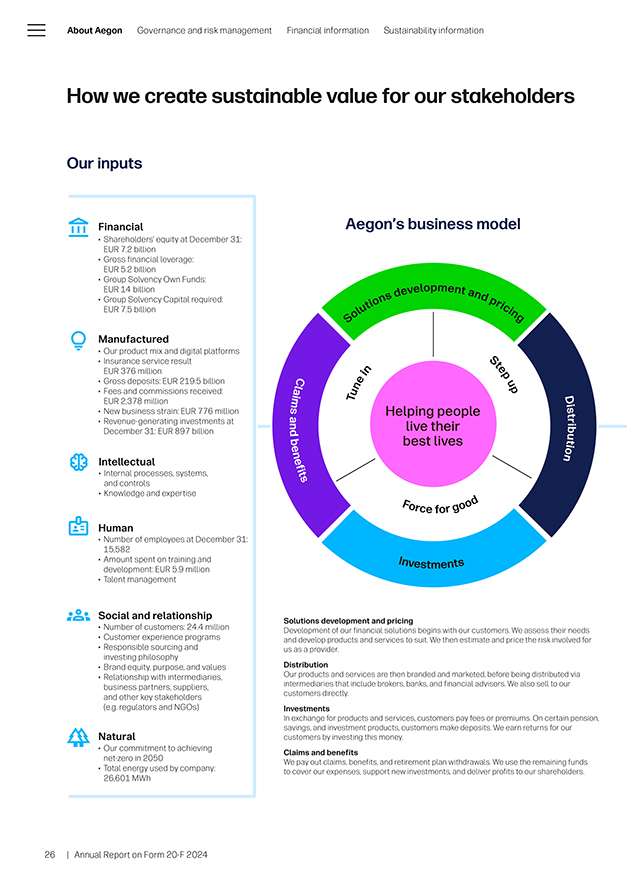
About Aegon Governance and risk management Financial information Sustainability information How we create sustainable value for our stakeholders Our inputs Financial Shareholders’ equity at December 31: EUR 7.2 billion Gross financial leverage: EUR 5.2 billion Group Solvency Own Funds: EUR 14.3 billion Group Solvency Capital required: EUR 7.5 billion Manufactured Our product mix and digital platforms Insurance service result EUR 376 million Gross deposits: EUR 219.5 billion Fees and commissions received: EUR 937 million New business strain: EUR 776 million Revenue-generating investments at December 31: EUR 897 billion intellectual Internal processes. systems. and controls Knowledge and expertise Human Number of employees at December 31: 15.582 Amount spent on training and development: EUR 5.9 million Talent management Number of tied agents at December 31: 2.000 Social and relationship Number of customers: 24.4 million Customer experience programs Responsible sourcing and Investing philosophy Brand equity. purpose. and values Relationship with intermediaries. business partners. suppliers. and other key stakeholders (e.g. regulators and NGOs) Natural Our commitment to achieving net-zero in 2050 Total energy used by company: 26,680 MWh Solutions development and pricing Development of our financial solutions begins with our customers. We assess their needs and develop products and services to suit. We then estimate and price the risk involved for us as a provider. Distribution Our products and services are then branded and marketed. before being distributed via intermediaries that include brokers. banks. and financial advisors. We also sell to our customers directly. Investments In exchange for products and services. customers pay fees or premiums. On certain pension. savings, and investment products. customers make deposits. We earn returns for our customers by investing this money. Claims and benefits We pay out claims. benefits. and retirement plan withdrawals. We use the remaining funds to cover our expenses. support new investments. and deliver profits to our shareholders. 26 Annual Report on Form 20-F 2024
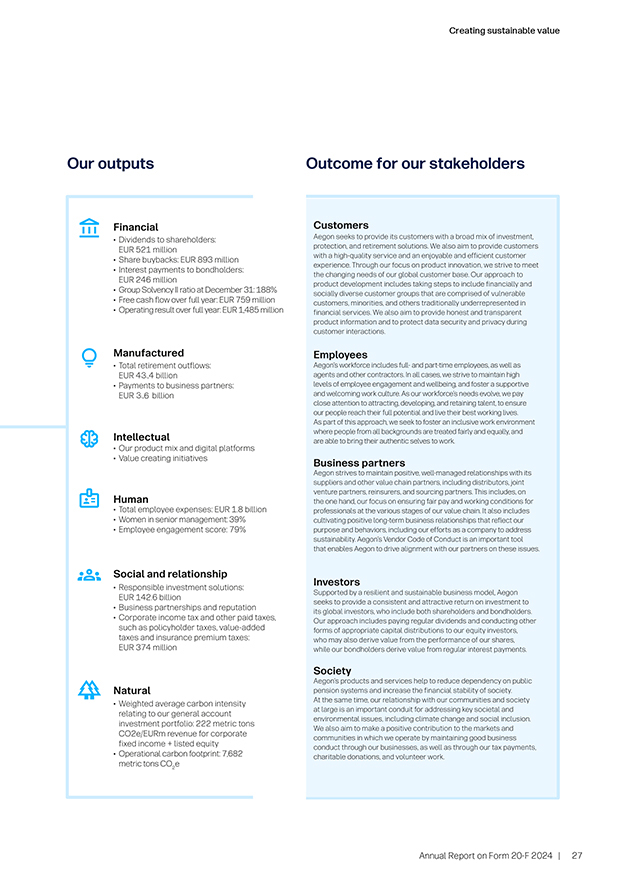
Creating sustainable value Our outputs Financial Dividends to shareholders: EUR 521 million Share buybacks: EUR 893 million Interest payments to bondholders: EUR 246 million Group Solvency II ratio at December 31: 188% Free cash flow over full year: EUR 759 million Operating result over full year: EUR 1,485 million Manufactured Total retirement outflows: EUR 47 billion Payments to business partners: EUR 2.1 billion Intellectual Our product mix and digital platforms Value creating initiatives Human Total employee expenses: EUR 1.8 billion Women in senior management: 39% Employee engagement score: 79% Social and relationship Responsible investment solutions: EUR 142.6 billion Business partnerships and reputation Corporate income tax and other paid taxes, such as policyholder taxes, value-added taxes and insurance premium taxes: EUR 374 million Natural Weighted average carbon intensity relating to our general account investment portfolio: 222 metric tons CO2e/EURm revenue for corporate fixed income + listed equity Operational carbon footprint: 7,703 metric tons CO2e Outcome for our stakeholders Customers Aegon seeks to provide its customers with a broad mix of investment, protection, and retirement solutions. We also aim to provide customers with a high-quality service and an enjoyable and efficient customer experience. Through our focus on product innovation, we strive to meet the changing needs of our global customer base. Our approach to product development includes taking steps to include financially and socially diverse customer groups that are comprised of vulnerable customers, minorities, and others traditionally underrepresented in financial services. We also aim to provide honest and transparent product information and to protect data security and privacy during customer interactions. Employees Aegon’s workforce includes full- and part-time employees, as well as agents and other contractors. In all cases, we strive to maintain high levels of employee engagement and wellbeing, and foster a supportive and welcoming work culture. As our workforce’s needs evolve, we pay close attention to attracting, developing, and retaining talent, to ensure our people reach their full potential and live their best working lives. As part of this approach, we seek to foster an inclusive work environment where people from all backgrounds are treated fairly and equally, and are able to bring their authentic selves to work. Business partners Aegon strives to maintain positive, well-managed relationships with its suppliers and other value chain partners, including distributors, joint venture partners, reinsurers, and sourcing partners. This includes, on the one hand, our focus on ensuring fair pay and working conditions for professionals at the various stages of out value chain. It also includes cultivating positive long-term business relationships that reflect our purpose and behaviors, including our efforts as a company to address sustainability. Aegon’s Vendor Code of Conduct is an important tool that enables Aegon to drive alignment with our partners on these issues Investors Supported by a resilient and sustainable business model. Aegon seeks to provide a consistent and attractive return on investment to its global investors, who include both shareholders and bondholders. Our approach includes paying regular dividends and conducting other forms of appropriate capital distributions to our equity investors, who may also derive value from the performance of our shares, while our bondholders derive value from regular interest payments. Society Aegon’s products and services help to reduce dependency on public pension systems and increase the financial stability of society. At the same time, our relationship with our communities and society at large is an important conduit for addressing key societal and environmental issues, including climate change and social inclusion. We also aim to make a positive contribution to the markets and communities in which we operate by maintaining good business conduct through our businesses, as well as through our tax payments, charitable donations, and volunteer work Annual Report on Form 20-F 2024 | 27
|
|
About Aegon Governance and risk management Financial information Sustainability information | |||
Creating sustainable value
for our stakeholders
Aegon seeks to generate value for a wide range of stakeholders, including its customers, employees, business partners, investors, and society.
In line with our purpose, we see our business as being inherently beneficial to society. We believe the value we generate as a company is shared through our diverse businesses and global workforce. However, we also recognize that certain decisions and actions can erode value by having a negative effect on our stakeholders or on the environment. Actively identifying and managing potential negative impacts is, therefore, an integral part of our decision-making, alongside realizing opportunities and positive impacts.

Customers
Key performance indicators (KPIs) for this stakeholder group:
| KPIs
|
Target for
|
Performance
|
||||
| Significant fines to address cases of mis-selling (EUR)* | 0 EUR | 0 EUR | ||||
| Proportion of employees who completed specific training on data privacy | 95% | 98% | ||||
| Proportion of employees who completed the annual Information Security training (%) | 95% | 98% | ||||
| * | Includes any fines for mis-selling in excess of EUR 100,000, excluding settlements. |
Providing positive experiences for customers is essential to achieving our purpose. As people live longer and their lifestyles change, we aim to provide products and services that help them to adapt to changing circumstances and secure a strong financial foundation for the future. Across our global businesses, we are implementing a series of targeted actions to support our core customer groups – individual customers, employers, and advisors and distribution partners – and closely monitor their satisfaction levels. Improving financial inclusion, including by extending our reach and promoting financial education and awareness, is also important. With innovations such as Pension Geeks, Aegon UK’s retirement education initiative, we are exploring ways to enable people to best prepare for retirement.
Our products are subject to rigorous review and approval processes that are designed to keep our marketing fair and balanced and that, where applicable, the product recommendation is in the customers’ best interests and, where relevant, meets suitability requirements. Aegon also seeks to protect the wellbeing of its customers in other ways, including through robust measures to protect customer data and to minimize potential negative impacts on our customers related to data security and privacy.
In 2024, Aegon continued its efforts to deliver high-quality solutions and experiences to customers around the world. This included further investment in digital tools and platforms to make products and advice more accessible and intuitive for a growing number of financial services consumers and intermediaries. Below, we describe the approaches taken by our business in the United States, Transamerica, and our business in the United Kingdom, Aegon UK, during the year.
Transamerica
Tracking customer satisfaction
Transamerica has used Net Promoter Scores (NPS)1 for many years to measure customer satisfaction in its life and retirement businesses. In 2024, this approach was expanded to provide metrics for end-customers (policyholders and plan participants), as well as distribution agents and advisors. NPS for life customers is measured through an annual third-party study conducted by LIMRA2, the largest research association supporting the insurance industry in the United States. NPS for retirement is calculated internally, and NPS for advisors is measured on a rolling basis throughout the year. The expanded view of NPS is representative of Transamerica’s growing commitment to measure and act on customer-centricity with its key audiences.
| Net Promoter Scores: United States
|
2024
|
|||
| NPS for life customers |
36 | |||
| NPS for retirement |
72 | |||
| NPS for advisors |
55 | |||
| 1 | For more details on how NPS are calculated, refer to the Metrics section of Business Conduct - Responsible marketing practices. |
| 2 | https://www.limra.com/en/about/ |
28 | Annual Report on Form 20-F 2024
| Creating sustainable value |
||||
Optimizing Transamerica’s structure
In 2024, Transamerica took steps to improve its organizational structure by placing five business lines – Insurance, Annuities, Retirement, Life and Health (Employee Benefits), and Investment Solutions – under common leadership. The goal was to create greater alignment among the businesses, thereby ensuring the highest level of service to all of Transamerica’s customers. Transamerica kept key functional areas separate by line of business where it made sense to do so, in an effort to maximize subject matter expertise. These efforts were strengthened by the creation in 2024 of Transamerica’s Customer Experience Center of Excellence, which focuses on improving customers’ experiences and uses data and customer feedback to develop solutions, communications, and digital capabilities that address customer needs, while also helping to share best practices across the organization.
Transamerica also brought several key functions back to the organization while implementing new contracts and controls with new vendor partners to which functions were outsourced. The new “hybrid” model replaces the previous fully outsourced model. By making this adjustment, Transamerica aims to gain greater control over the products and services that potentially have the greatest reputational impact on the organization.
Enhancing customer experiences
Like other Aegon businesses around the world, Transamerica is investing in digital tools and processes to improve customer interaction with its products and services. In 2024, Transamerica launched My Life Access, a new portal for life insurance products that allows customers to better understand their policies online without having to contact a call center. For retirement products, Transamerica enhanced its rollover and individual retirement account (IRA) experience and created an improved product selection experience to help participants understand their options regarding the IRA product.
Late in the year, Transamerica released a streamlined Guided Defined Contribution plan enrollment experience to reduce the number of decisions required to enroll in the plan and to simplify the overall process for the participant. 2024 also saw the launch of a redesigned Managed Advice dashboard, which provides a consolidated view of advice to help participants improve their retirement outcomes, and better emphasizes the value of Transamerica’s guidance and advice solutions to help participants better understand how Transamerica supports their retirement goals.
Performance enhancements were also made to the Transamerica Retirement App for retirement plan participants, aimed at stabilizing the user experience and addressing customer feedback.
| Transamerica launches Agent Home Portal for WFG agents
WFG, Transamerica’s affiliated insurance distribution network of over 86,000 independent agents, is an important medium for delivering products and services to customers throughout North America. This includes groups that have traditionally been underserved by financial services, and WFG’s growing agent network is central to Transamerica’s efforts to expand its reach to middle-market customers. To that end, WFG is actively increasing the number of agents dedicated to serving the middle market, with plans to have 110,000 agents in place by the end of 2027.
In 2024, the Transamerica-WFG relationship was strengthened with the release of the Agent Home Portal, a one-stop shop for WFG agents that allows them to manage their Transamerica life insurance business, run illustrations, submit applications, and perform other tasks from the convenience of a single platform. Transamerica also launched a digital underwriting process that streamlines the application process for life insurance solutions, and introduced redesigned life insurance agent websites where customers can access relevant marketing materials. |
Together with developing its digital capabilities, Transamerica remains committed to engaging with customers in the way that works best for them. The goal is to proactively inform customers of new products and capabilities, with a focus on clear, transparent messaging that ensures awareness and understanding. To this end, in 2024 Transamerica introduced a new engagement approach for its Retirement business. The Retirement Engagement Strategy is designed to engage the right person at the right time using a combination of consumer touchpoints, including email, text messages, website promotion, and call center talking points. In 2025, Transamerica launched its redesigned Transamerica.com website, with new content to better position products across all business lines, and help consumers understand how to do business with Transamerica.
Driving inclusion – focus on middle-market customers
Building on the commitment made at Aegon’s 2023 CMD, Transamerica continued its efforts to expand its reach to diverse customer groups, with a focus on middle-market customers. The middle market is a large and highly diverse demographic market in the United States, with significant (and often unmet) protection and savings needs.
| Annual Report on Form 20-F 2024 | 29 |
|
|
About Aegon Governance and risk management Financial information Sustainability information | |||
A key development in 2024 was the launch of the Final Expense Express solution. This solution takes customers from quote to policy delivery in as little as ten minutes, providing easy access to affordable protection and allowing Transamerica to reach more everyday Americans. In the retirement business, a new pooled plan offering was launched through Transamerica’s distribution agreements with Edward Jones and Willis Towers Watson. Another important strategy to improve financial inclusion for middle-market customers is to leverage the distribution network of Transamerica’s affiliated insurance agency, WFG: see “Transamerica launches Agent Home Portal for WFG agents” on the previous page.
More broadly, Transamerica is focused on ensuring that its products and services reflect the diverse needs of its participants. This includes accommodating individuals with special needs by continually evaluating the business’s website and call center technology, providing capable customer service representatives, and offering customized solutions for customers with visual and hearing impairments. In 2024, Transamerica also created additional translated information and marketing materials to reach customers who prefer to do business and consume content in languages other than English.
Aegon UK
Tracking customer satisfaction
Aegon UK also measures customer satisfaction using NPS. Scores are obtained by surveying individual customers, advisors, and employers about their experiences with Aegon UK. Customer surveys are conducted throughout the year, whereas advisors are surveyed on a quarterly basis and employers every six months.
| Net Promoter Scores: United Kingdom
|
|
2024
|
|
|
| NPS for individual customers |
28 | |||
| NPS for advisors |
(8) | |||
| NPS for employers |
26 | |||
Enhancing customer experiences
Aegon UK’s initiatives to enhance customer experience took place against a backdrop of regulatory change, namely the Financial Conduct Authority’s (FCA) introduction in 2023 of the Customer Duty, a framework that aims to ensure high standards of protection for consumers of financial services.
In 2024, Aegon UK launched the Aegon Digital Experience (ADX), a new set of online journeys that provide a smoother experience for advisors, their customers, and employers. ADX also provides improved security for customers and more sophisticated data analytics that will enable Aegon UK to further enhance customer experiences in the future.
Aegon UK: Mylo among new
solutions to begin roll out in 2025
In 2025, Aegon UK plans to begin rolling out a number of innovations to further improve customer experiences across its different business lines and customer groups. A key development will be the launch of Mylo, a new app that will provide customers with a simple way to consolidate their pension schemes. The app allows customers to navigate their Aegon UK products, and focuses on key life moments. This will help customers make informed decisions, providing access to targeted education, guidance, and advice when customers need it most.
Aegon UK has also begun moving two existing legacy platforms onto a single core platform, Aegon Retirement Choices. At the same time, Aegon UK plans to modernize its overall administration activities in order to increase digitalization and provide additional self-service options. These changes will lead to less complexity, lower running costs, and improved quality of service.
ADX has already created positive momentum with advisor NPS, and Aegon UK is working to further improve the advisor experience. Meanwhile, Aegon UK made several other enhancements to improve customer service across its businesses. These included the introduction of a new workflow system for its TargetPlan pensions offering, as well as several other improvements to make it easier for customers to engage with Aegon UK’s products and services.
Aegon UK completed the acquisition of the advice business of Nationwide Building Society, which was renamed Aegon Financial Planning. This is part of the deeper integration of Origen Financial Services, Aegon’s wholly owned financial advice business, to enable Aegon UK to provide a wider range of advice services to existing customers in the future.
Aegon UK’s investment in technology, including enhanced digital platforms and customer touch points, goes hand in hand with the business’s commitment to ensuring responsible marketing practices. New solutions such as ADX and, from 2025, Mylo (see “Mylo among new solutions to begin roll out in 2025” above) will provide greater flexibility in Aegon’s communications with customers and ensure a single source of reliable data, supporting accurate and transparent communications with individuals and other customer groups. To further support these efforts to ensure accuracy and transparency, Aegon UK’s marketing communications are robustly controlled with appropriate oversight from the risk and audit functions.
30 | Annual Report on Form 20-F 2024
| Creating sustainable value |
||||
Driving inclusion
In 2024, Aegon UK continued to take steps to meet the needs of its increasingly diverse customer base, including developing products and solutions to support people from different backgrounds and at different stages of their lives. Continuing the trend of recent years, there was a strong focus on promoting awareness and education about financial services products. Educational videos were added to the Aegon UK app, while new consumer-facing content and TV shows helped enhance Pension Geeks, Aegon UK’s retirement education initiative aimed at raising awareness about how best to prepare for retirement.
Particular attention has been paid to customers who are automatically enrolled in Aegon’s workplace pension schemes under the United Kingdom’s workplace auto-enrolment rules. As these individuals often have low levels of financial literacy and engagement, Aegon UK is focusing on supporting customers through enhanced digital services and access to financial education, guidance, and advice. Aegon UK has also enhanced its Member Insights platform, which enables employers to effectively manage their workplace pension schemes by expanding the range of data sources and coverage available.
Support for vulnerable customers also remains a high priority for Aegon UK, which in 2024 continued to invest in processes that enable it to more easily identify vulnerable customers and then take appropriate action to support them in challenging times.
Meanwhile, work continued on “The Second 50”, a research project exploring the impact of longevity and changing lifestyles on people as they transition into later life. This has seen a number of thought leadership papers produced, and the insight is now guiding the development of new solutions to support Aegon’s customers into and through retirement.
Data security and data privacy
Data security and data privacy have potential ramifications for Aegon’s stakeholders, including our customers. Incidents such as cyberattacks and data breaches, for example, can have far-reaching negative consequences for individuals and other customer groups. At Aegon, we pay close attention to data security and data privacy at both a company and business unit level.
Data security
Aegon’s security policy and governance aims to prevent cyber threats and minimize the impact of any potential disruption for our stakeholders. Our approach includes standardized procedures to remediate data breaches and minimize the influence of future privacy-related incidents.
Aegon’s Global Information Security Policy aims to preserve the confidentiality, integrity, and availability of information. The policy applies to businesses where Aegon has operational control, covering employees and contractors, while similar standards apply to Aegon’s joint ventures. The policy is supported by mandatory training on data security.
Aegon uses a set of information security metrics to measure the outcomes of its information security initiatives and the effectiveness of existing security controls.
Data privacy
Aegon has dedicated policies and procedures to support privacy compliance at both a company and business unit level. Our policies are updated at predefined intervals and are supported by a strong privacy control framework that is designed to support the ongoing measurement of privacy maturity. Regular audits are conducted to assess compliance with relevant laws, regulations, and policies, as well as the Aegon Privacy Control Framework and its governance.
See the Data privacy section for more details of Aegon’s approach to data security and privacy.
| Annual Report on Form 20-F 2024 | 31 |
|
|
About Aegon Governance and risk management Financial information Sustainability information | |||

Employees
Key performance indicators (KPIs) for this stakeholder group:
| KPIs
|
Target for
|
Performance in 2024
|
||
| Proportion of women in senior management (%) | 40% | 39% | ||
| Result of the most recent employee engagement score (%) | 78% | 79% | ||
At Aegon, we believe that a skilled, motivated, and focused workforce is essential to achieving our purpose, and delivering on our strategy and sustainability ambitions. We work hard to nurture the personal and professional growth of our employees around the world. At a company level and across our businesses, we take steps to promote employee engagement and good working conditions, and to follow best practices in attracting, developing, and retaining talent. As a global employer that plays an integral role in the financial services value chain, we are also committed to building an inclusive workplace that reflects the continued evolution of our global workforce, and effectively represents our customers, partners, and society.
Investing in talent attraction, development, and retention
In 2024, we continued to prioritize attracting and retaining talented people with the skills needed to deliver on our purpose and strategy. This included, for example, providing employees from all regions, disciplines, and backgrounds with opportunities for personal development and growth. Our learning and development strategy also aligns with our sustainability approach.
During the year, we also expanded our Global Talent Marketplace (TMP) tool, a platform that enables employees to take charge of their careers by developing their skills and competencies. By the end of 2024, this tool was available to employees in all business units around the world. We also made updates to our global learning resource platform, We Learn.
These included improving cross-functionality between We Learn and TMP, and introducing a career pathing tool for employees. Another new feature is an interactive learning environment that enables colleagues to develop their skills through “gigs” and learning modules.
Meanwhile, we continued to provide our leaders with a range of opportunities to develop their skills and make a positive contribution to our business. In 2024, we further developed our Best Life Leadership Program (BLLP), which aims to inspire and support leaders in steering the organization to uphold Aegon’s purpose and behaviors. We embedded inclusive leadership behaviors in the program to promote and leverage diversity of thought and create a more welcoming workplace. This included sessions to raise awareness of generational differences.
Supporting employee wellbeing and improving our working environment
Our ambition to create an attractive working environment and culture is supported by our strategic choices of office locations and wider working arrangements. We aim to ensure an inclusive, accessible, and supportive environment for all employees. As we strive to create collaborative work environments and an attractive employee experience, we continue to invest in updating and, in some cases, relocating offices.
In 2024, employees at Aegon’s global headquarters in The Hague and the Dutch part of Aegon Asset Management began preparations to move to Aegon’s new office at World Trade Center (WTC) Schiphol Airport. This facility has excellent transport connections to Amsterdam and other Dutch cities, offers all the key amenities needed for an international headquarters, and has been designed to provide a collaborative, accessible, and inclusive environment.
In the United States, Transamerica announced plans to open a national collaboration hub in downtown Philadelphia in 2025. The new location will be a useful, accessible resource for the more than 150 employees living in the Philadelphia area. Moreover, its strong transportation links to Aegon’s legal domicile in Bermuda and future headquarters at Schiphol Airport will help to strengthen collaboration between the Transamerica teams and other Aegon colleagues around the world.
32 | Annual Report on Form 20-F 2024
| Creating sustainable value |
||||
Supporting dialogue with employees
Aegon maintains various platforms and channels to listen to our employees and support engagement and communication. These include our regular Global Employee Survey (GES), which provides colleagues across our businesses with an opportunity to share their views and concerns. In 2024, we conducted two Global Employee Surveys: a “pulse” survey in Q2 and a full survey in Q4. The participation rate for the most recent survey was 81%.
During the year, we took further steps to drive engagement across the business through several global and local initiatives. For example, we continued to expand our global network of Employee Resource Groups (ERGs), with a new group established for Aegon colleagues in Spain. Our ERGs are employee-driven and company-sponsored; they focus on what matters the most to colleagues and enable people with specific backgrounds or interests to ensure that Aegon remains an employer of choice.
Meanwhile, we continued to make sure that our employees are adequately represented in our governance structure and that their needs and expectations are considered in our strategy and day-to-day decision-making. For example, Aegon colleagues in the United Kingdom can seek representation through the Unite and Aegis unions.
Since 2020, Aegon has run a dedicated Speak Up program to protect whistleblowers and to encourage, guide, and support colleagues in reporting suspected or observed misconduct. We provide mandatory training on Speak Up for all employees, with sessions tailored to specific roles (for example, training for leaders and managers includes sections on being receptive to people coming forward with issues or concerns).
Building an inclusive work environment
At Aegon, we are working to develop an inclusive culture that covers various aspects of the employee experience, starting with talent attraction. Our approach includes encouraging equal treatment and offering career opportunities to all Aegon employees around the world.
Aegon’s I&D approach
Our company-wide Inclusion and Diversity (I&D) approach, overseen by our Global Head of Leadership, Talent, and Inclusion, aims to provide a coherent and consistent approach to I&D in our workplace, and in the marketplaces and communities we serve. The approach has been adopted by each of Aegon’s business units, ensuring that relevant policies and actions are embedded across the entire organization as applicable. This global adoption enables our leaders, colleagues, and other stakeholders to actively contribute to building a more inclusive organization, wherever they are located.
Aegon’s I&D approach comprises two fundamental elements:
1. Authentic action – the recognition that, as an organization, we are on a journey to improve. We aim to turn good intentions into actions to create a positive difference for our people and communities.
2. Starting at the top – the members of Aegon’s senior leadership are expected to act as role models for I&D, including by sharing their own inclusion stories and championing a specific area of diversity excellence among employees.
Supporting inclusion
The following elements form the foundation of our I&D approach:
Workforce: We seek to build a professional culture that engages and welcomes people from all backgrounds and that promotes conscious inclusion.
Employee Resource Groups: Aegon’s ERGs provide employees with a space to address matters of interest and strengthen employee engagement around topics of company culture and direction. Our ERGs include Culture, Race and Ethnicity, (Dis)ability, Generations, Proud, Wellbeing, and the Women’s Impact Network. These ERGs are open to all employees, regardless of how they identify.
Workplace: We aim to create inclusive workspaces, with conditions that support employees from all backgrounds in performing at their best.
Aegon undertakes the following activities to support inclusion in the workplace:
| • | Embedding inclusive leadership behaviors in our flagship leadership programs to create a more inclusive workplace. |
| • | Enhancing our Speak Up culture to allow safe escalation of issues and concerns. This includes covering I&D-related topics to raise awareness of specific conduct and potential harassment issues. |
| • | Implementing the TMP to offer transparent and inclusive access to on-the-job development opportunities and skills-based mentoring. |
| • | Aegon’s ERGs, as outlined previously. |
| • | Aegon’s international I&D survey, carried out in 2023, includes questions about the respondents’ demographic profiles and their experiences in the company. The GES also includes an I&D section. |
| Annual Report on Form 20-F 2024 | 33 |
|
|
About Aegon Governance and risk management Financial information Sustainability information | |||
I&D reporting
In terms of its leadership, Aegon has made progress in increasing the number of women in senior management positions globally. Between 2020 and 2023, the percentage of women in senior management increased by 2 percentage points each year, rising from 32% to 38%. In 2024, this percentage increased by 1%, reaching 39% overall by the end of 2024.
Regarding remuneration, in 2024, Aegon began disclosing its global gender pay gap, which compares the average total compensation of men to the average compensation of women. For 2024, our global gender pay gap was calculated as 30.4%. When we adjust for elements such as seniority of the position, country, type of position (function, people manager), and tenure, the global pay gap is 11.2%.
Collaborating with peers and external experts: We aim to adhere to leading standards and benchmarks in our markets concerning best practices for I&D. For example, Aegon is a member of Workplace Pride, a non-governmental organization (NGO) dedicated to improving the lives and working conditions of LGBTQIA+ people in the workplace. Our dedication to building an inclusive workplace continues to be recognized externally: in 2024, Aegon was awarded Ambassador status for the sixth consecutive year, and we participated in the Workplace Pride Global benchmark, which measures LGBTQIA+ policies and practices.
Marketplace: We seek to strengthen our I&D approach in close dialogue with our customers and communities, creating positive change through surveys, feedback, and benchmarking.
Listening to our customers: We gather feedback from our customers and take relevant action, including the development of new, inclusive products.
Community investments: As per Aegon’s Global Community Investment Framework, we seek to drive inclusion in our communities by taking steps to empower people financially and socially (see “Society” in this chapter).
LGBTQIA+ colleagues share experiences during Coming
Out Day
As part of Diversity Month in October 2024, Aegon employees from around the world participated in a virtual panel discussion in honor of Coming Out Day. Celebrated on October 11 in countries around the world, Coming Out Day supports lesbian, gay, bisexual, and transgender people, among other LGBTQIA+ groups, in “coming out of the closet”.
Aegon’s panel event was an opportunity for members of the Proud ERG communities of Transamerica, Aegon UK, and Aegon Asset Management, as well as Aegon Proud NL, to share valuable insights into the journey experienced by many people in the LGBTQIA+ community. Throughout the event, Aegon colleagues were able to ask questions to panel members or actively participate via the webinar chat.
34 | Annual Report on Form 20-F 2024
| Creating sustainable value |
||||

Partners and suppliers
The goods and services that Aegon consumes as part of its business activities, and its relationships with partners and suppliers, are important factors in how Aegon delivers value to its stakeholders. To ensure good business conduct across our supply base, we set high standards and communicate them via a global Vendor Code of Conduct. We ensure compliance with these standards by monitoring our partners and suppliers and working with them to make progress on key sustainability issues.
Addressing climate impacts in our supply chain
In 2024, we continued to mature our climate-related supply chain strategy by adding disclosures of supplier greenhouse gas (GHG) emissions to our overall emissions data reporting. For example, Aegon completed its first global calculation of scope 3 emissions (indirect emissions related to purchased goods and services). As such, Aegon’s 2024 carbon emissions footprint of 158,500 tCO2e reflects the baseline against which we will measure our climate impact in future years. This enhancement is coupled with our ongoing focus on other supplier-related sustainability topics across our businesses.
Meanwhile, we continued to monitor the practices of our core supply base at a global level, conducting assessments of the extent to which suppliers use tools to help them understand and ultimately reduce their climate impact.
Working with partners and suppliers at a local level
As part of our global supply chain management objectives, Aegon’s business units pay close attention to the practices of local and regional suppliers, with a focus on addressing sustainability issues.
For example, Aegon UK uses questionnaires to monitor suppliers’ commitment to sustainability. Of the 40 partners who responded to the questionnaire, 75% were found to have a net-zero plan in place. Aegon’s UK business also maintains GHG emissions inventories for its key suppliers. Aegon UK uses this information to rank its suppliers, with the aim of engaging with lower-scoring suppliers on their net-zero plans and inclusion strategies.
In addition, in the Americas, Transamerica spent more than USD 11 million in 2024 with certified diverse suppliers, including minority and women-owned businesses.
Meanwhile, Transamerica continued to take steps to expand and broaden its distribution network to serve more diverse customer groups. This effort is channeled primarily through WFG, Transamerica’s affiliated insurance agency. WFG has been bridging the gap between low-income households and financial inclusion for more than 20 years by providing access to affordable product choices, financial education, and support in developing financial strategies.
Many of WFG’s agents come from diverse communities and can meet the needs of customer groups, such as minorities, that have traditionally been underserved by financial services companies. A survey in 2023 found that WFG’s network of licensed independent agents included more than 75 spoken languages; that more than 50% of the agent population identified as female; and that 65% identified as members of traditionally underrepresented racial/ethnic groups. This enables WFG to promote financial literacy in underserved communities, while providing unique opportunities for individuals across North America. This helps people from all backgrounds to strengthen their financial understanding and learn ways to create a better future for themselves and their families. By supporting customers from all social and economic backgrounds, WFG contributes directly to Aegon’s purpose of Helping people live their best lives.
| Annual Report on Form 20-F 2024 | 35 |
|
|
About Aegon Governance and risk management Financial information Sustainability information | |||

Investors
In 2024, Aegon continued to make solid progress in delivering on its strategy. With a sharp strategic focus, a robust risk profile, and a strong balance sheet, we have maintained stable capital ratios and delivered on our financial commitments.
At our CMD in June 2023, we shared the actions we are taking as part of our next chapter, which will lead to attractive and growing returns for our shareholders. Aegon aims to increase Transamerica’s value by capturing the opportunities in the US middle market. The strategy aims to increase both the level and the quality of capital generation from growth in Strategic Assets and the accelerated reduction of our exposure to Financial Assets.
In June 2024, we provided an update on the strategy of our UK business with plans to accelerate the transformation of Aegon UK into a leading savings and retirement platform. This transformation will take place over the 2024-2027 period and will be self-funded from Aegon UK’s capital generation and own funds. During the transformation, Aegon UK aims to grow remittances by GBP 5 million per year, starting from GBP 100 million in 2024 with the potential for higher remittance growth after the investment period.
At the same time, we continue to strengthen our asset management business and our high-net-worth insurance business in Asia and invest in the growth of our various international joint ventures.
Solid financial performance
Building on the progress of its transformation program, in 2023, Aegon published financial targets for 2025 and provided guidance for the expected financial performance in 2024 at the beginning of the year. Aegon has more than achieved the expected financial guidance.
Standing at EUR 759 million, free cash flow was above the expectation to deliver more than EUR 700 million in 2024. We aim to increase the free cash flow to around EUR 800 million by 2025. Free cash flow is supported by improving the quantity and the quality of operating capital generation.
Following continued business growth, favorable markets, and net positive one-time items occurring during the year, operating capital generation of EUR 1.2 billion, before holding and funding expenses, was above the initial guidance of around EUR 1.1 billion for 2024.
For 2025, Aegon aims to achieve approximately EUR 1.2 billion in operating capital generation, a target that is expected to be primarily supported by the growth of Aegon’s Strategic Assets in the Americas. This will, in turn, support our dividend target of around 40 eurocents per common share in 2025, barring unforeseen circumstances. This target reflects the expected benefits of the transformation of our business and the execution of our strategies in the Americas and the United Kingdom.
In 2024, Aegon increased its interim dividend by 2 eurocents to 16 eurocents per common share and proposed to the Annual General Meeting (AGM) that the final dividend be increased by 3 eurocents to 19 eurocents per common share. Following the transaction with a.s.r. in 2023, Aegon initiated a EUR 1.5 billion share buyback program that was extended in April 2024 by an amount of EUR 35 million in relation to obligations resulting from share-based compensation plans. The program was completed on June 28, 2024. Subsequently, the company returned surplus cash capital to its shareholders through a EUR 200 million share buyback executed in the second half of 2024. In total, Aegon delivered EUR 1.4 billion in the form of dividends and share buybacks to shareholders across 2024.
Aegon’s gross financial leverage position remained at EUR 5.2 billion throughout 2024. Bondholders received EUR 246 million of value in the form of interest payments.
Value derived from share performance
Aegon’s share price increased by 9% in 2024, and so underperformed the broader European insurance industry (the STOXX Europe 600 Insurance Index ended the year up by 18%). Our total shareholder return for the year amounted to a gain of 15%. This measure takes into account both dividend payments and share-price performance.
36 | Annual Report on Form 20-F 2024
| Creating sustainable value |
||||
Safeguarding long-term value
As we continue our transformation journey, we are committed to maintaining sufficient capital in our businesses and at the Holding. This approach allows Aegon’s management to focus on increasing the return on capital, and distributing capital to shareholders. As part of our capital management approach, we are focusing on managing the capital positions of our businesses according to their respective operating levels over time.
Capital deployment decisions are driven by Cash Capital at Holding, taking into account our gross financial leverage position and planned management actions to further improve the company’s risk profile. Cash Capital at Holding is supported by free cash flow, which is defined as the amount of cash available from remittances from country units after subtracting the holding funding and operating expenses, with the latter resulting from, for example, paying interest to bondholders.
The operating range for Cash Capital at Holding is EUR 0.5 billion to EUR 1.5 billion. In line with our capital management approach, we have the ambition to reduce Cash Capital at Holding to around the midpoint of the operating range by the end of 2026. As previously indicated, we are comfortable with the current financial leverage position. We aim to pay dividends to shareholders in line with the growth of sustainable free cash flow, barring unforeseen circumstances.

Society
Key performance indicators (KPIs) for this stakeholder group:
| KPIs | Target for
|
Performance
|
||
| Weighted average carbon intensity for corporate fixed income and listed equity in our general account (metrics ton CO2e / EURm revenue) | 25% reduction against 2019 baseline | 52% reduction against 2019 baseline | ||
| Amount of investments in activities to help mitigate climate change or adapt to the associated impacts by 2025 (USD billion) | USD 2.5 billion investments | USD 2.7 billion invested | ||
| Number of engagements with the largest corporate carbon emitters in our investment portfolio by 2025 | Engagement with at least the top 20 corporate carbon emitters | 20 investees were engaged and will continue to be engaged | ||
| Carbon intensity of our directly held real estate investments (scope 1 and 2) kgCO2e/M2) | 25% reduction against 2019 baseline | 51% reduction against 2019 baseline | ||
| Absolute operational carbon emissions (scope 1 and 2) (metric tons CO2e) | 25% reduction against 2019 baseline | 75% reduction against 2019 baseline | ||
| Proportion of new employees who completed the Code of Conduct attestation | 95% | 98% | ||
| * | For more details on definitions refer to material topic sections Climate Change and Business Conduct. |
Aegon and its businesses strive to be a force for good and to have a positive impact on society. This includes supporting the climate transition. As an international financial services group with a dedicated responsible investment strategy, Aegon is well positioned to help society move toward a climate-resilient economy and a net-zero world.
At the same time, we look for opportunities to drive positive change at a local or regional level, enhancing inclusion in our communities. We partner with organizations to empower people both financially and socially. We also maintain good business practices, including a focus on anti-corruption and anti-bribery, and paying fair taxes in the markets in which we operate.
| Annual Report on Form 20-F 2024 | 37 |
|
|
About Aegon Governance and risk management Financial information Sustainability information | |||
Our responsible investment approach
At Aegon, we have an opportunity to support a more sustainable society by financing the energy transition and supporting climate resilience, both through our own investments and our responsible investment framework. We also have a responsibility to manage our investments in a way that addresses climate-related risks to our portfolio.
As an asset owner
Aegon’s investment approach is shaped by a company-wide Responsible Investment Policy. The policy is guided by the Principles for Responsible Investment (PRI), a United Nations-supported framework introduced by international financial institutions to incorporate ESG factors into investment practices across asset classes. In 2024, we updated the policy as part of Aegon’s annual review process. The revised policy will see Aegon take steps to broaden its engagements with investee companies in its general account. In addition to our engagement program with the largest corporate carbon emitters in our portfolio, from 2025, we will also begin engagements with investee companies that are in breach of the UN Global Compact Principles.
In 2024, Aegon also completed its first public PRI assessment, which provides an overview of our company-wide responsible investment strategy, activities, and performance.
The Responsible Investment Policy also includes updates to climate-related exclusions, demonstrating alignment with NZAOA position papers on oil and gas and thermal coal, while also introducing an exclusion category concerning palm oil production. In addition, the new policy introduces baseline expectations for asset managers, requiring current and prospective managers to demonstrate how they support Aegon’s responsible investment ambitions and create a structured approach for engaging asset managers.
As an asset manager
Through our global asset manager, Aegon AM, we help our clients support the climate transition by offering a growing suite of products that help them align their investment portfolios with net-zero goals. Our forward-looking approach enables investors to consider the role of high-influence sectors in their portfolios and adjust their decision-making accordingly.
In late 2023, Aegon AM introduced its Global Short Dated High Yield Climate Transition Fund, which is categorized as an Article 8 fund under the European Union’s Sustainable Finance Disclosure Regulation (SFDR). Strengthening our portfolio of climate-transition solutions is a key component of Aegon AM’s climate action plan.
Our climate commitments
Aegon has set targets to drive progress toward its 2050 climate commitments; you can find more information about these in the chapter on Our Sustainability Approach. Furthermore, we are taking steps to reduce the operational footprint of our businesses. As of the end of 2024, we have achieved a 75% reduction in our operational carbon footprint compared to our 2019 baseline, well ahead of our original target of a 25% reduction by 2025. The second phase of Aegon’s near-term emissions reduction plan covers the period from 2025 to 2030 and has a reduction target of 75% compared to our 2019 baseline.
Investing in our communities
Aegon has always strived to use its size and influence for the greater good. As part of our purpose of Helping people live their best lives, we invest around EUR 10 million every year in community projects around the world.
Guided by our Global Community Investment Framework, Aegon’s community investment efforts are focused on enhancing inclusion in communities and regions where we operate. We do this by taking steps to empower people both financially and socially.
38 | Annual Report on Form 20-F 2024
| Creating sustainable value |
||||
For financial empowerment, our partnerships focus on building financial awareness, knowledge, and skills, and giving people the tools to become more financially resilient. To maximize social empowerment, we seek partnerships that increase people’s opportunities and skills, expand their networks, provide access to essential services, and enable them to be more adaptable.
Aegon employees play a central role in realizing our community investment goals, including through volunteering (see “Joining forces for our Global Force for Good initiative” on the right). We also work with local and global partners that support our community investment ambitions and align with our community investment goals.
In 2024, both our cash donations and volunteering activities to contribute to our communities increased compared with the previous year. Aegon supported almost 500 charities and good causes around the world, with a total community investment of EUR 9.8 million, a close to 8% increase compared with 2023. Our cash donations amounted to EUR 8.1 million, while our colleagues recorded 23,123 volunteer hours (equivalent to EUR 1.7 million, based on the total cost of salaries across all of Aegon’s businesses divided by the total number of employees).
Anti-corruption and anti-bribery, including whistleblower protection
Business conduct is a fundamental focus area for Aegon. The subject, which is heavily influenced by legal requirements, includes aspects ranging from business ethics to anti-corruption and anti-bribery, as well as whistle-blower protection. Further information on these topics can be found in the Business conduct section.
Responsible tax
Aegon makes a valuable economic and social contribution to the communities in which it operates through the company’s own tax payments, as well as the collection and payment of third-party taxes. We seek to pay “fair taxes”, namely by paying the right amounts of taxes in the right places. Published online, our Global Tax Policy outlines our approach to responsible tax, which seeks to align the long-term interests of our customers, employees, business partners, investors, and wider society. Aegon adheres to the VNO-NCW Tax Governance Code (as published on https://www.vno-ncw.nl/taxgovernancecode). For further details, refer to Aegon’s Global Tax Report, which is published on Aegon’s website.
Joining forces for our Global
Force for Good initiative
Our community investment activities give our colleagues around the world the opportunity to support our purpose and sustainability ambitions by actively contributing to a more inclusive and resilient society. Across Aegon, these activities culminate each May, when we carry out volunteer work as part of our annual Global Force for Good initiative.
In 2024, in the United States, United Kingdom, and Asia, Aegon and Transamerica colleagues focused on alleviating food insecurity and helping vulnerable people. Activities included supporting local breakfast clubs, packing emergency food parcels, and raising funds through charity challenges. Our colleagues in the Netherlands also made a significant impact through compassionate initiatives. These ranged from organizing a day with LGBTQIA+ refugees to packing over 500 gifts for children in need. In Spain, participation was equally impressive, with more than half of employees volunteering. Activities included preparing and delivering meals for those in need, helping at a foodbank, as well as providing workshops for people on topics such as cybersecurity, the use of mobile devices, and social media. In the United States, Aegon Asset Management teams participated in the Day of Caring® volunteer program and a financial literacy fair at a local high school in Cedar Rapids to help students learn the basics of budgeting and financial wellbeing.
Our employee contributions demonstrate how we can create positive change when we work together, with each act of kindness strengthening our collective force for good.
| Annual Report on Form 20-F 2024 | 39 |

our performance
| Our performance |
||||
In 2024, financial markets were dominated by increasing equity markets and high interest rates, with periods of volatility throughout the year.
Economic conditions changed gradually in major economies, where inflation retracted slowly from elevated levels toward levels targeted by central banks. At the same time, labor markets maintained relatively low unemployment rates. However, there was uncertainty in interest rates, with central banks hesitant to lower rates until late in the year. In addition, uncertain political situations in several countries had an influence on markets. This included the ongoing Russian aggression against Ukraine and the conflict in the Middle East, as well as elections in several countries leading to changes in the respective political landscape.
Improving markets generally benefited Aegon’s performance during the year. In the Americas, Aegon made progress in delivering on its strategy, despite experiencing some commercial volatility. This was evidenced by strong sales growth in Retirement Plans and by an expansion of the distribution reach of WFG, while new sales in Individual Life decreased by 3% compared with the prior year. While our workplace business in the United Kingdom saw good new business inflows, the performance of the Adviser platform business in the United Kingdom was challenged by the elevated levels of withdrawals from customers and continued consolidation and vertical integration in non-target advisor segments. Investments in growth in the partnerships in Aegon’s International segment continued, even though new business volumes decreased compared with the prior year. The negative impact of pricing regulations in China and high interest rates in Spain & Portugal, as well as unfavorable exchange rate developments in Brazil, resulted in muted growth in these businesses. The asset management businesses saw significant new business inflows in the year from business expansion and improving markets.
Overall, Aegon maintained solid financial results and a strong capital position. The company delivered on the guidance given at the start of the year for operating capital generation and free cash flow. Aegon’s performance during 2024 provides a robust foundation for achieving its 2025 financial targets set out at the CMD in June 2023.
Financial performance
The operating result amounted to EUR 1,485 million in 2024, which was a decrease of 1% compared with 2023. Reduced operating results from the Americas, the United Kingdom and International were partly offset by an improved result in Asset Management. Aegon's net result amounted to EUR 676 million for 2024.
The operating result was partly offset by Other charges in the Americas related to model and assumption changes, higher Expected Credit Loss reserves, and an unfavorable revaluation of real estate and private equity assets, as well as one-time investments in the Americas and the United Kingdom.
The capital ratios of Aegon’s businesses in the United States and United Kingdom remained above their respective operating levels over the year. This underscores the effectiveness of our actions to improve our risk profile and reduce the volatility of our capital position. This includes management actions on the Universal Life portfolio in the United States – where we continued to purchase investor-owned policies – and further approvals for long-term care rate increases in the United States. In the United Kingdom, the Solvency II ratio remained broadly stable while benefits from favorable markets were offset by investments in the transformation of the business as announced at the strategy teach-in in June 2024.
| Annual Report on Form 20-F 2024 | 41 |
|
|
About Aegon Governance and risk management Financial information Sustainability information | |||
Free cash flows increased from EUR 715 million in 2023 to EUR 759 million in 2024, which included the dividends from Aegon’s stake in a.s.r. Cash Capital at Holding decreased from EUR 2.4 billion at the end of 2023 to EUR 1.7 billion at the end of 2024 and remained above the operating range of EUR 0.5 billion to EUR 1.5 billion. In the first half of 2024, Aegon completed the EUR 1.535 billion share buyback program, which had been launched following the transaction with a.s.r., and included EUR 35 million in relation to obligations resulting from share-based compensation plans. In addition, Aegon executed a EUR 200 million share buyback program in the second half of the year, in line with its intentions to return surplus cash capital to shareholders. Our gross financial leverage remained stable at EUR 5.2 billion.
As a result of the progress we have made both strategically and financially, we will propose a final dividend for 2024 of 19 euro cents per common share. This brings the full-year dividend to 35 euro cents per common share, compared with 30 euro cents over 2023.
At our 2023 CMD, we set financial targets for the coming years. We aim for approximately EUR 1.2 billion of operating capital generation in 2025, barring unforeseen circumstances. This reflects an expected increase in new business as we aim to profitably grow our business in the United States. Free cash flow, including the dividends that we expect to receive from a.s.r., is expected to increase to approximately EUR 800 million in 2025. Barring unforeseen circumstances, we target a dividend over 2025 of around 40 euro cents per common share.
Further information on our performance in 2024 can be found in the “Results of operations”.
Financial targets for 2025 1
| Reduce gross financial leverage |
Around EUR 5.0 billion | |
| Increase operating capital generation 2 |
Around EUR 1.2 billion | |
| Grow free cash flows |
Around EUR 800 million | |
| Increase dividend to shareholders |
Around EUR 0.40 per share | |
| 1 | Barring unforseen circumstances, and dividend subject to Board and other relevant approvals. |
| 2 | Before holding and funding expenses. |
42 | Annual Report on Form 20-F 2024
Governance and risk management 44 Boards and governance 44 Letter from the Chairman of the Board 47 Corporate governance 52 Sustainability governance 53 Composition of the Board and Executive Committee 61 Report of the Board of Directors 67 Remuneration Report 78 Risk and capital management 79 Risk management 86 Capital and liquidity management 91 Regulation and compliance 92 Regulation and supervision 94 Code of Conduct 95 Controls and procedures Annual Report on Form 20-F 2024 | 43
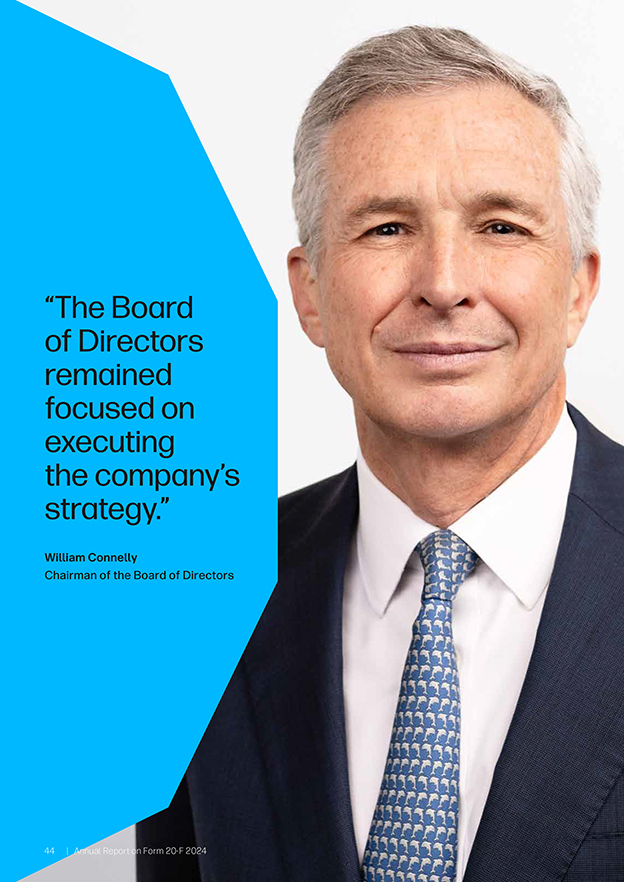
The board of directors remained focused on executing the company’s strategy
| Letter from the Chairman of the Board |
||||
Letter from the Chairman
of the Board
In 2024, Aegon made further progress with the second chapter of its transformation, and the Board of Directors remained focused on executing the company’s strategy.
I am pleased to see how well Aegon has navigated the major organizational adjustments in recent years, including the divestitures to refocus our business on our core markets, the combination of most of our Dutch businesses with a.s.r. creating a Dutch champion, and our redomiciliation to Bermuda. With these milestones in the rear-view mirror, Aegon has continued the successful execution of its strategy, making progress along the roadmap outlined at the Capital Markets Day in June 2023.
Settling in Bermuda advanced smoothly in 2024. Throughout the year, Aegon representatives fostered a strong relationship with the Bermuda Monetary Authority (BMA), the company’s new group regulator. I would like to thank the BMA for all their support during the last year, and we look forward to working together with them to continue building a successful relationship.
First AGM in Bermuda
On June 12, 2024, Aegon’s Annual General Meeting (AGM) was held in Bermuda for the first time, underscoring the transformation of our corporate structure. 2024’s AGM included the shareholder vote on Aegon’s new remuneration policy. Every four years, Aegon’s shareholders must vote on the company’s remuneration policy. The last time we updated the policy was in 2020, and since then the profile of our company has changed significantly. Moreover, the previous policy was not as strongly aligned with the long-term interests of the company and our stakeholders as we would like. As a Board, we, therefore, put forward a proposal to update the remuneration policy to reflect the company’s new circumstances and, in particular, to strengthen the relationship between long-term performance and compensation. Dona Young, who sits on our Board and who is chairman of the company’s Compensation and Human Resource Committee, and I engaged with various stakeholders to put forward the reasoning behind our proposed policy. This engagement was very constructive, and we highly appreciated these interactions and the feedback we received.
During the AGM, shareholders expressed their support for the new policy, which fully aligns with Aegon’s adjusted profile, operational footprint, and governance. I also believe that the policy will ensure that Aegon remains a competitive destination for talent that can steer the company along its long-term growth trajectory.
Confidence in Aegon’s leadership
This year’s AGM also featured the reappointment of Aegon CEO, Lard Friese, for another four-year term. The Board and I have complete confidence in the quality, dedication, and vision that characterize his leadership. Through Lard’s efforts and those of his talented colleagues, Aegon will continue to create value for its stakeholders and deliver on its purpose of Helping people live their best lives. The Board and I were also pleased to welcome a new colleague: Albert Benchimol, Aegon’s newly elected non-executive director, brings 40 years of international experience in the insurance industry, notably including Bermuda. His arrival, together with the reappointment of Corien Wortmann, Caroline Ramsay, and Thomas Wellauer, puts the Board of Directors at full strength as it navigates the road ahead.
On the broader leadership team, Matt Rider retired from his role as Chief Financial Officer (CFO) and member of the Executive Committee in September 2024. Throughout his seven-year tenure, Matt fulfilled his role with distinction, using his wealth of expertise to build and maintain Aegon’s strong financial profile and improve its financial performance. We will miss his sharp mind and humor, wish him a healthy and happy retirement, and are pleased that Transamerica will continue to benefit from his advice on a non-executive basis. We are looking forward to working with Matt’s successor, Duncan Russell, in his new role.
| Annual Report on Form 20-F 2024 | 45 |
|
|
About Aegon Governance and risk management Financial information Sustainability information | |||
Facing future challenges and opportunities
Throughout 2024, Aegon’s leadership and employees continued to create long-term value for all stakeholders. As in previous years, this included coordinated efforts to reduce potential negative impacts on society at large, and the Board and I were pleased to see that Aegon’s approach to sustainability continued to mature during the year as evidenced by our new 2030 interim targets. Meanwhile, there was strong, Group-wide cooperation to align the relevant parts of our disclosures with the European Union’s Corporate Sustainability Reporting Directive (CSRD).
The Board welcomes these and other efforts to equip Aegon for future demands and to unlock the company’s full potential. Moreover, the Board and I are satisfied that we have fulfilled our responsibilities to Aegon and its stakeholders throughout this year of consolidation and growing momentum.
As we reflect on Aegon’s progress in 2024, we would like to thank all Aegon employees for their hard work, enthusiasm, and cooperative mindset; these have all been vital in helping the company realize its purpose and meet its strategic goals. Likewise, our thanks go to Aegon’s investors, whose confidence in Aegon’s journey has been an essential component of its success – and will be for years to come.
The Hague, the Netherlands, March 26, 2025
| William L. Connelly |
| Chairman Board of Directors, Aegon |
46 | Annual Report on Form 20-F 2024
| Corporate governance |
||||
Corporate governance
and Corporate Governance Statement
Aegon is a Bermuda exempted company with liability limited by shares, having its registered office in Hamilton, Bermuda. Aegon has its principal place of business and headquarters in The Hague, the Netherlands. Aegon is registered with the Bermuda Registrar of Companies under number 202302830 and the Dutch trade register under number 27076669. Aegon, as a Bermuda company, is subject to Bermuda law, and its governance is predominantly determined by Bermuda law, its bye-laws, its memorandum of continuance, and its board regulations. On December 31, 2024, Aegon qualified as a non-resident company under the Dutch Non-Resident Company Act, due to which certain Dutch legal requirements, mainly relating to the preparation of the annual accounts in accordance with Title 9 of Book 2 of the Dutch Civil Code, apply.
As Aegon is a company established in Bermuda, the Dutch Corporate Governance Code does not apply to Aegon.
The shareholders
Listing and shareholder base
Aegon’s common shares are listed on Euronext Amsterdam and the New York Stock Exchange. Aegon has institutional and retail shareholders around the world. More than two-thirds of shareholders are located in the United States, the Netherlands, and the United Kingdom. Aegon’s largest shareholder is Vereniging Aegon, a Dutch association with a special purpose to protect the broader interests of the company (Aegon) and its stakeholders.
General Meeting of Shareholders
A General Meeting of Shareholders (the “General Meeting”) is held annually and, if deemed necessary, the Board of Directors (the “Board”) of the company may convene a special General Meeting. The main function of the General Meeting is to decide on:
| • | (Re)appointments to the Board; |
| • | Appointment of the auditor; |
| • | Amendments of the bye-laws; |
| • | Adoption of the remuneration policy; |
| • | Approval of resolutions of the Board entailing a significant change in the identity or character of the company or its business; |
| • | Approval of final dividend payment; and |
| • | Authorizing the Board to (i) limit or exclude pre-emptive rights, (ii) repurchase shares, and (iii) issue Aegon shares exceeding 10% of Aegon’s issued share capital unless the Board determines that the issuance of shares is necessary or conducive for purposes of safeguarding, conserving, or strengthening the capital position of Aegon. |
At the Annual General Meeting, the Board shall present shareholders with the annual accounts to be discussed during the meeting. The Board shall also annually present shareholders with a remuneration report that shall be put to an advisory vote, which shall not be binding on the Board or the company.
Convocation
A General Meeting must be convened at least 30 days (excluding the day on which the notice is given or served, or deemed to be given or served) prior to the day of the General Meeting and shall be called by way of a press release and publication on the website. The notice shall specify the place, day and time of the meeting, the record date, means of electronic communication and the agenda of the meeting.
The Board will convene General Meetings. Shareholders representing at least 10% of the paid-up share capital may request a General Meeting. Shareholders representing at least 1% of the issued capital or 100 or more shareholders jointly may request one or more items to be added to the agenda of a General Meeting. The company must receive such a request at least six weeks before the General Meeting. Matters that are not reserved for, or do not require a resolution of the General Meeting pursuant to the bye-laws or Bermuda law, may only be included as a non-voting discussion item that shall be non-binding to the company and the Board unless otherwise and at its sole discretion determined by the Board.
Record date
The record date is used to determine shareholders’ entitlements with regard to their participation and voting rights in a General Meeting. The record date may be determined by the Board and may not be more than 60 days before or later than 20 business days before the date fixed for the General Meeting.
Attendance
Every shareholder is entitled to attend the General Meeting and vote either in person or by proxy granted in writing. This includes proxies submitted electronically. All shareholders wishing to take part must provide proof of identity and shareholding, and must notify the company ahead of time of their intention to attend the meeting. Aegon also solicits proxies from New York registry shareholders in line with common practice in the United States.
| Annual Report on Form 20-F 2024 | 47 |
|
|
About Aegon Governance and risk management Financial information Sustainability information | |||
Voting at the General Meeting
At the General Meeting, each common share carries one vote. In the absence of a Special Cause, Vereniging Aegon casts one vote for every 40 common shares B it holds.
The Board of Directors
Aegon has a one-tier Board consisting of nine Non-Executive Directors and one Executive Director, being the CEO. Details on the composition of the Board can be found in the “Composition of the Board and Executive Committee” section of this document. Subject to the provisions of the Bermuda Companies Act and the company bye-laws, the Board manages and conducts the business of Aegon and is responsible for the company’s general affairs, which includes setting the company’s strategy. The Board may exercise all the powers of the company except those required by the Bermuda Companies Act or the company bye-laws to be exercised by the General Meeting. The members of the Board owe a fiduciary duty to Aegon to act in good faith in their dealings with or on behalf of Aegon and exercise their powers and fulfill the duties of their office honestly. In the exercise of its duties, the Board shall take into account the long-term consequences of decisions, sustainability, and the interest of all corporate stakeholders. For the purpose of a Director’s duty to act in good faith and in the best interests of the company, the Director is not obligated to prioritize the interests of any specific stakeholder or group of stakeholders over others.
Composition of the Board
The General Meeting appoints the members of the Board. If the Board proposes the appointment of a member of the Board, the General Meeting resolution requires a simple majority of the votes cast, while otherwise, the resolution requires a two-thirds majority of the votes cast, which majority must represent more than half of the then issued and outstanding shares.
Members of the Board will be appointed for a term of not more than four years and may be reappointed thereafter. After 12 years, a Non-Executive Director will no longer be considered independent. A profile outlining the required qualifications for Board members has been established and is published on aegon.com as schedule to the Board regulations. If the Board proposes removing or suspending a member, the General Meeting resolution requires a simple majority of the votes cast. In contrast, otherwise, the resolution requires a two-thirds majority of the votes cast, which majority must represent at least half of the then issued and outstanding shares.
The Board determines the remuneration and other terms of service of the Executive Director and the Non-Executive Directors, with due observance of the remuneration policy for the Board. This remuneration policy is adopted by the General Meeting, ultimately at the fourth annual General Meeting held after the General Meeting, during which the remuneration policy was most recently adopted.
The Board may, subject to its control, delegate all powers, authorities, and discretions relating to the day-to-day-operations and general business and affairs of Aegon to Aegon’s Chief Executive Officer (the “CEO”). The Board oversees the execution of its responsibilities and delegated powers, authorities, and discretions by the CEO and any other person or committee to which the Board has delegated any of its duties and responsibilities and is ultimately responsible for the fulfillment of the Board’s duties by them.
Committees
The Board has four committees comprised solely of Non-Executive Directors. These committees are as follows:
| • | Audit Committee |
| • | Risk Committee |
| • | Compensation and Human Resource Committee |
| • | Nomination and Governance Committee. |
Please see “Composition of the Board and Executive Committee” for the composition of the Board’s committees and the Board Report for more information on the functioning of these committees.
The CEO
The CEO is a member of the Board and is responsible for the day-to-day management and general business and affairs of the company and the Group. In particular, the CEO is entrusted with all the Board’s powers, authorities, and discretions in relation to the operational running of the company, particularly powers, authorities, discretions including but not limited to such matters as: the operational running of the company and the business, developing the company’s strategy and sustainability approach for consideration, determination, and approval by the Board and the implementation of such strategy, and managing performance of the business. Lard Friese is the CEO of Aegon.
The Executive Committee
The members of the Executive Committee work alongside the CEO and help oversee operational activities and the implementation of Aegon’s strategy. Members are drawn from Aegon’s functional, business, and country units and have regional and global responsibilities. As such, amongst others, the CFO and CRO are members of the Executive Committee.
This ensures that Aegon is managed as an integrated international business. The Executive Committee provides vital support and expertise in pursuit of the company’s strategic objectives. Please see “Composition of the Board and Executive Committee” for the composition of the Executive Committee.
48 | Annual Report on Form 20-F 2024
| Corporate governance |
||||
Capital, significant shareholdings, and exercise of control
As a publicly listed company, Aegon is required to provide the following detailed information regarding any structures or measures that may hinder or prevent a third party from acquiring the company or exercising effective control over it.
The capital of the company
Aegon has an authorized capital of EUR 720 million, divided into 4 billion common shares and 2 billion common shares B, each with a nominal value of EUR 0.12. As of December 31, 2024, a total of 1,652,797,432 common shares and 353,387,800 common shares B have been issued, whereby the common shares comprise 82% and the common shares B comprise 18% of the issued capital.
Depository receipts for Aegon shares are not issued with the company’s cooperation.
As per the Dutch act regarding the conversion of bearer shares, all 16,040 bearer shares outstanding in December 2020 were converted into registered shares held by the company as of January 1, 2021. Until January 1, 2026, and upon request of a holder of a certificate of a bearer share, the company will provide the holder of such a valid certificate of a bearer share with a registered share as a replacement of the bearer share.
Each common share carries one vote. There are no restrictions on the exercise of voting rights by holders of common shares other than those held in treasury, which shares do not carry the right to vote.
All issued and outstanding common shares B are held by Vereniging Aegon. The nominal value of the common shares B is equal to the nominal value of a common share. This means that common shares B also carry one vote per share. However, the voting rights attached to common shares B are subject to restrictions as laid down in the Voting Rights Agreement, under which Vereniging Aegon may cast one vote for every 40 common shares B it holds in the absence of a Special Cause.
The financial rights (such as the rights to dividends, return of assets on liquidation, reduction of capital, or otherwise) attached to a common share B are 1/40th of the financial rights attached to a common share. The rights attached to the shares of both classes are otherwise identical.
For the issuance of shares, reduction of issued capital, the sale and transfer of common shares B, or otherwise, the value or the price of a common share B is determined as 1/40th of the value of a common share.
For such purposes, no account is taken of the difference between common shares and common shares B in terms of the proportion between financial rights and voting rights.
Significant shareholdings
On December 31, 2024, Vereniging Aegon, Aegon’s largest shareholder, held a total of 284,282,445 common shares and 345,442,360 common shares B.
Under the terms of the 1983 Merger Agreement, as amended in May 2013, Vereniging Aegon has the option to acquire additional common shares B. Vereniging Aegon may exercise its call option to keep or restore its total stake to 32.6% of the voting rights, irrespective of the circumstances that caused the total shareholding to be or become lower than 32.6%.
During 2024, the following agreements were reached between Aegon and Vereniging Aegon.
On July 8, 2024, Aegon entered into a share repurchase agreement with Vereniging Aegon, pursuant to which Vereniging Aegon agreed to participate in Aegon’s 2024 200 million euro share buyback program for an aggregate consideration of EUR 37 million equally distributed over the total number of trading days during the program whereby the number of shares repurchased has been determined based on the daily volume-weighted average price per common share on Euronext Amsterdam, resulting in Aegon repurchasing 6,407,476 shares from Vereniging Aegon in the 2024 200 million euro share buyback program that ended in December 2024.
On December 16, 2024, Aegon repurchased 36,371,440 common shares B from Vereniging Aegon for the amount of EUR 5,541,443.48 based on 1/40th of the Value Weighted Average Price of the common shares of the five trading days preceding this transaction. The repurchase of common shares B was executed to bring the aggregate holding of voting shares by Vereniging Aegon in Aegon in line with its special cause voting rights of 32.6% following the completion of the share buyback programs, initiated by Aegon in May 2024 and July 2023 following the completion of the transaction with a.s.r. in 2023.
For an overview of other significant shareholdings, please see the “Other major shareholders” section.
| Annual Report on Form 20-F 2024 | 49 |
|
|
About Aegon Governance and risk management Financial information Sustainability information | |||
Special control rights
The common shares and the common shares B offer equal full voting rights, as they have equal nominal value (EUR 0.12). The Voting Rights Agreement entered into between Vereniging Aegon and Aegon provides that under normal circumstances – that is, except in the event of a Special Cause – Vereniging Aegon is not allowed to exercise more votes than is proportionate to the financial rights represented by its shares. This means that in the absence of a Special Cause, Vereniging Aegon may cast one vote for every common share it holds and one vote for every 40 common shares B it holds. In the event of a Special Cause, Vereniging Aegon may cast one vote for every common share and one vote for every common share B.
A Special Cause may include but is not limited to:
| • | The acquisition by a third party of an interest in Aegon amounting to 15% or more; or |
| • | A tender offer for Aegon shares; or |
| • | A proposed business combination by any person or group of persons, whether acting individually or as a group, other than in a transaction approved by the company’s Board; or |
| • | Any other circumstance in which, in the opinion of the Vereniging Aegon, Vereniging Aegon not exercising its full voting power would seriously harm the interests of the company and the business connected with it. |
If Vereniging Aegon, acting at its sole discretion, determines that a Special Cause has arisen, it must notify the General Meeting of Shareholders. In this event, Vereniging Aegon retains full voting rights on its common shares B for a period limited to six months. Vereniging Aegon would, for that limited period, command 32.6% of the votes at a General Meeting of Shareholders.
Based on the Voting Rights Agreement, Vereniging Aegon has a right to, at its discretion, exercise its full voting rights on common shares B. Vereniging Aegon may exercise this right unilaterally and independent of Aegon and therefore also irrespective of any decisions of the Board of Aegon.
Issue and repurchase of shares
In accordance with Bermuda law, the Board will be authorized to issue Aegon shares up to Aegon’s authorized capital. However, the bye-laws determine that any issue of Aegon shares exceeding 10% of Aegon’s issued share capital requires a resolution of the General Meeting, unless the Board determines that the issuance of shares is necessary or conducive for purposes of safeguarding, conserving, or strengthening the capital position of Aegon. As a result, other than in the case described in the previous sentence, any transaction requiring the issuance of more than 10% of Aegon’s issued share capital will require shareholder approval.
According to the current bye-laws adopted by the General Meeting on June 12, 2024, each holder of common shares will have pre-emptive rights upon the issuance of common shares in proportion to the number of common shares held by such shareholder. The General Meeting can authorize the Board to limit or exclude such pre-emptive rights, provided that if less than half of the then outstanding shares that are entitled to vote on the matter is represented during such general meeting, such resolution can only be adopted with at least two-thirds of the votes cast.
The General Meeting will be requested annually to provide authorization to the Board to exclude (i) pre-emptive rights for up to 10% of the issued share capital and (ii) pre-emptive rights for share issuances for purposes of safeguarding, conserving, or strengthening Aegon’s capital position. The same applies mutatis mutandis for holders of common shares B upon the issuance of common shares B, whereby the Board can exclude or limit these pre-emptive rights in accordance with a prior authorization granted by the meeting of holders of common shares B.
Issuances for equity compensation plans or against a non-cash contribution are excluded from pre-emptive rights.
Aegon is entitled to acquire its own fully paid-up shares, providing it acts within the parameters set by Bermuda law and the Dutch Non-Resident Companies Act. Following the latest amendment to the company’s bye-laws adopted by the General Meeting, authorization from the General Meeting will be required for (i) resolutions to declare a final dividend and (ii) resolutions regarding the acquisition of own shares by Aegon. Aegon will request this authorization annually.
Transfer of shares
There are no restrictions on the transfer of common shares. Common shares B can only be transferred with the prior approval of Aegon’s Board.
Except for the Voting Rights Agreement entered into with Vereniging Aegon as described herein, Aegon has no knowledge of any agreement between shareholders that might restrict the transfer of shares or the voting rights pertaining to them.
Significant agreements and potential change of control
Aegon is not a party to any significant agreements that would take effect, alter, or terminate as a result of a change of control following a public offer for the outstanding shares of the company, other than those customary in financial markets (for example, financial arrangements, loans, and joint venture agreements).
50 | Annual Report on Form 20-F 2024
| Corporate governance |
||||
Share plan
Senior executives at Aegon companies and some other employees are entitled to variable compensation, of which part is granted in the form of shares. For further details, please see the Remuneration Report section and note 44 of the notes to Aegon’s consolidated financial statements. Under the terms of existing share plans, the vesting of granted rights is predefined.
Amending the bye-laws and memorandum of continuance
The Board resolves on amendments of the company’s bye-laws and memorandum of continuance. In order for such amendment to take effect, it must be approved by the General Meeting. Under Bermuda law, shareholders who, alone or jointly, represent at least 20% of Aegon’s paid-up share capital or any class thereof have the right to, within 21 days after a resolution to amend the memorandum of continuance has been adopted by the General Meeting, apply to the Supreme Court of Bermuda for an annulment of such amendment of the memorandum of continuance, other than an amendment which alters or reduces Aegon’s share capital as provided in Bermuda law. No application may be made by shareholders voting in favor of the amendment.
Diversity and Risk Management and Internal Control systems
Information on Diversity can be found in the Inclusion and diversity section.
Information on risk management and internal control systems relating to the financial reporting process can be found in the Risk management section.
| Annual Report on Form 20-F 2024 | 51 |
|
|
About Aegon Governance and risk management Financial information Sustainability information | |||
Sustainability governance
Key roles
Aegon’s Board of Directors has ultimate oversight over sustainability. Through its Nomination and Governance Committee, the Board of Directors is advised and kept appraised of business and regulatory developments regarding sustainability.
Advice on Aegon’s sustainability approach is provided by the Global Sustainability Board (GSB), which is supported by the Corporate Sustainability team. The GSB is a senior management committee established in December 2021, to enhance overall governance and oversight of Aegon’s company-wide approach to sustainability. The GSB meets quarterly and advises the Executive Committee on Aegon’s strategic sustainability approach. It is chaired by the CEO of the Americas and consists of senior-level representatives from across the company, including five members of the Executive Committee.
The GSB’s core function is to steer and strengthen the sustainability approach across Aegon’s business units, and it is supported by the local sustainability boards. Key actions include formulating and tracking sustainability-focused commitments, key performance indicators (KPIs), and targets.
Aegon’s approach to sustainability is informed by our double materiality assessment (DMA). The DMA is endorsed by the GSB and approved by the CEO with support of the Executive Committee. The Executive Committee is the owner of the material topics as defined under ESRS, including the associated impacts, risks and opportunities, and has oversight of how these are managed through relevant policies, targets and actions.
Incentives
The Directors’ Remuneration Policy demonstrates the importance of sustainability by requiring inclusion of quantitative sustainability metrics in the Short-Term Incentive plan which directly impacts the outcome of the award. The CEO’s variable compensation also includes a significant focus on sustainable long-term performance in the Long-Term Incentive plan. Moreover, a significant risk or compliance incident related to sustainability may result in a malus adjustment or claw-back of the CEO’s variable compensation. For more information on the Executive Directors’ remuneration policy and the CEO’s variable compensation, please refer to the Remuneration Report in the Annual Report.
Risk management
The Group Risk & Capital Committee (GRCC) oversees the Risk function’s climate scenarios that analyze the potential impacts of climate change on our financial accounts. The Non-Financial Risk Committee (NFRC) oversees the Risk function’s annual climate risk assessment that identifies possible physical and transition risks that could impact Aegon.
The Compliance function co-ordinates Aegon’s biennial Human Rights Risk Assessment. The Compliance function also annually assesses ethics and culture via the Systematic Integrity Risk Assessments (SIRA), part of which is to assess business practices for alignment with Aegon’s core values. This is also overseen by the NFRC.
52 | Annual Report on Form 20-F 2024
| Composition of the Board and Executive Committee |
||||
Composition of the Board and Executive Committee
Members of the Executive Committee
| Lard Friese (1962, Dutch) CEO and Chairman of the Executive Committee, and executive member of the Board of Directors of Aegon Ltd. |
||
| Please refer to the Composition of the Board of Directors
|
||
| Duncan Russell (1978, British) Chief Financial Officer and member of the Executive Committee Duncan Russell has worked most of his professional career in the financial services sector. Mr. Russell was appointed Chief Transformation Officer and member of the Executive Committee of Aegon in August 2020. In September 2024, Mr. Russell was appointed Group Chief Financial Officer of Aegon Ltd.
Prior to joining Aegon, Mr. Russell was CFO and Board member at Admiral Financial Services, the financial services subsidiary of Admiral Group, a UK based insurance company, |
where he was responsible for finance, analytics, funding, credit risk and pricing.
Before joining Admiral Group, Mr. Russell was Head of Group Strategy and Corporate Finance at NN Group N.V., the Netherlands, where he was responsible for capital management, treasury, M&A, and the Group strategy.
Before joining NN Group N.V., Mr. Russell held various positions at financial services groups in London, including JP Morgan. |
|
| Michele Bareggi (1973, Italian) Chief Strategy, Transformation & Growth Officer Michele Bareggi has over 25 years of experience in the financial services industry. This includes his tenure at Athora, a leading European savings and retirement services group. Mr. Bareggi was at Athora since its formation in 2018, leading the group through a significant period of growth, including its expansion into Belgium, Ireland, Italy, and the Netherlands. He has served as CEO, Deputy CEO & President of the Athora group; Member of the Supervisory Board of Athora Netherlands and Chair of the Board of Athora Belgium. |
Prior to Athora, Mr. Bareggi held senior positions, covering both private and public markets, at Morgan Stanley, Nomura, Lehman Brothers and Credit Suisse. During his time at these global investment banks, he played key roles in designing, marketing, and implementing assets and insurance products, ALM and risk management solutions as well as new business initiatives to support the needs of European insurance companies.
Mr. Bareggi joined Aegon as Chief Strategy, Transformation and Growth Officer on November 1, 2024 and is a member of Aegon’s Executive Committee. |
|
| Annual Report on Form 20-F 2024 | 53 |
|
|
About Aegon Governance and risk management Financial information Sustainability information | |||
| Elisabetta Caldera (1970, Italian) Chief Human Resources Officer and member of the Executive Committee Elisabetta Caldera started her career in Human Resources (HR) in 1994 at Foster Wheeler and soon moved to ABB Alstom.
In 2004, she joined Vodafone Italy where she was appointed Human Resources and Organization Director and member of the Management Board Vodafone Italy. Ms. Caldera moved to Vodafone Group in UK as Human Resources Director for |
the Global Technology function and finally was appointed as HR Director for Europe Cluster & Egypt in 2018.
Ms. Caldera joined Aegon on June 1, 2021, as Chief HR Officer and is a member of Aegon’s Executive Committee.
Ms. Caldera is a non-executive Director and Chair of the Remuneration Committee of ERG SpA. She was a Non-Executive Director of Nadara (formerly known as Falck Renewable SpA). |
|
| Will Fuller (1971, American) CEO of Aegon Americas and member of the Executive Committee Throughout his 30-year career in financial services, Will Fuller has been dedicated to helping consumers live better today and worry less about tomorrow through advocacy, communication, and education. Whether he’s serving in senior leadership roles or engaging in industry-wide advocacy efforts, Will is passionate about meaningful work that makes a difference in people’s lives.
Will was appointed President and Chief Executive Officer of Transamerica Corporation in March 2021. Transamerica is one of the nation’s largest insurers, with millions of customers throughout the United States and Canada, and approximately $400 billion in assets under management and administration across its core businesses of life insurance, annuities, retirement plans, asset management, and employee benefits. |
Together with the Transamerica senior leadership team, 6,100 employees, and World Financial Group’s network of over 86,000 agents, Will is driving Transamerica’s strategic and financial transformation into America’s leading middle market life insurance and retirement company.
Will is a member of the Transamerica Corporation Board of Directors and the Executive Committee of Aegon Ltd., Transamerica’s parent company. Prior to joining Transamerica, Will served in senior leadership roles for Lincoln Financial Group and Merrill Lynch.
Will serves on CEO Committee for the Alliance for Lifetime Income. He is a board member of the American Council of Life Insurers and LL Global Inc., whose LIMRA and LOMA organizations have a combined membership of more than 700 insurance and financial services firms across 63 countries. |
|
| Mike Holliday-Williams (1970, British) CEO of Aegon UK and member of the Executive Committee Mike Holliday-Williams started his career with WHSmith in 1991 as a graduate trainee, working as a Retail Manager in many UK stores and in Business Development. In 1997, he joined Centrica where he had several general management and marketing roles in British Gas, before becoming the Residential & Marketing Director of Centrica Telecoms/One.Tel in 2004.
In 2006, Mr. Holliday-Williams joined RSA, becoming the UK Managing Director of Personal Lines in 2008, responsible for MORE THAN, Partnerships, and the Broker businesses. |
In 2011, he moved to Copenhagen to become the CEO of RSA Group’s Scandinavian businesses, Codan A/S and Trygg-Hansa, and he also became a member of the RSA Group Executive Board. In 2014, he moved to Direct Line Group (DLG) to become MD of the Personal Lines business, joining the Board of DLG in February 2017.
Mr. Holliday-Williams joined Aegon UK in October 2019, to take over as CEO. He became a member of Aegon’s Executive Committee in March 2020. |
|
54 | Annual Report on Form 20-F 2024
| Composition of the Board and Executive Committee |
||||
| Astrid Jäkel (1977, German) Chief Risk Officer and member of the Executive Committee Astrid Jäkel has 20 years of experience in the European and global insurance sectors. She joined Aegon from the international management consultancy firm Oliver Wyman where she was a partner in the European Insurance and Asset Management Practice, co-leader of the European Insurance Financial Effectiveness team as well as a member of the Board of Oliver Wyman’s Swiss subsidiary. Her consulting work focused on high-impact risk, capital, asset liability and investment management topics. |
Ms. Jäkel worked with leading European and global insurers on a broad range of projects to help transform and optimize their risk and balance sheet management capabilities for market, credit, insurance, and non-financial risks.
Ms. Jäkel was appointed CRO of Aegon and member of Aegon’s Executive Committee in March 2022. Her responsibilities include managing Aegon’s Group Risk and Actuarial functions, along with maintaining the Group’s Risk Management framework and overseeing the risk management capabilities. |
|
| Shawn C.D. Johnson (1963, American) Global CEO of Aegon Asset Management and member of the Executive Committee Shawn C.D. Johnson’s career in the financial services industry spans over 25 years, most recently as CEO of AMP Capital, where he led the global asset manager through a strategic transformation.
Prior to AMP Capital, Mr. Johnson founded Guidon Global LLC, an investment management and consulting firm. He had a 15-year tenure at State Street Global Advisors (SSGA), where he served as SSGA’s Investment Committee Chairman overseeing $2.1 trillion in client assets and played |
a key role in guiding the firm’s global investment strategies. Mr. Johnson’s broad investment experience covers all asset classes including cash, fixed income, global equities, real estate, currencies, commodities, hedge funds and private equity.
Mr. Johnson is a former chair of both the US Financial Services Sector Coordinating Council (FSSCC) and the Association of Institutional Investors’.
Mr. Johnson was appointed CEO of Aegon Asset Management and a member of Aegon’s Executive Committee in September 2024. |
|
| Marco Keim (1962, Dutch) CEO of Aegon International and member of the Executive Committee Marco Keim began his career with accountancy firm Coopers & Lybrand/Van Dien, before moving to the aircraft manufacturer Fokker Aircraft and NS Reizigers, part of the Dutch railway company, NS Group.
In 1999, he joined Swiss Life in the Netherlands as a member of the Board and was appointed CEO three years later. Mr. Keim was appointed CEO of Aegon the Netherlands and member of Aegon’s Executive Committee in June 2008. |
From 2017 to 2020, Mr. Keim headed Aegon’s operations on mainland Europe. Since January 2020, Mr. Keim is responsible for Aegon’s insurance joint ventures in Brazil and China, its businesses in Spain & Portugal, its high-net-worth insurance business, as well as several ventures in Asia. These businesses together comprise the reporting segment ‘Aegon International’.
Mr. Keim is a former member of the Supervisory Board of Eneco Holding N.V. |
|
| Annual Report on Form 20-F 2024 | 55 |
|
|
About Aegon Governance and risk management Financial information Sustainability information | |||
| Onno van Klinken (1969, Dutch) General Counsel and member of the Executive Committee Onno van Klinken has more than 30 years’ experience providing legal advice to a range of companies and leading Executive Board offices. Mr. Van Klinken started his career at Allen & Overy, and previously worked for Aegon between 2002 and 2006.
He then served as Corporate Secretary for Royal Numico, before it was acquired by Groupe Danone. His next position was as General Counsel for the Dutch global mail and express group TNT, where he served from 2008 until |
the legal demerger of the group in 2011. This was followed by General Counsel positions at D.E. Master Blenders 1753 and Corio N.V.
Mr. Van Klinken rejoined Aegon in 2014 as General Counsel responsible for Group Legal, Compliance, the Board Office, and Government and Policy Affairs. Mr. Van Klinken has been a member of Aegon’s Executive Committee since August 2016. Mr. Van Klinken was appointed member of the Board of Stichting Continuïteit SBM Offshore in December 2016. |
|
| Deborah Waters (1967, American) Chief Technology Officer and member of the Executive Committee Deborah Waters began her career at aerospace group Lockheed Martin in 1989 before moving to software consultancy group Seer Technologies.
In 1995, she joined Citigroup Inc., where she held various technology leadership positions in the intervening years. Most recently she served for over five years as Citi’s Global Head of Private Bank Operations and Technology. Additionally, Ms. Waters was the Head of Inclusion and Diversity for Citi’s Institutional Client Group Operations and Technology. |
Previous roles at Citigroup include leading Client Centric and Equities Technology, supporting the Equities, Research, Commercial Bank, Citi Velocity, and Markets Sales businesses. She also served as the Chief Operating Officer for the Markets Technology organization during her tenure there. Before moving to Markets Technology, Ms. Waters managed Markets and Operational Risk Technology for the organization where she started as a developer of risk solutions.
Ms. Waters joined Aegon in February 2022 as Chief Technology Officer and is a member of Aegon’s Executive Committee. Ms. Waters is member of the Board of Directors of RanMarine Technology BV (not-listed). |
|
56 | Annual Report on Form 20-F 2024
| Composition of the Board and Executive Committee |
||||
Board of Directors
| William L. Connelly (1958, French) Chairman of the Board of Directors Chairman of the Nomination and Governance Committee Bill Connelly started his career at Chase Manhattan Bank, fulfilling senior roles in commercial and investment banking in France, the Netherlands, Spain, the United Kingdom, and the United States. He was appointed to Aegon’s Board in 2017 and became Chairman in May 2018. His current term ends in 2025. |
Mr. Connelly is chairman of the Board of Directors and chairman of the Nomination and Governance Committee. Mr. Connelly is an independent Director at the Board of Directors of Société Générale, Chairman of the Board of Directors of Amadeus IT Group S.A., and is a former member of the Board of Directors of Singular Bank, SA. (not listed). | |
| Lard Friese (1962, Dutch) CEO and Chairman of the Executive Committee, and (executive) member of the Board of Directors Lard Friese has worked most of his professional career in the insurance industry, including 10 years at Aegon between 1993 and 2003. He was employed by ING as from 2008, where he held various positions. In July 2014, upon the settlement of the Initial Public Offering of NN Group N.V., he became the CEO of NN Group. During his tenure at NN Group, he led a wide range of businesses in Europe and Asia and created a stable platform for growth and shareholder value.
He has extensive experience in the areas of insurance, investment management, customer centricity, mergers and acquisitions, and business transformation. |
Mr. Friese was appointed CEO Designate on March 1, 2020, and has been appointed Executive Director of the Board. In 2024, Mr. Friese was re-elected as Member of the Board of Directors until the end of the AGM to be held in 2028. Mr. Friese is CEO and Chairman of the Executive Committee of Aegon Ltd.
Mr. Friese is also a member of the Supervisory Board of ASR Nederland N.V. and a member of the Supervisory Board of Pon Holdings B.V. (non-listed). Mr. Friese is also Vice Chairman of the Board of Directors of The Geneva Association, the leading global think tank for the insurance industry. |
|
| Albert Benchimol (1957, American, Canadian, Moroccan) Member of the Risk Committee Member of the Nomination and Governance Committee Mr. Albert Benchimol brings more than 40 years of experience as a senior leader in the insurance and reinsurance industry. Between 2012 and May 2023, he was president and Chief Executive Officer of AXIS Capital Holdings, a Bermuda-based global specialty underwriter and provider of insurance and reinsurance solutions. Subsequently, Mr. Benchimol became advisor to the CEO and the Executive Committee at AXIS Capital |
Holdings, a role he retained until the end of 2023. Before joining AXIS Capital Holdings, Mr. Benchimol held various senior positions at PartnerRe and Reliance Group Holdings, after beginning his career in banking at the Bank of Montreal. Mr. Benchimol has also served in a leadership role in a number of additional industry organizations, including Chair of the Association of Bermuda Insurers and Reinsurers, and as an External Member of the Council of Lloyd’s.
Mr. Benchimol was appointed to Aegon’s Board in June 2024, and his current term ends in 2028. He is a member of the Risk Committee and of the Nomination and Governance Committee. |
|
| Mark A. Ellman (1957, American) Member of the Risk Committee Member of the Compensation and Human Resource Committee Mark A. Ellman is a former Vice Chairman Global Origination of Bank of America/Merrill Lynch. Before joining Bank of America/Merrill Lynch, he held various roles in the US insurance industry. These mostly entailed working in corporate finance at large US financial institutions, where |
he was engaged in M&A advice and transactions, together with equity and debt raisings for insurance companies. He was a founding partner of Barrett Ellman Stoddard Capital Partners.
Mr. Ellman was appointed to Aegon’s Board in 2017, and his current term ends in 2025. He is a member of the Risk Committee and a member of the Compensation and Human Resource Committee. Mr. Ellman was a Non-Executive Director of Aegon USA from 2012 to 2017. |
|
| Annual Report on Form 20-F 2024 | 57 |
|
|
About Aegon Governance and risk management Financial information Sustainability information | |||
| Karen Fawcett (1962, British) Member of the Risk Committee Member of the Compensation and Human Resource Committee Karen Fawcett was formerly CEO Retail, Brand and Marketing for Standard Chartered Bank, which focused primarily on Asia, Africa, and the Middle East. Her broad career across complex global businesses covers wholesale and retail banking, global strategy, technology transformation, and brand and marketing.
Prior to her career in banking, Ms. Fawcett was Partner at global management and information technology consultancy firm Booz, Allen & Hamilton, where she advised insurers, banks, and asset managers on a wide range of strategic, technological, and operational transformations. |
Ms. Fawcett was appointed to Aegon’s Board in May 2022 and her current term ends in 2026. She is a member of the Compensation and Human Resource Committee and a member of the Risk Committee.
Ms. Fawcett holds several non-executive director positions, with a portfolio across financial services, digital transformation, and climate change mitigation. These positions are with the following non-listed entities: the LGT Group Foundation; Temus; Global Evergreening Alliance; and BetterTradeOff. Ms. Fawcett is a former member of the Board of Directors of INSEAD. |
|
| Jack McGarry (1958, American) Chairman of the Audit Committee Member of the Compensation and Human Resource Committee Jack McGarry is a former actuary who spent the majority of his career at Unum Group, an NYSE-listed provider of workplace financial protection benefits. He has held various leadership roles in risk management, in finance, as CEO of Unum’s business in the United Kingdom, and CEO of Unum’s Closed Block.
His last position at Unum was as Chief Financial Officer (CFO). As CFO, he successfully led the transformation of the finance organization by outsourcing transactional |
processes, driving automation across the organization, implementing accounting and financial planning & analysis platforms and modelling, and navigating the company through the implementation of tax reform.
This experience underscores his in-depth knowledge of the insurance industry and his integral perspective on managing an insurance company. Mr. McGarry was appointed to Aegon’s Board in June 2021, and his current term ends in 2025. Mr. McGarry is Chairman of the Audit Committee and member of the Compensation and Human Resource Committee. |
|
| Caroline Ramsay (1962, British) Chairman of the Risk Committee Member of the Audit Committee Caroline Ramsay gained a Master’s degree in Natural Sciences in 1984 at Cambridge. She started her professional career at KPMG in Ipswich and London, where she qualified as a Chartered Accountant in 1987. During her long career, Ms. Ramsay gained substantial experience in Finance and Audit at large insurance companies. In addition to her strong financial background, Ms. Ramsay acquired extensive managerial expertise in executive roles at Norwich Union plc (now Aviva plc) and RSA.
Ms. Ramsay holds various Non-Executive Board positions. In 2013, she joined the board of Scottish Equitable – and in 2017 also the boards of Aegon UK plc and Cofunds Ltd. – where she served as the Audit Committee Chair until May 14, 2020. Ms. Ramsay was appointed to Aegon’s Board in |
May 2020 and her current term ends in 2028. She served as Chairman of the Audit Committee and as a member of the Risk Committee until August 2023 and is currently Chairman of the Risk Committee and a member of the Audit Committee.
Ms. Ramsay is senior independent Director of the Board of Brit Syndicates Ltd. (non-listed), a member of the Board of Directors of Ardonagh Specialty Holdings Ltd. (non-listed), and a member of the Board of Directors of Tesco Underwriting Ltd. (non-listed), Tesco Personal Finance Ltd (non listed), and Tesco Personal Finance Group Ltd (non listed). Ms. Ramsay is a member of the FCA Regulatory Decisions Committee and member of the Payment Systems Regulator’s Enforcement Decisions Committee. Ms. Ramsay is a former member of the Board of Directors of Aberdeen UK Smaller Companies Growth Trust plc. |
|
58 | Annual Report on Form 20-F 2024
| Composition of the Board and Executive Committee |
||||
| Thomas Wellauer (1955, Swiss) Member of the Audit Committee Member of the Compensation and Human Resource Committee Thomas Wellauer started his professional career at McKinsey & Company, where he served as Senior Partner and Practice Leader. He held various executive management positions at multi-industries, including financial services, pharmaceuticals, and chemicals. Among others, he served on the Executive Committees of Winterthur, Credit Suisse, Novartis, and Swiss Re. His most recent position from 2010 to 2019 was Group Chief Operating Officer of Swiss Re. During his career, Mr. Wellauer also served as independent Director on the boards of several global companies such as Munich Re and Syngenta. |
Mr. Wellauer was appointed to Aegon’s Board in May 2020, and his current term ends in 2028. He is a member of the Audit Committee and a member of the Compensation and Human Resource Committee.
Mr. Wellauer is Chairman of the Board of Directors of SIX Group (not listed), and Chairman of the Board of Trustees of the University Hospital Zurich Foundation. Mr. Wellauer is the former Chairman of the International Chamber of Commerce in Switzerland. |
|
| Corien M. Wortmann (1959, Dutch) Vice Chairman of the Board of Directors Member of the Audit Committee Member of the Nomination and Governance Committee Corien M. Wortmann was Chairman of the Board of Stichting Pensioenfonds ABP, the Dutch public sector collective pension fund until December 2022, and is a former Member of the European Parliament and Vice President on Financial, Economic and Environmental affairs for the EPP Group (European People’s Party). She was appointed to Aegon’s Board in May 2014. In 2024, Ms. Wortmann was re-elected as Non-Executive Director of the Board of Directors of Aegon Ltd. for a term of two years until the end of the AGM to be held in 2026. |
She is Vice Chairman of the Board of Directors, and a member of the Audit Committee and the Nomination and Governance Committee.
Ms. Wortmann is a member of the Board of Directors of DSM-Firmenich AG., Chairperson of the Supervisory Board of Netspar (non-listed), Member of the Supervisory Board of Deloitte Nederland (non-listed), and Member of the Supervisory Board of Planet B.io. (non-listed). She is a former member of the Supervisory Board of Het Kadaster, a former member of the Supervisory Board of Save the Children Nederland, and a former member of the Advisory Committee of the Financial Markets Authority. |
|
| Dona D. Young (1954, American) Chairman of the Compensation and Human Resource Committee Member of the Nomination and Governance Committee Member of the Risk Committee Dona D. Young is an executive/board consultant and retired Chairman, President, and Chief Executive Officer of The Phoenix Companies, which was an insurance and asset management company at the time of her tenure. She was appointed to Aegon’s Board in 2013, and her current term will end in 2025. |
She is Chairman of the Compensation and Human Resource Committee, member of the Nomination and Governance Committee, and member of the Risk Committee.
Ms. Young is member and Chairman of the Board of Directors of Foot Locker, Inc. Furthermore, Ms. Young is a Director of the Board of Directors of USAA, Director of the Board of Spahn & Rose Lumber Company, and member of the Board of the National Association of Corporate Directors. |
|
| Annual Report on Form 20-F 2024 | 59 |
|
|
About Aegon Governance and risk management Financial information Sustainability information | |||
Report of the Board of Directors
Board of Directors
Aegon has a one-tier board consisting of nine independent Non-Executive Directors. Aegon’s CEO, Lard Friese, is the sole Executive Director of the Board.
The Board manages and conducts the business of the company and is responsible for the general affairs of the company, which includes setting and evaluating the company’s strategy, management’s policies, and the effectiveness with which management implements its policies and oversees compliance with legal and regulatory requirements.
The Board has four committees, comprising solely of Non-Executive Directors: the Audit Committee, the Risk Committee, the Nomination and Governance Committee, and the Compensation and Human Resource Committee. The committees report to the Board on their activities, identifying any matters on which they consider necessary action or improvements, and making recommendations to the Board regarding the steps to be taken. For more information about the functioning of the committees, please see the Committee Charters on aegon.com.
Aegon Ltd. is subject to Bermuda law and its governance is predominantly determined by Bermuda law, its bye-laws, and its Board Regulations.
2024 topics
A significant amount of time was, among others, allotted to the items listed below.
Strategy
The Board discussed Group and business unit strategy developments and execution progress throughout the year. During these discussions, the Board reflects, amongst others, on the opportunities and the potential risks, feasibility, capabilities, and timing and takes into consideration the views of stakeholders.
Sustainability is part of Aegon’s strategic approach and a key part of delivering on its purpose. The Board has ultimate oversight over sustainability and is advised and kept appraised of business and regulatory developments regarding sustainability through its Nomination and Governance Committee. Other committees also address broader social and governance matters, as linked to their area of responsibility.
In 2024, the Board was regularly updated on the progress of Aegon’s sustainability approach and relevant sustainability developments. These updates included discussions on the Double Materiality Assessment (DMA) and resultant material sustainability themes, progress on Aegon’s key sustainability metrics and the controls related to sustainability reporting. The broader governance of sustainability is described in the section Sustainability Governance in this report. The Board supports Aegon’s approach to sustainability. The Board also participated in a sustainability teach-in addressing the pending implementation of the Corporate Sustainability Reporting Directive.
Governance and stakeholder management
In 2024, the Board focused on establishing a good relationship with the Bermuda Monetary Authority (BMA), Aegon’s group supervisor since October 2023. Certain board members participated in several meetings with the supervisor and ensured that the leadership was well acquainted with the supervisor’s regulations and requests.
Furthermore, and after extensive stakeholder engagement, the Board submitted for approval to the General Meeting held in 2024 an amendment to the Aegon Ltd. bye-laws, to include a new remuneration policy as well as the following provisions: (i) introduction of pre-emptive rights for the issuance of common shares (ii) shareholder approval for share buybacks and (iii) shareholder approval for annual final dividend payments.
The Aegon Ltd. bye-laws have been adjusted accordingly. Stakeholder engagement continues to be an important topic for the Board, and stakeholder interests are taken into account in the decision-making process.
IFRS 17 accounting
Aegon issued its first Annual Report under IFRS 17 on April
4, 2024. The Board had many interactions with management on the implementation results of the new accounting standard and industry comparison. The Board was well informed about the new accounting standard and frequently discussed the financial results under IFRS and disclosures.
60 | Annual Report on Form 20-F 2024
| Report of the Board of Directors |
||||
Other 2024 topics
In addition, the Board addressed, among others, the following topics in 2024:
| • | The remuneration philosophy and framework, executive remuneration, and succession planning; |
| • | Communication and stakeholder management; |
| • | The self-evaluation of the 2023 Board performance; |
| • | The Annual Report 2023; |
| • | The strategic preparations and communication related to the June 2024 Aegon UK Strategy Teach-In; emphasizing the plans to accelerate the transformation of Aegon UK into a leading digital savings and retirement platform; |
| • | The regular business updates; |
| • | The Group strategic deliberations and considerations; |
| • | The approval of the 2023 financial results, the 2024 interim financial results, and the (interim) dividends; |
| • | The funding plan and funding authorization; |
| • | Capital generation and solvency capital positions; |
| • | Enterprise risk management, information security, and cybersecurity; |
| • | The budget and medium term plan; |
| • | Human resources, including talent development, organizational health developments, cultural change, and diversity; |
| • | Brand architecture; |
| • | Educational sessions on e.g. Artificial Intelligence, sustainability, distribution capabilities, and business deep dives; |
| • | Regulatory changes at both regional and global levels; |
| • | Tax policy and developments; |
| • | Technology and strategy, developments, and innovations; and |
| • | The active management of the business portfolio, including acquisitions, divestments, and balance sheet transactions. |
Independent Auditor
During the 2023 AGM, Ernst & Young Accountants LLP was appointed Aegon’s independent auditor for the Annual Accounts 2024 through 2028. During the 2024 AGM, Ernst & Young Accountants LLP was appointed Aegon’s independent auditor for the Annual Accounts 2025. EY Accountants B.V. succeeded Ernst & Young Accountants LLP as independent auditor of Aegon Ltd. as from June 29, 2024 following a change in the latter’s legal structure.
2025 focus areas
In 2025, the focus will be on the business units delivering on their ambitions in line with the budget/medium-term plan. The Board will closely monitor the growth developments, and the value creation of the businesses while focusing on the strategy developments and execution capabilities.
Other areas of attention relate to talent development, new regulations, such as CSRD in the EU, (IT) security, data protection, integrated reporting, (IFRS) accounting, controls, and employee wellbeing. Also, the Board will continue to follow other developments, such as artificial intelligence and the usage thereof in a controlled environment, and discuss potential risks to the company, such as climate risk cyber risk, and geopolitical developments.
Process and meetings
The Board and the Committee meetings are scheduled regularly, and the agendas are mainly based on a rolling calendar. The meeting schedule is set two years in advance, allowing for sufficient flexibility to address regular and non-routine matters. Board papers are often submitted well before the meetings and are distributed and filed by the board office under the management of the Company Secretary. On the request of the Board, Board (committee) meetings are attended by senior management or others. Minutes of the meetings are made and kept by the Company Secretary.
Composition of the Board
The composition of the Board is discussed regularly in Board meetings. particularly by the Nomination and Governance Committee. During the 2024 Annual General Meeting held on June 12, 2024, Mr. Lard Friese was reappointed as a member of the Board of Directors for a term of four years until the end of the AGM to be held in 2028. During the same June 12, 2024, AGM, Ms. Corien Wortmann was reappointed for a term of two years until the end of the AGM to be held in 2026, Ms. Caroline Ramsay was reappointed for a term of four years until the end of the AGM to be held in 2028, Mr. Thomas Wellauer was reappointed for a term of four years until the end of the AGM to be held in 2028, and Mr. Albert Benchimol was appointed Non-Executive Director of the Board of Directors of Aegon Ltd. for a term of four years until the end of the AGM to be held in 2028.
An induction program for new Directors is in place. The program is regularly updated to reflect changes in the environment in which Aegon operates, including regulatory changes. The program is tailored to the needs of individual Board members.
An overview of the composition of the Board of Directors in 2024 can be found in the section Composition of the Board and Executive Committee of this Annual Report. The retirement schedule is available as part of the Board Regulations on aegon.com.
| Annual Report on Form 20-F 2024 | 61 |
|
|
About Aegon Governance and risk management Financial information Sustainability information | |||
The table below depicts, among other things, the tenure, the attendance of the board members, and the number of meetings held. The Board of Directors retains the ability to call special meetings of the Board and any of its committees as needed.
| unit | 2024 | 2023 | % | |||||||||||||
| Board members1 |
||||||||||||||||
| Board of Directors |
||||||||||||||||
| Executive Board members |
||||||||||||||||
| Executive board members - Total members |
nr | 1 | 1 | 0% | ||||||||||||
| Executive board members - Average tenure |
years | 5 | 4 | 25% | ||||||||||||
| Executive board members - Average age |
years | 62 | 61 | 2% | ||||||||||||
| Non-executive Board members |
||||||||||||||||
| Non-executive board members - Total members |
nr | 9 | 8 | 13% | ||||||||||||
| Non-executive board members - Proportion of independent members of Board of Directors |
% | 90% | 89% | 1pp | ||||||||||||
| Non-executive board members - Average tenure |
years | 6 | 6 | 4% | ||||||||||||
| Non-executive board members - Average age |
years | 66 | 65 | 2% | ||||||||||||
| Executive Committee |
||||||||||||||||
| Executive Committee - Total members |
nr | 11 | 11 | 0% | ||||||||||||
| Executive Committee - Average tenure |
years | 5 | 5 | (4% | ) | |||||||||||
| Executive Committee - Average age |
years | 55 | 54 | 2% | ||||||||||||
| Gender |
||||||||||||||||
| Board of Directors |
||||||||||||||||
| Women in Board of Directors |
nr | 4 | 4 | 0% | ||||||||||||
| Proportion of women in Board of Directors |
% | 40% | 44% | (4pp | ) | |||||||||||
| Men in Board of Directors |
nr | 6 | 5 | 20% | ||||||||||||
| Proportion of men in Board of Directors |
% | 60% | 56% | 4pp | ||||||||||||
| Executive Committee |
||||||||||||||||
| Women in Executive Committee |
nr | 3 | 3 | 0% | ||||||||||||
| Proportion of women in Executive Committee |
% | 27% | 27% | 0pp | ||||||||||||
| Men in Executive Committee |
nr | 8 | 8 | 0% | ||||||||||||
| Proportion of men in Executive Committee |
% | 73% | 73% | 0pp | ||||||||||||
| Board oversight |
||||||||||||||||
| Board of Directors |
||||||||||||||||
| Board of Directors - Number of regular meetings2 |
nr | 8 | 7 | 14% | ||||||||||||
| Board of Directors - Proportion of regular meetings fully attended |
% | 88% | 100% | (13pp | ) | |||||||||||
| Audit Committee |
||||||||||||||||
| Audit Committee - Number of meetings |
nr | 7 | 6 | 17% | ||||||||||||
| Audit Committee - Proportion of meetings fully attended |
% | 100% | 100% | 0pp | ||||||||||||
| Risk Committee |
||||||||||||||||
| Risk Committee - Number of meetings |
nr | 6 | 5 | 20% | ||||||||||||
| Risk Committee - Proportion of meetings fully attended |
% | 83% | 80% | 3pp | ||||||||||||
| Compensation and Human Resource Committee |
||||||||||||||||
| Compensation and Human Resource Committee - Number of meetings |
nr | 6 | 6 | 0% | ||||||||||||
| Compensation and Human Resource Committee - Proportion of meetings fully attended |
% | 100% | 100% | 0pp | ||||||||||||
| Nomination and Governance Committee |
||||||||||||||||
| Nomination and Governance Committee - Number of meetings |
nr | 6 | 6 | 0% | ||||||||||||
| Nomination and Governance Committee - Proportion of meetings fully attended |
% | 100% | 100% | 0pp | ||||||||||||
| Number of additional meetings/calls3 |
nr | 7 | 14 | (50% | ) | |||||||||||
| Proportion of additional meetings/calls fully attended |
% | 86% | 71% | 14pp | ||||||||||||
n.a. – not applicable; n.m. – not measured; pp – percentage points
| 1 | In 2023, Aegon changed its governance structure to a one-tier Board of Directors as a consequence of the redomiciliation to Bermuda. The Board of Directors consists an Executive Board member (the CEO) and Non Executive Board members, previously known as the Supervisory Board. The Board of Directors is supported by the Executive Committee, which was previously named Management Board. |
| 2 | As a result of the one-tier board structure and the establishment of the new Board of Directors on September 30, 2023, Supervisory Board meetings did not take place after this date. To make comparison possible with 2023, the Board of Directors meetings and Supervisory Board meetings in 2023 were combined. |
| 3 | Throughout the year several sub-committee and ad-hoc meetings were scheduled. |
62 | Annual Report on Form 20-F 2024
| Report of the Board of Directors |
||||
The Committees
The Board has four committees, comprising solely of Non-Executive Directors: the Audit Committee, the Risk
Committee, the Nomination and Governance Committee, and the Compensation and Human Resource Committee.
| Board committee membership1 |
Audit Committee | Risk Committee | Nomination and Governance Committee |
Compensation and Human Resources Committee |
||||||
| William Connelly |
Chairman | |||||||||
| Albert Benchimol |
Member | Member | ||||||||
| Mark Ellman |
Member | Member | ||||||||
| Karen Fawcett |
Member | Member | ||||||||
| Jack McGarry |
Chairman | Member | ||||||||
| Caroline Ramsay |
Member | Chairman | ||||||||
| Thomas Wellauer |
Member | Member | ||||||||
| Corien Wortmann |
Member | Member | ||||||||
| Dona Young |
Member | Member | Chairman | |||||||
| 1 | Board committee membership as per December 31, 2024. |
The Audit Committee
The Audit Committee has confirmed that all its members qualified as independent according to Rule 10A-3 of the SEC. The Chairman of the Audit Committee qualifies as a financial expert according to the Sarbanes-Oxley Act in the United States.
Role and responsibilities
Aegon has both an Audit Committee and a Risk Committee. With regard to the oversight of the operation of the risk management framework and risk control systems, including supervising the enforcement of relevant legislation and regulations, the Audit Committee operates in close coordination with the Risk Committee. Certain Board members participate in both committees, and a combined meeting of the Audit Committee and Risk Committee is scheduled at least on an annual basis.
The main role and responsibilities of the Audit Committee are to assist and advise the Board in fulfilling its oversight responsibilities regarding:
| • | The integrity and quality of the consolidated financial statements for the Group; |
| • | The effectiveness of the design, operation, and appropriateness of the enterprise risk management framework and internal control systems of the Group, including supervising the enforcement of the relevant legislation and regulations, supervising the operation of the Code of Conduct, and monitoring the internal control over financial reporting; |
| • | The integrity, quality, and disclosure of financial and non-financial information by the Group, including but not limited to the choice of accounting policies, application, and assessment of the effects of new rules, information about the handling of estimated items in the annual accounts, forecasts, and work of the External and Internal Auditors; |
| • | Compliance with recommendations and observations and following up on comments of Internal and External Auditors, including the review of compliance and complaints (whistleblowing) procedures and reports; |
| • | The role and functioning of the internal audit function; |
| • | The policy of the company on tax planning; |
| • | Actuarial matters; |
| • | The funding, financing, capital structure, and capital reporting of the Group, the Group Capital Plan, and treasury policies and procedures, including significant financial exposures; |
| • | Applications of information and communication technology, including risks relating to cybersecurity and information security; |
| • | The integrity of the consolidated half-yearly and full-year financial statements and financial reporting processes; |
| • | Internal control systems and the effectiveness of the internal audit process; |
| • | Relationship with the External Auditor, including in particular its appointment, reappointment, or dismissal, qualifications, independence, remuneration, and any services for the Group; and |
| • | The performance of the external auditors and the effectiveness of the external audit process, including monitoring the independence and objectivity of the external auditor. |
Other 2024 topics
In 2024, the Audit Committee addressed, among others, the following topics:
| • | Financial information, dividend proposals, and financial publications; |
| • | IFRS 17 implementation; |
| • | The reports from the independent auditor; |
| • | Quarterly update reports from Internal Audit, and the Compliance and Legal functions, including annual plans; |
| • | The annual Speak Up overview; |
| • | The Systematic Integrity Risk Assessment; |
| • | The quarterly IFRS/Solvency control program updates; |
| • | Cash flow testing results; |
| • | Compliance with regulations, including CSRD implementation; and |
| • | Updates from Group Tax. |
| Annual Report on Form 20-F 2024 | 63 |
|
|
About Aegon Governance and risk management Financial information Sustainability information | |||
The Risk Committee
Role and responsibilities
The Risk Committee focuses on the effectiveness of the design and operation and the appropriateness of the enterprise risk management framework and internal control systems of Aegon Ltd. This includes:
| • | Risk strategy; |
| • | Risk tolerance; |
| • | Risk governance structure; |
| • | Risk competencies; |
| • | Risk assessment; |
| • | Risk responses and internal control effectiveness; |
| • | Risk monitoring; and |
| • | Risk reporting. |
Furthermore, the Risk Committee is responsible for reviewing, and advising the Board with respect to, the Risk exposures as they relate to capital, earnings, liquidity, operations, product development and pricing, and compliance with risk policies. The Audit Committee primarily relies on the Risk Committee for the topics mentioned above.
The Risk Committee works closely with the Audit Committee. Two combined meetings were held in 2024. One focused on the annual assumption update and the other focused on the 2025 Group Risk plan, and the 2024 Model Validation outcome and the 2025 plan.
Other 2024 topics
In 2024, the Risk Committee addressed, among others, the following topics:
| • | The quarterly risk dashboard, reflecting the risk profile of Aegon based on financial risk, underwriting risk, and operational risk; |
| • | Business updates and the risks related to strategic and operational improvement projects; |
| • | Assumption and model changes, and the actuarial function report; |
| • | Changes to regulatory requirements following the re-domiciliation to Bermuda; |
| • | The Supervisory Risk Assessment; |
| • | Reinsurance; |
| • | The Group Risk Plan; |
| • | Asset and Liability Management developments; |
| • | Third-Party Risk Management; |
| • | Information security strategy and metrics, and the IT Risk profile; |
| • | Operational Resilience; |
| • | Macroeconomic risks, exposures, and mitigating actions; |
| • | Climate Risk Assessments; |
| • | Business environment emerging risk scan; and |
| • | Risk strategy and limits. |
The Nomination and Governance Committee
Role and responsibilities
The Nomination and Governance Committee focuses on the size, composition, and profile of the Board and addresses the functioning, succession, and proposed nomination of Directors, and ensures that the corporate governance structure is in line with the applicable rules and regulations and advises on the responsible business strategy. This includes:
| • | Drawing up selection criteria and (re-)appointment procedures for nominations of Directors; |
| • | Preparing selection criteria and appointment procedures and proposal for the nomination of the Chief Executive Officer; |
| • | Updating the Board Profile and periodically assessing the size and composition of the Board, and making a proposal for a composition profile of the Board; |
| • | Assessing the functioning of individual Directors and drawing up a plan for the succession of Directors; |
| • | Advising on and proposing to the Board candidates to be designated as Chairperson and Vice-Chairperson of the Board; |
| • | Supervising the policy of the Board on the selection criteria and appointment procedures for senior management and discussing the succession plans for certain key roles; |
| • | Advising on a proposal for appointment of the Group CFO; |
| • | Annually validating the succession plans for the CEO, CFO, CRO, CEO of Transamerica, and certain other functions; |
| • | Periodically discussing any relevant developments within the senior management and advising on any potential appointments of senior management; |
| • | Overseeing the corporate governance structure of the company and compliance with any applicable corporate governance legislation and regulations; |
| • | Periodically assessing and advising on the responsible business strategy, including sustainability/ESG strategy, as part of the corporate strategy; |
| • | Discussing updates to Aegon’s environmental targets and sustainability approach; and |
| • | Overseeing the process of the annual self-evaluation of the Board and each of its committees. |
Other 2024 topics
In 2024, the Nomination and Governance Committee addressed the following additional topics:
| • | Discussed the Board composition, required profiles and potential new candidates for the Board of Directors; |
| • | Interviewed multiple Board member candidates and senior management candidates; |
| • | Discussed the proposal for appointment of the Group CFO; |
| • | Discussed the succession planning of certain key senior management roles; |
| • | Discussed senior management developments; |
64 | Annual Report on Form 20-F 2024
| Report of the Board of Directors |
||||
| • | Received and discussed multiple updates on sustainability and reviewed the related sustainability roadmap and targets; and |
| • | Received updates on corporate governance matters and reviewed the amendments to the Company’s bye-laws. |
The Compensation and Human Resource Committee
Role and responsibilities
The Compensation and Human Resource Committee (CHRC), is designated to safeguard the existence of sound remuneration policies and practices within the company by overseeing the development and execution of these policies and practices in accordance with the applicable rules and regulations. CHRC assesses, in particular, the remuneration governance processes, procedures and methodologies adopted to ensure that the remuneration policies and practices adequately address all types of risks as well as liquidity and capital levels. The Committee also ensures that the overall remuneration policy is consistent with the longer-term strategy of the company and the longer-term interest of its shareholders, investors, and other stakeholders, as well as the public at large.
This includes, among other:
| • | Reviewing Aegon’s Global Remuneration Framework, making recommendations on the remuneration policies, and advising the Board on the approval and adoption of the Global Remuneration Framework; |
| • | Overseeing the remuneration of Executive Directors; |
| • | Reviewing annually a proposal for the remuneration of the Heads of Control Functions; |
| • | Preparing recommendations regarding variable compensation both at the beginning and at the end of the performance year; |
| • | Preparing the information provided to shareholders on remuneration policies and practices, including the Remuneration Report; and |
| • | Discussing the outcome of the employee engagement surveys and of the succession planning for key senior management/talents (e.g., process followed, statics on the health of the pipeline). |
In 2024, the CHRC dedicated time to the newly adapted Directors’ Remuneration Policy, ranging from the design of the policy, to testing the design with stakeholders, putting the proposal to the Annual Shareholders’ Meeting (which adopted the new Directors’ Remuneration Policy on June 12, 2024), translating the policy into a new remuneration package for the Group CEO and giving guidance for the further cascading to Executive Committee members.
The CHRC also oversaw the application, implementation, and approval of Aegon’s Group Global Remuneration Framework and the various policies and procedures related to it. This included:
| • | Determining the outcome of the 2023 Group Performance Indicators and of the 2023 Individual Performance Indicators for, for example, Executive Board members, and allocating variable compensation related to 2023 where required; |
| • | Setting the 2024 Individual Performance Indicators for the CEO; |
| • | Setting the 2024 Group Performance Indicators and targets for remuneration purposes; |
| • | Preparing for the 2025 performance indicators; |
| • | Reviewing the ex-ante risk assessments and ex-post risk assessments, any exemption requests (for example, sign-on arrangements) under the remuneration policies; |
| • | Reviewing the 2024 Remuneration Report; |
Also, in line with its amended charter, the CHRC discussed at length (i) the Global Employee Survey results in 2024 and (ii) the succession plans overview for the key 90 senior management members (process and health of pipeline).
Annual Accounts
This Annual Report includes the Annual Accounts for 2024, which were prepared by the management and discussed by both the Audit Committee and the Board. The Annual Accounts are adopted by the Board.
Acknowledgment
The Board of Directors emphasizes the strategic progress that has been made in 2024 and supports the ongoing transformation of the company. The Board acknowledges the impact of the choices made on Aegon’s employees and Aegon’s stakeholders. Aegon employees continued to gain the trust of our customers by rendering high level services and products. The Board would like to thank the CEO, management, and all employees for the continued focus on strategic and operational improvements.
The Hague, the Netherlands, March 26, 2025
William L. Connelly, Chairman of the Board of Directors of Aegon Ltd.
| Annual Report on Form 20-F 2024 | 65 |
|
|
About Aegon Governance and risk management Financial information Sustainability information | |||
Remuneration Report
The 2024 Remuneration Report from our Compensation
and Human Resource Committee on behalf of the Board
Introduction
This report has been prepared by the Compensation and Human Resource Committee of the Board of Directors, which was led by the Committee’s Chairperson, Ms. Dona Young, and was approved by the Board of Directors (Board).
In the first chapter, the Compensation and Human Resource Committee presents an overview of the business and remuneration highlights in 2024 and a look ahead to 2025. This is followed by chapter two, which contains a general introduction to remuneration at Aegon. The third chapter is the 2024 Non-Executive Director Remuneration Report, which contains a summary of the Non-Executive Director Remuneration Policy that was introduced in 2024 and their remuneration in recent years. In the fourth chapter, the 2024 Executive Director Remuneration Report provides a summary of the Executive Director Remuneration Policy introduced in 2024, the Executive Director remuneration over the recent years, and the 2024 Executive Director performance indicators.
1. Business and remuneration highlights
This chapter presents an overview of the business and remuneration highlights in 2024 and a look ahead to 2025.
2024 Business performance against our performance metrics
In 2024, Aegon made good progress with its transformation. Commercial momentum remained strong in our US Strategic Assets and our UK Workplace platform activities, while Aegon Asset Management returned to growth. In addition, we continued to reduce our exposure to Financial Assets in the US. At the same time, our UK Adviser platform net flows remained challenged and in the International segment, commercial results were volatile. Aegon continued to report solid operating capital generation of EUR 1,245 million from the units, meeting our increased guidance of around EUR 1.2 billion for 2024. Compared to 2023, operating capital generation reduced by 3%, driven by more favorable non-recurring items in the previous reporting period. In 2024, the new metric return on regulatory capital amounted to 19.8%. The return on regulatory capital measures the profitability of Aegon’s yearly average regulatory capital, with the return (EUR 1,480 million in 2024) represented by the sum of the earnings on in-force from the reporting segments, the a.s.r. capital distributions received, and the (negative contribution from) the Holding funding and operating expenses. The average regulatory capital (EUR 7,474 million in 2024) is based on the group solvency requirement.
| Business performance highlights
|
2024
|
2023
|
||||||
| Return on Regulatory Capital |
19.8% | |||||||
| Operating capital generation from the units |
1,245 | 1,280 | ||||||
In 2024, Aegon’s Board of Directors consisted of the following Non-Executive members: Mr. William Connelly (Chairman), Ms. Corien Wortmann (Vice Chairman), Ms. Dona Young, Mr. Mark Ellman, Mr. Thomas Wellauer, Ms. Caroline Ramsay, Mr. Jack McGarry, Ms. Karen Fawcett and Mr. Albert Benchimol who joined on June 12, 2024. Chief Executive Officer, Mr. Lard Friese, is an Executive Member of the Board.
2024 Remuneration highlights
Aegon’s shareholders adopted a new Directors’ Remuneration Policy at the Annual General Meeting of Shareholders on June 12, 2024, with 97.41% of the casted votes. This policy came into force retroactively on January 1, 2024.
The new policy includes an updated labor market peer group that better reflects the markets in which Aegon competes for Non-Executive Director and Executive Director talent.
This new peer group consists of a blend of eight European insurance companies, four Dutch general industry companies that also have large businesses in the United States, and four US insurance companies.
The remuneration for the Non-Executive Directors changed to annual Board retainers (paid for 75% in cash and 25% in fixed Aegon shares) and committee membership retainers, discontinuing attendance and travel fees from the previous policy. For 2024, the remuneration of the Chair of the Board Mr. Connelly was positioned at the 36th percentile of this peer group, while for the other Non-Executive Directors this was around the market median. In addition, the Non-Executive Directors will have a minimum shareholding requirement of 100% of the cash portion of the annual Board retainer, to be built up within four years by retaining vested shares on an after-tax basis (no requirement to buy shares). See chapter three, for more information about the new remuneration policy for the Non-Executive Directors.
66 | Annual Report on Form 20-F 2024
| Remuneration Report |
||||
For Mr. Friese, as Executive Director, the remuneration package changed into mostly variable, performance-based compensation as of 2024, while previously most remuneration was guaranteed. In addition, his variable compensation will now be determined by distinct Short-Term and Long-Term Incentives (paid in cash and Aegon shares respectively), while under the former policy Mr. Friese was eligible for annual variable compensation (paid in a mix of cash and deferred Aegon shares). For 2024, the target remuneration package of Mr. Friese was positioned at the 25th percentile of this peer group and consisted of a base salary of EUR 1,365,000, 15% in pension contributions, a target Short-Term Incentive of 100%, and a target Long-Term Incentive of 175%. In addition, Mr. Friese will have a minimum shareholding requirement of 400% of base salary, to be built up within four years by retaining vested shares on an after-tax basis (no requirement to buy shares). See chapter four, for more information about the new remuneration policy for the Executive Director.
For serving as an Executive Director and Chief Executive Officer in 2024, Mr. Friese received a base salary of EUR 1,365,000 (2023: EUR 1,637,213). For that same period, Mr. Friese was allocated EUR 3.4 million in total compensation, which consisted of a base salary, pension contributions, the 2024 Short-Term Incentive, and other benefits (2023: EUR 3.9 million). The 2024-2026 Long-Term Incentive will be allocated in 2027 after the performance period for this incentive is completed.
The 2024 CEO-to-Median pay ratio was 1:36. This ratio was based on the base salary as of May 1, 2024, and the variable compensation awards that were approved and allocated in 2024 (in cash and shares where applicable) for Mr. Friese and Aegon’s employees. The cumulative amount for Mr. Friese was EUR 2.9 million, while for the median full-time employee this was EUR 81 thousand. As of 2024, the CEO-to-Median pay ratio has replaced the CEO-to-Average ratio as it gives a more meaningful reflection of the internal pay ratios.
Looking ahead to 2025
For 2025, there will be no changes to the retainer levels for the Non-Executive Directors. At the 2025 Annual General Meeting, the Board will ask Aegon’s shareholders to cast an advisory vote on this Remuneration Report.
2. Remuneration at Aegon in general
This chapter contains a general introduction to Aegon’s Global Remuneration Framework, Human Resources Strategy, Remuneration Principles, the concepts of total compensation and variable compensation, Risk Management in relation to remuneration, and remuneration of Material Risk Takers.
Global Remuneration Framework
Aegon’s Global Remuneration Framework (GRF) was designed in accordance with relevant rules and regulations. These included the remuneration rules of the Bermuda Monetary Authority. All remuneration policies within Aegon are derived from the GRF, such as the Directors’ Remuneration Policy and the local Remuneration Policies of our business units. The GRF for 2024 was updated to reflect the new Directors’ Remuneration Policy that was adopted at the Annual General Meeting of Shareholders on June 12, 2024.
Human Resources Strategy
In order to support the Aegon Strategy and local business objectives, the Aegon Group Human Resources Strategy contains the following remuneration-related goals:
| • | Attract, retain, motivate, and reward a highly qualified, and diverse workforce. |
| • | Align the interests of executives, managers, and all other employees with the business strategy and risk tolerance, the values, and the long-term interests of Aegon. |
| • | Provide a well-balanced and performance-related compensation package to all employees, taking into account shareholder and other stakeholder interests, relevant regulations, corporate responsibilities, and Aegon’s purpose, values, and behaviors. |
Remuneration Principles
Based on the Human Resources Strategy, Aegon has formulated the following Remuneration Principles, which are the foundation for all remuneration policies and practices within the Group.
| • | First, Aegon’s remuneration is employee-oriented by fostering a sense of value and appreciation in each individual employee, promoting the short- and long-term interests and wellbeing of Aegon’s employees through fair compensation and supporting the career development and mobility of employees. |
| • | Second, it is performance-related by establishing a clear link between pay and performance by aligning objectives and target setting with performance evaluation and remuneration, reflecting individual as well as collective performance in line with Aegon’s long-term interests. |
| • | Third, it is fairness-driven by promoting fairness and consistency in Aegon’s remuneration policies and practices, avoiding discrimination, having gender-neutral policies and practices, and by providing total compensation packages in line with an appropriately established peer group at a country and/or functional level. |
| • | And last, Aegon’s remuneration is risk-prudent (see also Risk Management in relation to Remuneration below). |
| Annual Report on Form 20-F 2024 | 67 |
|
|
About Aegon Governance and risk management Financial information Sustainability information | |||
Risk management in relation to remuneration
Remuneration, and specifically variable compensation, may have an impact on the risk-taking behaviors of employees and, as such, may undermine effective risk management. The GRF, therefore, includes additional remuneration rules for the Executive Director, Material Risk Takers, and Staff in Control Functions, as their roles and responsibilities require tailored risk-mitigating measures and governance processes. These rules include mandatory risk assessments related to setting individual goals, and malus and claw-back risk assessments.
Both the Risk Management and Compliance functions are involved in the design and execution of Aegon’s GRF and remuneration policies, such as reviewing proposed updates to the GRF and remuneration policies, reviewing the selection of Material Risk Takers, and executing various risk-mitigating measures during the compensation cycle.
3. 2024 Non-Executive Director Remuneration Report
This report contains a summary of the Non-Executive Director Remuneration Policy that applied to 2024 and the Non-Executive Directors’ remuneration over the recent years, including remuneration paid under the former Non-Executive Director Remuneration Policy. Disclosures of individuals in the Non-Executive Director tables and text below will include those previously reported as Supervisory Board members before 2023.
Director’s Remuneration Policy for Non-Executive Directors in 2024
The purpose of Non-Executive Director remuneration is to provide guaranteed, non-performance based, compensation for the different roles and responsibilities within the Board and its committees. The policy remains in place until the shareholders have adopted a new or revised policy in accordance with the applicable rules and regulatory requirements from the Insurance Code of Conduct of the Bermuda Monetary Authority. The Board of Directors will submit a proposal to the shareholders to adopt a remuneration policy at an Annual General Meeting at least every four years.
The remuneration of the Non-Executive Directors consists of annual Board and Committee membership retainers. For these retainers the aim is to be competitive with respect to the market median of the labor market peer group. The Board annually reviews the labor market peer group to ensure it remains relevant and up to date, for example in case of de-listings, mergers, or other extraordinary circumstances. Any change to the peer group will be disclosed in the Remuneration Report.
In 2024, a new the labor market group was introduced as part of the new Directors’ Remuneration Policy and consisted of the following companies:
| European insurance companies
|
Dutch general industry companies
|
US insurance companies
|
||||||
| Assicurazioni Generali | Prudential | Ahold Delhaize | Lincoln National | |||||
| Aviva | Swiss Life Holding | Randstad | Principal Financial Group | |||||
| AXA | Gruppo Unipol | Philips | Prudential Financial | |||||
| Legal & General Group | Zurich Insurance Group | Wolters Kluwer | Voya Financial | |||||
The Non-Executive Directors were entitled to the following retainers in 2024:
|
Annual Board membership fees |
Chair |
EUR 375,000 in cash and EUR 125,000 in non-performance-based restricted Aegon shares1
|
||
|
Vice Chair |
EUR 95,000 in cash and EUR 30,000 in non-performance-based restricted Aegon shares
|
|||
|
Member |
EUR 85,000 in cash and EUR 30,000 in non-performance-based restricted Aegon shares
|
|||
|
Annual Committee membership retainers |
Audit Committee and Risk Committee: |
|||
|
Chair |
EUR 35,000 in cash |
|||
|
Member
|
EUR 20,000 in cash
|
|||
|
Compensation and Human Resources Committee: |
||||
|
Chair |
EUR 30,000 in cash |
|||
|
Member
|
EUR 20,000 in cash
|
|||
| Nomination and Governance Committee: | ||||
|
Chair |
EUR 20,000 in cash |
|||
|
Member
|
EUR 15,000 in cash
|
| 1 | The Board Chair is not eligible for annual committee membership retainers. |
68 | Annual Report on Form 20-F 2024
| Remuneration Report |
||||
The annual Board retainer for the Chair was positioned at the 36th percentile of the new labor market peer group, while the other retainers were around the market median. The retainers in cash were paid each quarter, while the retainers in shares will vest annual after completion of the calendar year (including accrued dividends). Where required, Aegon pays the employer social security contributions in the home country of the Non-Executive Director. The employee social security contributions in the home country, if any, are paid by the Non-Executive Director.
The policy contains a temporary derogation clause, under which derogation is only allowed in exceptional circumstances to serve the long-term interest and sustainability of Aegon or to assure its viability for a limited period when it stays in line with the general spirit of the policy and when the details are disclosed in the next Remuneration Report. This clause was not used in 2024.
Information on Non-Executive Directors and the composition of its four committees can be found in the Report of the Board of Directors in this Integrated Annual Report 2024.
Non-Executive Director remuneration in recent years
The table below shows the retainers, attendance fees, and benefits that have been allocated to and paid for each Non-Executive Director and former Supervisory Board member in the calendar years 2022, 2023, and 2024, in accordance with the Non-Executive Director Remuneration Policy that applied at the time. The table also includes the total IFRS expenses that were recognized for the compensation of the Non-Executive Directors in 2022, 2023, and 2024. There have been no deviations from this policy in recent years.
| In EUR thousand
|
Year
|
Retainer cash 1
|
Retainer shares
|
Attendance
|
Benefits 2
|
Total
|
||||||||||||||||||
| William L. Connelly |
2024 | 375 | 125 | - | - | 500 | ||||||||||||||||||
| 2023 | 100 | - | 98 | 38 | 235 | |||||||||||||||||||
| 2022 | 100 | - | 88 | 29 | 217 | |||||||||||||||||||
| Mark A. Ellman |
2024 | 123 | 30 | - | - | 153 | ||||||||||||||||||
| 2023 | 56 | - | 63 | 17 | 135 | |||||||||||||||||||
| 2022 | 56 | - | 60 | 17 | 132 | |||||||||||||||||||
| Ben J. Noteboom (up to May 25, 2023) |
2023 | 25 | - | 19 | 4 | 48 | ||||||||||||||||||
| 2022 | 61 | - | 66 | 11 | 138 | |||||||||||||||||||
| Corien M. Wortmann |
2024 | 130 | 30 | - | - | 160 | ||||||||||||||||||
| 2023 | 66 | - | 66 | 13 | 145 | |||||||||||||||||||
| 2022 | 66 | - | 79 | 6 | 151 | |||||||||||||||||||
| Dona D. Young3 |
2024 | 150 | 30 | 60 | - | 240 | ||||||||||||||||||
| 2023 | 64 | - | 76 | 25 | 164 | |||||||||||||||||||
| 2022 | 61 | - | 66 | 25 | 152 | |||||||||||||||||||
| Caroline Ramsay |
2024 | 140 | 30 | - | 19 | 189 | ||||||||||||||||||
| 2023 | 64 | - | 54 | 40 | 157 | |||||||||||||||||||
| 2022 | 64 | - | 82 | 37 | 183 | |||||||||||||||||||
| Thomas Wellauer |
2024 | 125 | 30 | - | 7 | 162 | ||||||||||||||||||
| 2023 | 56 | - | 63 | 24 | 142 | |||||||||||||||||||
| 2022 | 56 | - | 57 | 24 | 136 | |||||||||||||||||||
| Jack McGarry |
2024 | 140 | 30 | - | - | 170 | ||||||||||||||||||
| 2023 | 58 | - | 66 | 25 | 150 | |||||||||||||||||||
| 2022 | 56 | - | 76 | 23 | 154 | |||||||||||||||||||
| Karen Fawcett (as of May 31, 2022) |
2024 | 125 | 30 | - | - | 155 | ||||||||||||||||||
| 2023 | 56 | - | 63 | 29 | 148 | |||||||||||||||||||
| 2022 | 32 | - | 32 | 13 | 77 | |||||||||||||||||||
| Albert Benchimol (as of June 12, 2024) |
2024 | 60 | 15 | - | - | 75 | ||||||||||||||||||
| Total compensation |
2024 | 1,368 | 350 | 60 | 26 | 1,804 | ||||||||||||||||||
| 2023 | 544 | - | 567 | 215 | 1,326 | |||||||||||||||||||
| 2022 | 551 | - | 605 | 184 | 1,340 | |||||||||||||||||||
| Recognized IFRS expenses |
2024 | 1,368 | 389 | 60 | 26 | 1,843 | ||||||||||||||||||
| 2023 | 544 | - | 567 | 215 | 1,326 | |||||||||||||||||||
| 2022 | 551 | - | 605 | 184 | 1,340 | |||||||||||||||||||
| 1 | Contains base fees (2022 and 2023) and the cash retainers (2024). Mr Benchimol joined the Board and its Risk and Nomination and Governance committee as per the AGM of June 12, 2024 and received a pro rated fee. Mr Ellman left the Nomination and Governance committee and joined the CHRC as per the AGM of 12 June 2024. |
| 2 | Benefits cover the travel fees for all Board members (2022 and 2023) and the mandatory employer social security contributions in the home countries of Ms. Ramsay (UK) and Mr. Wellauer (Switserland). |
| 3 | In 2024 Dona Young received additional attendance fees for additional meetings in 2023 in relation to the development of the new Directors’ Remuneration Policy. |
| Annual Report on Form 20-F 2024 | 69 |
|
|
About Aegon Governance and risk management Financial information Sustainability information | |||
The table below presents the total compensation (retainers, attendance fees, and benefits) that was awarded and due in the last five calendar years on an annualized basis and the year-on-year annual change in total compensation. This compensation was paid in accordance with the
Non-Executive Director Remuneration Policy that applied at the time, and there were no deviations. In addition, the table shows the Aegon net result, a proxy of the financial and non-financial business performance, and the median employee compensation over the same period.
| In EUR thousand
|
Annualized 1
|
2020
|
2021
|
2022
|
2023
|
2024
|
||||||||||||||||
| William L. Connelly |
Compensation | 144 | 162 | 217 | 235 | 500 | ||||||||||||||||
| Change | - | 13% | 34% | 8% | 113% | |||||||||||||||||
| Mark A. Ellman |
Compensation | 98 | 102 | 132 | 135 | 153 | ||||||||||||||||
| Change | - | 5% | 30% | 2% | 13% | |||||||||||||||||
| Ben J. Noteboom (up to May 25, 2023) |
Compensation | 97 | 107 | 138 | 121 | - | ||||||||||||||||
| Change | - | 10% | 29% | (12% | ) | - | ||||||||||||||||
| Corien M. Wortmann |
Compensation | 111 | 112 | 151 | 145 | 160 | ||||||||||||||||
| Change | - | 1% | 35% | (4% | ) | 10% | ||||||||||||||||
| Dona D. Young |
Compensation | 127 | 119 | 152 | 164 | 240 | ||||||||||||||||
| Change | - | -6% | 28% | 8% | 46% | |||||||||||||||||
| Caroline Ramsay (as of May 15, 2020) |
Compensation | 108 | 121 | 183 | 157 | 189 | ||||||||||||||||
| Change | - | 12% | 51% | (14% | ) | 20% | ||||||||||||||||
| Thomas Wellauer (as of May 15, 2020) |
Compensation | 94 | 111 | 136 | 142 | 162 | ||||||||||||||||
| Change | - | 18% | 22% | 5% | 14% | |||||||||||||||||
| Jack McGarry (as of June 3, 2021) |
Compensation | - | 105 | 154 | 150 | 170 | ||||||||||||||||
| Change | - | - | 46% | (3% | ) | 14% | ||||||||||||||||
| Karen Fawcett (as of May 31, 2022) |
Compensation | - | - | 131 | 148 | 155 | ||||||||||||||||
| Change | - | - | - | 13% | 5% | |||||||||||||||||
| Albert Benchimol (as of June 12, 2024) |
Compensation | - | - | - | - | 150 | ||||||||||||||||
| Aegon net result based on EU-IFRS 2 |
In EUR million | 55 | 1,701 | (2,504 | ) | (199 | ) | 676 | ||||||||||||||
| Aegon business performance 3 |
Target = 100% | 57% | 123% | 113% | 130% | 105% | ||||||||||||||||
| Inflation in the Netherlands |
Consumer Price Index | 1.3% | 2.7% | 10.0% | 3.8% | 3.3% | ||||||||||||||||
| Average employee compensation 4 |
In EUR thousands | 110 | 105 | 134 | 137 | 142 | ||||||||||||||||
| Annual change | - | (5% | ) | 28% | 2% | 4% | ||||||||||||||||
| 1 | Remuneration amounts are annualized for Non-Executive Directors who joined or left during a calendar year. |
| 2 | Until 2022, Aegon net income was reported under IFRS 4, since 2023 this is under IFRS 17. |
| 3 | The weighted average Aegon financial and non-financial business performance, expressed as a percentage on a performance scale with 50% as threshold, 100% as target and 150% as maximum, as used for the allocation of variable compensation in the applicable year. |
| 4 | The average employee compensation is based on the audited total EU-IFRS remuneration expenses for all employees divided by the number of employees in scope for these expenses. |
As of 2024, the Non-Executive Directors have a minimum shareholding requirement of 100% of the cash portion of the annual Board retainer, to be built up within four years by retaining vested shares on an after-tax basis
(no requirement to buy shares). The 2024 Board retainer in shares will vest in 2025. At the end of 2024, Mrs Young held 13,260 shares (89% of cash retainer) while the other Non-Executive Directors did not hold any shares yet.
70 | Annual Report on Form 20-F 2024
| Remuneration Report |
||||
4. 2024 Executive Director Remuneration Report
This report contains a summary of the Executive Director Remuneration Policy that applied to 2024, the Executive Directors’ remuneration over the recent years, including remuneration paid under the former Executive Director Remuneration Policy, and the 2024 Executive Director performance metrics. Disclosures of individuals in the Executive Director tables and the text below will include those who were previously reported as Executive Board members in prior years.
Mr. Lard Friese, Chief Executive Officer, served as the sole Executive Director in 2024.
Executive Director Remuneration Policy in 2024
The purpose of Executive Director remuneration is to attract and retain an Executive Director who can deliver on Aegon’s ambitions for value creation and our strategy for growth, and establish a strong correlation between the Executive Director’s remuneration and Aegon’s financial performance, as well as the long-term interests of both Aegon and its shareholders. The policy remains in place until the shareholders have adopted a new or revised policy in accordance with the applicable rules and regulatory requirements from the Insurance Code of Conduct of the Bermuda Monetary Authority.
The Board of Directors will submit a proposal to the shareholders to adopt a remuneration policy at an Annual General Meeting at least every four years.
The policy contains a temporary derogation clause, under which derogation is only allowed in exceptional circumstances to serve the long-term interest and sustainability of Aegon or to assure its viability for a limited period when it stays in line with the general spirit of the policy and when the details are disclosed in the next Remuneration Report. This clause was not used in 2024.
Total compensation
Total compensation for the Executive Director consists of a base salary, pension contributions, a Short-Term Incentive, a Long-Term Incentive, and other benefits. For these components the aim is to be competitive with respect to the market median of the labor market peer group. The Board annually reviews the labor market peer group to ensure it remains relevant and up to date, for example in case of de-listings, mergers, or other extraordinary circumstances. Any change to the peer group will be disclosed in the Remuneration Report.
In 2024, a new the labor market group was introduced as part of the new Directors’ Remuneration Policy and consisted of the following companies:
| European insurance companies
|
Dutch general industry companies
|
US insurance companies
|
||||
| Assicurazioni Generali | Prudential | Ahold Delhaize | Lincoln National | |||
| Aviva | Swiss Life Holding | Randstad | Principal Financial Group | |||
| AXA | Gruppo Unipol | Philips | Prudential Financial | |||
| Legal & General Group | Zurich Insurance Group | Wolters Kluwer | Voya Financial | |||
For 2024, the Board approved a new compensation package for Mr. Friese, following the adoption of the new Director’s Remuneration Policy. The target total compensation of this package was positioned at the 25th percentile of the new labor market peer group. Compared to 2023, base salary and pension contributions levels were reduced, while the variable compensation opportunities were increased through the introduction of distinct Short-Term and Long-Term Incentives (paid in cash and Aegon shares respectively). The eligibility to the annual variable compensation (paid in a mix of cash and deferred Aegon shares) from the former policy was discontinued.
Base salary
The purpose of base salary is to provide guaranteed remuneration proportional to the Executive Director’s experience, skills, and/or performance. The base salary is paid each month in cash. For 2024, the annual gross base salary for Mr. Friese was EUR 1,365,000 (2023: EUR 1,637,213).
Pension
Pension is guaranteed remuneration which aims at the future financial security after retirement. The Executive Director is enrolled in the applicable local employee pension plan(s) and/or receives cash in lieu of pension. The annual total pension contributions equal 15% of base salary (2023: 40%). For Mr. Friese these were paid in 2024 through the participation in Aegon’s defined contribution pension plan for employees based in the Netherlands (for their eligible earnings up to EUR 137,800) and as an additional gross allowance for the remaining part up to 15% of base salary.
| Annual Report on Form 20-F 2024 | 71 |
|
|
About Aegon Governance and risk management Financial information Sustainability information | |||
Short-Term Incentive
The Short-Term Incentive provides a distinct variable, performance-based remuneration component in cash that aligns the remuneration of the Executive Director with short-term financial and ESG objectives of Aegon. Performance is assessed over a one-year period, based on metrics, weights, and targets on a 50-100-200% performance scale, as decided by the Board. After completion of the performance period, the Short-Term Incentive is paid in cash. For 2024, the target Short-Term Incentive for Mr. Friese was 100% of base salary, with a threshold at 50% and a maximum at 200% of base salary.
Long-Term Incentive
The Long-Term Incentive provides an incentive component in Aegon performance shares that aligns the remuneration of the Executive Director with the long-term financial and strategic business objectives of Aegon and its shareholders. Performance is assessed over a three-year period, based on metrics, weights, and targets on a 50-100-200% performance scale, as decided by the Board. After completion of the performance period, the Long-Term Incentive is paid in shares. Dividend entitlements for these shares will be accrued until the end of the performance period and will vest as additional shares. After vesting, the Long-Term Incentive and dividend shares are subject to a two-year holding period. For 2024, the target Long-Term Incentive for Mr. Friese was 175% of base salary, with a threshold at 87.5% and a maximum at 350% of base salary.
Other benefits
Other benefits include non-monetary benefits (for example, company car), social security contributions by the employer, and tax expenses borne by Aegon. Aegon does not grant the Executive Director personal loans, guarantees, or other such arrangements unless in the normal course of business and on terms applicable to all employees, and only with the approval of the Board.
Claw-back provision
In November 2023, the Board adopted a compensation recovery policy as required by Rule 10D-1 under the Securities Exchange Act of 1934, as amended, and the corresponding listing standards of the New York Stock Exchange, which provides for the mandatory recovery from current and former executive officers of incentive-based compensation that was erroneously awarded during the three fiscal years preceding the date that the company is required to prepare an accounting restatement, including to correct an error that would result in a material misstatement if the error were corrected in the current period or left uncorrected in the current period. The amount required to be recovered is the excess of the incentive-based compensation received over the amount that otherwise would have been received had it been determined based on the restated financial measure.
Aegon’s Board can also claw back variable compensation already paid to the Executive Director in case of a financial restatement or individual gross misconduct. Examples of misconduct include, but are not limited to, a significant breach of laws and/or regulations, use of violence, either verbally or physically, involvement with fraud, corruption, or bribery, significant issues due to evident dereliction of duty, and/or discrimination of any kind (for example, age or gender).
Terms of Engagement
The Executive Director is appointed for four years and may then be reappointed for successive mandates also for a period of four years. The Executive Director has a board agreement with Aegon Ltd., rather than an employment contract. The Executive Director may terminate his board agreement with a notice period of three months. The Board may terminate the Board agreement by giving six months’ notice if it wishes to terminate the agreement.
The Board may entitle the Executive Director to a termination payment up to or equal to the total annual fixed compensation level. This payment is not allowed in case of early termination at the initiative of the Executive Director (unless due to imputable acts or omissions of Aegon), imputable acts, or omissions by the Executive or failure of Aegon as a company during the appointment term of the Executive Director. Mr. Friese has a termination clause included in his board agreement.
Executive Director remuneration in recent years
This section provides more details related to the remuneration that has been allocated and paid to the Executive Director and former Executive Board members. It covers the allocated remuneration (2022-2024), the calculation of the 2024 variable compensation, the pay-out schedule of variable compensation (2022-2028), the recognized IFRS expenses for remuneration (2022-2024), the remuneration that was awarded and due in 2023 and 2024, and the annualized total compensation overview (2020-2024).
72 | Annual Report on Form 20-F 2024
| Remuneration Report |
||||
Allocated remuneration (2022-2024)
The first table shows the remuneration allocated to the Executive Director and former Executive Board members for the performance years 2022, 2023, and 2024 in accordance
with the Executive Director Remuneration Policy that applied at the time of the award. There were no deviations from the policy in these years.
| Allocated compensation (in EUR thousand)
|
Base salary
|
Variable
|
STI 2
|
Pension
|
Other benefits
|
Total compensation
|
||||||||||||||||||||||||||
| Lard Friese |
||||||||||||||||||||||||||||||||
| 2024 1 |
1,365 | 1,720 | 205 | 95 | 3,385 | |||||||||||||||||||||||||||
| 2023 |
1,637 | 1,529 | - | 656 | 87 | 3,909 | ||||||||||||||||||||||||||
| 2022 |
1,559 | 1,368 | - | 621 | 77 | 3,625 | ||||||||||||||||||||||||||
| Matt Rider |
||||||||||||||||||||||||||||||||
| 2023 3 |
1,037 | 969 | - | 427 | 107 | 2,540 | ||||||||||||||||||||||||||
| 2022 |
988 | 837 | - | 395 | 66 | 2,286 | ||||||||||||||||||||||||||
| All Executive Board |
||||||||||||||||||||||||||||||||
| 2023 4 |
2,006 | 1,874 | - | 812 | 144 | 4,836 | ||||||||||||||||||||||||||
| 2022 |
2,547 | 2,205 | - | 1,016 | 143 | 5,912 | ||||||||||||||||||||||||||
| 1 | New Executive Director remuneration policy applicable to Mr. Friese’s from January 1, 2024. |
| 2 | Following the New Executive Director remuneration policy, the variable compensation for Mr. Friese consists of STI and LTI from January 1, 2024. First LTI vesting is scheduled for 2027. |
| 3 | For transparency in transition year, Mr. Rider’s total compensation reflects the full year in 2023, while he was a member of the Executive Board up to September 30, 2023. |
| 4 | The disclosed amounts for 2023 were received in the period that Mr. Friese and Mr. Rider were members of the Executive Board, up to September 30, 2023. |
2024 Short-Term Incentive
For 2024, the target Short-Term Incentive for Mr. Friese was 100% of base salary, with a threshold at 50% and a maximum at 200% of base salary. Based on the outcomes of
the Short-Term Incentive metrics, Mr. Friese’s 2024 Short-Term Incentive was EUR 1,720 thousand, which equaled 126% of target and 126% of base salary. All metrics were scored on a 50-100-200 performance scale.
| 2024 STI
|
Threshold
|
Target
|
Maximum
|
Result
|
Pay-out
|
|||||||||||||||||||||||||||||||
| Lard Friese |
||||||||||||||||||||||||||||||||||||
| In % of base salary |
50% | 100% | 200% | 126% | ||||||||||||||||||||||||||||||||
| In total (EUR thousand) |
682,500 | 1,365,000 | 2,730,000 | 1,719,900 | ||||||||||||||||||||||||||||||||
| Weight
|
Target
|
Result
|
Score
|
|||||||||||||||||||||
| Operating Capital Generation |
45% | 1,161 | 1,245 | 136% | ||||||||||||||||||||
| Commercial metric |
40% | 100% | 109% | 109% | ||||||||||||||||||||
| ESG metric |
15% | 100% | See below | 142% | ||||||||||||||||||||
| Weighted Average Carbon Intensity |
5% | -38% | -52% | 200% | ||||||||||||||||||||
| Women in Senior Management |
5% | 40% | 39% | 75% | ||||||||||||||||||||
| Employee Engagement |
5% | 78% | 79% | 150% | ||||||||||||||||||||
| Total performance result |
126% | |||||||||||||||||||||||
| 2024 STI metrics
|
Definition
|
|
| Operating Capital Generation |
The Operating Capital Generation represents the capital that is generated by the Business Units from their In-Force and New Business for a 1-year performance period. |
|
| Commercial metric |
This blended metric measures the weighted average commercial performance in the key focus areas of our Business Units, with 70% weight for Transamerica and 10% each for Aegon UK, Aegon International, and Aegon Asset Management. |
|
| ESG metric |
The blended ESG metric includes the weighted average results of the carbon intensity, women in senior management, and employee engagement sub-metrics. |
|
| Annual Report on Form 20-F 2024 | 73 |
|
|
About Aegon Governance and risk management Financial information Sustainability information | |||
Pay-out schedule variable compensation (2022-2027)
The following tables show for the current Executive Director and former Executive Board members how much variable compensation has been paid in shares and cash, respectively, in 2022, 2023, and 2024 and how much conditional variable compensation is scheduled to be paid
out in the coming years. The vesting price of the shares were: EUR 4.973 on May 31, 2022, EUR 4.274 on May 25, 2023, and EUR 6.314 on May 17, 2024. Shares for the plan years from 2020 onwards are subject to an additional two-year holding period after pay-out.
| Years of vesting | ||||||||||||||||||||||||||||||||||||||||||||||||||||||||||||
| Shares by plan year
|
VWAP 1
|
2022
|
2023
|
2024
|
2025
|
2026
|
2027
|
Total
|
||||||||||||||||||||||||||||||||||||||||||||||||||||
| Lard Friese |
||||||||||||||||||||||||||||||||||||||||||||||||||||||||||||
| 2020 |
EUR 4.083 | - | - | 103,580 | - | - | - | 103,580 | ||||||||||||||||||||||||||||||||||||||||||||||||||||
| 2021 |
EUR 3.293 | - | - | - | 275,182 | - | - | 275,182 | ||||||||||||||||||||||||||||||||||||||||||||||||||||
| 2022 |
EUR 4.491 | - | - | - | - | 203,072 | - | 203,072 | ||||||||||||||||||||||||||||||||||||||||||||||||||||
| 2023 |
EUR 4.833 | - | - | - | - | - | 210,943 | 210,943 | ||||||||||||||||||||||||||||||||||||||||||||||||||||
| Total number of shares |
- | - | 103,580 | 275,182 | 203,072 | 210,943 | ||||||||||||||||||||||||||||||||||||||||||||||||||||||
| Matt Rider |
||||||||||||||||||||||||||||||||||||||||||||||||||||||||||||
| 2018 |
EUR 5.405 | 14,054 | - | - | - | - | - | 14,054 | ||||||||||||||||||||||||||||||||||||||||||||||||||||
| 2019 |
EUR 4.162 | 17,847 | 17,847 | - | - | - | - | 35,694 | ||||||||||||||||||||||||||||||||||||||||||||||||||||
| 2020 |
EUR 4.083 | - | - | 104,547 | - | - | - | 104,547 | ||||||||||||||||||||||||||||||||||||||||||||||||||||
| 2021 |
EUR 3.293 | - | - | - | 178,961 | - | - | 178,961 | ||||||||||||||||||||||||||||||||||||||||||||||||||||
| 2022 |
EUR 4.491 | - | - | - | - | 124,273 | - | 124,273 | ||||||||||||||||||||||||||||||||||||||||||||||||||||
| 2023 |
EUR 4.833 | - | - | - | - | - | 133,661 | 133,661 | ||||||||||||||||||||||||||||||||||||||||||||||||||||
| Total number of shares |
31,901 | 17,847 | 104,547 | 178,961 | 124,273 | 133,661 | ||||||||||||||||||||||||||||||||||||||||||||||||||||||
| Alex Wynaendts |
||||||||||||||||||||||||||||||||||||||||||||||||||||||||||||
| 2018 |
EUR 5.405 | 19,656 | - | - | - | - | - | 19,656 | ||||||||||||||||||||||||||||||||||||||||||||||||||||
| 2019 |
EUR 4.162 | 25,174 | 25,174 | - | - | - | - | 50,348 | ||||||||||||||||||||||||||||||||||||||||||||||||||||
| 2020 |
EUR 4.083 | - | - | 49,346 | - | - | - | 49,346 | ||||||||||||||||||||||||||||||||||||||||||||||||||||
| Total number of shares |
44,830 | 25,174 | 49,346 | - | - | - | ||||||||||||||||||||||||||||||||||||||||||||||||||||||
| 1 | This is the volume weighted average price (VWAP) of Aegon on the Euronext Amsterdam stock exchange for the period December 15 to January 15. For instanc, for the 2023 plan year, this is the VWAP for the period December 15, 2022, to January 15, 2023. |
| Cash by plan year (in EUR)
|
2022
|
2023
|
2024
|
2025
|
Total
|
|||||||||||||||||||||||||||||||
| Lard Friese |
||||||||||||||||||||||||||||||||||||
| 2021 |
452,981 | - | - | - | 452,981 | |||||||||||||||||||||||||||||||
| 2022 |
- | 455,880 | - | - | 455,880 | |||||||||||||||||||||||||||||||
| 2023 |
- | - | 509,669 | - | 509,669 | |||||||||||||||||||||||||||||||
| 2024 |
- | - | - | 1,719,900 | 1,719,900 | |||||||||||||||||||||||||||||||
| Total cash |
452,981 | 455,880 | 509,669 | 1,719,900 | ||||||||||||||||||||||||||||||||
| Matt Rider |
||||||||||||||||||||||||||||||||||||
| 2018 |
75,964 | - | - | - | 75,964 | |||||||||||||||||||||||||||||||
| 2019 |
74,278 | 74,278 | - | - | 148,556 | |||||||||||||||||||||||||||||||
| 2020 |
- | - | - | - | - | |||||||||||||||||||||||||||||||
| 2021 |
294,589 | - | - | - | 294,589 | |||||||||||||||||||||||||||||||
| 2022 |
- | 278,984 | - | - | 278,984 | |||||||||||||||||||||||||||||||
| 2023 |
- | - | 322,946 | - | 322,946 | |||||||||||||||||||||||||||||||
| Total cash |
444,831 | 353,262 | 322,946 | - | ||||||||||||||||||||||||||||||||
| Alex Wynaendts |
||||||||||||||||||||||||||||||||||||
| 2018 |
106,243 | - | - | - | 106,243 | |||||||||||||||||||||||||||||||
| 2019 |
104,772 | 104,772 | - | - | 209,544 | |||||||||||||||||||||||||||||||
| Total cash |
211,015 | 104,772 | - | - | ||||||||||||||||||||||||||||||||
74 | Annual Report on Form 20-F 2024
| Remuneration Report |
||||
Recognized IFRS expenses of remuneration (2022-2024)
The following table contains the recognized IFRS expenses of the remuneration of the Executive Director and former Executive Board members in the calendar years 2022, 2023, and 2024.
These numbers deviate from the above-mentioned allocated remuneration amounts, as the deferred parts of variable compensation and Mr. Friese’s sign-on arrangement are expensed over multiple calendar years, and the shares are included at their fair value instead of the grant price.
| IFRS expenses for compensation (in EUR thousand)
|
Base salary
|
Variable
|
STI
|
LTI
|
Pension
|
Other Benefits
|
Total
|
|||||||||||||||||||||||||||||||||||||||||
| Lard Friese |
||||||||||||||||||||||||||||||||||||||||||||||||
| 2024 1 |
1,365 | 525 | 1,720 | 1,067 | 205 | 95 | 4,978 | |||||||||||||||||||||||||||||||||||||||||
| 2023 2 |
1,641 | 1,106 | - | - | 656 | 87 | 3,489 | |||||||||||||||||||||||||||||||||||||||||
| 2022 |
1,586 | 864 | - | - | 621 | 77 | 3,148 | |||||||||||||||||||||||||||||||||||||||||
| Matt Rider |
||||||||||||||||||||||||||||||||||||||||||||||||
| 2023 3 |
1,037 | 607 | - | - | 427 | 107 | 2,179 | |||||||||||||||||||||||||||||||||||||||||
| 2022 |
988 | 594 | - | - | 395 | 66 | 2,044 | |||||||||||||||||||||||||||||||||||||||||
| All Executive Board |
||||||||||||||||||||||||||||||||||||||||||||||||
| 2023 4 |
2,009 | 1,285 | - | - | 812 | 145 | 4,251 | |||||||||||||||||||||||||||||||||||||||||
| 2022 |
2,574 | 1,459 | - | - | 1,016 | 143 | 5,193 | |||||||||||||||||||||||||||||||||||||||||
| 1 | Following the New Executive Director remuneration policy, the variable compensation for Mr. Friese consists of STI and LTI from January 1, 2024. While the 2024 STI outcome is final, the 2024-2026 LTI is still in progress. The IFRS expenses for the LTI therefore reflect the first out of the three performance years. |
| 2 | 2023 includes the fixed compensation expenses for the sign-on arrangement of EUR 3,468 that Mr. Friese received when joining Aegon in March 2020. These expenses were EUR 27 thousand in 2022 and EUR 91 thousand in 2021. |
| 3 | For transparency in the transition year, this discloses Mr. Rider’s full year of compensation expenses. |
| 4 | The disclosed amounts for 2023 are received in the period that Mr. Friese and Mr. Rider had been members of the Executive Board. |
Awarded and due remuneration (2023-2024)
In line with the European guidelines on the standardized presentation of the remuneration report, the remuneration that was awarded and due to the Executive Director and former Executive Board members in the calendar years 2023 and 2024 can be found in the table below.
These amounts were awarded and due in accordance with the relevant policy that applied at the time and there were no deviations.
| Fixed
|
Variable
|
|||||||||||||||||||||||||||||||||||||||||||
| In EUR thousand
|
Salary
|
Benefits
|
Upfront 1
|
Deferred 2
|
One-off
|
Pension
|
Total
|
Ratio Fixed/
|
||||||||||||||||||||||||||||||||||||
| Lard Friese |
2024 | 1,365 | 95 | 510 | 867 | - | 205 | 3,042 | 55 | % /45% | ||||||||||||||||||||||||||||||||||
| 2023 | 4 | 1,637 | 87 | 456 | - | 115 | 656 | 2,951 | 81 | % / 19% | ||||||||||||||||||||||||||||||||||
| Matt Rider |
2023 | 5 | 1,037 | 107 | 279 | 151 | - | 427 | 2,001 | 79 | % / 21% | |||||||||||||||||||||||||||||||||
| 1 | The upfront cash and share payments of variable compensation that were allocated for the previous performance year. The shares are valued at their price at vesting. For example, the upfront cash and shares of the 2022 variable compensation award that were paid in 2023. |
| 2 | The deferred cash and share payments of the variable compensation that was allocated for performance years before the previous performance year. The shares are valued at their price at vesting. For example, the deferred cash and shares of the 2020 variable compensation awards that were paid in 2023. |
| 3 | Fixed (the numerator) is the sum of Salary, Benefits and Pension divided by the Total. Variable (the denominator) is the sum of Upfront, Deferred and One-off divided by the Total. |
| 4 | The one-off item concerns the payments of the 2020 sign-on arrangement that were deferred for two years (EUR 26 thousand in cash and 20,403 shares at a vesting price of EUR 4.274). |
| 5 | For transparency in a transition year, this discloses Mr. Rider’s full year of 2023 as Mr. Rider was a member of the Executive Board up to September 30, 2023. |
| Annual Report on Form 20-F 2024 | 75 |
|
|
About Aegon Governance and risk management Financial information Sustainability information | |||
Annualized total compensation overview (2020-2024)
The table below shows the total compensation that was awarded and due in the last five calendar years on an annualized basis and the year-on-year annual change in total compensation. Please note that, therefore, several amounts are on an annual basis and do not reflect actual amounts for the period during which the individual served as Executive Director or Executive Board member.
These amounts were awarded and due in accordance with the Executive Director Remuneration Policy that applied at the time and there were no deviations. Additionally, the table shows the Aegon net result, a proxy of the financial and non-financial business performance, the vesting price of the Aegon shares, and the average employee compensation over the same period.
| In EUR thousand
|
Annualized
|
2020
|
2021
|
2022
|
2023
|
2024
|
||||||||||||||||||||||||||||||||
| Lard Friese |
Awarded and due | 2,719 | 2,748 | 2,910 | 2,951 | 3,042 | ||||||||||||||||||||||||||||||||
| Change | - | 1% | 6% | 1% | 3% | |||||||||||||||||||||||||||||||||
| Matt Rider |
Awarded and due | 1,824 | 2,052 | 2,053 | 2,001 | - | ||||||||||||||||||||||||||||||||
| Change | - | 12% | 0% | (3% | ) | - | ||||||||||||||||||||||||||||||||
| Aegon net result (EU-IFRS) 1 |
In EUR million | 55 | 1,701 | (2,504 | ) | (199 | ) | 676 | ||||||||||||||||||||||||||||||
| Aegon business performance 2 |
Target = 100% | 57% | 123% | 113% | 130% | 105% | ||||||||||||||||||||||||||||||||
| Vesting price Aegon shares |
In EUR | 2.079 | 3.934 | 4.973 | 4.274 | 6.314 | ||||||||||||||||||||||||||||||||
| Inflation in the Netherlands |
Consumer Price Index | 1.3% | 2.7% | 10.0% | 3.8% | 3.3% | ||||||||||||||||||||||||||||||||
| Average employee compensation 3 |
In EUR thousand | 110 | 105 | 134 | 137 | 142 | ||||||||||||||||||||||||||||||||
| Annual change | - | (5% | ) | 28% | 2% | 4% | ||||||||||||||||||||||||||||||||
| 1 | Up to 2022, Aegon’s net income is reported under IFRS 4; from 2023 this is under IFRS 17. |
| 2 | The weighted average Aegon financial and non-financial business performance, expressed as a percentage on a performance scale with 50% as a threshold, 100% as target and 150% as a maximum, as used for the allocation of variable compensation in the applicable year. |
| 3 | The average employee compensation is based on the audited total EU-IFRS remuneration expenses for all employees divided by the number of employees in scope for these expenses. |
Minimum shareholding requirement
As of 2024, the Mr. Friese has a minimum shareholding requirement of 400% of base salary, to be built up within four years by retaining vested shares on an after-tax basis (no requirement to buy shares). At the end of 2024, Mr. Friese held 160,357 shares (67% of base salary).
2025 Short-Term Incentive
For Mr. Friese’s 2025 Short-Term Incentive, the Board selected the following metrics: Operating Capital Generation (45% weight), the blended Commercial metric (40%), and the blended ESG metric (15%).
| 2025 STI metrics | Definition | |
| Operating Capital Generation |
The Operating Capital Generation represents the capital that is generated by the Business Units from their In-Force and New Business for a 1-year performance period. | |
| Commercial metric |
This blended metric measures the weighted average commercial performance in the key focus areas of our Business Units. The rounded weights for the Business Units are proportional to the size of their business within the Group, with 70% for Transamerica and 10% each for Aegon UK, Aegon International, and Aegon Asset Management. | |
| ESG metric |
The blended ESG metric includes the weighted average carbon intensity and employee engagement sub-metrics. Based on the target and ranges, each sub-metric receives a score between 0-200% on the 50-100-200% performance scale. The overall ESG metric outcome will be the weighted average of these sub-metric scores between 0-200%. | |
76 | Annual Report on Form 20-F 2024
| Remuneration Report |
||||
Open cycle Long-Term Incentives
As part of the 2024 and 2025 compensation packages, Mr. Friese is eligible for the 2024-2026 and 2025-2027 Long-Term Incentives respectively. Both incentives will be
determined by the outcomes of two metrics after a three-year performance period: Return on Regulatory Capital (50%) and Relative Total Shareholder Return (50%).
Executive Director LTI entitlements
| Plan | # of shares conditionally granted (at target) |
|
Value of shares conditionally granted (as of grant date) |
Vesting Year |
# of vested shares |
# shares withheld to |
Holding period |
# of shares under Holding restriction |
||||||||||||||||||||||||||
| 2024-2026 |
453,962 | 2,388,750 | 2027 | 0 | 0 | 2 years | 0 | |||||||||||||||||||||||||||
| 2025-2027 |
413,923 | 2,388,750 | 2028 | 0 | 0 | 2 years | 0 | |||||||||||||||||||||||||||
The Return on Regulatory Capital measures the profitability of Aegon’s yearly average Regulatory Capital (SCR), with the Return represented by the sum of the earnings on in-force from the Business Units, the return from the Holding and other activities (mainly funding costs and expenses), and the a.s.r. dividend in the period.
For the relative Total Shareholder Return metric, the threshold is set at median performance compared to the Relative Total Shareholder Return peer group. The target is set at the 66th percentile, and the maximum is set at the 83rd percentile. This peer group was established by selecting companies with a Life & Health sub-industry
classification from the Global Industry Classification Standard in the Dow Jones US insurance index and the STOXX 600 insurance index, provided they have a market capitalization of more than EUR 2.5 billion. Peers are removed where this classification is no longer representative, for example after a (de)merger announcement. Other companies with a comparable profile to Aegon from the United States, Canada, and Europe that were not captured under the first step have been added to round out the peer group.
For the 2024-2026 and 2025-2027 Long-Term Incentive plans, the following peer group applies.
| Selection groups | Peer companies | |||||||||||
| Dow Jones US insurance index | Principal Financial | Global Life | Genworth Financial | |||||||||
| Lincoln National | CNO Financial | Aflac | ||||||||||
| Prudential Financial | Brighthouse Financial | MetLife | ||||||||||
| Primerica | Unum | Voya Financial | ||||||||||
| STOXX 600 insurance index | Prudential | Storebrand | Phoenix | |||||||||
| Swiss Life | NN | Poste Italiane | ||||||||||
| Legal & General | ||||||||||||
| Other companies | Corebridge | Equitable Holding | Sunlife | |||||||||
| Jackson National | Ameriprise | M&G | ||||||||||
| Manulife | Aviva | |||||||||||
| Annual Report on Form 20-F 2024 | 77 |
|
|
About Aegon Governance and risk management Financial information Sustainability information | |||
Risk management
As an insurance group, Aegon manages risk for the benefit of its customers and other stakeholders. The company is exposed to a range of financial, underwriting, and operational risks, including sustainability risks. Aegon’s risk management and internal control systems are designed to ensure that these risks are managed effectively and efficiently in a way that is aligned with the company’s strategy.
For Aegon, risk management involves:
| • | Understanding risks that the company faces; |
| • | Maintaining a group-wide framework through which the risk-return trade-off associated with these risks can be assessed; |
| • | Maintaining risk tolerances and supporting policies to limit exposure to a particular risk or combination of risks; and |
| • | Monitoring risk exposures and overseeing the company’s overall risk and solvency positions. |
This section describes Aegon’s risk management framework.
Enterprise Risk Management (ERM) framework
Aegon’s ERM framework is designed and applied to identify risks that may affect Aegon and manage individual and aggregate risks within Aegon’s set risk tolerances. The ERM framework covers the ERM components identified by the Committee of Sponsoring Organizations of the Treadway Commission (COSO). The ERM framework applies to all of Aegon’s businesses for which it has operational control.
Risk strategy, risk appetite statement, and risk tolerances
The formulation of the risk strategy starts with the principle that taking a risk should be based on serving a customer’s needs. The competence to manage the risk is assessed and Aegon’s risk preferences are formulated, considering Aegon’s risk capacity. The process results in a targeted risk profile, reflecting the risks Aegon wants to assume and the risks Aegon would like to avoid or mitigate.
Aegon’s risk appetite statement and risk tolerances are established to assist management in carrying out Aegon’s strategy within the boundaries of the resources available to Aegon. Aegon’s risk appetite statement is to: “Fulfill our promises towards our customers and other stakeholders by delivering sustainable and growing long-term free cash flow through strong resilience in solvency and liquidity, with a healthy balance in exposures, and by running a responsible business with effective controls.”
Following from the risk appetite statement, risk tolerances are defined based on the following:
| • | Solvency, including Cash Capital at Holding and capital generation, to ensure that Aegon remains well capitalized, even under adverse scenarios; |
| • | Liquidity, to ensure that Aegon has sufficient liquidity even under extreme scenarios; |
| • | Risk balance, to ensure a healthy balance of risk exposures; and |
| • | Responsible business with effective controls, which acknowledges an acceptable level of operational risk and stresses a low tolerance for (lack of) actions that could lead to material adverse risk events that result in breaking promises to or not meeting reasonable expectations of customers, legal and regulatory breaches, reputational damage, financial detriment or financial misstatement. |
The tolerances are further developed into measures, thresholds, and indicators that must be complied with to remain within the tolerances.
Risk universe
Aegon’s risk universe is structured to reflect the type of risks to which the company is exposed. The identified risk categories are financial risk, underwriting risk, and operational risk. Specific risk types are identified within these risk categories. These internal or external risks may affect the company’s operations, earnings, share price, value of its investments, or the sale of products and services. In the context of Aegon’s risk strategy, a risk appetite is set for the three identified risk categories (see table below).
| Risk category | Description | Appetite | ||
| Underwriting |
The risk of incurring losses when actual experience deviates from Aegon’s best estimate assumptions on mortality, longevity, morbidity, policyholder behavior, and property and casualty (P&C) claims and expenses used to price products and establish technical provisions. | Medium to high - Underwriting risk is Aegon’s core business and meets customer needs. | ||
| Financial |
The risk of incurring financial losses due to movements in financial markets and the market value of balance sheet items. Elements of financial risk are credit risk, inflation risk, investment risk, interest rate risk, and currency risk. | Low to medium - Accepted where it meets customer needs and the risk return profile is acceptable. | ||
| Operational |
The risk of losses resulting from inadequate or failed internal processes and controls, people and systems, or from external events, such as processing errors, legal and compliance issues, natural or man-made disasters, and cybercrime. | Low - Accepted as a necessary condition of conducting business, but mitigated as much as possible in an economically efficient manner. | ||
78 | Annual Report on Form 20-F 2024
| Risk management |
||||
Risk identification and risk assessment
Aegon has identified a risk universe that captures all known material risks to which the company is exposed. To assess all risks, Aegon maintains a documented, consistent methodology for measuring risks. The risk metrics are embedded in Aegon’s key reports and are used for decision-making.
Risk response
Aegon distinguishes the following risk responses, which are particularly relevant where risks are out of tolerance:
| • | Risk acceptance: The risk is accepted by management; |
| • | Risk control: The risk is reduced by reducing the exposure, by improving processes and existing controls or by introducing new controls; |
| • | Risk transfer: The risk is reduced by insuring the company against the risk or by outsourcing activities to third parties; or |
| • | Risk avoidance: Activities that are the source of the risk are terminated. |
Risk monitoring and reporting
Risks are monitored regularly and reported internally on at least a quarterly basis. The impact of key financial, underwriting, and operational risk drivers on earnings and capital is shown in the quarterly risk dashboards for the various risk types, both separately and on an aggregate basis.
Risk exposures are compared with the measures and indicators as defined by Aegon’s risk tolerance statements. Reporting also includes compliance and incident reporting. Finally, the main risks derived from Aegon’s strategy and day-to-day business are discussed, as well as forward-looking points for attention. If necessary, mitigating actions are taken and documented.
Risk control
A system of effective controls is required to mitigate the risks identified. In Aegon’s ERM framework, risk control includes risk governance, risk policies, an internal control framework, model validation, risk framework embedding, risk culture, and compliance.
Change risk management
The ERM framework including the operational risk universe, applies to all change initiatives and special projects across Aegon. For example, when Aegon redomiciled its legal seat to Bermuda, the risk function provided oversight and prepared independent risk opinions for the Board with further monitoring of open items.
Most significant risks
The most significant risks Aegon faces in terms of exposures and required capital are:
| • | Financial markets risks (particularly related to credit, equity, and interest rates); |
| • | Underwriting risks (particularly related to mortality and morbidity risks and policyholder behavior); and |
| • | Operational risks (particularly related to reputation and continuity of operations). |
The ERM framework, including methodologies, policies and a system of effective controls, provides the instruments to effectively manage these risks.
Description of risk types
Financial market risks
Credit risk
Credit risk is the risk of loss resulting from the default by, or failure to meet the contractual obligations of issuers and counterparties. Aegon also considers credit risk to include spread risk, that is, a decline in the value of a bond, loan, or mortgage due to widening credit spreads. Having a well-diversified investment portfolio means that Aegon can accept credit spread risk to earn a liquidity premium on assets that match liabilities. The focus is on high-quality securities with low expected defaults because Aegon has a low appetite for default risk.
Equity market risk and other investment risks
Aegon runs the risk that the market value of its investments changes. Investment risk affects Aegon’s direct investments in the general account, indirect investments where policyholders bear the risk and agreements where Aegon relies on counterparties, such as reinsurance and derivative counterparties.
Aegon has a low preference for investments in equity securities via the general account. Equity investments generate an equity risk premium over the long run, but in combination with a high capital charge result in a relatively low return on capital. Aegon accepts equity exposure through fee-based business in the separate accounts and mutual funds. Aegon has experience and expertise in managing complex investment guarantees and leverages this capability by providing customers access to a range of investment strategies and guaranteed benefits. Although Aegon accepts equity exposure via guarantee products, it prefers to hedge this risk as much as possible.
Other investment risks include real estate exposure in the general account, and indirectly via property funds invested for the account of policyholders.
| Annual Report on Form 20-F 2024 | 79 |
|
|
About Aegon Governance and risk management Financial information Sustainability information | |||
Interest rate risk
Aegon is exposed to interest rates as both its assets and liabilities are sensitive to movements in long-term and short-term interest rates and changes in the volatility of interest rates. Aegon may accept interest rate risk to meet customer needs. Aegon’s preference is to mitigate risk to the extent possible.
Currency exchange rate risk
As an international company, Aegon conducts business in different currencies and is therefore exposed to movements in currency exchange rates. Foreign currency exposure exists primarily when policies are denominated in currencies other than the issuer’s functional currency. Currency risk in the investment portfolios backing insurance and investment liabilities is managed using asset-liability matching principles. Assets allocated to equity are held in local currencies to the extent that shareholders’ equity is required to satisfy regulatory and self-imposed capital requirements. Currency exchange rate fluctuations therefore affect the level of shareholders’ equity as a result of converting local currencies into euros (EUR), the company’s reporting currency. The company holds its capital base in various currencies in amounts that correspond to the book value of individual business units.
Inflation risk
Aegon is exposed to inflation risk through inflation-linked benefits offered on some of the products sold by Aegon’s insurance entities, such as pensions or long-term care products. In addition, Aegon is exposed to cost inflation through its expense base. Aegon prefers to mitigate the risk to the extent possible.
Liquidity risk
Aegon needs to maintain sufficient liquidity to meet short-term cash demands, not only under normal conditions, but also in the event of a crisis. To that end, Aegon has established a strong liquidity management framework. The company considers extreme liquidity stress scenarios, including the possibility of prolonged “frozen” capital markets, an immediate and permanent rise in interest rates, and elevated policyholder withdrawals.
Please refer to note 4 “Financial Risk” of Aegon’s financial statements for more information on financial market risks.
Underwriting risk
Underwriting risk relates to the products sold by Aegon’s insurance entities and is the risk of incurring losses when actual experience deviates from Aegon’s best estimate assumptions on mortality, morbidity, policyholder behavior, property & casualty (P&C) claims and expenses. Aegon prefers to grow underwriting risk selectively, but this must work hand-in-hand with a strong underwriting process. Aegon’s earnings depend, to a significant degree, on the extent to which claims experience is consistent with assumptions used to price products and establish technical provisions. Changes in, among other things, morbidity, mortality, longevity trends, and policyholder behavior may have a considerable impact on the company’s results. Assumptions used to price products and establish technical provisions are reviewed on a regular basis. Please refer to note 3 “Critical accounting estimates and judgment in applying accounting policies” of Aegon’s consolidated financial statements for further information.
Operational risk
Like other companies, Aegon faces operational risk resulting from operational failures or external events, such as processing errors, inaccuracies in models used, negative behavior by personnel, non-compliance with laws and regulations, and natural or man-made disasters, including climate change. In addition, major programs or organizational transformations may also increase the potential for operational risks. Aegon’s systems and processes are designed to support complex products and transactions, and to help protect against such issues as system failures, business disruption, financial crime, and breaches of information security. Aegon monitors and analyses these risks, and retains flexibility to update and revise its systems and processes where necessary. Aegon’s operational risk universe distinguishes the following risk types: business risk; legal, regulatory, conduct, and compliance risks; tax risk; financial crime risk; processing risk; information technology and business disruption risks; people risk; and facility risk. These level 1 risk types are split into more granular level 2 risk types. These more granular risk types include, among others, information security risk, conduct risk, fraud risk, modeling risk, and physical damage risk.
80 | Annual Report on Form 20-F 2024
| Risk management |
||||
Sustainability risk
Sustainability risk, including climate risk, is not considered a separate risk type but is a risk driver that impacts multiple risks. Sustainability involves financial, underwriting, business, legal, regulatory, conduct, and compliance risk angles. For example, climate change can impact future investment returns. The legal, regulatory, conduct, and compliance risk angle relate to the ability to comply with relevant legal and regulatory requirements. Sustainability is included in Aegon’s risk taxonomy, integrated into its ERM framework, and embedded in the relevant risk policies. Sustainability risk covers 1) business practices, including investments; 2) environmental (including climate change), social and governance aspects; and 3) corporate sustainability goals and commitments.
One of the key sustainability risks identified by Aegon is climate risk. In this context, Group Risk undertakes an annual qualitative company-level climate risk assessment (CRA) across Aegon’s three risk categories: investment risk, underwriting risk, and operational risk. The qualitative assessment identifies the relevant climate risks for Aegon and assesses their severity and manageability. The company-wide assessment builds on local assessments by experts in the business units, covering the likelihood, impact, and speed of occurrence of the identified risks and current, planned, and possible management actions to mitigate these risks. The outcomes of the assessment and recommendations are discussed with senior management, taken through applicable governance, and reported on in the Group Solvency Self- Assessment (GSSA) and in the Task Force on Climate- related Financial Disclosures (TCFD) section of this Annual Report. As part of the annual CRA process, recommendations are made to evolve and further mature each cycle’s local and company-wide assessments.
Aegon also conducts an extensive and systematic quantitative climate risk scenario analysis annually. The scope of this assessment covers our insurance business units, encompassing both general account and separate account assets, excluding reinsurance. To conduct the 2024 annual assessment, Aegon continued its collaboration with Ortec Finance, using their proprietary Climate MAPS solution, a scenario-based tool. For more information, refer to the TCFD section of this Annual Report.
The importance of handling sustainability risk effectively and expeditiously is expected to increase further, given the relevance of sustainability for all stakeholders including society, investors, customers, and regulators.
Fraud risk
Fraud risk is interpreted broadly in Aegon and relates both to operational types of fraud and fraud related financial reporting.
Operational types of fraud are divided between internal and external fraud, that is, fraud committed by employees and fraud committed by others, with external fraud further specified as intermediary fraud or fraud committed by third parties. To combat operational types of fraud, Aegon has put policies in place and reports internally on its adherence to them. To enable the Executive Committee and Board of Directors to assess fraud risks, compliance departments report quarterly on fraud events. In its annual Systematic Integrity Risk Analysis (SIRA), Aegon analyzes its exposure to fraud and its residual risks, taking into account all measures Aegon has put in place to combat fraud. Where gaps are found leading to risks that are out of tolerance, additional measures are put in place.
Furthermore, Aegon has an established process to assess and confirm effective controls are in place concerning fraud in financial reporting. This assessment is performed annually and is based on a set of mandatory scenarios. All Aegon subsidiaries are required to perform the assessment.
Emerging risk scan
On an annual basis, Aegon performs an emerging risk or horizon scan that identifies newly developing or changing risks or signals perceived to have a potentially significant impact on Aegon’s financial strength, competitive position, reputation, or risk profile. It is a critical, cross-functional exercise that examines the impact, proximity (time horizon of occurrence), and velocity (speed of occurrence) of emerging risks to determine potential risk areas that could influence value protection and creation. The scan is used to check the ongoing appropriateness of the risk universe and Aegon’s preparedness to respond to emerging risks and provide input and awareness on emerging topics for strategy development. The scan takes into account the relationship and interconnectivity between threats and opportunities and the impact on business objectives.
Topic identification, assessment, and selection are based on desk research, interviews with internal and external experts, and management selection. Topic areas can include, among others, geopolitics, macro- and financial economics, technology, regulations and supervision, customer preferences, product markets, and sustainability. Outcomes can be used as input for Aegon’s strategy process and possible follow-up in terms of further scenario analysis and deep dives.
| Annual Report on Form 20-F 2024 | 81 |
|
|
About Aegon Governance and risk management Financial information Sustainability information | |||
Risk governance framework
Aegon’s risk management is based on a clear, well-defined risk governance. The goals of risk governance are to:
| • | Define roles and responsibilities, and risk reporting procedures for decision-makers; |
| • | Institute a proper system of checks and balances; |
| • | Provide a consistent framework for managing risk in line with the targeted risk profile; and |
| • | Facilitate risk diversification. |
Governance structure
Aegon’s risk management framework is represented across all levels of the organization. This ensures a coherent and integrated approach to risk management throughout the company. Similarly, Aegon has a comprehensive range of group-wide risk policies that detail specific operating guidelines and limits. These policies include legal, regulatory, and internally set requirements and are designed to keep risk exposures to a manageable level. Any breach of policy limits or warning levels triggers remedial action or heightened monitoring. Further risk policies may be developed at a local level to cover situations specific to particular business units.
Aegon’s risk management governance structure has four layers:
| • | The Board of Directors (Board) and its Risk Committee; |
| • | The CEO and the Executive Committee; |
| • | The Group Risk & Capital Committee (GRCC) and its sub-committees; and |
| • | The local Risk & Capital Committees. |
The Risk Committee reports to the Board on topics related to the ERM framework and the internal control system. This includes:
| • | Risk strategy, risk tolerance, and risk governance; |
| • | Product development and pricing; |
| • | Risk assessment; |
| • | Risk responses and internal control effectiveness; |
| • | Risk monitoring; and |
| • | Risk reporting. |
The Risk Committee works closely with the Board of Directors Audit Committee (Audit Committee).
For a description of the main roles and responsibilities of the Risk Committee, refer to the Risk Committee section of the Report of the Board of Directors in this Annual Report.
The CEO and the Group’s Chief Risk Officer (CRO) are responsible for informing the Board of any risk that directly threatens the company’s solvency, liquidity, or operations.
The CEO has overall responsibility for managing risk. The CEO adopts the risk strategy, risk governance, risk tolerance, and material changes in risk methodology and risk policies. The Group’s CRO has a standing invitation to attend the CEO meeting and has a direct reporting line to the Board to discuss ERM and related matters. The CRO is also a member of the Executive Committee.
The Executive Committee oversees a broad range of strategic and operational issues. While the CEO is Aegon’s statutory Executive Director, the Executive Committee provides vital support and expertise in safeguarding Aegon’s strategic goals. The Executive Committee discusses and sponsors ERM, in particular the risk strategy, risk governance, risk tolerance, and the introduction of new risk policies.
The CEO and Executive Committee are supported by the Group Risk & Capital Committee (GRCC). The GRCC is Aegon’s most senior risk committee. It is responsible for managing Aegon’s balance sheet at the global level and is in charge of risk oversight, risk monitoring, and risk management-related decisions on behalf of the CEO and in line with its charter. The GRCC ensures risk-taking is within Aegon’s risk tolerances that the capital position is adequate to support financial strength and regulatory requirements, and that capital is properly allocated. The GRCC informs the CEO about any identified (near) breaches of overall tolerance levels that threaten the risk balance and potential threats to the company’s solvency, liquidity, or operations.
The GRCC has three sub-committees: the ERM framework, Accounting and Actuarial Committee (ERMAAC), the Non-Financial Risk Committee (NFRC), and the Model Validation Committee (MVC).
The purpose of the ERMAAC is to assist the GRCC, CEO, and Executive Committee with financial risk framework setting and maintenance across all group-level balance sheet bases, including policies, standards, guidelines, methodologies, and assumptions.
82 | Annual Report on Form 20-F 2024
| Risk management |
||||
The purpose of the NFRC is to assist the GRCC, CEO and Executive Committee with non-financial risk framework setting and maintenance, including policies, standards, guidelines, and methodologies, and to act as a formal discussion and information-exchange platform on matters of concern regarding non-financial risk management.
The MVC is responsible for approving all model validation reports across Aegon. This independent committee reports to the GRCC and the CEO to provide information on model integrity and recommendations on how to strengthen these models further.
Aegon’s business units have a Risk, or Risk and Capital Committee, and an Audit Committee. The responsibilities and prerogatives of the committees are aligned with those of the company-level committees and further elaborated in their respective charters, which are tailored to local circumstances.
In addition to the four layers described above, Aegon has an established group-wide Risk function. It is the mission of the Risk function to ensure the continuity of the company by safeguarding the value of existing business, protecting Aegon’s balance sheet and reputation, and supporting the creation of sustainable value for all stakeholders.
In general, the objective of the Risk function is to support the CEO, Executive Committee, Board, and business unit boards in ensuring that the company reviews, assesses, understands, and manages its risk profile. Through oversight, the Risk function ensures the company-wide risk profile is managed in line with Aegon’s risk tolerances, and stakeholder expectations are managed under both normal business conditions and adverse conditions caused by unforeseen negative events.
The following roles are important to realize the objective of the Risk function:
| • | Advising on risk-related matters including risk tolerance, risk governance, risk methodology, and risk policies; |
| • | Supporting and facilitating the development, incorporation, maintenance, and embedding of the ERM framework and sound practices; and |
| • | Monitoring and challenging the implementation and effectiveness of ERM practices. |
In the context of these roles, the Risk function has the following responsibilities:
ERM Framework
| • | The overarching ERM Framework supports Aegon’s corporate strategy and enables management to effectively deal with uncertainty and the associated risk-return trade-offs. |
Global Risk Appetite (GRA)
| • | The GRA is linked to and supports Aegon’s strategy and purpose and translates these into risk tolerances and risk limits. |
Risk identification and assessment
| • | All material risks are captured and classified in Aegon’s risk universe. An emerging risk process is in place to ensure that the risk universe remains up-to-date and complete. Where and to the degree appropriate, the emerging risk process is aligned with the Double Materiality Assessment (DMA). Risk assessment includes risk measurement across valuation and reporting metrics and feeds into Aegon’s risk strategy, including risk preferences and risk profile considerations. |
Risk governance
| • | A risk governance framework is in place across all levels of the company, including formal committees, committee charters, memberships across relevant functions, and escalation procedures. |
Policies and standards
| • | Risk policies and standards set out requirements, roles and responsibilities, and processes to manage risks across the risk universe. |
Risk framework embedding
| • | The ERM Framework is embedded in Aegon’s key business areas. The Group Solvency Self-Assessment (GSSA) unites the risk and capital management and the business planning processes across Aegon and aligns these to its strategy. The risk strategy is aligned with the business strategy, the strategy execution is closely monitored, and risks are identified on time to ensure strong delivery in a safe and timely manner. |
| Annual Report on Form 20-F 2024 | 83 |
|
|
About Aegon Governance and risk management Financial information Sustainability information | |||
Risk oversight
| • | Major business (and risk) decisions are risk-based, properly risk-informed, and, where relevant, challenged by the Risk function to protect the balance sheet and proper customer conduct. |
Risk monitoring and reporting
| • | Risks across the risk universe are monitored and reported. |
Risk culture
| • | Risk culture is embedded across the company. |
| • | Risk culture encompasses the awareness of employees, management, and leadership of relevant risks and how risks are managed. |
Aegon’s group-wide and business-unit risk management staff structure is fully integrated. Business unit CROs have either a direct reporting line to the Group CRO or one of the CROs that reports directly to the Group CRO.
ERM framework maintenance
Aegon continuously works on keeping its ERM framework up-to-date, effective, and fit-for-purpose. The annual risk plan outlines priorities for the year and rationalizes activities that align with Aegon’s strategy and vision. Policies, charters, and other governance documents are regularly reviewed and updated where necessary. Also, activities such as the Emerging Risk Scan provide an internal and external perspective on the risk universe and will signal where updates are required. For example, sustainability risk, including climate risk, has been incorporated more explicitly into our risk taxonomy, relevant risk, and business policies and processes. In addition, internal processes such as policy attestation verify compliance with policies. Non-compliance requires remediating action plans, which are actively monitored to ensure execution.
Internal control system
Aegon has developed an internal control system that serves to facilitate its compliance with applicable laws, regulations (for example, Sarbanes-Oxley Act), and administrative processes, and the effectiveness and efficiency of operations with regard to its objectives, in addition to the availability and reliability of financial and non-financial information. The overall internal control system ensures appropriate control activities for key processes, as well as the documentation and reporting of administrative and accounting information. A key element of the internal control system is to facilitate action planning and embed continuous improvement in the organization’s internal control environment. The internal control system is embedded through policies and frameworks such as the ERM Framework, which includes Model Validation Framework, Operational Risk Management (ORM) Framework, and Information Technology Risk Management (ITRM) Framework. Aegon’s internal control system is considered more encompassing in scope than the Integrated Framework issued by COSO on which criteria for the internal control system are based.
In 2024, the relevant management committees and bodies discussed risk management and internal control topics, including the Executive Committee, Risk Committee, and Audit Committee. An analysis of internal and external audit reports and risk reviews revealed no material weaknesses. As a result, no significant changes or major improvements were made or planned to the risk management and internal control systems.
84 | Annual Report on Form 20-F 2024
| Capital and liquidity management |
||||
Capital and liquidity management
Guiding principles
The management of capital and liquidity is of vital importance for Aegon, for its customers, investors in Aegon securities, and for Aegon’s other stakeholders. In line with its risk tolerance, the goal of Aegon’s capital and liquidity management is to promote strong and stable capital adequacy levels for its businesses, in addition to maintaining adequate liquidity to ensure the company is able to meet its obligations.
Aegon follows several guiding principles in terms of capital and liquidity management:
| • | Promoting strong capital adequacy in Aegon’s businesses and operating units |
| • | Managing and allocating capital efficiently in support of the strategy and in line with its risk tolerance |
| • | Maintaining an efficient capital structure, with an emphasis on optimizing Aegon’s cost of capital |
| • | Maintaining adequate liquidity in both the operating units and the Holding to ensure that the company is able to meet its obligations by enforcing stringent liquidity risk policies; and |
| • | Maintaining continued access to international capital markets on competitive terms |
Aegon believes that the combination of these guiding principles strengthens the company’s ability to withstand adverse market conditions, enhances its financial flexibility, and serves both the short-term and the long-term interests of the company, its customers, and other stakeholders.
The management and monitoring of capital and liquidity is firmly embedded in Aegon’s Enterprise Risk Management (ERM) framework.
Management of capital
Aegon’s capital management framework is based on adequate capitalization of its operating units, Cash Capital at Holding, and leverage.
Capital adequacy of Aegon’s operating units
Aegon manages capital in its operating units at levels sufficient to absorb moderate shocks without impacting the remittances to the Group. These moderate shocks could be caused by various factors, including general economic conditions, financial market risks, underwriting risks, changes in government regulations, and legal and arbitration proceedings. To mitigate the impact of such factors on the ability of operating units to pay remittances to the Group, Aegon established an operating level of capital in each unit. In its main units, these are: 400% Risk-Based Capital (RBC) Company Action Level (CAL) in the US and 150% Solvency Capital Requirement (SCR) in the UK; based on UK Solvency II. Aegon manages capital in the units to their respective operating levels throughout the cycle.
After investments have been made in new business to generate organic growth, capital generated by Aegon’s operating units is available for distribution to the holding company. In addition to an operating level, Aegon established a minimum dividend payment level of capital in each unit: 350% RBC CAL in the US and 135% SCR in the UK, based on UK Solvency II. As long as the capital position of the unit is above this minimum dividend payment level, the unit is expected to pay remittances to the Group.
When the operating unit’s capital position approaches the minimum dividend payment level, capital management tools will ensure that units will remain well capitalized. The frequent monitoring of actual and forecasted capitalization levels of its operating units is an important element in Aegon’s capital framework to maintain adequate capitalization levels.
The regulatory capital requirement, minimum dividend payment level, operating level, and actual capitalization for Aegon’s main operating units on December 31, 2024 are included in the following table:
| Capital requirements | Regulatory capital requirement |
Minimum dividend payment level |
Operating level | Actual capitalization |
||||||||||||||||||||
| US RBC CAL ratio |
100% | 350% | 400% | 443% | ||||||||||||||||||||
| Scottish Equitable Plc (UK) Solvency II ratio |
100% | 135% | 150% | 186% | ||||||||||||||||||||
For more details on the capital ratios and the movement thereof, see note 37 “Capital management and solvency” in Aegon’s consolidated financial statements.
| Annual Report on Form 20-F 2024 | 85 |
|
|
About Aegon Governance and risk management Financial information Sustainability information | |||
Improving risk-return profile
Aegon has an active global reinsurance program designed to optimize the risk-return profile of insurance risks. In addition, Aegon monitors the risk-return profile of new business written, withdrawing products that do not create value for its stakeholders.
Aegon continues to take measures to improve its risk-return profile. In particular, several actions were taken in the United States to strengthen the capital position and reduce the volatility of the local capital positions.
Management actions US
As announced during the June 2023 Capital Markets Day, Transamerica aims to improve the quantum and quality of its capital generation, while reducing its exposure to Financial Assets. During 2024, Transamerica has made good progress in implementing its plans.
During 2024 the following management actions related to the Financial Asset portfolio were executed:
| • | Actuarially justified rate increases in Long-Term Care with a total value of approvals achieved since the beginning of 2023 amounts to USD 571 million, which is 82% of the USD 700 million target set at the 2023 CMD. |
| • | During the year, Transamerica achieved its target to purchase at least 40% of the USD 7 billion face value of institutionally owned universal life policies that were in-force at the end of 2021, locking in claims cost and reducing the mortality risk of the overall portfolio. The program achieved the targeted investment hurdles and concluded three years ahead of plan. Though the program has successfully concluded, funding remains available for potential additional purchases if these are economically favorable for Aegon. |
Cash Capital at Holding and liquidity management
Liquidity management is a fundamental building block of Aegon’s overall financial planning and capital allocation processes. Liquidity is managed both centrally and at the operating unit level and is coordinated centrally at Aegon Ltd.
The ability of the holding company to meet its cash obligations depends on the amount of liquid assets on its balance sheet and on the ability of the operating units to pay remittances to the holding company.
To ensure the holding company’s ability to fulfill its cash obligations, to maintain sufficient flexibility to provide capital and liquidity support to Aegon’s operating units, and to provide stability in external dividends, the company manages Cash Capital at Holding, including Aegon’s centrally managed (unregulated) holding companies, to an operating range of EUR 0.5 billion to EUR 1.5 billion.
The main sources of liquidity in Cash Capital at Holding are remittances from operating units and proceeds from divestitures. In addition, contingent internal and external liquidity programs are maintained to provide additional safeguards against extreme unexpected liquidity stresses.
Aegon uses the cash flows from its operating units to pay for holding expenses, including funding costs. The remaining free cash flow is available to execute the company’s strategy, to strengthen the balance sheet through deleveraging or making capital injections into units as required, to make acquisitions, to fund dividends on its shares, and to return capital to shareholders, if possible, all subject to maintaining the targeted Cash Capital at Holding level. Aegon aims to pay out a sustainable dividend to enable equity investors to share in its performance.
When determining whether to declare or propose a dividend, Aegon's Board of Directors balances prudence with offering an attractive return to shareholders. This is particularly important during adverse economic and/or financial market conditions. Furthermore, Aegon's operating units are subject to local insurance regulations that could restrict remittances to be paid to the holding company or require capital and liquidity support. There is no requirement or assurance that Aegon will declare and pay any dividends.
On December 31, 2024, Aegon held a balance of EUR 1.7 billion in Cash Capital at Holding, compared to EUR 2.4 billion on December 31, 2023. Details on the movement are included in note 37 “Capital management and solvency”, in Aegon’s consolidated financial statements.
86 | Annual Report on Form 20-F 2024
| Capital and liquidity management |
||||
Liquidity management
The company’s liquidity risk policy sets guidelines for its operating companies and the Holding to achieve a prudent liquidity profile and to meet cash demands under extreme conditions. Aegon’s liquidity is invested in accordance with the company’s internal risk management policies. Aegon believes that its Cash Capital at Holding, backed by its external funding programs and facilities, is ample for the company’s present requirements.
Aegon maintains a liquidity policy that requires all business units to project and assess their sources and uses of liquidity over a two-year period under normal and severe business and market scenarios. This policy ensures that liquidity is measured and managed consistently across the company, and that liquidity stress management plans are in place.
Aegon’s operating units are engaged in life insurance and pensions business, which are long-term activities with relatively illiquid liabilities and generally matching assets. Liquidity consists of liquid assets held in investment portfolios, in addition to inflows generated by maturing assets, coupons and premium payments, and customer deposits.
Leverage
Aegon uses leverage to lower the cost of capital that supports businesses in the company, thereby contributing to a more effective and efficient use of capital. In managing the use of leverage throughout the company, Aegon has implemented a Leverage Use Framework as part of its broader ERM framework.
Financial leverage
Aegon defines gross financial leverage as debt or debt-like funding issued for general corporate purposes and for capitalizing Aegon’s business units. Gross financial leverage includes hybrid instruments, as well as subordinated and senior debt. Gross financial leverage was EUR 5.2 billion per December 31, 2024. For more information on the calculation of Financial Leverage see note 37 “Capital management and solvency”, of this report.
The following are metrics that Aegon assesses in managing leverage:
| • | Gross financial leverage ratio |
| • | Fixed charge coverage |
| • | Various rating agency leverage metrics |
| • | Other metrics, including gross financial leverage divided by operating capital generation1 |
Aegon’s gross financial leverage ratio is calculated by dividing gross financial leverage by total capitalization. Aegon’s total capitalization consists of the following components:
| • | Shareholders’ equity based on IFRS |
| • | Non-controlling interests and shares related to long-term incentive plans that have not yet vested |
| • | Contractual service margin, excluding joint-ventures and associates, net of tax |
| • | Gross (or total) financial leverage |
Aegon’s fixed charge coverage is a measure of the company’s ability to service its financial leverage. It is calculated as the sum of the operating result and interest expenses on financial leverage divided by interest payments on financial leverage. The fixed charge coverage includes the impact of interest rate hedging.
Operational leverage
Although operational leverage is not considered part of Aegon’s total capitalization, it is an important source of liquidity and funding. Operational leverage relates primarily to the use of a Federal Home Loan Bank (FHLB) facility.
Funding and back-up facilities
Aegon Ltd., the parent company, issues the majority of Aegon’s financial leverage. A limited number of other Aegon companies have also issued debt securities, but Aegon Ltd guarantees the vast majority of these securities.
To support the Letters of Credit (LOCs) and to enhance its liquidity position, Aegon maintains backup credit and LOC facilities with international lenders. Aegon entered into a new Revolving Credit Facility (RCF) effective June 29, 2024. Initially established in 2005, this facility has been extended periodically. Eleven banks participated, each contributing USD 125 million, resulting in a total facility size of USD 1.375 billion. The facility amount was reduced from EUR 1.733 billion to USD 1.375 billion. In addition, Aegon’s syndicated USD 1.5 billion Letter of Credit Facility (LCF) maturing in 2026 was reduced to USD 250 million on December 30, 2024. These facilities were reduced as a result of lower contingent liquidity needs following the combination of Aegon’s Dutch insurance and banking activities with a.s.r.
| 1 | Capital generation adjusted for market impacts and one-time items |
| Annual Report on Form 20-F 2024 | 87 |
|
|
About Aegon Governance and risk management Financial information Sustainability information | |||
Rating agency ratings
Aegon’s objective is to maintain robust financial strength ratings in its main operating units, and this plays an important role in determining the company’s overall capital
management strategy. Aegon maintains robust financial strength ratings from several international rating agencies for its operating units.
| December 31, 2024 | Aegon Ltd. | Aegon USA | Aegon UK | |||||||||||||||||
| S&P Global |
||||||||||||||||||||
| Financial strength |
A+ | A+ | ||||||||||||||||||
| Long-term issuer |
BBB+ | |||||||||||||||||||
| Senior debt |
BBB+ | |||||||||||||||||||
| Subordinated debt |
BBB- | |||||||||||||||||||
| Moody’s Investors Service |
||||||||||||||||||||
| Financial strength |
A1 | |||||||||||||||||||
| Long-term issuer |
Baa1 | |||||||||||||||||||
| Senior debt |
Baa1 | |||||||||||||||||||
| Subordinated debt |
Baa2 | |||||||||||||||||||
| A.M. Best |
||||||||||||||||||||
| Financial strength |
A | |||||||||||||||||||
Aegon Group Solvency Ratio
Following the transfer of Aegon’s legal domicile to Bermuda on September 30, 2023, group supervision moved from the Dutch Central Bank (DNB) to the Bermuda Monetary Authority (BMA). Aegon’s group solvency ratio under the Bermuda solvency framework is broadly aligned with that under the previously applied Solvency II framework during a transition period until the end of 2027. This includes translating Transamerica’s capital position into the group solvency position. For more information about group solvency and recent developments, please refer to the “Regulation and supervision” section.
Aegon’s Group solvency ratio was 188% on December 31, 2024, compared with 193% on December 31, 2023. The Group solvency ratio includes Aegon UK based on the local UK Solvency II regulation. Per 4Q 2024 it has been decided to cap the ATHTF (China insurance joint venture) contribution to Group solvency at 100% of its core SCR ratio. This was driven by fungibility considerations in the context of the current low China interest rates. Please refer to note 37 “Capital management and solvency”, of Aegon’s consolidated financial statements for more details.
| December 31, 2024 1 | December 31, 2023 | |||||||
| Group Eligible Own Funds |
14,030 | 14,250 | ||||||
| Group SCR |
7,466 | 7,366 | ||||||
| Group Solvency ratio |
188% | 193% | ||||||
| 1 | The Solvency ratios are estimates and are not final until filed with the respective supervisory authority. |
Sensitivities
Aegon calculates the sensitivities of its capital ratios as part of its capital management framework. The following table provides an overview of the sensitivities (downward and upward) to certain parameters and their estimated impact on the capital ratio. Aegon has a 29.95% stake in a.s.r. following the completion of the transaction. The impact from this 29.95% stake has been excluded in the sensitivities of the Group solvency ratio.
Please note that the sensitivities listed in the tables below represent sensitivities to Aegon’s position on December 31, 2024. The sensitivities reflect single shocks, where
other elements remain unchanged. Real-world market impacts (for example, lower interest rates and declining equity markets) may happen simultaneously, which can lead to more severe combined impacts and may not be equal to the sum of the individual sensitivities presented in the table. The sensitivities reflect inadmissibility restrictions for deferred tax assets (DTA). The DTAs remain recoverable over time. In the US RBC ratio, a part of the DTAs was inadmissible per the end of the reporting period.
88 | Annual Report on Form 20-F 2024
| Capital and liquidity management |
||||
| Scenario | Group 1 | Americas 2 | Scottish Equitable Plc | |||||||||||||||||||||||||
| 2024 | 2023 | 2024 | 2023 | 2024 | 2023 | |||||||||||||||||||||||
| Equity markets |
-25% | (6%) | (5%) | (18%) | (14%) | 7% | 7% | |||||||||||||||||||||
| Equity markets |
+25% | (13%) | 0% | (29%) | 3% | (4%) | (6%) | |||||||||||||||||||||
| Interest rates |
-50bps | (1%) | 0% | (2%) | 1% | (1%) | (1%) | |||||||||||||||||||||
| Interest rates |
+50bps | 0% | (1%) | (1%) | 1% | 1% | 1% | |||||||||||||||||||||
| Govt spreads |
-50bps | 0% | 0% | n.a. | n.a. | 2% | 2% | |||||||||||||||||||||
| Govt spreads |
+50bps | (0%) | (1%) | n.a. | n.a. | (2%) | (2%) | |||||||||||||||||||||
| Non-govt spreads |
-50bps | 1% | 1% | 0% | 0% | 1% | 1% | |||||||||||||||||||||
| Non-govt spreads |
+50bps | (1%) | (1%) | (1%) | 0% | (0%) | 0% | |||||||||||||||||||||
| US Credit Defaults 3 |
~3x long-term average | (7%) | (3%) | (16%) | (6%) | n.a. | n.a. | |||||||||||||||||||||
| US Credit Migration on 10% of assets 4 |
1 big letter downgrade | (3%) | (3%) | (6%) | (8%) | n.a. | n.a. | |||||||||||||||||||||
| Longevity |
+5% | (4%) | (4%) | (8%) | (10%) | (0%) | (1%) | |||||||||||||||||||||
| 1 | Excluding impact from 29.95% stake in a.s.r. |
| 2 | The sensitivities are presented on a Solvency II equivalent basis, after application of the conversion methodology to US regulated (life) companies. |
| 3 | Defaults equivalent to three times the long-term average over a 12 month period, of which one third is reflected in operating capital generation and the remainder in this scenario; equivalent to a 1-in-10 scenario. |
| 4 | Downgrade of 10% of the US general account by one big rating letter, equivalent to a 1-in-10 scenario. |
Equity sensitivities
Aegon is exposed to equity markets, which is mainly a consequence of indirect equity exposure in the Americas.
In the Americas, equity sensitivities are primarily driven by the variable annuity (VA) business, where base contract fees are charged as a percentage of underlying funds, many of which are equity-based. While guaranteed benefits are fully hedged for equity risk, the indirect equity exposure associated with the base contract fees is not. At the end of 2024, the US RBC ratio has become more sensitive to market movements driven by flooring of reserves on Variable Annuities and the cliff effects that occur when deferred tax assets become inadmissible (“DTA cliff impact”) that Aegon takes into account per year-end 2024.
Interest rates sensitivities
Aegon’s group solvency ratio is not very sensitive to movements in interest rates given the asset liability management and hedging programs that are in place.
In the Americas, a decrease in interest rates leads to higher statutory reserves for variable annuities and universal life products, which are offset by payoffs from interest rate hedging programs. For the Americas, interest rate sensitivity results are quite stable due to the Clearly Defined Hedging Strategy implemented in 3Q 2021 (net of SSAP108 deferrals). The SSAP 108 deferral reduces non-economic statutory surplus volatility by deferring the breakage between the statutory reserves and hedge movement on TLIC. There is a deferral of net loss (creating an asset) in up-rate shocks and a deferral of net gain (creating a liability) in down-rate shocks to the balance sheet of the TLIC legal entity and this is generally amortized over a 10-year period.
A change in sensitivities is shown due to the impact of reserve flooring and the DTA cliff impact that Aegon takes into account per year-end 2024.
For Scottish Equitable (SE) Plc, the main insurance entity of Aegon UK, exposure to lower interest rates leads to higher required capital on mortality, expense, and policyholder lapse risks, which is partly offset by gains on the swaps held in the general account.
Spread sensitivities
The non-government spread sensitivities include shocks on corporate bonds and structured instruments. Overall, Aegon is exposed to the risk of widening credit spreads, which results in lower asset valuations. As a whole, Aegon has little exposure to changes in government spreads. The exposure in the Americas is negligible, and there is a slight risk in SE Plc.
The solvency ratio of the Americas shows hardly any impact from spread widening/narrowing, which results from a higher/lower discount rate used for valuing employee pension plan liabilities offset by the negative/positive impact from lower fixed-income asset values.
Exposure to government spread sensitivities is driven by SE Plc, which is exposed to spreads widening due the reduced value of fixed-income assets.
| Annual Report on Form 20-F 2024 | 89 |
|
|
About Aegon Governance and risk management Financial information Sustainability information | |||
Credit default and migration sensitivities
Credit sensitivities reflect the 1-in-10 impact of defaults and migrations separately. Defaults represent the annual impact of a level three times the long-term average with 1/3 in operating capital generation and the remainder as a shock impact. Ratings migrations are equivalent to 10% of the general account portfolio dropping one letter grade. Under the default sensitivity, the credit impairments reduce the value of credit exposures and increase the amount of required capital. The downward rating migrations of credit instruments increase the amount of required capital. Also for credit sensitivities the sensitivity increased due to the DTA cliff impact that Aegon takes into account per year-end 2024.
Longevity sensitivities
All main business units contribute to the company-wide risk that people will live longer than the expectations embedded in our provisions. The exposure has decreased since last year, driven by improved premium deficiency reserve sufficiency in the LTC business in the US, partly offset by the DTA cliff impact that Aegon takes into account per year-end 2024.
90 | Annual Report on Form 20-F 2024
| Regulation and supervision |
||||
Regulation and supervision
Individually regulated Aegon companies are subject to prudential supervision in their respective home countries and therefore are required to maintain a minimum solvency margin based on local requirements. In addition, Aegon as a whole is subject to prudential requirements on a group basis, including capital, internal governance, risk management, reporting, and disclosure requirements.
Applicable regulatory regime
Aegon Ltd. has its legal domicile in Bermuda and Aegon’s group supervision is exercised by the Bermuda Monetary Authority (BMA) and, accordingly, the relevant Bermudian laws and regulations concerning group supervision are applicable.
Single-entity level Solvency II supervision is applicable in respect of Aegon’s regulated EEA insurance entities in Spain and Portugal. Aegon’s Asset Management activities in the Netherlands are supervised by the Authority Financial Markets (AFM) and DNB.
In addition, subgroup supervision is exercised by the UK Prudential Regulatory Authority with respect to entities established in the United Kingdom as subsidiaries of Aegon on the basis of the relevant provisions of the UK regulatory regime for insurers. In the United States, Transamerica adheres to the RBC-framework, supervision is exercised by local state regulators and subgroup supervision is exercised by the Iowa Insurance Division.
For other individual regulated subsidiaries, the relevant regulatory regime and legal requirements are applicable. Among others, this comprises Bermuda regulated entities.
Group supervision
Aegon’s group supervision is exercised by the BMA and, accordingly, the relevant Bermudian laws and regulations concerning group supervision are applicable.
The Bermuda Insurance Act 1978 and related regulations provide the BMA with broad authority to perform its group supervisor role with a wide range of functions and supervisory activities, including but not limited to (i) coordinating the gathering of information and dissemination of relevant or essential information for going concerns and emergency situations (including information that is important for the supervisory task of other competent authorities), (ii) reviewing and assess the financial situation of the group, (iii) assessing the compliance with the rules on solvency and risk concentration and intra-group transactions of the group, (iv) assessing the system of governance of the group, (v) planning and coordinate supervisory activities in cooperation with other competent
authorities concerned, (vi) coordinating any enforcement action against the group and its members, and (vii) planning and coordinating meetings of the college of supervisors of Aegon. Bermuda’s regulatory regime is well recognized, having been granted equivalent status by the EU under the Solvency II regime and by the United Kingdom under its own UK Solvency II regime. It has also been designated as a qualified jurisdiction and reciprocal jurisdiction by the US National Association of Insurance Commissioners (NAIC).
Group solvency
In Bermuda, Aegon’s group solvency ratio and surplus under the Bermuda solvency framework is broadly aligned with that under the previously applied Solvency II framework during a transition period until the end of 2027. After the transition period, Aegon will fully adopt the Bermudian solvency framework.
Insurance companies are required to determine technical provisions at a value that corresponds with the current exit value of their obligations towards policyholders and other beneficiaries of insurance and reinsurance contracts. The calculation of the technical provisions is based on market-consistent information where possible. The value of the technical provisions is equal to the sum of a best estimate and a risk margin. The discount rate at which technical provisions are calculated, as well as other parameters, may significantly affect the amount and volatility of own funds (the excess of assets over liabilities).
Insurers and reinsurers are required to hold eligible funds to ensure that they can meet their obligations over the next 12 months with a probability of at least 99.5% (that is, the ability to withstand a 1-in-200-year event). This objective is called the Solvency Capital Requirement (SCR). Insurance companies are allowed to use: (a) a standard formula to calculate their SCR, (b) a self-developed internal model for which the approval of supervisory authorities is required, or (c) a partial internal capital model (PICM), a combination of the standard formula and an internal model that also requires approval of supervisory authorities. An internal model should better reflect the actual risk profile of the insurance company than the standard formula. Aegon Ltd. uses a PICM to calculate the SCR. In addition to the SCR, insurance companies must also calculate a Minimum Capital Requirement (MCR). This represents a lower level of financial security than the SCR, below which the level of eligible own funds held by the insurance company is not allowed to drop. An irreparable breach of the MCR would lead to the withdrawal of an insurance company’s license. Insurance companies are required to hold eligible own funds against the SCR and MCR.
| Annual Report on Form 20-F 2024 | 91 |
|
|
About Aegon Governance and risk management Financial information Sustainability information | |||
During the transition period, Aegon uses a combination of two methods - Accounting Consolidation and Deduction & Aggregation - to calculate the Group Solvency ratio. For insurance entities domiciled outside the EEA for which provisional or full equivalence applies, such as the United States, Aegon uses the Deduction and Aggregation method, based on local regulatory requirements, to translate these into the Group Solvency position. US insurance entities are included in Aegon’s group solvency calculation in accordance with local US Risk-Based Capital (RBC) requirements. Actual solvency levels are included in note 37 “Capital management and solvency” in Aegon’s consolidated financial statements. Aegon’s UK insurance subsidiaries have been incorporated into Aegon’s Solvency calculation in accordance with UK Solvency II standards, including Aegon UK’s approved Partial Internal Model.
Designation as Internationally Active Insurance Group
Aegon retains its designation as an Internationally Active Insurance Group (IAIG) in accordance with the principles of ComFrame (the Common Framework for the Supervision of IAIGs). The provisions of ComFrame must be implemented in local legislation to have a binding effect. To the extent Bermudian regulations require these provisions for IAIGs, these provisions are applicable. This also applies to the Insurance Capital Standard (ICS), which is being developed as a consolidated group-wide capital standard for IAIGs. The ultimate goal of the ICS is a single ICS that includes a standard methodology by which it achieves comparable outcomes across jurisdictions. The key elements of the ICS include valuation, capital resources, and capital requirements. Ongoing work is intended to lead to improved convergence over time. The ICS was adopted by the International Association of Insurance Supervisors (IAIS) at its Annual General Meeting in December 2024. It is not known yet how the BMA chooses to amend its framework for IAIG supervision in order to be outcome equivalent to the ICS, if required.
Bermuda’s group supervision framework reflects international developments and principles for insurance group supervision adopted by the IAIS. The Insurance Amendment Act 2021 introduced the concept of an IAIG to meet the principles and standards of ComFrame. The Insurance Amendment Act 2021 amended the Insurance Act 1978 to make provision for supervisory requirements relating to the administration of IAIGs in Bermuda. Once designated as an IAIG, the IAIG is subject to any rules that the BMA may make prescribing prudential or technical standards to the IAIG and will continue to be subject to any other group supervision requirements.
Aegon closely monitors all regulatory requirements resulting from its designation as an IAIG. For example, Aegon has noted the BMA Insurance Prudential Standards Recovery Plan Rules 2024. These rules aim to ensure that insurers prepare for a range of possible adverse situations ahead of any severe stress condition. These rules will become effective on May 1, 2025.
In November 2019, the IAIS adopted the Holistic Framework for the assessment and mitigation of systemic risk in the insurance sector. The Holistic Framework consists of an enhanced set of supervisory policy measures and powers of intervention, an annual IAIS global monitoring exercise, and an assessment of consistent implementation of supervisory measures. The provisions of the Holistic Framework must be implemented in local legislation to have a binding effect.
In 2025, the BMA plans to publicly consult on the design and implementation of an insurance resolution regime in line with the standards of the IAIS.
Future laws and regulations
Aegon has taken note of reforms to Bermuda’s prudential regime. Aegon continues to closely monitor all regulatory requirements and changes to them, both at the consolidated level and at the level of individual regulated subsidiaries. In addition to prudential regulatory requirements, this includes ESG-related legislation, such as EU regulation set out in the Corporate Sustainability Reporting Directive, the Taxonomy Regulation, and the Sustainable Finance Disclosure Regulation.
92 | Annual Report on Form 20-F 2024
| Code of Conduct |
||||
Code of Conduct
Aegon’s Code of Conduct embodies the company’s values and helps ensure that all employees act ethically and responsibly. It is available at www.aegon.com/coc.
It prescribes a mandatory set of standards for how Aegon employees should conduct business, comply with all applicable laws and regulations, and exercise sound judgment in reaching ethical business decisions in the long-term interests of Aegon’s stakeholders.
Aegon’s Code of Conduct applies to all Directors, officers, and employees of all Aegon companies around the world (regardless of the contractual basis of their employment), including associate companies and joint ventures that are majority-owned and/or controlled by Aegon Ltd. Companies in which Aegon does not hold a majority stake will be expected to either adopt the Aegon Code of Conduct or implement an equivalent code.
All Aegon employees must certify that they have read and understood the Code of Conduct and agree to abide by it. Employees are also required to follow mandatory training regularly to help embed the principles of the Code in the way they work.
Any waivers to the Aegon Code made to Directors or Executive Officers must be approved by the Aegon Ltd. Board of Directors or its Audit Committee. Waivers may only be granted in exceptional circumstances and will be promptly disclosed to our shareholders in accordance with applicable laws and stock exchange requirements. Aegon has elected to comply with home country practice and disclose any waivers to the Aegon Code in the Form 20-F instead of disclosing such waivers to shareholders within four business days under the NYSE rules. No waivers were requested or given during 2024. In April 2024, Aegon’s Code of Conduct was amended as a result of the rebranding and restyling of Aegon and requirements for certain conducts were enhanced.
Aegon Speak Up: Reporting misconduct
Breaching laws and regulations, the Code of Conduct, or internal policies and procedures may have serious consequences for the company and its staff, its customers, shareholders, and business partners, and may also have a profound impact on the financial system or the public interest. Aegon aims to be a trusted long-term partner to all its stakeholders. Therefore, the company would like to be made aware of any suspected unlawful, unethical, or otherwise improper conduct that could harm the company and its stakeholders. Effective detection and resolution of such conduct will help sustain its business and ensure long-term value creation for all stakeholders.
Aegon implemented Aegon Speak Up to demonstrate its commitment to staff and other stakeholders that it encourages people to report any concerns regarding potential misconduct and will not tolerate reprisals for raising a concern that involves Aegon.
Aegon Speak Up provides a safe environment for anyone who wishes to raise a concern about suspected or observed misconduct that involves Aegon.
For this purpose, Aegon has contracted an independent third-party to host a secure reporting channel for employees and others to report potential misconduct. Reports can be submitted online or via toll-free telephone lines in all countries where Aegon conducts business (24 hours a day, 7 days a week). Reporters can choose to remain anonymous. If an issue is found upon investigation, appropriate management action is taken to resolve it and prevent it from happening again.
It is important that people feel supported and protected by the company for bringing issues to the attention of management that may be harmful to the reputation and integrity of the company, its employees, or other stakeholders. Aegon has established specific measures to provide support and to prevent and/or address situations that present a risk of reprisal. Reporters who believe they have experienced retaliation are encouraged to immediately bring the issue to the attention of the Group Compliance Officer directly or by using our Speak Up program.
| Annual Report on Form 20-F 2024 | 93 |
|
|
About Aegon Governance and risk management Financial information Sustainability information | |||
Controls and procedures
Disclosure controls and procedures
At the end of the period covered by this Annual Report, Aegon’s management carried out an evaluation, under the supervision and with the participation of its Chief Executive Officer (CEO) and Chief Financial Officer (CFO), of the effectiveness of the design and operation of Aegon’s disclosure controls and procedures (as defined in Rules 13a-15(e) and 15d-15(e) under the Securities Exchange Act of 1934). Based on this evaluation, Aegon’s CEO and CFO concluded that, as of December 31, 2024, the disclosure controls and procedures were effective. There have been no material changes in the company’s internal controls, or in other factors, that could significantly affect internal control over financial reporting subsequent to the end of the period covered by this Annual Report.
Due to the listing of Aegon shares on the New York Stock Exchange, Aegon is required to comply with the US Securities and Exchange Commission regulations adopted pursuant to Section 404 of the Sarbanes-Oxley Act, or SOX 404. These regulations require that Aegon’s CEO (the Chairman of the Executive Board) and CFO report on and certify the effectiveness of Aegon’s internal control over financial reporting on an annual basis. Furthermore, external auditors are required to provide an opinion on the management assessment of Aegon’s internal control over financial reporting. The SOX 404 statement by management is stated below, followed by the report of the external auditor.
Management’s annual report on internal control over financial reporting
Aegon’s management is responsible for establishing and maintaining adequate internal control over financial reporting. Aegon’s internal control over financial reporting is a process designed under the supervision of Aegon’s principal executive and financial officers to provide reasonable assurance regarding the reliability of financial reporting and the preparation of its published financial statements. Internal control over financial reporting includes policies and procedures that:
| • | Pertain to the maintenance of records that, in reasonable detail, accurately and fairly reflect the transactions and dispositions of the assets of the company; |
| • | Provide reasonable assurance that transactions are recorded as necessary to permit the preparation of financial statements in accordance with generally accepted accounting principles; |
| • | Provide reasonable assurance that receipts and expenditures are made only in accordance with the authorizations of management and directors of the company; and |
| • | Provide reasonable assurance that unauthorized acquisition, use or disposition of company assets that could have a material effect on Aegon’s financial statements would be prevented or detected in a timely manner. |
Because of its inherent limitations, internal control over financial reporting may not prevent or detect misstatements. Also, projections of any evaluation of effectiveness to future periods are subject to the risk that controls may become inadequate because of changes in conditions, or that the degree of compliance with policies or procedures may deteriorate.
Management assessed the effectiveness of Aegon’s internal control over financial reporting as of December 31, 2024.
In making its assessment management used the criteria established in “Internal Control - Integrated Framework issued by the Committee of Sponsoring Organizations of the Treadway Commission” (COSO, 2013 framework).
There were no changes to our internal control over financial reporting during the year ended December 31, 2024 that have materially affected, or are reasonably likely to materially affect, our internal control over financial reporting.
Based on the assessment, management concluded that, in all material aspects, the internal control over financial reporting was effective as of December 31, 2024. They have reviewed the results of its work with the Audit Committee of the Board of Directors.
Attestation report of the registered public accounting firm
Management’s assessment of the effectiveness of internal control over financial reporting as of December 31, 2024, was audited by EY Accountants B.V., an independent registered public accounting firm, as stated in their report included in the ‘Auditor’s report on the Annual Report on Form 20-F’.
Management’s assessment of going concern
Aegon’s management has adopted a going concern basis, in preparing the consolidated financial statements, on the reasonable assumption that the company is, and will be, able to continue its normal course of business in the foreseeable future.
94 | Annual Report on Form 20-F 2024
| Controls and procedures |
||||
Relevant facts and circumstances, relating to the consolidated financial position on December 31, 2024, were assessed in order to reach the going concern assumption. The main areas assessed are financial performance, capital adequacy, financial flexibility, liquidity, and access to capital markets, together with the factors likely to affect Aegon’s future development, performance, and financial position. Commentary on these is set out in the “Capital and liquidity management”, “Risk management”, “Results of operations” and “Business overview” sections in this Annual Report.
Aegon’s CEO and CFO concluded that the going concern assumption is appropriate on the basis of the financial performance of the company, its continued ability to access capital markets, adequate solvency ratios, and the level of leverage and Cash Capital at Holding.
The Hague, the Netherlands, March 26, 2025
The Executive Director and CFO of Aegon Ltd.
Lard Friese, CEO
Duncan Russell, CFO
| Annual Report on Form 20-F 2024 | 95 |
|
|
About Aegon Governance and risk management Financial information Sustainability information | |||
This page intentionally left blank.
96 | Annual Report on Form 20-F 2024

 |
About Aegon Governanc e and risk management Financial information |
|||
Financial and business update |
||
100 |
Selected financial data | |
102 |
Results of operations | |
107 |
Balance sheet items | |
109 |
Capital position | |
111 |
Business updates 2024 | |
111 |
||
114 |
||
116 |
||
117 |
||
119 |
Exchange rates | |
Consolidated financial statements of Aegon Ltd. |
||
120 |
Consolidated income statement of Aegon Ltd. | |
121 |
Consolidated statement of comprehensive income of Aegon Ltd. | |
122 |
Consolidated statement of financial position of Aegon Ltd. | |
123 |
Consolidated statement of changes in equity of Aegon Ltd. | |
126 |
Consolidated cash flow statement of Aegon Ltd. | |
Notes to the consolidated financial statements |
||
127 |
||
127 |
||
149 |
||
151 |
||
178 |
||
187 |
||
188 |
||
188 |
||
189 |
||
196 |
||
197 |
||
198 |
||
198 |
||
200 |
||
201 |
||
202 |
||
203 |
||
203 |
||
205 |
||
207 |
||
214 |
||
217 |
||
218 |
||
220 |
||
222 |
||
227 |
||
228 |
||
228 |
||
229 |
||
249 |
||
250 |
||
251 |
||
251 |
||
257 |
||
258 |
||
259 |
||
259 |
||
262 |
||
271 |
||
274 |
||
276 |
||
277 |
||
278 |
||
280 |
||
282 |
||
| 98 | | Annual Report on Form 20-F 2024 |
Financial statements of Aegon Ltd. |
||
284 |
Income statement of Aegon Ltd. | |
285 |
Statement of financial position of Aegon Ltd. | |
Notes to the financial statements of Aegon Ltd. |
||
286 |
||
286 |
||
286 |
||
286 |
||
287 |
||
287 |
||
287 |
||
287 |
||
288 |
||
288 |
||
288 |
||
288 |
||
288 |
||
290 |
||
292 |
||
293 |
||
294 |
||
294 |
||
295 |
||
295 |
||
295 |
||
295 |
||
295 |
||
296 |
||
296 |
||
Other information |
||
297 |
Profit appropriation | |
298 |
Major shareholders | |
Other financial information |
||
302 |
Schedule I | |
303 |
Schedule II | |
305 |
Schedule III | |
306 |
Schedule IV | |
307 |
Schedule V | |
308 |
Auditor’s report on the Annual Report on Form 20-F | |
Additional information |
||
314 |
Overview of Americas | |
321 |
Overview of United Kingdom | |
325 |
Overview of International | |
329 |
Overview of Aegon Asset Management | |
332 |
Risk factors Aegon Ltd. | |
356 |
Compliance with regulations | |
357 |
Property, plant and equipment | |
358 |
Employees and labor relations | |
359 |
Group dividend policy | |
360 |
The offer and listing | |
361 |
Memorandum and Bye-Laws | |
364 |
Differences between Bermuda and US company laws | |
365 |
Material contracts | |
366 |
Exchange controls | |
367 |
United States tax consequences to holders of shares | |
371 |
Principal accountant fees and services | |
372 |
Purchases of equity securities by the issuer and affiliated purchasers | |
373 |
Cybersecurity | |
374 |
Insider dealing policy | |
| Annual Report on Form 20-F 2024 | 99 |
|
|
About Aegon Governance and risk management Financial information |
|||
| In EUR millions (except per share amount) | 2024 |
2023 | 2022 | 2021 4
|
2020 4 |
|||||||||||||||
Amounts based upon IFRS |
||||||||||||||||||||
Insurance service result |
376 | 342 | 430 | n.a. | n.a. | |||||||||||||||
Net investment result |
139 | (139 | ) | 329 | n.a. | n.a. | ||||||||||||||
Other result 1
|
(438 | ) | (894 | ) | (173 | ) | n.a. | n.a. | ||||||||||||
Premium income 2
|
n.a. | n.a. | n.a. | 13,731 | 14,105 | |||||||||||||||
Investment income 2
|
n.a. | n.a. | n.a. | 4,893 | 5,087 | |||||||||||||||
Total revenues 2
|
n.a. | n.a. | n.a. | 21,091 | 21,318 | |||||||||||||||
Result before tax from continuing operations |
660 | (391 | ) | 827 | 1,164 | (958 | ) | |||||||||||||
Net result from continuing and discontinued operations |
676 | (199 | ) | (540 | ) | 2,029 | (135 | ) | ||||||||||||
Earnings per common share from continuing and discontinued operations 3
|
||||||||||||||||||||
Basic |
0.37 | (0.12 | ) | (0.30 | ) | 0.94 | (0.09 | ) | ||||||||||||
Diluted |
0.37 | (0.12 | ) | (0.30 | ) | 0.94 | (0.09 | ) | ||||||||||||
Earnings per common share B from continuing and discontinued operations 3
|
||||||||||||||||||||
Basic |
0.01 | - | (0.01 | ) | 0.02 | - | ||||||||||||||
Diluted |
0.01 | - | (0.01 | ) | 0.02 | - | ||||||||||||||
Earnings per common share from continuing operations 3
|
||||||||||||||||||||
Basic |
0.37 | (0.11 | ) | 0.34 | 0.48 | (0.33 | ) | |||||||||||||
Diluted |
0.37 | (0.11 | ) | 0.34 | 0.48 | (0.33 | ) | |||||||||||||
Earnings per common share B from continuing operations 3
|
||||||||||||||||||||
Basic |
0.01 | - | 0.01 | 0.01 | (0.01 | ) | ||||||||||||||
Diluted |
0.01 | - | 0.01 | 0.01 | (0.01 | ) | ||||||||||||||
|
1 |
Other result comprises of Fee and commission income, Other operating expenses & Other income / (charges) |
|
2 |
Premium income, investment income and total revenues are financial statements line items no longer applicable under IFRS 17. |
|
3 |
Earnings in the above table refers to Net result. |
|
4 |
2021-2020 comparatives have not been restated at the initial application of IFRS 9 and IFRS 17. |
| 100 | | Annual Report on Form 20-F 2024 |
Selected financial data |
||||
| In EUR millions | 2024 |
2023 | 2022 | 2021 1
|
2020 1
|
|||||||||||||||
Amounts based upon IFRS |
||||||||||||||||||||
Assets held for sale / disposal groups |
- | 432 | 88,664 | - | - | |||||||||||||||
Investments |
293,716 | 266,382 | 254,759 | 408,784 | 380,713 | |||||||||||||||
Total assets |
327,390 | 301,581 | 380,711 | 468,252 | 443,814 | |||||||||||||||
Shareholders’ equity |
7,215 | 7,475 | 8,815 | 23,813 | 22,018 | |||||||||||||||
Reinsurance contracts |
15,719 | 16,000 | 16,669 | 20,992 | 18,910 | |||||||||||||||
Insurance contracts |
188,233 | 177,262 | 176,083 | 273,745 | 257,587 | |||||||||||||||
Investments contracts with DPF |
22,332 | 21,594 | 21,055 | n.a. | n.a. | |||||||||||||||
Investments contracts without DPF |
91,669 | 75,266 | 65,227 | n.a. | n.a. | |||||||||||||||
Liabilities held for sale |
- | 389 | 84,183 | - | - | |||||||||||||||
|
1 |
2021-2020 comparatives have not been restated at the initial application of IFRS 9 and IFRS 17. |
| In thousands | 2024 |
2023 | 2022 | 2021 | 2020 | |||||||||||||||
Balance on January 1 |
1,814,727 | 2,109,430 | 2,106,313 | 2,098,114 | 2,105,139 | |||||||||||||||
Stock dividends |
- | - | 13,782 | 10,665 | 2,466 | |||||||||||||||
Shares withdrawn |
(161,929 | ) | (294,703 | ) | (10,665 | ) | (2,466 | ) | (9,491 | ) | ||||||||||
Balance at end of period |
1,652,797 |
1,814,727 |
2,109,430 |
2,106,313 |
2,098,114 |
|||||||||||||||
| In thousands | 2024 |
2023 | 2022 | 2021 | 2020 | |||||||||||||||
Balance on January 1 |
389,759 | 546,196 | 568,839 | 571,795 | 585,022 | |||||||||||||||
Shares withdrawn |
(36,371 | ) | (156,437 | ) | (22,643 | ) | (2,956 | ) | (13,227 | ) | ||||||||||
Balance at end of period |
353,388 |
389,759 |
546,196 |
568,839 |
571,795 |
|||||||||||||||
| EUR per common share | USD per common share | |||||||||||||||||||||||
Year |
Interim | Final | Total | Interim | Final | Total | ||||||||||||||||||
2020 |
0.06 | 0.06 | 0.12 | 0.07 | 0.07 | 0.14 | ||||||||||||||||||
2021 |
0.08 | 0.09 | 0.17 | 0.09 | 0.10 | 0.19 | ||||||||||||||||||
2022 |
0.11 | 0.12 | 0.23 | 0.11 | 0.13 | 0.24 | ||||||||||||||||||
2023 |
0.14 | 0.16 | 0.30 | 0.15 | 0.17 | 0.32 | ||||||||||||||||||
2024 |
0.16 | 0.19 1
|
0.35 | 0.18 | ||||||||||||||||||||
|
1 |
Proposed |
| Annual Report on Form 20-F 2024 | 101 |
|
|
About Aegon Governance and risk management Financial information |
|||
| 102 | | Annual Report on Form 20-F 2024 |
Results of operations |
||||
| Amounts in EUR millions | 2024 |
2023 | % | |||||||||
Distribution |
177 | 145 | 22 | |||||||||
Savings & Investments |
252 | 226 | 12 | |||||||||
Protection Solutions |
578 | 426 | 36 | |||||||||
Financial Assets |
54 | 311 | (83 | ) | ||||||||
Americas |
1,062 |
1,107 |
(4 |
) |
||||||||
United Kingdom |
198 |
214 |
(7 |
) |
||||||||
Global Platforms |
40 | 23 | 71 | |||||||||
Strategic Partnerships |
161 | 121 | 33 | |||||||||
Asset Management |
201 |
145 |
39 |
|||||||||
Spain & Portugal |
91 | 86 | 6 | |||||||||
China (ATHTF) |
24 | 16 | 49 | |||||||||
Brazil |
52 | 45 | 15 | |||||||||
TLB |
29 | 54 | (47 | ) | ||||||||
Other |
(13 | ) | (6 | ) | (120 | ) | ||||||
International |
183 |
196 |
(6 |
) |
||||||||
Holding and other activities |
(159 |
) |
(163 |
) |
2 |
|||||||
Operating result |
1,485 |
1,498 |
(1 |
) |
||||||||
Fair value items |
(208 | ) | 76 | n.m. | ||||||||
Realized gains / (losses) on investments |
(36 | ) | (659 | ) | 95 | |||||||
Net impairments |
(236 | ) | (92 | ) | (156 | ) | ||||||
Non-operating items |
(480 |
) |
(675 |
) |
29 |
|||||||
Other income / (charges) |
(245 | ) | (1,140 | ) | 79 | |||||||
Result before tax |
760 |
(317 |
) |
n.m. |
||||||||
Income tax |
(85 | ) | 118 | n.m. | ||||||||
Net result |
676 |
(199 |
) |
n.m. |
||||||||
Interest on financial leverage classified as equity after tax |
(77 | ) | (48 | ) | (59 | ) | ||||||
Net result after interest on financial leverage classified as equity |
599 |
(247 |
) |
n.m. |
||||||||
Average common shareholders’ equity |
7,068 | 8,174 | (14 | ) | ||||||||
Return on Equity 1
|
15.6% | 14.7% | ||||||||||
Americas |
1,579 | 1,524 | 4 | |||||||||
United Kingdom |
430 | 386 | 11 | |||||||||
Asset Management |
386 | 374 | 3 | |||||||||
International |
137 | 127 | 8 | |||||||||
Holding and other activities |
124 | 120 | 4 | |||||||||
Addressable expenses 2
|
2,655 |
2,530 |
5 |
|||||||||
Operating expenses |
3,307 |
3,307 |
- |
|||||||||
|
1 |
Operating result after tax and after interest on financial leverage classified as equity / average common shareholders’ equity. |
|
2 |
Addressable expenses for all reporting periods are reported at constant currency at the current period foreign exchange rate. |
| * | n.m. – not measured |
| Annual Report on Form 20-F 2024 | 103 |
| |
About Aegon Governance and risk management Financial information |
|||
| • | The operating result of the Distribution business segment increased by 22% to USD 191 million in 2024 compared with 2023. This increase was largely driven by WFG’s increased annuity sales volumes, resulting in higher net commission revenues and higher revenue sharing income from third-party product providers. |
| • | In the Savings & Investments business segment, the operating result increased by 12% to USD 273 million in 2024 compared with the prior year. This was mainly driven by Retirement Plans which experienced a 9% increase of revenues in this year. This was mainly driven by an increase in fees on higher average account balances, and more investment revenue from a higher asset volume invested at improved returns in the general account stable value fund. This was only partly offset by higher technology and employee expenses to support the growth of the business. Revenues in Mutual Funds marginally increased over the year due to higher fees on higher average asset balances driven by market performance. The Stable Value Solutions line of business recorded USD 15 million lower revenues over the same period due to a reduction of the revenue generating investment balance resulting from contract terminations, as well as participant withdrawals. |
| • | The operating result of the Protection Solutions business segment increased by 36%, or USD 165 million, to USD 626 million in 2024 compared with 2023, driven by portfolio growth. The net investment result contributed USD 159 million to this increase and reached USD 491 million in 2024. Compared with 2023, higher investment balances and higher book yields in a favorable market environment increased investment income and were partly offset by higher interest accretion on liabilities. The operating result increased also from a growing CSM balance. This increased the release of CSM to USD 300 million in 2024. Experience variance on claims, expenses, and other items was USD 10 million favorable, while it was USD 44 million unfavorable in the prior year. The increase in operating result was partly offset by unfavorable impacts of USD 68 million on onerous contracts in 2024, mainly from further cohorts of older Term Life policies becoming onerous due to elevated post level-term lapses. Onerous new business decreased the operating result of Protection Solutions by USD 36 million in 2024. In addition, a more unfavorable Other insurance result was driven by a change in the allocation of recurring expenses that had previously been reported as expense experience variances. |
| • | The operating result of the Financial Assets segment decreased by USD 277 million to USD 58 million in 2024, compared with USD 336 million in 2023. The net investment result decreased from a gain of USD 98 million in 2023 to a loss of USD 66 million in the current year. Half of the decrease was driven by one-time gains in 2023. In addition, general account asset levels decreased from the run-off of the book and management actions taken and, as a result, the associated investment income decrease was partly offset by lower accretion of interest on liabilities. Furthermore, the decrease of the operating result was driven by a more unfavorable experience from onerous contracts, which amounted to a USD 204 million unfavorable impact in 2024 compared with USD 106 million unfavorable in the prior year. The increase in the unfavorable impact was mainly driven by the reclassification of interest accretion for onerous Variable Annuities contracts from fair value items to operating result. This had an unfavorable, recurring impact of USD 79 million in the period with an offset in fair value items leading to no impact on the net result. The run-off of the book further reduced the release of CSM by USD 83 million compared with 2023, to USD 522 million in the reporting period. |
| 104 | | Annual Report on Form 20-F 2024 |
Results of operations |
||||
| Annual Report on Form 20-F 2024 | 105 |
| |
About Aegon Governance and risk management Financial information |
|||
| Amounts in EUR millions | Note |
2024 |
2023 | |||||||||
Insurance-related employee expenses |
13 |
620 | 604 | |||||||||
Non-insurance-related employee expenses |
13 |
1,198 | 1,107 | |||||||||
Insurance-related administrative expenses |
13 |
500 | 551 | |||||||||
Non-insurance-related administrative expenses |
13 |
785 | 780 | |||||||||
Operating expenses for IFRS reporting |
13 |
3,103 |
3,042 |
|||||||||
Discontinued operations - intercompany elimination |
- | (12 | ) | |||||||||
Operating expenses related to joint ventures and associates |
204 | 276 | ||||||||||
Operating expenses in result of operations |
3,307 |
3,307 |
||||||||||
Operating expenses related to joint ventures and associates |
(204 | ) | (276 | ) | ||||||||
Amounts attributed to insurance acquisition cashflows |
(50 | ) | (49 | ) | ||||||||
Restructuring expenses |
(229 | ) | (238 | ) | ||||||||
Operational improvement plan expenses |
(161 | ) | (213 | ) | ||||||||
Acquisition and disposals |
(1 | ) | (9 | ) | ||||||||
Netting expenses / income |
(7 | ) | (4 | ) | ||||||||
Adjusting FX effect 1
|
- | 12 | ||||||||||
Addressable expenses |
2,655 |
2,530 |
||||||||||
|
1 |
The constant currency amount is calculated by converting the historical amount (sum of reconciling items in the local currencies) using current year’s exchange rate. Then, the difference between the historical amount and the constant currency amount is shown in the ‘Adjusting FX effect’ line. |
Balance sheet items |
||||
| Amounts in EUR millions | 2024 |
2023 | % | |||||||||
Shareholders’ equity |
7,215 |
7,475 |
(3 |
) |
||||||||
Gross financial leverage |
5,201 | 5,064 | 3 |
|||||||||
Gross financial leverage ratio (%) |
26.5% | 26.5% | ||||||||||
Americas |
5,520 | 5,063 | 9 |
|||||||||
United Kingdom |
1,271 | 1,194 | 6 |
|||||||||
International |
182 | 129 | 41 |
|||||||||
Eliminations |
1 | 16 | (93 |
) |
||||||||
Contractual Service Margin (CSM) 1
(pro-forma after tax) |
6,975 |
6,403 |
9 |
|||||||||
|
1 |
On IFRS basis, i.e. excluding joint ventures & associates. |
| Amounts in EUR millions | 2024 |
2023 | % | |||||||||
CSM balance at beginning of period |
8,251 |
9,128 |
(10 | ) | ||||||||
New business |
556 | 430 | 29 | |||||||||
CSM release |
(990 | ) | (954 | ) | (4 | ) | ||||||
Accretion of interest |
238 | 237 | 1 | |||||||||
Claims and policyholder experience variance |
(187 | ) | (107 | ) | (74 | ) | ||||||
Non-financial assumption changes |
(123 | ) | (282 | ) | 56 | |||||||
Non-disaggregated risk adjustment |
133 | (364 | ) | n.m. | ||||||||
Market impact on unhedged risk of VFA products |
584 | 700 | (17 | ) | ||||||||
Net exchange differences |
527 | (202 | ) | n.m. | ||||||||
Transfer to disposal groups |
(8 | ) | (25 | ) | 67 | |||||||
Other movements |
9 | (309 | ) | n.m. | ||||||||
CSM balance at end of period |
8,990 |
8,251 |
9 | |||||||||
| * | n.m. – not measured |
| Annual Report on Form 20-F 2024 | 107 |
|
|
About Aegon Governance and risk management Financial information |
|||
| 108 | | Annual Report on Form 20-F 2024 |
Capital position |
||||
| Amounts in millions | 2024 |
2023 | % | |||||||||
United States (USD) |
||||||||||||
Available capital |
8,042 | 8,106 | (1) |
|||||||||
Required capital |
1,817 | 1,878 | (3) |
|||||||||
US RBC ratio |
443% |
432% |
||||||||||
Scottish Equitable plc (UK) (GBP) |
||||||||||||
Own funds |
2,206 | 2,220 | (1) |
|||||||||
SCR |
1,187 | 1,190 | - |
|||||||||
UK SE Solvency II ratio |
186% |
187% |
||||||||||
Aegon Ltd. (EUR) |
||||||||||||
Eligible own funds |
14,030 | 14,250 | (2) |
|||||||||
Consolidated Group SCR |
7,466 | 7,366 | 1 |
|||||||||
Group Solvency ratio |
188% |
193% |
||||||||||
| Amounts in EUR millions | 2024 |
2023 | % | |||||||||
Beginning of period |
2,387 |
1,614 |
48 |
|||||||||
Americas |
532 | 514 | 4 |
|||||||||
United Kingdom |
118 | 121 | (2 |
) |
||||||||
International |
126 | 104 | 21 |
|||||||||
Asset Management |
60 | 155 | (61 |
) |
||||||||
Dividend received from a.s.r. |
217 | 68 | n.m. |
|||||||||
Holding and other activities |
- | - | n.m. |
|||||||||
Gross remittances |
1,054 |
962 |
10 |
|||||||||
Funding and operating expenses |
(295 | ) | (247 | ) | (20 |
) |
||||||
Free cash flow |
759 |
715 |
6 |
|||||||||
Divestitures and acquisitions |
1 | 2,139 | (100 |
) |
||||||||
Capital injections |
(56 | ) | (89 | ) | 37 |
|||||||
Capital flows from / (to) shareholders |
(1,413 | ) | (1,525 | ) | 7 |
|||||||
Net change in gross financial leverage |
8 | (500 | ) | n.m. |
||||||||
Other |
40 | 32 | 26 |
|||||||||
End of period |
1,725 |
2,387 |
(28 |
) |
||||||||
| * | n.m. – not measured |
| Annual Report on Form 20-F 2024 | 109 |
|
|
About Aegon Governance and risk management Financial information |
|||
| 110 | | Annual Report on Form 20-F 2024 |
Business update Americas |
||||
Amounts in USD millions |
2024 |
2023 |
% |
|||||||||
Distribution KPIs - World Financial Group (WFG) |
||||||||||||
Number of licensed agents (end of period) |
86,142 | 73,719 | 17 |
|||||||||
Number of multi-ticket agents (end of period) |
36,239 | 36,232 | - |
|||||||||
Transamerica’s market share in WFG (US Life) |
63% | 64% | (2 |
) |
||||||||
Savings & Investments KPIs |
||||||||||||
Gross deposits Retirement Plans |
30,225 | 26,517 | 14 |
|||||||||
Net deposits Retirement Plans |
(16,766 | ) | (4,708 | ) | n.m. |
|||||||
of which: net deposits mid-sized Retirement Plans |
557 | 1,175 | (53 |
) |
||||||||
Individual Retirement Accounts AuA |
12,723 | 10,408 | 22 |
|||||||||
General Account Stable Value AuA |
13,036 | 11,074 | 18 |
|||||||||
Gross deposits Mutual Funds |
4,714 | 5,479 | (14 |
) |
||||||||
Net deposits Mutual Funds |
(1,843 | ) | (1,237 | ) | (49 |
) |
||||||
Protection Solutions KPIs |
||||||||||||
Term Life |
66 | 77 | (15 |
) |
||||||||
Whole Life |
57 | 46 | 23 |
|||||||||
Traditional Life |
123 | 124 | (1 |
) |
||||||||
Indexed Universal Life |
351 | 362 | (3 |
) |
||||||||
New life sales (recurring plus 1/10 single) Individual Life |
473 |
486 |
(3 |
) |
||||||||
Traditional Life |
7 | 8 | (11 |
) |
||||||||
Universal Life |
60 | 60 | - |
|||||||||
New life sales (recurring plus 1/10 single) Workplace Life |
67 |
68 |
(1 |
) |
||||||||
New premium production Workplace Health |
115 | 105 | 9 |
|||||||||
Net deposits Indexed Annuities |
1,473 | 463 | n.m. |
|||||||||
Financial Assets KPIs |
||||||||||||
Capital employed in Financial Assets (at operating level) |
3,383 | 3,875 | (13 |
) |
||||||||
Net deposits Variable Annuities |
(6,143 | ) | (4,989 | ) | (23 |
) |
||||||
Net deposits Fixed Annuities (excluding SPGAs) |
(889 | ) | (992 | ) | 10 |
|||||||
Variable Annuities dynamic hedge effectiveness ratio (%) 1
|
99% | 99% | - |
|||||||||
LTC actual to expected claim ratio (%) (IFRS based) |
102% | 87% | 17 |
|||||||||
NPV of LTC rate increases approved since end 2022 |
571 | 245 | 133 |
|||||||||
|
1 |
Dynamic Hedge effectiveness ratio (%) represents the hedge effectiveness on targeted risk, in particular impact from linear equity and interest rate movements. |
| * | n.m. – not measured |
| Weighted average rate | Closing rate per | |||||||||||||||
| Per 1 EUR | 2024 |
2023 | December 31, 2024 |
December 31, 2023 | ||||||||||||
USD |
1.0821 | 1.0813 | 1.0355 | 1.1047 | ||||||||||||
| Annual Report on Form 20-F 2024 | 111 |
|
|
About Aegon Governance and risk management Financial information |
|||
| 112 | | Annual Report on Form 20-F 2024 |
Business update Americas |
||||
| Annual Report on Form 20-F 2024 | 113 |
|
|
About Aegon Governance and risk management Financial information |
|||
Amounts in GBP millions |
2024 |
2023 |
% |
|||||||||
Adviser Platform |
(3,530) | (3,058 | ) | (15 |
) |
|||||||
| Workplace Platform | 3,674 | 1,814 | 103 |
|||||||||
Total Platform |
144 |
(1,244 |
) |
n.m. |
||||||||
| Institutional | (122) | 2,492 | n.m. |
|||||||||
Traditional products |
(1,790) |
(1,196 |
) |
(50 |
) |
|||||||
Net deposits / (outflows) |
(1,767) |
52 |
n.m. |
|||||||||
Adviser Platform |
51,603 | 50,537 | 2 |
|||||||||
| Workplace Platform | 63,210 | 53,272 | 19 |
|||||||||
Total Platform |
114,812 |
103,809 |
11 |
|||||||||
| Institutional | 74,779 | 68,910 | 9 |
|||||||||
Traditional products |
30,687 |
30,312 |
1 |
|||||||||
Assets under Administration |
220,279 |
203,030 |
8 |
|||||||||
| * | n.m. – not measured |
| Weighted average rate | Closing rate per | |||||||||||||||
| Per 1 EUR | 2024 |
2023 | December 31, 2024 |
December 31, 2023 | ||||||||||||
Pound Sterling |
0.8467 | 0.8698 | 0.8268 | 0.8665 | ||||||||||||
| 114 | | Annual Report on Form 20-F 2024 |
Business update United Kingdom |
||||
| Annual Report on Form 20-F 2024 | 115 |
| |
About Aegon Governance and risk management Financial information |
|||
Amounts in EUR millions |
2024 |
2023 |
% |
|||||||||
Spain & Portugal |
35 | 46 | (22) |
|||||||||
China |
71 | 103 | (32) |
|||||||||
Brazil |
132 | 144 | (8) |
|||||||||
TLB and others |
27 | 21 | 32 |
|||||||||
New life sales (recurring plus 1/10 single) |
266 |
314 |
(15) |
|||||||||
New premium production accident & health insurance |
58 | 65 | (10) |
|||||||||
New premium production property & casualty insurance |
69 | 69 | (1) |
|||||||||
| Weighted average rate | Closing rate per | |||||||||||||||
| Per 1 EUR | 2024 |
2023 | December 31, 2024 |
December 31, 2023 | ||||||||||||
USD |
1.0821 | 1.0813 | 1.0355 | 1.1047 | ||||||||||||
Chinese Yuan Renminbi |
7.7861 | 7.6602 | 7.5584 | 7.8344 | ||||||||||||
Hungarian Forint |
395.2994 | 381.6327 | 411.3650 | 382.2150 | ||||||||||||
Brazil Real |
5.8288 | 5.4009 | 6.3972 | 5.3659 | ||||||||||||
Indian Rupee |
90.5344 | 89.3086 | 88.6530 | 91.9221 | ||||||||||||
| • | New life sales in Spain & Portugal decreased by EUR 10 million to EUR 35 million, due to lower sales in Spain’s protection business. |
| • | New life sales in China decreased by EUR 33 million to EUR 71 million, mostly driven by the negative impact of pricing actions in China – following a regulatory change – to reflect lower interest rates. |
| • | In Brazil, new life sales decreased by EUR 12 million to EUR 132 million mainly as a result of unfavorable currency movements, while also reflecting strong 2023 sales. |
| • | For TLB and others, new life sales improved by EUR 7 million to EUR 27 million driven by enhanced product offerings and distribution at TLB. |
Business update Asset Management |
||||
Amounts in EUR millions |
2024 |
2023 |
% |
|||||||||
General Account |
(376 | ) | 1,191 | n.m. |
||||||||
Affiliate |
(5,219 | ) | (916 | ) | n.m. |
|||||||
Third Party |
9,197 | (621 | ) | n.m. |
||||||||
Global Platforms |
3,602 |
(347 |
) |
n.m. |
||||||||
Strategic Partnerships |
4,532 | (2,727 | ) | n.m. |
||||||||
Net deposits/(outflows) |
8,134 |
(3,074 |
) |
n.m. |
||||||||
Strategic KPIs |
||||||||||||
Annualized revenues gained/(lost) on net deposits - Global Platforms |
12.7 | 0.8 | n.m. |
|||||||||
General Account |
71,216 | 70,024 | 2 |
|||||||||
Affiliate |
39,231 | 39,674 | (1) |
|||||||||
Third Party |
156,996 | 139,821 | 12 |
|||||||||
Global Platforms |
267,443 |
249,519 |
7 |
|||||||||
Strategic Partnerships |
64,196 | 55,483 | 16 |
|||||||||
Assets under Management |
331,639 |
305,002 |
9 |
|||||||||
| * | n.m. – not measured |
| Weighted average rate | Closing rate per | |||||||||||||||
| Per 1 EUR | 2024 |
2023 | December 31, 2024 |
December 31, 2023 | ||||||||||||
USD |
1.0821 | 1.0813 | 1.0355 | 1.1047 | ||||||||||||
Pound Sterling |
0.8467 | 0.8698 | 0.8268 | 0.8665 | ||||||||||||
Hungarian Forint |
395.2994 | 381.6327 | 411.3650 | 382.2150 | ||||||||||||
Chinese Yuan Renminbi |
7.7861 | 7.6602 | 7.5584 | 7.8344 | ||||||||||||
| Annual Report on Form 20-F 2024 | 117 |
|
|
About Aegon Governance and risk management Financial information |
|||
| 118 | | Annual Report on Form 20-F 2024 |
Exchange rates |
||||
2024 |
2023 | 2022 | ||||||||||||||||||||||||||||||||||||
| EUR | USD | GBP | EUR | USD | GBP | EUR | USD | GBP | ||||||||||||||||||||||||||||||
| 1 | EUR | - | 1.0355 | 0.8268 | - | 1.1047 | 0.8665 | - | 1.0673 | 0.8872 | ||||||||||||||||||||||||||||
| 1 | USD | 0.9657 | - | 0.7985 | 0.9052 | - | 0.7844 | 0.9369 | - | 0.8313 | ||||||||||||||||||||||||||||
| 1 | GBP | 1.2095 | 1.2524 | - | 1.1541 | 1.2749 | - | 1.1271 | 1.2030 | - | ||||||||||||||||||||||||||||
2024 |
2023 | 2022 | ||||||||||||||||||||||||||||||||||||
| EUR | USD | GBP | EUR | USD | GBP | EUR | USD | GBP | ||||||||||||||||||||||||||||||
| 1 | EUR | - | 1.0821 | 0.8467 | - | 1.0813 | 0.8698 | - | 1.0534 | 0.8528 | ||||||||||||||||||||||||||||
| 1 | USD | 0.9241 | - | 0.7825 | 0.9248 | - | 0.8044 | 0.9493 | - | 0.8096 | ||||||||||||||||||||||||||||
| 1 | GBP | 1.1811 | 1.2780 | - | 1.1497 | 1.2432 | - | 1.1726 | 1.2352 | - | ||||||||||||||||||||||||||||
| Annual Report on Form 20-F 2024 | 119 |
|
|
About Aegon Governance and risk management Financial information |
|||
| Amounts in EUR millions (except per share data) | Note |
2024 |
2023 | 2022 | ||||||||||||
Continuing operations |
||||||||||||||||
Insurance revenue |
6 |
9,841 | 10,386 | 11,251 | ||||||||||||
Insurance service expenses |
7, 13 |
(9,790 | ) | (10,226 | ) | (11,097 | ) | |||||||||
Net income / (expenses) on reinsurance held |
8 |
325 | 182 | 275 | ||||||||||||
Insurance service result |
376 |
342 |
430 |
|||||||||||||
Interest revenue on financial instruments calculated using the effective interest method |
2,720 | 2,738 | 2,898 | |||||||||||||
Interest revenue on financial instruments measured at FVPL |
637 | 737 | 575 | |||||||||||||
Other investment income |
1,340 | 1,283 | 1,153 | |||||||||||||
Results from financial transactions |
11,593 | 12,302 | (29,505 | ) | ||||||||||||
Impairment (losses) / reversals |
(190 | ) | (86 | ) | (95 | ) | ||||||||||
Insurance finance income / (expenses) |
(16,506 | ) | (17,650 | ) | 25,005 | |||||||||||
Net reinsurance finance income / (expenses) on reinsurance held |
611 | 699 | 599 | |||||||||||||
Interest expenses |
(171 | ) | (218 | ) | (97 | ) | ||||||||||
Insurance net investment result |
9 |
34 |
(196 |
) |
532 |
|||||||||||
Interest revenue on financial instruments calculated using the effective interest method |
605 | 599 | 409 | |||||||||||||
Interest revenue on financial instruments measured at FVPL |
186 | 89 | 49 | |||||||||||||
Other investment income |
729 | 550 | 411 | |||||||||||||
Results from financial transactions |
7,634 | 6,929 | (10,656 | ) | ||||||||||||
Impairment (losses) / reversals |
(47 | ) | (33 | ) | (43 | ) | ||||||||||
Investment contract income / (expenses) |
(8,781 | ) | (7,851 | ) | 9,808 | |||||||||||
Interest expenses |
(32 | ) | (45 | ) | (3 | ) | ||||||||||
Other net investment result |
10 |
294 |
238 |
(26 |
) |
|||||||||||
Interest charges |
(190 | ) | (182 | ) | (182 | ) | ||||||||||
Other financing income |
- | - | 5 | |||||||||||||
Financing net investment result |
11 |
(190 |
) |
(182 |
) |
(178 |
) |
|||||||||
Total net investment result |
139 |
(139 |
) |
329 |
||||||||||||
Fees and commission income |
12 |
2,378 | 2,163 | 2,272 | ||||||||||||
Other operating expenses |
13 |
(2,961 | ) | (3,000 | ) | (2,786 | ) | |||||||||
Other income / (charges) |
14 |
145 | (57 | ) | 341 | |||||||||||
Other result |
(438 |
) |
(894 |
) |
(173 |
) |
||||||||||
Result before share in profit / (loss) of joint ventures, associates and tax |
77 | (691 | ) | 585 | ||||||||||||
Share in profit / (loss) of joint ventures |
238 | 196 | 252 | |||||||||||||
Share in profit / (loss) of associates |
345 | 103 | (11 | ) | ||||||||||||
Result before tax from continuing operations |
660 |
(391 |
) |
827 |
||||||||||||
Income tax (expense) / benefit |
15 |
16 | 209 | (71 | ) | |||||||||||
Net result from continuing operations |
676 |
(182 |
) |
756 |
||||||||||||
Discontinued operations |
||||||||||||||||
Net result from discontinued operations |
- | (17 | ) | (1,296 | ) | |||||||||||
Net result from continuing and discontinued operations |
676 |
(199 |
) |
(540 |
) |
|||||||||||
Net income/ (loss) attributable to: |
||||||||||||||||
Owners of Aegon Ltd. |
688 | (179 | ) | (570 | ) | |||||||||||
Non-controlling interests |
(12 | ) | (20 | ) | 29 | |||||||||||
Earnings per share (EUR per share) from continuing and discontinued operations 1
|
16 |
|||||||||||||||
Basic earnings per common share |
0.37 | (0.12 | ) | (0.30 | ) | |||||||||||
Basic earnings per common share B |
0.01 | - | (0.01 | ) | ||||||||||||
Diluted earnings per common share |
0.37 | (0.12 | ) | (0.30 | ) | |||||||||||
Diluted earnings per common share B |
0.01 | - | (0.01 | ) | ||||||||||||
Earnings per share (EUR per share) from continuing operations 1
|
||||||||||||||||
Basic earnings per common share from continuing operations |
0.37 | (0.11 | ) | 0.34 | ||||||||||||
Basic earnings per common share B from continuing operations |
0.01 | - | 0.01 | |||||||||||||
Diluted earnings per common share from continuing operations |
0.37 | (0.11 | ) | 0.34 | ||||||||||||
Diluted earnings per common share B from continuing operations |
0.01 | - | 0.01 | |||||||||||||
|
1 |
Earnings in the above table refers to Net result. |
| 120 | | Annual Report on Form 20-F 2024 |
| Consolidated financial statements of Aegon Ltd. | ||||
| Amounts in EUR millions | Note |
2024 |
2023 | 2022 | ||||||||||||
| Net result from continuing and discontinued operations |
676 |
(199 |
) |
(540 |
) | |||||||||||
| Items that will not be reclassified to profit or loss: |
||||||||||||||||
| Gains/ (losses) on investments in equity instruments (FVOCI) |
1 | - | (1 | ) | ||||||||||||
| Changes in revaluation reserve real estate held for own use |
(1 | ) | (2 | ) | (1 | ) | ||||||||||
| Remeasurements of defined benefit plans |
(6 | ) | (160 | ) | (44 | ) | ||||||||||
| Income tax relating to items that will not be reclassified |
1 | 30 | (5 | ) | ||||||||||||
| Discontinued operations that will not be reclassified |
- | 38 | 704 | |||||||||||||
| Insurance items that may be reclassified subsequently to profit or loss: |
||||||||||||||||
| Unrealized gains / (losses) on financial assets measured at FVOCI |
9 |
(1,101 | ) | 1,311 | (14,571 | ) | ||||||||||
| Realized gains / (losses) on disposal of financial assets measured at FVOCI |
9 |
70 | 577 | 488 | ||||||||||||
| Insurance finance income / (expenses) |
9 |
2,250 | (1,626 | ) | 18,680 | |||||||||||
| Reinsurance finance income / (expenses) |
9 |
(556 | ) | 349 | (4,672 | ) | ||||||||||
| Changes in cash flow hedging reserve |
(217 | ) | (185 | ) | (241 | ) | ||||||||||
| Income tax relating to items that may be reclassified |
(86 | ) | (95 | ) | 108 | |||||||||||
| Items that may be reclassified subsequently to profit or loss: |
||||||||||||||||
| Unrealized gains / (losses) on financial assets measured at FVOCI |
(86 | ) | 225 | (1,703 | ) | |||||||||||
| Realized gains / (losses) on disposal of financial assets measured at FVOCI |
12 | 129 | 58 | |||||||||||||
| Changes in cash flow hedging reserve |
5 | (7 | ) | 49 | ||||||||||||
| Movements in foreign currency translation and net foreign investment hedging reserves |
224 | (85 | ) | 137 | ||||||||||||
| Equity movements of joint ventures |
(27 | ) | (2 | ) | (35 | ) | ||||||||||
| Equity movements of associates |
85 | (7 | ) | 2 | ||||||||||||
| Disposal |
(1 | ) | - | - | ||||||||||||
| Disposal of group assets |
42 |
(11 | ) | (9 | ) | 149 | ||||||||||
| Income tax relating to items that may be reclassified |
22 | (72 | ) | 333 | ||||||||||||
| Discontinued operations that may be reclassified |
- | 12 | (344 | ) | ||||||||||||
| Other |
(5 | ) | - | 40 | ||||||||||||
| Total other comprehensive income / (loss) |
573 |
421 |
(870 |
) | ||||||||||||
| Total comprehensive income / (loss) |
1,248 |
222 |
(1,410 |
) | ||||||||||||
| Total comprehensive income/ (loss) attributable to: |
||||||||||||||||
| Owners of Aegon Ltd. |
1,253 | 259 | (1,450 | ) | ||||||||||||
| Non-controlling interests |
(4 | ) | (37 | ) | 41 | |||||||||||
| Annual Report on Form 20-F 2024 | 121 |
|
|
About Aegon Governance and risk management Financial information | |||
| Amounts in EUR millions | Note |
2024 |
2023 | |||||||||
| Assets |
||||||||||||
| Cash and cash equivalents |
18 |
3,469 | 4,074 | |||||||||
| Assets held for sale / disposal groups |
- | 432 | ||||||||||
| Investments |
19 |
293,716 | 266,382 | |||||||||
| Derivatives |
20 |
771 | 1,429 | |||||||||
| Investments in joint ventures |
21 |
1,503 | 1,430 | |||||||||
| Investments in associates |
21 |
3,122 | 2,906 | |||||||||
| Reinsurance contract assets |
29 |
16,021 | 16,608 | |||||||||
| Insurance contract assets |
29 |
125 | 185 | |||||||||
| Defined benefit assets |
33 |
110 | 103 | |||||||||
| Reimbursement rights |
33 |
9 | 20 | |||||||||
| Deferred tax assets |
34 |
2,439 | 2,350 | |||||||||
| Deferred expenses |
22 |
490 | 447 | |||||||||
| Other assets and receivables |
23 |
5,040 | 4,712 | |||||||||
| Intangible assets |
24 |
575 | 504 | |||||||||
Total assets |
327,390 |
301,581 |
||||||||||
| Equity and liabilities |
||||||||||||
| Shareholders’ equity |
25 |
7,215 | 7,475 | |||||||||
| Other equity instruments |
26 |
1,972 | 1,951 | |||||||||
| Issued capital and reserves attributable to owners of Aegon Ltd. |
9,187 |
9,426 |
||||||||||
| Non-controlling interests |
126 | 129 | ||||||||||
| Group equity |
9,313 |
9,554 |
||||||||||
| Subordinated borrowings |
27 |
1,653 | 2,244 | |||||||||
| Trust pass-through securities |
28 |
113 | 111 | |||||||||
| Reinsurance contract liabilities |
29 |
303 | 608 | |||||||||
| Insurance contract liabilities |
29 |
188,359 | 177,446 | |||||||||
| Investment contract liabilities with discretionary participating features |
29 |
22,332 | 21,594 | |||||||||
| Investment contracts without discretionary participating features |
30 |
91,669 | 75,266 | |||||||||
| Derivatives |
20 |
2,435 | 2,479 | |||||||||
| Borrowings |
31 |
3,013 | 2,356 | |||||||||
| Provisions |
32 |
98 | 83 | |||||||||
| Defined benefit liabilities |
33 |
576 | 669 | |||||||||
| Deferred gains |
6 | 6 | ||||||||||
| Deferred tax liabilities |
34 |
64 | 57 | |||||||||
| Liabilities held for sale / disposal groups |
- | 389 | ||||||||||
| Other liabilities |
35 |
7,124 | 8,390 | |||||||||
| Accruals |
36 |
332 | 328 | |||||||||
Total liabilities |
318,077 |
292,026 |
||||||||||
Total equity and liabilities |
327,390 |
301,581 |
||||||||||
| 122 | | Annual Report on Form 20-F 2024 |
| Consolidated financial statements of Aegon Ltd. | ||||
| Amounts in EUR millions |
Note |
Share capital | Retained earnings |
|
Revaluation reserves |
|
Remeasurement of defined benefit plans |
|
Other reserves |
|
Other equity instruments |
|
|
Issued capital and reserves 1
|
|
Non- controlling interests |
|
Total | ||||||||||||||||||||||
On January 1, 2024 |
7,118 | 4,753 | (3,770 | ) | (1,006 | ) | 379 | 1,951 | 9,426 | 129 | 9,554 | |||||||||||||||||||||||||||||
| Net result recognized in the income statement | - | 688 | - | - | - | - | 688 | (12 | ) | 676 | ||||||||||||||||||||||||||||||
Other comprehensive income: |
||||||||||||||||||||||||||||||||||||||||
Items that will not be reclassified to profit or loss: |
||||||||||||||||||||||||||||||||||||||||
| Gains/ (losses) on investments in equity instruments designated at FVOCI | - | - | 1 | - | - | - | 1 | - | 1 | |||||||||||||||||||||||||||||||
| Changes in revaluation reserve real estate held for own use | - | - | (1 | ) | - | - | - | (1 | ) | - | (1 | ) | ||||||||||||||||||||||||||||
| Remeasurements of defined benefit plans | - | - | - | (6 | ) | - | - | (6 | ) | - | (6 | ) | ||||||||||||||||||||||||||||
| Income tax relating to items that will not be reclassified | - | - | - | 1 | - | - | 1 | - | 1 | |||||||||||||||||||||||||||||||
Insurance items that may be reclassified subsequently to profit or loss |
||||||||||||||||||||||||||||||||||||||||
| Unrealized gains / (losses) on financial assets measured at FVOCI | - | - | (1,101 | ) | - | - | - | (1,101 | ) | - | (1,101 | ) | ||||||||||||||||||||||||||||
| Realized gains / (losses) on disposal of financial assets measured at FVOCI | - | - | 70 | - | - | - | 70 | - | 70 | |||||||||||||||||||||||||||||||
| Insurance finance income / (expenses) | - | - | 2,250 | - | - | - | 2,250 | - | 2,250 | |||||||||||||||||||||||||||||||
| Reinsurance finance income / (expenses) | - | - | (556 | ) | - | - | - | (556 | ) | - | (556 | ) | ||||||||||||||||||||||||||||
| Changes in cash flow hedging reserve | - | - | (217 | ) | - | - | - | (217 | ) | - | (217 | ) | ||||||||||||||||||||||||||||
| Income tax relating to items that may be reclassified | - | - | (86 | ) | - | - | - | (86 | ) | - | (86 | ) | ||||||||||||||||||||||||||||
Items that may be reclassified subsequently to profit or loss: |
||||||||||||||||||||||||||||||||||||||||
| Unrealized gains / (losses) on financial assets measured at FVOCI | - | - | (86 | ) | - | - | - | (86 | ) | - | (86 | ) | ||||||||||||||||||||||||||||
| Realized gains / (losses) on disposal of financial assets measured at FVOCI | - | - | 12 | - | - | - | 12 | - | 12 | |||||||||||||||||||||||||||||||
| Changes in cash flow hedging reserve | - | - | 5 | - | - | - | 5 | - | 5 | |||||||||||||||||||||||||||||||
| Movements in foreign currency translation and net foreign investment hedging reserves | - | - | (242 | ) | (60 | ) | 518 | - | 216 | 8 | 224 | |||||||||||||||||||||||||||||
| Equity movements of joint ventures | - | - | - | - | (27 | ) | - | (27 | ) | - | (27 | ) | ||||||||||||||||||||||||||||
| Equity movements of associates | - | - | - | - | 85 | - | 85 | - | 85 | |||||||||||||||||||||||||||||||
| Disposal | - | - | - | - | (1 | ) | - | (1 | ) | - | (1 | ) | ||||||||||||||||||||||||||||
| Disposal of group assets | - | - | - | - | (12 | ) | - | (11 | ) | - | (11 | ) | ||||||||||||||||||||||||||||
| Income tax relating to items that may be reclassified | - | - | 15 | - | 7 | - | 22 | - | 22 | |||||||||||||||||||||||||||||||
| Other | - | (5 | ) | - | - | - | - | (5 | ) | - | (5 | ) | ||||||||||||||||||||||||||||
Total other comprehensive income / (loss) |
- |
(5 |
) |
64 |
(66 |
) |
572 |
- |
565 |
8 |
573 |
|||||||||||||||||||||||||||||
Total comprehensive income / (loss) for 2024 |
- |
683 |
64 |
(66 |
) |
572 |
- |
1,253 |
(4 |
) |
1,248 |
|||||||||||||||||||||||||||||
| Shares withdrawn | (24 | ) | 24 | - | - | - | - | - | - | - | ||||||||||||||||||||||||||||||
| Issuance and purchase of treasury shares | - | (887 | ) | - | - | - | - | (887 | ) | - | (887 | ) | ||||||||||||||||||||||||||||
| Dividends paid on common shares | - | (521 | ) | - | - | - | - | (521 | ) | - | (521 | ) | ||||||||||||||||||||||||||||
| Dividend withholding tax reduction | - | 3 | - | - | - | - | 3 | - | 3 | |||||||||||||||||||||||||||||||
| Coupons on perpetual securities | - | (77 | ) | - | - | - | - | (77 | ) | - | (77 | ) | ||||||||||||||||||||||||||||
| Incentive plans | - | (31 | ) | - | - | - | 21 | (10 | ) | - | (10 | ) | ||||||||||||||||||||||||||||
| Change in ownership non-controlling interest |
- | - | - | - | - | - | - | 2 | 2 | |||||||||||||||||||||||||||||||
On December 31, 2024 |
25, 26 |
7,094 |
3,949 |
(3,706 |
) |
(1,072 |
) |
951 |
1,972 |
9,187 |
126 |
9,313 |
||||||||||||||||||||||||||||
| 1 | Issued capital and reserves attributable to owners of Aegon Ltd. |
| Annual Report on Form 20-F 2024 | 123 |
|
|
About Aegon Governance and risk management Financial information | |||
| Amounts in EUR millions |
Note |
Share capital |
|
Retained earnings |
|
Revaluation reserves |
|
Remeasurement of defined benefit plans |
|
Other reserves |
|
Other equity instruments |
|
Reserve of discontinued operations held for sale |
|
Issued capital and reserves 1
|
|
Non- controlling interests |
|
Total | ||||||||||||||||||||||||
On January 1, 2023 |
7,172 | 7,103 | (4,532 | ) | (890 | ) | 653 | 1,943 | (691 | ) | 10,758 | 176 | 10,935 | |||||||||||||||||||||||||||||||
| Net result recognized in the income statement | - | (179 | ) | - | - | - | - | - | (179 | ) | (20 | ) | (199 | ) | ||||||||||||||||||||||||||||||
Other comprehensive income: |
||||||||||||||||||||||||||||||||||||||||||||
Items that will not be reclassified to profit or loss: |
||||||||||||||||||||||||||||||||||||||||||||
| Changes in revaluation reserve real estate held for own use | - | - | (2 | ) | - | - | - | - | (2 | ) | - | (2 | ) | |||||||||||||||||||||||||||||||
| Remeasurements of defined benefit plans | - | - | - | (160 | ) | - | - | - | (160 | ) | - | (160 | ) | |||||||||||||||||||||||||||||||
| Disposal of group assets | - | (634 | ) | - | - | - | - | 634 | - | - | - | |||||||||||||||||||||||||||||||||
| Income tax relating to items that will not be reclassified | - | - | - | 30 | - | - | - | 30 | - | 30 | ||||||||||||||||||||||||||||||||||
| Discontinued operations that will not be reclassified 2
|
- | - | - | - | - | - | 38 | 38 | - | 38 | ||||||||||||||||||||||||||||||||||
Insurance items that may be reclassified subsequently to profit or loss |
||||||||||||||||||||||||||||||||||||||||||||
| Unrealized gains / (losses) on financial assets measured at FVOCI | - | - | 1,311 | - | - | - | - | 1,311 | - | 1,311 | ||||||||||||||||||||||||||||||||||
| Realized gains / (losses) on disposal of financial assets measured at FVOCI | - | - | 577 | - | - | - | - | 577 | - | 577 | ||||||||||||||||||||||||||||||||||
| Insurance finance income / (expenses) | - | - | (1,626 | ) | - | - | - | - | (1,626 | ) | - | (1,626 | ) | |||||||||||||||||||||||||||||||
| Reinsurance finance income / (expenses) | - | - | 349 | - | - | - | - | 349 | - | 349 | ||||||||||||||||||||||||||||||||||
| Changes in cash flow hedging reserve | - | - | (185 | ) | - | - | - | - | (185 | ) | - | (185 | ) | |||||||||||||||||||||||||||||||
| Income tax relating to items that may be reclassified | - | - | (95 | ) | - | - | - | - | (95 | ) | - | (95 | ) | |||||||||||||||||||||||||||||||
Items that may be reclassified subsequently to profit or loss: |
||||||||||||||||||||||||||||||||||||||||||||
| Unrealized gains / (losses) on financial assets measured at FVOCI | - | - | 225 | - | - | - | - | 225 | - | 225 | ||||||||||||||||||||||||||||||||||
| Realized gains / (losses) on disposal of financial assets measured at FVOCI | - | - | 129 | - | - | - | - | 129 | - | 129 | ||||||||||||||||||||||||||||||||||
| Changes in cash flow hedging reserve | - | - | (7 | ) | - | - | - | - | (7 | ) | - | (7 | ) | |||||||||||||||||||||||||||||||
| Movements in foreign currency translation and net foreign investment hedging reserves | - | - | 142 | 14 | (236 | ) | - | - | (80 | ) | (5 | ) | (85 | ) | ||||||||||||||||||||||||||||||
| Equity movements of joint ventures | - | - | - | - | (2 | ) | - | - | (2 | ) | - | (2 | ) | |||||||||||||||||||||||||||||||
| Equity movements of associates | - | - | - | - | (7 | ) | - | - | (7 | ) | - | (7 | ) | |||||||||||||||||||||||||||||||
| Disposal of group assets | - | 9 | 20 | - | (32 | ) | - | 7 | 4 | (12 | ) | (9 | ) | |||||||||||||||||||||||||||||||
| Income tax relating to items that may be reclassified | - | - | (75 | ) | - | 3 | - | - | (72 | ) | - | (72 | ) | |||||||||||||||||||||||||||||||
| Discontinued operations that may be reclassified 2
|
- | - | - | - | - | - | 12 | 12 | - | 12 | ||||||||||||||||||||||||||||||||||
| Other | - | - | - | - | - | - | - | - | 1 | - | ||||||||||||||||||||||||||||||||||
Total other comprehensive income / (loss) |
- |
(625 |
) |
762 |
(116 |
) |
(274 |
) |
- |
691 |
438 |
(17 |
) |
421 |
||||||||||||||||||||||||||||||
Total comprehensive income / (loss) for 2023 |
- |
(804 |
) |
762 |
(116 |
) |
(274 |
) |
- |
691 |
259 |
(37 |
) |
222 |
||||||||||||||||||||||||||||||
| Shares withdrawn | (54 | ) | 54 | - | - | - | - | - | - | - | - | |||||||||||||||||||||||||||||||||
| Issuance and purchase of treasury shares | - | (1,052 | ) | - | - | - | - | - | (1,052 | ) | - | (1,052 | ) | |||||||||||||||||||||||||||||||
| Dividends paid on common shares | - | (495 | ) | - | - | - | - | - | (495 | ) | - | (495 | ) | |||||||||||||||||||||||||||||||
| Dividend withholding tax reduction | - | 1 | - | - | - | - | - | 1 | - | 1 | ||||||||||||||||||||||||||||||||||
| Coupons on perpetual securities | - | (48 | ) | - | - | - | - | - | (48 | ) | - | (48 | ) | |||||||||||||||||||||||||||||||
| Incentive plans | - | (5 | ) | - | - | - | 8 | - | 3 | - | 3 | |||||||||||||||||||||||||||||||||
| Change in ownership non-controlling interest |
- | - | - | - | - | - | - | - | (11 | ) | (11 | ) | ||||||||||||||||||||||||||||||||
On December 31, 2023 |
25, 26 |
7,118 |
4,753 |
(3,770 |
) |
(1,006 |
) |
379 |
1,951 |
- |
9,426 |
129 |
9,554 |
|||||||||||||||||||||||||||||||
| 1 | Issued capital and reserves attributable to owners of Aegon Ltd. |
| 2 | The lines “Discontinued operations that will not be reclassified” and “Discontinued operations that may be reclassified” include EUR 675 million and EUR 16 million respectively of reclassifications from opening reserves to the column “Reserve of discontinued operations held for sale”. |
| 124 | | Annual Report on Form 20-F 2024 |
| Consolidated financial statements of Aegon Ltd. | ||||
| Amounts in EUR millions |
Note |
Share capital |
|
Retained earnings |
|
Revaluation reserves |
|
Remeasurement of defined benefit plans |
|
Other reserves |
|
|
Other equity instruments |
|
Reserve of discontinued operations held for sale |
|
Issued capital and reserves 1
|
|
Non- controlling interests |
|
Total | |||||||||||||||||||||||
At January 1, 2022 |
7,354 | 8,185 | (2,580 | ) | (2,199 | ) | 258 | 2,363 | - | 13,381 | 196 | 13,577 | ||||||||||||||||||||||||||||||||
| Net result recognized in the income statement | - | (569 | ) | - | - | - | - | - | (569 | ) | 29 | (540 | ) | |||||||||||||||||||||||||||||||
Other comprehensive income: |
||||||||||||||||||||||||||||||||||||||||||||
Items that will not be reclassified to profit or loss: |
||||||||||||||||||||||||||||||||||||||||||||
| Gains/ (losses) on investments in equity instruments (FVOCI) | - | - | (1 | ) | - | - | - | - | (1 | ) | - | (1 | ) | |||||||||||||||||||||||||||||||
| Change in fair value attributable to change in the credit risk of financial liability (FVPL) | - | - | - | - | - | - | - | - | - | - | ||||||||||||||||||||||||||||||||||
| Changes in revaluation reserve real estate held for own use | - | 16 | (17 | ) | - | - | - | - | (1 | ) | - | (1 | ) | |||||||||||||||||||||||||||||||
| Remeasurements of defined benefit plans | - | - | - | (44 | ) | - | - | - | (44 | ) | - | (44 | ) | |||||||||||||||||||||||||||||||
| Income tax relating to items that will not be reclassified | - | - | - | (5 | ) | - | - | - | (5 | ) | - | (5 | ) | |||||||||||||||||||||||||||||||
| Discontinued operations that will not be reclassified 2
|
- | - | - | 1,379 | - | - | (675 | ) | 704 | - | 704 | |||||||||||||||||||||||||||||||||
Insurance items that may be reclassified subsequently to profit or loss |
||||||||||||||||||||||||||||||||||||||||||||
| Unrealized gains / (losses) on financial assets measured at FVOCI | - | - | (14,571 | ) | - | - | - | - | (14,571 | ) | - | (14,571 | ) | |||||||||||||||||||||||||||||||
| Realized gains / (losses) on disposal of financial assets measured at FVOCI | - | - | 488 | - | - | - | - | 488 | - | 488 | ||||||||||||||||||||||||||||||||||
| Insurance finance income / (expenses) | - | - | 18,680 | - | - | - | - | 18,680 | - | 18,680 | ||||||||||||||||||||||||||||||||||
| Reinsurance finance income / (expenses) | - | - | (4,672 | ) | - | - | - | - | (4,672 | ) | - | (4,672 | ) | |||||||||||||||||||||||||||||||
| Changes in cash flow hedging reserve | - | - | (241 | ) | - | - | - | - | (241 | ) | - | (241 | ) | |||||||||||||||||||||||||||||||
| Income tax relating to items that may be reclassified | - | - | 108 | - | - | - | - | 108 | - | 108 | ||||||||||||||||||||||||||||||||||
Items that may be reclassified subsequently to profit or loss: |
||||||||||||||||||||||||||||||||||||||||||||
| Unrealized gains / (losses) on financial assets measured at FVOCI | - | - | (1,703 | ) | - | - | - | - | (1,703 | ) | - | (1,703 | ) | |||||||||||||||||||||||||||||||
| Realized gains / (losses) on disposal of financial assets measured at FVOCI | - | - | 58 | - | - | - | - | 58 | - | 58 | ||||||||||||||||||||||||||||||||||
| Changes in cash flow hedging reserve | - | - | 49 | - | - | - | - | 49 | - | 49 | ||||||||||||||||||||||||||||||||||
| Movements in foreign currency translation and net foreign investment hedging reserves | - | - | (174 | ) | (20 | ) | 320 | - | - | 125 | 12 | 137 | ||||||||||||||||||||||||||||||||
| Equity movements of joint ventures | - | - | - | - | (35 | ) | - | - | (35 | ) | - | (35 | ) | |||||||||||||||||||||||||||||||
| Equity movements of associates | - | - | - | - | 2 | - | - | 2 | - | 2 | ||||||||||||||||||||||||||||||||||
| Disposal of group assets | - | - | 14 | - | 135 | - | - | 149 | - | 149 | ||||||||||||||||||||||||||||||||||
| Income tax relating to items that may be reclassified | - | - | 345 | - | (12 | ) | - | - | 333 | - | 333 | |||||||||||||||||||||||||||||||||
| Discontinued operations that may be reclassified 2 | - | - | (315 | ) | - | (14 | ) | - | (16 | ) | (344 | ) | - | (344 | ) | |||||||||||||||||||||||||||||
| Other | - | 40 | - | - | - | - | - | 40 | - | 40 | ||||||||||||||||||||||||||||||||||
Total other comprehensive income / (loss) |
- |
57 |
(1,952 |
) |
1,310 |
395 |
- |
(691 |
) |
(881 |
) |
12 |
(870 |
) | ||||||||||||||||||||||||||||||
Total comprehensive income / (loss) for 2022 |
- |
(512 |
) |
(1,952 |
) |
1,310 |
395 |
- |
(691 |
) |
(1,450 |
) |
41 |
(1,410 |
) | |||||||||||||||||||||||||||||
| Shares issued | 2 | - | - | - | - | - | - | 2 | - | 2 | ||||||||||||||||||||||||||||||||||
| Shares withdrawn | (4 | ) | - | - | - | - | - | - | (4 | ) | - | (4 | ) | |||||||||||||||||||||||||||||||
| Issuance and purchase of treasury shares | - | (393 | ) | - | - | - | - | - | (393 | ) | - | (393 | ) | |||||||||||||||||||||||||||||||
| Redemption other equity instruments | - | 31 | - | - | - | (429 | ) | - | (398 | ) | - | (398 | ) | |||||||||||||||||||||||||||||||
| Dividends paid on common shares | (180 | ) | (167 | ) | - | - | - | - | - | (346 | ) | - | (346 | ) | ||||||||||||||||||||||||||||||
| Coupons on perpetual securities | - | (36 | ) | - | - | - | - | - | (36 | ) | - | (36 | ) | |||||||||||||||||||||||||||||||
| Incentive plans | - | (5 | ) | - | - | - | 10 | - | 4 | - | 4 | |||||||||||||||||||||||||||||||||
| Change in ownership non-controlling interest |
- | - | - | - | - | - | - | - | (61 | ) | (61 | ) | ||||||||||||||||||||||||||||||||
On December 31, 2022 |
25, 26 |
7,172 |
7,103 |
(4,532 |
) |
(890 |
) |
653 |
1,943 |
(691 |
) |
10,758 |
176 |
10,935 |
||||||||||||||||||||||||||||||
| 1 | Issued capital and reserves attributable to owners of Aegon Ltd. |
| 2 | The lines “Discontinued operations that will not be reclassified” and “Discontinued operations that may be reclassified” include EUR 1,379 million and EUR (329) million respectively of reclassifications from opening reserves to the column “Reserve of discontinued operations held for sale”. |
| Annual Report on Form 20-F 2024 | 125 |
|
|
About Aegon Governance and risk management Financial information |
|||
Amounts in EUR millions |
Note |
2024 |
2023 | 2022 | ||||||||||||
Result before tax from continuing operations |
660 |
(391 |
) |
827 |
||||||||||||
Result before tax from discontinued operations |
- | 458 | 242 | |||||||||||||
Impairment loss on measurement of disposal group |
- | (413 | ) | (1,094 | ) | |||||||||||
Result before tax from continuing operations and discontinued operations |
660 |
(346 |
) |
(25 |
) |
|||||||||||
Results from financial transactions |
(20,665 | ) | (20,540 | ) | 60,321 | |||||||||||
Amortization and depreciation |
(31 | ) | (163 | ) | 169 | |||||||||||
Impairment losses |
237 | 116 | 115 | |||||||||||||
| Results from (re)insurance contracts and investment contracts with discretionary participating features | 15,519 | 17,673 | (43,253 | ) | ||||||||||||
Income from joint ventures |
(238 | ) | (200 | ) | (289 | ) | ||||||||||
Income from associates |
(345 | ) | (118 | ) | (4 | ) | ||||||||||
Release of cash flow hedging reserve |
(124 | ) | (130 | ) | (126 | ) | ||||||||||
Other |
445 | 892 | 479 | |||||||||||||
Adjustments of non-cash items |
(5,201 |
) |
(2,469 |
) |
17,412 |
|||||||||||
Investment contracts without discretionary participating features |
12,760 | 9,742 | (14,142 | ) | ||||||||||||
Accrued expenses and other liabilities |
(586 | ) | (442 | ) | (752 | ) | ||||||||||
Accrued income and prepayments |
(71 | ) | 1,325 | (997 | ) | |||||||||||
Changes in accruals |
12,102 |
10,626 |
(15,891 |
) |
||||||||||||
Insurance contracts |
(11,904 | ) | (11,770 | ) | (12,163 | ) | ||||||||||
Investment contracts with discretionary participating features |
(2,525 | ) | (2,030 | ) | (1,797 | ) | ||||||||||
Reinsurance contracts held |
1,869 | 923 | 1,491 | |||||||||||||
Purchase of investments (other than money market investments) |
(48,545 | ) | (43,445 | ) | (64,243 | ) | ||||||||||
Purchase of derivatives |
(64 | ) | (1,011 | ) | (4,140 | ) | ||||||||||
Disposal of investments (other than money market investments) |
52,606 | 52,576 | 87,910 | |||||||||||||
Disposal of derivatives |
(107 | ) | (1,612 | ) | (2,306 | ) | ||||||||||
Net change in cash collateral |
(1,282 | ) | 1,592 | (3,207 | ) | |||||||||||
Net purchase of money market investments |
3,244 | (1,853 | ) | (340 | ) | |||||||||||
Cash flow movements on operating items not reflected in income |
(6,708 |
) |
(6,631 |
) |
1,206 |
|||||||||||
Tax (paid)/ received |
(80 | ) | (321 | ) | (38 | ) | ||||||||||
Other |
(12 | ) | 4 | 6 | ||||||||||||
Net cash flows from operating activities |
18 |
762 |
864 |
2,672 |
||||||||||||
Purchase of individual intangible assets (other than future servicing rights) |
(15 | ) | (51 | ) | (26 | ) | ||||||||||
Purchase of equipment and real estate for own use |
(51 | ) | (65 | ) | (72 | ) | ||||||||||
Acquisition of subsidiaries, net of cash |
(41 | ) | (34 | ) | (29 | ) | ||||||||||
Acquisition/capital contributions joint ventures and associates |
(8 | ) | (253 | ) | (73 | ) | ||||||||||
Disposal of intangible asset |
- | 3 | - | |||||||||||||
Disposal of equipment |
20 | 46 | 9 | |||||||||||||
Disposal of subsidiaries and businesses, net of cash |
19 | (1,964 | ) | 604 | ||||||||||||
Disposal joint ventures and associates |
37 | 12 | 185 | |||||||||||||
Dividend received from joint ventures and associates |
340 | 310 | 137 | |||||||||||||
Other |
(1 | ) | - | (1 | ) | |||||||||||
Net cash flows from investing activities |
18 |
300 |
(1,996 |
) |
733 |
|||||||||||
Purchase of treasury shares |
(925 | ) | (1,072 | ) | (597 | ) | ||||||||||
Proceeds from TRUPS 1 , Subordinated borrowings and borrowings |
700 | 2,670 | 3,569 | |||||||||||||
Repayment of perpetuals |
- | - | (429 | ) | ||||||||||||
Repayment of TRUPS 1 , subordinated loans and borrowings |
(909 | ) | (4,230 | ) | (4,086 | ) | ||||||||||
Dividends paid |
(521 | ) | (494 | ) | (167 | ) | ||||||||||
Coupons on perpetual securities |
(68 | ) | (65 | ) | (48 | ) | ||||||||||
Payment of lease liabilities |
(37 | ) | (39 | ) | (49 | ) | ||||||||||
Change in ownership non-controlling interests |
2 | (11 | ) | (57 | ) | |||||||||||
Other |
3 | - | 31 | |||||||||||||
Net cash flows from financing activities |
18 |
(1,755 |
) |
(3,241 |
) |
(1,834 |
) |
|||||||||
Net increase / (decrease) in cash and cash equivalents 2
|
(694 |
) |
(4,373 |
) |
1,570 |
|||||||||||
Net cash and cash equivalents at the beginning of the year |
4,074 | 8,486 | 6,861 | |||||||||||||
Effects of changes in exchange rate |
88 | (38 | ) | 55 | ||||||||||||
Net cash and cash equivalents at the end of the year |
18 |
3,469 |
4,074 |
8,486 |
||||||||||||
|
1 |
Trust pass-through securities. |
|
2 |
Included in net increase / (decrease) in cash and cash equivalents are interest received EUR 3,927 million (2023: EUR 5,016 million, 2022: EUR 5,250 million), dividends received EUR 2,387 million (2023: EUR 2,254 million, 2022: EUR 1,856 million) and interest paid EUR 405 million (2023: EUR 516 million, 2022: EUR 247 million). All included in operating activities except for dividend received from joint ventures and associates EUR 340 million (2023: EUR 310 million, 2022: EUR 137 million). |
| 126 | | Annual Report on Form 20-F 2024 |
Notes to the consolidated financial statements |
||||
Item |
Measurement basis |
|
Insurance and reinsurance contracts |
Fulfillment cash flows plus the CSM | |
Net defined benefit liability / (asset) |
Fair value of plan assets less the present value of the defined benefit obligations | |
Other impaired non-financial assets |
Higher of fair value less costs of disposal and value in use | |
Financial instruments held to collect financial cash flows |
Amortized cost | |
| Annual Report on Form 20-F 2024 | 127 |
|
|
About Aegon Governance and risk management Financial information |
|||
| • | Amendments to IAS 7 Statement of Cash Flows and IFRS 7 Financial Instruments: Disclosures: Supplier Finance Arrangements (Issued on May 25, 2023) |
| • | Amendments to IAS 1 Presentation of Financial Statements: Classification of Liabilities as Current or Non-current (Issued on January 23, 2020) |
| • | Amendments to IAS 1 Presentation of Financial Statements: Classification of Liabilities as Current or Non-current - Deferral of effective date (Issued on July 15, 2020) |
| • | Amendments to IAS 1 Presentation of Financial Statements: Non-current liabilities with covenants (Issued on October 31, 2022) |
| • | Amendments to IFRS 16 Leases: Lease Liability in a Sale and Leaseback (issued on September 22, 2022) |
| • | Annual Improvements Volume 11 (issued on July 18, 2024) – effective January 1, 2026 |
| • | Amendments to IAS 21 The Effects of Changes in Foreign Exchange Rates: Lack of Exchangeability (issued on August 15, 2023) – effective January 1, 2025 |
| • | Amendments to IFRS 9 and IFRS 7: Classification and Measurement of Financial Instruments (issued on May 30, 2024) – effective January 1, 2026 |
| • | IFRS 19 Subsidiaries without Public Accountability: Disclosures (issued on May 9, 2024) – effective January 1, 2027 |
| • | IFRS 18 Presentation and Disclosure in Financial Statements (issued on April 9, 2024) – effective January 1, 2027 |
| • | Amendments to IFRS 9 and IFRS 7: Contracts Referencing Nature-dependent Electricity (issued on 18 December 2024) |
| 128 | | Annual Report on Form 20-F 2024 |
Notes to the consolidated financial statements Note 2 |
||||
| • | Control structure of the asset manager (i.e. whether an Aegon subsidiary); |
| • | The investment constraints posed by investment mandate; |
| • | Legal rights held by the policyholder to the separate assets in the investment vehicle (e.g. policyholders could have the voting rights related to these investments); |
| • | The governance structure, such as an independent Board of Directors, representing the policyholders, which has substantive rights (e.g. to elect or remove the asset manager); and |
| • | Rights held by other parties (e.g. voting rights of policyholders that are substantive or not). |
| • | Investments where Aegon bears the risk; |
| • | Aegon’s investments where policyholders bear the risk; |
| • | Guarantees provided by Aegon on return of policyholders in specific investment vehicles; |
| • | Fees dependent on fund value (including, but not limited to, asset management fees); and |
| • | Fees dependent on performance of the fund (including, but not limited to, performance fees). |
| Annual Report on Form 20-F 2024 | 129 |
|
|
About Aegon Governance and risk management Financial information |
|||
| • | Embedded derivatives whose economic characteristics and risks are not closely related to those of the host contract, and whose terms would not meet the definition of an insurance contract as a standalone instrument; and |
| • | Investment components (i.e. amounts that an insurance contract requires Aegon to repay to a policyholder, even if the insured event does not occur) that are distinct. In other words, investment components that: |
|
° |
Do not meet the definition of an investment contract with discretionary participation features; |
|
° |
Are not highly interrelated with the insurance component; and |
|
° |
For which contracts with equivalent terms are sold, or could be sold, separately in the same market or jurisdiction. |
| 130 | | Annual Report on Form 20-F 2024 |
Notes to the consolidated financial statements Note 2 |
||||
| • | Groups of insurance contracts that are onerous at initial recognition. |
| • | Groups of insurance contracts that are not onerous at initial recognition, subdivided into: |
|
° |
Groups of insurance contracts that have no significant possibility of becoming onerous subsequently; and |
|
° |
A group of remaining contracts in the portfolio, if any. |
| Annual Report on Form 20-F 2024 | 131 |
|
|
About Aegon Governance and risk management Financial information |
|||
| • | The contractual terms specify that the policyholder participates in a share of a clearly identified pool of underlying items; |
| • | Aegon expects to pay to the policyholder an amount equal to a substantial share of the fair value returns on the underlying items, and |
| • | Aegon expects a substantial proportion of any change in the amounts to be paid to the policyholder to vary with the change in fair value of the underlying items. |
| • | The initial assessment based on product characteristics is performed using multiple qualitative indicators. For example, Aegon considers whether a contract includes substantial contractual profit-sharing rates and the degree to which these can subsequently be reset. It also considers the extent to which asset management fees and other charges are commensurate with the services provided and in line with market terms, and whether a product guarantees a minimum return on investment. |
| • | If the qualitative step is not conclusive on its own, the product undergoes quantitative analysis. Different calculation methods are used, depending on the product characteristics and the market conditions at the inception of the contract. |
|
° |
The policyholder’s share in the fair value returns is assessed by comparing the expected total return on the underlying items, net of the asset management fees, with the expected payments to the policyholder that are based on those underlying items. Variable fees and charges that cover multiple services are split into an insurance component and investment management component, with only the latter being deducted from total returns. As a critical judgment, when the policyholder’s share in the fair value returns is within a range between 50%-70%, Aegon applies judgment when considering qualitative and quantitative factors in product classification. |
| 132 | | Annual Report on Form 20-F 2024 |
Notes to the consolidated financial statements Note 2 |
||||
|
° |
The assessment of the variability in policyholder benefits often requires the use of probability-weighted models, factoring all scenarios where returns are impacted by the allocation of clearly identifiable assets, variable fees and guarantees. The determination of one scenario where there is no variability does not automatically disqualify a product for the variable fee approach but is assessed together with the scenarios in which the guarantee is not in-the-money |
| • | The contract contains a non-distinct investment component, or the policyholder has a right to withdraw an amount under the policy; |
| • | Aegon expects that this amount will include an investment return; and |
| • | Aegon expects to perform investment activity to generate that investment return. |
| Annual Report on Form 20-F 2024 | 133 |
|
|
About Aegon Governance and risk management Financial information |
|||
| 134 | | Annual Report on Form 20-F 2024 |
Notes to the consolidated financial statements Note 2 |
||||
| • | Experience adjustments arising from premiums received in the period that relate to future services and related cash flows, measured at the discount rates determined on initial recognition; |
| • | Changes in estimates of the present value of future cash flows in the liability for remaining coverage (other than those that relate to the effects of the time value of the money and changes in financial risks), measured at the discount rates determined on initial recognition; |
| • | Differences between any non-distinct investment component expected to become payable in the period and the actual non-distinct investment component that becomes payable in the period; |
| • | Differences between any loan to a policyholder expected to become repayable in the period and the actual loan to a policyholder that becomes repayable in the period; and |
| • | Changes in the risk adjustment for non-financial risk that relate to future services. |
Proportion of CSM released as insurance revenue = |
A |
|
[A + B] |
| Annual Report on Form 20-F 2024 | 135 |
|
|
About Aegon Governance and risk management Financial information |
|||
| • | Contracts to which the premium allocation approach is applied, are assumed not to be onerous at inception, unless facts and circumstances indicate otherwise. |
| • | Contracts to which the premium allocation approach are grouped together in annual cohorts, which is more aligned with the nature of the products. |
| 136 | | Annual Report on Form 20-F 2024 |
Notes to the consolidated financial statements Note 2 |
||||
| Annual Report on Form 20-F 2024 | 137 |
|
|
About Aegon Governance and risk management Financial information |
|||
| • | The loss recognized on the group of underlying insurance contracts; and |
| • | The recovery percentage, which is the percentage of claims on the group of underlying insurance contracts that Aegon expects to recover from the reinsurance contracts held. |
| • | The release of contractual service margin for services provided in the period; |
| • | Changes in the risk adjustments for non-financial risk that do not relate to future service, excluding amounts allocated to the loss component; |
| • | The claims and other insurance service expenses expected to be incurred in the period, excluding amounts allocated to the loss component; |
| • | Other amounts, such as experience adjustments for premium receipts that do not relate to future service and income tax that is specifically chargeable to the policyholder. |
| 138 | | Annual Report on Form 20-F 2024 |
Notes to the consolidated financial statements Note 2 |
||||
| • | The incurred claims, excluding repayments of non-distinct investment components, and other incurred insurance service expenses; |
| • | Adjustments to the liabilities for incurred claims that do not arise from the effects of the time value of money, financial risk, and changes therein; |
| • | Amortization of insurance acquisition cash flows; |
| • | Losses on onerous contracts and the reversals of such losses; and |
| • | Impairment losses on assets for insurance acquisition cash flows and reversals of such impairment losses. |
| • | Credit risk |
| • | Fluctuations in equity, real estate, and capital markets |
| • | Interest rate risk |
| • | Currency exchange risk |
| • | Discount rates determined at the date of initial recognition of the group of contracts; |
| • | A rate that allocates the remaining revised expected finance income or expenses over the remaining duration of the group of contracts at a constant rate (expected yield approach); or |
| • | For contracts that use a crediting rate to determine amounts due to the policyholders using an allocation that is based on the amounts credited in the period and expected to be credited in future periods (projected crediting rate approach). |
| Annual Report on Form 20-F 2024 | 139 |
|
|
About Aegon Governance and risk management Financial information |
|||
| • | How the performance of the business model and the financial assets held within that business model are evaluated and reported to the Group’s senior management; |
| • | The risks that affect the performance of the business model and the financial assets held within it. In particular, the way those risks are managed; |
| • | How the Group management is compensated, i.e. whether the compensation is based on the fair value of the assets managed or on the contractual cash flows collected; |
| • | The expected frequency, value and timing of sales are also important aspects of the Group’s assessment. |
| 140 | | Annual Report on Form 20-F 2024 |
Notes to the consolidated financial statements Note 2 |
||||
| • | Hedges of the fair value of recognized assets or liabilities or firm commitments (fair value hedges); |
| • | Hedges of highly probable future cash flows attributable to a recognized asset or liability or a highly probable forecast transaction (cash flow hedges); or |
| • | Hedges of a net investment in a foreign operation (net investment hedges). |
| Annual Report on Form 20-F 2024 | 141 |
|
|
About Aegon Governance and risk management Financial information |
|||
| • | The old counterparty and new counterparty share the same parent company; and |
| • | Contract characteristics of the old contract and the new contract are the same; and |
| • | The risk profile of both contract parties is similar (either by both having a parental guarantee or both entities having an investment grade rating) |
| • | If the borrower is in financial difficulty, whether the modification merely reduces the contractual cash flows to amounts the borrower is expected to be able to pay. |
| • | Whether any substantial new terms are introduced, such as a profit share/equity-based return that substantially affects the risk profile of the loan or equity conversion option. |
| • | Significant extension of the loan term when the borrower is not in financial difficulty. |
| • | Significant change in the interest rate. |
| • | Change in the currency the loan is denominated in. |
| • | Insertion of collateral, other security or credit enhancements that significantly affect the credit risk associated with the loan. |
| • | Change in seniority or subordination. |
| • | Any change in SPPI assessment of the asset. |
| • | Significant change in the present value of the instrument. |
| 142 | | Annual Report on Form 20-F 2024 |
Notes to the consolidated financial statements Note 2 |
||||
| Annual Report on Form 20-F 2024 | 143 |
|
|
About Aegon Governance and risk management Financial information |
|||
| 144 | | Annual Report on Form 20-F 2024 |
Notes to the consolidated financial statements Note 2 |
||||
| Annual Report on Form 20-F 2024 | 145 |
|
|
About Aegon Governance and risk management Financial information |
|||
| 146 | | Annual Report on Form 20-F 2024 |
Notes to the consolidated financial statements Note 2 |
||||
| • | Current year service cost which is recognized in profit or loss; and |
| • | Net interest on the net defined benefit liability (asset) which is recognized in profit or loss. |
| Annual Report on Form 20-F 2024 | 147 |
|
|
About Aegon Governance and risk management Financial information |
|||
| 148 | | Annual Report on Form 20-F 2024 |
Notes to the consolidated financial statements Note 3 |
||||
| Annual Report on Form 20-F 2024 | 149 |
|
|
About Aegon Governance and risk management Financial information |
|||
| • | In the principal market for the asset or liability; or |
| • | In the absence of a principal market, in the most advantageous market for the asset or liability. |
| • | Level I: quoted prices (unadjusted) in active markets for identical assets or liabilities that Aegon can access at the measurement date; |
| • | Level II: inputs other than quoted prices included within Level I that are observable for the asset or liability, either directly (that is, as prices) or indirectly (that is, derived from prices of identical or similar assets and liabilities) using valuation techniques for which all significant inputs are based on observable market data; and |
| • | Level III: inputs for the asset or liability that are not based on observable market data (that is, unobservable inputs) using valuation techniques for which any significant input is not based on observable market data. |
| 150 | | Annual Report on Form 20-F 2024 |
Notes to the consolidated financial statements Note 4 |
||||
| Annual Report on Form 20-F 2024 | 151 |
|
|
About Aegon Governance and risk management Financial information |
|||
| • | Concentration per risk type: Risk exposures are measured per risk type as part of Aegon’s internal economic framework. A risk tolerance framework is in place which sets risk limits per risk type to target desired risk balance and promote diversification across risk types; |
| • | Concentration per counterparty: Risk exposure is measured and risk limits are in place per counterparty as part of the Counterparty Name Limit Policy; and |
| • | Concentration per sector, geography and asset class: Aegon’s investment strategy is translated in investment mandates for its internal and external asset managers. Through these investment mandates limits on sector, geography and asset class are set. Compliance monitoring of the investment mandates is done by the insurance operating companies. |
| • | Credit risk (note 4.2 Credit risk ) |
| • | Market risk (note 4.3 Market risk ) |
|
° |
Equity market risk and other investment risks |
|
° |
Interest rate risk |
|
° |
Currency exchange risk |
| • | Liquidity risk (note 4.4 Liquidity risk ) |
| 152 | | Annual Report on Form 20-F 2024 |
Notes to the consolidated financial statements Note 4 |
||||
2024 |
Maximum
exposure
to credit
risk
|
Cash | Securities |
Letters of
credit /
guaran-
tees
|
Real
estate
property
|
Master
netting
agree-
ments
|
Other |
Total
collateral
|
Surplus
collateral
(or over-
collaterali-
zation)
|
Net
exposure
|
||||||||||||||||||||||||||||||
Debt securities |
60,890 | - | - | 61 | - | - | - | 61 | - | 60,829 | ||||||||||||||||||||||||||||||
| Money market and other short-term investments | 6,071 | - | 324 | - | - | - | - | 324 | 20 | 5,767 | ||||||||||||||||||||||||||||||
Loans |
10,798 | 51 | - | 20 | 23,694 | - | - | 23,766 | 12,982 | 14 | ||||||||||||||||||||||||||||||
| Unconsolidated investment funds | 192,775 | - | - | - | - | - | - | - | - | 192,775 | ||||||||||||||||||||||||||||||
Deposits with financial institutes |
2,063 | - | - | - | - | - | - | - | - | 2,063 | ||||||||||||||||||||||||||||||
Other investments |
5,207 | - | - | - | - | - | - | - | - | 5,207 | ||||||||||||||||||||||||||||||
Derivative assets |
771 | 220 | 713 | - | - | 171 | - | 1,104 | 461 | 128 | ||||||||||||||||||||||||||||||
Reinsurance assets |
16,021 | - | 14,141 | 732 | - | - | - | 14,872 | - | 1,149 | ||||||||||||||||||||||||||||||
On December 31 |
294,597 |
271 |
15,177 |
813 |
23,694 |
171 |
- |
40,127 |
13,462 |
267,932 |
||||||||||||||||||||||||||||||
| Annual Report on Form 20-F 2024 | 153 |
|
|
About Aegon Governance and risk management Financial information |
|||
2023 |
Maximum
exposure
to credit
risk
|
Cash | Securities |
Letters of
credit /
guaran-
tees
|
Real
estate
property
|
Master
netting
agree-
ments
|
Other |
Total
collateral
|
Surplus
collateral
(or over-
collaterali-
zation)
|
Net
exposure
|
||||||||||||||||||||||||||||||
Debt securities |
55,811 | - | - | 93 | - | - | - | 93 | - | 55,718 | ||||||||||||||||||||||||||||||
| Money market and other short-term investments | 8,695 | - | 442 | - | - | - | - | 442 | 24 | 8,277 | ||||||||||||||||||||||||||||||
Loans |
10,183 | 31 | - | 20 | 23,711 | - | - | 23,762 | 13,579 | - | ||||||||||||||||||||||||||||||
Unconsolidated investment funds |
167,411 | - | - | - | - | - | - | - | - | 167,411 | ||||||||||||||||||||||||||||||
Deposits with financial institutes |
2,289 | - | - | - | - | - | - | - | - | 2,289 | ||||||||||||||||||||||||||||||
Other investments |
5,040 | - | - | - | - | - | - | - | - | 5,040 | ||||||||||||||||||||||||||||||
Derivative assets |
1,429 | 832 | 669 | - | - | 373 | - | 1,875 | 550 | 104 | ||||||||||||||||||||||||||||||
Reinsurance assets |
16,608 | - | 13,416 | 82 | - | - | - | 13,498 | - | 3,110 | ||||||||||||||||||||||||||||||
On December 31 |
267,465 |
864 |
14,528 |
194 |
23,711 |
373 |
- |
39,669 |
14,153 |
241,949 |
||||||||||||||||||||||||||||||
2024 |
2023 | |||||||||||||||||||||||||||||||||||||||
| ECL staging | ECL staging | |||||||||||||||||||||||||||||||||||||||
| Stage 1 | Stage 2 | Stage 3 | Stage 1 | Stage 2 | Stage 3 | |||||||||||||||||||||||||||||||||||
|
Financial assets measured at FVOCI - with recycling |
12- month
ECL
|
Lifetime
ECL not
credit-
impaired
|
Lifetime
ECL
credit-
impaired
|
Purchased
credit
impaired
|
Total |
12- month
ECL
|
Lifetime
ECL not
credit-
impaired
|
Lifetime
ECL
credit-
impaired
|
Purchased
credit
impaired
|
Total | ||||||||||||||||||||||||||||||
AAA |
3,295 | - | - | - | 3,295 | 2,961 | - | - | - | 2,961 | ||||||||||||||||||||||||||||||
AA |
9,100 | - | 1 | - | 9,101 | 9,217 | - | 2 | - | 9,219 | ||||||||||||||||||||||||||||||
A |
19,443 | - | - | - | 19,443 | 18,410 | - | - | - | 18,411 | ||||||||||||||||||||||||||||||
BBB |
20,724 | 7 | - | 1 | 20,732 | 17,534 | 11 | - | 1 | 17,547 | ||||||||||||||||||||||||||||||
BB |
949 | 157 | - | - | 1,106 | 899 | 136 | - | - | 1,035 | ||||||||||||||||||||||||||||||
B |
361 | 95 | - | - | 456 | 431 | 120 | 3 | - | 554 | ||||||||||||||||||||||||||||||
CCC and lower |
85 | 79 | 289 | 91 | 544 | 120 | 91 | 319 | 99 | 629 | ||||||||||||||||||||||||||||||
Net carrying amount |
53,957 |
337 |
291 |
92 |
54,677 |
49,571 |
358 |
325 |
100 |
50,354 |
||||||||||||||||||||||||||||||
Expected credit loss |
(187 | ) | (42 | ) | (108 | ) | (4 | ) | (341 | ) | (147 | ) | (25 | ) | (64 | ) | (2 | ) | (238 | ) | ||||||||||||||||||||
| 154 | | Annual Report on Form 20-F 2024 |
Notes to the consolidated financial statements Note 4 |
||||
2024 |
2023 | |||||||||||||||||||||||||||||||||||||||
| ECL staging | ECL staging | |||||||||||||||||||||||||||||||||||||||
| Stage 1 | Stage 2 | Stage 3 | Stage 1 | Stage 2 | Stage 3 | |||||||||||||||||||||||||||||||||||
|
Loans at amortized cost |
12-month
ECL |
Lifetime ECL not credit- impaired |
Lifetime ECL credit- impaired |
Purchased credit impaired |
Total |
12-month
ECL |
Lifetime ECL not credit- impaired |
Lifetime ECL credit- impaired |
Purchased credit impaired |
Total | ||||||||||||||||||||||||||||||
Internal grade 1 |
977 | 35 | - | - | 1,013 | 947 | - | - | - | 947 | ||||||||||||||||||||||||||||||
Internal grade 2 |
4,410 | 11 | - | - | 4,421 | 3,929 | 2 | - | - | 3,930 | ||||||||||||||||||||||||||||||
Internal grade 3 |
4,539 | - | 7 | - | 4,546 | 4,460 | 24 | - | - | 4,485 | ||||||||||||||||||||||||||||||
Internal grade 4 |
644 | 10 | - | - | 654 | 778 | 7 | - | - | 785 | ||||||||||||||||||||||||||||||
Internal grade 5 |
4 | 78 | - | - | 81 | 33 | 2 | - | - | 35 | ||||||||||||||||||||||||||||||
Internal grade 6 |
- | - | - | - | - | - | - | - | - | - | ||||||||||||||||||||||||||||||
Internal grade 7 or lower |
- | - | - | - | - | - | - | - | - | - | ||||||||||||||||||||||||||||||
Gross carrying amount |
10,573 |
135 |
7 |
- |
10,716 |
10,147 |
35 |
- |
- |
10,183 |
||||||||||||||||||||||||||||||
Expected credit loss |
(38 | ) | (75 | ) | (5 | ) | - | (118 | ) | (24 | ) | (1 | ) | - | - | (26 | ) | |||||||||||||||||||||||
Total |
10,535 |
60 |
2 |
- |
10,598 |
10,123 |
33 |
- |
- |
10,156 |
||||||||||||||||||||||||||||||
2024 |
||||||||||||
Financial assets designated at FVPL |
Loans | Debt securities | Total | |||||||||
| Change in fair value attributable to changes in credit risk during the year | 3 | 16 | 19 | |||||||||
| Cumulative change in fair value attributable to changes in credit risk held on December 31 | - | 59 | 59 | |||||||||
| 2023 | ||||||||||||
Financial assets designated at FVPL |
Debt securities | Money market and other short-term investments |
Total | |||||||||
Change in fair value attributable to changes in credit risk during the year |
46 | (1 | ) | 45 | ||||||||
| Cumulative change in fair value attributable to changes in credit risk held on December 31 | 20 | - | 20 | |||||||||
| Annual Report on Form 20-F 2024 | 155 |
|
|
About Aegon Governance and risk management Financial information |
|||
| Amounts in EUR million | 2024 |
2023 |
||||||
AAA |
900 | 900 | ||||||
AA |
900 | 900 | ||||||
A |
675 | 675 | ||||||
BBB |
450 | 450 | ||||||
BB |
250 | 250 | ||||||
B |
125 | 125 | ||||||
CCC or lower |
50 | 50 | ||||||
| 156 | | Annual Report on Form 20-F 2024 |
Notes to the consolidated financial statements Note 4 |
||||
| Americas | United Kingdom | International | Asset Management | Total 2024 1
|
||||||||||||||||||||||||||||||||||||||||
|
Financial assets |
Amortized cost |
Fair value | Amortized cost |
Fair value | Amortized cost |
Fair value | Amortized cost |
Fair value | Amortized cost |
Fair value | Total carrying value |
|||||||||||||||||||||||||||||||||
AAA |
1,013 | 5,265 | - | 25 | - | 37 | - | 73 | 1,013 | 5,400 | 6,412 | |||||||||||||||||||||||||||||||||
AA |
4,421 | 9,114 | - | 525 | - | 167 | - | - | 4,421 | 9,805 | 14,226 | |||||||||||||||||||||||||||||||||
A |
4,546 | 19,771 | - | 220 | 1 | 684 | 24 | - | 4,571 | 20,674 | 25,245 | |||||||||||||||||||||||||||||||||
BBB |
654 | 20,895 | - | 59 | - | 451 | 3 | - | 668 | 21,405 | 22,073 | |||||||||||||||||||||||||||||||||
BB |
4 | 1,162 | - | 1 | - | 42 | 1 | - | 4 | 1,205 | 1,209 | |||||||||||||||||||||||||||||||||
B |
78 | 487 | - | - | - | 5 | - | - | 78 | 492 | 570 | |||||||||||||||||||||||||||||||||
CCC or lower |
- | 720 | - | - | - | 6 | 8 | - | 8 | 726 | 733 | |||||||||||||||||||||||||||||||||
Assets not rated |
- | 4,844 | - | 740 | - | 4 | - | 54 | - | 5,668 | 5,668 | |||||||||||||||||||||||||||||||||
Total |
10,715 |
62,258 |
- |
1,569 |
1 |
1,395 |
36 |
126 |
10,763 |
65,375 |
76,138 |
|||||||||||||||||||||||||||||||||
| ECL on financial assets | (118 | ) | (327 | ) | - | - | - | (14 | ) | - | - | (118 | ) | (341 | ) | (459 | ) | |||||||||||||||||||||||||||
On December 31, 2024 |
10,597 |
62,258 |
- |
1,569 |
1 |
1,395 |
36 |
126 |
10,645 |
65,375 |
76,020 |
|||||||||||||||||||||||||||||||||
|
1 |
Includes investments of Holding and other activities. |
| Americas | United Kingdom | International | Asset Management | Total 2023 1
|
||||||||||||||||||||||||||||||||||||||||
|
Financial assets |
Amortized cost |
Fair value | Amortized cost |
Fair value | Amortized cost |
Fair value | Amortized cost |
Fair value | Amortized cost |
Fair value |
Total
carrying
value
|
|||||||||||||||||||||||||||||||||
AAA |
947 | 6,836 | - | 38 | - | 35 | 52 | 123 | 998 | 7,033 | 8,031 | |||||||||||||||||||||||||||||||||
AA |
3,930 | 9,191 | - | 514 | - | 161 | - | - | 3,930 | 9,866 | 13,796 | |||||||||||||||||||||||||||||||||
A |
4,485 | 19,474 | - | 220 | 1 | 791 | - | - | 4,486 | 20,486 | 24,972 | |||||||||||||||||||||||||||||||||
BBB |
785 | 17,679 | - | 124 | - | 466 | - | - | 803 | 18,269 | 19,072 | |||||||||||||||||||||||||||||||||
BB |
33 | 1,084 | - | 1 | - | 41 | - | - | 33 | 1,126 | 1,160 | |||||||||||||||||||||||||||||||||
B |
2 | 570 | - | - | - | 9 | - | - | 2 | 579 | 581 | |||||||||||||||||||||||||||||||||
| CCC or lower | - | 986 | - | - | - | 6 | - | - | - | 992 | 992 | |||||||||||||||||||||||||||||||||
| Assets not rated | - | 4,444 | - | 797 | - | 4 | - | 1 | - | 5,286 | 5,286 | |||||||||||||||||||||||||||||||||
Total |
10,182 |
60,264 |
- |
1,695 |
1 |
1,514 |
52 |
124 |
10,253 |
63,638 |
73,891 |
|||||||||||||||||||||||||||||||||
| ECL on financial assets | (26 | ) | (228 | ) | - | - | - | (10 | ) | - | - | (26 | ) | (238 | ) | (263 | ) | |||||||||||||||||||||||||||
On December 31, 2023 |
10,156 |
60,264 |
- |
1,695 |
1 |
1,514 |
52 |
124 |
10,227 |
63,638 |
73,865 |
|||||||||||||||||||||||||||||||||
|
1 |
Includes investments of Holding and other activities. |
Carrying value |
2024 |
2023 |
||||||
AAA |
- | - | ||||||
AA |
1,087 | 1,245 | ||||||
A |
14,041 | 14,089 | ||||||
Below A |
3 | 4 | ||||||
Not rated |
587 | 662 | ||||||
On December 31 |
15,719 |
16,000 |
||||||
| Annual Report on Form 20-F 2024 | 157 |
|
|
About Aegon Governance and risk management Financial information |
|||
Credit risk concentrations – debt securities and money market investments |
Americas | United Kingdom |
International |
Asset
Management
|
Total 2024 1
|
Of which past due and / or impaired assets |
||||||||||||||||||
Residential mortgage-backed securities (RMBSs) |
684 | - | - | - | 684 | (19 | ) | |||||||||||||||||
Commercial mortgage-backed securities (CMBSs) |
2,469 | 65 | 47 | - | 2,582 | (22 | ) | |||||||||||||||||
| Asset-backed securities (ABSs) - CDOs backed by ABS, Corp. bonds, Bank loans | 582 | - | 3 | - | 585 | - | ||||||||||||||||||
ABSs – Other |
4,761 | 54 | 49 | 88 | 4,952 | (16 | ) | |||||||||||||||||
Financial - Banking |
3,751 | 172 | 178 | - | 4,101 | (19 | ) | |||||||||||||||||
Financial - Other |
10,464 | 24 | 224 | 46 | 10,758 | (57 | ) | |||||||||||||||||
Capital goods and other industry |
3,639 | 24 | 79 | - | 3,742 | (31 | ) | |||||||||||||||||
Communications & Technology |
4,642 | 4 | 112 | - | 4,758 | (58 | ) | |||||||||||||||||
Consumer cyclical |
3,641 | 25 | 91 | - | 3,757 | (39 | ) | |||||||||||||||||
Consumer non-cyclical
|
5,987 | 49 | 116 | - | 6,151 | (31 | ) | |||||||||||||||||
Energy |
2,766 | 27 | 51 | - | 2,844 | (13 | ) | |||||||||||||||||
Transportation |
1,786 | - | 29 | - | 1,816 | (6 | ) | |||||||||||||||||
Utility |
4,763 | 16 | 54 | - | 4,833 | (12 | ) | |||||||||||||||||
Government bonds |
6,926 | 370 | 286 | 18 | 7,601 | (18 | ) | |||||||||||||||||
On December 31, 2024 |
56,861 |
830 |
1,320 |
152 |
59,162 |
(341 |
) |
|||||||||||||||||
|
1 |
Includes investments of Holding and other activities. |
Credit risk concentrations – debt securities and money market investments |
Americas | United Kingdom |
International | Asset Management |
Total 2023 1
|
Of which past due and / or impaired assets |
||||||||||||||||||
Residential mortgage-backed securities (RMBSs) |
933 | - | - | - | 933 | (13 | ) | |||||||||||||||||
Commercial mortgage-backed securities (CMBSs) |
2,216 | 73 | 34 | - | 2,323 | (17 | ) | |||||||||||||||||
| Asset-backed securities (ABSs) - CDOs backed by ABS, Corp. bonds, Bank loans | 557 | - | 3 | - | 560 | - | ||||||||||||||||||
ABSs – Other |
2,905 | 53 | 28 | 52 | 3,037 | (9 | ) | |||||||||||||||||
Financial - Banking |
3,412 | 173 | 201 | - | 3,786 | (14 | ) | |||||||||||||||||
Financial - Other |
11,909 | 38 | 289 | 97 | 12,332 | (33 | ) | |||||||||||||||||
Capital goods and other industry |
3,443 | 24 | 143 | - | 3,609 | (23 | ) | |||||||||||||||||
Communications & Technology |
4,242 | 2 | 140 | - | 4,384 | (30 | ) | |||||||||||||||||
Consumer cyclical |
3,197 | 29 | 85 | - | 3,311 | (20 | ) | |||||||||||||||||
Consumer non-cyclical
|
5,661 | 74 | 111 | - | 5,846 | (24 | ) | |||||||||||||||||
Energy |
2,821 | 20 | 55 | - | 2,896 | (19 | ) | |||||||||||||||||
Transportation |
1,633 | - | 30 | - | 1,663 | (6 | ) | |||||||||||||||||
Utility |
4,190 | 73 | 75 | - | 4,338 | (10 | ) | |||||||||||||||||
Government bonds |
7,349 | 338 | 265 | 17 | 7,969 | (20 | ) | |||||||||||||||||
On December 31, 2023 |
54,467 |
898 |
1,458 |
166 |
56,988 |
(237 |
) |
|||||||||||||||||
|
1 |
Includes investments of Holding and other activities. |
Credit risk concentrations – Government bonds per country of risk |
Americas | United Kingdom |
International | Asset Management |
Total 2024 | |||||||||||||||
United States |
6,095 | - | 69 | - | 6,164 | |||||||||||||||
Netherlands |
- | - | 2 | - | 2 | |||||||||||||||
United Kingdom |
- | 316 | - | 18 | 334 | |||||||||||||||
Austria |
- | - | 10 | - | 10 | |||||||||||||||
Belgium |
- | - | 4 | - | 4 | |||||||||||||||
France |
- | 28 | 8 | - | 36 | |||||||||||||||
Hungary |
21 | - | 4 | - | 25 | |||||||||||||||
Indonesia |
69 | - | - | - | 69 | |||||||||||||||
Luxembourg |
- | 5 | 1 | - | 7 | |||||||||||||||
Spain |
- | - | 161 | - | 161 | |||||||||||||||
Rest of Europe |
82 | - | 12 | - | 93 | |||||||||||||||
Rest of world |
660 | 20 | 16 | - | 695 | |||||||||||||||
On December 31, 2024 |
6,926 |
370 |
286 |
18 |
7,601 |
|||||||||||||||
| 158 | | Annual Report on Form 20-F 2024 |
Notes to the consolidated financial statements Note 4 |
||||
Credit risk concentrations – Government bonds per country of risk |
Americas | United Kingdom |
International |
Asset
Management
|
Total 2023 1 |
|||||||||||||||
United States |
6,632 | - | 62 | - | 6,694 | |||||||||||||||
Netherlands |
- | - | 2 | - | 2 | |||||||||||||||
United Kingdom |
- | 289 | - | 17 | 307 | |||||||||||||||
Austria |
- | - | 10 | - | 10 | |||||||||||||||
Belgium |
- | - | 4 | - | 4 | |||||||||||||||
France |
- | 28 | 8 | - | 36 | |||||||||||||||
Hungary |
20 | - | 4 | - | 24 | |||||||||||||||
Indonesia |
71 | - | - | - | 71 | |||||||||||||||
Luxembourg |
- | - | 1 | - | 1 | |||||||||||||||
Spain |
- | - | 153 | - | 153 | |||||||||||||||
Rest of Europe |
46 | - | 13 | - | 58 | |||||||||||||||
Rest of world |
581 | 21 | 8 | - | 610 | |||||||||||||||
On December 31, 2023 |
7,349 |
338 |
265 |
17 |
7,969 |
|||||||||||||||
|
1 |
Includes investments of Holding and other activities. |
Credit risk concentrations – Credit rating |
Government
Bonds
|
Corporate
bonds
|
RMBSs
CMBSs
ABSs
|
Other
|
Total 2024 | |||||||||||||||
AAA |
169 | 434 | 2,888 | 1,892 | 5,383 | |||||||||||||||
AA |
5,857 | 2,686 | 1,202 | - | 9,745 | |||||||||||||||
A |
823 | 16,127 | 3,169 | - | 20,119 | |||||||||||||||
BBB |
417 | 20,099 | 847 | - | 21,363 | |||||||||||||||
BB |
265 | 834 | 99 | - | 1,198 | |||||||||||||||
B |
53 | 398 | 94 | - | 545 | |||||||||||||||
CCC or lower |
18 | 205 | 503 | - | 726 | |||||||||||||||
Assets not rated |
- | - | - | 83 | 83 | |||||||||||||||
On December 31, 2024 1
|
7,601 |
40,783 |
8,802 |
1,976 |
59,162 |
|||||||||||||||
|
1 |
CNLP Ratings are used and are the lower of the Barclay’s Rating and the Internal Rating with the Barclay’s rating being a blended rating of S&P, Fitch, and Moody’s. |
Credit risk concentrations – Credit rating |
Government
Bonds
|
Corporate
bonds
|
RMBSs
CMBSs
ABSs
|
Other
|
Total 2023 1 |
|||||||||||||||
AAA |
166 | 503 | 2,462 | 3,915 | 7,046 | |||||||||||||||
AA |
6,444 | 2,262 | 1,160 | - | 9,866 | |||||||||||||||
A |
723 | 16,352 | 2,101 | - | 19,176 | |||||||||||||||
BBB |
354 | 17,408 | 404 | - | 18,165 | |||||||||||||||
BB |
205 | 838 | 78 | - | 1,121 | |||||||||||||||
B |
69 | 496 | 30 | - | 596 | |||||||||||||||
CCC or lower |
9 | 245 | 618 | - | 872 | |||||||||||||||
Assets not rated |
- | 2 | - | 144 | 147 | |||||||||||||||
On December 31, 2023 2
|
7,969 |
38,106 |
6,853 |
4,059 |
56,988 |
|||||||||||||||
|
1 |
Includes investments of Holding and other activities. |
|
2 |
CNLP Ratings are used and are the lower of the Barclay’s Rating and the Internal Rating with the Barclay’s rating being a blended rating of S&P, Fitch, and Moody’s. |
Credit risk concentrations – mortgage loans |
Americas |
United
Kingdom
|
International |
Asset
Management
|
Total 2024 |
Of which
past due
and / or
impaired
assets
|
||||||||||||||||||
Agricultural |
47 | - | - | - | 47 | - | ||||||||||||||||||
Apartment |
5,618 | - | - | - | 5,618 | (8 | ) | |||||||||||||||||
Industrial |
474 | - | - | - | 474 | - | ||||||||||||||||||
Office |
1,270 | - | - | - | 1,270 | (109 | ) | |||||||||||||||||
Retail |
1,384 | - | - | - | 1,384 | (1 | ) | |||||||||||||||||
Other commercial |
1,885 | - | 1 | - | 1,886 | - | ||||||||||||||||||
On December 31, 2024 |
10,679 |
- |
1 |
- |
10,680 |
(118 |
) |
|||||||||||||||||
| Annual Report on Form 20-F 2024 | 159 |
|
|
About Aegon Governance and risk management Financial information |
|||
Credit risk concentrations – mortgage loans |
Americas |
United
Kingdom
|
International |
Asset
Management
|
Total 2023 |
Of which
past due
and / or
impaired
assets
|
||||||||||||||||||
Agricultural |
46 | - | - | - | 46 | - | ||||||||||||||||||
Apartment |
5,365 | - | - | - | 5,365 | (10 | ) | |||||||||||||||||
Industrial |
410 | - | - | - | 410 | - | ||||||||||||||||||
Office |
1,300 | - | - | - | 1,300 | (14 | ) | |||||||||||||||||
Retail |
1,372 | - | - | - | 1,372 | (1 | ) | |||||||||||||||||
Other commercial |
1,663 | - | 1 | - | 1,664 | - | ||||||||||||||||||
On December 31, 2023 |
10,156 |
- |
1 |
- |
10,156 |
(26 |
) |
|||||||||||||||||
Total income for the year ended December 31, 2024 |
December 31, 2024 |
|||||||||||||||
| Interest income |
Total gains and
losses on sale of
assets
|
Total | Investments | |||||||||||||
Residential mortgage-backed securities |
58 | (13 | ) | 45 | 684 | |||||||||||
Commercial mortgage-backed securities |
97 | 98 | 194 | 2,582 | ||||||||||||
Asset-backed securities |
38 | 12 | 50 | 585 | ||||||||||||
ABSs - Other |
206 | 58 | 264 | 4,952 | ||||||||||||
Total |
399 |
155 |
554 |
8,802 |
||||||||||||
Total income for the year ended December 31, 2023 |
December 31, 2023 |
|||||||||||||||
| Interest income |
Total gains and
losses on sale of
assets
|
Total | Investments | |||||||||||||
Residential mortgage-backed securities |
67 | (15 | ) | 52 | 933 | |||||||||||
Commercial mortgage-backed securities |
92 | 12 | 105 | 2,323 | ||||||||||||
Asset-backed securities |
40 | 14 | 54 | 560 | ||||||||||||
ABSs - Other |
134 | 57 | 191 | 3,037 | ||||||||||||
Total |
334 |
68 |
402 |
6,853 |
||||||||||||
| 160 | | Annual Report on Form 20-F 2024 |
Notes to the consolidated financial statements Note 4 |
||||
| • | A financial instrument that is not credit-impaired on initial recognition is classified in “Stage 1”; |
| • | If a significant increase in credit risk (“SICR”) since initial recognition is identified, the financial instrument is moved to “Stage 2” but is not yet deemed to be credit-impaired (see “Significant increase in credit risk” for further details); |
| • | If the financial instrument is credit-impaired, the financial instrument is then moved to “Stage 3.” |
Stage 1 Impaired |
Stage 2 Under-performing |
Stage 3 Non-performing |
Purchased or Originated Credit Impaired (POCI) |
|||||
ECL |
12 month ECL |
Lifetime ECL |
Lifetime ECL |
Lifetime ECL |
||||
Provision Trigger |
n.a. |
Quantitative and Qualitative Triggers |
Qualitative Triggers |
Qualitative Triggers |
||||
Days Past Due (“DPD”) Backstop |
Up to date and early arrears (< 30 DPD) |
> 30 DPD (rebuttable presumption) |
> 90 DPD (rebuttable presumption) |
n.a. |
||||
Interest Income |
Interest calculated on gross carrying amount |
Interest calculated on gross carrying amount |
Interest calculated on net carrying amount |
Interest calculated on net carrying amount using a credit-adjusted effective interest rate |
||||
| • | Evaluating a range of possible outcomes; |
| • | Use reasonable and supportable information available without undue cost and effort about past events; |
| • | Current conditions; and |
| • | Forecasts of future economic conditions. |
| Annual Report on Form 20-F 2024 | 161 |
|
|
About Aegon Governance and risk management Financial information |
|||
Asset class |
Quantitative criteria |
Qualitative criteria |
Backstop criteria |
|||||||
Commercial mortgages |
Relative change in Forward-in-Time Default |
None |
60 days past due backstop |
|||||||
Private loans |
Relative changes in rating |
Watchlist approach |
No other backstop applied |
|||||||
Debt securities |
Relative changes in rating |
Watchlist approach |
No other backstop applied |
|||||||
Structured finance |
Relative changes in rating |
Watchlist approach |
30 days past due backstop |
|||||||
Deposits with financial institutions |
Relative changes in rating |
Watchlist approach |
No other backstop applied |
|||||||
Loan commitments |
Defined as for the respective loans to which the commitment relates |
|||||||||
Financial guarantees |
Defined as for the respective loans to which the commitment relates |
|||||||||
| • | The relative threshold measures the relative increase in credit risk since origination. |
| • | The absolute threshold defines a stage for each rating and is mainly used when the rating at origination is not available or when an instrument is already in default. |
| • | A PD-based statistical analysis is performed to determine an optimal PD threshold that provides the best predictor for default; |
| • | The PD-based thresholds are translated into rating-based rules, which are more intuitive and practically applicable. |
Notes to the consolidated financial statements Note 4 |
||||

PD range 2024 |
Minimum | Maximum | ||||||
AAA |
0.0001 | 0.0021 | ||||||
AA |
0.0002 | 0.0034 | ||||||
A |
0.0006 | 0.0052 | ||||||
BBB |
0.0017 | 0.0079 | ||||||
BB |
0.0048 | 0.0131 | ||||||
B |
0.0120 | 0.0307 | ||||||
CCC or lower |
0.0196 | 1.0000 | ||||||
PD range 2023 |
Minimum | Maximum | ||||||
AAA |
0.0002 | 0.0024 | ||||||
AA |
0.0003 | 0.0037 | ||||||
A |
0.0007 | 0.0057 | ||||||
BBB |
0.0020 | 0.0085 | ||||||
BB |
0.0055 | 0.0085 | ||||||
B |
0.0138 | 0.0308 | ||||||
CCC or lower |
0.0205 | 1.0000 | ||||||
| • | The fair value either drops to 80% and below the (amortized) cost price and stays there for six months; or |
| • | The fair value falls by 20% over 3 months; or |
| • | The fair value falls to 60% and below the (amortized) cost price. |
| Annual Report on Form 20-F 2024 | 163 |
|
|
About Aegon Governance and risk management Financial information |
|||
Asset class |
Quantitative criteria | Qualitative criteria | ||||||
Commercial mortgages |
90 days past due backstop |
|
Foreclosure Sale at material credit-related economic loss |
|
||||
Debt securities and private |
||||||||
loans |
5 days past due backstop |
|
Rating falling to “D” (external or internal) Breach of significant covenants without reasonably supportable waiver obtained Distressed restructuring taking place Bankruptcy or an equivalent of an injunction for the obligor was filed Obligor was classified as default internally |
|
||||
Deposits with financial |
||||||||
institution |
5 days past due backstop |
|
Rating falling to “D” (external or internal) Breach of significant covenants without reasonably supportable waiver obtained Distressed restructuring taking place Bankruptcy or an equivalent of an injunction for the obligor was filed Obligor was classified as default internally |
|
||||
Structured securities |
90 days past due backstop |
|
Rating falling to “D” (external or internal Loss coverage ratio (Ratio of credit-related losses to the par value of a debt security) is below 1 |
) |
||||
Receivables |
90 days past due backstop |
|||||||
Loan commitments |
Defined as for the respective loans to which the commitment relates |
Defined as for the respective loans to which the commitment relates |
||||||
|
Financial guarantee contracts |
Defined as for the respective exposures to which the financial guarantee relates |
Defined as for the respective exposures to which the financial guarantee relates |
||||||
| • | A borrower’s sources of recurring income are no longer available to meet the payments of installments; |
| • | There are justified concerns about a borrower’s future ability to generate stable and sufficient cash flows; |
| • | The borrower’s overall leverage level has significantly increased beyond applicable limits or there are justified expectations of such changes to leverage; |
| • | For the exposures to an individual: default of a company fully owned by a single individual where this individual provided the institution with a personal guarantee for all obligations of a company; |
| • | Material fraud; or |
| • | Death of a client. |
| 164 | | Annual Report on Form 20-F 2024 |
Notes to the consolidated financial statements Note 4 |
||||
| • | The PD represents the likelihood of a borrower defaulting on its financial obligation (as per “Definition of default and credit-impaired” above), either over the next 12 months (12M PD), or over the remaining lifetime (Lifetime PD) of the obligation. |
| • | EAD is based on the amounts the Group expects to be owed at the time of default. |
| • | Loss Given Default represents Aegon’s expectation of the extent of loss on a defaulted exposure. LGD varies by type of counterparty, type and seniority of claim and availability of collateral or other credit support. LGD is expressed as a percentage loss per unit of exposure at the time of default. |
| Annual Report on Form 20-F 2024 | 165 |
|
|
About Aegon Governance and risk management Financial information |
|||
|
Economic variable assumptions, December 31, 2024 |
2025 | 2026 | 2027 | 2028 | Units |
|||||||||||||||
Interest rates |
Base | 4.33 | 4.26 | 4.24 | 4.18 | Interest Rates: 10-Year Treasury Constant Maturities, (% p.a., NSA1 ) |
||||||||||||||
Interest rates |
Upside | 4.43 | 4.35 | 4.24 | 4.18 |
Interest Rates:
10-Year TreasuryConstant Maturities, (% p.a., NSA
1 ) |
||||||||||||||
Interest rates |
Downside | 3.17 | 3.74 | 3.94 | 4.04 |
Interest Rates:
10-Year TreasuryConstant Maturities, (% p.a., NSA
1 ) |
||||||||||||||
Unemployment rate |
Base | 4.08 | 4.09 | 4.05 | 4.01 | (%, SA) |
||||||||||||||
Unemployment rate |
Upside | 3.13 | 3.44 | 3.42 | 3.42 | (%, SA) |
||||||||||||||
Unemployment rate |
Downside | 8.23 | 7.46 | 6.18 | 5.00 | (%, SA) |
||||||||||||||
House Price Index |
Base | 419.04 | 424.10 | 434.08 | 448.91 |
Existing Single-Family Home Price:
Median, (Ths. USD, SA)
|
||||||||||||||
House Price Index |
Upside | 439.72 | 456.26 | 471.39 | 489.21 |
Existing Single-Family Home Price:
Median, (Ths. USD, SA)
|
||||||||||||||
House Price Index |
Downside | 354.16 | 369.92 | 385.26 | 401.39 |
Existing Single-Family Home Price:
Median, (Ths. USD, SA)
|
||||||||||||||
Domestic GDP |
Base | 23,973.45 | 24,343.12 | 24,819.66 | 25,356.09 | Bil. Ch. 2012 USD, SAAR 2
|
||||||||||||||
Domestic GDP |
Upside | 24,319.86 | 24,807.47 | 25,341.29 | 25,943.15 | Bil. Ch. 2012 USD, SAAR 2
|
||||||||||||||
Domestic GDP |
Downside | 22,959.57 | 23,369.09 | 24,147.35 | 24,980.66 | Bil. Ch. 2012 USD, SAAR 2
|
||||||||||||||
Equity |
Base | 5,912.89 | 5,814.62 | 6,098.72 | 6,483.85 |
Standard & Poor’s (S&P); Moody’s
Analytics Forecasted
|
||||||||||||||
Equity |
Upside | 6,264.59 | 6,132.21 | 6,356.19 | 6,630.75 |
Standard & Poor’s (S&P); Moody’s
Analytics Forecasted
|
||||||||||||||
Equity |
Downside | 3,867.82 | 4,095.95 | 4,899.05 | 5,712.91 |
Standard & Poor’s (S&P); Moody’s
Analytics Forecasted
|
||||||||||||||
|
1 |
NSA: National Security Agency. |
|
2 |
SAAR: Seasonally adjusted annual rate. |
|
Economic variable assumptions, December 31, 2023 |
2024 | 2025 | 2026 | 2027 | Units |
|||||||||||||||
Interest rates |
Base | 4.11 | 4.04 | 4.02 | 4.03 |
Interest Rates:
10-Year TreasuryConstant Maturities, (% p.a., NSA1)
|
||||||||||||||
Interest rates |
Upside | 4.21 | 4.13 | 4.02 | 4.03 |
Interest Rates:
10-Year TreasuryConstant Maturities, (% p.a., NSA1)
|
||||||||||||||
Interest rates |
Downside | 2.31 | 3.24 | 3.71 | 3.89 |
Interest Rates:
10-Year TreasuryConstant Maturities, (% p.a., NSA1)
|
||||||||||||||
Unemployment rate |
Base | 4.03 | 4.06 | 3.97 | 3.94 | (%, SA) |
||||||||||||||
Unemployment rate |
Upside | 3.08 | 3.41 | 3.34 | 3.35 | (%, SA) |
||||||||||||||
Unemployment rate |
Downside | 7.56 | 6.90 | 5.70 | 4.88 | (%, SA) |
||||||||||||||
House Price Index |
Base | 400.12 | 393.70 | 394.21 | 403.50 |
Existing Single-Family Home Price:
Median, (Ths. USD, SA)
|
||||||||||||||
House Price Index |
Upside | 419.87 | 423.62 | 428.16 | 439.72 |
Existing Single-Family Home Price:
Median, (Ths. USD, SA)
|
||||||||||||||
House Price Index |
Downside | 339.91 | 347.29 | 352.66 | 363.59 |
Existing Single-Family Home Price:
Median, (Ths. USD, SA)
|
||||||||||||||
Domestic GDP |
Base | 22,900.95 | 23,303.78 | 23,825.37 | 24,397.71 | Bil. Ch. 2012 USD, SAAR2 |
||||||||||||||
Domestic GDP |
Upside | 23,354.42 | 23,883.09 | 24,451.63 | 25,020.82 | Bil. Ch. 2012 USD, SAAR2 |
||||||||||||||
Domestic GDP |
Downside | 22,039.64 | 22,368.94 | 23,099.22 | 23,768.80 | Bil. Ch. 2012 USD, SAAR2 |
||||||||||||||
Equity |
Base | 4,672.66 | 4,796.24 | 5,043.19 | 5,368.63 |
Standard & Poor’s (S&P); Moody’s
Analytics Forecasted
|
||||||||||||||
Equity |
Upside | 4,950.59 | 5,058.20 | 5,256.09 | 5,490.26 |
Standard & Poor’s (S&P); Moody’s
Analytics Forecasted
|
||||||||||||||
Equity |
Downside | 2,904.90 | 3,226.25 | 3,942.26 | 4,603.90 |
Standard & Poor’s (S&P); Moody’s
Analytics Forecasted
|
||||||||||||||
|
1 |
NSA: National Security Agency. |
|
2 |
SAAR: Seasonally adjusted annual rate. |
| 166 | | Annual Report on Form 20-F 2024 |
Notes to the consolidated financial statements Note 4 |
||||
Weightings |
Base | Upside | Downside | |||||||||
On December 31, 2024 |
40 |
30 |
30 |
|||||||||
On December 31, 2023 |
40 | 30 | 30 | |||||||||
| • | Transfers between Stages 1, 2 and 3 due to financial instruments experiencing significant increases (or decreases) of credit risk or becoming credit-impaired in the period, and the consequent “step up” (or “step down”) between 12-month and lifetime ECL; |
| • | Additional allowances for new financial instruments recognized during the period, as well as releases for financial instruments de-recognized in the period; |
| • | Impact on the measurement of ECL due to changes in PDs, EADs and LGDs in the period, arising from regular refreshing of inputs to models; |
| • | Impacts on the measurement of ECL due to changes made to models and assumptions; |
| • | Discount unwind within ECL due to the passage of time, as ECL is measured on a present value basis; |
| • | Foreign exchange retranslations for assets denominated in foreign currencies and other movements; and, |
| • | Financial assets derecognized during the period and write-offs of allowances related to assets that were written off during the period. |
| Annual Report on Form 20-F 2024 | 167 |
|
|
About Aegon Governance and risk management Financial information |
|||
2024 |
||||||||||||||||||||
| ECL staging | ||||||||||||||||||||
| Stage 1 | Stage 2 | Stage 3 | ||||||||||||||||||
Debt securities |
12-month ECL |
Lifetime ECL not credit- impaired |
|
Lifetime ECL credit-impaired |
|
Purchased credit impaired |
|
Total | ||||||||||||
Loss allowance on January 1 |
(147 | ) | (25 | ) | (64 | ) | (2 | ) | (238 | ) | ||||||||||
Transfers: |
||||||||||||||||||||
- Transfer from Stage 1 to Stage 2 |
4 | (4 | ) | - | - | - | ||||||||||||||
- Transfer from Stage 1 to Stage 3 |
1 | - | (1 | ) | - | - | ||||||||||||||
- Transfer from Stage 2 to Stage 1 |
(5 | ) | 5 | - | - | - | ||||||||||||||
- Transfer from Stage 2 to Stage 3 |
- | 12 | (12 | ) | - | - | ||||||||||||||
- Transfer from Stage 3 to Stage 2 |
- | (4 | ) | 4 | - | - | ||||||||||||||
| Impact on year-end ECL of exposures transferred between stages during the year |
2 | (7 | ) | (50 | ) | - | (54 | ) | ||||||||||||
| Financial assets derecognized during the period | 18 | 3 | 35 | - | 56 | |||||||||||||||
New financial assets originated or purchased |
(38 | ) | (2 | ) | (2 | ) | - | (42 | ) | |||||||||||
Change in models |
(12 | ) | (16 | ) | (14 | ) | (2 | ) | (45 | ) | ||||||||||
Net exchange differences |
(11 | ) | (2 | ) | (6 | ) | - | (20 | ) | |||||||||||
Loss allowance on December 31 |
(187 |
) |
(41 |
) |
(108 |
) |
(4 |
) |
(341 |
) |
||||||||||
| 2023 | ||||||||||||||||||||
| ECL staging | ||||||||||||||||||||
| Stage 1 | Stage 2 | Stage 3 | ||||||||||||||||||
Debt securities |
12-month ECL |
Lifetime ECL not credit- impaired |
|
Lifetime ECL credit-impaired
|
|
Purchased credit impaired |
|
Total | ||||||||||||
Loss allowance on January 1 |
(156 | ) | (32 | ) | (86 | ) | (1 | ) | (276 | ) | ||||||||||
Transfers: |
||||||||||||||||||||
- Transfer from Stage 1 to Stage 2 |
2 | (2 | ) | - | - | - | ||||||||||||||
- Transfer from Stage 1 to Stage 3 |
2 | - | (2 | ) | - | - | ||||||||||||||
- Transfer from Stage 2 to Stage 1 |
(3 | ) | 3 | - | - | - | ||||||||||||||
- Transfer from Stage 2 to Stage 3 |
- | 3 | (3 | ) | - | - | ||||||||||||||
- Transfer from Stage 3 to Stage 2 |
- | (4 | ) | 4 | - | - | ||||||||||||||
- Transfer from Stage 3 to Stage 1 |
(39 | ) | - | 39 | - | - | ||||||||||||||
| Impact on year-end ECL of exposures transferred between stages during the year |
36 | (2 | ) | (39 | ) | - | (5 | ) | ||||||||||||
Financial assets derecognized during the period |
26 | 3 | 44 | - | 73 | |||||||||||||||
New financial assets originated or purchased |
(16 | ) | (1 | ) | (9 | ) | - | (26 | ) | |||||||||||
Change in models |
(5 | ) | 6 | (14 | ) | (1 | ) | (13 | ) | |||||||||||
Net exchange differences |
5 | 1 | 2 | - | 9 | |||||||||||||||
Loss allowance on December 31 |
(147 |
) |
(25 |
) |
(64 |
) |
(2 |
) |
(238 |
) |
||||||||||
| 168 | | Annual Report on Form 20-F 2024 |
Notes to the consolidated financial statements Note 4 |
||||
2024 |
2023 | |||||||
Loans measured at amortized cost |
(88 | ) | (15 | ) | ||||
Debt securities measured at FVOCI |
(140 | ) | (44 | ) | ||||
Other |
(9 | ) | (60 | ) | ||||
Net impairment charge in P&L |
(237 |
) |
(119 |
) |
||||
2024 |
||||||||||||||||||||
| ECL staging | ||||||||||||||||||||
| Stage 1 | Stage 2 | Stage 3 | ||||||||||||||||||
Debt securities |
12-month ECL |
Lifetime ECL not credit- impaired |
|
Lifetime ECL credit-impaired
|
|
Purchased credit impaired |
|
Total | ||||||||||||
Gross carrying amount on January 1 |
46,461 | 357 | 325 | 100 | 47,242 | |||||||||||||||
Transfers: |
- |
- |
- |
- |
- |
|||||||||||||||
- Transfer from Stage 1 to Stage 2 |
(200 | ) | 200 | - | - | - | ||||||||||||||
- Transfer from Stage 1 to Stage 3 |
(10 | ) | - | 10 | - | - | ||||||||||||||
- Transfer from Stage 2 to Stage 3 |
- | (48 | ) | 48 | - | - | ||||||||||||||
- Transfer from Stage 3 to Stage 2 |
- | 7 | (7 | ) | - | - | ||||||||||||||
- Transfer from Stage 2 to Stage 1 |
150 | (150 | ) | - | - | - | ||||||||||||||
- Transfer from Stage 3 to Stage 1 |
2 | - | (2 | ) | - | - | ||||||||||||||
| Financial assets derecognized during the period other than write-offs | (5,201 | ) | (69 | ) | (102 | ) | (21 | ) | (5,394 | ) | ||||||||||
| New financial assets originated or purchased | 8,421 | 21 | (9 | ) | - | 8,434 | ||||||||||||||
| Modification of contractual cash flows of financial assets | - | - | - | - | - | |||||||||||||||
| Unrealized gains/losses through equity | (1,294 | ) | (7 | ) | (17 | ) | (10 | ) | (1,329 | ) | ||||||||||
| Amortizations through income statement | 94 | 1 | 27 | 17 | 138 | |||||||||||||||
| Movements related to fair value hedges | (2 | ) | - | - | - | (2 | ) | |||||||||||||
| Net exchange differences | 3,154 | 22 | 19 | 6 | 3,201 | |||||||||||||||
| Other movements | (1 | ) | 0 | (1 | ) | (0 | ) | (2 | ) | |||||||||||
Transfer to/from other headings |
(45 | ) | 2 | - | - | (43 | ) | |||||||||||||
Gross carrying amount on December 31 |
51,529 |
335 |
291 |
92 |
52,247 |
|||||||||||||||
Expected credit losses on December 31 |
(187 | ) | (41 | ) | (108 | ) | (4 | ) | (341 | ) | ||||||||||
| 2023 | ||||||||||||||||||||
| ECL staging | ||||||||||||||||||||
| Stage 1 | Stage 2 | Stage 3 | ||||||||||||||||||
Debt securities |
12-month ECL |
Lifetime ECL not credit- impaired |
|
Lifetime ECL credit-impaired |
|
Purchased credit impaired |
|
Total | ||||||||||||
Gross carrying amount on January 1 |
50,666 | 413 | 403 | 125 | 51,607 | |||||||||||||||
Transfers: |
||||||||||||||||||||
- Transfer from Stage 1 to Stage 2 |
(80 | ) | 80 | - | - | - | ||||||||||||||
- Transfer from Stage 1 to Stage 3 |
(45 | ) | - | 45 | - | - | ||||||||||||||
- Transfer from Stage 2 to Stage 3 |
- | (23 | ) | 23 | - | - | ||||||||||||||
- Transfer from Stage 3 to Stage 2 |
- | 6 | (6 | ) | - | - | ||||||||||||||
- Transfer from Stage 2 to Stage 1 |
76 | (76 | ) | - | - | - | ||||||||||||||
- Transfer from Stage 3 to Stage 1 |
59 | - | (59 | ) | - | - | ||||||||||||||
| Financial assets derecognized during the period other than write-offs | (7,836 | ) | (83 | ) | (111 | ) | (27 | ) | (8,057 | ) | ||||||||||
New financial assets originated or purchased |
3,672 | 37 | 22 | - | 3,731 | |||||||||||||||
Modification of contractual cash flows of financial assets |
- | - | - | - | - | |||||||||||||||
Unrealized gains/losses through equity |
1,488 | 16 | 1 | (10 | ) | 1,495 | ||||||||||||||
Amortizations through income statement |
113 | - | 19 | 17 | 148 | |||||||||||||||
Net exchange differences |
(1,637 | ) | (13 | ) | (12 | ) | (4 | ) | (1,666 | ) | ||||||||||
Other movements |
(9 | ) | - | - | - | (9 | ) | |||||||||||||
Transfer to/from other headings |
(6 | ) | - | - | - | (6 | ) | |||||||||||||
Gross carrying amount on December 31 |
46,461 |
357 |
325 |
100 |
47,242 |
|||||||||||||||
Expected credit losses on December 31 |
(147 | ) | (25 | ) | (64 | ) | (2 | ) | (237 | ) | ||||||||||
| Annual Report on Form 20-F 2024 | 169 |
|
|
About Aegon Governance and risk management Financial information |
|||
2024 |
||||||||||||||||||||
| ECL staging | ||||||||||||||||||||
| Stage 1 | Stage 2 | Stage 3 | ||||||||||||||||||
Loans |
12-month ECL |
Lifetime ECL not credit- impaired |
|
Lifetime ECL credit-impaired |
|
Purchased credit impaired |
|
Total | ||||||||||||
Gross carrying amount on January 1 |
10,147 | 35 | - | - | 10,182 | |||||||||||||||
Transfers: |
||||||||||||||||||||
- Transfer from Stage 1 to Stage 2 |
(162 | ) | 162 | - | - | - | ||||||||||||||
- Transfer from Stage 1 to Stage 3 |
(7 | ) | - | 7 | - | - | ||||||||||||||
- Transfer from Stage 2 to Stage 1 |
75 | (75 | ) | - | - | - | ||||||||||||||
| Financial assets derecognized during the period other than write-offs | (633 | ) | (69 | ) | - | - | (702 | ) | ||||||||||||
| New financial assets originated or purchased | 483 | 76 | - | - | 559 | |||||||||||||||
| Realized gains and losses through income statement | 3 | 1 | - | - | 4 | |||||||||||||||
Net exchange differences |
667 | 7 | - | - | 674 | |||||||||||||||
Other movements |
(1 | ) | (1 | ) | - | - | (1 | ) | ||||||||||||
Gross carrying amount on December 31 |
10,574 | 135 | 7 | - | 10,716 | |||||||||||||||
(-) Expected credit losses on December 31 |
(38 | ) | (75 | ) | (5 | ) | - | (118 | ) | |||||||||||
Net carrying amount on December 31 |
10,536 | 60 | 2 | - | 10,598 | |||||||||||||||
| 2023 | ||||||||||||||||||||
| ECL staging | ||||||||||||||||||||
| Stage 1 | Stage 2 | Stage 3 | ||||||||||||||||||
Loans |
12-month ECL |
Lifetime ECL not credit- impaired |
|
Lifetime ECL credit-impaired |
|
Purchased credit impaired |
|
Total | ||||||||||||
Gross carrying amount on January 1 |
10,416 | 2 | - | - | 10,418 | |||||||||||||||
Transfers: |
||||||||||||||||||||
- Transfer from Stage 1 to Stage 2 |
(39 | ) | 39 | - | - | - | ||||||||||||||
| Financial assets derecognized during the period other than write-offs | (566 | ) | (5 | ) | - | - | (571 | ) | ||||||||||||
| New financial assets originated or purchased | 691 | - | - | - | 691 | |||||||||||||||
| Net exchange differences | (354 | ) | (1 | ) | - | - | (355 | ) | ||||||||||||
Gross carrying amount on December 31 |
10,147 |
35 |
- |
- |
10,182 |
|||||||||||||||
(-) Expected credit losses on December 31 |
(24 | ) | (1 | ) | - | - | (26 | ) | ||||||||||||
Net carrying amount on December 31 |
10,123 |
33 |
- |
- |
10,156 |
|||||||||||||||
| 170 | | Annual Report on Form 20-F 2024 |
Notes to the consolidated financial statements Note 4 |
||||
Equity, real estate and non-fixed income exposure |
Americas |
United
Kingdom
|
International |
Asset
Management
|
Total 2024 | |||||||||||||||
Equity funds |
145 | - | - | 9 | 154 | |||||||||||||||
Common shares |
95 | 14 | 5 | - | 114 | |||||||||||||||
Preferred shares |
16 | - | - | - | 16 | |||||||||||||||
Investments in real estate |
40 | - | 17 | - | 57 | |||||||||||||||
Hedge funds |
7 | - | - | - | 7 | |||||||||||||||
Other alternative investments |
2,682 | - | - | - | 2,682 | |||||||||||||||
Other financial assets 1
|
1,800 | 716 | 33 | 2 | 2,551 | |||||||||||||||
On December 31 |
4,785 |
730 |
56 |
10 |
5,582 |
|||||||||||||||
|
1 |
Majority of Other financial assets contains Real estate Limited Partnership for Aegon US and Aegon enhanced fund for Aegon UK. |
Equity, real estate and non-fixed income exposure |
Americas |
United
Kingdom
|
International |
Asset
Management
|
Total 2023 | |||||||||||||||
Equity funds |
133 | - | - | 9 | 141 | |||||||||||||||
Common shares |
106 | 14 | 5 | - | 126 | |||||||||||||||
Preferred shares |
29 | - | - | - | 29 | |||||||||||||||
Investments in real estate |
38 | - | 17 | - | 55 | |||||||||||||||
Hedge funds |
6 | - | - | - | 6 | |||||||||||||||
Other alternative investments |
2,404 | - | - | - | 2,404 | |||||||||||||||
Other financial assets 1
|
1,856 | 772 | 4 | 1 | 2,633 | |||||||||||||||
On December 31 |
4,573 |
786 |
27 |
10 |
5,395 |
|||||||||||||||
|
1 |
Majority of Other financial assets contains Real estate Limited Partnership for Aegon US and Aegon enhanced fund for Aegon UK. |
Market risk concentrations – shares |
Americas |
United
Kingdom
|
International | Asset Management |
Total 2024 | |||||||||||||||
Communication |
2 | - | - | - | 2 | |||||||||||||||
Consumer |
2 | - | - | - | 2 | |||||||||||||||
Financials |
23 | - | 5 | - | 28 | |||||||||||||||
Funds |
140 | 14 | - | - | 154 | |||||||||||||||
Industries |
6 | - | - | - | 6 | |||||||||||||||
Other |
83 | - | 33 | 9 | 125 | |||||||||||||||
On December 31 |
256 |
14 |
39 |
9 |
317 |
|||||||||||||||
Market risk concentrations – shares |
Americas |
United
Kingdom
|
International | Asset Management |
Total 2023 | |||||||||||||||
Communication |
2 | - | - | - | 2 | |||||||||||||||
Consumer |
4 | - | - | - | 4 | |||||||||||||||
Financials |
136 | - | 5 | - | 142 | |||||||||||||||
Funds |
30 | 14 | - | - | 45 | |||||||||||||||
Industries |
11 | - | - | - | 11 | |||||||||||||||
Other |
84 | - | 4 | 9 | 97 | |||||||||||||||
On December 31 |
267 |
14 |
10 |
9 |
300 |
|||||||||||||||
| Annual Report on Form 20-F 2024 | 171 |
|
|
About Aegon Governance and risk management Financial information |
|||
2024 |
2023 | 2022 | 2021 | 2020 | ||||||||||||||||
S&P 500 |
5,882 | 4,770 | 3,840 | 4,766 | 3,756 | |||||||||||||||
Nasdaq |
21,012 | 15,011 | 10,466 | 15,645 | 12,888 | |||||||||||||||
FTSE 100 |
8,173 | 7,733 | 7,452 | 7,385 | 6,461 | |||||||||||||||
AEX |
879 | 787 | 689 | 798 | 625 | |||||||||||||||
2024 |
2023 | |||||||||||||||||||||||
Estimated approximate effects on: |
CSM | Net result | Shareholders’ equity |
|
CSM | Net result | Shareholders’ equity |
|
||||||||||||||||
Equity 10% increase |
||||||||||||||||||||||||
Financial instruments |
(8 | ) | (6 | ) | (5 | ) | (13 | ) | ||||||||||||||||
Insurance and reinsurance assets |
- | (28 | ) | (30 | ) | - | (271 | ) | (265 | ) | ||||||||||||||
Insurance and reinsurance liabilities |
363 | 154 | 160 | 310 | 422 | 397 | ||||||||||||||||||
Equity 10% decrease |
||||||||||||||||||||||||
Financial instruments |
8 | 1 | 4 | 11 | ||||||||||||||||||||
Insurance and reinsurance assets |
- | 7 | 7 | - | 229 | 225 | ||||||||||||||||||
Insurance and reinsurance liabilities |
(331 | ) | (169 | ) | (178 | ) | (316 | ) | (465 | ) | (431 | ) | ||||||||||||
Equity 25% increase |
||||||||||||||||||||||||
Financial instruments |
(24 | ) | (15 | ) | (31 | ) | (50 | ) | ||||||||||||||||
Insurance and reinsurance assets |
- | (95 | ) | (99 | ) | - | (737 | ) | (721 | ) | ||||||||||||||
Insurance and reinsurance liabilities |
916 | 398 | 413 | 775 | 1,035 | 989 | ||||||||||||||||||
Equity 25% decrease |
||||||||||||||||||||||||
Financial instruments |
24 | 9 | 35 | 53 | ||||||||||||||||||||
Insurance and reinsurance assets |
- | 326 | 340 | - | 965 | 945 | ||||||||||||||||||
Insurance and reinsurance liabilities |
(847 | ) | (770 | ) | (807 | ) | (804 | ) | (1,499 | ) | (1,434 | ) | ||||||||||||
| 172 | | Annual Report on Form 20-F 2024 |
Notes to the consolidated financial statements Note 4 |
||||
2024 |
2023 | 2022 | 2021 | 2020 | ||||||
3 month Term SOFR |
4.31% | 5.33% | 4.59% | 0.91% | 0.07% | |||||
3-month EURIBOR |
2.71% | 3.91% | 2.13% | -0.57% | -0.55% | |||||
10-year US Treasury |
4.57% | 3.86% | 3.83% | 1.78% | 0.91% | |||||
10-year Dutch government |
2.59% | 2.32% | 2.91% | -0.03% | -0.48% | |||||
2024 |
2023 | |||||||||||||||||||||||
Estimated approximate effects on: |
CSM | Net result | Shareholders’ equity |
|
CSM | Net result | Shareholders’ equity |
|
||||||||||||||||
100 bps increase - Yield curve |
||||||||||||||||||||||||
Financial instruments |
(12 | ) | (729 | ) | (114 | ) | (652 | ) | ||||||||||||||||
Insurance and reinsurance assets |
- | (717 | ) | (3,596 | ) | (4 | ) | (1,029 | ) | (3,876 | ) | |||||||||||||
Insurance and reinsurance liabilities |
49 | 742 | 4,009 | 126 | 1,008 | 4,158 | ||||||||||||||||||
100 bps decrease - Yield curve |
||||||||||||||||||||||||
Financial instruments |
15 | 859 | 35 | 655 | ||||||||||||||||||||
Insurance and reinsurance assets |
- | 957 | 4,255 | 6 | 1,258 | 4,625 | ||||||||||||||||||
Insurance and reinsurance liabilities |
(50 | ) | (989 | ) | (5,113 | ) | (133 | ) | (1,306 | ) | (5,303 | ) | ||||||||||||
| • | For a number of products (e.g. our Stable Value Solutions and parts of the Universal Life products), we have stable surrender values alongside stable crediting rates. This means that, as interest rates rise, it becomes more attractive in the short term for customers to lapse their policies and, due to the market movements, this leads to increased losses. There are also asymmetries from accounting rules of IFRS, where decreases in interest rates which turn SVS liabilities negative will be floored at zero based on IFRS 9 rules applied to these contracts. |
| • | For other longer duration products such as Long-Term Care and Unit Linked products with non-lapse or secondary guarantees, we have a natural convexity, meaning we are more exposed to interest rates falling, which results in adverse sensitivities on these products than to interest rates rising which are positive. This is because we still expect to receive premiums over the next 10 to 20 years but will continue to pay claims for many years thereafter. The interaction of these two factors with the more symmetrical exposures on other products results in our overall sensitivities showing an adverse impact to both rising and falling interest rates. |
| Annual Report on Form 20-F 2024 | 173 |
|
|
About Aegon Governance and risk management Financial information |
|||
Amounts in EUR million |
2024 |
2023 | 2022 | |||||||||
Net result |
||||||||||||
Americas (in USD) |
198 | (266 | ) | 562 | ||||||||
United Kingdom (in GBP) |
56 | 26 | 57 | |||||||||
Equity in functional currency |
||||||||||||
Americas (in USD) |
3,838 | 3,690 | 3,456 | |||||||||
United Kingdom (in GBP) |
1,198 | 1,256 | 1,373 | |||||||||
2024 |
2023 | |||||||||||||||||||||||||||||||||||||||
Amounts in EUR million |
EUR | GBP | USD | Other | Total | EUR | GBP | USD | Other | Total | ||||||||||||||||||||||||||||||
Financial instruments - assets |
729 | 1,588 | 72,942 | 819 | 76,078 | 722 | 1,713 | 70,557 | 928 | 73,921 | ||||||||||||||||||||||||||||||
Financial instruments - liabilities |
2,823 | 51,034 | 44,925 | - | 98,783 | 2,823 | 40,242 | 38,387 | - | 81,452 | ||||||||||||||||||||||||||||||
| Insurance and reinsurance contract - assets | 7 | 3 | 16,090 | 46 | 16,147 | 7 | 2 | 16,744 | 39 | 16,793 | ||||||||||||||||||||||||||||||
| Insurance and reinsurance contract - liabilities | 720 | 66,675 | 137,867 | 5,730 | 210,993 | 715 | 61,922 | 130,886 | 6,124 | 199,648 | ||||||||||||||||||||||||||||||
| 174 | | Annual Report on Form 20-F 2024 |
Notes to the consolidated financial statements Note 4 |
||||
Closing rates |
2024 |
2023 | 2022 | 2021 | 2020 | |||||||||||||||
USD |
1.04 | 1.10 | 1.07 | 1.14 | 1.22 | |||||||||||||||
GBP |
0.83 | 0.87 | 0.89 | 0.84 | 0.90 | |||||||||||||||
Movement of markets 1
|
Estimated approximate effects on net income |
|
Estimated approximate effects on shareholders’ equity |
|
||||
2024 |
||||||||
Increase by 15% of USD currencies relative to the euro |
43 | 734 | ||||||
Increase by 15% of GBP currencies relative to the euro |
8 | 264 | ||||||
Increase by 15% of non-euro currencies relative to the euro |
72 | 1,126 | ||||||
Decrease by 15% of USD currencies relative to the euro |
(31 | ) | (543 | ) | ||||
Decrease by 15% of GBP currencies relative to the euro |
(6 | ) | (195 | ) | ||||
Decrease by 15% of non-euro currencies relative to the euro |
(53 | ) | (832 | ) | ||||
2023 |
||||||||
Increase by 15% of USD currencies relative to the euro |
(27 | ) | 769 | |||||
Increase by 15% of GBP currencies relative to the euro |
(2 | ) | 264 | |||||
Increase by 15% of non-euro currencies relative to the euro |
(49 | ) | 1,145 | |||||
Decrease by 15% of USD currencies relative to the euro |
20 | (569 | ) | |||||
Decrease by 15% of GBP currencies relative to the euro |
2 | (195 | ) | |||||
Decrease by 15% of non-euro currencies relative to the euro |
36 | (847 | ) | |||||
|
1 |
The effect of currency exchange movements is reflected as a one-time shift up or down in the value of the non-euro currencies relative to the euro on December 31. |
| Annual Report on Form 20-F 2024 | 175 |
|
|
About Aegon Governance and risk management Financial information |
|||
|
Undiscounted best estimate liability (i.e. Remaining contractual undiscounted net cash flows) |
< 1 yr amount |
1 < 2 yrs amount |
2 < 3 yrs amount |
3 < 4 yrs amount |
4 < 5 yrs amount |
> 5 yrs amount |
Total amount |
|||||||||||||||||||||
2024 |
||||||||||||||||||||||||||||
Insurance contracts: |
||||||||||||||||||||||||||||
| - Direct participating contracts | 10,086 | 9,874 | 9,554 | 8,886 | 8,689 | 156,595 | 203,683 | |||||||||||||||||||||
| - Without direct participation contracts | 10,827 | 10,448 | 9,924 | 9,223 | 8,836 | 136,030 | 185,290 | |||||||||||||||||||||
Investment contracts with DPF: |
||||||||||||||||||||||||||||
| - Direct participating contracts | 1,880 | 1,964 | 1,911 | 1,688 | 1,681 | 23,816 | 32,940 | |||||||||||||||||||||
| Reinsurance contracts held, in a liability position | 20 | 21 | 20 | 20 | 20 | 827 | 928 | |||||||||||||||||||||
Total |
22,814 |
22,307 |
21,408 |
19,818 |
19,226 |
317,268 |
422,841 |
|||||||||||||||||||||
2023 |
||||||||||||||||||||||||||||
Insurance contracts: |
||||||||||||||||||||||||||||
| - Direct participating contracts | 8,737 | 8,287 | 8,186 | 7,823 | 7,187 | 127,351 | 167,571 | |||||||||||||||||||||
| - Without direct participation contracts | 9,105 | 8,651 | 8,041 | 7,541 | 6,960 | 103,939 | 144,237 | |||||||||||||||||||||
Investment contracts with DPF: |
||||||||||||||||||||||||||||
| - Direct participating contracts | 1,717 | 1,637 | 1,788 | 1,732 | 1,511 | 21,407 | 29,793 | |||||||||||||||||||||
| Reinsurance contracts held, in a liability position | 46 | 43 | 41 | 39 | 39 | 1,370 | 1,578 | |||||||||||||||||||||
Total |
19,605 |
18,618 |
18,056 |
17,136 |
15,698 |
254,067 |
343,179 |
|||||||||||||||||||||
| 176 | | Annual Report on Form 20-F 2024 |
Notes to the consolidated financial statements Note 4 |
||||
Expected release of risk adjustment |
< 1 yr
amount
|
1 < 2 yrs
amount
|
2 < 3 yrs
amount
|
3 < 4 yrs
amount
|
4 < 5 yrs
amount
|
> 5 yrs
amount
|
Total
amount
|
|||||||||||||||||||||
2024 |
||||||||||||||||||||||||||||
Insurance contracts: |
||||||||||||||||||||||||||||
| - Direct participating contracts | 31 | 30 | 27 | 27 | 26 | 395 | 535 | |||||||||||||||||||||
| - Without direct participation contracts | 53 | 48 | 45 | 44 | 45 | 2,525 | 2,760 | |||||||||||||||||||||
Investment contracts with DPF: |
||||||||||||||||||||||||||||
| - Direct participating contracts | 10 | 9 | 7 | 8 | 8 | 71 | 112 | |||||||||||||||||||||
| - Without direct participation contracts | - | - | - | - | - | - | - | |||||||||||||||||||||
| Reinsurance contracts held, in a liability position | (15 | ) | (13 | ) | (12 | ) | (11 | ) | (11 | ) | (299 | ) | (361 | ) | ||||||||||||||
Total |
79 |
74 |
67 |
68 |
68 |
2,691 |
3,047 |
|||||||||||||||||||||
2023 |
||||||||||||||||||||||||||||
Insurance contracts: |
||||||||||||||||||||||||||||
| - Direct participating contracts | 30 | 35 | 32 | 29 | 29 | 413 | 568 | |||||||||||||||||||||
| - Without direct participation contracts | 72 | 63 | 60 | 57 | 58 | 2,373 | 2,683 | |||||||||||||||||||||
Investment contracts with DPF: |
||||||||||||||||||||||||||||
| - Direct participating contracts | 9 | 12 | 10 | 8 | 9 | 81 | 128 | |||||||||||||||||||||
| - Without direct participation contracts | - | - | - | - | - | - | - | |||||||||||||||||||||
| Reinsurance contracts held, in a liability position | (12 | ) | (11 | ) | (11 | ) | (10 | ) | (10 | ) | (278 | ) | (332 | ) | ||||||||||||||
Total |
98 |
99 |
92 |
85 |
85 |
2,589 |
3,047 |
|||||||||||||||||||||
|
Maturity analysis – gross undiscounted contractual cash flows (for non-derivatives)
|
On demand |
< 1 yr
amount
|
1 < 2 yrs
amount
|
2 < 3 yrs
amount
|
3 < 4 yrs
amount
|
4 < 5 yrs
amount
|
> 5 yrs
amount
|
Total
amount
|
||||||||||||||||||||||||
2024 |
||||||||||||||||||||||||||||||||
| Trust pass-through securities | - | 10 | 94 | 3 | 3 | 3 | 72 | 187 | ||||||||||||||||||||||||
| Subordinated loans | - | 88 | 88 | 88 | 67 | 46 | 2,577 | 2,954 | ||||||||||||||||||||||||
| Borrowings | - | 1,155 | 588 | 805 | 51 | 51 | 1,112 | 3,762 | ||||||||||||||||||||||||
| Investment contracts | 39,959 | 50,922 | 9 | 118 | 24 | 4 | 60 | 91,095 | ||||||||||||||||||||||||
| Lease liabilities | - | 37 | 30 | 27 | 25 | 21 | 123 | 261 | ||||||||||||||||||||||||
| Other financial liabilities | 3,419 | 856 | 27 | - | 4 | - | - | 4,307 | ||||||||||||||||||||||||
2023 |
||||||||||||||||||||||||||||||||
| Trust pass-through securities | - | 9 | 9 | 88 | 3 | 3 | 71 | 184 | ||||||||||||||||||||||||
| Subordinated loans | - | 111 | 83 | 83 | 83 | 63 | 3,158 | 3,579 | ||||||||||||||||||||||||
| Borrowings | - | 123 | 1,057 | 726 | 48 | 48 | 1,140 | 3,143 | ||||||||||||||||||||||||
| Investment contracts | 34,464 | 40,059 | 11 | 8 | 110 | 23 | 74 | 74,749 | ||||||||||||||||||||||||
| Lease liabilities | - | 34 | 29 | 24 | 21 | 18 | 114 | 240 | ||||||||||||||||||||||||
| Other financial liabilities | 4,582 | 930 | 52 | 7 | - | 4 | - | 5,575 | ||||||||||||||||||||||||
| Annual Report on Form 20-F 2024 | 177 |
|
|
About Aegon Governance and risk management Financial information |
|||
2024 |
||||||||||||||||||||||||||||||||
|
Maturity analysis relating to derivatives 1
(Undiscounted contractual cash flows) |
On demand |
< 1 yr amount |
1 < 2 yrs amount |
2 < 3 yrs amount |
3 < 4 yrs amount |
4 < 5 yrs amount |
> 5 yrs amount |
Total amount |
||||||||||||||||||||||||
Gross settled |
||||||||||||||||||||||||||||||||
| Cash inflows | - | 1,301 | 182 | 218 | 153 | 196 | 2,603 | 4,653 | ||||||||||||||||||||||||
| Cash outflows | - | (1,241 | ) | (135 | ) | (191 | ) | (134 | ) | (194 | ) | (2,450 | ) | (4,345 | ) | |||||||||||||||||
Net settled |
||||||||||||||||||||||||||||||||
| Cash inflows | - | 582 | 425 | 380 | 323 | 286 | 6,587 | 8,583 | ||||||||||||||||||||||||
| Cash outflows | - | (475 | ) | (360 | ) | (323 | ) | (259 | ) | (246 | ) | (11,644 | ) | (13,308 | ) | |||||||||||||||||
|
1 |
Derivatives includes all financial derivatives regardless whether they have a positive or a negative value. It does not include bifurcated embedded derivatives. These are presented together with the host contract. For interest rate derivatives only, cash flows related to the pay leg are taken into account for determining the gross undiscounted cash flows. |
| 2023 | ||||||||||||||||||||||||||||||||
|
Maturity analysis relating to derivatives 1
(Undiscounted contractual cash flows) |
On demand |
< 1 yr amount |
1 < 2 yrs amount |
2 < 3 yrs amount |
3 < 4 yrs amount |
4 < 5 yrs amount |
> 5 yrs amount |
Total amount |
||||||||||||||||||||||||
Gross settled |
||||||||||||||||||||||||||||||||
| Cash inflows | - | 9,757 | 170 | 171 | 202 | 145 | 2,560 | 13,004 | ||||||||||||||||||||||||
| Cash outflows | - | (9,710 | ) | (121 | ) | (134 | ) | (191 | ) | (134 | ) | (2,458 | ) | (12,748 | ) | |||||||||||||||||
Net settled |
||||||||||||||||||||||||||||||||
| Cash inflows | - | 282 | 253 | 260 | 286 | 341 | 7,509 | 8,930 | ||||||||||||||||||||||||
| Cash outflows | - | (560 | ) | (224 | ) | (244 | ) | (266 | ) | (271 | ) | (12,248 | ) | (13,813 | ) | |||||||||||||||||
|
1 |
Derivatives includes all financial derivatives regardless whether they have a positive or a negative value. It does not include bifurcated embedded derivatives. These are presented together with the host contract. For interest rate derivatives only, cash flows related to the pay leg are taken into account for determining the gross undiscounted cash flows. |
| • |
: which covers business units in the United States, including any of the units’ activities located outside of the United States; |
| • | : which covers business activities from platform business and traditional insurance in the United Kingdom; |
| • | : which covers operations in Spain & Portugal, China, Brazil, Bermuda, Hong Kong, and Singapore including any of the units’ activities located outside these countries; |
| • | : which covers business activities from AAM Global Platforms and Strategic Partnerships; |
| • | : which includes financing, employee and other administrative expenses of holding companies. |
| • | : which covered businesses activities from Aegon the Netherlands (ceased to be a reporting segment following the completion of the transaction with a.s.r. in 2023). |
| 178 | | Annual Report on Form 20-F 2024 |
Notes to the consolidated financial statements Note 5 |
||||
| • | Fair value items (see details below). |
| • | Realized gains/(losses) on investments includes realized gains and losses on financial assets measured at amortized cost. |
| • | Impairment losses and reversals of impairment losses reflect the change in ECL for financial assets. |
| • | Other income / (charges) (see details below). |
| • | Over- or underperformance of investments and guarantees held at fair value for which management’s best estimate investment return is included in operating result; |
| • | Hedge ineffectiveness on hedge transactions, fair value changes on economic hedges without natural offset in earnings and for which no hedge accounting is applied and fair value movements on real estate are included under fair value items; |
| • | Certain assets held by Aegon are carried at fair value and managed on a total return basis, with no offsetting changes in the valuation of related liabilities. These include assets such as investments in hedge funds, private equities, real estate (limited partnerships), convertible bonds and structured products; |
| • | Certain products offered by Aegon Americas contain guarantees and are reported on a fair value basis and include the total return annuities and variable annuities. The earnings on these products are impacted by movements in equity markets and risk-free interest rates. Short-term developments in the financial markets may therefore cause volatility in earnings; |
| • | Changes in value of VFA products that result in (a reversal of) onerous contracts; |
| • | Changes in discount rates for General model insurance contracts, including the revaluation of changes in non-financial assumptions and experience adjustments that adjust CSM to current interest rates. |
| • | Items which cannot be directly allocated to a specific line of business; |
| • | The impact of changes in actuarial assumptions and model updates on onerous contracts; |
| • | The impact of changes in financial assumptions and the passage of time on onerous groups of VFA contracts to which no risk mitigation is applied, and; |
| • | Other items that are outside the normal course of business, including restructuring charges. |
| Annual Report on Form 20-F 2024 | 179 |
|
|
About Aegon Governance and risk management Financial information |
|||
Income statement - Operating result |
Americas | United Kingdom |
Interna- tional |
Asset Manage- ment |
Holding and other activities |
Elimi- nations |
Segment total |
Joint ventures and associates elimi- nations |
Consoli- dated |
|||||||||||||||||||||||||||
Year ended December 31, 2024 |
||||||||||||||||||||||||||||||||||||
Operating result |
1,062 |
198 |
183 |
201 |
(209 |
) |
50 |
1,485 |
234 |
1,719 |
||||||||||||||||||||||||||
| Fair value items | (161 | ) | (67 | ) | 2 | 2 | 23 | (7 | ) | (208 | ) | (1 | ) | (209 | ) | |||||||||||||||||||||
| Realized gains / (losses) on investments | (51 | ) | - | 15 | - | - | - | (36 | ) | (17 | ) | (53 | ) | |||||||||||||||||||||||
| Impairment (losses) / reversals | (224 | ) | - | (12 | ) | - | - | - | (236 | ) | 7 | (229 | ) | |||||||||||||||||||||||
Non-operating items |
(435 |
) |
(67 |
) |
5 |
2 |
23 |
(7 |
) |
(480 |
) |
(11 |
) |
(491 |
) |
|||||||||||||||||||||
| Other income / (charges) | (452 | ) | (48 | ) | 2 | (45 | ) | 326 | (28 | ) | (245 | ) | (324 | ) | (568 | ) | ||||||||||||||||||||
Result before tax |
175 |
83 |
189 |
158 |
140 |
14 |
760 |
(100 |
) |
660 |
||||||||||||||||||||||||||
| Income tax (expense) / benefit | 8 | (16 | ) | (59 | ) | (48 | ) | 31 | - | (85 | ) | 100 | 16 | |||||||||||||||||||||||
Net result |
183 |
67 |
130 |
110 |
171 |
14 |
676 |
- |
676 |
|||||||||||||||||||||||||||
Inter-segment operating result |
(596 | ) | (86 | ) | 267 | 131 | 283 | |||||||||||||||||||||||||||||
|
Revenues Insurance contracts revenue |
||||||||||||||||||||||||||||||||||||
| - Insurance contracts: direct part. 1
|
1,101 | 257 | 2 | - | - | - | 1,361 | (1 | ) | 1,360 | ||||||||||||||||||||||||||
| - Insurance contracts: without direct part. 1
|
8,001 | 206 | 1,671 | - | - | (45 | ) | 9,833 | (1,433 | ) | 8,400 | |||||||||||||||||||||||||
Investment contracts with discretionary participation features revenue |
||||||||||||||||||||||||||||||||||||
| - Insurance contracts: direct part. | - | 80 | - | - | - | - | 80 | - | 80 | |||||||||||||||||||||||||||
Insurance revenue |
9,102 |
543 |
1,674 |
- |
- |
(45 |
) |
11,275 |
(1,434 |
) |
9,841 |
|||||||||||||||||||||||||
| Interest revenue on financial instruments calculated using the effective interest method | 3,117 | 76 | 70 | 1 | 76 | (11 | ) | 3,330 | (5 | ) | 3,325 | |||||||||||||||||||||||||
| Interest revenue on financial instruments measured at FVPL | 346 | 463 | 1 | 13 | - | - | 823 | - | 823 | |||||||||||||||||||||||||||
| Other investment income | 16 | 2,050 | 111 | 15 | 475 | (475 | ) | 2,192 | (124 | ) | 2,069 | |||||||||||||||||||||||||
| Fee and commission income | 1,761 | 283 | 25 | 643 | - | (153 | ) | 2,558 | (179 | ) | 2,378 | |||||||||||||||||||||||||
| Other revenues | - | - | 34 | 1 | - | - | 35 | (35 | ) | - | ||||||||||||||||||||||||||
Total revenues |
14,342 |
3,414 |
1,915 |
673 |
552 |
(684 |
) |
20,213 |
(1,777 |
) |
18,436 |
|||||||||||||||||||||||||
| Inter-segment revenues | 46 | - | - | 154 | 483 | |||||||||||||||||||||||||||||||
|
1 |
In 2024, amounts are reclassified between revenue from insurance contracts with direct participation and revenue from insurance contracts without direct participation. The reclassifications were determined to be immaterial in the prior years and have no impact on total insurance revenue, nor on the net result. |
|
Income statement - Operating result |
Americas | |
The Nether- lands 1
|
|
United Kingdom |
|
Interna- tional |
|
|
Asset Manage- ment |
|
|
Holding and other activities |
|
Elimi- nations |
|
Segment total |
|
|
Joint ventures and associates elimi- nations |
|
Consoli- dated |
|
|||||||||||||||||
Year ended December 31, 2023 |
||||||||||||||||||||||||||||||||||||||||
Operating result |
1,107 |
- |
214 |
196 |
145 |
(173 |
) |
10 |
1,498 |
19 |
1,517 |
|||||||||||||||||||||||||||||
Fair value items |
138 | - | (76 | ) | (1 | ) | (8 | ) | 24 | (1 | ) | 76 | 9 | 85 | ||||||||||||||||||||||||||
| Realized gains / (losses) on investments | (683 | ) | - | - | 24 | - | - | - | (659 | ) | (30 | ) | (689 | ) | ||||||||||||||||||||||||||
Impairment (losses) / reversals |
(62 | ) | - | - | (23 | ) | - | (7 | ) | - | (92 | ) | 2 | (90 | ) | |||||||||||||||||||||||||
Non-operating items |
(607 |
) |
- |
(76 |
) |
(1 |
) |
(8 |
) |
17 |
(1 |
) |
(675 |
) |
(19 |
) |
(695 |
) |
||||||||||||||||||||||
Other income / (charges) |
(961 | ) | (65 | ) | (85 | ) | (110 | ) | (31 | ) | 110 | 2 | (1,140 | ) | (90 | ) | (1,230 | ) | ||||||||||||||||||||||
Result before tax |
(460 |
) |
(65 |
) |
52 |
85 |
106 |
(46 |
) |
11 |
(317 |
) |
(91 |
) |
(408 |
) |
||||||||||||||||||||||||
Income tax (expense) / benefit |
214 | - | (23 | ) | (69 | ) | (36 | ) | 31 | - | 118 | 91 | 209 | |||||||||||||||||||||||||||
Net result |
(246 |
) |
(65 |
) |
29 |
16 |
70 |
(14 |
) |
11 |
(199 |
) |
- |
(199 |
) |
|||||||||||||||||||||||||
Inter-segment operating result |
(569 | ) | (48 | ) | (75 | ) | 256 | 150 | 286 | |||||||||||||||||||||||||||||||
|
Revenues Insurance contracts revenue |
||||||||||||||||||||||||||||||||||||||||
| - Insurance contracts: direct part. | 9,468 | - | 600 | 1,095 | - | - | (51 | ) | 11,112 | (1,490 | ) | 9,622 | ||||||||||||||||||||||||||||
| - Insurance contracts: without direct part. | - | - | - | 700 | - | - | - | 700 | 700 | |||||||||||||||||||||||||||||||
Investment contracts with discretionary participation features revenue |
||||||||||||||||||||||||||||||||||||||||
| - Insurance contracts: direct part. | - | - | 64 | - | - | - | - | 64 | - | 64 | ||||||||||||||||||||||||||||||
Insurance revenue |
9,468 |
- |
663 |
1,795 |
- |
- |
(51 |
) |
11,876 |
(1,490 |
) |
10,386 |
||||||||||||||||||||||||||||
| Interest revenue on financial instruments calculated using the effective interest method | 3,108 | - | 58 | 87 | 2 | 90 | (6 | ) | 3,339 | (3 | ) | 3,336 | ||||||||||||||||||||||||||||
| Interest revenue on financial instruments measured at FVPL | 339 | - | 486 | 1 | - | - | - | 826 | - | 826 | ||||||||||||||||||||||||||||||
| Other investment income | 14 | - | 1,818 | 104 | 14 | 498 | (498 | ) | 1,950 | (116 | ) | 1,833 | ||||||||||||||||||||||||||||
| Fee and commission income | 1,653 | - | 214 | 34 | 632 | - | (158 | ) | 2,376 | (215 | ) | 2,160 | ||||||||||||||||||||||||||||
| Other revenues | - | - | - | 37 | 1 | - | - | 38 | (38 | ) | - | |||||||||||||||||||||||||||||
Total revenues |
14,582 |
- |
3,239 |
2,058 |
649 |
589 |
(713 |
) |
20,404 |
(1,862 |
) |
18,541 |
||||||||||||||||||||||||||||
| Inter-segment revenues | 49 | - | - | 1 | 172 | 500 | ||||||||||||||||||||||||||||||||||
|
1 |
The net result represents the standalone result of ‘The Netherlands’. After elimination, the remaining result is EUR (17). See note 45 Held for sale and discontinued operations in the annual report of 2023 for more details. |
| 180 | | Annual Report on Form 20-F 2024 |
Notes to the consolidated financial statements Note 5 |
||||
|
Income statement - Operating result |
Americas | |
The Nether- lands 1
|
|
United Kingdom |
|
Interna- tional |
|
|
Asset Manage- ment |
|
|
Holding and other activities |
|
Elimi- nations |
|
Segment total |
|
|
Joint ventures and associates elimi- nations |
|
Consoli- dated |
|
|||||||||||||||||
Year ended December 31, 2022 |
||||||||||||||||||||||||||||||||||||||||
Operating result |
1,433 |
- |
211 |
202 |
193 |
(220 |
) |
(17 |
) |
1,802 |
(59 |
) |
1,743 |
|||||||||||||||||||||||||||
Fair value items |
(85 | ) | - | (71 | ) | 38 | (3 | ) | (21 | ) | (76 | ) | (218 | ) | 8 | (209 | ) | |||||||||||||||||||||||
| Realized gains / (losses) on investments | (518 | ) | - | - | 30 | - | 7 | - | (481 | ) | (16 | ) | (497 | ) | ||||||||||||||||||||||||||
Impairment (losses) / reversals |
(78 | ) | - | (11 | ) | (14 | ) | - | (18 | ) | - | (122 | ) | 1 | (121 | ) | ||||||||||||||||||||||||
Non-operating items |
(681 |
) |
- |
(83 |
) |
54 |
(3 |
) |
(32 |
) |
(76 |
) |
(820 |
) |
(7 |
) |
(827 |
) |
||||||||||||||||||||||
Other income / (charges) |
(117 | ) | (1,373 | ) | (64 | ) | 326 | (19 | ) | (118 | ) | - | (1,365 | ) | (19 | ) | (1,384 | ) | ||||||||||||||||||||||
Result before tax |
636 |
(1,373 |
) |
64 |
582 |
171 |
(371 |
) |
(93 |
) |
(384 |
) |
(85 |
) |
(469 |
) |
||||||||||||||||||||||||
Income tax (expense) / benefit |
(102 | ) | - | 2 | (57 | ) | (67 | ) | 68 | - | (156 | ) | 85 | (71 | ) | |||||||||||||||||||||||||
Net result |
533 |
(1,373 |
) |
67 |
526 |
104 |
(303 |
) |
(93 |
) |
(540 |
) |
- |
(540 |
) |
|||||||||||||||||||||||||
Inter-segment operating result |
(458 | ) | (94 | ) | (75 | ) | 236 | 188 | 203 | |||||||||||||||||||||||||||||||
|
Revenues Insurance contracts revenue |
||||||||||||||||||||||||||||||||||||||||
| - Insurance contracts: direct part. | 10,174 | - | 628 | 967 | - | - | (32 | ) | 11,736 | (1,210 | ) | 10,526 | ||||||||||||||||||||||||||||
| - Insurance contracts: without direct part. | - | - | - | 651 | - | - | - | 651 | - | 651 | ||||||||||||||||||||||||||||||
Investment contracts with discretionary participation features revenue |
||||||||||||||||||||||||||||||||||||||||
| - Insurance contracts: direct part. | - | - | 74 | - | - | - | - | 74 | - | 74 | ||||||||||||||||||||||||||||||
Insurance revenue |
10,174 |
- |
701 |
1,618 |
- |
- |
(32 |
) |
12,461 |
(1,210 |
) |
11,251 |
||||||||||||||||||||||||||||
| Interest revenue on financial instruments calculated using the effective interest method | 3,105 | - | 12 | 191 | - | 2 | (5 | ) | 3,306 | (3 | ) | 3,303 | ||||||||||||||||||||||||||||
| Interest revenue on financial instruments measured at FVPL | 228 | - | 399 | (3 | ) | - | - | - | 624 | - | 624 | |||||||||||||||||||||||||||||
| Other investment income | 32 | - | 1,530 | 100 | 12 | 425 | (425 | ) | 1,673 | (110 | ) | 1,564 | ||||||||||||||||||||||||||||
| Fee and commission income | 1,756 | - | 223 | 62 | 693 | - | (187 | ) | 2,548 | (254 | ) | 2,294 | ||||||||||||||||||||||||||||
| Other revenues | - | - | - | 25 | 5 | - | - | 30 | (30 | ) | - | |||||||||||||||||||||||||||||
Total revenues |
15,295 |
- |
2,865 |
1,993 |
710 |
427 |
(648 |
) |
20,642 |
(1,607 |
) |
19,035 |
||||||||||||||||||||||||||||
| Inter-segment revenues | 33 | - | - | - | 208 | 426 | ||||||||||||||||||||||||||||||||||
|
1 |
The net result represents the standalone result of ‘The Netherlands’. After elimination and considering the result included in the Holdings and other activities, the remaining result is EUR (1,746). See note 45 Held for sale and discontinued operations in the annual report of 2023 for more details. |
| Annual Report on Form 20-F 2024 | 181 |
|
|
About Aegon Governance and risk management Financial information |
|||
Note |
2024 |
2023 | 2022 | |||||||||||||
Result before tax from continuing operations |
660 |
(391 |
) |
827 |
||||||||||||
Elimination of share in earnings of joint ventures and associates |
(234 | ) | (19 | ) | 59 | |||||||||||
Insurance revenue |
6 |
2 | (15 | ) | 1 | |||||||||||
Insurance service expenses |
7 |
428 | 427 | 442 | ||||||||||||
Net (expenses) / income on reinsurance held |
8 |
(56 | ) | (23 | ) | (40 | ) | |||||||||
Net fair value change of financial investments at fair |
9.4 / 10.4 |
|||||||||||||||
| value through profit or loss, other than derivatives | (240 | ) | (224 | ) | 183 | |||||||||||
Net fair value change of derivatives |
9.4 / 10.4 |
3 | (7 | ) | - | |||||||||||
Realized gains and losses on financial investments |
9.4 / 10.4 |
93 | 683 | 670 | ||||||||||||
Net fair value change on investments in real estate |
9.4 / 10.4 |
(1 | ) | (2 | ) | (1 | ) | |||||||||
Impairment reversals / (losses) |
9.5 / 10.5 |
229 | 90 | 121 | ||||||||||||
Insurance finance income / (expenses) |
9 |
440 | 375 | (614 | ) | |||||||||||
Net reinsurance finance (expenses) / income on reinsurance held |
9 |
(13 | ) | (85 | ) | 68 | ||||||||||
Investment contract (expenses) / income |
10 |
(6 | ) | (5 | ) | (2 | ) | |||||||||
Net fair value change on borrowings and other financial liabilities |
- | - | (5 | ) | ||||||||||||
Fee and commission income |
12 |
(21 | ) | (11 | ) | (14 | ) | |||||||||
Commissions and expenses |
13 |
342 | 597 | 378 | ||||||||||||
Other income |
14 |
(146 | ) | (18 | ) | (341 | ) | |||||||||
Other charges |
14 |
6 | 79 | - | ||||||||||||
Results of businesses disposed during reporting periods |
- | 48 | 70 | |||||||||||||
Operating result |
1,485 |
1,498 |
1,802 |
|||||||||||||
Tax effect 1
|
(309 | ) | (246 | ) | (386 | ) | ||||||||||
Operating result after tax |
1,176 |
1,252 |
1,416 |
|||||||||||||
|
1 |
Tax effect was calculated using the respective operating segment’s statutory rate and presented on consolidated basis. |
| • | Insurance service expenses are mainly driven by two items: |
|
° |
Assumption changes on onerous contracts amounting to a loss of EUR 472 million (2023: loss of EUR 497 million), which is included in Other income / (charges). |
|
° |
Change in value of VFA products that result in (a reversal of) onerous contracts, amounting to a gain of EUR 57 million (2023: gain of 129 million), which is included in Fair value items. |
| • | Net income / (expenses) on reinsurance held mainly consist of assumption changes that relate to (a reversal of) underlying onerous contracts, amounting to a gain of EUR 56 million (2023: gain of EUR 31 million), which is included in Other income / (charges). |
| • | Net fair value change of financial investments at fair value through profit or loss, other than derivatives reflects the over- or underperformance of investments and guarantees held at fair value for which the expected long-term return is included in the operating result. |
| • | Impairment loss / (reversals) mainly relate to an increase in expected credit loss balance for bonds and mortgages in Americas, amounting to a loss of EUR 229 million (2023: loss of EUR 90 million). |
| • | Insurance finance income / (expenses) mainly relate to changes in discount rates, amounting to a loss of EUR 392 million (2023: loss of EUR 354 million), which is included in Fair value items. |
| • | Net reinsurance finance income / (expenses) on reinsurance held relate to changes in discount rates, amounting to a gain of EUR 14 million (2023: gain of EUR 84 million), which is included in Fair value items. |
| • | Commissions and expenses, which are included in Other income / (charges), relate to items that can cannot be directly allocated to a specific line of business and restructuring charges. |
| 182 | | Annual Report on Form 20-F 2024 |
Notes to the consolidated financial statements Note 5 |
||||
| Americas |
United
Kingdom
|
International |
Asset
Management
|
Holding and
other
activities
|
Total | |||||||||||||||||||
2024 |
||||||||||||||||||||||||
| Amortization of deferred expenses and future servicing rights | 23 | 5 | - | 12 | - | 40 | ||||||||||||||||||
| Depreciation | 65 | 13 | 5 | 1 | 9 | 94 | ||||||||||||||||||
| Impairment losses / (reversals) on financial assets, excluding receivables | 223 | - | 5 | - | - | 228 | ||||||||||||||||||
| Impairment losses / (reversals) on non-financial assets and receivables |
9 | - | - | - | - | 9 | ||||||||||||||||||
2023 |
||||||||||||||||||||||||
| Amortization of deferred expenses and future servicing rights | 24 | 2 | 1 | 6 | - | 33 | ||||||||||||||||||
| Depreciation | 64 | 12 | 5 | 2 | 14 | 97 | ||||||||||||||||||
| Impairment losses / (reversals) on financial assets, excluding receivables | 59 | - | - | - | - | 59 | ||||||||||||||||||
| Impairment losses / (reversals) on non-financial assets and receivables |
32 | - | 21 | - | 7 | 60 | ||||||||||||||||||
2022 |
||||||||||||||||||||||||
| Amortization of deferred expenses and future servicing rights | 34 | 2 | 3 | - | - | 38 | ||||||||||||||||||
| Depreciation | 67 | 11 | 6 | 2 | 17 | 103 | ||||||||||||||||||
| Impairment losses / (reversals) on financial assets, excluding receivables | 78 | - | 13 | - | - | 92 | ||||||||||||||||||
| Impairment losses / (reversals) on non-financial assets and receivables |
17 | 11 | - | - | 18 | 46 | ||||||||||||||||||
| Americas |
United
Kingdom
|
International |
Asset
Management
|
Holding and
other
activities
|
Total | |||||||||||||||||||
Year 2024 |
||||||||||||||||||||||||
| Number of employees - headcount 1
|
6,996 | 2,861 | 3,319 | 1,366 | 1,040 | 15,582 | ||||||||||||||||||
| Of which Aegon’s share of employees in joint ventures and associates 2
|
- | - | 2,552 | 226 | - | 2,778 | ||||||||||||||||||
Year 2023 |
||||||||||||||||||||||||
| Number of employees - headcount 1
|
6,967 | 2,591 | 3,654 | 1,409 | 1,037 | 15,658 | ||||||||||||||||||
| Of which Aegon’s share of employees in joint ventures and associates 2
|
- | 49 | 2,936 | 219 | - | 3,204 | ||||||||||||||||||
Year 2022 |
||||||||||||||||||||||||
| Number of employees - headcount 1
|
6,153 | 2,621 | 4,281 | 1,464 | 958 | 15,478 | ||||||||||||||||||
| Of which Aegon’s share of employees in joint ventures and associates | - | 62 | 3,239 | 206 | - | 3,507 | ||||||||||||||||||
|
1 |
Includes direct employees and tied agents. |
|
2 |
Excludes a.s.r., as the results of this associate is not included in Operating result. |
| Annual Report on Form 20-F 2024 | 183 |
|
|
About Aegon Governance and risk management Financial information |
|||
| Americas | United Kingdom |
|
International | Asset management |
|
Holding and other activities |
|
Eliminations | Total | |||||||||||||||||||
2024 |
||||||||||||||||||||||||||||
Assets |
||||||||||||||||||||||||||||
| Cash and Cash equivalents | 1,049 | 231 | 110 | 162 | 1,917 | - | 3,469 | |||||||||||||||||||||
| Investments | 173,726 | 118,218 | 1,599 | 162 | 11 | - | 293,716 | |||||||||||||||||||||
| Investments in joint ventures | - | - | 1,020 | 483 | - | - | 1,503 | |||||||||||||||||||||
| Investments in associates | - | - | - | 289 | 2,833 | - | 3,122 | |||||||||||||||||||||
| Reinsurance contract assets | 15,968 | 3 | 5,183 | - | - | (5,133 | ) | 16,021 | ||||||||||||||||||||
| Insurance contract assets | 122 | - | 3 | - | - | - | 125 | |||||||||||||||||||||
| Deferred expenses | 473 | 17 | - | - | - | - | 490 | |||||||||||||||||||||
Other assets |
6,622 | 1,585 | 163 | 438 | 8,251 | (8,114 | ) | 8,944 | ||||||||||||||||||||
Total assets |
197,960 |
120,054 |
8,078 |
1,534 |
13,011 |
(13,247 |
) |
327,390 |
||||||||||||||||||||
Liabilities |
||||||||||||||||||||||||||||
| Reinsurance contract liabilities | 90 | 5 | 208 | - | - | - | 303 | |||||||||||||||||||||
| Insurance contract liabilities | 142,996 | 44,339 | 6,243 | - | - | (5,219 | ) | 188,359 | ||||||||||||||||||||
| Investment contracts with discretionary participating features | - | 22,332 | - | - | - | - | 22,332 | |||||||||||||||||||||
| Investment contracts without discretionary participating features | 40,728 | 50,942 | - | - | - | - | 91,669 | |||||||||||||||||||||
Other liabilities |
10,318 | 988 | 226 | 378 | 3,698 | (192 | ) | 15,414 | ||||||||||||||||||||
Total liabilities |
194,131 |
118,605 |
6,676 |
378 |
3,698 |
(5,411 |
) |
318,077 |
||||||||||||||||||||
| Americas | United Kingdom |
|
International | Asset management |
|
Holding and other activities |
|
Eliminations | Total | |||||||||||||||||||
2023 |
||||||||||||||||||||||||||||
Assets |
||||||||||||||||||||||||||||
| Cash and Cash equivalents | 1,042 | 200 | 106 | 246 | 2,479 | - | 4,074 | |||||||||||||||||||||
| Assets held for sale | - | 432 | - | - | - | - | 432 | |||||||||||||||||||||
| Investments | 161,715 | 102,795 | 1,678 | 176 | 18 | - | 266,382 | |||||||||||||||||||||
| Investments in joint ventures | - | - | 1,034 | 397 | - | - | 1,430 | |||||||||||||||||||||
| Investments in associates | - | - | 5 | 279 | 2,622 | - | 2,906 | |||||||||||||||||||||
| Reinsurance contract assets | 16,563 | 2 | 5,656 | - | - | (5,613 | ) | 16,608 | ||||||||||||||||||||
| Insurance contract assets | 181 | - | 3 | - | - | - | 185 | |||||||||||||||||||||
| Deferred expenses | 428 | 19 | - | - | - | - | 447 | |||||||||||||||||||||
Other assets |
6,486 | 1,818 | 183 | 359 | 8,095 | (7,823 | ) | 9,118 | ||||||||||||||||||||
Total assets |
186,415 |
105,265 |
8,664 |
1,457 |
13,215 |
(13,436 |
) |
301,581 |
||||||||||||||||||||
Liabilities |
||||||||||||||||||||||||||||
| Reinsurance contract liabilities | 396 | - | 211 | - | - | - | 608 | |||||||||||||||||||||
| Insurance contract liabilities | 136,116 | 40,329 | 6,628 | - | - | (5,626 | ) | 177,446 | ||||||||||||||||||||
| Investment contracts with discretionary participating features | - | 21,594 | - | - | - | - | 21,594 | |||||||||||||||||||||
| Investment contracts without discretionary participating features | 35,181 | 40,085 | - | - | - | - | 75,266 | |||||||||||||||||||||
| Liabilities held for sale / disposal groups | - | 389 | - | - | - | - | 389 | |||||||||||||||||||||
Other liabilities |
11,257 | 1,418 | 219 | 397 | 3,660 | (228 | ) | 16,723 | ||||||||||||||||||||
Total liabilities |
182,950 |
103,815 |
7,058 |
397 |
3,660 |
(5,854 |
) |
292,026 |
||||||||||||||||||||
| 184 | | Annual Report on Form 20-F 2024 |
Notes to the consolidated financial statements Note 5 |
||||
| Americas |
United
Kingdom
|
International |
Asset
Management
|
Holding and
other
activities
|
Eliminations | Total | ||||||||||||||||||||||
2024 |
||||||||||||||||||||||||||||
Shares |
256 | 15,196 | 54 | 9 | - | - | 15,515 | |||||||||||||||||||||
Debt securities |
52,572 | 6,952 | 1,279 | 88 | - | - | 60,890 | |||||||||||||||||||||
Unconsolidated investment funds |
101,401 | 91,172 | 202 | - | - | - | 192,775 | |||||||||||||||||||||
Loans |
10,679 | 2,051 | 2 | - | 11 | - | 12,743 | |||||||||||||||||||||
Other financial assets |
8,778 | 2,389 | 45 | 66 | - | - | 11,278 | |||||||||||||||||||||
Investments in real estate |
40 | 457 | 17 | - | - | - | 514 | |||||||||||||||||||||
Total investments on balance sheet |
173,726 |
118,218 |
1,599 |
162 |
11 |
- |
293,716 |
|||||||||||||||||||||
Off-balance sheet investments third parties |
228,398 | 149,282 | 4,507 | 221,192 | - | - | 603,380 | |||||||||||||||||||||
Total revenue-generating investments |
402,124 |
267,500 |
6,106 |
221,354 |
11 |
- |
897,096 |
|||||||||||||||||||||
Investments |
||||||||||||||||||||||||||||
Financial assets measured at FVOCI |
||||||||||||||||||||||||||||
Backing insurance contracts without direct participation |
45,424 | - | 1,332 | - | - | - | 46,757 | |||||||||||||||||||||
Non-insurance related assets 1
|
7,906 | - | 7 | 46 | - | - | 7,959 | |||||||||||||||||||||
Financial assets measured at FVPL |
||||||||||||||||||||||||||||
Backing direct participation insurance contracts |
73,233 | 43,712 | 222 | - | - | - | 117,167 | |||||||||||||||||||||
Backing insurance contracts without direct participation |
7,457 | 1,140 | 19 | - | - | - | 8,616 | |||||||||||||||||||||
Backing direct participation investment contracts 1
|
- | 23,687 | - | - | - | - | 23,687 | |||||||||||||||||||||
Non-insurance related assets 1
|
29,068 | 49,222 | - | 80 | - | - | 78,371 | |||||||||||||||||||||
Financial assets measured at amortized cost |
10,597 | - | 1 | 36 | 11 | - | 10,645 | |||||||||||||||||||||
Investments in real estate |
40 | 457 | 17 | - | - | - | 514 | |||||||||||||||||||||
Total investments on balance sheet |
173,726 |
118,218 |
1,599 |
162 |
11 |
- |
293,716 |
|||||||||||||||||||||
Investments in joint ventures |
- | - | 1,020 | 483 | - | - | 1,503 | |||||||||||||||||||||
Investments in associates |
- | - | - | 289 | 2,833 | - | 3,122 | |||||||||||||||||||||
Other assets |
24,234 | 1,836 | 5,459 | 600 | 10,167 | (13,247 | ) | 29,049 | ||||||||||||||||||||
Consolidated total assets |
197,960 |
120,054 |
8,078 |
1,534 |
13,011 |
(13,247 |
) |
327,390 |
||||||||||||||||||||
|
1 |
In 2024, amounts are reclassified between investments related to insurance contracts with direct participation, investment related to insurance contracts without direct participation and non-insurance related investments. The reclassifications were determined to be immaterial in the prior years and have no impact on the total investments, nor on the net result. |
| Annual Report on Form 20-F 2024 | 185 |
|
|
About Aegon Governance and risk management Financial information |
|||
| Americas |
United
Kingdom
|
International |
Asset
Management
|
Holding and
other
activities
|
Eliminations | Total | ||||||||||||||||||||||
2023 |
||||||||||||||||||||||||||||
Shares |
267 | 16,192 | 23 | 9 | - | - | 16,491 | |||||||||||||||||||||
Debt securities |
47,547 | 6,916 | 1,295 | 52 | - | - | 55,811 | |||||||||||||||||||||
Unconsolidated investment funds |
92,520 | 74,719 | 173 | - | - | - | 167,411 | |||||||||||||||||||||
Loans |
10,156 | 2,269 | 3 | - | 18 | - | 12,446 | |||||||||||||||||||||
Other financial assets |
11,187 | 2,266 | 166 | 115 | - | - | 13,735 | |||||||||||||||||||||
Investments in real estate |
38 | 433 | 17 | - | - | - | 488 | |||||||||||||||||||||
Total investments on balance sheet |
161,715 |
102,795 |
1,678 |
176 |
18 |
- |
266,382 |
|||||||||||||||||||||
Off-balance sheet investments third parties |
225,090 | 135,270 | 3,711 | 195,304 | - | - | 559,375 | |||||||||||||||||||||
Total revenue-generating investments |
386,806 |
238,064 |
5,389 |
195,480 |
18 |
- |
825,757 |
|||||||||||||||||||||
Investments |
||||||||||||||||||||||||||||
Financial assets measured at FVOCI |
||||||||||||||||||||||||||||
Backing insurance contracts without direct participation |
42,973 | - | 1,439 | - | - | - | 44,412 | |||||||||||||||||||||
Backing investment contracts without direct participation |
5,854 | - | - | - | - | - | 5,854 | |||||||||||||||||||||
Non-insurance related assets |
- | - | 1 | 97 | - | - | 98 | |||||||||||||||||||||
Financial assets measured at FVPL |
||||||||||||||||||||||||||||
Backing direct participation insurance contracts |
67,532 | 40,008 | 173 | - | - | - | 107,714 | |||||||||||||||||||||
Backing insurance contracts without direct participation |
9,696 | 1,243 | 27 | - | - | - | 10,967 | |||||||||||||||||||||
Backing direct participation investment contracts |
24,988 | 22,771 | - | - | - | - | 47,759 | |||||||||||||||||||||
Backing investment contracts without direct participation |
386 | - | 19 | - | - | - | 405 | |||||||||||||||||||||
Non-insurance related assets |
92 | 38,339 | - | 27 | - | - | 38,458 | |||||||||||||||||||||
Financial assets measured at amortized cost |
10,156 | - | 1 | 52 | 18 | - | 10,227 | |||||||||||||||||||||
Investments in real estate |
38 | 433 | 17 | - | - | - | 488 | |||||||||||||||||||||
Total investments on balance sheet |
161,715 |
102,795 |
1,678 |
176 |
18 |
- |
266,382 |
|||||||||||||||||||||
Investments in joint ventures |
- | - | 1,034 | 397 | - | - | 1,430 | |||||||||||||||||||||
Investments in associates |
- | - | 5 | 279 | 2,622 | - | 2,906 | |||||||||||||||||||||
Other assets |
24,700 | 2,470 | 5,948 | 606 | 10,575 | (13,436 | ) | 30,863 | ||||||||||||||||||||
Consolidated total assets |
186,415 |
105,265 |
8,664 |
1,457 |
13,215 |
(13,436 |
) |
301,581 |
||||||||||||||||||||
| 186 | | Annual Report on Form 20-F 2024 |
Notes to the consolidated financial statements Note 6 |
||||
Summarized assets and liabilities per segment |
Americas |
United
Kingdom
|
International | Eliminations | Total | |||||||||||||||
2024 |
||||||||||||||||||||
Insurance contracts |
||||||||||||||||||||
Direct participating contracts |
74,446 | 43,744 | 219 | - | 118,409 | |||||||||||||||
Without direct participation contracts |
68,428 | 595 | 5,980 | (5,219 | ) | 69,784 | ||||||||||||||
Contracts measured under the PAA |
- | - | 41 | - | 41 | |||||||||||||||
Investment contracts with DPF |
||||||||||||||||||||
Direct participating contracts |
- | 22,332 | - | - | 22,332 | |||||||||||||||
Insurance contracts and investment contracts without participation features |
142,874 |
66,671 |
6,239 |
(5,219 |
) |
210,565 |
||||||||||||||
Reinsurance contracts held |
15,878 | (2 | ) | 4,975 | (5,133 | ) | 15,719 | |||||||||||||
Summarized assets and liabilities per segment |
Americas | United Kingdom |
|
International | Eliminations | Total | ||||||||||||||
2023 |
||||||||||||||||||||
Insurance contracts |
||||||||||||||||||||
Direct participating contracts |
70,436 | 39,687 | 193 | - | 110,315 | |||||||||||||||
Without direct participation contracts |
65,499 | 642 | 6,393 | (5,626 | ) | 66,907 | ||||||||||||||
Contracts measured under the PAA |
- | - | 39 | - | 39 | |||||||||||||||
Investment contracts with DPF |
||||||||||||||||||||
Direct participating contracts |
- | 21,594 | - | - | 21,594 | |||||||||||||||
Insurance contracts and investment contracts without participation features |
135,934 |
61,922 |
6,625 |
(5,626 |
) |
198,855 |
||||||||||||||
Reinsurance contracts held |
16,166 | 2 | 5,445 | (5,613 | ) | 16,000 | ||||||||||||||
2024 |
2023 | 2022 | ||||||||||||||||||||||
Amounts related to changes in liability for remaining coverage |
Insurance contracts |
|
|
Investment contracts with DPF |
|
Insurance contracts |
|
|
Investment contracts with DPF |
|
Insurance contracts |
|
|
Investment contracts with DPF |
|
|||||||||
Expected insurance claims and expenses |
7,870 | 32 | 8,383 | 32 | 9,092 | 49 | ||||||||||||||||||
| Earnings released from contractual service margin | 958 | 33 | 952 | 17 | 1,029 | 11 | ||||||||||||||||||
| Release of risk adjustment for non-financial risk |
295 | 14 | 340 | 15 | 320 | 14 | ||||||||||||||||||
| Allocated portion of consideration that relates to recovery acquisition costs | 553 | - | 558 | - | 545 | - | ||||||||||||||||||
Other |
(19 | ) | - | (39 | ) | - | (42 | ) | - | |||||||||||||||
Contracts not measured under the PAA |
9,656 |
80 |
10,195 |
64 |
10,944 |
74 |
||||||||||||||||||
Contracts measured under the PAA |
104 | - | 127 | - | 233 | - | ||||||||||||||||||
Total Insurance revenue |
9,761 |
80 |
10,322 |
64 |
11,178 |
74 |
||||||||||||||||||
Revenue recognized on contracts in-force on the transition date to IFRS 17 |
2024 |
2023 | 2022 | |||||||||
Insurance contracts |
||||||||||||
Related to contracts transitioned under the modified retrospective method |
529 | 514 | 559 | |||||||||
Related to contracts transitioned under the fair value approach |
8,053 | 8,707 | 9,513 | |||||||||
Other contracts |
1,178 | 1,101 | 1,105 | |||||||||
Total revenue reported in the period |
9,761 |
10,322 |
11,178 |
|||||||||
Investment contracts with discretionary participating features |
||||||||||||
Related to contracts transitioned under the fair value approach |
80 | 64 | 74 | |||||||||
Total revenue reported in the period |
80 |
64 |
74 |
|||||||||
| Annual Report on Form 20-F 2024 | 187 |
|
|
About Aegon Governance and risk management Financial information |
|||
2024 |
2023 | 2022 | ||||||||||||||||||||||
| Insurance contracts |
|
Investment contracts with DPF |
|
Insurance contracts |
|
Investment contracts with DPF |
|
Insurance contracts |
|
Investment contracts with DPF |
|
|||||||||||||
| Incurred claims and other incurred insurance service expenses | (7,954 | ) | (43 | ) | (8,404 | ) | (36 | ) | (9,030 | ) | (54 | ) | ||||||||||||
| Changes in fulfilment cash flows relating to incurred claims | (14 | ) | - | (17 | ) | - | 8 | - | ||||||||||||||||
| Onerous contract losses (and reversals) | (1,109 | ) | - | (1,079 | ) | - | (1,247 | ) | - | |||||||||||||||
| Amortization of insurance acquisition costs | (553 | ) | - | (558 | ) | - | (545 | ) | - | |||||||||||||||
Contracts not measured under the PAA |
(9,629 |
) |
(43 |
) |
(10,058 |
) |
(36 |
) |
(10,815 |
) |
(54 |
) |
||||||||||||
| Contracts measured under the PAA | (118 | ) | - | (132 | ) | - | (228 | ) | - | |||||||||||||||
Total insurance service expenses |
(9,747 |
) |
(43 |
) |
(10,190 |
) |
(36 |
) |
(11,043 |
) |
(54 |
) |
||||||||||||
2024 |
2023 | 2022 | ||||||||||
Assumption changes that relate to (a reversal of) underlying onerous contracts |
56 | 31 | 38 | |||||||||
Experience adjustments that relate to (a reversal of) underlying onerous contracts |
398 | 516 | 562 | |||||||||
Release of the contractual service margin for services received |
(14 | ) | (26 | ) | 63 | |||||||
Release of risk adjustment for non-financial risk |
(83 | ) | (118 | ) | (134 | ) | ||||||
Experience adjustments on current service |
(36 | ) | (217 | ) | (280 | ) | ||||||
Changes in fulfilment cash flows relating to incurred claims |
3 | (2 | ) | (12 | ) | |||||||
Loss on retrospective reinsurance (reinsurance purchased relating to incurred claims) |
1 | (17 | ) | - | ||||||||
New contracts issued/acquired: loss on initial recognition of underlying contracts |
- | 12 | 31 | |||||||||
Establishing of loss recovery component from onerous underlying contracts |
- | 7 | 8 | |||||||||
Reversals of a loss-recovery component other than changes in the FCF of reinsurance contracts held |
(1 | ) | (3 | ) | (2 | ) | ||||||
Contracts not measured under the PAA |
325 |
181 |
274 |
|||||||||
Contracts measured under the PAA |
- | 1 | 1 | |||||||||
Net income / (expenses) on reinsurance held |
325 |
182 |
275 |
|||||||||
| 188 | | Annual Report on Form 20-F 2024 |
Notes to the consolidated financial statements Note 9 |
||||
| Insurance contracts |
Investment
contracts
with DPF
|
2024 |
||||||||||||||||||
Direct part. |
Without direct part. |
Direct part. |
Total |
|||||||||||||||||
Insurance investment return |
||||||||||||||||||||
| Interest revenue on financial instruments calculated using the effective interest method | 9.1 |
- | 2,720 | - | 2,720 | |||||||||||||||
Interest revenue on financial instruments measured at FVPL |
9.2 |
197 | 308 | 132 | 637 | |||||||||||||||
Other investment income |
9.3 |
816 | 10 | 514 | 1,340 | |||||||||||||||
Results from financial transactions |
9.4 |
10,192 | (223 | ) | 1,624 | 11,593 | ||||||||||||||
Impairment (losses) / reversals |
9.5 |
- | (190 | ) | - | (190 | ) | |||||||||||||
| Interest expenses | - | (171 | ) | - | (171 | ) | ||||||||||||||
P&L impacts |
11,204 |
2,454 |
2,271 |
15,929 |
||||||||||||||||
Gains / (losses) on investments in equity instruments designated at FVOCI |
- | 1 | - | 1 | ||||||||||||||||
Gains / (losses) on financial assets measured at FVOCI |
- | (1,101 | ) | - | (1,101 | ) | ||||||||||||||
| Gains / (losses) transferred to income statement on disposal of financial assets measured at FVOCI | - | 70 | - | 70 | ||||||||||||||||
OCI impacts |
- |
(1,030 |
) |
- |
(1,030 |
) |
||||||||||||||
Total insurance investment return |
11,204 |
1,424 |
2,271 |
14,899 |
||||||||||||||||
Insurance finance income / (expenses) – General model |
||||||||||||||||||||
Interest accreted to insurance contracts |
- | (3,096 | ) | - | (3,096 | ) | ||||||||||||||
Changes in interest rates and other financial assumptions |
- | 1,921 | - | 1,921 | ||||||||||||||||
| Revaluation of changes in non-financial assumptions and experience adjustments to current interest rates |
- | (121 | ) | - | (121 | ) | ||||||||||||||
Insurance finance income / (expenses) – Variable fee approach |
||||||||||||||||||||
| Change in fair value of underlying assets of products with direct participating features | (12,719 | ) | - | (2,270 | ) | (14,990 | ) | |||||||||||||
| Change in fulfilment value not recognized in CSM due to risk mitigation option | 2,029 | - | - | 2,029 | ||||||||||||||||
Total insurance finance income / (expenses) |
(10,690 |
) |
(1,296 |
) |
(2,270 |
) |
(14,256 |
) |
||||||||||||
Represented by: |
||||||||||||||||||||
Amounts recognized in profit or loss |
(10,699 | ) | (3,537 | ) | (2,270 | ) | (16,506 | ) | ||||||||||||
Amounts recognized in OCI |
9 | 2,241 | - | 2,250 | ||||||||||||||||
Reinsurance finance income / (expenses) on reinsurance held |
||||||||||||||||||||
Interest accreted to reinsurance contracts |
- | 606 | - | 606 | ||||||||||||||||
Changes in interest rates and other financial assumptions |
- | (627 | ) | - | (627 | ) | ||||||||||||||
| Revaluation of changes in non-financial assumptions and experience adjustments to current interest rates |
- | 82 | - | 82 | ||||||||||||||||
Changes in risk of non-performance of reinsurers |
- | (5 | ) | - | (5 | ) | ||||||||||||||
Reinsurance finance income / (expenses) on reinsurance held |
- |
55 |
- |
55 |
||||||||||||||||
Represented by: |
||||||||||||||||||||
Amounts recognized in profit or loss |
- | 611 | - | 611 | ||||||||||||||||
Amounts recognized in OCI |
- | (556 | ) | - | (556 | ) | ||||||||||||||
Insurance net investment result |
514 |
183 |
- |
697 |
||||||||||||||||
Represented by: |
||||||||||||||||||||
Amounts recognized in profit or loss |
505 | (472 | ) | - | 34 | |||||||||||||||
Amounts recognized in OCI |
9 | 655 | - | 663 | ||||||||||||||||
| Annual Report on Form 20-F 2024 | 189 |
|
|
About Aegon Governance and risk management Financial information |
|||
| Insurance contracts |
Investment
contracts with DPF
|
2023 |
||||||||||||||||||
| Direct part. |
Without
direct part.
|
Direct part. | Total | |||||||||||||||||
Insurance investment return |
||||||||||||||||||||
| Interest revenue on financial instruments calculated using the effective interest method | 9.1 |
- | 2,738 | - | 2,738 | |||||||||||||||
| Interest revenue on financial instruments measured at FVPL | 9.2 |
231 | 369 | 137 | 737 | |||||||||||||||
| Other investment income | 9.3 |
845 | 11 | 427 | 1,283 | |||||||||||||||
| Results from financial transactions | 9.4 |
11,446 | (467 | ) | 1,322 | 12,302 | ||||||||||||||
| Impairment (losses) / reversals | 9.5 |
- | (86 | ) | - | (86 | ) | |||||||||||||
| Interest expenses | - | (218 | ) | - | (218 | ) | ||||||||||||||
P&L impacts |
12,523 |
2,347 |
1,886 |
16,756 |
||||||||||||||||
| Gains / (losses) on financial assets measured at FVOCI | - | 1,311 | - | 1,311 | ||||||||||||||||
| Gains / (losses) transferred to income statement on disposal of financial assets measured at FVOCI | - | 577 | - | 577 | ||||||||||||||||
OCI impacts |
- |
1,888 |
- |
1,888 |
||||||||||||||||
Total insurance investment return |
12,523 |
4,235 |
1,886 |
18,644 |
||||||||||||||||
Insurance finance income / (expenses) – General model |
||||||||||||||||||||
| Interest accreted to insurance contracts | - | (3,098 | ) | - | (3,098 | ) | ||||||||||||||
| Changes in interest rates and other financial assumptions | - | (1,587 | ) | - | (1,587 | ) | ||||||||||||||
| Revaluation of changes in non-financial assumptions and experience adjustments to current interest rates |
- | (421 | ) | - | (421 | ) | ||||||||||||||
Insurance finance income / (expenses) – Variable fee approach |
||||||||||||||||||||
| Change in fair value of underlying assets of products with direct participating features | (13,730 | ) | - | (1,921 | ) | (15,651 | ) | |||||||||||||
| Change in fulfilment value not recognized in CSM due to risk mitigation option | 1,493 | - | - | 1,493 | ||||||||||||||||
Insurance finance income / (expenses) – Premium allocation approach |
||||||||||||||||||||
| Insurance finance expenses from PAA contracts | - | (12 | ) | - | (12 | ) | ||||||||||||||
Total insurance finance income / (expenses) |
(12,237 |
) |
(5,118 |
) |
(1,921 |
) |
(19,276 |
) |
||||||||||||
Represented by: |
||||||||||||||||||||
| Amounts recognized in profit or loss | (12,244 | ) | (3,485 | ) | (1,921 | ) | (17,650 | ) | ||||||||||||
| Amounts recognized in OCI | 7 | (1,633 | ) | - | (1,626 | ) | ||||||||||||||
Reinsurance finance income / (expenses) on reinsurance held |
||||||||||||||||||||
| Interest accreted to reinsurance contracts | - | 630 | - | 630 | ||||||||||||||||
| Changes in interest rates and other financial assumptions | - | 283 | - | 283 | ||||||||||||||||
| Revaluation of changes in non-financial assumptions and experience adjustments to current interest rates |
- | 148 | - | 148 | ||||||||||||||||
| Changes in risk of non-performance of reinsurers |
- | (12 | ) | - | (12 | ) | ||||||||||||||
Reinsurance finance income / (expenses) on reinsurance held |
- |
1,048 |
- |
1,048 |
||||||||||||||||
Represented by: |
||||||||||||||||||||
| Amounts recognized in profit or loss | - | 699 | - | 699 | ||||||||||||||||
| Amounts recognized in OCI | - | 349 | - | 349 | ||||||||||||||||
Insurance net investment result |
285 |
165 |
(34 |
) |
415 |
|||||||||||||||
Represented by: |
||||||||||||||||||||
| Amounts recognized in profit or loss | 278 | (440 | ) | (34 | ) | (196 | ) | |||||||||||||
Amounts recognized in OCI |
7 | 604 | - | 611 | ||||||||||||||||
| 190 | | Annual Report on Form 20-F 2024 |
Notes to the consolidated financial statements Note 9 |
||||
| Insurance contracts |
Investment
contracts with DPF
|
2022 |
||||||||||||||||||
| Direct part. |
Without
direct part.
|
Direct part. | Total | |||||||||||||||||
| Insurance investment return | ||||||||||||||||||||
| Interest revenue on financial instruments calculated using the effective interest method | 9.1 |
- | 2,898 | - | 2,898 | |||||||||||||||
| Interest revenue on financial instruments measured at FVPL | 9.2 |
182 | 265 | 128 | 575 | |||||||||||||||
| Other investment income | 9.3 |
701 | 31 | 421 | 1,153 | |||||||||||||||
| Results from financial transactions | 9.4 |
(24,716 | ) | (909 | ) | (3,880 | ) | (29,505 | ) | |||||||||||
| Impairment (losses) / reversals | 9.5 |
- | (95 | ) | - | (95 | ) | |||||||||||||
| Interest expenses | - | (97 | ) | - | (97 | ) | ||||||||||||||
P&L impacts |
(23,833 |
) |
2,092 |
(3,331 |
) |
(25,072 |
) |
|||||||||||||
| Gains / (losses) on investments in equity instruments designated at FVOCI | - | 2 | - | 2 | ||||||||||||||||
| Gains / (losses) on financial assets measured at FVOCI | - | (14,571 | ) | - | (14,571 | ) | ||||||||||||||
| Gains / (losses) transferred to income statement on disposal of financial assets measured at FVOCI | - | 488 | - | 488 | ||||||||||||||||
OCI impacts |
- |
(14,081 |
) |
- |
(14,081 |
) |
||||||||||||||
Total insurance investment return |
(23,833 |
) |
(11,989 |
) |
(3,331 |
) |
(39,153 |
) |
||||||||||||
Insurance finance income / (expenses) – General model |
||||||||||||||||||||
| Interest accreted to insurance contracts | - | (3,045 | ) | - | (3,045 | ) | ||||||||||||||
| Changes in interest rates and other financial assumptions | - | 18,495 | - | 18,495 | ||||||||||||||||
| Revaluation of changes in non-financial assumptions and experience adjustments to current interest rates |
- | 786 | - | 786 | ||||||||||||||||
Insurance finance income / (expenses) – Variable fee approach |
||||||||||||||||||||
| Change in fair value of underlying assets of products with direct participating features | 20,886 | - | 3,247 | 24,133 | ||||||||||||||||
| Change in fulfilment value not recognized in CSM due to risk mitigation option | 3,323 | - | - | 3,323 | ||||||||||||||||
Insurance finance income / (expenses) – Premium allocation approach |
||||||||||||||||||||
| Insurance finance expenses from PAA contracts | - | (7 | ) | - | (7 | ) | ||||||||||||||
Total insurance finance income / (expenses) |
24,208 |
16,230 |
3,247 |
43,685 |
||||||||||||||||
Represented by: |
||||||||||||||||||||
| Amounts recognized in profit or loss | 24,233 | (2,475 | ) | 3,247 | 25,005 | |||||||||||||||
| Amounts recognized in OCI | (25 | ) | 18,705 | - | 18,680 | |||||||||||||||
Reinsurance finance income / (expenses) on reinsurance held |
||||||||||||||||||||
| Interest accreted to reinsurance contracts | - | 660 | - | 660 | ||||||||||||||||
| Changes in interest rates and other financial assumptions | - | (4,469 | ) | - | (4,469 | ) | ||||||||||||||
| Revaluation of changes in non-financial assumptions and experience adjustments to current interest rates |
- | (267 | ) | - | (267 | ) | ||||||||||||||
| Changes in risk of non-performance of reinsurers |
- | 3 | - | 3 | ||||||||||||||||
Reinsurance finance income / (expenses) on reinsurance held |
- |
(4,073 |
) |
- |
(4,073 |
) |
||||||||||||||
Represented by: |
||||||||||||||||||||
| Amounts recognized in profit or loss | - | 599 | - | 599 | ||||||||||||||||
| Amounts recognized in OCI | - | (4,672 | ) | - | (4,672 | ) | ||||||||||||||
Insurance net investment result |
375 |
168 |
(84 |
) |
458 |
|||||||||||||||
Represented by: |
||||||||||||||||||||
| Amounts recognized in profit or loss | 400 | 217 | (84 | ) | 532 | |||||||||||||||
| Amounts recognized in OCI | (25 | ) | (49 | ) | - | (74 | ) | |||||||||||||
| Insurance contracts |
Investment
contracts with DPF
|
2024 |
||||||||||||||
| Direct part. | Without direct part. | Direct part. | Total | |||||||||||||
Debt securities and money market instruments |
- | 2,233 | - | 2,233 | ||||||||||||
Loans |
- | 428 | - | 428 | ||||||||||||
Other |
- | 60 | - | 60 | ||||||||||||
At December 31 |
- |
2,720 |
- |
2,720 |
||||||||||||
| Annual Report on Form 20-F 2024 | 191 |
|
|
About Aegon Governance and risk management Financial information |
|||
| Insurance contracts |
Investment
contracts with DPF
|
2023 |
||||||||||||||
| Direct part. | Without direct part. | Direct part. | Total | |||||||||||||
Debt securities and money market instruments |
- | 2,166 | - | 2,166 | ||||||||||||
Loans |
- | 433 | - | 433 | ||||||||||||
Other |
- | 139 | - | 139 | ||||||||||||
At December 31 |
- |
2,738 |
- |
2,738 |
||||||||||||
| Insurance contracts |
Investment
contracts with DPF
|
2022 |
||||||||||||||
| Direct part. | Without direct part. | Direct part. | Total | |||||||||||||
Debt securities and money market instruments |
- | 2,479 | - | 2,479 | ||||||||||||
Loans |
- | 425 | - | 425 | ||||||||||||
Other |
- | (6 | ) | - | (6 | ) | ||||||||||
At December 31 |
- |
2,898 |
- |
2,898 |
||||||||||||
| Insurance contracts |
Investment
contracts with DPF
|
2024 |
||||||||||||||
| Direct part. | Without direct part. | Direct part. | Total | |||||||||||||
Derivatives to which hedge accounting was not applied |
- | (4 | ) | - | (4 | ) | ||||||||||
Non-derivative assets applying the fair value option |
197 | 11 | 132 | 340 | ||||||||||||
Non-derivative assets failing the SPPI criteria |
- | 301 | - | 301 | ||||||||||||
On December 31 |
197 |
308 |
132 |
637 |
||||||||||||
| Insurance contracts |
Investment
contracts with DPF
|
2023 |
||||||||||||||
| Direct part. | Without direct part. | Direct part. | Total | |||||||||||||
Non-derivative assets applying the fair value option |
231 | 54 | 137 | 422 | ||||||||||||
Non-derivative assets failing the SPPI criteria |
- | 315 | - | 315 | ||||||||||||
On December 31 |
231 |
369 |
137 |
737 |
||||||||||||
| Insurance contracts |
Investment
contracts with DPF
|
2022 |
||||||||||||||
| Direct part. | Without direct part. | Direct part. | Total | |||||||||||||
Non-derivative assets applying the fair value option |
182 | 48 | 128 | 358 | ||||||||||||
Non-derivative assets failing the SPPI criteria |
- | 217 | - | 217 | ||||||||||||
On December 31 |
182 |
265 |
128 |
575 |
||||||||||||
| Insurance contracts |
Investment
contracts with DPF
|
2024 |
||||||||||||||
| Direct part. | Without direct part. | Direct part. | Total | |||||||||||||
Dividend income |
801 | 12 | 504 | 1,317 | ||||||||||||
Rental income |
15 | (2 | ) | 10 | 23 | |||||||||||
On December 31 |
816 |
10 |
514 |
1,340 |
||||||||||||
| Insurance contracts |
Investment
contracts with DPF
|
2023 |
||||||||||||||
| Direct part. | Without direct part. | Direct part. | Total | |||||||||||||
Dividend income |
828 | 12 | 417 | 1,257 | ||||||||||||
Rental income |
17 | (2 | ) | 11 | 26 | |||||||||||
On December 31 |
845 |
11 |
427 |
1,283 |
||||||||||||
| 192 | | Annual Report on Form 20-F 2024 |
Notes to the consolidated financial statements Note 9 |
||||
| Insurance contracts |
Investment
contracts with
DPF
|
2022 |
||||||||||||||
| Direct part. | Without direct part. | Direct part. | Total | |||||||||||||
Dividend income |
680 | 28 | 407 | 1,115 | ||||||||||||
Rental income |
20 | 4 | 14 | 38 | ||||||||||||
On December 31 |
701 |
31 |
421 |
1,153 |
||||||||||||
| Insurance contracts |
Investment
contracts with
DPF
|
2024 |
||||||||||||||
| Direct part. | Without direct part. | Direct part. | Total | |||||||||||||
Net fair value change of financial investments at fair value through profit or loss, other than derivatives |
||||||||||||||||
| Shares | 996 | (4 | ) | 639 | 1,632 | |||||||||||
| Debt securities and money market investments | (164 | ) | (1,145 | ) | (107 | ) | (1,416 | ) | ||||||||
| Unconsolidated investment funds | 10,819 | - | 1,215 | 12,034 | ||||||||||||
| Other | - | (90 | ) | - | (90 | ) | ||||||||||
11,651 |
(1,240 |
) |
1,748 |
12,159 |
||||||||||||
Net fair value change of derivatives |
||||||||||||||||
| Economic hedges where no hedge accounting is applied | (167 | ) | (17 | ) | (127 | ) | (311 | ) | ||||||||
| Change in fair value of hedges on guarantees in products with direct participating features | (1,297 | ) | - | - | (1,297 | ) | ||||||||||
(1,464 |
) |
(17 |
) |
(127 |
) |
(1,608 |
) |
|||||||||
Realized gains and (losses) on financial investments |
||||||||||||||||
| Debt securities and money market investments | - | (1 | ) | - | (1 | ) | ||||||||||
| Loans | - | 4 | - | 4 | ||||||||||||
- |
3 |
- |
3 |
|||||||||||||
Realized gains and (losses) on financial investments comprised of: |
||||||||||||||||
| Investments measured at fair value through other comprehensive income (“FVOCI”) | - | (1 | ) | - | (1 | ) | ||||||||||
| Investments measured at amortized cost | - | 4 | - | 4 | ||||||||||||
Other |
||||||||||||||||
| Gains and (losses) on investments in real estate | 5 | - | 3 | 8 | ||||||||||||
| Net fair value change on investments in real estate | - | 1 | - | 1 | ||||||||||||
5 |
1 |
3 |
9 |
|||||||||||||
On December 31 |
10,192 |
(1,253 |
) |
1,624 |
10,563 |
|||||||||||
Represented by: |
||||||||||||||||
| Assets designated at FVPL | 11,655 | (127 | ) | 1,751 | 13,280 | |||||||||||
| Assets mandatorily measured at FVPL | (1,464 | ) | (96 | ) | (127 | ) | (1,686 | ) | ||||||||
| Other (i.e. FVOCI) | - | (1,030 | ) | - | (1,030 | ) | ||||||||||
| Annual Report on Form 20-F 2024 | 193 |
|
|
About Aegon Governance and risk management Financial information |
|||
| Insurance contracts |
Investment
contracts with
DPF
|
2023 |
||||||||||||||
| Direct part. | Without direct part. | Direct part. | Total | |||||||||||||
Net fair value change of financial investments at fair value through profit or loss, other than derivatives |
||||||||||||||||
| Shares | 800 | 13 | 413 | 1,225 | ||||||||||||
| Debt securities and money market investments | 55 | 1,366 | 36 | 1,457 | ||||||||||||
| Unconsolidated investment funds | 11,800 | 11 | 939 | 12,750 | ||||||||||||
| Other | - | 15 | - | 15 | ||||||||||||
12,655 |
1,404 |
1,388 |
15,447 |
|||||||||||||
Net fair value change of derivatives |
||||||||||||||||
| Economic hedges where no hedge accounting is applied | (95 | ) | 29 | (48 | ) | (114 | ) | |||||||||
| Bifurcated embedded derivatives | - | (1 | ) | - | (1 | ) | ||||||||||
| Change in fair value of hedges on guarantees in products with direct participating features | (1,085 | ) | - | - | (1,085 | ) | ||||||||||
| Ineffective portion of hedge transactions to which hedge accounting is applied | - | 3 | - | 3 | ||||||||||||
(1,181 |
) |
31 |
(48 |
) |
(1,197 |
) |
||||||||||
Realized gains and (losses) on financial investments |
||||||||||||||||
| Loans | - | (15 | ) | - | (15 | ) | ||||||||||
- |
(16 |
) |
- |
(16 |
) |
|||||||||||
Realized gains and (losses) on financial investments comprised of: |
||||||||||||||||
| Investments measured at amortized cost | - | (15 | ) | - | (15 | ) | ||||||||||
Other |
||||||||||||||||
| Gains and (losses) on investments in real estate | (28 | ) | - | (18 | ) | (46 | ) | |||||||||
| Net fair value change on investments in real estate | - | 2 | - | 2 | ||||||||||||
| (28 | ) | 2 | (18 | ) | (44 | ) | ||||||||||
On December 31 |
11,446 |
1,421 |
1,322 |
14,190 |
||||||||||||
Represented by: |
||||||||||||||||
| Assets designated at FVPL | 12,627 | (562 | ) | 1,370 | 13,435 | |||||||||||
| Assets mandatorily measured at FVPL | (1,181 | ) | 95 | (48 | ) | (1,134 | ) | |||||||||
| Other (i.e. FVOCI) | - | 1,888 | - | 1,888 | ||||||||||||
| 194 | | Annual Report on Form 20-F 2024 |
Notes to the consolidated financial statements Note 9 |
||||
| Insurance contracts |
Investment
contracts with
DPF
|
2022 |
||||||||||||||
| Direct part. | Without direct part. | Direct part. | Total | |||||||||||||
Net fair value change of financial investments at fair value through profit or loss, other than derivatives |
||||||||||||||||
Shares |
(1,566 | ) | (33 | ) | (950 | ) | (2,548 | ) | ||||||||
Debt securities and money market investments |
(1,153 | ) | (14,958 | ) | (737 | ) | (16,847 | ) | ||||||||
Unconsolidated investment funds |
(18,538 | ) | (38 | ) | (1,785 | ) | (20,360 | ) | ||||||||
Other |
- | 329 | - | 329 | ||||||||||||
(21,256 |
) |
(14,699 |
) |
(3,471 |
) |
(39,427 |
) |
|||||||||
Net fair value change of derivatives |
||||||||||||||||
Economic hedges where no hedge accounting is applied |
(333 | ) | (361 | ) | (385 | ) | (1,080 | ) | ||||||||
Bifurcated embedded derivatives |
- | (1 | ) | - | (1 | ) | ||||||||||
| Change in fair value of hedges on guarantees in products with direct participating features | (3,093 | ) | - | - | (3,093 | ) | ||||||||||
Ineffective portion of hedge transactions to which hedge accounting is applied |
- | (3 | ) | - | (3 | ) | ||||||||||
(3,427 |
) |
(364 |
) |
(385 |
) |
(4,176 |
) |
|||||||||
Realized gains and (losses) on financial investments |
||||||||||||||||
Loans |
- | 36 | - | 36 | ||||||||||||
- |
35 |
- |
35 |
|||||||||||||
Realized gains and (losses) on financial investments comprised of: |
||||||||||||||||
Investments measured at amortized cost |
- | 36 | - | 36 | ||||||||||||
Other |
||||||||||||||||
Gains and (losses) on investments in real estate |
(33 | ) | - | (23 | ) | (56 | ) | |||||||||
Net fair value change on investments in real estate |
- | 1 | - | 1 | ||||||||||||
Net foreign currency gains and (losses) |
- | 37 | - | 37 | ||||||||||||
(33 |
) |
38 |
(23 |
) |
(18 |
) |
||||||||||
On December 31 |
(24,716 |
) |
(14,990 |
) |
(3,880 |
) |
(43,586 |
) |
||||||||
Represented by: |
||||||||||||||||
Assets designated at FVPL |
(21,289 | ) | (714 | ) | (3,495 | ) | (25,498 | ) | ||||||||
Assets mandatorily measured at FVPL |
(3,427 | ) | (194 | ) | (385 | ) | (4,006 | ) | ||||||||
Other (i.e. FVOCI) |
- | (14,081 | ) | - | (14,081 | ) | ||||||||||
2024 |
2023 | 2022 | ||||||||||
Impairment losses on financial assets, excluding receivables |
||||||||||||
Debt securities and money market investments |
(103 | ) | (77 | ) | (121 | ) | ||||||
Loans |
(88 | ) | (15 | ) | 10 | |||||||
Other |
- | - | 6 | |||||||||
Impairment reversals on financial assets, excluding receivables |
||||||||||||
Debt securities and money market investments |
3 | 37 | 26 | |||||||||
Impairment (losses) and reversals on non-financial assets and receivables |
(3 |
) |
(31 |
) |
(17 |
) |
||||||
On December 31 |
(190 |
) |
(86 |
) |
(95 |
) |
||||||
| Annual Report on Form 20-F 2024 | 195 |
|
|
About Aegon Governance and risk management Financial information |
|||
Note |
2024 |
2023 | 2022 | |||||||||||||
Interest revenue on financial instruments calculated using the effective interest method |
10.1 |
605 | 599 | 409 | ||||||||||||
Interest revenue on financial instruments measured at FVPL |
10.2 |
186 | 89 | 49 | ||||||||||||
Other investment income |
10.3 |
729 | 550 | 411 | ||||||||||||
Results from financial transactions |
10.4 |
7,634 | 6,929 | (10,656 | ) | |||||||||||
Impairment (losses) / reversals |
10.5 |
(47 | ) | (33 | ) | (43 | ) | |||||||||
Investment contract income / (expenses) |
(8,781 | ) | (7,851 | ) | 9,808 | |||||||||||
Interest expenses |
(32 | ) | (45 | ) | (3 | ) | ||||||||||
On December 31 |
294 |
238 |
(26 |
) |
||||||||||||
2024 |
2023 | 2022 | ||||||||||
Debt securities and money market instruments |
484 | 457 | 405 | |||||||||
Other |
121 | 142 | 3 | |||||||||
On December 31 |
605 |
599 |
409 |
|||||||||
2024 |
2023 | 2022 | ||||||||||
Non-derivative assets applying the fair value option |
65 | 89 | 49 | |||||||||
Non-derivative assets failing the SPPI criteria |
13 | - | - | |||||||||
Non-derivative assets - PH designated |
108 | - | - | |||||||||
On December 31 |
186 |
89 |
49 |
|||||||||
2024 |
2023 | 2022 | ||||||||||
Dividend income |
724 | 547 | 410 | |||||||||
Rental income |
4 | 3 | 1 | |||||||||
On December 31 |
729 |
550 |
411 |
|||||||||
| 196 | | Annual Report on Form 20-F 2024 |
Notes to the consolidated financial statements Note 11 |
||||
2024 |
2023 | 2022 | ||||||||||
Net fair value change of financial investments at fair value through profit or loss, other than derivatives |
||||||||||||
Shares |
368 | 195 | (281 | ) | ||||||||
Debt securities and money market investments |
(55 | ) | 46 | (222 | ) | |||||||
Unconsolidated investment funds |
7,367 | 6,805 | (9,961 | ) | ||||||||
7,680 |
7,047 |
(10,463 |
) |
|||||||||
Net fair value change of derivatives |
||||||||||||
Economic hedges where no hedge accounting is applied |
(38 | ) | (8 | ) | (162 | ) | ||||||
Bifurcated embedded derivatives |
3 | 5 | 29 | |||||||||
Change in fair value of hedges on guarantees in investment contracts without DPF |
(2 | ) | - | - | ||||||||
Ineffective portion of hedge transactions to which hedge accounting is applied |
2 | 3 | 4 | |||||||||
(35 |
) |
- |
(129 |
) |
||||||||
Realized gains and (losses) on financial investments |
||||||||||||
Debt securities and money market investments |
(11 | ) | (113 | ) | (58 | ) | ||||||
(11 |
) |
(113 |
) |
(58 |
) |
|||||||
Comprised of: |
||||||||||||
Investments measured at fair value through other comprehensive income (“FVOCI”) |
(11 | ) | (113 | ) | (58 | ) | ||||||
Other |
||||||||||||
Net fair value change on investments in real estate |
1 | (6 | ) | (5 | ) | |||||||
Net foreign currency gains and (losses) |
(2 | ) | 2 | (1 | ) | |||||||
- |
(4 |
) |
(6 |
) |
||||||||
On December 31 |
7,634 |
6,929 |
(10,656 |
) |
||||||||
Represented by: |
||||||||||||
Assets designated at FVPL |
7,666 | 7,043 | (10,466 | ) | ||||||||
Assets mandatorily measured at FVPL |
14 | 3 | 3 | |||||||||
Other (i.e. FVOCI) |
(47 | ) | (117 | ) | (192 | ) | ||||||
2024 |
2023 | 2022 | ||||||||||
Impairment losses on financial assets, excluding receivables |
||||||||||||
Debt securities and money market investments |
(40 | ) | (4 | ) | (13 | ) | ||||||
Impairment losses and reversals on non-financial assets and receivables |
(7 | ) | (29 | ) | (30 | ) | ||||||
On December 31 |
(47 |
) |
(33 |
) |
(43 |
) |
||||||
Note |
2024 |
2023 | 2022 | |||||||||||||
Interest charges |
11.1 |
(190 | ) | (182 | ) | (182 | ) | |||||||||
Other financing income |
- | - | 5 | |||||||||||||
On December 31 |
(190 |
) |
(182 |
) |
(178 |
) |
||||||||||
2024 |
2023 | 2022 | ||||||||||
Subordinated loans |
(99 | ) | (115 | ) | (119 | ) | ||||||
Trust pass-through securities |
(9 | ) | (9 | ) | (9 | ) | ||||||
Borrowings |
(82 | ) | (58 | ) | (54 | ) | ||||||
On December 31 |
(190 |
) |
(182 |
) |
(182 |
) |
||||||
| Annual Report on Form 20-F 2024 | 197 |
|
|
About Aegon Governance and risk management Financial information |
|||
2024 |
2023 | 2022 | ||||||||||
Fee from asset management and insurance distribution |
2,097 | 1,967 | 2,079 | |||||||||
Sales commission |
55 | 21 | 23 | |||||||||
Other fee and commission income |
226 | 174 | 171 | |||||||||
On December 31 |
2,378 |
2,163 |
2,272 |
|||||||||
Included in fees and commission income: |
||||||||||||
Fees on trust and fiduciary activities |
253 | 220 | 248 | |||||||||
2024 |
2023 | 2022 | ||||||||||||||||||||||
|
Insurance
related
|
Non-Insurance related
|
Insurance
related
|
Non-Insurance related
|
Insurance
related
|
Non-Insurance related
|
|||||||||||||||||||
Policyholder claims and benefits |
6,520 | - | 6,965 | - | 7,736 | - | ||||||||||||||||||
Onerous contract losses (and reversals) |
1,111 | - | 1,081 | - | 1,250 | - | ||||||||||||||||||
Commissions |
1,449 | 937 | 1,403 | 1,069 | 1,214 | 1,011 | ||||||||||||||||||
Handling and clearing fees |
- | 30 | - | 32 | 1 | 31 | ||||||||||||||||||
Right of use assets – interest expense |
- | 6 | - | 7 | - | 7 | ||||||||||||||||||
Employee expenses |
620 | 1,198 | 604 | 1,107 | 637 | 1,059 | ||||||||||||||||||
Administration expenses |
500 | 785 | 551 | 780 | 594 | 669 | ||||||||||||||||||
Deferred transaction expenses |
- | (35 | ) | - | (29 | ) | - | (28 | ) | |||||||||||||||
Amortization of deferred expenses |
- | 22 | - | 21 | - | 28 | ||||||||||||||||||
Amortization of other intangibles |
- | 17 | - | 13 | - | 9 | ||||||||||||||||||
Total |
10,200 |
2,961 |
10,604 |
3,000 |
11,433 |
2,786 |
||||||||||||||||||
| Amounts attributed to insurance acquisition cash flows (see cash flow in note 29) | (983 | ) | - | (956 | ) | - | (903 | ) | - | |||||||||||||||
| Amortization of insurance acquisition cash flows (see note 6/7) | 553 | - | 558 | - | 545 | - | ||||||||||||||||||
| Amortization of insurance acquisition cash flows PAA | 20 | - | 19 | - | 22 | - | ||||||||||||||||||
Total other operating expenses |
9,790 |
2,961 |
10,226 |
3,000 |
11,097 |
2,786 |
||||||||||||||||||
Employee expenses |
2024 |
2023 | 2022 | |||||||||
Salaries |
1,205 | 1,131 | 1,138 | |||||||||
Post-employment benefit costs |
127 | 125 | 117 | |||||||||
Social security charges |
118 | 107 | 101 | |||||||||
Other personnel costs |
310 | 294 | 292 | |||||||||
Shares |
58 | 54 | 48 | |||||||||
Total |
1,818 |
1,711 |
1,696 |
|||||||||
Included in employee expenses: |
||||||||||||
Defined contribution expenses |
61 | 57 | 48 | |||||||||
| 198 | | Annual Report on Form 20-F 2024 |
Notes to the consolidated financial statements Note 13 |
||||
| Annual Report on Form 20-F 2024 | 199 |
|
|
About Aegon Governance and risk management Financial information |
|||
Number of shares per plan year |
2020 | 2021 | 2022 | 2023 | 2024 |
Total | ||||||||||||||||||
Conditionally granted 1
|
8,381,086 | 9,449,451 | 7,495,307 | 7,932,942 | 8,145,463 | 41,404,249 | ||||||||||||||||||
Allocated 2, 3, 4
|
6,522,324 | 13,297,242 | 10,953,082 | 10,831,102 | 893,378 | 42,497,128 | ||||||||||||||||||
|
1 |
The at target number of shares which were conditionally granted as variable compensation for the plan year. |
|
2 |
The allocated number of shares as variable compensation based on the actual performance during the plan year. |
|
3 |
The number of allocated shares for 2023 has been updated to reflect the final shares allocation which became available after the publication date of the annual report 2023. In 2023, the annual report only reflected shares as part of fixed compensation and/or sign-on arrangements for a total of 1,511,212 shares. |
|
4 |
The number of allocated shares for 2024 only reflects the shares as part of fixed compensation and/or sign-on arrangements. |
Number of shares per plan year |
||||||||||||||||||||||||
| 2020 | 2021 | 2022 | 2023 | 2024 | Total | |||||||||||||||||||
Unvested on January 1, 2022 |
6,997,435 |
11,825,532 |
- |
- |
- |
18,822,967 |
||||||||||||||||||
Conditionally granted as variable compensation 1
|
- | - | 7,495,307 | - | - | 7,495,307 | ||||||||||||||||||
Allocated 2
|
1,832 | 3,847,791 | 2,136,074 | - | - | 5,985,697 | ||||||||||||||||||
Forfeited |
(262,567 | ) | (1,050,197 | ) | - | - | - | (1,312,764 | ) | |||||||||||||||
Vested |
(327,134 | ) | (835,534 | ) | (183,739 | ) | - | - | (1,346,407 | ) | ||||||||||||||
Unvested on December 31, 2022 |
6,409,566 |
13,787,592 |
9,447,642 |
- |
- |
29,644,800 |
||||||||||||||||||
Conditionally granted as variable compensation 1
|
- | - | - | 7,932,942 | - | 7,932,942 | ||||||||||||||||||
Allocated 2
|
130,020 | (16,864 | ) | 1,321,701 | 1,511,212 | - | 2,946,069 | |||||||||||||||||
Forfeited |
(232,905 | ) | (437,677 | ) | (182,796 | ) | (49,968 | ) | - | (903,346 | ) | |||||||||||||
Vested |
(2,645,290 | ) | (747,687 | ) | (663,161 | ) | (31,033 | ) | - | (4,087,171 | ) | |||||||||||||
Unvested on December 31, 2023 |
3,661,391 |
12,585,364 |
9,923,386 |
9,363,153 |
- |
35,533,294 |
||||||||||||||||||
Conditionally granted as variable compensation 1
|
- | - | - | - | 8,145,463 | 8,145,463 | ||||||||||||||||||
Allocated 2
|
19,150 | 3,784 | 19,342 | 1,386,948 | 893,378 | 2,322,602 | ||||||||||||||||||
Forfeited |
- | (177,945 | ) | (132,531 | ) | (246,640 | ) | - | (557,116 | ) | ||||||||||||||
Vested |
(3,680,541 | ) | (5,908,686 | ) | (700,538 | ) | (154,181 | ) | (27,802 | ) | (10,471,748 | ) | ||||||||||||
Unvested on December 31, 2024 |
- |
6,502,517 |
9,109,659 |
10,349,280 |
9,011,039 |
34,972,495 |
||||||||||||||||||
| Grant price (in EUR) 3
|
4.083 | 3.293 | 4.491 | 4.833 | 5.262 | |||||||||||||||||||
Fair value of shares at grant date (in EUR) 4
|
1.794 to 3.737 |
|
1.625 to 3.978 |
|
3.341 to 5.061 |
|
3.555 to 4.524 |
|
3.7100 to 6.3268 |
|
||||||||||||||
|
1 |
The at target number of shares which were conditionally granted as variable compensation for the plan year |
|
2 |
Shares that are already allocated during a plan year, are a combination of shares as part of fixed compensation or a sign-on arrangement (e.g. the 893,378 shares allocated during the calendar year 2024 in relation to the 2024 plan year). Shares that are allocated in the calendar year after a plan year, concerns the difference between the conditionally granted shares for that plan year and the actual number of shares which have been allocated as variable compensation (e.g. the 1,386,948 share correction during 2024 for the 2023 plan year). This number can therefore be positive or negative. Shares allocated during a calendar year in relation to earlier plan years are backdated corrections to the administration (e.g. during 2024 a correction of 19,342 shares was made in relation to the 2022 plan year). |
|
3 |
This is the volume weighted average price (VWAP) of Aegon on the Euronext Amsterdam stock exchange for the period December 15 to January 15. For instance for the 2024 plan year, this is the VWAP for the period December 15, 2023 to January 15, 2024 |
|
4 |
These fair values are adjusted for expected dividend (when the participants are not eligible during the deferral period) and for the impact of relative total shareholder return as performance indicator for variable compensation (where applicable) |
| 2024 |
2023 | 2022 | ||||||||||
Other income |
153 | 35 | 341 | |||||||||
Other charges |
(8 | ) | (92 | ) | - | |||||||
On December 31 |
145 |
(57 |
) |
341 |
||||||||
| 200 | | Annual Report on Form 20-F 2024 |
Notes to the consolidated financial statements Note 15 |
||||
Note |
2024 |
2023 | 2022 | |||||||||||||
Current tax |
||||||||||||||||
Current year |
(19 | ) | (4 | ) | 6 | |||||||||||
| Adjustments to prior years | 20 | 9 | 3 | |||||||||||||
Total current tax |
1 |
5 |
9 |
|||||||||||||
Deferred tax |
34 |
|||||||||||||||
(Origination) / reversal of temporary differences |
31 | 247 | (43 | ) | ||||||||||||
Changes in tax rates / bases |
- | (1 | ) | (5 | ) | |||||||||||
| Changes in deferred tax assets as a result of recognition / write off of previously not recognized / recognized tax losses, tax credits and deductible temporary differences | - | (9 | ) | (8 | ) | |||||||||||
Non-recognition of deferred tax assets |
13 | (61 | ) | (9 | ) | |||||||||||
Adjustments to prior years |
(29 | ) | 27 | (16 | ) | |||||||||||
Total deferred tax |
15 |
204 |
(80 |
) |
||||||||||||
Income tax for the period income / (charge) |
16 |
209 |
(71 |
) |
||||||||||||
Reconciliation between standard and effective income tax: |
2024 |
2023 | 2022 | |||||||||
Result before tax |
660 |
(391 |
) |
827 |
||||||||
Income tax calculated using weighted average applicable statutory tax rates |
(119 | ) | 94 | (188 | ) | |||||||
Differences due to the effects of: |
||||||||||||
Non-taxable income |
44 | 39 | 103 | |||||||||
Non-tax-deductible |
(12 | ) | (12 | ) | (15 | ) | ||||||
Changes in tax rate/base |
- | (1 | ) | (24 | ) | |||||||
Different tax rates on overseas earnings |
(4 | ) | (3 | ) | (3 | ) | ||||||
Tax credits |
41 | 34 | 43 | |||||||||
Other taxes |
(9 | ) | - | 17 | ||||||||
Adjustments to prior years |
(9 | ) | 36 | (12 | ) | |||||||
| Changes in deferred tax assets as a result of recognition / write off of previously not recognized / recognized tax losses, tax credits and deductible temporary differences | 1 | (9 | ) | (8 | ) | |||||||
Non-recognition of deferred tax assets |
(28 | ) | (20 | ) | (9 | ) | ||||||
Tax effect of profit / (losses) from joint ventures and associates |
110 | 47 | 19 | |||||||||
Other |
1 | 3 | 7 | |||||||||
Total differences |
135 |
115 |
118 |
|||||||||
Income tax for the period income / (charge) |
16 |
209 |
(71 |
) |
||||||||
| Annual Report on Form 20-F 2024 | 201 |
|
|
About Aegon Governance and risk management Financial information |
|||
2024 |
2023 | 2022 | ||||||||||
Items that will not be reclassified to profit and loss: |
||||||||||||
Remeasurements of defined benefit plans |
1 | 17 | (249 | ) | ||||||||
Total items that will not be reclassified to profit and loss |
1 |
17 |
(249 |
) |
||||||||
Items that may be reclassified subsequently to profit and loss: |
||||||||||||
Unrealized (Gains) / losses on revaluation of FVOCI investments |
237 | (487 | ) | 3,499 | ||||||||
Revaluation reserve - Insurance contracts |
(530 | ) | 397 | (4,211 | ) | |||||||
Revaluation reserve - Reinsurance contracts |
177 | (126 | ) | 1,243 | ||||||||
Changes in cash flow hedging reserve |
45 | 42 | 42 | |||||||||
Movement in foreign currency translation and net foreign investment hedging reserve |
7 | 3 | (12 | ) | ||||||||
Total items that may be reclassified subsequently to profit and loss |
(64 |
) |
(171 |
) |
561 |
|||||||
Total income tax related to components of other comprehensive income |
(63 |
) |
(154 |
) |
312 |
|||||||
2024 |
2023 | 2022 | ||||||||||
Income tax related to equity instruments and other |
||||||||||||
Income tax related to equity instruments |
(8 | ) | 17 | 2 | ||||||||
Other |
7 | 1 | 1 | |||||||||
Total income tax recognized directly in retained earnings |
(1 |
) |
18 |
3 |
||||||||
2024 |
2023 | 2022 | ||||||||||
Net result attributable to owners of Aegon Ltd. |
688 | (179 | ) | (570 | ) | |||||||
Coupons on perpetual securities |
(77 | ) | (48 | ) | (36 | ) | ||||||
Net result attributable to owners for basic earnings per share calculation |
611 |
(227 |
) |
(606 |
) |
|||||||
Net result attributable to common shareholders |
608 | (225 | ) | (602 | ) | |||||||
Net result attributable to common shareholders B |
4 | (1 | ) | (4 | ) | |||||||
Weighted average number of common shares outstanding (in million) |
1,630 | 1,879 | 2,010 | |||||||||
Weighted average number of common shares B outstanding (in million) |
380 | 490 | 536 | |||||||||
Basic earnings per common share (EUR per share) |
0.37 | (0.12 | ) | (0.30 | ) | |||||||
Basic earnings per common share B (EUR per share) |
0.01 | - | (0.01 | ) | ||||||||
| 202 | | Annual Report on Form 20-F 2024 |
Notes to the consolidated financial statements Note 17 |
||||
| EUR per common share | ||||||||||||
Year |
Interim | Final | Total | |||||||||
2022 |
0.11 | 0.12 | 0.23 | |||||||||
2023 |
0.14 | 0.16 | 0.30 | |||||||||
2024 |
0.16 | 0.19 |
1 |
0.35 | ||||||||
|
1 |
Proposed |
2024 |
2023 | 2022 | ||||||||||
Cash at bank and in hand |
1,478 | 1,614 | 1,827 | |||||||||
Short-term deposits |
152 | 340 | 345 | |||||||||
Money market investments |
1,838 | 2,120 | 1,230 | |||||||||
On December 31 |
3,469 |
4,074 |
3,402 |
|||||||||
| Cash collateral related to securities lending, repurchase agreements and margins on derivatives transactions | 2,240 | 3,416 | 5,072 | |||||||||
Income from security lending programs |
4 | 7 | 7 | |||||||||
Weighted effective interest rate on short-term deposits |
3.17% | 3.90% | 1.70% | |||||||||
| Average maturity on short-term deposits (in days) | 5 | 11 | 17 | |||||||||
Note |
2024 |
2023 | 2022 | |||||||||||||
Cash and cash equivalents |
3,469 | 4,074 | 3,402 | |||||||||||||
Cash classified as Assets held for sale |
- | - | 5,085 | |||||||||||||
Net cash and cash equivalents |
3,469 |
4,074 |
8,486 |
|||||||||||||
Summary cash flow statement |
2024 |
2023 | 2022 | |||||||||
Net cash flows from operating activities |
762 | 864 | 2,672 | |||||||||
Net cash flows from investing activities |
300 | (1,996 | ) | 733 | ||||||||
Net cash flows from financing activities |
(1,755 | ) | (3,241 | ) | (1,834 | ) | ||||||
Net increase / (decrease) in cash and cash equivalents |
(694 |
) |
(4,373 |
) |
1,570 |
|||||||
Net cash and cash equivalents on December 31, are impacted by: |
||||||||||||
Positive (negative) effects of changes in exchange rates |
88 | (38 | ) | 55 | ||||||||
| Annual Report on Form 20-F 2024 | 203 |
|
|
About Aegon Governance and risk management Financial information |
|||
| • | Changes in financial results from insurance and investment contracts (see note 29 on ), (re-) insurance contracts and investment contracts with DPF |
| • | Partly offset by increase of the result before tax, and changes in accruals (see note 36 Accruals ). |
| • | Changes in results from financial transactions (see note 9 Insurance net investment result and note 10 Other net investment result ), partly offset by changes in financial results from insurance and investment contracts (see note 29 on and note (re-) insurance contracts and investment contracts with DPF30 Investment contracts without DPF ), and |
| • | The net disposal of investments (see note 19 Investments ). |
Cash flows |
Non-cash changes |
|||||||||||||||||||||||||||||||||||||
|
Reconciliation of debt from financing activities |
January 1,
2024
|
Addition | Repayment | Disposal of a business |
Realized
gains / losses in income statement
|
Movements related to fair value hedges |
Amortization |
Net
exchange difference
|
December 31, 2024 |
|||||||||||||||||||||||||||||
| Subordinated borrowings | 2,244 | - | (700 | ) | - | - | - | 5 | 104 | 1,653 | ||||||||||||||||||||||||||||
| Trust pass-through securities | 111 | - | - | - | - | (5 | ) | (1 | ) | 7 | 113 | |||||||||||||||||||||||||||
| Borrowings | 2,356 | 700 | (209 | ) | - | - | - | 3 | 162 | 3,013 | ||||||||||||||||||||||||||||
| Assets held to hedge Trust pass-through securities | (14 | ) | - | - | - | (5 | ) | - | - | (1 | ) | (20 | ) | |||||||||||||||||||||||||
| 204 | | Annual Report on Form 20-F 2024 |
Notes to the consolidated financial statements Note 19 |
||||
Cash flows |
Non-cash changes |
|||||||||||||||||||||||||||||||||||||||
|
Reconciliation of debt from financing activities |
January 1, 2023 |
Addition | Repayment | Disposal of a business |
Realized gains / losses in income statement |
Movements related to fair value hedges |
Amortization | Net exchange difference |
December 31, 2023 |
|||||||||||||||||||||||||||||||
| Subordinated borrowings | 2,295 | - | - | - | - | - | 3 | (54 | ) | 2,244 | ||||||||||||||||||||||||||||||
| Trust pass-through securities | 118 | - | - | - | - | (3 | ) | (1 | ) | (4 | ) | 111 | ||||||||||||||||||||||||||||
| Borrowings | 4,051 | 1,604 | (3,239 | ) | (8 | ) | - | - | 2 | (54 | ) | 2,356 | ||||||||||||||||||||||||||||
| Assets held to hedge Trust pass-through securities | (11 | ) | - | - | - | (3 | ) | - | - | - | (14 | ) | ||||||||||||||||||||||||||||
2024 |
||||||||||||||||||||
Investments |
Insurance related |
Non-Insurance related
1
|
Total | |||||||||||||||||
| Insurance contracts |
Investment
contracts
with DPF
1
|
|||||||||||||||||||
| Direct part. | Without direct part. |
|
Direct part. | |||||||||||||||||
Financial assets measured at FVOCI – with recycling |
- | 46,719 | - | 7,958 | 54,677 | |||||||||||||||
Financial assets measured at FVOCI – no recycling |
- | 38 | - | 1 | 39 | |||||||||||||||
Financial assets measured at amortized cost |
- | 8,220 | - | 2,425 | 10,645 | |||||||||||||||
Financial assets measured at FVPL – designated |
117,167 | 1,926 | 23,687 | 77,400 | 220,180 | |||||||||||||||
Financial assets measured at FVPL – mandatory |
- | 6,690 | - | 970 | 7,661 | |||||||||||||||
Total financial assets, excluding derivatives |
117,167 |
63,593 |
23,687 |
88,754 |
293,202 |
|||||||||||||||
Investments in real estate |
237 | 57 | 150 | 70 | 514 | |||||||||||||||
Total investments |
117,405 |
63,651 |
23,837 |
88,823 |
293,716 |
|||||||||||||||
|
1 |
In 2024, amounts are reclassified between investments related to insurance contracts with direct participation, investment related to insurance contracts without direct participation and non-insurance related investments. The reclassifications were determined to be immaterial in the prior years and have no impact on the total investments, nor on the net result. |
| 2023 | ||||||||||||||||||||||||
Investments |
Insurance related | Non- Insurance related |
Total | |||||||||||||||||||||
| Insurance contracts | Investment contracts with DPF |
|||||||||||||||||||||||
| Direct part. | Without direct part. |
|
Direct part. | Without direct part. |
|
|||||||||||||||||||
Financial assets measured at FVOCI – with recycling |
- | 44,404 | - | 5,854 | 97 | 50,354 | ||||||||||||||||||
Financial assets measured at FVOCI – no recycling |
- | 9 | - | - | 1 | 10 | ||||||||||||||||||
Financial assets measured at amortized cost |
- | 7,941 | - | 2,216 | 70 | 10,227 | ||||||||||||||||||
Financial assets measured at FVPL – designated |
107,714 | 2,078 | 47,759 | 19 | 38,347 | 195,916 | ||||||||||||||||||
Financial assets measured at FVPL – mandatory |
- | 8,889 | - | 386 | 111 | 9,386 | ||||||||||||||||||
Total financial assets, excluding derivatives |
107,714 |
63,321 |
47,759 |
8,474 |
38,626 |
265,894 |
||||||||||||||||||
Investments in real estate |
227 | 55 | 152 | - | 54 | 488 | ||||||||||||||||||
Total investments |
107,941 |
63,376 |
47,911 |
8,474 |
38,680 |
266,382 |
||||||||||||||||||
2024 |
||||||||||||||||||||||||||||
|
Financial assets, excluding derivatives, by measurement category |
FVOCI (With recycling) |
FVOCI (no recycling) |
Amortized cost |
FVPL (designated) |
FVPL (mandatory) |
Total | Fair value | |||||||||||||||||||||
| Investments where Aegon bears the risk for investment performance | ||||||||||||||||||||||||||||
Shares |
- | 39 | - | - | 279 | 317 | 317 | |||||||||||||||||||||
Debt securities |
52,211 | - | 36 | 1,400 | 985 | 54,632 | 54,632 | |||||||||||||||||||||
Money market and other short-term investments |
2,435 | - | - | 157 | 1,939 | 4,531 | 4,531 | |||||||||||||||||||||
Deposits with financial institutions |
- | - | 11 | - | - | 11 | 11 | |||||||||||||||||||||
Loans |
- | - | 10,598 | 82 | - | 10,680 | 9,462 | |||||||||||||||||||||
Other |
31 | - | - | 718 | 4,458 | 5,207 | 5,207 | |||||||||||||||||||||
Total |
54,677 |
39 |
10,645 |
2,356 |
7,661 |
75,377 |
74,159 |
|||||||||||||||||||||
| Annual Report on Form 20-F 2024 | 205 |
|
|
About Aegon Governance and risk management Financial information |
|||
2023 |
||||||||||||||||||||||||||||
|
Financial assets, excluding derivatives, by measurement category |
FVOCI (With recycling) |
FVOCI (no recycling) |
Amortized cost |
FVPL (designated) |
FVPL (mandatory) |
Total | Fair value | |||||||||||||||||||||
| Investments where Aegon bears the risk for investment performance | ||||||||||||||||||||||||||||
Shares |
- | 10 | - | - | 291 | 300 | 300 | |||||||||||||||||||||
Debt securities |
47,191 | - | 52 | 1,538 | 858 | 49,639 | 49,639 | |||||||||||||||||||||
Money market and other short-term investments |
3,135 | - | - | 215 | 3,999 | 7,349 | 7,349 | |||||||||||||||||||||
Deposits with financial institutions |
- | - | 18 | - | - | 18 | 18 | |||||||||||||||||||||
Loans |
- | - | 10,157 | - | - | 10,157 | 9,026 | |||||||||||||||||||||
Other |
29 | - | - | 773 | 4,239 | 5,040 | 5,040 | |||||||||||||||||||||
Total |
50,354 |
10 |
10,227 |
2,526 |
9,386 |
72,504 |
71,372 |
|||||||||||||||||||||
2024 |
2023 | |||||||
Financial assets, excluding derivatives, by measurement category |
FVPL | FVPL | ||||||
Investments where policyholders bear the risk for investment performance |
||||||||
Shares |
15,198 | 16,191 | ||||||
Debt securities |
6,259 | 6,172 | ||||||
Money market and other short-term investments |
1,541 | 1,346 | ||||||
Unconsolidated investment funds |
192,775 | 167,411 | ||||||
Deposits with financial institutions |
2,052 | 2,271 | ||||||
Total |
217,824 |
193,390 |
||||||
2024 |
2023 | |||||||
On January 1 |
488 | 502 | ||||||
Additions |
24 | 42 | ||||||
Subsequent expenditure capitalized |
3 | 2 | ||||||
Disposals |
(34 | ) | (18 | ) | ||||
Fair value gains / (losses) |
10 | (50 | ) | |||||
Net exchange differences |
23 | 9 | ||||||
On December 31 |
514 |
488 |
||||||
Value of Aegon’s properties, which were appraised in the current year |
100% | 99% | ||||||
Appraisals performed by independent external appraisers |
96% | 95% | ||||||
| 206 | | Annual Report on Form 20-F 2024 |
Notes to the consolidated financial statements Note 20 |
||||
2024 |
||||||||||||||||||||||||||||||||||||||||||
Derivatives |
Derivative assets | Derivative liabilities | ||||||||||||||||||||||||||||||||||||||||
| Insurance related | Non- Insurance related |
Total | Insurance related | Non- Insurance related |
Total | |||||||||||||||||||||||||||||||||||||
| Insurance contracts |
Investment contracts with DPF |
Insurance contracts |
Investment contracts with DPF |
|||||||||||||||||||||||||||||||||||||||
| Direct part. |
Without direct part. |
Direct part. | Direct Part. |
Without direct part. |
Direct Part. |
|||||||||||||||||||||||||||||||||||||
FVPL - mandatorily |
||||||||||||||||||||||||||||||||||||||||||
| Derivatives not designated in a hedge | 66 | 477 | 53 | 10 | 606 | 157 | 983 | 135 | 56 | 1,331 | ||||||||||||||||||||||||||||||||
| Derivatives designated as fair value hedges | - | 3 | - | - | 3 | - | 3 | - | - | 3 | ||||||||||||||||||||||||||||||||
| Derivatives designated as cash flow hedges | - | 136 | - | - | 136 | - | 1,100 | - | - | 1,100 | ||||||||||||||||||||||||||||||||
| Derivatives designated as net foreign investment hedges | - | - | - | 26 | 26 | - | - | - | 2 | 2 | ||||||||||||||||||||||||||||||||
Total |
66 |
616 |
53 |
36 |
771 |
157 |
2,085 |
135 |
58 |
2,435 |
||||||||||||||||||||||||||||||||
Segregated by: |
||||||||||||||||||||||||||||||||||||||||||
| Derivatives where Aegon bears the risk for financial performance | - | 616 | - | 26 | 643 | - | 2,085 | - | 44 | 2,129 | ||||||||||||||||||||||||||||||||
Derivatives where the policyholder bears the risk for financial performance |
66 | - | 53 | 10 | 129 | 157 | - | 135 | 14 | 306 | ||||||||||||||||||||||||||||||||
| 2023 | ||||||||||||||||||||||||||||||||||||||||||
Derivatives |
Derivative assets | Derivative liabilities | ||||||||||||||||||||||||||||||||||||||||
| Insurance related | Non- Insurance related |
Total | Insurance related | Non- Insurance related |
Total | |||||||||||||||||||||||||||||||||||||
| Insurance contracts |
Investment contracts with DPF |
Insurance contracts |
Investment contracts with DPF |
|||||||||||||||||||||||||||||||||||||||
| Direct part. |
Without direct part. |
Direct part. | Direct part. |
Without direct part. |
Direct part. | |||||||||||||||||||||||||||||||||||||
FVPL - mandatorily |
||||||||||||||||||||||||||||||||||||||||||
Derivatives not designated in a hedge |
35 | 1,171 | 25 | 7 | 1,238 | 296 | 823 | 300 | 47 | 1,466 | ||||||||||||||||||||||||||||||||
Derivatives designated as fair value hedges |
- | 4 | - | 1 | 4 | - | 4 | - | - | 4 | ||||||||||||||||||||||||||||||||
Derivatives designated as cash flow hedges |
- | 147 | - | - | 147 | - | 961 | - | - | 961 | ||||||||||||||||||||||||||||||||
Derivatives designated as net foreign investment hedges |
- | - | - | 39 | 39 | - | - | - | 48 | 48 | ||||||||||||||||||||||||||||||||
Total |
35 |
1,322 |
25 |
46 |
1,429 |
296 |
1,788 |
300 |
96 |
2,479 |
||||||||||||||||||||||||||||||||
Segregated by: |
||||||||||||||||||||||||||||||||||||||||||
Derivatives where Aegon bears the risk for financial performance |
- | 1,322 | - | 40 | 1,361 | - | 1,788 | - | 90 | 1,878 | ||||||||||||||||||||||||||||||||
Derivatives where the policyholder bears the risk for financial performance |
35 | - | 25 | 7 | 67 | 296 | - | 300 | 5 | 601 | ||||||||||||||||||||||||||||||||
| Annual Report on Form 20-F 2024 | 207 |
|
|
About Aegon Governance and risk management Financial information |
|||
| Derivative asset | Derivative liability | |||||||||||||||
Derivatives not designated in a hedge – where Aegon bears the risk |
2024 |
2023 | 2024 |
2023 | ||||||||||||
Derivatives held as an economic hedge |
477 | 1,171 | 954 | 812 | ||||||||||||
Bifurcated embedded derivatives |
- | - | 71 | 53 | ||||||||||||
Total |
477 |
1,171 |
1,025 |
865 |
||||||||||||
2024 |
2023 | |||||||||||||||
Credit derivative disclosure by quality |
Notional | Fair value | Notional | Fair value | ||||||||||||
AAA |
4 | - | 3 | - | ||||||||||||
AA |
111 | 1 | 97 | 1 | ||||||||||||
A |
1,233 | 16 | 1,021 | 16 | ||||||||||||
BBB |
2,310 | 50 | 2,746 | 52 | ||||||||||||
BB |
141 | 1 | 119 | 1 | ||||||||||||
B or lower |
51 | - | 57 | - | ||||||||||||
Total |
3,851 |
68 |
4,043 |
71 |
||||||||||||
| • | single asset replications |
| • | RSATs involving indices |
| • | RSATs involving baskets of assets |
| 208 | | Annual Report on Form 20-F 2024 |
Notes to the consolidated financial statements Note 20 |
||||
Hedge ineffectiveness and reclassification of gains (losses) |
2024 |
2023 | 2022 | |||||||||
Hedge ineffectiveness on cash flow hedges |
- | 3 | (3 | ) | ||||||||
Gains (losses) reclassified from equity into the income statement |
42 | 20 | (102 | ) | ||||||||
Expected deferred gain (loss) to be reclassified from equity into net result during the next 12 months |
88 | 114 | 116 | |||||||||
| < 1yr | 1 < 2 yrs | 2 < 3 yrs | 3 < 4 yrs | 4 < 5 yrs | > 5 yrs | Total 2024 |
||||||||||||||||||||||
Cash inflows |
582 | 425 | 380 | 323 | 286 | 6,587 | 8,583 | |||||||||||||||||||||
Cash outflows |
475 | 360 | 323 | 259 | 246 | 11,644 | 13,308 | |||||||||||||||||||||
Net cash flows |
107 |
65 |
57 |
64 |
40 |
(5,057 |
) |
(4,725 |
) |
|||||||||||||||||||
| < 1yr | 1 < 2 yrs | 2 < 3 yrs | 3 < 4 yrs | 4 < 5 yrs | > 5 yrs | Total 2023 | ||||||||||||||||||||||
Cash inflows |
282 | 253 | 260 | 286 | 341 | 7,509 | 8,930 | |||||||||||||||||||||
Cash outflows |
560 | 224 | 244 | 266 | 271 | 12,248 | 13,813 | |||||||||||||||||||||
Net cash flows |
(277 |
) |
28 |
16 |
19 |
70 |
(4,740 |
) |
(4,883 |
) |
||||||||||||||||||
| Annual Report on Form 20-F 2024 | 209 |
|
|
About Aegon Governance and risk management Financial information |
|||
| Notionals are in EUR million | 2024 |
|||||||||||||||||||
| Maturity | ||||||||||||||||||||
| Up to 1 month | 1-3 months |
3-12 months |
1-5 years |
> 5 years | ||||||||||||||||
Fair value hedges |
||||||||||||||||||||
Interest rate contracts |
||||||||||||||||||||
Notional |
- | - | - | 10 | 22 | |||||||||||||||
Foreign exchange contracts |
||||||||||||||||||||
Notional |
- | - | - | - | 9 | |||||||||||||||
Cash flow hedges |
||||||||||||||||||||
Interest rate contracts |
||||||||||||||||||||
Notional |
- | - | - | - | 5,352 | |||||||||||||||
Average fixed interest rate |
- | - | - | - | 3.06% | |||||||||||||||
Foreign exchange contracts |
||||||||||||||||||||
Notional |
- | - | - | 190 | 1,013 | |||||||||||||||
Average exchange rate EUR/USD |
- | - | - | 1.13 | 1.13 | |||||||||||||||
Average exchange rate EUR/GBP |
- | - | - | - | - | |||||||||||||||
Average exchange rate USD/EUR |
- | - | - | 0.88 | 0.89 | |||||||||||||||
Average exchange rate USD/GBP |
- | - | - | 0.74 | 0.76 | |||||||||||||||
Average exchange rate GBP/EUR |
- | - | - | - | - | |||||||||||||||
Average exchange rate GBP/USD |
- | - | - | 1.35 | 1.32 | |||||||||||||||
Net investment hedges |
||||||||||||||||||||
Foreign exchange - FX forward |
||||||||||||||||||||
Notional |
22 | 5 | - | - | - | |||||||||||||||
Average exchange rate EUR/USD |
0.97 | 0.97 | - | - | - | |||||||||||||||
Average exchange rate EUR/GBP |
1.21 | 1.21 | - | - | - | |||||||||||||||
| 210 | | Annual Report on Form 20-F 2024 |
Notes to the consolidated financial statements Note 20 |
||||
| Notionals are in EUR million | 2023 | |||||||||||||||||||
| Maturity | ||||||||||||||||||||
| Up to 1 month | 1-3 months |
3-12 months |
1-5 years |
> 5 years | ||||||||||||||||
Fair value hedges |
||||||||||||||||||||
Interest rate contracts |
||||||||||||||||||||
Notional |
- | - | - | 88 | 21 | |||||||||||||||
Foreign exchange contracts |
||||||||||||||||||||
Notional |
- | - | - | - | 8 | |||||||||||||||
Cash flow hedges |
||||||||||||||||||||
Interest rate contracts |
||||||||||||||||||||
Notional |
- | - | - | - | 5,540 | |||||||||||||||
Average fixed interest rate |
- | - | - | - | 2.83% | |||||||||||||||
Foreign exchange contracts |
||||||||||||||||||||
Notional |
- | - | - | 121 | 835 | |||||||||||||||
Average exchange rate EUR/USD |
- | - | - | 1.16 | 1.13 | |||||||||||||||
Average exchange rate EUR/GBP |
- | - | - | - | - | |||||||||||||||
Average exchange rate USD/EUR |
- | - | - | 0.87 | 0.88 | |||||||||||||||
Average exchange rate USD/GBP |
- | - | - | 0.74 | 0.76 | |||||||||||||||
Average exchange rate GBP/EUR |
- | - | - | 1.35 | 1.32 | |||||||||||||||
Average exchange rate GBP/USD |
- | - | - | - | - | |||||||||||||||
Net investment hedges |
||||||||||||||||||||
Foreign exchange - FX forward |
||||||||||||||||||||
Notional |
(8 | ) | (1 | ) | - | - | - | |||||||||||||
Average exchange rate EUR/USD |
0.91 | 0.91 | - | - | - | |||||||||||||||
Average exchange rate EUR/GBP |
1.15 | - | - | - | - | |||||||||||||||
2024 |
||||||||||||||||
| Carrying amounts | ||||||||||||||||
| Notional | Assets | Liabilities |
Changes in fair
value used for calculating hedge
ineffectiveness |
|||||||||||||
Fair value hedges |
||||||||||||||||
Interest rate contracts |
32 | - | 3 | 2 | ||||||||||||
Foreign exchange contracts |
9 | 3 | - | (1 | ) | |||||||||||
Cash flow hedges |
||||||||||||||||
Interest rate contracts |
5,352 | 12 | 1,092 | (106 | ) | |||||||||||
Foreign exchange contracts |
1,202 | 124 | 8 | 15 | ||||||||||||
Net investment hedges |
||||||||||||||||
Foreign exchange - FX forward |
27 | 26 | 2 | - | ||||||||||||
| 2023 | ||||||||||||||||
| Carrying amounts | ||||||||||||||||
| Notional | Assets | Liabilities |
Changes in fair
value used for calculating hedge
ineffectiveness |
|||||||||||||
Fair value hedges |
||||||||||||||||
Interest rate contracts |
109 | 1 | 4 | - | ||||||||||||
Foreign exchange contracts |
8 | 4 | - | 1 | ||||||||||||
Cash flow hedges |
||||||||||||||||
Interest rate contracts |
5,540 | 42 | 950 | 106 | ||||||||||||
Foreign exchange contracts |
956 | 105 | 11 | (44 | ) | |||||||||||
Net investment hedges |
||||||||||||||||
Foreign exchange - FX forward |
(9 | ) | 39 | 48 | - | |||||||||||
| Annual Report on Form 20-F 2024 | 211 |
|
|
About Aegon Governance and risk management Financial information |
|||
2024 |
||||||||||||||||
| Carrying amounts | Accumulated amount of fair value adjustments on the hedged item |
|||||||||||||||
| Assets | Liabilities | Assets | Liabilities | Balance sheet line item | Change in fair value of hedged item for ineffectiveness assessment |
|||||||||||
Fair value hedges |
||||||||||||||||
Corporate Debt Hedge Program |
- | 66 | - | (19 | ) | Trust pass-through securities | 3 | |||||||||
Offshore Liability Hedge Program |
- | 12 | - | 2 | discretionary participating features | - | ||||||||||
Synthetic Asset Fair value hedges |
35 | - | 3 | - | Investments | (1 | ) | |||||||||
| 2023 | ||||||||||||||||
| Carrying amounts |
Accumulated amount of fair value adjustments on the hedged item |
|||||||||||||||
| Assets | Liabilities | Assets | Liabilities | Balance sheet line item | Change in fair value of hedged item for ineffectiveness assessment |
|||||||||||
Fair value hedges |
||||||||||||||||
Corporate Debt Hedge Program |
- | 67 | - | (13 | ) | Trust pass-through securities | 3 | |||||||||
Offshore Liability Hedge Program |
- | 12 | - | 2 | discretionary participating features | - | ||||||||||
Synthetic Asset Fair value hedges |
34 | - | 4 | - | Investments | 1 | ||||||||||
2024 |
||||||||||||
| Cash flow hedge / currency translation reserve | ||||||||||||
| Change in fair value of hedged item for ineffectiveness assessment |
Continuing hedges | Discontinued hedges | ||||||||||
Cash flow hedges |
||||||||||||
Synthetic Asset Cash flow hedges |
(215 | ) | 189 | - | ||||||||
Life & Health Liability Investment Risk Hedge Program |
(111 | ) | (483 | ) | 126 | |||||||
Long Term Care (LTC) Liability Hedge Program |
(21 | ) | (38 | ) | 1,095 | |||||||
IMD Payout Hedge |
- | - | 31 | |||||||||
TRS (Vivendi) Hedge |
- | - | 3 | |||||||||
Net investment hedges |
||||||||||||
Investments in foreign operations |
- | (383 | ) | - | ||||||||
| 2023 | ||||||||||||
| Cash flow hedge / currency translation reserve | ||||||||||||
| Change in fair value of hedged item for ineffectiveness assessment |
Continuing hedges | Discontinued hedges | ||||||||||
Cash flow hedges |
||||||||||||
Synthetic Asset Cash flow hedges |
11 | 87 | - | |||||||||
Life & Health Liability Investment Risk Hedge Program |
5 | (348 | ) | 232 | ||||||||
Long Term Care (LTC) Liability Hedge Program |
1 | (15 | ) | 1,085 | ||||||||
IMD Payout Hedge |
- | - | 29 | |||||||||
TRS (Vivendi) Hedge |
- | - | 3 | |||||||||
Net investment hedges |
||||||||||||
Investments in foreign operations |
- | (324 | ) | - | ||||||||
| 212 | | Annual Report on Form 20-F 2024 |
Notes to the consolidated financial statements Note 2 0 |
||||
| • | If there is a mismatch between critical terms of hedging instruments and hedged items, changes in fair value may not be offset. The qualitative hedge effectiveness test assures all critical terms align. |
| • | Counterparty default: If the counterparty fails to fulfill the contract, the hedge will not be highly effective. All derivatives in this program are collateralized or cleared, so the impact from this credit risk will not dominate the hedge relationship. |
| • | Counterparty default: If the counterparty fails to fulfill the contract, the hedge will not be highly effective. All derivatives in this program are collateralized or cleared, so the impact from this credit risk will not dominate the hedge relationship. |
| • | Expected future transactions fail to occur as projected: the hedging instrument (i.e. FSS) terms are already known and easily valued. However, the hedged item consists of one or more forecasted asset purchases for which we are unable to project exactly the dates, coupon rates, and other underlying terms. Given these unknown variables in the hedged item, for the period in which the FSS remains in inventory and the forecasted transactions have not been completed, the hedged item portion of this relationship will be setup assuming identical dates and rates as outlined in the hedging instrument. |
| • | When the forecasted transaction (i.e. bond purchase) is completed and the terms of the underlying hedged item are known, hedge ineffectiveness would possibly arise if the timing of the asset being purchased differs from the unwind date of the swaps designated as the hedging instrument, or the coupon rate of the asset being purchased differs from the coupon rate on the receive leg of the swap, or a combination of both. |
| • | The hedge ineffectiveness would possibly arise if the timing of the asset being purchased differs from the unwind date of the swaps designated as the hedging instrument, or the coupon rate of the asset being purchased differs from the coupon rate on the receive leg of the swap, or a combination of both. |
| • | Mismatch of critical terms: If critical terms do not match between the hedged item and the hedged instrument, hedge ineffectiveness can arise. |
| • | Counterparty default: If the counterparty fails to fulfill the contract, the hedge will not be highly effective. All derivatives in this program are collateralized or cleared, so the impact from this credit risk will not dominate the hedge relationship. |
2024 |
||||||||||||||||||
| Amounts reclassified from reserves to P&L as |
|
|||||||||||||||||
| |
Gains / (loss) recognized in OCI |
|
|
Hedge ineffectiveness recognized in P&L |
|
P&L line item that includes hedge
ineffectiveness
|
|
hedged cash flows will no longer occur |
|
hedged item affected P&L |
|
|||||||
Fair value hedges |
||||||||||||||||||
Interest rate contracts |
n.a. | (2 | ) |
Results from financial
transactions
|
n.a. | n.a. | ||||||||||||
Foreign exchange contracts |
n.a. | - |
Results from financial
transactions
|
n.a. | n.a. | |||||||||||||
Cash flow hedges |
||||||||||||||||||
Interest rate contracts |
- | - |
Results from financial
transactions
|
- | - | |||||||||||||
Foreign exchange contracts |
- | - |
Results from financial
transactions
|
- | - | |||||||||||||
Net investment hedges |
||||||||||||||||||
Foreign exchange - FX forward |
- | - |
Results from financial
transactions
|
- | - | |||||||||||||
| Annual Report on Form 20-F 2024 | 213 |
|
|
About Aegon Governance and risk management Financial information |
|||
| 2023 | ||||||||||||||||||
| Amounts reclassified from reserves to P&L as |
|
|||||||||||||||||
| Gains / (loss) recognized in OCI |
|
Hedge ineffectiveness recognized in P&L |
|
P&L line item that includes hedge
ineffectiveness
|
|
hedged cash flows will no longer occur |
|
hedged item affected P&L |
|
|||||||||
Fair value hedges |
||||||||||||||||||
Interest rate contracts |
n.a. | (3 | ) |
Results from financial
transactions
|
n.a. | n.a. | ||||||||||||
Foreign exchange contracts |
n.a. | - |
Results from financial
transactions
|
n.a. | n.a. | |||||||||||||
Cash flow hedges |
||||||||||||||||||
Interest rate contracts |
- | - |
Results from financial
transactions
|
- | - | |||||||||||||
Foreign exchange contracts |
- | (2 | ) |
Results from financial
transactions
|
- | - | ||||||||||||
Net investment hedges |
||||||||||||||||||
Foreign exchange - FX forward |
- | - |
Results from financial
transactions
|
- | - | |||||||||||||
| CDSs | ||||||||
Credit derivative disclosure by quality |
Nominal amount | Fair value | ||||||
On January 1, 2024 |
4,043 | 71 | ||||||
Increase/(Decrease) during the year |
(192 | ) | (2 | ) | ||||
On December 31, 2024 |
3,851 |
68 |
||||||
| CDSs | ||||||||
Credit derivative disclosure by quality |
Nominal amount | Fair value | ||||||
On January 1, 2023 |
4,820 | 28 | ||||||
Increase/(Decrease) during the year |
(778 | ) | 43 | |||||
On December 31, 2023 |
4,043 |
71 |
||||||
| Joint ventures | Associates | |||||||||||||||
2024 |
2023 | 2024 |
2023 | |||||||||||||
On January 1 |
1,430 | 1,430 | 2,906 | 165 | ||||||||||||
Additions |
1 | 49 | - | 2,765 | ||||||||||||
Disposals |
- | - | (34 | ) | (12 | ) | ||||||||||
Share in net income |
238 | 196 | 345 | 103 | ||||||||||||
Share in changes in equity (note 25.6) |
(27 | ) | (2 | ) | 85 | (9 | ) | |||||||||
Impairment losses |
- | - | - | (25 | ) | |||||||||||
Dividend |
(141 | ) | (211 | ) | (199 | ) | (81 | ) | ||||||||
Net exchange difference |
1 | (32 | ) | - | - | |||||||||||
Other |
- | - | 19 | - | ||||||||||||
On December 31 |
1,503 |
1,430 |
3,122 |
2,906 |
||||||||||||
Notes to the consolidated financial statements Note 2 |
||||
| Santander Spain Life | AIFMC | Other Joint ventures | ||||||||||||||||||||||
2024 |
2023 | 2024 |
2023 | 2024 |
2023 | |||||||||||||||||||
Summarized statement of financial position |
||||||||||||||||||||||||
Cash and cash equivalents |
30 | 18 | 436 | 421 | 72 | 47 | ||||||||||||||||||
Other current assets |
63 | 76 | 744 | 654 | 1,055 | 840 | ||||||||||||||||||
Total current assets |
93 |
94 |
1,180 |
1,075 |
1,127 |
887 |
||||||||||||||||||
Non-current assets |
1,023 | 1,056 | 194 | - | 7,429 | 6,234 | ||||||||||||||||||
Total assets |
1,116 |
1,150 |
1,374 |
1,075 |
8,556 |
7,121 |
||||||||||||||||||
| Current financial liabilities excluding trade payables and other provisions | - | - | - | - | 4 | - | ||||||||||||||||||
Other current liabilities |
53 | 64 | 350 | (149 | ) | 452 | 643 | |||||||||||||||||
Total current liabilities |
53 |
64 |
350 |
(149 |
) |
456 |
643 |
|||||||||||||||||
|
Non-current financial liabilities excluding trade payables and other provisions |
- | - | - | - | 66 | 64 | ||||||||||||||||||
| Other non-current liabilities |
406 | 403 | 38 | 414 | 6,874 | 5,257 | ||||||||||||||||||
Total non-current financial liabilities |
406 |
403 |
38 |
414 |
6,941 |
5,321 |
||||||||||||||||||
Total liabilities |
459 |
467 |
388 |
265 |
7,397 |
5,964 |
||||||||||||||||||
Net assets |
657 |
683 |
985 |
810 |
1,159 |
1,157 |
||||||||||||||||||
Summarized statement of comprehensive income |
||||||||||||||||||||||||
Revenue |
340 | 482 | 415 | 478 | 2,662 | 2,586 | ||||||||||||||||||
Depreciation and amortization |
(34 | ) | (32 | ) | (6 | ) | (5 | ) | (28 | ) | (27 | ) | ||||||||||||
Interest income |
6 | 4 | 18 | 10 | 128 | 117 | ||||||||||||||||||
Interest expense |
- | - | - | - | (9 | ) | (10 | ) | ||||||||||||||||
Profit or loss |
95 | 97 | 280 | 193 | 272 | 259 | ||||||||||||||||||
Income tax (expense) or income |
(21 | ) | (24 | ) | (78 | ) | (53 | ) | (80 | ) | (88 | ) | ||||||||||||
Post-tax profit or (loss) |
74 |
73 |
202 |
140 |
192 |
170 |
||||||||||||||||||
Other comprehensive income |
4 | 9 | - | - | (134 | ) | 32 | |||||||||||||||||
Total comprehensive income |
78 |
82 |
202 |
140 |
58 |
203 |
||||||||||||||||||
Dividends received |
53 | 58 | 29 | 122 | 59 | 211 | ||||||||||||||||||
| Annual Report on Form 20-F 2024 | 215 |
|
|
About Aegon Governance and risk management Financial information |
|||
| Santander Spain Life | AIFMC | Other Joint ventures | ||||||||||||||||||||||
2024 |
2023 | 2024 |
2023 | 2024 |
2023 | |||||||||||||||||||
Net assets of joint venture as presented above |
657 | 683 | 985 | 810 | 1,159 | 1,157 | ||||||||||||||||||
Net assets of joint venture excluding goodwill |
577 | 603 | 985 | 809 | 1,040 | 1,030 | ||||||||||||||||||
Group share of net assets of joint venture, excluding goodwill |
294 | 308 | 483 | 397 | 526 | 518 | ||||||||||||||||||
Goodwill on acquisition |
80 | 80 | 1 | 1 | 120 | 128 | ||||||||||||||||||
Carrying amount |
374 |
387 |
483 |
397 |
646 |
646 |
||||||||||||||||||
| Santander Spain Life | AIFMC | Other Joint ventures | ||||||||||||||||||||||
2024 |
2023 | 2024 |
2023 | 2024 |
2023 | |||||||||||||||||||
Post-tax profit or loss |
38 | 37 | 99 | 69 | 101 | 90 | ||||||||||||||||||
Other comprehensive income |
2 | 4 | - | - | (67 | ) | 17 | |||||||||||||||||
Total comprehensive income |
40 |
42 |
99 |
69 |
35 |
107 |
||||||||||||||||||
| a.s.r. | ||||||||
2024 |
2023 | |||||||
Summarized statement of financial position |
||||||||
Investments |
80,484 | 92,177 | ||||||
Derivatives |
11,767 | 12,907 | ||||||
Other assets |
46,457 | 45,673 | ||||||
Total assets |
138,709 |
150,758 |
||||||
Insurance liabilities |
102,723 | 99,475 | ||||||
Borrowings and subordinated liabilities |
5,140 | 8,386 | ||||||
Derivatives |
8,666 | 10,132 | ||||||
Other liabilities |
12,293 | 23,467 | ||||||
Total liabilities |
128,822 |
141,460 |
||||||
Non-controlling interest |
47 | 35 | ||||||
Other equity instruments |
977 | 974 | ||||||
Total other equity components |
1,024 |
1,008 |
||||||
Net assets |
8,863 |
8,289 |
||||||
Notes to the consolidated financial statements Note 22 |
||||
| a.s.r. | ||||||||
2024 |
2023 | |||||||
Summarized statement of comprehensive income |
||||||||
Insurance revenues |
9,601 | 4,944 | ||||||
Insurance service result |
772 | 274 | ||||||
Profit or loss from continuing operations |
1,418 | 450 | ||||||
Income tax expense or income |
(375 | ) | (103 | ) | ||||
Post-tax profit or loss from continuing operations |
1,043 |
347 |
||||||
Post-tax profit or loss from discontinued operations |
35 | - | ||||||
Other comprehensive income - that may be recycled to profit or loss |
- | 17 | ||||||
Other comprehensive income - that will not be recycled to profit or loss |
283 | (58 | ) | |||||
Total comprehensive income |
1,361 |
306 |
||||||
Dividends received |
188 | 68 | ||||||
Group share |
29.95% |
29.98% |
||||||
Group share of post-tax profit or loss |
325 |
110 |
||||||
Group share of other comprehensive income |
85 |
(12 |
) |
|||||
| a.s.r. | ||||||||
2024 |
2023 | |||||||
Net assets of a.s.r. as presented above |
8,863 | 8,289 | ||||||
Net assets of a.s.r., excluding goodwill, fair value adjustments and other equity transactions |
8,827 | 8,180 | ||||||
Group share of net assets of a.s.r., excluding goodwill, fair value adjustments and other equity transactions |
2,644 | 2,453 | ||||||
Fair value adjustments |
50 | 47 | ||||||
Goodwill on acquisition |
117 | 117 | ||||||
Carrying amount of investment in a.s.r. |
2,811 |
2,618 |
||||||
| Other Associates | ||||||||
2024 |
2023 | |||||||
Summarized statement of financial position |
||||||||
Current assets |
501 | 309 | ||||||
Non-current assets |
732 | 725 | ||||||
Total assets |
1,233 |
1,034 |
||||||
Current liabilities |
343 | 217 | ||||||
Non-current liabilities |
25 | 17 | ||||||
Total current liabilities |
369 |
235 |
||||||
Net assets |
864 |
799 |
||||||
Summarized statement of comprehensive income |
||||||||
Post-tax profit or (loss) |
147 | (7 | ) | |||||
Other comprehensive income |
- | 6 | ||||||
Total comprehensive income |
147 |
(1 |
) |
|||||
Dividends received |
11 | 11 | ||||||
Carrying amount |
311 | 288 | ||||||
2024 |
2023 | |||||||
Deferred transaction costs for investment management services |
490 | 447 | ||||||
Current |
22 | 20 | ||||||
Non-current |
468 | 427 | ||||||
| Annual Report on Form 20-F 2024 | 217 |
|
|
About Aegon Governance and risk management Financial information |
|||
| Deferred transaction costs
|
|
|||
On January 1, 2024 |
447 | |||
Costs deferred during the year |
35 | |||
Amortization through income statement |
(22 | ) | ||
Net exchange differences |
30 | |||
On December 31, 2024 |
490 |
|||
On January 1, 2023 |
452 | |||
Costs deferred during the year |
29 | |||
Amortization through income statement |
(21 | ) | ||
Net exchange differences |
(14 | ) | ||
On December 31, 2023 |
447 |
|||
Note |
2024 |
2023 |
||||||||||
Real estate held for own use and equipment |
23.1 |
236 | 258 | |||||||||
Receivables |
23.2 |
3,830 | 3,567 | |||||||||
Accrued income |
23.3 |
812 | 736 | |||||||||
Right-of-use |
23.4 |
162 | 150 | |||||||||
On December 31 |
5,040 |
4,712 |
||||||||||
Total real estate held for own use and equipment |
2024 |
2023 | ||||||
Real estate held for own use |
66 | 64 | ||||||
Equipment |
170 | 194 | ||||||
On December 31 |
236 |
258 |
||||||
Real estate held for own use |
2024 |
2023 | ||||||
Net book value |
||||||||
On January 1 |
64 | 73 | ||||||
Capitalized subsequent expenditure |
2 | 1 | ||||||
Disposals |
(1 | ) | - | |||||
Unrealized gains/(losses) through equity |
(1 | ) | (2 | ) | ||||
Depreciation through income statement |
(1 | ) | (2 | ) | ||||
Impairment losses |
(1 | ) | (3 | ) | ||||
Net exchange differences |
4 | (2 | ) | |||||
On December 31 |
66 |
64 |
||||||
Gross carrying value |
91 | 87 | ||||||
Accumulated depreciation and impairments |
(25 | ) | (23 | ) | ||||
Net book value on December 31 |
66 |
64 |
||||||
Real estate held for own use: |
||||||||
Carrying amount under a historical cost model |
75 | 70 | ||||||
% of real estate appraised in the current year |
16% | 76% | ||||||
% of appraisals performed by independent external appraisers |
100% | 100% | ||||||
Notes to the consolidated financial statements Note 2 3 |
||||
Equipment |
2024 |
2023 | ||||||
Net book value |
||||||||
On January 1 |
194 | 251 | ||||||
Additions |
50 | 62 | ||||||
Disposals |
(19 | ) | (47 | ) | ||||
Depreciation through income statement |
(64 | ) | (66 | ) | ||||
Net exchange differences |
10 | (6 | ) | |||||
On December 31 |
170 |
194 |
||||||
Gross carrying value |
643 | 602 | ||||||
Accumulated depreciation and impairments |
(473 | ) | (408 | ) | ||||
Net book value on December 31 |
170 |
194 |
||||||
2024 |
2023 | |||||||
Loans to associates |
- | 8 | ||||||
Receivables from policyholders |
118 | 137 | ||||||
Receivables from brokers and agents |
270 | 239 | ||||||
Cash outstanding from assets sold |
176 | 133 | ||||||
Trade receivables |
654 | 178 | ||||||
Cash collateral |
515 | 516 | ||||||
Income tax receivable |
286 | 172 | ||||||
Other |
1,828 | 2,194 | ||||||
Expected credit losses |
(18 | ) | (10 | ) | ||||
On December 31 |
3,830 |
3,567 |
||||||
Current |
3,736 | 3,564 | ||||||
Non-current |
94 | 2 | ||||||
2024 |
2023 | |||||||
On January 1 |
(10 | ) | (129 | ) | ||||
Expected credit losses |
(9 | ) | (29 | ) | ||||
Other movements |
1 | 148 | ||||||
On December 31 |
(18 |
) |
(10 |
) |
||||
2024 |
2023 | |||||||
Accrued interest |
812 | 736 | ||||||
On December 31 |
812 |
736 |
||||||
Current |
812 | 736 | ||||||
| Annual Report on Form 20-F 2024 | 219 |
|
|
About Aegon Governance and risk management Financial information |
|||
| Real estate for own use |
|
Equipment | Other | Total | ||||||||||||
Net Book Value |
||||||||||||||||
On January 1, 2024 |
138 | 10 | 3 | 150 | ||||||||||||
Additions |
31 | - | 3 | 34 | ||||||||||||
Disposals |
(5 | ) | - | - | (5 | ) | ||||||||||
Modification of lease contracts |
6 | - | - | 6 | ||||||||||||
Depreciation through income statement |
(22 | ) | (6 | ) | (2 | ) | (30 | ) | ||||||||
Net exchange differences |
6 | - | - | 7 | ||||||||||||
On December 31, 2024 |
154 |
4 |
4 |
162 |
||||||||||||
Gross carrying value |
284 | 21 | 10 | 314 | ||||||||||||
Accumulated depreciation |
(130 | ) | (16 | ) | (5 | ) | (152 | ) | ||||||||
Net book value 2024 |
154 |
4 |
4 |
162 |
||||||||||||
Net Book Value |
||||||||||||||||
On January 1, 2023 |
143 | 14 | 1 | 158 | ||||||||||||
Additions |
19 | 4 | 3 | 26 | ||||||||||||
Disposals |
(1 | ) | - | - | (1 | ) | ||||||||||
Modification of lease contracts |
2 | - | - | 2 | ||||||||||||
Depreciation through income statement |
(24 | ) | (8 | ) | (1 | ) | (32 | ) | ||||||||
On December 31, 2023 |
138 |
10 |
3 |
150 |
||||||||||||
Gross carrying value |
247 | 37 | 7 | 290 | ||||||||||||
Accumulated depreciation |
(109 | ) | (27 | ) | (3 | ) | (140 | ) | ||||||||
Net book value 2023 |
138 |
10 |
3 |
150 |
||||||||||||
| Goodwill | Future servicing
rights
|
|
Software | Other | Total | |||||||||||||||
Net book value |
||||||||||||||||||||
On January 1, 2024 |
291 | 131 | 48 | 33 | 504 | |||||||||||||||
Additions |
- | 2 | 12 | 1 | 15 | |||||||||||||||
Amortization through income statement |
- | (14 | ) | (11 | ) | (5 | ) | (30 | ) | |||||||||||
Acquisitions through business combinations |
23 | - | - | 40 | 63 | |||||||||||||||
Other movements |
13 | - | - | (13 | ) | - | ||||||||||||||
Net exchange differences |
19 | 1 | 1 | 2 | 23 | |||||||||||||||
On December 31, 2024 |
345 |
120 |
51 |
58 |
575 |
|||||||||||||||
Gross carrying value |
473 | 311 | 85 | 98 | 967 | |||||||||||||||
Accumulated amortization, depreciation and impairment losses |
(128 | ) | (191 | ) | (34 | ) | (40 | ) | (393 | ) | ||||||||||
Net book value 2024 |
345 |
120 |
51 |
58 |
575 |
|||||||||||||||
Net book value |
||||||||||||||||||||
On January 1, 2023 |
316 | 59 | 21 | 25 | 420 | |||||||||||||||
Additions |
- | 122 | 41 | 3 | 166 | |||||||||||||||
Amortization through income statement |
- | (11 | ) | (8 | ) | (2 | ) | (21 | ) | |||||||||||
Acquisitions through business combinations |
- | - | - | 10 | 10 | |||||||||||||||
Disposals |
- | - | (3 | ) | - | (3 | ) | |||||||||||||
Disposal of a business |
(18 | ) | (38 | ) | (2 | ) | - | (58 | ) | |||||||||||
Other movements |
- | - | (1 | ) | (2 | ) | (3 | ) | ||||||||||||
Net exchange differences |
(6 | ) | - | - | - | (7 | ) | |||||||||||||
On December 31, 2023 |
291 |
131 |
48 |
33 |
504 |
|||||||||||||||
Gross carrying value |
411 | 298 | 71 | 56 | 835 | |||||||||||||||
Accumulated amortization, depreciation and impairment losses |
(120 | ) | (166 | ) | (23 | ) | (23 | ) | (331 | ) | ||||||||||
Net book value 2023 |
291 |
131 |
48 |
33 |
504 |
|||||||||||||||
Notes to the consolidated financial statements Note 2 4 |
||||
2024 |
2023 | |||||||
Americas |
215 | 201 | ||||||
United Kingdom |
81 | 56 | ||||||
Asset Management |
49 | 34 | ||||||
On December 31 |
345 |
291 |
||||||
| Annual Report on Form 20-F 2024 | 221 |
|
|
About Aegon Governance and risk management Financial information |
|||
Note |
2024 |
2023 | 2022 | |||||||||||||
Share capital – par value |
25.1 |
241 | 265 | 319 | ||||||||||||
Share premium |
25.2 |
6,853 | 6,853 | 6,853 | ||||||||||||
Total share capital |
7,094 |
7,118 |
7,172 |
|||||||||||||
Retained earnings |
4,347 | 5,099 | 7,770 | |||||||||||||
Treasury shares |
25.3 |
(398 | ) | (346 | ) | (668 | ) | |||||||||
Total retained earnings |
3,949 |
4,753 |
7,103 |
|||||||||||||
Revaluation reserves 1
|
25.4 |
(3,706 | ) | (3,770 | ) | (4,563 | ) | |||||||||
Remeasurement of defined benefit plans 2
|
25.5 |
(1,072 | ) | (1,006 | ) | (1,565 | ) | |||||||||
Other reserves 3
|
25.6 |
951 | 379 | 669 | ||||||||||||
Total shareholders’ equity |
7,215 |
7,475 |
8,815 |
|||||||||||||
|
1 |
Included in the 2022 Revaluation reserves is an amount of EUR (31) million relating to Aegon the Netherlands classification as discontinued operations, as reflected in note 45 Held for sale and discontinued operations in Annual Report 2023. |
|
2 |
Included in the 2022 Remeasurement of defined benefit plans is an amount of EUR (675) million relating to Aegon the Netherlands classification as discontinued operations, as reflected in 45 Held for sale and discontinued operations in Annual Report 2023. |
|
3 |
Included in the 2022 Other reserves is an amount of EUR 15 million relating to Aegon the Netherlands classification as discontinued operations, as reflected in 45 Held for sale and discontinued operations in Annual Report 2023. |
2024 |
2023 | 2022 | ||||||||||
Share capital transactions relating to common shares |
Number of shares (thousands) |
|
Number of shares (thousands) |
|
Number of shares (thousands) |
|
||||||
Transactions in 2024: |
||||||||||||
Cancellation of shares |
(198,301) | |||||||||||
Transactions in 2023: |
||||||||||||
Cancellation of shares |
(451,140) | |||||||||||
Transactions in 2022: |
||||||||||||
Final dividend 2021 1
|
(18,676) | |||||||||||
Share buyback program (final dividend 2021) |
24,364 | |||||||||||
Interim dividend 2022 1
|
(21,365) | |||||||||||
Share buyback program (interim dividend 2022) |
29,833 | |||||||||||
|
1 |
Dividend distribution paid from treasury shares (note 25.3 Treasury shares). |
2024 |
2023 | 2022 | ||||||||||
Common shares |
198 | 218 | 253 | |||||||||
Common shares B |
42 | 47 | 66 | |||||||||
On December 31 |
241 |
265 |
319 |
|||||||||
Common shares |
2024 |
2023 | 2022 | |||||||||
Authorized share capital |
480 | 480 | 720 | |||||||||
Number of authorized shares (in million) |
4,000 | 4,000 | 6,000 | |||||||||
Par value in cents per share |
12 | 12 | 12 | |||||||||
Common shares B |
2024 |
2023 | 2022 | |||||||||
Authorized share capital |
240 | 240 | 360 | |||||||||
Number of authorized shares (in million) |
2,000 | 2,000 | 3,000 | |||||||||
Par value in cents per share |
12 | 12 | 12 | |||||||||
|
Notes to the consolidated financial statements Note 25 |
||||
| Common shares | Common shares B |
|||||||||||||||
| Number of shares (thousands |
) |
Total amount | Number of shares (thousands |
) |
Total amount | |||||||||||
On December 31, 2021 |
2,106,313 |
253 |
568,839 |
68 |
||||||||||||
Shares withdrawn |
(10,665 | ) | (1 | ) | (22,643 | ) | (3 | ) | ||||||||
Dividend |
13,782 | 2 | - | - | ||||||||||||
On December 31, 2022 |
2,109,430 |
253 |
546,196 |
66 |
||||||||||||
Shares withdrawn |
(294,703 | ) | (35 | ) | (156,437 | ) | (19 | ) | ||||||||
Dividend |
- | - | - | - | ||||||||||||
On December 31, 2023 |
1,814,727 |
218 |
389,759 |
47 |
||||||||||||
Shares withdrawn |
(161,929 | ) | (19 | ) | (36,371 | ) | (4 | ) | ||||||||
Dividend |
- | - | - | - | ||||||||||||
On December 31, 2024 |
1,652,797 |
198 |
353,388 |
42 |
||||||||||||
| Weighted average number of common shares (thousands) |
|
Weighted average number of common shares B (thousands) |
|
|||||
2022 |
2,107,315 | 559,906 | ||||||
2023 |
2,067,119 | 523,149 | ||||||
2024 |
1,753,162 |
388,169 |
||||||
2024 |
2023 | 2022 | ||||||||||
On January 1 |
6,853 | 6,853 | 7,033 | |||||||||
Share dividend |
- | - | (180 | ) | ||||||||
On December 31 |
6,853 |
6,853 |
6,853 |
|||||||||
Share premium relating to: |
||||||||||||
- Common shares |
5,200 | 5,200 | 5,200 | |||||||||
- Common shares B |
1,653 | 1,653 | 1,653 | |||||||||
Total share premium |
6,853 |
6,853 |
6,853 |
|||||||||
| Annual Report on Form 20-F 2024 | 223 |
|
|
About Aegon Governance and risk management Financial information |
|||
2024 |
2023 | 2022 | ||||||||||||||||||||||
|
Number of
shares
(thousands)
|
Amount |
Number of
shares
(thousands)
|
Amount |
Number of
shares
(thousands) |
Amount | |||||||||||||||||||
On January 1 |
72,320 | 346 | 145,821 | 662 | 70,958 | 262 | ||||||||||||||||||
Transactions in 2024: |
||||||||||||||||||||||||
Purchase: 1 transaction, average price EUR 5.38 |
85,321 | 459 | ||||||||||||||||||||||
Sale: 1 transaction, average price EUR 4.77 |
(6,649 | ) | (32 | ) | ||||||||||||||||||||
Purchase: 1 transaction, average price EUR 5.81 |
44,904 | 261 | ||||||||||||||||||||||
Shares withdrawn: 1 transaction, average price EUR 5.06 |
(126,961 | ) | (643 | ) | ||||||||||||||||||||
Purchase: 1 transaction, average price EUR 5.76 |
23,468 | 135 | ||||||||||||||||||||||
Purchase: 1 transaction, average price EUR 5.59 |
11,501 | 64 | ||||||||||||||||||||||
Shares withdrawn: 1 transaction, average price EUR 5.51 |
(34,969 | ) | (193 | ) | ||||||||||||||||||||
Transactions in 2023: |
||||||||||||||||||||||||
Purchase: 1 transaction, average price EUR 5.00 |
8,516 | 43 | ||||||||||||||||||||||
Sale: 2 transactions, average price EUR 4.46 |
(4,924 | ) | (22 | ) | ||||||||||||||||||||
Purchase: 1 transaction, average price EUR 4.27 |
46,798 | 200 | ||||||||||||||||||||||
Sale: 1 transaction, average price EUR 4.46 |
(69 | ) | - | |||||||||||||||||||||
Shares withdrawn: 1 transaction, average price EUR 4.59 |
(79,703 | ) | (366 | ) | ||||||||||||||||||||
Purchase: 2 transactions, average price EUR 4.77 |
170,881 | 815 | ||||||||||||||||||||||
Shares withdrawn: 1 transaction, average price EUR 4.59 |
(215,000 | ) | (986 | ) | ||||||||||||||||||||
Transactions in 2022: |
||||||||||||||||||||||||
Purchase: 1 transaction, average price EUR 4.92 |
10,158 | 50 | ||||||||||||||||||||||
Sale: 3 transactions, average price EUR 2.46 |
(4,708 | ) | (12 | ) | ||||||||||||||||||||
Sale: 1 transaction, average price EUR 3.12 |
(18,676 | ) | (58 | ) | ||||||||||||||||||||
Purchase: 1 transaction, average price EUR 4.38 |
24,364 | 107 | ||||||||||||||||||||||
Share withdrawn: 1 transaction, average price EUR 3.70 |
(10,665 | ) | (39 | ) | ||||||||||||||||||||
Sale: 1 transaction, average price EUR 3.91 |
(21,365 | ) | (84 | ) | ||||||||||||||||||||
Purchase: 1 transaction, average price EUR 4.49 |
29,833 | 134 | ||||||||||||||||||||||
Purchase: 3 transactions, average price EUR 4.58 |
65,921 | 302 | ||||||||||||||||||||||
On December 31 |
68,934 |
397 |
72,320 |
346 |
145,821 |
662 |
||||||||||||||||||
| 224 | | Annual Report on Form 20-F 2024 |
|
Notes to the consolidated financial statements
Note 25 |
||||
2024 |
2023 | 2022 | ||||||||||||||||||||||
|
Number of
shares
(thousands)
|
Amount |
Number of
shares
(thousands)
|
Amount |
Number of
shares
(thousands)
|
Amount | |||||||||||||||||||
On January 1 |
7,945 | 1 | 51,763 | 6 | 30,589 | 3 | ||||||||||||||||||
Transactions in 2024: |
||||||||||||||||||||||||
Purchase: 1 transaction, average price EUR 0.15 |
36,371 | 6 | ||||||||||||||||||||||
Shares withdrawn: 1 transaction, average price EUR 0.15 |
(36,371 | ) | (5 | ) | ||||||||||||||||||||
Transactions in 2023: |
||||||||||||||||||||||||
Shares withdrawn: 1 transaction, average price EUR 0.11 |
(43,817 | ) | (5 | ) | ||||||||||||||||||||
Purchase: 1 transaction, average price EUR 0.13 |
112,619 | 15 | ||||||||||||||||||||||
Shares withdrawn: 1 transaction, average price EUR 0.13 |
(112,619 | ) | (15 | ) | ||||||||||||||||||||
Transactions in 2022: |
||||||||||||||||||||||||
Shares withdrawn: 1 transaction, average price EUR 0.10 |
(22,643 | ) | (2 | ) | ||||||||||||||||||||
Purchase: 1 transaction, average price EUR 0.12 |
43,817 | 5 | ||||||||||||||||||||||
On December 31 |
7,945 |
1 |
7,945 |
1 |
51,763 |
6 |
||||||||||||||||||
|
Weighted average number of treasury
shares, including treasury shares held
by subsidiaries (thousands)
|
Weighted average number of treasury
shares B (thousands)
|
|||||||
2022 |
97,807 | 23,696 | ||||||
2023 |
188,403 | 33,035 | ||||||
2024 |
123,431 |
7,945 |
||||||
| |
Investments measured at
fair value
through OCI
|
|
|
Real estate held for own
use
|
|
|
Cash flow hedging
reserve
|
|
|
Insurance contracts
|
|
|
Reinsurance contracts
held
|
|
Total | |||||||||
On January 1, 2024 |
(3,300 | ) | 9 | 842 | 939 | (2,261 | ) | (3,770 | ) | |||||||||||||||
Gross revaluation |
(1,187 | ) | (1 | ) | (88 | ) | 2,250 | (556 | ) | 418 | ||||||||||||||
Net (gains) / losses transferred to income statement |
82 | - | (124 | ) | - | - | (42 | ) | ||||||||||||||||
Foreign currency translation differences |
(259 | ) | 1 | 49 | 136 | (168 | ) | (242 | ) | |||||||||||||||
Tax effect |
237 | - | 45 | (530 | ) | 177 | (71 | ) | ||||||||||||||||
On December 31, 2024 |
(4,426 |
) |
9 |
724 |
2,795 |
(2,808 |
) |
(3,706 |
) |
|||||||||||||||
On January 1, 2023 |
(5,251 | ) | 15 | 1,024 | 2,215 | (2,566 | ) | (4,563 | ) | |||||||||||||||
Gross revaluation |
1,552 | (2 | ) | (62 | ) | (1,626 | ) | 349 | 211 | |||||||||||||||
Net (gains) / losses transferred to income statement |
706 | - | (130 | ) | - | - | 577 | |||||||||||||||||
Foreign currency translation differences |
138 | - | (31 | ) | (47 | ) | 82 | 142 | ||||||||||||||||
Tax effect |
(487 | ) | - | 42 | 397 | (126 | ) | (174 | ) | |||||||||||||||
Disposal of group assets |
42 | (3 | ) | - | - | - | 38 | |||||||||||||||||
On December 31, 2023 |
(3,300 |
) |
9 |
842 |
939 |
(2,261 |
) |
(3,770 |
) |
|||||||||||||||
On January 1, 2022 |
6,810 | 32 | 1,100 | (11,291 | ) | 768 | (2,580 | ) | ||||||||||||||||
Gross revaluation |
(16,743 | ) | (1 | ) | (66 | ) | 18,680 | (4,672 | ) | (2,803 | ) | |||||||||||||
Net (gains) / losses transferred to income statement |
541 | - | (126 | ) | - | - | 415 | |||||||||||||||||
Foreign currency translation differences |
588 | - | 74 | (931 | ) | 95 | (174 | ) | ||||||||||||||||
Tax effect |
3,499 | - | 42 | (4,211 | ) | 1,243 | 574 | |||||||||||||||||
Disposal of group assets |
46 | (16 | ) | - | (31 | ) | - | (2 | ) | |||||||||||||||
Other |
7 | - | - | - | - | 7 | ||||||||||||||||||
On December 31, 2022 |
(5,251 |
) |
15 |
1,024 |
2,215 |
(2,566 |
) |
(4,563 |
) |
|||||||||||||||
| Annual Report on Form 20-F 2024 | 225 |
|
|
About Aegon Governance and risk management Financial information |
|||
2024 |
2023 |
2022 | ||||||||||
Shares |
3 | 2 | 2 | |||||||||
Debt securities |
(4,425 | ) | (3,297 | ) | (5,249 | ) | ||||||
Money market and other short-term investments |
(5 | ) | (5 | ) | (5 | ) | ||||||
Revaluation reserve for investments measured at FVOCI |
(4,426 |
) |
(3,300 |
) |
(5,251 |
) |
||||||
2024 |
2023 |
2022 | ||||||||||
On January 1 |
(1,006 | ) | (1,565 | ) | (2,199 | ) | ||||||
Remeasurements of defined benefit plans |
(6 | ) | (110 | ) | 904 | |||||||
Tax effect |
1 | 17 | (250 | ) | ||||||||
Net exchange differences |
(60 | ) | 14 | (20 | ) | |||||||
Disposal of a business |
- | 638 | - | |||||||||
Total remeasurement of defined benefit plans |
(1,072 |
) |
(1,006 |
) |
(1,565 |
) |
||||||
| Foreign currency
translation
reserve
|
|
Net foreign investment
hedging
reserve
|
|
Equity movements
of joint
ventures and
associates
|
|
Total | ||||||||||
On January 1, 2024 |
798 | (324 | ) | (95 | ) | 379 | ||||||||||
Movement in foreign currency translation and net foreign investment hedging reserves |
581 | (63 | ) | - | 518 | |||||||||||
Disposal of a business |
(5 | ) | 4 | (11 | ) | (12 | ) | |||||||||
Tax effect |
7 | - | - | 7 | ||||||||||||
Equity movements of joint ventures |
- | - | (27 | ) | (27 | ) | ||||||||||
Equity movements of associates |
- | - | 85 | 85 | ||||||||||||
On December 31, 2024 |
1,381 |
(383 |
) |
(48 |
) |
951 |
||||||||||
On January 1, 2023 |
1,108 | (371 | ) | (68 | ) | 669 | ||||||||||
Movement in foreign currency translation and net foreign investment hedging reserves |
(290 | ) | 54 | - | (236 | ) | ||||||||||
Disposal of a business |
(29 | ) | - | (15 | ) | (45 | ) | |||||||||
Tax effect |
10 | (6 | ) | - | 3 | |||||||||||
Equity movements of joint ventures |
- | - | (2 | ) | (2 | ) | ||||||||||
Equity movements of associates |
- | - | (9 | ) | (9 | ) | ||||||||||
On December 31, 2023 |
798 |
(324 |
) |
(95 |
) |
379 |
||||||||||
On January 1, 2022 |
596 | (338 | ) | - | 258 | |||||||||||
Movement in foreign currency translation and net foreign investment hedging reserves |
436 | (116 | ) | (2 | ) | 318 | ||||||||||
Disposal of a business |
104 | 67 | (36 | ) | 135 | |||||||||||
Tax effect |
(28 | ) | 16 | - | (12 | ) | ||||||||||
Equity movements of joint ventures |
- | - | (33 | ) | (33 | ) | ||||||||||
Equity movements of associates |
- | - | 3 | 3 | ||||||||||||
On December 31, 2022 |
1,108 |
(371 |
) |
(68 |
) |
669 |
||||||||||
|
Notes to the consolidated financial statements
Note 26 |
||||
| Perpetual contingent convertible securities |
|
Junior perpetual capital securities |
|
Perpetual cumulative subordinated bonds |
|
Share options and incentive plans 1
|
|
Total | ||||||||||||
On January 1, 2024 |
500 | 923 | 454 | 74 | 1,951 | |||||||||||||||
Shares granted / Share options cost incurred |
- | - | - | 49 | 49 | |||||||||||||||
Shares vested / Share options forfeited |
- | - | - | (28 | ) | (28 | ) | |||||||||||||
On December 31, 2024 |
500 |
923 |
454 |
95 |
1,972 |
|||||||||||||||
On January 1, 2023 |
500 | 923 | 454 | 66 | 1,943 | |||||||||||||||
Shares granted / Share options cost incurred |
- | - | - | 33 | 33 | |||||||||||||||
Shares vested / Share options forfeited |
- | - | - | (25 | ) | (25 | ) | |||||||||||||
On December 31, 2023 |
500 |
923 |
454 |
74 |
1,951 |
|||||||||||||||
On January 1, 2022 |
500 | 1,352 | 454 | 57 | 2,363 | |||||||||||||||
Shares granted / Share options cost incurred |
- | - | - | 32 | 32 | |||||||||||||||
Shares vested / Share options forfeited |
- | - | - | (23 | ) | (23 | ) | |||||||||||||
Securities redeemed |
- | (429 | ) | - | - | (429 | ) | |||||||||||||
On December 31, 2022 |
500 |
923 |
454 |
66 |
1,943 |
|||||||||||||||
|
1 |
Incentive plans include the shares granted to personnel which are not yet vested. |
|
Perpetual contingent convertible securities |
Coupon rate | Coupon date | Year of next call |
|
2024 |
2023 | 2022 | |||||||||
EUR 500 million |
5.625% 1 |
Semi-annually, April 15 |
2029 | 500 | 500 | 500 | ||||||||||
On December 31 |
500 |
500 |
500 |
|||||||||||||
|
1 |
The coupon is fixed at 5.625% until the first call date and reset thereafter to a 5 year mid swap plus a margin of 5.207%. |
Junior perpetual capital securities |
Coupon rate | Coupon date | Year of next call |
|
2024 |
2023 | 2022 | |||||||||||||||||
USD 500 million |
floating CMS rate 1 |
Quarterly, July 15 | 2025 | 402 | 402 | 402 | ||||||||||||||||||
EUR 950 million 3
|
floating DSL rate 2 |
Quarterly, July 15 | 2025 | 521 | 521 | 521 | ||||||||||||||||||
On December 31 |
923 |
923 |
923 |
|||||||||||||||||||||
|
1 |
The coupon of the USD 500 million junior perpetual capital securities is reset each quarter based on the aggregate of (i) the 10-year USD SOFR ICE swap rate, (ii) a spread adjustment of basis points and (iii) a credit spread of basis points, with a maximum of 8.5%. |
|
2 |
The coupon of the EUR 950 million junior perpetual capital securities is reset each quarter based on the then prevailing 10-year Dutch government bond yield plus a spread of basis points, with a maximum of 8%. |
|
3 |
On April 5, 2022 Aegon completed a tender offer buying back EUR 429 million of perpetual capital securities, part of the EUR 950 million notes issued in 2004. |
| Annual Report on Form 20-F 2024 | 227 |
|
|
About Aegon Governance and risk management Financial information |
|||
|
Perpetual cumulative subordinated bonds |
Coupon rate | Coupon date | Year of next call |
|
2024 |
2023 | 2022 | |||||||||||||||
EUR 114 million |
1.506% 1 , 4
|
Annually, June 8 | 2025 | 114 | 114 | 114 | ||||||||||||||||
EUR 136 million |
1.425% 2 , 4
|
Annually, October 14 | 2028 | 136 | 136 | 136 | ||||||||||||||||
EUR 203 million |
0.496% 3 , 4
|
Annually, March 4 | 2031 | 203 | 203 | 203 | ||||||||||||||||
On December 31 |
454 |
454 |
454 |
|||||||||||||||||||
|
1 |
The coupon of the EUR 114 million bonds was originally set at 8% until June 8, 2005. Subsequently, the coupon has been reset at 4.156% until June 8, 2015 and 1.506% until June 8, 2025. |
|
2 |
The coupon of the EUR 136 million bonds was originally set at 7.25% until October 14, 2008. Subsequently, the coupon has been reset at 5.185% until October 14, 2018 and 1.425% until October 14, 2028. |
|
3 |
The coupon of the EUR 203 million bonds was originally set at 7.125% until March 4, 2011. Subsequently, the coupon has been reset at 4.26% until March 4, 2021 and 0.496% until March 4, 2031. |
|
4 |
If the bonds are not called on the respective call dates and after consecutive periods of 10 years, the coupons will be reset at the then prevailing effective yield of ten -year Dutch government securities plus a spread of basis points. |
| Coupon rate | Coupon date | Issue / Maturity |
|
Year of next call |
|
2024 |
2023 | |||||||||||||||||
Fixed to floating subordinated notes |
||||||||||||||||||||||||
EUR 700 million |
4% 2
|
Annually, April 25 | 2014/ | - | - | 700 | ||||||||||||||||||
USD 800 million |
5.5% 3
|
Semi-annually, April 11 |
2018/ | 2028 | 770 | 718 | ||||||||||||||||||
Fixed subordinated notes |
||||||||||||||||||||||||
USD 925 million 1
|
5.1% | Quarterly, March 15 | 2019/ | 2025 | 883 | 826 | ||||||||||||||||||
On December 31 |
1,653 |
2,244 |
||||||||||||||||||||||
Fair value of subordinated borrowings |
1,490 |
2,122 |
||||||||||||||||||||||
|
1 |
Issued by a subsidiary of, and guaranteed by Aegon Ltd. |
|
2 |
The coupon was fixed at 4% until the first call date and floating thereafter with a 3-month EURIBOR plus a margin of bps. |
|
3 |
The coupon is fixed at 5.5% until the first call date in 2028 and floating thereafter with a 6-month USD LIBOR (subject to US LIBOR Act) plus a margin of 3.539%. |
| Coupon rate | Coupon date |
Issue /
Maturity
|
Year of next
call
2
|
2024 |
2023 | |||||||||||||||||||
USD 225 million 1
|
7.65% | Semi-annually, December 1 |
1996/2026 | n.a. | 66 | 67 | ||||||||||||||||||
USD 190 million 1
|
7.625% | Semi-annually, November 15 |
1997/2037 | n.a. | 47 | 44 | ||||||||||||||||||
On December 31 |
113 |
111 |
||||||||||||||||||||||
Fair value of trust pass-through securities |
133 | 125 | ||||||||||||||||||||||
|
1 |
Issued by a subsidiary of, and guaranteed by Aegon Ltd. |
|
2 |
n.a. in the above table should be read as “not applicable.” |
| 228 | | Annual Report on Form 20-F 2024 |
Notes to the consolidated financial statements Note 29 |
||||
Insurance contracts |
Contracts not measured under the PAA |
|
Contracts measured under the PAA |
|
Total | |||||||
Portfolios in an asset position |
125 | - | 125 | |||||||||
Portfolios in a liability position |
188,318 | 41 | 188,359 | |||||||||
Net balance, on December 31, 2024 |
188,193 |
41 |
188,233 |
|||||||||
Portfolios in an asset position |
185 | - | 185 | |||||||||
Portfolios in a liability position |
177,407 | 39 | 177,446 | |||||||||
Net balance, on December 31, 2023 |
177,222 |
39 |
177,262 |
|||||||||
Reinsurance contracts held |
Contracts not measured under the PAA |
|
Contracts measured under the PAA |
|
Total | |||||||
Portfolios in an asset position |
16,015 | 7 | 16,021 | |||||||||
Portfolios in a liability position |
303 | - | 303 | |||||||||
On December 31, 2024 |
15,712 |
7 |
15,719 |
|||||||||
Portfolios in an asset position |
16,601 | 7 | 16,608 | |||||||||
Portfolios in a liability position |
608 | - | 608 | |||||||||
On December 31, 2023 |
15,993 |
7 |
16,000 |
|||||||||
| • | Tables that analyze movements by type of liabilities, and reconcile them to the income statement and the statement of comprehensive income |
| • | Tables that analyze movements by measurement component |
| Annual Report on Form 20-F 2024 | 229 |
|
|
About Aegon Governance and risk management Financial information |
|||
| Remaining coverage | ||||||||||||||||
Insurance contracts not measured under PAA - by type |
Excluding loss component |
|
Loss component |
|
Incurred claims | Total | ||||||||||
Opening assets |
1,589 | (1,042 | ) | (362 | ) | 185 | ||||||||||
Opening liabilities |
159,113 | 945 | 17,349 | 177,407 | ||||||||||||
Net opening balance, on January 1, 2024 |
157,524 |
1,987 |
17,711 |
177,222 |
||||||||||||
I nsurance revenue |
(9,656 |
) |
- |
- |
(9,656 |
) |
||||||||||
Incurred claims and other insurance service expenses |
- | (317 | ) | 8,275 | 7,958 | |||||||||||
Amortization of insurance acquisition cash flows |
553 | - | - | 553 | ||||||||||||
Losses (and reversal of losses) on onerous contracts |
- | 1,118 | - | 1,118 | ||||||||||||
Insurance service expenses |
553 |
801 |
8,275 |
9,629 |
||||||||||||
Investment components |
(5,506 | ) | - | 5,506 | - | |||||||||||
Insurance service result |
(14,609 |
) |
801 |
13,781 |
(27 |
) |
||||||||||
Insurance finance (income) / expenses (P&L and OCI) |
11,924 | 62 | - | 11,986 | ||||||||||||
Cash flows |
(6,128 | ) | (299 | ) | (5,465 | ) | (11,892 | ) | ||||||||
Contracts disposed during the period |
8 | (94 | ) | - | (85 | ) | ||||||||||
Transfers to disposal groups |
(34 | ) | 14 | 17 | (3 | ) | ||||||||||
Other movements |
1 | - | (5 | ) | (4 | ) | ||||||||||
Transfer (to)/from other headings |
(1 | ) | - | - | - | |||||||||||
Net exchange differences |
9,286 | 153 | 1,557 | 10,996 | ||||||||||||
Net closing balance, on December 31, 2024 |
157,971 |
2,625 |
27,596 |
188,193 |
||||||||||||
Closing assets |
1,886 | (1,373 | ) | (387 | ) | 125 | ||||||||||
Closing liabilities |
159,857 | 1,252 | 27,209 | 188,318 | ||||||||||||
| Remaining coverage | ||||||||||||||||
Insurance contracts not measured under PAA - by type |
Excluding loss component |
|
Loss component |
|
Incurred claims | Total | ||||||||||
Opening assets |
40 | (1 | ) | (2 | ) | 36 | ||||||||||
Opening liabilities |
163,758 | 1,455 | 10,468 | 175,681 | ||||||||||||
Net opening balance, on January 1, 2023 |
163,719 |
1,456 |
10,470 |
175,645 |
||||||||||||
I nsurance revenue |
(10,195 |
) |
- |
- |
(10,195 |
) |
||||||||||
Incurred claims and other insurance service expenses |
- | (186 | ) | 8,593 | 8,407 | |||||||||||
Amortization of insurance acquisition cash flows |
558 | - | - | 558 | ||||||||||||
Losses (and reversal of losses) on onerous contracts |
- | 1,084 | - | 1,084 | ||||||||||||
Adjustments to liabilities for incurred claims |
- | - | 9 | 9 | ||||||||||||
I nsurance service expenses |
558 |
899 |
8,601 |
10,058 |
||||||||||||
Investment components |
(4,834 | ) | - | 4,834 | - | |||||||||||
Insurance service result |
(14,471 |
) |
898 |
13,436 |
(137 |
) |
||||||||||
Insurance finance (income) / expenses (P&L and OCI) |
17,262 | 81 | - | 17,343 | ||||||||||||
Cash flows |
(4,892 | ) | (150 | ) | (5,582 | ) | (10,624 | ) | ||||||||
Contracts disposed during the period |
(347 | ) | - | - | (347 | ) | ||||||||||
Transfers to disposal groups |
(1 | ) | (211 | ) | (133 | ) | (345 | ) | ||||||||
Other movements |
20 | - | - | 20 | ||||||||||||
Transfer (to)/from other headings |
(514 | ) | (33 | ) | 36 | (512 | ) | |||||||||
Net exchange differences |
(3,252 | ) | (54 | ) | (515 | ) | (3,821 | ) | ||||||||
Net closing balance, on December 31, 2023 |
157,524 |
1,987 |
17,711 |
177,222 |
||||||||||||
Closing assets |
1,589 | (1,042 | ) | (362 | ) | 185 | ||||||||||
Closing liabilities |
159,113 | 945 | 17,349 | 177,407 | ||||||||||||
| 230 | | Annual Report on Form 20-F 2024 |
Notes to the consolidated financial statements Note 29 |
||||
| Asset for remaining coverage | ||||||||||||||||
Reinsurance contracts held - by type, no PAA |
|
Excluding loss recovery component |
|
Loss recovery component |
|
Asset for incurred claims |
|
Total | ||||||||
Opening assets |
16,457 | 349 | (205 | ) | 16,601 | |||||||||||
Opening liabilities |
1,738 | (947 | ) | (183 | ) | 608 | ||||||||||
Net opening balance, on January 1, 2024 |
14,719 |
1,296 |
(22 |
) |
15,993 |
|||||||||||
Changes in the statements of P&L and OCI |
||||||||||||||||
Net expenses from reinsurance contracts |
(619 | ) | 876 | 69 | 325 | |||||||||||
Other reinsurance finance income / (expenses) |
41 | 19 | - | 61 | ||||||||||||
Effect of changes in risk of non-performance of reinsurers |
(5 | ) | - | - | (5 | ) | ||||||||||
Total changes in the statements of P&L and OCI |
(583 |
) |
895 |
69 |
380 |
|||||||||||
Cash flows |
(1,460 | ) | (140 | ) | (268 | ) | (1,869 | ) | ||||||||
Other movements |
371 | (409 | ) | 234 | 196 | |||||||||||
Net exchange differences |
908 | 103 | - | 1,011 | ||||||||||||
Net closing balance, on 31 December 31, 2024 |
13,954 |
1,745 |
13 |
15,712 |
||||||||||||
Closing assets |
15,965 | 475 | (426 | ) | 16,015 | |||||||||||
Closing liabilities |
2,011 | (1,270 | ) | (439 | ) | 303 | ||||||||||
| Asset for remaining coverage | ||||||||||||||||
Reinsurance contracts held - by type, no PAA |
|
Excluding loss recovery component |
|
Loss recovery component |
|
Asset for incurred claims |
|
Total | ||||||||
Opening assets |
14,801 | 1,607 | 526 | 16,934 | ||||||||||||
Opening liabilities |
217 | 57 | (5 | ) | 270 | |||||||||||
Net opening balance, on January 1, 2023 |
14,584 |
1,549 |
530 |
16,664 |
||||||||||||
Changes in the statements of P&L and OCI |
||||||||||||||||
Net expenses from reinsurance contracts |
453 | (235 | ) | (38 | ) | 181 | ||||||||||
Other reinsurance finance income / (expenses) |
1,026 | 34 | - | 1,060 | ||||||||||||
Effect of changes in risk of non-performance of reinsurers |
(12 | ) | - | - | (12 | ) | ||||||||||
Total changes in the statements of P&L and OCI |
1,467 |
(200 |
) |
(37 |
) |
1,229 |
||||||||||
Cash flows |
(397 | ) | (158 | ) | (425 | ) | (979 | ) | ||||||||
Other movements |
(424 | ) | 139 | (86 | ) | (371 | ) | |||||||||
Net exchange differences |
(511 | ) | (34 | ) | (4 | ) | (550 | ) | ||||||||
Net closing balance, on 31 December 31, 2023 |
14,719 |
1,296 |
(22 |
) |
15,993 |
|||||||||||
Closing assets |
16,457 | 349 | (205 | ) | 16,601 | |||||||||||
Closing liabilities |
1,738 | (947 | ) | (183 | ) | 608 | ||||||||||
| Remaining coverage | ||||||||||||||||
Investment contracts with DPF - by type |
Excluding loss component |
|
Loss component |
|
Incurred claims | Total | ||||||||||
Opening assets |
- | - | - | - | ||||||||||||
Opening liabilities |
21,594 | - | - | 21,594 | ||||||||||||
Net balance, on January 1, 2024 |
21,594 |
- |
- |
21,594 |
||||||||||||
Insurance revenue |
(80 | ) | - | - | (80 | ) | ||||||||||
Incurred claims and other insurance service expenses |
- | - | 43 | 43 | ||||||||||||
Insurance service expenses |
- |
- |
43 |
43 |
||||||||||||
Investment components |
(2,934 | ) | - | 2,934 | - | |||||||||||
Insurance service result |
(3,014 |
) |
- |
2,977 |
(37 |
) |
||||||||||
Insurance finance (income) / expenses (P&L and OCI) |
2,270 | - | - | 2,270 | ||||||||||||
Cash flows |
452 | - | (2,977 | ) | (2,525 | ) | ||||||||||
Net exchange differences |
1,030 | - | - | 1,030 | ||||||||||||
Net closing balance, on December 31, 2024 |
22,332 |
- |
- |
22,332 |
||||||||||||
Closing assets |
- | - | - | - | ||||||||||||
Closing liabilities |
22,332 | - | - | 22,332 | ||||||||||||
| Annual Report on Form 20-F 2024 | 231 |
|
|
About Aegon Governance and risk management Financial information |
|||
| Remaining coverage | ||||||||||||||||
Investment contracts with DPF - by type |
Excluding loss component |
|
Loss component |
|
Incurred claims | Total | ||||||||||
Opening assets |
- | - | - | - | ||||||||||||
Opening liabilities |
21,055 | - | - | 21,055 | ||||||||||||
Net balance, on January 1, 2023 |
21,055 |
- |
- |
21,055 |
||||||||||||
Insurance revenue |
(64 | ) | - | - | (64 | ) | ||||||||||
Incurred claims and other insurance service expenses |
- | - | 36 | 36 | ||||||||||||
Insurance service expenses |
- |
- |
36 |
36 |
||||||||||||
Investment components |
(2,417 | ) | - | 2,418 | - | |||||||||||
Insurance service result |
(2,481 |
) |
- |
2,453 |
(28 |
) |
||||||||||
Insurance finance (income) / expenses (P&L and OCI) |
1,921 | - | - | 1,921 | ||||||||||||
Cash flows |
423 | - | (2,453 | ) | (2,030 | ) | ||||||||||
Other movements |
172 | - | - | 172 | ||||||||||||
Net exchange differences |
503 | - | - | 503 | ||||||||||||
Net closing balance, on December 31, 2023 |
21,594 |
- |
- |
21,594 |
||||||||||||
Closing assets |
- | - | - | - | ||||||||||||
Closing liabilities |
21,594 | - | - | 21,594 | ||||||||||||
| 232 | | Annual Report on Form 20-F 2024 |
Notes to the consolidated financial statements Note 29 |
||||
Insurance contracts not measured under PAA - by component |
Best estimate liability |
|
Risk adjustment | |
Contractual service margin |
|
Total | |||||||||
Opening assets |
475 | (286 | ) | (4 | ) | 185 | ||||||||||
Opening liabilities |
166,036 | 3,251 | 8,120 | 177,407 | ||||||||||||
Net opening balance, on January 1, 2024 |
165,562 |
3,537 |
8,124 |
177,222 |
||||||||||||
| Changes in estimates that adjust contractual service margin | (317 | ) | (131 | ) | 448 | - | ||||||||||
| Changes in estimates that result in (a reversal of) onerous contracts | 1,063 | 1 | - | 1,064 | ||||||||||||
| New contracts issued – non-onerous
|
(648 | ) | 102 | 546 | - | |||||||||||
| New contracts issued – onerous | 36 | 18 | - | 54 | ||||||||||||
Changes that relate to future service |
134 |
(10 |
) |
994 |
1,118 |
|||||||||||
| Earnings released from contractual service margin | - | - | (958 | ) | (958 | ) | ||||||||||
| Release of risk adjustment | - | (305 | ) | - | (305 | ) | ||||||||||
| Experience adjustments on current service | 101 | - | - | 101 | ||||||||||||
| Revenue recognized for incurred policyholder tax expenses | 2 | - | - | 2 | ||||||||||||
Changes that relate to current service |
103 |
(305 |
) |
(958 |
) |
(1,160 |
) |
|||||||||
| Experience adjustments on claims incurred | 15 | (1 | ) | - | 14 | |||||||||||
Changes that relate to past service |
15 |
(1 |
) |
- |
14 |
|||||||||||
Insurance service result |
252 |
(315 |
) |
36 |
(27 |
) |
||||||||||
General model |
||||||||||||||||
| Interest accreted to insurance contracts | 2,693 | 178 | 225 | 3,096 | ||||||||||||
| Changes in interest rates and other financial assumptions | (1,910 | ) | (11 | ) | - | (1,921 | ) | |||||||||
| Revaluation of changes in non-financial assumptions and experience adjustments to current interest rates |
121 | - | - | 121 | ||||||||||||
Variable fee approach |
||||||||||||||||
| Change in fair value of the underlying assets of products with direct participating features | 12,719 | - | - | 12,719 | ||||||||||||
| Change in fulfilment value of products with direct participating features not recognized in CSM due to risk mitigation option | (2,029 | ) | - | - | (2,029 | ) | ||||||||||
Insurance finance (income) / expenses |
11,594 |
167 |
225 |
11,986 |
||||||||||||
| Premiums received | 15,377 | - | - | 15,377 | ||||||||||||
| Claims, benefits and expenses paid | (26,274 | ) | - | - | (26,274 | ) | ||||||||||
| Acquisition costs paid | (963 | ) | - | - | (963 | ) | ||||||||||
| Other | (32 | ) | - | - | (32 | ) | ||||||||||
Cash flows |
(11,892 |
) |
- |
- |
(11,892 |
) |
||||||||||
| Contracts disposed during the period | (128 | ) | - | 43 | (85 | ) | ||||||||||
| Transfers to disposal groups | (14 | ) | 6 | 6 | (3 | ) | ||||||||||
| Other | (4 | ) | - | - | (4 | ) | ||||||||||
Other movements |
(147 |
) |
6 |
48 |
(92 |
) |
||||||||||
Net exchange differences |
10,242 | 224 | 529 | 10,996 | ||||||||||||
Net closing balance, on December 31, 2024 |
175,611 |
3,618 |
8,964 |
188,193 |
||||||||||||
Closing assets |
452 | (323 | ) | (5 | ) | 125 | ||||||||||
| Closing liabilities | 176,063 | 3,295 | 8,959 | 188,318 | ||||||||||||
| Annual Report on Form 20-F 2024 | 233 |
|
|
About Aegon Governance and risk management Financial information |
|||
Insurance contracts not measured under PAA - by component |
Best estimate liability |
|
Risk adjustment | |
Contractual service margin |
|
Total | |||||||||
| Opening assets | 100 | - | (64 | ) | 36 | |||||||||||
| Opening liabilities | 163,381 | 3,436 | 8,865 | 175,681 | ||||||||||||
Net opening balance, on January 1, 2023 |
163,280 |
3,435 |
8,929 |
175,645 |
||||||||||||
| Changes in estimates that adjust contractual service margin | (204 | ) | 380 | (176 | ) | - | ||||||||||
| Changes in estimates that result in (a reversal of) onerous contracts | 974 | 51 | - | 1,025 | ||||||||||||
| New contracts issued – non-onerous
|
(563 | ) | 90 | 473 | - | |||||||||||
| New contracts issued – onerous | 38 | 22 | - | 60 | ||||||||||||
Changes that relate to future service |
245 |
542 |
297 |
1,084 |
||||||||||||
| Earnings released from contractual service margin | - | - | (952 | ) | (952 | ) | ||||||||||
| Release of risk adjustment | - | (345 | ) | - | (345 | ) | ||||||||||
| Experience adjustments on current service | 75 | - | - | 75 | ||||||||||||
| Revenue recognized for incurred policyholder tax expenses | (15 | ) | - | - | (15 | ) | ||||||||||
Changes that relate to current service |
60 |
(345 |
) |
(952 |
) |
(1,238 |
) |
|||||||||
| Experience adjustments on claims incurred | 17 | - | - | 17 | ||||||||||||
Changes that relate to past service |
17 |
- |
- |
17 |
||||||||||||
Insurance service result |
322 |
197 |
(656 |
) |
(137 |
) |
||||||||||
General model |
||||||||||||||||
| Interest accreted to insurance contracts | 2,680 | 195 | 223 | 3,098 | ||||||||||||
| Changes in interest rates and other financial assumptions | 1,573 | 14 | - | 1,587 | ||||||||||||
| Revaluation of changes in non-financial assumptions and experience adjustments to current interest rates |
425 | (4 | ) | - | 421 | |||||||||||
Variable fee approach |
||||||||||||||||
| Change in fair value of the underlying assets of products with direct participating features | 13,730 | - | - | 13,730 | ||||||||||||
| Change in fulfilment value of products with direct participating features not recognized in CSM due to risk mitigation option | (1,493 | ) | - | - | (1,493 | ) | ||||||||||
Insurance finance (income) / expenses |
16,915 |
205 |
223 |
17,343 |
||||||||||||
| Premiums received | 14,203 | - | - | 14,203 | ||||||||||||
| Claims, benefits and expenses paid | (23,862 | ) | - | - | (23,862 | ) | ||||||||||
| Acquisition costs paid | (936 | ) | - | - | (936 | ) | ||||||||||
| Other | (30 | ) | - | - | (30 | ) | ||||||||||
Cash flows |
(10,624 |
) |
- |
- |
(10,624 |
) |
||||||||||
| Contracts disposed during the period | (283 | ) | (5 | ) | (59 | ) | (347 | ) | ||||||||
| Transfers to disposal groups | (59 | ) | (197 | ) | (89 | ) | (345 | ) | ||||||||
| Other | 41 | - | (21 | ) | 20 | |||||||||||
| Transfer (to)/from other headings | (511 | ) | (1 | ) | (1 | ) | (512 | ) | ||||||||
Other movements |
(811 |
) |
(203 |
) |
(169 |
) |
(1,184 |
) |
||||||||
Net exchange differences |
(3,520 | ) | (98 | ) | (203 | ) | (3,821 | ) | ||||||||
Net closing balance, on December 31, 2023 |
165,562 |
3,537 |
8,124 |
177,222 |
||||||||||||
| Closing assets | 475 | (286 | ) | (4 | ) | 185 | ||||||||||
| Closing liabilities | 166,036 | 3,251 | 8,120 | 177,407 | ||||||||||||
| 234 | | Annual Report on Form 20-F 2024 |
Notes to the consolidated financial statements Note 29 |
||||
|
Reinsurance contracts held - Movement schedule by component, no PAA |
Best estimate liability |
|
Risk adjustment | Contractual service margin |
|
Total | ||||||||||
Opening assets |
16,184 | 423 | (7 | ) | 16,601 | |||||||||||
Opening liabilities |
1,024 | (332 | ) | (85 | ) | 608 | ||||||||||
Net opening balance, on January 1, 2024 |
15,160 |
755 |
78 |
15,993 |
||||||||||||
Changes in estimates that adjust the contractual service margin |
(152 | ) | (11 | ) | 163 | - | ||||||||||
| Changes in estimates that relate to losses and reversals of losses on underlying onerous contracts | 462 | 38 | (46 | ) | 454 | |||||||||||
New reinsurance contracts issued / acquired recognized in the year |
(11 | ) | 4 | 8 | 1 | |||||||||||
Changes that relate to future service |
299 |
31 |
125 |
455 |
||||||||||||
CSM recognized for service received |
- | - | (14 | ) | (14 | ) | ||||||||||
Release of risk adjustment |
- | (83 | ) | - | (83 | ) | ||||||||||
Experience adjustment on current service |
(36 | ) | - | - | (36 | ) | ||||||||||
Changes that relate to current service |
(36 |
) |
(83 |
) |
(14 |
) |
(133 |
) |
||||||||
Experience adjustment on claims component |
3 | - | - | 3 | ||||||||||||
Changes that relate to past service |
3 |
- |
- |
3 |
||||||||||||
Net income/expenses of reinsurance held |
266 |
(52 |
) |
111 |
325 |
|||||||||||
Reinsurance finance income / (expenses) |
31 |
36 |
(12 |
) |
55 |
|||||||||||
Premiums paid, net of received fixed commission |
1,341 | - | - | 1,341 | ||||||||||||
Amounts received |
(3,209 | ) | - | - | (3,209 | ) | ||||||||||
Other |
(1 | ) | - | - | (1 | ) | ||||||||||
Cash flows |
(1,869 |
) |
- |
- |
(1,869 |
) |
||||||||||
Reinsurance contracts disposed in the year |
(64 | ) | - | 34 | (30 | ) | ||||||||||
Other movements |
207 | 5 | 14 | 226 | ||||||||||||
Other movements |
143 |
5 |
48 |
196 |
||||||||||||
Net exchange difference |
949 | 50 | 12 | 1,011 | ||||||||||||
Net closing balance, on December 31, 2024 |
14,681 |
794 |
237 |
15,712 |
||||||||||||
Closing assets |
15,374 | 433 | 208 | 16,015 | ||||||||||||
Closing liabilities |
693 | (361 | ) | (29 | ) | 303 | ||||||||||
| Annual Report on Form 20-F 2024 | 235 |
|
|
About Aegon Governance and risk management Financial information |
|||
|
Reinsurance contracts held - Movement schedule by component, no PAA |
Best estimate liability |
|
Risk adjustment | Contractual service margin |
|
Total | ||||||||||
Opening assets |
16,233 | 1,010 | (309 | ) | 16,934 | |||||||||||
Opening liabilities |
371 | 101 | (202 | ) | 270 | |||||||||||
Net opening balance, on January 1, 2023 |
15,862 |
909 |
(107 |
) |
16,664 |
|||||||||||
Changes in estimates that adjust the contractual service margin |
(3 | ) | 6 | (4 | ) | - | ||||||||||
| Changes in estimates that relate to losses and reversals of losses on underlying onerous contracts | 477 | 67 | 6 | 550 | ||||||||||||
New reinsurance contracts issued / acquired recognized in the year |
(330 | ) | 42 | 271 | (17 | ) | ||||||||||
Initial recognition of onerous underlying contracts |
- | - | 12 | 12 | ||||||||||||
Changes that relate to future service |
144 |
114 |
286 |
544 |
||||||||||||
CSM recognized for service received |
- | - | (26 | ) | (26 | ) | ||||||||||
Release of risk adjustment |
- | (118 | ) | - | (118 | ) | ||||||||||
Experience adjustment on current service |
(217 | ) | - | - | (217 | ) | ||||||||||
Changes that relate to current service |
(217 |
) |
(118 |
) |
(26 |
) |
(361 |
) |
||||||||
Experience adjustment on claims component |
(2 | ) | - | - | (2 | ) | ||||||||||
Changes that relate to past service |
(2 |
) |
- |
- |
(2 |
) |
||||||||||
Net income/expenses of reinsurance held |
(76 |
) |
(3 |
) |
260 |
181 |
||||||||||
Reinsurance finance income / (expenses) |
1,013 |
48 |
(13 |
) |
1,048 |
|||||||||||
Premiums paid, net of received fixed commission |
2,642 | - | - | 2,642 | ||||||||||||
Amounts received |
(3,622 | ) | - | - | (3,622 | ) | ||||||||||
Cash flows |
(979 |
) |
- |
- |
(979 |
) |
||||||||||
Other movements |
(132 | ) | (176 | ) | (63 | ) | (371 | ) | ||||||||
Other movements |
(132 |
) |
(176 |
) |
(63 |
) |
(371 |
) |
||||||||
Net exchange difference |
(528 | ) | (23 | ) | 2 | (550 | ) | |||||||||
Net closing balance, on December 31, 2023 |
15,160 |
755 |
78 |
15,993 |
||||||||||||
Closing assets |
16,184 | 423 | (7 | ) | 16,601 | |||||||||||
Closing liabilities |
1,024 | (332 | ) | (85 | ) | 608 | ||||||||||
| 236 | | Annual Report on Form 20-F 2024 |
Notes to the consolidated financial statements Note 29 |
||||
Investment contracts with DPF - by component |
Best estimate liability |
|
Risk adjustment | Contractual service margin |
|
Total | ||||||||||
Opening assets |
- | - | - | - | ||||||||||||
Opening liabilities |
21,285 | 128 | 180 | 21,594 | ||||||||||||
Net balance, on January 1, 2024 |
21,285 |
128 |
180 |
21,594 |
||||||||||||
Changes in estimates that adjust contractual service margin |
(70 | ) | (7 | ) | 76 | - | ||||||||||
Changes that relate to future service |
(70 |
) |
(7 |
) |
76 |
- |
||||||||||
Earnings released from contractual service margin |
- | - | (33 | ) | (33 | ) | ||||||||||
Release of risk adjustment |
- | (14 | ) | - | (14 | ) | ||||||||||
Experience adjustments on current service |
11 | - | - | 11 | ||||||||||||
Changes that relate to current service |
11 |
(14 |
) |
(33 |
) |
(37 |
) |
|||||||||
Changes that relate to past service |
- |
- |
- |
- |
||||||||||||
Insurance service result |
(59 |
) |
(21 |
) |
43 |
(37 |
) |
|||||||||
Variable fee approach |
||||||||||||||||
| Change in fair value of the underlying assets of products with direct participating features | 2,270 | - | - | 2,270 | ||||||||||||
Insurance finance (income) / expenses |
2,270 |
- |
- |
2,270 |
||||||||||||
Premiums received |
470 | - | - | 470 | ||||||||||||
Claims, benefits and expenses paid |
(2,995 | ) | - | - | (2,995 | ) | ||||||||||
Cash flows |
(2,525 |
) |
- |
- |
(2,525 |
) |
||||||||||
Other |
- | - | - | - | ||||||||||||
Other movements |
- |
- |
- |
- |
||||||||||||
Net exchange differences |
1,015 | 6 | 10 | 1,030 | ||||||||||||
Net closing balance, on December 31, 2024 |
21,987 |
112 |
233 |
22,332 |
||||||||||||
Closing assets |
- | - | - | - | ||||||||||||
Closing liabilities |
21,987 | 112 | 233 | 22,332 | ||||||||||||
Investment contracts with DPF - by component |
Best estimate liability |
|
Risk adjustment | Contractual service margin |
|
Total | ||||||||||
Opening assets |
- | - | - | - | ||||||||||||
Opening liabilities |
20,874 | 109 | 72 | 21,055 | ||||||||||||
Net balance, on January 1, 2023 |
20,874 |
109 |
72 |
21,055 |
||||||||||||
Changes in estimates that adjust contractual service margin |
(152 | ) | 31 | 121 | - | |||||||||||
Changes that relate to future service |
(152 |
) |
31 |
121 |
- |
|||||||||||
Earnings released from contractual service margin |
- | - | (17 | ) | (17 | ) | ||||||||||
Release of risk adjustment |
- | (15 | ) | - | (15 | ) | ||||||||||
Experience adjustments on current service |
4 | - | - | 4 | ||||||||||||
Changes that relate to current service |
4 |
(15 |
) |
(17 |
) |
(28 |
) |
|||||||||
Changes that relate to past service |
- |
- |
- |
- |
||||||||||||
Insurance service result |
(148 |
) |
16 |
104 |
(28 |
) |
||||||||||
Variable fee approach |
||||||||||||||||
| Change in fair value of the underlying assets of products with direct participating features | 1,921 | - | - | 1,921 | ||||||||||||
Insurance finance (income) / expenses |
1,921 |
- |
- |
1,921 |
||||||||||||
Premiums received |
475 | - | - | 475 | ||||||||||||
Claims, benefits and expenses paid |
(2,506 | ) | - | - | (2,506 | ) | ||||||||||
Cash flows |
(2,030 |
) |
- |
- |
(2,030 |
) |
||||||||||
Other |
170 | - | 1 | 172 | ||||||||||||
Other movements |
170 |
- |
1 |
172 |
||||||||||||
Net exchange differences |
498 | 3 | 2 | 503 | ||||||||||||
Net closing balance, on December 31, 2023 |
21,285 |
128 |
180 |
21,594 |
||||||||||||
Closing assets |
- | - | - | - | ||||||||||||
Closing liabilities |
21,285 | 128 | 180 | 21,594 | ||||||||||||
| Annual Report on Form 20-F 2024 | 237 |
|
|
About Aegon Governance and risk management Financial information |
|||
2024 |
||||||||||||
New contracts recognized |
Issued non-onerous contracts |
|
Issued onerous contracts |
|
Total | |||||||
Present value of cash inflows |
(5,363 | ) | (861 | ) | (6,225 | ) | ||||||
Present value of cash outflows, excl. acquisition costs |
4,715 | 897 | 5,612 | |||||||||
Risk adjustment for non-financial risk |
102 | 18 | 120 | |||||||||
Contractual service margin |
546 | - | 546 | |||||||||
(Gain) / loss recognized on initial recognition |
- |
54 |
54 |
|||||||||
| 2023 | ||||||||||||
New contracts recognized |
Issued non-onerous contracts |
|
Issued onerous contracts |
|
Total | |||||||
Present value of cash inflows |
(5,155 | ) | (545 | ) | (5,701 | ) | ||||||
Present value of cash outflows, excl. acquisition costs |
4,593 | 583 | 5,176 | |||||||||
Risk adjustment for non-financial risk |
90 | 22 | 112 | |||||||||
Contractual service margin |
473 | - | 473 | |||||||||
(Gain) / loss recognized on initial recognition |
- |
60 |
60 |
|||||||||
2024 |
Reinsurance contracts |
|
||
Present value of cash inflows |
54 | |||
Present value of cash outflows |
(65 | ) | ||
Risk adjustment for non-financial risk |
4 | |||
Contractual service margin |
8 | |||
Income recognized on initial recognition |
1 |
|||
2023 |
||||
Present value of cash inflows |
201 | |||
Present value of cash outflows |
(531 | ) | ||
Risk adjustment for non-financial risk |
42 | |||
Contractual service margin |
271 | |||
Income recognized on initial recognition |
(17 |
) |
||
2024 |
2023 | |||||||
Maturity analysis CSM insurance contracts, no PAA |
Discounted CSM | Discounted CSM | ||||||
<1 year |
922 | 839 | ||||||
1-2 years |
832 | 756 | ||||||
2-3 years |
752 | 684 | ||||||
3-4 years |
679 | 618 | ||||||
4-5 years |
614 | 559 | ||||||
5-10 years |
2,261 | 2,071 | ||||||
10-20 years |
2,009 | 1,850 | ||||||
> 20 years |
896 | 748 | ||||||
On December 31 |
8,964 |
8,124 |
||||||
2024 |
2023 | |||||||
Maturity analysis CSM reinsurance contracts held, no PAA |
Discounted CSM | Discounted CSM | ||||||
< 1yr |
- | 8 | ||||||
1 < 2 yrs |
1 | 7 | ||||||
2 < 3 yrs |
4 | 6 | ||||||
3 < 4 yrs |
6 | 6 | ||||||
4 < 5 yrs |
7 | 5 | ||||||
5 < 10 yrs |
49 | 18 | ||||||
10 - 20 yrs |
106 | 17 | ||||||
> 20 yrs |
63 | 12 | ||||||
On December 31 |
237 |
78 |
||||||
| 238 | | Annual Report on Form 20-F 2024 |
Notes to the consolidated financial statements Note 29 |
||||
| Insurance contracts | Investment contracts with DPF | Reinsurance contracts held | ||||||||||||||||||||||||||||||||||||||||||||||
| MRA |
1 |
FVA |
2 |
Other | Total CSM |
|
MRA | FVA | Other | Total CSM |
|
MRA | FVA | Other | Total CSM |
|
||||||||||||||||||||||||||||||||
On January 1, 2024 |
1,557 | 4,000 | 2,568 | 8,124 | - | 180 | - | 180 | - | (149 | ) | 227 | 78 | |||||||||||||||||||||||||||||||||||
Changes in estimates that adjust CSM |
(26 | ) | 523 | (48 | ) | 448 | - | 76 | - | 76 | - | 192 | (30 | ) | 163 | |||||||||||||||||||||||||||||||||
| Changes in estimates that relate to losses and reversals of losses on underlying onerous contracts | - | - | - | - | - | - | - | - | - | (46 | ) | (1 | ) | (46 | ) | |||||||||||||||||||||||||||||||||
New contracts issued: non-onerous
|
- | - | 546 | 546 | - | - | - | - | - | - | 9 | 9 | ||||||||||||||||||||||||||||||||||||
| Earnings released from contractual service margin | (174 | ) | (492 | ) | (292 | ) | (958 | ) | - | (33 | ) | - | (33 | ) | - | 18 | (32 | ) | (14 | ) | ||||||||||||||||||||||||||||
Insurance finance income / (expense) |
5 | 146 | 74 | 225 | - | - | - | - | - | (25 | ) | 13 | (12 | ) | ||||||||||||||||||||||||||||||||||
Cash flow - contracts disposed |
- | 43 | - | 43 | - | - | - | - | - | 34 | - | 34 | ||||||||||||||||||||||||||||||||||||
Net exchange differences |
95 | 270 | 164 | 529 | - | 10 | - | 10 | - | (2 | ) | 14 | 12 | |||||||||||||||||||||||||||||||||||
Other |
- | 5 | - | 6 | - | - | - | - | - | 5 | 9 | 14 | ||||||||||||||||||||||||||||||||||||
On December 31, 2024 |
1,457 |
4,494 |
3,013 |
8,964 |
- |
233 |
- |
233 |
- |
28 |
208 |
237 |
||||||||||||||||||||||||||||||||||||
|
1 |
MRA: Modified Retrospective Approach |
|
2 |
FVA: Fair Value Approach |
| Insurance contracts | Investment contracts with DPF | Reinsurance contracts held | ||||||||||||||||||||||||||||||||||||||||||||||
| MRA |
1 |
FVA |
2 |
Other | Total CSM |
|
MRA | FVA | Other | Total CSM |
|
MRA | FVA | Other | Total CSM |
|
||||||||||||||||||||||||||||||||
On January 1, 2023 |
1,836 | 4,673 | 2,420 | 8,929 | - | 72 | - | 72 | 1 | (129 | ) | 21 | (107 | ) | ||||||||||||||||||||||||||||||||||
Changes in estimates that adjust CSM |
(40 | ) | (105 | ) | (32 | ) | (176 | ) | - | 121 | - | 121 | - | 11 | (14 | ) | (4 | ) | ||||||||||||||||||||||||||||||
| Changes in estimates that relate to losses and reversals of losses on underlying onerous contracts | - | - | - | - | - | - | - | - | - | 4 | 2 | 6 | ||||||||||||||||||||||||||||||||||||
New contracts issued: non-onerous
|
- | - | 473 | 473 | - | - | - | - | - | - | 283 | 283 | ||||||||||||||||||||||||||||||||||||
| Earnings released from contractual service margin | (191 | ) | (498 | ) | (264 | ) | (952 | ) | - | (17 | ) | - | (17 | ) | - | 9 | (34 | ) | (26 | ) | ||||||||||||||||||||||||||||
Insurance finance income / (expense) |
8 | 159 | 57 | 223 | - | - | - | - | - | (21 | ) | 8 | (13 | ) | ||||||||||||||||||||||||||||||||||
Cash flow - contracts disposed |
- | (59 | ) | - | (59 | ) | - | - | - | - | - | - | - | - | ||||||||||||||||||||||||||||||||||
Net exchange differences |
(57 | ) | (128 | ) | (17 | ) | (203 | ) | - | 2 | - | 2 | - | 6 | (5 | ) | 2 | |||||||||||||||||||||||||||||||
Other |
1 | (42 | ) | (68 | ) | (110 | ) | - | 1 | - | 1 | - | (30 | ) | (33 | ) | (63 | ) | ||||||||||||||||||||||||||||||
On December 31, 2023 |
1,557 |
4,000 |
2,568 |
8,124 |
- |
180 |
- |
180 |
- |
(149 |
) |
227 |
78 |
|||||||||||||||||||||||||||||||||||
|
1 |
MRA: Modified Retrospective Approach |
|
2 |
FVA: Fair Value Approach |
| Annual Report on Form 20-F 2024 | 239 |
|
|
About Aegon Governance and risk management Financial information |
|||
| • | Assessment whether an insurance contract met the definition of an insurance contract with direct participating features; |
| • | Assessment whether an investment contract met the definition of an investment contract with discretionary participating features; and |
| • | Identification of discretionary cash flows for insurance contracts without direct participating features. |
| 240 | | Annual Report on Form 20-F 2024 |
Notes to the consolidated financial statements Note 29 |
||||
| • | Amounts charged to policyholders prior to the transition date; |
| • | Excess claims and expenses paid in this period, including acquisition costs; and |
| • | The estimated change in the risk adjustment for non-financial risk caused by the release of risk before the transition date. |
| Annual Report on Form 20-F 2024 | 241 |
|
|
About Aegon Governance and risk management Financial information |
|||
| Assets backing up | ||||
| Insurance contracts | ||||
On January 1, 2024 |
(1,147 | ) | ||
Gross revaluation |
(1,125 | ) | ||
Net gains/(losses) transferred to income statement |
(62 | ) | ||
Foreign currency translation differences |
(115 | ) | ||
Tax effect |
233 | |||
Other |
86 | |||
On December 31, 2024 |
(2,131 |
) |
||
| Assets backing up | ||||
| Insurance contracts | ||||
On January 1, 2023 |
(2,375 | ) | ||
Gross revaluation |
1,137 | |||
Net gains/(losses) transferred to income statement |
309 | |||
Foreign currency translation differences |
55 | |||
Tax effect |
(322 | ) | ||
Other |
47 | |||
On December 31, 2023 |
(1,147 |
) |
||
| • | Estimates of future cash flows; |
| • | An adjustment to reflect time value of money and the financial risks related to future cash flows, to the extent that the financial risks are not included in the estimates of future cash flows and |
| • | A risk adjustment for non-financial risk. |
| 242 | | Annual Report on Form 20-F 2024 |
Notes to the consolidated financial statements Note 29 |
||||
| • | Reflect the time value of money, the characteristics of the cash flows and the liquidity characteristics of the insurance contracts; |
| • | Are consistent with observable current market prices (if any) for financial instruments with cash flows whose characteristics are consistent with those of the insurance contracts, in terms of, for example, timing, currency, and liquidity; and |
| • | Exclude the effect of factors that influence observable market prices but do not affect the future cash flows of the insurance contracts. |
| Annual Report on Form 20-F 2024 | 243 |
|
|
About Aegon Governance and risk management Financial information |
|||
|
Yield curves (zero coupon rates excluding ILP) December 31, 2024 |
1 year | 5 years | 10 years | 15 years | 20 years | 30 years | ||||||||||||||||||
EUR |
2.24% | 2.15% | 2.27% | 2.33% | 2.26% | 2.00% | ||||||||||||||||||
GBP |
4.46% | 4.04% | 4.07% | 4.23% | 4.30% | 4.23% | ||||||||||||||||||
USD |
4.24% | 4.46% | 4.67% | 4.89% | 5.05% | 4.82% | ||||||||||||||||||
|
Yield curves (zero coupon rates excluding ILP) December 31, 2023 |
1 year | 5 years | 10 years | 15 years | 20 years | 30 years | ||||||||||||||||||
EUR |
3.36% | 2.33% | 2.39% | 2.47% | 2.40% | 2.18% | ||||||||||||||||||
GBP |
4.74% | 3.35% | 3.28% | 3.40% | 3.43% | 3.35% | ||||||||||||||||||
USD |
4.83% | 3.89% | 3.90% | 4.00% | 4.39% | 4.00% | ||||||||||||||||||
| 244 | | Annual Report on Form 20-F 2024 |
Notes to the consolidated financial statements Note 29 |
||||
ILP per portfolio, December 31, 2024 |
Country | 1 year | 5 years | 10 years | 15 years | 20 years | 30 years | |||||||||||||||||||||
Fixed Deferred Annuity |
US | 0.80% | 0.88% | 1.00% | 1.14% | 1.14% | 1.15% | |||||||||||||||||||||
Indexed Universal Life |
US | 0.90% | 1.02% | 1.09% | 1.22% | 1.21% | 1.22% | |||||||||||||||||||||
Long-Term Care |
US | 0.72% | 0.73% | 0.77% | 1.06% | 1.14% | 1.28% | |||||||||||||||||||||
Traditional Life |
US | 0.75% | 0.77% | 0.80% | 1.09% | 1.15% | 1.26% | |||||||||||||||||||||
Universal Life |
US | 0.76% | 0.79% | 0.81% | 1.05% | 1.11% | 1.24% | |||||||||||||||||||||
Variable Annuities |
US | 0.55% | 0.63% | 0.64% | 0.65% | 0.64% | 0.66% | |||||||||||||||||||||
Annuities |
UK | 0.98% | 0.98% | 0.98% | 0.98% | 0.98% | 0.96% | |||||||||||||||||||||
Individual Protection |
UK | 0.47% | 0.47% | 0.47% | 0.47% | 0.47% | 0.45% | |||||||||||||||||||||
ILP per portfolio, December 31, 2023 |
Country | 1 year | 5 years | 10 years | 15 years | 20 years | 30 years | |||||||||||||||||||||
Fixed Deferred Annuity |
US | 1.15% | 1.21% | 1.12% | 1.11% | 1.11% | 1.11% | |||||||||||||||||||||
Indexed Universal Life |
US | 1.20% | 1.24% | 1.20% | 1.18% | 1.18% | 1.21% | |||||||||||||||||||||
Long-Term Care |
US | 0.97% | 0.98% | 0.98% | 1.15% | 1.20% | 1.30% | |||||||||||||||||||||
Traditional Life |
US | 0.99% | 1.01% | 1.02% | 1.15% | 1.19% | 1.28% | |||||||||||||||||||||
Universal Life |
US | 1.01% | 1.03% | 1.02% | 1.13% | 1.17% | 1.26% | |||||||||||||||||||||
Variable Annuities |
US | 0.69% | 0.69% | 0.68% | 0.67% | 0.64% | 0.67% | |||||||||||||||||||||
Annuities |
UK | 0.89% | 0.89% | 0.89% | 0.89% | 0.89% | 0.76% | |||||||||||||||||||||
Individual Protection |
UK | 0.49% | 0.49% | 0.49% | 0.49% | 0.49% | 0.40% | |||||||||||||||||||||
| Annual Report on Form 20-F 2024 | 245 |
|
|
About Aegon Governance and risk management Financial information |
|||
| • | The relative weighting of coverage units when multiple services are provided; |
| • | The non-distinct investment component, which is excluded from insurance revenue; and |
| • | The adjustment for nonperformance risk that is applied to reinsurance contracts held. |
| 246 | | Annual Report on Form 20-F 2024 |
Notes to the consolidated financial statements Note 29 |
||||
| Annual Report on Form 20-F 2024 | 247 |
|
|
About Aegon Governance and risk management Financial information |
|||
Concentration of underwriting risk |
Americas | United Kingdom | International | Total | ||||||||||||
Insurance contracts |
||||||||||||||||
Direct participating contracts |
74,446 | 43,744 | 219 | 118,409 | ||||||||||||
Without direct participation contracts |
63,210 | 595 | 6,021 | 69,825 | ||||||||||||
Investment contracts with DPF |
||||||||||||||||
Direct participating contracts |
- | 22,332 | - | 22,332 | ||||||||||||
On December 31, 2024 |
137,655 |
66,671 |
6,239 |
210,565 |
||||||||||||
Concentration of underwriting risk |
Americas | United Kingdom | International | Total | ||||||||||||
Insurance contracts |
||||||||||||||||
Direct participating contracts |
70,436 | 39,687 | 193 | 110,315 | ||||||||||||
Without direct participation contracts |
59,873 | 642 | 6,432 | 66,946 | ||||||||||||
Investment contracts with DPF |
||||||||||||||||
Direct participating contracts |
- | 21,594 | - | 21,594 | ||||||||||||
On December 31, 2023 |
130,308 |
61,922 |
6,625 |
198,855 |
||||||||||||
2024 |
||||||||||||||||||||||||
| On net result | On shareholders’ equity | On CSM | ||||||||||||||||||||||
Estimated approximate effect |
Gross of reinsurance |
|
Net of reinsurance |
|
Gross of reinsurance |
|
Net of reinsurance |
|
Gross of reinsurance |
|
Net of reinsurance |
|
||||||||||||
Without direct participation contracts |
||||||||||||||||||||||||
20% increase in lapse rates |
(3 | ) | 32 | 28 | 61 | 18 | (9 | ) | ||||||||||||||||
20% decrease in lapse rates |
(22 | ) | (29 | ) | (54 | ) | (59 | ) | 30 | 26 | ||||||||||||||
5% increase in mortality rates |
(648 | ) | (236 | ) | (623 | ) | (205 | ) | 201 | 186 | ||||||||||||||
5% decrease in mortality rates |
551 | 183 | 517 | 146 | (115 | ) | (142 | ) | ||||||||||||||||
10% increase in morbidity rates |
(145 | ) | (141 | ) | (156 | ) | (143 | ) | (860 | ) | (769 | ) | ||||||||||||
10% decrease in morbidity rates |
63 | 60 | 76 | 63 | 1,018 | 919 | ||||||||||||||||||
5% increase in expenses |
(27 | ) | (27 | ) | (25 | ) | (25 | ) | (126 | ) | (126 | ) | ||||||||||||
5% decrease in expenses |
26 | 26 | 24 | 24 | 127 | 127 | ||||||||||||||||||
Direct participating contracts |
||||||||||||||||||||||||
20% increase in lapse rates |
123 | 110 | 59 | 81 | (307 | ) | (473 | ) | ||||||||||||||||
20% decrease in lapse rates |
(179 | ) | (9 | ) | (112 | ) | 22 | 445 | 459 | |||||||||||||||
5% increase in mortality rates |
(278 | ) | (213 | ) | (208 | ) | (138 | ) | (592 | ) | (298 | ) | ||||||||||||
5% decrease in mortality rates |
237 | 233 | 164 | 158 | 652 | 277 | ||||||||||||||||||
10% increase in morbidity rates |
(2 | ) | (2 | ) | (2 | ) | (2 | ) | 2 | 2 | ||||||||||||||
10% decrease in morbidity rates |
(2 | ) | (2 | ) | (2 | ) | (2 | ) | 2 | 2 | ||||||||||||||
5% increase in expenses |
(42 | ) | (42 | ) | (22 | ) | (23 | ) | (238 | ) | (236 | ) | ||||||||||||
5% decrease in expenses |
36 | 36 | 15 | 16 | 246 | 244 | ||||||||||||||||||
Non-life contracts |
||||||||||||||||||||||||
10% increase in claims |
(6 | ) | (5 | ) | (9 | ) | (6 | ) | - | - | ||||||||||||||
10% decrease in claims |
6 | 5 | 9 | 6 | - | - | ||||||||||||||||||
| 248 | | Annual Report on Form 20-F 2024 |
Notes to the consolidated financial statements Note 30 |
||||
2023 |
||||||||||||||||||||||||
| On net result | On shareholders’ equity | On CSM | ||||||||||||||||||||||
Estimated approximate effect |
Gross of reinsurance |
|
Net of reinsurance |
|
Gross of reinsurance |
|
Net of reinsurance |
|
Gross of reinsurance |
|
Net of reinsurance |
|
||||||||||||
Without direct participation contracts |
||||||||||||||||||||||||
20% increase in lapse rates |
(95 | ) | (58 | ) | (43 | ) | (7 | ) | (126 | ) | (151 | ) | ||||||||||||
20% decrease in lapse rates |
57 | 35 | 41 | 18 | 117 | 169 | ||||||||||||||||||
5% increase in mortality rates |
(520 | ) | (87 | ) | (443 | ) | (19 | ) | (86 | ) | 11 | |||||||||||||
5% decrease in mortality rates |
419 | 11 | 338 | (62 | ) | 177 | 55 | |||||||||||||||||
10% increase in morbidity rates |
(139 | ) | (138 | ) | (153 | ) | (152 | ) | (759 | ) | (746 | ) | ||||||||||||
10% decrease in morbidity rates |
53 | 53 | 75 | 77 | 908 | 894 | ||||||||||||||||||
5% increase in expenses |
(14 | ) | (12 | ) | (12 | ) | (10 | ) | (133 | ) | (134 | ) | ||||||||||||
5% decrease in expenses |
36 | 36 | 35 | 35 | 163 | 164 | ||||||||||||||||||
Direct participating contracts |
||||||||||||||||||||||||
20% increase in lapse rates |
55 | 48 | 56 | 58 | (32 | ) | (336 | ) | ||||||||||||||||
20% decrease in lapse rates |
(70 | ) | (53 | ) | (65 | ) | (62 | ) | 123 | 428 | ||||||||||||||
5% increase in mortality rates |
(84 | ) | (78 | ) | (71 | ) | (67 | ) | (699 | ) | (314 | ) | ||||||||||||
5% decrease in mortality rates |
(5 | ) | (16 | ) | (15 | ) | (23 | ) | 835 | 436 | ||||||||||||||
10% increase in morbidity rates |
- | - | - | - | - | - | ||||||||||||||||||
10% decrease in morbidity rates |
- | - | - | - | - | - | ||||||||||||||||||
5% increase in expenses |
(13 | ) | (13 | ) | (13 | ) | (14 | ) | (205 | ) | (201 | ) | ||||||||||||
5% decrease in expenses |
12 | 12 | 13 | 13 | 206 | 203 | ||||||||||||||||||
Non-life contracts |
||||||||||||||||||||||||
10% increase in claims |
(6 | ) | (5 | ) | (8 | ) | (6 | ) | - | - | ||||||||||||||
10% decrease in claims |
6 | 5 | 9 | 6 | - | - | ||||||||||||||||||
2024 |
2023 | |||||||
On January 1 |
10,222 | 9,597 | ||||||
Deposits |
1,595 | 1,606 | ||||||
Withdrawals |
(1,236 | ) | (1,405 | ) | ||||
Interest credited |
288 | 221 | ||||||
Net exchange differences |
755 | (345 | ) | |||||
Transfer to/from other headings |
1,038 | 567 | ||||||
Other |
(72 | ) | (18 | ) | ||||
On December 31 |
12,592 |
10,222 |
||||||
Investment contracts consist of the following: |
2024 |
2023 | ||||||
Institutional guaranteed products |
182 | 169 | ||||||
Fixed annuities |
12,378 | 10,024 | ||||||
Other |
32 | 29 | ||||||
On December 31 |
12,592 |
10,222 |
||||||
| Annual Report on Form 20-F 2024 | 249 |
|
|
About Aegon Governance and risk management Financial information |
|||
2024 |
2023 | |||||||
On January 1 |
65,044 | 55,631 | ||||||
Gross premium and deposits – existing and new business |
14,932 | 12,648 | ||||||
Withdrawals |
(11,807 | ) | (9,840 | ) | ||||
Interest credited |
8,467 | 7,636 | ||||||
Fund charges released |
(367 | ) | (313 | ) | ||||
Net exchange differences |
3,868 | (40 | ) | |||||
Transfer to/from other headings |
(1,060 | ) | (680 | ) | ||||
Other |
1 | 2 | ||||||
On December 31 |
79,078 |
65,044 |
||||||
2024 |
2023 | |||||||
Capital funding |
1,533 | 763 | ||||||
Operational funding |
1,480 | 1,593 | ||||||
On December 31 |
3,013 |
2,356 |
||||||
Current |
37 | 32 | ||||||
Non-current |
2,976 | 2,325 | ||||||
On December 31 |
3,013 |
2,356 |
||||||
Fair value of borrowings |
3,076 | 2,459 | ||||||
(sorted at maturity) |
Coupon rate | Coupon date | Issue / Maturity |
|
2024 |
2023 | ||||||||||||
USD 760 million Senior Unsecured Notes |
5.500% | Semi-annually, April 16 |
2024 / | 731 | - | |||||||||||||
GBP 250 million Medium-Term Notes |
6.125% | December 15 | 1999 / | 301 | 287 | |||||||||||||
GBP 400 million Senior Unsecured Notes |
6.625% | Semi-annually, December 16 |
2009 / | 480 | 457 | |||||||||||||
Other |
20 | 18 | ||||||||||||||||
On December 31 |
1,533 |
763 |
||||||||||||||||
| 250 | | Annual Report on Form 20-F 2024 |
|
Notes to the consolidated financial statements
Note 32 |
||||
| Coupon rate | Coupon date | Issue / Maturity |
|
2024 |
2023 | |||||||||||||||
FHLB Secured borrowings 1
|
Fixed | Quarterly | 2022 / 26 | 1,449 | 1,562 | |||||||||||||||
North Westerly VI Note 1
|
Floating | Quarterly | 2020 / 32 | 15 | 15 | |||||||||||||||
North Westerly VII Note 1
|
Floating | Quarterly | 2021 / 34 | 16 | 16 | |||||||||||||||
On December 31 |
1,480 |
1,593 |
||||||||||||||||||
|
1 |
Issued by a subsidiary of Aegon Ltd. |
Undrawn committed borrowing facilities: |
2024 |
2023 | ||||||
Floating-rate |
||||||||
- Expiring beyond one year |
1,544 | 2,623 | ||||||
On December 31 |
1,544 |
2,623 |
||||||
2024 |
2023 | |||||||
On January 1 |
83 | 100 | ||||||
Additional provisions |
45 | 77 | ||||||
Disposal of a business |
(1 | ) | (13 | ) | ||||
Unused amounts reversed through the income statement |
(2 | ) | (25 | ) | ||||
Used during the year |
(32 | ) | (54 | ) | ||||
Net exchange differences |
5 | (2 | ) | |||||
On December 31 |
98 |
83 |
||||||
Current |
91 | 78 | ||||||
Non-current |
7 | 5 | ||||||
| 2024 |
2023 | |||||||
Retirement benefit plans |
269 | 368 | ||||||
Other post-employment benefit plans |
189 | 178 | ||||||
Total defined benefit plans |
457 |
546 |
||||||
Retirement benefit plans in surplus |
110 | 103 | ||||||
Reimbursement rights |
9 | 20 | ||||||
Total defined benefit assets |
119 |
123 |
||||||
Retirement benefit plans in deficit |
388 | 491 | ||||||
Other post-employment benefit plans in deficit |
189 | 178 | ||||||
Total defined benefit liabilities |
576 |
669 |
||||||
2024 |
2023 | |||||||||||||||||||||||
|
Movements during the year in defined benefit plans |
Retirement benefit plans |
|
|
Other post- employment benefit plans |
|
Total | Retirement benefit plans |
|
|
Other post- employment benefit plans |
|
Total | ||||||||||||
On January 1 |
368 | 178 | 546 | 225 | 184 | 409 | ||||||||||||||||||
Defined benefit expenses |
42 | 15 | 57 | 113 | 19 | 132 | ||||||||||||||||||
Remeasurements of defined benefit plans |
19 | (5 | ) | 15 | 167 | (7 | ) | 160 | ||||||||||||||||
Contributions paid |
(148 | ) | - | (148 | ) | (83 | ) | - | (83 | ) | ||||||||||||||
Benefits paid |
(28 | ) | (12 | ) | (40 | ) | (39 | ) | (12 | ) | (51 | ) | ||||||||||||
Net exchange differences |
16 | 12 | 27 | (15 | ) | (6 | ) | (21 | ) | |||||||||||||||
On December 31 |
269 |
189 |
457 |
368 |
178 |
546 |
||||||||||||||||||
| Annual Report on Form 20-F 2024 | 251 |
|
|
About Aegon Governance and risk management Financial information |
|||
2024 |
2023 | |||||||||||||||||||||||
| Retirement benefit plans |
|
|
Other post- employment benefit plans |
|
Total | Retirement benefit plans |
|
|
Other post- employment benefit plans |
|
Total | |||||||||||||
Present value of wholly or partly funded obligations |
3,140 | - | 3,140 | 3,165 | - | 3,165 | ||||||||||||||||||
Fair value of plan assets |
(3,123 | ) | - | (3,123 | ) | (3,051 | ) | - | (3,051 | ) | ||||||||||||||
Fair value of reimbursement rights |
(9 | ) | - | (9 | ) | (20 | ) | 2 | (19 | ) | ||||||||||||||
7 |
- |
7 |
93 |
2 |
95 |
|||||||||||||||||||
Present value of wholly unfunded obligations |
262 | 189 | 450 | 275 | 176 | 451 | ||||||||||||||||||
On December 31 |
269 |
189 |
457 |
368 |
178 |
546 |
||||||||||||||||||
2024 |
2023 | |||||||||||||||||||||||
Defined benefit expenses |
Retirement benefit plans |
|
|
Other post- employment benefit plans |
|
Total | Retirement benefit plans |
|
|
Other post- employment benefit plans |
|
Total | ||||||||||||
Current year service cost |
32 | 7 | 39 | 38 | 6 | 44 | ||||||||||||||||||
Net interest on the net defined benefit liability (asset) |
9 | 9 | 18 | 10 | 9 | 19 | ||||||||||||||||||
Past service cost |
- | - | - | 66 | 4 | 69 | ||||||||||||||||||
Total defined benefit expenses |
42 |
15 |
57 |
113 |
19 |
132 |
||||||||||||||||||
Movements during the year of the present value of the defined benefit obligations |
2024 |
2023 | ||||||
On January 1 |
3,616 | 3,491 | ||||||
Current year service cost |
39 | 46 | ||||||
Interest expenses |
173 | 172 | ||||||
Remeasurements of the defined benefit obligations: |
||||||||
- Actuarial gains and losses arising from changes in demographic assumptions |
6 | 53 | ||||||
- Actuarial gains and losses arising from changes in financial assumptions |
(217 | ) | 61 | |||||
Past service cost |
- | 109 | ||||||
Benefits paid |
(237 | ) | (252 | ) | ||||
Net exchange differences |
208 | (65 | ) | |||||
Other |
2 | - | ||||||
On December 31 |
3,590 |
3,616 |
||||||
Movements during the year in plan assets for retirement benefit plans |
2024 |
2023 | ||||||
On January 1 |
3,051 | 3,083 | ||||||
Interest income (based on discount rate) |
152 | 153 | ||||||
Remeasurements of the net defined liability (asset) |
(208 | ) | (21 | ) | ||||
Contributions by employer |
148 | 83 | ||||||
Benefits paid |
(200 | ) | (203 | ) | ||||
Net exchange differences |
180 | (44 | ) | |||||
On December 31 |
3,123 |
3,051 |
||||||
|
|
2024 |
|
|
2023
|
|
|||||||||||||||||||||||||||
|
Breakdown of plan assets for retirement benefit plans |
Quoted | Unquoted | Total | in % of total plan assets |
Quoted | Unquoted | Total | in % of total plan assets |
||||||||||||||||||||||||
Debt instrument |
594 | 275 | 869 | 28% | 424 | 177 | 601 | 20% | ||||||||||||||||||||||||
Derivatives |
- | (183 | ) | (183 | ) | -6% | - | (143 | ) | (143 | ) | -5% | ||||||||||||||||||||
Investment funds |
- | 2,027 | 2,027 | 65% | - | 2,142 | 2,142 | 70% | ||||||||||||||||||||||||
Structured securities |
- | - | - | 0% | - | 200 | 200 | 7% | ||||||||||||||||||||||||
Other |
- | 410 | 410 | 13% | - | 252 | 252 | 8% | ||||||||||||||||||||||||
On December 31 |
594 |
2,529 |
3,123 |
100% |
424 |
2,627 |
3,051 |
100% |
||||||||||||||||||||||||
| 252 | | Annual Report on Form 20-F 2024 |
|
Notes to the consolidated financial
statements
Note 33 |
||||
Movements during the year of the fair value of the reimbursement rights |
2024 |
2023 | ||||||
On January 1 |
20 | - | ||||||
Current year service cost |
- | 2 | ||||||
Interest expenses |
3 | - | ||||||
Remeasurements of the defined benefit obligations: |
||||||||
- Actuarial gains and losses arising from changes in financial assumptions |
(18 | ) | (25 | ) | ||||
Past service cost |
- | 40 | ||||||
Benefits paid |
4 | 2 | ||||||
Other |
2 | - | ||||||
On December 31 |
9 |
20 |
||||||
| Annual Report on Form 20-F 2024 | 253 |
|
|
About Aegon Governance and risk management Financial information |
|||
Actuarial assumptions used to determine defined benefit obligations at year-end
|
2024 |
2023 | ||||||
Demographic actuarial assumptions |
||||||||
Mortality |
table 1 |
|
y table 2
|
|
||||
Financial actuarial assumptions |
||||||||
Discount rate 3
|
5.59%/5.51% | 5.00%/4.93% | ||||||
Salary increase rate |
4.00% | 4.00% | ||||||
Health care trend rate |
6.90% | 6.80% | ||||||
|
1 |
2024 assumption -PRI-2012 MP-2021. |
|
2 |
2023 assumption -PRI-2012 MP-2021. |
|
3 |
Aegon USA has separate discount rates in 2024 - 5.59/ for all pension plans and 5.51% for post-retirement welfare plan for 2024. |
| Estimated approximate effects on the defined benefit obligation |
|
|||||||
2024 |
2023 | |||||||
Demographic actuarial assumptions |
||||||||
10% increase in mortality rates |
(46 | ) | (47 | ) | ||||
10% decrease in mortality rates |
51 | 53 | ||||||
Financial actuarial assumptions |
||||||||
100 basis points increase in discount rate |
(183 | ) | (205 | ) | ||||
100 basis points decrease in discount rate |
232 | 250 | ||||||
100 basis points increase in salary increase rate |
4 | 5 | ||||||
100 basis points decrease in salary increase rate |
(4 | ) | (4 | ) | ||||
100 basis points increase in health care trend rate |
12 | 10 | ||||||
100 basis points decrease in health care trend rate |
(10 | ) | (9 | ) | ||||
| Target allocation of plan assets for retirement benefit plans for the next annual period is: |
|
|||
Equity instruments |
2%-4% |
|||
Debt instruments |
80%-90% |
|||
Other |
8%-16% |
|||
| 254 | | Annual Report on Form 20-F 2024 |
|
Notes to the consolidated financial statements
Note 33 |
||||
Actuarial assumptions used to determine defined benefit obligations at year-end
|
2024 |
2023 | ||||||
Demographic actuarial assumptions |
||||||||
Mortality |
1
|
2
|
||||||
Financial actuarial assumptions |
||||||||
Discount rate |
5.58% | 4.79% | ||||||
Price inflation |
3.19% | 3.10% | ||||||
|
1 |
Club Vita tables based on analysis of Scheme membership CMI 2024 1.5%/1.25% p.a. (males/females) |
|
2 |
Club Vita tables based on analysis of Scheme membership CMI 2023 1.5%/1.25% p.a. (males/females) |
|
Estimated approximate effects on the
defined benefit obligation
|
|
|||||
2024 |
2023 | |||||
Demographic actuarial assumptions |
||||||
10% increase in mortality rates |
(21) | (20 | ) | |||
10% decrease in mortality rates |
23 | 23 | ||||
Financial actuarial assumptions |
||||||
100 basis points increase in discount rate |
(114) | (131 | ) | |||
100 basis points decrease in discount rate |
142 | 166 | ||||
100 basis points increase in price inflation |
50 | 62 | ||||
100 basis points decrease in price inflation |
(95) | (128 | ) | |||
| Annual Report on Form 20-F 2024 | 255 |
|
|
About Aegon Governance and risk management Financial information |
|||
|
Target allocation of plan assets for retirement
benefit plans for the next annual period is:
|
||
Equity instruments |
11.5% | |
Debt instruments |
88.5% | |
Actuarial assumptions used to determine defined benefit obligations at year-end
|
2024 |
2023 | ||||||
|
Demographic actuarial assumptions |
Company specific based on Projections
|
|
||||||
Mortality |
AEGON 2023 1
|
|||||||
Financial actuarial assumptions |
||||||||
Discount rate |
3.51% | 3.42% | ||||||
Price inflation |
1.99% | 2.36% | ||||||
|
1 |
During 2023 the mortality table is adjusted, based on experience adjustments. |
| Estimated approximate effects on the defined benefit obligation |
||||||||
2024 |
2023 | |||||||
Demographic actuarial assumptions |
||||||||
10% increase in mortality rates |
(1 | ) | (1 | ) | ||||
10% decrease in mortality rates |
1 | 1 | ||||||
Financial actuarial assumptions |
||||||||
100 basis points increase in discount rate |
(13 | ) | (14 | ) | ||||
100 basis points decrease in discount rate |
17 | 18 | ||||||
| 256 | | Annual Report on Form 20-F 2024 |
Notes to the consolidated financial statements Note 34 |
||||
2024 |
2023 | |||||||
Deferred tax assets |
2,439 | 2,350 | ||||||
Deferred tax liabilities |
64 | 57 | ||||||
Net closing balance, on December 31 |
2,375 |
2,293 |
||||||
Deferred tax assets comprise temporary differences on: |
2024 |
2023 | ||||||
Real estate |
(2 | ) | (2 | ) | ||||
Financial assets |
1,069 | 803 | ||||||
Insurance and investment contracts |
(1,124 | ) | (599 | ) | ||||
Deferred expenses and other intangible assets |
580 | 539 | ||||||
Defined benefit plans |
237 | 214 | ||||||
Tax losses and credits carried forward |
1,448 | 1,112 | ||||||
Other |
231 | 283 | ||||||
On December 31 |
2,439 |
2,350 |
||||||
Deferred tax liabilities comprise temporary differences on: |
2024 |
2023 | ||||||
Financial assets |
1 | (6 | ) | |||||
Insurance and investment contracts |
56 | 62 | ||||||
Deferred expenses and other intangible assets |
4 | 2 | ||||||
Other |
3 | (1 | ) | |||||
On December 31 |
64 |
57 |
||||||
| Real estate |
Financial assets |
Insurance and investment contracts |
Deferred expenses and other intangible assets |
Defined
benefit plans
|
Tax losses and credits carried forward |
Other | Total | |||||||||||||||||||||||||
On January 1, 2024 |
(2 | ) | 809 | (661 | ) | 537 | 214 | 1,112 | 284 | 2,293 | ||||||||||||||||||||||
Acquisitions / Additions |
- | - | - | (10 | ) | - | - | - | (10 | ) | ||||||||||||||||||||||
Charged to income statement |
(1 | ) | (76 | ) | (109 | ) | 12 | 12 | 259 | (83 | ) | 15 | ||||||||||||||||||||
Charged to OCI |
- | 278 | (354 | ) | - | (3 | ) | (4 | ) | 8 | (75 | ) | ||||||||||||||||||||
Net exchange differences |
- | 63 | (63 | ) | 36 | 15 | 81 | 19 | 151 | |||||||||||||||||||||||
Disposal of a business |
- | (7 | ) | 7 | - | - | - | - | 1 | |||||||||||||||||||||||
On December 31, 2024 |
(2 |
) |
1,068 |
(1,180 |
) |
576 |
237 |
1,448 |
228 |
2,375 |
||||||||||||||||||||||
On January 1, 2023 |
(15 | ) | 1,574 | (1,449 | ) | 573 | 196 | 1,287 | 235 | 2,403 | ||||||||||||||||||||||
Charged to income statement |
12 | (170 | ) | 479 | (12 | ) | (6 | ) | (49 | ) | (51 | ) | 204 | |||||||||||||||||||
Charged to OCI |
- | (436 | ) | 271 | - | 31 | - | - | (134 | ) | ||||||||||||||||||||||
Net exchange differences |
- | (38 | ) | 32 | (19 | ) | (7 | ) | (26 | ) | (18 | ) | (76 | ) | ||||||||||||||||||
Disposal of a business |
- | (2 | ) | 4 | - | - | 8 | (2 | ) | 8 | ||||||||||||||||||||||
Transfers to disposal groups |
- | - | - | - | - | 1 | (1 | ) | - | |||||||||||||||||||||||
Transfer to/from other headings |
- | (118 | ) | - | - | - | - | 118 | - | |||||||||||||||||||||||
Transfer to/from current income tax |
- | - | - | - | - | (109 | ) | - | (109 | ) | ||||||||||||||||||||||
Other |
- | - | 1 | (5 | ) | - | 1 | 2 | (2 | ) | ||||||||||||||||||||||
On December 31, 2023 |
(2 |
) |
809 |
(661 |
) |
537 |
214 |
1,112 |
284 |
2,293 |
||||||||||||||||||||||
| Annual Report on Form 20-F 2024 | 257 |
|
|
About Aegon Governance and risk management Financial information |
|||
| Gross amounts 1 |
Not recognized deferred tax
assets
|
|||||||||||||||
2024 |
2023 | 2024 |
2023 | |||||||||||||
< 5 years |
41 | 28 | 15 | 13 | ||||||||||||
≥ 5 – 10 years |
1 | 1 | 1 | - | ||||||||||||
≥ 10 – 15 years |
- | - | 79 | 65 | ||||||||||||
≥ 15 – 20 years |
- | - | - | - | ||||||||||||
Indefinitely |
976 | 939 | 269 | 231 | ||||||||||||
On December 31 |
1,018 |
969 |
364 |
308 |
||||||||||||
|
1 |
The gross value of state tax loss carry forward is not summarized in the disclosure, due to the fact that the United States files in different state jurisdictions with various applicable tax rates and apportionment rules |
| Gross amounts | Deferred tax assets | |||||||||||||||
2024 |
2023 | 2024 |
2023 | |||||||||||||
| Deferred corporate income tax asset dependent on retaining bond and similar investments until the earlier of market recovery or maturity | 6,013 | 4,729 | 1,263 | 993 | ||||||||||||
| Deferred corporate income tax asset dependent on future taxable profits | 141 | 1,717 | 30 | 362 | ||||||||||||
On December 31 |
6,154 |
6,446 |
1,293 |
1,355 |
||||||||||||
2024 |
2023 | |||||||
Payables due to policyholders |
815 | 1,632 | ||||||
Payables due to brokers and agents |
505 | 482 | ||||||
Social security and taxes payable |
57 | 59 | ||||||
Income tax payable |
4 | 1 | ||||||
Investment creditors |
1,175 | 995 | ||||||
Cash collateral on derivative transactions |
250 | 964 | ||||||
Cash collateral on securities lent |
1,898 | 2,357 | ||||||
Cash collateral - other |
92 | 68 | ||||||
Repurchase agreements |
- | 28 | ||||||
Lease liabilities |
216 | 205 | ||||||
Other creditors |
2,112 | 1,599 | ||||||
On December 31 |
7,124 |
8,390 |
||||||
Current |
6,930 | 8,210 | ||||||
Non-current |
194 | 180 | ||||||
| 258 | | Annual Report on Form 20-F 2024 |
Notes to the consolidated financial statements Note 36 |
||||
2024 |
2023 | |||||||
Accrued interest |
35 | 47 | ||||||
Accrued expenses |
297 | 281 | ||||||
On December 31 |
332 |
328 |
||||||
December 31, 2024 1 |
December 31, 2023 | |||||||
US RBC ratio |
443% | 432% | ||||||
Scottish Equitable Plc (UK) Solvency II ratio |
186% | 187% | ||||||
|
1 |
The capital ratios are estimates and are not final until filed with the respective supervisory authority. |
| Annual Report on Form 20-F 2024 | 259 |
|
|
About Aegon Governance and risk management Financial information |
|||
December 31, 2024 1 |
December 31, 2023 | |||||||
Group Eligible Own Funds |
14,030 | 14,250 | ||||||
Group SCR |
7,466 | 7,366 | ||||||
Group solvency ratio 2
|
188% |
193% | ||||||
|
1 |
The solvency ratios are estimates and are not final until filed with the respective supervisory authority. |
|
2 |
Including our share of a.s.r. Excess of Assets over Liabilities (minus own shares and minus minority interests) and SCR in our Group Solvency numbers. |
| 260 | | Annual Report on Form 20-F 2024 |
|
Notes to the consolidated financial statements
Note 37 |
||||
| • | Shareholders’ equity based on IFRS; |
| • |
Non-controlling interests and Long Term Incentive Plans not yet vested |
| • | Contractual service margin net of tax; and |
| • | Total financial leverage. |
Note |
2024 |
2023 | ||||||||||
Total shareholders’ equity |
25 |
7,215 | 7,475 | |||||||||
Non-controlling interests and share options not yet exercised |
26, SOFP 2
|
221 | 203 | |||||||||
CSM after tax |
29 |
6,975 | 6,403 | |||||||||
Adjusted valuation equity |
14,411 |
14,080 |
||||||||||
Perpetual contingent convertible securities |
26 |
500 | 500 | |||||||||
Junior perpetual capital securities |
26 |
923 | 923 | |||||||||
Perpetual cumulative subordinated bonds |
26 |
454 | 454 | |||||||||
Subordinated Borrowings |
27 |
1,653 | 2,244 | |||||||||
Trust pass-through securities |
28 |
113 | 111 | |||||||||
Currency revaluation other equity instruments 1
|
52 | 50 | ||||||||||
Hybrid leverage |
3,695 |
4,282 |
||||||||||
Senior debt |
31 3
|
1,507 | 782 | |||||||||
Senior leverage |
1,507 |
782 |
||||||||||
Total gross financial leverage |
5,201 |
5,064 |
||||||||||
| - | ||||||||||||
Total capitalization |
19,612 |
19,144 |
||||||||||
Gross financial leverage ratio |
26.5% |
26.5% |
||||||||||
Fixed Charge Coverage |
6.4 x |
6.5 x |
||||||||||
|
1 |
Other equity instruments that are denominated in foreign currencies are, for the purpose of calculating hybrid leverage, revalued to the period-end exchange rate. |
|
2 |
Non-controlling interests are disclosed in the statement of financial position. |
|
3 |
Senior debt for the gross financial leverage calculation also contains swaps for an amount of EUR (26) million (2023: EUR 19 million). |
| Annual Report on Form 20-F 2024 | 261 |
|
|
About Aegon Governance and risk management Financial information |
|||
2024 |
||||||||||||||||
Fair value hierarchy |
Level I | Level II | Level III | Total | ||||||||||||
Assets measured at FVOCI |
||||||||||||||||
Shares |
34 | - | 4 | 39 | ||||||||||||
Debt securities |
5,170 | 46,242 | 799 | 52,211 | ||||||||||||
Money market and other short-term investments |
2,388 | 47 | - | 2,435 | ||||||||||||
Other investments at fair value |
- | 31 | - | 31 | ||||||||||||
7,592 |
46,320 |
803 |
54,715 |
|||||||||||||
Financial assets measured at fair value through profit or loss |
||||||||||||||||
Shares |
163 | 30 | 86 | 279 | ||||||||||||
Debt securities |
308 | 1,970 | 107 | 2,385 | ||||||||||||
Money market and other short-term investments |
1,961 | 135 | - | 2,096 | ||||||||||||
Loans |
- | - | 82 | 82 | ||||||||||||
Other investments at fair value |
1 | 718 | 4,457 | 5,176 | ||||||||||||
Derivatives |
30 | 732 | 9 | 771 | ||||||||||||
Investments in real estate |
- | - | 57 | 57 | ||||||||||||
Investments in real estate for policyholders |
- | - | 457 | 457 | ||||||||||||
Investments where the policyholder bears the risk |
97,682 | 119,829 | 312 | 217,824 | ||||||||||||
100,146 |
123,414 |
5,567 |
229,127 |
|||||||||||||
Revalued amounts |
||||||||||||||||
Real estate held for own use |
- | - | 66 | 66 | ||||||||||||
Total financial assets measured at fair value |
107,738 |
169,734 |
6,436 |
283,908 |
||||||||||||
Financial liabilities carried at fair value |
||||||||||||||||
Investment contracts without DPF where the policyholder bears the risk |
- | 79,078 | - | 79,078 | ||||||||||||
Derivatives |
53 | 2,382 | - | 2,435 | ||||||||||||
Total financial liabilities measured at fair value |
53 |
81,460 |
- |
81,513 |
||||||||||||
| 262 | | Annual Report on Form 20-F 2024 |
Notes to the consolidated financial statements Note 38 |
||||
2023 |
||||||||||||||||
Fair value hierarchy |
Level I | Level II | Level III | Total | ||||||||||||
Assets measured at FVOCI |
||||||||||||||||
Shares |
5 | - | 4 | 10 | ||||||||||||
Debt securities |
5,644 | 41,031 | 516 | 47,191 | ||||||||||||
Money market and other short-term investments |
3,028 | 97 | 9 | 3,135 | ||||||||||||
Other investments at fair value |
- | 29 | - | 29 | ||||||||||||
8,678 |
41,157 |
530 |
50,364 |
|||||||||||||
Financial assets measured at fair value through profit or loss |
||||||||||||||||
Shares |
153 | 43 | 94 | 291 | ||||||||||||
Debt securities |
302 | 2,009 | 86 | 2,396 | ||||||||||||
Money market and other short-term investments |
4,041 | 173 | - | 4,215 | ||||||||||||
Other investments at fair value |
1 | 773 | 4,237 | 5,011 | ||||||||||||
Derivatives |
47 | 1,374 | 8 | 1,429 | ||||||||||||
Investments in real estate |
- | - | 55 | 55 | ||||||||||||
Investments in real estate for policyholders |
- | - | 433 | 433 | ||||||||||||
Investments where the policyholder bears the risk |
90,027 | 103,022 | 342 | 193,390 | ||||||||||||
94,570 |
107,395 |
5,255 |
207,220 |
|||||||||||||
Revalued amounts |
||||||||||||||||
Real estate held for own use |
- | - | 61 | 61 | ||||||||||||
Total financial assets measured at fair value |
103,248 |
148,551 |
5,846 |
257,645 |
||||||||||||
Financial liabilities carried at fair value |
||||||||||||||||
Investment contracts without DPF where the policyholder bears the risk |
- | 65,044 | - | 65,044 | ||||||||||||
Derivatives |
39 | 2,434 | 6 | 2,479 | ||||||||||||
Total financial liabilities measured at fair value |
39 |
67,478 |
6 |
67,523 |
||||||||||||
2024 |
2023 | |||||||||||||||
|
Significant transfers between level I, level II and level III |
Transfers Level I to Level II |
|
Transfers Level II to Level I |
|
Transfers Level I to Level II |
|
Transfers Level II to Level I |
|
||||||||
Assets measured at FVOCI |
||||||||||||||||
Debt securities |
308 | 261 | - | 141 | ||||||||||||
Money market and other short-term investments |
48 | - | 45 | 245 | ||||||||||||
356 |
261 |
45 |
386 |
|||||||||||||
Financial assets measured at fair value through profit or loss |
||||||||||||||||
Debt securities |
11 | 4 | - | - | ||||||||||||
Money market and other short-term investments |
- | - | - | 795 | ||||||||||||
Investments where the policyholder bears the risk |
- | - | 1 | - | ||||||||||||
11 |
4 |
1 |
795 |
|||||||||||||
Total financial assets measured at fair value |
367 |
265 |
46 |
1,182 |
||||||||||||
| Annual Report on Form 20-F 2024 | 263 |
|
|
About Aegon Governance and risk management Financial information |
|||
Financial assets carried at fair value |
On January 1, 2024 |
|
|
Total gains / losses in income state- ment |
1 |
|
Total gains / losses in OCI 2
|
|
Purch- ases |
|
Sales | Settle- ments |
|
|
Net ex- change diffe- rence |
|
|
Reclas- sifica- tion |
|
|
Trans- fers from levels I and II |
|
|
Trans- fers to levels I and II |
|
On December 31, 2024 |
|
|
Total unrealized gains and losses recorded in the P&L for instruments held at December 31, 2024 3
|
|
||||||||||||||||||||
FVOCI |
||||||||||||||||||||||||||||||||||||||||||||||||||
| Shares | 4 | - | - | - | - | - | - | - | - | - | 4 | - | ||||||||||||||||||||||||||||||||||||||
| Debt securities | 516 | 9 | (27 | ) | 218 | (126 | ) | (41 | ) | 44 | - | 301 | (96 | ) | 799 | - | ||||||||||||||||||||||||||||||||||
| Money markets and other short-term investments | 9 | - | (9 | ) | - | - | - | - | - | - | - | - | - | |||||||||||||||||||||||||||||||||||||
530 |
9 |
(36 |
) |
218 |
(126 |
) |
(41 |
) |
44 |
- |
301 |
(96 |
) |
803 |
- |
|||||||||||||||||||||||||||||||||||
FVPL |
||||||||||||||||||||||||||||||||||||||||||||||||||
| Shares | 94 | (3 | ) | - | 16 | (27 | ) | - | 6 | - | - | - | 86 | (5 | ) | |||||||||||||||||||||||||||||||||||
| Debt securities | 86 | (19 | ) | - | 18 | (14 | ) | (5 | ) | 6 | - | 53 | (18 | ) | 107 | (18 | ) | |||||||||||||||||||||||||||||||||
| Loans | - | - | - | 12 | (1 | ) | - | 4 | 68 | - | - | 82 | - | |||||||||||||||||||||||||||||||||||||
| Other investments at fair value | 4,237 | (175 | ) | - | 505 | (323 | ) | - | 280 | (68 | ) | - | - | 4,457 | (206 | ) | ||||||||||||||||||||||||||||||||||
| Derivatives | 8 | 1 | - | - | (1 | ) | - | - | - | - | - | 9 | 1 | |||||||||||||||||||||||||||||||||||||
| Investments in real estate | 55 | 1 | - | 1 | (2 | ) | - | 3 | - | - | - | 57 | - | |||||||||||||||||||||||||||||||||||||
| Investments in real estate for policyholders | 433 | 9 | - | 26 | (32 | ) | - | 21 | - | - | - | 457 | 59 | |||||||||||||||||||||||||||||||||||||
| Investments where the policyholder bears the risk | 342 | 3 | - | 62 | (112 | ) | - | 18 | - | - | - | 312 | 1 | |||||||||||||||||||||||||||||||||||||
5,255 |
(183 |
) |
- |
638 |
(511 |
) |
(5 |
) |
338 |
- |
53 |
(18 |
) |
5,567 |
(169 |
) |
||||||||||||||||||||||||||||||||||
| Revalued amounts | ||||||||||||||||||||||||||||||||||||||||||||||||||
| Real estate held for own use | 64 | (1 | ) | (1 | ) | - | (1 | ) | - | 4 | - | - | - | 66 | (1 | ) | ||||||||||||||||||||||||||||||||||
64 |
(1 |
) |
(1 |
) |
- |
(1 |
) |
- |
4 |
- |
- |
- |
66 |
(1 |
) |
|||||||||||||||||||||||||||||||||||
Total financial assets measured at fair value |
5,849 |
(174 |
) |
(37 |
) |
857 |
(638 |
) |
(45 |
) |
385 |
- |
354 |
(114 |
) |
6,436 |
(169 |
) |
||||||||||||||||||||||||||||||||
Financial liabilities carried at fair value |
||||||||||||||||||||||||||||||||||||||||||||||||||
| Derivatives | 6 | (6 | ) | - | - | - | - | - | - | - | - | - | - | |||||||||||||||||||||||||||||||||||||
6 |
(6 |
) |
- |
- |
- |
- |
- |
- |
- |
- |
- |
- |
||||||||||||||||||||||||||||||||||||||
|
1 |
Includes impairments and movements related to fair value hedges. Gains and losses are recorded in the line item Results from financial transactions of the income statement. |
|
2 |
Total gains and losses are recorded in line items Unrealized gains / (losses) on financial assets measured at FVOCI and Realized gains / (losses) on disposal of financial assets measured at FVOCI of the statement of comprehensive income. |
|
3 |
Total unrealized gains / (losses) for the period recorded in the P&L during which the financial instrument was in Level III. |
Financial assets carried at fair value |
On January 1, 2023 |
|
|
Total gains / losses in income state- ment |
1 |
|
Total gains / losses in OCI 2
|
|
Purch- ases |
|
Sales | Settle- ments |
|
|
Net ex- change diffe- rence |
|
|
Reclas- sifica- tion |
|
|
Trans- fers from levels I and II |
|
|
Trans- fers to levels I and II |
|
On December 31, 2023 |
|
|
Total unrealized gains and losses recorded in the P&L for instruments held at December 31, 2023 3
|
|
||||||||||||||||||||
FVOCI |
||||||||||||||||||||||||||||||||||||||||||||||||||
| Shares | 4 | - | - | - | - | - | - | - | - | - | 4 | - | ||||||||||||||||||||||||||||||||||||||
| Debt securities | 181 | (1 | ) | 11 | 263 | (124 | ) | (15 | ) | (12 | ) | - | 214 | (1 | ) | 516 | - | |||||||||||||||||||||||||||||||||
| Money markets and other short-term investments | 5 | - | 4 | - | - | - | - | - | - | - | 9 | - | ||||||||||||||||||||||||||||||||||||||
191 |
(1 |
) |
15 |
263 |
(124 |
) |
(15 |
) |
(12 |
) |
- |
214 |
(1 |
) |
530 |
- |
||||||||||||||||||||||||||||||||||
FVPL |
||||||||||||||||||||||||||||||||||||||||||||||||||
| Shares | 127 | 2 | - | 12 | (47 | ) | - | (4 | ) | - | 5 | - | 94 | 3 | ||||||||||||||||||||||||||||||||||||
| Debt securities | 35 | 17 | - | 38 | (43 | ) | (4 | ) | (2 | ) | - | 46 | - | 86 | (8 | ) | ||||||||||||||||||||||||||||||||||
| Money markets and other short-term investments | 1 | - | - | - | - | - | - | - | - | (1 | ) | - | - | |||||||||||||||||||||||||||||||||||||
| Other investments at fair value | 4,050 | (65 | ) | - | 652 | (254 | ) | - | (144 | ) | - | - | - | 4,237 | (70 | ) | ||||||||||||||||||||||||||||||||||
| Derivatives | 11 | (3 | ) | - | - | (1 | ) | - | - | - | - | - | 8 | (3 | ) | |||||||||||||||||||||||||||||||||||
| Investments in real estate | 59 | 2 | - | 2 | (6 | ) | - | (1 | ) | - | - | - | 55 | - | ||||||||||||||||||||||||||||||||||||
| Investments in real estate for policyholders | 443 | (52 | ) | - | 42 | (12 | ) | - | 11 | - | - | - | 433 | (42 | ) | |||||||||||||||||||||||||||||||||||
| Investments where the policyholder bears the risk | 402 | (37 | ) | - | 37 | (59 | ) | - | (1 | ) | - | - | - | 342 | - | |||||||||||||||||||||||||||||||||||
5,128 |
(136 |
) |
- |
782 |
(422 |
) |
(4 |
) |
(142 |
) |
- |
51 |
(2 |
) |
5,255 |
(120 |
) |
|||||||||||||||||||||||||||||||||
Revalued amounts |
||||||||||||||||||||||||||||||||||||||||||||||||||
| Real estate held for own use | 73 | (3 | ) | (2 | ) | (1 | ) | - | - | (2 | ) | - | - | - | 64 | - | ||||||||||||||||||||||||||||||||||
73 |
(3 |
) |
(2 |
) |
(1 |
) |
- |
- |
(2 |
) |
- |
- |
- |
64 |
- |
|||||||||||||||||||||||||||||||||||
Total financial assets measured at fair value |
5,392 |
(141 |
) |
13 |
1,044 |
(546 |
) |
(19 |
) |
(157 |
) |
- |
265 |
(3 |
) |
5,849 |
(120 |
) |
||||||||||||||||||||||||||||||||
Financial liabilities carried at fair value |
||||||||||||||||||||||||||||||||||||||||||||||||||
| Derivatives | 12 | (6 | ) | - | - | - | - | - | - | - | - | 6 | - | |||||||||||||||||||||||||||||||||||||
| 12 | (6 | ) | - | - | - | - | - | - | - | - | 6 | - | ||||||||||||||||||||||||||||||||||||||
|
1 |
Includes impairments and movements related to fair value hedges. Gains and losses are recorded in the line item Results from financial transactions of the income statement. |
|
2 |
Total gains and losses are recorded in line items Unrealized gains / (losses) on financial assets measured at FVOCI and Realized gains / (losses) on disposal of financial assets measured at FVOCI of the statement of comprehensive income. |
|
3 |
Total unrealized gains / (losses) for the period recorded in the P&L during which the financial instrument was in Level III. |
| 264 | | Annual Report on Form 20-F 2024 |
Notes to the consolidated financial statements Note 38 |
||||
|
Valuation technique
1
|
Significant unobservable input 2 |
|
|
December 31, 2024 |
|
|
Range (weighted average) |
|
|
December 31, 2023 |
|
|
Range (weighted average) |
|
||||||||
Assets carried at fair value |
||||||||||||||||||||||
Fair value through OCI |
||||||||||||||||||||||
Shares |
||||||||||||||||||||||
| Net asset value | n.a. | - | n.a. | - | n.a. | |||||||||||||||||
| Other | n.a. | - | n.a. | 4 | n.a. | |||||||||||||||||
- |
4 |
|||||||||||||||||||||
Debt securities |
||||||||||||||||||||||
| Broker quote | n.a. | 688 | n.a. | 416 | n.a. | |||||||||||||||||
| Discounted cash flow | |
Constant Prepayment Rate |
|
28 | 21.11% | 2 | 1.81% | |||||||||||||||
| Other | n.a. | 83 | n.a. | 98 | n.a. | |||||||||||||||||
799 |
516 |
|||||||||||||||||||||
Other investments at fair value |
||||||||||||||||||||||
| Investment funds | Net asset value | n.a. | - | n.a. | - | n.a. | ||||||||||||||||
| Other | Other | n.a. | - | n.a. | 9 | n.a. | ||||||||||||||||
| - | 9 | |||||||||||||||||||||
On December 31 |
799 |
530 |
||||||||||||||||||||
Fair value through profit or loss |
||||||||||||||||||||||
| Shares | Net asset value | n.a. | 83 | n.a. | 91 | n.a. | ||||||||||||||||
| Shares | Broker quote | n.a. | 3 | n.a. | 4 | n.a. | ||||||||||||||||
| Debt securities | Broker quote | n.a. | 94 | n.a. | 80 | n.a. | ||||||||||||||||
| Debt securities | Other | n.a. | 13 | n.a. | 6 | n.a. | ||||||||||||||||
193 |
180 |
|||||||||||||||||||||
Other investments at fair value |
||||||||||||||||||||||
| Investment funds | Net asset value | n.a. | 3,633 | 3,532 | ||||||||||||||||||
| Tax credit investments | Discounted cash flow | Discount rate | 823 | 6.72% | 705 | 6.88% | ||||||||||||||||
| Loans | Other | n.a. | 82 | - | ||||||||||||||||||
4,538 |
4,237 |
|||||||||||||||||||||
Total assets at fair value 3
|
5,530 |
4,947 |
||||||||||||||||||||
Liabilities carried at fair value |
||||||||||||||||||||||
Derivatives |
||||||||||||||||||||||
|
Embedded derivatives in
insurance contracts
|
Discounted cash flow | Own credit spread |
|
- | n.a | 3 | n.a | |||||||||||||||
| Other | Discounted cash flow | Other | - | n.a | 3 | n.a | ||||||||||||||||
Total liabilities at fair value |
- |
6 |
||||||||||||||||||||
|
1 |
Other in the table above (column Valuation technique) includes investments for which the fair value is uncorroborated and no broker quote is received. |
|
2 |
Not applicable (n.a.) has been included when the unobservable inputs are not developed by the Group and are not reasonably available. Refer to the section Fair value measurement in this note for a detailed description of Aegon’s methods of determining fair value and the valuation techniques. |
|
3 |
Investments where the policyholder bears the risk are excluded from the table above and from the disclosure regarding reasonably possible alternative assumptions. Assets where the policyholder bears the risk, and their returns, belong to policyholders and do not impact Aegon’s net result or equity. The effect on total assets is offset by the effect on total liabilities. |
| Annual Report on Form 20-F 2024 | 265 |
|
|
About Aegon Governance and risk management Financial information |
|||
|
Carrying amount
December 31,
|
Estimated fair value hierarchy |
Total estimated fair
value December
31, 2024
|
||||||||||||||||||
| 2024 | Level I | Level II | Level III | |||||||||||||||||
Assets |
||||||||||||||||||||
Debt securities - held at amortized cost |
36 | 36 | - | - | 36 | |||||||||||||||
Loans - held at amortized cost |
10,598 | - | 1 | 9,379 | 9,380 | |||||||||||||||
Deposits with financial institutions - held at amortized cost |
11 | 11 | - | - | 11 | |||||||||||||||
Liabilities |
||||||||||||||||||||
Subordinated borrowings - held at amortized cost |
1,653 | 763 | 727 | - | 1,490 | |||||||||||||||
Trust pass-through securities - held at amortized cost |
113 | - | 133 | - | 133 | |||||||||||||||
Borrowings – held at amortized cost |
3,013 | 867 | 2,209 | - | 3,076 | |||||||||||||||
Investment contracts - held at amortized cost |
12,592 | - | - | 9,432 | 9,432 | |||||||||||||||
|
Carrying amount
December 31,
|
Estimated fair value hierarchy |
Total estimated fair
value December
31, 2023
|
||||||||||||||||||
| 2023 | Level I | Level II | Level III | |||||||||||||||||
Assets |
||||||||||||||||||||
Debt securities - held at amortized cost |
52 | 52 | - | - | 52 | |||||||||||||||
Loans - held at amortized cost |
10,157 | - | 1 | 9,024 | 9,025 | |||||||||||||||
Deposits with financial institutions - held at amortized cost |
18 | 18 | 1 | - | 18 | |||||||||||||||
Liabilities |
||||||||||||||||||||
Subordinated borrowings - held at amortized cost |
2,244 | 1,392 | 730 | - | 2,122 | |||||||||||||||
Trust pass-through securities - held at amortized cost |
111 | - | 125 | - | 125 | |||||||||||||||
Borrowings – held at amortized cost |
2,356 | 879 | 1,580 | - | 2,459 | |||||||||||||||
Investment contracts - held at amortized cost |
10,222 | - | - | 8,755 | 8,755 | |||||||||||||||
| 266 | | Annual Report on Form 20-F 2024 |
Notes to the consolidated financial statements Note 38 |
||||
| Annual Report on Form 20-F 2024 | 267 |
|
|
About Aegon Governance and risk management Financial information |
|||
| 268 | | Annual Report on Form 20-F 2024 |
|
Notes to the consolidated financial statements
Note 38 |
||||
| Annual Report on Form 20-F 2024 | 269 |
|
|
About Aegon Governance and risk management Financial information |
|||
2024 |
2023 | |||||||
| Trading | Designated | Trading | Designated | |||||
Investments where Aegon bears the risk |
7,661 | 2,356 | 9,386 | 2,526 | ||||
Investments where the policyholder bears the risk |
- | 218,281 | - | 193,823 | ||||
Derivatives with positive values not designated as hedges |
606 | - | 1,238 | - | ||||
Total financial assets at fair value through profit or loss |
8,267 |
220,637 |
10,625 |
196,349 |
||||
Investment contracts without DPF where the policyholder bears the risk |
- | 79,078 | - | 65,044 | ||||
Derivatives with negative values not designated as hedges |
1,331 | - | 1,466 | - | ||||
Total financial liabilities at fair value through profit or loss |
1,331 |
79,078 |
1,466 |
65,044 |
||||
| 270 | | Annual Report on Form 20-F 2024 |
|
Notes to the consolidated financial statements
Note 39 |
||||
2024 |
2023 | |||||||
| Trading | Designated | Trading | Designated | |||||
Net gains and (losses) |
(1,643) | 20,912 | (1,244) | 21,207 | ||||
2024 |
2023 | |||||||
| Purchase | Sale | Purchase | Sale | |||||
Real estate |
- | - | - | 2 | ||||
Mortgage loans |
189 | - | 421 | - | ||||
Private loans |
291 | - | 89 | - | ||||
Other |
1,205 | - | 1,292 | - | ||||
| 2024 |
2023 | |||||||
Guarantees |
918 | 773 | ||||||
Other guarantees |
6 | 7 | ||||||
| Annual Report on Form 20-F 2024 | 271 |
|
|
About Aegon Governance and risk management Financial information |
|||
| • | Due and punctual payment of payables under letter of credit agreements applied for by Aegon as co-applicant with its captive insurance companies that are subsidiaries of Transamerica Corporation and Commonwealth General Corporation. On December 31, 2024, the letter of credit arrangements utilized by captives to provide collateral to affiliates amounted to EUR 88 million (2023: EUR 526 million); from that date no amounts had been drawn, or were due under these facilities; |
| • | Due and punctual payment of payables by the consolidated group companies Transamerica Corporation, Aegon Funding Company LLC and Commonwealth General Corporation with respect to fixed subordinated notes, bonds, capital trust pass-through securities and notes issued under commercial paper programs amounting to EUR 1,808 million (2023: EUR 1,007 million); and |
| • | Due and punctual payment of any amounts owed to third parties by the consolidated group company Aegon Derivatives N.V. in connection with derivative transactions. Aegon Derivatives N.V. enters into derivative transactions with counterparties with which ISDA master netting agreements, including collateral support annex agreements, have been agreed. Net credit exposure on derivative transactions with these counterparties was therefore limited from December 31, 2024. |
| 272 | | Annual Report on Form 20-F 2024 |
Notes to the consolidated financial statements Note 39 |
||||
| Annual Report on Form 20-F 2024 | 273 |
|
|
About Aegon Governance and risk management Financial information |
|||
| • | Transferred financial assets that are not derecognized in their entirety: |
|
° |
Securities lending; whereby Aegon legally (but not economically) transfers assets and receives cash and non-cash collateral. The transferred assets are not derecognized. The obligation to repay the cash collateral is recognized as a liability. The non-cash collateral is not recognized in the statement of financial position; and |
|
° |
Repurchase activities; whereby Aegon receives cash for the transferred assets. The financial assets are legally (but not economically) transferred but are not derecognized. The obligation to repay the cash received is recognized as a liability. |
| • | Transferred financial assets that are derecognized in their entirety and Aegon does not have a continuing involvement (normal sale); |
| • | Transferred financial assets that are derecognized in their entirety, but where Aegon has a continuing involvement; |
| • | Collateral accepted in the case of securities lending, reverse repurchase agreement and derivative transactions; and |
| • | Collateral pledged in the case of (contingent) liabilities, repurchase agreements, securities borrowing and derivative transactions. |
2024 |
||||||||||||||||||||||||||||||||
| FVOCI financial assets | FVPL financial assets | |||||||||||||||||||||||||||||||
| Shares |
Debt
securities
|
Money
market and
other short-
term
investments
|
Other |
Debt
securities
|
Investments
where the
PH bears
risk
|
Money
market and
other short-
term
investments
|
Other | |||||||||||||||||||||||||
| Carrying amount of transferred assets | - | 1,628 | - | - | 1 | 39 | - | - | ||||||||||||||||||||||||
| Carrying amount of associated liabilities | - | 1,897 | - | - | 1 | - | - | - | ||||||||||||||||||||||||
2023 |
||||||||||||||||||||||||||||||||
| FVOCI financial assets | FVPL financial assets | |||||||||||||||||||||||||||||||
| Shares |
Debt
securities
|
Money
market and
other short-
term
investments
|
Other |
Debt
securities
|
Investments
where the
PH bears
risk
|
Money
market and
other short-
term
investments
|
Other | |||||||||||||||||||||||||
| Carrying amount of transferred assets | - | 2,068 | - | - | 5 | 15 | - | - | ||||||||||||||||||||||||
| Carrying amount of associated liabilities | - | 2,382 | - | - | 9 | - | - | - | ||||||||||||||||||||||||
| 274 | | Annual Report on Form 20-F 2024 |
Notes to the consolidated financial statements Note 40 |
||||
Securities lending |
2024 |
2023 | ||||||
Carrying amount of transferred financial assets |
1,668 | 2,063 | ||||||
Fair value of cash collateral received |
1,898 | 2,357 | ||||||
Fair value of non-cash collateral received |
41 | 16 | ||||||
Net exposure |
(271 |
) |
(309 |
) |
||||
Reverse repurchase agreements |
2024 |
2023 | ||||||
Cash paid for reverse repurchase agreements |
324 | 442 | ||||||
Fair value of non-cash collateral received |
343 | 467 | ||||||
Net exposure |
(20 | ) | (24 | ) | ||||
| Annual Report on Form 20-F 2024 | 275 |
|
|
About Aegon Governance and risk management Financial information |
|||
2024 |
2023 | |||||||||||||||
| Where Aegon | Where the PH | Where Aegon | Where the PH | |||||||||||||
Assets pledged for general account and contingent liabilities |
bears the risk | bears the risk | bears the risk | bears the risk | ||||||||||||
Contingent liabilities |
2,143 | - | 2,290 | - | ||||||||||||
Collateral pledged |
4,282 | - | 4,171 | - | ||||||||||||
Net exposure |
(2,139 |
) |
- |
(1,881 |
) |
- |
||||||||||
Assets pledged for repurchase agreements |
2024 |
2023 | ||||||
Cash received on repurchase agreements |
- | 29 | ||||||
Collateral pledged (transferred financial assets) |
- | 25 | ||||||
Net exposure |
- |
3 |
||||||
| Gross amounts | Related amounts not set off in | |||||||||||||||||||||||
| of | Net amounts of | the statements of financial | ||||||||||||||||||||||
| recognized | financial | position | ||||||||||||||||||||||
| financial | assets | |||||||||||||||||||||||
| Gross amounts | liabilities set | presented in | Cash collateral | |||||||||||||||||||||
Financial assets subject to |
of | off in the | the | received | ||||||||||||||||||||
offsetting, enforceable master |
recognized | statement of | statement of | (excluding | ||||||||||||||||||||
netting arrangements and similar |
financial | financial | financial | Financial | surplus | |||||||||||||||||||
agreements |
assets | position | position | instruments | collateral | ) | Net amount | |||||||||||||||||
2024 |
||||||||||||||||||||||||
Derivatives |
723 | 5 | 718 | 628 | 81 | 8 | ||||||||||||||||||
On December 31 |
723 |
5 |
718 |
628 |
81 |
8 |
||||||||||||||||||
2023 |
||||||||||||||||||||||||
Derivatives |
1,341 | - | 1,341 | 631 | 707 | 2 | ||||||||||||||||||
On December 31 |
1,341 |
- |
1,341 |
631 |
707 |
2 |
||||||||||||||||||
| Gross amounts | Related amounts not set off in | |||||||||||||||||||||||
| of | Net amounts of | the statements of financial | ||||||||||||||||||||||
| recognized | financial | position | ||||||||||||||||||||||
| financial | liabilities | |||||||||||||||||||||||
| Gross amounts | assets set | presented in | Cash collateral | |||||||||||||||||||||
Financial liabilities subject to |
of | off in the | the | pledged | ||||||||||||||||||||
offsetting, enforceable master |
recognized | statement of | statement of | (excluding | ||||||||||||||||||||
netting arrangements and similar |
financial | financial | financial | Financial | surplus | |||||||||||||||||||
agreements |
liabilities | position | position | instruments | collateral | ) | Net amount | |||||||||||||||||
2024 |
||||||||||||||||||||||||
Derivatives |
2,302 | - | 2,302 | 1,537 | 710 | 55 | ||||||||||||||||||
On December 31 |
2,302 |
- |
2,302 |
1,537 |
710 |
55 |
||||||||||||||||||
2023 |
||||||||||||||||||||||||
Derivatives |
2,361 | - | 2,361 | 1,245 | 1,026 | 90 | ||||||||||||||||||
On December 31 |
2,361 |
- |
2,361 |
1,245 |
1,026 |
90 |
||||||||||||||||||
| 276 | | Annual Report on Form 20-F 2024 |
Notes to the consolidated financial statements Note 42 |
||||
| Annual Report on Form 20-F 2024 | 277 |
|
|
About Aegon Governance and risk management Financial information |
|||
| • | Transamerica Casualty Insurance Company, Cedar Rapids, Iowa (United States) |
| • | Transamerica Corporation, Wilmington, Delaware (United States) |
| • | Transamerica Financial Life Insurance Company, Harrison, New York (United States) |
| • | Transamerica Life Insurance Company, Cedar Rapids, Iowa (United States) |
| • | World Financial Group Insurance Agency, LLC, C ed ar Rapids, Iowa (United States) |
| • | Aegon Investment Solutions Ltd., Edinburgh |
| • | Aegon Investments Ltd., London |
| • | Cofunds Limited, London |
| • | Scottish Equitable plc, Edinburgh |
| • | Origen Financial Services Limited, Farnborough |
| • | Aegon España S.A.U. de Seguros y Reaseguros, Madrid (Spain) |
| • | Transamerica Life (Bermuda) Ltd., Hamilton (Bermuda) |
| • | Aegon Asset Management Holding B.V., The Hague (The Netherlands) |
| • | Aegon Asset Management UK plc, Edinburgh (United Kingdom) |
| • | Aegon Investment Management B.V., The Hague (The Netherlands) |
| • |
Aegon USA Investment Management, LLC , Cedar Rapids (United States) |
| • | Aegon USA Realty Advisors, LLC, Des Moines (United States) |
| 278 | | Annual Report on Form 20-F 2024 |
Notes to the consolidated financial statements Note 43 |
||||
| • | Santander Generales Seguros y Reaseguros, S.A., Madrid (Spain) (51%) |
| • |
Santander Vida Seguros y Reaseguros , S.A., Madrid (Spain) (51%) |
| • |
Aegon Santander Portugal Não Vida – Companhia de Seguros S.A., Lisbon (Portugal) (51%) |
| • |
Aegon Santander Portugal Vida – Companhia de Seguros de Vida S.A., Lisbon (Portugal) (51%) |
| • | Aegon THTF Life Insurance Co., Ltd., Shanghai (China) (50%) |
| • |
Mongeral Aegon , Seguros e Previdencia S.A., Rio de Janeiro (Brazil) (59.2%, where Aegon has 50% voting rights) |
| • | Sicoob Seguradode de Vida e Previdência S.A., Rio de Janeiro (Brazil) (29.6%) |
| • | Aegon Industrial Fund Management Co., Ltd., Shanghai (China) (49%) |
| • | ASR Nederland N.V., Utrecht (29.95%) |
| • | significant changes to dividend policy (as per current stated a.s.r. policies); |
| • | certain dilutive transactions (issuance of equity or debt instruments); and |
| • | M&A transactions (acquisitions and divestments, joint ventures, and long-term co-operations) with a value exceeding EUR 500 million. |
| • | material decisions on capital management, material reinsurance, and capital allocation / distribution, in each case to the extent this would result in a material change to the characteristics of the risk profile of (the enterprise of) a.s.r. and other than in the ordinary course of business. |
| • | La Banque Postale Asset Management, Paris (France) (25%) |
| Annual Report on Form 20-F 2024 | 279 |
|
|
About Aegon Governance and risk management Financial information |
|||
| 2024 | 2023 | |||||||||||||||||||
| Joint ventures | Associates | Joint ventures | Associates | |||||||||||||||||
Assets |
- | 8 | - | 45 | ||||||||||||||||
Liabilities |
- | 110 | - | 90 | ||||||||||||||||
Income |
47 | 96 | 42 | 49 | ||||||||||||||||
Expenses |
1 | 73 | 1 | 33 | ||||||||||||||||
2024 |
2023 | 2022 | ||||||||||
Non-Executive Directors |
1.8 | 1.3 | 1.3 | |||||||||
Executive Director |
5.0 | 0.9 | n.a. | |||||||||
Executive Board |
- | 4.3 | 5.2 | |||||||||
Key Management 1
|
31.9 | 27.9 | 27.7 | |||||||||
in fixed compensation |
13.7 | 13.8 | 16.0 | |||||||||
in cash based variable compensation |
6.9 | 4.6 | 4.0 | |||||||||
in share based variable compensation |
7.4 | 5.0 | 3.5 | |||||||||
in pension contributions |
2.6 | 3.1 | 3.0 | |||||||||
in other benefits |
1.3 | 1.3 | 1.2 | |||||||||
|
1 |
Key Management is inclusive of Non-Executive Directors, Executive Director, also reported separately above and Executive Committee Members. |
| * | n.a. in above table should be read as “not applicable”. |
| 280 | | Annual Report on Form 20-F 2024 |
Notes to the consolidated financial statements Note 44 |
||||
Shares held in Aegon on December 31 |
2024 |
2023 | ||||||
Dona D. Young |
13,260 | 13,260 | ||||||
Total |
13,260 |
13,260 |
||||||
| Annual Report on Form 20-F 2024 | 281 |
|
|
About Aegon Governance and risk management Financial information |
|||
| 282 | | Annual Report on Form 20-F 2024 |
| Annual Report on Form 20-F 2024 | 283 |
|
|
About Aegon Governance and risk management Financial information | |||
| Amounts in EUR million |
Note |
2024 |
2023 | |||||||||
| Result |
||||||||||||
| Investment Income |
3 |
86 | 88 | |||||||||
| Total revenues |
86 |
88 |
||||||||||
| Results from financial transactions |
4 |
1 | 21 | |||||||||
| Total result |
87 |
108 |
||||||||||
| Charges |
||||||||||||
| Commissions and expenses |
5 |
95 | 104 | |||||||||
| Interest charges and related fees |
6 |
129 | 137 | |||||||||
| Total charges |
224 |
241 |
||||||||||
| Result before tax |
(137 |
) |
(133 |
) | ||||||||
| Income tax |
7 |
19 | 19 | |||||||||
| Result after tax |
(118 |
) |
(114 |
) | ||||||||
| Net result group companies |
8 |
806 | (65 | ) | ||||||||
| Net result |
688 |
(179 |
) | |||||||||
| 284 | | Annual Report on Form 20-F 2024 |
Financial statements of Aegon Ltd. |
||||
Before profit appropriation, amounts in EUR million |
Note |
2024 |
2023 | |||||||||
Non-current assets |
||||||||||||
Financial fixed assets |
||||||||||||
Shares in group com p anies |
8 |
8,653 | 8,536 | |||||||||
Loans to group companies |
9 |
330 | 780 | |||||||||
Other non-current assets |
10 |
40 | - | |||||||||
9,023 |
9,316 |
|||||||||||
Current assets |
||||||||||||
Receivables |
||||||||||||
Receivables from group companies |
11 |
20 | 138 | |||||||||
Other receivables |
11 |
106 | 77 | |||||||||
Other current assets |
12 |
32 | 48 | |||||||||
Accrued interest and rent |
4 | 18 | ||||||||||
162 |
281 |
|||||||||||
Cash and cash equivalents |
||||||||||||
Cash and cash equivalents |
1,888 | 2,304 | ||||||||||
Total assets |
11,073 |
11,900 |
||||||||||
Shareholders’ equity |
||||||||||||
Share capital |
13 |
241 | 265 | |||||||||
Share premium |
14 |
6,853 | 6,853 | |||||||||
Revaluation account |
14 |
(3,696 | ) | (3,760 | ) | |||||||
Legal reserves – foreign currency translation reserve |
14 |
999 | 474 | |||||||||
Legal reserves in respect of group companies |
14 |
1,367 | 1,134 | |||||||||
Retained earnings, including treasury shares |
14 |
1,835 | 3,693 | |||||||||
Remeasurement of defined benefit plans of group companies |
14 |
(1,072 | ) | (1,006 | ) | |||||||
Net result |
14 |
688 | (179 | ) | ||||||||
7,215 |
7,475 |
|||||||||||
Other equity instruments |
15 |
1,972 | 1,951 | |||||||||
Total equity |
9,187 |
9,426 |
||||||||||
Provisions |
||||||||||||
Deferred tax liability |
12 | 3 | ||||||||||
12 |
3 |
|||||||||||
Non-current liabilities |
||||||||||||
Subordinated borrowings |
16 |
770 | 1,418 | |||||||||
Long-term borrowings |
17 |
781 | 745 | |||||||||
Defined benefit liabilities |
18 |
53 | - | |||||||||
Other non-current liabilities |
19 |
26 | - | |||||||||
1,629 |
2,163 |
|||||||||||
Current liabilities |
20 |
|||||||||||
Loans from group companies |
4 | 4 | ||||||||||
Payables to group companies |
70 | 73 | ||||||||||
Other current liabilities |
159 | 202 | ||||||||||
Accruals and deferred income |
12 | 30 | ||||||||||
245 |
309 |
|||||||||||
Total liabilities |
1,886 |
2,475 |
||||||||||
Total equity and liabilities |
11,073 |
11,900 |
||||||||||
| Annual Report on Form 20-F 2024 | 285 |
|
|
About Aegon Governance and risk management Financial information |
|||
2024 |
2023 | |||||||
Interest income from short-term investments |
67 | 82 | ||||||
Interest income from intercompany loans |
19 | 20 | ||||||
Interest income from derivatives |
- | (14 | ) | |||||
Total |
86 |
88 |
||||||
2024 |
2023 | |||||||
Net fair value change of derivatives |
2 | 19 | ||||||
Net foreign currency gains and (losses) |
- | 1 | ||||||
Total |
1 |
21 |
||||||
| 286 | | Annual Report on Form 20-F 2024 |
Notes to the financial statements of Aegon Ltd. Note 5 |
||||
2024 |
2023 | |||||||
Employee expenses |
80 | 82 | ||||||
Administration expenses |
65 | 80 | ||||||
Cost sharing to group companies |
(51 | ) | (58 | ) | ||||
Total |
95 |
104 |
||||||
2024 |
2023 | |||||||
Subordinated borrowings |
53 | 69 | ||||||
Borrowings |
50 | 53 | ||||||
Derivatives |
19 | - | ||||||
Other |
7 | 14 | ||||||
Total |
129 |
137 |
||||||
2024 |
2023 | |||||||
Current tax |
||||||||
Current tax |
19 | 19 | ||||||
Income tax for the period (result) / charge |
19 |
19 |
||||||
Reconciliation between standard and effective tax |
||||||||
Result before tax |
(137 | ) | (133 | ) | ||||
Tax on result at Dutch corporate result tax rate |
35 | 34 | ||||||
Differences due to the effect of: |
||||||||
Prior year adjustments |
1 | (2 | ) | |||||
Non-tax-deductible |
(7 | ) | (14 | ) | ||||
Non-recognition of deferred tax assets |
(11 | ) | - | |||||
Total |
19 |
19 |
||||||
2024 |
2023 | |||||||
On January 1 |
8,536 | 10,338 | ||||||
Capital contributions and acquisitions |
207 | 3,752 | ||||||
Dividend received |
(1,444 | ) | (6,613 | ) | ||||
Net result for the financial year |
806 | (65 | ) | |||||
Revaluations |
548 | 1,124 | ||||||
On December 31 |
8,653 |
8,536 |
||||||
| Annual Report on Form 20-F 2024 | 287 |
|
|
About Aegon Governance and risk management Financial information |
|||
2024 |
2023 | |||||||
On January 1 |
780 | 1,435 | ||||||
Additions / (redemptions) |
(490 | ) | (605 | ) | ||||
Net exchange differences |
40 | (52 | ) | |||||
On December 31 |
330 |
780 |
||||||
Current |
83 | 520 | ||||||
Non-current |
246 | 260 | ||||||
2024 |
2023 | |||||||
Lease assets |
26 | - | ||||||
Reimbursement rights |
5 | - | ||||||
Property, Plant & Equipment |
9 | - | ||||||
Total |
40 |
- |
||||||
Issued and outstanding capital |
2024 |
2023 | ||||||
Common shares |
198 | 218 | ||||||
Common shares B |
42 | 47 | ||||||
Total share capital |
241 |
265 |
||||||
Common shares |
2024 |
2023 | ||||||
Authorized share capital |
480 | 480 | ||||||
Number of authorized shares (in million) |
4,000 | 4,000 | ||||||
Par value in cents per share |
12 | 12 | ||||||
Common shares B |
2024 |
2023 | ||||||
Authorized share capital |
240 | 240 | ||||||
Number of authorized shares (in million) |
2,000 | 2,000 | ||||||
Par value in cents per share |
12 | 12 | ||||||
| 288 | | Annual Report on Form 20-F 2024 |
Notes to the financial statements of Aegon Ltd. Note 13 |
||||
| Common shares | Common shares B | |||||||||||||||
|
Number of shares
(thousands)
|
Total amount |
Number of shares
(thousands)
|
Total amount | |||||||||||||
On January 1, 2023 |
2,109,430 |
253 |
546,196 |
66 |
||||||||||||
Shares withdrawn |
(294,703) | (35) | (156,437) | (19) | ||||||||||||
On December 31, 2023 |
1,814,727 |
218 |
389,759 |
47 |
||||||||||||
Shares withdrawn |
(161,929) | (19) | (36,371) | (4) | ||||||||||||
On December 31, 2024 |
1,652,797 |
198 |
353,388 |
42 |
||||||||||||
|
Weighted average number of
common shares (thousands)
|
Weighted average number of
common shares B (thousands)
|
|||||
2023 |
2,067,119 | 523,149 | ||||
2024 |
1,753,162 |
388,169 |
||||
| Annual Report on Form 20-F 2024 | 289 |
|
|
About Aegon Governance and risk management Financial information |
|||
| Share capital |
Share premium |
Revaluation account |
Legal reserves FCTR |
Legal reserves group companies |
Retained earnings |
Remeasurement of defined benefit plans of group companies |
Treasury shares |
Net result |
Total | |||||||||||||||||||||||||||||||
On January 1, 2024 |
265 |
6,853 |
(3,760 |
) |
474 |
1,134 |
4,039 |
(1,006 |
) |
(346 |
) |
(179 |
) |
7,475 |
||||||||||||||||||||||||||
| Net result 2023 retained | - | - | - | - | - | (179 | ) | - | - | 179 | - | |||||||||||||||||||||||||||||
| Net result 2024 recognized in the income statement | - | - | - | - | - | - | - | - | 688 | 688 | ||||||||||||||||||||||||||||||
Total net result |
- |
- |
- |
- |
- |
(179 |
) |
- |
- |
867 |
688 |
|||||||||||||||||||||||||||||
| Foreign currency translation differences and movement in foreign investment hedging reserves | - | - | - | 524 | - | - | (60 | ) | - | - | 464 | |||||||||||||||||||||||||||||
| Changes in revaluation in subsidiaries | - | - | 65 | - | - | - | - | - | - | 65 | ||||||||||||||||||||||||||||||
| Changes in revaluation reserve real estate held for own use | - | - | (1 | ) | - | - | - | - | - | - | (1 | ) | ||||||||||||||||||||||||||||
| Remeasurement of defined benefit plans of group companies | - | - | - | - | - | - | (5 | ) | - | - | (5 | ) | ||||||||||||||||||||||||||||
| Changes and transfer to legal reserve | - | - | - | - | 233 | (186 | ) | - | - | - | 47 | |||||||||||||||||||||||||||||
| Other | - | - | - | - | - | (5 | ) | - | - | - | (5 | ) | ||||||||||||||||||||||||||||
Total other comprehensive income / (loss) |
- |
- |
62 |
524 |
233 |
(191 |
) |
(66 |
) |
- |
- |
564 |
||||||||||||||||||||||||||||
| Shares withdrawn | (24 | ) | - | - | - | - | 24 | - | - | - | - | |||||||||||||||||||||||||||||
| Issuance and purchase of treasury shares | - | - | - | - | - | (835 | ) | - | (52 | ) | - | (887 | ) | |||||||||||||||||||||||||||
| Dividends paid on common shares | - | - | - | - | - | (521 | ) | - | - | - | (521 | ) | ||||||||||||||||||||||||||||
| Dividend withholding tax reduction | - | - | - | - | - | 3 | - | - | - | 3 | ||||||||||||||||||||||||||||||
| Coupons on perpetual securities | (77 | ) | (77 | ) | ||||||||||||||||||||||||||||||||||||
Incentive plans |
- | - | - | - | - | (31 | ) | - | - | - | (31 | ) | ||||||||||||||||||||||||||||
On December 31, 2024 |
241 |
6,853 |
(3,696 |
) |
999 |
1,367 |
2,233 |
(1,072 |
) |
(398 |
) |
688 |
7,215 |
|||||||||||||||||||||||||||
| 290 | | Annual Report on Form 20-F 2024 |
|
Notes to the financial statements of Aegon Ltd.
Note 14 |
||||
| Share capital |
Share premium |
Revaluation account |
Legal reserves FCTR |
Legal reserves group companies |
Retained earnings |
Remeasurement of defined benefit plans of group companies |
Treasury shares |
Net result |
Total | |||||||||||||||||||||||||||||||
On January 1, 2023 |
319 |
6,853 |
(4,551 |
) |
736 |
2,821 |
5,439 |
(1,565 |
) |
(668 |
) |
(569 |
) |
8,815 |
||||||||||||||||||||||||||
| Net result 2022 retained | - | - | - | - | - | (569 | ) | - | - | 569 | - | |||||||||||||||||||||||||||||
| Net result 2023 recognized in the income statement | - | - | - | - | - | - | - | (179 | ) | (179 | ) | |||||||||||||||||||||||||||||
Total net result |
- |
- |
- |
- |
- |
(569 |
) |
- |
- |
390 |
(179 |
) |
||||||||||||||||||||||||||||
| Foreign currency translation differences and movement in foreign investment hedging reserves | - | - | - | (262 | ) | - | - | 14 | - | - | (248 | ) | ||||||||||||||||||||||||||||
| Changes in revaluation in subsidiaries | - | - | 799 | - | - | - | - | - | - | 799 | ||||||||||||||||||||||||||||||
| Changes in revaluation reserve real estate held for own use | - | - | (6 | ) | - | - | - | - | - | - | (6 | ) | ||||||||||||||||||||||||||||
| Remeasurement of defined benefit plans of group companies | - | - | - | - | - | - | 545 | - | - | 545 | ||||||||||||||||||||||||||||||
| Disposal of group assets | - | - | - | - | - | (634 | ) | - | - | - | (634 | ) | ||||||||||||||||||||||||||||
| Changes and transfer to legal reserve | - | - | (2 | ) | - | (1,687 | ) | 1,662 | - | - | - | (27 | ) | |||||||||||||||||||||||||||
| Other | - | - | - | - | - | 9 | - | - | - | 9 | ||||||||||||||||||||||||||||||
Total other comprehensive income / (loss) |
- |
- |
791 |
(262 |
) |
(1,687 |
) |
1,037 |
559 |
- |
- |
438 |
||||||||||||||||||||||||||||
| Shares withdrawn | (54 | ) | - | - | - | - | 54 | - | - | - | - | |||||||||||||||||||||||||||||
| Dividends paid on common shares | - | - | - | - | - | (495 | ) | - | - | - | (495 | ) | ||||||||||||||||||||||||||||
| Issuance and purchase of treasury shares | - | - | - | - | - | (1,374 | ) | - | 322 | - | (1,052 | ) | ||||||||||||||||||||||||||||
| Dividend withholding tax reduction | - | - | - | - | - | 1 | - | - | - | 1 | ||||||||||||||||||||||||||||||
| Coupons on perpetual securities | - | - | - | - | - | (48 | ) | - | - | - | (48 | ) | ||||||||||||||||||||||||||||
Incentive plans |
- | - | - | - | - | (5 | ) | - | - | - | (5 | ) | ||||||||||||||||||||||||||||
On December 31, 2023 |
265 |
6,853 |
(3,760 |
) |
474 |
1,134 |
4,039 |
(1,006 |
) |
(346 |
) |
(179 |
) |
7,475 |
||||||||||||||||||||||||||
| Annual Report on Form 20-F 2024 | 291 |
|
|
About Aegon Governance and risk management Financial information |
|||
2024 |
2023 | |||||||||||||||
| Number of shares (thousands |
) |
Amount | Number of shares (thousands |
) |
Amount | |||||||||||
On January 1 |
72,320 | 345 | 145,821 | 662 | ||||||||||||
Transactions in 2024: |
||||||||||||||||
Purchase: 1 transaction, average price EUR 5.38 |
85,321 | 459 | ||||||||||||||
Sale: 1 transaction, average price EUR 4.77 |
(6,649 | ) | (32 | ) | ||||||||||||
Purchase: 1 transaction, average price EUR 5.81 |
44,904 | 261 | ||||||||||||||
Shares withdrawn: 1 transaction, average price EUR 5.06 |
(126,961 | ) | (643 | ) | ||||||||||||
Purchase: 1 transaction, average price EUR 5.76 |
23,468 | 135 | ||||||||||||||
Purchase: 1 transaction, average price EUR 5.59 |
11,501 | 64 | ||||||||||||||
Shares withdrawn: 1 transaction, average price EUR 5.51 |
(34,969 | ) | (193 | ) | ||||||||||||
Transactions in 2023: |
||||||||||||||||
Purchase: 1 transaction, average price EUR 5.00 |
8,516 | 43 | ||||||||||||||
Sale: 2 transactions, average price EUR 4.46 |
(4,924 | ) | (22 | ) | ||||||||||||
Purchase: 1 transaction, average price EUR 4.27 |
46,798 | 200 | ||||||||||||||
Sale: 1 transaction, average price EUR 4.46 |
(69 | ) | - | |||||||||||||
Shares withdrawn: 1 transaction, average price EUR 4.59 |
(79,703 | ) | (366 | ) | ||||||||||||
Purchase: 2 transactions, average price EUR 4.77 |
170,881 | 815 | ||||||||||||||
Shares Withdrawn: 1 transaction, average price EUR 4.59 |
(215,000 | ) | (986 | ) | ||||||||||||
On December 31 |
68,934 |
397 |
72,320 |
345 |
||||||||||||
2024 |
2023 | |||||||||||||||
| Number of shares (thousands |
) |
Amount | Number of shares (thousands |
) |
Amount | |||||||||||
On January 1 |
7,945 | 1 | 51,763 | 6 | ||||||||||||
Transactions in 2024: |
||||||||||||||||
| Sale: 1 transaction, average price EUR 0.15 | 36,371 | 6 | ||||||||||||||
| Shares withdrawn: 1 transaction, average price EUR 0.15 | (36,371 | ) | (5 | ) | ||||||||||||
Transactions in 2023: |
||||||||||||||||
| Shares withdrawn: 1 transaction, average price EUR 0.11 | (43,817 | ) | (5 | ) | ||||||||||||
| Purchase: 1 transaction, average price EUR 0.13 | 112,619 | 15 | ||||||||||||||
| Shares withdrawn: 1 transaction, average price EUR 0.13 | (112,619 | ) | (15 | ) | ||||||||||||
On December 31 |
7,945 |
1 |
7,945 |
1 |
||||||||||||
|
Perpetual
contingent
convertible
securities
|
Junior
perpetual
capital securities |
Perpetual
cumulative
subordinated
bonds |
Share options
and incentive plans
1
|
Total | ||||||||||||||||
On January 1, 2024 |
500 | 923 | 454 | 74 | 1,951 | |||||||||||||||
| Shares granted / Share options cost incurred | - | - | - | 49 | 49 | |||||||||||||||
| Shares vested / Share options forfeited | - | - | - | (28 | ) | (28 | ) | |||||||||||||
On December 31, 2024 |
500 |
923 |
454 |
95 |
1,972 |
|||||||||||||||
| On January 1, 2023 | 500 | 923 | 454 | 66 | 1,943 | |||||||||||||||
| Shares granted / Share options cost incurred | - | - | - | 33 | 33 | |||||||||||||||
| Shares vested / Share options forfeited | - | - | - | (25 | ) | (25 | ) | |||||||||||||
On December 31, 2023 |
500 |
923 |
454 |
74 |
1,951 |
|||||||||||||||
|
1 |
Incentive plans include the shares granted to personnel which are not yet vested. |
Perpetual contingent convertible securities |
Coupon rate | Coupon date |
Year of next
call
|
2024 |
2023 | |||||||||||||||
EUR 500 million |
5.625% |
1 |
Semi-annually,
April 15 |
|
2029 | 500 | 500 | |||||||||||||
On December 31 |
500 |
500 |
||||||||||||||||||
|
1 |
The coupon is fixed at 5.625% until the first call date and reset thereafter to a 5 year mid swap plus a margin of 5.207%. |
| 292 | | Annual Report on Form 20-F 2024 |
|
Notes to the financial statements of Aegon Ltd.
Note 16 |
||||
Junior perpetual capital securities |
Coupon rate | Coupon date | Year of next call |
2024 |
2023 | |||||||||||||||
USD 500 million |
floating CMS rate 1
|
|
Quarterly, July 15 |
|
2025 | 402 | 402 | |||||||||||||
EUR 950 million 3
|
floating DSL rate 2
|
|
Quarterly, July 15 |
|
2025 | 521 | 521 | |||||||||||||
On December 31 |
923 |
923 |
||||||||||||||||||
|
1 |
The coupon of the USD 500 million junior perpetual capital securities is reset each quarter based on the aggregate of (i) the 10-year USD SOFR ICE swap rate, (ii) a spread adjustment of basis points and (iii) a credit spread of basis points, with a maximum of 8.5%. |
|
2 |
The coupon of the EUR 950 million junior perpetual capital securities is reset each quarter based on the then prevailing 10-year Dutch government bond yield plus a spread of basis points, with a maximum of 8%. |
|
3 |
On April 5, 2022 Aegon completed a tender offer buying back EUR 429 million of perpetual capital securities, part of the EUR 950 million notes issued in 2004. |
Perpetual cumulative subordinated bonds |
Coupon rate | Coupon date |
Year of next
call
|
2024 |
2023 | |||||||||||||||
EUR 114 million |
1.506% 1,
4
|
Annually, June 8 |
|
2025 | 114 | 114 | ||||||||||||||
EUR 136 million |
1.425% 2,
4
|
Annually, October 14 |
|
2028 | 136 | 136 | ||||||||||||||
EUR 203 million |
0.496% 3,
4
|
Annually, March 4 |
|
2031 | 203 | 203 | ||||||||||||||
On December 31 |
454 |
454 |
||||||||||||||||||
|
1 |
The coupon of the EUR 114 million bonds was originally set at 8% until June 8, 2005. Subsequently, the coupon has been reset at 4.156% until June 8, 2015 and 1.506% until June 8, 2025. |
|
2 |
The coupon of the EUR 136 million bonds was originally set at 7.25% until October 14, 2008. Subsequently, the coupon has been reset at 5.185% until October 14, 2018 and 1.425% until October 14, 2028. |
|
3 |
The coupon of the EUR 203 million bonds was originally set at 7.125% until March 4, 2011. Subsequently, the coupon has been reset at 4.26% until March 4, 2021 and 0.496% until March 4, 2031. |
|
4 |
If the bonds are not called on the respective call dates and after consecutive period of 10 years, the coupons will be reset at the then prevailing effective yield of 10-year Dutch government securities plus a spread of basis points. |
| Coupon rate | Coupon date | Issue / Maturity |
Year of next
call
|
2024 |
2023 | |||||||||||||||||||
Fixed to floating subordinated notes |
||||||||||||||||||||||||
EUR 700 million |
4% 1
|
Annually, April 25 |
|
2014/ | - | - | 700 | |||||||||||||||||
USD 800 million |
5.5% 2
|
Semi-annually,
April 11 |
|
2018/ | 2028 | 770 | 718 | |||||||||||||||||
On December 31 |
770 |
1,418 |
||||||||||||||||||||||
Fair value of subordinated borrowings |
763 | 1,392 | ||||||||||||||||||||||
|
1 |
The coupon was fixed at 4% until the first call date and floating thereafter with a 3 months EURIBOR plus a margin of bps. |
|
2 |
The coupon is fixed at 5.5% until the first call date in 2028 and floating thereafter with a 6 month USD LIBOR (subject to US LIBOR Act) plus a margin of 3.539%. |
| Annual Report on Form 20-F 2024 | 293 |
|
|
About Aegon Governance and risk management Financial information |
|||
2024 |
2023 | |||||||
Remaining terms less than 1 year |
- | - | ||||||
Remaining terms 1 - 5 years |
- | - | ||||||
Remaining terms 5 - 10 years |
301 | 287 | ||||||
Remaining terms over 10 years |
480 | 457 | ||||||
On December 31 |
781 |
745 |
||||||
Fair value of long-term borrowings |
835 | 847 | ||||||
2024 |
2023 | |||||||
Reimbursement rights retirement benefit plans |
50 | - | ||||||
Present value of the expected guaranteed premiums and management fees |
(44 | ) | - | |||||
Total Reimbursement rights |
5 |
- |
||||||
Retirement benefit plans |
50 | - | ||||||
Other post-employment benefit plans |
3 | - | ||||||
Total defined benefit liabilities |
53 |
- |
||||||
2024 |
2023 | |||||||||||||||||||||||
|
Movements during the year in defined
benefit plans
|
Retirement benefit plans |
|
Other post- employment benefit plans |
|
Total | Retirement benefit plans |
|
Other post- employment benefit plans |
|
Total | ||||||||||||||
On January 1 |
- | - | - | - | - | - | ||||||||||||||||||
Defined benefit expenses |
2 | - | 2 | - | - | - | ||||||||||||||||||
Remeasurements of defined benefit plans |
(1 | ) | (1 | ) | (2 | ) | - | - | - | |||||||||||||||
Transfer from AEN |
49 | 4 | 53 | - | - | - | ||||||||||||||||||
On December 31 |
50 |
3 |
53 |
- |
- |
- |
||||||||||||||||||
Movements during the year of the present value of the expected guaranteed premiums and management fees |
|
2024 |
|
2023 | ||||
On January 1 |
- | - | ||||||
Remeasurements of the defined benefit obligations: |
||||||||
- Actuarial gains and losses arising from changes in financial assumptions |
5 | - | ||||||
Benefits paid |
(1 | ) | - | |||||
Transfer from AEN |
40 | - | ||||||
On December 31 |
44 |
- |
||||||
| 294 | | Annual Report on Form 20-F 2024 |
Notes to the financial statements of Aegon Ltd. Note 19 |
||||
| • | Due and punctual payment of payables under letter of credit agreements applied for by Aegon as co-applicant with its captive insurance companies that are subsidiaries of Transamerica Corporation and Commonwealth General Corporation. As at December 31, 2024, the letter of credit arrangements utilized by captives to provide collateral to affiliates amounted to EUR 88 million (2023: EUR 526 million); from that date, no amounts had been drawn, or were due under these facilities; |
| • | Due and punctual payment of payables by the consolidated group companies Transamerica Corporation, Aegon Funding Company LLC and Commonwealth General Corporation with respect to fixed subordinated notes, bonds, capital trust pass-through securities and notes issued under commercial paper programs amounting to EUR 1,808 million (2023: EUR 1,007 million); and |
| • | Due and punctual payment of any amounts owed to third parties by the consolidated group company Aegon Derivatives N.V. in connection with derivative transactions. Aegon Derivatives N.V. enters into derivative transactions with counterparties with which ISDA master netting agreements, including collateral support annex agreements, have been agreed. Net (credit) exposure on derivative transactions with these counterparties was therefore limited as at December 31, 2024. |
| Total remuneration of the group | Of which in the Netherlands | |||||||||||||||
2024 |
2023 | 2024 |
2023 | |||||||||||||
Audit fees |
32 | 33 | 6 | 4 | ||||||||||||
Audit-related service fees |
5 | 11 | - | - | ||||||||||||
Tax |
- | - | - | - | ||||||||||||
Other services |
- | - | - | - | ||||||||||||
Total |
37 |
44 |
6 |
4 |
||||||||||||
| Annual Report on Form 20-F 2024 | 295 |
|
|
About Aegon Governance and risk management Financial information |
|||
2024 |
2023 | |||||||
Final dividend on common shares |
303 | 280 | ||||||
To be added to retained earnings |
385 | - | ||||||
To be deducted from retained earnings |
- | (459 | ) | |||||
Net result attributable to owners of Aegon Ltd. |
688 |
(179 |
) |
|||||
| 296 | | Annual Report on Form 20-F 2024 |
Profit appropriation |
||||
| 1. | The Board of Directors may, before declaring any dividend or distribution out of contributed surplus, set aside such sums as it thinks proper as reserves which shall, at the discretion of the Board of Directors, be applicable for any purpose of Aegon and pending such application may, also at such discretion, either be employed in the business of Aegon or be invested in such investments as the Board of Directors may from time to time think fit. The Board of Directors may also without placing the same to reserve carry forward any sums which it may think it prudent not to distribute. |
| 2. | The Board may, but shall not be required, to include a proposal for the declaration and payment of a final annual dividend in such amount as the Board may in its sole discretion determine to be justified, as an agenda item for consideration at the annual general meeting. Any annual final dividend approved at the annual general meeting shall be paid to the Shareholders according to their rights and interests as set forth in the bye-laws (and described under 5 and 6 below). |
| 3. | The Board of Directors may from time to time declare dividends or distributions out of contributed surplus to be paid to the Shareholders according to their rights and interests including such interim dividends as appear to the Board of Directors to be justified by the position of Aegon. The declaration and payment of interim dividends or distributions from contributed surplus shall not require approval by Resolution. |
| 4. | The Board of Directors may also pay any fixed cash dividend which is payable on any shares of Aegon half yearly or on such other dates, whenever the position of Aegon, in the opinion of the Board of Directors, justifies such payment. |
| 5. | The holder of a Common Share shall be entitled to receive dividends, on a pari passu and pro rata basis based on the number of Common Shares outstanding from time to time, as and when declared by the Board of Directors on the Common Shares as a class. |
| 6. | The holder of a Common Share B shall be entitled to receive dividends in an amount equal to one fortieth (1/40th) of the profits or reserves which the Board of Directors resolves to distribute to the holder of a Common Share, on a pari passu and pro rata basis based on the number of Common Shares B outstanding from time to time, as and when declared by the Board of Directors on the Common Shares B as a class. |
| 7. | The Board of Directors may withhold and deduct from any dividend, distribution or other monies payable to a Shareholder by Aegon on or in respect of any shares any applicable dividend withholding tax and all sums of money (if any) presently payable by him to Aegon on account of calls or otherwise in respect of shares of Aegon. |
| 8. | No dividend, distribution, or other monies payable by Aegon on or in respect of any share shall bear interest against Aegon. |
| 9. | Any dividend or distribution out of contributed surplus unclaimed for a period of five (5) years from the date of declaration of such dividend or distribution shall be forfeited and shall revert to Aegon. |
| Annual Report on Form 20-F 2024 | 297 |
|
|
About Aegon Governance and risk management Financial information |
|||
| 298 | | Annual Report on Form 20-F 2024 |
Major shareholders |
||||
| Annual Report on Form 20-F 2024 | 299 |
|
|
About Aegon Governance and risk management Financial information |
|||
| 300 | | Annual Report on Form 20-F 2024 |
Major shareholders |
||||
| Annual Report on Form 20-F 2024 | 301 |
|
|
About Aegon Governance and risk management Financial information |
|||
|
Amounts in EUR million
On December 31, 2024 |
Cost |
Fair value |
Book value |
|||||||||
Shares: |
||||||||||||
Fair value through profit or loss |
275 | 279 | 279 | |||||||||
Fair value through other comprehensive income |
35 | 39 | 39 | |||||||||
Bonds: |
||||||||||||
Fair value through other comprehensive income: |
||||||||||||
US government |
7,685 | 6,141 | 6,141 | |||||||||
Dutch government |
2 | 2 | 2 | |||||||||
Other government |
1,158 | 1,024 | 1,024 | |||||||||
Mortgage backed |
3,059 | 2,879 | 2,879 | |||||||||
Asset backed |
4,978 | 4,777 | 4,777 | |||||||||
Corporate |
41,310 | 37,388 | 37,388 | |||||||||
Money market investments |
2,435 | 2,435 | 2,435 | |||||||||
Other |
38 | 31 | 29 | |||||||||
Subtotal - Fair value through other comprehensive income |
60,664 |
54,677 |
54,674 |
|||||||||
Bonds: |
||||||||||||
Fair value through profit or loss |
2,369 | 2,385 | 2,385 | |||||||||
Amortized cost |
36 | 36 | 36 | |||||||||
Other investments: |
||||||||||||
Fair value through profit or loss |
7,390 | 7,272 | 7,272 | |||||||||
Deposits with financial institutions: |
||||||||||||
Amortized cost |
11 | 11 | 11 | |||||||||
Loans: |
||||||||||||
Amortized cost |
10,598 | 9,380 | 10,598 | |||||||||
Fair value through profit or loss |
82 | 82 | 82 | |||||||||
Real estate: |
||||||||||||
Investments in real estate |
57 | 57 | 57 | |||||||||
Total |
81,516 |
74,217 |
75,433 |
|||||||||
| 302 | | Annual Report on Form 20-F 2024 |
Schedule II |
||||
| Before profit appropriation, amounts in EUR million | 2024 |
2023 | ||||||
Non-current assets |
||||||||
Financial fixed assets |
||||||||
Shares in group companies |
8,653 | 8,536 | ||||||
Loans to group companies |
330 | 780 | ||||||
Other non-current assets |
40 | - | ||||||
9,023 |
9,316 |
|||||||
Current assets |
||||||||
Receivables |
||||||||
Receivables from group companies |
20 | 138 | ||||||
Other receivables |
106 | 77 | ||||||
Other current assets |
32 | 48 | ||||||
Accrued interest and rent |
4 | 18 | ||||||
162 |
281 |
|||||||
Cash and cash equivalents |
||||||||
Cash and cash equivalents |
1,888 | 2,304 | ||||||
Total assets |
11,073 |
11,900 |
||||||
Shareholders’ equity |
||||||||
Share capital |
241 | 265 | ||||||
Paid-in surplus |
6,853 | 6,853 | ||||||
Revaluation account |
(3,696 | ) | (3,760 | ) | ||||
Legal reserves – foreign currency translation reserve |
999 | 474 | ||||||
Legal reserves in respect of group companies |
1,367 | 1,134 | ||||||
Retained earnings, including treasury shares |
1,835 | 3,693 | ||||||
Remeasurement of defined benefit plans of group companies |
(1,072 | ) | (1,006 | ) | ||||
Net result |
688 | (179 | ) | |||||
7,215 |
7,475 |
|||||||
Other equity instruments |
1,972 | 1,951 | ||||||
Total equity |
9,187 |
9,426 |
||||||
Provisions |
||||||||
Deferred tax liability |
12 | 3 | ||||||
12 |
3 |
|||||||
Non-current liabilities |
||||||||
Subordinated borrowings |
770 | 1,418 | ||||||
Long-term borrowings |
781 | 745 | ||||||
Defined benefit liabilities |
53 | - | ||||||
Other non-current liabilities |
26 | - | ||||||
1,629 |
2,163 |
|||||||
Current liabilities |
||||||||
Loans from group companies |
4 | 4 | ||||||
Payables to group companies |
70 | 73 | ||||||
Other current liabilities |
159 | 202 | ||||||
Accruals and deferred income |
12 | 30 | ||||||
245 |
309 |
|||||||
Total liabilities |
1,886 |
2,475 |
||||||
Total equity and liabilities |
11,073 |
11,900 |
||||||
| Annual Report on Form 20-F 2024 | 303 |
|
|
About Aegon Governance and risk management Financial information |
|||
| Amounts in EUR million | 2024 |
2023 | 2022 | |||||||||
Net result group companies |
806 | (65 | ) | (411 | ) | |||||||
Other income / (loss) |
(118 | ) | (114 | ) | (158 | ) | ||||||
Net result |
688 |
(179 |
) |
(569 |
) |
|||||||
| Amounts in EUR millions | 2024 |
2023 | 2022 | |||||||||
Result before tax |
(137 | ) | (133 | ) | (204 | ) | ||||||
Adjustments |
170 | (264 | ) | (138 | ) | |||||||
Net cash flows from operating activities |
34 |
(397 |
) |
(342 |
) |
|||||||
Dividends and capital repayments of subsidiaries, associates and joint ventures |
1,319 | 2,567 | 1,530 | |||||||||
Purchase of equipment |
(8 | ) | - | - | ||||||||
Net cash flows from investing activities |
1,311 |
2,567 |
1,530 |
|||||||||
Purchase of treasury shares |
(925 | ) | (1,072 | ) | (597 | ) | ||||||
Issuance and repurchase of borrowings |
(248 | ) | 145 | 469 | ||||||||
Repayment of perpetuals |
- | - | (429 | ) | ||||||||
Dividends paid |
(521 | ) | (494 | ) | (169 | ) | ||||||
Coupons on perpetual securities |
(68 | ) | (65 | ) | (48 | ) | ||||||
Other |
2 | - | - | |||||||||
Net cash flows from financing activities |
(1,760 |
) |
(1,485 |
) |
(773 |
) |
||||||
Net increase / (decrease) in cash and cash equivalents |
(415 | ) | 685 |
415 |
||||||||
2024 |
2023 |
|||||||||||||||
| Amounts in EUR million |
Subordinated borrowings |
Long-term Borrowings |
Subordinated
borrowings
|
Long-term
Borrowings
|
||||||||||||
Remaining terms less than 1 year |
- | - | - | - | ||||||||||||
Remaining terms 1 - 2 years |
- | - | - | - | ||||||||||||
Remaining terms 2 - 3 years |
- | - | - | - | ||||||||||||
Remaining terms 3 - 4 years |
- | - | - | - | ||||||||||||
Remaining terms 4 - 5 years |
- | - | - | - | ||||||||||||
Remaining terms longer than 5 years |
770 | 781 | 1,418 | 745 | ||||||||||||
At December 31 |
770 |
781 |
1,418 |
745 |
||||||||||||
| 304 | | Annual Report on Form 20-F 2024 |
Schedule III |
||||
|
Segment Amounts in EUR million
|
Insurance liability
- CSM |
Insurance liability
- BEL |
Insurance liability
- RA
|
Insurance liability
- PAA contracts |
Insurance
revenue
|
|||||||||||||||
2024 |
||||||||||||||||||||
Americas |
7,298 | 132,762 | 2,937 | - | 9,102 | |||||||||||||||
United Kingdom |
1,698 | 64,597 | 376 | - | 543 | |||||||||||||||
International |
237 | 5,803 | 162 | 41 | 240 | |||||||||||||||
Asset Management |
- | - | - | - | - | |||||||||||||||
Holding and other activities |
- | - | - | - | - | |||||||||||||||
Eliminations |
(40 | ) | (5,112 | ) | (67 | ) | - | (45 | ) | |||||||||||
Total |
9,192 |
198,050 |
3,408 |
41 |
9,841 |
|||||||||||||||
2023 |
||||||||||||||||||||
Americas |
6,494 | 126,762 | 2,860 | - | 9,468 | |||||||||||||||
United Kingdom |
1,595 | 59,898 | 429 | - | 663 | |||||||||||||||
International |
247 | 6,177 | 165 | 39 | 305 | |||||||||||||||
Asset Management |
- | - | - | - | - | |||||||||||||||
Holding and other activities |
- | - | - | - | - | |||||||||||||||
Eliminations |
(36 | ) | (5,515 | ) | (76 | ) | - | (51 | ) | |||||||||||
Total |
8,300 |
187,322 |
3,379 |
39 |
10,386 |
|||||||||||||||
2022 |
||||||||||||||||||||
Americas |
7,038 | 127,245 | 2,912 | - | 10,174 | |||||||||||||||
United Kingdom |
1,657 | 56,453 | 566 | - | 701 | |||||||||||||||
International |
421 | 6,586 | 124 | 439 | 408 | |||||||||||||||
Asset Management |
- | - | - | - | - | |||||||||||||||
Holding and other activities |
- | - | - | - | - | |||||||||||||||
Eliminations |
(180 | ) | (6,029 | ) | (57 | ) | - | (32 | ) | |||||||||||
Total |
8,937 |
184,255 |
3,545 |
439 |
11,251 |
|||||||||||||||
| Amounts in EUR million |
Investment
income
1
|
Insurance service
expenses
|
Other operating
expenses
|
|||||||||
2024 |
||||||||||||
Americas |
3,480 | 9,298 | 2,044 | |||||||||
United Kingdom |
2,589 | 302 | 434 | |||||||||
International |
68 | 257 | 91 | |||||||||
Asset Management |
15 | - | 459 | |||||||||
Holding and other activities |
76 | - | 85 | |||||||||
Eliminations |
(11 | ) | (68 | ) | (153 | ) | ||||||
Total |
6,217 |
9,790 |
2,961 |
|||||||||
2023 |
||||||||||||
Americas |
3,461 | 9,578 | 2,148 | |||||||||
United Kingdom |
2,362 | 406 | 353 | |||||||||
International |
86 | 275 | 93 | |||||||||
Asset Management |
2 | - | 440 | |||||||||
Holding and other activities |
90 | - | 85 | |||||||||
Eliminations |
(6 | ) | (33 | ) | (158 | ) | ||||||
Total |
5,995 |
10,226 |
2,961 |
|||||||||
2022 |
||||||||||||
Americas |
3,365 | 10,324 | 1,916 | |||||||||
United Kingdom |
1,940 | 443 | 287 | |||||||||
International |
187 | 350 | 103 | |||||||||
Asset Management |
- | - | 437 | |||||||||
Holding and other activities |
2 | - | 155 | |||||||||
Eliminations |
(5 | ) | (20 | ) | (187 | ) | ||||||
Total |
5,490 |
11,097 |
2,712 |
|||||||||
|
1 |
Sum of Interest revenue on financial instruments calculated using the effective interest method, Interest revenue on financial instruments measured at FVPL and Other investment income. |
| Annual Report on Form 20-F 2024 | 305 |
|
|
About Aegon Governance and risk management Financial information |
|||
|
Amounts in EUR millions
Life insurance in force |
December 31, 2024 |
December 31, 2023 | ||||||
Gross amount |
874,615 |
813,550 |
||||||
Ceded to other companies |
(351,356 | ) | (366,577 | ) | ||||
Assumed from other companies |
258,407 | 273,421 | ||||||
Net amount |
781,666 |
720,394 |
||||||
% of amount assumed to net |
33% | 38% | ||||||
Net insurance revenue & insurance service expenses |
||||||||
Net insurance revenue & insurance service expenses - Life |
(440 | ) | (121 | ) | ||||
Net insurance revenue & insurance service expenses - Non life |
491 | 281 | ||||||
Total net insurance revenue & insurance service expenses |
51 |
160 |
||||||
Net income / (expenses) on reinsurance held |
||||||||
Net income / (expenses) on reinsurance held - Life |
368 | 221 | ||||||
Net income / (expenses) on reinsurance held - Non life |
(43 | ) | (39 | ) | ||||
Total net income / (expenses) on reinsurance held |
325 |
182 |
||||||
| 306 | | Annual Report on Form 20-F 2024 |
Schedule V |
||||
Amounts in EUR millions |
2024 |
2023 | 2022 | |||||||||
Loss allowance on January 1 |
(263 |
) |
(287 |
) |
(364 |
) |
||||||
Impact on year end ECL of exposures transferred between stages during the year |
(71 | ) | (5 | ) | (69 | ) | ||||||
Financial assets derecognized during the period |
58 | 74 | 103 | |||||||||
New financial assets originated or purchased |
(42 | ) | (26 | ) | (56 | ) | ||||||
Change in models |
(115 | ) | (28 | ) | 30 | |||||||
Net exchange differences |
(25 | ) | 9 | (15 | ) | |||||||
Transfers to disposal groups |
- | - | 84 | |||||||||
Loss allowance on December 31 |
(459 |
) |
(263 |
) |
(287 |
) |
||||||
ECL per asset type |
||||||||||||
Mortgage loans |
(118 | ) | (26 | ) | (12 | ) | ||||||
Debt securities |
(341 | ) | (237 | ) | (276 | ) | ||||||
Total ECL on December 31 |
(459 |
) |
(263 |
) |
(287 |
) |
||||||
Impairment charge in P&L of IFRS 9 instruments and non-financial assets |
||||||||||||
Mortgage loans measured at amortized cost |
(88 | ) | (15 | ) | 10 | |||||||
Debt securities measured at FVOCI |
(140 | ) | (44 | ) | (108 | ) | ||||||
Other |
(9 | ) | (60 | ) | (41 | ) | ||||||
Net impairment charge in P&L |
(237 |
) |
(119 |
) |
(138 |
) |
||||||
● |
Auditor Name: EY Accountants B.V. |
● |
Auditor Firm Id: PCAOB ID 1396 |
● |
Auditor Location: Rotterdam, the Netherlands |
| Annual Report on Form 20-F 2024 | 307 |
|
|
About Aegon Governance and risk management Financial information |
|||
| 308 | | Annual Report on Form 20-F 2024 |
| Annual Report on Form 20-F 2024 | 309 |
|
|
About Aegon Governance and risk management Financial information |
|||
| 310 | | Annual Report on Form 20-F 2024 |
| Annual Report on Form 20-F 2024 | 311 |
|
|
About Aegon Governance and risk management Financial information |
|||
| 312 | | Annual Report on Form 20-F 2024 |
| Annual Report on Form 20-F 2024 | 313 |
|
|
About Aegon Governance and risk management Financial information |
|||
| 314 | | Annual Report on Form 20-F 2024 |
Overview of Americas |
||||
| Annual Report on Form 20-F 2024 | 315 |
|
|
About Aegon Governance and risk management Financial information |
|||
| 316 | | Annual Report on Form 20-F 2024 |
Overview of Americas |
||||
| Annual Report on Form 20-F 2024 | 317 |
|
|
About Aegon Governance and risk management Financial information |
|||
| 318 | | Annual Report on Form 20-F 2024 |
Overview of Americas |
||||
| Annual Report on Form 20-F 2024 | 319 |
|
|
About Aegon Governance and risk management Financial information |
|||
| 320 | | Annual Report on Form 20-F 2024 |
Overview of United Kingdom |
||||
| • | Scottish Equitable plc |
| • | Cofunds Limited |
| • | Aegon Investment Solutions Limited |
| • | Aegon Investments Limited |
| • | Origen Financial Services Limited |
| Annual Report on Form 20-F 2024 | 321 |
|
|
About Aegon Governance and risk management Financial information |
|||
| • | The new digital front-end experience, that was delivered in 2024 which improved the service to advisers and allows for the pace of future developments to be accelerated; and |
| • | The differentiated proposition of offering a single platform for advisers wishing to serve both Workplace arrangements and individual savings for employees and their families. |
| • | Origen, a holistic advice capability with over 50 advisers providing services to high-net-worth |
| • | Aegon Financial Planning, an advice channel acquired from the Nationwide Building Society (NBS) in 2024 with 145 advisers providing advice to the mass market and including an introducer arrangement for those advisers to continue to provide services to NBS customers. |
| • | A Defined Contribution pensions administration business with 1.2 million customers and GBP 31 billion Assets Under Administration. Whilst not open to new schemes, this business remains open to new members from existing schemes. Regular outflows from members are partially offset by anticipated market growth and contributions from continuing and new scheme members; and |
| • | A small annuity book which is running off. |
| 322 | | Annual Report on Form 20-F 2024 |
Overview of United Kingdom |
||||
| Annual Report on Form 20-F 2024 | 323 |
|
|
About Aegon Governance and risk management Financial information |
|||
| 324 | | Annual Report on Form 20-F 2024 |
Overview of International |
||||
| • | Aegon España S.A.U. de Seguros y Reaseguros (Aegon España Insurance and Reinsurance) |
| • | Santander Generales Seguros y Reaseguros S.A. (Santander General Insurance and Reinsurance) (51%) |
| • | Santander Vida Seguros y Reaseguros S.A. (Santander Life Insurance and Reinsurance) (51%) |
| • | Aegon Santander Portugal Não Vida-Companhia de Seguros S.A. (Aegon Santander Portugal Non-Life Insurance Co.) (51%) |
| • | Aegon Santander Portugal Vida-Companhia de Seguros de Vida S.A. (Aegon Santander Portugal Life Insurance Co.) (51%) |
| • | Aegon THTF Life Insurance Co., Ltd. (50%) in China |
| • | Mongeral Aegon Seguros e Previdência S.A. (59.2% and 50% voting rights) |
| • | Sicoob Seguradora de Vida e Previdência S.A. (29.6%) |
| • | Transamerica Life (Bermuda) Ltd. |
| • | Aegon Insights Ltd. |
| • | Transamerica Direct Marketing Asia Pacific Pty Ltd. |
| • | Aegon Insights Australia Pty Ltd. |
| • | Transamerica Insurance Marketing Asia Pacific Pty Ltd. |
| Annual Report on Form 20-F 2024 | 325 |
|
|
About Aegon Governance and risk management Financial information |
|||
| 326 | | Annual Report on Form 20-F 2024 |
Overview of International |
||||
| Annual Report on Form 20-F 2024 | 327 |
|
|
About Aegon Governance and risk management Financial information |
|||
| • | General Directorate of Insurance and Pension Funds (DGSFP) (Spain) |
| • | The Insurance and Pension Funds Supervisory Authority (ASF) (Portugal) |
| • | Private Insurance Superintendence (SUSEP) (Insurance and Open Private Pension) |
| • | National Superintendence of Complementary Pensions (PREVIC) (Pension Funds) |
| • | The Brazilian Central Bank (BACEN) (Collection) |
| • | Securities and Exchange Commission (CVM) (Asset Management) |
| 328 | | Annual Report on Form 20-F 2024 |
Overview of Asset Management |
||||
| • | In China, Aegon AM owns 49% of Aegon Industrial Fund Management Company (AIFMC), a Shanghai-based fund management company that offers mutual funds, segregated accounts, and advisory services; |
| • | In France, Aegon AM owns 25% of La Banque Postale Asset Management (LBP AM) which was expanded in 2023 with the acquisition of La Financière de l’Echiquier (LFDE), a French equity investment platform. LBP AM offers a comprehensive range of investment strategies to institutional clients and to retail investors. |
| Annual Report on Form 20-F 2024 | 329 |
|
|
About Aegon Governance and risk management Financial information |
|||
| • | Third-party business, which includes Assets under Management (AuM) of the strategic partnerships, accounts for approximately 67% of its AuM as at December 31, 2024. The wholesale channel typically sells collective investment vehicles to customers through wholesale distributors and independent intermediaries. The asset classes are fixed income, equities, real assets, and multi-asset and solutions with fund performance usually measured against a benchmark or peer group. The institutional business typically sells its services to large insurance companies, fiduciary managers, OCIOs and pension funds. Aegon AM manages a full range of asset classes and manages the strategies against objectives, targets, and risk profiles agreed with clients. It offers both absolute and relative return products. In the Netherlands, Aegon AM is a leading player in the Fiduciary business. |
| • | Affiliates also source third-party business in areas where Aegon AM manages funds for Aegon insurers and retirement companies (approximately 12% of AuM). These funds have various legal structures, and performance is usually measured against a benchmark or peer group. The main asset classes include fixed income, equities, real estate, and multi-asset. |
| • | The Aegon and Transamerica general accounts are the third source of assets (approximately 21% of AuM). This consists of funds held on the balance sheet of Aegon’s insurance companies to back policyholder liabilities, typically when the insurer has given the policyholder a guarantee. These assets are managed to match the insurers’ liabilities. As a rule, general account assets are managed in a closed architecture structure, and the main asset classes are fixed income and real assets. |
| 330 | | Annual Report on Form 20-F 2024 |
Overview of Asset Management |
||||
| Annual Report on Form 20-F 2024 | 331 |
|
|
About Aegon Governance and risk management Financial information |
|||
| • | Rapidly rising interest rates |
| • | Sustained low or negative interest rate levels |
| • | Disruptions in the global financial markets and general economic conditions |
| • | Elevated levels of inflation |
| • | Illiquidity of certain investment assets |
| • | Credit risk, declines in value and defaults in Aegon’s debt securities, private placements, mortgage loan portfolios and other instruments or the failure of certain counterparties |
| • | Decline in equity markets |
| • | Downturn in the real estate market |
| • | Default of a major financial market participant |
| • | Failure by reinsurers to which Aegon has ceded risk |
| • | Downgrade in Aegon’s credit ratings |
| • | Fluctuations in currency exchange rates |
| • | Unsuccessful management of derivatives |
| • | Subjective valuation of Aegon’s investments, allowances and impairments |
| • | Differences between actual claims experience/underwriting and reserve assumptions |
| • | Losses on products with guarantees due to volatile markets |
| • | Restrictions on underwriting criteria and the use of data |
| • | Unexpected return on offered financial and insurance products |
| • | Reinsurance may not be available, affordable, or adequate |
| • | Catastrophic events |
| • | Competitive factors |
| • | Difficulty in acquiring and integrating new businesses or divesting existing operations |
| • | Difficulties in distributing and marketing products through its current and future distribution channels |
| • | Slow to adapt to and leverage new technologies |
| • | Failure of data management and governance |
| • | Epidemics or pandemics |
| • | Unsuccessful in managing exposure to climate risk |
| 332 | | Annual Report on Form 20-F 2024 |
Risk factors Aegon Ltd. |
||||
| • | Unidentified or unanticipated risk events |
| • | Aegon’s information technology systems may not be resilient against constantly evolving threats |
| • | Computer system failure or security breach |
| • | Breach of data privacy or security obligations |
| • | Inaccuracies in econometric, financial, or actuarial models, or differing interpretations of underlying methodologies |
| • | Inaccurate, incomplete or unsuccessful quantitative models, algorithms or calculations |
| • | Issues with third-party providers, including events such as bankruptcy, disruption of services, poor performance, non-performance, or standards of service level agreements not being upheld |
| • | Inability to attract and retain personnel |
| • | Requirement to increase technical provisions and/or hold higher amounts of regulatory capital as a result of changes in the regulatory environment or changes in rating agency analysis |
| • | Political or other instability in a country or geographic region |
| • | Changes in accounting standards |
| • | Inability of Aegon’s subsidiaries to pay dividends to Aegon Ltd. |
| • | Risks of application of intervention measures |
| • | Unfavorable outcomes of legal and arbitration proceedings and regulatory investigations and actions |
| • | Changes in government regulations in the jurisdictions in which Aegon operates |
| • | Increased attention to sustainability matters and evolving sustainability standards and requirements |
| • | Tax risks |
| • | Difficulty to effect service of process or to enforce judgments against Aegon in the United States |
| • | Inability to manage risks associated with the reform and replacement of benchmark rates |
| • | Inability to protect intellectual property |
| • | Volatility of Aegon’s share price |
| • | Offering of additional common shares in the future |
| • | Significant influence of Vereniging Aegon over Aegon’s corporate actions |
| • | Currency fluctuations |
| • | Influence of Perpetual Contingent Convertible Securities over the market price for Aegon’s common shares |
| Annual Report on Form 20-F 2024 | 333 |
|
|
About Aegon Governance and risk management Financial information |
|||
| 334 | | Annual Report on Form 20-F 2024 |
Risk factors Aegon Ltd. |
||||
| Annual Report on Form 20-F 2024 | 335 |
|
|
About Aegon Governance and risk management Financial information |
|||
| 336 | | Annual Report on Form 20-F 2024 |
Risk factors Aegon Ltd. |
||||
| Annual Report on Form 20-F 2024 | 337 |
|
|
About Aegon Governance and risk management Financial information |
|||
| 338 | | Annual Report on Form 20-F 2024 |
Risk factors Aegon Ltd. |
||||
| Annual Report on Form 20-F 2024 | 339 |
|
|
About Aegon Governance and risk management Financial information |
|||
| 340 | | Annual Report on Form 20-F 2024 |
Risk factors Aegon Ltd. |
||||
| Annual Report on Form 20-F 2024 | 341 |
|
|
About Aegon Governance and risk management Financial information |
|||
| 342 | | Annual Report on Form 20-F 2024 |
Risk factors Aegon Ltd. |
||||
| Annual Report on Form 20-F 2024 | 343 |
|
|
About Aegon Governance and risk management Financial information |
|||
| 344 | | Annual Report on Form 20-F 2024 |
Risk factors Aegon Ltd. |
||||
| Annual Report on Form 20-F 2024 | 345 |
|
|
About Aegon Governance and risk management Financial information |
|||
| 346 | | Annual Report on Form 20-F 2024 |
Risk factors Aegon Ltd. |
||||
| • | Admission of negative Interest Maintenance Reserve (IMR) balance following NAIC interpretation INT 23-01, which allows for temporary exemption to the Statutory accounting standard through year-end 2025. Uncertainty remains around the extent to which negative IMR will be admissible following the expiration of the temporary guidance; |
| • | The NAIC is currently embarking on a project to reconsider the Risk Based Capital (RBC) treatment of structured investments. These initiatives or other regulatory changes to capital factors may lead to higher risk-based capital requirements. In addition, the NAIC has constructed a US Group Capital Calculation (‘GCC’) using an RBC aggregation approach that would be used by regulators as a monitoring tool. The results of the GCC could impact the translation of RBC in the Group capital ratio for the US. |
| Annual Report on Form 20-F 2024 | 347 |
|
|
About Aegon Governance and risk management Financial information |
|||
| 348 | | Annual Report on Form 20-F 2024 |
Risk factors Aegon Ltd. |
||||
| Annual Report on Form 20-F 2024 | 349 |
|
|
About Aegon Governance and risk management Financial information |
|||
| 350 | | Annual Report on Form 20-F 2024 |
Risk factors Aegon Ltd. |
||||
| Annual Report on Form 20-F 2024 | 351 |
|
|
About Aegon Governance and risk management Financial information |
|||
| 352 | | Annual Report on Form 20-F 2024 |
Risk factors Aegon Ltd. |
||||
| • | Financial risks, arising from any changes in the valuation of financial instruments linked to benchmark rates, such as derivatives and floating rate notes, issued by, or invested in by Aegon; |
| • | Pricing risks, as changes to benchmark indices could impact pricing mechanisms on some funding instruments or investments; and |
| • | Conduct risks, relating to communication regarding potential impact on Aegon’s customers, and engagement during the transition period. |
| • | Investor perception of Aegon as a company; |
| • | Actual or anticipated fluctuations in Aegon’s results of operations; |
| • | Announcements of intended acquisitions, disposals (and related approvals or refusals from governmental or regulatory authorities) or financings, or speculation about such acquisitions, disposals (and related approvals or refusals from governmental or regulatory authorities) or financings; |
| • | Changes in Aegon’s dividend policy, which may result from changes in Aegon’s cash flow and capital position; |
| Annual Report on Form 20-F 2024 | 353 |
|
|
About Aegon Governance and risk management Financial information |
|||
| • | Offering of additional shares by Aegon or sales of blocks of Aegon’s shares by significant shareholders, including Vereniging Aegon; |
| • | A downgrade or rumored downgrade of Aegon’s credit or financial strength ratings, including placement on credit watch; |
| • | Potential litigation or regulatory actions involving Aegon or the insurance industry in general; |
| • | Changes in financial estimates and recommendations by securities research analysts; |
| • | Fluctuations in capital markets, including foreign exchange rates, interest rates and equity markets; |
| • | The performance of other companies in the insurance sector; |
| • | Regulatory developments in the US, the Netherlands, the UK, Bermuda and other countries in which Aegon operates; |
| • | International political and economic conditions, including the effects of terrorist attacks, military operations and other developments stemming from such events, and the uncertainty related to these developments; |
| • | News or analyst reports related to markets or industries in which Aegon operates; and |
| • | General insurance market conditions. |
| 354 | | Annual Report on Form 20-F 2024 |
Risk factors Aegon Ltd. |
||||
| Annual Report on Form 20-F 2024 | 355 |
|
|
About Aegon Governance and risk management Financial information |
|||
| 356 | | Annual Report on Form 20-F 2024 |
Property, plant and equipment |
||||
| Annual Report on Form 20-F 2024 | 357 |
|
|
About Aegon Governance and risk management Financial information |
|||
2024 |
2023 | 2022 | ||||||||||
Americas |
6,996 | 6,967 | 6,153 | |||||||||
United Kingdom |
2,861 | 2,591 | 2,621 | |||||||||
International |
3,319 | 3,654 | 4,281 | |||||||||
Asset Management |
1,366 | 1,409 | 1,464 | |||||||||
Holdings and other activities |
1,040 | 1,037 | 958 | |||||||||
15,582 |
15,658 |
15,478 |
||||||||||
Of which Aegon’s share of employees in joint ventures and associates |
2,778 |
3,204 |
3,507 |
|||||||||
| 358 | | Annual Report on Form 20-F 2024 |
Group dividend policy |
||||
| Annual Report on Form 20-F 2024 | 359 |
|
|
About Aegon Governance and risk management Financial information |
|||
| 360 | | Annual Report on Form 20-F 2024 |
Memorandum and Bye-Laws
|
||||
| • | The objects of Aegon are to incorporate, acquire and alienate shares and interests in, to finance and grant security for obligations of, to enter into general business relationships with, and to manage and grant services to legal entities and other entities, in particular those involved in the insurance business, and to do all that is connected therewith or which may be conducive thereto, all to be interpreted in the broadest sense; and |
| • | In achieving the aforesaid objects due regard shall be taken, within the scope of sound business operations, to provide fair safeguards for the interests of all the parties directly or indirectly involved in Aegon. |
| • | All shares are in registered form; |
| • | All shares have dividend rights except for those shares (if any) held by Aegon as treasury stock. Dividends which have not been claimed within five years lapse to Aegon; |
| • | Each currently outstanding share is entitled to one vote except for shares held by Aegon as treasury stock. There are no upward restrictions; |
| • | However, under normal circumstances, i.e. except in the event of a Special Cause, based on the Voting Rights Agreement, Vereniging Aegon will not be able to exercise more votes than is proportionate to the financial rights represented by its shares. This means that in the absence of a Special Cause, Vereniging Aegon may cast one vote for every common share it holds and one vote only for every 40 Common Shares B it holds. As Special Cause qualifies inter alia the acquisition of a 15% interest in Aegon, a tender offer for Aegon shares or a proposed business combination by any person or group of persons, whether individually or as a group, other than in a transaction approved by the Board of Directors or any other circumstance in which, in the opinion of Vereniging Aegon, it not exercising the full voting power would seriously harm the interests of Aegon and the business connected with it. If, in its sole discretion, Vereniging Aegon determines that a Special Cause has occurred, Vereniging Aegon will notify the General Meeting of Shareholders and retain its right to exercise the full voting power of one vote per common share B for a limited period of six months; |
| • | All shares have the right to participate in Aegon’s net profits. Net profit is the amount of profits after contributions, if any, to a reserve account; |
| • | In the event of liquidation, all shares have the right to participate in any remaining balance after settlement of all debts; |
| • | Upon being authorized thereto by the General Meeting of Shareholders, the Board of Directors may resolve to repurchase shares. The Board of Directors may subsequently resolve to cancel these treasury shares. In all other events the General Meeting of Shareholders may resolve to alter the capital by cancellation of the shares, change the currency denomination of its share capital, consolidate and divide all or any of the Aegon’s share capital into shares of larger par value than the existing shares and sub-divide the Aegon’s shares into shares of smaller par value than is fixed by the Aegon’s Bye-Laws; |
| • | There are no sinking fund provisions; |
| • | All issued shares are fully paid-up; so, there is no liability for further capital calls; and |
| • | There are no provisions discriminating against any existing or prospective holder of shares as a result of such shareholder owning a substantial number of shares. |
| • | The common shares are listed; the common shares B are not listed; |
| • | The financial rights attaching to a common share B are one-fortieth (1/40th) of the financial rights attaching to a common share; and |
| • | A repayment on common shares B needs approval of the holders of common shares B. |
| Annual Report on Form 20-F 2024 | 361 |
|
|
About Aegon Governance and risk management Financial information |
|||
| • | A transfer of common shares B requires approval of the Board of Directors of Aegon |
| 362 | | Annual Report on Form 20-F 2024 |
Memorandum and Bye-Laws
|
||||
| Annual Report on Form 20-F 2024 | 363 |
|
|
About Aegon Governance and risk management Financial information |
|||
| 364 | | Annual Report on Form 20-F 2024 |
Material contracts |
||||
| Annual Report on Form 20-F 2024 | 365 |
|
|
About Aegon Governance and risk management Financial information |
|||
| 366 | | Annual Report on Form 20-F 2024 |
United States tax consequences to holders of shares |
||||
| • | Financial institutions; |
| • | Insurance companies; |
| • | Dealers or traders in securities or currencies; |
| • |
Tax-exempt entities; |
| • | Regulated investment companies; |
| • | Persons that at any time hold the common shares as part of a 'hedging' or 'conversion' transaction or as a position in a 'straddle' or as part of a 'synthetic security’ or other integrated transaction for US Federal income tax purposes; |
| • | US expatriates and former citizens or former residents of the United States; |
| • | Persons subject to special tax accounting rules as a result of any item of gross income with respect to the stock being taken into account in an applicable financial statement; |
| • | Holders that own (or are deemed to own for US Federal income tax purposes) 10% or more of the shares of Aegon by vote or value; |
| • | Partnerships, or arrangements treated as partnerships for US tax purposes, or pass-through entities or persons who hold common shares through partnerships or other pass-through entities; and |
| • | Holders that have a 'functional currency’ other than the US dollar. |
| • | A citizen or individual resident of the United States; |
| • | A corporation created or organized in or under the laws of the United States or any state of the United States (including the District of Columbia); |
| • | An estate, the income of which is subject to US Federal income taxation regardless of its source; |
| • | A trust, if a court within the United States is able to exercise primary supervision over its administration and one or more US persons have the authority to control all of the substantial decisions of such trust. |
| Annual Report on Form 20-F 2024 | 367 |
|
|
About Aegon Governance and risk management Financial information |
|||
| • | Direct or indirect distributions of profit, regardless of their name or form. |
| • | Liquidation proceeds, proceeds on redemption of Aegon common shares and, as a rule, the consideration for the repurchase of its own common shares by Aegon in excess of the average paid-in capital recognized for Dutch dividend withholding tax purposes, unless a particular statutory exemption applies. |
| • | The nominal value of new common shares issued to a holder of Aegon common shares or an increase of the nominal value of Aegon common shares, except insofar as the (increase in the) nominal value of Aegon common shares is funded out of its paid-in capital as recognized for Dutch dividend withholding tax purposes. |
| • | Partial repayments of paid-in capital recognized for Dutch dividend withholding tax purposes, if and to the extent there are qualifying profits (zuivere winst), unless Aegon’s General Meeting of Shareholders has resolved in advance to make such repayment and provided that the nominal value of Aegon common shares concerned has been reduced by an equal amount by way of an amendment of the Articles of Association. The term 'qualifying profits’ includes anticipated profits that have yet to be realized. |
| • | That the proceeds have in whole or in part accumulated, directly or indirectly, to a person or legal entity that would: (i) as opposed to the recipient paying the consideration, not be entitled to an exemption from dividend withholding tax; or (ii) in comparison to the recipient paying the consideration, to a lesser extent be entitled to a reduction or refund of dividend withholding tax; and |
| • | That such person or legal entity has, directly or indirectly, retained or acquired an interest in Aegon common shares or in profit sharing certificates or loans, comparable to the interest it had in similar instruments prior to the series of transactions being initiated. |
| 368 | | Annual Report on Form 20-F 2024 |
United States tax consequences to holders of shares |
||||
| Annual Report on Form 20-F 2024 | 369 |
|
|
About Aegon Governance and risk management Financial information |
|||
| 370 | | Annual Report on Form 20-F 2024 |
Principal accountant fees and services |
||||
2024 |
2023 | |||||||
in EUR million |
||||||||
Audit fees |
32 | 33 | ||||||
Audit-related service fees |
5 | 11 | ||||||
Tax |
- | - | ||||||
Other services |
- | - | ||||||
Total |
37 |
44 |
||||||
| • | May be pre-approved by the Audit Committee without consideration of specific case-by-case pre-approval); or |
| • | Require the specific pre-approval of the Audit Committee (specific pre-approval). Appendices to the Pre-approval Policy (that are adopted each year) set out the audit, audit-related, tax and other services that have received general pre-approval of the Audit Committee. All other audit, audit-related, tax and other services must receive specific pre-approval from the Audit Committee. |
| Annual Report on Form 20-F 2024 | 371 |
|
|
About Aegon Governance and risk management Financial information |
|||
| Period | Total number of shares purchased 1,2,3
|
Average price paid per share in EUR |
Total number of shares purchased
as part of publicly announced
plans or programs
|
Maximum number of shares that may yet be purchased under the plans or programs at end of month |
||||||||||||
January 1 - 31, 2024 |
36,330,141 | 5.39 | 36,330,141 | 93,894,519 | ||||||||||||
February 1 - 29, 2024 |
30,245,923 | 5.40 | 30,245,923 | 63,648,596 | ||||||||||||
March 1 - 31, 2024 |
18,744,784 | 5.33 | 18,744,784 | 44,903,812 | ||||||||||||
April 1 - 30, 2024 |
22,928,190 | 5.68 | 22,928,190 | 21,975,622 | ||||||||||||
May 1 - 31, 2024 |
8,423,142 | 6.16 | 8,423,142 | 13,552,480 | ||||||||||||
June 1 - 30, 2024 |
13,552,480 | 5.81 | 13,552,480 | - | ||||||||||||
July 1 - 31, 2024 |
9,715,469 | 5.86 | 9,715,469 | 25,253,293 | ||||||||||||
August 1 - 31, 2024 |
2,626,292 | 5.58 | 2,626,292 | 22,627,001 | ||||||||||||
September 1 - 30, 2024 |
11,580,927 | 5.50 | 11,580,927 | 11,046,074 | ||||||||||||
October 1 - 31, 2024 |
7,551,295 | 5.72 | 7,551,295 | 3,494,779 | ||||||||||||
November 1 - 30, 2024 |
2,275,051 | 6.01 | 2,275,051 | 1,219,728 | ||||||||||||
December 1 - 31, 2024 |
1,219,728 | 6.10 | 1,219,728 | - | ||||||||||||
Total |
165,193,422 |
165,193,422 |
||||||||||||||
|
1 |
Aegon announced on July 6, 2023 the program to return EUR 1.535 billion to shareholders. This program started on July 6, 2023 and ended on June 28, 2024. |
|
2 |
Aegon announced on May 16, 2024 the program to return EUR 200 million to shareholders. This program started on July 8, 2024 and ended on December 13, 2024. |
|
3 |
Aegon announced on November 15, 2024 the program to return EUR 150 million to shareholders and will include an amount of about EUR 40 million to meet Aegon’s obligations resulting from the share-based compensation plans for senior management. The share buyback started on January 13, 2025 and it is expected to be completed by June 30, 2025, barring unforeseen circumstances. |
| 372 | | Annual Report on Form 20-F 2024 |
Cybersecurity |
||||
| • | Global policies (e.g., Global Information Security policy, Global IT Risk Management policy), which set out minimum requirements to help ensure controls are implemented and cybersecurity risk is adequately managed. |
| • | Aegon has developed the Information Technology Control Framework (ITCF) as the library of Aegon’s global IT controls based on certain industry standards. |
| • | Technology and cybersecurity risks are part of Aegon’s risk universe and are aggregated and reported as part of Aegon’s IT Risk profile. |
| • | The IT and cybersecurity risk management lifecycle is a process of identifying, assessing, controlling, monitoring, and reporting risks. The processes and procedures to manage risks in the first, second, and third lines above, integrated within existing ERM processes, IT management domains, and capabilities. |
| • | Aegon has developed and maintains a Global Incident Response plan (as part of the Global Information Security Incident Response Framework), which is a collection of documented processes, technical playbooks, and resources needed in order to respond to potential cybersecurity incidents. |
| • | Global Training and Awareness campaigns include all Aegon employees and are conducted routinely. |
| • | Aegon uses external service providers, where appropriate, to assess, test or otherwise assist with aspects of our security controls. |
| • | Aegon manages a third-party risk management process for key service providers based on our assessment of their criticality to our operations and respective risk profile |
| Annual Report on Form 20-F 2024 | 373 |
|
|
About Aegon Governance and risk management Financial information |
|||
| 374 | | Annual Report on Form 20-F 2024 |

Sustainability information 377 Sustainability statement 378 General information 389 Environmental information 399 Social information 421 Governance information 433 EU Taxonomy 444 ESRS Disclosure Requirements 456 Additional information 456 Our commitments 462 Task Force on Climate-related Financial Disclosures 481 Additional metrics 483 External recognition
|
|
About Aegon Governance and risk management Financial information Sustainability information | |||
Sustainability statement
Introduction
This chapter includes Aegon’s Sustainability statement. Although the implementation of the Corporate Sustainability Reporting Directive (CSRD) into Dutch law is still pending, this Sustainability statement has been prepared in accordance with the European Sustainability Reporting Standards (ESRS) and Article 8 of Regulation (EU) 2020/852 (Taxonomy Regulation). The Sustainability statement is part of the “Board Report”. Where applicable, we incorporate information by referring to other parts of this report to avoid duplication. The sections that are referenced are specified in the Incorporation by Reference table.
The Sustainability statement includes relevant information about sustainability topics that are considered material as a result of the double materiality assessment conducted in line with ESRS. Information not linked to a material topic but relevant to our sustainability approach and benchmarking is presented in the Additional information section.
Important note regarding materiality
Certain information in our Annual Report, including information in this Sustainability Statement, is informed by various stakeholder expectations, non-US regulatory requirements, and/or third-party frameworks. Such information is not necessarily material as that term is defined under the US federal securities laws, even if we use the words “material”, “materiality”, or similar terms.
We are following disclosure requirements, particularly with regards to sustainability, that are subject to a materiality standard that differs from, and in many cases are more expansive than, the definition under US federal securities laws. For example, many of the disclosures in this section are related to the ESRS. Under the ESRS, sustainability matters are “material” if they meet the criteria for “impact materiality”, “financial materiality”, or both (as such terms are
defined by the ESRS). Investors are cautioned to read carefully the definitions of financial materiality and impact materiality set forth below and not to assume that those terms should be understood in the same way as under US federal securities laws.
The ESRS state that a sustainability matter is material from an impact perspective when it pertains to the undertaking’s material actual or potential, positive or negative impacts on people or the environment over the short-, medium- or long-term. As such, it is inherently focused on impacts to parties other than Aegon itself. The ESRS further provide that the materiality of an impact is based on its scale, scope, irremediable character (for negative impacts), and likelihood (for potential impacts).
For “financial materiality,” the ESRS state the scope of financial materiality for sustainability reporting is an expansion of the scope of materiality used in the process of determining which information should be included in the undertaking’s financial statements. The ESRS provide that a sustainability matter is material from a financial perspective if it triggers or could reasonably be expected to trigger material financial effects on the undertaking, i.e. that it generates risks or opportunities that have a material influence, or could reasonably be expected to have a material influence, on the undertaking’s development, financial position, financial performance, cash flows, access to finance or cost of capital over the short-, medium- or long-term. The ESRS further provide that such information is considered material if omitting, misstating or obscuring that information could reasonably be expected to influence decisions that the primary users of general-purpose financial reports make on the basis of an undertaking’s sustainability statement.
Determining the materiality of such information, under any standard, often requires substantial judgment and, given the timelines involved for many of these disclosures, is inherently difficult to assess far in advance.
| 376 | | Annual Report on Form 20-F 2024 |
| General information |
||||
General information
Basis of preparation
Reporting scope
This Sustainability statement has been prepared on a consolidated basis. The reporting scope includes Aegon Ltd. and its subsidiaries, which follows the definition of the consolidation scope of the financial statements (see note 2.2 Basis of consolidation). In addition, this Sustainability statement includes information about material matters in relevant parts of Aegon’s value chain, to the extent that the information is available and the phased-in option1 was not applied. Aegon does not have operational control over its joint ventures and associates and therefore material matters connected to joint ventures and associates were assessed as part of the value chain. How material matters are connected to our value chain is described under each material topic starting with the Environmental Information. A complete overview of disclosures where Aegon makes use of the phased-in option is presented in the Phased-in and omissions table.
The disclosed sustainability information (qualitative and quantitative) covers the same period as the financial statements, which is the full calendar year 2024.
Value chain
The table below illustrates Aegon’s value chain. It includes our main groups of activities and actors split by upstream, own operations, and downstream activities. Protection and retirement together with asset management form the core of Aegon’s business. Activities include underwriting and investment management, supported by functions, including human resources management, technology, procurement, and facility management. A high-level representation of our business model is also shown in the How we create value for our stakeholders section. The protection and retirement business is mainly concentrated in our Americas and United Kingdom business segments. Asset management is concurrently reported under the Aegon Asset Management segment in the financial statements.
In our double materiality assessment (DMA), we considered the impacts, risks, and opportunities (IROs) along our value chain. We have assessed which business activities and business relationships (actors) in our value chain are connected to these IROs.

| 1 | For certain disclosure requirements, ESRS allows for a three-year phased-in approach when it is impracticable to prepare the disclosures. For other requirements, information can be omitted for the first year of implementation, which is the financial year 2024. |
| Annual Report on Form 20-F 2024 | 377 |
|
|
About Aegon Governance and risk management Financial information Sustainability information | |||
Aegon develops investment, protection, and retirement solutions for its customers’ needs. Supported by distribution, sales and marketing, our products and services are distributed through channels that include agents, brokers, banks, and financial advisers, or directly to customers.
We have grouped our downstream distribution channels and customers into three main groups: retail, workplace, and institutional. The retail distribution channel includes agents, affiliated and independent brokers, financial advisors, and consultants who support end customers with individual solutions. The workplace distribution channel supports individuals primarily through their employers, whereas the institutional distribution channel services institutional clients in providing solutions to the end customers.
In exchange for Aegon’s products and services, our customers pay fees or premiums to our businesses, or make deposits on certain pension, savings, and investment products. We earn returns for our customers by investing these premiums and paying out claims and benefits to address the promises and guarantees associated with our insurance products. For non-insurance products such as retirement plans or saving deposits, customers make withdrawals based on pre-agreed terms and conditions. Part of the fees and premiums is used to cover our expenses, support new investments, and return profits to our shareholders.
The downstream activities include investment management, which refers to investment activities on behalf of (third-party) clients or for our own account. This includes equity instruments, debt instruments, and real estate. Investments form an essential part of our value chain due to the high investment amounts and level of influence through our investment decisions, in particular in our general account portfolio.
The general account portfolio consists of assets where Aegon can make investment decisions, taking into account Aegon’s legal obligations under local laws and regulations. For separate account assets, we follow customers’ choices based on our investment solutions. Both general account
and separate account assets are part of Aegon’s balance sheet. For the assets managed on behalf of third-party clients, decisions are driven by third-parties, based on investment mandates. These third-party assets are not on Aegon’s balance sheet.
Both general account and separate account assets are being assessed for material IROs as part of our DMA. Given their distance from Aegon, IROs connected to investments managed on behalf of third-party clients are outside the scope of our Sustainability statement.
Another element of our downstream activities is Aegon’s corporate citizenship, aiming to address key societal and environmental issues through our social partners.
The upstream activities are supportive to Aegon’s value chain and include all sourcing activities and related suppliers and service providers. Key actors include our facility suppliers, consultants, professional services such as auditors, legal advisors, and ICT services. Some of our activities are outsourced within our business lines. This includes part of our underwriting, claims management, and investment management activities. The services are provided by third-party service companies.
For each material topic disclosed in this Sustainability statement, we disclose an IRO mapping table to illustrate where in the value chain material IROs arise. For each material topic and its subtopics, we also disclose policies, actions, targets, and metrics when relevant information is available. If relevant information is not available we also indicate this in the narrative. If information related to our upstream or downstream activities is not available, we indicate this in the IRO mapping table as “phased-in”.
More information on Aegon’s business lines, sales and distribution channels, and its customers is included in the financial statements under Additional information covering the overview per business line (Overview of Americas, Overview of United Kingdom, Overview of International and Overview of Aegon Asset Management).
Specific circumstances
Use of estimates
Estimates (i.e. assumptions or extrapolations) may be applied where data is incomplete or unavailable. For the 2024 reporting year, the following significant estimates were made:
| • | EU Taxonomy: for data limitations and assumptions used to calculate EU Taxonomy alignment and eligibility, refer to the EU Taxonomy section, “Assumptions and data limitations”. |
| • | Investment footprint scope 3 “Corporate Fixed Income and Listed Equity” (CFI): the disclosures are based on emissions data reported by listed investees and collected through our data vendor MSCI, as well as emissions data estimated by MSCI. Reported data, indicated with Partnership for Carbon Accounting Financials (PCAF) data quality score 2 (“high quality”), represents 94% of the covered population. More details of the estimation method and data coverage are described in the Metrics section of Climate change under investment footprint. |
| 378 | | Annual Report on Form 20-F 2024 |
| Specific circumstances |
||||
| • | Investment footprint scope 3 “Sovereign Fixed Income” (SFI): these disclosures are based on reported and estimated country level scope 1 emissions data collected through our data vendor MSCI. In line with market practice, we use the latest available information from our data vendor. Data is collected by MSCI once per year from most recent official resources. Typically, this type of country level data has a time lag of two years. Emissions data is estimated by MSCI when the reported data is from 2022 or older. Due to the use of these estimates, the PCAF data quality score is 4 (“low quality”). More details of the estimation method and data coverage described in the Metrics section of Climate change under investment footprint. |
| • | Investment footprint scope 3 “Real estate”: the disclosures cover location-based scope 1 and 2 emissions from the buildings in scope where data is available. The data availability for each indicator is expressed in a coverage ratio. |
| • | Financial impact of climate change - connectivity with financial statements of assumptions used: we have considered the connectivity between the climate related assumptions reflected in the financial statements versus those in the climate risk scenario analysis of our asset portfolio. We note the role and nature of the climate assumptions differ between the two calculations. In the financial statements we are generally interested in the fair value of a security and thus climate assumptions are reflected implicitly in the market prices. Whereas in climate risk scenario analysis we are interested in the understanding of the resilience of asset values under specific climate scenario stresses. For this purpose we make specific climate assumptions to measure this. There are also similarities in the climate assumptions used. For both the Expected Credit Loss (ECL) in the financial statements and for the baseline in the climate risk scenario analysis we use Network for Greening the Financial System (NGFS) scenarios as input for the baseline calculation. However, our data vendors also use their own in-house scenarios to complement the NGFS scenarios. Moody’s Analytics, which support us in the ECL calculation, uses a weighted combination of three NGFS scenarios in combination with their in-house Technology Solutions scenario. Ortec Finance uses physical risks impacts from NGFS Nationally Determined Contributions (NDC) scenario and transition risk impacts from their in-house Limited Action scenario for the climate risk scenario analysis. Overall, we notice that the forecasted baseline warming range is broadly consistent. For more details on the climate risk scenario analysis methodology refer to the related TCFD section (Portfolio level climate risk scenario analysis). |
| • | Operational footprint scope 1 and 2: to translate energy consumption into greenhouse gas (GHG) emissions, we use conversion factors. The sources of these conversion factors are described in the footnotes under the table Total GHG emissions. Energy consumption data is extrapolated by floorspace for sites where consumption |
| data is missing. The cut-off date for reporting is November 30 and the last month, December, is accrued based on historic energy usage data. December figures are updated to actuals in case of material changes or if significantly more accurate information is available. For 2024, the metric reflects 12 months of actual data. |
| • | Operational footprint scope 3 “Purchased goods and services”: the GHG emissions from purchased goods and services are calculated based on spend data recorded in our procurement system and conversion factors recorded in the emissions calculation system. The spend data is based on actual invoice payments and does not take into account accruals. Actual spend data is used for the reporting year until September 30. The last quarter is estimated based on average actual historic spend data in Envizi, an IBM tool to calculate GHG emissions. As a result, the spend data used for this indicator cannot be reconciled with the expenses in the financial statements. The source of these conversion factors is described in the footnotes under the table Total GHG emissions. |
Changes in preparation or presentation
This section includes an overview of revisions made compared to the previous year, to align with the changed circumstances in the 2024 reporting year. These circumstances include changes in the preparation and presentation and restatements as a result of error or updated methodology for data approximation. The following main preparation and presentation changes and restatements were made in this Annual Report:
| • | Investment footprint: the methodology used to calculate the carbon emissions of our investment portfolio (CFI and SFI) changed in the 2024 reporting year. Aegon now sources its carbon emissions data from MSCI instead of using two data providers: Sustainalytics and MSCI. The previous methodology would select the highest carbon intensity between the two providers. As we use one data vendor going forward, this approach is not applicable anymore. Additionally, Aegon has stopped extrapolating WACI based on available data coverage. The figures for 2023 were restated for CFI to make comparison possible, in particular because weighted average carbon intensity is one of the targets used to steer the portfolio in line with our climate strategy. Our 2019 baseline has also been updated to reflect this change. The 2023 emissions relating to SFI investments were not restated due to unavailability of this data feed from our data vendor. The reported 2023 and restated figures for CFI are presented in the table below. |
| Annual Report on Form 20-F 2024 | 379 |
|
|
About Aegon Governance and risk management Financial information Sustainability information | |||
| Indicator | unit | 2023 (restated) |
2023 (reported) |
|||||||||
| CFI - Total carbon emissions |
tCO2e | 1,704,837 | 2,036,000 | |||||||||
| CFI - Carbon footprint |
tCO2e/EURm invested | 80 | 82 | |||||||||
| CFI - Total carbon emissions and carbon footprint (coverage) |
% | 82% | 90% | |||||||||
| CFI - Weighted average carbon intensity |
tCO2e/EURm revenue | 283 | 338 | |||||||||
| CFI - Weighted average carbon intensity (coverage) |
% | 97% | 97% | |||||||||
| CFI - Weighted average carbon intensity 2019 baseline |
tCO2e/EURm revenue | 459 | 534 | |||||||||
| CFI - Reduction of weighted average carbon intensity vs. 2019 baseline |
% | (38% | ) | (37% | ) | |||||||
| • | Total GHG emissions: this is presented in the mandatory ESRS table and disaggregated by scope 1 and 2 and significant scope 3 categories. In our 2023 Annual Report, we excluded investments from our total GHG emissions. The 2023 figures are now presented in the same way to make comparison possible, except for GHG emissions of purchased goods and services that were not measured for 2023. |
| • | Operational footprint - leased cars: as Aegon has operational control over leased cars, the associated GHG emissions are presented under scope 1 (fossil fuel) and scope 2 (electric). Our 2023 Annual Report presented these emissions under business travel emissions (scope 3). The emissions associated with leased cars for 2024 amounts to 21 tCO2e (0.66% of total scope 1 and 2). The 2023 figures were not restated because it was impracticable to do so as part of the implementation in 2024 of Envizi. |
| • | The table “Energy” includes the energy consumption of our own business. The indicator names have been changed to align with the ESRS naming convention, but the definitions, figures, and underlying processes have not changed. |
| • | In 2024, Transamerica adopted the Net Promoter Score (NPS) methodology for measuring customer satisfaction, switching from its process of conducting customer surveys supported by RepTrak. In addition, from 2024, we separate the NPS disclosure in three different categories: workplace clients, advisors, and individual customers. Since we implemented this change in 2024, we don’t have the data to restate 2023. |
| • | The outcome of our 2024 DMA: indicators that were previously reported under customer empowerment are now presented under business conduct. This includes mis-selling fines, compliance with the pricing policy framework, and the NPS scores. Number of customers and new |
| customers are now presented under Additional information. Responsible tax indicators were previously reported as part of business conduct, but are now disclosed under Additional information. Emissions related to business travel were assessed as not material for Aegon and, therefore, are also presented in the Additional information section. These changes reflect the outcome of the 2024 DMA. |
| • | New indicators have been added to address material matters and comply with ESRS, such as the gender pay gap. We have not included comparative figures for new indicators, which are indicated with n.m. (not measured). |
Reporting errors in the prior period
The following error was identified in our previous Annual Report:
| • | Our previous Annual Report miscalculated the carbon intensity of our direct real estate investments measured in kg/m2. The numerator represents the total GHG emissions measured in tons, while the outcome is presented in kg/m2. The numerator should have been multiplied by 1,000 before dividing by the total floor space with carbon data available. We have updated the calculation for 2024 and restated the 2023 number to make comparison possible. The restated carbon intensity for 2023 is 82. The incorrect amount that was disclosed for that year was 0.08. This does not impact the non-financial performance indicator for 2023. The KPI is defined as the reduction of carbon intensity against the baseline of 2019. Because the baseline was calculated in the same manner as the 2023 carbon intensity, it did not affect the outcome. |
| 380 | | Annual Report on Form 20-F 2024 |
| Governance |
||||
Governance
Through our sustainability governance, we aim to strengthen our sustainability approach and embed sustainability across the business. In this governance section, we set out the specific processes, controls, and procedures to monitor, manage, and oversee sustainability matters. In addition, this section includes our approach to due diligence and references to relevant parts in the Annual Report that cover Aegon’s due diligence efforts. The “Governance and risk management” section in this Annual Report describes in more detail the broader Aegon governance, including the composition of the Board and Executive Committee and Aegon’s Risk Management framework.
Aegon’s sustainability governance
The Board of Directors manages and conducts Aegon’s business, including setting the company’s strategy. The Board has four committees: the Audit Committee, the Risk Committee, the Compensation and Human Resource Committee, and the Nomination and Governance Committee.
The CEO is the sole executive member of the Board of Directors and is responsible for the company’s day-to-day management and general business and affairs. Aegon’s Executive Committee supports the CEO with operational issues and the implementation of Aegon’s strategy, which is aligned with the company’s purpose. Sustainability is a key element of delivering on our purpose. Our approach to sustainability is overseen by the Board of Directors as a whole and, in particular, its Nomination and Governance Committee. The other committees cover the sustainability matters that fall within their responsibilities and areas of expertise.
The Board of Directors and the CEO are supported by the Global Sustainability Board (GSB) to embed sustainability into our business and deliver the strategic measures we are undertaking to fulfill our sustainability ambitions. The “Governance and risk management” section in this Annual Report describes in more detail the company-wide governance, including an overview of our Sustainability Governance.
The Board of Directors is accountable for our sustainability approach and sustainability reporting, including oversight of the management of sustainability impacts, risks, and opportunities. The CEO is responsible for integrating sustainability into the business. Sustainability topics are
regularly brought to the agenda for the Executive Committee and the Board of Directors, including policy and implementation matters, and progress on the double materiality assessment and resulting sustainability impacts, risks, and opportunities.
In 2024, the CEO mandated the GSB to deliver on the governance processes, controls, and procedures used to monitor, manage, and oversee the assessment and management of impacts, risks, and opportunities. This includes monitoring of targets related to material impacts, risks, and opportunities and progress toward them. The GSB is therefore responsible for monitoring sustainability policies, initiatives, targets, reporting for all material topics, and challenging the business on these topics.
To effectively carry out these responsibilities, the GSB membership includes a set of material topic owners who provide expertise and lead on our material sustainability matters. In addition, by the end of 2024, a CSRD Working Group was established to coordinate the overarching approach to our material sustainability matters and provide quarterly progress updates to the GSB. The working group is chaired by the Global Head of Corporate Sustainability. Membership consists of delegates of material topic owners and Local Sustainability Board Chairs, the Corporate Sustainability team, Sustainability Reporting and Risk Governance.
Details of the dedicated procedures and measures to manage the impacts, risks, and opportunities are set out for each of our material topics, starting with the Environmental information in this Sustainability statement.
| Annual Report on Form 20-F 2024 | 381 |
|
|
About Aegon Governance and risk management Financial information Sustainability information | |||
Aegon’s sustainability governance is shown below:
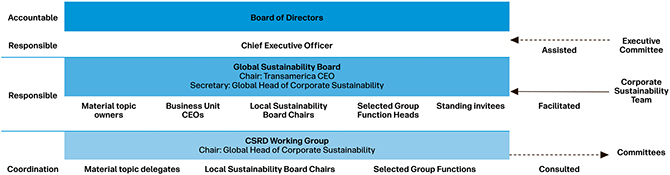
Risk management and internal controls over sustainability reporting
Risk management and internal controls over sustainability reporting fit in Aegon’s Enterprise Risk Management (ERM) framework. All material processes that contribute to sustainability reporting have been identified. The main risks and controls for each material process have been identified and documented with support from the risk functions. The risks relate to the completeness and accuracy of sustainability information and are mitigated by executing controls. These controls are validated internally, both at the business unit and company-wide level. Control attestations are performed for each annual report cycle. This means that in-scope business units and group functions sign off on the design and implementation of the sustainability reporting key controls in the form of a control attestation letter. Remediation plans are developed for ineffective key controls. The (possible) gaps and remediation plans are logged. Progress is reported and monitored quarterly as part of the risk management cycle. For more information, refer to Aegon’s overarching Risk Governance Framework.
Monitoring the effectiveness of our policies and risk framework
Aegon’s policies and standards set out the requirements, roles and responsibilities, and processes to manage risks across the risk universe. Monitoring the effectiveness of our policies is embedded in the Risk Governance Framework. This structure, which is part of the ERM framework, has four layers:
| • | The Board of Directors (Board) and its Risk Committee |
| • | The CEO and the Executive Committee |
| • | The Group Risk & Capital Committee (GRCC) and its sub- committees |
| • | The local Risk & Capital Committees |
The Risk Committee reports to the Board on topics related to the ERM framework and the internal control system. The CEO is responsible for risk management and is supported by the Executive Committee, which oversees various strategic and operational issues, including introducing new company-wide policies. The CEO and Executive Committee are supported by the GRCC. Aegon’s business units have a local Risk or Risk and Capital committee.
Aegon continuously works on keeping its ERM framework up-to-date, effective, and fit-for-purpose. Policies, charters, and other governance documents are regularly reviewed and updated where necessary. Also, activities such as the Emerging Risk Scan provide an internal and external perspective on the risk universe and signals where updates are required. In addition, internal processes such as policy attestation verify compliance with policies. Non-compliance requires remediating action plans, which are actively monitored to ensure execution.
In addition to risk governance, the effectiveness of policies relating to material sustainability matters is also measured through KPIs and set targets. The KPIs relating to material sustainability matters are reported to the GSB. A subset of these KPIs was linked to the Group performance indicators used for the funding of the bonus pool for employees (where applicable) and also the performance metrics of the short-term incentive of the CEO in 2024.
| 382 | | Annual Report on Form 20-F 2024 |
| Governance |
||||
Due diligence
According to ESRS, due diligence is the process by which undertakings identify, prevent, mitigate, and account for how they address the actual and potential negative impacts on the environment and people connected with their business. These include negative impacts connected with the undertaking’s own operations and its upstream and downstream value chain, including through its products or services, as well as through its business relationships.
The table below provides references to the sections included in this Sustainability statement and/or other sections of this Annual Report, where the core elements of Aegon’s due diligence processes related to impacts on people or the environment are disclosed.
| Core elements of Aegon’s sustainability due diligence |
Summary | Reference | ||
| Information on how sustainability matters are addressed by the undertaking’s administrative, management, and supervisory bodies. | Sustainability statement - Aegon’s sustainability governance Corporate governance - Sustainability governance Report of the Board of Directors - 2024 topics (Strategy) Report of the Board of Directors - Nomination and Governance Committee |
|||
|
|
||||
| a) Embedding due diligence in governance, strategy, and business model | Integration of sustainability-related performance in incentive schemes. | Remuneration Report Sustainability governance - Incentives |
||
|
|
||||
| Pages under the heading “Impacts, risks and opportunities” of the following sections of the Sustainability statement: | ||||
| Material impacts, risks and opportunities and their interaction with strategy and business model. | Climate change Human capital Inclusion and diversity Data privacy Business conduct Responsible marketing practices |
|||
| b) Engaging with affected stakeholders in all key steps of the due diligence | Interests and views of stakeholders. | Impact, risk, and opportunity management - Stakeholder engagement Pages under the heading “Policies and procedures” of the following sections of the Sustainability statement: Climate change Human capital Inclusion and diversity Data privacy Business conduct Responsible marketing practices |
||
| c) Identifying and assessing adverse impacts | Negative impact details. | Impact, risk, and opportunity management Pages under the heading “Impacts, risks, and opportunities” of the following sections of the Sustainability statement, where material adverse impacts are identified through the DMA: Climate change Business conduct Responsible marketing practices
General information - Value chain |
||
| d) Taking actions to address those adverse impacts | Our actions to manage the negative impacts of material sustainability matters. | Narrative below this table
Pages under the heading “Actions (and resources)” of the following sections of the Sustainability statement: Climate change Business conduct Responsible marketing practices |
||
| e) Tracking the effectiveness of these efforts and communicating | We track the effectiveness of our efforts through the KPIs and targets we set for our material topics. Next to that, we also monitor our performance through several metrics. | Pages under the heading “Metrics” of the following sections of the Sustainability statement: Climate change Business conduct Responsible marketing practices
Pages under the heading “KPIs and targets” of the following sections of the Sustainability statement: Climate change Business conduct Responsible marketing practices |
||
| Annual Report on Form 20-F 2024 | 383 |
|
|
About Aegon Governance and risk management Financial information Sustainability information | |||
Due diligence processes are essential for identifying, preventing, mitigating, and accounting for how Aegon addresses adverse actual and potential negative impacts on the environment and people connected with its business. The outcomes of these processes support our DMA in assessing our material impacts, risks, and opportunities. Our due diligence processes also provide input to our stakeholder engagement processes.
Due diligence processes related to impacts on people and the environment are disclosed under each material topic in this Sustainability statement and are supported by various policies and procedures as mapped in the reference table above.
Aegon has other due diligence processes in place related to business conduct matters. For example, our Anti-Money Laundering & Counter Terrorist Financing (AML&CTF) Policy requires due diligence regarding customers, while our Anti-Bribery and Corruption (ABC) Policy requires due diligence regarding third-parties. Related to consumer interests, our Market Conduct Compliance Policy requires due diligence regarding our distribution activities.
International standards such as the United Nations’ Universal Declaration of Human Rights, the core standards of the International Labor Organization, and the principles of human rights and labor standards, as set out in the UN Global Compact, are incorporated into some internal policies and statements. These include the Code of Conduct, the Statement on Inclusion and Diversity, the Aegon Operational Risk Taxonomy, and the Statement on Human Rights.
Human rights
Aegon’s Statement on Human Rights represents the company’s overarching position and approach to the responsible stewardship of human rights. The statement commits Aegon to uphold international human rights standards at all businesses where the company has sufficient management control and, where possible, to encourage partners to uphold the same standards. It applies to both the direct impacts of Aegon’s daily operations and the indirect impacts of its business activities.
In our own operations, we have several due diligence mechanisms in place, and we have identified no severe human rights incidents related to our workforce. We conduct a biennial global Human Rights Risk Assessment (HRRA). This assessment aims to identify the risk of possible human rights violations that Aegon and its employees might face within the geographical locations where the company
operates. The assessment is done internally and covers geographic risks and the management proficiency within our units to respond to these risks effectively. The 2024 HRRA concluded that our management proficiency is adequate in potentially high-risk areas such as China and Brazil.
The findings from the 2024 HRRA indicate that for most Aegon units, the operating environment presents little or no significant human rights risk. In Brazil, corruption and working conditions present some risks. We also face human rights risks in China, although most of these risks relate to outside political factors.
Where higher risk levels were identified, action plans were developed to address identified risks. Preventative and remedial measures were recommended to local management in higher-risk countries. The 2024 HRRA concluded that the overall measures to address specific risks are in place and robust. In addition to the HRRA, Aegon UK issues a modern slavery statement (in line with the United Kingdom government’s 2015 Modern Slavery Act).
Downstream due diligence
Aegon’s Group Responsible Investment Policy provides the foundation for managing Aegon’s assets in alignment with its responsible business objectives, relevant laws, and governance standards. The policy applies to the general account assets of all Aegon business units.
Through our investment analysis and decision-making process, we systematically consider financially material factors, including sustainability factors, to identify risks and opportunities and maximize risk-adjusted returns for our clients. By taking an active approach to responsible investment, we seek to reduce the risks to our business and explore ways to serve the interests of our customers and the wider society in which we operate.
Aegon uses engagement and exclusion to manage investment-related adverse impacts on people and the environment. Aegon’s engagement efforts, conducted by Aegon Asset Management, focus on dialogue with investee companies on topics identified as relevant according to the Group Responsible Investment Policy.
To support our responsible investment approach, we apply exclusions to certain countries and/or companies, including majority-owned subsidiaries of such companies. Exclusion from Aegon’s investment universe applies to several activities that have significant adverse impacts on people or the environment, in line with its responsible investment policy objectives. A full list of exclusions can be found in the Responsible Investment Policy on our website. Further information on the Responsible Investment Policy and its governance is available in the Climate change section.
| 384 | | Annual Report on Form 20-F 2024 |
| Impact, risk and opportunity management |
||||
Impact, risk, and opportunity management
Double materiality assessment process
A sustainability topic is considered material from an impact perspective if it is related to actual or potential, positive, or negative impacts that an undertaking – in this case Aegon – has on the environment or people. Topics are considered material from a financial perspective if they have the potential to trigger financial effects, such as generating risks or opportunities that impact or are likely to impact future cash flows and, consequently, enterprise value.
In 2024, we conducted our third DMA, following a four-step methodology informed by the ESRS requirements.
Step 1
Understand the landscape
A desktop analysis was conducted, including the regulatory landscape, benchmarking against our peers, a media scan, a review of reporting frameworks, and input from stakeholder reports and interviews. The findings from this desktop analysis, alongside the value chain assessment, were used to update the consolidated long list of topics, carry out an initial mapping of those topics and their related IROs to the value chain, and screen potential exclusions prior to the assessment of the IROs.
Step 2
Identification and assessment of IROs related to
sustainability matters
In step 2 of the DMA process, a more detailed and extensive description of the IROs associated with the screened topics was carried out. The compilation of these IROs was informed by stakeholders and subject matter experts (SMEs), building on and enhancing the IROs previously identified in 2023.
As part of the second step of the DMA, the IROs were also assessed according to a combination of factors, including specific business activities, business relationships, geographies where we operate, where they occur in the value chain and according to three time horizons – short (up to 1 year), medium (1 to 5 years), and long (greater than 5 years).
Scoring of the screened topic IROs was informed by input from our stakeholders and SMEs. The positive and negative impacts were first qualitatively assessed against scale, scope, likelihood, and irremediability, with negative impacts prioritized. The impacts, alongside any dependencies and other risk factors, were then considered for the assessment of the risks and opportunities against magnitude and likelihood. A qualitative scale, with five ranges of possible effects from low to high, was applied to all these criteria during the assessment. A threshold matrix was then used to determine the final materiality level.
As we mature in our DMA approach, we expect more quantitative input to become available for evaluation. After consultation with internal stakeholders, the threshold for materiality was set at a high level to keep the outcome and set of topics focused and impactful. As in prior DMAs, topics were included as “material” when they met the threshold for either financial or impact materiality for this ESRS-related assessment. From this assessment of the topics, at the IRO level, we concluded that Aegon has five material sustainability topics comprised of 14 sub-topics.
Step 3
Validation
The final list of material topics and their related IROs was shared for validation by internal SMEs. The CEO, supported by the Executive Committee, approved the double materiality assessment process and outcome.
Step 4
Integration
The material topics have been integrated into our business, as reflected in the policies, processes, actions, metrics, and targets that are detailed under each material topic, starting with the Environmental information of the Sustainability statement. This is an ongoing process as our material matters and the political and regulatory landscape continue to evolve, and we seek to capture the broader scope of our value chain.
Our evolving DMA approach
In 2024, we refined our DMA methodology, building on the processes we developed in 2022 and 2023. This resulted in a sharpening of the specific elements, or sub-topics, included within the wider material topic definitions. As a result, the following changes have occurred:
| • | Talent attraction and retention have been integrated into other topics, such as training and skills development, general working conditions, and diversity. |
| • | Employee engagement is now considered a mechanism for measuring the effectiveness of policies and actions related to topics such as training and skills development, general working conditions, and diversity. |
| • | The employee engagement survey indicator is now reported under the sub-topic social dialogue. |
| • | Customer service was presented last year as a separate sub-topic, but is now considered a part of business conduct, particularly under responsible marketing practices. |
| • | Product innovation has also been removed as sub-topic because it is considered a mechanism or enabler for other customer-related topics. |
| • | Data security has been integrated into the broader topic of data privacy, as privacy for our customers and employees requires a strong information security framework to support it. |
| Annual Report on Form 20-F 2024 | 385 |
|
|
About Aegon Governance and risk management Financial information Sustainability information | |||
| • | Finally, responsible tax has been moved to Additional information on the basis that it is not a material sustainability matter for Aegon. Despite this, we are committed to making a valuable economic and social contribution to the communities in which we operate, both through our tax payments and through the collection and payments of third-party taxes. For many years we have disclosed information on our tax strategy and tax payments. At the same time, we recognize and value that a number of our stakeholders ask us to disclose more detailed information about our tax payments in the various countries in which we operate. This is why we have published a Global Tax Report separately from our Annual Report since 2020. |
Stakeholder engagement
Aegon identified its most relevant affected stakeholders and users of sustainability statements, based on their relevance or importance in the value chain and their knowledge of specific topics or aspects of Aegon’s business. These stakeholders may be directly or indirectly affected by our business activities and/or are users of our sustainability information. Stakeholder consultation is an ongoing process and, as such, views from both 2023 and 2024 engagement activities were incorporated into the stakeholder perspectives during the DMA process. The purpose of our engagements is to understand the expectations and concerns of our key stakeholders in order to inform our sustainability approach.
Our stakeholder engagement methods, as well as the concerns and expectations of our stakeholders are summarized in the table below.
| Key stakeholder |
Position in the value chain |
Engagement method | Stakeholder expectations and concerns | |||
| Outsourcing partners, suppliers and service providers | Upstream | Direct: • Performing third-party risk assessment, audits, and on-site assessments Indirect • Understanding ESG performance of our supplier base through EcoVadis assessment scores |
• Good business conduct • Fair and timely payments • Responsible sourcing |
|||
| Investors | Upstream | Direct: • Capital Markets Day for analysts and investors • General Meetings of shareholders (annual and extraordinary) • Regular engagements with institutional investors and equity analysts • Participation at financial market conferences and roadshows • Public communications in the form of press releases, interviews, and media engagement Indirect: • Through our ESG rating scores |
• Strong and sustainable capital position • Predictable, competitive financial result • Attractive, sustainable capital distributions to shareholders • Reliable returns to bondholders |
|||
| Reinsurers | Upstream | Indirect: • Publicly available information |
• Strong and sustainable capital position • Strong business conduct |
|||
| Employees | Own operations | Direct: • Town halls at company and business-unit level • Regular global employee surveys with all employees • International I&D Survey • Speak Up program • Employee Resource Groups (ERGs) • Aegon Works Council and Unions |
• Good working conditions • Flexible working • Healthy work-life balance • Opportunities for career development • Equal treatment and opportunities for all • Social dialogue • Employee Resource Groups • Personal development talks |
|||
| Customers | Downstream | Direct: • Customer panels to test ongoing product development • Omnichannel customer service portals in our respective markets • Customer complaints channels • Customer insights through our distribution channels Indirect: • Customer surveys (led by business units) • NPS scores for Individual and Workplace clients |
• High-quality products and services that support financial wellbeing • Fairly priced, accessible products • High-quality customer service • Accessibility of high-quality information (digitally enabled) • Protection of data privacy |
|||
| Distribution channels and related JVs | Downstream | Direct:
• Conferences (e.g. WFG annual Convention)
• Advisor surveys (e.g. Aegon NextWealth report Aegon UK)
• NPS scores for advisors |
• Fairly priced, accessible products • High-quality customer service • Accessibility of high-quality information (digitally enabled) • Strong business conduct • Fair and timely payments |
|||
| Social partners - NGOs, charities, communities | Downstream | Direct: • Community Investment program • Regular engagements with NGOs Indirect: • Reports issued by NGOs • Participating in ESG related conferences |
• Supporting climate transition (through responsible investments) • Commitment to reducing carbon footprint (including net-zero commitment) • Commitments to supporting inclusion and diversity • Supporting worthwhile causes in Aegon’s local communities |
|||
| 386 | | Annual Report on Form 20-F 2024 |
| Impact, risk and opportunity management |
||||
| Key stakeholder |
Position in the value chain |
Engagement method | Stakeholder expectations and concerns | |||
| Investment customers and investees | Downstream | Direct: • Engagement with investee companies by Aegon AM Indirect: • Screening of general account on norms-based controversies |
• To address material topics relevant to the investee companies, which vary depending on the type of business |
|||
| Regulators | N/A | Direct: • Consultation with the Bermuda Monetary Authority (BMA) on climate-related risk disclosures Indirect: • Consulation on upcoming regulations |
• Strong business conduct • Meeting regulatory requirements |
The expectations and concerns of our stakeholders are addressed in our business strategy and operations. More information on how we address the expectations and concerns of our key stakeholders can be found in the Creating sustainable value for our stakeholders section.
The findings from our stakeholder engagement activities were considered at three main points during the DMA process. Firstly, in terms of the scoping and landscape research, stakeholder views were considered for the purposes of creating the long list of potentially material topics and then excluding specific topics during the screening process. Secondly, stakeholder views formed a key part of the identification and more detailed assessment of the IROs. Finally, stakeholder considerations were used to score the IROs as explained in DMA step 2 above.
Potential future stakeholder engagement activities have been identified as a result of the more detailed assessment of the value chain in 2024. To gather a broad spectrum of views from the key elements of our value chain, we aim to conduct more extensive stakeholder engagement in 2025 covering a wider range of sources.
DMA results
The 2024 DMA has resulted in five material topics: Climate change1, Human capital, Inclusion and diversity, Data privacy and Business conduct. The impacts, risks, and opportunities for each topic and related sub-topics are described in detail in the following sections. Also our policies and procedures, actions, targets2, and metrics are included per topic.
| 1 | The other environmental sustainability matters: Pollution, Water and marine resources, Biodiversity and ecosystems, and Circular economy were not assessed as material due to a lower level of impact, risk, or opportunity. |
| 2 | Our KPIs and other metrics have not been validated by an external body other than our assurance provider. |
| Annual Report on Form 20-F 2024 | 387 |
|
|
About Aegon Governance and risk management Financial information Sustainability information | |||
Environmental information
Climate change
As detailed in the Creating sustainable value for our stakeholders’ section, for Society, Aegon has a responsibility to manage its impacts, risks, and opportunities related to climate change. We do this primarily through our responsible investment framework. We seek to support the transition to a climate-resilient economy and net-zero world while managing potential climate-related risks and opportunities in our portfolio. Additionally, we are working to reduce our operational GHG emissions and gathering data to help us understand the GHG footprint of our supply chain. The following section outlines our management approach to the material IROs we have identified, which are associated with climate change.
Definition
Climate change is the long-term shift in average weather patterns across the world. Human activity contributes to the release of carbon dioxide and other greenhouse gases into the air, causing global temperatures to rise and resulting in long-term changes to the climate.
The topic of climate change relates to the sub-topics of climate change mitigation, climate change adaptation, and energy consumption, including:
| • | The process of reducing GHG emissions and holding the increase in the global average temperature to 1.5 °C above pre-industrial levels, in line with the Paris Agreement |
| • | The process of adjustment to actual and expected climate change and its impacts |
| • | All types of energy production and consumption. Energy efficiency and renewable energy are central to this. |
Impacts, risks, and opportunities
Aegon’s material IROs related to climate change are spread across the sub-topics of climate change mitigation, climate change adaptation, and energy consumption. Aegon’s material IROs are primarily related to climate change mitigation and adaptation downstream in the value chain, in particular the investment portfolio (focused on the general account and separate account), but also through sourcing activities. This includes scope 3 GHG emissions from investee companies connected to our investments and from our sourcing partners. IROs connected to investments managed on behalf of third-party clients are currently not in the scope of our sustainability reporting, given their distance from Aegon.
Energy relates to the energy consumption in all properties that we own or rent and use for our primary operations (operational control). The usage of energy and the associated GHG emissions (scope 1 and 2) connected to our own operations are relatively small compared with the emissions related to our investment portfolio, as shown in the metrics table below (total scope 1 and 2 emissions is 7,682 tCO2e which represents 0.2% of the total GHG emissions). The energy consumption connected to our upstream and downstream value chain, in particular energy consumed by investee companies and sourcing partners, is embedded in the topics climate change mitigation and adaptation.
The IROs identified within our DMA process were informed by a screening of our activities to identify drivers for climate-related impacts (including actual and potential future GHG emission sources), risks (including risks identified through our group climate risk assessment), and opportunities (including our existing commitments). Through stakeholder engagement and SME input, a long list of climate-related IROs was compiled.
Our companywide climate risk assessment (TCFD section on Risk identification) and climate risk scenario analysis (TCFD section on Portfolio level climate risk scenario analysis) helped inform the materiality of our identified risks. The underlying methodology that captures the assessment of climate-related physical and transition risks, including the identification of climate-related transition events across a diverse range of climate scenarios, is detailed within the TCFD section as referred to above. For the materiality assessment of impacts and opportunities, the DMA was informed by our GHG inventory and input from SMEs.
| 388 | | Annual Report on Form 20-F 2024 |
| Environmental information |
||||
Aegon also conducts climate scenario analyses (TCFD section on Portfolio level climate risk scenario analysis) to understand the resilience of its general and separate accounts to five climate pathways. The detailed findings from these assessments can be found in the TCFD section (Results of the quantitative climate risk assessment) of this report.
The table below depicts where the IROs arise in the value chain. Each IRO is described below in more detail and the numbering corresponds with the numbers in the table.
| Material IROs related to the | ||||||||||||||||
| Where in the value chain do material IROs arise? | sustainability matter | |||||||||||||||
| Sustainability matter | ||||||||||||||||
| (sub-topic and sub- | Own | |||||||||||||||
| ESRS topic | sub-topic) | Upstream | operations | Downstream | Impact | Risk | Opportunity | |||||||||
| Climate change | Sourcing | Investee companies of | 1, 2, 3, 4 | 5 | 6 | |||||||||||
| mitigation | general account and | |||||||||||||||
| separate account | ||||||||||||||||
| ESRS E1: Climate | assets1 | |||||||||||||||
| change | Climate change | Investee companies of | 7, 8 | 9 | ||||||||||||
| adaptation | general account and | |||||||||||||||
| separate account | ||||||||||||||||
| assets1 | ||||||||||||||||
| Energy | Facility | 10 | 11 | |||||||||||||
| management | ||||||||||||||||
| 1 | For separate account assets, Aegon applies the phased-in option. The infrastructure to collect emissions data from investee companies was established for general account, but not yet for separate accounts. The implementation for separate accounts will start in 2025. |
Climate change mitigation
Definition: The process of reducing GHG emissions and holding the increase in the global average temperature to 1.5 °C above pre-industrial levels, in line with the Paris Agreement1.
Impacts:
Aegon’s impacts related to climate change mitigation are mainly related to its downstream investment management activities and may occur in the medium to long-term.
1. Positive, potential: Investments in low carbon intensive companies or highly carbon intensive companies with Paris-aligned transition plans, may reduce climate change impacts in the long run.
2. Negative, potential: Investments in highly carbon intensive companies without climate transition plans may exacerbate the impacts climate change has on people and the planet.
In addition, we have climate change mitigation impacts upstream in our value chain, from our supplier and sourcing activities, anticipated to occur in the medium and long-term.
3. Positive, potential: Impacts from reducing our supplier/ sourcing emissions and thus limiting the impacts of climate change on people and the planet.
4. Negative, potential: Impacts from our supplier/sourcing emissions which may increase the impacts of climate change on people and planet.
Risk and/or opportunity:
The following risk and opportunity have been identified related to climate change mitigation, and may materialize in the short to medium-term.
5. Risk: Exposure to litigation and reputational risks as a result of (being perceived to) not fully considering or responding to the impacts of climate change, or not providing appropriate disclosure of current and future risks, or not meeting Aegon’s fiduciary duties. This relates to transition risk.
6. Opportunity: Achieving net-zero by 2050 will require large scale investment and is an opportunity to capture as the world works towards meeting its commitment to the Paris Agreement.
Through this opportunity, Aegon has the potential to create long term value through its investment activities and attract clients with products that support them in aligning their investment portfolios with net-zero goals.
Climate change adaptation
Definition: The process of adjustment to actual and expected climate change and its impacts.
Impacts:
As with mitigation, Aegon’s impacts related to climate change adaptation are mainly related to its downstream investment management activities and may occur in the medium and long-term.
| 1 | Aegon is not excluded from the EU Paris-aligned Benchmarks. |
| Annual Report on Form 20-F 2024 | 389 |
|
|
About Aegon Governance and risk management Financial information Sustainability information | |||
7. Negative, potential: Investments in companies without proactive climate resiliency and adaptation measures in place can lead to extreme weather events impacting people more severely.
8. Positive, potential: Investments in companies with proactive climate resiliency and adaptation measures can reduce the impacts relating to climate change.
Risk and/or opportunity:
The following opportunity has been identified related to climate change adaptation, and may materialize in the short to medium-term.
9. Opportunity: Lucrative climate adaptation investment opportunities, as businesses innovate to adapt to the effects of climate change and improve the climate resiliency of their business models/plans.
Energy
Definition: Energy covers all types of energy production and consumption associated with our own operations. Energy efficiency and renewable energy are central to this.
The following risk and opportunity have been identified related to energy, and are assessed as medium to long-term.
Risk and/or opportunity:
10. Risk: If the energy efficiency standards of our office buildings are not in line with the Paris Agreement, investors focused on decarbonizing their portfolios may penalize Aegon as an investee company. It is also a criterion in many client requests for proposals.
11. Opportunity: Energy efficiency and cost efficiency are closely linked. Investments in more energy-efficient offices could lead to lasting cost-savings in the medium to long-term.
Policies, procedures, and commitments
Our suppliers
Aegon has a Vendor Code of Conduct and a Group Procurement Policy. These are explained in detail in our Business Conduct section under Policies for suppliers. While our Vendor Code of Conduct does not currently include specific requirements related to our suppliers’ GHG emissions, it does refer to sustainability and the suppliers’ responsibility to manage their environmental impact.
Our operations
The Group Environmental Policy defines how Aegon aims to minimize its environmental impact from its operations through energy efficiency and renewable energy (IROs 10 and 11). The policy sets a minimum standard for environmental management across all our business units and aligns our practices with our environmental objectives,
relevant laws, and governance standards. It applies to all business units, excluding properties below 140 square meters. The Executive Committee has endorsed the policy, with the Global Head of Corporate Sustainability responsible for its implementation.
The effectiveness of this policy is monitored through quarterly carbon emissions reports shared with the GSB. The policy references our operational target for reducing absolute operational carbon emissions alongside several third-party standards and initiatives, including the Paris Pledge for Action, United Nations Global Compact (UNGC), UNEP-FI Principles for Sustainable Insurance (PSI), Energy Star, ISO 50001, Leadership in Energy and Environmental Design (LEED), and Building Research Establishment Environmental Assessment Method (BREEAM).
Our investments
Our Group Responsible Investment Policy is the basis for how Aegon’s general account assets should be managed, in a way that is consistent with its responsible investment objectives, relevant laws, and governance standards. Climate change is one of the responsible investment focus areas, which outlines Aegon’s net-zero commitments and exclusion criteria for certain activities considered to have significant adverse impacts on climate change adaptation and mitigation (IROs 1,2,5,6,7,8 and 9). It applies to the general account assets of all Aegon business units, regardless of whether they are internally or externally managed.
The Executive Committee is responsible for the execution of this policy and integrating it into investment strategy and other relevant company processes and practices. The GSB is responsible for monitoring, discussing, and advising the Executive Committee on all subjects and issues deemed relevant to the proper execution of the policy. The policy references several third-party standards and initiatives, including the NZAOA, UNGC, Paris Pledge for Action, and UNEP FI Principles for Responsible Investment (PRI).
As a member of the Net-Zero Asset Owner Alliance (NZAOA), Aegon leverages the Alliance’s Target-Setting Protocol to set targets aligned with 1.5 °C for its general account assets. The NZAOA sets expectations for reporting and transitioning specific asset classes towards net-zero, emphasizing the need for engagement and targeted financing of climate solutions (IROs 1,2,5,6,7,8 and 9). The Global Head of Corporate Sustainability is accountable for Aegon’s NZAOA commitments, with progress on targets reviewed bi-annually by the GSB. We also provide annual progress reports to the NZAOA.
| 390 | | Annual Report on Form 20-F 2024 |
| Environmental information |
||||
The weighted average carbon intensity (WACI) target for corporate fixed income and listed equity in our general account is included in the Group performance indicators and these indicators’ results are used for the funding of the bonus pool for employees (where applicable).
The WACI target was also included in the performance metrics of the short-term incentive of the Executive Director (CEO) in 2024.
| Policy or commitment |
IRO and subtopic linkage1 |
Senior-level accountability for implementation |
Scope | Stakeholders considered or consulted in preparation |
Internally or externally available |
|||||
| Group Responsible Investment Policy | Climate change mitigation and adaptation: Impact: 1,2,7,8 Risk: 5 Opportunity: 6,9 |
The Executive Committee has ultimate responsibility for the execution of this policy and for its integration into investment strategy and other relevant company processes and practices. | General account assets of all business units | Responsible Investment Working Group, GSB, Group Risk, Group Legal, peers, organizations/ bodies (for example PRI) | Publicly available on Aegon’s website | |||||
| Commitment to Net-Zero Asset Owner Alliance (NZAOA) | Climate change mitigation and adaptation: Impact: 1,2,7,8 Risk: 5 Opportunity: 6,9 |
The Executive Committee has ultimate responsibility for the execution of this commitment and for its integration into investment strategy and other relevant company processes and practices. | General account assets of all business units | GSB, Chief Investment Officers in the business units | Aegon’s net-zero commitment is publicly available on Aegon’s website and disclosed in its Annual Report. | |||||
| Group Environmental Policy | Energy: Risk: 10 Opportunity: 11 |
Executive Committee has endorsed the policy, Global Head of Corporate Sustainability oversees its implementation | All business units, excluding properties below 140 m2 (1,500 square feet) | Topic owners in the business units, Facility management, Corporate Sustainability | Publicly available on Aegon’s website | |||||
| 1 | The numbering provided in this table refers to the IROs listed under the heading “Impacts, risks, and opportunities” of this section. |
Actions (and resources)
The following section details our actions to tackle the IROs related to climate change in our value chain. Aegon does not currently have a climate transition plan, but aims to disclose one in the coming years.
Our suppliers
Aegon is working with its upstream value chain partners to address climate change impacts (IROs 3 and 4). Our relationship with suppliers enables us to influence sustainability and best practice in our industry and create transparency within our supply chain. We do this by monitoring the performance of our key suppliers and partners on issues such as climate change.
In 2024, we matured our approach to climate change mitigation by adding supplier GHG emissions to our overall emissions data reporting. We are also monitoring the practices of our core supply base at a global level, conducting recurring assessments of the extent to which suppliers use tools to help them understand and ultimately reduce their climate impact. For example, Aegon UK is taking action to monitor its supplier’s net-zero commitments.
GHG emissions associated with our suppliers are calculated based on supplier spend data recorded in our procurement system. Actions will be taken to further refine and improve the quality of the spend data by improving the filters used to include or exclude spend categories.
Our operations
Aegon’s direct business operations do not involve manufacturing processes and do not maintain energy-or resource intensive processes. The consumption of electricity for our offices and data centers is our most material source of carbon footprint emissions from our operations. Our operational carbon footprint overall is small relative to the scope of our investment activities. Nevertheless, we have set targets to address the risk and opportunity associated with our energy use (IROs 10 and 11) and reduce the carbon footprint of our operations. This primarily relates to the decarbonization lever - energy efficiency, in the form of more efficient natural gas and electricity consumption by our offices, to reduce GHG emissions.
The impact of fewer operational properties, together with changing work patterns, has significantly reduced our overall facilities footprint over the last five years. Our business units also have energy management processes aligned to ISO 50001/BREEAM/Energy Star standards.
| Annual Report on Form 20-F 2024 | 391 |
|
|
About Aegon Governance and risk management Financial information Sustainability information | |||
The Cedar Rapids Community Solar Garden, which opened in 2024, generated enough renewable energy to power Transamerica and AAM facilities in the United States. Furthermore, Aegon is committed to sustainable practices across its operations by controlling and monitoring mechanical and lighting systems to maximize efficiency and minimize utility use during peak demand. In 2024 Transamerica’s “6400 building” (part of the C Street campus) was awarded an Energy Star rating of 100 in 2024 by the U.S. Environmental Protection Agency.
In 2024, Aegon published a minimum standard for environmental management across all business units, promoting the adoption of industry standards or similar frameworks depending on the location.
Our investments
Downstream, Aegon has made a company-wide commitment to transition its general account investment portfolio to net-zero GHG emissions by 2050. As part of this corporate commitment, Aegon is a signatory of the NZAOA. To drive progress toward our 2050 commitment, we have set interim targets to be met by 2025 and 2030. These commitments address the IROs associated with climate change mitigation and adaptation (IROs 1, 2, and 5 to 9).
Aegon is advancing its decarbonization goals via its responsible investment approach. This includes three main levers:
| • | factoring in the carbon intensity of companies in managing our investment portfolio |
| • | active investments in climate solutions that contribute to climate change mitigation (including transition enabling) and/or adaptation, and |
| • | engagement with high carbon emitters in our portfolio. |
To assess climate risk exposure across its investment portfolios, Aegon runs five climate scenarios to identify its exposure to physical and transition risks. More details on climate scenarios can be found in the TCFD section (Overview of climate pathways) of this report.
Further to our company-wide net-zero commitment, our Aegon UK business has committed to achieving net-zero financed emissions for its default pension funds by 2050.
Key performance indicator(s) and target(s)
| KPI(s) | Baseline year and value |
Target for 20254 | Performance in 2024 | Target for 20304 | ||||
| Weighted average carbon intensity (WACI) for corporate fixed income and listed equity in our general account | 20191: 459 tCO2e/ EURm revenue | 25% reduction against 2019 baseline | 52% reduction against 2019 baseline | 50% reduction against 2019 baseline | ||||
| Amount invested in companies to help mitigate climate change or adapt to the associated impacts | n/a | USD 2.5 billion investments | USD 2.7 billion invested | Investing an additional USD 1 billion, on top of Aegon’s existing USD 2.5 billion commitment | ||||
| Number of engagements with the largest corporate carbon emitters in our investment portfolio | n/a | Engagement with at least the top 20 corporate carbon emitters | 20 investees were engaged and will continue to be engaged | Engagement with at least the top 20 corporate carbon emitters | ||||
| Carbon intensity of our directly held real estate investments (scope 1 and 2) | 20192: 139 kgCO2e/m2 |
25% reduction against 2019 baseline | 51% reduction against 2019 baseline | 42% reduction against 2019 baseline | ||||
| Absolute operational carbon emissions (scope 1 and 2) | 20193: 30,886 tCO2e |
25% reduction against 2019 baseline | 75% reduction against 2019 baseline | 75% reduction against 2019 baseline | ||||
| 1 | The update of the WACI baseline in 2024 is the result of the change in methodology as described in the “Specific circumstances” section of the Sustainability statement. The 2019 baseline value remains representative of the underlying investments covered. It still represents our Corporate Fixed Income (CFI) and Listed Equity (LE) assets in the global general account. The reporting boundaries did not change in 2024. |
| 2 | The update of the directly held real estate baseline in 2024 is driven by updated floorspace data for in-scope properties. The 2019 baseline remains representative of the underlying investments covered. It still represents the in-scope commercial and residential real estate of Aegon’s general account portfolio. The reporting boundaries did not change in 2024. |
| 3 | The update of the operational carbon emissions baseline in 2024 is to reflect changes due to the a.s.r. transaction. The 2019 baseline value remains representative of the underlying activities. It still reflects all properties that we own or rent and use for our primary operations. The reporting boundaries did not change in 2024. |
| 4 | Targets to be achieved on January 1 of the target year. |
Climate change targets
To meet our climate change ambitions, we developed a set of interim targets to be delivered by 2025. Having delivered on those targets, in 2024, a new set of targets was defined for 2030, to help us further advance on our climate change goals. Both sets of targets are shown in the table above, along with our progress to date. The 2030 targets were approved by the CEO with support from the Executive
Committee and the endorsement of the GSB. Internal stakeholders, including our business units were involved in setting the targets. The GSB monitors progress against these KPIs biannually. We aim to meet these targets by the end of 2029.
| 392 | | Annual Report on Form 20-F 2024 |
| Environmental information |
||||
We have not set targets for climate change mitigation in our supply chain as we are gathering data to inform our future approach. To manage our energy performance we have set an operational target for our GHG emissions. The 2030 target shown above is included in our Environment Policy. Our investment targets address the three climate change levers listed in the Actions section above.
Climate change target alignment
Our operational emissions targets for 2025 and 2030 are aligned with the Paris Agreement to limit global warming to 1.5 °C. Our investment targets align with existing climate-related sustainability taxonomies and globally recognized frameworks for setting science-based targets aligned with the Paris Agreement.
Operational target
We set our 2030 group operational footprint target (scope 1 and 2) based on projected reductions in scope 1 and 2 emissions from our 2019 baseline. Our projections were informed by analyzing the planned carbon reduction activities across our global operations and the forecasted decarbonization of national grids. Upon review, Aegon committed to a 75% reduction by 2030. We aligned our methodology with the GHG Protocol’s Corporate Accounting and Reporting Standard. The share of scope 1 in this reduction target is approximately 27% and the share of scope 2 approximately 73%. The target supports the aims of our Environmental Policy and relates to our Energy IROs (10 and 11).
Progress against operational target
By the end of 2024, Aegon had achieved a 75% reduction in its operational carbon footprint compared with the 2019 baseline (68% in 2023). This reduction in the overall footprint of our facilities can be attributed to the impact of fewer operational properties, together with changing work patterns and the implementation of energy management processes. Progress has been positive due to the swift implementation of energy efficiency measures in some of our facilities. Our 2030 target anticipates further changes to our office portfolio.
Investment targets
Aegon has made a company-wide commitment to transition its general account investment portfolio to net-zero GHG emissions by 2050 and joined the NZAOA in 2021 to further reinforce its commitment. To drive progress toward our 2050 commitment, we set interim targets, to be achieved by 2025. These targets consist of: decarbonization targets related to asset classes in our general account investment portfolio (particularly our corporate fixed income and listed equity and our directly held real estate investments), engagements with the top corporate carbon emitters in our general account portfolio, and investments in climate solutions that mitigate and/or adapt to the impacts of climate change.
The general account portfolio consists of assets where Aegon can make investment decisions, taking into account Aegon’s legal obligations under local laws and regulations. A similar approach applies to selected investments where Aegon AM, in its capacity as manager, makes the investment decisions. For discretionary investments on behalf of third-parties and off-balance sheet investments, the investment decisions are driven by the relevant third-parties and Aegon’s legal and/or fiduciary obligations, as required by local laws and regulations.
As with our 2025 targets, our 2030 investment targets remain aligned with our company-wide commitment to transition our general account investment portfolio to net-zero GHG emissions by 2050. Internal stakeholders, including our business units, were involved in setting these targets. The GSB is responsible for monitoring of the KPIs, this takes place every six months. Progress against the targets is reported to the Executive Committee and the GSB. In addition to our internal monitoring, progress updates are provided to the NZAOA annually. The updated targets are included in our Responsible Investment Policy, alongside other focus areas, and relate to our climate mitigation and adaptation IROs (1, 2 and 5 to 9).
Target scope
The scope of the WACI target covers the general account corporate fixed income and listed equity assets of all business units. In 2024 the WACI target was also included in the performance metrics of the short-term incentive of the Executive Director (CEO) to help align corporate action at a leadership level with our net-zero commitment.
The scope of the directly held real estate investment target covers assets in our general account.
The scope of our active investments in climate solutions target covers general account assets. The additional USD 1 billion in our 2030 target will bring the total investment, on top of our 2025 target, to USD 3.5 billion.
The engagement target covers Aegon’s general account assets. It was developed in consultation with Aegon AM to assist in identifying the list of top emitters in the general account and subsequently engaging with corporates. Progress on this target is reported every six months.
Progress against investment targets
At the end of 2024, we reached the end of our first cycle of interim targets. Our WACI result was 222 metric tons CO2e/ EURm revenue, a 52% reduction against the 2019 baseline (38% in 2023). This exceeded our 2025 target. Progress against this target benefitted from favorable market conditions in 2024. Our 2030 target takes account of anticipated challenges in maintaining this level of
| Annual Report on Form 20-F 2024 | 393 |
|
|
About Aegon Governance and risk management Financial information Sustainability information | |||
performance in the coming years. General account investments in scope for this target represents 28.7 billion. The coverage compared to the total general account investments of 75.4 billion (see note 19.1 of the financial statements) is 38%.
We also achieved a 51% reduction in the carbon intensity of directly held real estate investments compared with the 2019 baseline (result of 68 kgCO2e/m2 in 2024). This exceeded our 2025 target.
We committed to investing USD 2.5 billion by 2025 to support activities that can help society mitigate climate change or adapt to its impacts. By the end of 2024 we achieved this target, and in total USD 2.7 billion of climate-related investments have been added to our portfolio.
By the end of 2024 we engaged with 20 out of the 20 targeted investees. This is in line with our target.
| 394 | | Annual Report on Form 20-F 2024 |
| Environmental information |
||||
Metrics
The following list of metrics includes a comprehensive overview of indicators, including the KPIs presented above, to provide insights into the progress made in managing our IROs.
The metrics are grouped logically based on material sub-topic and theme. The metrics are either mandatory ESRS disclosures, or Aegon specific.
| Total GHG emissions | unit | Baseline 2019 |
2024 | 2023 | % | Target 2025 |
Target 2030 |
Target 2050 |
Annual % target / Base year9 |
|||||||||||||||||||||||||||
| Scope 1 GHG emissions1 |
||||||||||||||||||||||||||||||||||||
| Gross scope 1 GHG emissions |
tCO2e | 4,539 | 1,480 | 1,945 | (24% | ) | n.m. | n.m. | n.a. | n.m. | ||||||||||||||||||||||||||
| Scope 2 GHG emissions2 |
||||||||||||||||||||||||||||||||||||
| Gross location-based scope 2 |
||||||||||||||||||||||||||||||||||||
| GHG emissions |
tCO2e | 26,347 | 6,202 | 11,301 | (45% | ) | n.m. | n.m. | n.a. | n.m. | ||||||||||||||||||||||||||
| Gross market-based scope 2 |
||||||||||||||||||||||||||||||||||||
| GHG emissions |
tCO2e | n.a. | 1,590 | 229 | 595% | n.m. | n.m. | n.a. | n.m. | |||||||||||||||||||||||||||
| Total scope 1+2 (location-based)3 |
tCO2e | 30,886 | 7,682 | 13,246 | (42% | ) | 23,165 | 7,722 | n.a. | (9.1% | ) | |||||||||||||||||||||||||
| Significant scope 3 GHG emissions4 |
||||||||||||||||||||||||||||||||||||
| Total gross indirect (scope 3) |
||||||||||||||||||||||||||||||||||||
| GHG emissions |
tCO2e | n.a. | 3,744,413 | 2,956,876 | 27% | n.m. | n.m. | n.a. | n.m. | |||||||||||||||||||||||||||
| Purchased goods and services5 |
tCO2e | n.a. | 158,500 | n.m. | n.m. | n.m. | n.m. | n.a. | n.m. | |||||||||||||||||||||||||||
| Of which: Cloud computing and data center services6 |
tCO2e | n.a. | 11,560 | n.m. | n.m. | n.m. | n.m. | n.a. | n.m. | |||||||||||||||||||||||||||
| Investments7 |
tCO2e | n.a. | 3,585,913 | 2,946,620 | 22% | n.m. | n.m. | n.a. | n.m. | |||||||||||||||||||||||||||
| Total GHG emissions8 |
n.a. | |||||||||||||||||||||||||||||||||||
| Total GHG emissions (location-based) |
tCO2e | n.a. | 3,752,094 | 2,970,122 | 26% | n.m. | n.m. | n.a. | n.m. | |||||||||||||||||||||||||||
| Total GHG emissions (market-based) |
tCO2e | n.a. | 3,747,482 | 2,959,050 | 27% | n.m. | n.m. | n.a. | n.m. | |||||||||||||||||||||||||||
n.a. – not applicable; n.m. – not measured; pp - percentage points
| 1 | Scope 1 covers GHG emissions associated with Aegon’s own natural gas consumption. It includes all properties that we own or rent and use for our primary operations, as well as leased fossil cars. Properties where we only have financial control but not use for our own operations fall under directly held real estate investment footprint (scope 3). Scope 1 GHG emissions and baseline are based on real energy usage sourced from billing information or checked from the meter where Aegon has direct contracts with the energy suppliers. The energy consumption data is extrapolated by floorspace for sites where consumption data is missing. The conversion factors for scope 1 are sourced from the UK Department for Environment, Food & Rural Affairs (Defra) using “100% mineral” for the United States, and “5% biofuel blend” for the Netherlands, United Kingdom, Spain, and Hungary. HFC/PFC are refrigerant gasses and not applicable. SF6 is used by the electricity generators and included. Biogenic emissions originating from the combustion or decomposition of biological materials such as wood and agricultural residues, are not applicable. NF3 emissions stemming from manufacturing are also not applicable. Energy conversion is calculated in Envizi, an IBM tool to calculate GHG emissions. The conversion factors were selected because they are considered the best fit for the energy sources in the regions, they are most commonly used, and updated regularly. |
| 2 | Scope 2 covers GHG emissions from the generation of acquired and consumed electricity, steam, heat, or cooling. It includes all properties that we own or rent and use for our primary operations, as well as leased electric cars. Properties where we only have financial control but not use for our own operations fall under directly held real estate investment footprint (scope 3). Electricity used for our offices and data centers is our most material scope 2 GHG source. Electricity is sourced from fossil fuels, non-renewable sources, and self-generated non-fuel renewable energy (e.g., our Cedar Rapids solar farm). Biogenic emissions are not applicable. Scope 2 GHG emissions are expressed through both the GHG Protocol location- and market-based approaches. Location-based refers to the physical location of the energy consumption, while market-based is based on emission factors from the specific electricity suppliers’ contracts, such as Renewable Energy Certificates in the United States. Location-based conversion factors for electricity consumption are sourced from the US Environmental Protection Agency (eGRID regions), the European Environment Agency for the Netherlands, Spain and Hungary, and Defra for the UK. For market-based, conversion factors are sourced from individual electricity suppliers. Scope 2 GHG emissions are based on real energy usage sourced from billing information or checked from the meter where Aegon has direct contracts with the energy suppliers. Energy consumption is extrapolated by floorspace for sites where data is missing. The emissions for electricity include CO2, CH4, and N2O. Energy conversion is calculated in Envizi, an IBM tool to calculate GHG emissions. The conversion factors were selected because they are considered the best fit for the energy sources in the regions, they are most commonly used, and updated regularly. |
| 3 | Aegon set combined interim targets for scope 1 and 2 (location-based) for 2025 and 2030. Aegon has not yet set a target for 2050. The share of scope 1 in this reduction target is approximately 27%, and the share of scope 2 approximately 73%. |
| 4 | Only material GHG categories based on the 15 categories of the GHG protocol are included in scope 3 GHG emissions. Three categories are material for Aegon: Investments (category 15) and Purchased goods and services (category 1) combined with Capital goods (category 2). The other 12 GHG categories are not considered material from a scope, scale, and stakeholder perspective. The GHG emissions linked to business travel (category 6) and employee commute and remote commuting (category 7) are reported under Additional information. The remaining 10 categories that are excluded are: category 3: Fuel- and energy-related activities (excluded in scope 1 or scope 2); category 4: Upstream transportation and distribution; category 5: Waste generated in operations; category 8: Upstream leased assets; category 9: Downstream transportation and distribution; category 10: Processing of sold products; category 11: Use of sold products; category 12: End-of-life treatment of sold products; category 13: Downstream leased assets and category 14: Franchises. |
| 5 | GHG emissions from purchased goods and services are linked to goods and services, including capital goods, purchased by Aegon in the reporting year. The calculation is estimated automatically based on spend data and conversion factors. The spend data is based on actual invoice payments and does not take into account accruals. Actual spend data is used for the reporting year until September 30. The last quarter is estimated based on average actual historic spend data in Envizi. The conversion factors are based on the Eora66 MRIO factor set, USA. The spend categories from our procurement system are mapped to the Eora66 categories in the emissions calculation system. The spend data set is cleaned for transactions that are not included in scope 3, such as intercompany transactions, taxes and energy bills (scope 2). The spend data does not include our smaller regions, including Spain, Portugal, Asia, and Hungary. It also excludes payments done by wire transfers. The total spend not covered is not material (less than 1%). We have not set a target for this category. |
| 6 | GHG emissions from purchased cloud computing and data centre services is a subset of the total scope 3 Purchased goods and services. The applicable spend categories from the procurement system are mapped to the Eora66 category “Data processing, internet publish, other IT” in the emissions calculations system. |
| 7 | GHG emissions from investments consist of emissions associated with general account investments, including total carbon emissions for Corporate Fixed Income (CFI) and Listed Equity (LE), total carbon emissions for Sovereign Fixed Income (SFI) (including LULUCF) and directly held real estate total carbon emissions. Aegon set interim targets to meet its net-zero ambition by 2050 for CFI/LE in its general account and directly held real estate investments. The interim targets are set on carbon intensity per asset class in line with market practice and not in absolute emissions and therefore not included in this table. For our (interim) targets relating to the relevant investment classes, refer to the “Key performance indicator(s) and target(s)” table under the material topic Climate change. |
| 8 | Aegon set a mix of intensity and abolute targets which cannot be aggregated. Furthermore, Aegon did not set targets for all asset classes. For our (interim) targets relating to the relevant investment classes, refer to refer to the “Key performance indicator(s) and target(s)” table under the material topic Climate change. |
| 9 | This number shows the annual % GHG emissions reduction that Aegon needs to achieve every year to reach the 2030 target. The number for Total scope 1+2 (location-based) is calculated as follows: total reduction until 2030 is 30,888-7,722=23,166. Reduction each year is 23,166/11 years=2,106, which is 2,106/23,166*100=9.1% per year. |
| Annual Report on Form 20-F 2024 | 395 |
|
|
About Aegon Governance and risk management Financial information Sustainability information | |||
| Climate change mitigation and adaptation | unit | 2024 | 2023 | % | ||||||||||||
| Investment footprint: Corporate Fixed Income + Listed Equity (CFI)1 |
||||||||||||||||
| CFI - Total carbon emissions2 |
tCO2e | 2,353,463 | 1,704,837 | 38% | ||||||||||||
| CFI - Carbon footprint |
tCO2e/EURm invested | 89 | 80 | 11% | ||||||||||||
| CFI - Total carbon emissions and carbon footprint (coverage) |
% | 93% | 82% | 11pp | ||||||||||||
| CFI - Weighted average carbon intensity |
tCO2e/EURm revenue | 222 | 283 | (22% | ) | |||||||||||
| CFI - Weighted average carbon intensity (coverage) |
% | 94% | 97% | (2pp | ) | |||||||||||
| CFI - Weighted average carbon intensity 2019 baseline |
tCO2e/EURm revenue | 459 | 459 | 0% | ||||||||||||
| CFI - Reduction of weighted average carbon intensity vs. 2019 baseline |
% | (52% | ) | (38% | ) | (13pp | ) | |||||||||
| Investment footprint: Sovereign Fixed Income (SFI)3 |
||||||||||||||||
| SFI - Total carbon emissions - excluding LULUCF2 |
tCO2e | 1,349,558 | n.m. | n.m. | ||||||||||||
| SFI - Carbon footprint - excluding LULUCF |
tCO2e/EURm invested | 278 | n.m. | n.m. | ||||||||||||
| SFI - Total carbon emissions and carbon footprint (coverage) - excluding LULUCF |
% | 84% | n.m. | n.m. | ||||||||||||
| SFI - Weighted average carbon intensity - excluding LULUCF4 |
tCO2e/GDP PPP int $ | 278 | n.m. | n.m. | ||||||||||||
| SFI - Weighted average carbon intensity (coverage) - excluding LULUCF |
% | 84% | n.m. | n.m. | ||||||||||||
| SFI - Total carbon emissions - including LULUCF2 |
tCO2e | 1,228,301 | n.m. | n.m. | ||||||||||||
| SFI - Carbon footprint - including LULUCF |
tCO2e/EURm invested | 253 | n.m. | n.m. | ||||||||||||
| SFI - Total carbon emissions and carbon footprint (coverage) - including LULUCF |
% | 84% | n.m. | n.m. | ||||||||||||
| SFI - Weighted average carbon intensity - including LULUCF4 |
tCO2e/GDP PPP int $ | 253 | n.m. | n.m. | ||||||||||||
| SFI - Weighted average carbon intensity (coverage) - including LULUCF |
% | 84% | n.m. | n.m. | ||||||||||||
| Investment footprint: Real estate5 |
||||||||||||||||
| Real estate - Total carbon emissions2 |
tCO2e | 4,149 | 4,783 | (13% | ) | |||||||||||
| Real estate - Total floor space |
m2 | 75,964 | 78,680 | (3% | ) | |||||||||||
| Real estate - Carbon intensity |
kgCO2e/m2 | 68 | 82 | (17% | ) | |||||||||||
| Real estate - Carbon intensity (coverage) |
% | 80% | 74% | 6pp | ||||||||||||
| Real estate - Carbon intensity 2019 baseline |
kgCO2e/m2 | 139 | 150 | (7% | ) | |||||||||||
| Real estate - Reduction of carbon intensity vs. 2019 baseline |
% | (51% | ) | (45% | ) | (6pp | ) | |||||||||
| Active ownership |
||||||||||||||||
| Number of engagements with heaviest emitters (based on WACI)6 |
nr | 20 | 19 | 5% | ||||||||||||
| Investment in companies contributing to climate mitigation and/or adaptation7 |
USDb | 2.7 | 1.8 | 44% | ||||||||||||
n.a. – not applicable; n.m. – not measured; pp – percentage points
| 1 | The scope covers Corporate Fixed Income (CFI) and Listed Equity (LE) assets in the global general account only. Both the data vendor and methodology have changed compared with the previous year. The 2023 figures were recalculated based on the new methodology and restated to make comparison possible. The disclosures are based on emissions data reported by listed investees and collected through our data vendor MSCI, as well as emissions data estimated by MSCI. Reported data, indicated with PCAF data quality score 2 (“high quality”), represents 94% of the covered population. The overall PCAF data quality score is 2.14. For companies that have not reported any carbon emissions data in the past, MSCI uses an industry segment-specific intensity model. This model estimates the emissions based on the average carbon emissions intensity for 1,000+ industry segments. These average intensities are then multiplied by each of the company’s reported segment’s revenue to calculate estimated emissions for each industry segment. No parent name adjustments have been applied. Transamerica’s runoff blocks and externally managed portfolios have been excluded from the calculations. We do not extrapolate data for investees that are not listed in MSCI. The data availability for each indicator is expressed in a coverage ratio as disclosed above. In line with market practice, we use the latest available information from our data vendor, MSCI. Data is collected by MSCI once per year from most recent corporate resources. Typically, reported data has a time lag of one year, because when MSCI pulls the information, the emissions data of the current year has often not been published. Reported data from the financial years 2024 and 2023 represents 77% of the covered population. Data from 2022 represents 21%, and the remaining 2% of the data is older than 2022. For companies where only historic reported emission data is available (from 2022 and older), MSCI extrapolates the historic data to arrive at more recent carbon emission. For the carbon footprint and WACI the portfolio value is calculated based on IFRS (clean market value). The metrics are calculated in line with PCAF guidelines. |
| 2 | Total carbon emissions is calculated based on available data and no extrapolation was applied. The data availability for each indicator is expressed in a coverage ratio as disclosed above. |
| 3 | The scope covers Sovereign Fixed Income (SFI) in global general account only. The scope 1 emissions are reported both including and excluding LULUCF. LULUCF stands for the sector’s Land use, Land-use change, and Forestry. Both the data vendor and methodology have changed compared with the previous year. The disclosures are based on reported and estimated country level scope 1 emissions data collected through our data vendor MSCI. In line with market practice, we use the latest available information from our data vendor. Data is collected by MSCI once per year from most recent official resources. Typically, this type of country level data has a time lag of two years. As a result, the reported data is from the financial year 2022. Emissions data is estimated by MSCI when the reported data is from 2022 or older. Historical country level data for scope 1, including LULUCF, is extrapolated based on the 5-year historical average ratio. Historical data for scope 1, excluding LULUCF, is extrapolated using growth rates from modeled data sources. Due to the use of these estimates, the PCAF data quality score is 4 (“low quality”). We do not extrapolate when emissions data for countries is not listed in MSCI. The availability of data for each indicator is expressed in a coverage ratio. The weighted average carbon intensity (WACI) is calculated based on the purchasing power parity (PPP)-adjusted GDP, which removes price level differences between countries. The PPP-adjusted GDP is sourced by MSCI directly from the World Bank and the IMF. For the carbon footprint and WACI the portfolio value is calculated based on IFRS (clean market value). Figures of previous years are not calculated using this new methodology. Therefore, data for 2023 is disclosed as “not measured.” The metrics are calculated in line with PCAF guidelines. |
| 4 | The weighted average carbon intensity is calculated based on the purchasing power parity (PPP)-adjusted GDP, which removes price level differences between countries. The PPP-adjusted GDP is sourced by MSCI directly from the World Bank and the IMF. |
| 5 | This metric covers “fully and jointly owned” commercial and residential real estate of Aegon’s general account portfolio, where Aegon directly owns physical buildings or, in the case of joint ownership, has a 25% or greater share. The real estate footprint are calculated in line with PCAF guidelines and presented under scope 3 following the GHG Protocol. With this presentation we deviate from the EFRAG guidance which requires us to present real estate emissions, for which we have financial control, under scope 1 and 2. The metric includes both landlord-controlled and tenant-controlled buildings and areas. It does not include Real Estate Investment Trust (REITs), funds, or other listed vehicles, which should be captured under listed equity and corporate debt. It also includes real estate investments for own use, including our six Transamerica offices. These offices are part of our own operations and therefore also included in the operational footprint scope 1 and 2 GHG emissions. The emissions relating to these offices are immaterial (less than 0.2% of total GHG emissions) and therefore not adjusted. The metric only covers location-based emissions from these buildings where Aegon was able to collect this data. The data availability for each indicator is expressed in a coverage ratio as disclosed above. |
| 6 | Aegon seeks to establish a constructive dialogue with the top 20 heaviest corporate carbon emitters in Aegon’s general account either bilaterally or as part of an investor consortium, as it promotes responsible business practices, including the reduction of its carbon footprint. This metric represents the number of companies that have been engaged by Aegon. The ranking of the top emitters is based on the WACI of Aegon’s Corporate Fixed Income and Listed Equity assets in the global general account. |
| 7 | This covers investments in economic activities that contribute substantially to climate change mitigation (solutions substantially reducing GHGs by avoiding emissions or sequestering carbon dioxide already in the atmosphere) or climate change adaptation (an activity that substantially contributes to enhancing adaptive capacity, strengthening resilience, and reducing vulnerability to climate change). When reviewing assets for inclusion, the use of proceeds must align with at least one of the stated Climate Solution Themes deemed acceptable by the Net-Zero Asset Owner Alliance (Pollution, Waste, Water Solutions, Sustainable Land & Marine, Sustainable Transportation, Manufacturing & Industry, ICT Solutions, Green Buildings & Homes, and Renewable Energy). For labelled “Green” or “Sustainability” bonds, Bloomberg data is typically the source used to confirm that the stated use of proceeds meets eligibility criteria. Where available, third-party opinions are considered for support (for example Sustainalytics). Note that these investments are held in the Transamerica general account, and are not available for direct investment or co-investment by Transamerica clients. |
| 396 | | Annual Report on Form 20-F 2024 |
| Environmental information |
||||
| Climate change mitigation and adaptation | unit |
2024 | 2023 | % | ||||||||||||
| Total carrying amount of real estate assets by energy efficiency classes1 |
EURm | 49.9 | n.m. | n.m. | ||||||||||||
| 0 to <= 100kWh/m2 |
EURm | 3.1 | n.m. | n.m. | ||||||||||||
| > 100 to <= 200kWh/m2 |
EURm | 38.4 | n.m. | n.m. | ||||||||||||
| > 200 to <= 300kWh/m2 |
EURm | - | n.m. | n.m. | ||||||||||||
| > 300 to <= 400kWh/m2 |
EURm | - | n.m. | n.m. | ||||||||||||
| > 400 to <= 500kWh/m2 |
EURm | - | n.m. | n.m. | ||||||||||||
| > 500kWh/m2 |
EURm | 8.3 | n.m. | n.m. | ||||||||||||
| Climate change mitigation: Operational footprint |
||||||||||||||||
| Total Scope 1+2 (location-based) |
tCO2e | 7,682 | 13,246 | (42% | ) | |||||||||||
| Absolute reduction of scope 1+2 vs. baseline 20192 |
tCO2e | (23,204 | ) | (28,551 | ) | 19% | ||||||||||
| Relative reduction of scope 1+2 vs. baseline 20192 |
% | (75% | ) | (68% | ) | (7pp | ) | |||||||||
| Climate change mitigation: Total GHG footprint |
||||||||||||||||
| Total GHG emissions per EURm revenue (location-based)3 |
tCO2e/EURm revenue | 203.7 | 160.2 | 27% | ||||||||||||
| Total GHG emissions per employee (location-based)4 |
tCO2e/employee | 313.9 | 257.7 | 22% | ||||||||||||
| Total GHG emissions per EURm revenue (market-based)3 |
tCO2e/EURm revenue | 203.5 | 159.6 | 28% | ||||||||||||
| Total GHG emissions per employee (market-based)4 |
tCO2e/employee | 313.6 | 256.7 | 22% | ||||||||||||
n.a. – not applicable; n.m. – not measured; pp – percentage points
| 1 | Total carrying value of real estate that Aegon holds with energy consumption split by the energy efficiency class. The real estate scope of this metric is the same as the scope of the “Investment footprint - Real estate” metric included in the table above. |
| 2 | In 2024, Aegon restated its 2019 baseline, reflecting changes due to the a.s.r. transaction. The 2024 absolute and relative reduction are calculated with the updated 2019 baseline of 30,886 tCO2e. The 2023 reduction figures are still based on the original 2019 baseline of 41,797 tCO2e to make comparison possible. |
| 3 | Total GHG emissions are divided by Total revenues (Total revenues is presented in note 5 of the financial statements under “Segment results”, column “Consolidated”). Total GHG emissions are the total of scope 1 and 2 emissions and the emissions linked to significant scope 3 categories that are investments and purchased goods and services, including capital goods. |
| 4 | Employees refer to direct employees from Aegon Ltd. and its subsidiaries only. The number of direct employees are presented in the metrics table under Human capital. Total GHG emissions are the total of scope 1 and 2 emissions and the emissions linked to significant scope 3 categories, which are investments and purchased goods and services, including capital goods. |
| Energy | unit |
2024 | 2023 | % | ||||||||||||
| Energy consumption and mix1 |
||||||||||||||||
| Fuel consumption from natural gas2 |
MWh | 8,123 | 9,901 | (18% | ) | |||||||||||
| Consumption of purchased or acquired electricity, heat, steam, and cooling from fossil sources3 |
MWh | 347 | 355 | (2% | ) | |||||||||||
| Total fossil energy consumption |
MWh | 8,471 | 10,256 | (17% | ) | |||||||||||
| Share of fossil sources in total energy consumption |
% | 32% | 25% | 7pp | ||||||||||||
| Consumption of purchased or acquired electricity, heat, steam, and cooling from renewable sources4 |
MWh | 13,118 | 30,488 | (57% | ) | |||||||||||
| Consumption of self-generated non-fuel renewable energy |
MWh | 5,011 | n.m. | n.m. | ||||||||||||
| Total renewable energy consumption |
MWh | 18,130 | 30,488 | (41% | ) | |||||||||||
| Share of renewable sources in total energy consumption |
% | 68% | 75% | (7pp | ) | |||||||||||
| Total energy consumption |
MWh | 26,601 | 40,745 | (35% | ) | |||||||||||
n.a. – not applicable; n.m. – not measured; pp - percentage points
| 1 | Energy usage is sourced from billing information or checked from the meter when Aegon has direct contracts with the energy suppliers. The cut-off date for reporting is November 30 and the last month, December, is accrued based on historic energy usage data. December figures are updated to actuals in case of material changes or if significantly more accurate information is available. For 2024, the metric reflects 12 months of actual data. In case Aegon does not manage the energy contract, information is collected from the landlord or managing agent of the property. Energy consumption data is extrapolated by floorspace for sites where consumption data is missing. The scope includes all properties that we own or rent and use for our primary operations. The use of nuclear energy is not specified by the energy suppliers and can therefore not be disclosed separately. It is included in renewable energy. |
| 2 | This refers to natural gas supplied through a national grid network. |
| 3 | This refers to electricity, heat, steam, and cooling supplied through a national grid network not specified as being from renewable sources. |
| 4 | This refers to electricity, heat, steam, and cooling supplied through a national grid network, but which has been generated from renewable sources (such as wind, solar, or hydro). To evidence the consumption of renewable energy, Green Energy Certificates are obtained annually for the electricity that has been consumed in the previous year. This also includes the purchase of Renewable Energy Certificates in the US which are also purchased retrospectively. |
| Annual Report on Form 20-F 2024 | 397 |
|
|
About Aegon Governance and risk management Financial information Sustainability information | |||
Social information
Human capital
Our people are key to how we achieve our purpose, as explained in the Creating value for our stakeholders section Employees. We aim to maintain high levels of employee engagement and wellbeing and to support our workforce in building rewarding and fulfilling careers. Attracting, developing, and retaining talent is vital to ensuring our people reach their full potential and live their best working lives. The following section outlines our approach to managing the material IROs associated with human capital.
Definition
Aegon’s approach to human capital aims to create a work environment that enables employees to thrive for the benefit of themselves and their organization. It covers talent management, working conditions, and employee engagement.
Impacts, risks, and opportunities
Aegon's workforce includes three main categories: Our own (direct) employees, this category covers most of our employees, specifically employees of Aegon Ltd. and its wholly owned subsidiaries. We also have (indirect) employees at our joint ventures and tied agents. Lastly, we have a relatively large number of non-employee workers1 in our workforce who, typically, perform similar work as our employees. Most of our direct employees have standard permanent contracts, subject to local employment conditions. All our direct employees conduct work in an office environment or from home, and the majority of them are located in the Americas, followed by the United Kingdom and the Netherlands.
Aegon aims to amplify its potential positive impact, contribute to meaningful and fulfilling careers for a multi-generational workforce, and embody the characteristics of a modern and responsible employer. This includes creating a supportive work environment, providing wider benefits, and helping employees to live their best lives. Overall, these actions aim to contribute to enhancing employee engagement among our own employees.
Aegon’s material IROs related to human capital are spread across the sub-topics of general working conditions, training and skills development, and social dialogue. The IROs apply to our own (direct) employees in all geographies where we have wholly owned subsidiaries. (In the case of our employee engagement survey, the employees of joint ventures are included in the scope.)
We consider our operations, or countries where we operate, to be at little to no significant risk of incidents related to human rights. We provide further information on our human rights approach in the Governance section of the Sustainability statement.
The three material impacts described below are impacts that can arise in the short-, medium-, and long-term. The associated material risks may materialize in the short- to medium-term.
The table below depicts where the IROs arise in the value chain. Each IRO is described below in more detail and the numbering corresponds with the numbers in the table.
| Where in the value chain do material IROs arise? |
Material IROs related to the sustainability matter |
|||||||||||||
| Sustainability matter (sub- | ||||||||||||||
| ESRS topic | topic and sub-sub-topic) | Upstream | Own operations | Downstream | Impact | Risk | Opportunity | |||||||
| General working conditions | Own employees | 1 | 2 | |||||||||||
| ESRS S1: Own | Training and skills | Own employees | 3 | |||||||||||
| workforce | development | |||||||||||||
| Social dialogue | Own employees | 4 | 5 | |||||||||||
| 1 | Non-employee workers are individuals who have a contract with Aegon to supply labor (“self-employed workers”) and workers provided by third-party companies primarily engaged in “employment activities.” Non-employee workers hired from third-party companies typically perform the same kind of work when they fill in for employees who are temporarily absent (due to illness, holiday, parental leave, etc.). |
| 398 | | Annual Report on Form 20-F 2024 |
| Human capital |
||||
General working conditions
Definition: The working environment and aspects of an employee’s terms and conditions of employment.
Impact:
1. Positive, actual: Good working conditions, including flexible working, wider benefits, fair pay, vacation, family leave, and other provisions, promote positive impacts for all our talent, such as physical and mental wellbeing and an engaged and motivated workforce.
Risk and/or opportunity:
2. Risk: If working conditions are not perceived as competitive compared to those offered by peers or other industries in the competition for talent, there could be difficulties retaining and attracting employees with associated recruitment and training costs. This could also lead to dissatisfied customers, knowledge loss, and greater pressure on the existing workforce. This is generally mitigated by good conditions at Aegon, and more widely in the financial services sector.
Training and skills development
Definition: Ongoing education and training opportunities for workers to develop their skills and advance their careers, enhancing both individual and organizational performance.
Impact:
3. Positive, actual: Training and skills development impact the workforce by improving their capabilities and career prospects, leading to higher job satisfaction.
Social dialogue
Definition: Exchange of information and views between employer and employees on issues of common interest relating to working environment and engagement.
Impact:
4. Positive, actual: Social dialogue affects people by improving workplace relations and job satisfaction, leading to a more motivated workforce.
Risk and/or opportunity:
5. Risk: A lack of social dialogue may result in workplace disputes or reputational damage. This might lead to a lack of productivity and lower financial performance.
Policies and procedures
At Aegon, our people are key to how we achieve our purpose and deliver on our strategy and sustainability ambitions. Furthermore, our long-term success depends on maintaining a skilled, motivated, and purpose-driven workforce. Our approach covers the different stages of the employee experience, from promoting employee engagement and good working conditions, to following best practices in attracting, developing, and retaining talent.
Our approach to managing our material IROs related to human capital is supported by three global procedures: Global Remuneration Framework, Talent Principles and Talent Review Framework and Performance and Development Cycle. All three procedures contribute to our ultimate goal of maintaining high employee engagement.
Aegon does not have company-wide policies related to general working conditions, training and skills development or social dialogue as each business unit develops and implements its own policies that are specific to the conditions and regulations in the countries where it operates. Policies related to general working conditions are covered in the employee handbooks of Transamerica and Aegon AM, and Aegon UK has a suite of policies that cover general working conditions. These local policies cover topics such as flexible working and parental leave. At the holding company in the Netherlands, these conditions are included in the collective labor agreement (CLA).
Aegon AM has a specific policy on employee training and development. The conditions for training and development at the holding company are covered in the CLA, and for Transamerica and Aegon UK they are covered in the employee handbook and local policies.
Transamerica’s employee handbook and the local policies of Aegon UK, and the CLAs of the holding company in the Netherlands, as well as the Works Councils, provide guidance to foster social dialogue.
The Global Remuneration Framework procedure details Aegon’s approach to remuneration and supports how we manage our IROs for general working conditions (IROs 1 and 2). The framework is based on the principle of pay for performance and sets out the principles of governance covering both fixed and variable pay. The variable remuneration for Aegon executives and other senior management is based on both financial and non-financial performance metrics. It contains general guidelines that apply to all employees within Aegon. In addition, there are specific aspects of the Framework that detail, among other things, the compensation structure and target-setting requirements that apply to specific groups of employees.
| Annual Report on Form 20-F 2024 | 399 |
|
|
About Aegon Governance and risk management Financial information Sustainability information | |||
We have two procedures supporting our efforts in managing our IROs related to training and skills development. The
Talent Principles and Talent Review Framework sets out Aegon’s approach to talent management to support our aim to have the right people in the right place to deliver our business ambitions (IRO 3). “Succession planning for key roles” is one of the key processes/procedures we implement to strengthen the succession pipeline for our leaders in key roles, up to two levels below the Executive Committee. For each key profile, among others, we define the success profile for the role, and identify and assess internal successors and external successors where relevant. We develop an action plan to accelerate the development of successors and develop the pipeline further.
The Performance and Development Cycle sets out Aegon’s approach to managing the performance of its employees, focusing on current performance and future development and growth potential (IRO 3). The year-end process forms an integral part of this cycle, and it has four
steps. The cycle starts with our employees setting their own individual “perform & develop” goals, where they are encouraged to link them to broader organizational goals. Throughout the year, they take responsibility for their development by, for example, initiating and driving regular check-in conversations. At the end of the year, the performance is reviewed via both self-evaluation and manager evaluation. As the last step, during the year-end conversation, our employees can reflect and move forward in terms of the “perform & develop” goals, career direction and development. In addition to these conversations, in 2024, we also introduced the possibility of having career development conversations for all our employees with the aim of increasing their engagement and helping create a deeper understanding of development needs by the managers. The effectiveness of this approach is monitored over time and supported by the Nomination and Governance Committee and Compensation and Human Resources Committee of the Board of Directors.
| Policy or procedure2 | IRO and subtopic linkage1 |
Senior-level accountability for implementation |
Scope | Stakeholders considered or consulted in preparation |
Internally or externally available |
|||||
| Talent Principles and Talent Review Framework (procedure) | Training and skills development: Impact: 3 |
Global Chief Human Resources Officer (CHRO) and Global Talent Leadership & Inclusion leader | Global key leaders across all business units and holding | Group CEO, ExCo and HR departments | Internally available on Aegon’s intranet | |||||
| Performance and Development Cycle (procedure) | Training and skills development: Impact: 3 |
Global CHRO and Global Talent Leadership & Inclusion leader | Global employees across all business units and holding | Group CEO, ExCo and HR departments | Internally available on Aegon’s intranet | |||||
| Global Remuneration Framework (policy) | Working conditions: Impact: 1 Risk: 2 |
Global Head of Compensation & Benefits | Global employees across all business units and holding. In addition, specific remuneration policies for the Executive Director, Material Risk Takers (MRT) and Key Functions Staff. | The policy must be reviewed at a minimum of every two years and is overseen by the Board of Directors. The Board is assisted by internal experts from the Global Human Resources department, the Group Key Functions, and if necessary, by independent external consultants to be selected by the Board. | Internally available on Aegon’s intranet | |||||
| 1 | The numbering provided in this table refers to the IROs listed under the heading “Impacts, risks, and opportunities” of this section. |
| 2 | The are no specific policies covering IRO 4 and 5 (social dialogue), but the actions on social dialogue are described in the “Actions (and resources)” section below. |
Actions (and resources)
To manage the material IROs related to human capital, we have implemented key actions throughout the year. Some of these actions are existing and ongoing, and some are newly introduced. The material impacts related to the topic of human capital are all positive impacts. The actions listed in this section are all contributing to achieving these positive impacts among our employees globally. These actions are developed and implemented using resources allocated from and by our global human resources team. For some of the actions, such as the Global Employee Survey and We Learn, services and platforms of third-parties are used.
General working conditions
We carry out regular surveys to assess our employees’ views and concerns on a number of issues related to their working conditions. More details on the GES is provided in the section on Social Dialogue. Through the GES we conducted in Q3 2023, our employees in the Netherlands expressed their concerns related to Aegon Netherlands joining a.s.r. Their concerns were related to their job and the direction of the company. Based on this feedback, we held town halls and other internal communication sessions to explain the new direction and changes that were put in place. In our Q2 2024 GES Pulse Survey, the level of concern had decreased.
| 400 | | Annual Report on Form 20-F 2024 |
| Human capital |
||||
Training and skills development
To manage our IROs related to training and skills development, we have three key initiatives that were developed or expanded during 2024.
Global Talent Marketplace
In 2024, we further rolled out our Global Talent Marketplace (TMP) tool, an AI-powered platform designed to drive internal mobility across our various businesses and geographies. The tool aims to support employees to network and explore career opportunities across Aegon, as well as explore and apply for internal roles and temporary projects or “gigs” (IRO 3). The marketplace concept also builds on Aegon’s existing mentoring programs by matching mentees with suitable mentors who may be on the other side of the world. The TMP aims to make it easier to identify and capitalize on hidden talent, and invest in talent attraction and retention while increasing employee engagement though broadening the opportunities available to current and future Aegon professionals.
The TMP is available to all employees, and supports our Perform & Development approach. It enables our employees to take ownership of their careers and mobility based on skills and competencies. It also facilitates a variety of ways of working, which is inevitable to keep employees intrinsically motivated in a hybrid working environment. The TMP also allows us to quickly react to constant change by making it easier to redistribute internal talent. It also supports a culture where social capital thrives, and that matches the concept of a multi-stage life.
We track the effectiveness of the TMP by monitoring usage rates and the number of gigs and compare them against industry benchmarks. We also collect and analyze staff testimonials. In addition, the employee engagement score is also an indicator to track the effectiveness of TMP.
We Learn
In 2024, we further rolled out our global learning resource platform, We Learn. The platform offers a wide range of learning resources available in different delivery modes – including e-learning courses, live virtual training, and audiobooks – allowing participants to choose their preferred learning method.
We unlock talent through the implementation of We Learn (IRO 3). Through We Learn we have democratized and increased access to quality education for our colleagues around the world. It is an interactive learning environment where employees can upgrade their skill sets.
We track the effectiveness of We Learn by monitoring usage rates against industry benchmarks and by observing career scores in the GES.
Inspirational Leadership
During 2024, we have been working to design an “Accelerated Leadership” program. This program aims to strengthen leadership among the top 90 critical leadership roles (IRO 3). It is an Executive Development program addressing key business challenges, such as Growth Mindset, Advancing Leadership Capabilities, and ensuring our leaders are prepared to lead in a tech-enabled world with an emphasis on AI and Digital.
We will track the effectiveness of the program through attendance rates, attendance testimony, strengthened succession pipeline and development plans of senior leaders.
Social dialogue
We maintain a wide range of platforms and channels to listen to our employees and support healthy engagement and communication. To manage our material IROs related to social dialogue, we continued to implement three key actions (in the form of a channel or platform), throughout the year, all of which are existing and ongoing and described below in more detail. In addition, we organize regular town halls at the company and business unit levels where we address employee concerns. We analyze the feedback we receive from our employees and define and implement suitable actions.
Global Employee Survey
Our most important and broad channel to listen to our employees is the Global Employee Survey (GES). It provides our employees across all our businesses, including employees of the joint ventures THTF Life Insurance Company China and Mongeral Aegon Group Brazil (MAG Seguros), with an opportunity to feed their views and concerns back to us and to have their say in the future direction of the company. The GES helps us understand key issues and concerns encountered by our employees (IROs 4 and 5). The findings lead to action plans to address these key issues and concerns. It also helps us understand the impacts of previous actions and identify those efforts that have worked well.
We monitor the effectiveness of the actions through analysis of the results per each business unit. We report to and discuss the results with the Engagement Working Committee, Executive Committee, and the Board of Directors.
In 2024, we conducted two Global Employee Surveys, a “pulse” survey in Q2 and a full survey in Q4. Through the pulse survey, we aim to identify salient or relevant topics halfway through the year so that we can take necessary measures if needed. Every year our human resources team reviews the survey questions to ensure that specific concerns throughout the year are also captured.
| Annual Report on Form 20-F 2024 | 401 |
|
|
About Aegon Governance and risk management Financial information Sustainability information | |||
One of the main outputs of the survey is the “employee engagement score”, which is a KPI and a target.
Employee Resource Groups
Aegon has a network of Employee Resource Groups (ERGs), which are open to all Aegon employees worldwide. They provide Aegon employees with a space to address topics of interest and promote employee engagement on issues of company culture and direction (IROs 4 and 5). They are employee-driven and company-sponsored. The ERGs focus on what matters the most to employees and enable colleagues with specific backgrounds or interests to help Aegon create an environment where all can thrive. The range of ERGs is broad. Examples of current ERGs in place at Aegon include Culture, Race and Ethnicity, (Dis)ability, Generations, Proud, Wellbeing, and the Women’s Impact Network.
In 2024, there were 27 ERGs across all countries where we have wholly owned subsidiaries. Initiatives undertaken by the ERGs during 2024 included the following:
The AAM Mental Vitality Community marked World Mental Health Day by hosting a webinar on how to bolster psychological resilience with guest speakers detailing what they do to safeguard their own mental health and achieve personal and professional goals. The purpose was to encourage colleagues to help and support each other, remove any stigma associated with mental health and be more open and comfortable talking about psychological issues. The Community also organized a series of virtual “Breathwork & Meditation” sessions, including an in-person session in The Hague office.
The newly established I&D BUD group, founded in 2024, was set up by colleagues from Aegon’s Budapest office. They organized an initiative for Mental Health Week in November, 2024 with a series of activities designed to promote physical and mental wellbeing, with an external speaker who delivered a lecture on stress management.
Additionally, the Young Aegon ERG, which operates in the Corporate Center, the Netherlands, organized activities throughout the year. This included a session with the Global CFO Duncan Russell about Aegon’s Q3 2024 financial results. The session took place at the office in the Hague and was organized in a conversation style to help people feel comfortable to ask questions. The Young Aegon group also arranged a number of sport and social events.
More information on the ERGs can be found in the I&D section.
Unions and Works Council
In 2024, we continued to ensure that our employees are adequately represented in our governance structure and that their needs, expectations, and concerns are considered in our strategy and day-to-day decision-making (IROs 4 and 5). Collective labor agreements are an important mechanism to ensure this. In the United Kingdom, Aegon colleagues can seek representation through the Unite and Aegis unions. All Aegon employees in the Netherlands, other than senior management, are covered by a CLA. The terms of a new CLA were agreed in November 2024.
The CLA covers various aspects of employment, including income, training and development, working time and place, wellbeing, sickness and invalidity, and leave. There is a step- by-step procedure to handle disputes related to the implementation of the agreements and/or schemes included in the CLA. For example, in the Netherlands, it is expected that the disputes are resolved through dialogue with direct managers or directors and if necessary, with Human Resources representatives. If no agreement is reached, the matter is handled by the CLA Disputes Committee, and their decision is binding. Once every quarter, the parties involved hold consultations to monitor the practical implementation of the arrangements included in the CLA. The objective of these consultations is to discuss the progress and to assess the effectiveness of the arrangements of the CLA.
In addition to the unions, in the Netherlands there are two active Works Councils representing the employees of the Corporate Center (Holding and Global Technology Services) and the employees of Aegon AM. Establishing a works council is a legal requirement for Dutch companies having more than 50 employees. The Works Council represents the interests of the employees in a company and the representatives are elected by the employees. The Works Council is consulted on company policy and personnel interests. In doing so, the Works Council is entitled to all information required to perform its task. The Works Council also has the right to advise on important financial, economic, and organizational decisions and the right to approve decisions concerning personnel regulations. The Works Council has regular meetings with the management and once a year with the CEO. The topics that were on the agenda in 2024 included the mobility policy, employee discounts, organizational developments, and employee sentiment. A European Works Council also covers Aegon employees within the European Union, made up of members from local works councils within the Netherlands, Spain, and Hungary.
Channels to raise concerns (including processes to remedy impacts)
There are numerous channels available for our employees to raise their concerns. We make our employees aware of these channels through the company’s intranet and by referencing our Speak Up program in our training programs.
| 402 | | Annual Report on Form 20-F 2024 |
| Human capital |
||||
All the members of our workforce, including non-employees and employees of the joint ventures, can raise their concerns about suspected or observed misconduct involving Aegon employees through the Aegon Speak Up program. The program encourages anyone who suspects misconduct to speak up and provides multiple reporting channels to speak up confidentially or anonymously. Moreover, it also ensures that the reporting person is supported and protected from retaliation for speaking up. More information can be found in the section Speak Up of the topic Business Conduct.
For our workforce in the Netherlands, we offer Confidential Advisors as an additional channel for our employees to raise any type of concern. In circumstances that require bypassing Speak Up channels, or in case of escalation, the concern can be directly made to the Chairman of the Audit Committee through a dedicated letter.
Next to these formalized channels, our employees can also reach out to the representatives of various functions including risk, audit, and compliance, as well as their own managers and directors or a human resources representative depending on the nature of the concern.
Concerns related to personal work-related interest, such as employment conditions, performance review, disciplinary sanctions, or disputes with colleagues, are matters for the local workplace and are expected to be resolved locally with direct managers or human resources representatives in accordance with the appropriate local policy. If a resolution is not possible, the local complaints procedure (or other appropriate policy) should be used for this purpose.
Other channels through which our employees can raise concerns are the GES, through their union representatives (in the United Kingdom and the Netherlands) as well as through the Works Councils. These channels are explained in the previous section Social dialogue.
Depending on the channel used by our own workforce, concerns raised are either addressed directly at the local level or are monitored and addressed through the Speak Up program.
Confidential advisors
In the Netherlands, our employees can discuss their concerns in strict confidence with an independent confidential advisor. Employees from a variety of functions and levels in the organization take on this role (in addition to their existing job) after being properly trained.
The conversations between the confidential advisor and the employees are completely confidential, not resulting in any documentation or report or informing of management, to make sure that the person remains anonymous. In case when the employee prefers to raise a matter via the formal Speak Up channel, the confidential advisor can support the person in raising such a concern or report the matter on their behalf. These concerns could be on inappropriate workplace behavior, a work-related conflict, or suspected misconduct in the workplace. The confidential advisor acts as an intermediary between the person and Aegon during the whole process. The availability of the channel, including details about the process is shared with our employees internally via the company’s intranet.
Chairman of the Audit Committee
Our employees have the right to bypass line management and the Speak Up channel and take their concerns directly to the chairman of the Audit Committee, if the use of other reporting channels is not appropriate given the nature of the concern. This could be the case if there is a conflict of interest, the intended recipient of the report is personally implicated in the suspected misconduct, or has failed to take appropriate action. Under such circumstances the chairman of the Audit Committee will assume responsibility for the coordination of a subsequent investigation and follow-up, if appropriate.
Key performance indicator(s) and target(s)
| KPI(s) |
Target for 2024 | Performance in 2024 | Target for 2025 | |||
| Result of the most recent employee engagement score (%) |
78% | 79% | 80% | |||
We measure the effectiveness of how we manage our IROs related to human capital, including its three sub-topics, through the KPI of the “employee engagement score” of the GES. All our employees, as well as employees of the joint ventures THTF Life Insurance Company China and MAG Seguros Brazil, participate in the GES on a voluntary basis. The survey is provided through the third-party service provider Culture Amp®.
Every year, the target and progress toward the target is reviewed by the Board of Directors and they set a new target for the coming year. This target is shared with respective business leaders. We aim to increase the engagement score compared with the year before and therefore set annual instead of long-term targets.
We monitor the effectiveness of our actions toward increasing the employee engagement score through deep analysis of the survey results per each business unit.
| Annual Report on Form 20-F 2024 | 403 |
|
|
About Aegon Governance and risk management Financial information Sustainability information | |||
Employee engagement is measured on a five-point scale (strongly disagree to strongly agree), and it is the average score of four statements:
| • | The company motivates me to go beyond expectations |
| • | I am proud to work for this company |
| • | I see myself still working at this company in two years’ time; and |
| • | I would recommend this company as a great place to work |
We report to and discuss the results of the survey with the Engagement Working Committee, the Executive Committee, and the Board of Directors. Following each survey, we create global and local engagement action plans.
The employee engagement target is included in the Group performance indicators and these indicators’ results are used for the funding of the bonus pool for employees (where applicable). The target was also included in the performance metrics of the short-term incentive of the Executive Director (CEO) in 2024.
| 404 | | Annual Report on Form 20-F 2024 |
| Human capital |
||||
Metrics
The following list of metrics includes a comprehensive overview of indicators, including the KPI presented above, to provide insights into the progress made in managing our IROs.
The metrics are grouped logically based on material sub-topic and theme. The metrics are either mandatory ESRS disclosures, or Aegon-specific.
| unit | 2024 | 2023 | % | |||||||||||||
| Working conditions |
||||||||||||||||
| Number of direct employees1 |
nr | 11,952 | 11,526 | 4% | ||||||||||||
| Permanent employees |
nr | 11,781 | 11,378 | 4% | ||||||||||||
| Americas |
nr | 6,384 | 6,319 | 1% | ||||||||||||
| United Kingdom |
nr | 2,600 | 2,264 | 15% | ||||||||||||
| International |
nr | 737 | 694 | 6% | ||||||||||||
| Asset management |
nr | 1,089 | 1,130 | (4% | ) | |||||||||||
| Holdings and other activities |
nr | 971 | 971 | 0% | ||||||||||||
| Temporary employees |
nr | 171 | 148 | 16% | ||||||||||||
| Americas |
nr | 2 | - | - | ||||||||||||
| United Kingdom |
nr | 77 | 75 | 3% | ||||||||||||
| International |
nr | 20 | 13 | 54% | ||||||||||||
| Asset management |
nr | 42 | 40 | 5% | ||||||||||||
| Holdings and other activities |
nr | 30 | 20 | 50% | ||||||||||||
| Non-guaranteed hours employees |
nr | - | - | - | ||||||||||||
| Americas |
nr | - | - | - | ||||||||||||
| United Kingdom |
nr | - | - | - | ||||||||||||
| International |
nr | - | - | - | ||||||||||||
| Asset management |
nr | - | - | - | ||||||||||||
| Holdings and other activities |
nr | - | - | - | ||||||||||||
| Non-employee workers in own workforce2 |
nr | 2,787 | 3,093 | (10% | ) | |||||||||||
| Number of new hires3 |
nr | 1,929 | 2,333 | (17% | ) | |||||||||||
| Number of leavers4 |
nr | 1,491 | 1,466 | 2% | ||||||||||||
| Proportion of leavers - voluntary |
% | 66% | 74% | (8pp | ) | |||||||||||
| Proportion of leavers - involuntary |
% | 34% | 26% | 8pp | ||||||||||||
| Turnover rate |
% | 12% | 13% | (1pp | ) | |||||||||||
| Turnover rate - voluntary |
% | 8% | 10% | (2pp | ) | |||||||||||
| Turnover rate - involuntary |
% | 4% | 3% | 1pp | ||||||||||||
| Proportion of employees covered by social protection5 |
% | 98.4% | 98.4% | 0.0pp | ||||||||||||
| Total employment costs6 |
EURb | 1.8 | 1.7 | 6.3% | ||||||||||||
| Salary costs6 |
EURb | 1.2 | 1.1 | 6.6% | ||||||||||||
| Number of employees that earn below the applicable adequate wage benchmark7 |
nr | - | n.m. | n.m. | ||||||||||||
| Percentage of employees paid below the applicable adequate wage benchmark |
% | - | n.m. | n.m. | ||||||||||||
n.a. – not applicable; n.m. – not measured; pp - percentage points
| 1 | Number of direct employees on the last day of the reporting period. This includes employees of Aegon Ltd. and its subsidiaries only and is collected from the HR system Workday. The number of direct employees is included in the number of employees presented in note 5 of the financial statements under “Number of employees”. The number of employees in note 5 of the financial statements not only includes direct employees, but also tied agents and Aegon’s share of employees in joint ventures and associates. As a consequence, the number of direct employees cannot be directly reconciled with the financial statements. |
| 2 | Number of non-employees at the last day of the reporting period. Non-employee workers in our own workforce include individuals with a contract with Aegon to supply labour (“self-employed worker”) and workers provided by third-party companies primarily engaged in “employment activities.” Workers hired from third-party companies typically perform the same work as employees, such as workers who fill in for employees who are temporarily absent (due to illness, holiday, parental leave, etc.). |
| 3 | New hires refer to direct employees whose contracts start within the reporting period. |
| 4 | Leavers refer to direct employees whose contract termination date is within the reporting period. Involuntary turnover rate refers to direct employees whose contract termination date is within the reporting period and whose reason for leaving is involuntary. The data does not include transfers due to divestments where employees continue paid employment outside Aegon. Therefore, the difference between new hires and leavers could be inconsistent with the decrease in direct employees. |
| 5 | This includes direct employees covered by social protection against loss of income due to sickness, unemployment, employment injury and acquired disability, maternity leave, and retirement either through government policies or company plans. There is no full social protection in Hong Kong and Singapore. The regulation requires maternity leave and sick leave pay, but no regulation exists for loss of income or disability unless offered by the employer’s group insurance plan. |
| 6 | Total employment costs reconciles to Total employee expenses in the financial statements under note 13 Other operating expenses. Salary costs reconciles to the line item Salaries in the Employee expenses table under note 13 Other operating expenses. |
| 7 | Number of employees (internal headcount) paid below the benchmark in the respective country or state. The employee compensation is calculated based on base salary in Workday plus variable pay. For the Netherlands and Spain we assume the legal minimum wage covers the benchmark for adequate wage. For other countries we use open-source benchmarks where they are available. When these benchmarks are not publicly available, we perform further analysis of the characteristics of the employees in these countries. |
| Annual Report on Form 20-F 2024 | 405 |
|
|
About Aegon Governance and risk management Financial information Sustainability information | |||
| unit | 2024 | 2023 | % | |||||||||||||
| Working conditions |
||||||||||||||||
| Total employee absence1 |
days | 25,826 | 24,760 | 4.3% | ||||||||||||
| Employee absence rate |
% | 1.8% | 1.9% | (0.0pp | ) | |||||||||||
| Percentage of employees entitled to take family-related leaves2 |
% | 100% | 87% | 13pp | ||||||||||||
| Percentage of entitled employees that took family-related leaves2 |
% | 9% | 7% | 2pp | ||||||||||||
| Male |
% | 8% | 6% | 2pp | ||||||||||||
| Female |
% | 11% | 8% | 3pp | ||||||||||||
| Other |
% | - | 4% | (4pp | ) | |||||||||||
| Not reported |
% | 5% | 3% | 1pp | ||||||||||||
| Social dialogue |
||||||||||||||||
| Global Employee Survey (GES)3 |
||||||||||||||||
| GES - Engagement |
% | 79% | 77% | 2pp | ||||||||||||
| GES - Leadership |
% | 66% | 66% | 0pp | ||||||||||||
| GES - Diversity |
% | 82% | 79% | 3pp | ||||||||||||
| GES - Inclusion |
% | 80% | 79% | 1pp | ||||||||||||
| GES - Well-being |
% | 73% | 71% | 2pp | ||||||||||||
| GES - Participation rate |
% | 81% | 82% | (1pp | ) | |||||||||||
| Proportion of employees covered by collective bargaining/labor agreements, by country (EEA countries)4 |
% | 99.5% | n.m. | n.m. | ||||||||||||
| Netherlands |
% | 100.0% | n.m. | n.m. | ||||||||||||
| Spain |
% | 100.0% | n.m. | n.m. | ||||||||||||
| Hungary |
% | 100.0% | n.m. | n.m. | ||||||||||||
| Germany |
% | 0.0% | n.m. | n.m. | ||||||||||||
| Proportion of employees covered by collective bargaining/labor agreements, by region (non-EEA)4 | % | 29.2% | n.m. | n.m. | ||||||||||||
| Americas |
% | - | n.m. | n.m. | ||||||||||||
| UK |
% | 87.0% | n.m. | n.m. | ||||||||||||
| Asia |
% | - | n.m. | n.m. | ||||||||||||
| Proportion of employees covered by workers’ representatives (EEA countries)5 |
% | 99.5% | 94.0% | 5.5pp | ||||||||||||
| Netherlands |
% | 100.0% | n.m. | n.m. | ||||||||||||
| Spain |
% | 100.0% | n.m. | n.m. | ||||||||||||
| Hungary |
% | 100.0% | n.m. | n.m. | ||||||||||||
| Germany |
% | - | n.m. | n.m. | ||||||||||||
| Training and skills development |
||||||||||||||||
| Proportion of employees participating in performance and development reviews6 |
% | 98% | 89% | 9pp | ||||||||||||
| Male |
% | 98% | 89% | 9pp | ||||||||||||
| Female |
% | 98% | 89% | 9pp | ||||||||||||
| Other |
% | 97% | 92% | 5pp | ||||||||||||
| Not reported |
% | 98% | 92% | 6pp | ||||||||||||
| Investment in training and career development |
EURm | 5.9 | 5.5 | 6% | ||||||||||||
| Average investment in training and career development7 |
EUR | 491.6 | 479.4 | 3% | ||||||||||||
n.a. – not applicable; n.m. – not measured; pp - percentage points
| 1 | Employee absence refers to time off from work as a result of illness or injury. It excludes approved leave of absence such as holiday, study/training, maternity or paternity leave, parental leave, and caregiver leave. The absence rate is calculated as follows: (number of days lost due to employee absence) / (total days worked by employees multiplied by the direct headcount). The number of days worked is the sum of all offical working days minus national holiday days in the country of operation. The absence rate excludes Transamerica employees, as this type of absence is not registered in the United States, but combined with annual leave. |
| 2 | Family-related leave includes maternity leave, paternity leave, parental leave, and caregiver leave. The breakdown by gender provides insight into the proportion of each category (male, female, other, and not reported) that took family-related leave based on the calculation: number of employees that took family-related leave divided by number of employees entitled to take family-related leave. In 2023, Transamerica employees with a contract starting date of <1 year were incorrectly excluded from the number of employees entitled to take family-related leave. This group should have been included as they are also entitled to take family-related leave. |
| 3 | The Global Employee Survey is provided by the third-party service provider Culture Amp®. All Aegon employees, plus the employees of the joint ventures THTF Life Insurance Company China and Mongeral Aegon Group Brazil (MAG Seguros), participate in the survey on a voluntary basis. At least two employee surveys are conducted each reporting year. The results and participation rate disclosed reflect the most recent survey. Employee engagement is measured on a five- point scale (strongly disagree to strongly agree), and it is the average score of four statements, explained in the main text above. |
| 4 | The figures include direct employees who are covered by a collective bargaining agreement or a collective labour agreement. Employees in higher salary scales who are not part of these agreements are also included in the coverage, as these salary scales are also determined or influenced by collective bargaining agreements. The split per country/region shows the proportion of direct employees of that country/region covered by collective bargaining / labor agreements. |
| 5 | This includes direct employees covered by the Works Council. This data point is applicable to our EEA entities. It does not reflect employees that are member of a trade union. |
| 6 | Includes direct employees who participated in annual performance and career development reviews. The breakdown by gender provides insight into the proportion of each category (male, female, other, and not reported) that participated in performance and development reviews. |
| 7 | This represents the total investment in training and career development divided by total number of direct employees. |
| 406 | | Annual Report on Form 20-F 2024 |
| Human capital |
||||
| Direct employees by contract type and region |
2024 | 2023 | % | % | % | % | ||||||||||||||||||||||||||||||||||||||||||
| Americas | Europe | Asia | Total | Americas | Europe | Asia | Total | Americas | Europe | Asia | Total | |||||||||||||||||||||||||||||||||||||
| Permanent employees (headcount) |
7,242 | 4,365 | 174 | 11,781 | n.m. | n.m. | n.m. | n.m. | n.m. | n.m. | n.m. | n.m. | ||||||||||||||||||||||||||||||||||||
| Temporary employees (headcount) |
- | 155 | 16 | 171 | n.m. | n.m. | n.m. | n.m. | n.m. | n.m. | n.m. | n.m. | ||||||||||||||||||||||||||||||||||||
| Non-guaranteed hours employees (headcount) | - | - | - | - | n.m. | n.m. | n.m. | n.m. | n.m. | n.m. | n.m. | n.m. | ||||||||||||||||||||||||||||||||||||
| Total |
7,242 | 4,520 | 190 | 11,952 | n.m. | n.m. | n.m. | n.m. | n.m. | n.m. | n.m. | n.m. | ||||||||||||||||||||||||||||||||||||
| Direct employees by country |
2024 | 2023 | % | |||||||||
| United States |
7,141 | 7,122 | 0.3 | % | ||||||||
| United Kingdom |
3,064 | 2,750 | 11.4 | % | ||||||||
| Netherlands |
596 | 605 | (1.5 | %) | ||||||||
| Spain |
553 | 499 | 10.8 | % | ||||||||
| Hungary |
300 | 250 | 20.0 | % | ||||||||
| Hong Kong |
156 | 154 | 1.3 | % | ||||||||
| Canada |
94 | 87 | 8.0 | % | ||||||||
| Other |
48 | 55 | (12.7 | %) | ||||||||
| Total |
11,952 | 11,522 | 3.7 | % | ||||||||
| Annual Report on Form 20-F 2024 | 407 |
|
|
About Aegon Governance and risk management Financial information Sustainability information | |||
Inclusion and diversity
Aegon’s ambition is to be a fair and inclusive company, supporting people to overcome obstacles to participation and building an environment where everyone belongs and can play a role in our collective success. In line with our purpose, we seek to create a professional culture that engages and welcomes everyone and demonstrates these values with our customers and in our communities to create positive change. This includes our distribution network, through which we seek to reach traditionally underserved markets via a large and diverse agent force. The following section outlines our approach to managing the material IROs associated with inclusion and diversity (I&D).
Definition
Providing all employees with a safe and fulfilling work environment where people treat each other with respect and dignity. It also entails providing equal opportunity where employees are selected based on their ability to do the job, with no distinction, exclusion, or preference made on other grounds, either during the recruitment process or after.
Impacts, risks, and opportunities
Aegon’s material IROs related to I&D are spread across the sub-topics of diversity, gender equality and equal pay for work of equal value, and measures against violence and harassment in the workplace.
The material impacts and opportunities related to I&D apply to our own (direct) employees in all geographies where we have wholly owned subsidiaries. Related to the sub-topic of diversity, the independent agents of Transamerica’s retail distribution channel World Financial Group (WFG) are in scope. WFG is responsible for oversight of its own sustainability matters.
Aegon is committed to upholding internationally recognized human rights. As Aegon is an international financial services group, all its direct employees work in an environment with limited exposure to negative impacts, compared to workers in other sectors. Aegon’s biennial human rights risk assessment found that the operating environment presents little or no significant human rights risk. More information on our human rights approach is covered in the section Due Diligence.
The material impacts described below (IROs 1, 3 and 4) are potential impacts in the short-, medium-, and long-term. The material opportunity associated with the sub-topic Diversity (IRO 2) may materialize in the long term.
The table below depicts where the IROs arise in the value chain. Each IRO is described below in more detail and the numbering corresponds with the numbers in the table.
| Where in the value chain do material IROs arise? |
Material IROs related to the sustainability matter |
|||||||||||||||||||||
|
|
|
|||||||||||||||||||||
| ESRS topic | Sustainability matter (sub- topic and sub-sub-topic) |
Upstream | Own operations | Downstream | Impact | Risk | Opportunity | |||||||||||||||
| ESRS S1: Own workforce, ESRS 2: Workers in the value chain |
Diversity | Own employees | Agents of TA/WFG1 |
1 | 2 | |||||||||||||||||
| ESRS S1: Own workforce |
Gender equality and equal pay for work of equal value | Own employees | 3 | |||||||||||||||||||
| Measures against violence and harassment in the workplace | Own employees | 4 | ||||||||||||||||||||
| 1 | For this part of the value chain, Aegon applies the phased-in option. |
| 408 | | Annual Report on Form 20-F 2024 |
| Inclusion and diversity |
||||
Diversity
Definition: The variety of differences between our employees including race, color, religion, creed, sex, sexual orientation, gender identity, national origin, veteran status, disability unrelated to job requirements, military service or other protected status.
Impact:
1. Positive, potential: An inclusive and diverse workforce promotes fairness and reduces inequality and discrimination, positively impacting employee engagement and creativity/innovation.
Risk and/or opportunity:
2. Opportunity to increase market share via the diversity of our distributor network. This is a key part of our strategy for bridging the gap between lower-income households and financial inclusion.
Gender equality and equal pay for work of equal value
Definition: Equal and non-discriminatory access, among individuals, to opportunities for education, training, employment, career development, and the exercise of power without them being disadvantaged on the basis of criteria such as ethnicity, disability, age or gender. Equal pay for work of equal value means that all employees are entitled to receive equal remuneration not only for identical tasks but also for different work considered of equal value.
Impact:
3. Positive, potential: Gender equality/equal pay impacts Aegon’s workforce by promoting fairness and reducing inequality, leading to increased inclusion which may result in a more motivated and engaged workforce.
Measures against violence and harassment in the workplace
Definition: Harassment refers to a situation where an unwanted conduct related to a protected ground (i.e. race, color, religion, creed, sex, sexual orientation, gender identity, national origin, veteran status, disability unrelated to job requirements, military service or other protected status) discrimination occurs with the purpose or effect of violating the dignity of a person, and of creating an intimidating, hostile, degrading, humiliating, or offensive environment.
Impact:
4. Positive, potential: Measures against violence and harassment within Aegon’s workforce contribute to the safety and mental well-being of its workforce, leading to a more satisfied workforce.
Policies and procedures
At Aegon, our vision for I&D underpins our purpose and strategic goals. Our promise to help people live their best lives extends to the many, not the few, and we aim to foster equal treatment and opportunity for all stakeholders. This includes our employees, as well as job seekers, and (future) customers who may have traditionally been underserved in financial services.
Our approach to managing our material IROs related to I&D is supported by three statements and policies.
Our Statement on Inclusion and Diversity sets out Aegon’s approach to I&D (IROs 1, 2, and 3). We aim to create an environment where employees can bring their authentic selves to work. The statement incorporates Aegon’s commitment to actions and inclusive policies in the workplace, the marketplace, and the communities in which it operates.
The Board of Director’s Diversity and Inclusion Policy addresses Aegon’s goals for diversity in terms of nationality, age, gender, educational, professional, and geographical background, and experience, to have a balanced and diverse composition of the Board of Directors and the Executive Committee (IRO 1). More information on the composition of the Board of Directors and Executive Committee is disclosed under in the Corporate governance section.
Our Statement on Human Rights provides a framework for Aegon’s ongoing stewardship of human rights, including the direct impacts of our daily operations and the indirect impacts of our business activities (IRO 4). It is based on the Universal Declaration of Human Rights, the core standards of the International Labor Organization (ILO), and the principles of the UN Global Compact. The statement commits Aegon to uphold international human rights standards at all businesses where the company has sufficient management control and, where possible, to help ensure partners maintain the same standards. We are committed to the principle that all people are entitled to fundamental rights and freedoms, regardless of their nationality, gender, religion, race, or any other status. Basic rights and liberties include civil rights, political rights, social and economic rights, cultural rights, the rights of minorities, the rights of women and the rights of vulnerable groups, such as children and indigenous peoples.
Approach to discrimination and harassment
Aegon is an equal opportunity employer and does not tolerate discrimination or any other inappropriate behavior in the workplace. Providing equal opportunity means that employees are selected based on their ability to do the job, and that no distinction, exclusion, or preference is made on other grounds, either during the recruitment process or after.
| Annual Report on Form 20-F 2024 | 409 |
|
|
About Aegon Governance and risk management Financial information Sustainability information | |||
Our Code of Conduct contains clauses related to preventing discrimination and inappropriate behavior in the workplace. Inappropriate behavior includes sexual harassment, bullying, aggression, misuse of power, manipulation, physical violence and intimidation, and discrimination. Moreover, the Code of Conduct has a clause on the responsibility to support and protect human rights.
The Code of Conduct creates a framework for the Speak Up program. All members of our workforce, including non-employees and employees of joint ventures, can raise their concerns about suspected or observed misconduct involving Aegon through the Aegon Speak Up program. They
can report, for example, any incident related to unfair treatment or other inappropriate behavior, such as discrimination, harassment, and human rights violations. The program encourages anyone who suspects misconduct to speak up and provides multiple reporting channels to speak up confidentially or anonymously. Moreover, it also ensures that the reporting person is supported and protected from retaliation for speaking up.
In the Business Conduct section, more information can be found on Speak Up and the Code of Conduct.
| Policy or statement | IRO and subtopic linkage1 |
Senior-level accountability for implementation |
Scope | Stakeholders considered or consulted in preparation |
Internally or externally available |
|||||
| Statement on Inclusion and Diversity | Diversity: Impact: 1 Opportunity: 2
Gender equality and equal pay for work of equal value: Impact: 3 |
Global Leader Talent, Leadership & Inclusion | Global employees across all business units and holding | Aegon employees, investors, communities, regulators | Publicly available on Aegon’s website | |||||
| Inclusion and Diversity Policy | Diversity: Impact: 1 |
Global Leader Talent, Leadership & Inclusion | Board of Directors and Executive Committee | Aegon Board of Directors, regulators | Shared internally | |||||
| Statement on Human Rights | Measures against violence and harassment in the workplace: Impact: 4 |
Nomination and Governance Committee of the Board | Global employees across all business units and holding | Aegon employees from various functions, investors, communities, regulators | Publicly available on Aegon’s website | |||||
| 1 | The numbering provided in this table refers to the IROs listed under the heading “Impacts, risks, and opportunities” of this section. |
Actions (and resources)
To manage our material impacts and opportunities related to I&D, we have implemented key actions throughout the year. Some of these actions are existing and ongoing, and some are newly introduced. These actions, described below in more detail, are developed and implemented using resources allocated from and by our global human resources team. For some of the actions, such as the Global Employee Survey, third-parties services and platforms are used.
All the material impacts related to the sub-topics covered under I&D have potentially positive impacts. The actions listed in this section contribute to achieving these positive impacts for our employees.
Diversity
Creating a company-wide inclusion & diversity approach
In 2022, Aegon created a company-wide I&D approach, agreed upon by the Executive Committee and adopted by each business unit. This approach supports our ongoing work to embed our policies and actions throughout the organization (IROs 1 and 3). Our Global Head of Talent, Leadership & Inclusion leads on all matters related to I&D within Aegon.
Two fundamental elements of Aegon’s I&D approach are:
| • | Authentic action: the recognition that, as an organization, we are on a journey to improve. We aim to turn good intentions into actions to create a positive difference for our people and communities. |
| • | Starting at the top: the members of Aegon’s senior leadership are expected to act as role models for I&D, including by sharing their own inclusion stories. |
Our I&D approach supports the delivery of our vision of creating a fair and inclusive culture where everyone belongs. In 2023 and 2024 we implemented various actions, including expanding the Employee Resource Groups, conducting the GES, and continuing to participate in an annual Workplace Pride benchmarking assessment.
In 2024, we extended the responsibilities of the Global Head of Inclusion and Diversity position to include leadership and talent, to provide a coherent and consistent approach across the business.
To roll out the approach, we appointed dedicated I&D community specialists in all business units.
The effectiveness of our I&D actions is monitored through reporting to the GSB, Executive Committee and the Compensation and Human Resource Committee.
| 410 | | Annual Report on Form 20-F 2024 |
| Inclusion and diversity |
||||
Employee Resource Groups
Aegon’s employee-driven and company-sponsored ERGs focus on what matters the most to employees and enable colleagues with specific backgrounds or interests to help Aegon create an environment where all can thrive (IRO 1). The range of ERGs is broad. Examples of current ERGs in place at Aegon include Culture, Race and Ethnicity, (Dis)ability, Generations, Proud, Wellbeing, and the Women’s Impact Network.
In 2024, there were 27 ERGs across countries where we have wholly owned subsidiaries. Through the ERGs, we aim to create a cohesive and inclusive culture, where we create the opportunity to hear from and address the specific needs of groups with shared characteristics within our workforce. The ERGs play an important role in shaping company policies including recruiting strategies, and community support initiatives. Specific initiatives during 2024 included the following:
Aegon UK’s Menopause Matters Network focuses on raising awareness and practical support around menopause. The work of the ERG contributes to a mixture of practical support, removing stigma and encouraging conversations about menopause. The ERG has also created a network of Menopause Champions in each business area, provided training for people managers and team colleagues and contributed to a new menopause guide. In 2024, Aegon UK achieved accreditation as a Menopause Friendly employer (through external menopause and menstruation specialist “Henpicked”).
In Transamerica, the annual I&D ERG Leadership Summit brought together ERG leaders to enhance their skills, celebrate achievements, and strengthen their impact. This event emphasized the importance of ERGs in fostering an inclusive workplace while connecting leaders with senior executives and industry experts. The two-day summit featured activities focused on closing financial savings gaps for underrepresented communities and addressing the role of diversity in Transamerica’s business strategy and organizational culture.
The Human Capital section contains more information on the ERGs.
The I&D and GES Surveys
In 2024 Aegon undertook its annual Global Employee Survey. More information on the 2024 surveys can be found in the Global Employee Survey in the Human Capital section.
Aegon’s 2023 international I&D Survey provided useful data, observations and insights for the ongoing development of our I&D approach at a company and business-unit level (IRO 1). The survey received an overall response rate of 82% and generated approximately 2,000 comments from employees.
The outcomes of the I&D survey have helped us create baseline data to track our progress and define impactful interventions. Aegon uses data and insights from the survey and other sources to develop a more inclusive talent attraction and succession strategy and evaluate the success of recruitment campaigns and succession planning against its purpose and I&D objectives.
The outcomes of the GES survey (where the measurement of employee sentiment related to I&D is also covered) help us understand our current state and focus actions to address inclusive practices across the company. The learnings from this are critical in further strengthening our I&D approach over the coming years and the results will help us to track the impact of our actions over the coming years.
Progress on our I&D approach is reported to the GSB.
Workplace Pride benchmark
We adhere to leading standards and benchmarks in our markets to ensure best practices on I&D. For example, Aegon is a member of Workplace Pride (WPP), an international platform for LGBTQIA+ inclusion in the workplace.
As Aegon Ltd., we participate in WPP’s independent, annual Global Workplace Pride benchmark. The benchmark measures our LGBTQIA+ policies and practices against peers and helps us understand our progress compared with external best practices. Aegon has held “ambassador” status for six consecutive years (IRO 1).
Based on the benchmark results, we design action plans to make progress. For example, to continuously improve an inclusive culture, we have been focusing on developing our employees. We do this via various training activities, such as “Unconscious bias” and “The Rainbow Changemakers”. Through these training activities, we aim to help our employees increase their awareness of their own judgments and behaviors in how they interact with the people around them.
Board composition
In 2024, we monitored the composition of the Executive Committee and Board of Directors.
The composition of the Executive Committee at year-end 2024 was eight men and three women, equal to 27% female representation (compared with 20% in 2021). There are five nationalities represented (American, British, Dutch, German and Italian) and four different age groups (45-49: 2, 50-54: 4, 55-59: 2, and 60-64: 3).
| Annual Report on Form 20-F 2024 | 411 |
|
|
About Aegon Governance and risk management Financial information Sustainability information | |||
Aegon Ltd.’s Board of Directors consists of five men and four women, equal to 44.4% female representation, and it represents five nationalities (American, Dutch, Swiss, British, and French) and two age groups (60-64: 4 and 65-69: 5). Further, the Board members have varied academic and professional backgrounds.
Promoting inclusion in our distribution network
World Financial Group (WFG) is an insurance agency with a distribution network of more than 86,000 independent agents, a subsidiary of Transamerica, and part of the Aegon group of companies.
WFG aims to represent the communities it serves (IRO 2). WFG’s licensed independent agents represent more than 75 different spoken languages. In addition, more than 50% of the agent population is female, and 65% identify as members of traditionally underrepresented racial/ethnic groups.
WFG has been bridging the gap between lower-income households and financial inclusion across North America for over 20 years by offering access to affordable product choices, financial education, and the ability to create a financial strategy. WFG’s approach includes recruiting more WFG agents from communities who can meet the needs of customer groups.
We see the community representation among agents of WFG as the main driver for managing the opportunity to increase our market share. This is a key part of our strategy for bridging the gap between lower-income households and financial inclusion. As they are a key part of our downstream value chain, we aim to include them in our reporting in the future.
Gender equality and equal pay for work of equal value
At Aegon, we are working to build an inclusive culture. This encompasses all aspects of the employee experience, including measuring and monitoring the gender pay gap (IRO 3).
In 2024 we implemented a number of actions to support gender balance in senior management (IRO 3). For example, we consider the diversity of talent pipelines as part of the succession management process. We require a candidate short-list for senior roles that draws from a broad array of talent, where an internal successor is not pre-determined.
Gender pay gap
In 2024, Aegon began disclosing its global gender pay gap, which compares the average total compensation of men to the average compensation of women. In addition, we disclose the adjusted pay gap, which accounts for other factors that influence pay, such as job level, function, country, age (as an indication of experience), and performance rating.
Measures against violence and harassment in the workplace
As mentioned in the Approach to discrimination and harassment section and laid down in our Code of Conduct, Aegon is an equal opportunity employer and does not tolerate discrimination or any other inappropriate behavior in the workplace, including violence or harassment.
Enhancing our Speak Up culture
Through the Speak Up program, all members of our workforce can report any incident related to unfair treatment or other inappropriate behavior, such as discrimination and harassment and human rights violations. In 2024, we mentioned I&D in the mandatory e-learning module on Speak Up to enhance our Speak Up culture. The e-learning module includes an explicit link to a diverse and inclusive work environment. It also highlights multiple I&D assets on the We Learn platform. Through this initiative, we aim to raise awareness on specific issues around behavior and potential harassment to keep all employees safe and enable a comfortable work environment (IRO 4).
The Aegon Compliance function monitors completion rates of the mandatory e-learning modules, including the Speak Up module. More information about Speak Up can be found in the Business Conduct section.
The effectiveness of the actions we take against violence and harassment in the workplace is monitored via a number of measures. These include the wellbeing metrics from the GES, the results of inquiries undertaken by confidential advisors or the Speak Up program, frequent policy reviews to ensure the visibility and effectiveness of reporting channels, and reviews to ensure fair and timely resolution of issues. The Global Compliance team monitors these measures.
| 412 | | Annual Report on Form 20-F 2024 |
| Inclusion and diversity |
||||
Key performance indicator(s) and target(s)
| KPI(s) | Target for 2024 | Performance in 2024 | Target for 2025 | |||||
| Proportion of women in senior management (%) |
40% | 39% | No target | |||||
In 2024 we measured the effectiveness of how we manage our IROs related to Diversity and Gender equality and equal pay for work of equal value through the KPI of “Proportion of women in senior management globally.” Aegon has no defined target for the material impacts and opportunities related to the sub-topic Measures against violence and harassment in the workplace.
The Board of Directors reviewed the KPI and related progress for 2024. Our I&D ambitions are managed and agreed upon locally by our local sustainability boards (LSB), recognizing specific local legal requirements.
We monitor the effectiveness of our actions to support I&D quarterly with the Chief Human Resources Officer and half yearly with the GSB.
Overall, Aegon has made progress on increasing the number of women in senior management positions, from 32% in 2020, to 39% in 2024, just below the company-wide goal of 40%. The women in senior management target was also included in the performance metrics of the short-term incentive of the Executive Director (CEO) in 2024.
| Annual Report on Form 20-F 2024 | 413 |
|
|
About Aegon Governance and risk management Financial information Sustainability information | |||
Metrics
The following list of metrics includes a comprehensive overview of indicators, including the KPI presented above, to provide insights into the progress made in managing our IROs.
The metrics are grouped logically based on material sub-topics and themes. The metrics are either mandatory ESRS disclosures, or Aegon-specific.
| unit |
2024 |
2023 | % | |||||||||||
| Diversity |
||||||||||||||
| Number of direct employees1 |
nr | 11,952 | 11,526 | 4% | ||||||||||
| Permanent employees |
nr | 11,781 | 11,378 | 4% | ||||||||||
| Male |
nr | 5,605 | 5,449 | 3% | ||||||||||
| Female |
nr | 5,996 | 5,747 | 4% | ||||||||||
| Other |
nr | 74 | 66 | 12% | ||||||||||
| Not reported |
nr | 106 | 116 | (9% | ) | |||||||||
| Temporary employees |
nr | 171 | 148 | 16% | ||||||||||
| Male |
nr | 91 | 65 | 40% | ||||||||||
| Female |
nr | 80 | 83 | (4% | ) | |||||||||
| Other |
nr | - | - | - | ||||||||||
| Not reported |
nr | - | - | - | ||||||||||
| Non-guaranteed hours employees |
nr | - | - | - | ||||||||||
| Male |
nr | - | - | - | ||||||||||
| Female |
nr | - | - | - | ||||||||||
| Other |
nr | - | - | - | ||||||||||
| Not reported |
nr | - | - | - | ||||||||||
| Female employees |
nr | 6,076 | 5,830 | 4% | ||||||||||
| Proportion of female employees |
% | 51% | 51% | 0pp | ||||||||||
| Proportion of employees - Under 30 years old |
% | 11% | 12% | (0pp | ) | |||||||||
| Proportion of employees - 30-50 years old |
% | 57% | 55% | 2pp | ||||||||||
| Proportion of employees - Over 50 years old |
% | 32% | 34% | (2pp | ) | |||||||||
| Gender equality and equal pay for work of equal value |
||||||||||||||
| Number of women in senior management2 |
nr | 167 | 164 | 2% | ||||||||||
| Proportion of women in senior management |
% | 39% | 38% | 0pp | ||||||||||
| Ratio of CEO compensation to median compensation3 |
ratio | 36:1 | n.m. | n.m. | ||||||||||
| Proportion of compliance with the Global Remuneration Framework4 |
% | 100% | 100% | 0pp | ||||||||||
| Gender pay gap5 |
% | 30.4% | n.m. | n.m. | ||||||||||
| Gender pay gap (adjusted)6 |
% | 11.2% | n.m. | n.m. | ||||||||||
| Measures against violence and harassment in the workplace |
||||||||||||||
| Work-related complaints (reported)7 |
nr | 63 | 53 | 19% | ||||||||||
| Work-related incidents of discrimination7 |
nr | 2 | 3 | (33% | ) | |||||||||
| Total amount of material fines, penalties, and compensations |
EURm | - | - | - | ||||||||||
n.a. – not applicable; n.m. – not measured; pp - percentage points
| 1 | Number of direct employees on the last day of the reporting period. This includes employees of Aegon Ltd. and its subsidiaries only and is collected from the HR system Workday. The gender classification “Other” represents employees who do not wish to provide gender information or employees who are non-binary. The gender category “Not reported” means that these fields are left blank. |
| 2 | In this context, senior management includes individuals up to two levels below the CEO (three levels for Corporate Center), provided they have direct reports. If the person has no direct reports, but the job title indicates the required seniority, the individual is also considered part of senior management. People working in the “administration” group are excluded from the list, unless their job title indicates the required seniority. Non-binary is not counted as female in this context. |
| 3 | Ratio of CEO compensation to median employee compensation. The compensation is calculated based on the base salary in Workday plus variable pay. The scope of this calculation includes internal headcount, but excludes joint ventures and associates. The measurement date of the base salary is May 1 of the reporting year and the variable pay is based on previous year. The CEO’s remuneration is presented in the “Remuneration Report” section of this Annual Report. The compensation of the internal headheadcount (excluding the CEO) is presented in note 13 of the financial statements as “Salaries” and this is covered under “Other operating expenses”, specifically line item “Employee expenses.” |
| 4 | Policy compliance reflects business units’ compliance with specific requirements of those policies. Where there is not full compliance, this does not necessarily indicate a breach of the overall policy, for example in minor breaches or where units are granted some implementation time. All breaches do require a remediation action plan. The compliance assessment is performed by the first line according to a management-approved policy attestation cycle and validated by the Risk function. |
| 5 | The pay gap is calculated as the difference between the average gross hourly earnings of male and female-paid employees expressed as a percentage the average gross hourly earnings of male-paid employees. The gross earnings are calculated based on the total compensation divided by the contractual hours worked. The total compensation includes base salary plus variable pay. The measurement date of the base salary is May 1 of the reporting year, and the variable pay is based on previous year. Total compensation is presented in note 13 of the financial statements as “Salaries” and this is covered under “Other operating expenses”, specifically line item “Employee expenses.” |
| 6 | The adjusted pay gap is calculated as the difference between the adjusted average gross hourly earnings of male and of female-paid employees expressed as a percentage of the average gross hourly earnings of male-paid employees. Adjusted pay accounts for other factors influencing pay, such as job function, job level, country, tenure, age (as an indication of experience), and performance rating. The measurement date of the base salary is May 1 of the reporting year, and the variable pay is based on previous year. |
| 7 | This relates to complaints and incidents reported through our online “Speak Up” platform. In scope are employees of Aegon Ltd. and its subsidiaries. We have identified no severe human rights incidents related to our workforce. |
| 414 | | Annual Report on Form 20-F 2024 |
| Data privacy |
||||
Data privacy
At Aegon, we are committed to protecting and respecting our stakeholders’ privacy and recognize that everybody in our company has a part to play in upholding good data privacy and information security standards. To fulfill our purpose, we need to be a trusted partner. Protecting customers’ and other stakeholders’ privacy is key to building and maintaining that trust. Our approach to data privacy does not differentiate between consumer and end-user groups, as we aim to maintain our data security and privacy standards for all customers. The following section outlines our approach to managing the material IROs associated with data privacy and information security.
Definition
Systems and procedures ensuring the data privacy of Aegon’s customers and other stakeholders, including preserving the confidentiality, integrity, and availability of Aegon’s information assets.
Impacts, risks, and opportunities
Data privacy is considered a key aspect of Aegon’s business. Aegon has various policies, procedures, and a set of metrics designed to secure and protect personal data and meet regulatory requirements. Information security is one of Aegon’s main mechanisms to protect data privacy.
The material impacts and risks related to data privacy may arise upstream, in our own operations, and downstream in our value chain. The impacted stakeholder group is our customers, in particular the end consumers.
Upstream, Aegon outsources certain services that may involve customer data. Outsourced services include information technology, business processes, finance and actuarial services, investment management services, and policy administration operations to third-party providers.
In our downstream activities, data privacy impacts and risks could arise through our distribution, sales and marketing, and customer service. In our own operations, employees support the underwriting, marketing, distribution, and sales of insurance policies and analyze customer data.
Potential data breaches could impact the end customers. Further data privacy implications exist for our underwriting activities, where there may be restrictions on using particular data in underwriting criteria.
Aegon relies heavily not only on its own computer and information systems and internet and network connectivity, but also on those of third-parties to conduct a large portion of its business operations. This includes the need to securely store, process, transmit, and dispose of confidential information, including personal information. In many cases, this also includes the transmission and processing of data with customers, business partners, and third-party service providers. IT system failures, cyber-crime attacks, or security or data privacy breaches may materially disrupt Aegon’s business operations and impact policyholders.
It is important that parties in our upstream and downstream value chain comply with applicable data privacy laws and regulations and have adequate measures in place related to information security. Through our comprehensive data privacy controls, we implement actions covering global and local suppliers and other third-parties related to information security, business continuity, and compliance.
The material impacts described below (IROs 1 and 2) are potential impacts in the short term. The material risk (IRO 3) may materialize in the short term.
| Annual Report on Form 20-F 2024 | 415 |
|
|
About Aegon Governance and risk management Financial information Sustainability information | |||
The table below depicts where the IROs arise in the value chain. Each IRO is described below in more detail, and the
numbering corresponds with the numbers in the table.
| Where in the value chain do material IROs arise? |
Material IROs related to the sustainability matter |
|||||||||||||||||
| ESRS topic |
Sustainability matter (sub-topic and sub- sub-topic) |
Upstream | Own operations |
Downstream | Impact | Risk | Opportunity | |||||||||||
| ESRS S4: Consumers and end users | Data privacy | Outsourcing | Own | Retail and | 1, 2 | 3 | ||||||||||||
| partners1 | workforce | workplace | ||||||||||||||||
| distribution | ||||||||||||||||||
| channel1 | ||||||||||||||||||
| 1 | For this part of the value chain, Aegon applies the phased-in option. |
Impact:
1. Positive, potential: Taking proactive measures to manage data privacy builds trust with customers and supports the financial security of our customers, and consequently wider society through our large customer base.
2. Negative, potential: A potential information security or data privacy breach could impact people (primarily our customers) through direct financial losses related to the products and services provided by Aegon, and of misuse of their personal information by third-parties.
Risk and/or opportunity:
3. Risk: Disruption to business and litigation risk for failure to protect, or for the loss or misuse of customer information due to a data breach. Non-compliance with data protection and privacy regulations could lead to fines and also reputational damage.
Policies and procedures
Our approach to managing our material impacts and risk related to data privacy is centered around our Information Security Policy and Aegon Privacy Control Framework, supported by local privacy policies and statements.
The Global Information Security Policy sets out Aegon’s approach to preventing cyber threats and minimizing the impact of any potential disruption for parties. It aims to preserve the confidentiality, integrity, and availability of information (IROs 1, 2, and 3). It includes standardized procedures to remediate data breaches and minimize the influence of future privacy-related incidents. The policy is supported by mandatory training in information security. The Information Security Policy is updated within predefined intervals.
Aegon’s Global Chief Information Security Officer (CISO) is responsible for the execution and oversight of Aegon’s company-wide information security strategy and day-to-day security operations. Local information security officers are responsible for execution and oversight in all relevant business units. The centralized core information security team, along with dedicated teams in business units, is responsible for executing security functions in alignment
with global and local regulations. The Global Information Security Advisory Counsel (GISAC) supports collaboration between information security functions on a company and business unit level, and other supporting functions, such as Risk, Audit, Legal, and Privacy.
The Global Information Security Policy applies to all Aegon business units. For joint ventures, we strive to apply similar standards as defined in the policy.
The Aegon Privacy Control Framework (APCF) sets out the company’s approach to personal data protection, one of the controls of which is mandatory privacy training (IROs 1, 2, and 3).
The APCF ensures ongoing privacy maturity measurements. Regular audits are conducted to assess compliance with relevant laws, regulations, and policies, as well as the APCF and its governance.
At Aegon, the Group Chief Privacy Officer is responsible for our data privacy compliance strategy and privacy oversight. The Data Protection Officer (DPO) in the individual business units is, together with the operational privacy teams, responsible for local implementation and monitoring. The DPOs are accountable for privacy compliance at a business unit level and are often part of the relevant management committees. The effectiveness of the APCF is assessed annually by the business units on a scale of one to five and reviewed and challenged by the Group Risk function. Findings are reported to local and group management following our risk governance.
The APCF is implemented in all in-scope Aegon business units plus joint venture Mongeral Aegon Group (MAG Seguros) and the joint ventures of Aegon Spain. Transamerica is not in the scope of the APCF, but it has a similar program at the local level to accommodate local regulations.
In addition, local privacy policies and statements are implemented to address IROs 1, 2, and 3. The effectiveness of the local privacy policies, which are for internal use, is assessed through the annual policy attestation processes. In addition to local privacy policies, local privacy notices and statements are present and publicly available or internally available depending on the target audience (for example,
| 416 | | Annual Report on Form 20-F 2024 |
| Data privacy |
||||
individual customers or employees). Both the local policies and statements are Aegon’s commitment on a local level to properly and lawfully deal with the processing of personal data (privacy policy) and also a way to be transparent about what we do with personal data (privacy statement).
Transamerica has specific policies, privacy notices, and statements in place to ensure proper collection, use, and storage of Personally Identifiable Information (PII) in accordance with applicable local data protection laws. These US laws include, for example, the California Consumer Privacy Act and California Privacy Rights Act (CCPA/CPRA), the New York Department of Financial Services Cybersecurity Regulation (NYDFS 23 NYCRR Part 500), the Health Insurance Portability and Accountability Act of 1996 (HIPAA,) and the Gramm-Leach-Bliley Act (GLBA).
Related to critical suppliers and outsourcing partners, our Third-Party Risk Management standards aim to mitigate privacy and data security risk. A Privacy Impact Assessment (PIA) is performed when personal data is involved. Remediation action plans for identified gaps are created and agreed upon with the third-party. In addition, for critical/high risk engagements, business units must review the third-party’s internal control environment. Requirements to adhere to Aegon’s policies and procedures are also reflected in the contract terms and conditions.
| Policy or procedure | IRO and/or subtopic linkage1 |
Senior-level accountability for implementation |
Scope | Stakeholders considered or consulted in preparation |
Internally or externally available |
|||||
| Aegon Privacy Control Framework (APCF) (procedure) | Data privacy: Impact: 1, 2 Risk: 3 |
Group Chief Privacy Officer | All business units (except Transamerica), holding, plus the joint ventures in Brazil and Spain | APCF is based on an external privacy control framework (NOREA) developed in consultation with privacy professionals. | Shared internally within the data privacy community | |||||
| Local privacy policies and statements | Data privacy: Impact: 1, 2 Risk: 3 |
Local CEOs | Transamerica and other local units where applicable | Local management, legal, compliance, data protection, and risk officers | Publicly available on the (local) website or internally available on the (local) intranet depending on the target audience | |||||
| Global Information Security Policy | Data privacy: Impact: 1, 2 Risk: 3 |
Global Chief Information Security Officer | All business units and holding. For joint ventures, we strive to apply similar standards. | Executive Board, Global IT Board, security officers | Internally available on Aegon’s intranet | |||||
| 1 | The numbering provided in this table refers to the IROs listed under the heading “Impacts, risks, and opportunities” of this section. |
Engagement with customers and channels to raise their concerns
In our publicly available privacy statements, we inform customers how we process their personal data. If there are any complaints, they can reach out to the contact persons mentioned in the privacy statements, usually the local DPOs. Ongoing monitoring aims to review that when breaches occur appropriate action is taken and that remedies are effective, where required.
The Aegon Speak Up channel is also available should customers wish to raise concerns regarding potential misconduct. See Speak Up for more details. In addition, our business units have different channels to collect customer feedback and complaints. See these channels in the Responsible Marketing Practices section. The Vendor Code of Conduct, combined with the terms and conditions of the contracts, contains the standards for our business relations, including requirements on data privacy (including customers’ data privacy, where relevant.)
Actions (and resources)
To manage all three of our material impacts and risk related to data privacy, we have developed and implemented key actions. These actions fall into two broad categories, namely data privacy and information security, which are detailed below.
Effective data privacy and information security measures require us to understand the sensitivity of our data. Therefore, Aegon has a specific approach to securely manage highly sensitive information throughout its lifecycle. In addition, we provide regular mandatory training on data privacy and information security for all Aegon employees. For these actions, existing budgets and resources from the standing data privacy and information security organization are used.
| Annual Report on Form 20-F 2024 | 417 |
|
|
About Aegon Governance and risk management Financial information Sustainability information | |||
Data privacy
The DPO in the individual business units is, together with the operational privacy teams, responsible for local implementation and monitoring. The operational privacy teams provide privacy advice and training, for example on how to fill in the Privacy Impact Assessments (PIA). They also perform control testing and monitor follow-up of findings as part of the yearly APCF run.
The PIA is carried out for projects and/or changes that involve the processing of personal information, such as implementing or redesigning a process, introducing or making changes to a product or implementing, or changing a system or asset. They are carried out in the very early stages to allow any privacy risks to be identified at a point where controls can be put in place to manage them effectively.
Information security
Taking action on our data privacy impacts and risk requires the support of a multi-layered protection approach to information security. Aegon’s information security initiatives cover its applications, servers, networks, data, identity and access systems, cloud and third-party systems, and the essential “human firewall”.
Our workforce is vital in our total information security approach, particularly in our Information Security Incident Response Program, which establishes practices for responding to and handling information security incidents. Employees are a key line of defense and are asked to report any suspicious activity or concerns about information security to their line manager or via their local Information security systems.
In addition to our workforce, we utilize a range of tools, analysis and remediation measures to protect data, prevent data loss, and respond to data security incidents. Should an incident occur, a response is initiated to react to cyber threats, incidents, and events appropriately. Types of incidents include technology/cyber-attacks or intrusions, data or privacy breaches, physical breaches, theft of information assets, and unauthorized disclosure of intellectual property.
A risk scoring methodology has been developed to assess Aegon’s protection levels for both external and internal threats. The risk scoring assessment is performed regularly on different dimensions such as vulnerability management, cloud security, identity and access management, data protection, cyber monitoring and response, and denial of service. Progress on improvement plans is monitored every quarter.
Key performance indicator(s) and target(s)
| KPI(s) | Target for 2024 | Performance in 2024 | Target for 2025 | |||
| Proportion of employees who completed specific training on data privacy (%) |
95% | 98% | 95% | |||
| Proportion of employees who completed the annual Information Security training (%) |
95% | 98% | 95% | |||
The measurement of the effectiveness of our policies and actions to address IROs 1, 2 and 3, is complemented with two KPIs: “Proportion of employees who completed specific training on data privacy” and “Proportion of employees who completed the annual Information Security training.” The two targets of 95% are set by the Chief Information Security and Chief Privacy Officer. The targets allow a margin for employees who cannot complete the training on time, for example, due to maternity or (long-term) illness leave. The frequency of measuring these KPIs is annually.
The business units closely monitor the completion of the training and take direct action with an employee’s manager in case of non-completion. The Chief Privacy Officer and the Chief Information Security Officer monitor the effectiveness of these KPIs.
Overall results are reported to the GSB on an annual basis. Action plans are created in case progress falls behind the target. Based on Aegon’s risk-based approach, in 2024, more emphasis was put on completion rates by non-employee workers.
In 2024, 98% (2023: 97%) of Aegon’s workforce (including its own employees as well as non-employee workers) completed the specific training on data privacy, and also 98% (2023: 94%) completed the training on information security.
| 418 | | Annual Report on Form 20-F 2024 |
| Data privacy |
||||
Metrics
The following list of metrics includes a comprehensive overview of indicators, including the KPIs presented above, to provide insights into the progress made on managing our IROs.
The metrics are grouped logically based on material sub-topics and themes. The data privacy metrics are all Aegon-specific disclosures.
| unit |
2024 |
2023 | % | |||||||||||||
| Data privacy |
||||||||||||||||
| Number of employees who received specific training on data privacy1 |
nr | 11,878 | 12,754 | (7%) | ||||||||||||
| Proportion of employees who completed specific training on data privacy |
% | 98% | 97% | 1pp | ||||||||||||
| Number of employees who received the annual Information security training2 |
nr | 12,079 | 13,546 | (11%) | ||||||||||||
| Proportion of employees who completed the annual Information security training |
% | 98% | 94% | 4pp | ||||||||||||
| Number of enterprise-wide phishing campaigns launched during the year3 |
nr | 4 | 4 | 0% | ||||||||||||
n.a. – not applicable; n.m. – not measured; pp - percentage points
| 1 | Direct employees and eligible contingent workers (non-employee workers) enrolled in an annual data privacy training. The training modules are different per region to address specific local legislation. The focus in Europe is on GDPR. Eligible contingent workers who were selected for the training are contractors with an (Active Directory) Aegon or Transamerica account. The selection is performed at the discretion of each business unit. |
| 2 | Direct employees and eligible contingent workers (non-employee workers) enrolled in information security training at least annually. The training covers relevant information security topics based on risk assessments, best practices, and appropriate behaviors. Eligible contingent workers are contractors with an (Active Directory) Aegon or Transamerica account selected for the training. The selection is performed at the discretion of each business unit. |
| 3 | Enterprise-wide phishing campaigns are run every quarter and cover all direct employees and all contingent workers (non-employee workers) with an e-mail account on the Aegon or Transamerica network. In addition, targeted campaigns are run periodically with a subset of users based on the risk profile (for example Human Resources). |
| Annual Report on Form 20-F 2024 | 419 |
|
|
About Aegon Governance and risk management Financial information Sustainability information | |||
Governance information
Business conduct
Business conduct is a fundamental element within our business, essential to build the trust, transparency, and accountability necessary for fostering long-term financial stability and business integrity. A key component for creating value for all our stakeholders is our corporate culture, underpinned by our purpose. We also aim to deal with our stakeholders with transparency and fairness, and to provide honest and clear information about our products. The following section outlines our approach to managing the material IROs associated with two elements of business conduct. First, the way we conduct business with regards to prevention of corruption and bribery, including protection of whistleblowers, and second, our responsible marketing practices.
Definition
Conducting business ethically, with integrity and transparency.
Prevention of corruption and bribery and protection of whistleblowers
To safeguard who we do business with and set standards around the way we do it, Aegon has extensive requirements around anti-fraud, market conduct, anti-corruption and anti-bribery measures and a Speak Up policy which offers protection for whistleblowers. Business conduct is underpinned by our Code of Conduct which sets the conditions for how Aegon employees should conduct business and exercise sound judgment in reaching ethical business decisions in the long-term interests of our stakeholders.
Impacts, risks, and opportunities
The material impacts and risks connected to prevention and detection of corruption and bribery, including training and incidents, may arise in our own workforce (including our own employees and non-employee workers) in all geographies where we have operations, as well as with our upstream suppliers and third-party asset managers. Impacts and risks relating to corruption and bribery may also arise in our distribution channels.
The material impacts related to protection of whistleblowers, may arise downstream and as part of our own operations. The impacted stakeholder groups are our own employees and our customers, in particular the end consumers.
Good business conduct in the financial sector is vital to building trust in the industry and underpins a sustainable global economy. Business conduct impacts are connected to a range of business relationships and activities that our workforce is involved with. It is inherent to the nature of the transactions we manage in our daily activities and the complex regulatory landscape. The impacts and risks related to business conduct are described below.
The table below depicts where the IROs arise in the value chain. Each IRO is described below in more detail and the numbering corresponds with the numbers in the table.
| 420 | | Annual Report on Form 20-F 2024 |
| Governance information |
||||
| Where in the value chain do material IROs arise? |
Material IROs related to the sustainability matter | |||||||||||||||
| ESRS topic | Sustainability matter (sub-topic and sub-sub- topic) | Upstream | Own operations | Downstream | Impact | Risk | Opportunity | |||||||||
| Prevention and detection of corruption and bribery - including training | Suppliers of goods and services and third-party asset managers1 | Own workforce | Retail and workplace distribution channel1 | 1 | 3 | |||||||||||
| ESRS G1: Business conduct | Prevention and detection of corruption and bribery - incidents | Suppliers of goods and services and third-party asset managers1 | Own workforce | Retail and workplace distribution channel1 | 2 | 3, 4 | ||||||||||
| Protection of whistleblowers | Own workforce | End customers | 5, 6 | |||||||||||||
| 1 | For this part of the value chain, Aegon applies the phased-in option. |
Prevention and detection of corruption and bribery
Definition: Corruption is the abuse or misuse of power for gain. Bribery is a form of corruption and is defined as the offering, giving, receiving, or soliciting of anything of value to improperly influence the actions of another, whether a government official (public bribery) or a private party (commercial bribery).
The material impacts described below (IROs 1 and 2) are potential impacts in the short-term. The material risks (IROs 3 and 4) may materialize in the long-term.
Impacts:
1. Positive, potential: Good and adequate anti-corruption/ bribery and anti-fraud measures, including strong systems and processes, awareness, training and prevention programs can help Aegon reduce the risk of misconduct and incidents of corruption/bribery and therefore have a positive impact by building trust in financial institutions and with its employees.
2. Positive, potential: Implementing systems, processes, and governance to monitor corruption/bribery incidents helps to proactively identify trends or possible corruption incidents.
Risk and/or opportunity:
3. Risk: Failure to implement robust and effective risk management and respective controls in relation to anti-corruption and bribery could result in regulatory scrutiny, penalties, and damage to Aegon’s reputation.
4. Risk: Incidents of corruption or bribery could result in increased costs (internal/managerial), fines, litigation, as well as societal impacts or damage to local economies. Consequently, corruption or poor business conduct issues could lead to reputational damage to both Aegon and the financial services sector.
Protection of whistleblowers
Definition: Protection against retaliation of anyone who has reported misuse of insider knowledge or any illegal, illicit, or fraudulent activities occurring in our organization.
The material impacts described below (IROs 5 and 6) are potential impacts in the short-term.
Impacts:
5. Negative, potential: Aegon could have adverse impacts on customers due to inadequate whistleblower protection mechanisms, or the weakness or failure of those mechanisms.
6. Positive, potential: Impact of putting in place good and adequate whistleblower protection to ensure concerns are raised, to reduce the risk of misconduct, and to build trust among stakeholders, including employees.
Policies and procedures
Business conduct, including the protection of whistleblowers, is a fundamental and well-established element within Aegon. Moreover, the subject is regulated for companies in the financial services sector, such as Aegon.
Aegon is committed to conducting all of its business activities honestly, with integrity, transparency, and in an ethical manner. Our interactions with third-parties are built on integrity, quality, and trust. We seek to develop long-term relationships with third-parties that share our values and are vital to our business.
Our business is centered on people and their trust in us. Only by acting with professionalism and integrity can we maintain our stakeholders’ confidence and preserve our company’s reputation.
Our approach to managing our material impacts and risks related to business conduct, including the protection of whistleblowers, is enacted by a set of core Compliance policies (see the policy table below). Moreover, two policies, namely the Global Procurement Policy and the Vendor Code of Conduct, specifically manage the impacts and risks related to our suppliers.
| Annual Report on Form 20-F 2024 | 421 |
|
|
About Aegon Governance and risk management Financial information Sustainability information | |||
The scope of policies often refers to all employees of Aegon business units. Employees in this context are direct Aegon employees on a permanent or temporary contract, including members of the Board of Directors, the Executive Committee, and senior management. In cases where additional groups of employees (for example, joint ventures or third-parties) are in scope, this is explicitly mentioned in the policy table. All business units are required to ensure proper and full implementation of the key requirements of each of these policies, alongside any additional local requirements, as necessary. Local compliance officers are responsible for monitoring, reporting, and the controls for these policies, with oversight from Global Compliance. Group Internal Audit conducts independent audits to ensure adherence to the policies and procedures, and monitors the follow-up of previously reported issues.
Aegon Code of Conduct
The Code of Conduct embodies the Aegon values and helps ensure that all employees act ethically and responsibly (IROs 1, 2, 3 and 4). It prescribes the mandatory set of conditions regarding how Aegon employees should conduct business by complying with all applicable laws and regulations and exercising sound judgment in making ethical business decisions in the long-term interests of our stakeholders.
Aegon employees must certify that they have read and understood the Code of Conduct and agree to abide by it. Employees are also required to follow mandatory training regularly to help embed the principles of the Code in the way they work. Annual Code of Conduct attestation is mandatory for all direct employees of Aegon.
Failure to comply with the Code of Conduct may result in disciplinary action up to and including termination of employment. Violations of the Code of Conduct may also qualify as violations of the law and result in civil or criminal exposure.
The policy references several third-party standards and initiatives, including the United Nations Universal Declaration of Human Rights, the International Labor Organization, and the UN Global Compact (human rights principles and labor standards).
Anti-Bribery and Corruption Policy
The Aegon Code of Conduct provides generic guidance on the prevention of bribery and corruption (including gifts and entertainment). The Anti-Bribery and Corruption (ABC) Policy sets the (Aegon-wide applicable) mandatory principles, key requirements, and responsibilities to comply with applicable regulations and Aegon’s zero tolerance towards bribery and corruption (IROs 1, 2, 3 and 4). It provides principles and guidelines to help Aegon employees make the right decision.
All employees are required to undergo training on ABC policy every two years. Compliance with the policy is assessed through the policy attestation program as indicated by the following metric: Proportion of compliance with anti-bribery and corruption policy requirements.
Local business units regularly monitor the Gift and Entertainment register to identify issues, assess trends, and review the reasonableness and appropriateness of recorded items. Any issue identified is reported to local management.
Third-party standards and initiatives referenced in this policy are the U.S. Foreign Corrupt Practices Act (FCPA) and the United Kingdom Bribery Act.
Conflict of Interest Policy
The Aegon Conflict of Interest Policy defines the principles regarding the management of (potential or perceived) conflicts of interest. The policy aims to provide guidelines to help Aegon employees recognize a potential conflict of interest and how to handle the situation (IROs 1, 2, 3, and 4). Conflict of interest attestation (training) is mandatory for all Aegon employees. Moreover, there is a mandatory conflict of interest training for new employees. This policy applies to all Aegon employees in all Aegon business units. Compliance with the policy is assessed through the policy attestation program as indicated by the following metric: Proportion of compliance with conflict of interest policy requirements.
Financial Crime policies
Aegon has put policy requirements in place to manage and mitigate the risks of involvement in Money Laundering and Terrorist Financing activities or involvement in any fraudulent activities, and to assure compliance with applicable sanctions requirements (IROs 1, 2, 3, and 4).
a. The Group Anti-Money Laundering & Counter Terrorist Financing Policy (AML & CTF) aims to reduce the risk of Aegon and its subsidiaries, assets, clients, and external entities or individuals from being used by criminals to launder their proceeds from criminal activities or to finance terrorist activities.
b. The Group Anti-Fraud Policy aims to protect Aegon’s and clients’ assets from fraudulent behavior of clients, business partners, employees, or any other external entity or individual.
c. The Group Sanctions Policy aims to protect Aegon’s organization, products, and services from being used for prohibited transactions and to evade, avoid, or otherwise circumvent sanctions. Third-party standards and initiatives referenced in this policy are the European Union, United Nations, United States of America, and United Kingdom Sanctions regulations.
| 422 | | Annual Report on Form 20-F 2024 |
| Governance information |
||||
All employees are required to take training courses on the above policies at least every two years.
Policies for suppliers
Aegon has put policy requirements in place in order to manage and mitigate the risks related to business conduct at its suppliers (IROs 1, 2, 3, and 4).
The Global Procurement Policy aims to define the minimum requirements and establish the standards that must be adhered to when procuring goods and services or engaging third-party vendors and when to involve the local procurement department. Adherence to the policy helps to ensure Aegon’s active management of its expenditure and drive a positive impact on revenue, costs, internal controls, corporate responsibility, and credit rating, along with minimizing Aegon’s exposure to risks. This policy applies to all business units when contracting third-parties to purchase goods and services.
Aegon is committed to high standards of business conduct, as reflected in the Aegon Code of Conduct, and we expect all vendors to adhere to similar good working standards and business ethics. The Vendor Code of Conduct, together with the terms and conditions of the contract, contains the standards for the business relationship between Aegon and its vendors. This helps Aegon to manage the most material business conduct, social, and environmental risks (also referred to as sustainability risks) associated with procurement of goods and services. Aegon asks its vendors to comply with the code and assesses the ESG-related performance of those vendors against its standards following a risk-based approach.
Third-party standards and initiatives referenced in this policy are the UN Declaration of Human Rights, UNEP-FI Principles for Sustainable Insurance (PSI), International Covenant on Civil & Political Rights, International Covenant on Economic, Social and Cultural Rights, and Principles of Corporate Governance, and the UN Global Compact.
Aegon Speak Up
Aegon aims to be a trusted long-term partner to all its stakeholders. Therefore, we need to have measures in place to identify and manage suspected unlawful, unethical, or otherwise improper conduct that could harm Aegon and our stakeholders (IROs 1, 2, 3, 4, 5, and 6). The detection and resolution of misconduct helps to minimize negative impacts and contributes to long-term value creation for all our stakeholders.
Aegon offers a dedicated Speak Up program for anyone who wishes to raise a concern about suspected or observed misconduct that involves Aegon. The Speak Up program is a key element for our approach to taking measures against violence and harassment in the workplace. The program encourages anyone who suspects misconduct to voice their concerns and provides multiple reporting channels to speak
up confidentially or – if so desired – anonymously. All reports of alleged misconduct are assessed, investigated, and dealt with in accordance with the Aegon Speak Up program. Moreover, it also ensures that the reporting person is supported and protected from retaliation for speaking up.
Aegon has contracted an independent third-party to host a secure reporting service for employees and others to report potential misconduct. Reports can be submitted online or via toll-free telephone lines in all countries where Aegon conducts business (24 hours a day, 7 days a week). Reporters can choose to remain anonymous. The channels are regularly tested to ensure they are accessible and operate as expected.
All inquiries and reports are collected into one unified case management system for immediate follow-up by a select team of designated, trained staff across Aegon, called Speak Up Coordinators. The Global Speak Up Coordinator, who is a member of Group Compliance, is responsible for monitoring the quality of the report intake and the investigations process across all regions, and for administering the Speak Up channels and global case management system.
Every quarter, the Group Chief Compliance Officer provides an aggregated report of all active topics under Speak Up to the Board of Directors and the Executive Committee of Aegon Ltd. The Ethics Committee prepares a report for both the Executive Committee and the Audit Committee on the performance and effectiveness of Aegon Speak Up. The report is shared on an annual basis and includes a summary and the status of ongoing material investigations (reported without disclosing the identity of the reporter(s) or implicated person(s)) and information on staff awareness and confidence in the program.
The Ethics Committee provides a post-case analysis of data extracted from all reports and subsequent investigations to uncover trends or identify weaknesses and threats to the effectiveness of our compliance program and Aegon’s internal control system. Based on these analyses, the Board of Directors may consider the need for amendments, additional measures, or resources to ensure that the Speak Up program is effective, and that our employees have confidence in the program.
Internally, the use and availability of Speak Up is supported by a number of initiatives. For example, the Global Employee Survey assesses whether employees feel comfortable speaking up and sharing their opinions freely. Furthermore, all employees are required to complete the Aegon Speak Up training specific to their role. In addition, a mandatory Aegon Speak Up Leadership Training is rolled out. This training includes content on how to be receptive to people raising concerns. The Group Chief Compliance Officer is responsible for overseeing the development and delivery of effective training across Aegon with regard to Aegon Speak Up.
| Annual Report on Form 20-F 2024 | 423 |
|
|
About Aegon Governance and risk management Financial information Sustainability information | |||
The Speak Up Policy is designed to support compliance with specific legislation and/or regulations. For example, it has been aligned with the Dutch Whistleblower Authority Act 2023, transposing the EU Directive 2019/1937 on Whistleblower Protection.
Implementation of the Speak Up Policy is supported by specific local and group policies and procedures to manage types of misconduct. This Speak Up Policy is publicly available on our website.
In addition to Aegon Speak Up, we offer Confidential Advisors as an additional channel for our employees in the Netherlands to raise any type of concern. In circumstances that require bypassing Speak Up channels, or in case of escalation, the concern can be directly made to the chair of the Audit Committee. More information can be found in the Human Capital section, detailing these additional channels and other mechanisms for employees to raise or discuss concerns.
Protection of whistleblowers
Supplementing the Aegon Code of Conduct, the Aegon Speak Up Policy provides for the establishment of the protection of whistleblowers (IROs 5 and 6). It is important that people feel supported and protected by the company for bringing issues to the attention of management that may be harmful to the reputation and integrity of the company, its employees, or other stakeholders. Reporters who believe they have experienced retaliation are encouraged to immediately bring the issue to the attention of the Group Chief Compliance Officer.
Aegon has established specific measures to support the person reporting a concern in good faith, without risk of retaliation. This aims to create a safe environment for anyone who wishes to raise concerns about suspected or observed misconduct involving Aegon. The Speak Up Policy includes the procedure for reporting suspected misconduct, conducting an independent investigation, support and protection measures, and adequate follow-up of any recommendations for remedial action where an issue has been discovered.
Joint ventures and associates, in which Aegon does not hold a majority stake, are expected to either adopt their own Speak Up program or implement the Aegon program.
| 424 | | Annual Report on Form 20-F 2024 |
| Governance information |
||||
| Policy or procedure | IRO and subtopic linkage1 | Senior-level accountability for implementation |
Scope | Stakeholders considered or consulted in preparation |
Internally or available |
|||||
| Code of Conduct |
Prevention and detection of corruption and bribery: Impact: 1,2 Risk: 3,4 |
Group Chief Compliance Officer |
All business units and holding |
Among others, Works Council in the Netherlands, regulators, Compliance, Communications & Brand and Human Resources |
Publicly available on Aegon’s website |
|||||
| Group Anti-Bribery and Corruption (ABC) Policy |
Prevention and detection of corruption and bribery: Impact: 1,2 Risk: 3,4 |
Group Chief Compliance Officer |
All business units, holding, and third- parties acting for or on behalf of Aegon |
Topic owners from within the compliance community, Risk function |
Internally available on Aegon’s intranet |
|||||
| Conflict of Interest Policy |
Prevention and detection of corruption and bribery: Impact: 1,2 Risk: 3,4 |
Group Chief Compliance Officer |
All business units and holding |
Topic owners from within the compliance community, Risk function |
Internally available on Aegon’s intranet |
|||||
| Group Anti-Money Laundering & Counter-Terrorist Financing Policy |
Prevention and detection of corruption and bribery: Impact: 1,2 Risk: 3,4 |
Group Chief Compliance Officer |
All business units and holding |
Topic owners from within the compliance community, Risk function |
Internally available on Aegon’s intranet |
|||||
| Group Anti-Fraud Policy |
Prevention and detection of corruption and bribery: Impact: 1,2 Risk: 3,4 |
Group Chief Compliance Officer |
All business units and holding |
Topic owners from within the compliance community, Risk function |
Internally available on Aegon’s intranet |
|||||
| Group Sanctions Policy |
Prevention and detection of corruption and bribery: Impact: 1,2 Risk: 3,4 |
Group Chief Compliance Officer |
All business units and holding |
Topic owners from within the compliance community, Risk function |
Internally available on Aegon’s intranet |
|||||
| Global Procurement Policy |
Prevention and detection of corruption and bribery: Impact: 1,2 Risk: 3,4 |
Head of Global Technology Services |
All Aegon business units and holding. For joint ventures we strive to apply similar standards. |
Procurement and Risk function |
Internally available on Aegon’s intranet |
|||||
| Vendor Code of Conduct |
Prevention and detection of corruption and bribery: Impact: 1,2 Risk: 3,4 |
The Board of Directors, the Executive Committee and their respective committees |
Any organization that contracts with Aegon to supply goods or services |
Procurement and Risk function |
Publicly available on Aegon’s website |
|||||
| Speak Up Policy |
Prevention and detection of corruption and bribery: Impact: 1,2 Risk: 3,4
Protection of whistleblowers: Impact: 5,6 |
Group Chief Compliance Officer |
All Aegon business units and holding. It also extends to customers, business partners, shareholders, and the general public. |
Topic owners from the compliance community, Risk function |
Publicly available on Aegon’s website |
|||||
| 1 | The numbering provided in this table refers to the IROs listed under the heading “Impacts, risks, and opportunities” of this section. |
| Annual Report on Form 20-F 2024 | 425 |
|
|
About Aegon Governance and risk management Financial information Sustainability information | |||
Actions (and resources)
We have implemented key actions throughout the year to manage our material impacts and risks related to business conduct. All these actions are ongoing and, therefore, occur in the short term. Existing budget and resources from the Compliance organization are used for these actions.
Compliance Framework
The Compliance Framework is designed as a life cycle for the compliance process. It sets the framework for organizing and improving the Compliance function and aligning it with its goal to support Aegon meet stakeholder expectations on business conduct (IROs 2, 4, 5, and 6). The framework’s activities are based on the company’s purpose, values, and principles of conduct, as reflected in Aegon’s Code of Conduct. This takes the form of a cyclic approach to risk identification and mitigation, identification of any occurrence outside the risk appetite, and reporting both at the Group- and business unit levels.
The effectiveness of the Framework is monitored regularly to assess compliance with regulations (in the scope of the function) and internal policies to establish that integrity risks are managed within agreed tolerance levels. The Compliance function gives periodic insight into the day-to-day operations, main risks and incidents, and the status and effectiveness of the function. Where necessary, Compliance supports the business by reporting on investigations and/or providing recommendations for remediation or corrective action plans. It also highlights lessons to be learned from such corrective actions.
Policy attestation
Aegon manages its policy effectiveness via the Policy Attestation Process. This process verifies our business operations’ compliance with the specific policy requirements (IROs 2, 4, 5, and 6). Non-compliance results in a remediation plan, which is monitored and reported on. The compliance assessment is performed by the first line according to a management approved policy attestation cycle and validated by the Risk function.
SIRA
The yearly Systematic Integrity Risk Analysis (SIRA) aims to provide insight into the effectiveness of compliance risk mitigation and to facilitate agreement on appropriate actions (IROs 2, 4, 5, and 6). The SIRA covers all Aegon business units. Aegon analyzes both its inherent exposure to fraud and its residual risks, taking into account all measures Aegon has put in place to combat fraud. Where gaps are found, additional measures are put in place. There are also established processes to assess and confirm effective controls concerning fraud in financial reporting. The business units make quarterly compliance reports on the status of their actions.
Bribery, corruption, and fraud incident reporting
The Compliance function designs and maintains a risk-based monitoring plan. The objective of the monitoring plan is to assess the level of compliance of the business operations with applicable laws, regulations, and internal compliance policies to establish that integrity risks are managed within tolerance levels. The monitoring plan is developed annually and is informed by higher integrity risks and residual risks resulting from the SIRA. The monitoring plan is developed annually.
Training and awareness program
Aegon places significant emphasis on training and awareness programs to combat corruption and bribery. All employees are required to undergo mandatory training on the ABC Policy, which is designed to support their understanding of the responsibilities and principles of the policy (IROs 1 and 3). Senior management is responsible for developing and conducting these training sessions, setting the appropriate tone at the top, and fostering an open environment for discussing potential violations. These training programs are periodically reviewed and updated to remain relevant and effective. By equipping employees with the necessary knowledge and awareness, Aegon aims to mitigate risks and ensure compliance with anti-corruption and anti-bribery standards.
The Compliance function creates and executes a structured training and awareness program to provide knowledge and awareness on Business Conduct topics, as deemed relevant and necessary. The contents of the program are determined following an annual review by Group Compliance and subject matter experts (for example, Privacy, Information Security) of a range of considerations, including the regulatory landscape, SIRA results, regulatory and audit findings, and compliance incidents. The training and awareness program is undertaken by new and existing employees, as well as senior management. Training is rolled out using the global e-learning tool, Absorb, and/or via local Compliance communication and training channels. The scope of the training and awareness program is Aegon-wide with supporting business unit or audience-specific elements, on a risk-based basis.
In addition, as part of the yearly Code of Conduct attestation process, all employees must confirm they have read, understand, and act in compliance with the Code of Conduct. For new employees, this Code of Conduct attestation is part of the onboarding process.
The Compliance function monitors the completion and effectiveness of the training and awareness program. This is accomplished by setting a specific learning objective for each training course to ensure the training materials include the fundamental concepts and key policy requirements. Furthermore, high completion rates are set for mandatory training (minimum 95%), and participants need to answer a set of relevant questions to test their knowledge with a high pass rate of 80% or more.
| 426 | | Annual Report on Form 20-F 2024 |
| Governance information |
||||
Aegon has implemented a comprehensive approach to prevent and detect corruption and bribery incidents (IROs 2, 3 and 4). This includes a zero-tolerance approach to bribery and corruption, covering both active and passive forms. The ABC Policy outlines general rules, key principles regarding gifts and entertainment, and an approval process for such activities. Local business units are required to regularly monitor the Gift and Entertainment register to identify issues and assess trends. Internal escalation procedures are in place to report suspicions or attempts of bribery or
corruption. These measures, combined with robust systems and processes, help Aegon proactively identify and address potential corruption incidents, thereby reducing the risk of misconduct and helping to build and maintain trust in the financial sector.
Identified bribery, corruption, or fraud issues are reported to (local) management. Procedures are in place to escalate issues, as necessary, assess the circumstances and consider reporting to regulatory authorities. Reporting to law enforcement agencies occurs if there is a suspicion of a criminal offence.
Key performance indicator(s) and target(s)
| KPI(s) | Target for 2024 | Performance in 2024 | Target for 2025 | |||
| Proportion of new employees who completed the Code of Conduct attestation |
95% | 98% | 95% | |||
The measurement of the effectiveness of our policies and actions to address all the IROs associated with business conduct, is complemented through the KPI “Proportion of new employees who completed the Code of Conduct attestation”. Employees refer to direct employees of Aegon. Group Compliance sets the 95% target. The target allows a margin for employees who cannot complete the training on time, for example, due to maternity or (long-term) illness leave.
This KPI is measured annually. Progress toward the target is reviewed within each business unit, and results are submitted to Group Compliance. Overall results are reported to the GSB at least annually. Action plans are created in case progress falls behind the target.
The KPI and target mentioned above specifically address ABC training. We also monitor the resolution of incidents of corruption and bribery, including the protection of whistleblowers. However, we have not set a target for these sustainability matters.
| Annual Report on Form 20-F 2024 | 427 |
|
|
About Aegon Governance and risk management Financial information Sustainability information | |||
Metrics
The following list of metrics includes a comprehensive overview of indicators, including the KPI presented above, to provide insights into the progress made in managing our IROs.
The metrics are grouped logically based on material sub- topics and themes. The metrics are either mandatory ESRS disclosures or Aegon-specific.
| unit |
2024 |
2023 | % | |||||||||||||
| Corruption and bribery, including whistleblower protection |
||||||||||||||||
| Proportion of new employees who completed the Code of Conduct attestation1 |
% | 98% | 99% | (1pp | ) | |||||||||||
| Proportion of compliance with anti-bribery policy requirements2 |
% | 100% | 100% | 0pp | ||||||||||||
| Proportion of compliance with conflict of interest policy requirements2 |
% | 97% | 97% | 0pp | ||||||||||||
| Fraudulent activity |
||||||||||||||||
| Incidents - bribery or corruption3 |
nr | - | - | - | ||||||||||||
| Incidents of bribery or corruption - number of convictions4 |
nr | - | - | - | ||||||||||||
| Incidents of bribery or corruption - value of fines |
EURm | - | - | - | ||||||||||||
| Incidents - fraud5 |
nr | 711 | 156 | 356% | ||||||||||||
| Employees |
% | - | - | - | ||||||||||||
| Intermediaries |
% | 7% | 15% | (8pp | ) | |||||||||||
| Third-parties |
% | 93% | 85% | 8pp | ||||||||||||
| Systematic Integrity Risk Assessment (SIRA)6 |
||||||||||||||||
| SIRA - proportion of actions completed |
% | 59% | 58% | 2pp | ||||||||||||
| SIRA - proportion of actions completed or progressing within deadline |
% | 68% | 76% | (9pp | ) | |||||||||||
n.a. – not applicable; n.m. – not measured; pp - percentage points
| 1 | Aegon performs a Code of Conduct attestation for new employees. This indicator shows the proportion of new employees who received and completed the Code of Conduct attestation. The minimum completion rate target is 95%. All new employees of Aegon Ltd. and its subsidiaries are in scope. |
| 2 | Policy compliance reflects business units’ compliance with specific requirements of those policies. Where there is not full compliance, this does not necessarily indicate a breach of the overall policy, for example in minor breaches or where units are granted some implementation time. All breaches do require a remediation action plan. The compliance assessment is performed by the first line according to a management-approved policy attestation cycle and validated by the Risk function. |
| 3 | This includes confirmed incidents of bribery or corruption conducted by employees. Incidents still under investigation at the end of the reporting period are excluded. |
| 4 | Number of cases where Aegon or the employee that committed the bribery or corruption has been convicted. |
| 5 | This covers the total number of fraud attempts by employees, intermediaries, and third-parties (including customers) recorded as confirmed fraud incidents. Incidents still under investigation at the end of the reporting period are excluded. 95% of the incidents recorded in 2024 did not result in a loss or were successfully recovered. 4% of the incidents resulted in individual losses of less than EUR 100,000 and the remaining 1% of the fraud incidents have an individual loss value of less than EUR 1 million. |
| 6 | Aegon conducts an annual Systematic Integrity Risk Assessment (SIRA). This assessment covers integrity-related compliance topics, such as financial crime, fraud, anti-bribery and corruption, and market conduct. All regions provide insight into their local programs and the effectiveness of controls. Actions are taken to address any performance gaps. The assessment is performed annually by the first line and validated by the Compliance function. The actions relate to the reporting period plus any carried-over items from the previous year. |
| 428 | | Annual Report on Form 20-F 2024 |
| Governance information |
||||
Responsible marketing practices
In line with our purpose, we seek to ensure our marketing approach is fair and balanced and, where applicable, that product recommendations are in customers’ best interests or meet suitability requirements. Our approach to responsible marketing does not differentiate between different consumer or end-user groups, as we aim to uphold our principles of transparency and fairness across all our marketing activities.
Definition
Fair and responsible marketing communications, as well as access to information about products, to help customers to make informed choices.
Impacts, risks, and opportunities
Aegon’s material IROs related to the overarching topic of business conduct cover the topic of responsible marketing practices.
The material impact and risk related to responsible marketing practices may arise downstream and are specifically related to distribution, sales, and marketing activities provided by our distribution partners and as part of our own operations. The impacted stakeholder group is our customers, in particular the end consumers.
The material impact described below (IRO 1) has a potential impact in the short term. The material risk (IRO 2) may materialize in the long term.
The table below depicts where the IROs arise in the value chain. Each IRO is described below in more detail and the numbering corresponds with the numbers in the table.
| Where in the value chain do material IROs arise? |
Material IROs related to the sustainability matter |
|||||||||||||||
| ESRS topic | Sustainability matter (sub-topic and sub-sub- topic) |
Upstream | Own operations |
Downstream | Impact | Risk | Opportunity | |||||||||
| ESRS S4: Consumers and end users | Responsible marketing practices | Own workforce |
Retail and workplace channel1 |
1 | 2 | |||||||||||
| 1 | For this part of the value chain, Aegon applies the phased-in option. |
Impact:
1. Negative, potential: Failure to meet regulatory, legal, or policy aspects of market conduct requirements. Requirements typically aim to ensure that the characteristics, objectives, and interests of customers are properly taken into account. Failure to meet these requirements has a potential negative impact on the financial security of our customers.
Risk and/or opportunity:
2. Risk: Not meeting adequate market conduct requirements could lead to reputational damage and consequent reduced financial revenue. There are increasing stakeholder expectations on transparency, accuracy of information about our products, and meeting stated commitments. If activities across the company are not aligned or marketing controversies emerge, this could present a significant litigation risk with negative financial impact from imposed penalties and compensation. If Aegon does not adhere to responsible marketing practices, it can lose trust with its customers, increase the risk of mis-selling, and lose long-term customer satisfaction and loyalty. Such circumstances can also draw concerns of investors with consequent negative impacts on Aegon’s share price.
Policies and procedures
Our approach to managing our material impact and risk related to responsible marketing practices is supported by two Group policies and a number of local policies in the business units. The policies aim to bring transparency, fairness, and compliance to our commercial activities across the business.
The Pricing and Product Development Policy details Aegon’s pricing and product development approach. It takes into account, among other things, whether there is a reasonable distribution of return/value to all stakeholders, the fair treatment of customers, and whether customers’ needs are being met, including sustainability preferences. The key requirements of the policy apply to all in-scope products, sold by or on behalf of Aegon’s business units.
In addition to the company-wide Pricing and Product Development Policy there are local policies in the business units that aim to protect customers’ interests and comply with local regulatory requirements.
The Market Conduct Compliance Policy aims to mitigate the risk of losses due to non-compliance with market conduct-related regulatory requirements, laws, regulations, company rules, policies, and commonly accepted norms and values. It sets out key requirements regarding market conduct, designed to prevent or mitigate customers’ detriment, to support the proper management of conflicts of interest (including acting in accordance with the best
| Annual Report on Form 20-F 2024 | 429 |
|
|
About Aegon Governance and risk management Financial information Sustainability information | |||
interests of customers) and to ensure that the interests, objectives, and characteristics of customers are taken into account. The key requirements of this policy apply to all business units that deal with customers directly or indirectly through distributors, brokers, and vendors.
In addition to these key requirements, business units consider local rules and regulations, such as the Insurance Distribution Directive (IDD) and Markets in Financial Instruments (MiFID) for European entities, as well as SEC Fiduciary standards and State Insurance Regulations for US
entities. A range of policies are in place in the business units to support compliance with local regulations and maintain standards and ethical guidelines. These policies cover areas such as the prevention of mis-selling and fraud, proposition development, and marketing communications. The key requirements are product approval and review, target market assessments, conflicts of interest management, selection and management of distribution channels, and product monitoring.
| Policy or procedure | IRO and subtopic linkage1 |
Senior-level accountability for |
Scope | Stakeholders considered or consulted in preparation |
Internally or externally available |
|||||
| Pricing and Product Development Policy | Responsible marketing practices Impact: 1 Risk: 2 |
Global Chief Actuary | All business units | Consultation between the Global Chief Actuary and local chief actuaries | Internally available on Aegon’s intranet | |||||
| Market Conduct Compliance Policy | Responsible marketing practices Impact: 1 Risk: 2 |
Group Chief Compliance Officer is responsible for setting the global policy, implementation is overseen by the CEO, supported by the Executive Committee. | All business units. Local specific policies where relevant. | Consultation between Group Compliance and local compliance | Internally available on Aegon’s intranet | |||||
| 1 | The numbering provided in this table refers to the IROs listed under the heading “Impacts, risks, and opportunities” of this section. |
Engaging with customers and channels to raise their concerns
Aegon’s business units use customer feedback to improve marketing practices and customer satisfaction. Insights from customer experience and complaints analysis are incorporated into our processes to enhance the clarity of our information and identify any potential risks from misleading information.
Local channels for customer feedback include customer panels and customer support lines, where we listen to customers’ concerns and review customer information needs. Should our customers have complaints about our marketing activities, we aim to deal effectively and fairly with their concerns and take appropriate action to remedy any negative impacts. Our business units also have processes to identify and address the root causes of complaints to improve processes. Ongoing monitoring of customer feedback aims to review that appropriate action is taken and that remedies are effective, where required. In addition, data from tools such as the Net Promoter Score (NPS) and analysis of risk events provide insight into customer satisfaction and identify potential risks.
The effectiveness of these channels is assessed through periodic reviews, compliance monitoring, and independent audits. Additionally, alternative channels are available for customers to raise concerns, including reporting to the chairman of the Audit Committee and the local ombudsman.
Actions (and resources)
We implement various actions throughout the year to manage our material impact and risk related to responsible marketing practices. These are ongoing and are developed and implemented using budget and resources from global and local compliance and risk teams.
As outlined above, we have a range of channels and mechanisms through which we engage with our customers on our marketing practices. In addition, regular monitoring and assurance activities are carried out in the business units to support compliance and early identification of risks. This includes periodic risk assessments by the risk departments, internal audits and compliance checks on marketing materials. We also carry out regular local training initiatives to support marketing teams and final approvers to become knowledgeable and competent, and stay updated on regulatory and policy requirements. Some of our training platforms are supported by third-party suppliers, such as the We Learn platform.
| 430 | | Annual Report on Form 20-F 2024 |
| Governance information |
||||
Key performance indicator(s) and target(s)
| KPI(s) | Target for 2024 | Performance in 2024 | Target for 2025 | |||
| Significant fines to address cases of mis-selling (EUR) | 0 EUR | 0 EUR | 0 EUR | |||
We measure the effectiveness of our measures towards managing our IROs related to responsible marketing practices through the KPI of “Significant fines to address cases of mis-selling.” In scope are all Aegon business units. We set the target at zero, as we aim to avoid any mis-selling fines. Group Compliance monitors the effectiveness of this KPI, and results are reported to the GSB at least twice a year.
As stated in the sections above, we have processes to remedy mis-selling and learn from customer feedback. Action plans are created in case of mis-selling breaches or fines. These processes, and any resultant actions, aim to reduce the risk of mis-selling and deliver improvements, as necessary.
Metrics
The following list of metrics includes a comprehensive overview of indicators, including the KPI presented above, to provide insights into the progress made in managing our IROs. The metrics are grouped logically based on material sub-topics and themes. The metrics are either mandatory ESRS disclosures, or Aegon-specific.
| unit |
2024 |
2023 | % | |||||||||||||
| Responsible marketing practices |
||||||||||||||||
| Significant mis-selling fines1 |
EURm | - | - | - | ||||||||||||
| Proportion of compliance with Pricing and product development policy requirements2 | % | 99% | 98% | 0pp | ||||||||||||
| NPS3 score for Workplace clients |
||||||||||||||||
| United States4 |
-100 to 100 | 72 | n.m. | n.m. | ||||||||||||
| United Kingdom5 |
-100 to 100 | 26 | n.m. | n.m. | ||||||||||||
| NPS score for advisors6 |
||||||||||||||||
| United States |
-100 to 100 | 55 | n.m. | n.m. | ||||||||||||
| United Kingdom |
-100 to 100 | (8 | ) | n.m. | n.m. | |||||||||||
| NPS score for individual customers7 |
||||||||||||||||
| United States |
-100 to 100 | 36 | n.m. | n.m. | ||||||||||||
| United Kingdom |
-100 to 100 | 28 | n.m. | n.m. | ||||||||||||
| Customer complaints |
nr | 113,512 | 85,133 | 33% | ||||||||||||
n.a. – not applicable; n.m. – not measured; pp - percentage points
| 1 | Includes any fines for mis-selling in excess of EUR 100,000, excluding settlements. Mis-selling is the act of inflicting direct customer harm. Fines are issued by relevant authorities relating to matters in which Aegon subsidiaries were found to be guilty of inflicting direct customer harm. |
| 2 | Policy compliance reflects business units’ compliance with specific requirements of those policies. Where there is not full compliance, this does not necessarily indicate a breach of the overall policy, for example in minor breaches or where units are granted some implementation time. All breaches do require a remediation action plan. The compliance assessment is performed by the first line according to a management-approved policy attestation cycle and validated by the Risk function. |
| 3 | Customer satisfaction is measured using NPS®. Respondents answer based on a 0-10 scale, where those answering 9-10 are deemed “promoters,” those answering 7-8 are “passives,” and 0-6 are “detractors.” NPS® is based on % of promoters minus the % of detractors. A negative NPS® represents a higher % of detractors amongst respondents than promoters. Net Promoter Score can be anywhere between -100 and +100. |
| 4 | Transamerica measures the NPS® score for retirement plan participants (end customers) based on the question: ‘Based on your experience, how likely are you to recommend Aegon to a friend, family member or colleague? This is conducted daily after an interaction by the call center with a participant. |
| 5 | Aegon UK measures the NPS® score for Workplace clients (employers) based on the question: ‘How likely is it that you would recommend Aegon to your colleagues, peers or business network?’ This is conducted throughout the year. |
| 6 | NPS® for advisors is measured based on the question: ‘How likely is it that you’d recommend Aegon to your colleagues, peers, or business network?’ This is conducted throughout the year. This approach is the same for Transamerica and Aegon UK. |
| 7 | NPS® for individual customers is measured based on the question: ‘How likely are you to recommend Aegon to a friend, family member, or colleague?’ NPS® for Transamerica individual customers is measured through participation in an annual third-party study conducted by LIMRA. NPS® for Aegon UK customers is conducted quarterly with a random selection of customers from the CRM system and is managed in-house. |
| Annual Report on Form 20-F 2024 | 431 |
|
|
About Aegon Governance and risk management Financial information Sustainability information | |||
EU Taxonomy
EU Taxonomy Regulation
The EU Taxonomy Regulation was adopted by the European Union in 2021 and is one of the cornerstones of the EU Action Plan on financing sustainable growth. The EU Taxonomy is a classification system to define environmentally sustainable economic activities. Article 8 of the EU Taxonomy Regulation requires companies to report how and to what extent their activities are associated with economic activities that qualify as environmentally sustainable. EU Taxonomy is based on the following criteria, as further described in the regulation and subsequent acts:
| a. | Substantially contributing to one of the six EU environmental objectives: |
| 1. | Climate change mitigation |
| 2. | Climate change adaptation |
| 3. | Sustainable use and protection of water and marine resources |
| 4. | Transition to a circular economy |
| 5. | Pollution prevention and control |
| 6. | Protection and restoration of biodiversity and ecosystems |
| b. | Doing no significant harm to any of the other objectives, and |
| c. | Meeting minimum safeguards. |
For each of the six environmental objectives, delegated acts are adopted at the EU level.
Disclosure of EU Taxonomy-eligible and Taxonomy-aligned economic activities and investments
The European Commission has adopted a phased-in approach to give companies more time to comply with the EU Taxonomy disclosure requirements. The reporting requirements for the 2024 reporting year are the same as in 2023. This includes eligibility for all environmental objectives, alignment for climate change mitigation and adaptation, and specific requirements for activities associated with nuclear and fossil gas. Reporting on alignment for the four additional environmental objectives starts in the 2025 reporting year.
“Eligible” means that an economic activity is described in one of the delegated acts mentioned above, irrespective of whether that economic activity meets any or all of the technical screening criteria laid down in those delegated acts to qualify as sustainable. “Alignment” means that an eligible economic activity meets the technical screening criteria while not significantly harming the remaining environmental objectives and meeting the minimum social safeguards to qualify as sustainable.
To assess the eligibility and alignment of its investments, Aegon often relies on the information reported by its investees. When estimates and proxies are used, the disclosures under article 8 of the Taxonomy Regulation may not be classified as “mandatory” and should be classified as “voluntary.” This year’s Annual Report does not include voluntary EU Taxonomy information. The information presented in the EU Taxonomy tables is based on reported information.
Scope of assets and activities covered by the EU Taxonomy disclosures
Investments
To calculate the proportion of Taxonomy-eligible and Taxonomy-aligned investments, the total of covered investments is used as the denominator, which includes general account investments, investments for accounts of policyholders (also called separate account investments), derivatives, cash and cash equivalents, and real estate for own use. Exposures to central governments, central banks, and supranational issuers are excluded from the covered assets.
Derivatives and investees that are not obliged to publish non-financial information are excluded from the numerator of the mandatory EU Taxonomy disclosures and therefore do not count in the alignment. This refers to small- and medium-sized companies, non-public interest companies based in the EU, and non-EU-based companies. The disclosure in the EU Taxonomy alignment table relating to the exposure to other counterparties includes the US mortgage loans, real estate and real estate for own use.
Investments managed on behalf of third-party clients are not in the scope of our EU Taxonomy reporting, given their distance to Aegon.
Own activities
As Aegon the Netherlands was divested in 2023, no non-life business activities could be classified as eligible or aligned. Therefore, this report does not include disclosures related to underwriting.
Assumptions and data limitations
For the 2024 disclosures on alignment and eligibility, Aegon uses reported information from the underlying investee companies to assess eligibility and alignment percentages. This information is primarily collected through our external data vendor MSCI. Where this data was unavailable we assessed this as non-eligible and non-aligned. To determine which investees are obliged to publish non-financial
| 432 | | Annual Report on Form 20-F 2024 |
| EU Taxonomy Regulation |
||||
information, we also use actual information provided by the vendor. Where this data is unavailable, but we know the place of domicile, we have determined that investees outside the EU are not obliged to publish non-financial information. When none of this information was available, we intentionally left it blank. The data coverage from MSCI is 71%. Data limitations contribute to the low percentages of exposure to financial and non-financial undertakings subject to and not subject to articles 19a and 29a of Directive 2013/34/EU. Also where data was unavailable to split the alignment between transitional and enabling activities, we left this blank. The investments in our EU Taxonomy disclosures include accrued interest and are valued according to their IFRS Book Value.
Our mortgage and real estate portfolios are classified as 100% eligible in line with the EU Taxonomy. Due diligence procedures have been carried out to understand and assess whether these assets meet the screening criteria for alignment. This is largely based on the energy-label information of the underlying properties. In cases where there is no data available, these assets are disclosed as non-aligned.
Assessing the eligibility and alignment of investment funds is more difficult due to the heavy reliance on external asset managers to provide relevant sustainability information on the underlying companies. Aegon uses a look-through approach for investment funds, which entails assessing the eligibility and alignment of the underlying investments in these funds. As in previous years, Aegon has encountered significant data limitations for investment funds. Reported data collected by an external data vendor is used for listed funds. For unlisted funds, Aegon has performed its own due diligence. As a result of data limitations, the data coverage of the unlisted investment funds is insignificant. This mainly impacts the disclosure of investments for the account of policyholders.
For reporting on alignment and nuclear and fossil gas activities, Aegon uses the reporting templates as prescribed by the EU Taxonomy, whereby templates 2 and 3 are split between CapEx and Turnover. For reporting on eligibility including all six additional environmental objectives, there is no prescribed format. As in previous years, the environmental objectives are combined and broken down into eligible and non-eligible investments relative to the assets covered. There are also data limitations in assessing eligibility, as not all investee companies report on eligibility for all six environmental objectives. Where data was not available, this was classified as non-eligible. We expect the eligibility and alignment percentages to increase over time as more data becomes available. However, due to the relatively large amount of investments outside the EU, we expect these percentages to remain low for the coming years.
Description of the compliance with Regulation (EU) 2020/852 in the financial undertaking’s business strategy, product design processes, and engagement with clients and counterparties
Our sustainability governance aims to strengthen our sustainability approach and embed sustainability across the business. Sustainability is a key element of delivering on our purpose. Our approach to sustainability is overseen by the Board of Directors. Our 2024 DMA resulted in five material topics of which one topic - Climate change - is linked to the EU Taxonomy objectives of climate change mitigation and adaptation. For our specific processes and engagement activities addressing climate change refer to the Climate change section of the Sustainability statement. To view our sustainability reporting refer to our Sustainability statement.
| Annual Report on Form 20-F 2024 | 433 |
|
|
About Aegon Governance and risk management Financial information Sustainability information | |||
EU Taxonomy eligibility 2024
| Percentage of investments covered |
Absolute amount (EUR million) |
|||
| Eligible investments (numerator)1 | 7% | 17,930 | ||
| Non-eligible investments (numerator) | 93% | 251,904 | ||
| Total investments covered (denominator) | 100% | 269,834 | ||
| 1 | EU Taxonomy eligibility for six environmental objectives: climate change mitigation, climate change adaptation, sustainable use and protection of water and marine resources, transition to a circular economy, pollution prevention and control, protection and restoration of biodiversity and ecosystems |
EU Taxonomy alignment 2024
| EU Taxonomy alignment1 | Percentage of investments covered |
Absolute value (EUR million) |
||||
| The weighted average value of all the investments of insurance or reinsurance undertakings that are directed at funding, or are associated with Taxonomy-aligned economic activities relative to the value of total assets covered by the KPI, with the following weights for investments in undertakings per below: |
The weighted average value of all the investments of insurance or reinsurance undertakings that are directed at funding, or are associated with Taxonomy-aligned economic activities, with following weights for investments in undertakings per below: | |||||
| Turnover-based: |
0.31% | Turnover-based: | 832 | |||
| Capital expenditures-based: |
0.50% | Capital expenditures-based: | 1,340 | |||
| The percentage of assets covered by the KPI relative to total investments of insurance or reinsurance undertakings (total AuM). Excluding investments in sovereign entities. |
The monetary value of assets covered by the KPI. Excluding investments in sovereign entities. | |||||
| Coverage ratio: |
91% | Coverage: | 269,834 | |||
| 1 | EU Taxonomy alignment for two environmental objectives: climate change mitigation and climate change adaptation |
| EU Taxonomy alignment1 2023 | Percentage of investments covered |
Absolute value (EUR million) |
||||
| The weighted average value of all the investments of insurance or reinsurance undertakings that are directed at funding, or are associated with Taxonomy-aligned economic activities relative to the value of total assets covered by the KPI, with the following weights for investments in undertakings per below: |
The weighted average value of all the investments of insurance or reinsurance undertakings that are directed at funding, or are associated with Taxonomy-aligned economic activities, with following weights for investments in undertakings per below: | |||||
| Turnover-based: |
0.07% | Turnover-based: | 180 | |||
| Capital expenditures-based: |
0.11% | Capital expenditures-based: | 277 | |||
| The percentage of assets covered by the KPI relative to total investments of insurance or reinsurance undertakings (total AuM). Excluding investments in sovereign entities. |
The monetary value of assets covered by the KPI. Excluding investments in sovereign entities. | |||||
| Coverage ratio: |
96% | Coverage: | 259,422 | |||
| 1 | EU Taxonomy alignment for two environmental objectives: climate change mitigation and climate change adaptation |
| 434 | | Annual Report on Form 20-F 2024 |
| EU Taxonomy alignment 2024 |
||||
| Additional, complementary disclosures: breakdown of denominator of the KPI |
Percentage of investments covered |
Absolute value (EUR million) |
||||
| The percentage of derivatives relative to total assets covered by the KPI. |
(0.59%) | The value in monetary amounts of derivatives. | (1,587) | |||
| The proportion of exposures to financial and non-financial undertakings not subject to articles 19a and 29a of Directive 2013/34/EU over total assets covered by the KPI: |
Value of exposures to financial and non-financial undertakings not subject to articles 19a and 29a of Directive 2013/34/EU: | |||||
| For non-financial undertakings: |
49% | For non-financial undertakings: | 132,804 | |||
| For financial undertakings: |
24% | For financial undertakings: | 65,993 | |||
| The proportion of exposures to financial and non-financial undertakings from non-EU countries not subject to articles 19a and 29a of Directive 2013/34/EU over total assets covered by the KPI: |
Value of exposures to financial and non-financial undertakings from non-EU countries not subject to articles 19a and 29a of Directive 2013/34/EU: | |||||
| For non-financial undertakings: |
48% | For non-financial undertakings: | 128,378 | |||
| For financial undertakings: |
24% | For financial undertakings: | 63,814 | |||
| The proportion of exposures to financial and non-financial undertakings subject to articles 19a and 29a of Directive 2013/34/EU over total assets covered by the KPI: |
Value of exposures to financial and non-financial undertakings subject to articles 19a and 29a of Directive 2013/34/EU: | |||||
| For non-financial undertakings: |
3.19% | For non-financial undertakings: | 8,616 | |||
| For financial undertakings: |
1.47% | For financial undertakings: | 3,974 | |||
| The proportion of exposures to other |
4.19% | Value of exposures to other counterparties: | 11,301 | |||
| counterparties over total assets covered by the KPI: |
||||||
| The proportion of the insurance or reinsurance undertaking’s investments other than investments held in respect of life insurance contracts where the investment risk is borne by the policy holders, that are directed at funding, or are associated with, Taxonomy-aligned economic activities: |
27% | Value of insurance or reinsurance undertaking’s investments other than investments held in respect of life insurance contracts where the investment risk is borne by the policyholders, that are directed at funding, or are associated with, Taxonomy-aligned economic activities: | 72,420 | |||
| The value of all the investments that are funding economic activities that are not Taxonomy-eligible relative to the value of total assets covered by the KPI: |
93% | Value of all the investments that are funding economic activities that are not Taxonomy-eligible: | 251,904 | |||
| The value of all the investments that are funding Taxonomy eligible economic activities, but not Taxonomy-aligned relative to the value of total assets covered by the KPI: |
5.84% | Value of all the investments that are funding Taxonomy eligible economic activities, but not Taxonomy-aligned: | 15,758 | |||
| Annual Report on Form 20-F 2024 | 435 |
|
|
About Aegon Governance and risk management Financial information Sustainability information | |||
| Additional, complementary disclosures: breakdown of numerator of the KPI |
Percentage of investments covered |
Absolute value (EUR million) |
||||
| The proportion of Taxonomy-aligned exposures to financial and non-financial undertakings subject to articles 19a and 29a of Directive 2013/34/EU over total assets covered by the KPI: |
Value of Taxonomy-aligned exposures to financial and non-financial undertakings subject to articles 19a and 29a of Directive 2013/34/EU: | |||||
| For non-financial undertakings: |
For non-financial undertakings: | |||||
| Turnover-based: |
0.08% | Turnover-based: | 225 | |||
| Capital expenditures-based: |
0.13% | Capital expenditures-based: | 341 | |||
| For financial undertakings: |
For financial undertakings: | |||||
| Turnover-based: |
0.22% | Turnover-based: | 607 | |||
| Capital expenditures-based: |
0.37% | Capital expenditures-based: | 1,000 | |||
| The proportion of the insurance or reinsurance undertaking’s investments other than investments held in respect of life insurance contracts where the investment risk is borne by the policyholders, that are directed at funding, or are associated with, Taxonomy-aligned: |
Value of insurance or reinsurance undertaking’s investments other than investments held in respect of life insurance contracts where the investment risk is borne by the policy holders, that are directed at funding, or are associated with, Taxonomy-aligned: | |||||
| Turnover-based: |
0.04% | Turnover-based: | 101 | |||
| Capital expenditures-based: |
0.05% | Capital expenditures-based: | 133 | |||
| The proportion of Taxonomy-aligned exposures to other counterparties over total assets covered by the KPI: |
Value of Taxonomy-aligned exposures to other counterparties over total assets covered by the KPI: | |||||
| Turnover-based: |
0.00% | Turnover-based: | - | |||
| Capital expenditures-based: |
0.00% | Capital expenditures-based: | - | |||
| Taxonomy-aligned activities – provided “do-not- significant-harm” (DNSH) and social safeguards positive assessment: |
Percentage of investments covered |
Percentage of investments covered |
||||
| (1) Climate change mitigation | ||||||
| Turnover: | 0.31% | Transitional activities: (Turnover) | 0.03% | |||
| Enabling activities: (Turnover) | 0.18% | |||||
| CapEx: | 0.49% | Transitional activities: (CapEx) | 0.04% | |||
| Enabling activities: (CapEx) | 0.25% | |||||
| (2) Climate change adaptation | ||||||
| Turnover: | 0.01% | Enabling activities: (Turnover) | 0.00% | |||
| CapEx: | 0.02% | Enabling activities: (CapEx) | 0.01% | |||
| 436 | | Annual Report on Form 20-F 2024 |
| EU Taxonomy alignment 2024 |
||||
Template 1: Nuclear and fossil gas-related activities 2024
| Nuclear energy related activities:
|
||
| The undertaking carries out, funds or has exposures to research, development, demonstration and deployment of innovative electricity generation facilities that produce energy from nuclear processes with minimal waste from the fuel cycle. |
Yes | |
| The undertaking carries out, funds or has exposures to construction and safe operation of new nuclear installations to produce electricity or process heat, including for the purposes of district heating or industrial processes such as hydrogen production, as well as their safety upgrades, using best available technologies. |
Yes | |
| The undertaking carries out, funds or has exposures to safe operation of existing nuclear installations that produce electricity or process heat, including for the purposes of district heating or industrial processes such as hydrogen production from nuclear energy, as well as their safety upgrades. |
Yes | |
| Fossil gas-related activities:
|
||
| The undertaking carries out, funds or has exposures to construction or operation of electricity generation facilities that produce electricity using fossil gaseous fuels. |
Yes | |
| The undertaking carries out, funds or has exposures to construction, refurbishment, and operation of combined heat/cool and power generation facilities using fossil gaseous fuels. |
Yes | |
| The undertaking carries out, funds or has exposures to construction, refurbishment and operation of heat generation facilities that produce heat/cool using fossil gaseous fuels. |
Yes | |
Template 2: Taxonomy-aligned economic activities (denominator) - CapEx 2024
| CCM + CCA | Climate change mitigation (CCM) Climate change adaptation (CCA) | |||||||||||||||||||||||
| Economic activities: | Absolute amount (EUR million) |
Percentage of investments covered |
Absolute amount (EUR million) |
Percentage of investments covered |
Absolute amount (EUR million) |
Percentage of investments covered |
||||||||||||||||||
| Amount and proportion of Taxonomy-aligned economic activity referred to in Section 4.261 of Annexes I and II to Delegated Regulation 2021/2139 in the denominator of CapEx | 0.22 | 0.00% | 0.22 | 0.00% | 0.00 | 0.00% | ||||||||||||||||||
| Amount and proportion of Taxonomy-aligned economic activity referred to in Section 4.272 of Annexes I and II to Delegated Regulation 2021/2139 in the denominator of CapEx | 62.02 | 0.02% | 62.02 | 0.02% | 0.00 | 0.00% | ||||||||||||||||||
| Amount and proportion of Taxonomy-aligned economic activity referred to in Section 4.283 of Annexes I and II to Delegated Regulation 2021/2139 in the denominator of CapEx | 41.90 | 0.02% | 41.90 | 0.02% | 0.00 | 0.00% | ||||||||||||||||||
| Amount and proportion of Taxonomy-aligned economic activity referred to in Section 4.294 of Annexes I and II to Delegated Regulation 2021/2139 in the denominator of CapEx | 1.67 | 0.00% | 1.67 | 0.00% | 0.00 | 0.00% | ||||||||||||||||||
| Amount and proportion of Taxonomy-aligned economic activity referred to in Section 4.305 of Annexes I and II to Delegated Regulation 2021/2139 in the denominator of CapEx | 20.98 | 0.01% | 20.98 | 0.01% | 0.00 | 0.00% | ||||||||||||||||||
| Amount and proportion of Taxonomy-aligned economic activity referred to in Section 4.316 of Annexes I and II to Delegated Regulation 2021/2139 in the denominator of CapEx | 16.15 | 0.01% | 16.15 | 0.01% | 0.00 | 0.00% | ||||||||||||||||||
| Amount and proportion of other Taxonomy-aligned economic activities not referred to in rows 1 to 6 above in the denominator of CapEx | 1,197.26 | 0.44% | 1,152 | 0.43% | 45.07 | 0.0% | ||||||||||||||||||
| Total applicable KPI - CapEx | 1,340.21 | 0.50% | 1,295 | 0.48% | 45.07 | 0.0% | ||||||||||||||||||
| 1 | Refers to pre-commercial stages of advanced technologies to produce energy from nuclear processes with minimal waste from the fuel cycle. |
| 2 | Refers to construction and safe operation of new nuclear power plants, for the generation of electricity or heat, including for hydrogen production, using best-available technologies. |
| 3 | Refers to electricity generation from nuclear energy in existing installations. |
| 4 | Refers to electricity generation from fossil gaseous fuels. |
| 5 | Refers to high-efficiency co-generation of heat/cool and power from fossil gaseous fuels. |
| 6 | Refers to production of heat/cool from fossil gaseous fuels in an efficient district heating and cooling system. |
| Annual Report on Form 20-F 2024 | 437 |
|
|
About Aegon Governance and risk management Financial information Sustainability information | |||
Template 2: Taxonomy-aligned economic activities (denominator) - turnover 2024
| CCM + CCA | Climate change mitigation (CCM) Climate change adaptation (CCA) | |||||||||||||||||||||||
| Economic activities: | Absolute amount (EUR million) |
Percentage of investments covered |
Absolute amount (EUR million) |
Percentage of investments covered |
Absolute amount (EUR million) |
Percentage of investments covered |
||||||||||||||||||
| Amount and proportion of Taxonomy-aligned economic activity referred to in Section 4.261 of Annexes I and II to Delegated Regulation 2021/2139 in the denominator of turnover | 2.06 | 0.00% | 2.06 | 0.00% | 0.00 | 0.00% | ||||||||||||||||||
| Amount and proportion of Taxonomy-aligned economic activity referred to in Section 4.272 of Annexes I and II to Delegated Regulation 2021/2139 in the denominator of turnover | 4.54 | 0.00% | 4.54 | 0.00% | 0.00 | 0.00% | ||||||||||||||||||
| Amount and proportion of Taxonomy-aligned economic activity referred to in Section 4.283 of Annexes I and II to Delegated Regulation 2021/2139 in the denominator of turnover | 107.34 | 0.04% | 107.34 | 0.04% | 0.00 | 0.00% | ||||||||||||||||||
| Amount and proportion of Taxonomy-aligned economic activity referred to in Section 4.294 of Annexes I and II to Delegated Regulation 2021/2139 in the denominator of turnover | 0.34 | 0.00% | 0.34 | 0.00% | 0.00 | 0.00% | ||||||||||||||||||
| Amount and proportion of Taxonomy-aligned economic activity referred to in Section 4.305 of Annexes I and II to Delegated Regulation 2021/2139 in the denominator of turnover | 35.72 | 0.01% | 20.91 | 0.01% | 14.81 | 0.01% | ||||||||||||||||||
| Amount and proportion of Taxonomy-aligned economic activity referred to in Section 4.316 of Annexes I and II to Delegated Regulation 2021/2139 in the denominator of turnover | 1.39 | 0.00% | 1.39 | 0.00% | 0.00 | 0.00% | ||||||||||||||||||
| Amount and proportion of other Taxonomy-aligned economic activities not referred to in rows 1 to 6 above in the denominator of turnover | 680.33 | 0.25% | 680.33 | 0.25% | 0.00 | 0.00% | ||||||||||||||||||
| Total applicable KPI - turnover | 831.72 | 0.31% | 816.91 | 0.30% | 14.81 | 0.01% | ||||||||||||||||||
| 1 | Refers to pre-commercial stages of advanced technologies to produce energy from nuclear processes with minimal waste from the fuel cycle. |
| 2 | Refers to construction and safe operation of new nuclear power plants, for the generation of electricity or heat, including for hydrogen production, using best-available technologies. |
| 3 | Refers to electricity generation from nuclear energy in existing installations. |
| 4 | Refers to electricity generation from fossil gaseous fuels. |
| 5 | Refers to high-efficiency co-generation of heat/cool and power from fossil gaseous fuels. |
| 6 | Refers to production of heat/cool from fossil gaseous fuels in an efficient district heating and cooling system. |
| 438 | | Annual Report on Form 20-F 2024 |
| EU Taxonomy alignment 2024 |
||||
Template 3: Taxonomy-aligned economic activities (numerator) - CapEx 2024
| CCM + CCA | Climate change mitigation (CCM) Climate change adaptation (CCA) | |||||||||||||||||||||||
| Economic activities: | Absolute amount (EUR million) |
Percentage of investments covered |
Absolute amount (EUR million) |
Percentage of investments covered |
Absolute amount (EUR million) |
Percentage of investments covered |
||||||||||||||||||
| Amount and proportion of Taxonomy-aligned economic activity referred to in Section 4.261 of Annexes I and II to Delegated Regulation 2021/2139 in the numerator of CapEx | 0.22 | 0.02% | 0.22 | 0.02% | 0.00 | 0.00% | ||||||||||||||||||
| Amount and proportion of Taxonomy-aligned economic activity referred to in Section 4.272 of Annexes I and II to Delegated Regulation 2021/2139 in the numerator of CapEx | 62.02 | 4.63% | 62.02 | 4.79% | 0.00 | 0.00% | ||||||||||||||||||
| Amount and proportion of Taxonomy-aligned economic activity referred to in Section 4.283 of Annexes I and II to Delegated Regulation 2021/2139 in the numerator of CapEx | 41.90 | 3.13% | 41.90 | 3.23% | 0.00 | 0.00% | ||||||||||||||||||
| Amount and proportion of Taxonomy-aligned economic activity referred to in Section 4.294 of Annexes I and II to Delegated Regulation 2021/2139 in the numerator of CapEx | 1.67 | 0.12% | 1.67 | 0.13% | 0.00 | 0.00% | ||||||||||||||||||
| Amount and proportion of Taxonomy-aligned economic activity referred to in Section 4.305 of Annexes I and II to Delegated Regulation 2021/2139 in the numerator of CapEx | 20.98 | 1.57% | 20.98 | 1.62% | 0.00 | 0.00% | ||||||||||||||||||
| Amount and proportion of Taxonomy-aligned economic activity referred to in Section 4.316 of Annexes I and II to Delegated Regulation 2021/2139 in the numerator of CapEx | 16.15 | 1.21% | 16.15 | 1.25% | 0.00 | 0.00% | ||||||||||||||||||
| Amount and proportion of other Taxonomy-aligned economic activities not referred to in rows 1 to 6 above in the numerator of CapEx | 1,197.26 | 89.33% | 1,152 | 88.96% | 45.07 | 100% | ||||||||||||||||||
| Total amount and proportion of Taxonomy-aligned economic activities in the numerator of CapEx | 1,340.21 | 100% | 1,295 | 100% | 45.07 | 100% | ||||||||||||||||||
| 1 | Refers to pre-commercial stages of advanced technologies to produce energy from nuclear processes with minimal waste from the fuel cycle. |
| 2 | Refers to construction and safe operation of new nuclear power plants, for the generation of electricity or heat, including for hydrogen production, using best-available technologies. |
| 3 | Refers to electricity generation from nuclear energy in existing installations. |
| 4 | Refers to electricity generation from fossil gaseous fuels. |
| 5 | Refers to high-efficiency co-generation of heat/cool and power from fossil gaseous fuels. |
| 6 | Refers to production of heat/cool from fossil gaseous fuels in an efficient district heating and cooling system. |
| Annual Report on Form 20-F 2024 | 439 |
|
|
About Aegon Governance and risk management Financial information Sustainability information | |||
Template 3: Taxonomy-aligned economic activities (numerator) - turnover 2024
| CCM + CCA | Climate change mitigation (CCM) Climate change adaptation (CCA) | |||||||||||||||||||||||
| Economic activities: | Absolute amount (EUR million) |
Percentage of investments covered |
Absolute amount (EUR million) |
Percentage of investments covered |
Absolute amount (EUR million) |
Percentage of investments covered |
||||||||||||||||||
| Amount and proportion of Taxonomy-aligned economic activity referred to in Section 4.261 of Annexes I and II to Delegated Regulation 2021/2139 in the numerator of turnover | 2.06 | 0.25% | 2.06 | 0.25% | 0.00 | 0.00% | ||||||||||||||||||
| Amount and proportion of Taxonomy-aligned economic activity referred to in Section 4.272 of Annexes I and II to Delegated Regulation 2021/2139 in the numerator of turnover | 4.54 | 0.55% | 4.54 | 0.56% | 0.00 | 0.00% | ||||||||||||||||||
| Amount and proportion of Taxonomy-aligned economic activity referred to in Section 4.283 of Annexes I and II to Delegated Regulation 2021/2139 in the numerator of turnover | 107.34 | 12.91% | 107.34 | 13.14% | 0.00 | 0.00% | ||||||||||||||||||
| Amount and proportion of Taxonomy-aligned economic activity referred to in Section 4.294 of Annexes I and II to Delegated Regulation 2021/2139 in the numerator of turnover | 0.34 | 0.04% | 0.34 | 0.04% | 0.00 | 0.00% | ||||||||||||||||||
| Amount and proportion of Taxonomy-aligned economic activity referred to in Section 4.305 of Annexes I and II to Delegated Regulation 2021/2139 in the numerator of turnover | 35.72 | 4.30% | 20.91 | 2.56% | 14.81 | 100.00% | ||||||||||||||||||
| Amount and proportion of Taxonomy-aligned economic activity referred to in Section 4.316 of Annexes I and II to Delegated Regulation 2021/2139 in the numerator of turnover | 1.39 | 0.17% | 1.39 | 0.17% | 0.00 | 0.00% | ||||||||||||||||||
| Amount and proportion of other Taxonomy-aligned economic activities not referred to in rows 1 to 6 above in the numerator of turnover | 680.33 | 81.80% | 680.33 | 83.28% | 0.00 | 0.00% | ||||||||||||||||||
| Total amount and proportion of Taxonomy-aligned economic activities in the numerator of turnover | 831.72 | 100% | 816.91 | 100% | 14.81 | 100% | ||||||||||||||||||
| 1 | Refers to pre-commercial stages of advanced technologies to produce energy from nuclear processes with minimal waste from the fuel cycle. |
| 2 | Refers to construction and safe operation of new nuclear power plants, for the generation of electricity or heat, including for hydrogen production, using best-available technologies. |
| 3 | Refers to electricity generation from nuclear energy in existing installations. |
| 4 | Refers to electricity generation from fossil gaseous fuels. |
| 5 | Refers to high-efficiency co-generation of heat/cool and power from fossil gaseous fuels. |
| 6 | Refers to production of heat/cool from fossil gaseous fuels in an efficient district heating and cooling system. |
| 440 | | Annual Report on Form 20-F 2024 |
| EU Taxonomy alignment 2024 |
||||
Template 4: Taxonomy-eligible but not taxonomy-aligned economic activities 2024
| CCM + CCA | Climate change mitigation (CCM) Climate change adaptation (CCA) | |||||||||||||||||||||||
| Economic activities: | Absolute amount (EUR million) |
Percentage of investments covered |
Absolute amount (EUR million) |
Percentage of investments covered |
Absolute amount (EUR million) |
Percentage of investments covered |
||||||||||||||||||
| Amount and proportion of Taxonomy-eligible but not taxonomy-aligned economic activity referred to in Section 4.261 of Annexes I and II to Delegated Regulation 2021/2139 in the denominator of the applicable KPI | 0.69 | 0.00% | 0.69 | 0.00% | 0.00 | 0.00% | ||||||||||||||||||
| Amount and proportion of Taxonomy-eligible but not taxonomy-aligned economic activity referred to in Section 4.272 of Annexes I and II to Delegated Regulation 2021/2139 in the denominator of the applicable KPI | 0.56 | 0.00% | 0.56 | 0.00% | 0.00 | 0.00% | ||||||||||||||||||
| Amount and proportion of Taxonomy-eligible but not taxonomy-aligned economic activity referred to in Section 4.283 of Annexes I and II to Delegated Regulation 2021/2139 in the denominator of the applicable KPI | 3.66 | 0.02% | 3.66 | 0.02% | 0.00 | 0.00% | ||||||||||||||||||
| Amount and proportion of Taxonomy-eligible but not taxonomy-aligned economic activity referred to in Section 4.294 of Annexes I and II to Delegated Regulation 2021/2139 in the denominator of the applicable KPI | 54.02 | 0.34% | 54.02 | 0.34% | 0.00 | 0.00% | ||||||||||||||||||
| Amount and proportion of Taxonomy-eligible but not taxonomy-aligned economic activity referred to in Section 4.305 of Annexes I and II to Delegated Regulation 2021/2139 in the denominator of the applicable KPI | 106.06 | 0.67% | 102.57 | 0.65% | 3.50 | 100% | ||||||||||||||||||
| Amount and proportion of Taxonomy-eligible but not taxonomy-aligned economic activity referred to in Section 4.316 of Annexes I and II to Delegated Regulation 2021/2139 in the denominator of the applicable KPI | 6.32 | 0.04% | 6.32 | 0.04% | 0.00 | 0.00% | ||||||||||||||||||
| Amount and proportion of other Taxonomy-eligible but not taxonomy-aligned economic activities not referred to in rows 1 to 6 above in the denominator of the applicable KPI | 15,586.73 | 98.91% | 15,586.73 | 98.93% | 0.00 | 0.00% | ||||||||||||||||||
| Total amount and proportion of Taxonomy eligible but not Taxonomy-aligned economic activities in the denominator of the applicable KPI | 15,758.04 | 100% | 15,754.55 | 100% | 3.50 | 100% | ||||||||||||||||||
| 1 | Refers to pre-commercial stages of advanced technologies to produce energy from nuclear processes with minimal waste from the fuel cycle. |
| 2 | Refers to construction and safe operation of new nuclear power plants, for the generation of electricity or heat, including for hydrogen production, using best-available technologies. |
| 3 | Refers to electricity generation from nuclear energy in existing installations. |
| 4 | Refers to electricity generation from fossil gaseous fuels. |
| 5 | Refers to high-efficiency co-generation of heat/cool and power from fossil gaseous fuels. |
| 6 | Refers to production of heat/cool from fossil gaseous fuels in an efficient district heating and cooling system. |
| Annual Report on Form 20-F 2024 | 441 |
|
|
About Aegon Governance and risk management Financial information Sustainability information | |||
Template 5: Taxonomy non-eligible economic activities 2024
| Economic activities: | Absolute amount (EUR million) |
Percentage of investments covered |
||||||
| Amount and proportion of economic activity referred to in row 1 of Template 1 that is Taxonomy-non-eligible in accordance with Section 4.261 of Annexes I and II to Delegated Regulation 2021/2139 in the denominator of the applicable KPI | 2.15 | 0.00% | ||||||
| Amount and proportion of economic activity referred to in row 2 of Template 1 that is Taxonomy-non-eligible in accordance with Section 4.272 of Annexes I and II to Delegated Regulation 2021/2139 in the denominator of the applicable KPI | 16.34 | 0.01% | ||||||
| Amount and proportion of economic activity referred to in row 3 of Template 1 that is Taxonomy-non-eligible in accordance with Section 4.283 of Annexes I and II to Delegated Regulation 2021/2139 in the denominator of the applicable KPI | 11.59 | 0.00% | ||||||
| Amount and proportion of economic activity referred to in row 4 of Template 1 that is Taxonomy-non-eligible in accordance with Section 4.294 of Annexes I and II to Delegated Regulation 2021/2139 in the denominator of the applicable KPI | 0.28 | 0.00% | ||||||
| Amount and proportion of economic activity referred to in row 5 of Template 1 that is Taxonomy-non-eligible in accordance with Section 4.305 of Annexes I and II to Delegated Regulation 2021/2139 in the denominator of the applicable KPI | 20.58 | 0.01% | ||||||
| Amount and proportion of economic activity referred to in row 6 of Template 1 that is Taxonomy-non-eligible in accordance with Section 4.316 of Annexes I and II to Delegated Regulation 2021/2139 in the denominator of the applicable KPI | 2.21 | 0.00% | ||||||
| Amount and proportion of other Taxonomy-non-eligible economic activities not referred to in rows 1 to 6 above in the denominator of the applicable KPI | 251,850.79 | 99.98% | ||||||
| Total amount and proportion of Taxonomy-non-eligible economic activities in the denominator of the applicable KPI | 251,903.94 | 100% | ||||||
| 1 | Refers to pre-commercial stages of advanced technologies to produce energy from nuclear processes with minimal waste from the fuel cycle. |
| 2 | Refers to construction and safe operation of new nuclear power plants, for the generation of electricity or heat, including for hydrogen production, using best-available technologies. |
| 3 | Refers to electricity generation from nuclear energy in existing installations. |
| 4 | Refers to electricity generation from fossil gaseous fuels. |
| 5 | Refers to high-efficiency co-generation of heat/cool and power from fossil gaseous fuels. |
| 6 | Refers to production of heat/cool from fossil gaseous fuels in an efficient district heating and cooling system. |
| 442 | | Annual Report on Form 20-F 2024 |
| ESRS Disclosure Requirements |
||||
ESRS Disclosure Requirements
ESRS disclosure requirements covered by Aegon’s Sustainability statement
The table below includes a list of the ESRS disclosure requirements that are applicable to Aegon given the outcome of the double materiality assessment and covered in the Sustainability statement. The references are linked to the pages and/or paragraphs where the related disclosures can be found. In addition to the disclosure requirements listed below, a number of ESRS disclosure requirements and/or data points are disclosed elsewhere in this Annual Report. Please see the “Incorporation by reference” table on the next page for these disclosures.
| ESRS Disclosure requirement (covered by the Sustainability statement) |
Reference | |
| ESRS 2 BP-1 | Basis of preparation | |
| ESRS 2 BP-2 (10, 11, 13, 14) | Basis of preparation - Specific circumstances | |
| ESRS 2 BP-2 (16) | ESRS Disclosure Requirements - Incorporation by reference table | |
| ESRS 2 GOV-1 (22) | Governance - Aegon’s sustainability governance | |
| ESRS 2 GOV-2 | Governance - Aegon’s sustainability governance | |
| ESRS 2 GOV-4 | Governance - Due diligence | |
| ESRS 2 GOV-5 (specific to sustainability reporting) | Governance - Risk management and internal controls over sustainability reporting | |
| ESRS 2 SBM-1 (40a iii) | Human capital - Metrics table | |
| ESRS 2 SBM-1 (42c) | Basis of preparation - Value chain | |
| ESRS 2 SBM-2 | Impact, risk, and opportunity management - Stakeholder engagement | |
| ESRS 2 SBM-3 (except 48e) | IRO sections of: | |
| Climate change; | ||
| Inclusion and diversity; | ||
| Human capital; | ||
| Data privacy; | ||
| Business conduct; | ||
| Responsible marketing practices | ||
| ESRS 2 IRO-1 | Impact, risk, and opportunity management - Double materiality assessment process | |
| ESRS 2 IRO-2 | ESRS Disclosure Requirements - ESRS disclosure requirements covered by Aegon’s Sustainability statement | |
| ESRS 2 IRO-2 | ESRS Disclosure Requirements - Data points derived from other EU legislation | |
| ESRS E1-1 to E1-6;E1-9 67b (except E1-4 34a) | Climate change | |
| ESRS E1 ESRS 2 GOV-3 | Climate change - Key performance indicator(s) and target(s) | |
| ESRS E1 ESRS 2 SBM-3 | Climate change - Impacts, risks and opportunities | |
| ESRS E1 ESRS 2 IRO-1 | Climate change - Impacts, risks and opportunities - Double materiality assessment process | |
| ESRS E1 ESRS 2 MDR-P | Climate change - Policies, procedures, and commitments | |
| ESRS E1 ESRS 2 MDR-A | Climate change - Actions (and resources) | |
| ESRS E1 ESRS 2 MDR-M | Climate change - Metrics | |
| ESRS E1 ESRS 2 MDR-T | Climate change - Key performance indicator(s) and target(s) | |
| ESRS E2 ESRS 2 IRO-1 | Impact, risk, and opportunity management - DMA results | |
| ESRS E3 ESRS 2 IRO-1 | Impact, risk, and opportunity management - DMA results | |
| ESRS E4 ESRS 2 SBM-3 | Impact, risk, and opportunity management - DMA results | |
| ESRS E4 ESRS 2 IRO-1 | Impact, risk, and opportunity management - DMA results | |
| ESRS E5 ESRS 2 IRO-1 | Impact, risk, and opportunity management - DMA results | |
| ESRS S1-1 to S1-8;S1-10;S1-11;S1-13;S1-15 | Human capital | |
| ESRS S1 ESRS 2 SBM-2 | Impact, risk, and opportunity management - Stakeholder engagement | |
| ESRS S1 ESRS 2 SBM-3 | Human capital - Impact, risks, and opportunities | |
| ESRS S1 ESRS 2 MDR-P | Human capital - Policies and procedures | |
| ESRS S1 ESRS 2 MDR-A | Human capital - Actions (and resources) | |
| ESRS S1 ESRS 2 MDR-M | Human capital - Metrics | |
| ESRS S1 ESRS 2 MDR-T | Human capital - Key performance indicator(s) and target(s) | |
| ESRS S1-1;S1-4;S1-5;S1-9;S1-16;S1-17 | Inclusion and diversity | |
| ESRS S1 ESRS 2 SBM-2 | Impact, risk, and opportunity management - Stakeholder engagement | |
| ESRS S1 ESRS 2 SBM-3 | Inclusion and diversity - Impact, risks, and opportunities | |
| ESRS S2 ESRS 2 SBM-2 | Impact, risk, and opportunity management - Stakeholder engagement | |
| ESRS S2 ESRS 2 SBM-3 | Inclusion and diversity - Impact, risks, and opportunities | |
| ESRS S1 ESRS 2 MDR-P | Inclusion and diversity - Policies and procedures | |
| ESRS S1 ESRS 2 MDR-A | Inclusion and diversity - Actions (and resources) | |
| ESRS S1 ESRS 2 MDR-M | Inclusion and diversity - Metrics | |
| ESRS S1 ESRS 2 MDR-T | Inclusion and diversity - Key performance indicator(s) and target(s) | |
| ESRS S4-1 to S4-5 | Data privacy | |
| ESRS S4 ESRS 2 SBM-2 | Impact, risk, and opportunity management - Stakeholder engagement | |
| ESRS S4 ESRS 2 SBM-3 | Data privacy - Impact, risks, and opportunities | |
| ESRS S4 ESRS 2 MDR-P | Data Privacy - Policies and procedures | |
| ESRS S4 ESRS 2 MDR-A | Data Privacy - Actions (and resources) | |
| ESRS S4 ESRS 2 MDR-M | Data Privacy - Metrics | |
| ESRS S4 ESRS 2 MDR-T | Data Privacy - Key performance indicator(s) and target(s) | |
| ESRS G1-1;G1-3;G1-4 | Business conduct | |
| ESRS G1 ESRS 2 GOV-1 | Governance - Aegon’s sustainability governance | |
| ESRS G1 ESRS 2 IRO-1 | Impact, risk and opportunity management - Double Materiality Assessment Process | |
| Business conduct - Impact, risks, and opportunities | ||
| ESRS G1 ESRS 2 MDR-P | Business conduct - Policies and procedures | |
| ESRS G1 ESRS 2 MDR-A | Business conduct - Actions (and resources) | |
| ESRS G1 ESRS 2 MDR-M | Business conduct - Metrics | |
| ESRS G1 ESRS 2 MDR-T | Business conduct - Key performance indicator(s) and target(s) | |
| ESRS S4-1 to S4-5 | Business conduct - Responsible marketing practices | |
| Annual Report on Form 20-F 2024 | 443 |
|
|
About Aegon Governance and risk management Financial information Sustainability information | |||
| ESRS Disclosure requirement (covered by the Sustainability statement) |
Reference | |
| ESRS S4 ESRS 2 SBM-2 | Impact, risk, and opportunity management - Stakeholder engagement | |
| ESRS S4 ESRS 2 SBM-3 | Responsible Marketing Practices - Impact, risks, and opportunities | |
| ESRS S4 ESRS 2 MDR-P | Responsible Marketing Practices - Policies and procedures | |
| ESRS S4 ESRS 2 MDR-A | Responsible Marketing Practices - Actions (and resources) | |
| ESRS S4 ESRS 2 MDR-M | Responsible Marketing Practices - Metrics | |
| ESRS S4 ESRS 2 MDR-T | Responsible Marketing Practices - Key performance indicator(s) and target(s) | |
| EU Taxonomy / Art.8 | EU Taxonomy Regulation | |
| 444 | | Annual Report on Form 20-F 2024 |
| ESRS Disclosure Requirements |
||||
Incorporation by reference
In our Sustainability statement we use the option to incorporate information by referring to other parts of this Annual Report. The table below includes an overview of disclosure requirements that are referenced.
| ESRS disclosure requirement (covered outside the Sustainability Statement) | Reference | |||
| Governance | ||||
| ESRS 2 GOV-1 |
The role of the administrative, management, and supervisory bodies (19, 21, 22, 23) | Chapter Corporate governance - section Sustainability governance, section Composition of the Board and Executive Committee and the related composition table in the Report of the Board of Directors. |
||
| The Strategy section within the Report of the Board of Directors and the section Nomination and Governance Committee | ||||
| ESRS 2 GOV-3 |
Integration of sustainability-related performance in incentive schemes (29a to 29e) | The 2024 Executive Director Remuneration Report - section Executive Director Remuneration Policy in 2024, and all sub-sections of Short-Term incentives. |
||
| section Calculation of 2024 Short-term incentive which includes a description and weighting of the performance indicators in the respective tables below. | ||||
| ESRS 2 GOV-5 |
Risk management and internal controls over sustainability reporting - focused on the wider ERM framework (36b to 36e) | Chapter Risk management - section Risk identification and risk assessment, section Risk monitoring and reporting and section Emerging risk scan Chapter Risk management - section Sustainability risk Chapter Risk management - section Risk governance framework and section Governance structure including all sub-sections |
||
| Strategy, business model and value chain | ||||
| ESRS 2 SBM-1 |
Description of significant products and services (40a(i)) | Additional information - Overview per BU - Sections Overview of sales and distribution channels and Overview of business lines (Overview of Americas, Overview of United Kingdom, Overview of International and Overview of Aegon Asset Management) | ||
| ESRS 2 SBM-1 |
Description of significant markets and/or customer groups (40a(ii)) | Additional information - Overview per BU (Overview of Americas, Overview of United Kingdom, Overview of International and Overview of Aegon Asset Management) | ||
| ESRS 2 SBM-1 |
Description of sustainability-related goals, significant products and/or services, and significant markets and customer group and the elements of the undertaking’s strategy that relate to or impact sustainability matters (40e to 40g) | Chapter Creating sustainable value - all sections within Creating sustainable value for our stakeholders | ||
| ESRS 2 SBM-1 |
Aegon’s inputs and its approach to gathering, developing, and securing those inputs (42a) | Chapter Creating sustainable value - section How we create value for our stakeholders | ||
| ESRS 2 SBM-1 |
Aegon’s outputs and outcomes in terms of current and expected benefits for customers, investors and other stakeholders (42b) | Chapter Creating sustainable value - section How we create value for our stakeholders | ||
| Material impacts, risks, and opportunities and their interaction with strategy and business model | ||||
| ESRS 2 SBM-3 |
Information about the resilience of Aegon’s strategy and business model regarding its capacity to address its material impacts and risks and to take advantage of its material opportunities (48f) | Chapter TCFD - section Climate resilience including only the qualitative narrative of the sub-sections up until the section of Risk Management. | ||
| Process to identify and assess material impacts, risks and opportunities | ||||
| ESRS 2 IRO-1 |
How Aegon prioritizes sustainability-related risks relative to other types of risks, including its use of risk-assessment tools (53c(iii)) | Chapter Risk Management - section Sustainability risk | ||
| ESRS 2 IRO-1 |
The extent to which and how the process to identify, assess and manage impacts, risks and opportunities is integrated into Aegon’s overall risk management process and used to evaluate Aegon’s overall risk profile and risk management processes (53e, 53f) | Chapter Risk management - section Risk identification and risk assessment, section Risk monitoring and reporting, section Emerging risk scan and section Sustainability risk | ||
| Climate change | ||||
| ESRS 2 SBM-3 (E1) |
Resilience analysis (19a, AR6, 19b, AR7(a), AR7(b), AR7(c), 19c, AR8(a), AR8(b) | Chapter TCFD - section Climate resilience including only the qualitative narrative of the sub-sections up until the section of Risk Management. | ||
| ESRS 2 IRO-1 (E1) |
The identification and assessment of climate-related hazards (20b(i), 20b(ii), AR11a, AR11b, AR11c, AR11d) | Chapter TCFD - section Risk identification and all sub- sections of the Portfolio level climate risk scenario analysis | ||
| ESRS 2 IRO-1 (E1) | The identification and assessment of climate-related transition events (20c(i), 20c(ii), AR12a, AR12b, AR12c) | Chapter TCFD - section Risk identification and all sub- sections of the Portfolio level climate risk scenario analysis | ||
| ESRS 2 IRO-1 (E1) | Usage of climate-related scenario analysis, including a range of climate scenarios, to inform the identification and assessment of physical risks and transition risks and opportunities (21, AR13a, AR13b, AR13c, AR13d) | Chapter TCFD - section Risk identification and all sub- sections of the Portfolio level climate risk scenario analysis | ||
| ESRS E1-9 |
Assessment of the anticipated financial effects for assets and business activities at material physical risk, including the scope of application, time horizons, calculation methodology, critical assumptions and parameters and limitations of the assessment (AR69(a), AR69(b)) | Chapter TCFD - all sub-sections of the Asset level physical and transition climate risk analysis | ||
| Annual Report on Form 20-F 2024 | 445 |
|
|
About Aegon Governance and risk management Financial information Sustainability information | |||
| ESRS disclosure requirement (covered outside the Sustainability Statement) | Reference | |||
| ESRS E1-9 |
Assessment of the potential effects on future financial performance and position for assets and business activities at material transition risk, including the scope of application, calculation methodology, critical assumptions and parameters, and limitations of the assessment (AR72 (a), AR72 (b)) | Chapter TCFD - all sub-sections of the Asset level physical and transition climate risk analysis | ||
| Business conduct | ||||
| ESRS 2 GOV-1 (G1) | The role of the administrative, management, and supervisory bodies related to business conduct (5) | Chapter Corporate governance - section Sustainability governance, The Strategy section within the Report of the Board of Directors and the section Nomination and Governance Committee |
||
| 446 | | Annual Report on Form 20-F 2024 |
| ESRS Disclosure Requirements |
||||
Phased-in and omissions
For certain disclosure requirements, ESRS allows for a three-year phased-in approach when it is impracticable to prepare the disclosures. For other requirements, information can be omitted for the first year of implementation. An overview of disclosures where Aegon makes use of these options is presented in the table below. Aegon did not use the option to omit classified or sensitive information or information relating to intellectual property, know-how, or results of innovation. Aegon did not make use of the exception to disclose impending developments or matters in the course of negotiation, as provided for in articles 19a(3) and 29a(3) of Directive 2013/34/EU.
| ESRS Disclosure requirement |
Specific disclosure |
Status Aegon | Reason to (partially) exclude information |
Action plan | Expected year of (full) disclosure |
|||||
| ESRS 1 - 10.2 | Transitional provision related to (ESRS) Chapter 5 Value chain | Aegon has assessed the material IROs with regards to its value chain. Due to data limitations, it could only partially include relevant information in this Annual Report to address these IROs. Refer to the tables under the “Impacts, risks, and opportunities” sections under each material topic to see where Aegon applies the phased-in option. | Due to data limitations on parts of our value chain. ESRS allows a phased-in to exclude this information for the first three years, in the event that not all the necessary information regarding its upstream or downstream value chain is available (also referring to ESRS 1 - 10.2). | Aegon will start engaging with business partners in 2025 to identify relevant indicators and information to address the IROs. | 2026 | |||||
| ESRS 2 SBM-1 - 40b | A breakdown of total revenue, as included in its financial statements, by significant ESRS sectors. | No progress as ESRS sector classification is not yet available. Aegon already provides segment reporting as required by IFRS 8 Operating segments in the financial statements (note 5). | The European Commission has not yet finalised the ESRS sector classification, therefore Aegon is not able to report on this. ESRS allows to omit this information for the first year. | Once the ESRS sector classification is available Aegon can start preparing for this disclosure. | Depending on the release date of the ESRS sector classification. | |||||
| ESRS 2 SBM-3 - 48e | The anticipated financial effects of the undertaking’s material risks and opportunities on its financial position, financial performance and cash flows over the short-, medium- and long-term, including the reasonably expected time horizons for those effects. | Aegon has assessed material IROs primarily based on qualitative data inputs. As we mature in our DMA approach, we expect more quantitative input to become available to quantify the effects. | ESRS allows to omit this information for the first year and also to report only qualitative disclosures for the first three years if it is impracticable to prepare quantitative disclosures. | Aegon will move towards a more quantitative approach to assess material IROs as more (reliable market) data becomes available. | 2026 | |||||
| S1-13 Training and skills development metrics | The average number of training hours per employee and by gender. | Aegon has not yet included this information in the Annual Report. | ESRS allows to omit this information for the first year. | Aegon is in the process of clearly defining the scope of this indicator and will implement a process to collect the data. | 2025 | |||||
| S2-1 to S2-5 Value chain workers | Policies, actions, and targets relating to IROs linked value chain workers. Processes for engaging with value chain workers, processes to remediate any negative impacts, and channels to raise concerns. | This relates to the opportunity Aegon identified for the sub-topic diversity, whereby the independent agents of Transamerica’s retail distribution channel World Financial Group are in scope. | Due to data limitations on this part of our value chain. ESRS allows a phased-in to exclude this information for the first three years, in the event that not all the necessary information regarding its upstream or downstream value chain is available (also referring to ESRS 1 - 10.2). | Aegon will start engaging with business partners in 2025 to identify relevant indicators and information to address the IROs. | 2026 | |||||
| Annual Report on Form 20-F 2024 | 447 |
|
|
About Aegon Governance and risk management Financial information Sustainability information | |||
| ESRS Disclosure requirement |
Specific disclosure |
Status Aegon | Reason to (partially) exclude information |
Action plan | Expected year of (full) disclosure |
|||||
| E1-4 34a Targets related to climate change mitigation and adaptation | GHG emission reduction targets shall be disclosed in absolute value (either in tCO2e or as a percentage of the emissions of a base year) and, where relevant, in intensity value. | Aegon set reduction targets for the investment portfolio (scope 3) based on intensity value in line with market practice within the financial industry. | Due to data limitations on this part of our value chain. ESRS allows a phased-in to exclude information for the first three years, in the event that not all the necessary information regarding its upstream or downstream value chain is available (also referring to ESRS 1 - 10.2, specifically paragraph 133a). | Aegon will continue to monitor EFRAG guidance on this topic and based on this prepare for additional disclosures. | 2026 | |||||
| E1-9 Anticipated financial effects from material physical and transition risks and potential climate-related opportunities | Anticipated financial effects from material physical and transition risks and potential climate-related opportunities | Aegon has partially included this information in the Annual Report. Total carrying amount of real estate assets by energy efficiency classes (ESRS E1-9, 67b) is included in the metrics table under the “Climate change” section. For our qualitative analysis of climate change effects, refer to the “Climate resilience” section of the TCFD in this Annual Report. | Aegon takes a phased approach for the full implementation of this requirement as more market data will become available in the coming years. ESRS allows to omit this information for the first year and also to report only qualitative disclosures for the first three years if it is impracticable to prepare quantitative disclosures. | Aegon will continue to monitor data availability to fulfill this disclosure requirement in the coming years. | 2026 | |||||
| 448 | | Annual Report on Form 20-F 2024 |
| ESRS Disclosure Requirements |
||||
Data points derived from other EU legislation
The following table includes data points derived from other EU legislation. For each data point, it is specified which EU regulation is applicable, if the data point is material for Aegon and where the information can be found in the Annual Report, if material.
| Relevant EU legislation |
||||||||||||
| SFDR reference |
Pillar 3 reference |
Benchmark Regulation reference |
EU Climate Law reference |
Material for Aegon |
Reference | |||||||
| ESRS 2 GOV-1 Board’s gender diversity, paragraph 21(d) | Yes | N/A | Yes | N/A | Yes | Report of the Board of Directors - Table included in the Composition of the Board section | ||||||
| ESRS 2 GOV-1 Percentage of board members who are independent, paragraph 21(e) | N/A | N/A | Yes | N/A | Yes | Report of the Board of Directors - Table included in the Composition of the Board section | ||||||
| ESRS 2 GOV-4 Statement on due diligence, paragraph 32 | Yes | N/A | N/A | N/A | Yes | Governance - Due diligence | ||||||
| ESRS 2 SBM-1 Involvement in activities related to fossil fuel activities, paragraph 40(d)i | Yes | Yes | Yes | N/A | No | N/A | ||||||
| ESRS 2 SBM-1 Involvement in activities related to chemical production, paragraph 40(d)ii | Yes | N/A | Yes | N/A | No | N/A | ||||||
| ESRS 2 SBM-1 Involvement in activities related to controversial weapons, paragraph 40(d)iii | Yes | N/A | Yes | N/A | No | N/A | ||||||
| ESRS 2 SBM-1 Involvement in activities related to cultivation and production of tobacco, paragraph 40(d)iv | N/A | N/A | Yes | N/A | No | N/A | ||||||
| ESRS E1-1 Transition plan to reach climate neutrality by 2050, paragraph 14 | N/A | N/A | N/A | Yes | Yes | Climate change - Actions (and resources) | ||||||
| ESRS E1-1 Undertakings excluded from Paris-aligned Benchmarks, paragraph 16(g) | N/A | Yes | Yes | N/A | No | N/A | ||||||
| ESRS E1-4 GHG emission reduction targets, paragraph 34 | Yes | Yes | Yes | N/A | Yes | Climate change - Key performance indicator(s) and target(s) | ||||||
| ESRS E1-5 Energy consumption from fossil sources disaggregated by sources (only high climate impact sectors), paragraph 38 | Yes | N/A | N/A | N/A | No | N/A | ||||||
| ESRS E1-5 Energy consumption and mix, paragraph 37a | Yes | N/A | N/A | N/A | Yes | Climate change - Metrics | ||||||
| ESRS E1-5 Energy intensity associated with activities in high climate impact sectors, paragraphs 40 to 43 | Yes | N/A | N/A | N/A | No | N/A | ||||||
| ESRS E1-6 Gross scope 1, 2 and 3 and Total GHG emissions, paragraph 44 | Yes | Yes | Yes | N/A | Yes | Climate change - Metrics | ||||||
| ESRS E1-6 Gross GHG emissions intensity, paragraphs 53 to 55 | Yes | Yes | Yes | N/A | Yes | Climate change - Metrics | ||||||
| ESRS E1-7 GHG removals and carbon credits, paragraph 56 | N/A | N/A | N/A | Yes | No | N/A | ||||||
| ESRS E1-9 Exposure of the benchmark portfolio to climate-related physical risks, paragraph 66 | N/A | N/A | Yes | N/A | Yes | Phased-in | ||||||
| ESRS E1-9 Disaggregation of monetary amounts by acute and chronic physical risk paragraph 66 (a) ESRS | N/A | Yes | N/A | N/A | No | N/A | ||||||
| E1-9 Location of significant assets at material physical risk, paragraph 66(c). | ||||||||||||
| ESRS E1-9 Breakdown of the carrying value of its real estate assets by energy-efficiency classes, paragraph 67(c). | N/A | Yes | N/A | N/A | No | N/A | ||||||
| ESRS E1-9 Degree of exposure of the portfolio to climate related opportunities, paragraph 69 | N/A | N/A | Yes | N/A | No | N/A | ||||||
| ESRS E2-4 Amount of each pollutant listed in Annex II of the E PRTR Regulation (European Pollutant Release and Transfer Register) emitted to air, water and soil, paragraph 28 | Yes | N/A | N/A | N/A | No | N/A | ||||||
| ESRS E3-1 Water and marine resources, paragraph 9 | Yes | N/A | N/A | N/A | No | N/A | ||||||
| ESRS E3-1 Dedicated policy, paragraph 13 | Yes | N/A | N/A | N/A | No | N/A | ||||||
| ESRS E3-1 Sustainable oceans and seas, paragraph 14 | Yes | N/A | N/A | N/A | No | N/A | ||||||
| ESRS E3-4 Total water recycled and reused, paragraph 28c | Yes | N/A | N/A | N/A | No | N/A | ||||||
| Annual Report on Form 20-F 2024 | 449 |
|
|
About Aegon Governance and risk management Financial information Sustainability information | |||
| Relevant EU legislation |
||||||||||||
| SFDR reference |
Pillar 3 reference |
Benchmark Regulation reference |
EU Climate Law reference |
Material for Aegon |
Reference | |||||||
| ESRS E3-4 Total water consumption in m3 per net revenue on own operations, paragraph 29 | Yes | N/A | N/A | N/A | No | N/A | ||||||
| ESRS 2- SBM 3 - E4, paragraph 16(a)I | Yes | N/A | N/A | N/A | No | N/A | ||||||
| ESRS 2- SBM 3 - E4, paragraph 16(b) | Yes | N/A | N/A | N/A | No | N/A | ||||||
| ESRS 2- SBM 3 - E4, paragraph 16(c) | Yes | N/A | N/A | N/A | No | N/A | ||||||
| ESRS E4-2 Sustainable land / agriculture practices or policies, paragraph 24 (b) | Yes | N/A | N/A | N/A | No | N/A | ||||||
| ESRS E4-2 Sustainable oceans / seas practices or policies, paragraph 24(c) | Yes | N/A | N/A | N/A | No | N/A | ||||||
| ESRS E4-2 Policies to address deforestation, paragraph 24(d) | Yes | N/A | N/A | N/A | No | N/A | ||||||
| ESRS E5-5 Non-recycled waste, paragraph 37(d) | Yes | N/A | N/A | N/A | No | N/A | ||||||
| ESRS E5-5 Hazardous waste and radioactive waste, paragraph 39 | Yes | N/A | N/A | N/A | No | N/A | ||||||
| ESRS 2- SBM3 - S1 Risk of incidents of forced labour, paragraph 14(f) | Yes | N/A | N/A | N/A | No | N/A | ||||||
| ESRS 2- SBM3 - S1 Risk of incidents of child labour, paragraph 14(g) | Yes | N/A | N/A | N/A | No | N/A | ||||||
| ESRS S1-1 Human rights policy commitments, paragraph 20 | Yes | N/A | N/A | N/A | Yes | Governance - Human Rights | ||||||
| ESRS S1-1 Due diligence policies on issues addressed by the fundamental International Labor Organisation Conventions 1 to 8, paragraph 21 | N/A | N/A | Yes | N/A | Yes | Governance - Human Rights | ||||||
| ESRS S1-1 processes and measures for preventing trafficking in human beings, paragraph 22 | Yes | N/A | N/A | N/A | No | N/A | ||||||
| ESRS S1-1 workplace accident prevention policy or management system, paragraph 23 | Yes | N/A | N/A | N/A | No | N/A | ||||||
| ESRS S1-3 grievance/complaints handling mechanisms, paragraph 32(c) | Yes | N/A | N/A | N/A | Yes | Inclusion and diversity - Policies & Procedures - Approach to discrimination & harassment Human capital - Channels to raise concern | ||||||
| ESRS S1-14 Number of fatalities and number and rate of work-related accidents, paragraph 88(b) and (c) | Yes | N/A | Yes | N/A | No | N/A | ||||||
| ESRS S1-14 Number of days lost to injuries, accidents, fatalities or illness, paragraph 88(e) | Yes | N/A | N/A | N/A | No | N/A | ||||||
| ESRS S1-16 Unadjusted gender pay gap, paragraph 97(a) | Yes | N/A | Yes | N/A | Yes | Inclusion and diversity - Metrics | ||||||
| ESRS S1-16 Excessive CEO pay ratio, paragraph 97(b) | Yes | N/A | N/A | N/A | Yes | Inclusion and diversity - Metrics | ||||||
| ESRS S1-17 Incidents of discrimination, paragraph 103(a) | Yes | N/A | N/A | N/A | Yes | Inclusion and diversity - Metrics | ||||||
| ESRS S1-17 Non respect of UNGPs on Business and Human Rights and OECD Guidelines, paragraph 104(a) | Yes | N/A | Yes | N/A | No | N/A | ||||||
| ESRS 2- SBM3 – S2 Significant risk of child labour or forced labour in the value chain, paragraph 11(b) | Yes | N/A | N/A | N/A | No | N/A | ||||||
| ESRS S2-1 Human rights policy commitments, paragraph 17 | Yes | N/A | N/A | N/A | No | N/A | ||||||
| ESRS S2-1 Policies related to value chain workers, paragraph 18 | Yes | N/A | N/A | N/A | No | N/A | ||||||
| ESRS S2-1 Non respect of UNGPs on Business and Human Rights principles and OECD guidelines, paragraph 19 | Yes | N/A | Yes | N/A | No | N/A | ||||||
| ESRS S2-1 Due diligence policies on issues addressed by the fundamental International Labor Organisation Conventions 1 to 8, paragraph 19 | N/A | N/A | Yes | N/A | No | N/A | ||||||
| ESRS S2-4 Human rights issues and incidents connected to its upstream and downstream value chain, paragraph 36 | Yes | N/A | N/A | N/A | No | N/A | ||||||
| ESRS S3-1 Human rights policy commitments, paragraph 16 | Yes | N/A | N/A | N/A | No | N/A | ||||||
| ESRS S3-1 Non-respect of UNGPs on Business and Human Rights, ILO principles or OECD guidelines, paragraph 17 | Yes | N/A | Yes | N/A | No | N/A | ||||||
| ESRS S3-4 Human rights issues and incidents, paragraph 36 | Yes | N/A | N/A | N/A | No | N/A | ||||||
| 450 | | Annual Report on Form 20-F 2024 |
| ESRS Disclosure Requirements |
||||
| Relevant EU legislation |
||||||||||||
| SFDR reference |
Pillar 3 reference |
Benchmark Regulation reference |
EU Climate Law reference |
Material for Aegon |
Reference | |||||||
| ESRS S4-1 Policies related to consumers and end- users, paragraph 16 | Yes | N/A | N/A | N/A | No | N/A | ||||||
| ESRS S4-1 Non-respect of UNGPs on Business and Human Rights and OECD guidelines, paragraph 17 | Yes | N/A | Yes | N/A | No | N/A | ||||||
| ESRS S4-4 Human rights issues and incidents, paragraph 35 | Yes | N/A | N/A | N/A | No | N/A | ||||||
| ESRS G1-4 Fines for violation of anti-corruption and anti-bribery laws, paragraph 24(a) | Yes | N/A | Yes | N/A | Yes | Business conduct - Metrics |
||||||
| ESRS G1-4 Standards of anti-corruption and anti- bribery, paragraph 24(b) | Yes | N/A | N/A | N/A | Yes | Business conduct - Metrics |
||||||
| Annual Report on Form 20-F 2024 | 451 |
|
|
About Aegon Governance and risk management Financial information Sustainability information | |||
Disclosure by segment
The table below provides an overview of which business segments are covered by the material topic indicators in this Annual Report.
| Indicators per material topic | Segment | |||||||||||||||||||||||

|

|

|

|

|

|
|||||||||||||||||||
| Climate change |
||||||||||||||||||||||||
| Investment footprint |
● | ● | ● | ● | – | ● | ||||||||||||||||||
| Operational footprint and energy consumption |
● | ● | ● | ● | ● | ● | ||||||||||||||||||
| Human capital |
||||||||||||||||||||||||
| Direct employees and non-employee workers |
● | ● | ● | ● | ● | ● | ||||||||||||||||||
| New employees, leavers, and turnover |
● | ● | ● | ● | ● | ● | ||||||||||||||||||
| Social protection and adequate wage |
● | ● | ● | ● | ● | ● | ||||||||||||||||||
| Absenteeism |
● | ● | ● | ● | ● | ● | ||||||||||||||||||
| Family-related leave |
● | ● | ● | ● | ● | ● | ||||||||||||||||||
| Employee engagement |
● | ● | ● | ● | ● | ● | ||||||||||||||||||
| Collective bargaining |
● | ● | ● | ● | ● | ● | ||||||||||||||||||
| Training and skills development |
● | ● | ● | ● | ● | ● | ||||||||||||||||||
| Inclusion and diversity |
||||||||||||||||||||||||
| Diversity |
● | ● | ● | ● | ● | ● | ||||||||||||||||||
| Work-related complaints and incidents |
● | ● | ● | ● | ● | ● | ||||||||||||||||||
| Diversity among senior management |
● | ● | ● | ● | ● | ● | ||||||||||||||||||
| Gender pay gap |
● | ● | ● | ● | ● | ● | ||||||||||||||||||
| Data privacy |
||||||||||||||||||||||||
| Data privacy training |
● | ● | ● | ● | ● | ● | ||||||||||||||||||
| Information security training and phishing-awareness |
● | ● | ● | ● | ● | ● | ||||||||||||||||||
| Business conduct |
||||||||||||||||||||||||
| Code of conduct attestation |
● | ● | ● | ● | ● | ● | ||||||||||||||||||
| Policy compliance and Systematic Integrity Risk Assessment |
● | ● | ● | ● | ● | ● | ||||||||||||||||||
| Fraudulent activity |
● | ● | ● | ● | ● | ● | ||||||||||||||||||
| Significant mis-selling fines |
● | ● | ● | ● | – | ● | ||||||||||||||||||
| Pricing and product development (policy compliance) |
● | ● | ● | – | – | ● | ||||||||||||||||||
| Customer satisfaction (NPS) |
● | ● | – | – | – | ● | ||||||||||||||||||
| Customer complaints |
● | ● | ● | – | – | ● | ||||||||||||||||||
● reported
● not reported
– not applicable
| 452 | | Annual Report on Form 20-F 2024 |
| Additional information |
||||
Additional information
Introduction
This section contains sustainability-related information that Aegon chooses to disclose in addition to the disclosures made in accordance with the ESRS in the Sustainability statement. It contains information on the sustainability- related commitments that Aegon made to various initiatives, including the TCFD. It also contains a number of metrics which are not mandatory, but still considered relevant for our sustainability benchmarks and ratings.
Our commitments
Aegon adopts over-arching and sector-specific global sustainability frameworks and initiatives to align with and report against its sustainability strategy, policies, and performance.
We understand that we cannot achieve our sustainability ambitions on our own. We are therefore contributing towards a number of over-arching international initiatives, including the United Nations Global Compact (UNGC), United Nations Sustainable Development Goals (SDGs), and the Task Force on Climate-related Financial Disclosures (TCFD).
These initiatives guide our internal practices and policies and help shape our overall approach to sustainability.
In addition, Aegon has signed up and committed to sector-specific initiatives, including the UNEP-FI Principles for Sustainable Insurance (PSI), the Principles for Responsible Investment (PRI), and the Net-Zero Asset Owner Alliance (NZAOA).
A complete list of our commitments is available on our website.
Net-Zero Asset Owner Alliance
Aegon became a member of the Net-Zero Asset Owner Alliance in 2021. The NZAOA is a UN-convened group of institutional investors committed to transitioning their portfolios to net-zero greenhouse gas emissions by 2050. As a member, we have committed to transitioning our general account investment portfolio1 to net-zero
greenhouse gas (GHG) emissions by 2050, with clear medium-term targets for 2025 and 2030. For more information on these targets, including our targets for 2030 that were announced in 2024, please see the Climate change section of the Sustainability statement.
United Nations Global Compact
In 2021, Aegon became a signatory of the UNGC, thereby committing to implement universal sustainability principles in human rights, labor, environment, and anti-corruption, as well as taking steps to support the UN goals, currently the SDGs. As a signatory, Aegon is committed to disclosing its progress annually via a Communication on Progress (COP) submission, our 2024 report can be accessed through www.unglobalcompact.org.
United Nations Sustainable Development Goals
In 2015, the United Nations adopted 17 Sustainable Development Goals (SDGs). These goals cover poverty reduction, education, gender equality, climate change, and health. Accompanying each of these goals is a series of targets and indicators.
In 2024 we revisited our contribution to SDGs and their targets. The table below provides a mapping of our actions against nine SDGs and their relevant targets.
At Aegon, we are committed to supporting the UN SDGs, both as a financial services provider and as an investor. We recognize that sustainable development is in the long-term interest of business and the global economy. However, a sustainable future for people and the planet will not be attainable without cooperation between the public and private sectors.
| 1 | The general account portfolio consists of assets where Aegon can make investment decisions, considering Aegon’s legal obligations of Aegon as prescribed by local laws and regulations. A similar approach applies to selected investments where Aegon Asset Management, in its capacity as manager, makes the investment decisions. For discretionary investments for the account of third-parties and off-balance sheet investments, the investment decisions are driven by the relevant third-parties and Aegon’s legal and/or fiduciary obligations, as prescribed by local laws and regulations. |
| Annual Report on Form 20-F 2024 | 453 |
|
|
About Aegon Governance and risk management Financial information Sustainability information | |||
| SDG | SDG target | Aegon’s contribution | ||||

|
Good health and wellbeing Ensure healthy lives and promote wellbeing for all at all ages. | Target 3.4 By 2030, reduce by one third premature mortality from non-communicable diseases through prevention and treatment and promote mental health and well-being. Target 3.a Strengthen the implementation of the World Health Organization Framework Convention on Tobacco Control (WHO FCTC) in all countries, as appropriate. |
Aegon excludes investments in tobacco production which aligns with WHO FCTC through the Tobacco-Free Finance Pledge. Moreover, Aegon Spain offers an insurance policy with breast cancer coverage that guarantees the policyholders a fixed capital of €30,000 in the event of a diagnosis of this disease, even in its initial phase. In addition, it includes home help, psychological support, and an international second medical opinion. MAG Seguros, owned at 59.2% by Aegon, has a line of products aimed at those with chronic diseases but have a healthy lifestyle. This includes people who are hypertensive, obese, have diabetes, HIV, or even cancers (breast, prostate, and non-melanoma skin). | |||

|
Gender equality Achieve gender equality and empower all women and girls. | Target 5.5 Ensure women’s full and effective participation and equal opportunities for leadership at all levels of decision-making in political, economic and public life. | The number of women in senior management positions at Aegon increased from 32% in 2020, to 39% in 2024. | |||

|
Affordable and clean energy Ensure access to affordable, reliable, sustainable, and modern energy for all. | Target 7.2 Increase substantially the share of renewable energy in the global energy mix. Target 7.3 Double the global rate of improvement in energy efficiency. |
In 2024, the Cedar Rapids Community Solar Garden opened and is generating renewable energy for Transamerica. The solar garden produces enough energy in 2024 to cover all of Transamerica and Aegon Asset Management’s energy needs in the United States. In 2024, renewable energy represents 68% of our total electricity usage. |
|||

|
Decent work and economic growth Promote sustained, inclusive and sustainable economic growth, full and productive employment and decent work for all. | Target 8.7 Take immediate and effective measures to eradicate forced labor, end modern slavery and human trafficking, and secure the prohibition and elimination of the worst forms of child labor. | In 2024, we carried out our biennial Human Rights Risk Assessment (HRRA). Aegon also annually assesses ethics and culture via the Systematic Integrity Risk Assessments (SIRA), part of which is to ensure it does not directly or indirectly violate the principles in the Code of Conduct and our core values. 2024 SIRA results indicate adequate controls are in place and residual risk is minimal in terms of non-compliance with the Code of Conduct and underlying procedures. The findings from these assessments indicate that the operating environment of most Aegon units poses little or no significant human rights risk. Further, our Group Responsible Investment Policy excludes from its investments any companies involved in the development, production, maintenance, or trade of controversial weapons, including nuclear weapons for non-nuclear-weapon states, and those with significant stakes in such companies. Additionally, Aegon avoids investing in countries that systematically breach human rights, are involved in money laundering, terrorism financing, or are linked to sanctioned entities, as well as any companies based in Russia or Belarus. Our Vendor Code of Conduct upholds clauses on eliminating forced or compulsory labor. |
|||

|
Reduced inequalities Reduce inequality within and among countries. | Target 10.2 Empower and promote the social, economic and political inclusion of all, irrespective of age, sex, disability, race, ethnicity, origin, religion or economic or other status. | We adhere to leading standards and benchmarks in our markets to ensure best practice on inclusion and diversity. For example, Aegon is a member of Workplace Pride (WPP), which is an international platform for LGBTQIA+ inclusion in the workplace. Further, 23 Employee Resource Groups (ERGs) exist across all countries providing Aegon employees a space to address topics of interest and promote employee engagement on issues of company culture and direction. |
|||

|
Responsible Consumption and Production Ensure sustainable consumption and production patterns. | Target 12.6 Encourage companies, especially large and transnational companies, to adopt sustainable practices and to integrate sustainability information into their reporting cycle. | Aegon continues to assess suppliers using the EcoVadis methodology, which aims to measure the quality of a company’s sustainability management system through its policies and actions. In 2024, total Aegon spend with in-scope suppliers assessed for ESG performance represented 75.3% (80.2% in 2023). Aegon continues to include sustainability related information in its Annual Report and management reporting cycle. |
|||

|
Climate action Take urgent action to combat climate change and its impacts. | Target 13.1 Strengthen resilience and adaptive capacity to climate-related hazards and natural disasters in all countries. Target 13.2 Integrate climate change measures into national policies, strategies, and planning. |
We have reduced the weighted average carbon intensity (WACI) of our corporate fixed income and listed equity general account assets by 52% against our 2029 baseline, surpassing our 2025 goal of 25% reduction. Moreover, Aegon has also achieved a 75% reduction of its absolute operational carbon emissions (scope 1 and 2) in 2024 against the 2019 baseline. By the end of 2024, we also invested USD 2.7 billion in activities to help mitigate climate change or adapt to the associated impacts, achieving our goal of USD 2.5 billion by 2025. In 2024, Aegon committed to the following 2030 targets: Reduce the weighted average carbon intensity of Aegon’s corporate fixed income and listed equity general account assets by 50% against a 2019 baseline. Reduce its absolute operational carbon emissions (scope 1 and 2) by 75% against the 2019 baseline. An additional USD 1 billion in active investments in climate solutions, which will bring the total investment scope, on top of our 2025 target, to USD 3.5 billion. |
|||

|
Peace, justice, and strong institutions Promote peaceful and inclusive societies for sustainable development, provide access to justice for all and build effective, accountable and inclusive institutions at all levels. | Target 16.1 Significantly reduce all forms of violence and related death rates everywhere. Target 16.4 By 2030, significantly reduce illicit financial and arms flows, strengthen the recovery and return of stolen assets, and combat all forms of organized crime. Target 16.6 Develop effective, accountable and transparent institutions at all levels. |
Aegon excludes companies involved in controversial weapons. Our Group Responsible Investment Policy aligns with reducing illicit financial flows and promotes transparency in investment practices. | |||

|
Partnerships for the Goals Strengthen the means of implementation and revitalize the Global Partnership for Sustainable Development. | Target 17.14 Enhance policy coherence for sustainable development. | Aegon aligns its policies with international sanctions and human rights standards. Aegon publishes an Annual Report that includes financial performance, governance, environmental, and social factors, including how Aegon performs stakeholder engagement. Aegon is a member of the NZAOA, a signatory to the PRI, a signatory of the UNGC and one of the founding signatories of the UNEP-FI PSI. Further, by following TCFD guidelines, Aegon ensures transparency in how climate change impacts its financial performance and strategy. This helps investors make informed decisions and supports global efforts to mitigate climate change. |
|||
| 454 | | Annual Report on Form 20-F 2024 |
| Our commitments |
||||
UNEP-FI Principles for Sustainable Insurance
Aegon is one of the founding signatories of the UNEP-FI PSI. The PSI aims to make sure sustainability becomes “business as usual.” The PSI comprises four basic principles.
As a signatory, Aegon reports annually on the actions taken to implement the PSI’s four principles on its website. The following table summarizes actions taken towards implementing the principles in 2024.
| Principles | Our Goals | Our progress | ||
| 1. We will embed in our decision-making environmental, social, and governance (ESG) issues relevant to the insurance business. | Streamline the group-wide sustainability governance. | ◾ Aegon’s Board of Directors has ultimate oversight over sustainability. Advice on Aegon’s sustainability approach is provided by the Global Sustainability Board (GSB). The GSB membership includes a set of material topic owners who provide expertise, and lead on each of our material sustainability matters. In addition, a CSRD Working Group has been established to coordinate the overarching approach to our material sustainability matters and provide quarterly progress updates to the GSB. The Working Group is chaired by the Global Head of Corporate Sustainability, supported by the Corporate Sustainability team, and membership consists of Sustainability Reporting and Risk Governance plus delegates of material topic owners and Local Sustainability Chairs. ◾ In 2024, we established the Operational Footprint Working Group, which is responsible for the practical implementation and monitoring of Aegon’s sustainability initiatives related to the operational footprint, and providing quarterly progress updates to the GSB. |
||
|
|
||||
| Integrate ESG issues into key stakeholder discussions, decision-making, risk management, underwriting, and capital adequacy decision-making processes. | ◾ In 2024, Aegon identified its most relevant affected stakeholders and users of its Sustainability statement, based on their relevance or importance in the value chain and their knowledge of specific topics or aspects of Aegon’s business. Stakeholder consultation is an ongoing process and, as such, views from both 2023 and 2024 engagement activities were incorporated into the stakeholder perspectives during the Double Materiliaty Assessment (DMA) process. | |||
|
|
||||
| Develop products and services which reduce risk, have a positive impact on ESG issues, and encourage better risk management. | ◾ In 2024, Transamerica launched My Life Access: an online portal for customers to access their life insurance products and policies online without having to contact a call center. The portal aims to make products and information more accessible for financial services consumers and intermediaries. In addition, Transamerica launched the Final Expense Express solution which takes customers from quote to policy in as little as ten minutes, supporting access to affordable protection. ◾ In 2024, Aegon UK launched Aegon Digital Experience (ADX), a new set of online journeys that provide a smoother experience for advisers, their customers and employers. In addition, educational videos were added to the Aegon UK app, and consumer-facing content was made available via Pension Geeks, Aegon UK’s retirement education initative aimed at raising awareness about how best to prepare for retirement. ◾ From 2024, Aegon AM offers a variety of responsible investment products (classified as either Article 8 or 9 under SFDR). This includes ESG funds, such as the US High Yield and European ABS funds. It also includes climate transition funds such as the Global Short Dated Climate Transition and Global Short Dated High Yield Climate Transition fund, which invest in companies with credible plans to transition to a low carbon economy. Additionally, Aegon AM also provides sustainable funds, including the Global Sustainable Sovereign Bond and Sustainable Equity funds, which focus on companies aligned with sustainable economic activities or the Sustainable Development Goals. Impact investing options are also available, such as the Renewable Infrastructure Debt and Global Equity Impact Fund, which target projects with measurable social or environmental impact. |
|||
|
|
||||
| Establish processes to identify and assess ESG issues inherent in the portfolio and be aware of potential ESG-related consequences of the company’s transactions. | ◾ Aegon continued working with Ortec Finance in 2024 to perform a systematic climate risk assessment for the general and separate account assets of all business units within Aegon. ◾ Aegon has dedicated policies and procedures to support privacy compliance at both company and business unit level. Our policies are updated at predefined intervals and are supported by a strong privacy control framework to support ongoing measurement of privacy maturity. Regular audits are conducted to assess compliance with relevant laws, regulations, and policies, as well as the Aegon Privacy Control Framework and its governance. ◾ In 2024, we updated our Group Responsible Investment Policy as part of Aegon’s annual review process. The revised policy will see Aegon taking steps to broaden its engagements with investee companies in its general account. Separately, we also began norms-based engagement with companies that are in breach of the UN Global Compact Principles. ◾ Aegon recognizes the risks associated with biodiversity loss and its impact on climate change. Recognizing that our investment activities can contribute to key drivers of biodiversity loss through the companies in which we invest, in 2024 Aegon started to exclude issuers generating 5% or more of their revenue from palm oil production and/or distribution, as these activities are key drivers of biodiversity loss. |
|||
| Annual Report on Form 20-F 2024 | 455 |
|
|
About Aegon Governance and risk management Financial information Sustainability information | |||
| Principles | Our Goals | Our progress | ||
| 2. We will work together with our clients and business partners to raise awareness of ESG issues, manage risk and develop solutions. | Establish the company’s expectations and requirements on ESG issues. | ◾ Aegon’s sustainability approach set clear expectations and requirements for the company’s material sustainability matters. The sustainability approach is guided by a robust governance structure ensuring alignment with Aegon’s sustainability goals across the business. ◾ In 2024, as part of our annual review, we updated our Group Responsible Investment Policy, which outlines Aegon’s net-zero commitments and exclusion criteria for certain activities considered to have significant adverse impacts on climate change. It applies to the general account assets of all Aegon business units, regardless of whether they are internally or externally managed. ◾ In 2024, Aegon achieved a number of key sustainability targets and goals, including reducing the weighted average carbon intensity (WACI) of its corporate fixed income and listed equity general account assets. The reduction of the WACI exceeded the 2025 WACI target of 25%. Additionally, Aegon met its target to invest USD 2.5 billion in climate change mitigation and adaptation activities by 2025, engaged with the top 20 corporate carbon emitters in its portfolio, and significantly reduced the scope 1 and 2 carbon intensity of its directly held real estate investments, well above the 2025 target of 25%. The next phase of Aegon’s sustainability ambitions covers the period from 2025 to 2030. |
||
|
|
||||
| Integrate ESG issues into tender, and selection processes for suppliers. | ◾ We integrate all applicable laws, regulations, and ethical business practices into our selection process for vendors and apply a risk-based approach to assess performance and compliance with these minimum standards and preferred behaviors. ◾ In 2024, we continued to mature our climate-related supply chain strategy by adding disclosures of supplier greenhouse gas (GHG) emissions to our overall emissions reporting. This enhancement is coupled with our ongoing focus on other supplier-related sustainability topics across our businesses. ◾ Of the 50 Aegon UK partners who responded to a questionnaire covering the 12 months until the end of Q3 2024, 75% were found to have a net-zero transition plan in place. Aegon UK business also maintains GHG emissions inventories for its key suppliers and uses this information to rank its suppliers, with the aim of engaging with lower-scoring suppliers on their net-zero transition plans and inclusion and diversity strategies. |
|||
|
|
||||
| Support the inclusion of ESG issues in professional education, and ethical standards in the insurance industry. | ◾ In 2024, Aegon continued to roll out our Sustainability Academy, which provides employees and leaders with webinars and e-learnings designed to increase employees’ awareness and understanding of sustainability to support our sustainability ambitions. ◾ In February 2024, the Empower Women in Insurance (EWI) Network recognized Aegon Spain CEO as the “Male figure most committed to gender equality”. Presented during Insurance Week in Spain, the award underscores Aegon Spain’s contribution to the EWI Network - an initiative open to anyone in the Spanish insurance industry who wants to drive progress on gender equality. ◾ Aegon is a member of Workplace Pride, a non-governmental organization dedicated to improving the lives and working conditions of LGBTQIA+ people in the workplace. In 2024, Aegon was awarded Ambassador status for the sixth consecutive year. |
|||
| 456 | | Annual Report on Form 20-F 2024 |
| Our commitments |
||||
| Principles | Our Goals | Our progress | ||
| 3. We will work together with governments, regulators and other key stakeholders to promote widespread action across society on ESG issues. | Advocate for issues and initiatives that benefit our customers, employees, wider society, and our businesses. | ◾ Our Global Government & Public Affairs department works to support regulators and lawmakers by advocating worldwide for access to insurance and financial services, opportunities for flexible employment in old age, and government planning for citizens in an era of increasing longevity. ◾ As part of our purpose of Helping people live their best lives, we invest around EUR 10 million annually in community projects around the world. For instance, following the devastating flooding concentrated around Valencia on the eastern coast of Spain in November 2024, we have assisted our customers who have been impacted. Our team in Spain has also organized a fundraising campaign via the Red Cross. ◾ Our community investment activities enable colleagues worldwide to support our purpose and sustainability ambitions, fostering a more inclusive and resilient society. Each May, we participate in the Global Force for Good initiative. In 2024, colleagues in the United States, United Kingdom, and Asia focused on alleviating food insecurity and helping vulnerable people. In the Netherlands, they organized a day with LGBTQIA+ refugees and packed over 500 gifts for children in need. Additionally, Aegon Asset Management teams in the United States joined the Day of Caring® and a financial literacy fair to teach high school students budgeting and financial wellbeing. ◾ Since 2015, Aegon has participated in the yearly Workplace Pride Global benchmark, see above for more details. |
||
|
|
||||
| Support prudential policy and regulatory and legal frameworks that enable risk reduction, innovation, and better management of ESG issues. | ◾ We are active in many international projects; for example, a working group of the Organisation for Economic Cooperation and Development (OECD) on the future of work, and the Living, Learning and Earning Longer initiative led by the World Economic Forum. ◾ In 2024, we built on the experience of the previous DMAs undertaken in 2022 and 2023. It took into account the ESRS methodology and the accompanying Materiality Assessment Implementation Guidance (MAIG) issued by the European Financial Reporting Advisory Group (EFRAG). |
|||
|
|
||||
| Convey dialogue and participate in research initiatives (inc. academia and scientific community) with business, and industry associations to better understand and manage ESG issues across industries and geographies. | ◾ In 2024, Aegon UK continued its research project “The Second 50,” which explores the impact of longevity and changing lifestyles on later life. The study shows that the traditional fixed retirement is evolving, with 40% of respondents planning to adjust their work patterns and 22% not planning to retire at all. Significant gender differences were found in retirement planning and health concerns, with women respondents more likely to worry about losing independence and less likely to account for social care expenses compared to men. | |||
|
|
||||
| Convey dialogues with governments and regulators to develop integrated risk management approaches, and risk transfer solutions. | ◾ No relevant engagement in 2024. | |||
|
|
||||
| Encourage media incentives and publish resources available to media to promote public awareness of ESG issues and sound risk management. | ◾ We regularly publish research on financial planning, retirement, health, and insurance issues to help society plan for longer and more active retirements. For example, in 2024, the nonprofit Transamerica Institute (TI) and its Transamerica Center for Retirement Studies (TCRS) highlighted the aspirations and concerns of middle-class Americans. They approach retirement by publishing the “American Voices: Public Policy Priorities for Retirement Security” report and an accompanying podcast discussing its main takeaways. | |||
| 4. We will demonstrate accountability and transparency in regularly disclosing publicly our progress in implementing the Principles. | Assess, measure, and monitor our progress in managing ESG issues, and proactively, and regularly disclose this information publicly. | ◾ Each year, we publicly publish our progress against the UNEP-FI PSI principles. ◾ In 2024, Aegon conducted a third DMA to prepare for the CSRD. ◾ In 2024, we carried out our biennial Human Rights Risk Assessment (HRRA). Aegon also annually assesses ethics and culture via the Systematic Integrity Risk Assessments (SIRA), part of which is to assure it is not directly or indirectly violating the principles in the Code of Conduct and its core values. ◾ Our Annual Report includes the Task Force on Climate-related Financial Disclosures (TCFD), following the four-pillar framework to facilitate these disclosures. It also details progress on targets Aegon has set in line with its Net-Zero Asset Owner Alliance (NZAOA) membership. |
||
|
|
||||
| Participate in relevant disclosure or reporting frameworks, and are open to dialogue with clients, regulators, rating agencies, and other stakeholders to gain a mutual understanding of the value of disclosure through the Principles. | ◾ We engage with rating agencies, regulators, investors, and other stakeholders on a regular basis. We publish our progress on ratings publicly. ◾ In 2024, Aegon continued submitting publicly its Communication on Progress (COP) report for the UNGC. ◾ In 2024, Aegon completed its first public PRI assessment, which provides an overview of its company-wide approach to responsible investment. |
|||
| Annual Report on Form 20-F 2024 | 457 |
|
|
About Aegon Governance and risk management Financial information Sustainability information | |||
Principles for Responsible Investment
In 2022, Aegon became an asset owner signatory to the Principles for Responsible Investment (PRI), following Aegon AM’s asset manager signatory status since 2011. The PRI sets out guidelines designed to help investors incorporate ESG factors into their investment practice, oriented around six principles:
| • | Principle 1: We will incorporate ESG issues into investment analysis and decision-making processes. |
| • | Principle 2: We will be active owners and incorporate ESG issues into our ownership policies and practices. |
| • | Principle 3: We will seek appropriate disclosure on ESG issues by the entities in which we invest. |
| • | Principle 4: We will promote acceptance and implementation of the Principles within the investment industry. |
| • | Principle 5: We will work together to enhance our effectiveness in implementing the Principles. |
| • | Principle 6: We will each report on our activities and progress towards implementing the Principles. |
As a signatory, Aegon is committed to transparently reporting on responsible investment practices for its general account. Its first public Transparency Report covering the 2023 reporting period can be accessed via the PRI Data Portal.
| 458 | | Annual Report on Form 20-F 2024 |
| Task Force on Climate-related Financial Disclosures |
||||
Task Force on Climate-related Financial Disclosures
Introduction
Climate change represents one of the most significant risks to society, the economy, and financial institutions. Mitigating climate change, including the reduction of greenhouse gas (GHG) emissions, and adapting to climate change are major global challenges.
The present disclosure builds on earlier disclosures made since 2017. It is made on behalf of Aegon Ltd. (Aegon), an international financial services group, as both an asset owner and an asset manager. Similar to previous years, it follows the Task Force on Climate-related Financial Disclosures (TCFD)’s four-pillar framework to facilitate disclosure. It also details progress on targets Aegon has set
in line with its Net-Zero Asset Owner Alliance (NZAOA) membership. For further detail on Aegon’s climate disclosures aligned to the European Sustainability Reporting Standards (ESRS), please see the Environmental information section.
In line with local regulations, Aegon UK and Aegon Asset Management UK publish standalone TCFD reports. The latest versions can be found on their respective websites.
Aegon strives to continuously enhance its reporting, and business practices and welcomes feedback from stakeholders on the appropriateness and relevance of this disclosure.
Governance
Aegon’s Board of Directors has ultimate oversight over climate-related impacts, risks, and opportunities. Through its Nomination and Governance Committee, the Board of Directors is advised and appraised of business and regulatory developments regarding sustainability, including climate change. An update is provided at least once per year on Aegon’s sustainability approach, which includes major plans of action, policies, annual budgets, and business plans as well as setting the organization’s performance objectives, and monitoring implementation and performance.
The CEO, supported by the Executive Committee, is responsible for annually approving the double materiality assessment process, including related climate considerations, and setting Aegon’s broader sustainability strategy via Aegon’s sustainability approach. The CEO and Executive Committee receive at least an annual update on progress against the approach and the climate ambitions included. They are also responsible for approving any additional climate ambitions and targets set at the company-wide level. One of Aegon’s climate commitments is also included in executive remuneration.
The Global Sustainability Board (GSB) advises the Executive Committee on Aegon’s strategic sustainability approach, including climate change, and meets quarterly. The GSB is supported by the Corporate Sustainability team. The GSB is a senior management committee, established in December 2021 to enhance overall governance and oversight of Aegon’s company-wide approach to sustainability. It monitors progress made on climate targets and ambitions on a half-year basis and, if insufficient progress is made, the GSB can escalate this to the Executive Committee. The GSB is chaired by the CEO of the Americas and consists of senior-level representatives from across the company, including five members of the Executive Committee. The GSB is supported by local sustainability boards across Aegon’s business units.
From a risk perspective, the Group Risk and Capital Committee (GRCC) oversees Financial Risk Management’s climate scenarios that analyze the potential impacts of climate change on Aegon’s financial accounts. The Non-Financial Risk Committee reports to the GRCC and oversees the annual climate qualitative companywide risk assessment that identifies possible physical and transition risks that could impact Aegon.
| Annual Report on Form 20-F 2024 | 459 |
|
|
About Aegon Governance and risk management Financial information Sustainability information | |||
Strategy
The strategy section details Aegon’s risk identification process. It also details Aegon’s climate strategy and the resilience of parts of our broader company strategy.
Risk identification
To identify and assess climate-related risks that could potentially arise and impact Aegon, Group Risk undertakes an annual qualitative companywide climate risk assessment (CRA) across three broad risk categories as outlined in the following table. The qualitative assessment aims to identify relevant climate risks for Aegon and gauge their severity and manageability. The CRA categorizes risks into four occurrence timeframes: imminent, near future (1-5 years), middle future (5-10 years), and distant future (>10 years).
The company-wide assessment builds on local assessments by experts in the business units. Through a structured CRA template, the local experts provide their scores on identified climate risks in terms of likelihood, impact, mitigation, and speed of occurrence. They also provide information on current and planned management actions to mitigate the identified risks. These individual assessments are then analyzed, weighted, and aggregated to create the company-level CRA.
By following this defined assessment process, Aegon gains qualitative insights into the climate-related risks to which it is exposed. This information serves as input for strategic decision-making, risk management, and planning efforts at both global and local levels. It allows Aegon to proactively address climate risks and develop appropriate mitigation strategies to safeguard its assets and operations.
Identified climate-related risks
| Aegon risk category |
Climate risk impact |
Climate-risk related risks | ||||
|
|
||||||
| Investment risk | Physical | 1.1 | Asset devaluation related to increases in frequency and severity of physical climate change related events1 | |||
|
|
||||||
| Transition | 1.2 | Asset devaluation related to the transition to a low-carbon (and other greenhouse gasses) intensity economy1 | ||||
|
|
||||||
| Underwriting risk | Physical | 2. | More frequent, temporary spikes in mortality and/or morbidity (and claims experience) related to increase in frequency and severity of physical climate change-related events | |||
|
|
||||||
| 3. | Change in life expectancy trend (and claim experience) related to structural climate changes2 | |||||
|
|
||||||
| Transition | 4. | Incorrect estimation of future policyholder behavior as a result of transitioning to a low carbon economy | ||||
|
|
||||||
| Operational risk | Physical | 5. | Business disruption risk due to damage to Aegon or 3rd party physical assets related to increased frequency and severity of climate change-related events | |||
|
|
||||||
| Transition | 6. | Strategy execution risk: risk of actual or perceived lack of action in the climate change domain | ||||
|
|
||||||
| 7.1 | Legal risk: Due to non-compliance with new or existing climate regulations (excluding greenwashing) | |||||
|
|
||||||
| 7.2 | Legal risk: Greenwashing risk | |||||
|
|
||||||
| 7.3 | Legal risk: Other, e.g., risk that stated ambitions, commitments or provided products conflict with legislation or sentiment | |||||
|
|
||||||
| 8.1 | People risk: Difficulty to attract or retain talent | |||||
|
|
||||||
| 8.2 | People risk: Risks relating to insufficient climate change training and awareness | |||||
|
|
||||||
| 1 | For risks related to asset devaluation, the impact is dependent on the exposure of the underlying assets and the sectors that are vulnerable to climate risks. |
| 2 | The Research Center for Longevity Risk identified evidence that there are only short-term timing shifts with no impact on the overall life expectancy trend in their paper “The Short-Term Association Between Environmental Variables and Mortality: Evidence from Europe” (2024). |
High-level assessment findings of our companywide climate risk assessment are that:
| • | Investment risks potentially have a significant inherent impact, with medium (30-70%) mitigation possibilities |
| • | Mortality spikes related to physical events are likely but would have a minimal impact. Changes in life expectancy trend are assessed as unlikely, with minimal impact |
| • | Legal risk due to greenwashing is assessed as the most significant, short-term operational risk, which could have a significant inherent impact, with high (70-95%) mitigation possibilities if managed well |
Overall, the high-level assessment findings are consistent compared to 2023.
As part of this year’s assessment, local business units were requested to score risks both under a net-zero (base case scenario) and a high warming scenario (stress scenario), equivalent to the Intergovernmental Panel on Climate Change’s (IPCC) SSP1-RCP1.9 and SSP3-RCP7.0 scenarios respectively. In general, the net-zero scenario was assessed as a transition scenario (significant measures are undertaken to mitigate the long-term impacts of climate change) and the high warming scenario was assessed as a physical risk scenario (insufficient transition measures are undertaken resulting in worse long-term physical impact of climate change). A continuing increase in GHG emissions will gradually add to the physical risks, with the effects showing up in the longer term. Scientists expect to see divergence between the scenarios after approximately 2050. Financial markets could price this in sooner.
| 460 | | Annual Report on Form 20-F 2024 |
| Strategy |
||||
Climate strategy
Aegon’s climate strategy is translated into Aegon’s regular three-year strategy and financial planning process called the Budget and Medium-Term Plan (B/MTP).
Our suppliers
Aegon sets standards via a global Vendor Code of Conduct. We monitor our partners and suppliers and work with them to make progress on key sustainability issues such as climate change. Aegon’s company-wide sustainability approach includes maturing our practices to incorporate the scores of our ecological impact assessment, carried out by EcoVadis, as part of routine supplier governance processes. In 2024, we continued to mature our climate-related supply chain strategy by adding disclosures of supplier GHG emissions to our overall reporting.
As part of our global supply chain management objectives, Aegon’s business units also pay close attention to the practices of local and regional suppliers. For example, Aegon UK uses questionnaires to monitor suppliers’ commitment to sustainability. Of the 40 partners who responded to the questionnaire, 75% were found to have a net-zero plan in place. Aegon UK also maintains GHG emission inventories for its key suppliers. Aegon UK uses this information to rank its suppliers and engage with lower-scoring suppliers on their net-zero plans and inclusion and diversity strategies.
Our operations
Beyond its data centers, Aegon does not maintain energy- or resource-intensive operations, and its operational GHG emissions are relatively small compared to our investment activities. Nevertheless, we have set targets to reduce the carbon footprint of our operations, specifically from the natural gas and electricity used by our offices. In 2024, Aegon published a minimum standard for environmental management across all business units, promoting the adoption of industry standards or similar frameworks depending on the location.
Aegon is committed to sustainable practices across its operations by controlling and monitoring mechanical and lighting systems to maximize efficiency and minimize utility use during peak demand. In 2024, our 6400 C Street building in Iowa earned an Energy Star score of 100 out of 100 for 2024 due to heating and cooling upgrades, air purification, LED lighting, and automation systems.
Our general account investments
Aegon plays an important role in supporting society’s transition to a climate-resilient economy and a net-zero world. In 2021, Aegon committed to transitioning its general account investment portfolio to net-zero GHG emissions by 2050 and joined the NZAOA.
As an asset owner, Aegon has a series of strategic levers it can employ to advance its decarbonization goals, including exercising capital allocation strategies across asset classes to limit investments in high-emitting companies, directing financing into low-carbon companies, projects, and technologies, and using its voice to engage investee companies and support them in their climate transition.
To advance its net-zero commitment and use the levers at its disposal to effect change, Aegon sets short-term (five-year) targets in line with the NZAOA’s Target-Setting Protocol, which serves as a framework for setting credible, science-based targets aligned with the Paris Agreement. Aegon leverages the Target-Setting Protocol to establish decarbonization targets for asset classes in its general account portfolio, as well as inform its approach to both engaging with the highest corporate carbon emitters in its portfolio and investing in climate solutions that contribute to climate change mitigation and/or adaptation.
With its first set of short-term targets concluding in 2024, Aegon set new targets towards 2030. These short-term targets are further enshrined in Aegon’s Responsible Investment Policy, demonstrating how Aegon is steering on climate change alongside other responsible investment priority areas.
Our products
Although customer preferences vary per geography, Aegon aims to provide products with climate considerations where there is customer demand.
In Aegon UK, for example, 78% of customers indicated that they were concerned about climate change. A further 60% of customers indicated that they view environmental impacts, including climate change, as important considerations when investing in a company. In 2019, Aegon UK committed to net-zero emissions across their workplace default funds by 2050. As a first step, Aegon UK implemented several climate-related exclusions and is no longer investing in companies that are expected to underperform in the long run.
Aegon UK’s annual customer surveys highlight that sustainability, and specifically climate change, is a top priority for their customers. Consequently, improving net-zero alignment was a key consideration when reviewing the largest workplace default: the £12 billion Universal Balanced Collection (UBC) fund. During 2024, Aegon UK announced plans to evolve its UBC significantly, introducing innovative private market investment and enhanced environmental, social, and governance integration. The transformation, which has started, targets improved outcomes for over 700,000 members currently invested in the fund and aims to provide better risk-adjusted returns and value for money, offering access to a broader range of responsible investment opportunities. In addition, the fund gives customers access to climate solutions such as renewable energy, infrastructure, and forestry.
| Annual Report on Form 20-F 2024 | 461 |
|
|
About Aegon Governance and risk management Financial information Sustainability information | |||
Similarly, Aegon AM is committed to expanding its climate transition suite of strategies to assist clients in achieving net-zero goals. For this reason, Aegon AM developed its proprietary Climate Transition Investment Framework to evaluate investee companies’ readiness for the net-zero transition and identify compelling investment opportunities. This framework is used to design products that incorporate specific investment allocation targets.
Climate resilience
The relevant timeframe for climate change developments stretches from the short-term – where society is already feeling the impacts of climate change – to the medium- and long-term horizon, with a dependency on GHG emission pathways. This creates the challenge of assessing the relevance of, in particular, the far-out developments to the generally shorter-term organizational strategy timeframe, which, in the case of Aegon, are closely linked to our three-year B/MTP cycle. Complicating factors for the assessment include differing potential climate change pathways and data availability.
Our operations
From a business continuity management perspective, extreme weather event scenarios are considered severe but plausible business disruptions. Business units conduct a business impact analysis of their exposures to severe business disruptions, and these scenarios should be considered when documenting recovery strategies and developing test scenarios. This impacts the measures taken by Aegon, for example a secondary data center in a different region in case of tornados or floods.
Our investments
Aegon conducts an extensive and systematic quantitative climate risk assessment annually. This year the assessment consisted of two elements: a climate scenario analysis focused on the overall portfolio level impacts and asset level climate risk analysis.
Portfolio level climate risk scenario analysis
To conduct 2024’s annual climate scenario analysis Aegon continued its collaboration with Ortec Finance using their Climate MAPS solution, a scenario-based tool. The scope of this assessment covers all insurance business units1, encompassing both general account and separate account assets2.
Performing this assessment consists of different stages (listed in order of sequence):
| • | Climate pathways development with scenarios differing in terms of policy and technology changes, physical risks and pricing-in changes. |
| • | Macroeconomic modelling where scenario assumptions drive macroeconomic changes per region, per sector (e.g. country Gross Domestic Product (“GDP”), inflation and sector Gross Value Added (“GVA”)). |
| • | Financial modelling which translates macroeconomic impacts to financial variables and pricing dynamics are modelled. Climate MAPS translates climate-GDP/GVA and CPI shocks over time to 600+ financial & economic variables. |
| • | Apply mapping where Aegon’s assets, encompassing both securities and funds, are mapped to asset benchmarks available in Climate MAPS. The end model output is climate adjusted risk-return metrics for Aegon’s asset portfolios up to 40 years ahead over the different climate pathways. |
The first three stages above form part of Ortec Finance’s Climate MAPS solution with the final mapping stage conducted by Aegon.
Climate pathways
In the results shared below five plausible climate pathways are considered, as per the table “Overview of climate pathways”.
Prior to 2024, the results of each of the pathways were always measured relative to a climate uninformed baseline. This baseline assumed neither transition risk nor physical risk were present, and thus the physical risk impacts assumed no further warming beyond the current level. For this year’s analysis a climate informed baseline has been introduced which reflects a more plausible and realistic view of the future.
This reference baseline is consistent with a 2-3 °C warming range which we believe aligns with industry and market views under which we are currently travelling down a “too little too late” trajectory. Furthermore, the assumed transition risk impacts are consistent with the Limited Action pathway and physical risk impacts consistent with the Network for Greening the Financial System’s (NGFS) Nationally Determined Contributions (NDCs) scenario. We believe these impacts assumed are reasonably aligned with market pricing, where some pricing of climate risks is evident. The impacts in the subsequent 2024 results shown will be relative to this revised reference baseline.
| 1 | Aegon Asset management is out of scope of analysis |
| 2 | Reinsurance assets excluded |
| 462 | | Annual Report on Form 20-F 2024 |
| Strategy |
||||
Overview of climate pathways
| Net-zero (NZ) | Net-zero financial crisis (NZFC) | Delayed net-zero (DNZ) | Limited action (LA) | High warming (HW) | ||||
| Explores an orderly net-zero transition (avg. Global warming of 1.5°C by 2100) | Explores disruptive reaction from financial markets (avg. global warming of 1.5°C by 2100) | Explores an orderly but delayed net-zero transition (avg. global warming of 2.0°C by 2100) | Explores an orderly but limited transition (avg. global warming of 2.6°C by 2100) | Explores severe physical climate risks (avg. global warming of 3.7°C by 2100) | ||||
| ◾ Highly ambitious low-carbon policy and rapid technology transition ◾ Early and smooth transition ◾ Market pricing-in dynamics occur smoothed out in the first 3 years ◾ Locked-in physical impacts |
◾ Highly ambitious lowcarbon policy and rapid technology transition ◾ Sudden disinvestments in 2025 to align portfolios to the Paris Agreement goals have disruptive effects on financial markets with sudden repricing followed by stranded assets and a sentiment shock ◾ Locked-in physical impacts |
◾ Ambitious policy commitments combined with considerable improvements in feasibility and competitiveness of low-carbon technology ◾ Markets price in transition and physical risks in late 2020’s ◾ Physical risks limited over short to medium term |
◾ Policymakers implemented limited NDCs and fall short of meeting the Paris Agreement goals ◾ High gradual physical & extreme weather impacts ◾ Markets price in physical risks of the coming 40 years over 2026-2030, and risks of 40-80 years over 2036-2040 |
◾ No new climate policies enacted and the world fails to meet the Paris Agreement goals ◾ Very severe gradual physical & extreme weather impacts ◾ Markets price in physical risks of the coming 40 years over 2026-2030, and risks of 40-80 years over 2036-2040 |
||||
| Proprietary Ortec pathway aligned to: | Proprietary Ortec pathway aligned to: | Proprietary Ortec pathway aligned to: | Proprietary Ortec pathway aligned to: | Proprietary Ortec pathway aligned to: | ||||
| ~ ‘very low emissions’ IPCC scenario: SSP1-1.9 with a ~50% probability of limiting warming to 1.5°C by 2100 | ~ ‘very low emissions’ IPCC scenario: SSP1-1.9 with a ~50% probability of limiting warming to 1.5°C by 2100 | ~ ’low emissions’ IPCC scenario: SSP1-2.6 with a very likely 1.3°C to 2.4°C warming by 2100 | ~ ‘intermediate emissions’ IPCC scenario: SSP2-4.5 with a very likely 2.1°C to 3.5°C warming by 2100 | ~ ‘high emissions’ IPCC scenario: SSP3-7.0 with a very likely 2.8°C to 4.6°C warming by 2100 | ||||
Proprietary Ortec pathways are independent of the public references and thus their assumption set will differ. For transparency, they are benchmarked against public reference scenarios such as those set out by the IPCC and NGFS.
Ortec scenarios and baseline according to temperature and the level of physical and transition risk
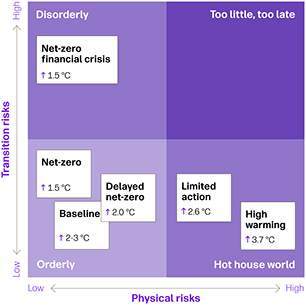
A depiction of the Ortec scenarios and baseline according to temperature, and the level of physical and transition risk can be found in the figure below.
In the above figure the warming assumed in the reference baseline is most closely aligned with the LA pathway due to the similar range of global temperature increases of 2-3 °C. It is worth noting the NZ pathway can now be seen as an optimistic scenario where the global temperature increase is only 1.5°C.
In the scenario analysis we also consider two stress variants of the HW and NZFC pathways. The stress variant of the NZFC pathway incorporates the impact of a more severe sentiment shock, where the stress is double that of the regular NZFC pathway. In the HW pathway, there are two pricing-in periods that represent the long-term impacts of physical risk. The HW stress variant uses a more severe damage function1 and assumes the second pricing-in period of the HW pathway materializes earlier, meaning the physical impacts are more severe, sooner.
| 1 | High Warming scenario uses the Logistic 5°C damage function, whereas the High Warming Stress variant uses the Logistic 4°C damage function, meaning 100% GDP loss is reached earlier, at 4°C instead of 5°C. |
| Annual Report on Form 20-F 2024 | 463 |
|
|
About Aegon Governance and risk management Financial information Sustainability information | |||
Macroeconomic modeling
The climate pathway assumptions drive macroeconomic changes per region and sector (e.g. GDP, inflation, and sector GVA). As an example, in the following figure the projected cumulative impact on US GDP is shown for each pathway, together with the risk driver contribution from transition risks (i.e. policy & technological changes) and physical risk (i.e. gradual impact & extreme weather events).
The below figure illustrates firstly the greatest ultimate cumulative GDP impacts for the HW pathway, followed by the LA pathway and then followed by DNZ pathway. In these pathways we notice physical risks are particularly prominent with gradual physical risk impacts increasing significantly over time. In the net-zero (NZ & NZFC) pathways which follow, the ultimate cumulative GDP impacts are smaller having successfully transitioned to a net-zero world by 2050. Nevertheless, locked-in physical impacts still emerge in these pathways.
Cumulative US GDP impacts and contribution by year, risk driver, and pathway

Financial modeling
The next step in the modelling involves employing financial modelling to translate the macroeconomic impacts to financial variables and capturing pricing dynamics. In particular, Climate MAPS translates climate-GDP/GVA and CPI shocks over time to 600+ financial & economic variables. These variables have a high degree of granularity differing by country, sector and year for each pathway.
As an example, the below figure shows the projected annual impact across four pathways for US equities and US investment grade corporate bonds.
In the case of the HW and LA pathways, where physical risk is prominent, two pricing-in periods are assumed where financial markets price in physical risks of the coming 40 years during 2026-2030, and risks of 40-80 years during 2036-2040. We observe these pricing-in moments negatively impact both US equities and US corporates. However, US investment grade corporates exhibit a strong rebound in the ensuing years of both periods. Fixed income investments are projected to be more resilient to climate-related risks than equities, due to the seniority of bondholders compared to shareholders and the limited term to maturity of corporate bonds.
| 464 | | Annual Report on Form 20-F 2024 |
| Strategy |
||||
In contrast, in the NZFC pathway, where transition risk is prominent, a severe negative impact is concentrated in 2025 for both asset classes when sudden disinvestments, to align portfolios to the Paris Agreement goals, have disruptive effects on financial markets, with sudden repricing followed by stranded assets and a sentiment shock. US
corporate bonds demonstrate considerable resilience in 2026 as the market adjusts and perception shifts post-repricing, unlike US equities. The DNZ pathway displays a much smoother and slower transition, where net-zero is realized but delayed (later than 2050), without the extreme sentiment shock that occurs with NZFC.
US equity and corporate bond impact by year and pathway
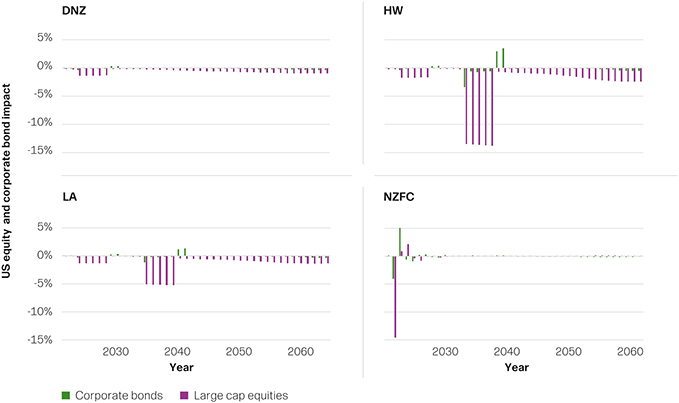
Mapping to Aegon exposures
In this final stage we apply mapping where Aegon’s assets, encompassing both securities and funds, are mapped to asset benchmarks available in Climate MAPS. The Climate MAPS solution has a large suite of asset benchmarks available with a high level of granularity by asset class, region and rating. The depth and breadth of available asset benchmarks is strongest for more traditional asset classes (e.g. equities, government bonds, corporate bonds, real estate) however we observe for less traditional exposure (e.g. mortgage assets) mapping can be more challenging thus requiring the use of proxies.
In this step we need to make assumptions of how the general account and separate account asset portfolios evolve over time. In the results generated we assume a constant portfolio asset allocation over time.
Furthermore, we assume the general account portfolio is modelled as a static portfolio thus its value rises and falls with its investment return but does not take account of other external dynamics e.g. new money inflows, claims outflows, etc.
It is worth noting in the case of fixed income credit the asset exposure is mapped to a combination of corporate bond benchmarks with specific credit ratings. Given we assume a constant asset allocation over time this implicitly assumes a regular rebalancing of the exposure, as defaults and migrations emerge, to maintain the initial credit rating split. An alternative modelling approach would be to assume less dynamic management of the fixed income assets where we buy and hold the securities.
Results of the quantitative climate risk assessment
Following application of the mapping, the end model output is climate adjusted risk-return metrics for Aegon’s asset portfolios up to 40 years ahead over the different climate pathways.
An example of this output is shown in the figure below which illustrates the 2024 results in respect of the overall general account asset portfolio. Results are shown as a return impact versus a climate informed baseline outlook. Of the five core pathways (solid lines), the chart illustrates the HW pathway has the greatest ultimate cumulative impact on the portfolio where the impacts develop more gradually but
| Annual Report on Form 20-F 2024 | 465 |
|
|
About Aegon Governance and risk management Financial information Sustainability information | |||
accelerate later following the significant physical risks of this path manifesting and future impacts being priced in by the financial markets. In the case of the LA pathway we see a similar shape to the impacts though they are less severe than the HW.
The DNZ and NZFC pathways, in line with expectation, have a smaller ultimate cumulative impact versus HW and LA. Given the delay in reaching a net-zero world, the cumulative impacts for the DNZ pathway are slightly more severe than the NZFC due to the accumulated physical risk impacts. However, in the case of NZFC significant return volatility is observed in the short term. The NZ pathway is smooth and returns are resilient, displaying the most optimistic outcome.
Overall the projections demonstrate good resilience in the value of the general account portfolio against key systemic climate risk drivers over a 40-year horizon. This is largely attributed to the high allocation of fixed income assets in the general account (in this analysis c. 85% of the general account exposure is mapped to fixed income assets and within this over 50% of the general account exposure is mapped US corporate bonds), which serves to limit the cumulative climate-related impact on returns. The expected return from the fixed income asset class is forecasted to be less exposed than equities, real estate, or other asset classes to climate risks.
Despite the above assessment it is important to recognize the high degree of uncertainty with respect to outcomes projected above. Climate risk scenario modelling is a very challenging topic involving a significant amount of assumptions and the need for modelling complex interactions. Furthermore it is important to recognize the projected outcomes show only the median outcome under the modelled pathway, and not the uncertainty underlying the point estimate.
In recognition of this in the figure below the results of two stress variants for the NZFC and HW pathways (see dashed lines) are also shown. These represent stress scenarios of the original pathways, where extreme shocks are applied to test the resilience of Aegon’s general account portfolio in these scenarios. The effects of the more severe damage function can be seen in the HW stress variant, with cumulative returns around 5% more severe by the end of the 40 year projection. The NZFC stress variant also depicts the more severe sentiment shock in 2025 however the long-term impacts of this stress are reasonably muted.
Return impact versus baseline (cumulative) by year and scenario
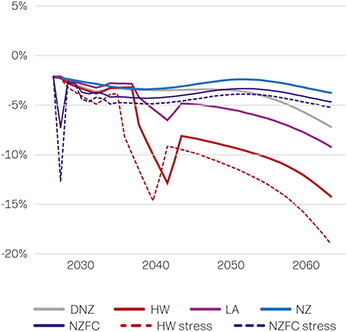
It should be noted the analyses above were performed at portfolio level across the various climate scenarios, however as mentioned at the outset an asset level climate risk analysis was also performed, providing additional granularity in the analysis i.e. looking at Aegon’s general account assets type mix, sector mix, and region mix. This analysis considers both transition risk and physical risk individually, in contrast to the scenario where the interplay of these risks is captured. The objective is to complement the above portfolio level results with additional reporting granularity, to help better understand the anticipated financial effects from physical and transition risk within Aegon’s general account portfolio.
Asset level physical and transition climate risk analysis
This section will focus on asset level analysis to further investigate transition and physical risk independently. This analysis will consider the asset side of the balance sheet with the scope restricted to the Aegon general account assets. In the figure below, the asset weighting of the Aegon general account is shown as at end December 2024.
| 466 | | Annual Report on Form 20-F 2024 |
| Strategy |
||||
General account asset weighting
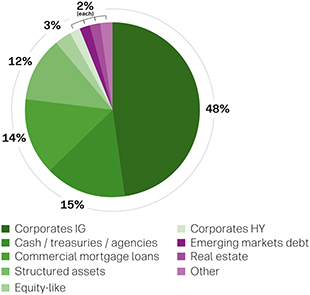
The objective of this analysis is to provide an understanding on how physical and transition risks have (or could reasonably be expected to have) a material influence on the undertaking’s financial position, financial performance and cash flows, over the short-, medium- and long-term. For this purpose Aegon has defined the short-, medium- and long- term as follows:
| • | Short-term – 0 to 3 years, a period aligned with Aegon’s business planning cycle |
| • | Medium-term – 3 to 10 years, a period encompassing our net-zero commitments for 2030 |
| • | Long-term – 10+ years |
The climate scenario analyses were carried out to inform the assessment of anticipated financial effects from material physical and transition risks.
The five climate scenarios considered were the same as for the portfolio level climate scenario analysis: NZ, NZFC, DNZ, LA and HW. For more details on the scenarios, see table “Overview of climate pathways” earlier in the section.
The assessments below have been made without considering climate change mitigation and adaptation actions for transition and physical risk respectively (i.e. are gross impacts).
Transition risk
Transition risk covers climate risk associated with the transition to a low-carbon economy driven by changes in policy, regulation, technology and market / consumer sentiment. For the assets comprising the Aegon general account, this risk may manifest via investments in sectors or companies which are adversely exposed to a transition to a low-carbon economy and thereby lose value or experience default or a downgrade.
For this analysis, the impacts of this risk are expected to vary by time horizon such that there a medium impact over a short-term horizon and a high impact over a medium- and long-term horizon.
To assess the significance of this risk to Aegon the projected return of different asset types / sectors were considered under the net-zero pathways above where transition risk is most prominent.
For example, in the figures below the sectoral performance is shown for US investment grade corporates and US equity under the DNZ scenario.
US IG corporates cumulative returns by sector (DNZ)

| Annual Report on Form 20-F 2024 | 467 |
|
|
About Aegon Governance and risk management Financial information Sustainability information | |||
US equities cumulative returns by sector
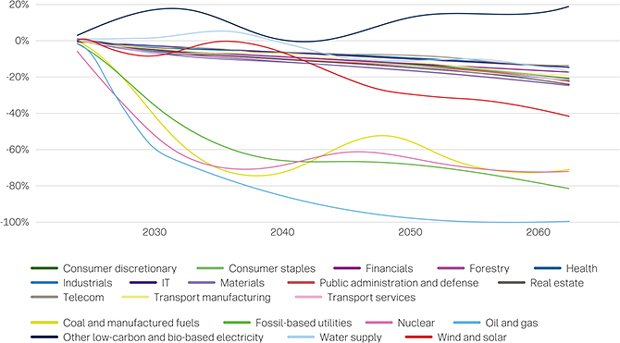
The charts above demonstrate a large differentiation in returns by sector under this DNZ pathway. As expected, very carbon intensive sectors such as oil & gas, fossil-based utilities and coals & manufactured fuels are most adversely affected.
It is also observed that the magnitude of the adverse impacts differs substantially for equity and investment grade corporate bonds, with the former having much more extreme impacts.
Given this insight, the sector breakdown of Aegon’s general account was examined to understand Aegon’s exposure to these sectors which have the greatest transition risk exposure. For example, in the figure below the sectoral breakdown of the Transamerica general account corporate bond holdings1 are shown. Corporate bonds represents the largest holdings in the Aegon general account, accounting for close to half of its exposure as at end December 2024.
General account corporate bonds by sector

In the above figure the sectoral breakdown of Transamerica’s general account corporate bonds holdings are well diversified by sector and the exposure to more carbon intensive sectors (e.g. energy, natural gas) is not overly concentrated. This feature helps limit Aegon’s transition risk exposure relating to the Aegon general account assets.
| 1 | The value of Transamerica’s general account represents around 96% of the Aegon general account |
| 468 | | Annual Report on Form 20-F 2024 |
| Strategy |
||||
Physical risk
Physical risk covers climate risks associated with the physical changes, e.g. temperature, rising sea levels, decreasing land, labor and productivity. These risks are driven by extreme weather events (i.e. acute physical risk) and gradual temperature changes (i.e. chronic physical risk).
The assumption is the impacts of this risk would increase with time horizon such that it has a low impact over a short-term horizon, a medium impact over a medium-term horizon and a high impact over a long-term horizon.
To assess the significance of this risk to Aegon the projected returns of different asset types and sectors under the HW pathway where physical risk is very prominent. In the figure below, the projections for the HW pathway are shown.
Returns by asset type (HW)
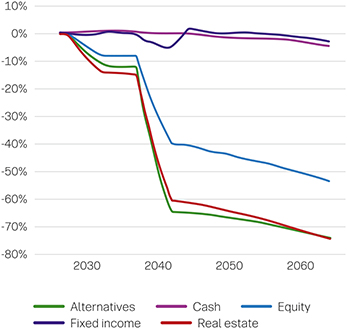
Impacts on GDP (HW)

In the HW scenario, where physical risk is very prominent, there is a large variation in returns by asset type. For example, real estate (including alternatives) are most adversely affected followed by equity, with cash and fixed income assets more resilient. Under the HW pathway the level of sector performance differentiation is more limited with the region of exposure being a much bigger distinguishing factor.
Given this insight, Aegon’s general account asset type and regional breakdown were examined. Firstly, from a regional perspective the general account exposure is heavily concentrated in the US. Per the above figure, the US projected GDP Impact sits approximately halfway between the minimum and maximum outcomes shown.
Aegon’s general account asset weighting is heavily fixed income orientated with smaller amounts allocated to real estate and equity-like holdings. In the Aegon general account, in line with peer companies, there is also a meaningful exposure to commercial mortgage loans. Currently no scenario projections are available to Aegon for this specific asset class but it is expected that the result would be more adverse than traditional fixed income given the indirect real estate linkage. Nevertheless, we believe the characteristics of the loans (e.g. LTV levels) and underlying collateral provide strong mitigating features.
Overall, we believe the above considerations help limit Aegon’s physical risk exposure relating to the Aegon general account assets.
Finally, it is worth noting this assessment has been made more from a top-down (i.e. an asset class, sector and region level) perspective. We are concurrently developing our bottom-up assessment capabilities (i.e. a security and property level) and thus our ambition would be to disclose more on this in the future as we continue to enhance our security level climate data.
Conclusions
The above analysis suggests Aegon’s more limited exposure to both physical and transition risk when considering Aegon general account assets. Both the scope and methodology will continue to evolve as Aegon works towards quantitative disclosures in the future.
Our underwriting
As Aegon is primarily a life insurance company, there is less exposure to the direct consequences of increasing frequency and severity of climate-related events. Climate-related risks are expected to materialize over time through shifts in the average mortality and morbidity rates. These developments are highly uncertain, and there has always been a continuous shift in mortality and morbidity rates, with underlying driving factors influencing these rates up and down. Historically, we have observed a general decline in mortality rates. People are living longer, mainly through the
| Annual Report on Form 20-F 2024 | 469 |
|
|
About Aegon Governance and risk management Financial information Sustainability information | |||
advancement of science, while behavioral changes such as obesity and drug addiction are examples of drivers that cause higher mortality. Climate change is likely to be an additional driver that can impact mortality positively or negatively.
In a 2014 study by the World Health Organization titled ‘Quantitative risk assessment of the effects of climate change on selected causes of death 2030s and 2050s’, an estimate is made on the impact of climate change on additional mortality.
According to the study, globally, the yearly projected number of around 250,000 additional deaths due to climate change is a small fraction of the global population and is concentrated in markets in which Aegon does not operate. The financial effects for Aegon would therefore be minimal.
| 470 | | Annual Report on Form 20-F 2024 |
| Risk management |
||||
Risk management
The risk management section details Aegon’s high-level risk management process and our stakeholder engagement.
Processes for managing climate-related risks
At Aegon, climate-related risks are managed through a comprehensive approach that includes qualitative and quantitative assessments and analysis, tracking of climate- related targets and commitments, compliance with applicable risk policy requirements, engagement with investee companies, and the implementation of investment criteria and exclusions.
Aegon recognizes that key to climate-related risk management is good-quality data. We prioritize the analysis of good quality data to assess and mitigate climate-related risks across our investment portfolio. This includes tracking of key performance indicators related to climate targets and commitments, and pursuing alignment with international standards and best practices. Moreover, we actively engage with investee companies to encourage climate-conscious strategies and initiatives, promoting transparency and accountability within our investment ecosystem. We also consider climate-related risks as part of our investment decision making. In cases where the substantiation of the identified risks through data remains limited, climate risk assessment scores rely on expert judgment. There are globally acknowledged challenges regarding data, including availability, resource limitations, and associated costs. Looking forward, our aim is to, where and to the degree possible, improve data substantiation of our assessments to achieve greater transparency in scoring and facilitate objective evaluations of assessment scores.
Further, Aegon applies a broad range of day-to-day processes, within a framework of applicable policies, to manage climate-related risks. Such processes include, but are not limited to:
| • | Adapting investment strategies and exposures |
| • | Scenario analysis and stress testing |
| • | Claims analysis |
| • | Product development and redesign |
| • | Adapting pricing and underwriting |
| • | Guardrails on marketing materials |
| • | Use of greenwashing checklists |
| • | Property insurance |
| • | Leasing, not owning property |
| • | Business continuity plans |
| • | Third-party due diligence |
| • | Tracking regulatory landscape, trends, and scientific developments |
| • | Implementing new regulatory requirements |
| • | Ensuring robust non-financial reporting processes and controls |
With these measures, we are dedicated to safeguarding our business against climate-related threats while promoting sustainable processes that align with our long-term financial objectives.
Integration of climate-related risk management into overall risk management
At Aegon, sustainability risk, and by extension climate risk, is not considered a separate risk type, but rather a risk driver that impacts multiple risks. Sustainability risk is embedded in Aegon’s Enterprise Risk Management (ERM) framework and incorporated in relevant risk policies, laying a foundation for our ongoing efforts. Our risk policies, including the sustainability risk requirements, are regularly reviewed and, where needed, updated to stay abreast with relevant developments.
As part of our risk management practices, we conduct an annual emerging risk assessment or horizon scan that identifies newly developing or changing risks or signals perceived to have a potential significant impact on Aegon’s financial strength, competitive position or reputation. Sustainability risks, including climate risks, are explicitly considered in this exercise. The findings from this process are used to inform strategic and financial planning, scenario analyses, watch lists, management discussions, and actions, as well as external and internal reporting. For more information on the process, we refer to the Risk Management section of this Annual Report.
The companywide CRA serves multiple purposes, including identifying relevant climate risks for the organization, understanding their severity and manageability, and providing recommendations for necessary actions. The outcomes of the global CRA process are integrated into the broader Group Solvency Self-Assessment (GSSA) processes.
Aegon is developing a global sustainability risk appetite to foster the appropriate management of climate risk within its overall risk management framework. This risk appetite will be aligned with the organization’s overall risk appetite framework and take into account existing strategies, requirements, and commitments. As we gather more data and insights, the sustainability risk appetite will evolve and mature accordingly.
Through these efforts, Aegon is committed to effectively integrating sustainability and climate risk considerations into its risk management processes, thereby ensuring the organization is well-prepared to navigate the challenges and opportunities presented by a dynamic and ever-changing world.
| Annual Report on Form 20-F 2024 | 471 |
|
|
About Aegon Governance and risk management Financial information Sustainability information | |||
Stakeholder engagement
Engagement with investee companies
As an institutional investor, Aegon expects investee companies to actively manage their climate transition strategy and move from ambition to action. Executed through our asset manager, we engage with the companies we invest in to encourage better climate-related risk practices, including emissions measurement, disclosure, target setting, and reporting in line with the TCFD recommendations. Our engagements aim to stimulate structural and sectoral change by requesting the reduction of an investee company’s carbon footprint and intensity, as well as by encouraging an increase in the share of renewable energy it generates or purchases to mitigate the negative impacts of climate change. We use a variety of approaches to engage with our investee companies, including bilateral and collaborative approaches.
Among investee companies in our general account, we aim to engage with at least the 20 largest corporate carbon emitters by absolute emissions by 2025. For companies in our general account, we prefer engagement to be private and confidential, as this enables more targeted and tailored discussions that can yield more meaningful changes over time. Within this lens, we directly engage with top emitters and encourage them to set science-based targets.
Top emitters in the general account are early in their climate transition journey, with many setting cautious decarbonization targets or have yet to disclose targets at this stage. As we continue to engage with these top emitters, our objective will be to meet companies where they are in their climate transition process, further encouraging them to set time-bound and science-based targets in line with the Paris Agreement goals and begin developing and monitoring climate transition plans where possible.
Beyond engaging with investee companies in the general account, Aegon AM in the Netherlands and the United Kingdom also takes part in collaborative initiatives and investor-led campaigns for its separately managed accounts and third-party clients. For example, they participated in CDP’s Non-Disclosure Campaign, which promotes engagement with non-disclosing companies with a significant environmental impact and encourages them to provide measurable data on emissions, water, and forests. They also joined CDP’s science-based targets campaign, an investor-led initiative that urges more than 1,000 high-impact companies to set 1.5°C aligned science-based emissions reduction targets, as well as CDP’s new Green Finance Accelerator to reduce the information gap on sustainable finance taxonomies and adverse impacts.
As a member of the Dutch investor association, Eumedion, and the United Kingdom Investor Forum, Aegon AM increasingly discusses board-level incentives linked to climate action plans with companies from different sectors and raises related expectations for transparency and disclosure in remuneration reports.
Engagement with policymakers
Aegon acknowledges the importance and necessity of government action in addressing climate change. Engagement with policymakers is critical to shaping our investment environment and advancing real-world decarbonization efforts in line with the Paris Agreement. We work independently and in collaboration with industry groups to engage on key climate issues.
At the global level, Aegon supported the 2024 Global Investor Statement to Governments on the Climate Crisis, which seeks to unify investor and financial sector voices to call for comprehensive climate action. The statement calls on governments to raise their climate ambition in line with the goal of limiting global temperature rise to 1.5°C, focusing on five policy actions: i) enacting economy-wide public policies; ii) implementing sectoral strategies, particularly in high-emitting sectors; iii) addressing nature and biodiversity challenges stemming from climate change; iv) calling for climate-related financial disclosures, and; v) facilitating more private investment into climate mitigation and adaptation activities in emerging markets and developing economies.
Aegon has also engaged in international insurance policymaking through the Geneva Association, a think tank for the global insurance industry. The Geneva Association, which has a separate research stream for climate change and the environment, has responded to multiple climate-related consultations of the International Association of Insurance Supervisors (IAIS). In 2024, the IAIS issued climate-related consultations on market conduct and scenario analysis, guidance for supervision of climate risk, supervisory reporting and public disclosure, and macroprudential issues. Through the Geneva Association, Aegon has supported supervisory measures intended to lead to sound policyholder protection, appropriate macroprudential risk assessment, and useful public information.
At the European level, Aegon supports the goals of the EU strategy for financing the transition to a sustainable economy and recognizes the important role financial actors play in the transition. Aegon has engaged with officials and contributed to consultations on sustainability disclosures, and also advocated for action to complete the Capital Markets Union to unlock capital from institutional and cross-border investors to fund sustainable transition projects in Europe.
In Bermuda, Aegon has provided input to the Bermuda Monetary Authority (BMA) in its initial efforts to develop disclosures of climate-related risks and opportunities in line with TCFD reporting. The BMA is expected to issue a formal proposal in 2025. Aegon is also an active member of the Climate Risk and Disclosure Working Group of Bermuda International Long-Term Insurers and Reinsurers (BILTIR), the life insurance trade association in Bermuda.
| 472 | | Annual Report on Form 20-F 2024 |
| Metrics and targets |
||||
Metrics and targets
The metrics and targets section provides an overview of some of Aegon’s climate-related disclosures and all targets associated with climate change. As part of its Sustainability statement, Aegon discloses more granular information on its scope 1, 2 and 3 emissions in the Metrics section of the Environmental information section.
Our suppliers
In 2024, Aegon completed its first global calculation of indirect emissions related to purchased goods and services. Aegon’s 2024 carbon emissions footprint of 158,500 tCO2e reflects the baseline against which we will measure our climate impact in future years.
To date, Aegon has not set a target for greenhouse gas emissions associated with its purchased goods and services.
| Metric |
Unit | |
2019 baseline |
|
2024 | 2023 | |
Progress against baseline |
|
|
Target 2025 |
|
|
Target 2030 |
|
|||||||||||||
| Emissions by spend for purchased goods and services | tCO2e | n.m. | 158,500 | n.m. | n.a. | n.a. | n.a. | |||||||||||||||||||||
Source: Aegon’s Sustainability statement
n.a. - not applicable; n.m. - not measured
Our operations
Aegon has committed to reducing its global operational footprint (scope 1 and 2; location-based) by 25% by 2025 against a 2019 baseline. In 2024, Aegon restated its 2019 baseline, reflecting changes due to the a.s.r. transaction and evaluated progress towards the 2025 target. By the end of 2024, Aegon achieved a 75% reduction in its operational GHG emissions compared to the updated 2019 baseline, exceeding the 25% reduction target.
In 2024, we set a new target for a 75% reduction for our operational scope 1 and 2 emissions by 2030, against a 2019 baseline. Aegon does not use carbon offsetting to meet its operational carbon footprint target.
| Metric |
Unit | |
2019 baseline |
|
2024 | 2023 | |
Progress against baseline |
|
|
Target 2025 |
|
|
Target 2030 |
|
|||||||||||||
| Scope 1 and scope 2 emissions (location-based) | tCO2e | 30,886 | 7,682 | 13,246 | (75% | ) | (25% | ) | (75% | ) | ||||||||||||||||||
Source: Aegon’s Sustainability statement
Our investments – General account
Aegon’s general account is invested in a variety of asset classes. A breakdown of these asset classes can be viewed in the graph1 below. To date, Aegon has measured the carbon footprint for asset classes outlined below and set targets where appropriate.
Global general account by asset class

| 1 | Due to rounding, the graph may not total to 100%. |
| Annual Report on Form 20-F 2024 | 473 |
|
|
About Aegon Governance and risk management Financial information Sustainability information | |||
| Asset class | Unit | 2024 | ||||||
| Fixed income and equity |
EURm | 54,636 | ||||||
| Corporate fixed income and listed equity |
EURm | 29,220 | ||||||
| Sovereign fixed income |
EURm | 7,577 | ||||||
| Other fixed income (ABS, etc.) |
EURm | 17,839 | ||||||
| Directly-held real estate investments |
EURm | 131 | ||||||
| Mortgages & loans |
EURm | 10,682 | ||||||
| Other (investment funds, cash, etc.) | EURm | 10,116 | ||||||
Corporate fixed income and listed equity
Following the guidance of the NZAOA Target Setting Protocol, for 2025, Aegon has set a target to reduce the weighted average carbon intensity (WACI) of corporate fixed income and listed equity in its general account by 25% compared with a 2019 baseline.
In 2024, the WACI of our corporate fixed income and equity investments decreased by 52% compared with 2019. Since 2023, the WACI reduction target has also been included in executive remuneration to ensure that executive-level corporate actions are aligned with our net-zero commitment.
Weighted average carbon intensity of corporate fixed income and listed equity
| Metric |
Unit | |
2019 baseline |
|
2024 | 2023 | |
Progress against baseline |
|
|
Target 2025 |
|
|
Target 2030 |
|
|||||||||||||
| Weighted average carbon intensity |
|
tCO2e / EURm revenue |
|
459 | 222 | 283 | (52% | ) | (25% | ) | (50% | ) | ||||||||||||||||
| Carbon footprint |
|
tCO2e/EURm invested |
|
n.m. | 89 | 80 | n.a. | n.a. | n.a. | |||||||||||||||||||
| Total carbon emissions | tCO2e | n.m. | 2,353,463 | 1,704,837 | n.a. | n.a. | n.a. | |||||||||||||||||||||
Source: Aegon’s Sustainability statement
n.a. - not applicable; n.m. - not measured
In 2024, Aegon set a 2030 target to reduce the WACI of corporate fixed income and listed equity in our general account by 50% compared with a 2019 baseline. Key drivers that inform the updated target include how the carbon intensity of underlying issuers is factored into strategic asset allocation decisions, market conditions, and the incremental reductions in issuers’ emissions over time.
Corporate fixed income and listed equity results are dominated by holdings in the electric and energy sectors where their contribution to the total carbon emissions and intensity of the account greatly outweighs their financial position. The graph “Active contribution by sector (in %)” indicates how Aegon’s sector exposures impact the weighted average carbon intensity and total carbon emissions, relative to their financial positions. The “Basic” sector includes chemicals, paper, metals and mining.
Active contribution by sector
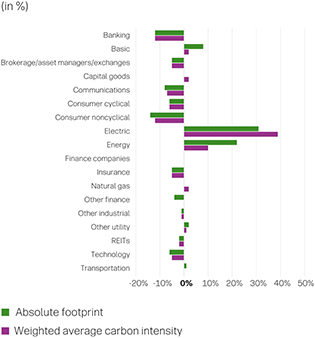
Sovereign fixed income
As per NZAOA guidance, Aegon also discloses the total carbon emissions associated with its sovereign fixed income investments. There is no current target-setting methodology for this asset class.
| 474 | | Annual Report on Form 20-F 2024 |
| Metrics and targets |
||||
Global general account – Sovereign fixed income
| Metrics | Unit | 2024 | 2023 | Coverage | ||||||||||||
| Including land use, land-use change, and forestry (LULUCF) emissions |
||||||||||||||||
| Total carbon emissions |
tCO2e | 1,228,301 | n.m. | n.m. | ||||||||||||
| Carbon footprint |
tCO2e/EURm invested | 253 | n.m. | 84% | ||||||||||||
| Weighted average carbon intensity |
tCO2e/GDP PPP int $ | 253 | n.m. | 84% | ||||||||||||
| Excluding LULUCF emissions |
||||||||||||||||
| Total carbon emissions |
tCO2e | 1,349,558 | n.m. | n.m. | ||||||||||||
| Carbon footprint |
tCO2e/EURm invested | 278 | n.m. | 84% | ||||||||||||
| Weighted average carbon intensity |
tCO2e/GDP PPP int $ | 278 | n.m. | 84% | ||||||||||||
Source: Aegon’s Sustainability statement
n.m. - not measured
The results are dominated by our US holdings, where their contribution to the footprint and intensity of the account outweighs their financial position. The graph “Active contribution by region (in %)” provides an indicates how Aegon’s regional exposures impact the weighted average carbon intensity and total carbon emissions, relative to their financial positions.
Direct real estate investments
In June 2023, we also set an additional target for our direct real estate investments, committing to reducing the scope 1 and 2 carbon intensity of our directly-held real estate investments by 25% (kgCO2e/m2) by 2025, compared with a 2019 baseline. From the end of 2024, the carbon intensity had decreased by 51% compared with 2019.
Active contribution by region

Carbon intensity of direct real estate investments
| Metric | Unit | 2019 baseline |
2024 | 2023 | Progress against baseline |
Target 2025 | Target 2030 | |||||||||||||||||||||
| Carbon intensity |
kgCO2e/m2 | 139 | 68 | 82 | (51% | ) | (25% | ) | (42% | ) | ||||||||||||||||||
Source: Aegon’s Sustainability statement
Aegon has set a new target towards 2030 to reduce the scope 1 and 2 carbon intensity of its directly-held real estate investments by 42% (kgCO2e/m2) by 2030, compared with a 2019 baseline. The target was driven by Aegon’s limited exposure to the asset class and the expected marginal intensity reductions through minor efficiency improvements for in-scope properties, while striving to improve data coverage.
Actions to decarbonize
Complementing efforts to reduce GHG emissions in our general account portfolio, we use investments and engagement strategies as additional levers to meet our net-zero commitments and actively manage the positioning of our portfolio in relation to the climate transition. To that end, Aegon had committed to two intermediate targets by 2025, which further commit the company to investing USD 2.5 billion in opportunities that help mitigate climate change or adapt to the associated impacts, and engaging with at least the top 20 corporate carbon emitters in the portfolio. These have both been achieved.
| Annual Report on Form 20-F 2024 | 475 |
|
|
About Aegon Governance and risk management Financial information Sustainability information | |||
Additional climate-related targets set on Aegon’s general account
| Target |
Unit | 2019 | 2024 | 2023 | Progress | Target 2025 | Target 2030 | |||||||||||||||||||||
| Investment in solutions contributing to climate mitigation and/or adaptation | USDb | n.a. | 2.7 | 1.8 | 44% | 2.5 | 3.5 | |||||||||||||||||||||
| Number of engagements with heaviest corporate carbon emitters | number | n.a. | 20 | 19 | 5% | 20 | 20 | |||||||||||||||||||||
Source: Aegon’s Sustainability statement
n.a. - not applicable
As part of its updated targets towards 2030, Aegon has committed to investing an additional USD 1 billion, on top of Aegon’s existing USD 2.5 billion commitment, in climate solution investments.
This totals USD 3.5 billion compared with our 2019 baseline. Aegon will also continue to engage with at least the top 20 corporate carbon emitters in its general account portfolio.
Our investments – Separate account
Targets on the separate account are driven by customer preferences across geographies.
In 2019, Aegon UK committed to net-zero GHG emissions by 2050 for its portfolio of workplace default funds for all scopes of emissions and across all asset classes, excluding cash. They introduced an interim target to reduce the GHG emissions of their corporate fixed income and listed equity assets by 50% by 2030, against a 2020 baseline. Between 2020 and 2024, they reduced their scope 1 and 2 GHG emissions by 40% for corporate fixed income and listed equity.
They have also committed to GBP 500 million invested in climate solutions by 2026 and are engaging with corporates representing 78% of their scope 1, 2 and 3 emissions through various channels.
Methodology
Our suppliers
In 2024, Aegon reported on the GHG emissions associated with our supply chain for the first time. Aegon uses a spend-based approach in line with the GHG Protocol’s Corporate Accounting and Reporting Standards. This method estimates all upstream emissions from the production of products purchased or acquired by Aegon during the reporting year by multiplying the economic value of these goods and services by their respective cradle-to-gate emission factors. These emission factors capture a high-level combined estimate of scope 1 and location-based scope 2 emissions of the suppliers, factoring in their specific industry and the average grid emissions intensity of their location.
Our operations
Aegon aligns its methodology with the GHG Protocol’s Corporate Accounting and Reporting Standard. In 2024, we restated our 2019 baseline, triggered by the a.s.r. transaction and is representative of the underlying activities. It reflects all properties that we use for our primary operations. The reporting boundaries did not change in 2024.
Aegon’s approach to estimating GHG emissions includes scope 1 emissions from direct sources and scope 2 emissions from purchased electricity. Scope 1 emissions are based on actual energy usage from billing information or meter checks, with data extrapolated by floorspace for sites missing consumption data. Conversion factors for scope 1 are sourced from the United Kingdom Department for Environment, Food & Rural Affairs (Defra) with local assumptions for the energy blend of the United States, the Netherlands, United Kingdom, Spain, and Hungary. Scope 2 emissions are calculated using the GHG Protocol’s location-based approach, reflecting average grid emissions intensity with industry-standard factors. Where possible, locally-specific conversion factors are used.
Our investments
As of Q1 2024, Aegon updated the underlying methodology and reporting approach for its climate-related metrics. In terms of methodological changes, for corporate fixed income, listed equity and sovereign fixed income, Aegon now sources its carbon emissions data from MSCI only, instead of using emissions information from multiple sources. Additionally, Aegon has stopped extrapolating WACI based on available data coverage. The change in data vendors led to a restatement of previous year’s WACI and 2019 baseline and also informed the 2030 net-zero target-setting process.
Corporate fixed income and listed equity metrics were calculated following the Partnership for Carbon Accounting Financials (PCAF) guidelines and include reported and estimated scope 1 and 2 emissions. For sovereign assets, PCAF guidelines were followed as well. The disclosures are based on reported and estimated country level scope 1 emissions data. The data for 2023 has not been restated and is shown as “not measured.”
| 476 | | Annual Report on Form 20-F 2024 |
| Metrics and targets |
||||
The directly-held real estate investment metrics are calculated in line with PCAF guidelines and include scope 1 and 2 location-based emissions of those properties. Floorspace and energy usage data are relatively challenging to obtain, so the target is set on properties with available floorspace and energy usage data.
The amount for financing the transition investments is based on the IFRS book value of Transamerica’s general account, accounting for the use of proceeds specifically tied to climate change mitigation and/or climate change adaptation activities. The use of proceeds must align with at least one of
the stated sectoral themes outlined by the NZAOA. For labeled “green” or “sustainability” bonds, standards such as Bloomberg, as well as third-party opinions, are typically used to confirm that the stated use of proceeds meets eligibility criteria. Regarding engagements, Aegon aims to engage with at least the top 20 corporate carbon emitters based on WACI.
Targets are set in line with NZAOA guidance.
| Annual Report on Form 20-F 2024 | 477 |
|
|
About Aegon Governance and risk management Financial information Sustainability information | |||
Additional metrics
Introduction
In addition to metrics disclosed under the material topics in the Sustainability statement, Aegon also voluntarily discloses information relevant to our sustainability approach, benchmarks, and ratings.
Additional metrics
The table below includes information that goes beyond specific reporting requirements and is not linked to Aegon’s material topics identified through the DMA.
| unit | 2024 | 2023 | % | |||||||||||||
| Responsible investment solutions (RIS) |
||||||||||||||||
| Assets under management in Responsible Investment Solutions (RIS)1 |
EURb | 142.6 | 133.6 | 7% | ||||||||||||
| Exclusions and ethical solutions2 |
EURb | 113.7 | 109.9 | 3% | ||||||||||||
| Best-in-class ESG solutions3 |
EURb | 18.2 | 15.9 | 15% | ||||||||||||
| Climate transition solutions4 |
EURb | 3.8 | 1.2 | 220% | ||||||||||||
| Sustainable solutions5 |
EURb | 5.8 | 5.6 | 4% | ||||||||||||
| Impact investing solutions6 |
EURb | 1.1 | 0.9 | 18% | ||||||||||||
| Engagement and voting |
||||||||||||||||
| Number of engagements with investee companies7 |
nr | 422 | 556 | (24% | ) | |||||||||||
| Proportion of engagements addressing environmental themes |
% | 42% | 41% | 1pp | ||||||||||||
| Proportion of engagements addressing social themes |
% | 22% | 24% | (2pp | ) | |||||||||||
| Proportion of engagements addressing governance themes |
% | 36% | 35% | 1pp | ||||||||||||
| Status of engagement with investee companies8 |
||||||||||||||||
| Proportion of engagements at milestone one |
% | 37% | 30% | 7pp | ||||||||||||
| Proportion of engagements at milestone two |
% | 22% | 23% | (1pp | ) | |||||||||||
| Proportion of engagements at milestone three |
% | 25% | 29% | (4pp | ) | |||||||||||
| Proportion of engagements at milestone four |
% | 9% | 12% | (3pp | ) | |||||||||||
| Proportion of engagements where no further action is required |
% | 7% | 6% | 1pp | ||||||||||||
| Number of shareholder meetings of invested companies where votes cast9 |
nr | 3,538 | 3,853 | (8% | ) | |||||||||||
| Lobbying |
||||||||||||||||
| Political advocacy |
||||||||||||||||
| Monetary value of political contributions10 |
EURm | 0.3 | 0.2 | 52% | ||||||||||||
| Amount of internal and external lobbying expenses11 |
EURm | 0.7 | 0.8 | (5% | ) | |||||||||||
| Amount paid for membership to lobbying associations12 |
EURm | 3.6 | 3.6 | (1% | ) | |||||||||||
| Donations and volunteering |
||||||||||||||||
| Total cash donations13 |
EURm | 8.1 | 7.6 | 6% | ||||||||||||
| Inclusion through financial empowerment |
EURm | 1.4 | n.m. | n.m. | ||||||||||||
| Inclusion through social empowerment |
EURm | 5.5 | n.m. | n.m. | ||||||||||||
| Cash donations - Other |
EURm | 1.1 | 0.5 | 151% | ||||||||||||
| Proportion of cash donations to key themes |
% | 86% | 94% | (8pp | ) | |||||||||||
| Proportion of cash donations to Inclusion through financial empowerment |
% | 17% | n.m. | n.m. | ||||||||||||
| Proportion of cash donations to Inclusion through social empowerment |
% | 68% | n.m. | n.m. | ||||||||||||
| Number of organizations receiving donations |
nr | 491 | 420 | 17% | ||||||||||||
| Volunteering |
||||||||||||||||
| Volunteering hours |
hours | 23,123 | 20,637 | 12% | ||||||||||||
| Volunteering value14 |
EURm | 1.7 | 1.5 | 16% | ||||||||||||
| Total investment |
||||||||||||||||
| Total value community investment |
EURm | 9.8 | 9.1 | 8% | ||||||||||||
| Total value community investment as proportion of net result |
% | 0.4% | (4.6% | ) | 5.0pp | |||||||||||
| Management of relationships with suppliers |
||||||||||||||||
| Total spend on goods and services15 |
EURb | 1.2 | 1.3 | (9% | ) | |||||||||||
| Top 150 (“in-scope”) suppliers15 |
||||||||||||||||
| Spend on goods and services - top 150 in-scope suppliers |
EURb | 0.7 | 1.0 | (28% | ) | |||||||||||
| Proportion of total spend on goods and services with top 150 in-scope suppliers |
% | 60% | 75% | (15.4pp | ) | |||||||||||
| Supplier ESG assessment16 |
||||||||||||||||
| Number of in-scope suppliers assessed for ESG performance |
nr | 83 | 106 | (22% | ) | |||||||||||
| Spend on goods and services with in-scope suppliers assessed for ESG performance |
EURb | 0.5 | 0.8 | (32% | ) | |||||||||||
| Proportion of spend with in-scope suppliers assessed for ESG performance |
% | 75.3% | 80.2% | (4.9pp | ) | |||||||||||
| Overall score of in-scope suppliers assessed for ESG performance |
1-100 | 61 | 59 | 3% | ||||||||||||
| Proportion of in-scope suppliers scoring 1-24 (insufficient) |
% | - | - | - | ||||||||||||
| Proportion of in-scope suppliers scoring 25-44 (partial) |
% | 12% | 10% | 2pp | ||||||||||||
| Proportion of in-scope suppliers scoring 45-64 (good) |
% | 49% | 56% | (6pp | ) | |||||||||||
| Proportion of in-scope suppliers scoring 65-84 (advanced) |
% | 37% | 33% | 4pp | ||||||||||||
| Proportion of in-scope suppliers scoring 85-100 (outstanding) |
% | 1% | 1% | 0pp | ||||||||||||
| Weighted average time to pay an invoice |
days | 32.1 | 30.5 | n.m. | ||||||||||||
| Number of legal proceedings currently outstanding for late payments |
nr | - | - | - | ||||||||||||
| 478 | | Annual Report on Form 20-F 2024 |
| Additional metrics |
||||
| unit | 2024 | 2023 | % | |||||||||||||
| Integration ESG in risk policies17 |
||||||||||||||||
| Percentage of risk management policies where ESG risk considerations have been integrated into the in-scope policies | % | 100.0% | 100.0% | 0pp | ||||||||||||
| Business travel18 |
||||||||||||||||
| Air travel - total distance |
million km | 50.0 | 53.3 | (6% | ) | |||||||||||
| Air travel - Economy (as % of total distance) |
% | 75% | 76% | (1pp | ) | |||||||||||
| Air travel - Premium (as % of total distance) |
% | 25% | 24% | 1pp | ||||||||||||
| Air travel - Short distance (as % of total distance) |
% | 5% | 4% | 1pp | ||||||||||||
| Air travel - Medium distance (as % of total distance) |
% | 64% | n.m. | n.m. | ||||||||||||
| Air travel - Long distance (as % of total distance) |
% | 31% | 96% | (65pp | ) | |||||||||||
| Train travel - total distance |
million km | 1.7 | 1.7 | 3% | ||||||||||||
| Car travel - total distance |
million km | 7.3 | 6.9 | 6% | ||||||||||||
| Air travel - total emissions |
tCO2e | 7,483 | 8,301 | (10% | ) | |||||||||||
| Train travel - total emissions |
tCO2e | 49 | 59 | (17% | ) | |||||||||||
| Car travel - total emissions |
tCO2e | 1,177 | 1,896 | (38% | ) | |||||||||||
| Total emissions - business travel |
tCO2e | 8,709 | 10,256 | (15% | ) | |||||||||||
| Total emissions - employee commute19 |
tCO2e | 2,351 | n.m. | n.m. | ||||||||||||
| Responsible tax |
||||||||||||||||
| Total taxes borne by Aegon20 |
EURm | 374 | 637 | (41% | ) | |||||||||||
| Corporate income tax20 |
EURm | 30.2 | 314 | (90% | ) | |||||||||||
| Americas |
EURm | 38.4 | 30.4 | 26% | ||||||||||||
| United Kingdom |
EURm | 5.1 | 15.6 | (67% | ) | |||||||||||
| Netherlands |
EURm | (13.5 | ) | 263 | (105% | ) | ||||||||||
| Other |
EURm | 0.2 | 5.3 | (96% | ) | |||||||||||
| Taxes collected on behalf of others20 |
EURm | 2,222 | 2,320 | (4% | ) | |||||||||||
| Total customers21 |
million | 24.4 | 23.9 | 2% | ||||||||||||
| Americas |
million | 10.2 | 10.3 | (1% | ) | |||||||||||
| United Kingdom |
million | 3.7 | 4.0 | (8% | ) | |||||||||||
| International |
million | 10.5 | 9.6 | 9% | ||||||||||||
| New customers22 |
million | 4.1 | 4.0 | 4% | ||||||||||||
n.a. – not applicable; n.m. – not measured; pp - percentage points
| 1 | Aegon AM has a Responsible Investment Framework that reflects the key elements of Aegon’s Responsible Investment Policy and key elements of similar policies of Aegon AM’s third-party clients. The framework is structured around ESG integration, active ownership and solutions. The responsible investment solutions are based on five categories: 1) exclusions and ethical strategies; 2) best-in-class ESG strategies; 3) climate transition strategies; 4) sustainable strategies; and 5) impact investing strategies. |
| 2 | “Exclusions and ethical” reflects the portfolio subject to negative screening to avoid investments in certain sectors, companies, or practices based on specific criteria. It also includes Aegon’s general account assets managed by Aegon AM. |
| 3 | “Best-in-class” investments seek to outperform by emphasizing positive screening of issuers with better or improving ESG profiles relative to sector peers. |
| 4 | “Climate transition” investments include companies that are better prepared to manage climate risks. |
| 5 | “Sustainable” investment focuses on issuers whose activities or practices are aligned with sustainability themes in an effort to generate competitive returns over the long term. |
| 6 | “Impact investing” seeks financial returns alongside measurable positive social and/or environmental impact. |
| 7 | Aegon AM aims to build a constructive dialogue with companies and bodies, either bilaterally or as part of an investor consortium, to promote responsible business practices. The scope is focused on assets managed on behalf of third-party clients, but engagements may also be linked to Aegon’s general account investments. Percentages may not add up to 100 due to rounding. Topics are grouped according to the main theme. At times, there may be more than one theme for an engagement. The methodology to calculate this metric has changed compared with the previous year. The number of engagements is now calculated based on the number of contact points with issuers. Previously, this was based on manual grouping of contact points. Further, the theme “general disclosure” has been removed and integrated into environmental, social, and governance themes where applicable. The 2023 figures were recalculated based on the new methodology and restated to make comparison possible. |
| 8 | Status of engagement with investee companies is measured based on the milestones achieved. Milestone one: We have flagged our concerns and contacted the company. Milestone two: The company has responded (letter, email, phone call), and the dialogue has started. Milestone three: The company has taken concrete steps to resolve our concerns, such as the achievement of a commitment. Milestone four: The engagement goal has been fully achieved and verified. No further action required: In some cases, our assessment of the ESG issue at stake may change, and we subsequently decide to pursue the engagement no longer. |
| 9 | For Aegon AM’s relevant investment strategies that include equities, Aegon AM aims to vote in line with its engagement objectives and the client’s best interests. The scope is focused on assets managed on behalf of third-party clients, but investments may also be linked to Aegon’s general account investments. |
| 10 | Political contributions may include direct financial or in-kind support to political parties, their elected representatives, or persons seeking political office. It may also include indirect political contributions made through an intermediary organization such as a lobbyist or charity, or support made to an organization such as a think tank or trade association linked to or supports particular political parties or causes. The contributions consist of those made by Transamerica’s Political Action Committee (PAC), which acts independently from Aegon or Transamerica. The PAC receives voluntary donations from Transamerica employees and distributes the pooled donations according to the decision of the independent board of the PAC. |
| 11 | Political lobbying/advocacy refers to the expenses paid for activities carried out with governments, governmental institutions, and/or regulators in support of issues and initiatives that Aegon thinks will benefit its customers, employees, society, and businesses. The expenses mainly reflect the cost of personnel dedicated to lobbying or advocacy activities. |
| 12 | Membership of lobbying associations refers to an agreement by which someone joins a professional or advocacy association. A professional association is defined here as a body of persons engaged in the same profession, usually formed to maintain standards and represent the profession in discussions with other bodies or institutions. An advocacy association engages in advocacy on behalf of the profession with other bodies, institutions, or policymakers. However, advocacy may not be the only type of activity that the association undertakes. |
| 13 | Cash donations refer to contributions to charities and other non-profit organizations, done in accordance with the Aegon Ltd. Charitable Donations Standards. |
| 14 | The value of volunteering is calculated as the number of hours multiplied by the average hourly employee employment costs (= total employment costs/total hours worked by direct employees). The total number of working days in the reported period includes all working days, excluding weekends and national holidays. |
| 15 | Our top 150 suppliers consistently represent at least 80% of our total supplier spend. The proportion of total spend on goods and services with the top 150 (“in-scope”) suppliers is based on actual invoice payments and does not take into account accruals. As a result, the denominator “Total spend on goods and services (in EUR billions)” can not be reconciled to the expenses in the financial statements. Actual spend data is used for the reporting year until September 30. The last quarter is based on actual spend data of the prior year. |
| 16 | Suppliers are assessed using the EcoVadis methodology, which aims to measure the quality of a company’s sustainability management system through its policies and actions. Suppliers are assigned to five different scoring buckets based on the EcoVadis scoring methodology, which takes into account criteria relating to environmental protection, labor and human rights, business ethics, and sustainable procurement. The higher the score, the better the sustainability performance of the supplier. The spend data used to calculate the indicators for the supplier ESG assessment includes four quarters of data and covers the period from October 1 to September 30. |
| 17 | Includes in-scope Financial, Underwriting and Operational risk management policies where ESG risk considerations have been integrated. In-scope policies are those policies where ESG integration was planned. |
| 18 | Travel distance is based on actual travel data. Conversion factors for air travel are sourced solely from the UK Department for Environment, Food & Rural Affairs (Defra) as they apply to all countries. Conversion factors for car and train travel are sourced from Defra, the US Environmental Protection Agency, and the European Environment Agency. Air travel: short distance covers routes <483km or <300 miles, medium distance between 483km or 300 miles and 3,702km and 2,300 miles and long distance covers routes >3,702km or >2,300 miles. In 2024, we added the medium distance category. In 2023, medium distance was combined with long distance. |
| 19 | Employee commute only includes emissions associated with employees working permanently from home. Emissions relating to employees working from home, are extrapolated by applying an average employee energy consumption of our office premises for each business unit. |
| 20 | The data covers all entities over which Aegon has management control including divested businesses, up to the closing date. For corporate income tax, there is often no direct correlation between tax reported on earnings for any given year and amounts paid or received in tax. Part of the explanation for this is that certain tax-deductible items are not recognized in the company’s profit & loss statement but directly in equity. In addition, payments and refunds for prior years can impact the amounts paid or received in the current year. For more information see Aegon’s Global Tax Report. |
| 21 | Customers are those with individual, group, or corporate policies. This designation also includes those participating in pension plans controlled by trustees or those who have white-label products serviced by Aegon or Transamerica. Customers of our joint ventures are included on a 100% basis. In this context, the customers of our joint venture in Brazil are reported in the segment International. |
| 22 | New customers are those who acquired a product or service during the reporting period (and were not previously customers of Aegon). Customers of our joint ventures are included on a 100% basis. |
| Annual Report on Form 20-F 2024 | 479 |
|
|
About Aegon Governance and risk management Financial information Sustainability information | |||
External recognition
Aegon’s management of sustainability is recognized through third-party ESG ratings and benchmarks. These assessments provide independent recognition and transparency around the integration of sustainability into our business operations and are used by key stakeholders.
The thematic and topic-level expectations from these ratings also provides input for our DMA process. Our Global Sustainability Board (GSB) maintains oversight of our benchmark performance.

|
MSCI ESG Rating: Aegon is a “Leader” among 93 companies in the “life & health insurance industry” with a rating of “AA”, defined by resilience to financially material ESG risks and the management of, compared with industry peers. | |
|
|
Morningstar Sustainalytics ESG Risk Rating: Aegon has been assessed at “Low Risk” of experiencing material financial impacts, with a score of 15.3, a factor of exposure to and management of, industry-specific ESG risks. | |
|
|
ISS ESG Corporate Rating: Aegon has achieved “Prime Status” with a “C+” rating. Prime Status indicates the meeting or exceeding of an industry-specific scoring threshold that is reflective of its particular risk exposure and footprint. | |
Aegon is usually subject to annual re-assessment by ratings and benchmarks. Because these assessments rely on publicly available information, particularly our Integrated Annual Report, an assessment report issued in any year will be based on the prior reporting year. Historic scoring may
also be adjusted by third-party assessors. Unless otherwise stated, Aegon’s performance overview below reflects information available as of February 2025. Scoring updates throughout the year are communicated on the Aegon website.
| unit | 2024 | 2023 | % | |||||||||||||
| Sustainability benchmarks |
||||||||||||||||
| MSCI ESG Rating1 |
AAA to CCC | AA (Leader | ) | AA (Leader | ) | Stable | ||||||||||
| Morningstar Sustainalytics ESG Risk Rating2 |
0 to 100 | 15.3 (Low Risk | ) | 15.3 (Low Risk | ) | No update | ||||||||||
| ISS ESG Corporate Rating3 |
A+ to D- | C+ (Prime | ) | C+ (Prime | ) | Stable | ||||||||||
| S&P Global Corporate Sustainability Assessment (CSA)4 |
0 to 100 | 59 | 56 | 3 points | ||||||||||||
| CDP (Climate Change)5 |
A to D- | D (Disclosure | ) | C (Awareness | ) | Decrease | ||||||||||
| FTSE4Good Index Series6 |
0 to 5 | 3.9 (Index Member | ) | 3.6 (Index Member | ) | 0.3 points | ||||||||||
| EcoVadis Sustainability Rating7 |
0 to 100 | 64 (Bronze | ) | 62 (Bronze | ) | 2 points | ||||||||||
| World Benchmarking Alliance - Financial System8 |
Ranking | #39 | #90 | #51 | ||||||||||||
| LSEG ESG Score9 |
A+ to D- | A | A | Stable | ||||||||||||
| Bloomberg ESG Performance Score10 |
0 to 10 | 6.2 (Leading | ) | 6.0 (Leading | ) | 0.2 points | ||||||||||
| 1 | As of August 2024. The use by Aegon of any MSCI ESG research LLC or its affiliates (“MSCI”) data, and the use of MSCI logos, trademarks, service marks or index names herein, do not constitute a sponsorship, endorsement, recommendation, or promotion of Aegon by MSCI. MSCI services and data are the property of MSCI or its information providers, and are provided ‘as-is’ and without warranty. MSCI names and logos are trademarks or service marks of MSCI. © 2025 MSCI Inc - All rights reserved. |
| 2 | In June 2023, Aegon received an ESG Risk Rating of 15.3 and was assessed by Morningstar Sustainalytics to be at low risk of experiencing material financial impacts from ESG factors. In no event the rating shall be construed as investment advice or expert opinion as defined by the applicable legislation. Risk categories are defined by scoring, from ‘Negligible’ (0) to ‘Severe’ (>40). Copyright © 2025 Morningstar Sustainalytics. All rights reserved. This publication contains information developed by Sustainalytics (www.sustainalytics.com). Such information and data are proprietary of Sustainalytics and/or its third-party suppliers (third-party data) and are provided for informational purposes only. They do not constitute an endorsement of any product or project, nor an investment advice and are not warranted to be complete, timely, accurate, or suitable for a particular purpose. Their use is subject to conditions available at https://www.sustainalytics.com/legal-disclaimers. At the time of publishing the Aegon Integrated Annual Report 2024, an updated Risk Rating was unavailable. Therefore, the 2023 Rating has been referenced again for the 2024 reporting year. An updated Risk Rating will be published on the Aegon website as soon as it is made available. |
| 3 | As of January 2025. © 2025 Institutional Shareholder Services. |
| 4 | As of December 2024, Aegon is ranked at 77th percentile in the ‘INS Insurance’ industry group. © 2025 S&P Global Inc - All rights reserved. |
| 5 | As of February 2025. © 2025 CDP Worldwide. |
| 6 | As of June 2024, FTSE Russell certified Aegon as a constituent company in the FTSE4Good Index Series. 2024 ESG Score 3.9 (72nd percentile) as of December 2024. 2023 ESG Score 3.6 (60th percentile) as of December 2023. Percentile rankings refer to the FTSE Industry Classification Benchmark for ‘Life Insurance/Assurance’. © 2025 FTSE Russell. |
| 7 | 2024 Sustainability Rating of 64 and 78th percentile (Bronze) as of February 2025. Percentile rankings refer to all assessed companies. © EcoVadis 2025 - All rights reserved. |
| 8 | Assesses 400 ‘keystone financial institutions’ across the entire financial system on their contribution to a just and sustainable economy. 2024 score (25.8) and rankings (#39 of all institutions and #9 of 71 insurers) as of January 2025. 2023 score (20.9) and rankings (#90 of all institutions and #15 of 63 insurers) as of November 2022. © 2025 World Benchmarking Alliance. |
| 9 | As of February 2025, Aegon is ranked 5/358 Insurance Companies, with a score of 86. Scoring refreshed weekly by LSEG and potentially subject to change. © 2025 LSEG - All rights reserved. LSEG ESG Information is proprietary to LSEG Limited and/or its affiliates (“LSEG”). |
| 10 | As of January 2025, Aegon is ranked at the 99.6 percentile for “Insurance” peers under the Bloomberg ESG Classification System (BECS). Scoring refreshed periodically by Bloomberg and potentially subject to change. © 2025 Bloomberg Finance L.P. - All rights reserved. Note: Aegon is focused on Bloomberg’s “ESG Performance Score”, the previously published “ESG Disclosure Score” continues to be available. |
| 480 | | Annual Report on Form 20-F 2024 |
| Disclaimer |
||||
Disclaimer
Cautionary note regarding non-IFRS measures
This document includes the following non-IFRS financial measures: operating result and addressable expenses. Operating result is calculated by consolidating on a proportionate basis Aegon’s joint ventures and associated companies, except for its associate a.s.r. Operating result reflects Aegon’s profit before tax from underlying business operations and mainly excludes components that relate to accounting mismatches that are dependent on market volatility or relate to events that are considered outside the normal course of business. Operating expenses are all expenses associated with selling and administrative activities (excluding commissions). This includes certain expenses recorded in other charges for segment reporting, including restructuring charges. Addressable expenses are calculated by excluding the following items from operating expenses: amounts attributable to insurance acquisition cash flows, restructuring expenses (including expenses related to the operational improvement plan), expenses in joint ventures and associates and expenses related to acquisitions and disposals. Addressable expenses are reported on a constant currency basis. Aegon believes that these non-IFRS measures, together with the IFRS information, provide meaningful supplemental information about the operating results of Aegon’s business including insight into the financial measures that senior management uses in managing the business.
Currency exchange rates
This document contains certain information about Aegon’s results, financial condition and revenue generating investments presented in USD for the Americas and in GBP for the United Kingdom, because those businesses operate and are managed primarily in those currencies. Certain comparative information presented on a constant currency basis eliminates the effects of changes in currency exchange rates. None of this information is a substitute for or superior to financial information about Aegon presented in EUR, which is the currency of Aegon’s primary financial statements.
Forward-looking statements
The statements contained in this document that are not historical facts are forward-looking statements as defined in the US Private Securities Litigation Reform Act of 1995. The following are words that identify such forward-looking statements: aim, believe, estimate, target, intend, may, expect, anticipate, predict, project, counting on, plan, continue, want, forecast, goal, should, would, could, is confident, will, and similar expressions as they relate to Aegon. These statements may contain information about financial prospects, economic conditions and trends and involve risks and uncertainties. In addition, any statements that refer to sustainability, environmental and social targets, commitments, goals, efforts and expectations and other
events or circumstances that are partially dependent on future events are forward-looking statements. These statements are not guarantees of future performance and involve risks, uncertainties and assumptions that are difficult to predict. Aegon undertakes no obligation, and expressly disclaims any duty, to publicly update or revise any forward- looking statements. Readers are cautioned not to place undue reliance on these forward-looking statements, which merely reflect company expectations at the time of writing. Actual results may differ materially and adversely from expectations conveyed in forward-looking statements due to changes caused by various risks and uncertainties. Such risks and uncertainties include but are not limited to the following:
| • | Financial risks - Rapidly rising interest rates; Sustained low or negative interest rate levels; Disruptions in the global financial markets and general economic conditions; Elevated levels of inflation; Illiquidity of certain investment assets; Credit risk, declines in value and defaults in Aegon’s debt securities, private placements, mortgage loan portfolios and other instruments or the failure of certain counterparties; Decline in equity markets; Downturn in the real estate market; Default of a major financial market participant; Failure by reinsurers to which Aegon has ceded risk; Downgrade in Aegon’s credit ratings; Fluctuations in currency exchange rates; Unsuccessful management of derivatives; Subjective valuation of Aegon’s investments, allowances and impairments; |
| • | Underwriting risks - Differences between actual claims experience/underwriting and reserve assumptions; Losses on products with guarantees due to volatile markets; Restrictions on underwriting criteria and the use of data; Unexpected return on offered financial and insurance products; Reinsurance may not be available, affordable, or adequate; Catastrophic events; |
| • | Operational risks - Competitive factors; Difficulty in acquiring and integrating new businesses or divesting existing operations; Difficulties in distributing and marketing products through its current and future distribution channels; Slow to adapt to and leverage new technologies; Failure of data management and governance; Epidemics or pandemics; Unsuccessful in managing exposure to climate risk; Unidentified or unanticipated risk events; Aegon’s information technology systems may not be resilient against constantly evolving threats; Computer system failure or security breach; Breach of data privacy or security obligations; Inaccuracies in econometric, financial, or actuarial models, or differing interpretations of underlying methodologies; Inaccurate, incomplete or unsuccessful quantitative |
| Annual Report on Form 20-F 2024 | 481 |
|
|
About Aegon Governance and risk management Financial information Sustainability information | |||
| models, algorithms or calculations; Issues with third-party providers, including events such as bankruptcy, disruption of services, poor performance, non-performance, or standards of service level agreements not being upheld; Inability to attract and retain personnel; |
| • | Political, regulatory, and supervisory risks - Requirement to increase technical provisions and/or hold higher amounts of regulatory capital as a result of changes in the regulatory environment or changes in rating agency analysis; Political or other instability in a country or geographic region; Changes in accounting standards; Inability of Aegon’s subsidiaries to pay dividends to Aegon Ltd.; Risks of application of intervention measures; |
| • | Legal and compliance risks - Unfavorable outcomes of legal and arbitration proceedings and regulatory investigations and actions; Changes in government regulations in the jurisdictions in which Aegon operates; Increased attention to sustainability matters and evolving sustainability standards and requirements; Tax risks; Difficulty to effect service of process or to enforce judgments against Aegon in the United States; Inability to manage risks associated with the reform and replacement of benchmark rates; Inability to protect intellectual property; |
| • | Risks relating to Aegon’s common shares - Volatility of Aegon’s share price; Offering of additional common shares in the future; Significant influence of Vereniging Aegon over Aegon’s corporate actions; Currency fluctuations; Influence of Perpetual Contingent Convertible Securities over the market price for Aegon’s common shares. |
Additionally, Aegon provides some information in this report that is informed by various stakeholder expectations, non- US regulatory requirements, and third-party frameworks. Such information, whether provided here or in Aegon’s other disclosures (including website materials), is not necessarily material for SEC reporting purposes.
Even in instances where we use “material”, this should not in all instances be deemed to refer to materiality for purposes of our U.S. federal securities filings, as there are various definitions of materiality used by different stakeholders, including but not limited to a more expansive “double materiality” standard pursuant to the European Sustainability Reporting Standards that has informed much of our sustainability disclosure. Similarly, while we leverage various frameworks in our disclosures, we cannot guarantee, and language such as “align” or “follow” is not meant to imply, complete alignment with these requirements.
We similarly cannot guarantee complete alignment with any stakeholder's interpretation or preference for the measurement or presentation of sustainability or other information in this report. Expectations, as well as our own approach, continue to evolve and may change for a variety of reasons, including regulatory or business requirements or other factors that may not be in our control. Similarly, certain disclosures are based on hypothetical scenarios which may not be reflective of expectations or future events; such scenarios are subject to inherent uncertainty given the long time frames and breadth of variables involved. As a final note, documents and website references included herein are provided solely for convenience and are not incorporated by reference absent express language to the contrary.
| 482 | | Annual Report on Form 20-F 2024 |
| Contact |
||||
Contact
Head office
Aegon Ltd.
Aegonplein 50
2591 TV The Hague
The Netherlands
www.aegon.com
Investor relations
E-mail: ir@aegon.com
Media relations
E-mail: gcc@aegon.com
Agent for service in the United States of America
Andrew S. Williams
E-mail: Andrew.S.Williams@transamerica.com
Colophon
Consultancy and design: DartDesign, Amsterdam (NL)
Editing and production: Aegon Corporate Communications (NL)
Typesetting: DartDesign, Amsterdam (NL)
| Annual Report on Form 20-F 2024 | 483 |
|
|
About Aegon Governance and risk management Financial information Sustainability information | |||
Documents on display
Aegon’s SEC filings are available on the SEC’s website at http://www.sec.gov. The SEC’s website contains reports, proxy and information statements and other information regarding issuers that file electronically with the SEC. The information on that website is not part of this report.
Aegon also make available on the Investors section of Aegon’s website, free of charge, Aegon’s annual reports on Form 20-F and the text of our reports on Form 6-K, including any amendments to these reports, as well as certain other SEC filings, as soon as reasonably practicable after these reports are electronically filed with or furnished to the SEC. Aegon’s website address is www.aegon.com. The information on that website is not part of this report.
Aegon announce material financial information to Aegon’s investors using Aegon’s Investors website https://aegon.com/investors/, SEC filings, press releases, public conference calls, and webcasts.
Aegon use these channels, as well as social media, to communicate with the users and the public about Aegon’s company, Aegon’s businesses, and other issues. It is possible that the information Aegon post on these channels could be deemed to be material information. Therefore, Aegon encourage investors, the media, and others interested in Aegon to review the information Aegon posts on the channels listed on Aegon’s Investors website. Information contained on Aegon’s website is not part of this Annual Report or any other filings Aegon makes with the SEC.
| 484 | | Annual Report on Form 20-F 2024 |
| Exhibits |
||||
Exhibits
Index to Exhibits
| 1.1 | Company’s Memorandum of Continuance (1) | |
| 1.2 | Bye-Laws | |
| 2.1 | Any instruments defining the rights of long-term debt holders. None of our instruments relating to long-term debt has total amount of securities authorized thereunder that exceed 10% of our consolidated total assets. Pursuant to the requirement of this item, we agree to furnish to the SEC upon request a copy of any instrument defining the rights of holders of long-term debt of us or of our subsidiaries for which consolidated or unconsolidated financial statements are required to be filed. | |
| 2.2 | Description of securities (2) | |
| 4.1 | 1983 Amended Merger Agreement (3) | |
| 4.2 | Voting Rights Agreement (4) | |
| 4.3* | Transamerica 401(k) Retirement Savings Plan (5) | |
| 4.4*** | Business Combination Agreement (BCA); Agreement between Aegon Europe Holding B.V. and Aegon N.V. and ASR Nederland N.V., dated October 26, 2022, relating to the combination of ASR Nederland N.V. and Aegon Nederland N.V. (6) | |
| 8 | List of Subsidiaries of Aegon Ltd. - Incorporation by reference to Note 43 of this Annual Report | |
| 11 | Insider dealing policy | |
| 12.1 | Certification of the Chief Executive Officer pursuant to Rule 13A-14 or 15D-14 of the Securities Exchange Act of 1934 | |
| 12.2 | Certification of the Chief Financial Officer pursuant to Rule 13A-14 or 15D-14 of the Securities Exchange Act of 1934 | |
| 13** | Certification of the Chief Executive Officer and Chief Financial Officer pursuant to 18 U.S.C. Section 1350 | |
| 15.1 | Consent of independent registered public accounting firm | |
| 15.2 | Consent of predecessor auditors | |
| 97 | Extended clawback policy (7) | |
| 101.INS | Inline XBRL Instance Document | |
| 101.SCH | Inline XBRL Taxonomy Schema Linkbase Document | |
| 101.CAL | Inline XBRL Taxonomy Calculation Linkbase Document | |
| 101.DEF | Inline XBRL Taxonomy Definition Linkbase Document | |
| 101.LAB | Inline XBRL Taxonomy Labels Linkbase Document | |
| 101.PRE | Inline XBRL Taxonomy Presentation Linkbase Document | |
| 104 | Cover Page Interactive Data File (formatted as Inline XBRL and contained in Exhibit 101) | |
| (1) | Incorporated by reference to Exhibit 1.1 to Form 20-F 2023 filed with the SEC on April 04, 2024. |
| (2) | Incorporated by reference to Exhibit 2.2 to Form 20-F 2023 filed with the SEC on April 04, 2024. |
| (3) | Incorporated by reference to Exhibit 4.1 to Form 20-F 2013 filed with the SEC on March 21, 2014. |
| (4) | Incorporated by reference to Exhibit 4.2 to Form 20-F 2013 filed with the SEC on March 21, 2014. |
| (5) | Incorporated by reference to Exhibit 10.1 and 10.2 to Registration Statement on Form S-8 POS (No. 333-238186) filed with the SEC on October 02, 2023. |
| (6) | Incorporated by reference to Exhibit 4.4 to Form 20-F 2022 filed with the SEC on March 22, 2023. |
| (7) | Incorporated by reference to Exhibit 97 to Form 20-F 2023 filed with the SEC on April 04, 2024. |
| * | Indicates management contract or compensatory plan. |
| ** | Furnished herewith. |
| *** | Certain information in this agreement and its schedules has been omitted in accordance with the instructions as to Exhibits of Form 20-F, but will be furnished supplementary to the SEC upon request. |
| Annual Report on Form 20-F 2024 | 485 |
|
|
About Aegon Governance and risk management Financial information Sustainability information | |||
Signatures
The registrant hereby certifies that it meets all of the requirements for filing on Form 20-F and that it has duly caused and authorized the undersigned to sign this annual report on its behalf.
| Aegon Ltd. |
| /s/ Duncan Russell |
|
|
| Duncan Russell |
| Chief Financial Officer |
| Date: March 26, 2025 |
| 486 | | Annual Report on Form 20-F 2024 |
| aegon.com |

|
Exhibit 1.2

Bye-Laws of Aegon Ltd. Adopted by the shareholders of the Company on June 12, 2024
Contents
| 1. |
Definitions and interpretation | 4 | ||||
| 2. |
Objects, registered office, offices | 8 | ||||
| 3. |
Share capital | 8 | ||||
| 4. |
Modification of rights | 10 | ||||
| 5. |
Issue of shares | 11 | ||||
| 6. |
Pre-emptive rights | 12 | ||||
| 7. |
Certificates | 13 | ||||
| 8. |
Register of shareholders | 14 | ||||
| 9. |
Register of Directors and Officers | 14 | ||||
| 10. |
Transfer of shares | 15 | ||||
| 11. |
Transmission of shares | 16 | ||||
| 12. |
Increase of authorised capital | 17 | ||||
| 13. |
Alteration of capital | 17 | ||||
| 14. |
Reduction of capital | 18 | ||||
| 15. |
Mandatory offer provisions | 18 | ||||
| 16. |
General meetings and resolutions in writing | 20 | ||||
| 17. |
Notice of shareholder meetings | 21 | ||||
| 18. |
Proceedings at shareholder meetings | 21 | ||||
| 19. |
Voting | 24 | ||||
| 20. |
Proxies and corporate representatives | 25 | ||||
| 21. |
Election, suspension and removal of Directors | 27 | ||||
| 22. |
Resignation and disqualification of Directors | 29 | ||||
| 23. |
Alternate Directors | 30 | ||||
| 2 | Bye-Laws of Aegon Ltd. |
| 24. |
Director’s interests | 30 | ||||
| 25. |
Powers and duties of the Board | 31 | ||||
| 26. |
Remuneration | 32 | ||||
| 27. |
Delegation of the Board’s powers | 32 | ||||
| 28. |
Proceedings of the Board | 33 | ||||
| 29. |
Officers | 35 | ||||
| 30. |
Secretary and resident representative | 35 | ||||
| 31. |
The seal | 35 | ||||
| 32. |
Dividends and other payments | 36 | ||||
| 33. |
Reserves | 37 | ||||
| 34. |
Capitalisation of profits | 38 | ||||
| 35. |
Record and registration dates | 38 | ||||
| 36. |
Accounting records | 39 | ||||
| 37. |
Audit | 40 | ||||
| 38. |
Service of notices and other documents | 40 | ||||
| 39. |
Destruction of documents | 42 | ||||
| 40. |
Untraced shareholders | 43 | ||||
| 41. |
Winding up | 44 | ||||
| 42. |
Indemnity and insurance | 44 | ||||
| 43. |
Change in the identity or character of the Company | 45 | ||||
| 44. |
Amalgamation and merger | 46 | ||||
| 45. |
Continuation | 46 | ||||
| 46. |
Alteration of Bye-Laws and Memorandum of Association | 46 | ||||
| Bye-Laws of Aegon Ltd. | 3 |
| 1. | Definitions and interpretation |
| 1.1 | In these Bye-Laws, unless the context otherwise requires, the following terms have the meanings given below: |
| Auditor: | the person or firm for the time being appointed as auditor of the Company; | |
| Beneficial Ownership: | the power to vote or direct the voting of, or to dispose or direct the disposition of, the shares in question, and “Beneficially Owned” and “Beneficial Owner” shall be construed accordingly; | |
| Board: | the Directors appointed or elected pursuant to these Bye-Laws and acting by resolution as provided for in the Companies Act and in these Bye-Laws or the Directors present at a meeting of Directors at which there is a quorum; | |
| Business Day: | any day other than a Saturday, Sunday or public holiday, when banks are open for business in each of Hamilton, Bermuda and Amsterdam, the Netherlands; | |
| Bye-Laws: | the bye-laws of the Company in their present form; | |
| Chairperson: | the Non-Executive Director who is appointed as chairperson of the Board in accordance with Bye-Law 28.1; | |
| Clear Days: | in relation to the period of a notice, that period excluding the day on which the notice is given or served, or deemed to be given or served, and the day for which it is given or on which it is to take effect; | |
| Common Share Offer Price: | has the meaning as ascribed thereto in Bye-Law 15.4(d); | |
| Common Shares: | the common shares in the capital of the Company with the rights and restrictions contained in these Bye-Laws; | |
| Common Shares B: | the common shares B in the capital of the Company with the rights and restrictions contained in these Bye-Laws; | |
| Companies Act: | the Companies Act 1981; | |
| Company: | Aegon Ltd., a company continued into Bermuda on September 30, 2023; | |
| Director: | a director of the Company; | |
| Dutch Statutory Giro System: | the giro system as referred to in the Giro Act; | |
| Effective Date: | the date these Bye-Laws came into effect; | |
| Electronic Record: | has the same meaning as in the Bermudan Electronic Transactions Act 1999; | |
| 4 | Bye-Laws of Aegon Ltd. |
| Euroclear Nederland: | Nederlands Centraal Instituut voor Giraal Effectenverkeer B.V., acting under the trade name Euroclear Nederland, being the central institution as referred to in the Giro Act; | |
| Executive Director: | a director of the Company who is designated by the Board as an executive director; | |
| Giro Act: | the Dutch Securities Bank Giro Transactions Act (Wet giraal effectenverkeer); | |
| Indemnified Person: | any Director, Officer, Resident Representative, member of a committee duly constituted under these Bye-Laws and any liquidator, manager or trustee for the time being acting in relation to the affairs of the Company (including anyone previously acting in such capacity), and their heirs, executors and administrators, personal representatives or successors or assigns; | |
| Intermediary: | an intermediary as referred to in the Giro Act; | |
| Limit: | has the meaning as ascribed thereto in Bye-Law 15.1; | |
| Meeting Date: | has the meaning as ascribed thereto in Bye-Law 35.2; | |
| Memorandum of Association: | the memorandum of continuance and/or memorandum of association of the Company as the same may be amended from time to time; | |
| Non-Executive Director: | a director of the Company who is designated by the Board as a non-executive director; | |
| Offer: | has the meaning as ascribed thereto in Bye-Law 15.3; | |
| Offeror: | has the meaning as ascribed thereto in Bye-Law 15.4; | |
| Officer: | a person appointed by the Board pursuant to these Bye- Laws, but shall not include the Auditor; | |
| Paid up: | paid up or credited as paid up; | |
| Permitted Acquisition: | has the meaning as ascribed thereto in Bye-Law 15.2; | |
| Record Date: | has the meaning as ascribed thereto in Bye-Law 35.2; | |
| Record Date Holder: | has the meaning as ascribed thereto in Bye-Law 35.2; | |
| Register: | the register of Shareholders referred to in these Bye-Laws (including any branch register of Shareholders maintained by the Company) in each case as maintained in accordance with the Companies Act; | |
| Registered Office: | the registered office of the Company; | |
| Relevant Shares: | has the meaning as ascribed thereto in Bye-Law 35.2; | |
| Bye-Laws of Aegon Ltd. | 5 |
| Resident Representative: | (if any) the individual or the company appointed to perform the duties of the resident representative as set out in the Companies Act and includes any assistant or deputy Resident Representative appointed by the Board to perform any of the duties of the Resident Representative; | |
| Resolution: | a resolution of the Shareholders passed in a general meeting or, where required, of a separate class or separate classes of Shareholders passed in a separate meeting of such separate class or classes of Shareholders; | |
| Seal: | the common seal of the Company (if any) and includes every authorised duplicate seal; | |
| Secretary: | the secretary for the time being of the Company and any person appointed to perform any of the duties of the secretary and includes any assistant or deputy Secretary appointed by the Board; | |
| Share: | a share in the capital of the Company, for the avoidance of doubt including Common Shares and Common Shares B; | |
| Shareholder: | a shareholder or member of the Company; | |
| Stakeholder Interest: | has the meaning as ascribed thereto in Bye-Law 25.4; | |
| Subject Shares: | has the meaning as ascribed thereto in Bye-Law 15.7; | |
| Subsidiary and Holding Company: | have the same meanings as in section 86 of the Companies Act, except that references in that section to a company shall include any body corporate or other legal entity, whether incorporated or established in Bermuda or elsewhere; | |
| Vereniging Aegon: | Vereniging Aegon, an association incorporated under the laws of the Netherlands, with corporate seat in The Hague, the Netherlands and registered in the Dutch trade register under number 40531114; | |
| Vice-Chairperson: | the Non-Executive Director who is appointed as vice- chairperson of the Board in accordance with Bye-Law 28.1; and | |
| Voting Agreement: | has the meaning as ascribed thereto in Bye-Law 19.9. | |
| 1.2 | For the purposes of these Bye-Laws, a corporation or any other legal entity which is a Shareholder shall be deemed to be present in person at a general meeting or a meeting of a separate class or classes of Shareholders if, in accordance with the Companies Act, its authorised representative(s) is/are present. |
| 1.3 | For the purposes of these Bye-Laws, a corporation which is a Director shall be deemed to be present in person at a meeting of the Board if a person authorised to attend on its behalf is present, and shall be deemed to discharge its duties and carry out any actions required under these Bye-Laws and the Companies Act, including the signing and execution of documents, deeds and other instruments, if a person authorised to act on its behalf so acts. |
| 6 | Bye-Laws of Aegon Ltd. |
| 1.4 | Words importing the singular number include the plural number and vice versa. |
| 1.5 | Any reference to a gender includes all genders and non-binary natural persons. |
| 1.6 | Words importing persons include any company or association or body of persons, whether corporate or unincorporated and natural persons. |
| 1.7 | Any reference to writing includes all modes of representing or reproducing words in a visible, legible and reproducible form, including in the form of an Electronic Record. |
| 1.8 | Unless the context otherwise requires, words and expressions defined in the Companies Act bear the same meanings in these Bye-Laws. |
| 1.9 | Headings are used for convenience only and shall not affect the construction of these Bye-Laws. |
| 1.10 | A reference to anything being done by electronic means includes its being done by means of any electronic or other communications equipment or facilities and reference to any communication being delivered or received, or being delivered or received at a particular place, includes the transmission of an Electronic Record to a recipient identified in such manner or by such means as the Board may from time to time approve or prescribe, either generally or for a particular purpose. |
| 1.11 | A reference to a signature or to anything being signed or executed include such forms of electronic signature or other means of verifying the authenticity of an Electronic Record as the Board may from time to time approve or prescribe, either generally or for a particular purpose. |
| 1.12 | A reference to any statute or statutory provision (whether in Bermuda or elsewhere) includes a reference to any modification or re-enactment of it for the time being in force and to every rule, regulation or order made under it (or under any such modification or re-enactment) and for the time being in force and any reference to any rule, regulation or order made under any such statute or statutory provision includes a reference to any modification or replacement of such rule, regulation or order for the time being in force. |
| 1.13 | In these Bye-Laws: |
| (a) | powers of delegation shall not be restrictively construed but the widest interpretation shall be given thereto; |
| (b) | the word Board in the context of the exercise of any power contained in these Bye-Laws, includes any Director or any committee as referred in Bye-Law 27.4 of the Company to which or, as the case may be, to whom the power in question has been delegated by the Board; |
| (c) | no power of delegation shall be limited by the existence or, except where expressly provided by the terms of delegation, the exercise of any other power of delegation; and |
| (d) | except where expressly provided by the terms of delegation, the delegation of a power shall not exclude the concurrent exercise of that power by any other body or person who is for the time being authorised to exercise it under these Bye-Laws or under another delegation of the powers. |
| Bye-Laws of Aegon Ltd. | 7 |
| 2. | Objects, registered office, offices |
| 2.1 | In accordance with the Memorandum of Association, the objects of the Company are to incorporate, to acquire and alienate shares and interests in, to finance, to grant security for obligations of, to enter into general business relationships with, to manage, and to grant services to, legal entities and other entities, in particular those involved in the insurance business, and to do all that is connected therewith or which may be conducive thereto, all to be interpreted in the broadest sense. |
| 2.2 | The Registered Office shall be at such place in Bermuda as the Board shall from time to time appoint. |
| 2.3 | The Company may have other offices, both within and outside Bermuda, as the Board from time to time shall determine or the business of the Company may require. |
| 3. | Share capital |
| 3.1 | The authorised share capital of the Company at the date of adoption of these Bye-Laws is seven hundred and twenty million Euro (EUR 720,000,000.00) divided into (4,000,000,000) Common Shares of par value EUR 0.12 each, and two billion (2,000,000,000) Common Shares B of par value EUR 0.12 each. |
| 3.2 | The Common Shares shall, subject to the other provisions of these Bye-Laws, entitle the holders thereof to the following rights: |
| (a) | Dividends: |
The holder of a Common Share shall be entitled to receive dividends, on a pari passu and pro rata basis based on the number of Common Shares outstanding from time to time, as and when declared by the Board on the Common Shares as a class.
| (b) | Capital distributions: |
The holder of a Common Share shall be entitled to receive in the event of a return of assets on liquidation, reduction of capital or otherwise, whether voluntary or involuntary, to share on a pari passu and pro rata basis based on the number of Common Shares outstanding from time to time in such assets of the Company as are available for distribution.
| (c) | Voting: |
The holder of a Common Share shall be entitled to receive notice of, and to attend and vote at, general meetings of the Company and meetings of holders of Common Shares. Every holder of Common Shares present in person or by proxy shall on a poll have one vote for each Common Share held by them. The voting rights attached to pledged Common Shares may not be granted to the pledgee. Pledgees of Common Shares are not entitled to receive notice of meetings or attend meetings.
| 3.3 | The Common Shares B shall, subject to the other provisions of these Bye-Laws, entitle the holders thereof to the following rights: |
| (a) | Dividends: |
The holder of a Common Share B shall be entitled to receive dividends in an amount equal to one fortieth (1/40th) of the profits or reserves which the Board resolves to distribute to the holder of a Common Share, on a pari passu and pro rata basis based on the number of Common Shares B outstanding from time to time, as and when declared by the Board on the Common Shares B as a class.
| 8 | Bye-Laws of Aegon Ltd. |
| (b) | Capital distributions: |
The holder of a Common Share B shall be entitled to be paid in the event of a return of assets on liquidation, reduction of capital or otherwise, whether voluntary or involuntary, a sum equal to one fortieth (1/40th) of the sum to be paid to the holder of a Common Share, to share on a pari passu and pro rata basis based on the number of Common Shares B outstanding from time to time in such assets of the Company as are available for distribution.
| (c) | Voting: |
The holder of a Common Share B shall be entitled to receive notice of, and to attend and vote at, general meetings of the Company and meetings of holders of Common Shares B. Every holder of Common Shares B present in person or by proxy shall on a poll have one vote for each Common Share B held by them, to be exercised in accordance with the Voting Agreement referred to in Bye-Law 19.9. The voting rights attached to pledged Common Shares B may not be granted to the pledgee. Pledgees of Common Shares B are not entitled to receive notice of meetings or attend meetings.
| 3.4 | The value or price of a Common Share B, for the purpose of Bye-Law 5.4, Bye-Law 10.2, Bye-Law 14.1 or otherwise, will be determined as one fortieth (1/40th) of the value or price of a Common Share. For such purposes, no account will be taken of the difference between Common Shares and Common Shares B in terms of the proportion between financial rights and voting rights. |
| 3.5 | The Board may with the sanction of a Resolution: |
| (a) | authorise the purchase by the Company of its own shares as referred to in Section 42A of the Companies Act, of any class, at any price (whether at par or above or below par), and any shares to be so purchased may be selected in any manner whatsoever, upon such terms as the Board may in its discretion determine, provided always that such purchase is effected in accordance with the provisions of the Companies Act. The whole or any part of the amount payable on any such purchase may be paid or satisfied otherwise than in cash, to the extent permitted by the Companies Act. |
| (b) | authorise the acquisition by the Company of its own shares as referred to in Section 42B of the Companies Act, of any class, at any price (whether at par or above or below par), and any shares to be so acquired may be selected in any manner whatsoever, to be held as treasury shares, upon such terms as the Board may in its discretion determine, provided always that such acquisition is effected in accordance with the provisions of the Companies Act. The whole or any part of the amount payable on any such acquisition may be paid or satisfied otherwise than in cash, to the extent permitted by the Companies Act. The Company shall be a Shareholder either through shares being registered in the Register in the Company’s name or held in the Dutch Statutory Giro System in the Company’s name, but subject always to the provisions of the Companies Act and for the avoidance of doubt the Company shall not exercise any rights and shall not enjoy or participate in any of the rights attaching to those shares save as expressly provided for in the Companies Act or these Bye-Laws. |
No authorisation by Resolution is required for the acquisition by the Company of its own shares for no consideration or for the purpose of transferring those shares to a participant under any applicable compensation plans in place for employees of the Company or its Subsidiaries.
| Bye-Laws of Aegon Ltd. | 9 |
| 3.6 | Resolution granting authorization to the Board pursuant to Bye-Law 3.5 shall: |
| (i) | be valid for a period not exceeding eighteen months; |
| (ii) | determine the number of shares which may be acquired; |
| (iii) | determine the manner in which these may be acquired and the limits within which the acquisition price must be set; and |
| (iv) | cannot be withdrawn, unless determined otherwise at the time of the adoption of the Resolution. |
| 3.7 | Subject to the provisions of these Bye-Laws, any shares of the Company held by the Company as treasury shares in accordance with Bye-Law 3.5 (b) shall be at the disposal of the Board, which may hold all or any of the shares, dispose of or transfer all or any of the shares for cash or other consideration, or cancel all or any of the shares. For the avoidance of doubt, treasury shares do not carry the right to vote or to receive payments from capital distributions or dividends. |
| 3.8 | The Company shall not exercise any rights and shall not enjoy any or participate in any of the rights attaching to shares, registered in the Register in the Company’s name, held in the Dutch Statutory Giro System in the Company’s name, or otherwise Beneficially Owned by the Company, unless the Companies Act or these Bye-Laws expressly provide otherwise. |
| 4. | Modification of rights |
| 4.1 | Subject to the Companies Act, all or any of the special rights for the time being attached to any class of shares for the time being issued may from time to time (whether or not the Company is being wound up) be altered or abrogated with the consent in writing of the holders of at least seventy-five per cent (75%) of the issued shares of that class or with the sanction of a Resolution passed at a separate meeting of the holders of such shares voting in person or by proxy. To any such separate meeting, unless determined otherwise, all the provisions of these Bye-Laws as to general meetings of the Company shall mutatis mutandis apply. |
| 4.2 | For the purposes of these Bye-Laws, unless otherwise expressly provided by the rights attached to any shares or class of shares, those rights attaching to any class of shares for the time being shall not be deemed to be altered by: |
| (a) | the creation or issue of further shares; |
| (b) | the creation or issue for full value (as determined by the Board) of further shares ranking as regards participation in the profits, dividends, distributions or assets of the Company or otherwise in priority to them; or |
| (c) | the purchase or redemption by the Company of any of its own shares. |
| 10 | Bye-Laws of Aegon Ltd. |
| 5. | Issue of shares |
| 5.1 | The Company may only issue fully paid shares. |
| 5.2 | The unissued shares shall be at the disposal of the Board in its sole discretion subject to the following and to these Bye-Laws generally (including Bye-Laws 5.4, 1.1 and 6.2 in particular): |
| (a) | subject to (b), prior to the allotment or issuance of any shares, the Board must designate the applicable shares as a class of share as set out in Bye-Law 3.1; and |
| (b) | no share shall be designated as Common Shares B without a Resolution by the meeting of holders of Common Shares B. |
| 5.3 | No shares may be allotted, issued, or if in issue, re-designated, if such shares have not been designated in accordance with Bye-Law 5.2(a). |
| 5.4 | Subject to the provisions of these Bye-Laws, any issuance, offer or allotment of unissued shares or grant of a right to subscribe for such shares for a nominal amount of less than ten per cent (10%) of the Company’s issued share capital is at the disposal of the Board, upon such terms and conditions as the Board may determine. Any issuance, offer or allotment of unissued shares or grant of a right to subscribe for such shares for a nominal amount of ten per cent (10%) or more of the Company’s issued share capital requires the sanction of a Resolution, unless (i) the Board has determined such issue, offer, allotment or grant of right to subscribe for shares is necessary or conducive for purposes of safeguarding, conserving or strengthening the capital position of the Company or (ii) such shares are issued to a person exercising a previously granted right to subscribe for shares. |
| 5.5 | Subject to the rights, privileges and conditions attached to any class of shares in issue and these Bye-Laws (including for greater certainty Bye-Law 5.2(b)), the Board may, from time to time, re-designate any class of shares as any other class of shares. For the avoidance of doubt, unissued shares do not carry the right to vote or to receive payments from capital distributions or dividends. |
| 5.6 | The Board may in connection with the issue of any shares exercise all powers of paying commission and brokerage conferred or permitted by law. Subject to the provisions of the Companies Act, any such commission or brokerage may be satisfied by the payment of cash or by the allotment of fully or partly paid shares or partly in one way and partly in the other. |
| 5.7 | Unless otherwise determined by the Board, shares may be issued in fractional denominations and in such event the Company shall deal with such fractions to the same extent as its whole shares, so that a share in a fractional denomination shall have, in proportion to the fraction of a whole share that it represents, all the rights of a whole share, including (but without limiting the generality of the foregoing) the right to vote, to receive dividends and distributions and to participate in a winding-up. |
| 5.8 | Except as ordered by a court of competent jurisdiction or as required by law, no person shall be recognised by the Company as holding any share upon trust and the Company shall not be bound by or required in any way to recognise (even when having notice thereof) any equitable, contingent, future or partial interest in any share or in any fractional part of a share or (except only as otherwise provided in these Bye-Laws, including for greater certainty the holding of shares in accordance with the Dutch Statutory Giro System, or by law) any other right in respect of any share except an absolute right to the entirety thereof in the registered holder. |
| Bye-Laws of Aegon Ltd. | 11 |
| 6. | Pre-emptive rights |
| 6.1 | Common shares |
| (a) | If the Company proposes to issue, or allot, or offer any unissued Common Shares or grant a right to subscribe for Common Shares, those shares or rights shall not be issued, allotted, offered or granted to any person unless the Company has first offered them to the holders of the Common Shares on the same terms, and at the same price, as those shares or rights are being offered to other persons on a pari passu and pro rata basis to the number of shares held by those holders (as nearly as possible without involving fractions and subject to Bye-Law 6.1(b)). No pre-emptive rights shall apply (i) to the issuance, allotment, or offer of any Common Shares to a person exercising a right to subscribe for shares previously granted, (ii) in relation to equity compensation plans in place for employees of the Company or its Subsidiaries or (iii) against a non-cash contribution. |
| (b) | If the Company is required to offer shares to the holders of Common Shares pursuant to this Bye-Law 6.1 the Board may exclude or limit these pre-emptive rights in accordance with a prior authorisation granted by Resolution provided that if less than half (1/2) of the then outstanding shares that are entitled to vote on the matter is represented during such general meeting, the Resolution can only be adopted with at least two thirds (2/3) of the votes cast. |
| 6.2 | Common shares B |
| (a) | If the Company proposes to issue, or allot, or offer any unissued Common Shares B or grant a right to subscribe for Common Shares B, those shares or rights shall not be issued, allotted, offered or granted to any person unless the Company has first offered them to the holders of the Common Shares B on the same terms, and at the same price, as those shares or rights are being offered to other persons on a pari passu and pro rata basis to the number of shares held by those holders (as nearly as possible without involving fractions and subject to Bye-Law 6.2 (b)). No pre-emptive rights shall apply to the issuance, allotment, or offer of any Common Shares B to a person exercising a right to subscribe for shares previously granted. |
| (b) | If the Company is required to offer shares to the holders of Common Shares B pursuant to Bye-Law 6.2, the Board may exclude or limit these pre-emptive rights in accordance with a prior authorisation granted by Resolution of the meeting of holders of Common Shares B, provided that if less than half (1/2) of the then outstanding Common Shares B that are entitled to vote on the matter is represented during such meeting of holders of Common Shares B, the Resolution can only be adopted with at least two thirds (2/3) of the votes cast. |
| 6.3 | Subject to the provisions of these Bye-Laws, the Board shall be authorised to set the terms of such issuance, allotment, offering of shares or rights to subscribe for shares to all Shareholders and may make such arrangements as the Board may deem necessary or practical in relation to, without limitation, record dates, fractional entitlements, taking away practical or legal impediments under applicable law or complying with requirements of any jurisdiction or regulatory body. |
| 12 | Bye-Laws of Aegon Ltd. |
| 7. | Certificates |
| 7.1 | No share certificates shall be issued by the Company unless, in respect of a class of shares, the Board has either for all or for some holders of such shares (who may be determined in such manner as the Board thinks fit) determined that the holder of such shares may be entitled to share certificates. In the case of a share held jointly by several persons, delivery of a certificate to one of several joint holders shall be sufficient delivery to all. |
| 7.2 | If a share certificate is defaced, lost or destroyed, it may be replaced without fee but on such terms (if any) as to evidence and indemnity and to payment of the costs and out of pocket expenses of the Company in investigating such evidence and preparing such indemnity as the Board may think fit and, in case of defacement, on delivery of the old certificate to the Company. |
| 7.3 | All certificates for share or loan capital or other securities of the Company (other than letters of allotment, scrip certificates and other like documents) shall, except to the extent that the terms and conditions for the time being relating thereto otherwise provide, be in such form as the Board may determine (including, without limitation, in the form of Electronic Records) and issued under the Seal or signed by a Director, the Secretary or any person authorised by the Board for that purpose. The Board may by resolution determine, either generally or in any particular case, that any signatures on any such certificates do not need to be autographic but may be affixed to such certificates by some mechanical or electronic means or may be printed thereon or that such certificates need not be signed by any person, or may determine that a representation of the Seal may be printed on any such certificates. If any person holding an office in the Company who has signed, or whose facsimile signature has been used on, any certificate ceases for any reason to hold their office, such certificate may nevertheless be issued as though that person had not ceased to hold such office. |
| 7.4 | Nothing in these Bye-Laws shall prevent title to any securities of the Company from being evidenced and/or transferred without a written instrument in accordance with regulations made from time to time in this regard under the Companies Act, as the case may be, and the Board shall have power to implement any arrangements which it may think fit for such evidencing and/or transfer which accord with those regulations or the Companies Act. |
| 7.5 | The Board may by resolution decide that the Company shall not deliver certificates for its securities and that, instead, holders of the Company’s securities will have their holdings of securities of the Company evidenced by an electronic, book-based, direct registration service or other non-certificated entry or position on, in the case of Shareholders, the Register or, in the case of other securities of the Company, a register of securityholders to be kept by the Company in place of a physical security certificate or evidenced in accordance with the Dutch Statutory Giro System, in each case, pursuant to a registration system that may be adopted by the Company, in conjunction with its transfer agent (if any). This Bye-Law shall be read such that a registered holder of securities of the Company pursuant to any such electronic, book-based, direct registration service or other non-certificated entry or position shall be entitled to all of the same benefits, rights, entitlements and shall incur the same duties and obligations as a registered holder of securities evidenced by a physical security certificate. The Board and the Company’s transfer agent may adopt such policies and procedures and require such documents and evidence as they may determine necessary or desirable in order to facilitate the adoption and maintenance of such a registration system by electronic, book based, direct registration system or other non-certificated means. |
| Bye-Laws of Aegon Ltd. | 13 |
| 8. | Register of shareholders |
| 8.1 | The Register shall be kept at the Registered Office or at such other place in Bermuda as the Board may from time to time direct in the manner prescribed by the Companies Act. Subject to the provisions of the Companies Act, the Company may keep one or more overseas or branch registers in any place, and the Board may make, amend and revoke any such regulations as it may think fit respecting the keeping of such registers. The Board may authorise any share on the Register to be included in a branch register or any share registered on a branch register to be registered on another branch register, provided that at all times the Register is maintained in accordance with the Companies Act. |
| 8.2 | In the event shares have been transferred to an Intermediary for the admission into a collective deposit or to Euroclear Nederland for the admission into a giro depot as referred to in the Giro Act, such shares shall be registered in the Register in the name of the Intermediary or Euroclear Nederland, respectively, to be held in accordance with the Giro Act. |
| 8.3 | The Register or any branch register may be closed at such times and for such period as the Board may from time to time decide, subject to the Companies Act. Except during such time as it is closed, the Register and each branch register shall be open to inspection in the manner prescribed by the Companies Act between 10:00 a.m. and 12:00 noon (or between such other times as the Board from time to time determines, but no less than two hours) on every working day. Unless the Board so determines, no Shareholder or intending Shareholder shall be entitled to have entered in the Register or any branch register any indication of any trust or any equitable, contingent, future or partial interest in any share or any fractional part of a share and if any such entry exists or is permitted by the Board it shall not be deemed to abrogate any of the provisions of Bye-Law 5.8. |
| 8.4 | The Company may request Euroclear Nederland, any Intermediary, custodian, securities depositary (or nominee thereof) or any other person the Company knows or may reasonably assume to professionally hold or administer shares or rights derived therefrom to provide the name, address, holdings of shares or rights derived therefrom, the unique identifier for legal entities and, where applicable, the email address for each participant or person for whom the shares or rights derived therefrom are held or administered. |
| 9. | Register of Directors and Officers |
| The Secretary shall establish and maintain a register of the Directors and Officers of the Company as required by the Companies Act. The register of Directors and Officers shall be open to inspection in the manner prescribed by the Companies Act between 10:00 a.m. and 12:00 noon in Bermuda on every working day. |
| 14 | Bye-Laws of Aegon Ltd. |
| 10. | Transfer of shares |
| 10.1 | Subject to the Companies Act and to such of the exceptions and restrictions contained in these Bye-Laws as may be applicable: |
| (a) | a holder of Common Shares may transfer all or any of its Common Shares by an instrument of transfer in the common form, including without limitation common procedures for transfer within the Dutch Statutory Giro System, or in any other form which the Board may approve; and |
| (b) | a holder of Common Shares B may only transfer all or any of its Common Shares B with the prior confirmation in writing that the Board approved the transfer; such transfer may take place by an instrument of transfer in the common form, including without limitation common procedures for transfer within the Dutch Statutory Giro System, or in any other form which the Board may approve. |
| 10.2 | An application for approval of the Board as referred to in Bye-Law 10.1(b) must be made in writing and addressed to the Company, for the attention of the Board. It must state the number of Common Shares B the applicant wishes to transfer and the person to whom the applicant wishes to transfer the Common Shares B concerned. The Board must respond to the request within three (3) months from receipt. If it refuses to grant the approval requested, it must inform the applicant of another person who is prepared to purchase the Common Shares B concerned against payment in cash. If that other person and the applicant do not reach agreement on the amount of the purchase price, it will be determined by one or more experts designated by the Board, taking into account the principle as set out in Bye-Law 3.4. |
| 10.3 | Notwithstanding a transfer within and in accordance with the procedures of the Dutch Statutory Giro System, the instrument of transfer of a share shall be signed by or on behalf of the transferor. The transferor shall be deemed to remain the holder of the share until the name of the transferee is entered in the Register in respect thereof. All instruments of transfer when registered may be retained by the Company. The Board may also decline to register any transfer unless: |
| (a) | the instrument of transfer is duly stamped (if required by law) and lodged with the Company, at such place as the Board shall appoint for the purpose, accompanied by the certificate for the shares (if any has been issued) to which it relates, and such other evidence as the Board may reasonably require to show the right of the transferor to make the transfer, |
| (b) | the instrument of transfer is in respect of only one class of share, |
| (c) | the instrument of transfer is in favour of less than five (5) persons jointly; |
| (d) | in the case of the transfer of Common Shares B, the Board’s prior approval to the transfer was obtained in accordance with Bye-Laws 10.1(b) and 10.2; |
| (e) | in case of the transfer of shares held within the Dutch Statutory Giro System, such transfer is made in accordance with the common procedures of the Dutch Statutory Giro System; and |
| (f) | it is satisfied that all applicable consents, authorisations, permissions or approvals of any governmental body or agency in Bermuda or any other applicable jurisdiction required to be obtained under relevant law prior to such transfer have been obtained. |
| Bye-Laws of Aegon Ltd. | 15 |
| 10.4 | Subject to any directions of the Board from time to time in force, the Secretary may exercise the powers and discretions of the Board under this Bye-Law. |
| 10.5 | If the Board declines to register a transfer it shall, within three (3) months after the date on which the instrument of transfer was lodged, send to the transferee notice of such refusal. |
| 10.6 | Notwithstanding anything to the contrary in these Bye-Laws, the Board shall, subject to the Companies Act and other applicable laws and the facilities and requirements of any relevant trading or settlement system concerned, including the Dutch Statuary Giro System, have the power to implement any arrangements it may, in its absolute discretion, think fit in relation to the settlement of transactions of whatever nature concerning such shares in accordance with such trading or settlement system. To the extent such arrangements are so implemented, other than provisions in these Bye-Laws mandated by applicable laws, no provision of these Bye-Laws shall apply or have effect to the extent that it is in any respect inconsistent with the requirements of such system. |
| 10.7 | Notwithstanding anything to the contrary in these Bye-Laws, shares that are listed or admitted to trading on an appointed stock exchange may be transferred in accordance with the rules and requirements of such exchange. |
| 11. | Transmission of shares |
| 11.1 | In the case of the death of a Shareholder, the survivor or survivors, where the deceased was a joint holder, and the estate representative, where he was a sole holder, shall be the only person recognised by the Company as having any title to their shares; nothing herein contained shall release the estate of a deceased holder (whether the sole or joint) from any liability in respect of any share held by him solely or jointly with other persons. For the purpose of this Bye-Law, estate representative means the person to whom probate or letters of administration has or have been granted in Bermuda or, failing any such person, such other person as the Board may in its absolute discretion determine to be the person recognised by the Company for the purpose of this Bye-Law. |
| 11.2 | Any person becoming entitled to a share in consequence of the death of a Shareholder or otherwise by operation of applicable law may, subject as hereafter provided and upon such evidence being produced as may from time to time be required by the Board as to their entitlement, either be registered themselves as the holder of the share or elect to have some person nominated by him registered as the transferee thereof. If the person so becoming entitled elects to be registered himself, they shall deliver or send to the Company a notice in writing signed by him stating that they so elect. If they shall elect to have their nominee registered, they shall signify their election by signing an instrument of transfer of such share in favour of their nominee. All the limitations, restrictions and provisions of these Bye-Laws relating to the right to transfer and the registration of transfer of shares shall be applicable to any such notice or instrument of transfer as aforesaid as if the death of the Shareholder or other event giving rise to the transmission had not occurred and the notice or instrument of transfer was an instrument of transfer signed by such Shareholder. |
| 16 | Bye-Laws of Aegon Ltd. |
| 11.3 | A person becoming entitled to a share in consequence of the death of a Shareholder or otherwise by operation of applicable law shall (upon such evidence being produced as may from time to time be required by the Board as to their entitlement) be entitled to receive and may give a discharge for any dividends or other monies payable in respect of the share, but they shall not be entitled in respect of the share to receive notices of or to attend or vote at general meetings of the Company or, save as aforesaid, to exercise in respect of the share any of the rights or privileges of a Shareholder until they shall have become registered as the holder thereof. The Board may at any time give notice requiring such person to elect either to be registered themselves or to transfer the share and, if the notice is not complied with within sixty (60) days, the Board may thereafter withhold payment of all dividends and other monies payable in respect of the shares until the requirements of the notice have been complied with. |
| 11.4 | Subject to any directions of the Board from time to time in force, the Secretary may exercise the powers and discretions of the Board under this Bye-Law. |
| 12. | Increase of authorised capital |
| The Company may from time to time increase its authorised capital by such sum to be divided into shares as set out in Bye-Law 3.1 as the Company by Resolution shall prescribe. |
| 13. | Alteration of capital |
| 13.1 | The Company may from time to time by Resolution: |
| (a) | cancel shares which, at the date of the passing of the Resolution in that behalf, have not been taken or agreed to be taken by any person, and diminish the amount of its share capital by the amount of the shares so cancelled; |
| (b) | change the currency denomination of its share capital; |
| (c) | consolidate and divide all or any of the Company’s share capital into shares of larger par value than its existing shares; and |
| (d) | sub-divide the Company’s shares or any of them into shares of smaller par value than is fixed by the Company’s Memorandum of Association, so, however, that in the sub-division the proportion between the amount paid and the amount, if any, unpaid on each reduced share shall be the same as it was in the case of the share from which the reduced share is derived. |
| 13.2 | Where any difficulty arises in regard to any division, consolidation, or sub-division of shares under this Bye-Law, not being a difficulty regarding the power to effectuate such alterations, the Board may settle the same as it thinks expedient and, in particular, may implement such actions in a manner which does not result in fractional shares (whether by rounding or in any other manner as the Board deems fit) or arrange for the sale of the shares representing fractions and the distribution of the net proceeds of sale in due proportion amongst the Shareholders who would have been entitled to the fractions, and for this purpose the Board may authorise some person to transfer the shares representing fractions to the purchaser thereof, who shall not be bound to see to the application of the purchase money nor shall their title to the shares be affected by any irregularity or invalidity in the proceedings relating to the sale. |
| Bye-Laws of Aegon Ltd. | 17 |
| 14. | Reduction of capital |
| 14.1 | Subject to the Companies Act, its Memorandum of Association and any confirmation or consent required by law or these Bye-Laws, the Company may from time to time by Resolution authorise the reduction of its issued share capital, provided that such reduction shall only become effective with the approval of the Board and, insofar the reduction concerns the Common Shares B, by Resolution of the meeting of holders of Common Shares B. |
| 14.2 | In relation to any such reduction, the Board may, subject to the approval by Resolution, determine the terms upon which such reduction is to be effected including, in the case of a reduction of part or only of a class of shares, those shares to be affected, subject to Bye-Law 14.1. |
| 15. | Mandatory offer provisions |
| 15.1 | A person must not, other than Euroclear Nederland, an Intermediary or solely as custodian or securities depositary (or nominee thereof) or under any arrangements implemented and/or approved by the Board under Bye-Law 7.4, whether by himself, or with persons determined by the Board to be acting in concert with him, directly or indirectly, in any manner, acquire after the Effective Date Beneficial Ownership of any shares which, taken together with shares already Beneficially Owned by him and by persons determined by the Board to be acting in concert with him, carry, directly or indirectly, thirty per cent (30%) or more of the voting rights attributable to the shares (taking into account the limitation of Bye-Law 19.9, to the extent applicable) (the “Limit”), except as result of a “Permitted Acquisition”, as hereinafter defined. |
| 15.2 | An acquisition is a “Permitted Acquisition” if: |
| (a) | the Board in its absolute discretion consents to the acquisition which consent may be subject to such conditions as the Board may think fit; or |
| (b) | it concerns an acquisition by Vereniging Aegon, provided that the Voting Agreement is in effect at the time of such acquisition. |
| 15.3 | Where any person breaches the Limit, except as result of a Permitted Acquisition, that person shall without delay make a public announcement thereof and shall within thirty (30) days of breaching the Limit make a general offer to all holders of shares in accordance with Bye-Law 15.4 (an “Offer”). |
| 15.4 | An Offer must comply with the following requirements: |
| (a) | the Offer complies with the applicable rules and regulations of the relevant stock exchange(s); |
| (b) | the Offer is unconditional in all respects and is open for acceptance for a period of not less than thirty (30) days; |
| (c) | the making or implementation of the Offer is not dependent on the passing of a resolution at any meeting of shareholders of the person making the Offer (the “Offeror”); |
| (d) | the Offer is in cash or is accompanied by a cash alternative, in each case, |
| (i) | at an Offer price per Common Share not less than the greater of: |
| (A) | the highest price paid by the Offeror or by any persons determined by the Board to be acting in concert with him for any interest in Common Shares during the twelve (12) months prior to the date on which the Limit was exceeded; |
| 18 | Bye-Laws of Aegon Ltd. |
| (B) | the one hundred and eighty (180) day volume weighted average price on Euronext Amsterdam of the Common Shares on the date on which the Limit was exceeded, or such other share exchange as determined by the Board; and |
| (C) | if, before the Offer closes for acceptance, the Offeror or any persons determined by the Board to be acting in concert with him acquires any interest in Common Shares at above the Offer price, the highest price paid for the interest in the Common Shares so acquired, |
(such offer price the “Common Share Offer Price”); and
| (ii) | at an Offer price per Common Share B of one fortieth (1/40th) of the Common Share Offer Price. |
| 15.5 | Where any person breaches the Limit, except as a result of a Permitted Acquisition, and does not make an Offer within the time period as referred to in Bye-Law 15.3, subject to the application of Bye-Law 15.6, that person is in breach of these Bye-Laws. |
| 15.6 | The obligation to make an Offer pursuant to Bye-Law 15.3 shall lapse if the person to which the obligation applies is no longer in breach of the Limit within thirty (30) days after breaching the Limit, unless such person has exercised his voting rights in that period. |
| 15.7 | The Board may do all or any of the following where it has reason to believe that the Limit is or may be breached: |
| (a) | require any Shareholder or person appearing or purporting to be interested in any shares of the Company to provide such information as the Board considers appropriate to determine any of the matters under this Bye-Law 15; |
| (b) | have regard to such public filings or disclosures as it considers appropriate to determine any of the matters under this Bye-Law 15; |
| (c) | make such determinations under this Bye-Law 15 as it thinks fit, either after calling for submissions from affected Shareholders or other persons or without calling for such submissions; |
| (d) | determine that some or all of the voting rights attached to such number of shares owned or Beneficially Owned by the person in breach of these Bye-Laws pursuant to Bye-Law 15.5 and any person determined by the Board to be acting in concert with him (the “Subject Shares”), are from a particular time suspended and incapable of being exercised for a definite or indefinite period; |
| (e) | determine that some or all of the Subject Shares will not carry any right to any dividends or other distributions from a particular time for a definite or indefinite period; and |
| (f) | take such other action as it thinks fit for the purposes of this Bye-Law 15 including: |
| (i) | prescribing rules (not inconsistent with this Bye-Law 15); |
| (ii) | setting deadlines for the provision of information; |
| (iii) | drawing adverse inferences where information requested is not provided; |
| (iv) | making determinations or interim determinations; and |
| (v) | changing any decision or determination or rule previously made. |
| Bye-Laws of Aegon Ltd. | 19 |
| 15.8 | The Board has full authority to determine the application of this Bye-Law 15. Any resolution or determination of, or decision or exercise of any discretion or power by, the Board or any Director acting in good faith under or pursuant to the provisions of this Bye-Law 15 shall be final and conclusive; and anything done by, or on behalf of, or on the authority of, the Board or any Director acting in good faith pursuant to the provisions of this Bye-Law 15 shall be conclusive and binding on all persons concerned and shall not be open to challenge, whether as to its validity or otherwise on any ground whatsoever. The Board shall not be required to give any reasons for any decision, determination or declaration taken or made in accordance with this Bye-Law 15. |
| 16. | General meetings and resolutions in writing |
| 16.1 | Save and to the extent that the Company elects to dispense with the holding of one or more of its annual general meetings in the manner permitted by the Companies Act, the Board shall convene, and the Company shall hold general meetings as annual general meetings in accordance with the requirements of the Companies Act. Subject to these Bye-laws and the Companies Act, general meetings shall be held at such time and place as the Board shall appoint. The Board may, whenever it thinks fit, and shall, when requisitioned by Shareholders pursuant to the provisions of the Companies Act, convene general meetings other than annual general meetings, which shall be called special general meetings, at such time and place as the Board may appoint. |
| 16.2 | Anything which may be done by Resolution of the class of Common Shares B in a separate meeting of holders of Common Shares B may be done by resolution in writing, signed by the holders of such class of shares who at the date of the notice of the resolution in writing represent the majority of votes that would be required if the resolution had been voted on at a meeting of holders of Common Shares B. Such resolution in writing may be signed by the holders of Common Shares B or their proxy, or in the case of a holder of Common Shares B that is a corporation or any other legal entity (whether or not a company within the meaning of the Companies Act) by its representative on behalf of such holder of Common Shares B, in as many counterparts as may be necessary. For the avoidance of doubt any Resolution on which the holders of Common Shares are entitled to vote may not be passed by way of a resolution in writing. |
| 16.3 | Notice of any resolution in writing to be made under this Bye-Law shall be given to all the holders of the class of Common Shares B who would be entitled to attend a meeting of holders of Common Shares B and vote on the resolution. The requirement to give notice of any resolution in writing to be made under this Bye-Law to holders of the class of Common Shares B shall be satisfied by giving to those holders of the class of Common Shares B a copy of that resolution in the same manner that is required for a notice of a general meeting or meeting of holders of a class of shares of the Company at which the resolution could have been considered, except that the length of the period of notice shall not apply. The date of the notice shall be set out in the copy of the Resolution. |
| 16.4 | A resolution in writing made in accordance with this Bye-Law is as valid as if it had been passed by a meeting of holders of Common Shares B of the Company. A resolution in writing made in accordance with this Bye-Law shall constitute minutes for the purposes of the Companies Act and these Bye-Laws. |
| 20 | Bye-Laws of Aegon Ltd. |
| 17. | Notice of shareholder meetings |
| 17.1 | An annual general meeting, special general meeting, or meeting of holders of any class of shares shall be called by not less than thirty (30) Clear Days’ notice in writing. The notice shall specify the place, day and time of the meeting, means of electronic communication, if any, and, the nature of the business to be considered. Notice of every general meeting or a meeting of holders of any class of shares shall be given in any manner permitted by these Bye-Laws to all Shareholders other than such as, under the provisions of these Bye-Laws or the terms of issue of the shares they hold, are not entitled to receive such notice from the Company and to each Director, and to any Resident Representative who or which has delivered a written notice upon the Registered Office requiring that such notice be sent to them or it. |
| 17.2 | If notice of a general meeting or a meeting of holders of any class of shares is for a shorter period than specified in Bye-Law 17.1 or if no notice is sent in accordance with Bye-Law 17.1, a general meeting or a meeting of holders of any class of shares may only be deemed to have been duly called if it is so unanimously agreed by all of the Shareholders entitled to attend and vote thereat. |
| 17.3 | Provided that a general meeting or a meeting of holders of any class of shares is otherwise called in accordance with Bye-Law 17.1, the accidental omission to give notice of a meeting or (in cases where instruments of proxy are sent out with the notice) the accidental omission to send such instrument of proxy to, or the non-receipt of notice of a meeting or such instrument of proxy by, any person entitled to receive such notice shall not invalidate the proceedings at that meeting. |
| 17.4 | A Shareholder present, either in person or by proxy, at any meeting of the Company or of the holders of any class of shares in the Company shall be deemed to have received notice of the meeting and, where requisite, of the purposes for which it was called. |
| 17.5 | The Board may cancel or postpone a general meeting or a meeting of holders of any class of shares after it has been convened and notice of such cancellation or postponement shall be served in accordance with these Bye-Laws upon all Shareholders entitled to notice of the meeting so cancelled or postponed setting out, where the meeting is postponed to a specific date, notice of the new meeting in accordance with this Bye-Law. |
| 18. | Proceedings at shareholder meetings |
| 18.1 | In accordance with the Companies Act, a general meeting or a meeting of holders of any class of shares may be held with only one (1) individual present, provided that the requirement for a quorum is satisfied. No business shall be transacted at any general meeting or a meeting of holders of any class of shares unless a quorum is present at the time that the meeting proceeds to business. The absence of a quorum shall not be treated as part of the business of the meeting and therefore not preclude the appointment, choice or election of a chairperson. |
| 18.2 | Save as otherwise provided in these Bye-Laws, a Shareholder or Shareholders present in person or by proxy and entitled to vote representing the holders of more than one third (1/3) of the issued shares entitled to vote at such meeting shall be a quorum. |
| Bye-Laws of Aegon Ltd. | 21 |
| 18.3 | If a quorum is not present within five (5) minutes (or such longer time as the chairperson of the meeting may determine to wait) after the time appointed for the meeting, the meeting, if convened upon the requisition of Shareholders, shall be dissolved. In any other case, it shall stand adjourned to such other day and such other time and place as the chairperson of the meeting may determine and at such adjourned meeting two (2) Shareholders present in person or by proxy and entitled to vote and representing the holders of more than one third of the issued shares entitled to vote at such meeting or the highest amount required from time to time by any stock exchange on which any of the shares are listed shall be a quorum, provided that if the Company or a class of Shareholders only has one Shareholder, one Shareholder present in person or by proxy shall constitute the necessary quorum. The Company shall give not less than thirty (30) Clear Days’ notice of any meeting adjourned through want of a quorum and such notice shall state the quorum shall be as set out in the preceding sentence. If at the adjourned meeting a quorum is not present within fifteen (15) minutes after the time appointed for holding the meeting, or such other time the chairperson of the meeting may determine, the meeting shall be dissolved. |
| 18.4 | A general meeting or a meeting of holders of any class of shares shall be held at a physical location at such time and place as the Board shall appoint, provided that the Board may decide that (i) each Shareholder has the right to take part in, address and, to the extent he is entitled to vote, to vote at the physical meeting using electronic means of communication, to which use of electronic means of communications the Board may attach conditions, or (ii) to organise the meeting by sole means of electronic communication (including, without limiting the generality of the foregoing, by telephone, or by video conferencing) as to permit all persons participating in the meeting to communicate with each other simultaneously and instantaneously, and participation in such a meeting shall constitute presence in person at such meeting. |
| 18.5 | Subject to the Companies Act, a Resolution may only be put to a vote at a general meeting or a meeting of holders of any class of shares if: |
| (a) | it is proposed by or at the direction of the Board; or |
| (b) | it is proposed at the direction of the Court; or |
| (c) | it is proposed on the requisition in writing of (i) Shareholders representing at least one per cent (1%) of the shares, or (ii) not less than one hundred (100) Shareholders, and is made in accordance with, the relevant provisions of the Companies Act; or |
| (d) | the chairperson of the meeting in their absolute discretion decides that the Resolution may properly be regarded as within the scope of the meeting. |
| 18.6 | Subject to the Companies Act, any matter that is not expressly reserved for, or that does not expressly require the, Shareholders’ prior approval by Resolution pursuant to the Companies Act or these Bye-Laws, may only be put as a non-voting discussion item that shall be non-binding on the Company and the Board to a general meeting or a meeting of holder of any class of shares unless otherwise determined by, in the case of a Resolution pursuant to Bye-Laws 18.5(a) or 18.5(c), the Board; in the case of a Resolution pursuant to Bye-Law 18.5(b), a competent court; or in the case of a Resolution pursuant to Bye-Law 18.5(d), the chairperson of that meeting, in each case, in the sole discretion of such determiner. |
| 22 | Bye-Laws of Aegon Ltd. |
| 18.7 | No amendment may be made to a Resolution, at or before the time when it is put to a vote, unless the chairperson of the meeting in their absolute discretion decides that the amendment or the amended resolution may properly be put to a vote at that meeting. |
| 18.8 | Each Director shall be entitled to attend and speak at any general meeting or a meeting of holders of any class of shares. The Resident Representative, if any, upon giving the notice referred to in Bye-Law 17.1 above, shall be entitled to attend and speak at any general meeting or a meeting of holders of any class of shares. |
| 18.9 | The Chairperson shall preside as chairperson at every general meeting or a meeting of holders of any class of shares of the Company. If the Chairperson is absent, the Vice-Chairperson shall preside as chairperson of the meeting, unless the Board has designated another person for that purpose. If the chairpersonship of the meeting is not provided for in accordance with the preceding two sentences, the meeting itself will appoint a chairperson. If the Secretary is absent and no replacement has been designated prior to the meeting, the chairperson of the meeting shall appoint another person to act as secretary of the meeting. If desired, one or more scrutineers may be appointed by the chairperson of the meeting. |
| 18.10 | If the chairperson of the meeting rules a resolution or an amendment to a resolution admissible or out of order (as the case may be), the proceedings of the meeting or on the resolution in question shall not be invalidated by any error in their ruling. Any ruling by the chairperson of the meeting in relation to a resolution or an amendment to a resolution shall be final and conclusive. |
| 18.11 | The chairperson of the meeting may, with the consent by Resolution of a meeting at which a quorum is present (and shall if so directed by the meeting), adjourn the meeting from time to time (or sine die) and from place to place but no business shall be transacted at any adjourned meeting except business which might lawfully have been transacted at the meeting from which the adjournment took place. In addition to any other power of adjournment conferred by law, the chairperson of the meeting may at any time without consent of the meeting adjourn the meeting (whether or not it has commenced or a quorum is present) to another time and/or place (or sine die) if, in their opinion, it would facilitate the conduct of the business of the meeting to do so or if they are so directed (prior to or at the meeting) by the Board. When a meeting is adjourned sine die, the time and place for the adjourned meeting shall be fixed by the Board. When a meeting is adjourned for three (3) months or more or for an indefinite period, at least thirty (30) Clear Days’ notice shall be given of the adjourned meeting. Save as expressly provided by these Bye-Laws, it shall not be necessary to give any notice of an adjournment or of the business to be transacted at an adjourned meeting. |
| Bye-Laws of Aegon Ltd. | 23 |
| 19. | Voting |
| 19.1 | Save where a greater majority is required by the Companies Act or the Bye-Laws, any question proposed for consideration at any general meeting or a meeting of holders of any class of shares shall be decided on by a simple majority of votes cast. |
| 19.2 | Subject to Bye-Laws 18.11 and 35.2 and to any rights or restrictions attached to any class of shares, at any general meeting or meeting of holders of any class of shares of the Company, each Shareholder present in person or by proxy shall be entitled to vote on any question to be decided on a poll vote and each Shareholder present in person or by proxy shall be entitled on a poll to vote for each share held by them. |
| 19.3 | At any general meeting or a meeting of holders of any class of shares, a Resolution put to the vote of the meeting shall be decided by a poll vote. |
| 19.4 | On a poll, votes may be cast in person, by proxy or in the form of an Electronic Record. |
| 19.5 | A poll may be conducted by way of paper ballot or electronic voting device. |
| 19.6 | A person entitled to more than one vote on a poll need not use all their votes or cast all the votes they use in the same way. |
| 19.7 | In the case of an equality of votes at a general meeting or a meeting of holders of any class of shares, the chairperson of such meeting shall not be entitled to a second or casting vote and the Resolution shall fail. |
| 19.8 | In the case of joint holders of a share, the vote of the senior who tenders a vote, whether in person or by proxy, shall be accepted to the exclusion of the votes of the other joint holders, and for this purpose seniority shall be determined by the order in which the names stand in the Register in respect of the joint holding. |
| 19.9 | The holder(s) of Common Shares B shall enter into a Voting Agreement with the Company. The Voting Agreement shall provide that the holder(s) of Common Shares B shall exercise one (1) vote for every forty (40) Common Shares B held, save for the circumstances provided for in the Voting Agreement allowing the exercise of more of the voting rights attached to the Common Shares B in accordance with Bye-Law 3.3(c). The Voting Agreement shall be publicly available on the Company’s corporate website. If a holder of Common Shares B intends to exercise more than one (1) vote for every forty (40) Common Shares B he holds, he will give notice of such intention to the general meeting prior to the voting at such meeting in accordance with the Voting Agreement. |
| 19.10 | A Shareholder who is a patient for any purpose of any statute or applicable law relating to mental health or in respect of whom an order has been made by any Court having jurisdiction for the protection or management of the affairs of persons incapable of managing their own affairs may vote, by their receiver, committee, curator bonis or other person in the nature of a receiver, committee or curator bonis appointed by such Court and such receiver, committee, curator bonis or other person may vote on a poll by proxy, and may otherwise act and be treated as such Shareholder for the purpose of general meetings or a meeting of holders of any class of shares. |
| 24 | Bye-Laws of Aegon Ltd. |
| 19.11 | No Shareholder shall, unless the Board otherwise determines, be entitled to vote at any meeting unless all calls or other sums presently payable by him in respect of shares in the Company have been paid. |
| 19.12 | The decision of the chairperson of a general meeting or a meeting of holders of any class of shares on the outcome of a vote on any matter shall be final and decisive. If: |
| (a) | any objection shall be raised to the qualification of any voter; or |
| (b) | any votes have been counted which ought not to have been counted or which might have been rejected; or |
| (c) | any votes are not counted which ought to have been counted, |
| the objection or error shall not vitiate the decision of the meeting or adjourned meeting on any Resolution unless the same is raised or pointed out at the meeting or, as the case may be, the adjourned meeting at which the vote objected to is given or tendered or at which the error occurs. Any objection or error shall be referred to the chairperson of the meeting and shall only vitiate the decision of the meeting on any Resolution if the chairperson of the meeting decides that the same may have affected the decision of the meeting. The decision of the chairperson of the meeting on such matters shall be final and conclusive. |
| 19.13 | When determining how many votes are cast by Shareholders, how many Shareholders are present or represented at a meeting or what portion of the Company’s issued capital is represented at a meeting, no account will be taken of shares for which no votes can be cast by law. Common Shares B are only taken into account so far as the voting rights attached thereto are actually exercisable. Votes not permitted to be cast pursuant to a Voting Agreement as referred to in Bye-Law 19.9 are deemed not exercisable for the purpose of this Bye-Law. |
| 20. | Proxies and corporate representatives |
| 20.1 | A Shareholder may appoint one or more persons as their proxy, with or without the power of substitution, to represent him and vote on their behalf in respect of all or some only of their shares at any general meeting (including an adjourned meeting) and any meeting of the relevant class of shares. A proxy need not be a Shareholder. The instrument appointing a proxy shall be in writing executed by the appointor or their attorney authorised by him in writing or, if the appointor is a corporation, either under its Seal or executed by an officer, attorney or other person authorised to sign the same, or in the form of an Electronic Record. |
| 20.2 | A Shareholder which is a corporation or any other legal entity may, by written authorisation, appoint any person (or two (2) or more persons in the alternative) as its representative to represent it and vote on its behalf at any general meeting (including an adjourned meeting) and any meeting of the relevant class of shares and such a corporate representative may exercise the same powers on behalf of the corporation or any other legal entity which they represents as that corporation or any other legal entity could exercise if it were an individual Shareholder and the Shareholder shall for the purposes of these Bye-Laws be deemed to be present in person at any such meeting if a person so authorised is present at it. |
| Bye-Laws of Aegon Ltd. | 25 |
| 20.3 | Any Shareholder may appoint a proxy or (if a corporation or any other legal entity) representative for a specific general meeting, and adjournments thereof, or may appoint a standing proxy or (if a corporation or any other legal entity) representative, by serving on the Company at the Registered Office, or at such place or places as the Board may otherwise specify for the purpose, a proxy or (if a corporation or any other legal entity) an authorisation. Any standing proxy or authorisation shall be valid for all general meetings and adjournments thereof or resolutions in writing, as the case may be, until notice of revocation is received at the Registered Office or at such place or places as the Board may otherwise specify for the purpose. Where a standing proxy or authorisation exists, its operation shall be deemed to have been suspended at any general meeting or adjournment thereof at which the Shareholder is present or in respect to which the Shareholder has specially appointed a proxy or representative. The Board may from time to time require such evidence as it shall deem necessary as to the due execution and continuing validity of any standing proxy or authorisation and the operation of any such standing proxy or authorisation shall be deemed to be suspended until such time as the Board determines that it has received the requested evidence or other evidence satisfactory to it. |
| 20.4 | A Shareholder may appoint a proxy which may be irrevocable in accordance with its terms and the holder thereof shall be the only person entitled to vote the relevant shares at the general meeting or at the meeting of the relevant class of shares at which such holder is present. Notice of the appointment of any such proxy shall be given to the Company at its Registered Office, and shall include the name, address, telephone number and electronic mail address of the proxy holder. The Company shall give to the proxy holder notice of all meetings of Shareholders of the Company and shall be obliged to recognise the holder of such proxy until such time as the holder notifies the Company in writing that the proxy is no longer in force. |
| 20.5 | Subject to Bye-Laws 20.3 and 20.4, the instrument appointing a proxy or corporate representative together with such other evidence as to its due execution as the Board may from time to time require, shall be delivered at the Registered Office or at such place or places and at such time as may be specified in the notice convening the meeting or in any notice of any adjournment or, in either case or the case of a resolution in writing, in any document sent therewith, prior to the holding of the relevant meeting or adjourned meeting at which the person named in the instrument proposes to vote or, in the case of a poll taken subsequently to the date of a meeting or adjourned meeting, before the time appointed for the taking of the poll, or, in the case of a resolution in writing, prior to the effective date of the resolution in writing and in default the instrument of proxy or authorisation shall not be treated as valid. |
| 20.6 | The decision of the chairperson of any general meeting or meeting of holders of any class of shares as to the validity of any appointments of a proxy shall be final. |
| 26 | Bye-Laws of Aegon Ltd. |
| 20.7 | Instruments of proxy or authorisation shall be in any common form or in such other form as the Board may approve and the Board may, if it thinks fit, make available with the notice of any meeting or any resolution in writing forms of instruments of proxy or authorisation for use at that meeting or in connection with that resolution in writing. The instrument of proxy shall be deemed to confer authority to demand or join in demanding a poll, to speak at the meeting and to vote on any amendment of a resolution in writing or amendment of a Resolution put to the meeting for which it is given as the proxy thinks fit. The instrument of proxy or authorisation shall, unless the contrary is stated therein, be valid as well for any adjournment of the meeting as for the meeting to which it relates. If the terms of the appointment of a proxy include a power of substitution, any proxy appointed by substitution under such power shall be deemed to be the proxy of the Shareholder who conferred such power. All the provisions of these Bye-Laws relating to the execution and delivery of an instrument or other form of communication appointing or evidencing the appointment of a proxy shall apply, mutatis mutandis, to the instrument or other form of communication effecting or evidencing such an appointment by substitution. |
| 20.8 | A vote given in accordance with the terms of an instrument of proxy or authorisation shall be valid notwithstanding the previous death or unsoundness of mind of the principal, or revocation of the instrument of proxy or of the corporate authority, provided that no intimation in writing of such death, unsoundness of mind or revocation shall have been received by the Company at the Registered Office (or such other place as may be specified for the delivery of instruments of proxy or authorisation in the notice convening the meeting or other documents sent therewith) at least one hour before the commencement of the meeting or adjourned meeting, or the taking of the poll, or the day before the effective date of any resolution in writing at which the instrument of proxy or authorisation is used. |
| 20.9 | Subject to the Companies Act, the Board may at its discretion waive any of the provisions of these Bye-Laws related to proxies or authorisations and, in particular, may accept such verbal or other assurances as it thinks fit as to the right of any person to attend, speak and vote on behalf of any Shareholder at general meetings or to sign resolutions in writing. |
| 21. | Election, suspension and removal of Directors |
| 21.1 | The Board shall determine the number of Directors in its sole discretion, provided that the majority of the Board shall consist of Non-Executive Directors. |
| 21.2 | Each Director shall be elected at a general meeting of the Company for a term ending at the conclusion of the annual general meeting held in the fourth (4th) calendar year after the election unless a shorter term is set out in his nomination. A Director will be eligible for re-election upon expiry of his term. |
| 21.3 | The election or re-election of Directors by the general meeting follows the following procedure and majority requirements. |
| (a) | No person shall be nominated as a Director unless (i) they are nominated by the Board in accordance with Bye-Law 18.5(a) and any board rules applicable to the Board from time to time or by Shareholders in accordance with Bye-Law 18.5(c) and (ii) the nomination complies with this Bye-Law and Bye-Law 21.4. |
| Bye-Laws of Aegon Ltd. | 27 |
| (b) | In the case of an election or re-election proposed by a Shareholder in accordance with Bye-Law 18.5(c) to be effected at an annual general meeting, not less than one hundred twenty (120) nor more than one hundred fifty (150) days after the date of the Company’s notice of the annual general meeting sent to Shareholders in connection with the prior year’s annual general meeting, a notice executed by a Shareholder must have been received by the Secretary of the Company of the intention to propose such person for election, setting forth as to each person whom the Shareholder proposes to nominate for election or re-election as a Director the information detailed in Bye-Law 21.4. In the case of any notice of a nomination of a person by a Shareholder for election or re-election as a Director at a special general meeting, such notice must be given prior to the later of one hundred twenty (120) days before the date of the special general meeting and the date which is ten (10) days after the date of the first public announcement or other notification of the date of the special general meeting. |
| (c) | The election or re-election of any person proposed as a Director shall be effected by a separate Resolution. |
| (d) | Unless otherwise required by the Companies Act, the election or re-election of Directors shall be decided by the applicable threshold of the majority of the votes cast specified below, in each case at a general meeting of the Company, at which a quorum as referred to in Bye-Law 18.1 is present, by the Shareholders entitled to vote on the matter. The election or re-election of a Director shall be decided on in accordance with the following: |
| (i) | The election or re-election of a Director nominated by the Board pursuant to Bye-Law 21.3(a) shall be by a simple majority of votes cast. |
| (ii) | The election or re-election of a Director nominated by Shareholders pursuant to Bye-Law 21.3(a) shall be by two-thirds (2/3) majority of the votes cast, representing more than half (1/2) of the then outstanding shares that are entitled to vote on the matter. |
| (iii) | If there are two or more nominees to fill a vacancy on the Board, each such nominee shall be voted upon individually and only the nominee receiving the most votes in favour, which votes in favour must represent at least the required majority and representation of the votes cast under (i) and (ii), shall be elected as Director. If two (2) or more nominees receive the same number of votes in favour, the nominee who received the highest percentage of votes in favour shall be elected as Director. If two (2) or more nominees received both the same number of votes in favour and the same percentage of votes in favour, no nominee shall be elected. |
| 21.4 | The nomination of any person for election as a Director shall include: |
| (a) | the nominee’s name and age; |
| (b) | whether such person is nominated for election as Executive Director or Non-Executive Director; |
| (c) | the principal occupation or employment of each such nominee; |
| (d) | the class and number of shares which are owned of record and Beneficially Owned by each such nominee (if any); and |
| 28 | Bye-Laws of Aegon Ltd. |
| (e) | such other information concerning each such nominee as would be required to be disclosed pursuant to the rules of any stock-exchange or regulatory authority to which the Company is subject; provided that, the Company may require any proposed nominee to furnish such other information as it may reasonably require to determine the eligibility of such proposed nominee to serve as an independent director or that could be material to a reasonable Shareholder’s understanding of the independence, or lack thereof, of such nominee. |
| 21.5 | All Directors, upon election, except upon re-election at an annual general meeting, must provide written acceptance of their election, in such form as the Board may think fit, by notice in writing to the Registered Office within thirty (30) days of their election. |
| 21.6 | Any one or more vacancies in the Board not filled at any general meeting shall be deemed casual vacancies for the purposes of these Bye-Laws. Without prejudice to the power of the Company by Resolution in pursuance of any of the provisions of these Bye-Laws to elect any person to be a Director, the Board, so long as a quorum of Directors remains in office, shall have power at any time, subject to Bye-Law 21.1, to appoint any person to be a Director so as to fill a casual vacancy. A Director so appointed shall hold office only until the following annual general meeting. If not reappointed by election at such annual general meeting, they shall vacate office at the conclusion thereof. |
| 21.7 | A Director may at any time be removed or suspended from their office by Resolution on a proposal of the Board. A Director who is suspended may not act as a Director of the Company including, without limitation, by exercising any powers that would otherwise vest in a Director, by attending or voting at meetings of the Board or by directly or indirectly taking part in the management of the Company. A Director who is suspended does not owe duties to the Company during the period of their suspension. A Resolution to remove or suspend a Director from their office as Director other than on proposal of the Board may only be adopted with a two-thirds (2/3) majority of the votes cast, representing at least half (1/2) of the then outstanding shares that are entitled to vote on the motion. A suspension of a Director may be ended at any time by Resolution, provided that a Resolution to end the suspension of a Director other than on proposal of the Board may only be adopted with a two-thirds (2/3) majority of the votes cast, representing at least half (1/2) of the then outstanding shares that are entitled to vote on the motion. |
| 21.8 | An Executive Director may be suspended by the Board at any time (without the sanction of a Resolution). A suspension of an Executive Director may be extended by the Board one or more times, but may not last longer than three (3) months in aggregate. If, at the end of that period, no decision has been taken on termination of the suspension or on removal, the suspension shall end. The Executive Directors shall not participate in any deliberations and decision-making in the Board that concerns the suspension of an Executive Director. |
| 22. | Resignation and disqualification of Directors |
| 22.1 | The office of a Director shall be deemed to have been vacated if he: |
| (a) | resigns by notice in writing delivered to the Registered Office or tendered at a meeting of the Board; |
| Bye-Laws of Aegon Ltd. | 29 |
| (b) | becomes of unsound mind or a patient for any purpose of any statute or applicable law relating to mental health and the Board resolves that such Director’s office is vacated, or dies; |
| (c) | becomes bankrupt under the laws of any country; |
| (d) | is prohibited by law from being a Director or, in the case of a corporate Director, is otherwise unable to carry on or transact business; |
| (e) | ceases to be a Director by virtue of the Companies Act or these Bye-Laws or is removed from office pursuant to these Bye-Laws; |
| (f) | is the subject of a vote for his removal passed in accordance with Bye-Law 21.7. |
| 22.2 | The provisions of section 93(2) of the Companies Act 1981 of Bermuda shall not apply to the Company. |
| 23. | Alternate Directors |
| No Director may appoint any other person to be an alternate Director. |
| 24. | Director’s interests |
| 24.1 | Subject to the provisions of the Companies Act and Bye-Law 24.2, a Director may notwithstanding their office be a party to, or otherwise interested in, any transaction or arrangement with the Company or in which the Company is otherwise interested; and be a director or other officer of, or employed by, or a party to any transaction or arrangement with, or otherwise interested in, any body corporate promoted by the Company or in which the Company is interested. |
| 24.2 | Any Director must inform the Board of any potential conflict of interest, which is a conflict between a direct or indirect personal interest of a Director and the interest of the Company or its business. So long as, where it is necessary, they declare the nature of their interest at the first opportunity at a meeting of the Board or by writing to the Directors as required by the Companies Act, a Director shall not by reason of their office be accountable to the Company for any benefit which they derive from any office or employment to which these Bye-Laws allow him to be appointed or from any transaction or arrangement in which these Bye-Laws allow him to be interested, and no such transaction or arrangement shall be liable to be avoided on the ground of any interest or benefit. Upon disclosure of such potential conflicted interest to the Board, the Board will determine, on a simple majority vote, if such Director’s interest does indeed conflict with the interests of the Company or its business in such way as described in the first sentence. The respective Director shall not participate in any deliberations and decision-making of the Board, unless the Board decides otherwise. The conflicted Director shall not count towards the quorum of the Board meeting for that specific matter only. The determination of a conflict and decision to permit a conflicted Director to vote shall be taken without the respective Director participating in the deliberations and decision-making. If all Directors are conflicted, all Directors shall be permitted to participate in the deliberations and decision-making on the relevant subject in the Board. |
| 30 | Bye-Laws of Aegon Ltd. |
| 24.3 | For the purposes of these Bye-Laws, without limiting the generality of the foregoing, a Director is deemed to have an interest in a transaction or arrangement with the Company if he is the holder or Beneficial Owner of ten per cent (10%) or more of any class of the equity share capital of any body corporate (or any other body corporate through which his interest is derived) or of the voting rights available to members of the relevant body corporate with which the Company is proposing to enter into a transaction or arrangement, provided that there shall be disregarded any shares held by such Director as bare or custodian trustee and of which he is no Beneficial Owner, any shares comprised in a trust in which the Director’s interest is in reversion or remainder if and so long as some other person is entitled to receive the income thereof, and any shares comprised in an authorised unit trust in which the Director is only interested as a unit holder. For the purposes of this Bye-Law, an interest of a person who is connected with a Director shall be treated as an interest of the Director. |
| 25. | Powers and duties of the Board |
| 25.1 | Subject to the provisions of the Companies Act and these Bye-Laws, the Board shall manage and conduct the business of the Company and is responsible for the general affairs of the company, including setting the strategy of the Company. The Board may delegate powers, authorities, discretions and tasks in accordance with Bye-Law 27.3. |
| 25.2 | Subject to the provisions of the Companies Act and these Bye-Laws, the Board may pay all expenses incurred in promoting and incorporating the Company and may exercise all the powers of the Company. No alteration of these Bye-Laws and no such direction shall invalidate any prior act of the Board which would have been valid if that alteration had not been made or that direction had not been given. The powers given by this Bye-Law shall not be limited by any special power given to the Board by these Bye-Laws and a meeting of the Board at which a quorum is present shall be competent to exercise all the powers, authorities and discretions for the time being vested in or exercisable by the Board. |
| 25.3 | The Board may exercise all the powers of the Company except those powers that are required by the Companies Act or these Bye-Laws to be exercised by the Shareholders, the Shareholders’ meeting or a meeting of holders of any class of shares. |
| 25.4 | Subject to the Companies Act, in the exercise of its duties the Board shall take into account (among other matters) the long term consequences of decisions, sustainability, the Company’s reputation and the interest of all corporate stakeholders, including, amongst others, the Shareholders, the Company’s employees, business relations, policyholders, relations with regulators, and other groups, directly or indirectly, influenced by the business of the Company, all in the broadest sense (“Stakeholder Interest”). |
| For the purposes of a Director’s duty to act in the way he considers, in good faith, is in the best interests of the Company, the Director shall not be required to regard the benefit of any particular Stakeholder Interest or group of Stakeholder Interests as more important than any other. |
| 25.5 | Nothing in this Bye-Law, express or implied, is intended to or shall create or grant any right or cause of action to, by or for any person (other than the Company). |
| Bye-Laws of Aegon Ltd. | 31 |
| 26. | Remuneration |
| 26.1 | The Company shall have a policy in respect of the remuneration of Directors. This remuneration policy must be adopted by Resolution at the proposal of the Board. The Board shall submit a remuneration policy to the Shareholders ultimately at the fourth annual general meeting held after the general meeting in which the remuneration policy was most recently adopted. If such remuneration policy is not adopted, then the Board will continue to abide by the remuneration policy most recently adopted by the Shareholders and shall submit a remuneration policy for adoption by Resolution no later than at the next annual general meeting. |
| 26.1.a | For the period from the Effective Date until a new remuneration policy has been adopted in accordance with Bye-Law 26.1, (i) the Aegon N.V. Executive Board Remuneration Policy as approved by the general meeting of Aegon N.V. on May 15, 2020 will apply mutatis mutandis to the Executive Directors of the Company, (ii) the Aegon N.V. Supervisory Board Remuneration Policy as approved by the general meeting of Aegon N.V. on May 15, 2020 will apply mutatis mutandis to the Non-Executive Directors of the Company, and (iii) the Aegon N.V. Executive Board Remuneration Policy and the Aegon N.V. Supervisory Board Remuneration Policy shall together be the remuneration policy as referred to in Bye-Law 26.1. This Bye-Law 26.1.a will lapse upon the adoption of a new remuneration policy in accordance with Bye-Law 26.1. |
| 26.2 | The Board shall determine the remuneration and other terms of service of the Directors in accordance with the remuneration policy as referred to in Bye-Law 26.1. The Executive Directors shall not participate in the deliberations and decision-making process of the Board in determining the remuneration and other terms of service for the Directors. |
| 26.3 | At every annual general meeting, the Board shall present Shareholders with a remuneration report regarding the remuneration provided to the Directors for the prior financial year and such report shall be put to an advisory vote of the Shareholders, which vote shall not be binding on the Board or the Company. |
| 27. | Delegation of the Board’s powers |
| 27.1 | Subject to the Companies Act, these Bye-Laws and any restrictions implemented by the Board, the Board or any individual Executive Director may act for, on behalf of, and in the name of the Company. |
| 27.2 | The Board may by power of attorney appoint any company, firm or person or any fluctuating body of persons, whether nominated directly or indirectly by the Board, to be the attorney or attorneys of the Company for such purposes and with such powers, authorities and discretions (not exceeding those vested in or exercisable by the Board under these Bye-Laws) and for such period and subject to such conditions as it may think fit, and any such power of attorney may contain such provisions for the protection and convenience of persons dealing with any such attorney and of such attorney as the Board may think fit, and may also authorise any such attorney to sub-delegate all or any of the powers, authorities and discretions vested in him. Such attorney may, if so authorised by the power of attorney, execute any deed, instrument or other document on behalf of the Company. |
| 32 | Bye-Laws of Aegon Ltd. |
| 27.3 | The Board may entrust to and confer upon any Director, Officer or, without prejudice to the provisions of Bye-Law 27.4, other person any of the powers, authorities and discretions exercisable by it upon such terms and conditions with such restrictions as it thinks fit, and either collaterally with, or to the exclusion of, its own powers, authorities and discretions, and may from time to time revoke or vary all or any of such powers, authorities and discretions but no person dealing in good faith and without notice of such revocation or variation shall be affected thereby. Such delegation of powers, authorities and discretions shall be included in the set of rules and regulations as referred to in Bye-Law 28.3. |
| 27.4 | The Board may, from time to time, establish such committees, in each case, it deems fit and may delegate any of its powers, authorities and discretions to such committees, consisting of such person or persons (whether a member or members of its body or not) as it thinks fit. Any committee so formed shall, in the exercise of the powers, authorities and discretions so delegated, and in conducting its proceedings conform to any regulations which may be imposed upon it by the Board. |
| 28. | Proceedings of the Board |
| 28.1 | The Board will designate one of the Non-Executive Directors as Chairperson and one of the Non-Executive Directors as Vice-Chairperson. |
| 28.2 | The Board may meet for the despatch of business, adjourn and otherwise regulate its meetings as it thinks fit. Unless otherwise specified in these Bye-Laws or in the regulations referred to in Bye-Law 28.3, questions arising at any meeting shall be determined by a majority of votes. In the case of an equality of votes on matters that are resolved on by the full Board as determined in the regulations referred to in Bye-Law 28.3 the chairperson of the meeting shall be entitled to a second or casting vote. A Director may, and the Secretary on the requisition of a Director shall, at any time summon a meeting of the Board. |
| 28.3 | The Board may draw up a set of rules and regulations governing the exercise of its powers, authorities and discretions, including the delegation of any of the powers, authorities and discretions exercisable by the Board. In conducting its proceedings, the Board shall conform to any such rules and regulations. |
| 28.4 | Notice of a meeting of the Board may be given to a Director by word of mouth or in any manner permitted by these Bye-Laws. A Director may retrospectively waive the requirement for notice of any meeting by consenting in writing to the business conducted at the meeting. |
| 28.5 | The quorum necessary for the transaction of the business of the Board may be fixed by the Board and, unless so fixed at any other number, shall be a majority of the Directors then in office. Any Director who ceases to be a Director at a meeting of the Board may continue to be present and to act as a Director and, subject to Bye-Law 24.2, be counted in the quorum until the termination of the meeting if no other Director objects and if otherwise a quorum of Directors would not be present. |
| 28.6 | The Resident Representative shall, upon delivering written notice of an address for the purposes of receipt of notice to the Registered Office, be entitled to receive notice of, attend and be heard at and to receive minutes of all meetings of the Board. |
| 28.7 | So long as a quorum of Directors remains in office, the continuing Directors may act notwithstanding any vacancy in the Board but, if no such quorum remains, the continuing Directors or a sole continuing Director may act only for the purpose of calling a general meeting and setting the agenda for such general meeting. |
| Bye-Laws of Aegon Ltd. | 33 |
| 28.8 | The Chairperson shall preside as chairperson at every meeting of the Board. If the Chairperson is not present, the Vice-Chairperson shall act as chairperson of the Board meeting. If the Vice-Chairperson is not present, the Directors present may choose one of their number to be chairperson of the Board meeting. |
| 28.9 | The meetings and proceedings of any committee of the Board consisting of two (2) or more members shall be governed by the provisions contained in these Bye-Laws for regulating the meetings and proceedings of the Board so far as the same are applicable and are not superseded by any rules or regulations imposed by the Board. |
| 28.10 | A resolution in writing signed by all the Directors for the time being entitled to receive notice of a meeting of the Board, as provided for in these Bye-Laws or by all the members of a committee for the time being shall be as valid and effectual as a resolution passed at a meeting of the Board or, as the case may be, of such committee duly called and constituted. Such resolution may be contained in one document or in several documents in the like form each signed by one or more of the Directors or members of the committee concerned. |
| 28.11 | A meeting of the Board or a committee of the Board may be held by means of such telephone, electronic or other communication facilities (including, without limiting the generality of the foregoing, by telephone or by video conferencing) as permit all persons participating in the meeting to communicate with each other simultaneously and instantaneously and participation in such a meeting shall constitute presence in person at such meeting. Such a meeting shall be deemed to take place where the largest group of those Directors participating in the meeting are physically assembled, or, if there is no such group, where the chairperson of the meeting then is. |
| 28.12 | All acts done by the Board or by any committee of the Board or by any person acting as a Director or member of a committee or any person duly authorised by the Board or any committee shall, notwithstanding that it is afterwards discovered that there was some defect in the election of any member of the Board or such committee or person acting as aforesaid or that he was disqualified or had vacated his office, be as valid as if every such person had been duly elected and was qualified and had continued to be a Director, member of such committee or person so authorised. |
| 28.13 | The Company may by Resolution suspend or relax to any extent, either generally or in respect of any particular matter, any provision of these Bye-Laws prohibiting a Director from voting at a meeting of the Board or of a committee of the Board, or ratify any transaction not duly authorised by reason of a contravention of any such provisions. |
| 28.14 | If a question arises at a meeting of the Board or a committee of the Board as to the entitlement of a Director to vote or be counted in a quorum, the question may, before the conclusion of the meeting, be referred to the chairperson of the Board meeting and their ruling in relation to any Director other than themselves shall be final and conclusive except in a case where the nature or extent of the interests of the Director concerned have not been fairly disclosed. If any such question arises in respect of the chairperson of the Board meeting, it shall be decided by resolution of the Board (on which the chairperson of the Board meeting shall not deliberate or vote) and such resolution will be final and conclusive except in a case where the interests of the chairperson of the Board meeting have not been fairly disclosed. |
| 34 | Bye-Laws of Aegon Ltd. |
| 29. | Officers |
| 29.1 | The Board may appoint such Officers as the Board may determine from time to time. Any person appointed as Officer pursuant to this Bye-Law shall hold office for such period and upon such terms and with such powers and duties as the Board may determine. The Board may revoke or terminate any such appointment. |
| 29.2 | Save as otherwise provided, the provisions of these Bye-Laws as to resignation and disqualification of Directors shall mutatis mutandis apply to the resignation and disqualification of Officers. |
| 30. | Secretary and resident representative |
| 30.1 | The Secretary and, if required, the Resident Representative, shall be appointed by the Board at such remuneration (if any) and upon such terms as it may think fit and any Secretary and Resident Representative so appointed may be removed by the Board. The duties of the Secretary and the duties of the Resident Representative shall be those prescribed by the Companies Act together with such other duties as shall from time to time be prescribed by the Board. |
| 30.2 | A provision of the Companies Act or these Bye-Laws requiring or authorising a thing to be done by or to a Director and the Secretary shall not be satisfied by its being done by or to the same person acting both as Director and as, or in the place of, the Secretary. |
| 31. | The seal |
| 31.1 | The Board may authorise the production of a common seal of the Company and one or more duplicate common seals of the Company, which shall consist of a circular device with the name of the Company around the outer margin thereof and the country and year of registration in Bermuda across the centre thereof. |
| 31.2 | Any document required to be under seal or executed as a deed on behalf of the Company may be: |
| (a) | executed under the Seal in accordance with these Bye-Laws; or |
| (b) | signed or executed by any person authorised by the Board for that purpose, without the use of the Seal. |
| 31.3 | The Board shall provide for the custody of every Seal. A Seal shall only be used by authority of the Board or of a committee of the Board. Subject to these Bye-Laws, any instrument to which a Seal is affixed shall be attested by the signature of: |
| (a) | a Director; or |
| (b) | the Secretary; or |
| (c) | any one person authorised by the Board for that purpose. |
| Bye-Laws of Aegon Ltd. | 35 |
| 32. | Dividends and other payments |
| 32.1 | The Board may, but shall not be required, to include a proposal for the declaration and payment of a final annual dividend in such amount as the Board may in its sole discretion determine to be justified, as an agenda item for consideration at the Company’s annual general meeting. Any annual final dividend approved by Resolution at the annual general meeting shall be paid to the Shareholders according to their rights and interests, in particular those set out in Bye-Laws 3.3 and 3.5. |
| 32.2 | The Board may from time to time declare such interim dividends or distributions from contributed surplus as the Board may in its sole discretion determine to be justified by the position of the Company. Any interim dividend or distribution out of contributed surplus shall be paid to the Shareholders according to their rights and interests, in particular those set out in Bye-Laws 3.3 and 3.5. The declaration and payment of interim dividends or distributions from contributed surplus shall not require approval by Resolution. |
| 32.3 | The Board, in its discretion, may determine that any dividend shall be paid in cash or shall be satisfied, subject to Bye-Law 34.2, in paying up in full shares in the Company to be issued to the Shareholders credited as fully paid. The Board may also pay any fixed cash dividend which is payable on any shares of the Company half yearly or on such other dates, whenever the position of the Company, in the opinion of the Board, justifies such payment. |
| 32.4 | Except insofar as the rights attaching to, or the terms of issue of, any share otherwise provide: |
| (a) | all dividends or distributions out of contributed surplus may be declared and paid according to the amounts paid up on the shares in respect of which the dividend or distribution is paid; |
| (b) | dividends or distributions out of contributed surplus may be apportioned and paid pro rata according to the amounts paid-up on the shares during any portion or portions of the period in respect of which the dividend or distribution is paid. |
| 32.5 | The Board may withhold and deduct from any dividend, distribution or other monies payable to a Shareholder by the Company on or in respect of any shares any applicable dividend withholding tax and all sums of money (if any) presently payable by him to the Company on account of calls or otherwise in respect of shares of the Company. |
| 32.6 | No dividend, distribution or other monies payable by the Company on or in respect of any share shall bear interest against the Company. |
| 36 | Bye-Laws of Aegon Ltd. |
| 32.7 | Subject to Bye-Law 32.8, any dividend, distribution or interest, or part thereof payable in cash, or any other sum payable in cash to the Shareholders may be paid by cheque or warrant sent through the post or by courier addressed to the holder at their address in the Register or, in the case of joint holders, addressed to the holder whose name stands first in the Register in respect of the shares at their registered address as appearing in the Register or addressed to such person at such address as the holder or joint holders may in writing direct. Every such cheque or warrant shall, unless the holder or joint holders otherwise direct, be made payable to the order of the holder or, in the case of joint holders, to the order of the holder whose name stands first in the Register in respect of such shares, and shall be sent at their risk and payment of the cheque or warrant by the bank on which it is drawn shall constitute a good discharge to the Company. Any one of two (2) or more joint holders may give effectual receipts for any dividends, distributions or other monies payable or property distributable in respect of the shares held by such joint holders. |
| 32.8 | All dividends, distributions or interests in respect of shares held by a securities depositary, including Euroclear Nederland, shall be paid by placing those dividends, distributions or interest (minus any applicable withholding tax withheld or deducted pursuant to Bye-Law 32.5) at the disposal of such securities depositary, subject to and in accordance with the regulations of such securities depositary. |
| 32.9 | The Board may resolve to pay dividends, distributions or interest in another denomination than those of the shares, including the national currency of the country of an appointed stock exchange upon which the shares in question are listed for the time being. |
| 32.10 | Any dividend or distribution out of contributed surplus unclaimed for a period of five (5) years from the date of declaration of such dividend or distribution shall be forfeited and shall revert to the Company and the payment by the Board of any unclaimed dividend, distribution, interest or other sum payable on or in respect of the share into a separate account shall not constitute the Company a trustee in respect thereof. |
| 32.11 | The Board may also, in addition to its other powers, direct payment or satisfaction of any dividend or distribution out of contributed surplus wholly or in part by the distribution of specific assets, and in particular of paid-up shares or debentures of any other company, and where any difficulty arises in regard to such distribution or dividend, the Board may settle it as it thinks expedient, and in particular, may authorise any person to sell and transfer any fractions or may ignore fractions altogether, and may fix the value for distribution or dividend purposes of any such specific assets and may determine that cash payments shall be made to any Shareholders upon the footing of the values so fixed in order to secure equality of distribution and may vest any such specific assets in trustees as may seem expedient to the Board, provided that such dividend or distribution may not be satisfied by the distribution of any partly paid shares or debentures of any company without the sanction of a Resolution. |
| 33. | Reserves |
| The Board may, before declaring any dividend or distribution out of contributed surplus, set aside such sums as it thinks proper as reserves which shall, at the discretion of the Board, be applicable for any purpose of the Company and pending such application may, also at such discretion, either be employed in the business of the Company or be invested in such investments as the Board may from time to time think fit. The Board may also without placing the same to reserve carry forward any sums which it may think it prudent not to distribute. |
| Bye-Laws of Aegon Ltd. | 37 |
| 34. | Capitalisation of profits |
| 34.1 | The Board may from time to time resolve to capitalise all or any part of any amount for the time being standing to the credit of any reserve or fund which is available for distribution or to the credit of any share premium account and accordingly that such amount be set free for distribution amongst the Shareholders or any class of Shareholders who would be entitled thereto if distributed by way of dividend and in the same proportions, on the footing that the same be not paid in cash but be applied either in or towards paying up amounts for the time being unpaid on any shares in the Company held by such Shareholders respectively or in payment up in full of unissued shares, debentures or other obligations of the Company, to be allotted and distributed credited as fully paid amongst such Shareholders, or partly in one way and partly in the other, provided that for the purpose of this Bye-Law, a share premium account may be applied only in paying up of unissued shares to be issued to such Shareholders credited as fully paid. |
| 34.2 | Where any difficulty arises in regard to any distribution under this Bye-Law, the Board may settle the same as it thinks expedient and, in particular, may authorise any person to sell and transfer any fractions or may resolve that the distribution should be as nearly as may be practicable in the correct proportion but not exactly so or may ignore fractions altogether, and may determine that cash payments should be made to any Shareholders in order to adjust the rights of all parties, as may seem expedient to the Board. The Board may appoint any person to sign on behalf of the persons entitled to participate in the distribution any contract necessary or desirable for giving effect thereto and such appointment shall be effective and binding upon the Shareholders. |
| 35. | Record and registration dates |
| 35.1 | Notwithstanding any other provisions of these Bye-Laws, the Board may fix any date as the record date for any dividend, distribution, allotment or issue. Any such record may be on or at any time not more than sixty (60) Business Days before any date on which such dividend, distribution, allotment or issue is paid, allotted or issued (as the case may be). |
| 35.2 | In relation to any general meeting of the Company or of any class of holders of shares or to any adjourned meeting or any poll taken at a meeting or adjourned meeting of which notice is given, the Board may fix and specify in the notice of meeting or adjourned meeting or in any document sent to Shareholders by or on behalf of the Board in relation to the meeting, a time and date (“Record Date”) which is not more than sixty (60) days before the date fixed for the meeting (“Meeting Date”) nor less than twenty (20) Business Days before the Meeting Date and, notwithstanding any provision in these Bye-Laws to the contrary, in such case: |
| (a) | each person entered in the Register or another register designated by the Board, including the records of the Intermediary at the Record Date as a Shareholder, or a Shareholder of the relevant class, (“Record Date Holder”) shall be entitled to attend and to vote at the relevant meeting and to exercise all of the rights or privileges of a Shareholder, or a Shareholder of the relevant class, in relation to that meeting in respect of the shares, or the shares of the relevant class, registered in their name at the Record Date; |
| 38 | Bye-Laws of Aegon Ltd. |
| (b) | the Intermediary shall file a written statement, at such place and time as specified in the notice of meeting, for each person entered into their records at the Record Date as a Shareholder, stating that that the person named therein is entitled through the Intermediary to the number of shares stated and that such person will retain such entitlement until the end of the meeting; |
| (c) | as regards any shares, or shares of the relevant class, which are registered in the name of a Record Date Holder at the Record Date but are not so registered at the Meeting Date (“Relevant Shares”), each holder of any Relevant Shares at the Meeting Date shall be deemed to have irrevocably appointed that Record Date Holder as their proxy for the purpose of attending and voting in respect of those Relevant Shares at the Relevant Meeting (with power to appoint, or to authorise the appointment of, some other person as proxy), in such manner as the Record Date Holder in their absolute discretion may determine; and |
| (d) | accordingly, except through their proxy pursuant to Bye-Law 35.2(c) above, a holder of Relevant Shares at the Meeting Date shall not be entitled to attend or to vote at the Relevant Meeting, or to exercise any of the rights or privileges of a Shareholder, or a Shareholder of the relevant class, in respect of the Relevant Shares at that meeting. |
| 35.3 | The Board may resolve that the entry of the name of a person in the Register or another register designated by the Board, including the records of an Intermediary at the Record Date as a Record Date Holder shall be sufficient evidence of their appointment as proxy in respect of any Relevant Shares for the purposes of this Bye-Law, but all the provisions of these Bye-Laws relating to the execution and deposit of an instrument appointing a proxy or any ancillary matter (including the Board’s powers and discretions relevant to such matter) shall apply to any instrument appointing any person other than the Record Date Holder as proxy in respect of any Relevant Shares. |
| 35.4 | The Board may from time to time make such arrangements for the purpose of controlling the attendance at any meeting, whether involving the issue of tickets or the imposition of some means of registration, including without limitation procedures for registration for shares held within the Dutch Statutory Giro System, or otherwise, as they shall in their absolute discretion consider appropriate, and may from time to time vary any such arrangements or make new arrangements in place of them. |
| 36. | Accounting records |
| 36.1 | The financial year shall be the calendar year. |
| 36.2 | At every annual general meeting, the Board shall present Shareholders with the annual accounts to be discussed during the meeting. |
| 36.3 | The Board shall cause to be kept accounting records sufficient to give a true and fair view of the state of the Company’s affairs and to show and explain its transactions, in accordance with the Companies Act. |
| Bye-Laws of Aegon Ltd. | 39 |
| 36.4 | The records of account shall be kept at the Registered Office or at such other place or places as the Board thinks fit, and shall at all times be open to inspection by the Directors, provided that if the records of account are kept at some place outside Bermuda, there shall be kept at an office of the Company in Bermuda such records as will enable the Directors to ascertain with reasonable accuracy the financial position of the Company at the end of each three (3) month period. No Shareholder (other than an Officer of the Company) shall have any right to inspect any accounting record or book or document of the Company except as conferred by law or authorised by the Board or by Resolution. |
| 36.5 | A copy of every balance sheet and statement of income and expenditure, including every document required by law to be annexed thereto, which is to be laid before the Company in general meeting, together with a copy of the Auditors’ report, shall be sent to each person entitled thereto in accordance with the requirements of the Companies Act. |
| 37. | Audit |
| Save and to the extent that an audit is waived in the manner permitted by the Companies Act, Auditors shall be appointed by Resolution on proposal of the Board, and their duties regulated in accordance with the Companies Act, any other applicable law and such requirements not inconsistent with the Companies Act as the Board may from time to time determine. |
| 38. | Service of notices and other documents |
| 38.1 | Any notice or other document (including but not limited to a share certificate, any notice of a general meeting of the Company, any instrument of proxy and any document to be sent in accordance with Bye-Law 36.5) may be sent to, served on or delivered to any Shareholder by the Company: |
| (a) | personally; |
| (b) | sending it through the post (by airmail where applicable) in a pre-paid letter addressed to such Shareholder at their address as appearing in the Register; |
| (c) | by sending it by courier to or leaving it at the Shareholder’s address appearing in the Register; |
| (d) | where applicable, by sending it by email or facsimile or other mode of representing or reproducing words in a legible and non-transitory form or by sending an Electronic Record of it by electronic means, in each case to an address, account or number supplied by such Shareholder for the purposes of communication in such manner; or |
| (e) | by publication of an Electronic Record of it on a website and notification of such publication (which shall include the address of the website, the place on the website where the document may be found, and how the document may be accessed on the website) by at least one of the other methods set out in paragraphs 38.1(a), 38.1(b), 38.1(c) or 38.1(d) of this Bye-Law, in accordance with the Companies Act. |
| In the case of joint holders of a share, service or delivery of any notice or other document on or to one of the joint holders shall for all purposes be deemed as sufficient service on or delivery to all the joint holders. |
| 40 | Bye-Laws of Aegon Ltd. |
| 38.2 | Any notice or other document shall be deemed to have been served on or delivered to any Shareholder by the Company: |
| (a) | if sent by personal delivery, at the time of delivery; |
| (b) | if sent by post, forty-eight (48) hours after it was put in the post; |
| (c) | if sent by courier or facsimile, twenty-four (24) hours after sending; |
| (d) | if sent by email or other mode of representing or reproducing words in a legible and non-transitory form or as an Electronic Record by electronic means, twelve (12) hours after sending; or |
| (e) | if published as an Electronic Record on a website, at the time that the notification of such publication shall be deemed to have been delivered to such Shareholder, |
| and in proving such service or delivery, it shall be sufficient to prove that the notice or document was properly addressed and stamped and put in the post, published on a website in accordance with the Companies Act and the provisions of these Bye-Laws, or sent by courier, facsimile, email or as an Electronic Record by electronic means, as the case may be, in accordance with these Bye-Laws. |
| 38.3 | Each Shareholder and each person becoming a Shareholder subsequent to the adoption of these Bye-Laws, by virtue of its holding or its acquisition and continued holding of a share, as applicable, shall be deemed to have acknowledged and agreed that any notice or other document (excluding a share certificate) may be provided by the Company by Electronic Record or by way of accessing them on a website instead of being provided by other means. |
| 38.4 | Save as otherwise provided, the provisions of these Bye-Laws as to service of notices and other documents on Shareholders shall mutatis mutandis apply to service or delivery of notices and other documents to the Company or any Director, or a Resident Representative pursuant to these Bye-Laws. |
| Bye-Laws of Aegon Ltd. | 41 |
| 39. | Destruction of documents |
| The Company shall be entitled to destroy all instruments of transfer of shares which have been registered and all other documents on the basis of which any entry is made in the register at any time after the expiration of seven (7) years from the date of registration thereof and all dividends mandates or variations or cancellations thereof and notifications of change of address at any time after the expiration of two (2) years from the date of recording thereof and all share certificates which have been cancelled at any time after the expiration of one (1) year from the date of cancellation thereof and all paid dividend warrants and cheques at any time after the expiration of one (1) year from the date of actual payment thereof and all instruments of proxy which have been used for the purpose of a poll at any time after the expiration of one (1) year from the date of such use and all instruments of proxy which have not been used for the purpose of a poll at any time after one (1) month from the end of the meeting to which the instrument of proxy relates and at which no poll was demanded. It shall conclusively be presumed in favour of the Company that every entry in the register purporting to have been made on the basis of an instrument of transfer or other document so destroyed was duly and properly made, that every instrument of transfer so destroyed was a valid and effective instrument duly and properly registered, that every share certificate so destroyed was a valid and effective certificate duly and properly cancelled and that every other document hereinbefore mentioned so destroyed was a valid and effective document in accordance with the recorded particulars thereof in the books or records of the Company, provided always that: |
| (a) | the provisions aforesaid shall apply only to the destruction of a document in good faith and without notice of any claim (regardless of the parties thereto) to which the document might be relevant; |
| (b) | nothing herein contained shall be construed as imposing upon the Company any liability in respect of the destruction of any such document earlier than as aforesaid or in any other circumstances which would not attach to the Company in the absence of this Bye-Law; and |
| (c) | references herein to the destruction of any document include references to the disposal thereof in any manner. |
| 42 | Bye-Laws of Aegon Ltd. |
| 40. | Untraced shareholders |
| 10.1 | The Company shall be entitled to sell, at the best price reasonably obtainable, the shares of a Shareholder or the shares to which a person is entitled by virtue of transmission on death, bankruptcy, or otherwise by operation of law if and provided that: |
| (a) | during a period of five (5) years, no dividend in respect of those shares has been claimed and at least three (3) cash dividends have become payable on the share in question; |
| (b) | on or after expiry of that period of five (5) years, the Company has inserted an advertisement in a newspaper circulating in the area of the last registered address at which service of notices upon the Shareholder or person entitled by transmission may be effected in accordance with these Bye-Laws and in a national newspaper published in the relevant country, giving notice of its intention to sell such shares: |
| (c) | during that period of five (5) years and the period of three (3) months following the publication of such advertisement, the Company has not received any communication from such Shareholder or person entitled by transmission; and |
| (d) | if so required by the rules of any securities exchange upon which the shares in question are listed for the time being, notice has been given to that exchange of the Company’s intention to make such sale. |
| 40.2 | If during any five (5) year period referred to in Bye-Law 40.1 above, further shares have been issued in right of those held at the beginning of such period or of any previously issued during such period and all the other requirements of this Bye-Law (other than the requirement that they be in issue for five (5) years) have been satisfied in regard to the further shares, the Company may also sell the further shares. |
| 40.3 | To give effect to any such sale, the Board may authorise some person to execute an instrument of transfer of the shares sold to, or in accordance with the directions of, the purchaser and an instrument of transfer executed by that person shall be as effective as if it had been executed by the holder of, or some person entitled by transmission to the shares. The transferee shall not be bound to see to the application of the purchase money, nor shall their title to the shares be affected by any irregularity in, or invalidity of, the proceedings in reference to the sale. |
| 40.4 | The net proceeds of sale shall belong to the Company which shall be obliged to account to the former Shareholder or other person previously entitled as aforesaid for an amount equal to such proceeds and shall enter the name of such former Shareholder or other person in the books of the Company as a creditor for such amount. No trust shall be created in respect of the debt, no interest shall be payable in respect of the same and the Company shall not be required to account for any money earned on the net proceeds, which may be employed in the business of the Company or invested in such investments as the Board from time to time thinks fit. |
| Bye-Laws of Aegon Ltd. | 43 |
| 41. | Winding up |
| The Board may decide to wind up the Company, provided that the winding-up is approved at a subsequent general meeting of the Company by Resolution. If the Company shall be wound up, the liquidator may, with the sanction of a Resolution and any other sanction required by the Companies Act, divide amongst the Shareholders in specie or kind the whole or any part of the assets of the Company (whether they shall consist of property of the same kind or not) and may for such purposes set such values as they deem fair upon any property to be divided as aforesaid and may determine how such division shall be carried out as between the Shareholders or different classes of Shareholders. The liquidator may, with the like sanction, vest the whole or any part of such assets in trustees upon such trust for the benefit of the contributories as the liquidator, with the like sanction, shall think fit, but so that no Shareholder shall be compelled to accept any shares or other assets upon which there is any liability. |
| 42. | Indemnity and insurance |
| 42.1 | Subject to the provision below, every Indemnified Person shall be indemnified and held harmless out of the assets of the Company against all liabilities, loss, damage or expense (including but not limited to liabilities under contract, tort and statute or any applicable foreign law or regulation and all reasonable legal and other costs including defence costs incurred in defending any legal proceedings whether civil or criminal and expenses properly payable) incurred or suffered by him by or by reason of any act done, conceived in or omitted in the conduct of the Company’s business or in the discharge of their duties and the indemnity contained in this Bye-Law shall extend to any Indemnified Person acting in any office or trust in the reasonable belief that he has been appointed or elected to such office or trust notwithstanding any defect in such appointment or election provided always that the indemnity contained in this Bye-Law shall not extend to any matter which would render it void pursuant to the Companies Act. |
| 42.2 | No Indemnified Person shall be liable to the Company for the acts, defaults or omissions of any other Indemnified Person. |
| 42.3 | To the extent that any Indemnified Person is entitled to claim an indemnity pursuant to these Bye-Laws in respect of amounts paid or discharged by him, the relevant indemnity shall take effect as an obligation of the Company to reimburse the person making such payment or effecting such discharge. |
| 42.4 | Each Shareholder and the Company agree to waive any claim or right of action they or it may at any time have, whether individually or by or in the right of the Company, against any Indemnified Person on account of any action taken by such Indemnified Person or the failure of such Indemnified Person to take any action in the performance of their duties with or for the Company provided however that such waiver shall not apply to any claims or rights of action arising out of the fraud of such Indemnified Person or to recover any gain, personal profit or advantage to which such Indemnified Person is not legally entitled. |
| 44 | Bye-Laws of Aegon Ltd. |
| 42.5 | The Company shall advance moneys to any Indemnified Person for the costs, charges, and expenses incurred by the Indemnified Person in defending any civil or criminal proceedings against him, on condition and receipt of an undertaking in a form satisfactory to the Company that of the Indemnified Person shall repay such portion of the advance attributable to any claim of fraud or dishonesty if such a claim is proved against the Indemnified Person provided that no monies shall be paid hereunder unless payment of the same shall be authorised in the specific case upon a determination that indemnification of the Director or Officer would be proper in the circumstances because they have met the standard of conduct which would entitle him to the indemnification thereby provided and such determination shall be made: |
| (a) | by the Board, by a majority vote at a meeting duly constituted by a quorum of Directors not party to the proceedings or matter with regard to which the indemnification is, or would be, claimed; |
| (b) | in the case such a meeting cannot be constituted by lack of a disinterested quorum, by an independent legal counsel in a written opinion; or |
| (c) | the Shareholders by Resolution. |
| 42.6 | Without prejudice to the provisions of this Bye-Law, the Board shall have the power to purchase and maintain insurance for or for the benefit of any Indemnified Person or any persons who are or were at any time Directors, Officers, employees of the Company, or of any other company which is its holding company or in which the Company or such holding company has any interest whether direct or indirect or which is in any way allied to or associated with the Company, or of any subsidiary undertaking of the Company or any such other company, or who are or were at any time trustees of any pension fund in which employees of the Company or any such other company or subsidiary undertaking are interested, including (without prejudice to the generality of the foregoing) insurance against any liability incurred by such persons in respect of any act or omission in the actual or purported execution or discharge of their duties or in the exercise or purported exercise of their powers or otherwise in relation to their duties, powers or offices in relation to the Company or any such other company, subsidiary undertaking or pension fund. |
| 43. | Change in the identity or character of the Company |
| Notwithstanding any other provisions of these Bye-Laws, the sanction of Resolution is required for resolutions of the Board entailing a significant change in the identity or character of the Company or its business, in any case concerning: |
| (a) | the transfer of (nearly) the entire business of the Company to a third party; |
| (b) | entering into or terminating a long-term cooperation between the Company or a Subsidiary of the Company and another legal entity or company or as a fully liable partner in a limited partnership or general partnership, if such cooperation or termination is of fundamental importance for the Company; and |
| (c) | acquiring or disposing of a participation in the capital of a company if the value of the participation to be acquired or disposed is at least one third of the sum of the assets of the Company according to its balance sheet and explanatory notes or, if the Company prepares a consolidated balance sheet, its consolidated balance sheet and explanatory notes according to the last adopted annual accounts of the Company, by the Company or a Subsidiary of the Company. |
| Bye-Laws of Aegon Ltd. | 45 |
| 44. | Amalgamation and merger |
| Any resolution proposed for consideration at any general meeting to approve the amalgamation or merger of the Company with any other company, wherever incorporated, shall require the approval of: |
| (a) | the Board; and |
| (b) | the Shareholders by a Resolution decided on by a simple majority of votes cast at a general meeting. |
| 45. | Continuation |
| Subject to the Companies Act, the Company may with the approval of: |
| (a) | the Board; and |
| (b) | the Shareholders by Resolution, |
approve the discontinuation of the Company in Bermuda and the continuation of the Company in a jurisdiction outside Bermuda.
| 46. | Alteration of Bye-Laws and Memorandum of Association |
| Subject to the provisions of these Bye-Laws, these Bye-Laws and the Memorandum of Association of the Company may be revoked or amended from time to time only by resolution of the Board, but no such revocation or amendment shall be operative unless and until it is approved at a subsequent general meeting of the Company by Resolution. |
| 46 | Bye-Laws of Aegon Ltd. |
Exhibit 11

Aegon Ltd. Insider Dealing Policy Version 1.8 March 2025
Contents
| About this policy | 4 | |||
| 1. Application of this policy |
5 | |||
| 1.1 Purpose |
5 | |||
| 1.2 Scope |
5 | |||
| 1.3 Local requirements |
5 | |||
| 1.4 Policy setup |
5 | |||
| 1.5 Sunset provision |
6 | |||
| 2. Inside Information and disclosure |
6 | |||
| 2.1 Inside Information |
6 | |||
| 2.2 Precise nature |
6 | |||
| 2.3 Not made public |
6 | |||
| 2.4 Significant effect |
6 | |||
| 2.5 Public disclosure of Inside Information |
6 | |||
| 2.6 How to manage Inside Information |
7 | |||
| 3. Insider categories and identification |
8 | |||
| 3.1 Criteria for the identification of Insiders |
8 | |||
| 3.2 Insider categories |
10 | |||
| 3.3 Temporary Insiders |
10 | |||
| 3.4 Permanent Insiders |
10 | |||
| 3.5 Person Discharging Managerial Responsibilities |
11 | |||
| 3.6 Persons Closely Associated with PDMR’s |
11 | |||
| 3.7 Expired |
11 | |||
| 3.8 All other Employees (Non-Insiders) |
11 | |||
| 4. General principles for all Aegon employees |
12 | |||
| 4.1 No Insider Dealing |
12 | |||
| 4.2 No recommending or encouraging others to engage in Insider Dealing |
12 | |||
| 4.3 Legitimate behaviors |
12 | |||
| 4.4 No unlawful disclosure and tipping |
13 | |||
| 4.5 No manipulation of information |
13 | |||
| 4.6 No manipulation transactions |
13 | |||
| 4.7 No manipulation of devices |
13 | |||
| 4.8 No manipulation of benchmarks |
13 | |||
| 4.9 No conflicts between business and personal interests |
14 | |||
| 4.10 No Dealing in violation of instructions |
14 | |||
| 4.11 No Dealing if included on a Temporary Insider List |
14 | |||
| 4.12 No Dealing in other listed companies |
14 | |||
| 4.13 No excessive or highly speculative transactions |
14 | |||
| 4.14 No short-selling |
14 | |||
| 4.15 No hedging |
15 | |||
| 4.16 No Aegon Financial Instruments under discretionary asset management |
15 | |||
| 4.17 Caution with accounts on which others are authorized to operate |
15 | |||
| 2 | Aegon Ltd. Insider Dealing Policy |
| 5. Additional rules for Permanent Insiders and PDMR’s |
16 | |||
| 5.1 Long-term investment |
16 | |||
| 5.2 No trading without pre-approval |
16 | |||
| 5.3 No trading during a Closed Period |
17 | |||
| 5.4 Exemptions for trading during a Closed Period |
17 | |||
| 5.5 Exceptional Circumstances |
18 | |||
| 5.6 Characteristics of the transaction |
18 | |||
| 5.7 No trading during Blackout Period |
20 | |||
| 5.8 Cautious approach outside a Closed Period |
20 | |||
| 5.9 Internal disclosure obligation |
20 | |||
| 5.10 Notifiable transactions |
21 | |||
| 6. Additional rules for PDMR’s |
23 | |||
| 6.1 Public disclosure obligation |
23 | |||
| 6.2 Obligations of PDMR’s relating to their Closely Associated Persons |
23 | |||
| 7. Aegon Insider List |
24 | |||
| 7.1 Maintaining an Insider List |
24 | |||
| 7.2 Temporary Insider List |
25 | |||
| 7.3 Permanent Insider List |
25 | |||
| 8. Personal data and privacy |
26 | |||
| 8.1 Purpose of data processing |
26 | |||
| 8.2 Data processed by Aegon |
26 | |||
| 8.3 Confidentiality |
27 | |||
| 8.4 Data requests |
27 | |||
| 8.5 Data retention |
27 | |||
| 9. Compliance monitoring and reporting |
28 | |||
| 9.1 Authority of the compliance function |
28 | |||
| 9.2 Advice |
28 | |||
| 9.3 Dispensation |
28 | |||
| 9.4 Circumstances not covered by this policy |
28 | |||
| 9.5 Amendments |
28 | |||
| 9.6 Monitoring |
28 | |||
| 9.7 Inquiries |
29 | |||
| 9.8 Transaction cancellation, reversal and liquidation |
30 | |||
| 9.9 Appeal against decisions |
30 | |||
| 10. Sanctions |
31 | |||
| 10.1 Criminal Sanctions |
31 | |||
| 10.2 Administrative Sanctions |
31 | |||
| 10.3 Other Sanctions |
31 | |||
| 11. Final provisions |
32 | |||
| 11.1 Notification of infringements |
32 | |||
| 11.2 Approval and effective date |
32 | |||
| 11.3 Governing law |
32 | |||
| Annex 1 Definitions |
33 | |||
| Annex 2 Notifiable Transactions |
37 | |||
| Aegon Ltd. Insider Dealing Policy | 3 |
About this policy
Aegon is committed to maintaining a high ethical standard across all its business activities. Aegon’s Code of Conduct incorporates our values and serves as a guide to understanding the expectations of our business conduct, complying with legal requirements, and exercising sound judgment in reaching ethical business decisions.
In support of our Code of Conduct, the Aegon Insider Dealing Policy provides further guidance to help our employees understand their responsibilities relative to the prevention of unlawful disclosure of Inside Information and Insider Dealing.
The essential characteristic of Insider Dealing consists in an unfair advantage being obtained from Inside Information to the detriment of third parties who are unaware of such information and, consequently, the undermining of the integrity of financial markets and investor confidence which, in turn, is based on the assurance that investors will be placed on an equal footing and protected from the misuse of Inside Information.
As a publicly traded company Aegon recognizes the importance of market integrity and investor confidence. Investors can be confident that Aegon will disclose relevant information to the market as soon as possible on basis of the principle that all our stakeholders should simultaneously have access to the same information, without fear that a person who is in possession of Inside Information takes unfair advantage of the benefit gained from that information by entering into market transactions in accordance with that information.
This policy establishes measures to reduce the risk that Inside Information is unintentionally disclosed or that private transactions conducted by Aegon Employees raise suspicion that such information has been misused.
September 30, 2023
Aegon Board
| 4 | Aegon Ltd. Insider Dealing Policy |
| 1. | Application of this policy |
| 1.1 | Purpose |
Market Abuse is a concept that encompasses unlawful behavior in the Financial Markets and, for the purpose of this policy, it should be understood to consist of Insider Dealing, Unlawful Disclosure of Inside Information and Market Manipulation. The purpose of this policy is to help Aegon Employees understand their responsibilities relative to the disclosure of Inside Information to other persons and to their personal Trades in Aegon Securities.
| 1.2 | Scope |
This policy applies to:
| 1. | Financial Instruments traded on the following Trading Venues: |
| a. | Financial Instruments traded on a Regulated Market (‘RM’);1 |
| b. | Financial Instruments traded on a Multilateral Trading Facility (‘MTF’);2 |
| c. | Financial Instruments traded on an Organized Trading Facility (‘OTF’);3 |
| d. | Financial Instruments whose price or value depends on or has an effect on a Financial Instrument traded on a RM, MTF or OTF, including spot commodity contracts, credit default swaps and contracts for difference. |
| 2. | Any transaction, order or behavior concerning any Financial Instrument as referred to above, irrespective of whether or not such transaction, order or behavior takes place on a Trading Venue (including OTC Trading). |
| 1.3 | Local requirements |
In addition to this policy, some Aegon Employees may be subject to additional compliance requirements due to Market Abuse and/or related rules in other jurisdictions, as well as Aegon’s local Insider Dealing policies (where applicable).
For more information regarding local compliance requirements Aegon Employees shall contact their local compliance teams.
| 1.4 | Policy setup |
Chapters 2 and 3 provide basic information with regard to Inside Information, the disclosure of Inside Information, Insider categorization and identification within Aegon. Chapter 4 provides general principles applicable to all Aegon Employees, whereas chapters 5 and 6 include additional duties and responsibilities for Aegon Employees who have been identified as an Insider. Chapter 7 and 8 explain the registration of Insiders on the Insider List and how personal data included in the Insider List is processed and used in accordance with applicable laws. Chapter 9 and 10 cover compliance monitoring, reporting and possible sanctions attached to the violation of this code and the Market Abuse prohibitions. Chapter 11 includes final provisions, followed by the Annexes.
All defined terms in this policy are capitalized and shall have the meaning attributed to them in Annex 1 ‘Definitions’, unless indicated otherwise.
| 1 | Euronext Amsterdam, NYSE New York, ICE ENDEX Derivatives, Euronext EQF – Equities and Indices Derivatives, and Nxchange. |
| 2 | TOM MTF Derivatives Market and TOM MTF Cash Markets. |
| 3 | OTF’s are a new type of Trading Venue introduced by MiFID II and will not apply until MiFID II enters into force on January 3, 2018 |
| Aegon Ltd. Insider Dealing Policy | 5 |
| 1.5 | Sunset provision |
The duties and responsibilities included in this policy will continue to have effect until 3 months after the date on which the Aegon Employee will have ceased to be employed by Aegon or will have ceased to occupy the relevant position with Aegon, and without prejudice to the statutory Market Abuse prohibitions.
| 2. | Inside Information and disclosure |
The purpose of this chapter is to provide background information with regard to the definition of Inside Information. Furthermore, it establishes measures to ensure the confidentiality of Inside Information and to reduce the risk that Inside Information is unintentionally disclosed.
| 2.1 | Inside Information |
The term ‘Inside Information’ refers to information of a ‘precise nature’, which has ‘not been made public’, relating, directly or indirectly, to one or more issuers or to one or more Financial Instruments, and which, if it were made public, would be likely to have a ‘significant effect’ on the prices of those Financial Instruments or on the price of related derivative Financial Instruments.
| 2.2 | Precise nature |
Information is of a precise nature when two tests are met:
| a. | It relates to (a) existing facts or circumstances or (b) facts or circumstances that may be reasonably expected to occur, and |
| b. | The information is specific enough to draw a conclusion about the possible effect of those facts or circumstances on the price of the issuer’s publicly traded Financial Instruments. |
| 2.3 | Not made public |
Information is viewed as non-public if it has not been widely disseminated to the public through a press release and a public filing with the AFM. A reasonable period of time must elapse after dissemination for the public to digest the information.
For the purpose of this policy, Aegon considers one business day after the company’s widespread release of information a reasonable time, unless indicated otherwise.
| 2.4 | Significant effect |
Information which, if it were made public, would be likely to have a significant effect on the prices of Financial Instruments of the issuer if it were made public. This is considered to be the case if a reasonable investor would be likely to use that information as part of the basis of his or her investment decision (‘reasonable investor test’).
| 2.5 | Public disclosure of Inside Information |
Aegon shall inform the public as soon as possible of Inside Information which directly concerns Aegon. Aegon may, on its own responsibility, delay disclosure to the public of Inside Information provided that the following conditions are met:
| i. | Immediate disclosure is likely to prejudice the legitimate interests of Aegon; |
| ii. | Delay of disclosure is not likely to mislead the public; and |
| iii. | Aegon is able to ensure the confidentiality of that information. |
| 6 | Aegon Ltd. Insider Dealing Policy |
| 2.6 | How to manage Inside Information |
| 1. | When disclosing Inside Information, whether externally or to other parts of the company, Aegon Employees must always consider whether the disclosure of Inside Information is appropriate in the normal exercise of an employment, a profession or duties; The recipient needs to have a relevant, well-founded need for the information. A strict “need-to-know” principle applies. |
| 2. | An Aegon Employee who proposes to disclose Inside Information to any person for the first time, has a personal obligation to inform the List Manager, responsible for the project or event to which the Inside Information relates, of: |
| a. | The name of the recipient and the reason for the disclosure; and |
| b. | The date and time the Inside Information is disclosed to that person. |
| 3. | The List Manager is responsible for: |
| a. | Registering that person in the Aegon Insider List; and |
| b. | Immediately inform that person of the duties and responsibilities entailed by the receipt of Inside Information, and the sanctions that attaches to the misuse or unwarranted distribution of such information. |
| 4. | The following practices should be applied when Inside Information is circulated: |
| a. | As few people as possible shall have access to the information, as late as is practically possible; |
| b. | Use project names and codes (this will also be the name of the Temporary Insider List); |
| c. | Secure e-mail content using e-mail encryption and e-mail sensitivity settings; |
| d. | Limit the use of e-mail attachments by using hyperlinks to a restricted digital environment where the relevant documents can be retrieved. |
| 5. | An Aegon Employee who knows or suspects that he or she received or has access to Inside Information must first ensure that he or she does not communicate the information to any other person, unless that person has been identified as an Insider for that specific Inside Information. |
| 6. | If in doubt, the information should be treated as Inside Information and the Global Head of Compliance should be consulted to determine whether Inside Information has been received. |
| 7. | Once it has been established that the information qualifies as Inside Information, the Aegon Employee will become an Insider under this policy. |
| Aegon Ltd. Insider Dealing Policy | 7 |
| 3. | Insider categories and identification |
Aegon Employees are identified as an Insider, at the company’s discretion, based on the fact that these persons are known or presumed to have access to Inside Information in respect of Aegon. This chapter sets out the different Insider categories within Aegon, as well as the criteria the company uses to identify Insiders within the respective categories.
| 3.1 | Criteria for the identification of Insiders |
| 1. | Aegon has identified criteria to determine whether a person qualifies as an Insider of the company. The main criteria are whether a person: |
| a. | Has the ability to take managerial decisions affecting the future developments and business prospects of Aegon; |
| b. | Is involved in the preparation of financial disclosures; |
| c. | Is involved in a specific project or event that has been identified as Inside Information and for which public disclosure is being delayed; |
| d. | Is involved in the assessment with regard to the identification and delayed disclosure of Inside Information; |
| e. | Requires access to Inside Information for the proper discharge of their employment, profession or duties; |
| f. | Is involved in the compilation and distribution of board reports or minutes; |
| g. | Is involved in the compilation of group financial interim reports and year-end reports, and identified recipients of them; |
| h. | Is involved in major corporate actions, such as the dividend policy, share buy-back programs, issuance of new share or debt instruments, mergers, acquisitions, joint ventures, and divestitures. |
| 2. | Persons identified as Insiders generally work either in group functions and departments, or undertake the roles or hold specific positions as summarized below: |
| a | Members of the Board of Aegon Ltd. |
| b | Members of the Executive Committee of Aegon Ltd. |
| c | Chief Executive Officer of Aegon and direct reports |
| d | Chief Financial Officer of Aegon and direct reports |
| e | Chief Risk Officer of Aegon and direct reports |
| f | General Counsel of Aegon and direct reports |
| g | Chief Strategy, Transformation & Growth Officer and direct reports |
| h | Chief Executive Officer, Chief Financial Officer and Chief Risk Officer of major reporting units4 |
| 4 | North America, Aegon UK, Aegon International and Aegon Asset Management. |
| 8 | Aegon Ltd. Insider Dealing Policy |
| i | Members of the Transamerica Corporation Board of Directors |
| j | Members of the Transamerica Management Board |
| k | Head of Financial Planning & Analysis and direct reports |
| l | Director Financial Reporting & Operations, direct reports and all Specialists, Managers and Officers |
| m. | All members of the following Corporate Center departments: |
| i. | Group Compliance; |
| ii. | Group Legal; |
| iii. | Investor Relations; |
| iv. | Corporate Development; |
| v. | Board Office; |
| vi. | Corporate Communications; |
| vii. | Group Actuary; |
| viii. | Business Control & Analysis; |
| ix. | Management information; |
| x. | Capital Management; |
| xi. | Corporate Sustainability. |
| n. | Global Head of Tax and direct reports; |
| o. | Global Head of ALM Financial Risk Management; |
| p. | Members of the Global Risk and Capital Committee; |
| q. | Members of the Aegon Disclosure Committee; |
| r. | Executive assistants and secretaries supporting all aforementioned individuals, departments and/or committees. |
| 3. | The above list is not exhaustive, and may not identify all employees known or believed to possess Inside Information relevant to Aegon. Individuals who believe that they qualify as an Insider on basis of one of the aforementioned criteria, but have not yet been identified as such, must without delay contact their line manager, their local compliance contact or the Global Head of Compliance. |
| Aegon Ltd. Insider Dealing Policy | 9 |
| 3.2 | Insider categories |
| 1. | Aegon distinguishes different categories of Insiders, as outlined below: |
| a. | Persons who occasionally possess Inside Information due to their involvement in a project or event that amounts to Inside Information (“Temporary Insiders”); |
| b. | Persons who possess Inside Information on a regular basis (“Permanent Insiders”); |
| c. | Persons Discharging Managerial Responsibilities (“PDMRs”); |
| d. | Persons Closely Associated with PDMRs (“Closely Associated Persons”). |
| 2. | Individuals who fall within one of the above categories will be advised by the company of their status in writing. Persons not belonging to any of the above categories are referred to as ‘Other Aegon Employees’ or ‘Non-Insiders’. |
| 3.3 | Temporary Insiders |
| 1. | For the purpose of this policy, this term applies to persons who from time to time have access to the same Inside Information, due to their involvement in a project or event to which the information relates. |
| 2. | The List Manager responsible for the project or event will notify persons qualifying as a Temporary Insider in writing of their Insider status, including the duties and responsibilities, and the sanctions attached to the Insider status. |
| 3. | The duties and responsibilities attached to the Temporary Insider status will remain applicable until he or she has received written confirmation that: |
| i. | His or her involvement in the project or event has ceased; |
| ii. | The Inside Information regarding the project or event has expired; or |
| iii. | The Inside Information has been made generally available to the public. |
| 3.4 | Permanent Insiders |
| 1. | For the purpose of this policy, this term applies to persons who have regular access to all Inside Information related to the company, required for the proper discharge of their employment, profession or duties, or due to their involvement in the preparation of the company’s periodic financial statements. |
| 2. | The Global Head of Compliance will notify persons qualifying as a Permanent Insider in writing of their Insider status, including the duties and responsibilities, and the sanctions attached to the Insider status. |
| 3. | The duties and responsibilities attached to the Permanent Insider status will remain applicable until the Permanent Insider has received written confirmation that he or she no longer qualifies as a Permanent Insider, either because that person ceases to hold a Permanent Insider position, or ceases to work for Aegon under a contract of employment, or otherwise. |
| 10 | Aegon Ltd. Insider Dealing Policy |
| 3.5 | Person Discharging Managerial Responsibilities |
| 1. | A Person Discharging Managerial Responsibilities, or PDMR, is a person who has regular access to all Inside Information related to the company, and the power to take managerial decisions affecting the company’s future developments and business prospects. |
| 2. | For the purpose of this policy, a PDMR within Aegon shall mean: a member of (i.) the Board of Aegon Ltd., or (ii.) the Executive Committee of Aegon. |
| 3. | The Global Head of Compliance will notify persons qualifying as a PDMR in writing of their Insider status, including the duties and responsibilities, and the sanctions attached to the Insider status. |
| 4. | The duties and responsibilities attached to the PDMR status will remain applicable until the PDMR has received written confirmation that he or she no longer qualifies as a PDMR, either because that person ceases to hold a PDMR position, or ceases to work for Aegon under a contract of employment, or otherwise. |
| 3.6 | Persons Closely Associated with PDMR’s |
| 1. | For the purpose of the Market Abuse rules a Person Closely Associated with a PDMR means: |
| a. | A spouse, registered partner or life partner of, or other person cohabitating with a PDMR, as if in marriage or registered partnership; |
| b. | A dependent child: a child under the authority of a PDMR, or who is under legal restraint, and a child for whom the PDMR has been appointed as guardian; |
| c. | A relative who has shared the same household with the PDMR for at least one year on the date of the transaction; |
| d. | A legal person, trust or partnership, managed or controlled by, created for the benefit of, or of which the economic interests are essentially the same as those of the PDMR or a person referred to in point (a), (b) or (c). |
| 2. | A person who qualifies as a Person Closely Associated with a PDMR shall be informed in writing of their Insider status by the PDMR to whom they are closely associated. |
| 3. | The duties and responsibilities attached to the status of a Person Closely Associated with a PDMR will remain applicable until the PDMR has been notified that he or she no longer qualifies as a PDMR, or the Person Closely Associated with the PDMR no longer qualifies as such. |
| 3.7 | Expired |
| 3.8 | All other Employees (Non-Insiders) |
| 1. | For the purpose of this policy, this term applies to all persons who, for the proper exercise of their employment, profession or duties do not require access to Inside Information. Such persons may however be involved in projects or events that are strictly confidential and on a need-to-know basis, but these projects or events have not yet been deemed sufficiently material to be defined as Inside Information. |
| 2. | Non-Insiders are not restricted to Closed Periods and do not need to have Securities transactions approved by the Global Head of Compliance in advance of a Trade. An internal or public disclosure obligation also does not apply to Non-Insiders. However, all employees are subject to this policy and are prohibited from engaging in any Securities transaction if they are, or believe they may be, in possession of Inside Information. |
| Aegon Ltd. Insider Dealing Policy | 11 |
| 4. | General principles for all Aegon employees |
Aegon Employees are permitted to Trade as long as Trading does not rely on information that is not in the public domain. If an order or transaction becomes subject to scrutiny, it will be viewed after the fact with the benefit of hindsight and may expose an Aegon Employee to the risk that the Trade violated Market Abuse regulations. Before engaging in any transaction, Aegon Employees should carefully consider how the transaction may be construed with the benefit of hindsight.
This chapter establishes measures to reduce the risk that private transactions conducted by Aegon Employees raise suspicion that Inside Information has been misused.
| 4.1 | No Insider Dealing |
| 1. | It is prohibited for any Aegon Employee who possesses Inside Information to make use of that information by: |
| i. | Acquiring or disposing of, for its own account or for the account of a third party, directly or indirectly, Financial Instruments to which that information relates, as well as an attempt thereto; or |
| ii. | Cancelling or amending an order concerning a Financial Instrument to which that information relates, where the order was placed before the person concerned possessed the Inside Information. |
| 2. | Insider Dealing shall also include the use of information where that person knows or ought to know that it is Inside Information. |
| 4.2 | No recommending or encouraging others to engage in Insider Dealing |
| 1. | It is prohibited for any Aegon Employee who possesses Inside Information to make use of that information by recommending or encouraging another person to engage in Insider Dealing (the acquisition, disposal, cancellation or amendment of an order), unless an exemption or exception applies. |
| 2. | The use of recommendations or encouragements amounts to Insider Dealing where the person using the recommendation or encouragement knows or ought to know that it is based upon Inside Information. |
| 4.3 | Legitimate behaviors |
The prohibition of Insider Dealing does not apply to an Aegon Employee in possession of Inside Information if the transaction is carried out in the discharge of an obligation that has become due in good faith (and not to circumvent the prohibition against Insider Dealing), whereby:
| i. | That obligation results from an order placed or an agreement concluded before the person concerned possessed Inside Information; or |
| ii. | The transaction is carried out to satisfy a legal or regulatory obligation that arose, before the person concerned possessed Inside Information. |
| 12 | Aegon Ltd. Insider Dealing Policy |
| 4.4 | No Unlawful Disclosure and tipping |
| 1. | It is prohibited for any Aegon Employee to unlawfully disclose Inside Information. Unlawful Disclosure of Inside Information arises where an Aegon Employee possesses Inside Information and discloses that information to any other person, except where the disclosure is strictly made in the normal exercise of an employment, a profession or duties (on a need-to-know basis), and the recipient of the Inside Information is under a duty of confidentiality (e.g. an employment contract or a non-disclosure agreement). |
| 2. | The onward disclosure of recommendations or encouragements amounts to Unlawful Disclosure of Inside Information where the person disclosing the recommendation or inducement knows, or ought to know that it was based on Inside Information. |
| 4.5 | No manipulation of information |
| 1. | It is prohibited to engage or attempt to engage in Market Manipulation by disseminating information through the media, including the internet, or by any other means, which: |
| a. | Gives, or is likely to give, false or misleading signals as to the supply of, demand for, or price of, a Financial Instrument, or secures, or |
| b. | Is likely to secure the price of one or several Financial Instruments at an abnormal level, including the dissemination of rumors, where the person who made the dissemination knew, or ought to have known, that the information was false or misleading. |
| 4.6 | No manipulation of transactions |
| 1. | It is prohibited to engage or attempt to engage in Market Manipulation by entering into a transaction, placing an order to trade or any other behavior which: |
| i. | Gives, or is likely to give, false or misleading signals as to the supply of, demand for, or price of a Financial Instrument; |
| ii. | Secures, or is likely to secure, the price of one or several Financial Instruments at an abnormal or artificial level. |
| 2. | The prohibition does not apply if the transaction, order or other behavior has been carried out for legitimate reasons, and conforms with an accepted market practice5. |
| 4.7 | No manipulation of devices |
It is prohibited to engage or attempt to engage in Market Manipulation by entering into a transaction, placing an order to trade or any other activity or behavior which affects or is likely to affect the price of one or several Financial Instruments, which employs a fictitious device or any other form of deception or contrivance.
| 4.8 | No manipulation of benchmarks |
It is prohibited to engage or attempt to engage in Market Manipulation by transmitting false or misleading information or providing false or misleading inputs in relation to a benchmark where the person who made the transmission or provided the input knew or ought to have known that it was false or misleading, or any other behavior which manipulates the calculation of a benchmark.
| 5 | As established in accordance with Article 13 of MAR. See also: Aegon Market Abuse Policy, under Accepted Market Practices. |
| Aegon Ltd. Insider Dealing Policy | 13 |
| 4.9 | No conflicts between business and personal interests |
| 1. | Aegon Employees shall give careful consideration to business information to which they have access and shall avoid any potential conflicts between business and personal interests. For additional guidance Aegon Employees should consult The Aegon Code of Conduct and supporting policies, such as the Aegon Conflict of Interest Policy. |
| 2. | When a real or perceived conflict of interest arises or exists, the Aegon Employee shall notify his or her manager and both shall ensure that such conflicts are properly identified and managed. |
| 4.10 | No Dealing in violation of instructions |
When circumstances so warrant, the Global Head of Compliance may temporarily prohibit Aegon Employees from Dealing in share or debt instruments issued by Aegon, or other Financial Instruments, or derivatives thereof, regardless of whether the Aegon Employee possesses Inside Information, or qualifies as an Insider under this policy. Such trade restrictions may be imposed on confidential projects and events when these do not (yet) qualify as inside information, but it is believed that trading is not desirable due to the sensitivity of the matter and/or the reasonable expectation that the information may amount to inside information within the foreseeable future.
| 4.11 | No Dealing if included on a Temporary Insider List |
| 1. | An Aegon Employee who has been notified of his or her inclusion on a Temporary Insider List, is prohibited from conducting transactions on his or her own account, or for the account of a third party, directly or indirectly, relating to shares and debt instruments issued by Aegon, or derivatives or other Financial Instruments linked thereto, regardless of whether the Aegon Employee possesses Inside Information, unless the Compliance Officer has (i.) indicated differently, or (ii.) granted dispensation in accordance with article 9.3 of this policy. |
| 2. | If the Inside Information also relates to other issuers or to entities whose parent is a listed company, the trading restrictions may extend to these entities as well. |
| 4.12 | No Dealing in other listed companies |
An Aegon Employee may not Trade in Securities of other listed companies, or entities whose parent is a listed company, if the Global Head of Compliance has prohibited an Aegon Employee from doing so, and regardless of whether the Aegon Employee possesses Inside Information in relation to these companies or related Securities.
| 4.13 | No excessive or highly speculative transactions |
An Aegon Employee shall exercise restraint when Trading in shares or debt instruments issued by Aegon or to derivatives or other Financial Instruments linked to them. An Aegon Employee shall refrain from transactions that may be considered excessive or highly speculative, and may result in financial distress.
| 4.14 | No short-selling |
An Aegon Employee may not purchase shares or debt instruments issued by Aegon, or derivatives or other Financial Instruments related thereto, with the intention of reselling or buying them back in a relatively short period of time in the expectation of a rise or fall in the price of these instruments.
| 14 | Aegon Ltd. Insider Dealing Policy |
| 4.15 | No hedging |
Aegon Employees are not permitted to purchase Financial Instruments, including (but not limited to) prepaid variable forward contracts, equity swaps and collars, or otherwise engage in transactions designed to, or having the effect of hedging, or offsetting any decrease in the market value of the equity Securities issued by Aegon which are held, directly or indirectly, by the employee, or granted by Aegon as part of the employee’s compensation under the Aegon Group Global Remuneration Framework.
| 4.16 | No Aegon Financial Instruments under discretionary asset management |
Aegon Employees who have transferred their investment portfolio to an independent asset manager on basis of a discretionary management mandate, must ensure that:
| i. | The transferred investment portfolio does not include shares and debt instruments issued by Aegon, or derivatives and other Financial Instruments linked to them; |
| ii. | The discretionary management mandate explicitly prohibits the asset manager from executing any transactions in shares and debt instruments issued by Aegon, or derivatives and other Financial Instruments linked to them. |
| 4.17 | Caution with accounts on which others are authorized to operate |
| 1. | A transaction in Aegon Financial Instruments that is executed through an account on which also others are authorized to operate, shall be considered to have been executed by the Aegon Employee. |
| 2. | An Aegon Employee who holds such account shall: |
| i. | Notify the other holder(s) of the account that holding such an account may restrict their ability to trade through the account; |
| ii. | Make every reasonable effort to ensure that the other holder(s) of the account do not execute any transactions |
| Aegon Ltd. Insider Dealing Policy | 15 |
| 5. | Additional rules for Permanent Insiders and PDMR’s |
Aegon Employees who have, or are likely to have access to Inside Information are exposed to a higher risk that their personal transactions raise suspicion that Inside Information has been misused. This chapter covers additional duties and responsibilities applicable to Aegon Employees who have been identified as Permanent Insider or PDMR.
| 5.1 | Long-term investment |
| 1. | An Insider who holds Aegon Securities, must hold these for long-term investment purposes, with the exception of Aegon Securities received as remuneration under the Aegon Group Global Remuneration Framework. |
| 2. | Insiders shall not, within 6 months after a purchase or sale of Aegon Securities, conduct any opposing transactions in Aegon Securities, unless the Transaction qualifies as a sale to pay a tax obligation arising in connection with Aegon Securities that were awarded under the Aegon Group Global Remuneration Framework. |
| 5.2 | No trading without pre-approval |
| 1. | An Insider who wishes to Trade in Aegon Securities must submit a request for pre-approval through the company’s trade approval system. |
| 2. | As soon as reasonably possible, the Global Head of Compliance verifies whether or not the order, transaction or behavior results in a prohibited or undesirable Trade, and will inform the Insider whether the approval to Trade is granted or rejected, without specifying the reasons for his or her decision. |
| 3. | An Insider shall not disclose to any other person whether the submitted Trade was granted or rejected, with the exception of persons who are also authorized to operate on the account of the Insider. |
| 4. | Approved transactions must be executed before the end of the second business day following the receipt of such approval, unless there is a significant change to the conditions on which the approval has been granted. A previously approved Trade that has not been executed within the trading window may only be amended or cancelled if the intended amendment or cancellation is submitted for pre-approval through the company’s trade approval system, and approved by the Global Head of Compliance. |
| 5. | Pre-approval does not limit the responsibility of the Insiders to make their own assessment of the potential use of Inside Information. |
| 6. | The pre-approval requirement shall not apply to: |
| i. | The award or grant of Aegon Securities under the Aegon Group Global Remuneration Framework; |
| ii. | Securities received as inheritance, under a will, or as a gift; |
| iii. | Securities subscribed or acquired directly from the company through an ESPP, such as Rule 10b5-1 plans and 401k retirement plans. |
| 7. | After completion of a Trade the Insider shall disclose that transaction in accordance with article 5.9 or article 6.1. |
| 16 | Aegon Ltd. Insider Dealing Policy |
| 5.3 | No trading during a Closed Period |
| 1. | Insiders shall not conduct any transactions on their own account or for the account of a third party, directly or indirectly, relating to the shares or debt instruments of Aegon, and to derivatives or other Financial Instruments linked to them during a Closed Period. |
| 2. | A Closed Period commences 30 calendar days before the release of an interim financial report or a year-end report. |
| 3. | A Closed Period ends one business day after the company’s interim financial report or year-end report has been released to the public, unless the Global Head of Compliance has instructed otherwise. |
| 4. | Insiders shall refer to the ‘Aegon Closed Period Calendar’ for the exact dates when scheduled trading restrictions apply. The Global Head of Compliance will communicate the specific dates of the Closed Periods in any financial year on the company’s corporate website and in the compliance section on the intranet, prior to the start of the financial year. Any changes or additions will be announced in the same manner. |
| 5. | Insiders will put forth their best efforts to discourage Persons Closely Associated to them from conducting transactions that are in contravention of the Rules. |
| 5.4 | Exceptions for trading during Closed Periods |
| 1. | Aegon may, by means of an exception, allow a Permanent Insider or PDMR to sell Aegon Financial Instruments on his or her own account or for the account of a third party during a Closed Period, either: |
| i. | On a case by case basis due to the existence of exceptional circumstances (referred to in article 5.5), such as severe financial difficulty, which requires the immediate sale of shares; or |
| ii. | Due to the characteristics of transactions (referred to in article 5.6) made under, or related to, an employee share or saving scheme, qualification or entitlement of shares; or |
| iii. | Due to transactions where the beneficial interest in the relevant Aegon Financial Instrument does not change, e.g. a transfer between two accounts of a Permanent Insider or PDMR. A transfer to a family trust or an account held jointly with another person does not qualify for this exception. |
| 2. | The Permanent Insider or PDMR must be able to demonstrate that the particular transaction can only be executed during the Closed Period and not at any other time. |
| 3. | The Permanent Insider or PDMR shall, prior to any trading during the Closed Period, provide a reasoned written request to the Global Head of Compliance to obtain permission to sell during a Closed Period. The written request shall describe the envisaged transaction and explain why the sale of Financial Instruments is the only reasonable alternative to obtain the necessary financing. |
| 4. | When permission to trade during the Closed Period is granted the Permanent Insider or PDMR must always give consideration as to whether or not the relevant transaction would constitute insider dealing. Furthermore, permission to trade does not exempt the Permanent Insider or PDMR from his or her internal and public disclosure obligations. |
| Aegon Ltd. Insider Dealing Policy | 17 |
| 5.5 | Exceptional Circumstances |
| 1. | Circumstances referred to in Article 5.4 under i. shall be considered exceptional when they are extremely urgent, unforeseen and compelling, and where their cause is external to the Permanent Insider or PDMR, and he or she has no control over them. |
| 2. | The Permanent Insider or PDMR shall, prior to any trading during the Closed Period, provide a reasoned written request to the Global Head of Compliance to obtain permission to sell during a Closed Period. The written request shall describe the envisaged transaction and explain why the sale of Financial Instruments can only be executed during the Closed Period and not at any other time. |
| 3. | When examining whether circumstances described in the written request are exceptional, the Global Head of Compliance will take into account the extent to which the Permanent Insider or PDMR: |
| i. | Is facing a legally enforceable financial commitment or claim; and |
| ii. | Cannot reasonably satisfy a financial commitment or claim with a third party, including tax liability, which was entered into before the start of a Closed Period , by no other means than the immediate sale of Aegon Financial Instruments. |
| 4. | A permission to trade during the Closed Period may only be granted in respect of such number of Aegon Financial Instruments as the Permanent Insider or PDMR needs to sell to satisfy a financial commitment or claim. |
| 5. | Permission to trade does not exempt the Permanent Insider or PDMR from their internal and public disclosure obligations. |
| 6 | This article shall also apply during a Blackout Period. |
| 5.6 | Characteristics of the transaction |
| 1. | The Global Head of Compliance may grant a Permanent Insider or PDMR permission to trade on its own account or for the account of a third party during a Closed Period, including but not limited to circumstances where that Permanent Insider or PDMR: |
| a. | Had been awarded or granted Financial Instruments under an employee scheme, provided that the following conditions are met: |
| i. | The award or grant of Aegon Financial Instruments takes place under a defined framework6 (such as the Aegon Group Global Remuneration Framework) under which any inside information cannot influence the award or grand of Financial Instruments; |
| ii. | The PDMR does not have any discretion as to the acceptance of the Financial Instruments awarded or granted. |
| b. | Exercises options or warrants or conversion of convertible bonds assigned to him under the Aegon Group Global Remuneration Framework, when the expiration date of these instruments falls within a Closed Period, as well as sales of the shares acquired pursuant to such exercise or conversion, provided that all of the following conditions are met: |
| 6 | It requires that a pre-planned and organized approach is followed regarding the conditions, the periodicity, the time of the award, the group of entitled persons to whom the Financial Instruments are granted, and the amount of Aegon Financial Instruments to be awarded. |
| 18 | Aegon Ltd. Insider Dealing Policy |
| i. | the Permanent Insider or PDMR notifies the Global Compensations & Benefits team of its choice to exercise or convert at least four months before the expiration date; |
| ii. | the decision of the Permanent Insider or PDMR is irrevocable; and |
| iii. | the Permanent Insider or PDMR has received the authorization from the Global Head of Compliance prior to proceed. |
| c. | Acquires Aegon Financial Instruments under an employee saving scheme, provided that all of the following conditions are met: |
| i. | The Permanent Insider or PDMR has entered into the scheme before the Closed Period, except when it cannot enter into the scheme at another time due to the date of commencement of employment; |
| ii. | The Permanent Insider or PDMR does not alter the conditions of his or her participation into the scheme or cancel his or her participation into the scheme during the Closed Period; and |
| iii. | The purchase operations are clearly organized under the scheme terms and that the Permanent Insider or PDMR has no right or legal possibility to alter them during the Closed Period, or are planned under the scheme to intervene at a fixed date which falls in the Closed Period; |
| d. | Transfers or receives, directly or indirectly, Aegon Financial Instruments, provided that: |
| i. | The Aegon Financial Instruments are transferred between two accounts of the Permanent Insider or PDMR; and |
| ii. | That such a transfer does not result in a change in price of the Financial Instruments; |
| e. | Acquires a qualification or entitlement of Aegon Financial Instruments and the final date for such an acquisition, under the Aegon statute falls during the Closed Period, provided that: |
| i. | The Permanent Insider or PDMR submits evidence to the Global Head of Compliance of the reasons for the acquisition not taking place at another time; and |
| ii. | The Global Head of Compliance is satisfied with the provided explanation; |
| f. | Receives Aegon Financial Instruments as inheritance, under a will, as gift or in distribution of marital assets or in another comparable way during a Closed Period. |
| 2. | This article shall also apply during a Blackout Period. |
| Aegon Ltd. Insider Dealing Policy | 19 |
| 5.7 | No trading during a Blackout Period |
| 1. | In addition to normally scheduled Closed Periods, the Global Head of Compliance may declare an additional Closed Period, or Blackout Period, when other Inside Information regarding the company (such as negotiations of mergers, acquisitions or dispositions) may be pending that is not publicly disclosed. |
| 2. | As soon as a project or an event has been identified as Inside Information and the Disclosure Committee has made the decision to delay public disclosure of the information, Insiders involved in the project or event will be notified that a Blackout Period entered into force, and that trading restrictions are applicable with immediate effect. |
| 3. | Insiders will be restricted in their ability to Trade until restrictions have been lifted. These restrictions may apply to a specific share or debt instrument issued by Aegon and/or other publicly traded companies, and derivatives or other Financial Instruments linked to them. |
| 4. | The establishment of a Blackout Period is, in itself, Inside Information and should not be disclosed to persons who are unaware of the existence of the blackout. |
| 5.8 | Cautious approach outside a Closed Period |
| 1. | Insiders who wish to Trade in an Open Period should give careful consideration to whether any facts or circumstances exist that could raise suspicion that he or she has infringed the prohibition on Insider Dealing or has attempted to commit Insider Dealing. If a particular transaction or group of transactions is challenged by regulatory and/or enforcement authorities, it will be viewed after the fact with the benefit of hindsight. |
| 2. | Insiders shall schedule the Trading in Aegon Securities as far as possible to the moments when the market has as exact information as possible of the issues influencing the value of those instruments, e.g. after the publication of a financial interim report. |
| 5.9 | Internal disclosure obligation |
| 1. | Permanent Insiders shall notify the Global Head of Compliance of every transaction conducted on their own account relating to the shares or debt instruments of Aegon or to derivatives or other Financial Instruments linked thereto, within 3 business days after the date of the transaction. |
| 2. | Permanent Insiders shall ensure that the Aegon template for internal notifications is used for the submission of notifiable transactions, referred to in article 5.10. Click here to open the post-trade disclosure tool |
| 3. | Trades permitted during a Closed Period, as referred to under 5.4, are not exempt from the disclosure obligation. |
| 4. | Aegon does not apply a minimum threshold above which the disclosure obligation applies to subsequent transactions. Therefore, all notifiable transactions must be disclosed. |
| 20 | Aegon Ltd. Insider Dealing Policy |
| 5.10 | Notifiable transactions |
| 1. | For the purpose of article 5.9, transactions related to Aegon that must be notified shall include the following: |
| a. | The acquisition or disposal of Aegon Securities; |
| b. | The pledging or lending of Aegon Securities by or on behalf of a PDMR or a Person Closely Associated with such a person (referred to in paragraph 2); |
| c. | Transactions undertaken by persons professionally arranging or executing transactions or by another person on behalf of a PDMR or a Person Closely Associated with such a person, including where discretion is exercised. Transactions executed in shares or debt instruments of Aegon or derivatives or other Financial Instruments linked thereto by managers of a collective investment undertaking in which the PDMR or a Person Closely Associated with them has invested do not need to be notified where the manager of the collective investment undertaking operates with full discretion (which excludes the manager receiving any instructions or suggestions on portfolio composition directly or indirectly from investors in that collective investment undertaking). |
| d. | Transactions made under a life insurance policy7, where the policyholder is a PDMR or a Person Closely Associated with such a person, as referred to in paragraph 1, the investment risk is borne by the policyholder, and the policyholder has the power or discretion to make investment decisions regarding specific instruments in that life insurance policy or to execute transactions regarding specific instruments for that life insurance policy; |
| e. | Transactions executed in index-related products, baskets and derivatives, shares and units in investment funds and alternative funds; |
| f. | Gifts and donations given or received, and inheritance received; |
| g. | Conversion of a Financial Instrument into another Financial Instrument. |
| 2. | For the purpose of paragraph 1, sub b a pledge, or a similar security interest, of Financial Instruments in connection with the depositing of the Financial Instruments in a custody account does not need to be notified, unless and until such time that such pledge or other security interest is designated to secure a specific credit facility. |
| 3. | The above-mentioned list of transactions that must be notified is not exhaustive, the person required to notify shall check if a specific transaction is covered by the notification requirement as set out in applicable regulations. For a non-exhaustive list of notifiable transactions please refer to Appendix 2. |
| 7 | In accordance with Directive 2009/138/EC of the European Parliament and of the Council of 25 November 2009 on the taking-up and pursuit of the business of Insurance and Reinsurance (Solvency II) (OJ L 335, 17-12-2009, p.1). |
| Aegon Ltd. Insider Dealing Policy | 21 |
| 4. | The notification obligation, referred to in paragraph 1, shall not apply to transactions in Financial Instruments linked to shares or to debt instruments of Aegon where at the time of the transaction any of the following conditions is met: |
| a. | The Financial Instrument is a unit or share in a collective investment undertaking in which the exposure to the Aegon shares or debt instruments does not exceed 20% of the assets held by the collective investment undertaking; |
| b. | The Financial Instrument provides exposure to a portfolio of assets in which the exposure to Aegon shares or debt instruments does not exceed 20% of the portfolio’s assets; |
| c. | The Financial Instrument is a unit or share in a collective investment undertaking or provides exposure to a portfolio of assets and the PDMR or a Person Closely Associated with such a person does not know, and could not know, the investment composition or exposure of such collective investment undertaking or portfolio of assets in relation to Aegon shares or debt instruments, and furthermore there is no reason for that person to believe that the issuer’s shares or debt instruments exceed the thresholds in point (a) or (b). |
| d. | If information regarding the investment composition of the collective investment undertaking or exposure to the portfolio of assets is available, then the PDMR or Person Closely Associated with such a person shall make all reasonable efforts to avail themselves of that information. |
| 22 | Aegon Ltd. Insider Dealing Policy |
| 6. | Additional rules for PDMR’s |
The Market Abuse Regulation requires greater transparency of transactions conducted by PDMR’s of Aegon and, where applicable, Persons Closely Associated with them. The public disclosure requirement constitutes a preventive measure against Market Abuse, particularly Insider Dealing. Furthermore, the publication of those transactions can also be a highly valuable source of information to investors. It also constitutes an additional means for regulators to supervise markets. This chapter covers additional requirements for PDMR’s in addition to the requirements included in chapter 5.
| 6.1 | Public disclosure obligation |
| 1. | A PDMR, as well as Persons Closely Associated with them, shall notify Aegon and the AFM of every transaction conducted on their own account relating to the shares or debt instruments of Aegon or to derivatives or other Financial Instruments linked thereto, within 3 business days after the date of the transaction. |
| 2. | The mandatory template for the public disclosure of notifiable transactions is available for download on the website of the AFM (search key: MAR 19 Notification Form). |
| 3. | The information that has been notified to the AFM will be made public on the website of the AFM (www.afm.nl), under ‘Professionals/Registers/Register managers’ transactions MAR 19’. |
| 4. | Trades permitted during a Closed Period, as referred to under 5.4 and 5.5, are not exempt from the disclosure obligation. |
| 6.2 | Obligations of PDMR’s relating to their Closely Associated Persons |
| 1. | A PDMR shall notify their Closely Associated Persons in writing of their duty to notify the AFM and the Global Head of Compliance within 3 business days of every transaction in Aegon Securities, and shall keep a copy of this notification. The Global Head of Compliance will provide a standard notification letter. |
| 2. | A PDMR is required to provide a list with the names of Persons Closely Associated with them and how they are associated with them. The Global Head of Compliance will provide the appropriate form for the disclosure. |
| 3. | A PDMR will put forth his or her best efforts to discourage Persons Closely Associated with them from conducting transactions that are in contravention of this policy. |
| Aegon Ltd. Insider Dealing Policy | 23 |
| 7. | Aegon Insider List |
As a publicly traded company Aegon is required to immediately disclose Inside Information to the public. When such an announcement is likely to prejudice Aegon’s legitimate interests, Aegon may, at its own discretion, delay publication if it can guarantee the confidentiality of delayed Inside Information.
To manage confidentiality duties Aegon and third parties acting on behalf or for the account of Aegon, have an obligation to maintain Insider Lists on persons with access to Inside Information. This chapter provides information with regard to the management of Insider Lists within Aegon.
| 7.1 | Maintaining an Insider List |
| 1. | Aegon or any person acting on behalf or for the account of Aegon must maintain a list of all persons working for them under a contract of employment, or otherwise, who have access to Inside Information relating, directly or indirectly, to Aegon. Such a list shall be referred to as the ‘Insider List’. |
| 2. | A person who has been identified as an Insider shall be immediately informed of his or her registration in the Insider List, and must be simultaneously made aware of the duties and responsibilities attached to the receipt of Inside Information, and the criminal liability that attaches to misuse or unwarranted use of such information. |
| 3. | The duties and responsibilities are effective from the moment a person has been informed of his or her Insider status. The person who has been identified as an Insider must immediately thereafter declare that he or she is aware of the duties and responsibilities attached to being an Insider of Aegon. |
| 4. | Any Insider who intends to disclose Inside Information to any person for the first time must inform the person responsible for maintaining an Insider List (‘List Manager’) immediately, and before the Inside Information is disclosed to the recipient. The List Manager shall immediately put the person in question on the Insider List and inform the Insider of the duties and obligations attached to the receipt of the Inside Information, as referred to above. |
| 5. | Once a person ceases to qualify as an Insider under this policy, the List Manager will inform the person concerned thereof, and the registration of this person will be terminated. |
| 6. | Aegon may require that external advisors and service providers acting on behalf or for the account of Aegon maintain their own list of persons with access to Inside Information. The Global Head of Compliance shall provide external service providers with instructions for maintaining an Insider List on behalf of Aegon. |
| 24 | Aegon Ltd. Insider Dealing Policy |
| 7.2 | Temporary Insider List |
| 1. | The Aegon Insider List is divided into separate sections relating to different Inside Information. New sections will be added to the Insider List upon the identification of new Inside Information. Each section of the Insider List shall only include details of individuals having access to the Inside Information relevant to that section. These sections are referred to as Temporary Insider Lists. |
| 2. | Immediately upon the decision of the Disclosure Committee to delay public disclosure of Inside Information, the List Manager shall create a Temporary Insider List for the specific project or event. |
| 3. | The List Manager shall register all Aegon Employees who have been identified as a Temporary Insider for that project or event, unless that person has already been included on the Permanent Insider List. |
| 4. | The List Manager shall immediately inform the Temporary Insider of his or her registration in the Temporary Insider List and inform that person of the duties and responsibilities, including sanctions applicable to Temporary Insiders. |
| 5. | A person’s registration in the Temporary Insider List will be terminated from the date on which that person no longer is involved in the specific project or event to which the Inside Information relates. |
| 6. | A Temporary Insider List will be terminated as soon as the Inside Information related to a specific project or event has expired, or has been made generally available to the public, unless other unpublished Inside Information exists regarding that specific project or event. |
| 7.3 | Permanent Insider List |
| 1. | A supplementary section of the Insider List contains details of individuals who have access at all times to all Inside Information, also referred to as the Permanent Insider List. Persons who are included on the Permanent Insider List are not registered in a Temporary Insider List. |
| 2. | As of the moment a person occupies a position that has been identified as a Permanent Insider position, the Global Head of Compliance shall register that person in the Permanent Insider List and inform that person of the duties and responsibilities, including sanctions applicable to Permanent Insiders. |
| 3. | A person will be removed from the Permanent Insider List as of the date on which that person no longer qualifies as a Permanent Insider, e.g. when a person ceases to hold a Permanent Insider position or ceases to work for Aegon under a contract of employment, or otherwise. |
| Aegon Ltd. Insider Dealing Policy | 25 |
| 8. | Personal data and privacy |
This chapter sets out how personal data included in the Insider List is processed and used in accordance with applicable privacy laws.
| 8.1 | Purpose of data processing |
| 1. | Aegon is the data controller with regard to the processing of personal data (to be) included in the Insider List and may only use these data in accordance with applicable laws, and for the following purposes: |
| a. | Keeping the list in accordance with this policy; |
| b. | Complying with legal obligations, including the European Market Abuse Regulation ((EU) No 596/2014) and complying with requests from the AFM or other competent authorities; |
| c. | Controlling the flow of Inside Information, thereby managing Aegon’s confidentiality legal duties; |
| d. | Informing Aegon Employees of Closed Periods; |
| e. | Informing Aegon Employees of which other persons are in the same section of the Insider List; and |
| f. | Holding or commissioning an inquiry into transactions conducted by or on behalf of an Aegon Employee or a Closely Associated Person with a PDMR. |
| 2. | Aegon Employees who are informed of their registration on an Insider List, must acknowledge in writing that he or she is aware of the duties and responsibilities as set forth in this policy and that his or her personal data is captured by Aegon, as outlined in this chapter. |
| 8.2 | Data processed by Aegon |
The Aegon Insider List includes the date and time the list was drawn up, and last updated. With regard to persons who have access to Inside Information, it includes the following details.8
| a. | First name(s) and surname(s), as well as birth surname(s); |
| b. | Business telephone number(s); |
| c. | Company name and address; |
| d. | Function and reason for being an Insider; |
| e. | Date and time at which a person obtained access to Inside Information, or, in relation to Aegon Permanent Insiders, date and time at which a person was included in the Permanent Insider section; |
| f. | Date and time at which a person ceased to have access to Inside Information; |
| g. | Date of birth; |
| h. | National identification number; |
| i. | Personal telephone numbers; and |
| j. | Personal full home address. |
| 8 | Annex I, Template 1 to Commission Implementing Regulation (EU) 2016/347 |
| 26 | Aegon Ltd. Insider Dealing Policy |
| 8.3 | Confidentiality |
| 1. | To ensure the confidentiality of information included in the Insider List, the Global Head of Compliance shall restrict access to clearly identified persons who need unlimited or limited access due to the nature of their function or position. |
| 2. | The completeness, integrity and confidentiality of the data is monitored by the Global Head of Compliance. |
| 8.4 | Data requests |
| 1. | Aegon may provide information from the Insider List to the AFM or other competent authorities upon their request.9 Information of the Insider List will not be supplied to other parties, except when required or allowed by law or if a legitimate interest of Aegon requires this. Aegon will always balance Aegon’s legitimate interest against the right on privacy of a person. |
| 2. | Persons included in the Insider List are entitled to review the personal data processed by Aegon and request necessary amendments. |
| 8.5 | Data retention |
Aegon will retain the Insider List for a period of at least five years after it is drawn up or updated. If such data is necessary for an internal or external investigation, the resolution of a dispute or in connection with legal proceedings, Aegon will retain the relevant data until the relevant investigation, dispute or legal proceeding has ended.
| 9 | The data contained in the Insider List may assist the authorities (i) in the conduct of investigations, (ii) to rapidly analyse the trading behavior of Insiders, (iii) to establish connections between Insiders and persons involved in suspicious Trading, and (iv) to identify contacts between them at critical times (e.g. through phone records, and e-mail traffic). |
| Aegon Ltd. Insider Dealing Policy | 27 |
| 9. | Compliance monitoring and reporting |
| 9.1 | Authority of the compliance function |
| 1. | The Global Head of Compliance has the duties and powers granted to him or her by this policy. The Chief Executive Officer of Aegon may grant additional duties or powers if necessary. |
| 2. | The Global Head of Compliance may delegate tasks to one or more deputies within his or her team. |
| 9.2 | Advice |
Aegon Employees may request the Global Head of Compliance as to whether a prohibition, restriction or obligation contained in this policy applies to them. Aegon Employees will at all times remain fully responsible for compliance with this policy and the law.
| 9.3 | Dispensation |
The Global Head of Compliance may in exceptional circumstances grant dispensation from prohibitions, restrictions and obligations included in this policy, to the extent permitted by law. Any dispensation request must be made in writing stating the reasons for the request. A dispensation from any prohibition, restriction or obligation included in this policy is without prejudice to the statutory Market Abuse prohibitions, including the prohibition on Insider Dealing.
A rejected dispensation is open to appeal in accordance with article 9.9.
| 9.4 | Circumstances not covered by this policy |
The Global Head of Compliance and the Group General Counsel shall have the right to decide on any circumstances not covered by this policy, provided that the decision is made in accordance with any applicable statutory provisions, including the Market Abuse Regulation. This also includes the interpretation and application of this policy when provisions are unclear.
| 9.5 | Amendments |
This policy has been adopted by the Board of Aegon. The policy may be amended and/or supplemented by a resolution of the Global Head of Compliance and Group General Counsel. Any such amendments and/or supplements shall be reported to the Board of Aegon. Amendments and/or supplements will enter into force from the moment that they are announced, unless the announcement specifies otherwise.
| 9.6 | Monitoring |
The Global Head of Compliance is responsible for all first line compliance monitoring and reporting. OCRM shall supervise the implementation of and compliance with this policy.
| 28 | Aegon Ltd. Insider Dealing Policy |
| 9.7 | Inquiries |
| 1. | The Global Head of Compliance is authorized to conduct or commission an inquiry into transactions executed by or on behalf of any person subject to this policy. |
| 2. | Upon request of the Global Head of Compliance an Aegon Employee shall provide all information regarding every order given or transaction conducted on their own account or for the account of a third party, relating to publicly traded shares or debt instruments, and derivatives or other Financial Instruments linked thereto. |
| 3. | Upon request of the Global Head of Compliance an Aegon Employee shall instruct persons professionally arranging or executing transactions or any other person acting on behalf of the Aegon Employee, to provide any information regarding transactions executed on behalf or for the account of the Aegon Employee. Any costs are for the account of the Aegon Employee. |
| 4. | Before a report is filed, the Aegon Employee in question will be given the opportunity to respond to the outcome of the inquiry. The response of the Aegon Employee will be included in the report. |
| 5. | In the event of a breach of this policy the Global Head of Compliance shall report the outcome of the inquiry to the following person(s) who will take action, as appropriate: |
| a. | The chairman of the Executive Committee of Aegon if the issue or incident concerns another member of the Executive Committee of Aegon; |
| b. | The chairman of the Board of Aegon if the issue or incident concerns the chairman of the Executive Committee of Aegon or a member of the Board of Aegon; |
| c. | The Chairman of the Audit Committee if the issue or incident concerns the chairman of the Board; |
| d. | The Group General Counsel and the Employee’s line manager if the issue or incident concerns any other Aegon Employee subject to this policy. |
| 6. | If a measure is considered as a sanction for non-compliance with this policy the Global Head of Compliance, the Global Head of HR, and the Group General Counsel may be consulted, as appropriate. |
| 7. | The Aegon Employee will be informed of the final outcome of the inquiry and the sanction(s) imposed in case of a violation of this policy. The decision is open to appeal in accordance with article 9.9. |
| Aegon Ltd. Insider Dealing Policy | 29 |
| 9.8 | Transaction cancellation, reversal and liquidation |
| 1. | The Global Head of Compliance can order the cancellation or reversal of any transaction and/or the liquidation of any holding on terms considered reasonable. This may result in the Aegon Employee’s discharge of any profits earned and personally bearing the cost of any loss on, or costs related to the correction of the original transaction. |
| 2. | Aegon is not liable for any financial disadvantage of any Aegon Employee as a result of the application of this policy. |
| 9.9 | Appeal against decisions |
| 1. | A Member of the Board of Aegon may appeal against a decision under article 5.4, 9.3 or 9.7(7) to the Chairman of the Board of Aegon. The appeal may be addressed to the Chairman of the Audit Committee if an appeal is made by the Chairman of the Board of Aegon. |
| 2. | An Aegon Employee may appeal in writing against a decision of the Global Head of Compliance to the Chief Executive Officer of Aegon with regards to decisions under article 5.4, 9.3 or 9.7(7). The Chief Executive Officer of Aegon will take a decision on the appeal within four weeks after receipt of the letter of appeal. The Aegon Employee will be informed in writing about the decision which is binding for all the parties involved. |
| 3. | An appeal lodged under this article shall not suspend the decision of the Global Head of Compliance, unless respectively the Chief Executive Officer of Aegon, the Chairman of the Board of Aegon, or the Chairman of the Audit Committee decides otherwise. |
| 30 | Aegon Ltd. Insider Dealing Policy |
| 10. | Sanctions |
A violation of any provision of this policy may have consequences for the employment of an Aegon Employee, and may also constitute a criminal or administrative offense. The maximum criminal and administrative sanctions are set out below.
| 10.1 | Criminal Sanctions |
The following maximum criminal sanctions apply:
| a. | Violation of any of the prohibitions above is subject to a maximum period of imprisonment of 6 years; |
| b. | Violation of any of the prohibitions above is subject to a sentence of community service; |
| c. | Violation of any of the prohibitions above is in principle subject to a “5th category fine”. A fine of the 6th category can be imposed if (i) a legal entity has committed the violation, or (ii) the value of the relevant assets with which or in relation to which the violation has been committed exceeds one-fourth of the maximum amount of the fine. A fine of up to 10% of the legal entity’s annual turnover can be imposed if a fine of the 6th category does not impose an appropriate sanction10; |
| d. | Additional penalties and measures can be imposed. |
| 10.2 | Administrative Sanctions |
In case of an administrative offense, the AFM can:
| a. | Impose an administrative fine. For natural persons, the maximum for such fine is EUR 5 million or EUR 10 million in case of recidivism. For legal persons, the maximum for such fine is EUR 15 million or EUR 30 million in case of recidivism, or 15% of the total consolidated annual turnover. By way of derogation from the above, the AFM can, for both natural persons and legal persons, impose a fine of up to 3 times the amount of the proceeds. The AFM will in principle publish any imposed fine; |
| b. | Impose an order subject to an incremental penalty. The AFM will in principle publish any such imposed order; |
| c. | Issue a public warning; and |
| d. | Impose a temporary ban of a natural person who is held responsible for a violation of any of the prohibitions above from dealing on one’s own account. Such a ban can be imposed for one year and can be extended by a maximum of one year. |
| 10.3 | Other Sanctions |
In the event of a violation of any provision of this policy, Aegon reserves the right to impose any sanctions which Aegon is entitled to impose pursuant to the law and/or the (employment) agreement with the person in question. Such sanctions may include (downward) adjustment of variable compensation, and immediate termination of employment, even if no criminal or administrative sanctions are imposed. Furthermore, Aegon may also be required to file an incident report with the appropriate regulatory bodies.
| 10 | As per 1 January 2022, the fines are: 5th category: EUR 90,000 maximum and 6th category: EUR 900,000 maximum. The maximum fines are subject to indexation in accordance with the consumer price index (update every two years with effect as of the 1st of January). |
| Aegon Ltd. Insider Dealing Policy | 31 |
| 11. | Final provisions |
| 11.1 | Notification of infringements |
Aegon Employees who observed or suspect an actual or potential breach of this policy shall immediately notify the Global Head of Compliance (groupcomplianceofficer@aegon.com). Aegon Speak Up is available for anyone who wishes to raise their concern confidentially or anonymously. For more information please visit www.aegon.com/speakup.
| 11.2 | Approval and effective date |
This policy is approved by the Board of Aegon on September 30, 2023 and will be effective as of October 1, 2023. These rules shall replace the ‘Aegon N.V. Insider Dealing Policy’ with effect from that date.
| 11.3 | Governing law |
This policy is governed by Bermuda law.
| 32 | Aegon Ltd. Insider Dealing Policy |
Annex 1 – Definitions
| Aegon | Aegon Ltd. | |
| Aegon Employees | Persons working under a contract of employment, or otherwise performing tasks for Aegon Group of companies, including independent contractors, members of the Executive Committee of Aegon and members of the Board of Aegon. | |
| AFM | The Netherlands Authority for the Financial Markets. | |
| Benchmark | Any rate, index or figure, made available to the public or published that is periodically or regularly determined by the application of a formula to, or on the basis of the value of one or more underlying assets or prices, including estimated prices, actual or estimated interest rates or other values, or surveys, and by reference to which the amount payable under a financial instrument or the value of a financial instrument is determined. | |
| Blackout Period | A Blackout Period is an extra unscheduled Closed Period due to a project or event that has been identified as Inside Information. The trading restrictions may extend to further specified Financial Instruments and may also be applicable to a larger group of insiders. | |
| Closed Period | A scheduled period during which specific categories of Insiders are restricted from Trading in Aegon Securities. | |
| Closely Associated Persons | See: Persons Closely Associated. | |
| Deal / Dealing | Acquiring or disposing of, or conducting any other transaction on a person’s own account or for the account of a third party, directly or indirectly, relating to Financial Instruments. Including a cancellation or amendment of an order concerning a Financial Instrument. | |
| ESPP | Employee Share Purchase Plan | |
| Financial Instruments | As defined under item (15) of Article 4(1) of Directive 2014/65/EU (MiFID II): 1. Transferable securities; 2. Money-market instruments; 3. Units in collective investment undertakings; 4. Options, futures, swaps, forward rate agreements and any other derivative contracts relating to securities, currencies, interest rates or yields, emission allowances or other derivatives instruments, financial indices or financial measures which may be settled physically or in cash; |
|
| Aegon Ltd. Insider Dealing Policy | 33 |
| 5. Options, futures, swaps, forwards and any other derivative contracts relating to commodities that must be settled in cash or may be settled in cash at the option of one of the parties other than by reason of default or other termination event; 6. Options, futures, swaps, and any other derivative contract relating to commodities that can be physically settled provided that they are traded on a regulated market, an MTF, or an OTF, except for wholesale energy products traded on an OTF that must be physically settled; 7. Options, futures, swaps, forwards and any other derivative contracts relating to commodities, that can be physically settled not otherwise mentioned in point 6 of this Section and not being for commercial purposes, which have the characteristics of other derivative Financial Instruments; 8. Derivative instruments for the transfer of credit risk; 9. Financial contracts for differences; 10. Options, futures, swaps, forward rate agreements and any other derivative contracts relating to climatic variables, freight rates or inflation rates or other official economic statistics that must be settled in cash or may be settled in cash at the option of one of the parties other than by reason of default or other termination event, as well as any other derivative contracts relating to assets, rights, obligations, indices and measures not otherwise mentioned in this Section, which have the characteristics of other derivative Financial Instruments, having regard to whether, inter alia, they are traded on a regulated market, OTF, or an MTF; 11. Emission allowances consisting of any units recognised for compliance with the requirements of Directive 2003/87/ EC (Emissions Trading Scheme). |
||
| Financial Markets | Places where buyers and sellers can Trade Securities. | |
| Inside Information | Information of a precise nature, which has not been made public, relating directly or indirectly, to Aegon or to one or more Financial Instruments, and which, if it were made public, would be likely to have a significant effect on the prices of those Financial Instruments or on the price of related derivative Financial Instruments. | |
| Insider | A person working for Aegon under a contract of employment, or otherwise, who has access to Inside Information relating directly or indirectly to Aegon. | |
| Insider Dealing | Arises where a person possesses Inside Information and uses that information by acquiring or disposing of, for its own account or for the account of a third party, directly or indirectly, Financial Instruments to which that information relates. | |
| 34 | Aegon Ltd. Insider Dealing Policy |
| Insider List | A list containing details of individuals who have access to Inside Information on a temporary or permanent basis. | |
| List Manager | A person who is responsible for maintaining a Permanent or Temporary Insider List. | |
| Market Abuse | Market Abuse is a concept that encompasses unlawful behavior in the Financial Markets and, for the purposes of this policy, it should be understood to consist of Insider Dealing, Unlawful Disclosure of Inside Information and Market Manipulation. | |
| Multilateral Trading Facility MTF | A multilateral system, operated by an investment firm or a market operator, which brings together multiple third-party buying and selling interests in Financial Instruments in accordance with the provisions of Title II of MiFID II. | |
| Open Period | A period between two Closed Periods, during which Insiders are in principle free to Trade, unless a Blackout Period is in effect, or an Insider possesses Inside Information. | |
| Organized Trading Facility OTF | A new type of multilateral system which is not an RM or an MTF and which brings together multiple third-party buying and selling interests in non-equity instruments (bonds, structured finance products or derivatives) in accordance with the provisions of Title II of MiFID II (applicable as of 3 January 2018). | |
| OTC Trading | A bilateral contract in which two parties agree on how a particular trade or agreement is to be settled in the future. | |
| Permanent Insiders | Persons who have access at all times to all Inside Information within Aegon. | |
| Person Closely | A Person Closely Associated with a PDMR means: | |
| Associated with a PDMR | a. a spouse, registered partner or life partner of, or other person cohabitating with a PDMR, as if in marriage or registered partnership; b. a dependent child: a child under the authority of a PDMR, or who is under legal restraint, and a child for whom the PDMR has been appointed as guardian; c. a relative who has shared the same household with the PDMR for at least one year on the date of the transaction; d. a legal person, trust or partnership, managed or controlled by, created for the benefit of, or of which the economic interests are essentially the same as those of the PDMR or a person referred to in point (a),(b) or (c). |
|
| Aegon Ltd. Insider Dealing Policy | 35 |
| PDMR Person Discharging Responsibilities |
A Person Discharging Managerial Responsibilities, which means a person within Aegon who is: Managerial i. A member of the administrative, management or supervisory body of Aegon; or ii. A senior executive who is not a member of the bodies referred to in item (i), who has regular access to Inside Information relating directly or indirectly to Aegon and has the power to take managerial decisions affecting the future developments and business prospects of Aegon. |
|
| Regulated Market RM | A multilateral system operated by and/or managed by a market operator in accordance with the provisions of Title III of MiFID II (Euronext Amsterdam), which brings together or facilitates the bringing together of multiple third-party buying and selling interests in Financial Instruments. | |
| Securities | Financial assets that can be traded, such as share and debt instruments, and derivatives or other Financial Instruments linked to them. | |
| Temporary Insiders | Persons who have access to specific Inside Information related to a project or event. | |
| Trade / Trading | See: Deal / Dealing. | |
| Trading Venue | Refers to a Regulated Market, a Multilateral Trading Facility, or an Organized Trading Facility. | |
| Unlawful Disclosure (of Inside Information) |
Arises where an Aegon Employee possesses Inside Information and discloses that information to any other person except where the disclosure is strictly made in the normal exercise of an employment, a profession or duties. Unlawful disclosure also includes the onward disclosure of recommendations or encouragements where the person disclosing the recommendation or inducement knows or ought to know that is was based on Inside Information. | |
| 36 | Aegon Ltd. Insider Dealing Policy |
Annex 2 – Notifiable Transactions
| Article | 19 of Regulation (EU) 596/2014 |
Transactions that must be notified shall also include:
| a. | The pledging or lending of Financial Instruments by or on behalf of a Person Discharging Managerial Responsibilities or a Person Closely Associated with such a person; |
[A pledge, or a similar security interest, of Financial Instruments in connection with the depositing of the Financial Instruments in a custody account does not need to be notified, unless and until such time that such pledge or other security interest is designated to secure a specific credit facility.]
Transactions undertaken by persons professionally arranging or executing transactions or by another person on behalf of a Person Discharging Managerial Responsibilities or a Person Closely Associated with such a person, including where discretion is exercised;
| b. | Transactions made under a life insurance policy, defined in accordance with Directive 2009/138/EC of the European Parliament and of the Council11, where: |
| i. | The policyholder is a Person Discharging Managerial Responsibilities or a Person Closely Associated with such a person; |
| ii. | The investment risk is borne by the policyholder, and; |
| iii. | The policyholder has the power or discretion to make investment decisions regarding specific instruments in that life insurance policy or to execute transactions regarding specific instruments for that life insurance policy. |
| Article | 10 of Commission Delegated Regulation (EU) 2016/522 |
Pursuant to Article 19 of Regulation (EU) No 596/2014 and in addition to transactions referred to in Article 19(7) of that Regulation, Persons Discharging Managerial Responsibilities within an issuer and Persons Closely Associated with them shall notify the issuer and the competent authority of their transactions.
Those notified transactions shall include the following:
| a. | Acquisition, disposal, short sale, subscription or exchange; |
| b. | Acceptance or exercise of a stock option, including of a stock option granted to managers or employees as part of their remuneration package, and the disposal of shares stemming from the exercise of a stock option; |
| c. | Entering into or exercise of equity swaps; |
| d. | Transactions in or related to derivatives, including cash-settled transactions; |
| e. | Entering into a contract for difference on a Financial Instrument of the concerned issuer or on emission allowances or auction products based thereon; |
| 11 | Directive 2009/138/EC of the European Parliament and of the Council of 25 November 2009 on the taking up and pursuit of the business of Insurance and Reinsurance (Solvency II) (OJ L 335, 17.12.2009, p.1). |
| Aegon Ltd. Insider Dealing Policy | 37 |
| f. | Acquisition, disposal or exercise of rights, including put and call options, and warrants; |
| g. | Subscription to a capital increase or debt instrument issuance; |
| h. | Transactions in derivatives and Financial Instruments linked to a debt instrument of the concerned issuer, including credit default swaps; |
| i. | Conditional transactions upon the occurrence of the conditions and actual execution of the transactions; |
| j. | Automatic or non-automatic conversion of a Financial Instrument into another Financial Instrument, including the exchange of convertible bonds to shares; |
| k. | Gifts and donations made or received, and inheritance received; |
| l. | Transactions executed in index-related products, baskets and derivatives, insofar as required by Article 19 of Regulation (EU) No 596/2014; |
| m. | Transactions executed in shares or units of investment funds, including alternative investment funds (AIFs) referred to in Article 1 of Directive 2011/61/EU of the European Parliament and of the Council12, insofar as required by Article 19 of Regulation (EU) No 596/2014; |
| n. | Transactions executed by manager of an AIF in which the Person Discharging Managerial Responsibilities or a Person Closely Associated with such a person has invested, insofar as required by Article 19 of Regulation (EU) No 596/2014; |
| o. | Transactions executed by a third party under an individual portfolio or asset management mandate on behalf or for the benefit of a Person Discharging Managerial Responsibilities or a Person Closely Associated with such a person; |
| p. | Borrowing or lending of shares or debt instruments of the issuer or derivatives or other Financial Instruments linked thereto. |
| 12 | Directive 2011/61/EU of the European Parliament and of the Council of 8 June 2011 on Alternative Investment Fund Managers and amending Directives 2003/41/EC and 2009/65/EC and Regulations (EC) No 1060/2009 and (EU) No 1095/2010 (OJ L 174, 1.7.2011, p. 1). |
| 38 | Aegon Ltd. Insider Dealing Policy |
| Policy | ||||||||
| Policy Library | Group Regulatory Compliance | Policy ID | IDP2022 | |||||
| Policy Name | Aegon Insider Dealing Policy | Version | 1.7 | |||||
| Policy Type | Group policy | Risk Type | Legal and Compliance | |||||
| Governance | ||||||||
| Approved by | Aegon Ltd. Board | |||||||
| Effective date | December 1, 2024 | |||||||
| Manager | Caroline Macefield | Author | Marc Kuipers | |||||
| Indicative time for review | Bi-annually | Last review | December 1, 2024 | |||||
| Responsible for review | Group Compliance | Next review | December 1, 2026 | |||||
| Related | Aegon Code of Conduct | |||||||
| Aegon Closed Period Calendar | ||||||||
| Published | ||||||||
| Internal | Aegon Global Policy House | |||||||
| External | http://Aegon.com/insider-dealing | |||||||
| Version Management | ||||||||
| Version | Date | Reviewer | Summary of changes | |||||
| 1.3 | 01-08-2019 | Marc Kuipers | Term ‘’Identified Staff’’ replaced with new terminology in the AGGRF Policy: ‘’Material Risk Taker’’ | |||||
| Some minor editorial changes | ||||||||
| 1.4 | 01-12-2019 | Marc Kuipers | Article 4.10: trade restrictions for confidential projects and/or events added | |||||
| Art. 5.4-5.6 Exemptions for trading during a closed period rewritten and updated | ||||||||
| Article 5.10 aligned with art. 56 of the EU Benchmark | ||||||||
| Regulation 2016/1011 | ||||||||
| 1.5 | 01-10-2022 | Marc Kuipers | Article 3.1: criteria for identification of insiders rewritten | |||||
| Articles 3.2 and 3.7: Material Risk Taker category deleted | ||||||||
| Articles 5.5 and 5.6: Exceptional Circumstances and Characteristics of a transactions corrected | ||||||||
| Editorial Changes and URL’s in Articles 5.2 and 5.9 | ||||||||
| 1.6 | 30-09-2023 | Marc Kuipers | Revisions following from the redomiciliation to Bermuda | |||||
| Governance structure change resulting from moving from a two-tier to a one-tier board | ||||||||
| Editorial changes | ||||||||
| 1.7 | 25-11-2024 | Polina Burshtyn | Article 3.1: new criteria (Corporate Sustainability) for identification of insiders was added | |||||
| 1.8 | 18-03-2025 | Polina Burshtyn | Editorial changes | |||||
| Aegon Ltd. Insider Dealing Policy | 39 |
Exhibit 12.1
Certification
Pursuant to rule 13a-14 or 15d-14 of the Securities Exchange Act of 1934
I, Lard Friese, certify that
| 1. | I have reviewed this Annual Report on Form 20-F of Aegon Ltd.; |
| 2. | Based on my knowledge, this report does not contain any untrue statement of a material fact or omit to state a material fact necessary to make the statements made, in light of the circumstances under which such statements were made, not misleading with respect to the period covered by this report; |
| 3. | Based on my knowledge, the financial statements, and other financial information included in this report, fairly present in all material respects the financial condition, results of operations and cash flows of the company as of, and for, the periods presented in this report; |
| 4. | The company’s other certifying officer(s) and I are responsible for establishing and maintaining disclosure controls and procedures (as defined in Exchange Act Rules 13a-15(e) and 15d-15(e)) and internal control over financial reporting (as defined in Exchange Act Rules 13a-15(f) and 15d-15(f)) for the company and have: |
| (a) | Designed such disclosure controls and procedures, or caused such disclosure controls and procedures to be designed under our supervision, to ensure that material information relating to the company, including its consolidated subsidiaries, is made known to us by others within those entities, particularly during the period in which this report is being prepared; |
| (b) | Designed such internal control over financial reporting, or caused such internal control over financial reporting to be designed under our supervision, to provide reasonable assurance regarding the reliability of financial reporting and the preparation of financial statements for external purposes in accordance with generally accepted accounting principles; |
| (c) | Evaluated the effectiveness of the company’s disclosure controls and procedures and presented in this report our conclusions about the effectiveness of the disclosure controls and procedures, as of the end of the period covered by this report based on such evaluation; and |
| (d) | Disclosed in this report any change in the company’s internal control over financial reporting that occurred during the period covered by the annual report that has materially affected, or is reasonably likely to materially affect, the company’s internal control over financial reporting; and |
| 5. | The company’s other certifying officer(s) and I have disclosed, based on our most recent evaluation of internal control over financial reporting, to the company’s auditors and the Audit Committee of the company’s Board of Directors (or persons performing the equivalent functions): |
| (a) | All significant deficiencies and material weaknesses in the design or operation of internal control over financial reporting which are reasonably likely to adversely affect the company’s ability to record, process, summarize and report financial information; and |
| (b) | Any fraud, whether or not material, that involves management or other employees who have a significant role in the company’s internal control over financial reporting. |
The Hague, the Netherlands, March 26, 2025
| /s/ Lard Friese |
|
|
| Lard Friese |
| Chief Executive Officer |
Annual Report on Form 20-F 2024
Exhibit 12.2
Certification
Pursuant to rule 13a-14 or 15d-14 of the Securities Exchange Act of 1934
I, Duncan Russell, certify that
| 1. | I have reviewed this Annual Report on Form 20-F of Aegon Ltd.; |
| 2. | Based on my knowledge, this report does not contain any untrue statement of a material fact or omit to state a material fact necessary to make the statements made, in light of the circumstances under which such statements were made, not misleading with respect to the period covered by this report; |
| 3. | Based on my knowledge, the financial statements, and other financial information included in this report, fairly present in all material respects the financial condition, results of operations and cash flows of the company as of, and for, the periods presented in this report; |
| 4. | The company’s other certifying officer(s) and I are responsible for establishing and maintaining disclosure controls and procedures (as defined in Exchange Act Rules 13a-15(e) and 15d-15(e)) and internal control over financial reporting (as defined in Exchange Act Rules 13a-15(f) and 15d-15(f)) for the company and have: |
| (a) | Designed such disclosure controls and procedures, or caused such disclosure controls and procedures to be designed under our supervision, to ensure that material information relating to the company, including its consolidated subsidiaries, is made known to us by others within those entities, particularly during the period in which this report is being prepared; |
| (b) | Designed such internal control over financial reporting, or caused such internal control over financial reporting to be designed under our supervision, to provide reasonable assurance regarding the reliability of financial reporting and the preparation of financial statements for external purposes in accordance with generally accepted accounting principles; |
| (c) | Evaluated the effectiveness of the company’s disclosure controls and procedures and presented in this report our conclusions about the effectiveness of the disclosure controls and procedures, as of the end of the period covered by this report based on such evaluation; and |
| (d) | Disclosed in this report any change in the company’s internal control over financial reporting that occurred during the period covered by the annual report that has materially affected, or is reasonably likely to materially affect, the company’s internal control over financial reporting; and |
| 5. | The company’s other certifying officer(s) and I have disclosed, based on our most recent evaluation of internal control over financial reporting, to the company’s auditors and the Audit Committee of the company’s Board of Directors (or persons performing the equivalent functions): |
| (a) | All significant deficiencies and material weaknesses in the design or operation of internal control over financial reporting which are reasonably likely to adversely affect the company’s ability to record, process, summarize and report financial information; and |
| (b) | Any fraud, whether or not material, that involves management or other employees who have a significant role in the company’s internal control over financial reporting. |
The Hague, the Netherlands, March 26, 2025
| /s/ Duncan Russell |
|
|
| Duncan Russell |
| Chief Financial Officer |
Annual Report on Form 20-F 2024
Exhibit 13
Certification
In connection with this Annual Report on Form 20-F of Aegon Ltd. (the “Company”) for the period ended December 31, 2024 as filed with the Securities and Exchange Commission on the date hereof (the “Report”), we, Lard E. Friese, the Chief Executive Officer of the Company and Duncan Russell, the Chief Financial Officer of the Company, each hereby certifies, pursuant to 18 U.S.C. section 1350, as adopted pursuant to Section 906 of the Sarbanes-Oxley Act of 2002, that to the best of his knowledge:
| • | The Report fully complies with the requirements of section 13(a) or 15(d) of the Securities Exchange Act of 1934; and |
| • | The information contained in the Report fairly represents, in all material respects, the financial condition and results of operations of the Company. |
The Hague, the Netherlands, March 26, 2025
| /s/ Lard Friese |
|
|
| Lard Friese |
| Chief Executive Officer |
| /s/ Duncan Russell |
|
|
| Duncan Russell |
| Chief Financial Officer |
A signed original of this written statement required by Section 906 of the Sarbanes-Oxley Act of 2002 has been provided to Aegon and will be retained by Aegon and furnished to the Securities and Exchange Commission or its staff upon request.
The foregoing certification is being furnished solely pursuant to 18 U.S.C. section 1350 and is not being filed as part of the Report or as a separate disclosure document.
Annual Report on Form 20-F 2024
Exhibit 15.1
Consent of independent registered public accounting firm
We consent to the incorporation by reference of our reports dated March 26, 2025, with respect to the consolidated financial statements of Aegon Ltd. and the effectiveness of internal control over financial reporting of Aegon Ltd. included in this Annual Report (Form 20-F) for the year ended December 31, 2024, into the Registration Statement (Form S-8 (No. 333-238186)), filed with the Securities and Exchange Commission.
/s/ EY Accountants B.V.
The Hague, The Netherlands
March 26, 2025
Annual Report on Form 20-F 2024
Exhibit 15.2
Consent of independent registered public accounting firm
We hereby consent to the incorporation by reference in the Registration Statement on Form S-8 (No. 333-238186) of our report dated April 3, 2024 relating to the financial statements and financial statement schedules, which appears in this Form 20-F.
/s/ PricewaterhouseCoopers Accountants N.V.
Amsterdam, the Netherlands
March 26, 2025
Annual Report on Form 20-F 2024

