 エドガーで原本を確認する
UNITED STATES
SECURITIES AND EXCHANGE COMMISSION
Washington, D.C. 20549
Form 6-K
REPORT OF FOREIGN PRIVATE ISSUER
PURSUANT TO RULE 13a-16 OR 15d-16
UNDER THE SECURITIES EXCHANGE ACT OF 1934
For the month of March 2025
Commission File Number: 1-14942
MANULIFE FINANCIAL CORPORATION
(Translation of registrant’s name into English)
200 Bloor Street East
North Tower 10
Toronto, Ontario, Canada M4W 1E5
(416) 926-3000
(Address of principal executive office)
Indicate by check mark whether the registrant files or will file annual reports under cover of Form 20-F or Form 40-F.
Form 20-F ☐ Form 40-F ☑
DOCUMENTS FILED AS PART OF THIS FORM 6-K
The following documents, filed as exhibits to this Form 6-K, are incorporated by reference as part of this Form 6-K:
| Exhibit |
Description of Exhibit |
|
| 99.1 | 2024 Annual Report | |
| 99.2 | Notice of Annual Meeting of Shareholders | |
| 99.3 | Management Information Circular | |
| 99.4 | Shareholder Proxy Form | |
| 99.5 | Notice of Availability of Management Information Circular | |
SIGNATURES
Pursuant to the requirements of the Securities Exchange Act of 1934, the registrant has duly caused this report to be signed on its behalf by the undersigned, thereunto duly authorized.
| MANULIFE FINANCIAL CORPORATION | ||
| By: | /s/ James D. Gallagher |
|
| Name: | James D. Gallagher | |
| Title: | General Counsel | |
Date: March 21, 2025
Exhibit 99.2
| Notice of annual meeting of common shareholders
|
| You are invited to attend our 2025 annual meeting of common shareholders |
||||||
|
|
||||||
| When May 8, 2025 11 a.m. (Eastern time)
Where Manulife Head Office 200 Bloor Street East Toronto, Canada
How to attend Our 2025 annual meeting will be held in person at the address above and by live webcast online at https://meetings.
Please read the voting section starting on page 7 for detailed information about how to attend the meeting, vote and ask questions. More information and updates on how to attend the meeting will be made available on our website (www.manulife.com/
|
Four items of business • Receiving the consolidated financial statements and auditors’ reports for the year ended December 31, 2024 • Electing directors • Appointing the auditors • Having a say on executive pay
|
|||||
| Other matters that are properly brought before the meeting will be considered, but we are not aware of any at this time. The annual meeting for The Manufacturers Life Insurance Company will be held at the same time and will also be held in person and by live webcast.
|
||||||
| You need to register as a shareholder or proxyholder to vote or ask questions. |
||||||
|
By order of the board of directors,
Antonella Deo Corporate Secretary
March 12, 2025
|
||||||
Exhibit 99.3

Manulife 2025 Management information circular Manulife Financial Corporation Annual Meeting May 8, 2025 Notice of annual meeting of shareholders Your participation is important. Please read this document and vote.manulife.com
| Notice of annual meeting of common shareholders
|
| You are invited to attend our 2025 annual meeting of common shareholders |
||||||
|
|
||||||
| When May 8, 2025 11 a.m. (Eastern time)
Where Manulife Head Office 200 Bloor Street East Toronto, Canada
How to attend Our 2025 annual meeting will be held in person at the address above and by live webcast online at https://meetings.
Please read the voting section starting on page 7 for detailed information about how to attend the meeting, vote and ask questions. More information and updates on how to attend the meeting will be made available on our website (www.manulife.com/
|
Four items of business • Receiving the consolidated financial statements and auditors’ reports for the year ended December 31, 2024 • Electing directors • Appointing the auditors • Having a say on executive pay
|
|||||
| Other matters that are properly brought before the meeting will be considered, but we are not aware of any at this time. The annual meeting for The Manufacturers Life Insurance Company will be held at the same time and will also be held in person and by live webcast.
|
||||||
| You need to register as a shareholder or proxyholder to vote or ask questions. |
||||||
|
By order of the board of directors,
Antonella Deo Corporate Secretary
March 12, 2025
|
||||||
Message to shareholders

|
Don Lindsay
Chair of the Board |
Dear fellow shareholders,
On behalf of the board of directors, we are pleased to invite you to the annual meeting of common shareholders of Manulife Financial Corporation on May 8, 2025. As a holder of common shares, you have the right to receive our financial statements and vote your shares at the meeting.
Our 2025 management information circular, which starts on page 3, includes important information about the business of the meeting and the items you will be voting on, as well as information about our corporate governance practices and executive compensation program. Please read the circular before you vote your shares.
Thanks to our strategy, diverse business mix and geographic footprint, and our disciplined focus on execution, Manulife is a transformed company from the one it was in 2017. Today we are delivering market-leading shareholder return, we have a team and culture which is a competitive advantage, and we are continuing to make lives better for our more than 35 million customers around the world. At our Investor Day in 2024, we raised the bar with new financial targets, illustrating our ambition, unique business footprint, and strong momentum.
This success and the momentum we have built is a result of the vision and drive of our President and CEO, Roy Gori, and Manulife’s Executive Leadership Team. In 2024, after leading Manulife through the significant transformation that drove these results, Roy shared his intention to retire in May of 2025. On behalf of the board of directors and the entire Manulife team, we would like to thank Roy for his transformational, values-based leadership. His vision, passion, and drive have left a lasting legacy at Manulife.
We would also like to congratulate Phil Witherington, who we will welcome into the role of President and CEO in May. Following the board’s deliberate, thoughtful execution of our well-established succession planning process, the board was unanimous in our selection of Phil, who embodies the leadership qualities critical to the next chapter of our journey. His values-based approach, deep knowledge and understanding of our business and industry, experience in both developed and emerging markets, and his key role in Manulife’s transformation make him the right choice to serve as the next leader of Manulife.
In 2024, the board of directors continued our focus on board succession planning. We are delighted to welcome Nancy Carroll and John Montalbano to the board. These accomplished executives bring significant financial services, insurance, and wealth and asset management experience, and we are fortunate to have them join the board.
On behalf of the board and Manulife’s shareholders, customers, and colleagues, I would like to thank Sue Dabarno and Jim Prieur, who are retiring after the meeting and Vanessa Kanu who retired at the end of 2024, for their dedicated service and contributions to Manulife and the board.
You can read about Manulife’s performance in 2024 and its impact on executive pay beginning on page 44. You will also find a more detailed discussion of the year’s performance and Manulife’s strategic progress in our 2024 annual report – available at manulife.com.
| 2025 Management information circular | 1 |
Please read the circular and vote your shares
The meeting will be held in person and by live webcast on May 8, 2025 at 11:00 a.m. (Eastern time). You can find information about how to attend the meeting on page 7.
Your vote is important to us – we encourage you to consider the information set out in the circular and exercise your voting rights. See page 8 for details about how to vote.
The meeting will cover four items of business: (1) receiving our financial statements; (2) voting to elect directors; (3) voting to appoint the auditors; and (4) voting to have a ‘say on executive pay’. You will vote on all items except for the financial statements. The board recommends you vote FOR items 2 to 4.
We look forward to welcoming you at the meeting.

Don Lindsay
Chair of the Board
March 12, 2025
| 2 | Manulife Financial Corporation |
About this Management
Information Circular
This management information circular is being made available to you because you owned common shares of Manulife Financial Corporation as of the close of business on March 12, 2025. It includes important information about the meeting, the items of business to be covered and how to vote your shares.
You are entitled to receive notice of, and vote these shares at, our 2025 annual meeting of common shareholders.
Management is soliciting your proxy for the meeting, which means we are contacting you to encourage you to vote. This will be done mainly by mail, but you may also be contacted by phone, including in connection with the use of the Broadridge QuickVote™ service. We have retained Kingsdale Advisors (Kingsdale), and they may assist us with this process. We pay the costs of the engagement with Kingsdale, which we expect to be approximately $50,000.
In this document:
| • | we, us, our, company and Manulife mean Manulife Financial Corporation |
| • | you, your and shareholder refer to holders of Manulife common shares |
| • | circular means the Manulife management information circular |
| • | meeting means our annual meeting of common shareholders on May 8, 2025 |
| • | common shares or shares means common shares of Manulife Financial Corporation |
| • | Manufacturers Life means The Manufacturers Life Insurance Company |
Information in this circular is as at February 28, 2025 and in Canadian dollars, unless indicated otherwise. Any information contained in, or otherwise accessible through, websites mentioned in this circular does not form a part of this document.
For more information
You can find financial information about Manulife in our 2024 annual report, which includes our audited consolidated financial statements and management’s discussion and analysis (MD&A) for the year ended December 31, 2024. The audit committee section of our annual information form has information about the audit committee, including the committee charter.
These documents are available on manulife.com, on SEDAR+ (sedarplus.ca), and on EDGAR (sec.gov/edgar). You can also ask us for a copy of our 2024 annual report – simply email us at shareholder_services@manulife.com.
Important information about your shares
Third parties may contact you with unsolicited offers to buy your shares, often at prices below market value. Securities administrators in Canada and the U.S. have expressed serious concerns about these types of offers, including the possibility that investors might tender to such offers without understanding the offer price relative to the actual market price of their securities. Investors should exercise caution with these types of offers.
Manulife is not associated with these offers and does not endorse or approve them. If you are contacted with an offer to buy your Manulife shares or have any questions about your shares, please speak with your investment advisor or contact our transfer agent TSX Trust Company (TSX Trust) at 1-800-783-9495 (Canadian residents), 1-800-249-7702 (U.S. residents) or 1-416-682-3864 (rest of world).
| 2025 Management information circular | 3 |
Delivery of the 2025 management information circular
As permitted by the Canadian Securities Administrators and pursuant to an exemption from the proxy solicitation requirement received from the Office of the Superintendent of Financial Institutions Canada (OSFI), we are using notice and access to deliver this circular to both our registered and non-registered (beneficial) shareholders.
What is notice and access?
Instead of receiving a paper copy of the circular, a package was sent to shareholders with a notice explaining how to access the circular online and how to request a paper copy. A form of proxy for registered shareholders and ownership statement holders, or a voting instruction form for non-registered (beneficial) shareholders, was included with the notice with instructions so you can vote your shares.
How to access the circular online
Our website: www.manulife.com/annualmeeting
Our transfer agent’s website: www.meetingdocuments.com/TSXT/mfc
On SEDAR+: www.sedarplus.ca
How to request a paper copy of the circular
Shareholders may request a paper copy of the circular up to one year from the date the circular was filed on SEDAR+. If you would like to receive a paper copy prior to the meeting, please follow the instructions provided in the notice or make a request by going to www.meetingdocuments.com/TSXT/mfc or contacting our transfer agent, TSX Trust, via telephone at 1-888-433-6443 (toll free in Canada and the United States) or 1-416-682-3801 (rest of world), or via email at tsxt-fulfilment@tmx.com. If you have questions about notice and access, please call TSX Trust.
| Sign up for e-delivery
We want to provide you with
information the way you want to receive it. You can choose to receive
Non-registered (beneficial) shareholders Visit proxyvote.com and enter the control number from your voting instruction form. Select “Delivery
Registered shareholders and non-registered ownership statement holders Visit tsxtrust.com/MFCdigital and follow the instructions. |
| 4 | Manulife Financial Corporation |
|
|
| 7 | ||||
| 8 | ||||
| 13 | ||||
| 18 | ||||
| 20 | ||||
| 33 | ||||
| 39 | ||||
| 44 | ||||
| 47 | ||||
| 47 | ||||
| 51 | ||||
| 56 | ||||
| 72 | ||||
| 86 | ||||
| 88 | ||||
| 88 | ||||
| 90 | ||||
| 94 | ||||
| 100 | ||||
| 105 | ||||
| 109 | ||||
| 109 | ||||

|
This symbol tells you where you can find more information |
| 2025 Management information circular | 5 |
This year’s annual meeting is on May 8, 2025.
Read this section to find out who can vote, how you can vote and what you will be voting on.
| Questions?
Call our transfer agent in your region if you have any questions about the meeting. Registered holders can also call our transfer agent to get information about options for managing your share account. |
||
| Canada | 1-800-783-9495 | |
| United States | 1-800-249-7702 | |
| Hong Kong | 852-2980-1333 | |
| Philippines | 632-5318-8567 | |
| Rest of world | 1-416-682-3864 | |
|
|
||||||||
| 7 |
||||||||
| 8 |
||||||||
| 13 |
||||||||
| 6 | Manulife Financial Corporation |
About the Meeting
| If you held Manulife common shares as of 5 p.m. (Eastern time) on March 12, 2025 (the record date), you are entitled to receive notice of, and vote at, our 2025 annual meeting. We had 1,722,408,874 common shares outstanding as of this date and each share carries one vote.
|
||||||
| About quorum Before the meeting can go ahead, at least two shareholders have to be present at the meeting, in person or by proxy. |
||||||
|
|
We must receive a simple majority of votes cast for an item to be approved.
Voting restrictions
Shares beneficially owned by the following entities and persons cannot be voted (except in circumstances approved by the Minister of Finance (Canada)):
| • | the Government of Canada or any of its political subdivisions or agencies |
| • | the government of a province or any of its political subdivisions or agencies |
| • | the government of a foreign country or any foreign government’s political subdivisions or agencies |
| • | any person who has acquired more than 10% of any class of shares of Manulife. |
Also, if any person, an entity controlled by any person, or any person together with an entity that person controls, beneficially owns more than 20% of the shares that can be voted, that person or entity cannot vote unless the Minister of Finance (Canada) allows it.
We are not aware of any person who beneficially owns or exercises control or direction (directly or indirectly) over more than 10% of the voting rights attached to Manulife common shares.
How to attend the meeting
| In person The meeting will take place on May 8, 2025 at 11:00 a.m. (Eastern time). It will be held at our head office in Toronto at 200 Bloor Street East. Please register with our transfer agent when you arrive.
Online as a shareholder
1. Log in: https://meetings.lumiconnect.com/ The link will be accessible one hour before the meeting start time to allow you to test your connection 2. Click “I have a login”
3. Enter your control number as your username (see pages 8 to 12 for more information) 4. Enter your password: “manulife2025” (case sensitive)
Online as a guest 1. Log in: https://meetings.lumiconnect.com/400-562-297-505 2. Click “I am a guest” and then complete the required fields. Although guests can attend the meeting, they cannot vote or ask questions. |
Shareholders and their duly appointed proxyholders will be able to ask questions and vote during the meeting. For more information about how to vote during the meeting and ask questions, please see pages 8 to 11. Additional instructions will be provided at the meeting, as necessary.
Questions should be of interest to all shareholders, not personal in nature. If your question relates to a personal matter, we will contact you after the meeting to follow up on your question. If we cannot answer a question during the meeting because of timing or technical limitations, we will follow up with you as soon as practicable after the meeting.
More information and updates on how to attend the meeting will be available on our website (www.manulife.com/annualmeeting) |
|||||
| 2025 Management information circular | 7 |
Please make sure your browser is compatible before you try to access the meeting online To access the meeting online either as a shareholder or a guest you will need the latest version of Chrome, Safari, Edge or Firefox. Please do not use Internet Explorer. You should log in early to make sure your browser is compatible. Internal network security protocols including firewalls and virtual private network (VPN) connections may block access. If you are experiencing any difficulty connecting or watching the meeting, ensure your VPN setting is disabled or use a computer on a network not restricted by the security settings of your organization. In the event of difficulties during the registration process or with accessing and attending the meeting, please contact TSX Trust at 1-800-783-9495 (Canadian residents), 1-800-249-7702 (U.S. residents) or 1-416-682-3864 (rest of world).
There are two ways to vote – by proxy before the meeting, or during the meeting. How you vote depends on whether you are a registered shareholder, an ownership statement holder or a non-registered (beneficial) shareholder.
Shareholders are encouraged to vote their shares and submit proxies before the meeting.
|
|
See page 12 for important details about voting by proxy. |
Registered shareholders and non-registered ownership statement holders (your package includes a proxy form)
You are a registered shareholder if you have a share certificate in your name or your shares are recorded electronically in the Direct Registration System (DRS) maintained by our transfer agent.
You are an ownership statement holder if you hold a share ownership statement that was issued when Manufacturers Life demutualized. |
||||||||
| Vote by proxy You or your authorized representative must complete the proxy form. If you are a corporation or other legal entity, your authorized representative must complete the form. |
|
You can vote your shares in one of four ways: | ||||||||

|
On the internet – Go to the website indicated on your proxy form. You will need the personal identification/control number on the form. |
|||||||||

|
By phone (Canada and U.S. only) – Call the toll-free number on the proxy form and follow the instructions. You will need the personal identification/control number on the form. |
|||||||||

|
By mail – Complete your proxy form and return it in the envelope provided. |
|||||||||

|
On your smartphone – Use the QR code found on your proxy form. |
|||||||||
| Your proxy must be received by 5 p.m. (Eastern time) on May 6, 2025 for your vote to be counted. If you are mailing your proxy form, be sure to allow enough time for the envelope to be delivered. The deadline for the deposit of proxies can be waived by the Chair of the Board at his discretion, without notice.
If the meeting is adjourned, your proxy must be received by 5 p.m. (Eastern time) two business days before the meeting is reconvened. |
||||||||||
| 8 | Manulife Financial Corporation |
About the Meeting
| Registered shareholders and non-registered ownership statement holders (continued) | ||||||||
| Vote in person at the meeting You will need to bring photo identification with you to the meeting. |
|
Check in with our transfer agent when you arrive at the meeting. Do not complete the proxy form before the meeting because you will vote in person at the meeting. |
||||||||
| Vote online during the meeting You will find your control number on the proxy form included with your meeting materials.
You will need your control number to be able to vote or ask questions at the meeting. |
|
On the day of the meeting: 1. Log in https://meetings.lumiconnect.com/400-562-297-505 The link will be accessible one hour before the meeting start time to allow you to test your connection 2. Click “I have a login” 3. Enter your control number (on the proxy form included with the meeting materials) as your username 4. Enter your password: “manulife2025” (case sensitive) 5. Follow the instructions to cast your vote.
If you have already voted by proxy, your vote at the meeting, if properly cast, will automatically revoke your previous vote. |
||||||||
| Changing your vote You can revoke your proxy form if you change your mind about how you want to vote your shares. |
|
Sending new voting instructions with a later date will revoke the instructions you previously submitted.
You can send a new proxy on the internet, by phone or by mail, by following the instructions above. Or send a notice in writing, signed by you or your authorized representative to: Corporate Secretary, Manulife Financial Corporation, 200 Bloor Street East, Toronto, Canada M4W 1E5.
Your new proxy must be received by 5 p.m. (Eastern time) on May 6, 2025 for your vote to be counted. If you are mailing your new proxy form, be sure to allow enough time for the envelope to be delivered.
If the meeting is adjourned, your proxy must be received by 5 p.m. (Eastern time) two business days before the meeting is reconvened.
If you miss the deadline, you can only revoke your proxy by giving a notice in writing to the Chair of the Board before the meeting begins. The notice must be signed by you or your authorized representative. |
||||||||
| 2025 Management information circular | 9 |

|
See page 12 for important details about voting by |
Non-registered (beneficial) shareholders (your package includes a voting instruction form)
You are a non-registered shareholder if you hold your shares through an intermediary (a bank, trust company, securities broker, or other financial institution). This means the shares are registered in your intermediary’s name and you are the beneficial shareholder. |
||||||||
| Vote by proxy You or your authorized representative must complete the voting instruction form. If you are a corporation or other legal entity, your authorized representative must complete the form. |
|
|
You can vote your shares in one of four ways: | |||||||
|
|
On the internet – Go to the website indicated on your voting instruction form and follow the instructions on screen. |
|||||||||
|
|
By phone (Canada and U.S. only) – Call the toll-free number on your voting instruction form and follow the instructions. |
|||||||||
|
|
By mail – Complete your voting instruction form and return it in the envelope provided. |
|||||||||
|
|
On your smartphone – Use the QR code found on your voting instruction form. |
|||||||||
| Your intermediary must receive your voting instructions with enough time to act on your instructions. Check the form for the deadline for submitting your voting instructions. If you are mailing your voting instruction form, be sure to allow enough time for the envelope to be delivered. The deadline for the deposit of proxies can be waived by the Chair of the Board at his discretion, without notice. |
||||||||||
| Vote in person at the meeting You must appoint yourself (or another person) as proxyholder.
Then you or the person you appoint need to bring photo identification with you to the meeting. |
|
First, appoint yourself as proxyholder by printing your name in the space provided on the voting instruction form. You can also appoint someone else to be your proxyholder (see page 12 for more information). You can do this in one of two ways: • sign and return the form in the envelope provided but do not fill in your voting instructions because you will vote during the meeting (check the form for the deadline for submitting it, and make sure you allow enough time for the envelope to be delivered), or • go to the website indicated on the voting instruction form and follow the instructions.
Then, when you arrive at the meeting, check in with our transfer agent. |
||||||||
| 10 | Manulife Financial Corporation |
About the Meeting
| Non-registered (beneficial) shareholders (continued) |
||||||||
| Vote online during the meeting You must appoint yourself (or another person) as proxyholder.
Then you or the person you appoint must contact TSX Trust to get a control number.
You need a control number to be able to vote or ask questions at the meeting. |
|
First, appoint yourself as proxyholder by printing your name in the space provided on the voting instruction form. You can also appoint someone else to be your proxyholder (see page 12 for more information). You can do this in one of two ways: • sign and return the form in the envelope provided but do not fill in your voting instructions because you will vote online during the meeting (check the form for the deadline for submitting it, and make sure you allow enough time for the envelope to be delivered), or • go to the website indicated on the voting instruction form and follow the instructions.
Then get a control number by contacting TSX Trust by no later than 5 p.m. (Eastern time) on May 6, 2025. You can do this in one of two ways: • call 1-866-751-6315 (within North America) or 416-682-3860 (outside of North America), or • go online at www.tsxtrust.com/control-number-request
If you appointed someone else to be your proxyholder, that person must contact TSX Trust to get a control number.
On the day of the meeting: 1. Log in: https://meetings.lumiconnect.com/400-562-297-505 The link will be accessible one hour before the meeting start time to allow you to test your connection 2. Click “I have a login” 3. Enter your control number as your username 4. Enter your password: “manulife2025” (case sensitive) 5. Follow the instructions to cast your vote. If you have already voted by proxy, your vote at the meeting, if properly cast, will automatically revoke your previous vote. |
||||||
| Changing your vote You can revoke your voting instruction form if you change your mind about how you want to vote your shares. |
|
Follow the instructions on your voting instruction form or contact your intermediary for more information.
Your intermediary must receive your voting instructions with enough time to act on your instructions. Check the form for the deadline for submitting your voting instructions. If you are mailing your voting instruction form, be sure to allow enough time for the envelope to be delivered. The deadline for the deposit of proxies may be waived or extended by the Chair of the Board at his discretion, without notice. |
||||||
| 2025 Management information circular | 11 |
| More about voting by proxy
Voting by proxy is the easiest way to vote. It means you are giving someone else (your proxyholder) the authority to attend the meeting and vote for you according to your instructions.
Roy Gori, President and Chief Executive Officer or, in his place, Donald R. Lindsay, Chair of the Board (with full power of substitution) have agreed to act as Manulife proxyholders to vote your shares at the meeting according to your instructions. If you do not name a different proxyholder when you complete your form, you are authorizing Mr. Gori or Mr. Lindsay to act as your proxyholder to vote for you at the meeting according to your instructions. |
|
|||||
| About confidentiality and voting results Our transfer agent independently counts and tabulates the votes to maintain confidentiality. A proxy form or voting instruction form is only referred to us if it’s clear that a shareholder wants to communicate with the board or management, the validity of the form is in question, or the law requires it.
After the meeting the voting results will be posted on manulife.com, on SEDAR+ (sedarplus.ca), and on EDGAR (sec.gov/edgar). Voting results from past meetings are also available. |
||||||
|
|
If you do not indicate on the form how you want to vote your shares, Mr. Gori or Mr. Lindsay will vote:
| • | FOR the election of each of the nominated directors in this circular |
| • | FOR the appointment of Ernst & Young LLP as auditors |
| • | FOR the advisory vote on our approach to executive compensation |
You can also appoint someone else to be your proxyholder – that individual does not need to be a Manulife shareholder. To do so, print the person’s name in the blank space on the proxy form or voting instruction form, sign and return the form in the envelope provided but do not fill in your voting instructions because your proxyholder will vote during the meeting (check the form for the deadline for submitting it, and make sure you allow enough time for the envelope to be delivered), or go to the website indicated on the proxy form or voting instruction form and follow the instructions. Once your intermediary receives your instructions your proxyholder needs to either attend the meeting in person (please have your proxyholder bring photo ID to the meeting) or get a control number to attend the meeting online by contacting TSX Trust by no later than 5 p.m. (Eastern time) on May 6, 2025. They can do this in one of two ways:
| • | call 1-866-751-6315 (within North America) or 416-682-3860 (outside of North America), or |
| • | go online at www.tsxtrust.com/control-number-request. |
If there are amendments to the items to be voted on or any other matters that are properly brought before the meeting or any adjournment, your proxyholder can vote your shares as they see fit.
| Questions?
Call the transfer agent in your region if you have any questions or to ask for a new proxy form (see page 6 for details).
|
| 12 | Manulife Financial Corporation |
About the Meeting
The meeting will cover four items of business.
1. Financial statements (see manulife.com)
Our 2024 consolidated financial statements and the auditors’ reports on those financial statements will be presented at the meeting. You can find a copy in our 2024 annual report on manulife.com.
2. Electing directors (see page 17)
You will elect 13 directors to serve on our board until either the end of next year’s annual meeting of shareholders, or earlier if they leave the board. You can read about the nominated directors beginning on page 17. The board recommends that you vote FOR the election of each nominated director.
3. Appointing the auditors
Ernst & Young LLP (Ernst & Young) (or a predecessor) have acted as external auditors to Manulife or an entity within the Manulife group of entities since 1905. The audit committee has recommended that the board re-appoint them as our external auditors for fiscal 2025 to serve until the end of our next annual meeting.
We maintain independence from the external auditors through audit committee oversight, adherence to rigorous regulatory independence requirements in Canada and the United States, including rotation of the lead audit partner at least every five years, a robust pre-approval policy and limits on non-audit services, and Ernst & Young’s own internal independence safeguards. The audit committee also conducts a formal review of the external auditors every year and a more comprehensive review every five years. A comprehensive review was completed in 2024 and the next comprehensive review is scheduled for 2029.
External audit tender
While Manulife is not subject to mandatory auditor rotation requirements, in 2021, Manulife announced the intention to undertake an audit tender process once the first annual audit cycle following the adoption of IFRS 17 Insurance Contracts was complete, following consideration of best practice governance guidelines and shareholder feedback.
An extensive and robust evaluation process was conducted throughout 2024, resulting in a recommendation from the audit committee, endorsed by the board, to continue with Ernst & Young as the company’s external auditor. Formal appointment of Ernst & Young is submitted to shareholders for approval at the company’s annual meeting of common shareholders each year.
The decision was made following a thorough and competitive external auditor tender process. The selection process carefully considered the submissions of Ernst & Young and two other globally recognized audit firms and was independently overseen by the audit committee.
Ernst & Young was selected based on their proven ability to maintain independence, a steadfast commitment to audit quality, and the outstanding qualifications of the global engagement team that are well-suited to Manulife’s complex and evolving business.
Governance
There were three separate layers of governance, including a core audit tender team with responsibility for conducting detailed evaluations of bidding firms, an oversight committee chaired by the Chief Financial Officer (with representation from key members of senior management and the executive leadership team) accountable for leading the tender process and sharing management’s insights with the audit committee, and lastly, the audit committee with responsibility for overseeing the tender process and recommending the preferred external auditor to the board.
| 2025 Management information circular | 13 |
Invitations to qualified firms and site visits
Formal audit tender invitations were issued to three of the “Big 4” globally recognized audit firms with confirmed interest and intent to participate in the tender process. As part of the tender, the bidding firms were granted access to extensive background documentation which was followed by site visits hosted by Manulife across key functional areas to promote an equitable distribution of knowledge, and to encourage comparable and high-quality responses from each of the participants. Each bidding firm participated in over 50 site visit meetings and had the opportunity to interact with dozens of individuals representing Manulife management’s various functional areas. Education materials were provided to bidding firms in advance of each of the site visits to provide optimal conditions for rich dialogue. Site visits were hosted at Manulife’s head office locations in Toronto, Boston, and Hong Kong, with additional (virtual) meetings held across select Asia regions between regional (proposed) engagement team members and key finance and actuarial leaders from Manulife. In addition, the bidding firms met with each member of Manulife’s audit committee following the site visits with management.
Evaluations
A complete, thorough, and structured evaluation of the audit firms was conducted by the audit committee based on carefully selected criteria which considered independence, audit quality, audit approach including innovation and use of technology, quality of resources, organizational fit with Manulife, and approach for technical consultations. In order to maximize objectivity, audit fees and the effort/cost related to transition to a new external auditor, were excluded from the decision criteria.
As part of the evaluation, the audit committee considered written proposals submitted from each of the audit firms, management’s views on the firms based on site visits, oral presentations and technology demonstrations that showcased digital tools, and final oral presentations made to the audit committee. All three bidders participated in the entire process.
Following an extensive evaluation in September 2024, the audit committee recommended Ernst & Young as the preferred external auditor to the board. The audit committee considered multiple factors in their recommendation to the board, including:
| • | Delivery of high-quality audits by Ernst & Young including systems of quality assurance controls, proven audit quality results from inspections, and continuous assessment and improvement of service quality |
| • | Ernst & Young’s robust independence safeguards including objectivity and professional skepticism, partner rotations, controls over personal and firm independence, reviewing permissibility and acceptance of services, independence monitoring and remediation, with timely and transparent reporting of potential independence matters to the audit committee |
| • | Ernst & Young’s broad talent pool of global life insurance resources who have a strong track record of leadership and experience including deep technical knowledge of the insurance industry, IFRS 17 insurance and actuarial concepts, and widespread presence in Asia with capabilities to support Manulife’s growing strategic priorities in the region |
| • | Ernst & Young’s global presence and well-qualified resources across key markets where Manulife operates, with deep bench strength and expertise in the insurance and wealth and asset management sectors, and effective capabilities to share valuable insights and support complex technical consultations |
| • | Ernst & Young’s innovative audit approach incorporating advanced tools and technologies that are highly customized to audit Manulife’s business, alignment to Manulife’s evolving business requirements across the globe and application of complex accounting policies |
| • | The length of Ernst & Young’s service to Manulife, with potential impact to (perceived) independence while considering the impact of mitigants and enhanced audit quality achieved through extensive life insurance experience, expertise, and specialized skills |
Final decision
The extensive and robust evaluation process described above resulted in a recommendation from the audit committee, endorsed by the board, to continue with Ernst & Young as the company’s external
| 14 | Manulife Financial Corporation |
About the Meeting
auditor. Formal appointment of Ernst & Young is submitted to shareholders for approval at the Company’s annual meeting of common shareholders each year.
Ernst & Young was selected as the external auditor by the board based on their commitment to audit quality, advanced technological capabilities, industry leadership and expertise in global insurance markets, rigorous independence protocols, and high-quality resources across the globe.
Each of Manulife management, the audit committee and the board found the external auditor tender process to be a valuable use of time and resources. Going forward, Manulife plans to conduct an external audit tender in line with best practice governance guidelines, which is currently every ten years.
| Audit committee review The audit committee conducts a formal review of the external auditors every year, and a more comprehensive review every five years. These reviews are based on guidelines set by the Chartered Professional Accountants of Canada (CPA Canada) and the Canadian Public Accountability Board (CPAB) to assist the audit committee in their oversight duties.
A comprehensive review was conducted in 2024, covering the five-year period ended December 31, 2023. The 2024 review included an evaluation of the engagement partner and team, their independence, objectivity and professional skepticism, and the quality of communication and audit work performed.
|
The following table lists the services Ernst & Young provided to Manulife and its subsidiaries in the last two fiscal years and the fees they charged each year.
| (in millions) | 2024 | 2023 | ||||||
| Audit fees | $39.5 | $51.4 | ||||||
| Includes the audit of our financial statements as well as the financial statements of our subsidiaries, segregated funds, audits of statutory filings, prospectus services, report on internal controls, reviews of quarterly reports and regulatory filings | ||||||||
| Audit-related fees | $3.1 | $4.0 | ||||||
| Includes consultation concerning financial accounting and reporting standards not classified as audit, due diligence in connection with proposed or consummated transactions and assurance services to report on internal controls for third parties | ||||||||
| Tax fees |
|
$0.4
|
|
|
$0.4
|
|
||
| Includes tax compliance, tax planning and tax advice services | ||||||||
| All other fees |
|
$0.2
|
|
|
$0.2
|
|
||
| Includes other advisory services | ||||||||
| Total | $43.2 | $56.0 | ||||||
Note: Total fees above exclude fees of $17.7 million in 2024 and $13.1 million in 2023 for professional services provided by Ernst & Young to certain investment funds managed by subsidiaries of Manulife. For certain funds, these fees are paid directly by the funds. For other funds, in addition to other administrative costs, the subsidiaries are responsible for the auditor’s fees for professional services, in return for a fixed administration fee. Audit fees above also include one-time fees for special projects related to the implementation of IFRS 17 and 9 of $12.8 million for 2023.
Our auditor independence policy requires the audit committee to pre-approve all audit and permitted non-audit services (including the fees and conditions) the external auditor provides.
If a new service is proposed during the year that is outside the pre-approved categories or budget, it must be pre-approved by the audit committee, or by a member that the committee has appointed to act on its behalf.
The board recommends that you vote FOR the appointment of Ernst & Young as auditors.
| 2025 Management information circular | 15 |
4. Having a say on executive pay (see page 43)
The board believes that executive compensation programs must be sound, fair and competitive with the market and support our strategy and progress.
The board recognizes the increased scrutiny of executive compensation generally and believes that shareholders should have the opportunity to fully understand our compensation objectives, philosophy and principles, and have a say on our approach to executive compensation.
As a result, we are asking you to vote on the following resolution:
Resolved, on an advisory basis and not to diminish the role and responsibilities of the board of directors, that the shareholders accept the approach to executive compensation disclosed in the management information circular delivered in advance of the 2025 annual meeting of common shareholders of Manulife Financial Corporation.
Last year shareholders voted 92.48% in favour of our approach to executive compensation. We discuss our executive compensation program for 2024 in detail starting on page 44. This disclosure has been approved by the board on the recommendation of the management resources and compensation committee. The board recommends that you vote FOR our approach to executive compensation.
This is an advisory vote, so the results are not binding. The board will, however, take the results into account, together with feedback received from other shareholder engagement activities, when making decisions about compensation policies, procedures and executive pay in the future.
If a significant number of shareholders oppose the resolution, the board will engage with shareholders (especially those who are known to have voted against it) to understand their concerns and will continue to review our approach to executive compensation in the context of those concerns.
We encourage any shareholders who are thinking of voting against the resolution to contact the board to discuss their specific issues or concerns (see page 121 for details about how to contact the board and page 129 for details about our shareholder engagement activities).
|
About shareholder proposals and proxy access
Shareholder proposals We must receive shareholder proposals or nominations under our proxy access policy for our 2026 annual meeting by 5 p.m. (Eastern time) on December 12, 2025 to consider including them in next year’s circular. Shareholder proposal submissions must be in writing and meet the requirements of the Insurance Companies Act (Canada). See page 129 for more information about our proxy access policy.
Send your proposal or nomination notice to: Manulife Financial Corporation 200 Bloor Street East Toronto, Ontario M4W 1E5 Canada email: corporate_governance@manulife.com |
| 16 | Manulife Financial Corporation |
Read about the nominated directors before you vote your shares.
This year, 13 people have been nominated for election to the board for a one-year term.
This group of directors has the mix of skills, experience and qualifications necessary for proper oversight and effective decision-making in the context of a complex, publicly traded organization.
| Appropriate size | 13 |
directors is within an appropriate range for healthy debate and effective decision-making
|
||||
| Independent | All |
nominated directors are independent, except the incoming CEO, and all board committee members are independent
|
||||
| Qualified and financially literate |
All |
directors bring a mix of the competencies and experience necessary for effective oversight, and all are financially literate
|
||||
| Attendance | 100% |
is the average overall attendance for director nominees who served on the board in 2024
|
||||
| Diversity * as defined in the Employment Equity Act (Canada) |
6 |
6 | ||||
| of the nominated independent directors (50%) are women |
of all nominated directors (46%) are women | |||||
| 2 |
2 | |||||
| of the nominated independent directors (17%) have self-identified as members of a visible minority* |
of all nominated directors (15%) have self-identified as members of a visible minority* | |||||
| Tenure and term limits | 3.4 |
3.2 | ||||
| years is the average tenure of the nominated independent directors |
years is the average tenure of all nominated directors | |||||
| The board has a 12-year term limit. The Chair of the Board can serve a term of five years, regardless of the number of years served as a director. |
||||||
| Age | 65 |
64 | ||||
| is the average age of the nominated independent directors |
is the average age of all nominated directors | |||||
|
|
||||||||
| 18 |
33 |
|||||||
| 20 |
39 |
|||||||
| 2025 Management information circular | 17 |
Diversity
| Our board recognizes the importance of diversity and is committed to fostering diversity at all levels of the organization. The board has a long history of promoting diversity and believes that having highly qualified directors from diverse backgrounds brings different perspectives and experiences to the boardroom, generating healthy discussion and debate and more effective decision-making. | ||||
| Six of the nominated independent directors (50%) are women.
Two of the nominated independent directors (17%) have self-identified as members of a visible minority as defined in the Employment Equity Act (Canada).
|
||||
Diversity is an important consideration in board succession, and you can read more about the board’s approach to diversity and its recruiting efforts on page 133.
Oversight
Our board continued to provide effective oversight and guidance to management this year through regular interactions, including:
| • | board and committee meetings, regular update calls, meetings with management, and written updates and informal communications |
| • | significant interactions with regulators and investors to better understand the evolving operational environment and stakeholder expectations |
| • | continued use of board focus groups for taking deep dives on key topics of strategic importance to the company |
| • | balanced use of in-person and virtual meeting formats to facilitate in-person interactions while maintaining the flexibility of virtual meetings given the global nature of the board to achieve optimal participation from all directors and to help attract talented directors from across the globe. |
The board’s strategic focus in 2024 included:
| • | led a robust CEO succession and transition process and the Board looks forward to welcoming Phil Witherington as the company’s CEO after the annual meeting |
| • | continued our strategic focus on board succession with the appointment of six new directors since February 2024 who bring skills and experience critical to Manulife’s strategic priorities |
| • | provided robust oversight over the strategic ambitions of the company and related activities, including the execution of two transformational reinsurance transactions |
| • | board members met with investors who collectively own approximately 27% of Manulife’s outstanding institutional shares as part of the shareholder outreach program |
| • | oversaw successful release of first set of annual financial statements under IFRS 17 and completed a thorough, competitive, and transparent tendering process for the external audit engagement. |
| 18 | Manulife Financial Corporation |
About the Directors
Majority voting
Shareholders can vote for, or withhold their vote from, each director. Directors who receive more withhold than for votes must submit their resignation.
The corporate governance and nominating committee will review the details surrounding the resignation and report to the board. The board will accept the resignation unless there are exceptional circumstances. The board will decide whether to accept the resignation within 90 days of the meeting and a news release will be issued disclosing the resignation or the reasons why the resignation was not accepted. The director will not participate in these deliberations. The resignation will be effective when it is accepted by the board.
This policy applies only in uncontested elections, where the number of nominated directors is the same as the number of directors to be elected.
Attendance
Quorum for board meetings is a majority of the directors and directors are expected to attend all meetings of the board and their respective committees.
Attendance for the nominated directors at board and committee meetings held in 2024 is set out in the director profiles starting on page 20. The average overall attendance of director nominees who served on the board in 2024 was 100%.
Equity ownership
| The director profiles that follow include the value of each director’s equity ownership. We calculated the value of equity ownership by multiplying the number of their common shares and deferred share units (DSUs) by $45.06, the closing price of our common shares on the TSX on February 28, 2025. | ||||
| Directors receive a minimum of US$127,500 (approximately 55%) of the annual board retainer in equity, and the director equity ownership requirement is six times the mandatory equity portion of the annual board retainer. |
We require all directors except the CEO to own common shares, preferred shares and/or DSUs with a total market value of at least six times the mandatory equity portion of the annual board retainer. Mr. Gori has separate equity ownership requirements as the current President and CEO, which he meets (see page 113).
Directors are expected to meet their equity ownership requirements within six years of joining the board. The minimum equity ownership as of February 28, 2025 was $1,104,507 (US$765,000, using the Bank of Canada daily exchange rate of US$1.00 = $1.4438). Fluctuations in foreign exchange rates will cause variances in the minimum ownership requirements. All directors have either met the director equity ownership requirement or are on track to meet the requirement by their sixth anniversary of joining the board.
| 2025 Management information circular | 19 |

|
Donald R. Lindsay (Chair)
Vancouver, BC, Canada/Age 66/Independent |
| Key competencies and experience |
||||
| • Finance/Accounting |
• Asia experience |
|||
| • Risk management |
• Public company executive/Director |
|||
| • Talent management/Executive compensation |
• Environmental/Climate/Social |
|||
| • Technology/Operations |
||||
|
Mr. Lindsay’s international business experience, including over 17 years as CEO of a public company and nearly two decades of experience in senior executive roles in investment and corporate banking and global financial services, qualify him to serve as the Chair of the Board and a member of the corporate governance and nominating committee. Mr. Lindsay also has extensive environment, social and governance (ESG) experience which will be valuable as Manulife seeks to implement its Impact Agenda and drive sustained social and environmental impact through our business and our interactions with customers, communities and the environments in which we operate. |
||||
| Mr. Lindsay was previously President and CEO of Teck Resources Limited, Canada’s largest diversified mining, mineral processing and metallurgical company, a position he held since 2005 where he led Teck to achieve top rankings from ESG rating agencies such as S&P Global, MSCI and ISS ESG. His experience also includes almost two decades with CIBC World Markets Inc., where he ultimately served as President after periods as Head of Investment and Corporate Banking and Head of the Asia Pacific Region.
Mr. Lindsay currently serves on the Board of Directors of Alpine Canada, and is an Honorary Governor of the Royal Ontario Museum. He was Chair of the International Council on Mining and Metals, Chair of the Board of Governors for Mining and Metals at the World Economic Forum, and Chair of the Business Council of Canada. He is a recent recipient of the Canadian Business Leader Lifetime Achievement Award from The Canadian Chamber of Commerce, which was presented on June 13, 2024.
Mr. Lindsay earned a Bachelor of Science in Mining Engineering from Queen’s University and holds an MBA from Harvard Business School, and has been the recipient of an Honorary Doctor of Laws from the University of Windsor and Honorary Doctorate of Technology from the British Columbia Institute of Technology.
2024 meeting attendance
|
|
Director since Chair of the Board since 2023
Term limit: 2028
2024 votes for: 98.07%
Public company boards (last five years)
• BHP Group Limited, 2024-present • Teck Resources Limited, 2005-2022 |
||||||||
| Board | 13 of 13 | 100 | % | |||||||
|
Board committees |
||||||||||
| • Audit |
5 of 5 | 100 | % | |||||||
| • Corporate governance and nominating |
4 of 4 | 100 | % | |||||||
| • Management resources and compensation |
5 of 5 | 100 | % | |||||||
| • Risk |
6 of 6 | 100 | % | |||||||
| Total | 33 of 33 | 100 | % | |||||||
| As Chair of the Board, Don Lindsay is not a member of the audit, management resources and compensation or risk committees but attends at the invitation of each committee chair. He was chair of the corporate governance and nominating committee until June 1, 2024. | ||||||||||
Equity ownership (as at February 28, 2025 and February 29, 2024)
| Year | Common shares |
DSUs | Total common shares and DSUs |
Total value | Total value as a multiple of equity ownership guideline |
|||||||||||||||
| 2025 | 120,000 | 158,291 | 278,291 | $12,539,792 | 11.4x | |||||||||||||||
| 2024 | 120,000 | 136,680 | 256,680 | $8,267,633 | 8.0x | |||||||||||||||
| Change | 0 | 21,611 | 21,611 | $4,272,129 | ||||||||||||||||
|
|
|
See page 39 for information about equity ownership | ||||||||||||||||||
| 20 | Manulife Financial Corporation |
About the Directors

|
Nicole S. Arnaboldi
Greenwich, CT, U.S.A./Age 66/Independent |
| Key competencies and experience |
||||
| • Finance/Accounting |
• Asia experience |
|||
| • Insurance/Reinsurance/Investment management |
• Government relations/Public policy/Regulatory |
|||
| • Risk management |
• Public company executive/Director |
|||
| • Talent management/Executive compensation |
• Environmental/Climate/Social |
|||
|
Ms. Arnaboldi’s extensive experience at a major financial institution, specifically in the asset management field, qualifies her to serve on our board, as a member of the risk committee and as chair of the management resources and compensation committee. |
||||
| Nicole Arnaboldi is a partner at Oak Hill Capital Management, a private equity firm. She is a former senior executive at Credit Suisse, a global financial services company, and its predecessor Donaldson, Lufkin and Jenrette Securities Corporation, holding a number of senior roles in their wealth and asset management businesses, including Senior Advisor, and prior to that, Vice Chairman, Credit Suisse Asset Management.
Ms. Arnaboldi is a member of the boards of Commonfund and Merit Hill Capital (non-public companies). She also serves on various Harvard University advisory boards, including for HarvardX and Harvard Law School.
Ms. Arnaboldi holds a Bachelor of Arts from Harvard College, and a JD and an MBA from Harvard University.
2024 meeting attendance
|
|
Director since June 2020
Term limit: 2033
2024 votes for: 98.85%
Public company boards (last five years)
• NextEra Energy, Inc., 2022-present |
||||||
| Board | 13 of 13 | 100 | % | |||||
|
Board committees |
||||||||
| • Management resources and compensation (chair) |
5 of 5 | 100 | % | |||||
| • Risk |
6 of 6 | 100 | % | |||||
| Total | 24 of 24 | 100 | % | |||||
Equity ownership (as at February 28, 2025 and February 29, 2024)
| Year |
Common shares |
DSUs |
Total common shares and DSUs |
Total value |
Total value as a multiple of equity ownership guideline |
|||||||||||||||
| 2025 | 6,500 | 53,727 | 60,227 | $2,713,829 | 2.5x | |||||||||||||||
| 2024 | 6,500 | 46,982 | 53,482 | $1,722,655 | 1.7x | |||||||||||||||
| Change | 0 | 6,745 | 6,745 | $991,174 | ||||||||||||||||
|
|
|
See page 39 for information about equity ownership | ||||||||||||||||||
| 2025 Management information circular | 21 |

|
Guy L.T. Bainbridge
Edinburgh, Midlothian, United Kingdom/Age 64/Independent |
| Key competencies and experience |
||||
| • Finance/Accounting |
• Asia experience |
|||
| • Insurance/Reinsurance/Investment management |
• Government relations/Public policy/Regulatory |
|||
| • Risk management |
• Public company executive/Director |
|||
|
Mr. Bainbridge’s extensive financial and audit experience qualifies him to serve on our board, as a member of the corporate governance and nominating committee and as chair of the audit committee. |
||||
| Guy Bainbridge is a former partner with KPMG LLP. He has acted as the key audit leader of several of the UK and world’s largest financial institutions and served on KPMG’s UK and Europe boards.
Mr. Bainbridge also serves as the audit committee chair of each of Yorkshire Building Society and ICE Clear Europe Limited (non-public companies).
Mr. Bainbridge is a member of the Institute of Chartered Accountants in England and Wales and holds a Master of Arts from the University of Cambridge.
2024 meeting attendance
|
|
Director since August 2019
Term limit: 2032
2024 votes for: 98.24%
Public company boards (last five years)
• None |
||||||
| Board | 13 of 13 | 100 | % | |||||
|
Board committees |
||||||||
| • Audit (chair) |
5 of 5 | 100 | % | |||||
| • Corporate governance and nominating |
4 of 4 | 100 | % | |||||
| Total | 22 of 22 | 100 | % | |||||
Equity ownership (as at February 28, 2025 and February 29, 2024)
| Year |
Common shares |
DSUs |
Total common shares and DSUs |
Total value |
Total value as a multiple of equity ownership guideline |
|||||||||||||||
| 2025 | 0 | 38,205 | 38,205 | $1,721,517 | 1.6x | |||||||||||||||
| 2024 | 0 | 32,111 | 32,111 | $1,034,295 | 0.99x | |||||||||||||||
| Change | 0 | 6,094 | 6,094 | $687,222 | ||||||||||||||||
|
|
|
See page 39 for information about equity ownership | ||||||||||||||||||
| 22 | Manulife Financial Corporation |
About the Directors

|
Nancy J. Carroll
Toronto, ON, Canada/Age 67/Independent |
| Key competencies and experience |
||||
| • Finance/Accounting |
• Asia experience |
|||
| • Insurance/Reinsurance/Investment management |
• Government relations/Public policy/Regulatory |
|||
| • Risk management |
• Environmental/Climate/Social |
|||
|
Ms. Carroll’s experience advising boards and companies in the insurance and broader financial services sectors on legal and strategic matters qualifies her to serve on our board and as a member of the audit committee and corporate governance and nominating committee. |
||||
| Nancy Carroll is a former partner in the Financial Services Group and head of the National Insurance and Reinsurance Group of McCarthy Tétrault LLP, with over 40 years of experience as a leading legal advisor to Canadian and global insurance and reinsurance companies, banks and their boards on complex regulatory, M&A, transactional, compliance, governance and strategic matters.
Ms. Carroll sits on the board of The Princess Margaret Cancer Foundation, is a member of the Law Society of Ontario and was awarded an ICD.D designation from the Institute of Corporate Directors and the Rotman School of Business at the University of Toronto. She holds a JD from the University of Toronto, a Master of Arts in International Political Studies from Queen’s University, and a Bachelor of Arts from Mount Allison University.
2024 meeting attendance
|
|
Director since February 2025
Term limit: 2037
Public company boards (last five years)
• None |
||||||
| Board | N/A | N/A | ||||||
|
Board committees |
||||||||
| • Audit |
N/A | N/A | ||||||
| • Corporate governance and nominating |
N/A | N/A | ||||||
Equity ownership (as at February 28, 2025)
| Year |
Common shares |
DSUs |
Total common shares and DSUs |
Total value |
Total value as a multiple of equity ownership guideline |
|||||||||||||||
| 2025 | 0 | 0 | 0 | $0 | N/A | |||||||||||||||
|
Ms. Carroll joined the board on February 28, 2025. Under the director equity ownership requirements, she is expected to meet the equity ownership requirements within six years of joining the board. |
|
|||||||||||||||||||
|
|
|
See page 39 for information about equity ownership | ||||||||||||||||||
| 2025 Management information circular | 23 |

|
Julie E. Dickson
Ottawa, ON, Canada/Age 67/Independent |
| Key competencies and experience |
||||
| • Finance/Accounting |
• Government relations/Public policy/Regulatory |
|||
| • Insurance/Reinsurance/Investment management |
• Public company executive/Director |
|||
| • Risk management |
||||
|
Ms. Dickson’s extensive financial, risk and regulatory experience qualifies her to serve on our board and as a member of the audit committee and the corporate governance and nominating committee. |
||||
| Julie Dickson is a former Superintendent of Financial Institutions, Canada, Canada’s main financial services regulator. She currently serves on the Canadian Public Accountability Board, and the board of the Dubai Financial Services Authority.
Ms. Dickson is an Officer of the Order of Canada and holds a Bachelor of Arts from the University of New Brunswick and a Master of Economics from Queen’s University.
2024 meeting attendance
|
|
Director since August 2019
Term limit: 2032
2024 votes for: 99.47%
Public company boards (last five years)
• None |
||||||
| Board | 13 of 13 | 100 | % | |||||
|
Board committees |
||||||||
| • Management resources and compensation |
2 of 2 | 100 | % | |||||
| • Risk |
1 of 1 | 100 | % | |||||
| • Audit |
4 of 4 | 100 | % | |||||
| • Corporate governance and nominating |
3 of 3 | 100 | % | |||||
| Total | 23 of 23 | 100 | % | |||||
| On March 5, 2024, Julie Dickson joined the corporate governance and nominating committee and audit committee, and resigned from the management resources and compensation committee and the risk committee. |
|
|||||||
Equity ownership (as at February 28, 2025 and February 29, 2024)
| Year |
Common shares |
DSUs |
Total common shares and DSUs |
Total value |
Total value as a multiple of equity ownership guideline |
|||||||||||||||
| 2025 | 0 | 70,221 | 70,221 | $3,164,158 | 2.9x | |||||||||||||||
| 2024 | 0 | 59,172 | 59,172 | $1,905,930 | 1.8x | |||||||||||||||
| Change | 0 | 11,049 | 11,049 | $1,258,228 | ||||||||||||||||
|
|
|
See page 39 for information about equity ownership | ||||||||||||||||||
| 24 | Manulife Financial Corporation |
About the Directors

|
J. Michael Durland
Toronto, ON, Canada/Age 60/Independent |
| Key competencies and experience |
||||
| • Finance/Accounting |
• Asia experience |
|||
| • Risk management |
• Government relations/Public policy/Regulatory |
|||
| • Talent management/Executive compensation |
• Public company executive/Director |
|||
| • Technology/Operations |
||||
|
Mr. Durland’s strong financial background and extensive international experience at a major financial institution qualifies him to serve on our board and as a member of the audit committee and the corporate governance and nominating committee. |
||||
| Michael Durland is a former senior executive at The Bank of Nova Scotia, holding a number of senior roles in their capital markets division, including Group Head and CEO, Global Banking and Markets. He is currently the Chief Executive Officer of Melancthon Capital Corporation, a private company primarily focused on the provision of capital and advisory services to emerging Canadian companies. He brings a sophisticated risk taking and risk structuring capability set to the board, along with international business experience.
Mr. Durland is the Chancellor of Saint Mary’s University. He is a member of the board of the True Patriot Love Foundation (not-for-profit organization), as well as the boards of Receptiviti Inc. and LifeRaft Inc., and the former Chair of Truleaf Sustainable Agriculture (non-public companies). He is a Distinguished Fellow at the Munk School of Global Affairs and Public Policy at the University of Toronto and a former a member of the Board of the Dalhousie Medical Research Foundation, the Business Strategy Committee of the Global Risk Institute and the Advisory Boards of the Centre for Social Impact at Queen’s University and the Master of Management Analytics Program at Queen’s University.
Mr. Durland holds a Bachelor of Commerce from Saint Mary’s University and a Ph.D. in Management from Queen’s University.
2024 meeting attendance
|
|
Director since February 2024
Term limit: 2036
2024 votes for: 99.64%
Public company boards (last five years)
• None |
||||||
| Board | 12 of 12 | 100 | % | |||||
|
Board committees |
||||||||
| • Audit |
4 of 4 | 100 | % | |||||
| • Corporate governance and nominating |
3 of 3 | 100 | % | |||||
| Total | 19 of 19 | 100 | % | |||||
Equity ownership (as at February 28, 2025 and February 29, 2024)
| Year |
Common shares |
DSUs |
Total common shares and DSUs |
Total value |
Total value as a multiple of equity ownership guideline |
|||||||||||||||
| 2025 | 0 | 6,750 | 6,750 | $304,155 | 0.3x | |||||||||||||||
| 2024 | 0 | 0 | 0 | $0 | N/A | |||||||||||||||
| Change | 0 | 6,750 | 6,750 | $304,155 | ||||||||||||||||
|
Mr. Durland joined the board on March 5, 2024. Under the director equity ownership requirements, he is expected to meet the equity ownership requirements within six years of joining the board. |
|
|||||||||||||||||||
|
|
|
See page 39 for information about equity ownership | ||||||||||||||||||
| 2025 Management information circular | 25 |

|
Donald P. Kanak
Bellevue, WA, U.S.A./Age 72/Independent |
| Key competencies and experience |
||||
| • Finance/Accounting |
• Asia experience |
|||
| • Insurance/Reinsurance/Investment management |
• Government relations/Public policy/Regulatory |
|||
| • Risk management |
• Public company executive/Director |
|||
| • Talent management/Executive compensation |
• Digital transformation/Sales/Marketing |
|||
| • Technology/Operations |
• Environmental/Climate/Social |
|||
|
Mr. Kanak’s extensive experience at a major insurer and asset manager, specifically in Asian markets, where he lived and worked for over 35 years, qualifies him to serve on our board and as a member of the management resources and compensation committee and the risk committee. |
||||
| Don Kanak is a former senior executive with deep insurance experience in Asia. Most recently, he held several roles with Prudential Holdings Ltd. (part of Prudential plc). He ultimately served as Chairman, Insurance Growth Markets and Chairman, Prudence Foundation, and, prior to that, Chairman, Eastspring Investments and Chairman of Prudential Corporation Asia. He served in senior executive positions at American International Group (AIG) for over 14 years before joining Prudential Holdings Ltd.
Mr. Kanak has been a Senior Fellow of The Program in International Financial Systems (PIFS) since 2007 and a director since 2017. His research has focused on solutions for achieving climate objectives and for developing capital markets in emerging economies. He currently serves as Chairman of the Board of PreachFor Foundation. Previously, he served as a trustee of the Worldwide Fund for Nature (WWF)-Hong Kong, Chairman and executive board member of the EU-ASEAN Business Council and a member of the board of the Hong Kong Financial Services Development Council (non-public entities).
Mr. Kanak holds a Bachelor of Arts from the University of North Carolina, a JD from Harvard Law School, and a MLitt from Oxford University in management studies.
2024 meeting attendance
|
|
Director since February 2024
Term limit: 2036
2024 votes for: 99.58%
Public company boards (last five years)
• None |
||||||
| Board | 12 of 12 | 100 | % | |||||
|
Board committees |
||||||||
| • Management resources and compensation |
3 of 3 | 100 | % | |||||
| • Risk |
5 of 5 | 100 | % | |||||
| Total | 20 of 20 | 100 | % | |||||
Equity ownership (as at February 28, 2025 and February 29, 2024)
| Year |
Common shares |
DSUs |
Total common shares and DSUs |
Total value |
Total value as a multiple of equity ownership guideline |
|||||||||||||||
| 2025 | 0 | 6,750 | 6,750 | $304,155 | 0.3x | |||||||||||||||
| 2024 | 0 | 0 | 0 | $0 | N/A | |||||||||||||||
| Change | 0 | 6,750 | 6,750 | $304,155 | ||||||||||||||||
|
Mr. Kanak joined the board on March 5, 2024. Under the director equity ownership requirements, he is expected to meet the equity ownership requirements within six years of joining the board. |
|
|||||||||||||||||||
|
|
|
See page 39 for information about equity ownership | ||||||||||||||||||
| 26 | Manulife Financial Corporation |
About the Directors

|
Anna Manning
Toronto, ON, Canada/Age 66/Independent |
| Key competencies and experience |
||||
| • Finance/Accounting |
• Asia experience |
|||
| • Insurance/Reinsurance/Investment management |
• Government relations/Public policy/Regulatory |
|||
| • Risk management |
• Public company executive/Director |
|||
| • Talent management/Executive compensation |
• Environmental/Climate/Social |
|||
| • Technology/Operations |
||||
|
Ms. Manning’s experience leading a major health and life reinsurance institution qualifies her to serve on our board and as a member of the management resources and compensation committee and the risk committee. |
||||
| Anna Manning is the former President and Chief Executive Officer of Reinsurance Group of America, Incorporated (RGA), a global reinsurance company focusing on life and health solutions. Prior to joining RGA, she spent 19 years with the Toronto office of Towers Perrin’s Tillinghast insurance consulting service, providing consulting services to the insurance industry on mergers and acquisitions, value-added performance measurement, product development, and financial reporting.
Ms. Manning is a Fellow of the Society of Actuaries and the Canadian Institute of Actuaries and holds a B.Sc. in Actuarial Science from the University of Toronto.
2024 meeting attendance
|
|
Director since August 2024
Term limit: 2037
Public company boards (last five years)
• Reinsurance Group of America, Incorporated, 2016-2023 |
||||||
| Board | 7 of 7 | 100 | % | |||||
|
Board committees |
||||||||
| • Management resources and compensation |
2 of 2 | 100 | % | |||||
| • Risk |
4 of 4 | 100 | % | |||||
| Total | 13 of 13 | 100 | % | |||||
| Ms. Manning joined the board and the management resources and compensation committee and risk committee on August 7, 2024. |
|
|||||||
Equity ownership (as at February 28, 2025 and February 29, 2024)
| Year |
Common shares |
DSUs |
Total common shares and DSUs |
Total value |
Total value as a multiple of equity ownership guideline |
|||||||||||||||
| 2025 | 7,715 | 3,060 | 10,775 | $485,522 | 0.4x | |||||||||||||||
| 2024 | 7,715 | 0 | 7,715 | $248,500 | N/A | |||||||||||||||
| Change | 0 | 3,060 | 3,060 | $237,022 | ||||||||||||||||
|
Ms. Manning joined the board on August 7, 2024. Under the director equity ownership requirements, she is expected to meet the equity ownership requirements within six years of joining the board. |
|
|||||||||||||||||||
|
|
|
See page 39 for information about equity ownership | ||||||||||||||||||
| 2025 Management information circular | 27 |

|
John S. Montalbano
West Vancouver, BC, Canada/Age 60/Independent |
| Key competencies and experience |
||||
| • Finance/Accounting |
• Asia experience |
|||
| • Insurance/Reinsurance/Investment management |
• Public company executive/Director |
|||
| • Risk management |
• Digital transformation/Sales/Marketing |
|||
| • Talent management/Executive compensation |
• Environmental/Climate/Social |
|||
|
Mr. Montalbano’s extensive senior executive and wealth and asset management experience qualify him to serve on our board and as a member of the management resources and compensation committee and the risk committee. |
||||
| John Montalbano is an experienced wealth and asset management executive and former senior executive at the Royal Bank of Canada, having previously served as Chief Executive Officer of RBC Global Asset Management and Vice Chair of RBC Wealth Management. He is currently Principal of Tower Beach Capital Ltd., a private enterprise focused on venture capital investments.
Mr. Montalbano currently serves as a director of the Canada Pension Plan Investment Board and a number of other non-public companies. He also serves on various not-for-profit and advisory boards, including the Rideau Hall Foundation and UBC Sauder School of Business faculty advisory board.
Mr. Montalbano is a Chartered Financial Analyst and holds a Bachelor of Commerce degree from the University of British Columbia.
2024 meeting attendance
|
|
Director since February 2025
Term limit: 2037
Public company boards (last five years)
• AbCellera Biologics Inc., 2020-present • Eupraxia Pharmaceuticals Inc., 2021-present • Aritzia Inc., 2019-2025 |
||||||
| Board | N/A | N/A | ||||||
|
Board committees |
||||||||
| • Management resources and compensation |
N/A | N/A | ||||||
| • Risk |
N/A | N/A | ||||||
Equity ownership (as at February 28, 2025)
| Year |
Common shares |
DSUs |
Total common shares and DSUs |
Total value |
Total value as a multiple of equity ownership guideline |
|||||||||||||||
| 2025 | 2,000 | 0 | 2,000 | $90,120 | N/A | |||||||||||||||
|
Mr. Montalbano joined the board on February 28, 2025. Under the director equity ownership requirements, he is expected to meet the equity ownership requirements within six years of joining the board. |
|
|||||||||||||||||||
|
|
|
See page 39 for information about equity ownership | ||||||||||||||||||
| 28 | Manulife Financial Corporation |
About the Directors

|
May Tan
Hong Kong/Age 69/Independent |
| Key competencies and experience |
||||
| • Finance/Accounting |
• Asia experience |
|||
| • Insurance/Reinsurance/Investment management |
• Public company executive/Director |
|||
| • Risk management |
• Environmental/Climate/Social |
|||
| • Talent management/Executive compensation |
||||
|
Ms. Tan’s extensive leadership experience in financial services and her deep knowledge of the industry in Asia qualify her to serve on our board and as a member of the audit committee and chair of the corporate governance and nominating committee. |
||||
| May Tan is a senior financial services executive who has held a number of senior roles at Standard Chartered Bank, including the position of Chief Executive Officer, Standard Chartered Bank (Hong Kong). She has over 30 years of experience in corporate finance, banking, and capital markets in Asia. She holds the Fellow Chartered Accountant designation from the Institute of Chartered Accountants in England and Wales and the Certified Public Accountant (Fellow) designation from the Hong Kong Institute of Certified Public Accountants.
Ms. Tan is a director on the following non-public boards: Anticimex New TopHolding AB, MSIG Insurance (Hong Kong) Limited, Shanghai Guardian Limited and 701 Limited. Ms. Tan is also a council member of the Asian Corporate Governance Association.
Ms. Tan received a B.A. in Economics and Accounting from the University of Sheffield.
2024 meeting attendance
|
|
Director since December 2021
Term limit: 2034
2024 votes for: 99.49%
Public company boards (last five years)
• CLP Holdings Limited 2018-present • Hang Lung Group Limited 2024-present • JP Morgan China Growth & Income PLC 2021-2024 • Link Management Limited/Link REIT 2013-2022 |
||||||
| Board | 13 of 13 | 100 | % | |||||
|
Board committees |
||||||||
| • Audit |
5 of 5 | 100 | % | |||||
| • Corporate governance and nominating (chair) |
4 of 4 | 100 | % | |||||
| Total | 22 of 22 | 100 | % | |||||
|
May Tan became chair of the corporate governance and nominating committee on June 1, 2024. |
|
|||||||
Equity ownership (as at February 28, 2025 and February 29, 2024)
| Year |
Common shares |
DSUs |
Total common shares and DSUs |
Total value |
Total value as a multiple of equity ownership guideline |
|||||||||||||||
| 2025 | 0 | 18,694 | 18,694 | $842,352 | 0.8x | |||||||||||||||
| 2024 | 0 | 13,417 | 13,417 | $432,162 | 0.4x | |||||||||||||||
| Change | 0 | 5,277 | 5,277 | $410,190 | ||||||||||||||||
|
Ms. Tan joined the board on December 1, 2021. Under the director equity ownership requirements, she is expected to meet the equity ownership requirements within six years of joining the board. |
|
|||||||||||||||||||
|
|
|
See page 39 for information about equity ownership | ||||||||||||||||||
| 2025 Management information circular | 29 |

|
Leagh E. Turner
Toronto, ON, Canada/Age 53/Independent |
| Key competencies and experience |
||||
| • Finance/Accounting |
• Government relations/Public policy/Regulatory |
|||
| • Risk management |
• Public company executive/Director |
|||
| • Talent management/Executive compensation |
• Digital transformation/Sales/Marketing |
|||
| • Technology/Operations |
• Environmental/Climate/Social |
|||
| • Asia experience |
||||
|
Ms. Turner’s extensive executive experience in the technology sector and leadership expertise leveraging people, process and technology to drive organizational transformation qualify her to serve on our board and as a member of the risk committee and the management resources and compensation committee. |
||||
| Leagh Turner is a seasoned global executive in the technology sector currently holding the position of CEO for Coupa Software Inc., a business spend management software company. Previously, Ms. Turner was the Co-CEO of Ceridian HCM Holding Inc., a global human capital management software company. She also serves as a director of Plan International Canada. Ms. Turner is a strong advocate for the advancement of women in leadership and has been recognized twice on the WXN (Women’s Executive Network) Canada’s Top 100 Most Powerful Women list.
Ms. Turner holds a Bachelor of Arts from the University of Western Ontario.
2024 meeting attendance
|
|
Director since November 2020
Term limit: 2033
2024 votes for: 99.44%
Public company boards (last five years)
• Ceridian HCM Holding Inc., 2022-2023 |
||||||
| Board | 13 of 13 | 100 | % | |||||
|
Board committees |
||||||||
| • Management resources and compensation |
5 of 5 | 100 | % | |||||
| • Risk |
6 of 6 | 100 | % | |||||
| Total | 24 of 24 | 100 | % | |||||
Equity ownership (as at February 28, 2025 and February 29, 2024)
| Year |
Common shares |
DSUs |
Total common shares and DSUs |
Total value |
Total value as a multiple of equity ownership guideline |
|||||||||||||||
| 2025 | 0 | 25,305 | 25,305 | $1,140,243 | 1.0x | |||||||||||||||
| 2024 | 0 | 19,751 | 19,751 | $636,180 | 0.6x | |||||||||||||||
| Change | 0 | 5,554 | 5,554 | $504,063 | ||||||||||||||||
|
|
|
See page 39 for information about equity ownership | ||||||||||||||||||
| 30 | Manulife Financial Corporation |
About the Directors

|
Philip J. Witherington
Toronto, ON, Canada1/Age 48/Not independent (management) |
| Key competencies and experience |
||||
| • Finance/Accounting |
• Government relations/Public policy/Regulatory • Public company executive/Director • Digital transformation/Sales/Marketing • Environmental/Climate/Social |
|||
| • Insurance/Reinsurance/Investment management |
||||
| • Risk management |
||||
| • Talent management/Executive compensation |
||||
| • Asia experience |
||||
|
Upon successful election at the 2025 annual meeting of shareholders, Phil Witherington will be appointed President and Chief Executive Officer of Manulife, one of the largest insurance and asset management companies in the world. |
||||
| Mr. Witherington joined Manulife in May 2014 as Chief Financial Officer, Asia Segment. He served as Executive Vice President and Interim General Manager, Asia Segment between June and November 2017. In January 2018 he became Chief Financial Officer, Manulife, before assuming the role of President & CEO, Manulife Asia in July 2023. In this role, he has responsibility for Manulife’s fast-growing Asia franchise including businesses in Hong Kong, Macau, Japan, Bermuda, mainland China, Singapore, Vietnam, Indonesia, the Philippines, Malaysia, Cambodia, and Myanmar.
Mr. Witherington holds a Bachelor of Science from the University of Durham, a post graduate diploma in International Business from the University of Edinburgh, and an Executive MBA from the Ecole Nationale des Pont et Chaussees. He is a fellow of the Institute of Chartered Accountants in England and Wales and a Fellow of the Hong Kong Institute of Certified Public Accountants.
2024 meeting attendance
|
|
Not currently a director
Term limit: applies to independent directors only
Public company boards (last five years)
• None |
||||||
| Board | N/A | N/A | ||||||
|
Board committees |
||||||||
| Mr. Witherington will not be a member of any of the board committees but once elected will attend at the invitation of the Chair of the Board and/or committee chair | N/A | N/A | ||||||
|
Equity ownership As incoming CEO, Mr. Witherington will have separate equity ownership requirements. |
|
|||||||
| 1 | Effective May 2025. Prior to returning to Canada, Mr. Witherington is resident in Hong Kong. |
| 2025 Management information circular | 31 |

|
John W.P-K. Wong
Hong Kong/Age 69/Independent |
| Key competencies and experience |
||||
| • Finance/Accounting |
• Asia experience |
|||
| • Risk management |
• Government relations/Public policy/Regulatory |
|||
| • Talent management/Executive compensation |
• Environmental/Climate/Social |
|||
|
Mr. Wong’s extensive consulting experience in the Asian healthcare market qualifies him to serve on our board and as a member of the audit committee and the corporate governance and nominating committee. |
||||
| John Wong is a former Senior Partner and the former Chairman of Greater China for Boston Consulting Group (BCG), where he currently serves as a Senior Advisor. He is a trusted consultant with almost 30 years of experience serving global clients in the Asian healthcare market and a deep expertise in building businesses in biopharmaceuticals, medical technology, and consumer health.
Mr. Wong holds an MBA from Harvard University, a Master of Science in Chemical Engineering from the Massachusetts Institute of Technology, and Bachelor of Science in Chemical Engineering from Imperial College London.
2024 meeting attendance
|
|
Director since May 2024
Term limit: 2037
2024 votes for: 99.62%
Public company boards (last five years)
• None |
||||||
| Board | 12 of 12 | 100 | % | |||||
|
Board committees |
||||||||
| • Audit |
4 of 4 | 100 | % | |||||
| • Corporate governance and nominating |
3 of 3 | 100 | % | |||||
| Total | 19 of 19 | 100 | % | |||||
Equity ownership (as at February 28, 2025 and February 29, 2024)
| Year |
Common shares |
DSUs |
Total common shares and DSUs |
Total value |
Total value as a multiple of equity ownership guideline |
|||||||||||||||
| 2025 | 0 | 2,840 | 2,840 | $127,970 | 0.1x | |||||||||||||||
| 2024 | 0 | 0 | 0 | $0 | N/A | |||||||||||||||
| Change | 0 | 2,840 | 2,840 | $127,970 | ||||||||||||||||
|
Mr. Wong joined the board on May 9, 2024. Under the director equity ownership requirements, he is expected to meet the equity ownership requirements within six years of joining the board. |
|
|||||||||||||||||||
|
|
|
See page 39 for information about equity ownership | ||||||||||||||||||
| 32 | Manulife Financial Corporation |
About the Directors
Corporate governance and nominating committee
| Membership as of
May Tan – Chair
Guy Bainbridge
Julie Dickson
Michael Durland
Don Lindsay
John Wong |
All members of the corporate governance and nominating committee are independent. The Chair of the Board is also a member. All members of the corporate governance and nominating committee are also members of the audit committee, with the exception of the Chair of the Board.
The committee met four times in 2025. It has approved this report and is satisfied that it has carried out all of the responsibilities required by the committee charter. |
|
| * | Nancy Carroll joined the committee on February 28, 2025. |
| Key responsibilities | Key activities | |
| Managing board renewal and succession, including identifying the necessary competencies, expertise, skills, background and personal qualities for potential candidates, identifying and maintaining an evergreen list of qualified candidates and reviewing committee membership | • Oversaw the onboarding of four new directors with skills and experience critical to Manulife’s strategic priorities while maintaining gender parity and the focus on board diversity. • Continued oversight and focus on board succession and diversity strategy: • Reviewed the board’s diversity policy to confirm that it continues to reflect the board’s commitment to diversity. • Worked with an independent recruitment firm to develop a diverse slate of candidates that includes individuals from underrepresented groups such as visible minorities, Indigenous peoples, people with disabilities, and members of the LGBTQ+ community, in accordance with the board diversity policy. • Reviewed the characteristics, experience and expertise necessary for prospective directors. • Reviewed committee membership in light of additions to the board as well as upcoming retirements, and successfully transitioned the role of the committee chair while maintaining effective oversight. |
|
| Developing effective corporate governance policies and procedures, including subsidiary governance and sustainability matters | • Continued to review and enhance governance policies and processes in light of peer practice and stakeholder expectations. • Oversaw the company’s sustainability framework and strategy, including oversight of matters related to the company’s Impact Agenda, Climate Action Plan, Modern Slavery Act Statement and Sustainability Report and related climate commitments, and received regular updates and monitored progress on related topics, including regulatory developments, progress against the company’s commitments, and stakeholder feedback. • Attended externally-facilitated education session on climate transition planning and finance. • Reviewed the details of, and compliance with, board and committee charters and mandates of board and committee chairs, directors and the CEO. • Considered all significant changes in director status and confirmed no adverse impact. • Monitored and received reports on corporate governance developments, assessing current practices against emerging best practices and other requirements, and enhancing practices where relevant. • Reviewed reports on subsidiary governance and the company’s subsidiary governance framework. • Reviewed reports on shareholder feedback. |
| 2025 Management information circular | 33 |
| Key responsibilities | Key activities | |
| Developing and overseeing the processes for assessing board, committee, board chair, committee chair and individual director effectiveness, including director peer assessments | • Implemented the annual assessment process for the board, the chair of the board, the committees and chairs of each committee, including peer assessments. The board engaged an independent advisor to assist with the 2023 assessment process. • Reviewed the director independence policy. • Reviewed and recommended that the board confirm the independence of the directors. • Assessed the board’s relationship with management. |
|
| Overseeing the director orientation and education program | • Received regular updates on new director orientation progress under the refreshed director orientation program. • Oversaw the director education agenda and coordinated seminars in areas of relevance to the board, including externally facilitated sessions on artificial intelligence and climate transition planning and finance matters. |
|
| Overseeing director compensation | • Monitored developments in director compensation. |
The committee had the opportunity to meet without management present at each meeting.
The committee works with an independent consultant to conduct regular reviews of director compensation, including an overview of best practices, industry trends and peer benchmarking. The committee did not retain a consultant or incur any fees for compensation matters in 2024.
| 34 | Manulife Financial Corporation |
About the Directors
Audit committee
| Membership as of
Julie Dickson
Michael Durland
May Tan
John Wong |
The audit committee and the board have determined that all members of the committee in 2024 are independent and financially literate, and that Guy Bainbridge and May Tan qualify as audit committee financial experts under the Sarbanes-Oxley Act of 2002. All of the members also meet additional independence standards for audit committees under applicable U.S. and Canadian laws and securities exchange rules. The committee also serves as the company’s conduct review committee. All members of the audit committee are also members of the corporate governance and nominating committee, and the committee holds a joint meeting with the risk committee at least once a year.
The committee met five times in 2024, including one joint meeting with the risk committee. It has approved this report and is satisfied that it has carried out all of the responsibilities required by the committee charter. |
|
| * | Nancy Carroll joined the committee on February 28, 2025. |
| Key responsibilities | Key activities | |
| Overseeing the quality and integrity of financial information, including the effectiveness of our systems of internal control over financial reporting | • Reviewed significant accounting and actuarial practices and policies (and areas where judgment was applied), financial disclosure (and recommended them to the board for approval), and management’s report on the effectiveness of internal controls over financial reporting. • Oversaw successful release of first set of annual financial statements under IFRS 17. • Reviewed critical audit matters and key audit matters communicated by the external auditors. |
|
| Overseeing the performance, qualifications and independence of our external auditors | • Oversaw the comprehensive tender process for the external audit engagement. See page 13 for more about the external audit tender process, and the committee’s involvement. • Conducted the periodic comprehensive review of Ernst & Young, including the engagement partner and audit team, their independence, objectivity and quality of audit work performed, and recommended their reappointment as auditors to the board for approval. • Reviewed and approved or pre-approved the auditor independence policy, the scope of the annual audit plan and all related services and fees, recurring audit and non-audit services for the coming year, and audit and non-audit services proposed during the year outside of previous approvals. |
|
| Overseeing our compliance program, including compliance with legal and regulatory requirements and the effectiveness of our compliance practices | • Oversaw compliance with applicable laws and regulations, including the anti-money laundering/anti-terrorist financing program. • Reviewed reports and received frequent updates on litigation and legislative and regulatory developments. |
|
| Overseeing our internal audit program, including the effectiveness of our internal audit practices | • Oversaw the internal audit program, including budget, structure, skills, resources, independence, qualifications, and annual risk-based audit plan of the internal audit function. • Reviewed and approved the internal audit plan and reviewed periodic reports on internal audit activities and audit results. |
| 2025 Management information circular | 35 |
| Key responsibilities | Key activities | |
| Overseeing our finance, actuarial, internal audit and global compliance functions | • Reviewed reports, opinions and recommendations from the Chief Actuary, Chief Financial Officer (CFO), Chief Internal Auditor and Global Compliance Chief. • Reviewed the annual report of the independent actuarial peer reviewer. • Reviewed reports on capital matters, including the company’s capital position, capital initiatives, capital targets and ratios. • Reviewed reports on treasury matters, including dividend recommendations, funding plans, liquidity position and ratios. • Reviewed and approved the mandates of the Global Compliance Chief, Chief Internal Auditor, CFO and Chief Actuary and the global compliance, internal audit, finance and actuarial functions, and reviewed the performance evaluation and assessed the effectiveness of each. |
|
| Developing our ethical standards and policies on managing conflicts of interest, protecting confidential information and monitoring customer complaints | • Reviewed the code of business conduct and ethics and the procedures relating to conflicts of interest and restricting the use of confidential information. • Reviewed reports on compliance with the code and Ethics Hotline activities. • Oversaw procedures for handling complaints. |
|
| Monitoring arrangements with related parties and transactions that could have a material impact on our stability or solvency | • Provided oversight of transactions with related parties, a group that includes directors and senior officers as defined by the Insurance Companies Act (Canada), including through the committee-approved related party transactions policy, which includes established procedures to ensure the disclosure and review of related party transactions and that apply to a broad range of transactions with related parties, from the provision of products or services to a related party to the purchase of assets or services from a related party. • Reviewed reports on the company’s related party procedures and effectiveness of the procedures to identify material related party transactions and ensure any related party transactions comply with all requirements. |
The committee had the opportunity to meet without management present at each meeting. The committee also met in private with Ernst & Young, the independent actuarial peer reviewer, CFO, Chief Risk Officer, Chief Actuary, Chief Internal Auditor and Global Compliance Chief throughout the year.
| 36 | Manulife Financial Corporation |
About the Directors
Management resources and compensation committee
| Membership as of
Nicole Arnaboldi – Chair
Sue Dabarno
Don Kanak
Anna Manning
Jim Prieur
Leagh Turner |
All members of the management resources and compensation committee in 2024 are independent and meet the additional independence standards set out in our director independence policy in compliance with applicable securities exchange rules. A majority of the members have finance, talent management and executive compensation, and risk management experience. There is cross-membership between the management resources and compensation committee and the risk committee.
The committee met five times in 2024. It has approved this report and is satisfied that it has carried out all of the responsibilities required by the committee charter. |
|
| * | John Montalbano joined the committee on February 28, 2025. |
| Key responsibilities | Key activities | |
| Overseeing global human resources strategy, policies and programs | • Reviewed the 2024 compensation program and recommended the 2025 compensation program to the board for approval. • Monitored employee engagement, including the continued strong results of the global employee engagement survey. • Reviewed the compensation programs, including base pay, incentives, pension and benefit plans, and made recommendations to the board. • Reviewed reports on talent management and progress on diversity, equity and inclusion strategy. • Reviewed the global compensation policy and reports on compensation plans. • Oversaw the review of compensation of employees who have a material impact on our risk exposure. |
|
| Developing and maintaining succession plans for the CEO and other senior executives | • Completed succession planning reviews of the CEO and senior executive roles, including focused review sessions for the CEO and for executive leadership team and control function head roles. |
|
| Reviewing senior executive appointments before recommending them to the board for approval | • Provided oversight of the vetting process for executive appointments. • Received updates on talent development actions. • Successfully managed changes on the executive leadership team, including the Chief Investment Officer and an expansion of the role of the Global Head of Inforce Management. |
|
| Reviewing and recommending compensation performance goals and objectives for the CEO and other senior executives, assessing the performance of the CEO and other senior executives in light of their performance goals and objectives and recommending their compensation | • Considered the feedback from engagement meetings with shareholders and proxy advisors regarding compensation programs. • Reviewed and approved the CEO’s annual objectives, assessed the CEO’s performance and integrity and made compensation recommendations for approval by the board. • Reviewed the performance assessment, compensation recommendations and assessment of integrity for the members of the executive leadership team and the head of each oversight function and approved their annual objectives. • Reviewed the company’s compensation peer group and continued to monitor competitive compensation practices among peers. |
|
| Overseeing compensation plans and ensuring the compensation program aligns with risk management policies and practices and corporate strategy | • Reviewed reports of the independent consultant on compensation matters, including compensation practices and trends. • Reviewed reports monitoring competitive practices among peers, as well as other financial firms and other relevant companies. • Reviewed the performance and independence of the independent consultant. • Reviewed reports on the alignment of compensation programs with sound risk management principles and established risk appetite. • Reviewed reports on compensation for employees who have a material impact on our risk exposure. |
|
| Overseeing governance of employee pension plans | • Oversaw the company’s global retirement and global benefits programs. |
The committee had the opportunity to meet without management present at each meeting. The committee also works with a consulting firm to receive independent advice on compensation matters, and has retained Korn Ferry Hay Group, Inc. (Korn Ferry) as its independent consultant since November 2019. The committee chair approves all work carried out by the independent consultant. The committee met in private with Korn Ferry throughout the year. Please see page 109 for more about the independent consultant.
| 2025 Management information circular | 37 |
Risk committee
| Membership as of
Jim Prieur – Chair
Nicole Arnaboldi
Sue Dabarno
Don Kanak
Anna Manning
Leagh Turner |
All members of the risk committee are independent and a majority are knowledgeable about risk management and risk disciplines. There is cross-membership between the risk committee and the management resources and compensation committee, and the committee holds a joint meeting with the audit committee at least once a year.
The committee met six times in 2024, including one joint meeting with the audit committee. It has approved this report and is satisfied that it has carried out all of the responsibilities required by the committee charter. |
|
| * | John Montalbano joined the committee on February 28, 2025. |
| Key responsibilities | Key activities | |
| Identifying and assessing our principal risks and overseeing the programs, procedures and controls in place to manage them | • Reviewed reports from the Chief Risk Officer on risk appetite, risk limits, principal risk exposures and risk outlook, evolving risks, stress tests and emerging risks and policies, procedures and controls in place to manage principal risks. • Reviewed reports from the Chief Internal Auditor on the adequacy and effectiveness of the procedures and controls to manage the principal risks. • Reviewed reports on capital targets and ratios. • Reviewed reports on geopolitical risks and risk management strategies. • Reviewed the company’s information services risk management program, including reports at each meeting on cybersecurity risks, artificial intelligence (AI) considerations, mitigation and resilience, and engaged in discussions regarding the effectiveness of the program and controls for identifying and addressing the related risks. • Reviewed evolving risks related to sustainability, including climate risks, and AI, including generative AI, through the company’s quarterly risk reporting and evolving risk report. • Monitored updates from business segments on key risks and risk management strategies. • Reviewed crisis management exercise results to ensure appropriate preparedness. |
|
| Developing, overseeing and reviewing our enterprise risk management framework, risk appetite and risk limits | • Considered the appropriate balance of risk and return, and reviewed the risk appetite and risk limits and recommended to the board for approval. |
|
| Reviewing the risk impact of the business plan and new business initiatives, including consistency with our risk appetite and related risk management and controls | • Reviewed the risk impact of the strategic plan, including consistency with the approved risk appetite and related risk management and controls. |
|
| Aligning our compensation programs with sound risk management principles and our established risk appetite | • Reviewed reports on the alignment of compensation programs with sound governance principles and established risk appetite. |
|
| Overseeing the risk management function | • Reviewed and approved the mandates of the Chief Risk Officer and the risk management function, and reviewed the performance evaluation and assessed the effectiveness of each. • Reviewed and approved the budget, structure, skills and resources of the risk management function. |
|
| Overseeing our compliance with risk management policies | • Reviewed and approved changes to the risk policy framework and related enterprise policies. |
The committee had the opportunity to meet without management present at each meeting. The committee also met in private with the Chief Risk Officer, Chief Information Officer, Chief Information Risk Officer, Chief Internal Auditor and the Global Compliance Chief throughout the year.
| 38 | Manulife Financial Corporation |
About the Directors
| We structure director compensation with three goals in mind: • to reflect directors’ responsibilities, time commitment and expected contribution • to align directors’ interests with those of our shareholders • to be competitive with global financial institutions that are comparable to us in scope and complexity.
The table on page 40 shows the director fee schedule for services provided to Manulife and Manufacturers Life in 2024. Fees are divided equally between the two companies.
Directors do not receive stock options, perquisites, severance, pension or retirement benefits or participate in an equity-based compensation plan, other than receiving deferred share units or common shares in lieu of cash compensation. Mr. Gori, and once elected, Mr. Witherington, do not receive director compensation because the President and CEO is compensated for that role. |
Key features of the director compensation structure: • Directors and the Chair of the Board are paid a single annual retainer. No meeting fees or travel allowances are provided. • Committee chairs receive an additional retainer to recognize the additional responsibilities and workload required by this leadership role. • Directors must receive at least US$127,500 (approximately 55%) of their board retainer in equity, even after they meet their equity ownership requirement. • The director equity ownership requirement is six times the mandatory equity portion of the annual board retainer. Directors are expected to meet this requirement within six years of joining the board. |
The corporate governance and nominating committee regularly reviews, with the assistance of an independent consultant, director compensation and will continue to monitor so that it continues to achieve the three goals above. The last review took place in 2022.
About equity ownership
Directors are required to own equity in Manulife so their interests are aligned with the interests of our shareholders. Directors can count Manulife common shares, preferred shares or deferred share units towards meeting the ownership guidelines. Directors can beneficially own the shares or exercise control or direction over them.
We require all directors except the President and CEO to own common shares, preferred shares and/or deferred share units with a total market value of at least six times the mandatory equity portion of the annual board retainer. The President and CEO has separate equity ownership requirements, which you can read more about on page 113.
See pages 20 to 32 for information about each nominated director’s equity ownership. Directors are required to receive US$127,500 (approximately 55%) of their board retainer in equity and are expected to meet their equity ownership requirements within six years of joining the board. All directors have either met the director equity ownership requirement or are on track to meet the requirement by their sixth anniversary of joining the board.
About deferred share units
Deferred share units are notional shares that have the same value as Manulife common shares and earn additional units as dividend equivalents at the same rate as dividends paid on our common shares.
Deferred share units vest in full on the grant date, but directors can only redeem their deferred share units for cash or shares after they leave the board (on the anniversary of their departure for U.S. directors or within one year of leaving the board for all other directors). Deferred share units can only be transferred when a director dies.
We calculate the number of deferred share units to be granted by dividing the dollar value to be received by the closing price of our common shares on the TSX on the last trading day before the grant date.
| 2025 Management information circular | 39 |
Directors receive additional units as dividend equivalents when dividends are paid on our common shares. Deferred share units are granted to directors under the stock plan for non-employee directors. Please see page 94 for more information.
Outstanding share-based awards
The table below shows the market value of deferred share units that have vested but not paid out as at December 31, 2024. Directors received these deferred share units as part of their compensation. These are valued using the closing price of our common shares on the TSX on December 31, 2024.
| (as at December 31, 2024) | Share-based awards held |
Share price | Market or payout value of vested share-based awards not paid out or distributed |
|||||||||
| Nicole Arnaboldi | 53,727 | $44.16 | $2,372,584 | |||||||||
| Guy Bainbridge | 38,205 | $44.16 | $1,687,133 | |||||||||
| Susan Dabarno | 49,219 | $44.16 | $2,173,511 | |||||||||
| Julie Dickson | 70,221 | $44.16 | $3,100,959 | |||||||||
| Michael Durland | 6,750 | $44.16 | $ 298,080 | |||||||||
| Tsun-yan Hsieh | 197,247 | $44.16 | $8,710,428 | |||||||||
| Donald Kanak | 6,750 | $44.16 | $ 298,080 | |||||||||
| Vanessa Kanu | 16,913 | $44.16 | $ 746,878 | |||||||||
| Donald Lindsay | 158,291 | $44.16 | $6,990,131 | |||||||||
| Anna Manning | 3,060 | $44.16 | $ 135,130 | |||||||||
| James Prieur | 189,966 | $44.16 | $8,388,899 | |||||||||
| Andrea Rosen | 196,427 | $44.16 | $8,674,216 | |||||||||
| May Tan | 18,694 | $44.16 | $ 825,527 | |||||||||
| Leagh Turner | 25,305 | $44.16 | $1,117,469 | |||||||||
| John Wong | 2,840 | $44.16 | $ 125,414 | |||||||||
Director compensation
DIRECTOR FEES
| (US$) |
|
|||
| Annual retainers |
|
|
|
|
| Board member | $ | 230,000 | ||
| Chair of the Board | $ | 425,000 | ||
| Vice Chair of the Board1 (paid in addition to the annual board member retainer and any other retainers that apply) | $ | 50,000 | ||
| Observer to subsidiary board (requested from time to time, may be paid an additional retainer and/or meeting fee at the board’s discretion) | Variable | |||
| Committee chair retainers | $ | 40,000 | ||
| 1 | There is currently no Vice Chair of the Board. |
| 40 | Manulife Financial Corporation |
About the Directors
2024 DIRECTOR COMPENSATION
The table below shows the compensation paid to the independent directors in 2024 for services provided to Manulife, Manufacturers Life and any Manulife subsidiary. Amounts are paid in U.S. dollars and were converted to Canadian dollars for the table using the BNN Bloomberg exchange rate on the morning of the business day before each quarterly payment date:
| • | US$1.00 = $1.3587 on March 29, 2024 |
| • | US$1.00 = $1.3687 on June 28, 2024 |
| • | US$1.00 = $1.3475 on September 30, 2024 |
| • | US$1.00 = $1.4401 on December 31, 2024. |
|
|
Annual fees |
|
All other compensation |
|
Total compensation |
Allocation of annual fees |
||||||||||||||||||||||||
|
|
Annual retainer |
Committee chair retainer |
|
|
|
|
Fees earned (cash) |
Share- based awards |
||||||||||||||||||||||
| Nicole Arnaboldi | $317,113 | $55,150 |
|
– |
|
|
|
$372,263 | $196,472 | $175,791 | ||||||||||||||||||||
| Guy Bainbridge | $317,113 | $55,150 |
|
– |
|
|
|
$372,263 | $196,472 | $175,791 | ||||||||||||||||||||
| Susan Dabarno | $317,113 | $0 |
|
– |
|
|
|
$317,113 | $141,322 | $175,791 | ||||||||||||||||||||
| Julie Dickson | $317,113 | $0 |
|
– |
|
|
|
$317,113 | $0 | $317,113 | ||||||||||||||||||||
| Michael Durland | $261,669 | $0 |
|
– |
|
|
|
$261,669 | $0 | $261,669 | ||||||||||||||||||||
| Tsun-yan Hsieh | $111,975 | $0 |
|
$5,000 | 1 |
|
|
|
$116,975 | $5,000 | $111,975 | |||||||||||||||||||
| Don Kanak | $261,669 | $0 |
|
– |
|
|
|
$261,669 | $0 | $261,669 | ||||||||||||||||||||
| Vanessa Kanu | $289,511 | $0 |
|
$5,000 | 2 |
|
|
|
$294,511 | $134,021 | $160,490 | |||||||||||||||||||
| Donald Lindsay | $585,969 | $0 |
|
– |
|
|
|
$585,969 | $0 | $585,969 | ||||||||||||||||||||
| Anna Manning | $129,461 | $0 |
|
– |
|
|
|
$129,461 | $0 | $129,461 | ||||||||||||||||||||
| James Prieur | $317,113 | $55,150 |
|
– |
|
|
|
$372,263 | $0 | $372,263 | ||||||||||||||||||||
| Andrea Rosen | $111,975 | $0 |
|
$5,000 | 3 |
|
|
|
$116,975 | $54,902 | $62,073 | |||||||||||||||||||
| May Tan | $317,113 | $32,438 |
|
– |
|
|
|
$349,550 | $173,760 | $175,791 | ||||||||||||||||||||
| Leagh Turner | $317,113 | $0 |
|
– |
|
|
|
$317,113 | $141,322 | $175,791 | ||||||||||||||||||||
| John Wong | $205,984 | $0 |
|
– |
|
|
|
$205,984 | $91,797 | $114,187 | ||||||||||||||||||||
|
|
|
|
|
|
|
|
|
TOTAL |
|
|
|
$4,390,888 |
|
|
|
|
|
|
||||||||||||
| 1 | Mr. Hsieh retired on May 9, 2024 and a donation of $5,000 was made on his behalf to The Kidney Foundation of Canada. |
| 2 | Ms. Kanu resigned on December 1, 2024 and a donation of $5,000 was made on her behalf to Doctors Without Borders. |
| 3 | Ms. Rosen retired on May 9, 2024 and a donation of $5,000 was made on her behalf to The Center for Addiction and Mental Health Foundation. |
Total director compensation is capped at US$4 million ($5,479,200): US$2 million ($2,739,600) each for Manulife and Manufacturers Life. Canadian amounts have been calculated using the Bank of Canada annual exchange rate for 2024 of US$1.00 = $1.3698. Total compensation paid in 2024 was below the capped amount.
| 2025 Management information circular | 41 |
Pro-rated fees
Fees in the 2024 director compensation table are pro-rated for the following directors:
| • | Michael Durland and Don Kanak joined the board on March 5, 2024 |
| • | Tsun-yan Hsieh and Andrea Rosen retired from the board on May 9, 2024 |
| • | Vanessa Kanu resigned from the board on December 1, 2024 |
| • | Anna Manning joined the board on August 7, 2024 |
| • | May Tan became chair of the corporate governance and nominating committee on June 1, 2024 |
| • | John Wong joined the board on May 9, 2024. |
Allocation of annual fees
Directors must decide, before the start of the new fiscal year, if they want to receive all or part of their compensation in equity instead of cash:
• Fees earned is the amount received in cash.
• Share-based awards is the amount received as equity.
| 42 | Manulife Financial Corporation |
Executive compensation is designed to contribute to our long-term sustainable growth by rewarding executives for strong performance in executing our business strategy.
|
|
Where to find it |
| 44 | ||||
| 47 | ||||
| 47 | ||||
| 51 | ||||
| 56 | ||||
| 72 | ||||
| 86 | ||||
| 88 | ||||
| 88 | ||||
| 90 | ||||
| 94 | ||||
| 2025 Management information circular | 43 |
|
|
Nicole S. Arnaboldi
Chair of the Management Resources and Compensation Committee
In 2024, we achieved top quartile total shareholder returns of 57% on the Toronto Stock Exchange, marking two consecutive years of top tier performance relative to our compensation and performance peer groups. This was driven by both our financial performance and continued progress against each of our five key strategic priorities. |
These results, outlined in more detail throughout this document, are the result of the leadership of our President and CEO Roy Gori, our Executive Leadership Team, and the winning team and culture they have built.
Raising the bar – and setting a new one
Our growth in 2024 was very strong, achieving a year-over-year increase in core earnings per share (core EPS) of 11%1, or up 14%1 excluding the impact of Global Minimum Taxes (GMT). We reported record results for the key growth metrics for our insurance business, including 30%+ year-over-year increases across annualized premium equivalent (APE) sales2, new business contractual service margin (CSM)1, and new business value2. In our Asia and Global Wealth and Asset Management (Global WAM) businesses, two of our highest potential segments, we reported 27%1 and 30% growth in core earnings, respectively.
We also made meaningful progress against our ambition to become the most digital, customer-centric company in our industry. Our investment in digital capabilities, like generative AI (GenAI), contributed to a record-high relationship net promoter score (rNPS) of 27, up 4 points from last year. By leveraging these digital investments alongside our global scale and disciplined expense management, we achieved an expense efficiency ratio of 44.8%1, reaching our medium-term target in 2024.
As we look to the future, we are committed to expanding our customer-facing technology. Our newly launched mobile health app in Canada and new digital tools in the U.S. and Asia are designed to drive increased digital adoption, making decisions easier and lives better for those we serve.
| After closing the largest ever long-term care (LTC) reinsurance transaction with Global Atlantic in February, we continued our momentum with two additional transactions3. In April, we closed the largest Universal Life reinsurance transaction in the Canadian insurance industry. And in November, we announced another reinsurance agreement covering $5.4 billion in reserves, including $2.4 billion of LTC reserves. These transactions are an important step in reshaping our portfolio toward lower risk and higher returns, enabling the release of $2.0 billion of capital in 2024, which allowed us to buy back shares. |
Special note regarding impact of In 2024, we completed two reinsurance transactions that advanced our strategic goal of optimizing our business portfolio while enhancing long-term shareholder value. Although these transactions were in the best interests of the company and shareholders, they reduced net income attributed to shareholders by $0.9 billion, which was primarily related to the sale of debt instruments. This sale of debt instruments was offset in Other Comprehensive Income and was neutral to book value. When evaluating our net income across multiple fiscal years, the impact of these transactions on our 2024 results should be taken into consideration. |
| 1 Percentage growth in core EPS, core EPS excluding the impact of GMT, new business contractual service margin and core earnings are stated on a constant exchange rate basis and are non-GAAP ratios. Expense efficiency ratio and core ROE are non-GAAP ratios. See Non-GAAP and other financial measures on page 106 for more information. 2 Percentage growth in APE sales and new business value are other specified measures and are stated on a constant exchange rate basis. See Non-GAAP and other financial measures on page 106 for more information. 3 For additional information related to these transactions, please see page 6 of our 2024 MD&A for the year ended December 31, 2024 (2024 MD&A). |
| 44 | Manulife Financial Corporation |
Executive Compensation
Since 2020, our winning team and culture have consistently set us apart, achieving top-quartile employee engagement results each year against Gallup’s financial and insurance industry benchmark. And we are proud that our efforts have been recognized globally through external awards, including our inclusion in the Forbes World’s Best Employers list for the fifth consecutive year.
Our disciplined focus on execution, and the momentum we achieved, have positioned us for further growth and earned us the right to increase our ambition. At our 2024 Investor Day, we announced that we’re raising the bar with new financial targets1. In addition to recommitting to our medium-term targets such as core EPS growth of 10-12%1, we increased our core ROE1 target to 18%+ by 2027, introduced a new target of $22 billion+ cumulative remittances between 2024 and 2027, and further improve our expense efficiency to less than 45% in the medium term.
Shareholder engagement and our 2025 compensation program
Shareholder engagement is a cornerstone of our governance strategy. We are committed to maintaining an ongoing and transparent dialogue with our shareholders to ensure that our executive compensation program is closely aligned with their expectations and our strategic objectives.
As described in last year’s management information circular, we implemented several enhancements to Manulife’s executive compensation program in 2024 which were informed by valuable shareholder feedback, including:
| • | We established a range of 0 to 1.2 for the amount an individual performance score can impact an executive’s annual incentive (the committee may approve scores outside this range, but only under special circumstances, such as exceptional performance or one-time events that add significant shareholder value). |
| • | We returned to three-year performance targets beginning with performance share units (PSUs) granted in 2024. |
| • | We began using linear interpolation to calculate the relative total shareholder return (TSR) multiplier for our PSU awards when our TSR falls in the second or third quartile relative to our performance peers. |
| • | We set a cap for the relative TSR multiplier for our PSU awards at 100% if our absolute TSR over the three-year performance period is negative, even when our TSR performance is higher than the median of our performance peers. |
In addition to these changes, our executive share ownership guidelines no longer count unvested PSUs towards the achievement of the guidelines, and we now use the current market share price (instead of the greater of the grant price and current market price) to assess compliance with the guidelines. We also continue to deliver 10 percent of our pre-tax annual incentive and equity-based incentive award payouts in Manulife common shares.
We are pleased that these enhancements were well-received by our shareholders, as evidenced by the 92.53% support in the 2024 annual shareholder advisory vote on our approach to executive compensation, commonly known as say on pay. This strong endorsement underscores our shareholders’ confidence in our compensation framework and its alignment with our pay-for-performance philosophy.
| 1 See Caution regarding forward-looking statements on page 143. |
| 2025 Management information circular | 45 |
| In 2024, the board conducted outreach sessions with institutional shareholders representing approximately 27% of our outstanding institutional shares, and met with proxy advisory firms Glass Lewis and Institutional Shareholder Services (ISS) to discuss aspects of our executive compensation program, to ensure we incorporate a broad range of perspectives into our decision-making process.
Reflecting this strong support and feedback we heard from investors, we are not making any changes to our executive compensation program in 2025. We believe our program aligns with our focus on the achievement of long-term sustainable growth and the creation of significant value for our shareholders and customers. |
|
2024 represents the second year Manulife is reporting under IFRS 17 and IFRS 9, which represents the most significant change to insurance accounting requirements in decades. As we explained in last year’s management information circular, these new accounting standards do not change the fundamental economics of our business.
Because of this, we wish to remind shareholders that results reported before 2023 under the previous accounting standards are not directly comparable to our 2023 and 2024 results under IFRS 17 and IFRS 9. For more information about our transition to the new accounting standards, see page 105. |
||
Manulife’s next chapter
In November, Roy Gori announced his intention to retire as President and CEO in May 2025, and to serve as an Advisor through the end of August.
Roy was appointed President and CEO in 2017, and since then, has transformed Manulife into a digital and customer leader in our industry, delivering top quartile shareholder returns, while creating a team and culture that has become a competitive advantage versus our industry peers. Under his leadership, Manulife has reshaped its portfolio toward lower risk and higher returns, as evidenced by our 2024 operating results. These important transformations have given us significant momentum as we move into the next chapter for Manulife. I’d like to thank Roy on behalf of the board for his tremendous energy, passion, and leadership and wish him the very best in his upcoming retirement.
The board has unanimously selected Phil Witherington as our next President and CEO. Having served as President and CEO of our Asia segment, and previously our Global CFO between 2018 and mid-2023, he is well-positioned to continue the momentum established over the last eight years. He brings a deep knowledge and understanding of our business and industry, with experience in both developed and emerging markets.
Thank you
On behalf of the committee, I would like to thank our shareholders for their continued engagement on our executive compensation programs, as well as on all aspects of our business and strategic direction. We look forward to continuing our strong performance in 2025 and beyond.

Nicole S. Arnaboldi
Chair of the Management Resources and Compensation Committee
| 46 | Manulife Financial Corporation |
Executive Compensation
Compensation discussion & analysis
The compensation discussion & analysis provides a detailed description of our approach to executive compensation, the compensation decisions the board made for 2024, and the factors considered in making those decisions. It focuses on compensation for our named executives for 2024:
| Roy Gori | President and Chief Executive Officer | |
| Colin Simpson | Chief Financial Officer | |
| Phil Witherington | President and Chief Executive Officer, Manulife Asia | |
| Paul Lorentz | President and Chief Executive Officer, Global Wealth and Asset Management (Global WAM) | |
| Marc Costantini | Global Head of Strategy and Inforce Management | |
2024 PERFORMANCE HIGHLIGHTS
In 2024, we leveraged the momentum of 2023 to again deliver strong operating and financial results across the business. We completed two historic reinsurance transactions, delivered top-quartile shareholder returns relative to our compensation and performance peer groups, raised the bar with ambitious new financial targets, and continued to make lives better for our more than 36 million customers around the world.
Manulife delivered core EPS of $3.871, up 11%, or up 14% excluding the impact of Global Minimum Taxes (GMT). Despite a $0.9 billion negative impact attributed to the two reinsurance transactions in 2024 (which was primarily related to the sale of debt instruments, with an offsetting change in Other Comprehensive Income that was neutral to book value), net income attributed to shareholders was $5.4 billion, an increase of $0.3 billion compared to the prior year. We reported record insurance new business results for the full year, including 30%+ increases year-over-year across APE sales2, new business CSM3, and new business value2. We accelerated momentum in our key growth engines, with Asia and Global Wealth and Asset Management (Global WAM) core earnings up 27%3 and 30%3, respectively, compared to the prior year. We also reported another year of positive net flows in our Global WAM business, and have now generated positive net inflows in 14 out of the past 15 calendar years.
These results helped drive our share price in 2024, which significantly outperformed the market4 and exceeded the returns of nearly all our performance and compensation peers. We also closed out 2024 with top-quartile total shareholder return (TSR) across the 2-, 3-, 5-year periods, at 102%, 114%, and 117%, respectively, reflecting the strength of our strategy, our disciplined execution, and our attractive business mix.
After closing the largest ever long-term care (LTC) reinsurance transaction with Global Atlantic in February 2024, we achieved further milestones with the execution of two more reinsurance transactions. In April 2024, we closed the largest Universal Life reinsurance transaction in Canada, and in November 2024, we announced another reinsurance agreement covering $5.4 billion in reserves, including $2.4 billion of LTC reserves. Since 2018, we have freed up an expected $12.0 billion of capital5,6 through our portfolio optimization efforts, including an expected $2.8 billion from the reinsurance transactions closed or announced in 2024.
We also made significant progress toward our ambition to become the most digital, customer-centric company in our industry, including a record-high relationship net promoter score (rNPS) of 27 in 2024, up
| 1 Core EPS and core EPS excluding the impact of GMT are non-GAAP ratios. See Non-GAAP and other financial measures on page 106 for more information. 2 Percentage growth in APE sales and new business value are other specified measures and are stated on a constant exchange rate basis. See Non-GAAP and other financial measures on page 106 for more information. 3 Percentage growth in core earnings and new business contractual service margin are stated on a constant exchange rate basis and are non-GAAP ratios. 4 Market is defined as the S&P/TSX Composite Index. See Share performance on page 86 for more details. 5 See Caution regarding forward-looking statements on page 143. 6 Pro forma. Includes $9 billion of capital release from 2018 to 2022 under IFRS 4, $2.2 billion from 2023 to 2024 initiatives under IFRS 17, and an estimated $0.8 billion capital to be released from the reinsurance transaction agreed to in 2024 and closing in 2025. |
| 2025 Management information circular | 47 |
4 points from last year. Our digital initiatives have generated over $600 million of benefits1 in 2024, which was more than three times the level we achieved in 2023. Generative AI (GenAI) also continues to transform our business. With 27 use cases in production at the end of 2024, GenAI is driving better outcomes for our customers, creating new business opportunities, and creating efficiencies. We remain committed to keeping pace with this transformative technology to maintain our industry leading position through the responsible deployment of solutions within our risk-based framework. Our global scale and expense discipline have enabled us to achieve an expense efficiency ratio of 44.8%, already meeting our medium-term target announced at Investor Day, and represents a 0.7 percentage point improvement compared with 2023.
None of what we have achieved would have been possible without our winning team and culture. Together, they continue to be our long-term competitive advantage. For the fifth consecutive year, we maintained top-quartile employee engagement results against Gallup’s financial and insurance company benchmark. Our emphasis on talent and culture also earned us the Gallup Exceptional Workplace Award and recognition by Forbes as one of the World’s Best Employers, along with numerous other awards across our markets.
2024 BUSINESS PERFORMANCE IMPACT ON COMPENSATION
Manulife’s executive compensation program is designed to reward our named executives for leading the long-term sustainable growth of our business, creating value for our shareholders and customers, and successfully executing on our ambition to be the most digital, customer-centric global company in our industry.
To align the interests of our executives with those of our shareholders, total direct compensation for our named executives is structured with a significant portion of their compensation at risk, where outcomes are dependent on company performance and the returns provided to our shareholders.
Following comprehensive stakeholder outreach in 2024 and strong shareholder endorsement of our compensation framework through our annual shareholder advisory vote on our approach to executive compensation (commonly known as say on pay), we did not make any changes to our executive compensation programs for 2025.
| For 2024, annual incentives for our named executives were funded with a company performance score of 136%, as core earnings per share, new business value, relationship net promoter score (rNPS) and straight-through processing (STP) exceeded our ambitious targets for the year. We also made continued progress on our five strategic priorities that underpin our business and ESG strategies. For more information related to the determination of our annual incentive awards, please see page 58.
Performance criteria and ranges for annual incentive funding were set at the beginning of each year and aligned with our board-approved business plan. At the end of the year, the board used discretion to adjust the company business |
|
Special note regarding impact of In 2024, we completed two reinsurance transactions that advanced our strategic goal of optimizing our business portfolio while enhancing long-term shareholder value. Although these transactions were in the best interests of the company and shareholders, they reduced net income attributed to shareholders by $0.9 billion, which was primarily related to the sale of debt instruments. This sale of debt instruments was offset in Other Comprehensive Income and was neutral to book value. When evaluating our net income across multiple fiscal years, the impact of these transactions on our 2024 results should be taken into consideration. |
||
score down by 1 percentage point to offset a $0.03 favourable impact on Core EPS due to the accounting for the timing of the implementation of the GMT in 2024. This adjustment was to ensure incentive payouts accurately reflect our underlying business performance.
The 2022 PSU awards vested at 141%, reflecting a 118% performance score (due to above target performance for book value per share and core ROE) multiplied by a modifier of 1.2x for three-year relative TSR, which was ranked in the top quartile relative to our performance peer group. For more information related to the determination of the 2022 PSU awards, please see page 70.
You can find more about our named executives’ performance and awards in their profiles, which start on page 72.
| 1 The benefits from our global digital, customer leadership initiatives include expense saves, growth absorption, revenue benefits (margin businesses) and new business CSM growth (insurance). |
| 48 | Manulife Financial Corporation |
Executive Compensation
EXECUTIVE COMPENSATION AND ESG
As part of our ESG strategy, Manulife sets board-approved enterprise goals for ESG-related measures that are key to our business strategy and that factor into annual incentives for the named executives in two ways:
| • | The strategic focus component of the company performance score is based in part on an assessment of performance against goals linked to climate action, employee engagement, fostering an inclusive culture, and customer satisfaction. |
| • | The individual performance goals for each named executive also include goals linked to climate action, employee engagement, fostering an inclusive culture and leadership accountability, as well as risk goals related to cybersecurity and ethical business conduct (for more information about how compensation for our named executives is linked to our ESG strategy, please see the executive profiles starting on page 72). |
You can learn more about Manulife’s ESG strategy on our website at manulife.com/sustainability and in our annual Sustainability Report (the 2024 report will be published in the second quarter of 2025).
CEO COMPENSATION
Under Mr. Gori’s leadership, Manulife achieved a milestone year, marked by top-quartile TSR performance compared to our compensation and performance peer groups in 2024. In recognition of his performance in 2024, the board awarded Mr. Gori an annual incentive payment of US$4,243,200, reflecting his exceptional performance, contributions to Manulife’s above target operational results and progress against our strategic priorities, and also taking into account our decision in 2023 to reduce the impact of individual performance on annual incentive awards (please see page 57 for additional details on the process for determining the adjustment for individual performance).
For 2025, the board did not make any changes to Mr. Gori’s base salary or annual incentive target, and he will receive values prorated for the time he serves as President and CEO in 2025, which is consistent with Manulife’s treatment of other retirement eligible employees. The board awarded Mr. Gori a 2025 equity grant valued at US$3,525,000 in respect of his service as President and CEO through May 8, 2025, and his role as Advisor until August 31, 2025. This grant recognizes his commitment to sustaining the positive momentum generated by our strong financial performance and progress on our five key strategic priorities, and his role in facilitating a seamless transition to Mr. Witherington. It also ensures his actions continue to align with Manulife’s shareholders’ long-term interests. In addition, the grant considers that Mr. Gori will not receive a base salary or an annual incentive award during his time as Advisor. Between May 8, 2025 and December 31, 2025, Mr. Gori will remain eligible to participate in Manulife’s group benefits plan, and will have access to administrative support and an office.
CEO total direct compensation (US$)
| 2020 | 2021 | 2022 | 2023 | 2024 | ||||||||||||||||
| Base salary | $1,200,000 | $1,200,000 | $1,200,000 | $1,300,000 | $1,300,000 | |||||||||||||||
| Annual incentive1 | $2,822,400 | $4,600,800 | $2,923,200 | $3,806,400 | $4,243,200 | |||||||||||||||
| Equity-based incentives1 | $6,325,000 | $6,825,000 | $8,200,000 | $8,500,000 | $8,500,000 | |||||||||||||||
| Total direct compensation | $10,347,400 | $12,625,800 | $12,323,200 | $13,606,400 | $14,043,200 | |||||||||||||||
| 1 Timing of awards: the 2024 column includes the annual incentive awarded for 2024 that was paid in February 2025 and the equity- based incentives granted in March 2024. |
LINKING CEO PAY TO SHAREHOLDER VALUE
We look at pay for performance from different perspectives to ensure there is strong alignment between what our CEO earns and our TSR.
The CEO lookback table below compares total direct compensation awarded to the CEO in each of the last five years to the actual value of that compensation as at December 31, 2024, illustrating how our share price affects what the CEO earns over time.
| 2025 Management information circular | 49 |
The analysis also shows the actual value as at December 31, 2024 for each $100 of compensation awarded each year, and compares it to the value earned by shareholders over the same period. We have indexed these values at $100 to provide a meaningful comparison.
The table illustrates that the actual value of CEO compensation is closely aligned with the shareholder experience. This is consistent with our emphasis on aligning executive compensation with the longer-term success of Manulife.
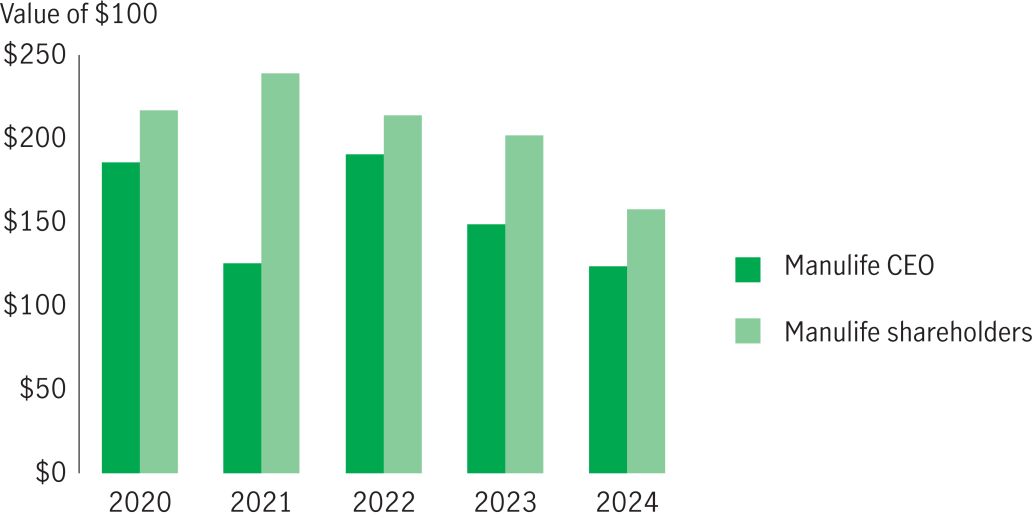
| (CA$) | |
Total direct compensation |
|
|
Actual value (realized and realizable) on December 31, 2024 |
|
Value of $100 | |||||||||||||||
| Period | Manulife CEO | Manulife shareholders |
||||||||||||||||||||
| 2020 | $13,576,368 | $25,236,922 |
|
Jan 1, 2020 to Dec 31, 2024 | $185.89 | $216.83 | ||||||||||||||||
| 2021 | $15,978,085 | $20,022,222 |
|
Jan 1, 2021 to Dec 31, 2024 | $125.31 | $238.80 | ||||||||||||||||
| 2022 | $15,872,059 | $30,234,365 |
|
Jan 1, 2022 to Dec 31, 2024 | $190.49 | $213.98 | ||||||||||||||||
| 2023 | $18,420,959 | $27,427,954 |
|
Jan 1, 2023 to Dec 31, 2024 | $148.90 | $202.13 | ||||||||||||||||
| 2024 | $19,310,621 | $23,890,082 |
|
Jan 1, 2024 to Dec 31, 2024 | $123.71 | $157.50 | ||||||||||||||||
| • | Total direct compensation awarded includes base salary, annual incentive, and equity-based incentives, as reported in the summary compensation table each year. |
| • | Actual value (realized and realizable) represents the actual value to the CEO of compensation awarded each year, realized between grant and December 31, 2024 or still realizable on December 31, 2024. |
| • | Value of $100 for CEO represents the actual value as at December 31, 2024 for each $100 of total direct compensation awarded in each year. |
| • | Value of $100 for Manulife shareholders represents the cumulative value of a $100 investment in common shares made on the first trading day of each period, assuming reinvestment of dividends. |
Our pay-for-performance alignment review also includes a five-year lookback at our CEO’s compensation compared to our TSR performance against our performance peers and against various indices. Please see page 76 for more information.
Details about the 2024 compensation decisions for our named executives begin on page 72.
CEO TRANSITION AND 2025 COMPENSATION
On May 9, 2025, Phil Witherington will assume the role of President and CEO of Manulife, succeeding Roy Gori, who will retire on May 8, 2025 and serve as an Advisor through August 31, 2025. Mr. Gori’s tenure as President and CEO has been marked by remarkable achievements, including delivering superior financial and operating results, fostering a winning corporate culture, and significantly increasing shareholder value. The board expresses its deep gratitude for his outstanding leadership, contributions to the company’s success, and the momentum he and his team have built for Manulife.
The board has approved Mr. Witherington’s compensation package for 2025. See page 81 for more detail.
| 50 | Manulife Financial Corporation |
Executive Compensation
Our approach to executive compensation
Our executive compensation program focuses named executives on achieving long-term sustainable growth and on creating significant value for our shareholders and customers. It is designed to attract and retain high calibre executive talent capable of achieving our ambitious goals and contributing to our competitive advantage.
Our approach is centred on pay for performance, and supported by five principles that guide our program design, compensation decisions and administrative practices.
Executive compensation is linked to strong risk-managed performance. Most of what our executives earn is variable, tied to performance and not guaranteed. In practice, executives ultimately receive more when performance is strong and earn less when performance is mixed.
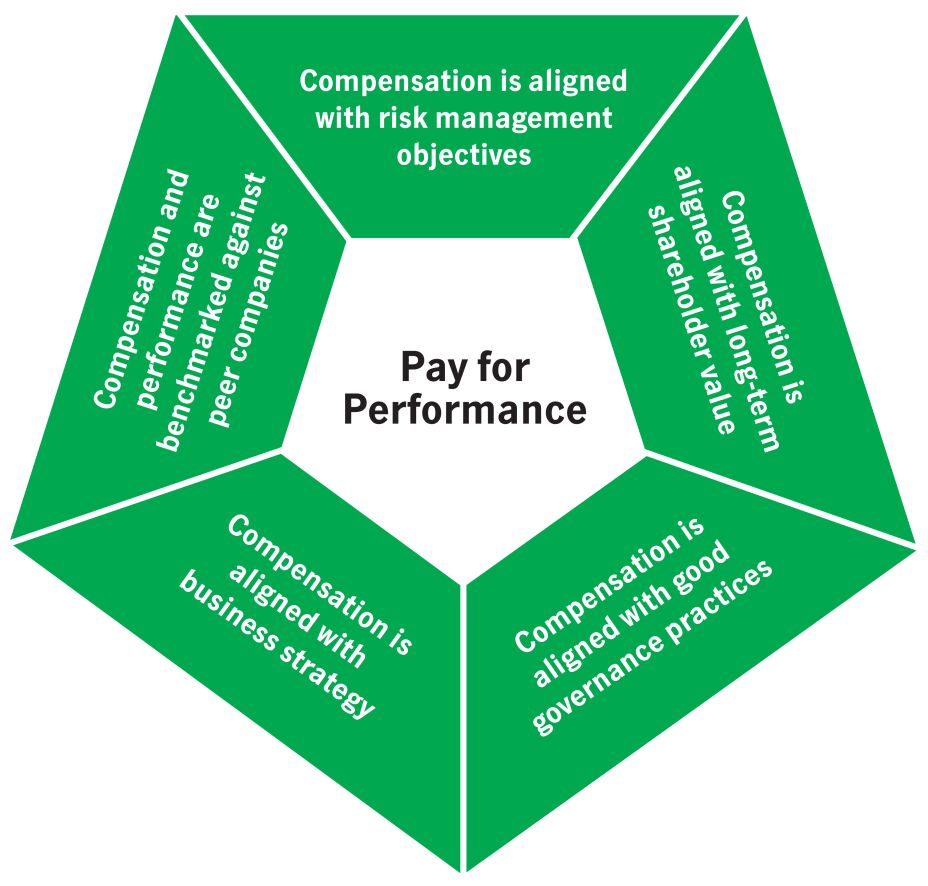
| 2025 Management information circular | 51 |
| What we do | ||
|
Compensation aligned with long-term shareholder value – see pages 76, 112 and 113 |
||
| • Most executive compensation is directly affected by our share price and the value of our performance share units is based in part on relative TSR • The annual incentive plan incorporates measures tied to our future success |
• Equity ownership guidelines, clawback provisions, stock option exercise restrictions and our code of business conduct and ethics discourages executives from taking undue risk • 10% of the annual incentive and vested equity compensation for executives is delivered in Manulife common shares purchased on the open market
|
|
|
Compensation aligned with business strategy – see pages 57 and 114 |
||
| • Incentive compensation is tied to the achievement of key performance measures, prudently balancing time horizons and performance perspectives
|
• Performance measures are tied directly to our business strategy, ESG objectives and shareholder value |
|
|
Compensation and performance benchmarked against peer companies – see pages 55 and 68 |
||
| • Executive pay is benchmarked against our compensation peer group
|
• Our performance is benchmarked against the companies in our performance peer group |
|
|
Compensation aligned with good governance practices – see page 109 |
||
| • Compensation is aligned with the Financial Stability Board’s Principles for Sound Compensation Practices |
• Shareholders have a say on executive pay • We engage with shareholders about our executive compensation program • Employee engagement and other metrics relating to building a high performing team have an impact on compensation |
|
| • Employees must annually certify compliance with our code of business conduct and ethics |
||
| • Management resources and compensation committee receives independent advice
|
||
|
Compensation aligned with risk management objectives – see page 111 |
||
| • Incentive compensation for heads of control functions is based on measures that are not directly linked to the business they oversee |
• The CRO and the risk committee review the alignment of compensation plans with risk management objectives |
|
| • We stress test compensation plan designs |
• Incentive compensation for material risk takers considers feedback from internal audit, compliance and risk management |
|
| • The CEO and CFO must hold Manulife equity for one year after leaving Manulife |
||
| • Executive compensation can be clawed back for wrongdoing, even when a financial restatement is not required
|
||
| What we don’t do | ||
| No grossing up of perquisites | ||
| No repricing or backdating of stock options | ||
| No hedging or monetizing of equity awards | ||
| No multi-year guarantees in employment agreements | ||
| No severance of more than two years on termination following a change in control | ||
| No single-trigger change in control | ||
| 52 | Manulife Financial Corporation |
Executive Compensation
Compensation elements
The executive compensation program for our named executives includes base salary, annual incentive, equity-based incentives, and other elements such as pension, benefits and wellness, and perquisites.
| Element |
|
Form |
|
Key characteristics | ||||||||
| Base salary |
|
Cash |
|
• Fixed compensation based on named executive’s role, qualifications, experience, performance, career progression, and competitive assessment of comparable roles at peer companies • Reviewed annually and adjusted when appropriate |
||||||||
| Annual incentive |
|
Cash
Equity |
|
• Variable compensation based on performance against enterprise goals, including ESG-related measures that are key to our business strategy, and individual goals established at the beginning of the performance period • Individual performance goals are tied to financial and operating performance and contribution to Manulife’s strategic priorities and ESG strategy |
||||||||
| Equity-based incentives |
|
Performance share units (PSUs) (60%) |
|
• Variable compensation tied to company and share price performance over the long term (three-year vesting period) • Strengthens retention and reinforces alignment with shareholder value • 10% of the vesting value of RSUs and PSUs is delivered in Manulife common shares purchased on the open market |
||||||||
| Restricted share units (RSUs) (40%) |
|
|||||||||||
| Other |
|
Pension |
|
• Includes defined contribution, cash balance and 401(k) plans • Varies by country |
||||||||
| Benefits and wellness |
|
• Protects and invests in the health and well-being of our executives • Includes health, dental, mental health, group life, disability, and wellness (Vitality) • Varies by country |
||||||||||
| Perquisites |
|
• Varies by country |
||||||||||
| 2025 Management information circular | 53 |
The charts below show the mix of components that make up target total direct compensation for our named executives for 2024.
Most of a named executive’s total direct compensation is variable (or at risk) with a significant portion tied to our share price. The mix of annual and equity-based incentives ensures named executives consider both the short and longer-term impact of their decisions.
The board believes this combination of incentives and time horizons helps to drive sustained performance, aligns named executives’ interests with those of shareholders, provides for competitive pay opportunities and encourages retention.
2024 Target total direct compensation mix
Chief Executive Officer

Other named executives (average)
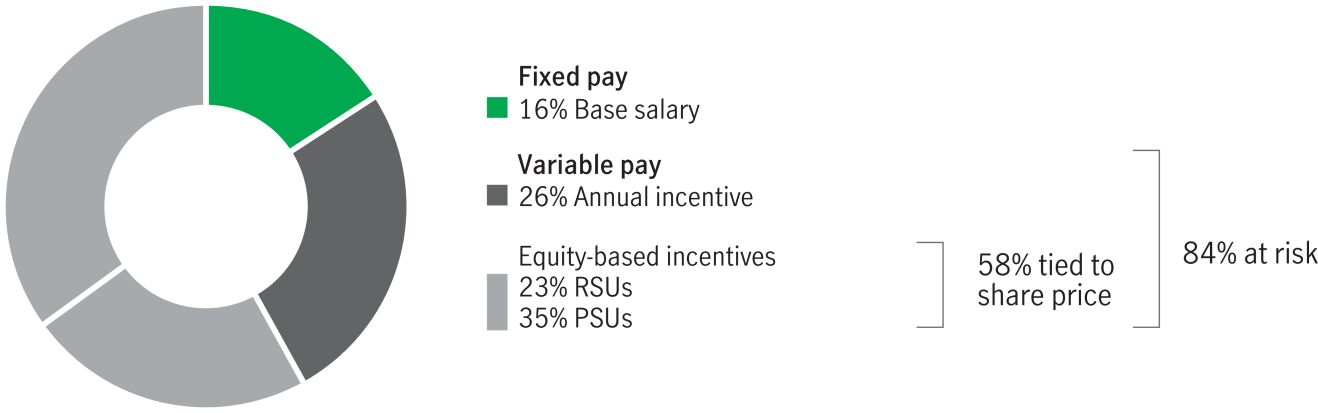
| 54 | Manulife Financial Corporation |
Executive Compensation
Setting target compensation for the named executives
Manulife has a formal governance process for reviewing and setting target compensation for our named executives, including benchmarking executive compensation to our compensation peer group every year. The management resources and compensation committee works with Korn Ferry, its independent compensation consultant, to determine an appropriate compensation peer group each year. No changes were made to the compensation peer group for 2024.
The committee assesses peer pay levels as part of its annual review of compensation for named executives. It relies on the compensation peer group and guidance from Korn Ferry to understand what executives in comparable roles are earning at companies we most directly compete with for executive talent, as well as compensation program design and pay mix. We generally seek to align target total direct compensation for our named executives with the market median and may adjust the positioning above or below the median depending on the importance of the role, the executive’s performance, experience, or for other reasons.
| While our corporate headquarters is located in Canada, Manulife is a global company. We operate in 23 markets, with approximately three-quarters of our core earnings coming from outside of Canada. Our operations are made up of many related but distinct businesses that require leaders with unique skills and capabilities.
We draw on and compete for executive talent with global businesses in the life and health insurance sector, as well as with Canadian diversified banks that operate in those markets. Accordingly, our compensation peer group for our named executives includes companies across these sectors that publicly disclose compensation data for roles that are comparable in size and scope to the roles of our named executives, and that are considered competitors for executive talent. |
2024 Compensation peer group (unchanged from 2023)
Global health and life insurance AIA Group Limited MetLife, Inc. Power Corporation of Canada Principal Financial Group, Inc. Prudential Financial, Inc. Prudential plc Sun Life Financial Inc.
Canadian diversified banks Bank of Montreal Bank of Nova Scotia Royal Bank of Canada Toronto-Dominion Bank
|
|||||
Manulife compared to our compensation peer group
As at December 31, 2024
(US$)
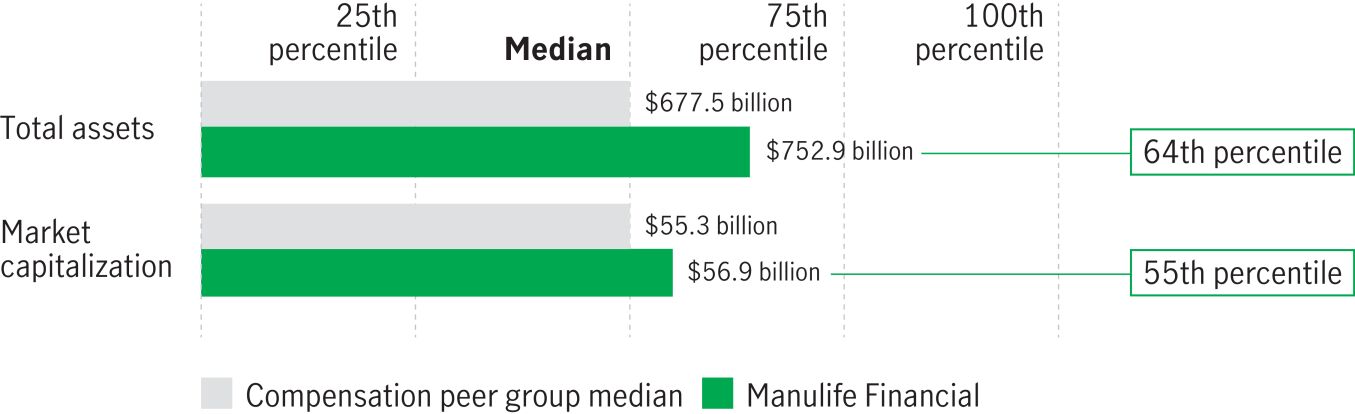
For roles where there is no comparable data publicly available, we also use data from the following compensation surveys and third-party providers:
| • | Financial Services Executive Compensation Survey conducted by Korn Ferry |
| • | Diversified Insurance Study of Executive Compensation and Insurance Executive Rewards Survey conducted by Willis Towers Watson |
| • | McLagan Life Insurance and Asset Management Compensation Surveys conducted by Aon |
| 2025 Management information circular | 55 |
Base salary
The board annually reviews the base salaries of named executives and adjusts them periodically as needed by evaluating the evolving responsibilities of their roles, the experience of the individual, their performance, and the marketplace in which we compete for executive talent as defined by our compensation peer group.
Consistent with our pay-for-performance compensation philosophy, named executives receive a small percentage of their overall compensation in the form of base salary.
|
|
2024 base salary | 2025 base salary | Change | |||||||||
| Roy Gori (US$) | $1,300,000 | $1,300,0001 | n/a1 | |||||||||
| Colin Simpson | $800,000 | $850,000 | $50,000 | |||||||||
| Phil Witherington (US$)2 | $775,000 | $1,200,0002 | n/a2 | |||||||||
| Paul Lorentz | $870,000 | $900,000 | $30,000 | |||||||||
| Marc Costantini (US$) | $740,000 | $800,000 | $60,000 | |||||||||
| 1 Roy Gori will receive a pro-rated salary for his service through his retirement date of May 8, 2025. 2 Mr. Witherington will be appointed to the role of President and CEO on May 9, 2025, and his compensation will be set in U.S. dollars. His 2024 salary is shown in this table in U.S. dollars for ease of comparison. His 2025 base salary in this table represents his full-year base salary following his appointment as President and CEO, Manulife. For further details regarding Mr. Witherington’s compensation in his new role as President and CEO, Manulife, please see page 81. |
Changes in base salary
As of March 1, 2025, the board approved changes to the base salaries of Mr. Simpson, Mr. Lorentz, and Mr. Costantini. For Mr. Simpson and Mr. Lorentz, these changes were made to address market competitiveness relative to companies in our compensation peer group and based on individual performance. For Mr. Costantini, this change reflects market competitiveness, but also his expanded role, broad experience and his compensation relative to his peers.
Annual incentive
Our annual incentive rewards named executives for achieving company objectives and individual performance goals that support company results and our strategy. The annual incentive for a named executive is heavily influenced by overall company results.
Each named executive has a target annual incentive equal to a percentage of their base salary. Their actual annual incentive award depends on how the company performed and on their individual performance during the year. Actual awards can range from zero to a maximum of 2.5 times target.
Annual incentives are awarded in February for the preceding year. Ten percent (10%) of the pre-tax award is delivered in Manulife common shares purchased on the open market.
The board has the discretion to adjust the annual incentive when significant events outside management’s control impact performance and would make awards unreasonable, unrepresentative, or inappropriate.
| 56 | Manulife Financial Corporation |
Executive Compensation
We determine annual incentives using the following formula:
|
Base salary |
|
|
|
Annual
% of base |
|
|
|
Company
Range: |
|
|
|
Individual
Typical range:
(The committee
|
|
|
|
Annual
Capped at
10% delivered |
Company performance
Actual incentives for our named executives are primarily driven by the company performance score, which includes financial and operating performance targets and strategic goals determined at the beginning of the performance period. The company performance score can range from 0 to 2.0. The maximum is set to be extremely difficult to achieve and only attainable when results are extraordinary.
Performance measures, weightings and targets for determining the company performance score are approved by the board at the beginning of each year, consistent with our strategic priorities, our ESG strategy, and the board-approved business plan. Recommended performance ranges and targets are based, in part, on past performance and financial and operating projections, and on the company’s best estimate for the coming year. Scenario testing makes sure potential performance is aligned with award outcomes and does not encourage inappropriate risk-taking.
Individual performance
The committee considers each named executive’s individual contribution to overall company results, achievement of our strategic priorities and ESG strategy, and contribution to our culture. We assess individual performance throughout the year against each named executive’s individual scorecard, which clearly defines specific goals tied to the named executive’s annual business plan and their contribution to Manulife as a whole, including their impact on our risk culture and their behaviour as a reflection of our values.
The individual performance score typically ranges from 0 to 1.2, except when there are special circumstances such as exceptional performance or one-time events that drive significant shareholder value. For 2024, the board determined that Mr. Costantini’s performance met this rigorous criteria. Please see page 58 for further information on the annual incentive award for Mr. Costantini.
|
Linking to our ESG strategy As part of our ESG strategy, Manulife sets board-approved enterprise goals for ESG-related measures that are key to our business strategy and that factor into annual incentives for the named executives in two ways: • The strategic focus component of the company performance score is based in part on an assessment of performance against goals linked to climate action, employee engagement, fostering an inclusive culture, and customer satisfaction. • The individual performance goals for each named executive also include goals linked to climate action, employee engagement, fostering an inclusive culture, and leadership accountability, as well as risk goals related to cybersecurity and ethical business conduct (for more information, please see the executive profiles starting on page 72).
You can learn more about Manulife’s ESG strategy on our website at manulife.com/sustainability and in our annual Sustainability Report (the 2024 report will be published in the second quarter of 2025). |
| 2025 Management information circular | 57 |
2024 Annual incentive awards
The 2024 annual incentive awards reflect a 136% company performance score (as discussed below) and each executive’s respective individual performance score (based on their individual accomplishments highlighted in brief on page 62 and in further detail in their executive profiles beginning on page 72).
|
|
Base salary |
|
Annual incentive |
|
Company performance score |
|
Individual performance score |
|
2024 Annual
|
|||||||||||||||||||||||||
|
|
|
|
|
|
|
|
|
|
|
|
|
|
|
|
|
|
|
|
|
|
|
|
|
|
|
|||||||||
| Roy Gori (US$) |
$1,300,000 | x | 200% | x | 136% | x | 120% | = | $4,243,200 | |||||||||||||||||||||||||
| Colin Simpson | $800,000 | x | 135% | x | 136% | x | 110% | = | $1,616,000 | |||||||||||||||||||||||||
| Phil Witherington (US$) | $775,000 | x | 150% | x | 136% | x | 120% | = | $1,897,000 | 1 | ||||||||||||||||||||||||
| Paul Lorentz | $870,000 | x | 200% | x | 136% | x | 115% | = | $2,721,000 | |||||||||||||||||||||||||
| Marc Costantini (US$) |
|
$740,000 |
|
|
x |
|
|
150% |
|
|
x |
|
|
136% |
|
x |
|
130% |
|
|
= |
|
|
$1,962,000 |
|
|||||||||
| 1 The 2024 annual incentive award for Mr. Witherington was approved by the board in U.S. dollars (USD) and converted to Hong Kong dollars (HKD) using the latest USD-HKD spot rate available prior to payment. Mr. Witherington will be appointed to the role of President and CEO on May 9, 2025, and his compensation will be set in USD. For further details regarding Mr. Witherington’s compensation in his new role as President and CEO effective May 9, 2025, please see page 81. |
2024 Company performance score
The company performance score for the 2024 annual incentive was 136% for the named executives, as core earnings per share (core EPS), new business value (NBV), relationship net promoter score (rNPS) and straight-through processing (STP) exceeded our ambitious targets for the year. We also made continued progress on our five strategic priorities that underpin our business and ESG strategies.
Performance criteria and ranges were set at the beginning of the year, aligned with our board-approved business plan. Note that Manulife began reporting under IFRS 17 and IFRS 9 in 2023. Results reported before 2023 under the previous accounting standards are not directly comparable to results under IFRS 17 and IFRS 9. For more information about our transition to these new standards, see page 105 or pages 44-45 of our 2024 management information circular.
When setting the targets for 2024, the board considered the introduction of the Global Minimum Taxes (GMT), which lowered the 2024 core EPS target. Adjusting for the impact of GMT, the 2024 core EPS target would reflect an increase of 7% compared to 2023.
The board exercised its discretion to increase the core EPS target to offset a $0.03 favourable impact on core EPS due to the accounting for the timing of the GMT implementation in 2024, resulting in the company performance score being lowered by one percentage point to 136%. This adjustment was to ensure incentive payouts accurately reflect our underlying business performance.
| 58 | Manulife Financial Corporation |
Executive Compensation
| Performance criteria and ranges | Results | Score | Weighted score |
|||||||||||||
| Profitability 40% |
Core earnings per share ($)1 | $3.87
|
128%
|
51%2
|
||||||||||||
| Reflects underlying earnings capacity and is an important factor in the valuation of Manulife’s share price | ||||||||||||||||
|
Threshold (25% below target) |
Target |
Maximum (25% above target) |
||||||||||||||
| $2.71 |
$3.61 |
$4.52 |
||||||||||||||
| score | 0 | 1.0 | 2.0 | |||||||||||||
| Growth 30% |
New business value ($ millions)1 | $3,077 |
157% |
47% |
||||||||||||
| Measures profitable growth in new business across our insurance segments | ||||||||||||||||
|
Threshold (40% below target) |
Target |
Maximum (40% above target) |
||||||||||||||
| $1,504 |
$2,506 |
$3,509 |
||||||||||||||
| score | 0 | 1.0 | 2.0 | |||||||||||||
| Customer 5% |
Relationship net promoter score (rNPS) Measures customer loyalty and advocacy |
+27 |
112% | 6% |
||||||||||||
|
Threshold (10 pts below target) |
Target |
Maximum (10 pts above target) |
||||||||||||||
| +16 |
+26 |
+36 |
||||||||||||||
| score
|
0
|
1.0
|
2.0
|
|||||||||||||
|
5% |
Straight-through processing (STP) | |||||||||||||||
| Measures Manulife’s processing time for customers | ||||||||||||||||
|
Threshold (3 pps below target) |
Target |
Maximum (3 pps above target) |
89.2% |
112% |
6% |
|||||||||||
| 85.8% |
88.8% |
91.8% |
||||||||||||||
| score | 0 | 1.0 | 2.0 | |||||||||||||
| Strategic focus3 20% |
Performance is assessed against an index of measures that tracks performance against our five strategic priorities and other measures linked to our ESG strategy.
Includes quantifiable goals for each measure, subject to a qualitative overlay. Each measure has a performance score that can range from 0 - 2.0. Measures are equally weighted.
|
132% |
26% | |||||||||||||
| 2024 company performance score | 136% |
|||||||||||||||
| 1 Performance is measured on a constant exchange rate basis. 2 The board exercised discretion to increase the core EPS target to offset a $0.03 favourable impact on core EPS due to the accounting for the timing of the implementation of the Global Minimum Taxes (GMT) in 2024. This reduced the company performance score by one percentage point to 136% to ensure incentive payouts accurately reflect our underlying business performance. 3 Performance is assessed against predetermined goals established in our business plan. |
| 2025 Management information circular | 59 |
How the measures are defined
| • Core earnings per common share (core EPS) is defined as core earnings available to common shareholders (including credit losses and loss reversals) divided by diluted weighted average common shares outstanding. • New business value (NBV) is calculated as the present value of shareholders’ interests in expected future distributable earnings, after the cost of capital, on actual new business sold during the reporting period. • Relationship net promoter score (rNPS) gauges customer loyalty and advocacy based on the response customers provide when asked how likely they are to recommend Manulife to family, friends, or colleagues. rNPS is measured by a third-party market research study of customers. |
Understanding our financial 2024 represents the second year Manulife is reporting under IFRS 17 and IFRS 9, which represents the most significant change to insurance accounting requirements in decades. As we explained in last year’s management information circular, these new accounting standards do not change the fundamental economics of our business.
Because of this, we wish to remind shareholders that results reported before 2023 under the previous accounting standards are not directly comparable to our 2023 and 2024 results under IFRS 17 and IFRS 9. For more information about our transition to the new accounting standards, see page 105. |
|
| • Straight-through processing (STP) is defined as customer interactions, including money |
||
| processing,that are completely digital as a proportion of total customer interactions.
|
||
| • | Strategic focus includes an index of measures that tracks performance against our five strategic priorities and other measures linked to our ESG strategy. Quantifiable goals for each measure are established at the beginning of the year and approved by the management resources and compensation committee. The strategic focus score is calculated as the average of the performance scores, which are equally weighted. |
Understanding the company performance score
Profitability
| • | Core EPS grew by 11% on a constant exchange rate basis (or up 14% excluding the impact of GMT), primarily driven by increased core earnings1, and the impact of common share buybacks. This growth reflects higher net fee income due to increased average assets under management and administration in Global WAM, robust growth in our insurance business in Asia, and the impact of common share buybacks |
Growth
| • | New business value was $3.1 billion in 2024, an increase of 32% compared with 2023, with positive contributions from all insurance segments. The increase was mainly driven by higher sales volumes in Asia and Canada |
Customer
| • | Relationship net promotor score (rNPS) was 27 in 2024, a 4-point improvement from 2023 and we are leading or on par with peers across the majority of our business lines. This result represents a 26-point improvement from our 2017 baseline of 1 |
| • | Straight-through processing (STP) was 89% in 2024, a 4-percentage point improvement from 2023, and a 21-percentage point improvement from the 2018 baseline. We have made consistent progress on our global STP objective across segments in a variety of areas in 2024, and exceeded our target of 88%, one year ahead of schedule |
| 60 | Manulife Financial Corporation |
Executive Compensation
Strategic focus
Accelerated growth
| • | Our performance this year was supported by our highest potential businesses2, which represent 70% of core earnings3, up from 60% in 2023. We also delivered strong new business performance with year-over-year growth in APE sales (+30%), new business CSM (+32%), and NBV (+32%) |
| • | Asia Segment core earnings3 are up 27% from last year and the Asia Region (insurance and wealth) now represents 44%3 of total company core earnings, 7-percentage points above prior year |
| • | Global WAM core earnings grew 30%4 versus prior year and delivered positive net flows of $13.3 billion4, with contributions from all business lines and geographies, demonstrating our ability to adapt to our changing operating environment |
Digital, customer leader
| • | We are driving value from GenAI by rapidly scaling use cases across our organization. We had 27 use cases in production, with another 32 in development at the end of 2024. Our continued investment in foundational capabilities has put us in a strong position, and enabled faster and easier execution in deploying AI-based solutions. We are able to quickly scale use cases, enhancing value for our customers and our business |
| • | In Asia, we strengthened agent-customer interactions through the launch of an innovative GenAI sales tool in both Singapore and Japan and we enhanced underwriting efficiency in Singapore through the implementation of GenAI, which improves the accuracy of underwriting decisions by automating document digitization and summarization |
| • | Streamlined our U.S. underwriting process to enhance customer experience and drive sales by expanding the use of electronic health records and utilizing GenAI for automated preliminary assessments. Boosted the distribution team’s efficiency and responsiveness to sales opportunities by implementing and enhancing an AI-powered sales enablement tool |
Expense efficiency
| • | Achieved an expense ratio of 44.8% in 2024 against our updated target of less than 45% and anticipate securing additional efficiencies as we continue to digitize our business |
Portfolio optimization
| • | Since 2018, we have freed up an expected $12.0 billion5,6 in capital, including an expected $2.8 billion freed up through reinsurance transactions closed or announced in the last 12 months, and returned $25 billion of capital to shareholders |
| • | Closed the milestone transaction with Global Atlantic to reinsure four in-force blocks of legacy/low return on equity business, including $6 billion in LTC reserves, which represented the largest LTC reinsurance transaction in history |
| • | Completed the largest Universal Life reinsurance transaction in Canadian history to reinsure $5.8 billion of reserves of low return on equity Canadian Universal Life block, further reducing our risk profile and unlocking significant value for shareholders |
| 1 Please see Reconciliation of core earnings to net income attributed to shareholders – 2024 on page 108 for details on the adjustments made to net income attributable to shareholders for the purposes of determining core earnings. 2 Highest potential businesses include Asia segment, Global WAM, Canada group benefits and North American behavioural insurance products. 3 Core earnings contribution from highest potential businesses and core earnings contribution from Asia Region are non-GAAP ratios. See Non-GAAP and other financial measures on page 106 for more information. 4 Percentage growth in core earnings is stated on a constant exchange rate basis and is a non-GAAP ratio. Net flows is a specified financial measure. See Non-GAAP and other financial measures on page 106 for more information. 5 See Caution regarding forward-looking statements on page 143. 6 Pro forma. Includes $9 billion of capital release from 2018 to 2022 under IFRS 4, $2.2 billion from 2023 to 2024 initiatives under IFRS 17, and an estimated $0.8 billion capital to be released from the reinsurance transaction agreed to in 2024 and closing in 2025. |
| 2025 Management information circular | 61 |
Portfolio optimization (continued)
| • | Announced an additional $5.4 billion reinsurance agreement, including $2.4 billion of LTC business, which closed in January 2025 |
| • | Lowered contribution to core earnings from LTC and Variable Annuity (VA) businesses1 to 10% in 2024, a decrease of 2 percentage points as compared with 2023 (and down from 24% in 2017) The 2 percentage point decrease in 2024 reflects the impact of the Global Atlantic reinsurance transaction, and strong core earnings growth in Asia and Global WAM |
High performing team
| • | Achieved top quartile employee engagement rank for the fifth consecutive year2 |
| • | Our focus on talent, culture and employee experience earned us the Gallup Exceptional Workplace Award for the second consecutive year, and recognition on the Forbes World’s Best Employers list for the fifth consecutive year |
ESG
| • | Achieved top decile ranking in Standard & Poor’s Corporate Sustainability Assessment rating |
| • | Named among Corporate Knights’ Best 50 Corporate Citizens in Canada for the fourth consecutive year, and named among Corporate Knights’ Global 100 ranking for the second year in a row, as one of the world’s most sustainable companies and fourth in the insurance industry |
2024 Individual performance scores
To determine the individual performance scores in the table on page 58, the committee and the board considered a wide range of factors, including individual contributions to overall company results, achievement of our strategic priorities, and contribution to our culture. Performance highlights for each executive are below. You will find additional discussion of their 2024 performance in their executive profiles beginning on page 72.
| Roy Gori | • Executed our strategy to drive total shareholder return (TSR), achieving a TSR of 57% in 2024, which ranks in the top quartile relative to our compensation and performance peer groups • Achieved very strong operational performance with year-over-year increase in core EPS of 11% (or 14% excluding the impact of Global Minimum Taxes (GMT)). EPS increased by 8% • Increased APE sales, new business CSM, and new business value (NBV) by 30%, 32%, and 32% respectively, compared to the prior year • Accelerated growth in our highest potential businesses, highlighted by Asia Segment and our Global WAM businesses which grew core earnings by 27% and 30%, respectively, compared to the prior year • De-risked Manulife’s business by executing two reinsurance transactions in 2024 which delivered significant value to shareholders, and announced a third transaction in November 2024 which was completed in January 2025 • Achieved strong results in our digital agenda, driving a record high relationship NPS (rNPS) score of 27, and made progress on our straight-through processing (STP) objective with a 4-percentage point improvement over 2023, exceeding our target of 88% one year ahead of schedule • Drove a winning culture demonstrated by a fifth consecutive year of top quartile employee engagement rank2 |
|
| 1 2017 core earnings contribution from LTC and VA and core earnings contribution from LTC and VA are non-GAAP ratios. See Non-GAAP and other financial measures on page 106 for more information. 2 Based on the annual global employee engagement survey conducted by Gallup. Ranking is measured by the engagement grand mean as compared to Gallup’s Finance and Insurance Company level database. |
| 62 | Manulife Financial Corporation |
Executive Compensation
| Colin Simpson | • Contributed to increases in key profitability measures in 2024 compared to 2023: core EPS increased by 11%, core earnings1 rose to $7.2 billion from $6.7 billion, and core ROE improved to 16.4% from 15.9%1. Additionally, EPS increased by 8%, net income attributed to shareholders rose to $5.4 billion from $5.1 billion, and ROE grew to 12.0% from 11.9% • Achieved an expense efficiency ratio of 44.8%, compared with 45.5% in 2023, meeting our medium- term target of an expense efficiency ratio of less than 45% • Increased remittances to $7.0 billion in 2024, compared with $5.5 billion in 2023 |
|
| Phil Witherington | • Reported record results with respect to growth in the Asia segment as APE sales, new business CSM, and NBV increased by 36%, 38%, and 35% respectively, in 2024 compared with 2023 • Increased Asia segment core earnings by 27% compared to the prior year after adjusting for the impact of changes in foreign currency exchange rates. Asia segment net income attributed to shareholders increased to $2.4 billion in 2024 compared with $1.3 billion in 2023 • Continued to invest in our diversified distribution platform to accelerate growth and deliver holistic solutions to customers, including the expansion of Manulife Pro, our proprietary offering for top-tier agents |
|
| Paul Lorentz | • Achieved net inflows for Global WAM of $13.3 billion in 2024, compared with net inflows of $4.5 billion in 2023, which contributed to a 14% growth in Global WAM managed Assets Under management and Administration • Increased Global WAM’s core earnings by 30% compared with 2023 on a constant exchange rate basis. Global WAM net income attributed to shareholders increased to $1.6 billion in 2024, compared with $1.3 billion in 2023 • Completed the acquisition of CQS, a U.K.-based multi-sector alternative credit manager, which positively contributed to Global WAM net flows and core earnings |
|
| Marc Costantini | • Closed the milestone transaction with Global Atlantic to reinsure four in-force blocks of legacy/low return on equity businesses, including $6 billion in LTC reserves; the largest LTC reinsurance transaction in history • Completed the largest Universal Life reinsurance transaction in Canadian history to reinsure $5.8 billion of reserves of low return on equity Canadian Universal Life block, and announced an additional reinsurance agreement covering $5.4 billion of reserves, including $2.4 billion of long-term care (LTC) reserves • These historic transactions are expected to release $2.8 billion of capital2 and were contributing factors to Manulife’s top-quartile TSR performance relative to our compensation and performance peer groups • The board considered these reinsurance transactions to be significant events which reduced the risk profile of our business, drove significant shareholder value, and warranted exceeding the typical range for the amount an executive’s individual performance should impact their annual award |
|
| 1 Core earnings is a non-GAAP financial measure and core ROE is a non-financial ratio. See Non-GAAP and other financial measures on page 106 for more information. 2 See Caution regarding forward-looking statements on page 143. |
| 2025 Management information circular | 63 |
2025 Annual incentive awards
The table below shows the annual incentive targets for 2024 and 2025. For 2025, the committee considered market positioning, including in the context of the executive’s total compensation opportunity, performance and the board’s focus on aligning executive pay with the interests of our shareholders. The committee approved an increase to Marc Costantini’s 2025 annual incentive target to reflect his outstanding contributions to our historic reinsurance transactions, market positioning relative to internal and external peers, broad experience and the increased scope of his role after taking on responsibility for the Global Strategy and Corporate Development teams.
|
|
2024 Target (as a % of base salary) |
2025 Target (as a % of base salary) |
||||||
| Roy Gori |
|
200% |
|
|
200%1 |
|
||
| Colin Simpson |
|
135% |
|
|
135% |
|
||
| Phil Witherington |
|
150% |
|
|
200%2 |
|
||
| Paul Lorentz |
|
200% |
|
|
200% |
|
||
| Marc Costantini |
|
150% |
|
|
175% |
|
||
| 1 Mr. Gori has announced that he will retire effective May 8, 2025 and agreed to serve as an Advisor through August 31, 2025. He will receive a pro-rated annual incentive for his service through his retirement date of May 8, 2025, consistent with the treatment for other retirement eligible employees. 2 Mr. Witherington will be appointed as President and CEO on May 9, 2025. For further details regarding Mr. Witherington’s compensation in his new role, please see page 81. |
Equity-based incentives
We grant a competitive mix of equity-based incentives every year, which may include restricted share units (RSUs) and performance share units (PSUs) depending on the officer’s position.
The proportion of equity-based incentives allocated to performance share units and restricted share units remained the same as the previous year. Stock options have not been granted since 2020. Heads of control functions do not receive performance share units to ensure their compensation is not tied to the performance of businesses they oversee.
The table below shows the mix of equity-based incentives for 2024 and 2025.
|
|
PSUs | RSUs | ||||||
| Chief Executive Officer | 60% | 40% | ||||||
| Other named executives | 60% | 40% | ||||||
| Chief Risk Officer, Chief Actuary, Global Compliance Chief, Chief Auditor | 0% | 100% | ||||||
| 64 | Manulife Financial Corporation |
Executive Compensation
| Equity-based incentives
|
||||||||||||||||||
| Restricted share units |
Performance share units |
Stock options (not granted since 2020) |
||||||||||||||||
|
What they are |
Notional shares that pay out based on the price of Manulife common shares |
Notional shares that pay out based on our performance and on the price of Manulife common shares |
Rights to buy Manulife common shares in the future at a specified price |
|||||||||||||||
|
Vesting and payout |
Vest and pay out at the end of three years
The payout value is equal to the average closing price of Manulife common shares on the TSX for the 10 trading days before the day they vest multiplied by the number of restricted share units
90% of the payout value is delivered in cash and the remaining 10% is delivered in Manulife common shares purchased on the open market |
Vest and pay out at the end of three years. The number of units that vest depends on our performance against absolute and relative performance conditions that are set at the grant date, aligned with our strategy and approved by the board
The payout value is equal to the average closing price of Manulife common shares on the TSX for the 10 trading days before the day they vest, multiplied by the number of performance share units, the performance factor and the relative TSR modifier
The relative TSR multiplier is capped at 100% if our absolute TSR over the three-year period is negative.
90% of the payout value is delivered in cash and the remaining 10% is delivered in Manulife common shares purchased on the open market
|
Vest 25% every year for four years from the grant date
Stock options granted from 2015 to 2020 cannot be exercised until five years from the grant date except under extenuating circumstances
The exercise price is equal to the grant price
The value is the difference between the exercise price and the price of Manulife common shares on the TSX when stock options are exercised
Stock options expire at the end of 10 years and are only transferable upon death |
|||||||||||||||
|
|
||||||||||||||||||
| 2025 Management information circular | 65 |
| Equity-based incentives
|
||||||||||||||||||
| Restricted share units |
Performance share units |
Stock options (not granted since 2020) |
||||||||||||||||
| Dividend equivalents |
Credited as additional units at the same rate as dividends paid on Manulife common shares and subject to the same vesting conditions as the underlying grant
|
Do not earn dividend equivalents | ||||||||||||||||
|
|
||||||||||||||||||
| Grants | The grant price is the average closing price for the 10 trading days before the grant date
The grant value of stock options is calculated using the Black-Scholes methodology
|
|||||||||||||||||
| Notice of retirement |
For awards granted in 2015 and after, named executives have to provide three months’ notice before leaving Manulife or they will lose their post-termination retirement benefits and all outstanding grants will be forfeited
|
|||||||||||||||||
| Closed trading windows |
Equity-based incentives are not granted when our insiders are prohibited from trading. Annual awards are normally granted 10 or more trading days following the end of the closed trading window after our year-end financial results are announced. Awards can also be made to select new executives at the time of hire. If the hire date falls within a closed trading window the grant is delayed until after the end of the closed trading window. The company has an automatic stock option exercise program that allows insiders to elect in advance to have their expiring stock options exercised through the program, which may occur within a closed trading window.
|
|||||||||||||||||
2024 Equity-based incentive grants
The committee’s decisions related to equity-based incentive grants are based on anticipated future contributions to Manulife, the competitive position of their compensation compared to our global compensation peer group (see page 55 for more detail), organizational priorities and key strategic roles, succession planning, internal equity amongst executives, and the board’s focus on aligning executive pay with the interests of our shareholders. The table below shows the annual equity-based incentive grants approved by the committee for our NEOs in 2024, based on its annual review of these factors.
The awards are intended to be forward-looking. The actual amount that the named executive realizes will be greater or less than the theoretical grant date amount based on our share price at the time of vesting and Manulife’s financial performance over the next three years.
|
|
2024 equity-based incentives |
|||||||||||||
|
|
Total | = | PSUs (60%) | + | RSUs (40%) | |||||||||
| Roy Gori (US$) | $8,500,000 |
|
|
|
$5,100,000 |
|
|
|
$3,400,000 | |||||
| Colin Simpson | $2,400,000 |
|
|
|
$1,440,000 |
|
|
|
$960,000 | |||||
| Phil Witherington (US$) | $3,250,000 |
|
|
|
$1,950,000 |
|
|
|
$1,300,000 | |||||
| Paul Lorentz | $3,800,000 |
|
|
|
$2,280,000 |
|
|
|
$1,520,000 | |||||
| Marc Costantini (US$) | $2,500,000 |
|
|
|
$1,500,000 |
|
|
|
$1,000,000 | |||||
| 66 | Manulife Financial Corporation |
Executive Compensation
How we will calculate the payout for the 2024 performance share units
The performance share units that were granted in March 2024 will vest and pay out based on the formula below.
The board has the discretion to adjust annual incentive when significant events outside management’s control impact performance that make payouts unreasonable, unrepresentative, or inappropriate.
Beginning with awards granted in 2024, performance is measured relative to the threshold, target and maximum targets set at the beginning of the three-year performance period. The target is tied to the board-approved budgets and consistent with our external guidance.
|
Number of
Performance and received
|
|
Performance
range: 0 to 2
Book value + After-tax total • weighting: 50% • threshold: 10% • maximum: 10%
Core return on • weighting: 50% • threshold: 40% • maximum: 40%
|
|
Relative TSR
range: 0.8 to 1.2
Compared to our • Top quartile • 2nd or 3rd • Bottom quartile
Capped at 1.0 if absolute TSR over the performance period is negative
|
|
Share price
Calculated using |
|
PSU payout
Subject to a cap described below.
10% delivered in Manulife common shares |
The combined effect of the performance factor and the relative TSR multiplier on the PSU payout results in the payout being capped at a maximum of 2.0 times the number of vested PSUs.
The relative TSR multiplier is calculated by comparing the TSR of Manulife common shares traded on the NYSE with the TSR of our performance peer group across the performance period. Performance peers include a group of insurance companies with a global presence, comparable lines of business, and similar exposure to the same macroeconomic conditions as Manulife.
The relative TSR multiplier is based on a three-year performance period and is used as an adjustment to the PSU performance factor rather than as a separate performance condition. This emphasizes conditions that are more directly controllable by management while continuing to have TSR and our share price meaningfully affect the payout value over a three-year period.
The board can modify the calculated result when significant events outside management’s control make awards unreasonable, unrepresentative or inappropriate. The board also believes management should not be penalized for making decisions that are in the long-term best interests of shareholders.
We disclose targets for PSUs at payout when we compare our target performance to actual results. Disclosing this information before the end of the performance period would seriously prejudice Manulife’s interests because it could potentially relay confidential information about our strategy, initiatives and business plan to our competitors or be inappropriately interpreted as earnings guidance.
| 2025 Management information circular | 67 |
| How the measures are defined • Book value per share (excluding translation of foreign operations): Calculated by dividing total common shareholders’ equity (excluding translation of foreign operations) by the number of common shares outstanding at the end of the period. We exclude translation of foreign operations because it represents currency impacts, which can be volatile and distort results. • After-tax total CSM (contractual service margin balance) per share: Calculated by taking the after-tax CSM for the company and dividing by the number of common shares outstanding at the end of the period. • Core return on equity (core ROE): Calculated as core earnings available to common shareholders as a percentage of the capital deployed to earn the core earnings. Calculated using average common shareholders’ equity. Core ROE is a non-GAAP ratio. For more information, see Non-GAAP and other financial measures on page 106. • Relative TSR: TSR is a measure of the performance of common shares held by investors over the performance period. Calculated by combining the price appreciation or depreciation, plus the value of dividends paid to shareholders (assuming dividends are reinvested in additional shares). Relative TSR is calculated by comparing the TSR of Manulife common shares traded on the NYSE with the TSR of our performance peer group over the performance period. To minimize distortions, the 20-day average share price is used for the opening and closing share price in the calculation of TSR for both Manulife and our performance peers.
|
2024 performance peer group (unchanged from 2023)
While Manulife’s headquarters is based in Canada, we are a global business. Manulife derives approximately three-quarters of our core earnings from markets outside of Canada and we operate in 23 markets. Our performance peer group is therefore comprised of a group of multi-line and health and life insurance companies selected by the committee that best represent companies that compete with us for customers in North America, Europe, and/or Asia, with comparable lines of business and product offerings, and similar exposure to the same macroeconomic conditions as Manulife.
• AIA Group Limited • Allianz SE • Assicurazioni Generali S.p.A. • Aviva plc • AXA SA • Brighthouse Financial • Dai-ichi Life • MetLife, Inc. • Power Corporation of Canada • Principal Financial Group Inc. • Prudential Financial, Inc. • Prudential plc • Sun Life Financial Inc. • Unum Group • Zurich Insurance Group
|
|
| 68 | Manulife Financial Corporation |
Executive Compensation
2025 Equity-based incentive grants
| The board approved the following equity-based incentive grants in February 2025:
|
|
|
2024 equity-based incentives | 2025 equity-based incentives | ||||||||||||||||||||||||||||||||||||||
|
|
Total | = | PSUs (60%) | + | RSUs (40%) | Total | = | PSUs (60%) | + | RSUs (40%) | ||||||||||||||||||||||||||||||
| Roy Gori (US$) | $8,500,000 |
|
|
|
$ | 5,100,000 |
|
|
|
$ | 3,400,000 | $3,525,000 |
|
|
|
$ | 2,115,000 |
|
|
|
$ | 1,410,000 | ||||||||||||||||||
| Colin Simpson | $2,400,000 |
|
|
|
$ | 1,440,000 |
|
|
|
$ | 960,000 | $2,500,000 |
|
|
|
$ | 1,500,000 |
|
|
|
$ | 1,000,000 | ||||||||||||||||||
| Phil Witherington (US$) | $3,250,000 |
|
|
|
$ | 1,950,000 |
|
|
|
$ | 1,300,000 | $6,100,000 |
|
|
|
$ | 3,660,000 |
|
|
|
$ | 2,440,000 | ||||||||||||||||||
| Paul Lorentz | $3,800,000 |
|
|
|
$ | 2,280,000 |
|
|
|
$ | 1,520,000 | $4,000,000 |
|
|
|
$ | 2,400,000 |
|
|
|
$ | 1,600,000 | ||||||||||||||||||
| Marc Costantini (US$) | $2,500,000 |
|
|
|
$ | 1,500,000 |
|
|
|
$ | 1,000,000 | $3,500,000 |
|
|
|
$ | 2,100,000 |
|
|
|
$ | 1,400,000 | ||||||||||||||||||
The board’s decisions related to equity-based incentive grants are based on anticipated future contributions to Manulife, the competitive position of their total compensation compared to our global compensation peer group (see page 55 for more detail), organizational priorities and key strategic roles, succession planning, and the board’s focus on aligning executive pay with the interests of our shareholders.
The board considered several additional factors when awarding equity-based compensation for 2025:
| • | The board awarded Roy Gori a 2025 equity grant valued at US$3,525,000 in respect of his service as President and CEO through May 8, 2025, and his role as Advisor until August 31, 2025. This grant recognizes his commitment to sustaining the positive momentum generated by our strong financial performance and progress on our five key strategic priorities, and his role in facilitating a seamless transition to Mr. Witherington. It also ensures his actions continue to align with Manulife’s shareholders’ long-term interests. In addition, the grant considers that Mr. Gori will not receive a base salary or an annual incentive award during his time as Advisor. |
| • | Colin Simpson received an increased equity award for 2025 to recognize his performance and continued growth in his second year as CFO, and to better align his compensation to the external market. |
| • | Phil Witherington’s 2025 equity grant reflects his upcoming appointment to President and CEO effective May 9, 2025. Please refer to his profile on page 81 for further details on his compensation as President and CEO. |
| • | Paul Lorentz received an increase in his equity award for 2025 to recognize his performance, better align his compensation to the external market, and reflect his value as the leader of Global WAM, one of our highest potential businesses. |
| • | Marc Costantini received an equity award increase for 2025 to reflect his outstanding contributions to our historic reinsurance transactions, positioning relative to both internal and external peers, his broad experience, and the increased scope of his role after taking on responsibility for Global Strategy and Corporate Development teams. |
There were no changes to the performance, vesting or payout conditions for the 2025 PSUs (see page 67 for more information on these conditions).
These awards are forward-looking, and designed to retain, engage and motivate top talent and align the interests of management with those of our stockholders. The actual amount realized by the named executive will be greater or less than the theoretical grant date amount depending on our share price at the time of vesting and Manulife’s financial performance over the next three years.
| 2025 Management information circular | 69 |
Payout of the equity-based incentives that were granted in 2022
The restricted share units and performance share units that were granted in 2022 vested on March 1, 2025. The amounts in the table below include reinvested dividends.
|
|
Vesting date |
Grant date price |
Performance factor |
Relative TSR multiplier |
Vesting date price |
Payout as a % of grant value |
||||||
| 2022 RSUs | Mar 1, 2025 | $26.54 | – | – | $43.58 | 189% | ||||||
| 2022 PSUs | Mar 1, 2025 | $26.54 | 118% | 1.2 | $43.58 | 267% | ||||||
The performance share units granted in 2022 vested and paid out based on the formula below. The awards vested at 141%, based on a 118% performance score multiplied by a modifier of 1.2 for three-year relative TSR. Performance was assessed using goals that were set at the beginning of each of the three years in the performance period, in-line with our board-approved business plan. The relative TSR modifier was assessed using Manulife’s TSR performance relative to the performance peer group over the full three-year performance period.
| Number of PSUs
Performance share units awarded and received as dividend equivalents during the three-year period
|

|
Performance factor
118% |
|
Relative TSR multiplier
1.2 |
|
Share price at the time of vesting |

|
PSU payout |
|
As a percentage of original award |
|
|||||||||||||||||||
|
Roy Gori |
271,726 | x | 141% |
x | $43.58 |
= | $16,696,936 | 267% | ||||||||||||||||||||||
|
Colin Simpson |
– | – |
– |
– | – | |||||||||||||||||||||||||
|
Phil Witherington |
72,898 | x | 141% |
x | $43.58 |
= | $4,479,414 | 267% | ||||||||||||||||||||||
|
Paul Lorentz |
65,087 | x | 141% |
x | $43.58 |
= | $3,999,424 | 267% | ||||||||||||||||||||||
|
Marc Costantini |
63,917 |
x | 141% |
x | $43.58 |
= | $3,927,560 | 289%1 | ||||||||||||||||||||||
| 1 The difference in the value of Mr. Costantini’s PSU payout as a percentage of the original award is attributed to the timing his 2022 grant. Mr. Costantini joined Manulife in mid-2022, and his 2022 PSUs were granted on August 29, 2022 at a grant price of $23.80. The grants for the other executives listed in the table above were issued in March 2022 at a grant price of $26.54. |
How the performance factor was calculated
The performance factor for the 2022 PSUs was determined as an average of performance relative to the threshold, target and maximum targets set at the beginning of each of the three years in the performance period. The targets were tied to the board-approved budgets and consistent with our external guidance.
As reported in our previous management information circulars, we temporarily introduced annual performance targets for PSUs granted from 2021 to 2023, to respond to the uncertainties of moving to the IFRS 17 and IFRS 9 disclosure standards, which affected our ability to set a meaningful, appropriate target three years in advance. We implemented IFRS 17 and IFRS 9 in January 2023, and returned to three-year performance targets beginning with the PSUs granted in 2024. For more information related to our transition to IFRS 17 and IFRS 9, please see page 105.
| 70 | Manulife Financial Corporation |
Executive Compensation
The performance factor for the 2022 PSUs reflected above target performance for book value per share and core ROE metrics:
| Performance criteria and ranges |
|
Results1 |
|
Score |
|
Weighted score |
||||||||||||||||||
| Book value per share excluding AOCI2 ($) |
Threshold (10% below |
Target | Maximum (8% above target) |
|||||||||||||||||||||
| 2022 | $24.03 | $26.70 | $28.84 | 2022 $26.50 | 93% | |||||||||||||||||||
| 50% |
2023 | $25.14 | $27.93 | $30.16 | 2023 $29.53 | 136% | 63% | |||||||||||||||||
| 2024 | $26.93 | $29.92 | $32.31 | 2024 $32.78 | 150% | |||||||||||||||||||
| score | 0 | 1.0 | 1.5 | Average 126% | ||||||||||||||||||||
| Core return on equity (%)
50% |
Threshold (40% below |
Target | Maximum (32% above |
|||||||||||||||||||||
| 2022 | 7.3% | 12.2% | 16.1% | 2022 11.9% | 92% | |||||||||||||||||||
| 2023 | 8.1% | 13.5% | 17.8% | 2023 15.9% | 127% | 55% | ||||||||||||||||||
| 2024 | 9.3% | 15.5% | 20.5% | 2024 16.4% | 109% | |||||||||||||||||||
| score | 0 | 1.0 | 1.5 | Average 109% | ||||||||||||||||||||
| 2022 PSU performance factor | 118% | |||||||||||||||||||||||
| 1 2022 results reported under IFRS 4 and IAS 39. 2023 and 2024 results reported under IFRS 17 and 9. For more information related to our transition to IFRS 17 and 9, please see page 105. 2 For 2022 (prior to the implementation of IFRS 17 and 9) performance criteria is defined as book value per share excluding accumulated other comprehensive income (AOCI). For 2023 and 2024 (after the implementation of IFRS 17 and 9), performance is criteria defined as book value per share (excluding translation of foreign operations) plus after-tax total CSM per share as of January 1, 2023. |
How the relative TSR multiplier was calculated
The relative TSR multiplier is calculated by comparing the TSR of Manulife common shares traded on the NYSE with the TSR of our performance peer group across the performance period. For PSUs granted in 2022, the relative TSR multiplier was calculated based on the following criteria that was approved by the board at the time of grant:
| • | Top quartile TSR ranking: 1.2 |
| • | 2nd or 3rd quartile TSR ranking: 1.0 |
| • | Bottom quartile TSR ranking: 0.8 |
Over the three-year performance period ending December 31, 2024, Manulife ranked in the 91st percentile (Top quartile) amongst its performance peer group, resulting in a multiplier of 1.2.
To minimize distortions, we use the 20-day average share price for the opening and closing share price in the calculation of TSR for both Manulife and our performance peers.
| 2025 Management information circular | 71 |
Compensation of the named executives

|
Roy Gori
President and CEO
|
| Mr. Gori is President and CEO and a member of the board of directors. He has overall responsibility for Manulife’s strategy, operations, and performance. Mr. Gori joined Manulife in 2015 as President and CEO, Manulife Asia, and was promoted to his current role in 2017. He has announced that he will retire effective May 8, 2025 and agreed to serve as an Advisor through August 31, 2025. |
Under Mr. Gori’s leadership, Manulife delivered superior results in 2024, demonstrating continued progress against our strategic priorities and unlocking even greater value for shareholders. Manulife delivered top quartile total shareholder returns compared to our compensation and performance peer groups, achieved strong operating and financial results, closed two historic transactions, while continuing to make lives better for our more than 36 million customers around the world.
Manulife delivered core EPS of $3.87, up 11% or up 14% excluding the impact of Global Minimum Taxes (GMT). Despite a $0.9 billion negative impact attributed to the two reinsurance transactions in 2024 (which was primarily related to the sale of debt instruments, with an offsetting change in Other Comprehensive Income that was neutral to book value), net income attributed to shareholders was $5.4 billion, an increase of $0.3 billion compared to the prior year. We reported record insurance new business results for the full year, including more than 30% increases year-over-year across APE sales, new business CSM, and new business value.
Our results helped drive our share price in 2024, exceeding the returns of nearly all our performance and compensation peers. We also closed out 2024 with top quartile TSR across the 2-, 3-, and 5-year periods, at 102%, 114%, and 117%, respectively, reflecting the strength of our strategy, our disciplined execution, and our attractive business mix.
After closing the largest ever LTC transaction with Global Atlantic in January 2024, we achieved further milestones with the execution of two more reinsurance transactions. In April 2024, we closed the largest Universal Life reinsurance transaction in Canada and in November 2024, we announced another reinsurance agreement with a world-class partner, covering $5.4 billion in reserves, including $2.4 billion of long-term care (LTC) reserves, which closed in January 2025. We have freed up an expected $12.0 billion of capital through our portfolio optimization efforts since 2018, including an expected $2.8 billion from the reinsurance transactions closed or announced in 20241,2.
We also made progress against our ambition to become the most digital, customer-centric company in our industry. Our investment in digital capabilities, which includes over 27 GenAI use cases in production at the end of 2024, have helped us reach a record high relationship NPS (rNPS) of 27, up 4 points from last year, and generating over $600 million of benefits from our digital initiatives globally, representing more than 3 times growth from 2023. Our global scale and expense discipline have enabled us to achieve an expense efficiency ratio of 44.8%, already meeting our medium-term target announced at Investor Day, and is a 0.7 percentage point improvement compared to 2023.
| 1 See Caution regarding forward-looking statements on page 143. 2 Pro forma. Includes $9 billion of capital release from 2018 to 2022 under IFRS 4, $2.2 billion from 2023 to 2024 initiatives under IFRS 17, and an estimated $0.8 billion capital to be released from the reinsurance transaction agreed to in 2024 and closed in 2025. |
| 72 | Manulife Financial Corporation |
Executive Compensation
We accelerated the momentum in our key growth engines, with Asia and Global WAM core earnings up 27% and 30%, respectively, compared with the prior year. Our consistent progress is reflected in record performance across most key profit and new business metrics. In 2024, we delivered strong year-over-year new business performance with growth in APE sales up 30% and NBV up 32%.
The information below describes Manulife’s financial and operating results and other factors that went into determining his compensation for 2024.
2024 FINANCIAL AND OPERATING RESULTS
| • | TSR of 57% for 2024, which represents top-quartile return compared to our compensation and performance peer groups |
| • | Net income attributed to shareholders was $5.4 billion in 2024, an increase of $0.3 billion from 2023, despite a $0.9 billion negative impact as a result of the two reinsurance transactions in 2024 (which was primarily related to the sale of debt instruments, with an offsetting change in Other Comprehensive Income that was neutral to book value) |
| • | Core earnings were $7.2 billion in 2024, an increase of 8% from 2023 (or 10% excluding the impact of Global Minimum Taxes (GMT)) |
| • | Core EPS was $3.87 in 2024 and EPS was $2.84 in 2024 (compared with core EPS of $3.47 in 2023 and EPS of $2.61 in 2023). Core EPS grew by 14% excluding the impact of GMT |
| • | Core ROE was 16.4% and ROE was 12.0% in 2024 (compared with core ROE of 15.9% and ROE of 11.9%) |
PROGRESS AGAINST MANULIFE’S FIVE STRATEGIC PRIORITIES AND ESG STRATEGY
Accelerated growth
| • | Our performance this year was supported by our highest potential businesses, which represent 70% of core earnings, up from 60% in 2023. We also delivered strong new business performance with year-over-year growth in APE sales (+30%) and NBV (+32%) |
| • | Increased core earnings for the Asia Segment by 27% from the prior year, with our insurance and wealth businesses in Asia now representing 44% of total company core earnings, up 7 percentage points from the prior year |
| • | Global WAM generated positive net flows in 14 out of the past 15 calendar years, including $13.3 billion of net inflows in 2024, compared to $4.5 billion in 2023 |
| • | Expanded our product offerings in Canada to better serve the protection and accumulation needs of Canadians and their families. Launched a guaranteed issue life insurance product with fixed premiums to provide accessible coverage, and introduced a refreshed suite of segregated fund options featuring a simplified, all-inclusive fee structure to support estate planning |
| • | Achieved new business growth in the U.S. by forming a strategic distribution partnership with Annexus to expand our indexed account portfolio and extend the reach of our Protection Indexed Universal Life solution. We also enhanced our survivorship solutions suite, enabling customers to proactively address their estate planning needs |
Digital, customer leader
| • | We have made significant progress against our NPS ambition, achieving a record high NPS of 27, a 4-point improvement compared with 2023 |
| • | We are driving value from GenAI by rapidly scaling use cases across our organization. We had 27 use cases in production at the end of 2024, with another 32 in development. Our continued investment in AI capabilities has enabled faster and easier execution in deploying AI-based solutions. We are able to quickly scale use cases, enhancing value for our customers and our business |
| • | Strengthened agent-customer interactions in Asia by launching an innovative GenAI sales tool in Singapore and Japan, and enhanced underwriting efficiency in Singapore through GenAI technology that automates document digitization and summarization, leading to more accurate underwriting decisions |
| 2025 Management information circular | 73 |
Digital, customer leader (continued)
| • | Streamlined our U.S. underwriting process to enhance customer experience and drive sales by expanding the use of electronic health records and utilizing GenAI for automated preliminary assessments. Boosted the distribution team’s efficiency and responsiveness to sales opportunities by implementing and enhancing an AI-powered sales enablement tool |
Expense efficiency
| • | Improved the expense efficiency ratio by 0.7 percentage points to 44.8%, achieving our expense efficiency ratio medium-term target in 2024 |
| • | Continued to improve expense efficiency by lowering unit costs and improving scalability of our operations through digitizing to improve automation and straight-through processing, reshaping and streamlining processes through GenAI; optimizing global footprint and organizational structure; actively managing third-party spend and procurement; and rationalizing real estate expenditures |
Portfolio optimization
| • | Since 2018, freed up an expected $12.0 billion1,2 in capital, including an expected $2.8 billion freed up through reinsurance transactions closed or announced in the last 12 months, and returned $25 billion of capital to shareholders |
| • | Closed the milestone transaction with Global Atlantic to reinsure four in-force blocks of legacy/low return on equity business, including $6 billion in LTC reserves, which represented the largest LTC reinsurance transaction in history |
| • | Completed the largest Universal Life reinsurance transaction in Canadian history to reinsure $5.8 billion of reserves of low return on equity Canadian Universal Life block, further reducing our risk profile and unlocking significant value for shareholders |
| • | Announced an additional $5.4 billion reinsurance agreement, including $2.4 billion of LTC business, which closed in January 2025 |
| • | Lowered contribution to core earnings from LTC and VA businesses to 10% in 2024, a decrease of 2 percentage points as compared with 2023 (and down from 24% in 2017). The 2 percentage point decrease in 2024 reflects the impact of the Global Atlantic reinsurance transaction, and strong core earnings growth in Asia and Global WAM |
High performing team
| • | Achieved company-wide engagement score in the 88th percentile among our Finance and Insurance peer group, achieving our top quartile goal for the fifth consecutive year3 |
| • | Awarded the Gallup Exceptional Workplace Award for the second consecutive year and earned recognition on the Forbes World’s Best Employers list for the fifth consecutive year |
| • | Recognized globally across various markets, including Mediacorp Canada Inc. (one of Canada’s Top 100 Employers, Greater Toronto’s Top Employers, and Canada’s Top Employers for Young People), Forbes (one of the World’s Best Employers for the fifth consecutive year, one of Canada’s Best Employers for the eighth consecutive year, Canada’s Best Employers for Diversity, and America’s Best Employers for Diversity), and HR Asia (one of the Best Companies to Work for in Asia in six of our markets, as well as for Diversity, Equity and Inclusion Awards in three of our markets; and by Hong Kong Business Management Excellence for DEI Initiative of the Year) |
ESG
| • | Achieved top decile ranking in Standard & Poor’s Corporate Sustainability Assessment rating |
| • | Named among Corporate Knights’ Best 50 Corporate Citizens in Canada for the fourth consecutive year, and named among Corporate Knights’ Global 100 ranking for the second year in a row, as one of the world’s most sustainable companies and fourth in the insurance industry |
| 1 See Caution regarding forward-looking statements on page 143. 2 Pro forma. Includes $9 billion of capital release from 2018 to 2022 under IFRS 4, $2.2 billion from 2023 to 2024 initiatives under IFRS 17, and an estimated $0.8 billion capital to be released from the reinsurance transaction agreed to in 2024 and closed in 2025. 3 Based on the annual global employee engagement survey conducted by Gallup. Ranking is measured by the engagement grand mean as compared to Gallup’s Finance and Insurance Company level database. |
| 74 | Manulife Financial Corporation |
Executive Compensation
TOTAL DIRECT COMPENSATION
Mr. Gori’s 2024 target total direct compensation takes into consideration the global scope and complexity of his role as President and CEO, what our global peers pay for similar roles (see page 55 for our compensation peer group), and what other senior executives at Manulife are paid.
The management resources and compensation committee received advice and additional research and analysis from its independent advisor when developing Mr. Gori’s compensation package. The board believes that Mr. Gori’s target compensation should be appropriately aligned against a global peer group, that it should reflect his performance, and that the pay mix should emphasize the focus on Manulife’s long- term performance and alignment with the shareholder experience.
For 2025, the board did not make any changes to Mr. Gori’s base salary or annual incentive target, and he will receive values prorated for the time he serves as President and CEO, which is consistent with Manulife’s treatment of other retirement eligible employees. The board awarded Mr. Gori a 2025 equity grant valued at US$3,525,000 in respect of his service as President and CEO through May 8, 2025, and his role as Advisor until August 31, 2025. This grant recognizes his commitment to sustaining the positive momentum generated by our strong financial performance and progress on our five key strategic priorities, and his role in facilitating a seamless transition to Mr. Witherington. It also ensures his actions continue to align with Manulife’s shareholders’ long-term interests. In addition, the grant considers that Mr. Gori will not receive a base salary or an annual incentive award during his time as Advisor. Between May 8, 2025 and December 31, 2025, Mr. Gori will remain eligible to participate in Manulife’s group benefits plan, and will have access to administrative support and an office.
The table below shows the total direct compensation the board approved for Mr. Gori for 2024 based on the recommendation of the committee.
| (US$) | 2022 | 2023 | 2024 | |||||||||
| Base salary | $1,200,000 | $1,300,000 | $1,300,000 | |||||||||
| Annual incentive1 | $2,923,200 | $3,806,400 | $4,243,200 | |||||||||
| Equity-based incentives1 | ||||||||||||
| • PSUs | $4,920,000 | $5,100,000 | $5,100,000 | |||||||||
| • RSUs | $3,280,000 | $3,400,000 | $3,400,000 | |||||||||
| Total direct compensation | $12,323,200 | $13,606,400 | $14,043,200 | |||||||||
| 1 Timing of awards: the 2024 column includes the annual incentive awarded for 2024 that was paid in February 2025 and the equity-based incentives granted in March 2024. |
Please refer to page 58 for details on the 2024 individual performance multiplier, page 66 for details on the 2024 equity grants, and page 69 for details on the 2025 equity grants for the named executives.
2024 ACTUAL COMPENSATION MIX
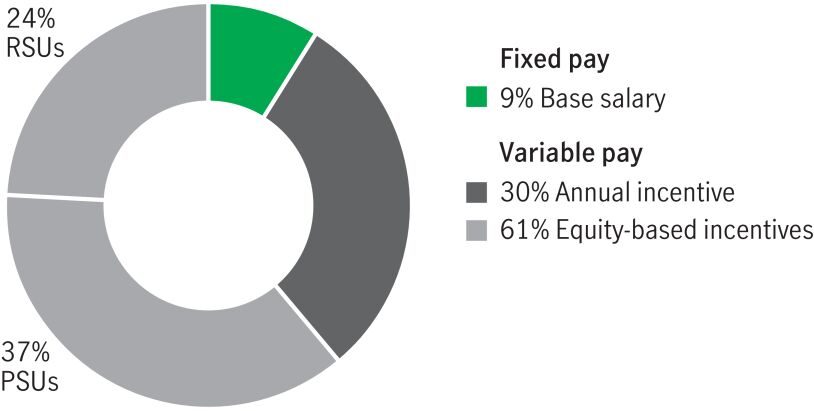
| 2025 Management information circular | 75 |
PAY FOR PERFORMANCE
To ensure the effectiveness of our executive compensation program and its alignment to our core principle of paying for performance, we analyze it from a variety of perspectives. See the executive summary on page 50, for a comparison of what the CEO has earned over the past five years to the value earned by shareholders over the same period.
The graph below compares Manulife’s TSR to the performance of the S&P/TSX Composite Financials Index and to the median of our performance peer group. It also shows the CEO’s realized and realizable pay over the same period and how it aligns with our share price. The graph shows that when TSR has been lower, CEO pay has decreased, and when TSR has been higher, the CEO’s pay has increased. This link is the direct result of awarding a significant portion of CEO pay in equity-based incentives.

| 2020 |
2021 |
2022 |
2023 |
2024 |
||||||||||||||||
| Manulife TSR (on the TSX) |
|
(9.2%) |
|
|
11.6% |
|
|
5.9% |
|
|
28.3% |
|
|
57.5% |
|
|||||
| Median of our performance peer group |
|
(5.1%) |
|
|
37.3% |
|
|
6.2% |
|
|
6.3% |
|
|
26.3% |
|
|||||
| S&P/TSX Composite Financials Index |
|
1.6% |
|
|
36.5% |
|
|
(9.4%) |
|
|
13.9% |
|
|
30.1% |
|
|||||
| Realized and realizable pay for the CEO1 |
|
$4.2M |
|
|
$18.2M |
|
|
$16.0M |
|
$ |
38.9M |
|
$ |
85.3M |
|
|||||
| Compensation received as cash (realized pay) for the CEO |
|
$9.3M |
|
|
$10.8M |
|
|
$11.5M |
|
$ |
13.3M |
|
$ |
23.8M |
|
|||||
| Change in outstanding equity value
year-over-year |
|
($5.1M |
) |
|
$7.4M |
|
|
$4.5M |
|
$ |
25.6M |
|
$ |
61.5M |
|
|||||
| 1 Realized and realizable pay for Mr. Gori. Equity is valued based on the closing prices of Manulife common shares on the TSX as at December 31 for each year. |
Realized and realizable pay
| • | cash compensation paid for a given year, including salary, annual incentive (earned for the year shown but paid the following year) |
| • | payouts of restricted share units and performance share units upon vesting and gains realized from exercising stock options, and the change in value of outstanding restricted share units, performance share units, stock options, deferred share units and shares held in escrow on December 31 of a given year compared to December 31 of the previous year, based on our share price on the TSX as at each of those dates. |
Total shareholder return
TSR is the change in value of an investment between January 1 and December 31 of a given year, assuming dividends are reinvested. For Manulife, TSR reflects the value of our common shares on the TSX.
| 76 | Manulife Financial Corporation |
Executive Compensation

|
Colin Simpson
Chief Financial Officer |
| As Manulife’s CFO, Mr. Simpson is responsible for managing Manulife’s financial affairs, including financial accounting and reporting; planning and analysis; taxation; investor relations; treasury; capital management and financial regulation. He is a member of Manulife’s executive leadership team. |
In his second year as CFO, Mr. Simpson continued to bring a valuable and unique perspective to Manulife, as well as an outside-in view of our franchise that benefited the team in assessing our performance, progress, and competitive positioning. Mr. Simpson played a supporting role in closing the historic reinsurance transactions with Global Atlantic and RGA which, along with our strong operating results, contributed to top-quartile total shareholder return relative to our peers on a 1-, 3- and 5-year basis. He built upon his relationship with the investment community, delivering a best-in-class Investor Day and taking a leadership role in the development of our ambitious new financial targets1. Under his leadership of capital management, Manulife reported record remittances, embarked on a 5% share buyback program, and maintained a stable Life Insurance Capital Adequacy Test (LICAT) ratio1. Mr. Simpson oversaw a number of initiatives that improved expense efficiency, achieving a 44.8% expense efficiency ratio, down from 45.5% in 2023, and meeting our medium-term target of less than 45%.
The information below describes financial and operating results and other factors that went into determining his compensation for 2024.
2024 PERFORMANCE HIGHLIGHTS:
| • | TSR of 57% for 2024, which represents top-quartile return compared to our compensation and performance peer groups |
| • | Net income attributed to shareholders was $5.4 billion in 2024, an increase of $0.3 billion from 2023, despite a $0.9 billion negative impact as a result of the two reinsurance transactions in 2024 (which was primarily related to the sale of debt instruments, with an offsetting change in Other Comprehensive Income that was neutral to book value) |
| • | Core earnings were $7.2 billion in 2024, an increase of 8% from 2023 (or 10% excluding the impact of Global Minimum Taxes (GMT)) |
| • | Core EPS was $3.87 in 2024 and EPS was $2.84 in 2024 (compared with core EPS of $3.47 in 2023 and EPS of $2.61 in 2023). Core EPS grew by 14% excluding the impact of GMT |
| • | Core ROE was 16.4% and ROE was 12.0% in 2024 (compared with core ROE of 15.9% and ROE of 11.9%) |
| • | Continued to proactively manage cost with 44.8% expense efficiency ratio, compared with 45.5% in 2023, achieving our medium-term target of an expense efficiency ratio of less than 45% |
| • | Increased remittances to $7.0 billion in 2024, compared with $5.5 billion in 2023 |
| • | Hosted a successful Investor Day in Hong Kong and Jakarta, our first in Asia since 2017 and our first in-person since 2018, where we shared with investors and analysts the tremendous progress we’ve made in transforming Manulife and announced that we are raising the bar with new financial targets2,3 |
| • | Ranked at the 88th percentile amongst global financial services and insurance companies on our 2024 engagement survey4 |
|
1 This item is disclosed under the Office of the Superintendent of Financial Institutions (OSFI) Life Insurance Capital Adequacy Test Public Disclosure Requirements guideline. 2 For more information related to our new financial targets announced at our Investor Day in June 2024, please see page 5 of 2024 MD&A. 3 See Caution regarding forward-looking statements on page 143. 4 Based on the annual global employee engagement survey conducted by Gallup. Ranking is measured by the engagement grand mean as compared to Gallup’s Finance and Insurance Company level database. |
| 2025 Management information circular | 77 |
TOTAL DIRECT COMPENSATION
The table below shows the total direct compensation the board approved for Mr. Simpson for 2024, and his base salary and equity-based incentives for 2025, based on the recommendation of the CEO and the committee.
Please refer to page 58 for details on the 2024 individual performance multiplier, page 66 for details pertaining to the 2024 and page 69 for details pertaining to the 2025 equity grants.
| 20231 | 2024 | 2025 | ||||||||||
| Base salary | $800,000 | $800,000 | $850,000 | |||||||||
| Annual incentive2 | $1,076,000 | $1,616,000 | $1,417,500 (target) | |||||||||
| Equity-based incentives2 | ||||||||||||
| • PSUs | $500,000 | $1,440,000 | $1,500,000 | |||||||||
| • RSUs | $500,000 | $960,000 | $1,000,000 | |||||||||
| Total direct compensation | $2,876,000 | $4,816,000 | $4,497,500 | |||||||||
| 1 Mr. Simpson joined Manulife as Chief Financial Officer, U.S. and General Account on November 1, 2022. He was appointed Chief Financial Officer on July 1, 2023. The 2023 column shows his annual salary in the new role and the equity-based incentives granted in March 2023 while in his previous role. 2 Timing of awards: the 2024 column includes the annual incentive awarded for 2024 that was paid in February 2025 and the equity-based incentives granted in March 2024. |
2024 ACTUAL COMPENSATION MIX

| 78 | Manulife Financial Corporation |
Executive Compensation
|
|
Phil Witherington
President and Chief Executive Officer, Manulife Asia |
| Mr. Witherington was appointed President and Chief Executive Officer (CEO) of Manulife Asia, effective July 1, 2023. In this role, he is responsible for Manulife’s fast-growing Asia franchise including businesses in Hong Kong and Macau, mainland China, Japan, Singapore, Vietnam, Indonesia, the Philippines, Malaysia, Cambodia, and Myanmar. Prior to this appointment, Mr. Witherington was Chief Financial Officer at Manulife and, prior to that, Chief Financial Officer of Manulife Asia. He is a member of Manulife’s executive leadership team. Effective May 9, 2025, Mr. Witherington will be appointed President and CEO of Manulife. |
Through a focus on high-quality, sustainable growth, Mr. Witherington and his team helped Manulife drive earnings growth with a strong year against key financial and digital objectives. These results were achieved through swift product actions, a focus on sales quality, onboarding the right leadership and driving efficiency and an improved customer experience. Significant progress was made in strategic areas such as agency, geographic diversification, and the segment’s approach to health. Mr. Witherington built and strengthened relationships with key stakeholders across the region, and in recent months has balanced a strong finish to his time as CEO of the Asia segment, with the actions necessary to prepare for his transition to President and CEO in May 2025.
2024 PERFORMANCE HIGHLIGHTS
| • | Reported record results for the key growth metrics for our insurance business in our Asia market: APE sales increased by 36% compared with 2023, new business CSM, and NBV increased 38% and 35%, respectively, compared with 2023, and our new business value margin (NBV margin) remained resilient at 40.7%1 |
| • | Increased Asia segment core earnings 27% compared to the prior year after adjusting for the impact of changes in foreign currency exchange rates. The segment contributed 70% of the total company CSM balance2 and 74% of the total company new business CSM2 as at December 31, 2024. This underscores our focus on accelerating profitable growth and our commitment to achieving 50% of total company core earnings from the Asia region |
| • | Expanded Manulife Pro, our proprietary offering for top-tier agents, to Indonesia, Japan, and Hong Kong, providing selected agents with unique resources such as dedicated underwriting support and enhanced customer engagement services. This expansion contributed to a 23% year-over-year increase in agency APE sales in 2024 |
| • | Launched two new products to address the complex financial needs of high-net-worth individuals, focusing on protection, legacy planning, and wealth management. These two products offer higher long-term return potential, and provide lifetime income payouts linked to the S&P 500 Index, with protection against market volatility, respectively |
| • | Enhanced our health proposition by partnering with innovative healthcare providers in Hong Kong and Singapore to help customers manage their health proactively. In Hong Kong, we strengthened cross-border healthcare offerings with holistic health management, cancer screening, and treatment services. In Singapore, eligible customers can access personalized advanced cancer care and gut microbiome health solutions |
| 1 NBV margin is a specified financial measure. See Non-GAAP and other financial measures on page 106 for more information. 2 CSM balance and new business CSM are net of non-controlling interests (pre-tax). |
| 2025 Management information circular | 79 |
| • | Enhanced underwriting efficiency in Singapore through the implementation of GenAI, which improves the accuracy of underwriting decisions by automating document digitization and summarization, and reduces processing time for policy applications |
| • | Improved the customer experience and operational efficiency of our Japan contact center as part of global transformation initiatives. By advancing voice bot capabilities and utilizing AI for speech-to-text and call summarization, we achieved a record high transactional NPS in 2024 and reduced average handling time by 28% in the second half of 2024 compared to the same period in 2023 |
| • | Continued to maintain an engaged culture and make Manulife a great place to work. Manulife was recognized by HR Asia as one of the “Best Companies to Work for in Asia 2024” in six of our markets |
| • | Improved segment engagement score to 80th percentile amongst global financial services and insurance companies on our 2024 engagement survey1 |
| 1 | Based on the annual global employee engagement survey conducted by Gallup. Ranking is measured by the engagement grand mean as compared to Gallup’s Finance and Insurance Company level database. |
TOTAL DIRECT COMPENSATION
The table below shows the total direct compensation the board approved for Mr. Witherington for 2024, and his base salary and equity-based incentives for 2025, based on the recommendation of the CEO and the committee.
Please refer to page 58 for details on the 2024 individual performance multiplier, page 66 for details pertaining to the 2024 and page 69 for details pertaining to the 2025 equity grants.
| (US$) | 20232 |
20242 |
20253 |
|||||||||
| Base salary | $750,000 | $775,000 | $1,200,000 | |||||||||
| Annual incentive1 | $1,578,000 | $ | 1,897,000 | $2,400,000 (target) | ||||||||
| Equity-based incentives1,4 | ||||||||||||
| • PSUs | $1,766,654 | $ | 1,950,000 | $3,660,000 | ||||||||
| • RSUs | $1,177,770 | $ | 1,300,000 | $2,440,000 | ||||||||
| Total direct compensation | $5,272,424 | $ | 5,922,000 | $9,700,000 | ||||||||
| 1 Timing of awards: the 2024 column includes the annual incentive awarded for 2024 that was paid in February 2025 and the equity-based incentives granted in March 2024. 2 Mr. Witherington was appointed President and CEO, Manulife Asia on July 1, 2023. While in this role, his compensation was delivered in Hong Kong dollars. However, this table presents his 2023 and 2024 compensation in U.S. dollars for comparability with his go-forward compensation as President and CEO, Manulife (effective May 9, 2025). His total compensation in HKD was $41,266,480 in 2023 and $46,269,715 in 2024. 3 Compensation information shown in this column reflects Mr. Witherington’s compensation effective May 9, 2025 when he will assume the role of President and CEO of Manulife. Refer to the next page for more details on changes to his compensation. 4 $4.0 million of equity-based incentives were granted for his prior role of CFO in 2023 in Canadian dollars. Amounts have been converted to U.S. dollars for presentation purposes using the average exchange rates for the 10 trading days before the grant date. |
2024 ACTUAL COMPENSATION MIX
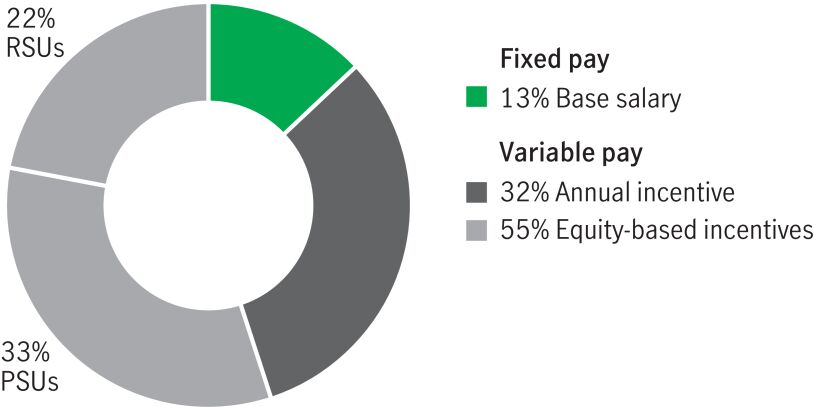
| 80 | Manulife Financial Corporation |
Executive Compensation
CEO TRANSITION AND 2025 COMPENSATION
On May 9, 2025, Phil Witherington will assume the role of President and CEO of Manulife, succeeding Roy Gori, who will retire on May 8, 2025 and will serve as an Advisor through August 31, 2025.
Mr. Witherington’s 2025 total direct compensation target has been set by the board at US$9,700,000, composed of a base salary of US$1,200,000, a target annual incentive of 200% of base salary (US$2,400,000) and an equity-based incentive award of US$6,100,000. Mr. Witherington’s future compensation will be reviewed annually as per Manulife’s formal governance process for reviewing and setting target compensation for our named executives.
While Manulife’s headquarters is based in Canada, we are a global business. Manulife derives approximately three-quarters of its core earnings from markets outside of Canada and we operate in 23 markets. The committee set Mr. Witherington’s target compensation with consideration to our compensation peer group, which contains a mix of companies from Canada and other international markets where Manulife competes for talent with other global businesses.
Reflective of Manulife’s pay-for-performance approach, a majority of his compensation is variable (or at risk) with a significant portion tied to our share price, and reflects the board’s focus on aligning executive pay with the interests of our shareholders. See page 51 for more information related to Manulife’s approach to executive compensation.
| 2025 Management information circular | 81 |

|
Paul Lorentz
President and CEO, Global Wealth and Asset Management (Global WAM) |
| Mr. Lorentz is responsible for all aspects of the company’s Global WAM business, delivering solutions for investors through retirement, retail and institutional channels. He also has direct oversight of the investment teams across both public and private market capabilities. He is accountable for delivering leading solutions for investors while ensuring we leverage our global scale and diversified business to meet the evolving demands of the market. He is a member of Manulife’s executive leadership team. |
Under Mr. Lorentz’s leadership, Manulife’s Global WAM segment delivered exceptional results in 2024, outperforming peers and surpassing planned targets. The segment generated $13.3 billion in positive net flows in 2024. This continued the strong momentum of positive net flows in 14 out of the past 15 calendar years, demonstrating our consistent track record of meeting investor needs in generating and retaining flows. As one of Manulife’s key growth engines, the Global WAM segment helped accelerate the company’s momentum with core earnings increasing by 30% on a constant exchange rate basis, with significant contributions from all business lines and geographies, including 37% growth in Asia. In 2024, we completed the acquisition of CQS, a U.K.-based multi-sector alternative credit manager, and expanded the private markets product lineup in North America with the launch of Manulife Capital Partners VII and Manulife Private Equity Partners II, collectively adding over $2 billion in assets under management and administration (AUMA)1.
The information below describes the Global WAM segment financial and operating results and other factors that went into determining his compensation for 2024.
2024 PERFORMANCE HIGHLIGHTS
| • | Global WAM’s net income attributed to shareholders was $1.6 billion in 2024 compared with $1.3 billion in 2023. Core earnings increased $415 million, or 30% compared with 2023 on a constant exchange rate basis, driven by an increase in net fee income from higher average AUMA1 reflecting the favourable impact of markets, net inflows, and disciplined expense management |
| • | Net inflows were $13.3 billion in 2024, compared with net inflows of $4.5 billion in 2023, which contributed to a 14% growth in Global WAM AUMA1, on a constant exchange rate basis, to over $1.2 trillion |
| • | Completed the acquisition of CQS, a U.K.-based multi-sector alternative credit manager, which positively contributed to Global WAM net flows and core earnings in 2024. We have leveraged these expanded investment capabilities to launch the John Hancock Multi Asset Credit Retail Fund in the U.S. This fund is a strong addition to our growing lineup of liquid and semi-liquid alternative offerings which are part of our larger credit franchise |
| • | Continued to meet investor needs for alternative solutions through the expansion of our product offerings with the launch of the Manulife Capital Partners VII and Manulife Private Equity Partners II for Institutional investors which combined havegarnered over $2 billion in AUMA |
| • | Advanced and broadened our wealth planning and advice business with the implementation of a new advisor retail wealth platform in Canada as well as introduction of new digital and AI-powered tools to the business. More specifically, a new AI- powered sales enablement app in Asia, an AI-powered planning tool in Canada, and new self service capabilities in our Canada Retirement mobile app which saw 29% growth in users in 2024 compared to the prior year. |
| 1 AUMA and Global WAM AUMA are non-GAAP financial measures, and percentage change in Global WAM AUMA is stated on a constant exchange rate basis is a non-GAAP ratio. See Non-GAAP and other financial measures on page 106 for more information. |
| 82 | Manulife Financial Corporation |
Executive Compensation
| • | Completed the third and final close of the Manulife Forest Climate Fund, securing total commitments of approximately $630 million to deploy on behalf of investors |
| • | Ranked in the top quartile (86th percentile) among global financial services and insurance companies on our 2024 engagement survey1 |
| 1 | Based on the annual global employee engagement survey conducted by Gallup. Ranking is measured by the engagement grand mean as compared to Gallup’s Finance and Insurance Company level database. |
TOTAL DIRECT COMPENSATION
The table below shows the total direct compensation the board approved for Mr. Lorentz for 2024 and his base salary and equity-based incentives for 2025, based on the recommendation of the CEO and the committee.
Please refer to page 58 for details on the 2024 individual performance multiplier, page 66 for details pertaining to the 2024 and page 69 for details pertaining to the 2025 equity grants.
| 2023 | 2024 | 2025 | ||||||||||
| Base salary | $850,000 | $870,000 | $900,000 | |||||||||
| Annual incentive1 | $2,281,000 | $2,721,000 | $1,800,000 (target) | |||||||||
| Equity-based incentives1 | ||||||||||||
| • PSUs | $2,280,000 | $2,280,000 | $2,400,000 | |||||||||
| • RSUs | $1,520,000 | $1,520,000 | $1,600,000 | |||||||||
| Total direct compensation | $6,931,000 | $7,391,000 | $6,700,000 | |||||||||
| 1 | Timing of awards: the 2024 column includes the annual incentive awarded for 2024 that was paid in February 2025 and the equity-based incentives granted in March 2024 |
2024 ACTUAL COMPENSATION MIX

| 2025 Management information circular | 83 |

|
Marc Costantini
Global Head of Strategy and Inforce Management |
| Mr. Costantini was appointed as the Global Head of Inforce Management on June 13, 2022 and is responsible for leading all initiatives to improve the profitability and risk profile of Manulife’s Inforce Management business. In May 2024, Mr. Costantini expanded his responsibility by assuming leadership of our Global Strategy and Corporate Development teams while continuing to lead our Global Inforce Management team. He is a member of Manulife’s executive leadership team. |
Mr. Costantini delivered another outstanding year, demonstrating tenacity and creativity in helping Manulife achieve its portfolio optimization ambitions. Under his leadership, the company executed significant reinsurance transactions in 2024, enhancing financial flexibility and driving top-quartile TSR performance within our compensation and performance peer groups. These efforts featured the largest long-term care (LTC) reinsurance transaction with Global Atlantic, the largest Universal Life reinsurance transaction in the Canadian insurance industry, and another agreement for a younger LTC block and a legacy block of U.S. structured settlements, which was announced in November 2024 and closed in January 2025. These initiatives are expected to release $2.8 billion1 of capital and reduce reserves by $24 billion, significantly lowering our LTC reserves and morbidity sensitivity. Furthermore, proactive management of legacy blocks achieved over 90% approval for LTC premium rate increases2. As a result of these actions, core earnings contribution from the LTC and Variable Annuity (VA) businesses were only 10% of Manulife’s total company core earnings in 2024. These strategic efforts underscore our commitment to optimizing the portfolio and delivering substantial shareholder value. Mr. Costantini also seamlessly assumed responsibility for our global strategy and corporate development organizations in 2024.
2024 PERFORMANCE HIGHLIGHTS
| • | Released an expected $2.8 billion of capital1 through reinsurance transactions closed or announced in 2024 |
| • | Closed the milestone transaction with Global Atlantic in February 2024 to reinsure four in-force blocks of legacy/low return on equity business, including $6 billion in LTC reserves, which represented the largest LTC reinsurance transaction in history |
| • | Completed the largest Universal Life reinsurance transaction in Canadian history in April 2024 to reinsure $5.8 billion of reserves of low return on equity Canadian Universal Life block, further reducing our risk profile and unlocking significant value for shareholders |
| • | Announced an additional reinsurance agreement in November 2024 covering $5.4 billion of reserves, including $2.4 billion of long-term care (LTC) reserves. The transaction was closed in January 2025 |
| • | Received approval for over 90% of the premium rate increases2 that were embedded in our reserves as of the last LTC actuarial assumption review in 2022 |
| • | Accelerated our organic Inforce Management activities capitalizing on digital services and advanced analytics, leading to improved customer experience and reduced range of claims outcomes |
| • | Ranked in the top quartile (97th percentile) among global financial services and insurance companies on our 2024 engagement survey3 |
| 1 See Caution regarding forward-looking statements on page 143. 2 Represents present value of future premium rate increases or other equivalent options to be offered to LTC policyholders. 3 Based on the annual global employee engagement survey conducted by Gallup. Ranking is measured by the engagement grand mean as compared to Gallup’s Finance and Insurance Company level database. |
| 84 | Manulife Financial Corporation |
Executive Compensation
TOTAL DIRECT COMPENSATION
The table below shows the total direct compensation the board approved for Mr. Costantini for 2024, and his base salary and equity-based incentives for 2025, based on the recommendation of the CEO and the committee.
Please refer to page 58 for details on the 2024 individual performance multiplier, page 66 for details pertaining to the 2024 and page 69 for details pertaining to the 2025 equity grants.
| (US$) | 2023 | 2024 | 2025 | |||||||||
| Base salary | $740,000 | $740,000 | $800,000 | |||||||||
| Annual incentive1 | $1,706,000 | $1,962,000 | $1,400,000 (target)2 | |||||||||
| Equity-based incentives1 | ||||||||||||
| • PSUs | $1,110,000 | $1,500,000 | $2,100,000 | |||||||||
| • RSUs | $740,000 | $1,000,000 | $1,400,000 | |||||||||
| Total direct compensation | $4,296,000 | $5,202,000 | $5,700,000 | |||||||||
| 1 | Timing of awards: the 2024 column includes an annual incentive awarded for 2024 and paid in February 2025, and the equity- based incentives granted in March 2024. |
| 2 | For 2025 the board approved an increase in Mr. Costantini’s annual incentive target from 150% of base salary to 175% of base salary. Please refer to page 64 for more details on this decision. |
2024 ACTUAL COMPENSATION MIX

| 2025 Management information circular | 85 |
The graph below compares the cumulative value of $100 invested in Manulife common shares for a five-year period beginning on December 31, 2019 with the value of $100 invested in each of two major market indices and an “index” of our performance peers for the same period assuming dividends were reinvested.
Manulife’s share price performance compared to peers and other relevant indices is one lens the board reviews when establishing executive pay levels.

| Year ended December 31 | 2019 | 2020 | 2021 | 2022 | 2023 | 2024 | ||||||||||||||||||
| Manulife | $100.00 | $90.80 | $101.33 | $107.27 | $137.67 | $216.82 | ||||||||||||||||||
| S&P/TSX Composite Index | $100.00 | $105.60 | $132.10 | $124.38 | $139.00 | $169.09 | ||||||||||||||||||
| S&P/TSX Composite Financials Index | $100.00 | $101.62 | $138.71 | $125.70 | $143.16 | $186.25 | ||||||||||||||||||
| Performance Peer Group Index1 | $100.00 | $94.95 | $130.42 | $138.54 | $147.23 | $184.09 | ||||||||||||||||||
| 1 | Annual return is the value of a $100 investment on December 31, 2019 over a five-year period assuming investment had achieved the median shareholder return of our performance peer group each year (see page 68 for a listing of these peers). |
| 86 | Manulife Financial Corporation |
Executive Compensation
Cost of management ratio
The table below shows that total compensation for Manulife’s named executives in 2024 was 0.9% of net income attributable to shareholders.
The table provides total compensation awarded to our named executives, as reported in the summary compensation table in each of the previous five years. There were five named executives in 2024.
An additional column has been added showing the cost of management ratio for 2022 using transitional rather than reported net income. This value is materially different than what was disclosed in the 2023 Management information circular due to the implementation of the new accounting standards, IFRS 17 and IFRS 9. For more information about the impact the transition to IFRS 17 and IFRS 9 had on our financial results, please see page 105 or page 44-45 of our 2024 management information circular.
|
|
Reported under IFRS 4 and IAS 39 |
|
Reported under IFRS 17 and IFRS 9 |
|||||||||||||||||||||
|
|
2020 | 2021 | 2022 | 2022 Transitional1 |
2023 | 2024 | ||||||||||||||||||
| Total compensation reported for the named executives ($ thousands) | $ | 36,828 | $ | 41,839 | $ | 41,647 | $41,647 | $51,165 | $49,774 | |||||||||||||||
| Net income attributed to shareholders ($ millions) | $5,871 | $7,105 | $7,294 | $3,498 | $5,103 | $5,385 | ||||||||||||||||||
| Cost of management ratio | 0.6% | 0.6% | 0.6% | 1.2% | 1.0% | 0.9% | ||||||||||||||||||
| 1 | Transitional net income attributed to shareholders is a non-GAAP financial measure. See Non-GAAP and other financial measures on page 106 for more information. |
Cost of management ratio
Total compensation paid to the named executives divided by net income attributed to shareholders, expressed as a percentage.
Named executives each year
2024: Roy Gori, Colin Simpson, Phil Witherington, Paul Lorentz, Marc Costantini
2023: Roy Gori, Colin Simpson, Phil Witherington, Paul Lorentz, Scott Hartz, Marc Costantini
2022: Roy Gori, Phil Witherington, Marc Costantini, Marianne Harrison, Scott Hartz
2021: Roy Gori, Phil Witherington, Marianne Harrison, Anil Wadhwani, Scott Hartz
2020: Roy Gori, Phil Witherington, Marianne Harrison, Anil Wadhwani, Scott Hartz
| 2025 Management information circular | 87 |
Executive compensation details
The table below shows the total compensation awarded to each named executive for our last three fiscal years. We set compensation for some of the named executives in U.S. dollars, and have converted the amounts below to Canadian dollars consistent with our financial statements. Exchange rates used vary by compensation element and by year as shown on the following page. The 2024 total compensation for the named executives shown below was driven by higher incentive plan outcomes across our businesses and fluctuations in currency exchange rates.
For each named executive, the 2024 row reflects the annual incentive paid in February 2025 and equity-based incentive awards granted in March 2024. Please see the named executive profiles starting on page 72 for a discussion of their 2024 total direct compensation.
| Non-equity incentive compensation |
||||||||||||||||||||||||||||||||
| Year | Salary | Share-based awards |
Option- based |
Annual Incentive |
Pension value |
All other compensation |
Total compensation |
|||||||||||||||||||||||||
| Roy Gori President and CEO |
|
2024 2023 2022 |
|
|
$1,785,197 $1,728,123 $1,515,205 |
|
|
$11,503,050 $11,547,344 $10,436,550 |
|
|
$0 $0 $0 |
|
|
$6,022,374 $5,145,492 $3,920,304 |
|
|
$1,015,300 $823,400 $1,074,738 |
|
|
$138,531 $138,256 $131,737 |
|
|
$20,464,452 $19,382,615 $17,078,534 |
|
||||||||
| Colin Simpson Chief Financial Officer1 (effective July 1, 2023) |
|
2024 2023 2022 |
|
|
$800,000 $703,000 $100,000 |
|
|
$2,400,000 $1,000,000 $1,155,000 |
|
|
$0 $0 $0 |
|
|
$1,616,000 $1,076,000 $0 |
|
|
$175,900 $59,100 $8,912 |
|
|
$3,891 $1,681,956 $0 |
|
|
$4,995,791 $4,520,056 $1,263,912 |
|
||||||||
| Phil Witherington President and CEO, |
|
2024 2023 2022 |
|
|
$1,057,388 $987,603 $944,166 |
|
|
$4,398,225 $4,000,000 $2,800,000 |
|
|
$0 $0 $0 |
|
|
$2,692,412 $2,133,140 $1,562,000 |
|
|
$98,400 $243,900 $311,775 |
|
|
$915,428 $431,210 $53,679 |
|
|
$9,161,853 $7,795,853 $5,671,620 |
|
||||||||
| Paul Lorentz President & CEO, |
|
2024 2023 2022 |
|
|
$866,667 $850,000 $689,167 |
|
|
$3,800,000 $3,800,000 $2,500,000 |
|
|
$0 $0 $0 |
|
|
$2,721,000 $2,281,000 $1,938,000 |
|
|
$303,300 $267,400 $230,245 |
|
|
$3,555 $1,935 $1,723 |
|
|
$7,694,522 $7,200,335 $5,359,135 |
|
||||||||
| Marc Costantini Global Head of Inforce Management |
|
2024 2023 2022 |
|
|
$1,013,652 $994,196 $522,603 |
|
|
$3,383,250 $2,513,245 $4,209,400 |
|
|
$0 $0 $0 |
|
|
$2,784,667 $2,306,171 $1,417,543 |
|
|
$275,900 $200,900 $31,626 |
|
|
$0 $0 $976,125 |
|
|
$7,457,469 $6,014,512 $7,157,297 |
|
||||||||
| 1 | Mr. Simpson joined Manulife on November 1, 2022. He was Chief Financial Officer, U.S. Segment and General Account, until June 30, 2023, when he was promoted to Manulife’s Chief Financial Officer. His “All other compensation” amount for 2023 includes a one-time payment of $1,680,000 to replace compensation forfeited from his previous employer. |
Base salary
Mr. Gori’s salary is set in U.S. dollars but paid semi-monthly in Canadian dollars using the Bank of Canada closing exchange rate.
Mr. Simpson’s and Mr. Lorentz’s salaries are set and paid in Canadian dollars. Mr. Costantini’s salary is set and paid in U.S. dollars.
Mr. Witherington’s salary was set and paid in Canadian dollars until June 30, 2023. As of July 1, 2023, his salary is paid in Hong Kong dollars. As of May 9, 2025, his salary will be set in U.S. dollars, but paid semi-monthly in Canadian dollars using the Bank of Canada closing exchange rate.
For executives who are paid in U.S. dollars and Hong Kong dollars, we used the average annual exchange rates outlined in the table below to convert to Canadian.
| Exchange rate for U.S. dollars |
Exchange rate for Hong Kong dollars |
|||
| 2024 2023 2022 |
US$1.00 = $1.3698 US$1.00 = $1.3494 US$1.00 = $1.3015 |
HK$1.00 = $0.1755 HK$1.00 = $0.1724 |
| Supplementary table: This table shows total compensation for
|
||||||||
| (US$) | ||||||||
| Roy Gori | |
2024 2023 2022 |
|
|
$14,888,789 $14,299,715 $13,214,387 |
|
||
| Colin Simpson | |
2024 2023 2022 |
|
|
$3,627,312 $3,343,292 $991,130 |
|
||
| Phil Witherington | |
2024 2023 2022 |
|
|
$6,659,057 $5,754,587 $4,370,915 |
|
||
| Paul Lorentz | |
2024 2023 2022 |
|
|
$5,581,803 $5,314,065 $4,116,957 |
|
||
| Marc Costantini | |
2024 2023 2022 |
|
|
$5,403,416 $4,441,650 $5,482,839 |
|
||
| 88 | Manulife Financial Corporation |
Executive Compensation
| Share-based awards The grant date fair value of
performance share
The grant price is the average closing price for the |
Grant date | Share price | Exchange rate for awards in U.S. dollars |
|||||||||
| 2024 | March 5 |
$ | 32.57 | US$1.00 = $1.3533 | ||||||||
| 2023 | March 7 |
$ | 26.97 | US$1.00 = $1.3585 | ||||||||
| 2022 | March 1 |
$ | 26.54 | US$1.00 = $1.2728 | ||||||||
| August 29 |
$ | 23.80 | US$1.00 = $1.2952 | |||||||||
| November 28
|
$
|
23.59
|
|
|||||||||
|
The share-based awards shown for 2022 contain two instances of awards granted to replace compensation of similar value with similar vesting conditions forfeited from a previous employer: • Mr. Simpson received a one-time award of $1,155,000 in restricted share units, granted November 28, 2022. Fifty percent (50%) of the restricted share units vested on May 28, 2024, and 50% will vest on May 28, 2025. • Mr. Costantini received a one-time award of US$1,500,000 in restricted share units, granted on August 29, 2022. Fifty (50%) percent of the restricted share units vested on August 29, 2023 and 50% vested on August 29, 2024. |
|
|||||||||||
Option-based awards
We have not awarded stock options since 2020.
| Annual incentive Paid in the year
following the fiscal year in which the award was earned. The U.S.
Pension value The sum of the amounts under compensatory change for each named executive in |
Exchange rate
|
|||||||
| |
2024 2023 2022 |
|
|
US$1.00 = $1.4193 US$1.00 = $1.3518 US$1.00 = $1.3411 |
|
|||
All other compensation
Amounts paid in U.S dollars were converted to Canadian dollars consistent with our financial statements.
Mr. Gori’s amount includes:
| • | 2024: $34,580 for club membership fees and a $100,000 flexible spending account allowance. |
| • | 2023: $28,572 for club membership fees and a $100,000 flexible spending account allowance. |
| • | 2022: $27,035 for club membership fees and a $100,000 flexible spending account allowance. |
Mr. Simpson’s amount includes:
| • | 2023: a one-time payment of $1,680,000 to replace compensation forfeited from previous employer. |
Mr. Witherington’s amount includes:
| • | 2024: a HK$3,900,000 housing allowance, HK$514,466 for children’s education, HK$76,470 for club membership fees and HK$724,651 for expenses related to his personal driver |
| • | 2023: a HK$1,950,000 housing allowance, HK$200,000 relocation allowance, and HK$157,000 children education covering the time in his role in Asia. It also includes $25,000 flexible spending allowance covering the six-month period when Mr. Witherington was CFO. |
| • | 2022: a $50,000 flexible spending account allowance. |
Mr. Costantini’s amount includes:
| • | 2022: a one-time payment of US$750,000 to replace compensation forfeited from his previous employer. |
| 2025 Management information circular | 89 |
Outstanding equity-based incentive awards (as at December 31, 2024)
| Option-based awards | ||||||||||||||||||
| Grant date | Number of securities underlying unexercised options |
Option exercise price |
Option expiration date |
Value of unexercised in-the-money options |
||||||||||||||
| Roy Gori | Mar 2, 2015 | 65,232 | $21.81 | Mar 2, 2025 | $1,457,935 | |||||||||||||
| Feb 23, 2016 | 436,301 | $17.59 | Feb 23, 2026 | $11,592,518 | ||||||||||||||
| Feb 28, 2017 | 243,473 | $24.61 | Feb 28, 2027 | $4,759,897 | ||||||||||||||
| Jun 8, 2017 | 167,872 | $23.51 | Jun 8, 2027 | $3,466,557 | ||||||||||||||
| Feb 27, 2018 | 395,962 | $24.73 | Feb 27, 2028 | $7,693,542 | ||||||||||||||
| Mar 5, 2019 | 485,894 | $22.60 | Mar 5, 2029 | $10,475,875 | ||||||||||||||
| Mar 3, 2020 | 689,991 | $24.38 | Mar 5, 2030 | $13,648,022 | ||||||||||||||
| Colin Simpson | – | – | – | – | – | |||||||||||||
| Phil Witherington | Feb 24, 2015 | 7,724 | $22.02 | Feb 24, 2025 | $171,009 | |||||||||||||
| Feb 23, 2016 | 43,462 | $17.59 | Feb 23, 2026 | $1,154,785 | ||||||||||||||
| Mar 3, 2020 | 205,086 | $24.38 | Mar 5, 2030 | $4,056,601 | ||||||||||||||
| Paul Lorentz | Feb 24, 2015 | 43,349 | $22.02 | Feb 24, 2025 | $959,747 | |||||||||||||
| Feb 28, 2017 | 34,829 | $24.61 | Feb 28, 2027 | $680,907 | ||||||||||||||
| Feb 27, 2018 | 105,618 | $24.73 | Feb 27, 2028 | $2,052,158 | ||||||||||||||
| Mar 5, 2019 | 124,858 | $22.60 | Mar 5, 2029 | $2,691,938 | ||||||||||||||
| Mar 3, 2020 | 178,425 | $24.38 | Mar 5, 2030 | $3,529,247 | ||||||||||||||
| Marc Costantini | – | – | – | – | – | |||||||||||||
| 90 | Manulife Financial Corporation |
Executive Compensation
| Share based awards | ||||||||||||||||
| Grant date | Type of share based award |
Number of shares or units of shares that have not vested |
Market or payout value of share based awards that have not vested |
Market or payout value of vested share based awards not paid out or distributed |
||||||||||||
| Roy Gori | Mar 1, 2022 | PSU | 271,726 | $11,999,430 | ||||||||||||
| RSU | 181,152 | $7,999,654 | ||||||||||||||
| Mar 7, 2023 | PSU | 279,271 | $12,332,594 | |||||||||||||
| RSU | 186,181 | $8,221,745 | ||||||||||||||
| Mar 5, 2024 | PSU | 218,512 | $9,649,507 | |||||||||||||
| RSU | 145,675 | $6,433,004 | ||||||||||||||
| MFC Shares1 (2015) | 131,930 | $5,826,029 | ||||||||||||||
| Colin Simpson | Nov 28, 2022 | PSU | – | – | ||||||||||||
| RSU | 27,128 | $1,197,993 | ||||||||||||||
| Mar 7, 2023 | PSU | 20,154 | $890,004 | |||||||||||||
| RSU | 20,154 | $890,004 | ||||||||||||||
| Mar 5, 2024 | PSU | 45,590 | $2,013,251 | |||||||||||||
| RSU | 30,394 | $1,342,182 | ||||||||||||||
| Phil Witherington | Mar 1, 2022 | PSU | 72,898 | $3,219,197 | ||||||||||||
| RSU | 48,598 | $2,146,097 | ||||||||||||||
| Mar 7, 2023 | PSU | 96,740 | $4,272,057 | |||||||||||||
| RSU | 64,493 | $2,848,022 | ||||||||||||||
| Mar 5, 2024 | PSU | 83,548 | $3,689,488 | |||||||||||||
| RSU | 55,699 | $2,459,689 | ||||||||||||||
| Paul Lorentz | Mar 1, 2022 | PSU | 65,087 | $2,874,245 | ||||||||||||
| RSU | 43,392 | $1,916,180 | ||||||||||||||
| Mar 7, 2023 | PSU | 91,903 | $4,058,425 | |||||||||||||
| RSU | 61,269 | $2,705,633 | ||||||||||||||
| Mar 5, 2024 | PSU | 72,185 | $3,187,678 | |||||||||||||
| RSU | 48,123 | $2,125,134 | ||||||||||||||
| Marc Costantini | Aug 29, 2022 | PSU | 63,918 | $2,822,602 | ||||||||||||
| RSU | 42,612 | $1,881,735 | ||||||||||||||
| Mar 7, 2023 | PSU | 60,783 | $2,684,173 | |||||||||||||
| RSU | 40,521 | $1,789,417 | ||||||||||||||
| Mar 5, 2024 | PSU | 64,268 | $2,838,096 | |||||||||||||
| RSU | 42,846 | $1,892,079 | ||||||||||||||
| 1 Represents the remaining balance of the escrow account established as part of the arrangement provided to Mr. Gori when he relocated to Toronto in 2017. See page 86 of our 2018 management information circular, which is available at manulife.com. |
In the tables above:
| • | the value of unexercised in-the-money stock options is the difference between the exercise price of the stock options and $44.16, the closing price of Manulife common shares on the TSX on December 31, 2024. The amount is zero if the exercise price is higher than our year-end closing share price |
| • | the market or payout values of the share-based awards are based on $44.16, the closing price of Manulife common shares on the TSX on December 31, 2024 |
| • | the value of performance share units that have not yet vested has been calculated using a performance factor of 1.0 |
| • | restricted share units (RSUs), performance share units (PSUs) and deferred share units (DSUs) are paid out in cash. Ten percent (10%) of RSU and PSU payments are delivered in Manulife common shares purchased on the open market. |
| 2025 Management information circular | 91 |
Incentive plan awards – value vested or earned in 2024
For each named executive:
| • | the value of options vested during the year shows the amount that would have been realized if the options had been exercised on the vesting date, based on the closing price of Manulife common shares on the TSX |
| • | the value of options received during the year shows the actual gain realized by named executives who exercised options in 2024 |
| • | the value of share-based awards that vested shows the amount paid out in 2024 |
| • | the value of the annual incentive earned for 2024. |
|
|
Option-based awards |
Share-based awards |
Annual incentive | |||||||||||||
| Value vested during the year |
Value received during the year |
Value vested during the year |
Value earned during the year |
|||||||||||||
| Roy Gori | $1,409,309 | $3,366,846 | $12,666,842 | $6,022,374 | ||||||||||||
| Colin Simpson | $0 | $0 | $947,262 | $1,616,000 | ||||||||||||
| Phil Witherington | $418,884 | $3,827,927 | $3,966,320 | $2,692,412 | ||||||||||||
| Paul Lorentz | $364,431 | $1,983,822 | $3,452,184 | $2,721,000 | ||||||||||||
| Marc Costantini | $0 | $0 | $1,634,918 | $2,784,667 | ||||||||||||
Stock options exercised in 2024
Roy Gori, Phil Witherington and Paul Lorentz exercised stock options in 2024, including certain exercises under our automatic stock option exercise program (see below):
|
|
Grant date | Number of options | Exercise price ($) | Gain ($) | ||||||
| Roy Gori | 2-Mar-2015 | 195,699 | $21.81 | $3,366,846 | ||||||
| Phil Witherington | |
24-Feb-2015 28-Feb-2017 27-Feb-2018 5-Mar-2019 |
|
23,172 34,315 120,707 144,572 |
$22.02 $24.61 $24.73 $22.60 |
$394,202 $361,732 $1,257,962 $1,814,031 |
||||
| Paul Lorentz | |
25-Feb-2014 23-Feb-2016 |
|
37,239 57,908 |
$21.20 $17.59 |
$430,844 $1,552,978 |
||||
In 2024, Mr. Witherington exercised 23,172 options under Manulife’s automatic stock option exercise program (described below). Additionally, Mr. Witherington also elected to exercise three tranches of stock options through a “sell to cover” arrangement, selling enough shares to cover the cost of the options, taxes, and fees, while retaining all remaining shares. In total, he retained 63,973 shares, which contribute toward meeting Manulife’s equity ownership guidelines (see page 113 for further details) and continue to align his interests with those of our shareholders.
Automatic stock option exercise program
Executives with outstanding stock options are given the opportunity to elect to have their vested stock options automatically exercised prior to expiration. This program is designed to protect executives from having stock options expire in-the-money if they were unable to exercise due to a closed trading window, or if they were in possession of material non-public information. Elections were made during a time when they were not in possession of any material non-public information and are irrevocable. If an executive leaves Manulife, any elections under the program will terminate.
About deferred share units
In 2024, executives in Canada and the U.S. were given the opportunity to exchange some or all of their annual incentive award, vested restricted share units and vested performance share units for deferred share units, subject to local tax rules and rulings. We may also grant deferred share units to some new hires and to other executives in special situations.
| 92 | Manulife Financial Corporation |
Executive Compensation
Deferred share units are notional shares that track the value of Manulife common shares and earn dividend equivalents at the same rate as dividends paid on the common shares. They can only be redeemed for cash when the executive retires or leaves Manulife. For each unit redeemed, the executive will receive the market value of a Manulife common share at the time of redemption. Vesting conditions are specific to each grant, however deferred share units received in exchange for other vested awards, as described above, vest immediately. Deferred share units align executives with the long-term interests of shareholders and are only transferable if the executive dies.
Canadian executives cannot exchange restricted share units and performance share units that were granted after 2015, in accordance with a change in Canadian tax rulings. Instead, to promote longer term equity ownership, Canadian executives can choose to receive deferred share units instead of restricted share units as long as they make this choice prior to the grant.
About the deferred compensation account
Some U.S. executives can defer up to 90% of their base salary and some or all of their annual incentive and vested restricted share units into a deferred compensation account. The money must remain in the account for at least three years and is adjusted as though the funds had been invested in one or more investment options designated by Manulife and selected by the executive. On withdrawal, the executive can take the cash either in a lump sum or in annual instalments.
Securities authorized for issue under equity compensation plans
The table below shows the total number of securities to be issued and available for issue under our equity compensation plans as at December 31, 2024:
|
|
Number of securities to be issued upon exercise of outstanding options, warrants and rights |
Weighted average of exercise price of outstanding options, warrants and rights |
Number of securities remaining available for future issuance under equity plans |
|||||||||
| Equity compensation plans approved by security holders | 10,988,958 | 23.35 | 6,501,618 | |||||||||
The following tables tell you about our plans and their status as at December 31, 2024:
| Executive stock option plan | ||||
| The executive stock option plan was approved by shareholders at the 2000 annual and special meeting. Deferred share units, share appreciation rights, restricted shares and performance awards can also be granted under the executive stock option plan. We need shareholder approval to make changes to the plan.
|
|
|||
| Maximum number of common shares that may be issued
|
73,600,000 | |||
| • as a % of common shares outstanding
|
4.0% | |||
| Maximum number of common shares that may be issued (% of outstanding common shares that cannot be exceeded) |
|
|||
| • to any one participant, or |
5% | |||
| • to insiders as a whole
|
10% | |||
| Total number of common shares that have been issued in respect of stock options and deferred share units | 56,381,108 | |||
| • as a % of common shares outstanding
|
3.2% | |||
| 2025 Management information circular | 93 |
Stock plan for non-employee directors
| The stock plan for non-employee directors was approved by shareholders at the 2001 annual and special meeting. Deferred share units can also be granted under the stock plan. We need shareholder approval to make changes to the plan.
|
|
|||
| Maximum number of common shares that may be issued | 1,000,000 | |||
| • as a % of common shares outstanding |
less than 0.1% | |||
| Maximum number of common shares that may be issued (% of outstanding common shares that cannot be exceeded) |
|
|||
| • to any one participant, or |
5% | |||
| • to insiders as a whole
|
10% | |||
| Total number of common shares that have been issued in respect of deferred share units |
728,316 | |||
| • as a % of common shares outstanding |
0.04% | |||
We did not grant stock options to named executives in 2024. The table below shows the total number of stock options, share-settled deferred share units outstanding, and securities available for future grant under the plans:
|
Stock options/
|
Securities available for future issue
|
|||||||||||||||||||
| (as at December 31, 2024) | Number | As a % of diluted common shares |
Number | As a % of diluted common shares |
||||||||||||||||
| Stock plan for non-employee directors | 271,684 | 0.02% | 6,501,618 | 0.37% | ||||||||||||||||
| Stock options | 10,568,132 | 0.59% | ||||||||||||||||||
| Deferred share units | 149,142 | 0.01% | ||||||||||||||||||
| Total | 10,988,958 | 0.62% | 6,501,618 | 0.37% | ||||||||||||||||
Overhang, dilution and burn rate
| (as at December 31) | 2022 | 2023 | 2024 | |||||||||
| Overhang | 1.40% | 1.25% | 0.98% | |||||||||
| the total number of common shares reserved for issue to employees and directors, less the number of stock options and share-settled deferred share units redeemed, expressed as a percentage of the weighted average number of securities outstanding in the year
|
||||||||||||
| Dilution | 1.11% | 0.93% | 0.66% | |||||||||
| the total number of stock options and share-settled deferred share units outstanding, expressed as a percentage of the weighted average number of securities outstanding in the year
|
||||||||||||
| Burn rate | ||||||||||||
| the number of stock options and share-settled deferred share units granted annually, expressed as a percentage of the weighted average number of securities outstanding in the year
|
||||||||||||
| • Executive stock option plan |
0.00% | 0.00% | 0.00% | |||||||||
| • Stock plan for non-employee directors
|
|
0.01%
|
|
|
0.01%
|
|
|
0.01%
|
|
|||
Our named executives along with our employees in the United States participate in a defined benefit cash balance plan, a 401(k) plan and a defined contribution supplemental plan. In Canada, our named executives along with our employees participate in a defined contribution pension plan and participate along with our other executives in a defined contribution supplemental plan. Our named executive in Hong Kong participates in the same defined contribution pension plan as other Hong Kong employees.
Our supplemental retirement arrangements are offered to executives in Canada and all employees United States when tax rules limit the benefits that would otherwise be provided by our registered (or tax qualified) pension plans. These supplemental arrangements are not tax qualified and are typically unfunded.
| 94 | Manulife Financial Corporation |
Executive Compensation
To receive the benefits from our supplemental arrangements, our named executives generally must comply with several conditions after they leave our employment:
| • | non-solicitation: between 12 and 24 months; and |
| • | non-competition: between 12 and 24 months |
If the named executive breaches the above post-employment conditions attached to all or part of their supplemental retirement arrangements, the benefits are fully forfeited.
DEFINED BENEFIT PENSION PLAN TABLE
Mr. Costantini participates in the John Hancock Cash Balance Plan. Mr. Costantini also has benefits remaining in the plan from his prior employment with Manulife in the U.S. from September 2000 to January 2014.
The table below shows the defined benefit pension plan obligations for Mr. Costantini:
| Number of years of credited service |
Annual benefits payable |
Opening present |
Compensatory change |
Non- compensatory |
Closing present value of defined benefit obligation |
|||||||||||||||||||||||||||||||
| Dec 31, 2024 |
Age 65 |
Dec 31, 2024 |
Age 65 | Service cost |
Other | |||||||||||||||||||||||||||||||
| Marc Costantini1 |
26.2 | 35.8 | $ | 98,100 | $ | 126,700 | $ | 661,100 | $ | 26,700 | $ | 0 | $ | 68,500 | $ | 756,300 | ||||||||||||||||||||
| 1 | Excludes distributions that Mr. Costantini received after his departure from Manulife in January 2014. |
Annual benefits payable
Based on current pensionable earnings as of December 31, 2024 and the noted credited service, payable from age 65.
Opening and closing defined benefit obligation
Value of the projected pension for service to December 31, 2023 and December 31, 2024 respectively, using the actuarial assumptions used to determine the defined benefit obligations at those dates, as disclosed in Note 15 of our 2024 consolidated financial statements.
Service cost
Value of the projected pension earned for service in 2024, using the actuarial assumptions used to determine the defined benefit obligations on December 31, 2024, as disclosed in Note 15 of our 2024 consolidated financial statements.
Other
The impact of any plan amendments and differences between the actual and assumed compensation.
Non-compensatory change
Includes the impact of interest accruing on the opening defined benefit obligation, changes in the actuarial assumptions, experience gains and losses and any amounts due to currency fluctuations.
Exchange rates
Closing present value of defined benefit obligations for Mr. Costantini have been converted using the December 31 exchange rate of US$1.00 = $1.4382 for 2024 and US$1.00 = $1.3186 for 2023. The other amounts have been converted using the average 2024 exchange rate of US$1.00 = $1.3698.
| 2025 Management information circular | 95 |
DEFINED CONTRIBUTION PENSION PLAN TABLE
Mr. Gori, Mr. Simpson and Mr. Lorentz participate in the Manulife defined contribution plan and supplemental arrangement in Canada. Mr. Gori participated in the Manulife Mandatory Provident Fund Top-up in Hong Kong from March 2015 to May 2017.
Mr. Witherington participates in the Manulife Mandatory Provident Fund Top-up in Hong Kong. Mr. Witherington participated in the Manulife defined contribution plan and supplemental arrangement in Canada from January 2018 to June 2023 and the Manulife Mandatory Provident Fund Top-up in Hong Kong from May 2014 to December 2017. After assuming the role of President and CEO of Manulife on May 9, 2025, Mr. Witherington will participate in the Manulife defined contribution plan and supplemental arrangement in Canada.
Mr. Costantini participates in the John Hancock 401(k) plan and the supplemental defined contribution arrangement in the U.S. Mr. Costantini has benefits remaining from his prior employment with Manulife in the supplemental arrangement in Canada from when he worked in Canada between July 1990 and September 2000 and in the John Hancock 401(k) plan from when he worked in the U.S. between September 2000 and January 2014.
The table below is a reconciliation of the account balances from December 31, 2023 to
December 31, 2024:
| Opening accumulated value |
Compensatory change | Non- compensatory change |
Closing accumulated value |
|||||||||||||||||||||
|
Service cost |
Other | |||||||||||||||||||||||
|
Roy Gori |
$6,972,800 | $1,015,300 | $0 | $1,576,900 | $9,565,000 | |||||||||||||||||||
|
Colin Simpson |
$102,400 | $175,900 | $0 | $71,000 | $349,300 | |||||||||||||||||||
|
Phil Witherington |
$2,427,800 | $98,400 | $0 | $655,800 | $3,182,000 | |||||||||||||||||||
|
Paul Lorentz |
$3,940,600 | $303,300 | $0 | $781,400 | $5,025,300 | |||||||||||||||||||
|
Marc Costantini1 |
$1,271,400 | $249,200 | $0 | $348,100 | $1,868,700 | |||||||||||||||||||
| 1 Excludes distributions that Mr. Costantini received after his departure from Manulife in January 2014. |
Service cost
The total amount contributed and/or notionally credited to each named executive in 2024 by Manulife or John Hancock under their respective plans.
Other
The impact of any plan amendments.
Non-compensatory change
Includes any contributions made by the named executives, all investment income credited during the year and any amounts due to currency fluctuations.
Exchange rates
For the Manulife Mandatory Provident Fund Top-up in Hong Kong for Mr. Gori and Mr. Witherington:
| • | the closing accumulated value amounts have been converted using the December 31 exchange rate of HK$1.00 = $0.1851 for 2024 and HK$1.00 = $0.1689 for 2023 |
| • | other amounts have been converted using the average 2024 exchange rate of HK$1.00 = $0.1755. |
For the John Hancock 401(k) plan and supplemental defined contribution arrangement in the U.S. for Mr. Costantini:
| • | the closing accumulated value amounts have been converted using the December 31 exchange rate of US$1.00 = $1.4382 for 2024 and US$1.00 = $1.3186 for 2023 |
| • | other amounts have been converted using the average 2024 exchange rate of US$1.00 = $1.3698. |
| 96 | Manulife Financial Corporation |
Executive Compensation
Canada
| Closed defined benefit pension plan | Defined contribution pension plan | |||||||
|
Who participates |
|
Canadian-based employees who were hired before January 1, 1999. The plan is closed to new participants.
None of the current named executives participate in this plan |
|
Canadian-based employees who were hired after January 1, 1999 |
||||
|
Terms |
|
|
Participants contribute 2% of pensionable earnings
Participants can make voluntary contributions ranging from 0.5% to 5% of pensionable earnings
Pensionable earnings are limited to $259,920 for 2024 and are calculated as base salary (plus the annual incentive for officers)
Participants choose from a range of options to invest their account |
|||||
|
Annual pension formula |
|
|
We contribute 3% of pensionable earnings and a 50% match on participant voluntary contributions
Our contributions and participant contributions combined are limited to the defined contribution maximum under the Income Tax Act ($32,490 in 2024)
Our contributions vest immediately |
|||||
|
Retirement |
|
|
When they leave employment, participants can transfer the value of their account to a locked-in retirement vehicle, or purchase a life annuity |
|||||
|
|
Closed supplemental defined benefit arrangement |
|
Supplemental defined contribution arrangement |
|||||
|
|
None of the current named executives have these arrangements, and there are no employees remaining with one of these arrangements. |
|
Executives who were hired after January 1, 1999 and employees who were promoted to an executive level after this date are eligible
|
|||||
|
|
|
We credit 10% of pensionable
Pensionable earnings are calculated as base salary and the annual incentive, including the amount taken as deferred share units
Investment income credits are based on the investment options selected by the participant
Participants can take the value of their account in instalments at retirement, or withdraw it as a lump sum with our consent |
||||||
| 2025 Management information circular | 97 |
United States
| Defined benefit pension plan (cash balance) |
401(k) plan | |||||||
| Who participates |

|
All U.S. employees |
|
Participation is voluntary for all U.S. employees | ||||
| Terms |
|
Participants do not contribute
Participants receive contribution credits in a notional account that earns interest credits
Interest credits are based on the average annual yield of 10-year Treasury Constant Maturities in effect on each business day during the two months ending September 30 of the preceding calendar year
For the benefits earned by Mr. Costantini from September 2000 to December 2007 under legacy plan provisions, a minimum interest crediting rate of 5.00% (compounded daily) applies. |
|
Participants may contribute up to 50% of their eligible salary to the IRS maximum (US$345,000 in 2024)
Participants choose from a range of options to invest their account |
||||
| Pension formula |
|
We credit participant accounts with 4% of eligible compensation up to the Social Security Wage Base, plus 8% of eligible compensation that exceeds this base
Eligible compensation is limited to the IRS maximum (US$345,000 in 2024), and is calculated as base salary plus the annual incentive received
Our contributions vest after three years of service
|
|
We contribute a 100% match on participant contributions to a maximum of 4% of eligible salary
Our contributions and participant contributions combined are limited to the IRS maximum (US$23,000 in 2024)
Our contributions vest immediately |
||||
| Retirement |
|
Normal retirement is 65, but benefits can be paid at any retirement age based on the value of the participant’s account on the date their pension begins
Payments are normally made as a life annuity, but participants can choose a lump sum or other payment option |
|
Participants receive the value of their account when they leave employment or if they become permanently disabled | ||||
|
|
Closed defined benefit pension plan (final average pay) and supplemental defined benefit arrangement |
|
Supplemental defined contribution arrangement |
|||||
|
|
None of the named executives participate in these plans. |
|
We credit 8% of eligible compensation above the IRS maximum to a notional account for each participant
Eligible compensation is calculated as base salary and the annual incentive, including the amount taken as deferred share units
Our notional contributions vest after three years of service
Investment income credits are based on the investment options selected by the participant
Participants receive the value of their account in 18 monthly instalments beginning the seventh month after leaving employment
|
|||||
| 98 | Manulife Financial Corporation |
Executive Compensation
Hong Kong
| Defined contribution plan (Manulife Mandatory Provident Fund (MPF) Top-up)
|
||||
| Who participates |
|
All Hong Kong permanent employees | ||
| Terms |
|
Participants contribute 5% of annual salary
Contributions on salary up to the MPF maximum (HK$360,000 in 2024) go to the mandatory account. Contributions on salary above the MPF maximum go to the voluntary account
Participants choose from a range of options to invest their account |
||
|
Pension formula |
|
We contribute based on length of service as follows:
Less than 5 years 6% of annual salary
5 to 10 years 9% of annual salary
More than 10 years 10% of annual salary
All our contributions, other than the first 5% of annual salary up to the MPF maximum, go to the voluntary account
Our contributions to the mandatory account vest immediately
Our contributions to the voluntary account vest on a sliding scale based on length of service that grades by 10% per year starting at 10% after one year to 100% after 10 years |
||
| Retirement |
|
Participants can receive the value of the voluntary account when employment ends but can only receive the value of the mandatory account after age 65 with some exceptions | ||
| 2025 Management information circular | 99 |
Termination and change in control
The table below shows the estimated amounts that would be provided to each named executive if employment is terminated under five different scenarios, assuming the scenario took place on December 31, 2024.
The actual amounts will depend on our share price at the time as well as other variables, such as the named executive’s age and years of service. The information below is shown in Canadian dollars. Amounts for our named executives compensated in U.S. dollars have been converted using the average 2024 exchange rate of US$1.00 = $1.3698
| Type of payment | Retirement (early or normal) |
Resignation | Termination cause |
Termination without cause |
Change in control |
|||||||||||||||||
|
Roy Gori |
Severance |
|
– |
|
– | – | $10,684,440 | $13,496,394 | ||||||||||||||
| Additional vesting of RSUs, PSUs and stock options | $53,860,0491 | $53,860,0491 | – | $56,635,934 | $56,635,934 | |||||||||||||||||
|
Pension |
|
– |
|
|
– |
|
|
– |
|
– |
|
– |
|
|||||||||
|
Total value |
|
$53,860,049 |
|
|
$53,860,049 |
|
|
– |
|
$67,320,3742 | $70,132,328 | |||||||||||
|
Colin Simpson |
Severance | – | – | – | $2,820,000 | – | ||||||||||||||||
| Additional vesting of RSUs, PSUs and stock options | – | – | – | $2,992,812 | – | |||||||||||||||||
|
Pension |
|
– |
|
|
– |
|
|
– |
|
– | – | |||||||||||
|
Total value |
|
– |
|
|
– |
|
|
– |
|
$5,812,812 | – | |||||||||||
|
Phil Witherington |
Severance | – | – | $3,988,238 | – | |||||||||||||||||
| Additional vesting of RSUs, PSUs and stock options | – | – | – | $11,088,904 | – | |||||||||||||||||
|
Pension |
|
– |
|
|
– |
|
|
– |
|
– | – | |||||||||||
|
Total value |
|
– |
|
|
– |
|
$15,077,142 | – | ||||||||||||||
|
Paul Lorentz |
Severance | – | – | – | $5,220,000 | – | ||||||||||||||||
| Additional vesting of RSUs, PSUs and stock options | |
– |
|
|
– |
|
– | $10,098,875 | – | |||||||||||||
|
Pension |
|
– |
|
|
– |
|
|
– |
|
– | – | |||||||||||
|
Total value |
|
– |
|
|
– |
|
|
– |
|
$15,318,875 | – | |||||||||||
|
Marc Costantini |
Severance | – | – | – | $3,801,195 | – | ||||||||||||||||
| Additional vesting of RSUs, PSUs and stock options | – | – | – | $8,415,543 | ||||||||||||||||||
|
Pension |
|
– |
|
|
– |
|
|
– |
|
– | – | |||||||||||
|
Total value |
|
– |
|
|
– |
|
|
– |
|
$12,216,738 | – | |||||||||||
| 1 Mr.Gori has met certain age and service criteria for additional vesting of equity upon a resignation with prescribed advanced written notice. For purposes of this disclosure, such resignations are referred to as “Retirement”. Please refer to page 104 for a detailed description of retirement eligibility and treatment of grants for our executives. 2 Mr. Gori has announced his intention to retire as President and CEO on May 8, 2025, and to serve as Advisor until August 31, 2025. This value represents the estimated amounts that would have been provided to Mr. Gori under a hypothetical scenario where he was terminated without cause on December 31, 2024. |
Equity-based awards are treated according to the terms and conditions of the award agreements and plan documents unless the named executive has entered into an agreement that indicates otherwise. See the next page for information about Mr. Gori’s change in control agreement and employment agreement.
The amount shown for additional vesting of RSUs, PSUs and stock options is the estimated value that would be payable under each termination scenario, and is based on $44.16, the closing price of Manulife common shares on the TSX on December 31, 2024. The value of performance share units is calculated assuming a performance factor of 100%.
| 100 | Manulife Financial Corporation |
Executive Compensation
Resignation and retirement
No severance is paid if the named executive resigns or retires.
None of the named executives except Mr. Gori are eligible for either early or normal retirement. Mr. Gori has met certain age and service criteria for additional vesting of equity upon a resignation with prescribed advanced written notice.
Termination with cause
If Manulife terminates a named executive’s employment with cause, employment ends immediately, no severance is paid and performance share units, restricted share units, stock options and the supplemental retirement benefit are forfeited.
Termination without cause
Mr. Gori, Mr. Simpson, and Mr. Witherington have employment agreements that specify their entitlements if they are terminated without cause. Mr. Lorentz and Mr. Costantini have employment agreements that do not specifically address entitlement on termination without cause.
The terms for termination without cause are outlined in the table below, and are conditional on the executive signing a full and final release and remaining bound by the covenants in their employment agreements relating to:
| • | protection of confidential information (indefinitely) |
| • | company ownership of our intellectual property (indefinitely) |
| • | non-solicitation (24 months for Mr. Gori, Mr. Simpson, Mr. Witherington and Mr. Lorentz; 12 months for Mr. Costantini) |
| • | non-competition (12 months for Mr. Gori, and Mr. Costantini; 18 months for Mr. Simpson, Mr. Witherington and Mr. Lorentz) |
| • | non-disparagement (24 months for Mr. Gori and Mr. Costantini; indefinitely for Mr. Simpson, Mr. Witherington and Mr. Lorentz). |
Breaches of any of the covenants entitle Manulife to seek a court injunction, in addition to pursuing any other available rights and remedies. The named executives are also bound by the above covenants in the case of voluntary resignation or retirement.
| Roy Gori | Entitled to: • 24 months of compensation in lieu of notice comprised of base salary and target annual incentive • an annual incentive payment calculated at target for the year in which his active employment ends, pro-rated based on the end date • continued vesting and exercisability of share-based awards and stock options for 24 months following his termination date • continued participation in the group benefits plan for 24 months (excluding life, short-term, and long-term disability insurance)
If he commences new employment during the severance period: • he will no longer participate in the group benefits plans
If, after June 5, 2023, he and Manulife agree to a mutual separation: • he is entitled to normal retirement treatment for purposes of his share-based awards and stock options
|
|||||
| 2025 Management information circular | 101 |
| Colin Simpson | Entitled to: • 18 months of compensation in lieu of notice comprised of base salary and target annual incentive • an annual incentive payment calculated at target for the year in which his active employment ends, pro-rated based on the end date • continuation of group benefits for 18 months (excluding life, short-term and long-term disability insurance)
If he commences new employment or self-employment during the severance period: • he will no longer participate in the group benefits plans, severance payments will cease, and he will be entitled to a lump sum payment of 50% of the remaining severance payments
|
|||||
| Phil Witherington | Entitled to: • 18 months of compensation in lieu of notice comprised of base salary and target annual incentive • an annual incentive payment calculated at target for the year in which his active employment ends, pro-rated based on the end date • continuation of group benefits for 18 months (excluding life, short-term and long-term disability insurance) • reimbursement of the costs for his relocation to Hong Kong, provided the relocation occurs within 10 months of his termination date
If he commences new employment or self-employment during the severance period: • he will no longer participate in the group benefits plans severance payments will cease and he will be entitled to a lump sum payment of 50% of the remaining severance payments
|
|||||
| Paul Lorentz | Entitlement would be based on applicable law, Manulife plans/policies/practices, and the applicable terms of his employment agreement. | |||||
| Marc Costantini | May be eligible for severance under the terms and conditions of the John Hancock Officer Severance Pay Plan, which provides severance pay (including annual base salary and annual incentive bonus at target) and benefits continuation to eligible executives based on length of service, subject to a severance period of at least 52-weeks and no more than 78-weeks.
To be eligible for severance under the John Hancock Officer Severance Pay Plan, the executive must: (i) have a separation from service due to a reduction in staff, the elimination of the officer’s position, a reorganization or restructuring, a substantial decrease in the duties or responsibilities of the executive’s position, or John Hancock determined that the officer’s qualifications no longer meet the business needs of the company, (ii) sign a written agreement in a form prescribed by John Hancock, including a release of claims and certain post-employment restrictions, and (iii) satisfy all other terms and conditions as set forth in the plan.
In the Termination and change of control table above, the anticipated severance on a termination without cause for Mr. Costantini is calculated as of December 31, 2024 and assumes, for purposes of this disclosure, that the termination without cause satisfied all other criteria for eligibility under the John Hancock Officer Severance Pay Plan. |
|||||
| 102 | Manulife Financial Corporation |
Executive Compensation
Change in control
Mr. Gori is the only named executive who has a change in control agreement that protects him from losing employment benefits if there is a change in control. He entered into a change in control agreement when he was appointed President.
If there is a change in control and Mr. Gori’s employment is terminated without cause or for good reason within a protection period that starts 90 days before a change in control and ends 24 months after the change in control, he is entitled to:
| • | two times his annual salary and two times his average annual incentive awarded in the prior three years |
| • | full vesting and payment of outstanding awards, including those granted within the past year, while performance share units remain subject to applicable performance conditions |
| • | continuation of his group benefits for up to two years (excluding life and disability insurance) |
| • | eligibility for relocation benefits in accordance with our customary relocation practices in effect in the named executive’s jurisdiction of residency until the earlier of the protection period (90 days before a change in control and ends 24 months after the change in control has ended) or six months following the date of his termination. |
| • | extension of the period to exercise stock options to one year after the date of termination or the date specified in the award (whichever is later, however it cannot be later than the actual option expiry date). |
Mr. Gori’s existing equity-based incentive awards will have accelerated vesting if, following a change in control, the successor employer does not assume or honour the awards, or offer equivalent awards under new substitute plans.
Change in control is described as any of the following:
| • | the incumbent directors no longer constitute at least a majority of the board |
| • | any party becomes a beneficial owner holding directly or indirectly 35% of our voting shares |
| • | our shareholders approve a merger, amalgamation, consolidation, statutory share exchange or a |
| • | similar transaction requiring the approval of shareholders, unless immediately following the transaction our shareholders retain majority voting control, no person would beneficially own 35% or more of our voting shares, and the incumbent directors constitute a majority of the board |
| • | our shareholders approve the complete liquidation or dissolution of Manulife or the sale of our assets, unless immediately following the transaction pre-existing beneficial owners retain majority voting control, no person would beneficially own 35% or more of our voting shares, and the incumbent directors constitute a majority of the board management of Manulife is transferred to a non-affiliated party. |
Good reason is described as any of the following events during the protection period:
| • | we diminish Mr. Gori’s position, authority or scope or scale of duties or responsibilities |
| • | we require him to be based at a location more than 40 km from his current work location or to travel to a significantly greater extent |
| • | we reduce his annual base salary or do not increase it in-line with adjustments to the base salary of other executives |
| • | we reduce his target incentive awards |
| • | we do not either continue or provide an alternative to Manulife’s welfare benefit plans or programs for benefits, perquisites and expense reimbursements |
| • | we do not maintain reasonable and adequate indemnification for his services as an officer of Manulife. |
How a change in employment status affects equity compensation
The chart on the following page summarizes the treatment under the terms and conditions of the award agreements and plan documents of restricted share units (RSUs), performance share units (PSUs), and stock options when a named executive retires, resigns, is terminated without cause or dies:
| • | treatment of the award on resignation or termination may be specified in the named executives’ employment agreements (see pages 101 and 102) |
| 2025 Management information circular | 103 |
| • | if a named executive reaches normal or early retirement during the severance period that follows a termination without cause, certain vested options may be exercised until the end of the severance period |
| • | awards that have not vested may be forfeited if the executive breaches post-employment conditions. The named executives are subject to non-competition and non-solicitation conditions for two years |
| • | awards may be canceled or clawed back or payment recouped if the named executive is involved in fraud, theft, embezzlement or a serious misconduct, |
| • | certain awards may be clawed back in the event of an accounting restatement by Manulife that requires the company to recoup erroneously awarded incentive-based compensation from certain senior executives, including named executives |
| • | awards are forfeited if the named executive is terminated with cause |
| • | restricted share units, performance share units, and stock options may be transferred to a beneficiary or an estate when a named executive dies. |
| Early retirement1, 2 • 55 years old and |
Normal • 55 years old and |
Resignation or termination without cause |
Death | |||||||
|
RSUs/PSUs |
|
Number is pro-rated
Payment on the scheduled payout date, subject to any performance conditions |
Number is pro-rated for grants within the first anniversary of the grant date
Vest in full for grants beyond the first anniversary of the grant date
Payment on the scheduled payout date, subject to any performance conditions |
Forfeited on resignation
Number is pro-rated based on service from the date of grant on termination without cause |
Vest in full
Payment as of the date of death
Performance conditions are waived |
|||||
|
Stock options |
|
Unvested options terminate Vested options can be exercised until the end of the term3 |
Unvested options are pro-rated for grants made in the previous 12 months Unvested options continue to vest in full according to the vesting schedule Vested options can be exercised until the end of the term |
Unvested options are forfeited upon resignation and continue to vest for 90 days upon termination without cause Vested options can be exercised for a 90-day period beginning one year after resignation or termination without cause |
Unvested options vest Vested options can be exercised within one year of the date of death |
|||||
| 1 Named executive must notify us three months before retiring. 2 For stock options, early retirement is defined as 55 years old and 10 years continuous service, while normal retirement is defined as 65 years old. 3 Vested stock options that were granted up to and including the year 2014 can be exercised for up to three years following retirement (defined as 55 years old and 10 years continuous service, while normal retirement is defined as 65 years old). |
| 104 | Manulife Financial Corporation |
Executive Compensation
Understanding Manulife’s results under IFRS 17 and IFRS 9
Please note: This section is reproduced from page 44 of Manulife’s 2024 Management information circular.
Manulife adopted two new International Financial Reporting Standards (IFRS) on January 1, 2023: IFRS 17 Insurance Contracts (IFRS 17) (replacing IFRS 4) and IFRS 9 Financial Instruments (IFRS 9) (replacing IAS 39).
Moving to these accounting standards was the most significant change to Manulife’s consolidated financial statements in decades.
IFRS 17 provides a globally consistent framework for recognition and measurement of insurance contracts and the corresponding financial statement presentation and disclosures. It does not, however, impact the fundamental economics of our business, our financial strength or dividend paying capacity, or our business strategy.
Companies reporting under IFRS 17 are required to recognize income over the life of an insurance contract (rather than recognizing gains from an insurance contract at issuance) and to provide expanded disclosures of insurance contracts issued. While IFRS 17 has an impact on the timing of income recognition from insurance contracts, it has no effect on total income recognized over the lifetime of the contracts compared to the previous accounting standard.
IFRS 9 addresses the classification and measurement of financial assets and the impairment of financial assets. While IFRS 9 has an impact on the timing and measurement of investment income, it has no effect on total investment income recognized over time compared to the previous accounting standard.
Companies in Canada, Europe and Asia reporting under IFRS adopted IFRS 17 in 2023, but the impact on their financial reporting as they transition will be different and difficult to compare, depending on each company’s business portfolio, product mix, accounting policy elections, their fiscal year end, and the timing of when they implemented IFRS 9. Companies in the United States that report under U.S. Generally Accepted Accounting Principles (GAAP) are not affected by changes to IFRS standards, and their periodic income recognized for similar insurance business are not directly comparable to ours.
While IFRS 17 applies to all insurance contracts, it has a greater impact on life insurance companies like Manulife, which issue long duration insurance contracts, than it has on other sectors within the insurance industry, such as property and casualty firms which issue short duration insurance contracts, or diversified banks whose business portfolio includes insurance products.
The new accounting standards have significantly changed the way companies disclose their financial results as it impacts where, when and how specific items are measured and recognized on a company’s financial statements. For example, our diluted earnings per common share for 2022 was $3.68 as reported under IFRS 4 and IAS 39. However, under our transitional results1 (i.e. results that were restated under IFRS 17 and include the impacts as though IFRS had allowed certain IFRS 9 principles to be implemented for 2022), our diluted earnings per common share for 2022 was $1.69. The difference is entirely due to the change in accounting standards.
When comparing our 2023 financial results to our performance in prior years, it is important to use 2022 transitional results to provide a more accurate depiction of Manulife’s performance as results reported before 2023 under the prior accounting standards are not directly comparable to results reported under IFRS 17 and IFRS 9.
| 1 | Transitional diluted earnings per common share (transitional diluted EPS) is a non-GAAP ratio. For more information on non-GAAP financial measures and 2022 transitional financial measures, see Non-GAAP and other financial measures on page 106. |
| 2025 Management information circular | 105 |
Non-GAAP and other financial measures
The company prepares our consolidated financial statements in accordance with International Financial Reporting Standards (IFRS) as issued by the International Accounting Standards Board. We use a number of non-GAAP and other financial measures to evaluate overall performance and to assess each of our businesses. This section includes information required by National Instrument 52-112 – Non-GAAP and Other Financial Measures Disclosure in respect of “specified financial measures” (as defined therein).
Non-GAAP financial measures include core earnings (loss); assets under management and administration; Global WAM managed AUMA, and transitional net income. In addition, non-GAAP financial measures include the following stated on a constant exchange rate (CER) basis: any of the foregoing non-GAAP financial measures; net income attributed to shareholders; and common shareholders’ net income.
Non-GAAP ratios include core return on shareholders’ equity (core ROE); diluted core earnings per common share (core EPS); transitional return on common shareholders’ equity (transitional ROE); transitional diluted earnings per common share (transitional diluted EPS); and expense efficiency ratio; In addition, non-GAAP ratios include the percentage growth/decline on a CER basis in any of the above non-GAAP financial measures and non-GAAP ratios; net income attributed to shareholders; common shareholders’ net income; CSM; new business CSM net of NCI; and diluted earnings per common share (diluted EPS).
Other specified financial measures include new business value (NBV); annualized premium equivalent (APE) sales; net flows; net inflows; remittances; any of the foregoing specified financial measures stated on a CER basis; and percentage growth/decline in any of the foregoing specified financial measures on a CER basis.
Non-GAAP financial measures and non-GAAP ratios are not standardized financial measures under GAAP and, therefore, might not be comparable to similar financial measures disclosed by other issuers. Therefore, they should not be considered in isolation or as a substitute for any other financial information prepared in accordance with GAAP.
For more information about non-GAAP financial measures, see the section Non-GAAP and other financial measures in our 2024 MD&A, and for a complete list of transitional financial measures, please see Implementation of IFRS 17 and IFRS 9 in our 2023 MD&A, both of which are incorporated by reference and can be found on the company’s website at www.manulife.com/en/investors/results-and-reports.
| 106 | Manulife Financial Corporation |
Executive Compensation
Non-GAAP financial measure reconciliation – core earnings
Core earnings (loss) is a financial measure which we believe aids investors in better understanding the long-term earnings capacity and valuation of the business. Core earnings allows investors to focus on the Company’s operating performance by excluding the impact of market related gains or losses, changes in actuarial methods and assumptions that flow directly through income as well as a number of other items, that we believe are material, but do not reflect the underlying earnings capacity of the business.
For example, due to the long-term nature of our business, the mark-to-market movements in equity markets, interest rates including impacts on hedge accounting ineffectiveness, foreign currency exchange rates and commodity prices as well as the change in the fair value of alternative long duration assets from period-to-period can, and frequently do, have a substantial impact on the reported amounts of our assets, insurance contract liabilities and net income attributed to shareholders. These reported amounts may not be realized if markets move in the opposite direction in a subsequent period. This makes it very difficult for investors to evaluate how our businesses are performing from period-to-period and to compare our performance with other issuers.
New business value (NBV) is calculated as the present value of shareholders’ interests in expected future distributable earnings, after the cost of capital calculated under the Life Insurance Capital Adequacy Test (LICAT) framework in Canada and the International High Net Worth business, and the local capital requirements in Asia and the U.S., on actual new business sold in the period using assumptions with respect to future experience. NBV excludes businesses with immaterial insurance risks, such as the Company’s Global WAM, Manulife Bank and the Property & Casualty Reinsurance businesses.
NBV is a useful metric to evaluate the value created by the Company’s new business franchise. It is widely recognized in the insurance industry and is used by several of our compensation peers as a key measure in their annual incentive plan scorecards. Unlike core earnings, NBV does not have a directly comparable measure under IFRS or U.S. GAAP for reconciliation.
Core earnings and our compensation programs
We believe that core earnings better reflect the underlying earnings capacity and valuation of our business. We use core earnings and core earnings per share (EPS) as key metrics in our short-term incentive plans at the total Company and operating segment level. We also base our mid- and long-term strategic priorities on core earnings.
| 2025 Management information circular | 107 |
Reconciliation
While core earnings is relevant to how we manage our business and offers a consistent methodology, it is not insulated from macroeconomic factors which can have a significant impact. See below for a reconciliation of core earnings to net income attributed to shareholders and income before income taxes.
The table below reconciles core earnings to net income attributed to shareholders, which we believe is the most directly comparable GAAP measure, as reported in our audited Consolidated Financial Statements for the year ended December 31, 2024.
For more details on the items included and excluded from core earnings and core EPS please refer to page 95 of our 2024 MD&A.
Reconciliation of core earnings to net income attributed to shareholders – 2024
| ($ millions, post-tax and based on actual foreign exchange rates in effect in the applicable reporting period, unless otherwise stated) |
2024 | |||
| Income (loss) before income taxes | $7,090 | |||
| Income tax (expenses) recoveries | – | |||
| Core earnings |
(1,266 | ) | ||
| Items excluded from core earnings |
54 | |||
| Income tax (expenses) recoveries | (1,212 | ) | ||
| Net income (post-tax) | 5,878 | |||
| Less: Net income (post-tax) attributed to | – | |||
| Non-controlling interests |
247 | |||
| Participating policyholders |
246 | |||
| Net income (loss) attributed to shareholders (post-tax) | 5,385 | |||
| Less: Items excluded from core earnings (post-tax) | – | |||
| Market experience gains (losses) |
(1,450 | ) | ||
| Changes in actuarial methods and assumptions that flow directly through income |
(199 | ) | ||
| Restructuring charge |
(72 | ) | ||
| Reinsurance transactions, tax related items and other |
(120 | ) | ||
| Core earnings (post-tax) | $7,226 | |||
| Income tax on core earnings (see above) | 1,266 | |||
| Core earnings (pre-tax) | $8,492 | |||
| 108 | Manulife Financial Corporation |
Executive Compensation
How the board oversees executive compensation
| The table on the following page explains the respective roles of Manulife’s board, management and outside advisors in designing and awarding executive compensation.
We make sure Manulife’s executive compensation program follows good governance practices by aligning it with the Financial Stability Board’s (FSB) Principles for Sound Compensation Practices, the FSB’s Implementation Standards and other governance best practices related to compensation.
We conduct an internal audit of the executive compensation program every year to confirm alignment with the FSB’s Principles and Implementation Standards.
|
| Independent advisor to the board
The management resources and compensation committee has retained Korn Ferry, a global
consulting
As our independent advisor, Korn Ferry provides advisory services related to compensation decisions,
The table below shows fees for services rendered by Korn Ferry for the
past two years. Korn Ferry meets |
||||||||
| 2023 | 2024 | |||||||
| Executive compensation-related fees | $196,647 | $204,099 | ||||||
| All other fees | $1,258,012 | $1,749,375 | ||||||
In 2024, Korn Ferry’s advisory services to the committee also included assistance with changes to our executive compensation design in response to the result of the 2024 advisory vote on our approach to executive compensation. All other fees in 2024 were for benchmarking surveys, executive search services, development programs for the enterprise and implementation of an executive development program, and includes the pre-payment of services of approximately $503,000 with respect to the executive leadership development program that will be performed in 2025.
| 2025 Management information circular | 109 |
| Board of directors
Oversees: • our overall approach to compensation, including alignment with sound risk management principles and Manulife’s risk appetite
Approves: • overall financial plans and strategy upon which the targets for our incentive programs are based • major compensation decisions, including compensation for the CEO and other senior executives
|
||||||
| Board committees
The board carries out its compensation-related responsibilities with the help
All board committee members are independent |
|
See page 131 for
|
||||
|
You’ll find more about each committee’s members and responsibilities starting on page 33 |
||
| Management resources and compensation committee • oversees our approach to human resources, including the executive compensation program • recommends major compensation decisions to the board • all members are knowledgeable, senior leaders with broad experience as a senior officer or board member of a major organization (public, private or not-for-profit), and the majority have experience in executive compensation • there is cross-membership with the risk committee |
Risk committee • reviews the alignment of our incentive compensation plans with sound risk management principles and practices and our risk appetite • the majority of members have knowledge of risk management, as well as technical knowledge of relevant risk principles • there is cross-membership with the management resources and compensation committee |
|
| Management’s executive compensation committee • includes the Chief Risk Officer, the Chief Financial Officer and the Chief Human Resources Officer • reviews incentive plan business performance measures, targets, weightings and results for alignment with our business strategy and risk management objectives • monitors the incentive program designs of our peers • reviews compensation program changes for alignment with our risk management objectives |
Chief Risk Officer • participates in management resources and compensation committee meetings where recommendations for the design of the compensation program are reviewed and approved to ensure there is informed discussion of the associated risks • reviews the incentive compensation oversight process • reviews changes to the compensation program with the risk committee to make sure they are in- line with our risk management objectives • is a member of management’s executive compensation committee
|
|
| 110 | Manulife Financial Corporation |
Executive Compensation
| Compensation is aligned with the company’s risk appetite and risk management objectives, and discourages inappropriate risk taking.
We use a compensation risk framework to structure how we manage the risks associated with the compensation program and the design features that mitigate these risks. The framework includes four categories, which shape the development of our compensation program. We assess our compensation program against the framework every year. |
| Business risk
Business risk has two aspects: • the risk that our compensation program encourages behaviour that is not in-line with our business strategy, our risk appetite statement and our goal of generating long-term shareholder value • the risk that the compensation program discourages the taking of valuable long-term risks
We seek to manage both aspects of business risk by including performance measures in our incentive plans that align compensation with our business strategy and reflect the impact employees have on performance
|
Talent risk
Talent risk is the risk that our compensation program will not attract and retain talented employees
We seek to manage this risk by designing our compensation program to be competitive and appealing to the talent we want to attract |
Performance risk
Performance risk is the risk that our compensation program will not motivate employees to maintain high performance standards
We seek to manage this risk by including appropriate links between pay and performance and designing compensation to encourage executives to achieve performance objectives without taking undue risk |
Compliance and ethical risk
Compliance and ethical risk is the risk that our compensation program will encourage employees to engage in questionable, unethical or illegal behaviour
We seek to manage this risk through strong oversight and control mechanisms, and by structuring our compensation program in a way that minimizes the potential incentive to breach compliance and ethical guidelines impact employees have on performance |
|||||||||||||||||
|
|
See page 124 for information about our risk appetite and our enterprise risk management framework
|
|||||||||||||||||||
| 2025 Management information circular | 111 |
Mitigating compensation risk
We seek to manage potential risk through our risk management policies, the design of our executive compensation program and proper oversight of our incentive plans. We also integrate our risk appetite into our incentive plans and performance assessments.
Program design
| • | compensation award horizons are appropriately balanced between short and longer term |
| • | incentive plans include several performance objectives, combining various performance scenarios |
| • | incentive plan awards depend on both company performance and TSR, which links our strategy and risk appetite with improving shareholder outcomes and capital strength |
| • | performance share unit awards balance efficient use of capital and long-term equity growth |
| • | compensation for the Chief Risk Officer, Global Compliance Chief, Chief Auditor, and Chief Actuary is not linked to our business performance to promote unbiased oversight and advice to senior management and the board |
| • | annual incentives for segment control function heads providing oversight are not directly linked to the performance of businesses they oversee |
Incentive plan oversight
| • | the management resources and compensation committee oversees all incentive plans, including payout distribution, control and monitoring processes and the potential impact they may have on business risk |
| • | segment heads, with the support of their associated risk officers, human resources heads, and compliance officers, review and approve significant changes to material segment incentive compensation plans, and attest annually that they do not generate inappropriate levels of business risk for the segment and for Manulife as a whole |
| • | we stress test and back test compensation plan designs to make sure payouts under different scenarios are appropriate and in-line with our business performance |
| • | the Chief Risk Officer and the risk committee also review the alignment of compensation plans with risk management objectives |
Risk perspective in performance assessment
| • | individual risk management objectives are included in annual goals for all senior leaders |
| • | we assess employees against risk management criteria to make sure they are mindful of the risks inherent in their jobs and are working within the boundaries of our policies and practices, while still providing appropriate incentives for material risk takers to achieve our objectives |
| • | performance assessments are expected to reflect how the employee contributed to managing our risk profile within our risk appetite and also take into account any reports from internal audit, compliance or risk management highlighting inappropriate actions |
| • | incentive compensation for material risk takers is adjusted for risk and considers reports from internal audit, compliance and risk management. Any adjustments made are reported to the management resources and compensation committee |
Risk management policies
| • | Clawbacks – if an executive commits fraud, theft, embezzlement or serious misconduct, whether or not there is a financial restatement, the board can, at its discretion, cancel some or all of the executive’s vested or unvested incentive awards, and require repayment of all or a portion of the incentive awards that have already been paid. In 2023, Manulife adopted a compensation clawback policy to comply with New York Stock Exchange Listing Standards. This clawback policy applies in the event of an accounting restatement by Manulife and requires the company to recoup erroneously awarded incentive-based compensation from certain current and former senior executives, including named executives |
| • | Equity ownership requirements – all executives are required to meet equity ownership requirements. The CEO and CFO are required to maintain their equity ownership for one year after leaving Manulife |
| 112 | Manulife Financial Corporation |
Executive Compensation
| • | Share retention requirements – the CEO and CFO must hold at least 50% of the net realized gains from the exercise of stock options in common shares during their employment and for one year after leaving the company, to the extent they do not otherwise meet their equity ownership requirements |
| • | No hedging – executives and directors are not allowed to use strategies (for example, short selling, or buying or selling a call or put option or other derivatives) to hedge or offset a change in price of Manulife securities. This policy is incorporated into our code of business conduct and ethics. All employees and directors are required to certify compliance with the code every year |
Equity ownership guidelines
Executives are required to own Manulife securities to align their interests with those of our shareholders.
Executives have five years from the date they are appointed or promoted to the position to meet the requirement. As at March 10, 2025, all of the named executives met or exceeded the equity ownership guidelines.
Deferred share units (DSUs), restricted share units (RSUs), common and preferred shares that executives own personally all qualify to meet the guidelines, but stock options and PSUs do not qualify. We use the current market price to calculate the value of awards when calculating equity ownership.
To help executives accumulate meaningful ownership of common shares, 10% of the pre-tax proceeds of all annual incentive, restricted share units (RSUs), and performance share units (PSUs) awards are delivered in Manulife common shares purchased on the open market.
The table below shows equity ownership for each named executive as at March 10, 2025. We use the current market price to calculate the value of awards. Shares held personally are also valued at the current market price.
We calculated the value using a share price of $41.21, the closing price of Manulife common shares on the TSX on March 10, 2025. Salaries were converted to Canadian dollars using the exchange rates of US$1.00 = $1.4431 and HK$1.00 = $0.1858 on that date.
|
|
Time at level |
Required ownership as multiple of base salary |
RSUs | DSUs | Personal shareholdings |
Total holdings |
Equity ownership as multiple of base salary |
|||||||||||||||||||||
| Roy Gori | 7.4 | 7.0 | $15,597,604 | $0 | $26,031,383 | $41,628,987 | 22.2 | |||||||||||||||||||||
| Colin Simpson | 1.7 | 4.0 | $4,149,689 | $0 | $398,579 | $4,548,268 | 5.4 | |||||||||||||||||||||
| Phil Witherington | 7.2 | 4.0 | $8,278,830 | $0 | $7,636,502 | $15,915,332 | 14.1 | |||||||||||||||||||||
| Paul Lorentz | 7.4 | 4.0 | $6,025,906 | $0 | $2,663,959 | $8,689,865 | 9.7 | |||||||||||||||||||||
| Marc Costantini | 2.7 | 4.0 | $5,343,750 | $0 | $1,117,822 | $6,461,572 | 5.6 | |||||||||||||||||||||
| 1 Equity ownership as a multiple of target total direct compensation (TTDC) for each named executive officer is as follows: Roy Gori, 2.3x; Colin Simpson, 1.0x; Phil Witherington, 2.2x; Paul Lorentz, 1.4x; Marc Costantini, 0.8x. |
Roy Gori
The total value of his personal shareholdings, including the 131,930 shares that remain in escrow, was $26,031,383 (13.9 times his base salary, or 1.5 times his target total direct compensation), based on a share price of $41.21, the closing price of Manulife common shares on the TSX on March 10, 2025. The escrow account was established as part of the arrangement provided to Mr. Gori when he relocated to Toronto in 2017. See page 86 of our 2018 management information circular for more information, which is available at manulife.com.
| 2025 Management information circular | 113 |
| We use the following process to determine compensation for the CEO, all executive leadership team members including the named executives, and heads of control functions. The executive leadership team is made up of our most senior leaders who have responsibility for setting our strategy. Base salaries are set in February of each year and any changes generally go into effect on March 1. Annual incentive funding is approved, and awards are finalized, in February of each year after the end of the prior fiscal year. Equity-based incentives are granted in March of each year following the release of our financial results. |
|
Review plan design
|
|
Management presents its initial recommendations for compensation structure and supporting rationale for the upcoming year to the management resources and compensation committee. This includes:
• compensation elements • compensation mix • performance measures
The management resources and compensation committee discusses the recommendations and provides feedback to management. The committee seeks advice and guidance about compensation issues from its independent compensation advisor, and may seek feedback from shareholders and proxy advisory firms
The risk committee reviews the risk management aspects of the program
Once the recommendations are finalized, the management resources and compensation committee recommends the compensation program and structure to the board for approval
|
||||
|
|
See page 53 for this
|
|||||
|
Set performance goals
|
|
The board approves the individual performance goals of the CEO and other senior executives
The management resources and compensation committee:
• reviews, approves and recommends to the board the individual performance goals of the executive leadership team and heads of control functions • reviews, approves and recommends to the board the business performance measures and financial targets for incentive plan purposes. Targets are aligned with the board-approved plans and are intended to be achievable yet provide a performance “stretch” • reviews stress tests of different scenarios to set appropriate financial targets, performance peer group composition and plan changes
|
||||
|
|
See pages 59 and 67
|
|||||
|
Ongoing review of market and trends
|
|
The management resources and compensation committee:
• reviews and approves changes to the composition of the compensation and performance peer groups • reviews the competitive positioning of target compensation against desired market positioning • reviews ongoing trends
|
||||
|
|
See page 55 for more
|
|||||
| 114 | Manulife Financial Corporation |
Executive Compensation
|
Assess performance
|
|
The CFO presents and discusses the business performance results with the management resources and compensation committee
The independent advisor provides their perspective on the soundness of performance measures and standards used for the incentive plans
The management resources and compensation committee reviews the performance factors for the annual incentive plan and performance share units
The board reviews the performance results and assesses circumstances that might result in a discretionary adjustment, and then approves the performance factors
|
||||
|
|
See pages 58 and 70 for this year’s performance results
|
|||||
|
Finalize compensation
|
|
Management presents to the management resources and compensation committee a summary of any adjustments to incentive compensation for material risk takers resulting from reports from internal audit, compliance or risk management
The CEO discusses and approves the individual performance and compensation recommendations for all executive leadership team members and heads of control functions with the management resources and compensation committee
During sessions held without management, the management resources and compensation committee and the board discuss compensation for the CEO, all executive leadership team members and heads of control functions
The board exercises independent judgment when making final compensation decisions
|
||||
|
|
See the named executive profiles starting on page 72 for details about their compensation this year
|
|||||
| 2025 Management information circular | 115 |
Compensation of employees who have
a material impact on risk
We are committed to ensuring our compensation program is aligned with the Financial Stability Board’s (FSB) Principles for Sound Compensation Practices, the Financial Stability Board’s Implementation Standards and other governance practices related to compensation. Our internal auditors conduct an annual independent review of the executive compensation program. The last audit was finalized in March 2024 and confirmed that we continued to be aligned with the FSB Principles and Standards.
See page 109 for more information about our compensation governance practices.
|
|
You can read about the management resources and compensation committee’s composition and mandate in its report on page 37, and the compensation decision-making process and program design beginning on page 114 |
|
FSB PRINCIPLES AND BASEL COMMISSION FOR BANKING SUPERVISION
PILLAR 3 REQUIREMENTS
The tables below show the breakdown of 2024 compensation for employees who have a material impact on our risk exposure (material employees). Material employees include:
| • | all executives including named executive officers who were members of the executive leadership team at any point in 2024, and |
| • | employees who have: |
| – | authority and responsibility for policy-setting and implementation of controls, and/or |
| – | significant influence, oversight and approval authority on general account assets, and/or |
| – | oversight of a significant business unit that could have a material impact on our risk exposure. |
2024 compensation
| ($ thousands) | ||||||||||||||||||||||||||
| Number of material employees |
Total compensation |
Fixed compensation |
Variable compensation |
Non-deferred compensation |
Deferred variable compensation |
Severance payments |
||||||||||||||||||||
| 53
|
|
$194,353
|
|
|
$45,732
|
|
Annual incentive
|
|
$68,207
|
|
|
$113,972
|
|
|
$78,634
|
|
|
$1,747
|
|
|||||||
|
Special awards
|
|
$33
|
|
|||||||||||||||||||||||
|
RSUs
|
|
$37,106
|
|
|||||||||||||||||||||||
|
PSUs
|
|
$36,931
|
|
|||||||||||||||||||||||
|
Other long-term
|
$4,597 | |||||||||||||||||||||||||
|
Total
|
$146,874 | |||||||||||||||||||||||||
Manulife provided $6.6 million in sign-on bonuses to material employees in 2024. Sign-on bonuses, when provided, replace compensation employees forfeit when they leave their previous employer.
| 116 | Manulife Financial Corporation |
Executive Compensation
Variable compensation
The annual incentive, equity-based incentives grant values of restricted share units, performance share units, and other longer-term incentives (based on an internal book value of a business or the market value of funds managed) awarded for 2024. All material employees received incentive awards for 2024.
Deferred variable compensation
The total value of restricted share units, performance share units, deferred share units and stock options awarded for 2024.
Severance payments
In 2024 severance payments were made to material employees as indicated above. Total severance amounts of $7.3 million were agreed to for these material employees. To protect employee privacy, we have provided information about the highest single severance amount agreed to in 2024 for a material employee to the Office of the Superintendent of Financial Institutions (OSFI) on a confidential basis. The number of terminations each year fluctuates depending on circumstances.
DEFERRED COMPENSATION OUTSTANDING
| Number of material employees
|
RSUs/PSUs/DSUs | Stock options | Total value of
|
Deferred
|
Value of
|
Implicit
|
||||||||||||||||||||||||||
| Outstanding
|
Outstanding
|
Outstanding
|
Outstanding
|
|||||||||||||||||||||||||||||
| 53 | $12,549 | $336,486 | $151,442 | $0 | $500,477 | $94,463 | $78,634 | $241,698 | ||||||||||||||||||||||||
Restricted share units, performance share units and deferred share units
Amounts are based on $44.16, the closing price of Manulife common shares on the TSX on
December 31, 2024.
Vested and unvested, unexercised in-the-money stock options
Amounts are the difference between the exercise price of the stock options and $44.16, the closing price of Manulife common shares on the TSX on December 31, 2024.
Deferred compensation paid out in 2024
The total value of restricted share units and performance share units vested and paid out and any gains from stock options exercised in 2024.
Implicit change in deferred compensation value
The increase (or decrease) in value of deferred compensation due to any change in share price and performance vesting conditions.
| 2025 Management information circular | 117 |
We believe that excellent corporate governance is critical to our long-term success – for us, our shareholders and our customers. Our board of directors sets the tone at the top, promoting a strong culture of integrity and ethical behaviour throughout our entire organization.
Our governance policies and practices are consistent in all material respects with the various rules and requirements that apply to us, including:
| • | Insurance Companies Act (Canada) |
| • | corporate governance guidelines established by OSFI and the Canadian Securities Administrators |
| • | U.S. Securities and Exchange Commission rules and regulations |
| • | TSX corporate governance guidelines |
| • | New York Stock Exchange corporate governance rules for domestic issuers. |
|
|
Where to find it |
| 120 | ||||
| 123 | ||||
| 123 | ||||
| 123 | ||||
| 124 | ||||
| 124 | ||||
| 127 | ||||
| 128 | ||||
| 130 | ||||
| 130 | ||||
| 131 | ||||
| 131 | ||||
| 118 | Manulife Financial Corporation |
Governance at Manulife
What we do
| INDEPENDENCE – see page 131
• All directors are independent (except for the CEO) and all committee members are independent • The board and its committees can retain independent advisors |
• Chair of the Board and CEO roles are separate • Annual strategic planning meeting held separately from regular board meetings • In camera sessions at board and committee meetings
|
|
| ETHICS AND INTEGRITY – see pages 123 and 130
• We promote a strong culture of integrity and ethical behavior • Ethics Hotline available to all employees or third parties |
• Directors certify compliance with our code of business conduct and ethics every year and receive training in information risk management |
|
| LEADERSHIP AND DEVELOPMENT – see page 136 | ||
| • We have an orientation program and continuing education for directors • Risk committee members must take at least one externally facilitated session or course on cybersecurity every two years |
• Corporate governance and nominating committee members must take at least one externally facilitated session or course on sustainability matters, including climate, every two years • The board has a formal annual self-assessment process that is periodically conducted by an independent facilitator |
|
| DIVERSITY AND SUCCESSION – see page 132
• Shareholders elect individual directors annually • We have a majority voting policy and director term limits • Continuous, strategic approach to board succession, using a skills matrix and an independent search firm to assist in board recruiting • Board diversity policy covers gender, age, race, ethnicity, culture, disability, sexual orientation, geographic representation and other characteristics |
• Board succession practices promote the diversity objectives set out in the board diversity policy • Search firms must identify and present diverse and balanced slates of potential director candidates that include female candidates, as well as explicitly consider and present candidates from other underrepresented groups including visible minorities as defined in the Employment Equity Act (Canada), Indigenous peoples, people with disabilities and members of the LGBTQ+ community |
|
| SHAREHOLDER ENGAGEMENT AND ALIGNMENT – see page 129
|
||
| • Robust shareholder engagement program follows publicly available shareholder engagement principles |
• We have equity ownership guidelines for directors and executives • We have a proxy access policy |
|
| RISK OVERSIGHT – see page 124
• We have strong risk oversight, carried out by the board and supported by the risk committee |
• The audit and risk committees have joint meetings at least once a year • There is cross-membership between the management resources and compensation committee and the risk committee |
|
|
What we don’t do
|
||
| • No hedging of Manulife securities – Directors, executives and employees are prohibited from monetizing or hedging Manulife common shares or equity awards |
||
| • No stock options, perquisites, severance, pension or retirement benefits or participation in an equity-based compensation plan for non-executive directors, other than receiving deferred share units or common shares in lieu of cash compensation |
||
| • No slate voting for directors – Shareholders can vote for or withhold their vote from individual directors |
||
| • No staggered voting for directors – We have annual elections for all directors |
||
| • No unequal voting structure – We do not have dual-class or subordinate voting shares |
||
| • No tie-breaking vote – Our Chair of the Board does not have a deciding vote in the event of a tie at the board |
||
| 2025 Management information circular | 119 |
The board is responsible for overseeing our business and affairs as set out in the board’s mandate. You can read about the board’s responsibilities in more detail beginning on page 123, and you will find a copy of the board’s mandate on manulife.com as well as on SEDAR+ (sedarplus.ca). The board carries out its responsibilities directly and through its four committees, which you can read about beginning on page 122.
Other than the CEO, all of our directors are independent, and all members of the board’s committees are independent. This ensures the board and committees can effectively oversee all aspects of our business and act in Manulife’s best interests.
The board needs a mix of certain competencies, experience and personal qualities for proper oversight and effective decision-making, and sets its size and composition accordingly. The board routinely reviews its size and make-up with the corporate governance and nominating committee, and may appoint new directors to the board between annual meetings. You can read more about board diversity and the competencies and experience of our directors beginning on page 133.
The board and each of its committees set aside time at each meeting to meet without management present. The board holds monthly update calls to keep directors informed between regularly scheduled meetings.
The corporate governance and nominating committee reviews the board mandate annually. The board mandate, committee charters and position descriptions for the Chair of the Board, committee chairs, individual directors and the CEO are posted on manulife.com.
| Year in review The board continued its effective oversight of the company in the past year: • led a robust CEO succession and transition process with Phil Witherington becoming the company’s CEO upon successful election at the annual meeting • continued to review and enhance governance policies and processes in light of peer practice and stakeholder expectations • continued to engage with stakeholders on areas of importance, including the company’s strategy and our executive compensation program (see page 129 for more information on our engagement with shareholders) • continued to oversee and focus on board succession and diversity strategy, recruiting six new directors with skills and experience critical to Manulife’s strategic priorities since the beginning of 2024 • continued to enhance the new director orientation program to ensure new directors have the resources needed to provide effective oversight • provided robust oversight over the strategic ambitions of the company and related activities, including the execution of two transformational reinsurance transactions • continued to review, including through standalone sessions, the strategic ambitions of the company • engaged an external facilitator to provide educational sessions on areas of importance, including climate transition planning and transition finance (see page 136 for more information on our board education program). |
| 120 | Manulife Financial Corporation |
Governance at Manulife
Contacting the board
Our board of directors values regular and constructive engagement with shareholders, and encourages shareholders to express their views on governance matters directly to the board. If you have questions about our governance practices, you can send them to the Chair of the Board at the following address:
Chair of the Board
Manulife Financial Corporation
200 Bloor Street East
Toronto, Ontario M4W 1E5
Canada
Email: corporate_governance@manulife.com
If your question relates to a board committee matter, please address your note to the chair of the appropriate committee.
| 2025 Management information circular | 121 |
|
Chair of the Board provides independent board leadership and oversight
|
||||||
|
Board of directors oversees: • culture of integrity and ethics • strategic planning • risk management • leadership development and succession planning
|
• corporate governance • internal controls • communications and public disclosure |
|||||
|
Audit committee • oversees the external auditors, internal control over financial reporting and our finance, actuarial, internal audit and global compliance functions • serves as the conduct review committee • reviews our compliance with legal and regulatory requirements |
Corporate governance and nominating committee • develops our governance policies, practices and procedures • develops and oversees the approach to director succession and development, including approach to diversity • develops and oversees the process for assessing effectiveness of the board, its committees and individual directors • oversees director compensation • oversees the company’s sustainability framework, including matters related to climate change
|
Management resources and compensation committee oversees: • our global human resources strategy, policies and programs • management succession • executive compensation • pension plan governance |
Risk committee oversees: • the management of our principal risks • our programs and procedures to manage those risks • oversees the company’s information risk management program, including cybersecurity |
|||
|
Management • reports to the committees and the board • control functions such as finance, risk, compliance and internal audit operate independently of the business units
|
||||||
| 122 | Manulife Financial Corporation |
Governance at Manulife
The board has four committees to help carry out its mandate:
| • | audit committee |
| • | corporate governance and nominating committee |
| • | management resources and compensation committee |
| • | risk committee. |
Each committee is made up entirely of independent directors and has a committee charter. Committees set aside time at each meeting to meet in camera (without management present) and may also use part of this time to meet with independent advisors and individual members of management.
Committee chairs report to the board, providing updates on the committee’s deliberations and any recommendations that require the board’s approval.
Committees review their charter every year and update it as necessary. They also conduct an assessment of the committee’s performance and effectiveness in carrying out the responsibilities set out in its charter. Each committee considers the results when developing its priorities and objectives for the coming year.
The corporate governance and nominating committee reviews committee composition at least once a year and adjusts committee membership as appropriate. The CEO is not involved in any of these decisions.
You can access the committee charters and position description for each committee chair on manulife.com and read the 2024 committee reports beginning on page 33.
Independent advice
The board and committees may retain outside advisors to receive independent advice, and we pay for the cost of these services.
|
|
Sustainability and the board Sustainability considerations, including climate-related issues, cross several aspects of the board’s role, including culture, strategic planning, risk oversight, leadership and compensation, diversity and disclosure. Each committee oversees various sustainability matters, including strategy, impacts, risks, opportunities, and disclosures. You can read more about the board’s oversight activities in this area starting on page 139, and in our 2024 Sustainability Report (published in the second quarter of 2025). |
Board roles and responsibilities
Among other things, the board is responsible for approving our strategy, risk oversight, leadership development, and succession planning. It reviews and approves our financial statements, significant investments, the raising of capital and other significant matters such as significant mergers, acquisitions and divestitures.
1 — PROMOTING A CULTURE OF INTEGRITY AND ETHICAL BEHAVIOUR
The board and management promote a strong culture of integrity and ethical behaviour.
Our code of business conduct and ethics applies to all directors, officers and employees and sets out the importance of Manulife’s values, ethics in the workplace and our business relationships, avoiding conflicts of interest, protecting our assets, and prompt reporting of illegal or unethical behaviour.
| 2025 Management information circular | 123 |
|
|
Anyone, including third parties, can contact our Global Ethics Office, or file a confidential report by contacting our Ethics Hotline, 24 hours a day, 7 days a week.
Reports can be made anonymously by phone or online. Please visit manulifeethics.com for more information or to submit a report. |
All Manulife directors, officers and employees have a duty to comply with the code and to report an incident if they suspect fraud or other unethical behaviour or wrongdoing, including a breach relating to accounting, auditing or internal controls. The code makes it clear that an individual can report suspected or potential illegal or unethical behavior without fear of retaliation for any report made in good faith.
Each year everyone subject to the code must complete annual training and confirm that they have read and comply with the code. The audit committee monitors compliance with the code and reviews the code every year.
Some limited aspects of the code can be waived for directors and senior executives in exceptional situations if approved by the board on the recommendation of the audit committee, and promptly disclosed. To date, the board has not waived any aspect of the code. You can access a copy of the code on manulife.com.
The board and senior management hold an annual strategic planning meeting, separate from regular board meetings, where board members and management review Manulife’s strategy and discuss emerging trends, the competitive environment, risk issues and any significant business issues or products as important context for our strategic direction. The strategic planning meeting focuses on key areas of importance to the company’s strategy, such as key businesses and break-out growth areas, enterprise initiatives, and whether any changes to the current strategy are required.
Management develops strategic, financial and capital plans, our risk appetite and allocation of resources. The strategic business plans include the strategy and related opportunities and risks for Manulife and each of our business segments.
The board reviews the plans, risk appetite and resource allocation, consults further with management and considers any other key issues before approval.
The board monitors management’s progress on strategic plans throughout the year. It receives regular updates from the CEO and management on strategic developments and our performance against the strategic plan, and oversees adjustments management makes to the plans to reflect new conditions or environmental factors.
The strategic planning meeting is often held outside Canada to give the board an opportunity to visit our global operations and meet with employees in those operations. The 2024 meeting was held in Jakarta, Indonesia.
The company’s strategic direction drives and is informed by our overall risk appetite. All risk-taking activities are managed within Manulife’s overall risk appetite, which defines the types and amount of risks the company is willing to assume in pursuit of its objectives.
The company’s risk appetite framework has three components: overall risk-taking philosophy, risk appetite statements, and risk limits and tolerances.
We categorize the risks we face into five principal areas, to identify, measure, assess and manage our risk profile: strategic, market, credit, product, and operational.
| 124 | Manulife Financial Corporation |
Governance at Manulife
| The activities required to achieve our objectives are guided by our values and involve elements of prudent risk-taking. When making decisions about risk-taking and risk management, we place a priority on the following risk management objectives: • safeguarding the commitments and expectations established with our customers, creditors, regulators, shareholders and employees • operating within the company’s risk governance structure as defined by our risk frameworks and policies • supporting the successful design and delivery of customer solutions through the development of innovative product solutions, and through providing customer-centric digital experiences while remaining within risk appetite • prudently and effectively deploying shareholder capital invested in the company to achieve appropriate risk/return profiles • maintaining the company’s targeted financial strength rating |
|
Managing climate-related risks and opportunities The corporate governance and nominating committee oversees matters related to climate change, including climate-related objectives, and receives regular reports on relevant climate topics, including our progress against the objectives set out in Manulife’s Climate Action Plan (see page 141). The executive risk committee and the risk committee of the Board consider climate-related risks and opportunities through ongoing risk processes and reporting.
Our 2024 MD&A includes disclosures related to climate risk governance and risk management. Please also refer to the 2024 Sustainability Report (published in the second quarter of 2025), for detailed climate risk and opportunity-related disclosures guided by OSFI Guideline B-15: Climate Risk Management. |
||
|
|
| • | achieving and maintaining a high level of operational and financial resilience |
| • | investing all assets, including in wealth and asset management business, consistent with customers’ objectives |
| • | safeguarding the well-being of our employees, and promoting a diverse, equitable and inclusive business environment |
| • | considering sustainability impacts across our business activities |
| • | safeguarding or enhancing the company’s reputation and brand. |
While we only pursue risks we can appropriately analyze and monitor, we accept that we are exposed to risks both within our control and outside of our direct influence. We manage each risk by activating actions to keep exposures within desired levels, and in accordance with the risk objectives articulated above.
The board looks to the audit committee, risk committee and management resources and compensation committee to assist in overseeing certain areas of risk:
| • | audit committee |
| – | oversees compliance with legal and regulatory requirements |
| – | oversees policies and internal control systems for effectiveness to mitigate our exposure to financial reporting risk |
| – | reviews our quarterly and annual financial statements and related disclosure before recommending them to the board for their review and approval |
| • | risk committee |
| – | reviews and assesses our principal risks, including our overall risk profile and risk appetite |
| – | reviews and assesses our evolving risks |
| – | reviews the risk impact of the business plan and new business initiatives |
| – | oversees the risk management function |
| – | oversees our compliance with risk management policies |
| – | evaluates the company’s risk culture |
| • | management resources and compensation committee and risk committee |
| – | reviews our executive compensation program to ensure alignment against our risk management principles and our risk appetite |
| 2025 Management information circular | 125 |
|
|
The board and cybersecurity The risk committee of the board oversees the company’s information risk management program, considers quarterly reports from senior leaders on technology and cybersecurity risks, mitigation and resilience, and reviews the effectiveness of the program and controls for identifying and addressing the related risks. |
Each director, other than the Chair of the Board, sits on two committees. There is cross-membership between the management resources and compensation committee and the risk committee, and the corporate governance and nominating committee and the audit committee, which adds depth to committee deliberations. The audit committee and risk committee have at least one joint meeting every year.
The board meets directly with OSFI, our principal regulator, at least once every year, and there are regular meetings between other members of the board, including the Chair of the Board, and OSFI throughout the year.
Enterprise risk management (ERM) framework
Our approach to risk management is governed by our ERM framework. The ERM framework is a foundational, holistic, compliant, integrated, and adaptive approach to understanding and managing risk while balancing the need to remain competitive. This structure provides guardrails on our risk profile to optimize risk-adjusted returns without compromising our ability to meet our commitments. The ERM framework is comprised of five inter-related components: Risk Taxonomy, Risk Appetite, Risk Governance, Risk Process, and Risk Culture.
Our risk management practices are influenced and impacted by external and internal factors (such as economic conditions, political environments, technology and risk culture), which can significantly impact the levels and types of risks we might face in pursuit of strategically optimized risk-taking and risk management. Our ERM framework incorporates relevant impacts and mitigating actions as appropriate.
As part of our ERM framework, we have a compensation risk framework in place to support the governance and design of controls for the risks associated with the compensation program. Our compensation programs are assessed against this framework every year.
We have a global framework for managing the company’s technology and information security risks. Programs supporting this framework are overseen by the Chief Information Risk Officer. These programs establish the governance, policies and standards, and appropriate controls to protect information and computer systems. Our Technology Risk Management program provides strategy, direction, and oversight for all technology risk domain activities across the company, and our Information Security Management program provides strategy, direction, and oversight for all cybersecurity risk domain activities across the company.
Compliance and reporting
Management oversees the principal risks and implementation of controls to manage risk, and regularly assesses whether there are any material deficiencies. They update the board on our principal risks at least quarterly.
Controls and certifications
We update our risk policies, risk management processes, internal controls and management information systems regularly to make sure they match our risk profile and comply with regulatory requirements. We also perform stress testing on an ongoing basis to support the way we identify, assess and mitigate risk.
The CEO and CFO certify our disclosure controls and procedures, annual financial statements and quarterly financial statements, among other things, to meet legal and regulatory requirements.
| 126 | Manulife Financial Corporation |
Governance at Manulife
4 — LEADERSHIP DEVELOPMENT AND SUCCESSION
The management resources and compensation committee reviews our approach to human resources, talent management, compensation and the succession planning process for senior executives.
Our inclusive culture aims to inspire employees to bring their authentic selves to work, enabling them to provide high-quality service to our customers, business partners, and communities.
We signed the Catalyst Accord committing to increase the percentage of women in executive positions in Canada to 30% or greater by 2022, which we have proudly achieved.
The table below shows the number of women in leadership positions at Manulife and our subsidiaries:
| (as at February 28, 2025) |
|
|
||||||
| Women in senior leadership roles (vice president and higher) | 192 of 526 | 37% | ||||||
| Women in senior officer roles (senior vice president and higher) | 34 of 112 | 30% | ||||||
| Women on the executive leadership team | 3 of 16 | 19% | ||||||
We continuously examine our HR and succession processes to create an inclusive experience for all. We are committed to eliminating bias, fostering inclusivity and enhancing employee engagement to retain the best talent to meet the business’ needs. You can read more about our inclusive culture in our annual Sustainability Report.
Management development and assessment
The management resources and compensation committee oversees our human resources strategy and our talent management program globally.
Management development
We integrate our talent and succession planning process for senior management with the primary objective of having high performing individuals in critical roles across the organization.
We are focusing on several areas to ensure we have depth of talent and diverse leadership to fill critical roles in the future:
| • | acquiring and retaining high performing, high potential talent |
| • | selective external hiring of exceptional, seasoned executives |
| • | increasing our diversity to better reflect the global markets where we operate |
| • | identifying early high performing, high potential employees, developing their skills and providing regular assessments |
| • | engaging our talent and driving high performance, including a board review of the annual employee engagement survey results and overseeing management actions to continuously improve employee engagement |
| • | significantly investing in the development of our top talent both on the job and through formal development programs. |
High potential employees participate in development programs that combine formal training in specific areas and practical work experience that is meaningful and varied. The program may include roles in different divisions or an international assignment, among other things.
Assessment
We have a formal assessment process that is based on corporate and individual performance. The independent directors assess the CEO’s performance every year and the board approves the CEO’s objectives for the following year. The management resources and compensation committee reviews assessments of the performance of senior executives every year, based on business performance, including risk-related aspects, and individual performance. The board also approves compensation decisions for the CEO and other senior executives based on these assessments.
| 2025 Management information circular | 127 |
The audit committee assesses the effectiveness of the heads of our oversight functions, including the CFO, Chief Internal Auditor, Chief Actuary and Global Compliance Chief. The risk committee assesses the effectiveness of the Chief Risk Officer. The board approves all senior executive appointments.
Management succession planning
|
|
In 2024 the board completed a comprehensive succession process for the President and CEO role, with significant involvement from all members of the board, resulting in the unanimous decision to appoint Phil Witherington as Roy Gori’s successor, upon successful election at the meeting. |
|
Our succession strategy is based on promoting talented individuals within the organization and hiring from outside to strengthen our capabilities where appropriate and to build diverse perspectives and fresh thinking.
The board and its committees review the succession plans for senior management and the heads of our key oversight functions. The board develops the CEO’s succession plan, and the management resources and compensation committee monitors succession plans for senior executives. The management resources and compensation committee, with the assistance of the audit committee and risk committee where appropriate, also monitors succession plans for the heads of our oversight functions.
Management devotes its attention to developing talent below the senior executive level to ensure there is a well-trained, high performing pool of executives that is representative of our customer base and the communities where we operate, and that has a broad range of business and functional experience that can contribute to a common culture and values for building a sustainable, high performing company. Developing our people helps retention and ensures orderly transitions.
The management resources and compensation committee conducts regular reviews of senior executive succession planning.
5 — COMMUNICATIONS AND SHAREHOLDER ENGAGEMENT
Disclosure policy and practices
The board has established policies and standards for the disclosure of material information to ensure it is timely, accurate and balanced.
The executive disclosure committee is responsible for overseeing and monitoring our disclosure processes and practices, including the review, from time to time, of Manulife’s disclosure policy. It is made up of members of senior management who report to the audit committee on disclosure matters. The executive disclosure committee reviews all material information in disclosure documents before the audit committee and board review.
A cross-functional group that includes members of senior management, as well as employees from our legal, investor relations and corporate communications groups, and others as required, reviews information and developments to assess materiality in compliance with our disclosure policies.
The board reviews and approves our financial statements, MD&A and earnings releases, annual information form, management information circular and other material disclosure based on the review and recommendation of the audit committee. The audit committee also reviews and approves our disclosure policy.
| 128 | Manulife Financial Corporation |
Governance at Manulife
Engagement
We regularly engage with our stakeholders, as we believe that engaging and communicating directly with shareholders and other stakeholders is important for receiving timely and meaningful feedback. Our shareholder engagement principles help our stakeholders understand how the board engages with shareholders and how they can engage with the board. These are available on manulife.com.
| The board’s shareholder engagement program facilitated by our investor relations department includes: • an annual shareholder outreach program to generate dialogue and feedback on a variety of topics in which the Chair of the Board and at least one other director participate each year • ongoing communication, which is an important part of creating an open, candid and productive dialogue. Directors make themselves available throughout the year to engage with and respond to questions from shareholders • encouraging shareholders to participate at the annual meeting, because it offers a valuable opportunity to discuss Manulife, our corporate governance practices and other topics.
Say on executive pay This year shareholders will again have an opportunity to have a say on our approach to executive pay (see page 16). This is an advisory vote, so the results are not binding. The board will, however, take the results into account together with feedback received from other shareholder engagement activities, when making decisions about compensation policies, procedures and executive pay in the future.
Shareholder proposals Shareholders can submit proposals to be considered at an annual meeting and included in our circular. The corporate governance and nominating committee oversees this process.
See page 16 for more information. We did not receive any proposals to be considered at the 2025 annual meeting. |
As part of our shareholder outreach program, Don Lindsay, Nicole Arnaboldi, Guy Bainbridge and Jim Prieur met with shareholders who collectively own approximately 27% of Manulife’s outstanding institutional shares. Overall, feedback from investors was supportive of the company and the board. A broad range of matters were discussed, including: • strategic priorities – Manulife’s progress on executing on its growth strategy and accelerating the transformation of its portfolio towards higher return and lower risk • governance – Manulife’s approach to governance, including board composition, board and executive succession planning, and auditor independence • accounting – the external auditor tender process conducted during the past year and the re-appointment of Ernst & Young LLP. (see page 13 for more information) • risk management – views on emerging risks and approach to risk management, including geopolitical and cybersecurity risks • sustainability – Manulife’s sustainability strategy and goals, including our Impact Agenda, Climate Action Plan, Sustainability Report, emission targets, and diversity and inclusion • executive compensation – our compensation plan design. |
Proxy access
The board understands that proxy access is important to shareholders and has a proxy access policy that allows shareholders to nominate directors for election at the next annual meeting.
Eligible shareholders (or a group of up to 20 eligible shareholders) who have held full voting and economic rights in at least 5% of the outstanding common shares for at least three years as of the date of the nomination, may nominate up to 20% of the number of directors to be elected at the next annual meeting. Nominations must be made in compliance with the proxy access policy and nominees must meet the eligibility criteria described in the policy. See page 16 for more information about submitting nominations under the proxy access policy.
You can find our proxy access policy at manulife.com.
| 2025 Management information circular | 129 |
For more information
You can find more information about Manulife on manulife.com, including webcasts of the quarterly investor conference calls and senior management’s presentations to the investment community, our annual reports and other investor information.
The corporate governance and nominating committee is responsible for reviewing the adequacy and effectiveness of the board’s governance policies, practices, and procedures, including supporting the board’s oversight of the activities of our subsidiaries globally.
Our global subsidiary governance policy and standard establish a subsidiary governance framework that supports the board in its oversight of our subsidiaries. We use a risk-based approach to subsidiary governance, categorizing our subsidiaries according to size, regulatory status, minority interests and other factors, and aligning our governance practices to each subsidiary’s risk categorization.
The boards of most of our significant subsidiaries include both internal (i.e., employee) directors and external (i.e., non-employee) directors. Internal directors bring industry experience and knowledge, and external directors can contribute different experience and expertise and add a diverse perspective to subsidiary boards. Advancing the diversity of our subsidiary boards is a key priority for the board and our subsidiaries, and each of our significant subsidiary boards has adopted a board diversity policy.
A global operating approach to subsidiary governance allows us to balance global oversight and transparency with local execution. This hybrid approach includes:
| • | a central team that focuses on driving subsidiary governance best practices and consistency (wherever possible), supporting an enterprise-wide view of subsidiary governance, and |
| • | local centres-of-excellence that have day-to-day accountability for governance matters. |
We and the board expect directors to conduct themselves professionally, with integrity and always in the best interests of Manulife.
A director must commit the necessary time to their duties as a director and is expected to attend all meetings except in extenuating circumstances. We compensate directors appropriately and our fee schedule is competitive with the market (see page 39 for details).
| Directors must notify the chair of the corporate governance and nominating committee of any significant changes in their status, including contemplating joining another public company board and changing employment or country of residence. In certain circumstances, such as a change in principal occupation or country of residence, the director must also tender his or her resignation for consideration. |
Directors who receive more withheld votes than for votes in an uncontested election have to submit their resignation. See page 19 for more about our majority voting policy. |
|||
The chair will review the matter and consider an appropriate course of action including, in the case of a public company appointment, seeking the approval of the committee. As part of its review, the committee considers whether there are circumstances that could impair the director’s ability to exercise independent judgment or create a conflict of interest, as well as whether the proposed appointment would impede the director’s ability to devote the time and commitment necessary. We expect the director to resign if the change creates a conflict of interest, or affects our ability to comply with legal or regulatory requirements or our own internal policies.
| 130 | Manulife Financial Corporation |
Governance at Manulife
We have not set a limit for the number of public company boards our directors can serve on, however, as noted above, the corporate governance and nominating committee must review and approve a proposed appointment to another public company board to ensure the additional commitment does not create a conflict of interest or affect the director’s independence or ability to devote appropriate time to Manulife. There are no interlocks among the director nominees.
In addition to complying with our code of business conduct and ethics, directors are required to follow rules established to ensure they exercise independent judgment and avoid conflicts of interest.
We require directors to hold equity in Manulife to help align their interests with those of our shareholders. All independent directors must hold at least six times the mandatory equity portion of the annual board member retainer. Directors are expected to meet their equity ownership requirements within six years of joining the board. To facilitate equity ownership, all directors receive at least US$127,500, or approximately 55%, of the annual board retainer in deferred share units. The President and CEO has separate equity ownership requirements, which you can read more about on page 113.
Independent directors can serve up to 12 years on our board, to balance the benefits of experience with the need for board renewal and new perspectives. In exceptional circumstances, the board has discretion to nominate a director for additional one-year terms for up to three years.
The Chair of the Board may serve up to five years in the role regardless of the number of years served as a director. Mr. Lindsay’s maximum term as Chair of the Board will end at the 2028 meeting.
We have a board independence policy that complies with all applicable legal, regulatory and securities exchange requirements and which is available on manulife.com. The policy is reviewed every year in determining the independence of the company’s directors.
A director is independent if the individual doesn’t have a direct or indirect relationship with Manulife that could reasonably be expected to interfere with the director’s ability to exercise independent judgment. Other than the CEO, who must be a member of the board under the Insurance Companies Act (Canada), all of the nominated directors are independent. Members of the audit committee and the management resources and compensation committee also meet the additional independence requirements applicable to those committees.
Independent Chair of the Board
The Chair of the Board must be an independent director. The Chair of the Board is appointed each year by the directors and can serve up to five years in the role.
The Chair of the Board is responsible for providing leadership to the board, encouraging open discussion and debate, overseeing performance and guiding deliberations on strategic and policy matters. The Chair of the Board has frequent discussions with senior management and one-on-one sessions with board members, sets the meeting agendas and attends all committee meetings whenever possible. The Chair of the Board also has frequent interactions with Manulife’s primary regulator, OSFI, to facilitate direct and open communication and works closely with corporate governance and nominating committee members on all governance matters. The Chair of the Board’s mandate is available on manulife.com.
| 2025 Management information circular | 131 |
Independent directors
The independent directors meet regularly with senior management, and have the opportunity to meet without management present at each board and committee meeting to facilitate open and candid discussion.
The independent directors also meet in a closed session at least once every year to review the performance of the CEO and approve his compensation, review the board’s own performance assessments and approve the board’s objectives for the following year.
They also regularly have closed sessions with the company’s external auditors, other independent advisors, heads of our control functions and other members of management.
| The corporate governance and nominating committee oversees the board succession process and manages board succession in light of the board’s overall needs, term limits and retirements. In doing so, the committee takes a long-term, strategic view of board succession, and diversity is an important consideration. In accordance with the board’s diversity policy, the committee will consider the following when identifying candidates for nomination to the board: • qualifications, including skills, expertise, competencies and experience, and other qualities the board identifies from time to time as being necessary for effective oversight given the global nature of the company’s operations and strategy, and the rapidly evolving global economic environment |
Changes in board membership: • Anna Manning was appointed to the board on August 7, 2024 • Nancy Carroll and John Montalbano were appointed to the board on February 28, 2025 • Sue Dabarno and Jim Prieur have served their 12-year terms as directors and are not standing for re-election • Vanessa Kanu resigned from the board effective December 1, 2024 • Roy Gori will retire from the board and as President and CEO following the annual meeting. |
|||||
| • | characteristics that will foster a board culture that welcomes multiple perspectives and is free of conscious or unconscious bias and discrimination |
| • | characteristics that contribute to board diversity, including gender, age, race, ethnicity, culture, disability, sexual orientation and geographic representation, as well as any other characteristics that may be identified from time to time |
| • | legal and regulatory requirements, such as those relating to residency and independence |
The Chair of the Board, committee chairs and other directors interview suitable candidates, management undertakes a review of potential appointees, and an independent firm conducts background checks. The committee considers input from all of these sources before it recommends a candidate for the board’s review and approval for nomination or appointment to the board.
| 132 | Manulife Financial Corporation |
Governance at Manulife
DIVERSITY
| The board recognizes the importance of diversity and is committed to fostering diversity at all levels of the organization, including within its own ranks. The board has a history of promoting diversity and believes that having highly qualified directors from diverse backgrounds brings different perspectives and experiences to the boardroom, generating healthy discussion and debate and more effective decision-making. This commitment is reflected in the board’s long-standing diversity policy (which you can access on manulife.com), and in the board succession practices described below which include considering characteristics that contribute to board diversity and inclusion. We are proud of the progress we have made to build a diverse board that represents the communities where we operate, particularly when it comes to the representation of women among our board members, and recognize the need for continued attention to increasing the representation of other underrepresented groups, including people who identify as Indigenous, members of a visible minority, have a disability or are members of the LGBTQ+ community.
With respect to gender in particular, the board strives to maintain parity between men and women among the |
Succession and diversity The corporate governance and nominating committee engages independent advisors to help identify candidates, including diverse candidates in line with the board diversity policy. The committee is committed to equitable and inclusive recruitment practices and requires search firms to identify and present diverse and balanced slates of potential director candidates that include female candidates, as well as explicitly consider and present candidates from other underrepresented groups such as visible minorities as defined in the Employment Equity Act (Canada), Indigenous peoples, people with disabilities and members of the LGBTQ+ community. It also maintains a list of prospective candidates from these underrepresented groups who meet established criteria and diversity objectives. |
|||
independent directors and has established a specific objective that at least 40% of the independent directors are women, recognizing that board composition may fluctuate from time to time during periods of transition. To maintain an appropriate gender balance, no more than 60% of the independent directors will be from any one gender, subject to temporary fluctuations during periods of transition. Given the number of recent and upcoming retirements, the board is in a period of significant change.
The table below shows the number of women and directors who are members of a visible minority (as defined in the Employment Equity Act (Canada)) currently on the board. None of the directors has self-identified as an Indigenous person, person with disabilities or member of the LGBTQ+ community. You can read about management diversity on page 127.
| Nominated directors |
|
|
||||||
| Female directors (as a percentage of total directors) | 6 of 13 | 46% | ||||||
| Female directors (as a percentage of independent directors) | 6 of 12 | 50% | ||||||
| Directors who have self-identified as members of a visible minority1 (as a percentage of total directors) |
2 of 13 | 15% | ||||||
| Directors who have self-identified as members of a visible minority1 (as a percentage of independent directors) | 2 of 12 | 17% | ||||||
| 1 | As defined in the Employment Equity Act (Canada). |
The corporate governance and nominating committee reviews the board diversity policy and specific objectives annually and may recommend changes to the policy and the objectives as appropriate. The board and committee’s effectiveness at implementing the policy is taken into account during annual performance evaluations.
| 2025 Management information circular | 133 |
| The corporate governance and nominating committee helps determine the necessary qualities, skills and experience for a member of the board of a global financial services company and Manulife in particular. The committee maintains a skills matrix to identify any gaps or emerging areas of importance in the board’s overall skill set.
Directors must possess six core attributes: • a reputation for integrity and ethical behaviour • a demonstrated ability to exercise judgment and communicate effectively • financial knowledge • prominence in their area of expertise • experience relevant to our operations • sufficient time to dedicate to board and committee work.
In addition to the core attributes, all members of the board have considerable senior executive experience, operations/governance experience in one or more of Asia, Canada and the U.S., and are financially literate within the meaning of applicable securities laws.
The table on the following page shows the diverse experience of the board and individual nominees in |
Environmental, climate and social experience was added as a key experience to our skills matrix in 2023, to denote those directors who have a significant knowledge and understanding of relevant issues based on their respective experiences in their professional careers or as a corporate director. This enhancement builds on the expectation that all directors have a knowledge and understanding of these matters, in particular climate and sustainability experience, because of the importance to Manulife and the board’s role in overseeing Manulife’s sustainability framework, and recognizing the increased importance that our stakeholders place on this skill set. Assessments of environmental, climate and social expertise are made based on experience in companies facing relevant issues or involvement with organizations focused on climate and sustainability matters, as well as ongoing education in these areas. Please see page 139 for more information. |
|||
areas identified as necessary for effective oversight of the company given its current operations and strategy. These qualifications are considered in reviewing board succession and evaluating potential board members.
| 134 | Manulife Financial Corporation |
Governance at Manulife
| Key competencies |

|

|

|

|

|

|

|

|

|

|

|

|

|
|||||||||||||||||||||||||||||||||||||||
| Finance/Accounting We operate in a financial environment with complex accounting, actuarial and capital management issues |

|
|
|
|
|
|
|
|
|
|
|
|
|
|||||||||||||||||||||||||||||||||||||||
| Insurance/Reinsurance/Investment management We value industry expertise as it provides insight into operations, strategy, and market factors |
|
|
|
|
|
|
|
|
|
|||||||||||||||||||||||||||||||||||||||||||
| Risk management We operate in a complex risk environment and experience in risk disciplines and in navigating emerging business risks, opportunities, and/or threats provides us with expertise to effectively manage our principal risks |
|
|
|
|
|
|
|
|
|
|
|
|
|
|||||||||||||||||||||||||||||||||||||||
| Talent
management/Executive We want to attract, develop and retain the best talent globally as we focus on transforming our business |
|
|
|
|
|
|
|
|
|
|
||||||||||||||||||||||||||||||||||||||||||
| Technology/Operations We value technology and cybersecurity expertise as we focus on transforming our business by using technology to become a digital, customer leader |
|
|
|
|
|
|||||||||||||||||||||||||||||||||||||||||||||||
| Key experience |
|
|||||||||||||||||||||||||||||||||||||||||||||||||||
| Asia experience Business and cultural experience in regions in which we operate, particularly in those regions where we are focusing on accelerating growth, is essential to providing oversight in the best long-term interests of the company |
|
|
|
|
|
|
|
|
|
|
|
|
||||||||||||||||||||||||||||||||||||||||
| Government relations/Public
policy/ Experience with governmental agencies provides valuable insight into government processes and actions, and knowledge of the regulatory environments across our geographical footprint is essential to understanding the threats and opportunities of our long-term strategy |
|
|
|
|
|
|
|
|
|
|
||||||||||||||||||||||||||||||||||||||||||
| Public company executive/Director Public company experience provides practical insights on the operations and governance of a complex, publicly traded organization |
|
|
|
|
|
|
|
|
|
|
|
|||||||||||||||||||||||||||||||||||||||||
| Digital transformation/Sales/Marketing Experience in sales and marketing provides valuable market and consumer insights as we focus on transforming our business and becoming a digital, customer leader |
|
|
|
|
||||||||||||||||||||||||||||||||||||||||||||||||
|
Environmental/Climate/Social Experience in sustainability matters (e.g., climate, diversity, equity and inclusion, human rights) provides us with expertise that supports board monitoring and oversight of relevant strategies, including Manulife’s ESG and sustainability framework |
|
|
|
|
|
|
|
|
|
|
||||||||||||||||||||||||||||||||||||||||||
| 2025 Management information circular | 135 |
Directors receive ongoing education to keep them up to date in their knowledge and understanding of our businesses and market and regulatory environment so they can carry out their responsibilities effectively.
| Orientation We are able to attract qualified and experienced directors from various backgrounds with a diverse range of skills. New directors participate in a comprehensive orientation program to increase their knowledge of Manulife and matters |
||||
| The corporate governance and nominating committee refreshed the director orientation program in 2024 based on director feedback. |
||||
| that are important to our operations. The program is tailored to each director’s knowledge, skills and experience. We continually enhance the orientation program to leverage available technology and increase its effectiveness and ability to be tailored to individual director needs. | ||||
Directors receive information about Manulife, the board and board committees and their duties as a director. The Chair of the Board and committee chairs meet with new directors to discuss the role of the board and committees and to give them an opportunity to have a candid discussion and ask questions.
We also arrange sessions with senior management on a wide variety of relevant subjects to help new directors gain a deeper understanding of our strategic priorities, businesses and challenges.
All directors have a standing invitation to attend committee meetings whether or not they are a member, and new directors are encouraged to do so as part of their orientation.
Continuing education
| We run a continuing education program for all directors and the corporate governance and nominating committee coordinates the program agenda.
The program includes regular presentations by senior executives about emerging issues and topics relevant to our business and operations and the regulatory environment, as well as information packages developed to enhance the director’s understanding of the subject matter. External experts are also invited from time to time to speak on various topics.
Site visits and events are organized on a regular |
Members of the corporate governance and nominating committee must take at least one externally facilitated sustainability-related education session, and members of the risk committee must take at least one externally facilitated cybersecurity-related education session every two years. All members of the board are invited to attend. In 2024, the board engaged an external facilitator to provide an educational session on climate transition planning and transition finance. |
|||
basis where directors can engage with employees across the enterprise to gain additional insights into various aspects of our business and our global operations. In 2024, members of the board had opportunities to engage with Manulife employees at a number of events in Asia.
Committee chairs may also coordinate education sessions on specific topics for their committee members.
| 136 | Manulife Financial Corporation |
Governance at Manulife
The table below provides highlights of our continuing education program for directors in 2024:
| Date | Topic | Attendees | ||
| Business and operations | ||||
| February 2024 August 2024 November 2024 |
Global Inforce Management Update | board | ||
| May 2024 | Asia Overview | board | ||
| May 2024 | Canada Overview | board | ||
| May 2024 | Property & Casualty Business Overview | board | ||
| June 2024 | U.S. Overview | board | ||
| June 2024 | Key Product Deep Dives | board | ||
| September 2024 | Indonesia Overview | board | ||
| September 2024 | Behavioural Insurance Overview | board | ||
| November 2024 | Public Markets Overview | board | ||
| Market trends and regulatory updates | ||||
| February 2024 September 2024 |
Generative AI | board | ||
| February 2024 May 2024 August 2024 November 2024 |
Cybersecurity | risk committee | ||
| May 2024 | Climate Change – Transition Planning and Finance | board | ||
| May 2024 | Global Geopolitical Issues and Risks | board | ||
| July 2024 | Competitive Landscape | board | ||
| December 2024 | Updates in Corporate Governance | corporate governance and nominating committee |
||
We also encourage directors to participate in outside professional development programs. We pay for these expenses so long as the program is approved in advance according to established procedures.
All of our directors are members of the Institute of Corporate Directors (ICD) and the National Association of Corporate Directors (NACD), which provide continuing education for directors through publications, seminars and conferences. They are also provided with corporate subscriptions to certain relevant industry publications.
| 2025 Management information circular | 137 |
The corporate governance and nominating committee facilitated a self-assessment of the board, each of the committees, the board chair and committee chairs.
Directors assessed the performance and effectiveness of:
| • | the board and the board chair vis-à-vis the board’s objectives |
| • | the committees and the chairs of those committees vis-à-vis the committee objectives |
| • | themselves and their peers |
| • | the board’s relationship with management (including feedback from management where appropriate). |
The results of the board’s self-assessment and of the assessment of the Chair of the Board are reviewed by the corporate governance and nominating committee, and the Chair of that committee reports on those results to the full board. The board meets in camera to discuss the feedback and agree on its objectives for the coming year. The Chair of the Board shares peer feedback with individual directors as appropriate.
| Each year the board also assesses the performance and effectiveness of the Chair of the Board in carrying out his mandate. | The board engaged an independent advisor to assist with the 2023 assessment process. |
Each of the committee chairs solicits feedback from committee members on their respective committee’s performance against the prior year objectives and proposed objectives for the following year. Each committee also meets in camera to discuss the assessment and to review and assess the adequacy of their respective committee charters and confirm all requirements of the charter were met during the year.
| 138 | Manulife Financial Corporation |
Other Information
We report on the environmental, social and governance dimensions of our operations, products and services, as well as our community partnerships, in our annual Sustainability Report and Public Accountability Statement. These reports describe our priorities and performance, including the board’s oversight of Manulife’s sustainability strategy, and can be found on the Sustainability section of our website at www.manulife.com/sustainability.
Our Impact Agenda outlines our key focus areas to drive sustained social and environmental impact through our business and our interactions with customers and communities in which we operate. There are three, often interconnected pillars, that comprise our Impact Agenda: empowering sustained health and well-being, driving inclusive economic opportunity and accelerating a sustainable future.
In connection with our sustainability efforts, we actively engage with various internationally recognized initiatives and frameworks. Since 2017, Manulife has been a supporter of the Task Force on Climate-related Financial Disclosures (TCFD) recommendations, now the responsibility of the International Financial Reporting Standards (IFRS) Foundation. Our 2024 MD&A includes disclosures in the “Strategic Risk – Environmental, Social and Governance Risks” section on our sustainability framework, including Manulife’s approach to climate risk. Please also refer to our Sustainability Report, published in the second quarter of each year, for detailed climate risk disclosure and our sustainability performance.
|
|
Members of the corporate governance and nominating committee must take at least one externally facilitated sustainability-related education session every two years. In 2024, the board engaged an external facilitator to provide an educational session on climate transition planning and finance matters.
|
|||
Strategy and oversight, including oversight of climate-related risks
Manulife’s sustainability governance framework is designed to help us achieve our sustainability objectives across the enterprise by facilitating strategic decision-making within the context of our business objectives.
The board is responsible for overseeing our sustainability strategy and framework, including our climate-related strategy, risks and opportunities. Each of the board’s committees oversees specific sustainability matters, as outlined on the next page:
| 2025 Management information circular | 139 |
| Board |
Sustainability considerations, including oversight of climate-related strategy, risks and opportunities, cross several aspects of the board’s role, including their involvement in and oversight of culture, strategic planning, risk oversight, leadership and compensation, diversity, and disclosure. | |||||||||

|
Each committee oversees various sustainability-related matters, including strategy, impacts, risks, opportunities, and disclosures. |
|||||||||
| Corporate governance and nominating committee |
Oversees the company’s sustainability framework, including matters related to climate change and the company’s climate commitments. The committee receives updates at each regularly scheduled meeting on relevant topics, including Manulife’s Impact Agenda and Climate Action Plan, and oversees progress on relevant climate commitments. | |||||||||
| Audit committee |
Oversees the company’s sustainability risk disclosures, including Manulife’s approach to climate risk included in our 2024 MD&A, through its oversight of internal controls over financial reporting and disclosure controls and procedures. | |||||||||
| Risk committee |
Oversees the company’s principal risks and the programs, procedures and controls in place to manage those risks. The committee regularly reviews risks related to sustainability, including climate risks and opportunities, through the company’s evolving risk report and regular risk reporting. Our 2024 MD&A and 2024 Sustainability Report (published in the second quarter of 2025) include additional information regarding climate risk governance and risk management. | |||||||||
| Management resources and compensation committee |
Oversees the company’s global human resources strategy, policies and programs, including executive compensation plans which incorporate enterprise goals linked to climate action, employee engagement, fostering an inclusive culture, and customer satisfaction. The committee receives regular reports on progress on the company’s approach to inclusivity. | |||||||||
Manulife’s Executive Sustainability Council, which includes members of the Executive Leadership Team and the Chief Sustainability Officer, is responsible for sustainability-related strategy and disclosures. It meets monthly and provides quarterly updates to the corporate governance and nominating committee. The Executive Sustainability Council is supported by a Sustainability Centre of Expertise that consists of representatives from multiple businesses and functional areas, as well as several climate change working groups.
You can read more about the board’s oversight of sustainability matters, including climate, in our annual Sustainability Report.
| 140 | Manulife Financial Corporation |
Other Information
| 2024 sustainability highlights You can read about our sustainability initiatives and performance on our sustainability website (manulife.com/sustainability), and in our most recent Sustainability Report and Public Accountability Statement (published in the second quarter of 2025). These disclosures are informed by regulatory and voluntary reporting frameworks, including the IFRS Foundation’s International Sustainability Standards Board (ISSB), the Global Reporting Initiative (GRI), and the Sustainability Accounting Standards Board (SASB). The report also highlights several of our global sustainability network memberships, including the UN Global Compact, UN Principles for Responsible Investment (PRI) and Climate Action 100+.
|
| Climate Action Plan We recognize the link between environmental and financial stewardship, and have established a Climate Action Plan to support the transition to a net zero economy. We are actively incorporating climate change considerations into our decision-making, including how we manage our operations, how we make investment decisions, and how we develop and offer financial products and services. Although addressing climate change and achieving net zero will require a global effort, we hope to contribute to this effort by working towards the following objectives: • Operations: reducing Manulife’s scope 1 and 2 emissions by 40% by 2035 relative to our 2019 emissions • Investments: mapping a pathway towards net zero in our General Account’s investment portfolio by 2050, guided by short-term science-based targets, and actively investing certain of our own assets in investments such as in renewable energy and sustainably managed timberland, agriculture and real estate • Products and services: helping develop innovative client solutions that focus on climate change mitigation and resilience
The corporate governance and nominating committee is updated on relevant climate topics at each meeting, including on our progress against the commitments set out in Manulife’s Climate Action Plan.
You can read more about these commitments and the challenges we are navigating as we work towards them at http://manulife.com/climate. |
| 2025 Management information circular | 141 |
Directors’ and officers’ liability insurance
We have directors’ and officers’ liability insurance to protect our directors and officers against liabilities they may incur as directors and officers of Manulife and our subsidiaries in circumstances where we cannot indemnify them. Our current policy provides approximately US$500 million in coverage and is reviewed annually.
Loans to directors and officers
We may grant loans to our directors, officers and other employees in the regular course of business as long as the loans are in compliance with legal and regulatory requirements and are on market terms, and therefore on the same terms as loans we make to customers with similar creditworthiness.
As of February 21, 2025, we are not aware of any outstanding indebtedness to Manulife or any of our subsidiaries of any directors, officers, or other employees, excluding routine indebtedness under applicable Canadian securities law.
The board of directors has approved the contents of this circular and authorized us to distribute it to all shareholders of record.

Antonella Deo
Corporate Secretary
March 12, 2025
| 142 | Manulife Financial Corporation |
Other Information
Caution regarding forward-looking statements
From time to time, Manulife makes written and/or oral forward-looking statements, including in this document. In addition, our representatives may make forward-looking statements orally to analysts, investors, the media and others. All such statements are made pursuant to the “safe harbour” provisions of Canadian provincial securities laws and the U.S. Private Securities Litigation Reform Act of 1995.
The forward-looking statements in this document include, but are not limited to, statements with respect to our strategic priorities and targets, our medium-term financial and operating targets and the expected capital release associated with reinsurance transactions and also relate to, among other things, our objectives, goals, strategies, intentions, plans, beliefs, expectations and estimates, and can generally be identified by the use of words such as “may”, “will”, “could”, “should”, “would”, “likely”, “suspect”, “outlook”, “expect”, “intend”, “estimate”, “anticipate”, “believe”, “plan”, “forecast”, “objective”, “seek”, “aim”, “continue”, “goal”, “restore”, “embark” and “endeavour” (or the negative thereof) and words and expressions of similar import, and include statements concerning possible or assumed future results. Although we believe that the expectations reflected in such forward-looking statements are reasonable, such statements involve risks and uncertainties, and undue reliance should not be placed on such statements and they should not be interpreted as confirming market or analysts’ expectations in any way.
Certain material factors or assumptions are applied in making forward-looking statements and actual results may differ materially from those expressed or implied in such statements.
Important factors that could cause actual results to differ materially from expectations include but are not limited to: general business and economic conditions (including but not limited to the performance, volatility and correlation of equity markets, interest rates, credit and swap spreads, inflation rates, currency rates, investment losses and defaults, market liquidity and creditworthiness of guarantors, reinsurers and counterparties); changes in laws and regulations; changes in accounting standards applicable in any of the territories in which we operate; changes in regulatory capital requirements; our ability to obtain premium rate increases on in-force policies; our ability to execute strategic plans and changes to strategic plans; downgrades in our financial strength or credit ratings; our ability to maintain our reputation; impairments of goodwill or intangible assets or the establishment of provisions against future tax assets; the accuracy of estimates relating to morbidity, mortality and policyholder behaviour; the accuracy of other estimates used in applying accounting policies and actuarial methods; our ability to implement effective hedging strategies and unforeseen consequences arising from such strategies; our ability to source appropriate assets to back our long-dated liabilities; level of competition and consolidation; our ability to market and distribute products through current and future distribution channels; unforeseen liabilities or asset impairments arising from acquisitions and dispositions of businesses; the realization of losses arising from the sale of investments classified fair value through other comprehensive income; our liquidity, including the availability of financing to satisfy existing financial liabilities on expected maturity dates when required; obligations to pledge additional collateral; the availability of letters of credit to provide capital management flexibility; accuracy of information received from counterparties and the ability of counterparties to meet their obligations; the availability, affordability and adequacy of reinsurance; legal and regulatory proceedings, including tax audits, tax litigation or similar proceedings; our ability to adapt products and services to the changing market; our ability to attract and retain key executives, employees and agents; the appropriate use and interpretation of complex models or deficiencies in models used; political, legal, operational and other risks associated with our non-North American operations; geopolitical uncertainty, including international conflicts; acquisitions and our ability to complete acquisitions including the availability of equity and debt financing for this purpose; the disruption of or changes to key elements of the Company’s or public infrastructure systems; environmental concerns, including climate change; our ability to protect our intellectual property and exposure to claims of infringement and our inability to withdraw cash from subsidiaries.
Additional information about material risk factors that could cause actual results to differ materially from expectations and about material factors or assumptions applied in making forward-looking statements may be found in our 2024 Management’s Discussion and Analysis under “Risk Management and Risk
| 2025 Management information circular | 143 |
Factors” and “Critical Actuarial and Accounting Policies” and in the “Risk Management” note to the Consolidated Financial Statements for the year ended December 31, 2024, as well as elsewhere in our filings with Canadian and U.S. securities regulators.
The forward-looking statements in this document are, unless otherwise indicated, stated as of the date hereof and are presented for the purpose of assisting investors and others in understanding our financial position and results of operations, our future operations, as well as our objectives and strategic priorities, and may not be appropriate for other purposes. We do not undertake to update any forward-looking statements, except as required by law.
| 144 | Manulife Financial Corporation |

Manulife Our registered office Manulife Financial Corporation 200 Bloor Street East Toronto, Ontario M4W 1E5 Canada IR3836E manulife.com
Exhibit 99.4
|
|
||
|
Proxy Voting Information We offer you four ways to vote your shares |
||
|
|
Complete, sign, date and mail this proxy form in the envelope provided.
|
|||
|
INTERNET
|
Go to the website:
www.meeting-vote.com
Follow the instructions on the screen.
You will need the Control Number located on this proxy form.
|
|||
|
TELEPHONE
|
Call toll free 1-888-489-7352 in Canada or the United States from any touch-tone telephone and follow the instructions. You will need the Control Number located on this proxy form.
|
|||
|
SMARTPHONE
Scan QR Code
|
|
|||
|
Proxy Form – Annual Meeting of Common Shareholders |
|
Proxy Information |
||
|
This proxy confers discretionary authority on the proxy named herein to vote in respect of any amendments or variations to the matters identified in the notice of meeting or any other matter which may properly come before the meeting in such manner as such proxy in his or her judgment may determine.
A shareholder has the right to appoint a person to represent him or her at the meeting other than the management representatives designated in this proxy. Such right may be exercised by filling in the name of the other person in the blank space provided; such other person need not be a shareholder.
|
||
|
Notes |
||
|
• This proxy must be signed by a shareholder or his or her attorney duly authorized in writing. If you are an individual, please sign exactly as your shares are registered. If the shareholder is a corporation, a duly authorized officer or attorney of the corporation must sign this proxy, and if the corporation has a corporate seal, its corporate seal should be affixed.
• Signatories on behalf of a trust, estate or under a power of attorney or similar authority should specify the capacity in which they sign. Documentation may be required evidencing authority.
• If the shares are held by two or more persons, then all those persons should sign this proxy.
• This proxy should be read in conjunction with the accompanying Management Information Circular and Notice of Annual Meeting of Common Shareholders.
• If not dated, this proxy is deemed to bear the date on which it was mailed on behalf of management of the Company.
• For your proxy vote to be counted, this proxy must be completed and delivered in accordance with the Voting Instructions above.
|
||
|
Request for Financial Statements |
||
|
If you wish to receive the financial statements and MD&A for the next year by mail, you must check the appropriate box below. |
||
| I wish to receive the Interim Financial Statements and MD&A ☐ |
||
| I wish to receive the Annual Financial Statements and MD&A ☐ |
||
| You may also make your request online at tsxtrust.com/financialstatements. Our Company code number is 4658A. | ||
Save paper – reduce mail – to receive documents electronically rather than via the mail,

|
MANULIFE FINANCIAL CORPORATION Annual Meeting of Common Shareholders May 8, 2025 |
|
PLEASE MARK YOUR VOTE IN BLUE OR BLACK INK AS SHOWN HERE ☒
|
This proxy is solicited on behalf of management of Manulife Financial Corporation (the “Company”).
sign up for e-delivery after casting your vote at www.meeting-vote.com The undersigned shareholder of the Company hereby appoints Roy Gori, President and Chief Executive Officer, or failing him, Donald R. Lindsay, Chair of the Board, with full power of substitution, or instead of any of them, , as proxy of the undersigned, to attend, vote and act for and on behalf of the undersigned at the Annual Meeting of Common Shareholders of the Company to be held at 11:00 a.m. Eastern Time on Thursday, May 8, 2025, and at all adjournments thereof, and are specifically directed to vote the common shares represented by this proxy upon the following matters.
Information on the following can be found in the Management Information Circular and Notice of Annual Meeting of Common Shareholders dated March 12, 2025.
The directors and management recommend shareholders vote FOR items 1, 2 and 3. Where no choice is specified, the proxyholders designated by management intend to vote FOR items 1, 2 and 3.
|
1. Election of Directors
|
||||||
|
The proposed nominees are:
|
||||||
| FOR | WITHHOLD | |||||
| 01 |
Nicole S. Arnaboldi | ☐ | ☐ | |||
| 02 |
Guy L.T. Bainbridge | ☐ | ☐ | |||
| 03 |
Nancy J. Carroll | ☐ | ☐ | |||
| 04 |
Julie E. Dickson | ☐ | ☐ | |||
| 05 |
J. Michael Durland | ☐ | ☐ | |||
| 06 |
Donald P. Kanak | ☐ | ☐ | |||
| 07 |
Donald R. Lindsay | ☐ | ☐ | |||
| 08 |
Anna Manning | ☐ | ☐ | |||
| 09 |
John S. Montalbano | ☐ | ☐ | |||
| 10 |
May Tan | ☐ | ☐ | |||
| 11 |
Leagh E. Turner | ☐ | ☐ | |||
| 12 |
Philip J. Witherington | ☐ | ☐ | |||
|
13 |
John W. P-K. Wong | ☐ | ☐ | |||
|
2. Appointment of Auditors
|
||||
|
FOR |
WITHHOLD | |||
| Appointment of Ernst & Young LLP as Auditors
|
☐
|
☐
|
||
|
3. Advisory Resolution Accepting Approach to Executive Compensation
|
||||
|
FOR |
AGAINST |
|||
| Advisory resolution accepting approach to executive compensation
|
☐
|
☐
|
||
|
Please Sign and Return this Proxy Form
|
To be valid, this proxy must be signed and received by the Company’s transfer agent, TSX Trust Company, P.O. Box 721, Agincourt, Ontario, Canada, M1S 0A1, no later than 5:00 p.m. Eastern Time on Tuesday, May 6, 2025 or, if the meeting is adjourned, no later than 5:00 p.m. Eastern Time on the second business day preceding the day to which the meeting is adjourned. This proxy revokes and supersedes all proxies of earlier dates.
Please see the Notes on the reverse side of this form for instructions on how to complete this proxy and vote your shares.
Dated this day of , 2025.
|
Signature of Shareholder/Authorized Officer |
|
Name of Shareholder (Please PRINT clearly) |
Exhibit 99.5

Manulife Manulife Financial Corporation 2025 Annual Meeting of Shareholders Notice of availability of Management Information Circular You’re invited to attend our 2025 annual meeting of common shareholders. When: May 8, 2025 11 a.m. (Eastern time) Where: Our 2025 annual meeting will be held at Manulife Head Office, 200 Bloor Street East, Toronto, Canada, and as a live webcast at https://meetings.lumiconnect.com/400-562-297-505. Items of business at the meeting Receiving the consolidated financial statements and auditors’ reports for the year ended December 31, 2024 (see page 13 of the circular) Electing directors (see page 17 of the circular) Appointing the auditors (see page 13 of the circular) Having a say on executive pay (see page 43 of the circular) Notice-and-access Pursuant to an exemption from the proxy solicitation requirement granted by the Office of the Superintendent of Financial Institutions (Canada), and as permitted by the Canadian Securities Administrators, we are using notice-and-access to deliver our management information circular (“circular”) to our registered and non-registered shareholders. Instead of receiving a printed copy of the circular, you are receiving this notice which tells you how to access our circular online. The circular contains information about the meeting, as well as information about our corporate governance practices and executive compensation program. We encourage you to read the circular before voting your shares. If you require a printed version, a copy can be requested from our transfer agent by following the instructions on the reverse side. Notice-and-access greatly reduces the amount of paper sent to shareholders and helps to reduce our environmental footprint.

Manulife How to access the circular online Our website: www.manulife.com/annualmeeting Our transfer agent’s website: www.meetingdocuments.com/TSXT/mfc On SEDAR+: www.sedarplus.ca How to request a paper copy of the circular Go to www.meetingdocuments.com/TSXT/mfc or call our transfer agent, TSX Trust Company (“TSX”), at 1-888-433-6443 (toll free in Canada and the United States) or 416-682-3801 or via email at tsxt-fulfilment@tmx.com. To receive the circular in advance of the voting deadline and meeting date, TSX must receive your request no later than 5:00 p.m. (Eastern time) on Thursday, April 24, 2025. The circular will be mailed within 3 business days of receiving your request. If you submit your request after the meeting, the circular will be mailed within 10 calendar days of receiving your request. If you have questions about notice-and-access please call TSX at 1-800-783-9495 (Canadian residents), 1-800-249-7702 (US residents) or 416-682-3864. How to vote There are two ways to vote – by proxy before the meeting, or during the meeting. Shareholders are encouraged to vote their shares by proxy before the meeting by following the instructions on the proxy form or voting information form included with this notice. The deadline for submitting your vote before the meeting is 5:00pm (Eastern time) on Tuesday, May 6, 2025. If you wish to attend and vote online at the meeting, there are additional steps you must take. Please refer to page 8 of the circular for more information on how to vote. Go Digital We want to provide you with information the way you want to receive it. You can choose to receive Manulife Financial Corporation’s meeting materials online instead of in the mail. If you received a proxy form, visit www.tsxtrust.com/MFCdigital to enrol for electronic delivery. If you received a voting instruction form, visit www.proxyvote.com and use the control number provided on your voting instruction form. Select “Delivery Settings” and opt for email. Manulife, Manulife & Stylized M Design, and Stylized M Design are trademarks of The Manufacturers Life Insurance Company and are used by it, and by its affiliates, including Manulife Financial Corporation, under license. MP2879033E 03/25


