 エドガーで原本を確認する
| British Columbia | 1041 | Not Applicable | ||||||
| (Province or other jurisdiction of incorporation or organization) | (Primary standard industrial classification code number, if applicable) | (I.R.S. employer identification number, if applicable) |
||||||
| Title of each class | Trading Symbol | Name of each exchange on which registered | ||||||
| Common Shares | GOLD | New York Stock Exchange | ||||||
| BARRICK GOLD CORPORATION | ||||||||
| By: | /s/ Poupak Bahamin | |||||||
| Name: | Poupak Bahamin | |||||||
| Title: | General Counsel | |||||||
| Exhibits | Description | ||||
| 97 | Barrick Gold Corporation Executive Officer Recovery Policy | ||||
| 99.1 | Annual Information Form dated as of March 14, 2025 | ||||
| 99.2 | Management’s Report on Internal Control Over Financial Reporting | ||||
| 99.3 | Barrick Gold Corporation’s Audited Consolidated Financial Statements prepared in accordance with International Financial Reporting Standards as issued by the International Accounting Standards Board, including the Notes thereto, as at and for the years ended December 31, 2024 and 2023, together with the Report of Independent Registered Public Accounting Firm thereon | ||||
| 99.4 | Barrick Gold Corporation’s Management’s Discussion and Analysis for the year ended December 31, 2024 | ||||
| 99.5 | Consent of PricewaterhouseCoopers LLP | ||||
| 99.6 | Consent of Craig Fiddes | ||||
| 99.7 | Consent of Richard Peattie | ||||
| 99.8 | Consent of Peter Jones | ||||
| 99.9 | Consent of Joel Holliday | ||||
| 99.10 | Consent of Simon Bottoms | ||||
| 99.11 | Certification of Mark Bristow required by Rule 13a-14(a) or Rule 15d-14(a), pursuant to Section 302 of Sarbanes-Oxley Act of 2002 | ||||
| 99.12 | Certification of Graham Shuttleworth required by Rule 13a-14(a) or Rule 15d-14(a), pursuant to Section 302 of Sarbanes-Oxley Act of 2002 | ||||
| 99.13 | Certification of Mark Bristow pursuant to 18 U.S.C. Section 1350, as enacted pursuant to Section 906 of Sarbanes-Oxley Act of 2002 | ||||
| 99.14 | Certification of Graham Shuttleworth pursuant to 18 U.S.C. Section 1350, as enacted pursuant to Section 906 of Sarbanes-Oxley Act of 2002 | ||||
| 99.15 | Dodd-Frank Act Disclosure of Mine Safety and Health Administration Safety Data | ||||
| 101.INS | Inline XBRL Instance Document - the instance document does not appear in the Interactive Data File because its XBRL tags are embedded within the Inline XBRL document | ||||
| 101.SCH | Inline XBRL Taxonomy Extension Schema Document | ||||
| 101.CAL | Inline XBRL Taxonomy Extension Calculation Linkbase Document | ||||
| 101.DEF | Inline XBRL Taxonomy Extension Definition Linkbase Document | ||||
| 101.LAB | Inline XBRL Taxonomy Extension Labels Linkbase Document | ||||
| 101.PRE | Inline XBRL Taxonomy Extension Presentation Linkbase Document | ||||
Exhibit 97
Barrick Gold Corporation
Executive Officer Recovery Policy
| A. | PURPOSE |
This Executive Officer Recovery Policy (this “Recovery Policy”) is adopted by Barrick Gold Corporation, a Canadian corporation (the “Company”), as of November 1, 2023 as required by Section 10D of the Securities Exchange Act of 1934, as amended (the “Exchange Act”), Rule 10D-1 under the Exchange Act and the applicable New York Stock Exchange Listing Standards (collectively, the “Recovery Rules”). The purpose of this Recovery Policy is solely to comply with the Company’s obligations under the Recovery Rules and is not intended to obligate the Company to recover more than necessary to comply with the Recovery Rules. This Recovery Policy is intended to apply independently of the Company’s Amended and Restated Incentive Compensation Recoupment Policy. For the avoidance of doubt, the Amended and Restated Incentive Compensation Recoupment Policy shall be applicable to Incentive Compensation received prior to the Effective Date (each, as defined below).
| B. | ADMINISTRATION |
This Recovery Policy shall be administered by the Compensation Committee of the Board of Directors (the “Board”) of the Company (the “Compensation Committee”). The Compensation Committee shall have the full power and authority to interpret, and make determinations under, this Recovery Policy, consistent with the Recovery Rules. All determinations and decisions made by the Compensation Committee pursuant to this Recovery Policy shall be final, conclusive and binding on all persons, including each member of the Company Group (as defined below), its respective affiliates, stockholders and employees. In the absence of the Compensation Committee, a majority of the independent directors serving on the Board shall administer this Recovery Policy as set forth in this paragraph.
| C. | COVERED INDIVIDUALS |
Each Executive Officer (as defined below) shall be subject to this Recovery Policy and shall be required to execute a Recovery Policy Participation Agreement in the form attached as Exhibit A hereto. Failure by an Executive Officer to execute a Recovery Policy Participation Agreement shall have no impact on the applicability or enforceability of this Recovery Policy.
| D. | RECOVERY OF EXCESS INCENTIVE COMPENSATION |
In the event the Company is required to prepare a Covered Financial Restatement (as defined below), the Company shall seek reasonably promptly the recovery of any Excess Incentive Compensation (as defined below) received by a Specified Officer (as defined below) during the three completed fiscal years immediately preceding the applicable Triggering Date (as defined below) (or any transition period that results from a change in the Company’s fiscal year within or immediately following such three completed fiscal years); provided, however, that a transition period between the last day of the Company’s previous fiscal year-end and the first day of its new fiscal year that comprises a period of nine to 12 months shall be considered a completed fiscal year for purposes of this Recovery Policy.
The Company’s obligation to recover Excess Incentive Compensation from a Specified Officer is not dependent on if, or when, the applicable restated financial statements are filed. Unless otherwise specified by the Compensation Committee, a Specified Officer shall be required to forfeit or repay the Excess Incentive Compensation within 90 days following the date such Specified Officer is informed that such Specified Officer has received Excess Incentive Compensation from the Company Group. For the avoidance of doubt, any action by the Company to recover Excess Incentive Compensation under this Recovery Policy from a Specified Officer shall not, whether alone or in combination with any other action, event or condition, be deemed (i) “good reason” or term of similar import or to serve as a basis for a claim of constructive termination under any benefit or compensation arrangement applicable to such Specified Officer, or (ii) to constitute a breach of a contract or other arrangement to which such Specified Officer is party.
Subject to the Recovery Rules, the Compensation Committee shall have discretion to determine the method by which Excess Incentive Compensation shall be recovered from the applicable Specified Officers; provided that (i) to the extent the applicable Excess Incentive Compensation consists of amounts that have been received by, but not yet paid to, such Specified Officer, such unpaid amounts shall be forfeited, and (ii) to the extent any remaining Excess Incentive Compensation consists of amounts paid to or held on behalf of such Specified Officer in cash or Company common shares (including restricted shares) that are still held by, or on behalf of, such Specified Officer, such Specified Officer shall be entitled to repay such amount either in cash or such Company common shares, as applicable. For the avoidance of doubt, any Excess Incentive Compensation received by a Specified Officer that has subsequently been forfeited prior to payment thereof (including as a result of termination of employment or breach of contract) shall be deemed to have been repaid in accordance with this Recovery Policy. To the extent that the application of this Recovery Policy would provide for recovery of Excess Incentive Compensation that the Company recovers pursuant to Section 304 of the Sarbanes-Oxley Act or the Amended and Restated Incentive Compensation Recoupment Policy, the amount the relevant Specified Officer has already reimbursed the Company will be credited to the required recovery under this Recovery Policy.
The Company must recover Excess Incentive Compensation pursuant to this Recovery Policy except to the extent the conditions of (i), (ii) or (iii) of this sentence are satisfied, including the Company’s compliance with any additional requirements set forth in the applicable Recovery Rules related thereto, and the Compensation Committee has made a determination that recovery would be impracticable: (i) the direct expense paid to a third party to assist in enforcing this Recovery Policy would exceed the amount to be recovered; (ii) recovery would violate home country law of the Company where the applicable law was adopted prior to November 28, 2022; or (iii) recovery would likely cause an otherwise tax-qualified retirement plan, under which benefits are broadly available to employees of the Company, to fail to meet the requirements of 26 U.S.C.
401(a)(13) or 26 U.S.C. 411(a) and regulations thereunder.
| E. | GOVERNING LAW |
This Recovery Policy shall be governed by and construed in accordance with the laws of the Province of Ontario and the federal laws of Canada without regard to conflicts of law thereof or of any other jurisdiction. The parties shall each bear their own expenses in connection with any dispute under or relating to this Recovery Policy.
| F. | MISCELLANEOUS PROVISIONS |
This Recovery Policy shall only apply to Incentive Compensation received on or after October 2, 2023 (the “Effective Date”). The Board may amend this Recovery Policy from time to time in its sole and absolute discretion. This Recovery Policy shall not limit the rights of the Company to take any other actions or pursue other remedies that the Company may deem appropriate under the circumstances and under applicable law. This Recovery Policy and determinations and decisions made by the Compensation Committee pursuant to this Recovery Policy shall be binding and enforceable against all Specified Officers and their beneficiaries, heirs, executors, administrators or other legal representatives.
| G. | DEFINITIONS |
“Company Group” means the Company, collectively with each of its direct and indirect subsidiaries.
“Covered Financial Restatement” means an accounting restatement required due to material noncompliance by the Company with any financial reporting requirements under securities laws applicable to the Company in connection with its listing on the New York Stock Exchange, including any required accounting restatement to correct an error in previously issued financial statements that is material to the previously issued financial statements or that would result in a material misstatement if the error were corrected in the current period or left uncorrected in the current period. The following shall not constitute a Covered Financial Restatement: (i) out-of-period adjustments; (ii) retrospective application of a change in accounting principle; (iii) retrospective revision to reportable segment information due to a change in the structure of the internal organization of the Company Group; (iv) retrospective reclassification due to a discontinued operation; (v) retrospective application of a change in reporting entity, such as from a reorganization of entities under common control; (vi) retrospective revision for stock splits, reverse stock splits, stock dividends or other change in capital structure; and (vii) retrospective adjustment to provisional amounts in connection with a prior business combination.
“Excess Incentive Compensation” means (i) the amount of Incentive Compensation received by an Executive Officer on or after the date of becoming an Executive Officer (such person, a “Specified Officer”) from any member of the Company Group in excess of the amount that would have been received had it been determined based on the restated Financial Reporting Measure following the completion of a Covered Financial Restatement and (ii) any other compensation that is computed based on, or otherwise attributable to, the amounts described in clause (i), in each case, as determined by the Compensation Committee in accordance with the Recovery Rules. The amount of Excess Incentive Compensation shall be determined on a gross basis without regard to any taxes owed or paid by the Specified Officer on the receipt or settlement of the Incentive Compensation. For Incentive Compensation based on stock price or total shareholder return, where the amount of Excess Incentive Compensation is not subject to mathematical recalculation directly from the information in an accounting restatement, the amount shall be based on a reasonable estimate of the effect of the accounting restatement on the stock price or total shareholder return upon which the Incentive Compensation was received. For the avoidance of doubt, Excess Incentive Compensation may include Incentive Compensation received by a person after such person ceases to be an Executive Officer, including a former employee of the Company Group.
“Executive Officer” means an “executive officer” of the Company (as defined in Rule 10D-1(d) under the Exchange Act) and as identified by the Compensation Committee in accordance with the Recovery Rules.
“Financial Reporting Measures” means measures that are determined in accordance with the accounting principles used in preparing the Company Group’s financial statements, and any measures that are derived in whole or in part from such measures, including share price and other measures based on share price such as total shareholder return. A Financial Reporting Measure need not be presented within the financial statements or included in a filing with the Securities and Exchange Commission.
“Incentive Compensation” means any compensation that is granted, earned or becomes vested, in whole or in part, upon the attainment of a Financial Reporting Measure and as identified by the Compensation Committee in accordance with the Recovery Rules. Except as otherwise determined by the Compensation Committee, Incentive Compensation shall not include the following: (i) salaries; (ii) amounts received solely at the discretion of the Compensation Committee or the Board and that are not received from a pool that is determined by satisfying a Financial Reporting Measure performance goal; (iii) amounts received solely upon satisfying one or more subjective standards; (iv) amounts received solely upon satisfying one or more strategic measures or operational measures; and (v) amounts received solely based on service or the passage of time.
Incentive Compensation shall be considered to be “received” by a Specified Officer in the Company’s fiscal period during which the Financial Reporting Measure specified in the Incentive Compensation is achieved or attained, even if the payment or grant of the Incentive Compensation occurs after the end of that fiscal period.
“Triggering Date” means the earlier to occur of (i) the date the Board, a committee of the Board, or the officer or officers of the Company authorized to take such action if Board action is not required, concludes, or reasonably should have concluded, that the Company is required to prepare a Covered Financial Restatement, or (ii) the date a court of competent jurisdiction, regulator, or other legally authorized body directs the Company to prepare a Covered Financial Restatement; provided that the recovery of Excess Incentive Compensation pursuant to this Recovery Policy as a result of this clause (ii) shall only be required if such action by such court, regulator or other legally authorized body, as applicable, is final and non-appealable.
Exhibit A
Recovery Policy Participation Agreement
This Recovery Policy Participation Agreement (this “Participation Agreement”) to the Executive Officer Recovery Policy (the “Recovery Policy”) of Barrick Gold Corporation (the “Company”) is entered into between the Company and [NAME]. Capitalized terms used but not defined in this Participation Agreement shall have the meanings assigned to such terms in the Recovery Policy.
By signing below, the undersigned:
| 1. | acknowledges and confirms that the undersigned has received and reviewed a copy of the Recovery Policy and that the undersigned is, and the undersigned’s beneficiaries, heirs, executors, administrators or other legal representatives, as applicable, are, subject to the Recovery Policy; |
| 2. | acknowledges and agrees that the undersigned shall comply with the Recovery Policy, including, without limitation, by returning Excess Incentive Compensation pursuant to, and in accordance with, the Recovery Policy and applicable law, and that the undersigned remains subject to the Recovery Policy during and after the undersigned’s employment or engagement with the Company Group; |
| 3. | notwithstanding the generality of the foregoing, acknowledges and agrees to comply with and be subject to the terms and conditions of the Recovery Policy; |
| 4. | acknowledges and agrees that in the event of any inconsistency between the Recovery Policy and the terms of any employment agreement to which the undersigned is a party, or the terms of any compensation plan, program, agreement or arrangement under which any Incentive Compensation has been granted, awarded, earned or paid, in each case, the terms of the Recovery Policy shall govern; and |
| 5. | acknowledges that the Recovery Policy may be amended from time to time in accordance with the terms thereof and the undersigned shall remain subject to the Recovery Policy, as so amended, in all respects. |
|
|
| Signature |
|
|
| Print Name |
|
|
| Date |
Exhibit 99.1

Annual Information Form
For the year ended December 31, 2024
Dated as of March 14, 2025
Barrick Gold Corporation
161 Bay Street, Suite 3700
Toronto, Ontario M5J 2S1
Canada
BARRICK GOLD CORPORATION
ANNUAL INFORMATION FORM
TABLE OF CONTENTS
| GLOSSARY OF TECHNICAL AND BUSINESS TERMS | 4 | |||
| REPORTING CURRENCY, FINANCIAL AND RESERVE INFORMATION | 10 | |||
| FORWARD-LOOKING INFORMATION | 12 | |||
| SCIENTIFIC AND TECHNICAL INFORMATION | 14 | |||
| GENERAL INFORMATION | 15 | |||
| Organizational Structure |
15 | |||
| Subsidiaries |
16 | |||
| Areas of Interest |
18 | |||
| General Development of the Business |
18 | |||
| History |
18 | |||
| Strategy |
18 | |||
| Results of Operations in 2024 |
21 | |||
| NARRATIVE DESCRIPTION OF THE BUSINESS | 25 | |||
| Production and Guidance |
25 | |||
| Reportable Operating Segments |
25 | |||
| Nevada Gold Mines (61.5% basis) |
26 | |||
| Carlin |
26 | |||
| Cortez |
27 | |||
| Turquoise Ridge |
27 | |||
| Other Mines - Nevada Gold Mines |
28 | |||
| Pueblo Viejo (60% basis) |
28 | |||
| Loulo-Gounkoto (80% basis) |
29 | |||
| Kibali (45% basis) |
29 | |||
| North Mara (84% basis) |
29 | |||
| Bulyanhulu (84% basis) |
30 | |||
| Other Mines (Gold) |
30 | |||
| Lumwana |
32 | |||
| Other Mines (Copper) |
32 | |||
| Mineral Reserves and Mineral Resources |
32 | |||
| Marketing and Distribution |
46 | |||
| Employees and Labor Relations |
47 | |||
| Competition |
47 | |||
| Sustainability |
47 | |||
| Operations in Emerging Markets: Corporate Governance and Internal Controls |
57 | |||
- i -
| Board and Management Experience and Oversight |
58 | |||
| Local Presence |
59 | |||
| Internal Controls and Cash Management Practices |
59 | |||
| MATERIAL PROPERTIES | 60 | |||
| Cortez Property |
60 | |||
| Carlin Complex |
66 | |||
| Turquoise Ridge Complex |
74 | |||
| Pueblo Viejo Mine |
80 | |||
| Kibali Mine |
88 | |||
| Loulo-Gounkoto Mine Complex |
96 | |||
| Reko Diq Project |
104 | |||
| Lumwana |
112 | |||
| LEGAL MATTERS | 120 | |||
| Legal Proceedings and Regulatory Actions |
120 | |||
| RISK FACTORS | 124 | |||
| MANAGEMENT’S DISCUSSION AND ANALYSIS OF FINANCIAL CONDITION AND RESULTS OF OPERATIONS | 147 | |||
| CONSOLIDATED FINANCIAL STATEMENTS | 147 | |||
| CAPITAL STRUCTURE | 147 | |||
| RATINGS | 148 | |||
| MARKET FOR SECURITIES | 150 | |||
| MATERIAL CONTRACTS | 150 | |||
| TRANSFER AGENTS AND REGISTRARS | 152 | |||
| DIVIDEND POLICY | 152 | |||
| SHARE BUYBACK PROGRAM | 153 | |||
| DIRECTORS AND OFFICERS OF THE COMPANY | 154 | |||
| AUDIT & RISK COMMITTEE | 161 | |||
| Audit & Risk Committee Mandate |
161 | |||
| Composition of the Audit & Risk Committee |
161 | |||
| Relevant Education and Experience |
162 | |||
- ii -
| Participation on Other Audit Committees |
164 | |||
| Audit & Risk Committee Pre-Approval Policies and Procedures |
164 | |||
| External Auditor Service Fees |
164 | |||
| INTERNAL CONTROL OVER FINANCIAL REPORTING AND DISCLOSURE CONTROLS AND PROCEDURES | 164 | |||
| NON-GAAP FINANCIAL MEASURES | 165 | |||
| INTERESTS OF EXPERTS | 170 | |||
| ADDITIONAL INFORMATION | 170 | |||
| SCHEDULE “A” AUDIT & RISK COMMITTEE MANDATE | A-1 | |||
- iii -
GLOSSARY OF TECHNICAL AND BUSINESS TERMS
Assay
A chemical analysis to determine the amount or proportion of the element of interest contained within a sample, typically base metals or precious metals.
Autoclave
Oxidation process in which high temperatures and oxygen are applied within a highly pressurized closed vessel to convert refractory sulfide mineralization into amenable oxide ore.
By-product
A secondary metal or mineral product recovered in the milling process such as silver.
Carbonaceous
Naturally occurring carbon present in the ore from the decay of organic material which can result in an inadvertent loss of precious metals during the cyanidation process.
Carbon-in-leach (“CIL”)
A recovery process in which precious metals are dissolved from finely ground ore during cyanidation and simultaneously adsorbed on relatively coarse activated carbon (burnt coconut shell) granules. The loaded carbon particles are separated from the slurry and recycled in the process following precious metal removal and reactivation through chemical and thermal means.
Class 1 - High Significance Environmental Incident
An incident that causes significant negative impacts on human health or the environment, or an incident that extends onto publicly accessible land and has the potential to cause significant adverse impact to surrounding communities, livestock or wildlife.
Class 2 - Medium Significance Environmental Incident
An incident that has the potential to cause negative impacts on human health or the environment but is reasonably anticipated to result in only localized and short-term environmental or community impact requiring minor remediation.
Concentrate
A very fine, powder-like product containing the valuable ore mineral from which most of the waste mineral has been eliminated.
Contained ounces
A measure of in-situ or contained metal based on an estimate of tonnage and grade (used in the calculation of ore reserves).
Crushing
A unit operation that reduces the size of material delivered as run of mine ore for further processing.
Cut-off grade
A calculated minimum metal grade at which material can be mined and processed at break-even cost.
Development
Work carried out for the purpose of gaining access to an ore body. In an underground mine, this includes shaft sinking, crosscutting, drifting and raising. In an open-pit mine, development includes the removal of overburden (more commonly referred to as stripping in an open pit).
- 4 -
Dilution
The effect of waste or low-grade ore which is unavoidably extracted and comingled with the ore mined thereby lowering the recovered grade from what was planned to be mined.
Doré
Unrefined gold and silver bullion bars usually consisting of approximately 90 percent precious metals that will be further refined to almost pure metal.
Drift
A horizontal tunnel generally driven within or alongside an orebody and aligned parallel to the long dimension of the ore.
Drift-and-fill
A method of underground mining used for flat-lying mineralization or where ground conditions are less competent.
Drilling
Core: drilling with a hollow bit with a diamond cutting rim to produce a cylindrical core that is used for geological study and assays.
Reverse circulation: drilling that uses a rotating cutting bit within a double-walled drill pipe and produces rock chips rather than core. Air or water is circulated down to the bit between the inner and outer wall of the drill pipe. The chips are forced to the surface through the center of the drill pipe and are collected, examined and assayed.
Conventional rotary: a drilling method that produces rock chips similar to reverse circulation except that the sample is collected using a single-walled drill pipe. Air or water circulates down through the center of the drill pipe and returns chips to the surface around the outside of the pipe.
In-fill: drilling closer spaced holes in between existing holes, used to provide greater geological detail and to help upgrade resource estimates to reserve estimates.
Step-out: drilling to intersect a mineralized horizon or structure along strike or down-dip.
Exploration
Prospecting, sampling, mapping, drilling and other work involved in searching for minerals.
Flotation
A process that concentrates minerals by taking advantage of specific surface properties and applying chemicals such as collectors, depressants, modifiers and frothers in the presence of water and finely dispersed air bubbles.
Grade
The concentration of an element of interest expressed as relative mass units (percentage, parts per million, ounces per ton, grams per tonne, etc.).
Grinding (Milling)
Involves the size reduction of material fed to a process plant though abrasion or attrition to liberate valuable minerals for further metallurgical processing.
Heap leaching
A process whereby gold/copper is extracted by “heaping” broken ore on sloping impermeable pads and continually applying to the heaps a weak cyanide solution/sulfuric acid which dissolves the contained gold/copper. The gold/copper-laden solution is then collected for gold/copper recovery.
- 5 -
Lode
A mineral deposit, consisting of a zone of veins, veinlets or disseminations, in consolidated rock as opposed to a placer deposit.
Long-hole open stoping
A method of underground mining involving the drilling of holes up to 30 meters or longer into an ore bearing zone and then blasting a slice of rock which falls into an open space. The broken rock is extracted and the resulting open chamber may or may not be back filled with supporting material.
Lost Time Injury Frequency Rate (“LTIFR”)
LTIFR is a ratio calculated as follows: number of lost time injuries x 1,000,000 hours divided by the total number of hours worked.
Ma
Mega-annums (each mega-annum, equals one million years).
Metric conversion
| Troy ounces |
× |
31.10348 |
= |
Grams |
||||
| Troy ounces per short ton |
× |
34.28600 |
= |
Grams per tonne |
||||
| Pounds |
× |
0.00045 |
= |
Tonnes |
||||
| Tons |
× |
0.90718 |
= |
Tonnes |
||||
| Feet |
× |
0.30480 |
= |
Meters |
||||
| Miles |
× |
1.60930 |
= |
Kilometers |
||||
| Acres |
× |
0.40468 |
= |
Hectares |
||||
| Fahrenheit |
(°F-32) × 5 ÷ 9 |
= |
Celsius |
|||||
Mill
A processing facility where ore is finely ground and thereafter undergoes physical or chemical treatment to extract the valuable metals.
Mineral reserve (“Reserve”)
The economically mineable portion of a measured or indicated mineral resource demonstrated by at least a preliminary feasibility study. This study must include adequate information on mining, processing, metallurgical, economic and other relevant factors that demonstrate, at the time of reporting, that economic extraction can be justified. A mineral reserve includes diluting materials and allowances for losses that may occur when the material is mined. Mineral reserves are sub-divided in order of increasing confidence into probable mineral reserves and proven mineral reserves.
Probable mineral reserve: the economically mineable portion of an indicated and, in some circumstances, a measured mineral resource demonstrated by at least a preliminary feasibility study. This study must include adequate information on mining, processing, metallurgical, economic and other relevant factors that demonstrate, at the time of reporting, that economic extraction can be justified.
Proven mineral reserve: the economically mineable part of a measured mineral resource demonstrated by at least a preliminary feasibility study. This study must include adequate information on mining, processing, metallurgical, economic and other relevant factors that demonstrate, at the time of reporting, that economic extraction is justified.
Mineral resource (“Resource”)
A concentration or occurrence of diamonds, natural solid inorganic material, or natural solid fossilized organic material including base and precious metals, coal, and industrial minerals in or on the earth’s crust in such form and quantity and of such a grade or quality that it has reasonable prospects for economic extraction.
- 6 -
The location, quantity, grade, geological characteristics and continuity of a mineral resource are known, estimated or interpreted from specific geological evidence and knowledge. Mineral resources are sub-divided, in order of increasing geological confidence, into inferred, indicated and measured categories.
Inferred mineral resource: that part of a mineral resource for which quantity and grade or quality can be estimated on the basis of geological evidence, limited sampling and reasonably assumed, but not verified, geological and grade continuity. The estimate is based on limited information and sampling gathered through appropriate techniques from locations such as outcrops, trenches, pits, workings and drill holes.
Indicated mineral resource: that part of a mineral resource for which quantity, grade or quality, densities, shape and physical characteristics can be estimated with a level of confidence sufficient to allow the appropriate application of technical and economic parameters to support mine planning and evaluation of the economic viability of the deposit. The estimate is based on detailed and reliable exploration and testing information gathered through appropriate techniques from locations such as outcrops, trenches, pits, workings and drill holes that are spaced closely enough for geological and grade continuity to be reasonably assumed.
Measured mineral resource: that part of a mineral resource for which quantity, grade or quality, densities, shape and physical characteristics are so well-established that they can be estimated with confidence sufficient to allow the appropriate application of technical and economic parameters to support production planning and evaluation of the economic viability of the deposit. The estimate is based on detailed and reliable exploration, sampling and testing information gathered through appropriate techniques from locations such as outcrops, trenches, pits, workings and drill holes that are spaced closely enough to confirm both geological and grade continuity.
Mineralization
The presence of a target mineral in a mass of host rock.
Mining claim
A footprint of land that a party has staked or marked out in accordance with applicable mining laws to acquire the right to explore for and, in most instances, exploit the minerals under the surface.
Net profits interest royalty
A royalty based on the profit remaining after recapture of certain operating, capital and other costs.
Net smelter return royalty
A royalty based on a percentage of valuable minerals produced with settlement made either in kind or in currency based on the sale proceeds received less all of the offsite smelting, refining and transportation costs associated with the purification of the economic metals.
Open pit mine
A mine where materials are mined entirely from the surface.
Ore
Material containing metallic or non-metallic minerals that can be mined and processed at a profit.
Orebody
A sufficiently large amount of ore that is contiguous and can be mined economically.
- 7 -
Oxide ore
Mineralized rock in which some of the host rock or original mineralization has been exposed to oxygen and mineralization is thus more amenable to extraction.
Qualified Person
See “Scientific and Technical Information”.
Reclamation
The process by which lands disturbed as a result of mining activity are modified to support beneficial land use. Reclamation activity may include the removal of buildings, equipment, machinery and other physical remnants of mining, closure of tailings storage facilities, leach pads and other mine features, and contouring, covering and re-vegetation of waste rock and other disturbed areas.
Reclamation and closure costs
The cost of reclamation plus other costs, including without limitation certain personnel costs, insurance, property holding costs such as taxes, rental and claim fees, and community programs associated with closing an operating mine.
Recovery rate
A term used in process metallurgy to indicate the proportion of valuable material physically recovered in the processing of ore. It is generally stated as a percentage of the material recovered compared to the total material originally contained in the ore.
Refining
The final stage of metal production in which impurities are removed from a molten metal.
Refractory material
Mineralized material from which metal is not amenable to recovery by conventional cyanide methods without any pre-treatment. The refractory nature can be due to either silica or sulfide encapsulation of the metal or the presence of naturally occurring carbon or other constituents that reduce gold recovery.
Roasting
The treatment of sulfide ore by heat and air, or oxygen enriched air, in order to oxidize sulfides and remove other elements (carbon, antimony or arsenic).
Shaft
A vertical passageway to an underground mine for ventilation, moving personnel, equipment, supplies and material including ore and waste rock.
Strategic Asset
An asset which, in the opinion of Barrick, has the potential to deliver significant unrealized value in the future.
Stripping
Removal of overburden or waste rock overlying an ore body in preparation for mining by open-pit methods.
Tailings
The material that remains after economically and technically recoverable metals have been removed from ore during processing.
Tailings storage facility (“TSF”)
An area constructed for long term storage of material that remains after processing.
- 8 -
Tier One Copper Asset/Project
An asset with a $3.00 per pound reserve with potential for five million tonnes or more of contained copper in support of at least 20 years, annual production of at least 200,000 tonnes per annum, with costs per pound in the lower half of the industry cost curve. Tier One Copper Assets/Projects must be located in a world class geological district with potential for organic reserve growth and long-term geologically driven addition.
Tier One Gold Asset
An asset with a $1,400 per ounce reserve with potential to deliver a minimum 10-year life, annual production of at least 500,000 ounces of gold and with costs per ounce in the lower half of the industry cost curve. Tier One Gold Assets must be located in a world class geological district with potential for organic reserve growth and long-term geologically driven addition.
Tier Two Gold Asset
An asset with a reserve with potential to deliver a minimum 10-year life, annual production of at least 250,000 ounces of gold and total cash costs per ounce over the mine life that are in the lower half of the industry cost curve.
Tons
Short tons (2,000 pounds or approximately 907 kilograms).
Tonnes
Metric tonnes (1,000 kilograms or approximately 2,205 pounds).
Total Recordable Injury Frequency Rate (“TRIFR”)
TRIFR is a ratio calculated as follows: number of reportable injuries x 1,000,000 hours divided by the total number of hours worked. Reportable injuries include fatalities, lost time injuries, restricted duty injuries, and medically treated injuries.
Underhand drift-and-fill
A drift-and-fill method of underground mining that works downward, with cemented fill placed above the working area; best suited where ground conditions are less competent.
- 9 -
REPORTING CURRENCY, FINANCIAL AND RESERVE INFORMATION
All currency amounts in this Annual Information Form are expressed in United States dollars, unless otherwise indicated. References to “C$” are to Canadian dollars. References to “ARS” are to Argentine pesos. For Canadian dollars to U.S. dollars, the average exchange rate for 2024 and the exchange rate as at December 31, 2024 were one Canadian dollar per 0.73 and 0.70 U.S. dollars, respectively. For Argentine pesos to U.S. dollars, the average exchange rate for 2024 and the exchange rate as at December 31, 2024 were one U.S. dollar per 916.75 and 1030.99 Argentine pesos, respectively.
For the year ended December 31, 2024 and for the comparative prior periods identified in this Annual Information Form, Barrick Gold Corporation (“Barrick” or the “Company”) prepared its financial statements in accordance with IFRS Accounting Standards as issued by the International Accounting Standards Board (“IFRS”). The audited consolidated financial statements of the Company for the year ended December 31, 2024 (the “Consolidated Financial Statements”) are available electronically from the Canadian System for Electronic Document Analysis and Retrieval (“SEDAR+”) at www.sedarplus.ca and from the U.S. Securities and Exchange Commission’s (the “SEC”) Electronic Document Gathering and Retrieval System (“EDGAR”) at www.sec.gov.
Mineral reserves and mineral resources presented in this Annual Information Form have been estimated as at December 31, 2024 (unless otherwise noted) in accordance with National Instrument 43-101 – Standards of Disclosure for Mineral Projects (“National Instrument 43-101”), as required by Canadian securities regulatory authorities. Barrick’s resources are reported on an inclusive basis and include all areas that form reserves. For United States reporting purposes, Barrick is permitted to use its Canadian disclosures under the SEC’s multi-jurisdictional disclosure system (“MJDS”). This includes reporting its reserve and resource disclosures pursuant to National Instrument 43-101, to satisfy certain United States periodic reporting obligations. As a result, Barrick does not report its reserves and resources under the SEC disclosure rules, and as such, Barrick’s mineral reserve and mineral resource disclosure may not be directly comparable to the disclosures made by domestic United States issuers or non-domestic United States issuers that do not rely on MJDS. However, as a result of the SEC’s adoption of modernized mineral property disclosure rules in 2019, the SEC requirements and definitions are substantially similar to those under NI 43-101 and of the Canadian Institute of Mining, Metallurgy and Petroleum (“CIM”), including in respect of “measured”, “indicated” and “inferred” mineral resources, and “proven” and “probable” mineral reserves. For more information, see Note 1 of “Notes to the Barrick Mineral Reserves and Resources Tables” in “Narrative Description of the Business – Mineral Reserves and Mineral Resources”.
Investors are also cautioned that while National Instrument 43-101 and subpart 1300 of SEC Regulation S-K recognize “measured mineral resources”, “indicated mineral resources” and “inferred mineral resources”, investors should not assume that any part or all of the mineral deposits in these categories will ever be converted into a higher category of mineral resources or into mineral reserves. These terms have a great amount of uncertainty as to their economic and legal feasibility. Accordingly, investors are cautioned not to assume that any “measured mineral resources”, “indicated mineral resources”, or “inferred mineral resources” of Barrick are or will be economically or legally mineable. Further, “inferred mineral resources” have a great amount of uncertainty as to their existence and as to whether they can be mined legally or economically. In accordance with Canadian rules, estimates of “inferred mineral resources” cannot form the basis of feasibility or other economic studies, except in limited circumstances where permitted under National Instrument 43-101.
Barrick uses certain non-GAAP financial performance measures in its financial reports, including total cash costs per ounce, all-in sustaining costs per ounce, all-in costs per ounce, C1 cash costs per pound and all-in sustaining costs per pound. For a description and reconciliation of each of these measures, please see pages 59 to 75 of Barrick’s Management’s Discussion and Analysis of Financial and Operating Results for the year ended December 31, 2024 (the “MD&A”), available electronically from SEDAR+ and EDGAR.
- 10 -
See also “Non-GAAP Financial Measures” at pages 165 to 169 for a detailed discussion of each of the non-GAAP measures used in this Annual Information Form.
- 11 -
FORWARD-LOOKING INFORMATION
Certain information contained in this Annual Information Form, including any information as to Barrick’s strategy, projects, plans or future financial or operating performance, constitutes “forward-looking statements”. All statements, other than statements of historical fact, are forward-looking statements. The words “believe”, “expect”, “anticipate”, “contemplate”, “vision”, “target”, “plan”, “opportunities”, “objective”, “pursuit”, “assume”, “goal”, “aim”, “intend”, “intention”, “project”, “continue”, “budget”, “ongoing”, “estimate”, “potential”, “strategy”, “prospective”, “following”, “future”, “commitment”, “ramp-up”, “guidance”, “outlook”, “forecast”, “may”, “will”, “can”, “could”, “should”, “schedule”, “would” and similar expressions identify forward-looking statements. Forward-looking statements are necessarily based upon a number of estimates and assumptions related to the factors set forth below that, while considered reasonable by Barrick as at the date of this Annual Information Form in light of management’s experience and perception of current conditions and expected developments, are inherently subject to significant business, economic and competitive uncertainties and contingencies. Known and unknown factors could cause actual results to differ materially from those projected in the forward-looking statements and undue reliance should not be placed on such statements and information. Such factors include, but are not limited to:
| • | fluctuations in the spot and forward price of gold, copper or certain other commodities (such as silver, diesel fuel, natural gas and electricity); |
| • | risks associated with projects in the early stages of evaluation and for which additional engineering and other analysis is required; |
| • | risks related to the possibility that future exploration results will not be consistent with the Company’s expectations, that quantities or grades of reserves will be diminished, and that resources may not be converted to reserves; |
| • | risks associated with the fact that certain of the initiatives described in this Annual Information Form are still in the early stages and may not materialize; |
| • | changes in mineral production performance, exploitation and exploration successes; |
| • | risks that exploration data may be incomplete and considerable additional work may be required to complete further evaluation, including but not limited to drilling, engineering and socioeconomic studies and investment; |
| • | the speculative nature of mineral exploration and development; |
| • | lack of certainty with respect to foreign legal systems, corruption and other factors that are inconsistent with the rule of law; |
| • | changes in national and local government legislation, taxation, controls or regulations and/or changes in the administration of laws, policies, and practices, including changes in U.S. trade, tariff and other controls on imports and exports, tax, immigration or other policies that may impact relations with other countries, result in retaliatory policies, lead to increased costs and/or limited availability for raw materials, components and equipment, or impact Barrick’s existing operations and growth projects; |
| • | expropriation or nationalization of property and political or economic developments in Canada, the United States, Argentina, Chile, Côte d’Ivoire, the Dominican Republic, the Democratic Republic of the Congo (the “DRC”), Ecuador, Jamaica, Mali, Pakistan, Papua New Guinea, Peru, Saudi Arabia, Senegal, Tanzania, or Zambia or other countries in which Barrick does or may carry on business in the future; |
| • | risks relating to political instability in certain of the jurisdictions in which Barrick operates; |
| • | timing of receipt of, or failure to comply with, necessary permits and approvals; |
| • | non-renewal of key licenses by governmental authorities; |
| • | failure to comply with environmental and health and safety laws and regulations; |
| • | increased costs and physical and transition risks related to climate change, including extreme weather events, resource shortages, emerging policies and increased regulations relating to |
- 12 -
| greenhouse gas (“GHG”) emissions levels, energy efficiency and reporting of risks related to climate change; |
| • | the Company’s ability to achieve its sustainability goals, including its climate-related goals and GHG emissions reduction targets, in particular its ability to achieve its Scope 3 emissions targets which requires reliance on entities within Barrick’s value chain, but outside of the Company’s direct control, to achieve such targets within the specified time frames; |
| • | contests over title to properties, particularly title to undeveloped properties, or over access to water, power and other required infrastructure; |
| • | the liability associated with risks and hazards in the mining industry, and the ability to maintain insurance to cover such losses; |
| • | damage to Barrick’s reputation due to the actual or perceived occurrence of any number of events, including negative publicity with respect to Barrick’s handling of environmental matters or dealings with individuals or community groups, whether true or not; |
| • | risks relating to operations near communities that may regard Barrick’s operations as being detrimental to them; |
| • | litigation and legal and administrative proceedings; |
| • | operating or technical difficulties in connection with mining or development activities, including geotechnical challenges, tailings dam and storage facilities failures, and disruptions in the maintenance or provision of required infrastructure and information technology systems; |
| • | increased costs, delays, suspensions and technical challenges associated with the construction of capital projects; |
| • | risks associated with working with partners in jointly controlled assets; |
| • | risks relating to disruption of supply routes which may cause delays in construction and mining activities, including disruptions in the supply of key mining inputs due to the invasion of Ukraine by Russia and conflicts in the Middle East; |
| • | risk of loss due to acts of war, terrorism, sabotage and civil disturbances; |
| • | risks associated with artisanal and illegal mining; |
| • | risks associated with Barrick infrastructure, information technology systems and the implementation of Barrick’s technological initiatives, including risks related to cybersecurity incidents, including those caused by computer viruses, malware, ransomware and other cyberattacks, or similar information technology system failures, delays and/or disruptions; |
| • | the impact of global liquidity and credit availability on the timing of cash flows and the values of assets and liabilities based on projected future cash flows; |
| • | the impact of inflation, including global inflationary pressures driven by ongoing global supply chain disruptions and global energy cost increases following the invasion of Ukraine by Russia and country-specific political and economic factors in Argentina; |
| • | adverse changes in the Company’s credit ratings; |
| • | risks related to exchange and capital controls; |
| • | fluctuations in the currency markets (such as Canadian and Australian dollars, Chilean, Argentine and Dominican pesos, British pound, Peruvian sol, Zambian kwacha, South African rand, Tanzanian shilling, West African CFA, Congolese franc, Papua New Guinean kina, Pakistani rupee and Egyptian pound versus the U.S. dollar); |
| • | changes in U.S. dollar interest rates that could impact the mark-to-market value of outstanding derivative instruments and variable rate debt obligations; |
| • | risks arising from holding derivative instruments (such as credit risk, market liquidity risk and mark-to-market risk); |
| • | risks related to the demands placed on the Company’s management, the ability of management to implement its business strategy and enhanced political risk in certain jurisdictions; |
- 13 -
| • | uncertainty as to whether some or all of Barrick’s targeted investments and projects will meet the Company’s capital allocation objectives and internal hurdle rate; |
| • | whether benefits expected from recent transactions are realized; |
| • | business opportunities that may be presented to, or pursued by, the Company; |
| • | the Company’s ability to successfully integrate acquisitions or complete divestitures; |
| • | risks related to competition in the mining industry; |
| • | employee relations, including loss of key employees; |
| • | availability and increased costs associated with mining inputs and labor; |
| • | risks associated with diseases, epidemics and pandemics; |
| • | risks related to the failure of internal controls; and |
| • | risks related to the impairment of the Company’s goodwill and assets. |
In addition, there are risks and hazards associated with the business of mineral exploration, development and mining, including environmental hazards, industrial accidents, unusual or unexpected formations, pressures, cave-ins, flooding and gold bullion, copper cathode or gold or copper concentrate losses (and the risk of inadequate insurance, or inability to obtain insurance, to cover these risks). Many of these uncertainties and contingencies can affect the Company’s actual results and could cause actual results to differ materially from those expressed or implied in any forward-looking statements made by, or on behalf of, the Company. Readers are cautioned that forward-looking statements are not guarantees of future performance. All of the forward-looking statements made in this Annual Information Form are qualified by these cautionary statements. Specific reference is made to “Narrative Description of the Business – Mineral Reserves and Mineral Resources” and “Risk Factors” and to the MD&A (which is available on SEDAR+ at www.sedarplus.ca and on EDGAR at www.sec.gov as an exhibit to Barrick’s Form 40-F) for a discussion of some of the factors underlying forward-looking statements and the risks that may affect Barrick’s ability to achieve the expectations set forth in the forward-looking statements contained in this Annual Information Form.
The Company may, from time to time, make oral forward-looking statements. The Company advises that the above paragraph and the risk factors described in this Annual Information Form and in the Company’s other documents filed with the Canadian securities regulatory authorities and the SEC should be read for a description of certain factors that could cause the actual results of the Company to materially differ from those in the oral forward-looking statements. The Company disclaims any intention or obligation to update or revise any oral or written forward-looking statements whether as a result of new information, future events or otherwise, except as required by applicable law.
SCIENTIFIC AND TECHNICAL INFORMATION
Unless otherwise indicated, scientific or technical information in this Annual Information Form relating to mineral reserves or mineral resources is based on information prepared by employees of Barrick, its joint venture partners or its joint venture operating companies, as applicable, in each case under the supervision of, or following review by: Craig Fiddes, SME-RM, Lead, Resource and Reserve Governance, Nevada Gold Mines; Richard Peattie, MPhil, FAusIMM, Mineral Resources Manager, Africa and Middle East; Peter Jones, MAIG, Manager Resource Geology, Latin America and Asia Pacific and; Simon Bottoms, CGeol, MGeol, FGS, FAusIMM, Mineral Resource Management and Evaluation Executive.
Scientific or technical information in this Annual Information Form relating to the geology of particular properties and exploration programs is based on information prepared by employees of Barrick, its joint venture partners or its joint venture operating companies, as applicable, in each case under the supervision of Joel Holliday, FAusIMM, Executive Vice-President, Exploration.
- 14 -
Each of Messrs. Fiddes, Peattie, Jones, Bottoms and Holliday is a “Qualified Person” as defined in National Instrument 43-101. A “Qualified Person” is an individual who is an engineer or geoscientist with at least five years of experience in mineral exploration, mine development or operation or mineral project assessment, or any combination of these, has experience relevant to the subject matter of the mineral project, and is a member in good standing of a professional association.
Each of Messrs. Fiddes, Peattie, Jones, Bottoms and Holliday is an officer or employee of Barrick and/or an officer, director or employee of one or more of its associates or affiliates. No such person has received or will receive a direct or indirect interest in any property of Barrick or any of its associates or affiliates. As of the date hereof, each such person owns beneficially, directly or indirectly, less than 1% of any outstanding class of securities of Barrick and less than 1% of any outstanding class of securities of Barrick’s associates or affiliates.
GENERAL INFORMATION
Organizational Structure
Barrick is a company governed by the Business Corporations Act (British Columbia) (“BCBCA”). Barrick resulted from the amalgamation, effective July 14, 1984, of Camflo Mines Limited, Bob-Clare Investments Limited and the former Barrick Resources Corporation pursuant to the Business Corporations Act (Ontario) (the “OBCA”). By articles of amendment effective December 9, 1985, the Company changed its name to American Barrick Resources Corporation. Effective January 1, 1995, as a result of an amalgamation with a wholly-owned subsidiary, the Company changed its name from American Barrick Resources Corporation to Barrick Gold Corporation. On December 7, 2001, in connection with its acquisition of Homestake Mining Company, the Company amended its articles to create a special voting share designed to permit holders of Barrick Gold Inc. (formerly Homestake Canada Inc.) (“BGI”) exchangeable shares to vote as a single class with the holders of Barrick common shares. In March 2009, in connection with Barrick’s redemption of all of the outstanding BGI exchangeable shares, the single outstanding special voting share was redeemed and cancelled. In connection with its acquisition of Placer Dome Inc. (“Placer Dome”), Barrick amalgamated with Placer Dome pursuant to articles of amalgamation dated May 9, 2006. In connection with the acquisition of Arizona Star Resource Corp. (“Arizona Star”), Barrick amalgamated with Arizona Star pursuant to articles of amalgamation dated January 1, 2009. On November 27, 2018, pursuant to a continuation application, Barrick continued from the Province of Ontario under the OBCA into the Province of British Columbia under the BCBCA. The notice of articles and articles of Barrick under the BCBCA are substantially similar to Barrick’s previous articles and by-laws. Key changes include a bifurcated approach to amendments to the articles where a special resolution is required for certain matters and an ordinary resolution is required for other matters; authorizing only one class of an unlimited number of common shares (preferred share classes are no longer authorized); and a reduction of the notice period to hold shareholder meetings following the fixing of record dates. Barrick’s registered office is located at 1600 - 925 West Georgia Street, Vancouver, British Columbia V6C 3L2. Barrick’s principal corporate offices are located at Brookfield Place, TD Canada Trust Tower, 161 Bay Street, Suite 3700, Toronto, Ontario M5J 2S1, and 310 South Main Street, Suite 1150, Salt Lake City, Utah 84101.
Barrick’s business is organized into operating segments for financial reporting purposes, comprising sixteen individual minesites. For the year ended December 31, 2024, Barrick’s reportable operating segments were comprised of eight gold mines, Carlin, Cortez, Turquoise Ridge, Pueblo Viejo, Loulo-Gounkoto, Kibali, North Mara and Bulyanhulu, and one copper mine, Lumwana. For financial reporting purposes, the Company’s remaining operating segments that are not reportable operating segments are grouped into an “other” category and are not reported on individually. Barrick’s material properties presented in this Annual Information Form are: Cortez, Carlin, Turquoise Ridge, Pueblo Viejo, Kibali, Loulo-Gounkoto, the Reko Diq Project and Lumwana. See “Narrative Description of the Business – Reportable Operating Segments” and “Material Properties”.
- 15 -
Subsidiaries
A significant portion of Barrick’s business is carried on through its subsidiaries. A chart showing Barrick’s mines, projects, related operating subsidiaries, other significant subsidiaries and certain associated subsidiaries as at March 10, 2025 and their respective locations or jurisdictions of incorporation, as applicable, is set out below. All subsidiaries, mines and projects referred to in the chart are 100% owned, unless otherwise noted.
- 16 -

- 17 -
Areas of Interest
A map showing Barrick’s mining operations and projects as at March 10, 2025 is set out at the end of this “General Information” section.
General Development of the Business
History
Barrick entered the gold mining business in 1983 and is a leading international gold company with operations on four continents. The Company has interests in operating mines, projects or exploration projects in Canada, the United States, Argentina, Chile, Côte d’Ivoire, the Dominican Republic, the DRC, Ecuador, Jamaica, Mali, Pakistan, Papua New Guinea, Peru, Saudi Arabia, Senegal, Tanzania and Zambia. The Company’s principal products and sources of earnings are gold and copper.
During its first ten years, Barrick focused on acquiring and developing properties in North America, notably the Company’s Goldstrike property on the Carlin Trend in Nevada, which was contributed to Nevada Gold Mines on July 1, 2019, as part of the joint venture transaction with Newmont Corporation (“Newmont”), with Barrick retaining a 61.5% ownership interest.
Since 1994, Barrick has also strategically expanded beyond its North American base, including through its merger with Randgold Resources Limited (“Randgold”) on January 1, 2019 (the “Merger”). Pursuant to the Merger, Barrick acquired 100% of the issued and outstanding shares of Randgold, which was a publicly traded mining company with ownership interests in four mines in Africa.
Strategy
Barrick’s vision is to be the world’s most valued gold and copper mining business by finding, developing and owning the best assets, with the best people, to deliver the best returns and benefits to all its stakeholders. The Company’s strategy is to operate as business owners by attracting and developing world-class people who understand and are involved in the value chain of the business, act with integrity and are tireless in their pursuit of excellence. Barrick is focused on returns to its stakeholders by optimizing free cash flow, managing risk to create long-term value and generate returns for the Company’s shareholders and partnering with host governments and communities to transform their country’s natural resources into sustainable benefits and mutual prosperity. The Company aims to achieve this through continuously improving asset quality, pursuing operational excellence and maintaining a focus on sustainable profitability.
Asset Quality
Barrick aims to deliver on its vision by growing and investing in a portfolio of Tier One Gold Assets, Tier One Copper Assets/Projects, Tier Two Gold Assets, and Strategic Assets, with an emphasis on organic growth to leverage the Company’s existing footprint in world class geological districts. The Company is focusing its efforts on identifying, investing in and developing assets that meet Barrick’s investment criteria. The required internal rate of return (“IRR”) on Tier One capital investments is 15%, adjusting to 10% return on long-life (20+ year) investments with exposure to multiple commodity cycles. The required IRR on investment for Tier Two Gold Assets is 20%. All projects are evaluated against Barrick’s investment filters, which incorporate a broad range of technical, financial, environmental, safety, partnership and social license to operate criteria. In addition, all major projects undergo a peer review process culminating in review by the Executive Committee to confirm that the project is broadly supported across the organization, with identified gaps substantially addressed, and that there is appropriate confidence for a development decision.
- 18 -
Near-term portfolio priorities include advancing key growth projects at Nevada Gold Mines, Fourmile, development of the new Naranjo TSF at Pueblo Viejo as part of the mine life expansion project, and the commencement of construction on the Lumwana Super Pit Expansion Project and the Reko Diq Project.
Barrick also aims to deliver returns to its stakeholders by maximizing the long-term value of the Company’s strategic copper business, which currently consists of Lumwana, Reko Diq, Jabal Sayid, Zaldívar and Norte Abierto. Barrick’s exploration programs strike a balance between high-quality brownfield projects, greenfield exploration and emerging discoveries that have the potential to pass Barrick’s investment filters. In line with Barrick’s focus on growing its exploration portfolio, the Company is expanding its extensive land position in many of the world’s most prolific gold districts and expanding into new frontiers, such as Ecuador and Jamaica, while also exploring and growing Barrick’s strategic copper business.
The Company’s brownfields exploration focus has delivered significant value in 2024, driven by strong results from exploration at the Loulo-Gounkoto Complex, Kibali, Nevada Gold Mines (Greater Leeville, Robertson, Cortez Hills underground and Turquoise Ridge), Fourmile, Pueblo Viejo and the Veladero district. Barrick has also identified exploration upside potential around all of these projects and further upside at Tongon, Kibali, North Mara, Bulyanhulu, Lumwana and Reko Diq. At the same time, Barrick is continually evaluating prospective third-party projects with the potential to become profitable mines under Barrick’s stewardship.
Barrick’s portfolio also contains a number of undeveloped greenfield gold and copper deposits, providing further optionality and leverage to gold and copper prices. These include Donlin Gold, Norte Abierto, Alturas and Pascua-Lama.
For additional information regarding Barrick’s growth projects, exploration programs and new discoveries, see “Material Properties – Cortez Property”; “Material Properties – Carlin Complex”; “Material Properties – Turquoise Ridge Complex”; “Material Properties – Pueblo Viejo Mine”; “Material Properties – Kibali Mine”; “Material Properties – Loulo-Gounkoto Mine Complex”; “Material Properties – Reko Diq Project”; and “Material Properties – Lumwana”.
In addition, the Company is continually focused on portfolio optimization, which includes selling non-core assets over time in a disciplined manner. For example, in 2024, the Company completed the sale of various non-core minority equity interests for proceeds of approximately $98 million. These transactions, in conjunction with other divestments since 2019, have collectively generated gross proceeds and value in excess of $1.9 billion, and have reinforced Barrick’s strategy of maintaining a concentrated Tier One Asset portfolio. For additional information regarding these transactions, see “Operational Excellence and Sustainable Profitability” below. Barrick will continue to pursue sales of non-core assets that are not aligned with the Company’s strategic investment filters. Barrick will only proceed with transactions that make sense for the business, on terms management considers favorable to Barrick’s shareholders.
Operational Excellence and Sustainable Profitability
Barrick has implemented a flat management structure with a strong ownership culture by streamlining management and operations and holding management accountable for the businesses they manage. The Company aims to leverage innovation and technology to drive industry-leading efficiencies, and is striving to achieve a zero harm workplace.
The Company is focused on building trust-based partnerships with host governments, business partners, and local communities to drive shared long-term value. Barrick is taking a disciplined approach to growth, emphasizing long-term value for all stakeholders. In so doing, the Company aims to increase returns to shareholders, driven by a focus on return on capital, internal rate of return and free cash flow.
- 19 -
The Company seeks to maintain a robust balance sheet. Barrick has reduced its total debt in recent years to a balance of $4.7 billion and a net debt to total capitalization ratio of 0.02:1 as at December 31, 2024. Barrick’s focus on strengthening its balance sheet has given the Company the financial strength to fund its organic growth options. As at December 31, 2024, Barrick had approximately $4.1 billion in cash, an undrawn $3.0 billion credit facility and no significant debt repayments due until 2033, providing the Company with sufficient liquidity to execute on its strategic goals.
Driving an ownership culture across the Company is another key element of Barrick’s strategy. The Company maintains a Share Purchase Plan to provide a simple and accessible way for those who work at Barrick to purchase Barrick common shares, fostering a culture of ownership across the organization.
Building on the Merger and the formation of Nevada Gold Mines in 2019, Barrick also carried out the following initiatives in 2022, 2023, 2024 and 2025 to date to optimize its portfolio, strengthen its balance sheet and deliver value to all of its stakeholders:
| • | At the February 15, 2022 meeting, the Board of Directors approved a performance dividend policy that will enhance the return to shareholders when the Company’s liquidity is strong. In addition to Barrick’s base dividend, the amount of the performance dividend on a quarterly basis will be based on the amount of cash, net of debt, on Barrick’s consolidated balance sheet at the end of each quarter. This performance dividend calculation commenced after the Company’s March 31, 2022 consolidated balance sheet, with the first performance dividend paid in the second quarter of 2022. The declaration and payment of dividends is at the discretion of the Board of Directors, and will depend on the Company’s financial results, cash requirements, future prospects, the number of outstanding common shares, and other factors deemed relevant by the Board. For additional information on Barrick’s performance dividend, see “Dividend Policy.” |
| • | On November 23, 2022, Barrick paid $307 million, including $2 million of accrued and unpaid interest, to purchase $319 million (notional value) of its 5.250% Notes due in 2042 through a tender transaction. A gain on debt extinguishment of $12 million was recorded in the fourth quarter of 2022. Combined with the repurchase of $56 million (notional value) of the 5.25% Notes due 2042 in the third quarter of 2022, this is expected to yield annualized interest savings of $20 million. |
| • | On December 15, 2022, Barrick completed the reconstitution of the Reko Diq Project in Pakistan’s Balochistan province. The completion of this transaction involved, among other things, the execution of all of the definitive agreements including the mineral agreement stabilizing the fiscal regime applicable to the project, as well as the grant of mining leases, an exploration license, and surface rights. This completed the process that began earlier in 2022 following the conclusion of a framework agreement among the Governments of Pakistan and Balochistan province, Barrick and Antofagasta plc, which provided a path for the development of the project under a reconstituted structure. The project, which was suspended in 2011 due to a dispute over the legality of its licensing process, hosts one of the world’s largest undeveloped open pit copper-gold porphyry deposits. The reconstituted project is held 50% by Barrick and 50% by Pakistani stakeholders, comprising a 10% free-carried, non-contributing share held by the Provincial Government of Balochistan, an additional 15% held by a special purpose company owned by the Provincial Government of Balochistan and 25% owned by other federal state-owned enterprises. Barrick is the operator of the project. The Reko Diq feasibility study update was completed in late 2024, with first production targeted for the end of 2028. On February 11, 2025, the Board of Directors conditionally approved the development of Phase 1 subject to the closing of up to $3 billion of limited recourse project financing. For more information, see “Material Properties – Reko Diq Project”. |
| • | Porgera was placed on temporary care and maintenance from April 25, 2020 to December 22, 2023. On December 22, 2023, following the granting of the new Special Mining Lease (“SML”) to |
- 20 -
| New Porgera Limited, Barrick formally completed the Porgera Project Commencement Agreement (the “Commencement Agreement”), pursuant to which the Independent State of Papua New Guinea (“PNG”) and Barrick Niugini Limited (“BNL”), the 95% owner and operator of the former Porgera joint venture, agreed on a partnership for the future ownership and operation of the mine. Ownership of Porgera is now held in a new joint venture owned 51% by PNG stakeholders and 49% by a Barrick affiliate, Porgera (Jersey) Limited (“PJL”). PJL is jointly owned on a 50/50 basis by Barrick and Zijin Mining Group and therefore Barrick now holds a 24.5% ownership interest in the Porgera joint venture. Barrick holds a 23.5% interest in the economic benefits of the mine under the economic benefit sharing arrangement agreed with the PNG government whereby Barrick and Zijin Mining Group together share 47% of the overall economic benefits derived from the mine accumulated over time, and the PNG stakeholders share the remaining 53%. Following the granting of the new SML, work started immediately on the recommissioning of the Porgera gold mine. Mining and processing restarted at Porgera in January and February 2024, respectively. |
| • | In 2023, approximately $43 million of the principal amount of the 5.950% notes due 2039 issued by Barrick (PD) Australia Finance Pty Ltd. were repaid pursuant to open market repurchases. For more details, see “Material Contracts”. |
| • | Barrick’s Board of Directors has authorized an annual share buyback program for each of 2022, 2023, 2024 and 2025, for the repurchase of up to $1 billion of Barrick’s outstanding common shares over the relevant 12 month period (each, a “Repurchase Program”). Barrick repurchased $424 million of shares under the 2022 Repurchase Program, did not repurchase any shares under the 2023 Repurchase Program and repurchased $498 million of shares under the 2024 Repurchase Program. The actual number of common shares that may be purchased under the 2025 Repurchase Program, and the timing of any such purchases, will be determined by Barrick based on a number of factors, including the Company’s financial performance, the availability of cash flows, and the consideration of other uses of cash, including capital investment opportunities, returns to shareholders, and debt reduction. The 2025 Repurchase Program does not obligate the Company to acquire any particular number of common shares, and the 2025 Repurchase Program may be suspended or discontinued at any time at the Company’s discretion. For more information, see “Share Buyback Program”. |
| • | Over the course of the last three years, Barrick completed the sale of various non-core minority equity interests for proceeds of approximately $0.5 billion. Barrick has also entered into several agreements to sell its interests in certain royalty portfolios and exploration projects for a combination of cash proceeds, shares and/or future royalties. |
Results of Operations in 2024
Total revenues in 2024 were $12.9 billion, a $1.5 billion, or 13%, increase compared to 2023, primarily due to a higher realized gold price, partially offset by a decrease in sales volumes. In 2024, gold and copper revenues totaled $11.8 billion and $855 million, respectively, with gold revenues up $1.5 billion, compared to the prior year mainly due to a higher realized gold price, partially offset by a decrease in sales volumes, and copper revenues up $60 million compared to the prior year mainly due to a higher realized copper price, partially offset by lower copper sales volume. Realized gold prices of $2,397 per ounce in 2024 were higher than the prior year due to higher market prices. Realized copper prices for 2024 were $4.15 per pound, higher than the prior year. For an explanation of realized price, see “Non-GAAP Financial Measures – Realized Prices”. In 2024, Barrick reported net earnings attributable to equity holders of $2,144 million, compared to $1,272 million in 2023. The increase was primarily due to: long-lived asset impairment reversals of $655 million at Lumwana and $437 million at Veladero, partially offset by a goodwill impairment of $484 million related to Loulo-Gounkoto; the removal of significant tax adjustments of $220 million occurring in 2023, related to deferred tax recoveries as a result of net impairment charges; foreign currency translation gains and losses on tax balances; the resolution of uncertain tax positions; the impact of prior year adjustments; the impact of non-deductible foreign exchange losses; the recognition and derecognition of deferred tax assets; and a non-current asset impairment of $280 million at Long Canyon occurring in the prior year.
- 21 -
This was partially offset by: a gain of $352 million relating to the reopening of the Porgera mine occurring in the prior year; and other expense adjustments of $249 million mainly related to a payment to the Government of Mali to advance negotiations; a customs and royalty settlement at Tongon; interest and penalties recognized relating to the settlement of the Zaldívar tax assessments in Chile; a provision made relating to a legacy minesite operated by Homestake Mining Company that was closed prior to the 2001 acquisition by Barrick; and an accrual relating to the road construction in Tanzania per the Company’s community investment obligations under the Twiga partnership. These items were also the significant adjustments used to derive adjusted net earnings of $2,213 million in 2024. This compares to adjusted net earnings of $1,467 million in 2023 (for an explanation of adjusted net earnings, see “Non-GAAP Financial Measures – Adjusted Net Earnings and Adjusted Net Earnings per Share”).
In 2024, Barrick’s gold production was 3.91 million ounces, 143 thousand ounces lower than 2023 gold production, with costs of sales applicable to gold of $1,442 per ounce, all-in sustaining costs of $1,484 per ounce and total cash costs of $1,065 per ounce. Barrick’s copper production in 2024 was 195 thousand tonnes of copper, 4 thousand tonnes higher than 2023 copper production, with cost of sales applicable to copper of $2.99 per pound, all-in sustaining costs of $3.45 per pound and C1 cash costs of $2.26 per pound. In 2023, Barrick produced 4.05 million ounces of gold, with costs of sales applicable to gold of $1,334 per ounce, all-in sustaining costs of $1,335 per ounce and total cash costs of $960 per ounce, and 191 thousand tonnes of copper, with cost of sales applicable to copper of $2.90 per pound, all-in sustaining costs of $3.21 per pound and C1 cash costs of $2.28 per pound. “All-in sustaining costs” and “total cash costs” per ounce and “All-in sustaining costs” and “C1 cash costs” per pound are non-GAAP financial performance measures. For an explanation of all-in sustaining costs per ounce, total cash costs per ounce, all-in sustaining costs per pound and C1 cash costs per pound, refer to “Non-GAAP Financial Measures – Total cash costs per ounce, All-in sustaining costs per ounce, C1 cash costs per pound and All-in sustaining costs per pound” at pages 165 to 166 of this Annual Information Form.
The following table summarizes Barrick’s interest in its producing mines and its share of gold production from these mines for the periods indicated:
| (000s ozs, attributable share)
2023 |
||||||||||
| Twelve months ended December 311 | 2024 | |||||||||
| Carlin (61.5%) |
775 | 868 | ||||||||
| Cortez (61.5%)2 |
444 | 549 | ||||||||
| Turquoise Ridge (61.5%) |
304 | 316 | ||||||||
| Phoenix (61.5%) |
127 | 123 | ||||||||
| Long Canyon (61.5%) |
— | 9 | ||||||||
| Nevada Gold Mines (61.5%)3 |
1,650 | 1,865 | ||||||||
| Pueblo Viejo (60%) |
352 | 335 | ||||||||
| Loulo-Gounkoto (80%) |
578 | 547 | ||||||||
| Kibali (45%) |
309 | 343 | ||||||||
| Tongon (89.7%) |
148 | 183 | ||||||||
| North Mara (84%) |
265 | 253 | ||||||||
| Veladero (50%) |
252 | 207 | ||||||||
| Hemlo |
143 | 141 | ||||||||
| Bulyanhulu (84%) |
168 | 180 | ||||||||
| Porgera (24.5%)4 |
46 | — | ||||||||
| Total Attributable Gold5 |
3,911 | 4,054 | ||||||||
- 22 -
| 1 | Barrick’s interest is subject to royalty obligations at certain mines. |
| 2 | Includes Goldrush. |
| 3 | These amounts represent Barrick’s 61.5% interest in Carlin (including Nevada Gold Mines’ 100% interest in South Arturo), Cortez, Turquoise Ridge, Phoenix and Long Canyon. |
| 4 | Porgera was placed on care and maintenance from April 25, 2020 until December 22, 2023 when the Commencement Agreement was formally completed and recommissioning of the mine commenced under a new ownership structure. Mining and processing restarted at Porgera in January and February 2024, respectively. |
| 5 | 2024 and 2023 production excludes Pierina, which was producing incidental ounces until December 31, 2023 while in closure. It also excludes Long Canyon which is producing residual ounces from the leach pad while on care and maintenance. |
The following table summarizes Barrick’s interest in its principal producing copper mines and its share of copper production from these mines for the periods indicated:
| (000s of tonnes, attributable share) | ||||
| Twelve months ended December 311 | 2024 | 2023 | ||
| Zaldívar (50%) |
40 | 41 | ||
| Lumwana |
123 | 118 | ||
| Jabal Sayid (50%) |
32 | 32 | ||
| Total Attributable Copper |
195 | 191 | ||
| 1 | Barrick’s interest is subject to royalty obligations at certain mines. Starting in 2024, the Company presents its copper production in metric tonnes rather than pounds (1 tonne is equivalent to 2,204.6 pounds). |
See “Narrative Description of the Business” in this Annual Information Form, Note 5 “Segment Information” to the Consolidated Financial Statements and the MD&A for further information on the Company’s operating segments. See “Narrative Description of the Business – Mineral Reserves and Mineral Resources” for information on the Company’s mineral reserves and resources.
- 23 -

Notes:
1 The Company’s Loulo-Gounkoto Complex in Mali was placed on temporary suspension in January 2025. As a result, Barrick has excluded Loulo-Gounkoto from its 2025 production guidance. See “Legal Proceedings and Regulatory Actions — Loulo-Gounkoto Mining Conventions Dispute” for details. The Company expects to update its guidance to include Loulo-Gounkoto when it has greater certainty regarding the timing for the restart of operations.
- 24 -
NARRATIVE DESCRIPTION OF THE BUSINESS
Barrick is engaged in the production and sale of gold, as well as related activities such as exploration and mine development. Barrick also produces significant amounts of copper, principally from its Zaldívar joint venture, Jabal Sayid joint venture and its Lumwana mine and holds other interests. Unless otherwise specified, the description of Barrick’s business, including products, principal markets, distribution methods, employees and labor relations contained in this Annual Information Form, applies to each of its operating segments and Barrick as a whole.
Production and Guidance
For the year ended December 31, 2024, Barrick produced 3.911 million ounces of gold at cost of sales applicable to gold of $1,442 per ounce, all-in sustaining costs of $1,484 per ounce and total cash costs of $1,065 per ounce. As a result of the temporary suspension of operations at Loulo-Gounkoto, Barrick has excluded Loulo-Gounkoto from its 2025 production guidance. See “Legal Proceedings and Regulatory Actions — Loulo-Gounkoto Mining Conventions Dispute” for details. Barrick expects to update its guidance to include Loulo-Gounkoto once it has greater certainty regarding the timing for the restart of operations. Excluding Loulo-Gounkoto, Barrick’s 2025 gold production is currently targeted at 3.15 to 3.5 million ounces, and Barrick expects cost of sales applicable to gold of $1,460 to $1,560 per ounce in 2025, all-in sustaining costs of $1,460 to $1,560 per ounce and total cash costs of $1,050 to $1,130 per ounce, assuming a market gold price of $2,400 per ounce. See “Forward-Looking Information”. Barrick expects Pueblo Viejo, Turquoise Ridge, Porgera and Kibali to deliver higher year-over-year performances, together with stable delivery across Carlin and Cortez. At Veladero and Phoenix, the Company expects 2025 production to be lower than 2024.
Across the four quarters of 2025, the Company’s gold production is expected to be lowest in the first quarter of 2025 (between 700-750 thousand ounces) and highest in the fourth quarter of 2025 due to the timing of shutdowns, the Goldrush ramp-up and mine sequencing across the Nevada Gold Mines sites, the 35 day shutdown for de-bottlenecking work needed at Pueblo Viejo in the first quarter of 2025, as previously disclosed, and grade variability at Kibali driven by the mine plan. This trend is partially offset by Veladero and North Mara where production is slightly weighted to the first half of 2025. This is expected to result in an approximately 46% / 54% split of the Company’s total gold production between the first half and the second half of 2025, respectively. As noted above, the Company expects to update its guidance when it has greater certainty regarding the timing for the restart of operations at Loulo-Gounkoto. “All-in sustaining costs” and “total cash costs” per ounce are non-GAAP financial performance measures. For an explanation of all-in sustaining costs and total cash costs per ounce, refer to “Non-GAAP Financial Measures – Total cash costs per ounce, All-in sustaining costs per ounce, C1 cash costs per pound and All-in sustaining costs per pound” at pages 165 to 166 of this Annual Information Form.
For the year ended December 31, 2024, Barrick produced 195 thousand tonnes of copper at cost of sales applicable to copper of $2.99 per pound, all-in sustaining costs of $3.45 per pound and C1 cash costs of $2.26 per pound. Barrick’s 2025 copper production is targeted at approximately 200 - 230 thousand tonnes and Barrick expects cost of sales applicable to copper of $2.50 to $2.80 per pound, all-in sustaining costs of $2.80 to $3.10 per pound and C1 cash costs of $1.80 to $2.10 per pound. See “Forward-Looking Information”. “All-in sustaining costs” and “C1 cash costs” per pound are non-GAAP financial performance measures. For an explanation of all-in sustaining costs and C1 cash costs per pound, refer to “Non-GAAP Financial Measures – Total cash costs per ounce, All-in sustaining costs per ounce, C1 cash costs per pound and All-in sustaining costs per pound” at pages 165 to 166 of this Annual Information Form.
Reportable Operating Segments
During 2024, Barrick’s business was organized into sixteen minesites. Barrick’s Chief Operating Decision Maker, the President and Chief Executive Officer, reviews the operating results, assesses performance and makes capital allocation decisions at the minesite level.
- 25 -
For the year ended December 31, 2024, Barrick’s reportable operating segments consisted of eight individual gold mines, Carlin, Cortez, Turquoise Ridge, Pueblo Viejo, Loulo-Gounkoto, Kibali, North Mara and Bulyanhulu, and one individual copper mine, Lumwana. Each mine and project receives direction from Barrick’s Executive Committee, but has responsibility for certain aspects of its business, such as sustainability of mining operations, including exploration, production and closure.
For details regarding 2024 production for all operating segments, see “General Information – General Development of the Business”. For additional details regarding the reserves and resources held in each operating segment, see “Mineral Reserves and Mineral Resources”. See also Note 5 “Segment Information” to the Consolidated Financial Statements and the MD&A for further financial and other information on the Company’s operating segments. Barrick’s ability to deliver on its vision, strategic objectives and operating guidance depends on the Company’s ability to understand and appropriately respond to uncertainties and risks. For a description of certain of those sources of uncertainty, relevant risk modification activities and oversight by the Company’s Board of Directors and executive officers, see pages 19 to 20 of the MD&A. For a discussion of material risks relevant to investors, see “Risk Factors”.
Nevada Gold Mines (61.5% basis)
In connection with the establishment of Nevada Gold Mines on July 1, 2019, Barrick’s Cortez, Goldstrike, Turquoise Ridge and Goldrush properties, and Newmont’s Carlin, Twin Creeks, Phoenix, Long Canyon (which transitioned to care and maintenance at the end of 2023) and Lone Tree (which was divested in 2021 as part of an asset exchange agreement with i-80 Gold Corp., as previously disclosed) properties were contributed to the joint venture. See “General Information – General Development of the Business – History”. Nevada Gold Mines produced approximately 1,650 thousand ounces of gold at cost of sales attributable to gold of $1,478 per ounce, all-in sustaining costs of $1,561 per ounce and total cash costs of $1,126 per ounce in 2024, compared to approximately 1,865 thousand ounces of gold at cost of sales attributable to gold of $1,351 per ounce, all-in sustaining costs of $1,366 per ounce and total cash costs of $989 per ounce in 2023. This represents Barrick’s 61.5% interest in Cortez, Carlin (including Goldstrike and South Arturo), Turquoise Ridge (including Twin Creeks), Phoenix and Long Canyon until it transitioned to care and maintenance at the end of 2023. “All-in sustaining costs” and “total cash costs” per ounce are non-GAAP financial performance measures. For an explanation of all-in sustaining costs and total cash costs per ounce, refer to “Non-GAAP Financial Measures – Total cash costs per ounce, All-in sustaining costs per ounce, C1 cash costs per pound and All-in sustaining costs per pound” at pages 165 to 166 of this Annual Information Form.
Carlin
Barrick’s 61.5% interest in Carlin (a material property for the purposes of this Annual Information Form, see “Material Properties – Carlin Complex”) produced approximately 775 thousand ounces of gold at cost of sales attributable to gold of $1,429 per ounce, all-in sustaining costs of $1,730 per ounce and total cash costs of $1,187 per ounce in 2024, compared to approximately 868 thousand ounces of gold at cost of sales attributable to gold of $1,254 per ounce, all-in sustaining costs of $1,486 per ounce and total cash costs of $1,033 per ounce in 2023. Barrick is the operator of the Nevada Gold Mines joint venture, including the Carlin Complex. In 2024, gold production was below the guidance range, impacted primarily by the previously disclosed pit wall failure in the Gold Quarry open pit in the first quarter of 2024, combined with increased ounces from Cortez processed at the Carlin roasters, to the overall benefit of Nevada Gold Mines. The pit wall failure was also a key driver of cost of sales per ounce and total cash costs per ounce being above the guidance range through both lower production and higher mining costs resulting from longer haul distances. In addition, costs were higher due to higher maintenance costs underground and at the process facilities. All-in sustaining costs per ounce were higher than guidance, mainly driven by higher total cash costs per ounce and higher minesite sustaining capital expenditures. All cost metrics were also impacted by higher royalties from the higher realized gold price (guidance was based on a gold price assumption of $1,900 per ounce).
- 26 -
The amounts presented represent Barrick’s 61.5% interest in Carlin (including Nevada Gold Mine’s 100% interest in South Arturo).
At Carlin, the Company expects its equity share of 2025 gold production to be in the range of 705 - 785 thousand ounces, in line with 2024 production levels. In 2025, Barrick expects cost of sales attributable to gold to be in the range of $1,470 to $1,570 per ounce, slightly higher than 2024. All-in sustaining costs are expected to be $1,630 to $1,730 per ounce, in line with 2024. Total cash costs are expected to be in the range of $1,140 to $1,220 per ounce, in line with 2024. “All-in sustaining costs” and “total cash costs” per ounce are non-GAAP financial performance measures. For an explanation of all-in sustaining costs and total cash costs per ounce, refer to “Non-GAAP Financial Measures – Total cash costs per ounce, All-in sustaining costs per ounce, C1 cash costs per pound and All-in sustaining costs per pound” at pages 165 to 166 of this Annual Information Form.
Cortez
Barrick’s 61.5% interest in Cortez (a material property for the purposes of this Annual Information Form, see “Material Properties – Cortez Property”) produced approximately 444 thousand ounces of gold at cost of sales attributable to gold of $1,402 per ounce, all-in sustaining costs of $1,441 per ounce and total cash costs of $1,046 per ounce in 2024, compared to approximately 549 thousand ounces of gold at cost of sales attributable to gold of $1,318 per ounce, all-in sustaining costs of $1,282 per ounce and total cash costs of $906 per ounce in 2023. Barrick is the operator of the Nevada Gold Mines joint venture, including the Cortez property. In 2024, gold production was above the guidance range, primarily due to higher than forecasted refractory ore shipped and processed at the Carlin roasters, to the overall benefit of Nevada Gold Mines. Cost of sales per ounce was below the guidance range while total cash costs per ounce were at the low end of the guidance range primarily due to the higher production, partially offset by a higher proportion of refractory ounces in the sales mix. All-in sustaining costs per ounce were at the mid-point of the guidance as lower total cash costs per ounce were partially offset by increased capitalized stripping at Crossroads. All cost metrics were also impacted by higher royalties from the higher realized gold price.
At Cortez, the Company expects its equity share of 2025 gold production to be in the range of 420 - 470 thousand ounces, in line with 2024 production levels. In 2025, Barrick expects cost of sales attributable to gold to be in the range of $1,420 to $1,520 per ounce and total cash costs are expected to be in the range of $1,050 to $1,130 per ounce. Both measures are expected to be higher than 2024. In 2025, all-in sustaining costs are expected to be $1,370 to $1,470 per ounce, in line with 2024. “All-in sustaining costs” and “total cash costs” per ounce are non-GAAP financial performance measures. For an explanation of all-in sustaining costs and total cash costs per ounce, refer to “Non-GAAP Financial Measures – Total cash costs per ounce, All-in sustaining costs per ounce, C1 cash costs per pound and All-in sustaining costs per pound” at pages 165 to 166 of this Annual Information Form.
Turquoise Ridge
Barrick’s 61.5% interest in Turquoise Ridge (a material property for the purposes of this Annual Information Form, see “Material Properties – Turquoise Ridge Complex”) produced approximately 304 thousand ounces of gold at cost of sales attributable to gold of $1,615 per ounce, all-in sustaining costs of $1,466 per ounce and total cash costs of $1,238 per ounce in 2024, compared to approximately 316 thousand ounces of gold at cost of sales attributable to gold of $1,399 per ounce, all-in sustaining costs of $1,234 per ounce, and total cash costs of $1,026 per ounce in 2023. Barrick is the operator of the Nevada Gold Mines joint venture, including the Turquoise Ridge Complex. In 2024, gold production was below the guidance range as the improvements to stabilizing the processing plant and increasing underground production in the second half of 2024 took longer than planned. Cost of sales per ounce and total cash costs per ounce were consequently above the guidance range compounded further by higher than planned maintenance costs both on underground infrastructure and at the Sage autoclave. All-in sustaining costs per ounce were also above the guidance range as higher total cash costs per ounce were partially offset by lower than planned minesite sustaining capital expenditures.
- 27 -
All cost metrics were also impacted by higher royalties from the higher realized gold price.
At Turquoise Ridge, the Company expects its equity share of 2025 gold production to be in the range of 310 - 345 thousand ounces, higher than 2024 production levels. In 2025, Barrick expects cost of sales attributable to gold to be in the range of $1,370 to $1,470 per ounce, total cash costs are expected to be in the range of $1,000 to $1,080 per ounce and all-in sustaining costs are expected to be $1,260 to $1,360 per ounce. All three measures are expected to be lower than 2024. “All-in sustaining costs” and “total cash costs” per ounce are non-GAAP financial performance measures. For an explanation of all-in sustaining costs and total cash costs per ounce, refer to “Non-GAAP Financial Measures – Total cash costs per ounce, All-in sustaining costs per ounce, C1 cash costs per pound and All-in sustaining costs per pound” at pages 165 to 166 of this Annual Information Form.
Other Mines - Nevada Gold Mines
Barrick’s 61.5% interest in Phoenix produced approximately 127 thousand ounces of gold at cost of sales attributable to gold of $1,687 per ounce, all-in sustaining costs of $1,031 per ounce and total cash costs of $765 per ounce in 2024.
At Phoenix, the Company expects its equity share of 2025 gold production to be in the range of 85 - 105 thousand ounces, lower than 2024 production levels. In 2025, Barrick expects cost of sales attributable to gold to be in the range of $2,070 to $2,170 per ounce, all-in sustaining costs are expected to be $1,240 to $1,340 per ounce, and total cash costs are expected to be in the range of $890 to $970 per ounce. All three measures are expected to be higher than 2024.
Long Canyon was placed on care and maintenance at the end of 2023, as previously disclosed, and consequently Barrick has ceased to include production or cost metrics for Long Canyon starting in the first quarter of 2024.
Barrick is the operator of the Nevada Gold Mines joint venture. “All-in sustaining costs” and “total cash costs” per ounce are non-GAAP financial performance measures. For an explanation of all-in sustaining costs and total cash costs per ounce, refer to “Non-GAAP Financial Measures – Total cash costs per ounce, All-in sustaining costs per ounce, C1 cash costs per pound and All-in sustaining costs per pound” at pages 165 to 166 of this Annual Information Form.
Pueblo Viejo (60% basis)
Barrick’s 60% interest in the Pueblo Viejo mine (a material property for the purposes of this Annual Information Form, see “Material Properties – Pueblo Viejo Mine”) produced approximately 352 thousand ounces of gold at cost of sales attributable to gold of $1,576 per ounce, all-in sustaining costs of $1,323 per ounce and total cash costs of $1,005 per ounce in 2024, compared to approximately 335 thousand ounces of gold at cost of sales attributable to gold of $1,418 per ounce, all-in sustaining costs of $1,249 per ounce and total cash costs of $889 per ounce in 2023. Barrick is the operator of the joint venture. In 2024, gold production was lower than the guidance range mainly due to ramp-up issues which hindered Barrick’s ability to increase throughput. This included mill failures, lower flotation plant availability, lower limestone production and unplanned maintenance at the autoclaves. All cost metrics were higher than the guidance ranges mainly due to the impact of lower production. All cost metrics were also impacted by higher royalties from the higher realized gold price.
At Pueblo Viejo, the Company expects its equity share of 2025 gold production to be in the range of 370 - 410 thousand ounces, higher than 2024 production levels. In 2025, Barrick expects cost of sales attributable to gold to be in the range of $1,540 to $1,640 per ounce, in line with 2024. All-in sustaining costs are expected to be $1,280 to $1,380 per ounce, also in line with 2024 and total cash costs are expected to be in the range of $910 to $990 per ounce, lower than 2024.
- 28 -
“All-in sustaining costs” and “total cash costs” per ounce are non-GAAP financial performance measures. For an explanation of all-in sustaining costs and total cash costs per ounce, refer to “Non-GAAP Financial Measures – Total cash costs per ounce, All-in sustaining costs per ounce, C1 cash costs per pound and All-in sustaining costs per pound” at pages 165 to 166 of this Annual Information Form.
Loulo-Gounkoto (80% basis)
Barrick’s 80% interest in Loulo-Gounkoto (a material property for the purposes of this Annual Information Form, see “Material Properties – Loulo-Gounkoto Mine Complex”) produced approximately 578 thousand ounces of gold at cost of sales attributable to gold of $1,218 per ounce, all-in sustaining costs of $1,304 per ounce and total cash costs of $828 per ounce in 2024, compared to approximately 547 thousand ounces of gold at cost of sales attributable to gold of $1,198 per ounce, all-in sustaining costs of $1,166 per ounce and total cash costs of $835 per ounce in 2023. In 2024, gold production was above the top end of the guidance range due to higher grades and better than expected throughput performance from the plant. Cost of sales per ounce and total cash costs per ounce were within the guidance ranges, despite the higher royalties from the higher realized gold price (royalty impact was $27 per ounce for Loulo-Gounkoto). All-in sustaining costs per ounce were above the guidance range, reflecting higher minesite sustaining capital expenditures on a per ounce basis as a result of lower gold sales volumes due to the restrictions on Barrick’s ability to ship gold ($96 per ounce impact) and the higher realized gold price ($27 per ounce impact as per above). Factoring these into the outcome from 2024, Loulo-Gounkoto would have been within its guidance for all three cost metrics.
As a result of the temporary suspension of operations at Loulo-Gounkoto, Barrick has excluded Loulo-Gounkoto from its 2025 production guidance. See “Legal Proceedings and Regulatory Actions — Loulo-Gounkoto Mining Conventions Dispute” for details. The Company expects to update its guidance to include Loulo-Gounkoto when it has greater certainty regarding the timing for the restart of operations.
Kibali (45% basis)
Barrick’s 45% interest in Kibali (a material property for the purposes of this Annual Information Form, see “Material Properties – Kibali Mine”) produced approximately 309 thousand ounces of gold at cost of sales attributable to gold of $1,344 per ounce, all-in sustaining costs of $1,123 per ounce and total cash costs of $905 per ounce in 2024, compared to approximately 343 thousand ounces of gold at cost of sales attributable to gold of $1,221 per ounce, all-in sustaining costs of $918 per ounce and total cash costs of $789 per ounce in 2023. In 2024, gold production was below the guidance range, primarily driven by lower grades processed than planned. All cost metrics were above the guidance ranges primarily as a result of the lower production and higher royalties from the higher realized gold price.
At Kibali, the Company expects its equity share of 2025 gold production to be in the range of 310 - 340 thousand ounces, slightly higher than 2024 production levels. In 2025, Barrick expects cost of sales attributable to gold to be in the range of $1,280 to $1,380 per ounce, in line with 2024 levels. All-in sustaining costs are expected to be in the range of $1,130 to $1,230 per ounce, slightly higher than 2024 levels. Total cash costs are expected to be in the range of $940 to $1,020 per ounce, higher than 2024 levels. “All-in sustaining costs” and “total cash costs” per ounce are non-GAAP financial performance measures. For an explanation of all-in sustaining costs and total cash costs per ounce, refer to “Non-GAAP Financial Measures – Total cash costs per ounce, All-in sustaining costs per ounce, C1 cash costs per pound and All-in sustaining costs per pound” at pages 165 to 166 of this Annual Information Form.
North Mara (84% basis)
Barrick’s 84% interest in North Mara produced approximately 265 thousand ounces of gold at cost of sales attributable to gold of $1,266 per ounce, all-in sustaining costs of $1,274 per ounce and total cash costs of $989 per ounce in 2024, compared to approximately 253 thousand ounces of gold at cost of sales attributable to gold of $1,206 per ounce, all-in sustaining costs of $1,335 per ounce and total cash costs of $944 per ounce in 2023.
- 29 -
In 2024, gold production ended above the guidance range reflecting higher grades processed versus the mine plan at the start of the year. All cost metrics were impacted by higher royalties from the higher realized gold price. Notwithstanding this impact, all cost metrics were at the lower end of the guidance ranges, reflecting the benefit of increased production diluting the fixed costs over more ounces.
At North Mara, the Company expects its equity share of 2025 gold production to be in the range of 230 - 260 thousand ounces, slightly lower than 2024 production levels. In 2025, Barrick expects cost of sales attributable to gold to be in the range of $1,370 to $1,470 per ounce and total cash costs are expected to be in the range of $1,020 to $1,100 per ounce, both higher than 2024 levels. Barrick expects all-in sustaining costs to be $1,400 to $1,500 per ounce, also higher than 2024 levels. “All-in sustaining costs” and “total cash costs” per ounce are non-GAAP financial performance measures. For an explanation of all-in sustaining costs and total cash costs per ounce, refer to “Non-GAAP Financial Measures – Total cash costs per ounce, All-in sustaining costs per ounce, C1 cash costs per pound and All-in sustaining costs per pound” at pages 165 to 166 of this Annual Information Form.
Bulyanhulu (84% basis)
Barrick’s 84% interest in Bulyanhulu produced approximately 168 thousand ounces of gold at cost of sales attributable to gold of $1,509 per ounce, all-in sustaining costs of $1,420 per ounce and total cash costs of $1,070 per ounce in 2024, compared to approximately 180 thousand ounces of gold at cost of sales attributable to gold of $1,312 per ounce, all-in sustaining costs of $1,231 per ounce and total cash costs of $920 per ounce in 2023. In 2024, gold production ended within the guidance range. All cost metrics were impacted by higher royalties from the higher realized gold prices. In addition, cost of sales per ounce was slightly above the guidance range, driven by higher depreciation. Total cash costs and all-in sustaining costs were within their respective guidance ranges notwithstanding the higher realized gold price.
At Bulyanhulu, the Company expects its equity share of 2025 gold production to be in the range of 150 - 180 thousand ounces, in line with 2024 production levels. In 2025, Barrick expects cost of sales attributable to gold to be in the range of $1,470 to $1,570 per ounce and total cash costs are expected to be in the range of $1,010 to $1,090 per ounce, both in line with 2024 levels. All-in sustaining costs are expected to be $1,540 to $1,640 per ounce, higher than 2024 levels. “All-in sustaining costs” and “total cash costs” per ounce are non-GAAP financial performance measures. For an explanation of all-in sustaining costs and total cash costs per ounce, refer to “Non-GAAP Financial Measures – Total cash costs per ounce, All-in sustaining costs per ounce, C1 cash costs per pound and All-in sustaining costs per pound” at pages 165 to 166 of this Annual Information Form.
Other Mines (Gold)
Barrick’s 50% interest in the Veladero mine produced approximately 252 thousand ounces of gold at cost of sales attributable to gold of $1,254 per ounce, all-in sustaining costs of $1,334 per ounce and total cash costs of $905 per ounce in 2024, compared to approximately 207 thousand ounces of gold at cost of sales attributable to gold of $1,440 per ounce, all-in sustaining costs of $1,516 per ounce and total cash costs of $1,011 per ounce in 2023. Gold production for 2024 was above the guidance range driven by additional recoverable ounces placed and higher ounces contributed by phase 1 to 5 of the leach facility. All cost metrics were below the guidance ranges as a result of the higher production notwithstanding the impact of higher royalties from the higher realized gold price.
The governance, ownership and joint operation of the Veladero joint venture is governed by the terms of a shareholders’ agreement between Barrick and Shandong.
- 30 -
Minera Andina del Sol SRL (“MAS”) (formerly, Minera Argentina Gold SRL) is the subject of a legal proceeding in respect of operational incidents that occurred in March 2017, September 2016 and September 2015 involving the release of gold-bearing process solution. For more information about these matters, see “Legal Matters – Legal Proceedings and Regulatory Actions – Veladero – Operational Incidents and Associated Proceedings”.
At Veladero, the Company expects attributable 2025 production to be in the range of 190 - 220 thousand ounces, lower than 2024 production levels. Barrick expects cost of sales attributable to gold to be in the range of $1,390 to $1,490 per ounce and all-in sustaining costs are expected to be $1,570 to $1,670 per ounce, both higher than 2024 levels. Total cash costs are expected to be in the range of $890 to $970 per ounce in 2025, in line with 2024 levels. Operating costs at Veladero are also highly sensitive to local inflation and fluctuations in foreign exchange rates. The Company has assumed an average Argentine peso exchange rate of ARS 1,000:$1 for 2025.
Tongon produced approximately 148 thousand ounces of gold at cost of sales attributable to gold of $1,903 per ounce, all-in sustaining costs of $1,867 per ounce and total cash costs of $1,670 per ounce in 2024.
At Tongon, the Company expects 2025 gold production to be in the range of 110 - 140 thousand ounces, lower than 2024 production levels. In 2025, Barrick expects cost of sales attributable to gold to be in the range of $1,790 to $1,890 per ounce, and all-in sustaining costs are expected to be in the range of $1,660 to $1,760 per ounce, both lower than 2024. Barrick expects total cash costs to be in the range of $1,570 to $1,650 per ounce, also lower than 2024. Although Tongon continues to be managed for the benefit of all stakeholders, Barrick’s investment in this asset is not considered to be a core part of the Company’s portfolio.
Hemlo produced approximately 143 thousand ounces of gold at cost of sales attributable to gold of $1,754 per ounce, all-in sustaining costs of $1,769 per ounce and total cash costs of $1,483 per ounce in 2024.
At Hemlo, the Company expects 2025 gold production to be in the range of 140 - 160 thousand ounces, in line with 2024 production levels. In 2025, Barrick expects cost of sales attributable to gold to be in the range of $1,500 to $1,600 per ounce and total cash costs are expected to be in the range of $1,200 to $1,280 per ounce, both are expected to be lower than in 2024. All-in sustaining costs are expected to be in the range of $1,600 to $1,700 per ounce, also lower than 2024.
Porgera produced approximately 46 thousand ounces of gold at cost of sales attributable to gold of $1,423 per ounce, all-in sustaining costs of $1,666 per ounce and total cash costs of $1,073 per ounce in 2024.
At Porgera, the Company expects 2025 gold production to be in the range of 70 - 95 thousand ounces, higher than 2024 levels. In 2025, Barrick expects cost of sales attributable to gold to be in the range of $1,510 to $1,610 per ounce, all-in sustaining costs are expected to be in the range of $1,770 to $1,870 per ounce and total cash costs are expected to be in the range of $1,210 to $1,290 per ounce. All three metrics are expected to be higher than 2024 levels.
“All-in sustaining costs” and “total cash costs” per ounce are non-GAAP financial performance measures. For an explanation of all-in sustaining costs and total cash costs per ounce, refer to “Non-GAAP Financial Measures – Total cash costs per ounce, All-in sustaining costs per ounce, C1 cash costs per pound and All-in sustaining costs per pound” at pages 165 to 166 of this Annual Information Form.
- 31 -
Lumwana
Lumwana (a material property for the purposes of this Annual Information Form, see “Material Properties – Lumwana”) produced approximately 123 thousand tonnes of copper at cost of sales attributable to copper of $2.94 per pound, all-in sustaining costs of $3.85 per pound and C1 cash costs of $2.23 per pound in 2024.
At Lumwana, the Company expects 2025 copper production to be in the range of 125 - 155 thousand tonnes, slightly higher than 2024 production levels. In 2025, Barrick expects cost of sales attributable to copper to be in the range of $2.30 to $2.60 per pound and C1 cash costs are expected to be in the range of $1.60 to $1.90 per pound, both lower than 2024 levels. All-in sustaining costs are expected to be in the range of $2.80 to $3.10 per pound, also lower than 2024 levels. “All-in sustaining costs” and “total cash costs” per ounce are non-GAAP financial performance measures. For an explanation of all-in sustaining costs and total cash costs per ounce, refer to “Non-GAAP Financial Measures – Total cash costs per ounce, All-in sustaining costs per ounce, C1 cash costs per pound and All-in sustaining costs per pound” at pages 165 to 166 of this Annual Information Form.
Other Mines (Copper)
Barrick’s 50% interest in Zaldívar produced approximately 40 thousand tonnes of copper at cost of sales attributable to copper of $4.09 per pound, all-in sustaining costs of $3.58 per pound and C1 cash costs of $3.04 per pound in 2024.
At Zaldívar, the Company expects its equity share of 2025 copper production to be in the range of 40 - 45 thousand tonnes, in line with 2024 production levels. In 2025, Barrick expects cost of sales attributable to copper to be in the range of $3.60 to $3.90 per pound and C1 cash costs are expected to be in the range of $2.70 to $3.00 per pound, both lower than 2024 levels. All-in sustaining costs are expected to be $3.50 to $3.80 per pound, in line with 2024 levels.
Barrick’s 50% interest in Jabal Sayid produced approximately 32 thousand tonnes of copper at cost of sales attributable to copper of $1.77 per pound, all-in sustaining costs of $1.56 per pound and C1 cash costs of $1.37 per pound in 2024.
At Jabal Sayid, the Company expects its equity share of 2025 copper production to be in the range of 25 - 35 thousand tonnes, in line with 2024 production levels. In 2025, Barrick expects cost of sales attributable to copper to be in the range of $2.00 to $2.30 per pound and C1 cash costs are expected to be in the range of $1.60 to $1.90 per pound and all-in sustaining costs are expected to be in the range of $1.80 to $2.10 per pound. All three measures are expected to be higher than in 2024.
“All-in sustaining costs” and “C1 cash costs” per pound are non-GAAP financial performance measures. For an explanation of all-in sustaining costs and C1 cash costs per pound, refer to “Non-GAAP Financial Measures – Total cash costs per ounce, All-in sustaining costs per ounce, C1 cash costs per pound and All-in sustaining costs per pound” at pages 165 to 166 of this Annual Information Form.
Mineral Reserves and Mineral Resources
Gold Reserves
As at December 31, 2024, Barrick’s total proven and probable gold reserves were 89 million ounces at an average grade of 0.99 g/t estimated using a gold price assumption of $1,400 per ounce, except at Tongon and at Hemlo open pit, where mineral reserves for 2024 were based upon a gold price assumption of $1,650 per ounce. This is an increase compared to 77 million ounces at an average grade of 1.65 g/t estimated using a gold price assumption of $1,300 per ounce at the end of 2023.
- 32 -
Year-over-year, attributable reserves have increased by 17.4 million ounces before 2024 depletion of 4.6 million ounces. The year-over-year change was led by the conversion of Reko Diq resources to mineral reserves, adding 13 million ounces of gold at 0.28 g/t on an attributable basis, following the completion of the feasibility study. Significantly, before the addition of Reko Diq, the Company delivered a fourth consecutive year of replacing annual depletion at a 4% higher grade, further extending the life of Barrick’s existing operations. Since year-end 2019, Barrick has successfully delivered replacement of over 180% of the Company’s gold reserve depletion, adding almost 46 million ounces of attributable proven and probable reserves or 77 million ounces of proven and probable reserves on a 100% basis (excluding both acquisitions and divestments).
Gold mineral reserves in the Africa and Middle East region, after annual depletion, grew to 19 million ounces at 3.35 g/t in 2024 from 18.8 million ounces at 3.24 g/t in 2023. This was predominantly driven by both Bulyanhulu and Loulo-Gounkoto, with extensions of the high-grade Reef 2 and Yalea underground orebodies, respectively, combined with growth of the Faraba open pit. Overall, this delivered a 2.3 million ounce increase in attributable proven and probable mineral reserves across the region, before depletion. North Mara also contributed to the strong results through the extension of the Gokona underground and Gena open pit. At Kibali, the ongoing conversion drilling in the 9000 and 11000 Iodes in KCD underground replaced 98% of depletion, with ongoing development to establish further underground drill platforms for 2025.
In North America, ongoing growth programs added 1.54 million ounces of gold on an attributable basis before annual depletion mainly from Turquoise Ridge, Leeville Underground in Carlin and the Reona cut-back in Phoenix, which were partially offset by reductions in Cortez driven by metallurgical model updates at Crossroads and Robertson. This resulted in attributable proven and probable mineral reserves for the region of 30 million ounces at 2.71 g/t for 2024, representing a more than 10% increase in the grade year-over-year as a result of the high-grade growth additions and reductions of low-grade at Cortez.
The Latin America and Asia Pacific region replaced 115% of the regional 2024 gold mineral reserve depletion before the addition of Reko Diq. This was led by Pueblo Viejo which added 0.78 million ounces to attributable proven and probable mineral reserves before depletion as a result of additional pit design pushbacks unlocked by the additional tailings storage facility capacity in the new Naranjo TSF. Porgera grew attributable gold mineral reserves by 22% year-over-year with the successful conversion of the open pit Link cutback adjacent to the West Wall cutback.
Gold Resources
As of December 31, 2024, Barrick’s attributable measured and indicated gold resources were 180 million ounces at an average grade of 1.06 g/t. This is consistent with measured and indicated gold resources of 180 million ounces at an average grade of 1.06 g/t as at December 31, 2023. As of December 31, 2024, Barrick’s attributable inferred gold resources were 41 million ounces at an average grade of 0.9 g/t, compared to 39 million ounces at an average grade of 0.8 g/t, as at December 31, 2023. The increase in inferred mineral resources was primarily attributed to the growth of Fourmile’s mineral resources in the southernmost portion of the orebody immediately adjacent to the existing Goldrush project. Looking forward to 2025, Barrick plans to commence a pre-feasibility study on Fourmile, with drilling at the end of the first quarter of 2025 that will target continued extension of the Fourmile mineral resource along strike to the north, while also completing the foundational studies for the planned Bullion Hill northern access portal. Fourmile is currently 100% owned by Barrick. As previously disclosed, Barrick anticipates Fourmile being contributed to the Nevada Gold Mines joint venture if certain criteria are met following the completion of drilling and the requisite feasibility work.
- 33 -
Copper
As of December 31, 2024, attributable proven and probable copper mineral reserves grew by 224% year-over-year on an attributable basis, at more than 13% higher grade to 18 million tonnes of copper at 0.45%, from 5.6 million tonnes of copper at 0.39% in the prior year. This resulted from the completion of the Lumwana Super Pit Expansion and Reko Diq feasibility studies affirming both projects as Tier One Copper Assets/Projects. The Lumwana Super Pit Expansion feasibility study added 5.5 million tonnes of copper reserves to the project, resulting in proven and probable copper reserves of 8.3 million tonnes of copper at 0.52%. The Reko Diq feasibility study added 7.3 million tonnes of copper at 0.48% to attributable copper reserves. This represents an addition of more than 20 million tonnes of proven and probable copper reserves on a 100% basis since 2023. Attributable measured and indicated copper mineral resources were 24 million tonnes at an average grade of 0.39%, with a further 3.9 million tonnes at an average grade of 0.3% of inferred resources as of December 31, 2024, reflecting the conversion and upgrade of mineral resources at Lumwana. This compares to prior year attributable measured and indicated copper mineral resources of 21 million tonnes at an average grade of 0.39%, and inferred copper mineral resources of 7.1 million tonnes at an average grade of 0.4%.
Assumptions and Methodology
In 2024, all mineral reserves were estimated using an assumed gold price of $1,400 per ounce, an assumed silver price of $20.00 per ounce and an assumed copper price of $3.00 per pound and long-term average exchange rates of C$1.30:$1, except: at Tongon and Hemlo open pit, both where mineral reserves for 2024 were estimated using $1,650 per ounce; at Zaldívar, where mineral reserves for 2024 and 2023 were calculated using Antofagasta guidance and an updated assumed copper price of $3.80 per pound; and at Norte Abierto where mineral reserves are reported by Newmont within a $1,200 per ounce for gold, $2.75 per pound for copper and $22.00 per ounce for silver pit design, before the application of updated 2023 project economics using escalated operating and capital costs resulting in Newmont guidance of $1,600 per ounce for gold, $4.00 per pound for copper and $23.00 per ounce for silver for assumed mineral reserve commodity prices.
The price assumptions used to calculate reserves in 2024 are consistent with those used by Barrick for the assessment of project economics. In confirming its annual reserves for each of its mineral properties, projects, and operations, Barrick conducts a reserve test on December 31 of each year to verify that the future undiscounted cash flow from reserves is positive. The cash flow excludes all sunk costs and only considers future operating and closure expenses as well as any future capital costs.
In 2024, all mineral resources were calculated using an assumed gold price of $1,900 per ounce, an assumed silver price of $24.00 per ounce and an assumed copper price of $4.00 per pound, except: at Zaldívar, where mineral resources for 2024 and 2023 were estimated using Antofagasta guidance and an assumed copper price of $4.40 per pound and $4.20 per pound, respectively; and at Norte Abierto, where mineral resources are reported by Newmont within a $1,400 per ounce for gold, $3.25 per pound for copper and $20.00 per ounce for silver pit shell, before the application of updated 2023 project economics using escalated operating and capital costs resulting in Newmont guidance of $1,600 per ounce for gold, $4.00 per pound for copper and $23.00 per ounce for silver for assumed mineral resource commodity price. Barrick’s mineral resources for 2024 continue to be reported on an inclusive basis, incorporating all areas that form mineral reserves. All open pit mineral resources are contained within a Whittle shell, while all underground mineral resources are contained within optimized mineable shapes.
The 2024 mineral reserves and mineral resources are estimated using the combined value of gold, copper and silver. Accordingly, mineral reserves and mineral resources are reported for all assets where copper or silver is produced and sold as a primary product or a by-product. Barrick’s mineral resource and mineral reserve estimates of tonnes, ounces of gold and silver and pounds of copper are reported to the second significant digit. All mineral resources are reported on an inclusive basis and include all areas that form mineral reserves, reported at a mineral resource cut-off and associated commodity price.
- 34 -
All measured and indicated mineral resource estimates of grade and all proven and probable mineral reserve estimates of grade for gold (g/t), silver (g/t) and copper (%) are reported to two decimal places, while all inferred mineral resource estimates of grade for gold (g/t), silver (g/t) and copper (%) are reported to one decimal place.
Barrick’s reserves and resources have been estimated as at December 31, 2024, in accordance with definitions and best practice guidelines adopted by the CIM and incorporated into National Instrument 43-101 (see “Glossary of Technical and Business Terms”). Varying cut-off grades have been used depending on the mine, methods of extraction and type of ore contained in the reserves. Mineral resource metal grades and material densities have been estimated using industry-standard methods appropriate for each mineral project with support of various commercially available mining software packages. For the cut-off grades used in the estimation of reserves, see “Notes to the Barrick Mineral Reserves and Resources Tables” below. Barrick’s normal data verification procedures have been employed in connection with the estimations. Sampling, analytical and test data underlying the stated mineral resources and reserves have been verified by employees of Barrick, its joint venture partners or its joint venture operating companies, as applicable, under the supervision of Qualified Persons, and/or independent Qualified Persons (see “Scientific and Technical Information”). Verification procedures include industry-standard quality control practices. Drill samples collected for use in geologic modeling and mineral resource estimation are under the direct supervision of the geology department at each of the Company’s properties and projects. All drill hole collar, survey and assay information used in modeling and resource estimation are manually verified and approved by the staff geologists prior to entry into the mine-wide database. Sample preparation and analyses are conducted by either independent laboratories or the laboratory onsite, in which case independent laboratories are used to verify results. Procedures are employed to ensure security of samples during their delivery from the drill rig to the laboratory. The quality assurance procedures, data verification and assay protocols used in connection with drilling and sampling at each property and project conform to industry-accepted quality control methods. Regular internal auditing of the mineral reserve and mineral resource estimation processes and procedures are conducted.
Barrick reports its reserves in accordance with National Instrument 43-101, as required by Canadian securities regulatory authorities. Canadian disclosure standards may differ from the disclosure requirements in the United States under the U.S. Securities Exchange Act of 1934, as amended (the “Exchange Act”). For further information, see “Reporting Currency, Financial and Reserve Information”.
Although the Company has carefully prepared and verified the mineral reserve figures presented below and elsewhere in this Annual Information Form, such figures are estimates, which are, in part, based on forward-looking information and certain assumptions, and no assurance can be given that the indicated level of mineral will be produced. Barrick’s estimates of proven and probable reserves may have to be recalculated based on actual production experience. Market price fluctuations of gold, copper and silver, as well as increased production costs or reduced recovery rates and other factors, may render the present proven and probable reserves unprofitable to develop at a particular site or sites. See “Risk Factors” and “Forward-Looking Information” for additional details concerning factors and risks that could cause actual results to differ from those set out below.
See “Glossary of Technical and Business Terms” for definitions of the terms “mineral resource”, “inferred mineral resource”, “indicated mineral resource”, “measured mineral resource”, “mineral reserve”, “probable mineral reserve” and “proven mineral reserve”.
- 35 -
| Gold Mineral Reserves1,2,3,5,11,13,14,15 | ||||||||||||||||||||||||||||||||||||||||
| As at December 31, 2024 | PROVEN | PROBABLE | TOTAL | |||||||||||||||||||||||||||||||||||||
| Based on attributable ounces | Tonnes
(Mt) |
Grade
(g/t) |
Contained ozs
(Moz) |
Tonnes
(Mt) |
Grade
(g/t) |
Contained ozs
(Moz) |
Tonnes
(Mt) |
Grade
(g/t) |
Contained ozs
(Moz) |
|||||||||||||||||||||||||||||||
| AFRICA AND MIDDLE EAST |
||||||||||||||||||||||||||||||||||||||||
| Bulyanhulu surface |
0.0053 | 3.74 | 0.00064 | — | — | — | 0.0053 | 3.74 | 0.00064 | |||||||||||||||||||||||||||||||
| Bulyanhulu underground |
0.61 | 7.06 | 0.14 | 16 | 6.96 | 3.6 | 17 | 6.96 | 3.8 | |||||||||||||||||||||||||||||||
| Bulyanhulu (84.00%) total |
0.62 | 7.03 | 0.14 | 16 | 6.96 | 3.6 | 17 | 6.96 | 3.8 | |||||||||||||||||||||||||||||||
| Jabal Sayid surface |
0.14 | 0.66 | 0.0030 | — | — | — | 0.14 | 0.66 | 0.0030 | |||||||||||||||||||||||||||||||
| Jabal Sayid underground |
8.7 | 0.32 | 0.089 | 4.5 | 0.46 | 0.066 | 13 | 0.37 | 0.16 | |||||||||||||||||||||||||||||||
| Jabal Sayid (50.00%) total |
8.8 | 0.32 | 0.092 | 4.5 | 0.46 | 0.066 | 13 | 0.37 | 0.16 | |||||||||||||||||||||||||||||||
| Kibali surface |
6.4 | 2.00 | 0.41 | 17 | 2.17 | 1.2 | 24 | 2.13 | 1.6 | |||||||||||||||||||||||||||||||
| Kibali underground |
7.0 | 4.45 | 1.0 | 16 | 3.74 | 1.9 | 23 | 3.96 | 2.9 | |||||||||||||||||||||||||||||||
| Kibali (45.00%) total |
13 | 3.28 | 1.4 | 33 | 2.93 | 3.2 | 47 | 3.03 | 4.6 | |||||||||||||||||||||||||||||||
| Loulo-Gounkoto surface 4 |
11 | 2.43 | 0.83 | 15 | 3.30 | 1.6 | 26 | 2.95 | 2.5 | |||||||||||||||||||||||||||||||
| Loulo-Gounkoto underground 4 |
7.6 | 5.13 | 1.3 | 23 | 4.82 | 3.6 | 31 | 4.90 | 4.9 | |||||||||||||||||||||||||||||||
| Loulo-Gounkoto (80.00%) total 4 |
18 | 3.56 | 2.1 | 39 | 4.22 | 5.2 | 57 | 4.00 | 7.3 | |||||||||||||||||||||||||||||||
| North Mara surface |
5.3 | 3.90 | 0.66 | 25 | 1.51 | 1.2 | 30 | 1.92 | 1.9 | |||||||||||||||||||||||||||||||
| North Mara underground |
2.0 | 3.37 | 0.22 | 5.9 | 4.43 | 0.84 | 7.9 | 4.16 | 1.1 | |||||||||||||||||||||||||||||||
| North Mara (84.00%) total |
7.3 | 3.75 | 0.88 | 31 | 2.07 | 2.0 | 38 | 2.4 | 2.9 | |||||||||||||||||||||||||||||||
| Tongon surface (89.70%) |
3.2 | 2.10 | 0.21 | 4.8 | 2.63 | 0.40 | 8.0 | 2.41 | 0.62 | |||||||||||||||||||||||||||||||
| AFRICA AND MIDDLE EAST TOTAL |
52 | 2.91 | 4.8 | 130 | 3.52 | 15 | 180 | 3.35 | 19 | |||||||||||||||||||||||||||||||
| LATIN AMERICA AND ASIA PACIFIC |
||||||||||||||||||||||||||||||||||||||||
| Norte Abierto surface (50.00%) |
110 | 0.65 | 2.4 | 480 | 0.59 | 9.2 | 600 | 0.60 | 12 | |||||||||||||||||||||||||||||||
| Porgera surface |
0.11 | 2.07 | 0.0076 | 7.2 | 2.88 | 0.67 | 7.3 | 2.87 | 0.68 | |||||||||||||||||||||||||||||||
| Porgera underground |
0.69 | 6.42 | 0.14 | 3.2 | 6.48 | 0.66 | 3.9 | 6.47 | 0.81 | |||||||||||||||||||||||||||||||
| Porgera (24.50%) total |
0.81 | 5.80 | 0.15 | 10 | 3.98 | 1.3 | 11.0 | 4.11 | 1.5 | |||||||||||||||||||||||||||||||
| Pueblo Viejo surface (60.00%) |
48 | 2.27 | 3.5 | 130 | 2.06 | 8.8 | 180 | 2.11 | 12 | |||||||||||||||||||||||||||||||
| Reko Diq surface (50.00%) |
— | — | — | 1,400 | 0.28 | 13 | 1,400 | 0.28 | 13 | |||||||||||||||||||||||||||||||
| Veladero surface (50.00%) |
24 | 0.66 | 0.51 | 49 | 0.68 | 1.1 | 73 | 0.67 | 1.6 | |||||||||||||||||||||||||||||||
| LATIN AMERICA AND ASIA PACIFIC TOTAL |
190 | 1.09 | 6.6 | 2,100 | 0.49 | 33 | 2300 | 0.54 | 40 | |||||||||||||||||||||||||||||||
| NORTH AMERICA |
||||||||||||||||||||||||||||||||||||||||
| Carlin surface |
4.1 | 1.60 | 0.21 | 58 | 2.39 | 4.4 | 62 | 2.33 | 4.6 | |||||||||||||||||||||||||||||||
| Carlin underground |
0.050 | 6.17 | 0.010 | 20 | 7.69 | 4.8 | 20 | 7.69 | 4.8 | |||||||||||||||||||||||||||||||
| Carlin (61.50%) total |
4.1 | 1.66 | 0.22 | 77 | 3.73 | 9.3 | 82 | 3.62 | 9.5 | |||||||||||||||||||||||||||||||
| Cortez surface |
1.0 | 2.78 | 0.090 | 63 | 1.02 | 2.1 | 64 | 1.05 | 2.2 | |||||||||||||||||||||||||||||||
| Cortez underground |
— | — | — | 28 | 6.78 | 6.1 | 28 | 6.78 | 6.1 | |||||||||||||||||||||||||||||||
| Cortez (61.50%) total |
1.0 | 2.78 | 0.090 | 91 | 2.79 | 8.2 | 92 | 2.79 | 8.3 | |||||||||||||||||||||||||||||||
| Hemlo surface |
— | — | — | 25 | 0.93 | 0.75 | 25 | 0.93 | 0.75 | |||||||||||||||||||||||||||||||
| Hemlo underground |
0.29 | 3.84 | 0.036 | 6.2 | 4.30 | 0.86 | 6.5 | 4.28 | 0.90 | |||||||||||||||||||||||||||||||
| Hemlo (100%) total |
0.29 | 3.84 | 0.036 | 31 | 1.60 | 1.6 | 32 | 1.62 | 1.6 | |||||||||||||||||||||||||||||||
| Phoenix surface (61.50%) |
5.2 | 0.64 | 0.11 | 87 | 0.63 | 1.8 | 92 | 0.63 | 1.9 | |||||||||||||||||||||||||||||||
| Turquoise Ridge surface |
16 | 2.26 | 1.2 | 11 | 1.92 | 0.66 | 27 | 2.12 | 1.8 | |||||||||||||||||||||||||||||||
| Turquoise Ridge underground |
6.3 | 11.32 | 2.3 | 16 | 9.48 | 4.8 | 22 | 10.00 | 7.1 | |||||||||||||||||||||||||||||||
| Turquoise Ridge (61.50%) total |
22 | 4.82 | 3.4 | 27 | 6.42 | 5.5 | 49 | 5.69 | 8.9 | |||||||||||||||||||||||||||||||
| NORTH AMERICA TOTAL |
33 | 3.69 | 3.9 | 310 | 2.61 | 26 | 350 | 2.71 | 30 | |||||||||||||||||||||||||||||||
|
|
||||||||||||||||||||||||||||||||||||||||
| TOTAL |
270 | 1.75 | 15 | 2,500 | 0.90 | 74 | 2,800 | 0.99 | 89 | |||||||||||||||||||||||||||||||
See “Notes to the Barrick Mineral Reserves and Resources Tables”.
- 36 -
| Copper Mineral Reserves1,2,3,5,11,12,14,15,16 | ||||||||||||||||||||||||||||||||||||||||
| As at December 31, 2024 | PROVEN | PROBABLE | TOTAL | |||||||||||||||||||||||||||||||||||||
| Based on attributable pounds | Tonnes
(Mt) |
Cu
(%) |
Contained Cu
(Mt) |
Tonnes
(Mt) |
Cu
(%) |
Contained Cu
(Mt) |
Tonnes
(Mt) |
Cu
(%) |
Contained Cu
(Mt) |
|||||||||||||||||||||||||||||||
| AFRICA AND MIDDLE EAST |
||||||||||||||||||||||||||||||||||||||||
| Bulyanhulu surface |
0.0053 | 0.38 | 0.000020 | — | — | — | 0.0053 | 0.38 | 0.000020 | |||||||||||||||||||||||||||||||
| Bulyanhulu underground |
0.61 | 0.41 | 0.0025 | 16 | 0.35 | 0.057 | 17 | 0.35 | 0.060 | |||||||||||||||||||||||||||||||
| Bulyanhulu (84.00%) total |
0.62 | 0.41 | 0.0025 | 16 | 0.35 | 0.057 | 17 | 0.35 | 0.060 | |||||||||||||||||||||||||||||||
| Jabal Sayid surface |
0.14 | 2.68 | 0.0037 | — | — | — | 0.14 | 2.68 | 0.0037 | |||||||||||||||||||||||||||||||
| Jabal Sayid underground |
8.7 | 2.12 | 0.18 | 4.5 | 2.16 | 0.097 | 13 | 2.14 | 0.28 | |||||||||||||||||||||||||||||||
| Jabal Sayid (50.00%) total |
8.8 | 2.13 | 0.19 | 4.5 | 2.16 | 0.097 | 13 | 2.14 | 0.28 | |||||||||||||||||||||||||||||||
| Lumwana surface (100%) |
140 | 0.49 | 0.68 | 1,500 | 0.53 | 7.6 | 1,600 | 0.52 | 8.3 | |||||||||||||||||||||||||||||||
| AFRICA AND MIDDLE EAST TOTAL |
150 | 0.59 | 0.87 | 1,500 | 0.53 | 2.7 | 1,600 | 0.54 | 8.7 | |||||||||||||||||||||||||||||||
| LATIN AMERICA AND ASIA PACIFIC |
||||||||||||||||||||||||||||||||||||||||
| Norte Abierto surface (50.00%) |
110 | 0.19 | 0.22 | 480 | 0.23 | 1.1 | 600 | 0.22 | 1.3 | |||||||||||||||||||||||||||||||
| Reko Diq surface (50.00%) |
— | — | — | 1,500 | 0.48 | 7.3 | 1,500 | 0.48 | 7.3 | |||||||||||||||||||||||||||||||
| Zaldívar surface (50.00%) |
110 | 0.44 | 0.48 | 66 | 0.41 | 0.27 | 180 | 0.43 | 0.75 | |||||||||||||||||||||||||||||||
| LATIN AMERICA AND ASIA PACIFIC TOTAL |
220 | 0.31 | 0.70 | 2,100 | 0.42 | 8.6 | 2,300 | 0.41 | 9.4 | |||||||||||||||||||||||||||||||
| NORTH AMERICA |
||||||||||||||||||||||||||||||||||||||||
| Phoenix surface (61.50%) |
6.9 | 0.16 | 0.011 | 110 | 0.18 | 0.20 | 120 | 0.18 | 0.21 | |||||||||||||||||||||||||||||||
| NORTH AMERICA TOTAL |
6.9 | 0.16 | 0.011 | 110 | 0.18 | 0.20 | 120 | 0.18 | 0.21 | |||||||||||||||||||||||||||||||
|
|
||||||||||||||||||||||||||||||||||||||||
| TOTAL |
380 | 0.42 | 1.6 | 3,600 | 0.46 | 17 | 4,000 | 0.45 | 18 | |||||||||||||||||||||||||||||||
See “Notes to the Barrick Mineral Reserves and Resources Tables”.
- 37 -
| Silver Mineral Reserves1,2,3,5,11,15 | ||||||||||||||||||||||||||||||||||||||||
| As at December 31, 2024 | PROVEN | PROBABLE | TOTAL | |||||||||||||||||||||||||||||||||||||
| Based on attributable ounces | Tonnes
(Mt) |
Ag
(g/t) |
Contained Ag
(Moz) |
Tonnes
(Mt) |
Ag
(g/t) |
Contained Ag
(Moz) |
Tonnes
(Mt) |
Ag
(g/t) |
Contained Ag
(Moz) |
|||||||||||||||||||||||||||||||
| AFRICA AND MIDDLE EAST |
||||||||||||||||||||||||||||||||||||||||
| Bulyanhulu surface |
0.0053 | 7.29 | 0.0012 | — | — | — | 0.0053 | 7.29 | 0.0012 | |||||||||||||||||||||||||||||||
| Bulyanhulu underground |
0.61 | 6.98 | 0.14 | 16 | 5.51 | 2.9 | 17 | 5.56 | 3.0 | |||||||||||||||||||||||||||||||
| Bulyanhulu (84.00%) total |
0.62 | 6.98 | 0.14 | 16 | 5.51 | 2.9 | 17 | 5.56 | 3.0 | |||||||||||||||||||||||||||||||
| AFRICA AND MIDDLE EAST TOTAL |
0.62 | 6.98 | 0.14 | 16 | 5.51 | 2.9 | 17 | 5.56 | 3.0 | |||||||||||||||||||||||||||||||
| LATIN AMERICA AND ASIA PACIFIC |
||||||||||||||||||||||||||||||||||||||||
| Norte Abierto surface (50.00%) |
110 | 1.91 | 7.0 | 480 | 1.43 | 22 | 600 | 1.52 | 29 | |||||||||||||||||||||||||||||||
| Pueblo Viejo surface (60.00%) |
48 | 12.44 | 19 | 130 | 12.69 | 54 | 180 | 12.62 | 73 | |||||||||||||||||||||||||||||||
| Veladero surface (50.00%) |
24 | 12.92 | 10.0 | 49 | 13.96 | 22 | 73 | 13.62 | 32 | |||||||||||||||||||||||||||||||
| LATIN AMERICA AND ASIA PACIFIC TOTAL |
190 | 6.04 | 36 | 670 | 4.6 | 98 | 850 | 4.92 | 130 | |||||||||||||||||||||||||||||||
| NORTH AMERICA |
||||||||||||||||||||||||||||||||||||||||
| Phoenix surface (61.50%) |
5.2 | 7.87 | 1.3 | 87 | 7.78 | 22 | 92 | 7.78 | 23 | |||||||||||||||||||||||||||||||
| NORTH AMERICA TOTAL |
5.2 | 7.87 | 1.3 | 87 | 7.78 | 22 | 92 | 7.78 | 23 | |||||||||||||||||||||||||||||||
|
|
||||||||||||||||||||||||||||||||||||||||
| TOTAL |
190 | 6.09 | 38 | 770 | 4.98 | 120 | 960 | 5.20 | 160 | |||||||||||||||||||||||||||||||
See “Notes to the Barrick Mineral Reserves and Resources Tables”.
- 38 -
| Gold Mineral Resources1,3,5,6,7,8,11,12,15 | ||||||||||||||||||||||||||||||||||||||||||||||||||||
| As at December 31, 2024 | MEASURED (M)10 | INDICATED (I)10 | (M) + (I)10 | INFERRED11 | ||||||||||||||||||||||||||||||||||||||||||||||||
| Based on attributable ounces |
Tonnes
(Mt) |
Grade
(g/t) |
Contained
(Moz) |
Tonnes
(Mt) |
Grade
(g/t) |
Contained ozs
(Moz) |
Contained
(Moz) |
Tonnes
(Mt) |
Grade
(g/t) |
Contained ozs
(Moz) |
||||||||||||||||||||||||||||||||||||||||||
| AFRICA AND MIDDLE EAST |
||||||||||||||||||||||||||||||||||||||||||||||||||||
| Bulyanhulu surface |
0.0053 | 3.74 | 0.00064 | — | — | — | 0.00064 | — | — | — | ||||||||||||||||||||||||||||||||||||||||||
| Bulyanhulu underground |
2.8 | 7.94 | 0.72 | 28 | 7.16 | 6.5 | 7.2 | 11 | 7.2 | 2.5 | ||||||||||||||||||||||||||||||||||||||||||
| Bulyanhulu (84.00%) total |
2.8 | 7.93 | 0.72 | 28 | 7.16 | 6.5 | 7.2 | 11 | 7.2 | 2.5 | ||||||||||||||||||||||||||||||||||||||||||
| Jabal Sayid surface |
0.14 | 0.66 | 0.0030 | — | — | — | 0.0030 | — | — | — | ||||||||||||||||||||||||||||||||||||||||||
| Jabal Sayid underground |
9.1 | 0.39 | 0.11 | 6.4 | 0.50 | 0.10 | 0.22 | 1.1 | 0.6 | 0.021 | ||||||||||||||||||||||||||||||||||||||||||
| Jabal Sayid (50.00%) total |
9.2 | 0.40 | 0.12 | 6.4 | 0.50 | 0.10 | 0.22 | 1.1 | 0.6 | 0.021 | ||||||||||||||||||||||||||||||||||||||||||
| Kibali surface |
9.5 | 2.14 | 0.65 | 26 | 2.17 | 1.8 | 2.5 | 8.2 | 2.2 | 0.58 | ||||||||||||||||||||||||||||||||||||||||||
| Kibali underground |
11 | 4.43 | 1.5 | 29 | 3.45 | 3.3 | 4.8 | 4.3 | 2.5 | 0.35 | ||||||||||||||||||||||||||||||||||||||||||
| Kibali (45.00%) total |
20 | 3.34 | 2.1 | 56 | 2.85 | 5.1 | 7.3 | 12 | 2.3 | 0.93 | ||||||||||||||||||||||||||||||||||||||||||
| Loulo-Gounkoto surface 4 |
12 | 2.41 | 0.95 | 19 | 3.34 | 2.1 | 3.0 | 2.8 | 2.4 | 0.22 | ||||||||||||||||||||||||||||||||||||||||||
| Loulo-Gounkoto underground 4 |
18 | 4.21 | 2.4 | 38 | 4.22 | 5.1 | 7.6 | 12 | 2.0 | 0.81 | ||||||||||||||||||||||||||||||||||||||||||
| Loulo-Gounkoto (80.00%) total 4 |
30 | 3.48 | 3.4 | 57 | 3.93 | 7.2 | 11 | 15 | 2.1 | 1.0 | ||||||||||||||||||||||||||||||||||||||||||
| North Mara surface |
7.8 | 3.19 | 0.80 | 36 | 1.60 | 1.9 | 2.7 | 2.0 | 1.6 | 0.10 | ||||||||||||||||||||||||||||||||||||||||||
| North Mara underground |
6.8 | 2.17 | 0.48 | 29 | 2.29 | 2.1 | 2.6 | 8.9 | 1.6 | 0.47 | ||||||||||||||||||||||||||||||||||||||||||
| North Mara (84.00%) total |
15 | 2.71 | 1.3 | 65 | 1.91 | 4.0 | 5.3 | 11 | 1.6 | 0.57 | ||||||||||||||||||||||||||||||||||||||||||
| Tongon surface (89.70%) |
3.8 | 2.24 | 0.28 | 4.8 | 2.71 | 0.42 | 0.70 | 1.5 | 2.3 | 0.11 | ||||||||||||||||||||||||||||||||||||||||||
| AFRICA AND MIDDLE EAST TOTAL |
81 | 3.05 | 7.9 | 220 | 3.34 | 23 | 31 | 52 | 3.1 | 5.2 | ||||||||||||||||||||||||||||||||||||||||||
| LATIN AMERICA AND ASIA PACIFIC |
||||||||||||||||||||||||||||||||||||||||||||||||||||
| Alturas surface (100%) |
— | — | — | 58 | 1.16 | 2.2 | 2.2 | 130 | 0.8 | 3.6 | ||||||||||||||||||||||||||||||||||||||||||
| Norte Abierto surface (50.00%) |
190 | 0.63 | 3.9 | 1,100 | 0.53 | 19 | 22 | 370 | 0.4 | 4.4 | ||||||||||||||||||||||||||||||||||||||||||
| Pascua Lama surface (100%) |
43 | 1.86 | 2.6 | 390 | 1.49 | 19 | 21 | 15 | 1.7 | 0.86 | ||||||||||||||||||||||||||||||||||||||||||
| Porgera surface |
— | — | — | 28 | 2.35 | 2.1 | 2.1 | 17 | 1.7 | 0.94 | ||||||||||||||||||||||||||||||||||||||||||
| Porgera underground |
0.74 | 6.87 | 0.16 | 4.0 | 6.42 | 0.82 | 0.98 | 1.9 | 6.4 | 0.38 | ||||||||||||||||||||||||||||||||||||||||||
| Porgera (24.50%) total |
0.74 | 6.87 | 0.16 | 32 | 2.86 | 2.9 | 3.1 | 19 | 2.2 | 1.3 | ||||||||||||||||||||||||||||||||||||||||||
| Pueblo Viejo surface (60.00%) |
61 | 2.09 | 4.1 | 190 | 1.87 | 11 | 15 | 7.5 | 1.6 | 0.38 | ||||||||||||||||||||||||||||||||||||||||||
| Reko Diq surface (50.00%) |
— | — | — | 1,800 | 0.25 | 15 | 15 | 640 | 0.2 | 3.9 | ||||||||||||||||||||||||||||||||||||||||||
| Veladero surface (50.00%) |
26 | 0.65 | 0.53 | 85 | 0.65 | 1.8 | 2.3 | 16 | 0.5 | 0.29 | ||||||||||||||||||||||||||||||||||||||||||
| LATIN AMERICA AND ASIA PACIFIC TOTAL |
320 | 1.08 | 11 | 3,700 | 0.60 | 70 | 81 | 1,200 | 0.4 | 15 | ||||||||||||||||||||||||||||||||||||||||||
See “Notes to the Barrick Mineral Reserves and Resources Tables”.
- 39 -
| Gold Mineral Resources1,3,5,6,7,8,11,12,15 | ||||||||||||||||||||||||||||||||||||||||||||||||||||
| As at December 31, 2024 | MEASURED (M)10 | INDICATED (I)10 | (M) + (I)10 | INFERRED11 | ||||||||||||||||||||||||||||||||||||||||||||||||
| Based on attributable ounces |
Tonnes
(Mt) |
Grade
(g/t) |
Contained
(Moz) |
Tonnes
(Mt) |
Grade
(g/t) |
Contained
(Moz) |
Contained
(Moz) |
Tonnes
(Mt) |
Grade
(g/t) |
Contained
(Moz) |
||||||||||||||||||||||||||||||||||||||||||
| NORTH AMERICA |
||||||||||||||||||||||||||||||||||||||||||||||||||||
| Carlin surface |
8.8 | 1.29 | 0.37 | 96 | 2.06 | 6.4 | 6.7 | 29 | 1.3 | 1.2 | ||||||||||||||||||||||||||||||||||||||||||
| Carlin underground |
0.086 | 8.55 | 0.024 | 33 | 7.92 | 8.5 | 8.6 | 19 | 7.3 | 4.5 | ||||||||||||||||||||||||||||||||||||||||||
| Carlin (61.50%) total |
8.9 | 1.36 | 0.39 | 130 | 3.57 | 15 | 15 | 48 | 3.7 | 5.7 | ||||||||||||||||||||||||||||||||||||||||||
| Cortez surface |
1.6 | 2.79 | 0.15 | 100 | 0.97 | 3.2 | 3.3 | 31 | 0.6 | 0.63 | ||||||||||||||||||||||||||||||||||||||||||
| Cortez underground |
— | — | — | 39 | 6.30 | 8.0 | 8.0 | 15 | 5.6 | 2.8 | ||||||||||||||||||||||||||||||||||||||||||
| Cortez (61.50%) total |
1.6 | 2.79 | 0.150 | 140 | 2.45 | 11 | 11 | 46 | 2.3 | 3.4 | ||||||||||||||||||||||||||||||||||||||||||
| Donlin surface (50.00%) |
— | — | — | 270 | 2.24 | 20 | 20 | 46 | 2.0 | 3.0 | ||||||||||||||||||||||||||||||||||||||||||
| Fourmile underground (100%) |
— | — | — | 3.6 | 11.76 | 1.4 | 1.4 | 14 | 14.1 | 6.4 | ||||||||||||||||||||||||||||||||||||||||||
| Hemlo surface |
— | — | — | 50 | 1.00 | 1.6 | 1.6 | 5.0 | 0.7 | 0.12 | ||||||||||||||||||||||||||||||||||||||||||
| Hemlo underground |
3.9 | 4.37 | 0.55 | 10 | 4.04 | 1.3 | 1.8 | 3.5 | 4.5 | 0.50 | ||||||||||||||||||||||||||||||||||||||||||
| Hemlo (100%) total |
3.9 | 4.37 | 0.55 | 60 | 1.49 | 2,9 | 3.4 | 8.5 | 2.3 | 0.62 | ||||||||||||||||||||||||||||||||||||||||||
| Phoenix surface (61.50%) |
5.2 | 0.64 | 0.11 | 240 | 0.49 | 3.9 | 4.0 | 16 | 0.4 | 0.19 | ||||||||||||||||||||||||||||||||||||||||||
| Turquoise Ridge surface |
16 | 2.22 | 1.2 | 29 | 1.69 | 1.6 | 2.7 | 14 | 1.1 | 0.51 | ||||||||||||||||||||||||||||||||||||||||||
| Turquoise Ridge underground |
6.6 | 12.01 | 2.5 | 18 | 9.91 | 5.8 | 8.4 | 3.7 | 8.5 | 1.0 | ||||||||||||||||||||||||||||||||||||||||||
| Turquoise Ridge (61.50%) total |
23 | 5.02 | 3.7 | 47 | 4.87 | 7.4 | 11 | 18 | 2.6 | 1.5 | ||||||||||||||||||||||||||||||||||||||||||
| NORTH AMERICA TOTAL |
43 | 3.58 | 4.9 | 900 | 2.12 | 61 | 66 | 200 | 3.3 | 21 | ||||||||||||||||||||||||||||||||||||||||||
|
|
||||||||||||||||||||||||||||||||||||||||||||||||||||
| TOTAL |
450 | 1.68 | 24 | 4,800 | 1.01 | 150 | 180 | 1,400 | 0.9 | 41 | ||||||||||||||||||||||||||||||||||||||||||
See “Notes to the Barrick Mineral Reserves and Resources Tables”.
- 40 -
| Copper Mineral Resources1,3,5,6,7,8,11,12,15 | ||||||||||||||||||||||||||||||||||||||||||||||||||||
| As at December 31, 2024 | MEASURED (M)10 | INDICATED (I)10 | (M) + (I)10 | INFERRED11 | ||||||||||||||||||||||||||||||||||||||||||||||||
| Based on attributable pounds |
Tonnes
(Mt) |
Grade
(%) |
Contained
(Mt) |
Tonnes
(Mt) |
Grade
(%) |
Contained
(Mt) |
Contained Cu
(Mt) |
Tonnes
(Mt) |
Grade
(%) |
Contained
(Mt) |
||||||||||||||||||||||||||||||||||||||||||
| AFRICA AND MIDDLE EAST |
||||||||||||||||||||||||||||||||||||||||||||||||||||
| Bulyanhulu surface |
0.0053 | 0.38 | 0.000020 | — | — | — | 0.000020 | — | — | — | ||||||||||||||||||||||||||||||||||||||||||
| Bulyanhulu underground |
2.8 | 0.37 | 0.010 | 28 | 0.36 | 0.10 | 0.11 | 11 | 0.3 | 0.036 | ||||||||||||||||||||||||||||||||||||||||||
| Bulyanhulu (84.00%) total |
2.8 | 0.37 | 0.010 | 28 | 0.36 | 0.10 | 0.11 | 11 | 0.3 | 0.036 | ||||||||||||||||||||||||||||||||||||||||||
| Jabal Sayid surface |
0.14 | 2.68 | 0.0037 | — | — | — | 0.0037 | — | — | — | ||||||||||||||||||||||||||||||||||||||||||
| Jabal Sayid underground |
9.1 | 2.49 | 0.23 | 6.4 | 2.23 | 0.14 | 0.37 | 1.1 | 0.5 | 0.0058 | ||||||||||||||||||||||||||||||||||||||||||
| Jabal Sayid (50.00%) total |
9.2 | 2.50 | 0.23 | 6.4 | 2.23 | 0.14 | 0.37 | 1.1 | 0.5 | 0.0058 | ||||||||||||||||||||||||||||||||||||||||||
| Lumwana surface (100%) |
170 | 0.45 | 0.77 | 1,800 | 0.50 | 9.2 | 10 | 230 | 0.4 | 0.91 | ||||||||||||||||||||||||||||||||||||||||||
| AFRICA AND MIDDLE EAST TOTAL |
190 | 0.55 | 1.0 | 1,900 | 0.51 | 9.4 | 10 | 240 | 0.4 | 0.95 | ||||||||||||||||||||||||||||||||||||||||||
| LATIN AMERICA AND ASIA PACIFIC |
||||||||||||||||||||||||||||||||||||||||||||||||||||
| Norte Abierto surface (50.00%) |
170 | 0.21 | 0.36 | 1,000 | 0.21 | 2.2 | 2.5 | 360 | 0.2 | 0.66 | ||||||||||||||||||||||||||||||||||||||||||
| Reko Diq surface (50.00%) |
— | — | — | 2,000 | 0.43 | 8.4 | 8.4 | 690 | 0.3 | 2.2 | ||||||||||||||||||||||||||||||||||||||||||
| Zaldívar surface (50.00%) |
240 | 0.39 | 0.94 | 290 | 0.36 | 1.0 | 2.0 | 150 | 0.3 | 0.048 | ||||||||||||||||||||||||||||||||||||||||||
| LATIN AMERICA AND ASIA PACIFIC TOTAL |
410 | 0.31 | 1.3 | 3,300 | 0.35 | 12 | 13 | 1,100 | 0.3 | 3.0 | ||||||||||||||||||||||||||||||||||||||||||
| NORTH AMERICA |
||||||||||||||||||||||||||||||||||||||||||||||||||||
| Phoenix surface (61.50%) |
6.9 | 0.16 | 0.011 | 300 | 0.17 | 0.51 | 0.52 | 18 | 0.2 | 0.028 | ||||||||||||||||||||||||||||||||||||||||||
| NORTH AMERICA TOTAL |
6.9 | 0.16 | 0.011 | 300 | 0.17 | 0.51 | 0.52 | 18 | 0.2 | 0.028 | ||||||||||||||||||||||||||||||||||||||||||
|
|
||||||||||||||||||||||||||||||||||||||||||||||||||||
| TOTAL |
600 | 0.38 | 2.3 | 5,400 | 0.39 | 22 | 24 | 1,300 | 0.3 | 3.9 | ||||||||||||||||||||||||||||||||||||||||||
See “Notes to the Barrick Mineral Reserves and Resources Tables”.
- 41 -
| Silver Mineral Resources1,3,5,6,7,8,11,12,15 | ||||||||||||||||||||||||||||||||||||||||||||||||||||
| As at December 31, 2024 | MEASURED (M)10 | INDICATED (I)10 | (M) + (I)10 | INFERRED11 | ||||||||||||||||||||||||||||||||||||||||||||||||
| Based on attributable ounces |
Tonnes
(Mt) |
Ag
(g/t) |
Contained
(Moz) |
Tonnes
(Mt) |
Ag Grade
(g/t) |
Contained
(Moz) |
Contained Ag
(Moz) |
Tonnes
(Mt) |
Ag Grade
(g/t) |
Contained
(Moz) |
||||||||||||||||||||||||||||||||||||||||||
| AFRICA AND MIDDLE EAST |
||||||||||||||||||||||||||||||||||||||||||||||||||||
| Bulyanhulu surface |
0.0053 | 7.29 | 0.0012 | — | — | — | 0.0012 | — | — | — | ||||||||||||||||||||||||||||||||||||||||||
| Bulyanhulu underground |
2.8 | 6.87 | 0.62 | 28 | 5.56 | 5.1 | 5.7 | 11 | 5.7 | 2.0 | ||||||||||||||||||||||||||||||||||||||||||
| Bulyanhulu (84.00%) total |
2.8 | 6.87 | 0.62 | 28 | 5.56 | 5.1 | 5.7 | 11 | 5.7 | 2.0 | ||||||||||||||||||||||||||||||||||||||||||
| AFRICA AND MIDDLE EAST TOTAL |
2.8 | 6.87 | 0.62 | 28 | 5.56 | 5.1 | 5.7 | 11 | 5.7 | 2.0 | ||||||||||||||||||||||||||||||||||||||||||
| LATIN AMERICA AND ASIA PACIFIC |
||||||||||||||||||||||||||||||||||||||||||||||||||||
| Norte Abierto surface (50.00%) |
190 | 1.62 | 10 | 1,100 | 1.23 | 43 | 53 | 370 | 1.0 | 11 | ||||||||||||||||||||||||||||||||||||||||||
| Pascua-Lama surface (100%) |
43 | 57.21 | 79 | 390 | 52.22 | 660 | 740 | 15 | 17.8 | 8.8 | ||||||||||||||||||||||||||||||||||||||||||
| Pueblo Viejo surface (60.00%) |
61 | 11.47 | 22 | 190 | 11.22 | 68 | 91 | 7.5 | 6.8 | 1.6 | ||||||||||||||||||||||||||||||||||||||||||
| Veladero surface (50.00%) |
26 | 13.08 | 11 | 85 | 13.91 | 38 | 49 | 16 | 15.8 | 8.2 | ||||||||||||||||||||||||||||||||||||||||||
| LATIN AMERICA AND ASIA PACIFIC TOTAL |
320 | 11.81 | 120 | 1,700 | 14.36 | 810 | 930 | 410 | 2.3 | 30 | ||||||||||||||||||||||||||||||||||||||||||
| NORTH AMERICA |
||||||||||||||||||||||||||||||||||||||||||||||||||||
| Phoenix surface (61.50%) |
5.2 | 7.87 | 1.3 | 240 | 6.40 | 50 | 52 | 16 | 4.2 | 2.2 | ||||||||||||||||||||||||||||||||||||||||||
| NORTH AMERICA TOTAL |
5.2 | 7.87 | 1.3 | 240 | 6.40 | 50 | 52 | 16 | 4.2 | 2.2 | ||||||||||||||||||||||||||||||||||||||||||
|
|
||||||||||||||||||||||||||||||||||||||||||||||||||||
| TOTAL |
330 | 11.70 | 120 | 2,000 | 13.28 | 860 | 990 | 440 | 2.4 | 34 | ||||||||||||||||||||||||||||||||||||||||||
See “Notes to the Barrick Mineral Reserves and Resources Tables”.
- 42 -
GLOBAL PROVEN & PROBABLE MINERAL RESERVE RECONCILIATION (gold, Moz) 1,2,3,5,6,8,9,11,12,13,14,15
| Global Attributable Contained Metal |
2023 Barrick Total P&P Reserve |
Acquisition/ Disposal |
Depletion (As of Year End) |
Net Conversion |
2024 Barrick Total P&P Mineral Reserve |
|||||||||||||||
| Bulyanhulu (84%) |
3.4 | — | (0.18 | ) | 0.51 | 3.8 | ||||||||||||||
| Carlin (61.5%) |
9.7 | — | (0.94 | ) | 0.77 | 9.5 | ||||||||||||||
| Cortez (61.5%) |
9.0 | — | (0.46 | ) | (0.29 | ) | 8.3 | |||||||||||||
| Hemlo (100%) |
1.7 | — | (0.15 | ) | 0.052 | 1.6 | ||||||||||||||
| Jabal Sayid (50%) |
0.15 | — | (0.02 | ) | 0.029 | 0.16 | ||||||||||||||
| Kibali (45%) |
4.7 | — | (0.37 | ) | 0.28 | 4.6 | ||||||||||||||
| Loulo Gounkoto (80%) 4 |
7.2 | — | (0.61 | ) | 0.7 | 7.3 | ||||||||||||||
| Norte Abierto (50%) |
12 | — | — | — | 12 | |||||||||||||||
| North Mara (84%) |
2.9 | — | (0.28 | ) | 0.3 | 2.9 | ||||||||||||||
| Phoenix (61.5%) |
1.9 | — | (0.21 | ) | 0.21 | 1.9 | ||||||||||||||
| Porgera (24.5%) |
1.2 | — | (0.047 | ) | 0.31 | 1.5 | ||||||||||||||
| Pueblo Viejo (60%) |
12 | — | (0.51 | ) | 0.78 | 12 | ||||||||||||||
| Reko Diq (50%) |
— | — | — | 13 | 13 | |||||||||||||||
| Tongon (89.7%) |
0.35 | — | (0.19 | ) | 0.046 | 0.62 | ||||||||||||||
| Turquoise Ridge (61.5%) |
8.6 | — | (0.23 | ) | 0.56 | 8.9 | ||||||||||||||
| Veladero (50%) |
2.0 | — | (0.39 | ) | (0.018 | ) | 1.6 | |||||||||||||
| Grand Total |
77 | — | (4.6 | ) | 17 | 89 | ||||||||||||||
See “Notes to the Barrick Mineral Reserves and Resources Tables”.
GLOBAL PROVEN & PROBABLE MINERAL RESERVE RECONCILIATION (copper, Mt) 1,2,3,5,7,8,9,12,14,15,16
| Global Attributable Contained Metal |
2023 Barrick Total P&P Reserve |
Acquisition/ Disposal |
Depletion (As of Year End) |
Net Conversion |
2024 Barrick Total P&P Reserve |
|||||||||||||||
| Bulyanhulu (84%) |
0.063 | — | (0.0025 | ) | (0.0007 | ) | 0.060 | |||||||||||||
| Jabal Sayid (50%) |
0.30 | — | (0.038 | ) | 0.018 | 0.28 | ||||||||||||||
| Lumwana (100%) |
2.8 | — | (0.19 | ) | 5.5 | 8.3 | ||||||||||||||
| Norte Abierto (50%) |
1.3 | — | — | — | 1.3 | |||||||||||||||
| Phoenix (61.5%) |
0.23 | — | (0.0099 | ) | (0.008 | ) | 0.21 | |||||||||||||
| Reko Diq (50%) |
— | — | — | 7.3 | 7.3 | |||||||||||||||
| Zaldívar (50%) |
0.74 | — | (0.096 | ) | (0.11 | ) | 0.75 | |||||||||||||
| Grand Total |
5.6 | — | (0.33 | ) | 13 | 18 | ||||||||||||||
See “Notes to the Barrick Mineral Reserves and Resources Tables”.
- 43 -
Notes to the Barrick Mineral Reserves and Resources Tables
| 1. | Mineral reserves and mineral resources have been estimated as at December 31, 2024 (unless otherwise noted) in accordance with National Instrument 43-101 as required by Canadian securities regulatory authorities. For United States reporting purposes, the SEC has adopted amendments to its disclosure rules to modernize the mineral property disclosure requirements for issuers whose securities are registered with the SEC under the Exchange Act. The SEC has adopted amendments to its disclosure rules to modernize the mineral property disclosure requirements for issuers whose securities are registered with the SEC under the Exchange Act (the “SEC Modernization Rules”) which became effective February 25, 2019 with compliance required for the first fiscal year beginning on or after January 1, 2021. The SEC Modernization Rules replace the historical property disclosure requirements for mining registrants that were included in SEC Industry Guide 7 (“Guide 7”), which was rescinded from and after the required compliance date of the SEC Modernization Rules. As a result of the adoption of the SEC Modernization Rules, the SEC now recognizes estimates of “measured”, “indicated” and “inferred” mineral resources. In addition, the SEC has amended its definitions of “proven mineral reserves” and “probable mineral reserves” to be substantially similar to the corresponding CIM definitions, as required by National Instrument 43-101. Under the MJDS, Barrick is permitted to use its Canadian disclosures, including its reserve and resource disclosures pursuant to National Instrument 43-101, to satisfy certain United States periodic reporting obligations. As a result, Barrick does not report its reserves and resources under the SEC Modernization Rules, and as such, Barrick’s mineral reserve and mineral resource disclosure may not be directly comparable to the disclosures made by domestic United States issuers or non-domestic United States issuers that do not rely on MJDS. U.S. investors should understand that “inferred” mineral resources have a great amount of uncertainty as to their existence and great uncertainty as to their economic and legal feasibility. In addition, U.S. investors are cautioned not to assume that any part or all of Barrick’s mineral resources constitute or will be converted into reserves. Mineral resource and mineral reserve estimations have been prepared by employees of Barrick, its joint venture partners or its joint venture operating companies, as applicable, under the supervision of Craig Fiddes, SME-RM, Lead, Resource and Reserve Governance, Nevada Gold Mines; Richard Peattie, MPhil, FAusIMM, Mineral Resources Manager, Africa and Middle East; Peter Jones, MAIG, Manager Resource Geology, Latin America and Asia Pacific; and Simon Bottoms, CGeol, MGeol, FGS, FAusIMM, Mineral Resource Management and Evaluation Executive. For 2024, reserves have been estimated based on an assumed gold price of US$1,400 per ounce, an assumed silver price of US$20.00 per ounce, and an assumed copper price of US$3.00 per pound and long-term average exchange rates of 1.30 CAD/US$, except at Tongon and Hemlo open pit, both where mineral reserves for 2024 were estimated using US$1,650 per ounce, at Zaldívar, where mineral reserves for 2024 were calculated using Antofagasta guidance and an updated assumed copper price of US$3.80 per pound, and at Norte Abierto where mineral reserves are reported by Newmont within a $1,200 per ounce for gold, $2.75 per pound for copper and $22.00 per ounce for silver pit design, before application of updated 2023 project economics using escalated operating and capital costs resulting in Newmont guidance of $1,600 per ounce for gold, $4.00 per pound for copper and $23.00 per ounce for silver for assumed mineral reserve commodity prices. For 2023, reserves have been estimated based on an assumed gold price of US$1,300 per ounce, an assumed silver price of US$18.00 per ounce, and an assumed copper price of US$3.00 per pound and long-term average exchange rates of 1.30 CAD/US$, except at Tongon, where mineral reserves for 2023 were calculated using US$1,500 per ounce, Hemlo, where mineral reserves for 2023 were calculated using US$1,400 per ounce and at Zaldívar, where mineral reserves for 2023 were calculated using Antofagasta guidance and an updated assumed copper price of US$3.50 per pound. Reserve estimates incorporate current and/or expected mine plans and cost levels at each property. Varying cut-off grades have been used depending on the mine and type of ore contained in the reserves. Barrick’s normal data verification procedures have been employed in connection with the calculations. Verification procedures include industry-standard quality control practices. Resources as at December 31, 2024 have been estimated using varying cut-off grades, depending on both the type of mine or project, its maturity and ore types at each property. All figures are presented on an attributable basis to Barrick. |
| 2. | In confirming the annual reserves for each of the Company’s mineral properties, projects, and operations, Barrick conducts a reserve test on December 31 of each year to verify that the future undiscounted cash flow from reserves is positive. The cash flow ignores all sunk costs and only considers future operating and closure expenses as well as any future capital costs. |
| 3. | All mineral resource and mineral reserve estimates of tonnes, ounces of gold and silver and tonnes of copper are reported to the second significant digit. |
| 4. | Mineral resources and mineral reserves for the Loulo-Gounkoto Complex have been estimated under the 1991 Malian Mining Code and the Loulo and Gounkoto Mining Conventions under which the Complex has operated to date. Any update to applicable terms as a result of ongoing engagements with the Government of Mali will be incorporated after a definitive agreement is reached. For additional information see “Legal Proceedings and Regulatory Actions – Loulo-Gounkoto Mining Conventions Dispute”. |
| 5. | 2024 polymetallic mineral resources and mineral reserves are estimated using the combined value of gold, copper and silver and accordingly are reported as gold, copper and silver mineral resources and mineral reserves. |
| 6. | For 2024, mineral resources have been estimated based on an assumed gold price of US$1,900 per ounce, an assumed silver price of US$24.00 per ounce, and an assumed copper price of US$4.00 per pound and long-term average exchange rates of 1.30 CAD/US$, except at Zaldívar, where mineral resources for 2024 were estimated using Antofagasta guidance and an assumed copper price of US$4.40 per pound, and at Norte Abierto, where mineral resources are reported by Newmont within a $1,400 per ounce for gold, $3.25 per pound for copper and $20.00 per ounce for silver pit shell, before application of updated 2023 project economics using escalated operating and capital costs resulting in Newmont guidance of $1,600 per ounce for gold, $4.00 per pound for copper and $23.00 per ounce for silver for assumed mineral resource commodity price. For 2023, mineral resources were estimated based on an assumed gold price of US$1,700 per ounce, an assumed silver price of US$21.00 per ounce, and an assumed copper price of US$4.00 per pound and long-term average exchange rates of 1.30 CAD/US$, except at Zaldívar, where mineral resources for 2023 were calculated using Antofagasta guidance and an assumed copper price of US$4.20. |
| 7. | Mineral resources are reported on an inclusive basis and include all areas that form mineral reserves, reported at a mineral resource cut-off and associated commodity price. |
| 8. | Mineral resources which are not mineral reserves do not have demonstrated economic viability. |
| 9. | All measured and indicated mineral resource estimates of grade and all proven and probable mineral reserve estimates of grade for gold, silver and copper are reported to two decimal places. |
| 10. | All inferred mineral resource estimates of grade for gold, silver, and copper are reported to one decimal place. |
| 11. | Grade represents an average, weighted by reference to tonnes of mineralization where several recovery processes apply. |
| 12. | Ounces or tonnes, as applicable, estimated to be present in the tonnes of mineralization which would be mined and processed. |
- 44 -
| 13. | Gold mineral reserves as at December 31, 2024 include stockpile material totaling approximately 140 million tonnes, containing approximately 7.9 million ounces. Properties at which stockpile material exceeds 30,000 ounces or represents more than 5% of the reported gold reserves are as follows: |
| Stockpiles 1,2 | |||||||||||||||
| Property |
|
Tonnes 3 (Mt) |
|
|
Grade 9 (g/t) |
|
|
Contained Ounces 3 (Moz) |
|
||||||
| Loulo Gounkoto (80%)4 |
6.0 | 1.61 | 0.31 | ||||||||||||
| Tongon (89.7%) |
1.0 | 1.52 | 0.050 | ||||||||||||
| North Mara (84%) 11 |
11 | 0.98 | 0.34 | ||||||||||||
| Phoenix (61.5%) 5 |
5.2 | 0.64 | 0.11 | ||||||||||||
| Carlin (61.5%) |
24 | 2.21 | 1.7 | ||||||||||||
| Cortez (61.5%) |
1.6 | 2.79 | 0.15 | ||||||||||||
| Turquoise Ridge (61.5%) |
16 | 2.26 | 1.2 | ||||||||||||
| Pueblo Viejo (60%) 5 |
58 | 2.07 | 3.9 | ||||||||||||
| Veladero (50%) 5 |
9.1 | 0.37 | 0.11 | ||||||||||||
| 14. | The metallurgical recovery applicable at each property and the cut-off grades used to determine mineral reserves as at December 31, 2024 are as follows: |
| Gold Mine | Metallurgical Recovery (%) |
Cut-off Grade (COG) (g/t) |
||
| Kibali (45%) |
75.5 to 91.0 | 0.50 to 2.06 | ||
| Loulo Gounkoto (80%) 4 |
77.9 to 93.0 | 0.76 to 2.85 | ||
| Tongon (89.7%) |
48.0 to 93.0 | 0.54 to 0.90 | ||
| Bulyanhulu (84%) |
87.0 to 94.5 | Revenue COG based on all three metals (Au, Ag and Cu) |
||
| North Mara (84%) |
82.2 to 94.5 | 0.63 to 2.36 | ||
| Hemlo (100%) |
87.0 to 93.7 | 0.36 to 2.86 | ||
| Phoenix (61.5%) |
64.0 to 78.0 Au | Revenue COG based on all three metals (Au, Ag and Cu) |
||
| Carlin (61.5%) |
54.7 to 89.4 | 0.27 to 7.18 | ||
| Cortez (61.5%) |
35.0 to 91.0 | 0.20 to 5.23 | ||
| Turquoise Ridge (61.5%) |
54.3 to 91.0 | 0.15 to 5.81 | ||
| Norte Abierto (50%) |
74.4 | Revenue COG based on all three metals (Au, Ag and Cu) |
||
| Pueblo Viejo (60%) |
82.6 to 90.0 | Revenue COG based on all three metals (Au, Ag and Cu) |
||
| Veladero (50%) |
40.0 to 86.3 | 0.22 to 1.03 | ||
| Porgera (24.5%) |
82.6 to 92.9 | 0.67 to 3.20 | ||
| Reko Diq (50%) |
44.5 to 80.2 Au | Revenue COG based on Cu and Au | ||
| Copper Mine | Metallurgical Recovery (%) |
Cut-off Grade (COG) (%) |
||
| Lumwana (100%) |
81.3 to 96.5 | 0.14% to 0.25% | ||
| Reko Diq (50%) |
86.7 to 91.0 | Revenue COG based on Cu and Au | ||
| Jabal Sayid (50%) |
79.3 to 93.7 | Revenue COG based on all three metals (Au, Ag and Cu) |
||
| Phoenix (61.5%) |
40.6 to 73.0 | Revenue COG based on all three metals (Au, Ag and Cu) |
||
| Zaldívar (50%) |
12.1 to 83.1 | 0.23% to 0.30% | ||
| 15. | Totals may not sum due to rounding. |
| 16. | Copper mineral reserves as at December 31, 2024 include stockpile material totaling approximately 47 million tonnes containing approximately 0.15 million tonnes of copper. Properties at which stockpile material exceeds 4,500 tonnes of copper or represents more than 5% of the reported copper reserves are as follows: |
| Stockpiles 1,2 | |||||||||||||||
| Property | |
Tonnes3 (Mt) |
|
|
Cu Grade 9 (%) |
|
|
Contained Copper3 (Mt) |
|
||||||
| Zaldívar (50%) | 20 | 0.35 | 0.071 | ||||||||||||
- 45 -
Marketing and Distribution
Gold
Gold can be readily sold on numerous markets throughout the world and it is not difficult to ascertain its market price at any particular time. Benchmark prices are generally based on the London gold market quotations. Gold bullion is held as an asset class for a variety of reasons, including as a store of value and a safeguard against the collapse of paper assets such as stocks, bonds and other financial instruments that are traded in fiat currencies not exchangeable into gold (at a fixed rate) under a “gold standard”, as a hedge against future inflation and for portfolio diversification. Governments, central banks and other official institutions hold significant quantities of gold as a component of exchange reserves. Since there are a large number of available gold purchasers, Barrick is not dependent upon the sale of gold to any one customer.
During 2024, the gold price ranged from $1,984 per ounce to an all-time high of $2,790 per ounce. The average market price for the year of $2,386 per ounce represented an all-time annual high and a 23% increase compared to the 2023 annual average of $1,941 per ounce. During the year, the gold price rose strongly and reached all-time high nominal and average prices, as inflation pressures eased and benchmark interest rates were cut, while the global economic outlook remained uncertain and geopolitical conflicts persisted. This occurred despite an increase in the trade-weighted U.S. dollar, underscoring gold’s role as a safe haven investment and store of value. Subsequent to year end, gold has traded at an average price greater than 2024’s record annual average price of $2,386 per ounce, due in part to continued economic uncertainty. For additional information, see Risk Factors – Inflation”, “Risk Factors – The Company may be affected by global supply chain disruptions”, “Risk Factors – Global financial conditions” and “Risk Factors – Potential impact of proposed tariffs on the Company’s business”.
Barrick’s gold is refined to market delivery standards by several refiners throughout the world. The gold is sold to various gold bullion dealers or to refiners at market prices. Certain of Barrick’s operations also produce gold concentrate, which is sold to various smelters. The Company believes that, because of the availability of alternative smelters or refiners, no material adverse effect would result if the Company lost the services of any of its current smelters or refiners.
Product fabrication and bullion investment are two principal sources of gold demand. The introduction of more readily accessible and liquid gold investment vehicles has further facilitated investment in gold. Within the fabrication category, there are a wide variety of end uses, the largest of which is the manufacture of jewelry. Other fabrication purposes include official coins, electronics, miscellaneous industrial and decorative uses, dentistry, medals and medallions.
Copper
Copper is a metal with inherent characteristics of excellent electrical conductivity, heat transfer, and resistance to corrosion. Copper is used principally in telecommunications, power infrastructure, automobiles, construction and consumer durables. Copper is primarily traded on the London Metal Exchange (“LME”), the New York Commodity Exchange and the Shanghai Futures Exchange. The price of copper as reported on these exchanges is influenced by numerous factors, including: (i) the worldwide balance of copper demand and supply; (ii) rates of global economic growth, including in China, which has become the largest consumer of refined copper in the world; (iii) speculative investment positions in copper and copper futures; (iv) the availability and cost of substitute materials; and (v) currency exchange fluctuations, including the relative strength of the U.S. dollar.
The copper market is volatile and cyclical. Over the last 15 years, LME prices per pound have ranged from a low of $1.96 to a high of $5.04, reached in May 2024. During 2024, LME copper prices traded in a range of $3.69 per pound to an all-time high of $5.04 per pound, averaged $4.15 per pound, up 8% from the average of $3.85 per pound in 2023, and closed the year at $3.95 per pound. Copper prices are significantly influenced by physical demand from emerging markets, especially China.
- 46 -
Copper prices in 2024 were impacted by reductions in benchmark interest rates made possible by a moderation of inflation pressures along with continued supply disruptions, tempered by an increase in the trade-weighted U.S. dollar. Subsequent to year end, copper prices have continued to trade within prior year ranges due to a continuation of these trends. For additional information, see “Risk Factors – Diseases and epidemics may adversely impact Barrick’s business”, “Risk Factors – Inflation”, “Risk Factors – The Company may be affected by global supply chain disruptions”, “Risk Factors – Global financial conditions” and “Risk Factors – Potential impact of proposed tariffs on the Company’s business”.
As at December 31, 2024, the Company had no copper derivative contracts in place. As a result, all of Barrick’s copper production is currently subject to market prices.
At the Zaldívar mine, copper cathode is sold to copper product manufacturers and copper traders, while concentrate is sold to a local smelter in Chile. At the Lumwana mine, copper concentrate is sold to Zambian smelters. At the Jabal Sayid mine, copper concentrate is sold to third party smelters and copper traders. Since there are a large number of available copper cathode and copper concentrate purchasers, Barrick is not dependent upon the sale of copper to any one customer.
Employees and Labor Relations
As at December 31, 2024, excluding contractors, Barrick employed approximately 26,800 employees worldwide, including employees at operations jointly owned and operated by Barrick, substantially all of whom are employed in Canada, the United States, Argentina, Chile, Côte d’Ivoire, the Dominican Republic, the DRC, Mali, Pakistan, Papua New Guinea, Peru, Saudi Arabia, Tanzania, Zambia and the United Arab Emirates, and approximately 27,000 contractors. The number of employees represented by a labor union or covered by collective bargaining agreements at the Company’s operations is approximately 13,400.
Specialized knowledge and experience are required of employees in the mining industry. Barrick has the necessary skilled employees and/or contractors to conduct its operations. Certain Barrick mines may be adversely impacted if increased demands from its employees lead to work stoppages or the Company is unable to retain a sufficient number of qualified employees for such operations (see “Employee relations” and “Competition” in “Risk Factors”).
Competition
The Company competes with other mining and exploration companies in connection with the acquisition of mining claims and leases and in connection with the recruitment and retention of highly skilled and experienced employees (see “Employees and Labor Relations” above).
There is significant competition for mining claims and leases and, as a result, the Company may be unable to acquire attractive assets on terms it considers acceptable.
Sustainability
Sustainability is entrenched in Barrick’s DNA: the Company’s sustainability strategy is its business plan. Barrick’s approach to sustainability is integrated and holistic; sustainability aspects and impacts do not occur in silos, but rather overlap and interlink, and must be tackled in conjunction with, and in reference to, each other. The Company refers to this approach as Holistic and Integrated Sustainability Management. Although Barrick integrates its sustainability management, Barrick discusses its sustainability strategy within four overarching pillars: (1) respecting human rights; (2) protecting the health and safety of its people and local communities; (3) sharing the benefits of its operations; and (4) managing its impacts on the environment. The heart of Barrick’s sustainability philosophy is a resolute belief that a successful business, and particularly a modern mining company, must deliver value for all stakeholders, and proactively manage its impacts on the environment. That is why Barrick’s sustainability vision is to create long-term value for all its stakeholders.
- 47 -
Barrick does this by integrating environmental, social and economic considerations into all business decisions, and developing trust-based, two-way partnerships with its host governments and local communities.
The bedrock of Barrick’s sustainability strategy is strong governance. The Company’s most senior management-level body dedicated to sustainability is the Environmental and Social Oversight Committee (“E&S Committee”), which connects site-level ownership of the sustainability strategy with the leadership of the Group. The E&S Committee is chaired by the President and Chief Executive Officer and includes: (1) regional Chief Operating Officers; (2) minesite General Managers; (3) Health, Safety, Environment and Closure Leads; (4) the Group Sustainability Executive; (5) in-house legal counsel; and (6) an independent sustainability consultant in an advisory role. The E&S Committee meets on a quarterly basis to review the Company’s performance across a range of key performance indicators, and to provide independent oversight and review of sustainability management. The E&S Committee meetings also include an environmental and social license to operate focused site visits completed by the independent consultant at one of Barrick’s assets, with a focus on Tier One Assets, on a quarterly basis.
The President and Chief Executive Officer reviews the reports of the E&S Committee with the Board’s Environmental, Social, Governance & Nominating Committee (“ESG & Nominating Committee”) at every quarterly meeting to oversee the policies and Barrick’s performance against key environmental, health and safety and community development metrics. The reports are reviewed to ensure the implementation of the Company’s sustainability policies and to drive performance of its environmental, health and safety, community development and relations, and human rights programs. The quarterly E&S Committee meetings are supplemented by weekly meetings between the Regional Sustainability Leads and the Group Sustainability Executive. These meetings examine the sustainability-related risks and opportunities facing the Company in real time, as well as the progress and issues integrated into weekly Executive Committee review meetings.
Barrick believes the business is where the mine is. For management of sustainability, this means that sustainability is driven at an operational level and the Company’s sustainability strategy is implemented by blending top-down accountability with bottom-up responsibility. Accordingly, Barrick places the day-to-day ownership of sustainability, and the associated risks and opportunities, in the hands of individual sites. In the same way that each site must manage its geological, operational and technical capabilities to meet business objectives, it must also manage and identify programs, metrics, and targets that measure progress and deliver real value for the business and its stakeholders, including host countries and local communities. The Group Sustainability Executive, supported by the Regional Sustainability Leads, provides oversight and direction over this site-level ownership, to ensure alignment with the strategic priorities of the overall business.
Barrick’s Sustainability Scorecard, first introduced in April 2020, sets out what Barrick believes are the sustainability issues most relevant to Barrick’s business and the industry, and aligns with the Company’s sustainability strategy. The Sustainability Scorecard ranks Barrick against its peers and internal metrics across the overarching sustainability pillars: Health and Safety; Social and Economic Development; Human Rights; the Environment; and Governance. Barrick’s performance in these areas is then aggregated by pillar before providing an overall score. The industry-first Sustainability Scorecard transparently discloses to external stakeholders what Barrick views as the most important sustainability metrics in the industry and its performance against them, while also driving internal improvement at a regional and site level. As the Company strives for ongoing strong performance and continuous improvement, the Sustainability Scorecard targets and metrics are updated annually.
Sustainability performance for senior leaders under the Barrick Partnership Plan accounts for a 10% weighting under the annual incentive program and a 20% weighting under Barrick’s Long-Term Company Scorecard linked to the assessment of Barrick’s Sustainability Scorecard. The E&S Committee tracks the Company’s progress against all metrics.
- 48 -
Overall, Barrick has worked diligently to try to improve its numerical score on the Sustainability Scorecard. For 2024, an ‘A’ grade was assessed and maintained, following its first ‘A’ grade in 2023 since the Scorecard was developed (on a scale where ‘A’ represents top performance and ‘E’ represents bottom performance). In particular, Barrick continued to make meaningful progress against its safety injury frequency rates, which are at an all-time low. Despite Barrick’s notable progress towards achieving its sustainability vision, the Company did not meet its safety goal to eliminate fatal incidents in 2024 and Barrick is saddened by the three fatalities recorded for the year. Barrick has zero tolerance for fatalities and therefore any fatality is unacceptable and a strong reminder that the Company still has work to do to achieve its goal of a zero harm workplace. The full results of the 2024 Sustainability Scorecard, and updated metrics and targets for 2025, will be disclosed in Barrick’s 2024 Sustainability Report, which is expected to be published in the first half of 2025.
In May 2024, Barrick completed an update to the Company’s undrawn $3.0 billion revolving credit facility, which includes certain sustainability-linked metrics. The sustainability-linked metrics incorporated into the revolving credit facility consist of annual environmental and social performance targets directly influenced by Barrick’s actions, rather than based on external ratings. The performance targets include Scope 1 and Scope 2 GHG intensity, water use efficiency (reuse and recycling rates), and the TRIFR. Barrick may incur positive or negative pricing adjustments on drawn credit spreads and standby fees based on its sustainability performance versus the targets that have been set.
Throughout 2024, Barrick continued to engage in one-on-one meetings with ESG ratings firms, during which Barrick’s sustainability vision, policies, approach, and site-level performance, including Board and management oversight of sustainability matters, and the ratings firms’ identified ‘controversies’ were discussed. The intention of the engagements was to provide accurate and up-to-date information to the ESG ratings firms, allowing those ratings firms to make informed decisions with respect to their listed ‘controversies’. North Mara and the restart of the Porgera mine were the key focus of the Company’s engagements with the majority of the ESG ratings firms during 2024.
As a member of the International Council on Mining and Metals (“ICMM”) and World Gold Council (“WGC”), Barrick has endorsed and implemented the ICMM’s Mining Principles and WGC’s Responsible Gold Mining Principles (the “RGMPs”). Barrick’s conformance with these frameworks, collectively referred to by Barrick as the RGMPs+, is self-assessed and subject to independent third party assurance annually. The Company will once again disclose its 2024 performance in the 2024 Sustainability Report, to be published in the first half of 2025. These organizations, along with the Mining Association of Canada’s Towards Sustainable Mining initiative and CopperMark, have commenced with the Consolidated Mining Standards Initiative. Barrick is a member of the Industry Advisory Group and welcomes the work being undertaken to consolidate the global standards landscape.
Social, Community and Economic Development
Barrick regards its host countries and local communities as important partners in its business. The Company understands it is a custodian of a nation’s mineral resources and resolutely believes that the countries and communities in which it operates should benefit from Barrick’s presence. Barrick is committed to contributing to their social and economic development. Barrick’s sustainability policies commit the Company to transparency in its relationships with host communities, government authorities, the public and other key stakeholders. These policies also commit Barrick to conducting its business with integrity through the Company’s absolute opposition to corruption, including requiring its suppliers to operate ethically and responsibly as a condition of doing business with Barrick. The Company’s approach to its relationships with Indigenous partners is no different, and Barrick creates genuine partnerships that aim to build a long-term positive legacy within its host communities.
Barrick’s overarching Sustainable Development Policy and Social Performance Policy sets out the Company’s commitment to social and economic development. Barrick recognizes that the taxes, royalties and dividends it pays provide significant income for the Company’s host countries, as well as help to fund vital services and infrastructure.
- 49 -
The Company’s comprehensive tax policy covers governance, tax risk management, tax planning principles, compliance and relations with tax authorities, as well as transparency and disclosure. Furthermore, Barrick reports all government and tax payments transparently, primarily through the reporting mechanism of the Canadian Extractive Sector Transparency Measures Act. In addition, Barrick publishes annual tax contribution reports detailing the Company’s economic contributions to host governments.
Barrick also prioritizes local hiring. The employment opportunities created by the Company’s presence is one of its largest social and economic contributions to the Company’s host countries and local communities. Barrick works to identify and nurture local talent at every level of its business through a range of skills and formal training. At the end of 2024, approximately 97% of Barrick’s workforce and 76% of senior management were nationals from the Company’s host countries. This is augmented by prioritizing the purchase of goods and services from local communities and host countries.
In addition, Barrick invests in community-led development initiatives. The Company believes that no one knows the needs of local communities better than the communities themselves. That is why Barrick has established community development committees (“CDCs”) at every operating site. The role of the CDC is to allocate the community investment budget to those projects and initiatives most needed and desired by local stakeholders. Each CDC is elected and made up of a mix of local leaders and community members, as well as representatives from local women and youth groups. In 2024, Barrick invested more than $48 million in local community development projects.
Human Rights
Respect for human rights is one of the key pillars of Barrick’s sustainability vision and strategy. Barrick has zero tolerance for human rights violations wherever it operates. The Company avoids causing or contributing to human rights violations and facilitates access to remedies. This includes the use of a grievance mechanism at each of the Company’s minesites, which allows local communities to formally lodge grievances and Barrick to understand and address community concerns before they escalate. Barrick’s commitment to respect human rights is codified in the Company’s Human Rights Policy and informed by the expectations of the UN Guiding Principles on Business and Human Rights, the Voluntary Principles on Security and Human Rights (“VPSHR”), and the Organization for Economic Co-operation and Development (“OECD”) Guidelines for Multinational Enterprises. Further, Barrick’s commitment to respect human rights is fulfilled on the ground via the Company’s Human Rights Program, the fundamental principles of which include: monitoring and reporting; due diligence; training; and disciplinary action and remedy. Barrick also expects the same standards from its suppliers, and the Company’s Supplier Code of Ethics incorporates human rights provisions.
Responsibility for the oversight and implementation of the Company’s human rights compliance program sits with Barrick’s Group Sustainability Executive, with support from the Senior Vice President Business Assurance, Risk and Business Integrity, and Barrick’s Human Resources Executive.
In 2024, Barrick continued to implement its global human rights compliance program, which is aligned with the UN Guiding Principles on Business and Human Rights. Human rights assessments are conducted at high and medium risk Barrick operations and projects. Higher risk sites or sites where particular concerns are identified are subject to heightened due diligence and are assessed more frequently. During 2024, independent human rights assessments were undertaken at the following sites: North Mara in Tanzania; Lumwana in Zambia; Tongon in Côte d’Ivoire; and Pueblo Viejo in Dominican Republic. Barrick continues to submit and publish its annual reports to the Voluntary Principles Initiative regarding its implementation of the VPSHR Plenary. The 2024 annual report will be published during the course of 2025 and will be made available on the Voluntary Principles Initiative website.
In 2024, Barrick submitted its first annual report required under Canada’s Fighting Against Forced Labour and Child Labour in Supply Chains Act.
- 50 -
Health & Safety
Barrick is committed to the safety, health and well-being of its people, their families and the communities in which Barrick operates. Its safety vision is “Everyone to go home safe and healthy every day.” All of the Company’s operational sites are certified to ISO 45001 standards and its approach to health and safety is set out in a series of standards, policy guidelines, operating procedures and systems that are regularly reviewed and assured.
Barrick reports its safety performance weekly to the Executive Committee and quarterly as part of meetings of both the E&S Committee and the ESG & Nominating Committee. The Company’s frequency rates were at an all-time low in 2024. Statistics for 2024 show a 20% improvement in the TRIFR (0.91) compared to 2023. The Company’s LTIFR was 0.12 and dropped by 47% compared to 2023.
Despite these improvements, Barrick’s safety performance in 2024 did not meet its high standards and regrettably the Company recorded three tragic fatalities in 2024, as noted above. Following each of these fatalities, Barrick immediately completed fatality incident investigations and Fatality Prevention Criteria and gap assessments were implemented across the Company. The leading causes of the fatal incidents were related to energy isolation and mobile equipment accidents. These incidents underscore the focus on effective training, particularly task training, and the need to link such training to Barrick’s Fatal Risk Management Program.
A Group Safety Committee was established in 2022 and a “Journey to Zero” roadmap was developed and progress continued in its rollout through 2024. This overall progress reflects the Company’s commitment to safety, with key initiatives undertaken such as the roll out of Fatal Risks and Critical Controls, and a shift to near-miss reporting and critical control verifications. Barrick appreciated that more work is required to achieve its goal of zero, including prioritizing safe operating expectations as part of onboarding and ongoing interaction, not just with the Company’s own operated sites, but also with its contractors and business partners.
Environment
The Company’s mining, exploration and development activities are subject to various levels of federal, provincial or state, and local laws and regulations relating to the protection of the environment, including requirements for closure and reclamation of mining properties. Barrick continues to maintain and grow its reputation for environmental excellence.
Barrick has a policy of conducting environmental and closure reviews of its business activities on a regular and scheduled basis to evaluate compliance with applicable laws and regulations, permit and license requirements, company policies and management standards including guidelines and procedures, and adopted codes of practice. Being responsible stewards of the environment by applying the highest standards of environmental management, using natural resources and energy efficiently, recycling and reducing waste as well as working to protect biodiversity, the Company can deliver significant cost savings to its business, reduce future liabilities and help build stronger stakeholder relationships. Environmental matters such as how Barrick uses water, prevents incidents, manages tailings, responds to changing climate, and protects biodiversity are key areas of focus. In addition, all Barrick facilities have staff and systems in place to manage Barrick’s regulatory and permit obligations. The ESG & Nominating Committee oversees Barrick’s policies, programs, and performance relating to the environment.
Barrick’s investment in environmental management systems (“EMS”) is aimed at identifying and implementing controls appropriate to environmental risks identified at each site. The EMS at each site is reviewed annually, and the site general manager and environmental managers are responsible for the implementation and execution of the EMS.
- 51 -
Barrick’s policies and standards conform to international and industry standards. All operational sites are certified to the ISO 14001:2015 standards. The Company had zero Class 1 - High Significance Incidents for the sixth consecutive year since the Merger and two Class 2 - Medium Significance Incidents in 2024.
Each year, Barrick publishes a Sustainability Report that outlines its environmental, health and safety and social responsibility performance for the year, which for 2024, will be published in the first half of 2025. As part of its ongoing commitment to transparency, Barrick is continuing to work towards improving visibility into its environmental and social activities. See “Narrative Description of the Business – Sustainability”.
See the disclosure under “Material Properties” below for details about specific environmental matters applicable to Barrick’s material properties.
Climate Resilience
Climate change, including changes in temperature and precipitation and more frequent severe weather events, could affect the mining industry in a range of possible ways. In addition to the sustained impact on the Company’s host countries and local communities, volatile climatic conditions can affect the stability and effectiveness of infrastructure and equipment; potentially impact environmental protection and site closure practices; lead to changes in the regulatory environment, including increased carbon tax regimes; and potentially impact the stability and cost of water and energy supplies, while also resulting in significant impacts to Barrick’s host communities and their livelihoods. Barrick therefore views climate change as a company, community and global concern. Barrick is acutely aware of the impacts that climate change has on its host communities, and in particular, that developing nations and vulnerable communities are often most exposed to the impacts of climate change. As the world transitions to renewable power, it is imperative that developing nations are not left behind. As a responsible business, Barrick has focused its efforts on building resilience in its host countries and local communities, just as it does for its business.
Barrick’s climate change strategy has three pillars: (1) identify, understand and mitigate the risks associated with climate change; (2) measure and reduce the Company’s GHG emissions across its operations and value chain; and (3) improve the Company’s disclosure on climate change. Action taken on each pillar in 2024 is described below.
Identify, understand and mitigate the risks associated with climate change: The Company continues to take steps to identify and manage risks and build resilience to climate change, as well as to position itself for new opportunities. In 2024, climate change related risk factors continued to be incorporated into Barrick’s formal risk assessment process (for example, consideration is given to the availability of, and access to, water, as well as the impact of increased precipitation, drought, or severe storms on operations, supply routes and infrastructure and local communities near Barrick’s operations). The Company has identified several climate-related risks and opportunities for the business including: physical impacts of climate change, such as an increase in extended-duration extreme precipitation events; an increase in regulations that seek to address climate change; and an increase in global investment in innovation and low-carbon technologies.
The formal risk assessment process includes scenario analysis to assess site-specific climate related risks and opportunities. This work was rolled out to all sites throughout 2024. Barrick discloses its material climate-related risks and opportunities in its annual CDP questionnaire. The CDP graded the 2024 results as an ‘A-’ for Water Security, and maintained a ‘B’ grade for Climate Change. These disclosures can be found on the CDP website.
Measure and reduce the Company’s impact on climate change: Mining is an energy-intensive business, and Barrick understands the important link between energy use and GHG emissions. By
- 52 -
measuring and effectively managing its energy use, the Company can assess opportunities for production and energy efficiencies and reduce its GHG emissions. Barrick already has a clear, scientifically-based emissions-reduction roadmap, which targets at least a 30% reduction in GHG emissions by 2030 against the 2018 baseline of 7,541 kilotonnes carbon dioxide equivalent, with a defined interim reduction target of 15%, while maintaining a steady production profile. The Company’s GHG emissions reduction target is not static and will be updated as Barrick identifies and implements new GHG emissions reduction opportunities. Ultimately, Barrick’s vision is net zero GHG emissions by 2050 achieved primarily through GHG emissions reductions, with some offsets for hard-to-abate emissions. Site-level plans to improve energy efficiency, integrate clean and renewable energy sources, and reduce GHG emissions will also be strengthened. The Company plans to supplement its corporate GHG emissions reduction target with context-based, site-specific GHG emissions reduction targets.
Overall, preliminary GHG emissions (Scope 1 (direct) and Scope 2 (indirect): Location-Based) in 2024, which are subject to change following completion of third-party assurance, were 7,305 kilotonnes carbon dioxide equivalent at operations and projects operated by Barrick (on a 100% basis), representing a 15% reduction from the 2018 baseline. GHG emissions were approximately 5% above 2023 levels. The overall reduction in Barrick’s GHG emissions is due to the steady implementation of the Company’s emissions reduction roadmap projects, including signing Power Purchase Agreements that prioritize renewable energy, switching to low emission fuel sources and tying into grids with renewable energy rather than using onsite diesel power generation. The Company is also working to identify opportunities for further reductions, and will regularly review and update its targets to integrate and reflect opportunities identified and realized. The year-over-year increase in GHG emissions was due to the restart of Porgera, ramp-up of the Pueblo Viejo mine life extension and expansion project, and emissions from the TS Power Plant at Nevada Gold Mines, which underwent maintenance in Spring of 2023 and reduced 2023’s GHG emissions comparatively. The Company will report its 2024 GHG emissions in its 2024 Sustainability Report.
In 2024, Barrick continued to progress its extensive work across its value chain to understand the Company’s Scope 3 (indirect value chain) emissions. Initial work completed in 2022 enabled Barrick to develop a Scope 3 engagement roadmap to be implemented with its suppliers to set meaningful and measurable reduction targets, in line with the commitments made through the ICMM Climate Position Paper. The Company continued to implement this engagement roadmap in 2024. In November 2023, Barrick announced its Scope 3 emissions targets which it developed to promote awareness and action in its value chain and empower those actors to set their own net zero commitments, with short- and medium-term targets. These targets are both quantitative and qualitative and are focused on high emission areas in the Company’s value chain as outlined below, using categories as defined in the GHG Protocol’s Technical Guidance for Calculating Scope 3 Emissions:
| • | Goods and Suppliers (Category 1): |
| ○ | Quantitative Target: 30% emissions reduction of “Tier 1” suppliers (those suppliers that collectively account for 5% of Barrick’s total spend in this category) by 2030 against a 2022 Scope 3 base year; |
| ○ | Qualitative Target: Incorporate 130 of Barrick’s largest suppliers by spend into its annual outreach (this includes Tier 1 suppliers as well as chemical and metal fabricator suppliers) and engagement; and |
| ○ | 2025 Target: Collect high-quality data for 50% of Tier 1 and chemical and metal fabricator suppliers through engagement, and refine emissions reduction targets by 2025. |
| • | Fuel and Energy (Category 3): |
| ○ | Quantitative Target: 20% reduction against a 2022 Scope 3 base year by 2030; and |
| ○ | Qualitative Targets: |
| ◾ | Collaborate towards new technologies to reduce fleet emissions; and |
- 53 -
| ◾ | Engage with host governments where the Company consumes power from national grids for continued renewable energy incorporation. |
| • | Downstream Copper Processing (Category 10): |
| ○ | Qualitative Target: Outreach and engagement of all downstream customers and smelters; and |
| ○ | 2025 Target: Set emissions reduction target, covering 75% of copper processing, by 2025. |
The Company does not have direct control over the progress towards, or achievement of, its Scope 3 emissions targets. Achievement of Barrick’s Scope 3 emissions targets will require collaboration with suppliers and customers in its value chain, which are outside of Barrick’s direct control. As a result, the Company’s approach to Scope 3 emissions reductions continues to focus on incentivizing its suppliers to implement and work towards the achievement of their own emissions reduction targets. Barrick cannot ensure the outcome of these efforts or that its Scope 3 emissions targets will ultimately be achieved. See “Risk Factors – Climate change risks”.
Improve the Company’s disclosure on climate change: As noted above, as part of Barrick’s commitment to improve its disclosure on climate change, the Company completes the annual CDP questionnaires, which makes investor-relevant climate data widely available. In 2024, Barrick maintained a ‘B’ grade for Climate Change and improved its Water Security grade from a ‘B’ to an ‘A-’.
The Board’s ESG & Nominating Committee is responsible for overseeing Barrick’s policies, programs and performance relating to sustainability and the environment, including climate change. The Audit & Risk Committee assists the Board in overseeing the Group’s management of enterprise risks as well as the implementation of policies and standards for monitoring and mitigating such risks. Climate change is built into the Company’s formal risk management process, outputs of which were regularly reviewed by the Audit & Risk Committee.
Barrick also continues to align its disclosures with the Taskforce on Climate-related Financial Disclosures (“TCFD”). The Company has a strong foundation and Barrick continues to build further resilience to withstand the potential impacts of climate change and leverage potential opportunities as the global economy transitions to a low-carbon future.
Water
Water is a vital and increasingly scarce global resource. Managing and using water responsibly is one of the most critical parts of Barrick’s sustainability strategy. Barrick’s aim is to deliver enough water for the effective operation of the Company’s mines, while at the same time protecting the quality and quantity of water available to host communities and other users in its watersheds. This commitment to responsible water use is codified in Barrick’s Environmental Policy and standalone Water Policy, which require the Company to minimize its use of water, control and manage its impacts on water quality, and engage with stakeholders, including local communities, to maintain sustainable management of water resources for the benefit of all users.
The Company’s operating facilities have been designed to mitigate environmental impacts and Barrick staff work to continually improve its environmental management programs. The operations have processes, procedures, or facilities in place to manage substances that have the potential to be harmful to the environment. To help prevent and control spills and protect water quality, Barrick utilizes multiple levels of spill containment procedures and routine inspection and monitoring of its facilities. Environmental incidents can occur despite these precautions. See “Risk Factors – Environmental, health and safety regulations” and “Risk Factors – Water supply, management and availability challenges could impact operations” for more information about this matter.
- 54 -
The Company also has various programs to re-use and conserve water at its operations. Each mine’s water risks are included in its operational risk register. These risks are then aggregated and incorporated into the corporate risk register. Barrick’s identified water-related risks include: (1) managing excess water in regions with high rainfall; (2) maintaining access to water in arid areas and regions prone to water scarcity; and (3) regulatory risks related to permitting limits as well as municipal and national regulations for water use. In addition, each mine has its own site-specific water management plan, which considers: (1) the different water sources available; (2) the local climate conditions; and (3) the needs of local users and the needs of the mine. This information is supplemented by a range of international frameworks and tools such as the WWF Water Risk Filter to evaluate water risks, particularly those linked to water stress. Understanding the water stress in the regions in which Barrick operates enables it to better understand the risks and manage its water resources through site-specific water balances, which are based on the ICMM’s Water Accounting Framework and aimed at minimizing water withdrawal and maximizing water reuse and recycling within the Company’s operations. For 2024, Barrick’s overall water recycling and reuse rate was 85%, which was above its annual target of 80%.
Certain of the Company’s operating and closed properties handle ore or rock with the potential to leach acidity, metals and dissolved salts (“Acid Rock Drainage Metal Leaching”) and hence potentially impact water quality. Other operating and closed properties lack this potential, but still present the potential for leaching of dissolved salts, such as sulfates or metalloids, by water that might run off of the property (“Neutral Mine Drainage”). The Company has implemented programs to manage the handling of ore and rock to reduce and mitigate the potential for contamination of surface or groundwater by either Acid Rock Drainage Metal Leaching or Neutral Mine Drainage. Such procedures include segregation or submergence of rock with potential for leaching, containment systems for the collection and treatment of drainage and reclamation and closure steps designed to minimize water infiltration and oxygen influx. Where necessary, the Company installs and operates water treatment facilities to manage the quality of water discharged into the environment.
Many of the Company’s gold operating properties use cyanide. Those facilities are designed and constructed to prevent process solutions from being released to surface water or groundwater. Those facilities include leak detection systems and have the ability to collect and treat seepage that may occur. The TSFs are controlled and process ponds are either covered, netted or additional deterrents are used to prevent access. In September 2005, the Company became a signatory to the International Cyanide Management Code (the “ICM Code”), which is administered by the International Cyanide Management Institute (the “ICMI”). The ICMI is an independent body that was established by a multi-stakeholder group under the auspices of the United Nations Environmental Programme. The ICM Code establishes operating standards for manufacturers, transporters and mines and provides for third-party certification of facilities’ compliance with the ICM Code. Under the ICM Code, each of the mines that uses cyanide must receive a third-party certification inspection. All of Barrick’s operational mines, with the exception of Kibali, are ICM Code certified. Kibali has developed a plan to become ICM Code certified.
In the United States, under the Comprehensive Environmental Response, Compensation, and Liability Act of 1980 (“CERCLA”) and its state law equivalents, present or past owners of a property may be held jointly and severally liable for cleanup costs or forced to undertake remedial actions in response to unpermitted releases of hazardous substances at such property, in addition to, among other potential consequences, potential liability to governmental entities for the cost of damages to natural resources, which may be substantial. Barrick’s current or former operations in the United States may be subject to potential liability under CERCLA.
Biodiversity
Biodiversity underpins many of the ecosystem services on which Barrick’s mines and their surrounding communities depend. If improperly managed, mining and exploration activities have the potential to negatively affect biodiversity and ecosystem services. Barrick works to proactively manage its impact on biodiversity and strives to protect the ecosystems in which it operates. Wherever possible, Barrick aims to achieve a net-neutral biodiversity impact, particularly for ecologically sensitive environments.
- 55 -
The Company achieved its target to develop Biodiversity Action Plans (“BAPs”) for all operational sites by the end of 2021. The BAPs outline Barrick’s strategy to achieve net-neutral impacts and associated management plans and their implementation is continuous.
The Company has made progress in developing conservation and offset projects, including sagebrush and mule habitats in Nevada, forestry conservation in Zambia and its longstanding support at Garamba National Park in the DRC, which saw the reintroduction of white rhino to the park in 2023.
Air Emissions Control
The Company installs air pollution controls on air pollution point sources, such as roaster and autoclave exhaust stacks, that meet or exceed applicable legal standards. Certain of the Company’s operations produce mercury as a by-product of ore processed at those sites. The mercury is captured at each of these sites by specially designed operating equipment and mercury emissions control devices. The Company is committed to the operation of proven technology for controlling sources of mercury emissions. Site-specific management procedures for mercury handling, monitoring, and transportation exist at each of the operations that produce mercury as a by-product.
Further, employees receive training in the safe use and proper management of mercury and other hazardous materials. Consistent with U.S. law, Barrick ceased the export of elemental mercury from U.S. facilities in January 2013. Barrick complies with all applicable regulatory requirements for temporary storage of mercury in the jurisdictions where it operates. The Company has developed general mercury storage guidelines to establish environmentally sound practices for temporary on-site storage, where allowed. The captured mercury from the Company’s Latin American sites is transported to Switzerland, where it is converted to cinnabar and packed into steel drums for permanent safe storage in a decommissioned area of a former salt mine in Germany. In 2024, Barrick safely transported 200 tonnes of mercury from Veladero in Argentina to Switzerland where the mercury will be stabilized before being disposed of in Germany during the first half of 2025, in compliance with international safety and environmental standards. A new mercury shipment, following the same process, is planned for the first half of 2025.
Tailings & Mine Closure
Consistent with Barrick’s goal to minimize the environmental and social impacts of its projects and operations, the Company develops comprehensive closure and reclamation plans as part of its initial project planning and design. If it acquires a property that lacks a closure plan, Barrick requires preparation of a closure plan. The Company periodically reviews and updates closure plans to account for additional knowledge acquired in respect of a property or for changes in applicable laws or regulations. In addition, the Company is committed to ensuring all Barrick-operated or controlled TSFs meet global best practices for safety and are subject to the Company’s Tailings Management Standard (the “Standard”), which requires that Barrick locate, design, build, operate and close its TSFs in compliance with all applicable laws and regulations and in conformance with the Global Industry Standard on Tailings Management (“GISTM”). The Company’s TSFs are carefully engineered and regularly inspected, particularly those in regions with high rainfall and seismic activities. The Standard also establishes minimum geotechnical, hydrological, hydrogeological and environmental criteria for Barrick’s TSFs. Barrick-operated joint venture and affiliated companies also follow the Standard.
During 2020, Barrick, as a member of the ICMM, was actively involved in the development of the GISTM, which was developed through a year-and-a-half long review process involving the United Nations Environment Programme, the Principles for Responsible Investment, and the ICMM. On August 4, 2023, the Company disclosed its conformance with the GISTM for all “Extreme” and “Very High” consequence facilities on Barrick’s website within the committed disclosure timeframe.
- 56 -
All of Barrick’s sites that are classified as “Extreme” or “Very High” consequence are in conformance with the GISTM. Barrick continues to progress its conformance for lower consequence facilities in accordance with the GISTM. Disclosures for lower consequence facilities will be completed by August 2025, also in accordance with the GISTM.
Barrick currently manages 61 TSFs, of which 18 (30%) are operating and 43 (70%) are closed. A riverine tailings disposal system is used at the Porgera joint venture in PNG as per its environmental licenses. Barrick has developed a tailings reduction roadmap aimed at reducing the volume of autoclave tailings disposed of in the river. This plan is currently at the pre-feasibility level. In 2024, independent reviews of the TSFs were conducted at the Company’s Carlin (Goldstrike and Gold Quarry), Jabal Sayid, North Mara, Loulo-Gounkoto, Kibali, Tongon, Lumwana, Bulyanhulu, Pueblo Viejo, Cortez and Phoenix mines, the proposed Reko Diq TSF site, as well as the Nickel Plate, Bicroft, Mercur, Buzwagi, El Indio and Tambo closure sites.
The Company has estimated future site reclamation and closure obligations, which it believes will meet current regulatory requirements. See Notes 2q and 27 of the Notes to the Consolidated Financial Statements for further information on Barrick’s reclamation and closure obligations as at December 31, 2024.
See the disclosure under “Material Properties” below for details about estimated future reclamation and closure costs applicable to Barrick’s material properties.
For more information on Barrick’s sustainability strategy and related initiatives, refer to the Company’s 2024 Sustainability Report that will be published on its website in the first half of 2025. The contents of the 2024 Sustainability Report are not incorporated by reference into this Annual Information Form.
Operations in Emerging Markets: Corporate Governance and Internal Controls
Barrick conducts or participates in mining, exploration and other activities through subsidiaries and/or joint ventures in many countries, including the United States and Canada, and in emerging markets such as Argentina, Chile, Côte d’Ivoire, the DRC, Ecuador, Jamaica, the Dominican Republic, Mali, Pakistan, PNG, Peru, Saudi Arabia, Senegal, Tanzania and Zambia. Barrick has a long history of successfully developing and operating mines in emerging markets and has organizational and governance structures and protocols in place to manage the regulatory, legal, linguistic and cultural challenges and risks associated with having operations in these jurisdictions. For a detailed discussion of the risks associated with operating in emerging markets, see “Risk Factors – Foreign investments and operations” on pages 128 to 130 of this Annual Information Form.
Barrick holds its properties and projects in emerging markets indirectly through subsidiaries and/or joint venture entities which are locally incorporated or established for the purposes of compliance with local law. These operating subsidiaries or joint venture entities are in turn held through holding companies incorporated in jurisdictions with well-developed and reliable legal and taxation systems. Such holding companies may: (i) facilitate internal company reorganizations of group companies; (ii) facilitate project financing and commercial transactions, such as the creation of joint ventures; and (iii) in some cases, facilitate dispute resolution processes. Barrick has designed a system of corporate governance, internal controls over financial reporting and disclosure controls and procedures that apply to Barrick and its consolidated subsidiaries and joint ventures. These systems, which are coordinated by the Company’s senior management and overseen by its Board of Directors, are designed to monitor the activities at, and receive timely reports from, Barrick’s operating subsidiaries and joint ventures. In particular, Barrick’s operating structure is composed of three geographic regions – Latin America and Asia Pacific, Africa and Middle East, and North America – each of which is managed by a different regional Chief Operating Officer who reports to the Company’s President and Chief Executive Officer.
- 57 -
The Company has extensive operating experience in several of the emerging markets in which a material property is located – the Dominican Republic, the DRC, Mali and Zambia. Operating in emerging markets exposes the Company to risks and uncertainties that do not exist or are significantly less likely to occur in other jurisdictions such as the United States or Canada. The Company manages and mitigates these risks through a variety of corporate governance mechanisms. For additional information, see “Risk Factors – Foreign investments and operations”.
Board and Management Experience and Oversight
The Company’s Board includes international business leaders and mining industry professionals with expertise and experience working in most of the jurisdictions in which Barrick now operates. Mark Bristow, a director of Barrick and Barrick’s President and Chief Executive Officer, has extensive experience in discovering, developing and operating mines in Africa, including in the DRC, Mali and Côte d’Ivoire. Barrick’s Board also includes independent directors with experience working or running businesses in emerging markets. For example, Andrew Quinn and Christopher Coleman have considerable knowledge of the mining sector in Africa and globally. Anne N. Kabagambe also has extensive experience doing business in Africa and engaging with governments and the private sector. Ms. Kabagambe has knowledge of the global resource, banking, and education sectors, and speaks English, French and Swahili. Loreto Silva is a legal professional and fluent Spanish speaker, with a deep understanding of Latin American political, regulatory and legal systems. Isela Costantini is also a member of Barrick’s International Advisory Board, is fluent in Spanish and Portuguese, and has over 25 years of international business experience, including in business, government, and regulatory affairs in Latin America. For more information, see “Directors and Officers of the Company – Directors of the Company”.
Members of Barrick’s Board of Directors and senior officers regularly visit the Company’s operations in both developed and emerging markets. These visits provide Barrick’s directors and officers with the opportunity to familiarize themselves first-hand with Barrick’s global operations, the management teams responsible for overseeing Barrick’s projects, and the specific risks and challenges associated with administering these projects in emerging markets. In particular, Mark Bristow and Graham Shuttleworth, the Company’s Senior Executive Vice President, Chief Financial Officer, as well as other members of Barrick’s senior management team, frequently visit Barrick’s operations in developed and emerging markets and, accordingly, have extensive knowledge of the operations at each of Barrick’s project sites. In addition, Dr. Bristow visits Barrick’s sites before each meeting of the Board of Directors, and each regional Chief Operating Officer visits operations within their regional responsibility at least once a quarter. In 2024, Barrick’s senior management team utilized a mix of both physical site visits and virtual alternatives to engage with local site teams and conduct team effectiveness and strategy sessions. In recent years, the Company’s independent directors have travelled to at least one mine site to monitor operational progress and risks. In October 2024, six of the Company’s independent directors spent three days at the Lumwana mine in Zambia to review the Super Pit Expansion Project and attend the groundbreaking ceremony.
The Board of Directors, through its corporate governance practices, regularly receives management and technical updates, risk assessments and progress reports in connection with its operations in emerging markets, and in so doing, maintains effective oversight of its business and operations. Through these updates, assessments and reports, together with focused director education sessions, the Board of Directors gains familiarity with the operations, laws and risks associated with operations in those jurisdictions. Further, the Board of Directors has access to senior management who work directly with local management and who in turn are familiar with the local laws, business culture and standard practices, have local language proficiency, are experienced in working in the applicable emerging jurisdiction and in dealing with the respective government authorities and have experience and knowledge of the local banking systems and treasury requirements.
- 58 -
Local Presence
It is a cardinal principle of Barrick that the countries and communities in which it operates should share equitably in the benefits created by its operations. Barrick contributes to the social and economic development of the emerging markets in which it operates by, among other things, hiring local employees and investing in community health, education and economic development programs. Working with local employees helps to build trust and develop relationships with local leaders and governments. Barrick is committed to developing the skills required to integrate its business activities into the communities in which it operates, and draws on the experience and expertise of its local employees and professional advisors (including local legal counsel) to help navigate the regulatory, cultural and legal landscape. In addition, management at each of the mine sites and projects is fluent in the primary language of the jurisdictions in which they operate, and are also proficient in English, enabling them to communicate with local employees, regulators and governments in the local language, and to report to senior management in English.
Barrick strives to deliver long-term benefits to its host countries and communities through open and ongoing stakeholder engagement and a commitment to genuine partnership.
Grant Beringer, Group Sustainability Executive, manages Barrick’s license to operate and local relationships in the Company’s host countries and communities. For additional details, see “Narrative Description of the Business – Sustainability” and Barrick’s 2024 Sustainability Report, to be published in the first half of 2025.
Barrick’s preference for employing nationals in the countries where it operates, rather than expatriates, means that Barrick is less dependent upon a workforce traveling to a site on a regular basis from other parts of the globe.
Internal Controls and Cash Management Practices
The Company maintains internal controls over financial reporting with respect to its operations in emerging markets by taking various measures and consistently applying them across its operations. Pursuant to the requirements of National Instrument 52-109 and the U.S. Sarbanes-Oxley Act of 2002, the Company assesses the design and operation of key internal controls over financial reporting on an annual basis at a minimum, following a risk-based approach. The working papers of the tests performed at each of the Company’s locations are reviewed at the corporate office. The control standards utilized in emerging markets do not materially differ from those employed at the Company’s other operations.
Differences in banking systems and controls between Canada and each emerging market in which Barrick operates are addressed by having stringent controls over cash kept in the jurisdiction, especially with respect to access to cash and cash disbursements, establishing appropriate authorization levels, segregating duties in respect of the payments process, and performing and reviewing bank reconciliations on at least a monthly basis.
The Company also has established (or, where the Company is not the operator, has required its partner to establish) practices, protocols and routines for the management and eventual distribution of its excess cash to its foreign owners, which remain subject to local laws and exchange controls.
For additional details, including regarding Board oversight, see “Internal Control Over Financial Reporting and Disclosure Controls and Procedures”.
- 59 -
MATERIAL PROPERTIES
For the purposes of this Annual Information Form, Barrick has identified its Cortez, Carlin, Turquoise Ridge, Pueblo Viejo, Kibali, Loulo-Gounkoto, the Reko Diq Project, and Lumwana mines and complexes, as material properties. The following is a description of Barrick’s material properties.
Cortez Property
General Information
Project Description
The Cortez property is located 100 kilometers southwest of the town of Elko, Nevada in the Lander and Eureka Counties at elevations ranging from 1,370 meters to 1,675 meters. As of December 31, 2024, Cortez employs approximately 1,700 employees and averages approximately 300 contractors.
As of December 31, 2024, the boundaries of the Cortez operational areas, which include the Cortez Hills, Pipeline/Crossroads, Cortez and Gold Acres complexes, encompassed approximately 22,591 hectares. Current mining activity is primarily focused on the Cortez Hills and Pipeline/Crossroads complexes, located approximately 26 kilometers south and 18 kilometers southwest of the town of Crescent Valley, Nevada, respectively. The property is accessible year-round by paved road from Elko, Nevada.
The property rights controlled by Cortez, either from outright ownership or by lease, consist of 36,173 hectares of unpatented mining claims held subject to the paramount title of the United States of America and 3,234 hectares of patented mining claims and fee mineral and surface land, owned or controlled through various patents issued by the United States of America. These property rights encompass the entire Cortez boundary, not just the operational areas. All unpatented mining claims are renewed on an annual basis and all necessary fees are paid prior to August 31 of each year. All mining leases and subleases are reviewed on a monthly basis and all payments and commitments are paid as required by the specific agreements.
Sufficient surface rights have been obtained for current operations at the property.
History
In 1964, a joint venture was formed to explore the Cortez area. In 1969, the original Cortez mine went into production. From 1969 to 1997, gold ore was sourced from open pits at Cortez, Gold Acres, Horse Canyon and Crescent. In 1991, the Pipeline and South Pipeline deposits were discovered, with development approval received in 1996. In 1998, the Cortez Pediment deposit was discovered, with the Cortez Hills discovery announced in April 2003. The Cortez Hills development was approved by Placer Dome and Kennecott, then joint venturers, in September 2005 and confirmed by Barrick in 2006. Barrick obtained an interest in the Cortez property through its acquisition of Placer Dome in 2006. Barrick consolidated its 100% interest in the property following its purchase of the Kennecott interest in 2008. On July 1, 2019, Barrick’s interest in Cortez was contributed to Nevada Gold Mines, a joint venture with Newmont in which Barrick has a 61.5% interest and is the operator.
Geology
Geological Setting
The Cortez property is situated along the Cortez/Battle Mountain trend. The principal gold deposits and mining operations are located in the southern portion of Crescent Valley, which was formed by basin and range extensional tectonism.
- 60 -
Mineralization
Mineralization is sedimentary rock-hosted and consists of submicron to micrometer-sized gold particles and gold in solid solution in pyrite. Mineralization is disseminated throughout the host rock matrix in zones of silicified, decarbonatized, and/or argillized, silty calcareous rocks. The deposits range in length between 2,000 and 3,350 meters and range in width between 1,000 and 1,200 meters. Mineralization thickness can change significantly, up to 400 meters. Exploration from projects at Robertson and Goldrush suggest that the deposits can be in excess of 5,000 meters in length and 900 meters in width.
Mining Operations
Production and Mine Life
Deposits within the Pipeline/Crossroads complex and Cortez Pits are being mined by conventional open pit methods. At the underground operations, two different underground mining methods are used: long-hole open stoping and drift-and-fill.
Based on existing reserves and production capacity, including the Goldrush project discussed in further detail below, the Cortez open pit operation is expected to continue until 2030 and the underground operation until 2043. The planned conversion of existing resources to reserves at Cortez has the potential to extend open pit and underground mining operations to at least 2038 and 2052, respectively.
Processing
The gold-recovery process used at Cortez is determined by considering the grade and metallurgical character of the particular ore: lower grade run-of-mine oxide ore is heap leached at existing facilities; higher-grade non-refractory ore is treated in a conventional mill using cyanidation and the CIL process; and refractory ore is stockpiled on site in designated areas and trucked to the nearby Carlin Complex for processing (see “Carlin Complex”). Gold recovered from the ore is processed into doré on site and shipped to outside refineries for processing into gold bullion.
There is one active heap leach facility located at the Pipeline complex, with residual leach continuing at a different facility near Cortez Hills. Milling activities at Cortez are conducted at the Pipeline complex, which includes crushing and grinding facilities, CIL circuits, reagent storage areas and a recovery/refining circuit. Plant throughput can reach up to 13,607 tonnes per day (15,000 tons per day) depending on the hardness of the ore being processed.
Consumptive water use for mining (open pit and underground) and processing is supplied by the mine dewatering wells. Potable water is sourced from bottled water or existing water supply wells in accordance with applicable Nevada Bureau of Safe Drinking Water standards.
Infrastructure, Permitting and Compliance
Electrical power for the Cortez Complex is obtained from the grid and generated from the Western 102 and TS power plant (which is owned and operated by Nevada Gold Mines) with transmission by NV Energy. Power is purchased on a wholesale basis using dedicated buyers. The load is predicted on an hourly basis and the Western 102 and TS supply is used to balance the load. The Western 102 and TS plant delivers power to Nevada Gold Mines operations at Cortez, Carlin, and Turquoise Ridge.
The current load for the Cortez property has a peak of 45 megawatts. The current transmission line has the capacity for 56 megawatts, and with the addition of capacitors and switching station, the capacity of the line could be increased to 78 megawatts. Additional transmission capacity will be required for any further expansion.
- 61 -
Certain of Barrick’s mineral reserves and operations at Nevada Gold Mines occur on unpatented lode mining claims and mill sites that are on federal lands subject to U.S. federal mining and other U.S. federal and state laws. Changes in such laws, or regulations promulgated under such laws, could affect mine development, expansion, and closure projects. Such changes are frequent and are currently being discussed or at issue before executive and administrative agencies of the U.S. federal government, cases pending in the U.S. federal court system and in proposed legislation in the U.S. Congress. Additionally, Nevada Gold Mines operations are subject to certain land use restrictions administered by state and federal agencies, including the Bureau of Land Management (“BLM”). The BLM manages Greater Sage-Grouse under the existing 2015 Resource Management Plans (“RMPs”). BLM’s and other state and federal agencies’ existing sage grouse management requirements, including the 2015 RMPs, restrict land use activity on certain public lands, including locations where Barrick currently operates or could operate in the future. Barrick continues to monitor the situation and is engaged with the relevant authorities on this matter.
All material permits and rights to conduct existing operations at the Cortez property have been obtained and are in good standing.
Environment
Vegetation is dominated by grass and shrubs. The climate is relatively arid and has little impact on mine operations. Operations are conducted throughout the year.
Current dewatering operations focus on bedrock water management within the Cortez Hills underground and bedrock and alluvial water management within the Pipeline/Crossroads pit area. A portion of the dewatering water is utilized for mining and milling, and a portion is utilized at a local ranch on a seasonal basis for irrigation purposes. The majority is returned to the basin through the rapid infiltration basins located within Crescent Valley, Pine Valley, and Grass Valley.
In 2024, all activities at the Cortez property were, and continue to be, in compliance in all material respects with applicable corporate standards and environmental regulations.
As at December 31, 2024, the recorded amount of estimated future reclamation and closure costs for Cortez that was recorded under IFRS as defined by IAS 37, and that have been updated each reporting period, was $173 million (100% basis) (as described in Note 2q to the Consolidated Financial Statements). Nevada Gold Mines has provided the financial security required by governmental authorities in connection with the reclamation of the mine area.
Exploration and Drilling
The Cortez property has opportunities for both expansion and growth. At the Robertson deposit, where reserves were first declared at year-end 2022, 2024 work included surface mapping and drilling campaigns to improve Barrick’s understanding of mineralization controlling structures, as well as upgrading and converting ounces within the Robertson plan of operations, These programs resulted in further refinement and overall improvement of the geologic model and run of mine recovery assumptions. Improved geological understanding and further exploration success may increase the upside potential at Robertson and potentially extend oxide ore processing at Cortez beyond the current life of mine.
In 2024, growth drilling activities across the Cortez district totaled more than 25,000 meters, excluding the 100% Barrick-owned Fourmile project which is not currently included in the Nevada Gold Mines joint venture with Newmont (Barrick anticipates Fourmile will be incorporated into the Nevada Gold Mines joint venture, at fair market value, if certain criteria are met). Drilling focused on testing the Hanson target at Cortez Hills underground. At Cortez Hills underground, drilling from underground platforms continues to test extensions, with a focus on targeting feeder zones below the mine. Drilling is targeting a series of fault-stacked mineralized rocks, within the Hanson target. Improved geologic understanding has extended this target up-dip which was successfully tested in 2024.
- 62 -
Significant mineralization now extends 300 meters up-dip and confirmation of the structures extends 1,000 meters up-dip.
Goldrush Project
At the Goldrush project, drilling operations continue underground at Goldrush and from surface at Fourmile. The main objectives of this drilling program remain orebody definition, testing of geologic characterization, geotechnical analysis, inferred resource growth and definition of exploration upside.
Nevada Gold Mines has continued test mining and development at Goldrush. The test mining method is longhole open stoping (with cemented backfill), with test processing at either the Gold Quarry and/or Goldstrike roaster facilities located at Nevada Gold Mines’ nearby Carlin Complex.
During 2024, underground development, bulk sampling, test mining, and other exploration continued at Goldrush. Major development fronts included developing levels out to the south and advancing the Red Hill ramp and continuing upper level drill platforms. Activities in 2025 will focus on verifying geological, geotechnical and hydrogeological models developed during the feasibility study.
A Record of Decision was issued to Nevada Gold Mines for the Goldrush project on December 8, 2023. Earthworks began at year end 2023 and continued throughout 2024 to establish access roadways in Horse Canyon and construct dewatering infrastructure. Dewatering wells and conveyance pipelines are currently under construction. The first intake ventilation shaft was constructed and underground fan infrastructure was commissioned to increase ventilation capacity in the mine.
As at December 31, 2024, Barrick has spent $436 million in capital on the Goldrush project, inclusive of the exploration declines (100% basis). The capital spent to date, together with the remaining expected pre-production capital (until commercial production begins in 2026), is anticipated to be within the $1 billion initial capital estimate previously disclosed for the Goldrush project (on a 100% basis).
Royalties and Taxes
All production from the Pipeline/Crossroads complex is subject to a gross smelter return royalty of approximately 1.3%. In addition, production from certain portions of the Pipeline/Crossroads complex is subject to a gross smelter return royalty (graduating from 0.4% to 5.0% based on the price of gold) and a net value royalty totaling 5%. A portion of that net value royalty, 3.75%, also applies to gold sales from the South Pipeline deposit.
All other production by Cortez, including Cortez Hills, is subject to a gross smelter return royalty of approximately 1.3%.
In addition, 40% of production at Cortez is subject to a royalty graduating from 0% to 3%, depending on the gold price, on the gross value of gold delivered, minus certain deductions for pre-existing royalties. This royalty was granted in 2008 but the obligation to pay was triggered in September 2022, when the total amount of gold produced by Cortez since January 1, 2008 exceeded 15 million ounces.
In connection with the formation of Nevada Gold Mines, each of Barrick and Newmont was granted a 1.5% net smelter return royalty over the respective properties they contributed (including the Cortez property). Each of these “retained royalties” is only payable once the aggregate production from the properties subject to the royalty exceeds the publicly reported reserves and resources as of December 31, 2018.
The State of Nevada imposes a 5% Net Proceeds of Minerals tax (“NPT”) on the value of all minerals severed in the State. This tax is calculated and paid based on a prescribed net income formula which is different from book income.
- 63 -
Effective July 1, 2021, the State of Nevada also imposes a mining excise tax applied to gross proceeds. This is a tiered tax, with a highest rate of 1.1% and the revenue it generates is directed towards education.
Mining and Processing Information
The following table summarizes certain mining and processing information for the Cortez property for the periods indicated:
| Year ended December 31, 20241 |
|
Year ended December 31, 20231 |
|
|||||
| Tonnes mined (000s) |
67,928 | 70,570 | ||||||
| Tonnes of ore processed (000s) |
6,613 | 15,741 | ||||||
| Average grade processed (grams per tonne) |
2.30 | 1.37 | ||||||
| Ounces of gold produced (000s) |
444 | 549 | ||||||
| 1 | Amounts represent Barrick’s 61.5% share. |
For certain additional financial information, see “Narrative Description of the Business – Reportable Operating Segments – Nevada Gold Mines (61.5% basis)”.
The most recent technical report on the Cortez property is the technical report entitled “Technical Report on the Cortez Operations, Lander and Eureka Counties, State of Nevada, U.S.A.” dated March 18, 2022 and authored by Nevada Gold Mines. This technical report has been filed on SEDAR+ in accordance with National Instrument 43-101.
The diagram on the following page shows the design and layout of the Cortez property.
- 64 -

- 65 -
Carlin Complex
General Information
Project Description
The Carlin Complex consists of several open pit and underground operations. The major operations and advanced projects include Goldstrike Betze-Post open pit, Goldstrike underground (inclusive of the Ren underground expansion) South Arturo open pit, and El Nino underground, which were contributed to Nevada Gold Mines by Barrick (collectively, “Goldstrike”). The Carlin Complex also includes the Carlin North Area (consisting of multiple open pit mines known as Genesis/Tri-Star), Leeville underground (inclusive of the North Leeville expansion), Carlin underground portal mines, Gold Quarry (open pit mine), Rain/Emigrant (open pit mine) and satellite open pit deposits (Perry and Green Lantern) (collectively, the “Newmont-Contributed Mines”) which were contributed to Nevada Gold Mines by Newmont. The Carlin Complex also consists of various processing facilities, which process the ore from across the Carlin Complex, as well as from Nevada Gold Mines’ other sites and toll ore.
Some of the disclosure in this section references Barrick’s operation of Goldstrike and Newmont’s operation of the Newmont-Contributed Mines (rather than the Carlin Complex in its entirety), either for historical purposes or because the mines are operated differently following the formation of the Nevada Gold Mines joint venture.
The Carlin Complex is in Eureka and Elko Counties, near the towns of Carlin and Elko, Nevada within the high desert of the Basin and Range physiographic providence. The Carlin Complex is located within the Carlin Trend, a 61-kilometer concentration of multiple gold deposits. The mines are spread over the entirety of this 61-kilometer trend, at an elevation range of 1,585 to 2,072 meters above sea level.
As of December 31, 2024, the Carlin Complex employs approximately 3,400 employees and averages approximately 700 contractors.
As of December 31, 2024, the plan boundaries of the Carlin Complex encompassed more than 22,250 hectares, which include about 12,141 hectares of private land (surface and minerals) owned or controlled by Nevada Gold Mines, and approximately 10,117 hectares owned by the United States government that are administered by the BLM. These rights are owned or controlled through ownership of various forms of patents issued by the United States federal government and by ownership of unpatented mining and mill-site claims held subject to the paramount title of the United States federal government.
The open pits, the underground mines and the beneficiation and processing facilities at the Carlin Complex property are predominantly situated on land owned by Nevada Gold Mines. Primary access to the Carlin Complex is from Elko, Nevada, 46 kilometers west on Interstate I-80 to Carlin, Nevada, which is the closest town to the minesites and is located just off the Interstate. In addition, various alternate access routes use Nevada State Route 766 as well as Elko and Eureka County roads.
The Carlin Complex includes a total of 2,990 unpatented Iode mining claims and mill-site claims and 485 owned patented claims to control the public acreage. Unpatented mining claims are maintained on an annual basis. All mining leases and subleases are reviewed on a monthly basis and all payments and commitments are paid as required by the specific agreements.
Sufficient surface rights have been obtained for current operations at the property.
History
Initial prospecting for the Carlin Complex began in the South Area around Gold Quarry in 1870. By 1935, several small underground and surface mines had produced a few hundred tons of copper, lead, and barite.
- 66 -
In 1925, a gold deposit was developed about 19 kilometers southeast of the Carlin deposit and is known as the Maggie Creek claims. The earliest gold mining activity in the northern part of the Carlin Trend occurred at the Bootstrap and Blue Star mines, prior to the discovery of gold at Goldstrike. At Bootstrap, just northwest of Goldstrike, antimony was discovered in 1918, followed by gold in 1946. Gold was produced at Bootstrap from 1957 to 1960. At Blue Star, immediately south of Goldstrike, gold was identified in 1957 in areas that had been mined for turquoise.
The first discovery of gold at Goldstrike was in 1962 by Atlas Minerals. PanCana Minerals Ltd. (“PanCana”) first mined the property for gold in 1976. In 1978, Western States Minerals Corporation (“WSMC”) became the operator in a 50/50 joint venture with PanCana. Barrick acquired a 50% interest and assumed management of the Goldstrike property on December 31, 1986 with the acquisition of WSMC’s 50% interest in the property. Barrick completed the acquisition of 100% ownership of the property pursuant to a plan of arrangement entered into with PanCana in January 1987.
Continued exploration by soil samples and drilling discovered low-grade gold mineralization at shallow depth until the first deep hole was drilled in 1986 at Post, discovering the Deep Post deposit. Exploration drilling from 1987 to 1988 led to the discovery of a number of other deposits similar to Deep Post. These included Betze and Screamer which, together with Deep Post, comprise the Betze-Post deposit. Other discoveries in 1987 and 1988 included Deep Star, Rodeo, Meikle (previously named Purple Vein), South Meikle and Griffin.
Newmont commenced exploration on the Carlin Trend in 1961, investigating the Blue Star mine and Maggie Creek claims. However, as negotiations to acquire the deposits were not successful, Newmont focused on exploring jasperoid outcrops located 4.5 kilometers southeast of Blue Star, subsequently delineating the North Carlin deposit. Mining commenced with an open pit at Carlin in 1965. During the late 1980s, higher grade refractory mineralization was discovered in the north Carlin area. The south area mines, the Gold Quarry and Rain deposits, were discovered in 1980, and an additional 10 deposits were identified by 1988.
On July 1, 2019, Barrick’s interest in Goldstrike and the Newmont-Contributed Mines were contributed to Nevada Gold Mines, a joint venture in which Barrick has a 61.5% interest and is the operator. Goldstrike, together with the Newmont-Contributed Mines, is now the Carlin Complex.
Geology
Geological Setting
Gold deposits at the Carlin Complex are hosted by lower Paleozoic sedimentary rocks that are subdivided into three major packages: an autochthonous shelf to outer shelf carbonate and clastic sequence (eastern assemblage rocks); an allochthonous, predominantly eugeoclinal sequence (western assemblage rocks); and a late Mississippian overlap assemblage.
Early phase contractional thrusts and anticlines form important structural traps across the Carlin Trend. The orientation of mineralized stratigraphy and structures across the entire Carlin Trend correlate with orientations generated by earlier deformational events. These orogenic and tectonic events formed broad amplitude, north-northwest-trending, northerly-plunging anticlines within autochthonous carbonate assemblage rocks that are now preserved in uplifted tectonic windows. All Carlin Complex deposits discovered have been within or adjacent to these windows. Structures on the Carlin Complex record a complex history of contractional and extensional tectonics and later reactivation during successive periods of deformation.
- 67 -
Mineralization
Gold mineralization was emplaced approximately 39 million years ago along favorable stratigraphy and structural features such as faults and folds, and along contacts between sedimentary rocks and the intrusive rocks. Faulting provided major conduits for mineralizing fluids and may also have produced clay alteration that may have acted as a barrier to mineralizing fluids. Also, lithology and alteration contacts act as permeability barriers to fluids causing mineralization to pond along them, particularly where feeder structures intersect these contacts.
Mineralization consists primarily of micrometer-sized gold and sulfides disseminated in zones of siliciclastic and decarbonated calcareous rocks and commonly associated with jasperoids. Mineralization is predominantly oxides, sulfides, or sulfide minerals in carbonaceous rocks, and the ore type determines how it is processed.
Mining Operations
Production and Mine Life
The Carlin Complex facilities are a major process plant for the entire Nevada Gold Mines operations and therefore are expected to operate past the current Carlin Complex life-of-mine plan, which ends in 2045 based on existing reserves.
Open Pit
The Carlin Complex has four major open pit operations including Goldstrike, Gold Quarry, Goldstar (part of the Genesis/Tri-Star pits), and South Arturo (which returned to production in December 2022). All of these are truck and shovel operations. Blasting is required and blast patterns are laid out according to material type, using rock type designations of hard, average, soft or a combination of the three. The pit design varies between 6.1-meter to 12.2-meter (20 to 40 foot) benches. Slopes vary based on location.
The mine equipment fleet will be used throughout the mine life and is shared with the other mines at the Carlin Complex. The number of loading and hauling units allocated to each deposit varies depending on the operational needs from the mine plans. The equipment list also includes the auxiliary equipment needed to support mining and the re-handling of the ore from the stockpile pad into the mill feeders.
In early 2024, geotechnical issues at Gold Quarry led to a pit wall failure that triggered a redesign of the open pit and resulted in slower mining rates as Nevada Gold Mines works through the historic underground workings. This has also caused Nevada Gold Mines to re-evaluate its mine design for Phase 6 and additional drilling and hydrological engineering is required before mining can occur at full production rates. While this work continues, the majority of mining has been redirected to South Arturo.
Underground
The Carlin Complex has three major operating underground mines including Goldstrike underground, Leeville, and the Portal Mines (including Pete Bajo, Exodus, El Nino, and Rita K). All mines utilize drift-and-fill and/or long-hole stoping and are accessed by shaft and/or portals. Ground conditions vary greatly in the different mining areas, from fair to very poor. Poor conditions in some areas are due to increased brecciation and/or alteration of original structures. Oxidation affects rock strengths in some areas and requires corrosion-resistant ground support. Generally low-strength rock conditions and ore geometry are the key factors in method selection and mine design. Once ore is mined, openings are filled with either cemented rock fill, uncemented run of mine waste, or paste fill. Mines are ventilated using ventilation fans located both on surface and underground and mechanical cooling is deployed in Goldstrike underground to manage higher ambient rock temperatures.
- 68 -
Secondary egress is provided through a series of escape raises and declines. In addition, there are refuge chambers strategically located throughout the mine in accordance with Nevada Gold Mine’s refuge policies. The current underground production mobile equipment fleet across the Carlin Complex consists of load-haul-dump units, haul trucks, jumbo drills, longhole drills, and rock bolters. Additionally, there are many function-specific utility vehicles to support the movement of personnel and materials to support mining. The underground mining fleet can be shared across the different Nevada Gold Mine operations as needed, per the integrated mine plan.
Processing
The Carlin Complex includes a series of integrated facilities to process ores from multiple open pit and underground sources within the Carlin Complex, as well as ore from other Nevada Gold Mines operations. Plant facilities have the flexibility to treat the mineralization that is typical of the various Carlin-style deposits. Ores are classified based on gold grade, level of oxidation, refractory characteristics (e.g., presence of preg-robbing components in ore) and proximity to processing facilities. An integrated process production plan is used.
The processing operations contained in the Carlin Complex include roasters, autoclaves, and heap leach pads and include: Gold Quarry Concentrator (formerly Mill 5), Gold Quarry Roaster (formerly Mill 6), South Area Leach, North Area Leach, Goldstrike Roaster and Goldstrike Autoclave.
Infrastructure, Permitting and Compliance
Infrastructure at the Carlin Complex has been constructed on an as-needed basis since the 1960s. A considerable amount of infrastructure has been built, including process plants, workshops, tailings, leach and waste facilities; offices, roads and rail connections; power, process and potable water facilities; and communication facilities.
Electrical power is transmitted to the Carlin North Area, Leeville underground, Carlin underground portal mines and Goldstrike by NV Energy. Electrical facilities include multiple main substations (Mill, South Block, and Bazza), several smaller substations throughout the property, and transmission lines. Power to the Gold Quarry and Emigrant mines is provided by transmission line on the Wells Rural Electric Power Company Grid. In October 2005, Barrick commissioned the Western 102 power plant that is located approximately 24 kilometers east of Reno, Nevada. It has the capacity to supply 115 megawatts of electricity to Goldstrike using 14 reciprocating gas-fired engines, and has an additional one-megawatt solar plant. The power plant provides Goldstrike with the flexibility to generate its own power or buy cheaper power from other producers, with the goals of minimizing the cost of power consumed and enhancing the reliability of electricity availability at its mine. In mid-2008, the TS power plant was constructed, which now provides power for the Carlin North Area and other Carlin Complex sites, via NV Energy transmission lines. In February 2020, Barrick announced the planned conversion of the TS power plant to a dual fuel process, allowing the facility to generate power from natural gas. Permitting is complete for the natural gas transmission pipeline and construction is expected to begin in 2026. Required station capacity upgrades at pipeline interconnection points were completed in the fourth quarter of 2024. In addition, in mid-2024, the TS Solar Photovoltaic power plant entered service with the capacity to supply 200 megawatts of electricity and using the same NV Energy transmission lines as the TS power plant to carry energy to the mine sites. See “Sustainability – Climate Resilience” for information on the GHG emissions reductions associated with the TS power plant.
Process water at the Carlin Complex is provided through existing well fields. In the Carlin North Area, Leeville underground and Carlin underground portal mines, these well fields have been used historically to provide all of the process water for the mills and heap leach facilities. At Gold Quarry, process water is supplied from the pit dewatering system. At the current dewatering pumping rates, water is diverted to the various processes when needed and any excess dewatering water is discharged to Maggie Creek via a permitted water discharge facility. During irrigation season, some of the discharge water is utilized by the Nevada Gold Mines-owned Hadley Ranch.
- 69 -
At the Carlin North Area, Leeville underground, Carlin underground portal mines and Goldstrike, potable water is provided by permitted water wells and supporting treatment and infrastructure facilities. Potable water at Gold Quarry is provided by three permitted water wells and the related infrastructure. Emigrant has no potable water sources or water treatment facilities.
Water management operations at Goldstrike include a system of dewatering wells, piezometers, water collection and conveyance facilities, water storage, water use, and various management options for discharge of excess water. Barrick is authorized by a discharge permit issued by the Nevada Division of Environmental Protection to discharge water produced by its groundwater pumping operations to groundwater via percolation, infiltration and irrigation.
Certain of Barrick’s mineral reserves and operations at Nevada Gold Mines occur on unpatented lode mining claims and mill sites that are on federal lands subject to U.S. federal mining and other U.S. federal and state laws. See “Cortez Property – Infrastructure, Permitting and Compliance” for additional information.
All material permits and rights to conduct existing operations at the Carlin Complex have been obtained and are in good standing.
Environment
The Carlin Complex is situated in the high desert region of the Basin and Range physiographic province. Precipitation averages 23 to 33 centimeters per year across the Carlin Complex, primarily derived from snow and summer thunderstorms. There are warm summers and generally mild winters; however, overnight freezing conditions are common during winter. The effect of climate on the operations is minimal and operations are possible at the property year-round.
Estimated future reclamation and closure costs at Carlin are reported in Barrick’s financial statements as part of the amounts that were recorded under IFRS, as defined by IAS 37. As at December 31, 2024, the recorded amount of estimated future reclamation and closure costs for Carlin that were recorded under IFRS, as defined by IAS 37, and that have been updated each reporting period was $303 million (100% basis) (as described in Note 2q to the Consolidated Financial Statements). Nevada Gold Mines has provided the financial security required by governmental authorities in connection with the reclamation of the mine area.
In 2024, all activities at the Carlin Complex were, and continue to be, in compliance in all material respects with applicable corporate standards and environmental permits and regulations.
Exploration and Drilling
The Carlin Complex is endowed with several gold deposits and presents opportunities for both resource expansion and new discoveries. Barrick continues to hold its land position and evaluates new opportunities as warranted. At Fallon (previously North Leeville), drilling in 2024 continued from underground platforms as advances have been made for more cost-effective conversion drilling and continue to expand on the resource footprint of Fallon. Additionally, drilling at Miramar continues to close the gap towards Fallow, with high grade results intercepted along the known ore control of the Veld Fault. These ore controls have been modeled far north of the current knowns with potential testing of these Greater Leeville test proposed for 2025. The underground and surface drilling of the Horsham target extended the upper horizon and confirmed continuity at depth. At Ren, development continues to improve drill platform access for reserve conversion, with drilling planned for 2025 and 2026.
- 70 -
A total of 8,660 meters of reverse circulation (“RC”) and 32,934 meters of core were drilled across the Carlin Trend in 2024 for mineral resource management growth drilling. Surface geological mapping and prospecting continues peripheral to operations across the Carlin Complex.
Royalties and Taxes
There are numerous royalties that pertain to the active mines within the Carlin Complex. Royalty payments vary each year depending upon actual tonnages mined, and the amount of gold recovered from that mined material. The Goldstrike area has various royalty holders with a maximum overriding net smelter royalty of 4% and net profit interest royalties of between 2.4% and 6% over various parts of the property. With respect to various other Carlin deposits, Nevada Gold Mines pays third-party royalties that vary from 1% to 9% of production.
In connection with the formation of Nevada Gold Mines, each of Barrick and Newmont was granted a 1.5% net smelter return royalty over the respective properties they contributed (including Goldstrike and the Newmont-Contributed Mines). Each of these “retained royalties” is only payable once the aggregate production from the properties subject to the royalty exceeds the publicly reported reserves and resources as of December 31, 2018.
The State of Nevada imposes a 5% NPT on the value of all minerals severed in the State. This tax is calculated and paid based on a prescribed net income formula which is different from book income.
Effective July 1, 2021, the State of Nevada also imposes a mining excise tax applied to gross proceeds. This is a tiered tax, with a highest rate of 1.1% and the revenue it generates is directed towards education.
Mining and Processing Information
The following table summarizes certain mining and processing information for the Carlin Complex for the periods indicated:
| Year ended December 31, 20241 |
|
Year ended December 31, 20231 |
||||
| Tonnes mined (000s) | 61,273 | 71,059 | ||||
| Tonnes of ore processed (000s) | 6,657 | 7,256 | ||||
| Average grade processed (grams per tonne) |
4.30 | 4.51 | ||||
| Ounces of gold produced (000s) | 775 | 868 | ||||
| 1 | Amounts represent Barrick’s 61.5% share. |
As discussed under “Mining Operations”, production at Carlin for 2024 was impacted by the pit wall failure that occurred at Gold Quarry in early 2024.
The most recent technical report on the Carlin Complex is the technical report entitled “Technical Report on the Carlin Complex Mines, Eureka and Elko County, Nevada, USA” dated March 14, 2025 and authored by Nevada Gold Mines. This technical report has been filed on SEDAR+ in accordance with National Instrument 43-101.
The diagrams on the following pages show the design and layout of the Carlin Complex.
- 71 -

- 72 -

- 73 -
Turquoise Ridge Complex
General Information
Project Description
Nevada Gold Mines operates the Turquoise Ridge Complex, located in Humboldt County, Nevada. In connection with the formation of Nevada Gold Mines, Barrick’s 75%-owned Turquoise Ridge Mine (25% Newmont) and Newmont’s Twin Creeks Complex were combined as a single operation, now known as the Turquoise Ridge Complex. The combined mining operation is comprised of the Turquoise Ridge Underground, Vista Underground, and Turquoise Ridge Surface (comprised of the Mega and Vista open pits).
The Turquoise Ridge Complex is located in the Potosi Mining District, approximately 40 kilometers northeast of the village of Golconda, Nevada and approximately 64 kilometers northeast of Winnemucca, Nevada. The property is accessible from Golconda by a paved road, followed by an improved gravel road to the mine gates. Turquoise Ridge Underground covers an aggregate area of 2,402 hectares, which consists of 1,145 hectares of unpatented mining and mill-site claims and 1,257 hectares of patented/fee land. Turquoise Ridge Surface covers a total area of 7,925 hectares, of which 4,118 hectares are unpatented mining claims and 3,808 hectares are patented/fee lands. The Fiberline Project area (100% Newmont-owned property) is excluded from the Nevada Gold Mines’ joint venture area and does not encroach on the mineral reserve or mineral resource pit designs. As of December 31, 2024, the Turquoise Ridge Complex had approximately 900 employees and averages approximately 300 contractors.
Turquoise Ridge Underground produces high-grade refractory (carbonaceous/sulphide) gold ore from a long-life underground operation. Turquoise Ridge Underground is currently hoisting 3,000 tonnes of ore per day on average. Vista Underground was a portal and ramp accessed vein-style stoping mine at which existing mineral reserves were exhausted during 2024. Going forward, the Vista Underground operations remain on care and maintenance, and work continues to evaluate targets with potential to add future mineral resources. Turquoise Ridge Surface has currently paused mining in the open pits, while ore from stockpiles is processed.
Turquoise Ridge Surface produces oxide heap leach, oxide mill and sulphide ore. Processing operations at the Turquoise Ridge Complex consist of the Sage Autoclave, Juniper Oxide CIL plant and heap leach pads.
Sufficient surface rights have been obtained for current operations at the Turquoise Ridge property.
History
Mining for copper, lead, and silver first began on the Turquoise Ridge Underground property in 1883. Tungsten was discovered in 1916 and mined sporadically until 1957. Gold was discovered at the present day Getchell minesite in 1933, with Getchell Mine Inc. operating the property from 1934 to 1945. From 1960 to 2009, there was sporadic production at the Getchell mine including underground mining, open pit mining and heap leaching of the dumps.
A deep drilling program began in 1993 in the Turquoise Ridge area. Planning and engineering for a new underground mine was completed in 1995. By mid-1998, a production shaft was completed at a depth of 555 meters below the surface. In February 2000, mining was suspended at the Getchell Main underground mine. Drilling continued on the Turquoise Ridge and North Zone deposits, but due to depressed gold prices, the entire property was shut down in February 2002. Production resumed in February 2003.
- 74 -
Getchell Underground was placed on care and maintenance in April 2008. Full closure of the Getchell Underground mine occurred in the summer of 2009.
Turquoise Ridge Surface (the former Twin Creeks property) was formed in 1993 by the consolidation of the Rabbit Creek Mine and the Chimney Creek Mine. The Chimney Creek orebody was discovered in 1985 by Gold Fields Mining Corporation, while the Rabbit Creek property was discovered by Santa Fe Pacific Gold Corporation in 1987. In May 1997, a predecessor company of Newmont acquired Twin Creeks, which remained wholly-owned by Newmont until the formation of Nevada Gold Mines in 2019. The former Rabbit Creek is located in the south end of the property, including what is now known as Mega Pit.
On July 1, 2019, Barrick’s 75% interest in Turquoise Ridge, together with Newmont’s 25% interest in Turquoise Ridge and its interest in Twin Creeks, were contributed to Nevada Gold Mines. Due to their proximity, as well as geological, operating and processing synergies, the Turquoise Ridge mine and the Twin Creeks mine and processing facilities have been combined for planning and management purposes into a single complex known as the Turquoise Ridge Complex. Barrick is the operator of Nevada Gold Mines.
Geology
Geological Setting
The Turquoise Ridge Complex is situated within the Basin and Range province, near the northeast end of the Osgood Mountains. The Osgood Range is underlain by Cambrian Osgood Mountain Quartzite, Cambrian Preble Formation, Ordovician “Comus” Formation and the “upper plate” Valmy Formation. These units are unconformably overlain by the Permian Etchart Formation (Antler Peak Equivalent) of the Roberts Mountains overlap assemblage, and by the Triassic Golconda allochthon. These uppermost units form a belt of outcrops flanking the western and northern sides of the Osgood Range. All of these units are intruded upon by two generations of felsic intrusive rocks – a set of 114 Ma dacite dikes and sills at Turquoise Ridge Underground and Turquoise Ridge Surface and the 92 Ma Osgood Stock and temporally related dikes and sills. To date, no Eocene intrusive rocks have been identified at the Getchell, Turquoise Ridge Surface or Pinson camps.
Mineralization
Mineralization of the Turquoise Ridge Underground deposit generally consists of disseminated, micron-sized gold occurring in arsenic-rich rims forming on pyrite, chiefly within decalcified, carbonaceous rocks. All gold bearing zones at Turquoise Ridge Underground are located in proximity to granodiorite dykes that splay from the Osgood stock. Mining and exploration activities at Turquoise Ridge Underground are centered on limestone and mudstone horizons adjacent to these dykes.
Mineralization at Turquoise Ridge Surface is localized in decalcified carbonates, but can occur less frequently in argillized and sulphidized basalt. Silicification is common in Comus Formation sediments immediately adjacent to basaltic contacts with generally lower gold grades. At Vista Underground, mineralization is largely confined to the Trench Fault shear zone within a basalt host.
Mining Operations
Production and Mine Life
Turquoise Ridge Underground is accessed via three shafts and a system of internal ramps and utilizes underhand drift-and-fill and longhole stoping mining methods with cemented aggregate backfill. Vista Underground consists of two portals and a system of underground ramps accessing a steeply dipping mineralized zone where narrow-vein longitudinal stoping takes place. Vista Underground has been developed to access the vein in multiple horizons with two main barrier pillars to be mined on retreat.
- 75 -
Turquoise Ridge Surface operates the Vista and Mega open pits, as well as providing ore rehandle and surface project work at Turquoise Ridge Underground. Turquoise Ridge Surface uses conventional open pit mining methods including drilling, blasting, loading, and hauling.
Nevada Gold Mines has prepared a life of mine production schedule based on processing facilities and current mineral reserves for the two operations (Turquoise Ridge Underground and Turquoise Ridge Surface) with production planned into 2049. The current planned minimum production rates for Turquoise Ridge Underground are approximately 3,000 tonnes of ore per day on average, and approximately 52,000 tonnes mined per day for the period of 2027 to 2032 at Turquoise Ridge Surface.
Processing
In the current life of mine plan, refractory ore from the Turquoise Ridge Complex is processed at the Sage autoclave while non-refractory ore is processed at the Juniper oxide mill or stacked on heap leach pads. All processing facilities are located at Turquoise Ridge Surface on the legacy Twin Creeks property. The previous toll milling agreement in place between Barrick and Newmont was terminated in connection with the formation of Nevada Gold Mines in 2019.
Infrastructure, Permitting and Compliance
Material existing infrastructure at Turquoise Ridge Underground includes a tailings facility, a mobile equipment mining fleet, an underground dewatering facility, a 120-kilovolt electrical power line connection to the grid and a water treatment plant.
Material existing infrastructure at Turquoise Ridge Surface includes three active waste dumps, tailings facilities, one oxide mill (Juniper), one refractory mill (Sage) with two autoclaves, one active leach pad (Izzenhood) and a refinery. The Vista Underground uses the existing infrastructure of the Turquoise Ridge Surface.
Power requirements for Turquoise Ridge Underground are purchased outside the local provider system under open-access provisions whereby power is purchased on the open market or from the Western 102 power plant (which is owned and operated by Nevada Gold Mines). Power requirements for Turquoise Ridge Surface, Vista Underground, and the process facilities located at the legacy Twin Creeks property, in addition to the supporting infrastructure, are satisfied by both the TS power plant owned by Nevada Gold Mines (originally built by Newmont and placed into operation in 2008) and grid power from NV Energy.
Certain of Barrick’s mineral reserves and operations at Nevada Gold Mines occur on unpatented lode mining claims and mill sites that are on federal lands subject to U.S. federal mining and other U.S. federal and state laws. See “Cortez Property – Infrastructure, Permitting and Compliance” for additional information.
All material permits and rights to conduct existing operations at the Turquoise Ridge mine have been obtained and are in good standing or were in the process of renewal.
Third Shaft
Production from the Third Shaft, with nameplate hoisting capacity of 5,000 tonnes per day, started in the fourth quarter of 2022 and is included in the current life of mine plan. Together with increased hoisting capacity, the Third Shaft provides additional ventilation for underground mining operations as well as shorter haulage distances. Site preparation for the Third Shaft started in 2017, and shaft sinking to its final depth of 989 meters below the collar was completed between 2019 and 2021. First production skipping from the 2280 level began in the third quarter of 2022 and the Third Shaft was commissioned and substantially completed in the fourth quarter of 2022.
- 76 -
In 2023, minor finishing work for stage 6 and the completion of stage 7 change house were completed, with minor finishing work completed in 2023 and 2024.
Environment
The climate in the area of the Turquoise Ridge Complex is a semi-arid, steppe climate characterized by dry, hot summers and cold winters. The Turquoise Ridge Complex operates on a year-round basis and is not regularly affected by climatic conditions.
The Turquoise Ridge Complex maintains several permits for the operation, and tracks permits carefully to ensure ongoing compliance. Nevada Gold Mines environmental staff carry out sampling, monitoring and record keeping, and are involved in permit applications and renewals as required. In 2024, all activities at the Turquoise Ridge Complex were, and continue to be, in compliance in all material respects with applicable corporate standards and environmental permits and regulations.
As at December 31, 2024, the recorded amount of estimated future reclamation and closure costs that were recorded under IFRS, as defined by IAS 37, and that have been updated each reporting period, was $71 million (100% basis) (as described in Note 2q to the Consolidated Financial Statements). Nevada Gold Mines has provided the financial security required by governmental authorities in connection with the reclamation of the mine area.
Exploration and Drilling
At Turquoise Ridge, Nevada Gold Mines is pursuing the considerable growth potential both near and between the mines. The Turquoise Ridge Complex has two deposits at both ends of an eight-kilometer trend. These two deposits (the legacy Turquoise Ridge and Twin Creeks properties) have a complex geological history with sparsely tested prospective ground between them. Significant work has been done on these deposits since the formation of Nevada Gold Mines, and multiple new targets in what was thought to be a maturing district have started to emerge.
Growth drilling for 2024 focused on building Nevada Gold Mines’ understanding of the upside potential, while testing updated mineral controls. At Turquoise Ridge Underground, a total of 20,500 meters was drilled across reserve conversion, resource addition, and step-out programs. Step-out drilling has confirmed mineralization potential along the Divide and BBT faults to the south. Drilling in 2025 will follow-up results along Getchell parallel structures to the south and west, as well as in structural intersections of favorable host rocks to the north and north-east.
At the Mega open pit, reserve conversion drilling is expected as early as 2025. Drilling will target immediately below the existing resource pit shell as a result of stacked units of carbonate material that was identified during the 2023 exploration drilling.
Royalties and Taxes
In connection with the formation of Nevada Gold Mines, each of Barrick and Newmont was granted a 1.5% net smelter return royalty over the respective properties they contributed (including Barrick’s 75% interest in the Turquoise Ridge mine and Newmont’s 25% interest in the Turquoise Ridge mine and its interest in Twin Creeks). Each of these “retained royalties” is only payable once the aggregate production from the properties subject to the royalty exceeds the publicly reported reserves and resources as of December 31, 2018. In addition, certain areas within Turquoise Ridge Surface are subject to 2% gross proceeds royalties payable to Royal Gold. Vista Underground and Turquoise Ridge Underground are not subject to any royalties (other than as described above).
- 77 -
The State of Nevada imposes a 5% NPT on the value of all minerals severed in the State. This tax is calculated and paid based on a prescribed net income formula which is different from book income.
Effective July 1, 2021, the State of Nevada also imposes a mining excise tax applied to gross proceeds. This is a tiered tax, with a highest rate of 1.1% and the revenue it generates is directed towards education.
Mining and Processing Information
The following table summarizes certain mining and processing information for the Turquoise Ridge Complex for the period indicated:
| Year ended December 31, 20241 |
Year ended December 31, 20231 |
|||||
| Tonnes mined (000s) | 2,339 | 919 | ||||
| Tonnes of ore processed (000s) | 2,268 | 2,608 | ||||
| Average grade processed (grams per tonne) | 4.86 | 4.34 | ||||
| Ounces of gold produced (000s) | 304 | 316 | ||||
| 1 | Amounts represent Barrick’s 61.5% share. |
The most recent technical report on the Turquoise Ridge mine is the technical report entitled “NI 43-101 Technical Report on the Turquoise Ridge Complex, Humboldt County, Nevada, USA.” dated March 15, 2024 and authored by Nevada Gold Mines. This technical report has been filed on SEDAR+ in accordance with National Instrument 43-101.
The diagram on the following page sets out the design and layout of the Turquoise Ridge Complex.
- 78 -

- 79 -
Pueblo Viejo Mine
General Information
Project Description
The Pueblo Viejo mine is an open pit, conventional truck and shovel mining operation located in the province of Sánchez Ramírez in the central part of the Dominican Republic, on the Caribbean island of Hispaniola. The mine is approximately 100 kilometers northwest of the national capital of Santo Domingo. As of December 31, 2024, Pueblo Viejo employs approximately 3,000 employees and 2,600 contractors.
The Pueblo Viejo mine is situated on the Montenegro Fiscal Reserve (the “MNFR”), an area specially designated by Presidential Decree for the leasing of minerals and mine development, which covers an area of 7,995 hectares at the head of the Arroyo Margajita Valley in the eastern portion of the Cordillera Central. This includes all of the areas previously included in the Pueblo Viejo and Pueblo Viejo II concession areas, which were previously owned by Rosario Dominicana S.A. (Rosario) until 2002, as well as the El Llagal and new Naranjo TSF areas, the latter of which was approved to be included in the MNFR in 2022. A special lease agreement (“SLA”) between the Dominican State and Pueblo Viejo Dominicana Jersey 2 Limited (formerly Pueblo Viejo Dominicana Corporation, (“PVD”)) governs the development and operation of the Pueblo Viejo mine. The SLA provides PVD with the right to operate the Pueblo Viejo mine for a 25-year period that commenced on February 26, 2008, the date on which PVD delivered the Project Notice under the SLA, as defined therein, with one extension by right for 25 years and a second 25-year extension by mutual agreement of the parties, allowing a possible total term of 75 years. The Pueblo Viejo deposits are located in two major areas, the Monte Negro and Moore pits, as well as other smaller satellite pits. The property is accessible year-round by paved road from Santo Domingo.
Sufficient surface rights have been obtained for current operations at the property. The new Naranjo TSF requires PVD to obtain surface rights in the planned facility location and will require completion of a resettlement program. PVD is in the process of obtaining such rights and resettling affected persons.
History
Early mining activity at the site dates back to the 1500s. Subsequent to that early mining activity, Rosario Resources commenced mining operations on the property in 1975. In 1979, the Central Bank of the Dominican Republic purchased all foreign-held shares in Rosario Resources and the Dominican Government continued operations as Rosario Dominicana S.A. Gold and silver production from oxide, transitional, and sulfide ores occurred from 1975 to 1999. The mine ceased operations in 1999. In 2000, the Dominican Republic invited international bids for the leasing and mineral exploitation of the Pueblo Viejo minesite. In July 2001, PVD (then known as Placer Dome Dominicana Corporation), an affiliate of Placer Dome, was awarded the bid. PVD and the Dominican Republic subsequently negotiated the SLA for the MNFR, which was ratified by the Dominican National Congress and became effective on July 29, 2003. In March 2006, Barrick acquired Placer Dome and, in May 2006, the companies were amalgamated. At the same time, Barrick sold a 40% stake in the Pueblo Viejo project to Goldcorp (acquired by Newmont in 2019). On February 26, 2008, pursuant to the SLA, PVD delivered the Project Notice and Pueblo Viejo Feasibility Study to the Government of the Dominican Republic. In 2009, the Dominican Republic and PVD agreed to amend the terms of the SLA. The amendment became effective on November 13, 2009, following its ratification by the Dominican National Congress. The Pueblo Viejo mine achieved commercial production in January 2013. A second amendment to the SLA became effective on October 5, 2013, and resulted in additional and accelerated tax revenues to the Government of the Dominican Republic (see “Royalties and Taxes” below).
- 80 -
Geology
Geological Setting
The Pueblo Viejo deposit consists of high sulfidation or acid sulfate epithermal gold, silver, copper and zinc mineralization that was formed during the Cretaceous Age island arc volcanism. The key areas of mineralization are the Moore and Monte Negro pits with smaller surrounding satellite pits (Cumba, Mejita and ARD1). Exploration work continues to identify additional potential inside the MNFR. Pueblo Viejo is situated in the Los Ranchos Formation, a series of volcanic and volcaniclastic rocks that extend across the eastern half of the Dominican Republic, generally striking northwest and dipping southwest.
Mineralization
The Moore deposit is located at the eastern margin of the Pueblo Viejo member sedimentary basin. Stratigraphy consists of finely bedded carbonaceous siltstone and mudstone (PV sediments) overlying mainly quartz bearing facies (volcaniclastic and pyroclastic flow), which are underlain by horizons of andesitic facies (basaltic-andesite flows) and intrusive and pyroclastic flow. The Monte Negro deposit is located at the northwestern margin of the sedimentary basin. Stratigraphy consists of interbedded carbonaceous sediments ranging from siltstone to conglomerate that are interlayered with volcaniclastic flows. Metallic mineralization in the deposit areas is primarily pyrite with lesser amounts of sphalerite and enargite. Pyrite mineralization occurs as disseminations, layers, replacements and veins. Sphalerite and enargite mineralization are primarily in veins with pyrite, but disseminated sphalerite has also been noted in core. The mineralization extends for 2,800 meters north-south and 2,000 meters east-west and extends from the surface to 500 meters in depth.
Mining Operations
Production and Mine Life
The Pueblo Viejo mine is an open pit, conventional truck-and-shovel mining operation. It achieved commercial production in January 2013 and completed its ramp-up to full design capacity in 2014. Current mining operations will supplement fresh ore from the Monte Negro and Moore pits with stockpiled ore to deliver the increased throughput rates contemplated in the process plant expansion.
Based on the existing tailings facility and the completion of the process plant expansion in 2023, mining activity at Pueblo Viejo of fresh ore can continue until at least 2027. Additional tailings capacity (not directly related to the process plant expansion) will allow Barrick to extend the life of mine beyond the 2040s. The process plant expansion and mine life extension project at Pueblo Viejo are discussed in further detail below.
Pueblo Viejo produced 351,680 ounces of gold in 2024 (Barrick’s 60% share). Production in 2024 was impacted by challenges associated with the ramp up of the process plant expansion, including mill failures, lower flotation plant availability, lower limestone production and unplanned maintenance at the autoclaves.
Processing
Gold and silver are recovered through pressure oxidation (autoclave) of whole ore followed by hot cure and hot lime boil, prior to cyanidation of gold and silver in a CIL circuit.
Following completion of the plant expansion, the process plant is now designed to process approximately 30,000 tonnes per day of run-of-mine refractory ore. The primary unit operations are crushing, grinding, flotation, high-pressure oxidation, washing, neutralization and CIL circuits. The flotation circuit is used to increase sulfide grade from 6.85% to 9.8%, and the design basis for the oxygen plant is to provide the oxygen required to oxidize approximately 109 tonnes per hour of sulfides.
- 81 -
This is equivalent to 1,110 tonnes per hour of autoclave feed containing 9.8% sulfide sulfur, assuming a design factor of 2.2 tonnes of oxygen per tonne of sulfides. Lower sulfide ores are often fed to the plant resulting in higher tonnage, often well over 30,000 tonnes per day.
Copper is a by-product from the processing plant which was produced as a copper sulfide concentrate through the injection of hydrogen sulfide gas into a solution containing copper ion.
Infrastructure, Permitting and Compliance
The tailings storage area is located in the El Llagal valley, approximately four kilometers south of the plant site. The Lower Llagal tailings storage area, made up of one main dam and three saddle dams, will contain part of the potentially acid generating (“PAG”) waste rock generated over the life of the Pueblo Viejo mine as well as process tailings up to approximately 2030, at which point the tailings and waste rock storage will transition to the new Naranjo TSF. In addition to solids storage, the tailings facility is sized to provide storage for an operating pond and for extreme precipitation events. Additional tailings impoundment capacity, as required by the resource base, is being studied and is expected to be implemented as described in further detail below. The mine is situated in a seismically active area. The design of the dams at the site was based on the maximum credible earthquake criteria.
The process plant expansion and mine life extension project is designed to increase throughput to approximately 14 million tonnes per annum, allowing the mine to maintain minimum average annual gold production of approximately 800,000 ounces (100% basis) following full plant ramp-up and optimization, and extend the life of mine beyond the 2040s with the incorporation of the new Naranjo TSF. PVD completed a pre-feasibility study for the new Naranjo TSF, adding 6.5 million ounces of attributable proven and probable reserves, net of depletion in 2023.
The process plant expansion flowsheet includes an additional primary crusher, coarse ore stockpile and ore reclaim delivering to a new single stage semi-autogenous (“SAG”) mill, and a new flotation circuit that concentrates the bulk of the sulfide ore prior to oxidation. The concentrate is blended with fresh milled ore to feed the modified autoclave circuit, which has additional oxygen supplied from a new 3,000 tonnes-per-day facility. The existing autoclaves were upgraded to increase the sulfur processing capacity of each autoclave through additional high-pressure cooling water and recycle flash capability using additional slurry pumping and thickening.
Phase 1 of the expansion project, which is related to the process plant expansion, has been completed and achieved commercial production in the third quarter of 2024. Phase 2, which focuses on the new Naranjo TSF, continues to progress. The Environmental and Social Impact Assessment (“ESIA”) was approved by the Dominican Government during the second quarter of 2023. The Naranjo TSF feasibility study was completed in the third quarter of 2024 and has been submitted to the government for permitting. The estimated capital cost of the new Naranjo TSF was updated in 2024 following the completion of the feasibility study. Contracting and procurement for long lead items and major construction works began in the fourth quarter of 2024, with commitments starting in the first quarter of 2025 to support the construction ramp-up. The development of a new town and housing complex to resettle families displaced by the new Naranjo TSF is also progressing with over 100 houses now complete and over 300 more under construction. In parallel, the potable waste system for the settlement is mechanically complete and work on the elementary school is underway. The east site of the housing project remains on track to be ready for residents in the first quarter of 2025 and overall completion of the housing project is expected in 2025.
Permitting for the new Naranjo TSF remains on track with the feasibility study submitted to the government. An updated Temporary Water Management design was also submitted for approval, which reflects a simplified system based on the deferral of PAG placement in the basin from 2026 to 2028. Both permits are expected in advance of planned construction start dates in the third quarter of 2025 and onward.
- 82 -
As at December 31, 2024, $1,130 million has been spent on the plant expansion and mine life extension project (100% basis). The estimated capital cost of the plant expansion and mine life extension project is now approximately $2.6 billion (100% basis), which includes the new Naranjo TSF.
The Hatillo and Hondo Reservoirs supply fresh water for the process plant. Reclaimed water from the El Llagal tailings containment pond is used as a supplementary water supply.
Operational power requirements vary, but are generally less than 200 megawatts at 26,000 tonnes per day. In 2013, PVD commissioned a 218 megawatt Wartsila combined cycle reciprocating-engine power plant, together with an approximately 72-kilometer transmission line connecting the plant to the minesite. The power plant is located near the port city of San Pedro de Macoris on the south coast and will provide the long-term power supply for the Pueblo Viejo mine. The plant is dual fuel and was converted to natural gas from heavy fuel oil in 2020. In 2019, PVD signed a 10-year natural gas supply contract with AES Andres DR, S.A. (“AES”) in the Dominican Republic. AES also completed a new gas pipeline to the facility. The power plant began supplying power to the mine using natural gas in the first quarter of 2020. Additional power will come from the grid or from a solar plant that is currently in the planning stage.
All material permits and rights to conduct existing operations at the Pueblo Viejo mine and power plant facilities have been obtained and are in good standing. Certain permits related to the construction of the Naranjo TSF are in the process of being prepared for submission to the relevant government authorities.
Environment
Elevation at the minesite ranges from 565 meters at Loma Cuaba to approximately 65 meters at the Hatillo Reservoir. The site is characterized by rugged and hilly terrain covered with subtropical wet forest and scrub cover. The region has a tropical climate with little fluctuation in seasonal temperatures. The heaviest rainfall occurs between May and October.
The Pueblo Viejo minesite is affected by a number of significant legacy environmental issues resulting from the conduct of operations at the site prior to Barrick’s involvement in the mine. Under the terms of the SLA, the Dominican State is obligated, at its sole cost and expense, to remediate and rehabilitate, or otherwise mitigate all historic environmental matters. Subject to the verification of certain conditions, PVD has agreed to act as an agent of the Dominican State to remediate the historical environmental liabilities of the State. PVD has agreed to cover the capital costs related to such remediation up to $75 million. In addition, upon PVD giving the Dominican State a Project Notice, which was issued by PVD in 2008 under the SLA, PVD assumed the responsibilities for all historic environmental matters within the boundaries of the “Development Areas”, except for hazardous substances at the Rosario’s plant site which remain the responsibility of the Dominican State. Furthermore, the Dominican State is required under the SLA, in compliance with the applicable Environmental and Social Guidelines and Policies and at its sole cost and expense, to relocate and pay all indemnification and other compensation due to certain persons with valid claims to land within the MNFR. Under the SLA, PVD and the Dominican State were required to come into compliance with the historic environmental mitigation and remediation matters, for which they are responsible under that agreement, by November 2014. PVD achieved compliance by that deadline. In the second half of 2016, PVD was contracted to act as an agent of the Dominican State to carry out activities for which the Dominican State is responsible under the SLA pursuant to the Environmental Management Plan of the State.
- 83 -
The requisite environmental permits were received in November 2016 to carry out the first stage of the closure plan, which focuses on dewatering, buttressing, and improving the stability of the old Mejita TSF. Dewatering of the old Mejita TSF was completed in 2018, as well as the geotechnical investigation program. In 2020, the Environmental Management Plan of the State achieved progress for the Mejita tailings cover component, with work occurring mainly at the north and central ponds. Progress was also made on the buttress excavation and Phase 1A was completed in 2021. In 2024, a risk analysis of the Mejita TSF was completed.
In 2024, PVD’s activities at the Pueblo Viejo mine were, and continue to be, in compliance in all material respects with applicable corporate standards and environmental regulations.
As at December 31, 2024, the recorded amount of estimated future reclamation and closure costs that were recorded under IFRS, as defined by IAS 37, and that have been updated each reporting period, was $103 million (100% basis) (as described in Note 2q to the Consolidated Financial Statements). In addition, an environmental reserve fund has been established in an offshore escrow account, as required by the SLA, and funded by PVD during operations until the funds are adequate to discharge PVD’s closure reclamation obligations.
Exploration and Drilling
As of December 31, 2024, the drill hole databases feature a total of 29,763 drill holes, amounting to approximately 1,732 kilometers of drilling. RC grade control data predominates, accounting for roughly 68% of the total drilling meters and 88% of the total number of drillholes. This database is used to support the development of mineral resources for the Pueblo Viejo property. The drill hole spacing is variable, ranging from 10 to 30 meters for grade control programs and 50 to 100 meters for exploration or condemnation programs.
During 2024, brownfield exploration drilling campaigns were focused on SLA District Target, Zambrana target (Tauro) with completion of 979 meters of diamond core drilling. No economic mineralization was intercepted, although sub-economical gold anomalies vectorize towards the north and northwest. Follow-up exploration works of mapping and sampling were performed to delineate the target extension to the northwest (Anastasia target) and north (Mojito target), which will be tested in 2025. An additional key project undertaken in 2024 was Phase 1 of the integrated geological model, which provides a framework for future exploration work within the district. Phases 2 and 3 are planned to be completed during 2025.
Also in 2024, several growth drilling and reserve definition projects were advanced, with a total of 6,146 meters drilled. The first program was located around ARD1, with 1,555 meters completed. Results indicate open favorable alteration toward the west underlying the limestone deposit. The Cumba North-West project with 463 meters is still in progress. Additional drilling for quarry development was executed for both diorite and limestone. In addition to the growth and development drilling projects described above, 16,191 meters for reserves infill drilling campaign within the five-year mining plan across Moore and Monte Negro pits was also completed.
Royalties and Taxes
Under the SLA, PVD is obligated to make the following payments to the Dominican Republic: a net smelter return royalty of 3.2% based on gross revenues less some deductible costs (royalties do not apply to copper or zinc); a net profits interest of 28.75% based on an adjusted taxable cash flow; a corporate income tax of 25% based on adjusted net income; a withholding tax on interest paid on loans and on payments abroad; and other general tax obligations. The SLA tax regime includes a stability clause.
A second amendment to the SLA became effective on October 5, 2013, resulting in additional and accelerated tax revenues to the Dominican Government. The second amendment to the SLA includes the establishment of a graduated minimum tax, which is adjusted up or down every three years based on a financial model prepared by PVD and subject to government approval.
- 84 -
Based on provisions of the SLA, PVD submitted the financial model underpinning the graduated minimum tax rates for the period from 2023 through 2025 in December 2022. This model was approved by the Ministry of Energy and Mines in March 2023. Based on the approved model, the relevant tax authorities established the minimum tax rates for 2023 through 2025. The next update to the model is expected to be submitted in December 2025 and will set the minimum tax rates for 2026 through 2028.
Streaming Transaction
On September 29, 2015, Barrick closed a gold and silver streaming transaction with Royal Gold for production linked to Barrick’s 60% interest in the Pueblo Viejo mine. Royal Gold made an upfront cash payment of $610 million and will continue to make cash payments for gold and silver delivered under the agreement. The $610 million upfront payment is not repayable and Barrick is obligated to deliver gold and silver based on Pueblo Viejo’s production. Barrick has accounted for the upfront payment as deferred revenue and recognizes it in earnings, along with the ongoing cash payments, as the gold and silver is delivered to Royal Gold. Barrick will also be recording accretion expense on the deferred revenue balance as the time value of the upfront deposit represents a significant component of the transaction.
Under the terms of the agreement, Barrick sells gold and silver to Royal Gold equivalent to: (i) 7.5% of Barrick’s interest in the gold produced at Pueblo Viejo until 990,000 ounces of gold have been delivered, and 3.75% thereafter; and (ii) 75% of Barrick’s interest in the silver produced at Pueblo Viejo until 50 million ounces have been delivered, and 37.5% thereafter. Silver is delivered based on a fixed recovery rate of 70%. Silver above this recovery rate is not subject to the stream. As at December 31, 2024, approximately 369,000 ounces of gold and 13 million ounces of silver have been delivered. There is no obligation to deliver gold or silver under the agreement if there is no production from Pueblo Viejo.
Barrick receives ongoing cash payments from Royal Gold equivalent to 30% of the prevailing spot prices for the first 550,000 ounces of gold and 23.1 million ounces of silver delivered. Thereafter, payments will double to 60% of prevailing spot prices for each subsequent ounce of gold and silver delivered. Ongoing cash payments to Barrick are tied to prevailing spot prices rather than fixed in advance, maintaining exposure to higher gold and silver prices in the future.
Mining and Processing Information
The following table summarizes certain mining and processing information for the Pueblo Viejo mine for the period indicated:
| Year ended December 31, 20241 |
Year ended December 31, 20231 |
|||||
| Tonnes mined (000s) | 10,885 | 18,074 | ||||
| Tonnes of ore processed (000s) | 5,730 | 5,332 | ||||
| Average grade processed (grams per tonne) | 2.46 | 2.39 | ||||
| Ounces of gold produced (000s) | 352 | 335 | ||||
| 1 | Barrick’s 60% share. |
The most recent technical report on the Pueblo Viejo mine is the technical report entitled “Technical Report on the Pueblo Viejo Mine, Dominican Republic” dated March 17, 2023 and authored by Mike Saarelainen, Chad Yuhasz, Richard Quarmby, Neil Bar and Bill Burton. This technical report has been filed on SEDAR+ in accordance with National Instrument 43-101.
The Company has extensive operating experience in the Dominican Republic. Nevertheless, operating in emerging markets, such as the Dominican Republic, exposes the Company to risks and uncertainties that do not exist or are significantly less likely to occur in other jurisdictions such as the United States or Canada, such as the SLA negotiations described above.
- 85 -
For additional details, see “Foreign investments and operations”, “Permitting and government relations”, “Inflation”, “Joint ventures”, “Security and human rights”, “Community relations and license to operate”, “Government regulation and changes in legislation” and “U.S. Foreign Corrupt Practices Act and similar worldwide anti-bribery laws” in “Risk Factors”.
While all risks cannot be mitigated or eliminated, the Company manages and mitigates controllable risks at its Pueblo Viejo operation through the consistent application of a variety of corporate governance structures and processes that are materially the same as those applied at its other operations located in developed markets. For additional details, see “Narrative Description of the Business – Operations in Emerging Markets: Corporate Governance and Internal Controls”.
The diagram on the following page sets out the design and layout of the Pueblo Viejo mine.
- 86 -

- 87 -
Kibali Mine
General Information
Project Description
The Kibali gold mine (“Kibali”) is located in the northeast of the DRC in the Haut Uélé Province approximately 1,800 kilometers northeast of the capital city of Kinshasa, approximately 560 kilometers northeast of the capital of the Orientale Province, Kisangani, 1,800 kilometers from the Kenyan port of Mombasa, 1,950 kilometers from the Tanzanian port of Dar es Salaam, and 150 kilometers west of the Ugandan border town of Arua, near the international borders of Uganda and Sudan. Personnel access to Kibali is commonly through charter flight directly to site from Entebbe, Uganda which is served daily by commercial flights from European cities. Road access is available from Kampala, Uganda and is approximately 650 kilometers, which provides the primary route for the operational supply chain.
As at December 31, 2024, Kibali has approximately 2,450 employees and 4,400 contractors.
Kibali consists of multiple mineral deposits, including: KCD, Sessenge, Sessenge SW, Gorumbwa, Pakaka, Kombokolo, Pamao & Pamao South, Makoke, Mengu Hill, Mengu Village, Megi-Marakeke-Sayi, Kalimva, Ikamva, Aerodrome, Rhino, Ndala and Oere. The Kibali permit covers an area of approximately 1,836 square kilometers.
Kibali Goldmines SA (“Kibali Goldmines”), a joint venture company between Barrick, AngloGold Ashanti Limited (“AngloGold”), and Société Minière de Kilo-Moto SARL (formerly Offices des Mines d’Or de Kilo-Moto) (“SOKIMO”), has been granted ten Exploitation (Mining) Permits under the DRC Mining Code (2002), eight of which are valid until 2029 and two of which are valid until 2030. The current life of mine plan for Kibali’s mineral reserves extends beyond these dates.
Pursuant to the DRC Mining Code (2002), to keep mining concessions in good standing, concession holders are required to pay certain permit fees and annual surface rights fees. All of the Exploitation (Mining) Permits are in good standing. Sufficient surface rights have been obtained for current operations at the property.
History
Moto Goldmines Limited (“Moto”), the previous operator of the Kibali project, acquired a 70% interest in the Kibali project in 2004 from SOKIMO. Moto completed a pre-feasibility study in 2006, a feasibility study in 2007, and an optimized feasibility study in 2009.
In 2009, Randgold and AngloGold entered into a 50/50 joint venture, which acquired all of the issued share capital of Moto and, as a result, Moto’s 70% interest in the Kibali project. Later in 2009, the joint venture acquired an additional 20% interest in the Kibali project from SOKIMO, giving Randgold a 45% interest in Kibali. On January 1, 2019, Barrick acquired Randgold’s 45% interest in Kibali by virtue of the Merger. Barrick is the operator of Kibali.
Geology
Geological Setting
The Kibali deposits are hosted within the Kibali Greenstone Belt (otherwise referred to as Moto granite-greenstone terrane), bounded to the north by the West Nile Gneiss and to the south by plutonic rocks of the Watsa district. The Kibali Greenstone Belt is an elongate west-northwest-east-southeast trending terrane containing Archean aged volcano-sedimentary conglomerate, carbonaceous shales, siltstone, banded iron formations, sub aerial basalts, mafic intermediate intrusions (dykes and sills) and multiple intrusive phases that range from granodiorite to gabbroic in composition. Based on textures and types of lithologies present in the stratigraphy, the rocks within the Kibali permit area are interpreted as having been laid down in an aqueous environment.
- 88 -
The majority of the primary lithologies are sedimentary in origin, possibly being developed in a regional extensional environment such as a rift graben or half graben. At Kibali, the gold deposits are largely hosted in siliciclastic rocks, banded iron formations, and cherts that were metamorphosed under greenschist facies conditions, situated along a curvilinear zone 20 kilometers long and up to one kilometer in width, known as the “KZ Trend”. Gold mineralization is concentrated in gently northeast to north-northeast-plunging fold axes whose orientations are generally parallel with a prominent lineation in the mineralized rocks.
The Kibali deposits differ from many orogenic gold deposits as they are hosted within a thrust stack sequence with ductile to brittle-ductile deformational structures and a complex folding history. There are two principal structure sets: northwest-southeast striking, northeast dipping thrust faults and a series of sub-vertical northeast-southwest shear structures both of which, in association with the folding, are considered important mineralizing controls. Unlike many other orogenic gold deposits, mineralization within the Kibali district typically lacks significant phases of auriferous quartz-rich veins.
Mineralization
The mineralized deposits of the Kibali district are associated with halos of quartz, ankerite, and sericite (ACSA-A) alteration that extend into the adjacent rocks.
The KCD deposit is the principal mineralized occurrence along the Sessenge-KCD Trend. It consists of five semi-vertically stacked lodes (3000, 5000, 9000, 11000 and 12000), hosted within the volcano-sedimentary units. The location of the individual lodes within the KCD deposit are intimately controlled by the position, shape, and orientation of a series of gently northeast-plunging tight to isoclinal folds. The lodes may be linked genetically by large-scale recumbent folding developed between two bounding northeast trending structures. Higher grade developed in zones of strong to intense alteration that overprinted and texturally-destroyed previous breccia, foliation and lithological textures. These are broadly categorized as the 3000 lodes, 5000 lodes, and the 9000 lodes, all of which plunge towards the northeast at low to moderate angles.
Both the Gorumbwa and Kombokolo deposits occur along a northeast trending mineralized corridor located 800 meters to the west of the main Sessenge-KCD structural zone. Both deposits are considered to be formed from the same mineralizing event, with similar alteration and structural characteristics to the KCD deposit but significantly smaller in size.
The Rhino and Agbarabo deposits located further to the north of the KCD deposit are positioned within smaller and more open folds with a similar north-eastward plunge. These satellite deposits exhibit mineralization primarily along a banded iron formation (“BIF”) horizon’s base, suggesting it acted as an aquiclude in confining hydrothermal fluids primarily to the underlying rocks. Multiple mineralized lenses are open down-plunge but characterized by a generally narrow width (30-50 meters).
The Mengu Hill deposit lies on the KZ North structure, to the northwest of Pakaka and to the south of Mofu-Oere. The mineralized lens is cigar-like in shape and plunges shallowly to the north-northeast. Mineralization remains open down plunge.
The Aerodrome-Pakaka-Pamao deposits are located along the KZ North trend, in the gently north-northeast- to east-dipping shear zone. The presence of significant arsenopyrite at Pakaka distinguishes it from other deposits and prospects along the northern half of the KZ Trend. The structures combine to produce a broad northeast plunging open anticlinal structure, with Pamao on the west limb, and Pakaka on the east. The weathering profile at Pakaka is relatively deep up to 70 meters.
- 89 -
The Mengu Village deposit is located near the northwest end of the Pakaka-Mengu Trend. The mineralization is tabular in form, trending northwest and dipping shallowly to the northeast, and is hosted by conglomerates with thin ironstone and carbonaceous shale intercalations.
The Megi-Marakeke-Sayi deposit comprises three individual deposits, Megi, Marakeke, and Sayi, separated by lower grade mineralization but are mined in a single open pit. The Megi-Marakeke-Sayi deposit occurs as multiple tabular lenses that trend northwest and dips gently to the northeast.
The Kalimva/Ikamva and Oere deposits are all located along the major lineament of the KZ North Trend, north of Mengu Hill. These deposits are broadly similar in geology. The mineralized lodes in Kalimva, show a shallowly north-northeast-plunging ore-shoot along a moderate to steeply east-dipping structure locally called the Kalimva Deformation Zone and interpreted as an equivalent of the Ikamva deposit.
Mining Operations
Production and Mine Life
Open pit mining takes place in several satellite pits over approximately 20 kilometers. Most of the pits are being mined in phases. Mining has been completed at the Mofu, Rhino Phase 1, Mengu Hill Phase 1, Pakaka Phase 1, Kombokolo Phase 1, KCD Phase 1, 2 and 3, Sessenge Phase 1 and 2, Gorumbwa Phase 1 and 2 and most recently, Pamao Phase 1 and 2 pits.
As of December 31, 2024, the operational pits were Pamao Phase 3 and 4, Pamao South, Gorumbwa Phase 3, Ndala, Kalimva Hill, Ikamva East, Rhino Phase 2 and Upper Rhino Phase 1. Open pit mining is mainly conducted by the contractor Kibali Mining Services, a local DRC company, using either free-dig or conventional drill, blast, load, and haul methods. The mining equipment is jointly owned by Barrick and the contractor’s parent company, the Bouygues Group. Pits requiring smaller equipment due to their ramp size are being operated by local contractors.
From 2025 onwards, open pit production will come from the Sessenge, Sessenge SW, Ndala, Aerodrome, Pamao, Pamao South, Gorumbwa, Megi-Marakeke-Sayi, Kalimva, Ikamva (including Ikamva East), Oere, Pakaka, Rhino, Mengu Hill and KCD deposits. As all of the pits are characterized by the presence of a near-surface groundwater table with the potential for high groundwater inflows into the pits, a system of pumping and dewatering bore holes is established prior to the commencement of mining in each of the pits.
The upper levels of the open pits are usually in weathered material, which typically is free digging material. Once fresh (unweathered) rock is encountered, drilling and blasting is required. Free digging in the upper levels uses 5 meter high benches, with 10 meter high benches used for drilling and blasting operations. In between the oxide and fresh ore, there is a transitional zone being mined on 5 meter bench height that requires light drilling and blasting before mining.
The Kibali KCD underground mine is designed to extract the KCD deposit directly beneath the KCD open pit. A 50-meter crown pillar separates the pit bottom from the top of the underground mine. The Kibali underground mine is a long-hole stoping operation producing at a rate of approximately 3.8 million ore tonnes per year.
Development of the underground mine commenced in 2013. Stoping within the upper levels commenced in 2015, utilizing the twin surface decline system for the trucking of ore to surface. A vertical production shaft (751 meters deep) completed commissioning in December 2017 and ramped up to full production during 2018. From 2018 onwards, the majority of ore is hoisted to the surface via the shaft. The decline to surface is used to haul from some of the shallower stopes and to supplement shaft haulage as well as to provide ready access for plant and equipment.
- 90 -
A major pump station has been installed near the shaft bottom with redundant capacity in the pumps and pipelines to the surface.
A significant portion of the capital and access development for the mine is in place. To date 50,385 meters of capital and access development has been completed. The current life of mine plan contains a further 27,700 meters of capital lateral development based on mineral reserves.
The underground mining operations have been operated by Kibali staff since 2018. Mining methods are variants of long hole open stoping with cemented paste fill. Ore from stopes is loaded (both by tele-remote and conventional manual loaders) from the stopes into the eight ore passes via finger raises on the respective levels. This ore is then transferred by autonomous load haul dumpers into two coarse ore bins and then into two primary crushers, followed by two fine ore bins and independent skip loadout conveyors near the shaft bottom.
There have been no significant geotechnical failures in the active underground mining area and the rock mass model classified the rock mass as good. In addition, the life of mine deformation and stability assessment forecasts minor to locally moderate damage, which suggests mostly good mining conditions in general.
Based on current reserves, the Kibali open pit and underground operations are expected to continue until 2038. The addition of future open pit mineral reserves from additional exploration sites has the potential to extend open pit mining beyond 2038. The addition of future underground mineral reserves from resource conversion, such as at the 5,000 down plunge extension, have the potential to extend underground mining beyond 2038.
Kibali produced a total of 686,417 ounces of gold in 2024, of which Barrick’s share was 308,887 ounces of gold.
Processing
The Kibali gold processing plant comprises two largely independent processing circuits, the first one designed for oxide and transition ores and the second for sulphide refractory ore. However, both circuits are designed to process sulphide ore when the oxide and transition ore sources are no longer available. The circuit comprises crushing, ball milling, classification, gravity recovery, a conventional CIL circuit, flash flotation and conventional flotation, together producing a concentrate which goes to ultra-fine-grinding and a dedicated intensive cyanide leach. A cyanide recovery plant has been added to the circuit to deal with the quantity of cyanide going out of the plant.
The processing plant rated throughput is 3.6 million tonnes per annum of soft oxide rock ore through the oxide circuit and 3.6 million tonnes per annum of primary sulphide rock ore through a parallel sulphide circuit. Once the plant is sulphide only, the designed capacity is 7.2 million tonnes per annum of sulphide ore. The process plant has demonstrated improvements in throughput capability, performing beyond designed capacity at consistent recovery performance. Overall, the actual process plant gold recovery in 2024 met design standards at an average rate of 89.18%.
Infrastructure, Permitting and Compliance
The primary source of raw water supply is rain and spring water catchments with top-up from a borehole system and a final backup from the Kibali River. Raw water is collected and stored in the raw water dam, which has a storage capacity of 9,500 cubic meters. The processing plant requires approximately 33,000 cubic meters of water per day, which is sourced by reclaiming water from Kibali’s two TSFs.
- 91 -
Since there is no national grid power supply to the site, Kibali is dependent on its own power generation facilities. The power supply currently comes from a mix of on-site, high-speed diesel generator sets and three off-site hydropower stations (Nzoro II, Ambarau and Azambi). The hydropower system has a combined potential peak capacity of approximately 42 megawatts and has backup installed capacity for approximately 44 megawatts of thermal generation. An additional 16 megawatt solar power plant and battery energy system storage are under construction and expect to be commissioned in the second quarter of 2025.
All material permits and rights to conduct existing operations at the Kibali operations have been obtained and are in good standing.
Environment
An environmental management plan is in place, and the Kibali operations are ISO 14001:2015 certified and independently audited to continuously improve environmental management. The site is also audited against the requirements of the ICM Code and also fully compliant to GISTM standards since 2023.
Waste rock is generated and disposed of on Waste Rock Dumps that are located adjacent to the open pits and underground shaft.
Tailings are generated from the plant and disposed of in two separate TSFs – the unlined flotation TSF and a lined cyanide TSF, to protect infiltration of contaminants into the groundwater.
Commissioning of a cyanide recovery plant for the cyanide tailings stream commenced in 2023. The cyanide recovery plant has been fully operational since October 2024. As described in “Sustainability — Water” above, a plan is in place to achieve ICM Code certification at Kibali.
Although the original vegetation has been largely transformed through human activity, three plant species (Albizia (albizia ferruginea), Guarea Cedrate and Preygota Beguaertii) were recorded within the Kibali permit which are considered to be of conservational significance. The Company’s reforestation program results in the planting of more than 10,000 indigenous trees each year.
In 2024, all of Kibali’s activities were, and continue to be, in compliance in all material respects with applicable corporate standards and environmental regulations.
As at December 31, 2024, the recorded amount of estimated future reclamation and closure costs that were recorded under IFRS, as defined by IAS 37, and that have been updated each reporting period, was $27 million (Barrick’s 45% attributable share was $12 million) (as described in Note 2q to the Consolidated Financial Statements).
Exploration and Drilling
The focus of exploration at Kibali in 2024 was on resource replacement and additions, reviewing and testing opportunities and potential within and outside the known deposits and testing extensions down plunge down dip for underground potential.
During 2024, new indicated mineral resources were added on the Ndala and new conceptual mineralization was found at KCD, KCD north-west and Agbarabo-Rhino-Kombokolo (“ARK”). A number of deposits including at Oere and ARK also underwent drilling programs to test the down plunge and down dip continuity for underground opportunity. RC and diamond drilling were also conducted on early-stage targets, including Zambula and Aindi Watsa. Sterilization drilling was also conducted at Sessenge, Kalimva and Ndala. A total of 160,594 meters of diamond drill core in 1,179 holes and 265,241 meters of RC in 4,354 holes were drilled from surface exploration and grade control drilling programs in 2024.
- 92 -
Future greenfields exploration will continue to involve testing of grassroots targets identified by the historical soil and detailed mapping at Dembu and along KZ South. Follow-up works including geological mapping, local soil sampling grids and rock chip channel sampling will be focused at Dembu and KZ South. If successful, targets will be tested with further drilling. Additional anomalous catchments, together with the newly generated targets, will be tested during the next three to five years to sustain a level of exploration target turnover that ultimately supports the mine’s depletion replenishment pipeline for several years. Other planned works include continuing to drill test the potential highlighted at Zambula. A follow-up program will also be conducted based on results of the first phase of drilling.
Further brownfields exploration at the current underground drilling at KCD is aimed at defining additional extensions to mineralization to increase the underground mineral resources and mineral reserves over the next five years. Brownfields exploration will also continue across a number of satellite pits and deposits, including Oere and ARK. These pits and deposits will be drill tested for down plunge extensions to mineralization and to evaluate their economic viability for further smaller satellite underground operations to support the mine life extension outside of the existing mine life.
Combined exploration efforts are planned to target the delineation of satellite deposits within the gaps between and along the structural corridors of existing mineral resources and mineral reserves. This is planned with the goal of identifying and evaluating additional targets to add to the open pit and underground mineral resources and mineral reserve, maintaining a robust depletion replenishment pipeline for several years. In addition, a framework program is planned to test the geological concepts across ARK and KZ North with potential for near mine resources.
In all, a total of approximately 61,848 meters diamond drilling and 147,888 meters RC of exploration and grade control drilling is planned at Kibali in 2025.
Royalties and Taxes
The DRC Mining Code (2002) and associated regulations have been amended with an updated Mining Code which came into force on March 9, 2018 (the “DRC Mining Code (2018)”) and the related amended mining regulations which came into force on June 8, 2018.
Further, in December 2024 a new Finance Law (the “2025 Finance Law”) was promulgated. The 2025 Finance Law brings a series of changes to the tax and customs regime set out under the current DRC mining legislative framework.
The key changes introduced by the 2025 Finance Law are: (i) gold export duties are increased and together with existing duties and royalties will now equate to 8.5% of gold sales, an increase of 3% from the previous rate of 5.5%; (ii) removal of the general exemption from customs duties in respect of exports with customs duties on exports now being charged at rates varying from 0.5% to 10%; and (iii) various increases in import and other duties depending on consumables type, with these changes not anticipated to materially alter the life of mine profitability. A super profit tax was also introduced in the DRC Mining Code (2018) and applies if the average annual gold price is 25% above the one stated in the feasibility study submitted at the time of approval for the construction of the Kibali project.
Full payment has been made on all taxes required by the Government to date.
Mining and Processing Information
The following table summarizes certain mining and processing information for Kibali for the period indicated (Barrick’s 45% share):
- 93 -
| Year ended December 31, 2024 |
Year ended December 31, 2023 |
|||||||
| Tonnes mined (000s) | 19,398 | 17,837 | ||||||
| Tonnes of ore processed (000s) | 3,827 | 3,700 | ||||||
| Average grade processed (grams per tonne) | 2.82 | 3.21 | ||||||
| Ounces of gold produced (000s) | 309 | 343 | ||||||
The most recent technical report on the Kibali gold mine is the technical report entitled “Technical Report on the Kibali Gold Mine, Democratic Republic of the Congo”, with an effective date of December 31, 2021 and an issue date of March 18, 2022, authored by Rodney B. Quick, Simon Bottoms, Christopher Hobbs, Graham E. Trusler, Thamsanqa Mahlangu, Shaun Gillespie and Ismail Traore. This technical report has been filed on SEDAR+ in accordance with National Instrument 43-101.
The Company has extensive operating experience in the DRC. Nevertheless, operating in emerging markets, such as the DRC, exposes the Company to risks and uncertainties that do not exist or are significantly less likely to occur in other jurisdictions such as the United States or Canada. For additional details, see “Foreign investments and operations”, “Permitting and government relations”, “Inflation”, “Joint ventures”, “Security and human rights”, “Artisanal and illegal mining”, “Community relations and license to operate”, “Government regulation and changes in legislation” and “U.S. Foreign Corrupt Practices Act and similar worldwide anti-bribery laws” in “Risk Factors”.
While all risks cannot be mitigated or eliminated, the Company expects to manage and mitigate controllable risks at its DRC operation through the consistent application of a variety of corporate governance structures and processes that are materially the same as those applied at its other operations located in developed markets. For additional details, see “Narrative Description of the Business – Operations in Emerging Markets: Corporate Governance and Internal Controls”.
The diagram on the following page sets out the design and layout of the Kibali gold mine.
- 94 -

- 95 -
Loulo-Gounkoto Mine Complex
General Information
Project Description
The Loulo-Gounkoto Mine Complex (“Loulo-Gounkoto”) is situated in western Mali adjacent to the Falémé River, which forms the international boundary between Mali and Senegal. Loulo-Gounkoto is located 350 kilometers west of the capital city of Bamako, 220 kilometers south of Kayes and to the northwest of the nearest town Kenieba. The Dakar to Bamako Millennium highway crosses the Loulo-Gounkoto haul road and serves as the primary access point for both mines and provides excellent road transport links with the rest of the country as well as to Senegal. As at December 31, 2024, Loulo-Gounkoto had approximately 2,900 employees and 5,200 contractors.
The Loulo gold mine (“Loulo”) consists of multiple mineral deposits including: Yalea, Gara, Loulo 3, Baboto, Gara West, PQ10, P129, P125L3 and P129QT. The Gounkoto gold mine (“Gounkoto”) consists of two mineral deposits: Gounkoto and Faraba. The Loulo and Gounkoto permits currently cover 261.23 square kilometers and 99.94 square kilometers respectively, for a total area of 361.17 square kilometers.
The Loulo gold mine is within the Loulo Exploitation Permit (the “Loulo Permit”). The Loulo Permit was most recently amended on June 21, 2012. It covers the Gara and Yalea underground mineral reserves and the Baboto, Gara West and Loulo 3 open pit mineral reserves. The Loulo Permit remains in force for a period of 30 years from 2012, after which it is renewable if production is still taking place.
In 2010, the Gounkoto Exploitation Permit (the “Gounkoto Permit”) was granted, which was split from the Loulo Permit. The Gounkoto Permit, which incorporates the Gounkoto and Faraba Reserves, is valid for 30 years from 2012.
To keep mining concessions in good standing, concession holders are required to pay royalties and corporate taxes to the Malian government. See “Royalties and Taxes” below.
Sufficient surface rights have been obtained for current operations at the property.
History
The Gara gold deposit was discovered in 1981 by a joint venture between the Malian Direction Nationale de la Géologie et des Mines and the French Bureau de Recherches Géologiques et Minières. In 1992, BHP Minerals Mali entered into an agreement with Société des Mines de Loulo SA (“SOMILO”), a Malian company, for a joint venture that developed the Gara deposit into a mineral resource that was deemed sub-economic at the time.
During 1996, Randgold acquired BHP Minerals Mali and undertook additional regional exploration which resulted in the 1997 discovery of Yalea, the second of two deposits that make up the Loulo gold mine. Gounkoto was discovered through regional exploration in 2009, with first gold being produced at the Gounkoto open pit in 2011. On January 1, 2019, Barrick acquired Randgold’s 80% interest in Loulo-Gounkoto by virtue of the Merger.
The Loulo mine is owned by SOMILO, which is owned 80% by Barrick and 20% by the State of Mali.
The Gounkoto gold mine is owned by Société des Mines de Gounkoto SA (“Gounkoto SA”), a Malian company, which is owned 80% by Barrick and 20% by the State of Mali.
- 96 -
Geology
Geological Setting
Loulo-Gounkoto is located within the Kedougou-Kenieba erosional inlier. The inlier is unconformably overlain by Upper Proterozoic sandstones towards the east and further south. Loulo-Gounkoto is predominantly underlain by the Kofi formation consisting of greywacke, sandstone, argillaceous sandstone, calcareous sandstone and tourmalinized sandstone, sheared greenstone units.
Mineralization
The Yalea main mineralized body is hosted by the Yalea Shear, where it is intercepted by the Yalea Structure. The Yalea Shear is a 1.4-kilometer long brittle-ductile, north-south striking, mineralized fault that transects the Yalea Structure, which is a complex, north to north-northeast striking shear zone. The Yalea mineralization is predominantly hosted in hydrothermally brecciated argillaceous pink quartzites.
Gara (previously known as Loulo 0) is hosted within an intensely tourmaline greywacke unit which outcrops on the surface due to its high resistance to weathering. Gold mineralization is strata bound and hosted by a stockwork of quartz-carbonite-pyrite veinlets that is enveloped by footwall greywacke and hanging wall (“HW”) Sheared Quartzite Rose. The higher gold grades generally occur where the veins are most intense and the range of vein orientations more complex.
Baboto is a shear hosted deposit situated along a north-south striking shear structure located approximately 14 kilometers north-northeast from the Yalea deposit. Baboto is dominated by a thick sequence of metasediments and structural breccias. Gold mineralization is mainly associated with the finely disseminated pyrite occurring in the brittle-ductile shear breccias.
Loulo 3 is located 4 kilometers north-northeast of the Yalea mine. Loulo 3 consists of four mineralized zones: a north-northwest trending main zone (“MZ1”), which is situated on the Loulo 3 structure and is transected by the north-northeast striking main zone (“MZ2”), which is situated on the Yalea structure, and two sub-parallel northwest striking footwall zones. The stratigraphy at Loulo 3 (inclusive of Loulo 2) comprises three major lithological subunits, which from east to west include: the HW package (subunits HW1 to HW5), the host package (subunits HP1 to HP4), and the footwall (“FW”) package (subunits FW1 to FW2). The mineralization in Loulo 3 is hosted in the HP4 subunit of the Main Sandstone package with a dominant vein-hosted mineralization style within MZ1 or quartz-tourmaline veins in MZ2. These vein arrays locally transition into bedding-parallel hydrothermal breccias with local semi-massive to massive pyrite, which can also include arsenopyite and hematite, and form the high-grade shoots within the Loulo 3 deposit. The position of the high-grade shoots is controlled by pre-existing competence contrasts within the host rock package.
Other minor satellite deposits are present within the Loulo Permit, which exhibit similar geological characteristics to the other major deposits outlined above.
Gounkoto is a large north-northwest trending shear zone, with a complex assemblage of ductile shear breccias, shears and faults characterized by a stepped geometry, with wider zones of mineralization generally seen on the northwest trending structures and narrower zones on the north-south trending structures.
The Faraba deposit strikes north-northwest and is comprised of several zones of gold mineralization hosted within and along the contacts of north-south striking, coarse-grained, gritty sandstone units (lithic wackes) and polymictic breccias, flanked by packages of sheared argillaceous sediments. Lithological layering (transposed bedding) dips steeply westward; however, the mineralized zones (with associated silica, silica-carbonate, and late overprinting hematite alteration) dip steeply to the east. The mineralization terminates up against the west-dipping Faraba Structure at depth. Mineralization is predominantly pyrite, with subordinate arsenopyrite, local magnetite, rare chalcopyrite and pyrrhotite.
- 97 -
The mineralization is rheological competency contrast controlled and is typically vein-hosted (i.e. massive, stringers and blebs), or occurs as dissemination in strongly altered hosts (i.e. blebs and fine grains), with semi-massive to massive sulphides typically within the lower parts of the system adjacent to the Faraba Structure. Higher-grade portions of the system appear to plunge shallowly southward in longitudinal section.
The Faraba North target consists of a series of discrete shears and hydrothermal breccia, with vein-style mineralization associated with pyrite and arsenopyrite. The mineralized zones are sub-parallel to stratigraphy and a total of eight mineralized zones have been generated in the HW domain, and two zones of Dip Domain Boundary (“DDB”) mineralization. The eight mineralized zones in the HW domain are characterized by strong hematite alteration within the first two zones. Then, silica albite, with minor tourmaline and chlorite alternation, for the next three zones, followed by silica carbonate dominant alteration in the lower most zones. The DDB mineralization is characterized by strong silica carbonate and hematite alteration, where the highest grades are related to high strain.
Mining Operations
Production and Mine Life
The Loulo-Gounkoto Complex is currently comprised of open pits at Gounkoto, Yalea South, Gara West, and Baboto. Under the current life-of-mine plan, mining at Loulo 3 open pit is expected to commence in 2027 and at Faraba open pit in 2029. Additionally, the Yalea, Gara and Gounkoto underground mines are accessed via portals located in the open pits and a box cut. The mining method for the underground mines consists of long hole stoping with paste fill. Development of Gounkoto underground commenced in 2020 with the mining of the crown pillar under the North Pit occurring from the second quarter of 2023, adding high-grade ounces to production up until the end of 2025. However, as described in Royalties and Taxes” below, the Company temporarily suspended operations at the Loulo-Gounkoto Complex on January 14, 2025 as a result of the ongoing Mining Conventions dispute with the Government of Mali. For additional details, see “Legal Proceedings and Regulatory Actions—Loulo-Gounkoto Mining Conventions Dispute”.
Based on existing reserves, the Loulo-Gounkoto open pit operation is expected to continue until 2034 and the underground operation until 2041. Loulo-Gounkoto produced a total of 722,888 ounces of gold in 2024 produced from CIL circuit and fine carbon of which Barrick’s attributable share was 578,310 ounces of gold.
Processing
The Loulo processing plant uses a CIL gold extraction process with a design throughput capacity of approximately 4.8 million tonnes per annum, which has progressively reached a peak of 5.2 million tonnes per annum. Throughput capacity is expected to be increased to approximately 6.2 million tonnes per annum from 2031 onwards as a result of a planned process plant expansion that is scheduled to commence in 2027. The Loulo processing plant processes ore from both the Loulo and Gounkoto operations. The plant uses a conventional crushing, milling, CIL, and tailings disposal circuit. A gravity circuit was taken off-line in September 2017 as ultra-fine gold (-20 micrometers) was not being efficiently recovered, but it was proven to be leached post-CIL in final tails gold deportment test work. Recoveries have increased since 2019 year-on-year and further gold deportment work will be completed in 2024 to determine how efficiently this fraction is leached per size class. Test work in 2023 indicated additional residence time (CIL) will achieve higher recoveries and a project is in progress to evaluate the economics.
Gold recovery is maintained above 89% by blending the various ore sources (Yalea/Gara/Gounkoto) to control the copper and arsenic content within the mill feed. The current life-of-mine plan has an average recovery of 89.04%. The average gold recovery in 2024 was 90.62%.
- 98 -
Infrastructure, Permitting and Compliance
The climate at Loulo-Gounkoto is strongly influenced by the north and southward movement of the Inter Tropical Convergence Zone, which creates distinctive wet and dry seasons. Although annual evaporation exceeds the annual rainfall, an excess of water is available during the peak of the wet season (July to September) to generate surface water run-off. Water is sourced for the Loulo-Gounkoto Complex from the Gara and Falémé rivers, which run through the Loulo-Gounkoto site.
Power is mainly generated on site using light and heavy fuel generators. The mine is required to produce its own electrical power from a blend of renewable and thermal sources (including solar, battery energy storage, heavy fuel oil and diesel generators), as there is no available national power supply grid network for the site to connect to. These generators are supported by power from a grid solar plant, which offsets thermal energy used during the day.
In 2023, an expansion at the existing solar power plant was completed with an additional 40 megawatts (48 megawatts peak) and new battery energy storage system added. The photovoltaic solar farm has a total capacity of 60 megawatts with a 38 megavolt-amperes battery energy storage system. In 2024, this allowed for a reduction of 25.7 million liters of fuel, which translates to a saving of approximately 69 kilotonnes of carbon dioxide equivalent emissions. An additional 7 megawatts of heavy fuel oil (CM19) generators may be installed in the future to serve the power demand for life of mine.
As at December 31, 2024, project spend was $5.2 million for the CM19 generator and the total cost for this project is expected to be $6.1 million. The overall power project is expected to finish below the original capital cost of approximately $90 million (100% basis).
All material permits and rights to conduct existing operations at Loulo-Gounkoto have been obtained and are currently in good standing. However, see “Legal Proceedings and Regulatory Actions—Loulo-Gounkoto Mining Conventions Dispute”.
Environment
Climatic conditions do not materially affect exploration, development or mining operations.
An environmental management plan is in place, and Loulo’s operations are ISO 14001:2015 compliant and independently audited to continuously improve environmental management. The site is also audited against the requirements of the ICM Code.
In 2024, all activities at Loulo-Gounkoto were, and continue to be, in compliance in all material respects with applicable corporate standards and environmental regulations.
As at December 31, 2024, the recorded amount of estimated future reclamation and closure costs that were recorded under IFRS, as defined by IAS 37, and that have been updated each reporting period, was $35 million (100% basis) for Loulo and an additional $7 million (100% basis) for Gounkoto (as described in Note 2q to the Consolidated Financial Statements).
Exploration and Drilling
Since 1993, the following sampling has been undertaken at Loulo for a total of 2,556,296 meters: (i) diamond drilling of 6,953 drill holes for 1,496,782 meters; (ii) RC drilling of 14,492 drill holes for 731,844 meters; (iii) rotary air-blasted (“RAB”), auger and Air Core (“AC”) drilling of 11,058 drill holes for 193,434 meters; (iv) trenches of 940 cuts for 50,208 meters; and (v) underground channels of 12,815 channels for 84,028 meters.
- 99 -
At Gounkoto, since 1993, the following sampling has been undertaken for a total of 1,271,896 meters: (i) diamond drilling of 1,476 drill holes for 401,334 meters; (ii) RC drilling of 9,815 drill holes for 756,758 meters; (iii) RAB and auger drilling of 7,875 drill holes for 75,693 meters; (iv) trenches of 368 cuts for 27,031 meters; and (v) underground channels of 2,143 channels for 11,080 meters.
Exploration at Loulo-Gounkoto is focused on advancing both brownfields and greenfields targets. Brownfields exploration involves testing underground and open pit extensions of the current mineral resources for high-grade mineralization based on the structural model. The current exploration concept has been proven to be effective, with both the discovery of Gounkoto and the successful replenishment of depleted mineral resources and mineral reserves at both mines.
Exploration continues at Loulo-Gounkoto to replenish resources that have been depleted from mining. Loulo-Gounkoto replaced 100% of depleted reserves in 2024 and opportunities for growth remain in both the Loulo and Gounkoto permits. In 2024, exploration focused on the Baboto Complex, Yalea Structure, Faraba extension, Gounkoto Deeps, and the Eastern Kofi domain.
Through 2024, various phases of drilling at the Baboto Complex have shown significant depth potential upside. At Baboto Main, drilling extended the mineralized system along strike and intersected emerging high-grade shoots at depth, both of which remain open, supporting the potential of the deposit to provide significant additional ounces to the life of mine in an expanded open pit and possible underground. Drilling at Baboto Far South confirmed the exploration potential for high grade zones of mineralization beneath Baboto village. Drilling has identified an emerging target, east of the Baboto Main (Eastern Zone) that shows potential to contribute to the overall mineral inventory, and is another indication of the major ore-body potential of the overall Baboto Complex.
Drilling along the Yalea Corridor in 2024 has highlighted the remaining upside potential both along strike and at depth, with the four defined areas of interest still showing upside for drill testing, which would aim to target both ore shoot and system (alteration/deformation) extensions. Maiden drilling at Barika, located 1.5 kilometers south of Yalea revealed the clear re-emergence of a south-plunging ore shoot, hosting high-grade intercepts and comparable to the overall southerly plunge of the Yalea system.
Exploration activity at Gounkoto in 2024 focused on certain internal mineralized zones (MZ): the MZ1 deep drilling and the geological model review at MZ2/MZ3; followed by drilling on potential inflow zones on both MZ2 and MZ3; the Kofi East auger geochemical screening; the program of high-resolution airborne magnetics; and a geochemical footprint study. The deep drilling did not confirm the interpreted geologic model. The geochemical footprint study was initiated to help to better constrain the high-grade shoot geometry and optimize the next phase of drilling. At Kofi East, auger drilling shows low tenor anomalies with multiple zones of gold anomalism identified, portable x-ray fluorescence analysis has been incorporated to refine the anomalies with pathfinders associated. All data is being integrated, including the high-resolution airborne magnetic data, to generate new prioritized targets for a robust target pipeline. The priority follow-up targets from this work for 2025 exploration include strike and depth upside at Baboto, Yalea Shear Extension (Barika and Sanili), Gara North (Saba), Gounkoto Deeps and Gounkoto DB target extension. This drilling program will commence once the temporary suspension of operations is lifted (see “Royalties and Taxes” below).
Royalties and Taxes
Separate establishment conventions applicable to each of the Loulo and Gounkoto mines regulate the fiscal conditions under which the mines operate and are based on the Mali Mining Code (1991) (together, the “Mining Conventions”). The Mining Conventions guarantee the stability of the regimes set out therein, govern the applicable taxes and allow for international arbitration in the event of a dispute. The Mining Conventions also included exoneration on fuel duties for the life of the Loulo-Gounkoto Complex.
A 6% royalty is payable to the Malian government based upon production, together with a corporate tax rate on profits at 30% and a minimum of 0.75% on gross revenues if a loss is made.
- 100 -
During the second quarter of 2020, an agreement was reached whereby the Government of Mali undertook to extend for a 15-year period the convention governing the Loulo mine at its expiration in April 2023 in exchange for certain changes to the SOMILO establishment convention with immediate effect, namely the waiver of a withholding tax exemption and agreement to pay a priority dividend to the State. Such dividends have since been distributed to the State of Mali on 50% of its 20% shareholding in the mine.
In 2023, Mali adopted Law No. 2023-040, establishing the Mining Code in the Republic of Mali (the “2023 Mining Code”) and initiated a review process of existing mining conventions, including the Mining Conventions of SOMILO and Gounkoto SA. As part of this process, the Government of Mali alleged that the Loulo Mining Convention expired in April 2023 and demanded that the mines become subject to the 2023 Mining Code, in direct violation of the stability rights contained in the Mining Conventions.
The Company has been engaging with the Government of Mali on these matters; however, after multiple good faith attempts to resolve the dispute, on December 18, 2024, SOMILO and Gounkoto SA submitted a request for arbitration in accordance with the provisions of their respective Mining Conventions. On January 14, 2025, due to restrictions imposed by the Government of Mali on gold shipments in violation of the Mining Conventions, the Company announced that the Loulo-Gounkoto Complex would temporarily suspend operations. For additional details, see “Legal Proceedings and Regulatory Actions – Loulo-Gounkoto Mining Conventions Dispute”.
Mining and Processing Information
The following table summarizes certain mining and processing information for Loulo-Gounkoto (Barrick’s 80% share) for the periods indicated:
| Year ended December 31, 2024 |
Year ended December 31, 2023 |
|||
| Tonnes mined (000s) |
36,447 | 28,200 | ||
| Tonnes of ore processed (000s) |
4,163 | 4,049 | ||
| Average grade processed (grams per tonne) |
4.73 | 4.61 | ||
| Ounces of gold produced (000s) |
578 | 547 | ||
The most recent technical report on Loulo-Gounkoto is the technical report entitled “Technical Report on the Loulo-Gounkoto Mine Complex, Mali”, with an effective date of December 31, 2022 and an issue date of March 17, 2023, prepared by Simon Bottoms, Richard Peattie, Graham E. Trusler, Thamsanqa Mahlangu, Derek Holm and Ismail Traore. This technical report has been filed on SEDAR+ in accordance with National Instrument 43-101.
The Company has extensive operating experience in Mali. Nevertheless, operating in emerging markets, such as Mali, exposes the Company to risks and uncertainties that do not exist or are significantly less likely to occur in other jurisdictions such as the United States or Canada. For additional details, see “Foreign investments and operations”, “Permitting and government relations”, “Inflation”, “Joint ventures”, “Security and human rights”, “Artisanal and illegal mining”, “Community relations and license to operate”, “Government regulation and changes in legislation” and “U.S. Foreign Corrupt Practices Act and similar worldwide anti-bribery laws” in “Risk Factors”.
While all risks cannot be mitigated or eliminated, the Company expects to manage and mitigate controllable risks at its Mali operation through the consistent application of a variety of corporate governance structures and processes that are materially the same as those applied at its other operations located in developed markets. For additional details, see “Narrative Description of the Business – Operations in Emerging Markets: Corporate Governance and Internal Controls”.
- 101 -
The diagram on the following page sets out the design and layout of the Loulo-Gounkoto Mine Complex.
- 102 -

- 103 -
Reko Diq Project
General Information
Project Description
The Reko Diq Project (“Reko Diq”) is situated in the north-west corner of the Balochistan Province of Pakistan, which borders Iran to the west, Afghanistan to the north, the Punjab and Sindh Provinces of Pakistan to the east, and the Arabian Sea to the south. The region is sparsely populated with the nearest settlement being Humai, located approximately 19 kilometers away. Nok Kundi, located approximately 75 kilometers away, is the closest major regional center. From Nok Kundi, Reko Diq is accessed by regional gravel road which, while adequate for exploration and drilling requirements, will be upgraded to support construction and operational needs. Reko Diq is accessed from other major regional centers via the national highway N40 (approximately 40 kilometers away), which runs from Quetta, the capital city of Balochistan, to the border with Iran.
In 2024, Barrick completed an update of Reko Diq’s 2010 feasibility and 2011 feasibility expansion studies. Once complete, Reko Diq will comprise two open pit mines and a processing plant, together with other associated mine operation and regional infrastructure. Mining is planned to occur in two phase (Phase 1 and Phase 2). Reko Diq will produce copper concentrate which includes gold for smelting as a by-product by third-party operated smelters. Concentrate will be delivered by the existing rail network route (for which upgrades to meet project requirements will be required) from the mine to Port Qasim for export to international markets.
The mineral titles held by Reko Diq Mining Company (Private) Limited (“RDMC”), a Pakistani corporation, were issued pursuant to an amendment to the Regulation of Mines and Oilfields and Mineral Development (Government Control) Act, 1948, which permits the granting of mineral title through private negotiations. The various mineral titles held by RDMC were customized for Reko Diq as part of the Reconstitution (defined in “History” below) and are not generally subject to the Balochistan Mineral Rules, 2002. The key mineral titles granted to RDMC are two mining leases, an exploration license and a surface rights lease. Among other things, the mining leases are subject to annual rental fees and a one-time security deposit. RDMC’s mining leases are valid until 2052 (with automatic renewals for incremental periods of up to 30 years), and its exploration license is valid until the third anniversary of commercial production (subject to renewal for two additional three-year terms). RDMC’s surface rights lease has an initial term until 2052 (subject to renewal).
The surface rights secured for Reko Diq cover approximately 643 square kilometers and are sufficient to allow for the development and operation of both phases of the project, including mining-related infrastructure such as the open pits, process plant, workshops, offices, tailings storage facility, and waste rock storage facilities. In 2024, RDMC submitted an application to amend one of its mining leases to accommodate the optimized design of the tailings storage facility. The amended mining lease is expected to be issued sufficiently in advance of operational requirements.
As at December 31, 2024, Reko Diq has approximately 400 employees and 1,300 contractors. During construction, approximately 11,500 jobs are anticipated to be created with more than 3,000 required during the operational phases.
History
Several companies have held interests in Reko Diq since 1996, with approximately 360 kilometers of drilling being undertaken within the exploration license. Exploration commenced in 1996 with several campaigns of drilling being completed, culminating with the latest drilling to support the mineral resource being completed in 2009. The project was put on hold in 2010 after disputes arose with the Government of Balochistan (the “GoB”) and the Government of Pakistan (the “GoP”).
- 104 -
In November 2011, Tethyan Copper Company Pty. Limited (“TCC”, which is now known as RDMC) filed for arbitration against the GoP and the GoB in respect of contractual and treaty investment claims relating to Reko Diq. By July 2019, arbitration tribunals ruled in favor of TCC and, among other things, rendered a multi-billion-dollar damages award against the GoP (the “Award”). Barrick, Antofagasta, the GoB, and the GoP subsequently engaged in discussions regarding alternatives for the resolution of the Award that satisfied the objectives of each party and all related stakeholders. Ultimately, these negotiations resulted in the reconstitution of the project.
Reko Diq was formally reconstituted on December 15, 2022 (the “Reconstitution”). The completion of the Reconstitution involved, among other things, the resolution of the Award and execution of all of the definitive agreements, including the Joint Venture Agreement and Mineral Agreement which respectively form the basis for the governance of the project and the applicable royalty and tax regime, including fiscal stabilization, as well as the grant the mining leases, an exploration license, and surface rights lease as discussed in “Project Description” above. The Reconstitution was approved by the GoB, the GoP and the Supreme Court, which issued a favorable opinion in respect of the legality of the agreements concluded as part of the Reconstitution under Pakistan law.
The reconstituted project is owned by RDMC, which is indirectly held 50% by Barrick and 50% by Pakistani stakeholders, comprising a 10% free-carried, non-contributing share held by the GoB, an additional 15% held by a special purpose company owned by the GoB and 25% owned by other federal Pakistani state-owned enterprises. Barrick is the operator of Reko Diq.
Geology
Geological Setting
The Reko Diq deposits lie on the Tethyan copper-gold metallogenic belt regionally extending from central Europe to Pakistan and locally within the Chagai Belt. The deposits are hosted within Oligocene and Miocene aged units. The Dalbandin formation is a volcanogenic sedimentary unit of sand and siltstone Dalbandin which is overlain by the Reko Diq formation which is characterized by sub-aerial volcanic units of andesite and breccias. The deposits are centered around Miocene aged porphyry intrusion that lie between the Tozgi and Drana Koh fault systems that are parallel to the Makran subduction zone.
Mineralization
Reko Diq hosts one of the world’s largest undeveloped open pit copper-gold porphyry deposits. Copper, gold and molybdenum mineralization is interpreted to be associated with a regional scale porphyry system primarily contained within a series of diorite to quartz-diorite bodies that have intruded the Dalbandin and Reko Diq Formations. These intrusions are fine to medium-grained displaying porphyritic textures with alteration halos radiating outwards. Mineralization is primarily within the intrusives; however, it also occurs in the adjacent altered wall rock. The intrusions occur as stocks, dykes, sills, and dyke swarms, with bodies typically ranging in size, but have diameters less than three kilometers.
The Western Porphyries display a minor (less than 50 meter) leach cap with primary mineralization occurring at surface. The limited leach cap formed when the system was uplifted quickly during deformation resulting in the minor development of a supergene system. Mineralization at the Western Porphyries is primary hypogene with chalcopyrite dominant near surface with bornite abundance increasing at depth. Extensive pyrite has been identified (generally less than 4%) with minimal oxide mineralization identified.
The porphyry units that host the main mineralization are broken into several units identified by texture, changes in mineral content, and distribution. In the Western Porphyries, the host rocks are diorite porphyries with dominantly feldspar and biotite assemblages.
- 105 -
These have been named PFB1 to PFB3 (Feldspar-Biotite Porphyry). PFB1 is the oldest and most fertile, while PFB3 is the least fertile based on current drilling. PFB1 and PFB2 are volumetrically similar and consist of the main mineralization in the core of the system around H14 and H15. Two older and less mineralized feldspar-hornfels and feldspar-quartz (PFH and PFQ) porphyries occur at the north end of H15 and in H79.
Tanjeel is a supergene system with mineralization occurring as a moderately well developed, sub-horizontal, copper enrichment blanket. The system is relatively small compared to Western Porphyries (representing approximately 6% of the total recovered copper for the life of Reko Diq) and contains an upper pyrite-chalcocite system with a pyrite-chalcopyrite hypogene underlying system. Copper oxide is common and occurs as malachite, copper wad, as well as chalcanthite where exposed chalcocite has oxidized. The pyrite content can reach 12% accounting for the required generation of sulphur to mobilize copper in the supergene system.
The porphyry units at Tanjeel are older than the Western Porphyries and are feldspar-quartz or quartz-feldspar diorites (PFQ and PQF). These intrusions are sub-horizontal compared to the sub-vertical PFB units in Western Porphyries. A key differentiation is the supergene enrichment zone at Tanjeel, with some hypogene mineralization at depth. The main intrusive feeder for the system appears to be found at depth to the south-east of Tanjeel.
Mining Operations
Production and Mine Life
Reko Diq will comprise two open pit mines: the main open pit at Western Porphyries; and a satellite pit at Tanjeel. Mining will be carried out year-round, 24 hours per day using conventional drill, blast, load and haul methods. The initial construction phase is anticipated to take approximately four years. Mining of the Western Porphyries is planned to start in 2027 with mill feed expected in 2028. The mining will ramp up to provide the Phase 1 mill capacity of 45 million tonnes per annum by 2030. Phase 2 ramp up is scheduled to start in 2033, reaching the Phase 2 capacity of 90 million tonnes per annum in 2035. Mill feed material from Tanjeel will start in 2038.
Based on existing reserves, the total mine life is expected to be approximately 37 years from commissioning of the plant in 2028. Mining is forecast to finish at Reko Diq in 2061, followed by three years of processing of stockpiles to 2064. Reko Diq is estimated to produce a total of 13.1 million tonnes of copper and 17.9 million ounces of gold (100% basis).
Processing
Ore will be processed at the Reko Diq processing plant. A phased approach to process plant development will be undertaken. Phase 1 will comprise design, construction and commissioning of the first stage process plant, with a nominal capacity of 45 million tonnes per annum, to treat the first five years of mined ore. Phase 2 will comprise duplication of the Phase 1 processing facilities, with the development of a parallel plant to achieve a total capacity of 90 million tonnes per annum starting in 2035. The two plants will operate largely independently but with common support facilities, services and concentrate and tails handling.
The process flowsheet is based on industry standard proven technology that will comprise feed preparation using two-stage crushing and high-pressure grinding rolls followed by a closed-circuit ball milling circuit. Product from the comminution circuit will feed a bulk sulphide rougher flotation circuit with rougher concentrate reground and upgraded to final concentrate grade in a two-stage cleaner circuit. The final concentrate handling circuit will consist of concentrate thickening and filtration, with filter cake stored on-site before being transported to the port via rail. A processing testwork program was completed from 2023 to 2024, which built upon previous work conducted between 2007 and 2009.
- 106 -
The expected average recovery rate is 89.9% for copper and 69.9% for gold, based on the current life-of-mine plan and testwork completed as of December 31, 2024. Copper recovery in the first 10 years is forecasted at 90.1%. Changes in the feed material characteristics may impact the actual achieved recovery. First production is targeted for the end of 2028.
Infrastructure, Permitting and Compliance
Reko Diq is located approximately 915 meters above sea level, with a hyper-arid climate and in the Sistan Desert ecological region. The climatic conditions are typically hot and dry, with high sunshine exposure throughout the year, and average rainfall of less than 35 millimeters per annum, which occurs predominately in the early part of the year. As there are limited surface water resources, groundwater is planned as the primary water supply for Reko Diq. Water will be supplied from boreholes located north of the mine and will be supplied via a pipeline of approximately 70 kilometers. Water demand has been calculated and based on expected water usage for both construction and operations. Water distribution will be via dedicated service lines at the required pressures and flows, to all required facilities and buildings on site.
Power will be supplied by an on-site hybrid microgrid power solution, comprised of heavy fuel oil power generating sets, diesel generating sets, a 150 megawatt solar photovoltaic array, and a 50 megawatt/100 megawatt hour battery energy storage system (including an on-site transmission line). The base case assumes the power supply will be sourced from the national grid from year 15 of mining, with the heavy fuel oil generating sets remaining on standby. RDMC has advanced this strategy with Pakistan’s National Transmission and Dispatch Company to ensure it aligns with the strategic direction for the country’s power connectivity. Additional studies are also being undertaken to assess the feasibility of other power sources to increase the percentage of power delivered from the national grid or by renewable energy sources and reduce the dependence on heavy fuel oil.
Site infrastructure will include a water treatment plant for potable water, security facilities, airstrip, roads, accommodation village, maintenance facilities, stockpiles, and other auxiliary buildings. The site common purpose infrastructure will be initially developed to support Phase 1 with allowance for expansion where appropriate to support Phase 2.
Reko Diq is also planned to have a TSF to store rougher and cleaner tailings. The TSF has been designed using conventional deposition method and will accommodate approximately 2,816 million tonnes of rougher tailings (split between two facilities) and 320 million tonnes of cleaner tailings (split between three facilities). Construction of the TSF is expected to commence in 2026 and will be completed in phases. Tailings deposition is planned to commence in 2028 and continue until 2064. GISTM (along with other international and Barrick principles, standards and guidelines) was utilized to direct the assessment of tailings placement, technology, and overall management of Reko Diq’s tailings handling and storage facilities.
Based on the current mine plan, no resettlement is anticipated for the development of Reko Diq.
The Mineral Agreement sets out a list of permits and approvals from various governmental authorities that are expected to be required in connection with the construction, development and operation of Reko Diq. The processes to obtain and renew the required permits are well understood by RDMC and similar permits have been granted in the past. RDMC expects to obtain the required permits and approvals in the normal course.
- 107 -
Security
RDMC has developed a security strategy that is suitable for the Reko Diq context and location. The foundations of the Reko Diq security strategy were agreed between Barrick, the GoB and the GoP as part of the Reconstitution.
The strategy takes a three-tiered approach: a private security force (at and within the mine site); the Balochistan provincial security force, the Balochistan Levies; and Pakistan’s regional security force, the Frontier Corps. Among other things, the project’s security strategy includes the development and implementation of strict security protocols for all employees, contractors and visitors, as well as the formation of a security committee to ensure effective operational communication between the security service providers. The security strategy and implementation arrangements for Reko Diq are based on international best practice and include, among other things, commitments for all security personnel to be trained on Barrick’s Human Rights Policy and to uphold international human rights standards, such as the VPSHR. See “Human Rights” under “Sustainability”.
An early works program for security is underway. This program includes establishing a perimeter boundary fence, gatehouse and surveillance systems. The gatehouse will employ full personnel and vehicle screening throughout the operation. The plant and accommodation village and other infrastructure areas will have fencing surrounding major areas with details to be developed during the execution phase.
For additional details regarding risks and uncertainties associated with the security situation in Pakistan, refer to “Foreign investments and operations” and “Security and human rights” in “Risk Factors”.
Environment
Climatic conditions do not materially impact exploration, development or mining operations.
As part of the ESIA submitted in late 2024, an Environmental and Social Management and Monitoring Plan for Reko Diq was developed. An Environmental and Social Monitoring System is in the process of being developed to ensure compliance with applicable national, provincial, and international legislation, standards, guidelines and practices.
In 2024, all activities at Reko Diq were, and continue to be, in compliance in all material respects with applicable corporate standards and environmental regulations.
As at December 31, 2024, there were no amounts recorded for estimated future reclamation and closure costs under IFRS, as defined by IAS 37. Future reclamation and closure costs at Reko Diq will increase over time as the project is developed and operated. RDMC is required to establish and contribute to a closure fund account in the final ten years of Reko Diq’s mine life.
Exploration and Drilling
Exploration at Reko Diq has focused on the Western Porphyries and Tanjeel areas, with works recommencing by RDMC in 2023 to support ongoing design and construction studies. As noted above, RDMC holds an exploration license which encompasses the Western Porphyries and Tanjeel.
As part of the ongoing studies, drilling was recommenced in August 2023 with a total of 18,968 meters of geotechnical and 2,973 meters of metallurgical holes, both using diamond drilling, being completed in 2023 and 2024 (combined).
Since the Reconstitution in 2022, RDMC has been actively adding to the existing exploration knowledge in an effort to expand the mineral resource base of Reko Diq. RDMC has identified several key targets that demonstrate the potential to add further copper and gold resources to the project from nearby porphyry surface expressions including the depth extension of the currently defined resources and regional exploration targets.
- 108 -
Defining economic viability, continuity of mineralization and assessing the application of modifying factors to the nearby porphyry surface expressions is underway.
In 2024, a site-based exploration team worked on re-logging historic drill holes, re-interpreting legacy datasets and modeling historic and newly generated targets. The team has also completed a large mapping and rock chip survey containing more than three thousand samples and covering an area of 300 square kilometers, and is in process of completing geological and structural mapping at various scales, with infill geochemical and geophysical surveys ongoing in parallel.
Royalties and Taxes
The Reconstitution included an agreed fiscal regime and 30-year stabilization period for the project (i.e., until December 15, 2052).
The key fiscal terms for Reko Diq include a 5% net smelter return royalty payable to the GoB, a 1% net smelter return final tax regime payable to the GoP (subject to a 15-year exemption following commercial production), and a 0.5% net smelter return royalty export processing zone surcharge.
To ensure that Balochistan is receiving benefits during the development and construction phases, advance royalty payments to the GoB were made in year 1 ($5 million) and year 2 ($7.5 million), and will be made in year 3 until commercial production ($10 million per year), for a maximum total amount of advance payments of $50 million. The lesser of 25% or $12.5 million of the total amount advanced will be credited against the GoB royalty payments owed during each of the first four years of commercial production.
The agreed tax regime includes set rates for the life of Reko Diq, with several taxes subject to holidays that provide relief until commercial production is reached.
Economic Analysis
A financial analysis was carried out using a discounted cash flow approach to support the declaration of mineral reserves in the most recent technical report on Reko Diq. The model projected yearly cash inflows, or revenues, and subtracted yearly cash outflows, such as operating costs, capital costs, and taxes.
The resulting net annual cash flows are discounted back to the date of valuation and totaled to determine the net present value of Reko Diq.
The economic modelling in the most recent technical report shows that Reko Diq is economically viable, having a positive after-tax net present value. Using the three-year trailing average copper price of $4.03 per pound, the economic analysis indicates a total free cash flow of $70.2 billion, a net present value of $13 billion at a discount rate of 8%, and an after-tax internal rate of return of 21%. The payback period is the time calculated from the start of production until all project capital expenditures have been recovered. The payback period is estimated to be approximately six years. Using Barrick’s copper price assumption of $3.00 per pound to estimate reserves as of December 31, 2024, the economic analysis indicates a total free cash flow of $34 billion, a net present value of $4 billion at a discount rate of 8%, an internal rate of return of 13%, and an estimated payback period of approximately eight and a half years.
As at December 31, 2024, total spend on the feasibility study update was $186 million. This amount is recorded in exploration, evaluation and project expense and excludes amounts relating to fixed asset purchases that were capitalized. Capital expenditures commenced in the second quarter of 2024, with total capitalized spend for the year of $168 million (100% basis). For 2025, the Company expects to incur approximately $1 billion (100% basis) in capital expenditure as construction advances.
- 109 -
The total estimated capital cost of Phase 1 is between $5.6 and 6 billion (100% basis, exclusive of capitalization of financing costs) to be spent between 2025 and 2029. On February 11, 2025, Barrick’s Board of Directors conditionally approved the development of Phase 1 subject to the closing of up to $3 billion of limited recourse project financing. Assuming $3 billion of project financing, Barrick’s share of the total partner equity contribution required to fund the construction of Phase 1 is expected to be between $1.4 and 1.7 billion (exclusive of capitalization of financing costs). The total estimated capital cost of Phase 2 is between $3.3 and 3.6 billion (100% basis, exclusive of capitalization of financing costs), to be spent between 2029 and 2033.
Mining and Processing Information
As Reko Diq is in the process of being developed, there is no mining and processing information available for the years ended December 31, 2024, and December 31, 2023. Such information will be reported by the Company once mining commences.
The most recent technical report on Reko Diq is the technical report entitled “NI 43-101 Technical Report on the Reko Diq Project, Balochistan, Pakistan”, with an effective date of December 31, 2024, and an issue date of February 19, 2025, prepared by Simon Bottoms, Peter Jones, Mike Saarelainen, Daniel Nel, David Morgan and Ashley Price. This technical report has been filed on SEDAR+ in accordance with National Instrument 43-101.
The Company has extensive operating experience in emerging markets. Nevertheless, operating in emerging markets, such as Pakistan, exposes the Company to risks and uncertainties that do not exist or are significantly less likely to occur in other jurisdictions such as the United States or Canada. For additional details, see “Foreign investments and operations”, “Permitting and government relations”, “Inflation”, “Joint ventures”, “Security and human rights”, “Community relations and license to operate”, “Government regulation and changes in legislation” and “U.S. Foreign Corrupt Practices Act and similar worldwide anti-bribery laws” in “Risk Factors”.
While all risks cannot be mitigated or eliminated, the Company expects to manage and mitigate controllable risks at its Pakistan operation through the consistent application of a variety of corporate governance structures and processes that are materially the same as those applied at its other operations located in developed markets. For additional details, see “Narrative Description of the Business – Operations in Emerging Markets: Corporate Governance and Internal Controls”.
The diagram on the following page sets out the proposed design and layout of Reko Diq.
- 110 -

- 111 -
Lumwana
General Information
Project Description
The Lumwana Mine (“Lumwana”) is an operating open-pit copper mine with two open pits, Chimiwungo and Malundwe, a conventional sulphide flotation processing plant, and associated site infrastructure. Lumwana is located in the North-Western Province of Zambia, approximately 60 kilometers west of the provincial capital of Solwezi and 400 kilometers northwest of Lusaka. As of December 31, 2024, Lumwana employs approximately 3,000 employees and 2,500 contractors.
The property is accessed via a 10 kilometer road branching off the paved two-lane “T5” highway linking Lumwana and Solwezi to the copper belt and other parts of the North-Western Province. Subject to obtaining approvals, construction of a new two kilometer airstrip at the mine is planned to commence during 2025, which will facilitate flights directly to Lumwana from Lusaka.
In Zambia, mining rights and surface rights are distinct concepts administered under separate legal frameworks. Lumwana is covered by six large-scale mining licenses with a total area of 1,192 square kilometers, granted under the Mines Act of Zambia Act No.11 of 2015 to Lumwana Mining Company Limited (“LMC”), which provide for the mining of copper, cobalt, gold, silver, uranium, and sulphur (the “Mining Licenses”). In 2005, LMC was granted the right to exercise its mining rights within the Mining Licenses. The Mining Licenses also permit exploration and mineral processing without the requirement to apply for separate exploration or mineral processing licenses. All of Lumwana’s Mining Licenses are valid until 2029, and are currently in good standing. There are no significant risks that could result in the loss of ownership of the deposits or loss of the Mining Licenses, in part or in whole, or that the Mining Licenses will not be renewed in the future.
In 2009, LMC secured the surface rights to an additional area of land measuring 35,000 hectares for a period of 99 years (or until 2108) (the “Surface Rights”). LMC owns the Surface Rights in the form of a 99-year lease covering the current operations and a majority of the planned infrastructure of the Lumwana Super Pit Expansion Project (the “Super Pit Expansion Project”), including the proposed TSF and expanded processing plant, as well as the Chimiwungo, Malundwe and Kababisa open pits.
In 2024, Barrick completed a feasibility study for the Super Pit Expansion Project, which entails an expansion of the current mining operations at Chimiwungo and Malundwe, the opening of two new open pits at Kamisengo and Kababisa, the expansion of the current processing plant, tailings and water supply infrastructure, and an upgrade of existing site infrastructure.
The Kamisengo Inflow Control Dam and the Kamisengo open pit are situated in an area which is within the Acres National Forest 105 (the “National Forest”) and will require either degazetting or obtaining permission and a license to operate in this 8,000 hectare area of the National Forest. LMC’s current surface rights area includes 28,500 hectares of the National Forest that was previously degazetted by the President of Zambia in 2009, and as such, subject to obtaining the necessary permission and a license, LMC does not anticipate any barriers preventing the development of the aforementioned infrastructure.
History
Copper mineralization was initially discovered in the 1930s with exploration and mining studies completed between the 1950s and 1990s by previous owners, including Roan Selection Trust Limited, Azienda General Italiana Petroli, and Phelps Dodge Corporation. Lumwana was brought into production in 2008 by Equinox Copper Ventures, which was acquired by Barrick in 2011.
- 112 -
The first commercial copper production was achieved in 2009 and total production to 2024 is 1,845 thousand tonnes of copper.
Significant drilling, including 290,908 meters of DD and 448,541 meters of RC drilling has been completed between 2022 and 2024 to further define the extent, continuity, and structural controls on mineralization at each of the four main deposits, as further described in “Exploration and Drilling” below.
Lumwana is owned by LMC, a Zambian registered exploration and mining company and wholly owned subsidiary of Barrick.
Geology
Geological Setting
The copper deposits at Lumwana are large, tabular bodies of disseminated mineralization, which are often referred to as basement hosted copper deposits. They are hosted within the Mwombezhi Dome, which is part of the Domes Region of the Lufilian Arc. The Domes Region is part of the Central African Copperbelt, which is a metallogenic province in the border region of Zambia and the Democratic Republic of Congo. The deposits are characterized by pyrite, chalcopyrite, and occasional bornite, which is typically associated with higher copper grades. The mineralization is hosted within either biotite or muscovite dominant schists.
Copper mineralization at Lumwana is hosted in the basement Lufubu Schist and is located in the Domes Region of the Lufilian Arc. Within the Domes Region, the Kabompo and Mwombezhi Domes are the most significant with respect to mineralization. The mineralization at Lumwana is associated with the Mwombezhi Dome.
Mineralization
There are four main copper deposits (with subordinate uranium) at Lumwana. The principal deposit is Chimiwungo, with additional deposits Malundwe (6 kilometers northwest of Chimiwungo), Kamisengo (14 kilometers north-northeast of Chimiwungo), and Kababisa (10 kilometers north-northwest of Chimiwungo). The deposits generally comprise a hanging wall gneiss, a mineralized schist containing barren gneiss, and a footwall gneiss, with Kamisengo being more geometrically complex than the other three deposits. All have relatively shallow dips between 5 degrees and 25 degrees and extend from surface to maximum depths of between 250 meters and 950 meters.
Mining Operations
Production and Mine Life
The Lumwana Mine is an open pit, conventional truck-and-shovel mining operation. Current operations involve open pit mining of two deposits, Chimiwungo, (which comprises three individual open pits: Chimiwungo West, Chimiwungo East, and Chimiwungo South), and Malundwe. As part of the Super Pit Expansion Project, both Chimiwungo and Malundwe will be expanded, resulting in the three open pits at Chimiwungo being merged into a single, large ‘Super Pit’. Additionally, two new satellite open pits, Kababisa and Kamisengo will be developed in 2035 and 2036, respectively. There will be no major changes to the mining methodology for the Super Pit Expansion Project, although new pit crushers are planned for both Chimiwungo (in 2027 and 2031) and Kamisengo (in 2036) to allow increased volumes to be crushed, while reducing ore haulage distances and associated costs. The current mining rate of Lumwana is 150 million tonnes per annum. With the Super Pit Expansion Project, mining production is expected to ramp-up to 350 million tonnes per annum. Annual copper output is expected to range between 200 kilotonnes to 300 kilotonnes for most of Lumwana’s life, with a life-of-mine average of 240 kilotonnes per annum.
- 113 -
Based on existing reserves, the total mine life is expected to be extended from the current 16 years to approximately 33 years, as a result of the Super Pit Expansion Project ending in 2057, with the final two years allocated only to stockpile processing. Overall, 1.56 billion tonnes of ore is planned to be mined over the life-of-mine.
Lumwana produced 122,723 tonnes of copper in 2024.
Processing
The Lumwana processing plant has been operational since 2009, and consists of two primary crushing facilities, one at Malundwe and one at Chimiwungo, each delivering crushed ore via overland conveyors to a single crushed ore stockpile. Primary crushed ore is drawn from the stockpile and fed to a SAG-ball grinding circuit.
To meet the increased production needs resulting from the Super Pit Expansion Project, processing rates at the plant will be increased from the current 27 million tonnes per annum to 52 million tonnes per annum, with peak design capacity of 54 million tonnes per annum, through the construction of a parallel processing plant. The new plant will use a similar flow sheet to the current plant and will involve the installation of two new primary crushing and overland conveying systems in 2027, with a further in-pit crusher to be installed in 2031.
For the Super Pit Expansion Project feasibility study, metallurgical test work was completed on samples that reflect the ore supply proportions. The test work determined plant parameters required to produce a saleable copper concentrate from the new Kamisengo and Kababisa open pits, as well as the extensions to the existing Chimiwungo and Malundwe open pits. No material difference is expected in recovery and concentrate grades between currently processed mineralization and expected mineralization to be processed from the Super Pit Expansion Project.
The expected average fresh recovery is 92.7% copper, based on the current life-of-mine plan and test work completed to date. Changes in the feed material characteristics may impact the actual achieved recovery. Operating data between 2021 and 2024 indicates that the plant has been able to consistently achieve reasonable recoveries, with an average of 89.6%, across both fresh ore and transitional material, and produced saleable copper concentrates over the past three years of operation. This is in line with expectations based on the plant operation since commissioning in 2009.
Elements with deleterious impact include insoluble material, carbonaceous material, pyrrhotite, and uranium. Almost all of these elements exist in small quantities and are not expected to generate smelter penalties over the life-of-mine. Uranium head grades are higher than life-of-mine average for the Malundwe ore; however, this ore will be blended with Chimiwungo ore, which has a lower uranium content, to ensure no-net smelter penalty over the-life-of-mine or negative impacts on outflow water quality.
Infrastructure, Permitting and Compliance
Lumwana has well-developed infrastructure to support current operations and detailed plans for additional infrastructure to support the Super Pit Expansion Project. The most significant changes to infrastructure will be increases in power supply and power infrastructure, a significant increase in the capacity of the TSF, and significant changes to the water storage facility.
Power is supplied to the mine by Zambia’s state-owned power company, Zambia Electricity Supply Company (“ZESCO”), and distributed across the site from the main 33 kV consumer substation located adjacent to the processing plant. This primary power supply is supplemented by an on-site diesel-fired power station with a current capacity of 23.5 megawatts, to mitigate any grid outages, and will be increased to 30 megawatts as part of the Super Pit Expansion Project. As a result of the Super Pit Expansion Project, Lumwana’s power demand will increase from 60 MVA to 177 MVA. An agreement with ZESCO has been executed to approve and increase the peak supply from 65 MVA to 180 MVA.
- 114 -
In the short-term, the strategy focuses on upgrading ZESCO’s network infrastructure by introducing static synchronous compensators (STATCOM) in the Northwestern power corridor, in close proximity to Lumwana, and constructing an additional 330 kV overhead line from Kalumbila to Lumwana. These measures will increase the available power to Lumwana without increasing national power generation requirements. The additional available power will be sufficient for the Super Pit Expansion Project requirements.
In the medium and long-term, the focus shifts to securing generating capacity through a sustainable, long-term power supply solution. Lumwana is collaborating with various independent power producers, key Zambian grid utility partners, and financiers to identify opportunities. LMC has also completed wheeling agreements with alternative suppliers, in case of a supply shortage in the national grid.
Current Lumwana operations include an extensive system of water management infrastructure designed to manage open pit water, collect stormwater from operational areas, divert flows from undisturbed catchments around Lumwana, and accommodate the TSF. The Lumwana East River, which along with its main tributaries are the primary fresh watercourse in the mine area, has been diverted to facilitate mining of the Malundwe deposit and the construction of the TSF. This diversion consists of approximately 20 kilometers of channels and two main diversion dams. The diversion channels ultimately report back into the Lumwana East River downstream of the Malundwe pit.
Construction of the current TSF commenced in 2006. The facility is situated in a natural waterway within the former Lumwana East River valley, which runs from the northeast to the southwest. The original design capacity was 360 million tonnes, which is predicted to be reached by mid-2025 at the current rate of production. During 2024, the existing tailings storage facility stormwater diversion channel was realigned, widened, regraded, and a flood bund was constructed along the entire channel. The upgraded diversion channel allows for stormwater management in accordance with GISTM and the Barrick Tailings Management Standards. It also provides the TSF with an additional storage capacity of 40 million tonnes, bringing the current total capacity to 400 million tonnes.
The existing water storage facility will be dewatered and filled with tailings as part of the tailings storage facility expansion from 2029. A new water storage facility (Kamisengo Inflow Control Dam) will be constructed in 2026 upstream of Kamisengo, which will divert outflow through a new diversion channel into the Malundwe Stream. The ultimate water storage capacity will be reduced from 65 million cubic meters (in the current water storage facility) to 40 million cubic meters in the new Kamisengo Inflow Control Dam, minimizing the affected footprint while maintaining the ability to supply water to the operations throughout the life-of-mine.
All material permits and rights to conduct existing operations at Lumwana have been obtained and are in good standing. Approximately 50 licenses are renewed annually as part of ongoing operations. Key outstanding permits required for the Super Pit Expansion Project include approval of the resettlement action plan and completion of the land tenure acquisition process, described above in “Project Description”. Applications for outstanding key permits have been submitted by LMC and those not yet approved are expected to be received prior to commencement of construction.
Environment
The property is characterized by gently rolling hills with elevations ranging from approximately 1,270 meters to approximately 1,410 meters above sea level within the general vicinity of operations. Vegetation consists of woodlands, and wetlands are common along watercourses. Lumwana is located in an area with a monsoon-influenced humid tropical climate characterized by relatively high temperatures.
- 115 -
The region has distinct dry (May to October) and wet (November to April) seasons. Operations take place at Lumwana year round, although dig rates are reduced during the wet season due to adverse impacts to ground conditions. The impacts of heavy rainfall are addressed through a stockpiling strategy that provides feedstock to the processing plant when open pit ore is not accessible. The impact that the wet season will have on construction timing for the Super Pit Expansion Project has been considered and factored into the execution schedule.
In connection with the initial environmental impact assessment completed for Lumwana, an environmental and social management plan for the mine was developed and approved in 2014. The plan will be required to be updated to include changes that have taken place in mining operations subsequent to it being approved, along with expected changes relating to the Super Pit Expansion Project. In addition, a radiation management plan was developed to mitigate and manage uranium-bearing dust.
In 2024, all activities at Lumwana were, and continue to be, in compliance in all material respects with applicable corporate standards and environmental regulations.
As at December 31, 2024, the recorded amount of estimated future reclamation and closure costs that were recorded under IFRS, as defined by IAS 37, and that have been updated each reporting period, was $55 million (as described in Note 2q to the Consolidated Financial Statements). Future reclamation and closure costs at Lumwana will increase over time as the Super Pit Expansion Project is developed and operated.
An ESIA process was commissioned to identify and quantify the environmental and social impacts which could arise from the Super Pit Expansion Project. The process was undertaken as required by the Zambia Environmental Management Agency, and in November 2024, the assessment for the Super Pit Expansion Project was approved.
The Super Pit Expansion Project requires a significant increase in the footprint of the mine. As a result, a resettlement action plan has been developed for the resettlement of 279 households in Kamisengo and has been submitted to the Zambia Environmental Management Agency, with approval expected in the first quarter of 2025. Household agreements for the affected households are more than 95% complete, with the remaining households expected to sign agreements in the first quarter of 2025.
Exploration and Drilling
Significant exploration work has been undertaken over the life of Lumwana, including geological mapping, soil geochemistry, ground, and airborne geophysics. Exploration drilling targeting near surface mineralization has led to the discovery of the four main deposits at Lumwana, as well as other exploration prospects.
Exploration completed since 2022 has focused on delineating mineralization in areas where significant infrastructure is planned for the Super Pit Expansion Project. Sufficient exploration has now been conducted to ensure that potential mineralization will not be impacted by planned infrastructure.
Drilling at Lumwana is completed regularly as part of mining operations. Diamond drilling is used for exploration, mineral resource definition, and infill drilling. RC drilling is used for grade control. Drill spacing varies across the deposits. RC drilling is the closest spaced at 12.5 meters by 25 meters. The diamond drilling completed for infill drilling is spaced at 50 meters to 100 meters, and diamond drilling completed for mineral resource definition is spaced at 100 meters to 100 meters.
Since 1961, the following sampling has been undertaken for a total of 2,758,480 meters: (i) diamond drilling of 3,233 holes for 878,980 meters; (ii) RC drilling of 48,544 drill holes for 1,860,725 meters; and (iii) RAB, air core and tri-cone drilling of 290 holes for 18,774 meters (all occurring prior to Barrick’s acquisition of Lumwana).
- 116 -
Future exploration at Lumwana will focus on understanding the geology and structural controls at the Greater Odile prospect, which is located approximately three kilometers west of Malundwe.
Royalties and Taxes
Lumwana is subject to income tax at a rate of 30%, as well as the Zambian Mineral Royalty Tax. In 2022, the Zambian government amended the taxation of mineral royalties, with effect from January 1, 2023, to implement a sliding scale that taxes only the incremental value in each price range when the mineral price crosses the applicable price threshold, rather than an increasing royalty rate applicable to all revenue, as under the previous regime. In 2022, the government also reinstated customs and excise duties on petrol and diesel. As at December 31, 2024, the applicable rates are as follows:
| Price Range ($ per tonne Cu) | Rate (%) | Taxable Amount (per tonne) | ||
| Less than $4,000 |
4 | The first $4,000 | ||
| Between $4,001 and $5,000 |
6.5 | The next $1,000 | ||
| Between $5,001 and $7,000 |
8.5 | The next $2,000 | ||
| $7,001 or more |
10 | Balance | ||
These rates may be subject to change in the future. As of January 1, 2022, commodity royalties are tax deductive for corporate income purposes pursuant to the Income Tax Amendment Act 43 of 2021.
Economic Analysis
A financial analysis was carried out using a discounted cash flow approach to support the declaration of mineral reserves in the most recent technical report on Lumwana. The model projected yearly cash inflows, or revenues, and subtracted yearly cash outflows, such as operating costs, capital costs, and taxes.
The resulting net annual cash flows are discounted back to the date of valuation and totaled to determine the net present value of Lumwana.
The economic modelling shows that Lumwana (including the Super Pit Expansion Project and closure allowances) is economically viable, having a positive after-tax net present value. Using the three-year trailing average copper price of $4.03 per pound, the economic analysis indicates a total after-tax net cash flow of $15.2 billion, a net present value of $3.9 billion at a discount rate of 8%, and an after-tax internal rate of return of 49%. The payback period is the time calculated from the start of production until all project capital expenditures have been recovered. The payback period is estimated to be approximately two years. Using Barrick’s copper price assumption of $3.00 per pound to estimate reserves as of December 31, 2024, the economic analysis indicates a total after-tax net cash flow of $4.4 billion, a net present value of $2.0 billion at a discount rate of 8%, an internal rate of return of 10%, and an estimated payback period of approximately eight years.
As at December 31, 2024, the total spend on prior studies and the feasibility study work for the Super Pit Expansion Project was $75 million (incurred in 2023 and 2024). Barrick also capitalized $120 million in 2024 related to early works, infrastructure improvements and down payments on fleet and long-lead equipment. For 2025, the Company expects to incur approximately $0.6 billion in capital expenditure.
The Company’s total capital cost to develop the Super Pit Expansion Project is estimated to be approximately $2 billion, incurred between 2025 and 2028.
- 117 -
Mining and Processing Information
The following table summarizes certain mining and processing information for Lumwana for the periods indicated:
| Year ended December 31, 2024 |
Year ended December 31, 20231 |
|||
| Tonnes mined (000s) |
140,866 | 113,633 | ||
| Tonnes of ore processed (000s) |
25,783 | 26,797 | ||
| Average grade processed (grams per tonne) |
0.53% | 0.49% | ||
| Tonnes of copper produced (000s) |
123 | 118 | ||
| 1 | Starting in 2024, the Company presents its copper production and sales quantities in tonnes rather than pounds (1 tonne is equivalent to 2,204.6 pounds). Production and sales amounts for prior periods have been restated for comparative purposes. Barrick’s copper cost metrics are still reported on a per pound basis. |
The most recent technical report on Lumwana is the technical report entitled “NI 43-101 Technical Report on the Lumwana Mine Expansion, Republic of Zambia”, with an effective date of December 31, 2024, and an issue date of February 19, 2025, and authored by Simon P. Bottoms, Richard Peattie, Derek Holm, Marius Swanepoel and Graham E. Trusler. This technical report has been filed on SEDAR+ in accordance with National Instrument 43-101.
The Company has extensive operating experience in Zambia. Nevertheless, operating in emerging markets, such as Zambia, exposes the Company to risks and uncertainties that do not exist or are significantly less likely to occur in other jurisdictions such as the United States or Canada. For additional details, see “Foreign investments and operations”, “Permitting and government relations”, “Inflation”, “Security and human rights”, “Community relations and license to operate”, “Government regulation and changes in legislation” and “U.S. Foreign Corrupt Practices Act and similar worldwide anti-bribery laws” in “Risk Factors”.
While all risks cannot be mitigated or eliminated, the Company expects to manage and mitigate controllable risks at its Zambia operation through the consistent application of a variety of corporate governance structures and processes that are materially the same as those applied at its other operations located in developed markets. For additional details, see “Narrative Description of the Business – Operations in Emerging Markets: Corporate Governance and Internal Controls”.
The diagram on the following page sets out the design and layout of Lumwana, including the proposed layout of the Super Pit Expansion Project.
- 118 -

- 119 -
LEGAL MATTERS
Legal Proceedings and Regulatory Actions
Other than as described herein, Barrick is not currently, and was not during the year ended December 31, 2024, a party to or the subject of any legal proceedings, nor are any such proceedings known to be contemplated, which are required to be disclosed in this Annual Information Form in accordance with applicable securities legislation. In addition, other than as described herein, there have been no penalties or sanctions imposed against Barrick by a court relating to securities legislation or by a securities regulatory authority during the year ended December 31, 2024, or any other time which are required to be disclosed in this Annual Information Form in accordance with applicable securities legislation. Barrick has not entered into any settlement agreements with a court relating to securities legislation or with a securities regulatory authority during the year ended December 31, 2024.
Proposed Canadian Securities Class Actions (Pascua-Lama)
In 2014, proposed secondary market liability securities class actions were initiated in Ontario and Quebec against the Company and certain of its former senior executives. These actions relate to public disclosures concerning Barrick’s Pascua-Lama Project. The Ontario case primarily focuses on disclosure regarding capital cost and schedule estimates for Pascua-Lama and environmental compliance matters in Chile between February 2012 and June 2013, while the Quebec case pertains only to disclosure regarding environmental matters in Chile between July 2012 and October 2013. In the Ontario proceedings, plaintiffs are seeking damages exceeding $3 billion. Alleged damages in the Quebec case have yet to be quantified.
Efforts to resolve the Quebec case through mediation were unsuccessful in November 2023. Subsequently, the plaintiffs filed their Originating Application in February 2024 and Barrick responded formally in March 2024. On February 12, 2025, Barrick filed its Statement of Defence in this proceeding. No trial date has been set as of this time. In the Ontario case, the plaintiffs’ application for leave to appeal to the Supreme Court of Canada from the February 13, 2024 decision of the Court of Appeal was dismissed on September 26, 2024. The plaintiffs’ motion for class certification has not yet been scheduled.
The Company intends to vigorously defend these actions.
Veladero – Operational Incidents and Associated Proceedings
MAS, the joint venture company that operates the Veladero mine, is the subject of legal proceedings related to operational incidents at the Veladero Valley Leach Facility (“VLF”) occurring in March 2017 (the “March 2017 Incident”), September 2016 and September 2015.
Following the March 2017 Incident, an “amparo” protection action (the “Provincial Amparo Action”) was filed against MAS in the Jachal First Instance Court, San Juan Province (the “Jachal Court”) by individuals who claimed to be living in Jachal, San Juan Province, Argentina, seeking the cessation of all activities at the Veladero mine or, alternatively, a suspension of the mine’s leaching process. The matter before the Jachal Court remains pending.
In 2017, the National Minister of Environment of Argentina filed an amparo action in the Federal Court in connection with the same March 2017 Incident (the “Federal Amparo Action”) seeking an order requiring the cessation and/or suspension of activities at the Veladero mine.
On June 28, 2024, the Federal Court rejected the National Minister’s request for, among other things, an interim injunction requiring the cessation and/or suspension of activities at the Veladero mine. The National Minister has sought to appeal this decision twice in 2024, most recently seeking leave to the Federal Supreme Court on October 16, 2024. The Federal Amparo Action will continue before the Federal Court while the Federal Supreme Court considers whether to hear the appeal for an interim injunction.
- 120 -
The Company continues to believe that the Provincial and Federal Amparo Actions are without merit and intends to continue to vigorously defend its position.
Civil Action
In 2016, MAS was served notice of a civil action filed before the San Juan Provincial Court by certain persons allegedly living in Jachal, San Juan Province, claiming to be affected by the Veladero mine and, in particular, the VLF. The plaintiffs requested a court order that MAS cease leaching metals with cyanide solutions, mercury and other similar substances at the mine and replace that process with one that is free of hazardous substances, implement a closure and remediation plan for the VLF and surrounding areas, and create a committee to monitor this process. These claims were supplemented by new allegations that the risk of environmental damage had increased as a result of the March 2017 Incident.
MAS replied to the lawsuit in February 2017, responded to the supplemental claim and intends to continue defending this matter vigorously.
Legacy Philippines Matters
In 2009, Barrick Gold Inc. and Placer Dome Inc. (“Placer Dome”), which was acquired by the Company in 2006, were purportedly served in Ontario with a complaint filed in November 2008 in the Regional Trial Court of Boac, on the island of Marinduque in the Philippines, on behalf of two named individuals and purportedly on behalf of the approximately 200,000 residents of Marinduque.
The complaint alleges injury to the economy and the ecology of Marinduque as a result of the discharge of mine tailings from the Marcopper mine into Calancan Bay, the Boac River, and the Mogpog River. Placer Dome, was previously a minority indirect shareholder of Marcopper Mining Corporation (“Marcopper”). The plaintiffs are claiming for abatement of a public nuisance and nominal damages for an alleged violation of their constitutional right to a balanced and healthful ecology. By an order dated November 9, 2011, the court granted the plaintiffs’ motion to suspend the proceedings.
On December 5, 2024, the court issued an order directing the plaintiffs to advise, within 10 days of receipt of the order, whether they intend to pursue the case. The order also stated that failure by the plaintiffs to do so would warrant dismissal of the case with prejudice. It is unclear whether or when the plaintiffs received a copy of the order.
On February 25, 2011, a Petition for the Issuance of a Writ of Kalikasan with Prayer for Temporary Environmental Protection Order was filed in the Supreme Court of the Republic of the Philippines by Eliza M. Hernandez, Mamerto M. Lanete and Godofredo L. Manoy against Placer Dome and the Company (the “Petition”). The Petition alleges that Placer Dome violated the Petitioners’ constitutional right to a balanced and healthful ecology as a result of, amongst other things, the discharge of tailings into Calancan Bay, a dam breach in 1993, and a tailings spill in 1996. The Petition was subsequently transferred to the Court of Appeals. The Petitioners are seeking orders requiring Barrick to environmentally remediate the areas in and around the mine site that are alleged to have sustained environmental impacts.
On January 21, 2021, the Court of Appeals granted an Intervention Motion introduced by the Province of Marinduque (the “Province”) and admitted the Province’s Petition-in-Intervention. In the Petition-in-Intervention, the Province seeks to expand the scope of relief sought within the Writ of Kalikasan to include claims seeking rehabilitation and remediation of alleged maintenance and structural integrity issues supposedly associated with Marcopper mine infrastructure.
In October 2022, the court granted the Company’s motion requesting court-ordered mediation between the parties and the proceeding has been suspended ever since.
- 121 -
If these matters are reactivated, the Company intends to defend the actions vigorously. No amounts have been recorded for any potential liability arising from these matters, as the Company cannot reasonably predict the outcome.
North Mara – Ontario Litigation
On November 23, 2022, an action was commenced against the Company in the Ontario Superior Court in respect of alleged security-related incidents in the vicinity of the North Mara Gold Mine in Tanzania. The named plaintiffs purport to have been injured, or to be the dependents of individuals who were allegedly killed, by members of the Tanzanian Police Force. The Statement of Claim asserts that Barrick is legally responsible for the actions of the Tanzanian Police Force, and that the Company is liable for an unspecified amount of damages.
In February 2024, an additional action was commenced against the Company in the Ontario Superior Court on behalf of different named plaintiffs in respect of alleged security-related incidents in the vicinity of the North Mara Gold Mine. The Statement of Claim in this second action is substantially similar to the Statement of Claim issued in November 2022. The Company believes that the allegations in both claims are without merit, including because the Tanzanian Police Force is a sovereign police force that operates under its own chain of command.
On November 26, 2024, the court granted Barrick’s motion to dismiss both actions on the grounds that the Ontario Superior Court of Justice lacks jurisdiction and that Tanzania is a more appropriate forum in which to litigate this matter. On December 27, 2024, the plaintiffs appealed this decision to the Ontario Court of Appeal. The hearing of this appeal has not yet been scheduled.
Loulo-Gounkoto Mining Conventions Dispute
In 2023, the Government of Mali adopted the 2023 Mining Code and initiated a review process of existing establishment conventions, including the Mining Conventions of SOMILO and Gounkoto SA for the Loulo-Gounkoto Complex. As part of this process, the Government of Mali demanded that the mines become subject to the 2023 Mining Code, in direct violation of the stability rights contained in the Mining Conventions.
Beginning in 2023, the Government of Mali initiated several fiscal and customs proceedings against SOMILO and Gounkoto SA, demanding payment of various charges, taxes, duties, and other amounts (including approximately $417 million in recoverable VAT charges as previously disclosed) from which they are exempt. Barrick continued its engagement with the Government of Mali to find a global settlement and in October 2024, Barrick made a payment of CFA 50 billion ($84 million) to advance those negotiations (which was expensed in the fourth quarter of 2024). Despite the Company’s efforts, in November 2024, SOMILO and Gounkoto SA were restricted from exporting gold from Mali, also in violation of the Mining Conventions.
On December 18, 2024, after multiple good faith attempts to resolve the dispute, SOMILO and Gounkoto SA submitted a request for arbitration to the International Centre for the Settlement of Investment Disputes (“ICSID”) in accordance with the provisions of their respective Mining Conventions. Among others, SOMILO and Gounkoto SA requested that the arbitral panel declare that the Mining Conventions are binding and are not subject to any legislative or regulatory changes under Malian law enacted after the entry into force of said Mining Conventions.
On January 2, 2025, an interim attachment order was issued by the Senior Investigating Judges of the Pôle National Économique et Financier (“Pôle Économique”) against the existing gold stock on the site of the Loulo-Gounkoto Complex. The order was executed on January 11, 2025, with the gold being removed from the site and transported to a custodial bank. This further disrupted normal operations and put gold exports at risk (see “Abuse of Criminal Proceedings” below).
- 122 -
On January 14, 2025, due to the restrictions imposed by the Government of Mali on gold shipments, the Company announced that the Loulo-Gounkoto Complex would temporarily suspend operations. Barrick remains in discussions with the Government of Mali to find an acceptable resolution to these disputes, while the Company continues to vigorously enforce SOMILO’s and Gounkoto SA’s rights through the ICSID arbitration process. No amounts have been recorded for any potential liability arising from these matters as the Company cannot reasonably predict the outcome of the dispute.
Abuse of Criminal Proceedings
The Government of Mali has initiated meritless criminal proceedings against the Company, its Malian subsidiaries, certain officers and directors, and several individual employees, alleging violations of exchange control regulations and threatening billions of dollars in fines and up to five years imprisonment for the individuals.
On September 24, 2024, employees of SOMILO and Gounkoto SA were summoned to appear at the Pôle Économique for interviews. When these employees appeared, five of them were illegally detained and held unlawfully in police custody for six days.
On November 25, 2024, the employees were again summoned to appear before the Investigating Judge at the Pôle Économique. At the end of the hearing, four employees were charged and incarcerated at the Central Prison of Bamako pending trial. These employees remain imprisoned unjustifiably.
On December 4, 2024, the Government of Mali caused an illegitimate arrest warrant to be issued against Barrick’s President and Chief Executive Officer, Mark Bristow, alleging money laundering and violations of exchange control regulations. As with all of the previous allegations made by the Government of Mali on these matters, there is no merit whatsoever to the claims outlined in the arrest warrant.
The Company is vigorously defending its rights, and the rights of its Malian subsidiaries and the impacted employees against these claims. No amounts have been recorded for any potential liability arising from the criminal proceedings as the allegations are wholly without merit.
Zaldívar Chilean Tax Assessment
In 2019 and 2020, Barrick’s Chilean subsidiary that holds the Company’s interest in the Zaldívar mine, Compañía Minera Zaldívar Limitada (“CMZ”), received notices of tax assessments from the Chilean Internal Revenue Service (“Chilean IRS”) amounting to approximately $1 billion in outstanding taxes, including interest and penalties for the tax years 2015 and 2016. At all times, the Company has maintained that these assessments were without merit. After several years of negotiations with the Chilean IRS, on November 20, 2024, the Company settled all claims and paid the agreed settlement amount through a combination of cash and the write-off of certain tax receivables. This matter is now closed.
Zaldívar Water Claims
In 2022, the State Defense Council (“CDE”), an entity that represents the interests of the Chilean state, filed a lawsuit in the Environmental Court of Antofagasta against Compañía Minera Zaldívar SpA (“CMZ SpA”), the joint venture company that operates the Zaldívar mine, and two other companies with mining operations that utilize water from a shared aquifer (Minera Escondida Ltda. and Albermarle Ltda.), claiming that the extraction of groundwater by the defendants had caused environmental damage to the surrounding area. The Company denied these claims and after extensive negotiations with the CDE, in December 2024, a joint settlement proposal was approved by the court. All subsequent appeals have been exhausted and the matter is now closed.
- 123 -
RISK FACTORS
Barrick’s performance and its future operations are and may be affected by a wide range of risks. The risks described below are not the only ones facing Barrick. Additional risks not currently known to Barrick, or that Barrick currently deems immaterial, may also impair Barrick’s operations or projects.
Metal price volatility
Barrick’s business is strongly affected by the world market price of gold and copper. If the world market price of gold or copper was to drop and the prices realized by Barrick on gold or copper sales were to decrease significantly and remain at such a level for any substantial period, Barrick’s profitability and cash flow would be negatively affected.
Gold and copper prices have fluctuated widely in recent years. These fluctuations can be material and can occur over short periods of time and are affected by numerous factors, all of which are beyond Barrick’s control. Future production from Barrick’s mining properties is dependent on gold and copper prices that are adequate to make these properties economically viable. During 2024, the gold price ranged from $1,984 per ounce to an all-time high of $2,790 per ounce. The average market price of gold in 2024 was $2,386 per ounce, an all-time average annual high and an increase of 23% compared to the 2023 annual average. Based on current estimates of Barrick’s 2025 gold production and sales, a $100 per ounce increase or decrease from the $2,400 per ounce gold price assumption used to determine guidance will result in an approximately $450 million increase or decrease, as applicable, in the Company’s EBITDA. EBITDA is a non-GAAP financial performance measure with no standardized definition under IFRS. For further information, see “Non-GAAP Financial Measures” at pages 165 to 169 for a detailed discussion of each of the non-GAAP measures used in this Annual Information Form. Factors tending to affect the price of gold include:
| • | industrial and jewelry demand; |
| • | the level of demand for gold as an investment; |
| • | central bank lending, sales and purchases of gold; |
| • | the volume of recycled material available in the market; |
| • | speculative trading; and |
| • | costs and levels of global gold production by producers of gold. |
Gold prices may also be affected by macroeconomic factors, including:
| • | expectations of the future rate of inflation; |
| • | the strength of, and confidence in, the U.S. dollar, the currency in which the price of gold is generally quoted, and other currencies; |
| • | the value of alternative investments, including global equity prices; |
| • | interest rates; and |
| • | global or regional, political or economic uncertainties, including changes in U.S. trade, tariff and other controls on imports and exports, tax, immigration or other policies that may impact relations with foreign countries or result in retaliatory policies. |
Based on current estimates of Barrick’s 2025 copper production and sales, a $0.25 per pound increase or decrease from the $4.00 per pound copper price assumption used to determine guidance will result in an approximately $120 million increase or decrease, as applicable, in the Company’s EBITDA. EBITDA is a non-GAAP financial performance measure with no standardized definition under IFRS. For further information, see “Non-GAAP Financial Measures” at pages 165 to 169 for a detailed discussion of each of the non-GAAP measures used in this Annual Information Form.
- 124 -
Factors tending to affect the price of copper include:
| • | the worldwide balance of copper demand and supply; |
| • | rates of global economic growth, trends in industrial production and conditions in the housing and automotive industries, all of which correlate with demand for copper; |
| • | the rate of electrification and, in particular, the growth of the production of electric vehicles, which are more copper-intensive than vehicles with internal combustion engines, and the related demand for copper that will be required to build the electrical grids required to support the growth in usage of electric vehicles and other electrification goals; |
| • | economic growth and political conditions in China, which has become the largest consumer of refined copper in the world, and other major developing economies; |
| • | speculative investment positions in copper and copper futures; |
| • | the availability of secondary material for smelting; |
| • | expectations of the future rate of inflation; |
| • | the price of input costs, including fuel, and potential increases in those prices resulting from the imposition of tariffs; |
| • | the availability and cost of substitute materials; and |
| • | currency exchange fluctuations, including the relative strength of the U.S. dollar. |
Barrick’s gold production is sold into the spot market or to refiners at market prices. The sales price for Barrick’s copper production is determined provisionally at the date of sale with the final price determined based on market copper prices at a future date set by the customer, generally one to three months after the initial date of sale. Market prices for copper may fluctuate during this extended settlement period. The prices of Barrick’s copper sales are marked-to-market at the balance sheet date based on the forward copper price for the relevant quotational period. All such mark-to-market adjustments are recorded in copper sale revenues. If the market price for copper declines, the final sale price realized by the Company at settlement may be lower than the provisional sale price initially recognized by the Company, requiring negative adjustments to Barrick’s average realized copper price for the relevant period.
In addition, certain of Barrick’s mineral projects include other minerals (principally silver), each of which is subject to price volatility based on factors beyond Barrick’s control.
Depending on the market price of the relevant metal, Barrick may determine that it is not economically feasible to continue commercial production at some or all of its operations or the development of some or all of its current projects, as applicable, which could have an adverse impact on Barrick’s financial performance and results of operations. In such a circumstance, Barrick may also curtail or suspend some or all of its exploration activities, with the result that depleted reserves are not replaced. In addition, the market value of Barrick’s gold or copper inventory may be reduced and existing reserves may be reduced to the extent that ore cannot be mined and processed economically at the prevailing prices.
Projects
Barrick’s ability to sustain or increase its present levels of gold and copper production is dependent in part on the success of its projects. There are many risks and unknowns inherent in all projects. For example, the economic feasibility of projects is based upon many factors, including:
| • | the accuracy of reserve estimates; |
| • | metallurgical recoveries with respect to gold, copper and by-products; |
- 125 -
| • | capital and operating costs of such projects; |
| • | the timetables for the construction, commissioning and ramp-up of such projects and any delays or interruptions; |
| • | the reliability of construction designs and accuracy of engineering; |
| • | changes in scope; |
| • | the ability to manage large-scale construction; |
| • | the future prices of the relevant minerals; |
| • | the ability to secure appropriate financing to develop such projects; and |
| • | in the case of Reko Diq, non-recourse project financing to mitigate geo-political risk. |
The stability of the legal and financial terms that apply to the development and exploitation of any given project, as well as the Company’s ability to maintain its license to operate, in the jurisdictions in which Barrick has projects is also important to the success of those projects (see “Community relations and license to operate”).
Projects also require the successful completion of feasibility studies, agreement on fiscal (including royalties) and customs matters, as well as other terms applicable to the development and exploitation of the project, and the resolution of any matter arising in this respect, the issuance of, and compliance with, necessary governmental permits and the acquisition of satisfactory surface or other land rights. In some of the jurisdictions in which Barrick has projects, there may be little clarity on those agreements. It may also be necessary for Barrick to, among other things, find or generate suitable sources of water and power for a project, ensure that appropriate community infrastructure is developed by third parties to support the project and to secure appropriate financing to fund these expenditures (see “Global financial conditions” and “Liquidity and level of indebtedness”). As orebodies become more remote, the complexity and cost of infrastructure for mining projects is increasing and key infrastructure, as well as suitable sources of water and power, may not always be readily available. It is also not unusual in the mining industry for new mining operations to experience unexpected problems during the start-up phase, resulting in delays and requiring the investment of more capital than anticipated.
Projects have no operating history upon which to base estimates of future financial and operating performance, including future cash flow. The capital expenditures and time required to develop new mines or other projects are considerable and changes in costs or construction schedules can affect project economics. As such, it is possible that actual costs may increase significantly and economic returns may differ materially from Barrick’s estimates or that metal prices may decrease significantly or that Barrick could fail to obtain the satisfactory resolution of fiscal and tax matters or the governmental approvals necessary for the operation of a project or obtain project financing on acceptable terms and conditions or at all, in which case, the project may not proceed either on its original timing or at all. For example, following the reconstitution of the Reko Diq project in December 2022, Barrick started a full update of the project’s 2010 feasibility and 2011 expansion pre-feasibility studies. The updated feasibility study for Reko Diq was completed in late 2024, with the end of 2028 targeted for first production. In 2024, Barrick also completed a feasibility study for the Super Pit Expansion Project at Lumwana, with 2028 targeted for first production. There are risks associated with projects in the early stages of evaluation, such as Reko Diq and the Super Pit Expansion Project at Lumwana, including, among other things, the ability to secure appropriate project financing in the case of Reko Diq and that considerable additional work beyond that which Barrick has planned may be required to complete further evaluation. As described above, such circumstances would have the potential to significantly impact costs, timing or even the feasibility for the project to progress to the next stage of development.
If Barrick declines or is unable to advance a project on a particular timetable or at all, the rights associated with the project and the estimated revenues and profits could be negatively affected.
- 126 -
Mineral reserves and resources
Barrick’s mineral reserves and mineral resources are estimates, and no assurance can be given that the estimated reserves and resources are accurate or that the indicated level of gold, copper or any other mineral will be produced. Such estimates are, in large part, based on interpretations of geological data obtained from drill holes and other sampling techniques. Actual mineralization or formations may be different from those predicted. Further, it may take many years from the initial phase of drilling before production is possible, and during that time the economic feasibility of exploiting a discovery may change.
Because Barrick prepares this Annual Information Form in accordance with the disclosure requirements of Canadian securities laws, it contains resource estimates, which are required by National Instrument 43-101. Mineral resource estimates for properties that have not commenced production are based, in many instances, on limited and widely spaced drill hole information, which is not necessarily indicative of the conditions between and around drill holes. Accordingly, such mineral resource estimates may require revision as more drilling information becomes available, as actual production experience is gained or as the Company’s mining methods are changed. No assurance can be given that any part or all of Barrick’s mineral resources constitute or will be converted into reserves.
Market price fluctuations of gold, copper, silver and certain other metals, as well as increased production and capital costs or reduced recovery rates, may render Barrick’s proven and probable reserves uneconomic to develop at a particular site or sites for periods of time or may render mineral reserves containing relatively lower grade mineralization uneconomic. Moreover, short-term operating factors relating to the mineral reserves, such as the need for the orderly development of ore bodies, the processing of new or different ore grades, the technical complexity of ore bodies, unusual or unexpected ore body formations, ore dilution or varying metallurgical and other ore characteristics may cause mineral reserves (or ore reserves) to be reduced or Barrick to be unprofitable in any particular accounting period. Estimated reserves may have to be recalculated based on actual production experience, fluctuations in the price of metals, or changes in other assumptions on which they are based. Any of these factors may require Barrick to reduce its mineral reserves (or ore reserves) and resources, which could have a negative impact on Barrick’s financial results.
Failure to obtain or maintain necessary permits or government approvals, or changes to applicable tax and customs regimes or applicable legislation, could also cause Barrick to reduce its reserves. In addition, changes to mine plans due to capital allocation decisions could cause Barrick to reduce its reserves. There is also no assurance that Barrick will achieve indicated levels of gold or copper recovery or obtain the prices assumed in determining such reserves.
Replacement of depleted reserves
Barrick’s mineral reserves must be replaced to maintain production levels over the long-term. Reserves can be replaced by expanding known ore bodies, locating new deposits or making acquisitions. Exploration is highly speculative in nature and identifying new ore bodies is becoming increasingly difficult. Barrick’s exploration projects involve many risks and are frequently unsuccessful. Once a site with mineralization is discovered, it may take several years from the initial phases of drilling until production is possible, during which time the economic feasibility of production may change. Substantial expenditures are required to establish proven and probable reserves and to construct mining and processing facilities. As a result, there is no assurance that current or future exploration programs will be successful or that new commercial mining operations will be developed. Depletion of reserves may not be offset by discoveries or acquisitions and divestitures of assets could lead to a lower reserve base. Barrick may continue to dispose of additional assets in 2025 or future years as part of its ongoing focus on Tier One Gold Assets, Tier Two Gold Assets, Tier One Copper Assets/Projects, Strategic Assets and other strategic initiatives, which may further deplete Barrick’s reserves. Reserves estimated in accordance with National Instrument 43-101 may also decrease due to economic factors such as the use of a lower metal price assumption. However, such a decline would not be a reduction in the actual mineral base of the
- 127 -
Company, as the ounces or pounds removed from Barrick’s reserves due to the use of a lower gold or copper price assumption would be transferred to resources, preserving the option to access them in the future at higher gold or copper prices. The mineral base of Barrick will decline if reserves are mined without adequate replacement and Barrick may not be able to sustain production to or beyond the currently contemplated mine lives, based on current production rates.
Foreign investments and operations
Barrick conducts or participates in mining, development and exploration and other activities through subsidiaries and/or joint ventures in many foreign countries, including the United States, Argentina, Chile, Côte d’Ivoire, the Dominican Republic, the DRC, Ecuador, Jamaica, Mali, Pakistan, Papua New Guinea, Peru, Saudi Arabia, Senegal, Tanzania and Zambia. Mining investments are subject to the risks normally associated with any conduct of business in foreign countries including:
| • | renegotiation, cancellation or forced modification of existing contracts; |
| • | expropriation or nationalization of property; |
| • | changes in laws or policies or increasing legal and regulatory requirements of particular countries, including those relating to taxation, tariffs, royalties, imports, exports, duties, currency, in-country beneficiation or other claims by government entities, including retroactive claims and/or changes in the administration of laws, policies and practices; |
| • | uncertain political and economic environments, war, terrorism, sabotage and civil disturbances; |
| • | lack of certainty with respect to foreign legal systems, corruption and other factors that are inconsistent with the rule of law; |
| • | international sanctions and trade restrictions; |
| • | delays in obtaining or the inability to obtain or maintain necessary governmental permits or to operate in accordance with such permits or regulatory requirements; |
| • | currency fluctuations; |
| • | restrictions on the ability of local operating companies to sell gold, copper or other minerals offshore for U.S. dollars, and on the ability of such companies to hold U.S. dollars or other foreign currencies in offshore bank accounts; |
| • | import and export regulations, including restrictions on the export of gold, copper or other minerals; |
| • | limitations on the repatriation of earnings; |
| • | reliance on advisors and consultants in foreign jurisdictions in connection with regulatory, permitting or other governmental requirements; |
| • | increased financing costs; and |
| • | risk of loss due to disease, such as malaria or the zika virus, and other potential medical endemic or pandemic issues, such as Ebola or Covid-19, as a result of the potential related impact to employees, disruption to operations, supply chain delays and impact on economic activity in affected countries or regions. |
Operating in emerging markets can increase the risk that contractual and/or mineral rights may be disregarded or unilaterally altered, including in respect of stability. By way of example, an SLA between the Dominican State and PVD governs the development and operation of the Pueblo Viejo mine, including applicable tax rates. Barrick has a 60% equity interest in PVD. Following the achievement of commercial production at Pueblo Viejo mine in January 2013, the Dominican State engaged PVD in discussions to amend the SLA. These amendments became effective on October 5, 2013, and resulted in additional and accelerated tax revenues to the Dominican State.
- 128 -
In certain jurisdictions in which the Company operates, there is an increased focus by governments on securing greater economic benefit and increased financial and social benefits from extractive industries. Barrick has operations and conducts business, and is subject to taxation, in a number of emerging market jurisdictions. These taxation laws are complex, subject to varying interpretations and applications by the relevant tax authorities and subject to changes and revisions in the ordinary course. In addition, the mining legislation to which the Company is subject or the stability or other investments agreements to which the Company is a party may be subject to review or renegotiation by the relevant governments. Other laws, regulations or policies regarding such matters and their implementation and interpretation can be uncertain.
For example, in the DRC, the DRC Mining Code (2002) and associated regulations have been amended with an updated DRC Mining Code (2018) and related regulations. The updated law and regulations include potentially adverse changes with respect to, among others, fiscal stability protection, increased royalty rates, income taxes, import and other duties, value-added and other taxes, foreign exchange controls, indirect capital gains taxes and local content. Barrick has nevertheless made full payment on all taxes demanded by the government to date. All payments were made under duress in order to protect the Company’s acquired and vested rights under the DRC Mining Code (2002); however, there is no guarantee that the government will not challenge these acquired and vested rights under the DRC Mining Code (2002). Continued engagement with the government of the DRC has resulted in the submission of an application for a number of exemptions and waivers pursuant to article 220 of the DRC Mining Code (2018) as part of Barrick’s efforts to reach a mutually acceptable path forward. Article 220 creates a framework to provide benefits to mining companies in landlocked provinces with infrastructure challenges, such as the province in which the Kibali mine is located.
In Mali, Barrick operates Loulo-Gounkoto under Mining Conventions entered into with the Government of Mali. These Mining Conventions contain stabilization provisions to protect Barrick’s subsidiaries with interests in Mali from adverse amendments to the applicable tax regime or the Mali legislation. In August 2023, Mali adopted the 2023 Mining Code and initiated a review process of existing mining conventions, including the Mining Conventions of the Loulo-Gounkoto Complex. As part of this process, the Government of Mali demanded that the mines become subject to the 2023 Mining Code, in direct violation of the stability rights contained in the Mining Conventions. Due to restrictions imposed by the Government of Mali on the export of gold produced by the Loulo-Gounkoto Complex, and the subsequent attachment of that gold, operations at Loulo-Gounkoto have been temporarily suspended. Barrick remains in discussions with the Government of Mali to find an acceptable resolution to this and other disputes, while vigorously enforcing SOMILO’s and Gounkoto SA’s rights through the ICSID arbitration process. For further information, see “Legal Proceedings and Regulatory Actions — Loulo-Gounkoto Mining Conventions Dispute”.
On December 15, 2022, Barrick completed the reconstitution of the Reko Diq project in Pakistan’s Balochistan province. The completion of this transaction involved, among other things, the execution of all of the definitive agreements including the mineral agreement stabilizing the fiscal regime applicable to the project, as well as the grant of mining leases, an exploration license, and surface rights. This completed the process that began earlier in 2022 following the conclusion of a framework agreement among the GoP, the GoB, Barrick and Antofagasta plc, which provided a path for the development of the project under a reconstituted structure. The reconstituted project is held 50% by Barrick and 50% by Pakistani stakeholders, comprising a 10% free-carried, non-contributing share held by the GoB, an additional 15% held by a special purpose company owned by the GoB and 25% owned by other federal state-owned enterprises. Failure of either Barrick or the GoP or GoB to adhere to the terms of the definitive agreements or the imposition of other measures by the GoP or GoB may have a material adverse impact on Barrick’s cash flows, earnings, results of operations, mineral reserve and mineral resource statements and financial position.
Over the past few years, the Company experienced other similar disputes in Tanzania and Papua New Guinea. In October 2019, Barrick reached an agreement with the Government of Tanzania (“GoT”) to settle all disputes between the GoT and the mining companies formerly operated by Acacia, including in respect of an export ban and tax reassessments for approximately $190 billion.
- 129 -
In connection with the settlement and resolution of all outstanding disputes, the GoT received a free carried shareholding of 16% in each of the former Acacia mines (Bulyanhulu, Buzwagi and North Mara) as part of the Twiga joint venture. In Papua New Guinea, the Porgera mine was placed on temporary care and maintenance from April 25, 2020, until December 22, 2023, following the Government of PNG’s decision not to extend Porgera’s SML and several tax disputes. These disputes, and legal proceedings initiated in respect of such disputes, were ultimately resolved through the negotiation and satisfaction of the conditions of the Commencement Agreement. This included the granting of the new SML to New Porgera Limited and ultimately increased the ownership interest of PNG stakeholders in Porgera to 51%. Although the above-noted disputes have been resolved, there can be no assurance that that the GoT or Government of PNG will not impose other measures that may negatively impact Barrick’s performance or operations or that additional disputes will not arise in the future.
In certain jurisdictions, general inflationary pressures may have a more acute effect on Barrick’s labor, commodity and other input costs at operations, which could have a materially adverse effect on Barrick’s financial condition, results of operations and capital expenditures for the development of its projects.
There can be a greater level of political, social and economic risk in the emerging markets in which Barrick operates. Operations or projects in emerging markets may be subject to more frequent civil disturbances and criminal activities such as trespass, illegal mining, sabotage, theft, vandalism and terrorism. These disturbances and criminal activities have the potential to cause disruptions at certain of Barrick’s operations, projects or joint ventures. In particular, there has been criminal activities and violence in the vicinity of the Porgera mine as well as terrorist activity and regional conflict in the vicinity of Pakistan’s Balochistan province, which is where the Company’s Reko Diq project is located.
Similarly, different economic and social issues exist in emerging markets which may affect Barrick’s operating and financial results. For example, infectious diseases (including malaria, HIV/AIDS, tuberculosis and the Ebola virus) are major health care issues in African countries. Workforce training and health programs to maximize prevention awareness and minimize the impact of infectious diseases, including HIV/AIDS and malaria in the DRC, Mali, Côte d’Ivoire, Tanzania, Zambia and other jurisdictions in Africa may prove insufficient to adequately address these serious issues.
The foregoing risks may limit or disrupt operating mines or projects, restrict the movement of funds, cause Barrick to have to expend more funds than previously expected, or result in the deprivation of contract rights or the taking of property by nationalization or expropriation without fair compensation, and may materially adversely affect Barrick’s financial position or results of operations. Certain of these risks have increased in recent years. Furthermore, in the event of disputes arising from Barrick’s activities in Argentina, Chile, Côte d’Ivoire, the DRC, the Dominican Republic, Ecuador, Jamaica, Mali, Pakistan, Papua New Guinea, Peru, Saudi Arabia, Senegal, Tanzania and Zambia, or from Barrick’s past activities in other emerging markets, Barrick has been and may continue to be subject to the jurisdiction of courts outside North America, which could adversely affect the outcome of the dispute.
Foreign subsidiaries
A significant portion of Barrick’s business is carried on through subsidiaries, including foreign subsidiaries. Accordingly, any limitation on the transfer of cash or other assets between the parent corporation and such entities, or among such entities, could restrict Barrick’s ability to fund its operations and projects efficiently. Any such limitations, or the perception that such limitations may exist now or in the future, could have an adverse impact on Barrick’s valuation and stock price.
- 130 -
Production and cost estimates
Barrick prepares estimates of future production, total cash costs and capital costs of production for particular operations. No assurance can be given that such estimates will be achieved. Failure to achieve production or cost estimates or material increases in costs could have an adverse impact on Barrick’s future cash flows, profitability, results of operations and financial condition.
Barrick’s actual production and costs may vary from estimates for a variety of reasons, including: actual ore mined varying from estimates of grade, tonnage, dilution and metallurgical and other characteristics; short-term operating factors relating to mineral or ore reserves, such as the need for sequential development of ore bodies and the processing of new or different ore grades; revisions to mine plans; unusual or unexpected ore body formations; risks and hazards associated with mining; natural phenomena, such as inclement weather conditions, increased incidence of extreme weather events, water availability, floods, and earthquakes; and unexpected labor shortages or strikes. Costs of production may also be affected by a variety of factors, including: changing waste-to-ore ratios, ore grade metallurgy, labor costs, the cost of commodities, general inflationary pressures and currency exchange rates.
Government regulation and changes in legislation
The Company’s business is subject to various levels of government controls and regulations, which are supplemented and revised from time to time. Barrick is unable to predict what legislation or revisions may be proposed that might affect its business or when any such proposals, if enacted, might become effective. Such changes, however, could require increased capital and operating expenditures and could prevent or delay certain operations by the Company. To the extent that Barrick fails to or is alleged to fail to comply with any applicable regulation, whether in the future or in the past, the Company may be unable to continue to operate successfully at a particular location. For example, operations at the Loulo-Gounkoto Complex in Mali have been temporarily suspended, pending the resolution of ongoing disputes with the Government of Mali related to unilateral changes in the application of certain laws and revisions of contractual terms, among other things. See “Legal Proceedings and Regulatory Actions – Loulo-Gounkoto Mining Conventions Dispute”. Barrick’s business is also subject to extensive tax laws and regulations in the various jurisdictions in which the Company operates. Changes in tax laws, regulations, or administrative practices, including shifts in tax policy, tax base, or tax rates, could materially affect Barrick’s financial position and results of operations.
Permitting and government relations
Barrick’s mining and processing operations and development and exploration activities are subject to extensive permitting requirements. Failure to obtain required permits and/or to maintain compliance with permits once obtained could result in injunctions, fines, suspension or revocation of permits and other penalties. While Barrick strives to obtain and comply with all of its required permits, there can be no assurance that Barrick will obtain all such permits and/or achieve or maintain full compliance with such permits at all times. Activities required to obtain and/or achieve or maintain full compliance with such permits can be costly and involve extended timelines. Previously issued permits may be suspended or revoked, or not renewed, for a variety of reasons, including through government or court action. Failure to obtain and/or comply with required permits, government approvals or changes to applicable legislation can have serious consequences, including: damage to Barrick’s reputation; stopping Barrick from proceeding with the development of, or the cancellation or expropriation of, a project; negatively impacting the operation or further development of a mine; or increasing the costs of development or production and litigation or regulatory action against Barrick including the imposition of fines and other administrative or judicial action. Accordingly, it may materially adversely affect Barrick’s business, results of operations or financial condition.
Barrick’s ability to successfully obtain and maintain key permits and approvals will be impacted by its ability to develop, operate and close mines in a manner that is compliant with applicable laws and consistent with the creation of social and economic benefits in the surrounding communities and may be adversely impacted by real or perceived detrimental events associated with Barrick’s activities or those of other mining companies affecting the environment, human health and safety of the surrounding communities.
- 131 -
Barrick has made, and expects to make in the future, significant expenditures to comply with permitting requirements and, to the extent reasonably practicable, create social and economic benefit in the surrounding communities.
Environmental, health and safety regulations
Barrick’s mining and processing operations and development and exploration activities are subject to extensive laws and regulations governing the protection of the environment, waste disposal, worker safety, mine development, water management and protection of endangered and other special status species. While Barrick strives to achieve full compliance with all such laws and regulations and with its environmental and health and safety permits, there can be no assurance that Barrick will at all times be in full compliance with such requirements. Failure to comply with applicable environmental and health and safety laws and regulations could result in injunctions, fines, suspension or revocation of permits, penalties or other judicial or administrative action, which may materially adversely affect Barrick’s business, results of operations or financial condition.
Future changes in applicable environmental and health and safety laws and regulations could substantially increase costs and burdens to achieve compliance or otherwise have an adverse impact on Barrick’s business, results of operations or financial condition (see “Government regulation and changes in legislation”).
Barrick may also be held responsible for the costs of addressing contamination at the site of current or former activities or at third party sites. Barrick could also be held liable to third parties for exposure to hazardous substances. The costs associated with such responsibilities and liabilities may be significant. While Barrick has implemented extensive health and safety initiatives at its sites to protect the health and safety of its employees, contractors and members of the communities affected by its operations and projects, there is no guarantee that such measures will eliminate the occurrence of accidents or other incidents which may result in personal injuries, fatalities or damage to property, and in certain instances such occurrences could give rise to regulatory fines and/or civil liability. For example, Barrick had three tragic fatalities in 2024, one at North Mara and two at Kibali. Following each of these tragic incidents, Barrick investigated the underlying causes and implemented Fatality Prevention Criteria and gap assessments across the Company, with a view towards enhancing Barrick’s safety protocols and procedures and preventing similar tragedies from occurring in the future. Barrick resolutely believes that, with the right controls and appropriate training in place, incidents can be prevented, and that one fatality is one too many.
In certain of the countries in which Barrick has operations or projects, it is required to submit, for government approval, a reclamation plan for each of its mining sites that establishes Barrick’s obligation to reclaim property after minerals have been mined from the site. In some jurisdictions, bonds or other forms of financial assurances are required as security for these reclamation activities. Barrick may incur significant costs in connection with these reclamation activities, which may materially exceed the provisions Barrick has made for such reclamation. In addition, the unknown nature of possible future additional regulatory requirements and the potential for additional reclamation activities create further uncertainties related to future reclamation costs, which may have a material adverse effect on Barrick’s financial condition, liquidity or results of operations. Barrick is involved in various investigative and remedial actions. There can be no assurance that the costs of such actions would not be material. When a previously unrecognized reclamation liability becomes known or a previously estimated cost is increased, the amount of that liability or additional cost is expensed, which may materially reduce net income in that period.
- 132 -
In addition, Barrick’s activities, ownership interests or operations, past or present, could expose the Company to liability in the United States under CERCLA and its state law equivalents. Under CERCLA and its state law equivalents, present or past owners of a property may be held jointly and severally liable for cleanup costs or forced to undertake remedial actions in response to unpermitted releases of hazardous substances at such property, in addition to, among other potential consequences, potential liability to governmental entities for the cost of damages to natural resources, which may be substantial.
Climate change risks
Barrick recognizes that climate change is a global challenge that will affect its business in a range of possible ways. Barrick’s mining and processing operations are energy intensive, resulting in a carbon footprint either directly or through the purchase of fossil-fuel based electricity. As a result, Barrick is impacted by current and emerging policies and regulations relating to GHG emission levels, energy efficiency and reporting of climate-change related risks. While some of the costs associated with reducing emissions may be offset by increased energy efficiency and technological innovation, the current regulatory trend may result in additional transition costs at some of Barrick’s operations and projects. For example, policy and regulatory risks related to actual and proposed changes in climate and water-related laws, regulations and taxes developed to facilitate and regulate the transition to a low-carbon economy may result in increased costs for the Company’s operations and projects. These may include increased energy, equipment, environmental monitoring and reporting and other costs to comply with such regulations. The timeframe within which these transition risks may materialize for Barrick will vary and is, in part, dependent on how quickly the global transition to a low-carbon economy occurs. In addition, the physical risks of climate change may also have an adverse effect at some of Barrick’s operations and projects. These may include increased incidence of extreme weather events, resource shortages, changes in rainfall and storm patterns and intensities, water shortages, excess water flows, changing sea levels and changing temperatures. Associated with these physical risks is an increasing risk of climate-related litigation (including class actions) and the associated costs.
Stakeholders are seeking enhanced disclosure on the material risks, opportunities, financial impacts and governance processes related to climate change. Negative publicity or climate-related litigation could have an adverse effect on Barrick’s reputation or financial condition. In addition, a failure or perceived failure to meet climate strategy commitments, Barrick’s Scope 1, 2 and 3 emissions reduction targets, and/or societal or investor expectations, including in respect of achieving or accurately reporting on such commitments and targets, could also result in damage to the Company’s reputation, decreased investor confidence and challenges in maintaining strong community relations. These impacts can pose additional obstacles to Barrick’s ability to conduct its operations and develop its projects, which may result in a material adverse impact on its business, financial position, results of operations and future growth prospects. Barrick’s ability to achieve its climate commitments and targets is also subject to numerous risks and uncertainties and relies on, among other things, the Company’s ability to deploy capital to fund emissions reduction projects, the Company’s ability to implement operational changes and the availability of technology necessary to efficiently and effectively achieve expected emissions reductions. In addition, the Company’s ability to achieve its Scope 3 emissions targets is subject to the actions of entities not within Barrick’s direct control. There is also a risk that some or all of the expected benefits of achieving such commitments and targets may fail to materialize within the Company’s anticipated time periods or at all.
Water supply, management and availability challenges could impact operations
The Company acknowledges the right to clean, safe water and recognizes that access to a reliable water supply is critical to the hygiene, livelihood and environmental health of Barrick’s host communities. A failure to meet the Company’s water targets and/or societal or investor expectations could result in damage to the Company’s reputation, decreased investor confidence and challenges in maintaining strong community relations, as well as legal action, including injunctions and fees.
- 133 -
Water is a critical input to Barrick’s mining operations, and the increasing pressure on water resources around the globe requires the Company to consider current and future conditions in its management of water resources. The Company has operations and projects in regions where water stress is an inherent risk and rainfall can vary greatly from year to year. Barrick defines water stress as both water scarcity and excess water. Barrick’s operations face challenges related to limited supply, increased demand, increased severity of weather events, including changes in temperatures that alter downstream flow and water availability, and impacted water in various forms. These changes to water flow and availability, and the resulting environmental and social consequences, can result in operational difficulties and careful management is required to address these potential water-related stresses and issues. Current and long-term risks include those that arise as a result of Barrick’s operations (e.g., the use of cyanide in process solution and risk of Acid Rock Drainage Metal Leaching) and events that are out of the Company’s control, such as extreme weather and other physical risks associated with climate change including changes in rainfall and water availability (see “Risk Factors – Climate change risks”).
Water shortages may also result from environmental and climate events that are out of the Company’s control and ability to manage. For example, inadequate rainfall or the occurrence of drought may stop operations, which could impact production as a result. Conversely, as discussed above, excessive rainfall or flooding may also result in operational difficulties, including geotechnical instability (see “Risk Factors – Geotechnical challenges could impact profitability”), increased dewatering demands, and additional water management requirements.
The Company cannot predict the potential outcome of pending or future permit applications, legal proceedings or negotiations related to water rights, claims, contracts and uses, which may impact Barrick’s operations or projects. The loss of water rights for any of Barrick’s mines, in whole or in part, including through the non-renewal or non-issuance of water permits, or shortages of water to which Barrick has established rights, could impact existing operations or prevent future exploration (see for example “Legal Matters – Legal Proceedings and Regulatory Actions – Zaldívar Water Claims”). In addition, laws and regulations may be introduced in the jurisdictions in which the Company operates which could limit Barrick’s access to sufficient water resources (see “Risk Factors – Government regulation and changes in legislation”). All of these events could result in increased costs or disruptions that may impact Barrick’s production, which in turn could adversely affect the Company’s results of operations and financial position.
Title to properties
The validity of mining claims, which constitute most of Barrick’s property holdings, can be uncertain, may be contested, and title insurance is not available. Each sovereign state or local government is generally the sole authority able to grant mineral rights. The ability to ensure that Barrick has obtained secure title to mineral properties or mining concessions may be severely constrained. Although Barrick has attempted to acquire satisfactory title to its properties, these properties may be subject to prior unregistered agreements, transfers or claims, including claims made by Indigenous communities and other title holders, and title may be affected by, among other things, undetected defects (particularly title to undeveloped properties). Any disputes about Barrick’s property holdings or title may have a material adverse impact on Barrick’s cash flows, earnings, results of operations and financial position.
Mining risks and insurance risks
The mining industry is subject to significant risks and hazards, including environmental hazards, industrial accidents, catastrophic equipment failures, unusual or unexpected geological conditions, labor force disruptions, civil strife, unavailability of materials and equipment, weather conditions, pit wall failures, tailings dam failures, rock bursts, cave-ins, flooding, seismic activity and water conditions, most of which are beyond Barrick’s control. Barrick is also exposed to theft, loss, attachment or confiscation of gold bullion, copper cathode or gold/copper concentrate. These risks and hazards could result in: damage to, or destruction of, mineral properties or producing facilities; personal injury or death; environmental damage; delays in mining; and monetary losses and possible legal liability.
- 134 -
As a result, production may fall below historic or estimated levels and Barrick may incur significant costs or experience significant delays that could have a material adverse effect on Barrick’s financial performance, liquidity and results of operations.
Barrick maintains insurance to cover some of these risks and hazards. The insurance is maintained in amounts that are believed to be reasonable depending on the circumstances surrounding the identified risk. No assurance can be given that such insurance will continue to be available, or that it will be available at economically feasible premiums, or that Barrick will obtain or maintain such insurance. Barrick’s property, liability and other insurance may not provide sufficient coverage for losses related to these or other risks or hazards. In addition, Barrick does not have coverage for certain environmental losses and other risks, as such coverage may not be available at all or at a commercially reasonable cost. The lack or insufficiency of insurance coverage could adversely affect Barrick’s cash flow and overall profitability.
Security and human rights
Barrick’s operations and development and exploration activities extend to jurisdictions which may be considered to have an increased degree of security risk. For example, during 2020 and 2021, Mali experienced a number of security-related challenges, including attacks by insurgent militants and a military coup in both August 2020 and May 2021, which led to the implementation of a new transitional government in each case. These events have increased the security risk applicable to all mining companies in the country. The DRC has also experienced instability in certain provinces caused by militia groups. The impacts of these risks could impede the exploration, development and operation of Barrick’s mines in these and other high risk countries.
In addition, civil disturbances and criminal activities, such as trespass, illegal mining, sabotage, theft and vandalism, have caused disruptions at certain of Barrick’s operations, including the Porgera mine in Papua New Guinea operated by BNL, the Pueblo Viejo mine in the Dominican Republic, the Pierina mine (now in closure) in Peru, the Kibali mine in the DRC, the Tongon mine in Côte d’Ivoire and certain of Barrick’s operations in Tanzania, occasionally resulting in the suspension of operations in some cases. Affected sites have taken certain measures to protect their employees, property and production facilities from these risks. Certain sites have engaged security personnel and installed perimeter fencing, walls and cameras in sensitive areas, such as main entrances and processing plants.
Several sites have entered into arrangements with public security in relation to security in the areas surrounding their minesite. Incidents of criminal activity, trespass, illegal mining, theft and vandalism have occasionally led to conflict with security personnel and/or police, which in some cases resulted in injuries and/or fatalities. The measures that have been implemented by the Company cannot guarantee that such incidents will not continue to occur and such incidents may halt or delay production, increase operating costs, result in harm to employees or trespassers, decrease operational efficiency, increase community tensions, negatively impact Barrick’s reputation or result in criminal and/or civil liability for the Company or its employees and/or financial damages or penalties.
The manner in which the Company’s personnel respond to civil disturbances and criminal activities can give rise to additional risks where those responses are not conducted in a manner that is consistent with international standards relating to the use of force and respect for human rights (see “Narrative Description of the Business – Sustainability – Human Rights”). Barrick has implemented a number of measures and safeguards which are designed to assist its personnel in understanding and upholding these standards. The implementation of these measures will not guarantee that the Company’s personnel or public security forces (where arrangements with public security forces are in place) will uphold these standards in every instance. The failure to conduct security operations in accordance with these standards can result in harm to employees or community members, increased community tensions, reputational harm to Barrick and its partners or result in litigation, criminal and/or civil liability for the Company or its employees and/or financial damages or penalties.
- 135 -
Illegal mining, which involves trespass into the operating area of the mine, is both a security and safety issue at the Porgera and North Mara mines, among others. The illegal miners from time to time have clashed with mine security staff and law enforcement personnel who have attempted to move them away from the facilities. The presence of the illegal miners, given the nature of the mines’ operations, creates a safety issue for the illegal miners as well as Barrick’s employees and can cause disruptions to mine operations.
It is not possible to determine with certainty the future costs that Barrick may incur in dealing with the issues described above at its operations and projects. However, if the number of incidents increases, costs associated with security, in the case of civil disturbances and illegal mining, may also increase, affecting profitability.
Community relations and license to operate
The Company’s relationships with the communities in which it operates are critical to the continued success of its existing operations and the construction and development of its projects. There is an ongoing and potentially increasing public concern relating to the perceived effect of mining activities on the environment and on communities impacted by such activities. Certain non-governmental organizations (“NGOs”) and activists, some of which oppose globalization and resource development, are often vocal critics of the mining industry and its practices, including the use of cyanide and other hazardous substances in processing activities. Adverse publicity generated by such NGOs, activists or others, including through the use of social media, related to extractive industries generally, or Barrick’s operations specifically, could have an adverse effect on the Company’s reputation or financial condition and may impact its relationship with the communities in which it operates. While Barrick is committed to operating in a socially responsible and transparent manner, there is no guarantee that the Company’s efforts in this respect will mitigate this potential risk.
Barrick’s ability to successfully obtain key permits and approvals to explore for, develop and operate mines and to successfully operate in communities around the world will likely depend on Barrick’s ability to develop, operate and close mines in a manner that is consistent with the creation of social and economic benefits in the surrounding communities, which may or may not be required by law. Mining operations should be designed to minimize the negative impact on such communities and the environment, for example, by modifying mining plans and operations or by relocating those affected to an agreed location. The cost of these measures could increase capital and operating costs and therefore could have an adverse impact upon Barrick’s financial condition and operations. Barrick seeks to promote improvements in health and safety, human rights, environmental performance and community relations. However, Barrick’s ability to operate could be adversely impacted by accidents or events detrimental (or perceived to be detrimental) to the health, safety and well-being of Barrick’s employees, human rights, the environment or the communities in which Barrick operates.
- 136 -
Reputational risk
As a result of the increased usage and the speed and global reach of social media and other web-based tools used to generate, publish and discuss user-generated content and to connect with other users, companies today are at much greater risk of losing control over how they are perceived in the marketplace. Damage to Barrick’s reputation can be the result of the actual or perceived occurrence of any number of events, and could include any negative publicity (for example, with respect to Barrick’s handling of environmental matters or the Company’s dealings with community groups), whether true or not. Barrick places a great emphasis on protecting its image and reputation, but the Company does not ultimately have direct control over how it is perceived by others. Reputation loss may lead to increased challenges in developing and maintaining host government as well as community relations, decreased investor confidence and an impediment to Barrick’s overall ability to advance its projects, thereby having a material adverse impact on financial performance, cash flows and growth prospects.
U.S. Foreign Corrupt Practices Act and similar worldwide anti-bribery laws
The Foreign Corrupt Practices Act (United States) and the Corruption of Foreign Public Officials Act (Canada) and anti-bribery laws in other jurisdictions generally prohibit companies and their intermediaries from making improper payments for the purpose of obtaining or retaining business or other commercial advantage. Barrick’s policies mandate compliance with applicable anti-bribery laws, which often carry substantial penalties. Barrick operates in jurisdictions that have experienced governmental and private sector corruption to some degree and, in certain circumstances, strict compliance with anti-bribery laws may conflict with certain local customs and practices. There can be no assurance that Barrick’s internal control policies and procedures will always protect it from reckless or other inappropriate acts committed by the Company’s affiliates, employees, agents or companies acquired by or merged with Barrick. Violations of these laws, or allegations of such violations, could have a material adverse effect on Barrick’s reputation, as well as business, financial position and results of operations and could cause the market value of Barrick’s common shares to decline. Investigations by governmental authorities could also have a material adverse effect on the business, consolidated results of operations, and consolidated financial condition of Barrick.
Litigation
Barrick is currently subject to litigation and may be involved in disputes with other parties in the future which may result in litigation. The results of litigation cannot be predicted with certainty. The costs of defending or settling such litigation can be significant. If Barrick is unable to resolve these disputes favorably, it may have a material adverse impact on Barrick’s financial performance, cash flow and results of operations. See “Legal Matters – Legal Proceedings and Regulatory Actions”.
Geotechnical challenges could impact profitability
Barrick and the mining industry are facing continued geotechnical challenges associated with the aging of certain mines and the need to mine deeper pits and more complex deposits. This leads to higher pit walls, more complex underground operations and increased exposure to geotechnical instability. As Barrick’s operations mature, the open pit and underground operations at certain sites are getting deeper. Barrick has experienced geotechnical failures at some open pit operations and seismic events at some underground operations. Seismic events may also affect mining operations in other ways. For example, on February 26, 2018, a 7.5 magnitude earthquake struck Papua New Guinea, causing significant damage to the Hides natural gas power plant that supplies electricity to the Porgera mine. In addition, in the first quarter of 2024, Barrick experienced a pit wall failure at Gold Quarry at Nevada Gold Mines, resulting in lower tonnes mined and a slower mining rate at the Gold Quarry pit and South Arturo in 2024. A redesign of the open pit was required to address geotechnical issues. No assurances can be given that unanticipated adverse geotechnical conditions, such as pit wall failures, underground cave-ins and other ground-related instability, will not occur in the future or that such events will be detected in advance.
- 137 -
Geotechnical instabilities can be difficult to predict and are often affected by risks beyond Barrick’s control, such as severe weather, higher than average rainfall and seismic events. In addition, Barrick has numerous operational and closed TSFs and heap leach facilities in a variety of climatic and topographic settings. As of December 31, 2024, Barrick manages 61 TSFs, of which 18 are operating and 43 are closed. In addition, a riverine tailings disposal system is used at the Porgera mine in Papua New Guinea. The failure of tailings storage facilities, and other impoundments at Barrick’s minesites, could cause severe and potentially catastrophic damage to property, the environment, persons and Barrick’s reputation. For example, in early 2019, the extractive industry experienced a large-scale tailings dam failure at an unaffiliated mine, which resulted in numerous fatalities and caused extensive property, environmental and reputational damage. The Company regularly reviews and inspects all Barrick-owned or controlled TSFs for compliance with applicable legal requirements and global best practices. For example, on August 4, 2023, the Company disclosed its conformance with the GISTM and that all of Barrick’s “Extreme” or “Very High” consequence sites are in conformance with the GISTM. Despite such efforts, there can be no assurance that these events will not occur in the future. Geotechnical, TSF or heap leach facility failures can result in limited access to minesites, suspension of operations, production delays, government investigations, civil and criminal liability, increased costs, as well as injuries and deaths in the most extreme cases. All of these could adversely impact Barrick’s results of operations and financial position.
Joint ventures
Barrick holds an indirect interest in a number of joint ventures and properties, including Nevada Gold Mines in Nevada (61.5%), the Veladero mine in Argentina (50%), the Zaldívar copper mine in Chile (50%), the Pueblo Viejo mine in the Dominican Republic (60%), the Porgera mine in Papua New Guinea (24.5%), the Tanzanian mines (84%), the Jabal Sayid copper mine in Saudi Arabia (50%), the Kibali mine in the DRC (45%), the Loulo-Gounkoto Complex in Mali (80%), the Tongon mine in Côte d’Ivoire (89.7%), the Norte Abierto project in Chile (50%), the Donlin mine in Alaska (50%), and the Reko Diq project in Pakistan (50%), the remaining interests in which are held by third parties, including states or state-affiliated entities. Barrick’s interests in these properties are subject to the risks customarily associated with the conduct of joint ventures, including: (i) disagreement with joint venture partners on how to develop and operate the mine efficiently or, in the case of exploration projects, on the exploration plan and related expenditures; (ii) inability to exert influence over certain strategic decisions; (iii) inability of joint venture partners to meet their obligations; and (iv) litigation regarding joint venture matters. Each of these risks could have a material adverse impact on Barrick’s profitability or the viability of its interests held through joint ventures, which could have a material adverse impact on Barrick’s future cash flows, earnings, results of operations and financial condition. In addition, Barrick is not always the operator of its joint venture projects. To the extent Barrick is not the operator, the success of any operations will be dependent on third party operators and Barrick may be unable to have any significant influence on the direction or control of the activities of the operators. Barrick will be subject to the decisions made by the operators of the joint venture properties and will rely on the operators for accurate information about the properties.
Availability and increased cost of critical parts, equipment and skilled labor
An increase in worldwide demand for critical resources such as input commodities, drilling equipment, tires and skilled labor may cause unanticipated cost increases and delays in delivery times, thereby impacting the Company’s operating costs, capital expenditures and construction and production schedules.
The Company may be affected by global supply chain disruptions
Prolonged disruptions to the procurement of equipment, or the flow of materials, supplies and services to Barrick could have an adverse impact on its operating costs, capital expenditures and construction and production schedules.
- 138 -
These disruptions may be the result of macroeconomic matters outside of the Company’s control or ability to mitigate, such as from natural disasters, transportation disruptions, economic instability, global pandemics, international sanctions, including those imposed in the context of the invasion of Ukraine by Russia, and geopolitical concerns, such as the conflicts in the Middle East and ongoing conflict in Ukraine, among others. Supply chain impacts may also manifest as rising costs or shortages of certain commodities and labor. See also “Availability and increased cost of critical parts, equipment and skilled labor” and “Diseases and epidemics may adversely impact Barrick’s business”.
Price volatility and availability of other commodities
The profitability of Barrick’s business is affected by the cost and availability of commodities and critical parts and equipment which are consumed or otherwise used in connection with Barrick’s operations and projects, including, but not limited to, diesel fuel, natural gas, electricity, acid, steel, concrete and cyanide. Prices of such commodities can be subject to volatility, which can be material and can occur over short periods of time, and are affected by factors that are beyond Barrick’s control. An increase in the cost, or decrease in the availability, of construction materials such as steel and concrete may affect the timing and cost of Barrick’s projects. If Barrick’s proceeds from the sale of by-products were to decrease significantly, or the costs of certain commodities consumed or otherwise used in connection with Barrick’s operations and projects were to increase, or their availability to decrease, significantly, and remain at such levels for a substantial period of time, Barrick may determine that it is not economically feasible to continue commercial production at some or all of Barrick’s operations, or the development of some or all of Barrick’s current projects, which could have an adverse impact on Barrick as described under “Metal price volatility” above.
Artisanal and illegal mining
Artisanal and illegal miners are active on, or adjacent to, many of Barrick’s properties in emerging market jurisdictions, including the Company’s African and Asia Pacific minesites, such as North Mara and Bulyanhulu, Tongon, Kibali, Loulo-Gounkoto and Porgera. At some of these sites engagement with local and/or national authorities may be required in order to peacefully clear illegal miners. Artisanal and illegal mining may, but not always, involve trespass into the development or operating area of an existing mine. The methods used to extract minerals by artisanal and illegal miners may also be against the social and environmental laws of the relevant jurisdiction.
Artisanal and illegal mining is associated with a number of negative impacts which present risk to humans and property, including environmental degradation, human rights abuse, child labor, forced labor, personal injury or death, security concerns, destruction of property and funding of conflict. The presence of artisanal and illegal miners can also lead to disputes and delays related to project development or operation of commercial gold deposits, and potentially lost gold production as a result of delays or theft. Additionally, effective local government administration is often lacking in the locations where artisanal and illegal miners operate where rapid population growth and the lack of functioning structures can create a complex social and unstable environment. The presence of artisanal and illegal miners could cause damage to Barrick’s properties or result in use of force or injury which may result in legal action directed against Barrick or its subsidiaries.
Barrick does not purchase any gold from artisanal or illegal miners. There is a misconception that artisanally-mined gold is channeled through large-scale mining operators, even though artisanal and illegal miners typically rely on their own supply chains distinct from those utilized by large-scale miners like Barrick. Such misconceptions have a negative impact on the reputation of the mining industry.
Infrastructure and information technology systems
Barrick’s mining, processing, development and exploration activities depend on adequate infrastructure and dependable information technology systems. Reliable power sources, water supply, roads and other infrastructure are important for Barrick’s operations and development projects.
- 139 -
Water shortages, power outages, sabotage, community, government or other interference in the maintenance or provision of such infrastructure could adversely affect Barrick’s business, financial condition and results of operations. For example, frequent power outages in Zambia due to infrastructure limitations have the potential to adversely impact the operations at Lumwana and the Super Pit Expansion Project.
Barrick also depends upon information technology systems, which refers to the computer systems, hardware, software, and networks of the Company and of its third party vendors and service providers, to conduct its operations. For example, the Company continues to incorporate more advanced technology into its operations, including autonomous haulage and automated process controls. Barrick could be adversely affected by disruptions of such systems caused by a variety of sources, including, without limitation, cybersecurity incidents - including those caused by computer viruses, malware, ransomware and other cyber-attacks (including those that exploit zero-day vulnerabilities) - as well as natural disasters and defects in design. Any of these or other events could result in information technology system failures, delays and/or increases in capital expenditures. Barrick’s operations also depend on the regular maintenance, upgrade and replacement of equipment and information technology systems, as well as pre-emptive expenses to mitigate the risk of failure. There can be no assurance that Barrick will not incur losses related to cybersecurity incidents, other network or system disruptions, or from corruption and manipulation of data in the future, including as a result of legal action directed at the Company in relation to a cybersecurity incident. As the nature and methods of cybersecurity incidents continue to evolve and increase in sophistication, the Company may be required to expend additional resources to continue to modify or enhance protective measures, or to investigate and remediate issues, related to cybersecurity incidents and other information technology system vulnerabilities. Such efforts may require continuous monitoring and reliance on third party vendors and service providers (including information technology service providers), and are not guaranteed to be successful in preventing or mitigating the potential impacts of cybersecurity incidents. In addition, such service providers may themselves be victims of cybersecurity incidents and breaches. Barrick and its third party vendors and service providers have experienced, and Barrick believes may experience in the future, cybersecurity incidents and cybersecurity breaches. Given the unpredictability of the timing, nature and scope of disruptions to information technology systems, Barrick could potentially be subject to production downtimes, operational delays, cybersecurity incidents, the compromising of confidential or otherwise protected information, reputational impacts, legal liability, or destruction or corruption of data, any of which could have a material adverse effect on the Company’s cash flows, competitive position, financial condition or results of operations, as well as on the Company’s ability to continue to operate its health and safety-related systems.
From time to time, Barrick pursues investments and initiatives to improve the productivity and efficiency of existing systems and operations, including through investments in digital technologies. There can be no certainty that some or any of such investments and initiatives will meet the Company’s capital allocation objectives. In addition, certain of such investments and initiatives are still in the early stages of evaluation, and additional engineering and other analysis is required to fully assess their impact. Further, there can be no certainty as to the time required for Barrick to extract value from these investments or initiatives, or that Barrick will achieve any anticipated savings or efficiency improvements.
- 140 -
Global financial conditions
Following the onset of the credit crisis in 2008, global financial conditions were characterized by extreme volatility and several major financial institutions either went into bankruptcy or were rescued by governmental authorities. While global financial conditions subsequently stabilized, there remains considerable risk in the system given the extraordinary measures adopted by government authorities to achieve that stability. Global financial conditions could suddenly and rapidly destabilize in response to future economic shocks, as government authorities may have limited resources to respond to future crises. Future economic shocks may be precipitated by a number of causes, including a rise in the price of oil, geopolitical instability, natural disasters and outbreaks of medical endemic or pandemic issues, such as Covid-19. Any sudden or rapid destabilization of global economic conditions could impact Barrick’s ability to obtain equity or debt financing in the future on terms favorable to Barrick. Additionally, any such occurrence could cause decreases in asset values that are deemed to be other than temporary, which may result in impairment losses. Further, in such an event, Barrick’s operations and financial condition could be adversely impacted.
Inflation
In addition to potentially affecting the price of gold, copper and silver, general inflationary pressures may also affect Barrick’s labor, commodity and other input costs, which could have a materially adverse effect on Barrick’s financial condition, results of operations and capital expenditures for the development of its projects. Over the course of 2024, global inflationary pressures eased and benchmark interest rates were cut, while the global economic outlook remained uncertain and geopolitical conflicts persisted. Global energy costs have also increased significantly following the invasion of Ukraine by Russia in February 2022. Country-specific political and economic factors in Argentina have also resulted in a hyperinflationary environment in that country. The Company has been impacted by these inflationary pressures in the form of higher costs for key inputs required for its operations, most notably higher energy costs. The Company has made assumptions around the expected costs of these key inputs, and Barrick’s actual costs in an inflationary environment may differ materially from those assumptions. These inflationary impacts may be felt directly through purchases of diesel and natural gas, as well as through higher transportation costs, and indirectly through higher costs of products which rely on energy as an input cost. In particular, costs incurred at Barrick’s Veladero mine and projects in Argentina are at higher risk for inflationary pressures due to country-specific political and economic factors. See “Metal price volatility”, “Projects”, “Price volatility and availability of other commodities”, “Production and cost estimates” and “Availability and increased cost of critical parts, equipment and skilled labor”.
Potential impact of proposed tariffs on the Company’s business
Barrick’s business operations are subject to risks associated with international trade policies. The U.S. Government has recently implemented comprehensive tariffs on imports from various countries around the world, which could affect Barrick’s business. These tariffs may lead to increased costs for raw materials, components and equipment, and could impact existing operations and material growth projects. See “Projects”.
Liquidity and level of indebtedness
As of December 31, 2024, Barrick had cash and cash equivalents of approximately $4.1 billion and capital leases and total debt of approximately $4.7 billion. Although Barrick has been successful in repaying debt in the past and issuing new debt securities in capital markets transactions, there can be no assurance that it can continue to do so. In addition, Barrick may assume additional debt in future periods or reduce its holdings of cash and cash equivalents in connection with funding future acquisitions, existing operations, capital expenditures, dividends or in pursuing other business opportunities. Barrick’s level of indebtedness could have important consequences for its operations, including:
- 141 -
| • | Barrick may need to use a large portion of its cash flow to repay principal and pay interest on its debt, which will reduce the amount of funds available to finance its operations and other business activities; and |
| • | Barrick’s debt level may limit its ability to pursue other business opportunities, borrow money for operations or capital expenditures in the future or implement its business strategy. |
As of December 31, 2024, Barrick had approximately $12 million in debt maturing by the end of 2025. This amount excludes $13 million in capital lease payments expected in 2025. Currently, the Company’s undrawn $3.0 billion revolving credit facility terminates in May 2029.
In addition to future cash flow from operations, potential divestment and the creation of new joint ventures and partnerships, Barrick’s potential other sources of liquidity for the payment of its expenses and principal and interest payable on its debt in 2025 include issuing additional equity or unsecured debt and borrowing under the Company’s $3.0 billion revolving credit facility (subject to compliance with covenants and the making of certain representations and warranties). The key financial covenant in Barrick’s $3.0 billion revolving credit facility, requires Barrick to maintain a net debt to total capitalization ratio that does not exceed 0.60:1 (as of December 31, 2024, this ratio was approximately 0.02:1). Barrick’s ability to reduce its indebtedness and meet its payment obligations will depend on its future financial performance, which will be impacted by financial, business, economic and other factors. Barrick will not be able to control many of these factors, such as economic conditions in the markets in which it operates. Barrick cannot be certain that its existing capital resources and future cash flow from operations will be sufficient to allow it to pay principal and interest on Barrick’s debt and meet its other obligations. If these amounts are insufficient or if there is a contravention of its debt covenants, Barrick may be required to refinance all or part of its existing debt, sell assets, borrow more money or issue additional equity. The ability of Barrick to access the bank, public debt or equity capital markets on an efficient basis may be constrained by a dislocation in the credit markets and/or capital and/or liquidity constraints in the banking, debt and/or equity markets at the time of issuance. See “Global financial conditions”. If Barrick is unable to maintain its indebtedness and financial ratios at levels acceptable to its credit rating agencies, or should Barrick’s business prospects deteriorate, the ratings currently assigned to Barrick by Moody’s Investor Services, Standard & Poor’s Ratings Services or DBRS Morningstar could be downgraded, which could adversely affect the value of Barrick’s outstanding securities and existing debt and its ability to obtain new financing on favorable terms, and increase Barrick’s borrowing costs.
Barrick is also exposed to liquidity and various counterparty risks including, but not limited to: (i) Barrick’s lenders and other banking counterparties; (ii) Barrick’s insurance providers; (iii) financial institutions that hold Barrick’s cash; (iv) companies that have payables to Barrick, including concentrate customers; and (v) companies that have received deposits from Barrick for the future delivery of equipment.
- 142 -
Market price of Barrick’s shares
Securities of mining companies have experienced volatility in the past, at times unrelated to the financial performance or prospects of the companies involved. These factors include macroeconomic developments in North America and internationally, currency fluctuations and market perceptions of the attractiveness of particular industries. The price of Barrick’s common shares is also likely to be affected by short-term changes in gold and copper prices. As a result of these changes, the market price of Barrick’s common shares at any given point in time may not accurately reflect Barrick’s long-term value. Securities class action litigation is also prevalent and is often brought against companies following periods of volatility in the market price of their securities. In addition to current ongoing litigation, such as the securities class actions related to Barrick’s Pascua-Lama project (see “Legal Proceedings and Regulatory Actions - Proposed Canadian Securities Class Actions (Pascua-Lama)”), Barrick may in the future be the target of similar litigation which could result in substantial defense costs and divert management’s attention and resources.
Exchange and capital controls
Several of the emerging market countries in which the Company operates or has interests have adopted measures to restrict the availability of the local currency, the conversion of local currency into hard currency or the repatriation of capital across borders. These measures are sometimes imposed by governments and/or central banks during times of local economic instability to prevent the removal of capital or the sudden devaluation of local currencies or to maintain in-country foreign currency reserves. In addition, many emerging markets require supplementary consents or reporting processes before local currency earnings can be converted into U.S. dollars or other currencies and/or such earnings can be repatriated or otherwise transferred outside of the operating jurisdiction. Furthermore, some jurisdictions regulate the amount or proportion of earnings that can be repatriated or otherwise transferred outside of the operating jurisdiction or that can be maintained by operating entities in off-shore bank accounts or in U.S. dollar or other currency accounts and require additional earnings to be held by banks located in the country of operation and/or in local currency.
These measures can have a number of negative effects on the Company’s operations. For example, exchange and capital controls reduce the quantum of immediately available capital that the Company could otherwise deploy for investment opportunities or the payment of expenses. As a result, the Company may be required to use other sources of funds for these objectives which may result in increased financing costs. In addition, measures that restrict the availability of the local currency or impose a requirement to operate in the local currency may create practical difficulties for the Company. For example, the cash and cash equivalents held at Kibali and Veladero are subject to various steps before they can be used to repay external debt, including shareholders loans.
Currency fluctuations
Currency fluctuations may affect the costs Barrick incurs at its operations and may also affect the value of Barrick’s assets and liabilities denominated in a foreign currency. As a result, currency fluctuations may affect Barrick’s operating results and cash flows. Gold and copper are each sold throughout the world based principally on the U.S. dollar price, but a portion of Barrick’s operating expenses are incurred in local currencies, such as the Australian dollar, Canadian dollar, Chilean peso, Argentine peso, Dominican peso, Peruvian sol, Pakistani rupee, Papua New Guinea kina, Tanzanian shilling, Zambian kwacha, West African CFA franc and the Congolese franc. Likewise, certain of Barrick’s assets and liabilities are denominated in these same local currencies, such as VAT receivable balances. Appreciation of certain non-U.S. dollar currencies against the U.S. dollar would increase the costs of production at Barrick’s mines, making such mines less profitable. Conversely, depreciation of these local currencies against the U.S. dollar would reduce the value of these local-currency denominated assets and liabilities in U.S. dollar terms. From time to time, Barrick enters into currency hedging contracts to mitigate the impact on operating costs of the appreciation of certain non-U.S. dollar currencies against the U.S.
- 143 -
dollar. Barrick may incur an opportunity loss if the U.S. dollar appreciates in value relative to non-U.S. dollar currencies. As of December 31, 2024, Barrick had no foreign currency derivative contracts beyond spot requirements. There can be no assurance that Barrick will enter into foreign currency hedging activities in the future. See “Use of derivatives”.
Interest rates
A significant, prolonged decrease in interest rates could have a material adverse impact on the interest earned on Barrick’s cash balances ($4.1 billion at December 31, 2024). The Company’s interest rate exposure mainly relates to the carrying value of certain long lived assets and liabilities and to the interest payments on its variable-rate debt ($0.1 billion at December 31, 2024). There can be no assurance that Barrick will engage in any hedging activities in the future. See “Use of derivatives”.
Use of derivatives
From time to time, Barrick may use certain derivative products to manage the risks associated with gold, copper and silver price volatility, changes in other commodity input prices, interest rates, foreign currency exchange rates and energy prices. The use of derivative instruments involves certain inherent risks including: (i) credit risk – the risk that the creditworthiness of a counterparty may adversely affect its ability to perform its payment and other obligations under its agreement with Barrick or adversely affect the financial and other terms the counterparty is able to offer Barrick; (ii) market liquidity risk – the risk that Barrick has entered into a derivative position that cannot be closed out quickly, by either liquidating such derivative instrument or by establishing an offsetting position; and (iii) unrealized mark-to-market risk – the risk that, in respect of certain derivative products, an adverse change in market prices for commodities, currencies or interest rates will result in Barrick incurring an unrealized mark-to-market loss in respect of such derivative products. For a summary of the derivative instruments used in the Company’s currency, interest rate and commodity hedge programs, see Note 25 to the Consolidated Financial Statements. See also “Global financial conditions”.
Barrick’s management team may not be successful in implementing its business strategy
There can be no assurance that Barrick’s management team will be successful in implementing its strategy (including as set out in this Annual Information Form) or that past results will be reproduced going forward. The management team may experience difficulties in effecting key strategic goals such as the growth and investment in tier one assets, tier two assets and strategic assets, the sale of non-core assets or the development of exploration projects. The performance of Barrick’s operations could be adversely affected if Barrick’s management team cannot implement the stated business strategy effectively.
Acquisitions and integration
From time to time, Barrick examines opportunities to acquire additional mining assets and businesses. Any acquisition that Barrick may choose to complete may be of a significant size, may change the scale of Barrick’s business and operations, and may expose Barrick to new or greater geographic, political, operating, financial, legal and geological risks. Barrick’s success in its acquisition activities depends on its ability to identify suitable acquisition candidates, negotiate acceptable terms for any such acquisition and integrate the acquired operations successfully with those of Barrick. Any acquisitions and any potential acquisitions would be accompanied by risks. For example, there may be a significant change in commodity prices after Barrick has committed to complete the transaction and established the purchase price or exchange ratio; a material ore body may prove to be below expectations; Barrick may have difficulty integrating and assimilating the operations and personnel of any acquired companies (which may be compounded by geographical separation, unanticipated costs, and the loss of key employees), realizing anticipated synergies and maximizing the financial and strategic position of the combined enterprise, and maintaining uniform standards, policies and controls across the organization; the integration of the acquired business or assets may divert the attention of management or disrupt Barrick’s ongoing business and its relationships with employees, customers, suppliers and contractors; and the acquired business or assets may have unknown liabilities which may be significant.
- 144 -
In the event that Barrick chooses to raise debt capital to finance any such acquisition, Barrick’s leverage will be increased. If Barrick chooses to use equity as consideration for any such acquisition, existing shareholders may suffer dilution. In addition, many companies in the mining industry have recently seen substantial downward pressure on their equity values after announcing significant acquisitions. There is a risk that if Barrick was to announce a significant acquisition, the value of Barrick’s common shares could decrease over the short-, medium- and/or long-term. Barrick cannot assure that it can complete any acquisition or business arrangement that it pursues, or is pursuing, on favorable terms, or that any acquisitions or business arrangements completed will ultimately benefit Barrick’s business. There can be no assurance that Barrick would be successful in overcoming the risks noted above or any other problems encountered in connection with such acquisitions.
Divestitures
Barrick has recently sold or reduced its interest in certain assets and may continue to do so in the future. In connection with these dispositions, Barrick has given (and may in the future give) representations and warranties and indemnities customary for transactions of this type and may have also, in certain cases, agreed (or may in the future agree) to retain responsibility for certain liabilities related to the period prior to the sale. As a result, Barrick may incur liability in the future associated with assets it no longer owns or in which it has a reduced interest.
Competition
Barrick competes with other mining companies and individuals for mining claims and leases on exploration properties, the acquisition of mining assets and access to water, power and other required infrastructure. This competition may increase Barrick’s cost of acquiring suitable claims, properties and assets, should they become available to Barrick. Barrick also competes with other mining companies to attract and retain key executives and employees. There can be no assurance that Barrick will continue to be able to compete successfully with its competitors in acquiring properties, assets or access to infrastructure or in attracting and retaining skilled and experienced employees.
Barrick depends on its key personnel
Barrick’s success depends significantly on the continued individual and collective contributions of its senior, regional and local management teams. The loss of the services of members of these management teams or the inability to hire and retain experienced replacement management personnel could have a material adverse effect on Barrick’s business, results of operations and financial condition. In addition, to implement and manage Barrick’s business and operating strategies effectively, Barrick must maintain a high level of efficiency and performance, continue to enhance its operational and management systems and continue to successfully attract, train, motivate and manage its employees. If Barrick is not successful in these efforts, this may have a material adverse effect on its business, results of operations and financial condition. Any departures of key personnel could also be viewed in a negative light by investors and research analysts, which could cause the price of Barrick’s shares to decline.
- 145 -
Employee relations
Barrick’s ability to achieve its future goals and objectives is dependent, in part, on maintaining good relations with its employees and minimizing employee turnover. Work stoppages or other industrial relations events at Barrick’s major capital projects could lead to project delays or increased costs. These risks are more acute in jurisdictions in which Barrick’s workforce is highly unionized, including in Africa and Latin America. For example in 2018, prior to the Merger, Randgold’s Tongon mine in Cote d’Ivoire experienced an illegal labor action that lasted 53 days. A prolonged labor disruption at any of Barrick’s material properties could have a material adverse impact on its operations as a whole.
Diseases and epidemics may adversely impact Barrick’s business
The Company faces risks related to diseases and epidemics, which could significantly disrupt operations and may materially and adversely affect its operations and financial results. For example, in March 2020, a novel strain of coronavirus known as Covid-19 was declared a worldwide pandemic by the World Health Organization, and significantly impacted the global economy. While Barrick’s operations were not significantly affected, the impact of the Covid-19 pandemic included extreme volatility in financial markets and commodity prices, a slowdown in economic activity, and raised the prospect of an extended global recession. Efforts to slow the spread of any disease, epidemic or pandemic could severely impact the operation and development of Barrick’s mines and projects, including through the imposition of government-declared states of emergency and restrictive measures such as travel bans, quarantine and self-isolation. The timing and duration of such government measures when responding to pandemics is uncertain and may vary across the jurisdictions in which Barrick operates. If the operation or development of one or more Barrick mines is disrupted or suspended in the future as a result of these or other similar measures, it may have a material adverse impact on Barrick’s profitability, results of operations, financial condition and stock price.
In addition, to the extent that any disease, epidemic or pandemic adversely affects Barrick’s business and financial results, it may also have the effect of heightening many of the other risks described in this Annual Information Form. For example, the Chinese market is a significant source of global demand for commodities, including copper. A sustained slowdown in China’s growth or demand, or a significant slowdown in other markets, could have an adverse effect on the price and/or demand for copper produced at Barrick’s mines. Efforts to contain diseases like Covid-19 may have a significant effect on Chinese commodity prices and demand, and potentially broader impacts on the Company’s supply chain or the global economy, which could have a material adverse effect on Barrick’s cash flows, earnings, results of operations and financial position. For example, the plant expansion and mine life extension project at Pueblo Viejo experienced logistical challenges and related delays primarily due to the impact of Covid-19 on the global supply chain.
Finally, the actual and threatened spread of any disease globally, including business and social disruptions, could adversely affect global economies and financial markets resulting in a prolonged economic downturn and volatility in the value of Barrick’s stock price. The extent to which any disease, epidemic or pandemic impacts business activity or financial results, and the duration of any such negative impact, will depend on future developments, which are highly uncertain and cannot be predicted by Barrick, including new information which may emerge concerning such disease, epidemic or pandemic, the possibility of a recurrence or waves of outbreaks, or any existing or future variants of any disease, and the actions required to contain or treat its impact, among others.
Internal control environment
Internal control over financial reporting is a process designed to provide reasonable assurance regarding the reliability of financial reporting and the preparation of financial statements for external purposes in accordance with generally accepted accounting principles. Disclosure controls and procedures are designed to ensure that information required to be disclosed by a company in reports filed with securities regulatory agencies is recorded, processed, summarized and reported on a timely basis and is accumulated and communicated to a company’s management, including its President and Chief Executive Officer and Chief Financial Officer, as appropriate, to allow timely decisions regarding required disclosure.
- 146 -
Barrick has invested resources to document and analyze its system of disclosure controls and its internal control over financial reporting. A control system, no matter how well designed and operated, can provide only reasonable, not absolute, assurance with respect to the reliability of financial reporting and financial statement preparation. See “Internal Control Over Financial Reporting and Disclosure Controls and Procedures”.
Ability to support the carrying value of goodwill and non-current assets
As of December 31, 2024, the carrying value of Barrick’s goodwill was approximately $3.1 billion or 7% of Barrick’s total assets. Goodwill is allocated to each cash generating unit (“CGU”), where CGUs generally represent individual mineral properties. Goodwill is tested annually for impairment in the fourth quarter. In addition, at each reporting period, Barrick assesses whether there is an indication that goodwill is impaired and, if there is such an indication, Barrick tests for goodwill impairment at that time. The test for goodwill impairment involves a comparison of the recoverable amount of an operating segment to its carrying value. A goodwill impairment charge is recognized for any excess of the carrying amount of the operating segment over its recoverable amount.
Non-current assets are tested for impairment when events or changes in circumstances suggest that the carrying amount of these assets may not be recoverable. The impairment test is carried out using the same approach that is used for goodwill.
For example, for the year ended December 31, 2024, Barrick recognized long-lived asset impairment reversals at Lumwana and Veladero. The Company also recognized a goodwill impairment at Loulo-Gounkoto of $484 million in the fourth quarter of 2024. See “Legal Proceedings and Regulatory Actions – Loulo-Gounkoto Mining Conventions Dispute” for details. The assessment for goodwill and non-current asset impairment is subjective and requires management to make estimates and assumptions for a number of factors that market participants would make about the recoverable amount of the CGU, including estimates of production levels, operating costs and capital expenditures and permitting assumptions reflected in Barrick’s life of mine plans, as well as economic factors beyond management’s control, such as gold and copper prices, discount rates and observable net asset value multiples. Should management’s estimate of the future not reflect actual events, further goodwill or non-current asset impairment charges may materialize.
MANAGEMENT’S DISCUSSION AND ANALYSIS OF FINANCIAL CONDITION AND RESULTS OF OPERATIONS
Reference is made to the Management’s Discussion and Analysis of Financial and Operating Results of the Company (IFRS) for the year ended December 31, 2024, which is available on SEDAR+ at www.sedarplus.ca and on EDGAR at www.sec.gov as an exhibit to Barrick’s Form 40-F.
CONSOLIDATED FINANCIAL STATEMENTS
Reference is made to the Company’s Consolidated Financial Statements as at and for the year ended December 31, 2024 (IFRS), which are available on SEDAR+ at www.sedarplus.ca and on EDGAR at www.sec.gov as an exhibit to Barrick’s Form 40-F.
CAPITAL STRUCTURE
Set forth below is a description of Barrick’s share capital. The following statements are brief summaries of, and are subject to the provisions of, the notice of articles and articles of Barrick and the relevant provisions of the BCBCA.
- 147 -
General
Barrick’s authorized share capital consists of an unlimited number of common shares.
Common Shares
The holders of Barrick common shares are entitled to one vote for each share on all matters submitted to a vote of shareholders and do not have cumulative voting rights. The holders of Barrick common shares are entitled to receive dividends if, as and when declared by the Board of Directors of Barrick in respect of the Barrick common shares. The holders of Barrick common shares are entitled to share rateably in any distribution of the assets of Barrick upon liquidation, dissolution or winding-up, after satisfaction of all debts and other liabilities. As of March 10, 2025, there were 1,723,408,591 Barrick common shares issued and outstanding.
The rights, preferences and privileges of holders of Barrick common shares are subject to the rights of the holders of shares of any class ranking senior to the Barrick common shares that Barrick may issue in the future.
There are no limitations contained in the notice of articles or articles of Barrick or in the BCBCA on the ability of a person who is not a Canadian resident to hold Barrick common shares or exercise the voting rights associated with Barrick common shares. The Barrick common shares are not subject to any exchange, conversion, exercise, redemption, retraction, surrender or similar rights or restrictions.
RATINGS
The following table sets out the ratings of Barrick’s corporate debt by the rating agencies indicated as at the dates set out below:
| Rating Agency |
||||||
| Moody’s Investors Service | Standard & Poor’s Ratings Services | DBRS Morningstar | ||||
| Senior Unsecured Debt |
A3 | BBB+ | BBB | |||
The Moody’s credit rating is current to February 21, 2025, the S&P credit rating is current to October 23, 2024 and the DBRS Morningstar credit rating is current to February 28, 2025.
Moody’s Investors Service (“Moody’s”) credit ratings for long-term debt are on a rating scale that ranges from Aaa to C, which represents the range from highest to lowest quality of such securities rated. According to Moody’s, a rating of Baa is the fourth highest and a rating of A is the third highest of nine major categories. Moody’s appends numerical modifiers 1, 2 and 3 to each generic rating classification from Aa through Caa in its corporate bond rating system. The modifier 1 indicates that the obligation ranks in the higher end of its generic rating category; the modifier 2 indicates a mid-range ranking; and the modifier 3 indicates a ranking in the lower end of that generic rating category. A Moody’s rating outlook is an opinion regarding the likely rating direction over the medium-term. Ratings outlooks fall into four categories: positive, negative, stable, and developing. A stable outlook indicates a low likelihood of a rating change over the medium term. A negative, positive or developing outlook indicates a higher likelihood of a rating change over the medium term. The time between the assignment of a new rating outlook and a subsequent rating action has historically varied widely. On average, the next rating action has followed within about a year. The next rating action subsequent to the assignment of a negative rating outlook has historically been a downgrade or review for possible downgrade. On March 1, 2018, Moody’s upgraded the rating on Barrick’s senior unsecured debt to Baa2 with a stable outlook. On October 29, 2020, Moody’s upgraded the rating on Barrick’s senior unsecured debt to Baa1 with a stable outlook, noting Barrick’s track record of low leverage and strong cash flow generation. On December 14, 2022, Moody’s upgraded the rating on Barrick’s senior unsecured debt to A3 with a stable outlook, noting that the Barrick’s liquidity is excellent, which provides significant flexibility to maneuver through gold price volatility.
- 148 -
On each of December 13, 2023, March 22, 2024 and February 21, 2025, Moody’s confirmed its rating of Barrick at A3 with a stable outlook. According to the Moody’s rating system, long-term obligations rated A are considered upper-medium grade and are subject to low credit risk.
Standard & Poor’s Ratings Services (“S&P”) credit ratings for long-term debt are on a rating scale that ranges from AAA to D, which represents the range from highest to lowest quality of such securities rated. The BBB rating is the fourth highest of ten major categories. The ratings from AA to CCC may be modified by the addition of a plus (+) or minus (-) sign to show relative standing within the major rating categories. If S&P anticipates that a credit rating may change in the next six to 24 months, it may issue an updated ratings outlook indicating whether the possible change is likely to be “positive”, “negative”, “stable” or “developing”. However, a rating outlook does not mean that a rating change is inevitable. On March 22, 2018, S&P upgraded the rating on Barrick’s senior unsecured debt to BBB with a stable outlook. On June 11, 2020, S&P affirmed the Company’s BBB rating and raised its outlook to positive from stable, noting that Barrick had materially strengthened its balance sheet over the past year and had current and prospective credit ratios that were strong for the rating. On March 29, 2022, S&P upgraded the rating on Barrick’s senior unsecured debt to BBB+ with a stable outlook, noting that the upgrade reflected Barrick’s significant financial flexibility, their favorable view of Barrick’s operating efficiency and breadth, and their expectation that the Company’s credit profile should remain highly resilient in the event of lower gold prices. On each of October 13, 2023 and October 23, 2024, S&P confirmed its rating of Barrick at BBB+ with a stable outlook.
DBRS Morningstar uses a long-term debt rating scale that ranges from AAA to D, which represents the range from highest to lowest quality of such securities rated, and, with the exception of the AAA and D categories, also contains the subcategories “high” and “low”. The absence of either a “high” or “low” designation indicates the rating is in the “middle” of the category. On June 9, 2020, DBRS Morningstar upgraded its rating of Barrick to BBB from BBB (low) and changed the trend to stable from positive, noting that Barrick’s credit metrics were robust for the rating. On each of June 9, 2022, March 3, 2023, March 1, 2024 and February 28, 2025, DBRS Morningstar confirmed its rating of Barrick at BBB with a stable trend. According to DBRS Morningstar, a rating of BBB is in the fourth highest of ten major categories and is of adequate credit quality. The capacity for the payment of financial obligations is considered acceptable. Entities in this category are considered to be vulnerable to future events, but qualifying negative factors are considered manageable.
Barrick understands that the ratings are based on, among other things, information furnished to the above ratings agencies by Barrick and information obtained by the ratings agencies from publicly available sources. The credit ratings given to Barrick’s debt instruments by the rating agencies are not recommendations to buy, hold or sell such debt instruments since such ratings do not comment as to market price or suitability for a particular investor. There is no assurance that any rating will remain in effect for any given period of time or that any rating will not be revised or withdrawn entirely by a rating agency in the future if, in its judgment, circumstances so warrant. Credit ratings are intended to provide investors with: (i) an independent measure of the credit quality of an issue of securities; (ii) an indication of the likelihood of repayment for an issue of securities; and (iii) an indication of the capacity and willingness of the issuer to meet its financial obligations in accordance with the terms of those securities. Credit ratings accorded to Barrick’s debt instruments may not reflect the potential impact of all risks on the value of such instruments, including risks related to market or other factors discussed in this Annual Information Form (see also “Risk Factors”).
Barrick has paid each of Moody’s and S&P its customary fees in connection with the provision of the above credit ratings. The Company has not made any payments to DBRS Morningstar and no payments have been made to Moody’s and S&P unrelated to the provision of their rating services for the last two years.
- 149 -
MARKET FOR SECURITIES
Barrick’s common shares are listed and posted for trading on the Toronto Stock Exchange under the symbol ABX and the New York Stock Exchange under the symbol GOLD. The following table outlines the closing share price trading range and volume of shares traded by month in 2024, and for the period from January 1, 2025 to March 10, 2025, based on trading information published by each exchange.
| Toronto Stock Exchange | New York Stock Exchange | |||||||||||||||||
| Share Price Trading Range |
Share Volume | Share Price Trading Range |
Share Volume | |||||||||||||||
| High | Low | High | Low | |||||||||||||||
| 2024 | (C$ per share) | (millions) | ($ per share) | (millions) | ||||||||||||||
| January | 24.28 | 20.62 | 60 | 18.23 | 15.33 | 391 | ||||||||||||
| February | 21.49 | 18.65 | 67 | 16.05 | 13.76 | 411 | ||||||||||||
| March | 22.62 | 19.81 | 77 | 16.70 | 14.56 | 451 | ||||||||||||
| April | 26.05 | 22.25 | 90 | 18.95 | 16.10 | 666 | ||||||||||||
| May | 24.48 | 22.18 | 77 | 18.10 | 16.17 | 387 | ||||||||||||
| June | 23.86 | 21.91 | 76 | 17.53 | 15.92 | 412 | ||||||||||||
| July | 26.58 | 22.46 | 71 | 19.45 | 16.41 | 448 | ||||||||||||
| August | 28.47 | 23.04 | 81 | 20.89 | 16.09 | 473 | ||||||||||||
| September | 28.67 | 25.72 | 81 | 21.21 | 18.94 | 377 | ||||||||||||
| October | 29.50 | 26.42 | 70 | 21.35 | 19.16 | 454 | ||||||||||||
| November | 27.20 | 23.46 | 81 | 19.54 | 16.59 | 505 | ||||||||||||
| December | 25.02 | 21.73 | 68 | 17.74 | 15.11 | 379 | ||||||||||||
| 2025 | ||||||||||||||||||
| January | 24.47 | 22.02 | 62 | 16.86 | 15.31 | 383 | ||||||||||||
| February | 27.19 | 23.68 | 73 | 19.16 | 16.33 | 542 | ||||||||||||
| March 1 to 10 | 27.02 | 25.32 | 23 | 18.88 | 17.48 | 145 | ||||||||||||
MATERIAL CONTRACTS
Set out below is a description of Barrick’s material contracts as at December 31, 2024.
On March 6, 2003, Placer Dome entered into an Indenture (the “2003 Indenture”) with Deutsche Bank Trust Company Americas in connection with the issuance of senior debt securities.
On March 6, 2003, Placer Dome entered into a First Supplemental Indenture with Deutsche Bank Trust Company Americas in connection with the issuance and sale by Placer Dome of $200 million principal amount of 6.375% debentures on March 6, 2003. This First Supplemental Indenture, together with the original 2003 Indenture, sets out the terms and conditions pertaining to the $200 million principal amount 6.375% debentures.
On October 10, 2003, Placer Dome entered into a Second Supplemental Indenture with Deutsche Bank Trust Company Americas in connection with the issuance and sale by Placer Dome of $300 million principal amount of 6.45% debentures on October 10, 2003. This Second Supplemental Indenture, together with the original 2003 Indenture, sets out the terms and conditions pertaining to the $300 million principal amount 6.45% debentures.
- 150 -
On November 12, 2004, Barrick entered into an Indenture with BGI, Barrick Gold Finance Company and JPMorgan Chase Bank (the “2004 Indenture”). Pursuant to the 2004 Indenture, (a) Barrick issued $200 million principal amount of 5.80% notes due 2034 (the “Barrick 2034 Notes”), (b) Barrick Gold Finance Company issued $200 million principal amount of 5.80% notes due 2034 (the “BGFC 2034 Notes”), and (c) Barrick Gold Finance Company issued $350 million principal amount of 4.875% notes due 2014 (the “BGFC 2014 Notes”), all on November 12, 2004. On December 16, 2013, the entire balance of the BGFC 2014 Notes was repaid in full. The 2004 Indenture sets out the terms and conditions pertaining to the Barrick 2034 Notes and the BGFC 2034 Notes. The BGFC 2034 Notes are unconditionally guaranteed by Barrick.
On October 12, 2006, Barrick International (Barbados) Corp., formerly Barrick International Bank Corp. (“BIBC”), issued an aggregate of $1 billion of notes (the “BIBC Notes”) comprised of $400 million of 5.75% notes due 2016 and $600 million of 6.35% notes due 2036 pursuant to an Indenture dated as of the same date among BIBC, as issuer, Barrick (HMC) Mining Company (“Barrick (HMC)”), as initial joint obligor, Barrick, as parent guarantor, and The Bank of New York, as trustee (the “2006 Indenture”). The 2006 Indenture sets out the terms and conditions pertaining to the BIBC Notes, which include an unconditional guarantee by Barrick.
On the same date, and as part of the same transaction, ABX Financing Company (“ABXFC”), a company incorporated for the purpose of acquiring the BIBC Notes, issued an aggregate of $1 billion of notes (the “ABXFC Notes”) comprised of $400 million of 5.75% notes due 2016 and $600 million of 6.35% notes due 2036 pursuant to an Indenture dated as of the same date among ABXFC, as issuer, BIBC, Barrick (HMC) and Barrick, as guarantors, and The Bank of New York, as trustee (the “ABXFC Indenture”). On October 15, 2015, the outstanding principal amount of the 5.75% notes due 2016 was repaid in full. The ABXFC Indenture sets out the terms and conditions pertaining to the ABXFC Notes, which include an unconditional guarantee by Barrick, BIBC and Barrick (HMC).
On September 11, 2008, Barrick entered into an Indenture with Barrick Gold Financeco LLC, Barrick North America Finance LLC and The Bank of New York Mellon (“2008 Indenture”). Pursuant to the 2008 Indenture, (i) Barrick Gold Financeco LLC issued $500 million principal amount 6.125% notes due 2013 (the “BGFC 2013 Notes”), and (ii) Barrick North America Finance LLC issued $500 million principal amount 6.80% notes due 2018 (the “BNAF 2018 Notes”) and $250 million principal amount 7.50% notes due 2038 (the “BNAF 2038 Notes”), all on September 11, 2008. On March 19, 2009, Barrick issued an aggregate of $750 million principal amount 6.95% notes due 2019 (the “BGC 2019 Notes”) pursuant to the 2008 Indenture. During 2013, upon maturity, the outstanding principal amount of the BGFC 2013 Notes was repaid in full. On October 28, 2015, pursuant to a cash tender offer, $275 million of the principal amount of the BGC 2019 Notes was repaid. On March 21, 2016, pursuant to a cash tender offer, approximately $227 million of the principal amount of the BNAF 2018 Notes and approximately $196 million of the principal amount of the BGC 2019 Notes was repaid. On September 26, 2016, the outstanding principal amount of the BNAF 2018 Notes was repaid in full. On June 20, 2017, the outstanding principal amount of the BGC 2019 Notes was repaid in full. The 2008 Indenture sets out the terms and conditions pertaining to the BNAF 2038 Notes. The BNAF 2038 Notes are unconditionally guaranteed by Barrick.
On October 16, 2009, Barrick entered into an Indenture with Barrick (PD) Australia Finance Pty Ltd. and the Bank of New York Mellon (the “2009 Indenture”). Pursuant to the 2009 Indenture, Barrick (PD) Australia Finance Pty Ltd. issued $400 million principal amount 4.950% notes due 2020 (the “BPDAF 2020 Notes”) and $850 million principal amount 5.950% notes due 2039 (the “BPDAF 2039 Notes”), all on October 16, 2009. On March 21, 2016, pursuant to a cash tender offer, approximately $152 million of the principal amount of the BPDAF 2020 Notes was repaid. On July 15, 2019, the outstanding principal amount of approximately $248 million of the BPDAF 2020 Notes was repaid in full. The 2009 Indenture sets out the terms and conditions pertaining to the BPDAF 2039 Notes. The BPDAF 2039 Notes are unconditionally guaranteed by Barrick. In 2023, approximately $43 million of the principal amount of the BPDAF 2039 Notes was repaid pursuant to open market repurchases.
- 151 -
On June 1, 2011, Barrick entered into an Indenture with Barrick North America Finance LLC (“BNAF”), Citibank N.A. and Wilmington Trust Company (the “2011 Indenture”). Pursuant to the 2011 Indenture, Barrick and BNAF issued an aggregate of $4.0 billion in debt securities comprised of: $700 million of 1.75% notes due 2014 (the “Barrick 2014 Notes”) and $1.1 billion of 2.90% notes due 2016 (the “Barrick 2016 Notes”), each issued by Barrick, as well as $1.35 billion of 4.40% notes due 2021 (the “BNAF 2021 Notes”) and $850 million of 5.70% notes due 2041 (the “BNAF 2041 Notes”), each issued by BNAF. On December 16, 2013, the outstanding principal amount of the Barrick 2014 Notes was repaid in full. On September 9, 2015, the outstanding principal amount of the Barrick 2016 Notes was repaid in full. In 2016, approximately $721 million of the principal amount of the BNAF 2021 Notes was repaid pursuant to cash tender offers. On July 17, 2018, the outstanding principal amount of approximately $629 million of BNAF 2021 Notes was repaid in full. The BNAF 2041 Notes are unconditionally guaranteed by Barrick.
On April 3, 2012, Barrick issued an aggregate of $2 billion in debt securities pursuant to the 2011 Indenture, comprised of $1.25 billion of 3.85% notes due 2022 (the “BGC 2022 Notes”) and $750 million of 5.25% notes due 2042. In 2015, approximately $913 million of the principal amount of the 3.85% notes due 2022 was repaid pursuant to cash tender offers. On January 31, 2020, the outstanding principal amount of approximately $337 million of BGC 2022 Notes was repaid in full. In 2022, approximately $375 million of the principal amount of the 5.25% notes due 2042 was repaid pursuant to open market repurchases and cash tender offers.
On May 2, 2013, Barrick and BNAF issued an aggregate of $3 billion in debt securities pursuant to the 2011 Indenture, comprised of $650 million of 2.50% notes due 2018 and $1.5 billion of 4.10% notes due 2023 issued by Barrick as well as $850 million of 5.75% notes due 2043 issued by BNAF (collectively, the “BNAF Notes”). The BNAF Notes are unconditionally guaranteed by Barrick. On December 3, 2013, pursuant to a cash tender offer, approximately $398 million of the principal amount of the 2.50% notes due 2018 was repaid. In 2015, approximately $129 million of the principal amount of the 2.50% notes due 2018 and approximately $769 million of the principal amount of the 4.10% notes due 2023 was repaid pursuant to cash tender offers. On March 21, 2016, pursuant to a cash tender offer, approximately $18 million of the principal amount of the 2.50% notes due 2018 was repaid. On June 24, 2016, the outstanding principal amount of the 2.50% notes due 2018 was repaid in full. On September 21, 2017, the outstanding principal amount of the 4.10% notes due 2023 was repaid in full.
On July 1, 2019, Barrick and Newmont, among others, entered into an amended and restated limited liability company agreement which sets out the rights and obligations between them in respect of Nevada Gold Mines (the “JV Agreement”). Pursuant to the JV Agreement, the management and control of Nevada Gold Mines is vested in its board of managers, which currently consists of five members (and five alternates), three of which were appointed by Barrick and two of which were appointed by Newmont. The JV Agreement also establishes advisory committees, including a technical committee, finance committee and exploration committee, with equal representation from Barrick and Newmont. Pursuant to the JV Agreement, Barrick was appointed as the initial operator with overall management responsibility, subject to the supervision and direction of the Board.
TRANSFER AGENTS AND REGISTRARS
Barrick’s transfer agent and registrar for its common shares is TSX Trust Company in Canada at its principal office in Toronto, Ontario and Equiniti Trust Company, LLC in the United States at its principal office in Brooklyn, New York.
DIVIDEND POLICY
On February 16, 2022, the Board of Directors increased the quarterly dividend by 11% from $0.09 to $0.10 per share in respect of the fourth quarter of 2021 (paid mid-March 2022), for a total annualized dividend of $0.37 per share in respect of 2021.
- 152 -
At its February 15, 2022 meeting, the Board of Directors approved a performance dividend policy that enhances the return to shareholders when the Company’s liquidity is strong. In addition to Barrick’s base dividend, the amount of the performance dividend on a quarterly basis is based on the amount of cash, net of debt, on Barrick’s consolidated balance sheet at the end of each quarter in accordance with the table below.
| Performance Dividend Level |
Threshold Level | Quarterly Base Dividend |
Quarterly Performance Dividend |
Quarterly Total Dividend |
||||
| Level I | Net cash <$0 | $0.10 per share | $0.00 per share | $0.10 per share | ||||
| Level II | Net cash >$0 and <$0.5B |
$0.10 per share | $0.05 per share | $0.15 per share | ||||
| Level III | Net cash >$0.5B and <$1B |
$0.10 per share | $0.10 per share | $0.20 per share | ||||
| Level IV | Net cash >$1B | $0.10 per share | $0.15 per share | $0.25 per share | ||||
In 2022, Barrick paid a quarterly dividend of $0.20 per share, including a $0.10 per share performance dividend, in respect of the first and second quarters of 2022 (paid in mid-June and mid-September, respectively), $0.15 per share, including a $0.05 per share performance dividend, in respect of the third quarter of 2022 (paid in mid-December), and $0.10 per share in respect of the fourth quarter of 2022 (paid in mid-March 2023), for a total annualized dividend of $0.65 per share in respect of 2022.
In 2023, Barrick paid a quarterly dividend of $0.10 per share in respect of the first, second and third quarters of 2023 (paid in mid-June, mid-September and mid-December, respectively). On February 14, 2024, Barrick announced a quarterly dividend of $0.10 per share in respect of the fourth quarter of 2023, which was paid on March 15, 2024, for a total annualized dividend of $0.40 per share in respect of 2023.
In 2024, Barrick paid a quarterly dividend of $0.10 per share in respect of the first, second and third quarters of 2024 (paid in mid-June, mid-September and mid-December, respectively). On February 12, 2025, Barrick announced a quarterly dividend of $0.10 per share in respect of the fourth quarter of 2024, which will be paid on March 17, 2025, for a total annualized dividend of $0.40 per share in respect of 2024.
The declaration and payment of dividends is at the discretion of the Board of Directors, and will depend on the Company’s financial results, cash requirements, future prospects, the number of outstanding common shares and other factors deemed relevant by the Board.
SHARE BUYBACK PROGRAM
At its February 15, 2022 meeting, the Board of Directors authorized the 2022 Repurchase Program, providing for the repurchase of up to $1.0 billion of the Company’s outstanding common shares over the subsequent 12 months. Barrick repurchased $424 million of shares in 2022 under the 2022 Repurchase Program. As a result, a total of $1.6 billion of cash was returned to shareholders through dividends and share buybacks during 2022, exceeding the record $1.4 billion of distributions made in 2021.
At its February 14, 2023 meeting, the Board of Directors terminated the 2022 Repurchase Program and authorized the 2023 Repurchase Program for the purchase of up to $1.0 billion of Barrick’s outstanding common shares over the next 12 months. Barrick did not purchase any shares under the 2023 Repurchase Program.
At its February 13, 2024 meeting, the Board of Directors authorized the 2024 Share Repurchase Program for the repurchase of up to $1 billion of Barrick’s outstanding common shares over the next 12 months. Barrick’s 2023 Repurchase Program was terminated in connection with the new program. Barrick repurchased 28.675 million common shares in 2024 for approximately $498 million under the 2024 Share Repurchase Program.
- 153 -
At its February 11, 2025 meeting, the Board of Directors authorized the 2025 Share Repurchase Program for the repurchase of up to $1 billion of Barrick’s outstanding common shares over the next 12 months. Barrick’s 2024 Repurchase Program was terminated in connection with the new program.
The actual number of common shares that may be purchased, if any, and the timing of any such purchases, will be determined by Barrick based on a number of factors, including the Company’s financial performance, the availability of cash flows, and the consideration of other uses of cash, including capital investment opportunities, returns to shareholders, and debt reduction. The 2025 Repurchase Program does not obligate the Company to acquire any particular number of common shares, and the 2025 Repurchase Program may be suspended or discontinued at any time at the Company’s discretion.
DIRECTORS AND OFFICERS OF THE COMPANY
As of March 10, 2025, directors and executive officers of Barrick as a group beneficially own, directly or indirectly, or exercise control or direction over 12,966,429 common shares representing approximately 0.77% of the outstanding common shares of Barrick.
Directors of the Company
The present term of each director will expire at the next annual meeting of shareholders or upon such director’s successor being elected or appointed.
The following ten individuals are the directors of the Company as at March 10, 2025:
| Name (age) and municipality of residence |
Principal occupations during past 5 years | |
| Mark Bristow (66) Beau Champ, Mauritius |
Dr. Bristow was appointed President and Chief Executive Officer of Barrick effective January 1, 2019, following completion of the Merger. Previously, since its incorporation in 1995, Dr. Bristow was the Chief Executive Officer of Randgold following his pioneering exploration work in West Africa. He subsequently led Randgold’s growth through the discovery and development of high quality assets into a major international gold mining business. Dr. Bristow played a pivotal role in promoting the emergence of a sustainable mining industry in Africa, and has a proven track record of delivering significant shareholder value. During his career, Dr. Bristow has held board positions at a number of global gold mining companies. Dr. Bristow holds a Doctorate in Geology from the University of KwaZulu-Natal in South Africa.
Barrick Board Details: • Director since January 2019
|
- 154 -
| Name (age) and municipality of residence |
Principal occupations during past 5 years | |
| Helen Cai (51) Hong Kong, China |
Ms. Cai is a finance and investment professional with more than two decades of experience in capital markets and all aspects of corporate finance, from strategic planning to M&A transactions. Ms. Cai worked most recently as a managing director with China International Capital Corporation until the spring of 2021. Prior to this, she worked as an analyst with the Goldman Sachs Group covering the American mining and technology sectors, and was highly ranked by the StarMine analyst ranking service. As a lead analyst at China International Capital Corporation, Ms. Cai was ranked as Best Analyst by Institutional Investor and Asia Money in their China Research Sector Polls for multiple years when covering Hong Kong and China listed companies. The landmark cross-border financing and M&A transactions she led subsequently as a senior investment banker also won various awards from Asia Money and The Asset. Ms. Cai is a Chartered Financial Analyst and Chartered Alternative Investment Analyst and was educated at Tsinghua University in China and the Massachusetts Institute of Technology in the United States, where she received two master’s degrees and multiple fellowship awards.
Barrick Board Details: • Director since November 2021
|
|
| Christopher L. Coleman (56) London, United Kingdom |
Mr. Coleman is the Group Head of Banking and a Global Partner at Rothschild & Co. He has more than 25 years’ experience in the financial services sector, including corporate and private client banking and project finance. Since March 2023, Mr. Coleman has served as the Chair of the board of Papa John’s International, Inc., which he joined as an independent director in 2012. From 2008 until the completion of the Merger, he served as a non-executive director of Randgold, including as non-executive Chairman of the board, Chairman of the governance and nominating committee, and member of the remuneration committee. Mr. Coleman has had a long-standing involvement in the mining sector globally. He is a chairman of Rothschild & Co. Bank International in the Channel Islands and serves on a number of other boards and committees of the Rothschild & Co. Group, which he joined in 1989. From 2001 to 2008, Mr. Coleman was a non-executive director of the Merchant Bank of Central Africa. Mr. Coleman holds an undergraduate degree from the London School of Economics.
Barrick Board Details: • Director since January 2019
|
|
| Isela Costantini (53) Buenos Aires, |
Ms. Costantini is the Chief Executive of Grupo Financiero GST, a privately held asset management company. She has over 25 years of experience in international business, including as President and Chief Executive Officer of Argentina’s national airline, Aerolíneas Argentinas, and President and general director, Argentina, Paraguay and Uruguay, for General Motors. Ms. Costantini is also a past President of ADEFA, the Automotive Manufacturers’ Association in Argentina. She was included in the list of the 500 most influential leaders in Latin America by Bloomberg Línea and has been named by Fortune magazine as one of the 50 most powerful women in business outside the United States. She recently published Un Líder en Vos, a book about leadership, and sits on the board of CIPPEC (Centro de Implementación de Políticas Públicas para la Equidad y el Crecimiento), a think tank in Argentina, and is a member of the strategic council of Universidad Austral. She holds a bachelor’s degree in social communications and advertising from the Pontificia Universidade Católica do Paraná in Brazil and an MBA in marketing and international business from the Quinlan School of Business at Loyola University in Chicago. Ms. Costantini is also a member of Barrick’s International Advisory Board.
Barrick Board Details: • Director since November 2022
|
- 155 -
| Name (age) and municipality of residence |
Principal occupations during past 5 years | |
| Brian L. Greenspun (78) Las Vegas, Nevada USA |
Mr. Greenspun is the Publisher and Editor of the Las Vegas Sun. He is also Chairman and Chief Executive Officer of Greenspun Media Group. Mr. Greenspun has been appointed to two U.S. Presidential Commissions. In the early 1990s, he was appointed by President Bill Clinton to the White House Commission on Small Business. In December 2014, he was appointed by President Barack Obama to the Commission for the Preservation of America’s Heritage Abroad. He is a Trustee of The Brookings Institution, the University of Nevada Las Vegas Foundation, and the Simon Wiesenthal Museum of Tolerance. He is active in numerous civic and charitable organizations in the Las Vegas community. Mr. Greenspun holds a law degree and an undergraduate degree from Georgetown University.
Barrick Board Details: • Director since July 2014
|
|
| J. Brett Harvey (74) Mesquite, Nevada USA |
Mr. Harvey is Chairman of the board of Warrior Met Coal Inc., a leading producer and exporter of metallurgical coal for the global steel industry, a position he has held since January 1, 2023. Mr. Harvey was Chairman Emeritus of CONSOL Energy Inc., a coal, gas, and energy services company from May 2016 to May 2017. He was CONSOL Energy Inc.’s Chairman from January 2015 to May 2016, Executive Chairman from May 2014 to January 2015, Chairman and Chief Executive Officer from June 2010 to May 2014, and Chief Executive Officer from January 1998 to June 2010. From January 2009 to May 2014, he was also the Chairman and Chief Executive Officer of CNX Gas Corporation, a subsidiary of CONSOL Energy Inc. He began his business career in mining, joining the Kaiser Steel Company in 1979 at the Sunnyside Mine in Utah, and, in 1984, he was appointed as Vice President and General Manager of Kaiser Coal of New Mexico. Mr. Harvey also served as Vice President, Mining for PacifiCorp. In 2016, he received the Charles F. Rand Memorial Gold Medal, awarded by the Society for Mining, Metallurgy and Exploration for distinguished achievement in mining administration. Mr. Harvey is the former chair of the National Mining Association and of the Coal Industry Advisory Board to the International Energy Agency. He is a former member of the National Executive Board of the Boy Scouts of America and a past chairman of the Laurel Highlands Council of the Boy Scouts. Mr. Harvey holds an undergraduate degree in mining engineering from the University of Utah.
Barrick Board Details: • Director since December 2005
|
|
| Anne N. Kabagambe (68) Washington, DC, USA |
Ms. Kabagambe formerly served on the board of the World Bank Group where, between 2016 and 2020, she represented the interests of 22 Sub-Saharan African countries, including Tanzania and Zambia, two jurisdictions where Barrick has operations. While at the World Bank, Ms. Kabagambe co-chaired the World Bank Board’s Gender Working Group and was a strong advocate for the advancement of women and a champion of diversity and inclusion. She has 35 years of experience spanning a diverse range of senior leadership positions in international institutions, including as Chief of Staff for the African Development Bank (AfDB) and has also served on the boards of the Africa American Institute (AAI) and Junior Achievement (JA) Africa. Ms. Kabagambe holds an undergraduate degree from the University of California at San Diego (UCSD), master’s degrees in Public Policy from Columbia University’s School of International and Public Affairs and George Washington University, and has also obtained post-graduate diplomas from Harvard University’s Business School & John F. Kennedy School of Government as well as the Cranfield School of Management.
Barrick Board Details: • Director since November 2020
|
- 156 -
| Name (age) and municipality of residence |
Principal occupations during past 5 years | |
| Andrew J. Quinn (71) Llanboidy, Carmarthenshire, United Kingdom |
Mr. Quinn was head of Mining Investment Banking for Europe and Africa at Canadian Imperial Bank of Commerce for 15 years prior to his retirement in 2011. From 2011 until 2018 he served as a non-executive director of Randgold, including in the roles of Senior Independent Director, Chairman of the remuneration committee, and member of the audit committee. Since 2016, Mr. Quinn has served as a non-executive director of the London Bullion Market Association, the international trade association which oversees the over-the-counter trading market for gold and silver. He has almost 50 years of experience in the mining industry, including positions at Anglo American, Greenbushes Tin, and The Mining Journal. Prior to joining Canadian Imperial Bank of Commerce in 1996, he worked for 12 years at James Capel & Co. Limited (later HSBC Investment Banking). Mr. Quinn holds an undergraduate degree in Mineral Exploitation (Mining Engineering) from Cardiff University.
Barrick Board Details: • Director since January 2019
|
- 157 -
| Name (age) and municipality of residence |
Principal occupations during past 5 years | |
| Loreto Silva (60) Santiago, Chile |
Ms. Silva is a partner at the Chilean law firm Bofill Escobar Silva Abogados. She has held important positions during a career spanning both the public and private sectors. Over the last two decades, she has led policies and debates on public-private partnerships for the advancement of Chile’s infrastructure and the enhancement of water utilities services. At the end of 2012, Ms. Silva was the first woman in Chile to be appointed as Minister of Public Works. During her tenure, she spearheaded pivotal infrastructural projects and, in collaboration with private and public entities, formulated a comprehensive strategy for the management of water resources. Beyond her governmental role, Ms. Silva served as the Chair of the board of Chile’s national oil and gas company and contributed as a board member to several Chilean listed and privately held companies in Chile. Her expertise is highly regarded, as evidenced by her membership in prestigious industry think tanks and her role as an arbitrator for the Santiago Arbitration and Mediation Centre, where she specializes in infrastructure and construction disputes. Her professional achievements have been recognized with the esteemed “Chile’s 100 Leading Women Leaders” award. Ms. Silva holds a law degree from the University of Chile.
Barrick Board Details: • Director since August 2019
|
|
| John L. Thornton (71) Palm Beach, Florida USA |
Mr. Thornton was appointed Chairman on February 13, 2024. From April 30, 2014 to February 12, 2024, Mr. Thornton was Executive Chairman of Barrick. From June 5, 2012 to April 29, 2014, Mr. Thornton was Co-Chairman of Barrick. He is also Chairman of RedBird Capital Partners, a private investment firm, and Non-Executive Chairman of PineBridge Investments, a global asset manager. He is also lead director of Ford Motor Company, Lenovo Group Limited, Divergent Technologies Inc., a digital advanced manufacturing company, and SparkCognition, Inc. (dba Avathon), an industrial artificial intelligence company. He is a Professor of the Tsinghua University School of Economics and Management and serves as the Director of its Global Leadership Program. In addition, he is a member of the Advisory Boards of the Tsinghua Schools of Economics and Management and of Public Policy and Management. He is also Chairman Emeritus of the Brookings Institution in Washington, D.C. He retired in 2003 as President and a member of the board of The Goldman Sachs Group, Inc. Mr. Thornton is Co-Chair of the Asia Society, and is also a trustee, advisory board member or member of the China Investment Corporation (CIC), King Abdullah University of Science and Technology, McKinsey Advisory Council, Schwarzman Scholars, and the African Leadership Academy. He is also the former Vice Chairman of the Morehouse College Board of Trustees. Mr. Thornton holds an undergraduate degree from Harvard College, a degree in jurisprudence from Oxford University, and a master’s degree from the Yale School of Management.
Barrick Board Details: • Chairman since 2024, Executive Chairman from 2014 to 2024 and Director since February 2012
|
Dr. Bristow was a director and executive officer of Rockwell Diamonds Inc. (“RDI”). As a result of provisional liquidation proceedings of its South African operating subsidiaries, RDI was unable to complete and file its audited financial statements for the year ended February 28, 2018, the corresponding management discussion and analysis and applicable certificates by the prescribed deadline due to funding constraints and uncertainty of the outcome of the provisional liquidation process of its subsidiaries in South Africa. As a result, the Ontario Securities Commission issued a cease trade order in respect of RDI dated July 5, 2018. The cease trade order was revoked by the Ontario Securities Commission effective December 23, 2020, following which the shares of RDI resumed trading on the JSE Limited under the symbol RDI. As a result of the completion of an amalgamation and going-private transaction on April 16, 2021, RDI’s shares were de-listed from the JSE Limited and the Ontario Securities Commission issued an order confirming that RDI had ceased to be a reporting issuer in Canada.
- 158 -
Dr. Bristow was also a director of Midway Resources International (“MRI”) and five of MRI’s wholly-owned subsidiaries, including Zarara Oil & Gas Ltd. (“Zarara”). MRI and its subsidiaries, including Zarara, are private companies. Zarara was placed into administration in November 2020 and MRI was placed into administration in March 2021. Following a restructuring process, the Grand Court of the Cayman Islands issued a final order completing the dissolution of MRI on October 26, 2022, and the Supreme Court of Mauritius issued a final order completing the dissolution of Zarara on November 26, 2024.
Corporate Governance and Committees of the Board
Barrick’s current corporate governance policies and practices are consistent with the requirements of Canadian securities laws. Barrick’s policies and practices also take into account the rules of the Toronto Stock Exchange and the corporate governance standards adopted by the New York Stock Exchange (the “NYSE Standards”), even though the majority of the NYSE Standards do not directly apply to Barrick as a Canadian company. The one significant difference between Barrick’s corporate governance practices and the NYSE Standards which are applicable to U.S. companies is summarized below:
Section 303A.08 of the NYSE Standards requires shareholder approval of all “equity compensation plans” and material revisions. The definition of equity compensation plans under the NYSE Standards covers plans that provide for the delivery of newly issued securities, as well as plans that rely on securities reacquired on the market by the issuing company for the purpose of redistribution to employees and directors. In comparison, the Toronto Stock Exchange rules require shareholder approval of security-based compensation arrangements only in respect of arrangements which involve the delivery of newly issued securities or specified amendments thereto. Therefore, Barrick does not seek shareholder approval for equity compensation plans and amendments unless they involve newly issued securities or constitute specified amendments under the Toronto Stock Exchange rules.
ESG & Nominating Committee
The ESG & Nominating Committee is comprised of Brian L. Greenspun (Chair), Christopher L. Coleman, J. Brett Harvey, Anne N. Kabagambe and Loreto Silva.
Audit & Risk Committee
The Audit & Risk Committee is comprised of Loreto Silva (Chair), Helen Cai, J. Brett Harvey, Anne N. Kabagambe and Andrew J. Quinn.
Compensation Committee
The Compensation Committee is comprised of Isela Costantini (Chair), Helen Cai, Christopher Coleman, Brian L. Greenspun and J. Brett Harvey.
International Advisory Board
The members of the Board of Directors that also sit on the International Advisory Board are John L. Thornton, Isela Costantini and Mark Bristow.
Executive Officers of the Company
In addition to Mark Bristow, as set out above, the following are the executive officers of the Company as at March 10, 2025.
- 159 -
| Name (age) and municipality of residence |
Office | Principal occupations during past 5 years |
||
| Poupak Bahamin (54) Bethesda, Maryland USA |
General Counsel | General Counsel; prior to April 2022, Deputy General Counsel; prior to February 2020, partner at Norton Rose Fulbright |
||
| Grant Beringer (44) Johannesburg, Gauteng South Africa |
Group Sustainability Executive | Group Sustainability Executive; prior to January 2019, Director of International Operations at Digby Wells Environmental |
||
| Sebastiaan Bock (46) Stellenbosch, Western Cape South Africa |
Chief Operating Officer, Africa and Middle East | Chief Operating Officer, Africa and Middle East; prior to July 2022, Senior Vice President, Chief Financial Officer, Africa and Middle East; prior to January 2019, General Manager Finance at Randgold Resources Limited |
||
| Simon Bottoms (38) Southampton United Kingdom |
Mineral Resource Management and Evaluation Executive | Mineral Resource Management and Evaluation Executive; prior to October 2022, Mineral Resource Manager, Africa and Middle East; prior to January 2019, Mineral Resource Manager at Randgold Resources Limited |
||
| Henri Gonin (51) Elko, Nevada USA |
Managing Director, Nevada Gold Mines | Managing Director, Nevada Gold Mines; prior to August 2024, Head of Operations, Nevada Gold Mines; prior to October 2022, General Manager Carlin, Nevada Gold Mines; prior to January 2021, General Manager Cortez, Nevada Gold Mines |
||
| Riaan Grobler (48) Stellenbosch, Western Cape South Africa |
Commercial and Supply Chain Executive | Commercial and Supply Chain Executive; prior to April 2021, Group Commercial and Supply Chain General Manager; prior to January 2019, General Manager Commercial and Supply Chain at Randgold Resources Limited |
||
| Glenn Heard (53) Budapest Hungary |
Mining Executive | Mining Executive; prior to April 2021, Senior Vice President, Mining; prior to January 2019, Group General Manager, Mining at Randgold Resources Limited |
||
| Mark Hill (60) Punta Cana, La Altagracia Dominican Republic |
Chief Operating Officer, Latin America and Asia Pacific | Chief Operating Officer, Latin America and Asia Pacific; prior to May 2020, Chief Operating Officer, Latin America and Australia; prior to January 2019, Chief Investment Officer |
||
| Joel Holliday (51) Surrey United Kingdom |
Executive Vice President, Exploration | Executive Vice President, Exploration; prior to November 2021, Senior Vice President of Global Exploration; prior to January 2019, Group Exploration Manager at Randgold Resources Limited |
||
| Rousseau Jooste (44) Paarl, Western Cape South Africa |
Global Head of Engineering, Projects and Technology | Global Head of Engineering, Projects and Technology; prior to January 2024, Technical and Capital Projects Executive, Africa and Middle East; prior to July 2022, Chief Engineer, Africa and Middle East |
||
- 160 -
| Name (age) and municipality of residence |
Office | Principal occupations during past 5 years |
||
| Christine Keener (49) Knoxville, Tennessee USA |
Chief Operating Officer, North America | Chief Operating Officer, North America; prior to February 2022, Vice President Operations, Europe and North America at Alcoa Corporation; prior to May 2020, Vice President, Operations, Europe and Middle East at Alcoa Corporation; prior to November 2019, Vice President, Commercial and Strategy at Alcoa Corporation |
||
| Darian Rich (64) Henderson, Nevada USA |
Human Resources Executive | Human Resources Executive; prior to January 2019, Executive Vice President, Talent Management |
||
| Graham Shuttleworth (56) Grouville, Jersey Channel Islands |
Senior Executive Vice President, Chief Financial Officer | Senior Executive Vice President, Chief Financial Officer; prior to January 2019, Chief Financial Officer at Randgold Resources Limited |
||
| John Steele (64) St Brelade, Jersey Channel Islands |
Metallurgy, Engineering and Capital Projects Executive | Metallurgy, Engineering and Capital Projects Executive; prior to January 2019, Technical and Capital Projects Executive at Randgold Resources Limited |
||
| Kevin Thomson (68) Toronto, Ontario Canada |
Senior Executive Vice President, Strategic Matters | Senior Executive Vice President, Strategic Matters |
||
| Lois Wark (70) Sandton, Johannesburg South Africa |
Group Corporate Communications and Investor Relations Executive | Group Corporate Communications and Investor Relations Executive; prior to January 2019, Group General Manager Corporate Communications at Randgold Resources Limited |
||
AUDIT & RISK COMMITTEE
Audit & Risk Committee Mandate
A copy of the Audit & Risk Committee’s mandate is attached hereto as Schedule “A”.
Composition of the Audit & Risk Committee
The Audit & Risk Committee is comprised entirely of independent directors (Mses. Silva (Chair), Cai and Kabagambe and Messrs. Harvey and Quinn). There were four meetings of the Audit & Risk Committee in 2024. All of the members of the Committee attended all of the meetings held in 2024. Ms. Silva became a member of the Audit & Risk Committee on August 9, 2024, and attended the meeting that was held subsequent to her appointment.
- 161 -
Relevant Education and Experience
All of the members of the Audit & Risk Committee are financially literate and at least one member has accounting or related financial management expertise. Barrick’s Board of Directors has determined that Mr. Harvey and Ms. Cai is each an “audit committee financial expert” as defined by SEC rules and is independent, as that term is defined by the New York Stock Exchange’s corporate governance standards applicable to Barrick.
The rules adopted by the SEC indicate that the designation of Mr. Harvey and Ms. Cai as audit committee financial experts will not deem any of them to be an “expert” for any purpose or impose any duties, obligations or liability on them that are greater than those imposed on members of the Audit & Risk Committee and Barrick’s Board of Directors who do not carry this designation.
Set out below is a description of the education and experience of each Audit & Risk Committee member that is relevant to the performance of his or her responsibilities in that capacity. For more information about the members of Barrick’s Audit & Risk Committee, see “Directors and Officers of the Company – Directors of the Company”.
| Helen Cai |
Ms. Cai has been a member of the Board of Directors of Barrick since November 2021. Ms. Cai is a finance and investment professional with more than two decades of experience in capital markets and all aspects of corporate finance. She worked most recently as a managing director with China International Capital Corporation. Prior to this, she worked as an analyst with the Goldman Sachs Group covering mining and technology sectors. As a lead analyst at China International Capital Corporation, Ms. Cai covered Hong Kong and China listed companies, and subsequently led various private placement, IPO, cross-border financing and M&A transactions as a senior investment banker. Ms. Cai is a Chartered Financial Analyst and Chartered Alternative Investment Analyst and was educated at Tsinghua University and the Massachusetts Institute of Technology, with two master’s degrees. |
|
| J. Brett Harvey |
Mr. Harvey has been a member of the Board of Directors of Barrick since December 2005. Mr. Harvey is Chairman of the board of Warrior Met Coal Inc., a leading producer and exporter of metallurgical coal for the global steel industry, a position he has held since January 1, 2023. Mr. Harvey was Chairman Emeritus of CONSOL Energy Inc., a coal, gas, and energy services company from May 2016 to May 2017. He was CONSOL Energy Inc.’s Chairman from January 2015 to May 2016, Executive Chairman from May 2014 to January 2015, Chairman and Chief Executive Officer from June 2010 to May 2014, and Chief Executive Officer from January 1998 to June 2010. From January 2009 to May 2014, he was also the Chairman and Chief Executive Officer of CNX Gas Corporation, a subsidiary of CONSOL Energy Inc. Mr. Harvey brings extensive management experience to the Board of Directors as well as experience with internal controls and procedures for financial reporting. Mr. Harvey holds an undergraduate degree in mining engineering from the University of Utah. |
|
| Anne N. Kabagambe |
Ms. Kabagambe has been a member of the Board of Directors of Barrick since November 2020. She was formerly an Executive Director of the World Bank Group where, between 2016 and 2020, she represented the interests of 22 Sub-Saharan African countries, including Tanzania and Zambia, two jurisdictions where Barrick has operations. While at the World Bank, she served as a member of the Budget Committee, the Pension Benefits Administration Committee, and the Development Effectiveness Committee. Ms. Kabagambe has 35 years of experience spanning a diverse range of senior leadership positions in international institutions, including as Chief of Staff at the African Development Bank (AfDB). Ms. Kabagambe holds an undergraduate degree from the University of California at San Diego (UCSD), master’s degrees in Public Policy from Columbia University’s School of International and Public Affairs and George Washington University, and also obtained post-graduate diplomas from Harvard University’s John F. Kennedy School of Government and the Cranfield School of Management. |
|
- 162 -
| Andrew J. Quinn |
Mr. Quinn has been a member of the Board of Directors of Barrick since January 2019. Mr. Quinn was head of Mining Investment Banking for Europe and Africa at Canadian Imperial Bank of Commerce for 15 years prior to his retirement in 2011. From 2011 until 2018 he served as non-executive director of Randgold, including in the roles of Senior Independent Director, Chairman of the remuneration committee, and member of the audit committee. Since 2016, Mr. Quinn has served as a non-executive director of the London Bullion Market Association, the international trade association which oversees the over-the-counter trading market for gold and silver. He has almost 50 years of experience in the mining industry, including positions at Anglo American, Greenbushes Tin, and The Mining Journal. Prior to joining Canadian Imperial Bank of Commerce in 1996, he worked for 12 years at James Capel & Co. Limited (later HSBC Investment Banking). Mr. Quinn holds an undergraduate degree in Mineral Exploitation (Mining Engineering) from Cardiff University. |
|
| Loreto Silva |
Ms. Silva has been a member of the Board of Directors of Barrick since August 2019. Ms. Silva is a partner at the Chilean law firm Bofill Escobar Silva Abogados. She has held important positions with a career spanning both the public and private sectors. Over the last two decades, she has led policies and debates on public-private partnerships for the advancement of Chile’s infrastructure and the enhancement of water utilities services. Beyond her governmental role, Ms. Silva served as the Chair of the Board of Chile’s national oil and gas company and contributed as a board member to several Chilean-listed and privately held companies in Chile. Through her extensive career in both public and private sectors, she has demonstrated significant financial and audit expertise with a robust understanding of financial management and audit processes. |
|
- 163 -
Participation on Other Audit Committees
Members of the Audit & Risk Committee may not serve on more than two other public company audit committees without approval of the Board of Directors. No member of the Audit & Risk Committee currently serves on the audit committee of more than three publicly-traded companies, including Barrick.
Audit & Risk Committee Pre-Approval Policies and Procedures
Barrick’s Audit & Risk Committee has adopted a Policy on Pre-Approval of Audit, Audit-Related and Non-Audit Services (the “Pre-Approval Policy”) for the pre-approval of services performed by Barrick’s auditors. The objective of the Pre-Approval Policy is to specify the scope of services permitted to be performed by the Company’s auditor and to ensure that the independence of the Company’s auditor is not compromised through their engagement for other services. All services provided by the Company’s auditor are pre-approved by the Audit & Risk Committee as they arise or through an annual pre-approval of services and related fees for specific services. All services performed by Barrick’s auditor comply with the Pre-Approval Policy, and professional standards and securities regulations governing auditor independence.
External Auditor Service Fees
PricewaterhouseCoopers LLP are the auditors of Barrick’s Consolidated Financial Statements. The following PricewaterhouseCoopers LLP fees were incurred by Barrick in each of the years ended December 31, 2024 and 2023 for professional services rendered to Barrick:
| Fees1 (amount in millions) |
2024 | 2023 | ||
| Audit Fees2 | $9.7 | $9.9 | ||
| Audit-related Fees3 | $0.2 | $0.3 | ||
| Tax Fees4 | $0.2 | $0.4 | ||
| All Other Fees | $0.0 | $0.0 | ||
| Total | $10.1 | $10.6 | ||
| 1 | The classification of fees is based on applicable Canadian securities laws and SEC definitions. |
| 2 | Audit fees include fees for services rendered by the external auditor in relation to the audit and review of Barrick’s financial statements (inclusive of disbursements billed in 2024 and 2023, respectively), the financial statements of its subsidiaries, and in connection with the Company’s statutory and regulatory filings. |
| 3 | In 2024 and 2023, audit-related fees primarily related to compliance with regulatory filing requirements in local markets and translation services. |
| 4 | Tax fees mainly related to tax compliance services and audit support for various jurisdictions. |
INTERNAL CONTROL OVER FINANCIAL REPORTING AND DISCLOSURE CONTROLS AND PROCEDURES
Management is responsible for establishing and maintaining adequate internal control over financial reporting and disclosure controls and procedures. Internal control over financial reporting is a framework designed to provide reasonable assurance regarding the reliability of financial reporting and the preparation of financial statements for external purposes in accordance with International Financial Reporting Standards as issued by the International Accounting Standards Board. The Company’s internal control over financial reporting framework includes those policies and procedures that pertain to the preparation of financial information, including information contained in Barrick’s 2024 Annual Report and this Annual Information Form.
Disclosure controls and procedures form a broader framework designed to provide reasonable assurance that other financial and non-financial information disclosed publicly fairly presents in all material respects the financial condition, results of operations and cash flows of the Company for the periods presented in the MD&A and Barrick’s 2024 Annual Report.
- 164 -
Barrick’s disclosure controls and procedures framework includes processes designed to ensure that material information relating to Barrick, and its consolidated subsidiaries, is made known to management, including Barrick’s President and Chief Executive Officer and Senior Executive Vice-President, Chief Financial Officer, by others within those entities to allow timely decisions regarding required disclosure. Disclosure controls and procedures apply to various disclosures, including reports filed with securities regulatory agencies.
Together, the internal control over financial reporting and disclosure controls and procedures frameworks provide internal control over financial reporting and disclosure. A control system, no matter how well designed and operated, can provide only reasonable, not absolute, assurance with respect to the reliability of financial statement preparation and financial reporting. Accordingly, Barrick’s management, including Barrick’s President and Chief Executive Officer and Senior Executive Vice-President, Chief Financial Officer, does not expect that Barrick’s internal control over financial reporting and disclosure will prevent or detect all misstatements or fraud. Further, projections of any evaluation of the effectiveness of internal control to future periods is subject to the risk that controls may become inadequate because of changes in conditions, or that the degree of compliance with policies or procedures may change.
The management of Barrick, at the direction of the Company’s President and Chief Executive Officer and Senior Executive Vice-President, Chief Financial Officer, have evaluated the effectiveness of the design and operation of the Company’s internal control over financial reporting (as defined in rules adopted by the SEC) and disclosure controls and procedures as at December 31, 2024, based on the framework and criteria established in Internal Control – Integrated Framework (2013) as issued by the Committee of Sponsoring Organizations of the Treadway Commission. Based on management’s evaluation, Barrick’s President and Chief Executive Officer and Chief Financial Officer concluded that the Company’s internal control over financial reporting and disclosure controls and procedures were effective as at December 31, 2024. Barrick will continue to monitor the effectiveness of its internal control over financial reporting and disclosure and may make modifications from time to time as considered necessary or desirable.
Barrick’s annual management report on internal control over financial reporting and the integrated audit report of Barrick’s auditors for the year ended December 31, 2024 are included in Barrick’s 2024 Annual Report and its 2024 Form 40-F/Annual Information Form on file with the SEC and Canadian provincial securities regulatory authorities.
NON-GAAP FINANCIAL MEASURES
Total cash costs per ounce, All-in sustaining costs per ounce, C1 cash costs per pound and All-in sustaining costs per pound
Total cash costs per ounce and all-in sustaining costs per ounce are non-GAAP financial measures which are calculated based on the definition published by the WGC (a market development organization for the gold industry comprised of and funded by gold mining companies from around the world, including Barrick). The WGC is not a regulatory organization. Management uses these measures to monitor the performance of Barrick’s gold mining operations and its ability to generate positive cash flow, both on an individual site basis and an overall company basis.
Total cash costs start with Barrick’s cost of sales related to gold production and removes depreciation, the non-controlling interest of cost of sales and includes by-product credits. All-in sustaining costs start with total cash costs and includes sustaining capital expenditures, sustaining leases, general and administrative costs, minesite exploration and evaluation costs related to the current mine plan and reclamation cost accretion and amortization. These additional costs reflect the expenditures made to maintain current production levels.
- 165 -
The Company believes that its use of total cash costs and all-in sustaining costs will assist analysts, investors and other stakeholders of Barrick in understanding the costs associated with producing gold, understanding the economics of gold mining, assessing Barrick’s operating performance and also its ability to generate free cash flow from current operations and on an overall company basis. Due to the capital-intensive nature of the industry and the long useful lives over which these items are depreciated, there can be a significant timing difference between net earnings calculated in accordance with IFRS and the amount of free cash flow that is generated by a mine and therefore the Company believes these measures are useful non-GAAP operating metrics and supplement its IFRS disclosures. These measures are not representative of all of Barrick’s cash expenditures as they do not include income tax payments, interest costs or dividend payments. These measures do not include depreciation or amortization.
Total cash costs per ounce and all-in sustaining costs are intended to provide additional information only and do not have standardized definitions under IFRS and should not be considered in isolation or as a substitute for measures of performance prepared in accordance with IFRS. These measures are not equivalent to net income or cash flow from operations as determined under IFRS. Although the WGC has published a standardized definition, other companies may calculate these measures differently.
In addition to presenting these metrics on a by-product basis, Barrick has calculated these metrics on a co-product basis. Barrick’s co-product metrics remove the impact of other metal sales that are produced as a by-product of gold production from cost per ounce calculations but does not reflect a reduction in costs for costs associated with other metal sales.
C1 cash costs per pound and all-in sustaining costs per pound are non-GAAP financial measures related to Barrick’s copper mine operations. The Company believes that C1 cash costs per pound enables investors to better understand the performance of Barrick’s copper operations in comparison to other copper producers who present results on a similar basis. C1 cash costs per pound excludes royalties and production taxes and non-routine charges as they are not direct production costs. All-in sustaining costs per pound is similar to the gold all-in sustaining costs metric and management uses this to better evaluate the costs of copper production. The Company believes this measure enables investors to better understand the operating performance of its copper mines as this measure reflects all of the sustaining expenditures incurred in order to produce copper. All-in sustaining costs per pound includes C1 cash costs, sustaining capital expenditures, sustaining leases, general and administrative costs, minesite exploration and evaluation costs, royalties and production taxes, reclamation cost accretion and amortization and write-downs taken on inventory to net realizable value.
Further details including a detailed reconciliation of these non-GAAP financial measures to their most directly comparable GAAP measure are incorporated by reference and provided on pages 61-73 of the MD&A filed on SEDAR+ at www.sedarplus.ca and on EDGAR at www.sec.gov.
Realized Prices
Realized price is a non-GAAP financial measure which excludes from sales:
| • | treatment and refining charges; and |
| • | cumulative catch-up adjustment to revenue relating to Barrick’s streaming arrangements. |
Barrick believes this provides investors and analysts with a more accurate measure with which to compare to market gold prices and to assess the Company’s gold sales performance. For those reasons, management believes that this measure provides a more accurate reflection of the Company’s past performance and is a better indicator of its expected performance in future periods.
The realized price measure is intended to provide additional information, and does not have any standardized definition under IFRS and should not be considered in isolation or as a substitute for measures of performance prepared in accordance with IFRS.
- 166 -
The measure is not necessarily indicative of sales as determined under IFRS. Other companies may calculate this measure differently.
Further details including a detailed reconciliation of this non-GAAP financial measure to its most directly comparable GAAP measure are incorporated by reference and provided on page 75 of the MD&A filed on SEDAR+ at www.sedarplus.ca and on EDGAR at www.sec.gov.
Adjusted Net Earnings and Adjusted Net Earnings per Share
Adjusted net earnings is a non-GAAP financial measure which excludes the following from net earnings:
| • | impairment charges (reversals) related to intangibles, goodwill, property, plant and equipment, and investments; |
| • | acquisition/disposition gains/losses; |
| • | foreign currency translation gains/losses; |
| • | significant tax adjustments; |
| • | other items that are not indicative of the underlying operating performance of Barrick’s core mining business; and |
| • | tax effect and non-controlling interest of the above items. |
Management uses this measure internally to evaluate the Company’s underlying operating performance for the reporting periods presented and to assist with the planning and forecasting of future operating results. Management believes that adjusted net earnings is a useful measure of the Company’s performance because impairment charges, acquisition/disposition gains/losses and significant tax adjustments do not reflect the underlying operating performance of its core mining business and are not necessarily indicative of future operating results. Furthermore, foreign currency translation gains/losses are not necessarily reflective of the underlying operating results for the reporting periods presented. The tax effect and non-controlling interest of the adjusting items are also excluded to reconcile the amounts to Barrick’s share on a post-tax basis, consistent with net earnings.
As noted, Barrick uses this measure for internal purposes. Management’s internal budgets and forecasts and public guidance do not reflect the types of items that the Company adjusts for. Consequently, the presentation of adjusted net earnings enables investors and analysts to better understand the underlying operating performance of Barrick’s core mining business through the eyes of management. Management periodically evaluates the components of adjusted net earnings based on an internal assessment of performance measures that are useful for evaluating the operating performance of Barrick’s business segments and a review of the non-GAAP financial measures used by mining industry analysts and other mining companies.
Adjusted net earnings is intended to provide additional information only and does not have any standardized definition under IFRS and should not be considered in isolation or as a substitute for measures of performance prepared in accordance with IFRS. The measures are not necessarily indicative of operating profit or cash flow from operations as determined under IFRS. Other companies may calculate these measures differently.
Further details including a detailed reconciliation of this non-GAAP financial measure to its most directly comparable GAAP measure are incorporated by reference and provided on pages 59-60 of the MD&A filed on SEDAR+ at www.sedarplus.ca and on EDGAR at www.sec.gov.
- 167 -
Free Cash Flow
Free cash flow is a non-GAAP financial measure that deducts capital expenditures from net cash provided by operating activities. Management believes this to be a useful indicator of Barrick’s ability to operate without reliance on additional borrowing or usage of existing cash.
Free cash flow is intended to provide additional information only and does not have any standardized definition under IFRS, and should not be considered in isolation or as a substitute for measures of performance prepared in accordance with IFRS. The measure is not necessarily indicative of operating profit or cash flow from operations as determined under IFRS. Other companies may calculate this measure differently.
Further details including a detailed reconciliation of this non-GAAP financial measure to its most directly comparable GAAP measure are incorporated by reference and provided on page 60 of the MD&A filed on SEDAR+ at www.sedarplus.ca and on EDGAR at www.sec.gov.
Capital Expenditures
Capital expenditures are classified into minesite sustaining capital expenditures or project capital expenditures depending on the nature of the expenditure. Minesite sustaining capital expenditures is the capital spending required to support delivery of the current mine plan. Project capital expenditures represent the capital spending at new projects and major, discrete projects at existing operations intended to increase net present value through higher production or longer mine life. Management believes this to be a useful indicator of the purpose of capital expenditures and this distinction is an input into the calculation of all-in sustaining costs per ounce.
Classifying capital expenditures is intended to provide additional information only and does not have any standardized definition under IFRS, and should not be considered in isolation or as a substitute for measures of performance prepared in accordance with IFRS. Other companies may calculate these measures differently.
Further details including a detailed reconciliation of this non-GAAP financial measure to its most directly comparable GAAP measure are incorporated by reference and provided on pages 60-61 of the MD&A filed on SEDAR+ at www.sedarplus.ca and on EDGAR at www.sec.gov.
EBITDA, Adjusted EBITDA, Attributable EBITDA, Attributable EBITDA Margin and Net Leverage
EBITDA is a non-GAAP financial measure, which excludes the following from net earnings:
| • | income tax expense; |
| • | finance costs; |
| • | finance income; and |
| • | depreciation. |
Management believes that EBITDA is a valuable indicator of the Company’s ability to generate liquidity by producing operating cash flow to fund working capital needs, service debt obligations, and fund capital expenditures. Management uses EBITDA for this purpose. EBITDA is also frequently used by investors and analysts for valuation purposes whereby EBITDA is multiplied by a factor or “EBITDA multiple” that is based on an observed or inferred relationship between EBITDA and market values to determine the approximate total enterprise value of a company.
- 168 -
Adjusted EBITDA removes the effect of impairment charges; acquisition/disposition gains/losses; foreign currency translation gains/losses; and other expense adjustments. Barrick also removes the impact of the income tax expense, finance costs, finance income and depreciation incurred in its equity method accounted investments. Attributable EBITDA further removes the non-controlling interest portion. The Company believes these items provide a greater level of consistency with the adjusting items included in its adjusted net earnings reconciliation, with the exception that these amounts are adjusted to remove any impact on finance costs/income, income tax expense and/or depreciation as they do not affect EBITDA. The Company believes this additional information will assist analysts, investors and other stakeholders of Barrick in better understanding its ability to generate liquidity from its attributable business, including equity method investments, by excluding these amounts from the calculation as they are not indicative of the performance of Barrick’s core mining business and do not necessarily reflect the underlying operating results for the periods presented. Additionally, it is aligned with how the Company presents its forward-looking guidance on gold ounces and copper pounds produced.
Attributable EBITDA margin is calculated as attributable EBITDA divided by revenues - as adjusted. The Company believes this ratio will assist analysts, investors and other stakeholders of Barrick to better understand the relationship between revenues and EBITDA or operating profit.
EBITDA, adjusted EBITDA, attributable EBITDA, EBITDA margin and net leverage are intended to provide additional information to investors and analysts and do not have any standardized definition under IFRS, and should not be considered in isolation or as a substitute for measures of performance prepared in accordance with IFRS. EBITDA, adjusted EBITDA and attributable EBITDA exclude the impact of cash costs of financing activities and taxes, and the effects of changes in operating working capital balances, and therefore are not necessarily indicative of operating profit or cash flow from operations as determined under IFRS. Other companies may calculate EBITDA, adjusted EBITDA, attributable EBITDA, EBITDA margin and net leverage differently.
Further details including a detailed reconciliation of this non-GAAP financial measure to its most directly comparable GAAP measure are incorporated by reference and provided on pages 73-75 of the MD&A filed on SEDAR+ at www.sedarplus.ca and on EDGAR at www.sec.gov.
- 169 -
INTERESTS OF EXPERTS
The Company’s independent auditors are PricewaterhouseCoopers LLP, Chartered Professional Accountants, who have issued an independent auditor’s report dated February 11, 2025, in respect of the Company’s Consolidated Financial Statements as at December 31, 2024 and December 31, 2023 and for each of the years then ended and on the effectiveness of the Company’s internal control over financial reporting as at December 31, 2024. PricewaterhouseCoopers LLP has advised that they are independent with respect to the Company within the meaning of the relevant rules and related interpretations prescribed by the relevant professional bodies in Canada, including the CPA Code of Professional Conduct and any applicable legislation or regulations, as well as the rules of the U.S. SEC and the Public Company Accounting Oversight Board (PCAOB) on auditor independence.
ADDITIONAL INFORMATION
Additional information, including directors’ and officers’ remuneration and indebtedness, principal holders of the Company’s securities and securities authorized for issuance under equity compensation plans will be contained in the Company’s Management Information Circular and Proxy Statement expected to be dated March 28, 2025. As well, additional financial information is provided in the Company’s 2024 Annual Report, in the Company’s Consolidated Financial Statements (as prepared under IFRS) and Management’s Discussion and Analysis of Financial and Operating Results for the year ended December 31, 2024 (as prepared under IFRS), each of which is available electronically from SEDAR+ (www.sedarplus.ca) and from EDGAR (www.sec.gov). Additional information relating to Barrick is available on SEDAR+ at www.sedarplus.ca and on EDGAR at www.sec.gov.
- 170 -
SCHEDULE “A” AUDIT & RISK COMMITTEE MANDATE
Purpose
| 1. | The purpose of the Audit & Risk Committee (the “Committee”) of the Board of Directors (the “Board”) is to assist the Board in its oversight of: (a) the financial reporting process and the quality, transparency and integrity of the Company’s financial statements and other related public disclosures; (b) the Company’s internal controls over financial reporting; (c) the Company’s compliance with legal and regulatory requirements relevant to the financial statements and financial reporting; (d) the external auditor’s qualifications and independence; (e) the performance of the internal audit function and the external auditor; (f) the Company’s management of enterprise risks as well as the implementation of policies and standards for monitoring and mitigating such risks; and (g) the Company’s financial structure and investment and financial risk management programs generally. |
| 2. | The function of the Committee is oversight. The members of the Committee are not full-time employees of the Company. The Company’s management is responsible for the preparation of the Company’s financial statements in accordance with applicable accounting standards and applicable laws and regulations. The Company’s external auditor is responsible for the audit or review, as applicable, of the Company’s financial statements in accordance with applicable auditing standards and laws and regulations. |
Committee Responsibilities
| 3. | The Committee’s responsibilities include: |
External Auditor
| (a) | retaining and terminating, and/or making recommendations to the Board and the shareholders with respect to the retention or termination of an external auditing firm to conduct review engagements on a quarterly basis and an annual audit of the Company’s financial statements; |
| (b) | communicating to the external auditor that it is ultimately accountable to the Board and the Committee as representatives of the shareholders; |
| (c) | obtaining and reviewing an annual report prepared by the external auditor describing: the firm’s internal quality control procedures; any material issues raised by the most recent internal quality control review, or peer review, of the firm, or by any inquiry or investigation by governmental or professional authorities, within the preceding five years, respecting one or more independent audits carried out by the firm, and any steps taken to deal with any such issues; |
| (d) | evaluating the independence of the external auditor and any potential conflicts of interest and (to assess the auditor’s independence) all relationships between the external auditor and the Company, including obtaining and reviewing an annual report prepared by the external auditor describing all relationships between the external auditor and the Company; |
| (e) | approving, or recommending to the Board for approval, all audit engagement fees and terms, as well as all non-audit engagements of the external auditor prior to the commencement of the engagement; |
| (f) | reviewing with the external auditor the plan and scope of the quarterly review and annual audit engagements; |
- A-1 -
| (g) | setting hiring policies with respect to the employment of current or former employees of the external auditor; |
Financial Reporting
| (h) | reviewing, discussing and recommending to the Board for approval the annual audited financial statements and related management’s discussion and analysis of financial and operating results prior to filing with securities regulatory authorities and delivery to shareholders; |
| (i) | reviewing and discussing with the external auditor the results of its reviews and audit, any issues arising and management’s response, including any restrictions on the scope of the external auditor’s activities or requested information and any significant disagreements with management, and resolving any disputes; |
| (j) | reviewing, discussing and approving, or recommending to the Board for approval, the quarterly financial statements and quarterly management’s discussion and analysis of financial and operating results prior to filing with securities regulatory authorities and delivery to shareholders; |
| (k) | reviewing and discussing with management and the external auditor the Company’s critical accounting policies and practices, material alternative accounting treatments, significant accounting and reporting judgments, material written communications between the external auditor and management (including management representation letters and any schedule of unadjusted differences) and significant adjustments resulting from the audit or review; |
| (l) | reviewing and discussing with management the Company’s earnings press releases, as well as types of financial information and earnings guidance (if any) provided to analysts and ratings agencies; |
| (m) | reviewing and discussing such other relevant public disclosures containing financial information as the Committee may consider necessary or appropriate; |
| (n) | reviewing and discussing with management the disclosure controls relating to the Company’s public disclosure of financial information, including information extracted or derived from the financial statements, and periodically assessing the adequacy of such procedures; |
Internal Controls Over Financial Reporting
| (o) | reviewing and discussing with management, the external auditor and the head of internal audit the effectiveness of the Company’s internal controls over financial reporting, including reviewing and discussing any significant deficiencies in the design or operation of internal controls, and any fraud, whether or not material, that involves management or other employees who have a significant role in the Company’s internal controls over financial reporting; |
| (p) | discussing the Company’s process with respect to risk assessment (including fraud risk), risk management and the Company’s major financial risks and financial reporting exposures, all as they relate to internal controls over financial reporting, and the steps management has taken to monitor and control such risks; |
- A-2 -
| (q) | reviewing and discussing with management the Company’s Code of Business Conduct and Ethics and anti-fraud program and the actions taken to monitor and enforce compliance; |
| (r) | establishing procedures for: |
| (i) | the receipt, retention and treatment of complaints regarding accounting, internal controls or auditing matters; and |
| (ii) | the confidential, anonymous submission by employees of the Company of concerns regarding questionable accounting, internal controls or auditing matters; |
Internal Audit
| (s) | reviewing and discussing with management, the external auditor and the head of internal audit the responsibilities and effectiveness of the Company’s internal audit function, including reviewing the internal audit mandate, independence, organizational structure, internal audit plans and adequacy of resources, receiving periodic internal audit reports and meeting privately with the head of internal audit on a periodic basis; |
| (t) | approving in advance the retention and dismissal of the head of internal audit; |
Enterprise Risks
| (u) | reviewing: |
| (i) | the Company’s processes relating to enterprise risk management; |
| (ii) | the Company’s overall strategy relating to enterprise risks, including financial, regulatory, strategic and operational risks; |
| (iii) | the Company’s risk tolerance and its alignment with the Company’s strategic plans; and |
| (iv) | the design and implementation of policies and standards that provide for the monitoring of, and promote compliance with, legal and regulatory requirements; |
| (v) | at the request of the Board, reviewing and advising on the risk impact of any strategic decision or exposures to countries and key markets where the Company carries on business to ensure that they are in keeping with overall Company risk tolerances; |
| (w) | reviewing the Company’s material publicly filed disclosure relating to risk and risk management; |
| (x) | meeting as required with representatives of the Company’s various departments and/or external advisors to discuss the risks faced by the Company and the Company’s risk management activities; |
Financial Matters
| (y) | reviewing the policies underlying the financial plan of the Company to ensure its adequacy and soundness in providing for the Company’s operational and capital plans; |
- A-3 -
| (z) | reviewing the Company’s debt and equity structure; |
| (aa) | reviewing proposed major financing activities; |
| (bb) | reviewing the method for financing proposed major acquisitions by the Company; |
| (cc) | reviewing the prepayment, redemption, acquisition or defeasance of any material issue of debt or equity; |
| (dd) | authorizing policies or procedures for entering into investments and reviewing investment strategies for the Company’s cash balances; and |
| (ee) | reviewing the Company’s financial risk management program, including any significant commodity, currency or interest rate hedging programs; |
Other
| (ff) | meeting separately, periodically, with each of management, the head of internal audit and the external auditor; |
| (gg) | reporting regularly to the Board and, where appropriate, making recommendations to management of the Company and/or to the Board; |
| (hh) | liaising with the Compensation Committee and the Environmental, Social, Governance & Nominating Committee of the Board, as appropriate, on matters relevant to the Company’s management of enterprise risks; |
| (ii) | reviewing and assessing its mandate and recommending any proposed changes to the Environmental, Social, Governance & Nominating Committee of the Board on an annual basis; and |
| (jj) | evaluating the functioning of the Committee on an annual basis, including with reference to the discharge of its mandate. |
Responsibilities of the Committee Chair
4. The fundamental responsibility of the Committee Chair is to be responsible for the management and effective performance of the Committee and provide leadership to the Committee in fulfilling its mandate and any other matters delegated to it by the Board. To that end, the Committee Chair’s responsibilities include:
| (a) | working with the Chairman and the Secretary to establish the frequency of Committee meetings and the agendas for meetings; |
| (b) | providing leadership to the Committee and presiding over Committee meetings; |
| (c) | facilitating the flow of information to and from the Committee and fostering an environment in which Committee members may ask questions and express their viewpoints; |
| (d) | reporting to the Board with respect to the significant activities of the Committee and any recommendations of the Committee; |
- A-4 -
| (e) | liaising with the Chairs of the Compensation Committee and the Environmental, Social, Governance & Nominating Committee of the Board, as appropriate, on matters relevant to the Company’s management of enterprise risks; |
| (f) | leading the Committee in annually reviewing and assessing the adequacy of its mandate and evaluating its effectiveness in fulfilling its mandate; and |
| (g) | taking such other steps as are reasonably required to ensure that the Committee carries out its mandate. |
Powers
5. The Committee shall have the authority, including approval of fees and other retention terms, to obtain advice and assistance from outside legal, accounting or other advisors in its sole discretion, at the expense of the Company, which shall provide adequate funding for such purposes. The Company shall also provide the Committee with adequate funding for the ordinary administrative expenses of the Committee. The Committee shall have unrestricted access to information, management, the external auditor and the head of internal audit, including private meetings, as it considers necessary or appropriate to discharge its duties and responsibilities. The Committee may, in its discretion, delegate all or a portion of its duties and responsibilities to a subcommittee of the Committee.
Composition
6. The Committee shall be appointed by the Board annually and shall be comprised of a minimum of three directors. If an appointment of members of the Committee is not made as prescribed, the members shall continue as such until their successors are appointed.
7. All of the members of the Committee shall be directors whom the Board has determined are independent, taking into account the applicable rules and regulations of securities regulatory authorities and/or stock exchanges.
8. Each member of the Committee shall be “financially literate” and at least one member of the Committee shall have “accounting or related financial management expertise”.(1) At least one member of the Committee shall be an “audit committee financial expert”, as defined in the applicable rules and regulations of securities regulatory authorities and/or stock exchanges.
9. If a Committee member simultaneously serves on the audit committee of more than two other public companies, the Board shall make a determination as to whether such service impairs the ability of such member to serve effectively on the Committee and disclose such determination in the Company’s annual proxy statement.
Meetings
10. The Committee shall have a minimum of four meetings per year, to coincide with the Company’s financial reporting cycle. Additional meetings will be scheduled as considered necessary or appropriate, including to consider specific matters at the request of the external auditor or the head of internal audit.
11. The time and place of the meetings of the Committee, the calling of meetings and the procedure at such meetings shall be determined by the Chair of the Committee unless otherwise determined by the articles of the Company or by resolution of the Board, provided that all matters put forward for approval by the Committee shall be determined by majority vote.
- A-5 -
(1) For purposes of this mandate, “financially literate” means the ability to read and understand a balance sheet, an income statement, a cash flow statement and the related notes that present a breadth and level of complexity of accounting issues that are generally comparable to the breadth and complexity of issues that can reasonably be expected to be raised by the Company’s financial statements, and “accounting or related financial management expertise” means the ability to analyze and interpret a full set of financial statements, including the related notes that present a breadth and level of complexity of accounting issues that are generally comparable to the breadth and complexity of issues that can reasonably be expected to be raised by the Company’s financial statements.
- A-6 -
| BARRICK YEAR-END 2024 | 1 |
|||||||
BARRICK YEAR-END 2024 |
1 |
|||||||

| Barrick Gold Corporation | ||||||||
| For the years ended December 31 (in millions of United States dollars, except per share data) | 2024 | 2023 | ||||||
| Revenue (notes 5 and 6) | $12,922 | $11,397 | ||||||
| Costs and expenses (income) | ||||||||
| Cost of sales (notes 5 and 7) | 7,961 | 7,932 | ||||||
| General and administrative expenses (note 11) | 115 | 126 | ||||||
| Exploration, evaluation and project expenses (notes 5 and 8) | 392 | 361 | ||||||
| Impairment (reversals) charges (notes 10 and 21) | (457) | 312 | ||||||
| Loss on currency translation | 39 | 93 | ||||||
| Closed mine rehabilitation (note 27b) | 59 | 16 | ||||||
| Income from equity investees (note 16) | (241) | (232) | ||||||
| Other (income) expense (note 9) | 214 | (195) | ||||||
| Income before finance items and income taxes | 4,840 | 2,984 | ||||||
| Finance costs, net (note 14) | (232) | (170) | ||||||
| Income before income taxes | 4,608 | 2,814 | ||||||
| Income tax expense (note 12) | (1,520) | (861) | ||||||
| Net income | $3,088 | $1,953 | ||||||
| Attributable to: | ||||||||
| Equity holders of Barrick Gold Corporation | $2,144 | $1,272 | ||||||
| Non-controlling interests (note 32) | $944 | $681 | ||||||
| Earnings per share data attributable to the equity holders of Barrick Gold Corporation (note 13) | ||||||||
| Net income | ||||||||
| Basic | $1.22 | $0.72 | ||||||
| Diluted | $1.22 | $0.72 | ||||||
BARRICK YEAR-END 2024 |
6 |
FINANCIAL STATEMENTS | ||||||
| Barrick Gold Corporation | ||||||||
| For the years ended December 31 (in millions of United States dollars) | 2024 | 2023 | ||||||
| Net income | $3,088 | $1,953 | ||||||
| Other comprehensive income (loss), net of taxes | ||||||||
| Items that may be reclassified subsequently to profit or loss: | ||||||||
| Unrealized gains on derivatives designated as cash flow hedges, net of tax $nil and $nil | 1 | — | ||||||
Currency translation adjustments, net of tax $nil and $nil |
— | (3) | ||||||
| Items that will not be reclassified to profit or loss: | ||||||||
Actuarial loss on post-employment benefit obligations, net of tax $nil and $nil |
(4) | — | ||||||
Net change in value of equity investments, net of tax $nil and $(2) |
12 | 1 | ||||||
| Total other comprehensive income (loss) | 9 | (2) | ||||||
| Total comprehensive income | $3,097 | $1,951 | ||||||
| Attributable to: | ||||||||
| Equity holders of Barrick Gold Corporation | $2,153 | $1,270 | ||||||
| Non-controlling interests | $944 | $681 | ||||||
BARRICK YEAR-END 2024 |
7 |
FINANCIAL STATEMENTS | ||||||
| Barrick Gold Corporation | ||||||||
| For the years ended December 31 (in millions of United States dollars) | 2024 | 2023 | ||||||
| OPERATING ACTIVITIES | ||||||||
| Net income | $3,088 | $1,953 | ||||||
| Adjustments for the following items: | ||||||||
| Depreciation | 1,915 | 2,043 | ||||||
| Finance costs, net (note 14) | 232 | 170 | ||||||
| Impairment (reversals) charges (notes 10 and 21) | (457) | 312 | ||||||
| Income tax expense (note 12) | 1,520 | 861 | ||||||
| Income from equity investees (note 16) | (241) | (232) | ||||||
| Loss on currency translation | 39 | 93 | ||||||
| Gain on acquisition/sale of non-current assets (note 9) | (24) | (364) | ||||||
| Change in working capital (note 15) | (382) | (404) | ||||||
| Other operating activities (note 15) | (280) | (113) | ||||||
| Operating cash flows before interest and income taxes | 5,410 | 4,319 | ||||||
| Interest paid | (380) | (300) | ||||||
| Interest received | 237 | 237 | ||||||
Income taxes paid1 |
(776) | (524) | ||||||
| Net cash provided by operating activities | 4,491 | 3,732 | ||||||
| INVESTING ACTIVITIES | ||||||||
| Property, plant and equipment | ||||||||
| Capital expenditures (note 5) | (3,174) | (3,086) | ||||||
| Sales proceeds | 19 | 13 | ||||||
| Investment (purchases) sales | 97 | (23) | ||||||
| Funding of equity method investments (note 16) | (59) | — | ||||||
| Dividends received from equity method investments (note 16) | 198 | 273 | ||||||
| Shareholder loan repayments from equity method investments (note 16) | 155 | 7 | ||||||
| Net cash used in investing activities | (2,764) | (2,816) | ||||||
| FINANCING ACTIVITIES | ||||||||
| Lease repayments | (14) | (13) | ||||||
| Debt repayments | — | (43) | ||||||
| Dividends (note 31) | (696) | (700) | ||||||
| Share buyback program (note 31) | (498) | — | ||||||
| Funding from non-controlling interests (note 32) | 146 | 40 | ||||||
| Disbursements to non-controlling interests (note 32) | (785) | (554) | ||||||
| Pueblo Viejo JV partner shareholder loan (note 29) | 52 | 65 | ||||||
| Net cash used in financing activities | (1,795) | (1,205) | ||||||
| Effect of exchange rate changes on cash and equivalents | (6) | (3) | ||||||
| Net increase (decrease) in cash and equivalents | (74) | (292) | ||||||
| Cash and equivalents at beginning of year (note 25a) | 4,148 | 4,440 | ||||||
| Cash and equivalents at the end of year | $4,074 | $4,148 | ||||||
BARRICK YEAR-END 2024 |
8 |
FINANCIAL STATEMENTS | ||||||
| Barrick Gold Corporation | As at December 31, 2024 | As at December 31, 2023 | ||||||
| (in millions of United States dollars) | ||||||||
| ASSETS | ||||||||
| Current assets | ||||||||
| Cash and equivalents (note 25a) | $4,074 | $4,148 | ||||||
| Accounts receivable (note 18) | 763 | 693 | ||||||
| Inventories (note 17) | 1,942 | 1,782 | ||||||
| Other current assets (note 18) | 853 | 815 | ||||||
| Total current assets | 7,632 | 7,438 | ||||||
| Non-current assets | ||||||||
| Non-current portion of inventory (note 17) | 2,783 | 2,738 | ||||||
| Equity in investees (note 16) | 4,112 | 4,133 | ||||||
| Property, plant and equipment (note 19) | 28,559 | 26,416 | ||||||
| Intangible assets (note 20a) | 148 | 149 | ||||||
| Goodwill (note 20b) | 3,097 | 3,581 | ||||||
| Other assets (note 22) | 1,295 | 1,356 | ||||||
| Total assets | $47,626 | $45,811 | ||||||
| LIABILITIES AND EQUITY | ||||||||
| Current liabilities | ||||||||
| Accounts payable (note 23) | $1,613 | $1,503 | ||||||
| Debt (note 25b) | 24 | 11 | ||||||
| Current income tax liabilities | 545 | 303 | ||||||
| Other current liabilities (note 24) | 460 | 539 | ||||||
| Total current liabilities | 2,642 | 2,356 | ||||||
| Non-current liabilities | ||||||||
| Debt (note 25b) | 4,705 | 4,715 | ||||||
| Provisions (note 27) | 1,962 | 2,058 | ||||||
| Deferred income tax liabilities (note 30) | 3,887 | 3,439 | ||||||
| Other liabilities (note 29) | 1,174 | 1,241 | ||||||
| Total liabilities | 14,370 | 13,809 | ||||||
| Equity | ||||||||
| Capital stock (note 31) | 27,661 | 28,117 | ||||||
| Deficit | (5,269) | (6,713) | ||||||
| Accumulated other comprehensive income | 33 | 24 | ||||||
| Other | 1,865 | 1,913 | ||||||
| Total equity attributable to Barrick Gold Corporation shareholders | 24,290 | 23,341 | ||||||
| Non-controlling interests (note 32) | 8,966 | 8,661 | ||||||
| Total equity | 33,256 | 32,002 | ||||||
| Contingencies and commitments (notes 2, 17, 19 and 35) | ||||||||
| Total liabilities and equity | $47,626 | $45,811 | ||||||
| Signed on behalf of the Board, | ||||||||||||||
| /s/ Mark Bristow | /s/ Loreto Silva | |||||||||||||
| Mark Bristow, Director | Loreto Silva, Director | |||||||||||||
BARRICK YEAR-END 2024 |
9 |
FINANCIAL STATEMENTS | ||||||
| Barrick Gold Corporation | Attributable to equity holders of the Company | |||||||||||||||||||||||||
| (in millions of United States dollars) | Common Shares (in thousands) | Capital stock | Deficit | Accumulated other comprehensive (loss) income1 |
Other2 |
Total equity attributable to shareholders | Non-controlling interests | Total equity | ||||||||||||||||||
| At January 1, 2024 | 1,755,570 | $28,117 | ($6,713) | $24 | $1,913 | $23,341 | $8,661 | $32,002 | ||||||||||||||||||
| Net income | — | — | 2,144 | — | — | 2,144 | 944 | 3,088 | ||||||||||||||||||
| Total other comprehensive income | — | — | — | 9 | — | 9 | — | 9 | ||||||||||||||||||
| Total comprehensive income | — | $— | $2,144 | $9 | $— | $2,153 | $944 | $3,097 | ||||||||||||||||||
| Transactions with owners | ||||||||||||||||||||||||||
| Dividends (note 31) | — | — | (696) | — | — | (696) | — | (696) | ||||||||||||||||||
| Funding from non-controlling interests (note 32) | — | — | — | — | — | — | 146 | 146 | ||||||||||||||||||
| Disbursements to non-controlling interests (note 32) | — | — | — | — | — | — | (785) | (785) | ||||||||||||||||||
| Dividend reinvestment plan (note 31) | 205 | 4 | (4) | — | — | — | — | — | ||||||||||||||||||
| Share buyback program (note 31) | (28,675) | (460) | — | — | (48) | (508) | — | (508) | ||||||||||||||||||
| Total transactions with owners | (28,470) | ($456) | ($700) | $— | ($48) | ($1,204) | ($639) | ($1,843) | ||||||||||||||||||
| At December 31, 2024 | 1,727,100 | $27,661 | ($5,269) | $33 | $1,865 | $24,290 | $8,966 | $33,256 | ||||||||||||||||||
| At January 1, 2023 | 1,755,350 | $28,114 | ($7,282) | $26 | $1,913 | $22,771 | $8,518 | $31,289 | ||||||||||||||||||
| Net income | — | — | 1,272 | — | — | 1,272 | 681 | 1,953 | ||||||||||||||||||
| Total other comprehensive loss | — | — | — | (2) | — | (2) | — | (2) | ||||||||||||||||||
| Total comprehensive income (loss) | — | $— | $1,272 | ($2) | $— | $1,270 | $681 | $1,951 | ||||||||||||||||||
| Transactions with owners | ||||||||||||||||||||||||||
| Dividends (note 31) | — | — | (700) | — | — | (700) | — | (700) | ||||||||||||||||||
| Funding from non-controlling interests (note 32) | — | — | — | — | — | — | 40 | 40 | ||||||||||||||||||
| Disbursements to non-controlling interests (note 32) | — | — | — | — | — | — | (578) | (578) | ||||||||||||||||||
| Dividend reinvestment plan (note 31) | 220 | 3 | (3) | — | — | — | — | — | ||||||||||||||||||
| Total transactions with owners | 220 | $3 | ($703) | $— | $— | ($700) | ($538) | ($1,238) | ||||||||||||||||||
| At December 31, 2023 | 1,755,570 | $28,117 | ($6,713) | $24 | $1,913 | $23,341 | $8,661 | $32,002 | ||||||||||||||||||
BARRICK YEAR-END 2024 |
10 |
FINANCIAL STATEMENTS | ||||||
BARRICK YEAR-END 2024 |
11 |
NOTES TO FINANCIAL STATEMENTS | ||||||
| Place of business | Entity type | Interest1 |
Method2 |
|||||||||||
Nevada Gold Mines3 |
United States | Subsidiary | 61.5% | Consolidation | ||||||||||
North Mara3,4 |
Tanzania | Subsidiary | 84% | Consolidation | ||||||||||
Bulyanhulu3,4 |
Tanzania | Subsidiary | 84% | Consolidation | ||||||||||
Loulo-Gounkoto3 |
Mali | Subsidiary | 80% | Consolidation | ||||||||||
Tongon3 |
Côte d’Ivoire | Subsidiary | 89.7% | Consolidation | ||||||||||
Pueblo Viejo3 |
Dominican Republic | Subsidiary | 60% | Consolidation | ||||||||||
Reko Diq Project3 |
Pakistan | Subsidiary | 50% | Consolidation | ||||||||||
| Norte Abierto Project | Chile | JO | 50% | Our share | ||||||||||
| Donlin Gold Project | United States | JO | 50% | Our share | ||||||||||
| Veladero | Argentina | JO | 50% | Our share | ||||||||||
Kibali5 |
Democratic Republic of Congo | JV | 45% | Equity Method | ||||||||||
Jabal Sayid5 |
Saudi Arabia | JV | 50% | Equity Method | ||||||||||
Zaldívar5 |
Chile | JV | 50% | Equity Method | ||||||||||
Porgera Mine5,6 |
Papua New Guinea | JV | 24.5% | Equity Method | ||||||||||
BARRICK YEAR-END 2024 |
12 |
NOTES TO FINANCIAL STATEMENTS | ||||||
BARRICK YEAR-END 2024 |
13 |
NOTES TO FINANCIAL STATEMENTS | ||||||
BARRICK YEAR-END 2024 |
14 |
NOTES TO FINANCIAL STATEMENTS | ||||||
| Buildings, plant and equipment | 1 - 39 years |
||||
| Underground mobile equipment | 3 - 7 years |
||||
| Light vehicles and other mobile equipment | 1 - 7 years |
||||
| Furniture, computer and office equipment | 1 - 7 years |
||||
BARRICK YEAR-END 2024 |
15 |
NOTES TO FINANCIAL STATEMENTS | ||||||
BARRICK YEAR-END 2024 |
16 |
NOTES TO FINANCIAL STATEMENTS | ||||||
BARRICK YEAR-END 2024 |
17 |
NOTES TO FINANCIAL STATEMENTS | ||||||
BARRICK YEAR-END 2024 |
18 |
NOTES TO FINANCIAL STATEMENTS | ||||||
| As at December 31, 2024 | As at December 31, 2023 | |||||||
| Gold ($/oz) | ||||||||
| Mineral reserves | $ | 1,400 | $ | 1,300 | ||||
| Measured, indicated and inferred | 1,900 | 1,700 | ||||||
| Copper ($/lb) | ||||||||
| Mineral reserves | 3.00 | 3.00 | ||||||
| Measured, indicated and inferred | 4.00 | 4.00 | ||||||
BARRICK YEAR-END 2024 |
19 |
NOTES TO FINANCIAL STATEMENTS | ||||||
BARRICK YEAR-END 2024 |
20 |
NOTES TO FINANCIAL STATEMENTS | ||||||
| Note | |||||
| Acquisitions and Divestitures | 4 | ||||
| Segment Information | 5 | ||||
| Revenue | 6 | ||||
| Cost of Sales | 7 | ||||
| Exploration, Evaluation and Project Expenses | 8 | ||||
| Other Expense (Income) | 9 | ||||
| Impairment Charges (Reversals) | 10 | ||||
| General and Administrative Expenses | 11 | ||||
| Income Tax Expense | 12 | ||||
| Earnings Per Share | 13 | ||||
| Finance Costs, Net | 14 | ||||
| Cash Flow - Other Items | 15 | ||||
| Investments | 16 | ||||
| Inventories | 17 | ||||
| Accounts Receivable and Other Current Assets | 18 | ||||
| Property, Plant and Equipment | 19 | ||||
| Goodwill and other Intangible Assets | 20 | ||||
| Impairment and Reversal of Non-Current Assets | 21 | ||||
| Other Assets | 22 | ||||
| Accounts Payable | 23 | ||||
| Other Current Liabilities | 24 | ||||
| Financial Instruments | 25 | ||||
| Fair Value Measurements | 26 | ||||
| Provisions | 27 | ||||
| Financial Risk Management | 28 | ||||
| Other Non-Current Liabilities | 29 | ||||
| Deferred Income Taxes | 30 | ||||
| Capital Stock | 31 | ||||
| Non-Controlling Interests | 32 | ||||
| Related Party Transactions | 33 | ||||
| Stock-Based Compensation | 34 | ||||
| Contingencies | 35 | ||||
BARRICK YEAR-END 2024 |
21 |
NOTES TO FINANCIAL STATEMENTS | ||||||
| Cost of Sales | ||||||||||||||||||||
| For the year ended December 31, 2024 | Revenue | Site operating costs, royalties and community relations | Depreciation | Exploration, evaluation and project expenses | Other expenses (income)1 |
Segment income (loss) | ||||||||||||||
Carlin2 |
$3,041 | $1,522 | $307 | $12 | $11 | $1,189 | ||||||||||||||
Cortez2 |
1,725 | 752 | 253 | 9 | 6 | 705 | ||||||||||||||
Turquoise Ridge2 |
1,177 | 603 | 179 | 6 | 1 | 388 | ||||||||||||||
Pueblo Viejo2 |
1,429 | 629 | 295 | 4 | 8 | 493 | ||||||||||||||
Loulo-Gounkoto2 |
1,346 | 475 | 223 | — | 123 | 525 | ||||||||||||||
| Kibali | 743 | 281 | 134 | — | 12 | 316 | ||||||||||||||
| Lumwana | 855 | 460 | 244 | — | 16 | 135 | ||||||||||||||
North Mara2 |
770 | 312 | 83 | — | 57 | 318 | ||||||||||||||
Bulyanhulu2 |
495 | 234 | 63 | — | 5 | 193 | ||||||||||||||
Other Mines2 |
2,076 | 1,036 | 229 | 10 | 74 | 727 | ||||||||||||||
| Reportable segment total | $13,657 | $6,304 | $2,010 | $41 | $313 | $4,989 | ||||||||||||||
| Share of equity investee | (743) | (281) | (134) | — | (12) | (316) | ||||||||||||||
| Segment total | $12,914 | $6,023 | $1,876 | $41 | $301 | $4,673 | ||||||||||||||
| Cost of Sales | ||||||||||||||||||||
| For the year ended December 31, 2023 | Revenue | Site operating costs, royalties and community relations | Depreciation | Exploration, evaluation and project expenses | Other expenses (income)1 |
Segment income (loss) | ||||||||||||||
Carlin2 |
$2,760 | $1,475 | $314 | $23 | $10 | $938 | ||||||||||||||
Cortez2 |
1,737 | 810 | 364 | 14 | 7 | 542 | ||||||||||||||
Turquoise Ridge2 |
1,008 | 533 | 189 | 5 | 1 | 280 | ||||||||||||||
Pueblo Viejo2 |
1,118 | 536 | 255 | 4 | 7 | 316 | ||||||||||||||
Loulo-Gounkoto2 |
1,335 | 570 | 247 | — | 34 | 484 | ||||||||||||||
| Kibali | 670 | 272 | 147 | — | 8 | 243 | ||||||||||||||
| Lumwana | 795 | 466 | 257 | 37 | (2) | 37 | ||||||||||||||
North Mara2 |
591 | 288 | 77 | — | 61 | 165 | ||||||||||||||
Bulyanhulu2 |
442 | 220 | 62 | — | 13 | 147 | ||||||||||||||
Other Mines2 |
1,591 | 975 | 246 | 6 | 78 | 286 | ||||||||||||||
| Reportable segment total | $12,047 | $6,145 | $2,158 | $89 | $217 | $3,438 | ||||||||||||||
| Share of equity investee | (670) | (272) | (147) | — | (8) | (243) | ||||||||||||||
| Segment total | $11,377 | $5,873 | $2,011 | $89 | $209 | $3,195 | ||||||||||||||
BARRICK YEAR-END 2024 |
22 |
NOTES TO FINANCIAL STATEMENTS | ||||||
| For the years ended December 31 | 2024 | 2023 | ||||||
| Segment income | $4,673 | $3,195 | ||||||
| Other revenue | 8 | 20 | ||||||
| Other cost of sales/amortization | (62) | (48) | ||||||
| Exploration, evaluation and project expenses not attributable to segments | (351) | (272) | ||||||
| General and administrative expenses | (115) | (126) | ||||||
| Other income not attributable to segments | 21 | 354 | ||||||
| Impairment reversals (charges) | 457 | (312) | ||||||
| Loss on currency translation | (39) | (93) | ||||||
| Closed mine rehabilitation | (59) | (16) | ||||||
| Income from equity investees | 241 | 232 | ||||||
| Finance costs, net (includes non-segment accretion) | (179) | (121) | ||||||
| Gain on non-hedge derivatives | 13 | 1 | ||||||
| Income before income taxes | $4,608 | $2,814 | ||||||
| Non-current assets | Revenue1 |
|||||||||||||
| As at December 31, 2024 | As at December 31, 2023 | 2024 | 2023 | |||||||||||
| United States | $17,305 | $16,782 | $6,616 | $6,051 | ||||||||||
| Dominican Republic | 5,163 | 5,156 | 1,429 | 1,118 | ||||||||||
| Mali | 3,441 | 3,743 | 1,346 | 1,335 | ||||||||||
| Zambia | 2,804 | 1,949 | 855 | 795 | ||||||||||
| Tanzania | 2,209 | 2,003 | 1,265 | 1,033 | ||||||||||
| Democratic Republic of Congo | 2,020 | 2,118 | — | — | ||||||||||
| Chile | 1,920 | 1,930 | 9 | 8 | ||||||||||
| Argentina | 1,667 | 1,209 | 683 | 368 | ||||||||||
| Pakistan | 934 | 754 | — | — | ||||||||||
| Papua New Guinea | 781 | 704 | — | 9 | ||||||||||
| Canada | 522 | 503 | 320 | 277 | ||||||||||
| Saudi Arabia | 403 | 391 | — | — | ||||||||||
| Côte d'Ivoire | 188 | 224 | 399 | 398 | ||||||||||
| Peru | 64 | 71 | — | 5 | ||||||||||
| Unallocated | 573 | 836 | — | — | ||||||||||
| Total | $39,994 | $38,373 | $12,922 | $11,397 | ||||||||||
BARRICK YEAR-END 2024 |
23 |
NOTES TO FINANCIAL STATEMENTS | ||||||
Segment Capital Expenditures1 |
||||||||
| As at December 31, 2024 | As at December 31, 2023 | |||||||
| Carlin | $818 | $615 | ||||||
| Cortez | 397 | 427 | ||||||
| Turquoise Ridge | 103 | 102 | ||||||
| Pueblo Viejo | 269 | 441 | ||||||
| Loulo-Gounkoto | 383 | 375 | ||||||
| Kibali | 127 | 83 | ||||||
| Lumwana | 457 | 320 | ||||||
| North Mara | 178 | 206 | ||||||
| Bulyanhulu | 150 | 107 | ||||||
| Other Mines | 261 | 231 | ||||||
| Reportable segment total | $3,143 | $2,907 | ||||||
| Other items not allocated to segments | 274 | 298 | ||||||
| Total | $3,417 | $3,205 | ||||||
| Share of equity investee | (127) | (83) | ||||||
| Total | $3,290 | $3,122 | ||||||
| For the years ended December 31 | 2024 | 2023 | ||||||
| Gold sales | ||||||||
| Spot market sales | $11,268 | $9,973 | ||||||
| Concentrate sales | 536 | 367 | ||||||
| Provisional pricing adjustments | 16 | 10 | ||||||
| $11,820 | $10,350 | |||||||
| Copper sales | ||||||||
| Copper concentrate sales | $871 | $786 | ||||||
| Provisional pricing adjustments | (16) | 9 | ||||||
| $855 | $795 | |||||||
Other sales1 |
$247 | $252 | ||||||
| Total | $12,922 | $11,397 | ||||||
| Volumes subject to final pricing Copper (millions) Gold (000s) |
Impact on net income before taxation of 10% movement in market price | |||||||||||||
| As at December 31 | 2024 | 2023 | 2024 | 2023 | ||||||||||
Copper pounds1 |
63 | 61 | $25 | $23 | ||||||||||
| Gold ounces | 48 | 50 | 13 | 10 | ||||||||||
BARRICK YEAR-END 2024 |
24 |
NOTES TO FINANCIAL STATEMENTS | ||||||
| Gold | Copper | Other4 |
Total | |||||||||||||||||||||||
| For the years ended December 31 | 2024 | 2023 | 2024 | 2023 | 2024 | 2023 | 2024 | 2023 | ||||||||||||||||||
Site operating cost1,2,3 |
$5,146 | $5,015 | $389 | $401 | $— | $— | $5,535 | $5,416 | ||||||||||||||||||
Depreciation1 |
1,641 | 1,756 | 245 | 259 | 29 | 28 | 1,915 | 2,043 | ||||||||||||||||||
| Royalty expense | 405 | 371 | 67 | 62 | — | — | 472 | 433 | ||||||||||||||||||
| Community relations | 34 | 36 | 5 | 4 | — | — | 39 | 40 | ||||||||||||||||||
| Total | $7,226 | $7,178 | $706 | $726 | $29 | $28 | $7,961 | $7,932 | ||||||||||||||||||
| For the years ended December 31 | 2024 | 2023 | ||||||
Global exploration and evaluation1 |
$153 | $143 | ||||||
| Project costs: | ||||||||
| Reko Diq | 126 | 60 | ||||||
| Lumwana | — | 37 | ||||||
| Other | 76 | 81 | ||||||
Minesite exploration and evaluation1 |
37 | 40 | ||||||
| Total exploration, evaluation and project expenses | $392 | $361 | ||||||
| For the years ended December 31 | 2024 | 2023 | ||||||
| Other Expense: | ||||||||
| Litigation costs | $25 | $21 | ||||||
| Loss on warrant investments at FVPL | 4 | 4 | ||||||
| Bank charges | 4 | 3 | ||||||
| Porgera care and maintenance costs | — | 65 | ||||||
Tanzania community relations projects1 |
40 | 30 | ||||||
| Tax interest and penalties | 62 | — | ||||||
| Tongon customs and royalty settlement | 60 | — | ||||||
Payment to Mali Government to advance negotiations3 |
84 | — | ||||||
| Litigation accruals and settlements | — | 15 | ||||||
| Other | 57 | 53 | ||||||
| Total other expense | $336 | $191 | ||||||
| Other Income: | ||||||||
Gain on acquisition/sale of non-current assets2 |
($24) | ($364) | ||||||
| Twiga partnership economic benefits sharing adjustment | (22) | — | ||||||
| Insurance proceeds related to Pueblo Viejo | (46) | — | ||||||
| Gain on non-hedge derivatives | (13) | (1) | ||||||
| Interest income on other assets | (17) | (21) | ||||||
| Total other income | ($122) | ($386) | ||||||
| Total | $214 | ($195) | ||||||
| For the years ended December 31 | 2024 | 2023 | ||||||
Impairment charges (reversals) of non-current assets1 |
($941) | $312 | ||||||
Impairment of goodwill1 |
484 | — | ||||||
| Total | ($457) | $312 | ||||||
| For the years ended December 31 | 2024 | 2023 | ||||||
| Corporate administration | $95 | $101 | ||||||
| Share-based compensation | 20 | 25 | ||||||
Total1 |
$115 | $126 | ||||||
BARRICK YEAR-END 2024 |
25 |
NOTES TO FINANCIAL STATEMENTS | ||||||
| For the years ended December 31 | 2024 | 2023 | ||||||
| Tax on profit | ||||||||
| Current tax | ||||||||
| Charge for the year | $1,063 | $694 | ||||||
Adjustment in respect of prior years1 |
9 | (14) | ||||||
| $1,072 | $680 | |||||||
| Deferred tax | ||||||||
| Origination and reversal of temporary differences in the current year | $478 | $144 | ||||||
Adjustment in respect of prior years1 |
(30) | 37 | ||||||
| $448 | $181 | |||||||
| Income tax expense | $1,520 | $861 | ||||||
| Tax expense related to continuing operations | ||||||||
| Current | ||||||||
| Canada | $8 | ($3) | ||||||
| International | 1,064 | 683 | ||||||
| $1,072 | $680 | |||||||
| Deferred | ||||||||
| Canada | $4 | $— | ||||||
| International | 444 | 181 | ||||||
| $448 | $181 | |||||||
| Income tax expense | $1,520 | $861 | ||||||
| Reconciliation to Canadian Statutory Rate | ||||||||
| For the years ended December 31 | 2024 | 2023 | ||||||
At 26.5% statutory rate |
$1,221 | $746 | ||||||
| Increase (decrease) due to: | ||||||||
Allowances and special tax deductions1 |
(211) | (184) | ||||||
Impact of foreign tax rates2 |
18 | (79) | ||||||
| Non-deductible expenses / (non-taxable income) | 111 | 72 | ||||||
| Goodwill impairment charges not tax deductible | 145 | — | ||||||
| Taxable gains on sales of non-current assets | 2 | 6 | ||||||
| Net currency translation losses on current and deferred tax balances | 52 | 289 | ||||||
| Tax impact from pass-through entities and equity accounted investments | (263) | (183) | ||||||
| Current year tax results sheltered by previously unrecognized deferred tax assets | (5) | (22) | ||||||
| Recognition and derecognition of deferred tax assets | (26) | (142) | ||||||
| Settlements and adjustments in respect of prior years | 116 | 23 | ||||||
| Increase to income tax related contingent liabilities | 1 | 54 | ||||||
| Impact of tax rate changes | — | (2) | ||||||
| Withholding taxes | 70 | 61 | ||||||
| Mining taxes | 290 | 224 | ||||||
| Tax impact of amounts recognized within accumulated OCI | — | (2) | ||||||
| Other items | (1) | — | ||||||
| Income tax expense | $1,520 | $861 | ||||||
BARRICK YEAR-END 2024 |
26 |
NOTES TO FINANCIAL STATEMENTS | ||||||
| For the years ended December 31 ($ millions, except shares in millions and per share amounts in dollars) | 2024 | 2023 | ||||||||||||
| Basic | Diluted | Basic | Diluted | |||||||||||
| Net income | $3,088 | $3,088 | $1,953 | $1,953 | ||||||||||
| Net income attributable to non-controlling interests | (944) | (944) | (681) | (681) | ||||||||||
| Net income attributable to the equity holders of Barrick Gold Corporation | $2,144 | $2,144 | $1,272 | $1,272 | ||||||||||
| Weighted average shares outstanding | 1,751 | 1,751 | 1,755 | 1,755 | ||||||||||
| Basic and diluted earnings per share data attributable to the equity holders of Barrick Gold Corporation | $1.22 | $1.22 | $0.72 | $0.72 | ||||||||||
| For the years ended December 31 | 2024 | 2023 | ||||||
Interest expense1 |
$452 | $387 | ||||||
| Amortization of debt issue costs | 1 | 1 | ||||||
| Amortization of premium | (1) | — | ||||||
| Interest on lease liabilities | 4 | 5 | ||||||
| Loss on interest rate hedges | 1 | 1 | ||||||
Interest capitalized2 |
(33) | (42) | ||||||
| Accretion | 89 | 87 | ||||||
| Finance income | (281) | (269) | ||||||
| Total | $232 | $170 | ||||||
BARRICK YEAR-END 2024 |
27 |
NOTES TO FINANCIAL STATEMENTS | ||||||
| Operating Cash Flows - Other Items | ||||||||
| For the years ended December 31 | 2024 | 2023 | ||||||
| Adjustments for non-cash income statement items: | ||||||||
| Gain on non-hedge derivatives | ($13) | ($1) | ||||||
| Stock-based compensation expense | 65 | 66 | ||||||
| Loss on warrant investments at FVPL | 4 | 4 | ||||||
Tanzania community relations projects1 |
37 | 22 | ||||||
| Twiga partnership economic benefits sharing adjustment | (22) | — | ||||||
| Insurance proceeds related to Pueblo Viejo | (46) | — | ||||||
| Change in estimate of rehabilitation costs at closed mines | 15 | (14) | ||||||
| Inventory impairment charges (note 17) | 34 | 40 | ||||||
| Non-cash revenue recognized on Pueblo Viejo gold and silver streaming agreement | (35) | (30) | ||||||
| Change in other assets and liabilities | (56) | 24 | ||||||
| Settlement of stock-based compensation | (66) | (57) | ||||||
| Settlement of rehabilitation obligations | (197) | (167) | ||||||
| Other operating activities | ($280) | ($113) | ||||||
| Cash flow arising from changes in: | ||||||||
| Accounts receivable | ($4) | ($155) | ||||||
| Inventory | (172) | (97) | ||||||
Value added taxes receivable2, 3 |
(298) | (235) | ||||||
Other current assets3 |
59 | 89 | ||||||
| Accounts payable | 48 | (37) | ||||||
| Other current liabilities | (15) | 31 | ||||||
| Change in working capital | ($382) | ($404) | ||||||
| Equity Accounting Method Investment Continuity | ||||||||||||||||||||
| Kibali | Jabal Sayid | Zaldívar | Porgera | Other | Total | |||||||||||||||
| At January 1, 2023 | $2,659 | $382 | $890 | $— | $52 | $3,983 | ||||||||||||||
Investment in equity accounting method investment1 |
— | — | — | 703 | — | 703 | ||||||||||||||
| Equity pick-up (loss) from equity investees | 145 | 102 | (16) | — | 1 | 232 | ||||||||||||||
| Dividends received from equity investees | (180) | (93) | — | — | — | (273) | ||||||||||||||
Non-cash dividends received from equity investees2 |
(505) | — | — | — | — | (505) | ||||||||||||||
| Shareholder loan repayment | — | — | — | — | (7) | (7) | ||||||||||||||
| At December 31, 2023 | $2,119 | $391 | $874 | $703 | $46 | $4,133 | ||||||||||||||
Investment in equity accounting method investment1 |
— | — | — | 7 | — | 7 | ||||||||||||||
| Equity pick-up (loss) from equity investees | 108 | 119 | 1 | 22 | (2) | 248 | ||||||||||||||
| Funds invested | — | — | — | 55 | 4 | 59 | ||||||||||||||
| Dividends received from equity investees | (88) | (109) | — | — | (1) | (198) | ||||||||||||||
Non-cash dividends received from equity investees2 |
(124) | — | — | — | — | (124) | ||||||||||||||
| Equity earnings adjustment | — | — | — | (7) | — | (7) | ||||||||||||||
| Shareholder loan repayment | — | — | — | — | (6) | (6) | ||||||||||||||
| At December 31, 2024 | $2,015 | $401 | $875 | $780 | $41 | $4,112 | ||||||||||||||
BARRICK YEAR-END 2024 |
28 |
NOTES TO FINANCIAL STATEMENTS | ||||||
| Summarized Equity Investee Financial Information | ||||||||||||||||||||||||||
| Kibali | Jabal Sayid | Zaldívar | Porgera2 |
|||||||||||||||||||||||
| For the years ended December 31 | 2024 | 2023 | 2024 | 2023 | 2024 | 2023 | 2024 | 2023 | ||||||||||||||||||
| Revenue | $1,650 | $1,488 | $544 | $492 | $714 | $720 | $445 | $— | ||||||||||||||||||
| Cost of sales (excluding depreciation) | 639 | 593 | 188 | 167 | 517 | 545 | 191 | — | ||||||||||||||||||
| Depreciation | 294 | 322 | 48 | 48 | 178 | 162 | 58 | — | ||||||||||||||||||
| Finance expense (income) | 77 | 14 | 1 | 1 | 7 | 11 | (21) | — | ||||||||||||||||||
| Other expense (income) | 49 | 90 | — | 1 | 2 | 6 | 7 | — | ||||||||||||||||||
| Income before income taxes | $591 | $469 | $307 | $275 | $10 | ($4) | $210 | $— | ||||||||||||||||||
| Income tax expense | (346) | (154) | (69) | (71) | (8) | (29) | (82) | — | ||||||||||||||||||
| Net income | $245 | $315 | $238 | $204 | $2 | ($33) | $128 | $— | ||||||||||||||||||
| Other comprehensive loss | — | — | — | — | (4) | — | — | — | ||||||||||||||||||
| Total comprehensive income (loss) | $245 | $315 | $238 | $204 | ($2) | ($33) | $128 | $— | ||||||||||||||||||
| Net income (net of non-controlling interests) | $216 | $290 | $238 | $204 | $2 | ($33) | $128 | $— | ||||||||||||||||||
| Summarized Balance Sheet | ||||||||||||||||||||||||||
| Kibali | Jabal Sayid | Zaldívar | Porgera2 |
|||||||||||||||||||||||
| For the years ended December 31 | 2024 | 2023 | 2024 | 2023 | 2024 | 2023 | 2024 | 2023 | ||||||||||||||||||
| Cash and equivalents | $89 | $123 | $105 | $97 | $97 | $38 | $91 | $1 | ||||||||||||||||||
Other current assets1 |
309 | 225 | 163 | 143 | 659 | 571 | 258 | 182 | ||||||||||||||||||
| Total current assets | $398 | $348 | $268 | $240 | $756 | $609 | $349 | $183 | ||||||||||||||||||
| Non-current assets | 3,851 | 3,896 | 395 | 402 | 1,762 | 2,014 | 3,106 | 2,837 | ||||||||||||||||||
| Total assets | $4,249 | $4,244 | $663 | $642 | $2,518 | $2,623 | $3,455 | $3,020 | ||||||||||||||||||
| Current financial liabilities (excluding trade, other payables & provisions) | $968 | $307 | $1 | $2 | $78 | $86 | $20 | $14 | ||||||||||||||||||
| Other current liabilities | 351 | 149 | 96 | 90 | 103 | 121 | 123 | 29 | ||||||||||||||||||
| Total current liabilities | $1,319 | $456 | $97 | $92 | $181 | $207 | $143 | $43 | ||||||||||||||||||
| Non-current financial liabilities (excluding trade, other payables & provisions) | 62 | 771 | 1 | 4 | 7 | 50 | 1 | 7 | ||||||||||||||||||
| Other non-current liabilities | 875 | 820 | 8 | 9 | 565 | 599 | 806 | 733 | ||||||||||||||||||
| Total non-current liabilities | $937 | $1,591 | $9 | $13 | $572 | $649 | $807 | $740 | ||||||||||||||||||
| Total liabilities | $2,256 | $2,047 | $106 | $105 | $753 | $856 | $950 | $783 | ||||||||||||||||||
| Net assets | $1,993 | $2,197 | $557 | $537 | $1,765 | $1,767 | $2,505 | $2,237 | ||||||||||||||||||
| Net assets (net of non-controlling interests) | $1,806 | $2,015 | $557 | $537 | $1,765 | $1,767 | $2,505 | $2,237 | ||||||||||||||||||
| Reconciliation of Summarized Financial Information to Carrying Value | ||||||||||||||
| Kibali | Jabal Sayid | Zaldívar | Porgera1 |
|||||||||||
| Opening net assets (net of non-controlling interests) | $2,015 | $537 | $1,767 | $2,237 | ||||||||||
| Investment in equity accounting method investment | — | — | — | 30 | ||||||||||
| Income for the period (net of non-controlling interests) | 216 | 238 | 2 | 128 | ||||||||||
| Dividends received from equity investees | (176) | (218) | — | |||||||||||
| Non-cash dividends received from equity investees | (249) | — | — | — | ||||||||||
| Funds invested | — | — | — | 110 | ||||||||||
| Other comprehensive loss | — | — | (4) | — | ||||||||||
| Closing net assets (net of non-controlling interests), December 31 | $1,806 | $557 | $1,765 | $2,505 | ||||||||||
| Barrick's share of net assets | 904 | 278 | 883 | 787 | ||||||||||
| Equity earnings adjustment | — | — | (10) | (7) | ||||||||||
| Goodwill recognition | 1,111 | 123 | — | — | ||||||||||
| Carrying value | $2,015 | $401 | $875 | $780 | ||||||||||
BARRICK YEAR-END 2024 |
29 |
NOTES TO FINANCIAL STATEMENTS | ||||||
| Gold | Copper | |||||||||||||
| As at December 31, 2024 | As at December 31, 2023 | As at December 31, 2024 | As at December 31, 2023 | |||||||||||
| Raw materials | ||||||||||||||
| Ore in stockpiles | $2,847 | $2,780 | $205 | $176 | ||||||||||
| Ore on leach pads | 470 | 575 | — | — | ||||||||||
| Mine operating supplies | 707 | 668 | 52 | 43 | ||||||||||
| Work in process | 136 | 148 | — | — | ||||||||||
| Finished products | 258 | 119 | 50 | 11 | ||||||||||
| $4,418 | $4,290 | $307 | $230 | |||||||||||
Non-current ore in stockpiles and on leach pads2 |
(2,616) | (2,616) | (167) | (122) | ||||||||||
| $1,802 | $1,674 | $140 | $108 | |||||||||||
| Inventory Impairment Charges | ||||||||
| For the years ended December 31 | 2024 | 2023 | ||||||
| Cortez | $28 | $53 | ||||||
| Carlin | 17 | 11 | ||||||
| Long Canyon | 2 | 1 | ||||||
| Phoenix | 1 | 1 | ||||||
| Tongon | — | 2 | ||||||
| Inventory impairment charges | $48 | $68 | ||||||
| Ore in Stockpiles | As at December 31, 2024 | As at December 31, 2023 | ||||||
| Gold | ||||||||
| Carlin | $1,045 | $1,073 | ||||||
| Pueblo Viejo | 811 | 785 | ||||||
| Turquoise Ridge | 297 | 330 | ||||||
| Cortez | 206 | 123 | ||||||
| North Mara | 182 | 137 | ||||||
| Loulo-Gounkoto | 126 | 153 | ||||||
| Phoenix | 114 | 87 | ||||||
| Veladero | 48 | 50 | ||||||
| Tongon | 17 | 41 | ||||||
| Bulyanhulu | 1 | 1 | ||||||
| Copper | ||||||||
| Lumwana | 205 | 176 | ||||||
| $3,052 | $2,956 | |||||||
| Ore on Leach pads | As at December 31, 2024 | As at December 31, 2023 | ||||||
| Gold | ||||||||
| Veladero | $190 | $193 | ||||||
| Carlin | 148 | 191 | ||||||
| Cortez | 95 | 130 | ||||||
| Turquoise Ridge | 34 | 35 | ||||||
| Long Canyon | 3 | 17 | ||||||
| Phoenix | — | 9 | ||||||
| $470 | $575 | |||||||
BARRICK YEAR-END 2024 |
30 |
NOTES TO FINANCIAL STATEMENTS | ||||||
| As at December 31, 2024 | As at December 31, 2023 | |||||||
| Accounts receivable | ||||||||
| Amounts due from concentrate sales | $204 | $246 | ||||||
| Other receivables | 559 | 447 | ||||||
| $763 | $693 | |||||||
| Other current assets | ||||||||
Value added taxes recoverable1 |
340 | 337 | ||||||
| Prepaid expenses | 150 | 203 | ||||||
Kibali JV Receivable2 |
260 | 148 | ||||||
Other3 |
103 | 127 | ||||||
| $853 | $815 | |||||||
BARRICK YEAR-END 2024 |
31 |
NOTES TO FINANCIAL STATEMENTS | ||||||
Buildings, plant and equipment1 |
Mining property costs subject to depreciation2,3 |
Mining property costs not subject to depreciation2,4 |
Total | |||||||||||
| At January 1, 2024 | ||||||||||||||
| Net of accumulated depreciation | $6,915 | $14,343 | $5,158 | $26,416 | ||||||||||
Additions5 |
21 | 135 | 3,092 | 3,248 | ||||||||||
| Capitalized interest | — | — | 33 | 33 | ||||||||||
| Disposals | (8) | — | (1) | (9) | ||||||||||
| Depreciation | (1,052) | (1,018) | — | (2,070) | ||||||||||
| Impairment reversals (charges) | 347 | 602 | (8) | 941 | ||||||||||
Transfers6 |
2,766 | 1,023 | (3,789) | — | ||||||||||
| At December 31, 2024 | $8,989 | $15,085 | $4,485 | $28,559 | ||||||||||
| At December 31, 2024 | ||||||||||||||
| Cost | $21,773 | $35,740 | $16,448 | $73,961 | ||||||||||
| Accumulated depreciation and impairments | (12,784) | (20,655) | (11,963) | (45,402) | ||||||||||
| Net carrying amount – December 31, 2024 | $8,989 | $15,085 | $4,485 | $28,559 | ||||||||||
Buildings, plant and equipment1 |
Mining property costs subject to depreciation2,3 |
Mining property costs not subject to depreciation2,4 |
Total | |||||||||||
| At January 1, 2023 | ||||||||||||||
| Cost | $18,469 | $33,046 | $17,027 | $68,542 | ||||||||||
| Accumulated depreciation and impairments | (11,720) | (19,046) | (11,955) | (42,721) | ||||||||||
| Net carrying amount – January 1, 2023 | $6,749 | $14,000 | $5,072 | $25,821 | ||||||||||
Additions5 |
81 | 550 | 2,606 | 3,237 | ||||||||||
| Capitalized interest | — | — | 42 | 42 | ||||||||||
Disposals7 |
(180) | (108) | (39) | (327) | ||||||||||
| Depreciation | (902) | (1,143) | — | (2,045) | ||||||||||
| Impairment charges | (44) | (268) | — | (312) | ||||||||||
Transfers6 |
1,211 | 1,312 | (2,523) | — | ||||||||||
| At December 31, 2023 | $6,915 | $14,343 | $5,158 | $26,416 | ||||||||||
| At December 31, 2023 | ||||||||||||||
| Cost | $19,121 | $34,622 | $17,113 | $70,856 | ||||||||||
| Accumulated depreciation and impairments | (12,206) | (20,279) | (11,955) | (44,440) | ||||||||||
| Net carrying amount – December 31, 2023 | $6,915 | $14,343 | $5,158 | $26,416 | ||||||||||
BARRICK YEAR-END 2024 |
32 |
NOTES TO FINANCIAL STATEMENTS | ||||||
| Carrying amount at Dec. 31, 2024 | Carrying amount at Dec. 31, 2023 | |||||||
Construction-in-progress1 |
$1,856 | $2,694 | ||||||
| Acquired mineral resources and exploration potential | 53 | 62 | ||||||
| Projects | ||||||||
| Pascua-Lama | 725 | 726 | ||||||
| Norte Abierto | 686 | 678 | ||||||
| Reko Diq | 914 | 746 | ||||||
| Donlin Gold | 251 | 252 | ||||||
| $4,485 | $5,158 | |||||||
| a) Intangible Assets | ||||||||||||||
Water rights1 |
Technology2 |
Exploration potential3 |
Total | |||||||||||
| Opening balance January 1, 2023 | $61 | $6 | $82 | $149 | ||||||||||
| Amortization and impairment losses | — | — | — | — | ||||||||||
| Closing balance December 31, 2023 | $61 | $6 | $82 | $149 | ||||||||||
| Amortization and impairment losses | — | (1) | — | (1) | ||||||||||
| Closing balance December 31, 2024 | $61 | $5 | $82 | $148 | ||||||||||
| Cost | $61 | $17 | $252 | $330 | ||||||||||
| Accumulated amortization and impairment losses | — | (12) | (170) | (182) | ||||||||||
| Net carrying amount December 31, 2024 | $61 | $5 | $82 | $148 | ||||||||||
BARRICK YEAR-END 2024 |
33 |
NOTES TO FINANCIAL STATEMENTS | ||||||
| Closing balance December 31, 2023 | Impairments | Closing balance December 31, 2024 | |||||||||
| Carlin | $1,294 | $— | $1,294 | ||||||||
| Cortez | 899 | — | 899 | ||||||||
| Turquoise Ridge | 722 | — | 722 | ||||||||
| Phoenix | 119 | — | 119 | ||||||||
| Hemlo | 63 | — | 63 | ||||||||
| Loulo-Gounkoto | 484 | (484) | — | ||||||||
| Total | $3,581 | ($484) | $3,097 | ||||||||
| Cost | $12,211 | ||||
| Accumulated impairment losses December 31, 2024 | (9,114) | ||||
| Net carrying amount December 31, 2024 | $3,097 | ||||
| For the years ended December 31 | 2024 | 2023 | ||||||
| Lumwana | ($655) | $— | ||||||
| Veladero | (437) | — | ||||||
| Carlin | 82 | 4 | ||||||
| Long Canyon | 49 | 280 | ||||||
| Pueblo Viejo | 10 | — | ||||||
| Cortez | 9 | — | ||||||
| Bulyanhulu | — | 17 | ||||||
| North Mara | — | 5 | ||||||
| Other | 1 | 6 | ||||||
| Total impairment charges (reversals) of non-current assets | ($941) | $312 | ||||||
| Loulo-Gounkoto goodwill | 484 | — | ||||||
| Total goodwill impairment charges | $484 | $— | ||||||
| Total impairment charges (reversals) | ($457) | $312 | ||||||
BARRICK YEAR-END 2024 |
34 |
NOTES TO FINANCIAL STATEMENTS | ||||||
| 2024 | 2023 | |||||||
| Gold price per oz (short-term) | $2,400 | $1,900 | ||||||
| Gold price per oz (long-term) | 1,850 | 1,600 | ||||||
| Copper price per lb (short-term) | 4.25 | 3.75 | ||||||
| Copper price per lb (long-term) | 4.00 | 3.50 | ||||||
| 2024 | 2023 | |||||||
| WACC - gold (range) | 5%-9% |
5%-9% |
||||||
| WACC - gold (avg) | 6 | % | 6 | % | ||||
| WACC - copper | 12 | % | n/a | |||||
| Value per ounce of gold | n/a | $40 | ||||||
| NAV multiple - gold (avg) | 1.2 | 1.2 | ||||||
| LOM years - gold (avg) | 21 | 23 | ||||||
BARRICK YEAR-END 2024 |
35 |
NOTES TO FINANCIAL STATEMENTS | ||||||
| 1% increase in WACC | $301 | ||||
| 1% decrease in WACC | 1,067 | ||||
| $0.25/lb increase in copper prices | 1,507 | ||||
| $0.25/lb decrease in copper prices | — | ||||
| As at December 31, 2024 | Carrying Value | ||||
| Loulo-Gounkoto | $3,080 | ||||
Kibali1 |
2,477 | ||||
| Lumwana | 2,401 | ||||
| Veladero | 804 | ||||
| Hemlo | 368 | ||||
| As at December 31, 2024 | As at December 31, 2023 | |||||||
Value added taxes receivable1 |
$222 | $134 | ||||||
Other investments2 |
42 | 131 | ||||||
Notes receivable3 |
217 | 187 | ||||||
| Norte Abierto JV partner receivable | 51 | 61 | ||||||
Restricted cash4 |
65 | 101 | ||||||
Kibali JV Receivable5 |
202 | 358 | ||||||
Prepayments6 |
234 | 212 | ||||||
| PV resettlement receivable | 86 | 32 | ||||||
| Other | 176 | 140 | ||||||
| $1,295 | $1,356 | |||||||
| As at December 31, 2024 | As at December 31, 2023 | |||||||
| Accounts payable | $655 | $678 | ||||||
| Accruals | 673 | 567 | ||||||
| Payroll accruals | 285 | 258 | ||||||
| $1,613 | $1,503 | |||||||
| As at December 31, 2024 | As at December 31, 2023 | |||||||
| Provision for environmental rehabilitation (note 27b) | 226 | 270 | ||||||
| Deposit on Pueblo Viejo gold and silver streaming agreement | 40 | 58 | ||||||
| Share-based payments (note 34a) | 54 | 50 | ||||||
| Pueblo Viejo JV partner shareholder loan (note 29) | 60 | 32 | ||||||
| Other | 80 | 129 | ||||||
| $460 | $539 | |||||||
BARRICK YEAR-END 2024 |
36 |
NOTES TO FINANCIAL STATEMENTS | ||||||
| As at December 31, 2024 | As at December 31, 2023 | |||||||
| Cash deposits | $3,120 | $2,952 | ||||||
| Term deposits | 954 | 1,196 | ||||||
| $4,074 | $4,148 | |||||||
BARRICK YEAR-END 2024 |
37 |
NOTES TO FINANCIAL STATEMENTS | ||||||
| Closing balance December 31, 2023 | Proceeds | Repayments | Amortization and other2 |
Closing balance December 31, 2024 | |||||||||||||
5.7% notes3,10 |
$844 | $— | $— | $— | $844 | ||||||||||||
5.25% notes4 |
373 | — | — | — | 373 | ||||||||||||
5.80% notes5,10 |
396 | — | — | 1 | 397 | ||||||||||||
6.35% notes6,10 |
595 | — | — | — | 595 | ||||||||||||
Other fixed rate notes7,10 |
1,042 | — | — | — | 1,042 | ||||||||||||
Leases8 |
56 | — | (14) | 17 | 59 | ||||||||||||
| Other debt obligations | 576 | — | — | (2) | 574 | ||||||||||||
5.75% notes9,10 |
844 | — | — | 1 | 845 | ||||||||||||
| $4,726 | $— | ($14) | $17 | $4,729 | |||||||||||||
Less: current portion11 |
(11) | — | — | — | (24) | ||||||||||||
| $4,715 | $— | ($14) | $17 | $4,705 | |||||||||||||
| Closing balance December 31, 2022 | Proceeds | Repayments | Amortization and other2 |
Closing balance December 31, 2023 | |||||||||||||
5.7% notes3,10 |
$844 | $— | $— | $— | $844 | ||||||||||||
5.25% notes4 |
372 | — | — | 1 | 373 | ||||||||||||
5.80% notes5,10 |
396 | — | — | — | 396 | ||||||||||||
6.35% notes6,10 |
595 | — | — | — | 595 | ||||||||||||
Other fixed rate notes7,10 |
1,083 | — | (43) | 2 | 1,042 | ||||||||||||
Leases8 |
70 | — | (13) | (1) | 56 | ||||||||||||
| Other debt obligations | 578 | — | — | (2) | 576 | ||||||||||||
5.75% notes9,10 |
844 | — | — | — | 844 | ||||||||||||
| $4,782 | $— | ($56) | $— | $4,726 | |||||||||||||
Less: current portion11 |
(13) | — | — | — | (11) | ||||||||||||
| $4,769 | $— | ($56) | $— | $4,715 | |||||||||||||
BARRICK YEAR-END 2024 |
38 |
NOTES TO FINANCIAL STATEMENTS | ||||||
| 2024 | 2023 | ||||||||||||||||
| For the years ended December 31 | Interest cost | Effective rate1 |
Interest cost | Effective rate1 |
|||||||||||||
| 5.7% notes | $49 | 5.74 | % | $49 | 5.74 | % | |||||||||||
| 5.25% notes | 20 | 5.29 | % | 20 | 5.29 | % | |||||||||||
| 5.80% notes | 23 | 5.85 | % | 23 | 5.85 | % | |||||||||||
| 6.35% notes | 38 | 6.41 | % | 38 | 6.41 | % | |||||||||||
| Other fixed rate notes | 68 | 6.41 | % | 70 | 6.40 | % | |||||||||||
| Leases | 4 | 8.16 | % | 5 | 7.02 | % | |||||||||||
| Other debt obligations | 35 | 6.17 | % | 35 | 6.17 | % | |||||||||||
| 5.75% notes | 49 | 5.79 | % | 49 | 5.79 | % | |||||||||||
| Deposits on Pascua-Lama silver sale agreement (note 29) | 5 | 2.82 | % | 5 | 2.82 | % | |||||||||||
| Deposits on Pueblo Viejo gold and silver streaming agreement (note 29) | 28 | 6.16 | % | 27 | 5.81 | % | |||||||||||
Other interest2 |
138 | 73 | |||||||||||||||
| $457 | $394 | ||||||||||||||||
| Less: interest capitalized | (33) | (42) | |||||||||||||||
| $424 | $352 | ||||||||||||||||
BARRICK YEAR-END 2024 |
39 |
NOTES TO FINANCIAL STATEMENTS | ||||||
| Issuer | Maturity Year | 2025 | 2026 | 2027 | 2028 | 2029 | 2030 and thereafter | Total | |||||||||||||||||||||
7.73% notes2 |
BGC | 2025 | $6 | $— | $— | $— | $— | $— | $6 | ||||||||||||||||||||
7.70% notes2 |
BGC | 2025 | 5 | — | — | — | — | — | 5 | ||||||||||||||||||||
7.37% notes2 |
BGC | 2026 | — | 32 | — | — | — | — | 32 | ||||||||||||||||||||
8.05% notes2 |
BGC | 2026 | — | 15 | — | — | — | — | 15 | ||||||||||||||||||||
6.38% notes2 |
BGC | 2033 | — | — | — | — | — | 200 | 200 | ||||||||||||||||||||
| 5.80% notes | BGC | 2034 | — | — | — | — | — | 200 | 200 | ||||||||||||||||||||
| 5.80% notes | BGFC | 2034 | — | — | — | — | — | 200 | 200 | ||||||||||||||||||||
6.45% notes2 |
BGC | 2035 | — | — | — | — | — | 300 | 300 | ||||||||||||||||||||
| 6.35% notes | BHMC | 2036 | — | — | — | — | — | 600 | 600 | ||||||||||||||||||||
7.50% notes3 |
BNAF | 2038 | — | — | — | — | — | 250 | 250 | ||||||||||||||||||||
5.95% notes3 |
BPDAF | 2039 | — | — | — | — | — | 807 | 807 | ||||||||||||||||||||
| 5.70% notes | BNAF | 2041 | — | — | — | — | — | 850 | 850 | ||||||||||||||||||||
| 5.25% notes | BGC | 2042 | — | — | — | — | — | 375 | 375 | ||||||||||||||||||||
| 5.75% notes | BNAF | 2043 | — | — | — | — | — | 850 | 850 | ||||||||||||||||||||
| $11 | $47 | $— | $— | $— | $4,632 | $4,690 | |||||||||||||||||||||||
| Minimum annual payments under leases | $13 | $11 | $11 | $7 | $5 | $12 | $59 | ||||||||||||||||||||||
| Item | Impacted by | ||||
|
● Revenue
|
● Prices of gold, silver and copper
|
||||
| ● Cost of sales | |||||
| o Consumption of diesel fuel, propane, natural gas, and electricity | o Prices of diesel fuel, propane, natural gas, and electricity | ||||
| o Non-US dollar expenditures | o Currency exchange rates - US dollar versus A$, ARS, C$, DOP, EUR, TZS, XOF, ZAR and ZMW | ||||
| ● General and administration, exploration and evaluation costs | ● Currency exchange rates - US dollar versus A$, ARS, C$, DOP, GBP, PKR, TZS, XOF, ZAR, and ZMW | ||||
| ● Capital expenditures | |||||
| o Non-US dollar capital expenditures | o Currency exchange rates - US dollar versus A$, ARS, C$, DOP, EUR, GBP, PKR, XOF, ZAR, and ZMW | ||||
| o Consumption of steel | o Price of steel | ||||
| ● Interest earned on cash and equivalents | ● US dollar interest rates | ||||
| ● Interest paid on fixed-rate borrowings | ● US dollar interest rates | ||||
BARRICK YEAR-END 2024 |
40 |
NOTES TO FINANCIAL STATEMENTS | ||||||
| Fair Value Measurements | ||||||||||||||
| At December 31, 2024 | Quoted Prices in Active Markets for Identical Assets | Significant Other Observable Inputs | Significant Unobservable Inputs | Aggregate Fair Value | ||||||||||
| (Level 1) | (Level 2) | (Level 3) | ||||||||||||
Other investments1 |
$42 | $— | $— | $42 | ||||||||||
| Receivables from provisional copper and gold sales | — | 204 | — | 204 | ||||||||||
| $42 | $204 | $— | $246 | |||||||||||
| Fair Value Measurements | ||||||||||||||
| At December 31, 2023 | Quoted Prices in Active Markets for Identical Assets | Significant Other Observable Inputs | Significant Unobservable Inputs | Aggregate Fair Value | ||||||||||
| (Level 1) | (Level 2) | (Level 3) | ||||||||||||
Other investments1 |
$131 | $— | $— | $131 | ||||||||||
| Receivables from provisional copper and gold sales | — | 246 | — | 246 | ||||||||||
| $131 | $246 | $— | $377 | |||||||||||
| At December 31, 2024 | At December 31, 2023 | |||||||||||||
| Carrying amount | Estimated fair value | Carrying amount | Estimated fair value | |||||||||||
| Financial assets | ||||||||||||||
Other assets1 |
$776 | $776 | $807 | $807 | ||||||||||
Other investments2 |
42 | 42 | 131 | 131 | ||||||||||
| $818 | $818 | $938 | $938 | |||||||||||
| Financial liabilities | ||||||||||||||
Debt3 |
$4,729 | $4,821 | $4,726 | $5,107 | ||||||||||
| Other liabilities | 595 | 595 | 574 | 574 | ||||||||||
| $5,324 | $5,416 | $5,300 | $5,681 | |||||||||||
BARRICK YEAR-END 2024 |
41 |
NOTES TO FINANCIAL STATEMENTS | ||||||
| At December 31, 2024 | Quoted prices in active markets for identical assets | Significant other observable inputs | Significant unobservable inputs | Aggregate fair value | ||||||||||
| (Level 1) | (Level 2) | (Level 3) | ||||||||||||
Property, plant and equipment1 |
— | — | — | — | ||||||||||
Goodwill2 |
— | — | — | — | ||||||||||
| a) Provisions | ||||||||
| As at December 31, 2024 | As at December 31, 2023 | |||||||
| Environmental rehabilitation (“PER”) | $1,751 | $1,883 | ||||||
| Post-retirement benefits | 34 | 36 | ||||||
| Share-based payments | 23 | 20 | ||||||
| Other employee benefits | 32 | 36 | ||||||
| Other | 122 | 83 | ||||||
| $1,962 | $2,058 | |||||||
| b) Environmental Rehabilitation | ||||||||
| 2024 | 2023 | |||||||
| At January 1 | $2,153 | $2,204 | ||||||
PERs divested during the year1 |
— | (64) | ||||||
| Closed Sites | ||||||||
| Impact of revisions to expected cash flows recorded in earnings | 38 | 14 | ||||||
| Settlements | ||||||||
| Cash payments | (121) | (117) | ||||||
| Settlement gains | (10) | (7) | ||||||
| Accretion | 41 | 29 | ||||||
| Operating Sites | ||||||||
| PER revisions in the year | (92) | 91 | ||||||
| Settlements | ||||||||
| Cash payments | (76) | (50) | ||||||
| Settlement gains | (4) | (5) | ||||||
| Accretion | 48 | 58 | ||||||
| At December 31 | $1,977 | $2,153 | ||||||
| Current portion (note 24) | (226) | (270) | ||||||
| $1,751 | $1,883 | |||||||
BARRICK YEAR-END 2024 |
42 |
NOTES TO FINANCIAL STATEMENTS | ||||||
BARRICK YEAR-END 2024 |
43 |
NOTES TO FINANCIAL STATEMENTS | ||||||
| As at December 31, 2024 | As at December 31, 2023 | |||||||
| Cash and equivalents | $4,074 | $4,148 | ||||||
| Accounts receivable | 763 | 693 | ||||||
| Notes receivable | 217 | 187 | ||||||
| Kibali JV receivable | 462 | 505 | ||||||
| Norte Abierto JV partner receivable | 74 | 81 | ||||||
| Restricted cash | 65 | 101 | ||||||
| $5,655 | $5,715 | |||||||
BARRICK YEAR-END 2024 |
44 |
NOTES TO FINANCIAL STATEMENTS | ||||||
| As at December 31, 2024 | |||||||||||||||||
| (in $ millions) | Less than 1 year | 1 to 3 years | 3 to 5 years | Over 5 years | Total | ||||||||||||
| Cash and equivalents | $4,074 | $— | $— | $— | $4,074 | ||||||||||||
| Accounts receivable | 763 | — | — | — | 763 | ||||||||||||
| Notes receivable | — | 61 | — | 156 | 217 | ||||||||||||
| Kibali JV receivable | 260 | 202 | — | — | 462 | ||||||||||||
| Norte Abierto JV partner receivable | 23 | — | — | 51 | 74 | ||||||||||||
| Restricted cash | — | 5 | — | 60 | 65 | ||||||||||||
| Trade and other payables | 1,613 | — | — | — | 1,613 | ||||||||||||
| Debt | 24 | 69 | 12 | 4,644 | 4,749 | ||||||||||||
| Other liabilities | 85 | 167 | 97 | 246 | 595 | ||||||||||||
| As at December 31, 2023 | |||||||||||||||||
| (in $ millions) | Less than 1 year | 1 to 3 years | 3 to 5 years | Over 5 years | Total | ||||||||||||
| Cash and equivalents | $4,148 | $— | $— | $— | $4,148 | ||||||||||||
| Accounts receivable | 693 | — | — | — | 693 | ||||||||||||
| Notes receivable | — | 46 | 3 | 138 | 187 | ||||||||||||
| Kibali JV receivable | 148 | 314 | 43 | — | 505 | ||||||||||||
| Norte Abierto JV partner receivable | 20 | 10 | — | 51 | 81 | ||||||||||||
| Restricted cash | — | 4 | — | 97 | 101 | ||||||||||||
| Trade and other payables | 1,503 | — | — | — | 1,503 | ||||||||||||
| Debt | 11 | 78 | 12 | 4,646 | 4,747 | ||||||||||||
| Other liabilities | 69 | 243 | 89 | 173 | 574 | ||||||||||||
| As at December 31, 2024 | As at December 31, 2023 | |||||||
| Deposit on Pascua-Lama silver sale agreement | $167 | $162 | ||||||
Deposit on Pueblo Viejo gold and silver streaming agreement1 |
408 | 398 | ||||||
| Long-term income tax payable | 80 | 165 | ||||||
| GoT shareholder loan | 60 | 82 | ||||||
| Pueblo Viejo JV partner shareholder loan | 407 | 383 | ||||||
| Provision for offsite remediation | 36 | 34 | ||||||
| Other | 16 | 17 | ||||||
| $1,174 | $1,241 | |||||||
BARRICK YEAR-END 2024 |
45 |
NOTES TO FINANCIAL STATEMENTS | ||||||
BARRICK YEAR-END 2024 |
46 |
NOTES TO FINANCIAL STATEMENTS | ||||||
| As at December 31, 2024 | As at December 31, 2023 | |||||||
| Deferred tax assets | ||||||||
| Tax loss carryforwards | $204 | $292 | ||||||
| Tax credits | 105 | 58 | ||||||
| Environmental rehabilitation | 285 | 270 | ||||||
| Post-retirement benefit obligations and other employee benefits | 24 | 17 | ||||||
| Other working capital | 236 | 115 | ||||||
| Other | 11 | 10 | ||||||
| $865 | $762 | |||||||
| Deferred tax liabilities | ||||||||
| Property, plant and equipment | (4,321) | (3,748) | ||||||
| Inventory | (419) | (446) | ||||||
| Accrued interest payable | (12) | (7) | ||||||
| ($3,887) | ($3,439) | |||||||
| Classification: | ||||||||
| Non-current assets | $— | $— | ||||||
| Non-current liabilities | (3,887) | (3,439) | ||||||
| ($3,887) | ($3,439) | |||||||
| 2025 | 2026 | 2027 | 2028 | 2029+ | No expiry date | Total | |||||||||||||||||
Non-capital tax losses1 |
|||||||||||||||||||||||
| Barbados | $218 | $2 | $119 | $2 | $2 | $— | $343 | ||||||||||||||||
| Canada | — | 1 | 1 | 72 | 1,961 | — | 2,035 | ||||||||||||||||
| Chile | — | — | — | — | — | 1,131 | 1,131 | ||||||||||||||||
| Peru | — | — | — | — | — | 150 | 150 | ||||||||||||||||
| Tanzania | — | — | — | — | — | 973 | 973 | ||||||||||||||||
| United Kingdom | — | — | — | — | — | 164 | 164 | ||||||||||||||||
| Others | 1 | 1 | 52 | — | — | 93 | 147 | ||||||||||||||||
| $ | 219 | $ | 4 | $ | 172 | $ | 74 | $ | 1,963 | $ | 2,511 | $ | 4,943 | ||||||||||
BARRICK YEAR-END 2024 |
47 |
NOTES TO FINANCIAL STATEMENTS | ||||||
| As at December 31, 2024 | As at December 31, 2023 | |||||||
| Australia | $467 | $303 | ||||||
| Barbados | 31 | 31 | ||||||
| Canada | 850 | 904 | ||||||
| Chile | 1,129 | 1,109 | ||||||
| Côte d'Ivoire | 7 | 8 | ||||||
| Mali | 4 | 10 | ||||||
| Peru | 69 | 67 | ||||||
| Saudi Arabia | — | 67 | ||||||
| Tanzania | 103 | 110 | ||||||
| United Kingdom | 41 | 41 | ||||||
| United States | — | 26 | ||||||
| Others | 25 | 12 | ||||||
| $2,726 | $2,688 | |||||||
| Source of Changes in Deferred Tax Balances | ||||||||
| For the years ended December 31 | 2024 | 2023 | ||||||
| Temporary differences | ||||||||
| Property, plant and equipment | ($573) | ($272) | ||||||
| Environmental rehabilitation | 15 | 64 | ||||||
| Tax loss carryforwards | (88) | (14) | ||||||
| AMT and other tax credits | 48 | 58 | ||||||
| Inventory | 28 | (58) | ||||||
| Working capital | 121 | 31 | ||||||
| Other | 1 | (20) | ||||||
| ($448) | ($211) | |||||||
| Intraperiod allocation to: | ||||||||
| Income before income taxes | ($448) | ($181) | ||||||
| Derecognition of Porgera´s joint operation | — | (29) | ||||||
| Income tax payable | (2) | 2 | ||||||
| Other comprehensive (income) loss | 2 | (3) | ||||||
| ($448) | ($211) | |||||||
| Income Tax Related Contingent Liabilities | ||||||||
| 2024 | 2023 | |||||||
| At January 1 | $48 | $60 | ||||||
| Additions based on uncertain tax positions related to prior years | — | 1 | ||||||
| Additions based on uncertain tax positions related to the current year | — | 5 | ||||||
| Reductions for tax positions of prior years | (2) | (18) | ||||||
At December 311 |
$46 | $48 | ||||||
| Tax Years Still Under Examination | |||||
| Argentina | 2010-2011, 2017-2024 | ||||
| Australia | 2020-2024 | ||||
| Canada | 2019-2024 | ||||
| Chile | 2021-2024 | ||||
| Côte d'Ivoire | 2023-2024 | ||||
| Democratic Republic of Congo | 2023-2024 | ||||
| Dominican Republic | 2021-2024 | ||||
| Mali | 2017-2024 | ||||
| Papua New Guinea | 2023-2024 | ||||
| Peru | 2019-2024 | ||||
| Saudi Arabia | 2019-2024 | ||||
| Tanzania | 2019-2024 | ||||
| United States | 2024 | ||||
| Zambia | 2018-2024 | ||||
BARRICK YEAR-END 2024 |
48 |
NOTES TO FINANCIAL STATEMENTS | ||||||
| a) Non-Controlling Interests (“NCI”) Continuity | ||||||||||||||||||||||||||
| Nevada Gold Mines | Pueblo Viejo | Tanzania Mines1 |
Loulo-Gounkoto | Tongon | Reko Diq | Other | Total | |||||||||||||||||||
| NCI in subsidiary at December 31, 2024 | 38.5 | % | 40 | % | 16 | % | 20 | % | 10.3 | % | 50 | % | Various | |||||||||||||
| At January 1, 2023 | $6,068 | $1,128 | $321 | $739 | $13 | $329 | ($80) | $8,518 | ||||||||||||||||||
| Share of income (loss) | 548 | 63 | 25 | 69 | 7 | (31) | — | 681 | ||||||||||||||||||
| Cash contributed | — | — | — | — | — | 40 | — | 40 | ||||||||||||||||||
| Disbursements | (454) | (48) | (24) | (48) | (4) | — | — | (578) | ||||||||||||||||||
| At December 31, 2023 | $6,162 | $1,143 | $322 | $760 | $16 | $338 | ($80) | $8,661 | ||||||||||||||||||
| Share of income (loss) | 884 | 101 | 53 | (31) | — | (63) | — | 944 | ||||||||||||||||||
| Cash contributed | — | — | — | — | — | 146 | — | 146 | ||||||||||||||||||
| Disbursements | (667) | (84) | — | (34) | — | — | — | (785) | ||||||||||||||||||
| At December 31, 2024 | $6,379 | $1,160 | $375 | $695 | $16 | $421 | ($80) | $8,966 | ||||||||||||||||||
| Nevada Gold Mines | Pueblo Viejo | Tanzania Mines1 |
Loulo-Gounkoto | Tongon | Reko Diq | |||||||||||||||||||||||||||||||||
| As at Dec. 31, 2024 | As at Dec. 31, 2023 | As at Dec. 31, 2024 | As at Dec. 31, 2023 | As at Dec. 31, 2024 | As at Dec. 31, 2023 | As at Dec. 31, 2024 | As at Dec. 31, 2023 | As at Dec. 31, 2024 | As at Dec. 31, 2023 | As at Dec. 31, 2024 | As at Dec. 31, 2023 | |||||||||||||||||||||||||||
| Current assets | $3,812 | $2,531 | $776 | $547 | $332 | $303 | $974 | $782 | $136 | $118 | $94 | $21 | ||||||||||||||||||||||||||
| Non-current assets | 14,590 | 14,094 | 5,210 | 5,244 | 2,215 | 2,006 | 3,446 | 3,747 | 183 | 225 | 933 | 752 | ||||||||||||||||||||||||||
| Total assets | $18,402 | $16,625 | $5,986 | $5,791 | $2,547 | $2,309 | $4,420 | $4,529 | $319 | $343 | $1,027 | $773 | ||||||||||||||||||||||||||
| Current liabilities | 807 | 704 | 1,245 | 1,079 | 636 | 760 | 284 | 171 | 138 | 135 | 241 | 62 | ||||||||||||||||||||||||||
| Non-current liabilities | 1,082 | 1,147 | 1,543 | 1,538 | 438 | 409 | 537 | 539 | 46 | 68 | 2 | — | ||||||||||||||||||||||||||
| Total liabilities | $1,889 | $1,851 | $2,788 | $2,617 | $1,074 | $1,169 | $821 | $710 | $184 | $203 | $243 | $62 | ||||||||||||||||||||||||||
| Nevada Gold Mines | Pueblo Viejo | Tanzania Mines1 |
Loulo-Gounkoto | Tongon | Reko Diq | |||||||||||||||||||||||||||||||||
| For the years ended December 31 | 2024 | 2023 | 2024 | 2023 | 2024 | 2023 | 2024 | 2023 | 2024 | 2023 | 2024 | 2023 | ||||||||||||||||||||||||||
| Revenue | $6,616 | $6,051 | $1,429 | $1,118 | $1,265 | $1,033 | $1,346 | $1,335 | $399 | $398 | $— | $— | ||||||||||||||||||||||||||
| Income (loss) from continuing operations after tax | 2,635 | 1,645 | 212 | 108 | 331 | 158 | (174) | 326 | (4) | 64 | (126) | (62) | ||||||||||||||||||||||||||
| Other comprehensive loss | (4) | (8) | — | — | (1) | — | — | — | — | — | — | — | ||||||||||||||||||||||||||
| Total comprehensive income (loss) | $2,631 | $1,637 | $212 | $108 | $330 | $158 | ($174) | $326 | ($4) | $64 | ($126) | ($62) | ||||||||||||||||||||||||||
Dividends paid to NCI2 |
$667 | $454 | $84 | $48 | $— | $— | $34 | $48 | $— | $4 | $— | $— | ||||||||||||||||||||||||||
| Summarized Statements of Cash Flows | ||||||||||||||||||||||||||||||||||||||
| Nevada Gold Mines | Pueblo Viejo | Tanzania Mines1 |
Loulo-Gounkoto | Tongon | Reko Diq | |||||||||||||||||||||||||||||||||
| For the years ended December 31 | 2024 | 2023 | 2024 | 2023 | 2024 | 2023 | 2024 | 2023 | 2024 | 2023 | 2024 | 2023 | ||||||||||||||||||||||||||
| Net cash provided by (used in) operating activities | $2,994 | $2,667 | $619 | $447 | $467 | $238 | $496 | $467 | ($3) | $82 | ($180) | ($38) | ||||||||||||||||||||||||||
| Net cash used in investing activities | (1,331) | (1,405) | (308) | (429) | (295) | (311) | (383) | (375) | (23) | (30) | (128) | (3) | ||||||||||||||||||||||||||
| Net cash provided by (used in) financing activities | (1,733) | (1,182) | (80) | 42 | (134) | (46) | (162) | (196) | (1) | (103) | 380 | 54 | ||||||||||||||||||||||||||
| Net increase (decrease) in cash and cash equivalents | ($70) | $80 | $231 | $60 | $38 | ($119) | ($49) | ($104) | ($27) | ($51) | $72 | $13 | ||||||||||||||||||||||||||
BARRICK YEAR-END 2024 |
49 |
NOTES TO FINANCIAL STATEMENTS | ||||||
| For the years ended December 31 | 2024 | 2023 | ||||||
Salaries and short-term employee benefits1 |
$28 | $25 | ||||||
Post-employment benefits2 |
4 | 3 | ||||||
Share-based payments and other3 |
25 | 27 | ||||||
| $57 | $55 | |||||||
| DSUs | Fair value | RSUs | Fair value | |||||||||||
| At January 1, 2023 | 837 | $14.4 | 2,337 | $26.3 | ||||||||||
| Settled for cash | — | — | (1,383) | (23.2) | ||||||||||
| Granted | 174 | 2.9 | 1,820 | 32.9 | ||||||||||
| Credits for dividends | — | — | 81 | 1.4 | ||||||||||
| Change in value | — | 1.0 | — | (3.4) | ||||||||||
| At December 31, 2023 | 1,011 | $18.3 | 2,855 | $34.0 | ||||||||||
| Settled for cash | (384) | (6.7) | (1,665) | (31.3) | ||||||||||
| Granted | 145 | 2.5 | 2,395 | 37.6 | ||||||||||
| Credits for dividends | — | — | 101 | 1.7 | ||||||||||
| Change in value | — | (2.1) | — | (2.7) | ||||||||||
| At December 31, 2024 | 772 | $12.0 | 3,686 | $39.3 | ||||||||||
BARRICK YEAR-END 2024 |
50 |
NOTES TO FINANCIAL STATEMENTS | ||||||
BARRICK YEAR-END 2024 |
51 |
NOTES TO FINANCIAL STATEMENTS | ||||||
BARRICK YEAR-END 2024 |
52 |
NOTES TO FINANCIAL STATEMENTS | ||||||
BARRICK YEAR-END 2024 |
53 |
NOTES TO FINANCIAL STATEMENTS | ||||||

| ARK |
Agbarabo-Rhino-Kombokolo
|
||||
| BNL | Barrick Niugini Limited | ||||
| Calista | Calista Corporation | ||||
| CDCs | Community Development Committees | ||||
| CIL | Carbon-in-leach | ||||
| Commencement Agreement | Detailed Porgera Project Commencement Agreement between PNG and BNL | ||||
| DRC | Democratic Republic of the Congo | ||||
| E&S Committee | Environmental and Social Oversight Committee | ||||
| ESG & Nominating Committee | Environmental, Social, Governance & Nominating Committee | ||||
| ESIA | Environmental and Social Impact Assessment | ||||
| GHG | Greenhouse Gas | ||||
| GISTM | Global Industry Standard for Tailings Management | ||||
| GoT | Government of Tanzania | ||||
| ICMM | International Council on Mining and Metals | ||||
| ICSID | International Centre for the Settlement of Investment Disputes | ||||
| IFRS | IFRS Accounting Standards as issued by the International Accounting Standards Board | ||||
| KCD | Karagba, Chauffeur and Durba | ||||
| Ktpa | Thousand tonnes per annum | ||||
| LTI | Lost Time Injury | ||||
| LTIFR | Lost Time Injury Frequency Rate | ||||
| LOM | Life of Mine | ||||
| Mtpa | Million tonnes per annum | ||||
| MVA | Megavolt-amperes | ||||
| MW | Megawatt | ||||
| NGM | Nevada Gold Mines | ||||
| OECD | Organisation for Economic Co-operation and Development | ||||
| PJL | Porgera Jersey Limited | ||||
| PNG | Papua New Guinea | ||||
| Randgold | Randgold Resources Limited | ||||
| RC | Reverse Circulation | ||||
| RIL | Resin-in-leach | ||||
| SDG | Sustainable Development
Goals |
||||
| TCFD | Task Force for Climate-related Financial Disclosures | ||||
| TRIFR | Total Recordable Injury Frequency Rate | ||||
| TSF | Tailings Storage Facilities | ||||
| TW | True Width | ||||
| UNHRC | United Nations Human Rights Council | ||||
| VAT | Value-Added Tax | ||||
| VMS | Volcanogenic Massive Sulfide | ||||
| WGC | World Gold Council | ||||
| WTI | West Texas Intermediate | ||||
BARRICK YEAR-END 2024 |
1 |
MANAGEMENT’S DISCUSSION AND ANALYSIS | ||||||
BARRICK YEAR-END 2024 |
2 |
MANAGEMENT’S DISCUSSION AND ANALYSIS | ||||||
BARRICK YEAR-END 2024 |
3 |
MANAGEMENT’S DISCUSSION AND ANALYSIS | ||||||
| Overview | |||||||||||
| Our Vision | |||||||||||
| Our Business | |||||||||||
| Our Strategy | |||||||||||
| Financial and Operating Highlights | |||||||||||
| Key Business Developments | |||||||||||
| Outlook for 2025 | |||||||||||
| Sustainability | |||||||||||
| Market Overview | |||||||||||
| Reserves and Resources | |||||||||||
| Risks and Risk Management | |||||||||||
| Operating Performance | |||||||||||
| Nevada Gold Mines | |||||||||||
| Carlin | |||||||||||
| Cortez | |||||||||||
| Turquoise Ridge | |||||||||||
| Pueblo Viejo | |||||||||||
| Loulo-Gounkoto | |||||||||||
| Kibali | |||||||||||
| North Mara | |||||||||||
| Bulyanhulu | |||||||||||
| Other Mines - Gold | |||||||||||
| Lumwana | |||||||||||
| Other Mines - Copper | |||||||||||
| Growth Projects | |||||||||||
| Exploration and Mineral Resource Management | |||||||||||
| Review of Financial Results | |||||||||||
| Revenue | |||||||||||
| Production Costs | |||||||||||
| General and Administrative Expenses | |||||||||||
| Exploration, Evaluation and Project Expenses | |||||||||||
| Finance Costs, Net | |||||||||||
| Additional Statement of Income Items | |||||||||||
| Income Tax Expense | |||||||||||
| Financial Condition Review | |||||||||||
| Balance Sheet Review | |||||||||||
| Financial Position and Liquidity | |||||||||||
| Summary of Cash Inflow (Outflow) | |||||||||||
| Summary of Financial Instruments | |||||||||||
| Commitments and Contingencies | |||||||||||
| Review of Quarterly Results | |||||||||||
| Internal Control Over Financial Reporting and Disclosure Controls and Procedures | |||||||||||
| IFRS Critical Accounting Policies and Accounting Estimates | |||||||||||
| Non-GAAP Financial Measures | |||||||||||
| Technical Information | |||||||||||
| Endnotes | |||||||||||
| Glossary of Technical Terms | |||||||||||
| Mineral Reserves and Mineral Resources Tables | |||||||||||
# |
Management’s Responsibility | ||||||||||
# |
Management’s Report on Internal Control Over Financial Reporting | ||||||||||
# |
Independent Auditor’s Report | ||||||||||
# |
Financial Statements | ||||||||||
# |
Notes to Consolidated Financial Statements | ||||||||||
BARRICK YEAR-END 2024 |
4 |
MANAGEMENT’S DISCUSSION AND ANALYSIS | ||||||

BARRICK YEAR-END 2024 |
5 |
MANAGEMENT’S DISCUSSION AND ANALYSIS | ||||||
| For the three months ended | For the years ended | ||||||||||||||||||||||||||||
| 12/31/24 | 9/30/24 | % Change | 12/31/24 | 12/31/23 | % Change | 12/31/22 | |||||||||||||||||||||||
Financial
Results ($ millions) |
|||||||||||||||||||||||||||||
| Revenues | 3,645 | 3,368 | 8% | 12,922 | 11,397 | 13% | 11,013 | ||||||||||||||||||||||
| Cost of sales | 1,995 | 2,051 | (3)% | 7,961 | 7,932 | 0% | 7,497 | ||||||||||||||||||||||
Net earningsa |
996 | 483 | 106% | 2,144 | 1,272 | 69% | 432 | ||||||||||||||||||||||
Adjusted net earningsb |
794 | 529 | 50% | 2,213 | 1,467 | 51% | 1,326 | ||||||||||||||||||||||
Attributable EBITDAb |
1,697 | 1,292 | 31% | 5,185 | 3,987 | 30% | 4,029 | ||||||||||||||||||||||
Attributable EBITDA marginb |
56 | % | 46 | % | 22% | 48 | % | 42 | % | 14% | 44 | % | |||||||||||||||||
Minesite sustaining capital
expendituresb,c |
525 | 511 | 3% | 2,217 | 2,076 | 7% | 2,071 | ||||||||||||||||||||||
Project capital expendituresb,c |
362 | 221 | 64% | 924 | 969 | (5)% | 949 | ||||||||||||||||||||||
Total consolidated capital
expendituresc,d |
891 | 736 | 21% | 3,174 | 3,086 | 3% | 3,049 | ||||||||||||||||||||||
Total attributable capital
expenditurese |
758 | 583 | 30% | 2,607 | 2,363 | 10% | 2,417 | ||||||||||||||||||||||
| Net cash provided by operating activities | 1,392 | 1,180 | 18% | 4,491 | 3,732 | 20% | 3,481 | ||||||||||||||||||||||
Net cash provided by operating
activities marginf |
38 | % | 35 | % | 9% | 35 | % | 33 | % | 6% | 32 | % | |||||||||||||||||
Free cash flowb |
501 | 444 | 13% | 1,317 | 646 | 104% | 432 | ||||||||||||||||||||||
| Net earnings per share (basic and diluted) | 0.57 | 0.28 | 104% | 1.22 | 0.72 | 69% | 0.24 | ||||||||||||||||||||||
Adjusted net earnings
(basic)b per share |
0.46 | 0.30 | 53% | 1.26 | 0.84 | 50% | 0.75 | ||||||||||||||||||||||
| Weighted average diluted common shares (millions of shares) | 1,742 | 1,752 | (1)% | 1,751 | 1,755 | 0% | 1,771 | ||||||||||||||||||||||
| Operating Results | |||||||||||||||||||||||||||||
Gold production (thousands of
ounces)g |
1,080 | 943 | 15% | 3,911 | 4,054 | (4)% | 4,141 | ||||||||||||||||||||||
Gold sold (thousands of
ounces)g |
965 | 967 | 0% | 3,798 | 4,024 | (6)% | 4,141 | ||||||||||||||||||||||
| Market gold price ($/oz) | 2,663 | 2,474 | 8% | 2,386 | 1,941 | 23% | 1,800 | ||||||||||||||||||||||
Realized gold priceb,g ($/oz) |
2,657 | 2,494 | 7% | 2,397 | 1,948 | 23% | 1,795 | ||||||||||||||||||||||
Gold cost of sales (Barrick’s
share)g,h ($/oz) |
1,428 | 1,472 | (3)% | 1,442 | 1,334 | 8% | 1,241 | ||||||||||||||||||||||
Gold total cash costsb,g ($/oz) |
1,046 | 1,104 | (5)% | 1,065 | 960 | 11% | 862 | ||||||||||||||||||||||
Gold all-in sustaining costsb,g ($/oz) |
1,451 | 1,507 | (4)% | 1,484 | 1,335 | 11% | 1,222 | ||||||||||||||||||||||
Copper production (thousands of
tonnes)g |
64 | 48 | 33% | 195 | 191 | 2% | 200 | ||||||||||||||||||||||
Copper sold (thousands of
tonnes)g |
54 | 42 | 29% | 177 | 185 | (4)% | 202 | ||||||||||||||||||||||
| Market copper price ($/lb) | 4.17 | 4.18 | 0% | 4.15 | 3.85 | 8% | 3.99 | ||||||||||||||||||||||
Realized copper priceb,g ($/lb) |
3.96 | 4.27 | (7)% | 4.15 | 3.85 | 8% | 3.85 | ||||||||||||||||||||||
Copper cost of sales (Barrick’s
share)g,i ($/lb) |
2.62 | 3.23 | (19)% | 2.99 | 2.90 | 3% | 2.43 | ||||||||||||||||||||||
Copper C1 cash costsb,g ($/lb) |
2.04 | 2.49 | (18)% | 2.26 | 2.28 | (1)% | 1.89 | ||||||||||||||||||||||
Copper all-in sustaining costsb,g ($/lb) |
3.07 | 3.57 | (14)% | 3.45 | 3.21 | 7% | 3.18 | ||||||||||||||||||||||
| As at 12/31/24 | As at 9/30/24 | % Change | As at 12/31/24 | As at 12/31/23 | % Change | As at 12/31/22 | |||||||||||||||||||||||
Financial
Position ($ millions) |
|||||||||||||||||||||||||||||
| Debt (current and long-term) | 4,729 | 4,725 | 0% | 4,729 | 4,726 | 0% | 4,782 | ||||||||||||||||||||||
| Cash and equivalents | 4,074 | 4,225 | (4)% | 4,074 | 4,148 | (2)% | 4,440 | ||||||||||||||||||||||
| Debt, net of cash | 655 | 500 | 31% | 655 | 578 | 13% | 342 | ||||||||||||||||||||||
BARRICK YEAR-END 2024 |
6 |
MANAGEMENT’S DISCUSSION AND ANALYSIS | ||||||
GOLD PRODUCTIONa (thousands of
ounces) |
COPPER PRODUCTIONa (thousands of
tonnes) |
||||


GOLD COST OF SALESc, TOTAL CASH COSTSd, |
COPPER COST OF SALESc, C1 CASH COSTSd |
||||
AND ALL-IN SUSTAINING COSTSd ($ per ounce) |
AND ALL-IN SUSTAINING COSTSd ($ per
pound) |
||||


|
NET EARNINGS, ATTRIBUTABLE EBITDAd AND
ATTRIBUTABLE EBITDA
MARGINd
|
CAPITAL EXPENDITURESd,e ($
millions) |
||||


OPERATING CASH
FLOW AND FREE CASH FLOWd |
RETURNS TO SHAREHOLDERSf ($
millions) |
||||


BARRICK YEAR-END 2024 |
7 |
MANAGEMENT’S DISCUSSION AND ANALYSIS | ||||||
BARRICK YEAR-END 2024 |
8 |
MANAGEMENT’S DISCUSSION AND ANALYSIS | ||||||
BARRICK YEAR-END 2024 |
9 |
MANAGEMENT’S DISCUSSION AND ANALYSIS | ||||||
| Operating Division | 2024 attributable production (000s ozs) |
2024 cost of salesa
($/oz)
|
2024 total cash costsb
($/oz)
|
2024 all-in sustaining
costsb
($/oz)
|
2025 forecast attributable production (000s ozs) | 2025 forecast cost of salesa ($/oz) |
2025 forecast total cash
costsb ($/oz) |
2025 forecast all-in sustaining
costsb ($/oz) |
||||||||||||||||||
| Gold | ||||||||||||||||||||||||||
| Carlin (61.5%) | 775 | 1,429 | 1,187 | 1,730 | 705 - 785 | 1,470 - 1,570 | 1,140 - 1,220 | 1,630 - 1,730 | ||||||||||||||||||
Cortez
(61.5%)c |
444 | 1,402 | 1,046 | 1,441 | 420 - 470 | 1,420 - 1,520 | 1,050 - 1,130 | 1,370 - 1,470 | ||||||||||||||||||
| Turquoise Ridge (61.5%) | 304 | 1,615 | 1,238 | 1,466 | 310 - 345 | 1,370 - 1,470 | 1,000 - 1,080 | 1,260 - 1,360 | ||||||||||||||||||
| Phoenix (61.5%) | 127 | 1,687 | 765 | 1,031 | 85 - 105 | 2,070 - 2,170 | 890 - 970 | 1,240 - 1,340 | ||||||||||||||||||
| Nevada Gold Mines (61.5%) | 1,650 | 1,478 | 1,126 | 1,561 | 1,540 - 1,700 | 1,470 - 1,570 | 1,070 - 1,150 | 1,460 - 1,560 | ||||||||||||||||||
| Hemlo | 143 | 1,754 | 1,483 | 1,769 | 140 - 160 | 1,500 - 1,600 | 1,200 - 1,280 | 1,600 - 1,700 | ||||||||||||||||||
| North America | 1,793 | 1,500 | 1,155 | 1,578 | 1,680 - 1,860 | 1,470 - 1,570 | 1,080 - 1,160 | 1,480 - 1,580 | ||||||||||||||||||
| Pueblo Viejo (60%) | 352 | 1,576 | 1,005 | 1,323 | 370 - 410 | 1,540 - 1,640 | 910 - 990 | 1,280 - 1,380 | ||||||||||||||||||
| Veladero (50%) | 252 | 1,254 | 905 | 1,334 | 190 - 220 | 1,390 - 1,490 | 890 - 970 | 1,570 - 1,670 | ||||||||||||||||||
| Porgera (24.5%) | 46 | 1,423 | 1,073 | 1,666 | 70 - 95 | 1,510 - 1,610 | 1,210 - 1,290 | 1,770 - 1,870 | ||||||||||||||||||
| Latin America & Asia Pacific | 650 | 1,434 | 969 | 1,350 | 630 - 730 | 1,490 - 1,590 | 940 - 1,020 | 1,430 - 1,530 | ||||||||||||||||||
Loulo-Gounkoto
(80%)d |
578 | 1,218 | 828 | 1,304 | — | — | — | — | ||||||||||||||||||
| Kibali (45%) | 309 | 1,344 | 905 | 1,123 | 310 - 340 | 1,280 - 1,380 | 940 - 1,020 | 1,130 - 1,230 | ||||||||||||||||||
| North Mara (84%) | 265 | 1,266 | 989 | 1,274 | 230 - 260 | 1,370 - 1,470 | 1,020 - 1,100 | 1,400 - 1,500 | ||||||||||||||||||
| Bulyanhulu (84%) | 168 | 1,509 | 1,070 | 1,420 | 150 - 180 | 1,470 - 1,570 | 1,010 - 1,090 | 1,540 - 1,640 | ||||||||||||||||||
| Tongon (89.7%) | 148 | 1,903 | 1,670 | 1,867 | 110 - 140 | 1,790 - 1,890 | 1,570 - 1,650 | 1,660 - 1,760 | ||||||||||||||||||
| Africa and Middle East | 1,468 | 1,368 | 1,000 | 1,333 | 820 - 910 | 1,420 - 1,520 | 1,060 - 1,140 | 1,360 - 1,460 | ||||||||||||||||||
Total Attributable to Barricke,f,g |
3,911 | 1,442 | 1,065 | 1,484 | 3,150 - 3,500 | 1,460 - 1,560 | 1,050 - 1,130 | 1,460 - 1,560 | ||||||||||||||||||
| 2024 attributable production (000s tonnes) |
2024 cost of salesa
($/lb)
|
2024 C1 cash costsb
($/lb)
|
2024 all-in sustaining
costsb
($/lb)
|
2025 forecast attributable production (000s tonnes) |
2025 forecast cost of salesa
($/lb)
|
2025 forecast C1 cash costsb ($/lb) |
2025 forecast all-in sustaining
costsb ($/lb) |
|||||||||||||||||||
| Copper | ||||||||||||||||||||||||||
| Lumwana | 123 | 2.94 | 2.23 | 3.85 | 125 - 155 | 2.30 - 2.60 | 1.60 - 1.90 | 2.80 - 3.10 | ||||||||||||||||||
| Zaldívar (50%) | 40 | 4.09 | 3.04 | 3.58 | 40 - 45 | 3.60 - 3.90 | 2.70 - 3.00 | 3.50 - 3.80 | ||||||||||||||||||
| Jabal Sayid (50%) | 32 | 1.77 | 1.37 | 1.56 | 25 - 35 | 2.00 - 2.30 | 1.60 - 1.90 | 1.80 - 2.10 | ||||||||||||||||||
Total Coppere,f,g |
195 | 2.99 | 2.26 | 3.45 | 200 - 230 | 2.50 - 2.80 | 1.80 - 2.10 | 2.80 - 3.10 | ||||||||||||||||||
BARRICK YEAR-END 2024 |
10 |
MANAGEMENT’S DISCUSSION AND ANALYSIS | ||||||
| ($ millions, except per ounce/pound data) | 2024 Guidancea |
2024 Actual | 2025 Guidancea |
||||||||
| Gold production | |||||||||||
| Production (millions of ounces) | 3.90 - 4.30 | 3.91 | 3.15 - 3.50 | ||||||||
| Gold cost metrics | |||||||||||
| Cost of sales - gold ($ per oz) | 1,320 - 1,420 | 1,442 | 1,460 - 1,560 | ||||||||
Total
cash costs ($ per oz)b |
940 - 1,020 | 1,065 | 1,050 - 1,130 | ||||||||
| Depreciation ($ per oz) | 340 - 370 | 336 | 370 - 400 | ||||||||
All-in sustaining costs ($ per oz)b |
1,320 - 1,420 | 1,484 | 1,460 - 1,560 | ||||||||
| Copper production | |||||||||||
| Production (thousands of tonnes) | 180 - 210 | 195 | 200 - 230 | ||||||||
| Copper cost metrics | |||||||||||
| Cost of sales - copper ($ per lb) | 2.65 - 2.95 | 2.99 | 2.50 - 2.80 | ||||||||
C1
cash costs ($ per lb)b |
2.00 - 2.30 | 2.26 | 1.80 - 2.10 | ||||||||
| Depreciation ($ per lb) | 0.90 - 1.00 | 0.91 | 0.75 - 0.85 | ||||||||
All-in sustaining costs ($ per lb)b |
3.10 - 3.40 | 3.45 | 2.80 - 3.10 | ||||||||
| Exploration and project expenses | 400 - 440 | 392 | 330 - 370 | ||||||||
| Exploration and evaluation | 180 - 200 | 190 | 220 - 240 | ||||||||
| Project expenses | 220 - 240 | 202 | 110 - 130 | ||||||||
| General and administrative expenses | ~180 | 115 | ~160 | ||||||||
| Corporate administration | ~130 | 95 | ~120 | ||||||||
Stock-based compensationc |
~50 | 20 | ~40 | ||||||||
| Other expense (income) | 70 - 90 | 214 | 70 - 90 | ||||||||
| Finance costs, net | 260 - 300 | 232 | 270 - 310 | ||||||||
Attributable capital
expendituresd |
|||||||||||
Attributable
minesite sustainingb,d |
1,550 - 1,750 | 1,773 | 1,400 - 1,650 | ||||||||
Attributable
projectb,d |
950 - 1,150 | 804 | 1,700 - 1,950 | ||||||||
Total attributable
capital expendituresd |
2,500 - 2,900 | 2,607 | 3,100 - 3,600 | ||||||||
BARRICK YEAR-END 2024 |
11 |
MANAGEMENT’S DISCUSSION AND ANALYSIS | ||||||
BARRICK YEAR-END 2024 |
12 |
MANAGEMENT’S DISCUSSION AND ANALYSIS | ||||||
| 2025 Guidance Assumption | Hypothetical Change | Consolidated impact on EBITDAa (millions) |
Attributable impact on EBITDAa (millions) |
Attributable impact on TCC and AISCa |
|||||||||||||
| Gold price sensitivity | $2,400/oz | +/- $100/oz | ‘
+/-$450 |
‘
+/-$320 |
‘
+/-$5/oz |
||||||||||||
| Copper price sensitivity | $4.00/lb |
‘+/-$0.25/lb
|
‘+/-
$120 |
‘+/-
$120 |
‘+/-$0.01/lb
|
||||||||||||
BARRICK YEAR-END 2024 |
13 |
MANAGEMENT’S DISCUSSION AND ANALYSIS | ||||||
BARRICK YEAR-END 2024 |
14 |
MANAGEMENT’S DISCUSSION AND ANALYSIS | ||||||
BARRICK YEAR-END 2024 |
15 |
MANAGEMENT’S DISCUSSION AND ANALYSIS | ||||||


BARRICK YEAR-END 2024 |
16 |
MANAGEMENT’S DISCUSSION AND ANALYSIS | ||||||

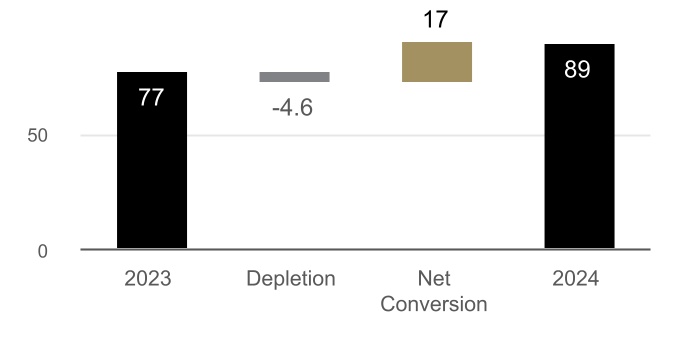
BARRICK YEAR-END 2024 |
17 |
MANAGEMENT’S DISCUSSION AND ANALYSIS | ||||||

BARRICK YEAR-END 2024 |
18 |
MANAGEMENT’S DISCUSSION AND ANALYSIS | ||||||
| Risk Factor | Risk Mitigation Strategy | ||||
Free cash flow6 and costs |
|||||
Our ability to improve productivity, drive down operating costs and optimize working capital remains a focus in 2025 and is subject to several
sources of uncertainty. This includes our ability to achieve and maintain industry-leading margins by improving the productivity and efficiency of our operations. |
■Maximizing
the benefit of higher gold prices through agile management and operational execution;
■Weekly
Executive Committee Review to identify, assess and respond to risks in a timely manner;
■Enabling
simplification and agile decision making through optimization of business systems;
■Supply
Chain is decentralized to the operations with a centralized Strategic Sourcing Group and is focused on mitigating the risks of rising costs and supply chain disruption;
■Disciplined capital allocation criteria for all investments, to ensure a high degree of consistency and rigor is applied to all
capital allocation decisions based on a comprehensive understanding of risk and reward;
■Continued enhancement
and testing of controls to prevent, detect and respond to potential cyber-attacks; and
■A flat,
operationally focused, agile management structure with a tenet in ownership culture.
|
||||
BARRICK YEAR-END 2024 |
19 |
MANAGEMENT’S DISCUSSION AND ANALYSIS | ||||||
| Risk Factor | Risk Mitigation Strategy | ||||
| Social license to operate | |||||
| At Barrick, we are committed to building, operating and closing our mines in a safe and responsible manner. To do this, we seek to build trust-based partnerships with host governments and local communities to drive shared long-term value while working to minimize the social and environmental impacts of our activities. Geopolitical risks such as resource nationalism and incidents of corruption are inherent in the business of a company operating globally. Past environmental incidents in the extractive industry highlight the hazards (e.g., water management, tailings storage facilities, etc.) and the potential consequences to the environment, community health and safety. Our ability to maintain compliance with regulatory and community obligations in order to protect the environment and our host communities alike remains one of our top priorities. Barrick also recognizes climate change as an area of risk requiring specific focus and that reducing GHG emissions to counter the causes of climate change requires strong collective action by the mining industry. |
■Our
commitment to responsible mining is supported by a robust governance framework, including an overarching Sustainable Development Policy and related policies in the areas of Biodiversity, Conflict-Free Gold, Social Performance, Occupational Health
and Safety, Environment and Human Rights;
■Use of our Sustainability Scorecard to track sustainability performance using key performance indicators aligned to priority
areas set out in our strategy;
■Mandatory training on our Code of Business Conduct and Ethics as well as supporting policies which set out the ethical behavior
expected of everyone working at, or with,
Barrick;
■We take a partnership approach with our host governments. This means we work to balance our own interests and priorities with
those of our government partners, working to ensure that everyone derives real value from our operations;
■Standalone,
independent Human Rights Assessment Program whereby each site is assessed on a periodic cycle of two to three years, depending on the risk level and the number and level of identified risks to the
rightsholder;
■Established CDCs at all our operating mines to identify community needs and priorities and to allocate funds to those
initiatives most needed and desired by local
stakeholders;
■We open our social and environmental performance to third-party scrutiny, including through the ISO 14001 re-certification
process, International Cyanide Management Code audits and annual human rights impact assessments;
■We
published site-level TSF disclosures, in accordance with Principle 15 of the GISTM, for all of the Company’s facilities classified as ‘Very High’ and ‘Extreme’ consequence, in conformance with the requirements of the
GISTM;
■Our climate change strategy has three pillars: identify, understand and mitigate the risks associated with climate
change; measure and reduce our impacts on climate change; and improve our disclosure on climate change;
■We
continuously monitor developments around the world and work closely with our local communities on managing the impacts of health issues, such as Ebola or Mpox outbreaks, on our people and business;
and
■We continuously review and update our closure plans and cost estimates to plan for environmentally responsible closure and
monitoring of operations.
|
||||
| Resources and reserves and production outlook | |||||
Like any mining company, we face the risk that we are unable to discover or acquire new resources or that we do not convert resources into
production. As we move into 2025 and beyond, our overriding objective of growing free cash flow6 continues to be underpinned by a strong pipeline of organic projects and minesite expansion opportunities in our core regions. Uncertainty related
to these and other opportunities exists (potentially both favorable and unfavorable) due to the speculative nature of mineral exploration and development as well as the potential for increased costs, delays, suspensions and technical challenges
associated with the construction of capital projects. |
■Focus on
responsible mineral resource management, continuously improve ore body knowledge and add to reserves and resources;
■Consolidate
and secure dominant land positions in favored operating districts and emerging new prospective geological domains;
■Focus on
economically feasible discoveries with potential Tier One1,3 status;
■Optimize
the value of underdeveloped projects;
■Establish and develop motivated and highly agile discovery-driven teams;
and
■Identify emerging opportunities and secure them through earn-in agreements or acquisition.
|
||||
| Financial position and liquidity | |||||
| Our liquidity profile, level of indebtedness and credit ratings are all factors in our ability to meet short- and long-term financial demands. Barrick’s outstanding debt balances impact liquidity through scheduled interest and principal repayments and the results of leverage ratio calculations, which could influence our investment grade credit ratings and ability to access capital markets. In addition, our ability to draw on our credit facility is subject to meeting its covenants. Our primary source of liquidity is our operating cash flow, which is dependent on the ability of our operations to deliver projected future cash flows. The ability of our operations to deliver projected future cash flows, as well as future changes in gold and copper market prices, either favorable or unfavorable, will continue to have a material impact on our cash flow and liquidity. |
■Continued
focus on generating positive free cash flow6 by improving the underlying cost structures of our operations in a sustainable
manner;
■Preparation of budgets and forecasts to understand the impact of different price scenarios on liquidity, including our capacity
to provide cash returns to shareholders, repurchase outstanding debt and shares, and formulate appropriate strategies;
■Review
of debt and net debt levels to ensure appropriate leverage and monitor the market for liability management opportunities; and
■Other
options available to the Company to enhance liquidity include drawing on our $3.0 billion undrawn Credit Facility, asset sales, joint ventures or the issuance of debt or equity
securities.
|
||||
BARRICK YEAR-END 2024 |
20 |
MANAGEMENT’S DISCUSSION AND ANALYSIS | ||||||
| For the three months ended | For the years ended | ||||||||||||||||||||||||||||
| 12/31/24 | 9/30/24 | Change | 12/31/24 | 12/31/23 | Change | 12/31/22 | |||||||||||||||||||||||
| Total tonnes mined (000s) | 36,023 | 38,111 | (5)% | 155,626 | 167,641 | (7)% | 170,302 | ||||||||||||||||||||||
| Open pit ore | 4,428 | 5,002 | (11)% | 19,541 | 29,797 | (34)% | 24,540 | ||||||||||||||||||||||
| Open pit waste | 29,971 | 31,639 | (5)% | 130,049 | 132,323 | (2)% | 140,245 | ||||||||||||||||||||||
| Underground | 1,624 | 1,470 | 10% | 6,036 | 5,521 | 9% | 5,517 | ||||||||||||||||||||||
| Average grade (grams/tonne) | |||||||||||||||||||||||||||||
| Open pit mined | 1.45 | 1.17 | 24% | 1.11 | 1.03 | 8% | 1.27 | ||||||||||||||||||||||
| Underground mined | 8.51 | 8.46 | 1% | 8.47 | 8.99 | (6)% | 8.96 | ||||||||||||||||||||||
| Processed | 3.43 | 2.91 | 18% | 2.84 | 1.98 | 43% | 2.50 | ||||||||||||||||||||||
| Ore tonnes processed (000s) | 5,609 | 5,125 | 9% | 23,959 | 35,590 | (33)% | 34,873 | ||||||||||||||||||||||
| Oxide mill | 2,006 | 1,970 | 2% | 8,266 | 9,624 | (14)% | 11,964 | ||||||||||||||||||||||
| Roaster | 1,407 | 1,191 | 18% | 5,293 | 4,993 | 6% | 5,506 | ||||||||||||||||||||||
| Autoclave | 1,056 | 945 | 12% | 4,235 | 3,636 | 16% | 4,341 | ||||||||||||||||||||||
| Heap leach | 1,140 | 1,019 | 12% | 6,165 | 17,337 | (64)% | 13,062 | ||||||||||||||||||||||
Recovery rateb |
81 | % | 83 | % | (2)% | 82 | % | 83 | % | (1)% | 78 | % | |||||||||||||||||
Oxide
Millb |
80 | % | 78 | % | 3% | 79 | % | 79 | % | 0% | 73 | % | |||||||||||||||||
| Roaster | 84 | % | 86 | % | (2)% | 85 | % | 86 | % | (1)% | 86 | % | |||||||||||||||||
| Autoclave | 74 | % | 82 | % | (10)% | 79 | % | 82 | % | (4)% | 67 | % | |||||||||||||||||
| Gold produced (000s oz) | 444 | 385 | 15% | 1,650 | 1,865 | (12)% | 1,862 | ||||||||||||||||||||||
| Oxide mill | 99 | 75 | 32% | 331 | 411 | (19)% | 350 | ||||||||||||||||||||||
| Roaster | 228 | 198 | 15% | 850 | 891 | (5)% | 972 | ||||||||||||||||||||||
| Autoclave | 103 | 91 | 13% | 373 | 386 | (3)% | 357 | ||||||||||||||||||||||
| Heap leach | 14 | 21 | (33)% | 96 | 177 | (46)% | 183 | ||||||||||||||||||||||
| Gold sold (000s oz) | 435 | 387 | 12% | 1,646 | 1,860 | (12)% | 1,856 | ||||||||||||||||||||||
| Revenue ($ millions) | 1,177 | 1,008 | 17% | 4,069 | 3,721 | 9% | 3,428 | ||||||||||||||||||||||
| Cost of sales ($ millions) | 643 | 612 | 5% | 2,459 | 2,528 | (3)% | 2,275 | ||||||||||||||||||||||
| Income ($ millions) | 525 | 383 | 37% | 1,567 | 1,145 | 37% | 1,144 | ||||||||||||||||||||||
EBITDA ($ millions)c |
658 | 500 | 32% | 2,070 | 1,736 | 19% | 1,695 | ||||||||||||||||||||||
EBITDA margind |
56 | % | 50 | % | 12% | 51 | % | 47 | % | 9% | 49 | % | |||||||||||||||||
Capital expenditurese ($ millions) |
173 | 193 | (10)% | 820 | 864 | (5)% | 707 | ||||||||||||||||||||||
Minesite
sustainingc |
133 | 154 | (14)% | 670 | 654 | 2% | 584 | ||||||||||||||||||||||
Projectc,f |
40 | 38 | 5% | 146 | 206 | (29)% | 123 | ||||||||||||||||||||||
| Cost of sales ($/oz) | 1,468 | 1,553 | (5)% | 1,478 | 1,351 | 9% | 1,210 | ||||||||||||||||||||||
Total cash costs ($/oz)c |
1,121 | 1,205 | (7)% | 1,126 | 989 | 14% | 876 | ||||||||||||||||||||||
All-in
sustaining costs ($/oz)c |
1,453 | 1,633 | (11)% | 1,561 | 1,366 | 14% | 1,214 | ||||||||||||||||||||||
BARRICK YEAR-END 2024 |
21 |
MANAGEMENT’S DISCUSSION AND ANALYSIS | ||||||
| For the three months ended | For the years ended | ||||||||||||||||||||||||||||
| 12/31/24 | 9/30/24 | Change | 12/31/24 | 12/31/23 | Change | 12/31/22 | |||||||||||||||||||||||
| Total tonnes mined (000s) | 15,494 | 14,469 | 7% | 61,273 | 71,059 | (14)% | 67,971 | ||||||||||||||||||||||
| Open pit ore | 637 | 1,013 | (37)% | 2,867 | 4,067 | (30)% | 6,424 | ||||||||||||||||||||||
| Open pit waste | 13,954 | 12,613 | 11% | 54,960 | 63,836 | (14)% | 58,267 | ||||||||||||||||||||||
| Underground | 903 | 843 | 7% | 3,446 | 3,156 | 9% | 3,280 | ||||||||||||||||||||||
| Average grade (grams/tonne) | |||||||||||||||||||||||||||||
| Open pit mined | 1.54 | 1.65 | (7)% | 1.69 | 2.38 | (29)% | 2.09 | ||||||||||||||||||||||
| Underground mined | 7.54 | 7.63 | (1)% | 7.65 | 7.97 | (4)% | 8.03 | ||||||||||||||||||||||
| Processed | 4.58 | 4.47 | 2% | 4.30 | 4.51 | (5)% | 3.60 | ||||||||||||||||||||||
| Ore tonnes processed (000s) | 1,544 | 1,505 | 3% | 6,657 | 7,256 | (8)% | 11,485 | ||||||||||||||||||||||
| Oxide mill | 0 | 0 | 0% | 0 | 377 | (100)% | 2,448 | ||||||||||||||||||||||
| Roaster | 1,056 | 994 | 6% | 4,401 | 4,350 | 1% | 4,528 | ||||||||||||||||||||||
| Autoclave | 488 | 511 | (5)% | 2,256 | 1,385 | 63% | 2,175 | ||||||||||||||||||||||
| Heap leach | 0 | 0 | 0% | 0 | 1,144 | (100)% | 2,334 | ||||||||||||||||||||||
Recovery ratea |
78 | % | 84 | % | (7)% | 81 | % | 83 | % | (2)% | 78 | % | |||||||||||||||||
| Roaster | 84 | % | 86 | % | (2)% | 84 | % | 85 | % | (1)% | 85 | % | |||||||||||||||||
| Autoclave | 41 | % | 72 | % | (43)% | 64 | % | 72 | % | (11)% | 44 | % | |||||||||||||||||
| Gold produced (000s oz) | 186 | 182 | 2% | 775 | 868 | (11)% | 966 | ||||||||||||||||||||||
| Oxide mill | 0 | 0 | 0% | 0 | 4 | (100)% | 48 | ||||||||||||||||||||||
| Roaster | 167 | 160 | 4% | 669 | 745 | (10)% | 780 | ||||||||||||||||||||||
| Autoclave | 15 | 18 | (17)% | 86 | 87 | (1)% | 91 | ||||||||||||||||||||||
| Heap leach | 4 | 4 | 0% | 20 | 32 | (38)% | 47 | ||||||||||||||||||||||
| Gold sold (000s oz) | 185 | 183 | 1% | 777 | 865 | (10)% | 968 | ||||||||||||||||||||||
| Revenue ($ millions) | 492 | 466 | 6% | 1,870 | 1,697 | 10% | 1,752 | ||||||||||||||||||||||
| Cost of sales ($ millions) | 277 | 277 | 0% | 1,125 | 1,100 | 2% | 1,063 | ||||||||||||||||||||||
| Income ($ millions) | 210 | 186 | 13% | 730 | 577 | 27% | 685 | ||||||||||||||||||||||
EBITDA ($ millions)b |
256 | 229 | 12% | 919 | 770 | 19% | 877 | ||||||||||||||||||||||
EBITDA marginc |
52 | % | 49 | % | 6% | 49 | % | 45 | % | 9% | 50 | % | |||||||||||||||||
| Capital expenditures ($ millions) | 90 | 104 | (13)% | 449 | 375 | 20% | 306 | ||||||||||||||||||||||
Minesite sustainingb |
74 | 91 | (19)% | 408 | 373 | 9% | 306 | ||||||||||||||||||||||
Projectb |
16 | 13 | 23% | 41 | 2 | 1950% | 0 | ||||||||||||||||||||||
| Cost of sales ($/oz) | 1,489 | 1,478 | 1% | 1,429 | 1,254 | 14% | 1,069 | ||||||||||||||||||||||
Total cash costs ($/oz)b |
1,240 | 1,249 | (1)% | 1,187 | 1,033 | 15% | 877 | ||||||||||||||||||||||
All-in sustaining costs
($/oz)b |
1,657 | 1,771 | (6)% | 1,730 | 1,486 | 16% | 1,212 | ||||||||||||||||||||||
| For the three months ended | For the year ended | |||||||||||||
| 12/31/24 | 9/30/24 | 12/31/24 | 12/31/23 | |||||||||||
| LTI | 0 | 0 | 3 | 7 | ||||||||||
LTIFR8 |
0.00 | 0.00 | 0.3 | 0.77 | ||||||||||
TRIFR8 |
1.59 | 1.53 | 2.33 | 2.09 | ||||||||||
Class
19 environmental incidents |
0 | 0 | 0 | 0 | ||||||||||
BARRICK YEAR-END 2024 |
22 |
MANAGEMENT’S DISCUSSION AND ANALYSIS | ||||||
| 2024 Actual | 2024 Guidance | |||||||
| Gold produced (000s oz) | 775 | 800 - 880 | ||||||
Cost of sales7 ($/oz) |
1,429 | 1,270 - 1,370 | ||||||
Total cash costs6 ($/oz) |
1,187 | 1,030 - 1,110 | ||||||
All-in
sustaining costs6 ($/oz) |
1,730 | 1,450 - 1,530 | ||||||
BARRICK YEAR-END 2024 |
23 |
MANAGEMENT’S DISCUSSION AND ANALYSIS | ||||||
| For the three months ended | For the years ended | ||||||||||||||||||||||||||||
| 12/31/24 | 9/30/24 | Change | 12/31/24 | 12/31/23 | Change | 12/31/22 | |||||||||||||||||||||||
| Total tonnes mined (000s) | 14,407 | 17,292 | (17)% | 67,928 | 70,570 | (4)% | 72,551 | ||||||||||||||||||||||
| Open pit ore | 1,002 | 1,421 | (29)% | 5,499 | 14,991 | (63)% | 7,096 | ||||||||||||||||||||||
| Open pit waste | 12,911 | 15,445 | (16)% | 60,666 | 54,133 | 12% | 64,136 | ||||||||||||||||||||||
| Underground | 494 | 426 | 16% | 1,763 | 1,446 | 22% | 1,319 | ||||||||||||||||||||||
| Average grade (grams/tonne) | |||||||||||||||||||||||||||||
| Open pit mined | 2.40 | 1.60 | 50% | 1.31 | 0.78 | 68% | 1.11 | ||||||||||||||||||||||
| Underground mined | 7.28 | 7.13 | 2% | 7.86 | 9.54 | (18)% | 9.76 | ||||||||||||||||||||||
| Processed | 3.41 | 2.25 | 52% | 2.30 | 1.37 | 68% | 2.06 | ||||||||||||||||||||||
| Ore tonnes processed (000s) | 1,293 | 1,542 | (16)% | 6,613 | 15,741 | (58)% | 8,706 | ||||||||||||||||||||||
| Oxide mill | 596 | 567 | 5% | 2,433 | 2,504 | (3)% | 2,510 | ||||||||||||||||||||||
| Roaster | 351 | 197 | 78% | 892 | 643 | 39% | 978 | ||||||||||||||||||||||
| Heap leach | 346 | 778 | (56)% | 3,288 | 12,594 | (74)% | 5,218 | ||||||||||||||||||||||
| Recovery rate | 83 | % | 82 | % | 1% | 83 | % | 84 | % | (1)% | 80 | % | |||||||||||||||||
| Oxide Mill | 81 | % | 79 | % | 3% | 80 | % | 82 | % | (2)% | 74 | % | |||||||||||||||||
| Roaster | 85 | % | 87 | % | (2)% | 87 | % | 88 | % | (1)% | 87 | % | |||||||||||||||||
| Gold produced (000s oz) | 125 | 98 | 28% | 444 | 549 | (19)% | 450 | ||||||||||||||||||||||
| Oxide mill | 55 | 44 | 25% | 193 | 273 | (29)% | 183 | ||||||||||||||||||||||
| Roaster | 61 | 37 | 65% | 178 | 143 | 24% | 192 | ||||||||||||||||||||||
| Heap leach | 9 | 17 | (47)% | 73 | 133 | (45)% | 75 | ||||||||||||||||||||||
| Gold sold (000s oz) | 120 | 99 | 21% | 441 | 548 | (20)% | 449 | ||||||||||||||||||||||
| Revenue ($ millions) | 318 | 252 | 26% | 1,061 | 1,068 | (1)% | 809 | ||||||||||||||||||||||
| Cost of sales ($ millions) | 169 | 152 | 11% | 619 | 722 | (14)% | 522 | ||||||||||||||||||||||
| Income ($ millions) | 147 | 98 | 50% | 433 | 333 | 30% | 277 | ||||||||||||||||||||||
EBITDA ($ millions)b |
188 | 132 | 42% | 589 | 557 | 6% | 432 | ||||||||||||||||||||||
EBITDA marginc |
59 | % | 52 | % | 13% | 56 | % | 52 | % | 8% | 53 | % | |||||||||||||||||
| Capital expenditures ($ millions) | 64 | 59 | 8% | 249 | 260 | (4)% | 251 | ||||||||||||||||||||||
Minesite
sustainingb |
40 | 35 | 14% | 159 | 191 | (17)% | 187 | ||||||||||||||||||||||
Projectb |
24 | 24 | 0% | 90 | 69 | 30% | 64 | ||||||||||||||||||||||
| Cost of sales ($/oz) | 1,405 | 1,526 | (8)% | 1,402 | 1,318 | 6% | 1,164 | ||||||||||||||||||||||
Total cash costs ($/oz)b |
1,064 | 1,180 | (10)% | 1,046 | 906 | 15% | 815 | ||||||||||||||||||||||
All-in
sustaining costs ($/oz)b |
1,431 | 1,570 | (9)% | 1,441 | 1,282 | 12% | 1,258 | ||||||||||||||||||||||
| For the three months ended | For the year ended | |||||||||||||
| 12/31/24 | 9/30/24 | 12/31/24 | 12/31/23 | |||||||||||
| LTI | 0 | 0 | 1 | 3 | ||||||||||
LTIFR8 |
0.00 | 0.00 | 0.23 | 0.70 | ||||||||||
TRIFR8 |
0.86 | 2.79 | 1.6 | 1.64 | ||||||||||
Class
19 environmental incidents |
0 | 0 | 0 | 0 | ||||||||||
BARRICK YEAR-END 2024 |
24 |
MANAGEMENT’S DISCUSSION AND ANALYSIS | ||||||
| 2024 Actual | 2024 Guidance | |||||||
| Gold produced (000s oz) | 444 | 380 - 420 | ||||||
Cost of sales7 ($/oz) |
1,402 | 1,460 - 1,560 | ||||||
Total cash costs6 ($/oz) |
1,046 | 1,040 - 1,120 | ||||||
All-in
sustaining costs6 ($/oz) |
1,441 | 1,390 - 1,490 | ||||||
BARRICK YEAR-END 2024 |
25 |
MANAGEMENT’S DISCUSSION AND ANALYSIS | ||||||
| For the three months ended | For the years ended | ||||||||||||||||||||||||||||
| 12/31/24 | 9/30/24 | Change | 12/31/24 | 12/31/23 | Change | 12/31/22 | |||||||||||||||||||||||
| Total tonnes mined (000s) | 282 | 758 | (63)% | 2,339 | 919 | 155% | 1,053 | ||||||||||||||||||||||
| Open pit ore | 50 | 82 | (39)% | 132 | 0 | 100% | 131 | ||||||||||||||||||||||
| Open pit waste | 5 | 475 | (99)% | 1,380 | 0 | 100% | 4 | ||||||||||||||||||||||
| Underground | 227 | 201 | 13% | 827 | 919 | (10)% | 918 | ||||||||||||||||||||||
| Average grade (grams/tonne) | |||||||||||||||||||||||||||||
| Open pit mined | 1.07 | 1.36 | (21) | % | 1.25 | n/a | n/a | 1.13 | |||||||||||||||||||||
| Underground mined | 13.71 | 13.89 | (1)% | 12.50 | 11.28 | 11% | 11.08 | ||||||||||||||||||||||
| Processed | 5.23 | 5.69 | (8)% | 4.86 | 4.34 | 12% | 4.26 | ||||||||||||||||||||||
| Ore tonnes processed (000s) | 651 | 503 | 29% | 2,268 | 2,608 | (13)% | 2,541 | ||||||||||||||||||||||
| Oxide Mill | 83 | 69 | 20% | 289 | 357 | (19)% | 329 | ||||||||||||||||||||||
| Autoclave | 568 | 434 | 31% | 1,979 | 2,251 | (12)% | 2,166 | ||||||||||||||||||||||
| Heap leach | 0 | 0 | 0% | 0 | 0 | 0% | 46 | ||||||||||||||||||||||
| Recovery Rate | 85 | % | 84 | % | 1% | 85 | % | 86 | % | (1)% | 81 | % | |||||||||||||||||
| Oxide Mill | 85 | % | 82 | % | 4% | 84 | % | 85 | % | (1)% | 84 | % | |||||||||||||||||
| Autoclave | 85 | % | 84 | % | 1% | 85 | % | 86 | % | (1)% | 81 | % | |||||||||||||||||
| Gold produced (000s oz) | 94 | 76 | 24% | 304 | 316 | (4)% | 282 | ||||||||||||||||||||||
| Oxide Mill | 5 | 3 | 67% | 14 | 14 | 0% | 10 | ||||||||||||||||||||||
| Autoclave | 88 | 73 | 21% | 287 | 299 | (4)% | 266 | ||||||||||||||||||||||
| Heap leach | 1 | 0 | 100% | 3 | 3 | 0% | 6 | ||||||||||||||||||||||
| Gold sold (000s oz) | 89 | 77 | 16% | 298 | 318 | (6)% | 278 | ||||||||||||||||||||||
| Revenue ($ millions) | 237 | 192 | 23% | 724 | 620 | 17% | 501 | ||||||||||||||||||||||
| Cost of sales ($ millions) | 132 | 129 | 2% | 481 | 444 | 8% | 398 | ||||||||||||||||||||||
| Income ($ millions) | 104 | 61 | 70% | 238 | 172 | 38% | 98 | ||||||||||||||||||||||
EBITDA ($ millions)a |
137 | 90 | 52% | 348 | 288 | 21% | 208 | ||||||||||||||||||||||
EBITDA marginb |
58 | % | 47 | % | 23% | 48 | % | 46 | % | 4% | 42 | % | |||||||||||||||||
| Capital expenditures ($ millions) | 12 | 16 | (25)% | 63 | 67 | (6)% | 97 | ||||||||||||||||||||||
Minesite sustaininga |
12 | 16 | (25)% | 62 | 61 | 2% | 67 | ||||||||||||||||||||||
Projecta |
0 | 0 | 0% | 1 | 6 | (83)% | 30 | ||||||||||||||||||||||
| Cost of sales ($/oz) | 1,491 | 1,674 | (11)% | 1,615 | 1,399 | 15% | 1,434 | ||||||||||||||||||||||
Total cash costs ($/oz)a |
1,107 | 1,295 | (15)% | 1,238 | 1,026 | 21% | 1,035 | ||||||||||||||||||||||
All-in sustaining costs
($/oz)a |
1,260 | 1,516 | (17)% | 1,466 | 1,234 | 19% | 1,296 | ||||||||||||||||||||||
| For the three months ended | For the year ended | |||||||||||||
| 12/31/24 | 9/30/24 | 12/31/24 | 12/31/23 | |||||||||||
| LTI | 2 | 0 | 3 | 5 | ||||||||||
LTIFR8 |
2.84 | 0.00 | 1.05 | 1.99 | ||||||||||
TRIFR8 |
5.68 | 4.06 | 3.5 | 3.98 | ||||||||||
Class
19 environmental incidents |
0 | 0 | 0 | 0 | ||||||||||
BARRICK YEAR-END 2024 |
26 |
MANAGEMENT’S DISCUSSION AND ANALYSIS | ||||||
| 2024 Actual | 2024 Guidance | |||||||
| Gold produced (000s oz) | 304 | 330 - 360 | ||||||
Cost of sales7 ($/oz) |
1,615 | 1,230 - 1,330 | ||||||
Total cash costs6 ($/oz) |
1,238 | 850 - 930 | ||||||
All-in
sustaining costs6 ($/oz) |
1,466 | 1,090 - 1,190 | ||||||
BARRICK YEAR-END 2024 |
27 |
MANAGEMENT’S DISCUSSION AND ANALYSIS | ||||||
| For the three months ended | For the years ended | ||||||||||||||||||||||||||||
| 12/31/24 | 9/30/24 | Change | 12/31/24 | 12/31/23 | Change | 12/31/22 | |||||||||||||||||||||||
| Open pit tonnes mined (000s) | 1,419 | 3,021 | (53)% | 10,885 | 18,074 | (40)% | 19,754 | ||||||||||||||||||||||
| Open pit ore | 1,128 | 2,029 | (44)% | 5,879 | 7,794 | (25)% | 6,820 | ||||||||||||||||||||||
| Open pit waste | 291 | 992 | (71)% | 5,006 | 10,280 | (51)% | 12,934 | ||||||||||||||||||||||
| Average grade (grams/tonne) | |||||||||||||||||||||||||||||
| Open pit mined | 1.94 | 2.21 | (12)% | 2.12 | 2.05 | 3% | 2.23 | ||||||||||||||||||||||
| Processed | 2.31 | 2.58 | (10)% | 2.46 | 2.39 | 3% | 2.68 | ||||||||||||||||||||||
| Autoclave ore tonnes processed (000s) | 1,377 | 1,605 | (14)% | 5,730 | 5,332 | 7% | 5,669 | ||||||||||||||||||||||
| Recovery rate | 79 | % | 78 | % | 1% | 79 | % | 81 | % | (2)% | 87 | % | |||||||||||||||||
| Gold produced (000s oz) | 93 | 98 | (5)% | 352 | 335 | 5% | 428 | ||||||||||||||||||||||
| Gold sold (000s oz) | 94 | 96 | (2)% | 351 | 335 | 5% | 426 | ||||||||||||||||||||||
| Revenue ($ millions) | 251 | 241 | 4% | 851 | 670 | 27% | 776 | ||||||||||||||||||||||
| Cost of sales ($ millions) | 158 | 140 | 13% | 553 | 475 | 16% | 482 | ||||||||||||||||||||||
| Income ($ millions) | 90 | 98 | (8)% | 286 | 187 | 53% | 265 | ||||||||||||||||||||||
EBITDA ($ millions)b |
144 | 144 | 0% | 462 | 341 | 35% | 411 | ||||||||||||||||||||||
EBITDA marginc |
57 | % | 60 | % | (5)% | 54 | % | 51 | % | 6% | 53 | % | |||||||||||||||||
Capital expenditures ($
millions)d |
40 | 38 | 5% | 195 | 236 | (17)% | 351 | ||||||||||||||||||||||
Minesite sustainingb |
27 | 24 | 13% | 108 | 117 | (8)% | 124 | ||||||||||||||||||||||
Projectb |
10 | 12 | (17)% | 62 | 119 | (48)% | 227 | ||||||||||||||||||||||
| Cost of sales ($/oz) | 1,679 | 1,470 | 14% | 1,576 | 1,418 | 11% | 1,132 | ||||||||||||||||||||||
Total cash costs ($/oz)b |
1,030 | 957 | 8% | 1,005 | 889 | 13% | 725 | ||||||||||||||||||||||
All-in sustaining costs
($/oz)b |
1,325 | 1,221 | 9% | 1,323 | 1,249 | 6% | 1,026 | ||||||||||||||||||||||
| For the three months ended | For the year ended | |||||||||||||
| 12/31/24 | 9/30/24 | 12/31/24 | 12/31/23 | |||||||||||
| LTI | 0 | 0 | 0 | 0 | ||||||||||
LTIFR8 |
0.00 | 0.00 | 0.00 | 0.00 | ||||||||||
TRIFR8 |
0.56 | 0.00 | 0.54 | 0.82 | ||||||||||
Class
19 environmental incidents |
0 | 0 | 0 | 0 | ||||||||||
BARRICK YEAR-END 2024 |
28 |
MANAGEMENT’S DISCUSSION AND ANALYSIS | ||||||
| 2024 Actual | 2024 Guidance | |||||||
| Gold produced (000s oz) | 352 | 420 - 490 | ||||||
Cost of sales7 ($/oz) |
1,576 | 1,340 - 1,440 | ||||||
Total cash costs6 ($/oz) |
1,005 | 830 - 910 | ||||||
All-in
sustaining costs6 ($/oz) |
1,323 | 1,100 - 1,200 | ||||||
BARRICK YEAR-END 2024 |
29 |
MANAGEMENT’S DISCUSSION AND ANALYSIS | ||||||
| For the three months ended | For the years ended | ||||||||||||||||||||||||||||
| 12/31/24 | 9/30/24 | Change | 12/31/24 | 12/31/23 | Change | 12/31/22 | |||||||||||||||||||||||
| Total tonnes mined (000s) | 10,476 | 8,962 | 17% | 36,447 | 28,200 | 29% | 30,845 | ||||||||||||||||||||||
| Open pit ore | 510 | 233 | 119% | 894 | 1,240 | (28)% | 2,989 | ||||||||||||||||||||||
| Open pit waste | 9,004 | 7,807 | 15% | 31,778 | 23,353 | 36% | 24,560 | ||||||||||||||||||||||
| Underground | 962 | 922 | 4% | 3,775 | 3,607 | 5% | 3,296 | ||||||||||||||||||||||
| Average grade (grams/tonne) | |||||||||||||||||||||||||||||
| Open pit mined | 1.80 | 1.99 | (10)% | 1.81 | 2.98 | (39)% | 2.29 | ||||||||||||||||||||||
| Underground mined | 7.03 | 4.54 | 55% | 5.74 | 5.04 | 14% | 4.58 | ||||||||||||||||||||||
| Processed | 5.13 | 4.80 | 7% | 4.73 | 4.61 | 3% | 4.59 | ||||||||||||||||||||||
| Ore tonnes processed (000s) | 1,050 | 1,016 | 3% | 4,163 | 4,049 | 3% | 4,069 | ||||||||||||||||||||||
| Recovery rate | 90 | % | 92 | % | (2)% | 91 | % | 91 | % | 0% | 91 | % | |||||||||||||||||
| Gold produced (000s oz) | 156 | 144 | 8% | 578 | 547 | 6% | 547 | ||||||||||||||||||||||
| Gold sold (000s oz) | 47 | 135 | (65)% | 459 | 546 | (16)% | 548 | ||||||||||||||||||||||
| Revenue ($ millions) | 127 | 337 | (62)% | 1,076 | 1,068 | 1% | 989 | ||||||||||||||||||||||
| Cost of sales ($ millions) | 65 | 170 | (62)% | 558 | 653 | (15)% | 631 | ||||||||||||||||||||||
| Income (loss) ($ millions) | (13) | 161 | (108)% | 420 | 388 | 8% | 342 | ||||||||||||||||||||||
EBITDA ($ millions)b |
9 | 214 | (96)% | 598 | 585 | 2% | 547 | ||||||||||||||||||||||
EBITDA marginc |
7 | % | 64 | % | (89)% | 56 | % | 55 | % | 2% | 55 | % | |||||||||||||||||
Capital expendituresd ($ millions) |
86 | 82 | 5% | 307 | 300 | 2% | 258 | ||||||||||||||||||||||
Minesite sustainingb |
58 | 56 | 4% | 215 | 177 | 21% | 152 | ||||||||||||||||||||||
Projectb |
27 | 26 | 4% | 91 | 123 | (26)% | 106 | ||||||||||||||||||||||
| Cost of sales ($/oz) | 1,397 | 1,257 | 11% | 1,218 | 1,198 | 2% | 1,153 | ||||||||||||||||||||||
Total cash costs ($/oz)b |
923 | 865 | 7% | 828 | 835 | (1)% | 778 | ||||||||||||||||||||||
All-in sustaining costs
($/oz)b |
2,136 | 1,288 | 66% | 1,304 | 1,166 | 12% | 1,076 | ||||||||||||||||||||||
| For the three months ended | For the year ended | |||||||||||||
| 12/31/24 | 9/30/24 | 12/31/24 | 12/31/23 | |||||||||||
| LTI | 0 | 0 | 1 | 1 | ||||||||||
LTIFR8 |
0.00 | 0.00 | 0.05 | 0.06 | ||||||||||
TRIFR8 |
0.19 | 0.00 | 0.29 | 0.45 | ||||||||||
Class
19 environmental incidents |
0 | 0 | 0 | 0 | ||||||||||
BARRICK YEAR-END 2024 |
30 |
MANAGEMENT’S DISCUSSION AND ANALYSIS | ||||||
| 2024 Actual | 2024 Guidance | |||||||
| Gold produced (000s oz) | 578 | 510 - 560 | ||||||
Cost of sales7 ($/oz) |
1,218 | 1,190 - 1,290 | ||||||
Total cash costs6 ($/oz) |
828 | 780 - 860 | ||||||
All-in
sustaining costs6 ($/oz) |
1,304 | 1,150 - 1,250 | ||||||
BARRICK YEAR-END 2024 |
31 |
MANAGEMENT’S DISCUSSION AND ANALYSIS | ||||||
| For the three months ended | For the years ended | ||||||||||||||||||||||||||||
| 12/31/24 | 9/30/24 | Change | 12/31/24 | 12/31/23 | Change | 12/31/22 | |||||||||||||||||||||||
| Total tonnes mined (000s) | 4,821 | 4,615 | 4% | 19,398 | 17,837 | 9% | 16,649 | ||||||||||||||||||||||
| Open pit ore | 631 | 412 | 53% | 2,045 | 2,721 | (25)% | 2,551 | ||||||||||||||||||||||
| Open pit waste | 3,741 | 3,763 | (1)% | 15,539 | 13,288 | 17% | 12,428 | ||||||||||||||||||||||
| Underground | 449 | 440 | 2% | 1,814 | 1,828 | (1)% | 1,670 | ||||||||||||||||||||||
| Average grade (grams/tonne) | |||||||||||||||||||||||||||||
| Open pit mined | 1.46 | 1.58 | (8)% | 1.43 | 1.60 | (11)% | 1.62 | ||||||||||||||||||||||
| Underground mined | 5.27 | 4.92 | 7% | 5.21 | 5.11 | 2% | 5.62 | ||||||||||||||||||||||
| Processed | 2.88 | 2.58 | 12% | 2.82 | 3.21 | (12)% | 3.39 | ||||||||||||||||||||||
| Ore tonnes processed (000s) | 971 | 965 | 1% | 3,827 | 3,700 | 3% | 3,495 | ||||||||||||||||||||||
| Recovery rate | 89 | % | 89 | % | 0% | 89 | % | 90 | % | (1)% | 88 | % | |||||||||||||||||
| Gold produced (000s oz) | 80 | 71 | 13% | 309 | 343 | (10)% | 337 | ||||||||||||||||||||||
| Gold sold (000s oz) | 79 | 77 | 3% | 309 | 343 | (10)% | 332 | ||||||||||||||||||||||
| Revenue ($ millions) | 209 | 193 | 8% | 743 | 670 | 11% | 598 | ||||||||||||||||||||||
| Cost of sales ($ millions) | 111 | 111 | 0% | 415 | 419 | (1)% | 413 | ||||||||||||||||||||||
| Income ($ millions) | 95 | 73 | 30% | 316 | 243 | 30% | 142 | ||||||||||||||||||||||
EBITDA ($ millions)b |
130 | 108 | 20% | 450 | 390 | 15% | 320 | ||||||||||||||||||||||
EBITDA marginc |
62 | % | 56 | % | 11% | 61 | % | 58 | % | 5% | 54 | % | |||||||||||||||||
| Capital expenditures ($ millions) | 32 | 26 | 23% | 116 | 73 | 59% | 92 | ||||||||||||||||||||||
Minesite sustainingb |
15 | 12 | 25% | 58 | 35 | 66% | 70 | ||||||||||||||||||||||
Projectb |
17 | 14 | 21% | 58 | 38 | 53% | 22 | ||||||||||||||||||||||
| Cost of sales ($/oz) | 1,413 | 1,441 | (2)% | 1,344 | 1,221 | 10% | 1,243 | ||||||||||||||||||||||
Total cash costs ($/oz)b |
966 | 978 | (1)% | 905 | 789 | 15% | 703 | ||||||||||||||||||||||
All-in sustaining costs
($/oz)b |
1,182 | 1,172 | 1% | 1,123 | 918 | 22% | 948 | ||||||||||||||||||||||
| For the three months ended | For the year ended | |||||||||||||
| 12/31/24 | 9/30/24 | 12/31/24 | 12/31/23 | |||||||||||
| LTI | 1 | 0 | 3 | 3 | ||||||||||
LTIFR8 |
0.22 | 0.00 | 0.17 | 0.17 | ||||||||||
TRIFR8 |
1.57 | 0.45 | 1.2 | 1.39 | ||||||||||
Class
19 environmental incidents |
0 | 0 | 0 | 0 | ||||||||||
BARRICK YEAR-END 2024 |
32 |
MANAGEMENT’S DISCUSSION AND ANALYSIS | ||||||
| 2024 Actual | 2024 Guidance | |||||||
| Gold produced (000s oz) | 309 | 320 - 360 | ||||||
Cost of sales7 ($/oz) |
1,344 | 1,140 - 1,240 | ||||||
Total cash costs6 ($/oz) |
905 | 740 - 820 | ||||||
All-in
sustaining costs6 ($/oz) |
1,123 | 950 - 1,050 | ||||||
BARRICK YEAR-END 2024 |
33 |
MANAGEMENT’S DISCUSSION AND ANALYSIS | ||||||
| For the three months ended | For the years ended | ||||||||||||||||||||||||||||
| 12/31/24 | 9/30/24 | Change | 12/31/24 | 12/31/23 | Change | 12/31/22 | |||||||||||||||||||||||
| Total tonnes mined (000s) | 5,076 | 4,792 | 6% | 17,183 | 16,547 | 4% | 8,882 | ||||||||||||||||||||||
| Open pit ore | 1,347 | 1,061 | 27% | 3,282 | 1,400 | 134% | 4,379 | ||||||||||||||||||||||
| Open pit waste | 3,326 | 3,328 | 0% | 12,319 | 13,610 | (9)% | 3,035 | ||||||||||||||||||||||
| Underground | 403 | 403 | 0% | 1,582 | 1,537 | 3% | 1,468 | ||||||||||||||||||||||
| Average grade (grams/tonne) | |||||||||||||||||||||||||||||
| Open pit mined | 2.21 | 1.89 | 17% | 1.96 | 1.83 | 7% | 1.94 | ||||||||||||||||||||||
| Underground mined | 5.20 | 4.86 | 7% | 4.07 | 3.22 | 26% | 4.07 | ||||||||||||||||||||||
| Processed | 4.29 | 3.84 | 12% | 3.31 | 3.02 | 10% | 3.31 | ||||||||||||||||||||||
| Ore tonnes processed (000s) | 724 | 682 | 6% | 2,772 | 2,848 | (3)% | 2,730 | ||||||||||||||||||||||
| Recovery rate | 90 | % | 90 | % | 0% | 90 | % | 92 | % | (2)% | 91 | % | |||||||||||||||||
| Gold produced (000s oz) | 90 | 75 | 20% | 265 | 253 | 5% | 263 | ||||||||||||||||||||||
| Gold sold (000s oz) | 89 | 78 | 14% | 263 | 254 | 4% | 265 | ||||||||||||||||||||||
| Revenue ($ millions) | 237 | 197 | 20% | 647 | 497 | 30% | 479 | ||||||||||||||||||||||
| Cost of sales ($ millions) | 90 | 86 | 5% | 332 | 306 | 8% | 259 | ||||||||||||||||||||||
| Income ($ millions) | 143 | 74 | 93% | 267 | 139 | 92% | 177 | ||||||||||||||||||||||
EBITDA ($ millions)b |
164 | 93 | 76% | 337 | 203 | 66% | 238 | ||||||||||||||||||||||
EBITDA marginc |
69 | % | 47 | % | 47% | 52 | % | 41 | % | 27% | 50 | % | |||||||||||||||||
| Capital expenditures ($ millions) | 54 | 28 | 93% | 136 | 176 | (23)% | 130 | ||||||||||||||||||||||
Minesite sustainingb |
28 | 15 | 87% | 71 | 95 | (25)% | 68 | ||||||||||||||||||||||
Projectb |
26 | 13 | 100% | 65 | 81 | (20)% | 62 | ||||||||||||||||||||||
| Cost of sales ($/oz) | 1,018 | 1,108 | (8)% | 1,266 | 1,206 | 5% | 979 | ||||||||||||||||||||||
Total cash costs ($/oz)b |
771 | 850 | (9)% | 989 | 944 | 5% | 741 | ||||||||||||||||||||||
All-in sustaining costs
($/oz)b |
1,098 | 1,052 | 4% | 1,274 | 1,335 | (5)% | 1,028 | ||||||||||||||||||||||
| For the three months ended | For the year ended | |||||||||||||
| 12/31/24 | 9/30/24 | 12/31/24 | 12/31/23 | |||||||||||
| LTI | 0 | 0 | 0 | 3 | ||||||||||
LTIFR8 |
0.00 | 0.00 | 0.00 | 0.29 | ||||||||||
TRIFR8 |
0 | 0.00 | 0.35 | 0.97 | ||||||||||
Class
19 environmental incidents |
0 | 0 | 0 | 0 | ||||||||||
BARRICK YEAR-END 2024 |
34 |
MANAGEMENT’S DISCUSSION AND ANALYSIS | ||||||
| 2024 Actual | 2024 Guidance | |||||||
| Gold produced (000s oz) | 265 | 230 - 260 | ||||||
Cost of sales7 ($/oz) |
1,266 | 1,250 - 1,350 | ||||||
Total cash costs6 ($/oz) |
989 | 970 - 1,050 | ||||||
All-in
sustaining costs6 ($/oz) |
1,274 | 1,270 - 1,370 | ||||||
BARRICK YEAR-END 2024 |
35 |
MANAGEMENT’S DISCUSSION AND ANALYSIS | ||||||
| For the three months ended | For the years ended | ||||||||||||||||||||||||||||
| 12/31/24 | 9/30/24 | Change | 12/31/24 | 12/31/23 | Change | 12/31/22 | |||||||||||||||||||||||
| Underground tonnes mined (000s) | 331 | 303 | 9 | % | 1,252 | 1,217 | 3 | % | 1,029 | ||||||||||||||||||||
| Average grade (grams/tonne) | |||||||||||||||||||||||||||||
| Underground mined | 5.80 | 5.62 | 3 | % | 5.79 | 6.56 | (12) | % | 7.89 | ||||||||||||||||||||
| Processed | 5.60 | 5.48 | 2 | % | 5.69 | 6.64 | (14) | % | 7.78 | ||||||||||||||||||||
| Ore tonnes processed (000s) | 267 | 228 | 17 | % | 983 | 880 | 12 | % | 837 | ||||||||||||||||||||
| Recovery rate | 93 | % | 92 | % | 1 | % | 93 | % | 96 | % | (3) | % | 94 | % | |||||||||||||||
| Gold produced (000s oz) | 44 | 37 | 19 | % | 168 | 180 | (7) | % | 196 | ||||||||||||||||||||
| Gold sold (000s oz) | 44 | 37 | 19 | % | 165 | 180 | (8) | % | 205 | ||||||||||||||||||||
| Revenue ($ millions) | 120 | 99 | 21 | % | 416 | 371 | 12 | % | 389 | ||||||||||||||||||||
| Cost of sales ($ millions) | 66 | 62 | 6 | % | 250 | 237 | 5 | % | 248 | ||||||||||||||||||||
| Income ($ millions) | 53 | 36 | 47 | % | 162 | 123 | 32 | % | 118 | ||||||||||||||||||||
EBITDA ($ millions)b |
67 | 49 | 37 | % | 215 | 175 | 23 | % | 168 | ||||||||||||||||||||
EBITDA marginc |
56 | % | 49 | % | 14 | % | 52 | % | 47 | % | 11 | % | 43 | % | |||||||||||||||
| Capital expenditures ($ millions) | 35 | 30 | 17 | % | 114 | 89 | 28 | % | 81 | ||||||||||||||||||||
Minesite sustainingb |
18 | 10 | 80 | % | 57 | 55 | 4 | % | 56 | ||||||||||||||||||||
Projectb |
17 | 20 | (15) | % | 57 | 34 | 68 | % | 25 | ||||||||||||||||||||
| Cost of sales ($/oz) | 1,505 | 1,628 | (8) | % | 1,509 | 1,312 | 15 | % | 1,211 | ||||||||||||||||||||
Total cash costs ($/oz)b |
1,072 | 1,191 | (10) | % | 1,070 | 920 | 16 | % | 868 | ||||||||||||||||||||
All-in sustaining costs
($/oz)b |
1,489 | 1,470 | 1 | % | 1,420 | 1,231 | 15 | % | 1,156 | ||||||||||||||||||||
| For the three months ended | For the year ended | |||||||||||||
| 12/31/24 | 9/30/24 | 12/31/24 | 12/31/23 | |||||||||||
| LTI | 0 | 0 | 0 | 3 | ||||||||||
LTIFR8 |
0.00 | 0.00 | 0.00 | 0.44 | ||||||||||
TRIFR8 |
0.98 | 2.97 | 1.76 | 2.40 | ||||||||||
Class
19 environmental incidents |
0 | 0 | 0 | 0 | ||||||||||
| 2024 Actual | 2024 Guidance | |||||||
| Gold produced (000s oz) | 168 | 160 - 190 | ||||||
Cost of sales7 ($/oz) |
1,509 | 1,370 - 1,470 | ||||||
Total cash costs6 ($/oz) |
1,070 | 990 - 1,070 | ||||||
All-in
sustaining costs6 ($/oz) |
1,420 | 1,380 - 1,480 | ||||||
BARRICK YEAR-END 2024 |
36 |
MANAGEMENT’S DISCUSSION AND ANALYSIS | ||||||
| Summary of Operating and Financial Data | For the three months ended | |||||||||||||||||||||||||||||||
| 12/31/24 | 9/30/24 | |||||||||||||||||||||||||||||||
| Gold produced (000s oz) | Cost of sales
($/oz) |
Total
cash costs
($/oz)a
|
All-in
sustaining costs
($/oz)a
|
Capital
Expend-ituresb |
Gold produced (000s oz) | Cost of sales
($/oz) |
Total
cash costs
($/oz)a
|
All-in
sustaining costs
($/oz)a
|
Capital
Expend-ituresb |
|||||||||||||||||||||||
| Phoenix (61.5%) | 39 | 1,474 | 752 | 956 | 6 | 29 | 1,789 | 764 | 1,113 | 8 | ||||||||||||||||||||||
| Veladero (50%) | 82 | 1,151 | 828 | 1,191 | 41 | 57 | 1,311 | 951 | 1,385 | 36 | ||||||||||||||||||||||
| Tongon (89.7%) | 39 | 1,405 | 1,198 | 1,460 | 7 | 28 | 2,403 | 2,184 | 2,388 | 7 | ||||||||||||||||||||||
| Hemlo | 39 | 1,754 | 1,475 | 1,689 | 8 | 30 | 1,929 | 1,623 | 2,044 | 11 | ||||||||||||||||||||||
| Porgera (24.5%) | 13 | 2,127 | 1,322 | 2,967 | 20 | 18 | 1,163 | 999 | 1,214 | 6 | ||||||||||||||||||||||
| For the years ended | ||||||||||||||||||||||||||||||||
| 12/31/24 | 12/31/23 | |||||||||||||||||||||||||||||||
| Gold produced (000s oz) | Cost of sales
($/oz) |
Total
cash costs
($/oz)a
|
All-in
sustaining costs
($/oz)a
|
Capital
Expend-ituresb |
Gold produced (000s oz) | Cost of sales
($/oz) |
Total
cash costs
($/oz)a
|
All-in
sustaining costs
($/oz)a
|
Capital
Expend-ituresb |
|||||||||||||||||||||||
| Phoenix (61.5%) | 127 | 1,687 | 765 | 1,031 | 26 | 123 | 2,011 | 961 | 1,162 | 19 | ||||||||||||||||||||||
| Veladero (50%) | 252 | 1,254 | 905 | 1,334 | 139 | 207 | 1,440 | 1,011 | 1,516 | 99 | ||||||||||||||||||||||
| Tongon (89.7%) | 148 | 1,903 | 1,670 | 1,867 | 20 | 183 | 1,469 | 1,240 | 1,408 | 27 | ||||||||||||||||||||||
| Hemlo | 143 | 1,754 | 1,483 | 1,769 | 38 | 141 | 1,589 | 1,382 | 1,672 | 41 | ||||||||||||||||||||||
| Porgera (24.5%) | 46 | 1,423 | 1,073 | 1,666 | 72 | — | — | — | — | — | ||||||||||||||||||||||
| 2024 Actual | 2024 Guidance | |||||||
| Gold produced (000s oz) | 127 | 120 - 140 | ||||||
Cost of sales7 ($/oz) |
1,687 | 1,640 - 1,740 | ||||||
Total cash costs6 ($/oz) |
765 | 810 - 890 | ||||||
All-in
sustaining costs6 ($/oz) |
1,031 | 1,100 - 1,200 | ||||||
| 2024 Actual | 2024 Guidance | |||||||
| Gold produced (000s oz) | 252 | 210 - 240 | ||||||
Cost of sales7 ($/oz) |
1,254 | 1,340 - 1,440 | ||||||
Total cash costs6 ($/oz) |
905 | 1,010 - 1,090 | ||||||
All-in
sustaining costs6 ($/oz) |
1,334 | 1,490 - 1,590 | ||||||
BARRICK YEAR-END 2024 |
37 |
MANAGEMENT’S DISCUSSION AND ANALYSIS | ||||||
| 2024 Actual | 2024 Guidance | |||||||
| Gold produced (000s oz) | 148 | 160 - 190 | ||||||
Cost of sales7 ($/oz) |
1,903 | 1,520 - 1,620 | ||||||
Total cash costs6 ($/oz) |
1,670 | 1,200 - 1,280 | ||||||
All-in
sustaining costs6 ($/oz) |
1,867 | 1,440 - 1,540 | ||||||
| 2024 Actual | 2024 Guidance | |||||||
| Gold produced (000s oz) | 143 | 140 - 160 | ||||||
Cost of sales7 ($/oz) |
1,754 | 1,470 - 1,570 | ||||||
Total cash costs6 ($/oz) |
1,483 | 1,210 - 1,290 | ||||||
All-in
sustaining costs6 ($/oz) |
1,769 | 1,600 - 1,700 | ||||||
| 2024 Actual | 2024 Guidance | |||||||
| Gold produced (000s oz) | 46 | 50 - 70 | ||||||
Cost of sales7 ($/oz) |
1,423 | 1,670 - 1,770 | ||||||
Total cash costs6 ($/oz) |
1,073 | 1,220 - 1,300 | ||||||
All-in
sustaining costs6 ($/oz) |
1,666 | 1,900 - 2,000 | ||||||
BARRICK YEAR-END 2024 |
38 |
MANAGEMENT’S DISCUSSION AND ANALYSIS | ||||||
| For the three months ended | For the years ended | ||||||||||||||||||||||||||||
| 12/31/24 | 9/30/24 | Change | 12/31/24 | 12/31/23 | Change | 12/31/22 | |||||||||||||||||||||||
| Open pit tonnes mined (000s) | 35,354 | 36,809 | (4) | % | 140,866 | 113,633 | 24 | % | 98,340 | ||||||||||||||||||||
| Open pit ore | 10,596 | 6,178 | 72 | % | 26,064 | 26,030 | 0 | % | 20,277 | ||||||||||||||||||||
| Open pit waste | 24,758 | 30,631 | (19) | % | 114,802 | 87,603 | 31 | % | 78,063 | ||||||||||||||||||||
| Average grade (grams/tonne) | |||||||||||||||||||||||||||||
| Open pit mined | 0.61 | % | 0.55 | % | 11 | % | 0.55 | % | 0.51 | % | 8 | % | 0.61 | % | |||||||||||||||
| Processed | 0.71 | % | 0.53 | % | 34 | % | 0.53 | % | 0.49 | % | 8 | % | 0.52 | % | |||||||||||||||
| Tonnes processed (000s) | 6,858 | 6,380 | 7 | % | 25,783 | 26,797 | (4) | % | 25,166 | ||||||||||||||||||||
| Recovery rate | 93 | % | 91 | % | 2 | % | 90 | % | 89 | % | 0 | % | 93 | % | |||||||||||||||
Copper produced (kt)a |
46 | 30 | 53 | % | 123 | 118 | 4 | % | 121 | ||||||||||||||||||||
Copper sold (kt)a |
36 | 26 | 38 | % | 109 | 113 | (3) | % | 125 | ||||||||||||||||||||
| Revenue ($ millions) | 260 | 213 | 22 | % | 855 | 795 | 8 | % | 868 | ||||||||||||||||||||
| Cost of sales ($ millions) | 177 | 187 | (5) | % | 704 | 723 | (3) | % | 666 | ||||||||||||||||||||
| Income ($ millions) | 79 | 26 | 204 | % | 135 | 37 | 265 | % | 180 | ||||||||||||||||||||
EBITDA ($ millions)b |
133 | 86 | 55 | % | 379 | 294 | 29 | % | 403 | ||||||||||||||||||||
EBITDA marginc |
51 | % | 40 | % | 28 | % | 44 | % | 37 | % | 19 | % | 46 | % | |||||||||||||||
| Capital expenditures ($ millions) | 186 | 79 | 135 | % | 469 | 306 | 53 | % | 405 | ||||||||||||||||||||
Minesite
sustainingb |
73 | 62 | 18 | % | 312 | 223 | 40 | % | 360 | ||||||||||||||||||||
Projectb |
113 | 17 | 565 | % | 157 | 83 | 89 | % | 45 | ||||||||||||||||||||
| Cost of sales ($/lb) | 2.27 | 3.27 | (31) | % | 2.94 | 2.91 | 1 | % | 2.42 | ||||||||||||||||||||
C1 cash costs ($/lb)b |
1.89 | 2.53 | (25) | % | 2.23 | 2.29 | (3) | % | 1.89 | ||||||||||||||||||||
All-in
sustaining costs ($/lb)b |
3.14 | 3.94 | (20) | % | 3.85 | 3.48 | 11 | % | 3.63 | ||||||||||||||||||||
| For the three months ended | For the year ended | |||||||||||||
| 12/31/24 | 9/30/24 | 12/31/24 | 12/31/23 | |||||||||||
| LTI | 0 | 0 | 3 | 3 | ||||||||||
LTIFR8 |
0.00 | 0.00 | 0.19 | 0.23 | ||||||||||
TRIFR8 |
0.23 | 0.00 | 0.37 | 0.31 | ||||||||||
Class
19 environmental incidents |
0 | 0 | 0 | 0 | ||||||||||
BARRICK YEAR-END 2024 |
39 |
MANAGEMENT’S DISCUSSION AND ANALYSIS | ||||||
| 2024 Actual | 2024 Guidance | |||||||
| Copper produced (M lbs) | 123 | 120 - 140 | ||||||
Cost of sales7 ($/oz) |
2.94 | 2.50 - 2.80 | ||||||
Total cash costs6 ($/oz) |
2.23 | 1.85 - 2.15 | ||||||
All-in
sustaining costs6 ($/oz) |
3.85 | 3.30 - 3.60 | ||||||
BARRICK YEAR-END 2024 |
40 |
MANAGEMENT’S DISCUSSION AND ANALYSIS | ||||||
| Summary of Operating and Financial Data | For the three months ended | |||||||||||||||||||||||||||||||
| 12/31/24 | 9/30/24 | |||||||||||||||||||||||||||||||
Copper
production (kt)a |
Cost of sales
($/lb) |
C1
cash costs
($/lb)b
|
All-in
sustaining costs
($/lb)b
|
Capital
Expend-ituresc |
Copper
production (kt)a |
Cost of sales
($/lb) |
C1
cash costs
($/lb)b
|
All-in
sustaining costs
($/lb)b
|
Capital
Expend-ituresc |
|||||||||||||||||||||||
Zald
ívar
(50%) |
11 | 4.22 | 3.11 | 3.98 | 16 | 10 | 4.04 | 2.99 | 3.45 | 9 | ||||||||||||||||||||||
| Jabal Sayid (50%) | 7 | 2.02 | 1.29 | 1.44 | 5 | 8 | 1.76 | 1.54 | 1.76 | 5 | ||||||||||||||||||||||
| For the years ended | ||||||||||||||||||||||||||||||||
| 12/31/24 | 12/31/23 | |||||||||||||||||||||||||||||||
Copper
production (kt)a |
Cost of sales
($/lb) |
C1
cash costs
($/lb)b
|
All-in
sustaining costs
($/lb)b
|
Capital
Expend-ituresc |
Copper
production (kt)a |
Cost of sales
($/lb) |
C1
cash costs
($/lb)b
|
All-in
sustaining costs
($/lb)b
|
Capital
Expend-ituresc |
|||||||||||||||||||||||
Zald
ívar
(50%) |
40 | 4.09 | 3.04 | 3.58 | 42 | 40 | 3.83 | 2.95 | 3.46 | 44 | ||||||||||||||||||||||
| Jabal Sayid (50%) | 32 | 1.77 | 1.37 | 1.56 | 19 | 32 | 1.60 | 1.35 | 1.53 | 23 | ||||||||||||||||||||||
| 2024 Actual | 2024 Guidance | |||||||
| Copper produced (kt) | 40 | 35 - 40 | ||||||
Cost of sales7 ($/lb) |
4.09 | 3.70 - 4.00 | ||||||
C1 cash costs6 ($/lb) |
3.04 | 2.80 - 3.10 | ||||||
All-in
sustaining costs6 ($/lb) |
3.58 | 3.40 - 3.70 | ||||||
| 2024 Actual | 2024 Guidance | |||||||
| Copper produced (kt) | 32 | 25 - 30 | ||||||
Cost of sales7 ($/lb) |
1.77 | 1.75 - 2.05 | ||||||
C1 cash costs6 ($/lb) |
1.37 | 1.40 - 1.70 | ||||||
All-in
sustaining costs6 ($/lb) |
1.56 | 1.70 - 2.00 | ||||||
BARRICK YEAR-END 2024 |
41 |
MANAGEMENT’S DISCUSSION AND ANALYSIS | ||||||
BARRICK YEAR-END 2024 |
42 |
MANAGEMENT’S DISCUSSION AND ANALYSIS | ||||||
BARRICK YEAR-END 2024 |
43 |
MANAGEMENT’S DISCUSSION AND ANALYSIS | ||||||
BARRICK YEAR-END 2024 |
44 |
MANAGEMENT’S DISCUSSION AND ANALYSIS | ||||||
BARRICK YEAR-END 2024 |
45 |
MANAGEMENT’S DISCUSSION AND ANALYSIS | ||||||
BARRICK YEAR-END 2024 |
46 |
MANAGEMENT’S DISCUSSION AND ANALYSIS | ||||||
BARRICK YEAR-END 2024 |
47 |
MANAGEMENT’S DISCUSSION AND ANALYSIS | ||||||
| ($ millions, except per ounce/pound data in dollars) | For the three months ended | For the years ended | |||||||||||||||
| 12/31/24 | 9/30/24 | 12/31/24 | 12/31/23 | 12/31/22 | |||||||||||||
| Gold | |||||||||||||||||
000s oz
solda |
965 | 967 | 3,798 | 4,024 | 4,141 | ||||||||||||
000s oz produceda |
1,080 | 943 | 3,911 | 4,054 | 4,141 | ||||||||||||
|
Market
price
($/oz)
|
2,663 | 2,474 | 2,386 | 1,941 | 1,800 | ||||||||||||
Realized price ($/oz)b |
2,657 | 2,494 | 2,397 | 1,948 | 1,795 | ||||||||||||
Revenue
|
3,327 | 3,097 | 11,820 | 10,350 | 9,920 | ||||||||||||
| Copper | |||||||||||||||||
000s
tonnes solda,c |
54 | 42 | 177 | 185 | 202 | ||||||||||||
000s tonnes produceda,c |
64 | 48 | 195 | 191 | 200 | ||||||||||||
|
Market
price
($/lb)
|
4.17 | 4.18 | 4.15 | 3.85 | 3.99 | ||||||||||||
Realized price ($/lb)b |
3.96 | 4.27 | 4.15 | 3.85 | 3.85 | ||||||||||||
Revenue
|
260 | 213 | 855 | 795 | 868 | ||||||||||||
| Other sales | 58 | 58 | 247 | 252 | 225 | ||||||||||||
| Total revenue | 3,645 | 3,368 | 12,922 | 11,397 | 11,013 | ||||||||||||

BARRICK YEAR-END 2024 |
48 |
MANAGEMENT’S DISCUSSION AND ANALYSIS | ||||||

| ($ millions, except per ounce/pound data in dollars) | For the three months ended | For the years ended | |||||||||||||||
| 12/31/24 | 9/30/24 | 12/31/24 | 12/31/23 | 12/31/22 | |||||||||||||
| Gold | |||||||||||||||||
| Site operating costs | 1,268 | 1,332 | 5,146 | 5,015 | 4,678 | ||||||||||||
| Depreciation | 424 | 409 | 1,641 | 1,756 | 1,756 | ||||||||||||
| Royalty expense | 112 | 106 | 405 | 371 | 342 | ||||||||||||
| Community relations | 6 | 9 | 34 | 36 | 37 | ||||||||||||
| Cost of sales | 1,810 | 1,856 | 7,226 | 7,178 | 6,813 | ||||||||||||
|
Cost of sales
($/oz)a
|
1,428 | 1,472 | 1,442 | 1,334 | 1,241 | ||||||||||||
Total
cash costs ($/oz)b |
1,046 | 1,104 | 1,065 | 960 | 862 | ||||||||||||
All-in sustaining costs
($/oz)b |
1,451 | 1,507 | 1,484 | 1,335 | 1,222 | ||||||||||||
| Copper | |||||||||||||||||
| Site operating costs | 101 | 109 | 389 | 401 | 336 | ||||||||||||
| Depreciation | 54 | 60 | 245 | 259 | 223 | ||||||||||||
| Royalty expense | 22 | 17 | 67 | 62 | 103 | ||||||||||||
| Community relations | 2 | 1 | 5 | 4 | 4 | ||||||||||||
| Cost of sales | 179 | 187 | 706 | 726 | 666 | ||||||||||||
|
Cost of
sales
($/lb)a
|
2.62 | 3.23 | 2.99 | 2.90 | 2.43 | ||||||||||||
C1 cash costs ($/lb)b |
2.04 | 2.49 | 2.26 | 2.28 | 1.89 | ||||||||||||
All-in sustaining costs ($/lb)b |
3.07 | 3.57 | 3.45 | 3.21 | 3.18 | ||||||||||||
BARRICK YEAR-END 2024 |
49 |
MANAGEMENT’S DISCUSSION AND ANALYSIS | ||||||
| ($ millions) | For the three months ended | For the years ended | |||||||||||||||
| 12/31/24 | 9/30/24 | 12/31/24 | 12/31/23 | 12/31/22 | |||||||||||||
| Corporate administration | 19 | 25 | 95 | 101 | 125 | ||||||||||||
Share-based compensationa |
(10) | 21 | 20 | 25 | 34 | ||||||||||||
| General & administrative expenses | 9 | 46 | 115 | 126 | 159 | ||||||||||||
| 2024 Guidance | ~$180 | ||||||||||||||||
BARRICK YEAR-END 2024 |
50 |
MANAGEMENT’S DISCUSSION AND ANALYSIS | ||||||
| ($ millions) | For the three months ended | For the years ended | |||||||||||||||
| 12/31/24 | 9/30/24 | 12/31/24 | 12/31/23 | 12/31/22 | |||||||||||||
| Global exploration and evaluation | 37 | 45 | 153 | 143 | 123 | ||||||||||||
| Project costs: | |||||||||||||||||
| Reko Diq | 32 | 30 | 126 | 60 | 14 | ||||||||||||
| Lumwana | 0 | 0 | 0 | 37 | 0 | ||||||||||||
| Other | 19 | 19 | 76 | 81 | 138 | ||||||||||||
| Global exploration and evaluation and project expense | 88 | 94 | 355 | 321 | 275 | ||||||||||||
| Minesite exploration and evaluation | 8 | 10 | 37 | 40 | 75 | ||||||||||||
| Total exploration, evaluation and project expenses | 96 | 104 | 392 | 361 | 350 | ||||||||||||
| 2024 Actuals | 2024 Guidance | ||||||||||||||||
| E&E | 190 | 180 - 200 | |||||||||||||||
| Project expenses | 202 | 220 - 240 | |||||||||||||||
| Total E&E and project expenses | 392 | 400 - 440 | |||||||||||||||
| ($ millions) | For the three months ended | For the years ended | |||||||||||||||
| 12/31/24 | 9/30/24 | 12/31/24 | 12/31/23 | 12/31/22 | |||||||||||||
Interest expensea |
113 | 137 | 452 | 387 | 366 | ||||||||||||
| Accretion | 22 | 23 | 89 | 87 | 66 | ||||||||||||
| Interest capitalized | (4) | (4) | (33) | (42) | (29) | ||||||||||||
| Gain on debt extinguishment | 0 | 0 | 0 | 0 | (14) | ||||||||||||
| Other finance costs | 1 | 2 | 5 | 7 | 6 | ||||||||||||
| Finance income | (64) | (76) | (281) | (269) | (94) | ||||||||||||
| Finance costs, net | 68 | 82 | 232 | 170 | 301 | ||||||||||||
| 2024 Guidance | 260 - 300 | ||||||||||||||||
| ($ millions) | For the three months ended | For the years ended | |||||||||||||||
| 12/31/24 | 9/30/24 | 12/31/24 | 12/31/23 | 12/31/22 | |||||||||||||
| Impairment charges (reversals) | (477) | 2 | (457) | 312 | 1,671 | ||||||||||||
| Loss on currency translation | 18 | 4 | 39 | 93 | 16 | ||||||||||||
| Closed mine rehabilitation | 11 | 59 | 59 | 16 | (136) | ||||||||||||
| Other (income) expense | 71 | 46 | 214 | (195) | (268) | ||||||||||||
BARRICK YEAR-END 2024 |
51 |
MANAGEMENT’S DISCUSSION AND ANALYSIS | ||||||
| ($ millions) | For the three months ended | For the years ended | |||||||||||||||
| 12/31/24 | 9/30/24 | 12/31/24 | 12/31/23 | 12/31/22 | |||||||||||||
| Asset impairments (reversals) | |||||||||||||||||
| Lumwana | (655) | 0 | (655) | 0 | 23 | ||||||||||||
| Veladero | (437) | 0 | (437) | 0 | 490 | ||||||||||||
| Carlin | 82 | 0 | 82 | 4 | 0 | ||||||||||||
| Long Canyon | 49 | 0 | 49 | 280 | 85 | ||||||||||||
| Tanzania | 0 | 0 | 0 | 22 | 0 | ||||||||||||
| Reko Diq | 0 | 0 | 0 | 0 | (120) | ||||||||||||
| Other | 0 | 2 | 20 | 6 | 5 | ||||||||||||
| Total asset impairment charges (reversals) | (961) | 2 | (941) | 312 | 483 | ||||||||||||
| Goodwill | |||||||||||||||||
| Loulo-Gounkoto | 484 | 0 | 484 | 0 | 1,188 | ||||||||||||
| Total goodwill impairment charges | 484 | 0 | 484 | 0 | 1,188 | ||||||||||||
| Total impairment charges (reversals) | (477) | 2 | (457) | 312 | 1,671 | ||||||||||||
BARRICK YEAR-END 2024 |
52 |
MANAGEMENT’S DISCUSSION AND ANALYSIS | ||||||
| Reconciliation to Canadian Statutory Rate | ||||||||
| For the years ended | 12/31/24 | 12/31/23 | ||||||
| At 26.5% statutory rate | 1,221 | 746 | ||||||
| Increase (decrease) due to: | ||||||||
Allowances and special tax
deductionsa |
(211) | (184) | ||||||
Impact of foreign tax ratesb |
18 | (79) | ||||||
| Non-deductible expenses / (non-taxable income) | 111 | 72 | ||||||
| Goodwill impairment charges not tax deductible | 145 | — | ||||||
| Taxable gains on sales of non-current assets | 2 | 6 | ||||||
| Net currency translation losses on current and deferred tax balances | 52 | 289 | ||||||
| Tax impact from pass-through entities and equity accounted investments | (263) | (183) | ||||||
| Current year tax results sheltered by previously unrecognized deferred tax assets | (5) | (22) | ||||||
| Recognition and derecognition of deferred tax assets | (26) | (142) | ||||||
| Settlements and adjustments in respect of prior years | 116 | 23 | ||||||
| Increase to income tax related contingent liabilities | 1 | 54 | ||||||
| Impact of tax rate changes | — | (2) | ||||||
| Withholding taxes | 70 | 61 | ||||||
| Mining taxes | 290 | 224 | ||||||
| Tax impact of amounts recognized within accumulated OCI | — | (2) | ||||||
| Other items | (1) | — | ||||||
| Income tax expense | 1,520 | 861 | ||||||
BARRICK YEAR-END 2024 |
53 |
MANAGEMENT’S DISCUSSION AND ANALYSIS | ||||||
| Financial Condition Review | |||||||||||
| Summary Balance Sheet and Key Financial Ratios | |||||||||||
| ($ millions, except ratios and share amounts) | |||||||||||
| As at December 31 | 2024 | 2023 | 2022 | ||||||||
| Total cash and equivalents | 4,074 | 4,148 | 4,440 | ||||||||
| Current assets | 3,558 | 3,290 | 4,025 | ||||||||
| Non-current assets | 39,994 | 38,373 | 37,500 | ||||||||
| Total Assets | 47,626 | 45,811 | 45,965 | ||||||||
| Current liabilities excluding short-term debt | 2,618 | 2,345 | 3,107 | ||||||||
Non-current liabilities excluding
long-term debta |
7,023 | 6,738 | 6,787 | ||||||||
| Debt (current and long-term) | 4,729 | 4,726 | 4,782 | ||||||||
| Total Liabilities | 14,370 | 13,809 | 14,676 | ||||||||
| Total shareholders’ equity | 24,290 | 23,341 | 22,771 | ||||||||
| Non-controlling interests | 8,966 | 8,661 | 8,518 | ||||||||
| Total Equity | 33,256 | 32,002 | 31,289 | ||||||||
Total common
shares outstanding (millions of shares)b |
1,727 | 1,756 | 1,755 | ||||||||
| Debt, net of cash | 655 | 578 | 342 | ||||||||
| Key Financial Ratios: | |||||||||||
Current ratioc |
2.89:1 | 3.16:1 | 2.71:1 | ||||||||
Debt-to-equity
d |
0.14:1 | 0.15:1 | 0.15:1 | ||||||||
Net leveragee |
0.1:1 | 0.1:1 | 0.1:1 | ||||||||
BARRICK YEAR-END 2024 |
54 |
MANAGEMENT’S DISCUSSION AND ANALYSIS | ||||||
| Performance Dividend Level | Threshold Level | Quarterly Base Dividend | Quarterly Performance Dividend | Quarterly Total Dividend | ||||||||||
| Level I | Net cash <$0 | $0.10 per share |
$0.00 per share |
$0.10 per share |
||||||||||
| Level II | Net cash >$0 and <$0.5B |
$0.10 per share |
$0.05 per share |
$0.15 per share |
||||||||||
| Level III | Net cash >$0.5B and <$1B |
$0.10 per share |
$0.10 per share |
$0.20 per share |
||||||||||
| Level IV | Net cash >$1B | $0.10 per share |
$0.15 per share |
$0.25 per share |
||||||||||
| Summary of Cash Inflow (Outflow) | |||||||||||||||||
| ($ millions) | For the three months ended | For the years ended | |||||||||||||||
| 12/31/24 | 9/30/24 | 12/31/24 | 12/31/23 | 12/31/22 | |||||||||||||
| Net cash provided by operating activities | 1,392 | 1,180 | 4,491 | 3,732 | 3,481 | ||||||||||||
| Investing activities | |||||||||||||||||
| Capital expenditures | (891) | (736) | (3,174) | (3,086) | (3,049) | ||||||||||||
| Funding of equity method investments | (4) | 0 | (59) | 0 | 0 | ||||||||||||
| Dividends received from equity method investments | 71 | 38 | 198 | 273 | 869 | ||||||||||||
| Shareholder loan repayments from equity method investments | 16 | 49 | 155 | 7 | 0 | ||||||||||||
| Investment (purchases) sales | 20 | 44 | 97 | (23) | 381 | ||||||||||||
| Other | 10 | 2 | 19 | 13 | 88 | ||||||||||||
| Total investing outflows | (778) | (603) | (2,764) | (2,816) | (1,711) | ||||||||||||
| Financing activities | |||||||||||||||||
Net change in debta |
(3) | (4) | (14) | (56) | (395) | ||||||||||||
Dividendsb |
(172) | (174) | (696) | (700) | (1,143) | ||||||||||||
| Net disbursements to non-controlling interests | (291) | (110) | (639) | (514) | (833) | ||||||||||||
| Share buyback program | (354) | (95) | (498) | 0 | (424) | ||||||||||||
| Other | 58 | (4) | 52 | 65 | 191 | ||||||||||||
| Total financing outflows | (762) | (387) | (1,795) | (1,205) | (2,604) | ||||||||||||
| Effect of exchange rate | (3) | (1) | (6) | (3) | (6) | ||||||||||||
| Increase (decrease) in cash and equivalents | (151) | 189 | (74) | (292) | (840) | ||||||||||||
BARRICK YEAR-END 2024 |
55 |
MANAGEMENT’S DISCUSSION AND ANALYSIS | ||||||
Summary of Financial Instrumentsa |
||||||||||||||
| As at December 31, 2024 | ||||||||||||||
| Financial Instrument | Principal/Notional Amount | Associated
Risks |
||||||||||||
n Interest
rate |
||||||||||||||
| Cash and equivalents | $4,074 | million | n
Credit |
|||||||||||
n
Credit |
||||||||||||||
| Accounts receivable | $763 | million | n
Market |
|||||||||||
n Interest
rate |
||||||||||||||
| Notes receivable | $217 | million | n
Credit |
|||||||||||
n Interest
rate |
||||||||||||||
| Kibali joint venture receivable | $462 | million | n
Credit |
|||||||||||
n Interest
rate |
||||||||||||||
| Norte Abierto joint venture partner receivable | $74 | million | n
Credit |
|||||||||||
n Interest
rate |
||||||||||||||
| Restricted cash | $65 | million | n
Credit |
|||||||||||
| Other investments | $42 | million | n
Liquidity |
|||||||||||
| Accounts payable | $1,613 | million | n
Liquidity |
|||||||||||
| Debt | $4,749 | million | n Interest
rate |
|||||||||||
| Other liabilities | $595 | million | n
Liquidity |
|||||||||||
| Restricted share units | $39 | million | n
Market |
|||||||||||
| Deferred share units | $12 | million | n
Market |
|||||||||||
BARRICK YEAR-END 2024 |
56 |
MANAGEMENT’S DISCUSSION AND ANALYSIS | ||||||
| ($ millions) | Payments due as at December 31, 2024 | ||||||||||||||||||||||
| 2025 | 2026 | 2027 | 2028 | 2029 | 2030 and thereafter | Total | |||||||||||||||||
Debta |
|||||||||||||||||||||||
| Repayment of principal | 11 | 47 | 0 | 0 | 0 | 4,632 | 4,690 | ||||||||||||||||
| Capital leases | 13 | 11 | 11 | 7 | 5 | 12 | 59 | ||||||||||||||||
| Interest | 286 | 283 | 280 | 279 | 278 | 2,660 | 4,066 | ||||||||||||||||
Provisions for environmental rehabilitationb |
229 | 139 | 105 | 157 | 132 | 1,831 | 2,593 | ||||||||||||||||
| Restricted share units | 29 | 10 | 0 | 0 | 0 | 0 | 39 | ||||||||||||||||
| Pension benefits and other post-retirement benefits | 5 | 5 | 4 | 4 | 4 | 62 | 84 | ||||||||||||||||
Purchase obligations for supplies
and consumablesc |
740 | 270 | 250 | 164 | 142 | 55 | 1,621 | ||||||||||||||||
Capital commitmentsd |
553 | 52 | 0 | 0 | 0 | 0 | 605 | ||||||||||||||||
Social development costse |
56 | 29 | 7 | 4 | 2 | 58 | 156 | ||||||||||||||||
Other obligationsf |
72 | 68 | 60 | 60 | 68 | 485 | 813 | ||||||||||||||||
| Total | 1,994 | 914 | 717 | 675 | 631 | 9,795 | 14,726 | ||||||||||||||||
BARRICK YEAR-END 2024 |
57 |
MANAGEMENT’S DISCUSSION AND ANALYSIS | ||||||
| 2024 | 2023 | ||||||||||||||||||||||||||||
| ($ millions, except where indicated) | Q4 | Q3 | Q2 | Q1 | Q4 | Q3 | Q2 | Q1 | |||||||||||||||||||||
| Revenues | 3,645 | 3,368 | 3,162 | 2,747 | 3,059 | 2,862 | 2,833 | 2,643 | |||||||||||||||||||||
Realized price per ounce –
goldb |
2,657 | 2,494 | 2,344 | 2,075 | 1,986 | 1,928 | 1,972 | 1,902 | |||||||||||||||||||||
Realized price per pound – copperb |
3.96 | 4.27 | 4.53 | 3.86 | 3.78 | 3.78 | 3.70 | 4.20 | |||||||||||||||||||||
| Cost of sales | 1,995 | 2,051 | 1,979 | 1,936 | 2,139 | 1,915 | 1,937 | 1,941 | |||||||||||||||||||||
| Net earnings | 996 | 483 | 370 | 295 | 479 | 368 | 305 | 120 | |||||||||||||||||||||
Per
share (dollars)c |
0.57 | 0.28 | 0.21 | 0.17 | 0.27 | 0.21 | 0.17 | 0.07 | |||||||||||||||||||||
Adjusted net earningsb |
794 | 529 | 557 | 333 | 466 | 418 | 336 | 247 | |||||||||||||||||||||
Per
share (dollars)b,c |
0.46 | 0.30 | 0.32 | 0.19 | 0.27 | 0.24 | 0.19 | 0.14 | |||||||||||||||||||||
| Operating cash flow | 1,392 | 1,180 | 1,159 | 760 | 997 | 1,127 | 832 | 776 | |||||||||||||||||||||
Cash consolidated capital
expendituresd |
891 | 736 | 819 | 728 | 861 | 768 | 769 | 688 | |||||||||||||||||||||
Free cash flowb |
501 | 444 | 340 | 32 | 136 | 359 | 63 | 88 | |||||||||||||||||||||
BARRICK YEAR-END 2024 |
58 |
MANAGEMENT’S DISCUSSION AND ANALYSIS | ||||||
BARRICK YEAR-END 2024 |
59 |
MANAGEMENT’S DISCUSSION AND ANALYSIS | ||||||
| For the three months ended | For the years ended | |||||||||||||||||||
| ($ millions, except per share amounts in dollars) | 12/31/24 | 9/30/24 | 12/31/24 | 12/31/23 | 12/31/22 | |||||||||||||||
| Net earnings attributable to equity holders of the Company | 996 | 483 | 2,144 | 1,272 | 432 | |||||||||||||||
Impairment
(reversals) charges related to non-current assetsa |
(477) | 2 | (457) | 312 | 1,671 | |||||||||||||||
Acquisition/disposition
gainsb |
(17) | (1) | (24) | (364) | (405) | |||||||||||||||
| Loss on currency translation | 18 | 4 | 39 | 93 | 16 | |||||||||||||||
Significant tax
adjustmentsc |
1 | (30) | 137 | 220 | 95 | |||||||||||||||
Other
expense adjustmentsd |
113 | 97 | 249 | 96 | 17 | |||||||||||||||
Non-controlling intereste |
(159) | (7) | (170) | (98) | (274) | |||||||||||||||
Tax
effecte |
319 | (19) | 295 | (64) | (226) | |||||||||||||||
| Adjusted net earnings | 794 | 529 | 2,213 | 1,467 | 1,326 | |||||||||||||||
Net earnings per sharef |
0.57 | 0.28 | 1.22 | 0.72 | 0.24 | |||||||||||||||
Adjusted
net earnings per sharef |
0.46 | 0.30 | 1.26 | 0.84 | 0.75 | |||||||||||||||
| For the three months ended | For the years ended | |||||||||||||||||||
| ($ millions) | 12/31/24 | 9/30/24 | 12/31/24 | 12/31/23 | 12/31/22 | |||||||||||||||
| Net cash provided by operating activities | 1,392 | 1,180 | 4,491 | 3,732 | 3,481 | |||||||||||||||
| Capital expenditures | (891) | (736) | (3,174) | (3,086) | (3,049) | |||||||||||||||
| Free cash flow | 501 | 444 | 1,317 | 646 | 432 | |||||||||||||||
BARRICK YEAR-END 2024 |
60 |
MANAGEMENT’S DISCUSSION AND ANALYSIS | ||||||
| For the three months ended | For the years ended | |||||||||||||||||||
| ($ millions) | 12/31/24 | 9/30/24 | 12/31/24 | 12/31/23 | 12/31/22 | |||||||||||||||
| Minesite sustaining capital expenditures | 525 | 511 | 2,217 | 2,076 | 2,071 | |||||||||||||||
| Project capital expenditures | 362 | 221 | 924 | 969 | 949 | |||||||||||||||
| Capitalized interest | 4 | 4 | 33 | 41 | 29 | |||||||||||||||
| Total consolidated capital expenditures | 891 | 736 | 3,174 | 3,086 | 3,049 | |||||||||||||||
BARRICK YEAR-END 2024 |
61 |
MANAGEMENT’S DISCUSSION AND ANALYSIS | ||||||
| For the three months ended | For the years ended | ||||||||||||||||||||||
| ($ millions, except per ounce information in dollars) | Footnote | 12/31/24 | 9/30/24 | 12/31/24 | 12/31/23 | 12/31/22 | |||||||||||||||||
| Cost of sales applicable to gold production | 1,810 | 1,856 | 7,226 | 7,178 | 6,813 | ||||||||||||||||||
| Depreciation | (424) | (409) | (1,641) | (1,756) | (1,756) | ||||||||||||||||||
| Cash cost of sales applicable to equity method investments | 90 | 93 | 316 | 260 | 222 | ||||||||||||||||||
| By-product credits | (58) | (58) | (247) | (252) | (225) | ||||||||||||||||||
| Non-recurring items | a | 0 | 0 | 0 | 0 | (23) | |||||||||||||||||
| Other | b | 4 | 3 | 14 | 18 | (23) | |||||||||||||||||
| Non-controlling interests | c | (413) | (417) | (1,623) | (1,578) | (1,442) | |||||||||||||||||
| Total cash costs | 1,009 | 1,068 | 4,045 | 3,870 | 3,566 | ||||||||||||||||||
| General & administrative costs | 9 | 46 | 115 | 126 | 159 | ||||||||||||||||||
| Minesite exploration and evaluation costs | d | 8 | 10 | 37 | 40 | 75 | |||||||||||||||||
| Minesite sustaining capital expenditures | e | 525 | 511 | 2,217 | 2,076 | 2,071 | |||||||||||||||||
| Sustaining leases | 7 | 8 | 30 | 30 | 38 | ||||||||||||||||||
| Rehabilitation - accretion and amortization (operating sites) | f | 15 | 14 | 66 | 63 | 50 | |||||||||||||||||
| Non-controlling interest, copper operations and other | g | (173) | (199) | (874) | (824) | (900) | |||||||||||||||||
| All-in sustaining costs | 1,400 | 1,458 | 5,636 | 5,381 | 5,059 | ||||||||||||||||||
| Ounces sold - attributable basis (000s ounces) | h | 965 | 967 | 3,798 | 4,024 | 4,141 | |||||||||||||||||
| Cost of sales per ounce | i,j | 1,428 | 1,472 | 1,442 | 1,334 | 1,241 | |||||||||||||||||
| Total cash costs per ounce | j | 1,046 | 1,104 | 1,065 | 960 | 862 | |||||||||||||||||
| Total cash costs per ounce (on a co-product basis) | j,k | 1,086 | 1,145 | 1,109 | 1,002 | 897 | |||||||||||||||||
| All-in sustaining costs per ounce | j | 1,451 | 1,507 | 1,484 | 1,335 | 1,222 | |||||||||||||||||
| All-in sustaining costs per ounce (on a co-product basis) | j,k | 1,491 | 1,548 | 1,528 | 1,377 | 1,257 | |||||||||||||||||
($ millions) |
For the three months ended | For the years ended | |||||||||||||||
| Non-controlling interest, copper operations and other | 12/31/24 | 9/30/24 | 12/31/24 | 12/31/23 | 12/31/22 | ||||||||||||
General & administrative costs |
3 | (7) | (14) | (9) | (31) | ||||||||||||
Minesite
exploration and evaluation costs |
(2) | (2) | (10) | (14) | (27) | ||||||||||||
Rehabilitation - accretion and
amortization (operating sites) |
(5) | (5) | (21) | (21) | (16) | ||||||||||||
| Minesite sustaining capital expenditures | (169) | (185) | (829) | (780) | (826) | ||||||||||||
All-in sustaining costs total |
(173) | (199) | (874) | (824) | (900) | ||||||||||||
BARRICK YEAR-END 2024 |
62 |
MANAGEMENT’S DISCUSSION AND ANALYSIS | ||||||
($ millions) |
For the three months ended | For the years ended | |||||||||||||||
| 12/31/24 | 9/30/24 | 12/31/24 | 12/31/23 | 12/31/22 | |||||||||||||
By-product
credits |
58 | 58 | 247 | 252 | 225 | ||||||||||||
Non-controlling
interest |
(19) | (18) | (79) | (81) | (78) | ||||||||||||
By-product credits (net of non-controlling interest) |
39 | 40 | 168 | 171 | 147 | ||||||||||||
| ($ millions, except per ounce information in dollars) | For the three months ended 12/31/24 | |||||||||||||||||||||||||
| Footnote | Carlin | Cortez
a |
Turquoise Ridge | Phoenix | Nevada
Gold Minesb |
Hemlo | North America | |||||||||||||||||||
| Cost of sales applicable to gold production | 451 | 274 | 215 | 97 | 1,039 | 66 | 1,105 | |||||||||||||||||||
| Depreciation | (75) | (66) | (54) | (19) | (215) | (11) | (226) | |||||||||||||||||||
| By-product credits | (1) | (1) | (1) | (35) | (38) | 0 | (38) | |||||||||||||||||||
| Non-recurring items | c | 0 | 0 | 0 | 0 | 0 | 0 | 0 | ||||||||||||||||||
| Other | d | (1) | 0 | 0 | 6 | 5 | 0 | 5 | ||||||||||||||||||
| Non-controlling interests | (144) | (80) | (61) | (19) | (304) | 0 | (304) | |||||||||||||||||||
| Total cash costs | 230 | 127 | 99 | 30 | 487 | 55 | 542 | |||||||||||||||||||
| General & administrative costs | 0 | 0 | 0 | 0 | 0 | 0 | 0 | |||||||||||||||||||
| Minesite exploration and evaluation costs | e | 3 | 2 | 1 | 1 | 8 | 0 | 8 | ||||||||||||||||||
| Minesite sustaining capital expenditures | f | 120 | 65 | 20 | 11 | 218 | 7 | 225 | ||||||||||||||||||
| Sustaining capital leases | 0 | 0 | 0 | 0 | 0 | 1 | 1 | |||||||||||||||||||
| Rehabilitation - accretion and amortization (operating sites) | g | 1 | 5 | 1 | 2 | 9 | 0 | 9 | ||||||||||||||||||
| Non-controlling interests | (48) | (28) | (9) | (5) | (91) | 0 | (91) | |||||||||||||||||||
| All-in sustaining costs | 306 | 171 | 112 | 39 | 631 | 63 | 694 | |||||||||||||||||||
| Ounces sold - attributable basis (000s ounces) | 185 | 120 | 89 | 41 | 435 | 38 | 473 | |||||||||||||||||||
| Cost of sales per ounce | h,i | 1,489 | 1,405 | 1,491 | 1,474 | 1,468 | 1,754 | 1,491 | ||||||||||||||||||
| Total cash costs per ounce | i | 1,240 | 1,064 | 1,107 | 752 | 1,121 | 1,475 | 1,149 | ||||||||||||||||||
| Total cash costs per ounce (on a co-product basis) | i,j | 1,245 | 1,068 | 1,113 | 1,182 | 1,165 | 1,483 | 1,191 | ||||||||||||||||||
| All-in sustaining costs per ounce | i | 1,657 | 1,431 | 1,260 | 956 | 1,453 | 1,689 | 1,473 | ||||||||||||||||||
| All-in sustaining costs per ounce (on a co-product basis) | i,j | 1,662 | 1,435 | 1,266 | 1,386 | 1,497 | 1,697 | 1,515 | ||||||||||||||||||
| ($ millions, except per ounce information in dollars) | For the three months ended 12/31/24 | ||||||||||||||||
| Footnote | Pueblo Viejo | Veladero | Porgera
k |
Latin America & Asia Pacific | |||||||||||||
| Cost of sales applicable to gold production | 266 | 107 | 26 | 399 | |||||||||||||
| Depreciation | (92) | (28) | (10) | (130) | |||||||||||||
| By-product credits | (11) | (3) | 0 | (14) | |||||||||||||
| Non-recurring items | c | 0 | 0 | 0 | 0 | ||||||||||||
| Other | d | 0 | 0 | 0 | 0 | ||||||||||||
| Non-controlling interests | (65) | 0 | 0 | (65) | |||||||||||||
| Total cash costs | 98 | 76 | 16 | 190 | |||||||||||||
| General & administrative costs | 0 | 0 | 0 | 0 | |||||||||||||
| Minesite exploration and evaluation costs | e | 0 | 1 | 1 | 2 | ||||||||||||
| Minesite sustaining capital expenditures | f | 45 | 32 | 18 | 95 | ||||||||||||
| Sustaining capital leases | 0 | 1 | 1 | 2 | |||||||||||||
| Rehabilitation - accretion and amortization (operating sites) | g | 1 | 1 | 0 | 2 | ||||||||||||
| Non-controlling interests | (18) | 0 | 0 | (18) | |||||||||||||
| All-in sustaining costs | 126 | 111 | 36 | 273 | |||||||||||||
| Ounces sold - attributable basis (000s ounces) | 94 | 91 | 12 | 197 | |||||||||||||
| Cost of sales per ounce | h,i | 1,679 | 1,151 | 2,127 | 1,459 | ||||||||||||
| Total cash costs per ounce | i | 1,030 | 828 | 1,322 | 954 | ||||||||||||
| Total cash costs per ounce (on a co-product basis) | i,j | 1,101 | 855 | 1,332 | 1,001 | ||||||||||||
| All-in sustaining costs per ounce | i | 1,325 | 1,191 | 2,967 | 1,362 | ||||||||||||
| All-in sustaining costs per ounce (on a co-product basis) | i,j | 1,396 | 1,218 | 2,977 | 1,409 | ||||||||||||
BARRICK YEAR-END 2024 |
63 |
MANAGEMENT’S DISCUSSION AND ANALYSIS | ||||||
| ($ millions, except per ounce information in dollars) | For the three months ended 12/31/24 | ||||||||||||||||||||||
| Footnote | Loulo-Gounkoto | Kibali | North Mara | Tongon | Bulyanhulu | Africa and Middle East | |||||||||||||||||
| Cost of sales applicable to gold production | 82 | 111 | 107 | 56 | 78 | 434 | |||||||||||||||||
| Depreciation | (28) | (35) | (24) | (8) | (16) | (111) | |||||||||||||||||
| By-product credits | 0 | (1) | (1) | 0 | (7) | (9) | |||||||||||||||||
| Non-recurring items | c | 0 | 0 | 0 | 0 | 0 | 0 | ||||||||||||||||
| Other | d | 0 | 0 | 0 | 0 | 1 | 1 | ||||||||||||||||
| Non-controlling interests | (11) | 0 | (13) | (5) | (9) | (38) | |||||||||||||||||
| Total cash costs | 43 | 75 | 69 | 43 | 47 | 277 | |||||||||||||||||
| General & administrative costs | 0 | 0 | 0 | 0 | 0 | 0 | |||||||||||||||||
| Minesite exploration and evaluation costs | e | 0 | 0 | 0 | 0 | 0 | 0 | ||||||||||||||||
| Minesite sustaining capital expenditures | f | 71 | 15 | 33 | 8 | 22 | 149 | ||||||||||||||||
| Sustaining capital leases | 2 | 3 | 0 | 0 | 0 | 5 | |||||||||||||||||
| Rehabilitation - accretion and amortization (operating sites) | g | (2) | 0 | 1 | 2 | 0 | 1 | ||||||||||||||||
| Non-controlling interests | (14) | 0 | (5) | (1) | (4) | (24) | |||||||||||||||||
| All-in sustaining costs | 100 | 93 | 98 | 52 | 65 | 408 | |||||||||||||||||
| Ounces sold - attributable basis (000s ounces) | 47 | 79 | 89 | 36 | 44 | 295 | |||||||||||||||||
| Cost of sales per ounce | h,i | 1,397 | 1,413 | 1,018 | 1,405 | 1,505 | 1,303 | ||||||||||||||||
| Total cash costs per ounce | i | 923 | 966 | 771 | 1,198 | 1,072 | 944 | ||||||||||||||||
| Total cash costs per ounce (on a co-product basis) | i,j | 925 | 971 | 785 | 1,201 | 1,184 | 967 | ||||||||||||||||
| All-in sustaining costs per ounce | i | 2,136 | 1,182 | 1,098 | 1,460 | 1,489 | 1,389 | ||||||||||||||||
| All-in sustaining costs per ounce (on a co-product basis) | i,j | 2,138 | 1,187 | 1,112 | 1,463 | 1,601 | 1,412 | ||||||||||||||||
| ($ millions, except per ounce information in dollars) | For the three months ended 9/30/24 | |||||||||||||||||||||||||
| Footnote | Carlin | Cortez
a |
Turquoise Ridge | Phoenix | Nevada
Gold Minesb |
Hemlo | North America | |||||||||||||||||||
| Cost of sales applicable to gold production | 449 | 246 | 208 | 83 | 987 | 55 | 1,042 | |||||||||||||||||||
| Depreciation | (69) | (55) | (46) | (15) | (185) | (8) | (193) | |||||||||||||||||||
| By-product credits | (1) | 0 | (1) | (39) | (41) | 0 | (41) | |||||||||||||||||||
| Non-recurring items | c | 0 | 0 | 0 | 0 | 0 | 0 | 0 | ||||||||||||||||||
| Other | d | (8) | 0 | 0 | 7 | (1) | 0 | (1) | ||||||||||||||||||
| Non-controlling interests | (143) | (73) | (62) | (14) | (293) | 0 | (293) | |||||||||||||||||||
| Total cash costs | 228 | 118 | 99 | 22 | 467 | 47 | 514 | |||||||||||||||||||
| General & administrative costs | 0 | 0 | 0 | 0 | 0 | 0 | 0 | |||||||||||||||||||
| Minesite exploration and evaluation costs | e | 3 | 3 | 2 | 1 | 9 | 0 | 9 | ||||||||||||||||||
| Minesite sustaining capital expenditures | f | 150 | 57 | 25 | 13 | 251 | 11 | 262 | ||||||||||||||||||
| Sustaining capital leases | 0 | 0 | 0 | 0 | 0 | 1 | 1 | |||||||||||||||||||
| Rehabilitation - accretion and amortization (operating sites) | g | 4 | 4 | 1 | 2 | 11 | 0 | 11 | ||||||||||||||||||
| Non-controlling interests | (60) | (26) | (11) | (6) | (106) | 0 | (106) | |||||||||||||||||||
| All-in sustaining costs | 325 | 156 | 116 | 32 | 632 | 59 | 691 | |||||||||||||||||||
| Ounces sold - attributable basis (000s ounces) | 183 | 99 | 77 | 28 | 387 | 28 | 415 | |||||||||||||||||||
| Cost of sales per ounce | h,i | 1,478 | 1,526 | 1,674 | 1,789 | 1,553 | 1,929 | 1,579 | ||||||||||||||||||
| Total cash costs per ounce | i | 1,249 | 1,180 | 1,295 | 764 | 1,205 | 1,623 | 1,234 | ||||||||||||||||||
| Total cash costs per ounce (on a co-product basis) | i,j | 1,252 | 1,183 | 1,305 | 1,465 | 1,260 | 1,633 | 1,286 | ||||||||||||||||||
| All-in sustaining costs per ounce | i | 1,771 | 1,570 | 1,516 | 1,113 | 1,633 | 2,044 | 1,661 | ||||||||||||||||||
| All-in sustaining costs per ounce (on a co-product basis) | i,j | 1,774 | 1,573 | 1,526 | 1,814 | 1,688 | 2,054 | 1,713 | ||||||||||||||||||
BARRICK YEAR-END 2024 |
64 |
MANAGEMENT’S DISCUSSION AND ANALYSIS | ||||||
| ($ millions, except per ounce information in dollars) | For the three months ended 9/30/24 | ||||||||||||||||
| Footnote | Pueblo Viejo | Veladero | Porgera
k |
Latin America & Asia Pacific | |||||||||||||
| Cost of sales applicable to gold production | 235 | 102 | 22 | 359 | |||||||||||||
| Depreciation | (78) | (24) | (3) | (105) | |||||||||||||
| By-product credits | (5) | (3) | 0 | (8) | |||||||||||||
| Non-recurring items | c | 0 | 0 | 0 | 0 | ||||||||||||
| Other | d | 0 | 0 | 0 | 0 | ||||||||||||
| Non-controlling interests | (61) | 0 | 0 | (61) | |||||||||||||
| Total cash costs | 91 | 75 | 19 | 185 | |||||||||||||
| General & administrative costs | 0 | 0 | 0 | 0 | |||||||||||||
| Minesite exploration and evaluation costs | e | 0 | 0 | 1 | 1 | ||||||||||||
| Minesite sustaining capital expenditures | f | 41 | 33 | 3 | 77 | ||||||||||||
| Sustaining capital leases | 0 | 0 | 0 | 0 | |||||||||||||
| Rehabilitation - accretion and amortization (operating sites) | g | 2 | 0 | 0 | 2 | ||||||||||||
| Non-controlling interests | (18) | 0 | 0 | (18) | |||||||||||||
| All-in sustaining costs | 116 | 108 | 23 | 247 | |||||||||||||
| Ounces sold - attributable basis (000s ounces) | 96 | 78 | 19 | 193 | |||||||||||||
| Cost of sales per ounce | h,i | 1,470 | 1,311 | 1,163 | 1,375 | ||||||||||||
| Total cash costs per ounce | i | 957 | 951 | 999 | 959 | ||||||||||||
| Total cash costs per ounce (on a co-product basis) | i,j | 985 | 995 | 1,016 | 992 | ||||||||||||
| All-in sustaining costs per ounce | i | 1,221 | 1,385 | 1,214 | 1,286 | ||||||||||||
| All-in sustaining costs per ounce (on a co-product basis) | i,j | 1,249 | 1,429 | 1,231 | 1,319 | ||||||||||||
| ($ millions, except per ounce information in dollars) | For the three months ended 9/30/24 | ||||||||||||||||||||||
| Footnote | Loulo-Gounkoto | Kibali | North Mara | Tongon | Bulyanhulu | Africa and Middle East | |||||||||||||||||
| Cost of sales applicable to gold production | 212 | 111 | 102 | 85 | 74 | 584 | |||||||||||||||||
| Depreciation | (66) | (35) | (23) | (8) | (16) | (148) | |||||||||||||||||
| By-product credits | 0 | 0 | (1) | 0 | (6) | (7) | |||||||||||||||||
| Non-recurring items | c | 0 | 0 | 0 | 0 | 0 | 0 | ||||||||||||||||
| Other | d | 0 | 0 | 0 | 0 | 2 | 2 | ||||||||||||||||
| Non-controlling interests | (29) | 0 | (12) | (8) | (9) | (58) | |||||||||||||||||
| Total cash costs | 117 | 76 | 66 | 69 | 45 | 373 | |||||||||||||||||
| General & administrative costs | 0 | 0 | 0 | 0 | 0 | 0 | |||||||||||||||||
| Minesite exploration and evaluation costs | e | 0 | 0 | 0 | 0 | 0 | 0 | ||||||||||||||||
| Minesite sustaining capital expenditures | f | 70 | 12 | 17 | 8 | 12 | 119 | ||||||||||||||||
| Sustaining capital leases | 0 | 1 | 0 | 0 | 0 | 1 | |||||||||||||||||
| Rehabilitation - accretion and amortization (operating sites) | g | 1 | 0 | 2 | 0 | 0 | 3 | ||||||||||||||||
| Non-controlling interests | (14) | 0 | (3) | (1) | (1) | (19) | |||||||||||||||||
| All-in sustaining costs | 174 | 89 | 82 | 76 | 56 | 477 | |||||||||||||||||
| Ounces sold - attributable basis (000s ounces) | 135 | 77 | 78 | 32 | 37 | 359 | |||||||||||||||||
| Cost of sales per ounce | h,i | 1,257 | 1,441 | 1,108 | 2,403 | 1,628 | 1,404 | ||||||||||||||||
| Total cash costs per ounce | i | 865 | 978 | 850 | 2,184 | 1,191 | 1,037 | ||||||||||||||||
| Total cash costs per ounce (on a co-product basis) | i,j | 866 | 983 | 863 | 2,188 | 1,288 | 1,052 | ||||||||||||||||
| All-in sustaining costs per ounce | i | 1,288 | 1,172 | 1,052 | 2,388 | 1,470 | 1,328 | ||||||||||||||||
| All-in sustaining costs per ounce (on a co-product basis) | i,j | 1,289 | 1,177 | 1,065 | 2,392 | 1,567 | 1,343 | ||||||||||||||||
BARRICK YEAR-END 2024 |
65 |
MANAGEMENT’S DISCUSSION AND ANALYSIS | ||||||
| ($ millions, except per ounce information in dollars) | For the year ended 12/31/2024 | |||||||||||||||||||||||||
| Footnote | Carlin | Cortez
a |
Turquoise Ridge | Phoenix | Nevada
Gold Minesb |
Hemlo | North America | |||||||||||||||||||
| Cost of sales applicable to gold production | 1,829 | 1,005 | 782 | 356 | 3,977 | 250 | 4,227 | |||||||||||||||||||
| Depreciation | (307) | (253) | (179) | (69) | (810) | (38) | (848) | |||||||||||||||||||
| By-product credits | (3) | (3) | (3) | (152) | (161) | 0 | (161) | |||||||||||||||||||
| Non-recurring items | c | 0 | 0 | 0 | 0 | 0 | 0 | 0 | ||||||||||||||||||
| Other | d | (18) | 0 | 0 | 26 | 8 | 0 | 8 | ||||||||||||||||||
| Non-controlling interests | (578) | (288) | (231) | (62) | (1,160) | 0 | (1,160) | |||||||||||||||||||
| Total cash costs | 923 | 461 | 369 | 99 | 1,854 | 212 | 2,066 | |||||||||||||||||||
| General & administrative costs | 0 | 0 | 0 | 0 | 0 | 0 | 0 | |||||||||||||||||||
| Minesite exploration and evaluation costs | e | 12 | 8 | 6 | 5 | 33 | 0 | 33 | ||||||||||||||||||
| Minesite sustaining capital expenditures | f | 664 | 259 | 101 | 43 | 1,092 | 37 | 1,129 | ||||||||||||||||||
| Sustaining capital leases | 0 | 0 | 0 | 1 | 2 | 4 | 6 | |||||||||||||||||||
| Rehabilitation - accretion and amortization (operating sites) | g | 12 | 17 | 4 | 7 | 40 | 0 | 40 | ||||||||||||||||||
| Non-controlling interests | (266) | (110) | (43) | (21) | (451) | 0 | (451) | |||||||||||||||||||
| All-in sustaining costs | 1,345 | 635 | 437 | 134 | 2,570 | 253 | 2,823 | |||||||||||||||||||
| Ounces sold - attributable basis (000s ounces) | 777 | 441 | 298 | 130 | 1,646 | 143 | 1,789 | |||||||||||||||||||
| Cost of sales per ounce | h,i | 1,429 | 1,402 | 1,615 | 1,687 | 1,478 | 1,754 | 1,500 | ||||||||||||||||||
| Total cash costs per ounce | i | 1,187 | 1,046 | 1,238 | 765 | 1,126 | 1,483 | 1,155 | ||||||||||||||||||
| Total cash costs per ounce (on a co-product basis) | i,j | 1,190 | 1,050 | 1,245 | 1,362 | 1,176 | 1,492 | 1,202 | ||||||||||||||||||
| All-in sustaining costs per ounce | i | 1,730 | 1,441 | 1,466 | 1,031 | 1,561 | 1,769 | 1,578 | ||||||||||||||||||
| All-in sustaining costs per ounce (on a co-product basis) | i,j | 1,733 | 1,445 | 1,473 | 1,628 | 1,611 | 1,778 | 1,625 | ||||||||||||||||||
| ($ millions, except per ounce information in dollars) | For the year ended 12/31/2024 | ||||||||||||||||
| Footnote | Pueblo Viejo | Veladero | Porgera
k |
Latin America & Asia Pacific | |||||||||||||
| Cost of sales applicable to gold production | 924 | 342 | 62 | 1,328 | |||||||||||||
| Depreciation | (295) | (85) | (15) | (395) | |||||||||||||
| By-product credits | (40) | (10) | (1) | (51) | |||||||||||||
| Non-recurring items | 0 | 0 | 0 | 0 | |||||||||||||
| Other | c | 0 | 0 | 0 | 0 | ||||||||||||
| Non-controlling interests | d | (236) | 0 | 0 | (236) | ||||||||||||
| Total cash costs | 353 | 247 | 46 | 646 | |||||||||||||
| General & administrative costs | 0 | 0 | 0 | 0 | |||||||||||||
| Minesite exploration and evaluation costs | e | 0 | 4 | 2 | 6 | ||||||||||||
| Minesite sustaining capital expenditures | f | 180 | 111 | 21 | 312 | ||||||||||||
| Sustaining capital leases | 0 | 1 | 2 | 3 | |||||||||||||
| Rehabilitation - accretion and amortization (operating sites) | g | 6 | 1 | 1 | 8 | ||||||||||||
| Non-controlling interests | (74) | 0 | 0 | (74) | |||||||||||||
| All-in sustaining costs | 465 | 364 | 72 | 901 | |||||||||||||
| Ounces sold - attributable basis (000s ounces) | 351 | 270 | 43 | 664 | |||||||||||||
| Cost of sales per ounce | h,i | 1,576 | 1,254 | 1,423 | 1,434 | ||||||||||||
| Total cash costs per ounce | i | 1,005 | 905 | 1,073 | 969 | ||||||||||||
| Total cash costs per ounce (on a co-product basis) | i,j | 1,074 | 943 | 1,094 | 1,022 | ||||||||||||
| All-in sustaining costs per ounce | i | 1,323 | 1,334 | 1,666 | 1,350 | ||||||||||||
| All-in sustaining costs per ounce (on a co-product basis) | i,j | 1,392 | 1,372 | 1,687 | 1,403 | ||||||||||||
BARRICK YEAR-END 2024 |
66 |
MANAGEMENT’S DISCUSSION AND ANALYSIS | ||||||
| ($ millions, except per ounce information in dollars) | For the year ended 12/31/2024 | ||||||||||||||||||||||
| Footnote | Loulo-Gounkoto | Kibali | North Mara | Tongon | Bulyanhulu | Africa and Middle East | |||||||||||||||||
| Cost of sales applicable to gold production | 698 | 415 | 395 | 315 | 297 | 2,120 | |||||||||||||||||
| Depreciation | (223) | (134) | (83) | (38) | (63) | (541) | |||||||||||||||||
| By-product credits | 0 | (2) | (3) | 0 | (26) | (31) | |||||||||||||||||
| Non-recurring items | c | 0 | 0 | 0 | 0 | 0 | 0 | ||||||||||||||||
| Other | d | 0 | 0 | 0 | 0 | 3 | 3 | ||||||||||||||||
| Non-controlling interests | (95) | 0 | (49) | (29) | (34) | (207) | |||||||||||||||||
| Total cash costs | 380 | 279 | 260 | 248 | 177 | 1,344 | |||||||||||||||||
| General & administrative costs | 0 | 0 | 0 | 0 | 0 | 0 | |||||||||||||||||
| Minesite exploration and evaluation costs | e | 0 | 0 | 0 | 0 | 0 | 0 | ||||||||||||||||
| Minesite sustaining capital expenditures | f | 267 | 58 | 84 | 23 | 68 | 500 | ||||||||||||||||
| Sustaining capital leases | 3 | 8 | 0 | 1 | 0 | 12 | |||||||||||||||||
| Rehabilitation - accretion and amortization (operating sites) | g | 2 | 1 | 5 | 9 | 1 | 18 | ||||||||||||||||
| Non-controlling interests | (54) | 0 | (14) | (4) | (11) | (83) | |||||||||||||||||
| All-in sustaining costs | 598 | 346 | 335 | 277 | 235 | 1,791 | |||||||||||||||||
| Ounces sold - attributable basis (000s ounces) | 459 | 309 | 263 | 149 | 165 | 1,345 | |||||||||||||||||
| Cost of sales per ounce | h,i | 1,218 | 1,344 | 1,266 | 1,903 | 1,509 | 1,368 | ||||||||||||||||
| Total cash costs per ounce | i | 828 | 905 | 989 | 1,670 | 1,070 | 1,000 | ||||||||||||||||
| Total cash costs per ounce (on a co-product basis) | i,j | 829 | 910 | 1,000 | 1,675 | 1,188 | 1,019 | ||||||||||||||||
| All-in sustaining costs per ounce | i | 1,304 | 1,123 | 1,274 | 1,867 | 1,420 | 1,333 | ||||||||||||||||
| All-in sustaining costs per ounce (on a co-product basis) | i,j | 1,305 | 1,128 | 1,285 | 1,872 | 1,538 | 1,352 | ||||||||||||||||
| ($ millions, except per ounce information in dollars) | For the year ended 12/31/2023 | ||||||||||||||||||||||||||||
| Footnote | Carlin | Cortez
a |
Turquoise Ridge | Long
Canyonl |
Phoenix | Nevada
Gold Minesb |
Hemlo | North America | |||||||||||||||||||||
| Cost of sales applicable to gold production | 1,789 | 1,174 | 722 | 26 | 393 | 4,109 | 221 | 4,330 | |||||||||||||||||||||
| Depreciation | (314) | (364) | (189) | (16) | (76) | (961) | (28) | (989) | |||||||||||||||||||||
| By-product credits | (2) | (3) | (4) | 0 | (157) | (166) | (1) | (167) | |||||||||||||||||||||
| Non-recurring items | c | 0 | 0 | 0 | 0 | 0 | 0 | 0 | 0 | ||||||||||||||||||||
| Other | d | (19) | 0 | 0 | 0 | 28 | 9 | 0 | 9 | ||||||||||||||||||||
| Non-controlling interests | (561) | (311) | (203) | (3) | (72) | (1,151) | 0 | (1,151) | |||||||||||||||||||||
| Total cash costs | 893 | 496 | 326 | 7 | 116 | 1,840 | 192 | 2,032 | |||||||||||||||||||||
| General & administrative costs | 0 | 0 | 0 | 0 | 0 | 0 | 0 | 0 | |||||||||||||||||||||
| Minesite exploration and evaluation costs | e | 23 | 5 | 5 | 0 | 1 | 36 | 0 | 36 | ||||||||||||||||||||
| Minesite sustaining capital expenditures | f | 605 | 310 | 100 | 0 | 31 | 1,063 | 37 | 1,100 | ||||||||||||||||||||
| Sustaining capital leases | 0 | 0 | 0 | 0 | 2 | 3 | 2 | 5 | |||||||||||||||||||||
| Rehabilitation - accretion and amortization (operating sites) | g | 12 | 19 | 2 | 0 | 5 | 38 | 1 | 39 | ||||||||||||||||||||
| Non-controlling interests | (248) | (128) | (41) | 0 | (15) | (440) | 0 | (440) | |||||||||||||||||||||
| All-in sustaining costs | 1,285 | 702 | 392 | 7 | 140 | 2,540 | 232 | 2,772 | |||||||||||||||||||||
| Ounces sold - attributable basis (000s ounces) | 865 | 548 | 318 | 9 | 120 | 1,860 | 139 | 1,999 | |||||||||||||||||||||
| Cost of sales per ounce | h,i | 1,254 | 1,318 | 1,399 | 1,789 | 2,011 | 1,351 | 1,589 | 1,368 | ||||||||||||||||||||
| Total cash costs per ounce | i | 1,033 | 906 | 1,026 | 724 | 961 | 989 | 1,382 | 1,017 | ||||||||||||||||||||
| Total cash costs per ounce (on a co-product basis) | i,j | 1,035 | 909 | 1,033 | 726 | 1,623 | 1,035 | 1,387 | 1,060 | ||||||||||||||||||||
| All-in sustaining costs per ounce | i | 1,486 | 1,282 | 1,234 | 779 | 1,162 | 1,366 | 1,672 | 1,388 | ||||||||||||||||||||
| All-in sustaining costs per ounce (on a co-product basis) | i,j | 1,488 | 1,285 | 1,241 | 781 | 1,824 | 1,412 | 1,677 | 1,431 | ||||||||||||||||||||
BARRICK YEAR-END 2024 |
67 |
MANAGEMENT’S DISCUSSION AND ANALYSIS | ||||||
| ($ millions, except per ounce information in dollars) | For the year ended 12/31/2023 | |||||||||||||
| Footnote | Pueblo Viejo | Veladero | Latin America & Asia Pacific | |||||||||||
| Cost of sales applicable to gold production | 791 | 263 | 1,054 | |||||||||||
| Depreciation | (255) | (69) | (324) | |||||||||||
| By-product credits | (37) | (9) | (46) | |||||||||||
| Non-recurring items | c | 0 | 0 | 0 | ||||||||||
| Other | d | 0 | 0 | 0 | ||||||||||
| Non-controlling interests | (201) | 0 | (201) | |||||||||||
| Total cash costs | 298 | 185 | 483 | |||||||||||
| General & administrative costs | 0 | 0 | 0 | |||||||||||
| Minesite exploration and evaluation costs | e | 0 | 5 | 5 | ||||||||||
| Minesite sustaining capital expenditures | f | 195 | 85 | 280 | ||||||||||
| Sustaining capital leases | 0 | 1 | 1 | |||||||||||
| Rehabilitation - accretion and amortization (operating sites) | g | 6 | 1 | 7 | ||||||||||
| Non-controlling interests | (80) | 0 | (80) | |||||||||||
| All-in sustaining costs | 419 | 277 | 696 | |||||||||||
| Ounces sold - attributable basis (000s ounces) | 335 | 182 | 517 | |||||||||||
| Cost of sales per ounce | h,i | 1,418 | 1,440 | 1,441 | ||||||||||
| Total cash costs per ounce | i | 889 | 1,011 | 931 | ||||||||||
| Total cash costs per ounce (on a co-product basis) | i,j | 958 | 1,061 | 993 | ||||||||||
| All-in sustaining costs per ounce | i | 1,249 | 1,516 | 1,358 | ||||||||||
| All-in sustaining costs per ounce (on a co-product basis) | i,j | 1,318 | 1,566 | 1,420 | ||||||||||
| ($ millions, except per ounce information in dollars) | For the year ended 12/31/2023 | ||||||||||||||||||||||
| Footnote | Loulo-Gounkoto | Kibali | North Mara | Tongon | Bulyanhulu | Africa and Middle East | |||||||||||||||||
| Cost of sales applicable to gold production | 817 | 419 | 365 | 303 | 282 | 2,186 | |||||||||||||||||
| Depreciation | (247) | (147) | (77) | (46) | (62) | (579) | |||||||||||||||||
| By-product credits | 0 | (2) | (3) | (1) | (23) | (29) | |||||||||||||||||
| Non-recurring items | c | 0 | 0 | 0 | 0 | 0 | 0 | ||||||||||||||||
| Other | d | 0 | 0 | 0 | 0 | 0 | 0 | ||||||||||||||||
| Non-controlling interests | (114) | 0 | (45) | (27) | (31) | (217) | |||||||||||||||||
| Total cash costs | 456 | 270 | 240 | 229 | 166 | 1,361 | |||||||||||||||||
| General & administrative costs | 0 | 0 | 0 | 0 | 0 | 0 | |||||||||||||||||
| Minesite exploration and evaluation costs | e | 0 | 0 | 0 | 0 | 0 | 0 | ||||||||||||||||
| Minesite sustaining capital expenditures | f | 221 | 35 | 113 | 30 | 65 | 464 | ||||||||||||||||
| Sustaining capital leases | 1 | 7 | 0 | 1 | 0 | 9 | |||||||||||||||||
| Rehabilitation - accretion and amortization (operating sites) | g | 3 | 2 | 5 | 4 | 1 | 15 | ||||||||||||||||
| Non-controlling interests | (45) | 0 | (19) | (4) | (10) | (78) | |||||||||||||||||
| All-in sustaining costs | 636 | 314 | 339 | 260 | 222 | 1,771 | |||||||||||||||||
| Ounces sold - attributable basis (000s ounces) | 546 | 343 | 254 | 185 | 180 | 1,508 | |||||||||||||||||
| Cost of sales per ounce | h,i | 1,198 | 1,221 | 1,206 | 1,469 | 1,312 | 1,251 | ||||||||||||||||
| Total cash costs per ounce | i | 835 | 789 | 944 | 1,240 | 920 | 903 | ||||||||||||||||
| Total cash costs per ounce (on a co-product basis) | i,j | 836 | 794 | 953 | 1,244 | 1,025 | 919 | ||||||||||||||||
| All-in sustaining costs per ounce | i | 1,166 | 918 | 1,335 | 1,408 | 1,231 | 1,176 | ||||||||||||||||
| All-in sustaining costs per ounce (on a co-product basis) | i,j | 1,167 | 923 | 1,344 | 1,412 | 1,336 | 1,192 | ||||||||||||||||
BARRICK YEAR-END 2024 |
68 |
MANAGEMENT’S DISCUSSION AND ANALYSIS | ||||||
| ($ millions, except per ounce information in dollars) | For the year ended 12/31/2022 | ||||||||||||||||||||||||||||
| Footnote | Carlin | Cortez
a |
Turquoise Ridge | Long
Canyonl |
Phoenix | Nevada
Gold Minesb |
Hemlo | North America | |||||||||||||||||||||
| Cost of sales applicable to gold production | 1,728 | 850 | 647 | 115 | 353 | 3,699 | 215 | 3,914 | |||||||||||||||||||||
| Depreciation | (312) | (253) | (178) | (76) | (75) | (895) | (28) | (923) | |||||||||||||||||||||
| By-product credits | (2) | (2) | (2) | 0 | (139) | (145) | (1) | (146) | |||||||||||||||||||||
| Non-recurring items | c | 0 | 0 | 0 | 0 | 0 | 0 | 0 | 0 | ||||||||||||||||||||
| Other | d | (34) | 0 | 0 | 0 | 20 | (14) | 0 | (14) | ||||||||||||||||||||
| Non-controlling interests | (531) | (229) | (180) | (15) | (61) | (1,018) | 0 | (1,018) | |||||||||||||||||||||
| Total cash costs | 849 | 366 | 287 | 24 | 98 | 1,627 | 186 | 1,813 | |||||||||||||||||||||
| General & administrative costs | 0 | 0 | 0 | 0 | 0 | 0 | 0 | 0 | |||||||||||||||||||||
| Minesite exploration and evaluation costs | e | 20 | 8 | 7 | 1 | 0 | 37 | 4 | 41 | ||||||||||||||||||||
| Minesite sustaining capital expenditures | f | 497 | 305 | 109 | 0 | 22 | 949 | 42 | 991 | ||||||||||||||||||||
| Sustaining capital leases | 1 | 0 | 0 | 0 | 2 | 5 | 2 | 7 | |||||||||||||||||||||
| Rehabilitation - accretion and amortization (operating sites) | g | 10 | 11 | 2 | 1 | 3 | 27 | 2 | 29 | ||||||||||||||||||||
| Non-controlling interests | (204) | (125) | (45) | (1) | (11) | (394) | 0 | (394) | |||||||||||||||||||||
| All-in sustaining costs | 1,173 | 565 | 360 | 25 | 114 | 2,251 | 236 | 2,487 | |||||||||||||||||||||
| Ounces sold - attributable basis (000s ounces) | 968 | 449 | 278 | 55 | 106 | 1,856 | 132 | 1,988 | |||||||||||||||||||||
| Cost of sales per ounce | h,i | 1,069 | 1,164 | 1,434 | 1,282 | 2,039 | 1,210 | 1,628 | 1,238 | ||||||||||||||||||||
| Total cash costs per ounce | i | 877 | 815 | 1,035 | 435 | 914 | 876 | 1,409 | 912 | ||||||||||||||||||||
| Total cash costs per ounce (on a co-product basis) | i,j | 878 | 818 | 1,039 | 436 | 1,603 | 917 | 1,415 | 951 | ||||||||||||||||||||
| All-in sustaining costs per ounce | i | 1,212 | 1,258 | 1,296 | 454 | 1,074 | 1,214 | 1,788 | 1,252 | ||||||||||||||||||||
| All-in sustaining costs per ounce (on a co-product basis) | i,j | 1,213 | 1,261 | 1,300 | 455 | 1,763 | 1,255 | 1,794 | 1,291 | ||||||||||||||||||||
| ($ millions, except per ounce information in dollars) | For the year ended 12/31/2022 | |||||||||||||
| Footnote | Pueblo Viejo | Veladero | Latin America & Asia Pacific | |||||||||||
| Cost of sales applicable to gold production | 801 | 325 | 1,126 | |||||||||||
| Depreciation | (242) | (120) | (362) | |||||||||||
| By-product credits | (45) | (4) | (49) | |||||||||||
| Non-recurring items | c | 0 | (23) | (23) | ||||||||||
| Other | d | 0 | 0 | 0 | ||||||||||
| Non-controlling interests | (205) | 0 | (205) | |||||||||||
| Total cash costs | 309 | 178 | 487 | |||||||||||
| General & administrative costs | 0 | 0 | 0 | |||||||||||
| Minesite exploration and evaluation costs | e | 1 | 2 | 3 | ||||||||||
| Minesite sustaining capital expenditures | f | 207 | 120 | 327 | ||||||||||
| Sustaining capital leases | 0 | 3 | 3 | |||||||||||
| Rehabilitation - accretion and amortization (operating sites) | g | 5 | 2 | 7 | ||||||||||
| Non-controlling interests | (85) | 0 | (85) | |||||||||||
| All-in sustaining costs | 437 | 305 | 742 | |||||||||||
| Ounces sold - attributable basis (000s ounces) | 426 | 199 | 625 | |||||||||||
| Cost of sales per ounce | h,i | 1,132 | 1,628 | 1,306 | ||||||||||
| Total cash costs per ounce | i | 725 | 890 | 777 | ||||||||||
| Total cash costs per ounce (on a co-product basis) | i,j | 788 | 913 | 827 | ||||||||||
| All-in sustaining costs per ounce | i | 1,026 | 1,528 | 1,189 | ||||||||||
| All-in sustaining costs per ounce (on a co-product basis) | i,j | 1,089 | 1,551 | 1,239 | ||||||||||
BARRICK YEAR-END 2024 |
69 |
MANAGEMENT’S DISCUSSION AND ANALYSIS | ||||||
| ($ millions, except per ounce information in dollars) | For the year ended 12/31/2022 | ||||||||||||||||||||||
| Footnote | Loulo-Gounkoto | Kibali | North Mara | Tongon | Bulyanhulu | Africa and Middle East | |||||||||||||||||
| Cost of sales applicable to gold production | 790 | 413 | 309 | 347 | 295 | 2,154 | |||||||||||||||||
| Depreciation | (257) | (178) | (73) | (69) | (60) | (637) | |||||||||||||||||
| By-product credits | 0 | (1) | (2) | (1) | (24) | (28) | |||||||||||||||||
| Non-recurring items | c | 0 | 0 | 0 | 0 | 0 | 0 | ||||||||||||||||
| Other | d | 0 | 0 | 0 | 0 | 0 | 0 | ||||||||||||||||
| Non-controlling interests | (107) | 0 | (38) | (28) | (34) | (207) | |||||||||||||||||
| Total cash costs | 426 | 234 | 196 | 249 | 177 | 1,282 | |||||||||||||||||
| General & administrative costs | 0 | 0 | 0 | 0 | 0 | 0 | |||||||||||||||||
| Minesite exploration and evaluation costs | e | 9 | 3 | 4 | 4 | 3 | 23 | ||||||||||||||||
| Minesite sustaining capital expenditures | f | 190 | 70 | 81 | 31 | 66 | 438 | ||||||||||||||||
| Sustaining capital leases | 2 | 6 | 0 | 2 | 0 | 10 | |||||||||||||||||
| Rehabilitation - accretion and amortization (operating sites) | g | 3 | 1 | 6 | 1 | 1 | 12 | ||||||||||||||||
| Non-controlling interests | (40) | 0 | (14) | (4) | (11) | (69) | |||||||||||||||||
| All-in sustaining costs | 590 | 314 | 273 | 283 | 236 | 1,696 | |||||||||||||||||
| Ounces sold - attributable basis (000s ounces) | 548 | 332 | 265 | 178 | 205 | 1,528 | |||||||||||||||||
| Cost of sales per ounce | h,i | 1,153 | 1,243 | 979 | 1,748 | 1,211 | 1,219 | ||||||||||||||||
| Total cash costs per ounce | i | 778 | 703 | 741 | 1,396 | 868 | 839 | ||||||||||||||||
| Total cash costs per ounce (on a co-product basis) | i,j | 778 | 707 | 747 | 1,399 | 966 | 854 | ||||||||||||||||
| All-in sustaining costs per ounce | i | 1,076 | 948 | 1,028 | 1,592 | 1,156 | 1,111 | ||||||||||||||||
| All-in sustaining costs per ounce (on a co-product basis) | i,j | 1,076 | 952 | 1,034 | 1,595 | 1,254 | 1,126 | ||||||||||||||||
| ($ millions) | For the three months ended 12/31/24 | ||||||||||||||||||||||
| Carlin | Cortez
a |
Turquoise Ridge | Phoenix | Nevada
Gold Minesb |
Hemlo | Pueblo Viejo | |||||||||||||||||
| By-product credits | 1 | 1 | 1 | 35 | 38 | 0 | 11 | ||||||||||||||||
| Non-controlling interest | 0 | 0 | 0 | (14) | (14) | 0 | (4) | ||||||||||||||||
| By-product credits (net of non-controlling interest) | 1 | 1 | 1 | 21 | 24 | 0 | 7 | ||||||||||||||||
| ($ millions) | For the three months ended 12/31/24 | ||||||||||||||||||||||
| Veladero | Porgera
k |
Loulo-Gounkoto | Kibali | North Mara | Tongon | Bulyanhulu | |||||||||||||||||
| By-product credits | 3 | 0 | 0 | 1 | 1 | 0 | 7 | ||||||||||||||||
| Non-controlling interest | 0 | 0 | 0 | 0 | 0 | 0 | (1) | ||||||||||||||||
| By-product credits (net of non-controlling interest) | 3 | 0 | 0 | 1 | 1 | 0 | 6 | ||||||||||||||||
BARRICK YEAR-END 2024 |
70 |
MANAGEMENT’S DISCUSSION AND ANALYSIS | ||||||
| ($ millions) | For the three months ended 9/30/24 | ||||||||||||||||||||||
| Carlin | Cortez
a |
Turquoise Ridge | Phoenix | Nevada
Gold Minesb |
Hemlo | Pueblo Viejo | |||||||||||||||||
| By-product credits | 1 | 0 | 1 | 39 | 41 | 0 | 5 | ||||||||||||||||
| Non-controlling interest | (1) | 0 | (1) | (15) | (17) | 0 | (2) | ||||||||||||||||
| By-product credits (net of non-controlling interest) | 0 | 0 | 0 | 24 | 24 | 0 | 3 | ||||||||||||||||
| ($ millions) | For the three months ended 9/30/24 | ||||||||||||||||||||||
| Veladero | Porgera
k |
Loulo-Gounkoto | Kibali | North Mara | Tongon | Bulyanhulu | |||||||||||||||||
| By-product credits | 3 | 0 | 0 | 0 | 1 | 0 | 6 | ||||||||||||||||
| Non-controlling interest | 0 | 0 | 0 | 0 | 0 | 0 | (1) | ||||||||||||||||
| By-product credits (net of non-controlling interest) | 3 | 0 | 0 | 0 | 1 | 0 | 5 | ||||||||||||||||
| For the year ended 12/31/24 | |||||||||||||||||||||||
| Carlin | Cortez
a |
Turquoise Ridge | Phoenix | Nevada
Gold Minesb |
Hemlo | Pueblo Viejo | |||||||||||||||||
| By-product credits | 3 | 3 | 3 | 152 | 161 | 0 | 40 | ||||||||||||||||
| Non-controlling interest | (1) | (1) | (1) | (59) | (62) | 0 | (16) | ||||||||||||||||
| By-product credits (net of non-controlling interest) | 2 | 2 | 2 | 93 | 99 | 0 | 24 | ||||||||||||||||
| For the year ended 12/31/24 | |||||||||||||||||||||||
| Veladero | Porgera
k |
Loulo-Gounkoto | Kibali | North Mara | Tongon | Bulyanhulu | |||||||||||||||||
| By-product credits | 10 | 1 | 0 | 2 | 3 | 0 | 26 | ||||||||||||||||
| Non-controlling interest | 0 | 0 | 0 | 0 | 0 | 0 | (4) | ||||||||||||||||
| By-product credits (net of non-controlling interest) | 10 | 1 | 0 | 2 | 3 | 0 | 22 | ||||||||||||||||
| For the year ended 12/31/23 | |||||||||||||||||||||||
| Carlin | Cortez
a |
Turquoise Ridge | Long Canyon | Phoenix | Nevada
Gold Minesb |
Hemlo | |||||||||||||||||
| By-product credits | 2 | 3 | 4 | 0 | 157 | 166 | 1 | ||||||||||||||||
| Non-controlling interest | (1) | (1) | (2) | 0 | (60) | (64) | 0 | ||||||||||||||||
| By-product credits (net of non-controlling interest) | 1 | 2 | 2 | 0 | 97 | 102 | 1 | ||||||||||||||||
| For the year ended 12/31/23 | |||||||||||||||||||||||
| Pueblo Viejo | Veladero | Loulo-Gounkoto | Kibali | North Mara | Tongon | Bulyanhulu | |||||||||||||||||
| By-product credits | 37 | 9 | 0 | 2 | 3 | 1 | 23 | ||||||||||||||||
| Non-controlling interest | (15) | 0 | 0 | 0 | 0 | 0 | (4) | ||||||||||||||||
| By-product credits (net of non-controlling interest) | 22 | 9 | 0 | 2 | 3 | 1 | 19 | ||||||||||||||||
| For the year ended 12/31/22 | |||||||||||||||||||||||
| Carlin | Cortez
a |
Turquoise Ridge | Long Canyon | Phoenix | Nevada
Gold Minesb |
Hemlo | |||||||||||||||||
| By-product credits | 2 | 2 | 2 | 0 | 139 | 145 | 1 | ||||||||||||||||
| Non-controlling interest | (1) | (1) | (1) | 0 | (54) | (57) | 0 | ||||||||||||||||
| By-product credits (net of non-controlling interest) | 1 | 1 | 1 | 0 | 85 | 88 | 1 | ||||||||||||||||
| For the year ended 12/31/22 | |||||||||||||||||||||||
| Pueblo Viejo | Veladero | Loulo-Gounkoto | Kibali | North Mara | Tongon | Bulyanhulu | |||||||||||||||||
| By-product credits | 45 | 4 | 0 | 1 | 2 | 1 | 24 | ||||||||||||||||
| Non-controlling interest | (18) | 0 | 0 | 0 | 0 | 0 | (4) | ||||||||||||||||
| By-product credits (net of non-controlling interest) | 27 | 4 | 0 | 1 | 2 | 1 | 20 | ||||||||||||||||
BARRICK YEAR-END 2024 |
71 |
MANAGEMENT’S DISCUSSION AND ANALYSIS | ||||||
| For the three months ended | For the years ended | |||||||||||||||||||
| ($ millions, except per pound information in dollars) | 12/31/24 | 9/30/24 | 12/31/24 | 12/31/23 | 12/31/22 | |||||||||||||||
| Cost of sales | 179 | 187 | 706 | 726 | 666 | |||||||||||||||
| Depreciation/amortization | (54) | (60) | (245) | (259) | (223) | |||||||||||||||
| Treatment and refinement charges | 51 | 39 | 162 | 191 | 199 | |||||||||||||||
| Cash cost of sales applicable to equity method investments | 103 | 83 | 352 | 356 | 317 | |||||||||||||||
| Less: royalties | (22) | (17) | (67) | (62) | (103) | |||||||||||||||
| By-product credits | (11) | (3) | (25) | (19) | (14) | |||||||||||||||
C1 cash cost of sales |
246 | 229 | 883 | 933 | 842 | |||||||||||||||
| General & administrative costs | 2 | 6 | 17 | 22 | 30 | |||||||||||||||
| Rehabilitation - accretion and amortization | 3 | 2 | 9 | 9 | 4 | |||||||||||||||
| Royalties | 22 | 17 | 67 | 62 | 103 | |||||||||||||||
| Minesite exploration and evaluation costs | 2 | 1 | 4 | 7 | 22 | |||||||||||||||
| Minesite sustaining capital expenditures | 91 | 71 | 356 | 266 | 410 | |||||||||||||||
| Sustaining leases | 4 | 2 | 11 | 12 | 6 | |||||||||||||||
All-in sustaining costs |
370 | 328 | 1,347 | 1,311 | 1,417 | |||||||||||||||
| Tonnes sold - attributable basis (thousands of tonnes) | 54 | 42 | 177 | 185 | 202 | |||||||||||||||
| Pounds sold - attributable basis (millions pounds) | 121 | 91 | 391 | 408 | 445 | |||||||||||||||
Cost of sales per pounda,b |
2.62 | 3.23 | 2.99 | 2.90 | 2.43 | |||||||||||||||
C1 cash costs per
pounda |
2.04 | 2.49 | 2.26 | 2.28 | 1.89 | |||||||||||||||
All-in sustaining costs per pounda |
3.07 | 3.57 | 3.45 | 3.21 | 3.18 | |||||||||||||||
| For the three months ended | |||||||||||||||||||||||
| ($ millions, except per pound information in dollars) | 12/31/24 | 9/30/24 | |||||||||||||||||||||
| Zaldívar | Lumwana | Jabal Sayid | Zaldívar | Lumwana | Jabal Sayid | ||||||||||||||||||
| Cost of sales | 101 | 177 | 37 | 86 | 187 | 23 | |||||||||||||||||
| Depreciation/amortization | (27) | (54) | (8) | (22) | (60) | (4) | |||||||||||||||||
| Treatment and refinement charges | 0 | 47 | 4 | 0 | 34 | 5 | |||||||||||||||||
| Less: royalties | 0 | (22) | 0 | 0 | (17) | 0 | |||||||||||||||||
| By-product credits | 0 | 0 | (11) | 0 | 0 | (3) | |||||||||||||||||
| C1 cash cost of sales | 74 | 148 | 22 | 64 | 144 | 21 | |||||||||||||||||
| Rehabilitation - accretion and amortization | 0 | 3 | 0 | 0 | 2 | 0 | |||||||||||||||||
| Royalties | 0 | 22 | 0 | 0 | 17 | 0 | |||||||||||||||||
| Minesite exploration and evaluation costs | 2 | 0 | 0 | 1 | 0 | 0 | |||||||||||||||||
| Minesite sustaining capital expenditures | 16 | 73 | 2 | 7 | 62 | 2 | |||||||||||||||||
| Sustaining leases | 2 | 0 | 2 | 2 | 0 | 0 | |||||||||||||||||
| All-in sustaining costs | 94 | 246 | 26 | 74 | 225 | 23 | |||||||||||||||||
| Tonnes sold - attributable basis (thousands of tonnes) | 10 | 36 | 8 | 10 | 26 | 6 | |||||||||||||||||
| Pounds sold - attributable basis (millions pounds) | 24 | 78 | 19 | 21 | 57 | 13 | |||||||||||||||||
Cost
of sales per pounda,b |
4.22 | 2.27 | 2.02 | 4.04 | 3.27 | 1.76 | |||||||||||||||||
C1 cash costs per
pounda |
3.11 | 1.89 | 1.29 | 2.99 | 2.53 | 1.54 | |||||||||||||||||
All-in sustaining costs per pounda |
3.98 | 3.14 | 1.44 | 3.45 | 3.94 | 1.76 | |||||||||||||||||
BARRICK YEAR-END 2024 |
72 |
MANAGEMENT’S DISCUSSION AND ANALYSIS | ||||||
| ($ millions, except per pound information in dollars) | For the years ended | ||||||||||||||||||||||||||||||||||
| 12/31/24 | 12/31/23 | 12/31/22 | |||||||||||||||||||||||||||||||||
| Zaldívar | Lumwana | Jabal Sayid | Zaldívar | Lumwana | Jabal Sayid | Zaldívar | Lumwana | Jabal Sayid | |||||||||||||||||||||||||||
| Cost of sales | 347 | 704 | 118 | 354 | 723 | 107 | 305 | 666 | 110 | ||||||||||||||||||||||||||
| Depreciation/amortization | (89) | (244) | (24) | (81) | (257) | (24) | (74) | (223) | (24) | ||||||||||||||||||||||||||
| Treatment and refinement charges | 0 | 140 | 22 | 0 | 166 | 25 | 0 | 179 | 20 | ||||||||||||||||||||||||||
| Less: royalties | 0 | (67) | 0 | 0 | (62) | 0 | 0 | (103) | 0 | ||||||||||||||||||||||||||
| By-product credits | 0 | 0 | (25) | (1) | 0 | (18) | 0 | 0 | (14) | ||||||||||||||||||||||||||
| C1 cash cost of sales | 258 | 533 | 91 | 272 | 570 | 90 | 231 | 519 | 92 | ||||||||||||||||||||||||||
| Rehabilitation - accretion and amortization | 0 | 9 | 0 | 0 | 9 | 0 | 0 | 3 | 1 | ||||||||||||||||||||||||||
| Royalties | 0 | 67 | 0 | 0 | 62 | 0 | 0 | 103 | 0 | ||||||||||||||||||||||||||
| Minesite exploration and evaluation costs | 4 | 0 | 0 | 7 | 0 | 0 | 11 | 11 | 0 | ||||||||||||||||||||||||||
| Minesite sustaining capital expenditures | 34 | 312 | 10 | 34 | 223 | 9 | 44 | 360 | 6 | ||||||||||||||||||||||||||
| Sustaining leases | 7 | 1 | 3 | 6 | 2 | 4 | 3 | 3 | 0 | ||||||||||||||||||||||||||
| All-in sustaining costs | 303 | 922 | 104 | 319 | 866 | 103 | 289 | 999 | 99 | ||||||||||||||||||||||||||
| Tonnes sold - attributable basis (thousands of tonnes) | 38 | 109 | 30 | 42 | 113 | 30 | 44 | 125 | 33 | ||||||||||||||||||||||||||
| Pounds sold - attributable basis (millions pounds) | 85 | 239 | 67 | 92 | 249 | 67 | 98 | 275 | 72 | ||||||||||||||||||||||||||
Cost
of sales per pounda,b |
4.09 | 2.94 | 1.77 | 3.83 | 2.91 | 1.60 | 3.12 | 2.42 | 1.52 | ||||||||||||||||||||||||||
C1 cash costs per
pounda |
3.04 | 2.23 | 1.37 | 2.95 | 2.29 | 1.35 | 2.36 | 1.89 | 1.26 | ||||||||||||||||||||||||||
All-in sustaining costs per pounda |
3.58 | 3.85 | 1.56 | 3.46 | 3.48 | 1.53 | 2.95 | 3.63 | 1.36 | ||||||||||||||||||||||||||
BARRICK YEAR-END 2024 |
73 |
MANAGEMENT’S DISCUSSION AND ANALYSIS | ||||||
| For the three months ended | For the years ended | |||||||||||||||||||
| ($ millions) | 12/31/24 | 9/30/24 | 12/31/24 | 12/31/23 | 12/31/22 | |||||||||||||||
| Net earnings | 1,187 | 780 | 3,088 | 1,953 | 1,017 | |||||||||||||||
| Income tax expense | 694 | 245 | 1,520 | 861 | 664 | |||||||||||||||
Finance costs,
neta |
46 | 59 | 143 | 83 | 235 | |||||||||||||||
| Depreciation | 484 | 477 | 1,915 | 2,043 | 1,997 | |||||||||||||||
| EBITDA | 2,411 | 1,561 | 6,666 | 4,940 | 3,913 | |||||||||||||||
Impairment charges (reversals) of
non-current assetsb |
(477) | 2 | (457) | 312 | 1,671 | |||||||||||||||
Acquisition/disposition
gainsc |
(17) | (1) | (24) | (364) | (405) | |||||||||||||||
| Loss on currency translation | 18 | 4 | 39 | 93 | 16 | |||||||||||||||
Other expense adjustmentsd |
113 | 97 | 249 | 96 | 17 | |||||||||||||||
Income tax expense, net finance
costsa, and depreciation from equity investees |
201 | 110 | 532 | 397 | 401 | |||||||||||||||
| Adjusted EBITDA | 2,249 | 1,773 | 7,005 | 5,474 | 5,613 | |||||||||||||||
| Non-controlling Interests | (552) | (481) | (1,820) | (1,487) | (1,584) | |||||||||||||||
| Attributable EBITDA | 1,697 | 1,292 | 5,185 | 3,987 | 4,029 | |||||||||||||||
Revenues
- as adjustede |
3,038 | 2,806 | 10,724 | 9,411 | 9,147 | |||||||||||||||
Attributable
EBITDA marginf |
56 | % | 46 | % | 48 | % | 42 | % | 44 | % | ||||||||||
| As at 12/31/24 | As at 12/31/23 | As at 12/31/22 | ||||||||||||||||||
Net leverageg |
0.1:1 | 0.1:1 | 0.1:1 | |||||||||||||||||
| ($ millions) | For the three months ended 12/31/24 | |||||||||||||||||||||||||||||||
Carlin
(61.5%) |
Cortez
a (61.5%) |
Turquoise
Ridge (61.5%) |
Nevada
Gold Minesb (61.5%) |
Pueblo Viejo (60%) | Loulo-Gounkoto (80%) | Kibali (45%) | North Mara (84%) | Bulyanhulu (84%) | Lumwana (100%) | |||||||||||||||||||||||
| Income (loss) | 210 | 147 | 104 | 525 | 90 | (13) | 95 | 143 | 53 | 79 | ||||||||||||||||||||||
| Depreciation | 46 | 41 | 33 | 133 | 54 | 22 | 35 | 21 | 14 | 54 | ||||||||||||||||||||||
| EBITDA | 256 | 188 | 137 | 658 | 144 | 9 | 130 | 164 | 67 | 133 | ||||||||||||||||||||||
| For the three months ended 9/30/24 | ||||||||||||||||||||||||||||||||
Carlin
(61.5%) |
Cortez
a (61.5%) |
Turquoise
Ridge (61.5%) |
Nevada
Gold Minesb (61.5%) |
Pueblo Viejo (60%) | Loulo-Gounkoto (80%) | Kibali (45%) | North Mara (84%) | Bulyanhulu (84%) | Lumwana
(100%) |
|||||||||||||||||||||||
| Income | 186 | 98 | 61 | 383 | 98 | 161 | 73 | 74 | 36 | 26 | ||||||||||||||||||||||
| Depreciation | 43 | 34 | 29 | 117 | 46 | 53 | 35 | 19 | 13 | 60 | ||||||||||||||||||||||
| EBITDA | 229 | 132 | 90 | 500 | 144 | 214 | 108 | 93 | 49 | 86 | ||||||||||||||||||||||
| For the year ended 12/31/24 | ||||||||||||||||||||||||||||||||
Carlin
(61.5%) |
Cortez
a (61.5%) |
Turquoise
Ridge (61.5%) |
Nevada
Gold Minesb (61.5%) |
Pueblo Viejo (60%) | Loulo-Gounkoto (80%) | Kibali (45%) | North Mara (84%) | Bulyanhulu (84%) | Lumwana (100%) | |||||||||||||||||||||||
| Income | 730 | 433 | 238 | 1,567 | 286 | 420 | 316 | 267 | 162 | 135 | ||||||||||||||||||||||
| Depreciation | 189 | 156 | 110 | 503 | 176 | 178 | 134 | 70 | 53 | 244 | ||||||||||||||||||||||
| EBITDA | 919 | 589 | 348 | 2,070 | 462 | 598 | 450 | 337 | 215 | 379 | ||||||||||||||||||||||
BARRICK YEAR-END 2024 |
74 |
MANAGEMENT’S DISCUSSION AND ANALYSIS | ||||||
| For the year ended 12/31/23 | ||||||||||||||||||||||||||||||||
Carlin
(61.5%) |
Cortez
a (61.5%) |
Turquoise
Ridge (61.5%) |
Nevada
Gold Minesb (61.5%) |
Pueblo Viejo (60%) | Loulo-Gounkoto (80%) | Kibali (45%) | North Mara (84%) | Bulyanhulu (84%) | Lumwana (100%) | |||||||||||||||||||||||
| Income | 577 | 333 | 172 | 1,145 | 187 | 388 | 243 | 139 | 123 | 37 | ||||||||||||||||||||||
| Depreciation | 193 | 224 | 116 | 591 | 154 | 197 | 147 | 64 | 52 | 257 | ||||||||||||||||||||||
| EBITDA | 770 | 557 | 288 | 1,736 | 341 | 585 | 390 | 203 | 175 | 294 | ||||||||||||||||||||||
| For the year ended 12/31/22 | ||||||||||||||||||||||||||||||||
Carlin
(61.5%) |
Cortez
a (61.5%) |
Turquoise
Ridge (61.5%) |
Nevada
Gold Minesb (61.5%) |
Pueblo Viejo (60%) | Loulo-Gounkoto (80%) | Kibali (45%) | North Mara (84%) | Bulyanhulu (84%) | Lumwana (100%) | |||||||||||||||||||||||
| Income | 685 | 277 | 98 | 1,144 | 265 | 342 | 142 | 177 | 118 | 180 | ||||||||||||||||||||||
| Depreciation | 192 | 155 | 110 | 551 | 146 | 205 | 178 | 61 | 50 | 223 | ||||||||||||||||||||||
| EBITDA | 877 | 432 | 208 | 1,695 | 411 | 547 | 320 | 238 | 168 | 403 | ||||||||||||||||||||||
| ($ millions, except per ounce/pound information in dollars) | For the three months ended | For the years ended | ||||||||||||||||||||||||||||||
| Gold | Copper | Gold | Copper | |||||||||||||||||||||||||||||
| 12/31/24 | 9/30/24 | 12/31/24 | 9/30/24 | 12/31/24 | 12/31/23 | 12/31/22 | 12/31/24 | 12/31/23 | 12/31/22 | |||||||||||||||||||||||
| Sales | 3,327 | 3,097 | 260 | 213 | 11,820 | 10,350 | 9,920 | 855 | 795 | 868 | ||||||||||||||||||||||
| Sales applicable to non-controlling interests | (1,004) | (930) | 0 | 0 | (3,579) | (3,179) | (3,051) | 0 | 0 | 0 | ||||||||||||||||||||||
Sales applicable to equity method investmentsa,b |
240 | 241 | 165 | 141 | 849 | 667 | 597 | 603 | 587 | 646 | ||||||||||||||||||||||
Sales applicable to sites in closure or care and maintenancec |
(1) | (2) | 0 | 0 | (8) | (15) | (55) | 0 | 0 | 0 | ||||||||||||||||||||||
| Treatment and refining charges | 7 | 7 | 51 | 39 | 29 | 30 | 23 | 162 | 191 | 199 | ||||||||||||||||||||||
Otherd |
(7) | 0 | 0 | 0 | (7) | (15) | 0 | 0 | 0 | 0 | ||||||||||||||||||||||
| Revenues – as adjusted | 2,562 | 2,413 | 476 | 393 | 9,104 | 7,838 | 7,434 | 1,620 | 1,573 | 1,713 | ||||||||||||||||||||||
Ounces/pounds
sold (000s ounces/millions pounds)c |
965 | 967 | 121 | 91 | 3,798 | 4,024 | 4,141 | 391 | 408 | 445 | ||||||||||||||||||||||
Realized gold/copper price per ounce/pounde |
2,657 | 2,494 | 3.96 | 4.27 | 2,397 | 1,948 | 1,795 | 4.15 | 3.85 | 3.85 | ||||||||||||||||||||||
BARRICK YEAR-END 2024 |
75 |
MANAGEMENT’S DISCUSSION AND ANALYSIS | ||||||
BARRICK YEAR-END 2024 |
76 |
MANAGEMENT’S DISCUSSION AND ANALYSIS | ||||||
| Year | Attributable P&P Gold (Moz) | Attributable Gold Acquisition & Divestments (Moz) | Attributable Gold Depletion (Moz) | Attributable Gold Net Change (Moz) | Reported Reserve Price USD/oz for GEO conversion | ||||||||||||
2019a |
71 | — | — | — | — | ||||||||||||
2020b |
68 | (2.2) | (5.5) | 4.2 | $1,200 | ||||||||||||
2021c |
69 | (0.91) | (5.4) | 8.1 | $1,200 | ||||||||||||
2022d |
76 | — | (4.8) | 12 | $1,300 | ||||||||||||
2023e |
77 | — | (4.6) | 5 | $1,300 | ||||||||||||
2024f |
89 | — | (4.6) | 17 | $1,400 | ||||||||||||
| 2019 - 2024 Total | N/A | (3.1) | (25) | 46 | N/A | ||||||||||||
| Year | Attributable P&P Copper (Mlb) | Attributable Copper Acquisition & Divestments (Mlb) | Attributable Copper Depletion (Mlb) | Attributable Copper Net Change (Mlb) | Reported Reserve Price USD/lb for GEO conversion | ||||||||||||
2019a |
13,494 | — | — | — | — | ||||||||||||
2020b |
12,691 | — | (834) | 31 | $2.75 | ||||||||||||
2021c |
12,233 | — | (636) | 178 | $2.75 | ||||||||||||
2022d |
12,252 | — | (623) | 642 | $3.00 | ||||||||||||
2023e |
12,391 | — | (589) | 728 | $3.00 | ||||||||||||
2024f |
40,201 | — | (731) | 28,542 | $3.00 | ||||||||||||
| 2019 - 2024 Total | N/A | — | (3,413) | 30,121 | N/A | ||||||||||||
| Year | Attributable P&P GEO | Attributable Acquisition & Divestments GEO | Attributable Depletion GEO | Attributable Net Change GEO (using reported reserve prices) | ||||||||||
2019a |
— | — | — | — | ||||||||||
2020b |
97 | (2.2) | (7.4) | 4.2 | ||||||||||
2021c |
97 | (0.91) | (6.9) | 8.5 | ||||||||||
2022d |
104 | — | (6.3) | 13 | ||||||||||
2023e |
105 | — | (6.0) | 6.7 | ||||||||||
2024f |
176 | — | (6.1) | 6.7 | ||||||||||
| 2019 - 2024 Total | N/A | (3.1) | (33) | 111 | ||||||||||
BARRICK YEAR-END 2024 |
77 |
MANAGEMENT’S DISCUSSION AND ANALYSIS | ||||||
BARRICK YEAR-END 2024 |
78 |
MANAGEMENT’S DISCUSSION AND ANALYSIS | ||||||
| Drill Results from Q4 2024 | ||||||||||||||||||||
Drill Holeb |
Azimuth | Dip | Interval (m) | Width (m) | True Width (m)c |
Au (g/t) | ||||||||||||||
| NTC-24024 | 68 | (50) | 104.2-113.6 | 9.4 | 8.6 | 33.37 | ||||||||||||||
| 148.7-163.9 | 15.2 | 12.8 | 7.30 | |||||||||||||||||
| NTC-24012 | 281 | (41) | 88.3-91.7 | 3.4 | 1.1 | 35.68 | ||||||||||||||
| 110.3-158.5 | 48.2 | 15.7 | 15.21 | |||||||||||||||||
| NTC-24022 | 325 | (61) | 53.3-58.2 | 4.9 | 3.6 | 58.01 | ||||||||||||||
| 87.0-107.6 | 20.6 | 16.2 | 10.15 | |||||||||||||||||
| NTC-24020 | 275 | (35) | 121.0-142.0 | 20.7 | 12.7 | 17.36 | ||||||||||||||
| 222.5-237.4 | 14.9 | 5.1 | 10.37 | |||||||||||||||||
| NTC-24006A | 135 | (45) | 125.6-128.6 | 3.0 | 2.4 | 12.21 | ||||||||||||||
| 140.8-146.4 | 5.6 | 4.4 | 9.53 | |||||||||||||||||
| 169.9-176.8 | 6.9 | 6.0 | 5.39 | |||||||||||||||||
| NTC-24021 | 302 | (35) | 124.0-168.2 | 44.2 | 22.1 | 11.61 | ||||||||||||||
| 171.3-178.2 | 6.9 | 3.5 | 10.49 | |||||||||||||||||
| 285.9-289.6 | 3.7 | 1.3 | 3.99 | |||||||||||||||||
| HSC-24003 | 160 | (53) | 142.9-165.8 | 22.9 | 18.1 | 5.59 | ||||||||||||||
| HSC-24005 | 105 | (52) | 179.2-186.5 | 7.3 | 6.0 | 4.28 | ||||||||||||||
| HSC-24004 | 91 | (58) | 136.5-147.2 | 10.7 | 9.0 | 4.52 | ||||||||||||||
| Drill Results from Q4 2024 | ||||||||||||||||||||||||||||||||
| Including | ||||||||||||||||||||||||||||||||
Drill Holeb |
Azimuth | Dip | Interval (m) | Width (m)c |
Au (g/t) | Cu (%) | Interval (m) | Width (m) | Au (g/t) | Cu (%) | ||||||||||||||||||||||
| RD-925 | 200 | (70) | 102-700 | 598 | 0.1 | 0.43 | 340-510 | 170 | 0.13 | 0.57 | ||||||||||||||||||||||
| Drill Results from Q4 2024 | ||||||||||||||||||||||||||
Includingd |
||||||||||||||||||||||||||
Drill
Holeb |
Azimuth | Dip | Interval (m) | Width
(m)c |
Au (g/t) | Interval (m) | Width (m) | Au (g/t) | ||||||||||||||||||
| BDH67 | 91.29 | (53.35) | 416 - 420 | 4 | 1.20 | |||||||||||||||||||||
| BDH67 | 91.29 | (53.35) | 449.2 - 462 | 12.8 | 1.19 | |||||||||||||||||||||
| BDH67 | 91.29 | (53.35) | 494 - 400 | 6 | 1.07 | |||||||||||||||||||||
| BDH67 | 91.29 | (53.35) | 503 - 408 | 5 | 2.51 | |||||||||||||||||||||
| BDH67 | 91.29 | (53.35) | 526.65 - 429.7 | 3.05 | 0.62 | |||||||||||||||||||||
| BDH67 | 91.29 | (53.35) | 541.8 - 454.5 | 12.7 | 1.51 | |||||||||||||||||||||
| BDH68 | 90 | (52) | 374.5 - 379.75 | 5.25 | 2.65 | |||||||||||||||||||||
| BDH69 | 269.72 | (50.23) | 217.25 - 220.65 | 3.4 | 2.46 | |||||||||||||||||||||
| BDH69 | 269.72 | (50.23) | 312.8 - 314.8 | 2 | 3.94 | |||||||||||||||||||||
BARRICK YEAR-END 2024 |
79 |
MANAGEMENT’S DISCUSSION AND ANALYSIS | ||||||
| BNRC355 | 90.73 | (50.5) | 67 - 74 | 7 | 10.06 | |||||||||||||||||||||
| BNRC355 | 90.73 | (50.5) | 78 - 90 | 12 | 1.83 | |||||||||||||||||||||
| BNRC355 | 90.73 | (50.5) | 130 - 132 | 2 | 0.59 | |||||||||||||||||||||
| BNRC355 | 90.73 | (50.5) | 138 - 142 | 4 | 0.74 | |||||||||||||||||||||
| BNRC374 | 90.14 | (51.09) | 238 - 242 | 4 | 5.38 | |||||||||||||||||||||
| BNRC375 | 270 | (50) | 289 - 291 | 2 | 2.88 | |||||||||||||||||||||
| BNRC377 | 270.4 | (50.34) | 84 - 87 | 3 | 1.57 | |||||||||||||||||||||
| BNRC377 | 270.4 | (50.34) | 127 - 136 | 9 | 0.84 | |||||||||||||||||||||
| BNRC378 | 269.48 | (49.49) | 90 - 96 | 6 | 3.36 | 90 - 92 | 2 | 8.48 | ||||||||||||||||||
| BNRC378 | 269.48 | (49.49) | 100 - 102 | 2 | 0.71 | |||||||||||||||||||||
| BNRC378 | 269.48 | (49.49) | 106 - 114 | 8 | 2.35 | 107 - 109 | 2 | 6.95 | ||||||||||||||||||
| BNRC378 | 269.48 | (49.49) | 125 - 127 | 2 | 2.08 | |||||||||||||||||||||
| BNRC378 | 269.48 | (49.49) | 151 - 153 | 2 | 0.81 | |||||||||||||||||||||
| BNRC378 | 269.48 | (49.49) | 167 - 174 | 7 | 0.98 | |||||||||||||||||||||
| BNRC378 | 269.48 | (49.49) | 179 - 183 | 4 | 3.43 | |||||||||||||||||||||
| BNRC378 | 269.48 | (49.49) | 185 - 187 | 2 | 0.76 | |||||||||||||||||||||
| BNRC378 | 269.48 | (49.49) | 203 - 208 | 5 | 1.86 | |||||||||||||||||||||
| BNRC378 | 269.48 | (49.49) | 213 - 216 | 3 | 0.57 | |||||||||||||||||||||
| BNRC379 | 270.38 | (50.02) | 10 - 14 | 4 | 1.89 | |||||||||||||||||||||
| BNRC379 | 270.38 | (50.02) | 61 - 70 | 9 | 3.67 | 61 - 66 | 5 | 5.69 | ||||||||||||||||||
| BNRC380 | 270 | (50) | 52 - 65 | 13 | 1.21 | |||||||||||||||||||||
| BNRC381 | 270 | (50) | 21 - 23 | 2 | 1.45 | |||||||||||||||||||||
| BNRC381 | 270 | (50) | 43 - 45 | 2 | 1.23 | |||||||||||||||||||||
| BNRC381 | 270 | (50) | 50 - 56 | 6 | 1.19 | |||||||||||||||||||||
| BNRC381 | 270 | (50) | 66 - 69 | 3 | 1.97 | |||||||||||||||||||||
| BNRC381 | 270 | (50) | 98 - 100 | 2 | 2.50 | |||||||||||||||||||||
| BNRC381 | 270 | (50) | 214 - 229 | 15 | 25.13 | 221 - 226 | 5 | 72.47 | ||||||||||||||||||
| DB1RC057 | 89.28 | (51.3) | 61 - 66 | 5 | 1.55 | |||||||||||||||||||||
| DB1RC057 | 89.28 | (51.3) | 69 - 72 | 3 | 0.90 | |||||||||||||||||||||
| DBDH027 | 270.35 | (51) | 226.4 - 228.4 | 2 | 0.82 | |||||||||||||||||||||
| Drill Results from Q4 2024 | |||||||||||||||||
Drill Holeb |
Azimuth | Dip | Interval (m) | Width (m)c |
Au (g/t) | ||||||||||||
| JBEAC006 | 120 | (50) | 24 - 33 | 9 | 4.76 | ||||||||||||
| JBEAC007 | 120 | (50) | 22 - 29 | 7 | 6.97 | ||||||||||||
| JBERC008 | 120 | (50) | 14 - 25 | 11 | 6.74 | ||||||||||||
| JBERC021 | 120 | (50) | 58 - 77 | 19 | 2.76 | ||||||||||||
| JBERC025 | 120 | (50) | 70 - 88 | 18 | 4.64 | ||||||||||||
| JBERC026 | 120 | (50) | 63 - 78 | 15 | 3.22 | ||||||||||||
| JBERC030 | 120 | (50) | 68 - 77 | 9 | 5.31 | ||||||||||||
| JBERC037 | 120 | (50) | 52 - 70 | 18 | 3.56 | ||||||||||||
| JBERC038 | 120 | (50) | 64 - 76 | 12 | 3.73 | ||||||||||||
| JBERC046 | 120 | (50) | 49 - 58 | 9 | 4.86 | ||||||||||||
| JBERC075 | 120 | (50) | 15 - 25 | 10 | 5.64 | ||||||||||||
| JBERC083 | 120 | (50) | 27 - 36 | 9 | 5.08 | ||||||||||||
| JBERC088 | 120 | (50) | 24 - 36 | 12 | 9.81 | ||||||||||||
BARRICK YEAR-END 2024 |
80 |
MANAGEMENT’S DISCUSSION AND ANALYSIS | ||||||
| JBERC089 | 120 | (50) | 37 - 50 | 13 | 7.25 | ||||||||||||
| JBERC092 | 120 | (50) | 47 - 67 | 20 | 2.94 | ||||||||||||
| JBERC103 | 120 | (50) | 62 - 72 | 10 | 6.11 | ||||||||||||
| JBERC114 | 120 | (50) | 53 - 63 | 10 | 4.52 | ||||||||||||
| JBERC162 | 120 | (50) | 22 - 38 | 16 | 2.87 | ||||||||||||
| JBERC174 | 120 | (50) | 44 - 60 | 16 | 4.50 | ||||||||||||
| JBERC215 | 120 | (50) | 69 - 85 | 16 | 3.57 | ||||||||||||
| KKHRC031 | 270 | (55) | 4 - 32 | 28 | 2.29 | ||||||||||||
| KKHRC042 | 270 | (55) | 55 -58 | 3 | 7.00 | ||||||||||||
| KKHRC044 | 270 | (55) | 9 - 17 | 8 | 4.31 | ||||||||||||
| KKHRC054 | 270 | (55) | 14 - 27 | 13 | 3.73 | ||||||||||||
| KKHRC069 | 270 | (55) | 38 - 42 | 4 | 4.99 | ||||||||||||
| KKHRC071 | 270 | (55) | 58 - 88 | 30 | 0.77 | ||||||||||||
| KKHRC090 | 270 | (55) | 46 - 55 | 9 | 3.49 | ||||||||||||
| KKHRC100A | 270 | (55) | 85 - 113 | 28 | 0.90 | ||||||||||||
| KKHRC104 | 270 | (55) | 54 - 57 | 3 | 15.49 | ||||||||||||
| Drill Results from Q4 2024 | ||||||||||||||||||||||||||
Includinge |
||||||||||||||||||||||||||
Drill
Holeb |
Azimuth | Dip | Interval (m) | Width
(m)c |
Au (g/t) | Interval (m) | Width (m)d |
Au (g/t) | ||||||||||||||||||
| RHGC2053 | 230 | (63) | 42.00 - 46.00 | 4.00 | 1.76 | |||||||||||||||||||||
| 76.00 - 88.00 | 12.00 | 231.15 | ||||||||||||||||||||||||
| RHGC2066 | 230 | (64) | 72.00 - 96.00 | 24.00 | 3.12 | 72.00 - 76.00 | 4.00 | 11.18 | ||||||||||||||||||
| RHGC2067 | 230 | (70) | 74.00 - 96.00 | 22.00 | 2.74 | 72.00 - 88.00 | 14.00 | 3.29 | ||||||||||||||||||
| RHDD0079 | 229 | (64) | 79.00 - 81.80 | 2.80 | 0.63 | |||||||||||||||||||||
| 85.00 - 91.00 | 6.00 | 1.40 | ||||||||||||||||||||||||
| 131.00 - 140.80 | 8.80 | 17.30 | 134.00 - 138.00 | 4.00 | 36.17 | |||||||||||||||||||||
| KCDU7507 | 316 | 30 | 0.00 - 7.86 | 7.86 | 1.76 | |||||||||||||||||||||
| 21.79 - 55.83 | 34.04 | 3.9 | 21.79 - 48.00 | 26.21 | 3.18 | |||||||||||||||||||||
BARRICK YEAR-END 2024 |
81 |
MANAGEMENT’S DISCUSSION AND ANALYSIS | ||||||
BARRICK YEAR-END 2024 |
82 |
MANAGEMENT’S DISCUSSION AND ANALYSIS | ||||||
BARRICK YEAR-END 2024 |
83 |
RESERVES AND RESOURCES | ||||||
Gold Mineral Reserves1,2,3,5 |
||||||||||||||||||||||||||||||||||||||
| As at December 31, 2024 | PROVEN
9 |
PROBABLE
9 |
TOTAL
9 |
|||||||||||||||||||||||||||||||||||
| Tonnes | Grade | Contained ozs | Tonnes | Grade | Contained ozs | Tonnes | Grade | Contained ozs | ||||||||||||||||||||||||||||||
| Based on attributable ounces | (Mt) | (g/t) | (Moz) | (Mt) | (g/t) | (Moz) | (Mt) | (g/t) | (Moz) | |||||||||||||||||||||||||||||
AFRICA AND MIDDLE
EAST |
||||||||||||||||||||||||||||||||||||||
| Bulyanhulu surface | 0.0053 | 3.74 | 0.00064 | — | — | — | 0.0053 | 3.74 | 0.00064 | |||||||||||||||||||||||||||||
| Bulyanhulu underground | 0.61 | 7.06 | 0.14 | 16 | 6.96 | 3.6 | 17 | 6.96 | 3.8 | |||||||||||||||||||||||||||||
| Bulyanhulu (84.00%) total | 0.62 | 7.03 | 0.14 | 16 | 6.96 | 3.6 | 17 | 6.96 | 3.8 | |||||||||||||||||||||||||||||
| Jabal Sayid surface | 0.14 | 0.66 | 0.0030 | — | — | — | 0.14 | 0.66 | 0.0030 | |||||||||||||||||||||||||||||
| Jabal Sayid underground | 8.7 | 0.32 | 0.089 | 4.5 | 0.46 | 0.066 | 13 | 0.37 | 0.16 | |||||||||||||||||||||||||||||
| Jabal Sayid (50.00%) total | 8.8 | 0.32 | 0.092 | 4.5 | 0.46 | 0.066 | 13 | 0.37 | 0.16 | |||||||||||||||||||||||||||||
| Kibali surface | 6.4 | 2.00 | 0.41 | 17 | 2.17 | 1.2 | 24 | 2.13 | 1.6 | |||||||||||||||||||||||||||||
| Kibali underground | 7.0 | 4.45 | 1.0 | 16 | 3.74 | 1.9 | 23 | 3.96 | 2.9 | |||||||||||||||||||||||||||||
| Kibali (45.00%) total | 13 | 3.28 | 1.4 | 33 | 2.93 | 3.2 | 47 | 3.03 | 4.6 | |||||||||||||||||||||||||||||
Loulo-Gounkoto surface4 |
11 | 2.43 | 0.83 | 15 | 3.30 | 1.6 | 26 | 2.95 | 2.5 | |||||||||||||||||||||||||||||
Loulo-Gounkoto
underground4 |
7.6 | 5.13 | 1.3 | 23 | 4.82 | 3.6 | 31 | 4.90 | 4.9 | |||||||||||||||||||||||||||||
Loulo-Gounkoto (80.00%)
total4 |
18 | 3.56 | 2.1 | 39 | 4.22 | 5.2 | 57 | 4.00 | 7.3 | |||||||||||||||||||||||||||||
| North Mara surface | 5.3 | 3.90 | 0.66 | 25 | 1.51 | 1.2 | 30 | 1.92 | 1.9 | |||||||||||||||||||||||||||||
| North Mara underground | 2.0 | 3.37 | 0.22 | 5.9 | 4.43 | 0.84 | 7.9 | 4.16 | 1.1 | |||||||||||||||||||||||||||||
| North Mara (84.00%) total | 7.3 | 3.75 | 0.88 | 31 | 2.07 | 2.0 | 38 | 2.39 | 2.9 | |||||||||||||||||||||||||||||
| Tongon surface (89.70%) | 3.2 | 2.10 | 0.21 | 4.8 | 2.63 | 0.40 | 8.0 | 2.41 | 0.62 | |||||||||||||||||||||||||||||
| AFRICA AND MIDDLE EAST TOTAL | 52 | 2.91 | 4.8 | 130 | 3.52 | 15 | 180 | 3.35 | 19 | |||||||||||||||||||||||||||||
| LATIN AMERICA AND ASIA PACIFIC | ||||||||||||||||||||||||||||||||||||||
| Norte Abierto surface (50.00%) | 110 | 0.65 | 2.4 | 480 | 0.59 | 9.2 | 600 | 0.60 | 12 | |||||||||||||||||||||||||||||
| Porgera surface | 0.11 | 2.07 | 0.0076 | 7.2 | 2.88 | 0.67 | 7.3 | 2.87 | 0.68 | |||||||||||||||||||||||||||||
| Porgera underground | 0.69 | 6.42 | 0.14 | 3.2 | 6.48 | 0.66 | 3.9 | 6.47 | 0.81 | |||||||||||||||||||||||||||||
| Porgera (24.50%) total | 0.81 | 5.80 | 0.15 | 10 | 3.98 | 1.3 | 11 | 4.11 | 1.5 | |||||||||||||||||||||||||||||
| Pueblo Viejo surface (60.00%) | 48 | 2.27 | 3.5 | 130 | 2.06 | 8.8 | 180 | 2.11 | 12 | |||||||||||||||||||||||||||||
| Reko Diq surface (50.00%) | — | — | — | 1,400 | 0.28 | 13 | 1,400 | 0.28 | 13 | |||||||||||||||||||||||||||||
| Veladero surface (50.00%) | 24 | 0.66 | 0.51 | 49 | 0.68 | 1.1 | 73 | 0.67 | 1.6 | |||||||||||||||||||||||||||||
| LATIN AMERICA AND ASIA PACIFIC TOTAL | 190 | 1.09 | 6.6 | 2,100 | 0.49 | 33 | 2,300 | 0.54 | 40 | |||||||||||||||||||||||||||||
NORTH
AMERICA |
||||||||||||||||||||||||||||||||||||||
| Carlin surface | 4.1 | 1.60 | 0.21 | 58 | 2.39 | 4.4 | 62 | 2.33 | 4.6 | |||||||||||||||||||||||||||||
| Carlin underground | 0.050 | 6.17 | 0.010 | 20 | 7.69 | 4.8 | 20 | 7.69 | 4.8 | |||||||||||||||||||||||||||||
| Carlin (61.50%) total | 4.1 | 1.66 | 0.22 | 77 | 3.73 | 9.3 | 82 | 3.62 | 9.5 | |||||||||||||||||||||||||||||
| Cortez surface | 1.0 | 2.78 | 0.090 | 63 | 1.02 | 2.1 | 64 | 1.05 | 2.2 | |||||||||||||||||||||||||||||
| Cortez underground | — | — | — | 28 | 6.78 | 6.1 | 28 | 6.78 | 6.1 | |||||||||||||||||||||||||||||
| Cortez (61.50%) total | 1.0 | 2.78 | 0.090 | 91 | 2.79 | 8.2 | 92 | 2.79 | 8.3 | |||||||||||||||||||||||||||||
| Hemlo surface | — | — | — | 25 | 0.93 | 0.75 | 25 | 0.93 | 0.75 | |||||||||||||||||||||||||||||
| Hemlo underground | 0.29 | 3.84 | 0.036 | 6.2 | 4.30 | 0.86 | 6.5 | 4.28 | 0.90 | |||||||||||||||||||||||||||||
| Hemlo (100%) total | 0.29 | 3.84 | 0.036 | 31 | 1.60 | 1.6 | 32 | 1.62 | 1.6 | |||||||||||||||||||||||||||||
| Phoenix surface (61.50%) | 5.2 | 0.64 | 0.11 | 87 | 0.63 | 1.8 | 92 | 0.63 | 1.9 | |||||||||||||||||||||||||||||
| Turquoise Ridge surface | 16 | 2.26 | 1.2 | 11 | 1.92 | 0.66 | 27 | 2.12 | 1.8 | |||||||||||||||||||||||||||||
| Turquoise Ridge underground | 6.3 | 11.32 | 2.3 | 16 | 9.48 | 4.8 | 22 | 10.00 | 7.1 | |||||||||||||||||||||||||||||
| Turquoise Ridge (61.50%) total | 22 | 4.82 | 3.4 | 27 | 6.42 | 5.5 | 49 | 5.69 | 8.9 | |||||||||||||||||||||||||||||
NORTH AMERICA
TOTAL |
33 | 3.69 | 3.9 | 310 | 2.61 | 26 | 350 | 2.71 | 30 | |||||||||||||||||||||||||||||
TOTAL |
270 | 1.75 | 15 | 2,500 | 0.90 | 74 | 2,800 | 0.99 | 89 | |||||||||||||||||||||||||||||
| See “Mineral Reserves and Resources Endnotes”. | ||||||||||||||||||||||||||||||||||||||
BARRICK YEAR-END 2024 |
84 |
RESERVES AND RESOURCES | ||||||
Copper Mineral Reserves1,2,3,5 |
||||||||||||||||||||||||||||||||||||||
| As at December 31, 2024 | PROVEN
9 |
PROBABLE
9 |
TOTAL
9 |
|||||||||||||||||||||||||||||||||||
| Tonnes | Cu Grade | Contained Cu | Tonnes | Cu Grade | Contained Cu | Tonnes | Cu Grade | Contained Cu | ||||||||||||||||||||||||||||||
| Based on attributable tonnes | (Mt) | (%) | (Mt) | (Mt) | (%) | (Mt) | (Mt) | (%) | (Mt) | |||||||||||||||||||||||||||||
AFRICA AND MIDDLE
EAST |
||||||||||||||||||||||||||||||||||||||
| Bulyanhulu surface | 0.0053 | 0.38 | 0.000020 | — | — | — | 0.0053 | 0.38 | 0.000020 | |||||||||||||||||||||||||||||
| Bulyanhulu underground | 0.61 | 0.41 | 0.0025 | 16 | 0.35 | 0.057 | 17 | 0.35 | 0.060 | |||||||||||||||||||||||||||||
| Bulyanhulu (84.00%) total | 0.62 | 0.41 | 0.0025 | 16 | 0.35 | 0.057 | 17 | 0.35 | 0.060 | |||||||||||||||||||||||||||||
| Jabal Sayid surface | 0.14 | 2.68 | 0.0037 | 0.14 | 2.68 | 0.0037 | ||||||||||||||||||||||||||||||||
| Jabal Sayid underground | 8.7 | 2.12 | 0.18 | 4.5 | 2.16 | 0.097 | 13 | 2.14 | 0.28 | |||||||||||||||||||||||||||||
| Jabal Sayid (50.00%) total | 8.8 | 2.13 | 0.19 | 4.5 | 2.16 | 0.097 | 13 | 2.14 | 0.28 | |||||||||||||||||||||||||||||
| Lumwana surface (100%) | 140 | 0.49 | 0.68 | 1,500 | 0.53 | 7.6 | 1,600 | 0.52 | 8.3 | |||||||||||||||||||||||||||||
AFRICA AND MIDDLE EAST
TOTAL |
150 | 0.59 | 0.87 | 1,500 | 0.53 | 7.8 | 1,600 | 0.54 | 8.7 | |||||||||||||||||||||||||||||
LATIN AMERICA AND ASIA
PACIFIC |
||||||||||||||||||||||||||||||||||||||
| Norte Abierto surface (50.00%) | 110 | 0.19 | 0.22 | 480 | 0.23 | 1.1 | 600 | 0.22 | 1.3 | |||||||||||||||||||||||||||||
| Reko Diq surface (50.00%) | — | — | — | 1,500 | 0.48 | 7.3 | 1,500 | 0.48 | 7.3 | |||||||||||||||||||||||||||||
| Zaldívar surface (50.00%) | 110 | 0.44 | 0.48 | 66 | 0.41 | 0.27 | 180 | 0.43 | 0.75 | |||||||||||||||||||||||||||||
LATIN AMERICA AND ASIA
PACIFIC TOTAL |
220 | 0.31 | 0.70 | 2,100 | 0.42 | 8.6 | 2,300 | 0.41 | 9.4 | |||||||||||||||||||||||||||||
NORTH
AMERICA |
||||||||||||||||||||||||||||||||||||||
| Phoenix surface (61.50%) | 6.9 | 0.16 | 0.011 | 110 | 0.18 | 0.20 | 120 | 0.18 | 0.21 | |||||||||||||||||||||||||||||
NORTH AMERICA
TOTAL |
6.9 | 0.16 | 0.011 | 110 | 0.18 | 0.20 | 120 | 0.18 | 0.21 | |||||||||||||||||||||||||||||
TOTAL |
380 | 0.42 | 1.6 | 3,600 | 0.46 | 17 | 4,000 | 0.45 | 18 | |||||||||||||||||||||||||||||
| See “Mineral Reserves and Resources Endnotes”. | ||||||||||||||||||||||||||||||||||||||
Silver Mineral Reserves1,2,3,5 |
||||||||||||||||||||||||||||||||||||||
| As at December 31, 2024 | PROVEN
9 |
PROBABLE
9 |
TOTAL
9 |
|||||||||||||||||||||||||||||||||||
| Tonnes | Ag Grade | Contained Ag | Tonnes | Ag Grade | Contained Ag | Tonnes | Ag Grade | Contained Ag | ||||||||||||||||||||||||||||||
| Based on attributable ounces | (Mt) | (g/t) | (Moz) | (Mt) | (g/t) | (Moz) | (Mt) | (g/t) | (Moz) | |||||||||||||||||||||||||||||
AFRICA AND MIDDLE
EAST |
||||||||||||||||||||||||||||||||||||||
| Bulyanhulu surface | 0.0053 | 7.29 | 0.0012 | — | — | — | 0.0053 | 7.29 | 0.0012 | |||||||||||||||||||||||||||||
| Bulyanhulu underground | 0.61 | 6.98 | 0.14 | 16 | 5.51 | 2.9 | 17 | 5.56 | 3.0 | |||||||||||||||||||||||||||||
| Bulyanhulu (84.00%) total | 0.62 | 6.98 | 0.14 | 16 | 5.51 | 2.9 | 17 | 5.56 | 3.0 | |||||||||||||||||||||||||||||
AFRICA AND MIDDLE EAST
TOTAL |
0.62 | 6.98 | 0.14 | 16 | 5.51 | 2.9 | 17 | 5.56 | 3.0 | |||||||||||||||||||||||||||||
LATIN AMERICA AND ASIA
PACIFIC |
||||||||||||||||||||||||||||||||||||||
| Norte Abierto surface (50.00%) | 110 | 1.91 | 7.0 | 480 | 1.43 | 22 | 600 | 1.52 | 29 | |||||||||||||||||||||||||||||
| Pueblo Viejo surface (60.00%) | 48 | 12.44 | 19 | 130 | 12.69 | 54 | 180 | 12.62 | 73 | |||||||||||||||||||||||||||||
| Veladero surface (50.00%) | 24 | 12.92 | 10.0 | 49 | 13.96 | 22 | 73 | 13.62 | 32 | |||||||||||||||||||||||||||||
LATIN AMERICA AND ASIA
PACIFIC TOTAL |
190 | 6.04 | 36 | 670 | 4.60 | 98 | 850 | 4.92 | 130 | |||||||||||||||||||||||||||||
NORTH
AMERICA |
||||||||||||||||||||||||||||||||||||||
| Phoenix surface (61.50%) | 5.2 | 7.87 | 1.3 | 87 | 7.78 | 22 | 92 | 7.78 | 23 | |||||||||||||||||||||||||||||
NORTH AMERICA
TOTAL |
5.2 | 7.87 | 1.3 | 87 | 7.78 | 22 | 92 | 7.78 | 23 | |||||||||||||||||||||||||||||
TOTAL |
190 | 6.09 | 38 | 770 | 4.98 | 120 | 960 | 5.20 | 160 | |||||||||||||||||||||||||||||
| See “Mineral Reserves and Resources Endnotes”. | ||||||||||||||||||||||||||||||||||||||
BARRICK YEAR-END 2024 |
85 |
RESERVES AND RESOURCES | ||||||
Gold Mineral Resources1,3,5,6,7,8 |
|||||||||||||||||||||||||||||||||||||||||
| As at December 31, 2024 | MEASURED
(M)9 |
INDICATED
(I)9 |
(M) +
(I)9 |
INFERRED
10 |
|||||||||||||||||||||||||||||||||||||
| Tonnes | Grade | Contained ozs | Tonnes | Grade | Contained ozs | Contained ozs | Tonnes | Grade | Contained ozs | ||||||||||||||||||||||||||||||||
| Based on attributable ounces | (Mt) | (g/t) | (Moz) | (Mt) | (g/t) | (Moz) | (Moz) | (Mt) | (g/t) | (Moz) | |||||||||||||||||||||||||||||||
AFRICA AND MIDDLE
EAST |
|||||||||||||||||||||||||||||||||||||||||
| Bulyanhulu surface | 0.0053 | 3.74 | 0.00064 | — | — | — | 0.00064 | — | — | — | |||||||||||||||||||||||||||||||
| Bulyanhulu underground | 2.8 | 7.94 | 0.72 | 28 | 7.16 | 6.5 | 7.2 | 11 | 7.2 | 2.5 | |||||||||||||||||||||||||||||||
| Bulyanhulu (84.00%) total | 2.8 | 7.93 | 0.72 | 28 | 7.16 | 6.5 | 7.2 | 11 | 7.2 | 2.5 | |||||||||||||||||||||||||||||||
| Jabal Sayid surface | 0.14 | 0.66 | 0.0030 | — | — | — | 0.0030 | — | — | — | |||||||||||||||||||||||||||||||
| Jabal Sayid underground | 9.1 | 0.39 | 0.11 | 6.4 | 0.50 | 0.10 | 0.22 | 1.1 | 0.6 | 0.021 | |||||||||||||||||||||||||||||||
| Jabal Sayid (50.00%) total | 9.2 | 0.40 | 0.12 | 6.4 | 0.50 | 0.10 | 0.22 | 1.1 | 0.6 | 0.021 | |||||||||||||||||||||||||||||||
| Kibali surface | 9.5 | 2.14 | 0.65 | 26 | 2.17 | 1.8 | 2.5 | 8.2 | 2.2 | 0.58 | |||||||||||||||||||||||||||||||
| Kibali underground | 11 | 4.43 | 1.5 | 29 | 3.45 | 3.3 | 4.8 | 4.3 | 2.5 | 0.35 | |||||||||||||||||||||||||||||||
| Kibali (45.00%) total | 20 | 3.34 | 2.1 | 56 | 2.85 | 5.1 | 7.3 | 12 | 2.3 | 0.93 | |||||||||||||||||||||||||||||||
Loulo-Gounkoto surface4 |
12 | 2.41 | 0.95 | 19 | 3.34 | 2.1 | 3.0 | 2.8 | 2.4 | 0.22 | |||||||||||||||||||||||||||||||
Loulo-Gounkoto
underground4 |
18 | 4.21 | 2.4 | 38 | 4.22 | 5.1 | 7.6 | 12 | 2.0 | 0.81 | |||||||||||||||||||||||||||||||
Loulo-Gounkoto (80.00%)
total4 |
30 | 3.48 | 3.4 | 57 | 3.93 | 7.2 | 11 | 15 | 2.1 | 1.0 | |||||||||||||||||||||||||||||||
| North Mara surface | 7.8 | 3.19 | 0.80 | 36 | 1.60 | 1.9 | 2.7 | 2.0 | 1.6 | 0.10 | |||||||||||||||||||||||||||||||
| North Mara underground | 6.8 | 2.17 | 0.48 | 29 | 2.29 | 2.1 | 2.6 | 8.9 | 1.6 | 0.47 | |||||||||||||||||||||||||||||||
| North Mara (84.00%) total | 15 | 2.71 | 1.3 | 65 | 1.91 | 4.0 | 5.3 | 11 | 1.6 | 0.57 | |||||||||||||||||||||||||||||||
| Tongon surface (89.70%) | 3.8 | 2.24 | 0.28 | 4.8 | 2.71 | 0.42 | 0.70 | 1.5 | 2.3 | 0.11 | |||||||||||||||||||||||||||||||
AFRICA AND MIDDLE EAST
TOTAL |
81 | 3.05 | 7.9 | 220 | 3.34 | 23 | 31 | 52 | 3.1 | 5.2 | |||||||||||||||||||||||||||||||
| LATIN AMERICA AND ASIA PACIFIC | |||||||||||||||||||||||||||||||||||||||||
| Alturas surface (100%) | — | — | — | 58 | 1.16 | 2.2 | 2.2 | 130 | 0.8 | 3.6 | |||||||||||||||||||||||||||||||
| Norte Abierto surface (50.00%) | 190 | 0.63 | 3.9 | 1,100 | 0.53 | 19 | 22 | 370 | 0.4 | 4.4 | |||||||||||||||||||||||||||||||
| Pascua Lama surface (100%) | 43 | 1.86 | 2.6 | 390 | 1.49 | 19 | 21 | 15 | 1.7 | 0.86 | |||||||||||||||||||||||||||||||
| Porgera surface | — | — | — | 28 | 2.35 | 2.1 | 2.1 | 17 | 1.7 | 0.94 | |||||||||||||||||||||||||||||||
| Porgera underground | 0.74 | 6.87 | 0.16 | 4.0 | 6.42 | 0.82 | 0.98 | 1.9 | 6.4 | 0.38 | |||||||||||||||||||||||||||||||
| Porgera (24.50%) total | 0.74 | 6.87 | 0.16 | 32 | 2.86 | 2.9 | 3.1 | 19 | 2.2 | 1.3 | |||||||||||||||||||||||||||||||
| Pueblo Viejo surface (60.00%) | 61 | 2.09 | 4.1 | 190 | 1.87 | 11 | 15 | 7.5 | 1.6 | 0.38 | |||||||||||||||||||||||||||||||
| Reko Diq surface (50.00%) | — | — | — | 1,800 | 0.25 | 15 | 15 | 640 | 0.2 | 3.9 | |||||||||||||||||||||||||||||||
| Veladero surface (50.00%) | 26 | 0.65 | 0.53 | 85 | 0.65 | 1.8 | 2.3 | 16 | 0.5 | 0.29 | |||||||||||||||||||||||||||||||
| LATIN AMERICA AND ASIA PACIFIC TOTAL | 320 | 1.08 | 11 | 3,700 | 0.60 | 70 | 81 | 1,200 | 0.4 | 15 | |||||||||||||||||||||||||||||||
| See “Mineral Reserves and Resources Endnotes”. | |||||||||||||||||||||||||||||||||||||||||
BARRICK YEAR-END 2024 |
86 |
RESERVES AND RESOURCES | ||||||
Gold Mineral Resources1,3,5,6,7,8 |
|||||||||||||||||||||||||||||||||||||||||
| As at December 31, 2024 | MEASURED
(M)9 |
INDICATED
(I)9 |
(M) +
(I)9 |
INFERRED
10 |
|||||||||||||||||||||||||||||||||||||
| Tonnes | Grade | Contained ozs | Tonnes | Grade | Contained ozs | Contained ozs | Tonnes | Grade | Contained ozs | ||||||||||||||||||||||||||||||||
| Based on attributable ounces | (Mt) | (g/t) | (Moz) | (Mt) | (g/t) | (Moz) | (Moz) | (Mt) | (g/t) | (Moz) | |||||||||||||||||||||||||||||||
NORTH
AMERICA |
|||||||||||||||||||||||||||||||||||||||||
| Carlin surface | 8.8 | 1.29 | 0.37 | 96 | 2.06 | 6.4 | 6.7 | 29 | 1.3 | 1.2 | |||||||||||||||||||||||||||||||
| Carlin underground | 0.086 | 8.55 | 0.024 | 33 | 7.92 | 8.5 | 8.6 | 19 | 7.3 | 4.5 | |||||||||||||||||||||||||||||||
| Carlin (61.50%) total | 8.9 | 1.36 | 0.39 | 130 | 3.57 | 15 | 15 | 48 | 3.7 | 5.7 | |||||||||||||||||||||||||||||||
| Cortez surface | 1.6 | 2.79 | 0.15 | 100 | 0.97 | 3.2 | 3.3 | 31 | 0.6 | 0.63 | |||||||||||||||||||||||||||||||
| Cortez underground | — | — | — | 39 | 6.30 | 8.0 | 8.0 | 15 | 5.6 | 2.8 | |||||||||||||||||||||||||||||||
| Cortez (61.50%) total | 1.6 | 2.79 | 0.15 | 140 | 2.45 | 11 | 11 | 46 | 2.3 | 3.4 | |||||||||||||||||||||||||||||||
| Donlin surface (50.00%) | — | — | — | 270 | 2.24 | 20 | 20 | 46 | 2.0 | 3.0 | |||||||||||||||||||||||||||||||
| Fourmile underground (100%) | — | — | — | 3.6 | 11.76 | 1.4 | 1.4 | 14 | 14.1 | 6.4 | |||||||||||||||||||||||||||||||
| Hemlo surface | — | — | — | 50 | 1.00 | 1.6 | 1.6 | 5.0 | 0.7 | 0.12 | |||||||||||||||||||||||||||||||
| Hemlo underground | 3.9 | 4.37 | 0.55 | 9.8 | 4.04 | 1.3 | 1.8 | 3.5 | 4.5 | 0.50 | |||||||||||||||||||||||||||||||
| Hemlo (100%) total | 3.9 | 4.37 | 0.55 | 60 | 1.49 | 2.9 | 3.4 | 8.5 | 2.3 | 0.62 | |||||||||||||||||||||||||||||||
| Phoenix surface (61.50%) | 5.2 | 0.64 | 0.11 | 240 | 0.49 | 3.9 | 4.0 | 16 | 0.4 | 0.19 | |||||||||||||||||||||||||||||||
| Turquoise Ridge surface | 16 | 2.22 | 1.2 | 29 | 1.69 | 1.6 | 2.7 | 14 | 1.1 | 0.51 | |||||||||||||||||||||||||||||||
| Turquoise Ridge underground | 6.6 | 12.01 | 2.5 | 18 | 9.91 | 5.8 | 8.4 | 3.7 | 8.5 | 1.0 | |||||||||||||||||||||||||||||||
| Turquoise Ridge (61.50%) total | 23 | 5.02 | 3.7 | 47 | 4.87 | 7.4 | 11 | 18 | 2.6 | 1.5 | |||||||||||||||||||||||||||||||
NORTH AMERICA
TOTAL |
43 | 3.58 | 4.9 | 900 | 2.12 | 61 | 66 | 200 | 3.3 | 21 | |||||||||||||||||||||||||||||||
TOTAL |
450 | 1.68 | 24 | 4,800 | 1.01 | 150 | 180 | 1,400 | 0.9 | 41 | |||||||||||||||||||||||||||||||
See “Mineral
Reserves and Resources Endnotes”. |
|||||||||||||||||||||||||||||||||||||||||
BARRICK YEAR-END 2024 |
87 |
RESERVES AND RESOURCES | ||||||
Copper Mineral Resources1,3,5,6,7,8 |
||||||||||||||||||||||||||||||||||||||||||||
| As at December 31, 2024 | MEASURED
(M)9 |
INDICATED
(I)9 |
(M) +
(I)9 |
INFERRED
10 |
||||||||||||||||||||||||||||||||||||||||
| Tonnes | Grade | Contained Cu | Tonnes | Grade | Contained Cu | Contained Cu | Tonnes | Grade | Contained Cu | |||||||||||||||||||||||||||||||||||
| Based on attributable tonnes | (Mt) | (%) | (Mt) | (Mt) | (%) | (Mt) | (Mt) | (Mt) | (%) | (Mt) | ||||||||||||||||||||||||||||||||||
AFRICA AND MIDDLE
EAST |
||||||||||||||||||||||||||||||||||||||||||||
| Bulyanhulu surface | 0.0053 | 0.38 | 0.000020 | — | — | — | 0.000020 | — | — | — | ||||||||||||||||||||||||||||||||||
| Bulyanhulu underground | 2.8 | 0.37 | 0.010 | 28 | 0.36 | 0.10 | 0.11 | 11 | 0.3 | 0.036 | ||||||||||||||||||||||||||||||||||
| Bulyanhulu (84.00%) total | 2.8 | 0.37 | 0.010 | 28 | 0.36 | 0.10 | 0.11 | 11 | 0.3 | 0.036 | ||||||||||||||||||||||||||||||||||
| Jabal Sayid surface | 0.14 | 2.68 | 0.0037 | — | — | — | 0.0037 | — | — | — | ||||||||||||||||||||||||||||||||||
| Jabal Sayid underground | 9.1 | 2.49 | 0.23 | 6.4 | 2.23 | 0.14 | 0.37 | 1.1 | 0.5 | 0.0058 | ||||||||||||||||||||||||||||||||||
| Jabal Sayid (50.00%) total | 9.2 | 2.50 | 0.23 | 6.4 | 2.23 | 0.14 | 0.37 | 1.1 | 0.5 | 0.0058 | ||||||||||||||||||||||||||||||||||
| Lumwana surface (100%) | 170 | 0.45 | 0.77 | 1,800 | 0.50 | 9.2 | 10 | 230 | 0.4 | 0.91 | ||||||||||||||||||||||||||||||||||
AFRICA AND MIDDLE EAST
TOTAL |
190 | 0.55 | 1.0 | 1,900 | 0.51 | 9.4 | 10 | 240 | 0.4 | 0.95 | ||||||||||||||||||||||||||||||||||
LATIN AMERICA AND ASIA
PACIFIC |
||||||||||||||||||||||||||||||||||||||||||||
| Norte Abierto surface (50.00%) | 170 | 0.21 | 0.36 | 1,000 | 0.21 | 2.2 | 2.5 | 360 | 0.2 | 0.66 | ||||||||||||||||||||||||||||||||||
| Reko Diq surface (50.00%) | — | — | — | 2,000 | 0.43 | 8.4 | 8.4 | 690 | 0.3 | 2.2 | ||||||||||||||||||||||||||||||||||
| Zaldívar surface (50.00%) | 240 | 0.39 | 0.94 | 290 | 0.36 | 1.0 | 2.0 | 15 | 0.3 | 0.048 | ||||||||||||||||||||||||||||||||||
| LATIN AMERICA AND ASIA PACIFIC TOTAL | 410 | 0.31 | 1.3 | 3,300 | 0.35 | 12 | 13 | 1,100 | 0.3 | 3.0 | ||||||||||||||||||||||||||||||||||
NORTH
AMERICA |
||||||||||||||||||||||||||||||||||||||||||||
| Phoenix surface (61.50%) | 6.9 | 0.16 | 0.011 | 300 | 0.17 | 0.51 | 0.52 | 18 | 0.2 | 0.028 | ||||||||||||||||||||||||||||||||||
NORTH AMERICA
TOTAL |
6.9 | 0.16 | 0.011 | 300 | 0.17 | 0.51 | 0.52 | 18 | 0.2 | 0.028 | ||||||||||||||||||||||||||||||||||
TOTAL |
600 | 0.38 | 2.3 | 5,400 | 0.39 | 22 | 24 | 1,300 | 0.3 | 3.9 | ||||||||||||||||||||||||||||||||||
See “Mineral
Reserves and Resources Endnotes”. |
||||||||||||||||||||||||||||||||||||||||||||
BARRICK YEAR-END 2024 |
88 |
RESERVES AND RESOURCES | ||||||
Silver Mineral Resources1,3,5,6,7,8 |
||||||||||||||||||||||||||||||||||||||||||||
| As at December 31, 2024 | MEASURED
(M)9 |
INDICATED
(I)9 |
(M) +
(I)9 |
INFERRED
10 |
||||||||||||||||||||||||||||||||||||||||
| Tonnes | Ag Grade | Contained Ag | Tonnes | Ag Grade | Contained Ag | Contained Ag | Tonnes | Ag Grade | Contained Ag | |||||||||||||||||||||||||||||||||||
| Based on attributable ounces | (Mt) | (g/t) | (Moz) | (Mt) | (g/t) | (Moz) | (Moz) | (Mt) | (g/t) | (Moz) | ||||||||||||||||||||||||||||||||||
AFRICA AND MIDDLE
EAST |
||||||||||||||||||||||||||||||||||||||||||||
| Bulyanhulu surface | 0.0053 | 7.29 | 0.0012 | — | — | — | 0.0012 | — | — | — | ||||||||||||||||||||||||||||||||||
| Bulyanhulu underground | 2.8 | 6.87 | 0.62 | 28 | 5.56 | 5.1 | 5.7 | 11 | 5.7 | 2.0 | ||||||||||||||||||||||||||||||||||
| Bulyanhulu (84.00%) total | 2.8 | 6.87 | 0.62 | 28 | 5.56 | 5.1 | 5.7 | 11 | 5.7 | 2.0 | ||||||||||||||||||||||||||||||||||
AFRICA AND MIDDLE EAST
TOTAL |
2.8 | 6.87 | 0.62 | 28 | 5.56 | 5.1 | 5.7 | 11 | 5.7 | 2.0 | ||||||||||||||||||||||||||||||||||
LATIN AMERICA AND ASIA
PACIFIC |
||||||||||||||||||||||||||||||||||||||||||||
| Norte Abierto surface (50.00%) | 190 | 1.62 | 10 | 1,100 | 1.23 | 43 | 53 | 370 | 1.0 | 11 | ||||||||||||||||||||||||||||||||||
| Pascua-Lama surface (100%) | 43 | 57.21 | 79 | 390 | 52.22 | 660 | 740 | 15 | 17.8 | 8.8 | ||||||||||||||||||||||||||||||||||
| Pueblo Viejo surface (60.00%) | 61 | 11.47 | 22 | 190 | 11.22 | 68 | 91 | 7.5 | 6.8 | 1.6 | ||||||||||||||||||||||||||||||||||
| Veladero surface (50.00%) | 26 | 13.08 | 11 | 85 | 13.91 | 38 | 49 | 16 | 15.8 | 8.2 | ||||||||||||||||||||||||||||||||||
| LATIN AMERICA AND ASIA PACIFIC TOTAL | 320 | 11.81 | 120 | 1,700 | 14.36 | 810 | 930 | 410 | 2.3 | 30 | ||||||||||||||||||||||||||||||||||
NORTH
AMERICA |
||||||||||||||||||||||||||||||||||||||||||||
| Phoenix surface (61.50%) | 5.2 | 7.87 | 1.3 | 240 | 6.40 | 50 | 52 | 16 | 4.2 | 2.2 | ||||||||||||||||||||||||||||||||||
NORTH AMERICA
TOTAL |
5.2 | 7.87 | 1.3 | 240 | 6.40 | 50 | 52 | 16 | 4.2 | 2.2 | ||||||||||||||||||||||||||||||||||
TOTAL |
330 | 11.70 | 120 | 2,000 | 13.28 | 860 | 990 | 440 | 2.4 | 34 | ||||||||||||||||||||||||||||||||||
See “Mineral
Reserves and Resources Endnotes”. |
||||||||||||||||||||||||||||||||||||||||||||
BARRICK YEAR-END 2024 |
89 |
RESERVES AND RESOURCES | ||||||
Summary Gold Mineral
Reserves1,2,3,5 |
||||||||||||||||||||||||||
| For the years ended December 31 | 2024 | 2023 | ||||||||||||||||||||||||
| Ownership | Tonnes | Grade
9 |
Ounces | Ownership | Tonnes | Grade
9 |
Ounces | |||||||||||||||||||
| Based on attributable ounces | % | (Mt) | (g/t) | (Moz) | % | (Mt) | (g/t) | (Moz) | ||||||||||||||||||
AFRICA AND MIDDLE
EAST |
||||||||||||||||||||||||||
| Bulyanhulu surface | 84.00% | 0.0053 | 3.74 | 0.00064 | 84.00% | 0.0088 | 5.89 | 0.0017 | ||||||||||||||||||
| Bulyanhulu underground | 84.00% | 17 | 6.96 | 3.8 | 84.00% | 18 | 6.05 | 3.4 | ||||||||||||||||||
| Bulyanhulu Total | 84.00% | 17 | 6.96 | 3.8 | 84.00% | 18 | 6.05 | 3.4 | ||||||||||||||||||
| Jabal Sayid surface | 50.00% | 0.14 | 0.66 | 0.0030 | 50.00% | 0.064 | 0.38 | 0.00078 | ||||||||||||||||||
| Jabal Sayid underground | 50.00% | 13 | 0.37 | 0.16 | 50.00% | 14 | 0.34 | 0.15 | ||||||||||||||||||
| Jabal Sayid Total | 50.00% | 13 | 0.37 | 0.16 | 50.00% | 14 | 0.34 | 0.15 | ||||||||||||||||||
| Kibali surface | 45.00% | 24 | 2.13 | 1.6 | 45.00% | 24 | 2.05 | 1.6 | ||||||||||||||||||
| Kibali underground | 45.00% | 23 | 3.96 | 2.9 | 45.00% | 24 | 4.10 | 3.1 | ||||||||||||||||||
Kibali Total |
45.00% | 47 | 3.03 | 4.6 | 45.00% | 47 | 3.07 | 4.7 | ||||||||||||||||||
Loulo-Gounkoto surface4 |
80.00% | 26 | 2.95 | 2.5 | 80.00% | 24 | 2.84 | 2.1 | ||||||||||||||||||
Loulo-Gounkoto
underground4 |
80.00% | 31 | 4.90 | 4.9 | 80.00% | 33 | 4.81 | 5.1 | ||||||||||||||||||
Loulo-Gounkoto Total4 |
80.00% | 57 | 4.00 | 7.3 | 80.00% | 57 | 3.99 | 7.2 | ||||||||||||||||||
| North Mara surface | 84.00% | 30 | 1.92 | 1.9 | 84.00% | 30 | 1.90 | 1.8 | ||||||||||||||||||
| North Mara underground | 84.00% | 7.9 | 4.16 | 1.1 | 84.00% | 9.3 | 3.60 | 1.1 | ||||||||||||||||||
| North Mara Total | 84.00% | 38 | 2.39 | 2.9 | 84.00% | 39 | 2.30 | 2.9 | ||||||||||||||||||
| Tongon surface | 89.70% | 8.0 | 2.41 | 0.62 | 89.70% | 5.5 | 1.98 | 0.35 | ||||||||||||||||||
| AFRICA AND MIDDLE EAST TOTAL | 180 | 3.35 | 19 | 180 | 3.24 | 19 | ||||||||||||||||||||
LATIN AMERICA AND ASIA
PACIFIC |
||||||||||||||||||||||||||
| Norte Abierto surface | 50.00% | 600 | 0.60 | 12 | 50.00% | 600 | 0.60 | 12 | ||||||||||||||||||
| Porgera surface | 24.50% | 7.3 | 2.87 | 0.68 | 24.50% | 5.0 | 3.55 | 0.57 | ||||||||||||||||||
| Porgera underground | 24.50% | 3.9 | 6.47 | 0.81 | 24.50% | 2.9 | 6.96 | 0.65 | ||||||||||||||||||
| Porgera Total | 24.50% | 11 | 4.11 | 1.5 | 24.50% | 7.9 | 4.81 | 1.2 | ||||||||||||||||||
| Pueblo Viejo surface | 60.00% | 180 | 2.11 | 12 | 60.00% | 170 | 2.14 | 12 | ||||||||||||||||||
| Reko Diq surface | 50.00% | 1,400 | 0.28 | 13 | 50.00% | — | — | — | ||||||||||||||||||
| Veladero surface | 50.00% | 73 | 0.67 | 1.6 | 50.00% | 89 | 0.70 | 2.0 | ||||||||||||||||||
LATIN AMERICA AND ASIA
PACIFIC TOTAL |
2,300 | 0.54 | 40 | 870 | 0.96 | 27 | ||||||||||||||||||||
NORTH
AMERICA |
||||||||||||||||||||||||||
| Carlin surface | 61.50% | 62 | 2.33 | 4.6 | 61.50% | 65 | 2.39 | 5.0 | ||||||||||||||||||
| Carlin underground | 61.50% | 20 | 7.69 | 4.8 | 61.50% | 17 | 8.34 | 4.6 | ||||||||||||||||||
| Carlin Total | 61.50% | 82 | 3.62 | 9.5 | 61.50% | 82 | 3.64 | 9.7 | ||||||||||||||||||
| Cortez surface | 61.50% | 64 | 1.05 | 2.2 | 61.50% | 110 | 0.82 | 2.8 | ||||||||||||||||||
| Cortez underground | 61.50% | 28 | 6.78 | 6.1 | 61.50% | 27 | 7.27 | 6.3 | ||||||||||||||||||
| Cortez Total | 61.50% | 92 | 2.79 | 8.3 | 61.50% | 130 | 2.13 | 9.0 | ||||||||||||||||||
| Hemlo surface | 100% | 25 | 0.93 | 0.75 | 100% | 27 | 0.97 | 0.84 | ||||||||||||||||||
| Hemlo underground | 100% | 6.5 | 4.28 | 0.90 | 100% | 6.8 | 4.12 | 0.90 | ||||||||||||||||||
| Hemlo Total | 100% | 32 | 1.62 | 1.6 | 100% | 34 | 1.60 | 1.7 | ||||||||||||||||||
| Phoenix surface | 61.50% | 92 | 0.63 | 1.9 | 61.50% | 100 | 0.58 | 1.9 | ||||||||||||||||||
| Turquoise Ridge surface | 61.50% | 27 | 2.12 | 1.8 | 61.50% | 22 | 2.36 | 1.7 | ||||||||||||||||||
| Turquoise Ridge underground | 61.50% | 22 | 10.00 | 7.1 | 61.50% | 20 | 10.66 | 6.9 | ||||||||||||||||||
| Turquoise Ridge Total | 61.50% | 49 | 5.69 | 8.9 | 61.50% | 43 | 6.29 | 8.6 | ||||||||||||||||||
NORTH AMERICA
TOTAL |
350 | 2.71 | 30 | 390 | 2.45 | 31 | ||||||||||||||||||||
TOTAL |
2,800 | 0.99 | 89 | 1,400 | 1.65 | 77 | ||||||||||||||||||||
See “Mineral Reserves and
Resources Endnotes”. |
||||||||||||||||||||||||||
BARRICK YEAR-END 2024 |
90 |
RESERVES AND RESOURCES | ||||||
Summary Copper Mineral
Reserves1,2,3,5 |
||||||||||||||||||||||||||
| For the years ended December 31 | 2024 | 2023 | ||||||||||||||||||||||||
| Ownership | Tonnes | Cu
Grade9 |
Contained Tonnes | Ownership | Tonnes | Cu
Grade9 |
Contained Tonnes | |||||||||||||||||||
| Based on attributable tonnes | % | (Mt) | (%) | (Mt) | % | (Mt) | (%) | (Mt) | ||||||||||||||||||
AFRICA AND MIDDLE
EAST |
||||||||||||||||||||||||||
| Bulyanhulu surface | 84.00% | 0.0053 | 0.38 | 0.000020 | 84.00% | 0.0088 | 0.29 | 0.000026 | ||||||||||||||||||
| Bulyanhulu underground | 84.00% | 17 | 0.35 | 0.060 | 84.00% | 18 | 0.36 | 0.063 | ||||||||||||||||||
| Bulyanhulu Total | 84.00% | 17 | 0.35 | 0.060 | 84.00% | 18 | 0.36 | 0.063 | ||||||||||||||||||
| Jabal Sayid surface | 50.00% | 0.14 | 2.68 | 0.0037 | 50.00% | 0.064 | 2.63 | 0.0017 | ||||||||||||||||||
| Jabal Sayid underground | 50.00% | 13 | 2.14 | 0.28 | 50.00% | 14 | 2.22 | 0.30 | ||||||||||||||||||
| Jabal Sayid Total | 50.00% | 13 | 2.14 | 0.28 | 50.00% | 14 | 2.23 | 0.30 | ||||||||||||||||||
| Lumwana surface | 100% | 1,600 | 0.52 | 8.3 | 100% | 510 | 0.58 | 3.0 | ||||||||||||||||||
| AFRICA AND MIDDLE EAST TOTAL | 1,600 | 0.54 | 8.7 | 540 | 0.62 | 3.3 | ||||||||||||||||||||
LATIN AMERICA AND ASIA
PACIFIC |
||||||||||||||||||||||||||
| Norte Abierto surface (50.00%) | 50.00% | 600 | 0.22 | 1.3 | 50.00% | 600 | 0.22 | 1.3 | ||||||||||||||||||
| Reko Diq surface (50.00%) | 50.00% | 1,500 | 0.48 | 7.3 | 50.00% | — | — | — | ||||||||||||||||||
| Zaldívar surface (50.00%) | 50.00% | 180 | 0.43 | 0.75 | 50.00% | 180 | 0.42 | 0.74 | ||||||||||||||||||
LATIN AMERICA AND ASIA
PACIFIC TOTAL |
2,300 | 0.41 | 9.4 | 780 | 0.26 | 2.0 | ||||||||||||||||||||
NORTH
AMERICA |
||||||||||||||||||||||||||
| Phoenix surface | 61.50% | 120 | 0.18 | 0.21 | 61.50% | 140 | 0.17 | 0.23 | ||||||||||||||||||
NORTH AMERICA
TOTAL |
120 | 0.18 | 0.21 | 140 | 0.17 | 0.23 | ||||||||||||||||||||
TOTAL |
4,000 | 0.45 | 18 | 1,500 | 0.39 | 5.6 | ||||||||||||||||||||
See “Mineral Reserves and
Resources Endnotes”. |
||||||||||||||||||||||||||
BARRICK YEAR-END 2024 |
91 |
RESERVES AND RESOURCES | ||||||
BARRICK YEAR-END 2024 |
92 |
RESERVES AND RESOURCES | ||||||
Exhibit 99.5

Consent of Independent Registered Public Accounting Firm
We hereby consent to the incorporation by reference in this Annual Report on Form 40-F for the year ended December 31, 2024 of Barrick Gold Corporation of our report dated February 11, 2025, relating to the consolidated financial statements and the effectiveness of internal control over financial reporting, which appears in Exhibit 99.3 to this Annual Report on Form 40-F.
We also consent to the incorporation by reference in the Registration Statements on Form S-8 (File Nos. 333-121500, 333-131715, 333-135769, 333-224560), Form F-3 (File No. 333-206417) and Form F-10 (File No. 333-271603) of Barrick Gold Corporation of our report dated February 11, 2025 referred to above. We also consent to reference to us under the heading “Interests of Experts” which appears in the Annual Information Form, filed as Exhibit 99.1 to this Annual Report on Form 40-F, which is incorporated by reference in such Registration Statements.
/s/ PricewaterhouseCoopers LLP
Chartered Professional Accountants, Licensed Public Accountants
Toronto, Canada
March 14, 2025
PricewaterhouseCoopers LLP
PwC Tower, 18 York Street, Suite 2500, Toronto, Ontario, Canada M5J 0B2
T.: +1 416 863 1133, F.: +1 416 365 8215, Fax to mail: ca_toronto_18_york_fax@pwc.com
“PwC” refers to PricewaterhouseCoopers LLP, an Ontario limited liability partnership.
Exhibit 99.6
CONSENT OF EXPERT
I, Craig Fiddes, hereby consent to the use of my name in connection with the references to scientific and technical information relating to mineral properties of Barrick Gold Corporation (the “Company”) in the Annual Information Form for the year ended December 31, 2024 (the “AIF”) and the related Annual Report on Form 40-F of the Company.
I do also hereby consent to the use of my name and the incorporation by reference of the information contained in the AIF and Annual Report on Form 40-F into the Registration Statements of the Company on Form S-8 (File Nos. 333-121500, 333-131715, 333-135769, 333-224560), Form F-3 (File No. 333-206417) and Form F-10 (File No. 333-271603).
Yours very truly,
| /s/ Craig Fiddes |
||
| Name: | Craig Fiddes | |
| Title: | Lead, Resource and Reserve Governance, Nevada Gold Mines | |
| Dated: | March 14, 2025 | |
Exhibit 99.7
CONSENT OF EXPERT
I, Richard Peattie, hereby consent to the use of my name in connection with the references to scientific and technical information relating to mineral properties of Barrick Gold Corporation (the “Company”) in the Annual Information Form for the year ended December 31, 2024 (the “AIF”) and the related Annual Report on Form 40-F of the Company.
I do also hereby consent to the use of my name and the incorporation by reference of the information contained in the AIF and Annual Report on Form 40-F into the Registration Statements of the Company on Form S-8 (File Nos. 333-121500, 333-131715, 333-135769, 333-224560), Form F-3 (File No. 333-206417) and Form F-10 (File No. 333-271603).
Yours very truly,
| /s/ Richard Peattie |
||
| Name: | Richard Peattie | |
| Title: | Mineral Resources Manager, Africa and Middle East | |
| Dated: | March 14, 2025 | |
Exhibit 99.8
CONSENT OF EXPERT
I, Peter Jones, hereby consent to the use of my name in connection with the references to scientific and technical information relating to mineral properties of Barrick Gold Corporation (the “Company”) in the Annual Information Form for the year ended December 31, 2024 (the “AIF”) and the related Annual Report on Form 40-F of the Company.
I do also hereby consent to the use of my name and the incorporation by reference of the information contained in the AIF and Annual Report on Form 40-F into the Registration Statements of the Company on Form S-8 (File Nos. 333-121500, 333-131715, 333-135769, 333-224560), Form F-3 (File No. 333-206417) and Form F-10 (File No. 333-271603).
Yours very truly,
| /s/ Peter Jones |
||
| Name: | Peter Jones | |
| Title: | Manager Resource Geology – Latin America and Asia Pacific | |
| Dated: | March 14, 2025 | |
Exhibit 99.9
CONSENT OF EXPERT
I, Joel Holliday, hereby consent to the use of my name in connection with the references to scientific and technical information relating to mineral properties of Barrick Gold Corporation (the “Company”) in the Annual Information Form for the year ended December 31, 2024 (the “AIF”) and the related Annual Report on Form 40-F of the Company.
I do also hereby consent to the use of my name and the incorporation by reference of the information contained in the AIF and Annual Report on Form 40-F into the Registration Statements of the Company on Form S-8 (File Nos. 333-121500, 333-131715, 333-135769, 333-224560), Form F-3 (File No. 333-206417) and Form F-10 (File No. 333-271603).
Yours very truly,
| /s/ Joel Holliday |
||
| Name: | Joel Holliday | |
| Title: | Executive Vice-President, Exploration | |
| Dated: | March 14, 2025 | |
Exhibit 99.10
CONSENT OF EXPERT
I, Simon Bottoms, hereby consent to the use of my name in connection with the references to scientific and technical information relating to mineral properties of Barrick Gold Corporation (the “Company”) in the Annual Information Form for the year ended December 31, 2024 (the “AIF”) and the related Annual Report on Form 40-F of the Company.
I do also hereby consent to the use of my name and the incorporation by reference of the information contained in the AIF and Annual Report on Form 40-F into the Registration Statements of the Company on Form S-8 (File Nos. 333-121500, 333-131715, 333-135769, 333-224560), Form F-3 (File No. 333-206417) and Form F-10 (File No. 333-271603).
Yours very truly,
| /s/ Simon Bottoms |
||
| Name: | Simon Bottoms | |
| Title: | Mineral Resource Management and Evaluation Executive | |
| Dated: | March 14, 2025 | |
Exhibit 99.11
CERTIFICATION REQUIRED BY RULE 13a-14(a) OR RULE 15d-14(a), PURSUANT TO SECTION 302 OF THE SARBANES-OXLEY ACT OF 2002
I, Mark Bristow, certify that:
| 1. | I have reviewed this annual report on Form 40-F of Barrick Gold Corporation; |
| 2. | Based on my knowledge, this report does not contain any untrue statement of a material fact or omit to state a material fact necessary to make the statements made, in light of the circumstances under which such statements were made, not misleading with respect to the period covered by this report; |
| 3. | Based on my knowledge, the financial statements, and other financial information included in this report, fairly present in all material respects the financial condition, results of operations and cash flows of the issuer as of, and for, the periods presented in this report; |
| 4. | The issuer’s other certifying officer and I are responsible for establishing and maintaining disclosure controls and procedures (as defined in Exchange Act Rules 13a-15(e) and 15d-15(e)) and internal control over financial reporting (as defined in Exchange Act Rules 13a-15(f) and 15d-15(f)) for the issuer and have: |
| (a) | Designed such disclosure controls and procedures, or caused such disclosure controls and procedures to be designed under our supervision, to ensure that material information relating to the issuer, including its consolidated subsidiaries, is made known to us by others within those entities, particularly during the period in which this report is being prepared; |
| (b) | Designed such internal control over financial reporting, or caused such internal control over financial reporting to be designed under our supervision, to provide reasonable assurance regarding the reliability of financial reporting and the preparation of financial statements for external purposes in accordance with generally accepted accounting principles; |
| (c) | Evaluated the effectiveness of the issuer’s disclosure controls and procedures and presented in this report our conclusions about the effectiveness of the disclosure controls and procedures, as of the end of the period covered by this report based on such evaluation; and |
| (d) | Disclosed in this report any change in the issuer’s internal control over financial reporting that occurred during the period covered by the annual report that has materially affected, or is reasonably likely to materially affect, the issuer’s internal control over financial reporting; and |
| 5. | The issuer’s other certifying officer and I have disclosed, based on our most recent evaluation of internal control over financial reporting, to the issuer’s auditors and the audit committee of the issuer’s board of directors (or persons performing the equivalent functions): |
| (a) | All significant deficiencies and material weaknesses in the design or operation of internal control over financial reporting which are reasonably likely to adversely affect the issuer’s ability to record, process, summarize and report financial information; and |
| (b) | Any fraud, whether or not material, that involves management or other employees who have a significant role in the issuer’s internal control over financial reporting. |
Date: March 14, 2025
| /s/ Mark Bristow |
||
| Name: | Mark Bristow | |
| Title: | President and Chief Executive Officer | |
Exhibit 99.12
CERTIFICATION REQUIRED BY RULE 13a-14(a) OR RULE 15d-14(a), PURSUANT TO SECTION 302 OF THE SARBANES-OXLEY ACT OF 2002
I, Graham Shuttleworth, certify that:
| 1. | I have reviewed this annual report on Form 40-F of Barrick Gold Corporation; |
| 2. | Based on my knowledge, this report does not contain any untrue statement of a material fact or omit to state a material fact necessary to make the statements made, in light of the circumstances under which such statements were made, not misleading with respect to the period covered by this report; |
| 3. | Based on my knowledge, the financial statements, and other financial information included in this report, fairly present in all material respects the financial condition, results of operations and cash flows of the issuer as of, and for, the periods presented in this report; |
| 4. | The issuer’s other certifying officer and I are responsible for establishing and maintaining disclosure controls and procedures (as defined in Exchange Act Rules 13a-15(e) and 15d-15(e)) and internal control over financial reporting (as defined in Exchange Act Rules 13a-15(f) and 15d-15(f)) for the issuer and have: |
| (a) | Designed such disclosure controls and procedures, or caused such disclosure controls and procedures to be designed under our supervision, to ensure that material information relating to the issuer, including its consolidated subsidiaries, is made known to us by others within those entities, particularly during the period in which this report is being prepared; |
| (b) | Designed such internal control over financial reporting, or caused such internal control over financial reporting to be designed under our supervision, to provide reasonable assurance regarding the reliability of financial reporting and the preparation of financial statements for external purposes in accordance with generally accepted accounting principles; |
| (c) | Evaluated the effectiveness of the issuer’s disclosure controls and procedures and presented in this report our conclusions about the effectiveness of the disclosure controls and procedures, as of the end of the period covered by this report based on such evaluation; and |
| (d) | Disclosed in this report any change in the issuer’s internal control over financial reporting that occurred during the period covered by the annual report that has materially affected, or is reasonably likely to materially affect, the issuer’s internal control over financial reporting; and |
| 5. | The issuer’s other certifying officer and I have disclosed, based on our most recent evaluation of internal control over financial reporting, to the issuer’s auditors and the audit committee of the issuer’s board of directors (or persons performing the equivalent functions): |
| (a) | All significant deficiencies and material weaknesses in the design or operation of internal control over financial reporting which are reasonably likely to adversely affect the issuer’s ability to record, process, summarize and report financial information; and |
| (b) | Any fraud, whether or not material, that involves management or other employees who have a significant role in the issuer’s internal control over financial reporting. |
Date: March 14, 2025
| /s/ Graham Shuttleworth |
||
| Name: | Graham Shuttleworth | |
| Title: | Senior Executive Vice-President and Chief Financial Officer | |
Exhibit 99.13
CERTIFICATION PURSUANT TO 18 U.S.C. SECTION 1350,
AS ENACTED PURSUANT TO
SECTION 906 OF THE U.S. SARBANES-OXLEY ACT OF 2002
Barrick Gold Corporation (the “Company”) is filing with the U.S. Securities and Exchange Commission on the date hereof, its annual report on Form 40-F for the fiscal year ended December 31, 2024 (the “Report”).
I, Mark Bristow, President and Chief Executive Officer of the Company, certify, pursuant to 18 U.S.C. section 1350, as enacted pursuant to section 906 of the U.S. Sarbanes-Oxley Act of 2002, that, to the best of my knowledge:
| a) | the Report fully complies with the requirements of section 13(a) or 15(d) of the U.S. Securities Exchange Act of 1934; and |
| b) | the information contained in the Report fairly presents, in all material respects, the financial condition and results of operations of the Company. |
Date: March 14, 2025
| /s/ Mark Bristow |
||
| Name: | Mark Bristow | |
| Title: | President and Chief Executive Officer | |
Exhibit 99.14
CERTIFICATION PURSUANT TO 18 U.S.C. SECTION 1350,
AS ENACTED PURSUANT TO
SECTION 906 OF THE U.S. SARBANES-OXLEY ACT OF 2002
Barrick Gold Corporation (the “Company”) is filing with the U.S. Securities and Exchange Commission on the date hereof, its annual report on Form 40-F for the fiscal year ended December 31, 2024 (the “Report”).
I, Graham Shuttleworth, Senior Executive Vice-President and Chief Financial Officer of the Company, certify, pursuant to 18 U.S.C. section 1350, as enacted pursuant to section 906 of the U.S. Sarbanes-Oxley Act of 2002, that, to the best of my knowledge:
| a) | the Report fully complies with the requirements of section 13(a) or 15(d) of the U.S. Securities Exchange Act of 1934; and |
| b) | the information contained in the Report fairly presents, in all material respects, the financial condition and results of operations of the Company. |
Date: March 14, 2025
| /s/ Graham Shuttleworth |
||
| Name: | Graham Shuttleworth | |
| Title: | Senior Executive Vice-President and Chief Financial Officer | |
Exhibit 99.15
Dodd-Frank Act Disclosure of Mine Safety and Health Administration Safety Data
Barrick Gold Corporation (“Barrick”) is committed to the health and safety of its employees and in providing an incident free workplace. Barrick maintains a comprehensive health and safety program that includes extensive training for all employees and contractors, site inspections, emergency response preparedness, crisis communications training, incident investigation, regulatory compliance training and process auditing.
Barrick’s U.S. mining operations are subject to Federal Mine Safety and Health Administration (“MSHA”) regulation under the U.S. Federal Mine Safety and Health Act of 1977 (“FMSH Act”). MSHA inspects Barrick’s mines on a regular basis and issues various citations and orders when it believes a violation has occurred under the FMSH Act. Whenever MSHA issues a citation or order, it also generally proposes a civil penalty, or fine, related to the alleged violation.
The following disclosures are provided pursuant to Section 1503(a) of the Dodd-Frank Wall Street Reform and Consumer Protection Act (“Dodd-Frank Act”), which requires certain disclosures by companies required to file periodic reports under the Securities Exchange Act of 1934 that operate mines regulated under the FMSH Act. The disclosures reflect Barrick’s U.S. mining operations only, as the requirements of the Dodd-Frank Act do not apply to Barrick’s mines operated outside the United States.
In addition, as required by the reporting requirements regarding mine safety included in section 1503(a)(2) of the Dodd-Frank Act, for the year ended December 31, 2024, none of the mines operated by Barrick received written notice from MSHA of (a) a pattern of violations of mandatory health or safety standards that are of such nature as could have significantly and substantially contributed to the cause and effect of mine health or safety hazards under section 104(e) of the FMSH Act or (b) the potential to have such a pattern.
The information in the table below reflects citations and orders MSHA issued to Barrick during the year ended December 31, 2024, unless otherwise noted, as reflected in Barrick’s records. The data in Barrick’s system may not match or reconcile with the data MSHA maintains on its public website. In evaluating this information, consideration should also be given to factors such as: (i) the number of citations and orders may vary depending on the size and operation of the mine, (ii) the number of citations issued may vary from inspector to inspector and mine to mine, and (iii) citations and orders may be contested and appealed, and in that process, may be reduced in severity and amount, and may be dismissed.
|
Mine ID |
Mine or |
Section 104(a) Significant and Substantial Citations(2) |
Section 104(b) Orders(3) |
Section 104(d) Citations and Orders(4) |
Section 110(b)(2) Violations(5) |
Section 107(a) Orders(6) |
Proposed MSHA Assessments in 2024(7) |
Fatalities | Pending Legal Action in 2024(8) |
Legal Action Instituted During 2024(8) |
Legal Action Resolved During 2024 |
|||||||||||||||||||||||||||||||
| 2602767 | Arturo | 0 | 0 | 0 | 0 | 0 | $ | 1,764 | 0 | 1 | 1 | 0 | ||||||||||||||||||||||||||||||
| 2600827 | Barrick Cortez Inc. | 9 | 0 | 2 | 0 | 0 | $ | 24,700 | 0 | 2 | 2 | 0 | ||||||||||||||||||||||||||||||
| 2602573 | Barrick Cortez Underground | 5 | 0 | 0 | 0 | 0 | $ | 46,995 | 0 | 0 | 1 | 3 | ||||||||||||||||||||||||||||||
| 2602481 | Chukar(9) | 0 | 0 | 0 | 0 | 0 | $ | 0 | 0 | 0 | 0 | 0 | ||||||||||||||||||||||||||||||
| 2602830 | El Nino | 5 | 0 | 0 | 0 | 0 | $ | 11,663 | 0 | 0 | 0 | 0 | ||||||||||||||||||||||||||||||
| 2602679 | Emigrant(9) | 0 | 0 | 0 | 0 | 0 | $ | 558 | 0 | 0 | 0 | 0 | ||||||||||||||||||||||||||||||
| 2602661 | Exodus(9) | 0 | 2 | 0 | 0 | 0 | $ | 3,589 | 0 | 0 | 0 | 0 | ||||||||||||||||||||||||||||||
| 2600062 | Genesis(9) | 0 | 0 | 0 | 0 | 0 | $ | 1,617 | 0 | 1 | 4 | 4 | ||||||||||||||||||||||||||||||
| 2401417 | Golden Sunlight Mine Inc. | 0 | 0 | 0 | 0 | 0 | $ | 1,334 | 0 | 0 | 0 | 0 | ||||||||||||||||||||||||||||||
|
Mine ID |
Mine or |
Section 104(a) Significant and Substantial Citations(2) |
Section 104(b) Orders(3) |
Section 104(d) Citations and Orders(4) |
Section 110(b)(2) Violations(5) |
Section 107(a) Orders(6) |
Proposed MSHA Assessments in 2024(7) |
Fatalities | Pending Legal Action in 2024(8) |
Legal Action Instituted During 2024(8) |
Legal Action Resolved During 2024 |
|||||||||||||||||||||||||||||||
| 2602822 | Goldrush | 1 | 1 | 0 | 0 | 0 | $ | 6,955 | 0 | 0 | 0 | 1 | ||||||||||||||||||||||||||||||
| 2601089 | Goldstrike Mine | 1 | 0 | 0 | 0 | 0 | $ | 9,302 | 0 | 0 | 0 | 0 | ||||||||||||||||||||||||||||||
| 2602512 | Leeville(9) | 6 | 0 | 1 | 0 | 0 | $ | 79,713 | 0 | 1 | 1 | 0 | ||||||||||||||||||||||||||||||
| 2602778 | Long Canyon(9) | 0 | 0 | 0 | 0 | 0 | $ | 0 | 0 | 0 | 0 | 0 | ||||||||||||||||||||||||||||||
| 2602246 | Meikle Mine | 13 | 2 | 2 | 0 | 0 | $ | 111,968 | 0 | 2 | 2 | 2 | ||||||||||||||||||||||||||||||
| 2602674 | Mill/Autoclave Operations | 7 | 0 | 0 | 0 | 0 | $ | 38,068 | 0 | 1 | 1 | 0 | ||||||||||||||||||||||||||||||
| 2602678 | Mill 6(9) | 1 | 0 | 0 | 0 | 0 | $ | 7,264 | 0 | 0 | 0 | 0 | ||||||||||||||||||||||||||||||
| 2602689 | Pete Bajo(9) | 4 | 1 | 0 | 0 | 0 | $ | 17,586 | 0 | 0 | 0 | 0 | ||||||||||||||||||||||||||||||
| 2600550 | Phoenix(9) | 5 | 1 | 0 | 0 | 0 | $ | 23,420 | 0 | 0 | 0 | 0 | ||||||||||||||||||||||||||||||
| 2602890 | Rita K | 0 | 0 | 0 | 0 | 0 | $ | 294 | 0 | 0 | 0 | 0 | ||||||||||||||||||||||||||||||
| 2602673 | Roaster Operations | 3 | 0 | 0 | 0 | 0 | $ | 5,891 | 0 | 0 | 0 | 0 | ||||||||||||||||||||||||||||||
| 2600500 | South Area(9) | 0 | 0 | 0 | 0 | 0 | $ | 23,298 | 0 | 0 | 0 | 0 | ||||||||||||||||||||||||||||||
| 2602286 | Turquoise Ridge Mine | 15 | 5 | 0 | 0 | 0 | $ | 149,156 | 0 | 14 | 16 | 7 | ||||||||||||||||||||||||||||||
| 2601942 | Twin Creeks(9) | 0 | 0 | 0 | 0 | 0 | $ | 1,357 | 0 | 0 | 0 | 0 | ||||||||||||||||||||||||||||||
| 2602693 | Twin Underground(9) | 1 | 0 | 0 | 0 | 0 | $ | 1,482 | 0 | 0 | 0 | 0 | ||||||||||||||||||||||||||||||
| (1) | MSHA assigns an identification number to each mine or operation and may or may not assign separate identification numbers to related facilities. The information provided in this table is presented by mine identification number. |
| (2) | Represents the total number of citations issued by MSHA for violation of health or safety standards that could significantly and substantially contribute to a serious injury if left unabated. |
| (3) | Represents the total number of orders issued, which represents a failure to abate a citation under section 104(a) within the period prescribed by MSHA. This results in an order of immediate withdrawal from the area of the mine affected by the condition until MSHA determines that the violation has been abated. |
| (4) | Represents the total number of citations and orders issued by MSHA for unwarrantable failure to comply with mandatory health or safety standards. These types of violations could significantly and substantially contribute to a serious injury; however, the conditions do not cause imminent danger (see note 6 below). |
| (5) | Represents the total number of flagrant violations identified. |
| (6) | Represents the total number of imminent danger orders issued under section 107(a) of the FMSH Act. Orders issued under section 107(a) of the FMSH Act require the operator of the mine to cause all persons (except authorized persons) to be withdrawn from the mine until the imminent danger and the conditions that caused such imminent danger cease to exist. |
| (7) | Amounts represent the total dollar value of proposed assessments received from MSHA and do not necessarily relate to the citations or orders issued by MSHA during the period, or to the pending legal actions reported below. |
| (8) | Pending legal actions before the Federal Mine Safety and Health Review Commission (“Commission”) as required to be reported by Section 1503(a)(3) of the Dodd-Frank Act. The Commission is an independent adjudicative agency established by the FMSH Act that provides administrative trial and appellate review of legal disputes arising under the FMSH Act. These cases may involve, among other questions, challenges by operators to citations, orders and penalties they have received from MSHA or complaints of discrimination by miners under Section 105 of the FMSH Act. The number of legal actions noted above are reported on a per-docket basis. Reporting on a per-docket basis could result in a different number of pending legal actions than on a per-assessment basis, as an assessment could be split into more than one docket. |
The following provides additional information of the types of proceedings that may be brought before the Commission:
| • | Contest Proceedings — a contest proceeding may be filed with the Commission by an operator to challenge the issuance of a citation or order issued by MSHA; |
13 Contest Proceedings Pending
| • | Civil Penalty Proceedings — a civil penalty proceeding may be filed with the Commission by an operator to challenge a civil penalty MSHA has proposed for a violation contained in a citation or order; |
9 Civil Penalty Proceedings Pending
| • | Compensation Proceedings — a compensation proceeding may be filed with the Commission by miners entitled to compensation when a mine is closed by certain closure orders issued by MSHA. The purpose of the proceeding is to determine the amount of compensation, if any, due to miners idled by the orders; |
0 Compensation Proceedings
| • | Discrimination Proceedings — a discrimination proceeding involves a miner’s allegation that he or she has suffered adverse employment action because he or she engaged in activity protected under the FMSH Act, such as making a safety complaint; |
0 Discrimination Proceedings
| • | Temporary Reinstatement Proceedings — a temporary reinstatement proceeding involves cases in which a miner has filed a complaint with MSHA stating that he or she has suffered discrimination and the miner has lost his or her position; and |
0 Temporary Reinstatement Proceedings
| • | Appeals — an appeal may be filed by an operator to challenge judges’ decisions or orders to the Commission, including petitions for discretionary review and review by the Commission on its own motion. |
0 Appeals
| (9) | This mine was contributed by Newmont Mining Corporation (“Newmont”) and certain of its related parties and affiliates to a joint-venture between Newmont and Barrick that became effective on July 1, 2019. Barrick owns a majority stake in the joint-venture. |