エドガーで原本を確認する
UNITED STATES
SECURITIES AND EXCHANGE COMMISSION
Washington, D.C. 20549
Form 6-K
Report of Foreign Private Issuer
Pursuant to Rule 13a-16 or 15d-16
Under the Securities Exchange Act of 1934
For the month of February, 2025
Commission File Number: 001-38336
NUTRIEN LTD.
(Name of registrant)
Suite 1700, 211 19th Street East
Saskatoon, Saskatchewan, Canada
S7K 5R6
(Address of principal executive office)
Indicate by check mark whether the registrant files or will file annual reports under cover of Form 20-F or Form 40-F.
Form 20-F ☐ Form 40-F ☒
SIGNATURE
Pursuant to the requirements of the Securities Exchange Act of 1934, the registrant has duly caused this report to be signed on its behalf by the undersigned, thereunto duly authorized.
| NUTRIEN LTD. | ||||||
| Date: February 28, 2025 | By: Name: Title: |
/s/ Noralee Bradley Noralee Bradley Executive Vice President, External Affairs and Chief Sustainability and Legal Officer |
||||
Exhibit 99.1

2024
ANNUAL
REPORT
You can find this report and information on Nutrien on our website at nutrien.com.

| Overview |
||||
|
|
1 |
|
||
|
|
2 |
|
||
|
|
6 |
|
||
|
|
8 |
|
||
|
|
9 |
|
||
|
|
10 |
|
||
|
|
12 |
|
||
|
|
14 |
|
||
|
|
17 |
|
||
|
|
18 |
|
||
|
|
23 |
|
||
|
|
26 |
|
||
|
|
28 |
|
||
|
|
34 |
|
||
|
|
36 |
|
||
|
|
38 |
|
||
|
|
39 |
|
||
|
|
41 |
|
||
|
|
47 |
|
||
|
|
48 |
|
||
|
|
58 |
|
||
|
|
59 |
|
||
|
|
67 |
|
||
|
|
70 |
|
||
|
|
72 |
|
||
|
|
79 |
|
||
|
|
81 |
|
||
|
|
126 |
|
||
|
|
129 |
|
||
The Overview contains certain non-GAAP financial measures, which do not have a standard meaning under IFRS, and other financial measures including:
| • | Adjusted net earnings per share |
| • | Adjusted EBITDA |
| • | Return on invested capital (“ROIC”) |
| • | Adjusted net debt |
For definitions, further information and reconciliations of these measures to the most directly comparable measures under IFRS, see the “Non-GAAP financial measures” section. See the “Other financial measures” and “Terms and definitions” sections for definitions, abbreviations and terms used in this annual report.

|
Overview
|
MD&A |
Five-year highlights |
Financial statements and notes |
||||||||||
|
Feeding the Future |
Nutrien’s strong and trusted relationship with farmers is at the heart of our business. In spending our days with farmers, we plan with them, walk their fields and explore ways to help them succeed. We have a comprehensive portfolio of crop inputs and services, spanning the ag value chain, and we are working together with our customers to improve on-farm productivity to meet the needs of a growing global population.
We are the largest upstream fertilizer producer globally, with extensive midstream distribution capabilities, that allow us to efficiently move millions of tonnes of products annually. Our downstream retail network provides access and insights right down to the farmer’s field. Through our advantaged position across the ag value chain, we can anticipate trends, respond faster and more effectively produce and distribute the products and services that farmers need.
Together, we are Feeding the Future.

NOBODY KNOWS FARMING BETTER THAN FARMERS.
NOBODY KNOWS FARMERS BETTER THAN US.
| Nutrien Annual Report 2024 | 1 | ||||

| Overview
|
MD&A |
Five-year highlights |
Financial statements and notes |
|||||||||||||
|
Letter from our President & CEO |
Ken Seitz
President & CEO
| 2 | Nutrien Annual Report 2024 |
|
|
Overview
|
MD&A |
Five-year highlights |
Financial statements and notes |
||||||||||
|
Letter from our President & CEO |
“Our advantaged position across the ag value chain provides the opportunity to more efficiently supply the products and services farmers need to help nourish a growing world, while delivering superior value for our shareholders.”
Strategic focus
Nutrien has a world-class asset base and a resilient business model that is built to withstand economic uncertainty and geopolitical shifts and to perform in all sets of market conditions. We operate in an environment of changing policy and geopolitical conflicts that has disrupted supply chains, created inflationary pressures and impacted food security. In a world that is increasingly complex, having a clear vision and strategy is vitally important.
Our vision is to be the leading global agricultural solutions provider, delivering superior shareholder value through safe and sustainable operations. To achieve this vision, our strategy is anchored around three strategic priorities: to simplify and focus, deliver operational excellence and take a disciplined and intentional approach to capital allocation.
Taken together, this strategy is focused on strengthening our core and positioning the company to structurally grow earnings and generate free cash flow in almost any market environment. This means we need to be unwavering in our efforts to preserve the low-cost position of our upstream fertilizer assets. It includes further strengthening our midstream distribution network to ensure we can most efficiently serve our customers and deliver on our volume growth opportunities. And it requires investing in highly targeted downstream retail growth opportunities that enhance our unique relationship with the farmer.
Measuring success
To measure success against the execution of our strategy, we set 2026 performance targets that we believe provide a pathway for driving structural improvements to our earnings and free cash flow through the cycle. In 2024, we made meaningful progress towards these targets.
In our upstream businesses, we increased sales volumes by nearly one million tonnes, supplying 27 million tonnes of essential fertilizer products to customers in more than 50 countries. We celebrated 65 years of potash mining in Saskatchewan and delivered record potash sales volumes, supported by continued growth in global potash demand. We mined 35 percent of our potash ore tonnes using automation in 2024, providing efficiency, flexibility and safety benefits, while supporting our highest production levels and lower controllable cash costs per tonne. We enhanced our midstream distribution capabilities, including the opening of a new potash terminal in the US Corn Belt.
We progressed brownfield expansions at our Geismar and Redwater nitrogen sites in 2024, while reliability initiatives improved operating performance. We achieved a 15 percent reduction in GHG emissions intensity1 (Scope 1 and 2) per tonne of our products produced through investments in our nitrogen GHG abatement program and changes to our production mix.

| 1 | Compared to the 2018 base year emissions intensity. |
| Nutrien Annual Report 2024 | 3 | ||||
|
|
Overview
|
MD&A |
Five-year highlights |
Financial statements and notes |
||||||||||
|
Letter from our President & CEO |
Our downstream Retail business generated adjusted EBITDA of $1.7 billion in 2024, more than $200 million higher than the previous year. This result was driven by increased product margins and lower expenses as we continue to simplify our business and execute network optimization initiatives. We accelerated a margin improvement plan in Brazil and saw green shoots in this region in the fourth quarter. We remain confident in the growth platforms that support our 2026 Retail adjusted EBITDA target of $1.9 to $2.1 billion.
During the year, we took decisive actions to simplify our portfolio. We divested assets and equity investments totaling approximately $60 million in 2024, providing incremental cash flow to allocate to high conviction priorities that are core to our long-term strategy. We accelerated the timeline for achieving $200 million in annual operational efficiency and cost savings and expect to achieve this target in 2025, one year earlier than our initial goal.
Growth outlook
Looking forward, we see opportunities for growth across our business in 2025. Global grain stocks-to-use ratios are historically low and demand remains strong, providing a supportive environment for agriculture commodity prices. Farmer balance sheets and prospective crop margins are healthy in most key regions where we operate, supporting the outlook for crop input demand. We continue to monitor the risk of tariffs and how that could impact agriculture and crop input markets. We have a resilient business model and will be prepared to respond under any scenario.
Global potash fundamentals have tightened, supported by strong demand, limited new supply and reported production challenges in key producing regions. With geopolitical uncertainty and trade restrictions impacting global energy supply and nitrogen production, our low-cost nitrogen assets remain geographically advantaged.
We expect to deliver higher upstream fertilizer sales volumes in 2025, supported by strong potash demand and improved operating rates at our nitrogen facilities. Downstream, we anticipate growth in our proprietary crop nutritional and biostimulant product lines and continued recovery in our Brazilian Retail business, supported by strategic actions related to our margin improvement plan.
We intend to further optimize capital in 2025 with planned expenditures down more than $500 million compared to 2023 levels. These actions position us to counter-cyclically deploy capital towards high-conviction opportunities and improve free cash flow.
We have committed capital to sustain safe and reliable operations and to progress a set of targeted growth investments that have a strong fit with our strategy, provide returns in excess of our hurdle rates and have a relatively low degree of execution risk. This includes investments in our proprietary products business, retail network optimization, nitrogen debottleneck projects and potash mine automation. We continue to evaluate the next phase of emissions reduction projects. At this point, these prospective investments have become less attractive within our capital allocation framework as we do not have clarity on regulatory policies or see financially material opportunities for products with a lower carbon intensity.
|
|
|
|
||||||
| Retail adjusted EBITDA |
Potash manufactured sales volumes |
Nitrogen manufactured sales volumes |
||||||
| ($ billions) | (million tonnes KCl) | (million tonnes) | ||||||

|

|

|
||||||
| 1 | Guidance provided in our news release dated February 19, 2025. |
| 2 | See the “Forward-looking statements” section. |
| 4 | Nutrien Annual Report 2024 |
|
|
Overview
|
MD&A |
Five-year highlights |
Financial statements and notes |
||||||||||
|
Letter from our President & CEO |
We have a long track record of providing a stable and growing dividend as a core part of the return we deliver to our shareholders. With another increase this February, our dividend per share has grown by 36 percent since the beginning of 2018, while maintaining a total dividend payment of around $1 billion per year due to the significant reduction in share count over this time period.
The allocation of our remaining free cash flow will continue to be focused on a narrow set of incremental growth investments such as retail tuck-in acquisitions and on share repurchases, with the goal of maximizing our risk-adjusted returns and growing free cash flow per share. We intend on repurchasing shares on a more ratable basis under our share repurchase program that is authorized until February 2026.
Commitment to safety
I want to close by addressing our Culture of Care and steadfast commitment to safety. In 2024, we achieved our lowest total recordable injury rate across our global operations but regrettably fell short of our goal for everyone to go home safe at the end of each day. We were devastated by the loss of three Nutrien employees this past year. Our deepest condolences go out to their families, friends and colleagues.
Continuous improvement is a key pillar of our safety culture and there is still more work to be done. We are taking actions to further address high-risk areas and are undertaking a third-party review by global safety experts
to identify areas of opportunity. In addition, we are revisiting our incentive plans to ensure broader alignment with our safety culture. Safety is a core value; we are making positive changes and will be relentless in our pursuits to ensure the safety of our people.
Feeding the Future
On behalf of the Board and our leadership team, I want to thank everyone who contributed to our achievements in 2024 and have positioned the company for success in the future. A special thank you goes to our 25,500 employees for their hard work and commitment to safety.
Nutrien has an extraordinary business and tremendous potential to create long-term value for our shareholders. Nobody knows farming better than farmers. Nobody knows farmers better than us. Together, we are Feeding the Future, and we will stay dedicated to that purpose.

Ken Seitz
President and Chief Executive Officer
February 20, 2025

| Nutrien Annual Report 2024 | | 5 |
|
|
Overview
|
MD&A |
Five-year highlights |
Financial statements and notes |
||||||||||
|
2024 Highlights |
In 2024, Nutrien delivered higher upstream fertilizer sales volumes, accelerated operational efficiency and cost savings initiatives, increased downstream Retail earnings, achieved our lowest recordable injury rate ever across our global operations and made measurable progress against several sustainability objectives.
| Years ended December 31 |
||||||||
| ($ millions, except as otherwise noted) | 2024 | 2023 | ||||||
| Financial Results |
|
|||||||
| Sales |
25,972 | 29,056 | ||||||
| Gross margin |
7,530 | 8,474 | ||||||
| Net earnings |
700 | 1,282 | ||||||
| Diluted net earnings per share (dollars) |
1.36 | 2.53 | ||||||
| Adjusted net earnings per share (dollars)1 |
3.47 | 4.44 | ||||||
| Adjusted EBITDA1 |
5,355 | 6,058 | ||||||
| Retail adjusted EBITDA |
1,696 | 1,459 | ||||||
| Potash adjusted EBITDA |
1,848 | 2,404 | ||||||
| Nitrogen adjusted EBITDA |
1,884 | 1,930 | ||||||
| Phosphate adjusted EBITDA |
384 | 470 | ||||||
| Cash provided by operating activities |
3,535 | 5,066 | ||||||
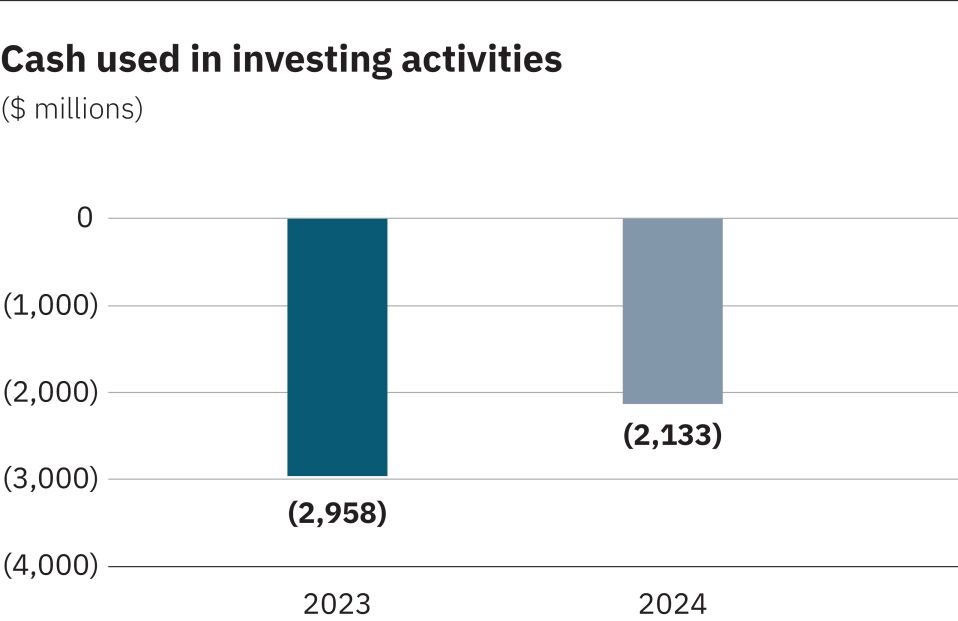
| Cash used in investing activities |
2,133 | 2,958 | ||||||
| Cash used for dividends and share repurchases2 |
1,244 | 2,079 | ||||||
| Return on Invested Capital (“ROIC”) (%)1 |
8 | 10 | ||||||
| Adjusted net debt to adjusted EBITDA3 |
2.2x | 1.9x | ||||||
|
Non-Financial Results4 |
|
|||||||
| Scope 1 and Scope 2 GHG emissions (Mmt CO2e) |
12.0 | 12.2 | ||||||
| CO2 captured and sold (Mmt) |
1.0 | 1.0 | ||||||
| Sustainable agriculture program acres (millions) |
4 | 2 | ||||||
| Lost-time injury frequency5 |
0.19 | 0.24 | ||||||
| Community investment |
28 | 23 | ||||||
| 1 | This is a non-GAAP financial measure. See the “Non-GAAP financial measures” section. |
| 2 | See the “Other financial measures” section. |
| 3 | This is a capital management measure that includes non-GAAP components. See the “Non-GAAP financial measures” and “Other financial measures” sections. |
| 4 | These are non-financial measures. See the “Terms and definitions” section. |
| 5 | Frequency based on every 200,000 hours worked. |
| 6 | Nutrien Annual Report 2024 | ||||


|
Overview
|
MD&A |
Five-year highlights |
Financial statements and notes |
||||||||||
|
2024 Highlights |
| $3.5B | $2.2B | 16% | ||
| cash provided by operating activities |
capital expenditures, approximately $450M reduction from 2023 levels |
growth in Retail adjusted EBITDA |
||
| 27Mmt | 8% | 35% | ||
| upstream fertilizer manufactured sales volumes |
growth in proprietary crop nutritional and biostimulants gross margin |
potash ore tonnes mined using automation |
||
| 15% | 20+ | >$300M | ||
| reduction in GHG emissions intensity (Scope 1 and 2) per tonne of product produced1 |
water improvement projects completed and reduced freshwater use by 13Mm3 since 2018 | $CAD local spend with direct Indigenous economic impact |
|
|
|
Sustainability Report
|
||
| For an update on our approach to sustainability please refer to our 2024 Sustainability Report expected to be published in March 2025, available on our website at nutrien.com.
|
||||
| 1 On an intensity basis vs 2018 base year emissions intensity. |
||||
| Nutrien Annual Report 2024 | 7 | ||


|
Overview |
MD&A
|
Five-year highlights |
Financial statements and notes |
||||||||||
|
Management’s discussion & analysis (“MD&A”) |
MANAGEMENT’S DISCUSSION & ANALYSIS (“MD&A”)
The following management’s discussion and analysis (“MD&A”) is the responsibility of management and is dated as of February 20, 2025.
The Board of Directors (“Board”) of Nutrien carries out its responsibility for review of this disclosure principally through its Audit Committee, comprised exclusively of independent directors. The Audit Committee reviews and, prior to its publication, recommends approval of this disclosure to the Board. The Board has approved this disclosure. The term “Nutrien” refers to Nutrien Ltd. and the terms “we”, “us”, “our”, “Nutrien” and “the Company” refer to Nutrien and, as applicable, Nutrien and its direct and indirect subsidiaries on a consolidated basis. This MD&A should be read together with the Company’s audited consolidated financial statements for the year ended December 31, 2024 (“consolidated financial statements”) prepared in accordance with International Financial Reporting Standards (“IFRS”) as issued by the International Accounting Standards Board, unless otherwise stated.
This MD&A contains certain non-GAAP financial measures and ratios, which do not have a standard meaning under IFRS and, therefore, may not be comparable to similar measures presented by other issuers. Such non-GAAP financial measures and ratios include
| • | Adjusted EBITDA |
| • | Adjusted net earnings and adjusted net earnings per share |
| • | Effective tax rate on adjusted net earnings guidance |
| • | Gross margin excluding depreciation and amortization per tonne – manufactured product |
| • | Potash controllable cash cost of product manufactured per tonne |
| • | Ammonia controllable cash cost of product manufactured per tonne |
| • | Retail adjusted average working capital to sales and Retail adjusted average working capital to sales excluding Nutrien Financial |
| • | Nutrien Financial adjusted net interest margin |
| • | Retail cash operating coverage ratio |
| • | Return on invested capital (“ROIC”) |
| • | Adjusted net debt |
For definitions, further information and reconciliations of these measures to the most directly comparable measures under IFRS, see the “Non-GAAP Financial Measures” and “Other Financial Measures” sections.
This MD&A also contains forward-looking information and forward-looking statements. See the “Forward-Looking Statements” section.
All references to per share amounts pertain to diluted net earnings (loss) per share. Financial data in this MD&A is stated in millions of US dollars, which is the functional currency of Nutrien and the majority of its subsidiaries, unless otherwise noted. Information that is not meaningful is indicated by n/m. Information that is not applicable is indicated by n/a. See the “Other Financial Measures” and “Terms and Definitions” sections for definitions, abbreviations, measures and terms used in this MD&A.
Additional information relating to Nutrien (which, except as otherwise noted, is not incorporated by reference herein), including our Annual Information Form for the year ended December 31, 2024 can be found on SEDAR+ at sedarplus.ca and on EDGAR at sec.gov. The Company is a foreign private issuer under the rules and regulations of the US Securities and Exchange Commission (the “SEC”).
The information contained on or accessible from our website or any other website is not incorporated by reference into this MD&A or any other report or document we file with or furnish to applicable Canadian or US securities regulatory authorities.
8 | Nutrien Annual Report 2024

|
Overview |
MD&A
|
Five-year highlights |
Financial statements and notes |
||||||||||
|
Our approach to annual reporting |
OUR APPROACH TO ANNUAL REPORTING
Through our annual report, we aim to communicate how we assess opportunities and challenges, which guide our strategy, risk management and governance. Our stakeholders’ priorities influence our approach to creating long-term value.

|
Our company
Outlines who we are as a company, where we operate, and our competitive advantages
12 | Nutrien’s advantage
14 | Global profile |

|
Operating environment
Defines factors and trends that influence the environment we operate in and our outlook for 2025
18 | Market fundamentals and outlook
23 | Megatrends |
|||||

|
Strategy
Describes our vision and strategy across three strategic priorities
28 | Nutrien’s strategy
29 | Simplify and focus
|

|
Governance
Describes our key corporate governance principles and risk management process
36 | Corporate governance
37 | Board and executive leadership
38 | Risk governance
|
|||||

|
Key enterprise risks
Outlines the key risks that could affect our performance and our future operations
42 | Key enterprise risks |

|
Profile and results
Describes each of our operating segments, highlights our current financial results and provides guidance
48 | Operating segment performance
58 | 2025 Guidance and sensitivities
|
| Nutrien Annual Report 2024 | 9 | ||


|
Overview |
MD&A
|
Five-year highlights |
Financial statements and notes |
||||||||||
| Nutrien’s advantage |
Nutrien is a leading global provider of crop inputs and services. We operate a world-class network of production, distribution and ag retail facilities that positions us to efficiently serve the needs of farmers. We focus on creating long-term value by prioritizing investments that strengthen the advantages of our business across the ag value chain and by maintaining access to the resources and relationships with stakeholders needed to achieve our goals.
| 10 | Nutrien Annual Report 2024 |


|
Overview |
MD&A
|
Five-year highlights |
Financial statements and notes |
||||||||||
|
Nutrien’s advantage Global profile |
| Nutrien Annual Report 2024 | 11 |

|
Overview |
MD&A
|
Five-year highlights |
Financial statements and notes |
||||||||||
|
Nutrien’s advantage |
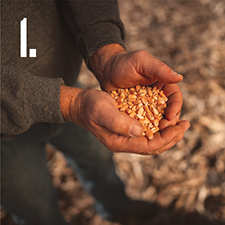
Our leading position across the ag value chain offers key competitive advantages and differentiation from our competitors. We focus on enhancing our relationships with farmers, driving efficiencies across our network and strengthening our financial position and resilience.
|
UNIQUE RELATIONSHIP WITH THE FARMER
The farmer is at the heart of everything we do and our connection with our customers is unlike any other. Together we are working to improve on-farm productivity and foster innovation to address the demands of a growing global population. |
|

|
ADVANTAGED POSITION ACROSS THE AG VALUE CHAIN
Our global reach provides competitive advantages to support higher upstream sales of manufactured fertilizer and proprietary products, drive supply chain efficiencies, optimize transportation and logistics and efficiently supply our customers. |
|

|
PROVEN FINANCIAL STRENGTH AND STABILITY
Our business is diversified, which enhances our earnings profile. Our downstream Nutrien Ag Solutions (“Retail”) business provides greater stability to our earnings base and counter-cyclical cash flow, while our low-cost upstream fertilizer production assets are positioned to generate significant cash flow, providing the ability to invest in our business and consistently return capital to our shareholders. |
| 12 | Nutrien Annual Report 2024 |
|
|
Overview |
MD&A
|
Five-year highlights |
Financial statements and notes |
||||||||||||
| Nutrien’s advantage |
|
|
1. UNIQUE RELATIONSHIP WITH THE FARMER
|
|||||
| >4,500 |
>600,000 |
4M |
||||
| crop consultants |
customer accounts |
sustainable agriculture program acres1 |
||||
|
|
2. ADVANTAGED POSITION ACROSS THE AG VALUE CHAIN
|
|||||
| World-class production assets | Global supply chain excellence | Leading ag retail network | ||||
| 27Mmt |
~660 |
>1,900 |
||||
| upstream fertilizer manufactured sales volumes |
midstream fertilizer distribution points |
Retail locations |
||||
| ~2,000 |
5 |
~1,500 |
||||
| proprietary products |
specialized marine terminals2 |
crop input suppliers |
||||
|
|
3. PROVEN FINANCIAL STRENGTH AND STABILITY
|
|||||
| Substantial cash generation | Balanced approach to capital allocation (2020–2024) (percent) |
|||||
| $4.8B
annual average cash provided by operating activities (2020–2024) |

|
|||||
| 1 | This is a non-financial measure. See the “Terms and definitions” section. |
| 2 | Owned or accessed through Canpotex. |
| 3 | This is a supplementary financial measure. See the “Other financial measures” section. |
| Nutrien Annual Report 2024 | 13 | ||||

|
Overview |
MD&A
|
Five-year highlights |
Financial statements and notes |
||||||||||
|
Global profile |
|
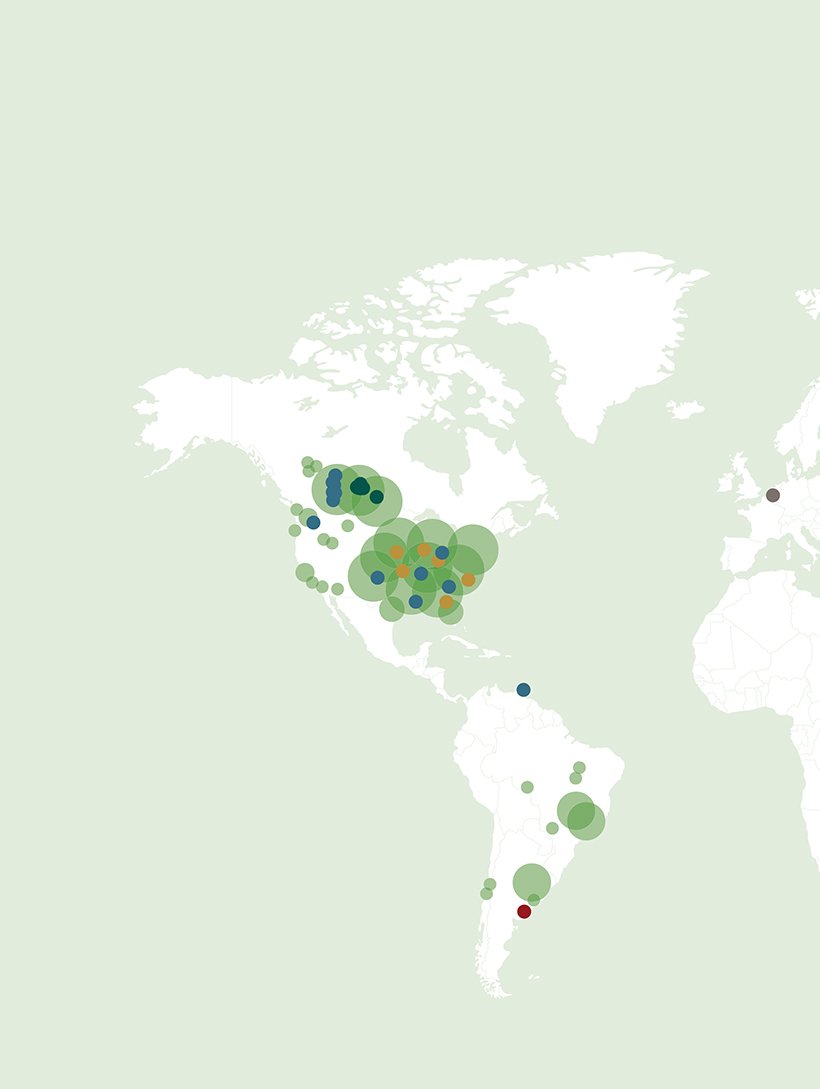
Our upstream fertilizer manufacturing assets are primarily located in North America, with access to high-quality resources, lower cost inputs and an extensive midstream distribution network to efficiently supply our customers. Our downstream Retail business serves farmers in key agricultural markets in North America, Australia and South America.
|
||
| 13
Nitrogen production and upgrade facilities in North America and Trinidad and Tobago |
6
Potash mines in Canada |
|
| 1,300
Retail locations in North America |
6
Phosphate production and upgrade facilities in the US |
|
|
200
Retail locations in South America |
||
| 14 | Nutrien Annual Report 2024
|
||

|
|
Overview |
MD&A
|
Five-year highlights |
Financial statements and notes |
||||||||||
| Global profile |
| Retail | Nitrogen | Joint venture and investments | ||||
| Potash | Phosphate | European distribution | ||||
| 400
Retail locations in Australia |
| Nutrien Annual Report 2024 | 15 | ||


|
Overview |
MD&A
|
Five-year highlights |
Financial statements and notes |
||||||||||
|
Market fundamentals and
outlook |
||||||||||||||
| 16 | Nutrien Annual Report 2024 |


|
Overview |
MD&A
|
Five-year highlights |
Financial statements and notes |
||||||||||
|
Market fundamentals and
outlook |
||||||||||||||
We operate in a rapidly changing world and must anticipate and adapt to our environment. We seek to understand the specific markets where we operate as well as the broader trends that influence and shape our operational landscape. This understanding helps us to seize new opportunities as they emerge and better identify the risks that could impact our ability to deliver on our strategy.
| Nutrien Annual Report 2024 | 17 |
|
|
Overview |
MD&A
|
Five-year highlights |
Financial statements and notes |
||||||||||
| Market fundamentals and outlook | ||||||||||||||
MARKET FUNDAMENTALS AND OUTLOOK
Agriculture and retail markets


$125B
2024 total global
crop input sales1
Crop nutrients
72.5Mmt
2024 global potash
(KCl) demand
~159Mmt
2024 global nitrogen
(N) demand
~51Mmt
2024 global phosphate
(P2O5) demand
| 1 | Represents total market sales of seed, fertilizer and crop protection products in the US, Canada, Australia and Brazil. |
18 | Nutrien Annual Report 2024
|
|
Overview |
MD&A
|
Five-year highlights |
Financial statements and notes |
||||||||||
| Market fundamentals and outlook | ||||||||||||||
AGRICULTURE AND RETAIL MARKETS
Market fundamentals
Total crop protection, seed and fertilizer sales in our Retail operating regions equated to approximately $125 billion in 2024. As the world’s population increases, farmers are challenged to increase yields from a finite arable land base. This drives growth in demand for crop inputs and agronomic services.
The agriculture retail industry is highly fragmented in most of the major markets in which we operate, primarily composed of small and medium-sized competitors. Scale, reliability of supply and the ability to provide innovative products and solutions, including digital offerings, are increasingly important to farmers.
In North America, the primary crops grown include corn, soybeans, wheat, canola and cotton. It is a more mature market with farmers leveraging advanced agriculture tools and willing and able to invest in high-value products and services.
In Australia, our customers require a full suite of crop production inputs but also solutions for livestock, water and irrigation services given the more mixed nature of farm operations.
Brazil is one of the world’s largest and fastest-growing agriculture markets. It is currently the largest soybean producer and the third largest producer of corn globally. Its retail industry is highly fragmented, the supply chain is extended due to the significant reliance on imported crop inputs and there remains opportunity for adoption of more advanced products and services at the farmer level.
Market outlook
Global grain stocks-to-use ratios are historically low, and demand remains strong, providing a supportive environment for ag commodity prices in 2025. We expect US corn plantings to range between 91 and 93 million acres and soybean plantings to range from 84 to 86 million acres in 2025. The projected increase in corn acreage, combined with a shortened fall application season in 2024, supports our outlook for strong North American fertilizer demand in the first half of the year.
In Brazil, generally favorable soil moisture conditions and stronger crop prices are expected to lead to an increase in safrinha corn planted acreage of approximately five percent, supporting crop input demand in the first half of 2025.
A weaker Australian dollar and strong grain and oilseed export demand is supporting grower economics, and conditions remain positive for 2025 crop input demand.
US ag retail industry profile
(percent)

Source: Croplife
Global grains ending stocks & stocks/use ratio1
| (ending stocks Mmt) | (stocks/use ratio %) |

Source: USDA, Nutrien
| 1 | Global grains include corn, wheat, rice, barley, oats, millets, mixed grains, rye and sorghum. RoW is Rest of World excluding China and the US. |
| Nutrien Annual Report 2024 | 19 | ||||
|
|
Overview |
MD&A
|
Five-year highlights |
Financial statements and notes |
||||||||||
| Market fundamentals and outlook |
||||||||||||||
CROP NUTRIENT MARKETS: POTASH
Market fundamentals
Potash strengthens root systems supporting water uptake, drought and disease tolerance and increases the uptake of other nutrients. Potash demand growth is driven by increasing nutrient requirements of higher-yielding crops and improving soil fertility practices, particularly in emerging markets where potash has been historically under-applied and crop yields lag.
High-quality potash reserves in significant quantities are limited to a small number of countries. Canada has the largest known global potash reserves, accounting for approximately 40 percent of the total. Approximately 75 percent of the world’s potash production capacity is held by the six largest producing companies.
Building new production capacity requires significant capital and time to bring online. The expected cost for a greenfield project, including infrastructure, ranges up to $7 billion and requires a minimum of 10 years.1 Brownfield projects have a significant per-tonne capital cost advantage over greenfield projects.
Most major potash-consuming countries in Asia and Latin America have limited production capability and rely on imports to meet their needs. Trade typically accounts for approximately three-quarters of demand for potash, resulting in a globally diversified marketplace.
Inflation in operating and logistics costs has increased the short run marginal cost of potash supply and higher capital costs has also impacted the long-run margin cost.
Market outlook
Global potash shipments rebounded to approximately 72.5 million tonnes in 2024, driven by improved supply and supportive application economics that contributed to increased demand in key markets such as China, Brazil and Southeast Asia.
We forecast global potash shipments between 71 and 75 million tonnes in 2025. The high end of the range captures the potential for stronger underlying global consumption and the lower end captures the potential for reduced supply availability. We anticipate the potential for supply tightness with limited global capacity additions in 2025 and reported operational challenges and maintenance work in key producing regions.
|
|
|
|||
| Global potash demand | Delivered cash cost of potash to Brazil2,3 | |||
| (million tonnes KCl) | ($ per tonne) | |||

|

|
|||
| Source: IFA, Argus, CRU, SPGCI, Nutrien | Source: CRU, Nutrien | |||
| 1 | 3 million tonne KCl conventional potash mine in Saskatchewan, Canada. Cost includes rail, utility systems, port facilities and, if applicable, cost of deposit. |
| 2 | Based on CRU historical data and forecasts. |
| 3 | Short-run marginal cost refers to the breakeven delivered cash cost of the market-clearing high-cost production on a short-term basis. Long-run marginal cost refers to the full economic cost of new capacity. |
| 20 | | Nutrien Annual Report 2024 | |||
|
|
Overview |
MD&A
|
Five-year highlights |
Financial statements and notes |
||||||||||
| Market fundamentals and outlook |
||||||||||||||
CROP NUTRIENT MARKETS: NITROGEN
Market fundamentals
Nitrogen is an essential crop nutrient and is a fundamental building block of plant proteins that improves both crop yield and quality. The necessity of nitrogen for crop yield supports a strong and growing demand source for nitrogen fertilizers. Additionally, nitrogen is used as an input in many industrial processes and has the potential to provide further value if markets for low-carbon ammonia emerge.
Production of nitrogen products is the most geographically diverse of the three primary crop nutrients due to the widespread availability of hydrogen sources. Access to reliable and competitively priced energy feedstock supply is an important driver of profitability, as recent geopolitical events continue to create additional volatility in certain global energy markets. North American nitrogen producers currently have an advantaged cost position due to the relatively low price of natural gas compared to competitors in Europe and Asia.
The US is the third largest nitrogen-producing country but remains one of the largest importers of nitrogen products. China and India are the largest-consuming countries of nitrogen products, accounting for approximately 40 percent of the world’s consumption.
Market outlook
Global urea and UAN prices have increased in the first quarter of 2025, driven by strengthening demand in key import markets and restricted supply, including continued Chinese urea export restrictions. Global ammonia prices have trended lower to start the year due to seasonal demand weakness and the anticipation of incremental supply in the US and export capacity from Russia. We expect North American natural gas prices to remain highly competitive compared to Europe and Asia, with Henry Hub natural gas prices projected to average between $3.25 and $3.50 per MMBtu for the year.
The US nitrogen supply and demand balance is expected to be tight ahead of the spring application season, as nitrogen fertilizer net imports in the first half of the 2024/2025 fertilizer year were down approximately 60 percent compared to the five-year average. Additionally, nitrogen demand for the spring season is expected to be strong due to the limited fall ammonia application season and higher expected corn acreage.
|
|
|
|||
| Global ammonia demand | Natural gas prices in key regions | |||
| (million tonnes NH3) | ($ per MMBtu) | |||

|

|
|||
| Source: SPGCI, CRU, Argus, Nutrien | Source: Bloomberg, SPGCI, ICE, CME, Nutrien | |||
| 1 | 2025F based on front month Europe TTF futures prices as of February 14, 2025. North American natural gas prices are based on the Nutrien 2025 forecast. |
| Nutrien Annual Report 2024 | 21 | ||||
|
|
Overview |
MD&A
|
Five-year highlights |
Financial statements and notes |
||||||||||
| Market fundamentals and outlook |
||||||||||||||
CROP NUTRIENT MARKETS: PHOSPHATE
Market fundamentals
Phosphorus is essential to all living things and is key to energy reactions in the plant, particularly photosynthesis, and vital to plant growth. Additionally, phosphate is used as an input in animal feed, food ingredients and for industrial processes.
Phosphate rock is found in significant quantity and quality in only a handful of geographic locations, with only 11 major phosphate-producing countries. Due to the concentration of deposits, the majority of recent capacity additions have come from existing producers in North Africa, the Middle East and China.
China is the world’s largest producer of phosphate, and its trade policy has a major impact on the global market. In 2024, Chinese DAP/MAP exports were down approximately 35 percent from 2021 levels as a result of export restrictions.
India and Brazil are the largest importers of phosphate fertilizers, with limited domestic production. In more mature markets like North America, we have seen continued demand growth for phosphate fertilizers that incorporate secondary nutrients and micronutrients like Nutrien’s MAP+MST product.
Market outlook
Phosphate fertilizer markets remain firm, particularly in North America where channel inventories were estimated to be historically low entering 2025. We expect Chinese phosphates exports similar to 2024 levels, with total DAP/MAP exports ranging between 6 and 7 million tonnes, and tight stocks in India to support demand ahead of their key planting season.
|
|
|
|||
| Global P2O5 demand | China DAP/MAP exports | |||
| (million tonnes P2O5) | (millions tonnes) | |||

|

|
|||
| Source: CRU, TFI, Industry Consultants, Nutrien | Source: CRU, Argus, Nutrien | |||
| 22 | | Nutrien Annual Report 2024 | |||
|
|
Overview |
MD&A
|
Five-year highlights |
Financial statements and notes |
||||||||||
| Megatrends |
||||||||||||||

We define megatrends as macro-level long-term trends and global dynamics that are expected to shape our operating environment. A megatrend typically stems from complex interactions between policy developments, environmental changes, socio-economic shifts and technological advancements. Evaluating and monitoring megatrends helps inform Nutrien’s strategy and the related risks we look to manage. See page 28 for more information on our strategy and page 42 for our key enterprise risks.
FOOD SECURITY
Despite advances in modern agriculture, food security remains a global challenge. Producing enough nutritious food for the world’s eight billion people, and transporting it to where it is needed, is straining existing global resources. It is estimated that nearly 10 percent of the world’s population is food insecure. A rising population, expected to grow by close to two billion people by 2050, is further increasing the scale of this challenge.
The agricultural landscape continues to evolve and be influenced by climate change, biodiversity loss, water stress, geopolitical volatility, technology and digitalization, along with social trends that could impact the ability to address global food security.
| Nutrien Annual Report 2024 | 23 | ||||
|
|
Overview |
MD&A
|
Five-year highlights |
Financial statements and notes |
||||||||||
| Megatrends |
||||||||||||||

CLIMATE CHANGE, BIODIVERSITY
LOSS AND WATER RESOURCES
The convergence of climate change, biodiversity loss and water resource challenges forms a critical intersection that is expected to influence global environmental policy and corporate decisions in agriculture and mining for the foreseeable future. The agriculture value chain is expected to face long-term challenges related to climate change, including continued expectations for climate actions, reductions of GHG emissions and physical impacts from climate change on farmers and agriculture production.
GEOPOLITICAL
VOLATILITY
Geopolitical turmoil around the world is being driven by nationalism, polarization and economic instability. Due to globalization, regional events are having global impacts. Trade disputes, tariffs, restrictions and tensions have resulted in, and may continue to result in, supply chain disruptions and price volatility for energy and several other key commodities. Geopolitical fragmentation can lead to increased costs associated with diverging and sometimes incompatible regulations.
| 24 | Nutrien Annual Report 2024 |
|
|
Overview |
MD&A
|
Five-year highlights |
Financial statements and notes |
||||||||||
| Megatrends |
||||||||||||||

TECHNOLOGY AND
DIGITALIZATION
Digital technologies and access to vast amounts of data are supporting the transformation of the agriculture and mining industries. In mining operations, advances in automation and autonomous mining are improving safety by removing workers from the more hazardous areas and enabling productivity increases. Agriculture and food systems are undergoing technological changes driven by big data, digital connectivity, artificial intelligence and innovations in biotechnology.
New applications of emerging technologies, such as artificial intelligence and predictive analytics, have the potential to greatly improve operational productivity. The regulatory environment around artificial intelligence continues to evolve at a different pace than its use. Adoption of such technologies is expected to be uneven given vast differences in access and investment.
SOCIETAL
EXPECTATIONS
Stakeholders remain focused on corporate transparency and accountability. Some investors consider environmental and social principles alongside traditional financial metrics in capital allocation decisions and, along with regulators, are considering those principles in evaluating disclosure enhancements. Beyond climate-related matters, societal concerns include broad ecosystem impacts, as well as the expectation that companies operate in the best interest of stakeholders keeping public health goals in mind.
In response to these expectations, governments may impose new regulations or increase the stringency of existing ones. An inability to meet stakeholder expectations for environmental and social performance could increase stakeholder scrutiny, which could, in turn result in increased difficulty for companies as they seek to access cost-efficient capital, retain talent or deliver on their strategic priorities.
| Nutrien Annual Report 2024 | 25 | ||||

|
|
Overview |
MD&A
|
Five-year highlights |
Financial statements and notes |
||||||||||
| Nutrien’s strategy Capital allocation |
||||||||||||||
Our vision is to be the leading global agricultural solutions provider, delivering superior shareholder value through safe and sustainable operations. We are focused on strategic initiatives that we believe will help achieve our vision: improving safety and operating performance, increasing earnings and cash flow, while generating higher risk-adjusted returns. We take a disciplined and intentional approach to capital allocation that is designed to optimize the sources and uses of our cash and prioritize sustaining safe and reliable operations, maintaining a healthy balance sheet, strategically investing in our business and providing meaningful returns to our shareholders.
| 26 | Nutrien Annual Report 2024 |

|
|
Overview |
MD&A
|
Five-year highlights |
Financial statements and notes |
||||||||||
| Nutrien’s strategy Capital allocation |
| Nutrien Annual Report 2024 | | 27 |
|
|
Overview |
MD&A
|
Five-year highlights |
Financial statements and notes |
||||||||||
| Nutrien’s strategy |
Our strategy is focused on three priorities that span our upstream, midstream and downstream businesses.

|
SIMPLIFY AND FOCUS
Simplify our approach and focus on business activities that are core to our long-term vision and strategic direction, exploring opportunities to exit non-core activities. |
|

|
OPERATIONAL EXCELLENCE
Enhance safety, increase operational efficiency and asset utilization, maximize cost savings and improve the quality of earnings. |
|
|
|
DISCIPLINED AND INTENTIONAL CAPITAL ALLOCATION
Optimize the sources and uses of our cash and prioritize sustaining safe and reliable operations, maintaining a strong and flexible balance sheet, strategically investing in our business and providing meaningful returns to our shareholders. |
| 28 | | Nutrien Annual Report 2024 |
|
|
Overview |
MD&A
|
Five-year highlights |
Financial statements and notes |
||||||||||
| Nutrien’s strategy |

Simplify
| • | Pursuing divestiture of non-core Retail assets in South America |
| • | Reviewing strategic options for our 50 percent ownership stake in Profertil |
| • | Evaluating further options with regards to our ownership in Sinofert Holdings Limited (“Sinofert”) |
| • | Centralizing functions to drive efficiencies and streamline decision making |
Focus
| • | Prioritizing safety to ensure our people go home safe, every day |
| • | Enhancing low-cost upstream North American fertilizer production assets |
| • | Strengthening our global distribution network |
| • | Investing in our core Retail business with a focus on proprietary products |
| ~$200M | +$500M | ~$60M | ||
| annual consolidated cost savings expected to be achieved in 2025, ahead of our initial target of 2026 |
expected reduction in 2025 capital expenditures from 2023 levels | proceeds from divestment of non-core assets, including 13 percent of our total ownership position in Sinofert and the sale of land in Argentina | ||
| 2026 Target | 2024 Actuals | 2023 Actuals | ||||||||||
| Simplify and focus |
||||||||||||
| Consolidated cost savings1 |
~$200M | Ahead of Schedule | N/A | |||||||||
| 1 | Based on targeted reductions in operational and corporate costs. |
| Nutrien Annual Report 2024 | 29 | ||||
|
|
Overview |
MD&A
|
Five-year highlights |
Financial statements and notes |
||||||||||
| Nutrien’s strategy |
||||||||||||||

Maintain low-cost position and enhance safety and the reliability of our upstream assets
| • Investing in Potash mine automation technology and operational excellence
• Increasing Nitrogen reliability and energy efficiency
• Improving Phosphate reliability and cost stewardship |
35% | 12% | ||
| potash ore tonnes mined using automation in 2024 |
increased gas utilization in Trinidad compared to 2023 |
|||
Drive midstream supply chain efficiencies across our network
| • Optimizing our logistics infrastructure |
• Leveraging our extensive sales and distribution capabilities |
|||
Optimize downstream Retail network to enhance margins and our ability to efficiently serve the farmer
| • Consolidating and modernizing our North American footprint
• Executing on a margin improvement plan in Brazil |
>50 | >50 | ||
| North American Retail sites consolidated into centralized locations over the past 5 years |
Retail Brazil locations closed, idled 5 blending facilities, and restructured our workforce in Brazil |
|||
| 2026 Target | 2024 Actuals | 2023 Actuals | ||||||||||
| Operational excellence |
||||||||||||
| Potash ore tonnes mined using automation |
40%—50% | 35% | 22% | |||||||||
| Ammonia operating rate1 |
92%—93% | 88% | 88% | |||||||||
|
P2O5 operating rate |
87%—90% | 78% | 83% | |||||||||
| 1 | Operating rate represents production volumes divided by production capacity (excluding Joffre and Trinidad facilities). |
| 30 | | Nutrien Annual Report 2024 | |||
|
|
Overview |
MD&A
|
Five-year highlights |
Financial statements and notes |
||||||||||
| Nutrien’s strategy |
||||||||||||||
| 3. | DISCIPLINED AND INTENTIONAL CAPITAL ALLOCATION |

Safe and reliable operations
| • | Sustain our assets to support safe and reliable operations |
| • | Focus on continuous improvement initiatives and investments that enhance the utilization rates, reliability and efficiency of our assets |
| • | Monitor technology, policy and market developments that may make emissions reduction projects economically viable |
Consistent shareholder returns
| • | Return capital to shareholders through a combination of share repurchases and a stable and growing dividend per share |
| • | Consider reduction in share count in the decision criteria for future dividend per share growth |
Strong and flexible balance sheet
| • | Evaluate our assets to ensure they are generating an appropriate return |
| • | Provide sufficient and flexible access to liquidity while optimizing the cost of our capital through the cycle |
| • | Expect to maintain an average adjusted net debt to adjusted EBITDA leverage ratio below 3:1 through the cycle |
High-value growth opportunities
| • | Leverage existing assets to deliver upstream fertilizer volume and proprietary products growth |
| • | Progress targeted growth investments that have a strong fit with our strategy, provide returns in excess of our hurdle rates and have a relatively low degree of execution risk |
| 2026 Target | 2024 Actuals | 2023 Actuals | ||||||||||
| Disciplined and intentional capital allocation |
||||||||||||
| Annual average capital expenditures (2024-2026)1 |
$2.2B–$2.3B | $2.2B | $2.6B | |||||||||
| Potash manufactured sales volumes (million tonnes) |
14.0–15.0 | 13.9 | 13.2 | |||||||||
| Nitrogen manufactured sales volumes (million tonnes) |
11.5–12.0 | 10.7 | 10.4 | |||||||||
| Retail adjusted EBITDA |
$1.9B–$2.1B | $1.7B | $1.5B | |||||||||
| 1 | Comprised of sustaining capital expenditures, investing capital expenditures and mine development and pre-stripping capital expenditures that are supplementary financial measures. See the “Other financial measures” section. |
| Nutrien Annual Report 2024 | 31 | ||||
|
|
Overview |
MD&A
|
Five-year highlights |
Financial statements and notes |
||||||||||
| Capital allocation |
||||||||||||||
| SAFE AND RELIABLE OPERATIONS |

|
|
|
Sustaining, mine development and pre-stripping capital expenditures1 |
||
| $1.7B | ||
|
2024 |
||
| Sustaining, mine development and pre-stripping capital expenditures (percent) |
Key 2024 actions
• Completed reliability work and replaced key identified end-of-life assets across our upstream operations, including five major maintenance turnarounds and planned outages at four of our Nitrogen sites
• Received the National Safety Council’s Green Cross for Safety Innovation award in recognition of tele-remote technology in our potash mines
• Invested in maintenance and safety-related initiatives for our downstream Retail facilities |
|

|
||
| STRONG AND FLEXIBLE BALANCE SHEET |

|
|
|
Adjusted net debt to adjusted EBITDA2 |
||
|
2.2X |
||
| 2024 | ||
| Debt and equity3,4 (percent) |
Key 2024 actions
• Maintained our Baa2/BBB investment-grade credit rating
• Repaid $500 million in senior notes that matured in 2024 and issued a total of $1.0 billion of 3-year and 10-year senior notes |
|

|
| 1 | This is a supplementary financial measure. See the “Other financial measures” section. |
| 2 | This is a capital management measure that includes non-GAAP components. See the “Non-GAAP financial measures” and “Other financial measures” sections. |
| 3 | As at December 31, 2024. |
| 4 | Debt includes short-term debt, long-term debt and lease liabilities, including the current portions of each where applicable. |
| 32 | | Nutrien Annual Report 2024 | |||
|
|
Overview |
MD&A
|
Five-year highlights |
Financial statements and notes |
||||||||||
| Capital allocation |
||||||||||||||
| CONSISTENT SHAREHOLDER RETURNS |
Key 2024 actions
• Repurchased 3.9M shares for a total of ~$190 million in the second half of 2024
• Announced a 1 percent increase to our quarterly dividend to $0.545 per share in February 2025, our seventh increase since 2018
• In February 2025, we approved the purchase of up to 5 percent of Nutrien’s outstanding common shares over a twelve-month period through a renewal of our normal course issuer bid |
|
|
Cash used for dividends and share repurchases |
||
| 4.3% | ||
|
average dividend yield in 2024 |
||
| $1.2B
returned to shareholders through dividends and share repurchases in 2024 |
| HIGH-VALUE GROWTH OPPORTUNITIES |
Key 2024 actions
• Invested in potash autonomous mining machines and technology and increased our ore tonnes mined using automation by more than 75% (vs 2023)
• Invested in low-cost nitrogen brownfield expansions and added incremental ammonium sulfate capability at our Redwater nitrogen site
• Invested in proprietary products, network optimization and digital capabilities to better serve our customers |
|
|
Targeted growth investments |
||
| $430M | ||
|
investing capital expenditures in 2024 |
||
| 8%
growth in proprietary crop nutritional and biostimulants gross margin in 2024 (vs 2023) |
| Nutrien Annual Report 2024 | 33 | ||||


|
Overview |
MD&A
|
Five-year highlights |
Financial statements and notes |
||||||||||
|
Corporate governance |
We embed strong corporate governance systems and principles in our business to place the interests of our shareholders and other stakeholders at the center of every decision we make. Our governance supports value preservation and long-term value creation by ensuring our businesses’ principal risks and opportunities are being appropriately identified and addressed.
| 34 | Nutrien Annual Report 2024 |

|
|
Overview |
MD&A
|
Five-year highlights |
Financial statements and notes |
||||||||||
|
Corporate
governance |
| Nutrien Annual Report 2024 | 35 | ||||
|
|
Overview |
MD&A
|
Five-year highlights |
Financial statements and notes |
||||||||||
| Corporate governance |
Nutrien’s corporate governance structure includes policies and processes that define the roles of the Board and the Executive Leadership Team (“ELT”). Our Board oversees the execution of our corporate strategy and management of risk. Below are highlights of our corporate governance practices. For more information, see our most recent Management Proxy Circular.
Board diversity
Having a mix of directors on the Board from varied backgrounds and with a diverse range of experience and skills fosters enhanced decision-making capacity and promotes strong corporate governance. Our Board Diversity Policy includes a target that women comprise no fewer than 30 percent of the Board members. As of December 31, 2024, four of our directors were women (33 percent of the total number of directors).
Executive compensation
Nutrien’s compensation framework is based on a pay-for-performance philosophy, with the majority of executive compensation being at risk. Each year, we include an advisory “say on pay” vote at our annual meeting.
Board skills
Our Board competencies and skills matrices are essential tools to evaluate whether the Board has the right skills, perspectives, experience and expertise for proper oversight and effective decision making. The Board regularly reviews the skills matrix.
Core business skills1
(percent of Board of Directors)

Core industry experience1
(percent of Board of Directors)

| 1 | As disclosed in Nutrien’s 2024 Management Proxy Circular. |
| 36 | | Nutrien Annual Report 2024 |
|
|
Overview |
MD&A
|
Five-year highlights |
Financial statements and notes |
||||||||||
| Corporate governance |
||||||||||||||

|
|
|
|
|
|
|||||
| Russell Girling | Ken Seitz | Christopher Burley | Maura Clark | Michael Hennigan | Miranda Hubbs | |||||
| Chair | President and Chief Executive Officer | Director | Director | Director | Director | |||||
|
|
|
|
|
|
|
|||||
| Raj Kushwaha | Julie Lagacy | Consuelo Madere | Keith Martell | Aaron Regent | Nelson Luiz Costa Silva | |||||
| Director | Director | Director | Director | Director | Director |
EXECUTIVE LEADERSHIP TEAM
|
|
|
|
|
|||||||||
| Ken Seitz | Noralee Bradley | Andrew Kelemen | Chris Reynolds | |||||||||
| President and Chief Executive Officer | Executive Vice President, External Affairs and Chief Sustainability and Legal Officer | Executive Vice President and Chief Corporate Development and Strategy Officer | Executive Vice President and Chief Commercial Officer | |||||||||
|
|
|
|
|
|||||||||
| Jeff Tarsi | Mark Thompson | Sarah Walters | Trevor Williams | |||||||||
| Executive Vice President and President, Global Retail | Executive Vice President and Chief Financial Officer | Executive Vice President and Chief People Officer | Executive Vice President and President, Nitrogen and Phosphate |
| Nutrien Annual Report 2024 | 37 | ||||
|
|
Overview |
MD&A
|
Five-year highlights |
Financial statements and notes |
||||||||||
| Risk governance |
||||||||||||||
Risk management is an integral part of doing business and is governed by our Board, which has the highest level of oversight for risk governance. The Board is responsible for overseeing the execution and alignment of Nutrien’s corporate strategy and risk management processes.
Nutrien’s ELT has the responsibility of ensuring the Company’s principal risks are being appropriately identified, assessed and addressed. Management keeps the Board and each of the Board committees regularly apprised of risks and developments relevant to their mandates.
Responsibility and accountability for risk management are embedded in all levels of our organization, and we strive to integrate risk management into key decision-making processes and strategies. By considering risk throughout our business, we seek to effectively manage the risks that could have an impact on our ability to deliver on our strategy.
Role of the Board committees
While the Board as a whole oversees our strategy and risk management processes, each Board committee has oversight over business topics and certain risk areas relevant to their committee mandate. More information can be found in Nutrien’s Board and Board committee charters on our website at nutrien.com.
| Board/Board Committee
|
Oversight includes the following business topics or risk areas
|
|||
| Board of Directors |
• Corporate strategy
• Oversight of safety, health, environmental and security matters |
• Risk management
• Human resources and compensation
• Governance and compliance |
||
| Audit Committee |
• Accounting and financial reporting
• Internal controls |
• Compliance
• Financial risk management |
||
| Corporate Governance & Nominating Committee |
• Corporate governance
• Board diversity
• Director compensation |
• Director orientation and continuing education
• Board evaluation |
||
| Human Resources & Compensation Committee |
• Executive compensation
• Succession planning |
• Equity, diversity and inclusion, including the Company’s Indigenous Strategy as it relates to Indigenous employment and human resources matters with appropriate coordination with the S&S Committee
• Learning and development |
||
| Safety & Sustainability (“S&S”) Committee |
• Sustainability priorities
• Risks, strengths and opportunities related to safety and sustainability including climate-related impacts |
• Safety and sustainability performance and strategy
• Cybersecurity and data privacy
• Status of remediation projects and environmental provisions
• The Company’s Indigenous Strategy as it relates to Indigenous engagement and stakeholder relations, with appropriate coordination with the Human Resources & Compensation Committee |
||
| 38 | | Nutrien Annual Report 2024 | |||
|
|
Overview |
MD&A
|
Five-year highlights |
Financial statements and notes |
||||||||||
| Risk management process |
||||||||||||||
Risk management is integrated in our strategy and business processes to facilitate informed decision making and responsible management of resources. Our Enterprise Risk Management process is overseen by our Enterprise Risk Management Team and guided by our global risk management framework. The framework promotes consistent and integrated application of risk management principles and processes across our organization and is scalable to support all levels of the business.
Nutrien’s operating segments and corporate functions use this framework to identify, assess and develop mitigation actions for key risks that could affect their strategy, operations or future performance. Assessment criteria embedded in the risk framework follow best practices and allow for comparability of different types of risks. Key criteria include the likelihood of impacting our business and the potential severity of impact.
Risks are evaluated at the management level to fully understand Nutrien’s risk landscape and identify interdependencies between risks. A consolidated view of our risks is presented to our ELT and senior leaders for review and discussion. Nutrien’s key enterprise risks are then presented to the Board at least annually.

| Nutrien Annual Report 2024 | 39 | ||||

|
|
Overview |
MD&A
|
Five-year highlights |
Financial statements and notes |
||||||||||
|
Key enterprise risks |
| 40 | Nutrien Annual Report 2024 |


|
Overview |
MD&A
|
Five-year highlights |
Financial statements and notes |
||||||||||
|
Key enterprise risks |
Nutrien characterizes a key risk as a risk or combination of risks that could threaten the effective delivery of our business model, future financial peformance, liquidity or ability to deliver on our strategy.
| Nutrien Annual Report 2024 | 41 |
|
|
Overview |
MD&A
|
Five-year highlights |
Financial statements and notes |
||||||||||
| Key enterprise risks |
||||||||||||||
Our key enterprise risks are discussed below and, while these represent our significant risks, we also continue to be exposed to other important general business, financial, operational and climate-related risks. For a more detailed discussion of these key risks and other risks that may have a material effect on us, refer to Nutrien’s 2024 Annual Information Form.
| 1 |
Competition and shifting market fundamentals
|
|||
| Description
Global macroeconomic conditions and shifting market fundamentals – including trade tariffs and trade restrictions, market volatility, geopolitical conditions, increased price competition or new entrants, and/or a significant change in agriculture production or consumption trends – could lead to a sustained environment of reduced demand for our products, increased costs and/or low or volatile commodity prices, thereby negatively impacting our short- and long-term profitability. |
Risk management approach
We operate across the ag value chain and have a diversified portfolio of products and services that are designed to enable us to respond to changing economic conditions. We have a favorable cost-structure and the flexibility to make operational changes across our portfolio to help minimize the impact of changing market dynamics. We prioritize a strong and flexible balance sheet and focus on initiatives that simplify and enhance our core business, optimize our advantages across the ag value chain and allocate capital to high-value investments.
See page 18 of this report for more information on our market fundamentals. |
|||
| 2 |
Changing regulations
|
|||
| Description
Changing laws, regulations and government policies, including those relating to the environment, climate change (including regulation of GHG emissions), data privacy, health and safety, and taxes and royalties, could affect our ability to produce or sell certain products, reduce our efficiency and competitive advantage, increase our costs of raw materials, energy, transportation and compliance, or require us to make capital improvements to our operations. These and other factors could impact our strategy, operations, financial results or reputation. |
Risk management approach
Our Government & External Affairs Team maintains an active engagement strategy with governments and regulators, including participation in industry associations. These relationships allow us to keep current on regulatory developments affecting our business or industry, allowing us to anticipate new or changing laws and regulations and put us in the best position for success while leveraging our industry association allies. |
|||

| 42 | | Nutrien Annual Report 2024 | |||
|
|
Overview |
MD&A
|
Five-year highlights |
Financial statements and notes |
||||||||||
| Key enterprise risks |
||||||||||||||
| 3 |
Political, economic and social instability
|
|||
| Description
We are a global business with significant operations in Canada and the US as well as operations outside of North America, including Australia, South America, Trinidad and certain European countries.
We are subject to numerous risks and uncertainties related to international sales and operations, and wide-ranging political, economic and social instability. These risks include, but are not limited to: restrictions on monetary distributions in jurisdictions we operate, inflation and/or conditions resulting from governmental attempts to reduce inflation, currency exchange rate fluctuations between the US dollar and foreign currencies, labor disruptions, competitive restrictions, forced divestitures or changes to, or termination or nullification of, existing agreements, military or other armed conflicts, mining permits or leases, the imposition of tariffs, exchange controls, |
international sanctions, embargoes, trade barriers or other restrictions. Instability in political or regulatory regimes could also affect our ability to do business and could impact our financial results or the value of our assets.
Risk management approach
Our Government & External Affairs Team maintains an active engagement strategy with governments, regulators and other stakeholders in the countries where we operate or plan to operate and is well positioned with the US Administration. We assess capital investments and project decisions against political, country-specific and other related risk factors and avoid or reduce our exposure to jurisdictions with unacceptable risk levels. We actively monitor regulatory and political developments and global trends that may impact us. |
|||
| 4 |
Agricultural changes and trends
|
|||
| Description
The agricultural landscape continues to evolve as a result of factors including, but not limited to, farm and industry consolidation, changing farmer demographics, technology developments, sustainability practices, changing government programs and policies, climate change and shifting social trends, many of which vary from jurisdiction to jurisdiction. These factors as well as other factors affecting long-term demand for our products and services could adversely impact our strategy and our financial results. |
Risk management approach
We operate across the ag value chain and have a diversified portfolio of products and services that enable us to adapt to changes in the agriculture industry and help position us to achieve long-term value creation. Our downstream Retail network provides access and insights directly to the farmer, providing an opportunity to anticipate trends and respond faster to the needs of our customers. We are focused on bringing value-added products and services to market that address key grower challenges, including offering financing solutions through Nutrien Financial and expanding innovative proprietary product offerings.
See page 28 of this report for more information on our strategy. |
|||
| 5 |
Cybersecurity threats
|
|||
| Description
Information technology and operational control systems are embedded in our business and as we become more dependent on these systems, third-party systems and cloud-based platforms, we may become more exposed to cyberattacks, which continue to become increasingly sophisticated. Cybersecurity risks can include attacks on information technology and infrastructure by hackers, industrial espionage, terrorist attacks, viruses, ransom events, the unintended disclosure of confidential |
information and/or personally identifiable information, the misuse or loss of control over computer control systems, power outages, business and/or supply chain disruptions, and related breaches. Any of these could result in business disruptions, increased defense or insurance costs, reputational damage, personal injury or third-party claims, which could, in turn, negatively impact our operations, financial results or reputation. |
|||
| Nutrien Annual Report 2024 | 43 | ||||
|
|
Overview |
MD&A
|
Five-year highlights |
Financial statements and notes |
||||||||||
|
Key enterprise risks |
| 5 |
Cybersecurity threats (continued)
|
|||
| Risk management approach
Our Global Information Management and Cyber Security Team is supported by third-party specialists, oversees our network security and may assist in incident response. We promote a strong culture of cybersecurity awareness to minimize threats and vulnerabilities, which is supported by our cybersecurity framework, policies and best practices. |
Threat and risk assessments are completed for all new information technology systems, and our cybersecurity incident response processes are backstopped by external response measures. We also conduct regular simulated phishing and targeted cybersecurity training as well as incident response training. |
|||
| 6 |
Supply chain disruption
|
|||
| Description
Our ability to produce and supply our customers and markets with products can be negatively impacted by disruptions in our inbound and outbound supply chains. These disruptions can result in difficulties supplying key materials or supplies to our facilities or impair our ability (or the ability of the third parties upon which we rely) to deliver products to our customers in a timely manner. Ongoing geopolitical conflicts, regulatory instability, sanctions, tariffs, labor disputes and extreme weather events or disasters have created and could create supply chain challenges and disruptions, and/or limit our future ability to sell or distribute our products in a timely manner, any of which could negatively impact our business and financial results. |
Risk management approach
Our business structure and position across the ag value chain provides us the flexibility to optimize our operations and distribution network to be able to respond to potential supply chain disruptions. We have an extensive and diverse transportation and storage network that allows us to effectively manage and adapt to logistical challenges. We maintain a sizable and diverse network of suppliers that we regularly review to ensure we can maintain critical feedstocks for our operations. |
|||
| 7 |
Climate change
|
|||
| Description
Our business and our customers are subject to risks related to or resulting from climate change, which are commonly grouped into physical risk and transition risk categories.
Physical risks include the impacts that climate change could have on our operations, supply chains and customers. These may cause or result in, among other things, more frequent and severe weather events, diminishing biodiversity, impacts to growing seasons or crop yields and changing weather factors such as temperature, precipitation, wind and water levels, and affect freshwater availability. These risks may also result in operational or supply chain disruptions.
Transition risks relate to the risk inherent in changing strategies, policies or investments as society and industry work to reduce the reliance on carbon and its impact on the climate. Impacts from transition risks include, among other things, policy constraints on emissions, carbon pricing mechanisms, water restrictions, land use restrictions or incentives, changing consumer preferences and market demand and supply shifts. |
We are also subject to reputational risks associated with climate change, including our stakeholders’ perception of the agriculture industry and our role in the transition to a lower-carbon economy. These and other factors resulting from climate change could adversely impact our operations, financial results or liquidity.
Risk management approach
Our capital allocation framework and preventive maintenance programs help support the long-term reliability and efficiency of our assets. Additionally, our geographically diversified network of facilities and operations helps to minimize the overall impact of physical risk from climate change on our Company.
For more information refer to our 2024 Sustainability Report on our website at nutrien.com. |
|||
| 44 | | Nutrien Annual Report 2024 |
|
|
Overview |
MD&A
|
Five-year highlights |
Financial statements and notes |
||||||||||
|
Key enterprise risks |
| 8 |
Safety, health and environment
|
|||
| Description
Our operations are subject to safety, health and environmental risks inherent in mining, manufacturing and the transportation, storage and distribution of our products. These inherent risks could result in injuries or fatalities, or impact air quality, biodiversity, water resources or related ecosystems near our operations, which could, in turn, negatively impact our operations, financial performance or reputation. |
Risk management approach
Our safety strategy and governance processes are designed to follow regulatory, industry and internal standards of safety, health and environmental. We have structured incident prevention and response systems in place and conduct regular security vulnerability assessments. We have crisis communication protocols and emergency response programs across our business and maintain environmental monitoring and control systems, including third-party reviews of key containment structures.
For more information refer to our 2024 Sustainability Report on our website at nutrien.com. |
|||
| 9 |
Talent and organization culture
|
|||
| Description
Our ability to attract and retain qualified top talent, including skillsets in high demand or in certain regions, and provide the necessary organizational structure, programs and culture to engage and develop our employees, is crucial to our growth and achieving our business results. Failure to do so could impact our operations, financial results or our ability to achieve our growth objectives. |
Risk management approach
Our Talent Attraction and Sourcing Team focuses on building a diverse and talented workforce. We are committed to the career development of our employees and building a culture grounded in our organizational purpose and the values of safety, inclusion, integrity and results. Our talent succession process focuses on identifying and managing critical roles and the proactive build-up of internal and external bench strength. Our incentive programs are competitive, performance-based and they support our purpose-driven culture. |
|||
| 10 |
Capital redeployment
|
|||
| Description
We may not be able to deploy capital to efficiently achieve sustained growth, effectively execute on opportunities or meet stakeholder expectations – whether due to market conditions, lack of investment options or otherwise, or deploying capital in a manner inconsistent with our strategic priorities – could impact our returns, operations, reputation, access to or cost of capital, or result in potential asset impairments. |
Risk management approach
We continue to concentrate on creating long-term value through a disciplined and intentional approach to capital allocation. We prioritize sustaining safe and reliable operations, maintaining a healthy balance sheet, strategically investing in our business and providing meaningful returns to our shareholders.
See page 31 of this report for more information on our capital allocation and key actions. |
|||

| Nutrien Annual Report 2024 | | 45 |


|
Overview |
MD&A
|
Five-year highlights |
Financial statements and notes |
||||||||||
|
Profile and results |
| 46 | Nutrien Annual Report 2024 |

|
|
Overview |
MD&A
|
Five-year highlights |
Financial statements and notes |
||||||||||
| Profile and results |
||||||||||||||
Nutrien has four reportable operating segments: Retail, Potash, Nitrogen and Phosphate. The downstream Retail segment distributes crop nutrients, crop protection products, seed and merchandise, and provides services, including financing, directly to farmers through a network of Retail locations in North America, South America and Australia. The upstream Potash, Nitrogen and Phosphate segments are differentiated by the chemical nutrient contained in the products that each produces.
| • | Adjusted EBITDA is the primary profit measure used to evaluate the segments’ performance as it excludes the impact of non-cash impairments and impairment reversals and other costs that are centrally managed by our corporate function. Refer to Note 3 to the consolidated financial statements for details. |
| • | Net sales (sales less freight, transportation and distribution expenses) is the primary measure used in planning and forecasting in the Potash, Nitrogen and Phosphate operating segments. |
| Nutrien Annual Report 2024 | 47 | ||||

|
Overview | MD&A | Five-year highlights | Financial statements and notes | ||||||||||
|
Results |
2024 NUTRIEN AG SOLUTIONS (“RETAIL”) OPERATING SEGMENT AND RESULTS
Retail – #1 Global ag retailer
Our global Retail network of over 1,900 locations in seven countries provides farmers with a comprehensive portfolio of value-added agronomic products and services that includes crop nutrients, crop protection products, seed and application services. The size and scale of our network provides reach and flexibility to reliably serve our customers throughout the growing season. We are focused on building leading digital capabilities that support data-driven insights to more efficiently serve our farmer customers and offer competitive credit products that meet their crop input financing needs.
We produce an innovative portfolio of approximately 2,000 proprietary crop nutrient, crop protection and seed products. These proprietary products generate a higher margin for Nutrien and enhance crop production efficiency and profitability for the farmer. We are a leading provider of plant nutritional products, including biostimulants, which aim to increase crop yields through enhanced nutrient efficiency and improved plant and soil health outcomes.
Over 4,500 crop consultants support our customers in crop planning, seed selection, soil sampling, variable rate fertilizer application and crop monitoring. Our agronomic tools and expertise combined with our broad portfolio of value-added products aim to support the agricultural productivity of our customers.
Our Retail business generated adjusted EBITDA of $1.7 billion in 2024, higher than the prior year, supported by improved product margins in all geographies and lower expenses. Lower crop nutrients selling prices and volumes were more than offset by higher per-tonne margins in North America, including growth in our proprietary crop nutritional and biostimulant product lines. Crop protection product gross margin increased, supported by proprietary products, strong operational execution and the selling through of lower cost inventory in South America compared to 2023. Seed gross margin increased as improved margins in North America more than offset the impact of dry weather and competitive market pressures in Brazil.
| ($ millions, except as otherwise noted) | 2024 | 2023 | % Change | |||||||||
| Sales |
17,832 | 19,542 | (9 | ) | ||||||||
| Cost of goods sold |
13,211 | 15,112 | (13 | ) | ||||||||
| Gross margin |
4,621 | 4,430 | 4 | |||||||||
| Adjusted EBITDA 1 |
1,696 | 1,459 | 16 | |||||||||
| 1 | See Note 3 to the consolidated financial statements. |
| Sales | Gross margin | |||||||||||||||
| ($ millions) | 2024 | 2023 | 2024 | 2023 | ||||||||||||
| Crop nutrients |
7,211 | 8,379 | 1,444 | 1,378 | ||||||||||||
| Crop protection products |
6,313 | 6,750 | 1,622 | 1,553 | ||||||||||||
| Seed |
2,235 | 2,295 | 431 | 427 | ||||||||||||
| Services and other |
918 | 927 | 716 | 710 | ||||||||||||
| Merchandise |
897 | 1,001 | 150 | 172 | ||||||||||||
| Nutrien Financial |
361 | 322 | 361 | 322 | ||||||||||||
| Nutrien Financial elimination 1 |
(103 | ) | (132 | ) | (103 | ) | (132 | ) | ||||||||
| Total |
17,832 | 19,542 | 4,621 | 4,430 | ||||||||||||
| 1 | Represents elimination of the interest and service fees charged by Nutrien Financial to Retail branches. |
Supplemental data
| Gross margin | % of product line 1 | |||||||||||||||
| ($ millions, except as otherwise noted) | 2024 | 2023 | 2024 | 2023 | ||||||||||||
| Proprietary products |
||||||||||||||||
| Crop nutrients |
421 | 391 | 29 | 28 | ||||||||||||
| Crop protection products |
470 | 461 | 29 | 30 | ||||||||||||
| Seed |
154 | 168 | 36 | 39 | ||||||||||||
| Merchandise |
15 | 11 | 10 | 6 | ||||||||||||
| Total |
1,060 | 1,031 | 23 | 23 | ||||||||||||
| 1 | Represents percentage of proprietary product margins over total product line gross margin. |
48 | Nutrien Annual Report 2024
|
|
Overview | MD&A | Five-year highlights | Financial statements and notes | ||||||||||
|
Results |
| Sales volumes (tonnes - thousands) |
Gross margin / tonne (dollars) |
|||||||||||||||
|
|
2024 | 2023 | 2024 | 2023 | ||||||||||||
| Crop nutrients |
||||||||||||||||
| North America |
8,547 | 8,985 | 142 | 127 | ||||||||||||
| International |
3,715 | 3,647 | 62 | 65 | ||||||||||||
| Total |
12,262 | 12,632 | 118 | 109 | ||||||||||||

|
|
2024 versus 2023 | |
| Crop nutrients |
Sales decreased in 2024 due to lower selling prices and sales volumes. Gross margin increased due to higher per-tonne margins in North America, including growth in our proprietary crop nutritional and biostimulant product lines. | |
| Crop protection products |
Sales were lower in 2024 mainly due to lower selling prices. Gross margin improvements in 2024 were supported by proprietary products, strong operational execution and the selling through of lower cost inventory in South America compared to 2023. | |
| Seed |
Sales decreased in 2024 mainly due to the impact of competitive pricing pressure in South America. Gross margin increased in 2024 as improved margins in North America more than offset the impact of dry weather and competitive market pressures in Brazil. | |
| Merchandise |
Sales and gross margin decreased in 2024 due to reductions in Australia primarily related to weather-related impacts on water equipment sales and animal health products. | |
| Nutrien Financial |
Sales and gross margin increased in 2024 due to higher financing rates offered. | |
| Adjusted EBITDA |
Adjusted EBITDA increased in 2024, supported by higher product margins in all geographies and lower expenses. We also recognized a $25 million gain on the sale of land in Argentina as we continue to simplify our business. | |

Nutrien Annual Report 2024 | 49
|
|
Overview | MD&A | Five-year highlights | Financial statements and notes | ||||||||||
|
Results |
Selected retail measures
| (percentages) | 2024 | 2023 | ||||||
| Financial performance measures 1 |
||||||||
| Cash operating coverage ratio |
63 | 68 | ||||||
| Adjusted average working capital to sales |
20 | 19 | ||||||
| Adjusted average working capital to sales excluding Nutrien Financial |
– | 1 | ||||||
| Nutrien Financial adjusted net interest margin |
5.3 | 5.2 | ||||||
| 1 | These are non-GAAP financial measures. See the “Non-GAAP financial measures” section. |
Nutrien Financial
We offer flexible financing solutions to our customers in support of Nutrien’s agricultural product and service sales. Qualifying Retail customers in the US and Australia are offered extended payment terms, typically up to one year, to facilitate the alignment of farmer crop cycles with cash flows. Nutrien Financial revenues are primarily earned through interest from farmers.
We hold a significant portion of receivables from customers that have historically experienced a low-default rate. We manage our credit portfolio based on a combination of review of customer credit metrics, past experience with the customer and exposure to any single customer. Nutrien Financial, which is our wholly owned finance captive, monitors and services the portfolio of our high-quality receivables from customers that have the lowest risk of default among Retail’s receivables from customers. We monitor the results of this portfolio of receivables separately because we calculate the cost of capital attributable to the high-quality receivables from customers differently from our other receivables. Specifically, we assume a debt-to-equity ratio of 7:1 in funding Nutrien Financial receivables, based on the underlying credit quality of the assets.
Nutrien Financial relies on corporate capital for funding. For 2024, we estimated the deemed interest expense using an average borrowing rate of 5.6 percent (2023 — 4.1 percent) applied to the notional debt required to fund the portfolio of receivables from customers monitored and serviced by Nutrien Financial. The balance of our Retail receivables (outside of Nutrien Financial) is subject to marginally higher credit risk.
| As at December 31 | ||||||||||||||||||||||||||||||||
| ($ millions) | Current | |
<31 Days past due |
|
|
31–90 Days past due |
|
|
>90 Days past due |
|
|
Gross receivables |
|
Allowance | 1 | |
2024 Net receivables |
|
|
2023 Net receivables |
|
|||||||||||
| North America |
1,671 | 289 | 112 | 156 | 2,228 | (50 | ) | 2,178 | 2,206 | |||||||||||||||||||||||
| International |
575 | 51 | 19 | 64 | 709 | (10 | ) | 699 | 687 | |||||||||||||||||||||||
| Nutrien Financial receivables |
2,246 | 340 | 131 | 220 | 2,937 | (60 | ) | 2,877 | 2,893 | |||||||||||||||||||||||
| 1 | Bad debt expense on the above receivables for 2024 was $55 million (2023 – $35 million) in the Retail segment. |
50 | Nutrien Annual Report 2024
|
|
Overview | MD&A | Five-year highlights | Financial statements and notes | ||||||||||
|
Results |
2024 POTASH OPERATING SEGMENT AND RESULTS
Potash – #1 Global potash producer
We operate six low-cost potash mines in Saskatchewan, which have access to the best potash geology in the world and are located in a stable geopolitical environment, minimizing supply risk for our customers. We produce multiple grades of potash and our flexible network provides the ability to efficiently adjust operating capability in response to changing market conditions.
Our extensive North American transportation and distribution network includes approximately 5,800 owned or leased railcars serviced by multiple railway providers.
Through Canpotex – our joint venture potash export, sales and marketing company – we have access to four North American marine terminals and other facilities as needed to export potash to customers in approximately 40 countries around the world.
Our engagement practices help in building relationships and supporting our communities, including the procurement of materials and supplies from over 35 Indigenous owned and operated businesses.
Our Potash business delivered adjusted EBITDA of $1.8 billion as lower net selling prices were partially offset by higher sales volumes. Sales volumes were the highest on record, supported by low channel inventories and strong potash affordability in North America and key offshore markets. Higher potash production supported by the continued advancement of mine automation contributed to our lower controllable cash cost of product manufactured for the year.
| ($ millions, except as otherwise noted) | 2024 | 2023 | % Change | |||||||||
| Net sales |
2,989 | 3,759 | (20 | ) | ||||||||
| Cost of goods sold |
1,448 | 1,396 | 4 | |||||||||
| Gross margin |
1,541 | 2,363 | (35 | ) | ||||||||
| Adjusted EBITDA 1 |
1,848 | 2,404 | (23 | ) | ||||||||
|
1 See Note 3 to the consolidated financial statements. |
||||||||||||
|
Manufactured product
|
||||||||||||
| ($ per tonne, except as otherwise noted) |
|
2024 | 2023 | |||||||||
| Sales volumes (tonnes – thousands) |
||||||||||||
| North America |
4,672 | 4,843 | ||||||||||
| Offshore |
|
|
|
9,214 | 8,373 | |||||||
| Total sales volumes |
|
|
|
13,886 | 13,216 | |||||||
| Net selling price |
||||||||||||
| North America |
285 | 348 | ||||||||||
| Offshore |
|
|
|
180 | 248 | |||||||
| Average net selling price |
215 | 284 | ||||||||||
| Cost of goods sold |
|
|
|
104 | 105 | |||||||
| Gross margin |
111 | 179 | ||||||||||
| Depreciation and amortization |
|
|
|
44 | 35 | |||||||
| Gross margin excluding depreciation and amortization 1 |
|
|
|
155 | 214 | |||||||
|
1 This is a non-GAAP financial measure. See the “Non-GAAP financial measures” section. |
||||||||||||
Nutrien Annual Report 2024 | 51
|
|
Overview | MD&A | Five-year highlights | Financial statements and notes | ||||||||||
|
Results |
| Supplemental data
|
||||||||||||
|
|
|
2024 | 2023 | |||||||||
| Potash controllable cash cost of product manufactured per tonne 1 |
|
|
|
54 | 58 | |||||||
| Canpotex sales by market (percentage of sales volumes) |
||||||||||||
| Latin America |
40 | 47 | ||||||||||
| Other Asian markets 2 |
28 | 28 | ||||||||||
| China |
13 | 9 | ||||||||||
| India |
7 | 5 | ||||||||||
| Other markets |
|
|
|
12 | 11 | |||||||
| Total |
|
|
|
100 | 100 | |||||||
|
1 This is a non-GAAP financial measure. See the “Non-GAAP financial measures” section. 2 All Asian markets except China and India. |
||||||||||||
|
|
2024 versus 2023 | |
| Sales volumes |
Sales volumes in 2024 were the highest on record, supported by low channel inventories and strong potash affordability in North America and key offshore markets. | |
| Net selling price per tonne |
Net selling price per tonne decreased in 2024 primarily due to a decline in benchmark prices. | |
| Cost of goods sold per tonne |
Cost of goods sold per tonne decreased in 2024 primarily due to higher production volumes and lower royalties, partially offset by higher depreciation. | |
| Adjusted EBITDA |
Adjusted EBITDA decreased in 2024 mainly due to lower net selling prices, partially offset by record sales volumes. Higher potash production, supported by the continued advancement of mine automation, contributed to our lower controllable cash cost of product manufactured for the full year of 2024. | |
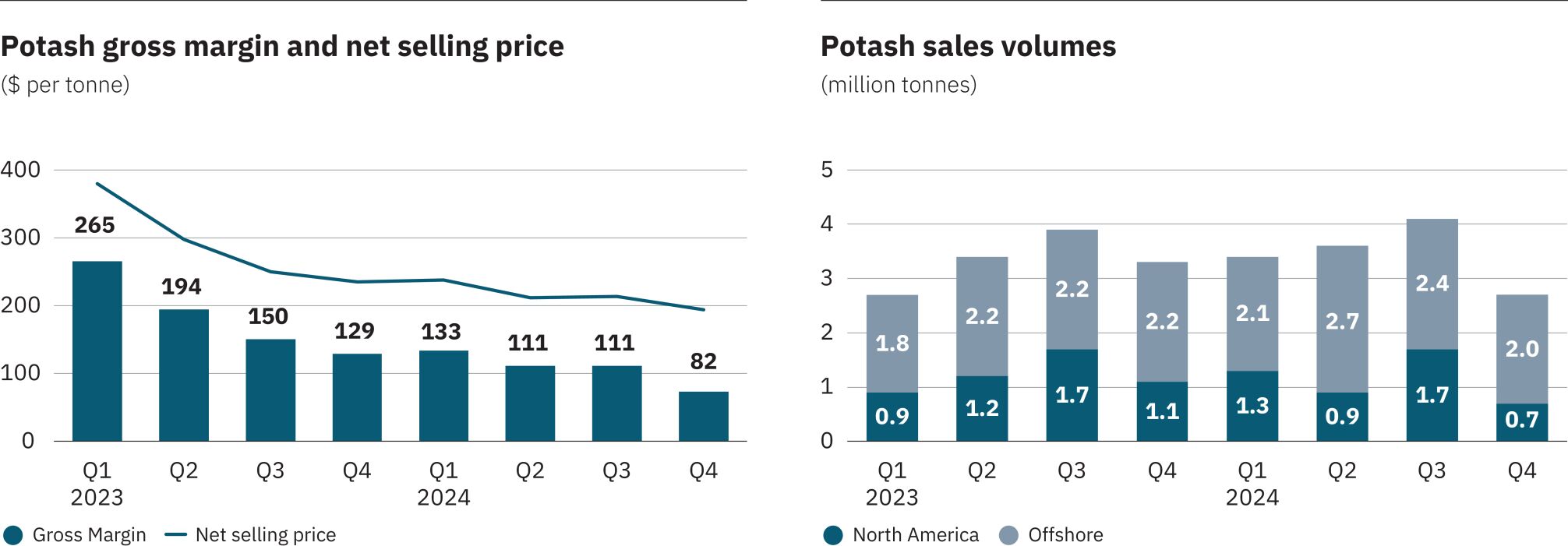
Potash production
| Operational capability 2 | Production | |||||||||||||||||||||||||||||||||||||||||
| (million tonnes KCl) |
|
|
|
|
|
Nameplate capacity 1 | 2025 | 2024 |
|
2024 | 2023 | |||||||||||||||||||||||||||||||
| Rocanville |
6.5 | 5.0 | 5.1 | 5.02 | 4.97 | |||||||||||||||||||||||||||||||||||||
| Allan |
4.0 | 2.7 | 2.4 | 2.40 | 2.39 | |||||||||||||||||||||||||||||||||||||
| Lanigan |
3.8 | 3.2 | 3.0 | 3.40 | 2.89 | |||||||||||||||||||||||||||||||||||||
| Vanscoy |
3.0 | 1.1 | 1.1 | 1.03 | 1.05 | |||||||||||||||||||||||||||||||||||||
| Cory |
3.0 | 2.1 | 2.1 | 2.11 | 1.50 | |||||||||||||||||||||||||||||||||||||
| Patience Lake |
0.3 | 0.3 | 0.3 | 0.25 | 0.20 | |||||||||||||||||||||||||||||||||||||
| Total |
20.6 | 14.4 | 14.0 | 14.21 | 13.00 | |||||||||||||||||||||||||||||||||||||
| 1 | Represents estimates of capacity as at December 31, 2024. Estimates based on capacity as per design specifications or Canpotex entitlements once determined. In the case of Patience Lake, estimate reflects current operational capability. Estimates for all other facilities do not necessarily represent operational capability. |
| 2 | Estimated annual achievable production based on expected staffing and operational readiness (estimated at the beginning of the year, and may vary during the year, and year to year, including between our facilities). Estimate does not include inventory-related shutdowns and unplanned downtime. |
52 | Nutrien Annual Report 2024
|
|
Overview | MD&A | Five-year highlights | Financial statements and notes | ||||||||||
|
Results |
2024 NITROGEN OPERATING SEGMENT AND RESULTS
Nitrogen – #3 Global nitrogen producer
We produce nitrogen at nine strategically located production facilities throughout Canada, the US and Trinidad and operate four regional product upgrade sites in North America. Our North American operations, which account for approximately 85 percent of our Nitrogen sales volumes, have access to some of the lowest cost natural gas in the world and are well positioned to serve agriculture and industrial markets. Our Trinidad operations support sales to approximately 30 countries and have natural gas supply contracts indexed to ammonia prices.
We produce a diverse portfolio of nitrogen products, including ESN®, which aims to improve nitrogen-use efficiency, and have flexibility to optimize product mix in changing market conditions. Our transportation and distribution network leverages truck, rail, pipeline, barge and marine vessel modes, including direct access to tidewater in both the US and Trinidad.
We leverage carbon capture, utilization and storage technology at two of our facilities. In 2024, we received verification of the carbon intensity of ammonia production at our Redwater facility under The Fertilizer Institute’s Verified Ammonia Carbon Intensity Program. We have captured and sold at least 1 million tonnes of CO2 annually for the last five years, of which approximately 450K tonnes of CO2 were permanently sequestered via enhanced oil recovery from our operations in 2024.
Our Nitrogen business generated adjusted EBITDA of $1.9 billion, relatively flat compared to the prior year as lower net selling prices offset higher sales volumes and lower natural gas costs. Sales volumes increased due to higher production at our operations in Trinidad and reliability improvements across our network in North America increasing the availability of upgraded products. Cost of goods sold per tonne decreased primarily due to lower natural gas costs in North America and the impact of higher production volumes.
| ($ millions, except as otherwise noted) | 2024 | 2023 | % Change | |||||||||
| Net sales |
3,745 | 4,207 | (11 | ) | ||||||||
| Cost of goods sold |
2,535 | 2,828 | (10 | ) | ||||||||
| Gross margin |
1,210 | 1,379 | (12 | ) | ||||||||
| Adjusted EBITDA 1 |
1,884 | 1,930 | (2 | ) | ||||||||
|
1 See Note 3 to the consolidated financial statements. |
||||||||||||
|
Manufactured product
|
||||||||||||
| ($ per tonne, except as otherwise noted) |
|
2024 | 2023 | |||||||||
| Sales volumes (tonnes – thousands) |
||||||||||||
| Ammonia |
2,483 | 2,436 | ||||||||||
| Urea and ESN® |
3,188 | 3,125 | ||||||||||
| Solutions, nitrates and sulfates |
|
|
|
5,023 | 4,862 | |||||||
| Total sales volumes |
|
|
|
10,694 | 10,423 | |||||||
| Net selling price |
||||||||||||
| Ammonia |
410 | 469 | ||||||||||
| Urea and ESN® |
421 | 480 | ||||||||||
| Solutions, nitrates and sulfates |
|
|
|
221 | 244 | |||||||
| Average net selling price |
324 | 367 | ||||||||||
| Cost of goods sold |
|
|
|
213 | 233 | |||||||
| Gross margin |
111 | 134 | ||||||||||
| Depreciation and amortization |
|
|
|
55 | 55 | |||||||
| Gross margin excluding depreciation and amortization 1 |
|
|
|
166 | 189 | |||||||
|
1 This is a non-GAAP financial measure. See the “Non-GAAP financial measures” section. |
||||||||||||
Nutrien Annual Report 2024 | 53
|
|
Overview | MD&A | Five-year highlights | Financial statements and notes | ||||||||||
|
Results |
Supplemental data
|
|
2024 | 2023 | ||||||
| Ammonia controllable cash cost of product manufactured per tonne 1 |
61 | 60 | ||||||
| Sales volumes (tonnes – thousands) |
||||||||
| Fertilizer |
6,259 | 6,067 | ||||||
| Industrial and feed |
4,435 | 4,356 | ||||||
| Natural gas costs ($ per MMBtu) |
||||||||
| Overall natural gas cost excluding realized derivative impact |
3.15 | 3.51 | ||||||
| Realized derivative impact |
0.09 | (0.02 | ) | |||||
| Overall natural gas cost |
3.24 | 3.49 | ||||||
|
1 This is a non-GAAP financial measure. See the “Non-GAAP financial measures” section. |
|
|||||||
|
|
2024 versus 2023 | |
| Sales volumes |
Sales volumes increased in 2024 due to higher production at our operations in Trinidad and reliability improvements across our network in North America increasing the availability of upgraded products. | |
| Net selling price per tonne |
Net selling price per tonne was lower in 2024 for all major nitrogen products due to weaker benchmark prices. | |
| Cost of goods sold per tonne |
Cost of goods sold per tonne decreased in 2024 primarily due to lower natural gas costs in North America and the impact of higher production volumes. | |
| Adjusted EBITDA |
Adjusted EBITDA for 2024 was relatively flat as lower net selling prices offset higher sales volumes and lower natural gas costs. Our total ammonia production increased in 2024 supported by less maintenance downtime and improved natural gas utilization and reliability at our operations in Trinidad. | |

Nitrogen production
| Ammonia 1 | Urea 2 | |||||||||||||||||||||||
| (million tonnes, except as otherwise noted) | |
Annual capacity |
3 |
Production | |
Annual capacity |
3 |
Production | ||||||||||||||||
| 2024 | 2023 | 2024 | 2023 | |||||||||||||||||||||
| Trinidad 4 |
2.2 | 1.27 | 1.11 | 0.7 | 0.47 | 0.32 | ||||||||||||||||||
| Redwater |
1.0 | 0.86 | 0.89 | 0.7 | 0.70 | 0.76 | ||||||||||||||||||
| Augusta |
0.8 | 0.68 | 0.74 | 0.6 | 0.52 | 0.56 | ||||||||||||||||||
| Lima |
0.7 | 0.59 | 0.68 | 0.5 | 0.46 | 0.51 | ||||||||||||||||||
| Geismar |
0.6 | 0.58 | 0.43 | 0.4 | 0.38 | 0.30 | ||||||||||||||||||
| Carseland |
0.5 | 0.46 | 0.53 | 0.7 | 0.65 | 0.75 | ||||||||||||||||||
| Fort Saskatchewan |
0.5 | 0.44 | 0.39 | 0.4 | 0.40 | 0.35 | ||||||||||||||||||
| Borger |
0.5 | 0.35 | 0.24 | 0.6 | 0.42 | 0.31 | ||||||||||||||||||
| Joffre |
0.5 | 0.38 | 0.34 | – | – | – | ||||||||||||||||||
| Total |
7.3 | 5.61 | 5.35 | 4.6 | 4.00 | 3.86 | ||||||||||||||||||
| Adjusted total 5 |
|
|
|
3.96 | 3.90 |
|
|
|
|
|
|
|
|
|
||||||||||
| Ammonia operating rate 5 (%) |
|
|
|
88 | 88 |
|
|
|
|
|
|
|
|
|
||||||||||
| 1 | All figures are shown on a gross production basis. |
| 2 | Reflects capacity and production of urea liquor prior to final product upgrade. Urea liquor is used in the production of solid urea, UAN and DEF. |
| 3 | Annual capacity estimates include allowances for normal operating plant conditions. |
| 4 | In 2023, Trinidad production was restricted due to natural gas curtailments. |
| 5 | Excludes Trinidad and Joffre. |
54 | Nutrien Annual Report 2024
|
|
Overview | MD&A | Five-year highlights | Financial statements and notes | ||||||||||
|
Results |
2024 PHOSPHATE OPERATING SEGMENT AND RESULTS
Phosphate – #2 North American phosphate producer
Nutrien has two large integrated phosphate production facilities and four regional product upgrade sites in the US. Our high-quality phosphate rock enables production of a diverse mix of phosphate products, including solid and liquid fertilizers, feed and industrial acids. We are the largest producer of purified phosphoric acid in North America and sell the majority of our product in this market, benefiting from our extensive distribution network and customer relationships.
Our Phosphate business generated adjusted EBITDA of $384 million, lower than the prior year due to weaker industrial and feed net selling prices and the impact of lower production, partially offset by lower sulfur and ammonia input costs. Sales volumes were lower primarily due to weather-related events and plant outages that impacted production volumes. Lower production volumes and higher water treatment costs related to weather-related events increased our cost of goods sold per tonne, which was partially offset by lower sulfur and ammonia input costs.
| ($ millions, except as otherwise noted) | 2024 | 2023 | % Change | |||||||||
| Net sales |
1,657 | 1,993 | (17 | ) | ||||||||
| Cost of goods sold |
1,510 | 1,760 | (14 | ) | ||||||||
| Gross margin |
147 | 233 | (37 | ) | ||||||||
| Adjusted EBITDA 1 |
384 | 470 | (18 | ) | ||||||||
| 1 | See Note 3 to the consolidated financial statements. |
Manufactured product
| ($ per tonne, except as otherwise noted) | 2024 | 2023 | ||||||
| Sales volumes (tonnes — thousands) |
||||||||
| Fertilizer |
1,751 | 1,912 | ||||||
| Industrial and feed |
683 | 639 | ||||||
| Total sales volumes |
2,434 | 2,551 | ||||||
| Net selling price |
||||||||
| Fertilizer |
612 | 568 | ||||||
| Industrial and feed |
822 | 1,010 | ||||||
| Average net selling price |
671 | 678 | ||||||
| Cost of goods sold |
603 | 583 | ||||||
| Gross margin |
68 | 95 | ||||||
| Depreciation and amortization |
119 | 115 | ||||||
| Gross margin excluding depreciation and amortization 1 |
187 | 210 | ||||||
| 1 | This is a non-GAAP financial measure. See the “Non-GAAP financial measures” section. |
|
|
2024 versus 2023 | |
| Sales volumes |
Sales volumes decreased in 2024 primarily due to weather-related events and plant outages that impacted production volumes. | |
| Net selling price |
Net selling price per tonne decreased in 2024 due to lower industrial and feed net selling prices which reflect the typical lag in price realizations relative to benchmark prices. | |
| Cost of goods sold per tonne |
Cost of goods sold per tonne increased in 2024 due to lower production volumes and higher water treatment costs related to weather-related events, partially offset by lower sulfur and ammonia input costs. | |
| Adjusted EBITDA |
Adjusted EBITDA decreased in 2024 due to weaker industrial and feed net selling prices and the impact of lower production, partially offset by lower sulfur and ammonia input costs. | |
Nutrien Annual Report 2024 | 55
|
|
Overview | MD&A | Five-year highlights | Financial statements and notes | ||||||||||
|
Results |

Phosphate production
| Phosphate rock | Phosphoric acid (P2O5) | Liquid products | Solid fertilizer products | |||||||||||||||||||||||||||||||||||||||||||||
| (million tonnes, except as otherwise noted) |
Annual capacity |
Production | Annual capacity |
Production | Annual capacity |
Production | Annual capacity |
Production | ||||||||||||||||||||||||||||||||||||||||
| 2024 | 2023 | 2024 | 2023 | 2024 | 2023 | 2024 | 2023 | |||||||||||||||||||||||||||||||||||||||||
| Aurora |
5.4 | 3.99 | 4.24 | 1.2 | 0.97 | 1.00 | 2.7 | 1 | 2.05 | 2.13 | 0.9 | 0.76 | 0.77 | |||||||||||||||||||||||||||||||||||
| White Springs |
2.0 | 1.19 | 1.27 | 0.5 | 0.36 | 0.40 | 0.7 | 2 | 0.29 | 0.33 | 0.8 | 0.31 | 0.33 | |||||||||||||||||||||||||||||||||||
| Total |
7.4 | 5.18 | 5.51 | 1.7 | 1.33 | 1.40 | 3.4 | 2.34 | 2.46 | 1.7 | 1.07 | 1.10 | ||||||||||||||||||||||||||||||||||||
|
P2O5 operating rate (%) |
|
|
|
|
|
|
|
|
|
|
|
|
78 | 83 |
|
|
|
|
|
|
|
|
|
|
|
|
|
|
|
|
|
|
||||||||||||||||
| 1 | A substantial portion is consumed internally in the production of downstream products. The balance is exported to phosphate fertilizer producers or sold domestically to dealers who custom-mix liquid fertilizer. Capacity is composed of 2.0 million tonnes MGA and 0.7 million tonnes SPA. |
| 2 | Represents annual SPA capacity. A substantial portion is consumed internally in the production of downstream products. The balance is exported to phosphate fertilizer producers or sold domestically to dealers who custom-mix liquid fertilizer. |
In addition to the production above, annual capacity (in millions of tonnes) for phosphate feed and purified acid was 0.7 and 0.3 million tonnes, respectively. Production in 2024 was 0.31 and 0.17 million tonnes, respectively, and 2023 production was 0.30 and 0.16 million tonnes, respectively.
56 | Nutrien Annual Report 2024
|
|
Overview | MD&A | Five-year highlights | Financial statements and notes | ||||||||||
|
Results |
2024 CORPORATE AND OTHERS AND ELIMINATIONS
“Corporate and Others” is a non-operating segment comprising corporate and administrative functions that provide support and governance to our operating segments. It also includes gross margin related to our non-core business. Intersegment sales, costs of goods sold and expenses are removed from the consolidated results in Eliminations. Intersegment activities include sale of product between our segments, primarily from Potash, Nitrogen and Phosphate to our Retail segment.
| ($ millions, except as otherwise noted) | 2024 | 2023 | % Change | |||||||||
| Corporate and Others |
||||||||||||
| Gross margin 1 |
13 | – | n/m | |||||||||
| Adjusted EBITDA 1 |
(456 | ) | (267 | ) | 71 | |||||||
| Eliminations |
||||||||||||
| Gross margin |
(2 | ) | 69 | n/m | ||||||||
| Adjusted EBITDA 1 |
(1 | ) | 62 | n/m | ||||||||
| 1 | See Note 3 to the consolidated financial statements. |
|
|
2024 versus 2023 | |
| Corporate and Others |
Adjusted EBITDA decreased in 2024 due to an $80 million gain in 2023 from our other post-retirement benefit plan amendments. | |
| Eliminations |
Eliminations of gross margin in 2024 resulted from higher intersegment inventory held by our Retail segment compared to a recovery of gross margin in 2023 which reflected the sell-through of higher cost inventory. | |
FINANCE COSTS, INCOME TAXES AND OTHER COMPREHENSIVE (LOSS) INCOME
| ($ millions, except as otherwise noted) | 2024 | 2023 | % Change | |||||||||
| Finance costs |
720 | 793 | (9 | ) | ||||||||
| Income tax expense |
436 | 670 | (35 | ) | ||||||||
| Other comprehensive (loss) income |
(234 | ) | 81 | n/m | ||||||||
|
|
2024 versus 2023 | |||||||||
| Finance costs |
Finance costs were lower in 2024 primarily due to lower average short-term debt balance from lower working capital requirements, partially offset by the increase in average long-term debt balance throughout 2024. |
|
||||||||
| Weighted average debt balances and rates
|
||||||||||
|
|
($ millions, except as otherwise noted) | 2024 | 2023 | |||||||
| Short-term debt balance 1 | 3,328 | 3,988 | ||||||||
| Short-term debt rate (%) 1 | 6.1 | 6.1 | ||||||||
| Long-term debt balance | 9,629 | 9,112 | ||||||||
| Long-term debt rate (%) | 5.0 | 5.0 | ||||||||
| Lease obligations balance | 1,375 | 1,200 | ||||||||
| Lease obligations rate (%) | 4.6 | 4.0 | ||||||||
|
1 North American weighted average short-term debt balances were $2,679 million (2023 – $3,306 million) and rates were 5.5 percent (2023 –5.6 percent). |
|
|||||||||
| Income tax expense |
Income tax expense decreased in 2024 due to lower earnings and lower discrete tax adjustments. The discrete tax adjustments in 2023 were related to a change in recognition of deferred tax assets in South America as they no longer met the asset recognition criteria, the impact of changes in our tax declarations in Switzerland (“Swiss Tax Reform”), and Canadian audit assessments. Refer to Note 10 to the consolidated financial statements for additional information. |
|
||||||||
| Effective tax rates and discrete items
|
||||||||||
|
|
($ millions, except as otherwise noted) | 2024 | 2023 | |||||||
| Actual effective tax rate on earnings (%) | 40 | 33 | ||||||||
| Actual effective tax rate including discrete items (%) | 38 | 34 | ||||||||
| Discrete tax adjustments that impacted the rate | (13 | ) | 28 | |||||||
| Other comprehensive (loss) income | Other comprehensive loss in 2024 was mainly due to the depreciation of the Australian, Brazilian and Canadian currencies, relative to the US dollar, compared to a gain in 2023. |
|
||||||||
Nutrien Annual Report 2024 | 57
|
|
Overview | MD&A | Five-year highlights | Financial statements and notes | ||||||||||
|
Results |
| 2025 Guidance ranges 1,2 as of February 19, 2025 |
||||||||||||
| (billions of US dollars, except as otherwise noted) | Low | High | 2024 Actual | |||||||||
| Retail adjusted EBITDA |
1.65 | 1.85 | 1.7 | |||||||||
| Potash sales volumes (million tonnes) 3 |
13.6 | 14.4 | 13.9 | |||||||||
| Nitrogen sales volumes (million tonnes) 3 |
10.7 | 11.2 | 10.7 | |||||||||
| Phosphate sales volumes (million tonnes) 3 |
2.35 | 2.55 | 2.4 | |||||||||
| Depreciation and amortization |
2.35 | 2.45 | 2.3 | |||||||||
| Finance costs |
0.65 | 0.75 | 0.7 | |||||||||
| Effective tax rate on adjusted net earnings (%) 4 |
22.0 | 25.0 | 24.1 | |||||||||
| Capital expenditures 5 |
2.0 | 2.1 | 2.2 | |||||||||
| 1 | Guidance provided in our news release dated February 19, 2025. |
| 2 | See the “Forward-Looking Statements” section. |
| 3 | Manufactured product only. |
| 4 | This is a non-GAAP financial measure. See the “Non-GAAP Financial Measures” section. |
| 5 | Comprised of sustaining capital expenditures, investing capital expenditures and mine development and pre-stripping capital expenditures. See the “Other Financial Measures” section. |

2025 SENSITIVITIES
| Effect on 1 | ||||||||
| ($ millions, except EPS amounts) | Adjusted EBITDA | Adjusted EPS | 4 | |||||
| $25 per tonne change in potash net selling prices |
± 280 | ± 0.45 | ||||||
| $25 per tonne change in ammonia net selling prices 2 |
± 35 | ± 0.05 | ||||||
| $25 per tonne change in urea and ESN® net selling prices |
± 85 | ± 0.15 | ||||||
| $25 per tonne change in solutions, nitrates and sulfates net selling prices |
± 130 | ± 0.20 | ||||||
| $1 per MMBtu change in NYMEX natural gas price 3 |
± 190 | ± 0.30 | ||||||
| 1 | See the “Forward-Looking Statements” section. |
| 2 | Includes related impact on natural gas costs in Trinidad, which is linked to benchmark ammonia pricing. |
| 3 | Nitrogen related impact. |
| 4 | Assumes 486 million shares outstanding for all earnings per share (“EPS”) sensitivities. |
58 | Nutrien Annual Report 2024
|
|
Overview | MD&A | Five-year highlights | Financial statements and notes | ||||||||||
|
Results |
| ($ millions, except as otherwise noted) | 2024 | 2023 | 2022 | |||||||||
| Sales |
25,972 | 29,056 | 37,884 | |||||||||
| Net earnings |
700 | 1,282 | 7,687 | |||||||||
| Basic net earnings per share (dollars) |
1.36 | 2.53 | 14.22 | |||||||||
| Diluted net earnings per share (dollars) |
1.36 | 2.53 | 14.18 | |||||||||
| Total assets |
51,840 | 52,749 | 54,586 | |||||||||
| Total non-current financial liabilities |
9,880 | 9,912 | 8,939 | |||||||||
| Dividends declared per share (dollars) |
2.16 | 2.12 | 1.92 | |||||||||
|
|
2024 versus 2023 | 2023 versus 2022 | ||
| Sales |
Sales decreased primarily due to lower fertilizer net selling prices, partially offset by record Potash sales volumes. | Sales decreased primarily due to lower net selling prices compared to the historically strong prices in 2022, partially offset by higher sales volumes for Retail crop nutrients, Potash and Nitrogen. | ||
| Net earnings and earnings per share |
Net earnings and earnings per share decreased primarily due to lower sales (see above), partially offset by lower operational expenses due to lower input costs such as cost to purchase inventories, natural gas, royalties and provincial mining taxes.
Net earnings in 2024 were also impacted by a previously disclosed $220 million loss on foreign currency derivatives in Brazil (see the “Controls and Procedures” section of this MD&A and Note 5 to the consolidated financial statements). Our impairment of assets were lower in 2024. We recorded $530 million non-cash impairments of our Retail – Brazil and Nitrogen Geismar Clean Ammonia project assets in 2024 compared to non-cash impairment of $774 million of Retail, Phosphate and Nitrogen assets recorded in 2023. Refer to Note 14 to the consolidated financial statements for additional information. |
Net earnings and earnings per share decreased primarily due to lower net selling prices across our nutrient segments due to a decline in benchmark prices. This was partially offset by lower costs and expenses, which are based on selling or benchmark prices, such as royalties, provincial mining taxes, natural gas and cost to purchase inventories.
In 2023, we recorded $774 million non-cash impairments of our Retail – South America assets, Phosphate White Springs and Nitrogen Trinidad assets compared to non-cash impairment reversals of $780 million of Phosphate assets recorded in 2022. |
||
| Assets and non-current financial liabilities |
Total assets decreased in 2024 compared to 2023 primarily due to the non-cash impairments discussed above as well as from lower working capital assets from reduced net selling prices and lower cost of inventories.
Non-current financial liabilities increased due to the higher long-term debt balance from the issuance of new senior notes, partially offset by the repayment of senior notes upon maturity in 2024. |
Total assets decreased approximately 3 percent from 2022 primarily due to lower receivables and inventories as we collected and sold through our higher-valued receivables and inventories from historically strong prices in 2022 and $774 million of non-cash impairments (as described above). This is partially offset by higher capital spending on property, plant and equipment.
Non-current financial liabilities increased due to the higher long-term debt balance from the issuance of new senior notes, partially offset by the repayment of senior notes upon maturity in 2023. |
||
| Dividends declared per share |
Dividends declared per share increased as we declared a higher quarterly dividend per share of $0.54 in 2024 compared to $0.53 in 2023. | Dividends declared per share increased as we declared a higher quarterly dividend per share of $0.53 in 2023 compared to $0.48 in 2022. | ||
Nutrien Annual Report 2024 | 59
|
|
Overview | MD&A | Five-year highlights | Financial statements and notes | ||||||||||
|
Results |
FINANCIAL CONDITION REVIEW
| As at | ||||||||||||||||
| ($ millions, except as otherwise noted) | December 31, 2024 | December 31, 2023 | $ Change | % Change | ||||||||||||
| Assets |
||||||||||||||||
| Cash and cash equivalents |
853 | 941 | (88 | ) | (9 | ) | ||||||||||
| Receivables |
5,390 | 5,398 | (8 | ) | – | |||||||||||
| Inventories |
6,148 | 6,336 | (188 | ) | (3 | ) | ||||||||||
| Property, plant and equipment |
22,604 | 22,461 | 143 | 1 | ||||||||||||
| Intangible assets |
1,819 | 2,217 | (398 | ) | (18 | ) | ||||||||||
| Liabilities and Shareholders’ Equity |
||||||||||||||||
| Short-term debt |
1,534 | 1,815 | (281 | ) | (15 | ) | ||||||||||
| Payables and accrued charges |
9,118 | 9,467 | (349 | ) | (4 | ) | ||||||||||
| Long-term debt, including current portion |
9,918 | 9,425 | 493 | 5 | ||||||||||||
| Share capital |
13,748 | 13,838 | (90 | ) | (1 | ) | ||||||||||
| Retained earnings |
11,106 | 11,531 | (425 | ) | (4 | ) | ||||||||||
| Assets | Liabilities | |
| Explanations for changes in Cash and cash equivalents are in the “Liquidity and Capital Resources – Sources and Uses of Cash” section.
Receivables remained flat compared to 2023. We had higher receivables due to lower crop margins and weather challenges contributing to longer collection periods. This was offset by lower net selling prices across all our operating segments. In addition, the weaker foreign exchange rates against the US dollar, primarily from Canada, Australia and Brazil, resulted in the lower receivables.
Inventories decreased across most of our operating segments due to lower cost to purchase inventories for resale and lower input costs, such as natural gas and sulfur. We also closely managed our inventory levels to improve working capital.
Property, plant and equipment increased due to capital expenditures incurred partially offset by non-cash impairments related to our Retail – Brazil assets and Nitrogen Geismar Clean Ammonia project in 2024.
Intangible assets decreased due to an impairment of our Retail – Brazil assets in 2024. |
Short-term debt decreased due to lower drawdowns on our commercial paper program based on our working capital requirements.
Payables and accrued charges decreased due to lower operational and capital expenditures and lower foreign exchange rates in Canada, Australia and Brazil against the US dollar. Cost to purchase inventories for resale, natural gas and sulfur costs, and expenses tied to selling prices, such as royalties decreased.
Long-term debt, including the current portion, increased due to the issuance of $1,000 million of senior notes in 2024, which exceeded the repayment of $500 million in senior notes upon maturity in the same period.
Shareholders’ equity
Share capital decreased primarily from shares repurchased under our normal course issuer bid program.
Retained earnings decreased as dividends declared and share repurchases exceeded net earnings in 2024. |
We do not hold material cash and cash equivalents in currencies other than the US dollar and Canadian dollar. As at December 31, 2024, we held the equivalent of approximately $347 million US dollars in other jurisdictions outside the US and Canada. We do not depend on repatriation of cash from our foreign subsidiaries to meet our liquidity and capital resource needs in North America.
60 | Nutrien Annual Report 2024
|
|
Overview | MD&A | Five-year highlights | Financial statements and notes | ||||||||||
|
Results |
LIQUIDITY AND CAPITAL RESOURCES
Sources and uses of liquidity
Liquidity risk arises from our general funding needs and in the management of our assets, liabilities and capital structure. We manage liquidity risk to maintain sufficient liquid financial resources to fund our financial position and meet our commitments and obligations in a cost-effective manner. Our primary sources of liquidity in 2024 and our expected ongoing primary uses of liquidity are listed below:
| Primary uses of liquidity | Primary sources of liquidity | |
| – seasonal working capital requirements – operational expenses – capital expenditures to sustain our assets to support safe and reliable operations – high-value growth opportunities – shareholder returns through dividends and/or share repurchases – principal payments of debt securities |
– cash from operations (including customer prepayments) – commercial paper issuances – increase of credit facility limits and drawdowns – debt capital markets – supplier financing arrangements |
|
We believe that our internally generated cash flow, supplemented by available borrowings under new or existing financing sources, if necessary, will be sufficient to meet our anticipated capital expenditures, planned growth and development activities, and other cash requirements for the foreseeable future. We do not reasonably expect any presently known trend or uncertainty to affect our ability to access our historical sources of liquidity.
Cash requirements
The following aggregated information about our contractual obligations and other commitments summarizes our liquidity and capital resource requirements as at December 31, 2024. Commitments reflect the estimated cash outflows for these obligations.
| Consolidated financial statements note reference |
Payments due by period | |||||||||||||||||||||
| ($ millions) | Total | Within 1 year |
1 to 3 years |
3 to 5 years |
Over 5 years |
|||||||||||||||||
| Long-term debt |
19, 24 | 9,725 | 1,037 | 1,033 | 1,500 | 6,155 | ||||||||||||||||
| Estimated interest payments on long-term debt |
24 | 6,032 | 471 | 830 | 693 | 4,038 | ||||||||||||||||
| Asset retirement obligations and accrued environmental costs |
22 | 4,053 | 178 | 246 | 184 | 3,445 | ||||||||||||||||
| Lease liabilities |
20, 24 | 1,355 | 356 | 437 | 197 | 365 | ||||||||||||||||
| Estimated interest payments on lease liabilities |
24 | 239 | 50 | 66 | 40 | 83 | ||||||||||||||||
| Purchase commitments |
24 | 1,335 | 1,039 | 75 | 43 | 178 | ||||||||||||||||
| Capital commitments |
24 | 99 | 77 | 22 | – | – | ||||||||||||||||
| Other commitments |
24 | 613 | 189 | 222 | 80 | 122 | ||||||||||||||||
| Derivatives |
5 | 33 | 33 | – | – | – | ||||||||||||||||
| Total |
|
23,484 | 3,430 | 2,931 | 2,737 | 14,386 | ||||||||||||||||
The information presented in the table above does not include planned but not legally committed capital expenditures, business acquisitions or shareholder returns, including share repurchases and dividends. In addition to the commitments included above, we have other obligations for goods and services as part of our normal operations, which may terminate on short notice, including purchase commitments for crop input products.
For information on income taxes and pension and other post-retirement benefits funding, refer to Note 10 and Note 21, respectively, to the consolidated financial statements. Future cash requirements are subject to changes in regulations, actuarial assumptions and our expected operating results.
On February 19, 2025, our Board approved a share repurchase program of up to a maximum of 24,462,941 common shares, representing 5 percent of Nutrien’s outstanding common shares. The 2025 normal course issuer bid, which is subject to acceptance by the Toronto Stock Exchange, will commence on March 3, 2025. The share repurchase program will expire on the earlier of March 2, 2026, the date on which we have acquired the maximum number of common shares allowable or the date we determine not to make any further repurchases.
On February 19, 2025, our Board of Directors declared and increased our quarterly dividend to $0.545 per share payable on April 10, 2025, to shareholders of record on March 31, 2025. The total estimated dividend to be paid is $265 million.
Nutrien Annual Report 2024 | 61
|
|
Overview | MD&A | Five-year highlights | Financial statements and notes | ||||||||||
|
Results |
Sources and uses of cash
|
Cash provided by operating activities |
|
– Lower cash provided by operating activities from lower net realized selling prices across all segments, which resulted in lower cash collections. This was partially offset by lower cash paid for income taxes and cash paid to our suppliers primarily due to lower cost to purchase inventory for resale and other costs such as royalties, natural gas and sulfur costs. |
||
|
Cash used in investing activities |
|
– Lower cash used in investing activities due to lower turnaround activities and investing capital expenditures consistent with our capital allocation priorities in 2024. |
||
|
Cash used in financing activities |
|
– Lower cash used in financing activities due to decreased share repurchases in 2024. We also issued $1.0 billion senior notes in 2024 compared to $1.5 billion in 2023. |
||
62 | Nutrien Annual Report 2024
|
|
Overview | MD&A | Five-year highlights | Financial statements and notes | ||||||||||
|
Results |
CAPITAL STRUCTURE AND MANAGEMENT
We manage our capital structure with a focus on maintaining a strong balance sheet, enabling a strong investment-grade credit rating.
Principal debt instruments
As part of the normal course of business, we closely monitor our liquidity position. We use a combination of cash generated from operations and short-term and long-term debt to finance our operations. We continually evaluate various financing arrangements and may seek to engage in transactions from time to time when market and other conditions are favorable.
Capital structure (debt and equity)
| ($ millions) | December 31, 2024 | December 31, 2023 | ||||||
| Short-term debt |
1,534 | 1,815 | ||||||
| Current portion of long-term debt |
1,037 | 512 | ||||||
| Current portion of lease liabilities |
356 | 327 | ||||||
| Long-term debt |
8,881 | 8,913 | ||||||
| Lease liabilities |
999 | 999 | ||||||
| Shareholders’ equity |
24,442 | 25,201 | ||||||
Senior notes and debentures
As at December 31, 2024, our long-term debt consisted primarily of senior notes and debentures with the following maturities and interest rates:
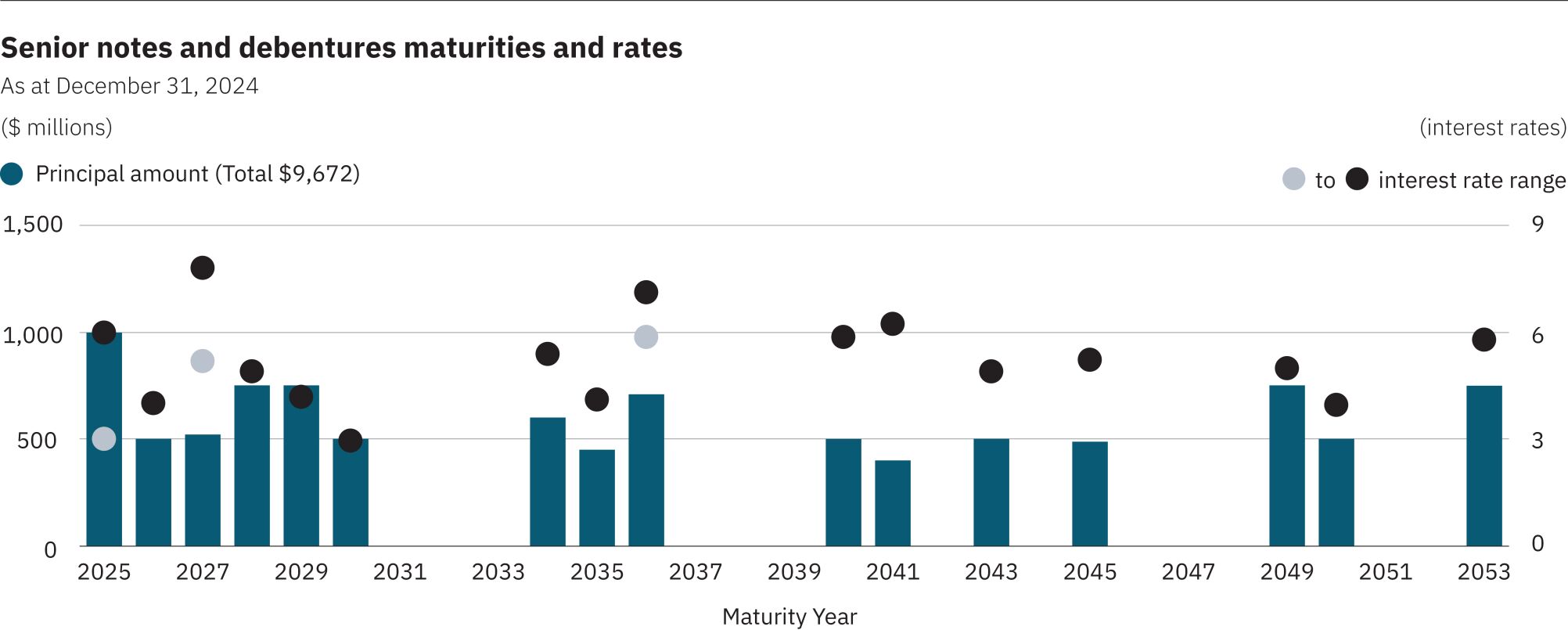
| ($ millions, except as otherwise noted) | Rate of interest (%) | Maturity | Amount | |||||||||
| Senior notes repaid in 2024 |
5.9 | November 7, 2024 | 500 | |||||||||
| Senior notes issued in 2024 |
5.2 | June 21, 2027 | 400 | |||||||||
| Senior notes issued in 2024 |
5.4 | June 21, 2034 | 600 | |||||||||
|
|
|
|
|
|
|
|
1,000 | |||||
The senior notes issued in 2024 are unsecured, rank equally with our existing unsecured debt, and have no sinking fund requirements prior to maturity. Each series is redeemable and has various provisions for redemption prior to maturity, at our option, at specified prices.
Nutrien Annual Report 2024 | 63
|
|
Overview | MD&A | Five-year highlights | Financial statements and notes | ||||||||||
|
Results |
Credit facilities and other debt
We have several available credit facilities in the jurisdictions where we operate. We have a commercial paper program, which is limited to the undrawn amount under our $4,500 million unsecured revolving term credit facility and excess cash invested in highly liquid securities. As at December 31, 2024, we had a $961 million outstanding balance in commercial paper.
As at December 31, 2024, $243 million in letters of credit were outstanding and committed, with $219 million of remaining credit available under our dedicated letter of credit facilities.

Lease obligations
We also had lease obligations totaling $1,355 million (including current portion) with a weighted average effective interest rate of 4.8 percent as at December 31, 2024.
Debt covenants
Our credit facilities have financial tests and other covenants with which we must comply at each quarter-end. Non-compliance with any such covenants could result in accelerated payment of amounts borrowed and termination of lenders’ further funding obligations under the credit facilities. We were in compliance with all such covenants as at December 31, 2024.
The table below summarizes the limit and result of our key financial covenant:
| As at December 31 | Limit | 2024 | ||||||
| Debt to capital ratio 1 |
0.65 : 1.00 | 0.35 : 1.00 | ||||||
| 1 | Refer to Note 4 to the consolidated financial statements for the detailed calculation. |
Credit ratings
Our ability to access reasonably priced debt in the capital markets depends, in part, on the quality of our credit ratings. We continue to maintain investment-grade credit ratings for our long-term debt. A downgrade of the credit rating of our long-term debt could increase the interest rates applicable to borrowings under our credit facilities.
Commercial paper markets are normally a source of same-day cash for us. Our access to the US commercial paper market primarily depends on maintaining our current short-term credit ratings as well as general conditions in the money markets.
| Long-term debt rating (outlook) | Short-term debt rating | |||||||||||||||
| As at December 31 | 2024 | 2023 | 2024 | 2023 | ||||||||||||
| Moody’s |
Baa2 (stable | ) | Baa2 (stable | ) | P-2 | P-2 | ||||||||||
| S&P |
BBB (stable | ) | BBB (stable | ) | A-2 | A-2 | ||||||||||
A credit rating is not a recommendation to buy, sell or hold securities. Such ratings may be subject to revision or withdrawal at any time by the respective credit rating agency and each rating should be evaluated independently of any other rating.
Moody’s stable outlook on Nutrien’s credit rating means that there is a low likelihood of a rating change over the medium term. S&P’s stable outlook on Nutrien’s credit rating means that the rating is not likely to change (generally up to two years).
Outstanding share data
|
|
As at February 18, 2025 | |
| Common shares |
489,258,826 |
|
| Options to purchase common shares |
2,927,323 | |
For more information on our capital structure and management, see Note 4 to the consolidated financial statements.
64 | Nutrien Annual Report 2024
|
|
Overview | MD&A | Five-year highlights | Financial statements and notes | ||||||||||
|
Results |
OTHER FINANCIAL INFORMATION
| Nature of financial information and consolidated financial statements note reference |
|
Description | ||
| Off-Balance Sheet Arrangements
(Notes 5, 12, 22, 25 and 27) |
|
Principal off-balance sheet activities primarily include:
– Agreement to reimburse losses of Canpotex. – Issuance of guarantee contracts. – An agency arrangement with a financial institution in relation to certain customer loans. – Certain non-financial derivatives that were entered into and continued to be held for the purpose of the receipt or delivery of a non-financial item, such as grain or natural gas, in accordance with expected purchase, sale or usage requirements. Other derivatives are included on our balance sheet at fair value.
We do not reasonably expect any presently known trend or uncertainty to affect our ability to continue using these arrangements, except as indicated above. |
||
| Related Party Transactions
(Note 26) |
|
Our most material related party is Canpotex, which provides us with low-cost marketing and logistics for the offshore potash markets that we serve. | ||
| Financial Instruments and Other Instruments
(Note 5) |
|
Our financial instruments are subject to various risks such as credit, liquidity and market risks. As discussed in the “Governance” section, our ELT is responsible for ensuring that our principal risks, including financial risks, are being appropriately identified, assessed and addressed. | ||
Critical accounting estimates
We prepare our consolidated financial statements in accordance with IFRS, which requires us to make judgments, assumptions and estimates in applying accounting policies. Critical accounting estimates are those which are highly uncertain at the time they are made or where different estimates would be reasonably likely to have a material impact on our financial condition or results of operations. We have discussed the development, selection and application of our key accounting policies, and the critical accounting estimates and assumptions they involve, with the Audit Committee of the Board.
Refer to the notes to the consolidated financial statements for additional information on the following critical accounting estimates including methodology used for calculating our estimates (when applicable), key assumptions used, and factors considered in our estimates and judgments.
| Consolidated financial statements note reference |
|
Critical accounting estimate description | ||
| Notes 14 and 27 |
|
Long-lived asset impairments and reversals
We review, at each reporting period, for conditions to determine whether there is any indication that an impairment exists that could potentially impact the carrying amount of our long-lived assets to be held and used. When such indicators exist, impairment testing is performed. We review, at each reporting period, for possible reversal of the impairment for non-financial assets, other than goodwill. |
||
| Notes 15 and 27 |
|
Goodwill impairment analysis
We test our operating segments that have goodwill allocated to them when events or circumstances indicate that there could be an impairment, or at least annually on October 1. Goodwill is more susceptible to impairment risk if business operating results or economic conditions deteriorate and we anticipate not meeting our forecasts. The key assumptions with the greatest influence on the calculation of the recoverable amounts are the discount rates, terminal growth rates and forecasted EBITDA. The key forecast assumptions were based on historical data and our estimates of future results from internal sources considering industry and market information. Key assumptions in our testing models may change, and changes that could reasonably be expected to occur may cause impairment. Such change in assumptions could be driven by global supply and demand, other market factors, changes in regulations, and other future events outside our control. Refer to note 14 of the consolidated financial statements for sensitivity analysis. |
||
Nutrien Annual Report 2024 | 65
|
|
Overview | MD&A | Five-year highlights | Financial statements and notes | ||||||||||
|
Results |
| Consolidated financial statements note reference |
|
Critical accounting estimate description | ||
| Notes 22 and 27 |
Asset retirement obligations (“AROs”) and accrued environmental costs (“ERLs”) – measurement
AROs and ERLs have a high degree of estimation uncertainty for future costs and estimated remediation timelines. The Potash and Phosphate segments have AROs and ERLs associated with their mining operations while the Corporate and Others segment has these liabilities associated with non-operational sites. Refer to note 22 of the consolidated financial statements for sensitivity analysis.
For the Nitrogen segment, there are no significant AROs recorded as there is no reasonable basis for estimating a date or range of dates of cessation of operations. We considered the historical performance of our facilities as well as our planned maintenance, major upgrades and replacements, which can extend the useful lives beyond the foreseeable future. |
|||
QUARTERLY RESULTS
|
|
2024 | 2023 | ||||||||||||||||||||||||||||||
| ($ millions, except as otherwise noted) | Q4 | Q3 | Q2 | Q1 | Q4 | Q3 | Q2 | Q1 | ||||||||||||||||||||||||
| Sales |
5,079 | 5,348 | 10,156 | 5,389 | 5,664 | 5,631 | 11,654 | 6,107 | ||||||||||||||||||||||||
| Net earnings |
118 | 25 | 392 | 165 | 176 | 82 | 448 | 576 | ||||||||||||||||||||||||
| Net earnings attributable to equity holders of Nutrien |
113 | 18 | 385 | 158 | 172 | 75 | 440 | 571 | ||||||||||||||||||||||||
| Net earnings per share attributable to equity holders of Nutrien |
||||||||||||||||||||||||||||||||
| Basic |
0.23 | 0.04 | 0.78 | 0.32 | 0.35 | 0.15 | 0.89 | 1.14 | ||||||||||||||||||||||||
| Diluted |
0.23 | 0.04 | 0.78 | 0.32 | 0.35 | 0.15 | 0.89 | 1.14 | ||||||||||||||||||||||||
Our quarterly earnings are significantly affected by the seasonality of our business, fertilizer benchmark prices, and are affected by demand-supply conditions, farmer affordability and weather. See Note 28 to the consolidated financial statements.
Other material transactions or events that impacted our quarterly results included:
| Quarter |
Transaction or event | |
| 2024 Q2 |
$530 million non-cash impairment of assets comprised of a $335 million non-cash impairment of the Retail – Brazil intangible assets and property plant and equipment due to the ongoing market instability and more moderate margin expectations, and a $195 million non-cash impairment of our Nitrogen Geismar Clean Ammonia project property, plant and equipment as we are no longer pursuing the project. Net earnings were also impacted by a $220 million loss on foreign currency derivatives in Brazil. | |
| 2023 Q2 |
$698 million non-cash impairment of assets comprised of a $233 million non-cash impairment of our Phosphate White Springs property, plant and equipment due to a decrease in our forecasted phosphate margins and a $465 million non-cash impairment of our Retail – South America assets primarily related to goodwill mainly due to the impact of crop input price volatility, more moderate long-term growth assumptions and higher interest rates which lowered our forecasted earnings. | |
66 | Nutrien Annual Report 2024
|
|
Overview | MD&A | Five-year highlights | Financial statements and notes | ||||||||||
|
Results |
| ($ millions, except as otherwise noted) Three months ended December 31 |
Sales | Gross margin | ||||||||||||||||||||||
| 2024 | 2023 | % Change | 2024 | 2023 | % Change | |||||||||||||||||||
| Retail |
||||||||||||||||||||||||
| Crop nutrients |
1,528 | 1,808 | (15 | ) | 294 | 346 | (15 | ) | ||||||||||||||||
| Crop protection products |
948 | 960 | (1 | ) | 351 | 333 | 5 | |||||||||||||||||
| Seed |
184 | 202 | (9 | ) | 52 | 36 | 44 | |||||||||||||||||
| Services and other |
228 | 236 | (3 | ) | 188 | 188 | – | |||||||||||||||||
| Merchandise |
230 | 251 | (8 | ) | 40 | 41 | (2 | ) | ||||||||||||||||
| Nutrien Financial |
77 | 70 | 10 | 77 | 70 | 10 | ||||||||||||||||||
| Nutrien Financial elimination 1 |
(16 | ) | (25 | ) | (36 | ) | (16 | ) | (25 | ) | (36 | ) | ||||||||||||
| Total |
3,179 | 3,502 | (9 | ) | 986 | 989 | – | |||||||||||||||||
| 1 | Represents elimination for the interest and service fees charged by Nutrien Financial to Retail branches. |
Manufactured product
| (Dollars, except as otherwise noted) Three months ended December 31 |
Sales tonnes (thousands) | Average dollars per tonne | ||||||||||||||||||||||
| 2024 | 2023 | % Change | 2024 | 2023 | % Change | |||||||||||||||||||
| Potash |
||||||||||||||||||||||||
| North America |
718 | 1,089 | (34 | ) | 270 | 342 | (21 | ) | ||||||||||||||||
| Offshore |
2,040 | 2,214 | (8 | ) | 168 | 182 | (8 | ) | ||||||||||||||||
| Sales |
2,758 | 3,303 | (17 | ) | 194 | 235 | (17 | ) | ||||||||||||||||
| Cost of goods sold |
|
|
|
|
|
|
|
|
|
112 | 106 | 6 | ||||||||||||
| Gross margin |
|
|
|
|
|
|
|
|
|
82 | 129 | (36 | ) | |||||||||||
| Nitrogen |
||||||||||||||||||||||||
| Ammonia |
701 | 651 | 8 | 448 | 416 | 8 | ||||||||||||||||||
| Urea and ESN® |
888 | 739 | 20 | 403 | 428 | (6 | ) | |||||||||||||||||
| Solutions, nitrates and sulfates |
1,325 | 1,344 | (1 | ) | 213 | 215 | (1 | ) | ||||||||||||||||
| Sales |
2,914 | 2,734 | 7 | 327 | 321 | 2 | ||||||||||||||||||
| Cost of goods sold |
|
|
|
|
|
|
|
|
|
221 | 218 | 1 | ||||||||||||
| Gross margin |
|
|
|
|
|
|
|
|
|
106 | 103 | 3 | ||||||||||||
| Phosphate |
||||||||||||||||||||||||
| Fertilizer |
435 | 579 | (25 | ) | 615 | 557 | 10 | |||||||||||||||||
| Industrial and feed |
173 | 174 | (1 | ) | 812 | 860 | (6 | ) | ||||||||||||||||
| Sales |
608 | 753 | (19 | ) | 671 | 627 | 7 | |||||||||||||||||
| Cost of goods sold |
|
|
|
|
|
|
|
|
|
631 | 535 | 18 | ||||||||||||
| Gross margin |
|
|
|
|
|
|
|
|
|
40 | 92 | (57 | ) | |||||||||||
| Three months ended December 31 | ||||||||||||||||||||||||
| ($ millions, except as otherwise noted) |
|
|
|
2024 | 2023 | % Change | ||||||||||||||||||
| Adjusted EBITDA |
||||||||||||||||||||||||
| Retail |
340 | 229 | 48 | |||||||||||||||||||||
| Potash |
291 | 463 | (37 | ) | ||||||||||||||||||||
| Nitrogen |
471 | 391 | 20 | |||||||||||||||||||||
| Phosphate |
86 | 130 | (34 | ) | ||||||||||||||||||||
| Corporate and others |
(160 | ) | (117 | ) | 37 | |||||||||||||||||||
| Eliminations |
|
|
|
|
|
|
|
|
|
27 | (21 | ) | n/m | |||||||||||
| Adjusted EBITDA 1 |
|
|
|
|
|
|
|
|
|
1,055 | 1,075 | (2 | ) | |||||||||||
| Net earnings |
|
|
|
|
|
|
|
|
|
118 | 176 | (33 | ) | |||||||||||
| 1 | This is a non-GAAP financial measure. See the “Non-GAAP financial measures” section. |
Nutrien Annual Report 2024 | 67
|
|
Overview | MD&A | Five-year highlights | Financial statements and notes | ||||||||||
|
Results |
Highlights of our 2024 fourth quarter compared to the 2023 fourth quarter results were as follows:
|
|
Q4 2024 versus Q4 2023 | |
| Retail |
Adjusted EBITDA increased in the fourth quarter of 2024 due to lower expenses and higher crop protection and seed margins, including increased proprietary products gross margins and improved margins and selling expenses in Brazil. During the fourth quarter, we recognized a $25 million gain on the sale of land in Argentina as we continue to simplify our business.
Crop nutrients sales decreased in the fourth quarter of 2024 due to lower sales volumes, which were impacted by wet weather in North America and strategic actions related to our margin improvement plan in Brazil. Gross margin decreased in the fourth quarter as higher per-tonne margins in North America were more than offset by lower sales volumes.
Crop protection products sales were lower in the fourth quarter of 2024 mainly due to lower selling prices. Gross margin improvements for the fourth quarter of 2024 were supported by proprietary products, strong operational execution and the selling through of lower cost inventory in South America compared to the same period in 2023.
Seed sales decreased in the fourth quarter of 2024 mainly due to the impact of competitive pricing pressure in South America. Gross margin for the fourth quarter increased, supported by higher proprietary gross margin, including improved margins in South America due to strategic actions related to our margin improvement plan in Brazil.
Merchandise sales and gross margin decreased in the fourth quarter due to reductions in Australia primarily related to weather-related impacts on water equipment sales and animal health products.
Nutrien Financial sales and gross margin increased in the fourth quarter of 2024 due to higher financing rates offered. |
|
| Potash |
Adjusted EBITDA decreased in the fourth quarter of 2024 due to lower net selling prices and sales volumes.
Sales volumes decreased in the fourth quarter of 2024 compared to the fourth quarter record delivered in the prior year due to a more restricted fall application window in North America and lower volumes to China and Other Asian markets.
Net selling price per tonne decreased in the fourth quarter of 2024 primarily due to a decline in benchmark prices.
Cost of goods sold per tonne increased in the fourth quarter of 2024 as higher depreciation and the impact of more planned turnaround activity more than offset lower royalties. |
|
| Nitrogen |
Adjusted EBITDA increased in the fourth quarter of 2024 primarily due to higher sales volumes and ammonia net selling prices. Our total ammonia production increased in fourth quarter supported by less maintenance downtime and improved natural gas utilization and reliability at our operations in Trinidad.
Sales volumes increased in the fourth quarter due to higher urea production and strong regional demand for ammonia.
Net selling price per tonne was higher in the fourth quarter of 2024 primarily due to stronger ammonia net selling prices and a favorable geographic mix.
Cost of goods sold per tonne increased in the fourth quarter of 2024 mainly due to higher natural gas costs in Trinidad, partially offset by lower natural gas costs in North America. |
|
| Phosphate |
Adjusted EBITDA was lower in the fourth quarter of 2024 as higher net selling prices were more than offset by the impact of lower production volumes and higher input costs.
Sales volumes were lower in the fourth quarter primarily due to weather-related events and plant outages that impacted production volumes.
Net selling price per tonne increased in the fourth quarter of 2024 primarily due to the strength of fertilizer benchmark prices.
Cost of goods sold per tonne increased in the fourth quarter of 2024 due to lower production volumes, higher depreciation, and higher input costs, including sulfur. |
|
| Other fourth quarter financial highlights |
Adjusted EBITDA in the Corporate and Others segment was lower in the fourth quarter of 2024 mainly due to an $80 million gain in 2023 from our other post-retirement benefit plan amendments.
Finance costs were lower in the fourth quarter of 2024 primarily due to lower average short-term debt balance from lower working capital requirements, partially offset by the increase in average long-term debt balance throughout 2024.
Income tax was an expense in the fourth quarter of 2024 compared to a recovery in the same period in 2023 mainly due to higher earnings and lower discrete tax adjustments. In the fourth quarter of 2023, our discrete tax items included a $134 million income tax recovery due to the Swiss Tax Reform adjustment. These factors resulted in a positive effective tax rate in the fourth quarter of 2024 compared to a negative effective tax rate in the same period in 2023. |
|
68 | Nutrien Annual Report 2024
|
|
Overview | MD&A | Five-year highlights | Financial statements and notes | ||||||||||
|
Results |
CONTROLS AND PROCEDURES
Disclosure controls and procedures
We maintain disclosure controls and procedures designed to provide reasonable assurance that information required to be disclosed by Nutrien in its annual filings, interim filings (as these terms are defined in National Instrument 52-109 – Certification of Disclosure in Issuers’ Annual and Interim Filings (“NI 52-109”)), and other reports filed or submitted by us under securities legislation is recorded, processed, summarized and reported within the required time periods. Our Chief Executive Officer and Chief Financial Officer, after evaluating the effectiveness of our disclosure controls and procedures as of the end of the period covered by the annual filings, being December 31, 2024, have concluded that, as of such date, our disclosure controls and procedures were effective in providing reasonable assurance that information required to be disclosed by Nutrien in its annual filings, interim filings, or other reports filed or submitted by it under securities legislation is (a) recorded, processed, summarized and reported within the time periods specified in the securities legislation, and (b) accumulated and communicated to management, including our Chief Executive Officer and Chief Financial Officer, as appropriate, to allow timely decisions regarding required disclosure.
There are inherent limitations to the effectiveness of any system of disclosure controls and procedures, including the possibility of human error and the circumvention or overriding of the controls and procedures. Accordingly, even effective disclosure controls and procedures can only provide reasonable assurance of achieving their control objectives.
Internal control over financial reporting
Management is responsible for establishing and maintaining adequate internal control over financial reporting (“ICFR”), as defined in Rules 13a-15(f) and 15d-15(f) under the Securities Exchange Act of 1934, as amended, and NI 52-109. ICFR is designed to provide reasonable assurance regarding the reliability of financial reporting and preparation of consolidated financial statements for external purposes in accordance with IFRS. Any system of ICFR, no matter how well designed, has inherent limitations. Therefore, even those systems determined to be effective can provide only reasonable assurance with respect to financial statement preparation and presentation. The Board of Directors, through its Audit Committee, oversees management’s responsibilities for financial reporting and internal controls.
Under the supervision and with the participation of our management, including our Chief Executive Officer and Chief Financial Officer, we have designed ICFR based on the framework issued by the Committee of Sponsoring Organizations of the Treadway Commission in Internal Control – Integrated Framework (2013) and conducted an evaluation of the design and effectiveness of our ICFR as of the end of the fiscal year ended December 31, 2024. Based on this evaluation, our Chief Executive Officer and Chief Financial Officer concluded that, as at December 31, 2024, Nutrien maintained effective internal control over financial reporting.
A material weakness is a deficiency, or a combination of deficiencies, in ICFR, such that there is a reasonable possibility that a material misstatement of the annual financial statements, or interim financial statements, will not be prevented or detected on a timely basis. Other than in connection with the material weakness and subsequent remediation described below, there has been no change in our ICFR during the three and twelve months ended December 31, 2024, that has materially affected, or is reasonably likely to materially affect, our ICFR.
The Company’s independent public accountant, KPMG LLP, has issued an attestation report on the Company’s internal control over financial reporting as at December 31, 2024, which is included in our 2024 Annual Report.
Remediation of material weakness
As at June 30, 2024 and September 30, 2024, we had a material weakness related to controls over derivative contract authorization in Brazil, which resulted in unauthorized execution of derivative contracts in the second quarter of 2024. The material weakness was identified by our management in late June 2024 and was a result of changes that were introduced to our derivative contract authorization and execution process in Brazil during the second quarter of 2024. As a result of those changes, our controls were not designed effectively during the relevant time periods to ensure that segregation of duties was maintained and checks of authorization were performed in a timely manner and that derivative contracts entered into were recorded in our treasury reporting systems on a timely basis. The material weakness did not result in any errors or a material misstatement to our interim or annual financial statements.
Under the oversight of the Audit Committee, in the fourth quarter of 2024, we completed the remediation of the material weakness described above by redesigning certain processes and controls related to authorization and execution of derivative contracts in Brazil and enhancing the supervision and review activities related to trading in derivative contracts in Brazil. Management supervised the evaluation of the remediation measures implemented by the Company. Based on this evaluation, including testing the effectiveness of the controls addressing the material weakness, management have concluded that the previously identified material weakness relating to the effectiveness of its ICFR described above has been remediated as at December 31, 2024.
Nutrien Annual Report 2024 | 69
|
|
Overview | MD&A | Five-year highlights | Financial statements and notes | ||||||||||
|
Results |
Certain statements and other information included in this document, including within the “2025 Guidance” section and the “Market outlook” sections for each segment, constitute “forward-looking information” or “forward-looking statements” (collectively, “forward-looking statements”) under applicable securities laws (such statements are often accompanied by words such as “anticipate”, “forecast”, “expect”, “believe”, “may”, “will”, “should”, “estimate”, “project”, “intend” or other similar words). All statements in this document, other than those relating to historical information or current conditions, are forward-looking statements, including, but not limited to: Nutrien’s business strategies, plans, prospects and opportunities; Nutrien’s 2025 annual guidance, including expectations regarding our Retail adjusted EBITDA, Potash sales volumes, Nitrogen sales volumes, Phosphate sales volumes, depreciation and amortization, finance costs, effective tax rate on adjusted earnings and capital expenditures; our 2025 adjusted EBITDA and adjusted earnings per share sensitivity analysis; our belief that Nutrien’s production assets are positioned to generate significant cash flow and the resulting benefits thereof; expectations regarding 2025 annual consolidated cost savings, Nutrien’s 2026 targets, including with respect to Retail adjusted EBITDA, Potash sales volumes, Nitrogen sales volumes, annual consolidated cost savings, Potash ore tonnes mined using automation, Ammonia operating rate, Phosphate operating rate and supply chain optimization and efficiency run-rate value; Nutrien’s market outlook for 2025 and the projections and expectations related thereto; expectations regarding our capital allocation strategies, including with respect to investments that enhance utilization rates, reliability and efficiency of our assets, maintaining a strong and flexible balance sheet with a targeted average adjusted net debt to adjusted EBITDA leverage ratio of 3:1, returning capital to shareholders through share repurchases and dividends and investment in high-value opportunities to generate significant long-term returns; our ability to advance strategic priorities and high value growth investments; capital spending expectations for 2025 and beyond, including spending related to advancement of proprietary products, network optimization and digital capabilities in Retail, expanding and optimizing our downstream business, enabling digital solutions and competitive financing through Nutrien Financial, automation in Potash mining, and brownfield expansions in Nitrogen; expectations regarding our ability to generate cash flow and return capital to our shareholders, including our expectations regarding share repurchases and stable and growing dividends; expectations that internally generated cash flow, as supplemented by new and existing financing sources, will be sufficient to meet our anticipated future cash requirements; expectations regarding performance of our operating segments in 2025, including volume growth in existing Potash and Nitrogen upstream assets and enhanced margins and earnings growth in Retail; our operating segment market outlooks and our expectations for market conditions, fundamentals and trends in 2025 and beyond, including agriculture and crop nutrient markets and global energy supply, the anticipated supply and demand for our products and services, expected market, industry and growing conditions with respect to crop nutrient application rates, planted acres, farmer crop investment, crop mix, including the need to replenish soil nutrient levels, production volumes and expenses, shipments, natural gas costs and availability, consumption, prices, operating rates, the impact of seasonality, import and export volumes, tariffs, trade or export restrictions, economic sanctions and restrictions, operating rates, inventories, crop development, natural gas curtailments in Trinidad and elsewhere, and global population growth expectations; expectations concerning future product offerings; expectations regarding environmental compliance requirements and costs; the negotiation of sales and other contracts, including the expiry of existing contracts; acquisitions and divestitures and the anticipated benefits thereof; and expectations in connection with our ability to deliver long-term returns to shareholders. These forward-looking statements are subject to a number of assumptions, risks and uncertainties, many of which are beyond our control, which could cause actual results to differ materially from such forward-looking statements. As such, undue reliance should not be placed on these forward-looking statements.
All of the forward-looking statements are qualified by the assumptions that are stated or inherent in such forward-looking statements, including the assumptions referred to below and elsewhere in this document. Although we believe that these assumptions are reasonable, having regard to our experience and our perception of historical trends, the assumptions set forth below are not exhaustive of the factors that may affect any of the forward-looking statements and the reader should not place undue reliance on these assumptions and such forward-looking statements. Current conditions, economic and otherwise, render assumptions, although reasonable when made, subject to greater uncertainty.
Key assumptions that have been made in relation to the operation of our business as currently planned and our ability to achieve our business objectives include, among other things, assumptions with respect to our ability to successfully implement our business strategies, growth and capital allocation investments and initiatives that we will conduct our operations and achieve results of operations as anticipated; our ability to successfully complete, integrate and realize the anticipated benefits of our already completed and future acquisitions and divestitures, and that we will be able to implement our standards, controls, procedures and policies in respect of any acquired businesses and realize the expected synergies on the anticipated timeline or at all; that future business, regulatory and industry conditions will be within the parameters expected by us, including with respect to prices, expenses, margins, demand, supply, product availability, shipments, consumption, weather conditions, including the current La Niña weather pattern, supplier agreements, product distribution agreements, availability, inventory levels, exports, tariffs, including general or retaliatory tariffs, trade restrictions, international trade arrangements, crop development and cost of labor and interest, exchange and effective tax rates; assumptions with respect to global economic conditions and the accuracy of our market outlook expectations for 2025 and in the future; assumptions related to our assessment of recoverable amount estimates of our assets, including in relation to our Retail – Brazil asset impairments; potash demand growth in offshore markets and normalization of Canpotex port operations; our intention to complete share repurchases under our normal course issuer bid programs, including TSX approval, the funding of such share repurchases, existing and future market conditions, including with respect to the price of our common shares, capital allocation priorities, and compliance with respect to applicable limitations under securities laws and regulations and stock exchange policies; assumptions related to our ability to fund our dividends at the current level and at increased levels in the future; our expectations regarding the impacts, direct and indirect, of certain geopolitical conflicts, including the war in Eastern Europe and the conflict in the Middle East on, among other things, global supply and demand, including for crop nutrients, energy and commodity prices, global interest rates, supply chains and the global macroeconomic environment, including inflation; the adequacy of our cash generated from operations and our ability to access our credit facilities or capital markets for additional sources of financing; our ability to identify suitable candidates for acquisitions and divestitures and negotiate acceptable terms; availability of investment opportunities that align with our strategic priorities and growth strategy; our ability to maintain investment grade ratings and achieve our performance targets; our ability to successfully negotiate sales and other contracts; and our ability to successfully implement new initiatives and programs.
70 | Nutrien Annual Report 2024
|
|
Overview | MD&A | Five-year highlights | Financial statements and notes | ||||||||||
|
Results |
In respect of our 2026 Potash sales volume target, we have made assumptions with respect to, among other things: market conditions, fertilizer and commodity prices, supply and demand, capital availability, logistics, our ability to maintain market share and that potash operations will operate within expectations. In respect of 2026 nitrogen sales volume target, we have made assumptions with respect to, among other things: market conditions, fertilizer and commodity prices, supply and demand, capital availability, natural gas availability, timely execution of expansion projects and reliability.
Events or circumstances could cause actual results to differ materially from those in the forward-looking statements. With respect to our business generally and our ability to meet other targets, commitments, goals, strategies and related milestones and schedules disclosed in this document, such events or circumstances include, but are not limited to: general global economic, market and business conditions; failure to achieve expected results of our business strategy, capital allocation initiatives or results of operations or targets, such as our targeted $200 million in annual consolidated cost savings, expected capital expenditures in 2025, delivering upstream fertilizer sales volume growth and advancing high return downstream Retail growth opportunities; failure to complete announced and future acquisitions or divestitures at all or on the expected terms and within the expected timeline; seasonality; climate change and weather conditions, including the current La Niña weather pattern, and impacts from regional flooding and/or drought conditions; crop planted acreage, yield and prices; the supply and demand and price levels for our products; governmental and regulatory requirements and actions by governmental authorities, including changes in government policy (including in respect of general or retaliatory tariffs, export restrictions and climate change initiatives), government ownership requirements, and changes in environmental, tax, antitrust, and other laws or regulations and the interpretation thereof; trade restrictions, including the imposition of any tariffs, or other changes to international trade arrangements; the effects of current and future international trade agreements or other developments affecting the level of global trade; political or military risks, including civil unrest, actions by armed groups or conflict and malicious acts including terrorism and industrial espionage; our ability to access sufficient, cost-effective and timely transportation, distribution and storage of products (including potential rail transportation and port disruptions due to labor strikes and/or work stoppages or other similar actions); the occurrence of a major environmental or safety incident or becoming subject to legal or regulatory proceedings; innovation and cybersecurity risks related to our systems, including our costs of addressing or mitigating such risks; counterparty and sovereign risk; delays in completion of turnarounds at our major facilities or challenges related to our major facilities that are out of our control; interruptions of or constraints in availability of key inputs, including natural gas and sulfur; any significant impairment of the carrying amount of certain assets; the risk that rising interest rates and/or deteriorated business operating results may result in the further impairment of assets or goodwill attributed to certain CGUs; risks related to reputational loss; certain complications that may arise in our mining processes; the ability to attract, engage and retain skilled employees and strikes or other forms of work stoppages; geopolitical conflicts, including the war in Eastern Europe and the conflict in the Middle East, and their potential impact on, among other things, global market conditions and supply and demand, including for crop nutrients, energy and commodity prices, interest rates, supply chains and the global economy generally; our ability to execute on our strategies related to environmental, social and governance matters, and achieve related expectations, targets and commitments, including risks associated with disclosure thereof; and other risk factors detailed from time to time in Nutrien reports filed with the Canadian securities regulators and the SEC in the US.
The purpose of our 2025 Retail adjusted EBITDA, depreciation and amortization, finance costs, effective tax rate on adjusted earnings and capital expenditures guidance ranges are to assist readers in understanding our expected and targeted financial results, and this information may not be appropriate for other purposes.
The forward-looking statements in this document are made as of the date hereof and Nutrien disclaims any intention or obligation to update or revise any forward-looking statements in this document as a result of new information or future events, except as may be required under applicable Canadian securities legislation or applicable US federal securities laws. Any forward-looking statements contained herein are expressly qualified by this cautionary statement.
Nutrien Annual Report 2024 | 71
|
|
Overview | MD&A | Five-year highlights | Financial statements and notes | ||||||||||
|
Results |
Non-GAAP financial measures
We use both IFRS measures and certain non-GAAP financial measures to assess performance. Non-GAAP financial measures are financial measures disclosed by the Company that: (a) depict historical or expected future financial performance, financial position or cash flow of the Company; (b) with respect to their composition, exclude amounts that are included in, or include amounts that are excluded from, the composition of the most directly comparable financial measure disclosed in the primary financial statements of the Company; (c) are not disclosed in the financial statements of the Company; and (d) are not a ratio, fraction, percentage or similar representation. Non-GAAP ratios are financial measures disclosed by the Company that are in the form of a ratio, fraction, percentage or similar representation that has a non-GAAP financial measure as one or more of its components, and that are not disclosed in the financial statements of the Company.
These non-GAAP financial measures and non-GAAP ratios are not standardized financial measures
under IFRS and, therefore, are unlikely to be comparable to similar financial measures presented by other companies. Management believes these non-GAAP financial measures and non-GAAP ratios provide transparent and useful supplemental information to help investors evaluate our financial performance, financial condition and liquidity using the same measures as management. These non-GAAP financial measures and non-GAAP ratios should not be considered as a substitute for, or superior to, measures of financial performance prepared in accordance with IFRS.
The following section outlines our non-GAAP financial measures and non-GAAP ratios, their compositions, and why management uses each measure. It also includes reconciliations to the most directly comparable IFRS measures. Except as otherwise described herein, our non-GAAP financial measures and non-GAAP ratios are calculated on a consistent basis from period to period and are adjusted for specific items in each period, as applicable. As additional non-recurring or unusual items arise in the future, we generally exclude these items in our calculations.
Adjusted EBITDA (consolidated)
Most directly comparable IFRS financial measure: Net earnings (loss).
Definition: Adjusted EBITDA is calculated as net earnings (loss) before finance costs, income taxes, depreciation and amortization, share-based compensation and certain foreign exchange gain/loss (net of related derivatives). We also adjust this measure for the following other income and expenses that are excluded when management evaluates the performance of our day-to-day operations: integration and restructuring related costs, impairment or reversal of impairment of assets, gain or loss on disposal of certain businesses and investments, asset retirement obligations (“ARO”) and accrued environmental costs (“ERL”) related to our non-operating sites, and loss related to financial instruments in Argentina.
Why we use the measure and why it is useful to investors: It is not impacted by long-term investment and financing decisions, but rather focuses on the performance of our day-to-day operations. It provides a measure of our ability to service debt and to meet other payment obligations and as a component of employee remuneration calculations.
| ($ millions) | 2024 | 2023 | ||||||
| Net earnings |
700 | 1,282 | ||||||
| Finance costs |
720 | 793 | ||||||
| Income tax expense |
436 | 670 | ||||||
| Depreciation and amortization |
2,339 | 2,169 | ||||||
| EBITDA 1 |
4,195 | 4,914 | ||||||
| Adjustments: |
||||||||
| Share-based compensation expense (recovery) |
37 | (14 | ) | |||||
| Foreign exchange loss, net of related derivatives |
360 | 91 | ||||||
| ARO/ERL related expenses for non-operating sites |
151 | 152 | ||||||
| Loss related to financial instruments in Argentina |
35 | 92 | ||||||
| Restructuring costs |
47 | 49 | ||||||
| Impairment of assets |
530 | 774 | ||||||
| Adjusted EBITDA |
5,355 | 6,058 | ||||||
| 1 | EBITDA is calculated as net earnings before finance costs, income taxes, and depreciation and amortization. |
72 | Nutrien Annual Report 2024
|
|
Overview | MD&A | Five-year highlights | Financial statements and notes | ||||||||||
|
Results |
Adjusted net earnings and adjusted net earnings per share
Most directly comparable IFRS financial measure: Net earnings (loss) and diluted net earnings (loss) per share.
Definition: Adjusted net earnings and related per share information are calculated as net earnings (loss) before share-based compensation and certain foreign exchange gain/loss (net of related derivatives), net of tax. We also adjust this measure for the following other income and expenses (net of tax) that are excluded when management evaluates the performance of our day-to-day operations: certain integration and restructuring related costs, impairment or reversal of impairment of assets, gain or loss on disposal of certain businesses and investments, gain or loss on early extinguishment of debt or on settlement of derivatives due to discontinuance of hedge accounting, asset retirement obligations and accrued environmental costs related to our non-operating sites, loss related to financial instruments in Argentina, change in recognition of tax losses and deductible temporary differences related to impairments and certain changes to tax declarations. We generally apply the annual forecasted effective tax rate to specific adjustments during the year, and at year-end, we apply the actual effective tax rate.
Why we use the measure and why it is useful to investors: Focuses on the performance of our day-to-day operations and is used as a component of employee remuneration calculations.
| 2024 | 2023 | |||||||||||||||||||||||
| ($ millions, except as otherwise noted) | Increases (decreases) |
Post-tax | Per diluted share |
Increases (decreases) |
Post-tax | Per diluted share |
||||||||||||||||||
| Net earnings attributable to equity holders of Nutrien |
674 | 1.36 | 1,258 | 2.53 | ||||||||||||||||||||
| Adjustments: |
||||||||||||||||||||||||
| Share-based compensation expense (recovery) |
37 | 27 | 0.05 | (14 | ) | (11 | ) | (0.02 | ) | |||||||||||||||
| Foreign exchange loss, net of related derivatives |
360 | 346 | 0.70 | 91 | 83 | 0.17 | ||||||||||||||||||
| Restructuring costs |
47 | 38 | 0.08 | 49 | 40 | 0.08 | ||||||||||||||||||
| Impairment of assets |
530 | 492 | 1.00 | 774 | 702 | 1.42 | ||||||||||||||||||
| ARO/ERL related expenses for non-operating sites |
151 | 106 | 0.21 | 152 | 110 | 0.22 | ||||||||||||||||||
| Loss related to financial instruments in Argentina |
35 | 35 | 0.07 | 92 | 92 | 0.18 | ||||||||||||||||||
| Swiss Tax Reform adjustment |
– | – | – | (134 | ) | (134 | ) | (0.27 | ) | |||||||||||||||
| Change in recognition of deferred tax assets |
– | – | – | 66 | 66 | 0.13 | ||||||||||||||||||
| Sub-total adjustments |
1,160 | 1,044 | 2.11 | 1,076 | 948 | 1.91 | ||||||||||||||||||
| Adjusted net earnings |
|
|
|
1,718 | 3.47 |
|
|
|
2,206 | 4.44 | ||||||||||||||
Effective tax rate on adjusted net earnings
Effective tax rate on adjusted net earnings guidance is a forward-looking non-GAAP financial measure as it includes adjusted net earnings, which is a non-GAAP financial measure. It is provided to assist readers in understanding our expected financial results. Effective tax rate on adjusted net earnings guidance excludes certain items that management is aware of that permit management to focus on the performance of our operations (see the Adjusted Net Earnings and Adjusted Net Earnings Per Share section for items generally adjusted). We do not provide a reconciliation of this forward-looking measure to the most directly comparable financial measures calculated and presented in accordance with IFRS because a meaningful or accurate calculation of reconciling items and the information is not available without unreasonable effort due to unknown variables, including the timing and amount of certain reconciling items, and the uncertainty related to future results. These unknown variables may include unpredictable transactions of significant value that may be inherently difficult to determine without unreasonable efforts. The probable significance of such unavailable information, which could be material to future results, cannot be addressed.
Effective tax rate on adjusted net earnings ratio is calculated as adjusted income tax expense divided by adjusted earnings before income taxes. We use this measure to provide the actual result for a previously disclosed forward-looking effective tax rate on adjusted net earnings guidance.
| (millions of US dollars, except as otherwise noted) | 2024 | |||
| Earnings before income taxes |
1,136 | |||
| Adjustments 1 |
1,160 | |||
| Adjusted earnings before income taxes |
2,296 | |||
| Income tax expense |
436 | |||
| Adjustments 2 |
116 | |||
| Adjusted income tax expense |
552 | |||
| Effective tax rate on adjusted net earnings (%) |
24.1 | |||
| 1 | Calculated as sum of pre-tax adjustments noted in the Adjusted Net Earnings section. |
| 2 | Calculated as difference between the sum of pre-tax and post-tax adjustments noted in the Adjusted Net Earnings section. |
Gross margin excluding depreciation and amortization per tonne – manufactured product
Most directly comparable IFRS financial measure: Gross margin.
Definition: Gross margin per tonne less depreciation and amortization per tonne for manufactured products. Reconciliations are provided in the “Results” section.
Why we use the measure and why it is useful to investors: Focuses on the performance of our day-to-day operations, which excludes the effects of items that primarily reflect the impact of long-term investment and financing decisions.
Nutrien Annual Report 2024 | 73
|
|
Overview | MD&A | Five-year highlights | Financial statements and notes | ||||||||||
|
Results |
Potash controllable cash cost of product manufactured (“COPM”) per tonne
Most directly comparable IFRS financial measure: Cost of goods sold (“COGS”) for the Potash segment.
Definition: Total Potash COGS excluding depreciation and amortization expense included in COPM, royalties, natural gas costs and carbon taxes, change in inventory, and other adjustments, divided by potash production tonnes.
Why we use the measure and why it is useful to investors: To assess operational performance. Potash controllable cash COPM excludes the effects of production from other periods and the impacts of our long-term investment decisions, supporting a focus on the performance of our day-to-day operations. Potash controllable cash COPM also excludes royalties and natural gas costs and carbon taxes, which management does not consider controllable, as they are primarily driven by regulatory and market conditions.
| ($ millions, except as otherwise noted) | 2024 | 2023 | ||||||
| Total COGS – Potash |
1,448 | 1,396 | ||||||
| Change in inventory |
36 | (40 | ) | |||||
| Other adjustments 1 |
(21 | ) | (26 | ) | ||||
| COPM |
1,463 | 1,330 | ||||||
| Depreciation and amortization in COPM |
(581 | ) | (427 | ) | ||||
| Royalties in COPM |
(79 | ) | (100 | ) | ||||
| Natural gas costs and carbon taxes in COPM |
(36 | ) | (46 | ) | ||||
| Controllable cash COPM |
767 | 757 | ||||||
| Production tonnes (tonnes – thousands) |
14,205 | 12,998 | ||||||
| Potash controllable cash COPM per tonne |
54 | 58 | ||||||
| 1 | Other adjustments include unallocated production overhead that is recognized as part of cost of goods sold but is not included in the measurement of inventory and changes in inventory balances. |
Ammonia controllable cash COPM per tonne
Most directly comparable IFRS financial measure: Total manufactured COGS for the Nitrogen segment.
Definition: Total Nitrogen COGS excluding depreciation and amortization expense included in COGS, cash COGS for products other than ammonia, other adjustments, and natural gas and steam costs, divided by net ammonia production tonnes.
Why we use the measure and why it is useful to investors: To assess operational performance. Ammonia controllable cash COPM excludes the effects of production from other periods, the costs of natural gas and steam, and long-term investment decisions, supporting a focus on the performance of our day-to-day operations.
| ($ millions, except as otherwise noted) | 2024 | 2023 | ||||||
| Total Manufactured COGS – Nitrogen 1 |
2,282 | 2,435 | ||||||
| Total Other COGS – Nitrogen 1 |
253 | 393 | ||||||
| Total COGS – Nitrogen |
2,535 | 2,828 | ||||||
| Depreciation and amortization in COGS |
(483 | ) | (474 | ) | ||||
| Cash COGS for products other than ammonia |
(1,450 | ) | (1,693 | ) | ||||
| Ammonia |
||||||||
| Total cash COGS before other adjustments |
602 | 661 | ||||||
| Other adjustments 1 |
(165 | ) | (222 | ) | ||||
| Total cash COPM |
437 | 439 | ||||||
| Natural gas and steam costs in COPM |
(292 | ) | (304 | ) | ||||
| Controllable cash COPM |
145 | 135 | ||||||
| Production tonnes (net tonnes 2 – thousands) |
2,372 | 2,276 | ||||||
| Ammonia controllable cash COPM per tonne |
61 | 60 | ||||||
| 1 | Other adjustments include unallocated production overhead that is recognized as part of cost of goods sold but is not included in the measurement of inventory and changes in inventory balances. |
| 2 | Ammonia tonnes available for sale, as not upgraded to other nitrogen products. |
74 | Nutrien Annual Report 2024
|
|
Overview | MD&A | Five-year highlights | Financial statements and notes | ||||||||||
|
Results |
Retail adjusted average working capital to sales and retail adjusted average working capital to sales excluding Nutrien Financial
Definition: Retail adjusted average working capital divided by Retail adjusted sales for the last four rolling quarters. We exclude in our calculations the sales and working capital of certain acquisitions during the first year following the acquisition. We also look at this metric excluding Nutrien Financial revenue and working capital.
Why we use the measure and why it is useful to investors: To evaluate operational efficiency. A lower or higher percentage represents increased or decreased efficiency, respectively. The metric excluding Nutrien Financial shows the impact that the working capital of Nutrien Financial has on the ratio.
| ($ millions, except as otherwise noted) | 2024 | 2023 | ||||||
| Average current assets |
10,981 | 11,470 | ||||||
| Average current liabilities |
7,424 | 7,666 | ||||||
| Average working capital |
3,557 | 3,804 | ||||||
| Average working capital from certain recent acquisitions |
– | – | ||||||
| Adjusted average working capital |
3,557 | 3,804 | ||||||
| Average Nutrien Financial working capital |
(3,561 | ) | (3,561 | ) | ||||
| Adjusted average working capital excluding Nutrien Financial |
(4 | ) | 243 | |||||
| Sales |
17,832 | 19,542 | ||||||
| Sales from certain recent acquisitions |
– | – | ||||||
| Adjusted sales |
17,832 | 19,542 | ||||||
| Nutrien Financial revenue |
(361 | ) | (322 | ) | ||||
| Adjusted sales excluding Nutrien Financial |
17,471 | 19,220 | ||||||
| Adjusted average working capital to sales (%) |
20 | 19 | ||||||
| Adjusted average working capital to sales excluding Nutrien Financial (%) |
– | 1 | ||||||
Nutrien Financial adjusted net interest margin
Definition: Nutrien Financial revenue less deemed interest expense divided by average Nutrien Financial net receivables outstanding for the last four rolling quarters.
Why we use the measure and why it is useful to investors: Used by credit rating agencies and others to evaluate the financial performance of Nutrien Financial.
| ($ millions, except as otherwise noted) | 2024 | 2023 | ||||||
| Nutrien Financial revenue |
361 | 322 | ||||||
| Deemed interest expense 1 |
(174 | ) | (136 | ) | ||||
| Net interest |
187 | 186 | ||||||
| Average Nutrien Financial net receivables |
3,561 | 3,561 | ||||||
| Nutrien Financial adjusted net interest margin (%) |
5.3 | 5.2 | ||||||
| 1 | Average borrowing rate applied to the notional debt required to fund the portfolio of receivables from customers monitored and serviced by Nutrien Financial. |
Nutrien Annual Report 2024 | 75
|
|
Overview | MD&A | Five-year highlights | Financial statements and notes | ||||||||||
|
Results |
Retail cash operating coverage ratio
Definition: Retail selling, general and administrative, and other expenses (income), excluding depreciation and amortization expense, divided by Retail gross margin excluding depreciation and amortization expense in cost of goods sold, for the last four rolling quarters.
Why we use the measure and why it is useful to investors: To understand the costs and underlying economics of our Retail operations and to assess our Retail operating performance and ability to generate cash flow.
| ($ millions, except as otherwise noted) | 2024 | 2023 | ||||||
| Selling expenses |
3,418 | 3,375 | ||||||
| General and administrative expenses |
191 | 217 | ||||||
| Other expenses |
87 | 158 | ||||||
| Operating expenses |
3,696 | 3,750 | ||||||
| Depreciation and amortization in operating expenses |
(751 | ) | (749 | ) | ||||
| Operating expenses excluding depreciation and amortization |
2,945 | 3,001 | ||||||
| Gross margin |
4,621 | 4,430 | ||||||
| Depreciation and amortization in cost of goods sold |
20 | 10 | ||||||
| Gross margin excluding depreciation and amortization |
4,641 | 4,440 | ||||||
| Cash operating coverage ratio (%) |
63 | 68 | ||||||
Return on invested capital (“ROIC”)
Definition: ROIC is calculated as net operating profit after taxes divided by the average invested capital for the last four rolling quarters.
Net operating profit after taxes, a non-GAAP financial measure, is calculated as earnings before finance costs and income taxes, depreciation and amortization related to the fair value adjustments as a result of the Merger (the merger of equals transaction between PotashCorp and Agrium), share-based compensation, and certain foreign exchange gain/loss (net of related derivatives) and Nutrien Financial earnings before finance costs and income taxes. The most directly comparable IFRS financial measure to net operating profit after taxes is earnings before finance costs and income taxes. We also adjust this measure for the following other income and expenses that are excluded when management evaluates the performance of our day-to-day operations: integration and restructuring related costs, impairment or reversal of impairment of assets, gain or loss on disposal of certain businesses and investments, and IFRS adoption transition adjustments. A tax rate of 25 percent is applied on the calculated amount. Prior to 2023, we were adjusting for Nutrien Financial revenue; however, in 2023, we updated our calculation to adjust for Nutrien Financial earnings before finance costs and income taxes to further refine our calculations.
Invested capital is calculated as last four rolling quarter average of total assets less cash and cash equivalents; payables and accrued charges; Merger fair value adjustments on goodwill, intangible assets, and property, plant and equipment; and average Nutrien Financial working capital.
We exclude in our calculations the related financial information of certain acquisitions during the first year following the acquisition.
76 | Nutrien Annual Report 2024
|
|
Overview | MD&A | Five-year highlights | Financial statements and notes | ||||||||||
|
Results |
Why we use the measure and why it is useful to investors: ROIC provides useful information to evaluate how efficiently we allocate our capital and is used as a component of employee remuneration calculations.
| ($ millions, except as otherwise noted) | 2024 | 2023 | ||||||
| Earnings before finance costs and income taxes |
1,856 | 2,745 | ||||||
| Merger adjustments 1 |
216 | 194 | ||||||
| Restructuring costs |
47 | 49 | ||||||
| Share-based compensation expense (recovery) |
37 | (14 | ) | |||||
| Impairment (reversal of impairment) of assets |
530 | 774 | ||||||
| ARO/ERL related expense for non-operating sites |
151 | 152 | ||||||
| Foreign exchange loss, net of related derivatives |
360 | 91 | ||||||
| Loss related to financial instruments in Argentina |
35 | 92 | ||||||
| Nutrien Financial earnings before finance costs and income taxes |
(170 | ) | (127 | ) | ||||
| Net operating profit |
3,062 | 3,956 | ||||||
| Tax (calculated at 25%) |
766 | 989 | ||||||
| Net operating profit after tax |
2,296 | 2,967 | ||||||
| ($ millions, except as otherwise noted) | 2024 | 2023 | ||||||
| Average total assets |
52,579 | 53,874 | ||||||
| Average cash and cash equivalents |
(718 | ) | (926 | ) | ||||
| Average payables and accrued charges |
(8,547 | ) | (9,050 | ) | ||||
| Average merger adjustments 1 |
(9,628 | ) | (9,896 | ) | ||||
| Average Nutrien Financial receivables |
(3,561 | ) | (3,561 | ) | ||||
| Invested capital |
30,125 | 30,441 | ||||||
|
|
|
|
|
|
|
|
||
| Return on invested capital (%) |
8 | 10 | ||||||
| 1 | Depreciation and amortization related to the fair value adjustments as a result of the Merger. |
Nutrien Annual Report 2024 | 77
|
|
Overview | MD&A | Five-year highlights | Financial statements and notes | ||||||||||
|
Results |
Other financial measures
Supplementary financial measures
Supplementary financial measures are financial measures disclosed by the Company that: (a) are, or are intended to be, disclosed on a periodic basis to depict the historical or expected future financial performance, financial position or cash flow of the Company; (b) are not disclosed in the financial statements of the Company; (c) are not non-GAAP financial measures; and (d) are not non-GAAP ratios.
Sustaining capital expenditures: Represents capital expenditures that are required to sustain operations at existing levels and include major repairs and maintenance and plant turnarounds.
Investing capital expenditures: Represents capital expenditures related to significant expansions of current operations or to create cost savings (synergies). Investing capital expenditures excludes capital outlays for business acquisitions and equity-accounted investees.
Mine development and pre-stripping capital expenditures: Represents capital expenditures that are required for activities to open new areas underground and/or develop a mine or ore body to allow for future production mining and activities required to prepare and/or access the ore, i.e., removal of an overburden that allows access to the ore.
Cash used for dividends and share repurchases: Calculated as dividends paid to Nutrien’s shareholders plus repurchase of common shares as reflected in the consolidated statements of cash flows. This measure is useful as it represents return of capital to shareholders.
Capital management measures
Capital management measures are financial measures disclosed by the Company that: (a) are intended to enable an individual to evaluate the Company’s objectives, policies and processes for managing the Company’s capital; (b) are not a component of a line item disclosed in the primary financial statements of the Company; (c) are disclosed in the notes of the financial statements of the Company; and (d) are not disclosed in the primary financial statements of the Company.
The following section outlines our capital management measure, its composition and why management uses the measure.
Adjusted net debt to adjusted EBITDA: Calculated as adjusted net debt to adjusted EBITDA. Both components are non-GAAP financial measures. This ratio measures financial leverage and our ability to pay our debt.
The most directly comparable measure for adjusted net debt is total short-term and long-term debt and lease liabilities less cash and cash equivalents and is defined as the total of short-term and long-term debt plus lease liabilities less cash and cash equivalents and unamortized fair value adjustments. This measure is useful as it adjusts for the unamortized fair value adjustments that arose at the time of the Merger and is non-cash in nature.
| ($ millions, except as otherwise noted) | 2024 | 2023 | ||||||
| Short-term debt |
1,534 | 1,815 | ||||||
| Current portion of long-term debt |
1,037 | 512 | ||||||
| Current portion of lease liabilities |
356 | 327 | ||||||
| Long-term debt |
8,881 | 8,913 | ||||||
| Lease liabilities |
999 | 999 | ||||||
| Total debt |
12,807 | 12,566 | ||||||
| Cash and cash equivalents |
(853 | ) | (941 | ) | ||||
| Unamortized fair value adjustments |
(276 | ) | (294 | ) | ||||
| Adjusted net debt |
11,678 | 11,331 | ||||||
78 | Nutrien Annual Report 2024
|
|
Overview | MD&A | Five-year highlights | Financial statements and notes | ||||||||||
|
|
The following information is not part of our MD&A on SEDAR+ and EDGAR and is furnished for those readers who may find value in the use of such information over the long term.
Summary financial information
| ($ millions, except as otherwise noted) | 2024 | 2023 | 2022 | 2021 | 2020 | |||||||||||||||
| Operations |
||||||||||||||||||||
| Sales |
25,972 | 29,056 | 37,884 | 27,712 | 20,908 | |||||||||||||||
| Earnings before finance costs and income taxes |
1,856 | 2,745 | 10,809 | 4,781 | 902 | |||||||||||||||
| Net earnings |
700 | 1,282 | 7,687 | 3,179 | 459 | |||||||||||||||
| Diluted net earnings per share (dollars) |
1.36 | 2.53 | 14.18 | 5.52 | 0.81 | |||||||||||||||
| Finance costs |
720 | 793 | 563 | 613 | 520 | |||||||||||||||
| Adjusted EBITDA 1 |
5,355 | 6,058 | 12,170 | 7,126 | 3,667 | |||||||||||||||
| Cash provided by operating activities |
3,535 | 5,066 | 8,110 | 3,886 | 3,323 | |||||||||||||||
| Balance Sheet |
||||||||||||||||||||
| Total assets |
51,840 | 52,749 | 54,586 | 49,954 | 47,192 | |||||||||||||||
| Short-term debt and long-term debt (including leases) |
12,807 | 12,566 | 11,928 | 10,846 | 11,360 | |||||||||||||||
| Total shareholders’ equity |
24,442 | 25,201 | 25,863 | 23,699 | 22,403 | |||||||||||||||
| Common Share Information |
||||||||||||||||||||
| Weighted average common shares (millions) |
494 | 497 | 540 | 571 | 570 | |||||||||||||||
| Closing share price on NYSE (dollars) |
44.75 | 56.33 | 73.03 | 75.20 | 48.16 | |||||||||||||||
| Operating Segment Information |
||||||||||||||||||||
| Retail net sales |
17,832 | 19,542 | 21,350 | 17,734 | 14,785 | |||||||||||||||
| Potash net sales |
2,989 | 3,759 | 7,899 | 4,036 | 2,146 | |||||||||||||||
| Nitrogen net sales |
3,745 | 4,207 | 7,533 | 4,689 | 2,740 | |||||||||||||||
| Phosphate net sales |
1,657 | 1,993 | 2,377 | 1,829 | 1,202 | |||||||||||||||
| Retail adjusted EBITDA |
1,696 | 1,459 | 2,293 | 1,939 | 1,430 | |||||||||||||||
| Potash adjusted EBITDA |
1,848 | 2,404 | 5,769 | 2,736 | 1,190 | |||||||||||||||
| Nitrogen adjusted EBITDA |
1,884 | 1,930 | 3,931 | 2,308 | 1,080 | |||||||||||||||
| Phosphate adjusted EBITDA |
384 | 470 | 594 | 540 | 232 | |||||||||||||||
| Capital Allocation |
||||||||||||||||||||
| Sustaining capital expenditures 2, 3 |
1,468 | 1,404 | 1,449 | 1,247 | 919 | |||||||||||||||
| Investing capital expenditures 2, 3 |
430 | 934 | 792 | 510 | 511 | |||||||||||||||
| Mine development and pre-stripping expenditures 2, 3 |
256 | 262 | 234 | 156 | 109 | |||||||||||||||
| Business acquisitions (net of cash acquired) |
21 | 153 | 407 | 88 | 233 | |||||||||||||||
| Dividends paid to Nutrien’s shareholders |
1,060 | 1,032 | 1,031 | 1,045 | 1,030 | |||||||||||||||
| Repurchase of common shares |
184 | 1,047 | 4,520 | 1,035 | 160 | |||||||||||||||
| 1 | This is a non-GAAP financial measure. See the “Non-GAAP Financial Measures” section. Additional information relating to 2022, 2021 and 2020 is contained in the “Appendix – Non-IFRS Financial Measures” sections of Nutrien’s MD&A dated February 16, 2023 for the year ended December 31, 2022, its MD&A dated February 17, 2022 for the year ended December 31, 2021 and its MD&A dated February 18, 2021 for the year ended December 31, 2020, respectively, which information is incorporated by reference herein. Such MD&A are available on SEDAR+ at sedarplus.ca. |
| 2 | These are supplementary financial measures. See the “Other Financial Measures” section. |
| 3 | Certain immaterial 2023 figures have been reclassified. |
Nutrien Annual Report 2024 | 79
|
|
Overview | MD&A | Five-year highlights | Financial statements and notes | ||||||||||
|
|
Summary non-financial information
|
|
2024 | 2023 | 2022 | 2021 | 2020 | |||||||||||||||
| Safety |
||||||||||||||||||||
| Total recordable injury frequency 1 |
0.97 | 1.01 | 1.16 | 1.11 | 1.13 | |||||||||||||||
| Lost-time injury frequency 1 |
0.19 | 0.24 | 0.24 | 0.27 | 0.26 | |||||||||||||||
| Serious injury and fatality incidents |
8 | 5 | 5 | – | 1 | |||||||||||||||
| Environment |
||||||||||||||||||||
| Scope 1 and 2 GHG emissions (Mmt CO2e) |
12.0 | 12.2 | 12.8 | 13.8 | 13.2 | |||||||||||||||
| CO2 captured and sold (Mmt) |
1.0 | 1.0 | 1.1 | 1.1 | 1.0 | |||||||||||||||
| Sustainable agriculture program acres (millions) 2 |
4 | 2 | 1 | n/m | n/m | |||||||||||||||
| Community |
||||||||||||||||||||
| Community investment ($ millions) |
28 | 23 | 33 | 19 | 18 | |||||||||||||||
| Employees |
||||||||||||||||||||
| Permanent employees at December 31 |
25,500 | 25,900 | 24,700 | 23,500 | 23,100 | |||||||||||||||
| Total employee turnover rate (%) |
13 | 14 | 12 | 15 | 13 | |||||||||||||||
| 1 | Restated 2020 as a result of changes to classification of incidents. |
| 2 | Acres tracked in 2021 were part of the pilot program. Not applicable in 2020. |
Summary production and sales volumes information
|
|
2024 | 2023 | 2022 | 2021 | 2020 | |||||||||||||||
| Production (thousands) |
||||||||||||||||||||
| Potash production (product tonnes) |
14,205 | 12,998 | 13,007 | 13,790 | 12,595 | |||||||||||||||
| Nitrogen production (total ammonia tonnes) 1 |
5,608 | 5,357 | 5,759 | 5,996 | 6,063 | |||||||||||||||
| Phosphate production (P2O5 tonnes) |
1,327 | 1,406 | 1,351 | 1,518 | 1,444 | |||||||||||||||
| Sales of manufactured product tonnes (thousands) |
||||||||||||||||||||
| Retail crop nutrients tonnes sold |
12,262 | 12,632 | 11,513 | 13,383 | 12,732 | |||||||||||||||
| Potash tonnes sold |
13,886 | 13,216 | 12,537 | 13,625 | 12,824 | |||||||||||||||
| Nitrogen tonnes sold |
10,694 | 10,423 | 10,023 | 10,725 | 10,966 | |||||||||||||||
| Phosphate tonnes sold |
2,434 | 2,551 | 2,378 | 2,619 | 2,781 | |||||||||||||||
| 1 | All figures are provided on a gross production basis. |
80 | Nutrien Annual Report 2024

|
Overview | MD&A | Five-year highlights | Financial statements and notes | ||||||||||
| 82 | ||||
| 83 | ||||
| 86 | ||||
| 86 | ||||
| 87 | ||||
| 88 | ||||
| 89 | ||||
| 1 | | Description of business | 90 | ||||
| 2 | | Basis of presentation | 90 | ||||
| 3 | | Segment information | 91 | ||||
| 4 | | Capital management | 94 | ||||
| 5 | | Financial instruments and related risk management | 95 | ||||
| 6 | | Nature of expenses | 99 | ||||
| 7 | | Share-based compensation | 99 | ||||
| 8 | | Other expenses (income) | 100 | ||||
| 9 | | Finance costs | 101 | ||||
| 10 | | Income taxes | 101 | ||||
| 11 | | Net earnings per share | 103 | ||||
| 12 | | Receivables | 103 | ||||
| 13 | | Inventories | 103 | ||||
| 14 | | Property, plant and equipment | 104 | ||||
| 15 | | Goodwill and intangible assets | 106 | ||||
| 16 | | Investments | 107 | ||||
| 17 | | Other assets | 108 | ||||
| 18 | | Payables and accrued charges | 109 | ||||
| 19 | | Debt | 109 | ||||
| 20 | | Lease liabilities | 111 | ||||
| 21 | | Pension and other post-retirement benefits | 111 | ||||
| 22 | | Asset retirement obligations and accrued environmental costs | 114 | ||||
| 23 | | Share capital | 115 | ||||
| 24 | | Commitments | 115 | ||||
| 25 | | Guarantees | 116 | ||||
| 26 | | Related party transactions | 116 | ||||
| 27 | | Contingencies and other matters | 117 | ||||
| 28 | | Accounting policies, estimates and judgments | 118 | ||||
Nutrien Annual Report 2024 | 81
|
|
Overview | MD&A | Five-year highlights | Financial statements and notes | ||||||||||
|
Management’s responsibility |
MANAGEMENT’S RESPONSIBILITY FOR FINANCIAL REPORTING
Management’s report on the consolidated financial statements
The accompanying consolidated financial statements and related financial information are the responsibility of the management of Nutrien Ltd. (the “Company”). They have been prepared in accordance with International Financial Reporting Standards (“IFRS”) as issued by the International Accounting Standards Board and include amounts based on estimates and judgments. Financial information included elsewhere in this report is consistent with the consolidated financial statements.
The consolidated financial statements are approved by the Board of Directors on the recommendation of the Audit Committee. The Audit Committee, appointed by the Board of Directors, is composed entirely of independent directors. The Audit Committee discusses and analyzes the Company’s condensed consolidated financial statements and Management’s Discussion and Analysis (“MD&A”) with management before such information is approved by the committee and submitted to securities commissions or other regulatory authorities. The Audit Committee and management also analyze the annual consolidated financial statements and MD&A prior to their approval by the Board of Directors.
The Board of Directors, through its Audit Committee, oversees management’s responsibilities for financial reporting and internal controls. The Audit Committee’s duties also include reviewing critical accounting policies and significant estimates and judgments underlying the consolidated financial statements as presented by management and approving the fees of our independent registered public accounting firm.
Our independent registered public accounting firm, KPMG LLP, performs an audit of the consolidated financial statements, the results of which are reflected in their Report of Independent Registered Public Accounting Firm for 2024. KPMG LLP has full and independent access to the Audit Committee to discuss their audit and related matters.
Management’s annual report on internal control over financial reporting
Management is responsible for establishing and maintaining adequate internal control over financial reporting (“ICFR”), as defined in Rules 13a-15(f) and 15d-15(f) of the Securities Exchange Act of 1934, as amended, and National Instrument 52-109 – Certification of Disclosure in Issuers’ Annual and Interim Filings. Internal control over financial reporting is designed to provide reasonable assurance regarding the reliability of financial reporting and preparation of financial statements for external purposes in accordance with IFRS.
Under our supervision and with the participation of management, the Company conducted an evaluation of the design and effectiveness of our internal control over financial reporting as at the end of the fiscal year covered by this report, based on the framework issued by the Committee of Sponsoring Organizations of the Treadway Commission in Internal Control – Integrated Framework (2013). Based on this evaluation, management concluded that, as at December 31, 2024, the Company maintained effective internal control of financial reporting. Other than in connection with the material weakness and subsequent remediation described below, there has been no change in our ICFR during the three and twelve months ended December 31, 2024, that has materially affected, or is reasonably likely to materially affect, our ICFR.
The Company’s independent public accountant, KPMG LLP, has issued an attestation report on the Company’s internal control over financial reporting as at December 31, 2024, as reflected in their Report of Independent Registered Public Accounting Firm for 2024.
Remediation of material weakness
A material weakness is a deficiency, or a combination of deficiencies, in ICFR, such that there is a reasonable possibility that a material misstatement of the annual financial statements, or interim financial statements, will not be prevented or detected on a timely basis. As at June 30, 2024 and September 30, 2024, we had a material weakness related to controls over derivative contract authorization in Brazil, which resulted in unauthorized execution of derivative contracts in the second quarter of 2024. The material weakness was identified by our management in late June 2024 and was a result of changes that were introduced to our derivative contract authorization and execution process in Brazil during the second quarter of 2024. As a result of those changes, our controls were not designed effectively during the relevant time periods to ensure that segregation of duties was maintained and checks of authorization were performed in a timely manner and that derivative contracts entered into were recorded in our treasury reporting systems on a timely basis. The material weakness did not result in any errors or a material misstatement to our interim or annual financial statements.
Under the oversight of the Audit Committee, in the fourth quarter of 2024, we completed the remediation of the material weakness described above by redesigning certain processes and controls related to authorization and execution of derivative contracts in Brazil and enhancing the supervision and review activities related to trading in derivative contracts in Brazil. Management supervised the evaluation of the remediation measures implemented by the Company. Based on this evaluation, including testing the effectiveness of the controls addressing the material weakness, management have concluded that the previously identified material weakness relating to the effectiveness of its ICFR described above has been remediated as at December 31, 2024.

|
|
|
| Ken Seitz President and Chief Executive Officer February 20, 2025 |
Mark Thompson Executive Vice President and Chief Financial Officer February 20, 2025 |
82 | Nutrien Annual Report 2024
|
|
Overview | MD&A | Five-year highlights | Financial statements and notes | ||||||||||
|
Report |
REPORT OF INDEPENDENT REGISTERED PUBLIC ACCOUNTING FIRM
To the shareholders and Board of Directors of Nutrien Ltd.
Opinion on internal control over financial reporting
We have audited Nutrien Ltd. and subsidiaries’ (the “Company”) internal control over financial reporting as of December 31, 2024, based on criteria established in Internal Control – Integrated Framework (2013) issued by the Committee of Sponsoring Organizations of the Treadway Commission. In our opinion, the Company maintained, in all material respects, effective internal control over financial reporting as of December 31, 2024, based on criteria established in Internal Control – Integrated Framework (2013) issued by the Committee of Sponsoring Organizations of the Treadway Commission.
We also have audited, in accordance with the standards of the Public Company Accounting Oversight Board (United States) (“PCAOB”), the consolidated balance sheets of the Company as of December 31, 2024 and 2023, the related consolidated statements of earnings, comprehensive income, cash flows, and changes in shareholders’ equity for the years then ended, and the related notes (collectively, the “consolidated financial statements”), and our report dated February 20, 2025 expressed an unqualified opinion on those consolidated financial statements.
Basis for opinion
The Company’s management is responsible for maintaining effective internal control over financial reporting and for its assessment of the effectiveness of internal control over financial reporting, included in the accompanying Management’s Annual Report on Internal Control Over Financial Reporting. Our responsibility is to express an opinion on the Company’s internal control over financial reporting based on our audit. We are a public accounting firm registered with the PCAOB and are required to be independent with respect to the Company in accordance with the US federal securities laws and the applicable rules and regulations of the Securities and Exchange Commission and the PCAOB.
We conducted our audit in accordance with the standards of the PCAOB. Those standards require that we plan and perform the audit to obtain reasonable assurance about whether effective internal control over financial reporting was maintained in all material respects. Our audit of internal control over financial reporting included obtaining an understanding of internal control over financial reporting, assessing the risk that a material weakness exists, and testing and evaluating the design and operating effectiveness of internal control based on the assessed risk. Our audit also included performing such other procedures as we considered necessary in the circumstances. We believe that our audit provides a reasonable basis for our opinion.
Definition and limitations of internal control over financial reporting
A company’s internal control over financial reporting is a process designed to provide reasonable assurance regarding the reliability of financial reporting and the preparation of financial statements for external purposes in accordance with generally accepted accounting principles. A company’s internal control over financial reporting includes those policies and procedures that (1) pertain to the maintenance of records that, in reasonable detail, accurately and fairly reflect the transactions and dispositions of the assets of the company; (2) provide reasonable assurance that transactions are recorded as necessary to permit preparation of financial statements in accordance with generally accepted accounting principles, and that receipts and expenditures of the company are being made only in accordance with authorizations of management and directors of the company; and (3) provide reasonable assurance regarding prevention or timely detection of unauthorized acquisition, use, or disposition of the company’s assets that could have a material effect on the financial statements.
Because of its inherent limitations, internal control over financial reporting may not prevent or detect misstatements. Also, projections of any evaluation of effectiveness to future periods are subject to the risk that controls may become inadequate because of changes in conditions, or that the degree of compliance with the policies or procedures may deteriorate.

Chartered Professional Accountants
Calgary, Canada
February 20, 2025
Nutrien Annual Report 2024 | 83
|
|
Overview | MD&A | Five-year highlights | Financial statements and notes | ||||||||||
|
Report |
REPORT OF INDEPENDENT REGISTERED PUBLIC ACCOUNTING FIRM
To the shareholders and Board of Directors of Nutrien Ltd.
Opinion on the consolidated financial statements
We have audited the accompanying consolidated balance sheets of Nutrien Ltd. and subsidiaries (the “Company”) as of December 31, 2024 and 2023, the related consolidated statements of earnings, comprehensive income, cash flows, and changes in shareholders’ equity for the years then ended, and the related notes (collectively, the “consolidated financial statements”). In our opinion, the consolidated financial statements present fairly, in all material respects, the financial position of the Company as of December 31, 2024 and 2023, and its financial performance and its cash flows for the years then ended, in conformity with International Financial Reporting Standards as issued by the International Accounting Standards Board.
We also have audited, in accordance with the standards of the Public Company Accounting Oversight Board (United States) (“PCAOB”), the Company’s internal control over financial reporting as of December 31, 2024, based on criteria established in Internal Control – Integrated Framework (2013) issued by the Committee of Sponsoring Organizations of the Treadway Commission, and our report dated February 20, 2025 expressed an unqualified opinion on the effectiveness of the Company’s internal control over financial reporting.
Basis for opinion
These consolidated financial statements are the responsibility of the Company’s management. Our responsibility is to express an opinion on these consolidated financial statements based on our audits. We are a public accounting firm registered with the PCAOB and are required to be independent with respect to the Company in accordance with the US federal securities laws and the applicable rules and regulations of the Securities and Exchange Commission and the PCAOB.
We conducted our audits in accordance with the standards of the PCAOB. Those standards require that we plan and perform the audit to obtain reasonable assurance about whether the consolidated financial statements are free of material misstatement, whether due to error or fraud. Our audits included performing procedures to assess the risks of material misstatement of the consolidated financial statements, whether due to error or fraud, and performing procedures that respond to those risks. Such procedures included examining, on a test basis, evidence regarding the amounts and disclosures in the consolidated financial statements. Our audits also included evaluating the accounting principles used and significant estimates made by management, as well as evaluating the overall presentation of the consolidated financial statements. We believe that our audits provide a reasonable basis for our opinion.
Critical audit matter
The critical audit matter communicated below is a matter arising from the current period audit of the consolidated financial statements that was communicated or required to be communicated to the Audit Committee and that: (1) relates to accounts or disclosures that are material to the consolidated financial statements and (2) involved our especially challenging, subjective, or complex judgments. The communication of a critical audit matter does not alter in any way our opinion on the consolidated financial statements, taken as a whole, and we are not, by communicating the critical audit matter below, providing a separate opinion on the critical audit matter or on the accounts or disclosures to which it relates.
Goodwill Impairment Assessment of the Retail North America Group of Cash-Generating Units
As discussed in Note 15 to the consolidated financial statements, the carrying amount of goodwill as of December 31, 2024 was $12,043 million, of which $6,961 million of goodwill is attributed to the Retail North America group of cash-generating units (“Retail North America CGU”). The Retail North America CGU is tested for impairment annually, and whenever events or changes in circumstances may indicate the carrying amount, including goodwill, exceeds its estimated recoverable amount. The calculation of the recoverable amount of the Retail North America CGU involved estimates including the forecasted earnings before tax, interest, depreciation and amortization (“EBITDA”), terminal growth rate and discount rate.
We identified the calculation of the recoverable amount of goodwill for the Retail North America CGU as of October 1, 2024 as a critical audit matter. A high degree of auditor judgment was required to evaluate the Company’s forecasted EBITDA, terminal growth rate and discount rate used to calculate the recoverable amount of the Retail North America CGU. Minor changes to these assumptions could have had a significant effect on the Company’s calculation of the recoverable amount of the Retail North America CGU. Additionally, the audit effort associated with this estimate required specialized skills and knowledge.
The following are the primary procedures we performed to address this critical audit matter. We evaluated the design and tested the operating effectiveness of certain internal controls related to the calculation of the recoverable amount of goodwill for the Retail North America CGU. This included controls related to the determination of the forecasted EBITDA, terminal growth rate and discount rate. We evaluated the Company’s forecasted EBITDA for the Retail North America CGU by comparing it to historical results taking into account changes in conditions and events affecting the Company.
84 | Nutrien Annual Report 2024
|
|
Overview | MD&A | Five-year highlights | Financial statements and notes | ||||||||||
|
Report |
We evaluated the terminal growth rate by comparing it to the historical growth of the Retail North America CGU and to market information, including forecasted inflation and forecasted gross domestic product in the United States. We assessed the Company’s ability to accurately forecast EBITDA by comparing historical forecasts of EBITDA to actual results. In addition, we involved valuation professionals with specialized skills and knowledge, who assisted in:
| – | evaluating the Company’s determination of the discount rate by comparing the inputs to the discount rate to publicly available market data and assessing the resulting discount rate, and |
| – | evaluating the Company’s estimate of the recoverable amount of the Retail North America CGU by comparing the results of the Company’s estimate to publicly available market data and valuation metrics for comparable entities. |
Chartered Professional Accountants
We have served as the Company’s auditor since 2018.
Calgary, Canada
February 20, 2025
Nutrien Annual Report 2024 | 85
|
|
Overview | MD&A | Five-year highlights | Financial statements and notes | ||||||||||
|
Financial statements |
CONSOLIDATED STATEMENTS OF EARNINGS
| For the years ended December 31 | Note | 2024 | 2023 | |||||||||
| Note 2 | ||||||||||||
| Sales |
3 | 25,972 | 29,056 | |||||||||
| Freight, transportation and distribution |
6 | 956 | 974 | |||||||||
| Cost of goods sold |
6, 13 | 17,486 | 19,608 | |||||||||
| Gross margin |
7,530 | 8,474 | ||||||||||
| Selling expenses |
6 | 3,435 | 3,397 | |||||||||
| General and administrative expenses |
6 | 644 | 626 | |||||||||
| Provincial mining taxes |
6 | 255 | 398 | |||||||||
| Share-based compensation expense (recovery) |
7 | 37 | (14 | ) | ||||||||
| Impairment of assets |
14, 15 | 530 | 774 | |||||||||
| Foreign exchange loss, net of related derivatives |
5 | 360 | 91 | |||||||||
| Other expenses |
8 | 413 | 457 | |||||||||
| Earnings before finance costs and income taxes |
1,856 | 2,745 | ||||||||||
| Finance costs |
9 | 720 | 793 | |||||||||
| Earnings before income taxes |
1,136 | 1,952 | ||||||||||
| Income tax expense |
10 | 436 | 670 | |||||||||
| Net earnings |
|
|
|
700 | 1,282 | |||||||
| Attributable to |
||||||||||||
| Equity holders of Nutrien |
674 | 1,258 | ||||||||||
|
Non-controlling interest |
|
|
|
26 | 24 | |||||||
| Net earnings |
|
|
|
700 | 1,282 | |||||||
| Net earnings per share attributable to equity holders of Nutrien (“EPS”) |
11 |
|
|
|
||||||||
| Basic |
1.36 | 2.53 | ||||||||||
| Diluted |
|
|
|
1.36 | 2.53 | |||||||
| Weighted average shares outstanding for basic EPS |
11 | 494,198,000 | 496,381,000 | |||||||||
| Weighted average shares outstanding for diluted EPS |
11 | 494,365,000 | 496,994,000 | |||||||||
CONSOLIDATED STATEMENTS OF COMPREHENSIVE INCOME
| For the years ended December 31 (net of related income taxes) | Note | 2024 | 2023 | |||||||||
| Net earnings |
700 | 1,282 | ||||||||||
| Other comprehensive (loss) income |
||||||||||||
| Items that will not be reclassified to net earnings: |
||||||||||||
| Net actuarial gain (loss) on defined benefit plans |
21 | 17 | (17 | ) | ||||||||
| Net fair value gain on investments |
16 | 55 | 4 | |||||||||
| Items that have been or may be subsequently reclassified to net earnings: |
||||||||||||
| (Loss) gain on currency translation of foreign operations |
(254 | ) | 89 | |||||||||
| Other |
|
|
|
(52 | ) | 5 | ||||||
| Other comprehensive (loss) income |
|
|
|
(234 | ) | 81 | ||||||
| Comprehensive income |
|
|
|
466 | 1,363 | |||||||
| Attributable to |
||||||||||||
| Equity holders of Nutrien |
443 | 1,338 | ||||||||||
|
Non-controlling interest |
|
|
|
23 | 25 | |||||||
| Comprehensive income |
|
|
|
466 | 1,363 | |||||||
(See Notes to the consolidated financial statements)
| 86 | Nutrien Annual Report 2024 |
In millions of dollars, except as otherwise noted |
|
|
Overview | MD&A | Five-year highlights | Financial statements and notes | ||||||||||
|
Financial statements |
CONSOLIDATED STATEMENTS OF CASH FLOWS
| For the years ended December 31 | Note | 2024 | 2023 | |||||||||
| Note 2 | ||||||||||||
| Operating activities |
||||||||||||
| Net earnings |
700 | 1,282 | ||||||||||
| Adjustments for: |
||||||||||||
| Depreciation and amortization |
2,339 | 2,169 | ||||||||||
| Share-based compensation expense (recovery) |
7 | 37 | (14 | ) | ||||||||
| Impairment of assets |
14, 15 | 530 | 774 | |||||||||
| Provision for deferred income tax |
31 | 7 | ||||||||||
| Net (undistributed) distributed earnings of equity-accounted investees |
(8 | ) | 117 | |||||||||
| Loss related to financial instruments in Argentina |
8 | 35 | 92 | |||||||||
| Long-term income tax receivables and payables |
17 | 47 | (65 | ) | ||||||||
| Other long-term assets, liabilities and miscellaneous |
|
|
|
311 | 197 | |||||||
| Cash from operations before working capital changes |
4,022 | 4,559 | ||||||||||
| Changes in non-cash operating working capital: |
||||||||||||
| Receivables |
(224 | ) | 879 | |||||||||
| Inventories and prepaid expenses and other current assets |
60 | 1,376 | ||||||||||
| Payables and accrued charges |
|
|
|
(323 | ) | (1,748 | ) | |||||
| Cash provided by operating activities |
|
|
|
3,535 | 5,066 | |||||||
| Investing activities |
||||||||||||
| Capital expenditures 1 |
14, 15 | (2,154 | ) | (2,600 | ) | |||||||
| Business acquisitions, net of cash acquired |
(21 | ) | (153 | ) | ||||||||
| Proceeds from (purchase of) investments, held within three months, net |
44 | (112 | ) | |||||||||
| Purchase of investments |
(112 | ) | (31 | ) | ||||||||
| Net changes in non-cash working capital |
27 | (22 | ) | |||||||||
| Other |
|
|
|
83 | (40 | ) | ||||||
| Cash used in investing activities |
|
|
|
(2,133 | ) | (2,958 | ) | |||||
| Financing activities |
||||||||||||
| Repayment of debt, maturing within three months, net |
19 | (142 | ) | (458 | ) | |||||||
| Proceeds from debt |
19 | 1,022 | 1,500 | |||||||||
| Repayment of debt |
19 | (659 | ) | (648 | ) | |||||||
| Repayment of principal portion of lease liabilities |
19, 20 | (402 | ) | (375 | ) | |||||||
| Dividends paid to Nutrien’s shareholders |
23 | (1,060 | ) | (1,032 | ) | |||||||
| Repurchase of common shares, inclusive of related tax |
23 | (184 | ) | (1,047 | ) | |||||||
| Issuance of common shares |
23 | 18 | 33 | |||||||||
| Other |
|
|
|
(46 | ) | (34 | ) | |||||
| Cash used in financing activities |
|
|
|
(1,453 | ) | (2,061 | ) | |||||
| Effect of exchange rate changes on cash and cash equivalents |
|
|
|
(37 | ) | (7 | ) | |||||
| (Decrease) increase in cash and cash equivalents |
(88 | ) | 40 | |||||||||
| Cash and cash equivalents – beginning of year |
|
|
|
941 | 901 | |||||||
| Cash and cash equivalents – end of year |
|
|
|
853 | 941 | |||||||
| Cash and cash equivalents is composed of: |
||||||||||||
| Cash |
741 | 909 | ||||||||||
| Short-term investments |
|
|
|
112 | 32 | |||||||
|
|
|
|
|
853 | 941 | |||||||
| Supplemental cash flows information |
||||||||||||
| Interest paid |
740 | 729 | ||||||||||
| Income taxes paid |
321 | 1,764 | ||||||||||
| Total cash outflow for leases |
|
|
|
558 | 501 | |||||||
| 1 | Includes additions to property, plant and equipment, and intangible assets of $2,025 million and $129 million (2023 – $2,415 million and $185 million), respectively. |
(See Notes to the consolidated financial statements)
| In millions of dollars, except as otherwise noted |
Nutrien Annual Report 2024 | 87 |
|
|
Overview | MD&A | Five-year highlights | Financial statements and notes | ||||||||||
|
Financial statements |
CONSOLIDATED STATEMENTS OF CHANGES IN SHAREHOLDERS’ EQUITY
| Accumulated other comprehensive (loss) income (“AOCI”) |
||||||||||||||||||||||||||||||||||||||||
| (inclusive of related tax) | Number of common shares |
Share capital |
Contributed surplus |
(Loss) gain on currency translation of foreign operations |
Other | Total AOCI |
Retained earnings |
Equity holders of Nutrien |
Non- controlling interest |
Total equity |
||||||||||||||||||||||||||||||
| Balance – December 31, 2022 |
507,246,105 | 14,172 | 109 | (374 | ) | (17 | ) | (391 | ) | 11,928 | 25,818 | 45 | 25,863 | |||||||||||||||||||||||||||
| Net earnings |
– | – | – | – | – | – | 1,258 | 1,258 | 24 | 1,282 | ||||||||||||||||||||||||||||||
| Other comprehensive income (loss) |
– | – | – | 88 | (8 | ) | 80 | – | 80 | 1 | 81 | |||||||||||||||||||||||||||||
| Shares repurchased (Note 23) |
(13,378,189 | ) | (374 | ) | (26 | ) | – | – | – | (600 | ) | (1,000 | ) | – | (1,000 | ) | ||||||||||||||||||||||||
| Dividends declared – $2.12/share (Note 23) |
– | – | – | – | – | – | (1,050 | ) | (1,050 | ) | – | (1,050 | ) | |||||||||||||||||||||||||||
| Non-controlling interest transactions |
– | – | – | – | – | – | (2 | ) | (2 | ) | (25 | ) | (27 | ) | ||||||||||||||||||||||||||
| Effect of share-based compensation including issuance of common shares (Note 7) |
683,814 | 40 | – | – | – | – | – | 40 | – | 40 | ||||||||||||||||||||||||||||||
| Transfer of net gain on sale of investment |
– | – | – | – | (14 | ) | (14 | ) | 14 | – | – | – | ||||||||||||||||||||||||||||
| Transfer of net loss on cash flow hedges |
– | – | – | – | 12 | 12 | – | 12 | – | 12 | ||||||||||||||||||||||||||||||
| Transfer of net actuarial loss on defined benefit plans |
– | – | – | – | 17 | 17 | (17 | ) | – | – | – | |||||||||||||||||||||||||||||
| Balance – December 31, 2023 |
494,551,730 | 13,838 | 83 | (286 | ) | (10 | ) | (296 | ) | 11,531 | 25,156 | 45 | 25,201 | |||||||||||||||||||||||||||
| Net earnings |
– | – | – | – | – | – | 674 | 674 | 26 | 700 | ||||||||||||||||||||||||||||||
| Other comprehensive (loss) income |
– | – | – | (251 | ) | 20 | (231 | ) | – | (231 | ) | (3 | ) | (234 | ) | |||||||||||||||||||||||||
| Shares repurchased (Note 23) |
(3,944,903 | ) | (110 | ) | (20 | ) | – | – | – | (60 | ) | (190 | ) | – | (190 | ) | ||||||||||||||||||||||||
| Dividends declared – $2.16/share (Note 23) |
– | – | – | – | – | – | (1,063 | ) | (1,063 | ) | – | (1,063 | ) | |||||||||||||||||||||||||||
| Non-controlling interest transactions |
– | – | – | – | – | – | – | – | (33 | ) | (33 | ) | ||||||||||||||||||||||||||||
| Effect of share-based compensation including issuance of common shares (Note 7) |
418,619 | 20 | 5 | – | – | – | – | 25 | – | 25 | ||||||||||||||||||||||||||||||
| Transfer of net gain on sale of investment |
– | – | – | – | – | – | 7 | 7 | – | 7 | ||||||||||||||||||||||||||||||
| Transfer of net loss on cash flow hedges |
– | – | – | – | 29 | 29 | – | 29 | – | 29 | ||||||||||||||||||||||||||||||
| Transfer of net actuarial gain on defined benefit plans |
– | – | – | – | (17 | ) | (17 | ) | 17 | – | – | – | ||||||||||||||||||||||||||||
| Balance – December 31, 2024 |
491,025,446 | 13,748 | 68 | (537 | ) | 22 | (515 | ) | 11,106 | 24,407 | 35 | 24,442 | ||||||||||||||||||||||||||||
(See Notes to the consolidated financial statements)
| 88 | Nutrien Annual Report 2024 |
In millions of dollars, except as otherwise noted |
|
|
Overview | MD&A | Five-year highlights | Financial statements and notes | ||||||||||
|
Financial statements |
| As at December 31 | Note | 2024 | 2023 | |||||||||
| Assets |
||||||||||||
| Current assets |
||||||||||||
| Cash and cash equivalents |
853 | 941 | ||||||||||
| Receivables |
5, 12, 19 | 5,390 | 5,398 | |||||||||
| Inventories |
13 | 6,148 | 6,336 | |||||||||
| Prepaid expenses and other current assets |
|
|
|
1,401 | 1,495 | |||||||
| 13,792 | 14,170 | |||||||||||
| Non-current assets |
||||||||||||
| Property, plant and equipment |
14 | 22,604 | 22,461 | |||||||||
| Goodwill |
15 | 12,043 | 12,114 | |||||||||
| Intangible assets |
15 | 1,819 | 2,217 | |||||||||
| Investments |
16 | 698 | 736 | |||||||||
| Other assets |
17 | 884 | 1,051 | |||||||||
| Total assets |
|
|
|
51,840 | 52,749 | |||||||
| Liabilities |
||||||||||||
| Current liabilities |
||||||||||||
| Short-term debt |
19 | 1,534 | 1,815 | |||||||||
| Current portion of long-term debt |
19 | 1,037 | 512 | |||||||||
| Current portion of lease liabilities |
20 | 356 | 327 | |||||||||
| Payables and accrued charges |
18 | 9,118 | 9,467 | |||||||||
| 12,045 | 12,121 | |||||||||||
| Non-current liabilities |
||||||||||||
| Long-term debt |
19 | 8,881 | 8,913 | |||||||||
| Lease liabilities |
20 | 999 | 999 | |||||||||
| Deferred income tax liabilities |
10 | 3,539 | 3,574 | |||||||||
| Pension and other post-retirement benefit liabilities |
21 | 227 | 252 | |||||||||
| Asset retirement obligations and accrued environmental costs |
22 | 1,543 | 1,489 | |||||||||
| Other non-current liabilities |
|
|
|
164 | 200 | |||||||
| Total liabilities |
|
|
|
27,398 | 27,548 | |||||||
| Shareholders’ equity |
||||||||||||
| Share capital |
23 | 13,748 | 13,838 | |||||||||
| Contributed surplus |
68 | 83 | ||||||||||
| Accumulated other comprehensive loss |
(515 | ) | (296 | ) | ||||||||
| Retained earnings |
|
|
|
11,106 | 11,531 | |||||||
| Equity holders of Nutrien |
24,407 | 25,156 | ||||||||||
|
Non-controlling interest |
|
|
|
35 | 45 | |||||||
| Total shareholders’ equity |
|
|
|
24,442 | 25,201 | |||||||
| Total liabilities and shareholders’ equity |
|
|
|
51,840 | 52,749 | |||||||
(See Notes to the consolidated financial statements)
Approved by the Board of Directors,

|

|
|
| Director | Director |
| In millions of dollars, except as otherwise noted |
Nutrien Annual Report 2024 | 89 |
|
|
Overview | MD&A | Five-year highlights | Financial statements and notes | ||||||||||
|
Notes |
NOTES TO THE CONSOLIDATED FINANCIAL STATEMENTS
Note 1 | Description of business
Nutrien Ltd. (collectively with its subsidiaries, “Nutrien”, “we”, “us”, “our” or “the Company”) is a leading global provider of crop inputs and services. We operate a world-class network of production, distribution and ag retail facilities that positions us to efficiently serve the needs of farmers.
The Company is a corporation organized under the laws of Canada with its registered head office located at Suite 1700, 211 19th Street East, Saskatoon, Saskatchewan, Canada, S7K 5R6.
Our business operations are further categorized into upstream, midstream and downstream through our involvement across the agriculture value chain.
|
|
|
|
| Upstream | This is comprised of our low-cost production assets including mining and manufacturing of essential crop nutrients needed for fertilizer production, such as potash, nitrogen and phosphate | |
| Potash |
– 6 operations in the province of Saskatchewan – investment in Canpotex Limited (“Canpotex”), a Canadian potash export, sales and marketing company owned in equal shares by Nutrien and another potash producer |
|
| Nitrogen |
– 12 production and upgrade facilities in North America – 1 large-scale operation in Trinidad – 50 percent investment in Profertil S.A. (“Profertil”), a nitrogen producer based in Argentina |
|
| Phosphate |
– 2 mines and processing plants: 1 in Florida and 1 in North Carolina – phosphate feed plants in Illinois, Missouri and Nebraska – 1 industrial phosphoric acid plant in Ohio |
|
| Midstream | This includes our global logistics and distribution network that facilitates our ability to efficiently and reliably sell and transport products from our facilities to our customers and downstream retail locations. | |
| Downstream | We operate one of the largest global agriculture Retail networks, allowing us to deliver crop inputs and services directly to farmers. | |
Our Corporate function provide support and governance to above business activities.
Note 2 | Basis of presentation
We prepared these consolidated financial statements in accordance with International Financial Reporting Standards (“IFRS”) as issued by the International Accounting Standards Board (“IASB”). We have consistently applied the same accounting policies throughout all periods presented, as if these policies had always been in effect, with the exception of the accounting standards adopted effective January 1, 2024, as disclosed in Note 28. These consolidated financial statements are presented in millions of US dollars, unless otherwise indicated, which is the functional currency of Nutrien and the majority of its subsidiaries.
Certain immaterial 2023 figures have been reclassified in the consolidated statements of earnings, consolidated statements of cash flows and Note 6 Other expenses (income).
These consolidated financial statements were authorized for issue by the Board of Directors on February 20, 2025.
Sensitivity analyses included throughout the notes should be used with caution as the changes are hypothetical and not reflective of future performance. The sensitivities have been calculated independently of changes in other key variables. We prepared these consolidated financial statements under the historical cost basis, except for items that IFRS requires to be measured at fair value. Reference to n/a indicates information is not applicable.
| 90 | Nutrien Annual Report 2024 |
In millions of dollars, except as otherwise noted |
|
|
Overview | MD&A | Five-year highlights | Financial statements and notes | ||||||||||
|
Notes |
Segment operations and management
We have four reportable operating segments: Nutrien Ag Solutions (“Retail”), Potash, Nitrogen and Phosphate. Our downstream Retail segment distributes crop nutrients, crop protection products, seed and merchandise, and provides agronomic application services and solutions, including the services offered through Nutrien Financial. Retail also manufactures and distributes proprietary products and provides services directly to farmers through a network of retail locations in North America, South America and Australia. Our upstream Potash, Nitrogen and Phosphate segments are differentiated by the chemical nutrient contained in the products that each segment produces and are supported by midstream activities, which include the global sales, freight, transportation and distribution of our products, which are reported within these segments, respectively. Sales reported under our Corporate and Others segment relate to our non-core business.
Our Executive Leadership Team (“ELT”), which is comprised of officers at the Executive Vice President level and above, is the Chief Operating Decision Maker (“CODM”). Our CODM uses adjusted EBITDA, calculated as below, to measure performance and allocate resources to the operating segments. Our CODM considers adjusted EBITDA to be a meaningful measure because it is not impacted by long-term investment and financing decisions, but rather focuses on the performance of our day-to-day operations. In addition, it excludes the impact of impairments and other costs that are centrally managed by our corporate function.
We determine the composition of the reportable segments based on factors including risks and returns, internal organization, and internal reports reviewed by the CODM. We allocate certain expenses across segments based on reasonable considerations such as production capabilities or historical trends.
| Downstream | Upstream and midstream | |||||||||||||||||||||||||||
| 2024 | Retail | Potash | Nitrogen | Phosphate | Corporate and others |
Eliminations | Consolidated | |||||||||||||||||||||
| Sales – third party |
17,832 | 3,008 | 3,500 | 1,610 | 22 | – | 25,972 | |||||||||||||||||||||
|
– intersegment |
– | 370 | 807 | 278 | – | (1,455 | ) | – | ||||||||||||||||||||
| Sales – total |
17,832 | 3,378 | 4,307 | 1,888 | 22 | (1,455 | ) | 25,972 | ||||||||||||||||||||
| Freight, transportation and distribution 3 |
– | 389 | 562 | 231 | – | (226 | ) | 956 | ||||||||||||||||||||
| Net sales |
17,832 | 2,989 | 3,745 | 1,657 | 22 | (1,229 | ) | 25,016 | ||||||||||||||||||||
| Cost of goods sold |
13,211 | 1,448 | 2,535 | 1,510 | 9 | (1,227 | ) | 17,486 | ||||||||||||||||||||
| Gross margin |
4,621 | 1,541 | 1,210 | 147 | 13 | (2 | ) | 7,530 | ||||||||||||||||||||
| Selling expenses (recovery) |
3,418 | 10 | 26 | 6 | – | (25 | ) | 3,435 | ||||||||||||||||||||
| General and administrative expenses |
191 | 12 | 24 | 14 | 403 | – | 644 | |||||||||||||||||||||
| Provincial mining taxes |
– | 255 | – | – | – | – | 255 | |||||||||||||||||||||
| Share-based compensation expense |
– | – | – | – | 37 | – | 37 | |||||||||||||||||||||
| Impairment of assets (Notes 14 and 15) |
335 | – | 195 | – | – | – | 530 | |||||||||||||||||||||
| Foreign exchange loss, net of related derivatives |
– | – | – | – | 360 | – | 360 | |||||||||||||||||||||
| Other expenses (income) |
87 | 25 | (135 | ) | 33 | 379 | 24 | 413 | ||||||||||||||||||||
| Earnings (loss) before finance costs and income taxes |
590 | 1,239 | 1,100 | 94 | (1,166 | ) | (1 | ) | 1,856 | |||||||||||||||||||
| Depreciation and amortization |
771 | 609 | 589 | 290 | 80 | – | 2,339 | |||||||||||||||||||||
| EBITDA 1 |
1,361 | 1,848 | 1,689 | 384 | (1,086 | ) | (1 | ) | 4,195 | |||||||||||||||||||
| Restructuring costs |
– | – | – | – | 47 | – | 47 | |||||||||||||||||||||
| Share-based compensation expense |
– | – | – | – | 37 | – | 37 | |||||||||||||||||||||
| Impairment of assets (Notes 14 and 15) |
335 | – | 195 | – | – | – | 530 | |||||||||||||||||||||
| Loss related to financial instruments in Argentina |
– | – | – | – | 35 | – | 35 | |||||||||||||||||||||
| ARO/ERL related expense for non-operating sites 2 |
– | – | – | – | 151 | – | 151 | |||||||||||||||||||||
| Foreign exchange loss, net of related derivatives |
– | – | – | – | 360 | – | 360 | |||||||||||||||||||||
| Adjusted EBITDA |
1,696 | 1,848 | 1,884 | 384 | (456 | ) | (1 | ) | 5,355 | |||||||||||||||||||
| Assets |
22,149 | 13,792 | 11,603 | 2,453 | 2,571 | (728 | ) | 51,840 | ||||||||||||||||||||
| 1 | EBITDA is calculated as net earnings (loss) before finance costs, income taxes, and depreciation and amortization. |
| 2 | ARO/ERL refers to asset retirement obligations and accrued environmental costs. Refer to Note 22. |
| 3 | Potash freight, transportation and distribution costs only apply to our North American potash sales volumes. |
| In millions of dollars, except as otherwise noted |
Nutrien Annual Report 2024 | 91 |
|
|
Overview | MD&A | Five-year highlights | Financial statements and notes | ||||||||||
|
Notes |
| Downstream | Upstream and midstream | |||||||||||||||||||||||||||
| 2023 | Retail | Potash | Nitrogen | Phosphate | Corporate and others |
Eliminations | Consolidated | |||||||||||||||||||||
| Sales – third party |
19,542 | 3,735 | 3,804 | 1,975 | – | – | 29,056 | |||||||||||||||||||||
|
– intersegment |
– | 431 | 931 | 288 | – | (1,650 | ) | – | ||||||||||||||||||||
| Sales – total |
19,542 | 4,166 | 4,735 | 2,263 | – | (1,650 | ) | 29,056 | ||||||||||||||||||||
| Freight, transportation and distribution |
– | 407 | 528 | 270 | – | (231 | ) | 974 | ||||||||||||||||||||
| Net sales |
19,542 | 3,759 | 4,207 | 1,993 | – | (1,419 | ) | 28,082 | ||||||||||||||||||||
| Cost of goods sold |
15,112 | 1,396 | 2,828 | 1,760 | – | (1,488 | ) | 19,608 | ||||||||||||||||||||
| Gross margin |
4,430 | 2,363 | 1,379 | 233 | – | 69 | 8,474 | |||||||||||||||||||||
| Selling expenses (recovery) |
3,375 | 12 | 27 | 6 | – | (23 | ) | 3,397 | ||||||||||||||||||||
| General and administrative expenses |
217 | 13 | 21 | 11 | 364 | – | 626 | |||||||||||||||||||||
| Provincial mining taxes |
– | 398 | – | – | – | – | 398 | |||||||||||||||||||||
| Share-based compensation recovery |
– | – | – | – | (14 | ) | – | (14 | ) | |||||||||||||||||||
| Impairment of assets (Notes 14 and 15) |
465 | – | 76 | 233 | – | – | 774 | |||||||||||||||||||||
| Foreign exchange loss, net of related derivatives |
– | – | – | – | 91 | – | 91 | |||||||||||||||||||||
| Other expenses (income) |
158 | (1 | ) | (27 | ) | 40 | 257 | 30 | 457 | |||||||||||||||||||
| Earnings (loss) before finance costs and income taxes |
215 | 1,941 | 1,282 | (57 | ) | (698 | ) | 62 | 2,745 | |||||||||||||||||||
| Depreciation and amortization |
759 | 463 | 572 | 294 | 81 | – | 2,169 | |||||||||||||||||||||
| EBITDA |
974 | 2,404 | 1,854 | 237 | (617 | ) | 62 | 4,914 | ||||||||||||||||||||
| Restructuring costs |
20 | – | – | – | 29 | – | 49 | |||||||||||||||||||||
| Share-based compensation recovery |
– | – | – | – | (14 | ) | – | (14 | ) | |||||||||||||||||||
| Impairment of assets (Notes 14 and 15) |
465 | – | 76 | 233 | – | – | 774 | |||||||||||||||||||||
| Loss related to financial instruments in Argentina |
– | – | – | – | 92 | – | 92 | |||||||||||||||||||||
| ARO/ERL related expense for non-operating sites |
– | – | – | – | 152 | – | 152 | |||||||||||||||||||||
| Foreign exchange loss, net of related derivatives |
– | – | – | – | 91 | – | 91 | |||||||||||||||||||||
| Adjusted EBITDA |
1,459 | 2,404 | 1,930 | 470 | (267 | ) | 62 | 6,058 | ||||||||||||||||||||
| Assets |
23,056 | 13,571 | 11,466 | 2,438 | 2,818 | (600 | ) | 52,749 | ||||||||||||||||||||
| Retail segment product line | Sales | |
| Crop nutrients | Dry and liquid macronutrient and micronutrient products including potash, nitrogen and phosphate, specialty fertilizers and proprietary liquid micronutrient products. | |
| Crop protection products | Various third-party supplier and proprietary products designed to maintain crop quality and manage plant diseases, weeds and other pests. | |
| Seed | Various third-party supplier seed brands and proprietary seed product lines. | |
| Services and other revenues | Product application, soil and leaf testing, crop scouting and precision agriculture services, water services and brokerage agency services. | |
| Merchandise | Fencing, feed supplements, livestock-related animal health products, storage and irrigation equipment, and other products. | |
| Nutrien Financial | Financing solutions provided to US and Australia Retail branches and customers in support of Nutrien’s agricultural product and service sales. | |
| 92 | Nutrien Annual Report 2024 |
In millions of dollars, except as otherwise noted |
|
|
Overview | MD&A | Five-year highlights | Financial statements and notes | ||||||||||
|
Notes |
| Segment | Products | Sales prices impacted by | ||
| Potash |
– North America – primarily granular – Offshore (international) – primarily granular and standard |
– North American prices referenced at delivered prices (including transportation and distribution costs) – International prices pursuant to term and spot contract prices (excluding transportation and distribution costs) |
||
| Nitrogen |
– Ammonia, urea and Environmentally Smart Nitrogen® (“ESN®”), and nitrogen solutions, nitrates and sulfates |
– Global cost and supply of natural gas |
||
| Phosphate |
– Solid and liquid fertilizers, and industrial and feed products |
– Global prices and supplies of ammonia and sulfur |
||
|
|
2024 | 2023 | ||||||
| Retail sales by product line | ||||||||
| Crop nutrients |
7,211 | 8,379 | ||||||
| Crop protection products |
6,313 | 6,750 | ||||||
| Seed |
2,235 | 2,295 | ||||||
| Services and other |
918 | 927 | ||||||
| Merchandise |
897 | 1,001 | ||||||
| Nutrien Financial |
361 | 322 | ||||||
| Nutrien Financial elimination 1 |
(103 | ) | (132 | ) | ||||
|
|
17,832 | 19,542 | ||||||
| Potash sales by geography | ||||||||
| Manufactured product |
||||||||
| North America |
1,719 | 2,090 | ||||||
| Offshore 2 |
1,658 | 2,076 | ||||||
| Other potash and purchased products |
1 | – | ||||||
|
|
3,378 | 4,166 | ||||||
| Nitrogen sales by product line | ||||||||
| Manufactured product |
||||||||
| Ammonia |
1,232 | 1,337 | ||||||
| Urea and ESN® |
1,480 | 1,624 | ||||||
| Solutions, nitrates and sulfates |
1,300 | 1,367 | ||||||
| Other nitrogen and purchased products |
295 | 407 | ||||||
|
|
4,307 | 4,735 | ||||||
| Phosphate sales by product line | ||||||||
| Manufactured product |
||||||||
| Fertilizer |
1,237 | 1,264 | ||||||
| Industrial and feed |
627 | 703 | ||||||
| Other phosphate and purchased products |
24 | 296 | ||||||
|
|
1,888 | 2,263 | ||||||
| 1 | Represents elimination of the interest and service fees charged by Nutrien Financial to Retail branches. |
| 2 | Relates to Canpotex, a major customer, and includes other revenue representing provisional pricing adjustments of $4 million (2023 – $(394) million) (Note 26). |
|
|
|
Sales – third party by customer location |
Non-current assets
at December 31, 1 |
|||||||||||||||||
|
|
|
2024 | 2023 | 2024 | 2023 | |||||||||||||||
| United States | 15,899 | 17,656 | 15,773 | 16,001 | ||||||||||||||||
| Canada | 2,872 | 3,111 | 19,281 | 18,987 | ||||||||||||||||
| Australia | 3,305 | 3,389 | 948 | 1,069 | ||||||||||||||||
| Canpotex (Note 26) | 1,658 | 2,076 | – | – | ||||||||||||||||
| Trinidad | 69 | 29 | 730 | 661 | ||||||||||||||||
| Brazil | 855 | 1,048 | 138 | 555 | ||||||||||||||||
| Other South America | 733 | 2 | 876 | 2 | 63 | 48 | ||||||||||||||
| Other | 581 | 3 | 871 | 3 | 353 | 389 | ||||||||||||||
|
|
|
|
|
25,972 | 29,056 | 37,286 | 37,710 | |||||||||||||
| 1 | Excludes financial instruments (other than equity-accounted investees), deferred tax assets and post-employment benefit assets. |
| 2 | Other South America third-party sales includes sales to Argentina of $368 million (2023 – $526 million). |
| 3 | Other third-party sales primarily relate to Europe of $317 million (2023 – $314 million) and Others of $264 million (2023 – $557 million). |
| In millions of dollars, except as otherwise noted |
Nutrien Annual Report 2024 | 93 |
|
|
Overview | MD&A | Five-year highlights | Financial statements and notes | ||||||||||
|
Notes |
| Canpotex sales by market (%) | 2024 | 2023 | ||||||
| Latin America | 40 | 47 | ||||||
| Other Asian markets 1 | 28 | 28 | ||||||
| China | 13 | 9 | ||||||
| India | 7 | 5 | ||||||
| Other markets | 12 | 11 | ||||||
| 1 | All Asian markets except China and India. |
Our capital allocation policy prioritizes safe and reliable operations, a strong and flexible balance sheet, return of capital to shareholders through a combination of stable and growing dividends and share repurchases, and a strategy to allocate remaining cash flow to high-value growth opportunities. We monitor our capital structure and, based on changes in economic conditions, may adjust allocation of capital accordingly.
We have access to the capital markets through our base shelf prospectus discussed further below. We use a combination of short-term and long-term debt to finance our operations. We typically pay floating rates of interest on short-term debt and credit facilities, and fixed rates on senior notes and debentures.
We include total debt, adjusted total debt, adjusted net debt and shareholders’ equity as components of our capital structure. We monitor the following measures to evaluate our ability to service debt, make strategic investments and ensure we are in compliance with our debt covenants:
|
|
2024 | 2023 | ||||||
| Adjusted net debt to adjusted EBITDA (refer to Note 3) |
2.2 | 1.9 | ||||||
| Adjusted EBITDA to adjusted finance costs |
7.2 | 7.3 | ||||||
| Debt to capital (calculated as adjusted total debt to adjusted capital) (Limit: 0.65 : 1.00) |
0.35 : 1.00 | 0.33 : 1.00 | ||||||
Adjusted EBITDA is calculated in Note 3, while the calculations of the remaining components in the above ratios are set out in the following tables:
| As at December 31 | 2024 | 2023 | ||||||
| Short-term debt |
1,534 | 1,815 | ||||||
| Current portion of long-term debt |
1,037 | 512 | ||||||
| Current portion of lease liabilities |
356 | 327 | ||||||
| Long-term debt |
8,881 | 8,913 | ||||||
| Lease liabilities |
999 | 999 | ||||||
| Total debt |
12,807 | 12,566 | ||||||
| Letters of credit – financial |
101 | 94 | ||||||
| Adjusted total debt |
12,908 | 12,660 | ||||||
| As at December 31 | 2024 | 2023 | ||||||
| Total debt |
12,807 | 12,566 | ||||||
| Cash and cash equivalents |
(853 | ) | (941 | ) | ||||
| Net unamortized fair value adjustments |
(276 | ) | (294 | ) | ||||
| Adjusted net debt |
11,678 | 11,331 | ||||||
| As at December 31 | 2024 | 2023 | ||||||
| Total shareholders’ equity |
24,442 | 25,201 | ||||||
| Adjusted total debt |
12,908 | 12,660 | ||||||
| Adjusted capital |
37,350 | 37,861 | ||||||
| 94 | Nutrien Annual Report 2024 |
In millions of dollars, except as otherwise noted |
|
|
Overview | MD&A | Five-year highlights | Financial statements and notes | ||||||||||
|
Notes |
|
|
2024 | 2023 | ||||||
| Finance costs |
720 | 793 | ||||||
| Unwinding of discount on asset retirement obligations |
(49 | ) | (33 | ) | ||||
| Borrowing costs capitalized to property, plant and equipment |
82 | 71 | ||||||
| Interest on net defined benefit pension and other post-retirement plan obligations |
(5 | ) | (5 | ) | ||||
| Adjusted finance costs |
748 | 826 | ||||||
In 2024, we filed a base shelf prospectus in Canada and the US qualifying the issuance of common shares, debt securities and other securities during a period of 25 months from March 22, 2024. In 2024, we issued senior notes of $1.0 billion pursuant to the base shelf prospectus and the applicable prospectus supplement. Refer to Note 19 for details.
Note 5 | Financial instruments and related risk management
Our ELT, along with the Board of Directors (including Board committees), is responsible for monitoring our risk exposures and managing our policies to address these risks. Our strategic and risk management processes are integrated to ensure we understand the benefit from the relationship between strategy, risk and value creation. Outlined below are our risk management strategies we have developed to mitigate the financial market risks that we are exposed to.
| Credit risk | Risk management strategies | |
| Receivables from customers | – establish credit approval policies and procedures for new and existing customers – extend credit to qualified customers through – review of credit agency reports, financial statements and/or credit references, as available – review of existing customer accounts every 12 to 24 months based on the credit limit amounts – evaluation of customer and country risk for international customers – establish credit period: – 15 and 30 days for wholesale fertilizer customers – 30 days for industrial and feed customers – 30 to 360 days for Retail customers, including Nutrien Financial – up to 180 days for select export sales customers, including Canpotex – transact on a cash basis with certain customers who may not meet specified benchmark creditworthiness or cannot provide other evidence of ability to pay – execute agency arrangements with financial institutions or other partners with which we have only a limited recourse involvement – sell receivables to financial institutions which substantially transfer the risks and rewards – set eligibility requirements to limit the risk of the receivables – may require security over certain crop or livestock inventories – set up provision using the lifetime expected credit loss method considering all possible default events over the expected life of a financial instrument. Receivables are grouped based on days past due and/or customer credit risk profile. Estimated losses on receivables are based on known troubled accounts and historical experience of losses incurred. Receivables are considered to be in default and are written off against the allowance when it is probable that all remaining contractual payments due will not be collected in accordance with the terms of the agreement. |
|
| Cash and cash equivalents and other receivables | – require acceptable minimum counterparty credit ratings – limit counterparty or credit exposure – select counterparties with investment-grade quality |
|
Aging of receivables (%) as at December 31:
|
|
|
2024 | 2023 | |||||||||||||||||||||||
|
|
|
|
Retail (Nutrien Financial |
) |
|
Retail (excluding Nutrien Financial |
) |
|
Potash, Nitrogen and Phosphate |
|
|
Retail (Nutrien |
|
|
Retail (excluding |
|
|
Potash, Nitrogen and Phosphate |
|
|||||||
| Current |
76 | 70 | 94 | 78 | 78 | 89 | ||||||||||||||||||||
| 30 days or less past due |
13 | 9 | 6 | 13 | 6 | 11 | ||||||||||||||||||||
| 31 – 90 days past due |
4 | 3 | – | 4 | 4 | – | ||||||||||||||||||||
| Greater than 90 days past due |
|
7 | 18 | – | 5 | 12 | – | |||||||||||||||||||
|
|
|
100 | 100 | 100 | 100 | 100 | 100 | |||||||||||||||||||
| In millions of dollars, except as otherwise noted |
Nutrien Annual Report 2024 | 95 |
|
|
Overview | MD&A | Five-year highlights | Financial statements and notes | ||||||||||
|
Notes |
Maximum exposure to credit risk as at December 31:
|
|
2024 | 2023 | ||||||
| Cash and cash equivalents |
853 | 941 | ||||||
| Receivables (excluding income tax receivable) |
5,145 | 5,103 | ||||||
|
|
5,998 | 6,044 | ||||||
| Liquidity risk | Risk management strategies | |
| Access to cash | – establish an external borrowing policy to maintain sufficient liquid financial resources to fund our operations and meet our commitments and obligations in a cost-effective manner – maintain an optimal capital structure – maintain investment-grade credit ratings that provide ease of access to the debt capital and commercial paper markets – maintain sufficient short-term credit availability – uphold long-term relationships with a sufficient number of high-quality and diverse lenders – enter into financial arrangements (e.g., Blue Chip Swaps) to remit cash from certain foreign jurisdictions Refer to Note 19 for our available credit facilities. |
|
The following maturity analysis of our financial liabilities and gross settled derivative contracts (for which the cash flows are settled simultaneously) is based on the expected undiscounted contractual cash flows from the date of the consolidated balance sheets to the contractual maturity date.
| 2024 | Carrying amount of liability as at December 31 |
Contractual flows |
Within 1 year |
1 to 3 years |
3 to 5 years |
Over 5 years |
||||||||||||||||||
| Short-term debt 1 | 1,534 | 1,534 | 1,534 | – | – | – | ||||||||||||||||||
| Payables and accrued charges 2 | 8,662 | 8,662 | 8,662 | – | – | – | ||||||||||||||||||
| Long-term debt, including current portion 1 | 9,918 | 15,757 | 1,508 | 1,863 | 2,193 | 10,193 | ||||||||||||||||||
| Lease liabilities, including current portion 1 | 1,355 | 1,594 | 406 | 503 | 237 | 448 | ||||||||||||||||||
| Derivatives | 33 | 33 | 33 | – | – | – | ||||||||||||||||||
|
|
21,502 | 27,580 | 12,143 | 2,366 | 2,430 | 10,641 | ||||||||||||||||||
| 1 | Contractual cash flows include contractual interest payments related to debt obligations and lease liabilities. Interest rates on debt with variable rates are based on the prevailing rates as at December 31, 2024. |
| 2 | Excludes non-financial liabilities and includes payables of approximately $2.7 billion related to our supplier financing arrangement. These payables were paid in January 2025. |
Supplier financing arrangements
We enter into contractual arrangements whereby we advance payment to suppliers under inventory prepayment programs to secure product discounts on future inventory purchases. Under these arrangements, we may use financial institutions to remit payment directly to the supplier in accordance with the contractual payment terms. We classify the obligations under these arrangements within Payables and accrued charges as the settlement with the financial institution occurs within the normal payment terms with the supplier.
| As at December 31 | 2024 | |||
| Carrying amounts of liabilities under supplier financing arrangements: | ||||
| Presented within payables and accrued charges | 2,710 | |||
| – of which suppliers have received payment |
2,710 | |||
The amounts payable to the financial institution are due within 50 days from the date of payment to the supplier. Our normal payment terms for trade and other payables that are not part of supplier financing arrangements are 60 days from invoice date. The associated payments of amounts classified within payables and accrued charges are included in cash provided by operating activities within the consolidated statements of cash flows.
| 96 | Nutrien Annual Report 2024 |
In millions of dollars, except as otherwise noted |
|
|
Overview | MD&A | Five-year highlights | Financial statements and notes | ||||||||||
|
Notes |
| Market risks | Account | Risk management strategies |
|
|||
| Interest rate | Short-term and long-term debt | – use a portfolio of fixed and floating rate instruments – align current and long-term assets with demand and fixed-term debt – monitor the effects of market changes in interest rates – use interest rate swaps, if desired |
We did not believe we have material exposure to interest, price or foreign exchange risk on our financial instruments as at December 31, 2024 and 2023. | |||
| Price | Natural gas derivative instruments | – diversify our forecast gas volume requirements, including a portion of annual requirements purchased at spot market prices, a portion at fixed prices (up to 10 years) and a portion indexed to the market price of ammonia – acquire a reliable supply of natural gas feedstock and fuel on a location-adjusted, cost-competitive basis and hold firm pipeline transportation to our operating sites |
||||
| Price | Investment at fair value | – ensure the security of principal amounts invested – provide for an adequate degree of liquidity – achieve a satisfactory return |
||||
| Foreign exchange | Financial instruments in a foreign currency | – execute foreign currency derivative contracts within certain prescribed limits for both actual and forecasted expenditures to manage the impact to cash flows and earnings, including those related to our equity-accounted investees, that could occur from a reasonably possible strengthening or weakening of the US dollar |
|
|||
Foreign currency derivatives
|
|
2024 | 2023 | ||||||
| Foreign exchange loss (gain) |
14 | (10 | ) | |||||
| Hyperinflationary loss |
97 | 114 | ||||||
| Loss (gain) on foreign currency derivatives at fair value through profit or loss |
249 | (13 | ) | |||||
| Foreign exchange loss, net of related derivatives |
360 | 91 | ||||||
In 2024, we entered into various foreign currency derivative contracts. The losses on our foreign currency derivatives were primarily related to Brazil, which matured in July 2024. As of December 31, 2024, outstanding derivative contracts were related to our ongoing risk management strategy.
The fair value of our net foreign exchange currency derivative (liabilities) assets as at December 31, 2024 was $(13) million (December 31, 2023 – $11 million). The following table presents the significant foreign currency derivatives that existed as at December 31:
| As at December 31, 2024 | As at December 31, 2023 | |||||||||||||||||||||||
|
|
Notional | Maturities (year) |
Average contract rate (1:1) |
Notional | Maturities (year) |
Average contract rate (1:1) |
||||||||||||||||||
| Derivatives not designated as hedges | ||||||||||||||||||||||||
| Forwards (Sell/buy) |
||||||||||||||||||||||||
| USD/Canadian dollars (“CAD”) |
604 | 2025 | 1.4382 | 435 | 2024 | 1.3207 | ||||||||||||||||||
| Brazilian real (“BRL”)/USD |
233 | 2025 | 5.5383 | 94 | 2024 | 4.8688 | ||||||||||||||||||
| Australian dollars (“AUD”)/USD |
89 | 2025 | 1.5341 | 86 | 2024 | 1.5269 | ||||||||||||||||||
| USD/BRL |
47 | 2025 | 5.7470 | – | – | – | ||||||||||||||||||
| USD/AUD |
7 | 2025 | 1.6081 | – | – | – | ||||||||||||||||||
| Derivatives designated as hedges | ||||||||||||||||||||||||
| Forwards (Sell/buy) |
||||||||||||||||||||||||
| USD/CAD |
538 | 2025 | 1.3828 | 601 | 2024 | 1.3565 | ||||||||||||||||||
| In millions of dollars, except as otherwise noted |
Nutrien Annual Report 2024 | 97 |
|
|
Overview | MD&A | Five-year highlights | Financial statements and notes | ||||||||||
|
Notes |
Fair value
| Financial instruments at fair value | Fair value method and associated level within the fair value hierarchy | |
| Cash and cash equivalents | Carrying amount (approximation to fair value assumed due to short-term nature) | |
| Equity securities | Closing bid price of the common shares (Level 1) as at the balance sheet date | |
| Debt securities | Closing bid price of the debt or other instruments with similar terms and credit risk (Level 2) as at the balance sheet date | |
| Foreign exchange forward contracts, swaps and options, and natural gas swaps not traded in an active market | Based on quoted forward exchange rates or a discounted cash flow (“DCF”) model. Inputs included contractual cash flows based on prices for natural gas futures contracts, fixed prices and notional volumes specified by the swap contracts, the time value of money, liquidity risk, our own credit risk (related to instruments in a liability position) and counterparty credit risk (related to instruments in an asset position). Futures contract prices used as inputs in the model were supported by prices quoted in an active market and therefore categorized in Level 2. | |
| Financial instruments at amortized cost | Fair value method | |
| Receivables, short-term debt, and payables and accrued charges | Carrying amount (approximation to fair value assumed due to short-term nature) | |
| Long-term debt | Quoted market prices (Level 1 or 2 depending on the market liquidity of the debt) | |
| Other long-term debt instruments | Carrying amount (approximation to fair value) | |
The following table presents our fair value hierarchy for financial instruments carried at fair value on a recurring basis or measured at amortized cost and require fair value disclosure. The table does not include fair value information for financial instruments that are measured using their carrying amount as a reasonable approximation of fair value.
|
|
As at December 31, 2024 | As at December 31, 2023 | ||||||||||||||||||||||||||||||
| Financial assets (liabilities) measured at | Carrying amount |
Level 1 | Level 2 | Level 3 | Carrying amount |
Level 1 | Level 2 | Level 3 | ||||||||||||||||||||||||
| Fair value on a recurring basis 1 | ||||||||||||||||||||||||||||||||
| Derivative instrument assets |
22 | – | 22 | – | 20 | – | 20 | – | ||||||||||||||||||||||||
| Other current financial assets – marketable securities 2 |
108 | 23 | 85 | – | 173 | 35 | 138 | – | ||||||||||||||||||||||||
| Investments at fair value through other comprehensive income (“FVTOCI”) (Note 16) |
221 | 211 | – | 10 | 190 | 180 | – | 10 | ||||||||||||||||||||||||
| Investments at fair value through profit or loss (“FVTPL”) (Note 16) |
– | – | – | – | 45 | – | – | 45 | ||||||||||||||||||||||||
| Derivative instrument liabilities |
(33 | ) | – | (33 | ) | – | (16 | ) | – | (16 | ) | – | ||||||||||||||||||||
| Amortized cost | ||||||||||||||||||||||||||||||||
| Investments at amortized cost (Note 16) |
– | – | – | – | 19 | 16 | – | – | ||||||||||||||||||||||||
| Current portion of long-term debt |
||||||||||||||||||||||||||||||||
| Senior notes and debentures |
(999 | ) | (1,002 | ) | – | – | (499 | ) | – | (502 | ) | – | ||||||||||||||||||||
| Fixed and floating rate debt |
(38 | ) | – | (38 | ) | – | (13 | ) | – | (13 | ) | – | ||||||||||||||||||||
| Long-term debt |
||||||||||||||||||||||||||||||||
| Senior notes and debentures |
(8,866 | ) | (3,309 | ) | (4,953 | ) | – | (8,884 | ) | (3,110 | ) | (5,462 | ) | – | ||||||||||||||||||
| Fixed and floating rate debt |
(15 | ) | – | (15 | ) | – | (29 | ) | – | (29 | ) | – | ||||||||||||||||||||
| 1 | During 2024 and 2023, there were no transfers between levels for financial instruments measured at fair value on a recurring basis. Our policy is to recognize transfers at the end of the reporting period. |
| 2 | Marketable securities consist of equity and debt securities. |
| 98 | Nutrien Annual Report 2024 |
In millions of dollars, except as otherwise noted |
|
|
Overview | MD&A | Five-year highlights | Financial statements and notes | ||||||||||
|
Notes |
Detailed information on financial performance
|
|
2024 | 2023 | ||||||
| Purchased and produced raw materials and product for resale 1 | 14,289 | 16,635 | ||||||
| Depreciation and amortization | 2,339 | 2,169 | ||||||
| Employee costs 2 | 3,077 | 2,858 | ||||||
| Freight | 1,133 | 1,171 | ||||||
| Impairment of assets (Notes 14 and 15) | 530 | 774 | ||||||
| Provincial mining taxes 3 | 255 | 398 | ||||||
| Restructuring costs | 47 | 49 | ||||||
| Contract services | 793 | 753 | ||||||
| Lease expense | 110 | 103 | ||||||
| Fleet fuel, repairs and maintenance | 354 | 369 | ||||||
| Loss related to financial instruments in Argentina | 35 | 92 | ||||||
| ARO/ERL related expenses for non-operating sites (Note 22) | 151 | 143 | ||||||
| Gain on amendments to other post-retirement pension plans | – | (80 | ) | |||||
| Bad debt | 117 | 55 | ||||||
| Project feasibility | 92 | 92 | ||||||
| Customer prepayment costs | 58 | 55 | ||||||
| Foreign exchange (gain) loss, net of related derivatives | 360 | 91 | ||||||
| Earnings of equity-accounted investees | (130 | ) | (101 | ) | ||||
| Other expenses | 506 | 685 | ||||||
| Total cost of goods sold and expenses | 24,116 | 26,311 | ||||||
| 1 | Significant expenses include supplies, energy, fuel, purchases of raw material (natural gas – feedstock, sulfur, ammonia and reagents) and product for resale (crop nutrients, crop protection products and seed). |
| 2 | Includes salaries and wages, employee benefits, and share-based compensation. |
| 3 | Includes Saskatchewan potash production tax and Saskatchewan resource surcharge of $161 million and $94 million (2023 – $279 million and $119 million), respectively, as required under Saskatchewan provincial legislation. |
Note 7 | Share-based compensation
| Plans | Eligibility | Granted | Vesting period | Maximum term |
Settlement | |||||
| Stock Options | Officers and eligible employees |
Annually | 25 percent per year over four years | 10 years | Shares 1 | |||||
| Performance Share Units (“PSUs”) | Officers and eligible employees |
Annually | On third anniversary of grant date based on total shareholder return relative to PSU peer group (75 percent weighting) and return on invested capital (25 percent weighting) | Not applicable | Cash | |||||
| Restricted Share Units (“RSUs”) |
Officers and eligible employees |
Annually | On third anniversary of grant date and not subject to performance conditions | Not applicable | Cash | |||||
| Deferred Share Units (“DSUs”) |
Non-executive directors |
At the discretion of the Board of Directors | Fully vest upon grant | Not applicable | Cash 2 | |||||
| Stock Appreciation Rights (“SARs”) | Awards no longer granted; legacy awards only |
Awards no longer granted; legacy awards only | 25 percent per year over four years | 10 years | Cash | |||||
| 1 | Stock options may also be settled by cash settlement or, if approved by the Company, by a broker-assisted “cashless exercise” arrangement or a “net exercise” arrangement. |
| 2 | Directors can redeem their DSUs for cash only when they leave the Board of Directors for an amount equal to the market value of the common shares at the time of redemption or as mandated by the Nutrien DSU Plan. |
| In millions of dollars, except as otherwise noted |
Nutrien Annual Report 2024 | 99 |
|
|
Overview | MD&A | Five-year highlights | Financial statements and notes | ||||||||||
|
Notes |
|
|
|
|
Year of grant | |||||||||
| Stock options | Based on |
|
2024 | 2023 | ||||||||
| Weighted average grant date fair value per option |
Black-Scholes-Merton option-pricing model as of the date of the grant | 14.22 | 25.67 | |||||||||
| Weighted average assumptions: |
||||||||||||
| Exercise price per option |
Quoted market closing price of common shares on the last trading day immediately preceding the date of the grant | 53.45 | 78.95 | |||||||||
| Expected annual dividend yield (%) |
Annualized dividend rate as of the date of the grant | 4.06 | 2.49 | |||||||||
| Expected volatility (%) |
Historical volatility of Nutrien’s shares over a period commensurate with the expected life of the grant | 33 | 33 | |||||||||
| Risk-free interest rate (%) |
Zero-coupon government issues implied yield available on equivalent remaining term at the time of the grant | 4.23 | 3.84 | |||||||||
| Average expected life of options (years)
|
Historical experience |
|
8.5 | 8.5 | ||||||||
|
|
|
|
Compensation (recovery) expense | |||||||||||
|
|
Units granted in 2024 |
Units outstanding as at December 31, 2024 |
2024 | 2023 | ||||||||||
| Stock options | 626,186 | 2,967,797 | 7 | 8 | ||||||||||
| PSUs | 656,161 | 1,636,585 | 3 | (39) |
||||||||||
| RSUs | 896,660 | 1,935,771 | 30 | 23 | ||||||||||
| DSUs | 47,945 | 456,574 | (2 | ) | (4) |
|||||||||
| SARs | – | 110,616 | (1 | ) |
(2) |
|||||||||
|
|
|
|
|
|
|
|
37 |
(14) |
||||||
Note 8 | Other expenses (income)
|
|
2024 | 2023 | ||||||
| Restructuring costs | 47 | 49 | ||||||
| Earnings of equity-accounted investees | (130 | ) | (101 | ) | ||||
| Bad debt expense | 117 | 55 | ||||||
| Project feasibility costs | 92 | 92 | ||||||
| Customer prepayment costs | 58 | 55 | ||||||
| Insurance recoveries | (65 | ) | – | |||||
| Legal expenses | 47 | 34 | ||||||
| Consulting expenses | 10 | 21 | ||||||
| Loss on natural gas derivatives not designated as hedge | 8 | – | ||||||
| Loss related to financial instruments in Argentina | 35 | 92 | ||||||
| ARO/ERL related expenses for non-operating sites (Note 22) | 151 | 152 | ||||||
| Gain on amendments to other post-retirement pension plans | – | (80 | ) | |||||
| Other expenses | 43 | 88 | ||||||
|
|
413 | 457 | ||||||
Argentina has certain currency controls in place that limit our ability to settle our foreign currency-denominated obligations or remit cash out of Argentina. We utilize various financial instruments such as Blue Chip Swaps or Bonds for the Reconstruction of a Free Argentina (“BOPREAL”) that effectively allow companies to transact in US dollars. We incurred losses on these transactions due to the significant divergence between the market exchange rate used for these financial instruments and the official Central Bank of Argentina rate. These losses are recorded as part of loss related to financial instruments in Argentina.
| 100 | Nutrien Annual Report 2024 |
In millions of dollars, except as otherwise noted |
|
|
Overview | MD&A | Five-year highlights | Financial statements and notes | ||||||||||
|
Notes |
|
|
2024 | 2023 | ||||||
| Interest expense | ||||||||
| Short-term debt |
223 | 303 | ||||||
| Long-term debt |
479 | 446 | ||||||
| Lease liabilities |
63 | 48 | ||||||
| Total interest expense | 765 | 797 | ||||||
| Unwinding of discount on asset retirement obligations (Note 22) | 49 | 33 | ||||||
| Interest on net defined benefit pension and other post-retirement plan obligations (Note 21) | 5 | 5 | ||||||
| Borrowing costs capitalized to property, plant and equipment | (82 | ) | (71 | ) | ||||
| Interest income | (28 | ) | (35 | ) | ||||
| Other finance costs | 11 | 64 | ||||||
|
|
720 | 793 | ||||||
Borrowing costs capitalized to property, plant and equipment in 2024 were calculated by applying an average capitalization rate of 5.3 percent (2023 – 5.4 percent) to expenditures on qualifying assets.
|
|
2024 | 2023 | ||||||
| Current income tax |
||||||||
| Tax expense for current year |
409 | 637 | ||||||
| Adjustments in respect of prior years |
(4 | ) | 26 | |||||
| Total current income tax expense |
405 | 663 | ||||||
| Deferred income tax |
||||||||
| Origination and reversal of temporary differences |
44 | 5 | ||||||
| Swiss Tax Reform adjustment |
– | (134 | ) | |||||
| Adjustments in respect of prior years |
(10 | ) | 31 | |||||
| Change in recognition of tax losses and deductible temporary differences |
(3 | ) | 105 | |||||
| Total deferred income tax expense |
31 | 7 | ||||||
| Income tax expense included in net earnings |
436 | 670 | ||||||
In 2023, we recorded a deferred tax asset of $134 million related to an increase in the tax basis of our Swiss assets as a result of changes to our Switzerland tax declarations.
We operate in a specialized industry and in several tax jurisdictions; as a result, our earnings are subject to various rates of taxation. We have operations in countries where the global minimum top-up tax under Pillar Two tax legislation has been enacted or substantively enacted. Our current exposure is minimal.
| In millions of dollars, except as otherwise noted |
Nutrien Annual Report 2024 | 101 |
|
|
Overview | MD&A | Five-year highlights | Financial statements and notes | ||||||||||
|
Notes |
The provision for income taxes differs from the amount that would have resulted from applying the Canadian statutory income tax rates to earnings before income taxes as follows:
|
|
|
|
2024 | 2023 | ||||||||||||
| Earnings (loss) before income taxes |
||||||||||||||||
| Canada |
699 | 1,427 | ||||||||||||||
| United States |
709 | 976 | ||||||||||||||
| Australia |
169 | 161 | ||||||||||||||
| Trinidad |
(62 | ) | (75 | ) | ||||||||||||
| Other |
|
|
|
|
|
|
(379 | ) | (537 | ) | ||||||
|
|
|
|
|
|
|
|
1,136 | 1,952 | ||||||||
| Canadian federal and provincial statutory income tax rate (%) |
|
|
|
|
|
|
27 | 27 | ||||||||
| Income tax at statutory rates |
307 | 527 | ||||||||||||||
| Adjusted for the effect of: |
||||||||||||||||
| Impact of foreign tax rates |
(151 | ) | (139 | ) | ||||||||||||
| Non-taxable income |
(49 | ) | (67 | ) | ||||||||||||
| Production-related deductions |
(44 | ) | (54 | ) | ||||||||||||
| Change in estimates related to prior years |
(19 | ) | (7 | ) | ||||||||||||
| Change in recognition of tax losses and deductible temporary differences |
|
(3 | ) | 105 | ||||||||||||
| Swiss Tax Reform adjustment |
– | (134 | ) | |||||||||||||
| Current year losses and deductible temporary differences for which no deferred tax asset is recognized |
|
300 | 314 | |||||||||||||
| Withholding taxes |
|
50 | 20 | |||||||||||||
| Non-deductible expenses |
|
19 | 25 | |||||||||||||
| Tax authority examinations |
12 | 62 | ||||||||||||||
| Other |
|
|
|
|
|
|
14 | 18 | ||||||||
| Income tax expense included in net earnings |
|
|
|
|
|
|
436 | 670 | ||||||||
| Deferred income tax (assets) liabilities |
Deferred income tax (recovery) expense recognized in net earnings |
|||||||||||||||
| As at December 31 | 2024 | 2023 | 2024 | 2023 | ||||||||||||
| Deferred income tax assets |
||||||||||||||||
| Asset retirement obligations and accrued environmental costs |
(411 | ) | (400 | ) | (11 | ) | (17 | ) | ||||||||
| Tax loss and other carryforwards |
(334 | ) | (347 | ) | 9 | 52 | ||||||||||
| Lease liabilities |
(304 | ) | (307 | ) | (1 | ) | (8 | ) | ||||||||
| Payables and accrued charges |
(102 | ) | (96 | ) | (6 | ) | 2 | |||||||||
| Inventories |
(99 | ) | (108 | ) | 10 | 47 | ||||||||||
| Pension and other post-retirement benefit liabilities |
(96 | ) | (108 | ) | 5 | 50 | ||||||||||
| Long-term debt |
(88 | ) | (99 | ) | 10 | 18 | ||||||||||
| Receivables |
(63 | ) | (50 | ) | (13 | ) | (2 | ) | ||||||||
| Other assets |
(1 | ) | (1 | ) | – | – | ||||||||||
| Deferred income tax liabilities |
||||||||||||||||
| Property, plant and equipment |
4,470 | 4,410 | 63 | 40 | ||||||||||||
| Goodwill and intangible assets |
137 | 173 | (34 | ) | (168 | ) | ||||||||||
| Other liabilities |
29 | 30 | (1 | ) | (7 | ) | ||||||||||
|
|
3,138 | 3,097 | 31 | 7 | ||||||||||||
| As at December 31, 2024 | Amount | Expiry date | ||||||
| Unused federal operating losses |
1,892 | 2025 – Indefinite | ||||||
| Unused federal capital losses |
566 | Indefinite | ||||||
The unused tax losses and credits with no expiry dates can be carried forward indefinitely. As at December 31, 2024, we had $2,475 million of federal tax losses and deductible temporary differences for which we did not recognize deferred tax assets.
We have determined that it is probable that all recognized deferred tax assets will be realized through a combination of future reversals of temporary differences and taxable income.
We did not recognize deferred tax liabilities related to temporary differences associated with investments in subsidiaries and equity-accounted investees amounting to $7,644 million as at December 31, 2024 (2023 – $7,010 million).
| 102 | Nutrien Annual Report 2024 |
In millions of dollars, except as otherwise noted |
|
|
Overview | MD&A | Five-year highlights | Financial statements and notes | ||||||||||
|
Notes |
Note 11 | Net earnings per share
|
|
2024 | 2023 | ||||||
| Weighted average number of common shares |
494,198,000 | 496,381,000 | ||||||
| Dilutive effect of stock options |
167,000 | 613,000 | ||||||
| Weighted average number of diluted common shares |
494,365,000 | 496,994,000 | ||||||
Options excluded from the calculation of diluted net earnings per share due to the option exercise prices being greater than the average market price of common shares were as follows:
|
|
2024 | 2023 | ||||||
| Number of options excluded |
2,056,982 | 821,763 | ||||||
Detailed information on financial position
| As at December 31 |
|
2024 | 2023 | |||||||
| Receivables from customers |
Segment | |||||||||
| Third parties |
Retail (Nutrien Financial) 1 | 2,937 | 2,943 | |||||||
| Retail | 1,211 | 1,097 | ||||||||
| Potash, Nitrogen, Phosphate | 532 | 577 | ||||||||
| Related party – Canpotex |
Potash (Note 26) | 122 | 162 | |||||||
| Less allowance for expected credit losses of receivables from customers |
|
(167 | ) | (111 | ) | |||||
| 4,635 | 4,668 | |||||||||
| Rebates |
239 | 198 | ||||||||
| Income taxes (Note 10) |
245 | 295 | ||||||||
| Other receivables |
|
271 | 237 | |||||||
|
|
|
5,390 | 5,398 | |||||||
| 1 | Includes $2,531 million of very low risk of default and $406 million of low risk of default (2023 – $2,578 million of very low risk of default and $365 million of low risk of default). |
Qualifying receivables from customers financed by Nutrien Financial represent high-quality receivables from customers that have been rated very low to low risk of default among Retail’s receivables from customers.
Customer credit with a financial institution of $405 million as at December 31, 2024, related to our agency agreement, is not recognized in our consolidated balance sheets. Through the agency agreement, we only have a limited recourse involvement to the extent of an indemnification of the financial institution to a maximum of 5 percent (2023 – 5 percent) of the qualified customer loans. Historical indemnification losses on this arrangement have been negligible, and the average aging of the customer loans with the financial institution is current.
| As at December 31 | 2024 | 2023 | ||||||
| Product purchased for resale |
4,745 | 4,941 | ||||||
| Finished products |
357 | 351 | ||||||
| Intermediate products |
154 | 160 | ||||||
| Raw materials |
252 | 299 | ||||||
| Materials and supplies |
640 | 585 | ||||||
|
|
6,148 | 6,336 | ||||||
| In millions of dollars, except as otherwise noted |
Nutrien Annual Report 2024 | 103 |
|
|
Overview | MD&A | Five-year highlights | Financial statements and notes | ||||||||||
|
Notes |
| By Segment | 2024 | 2023 | ||||||
| Retail |
4,817 | 5,041 | ||||||
| Potash |
433 | 371 | ||||||
| Nitrogen |
478 | 493 | ||||||
| Phosphate |
420 | 431 | ||||||
|
|
6,148 | 6,336 | ||||||
Inventories expensed to cost of goods sold during the year were $17,284 million (2023 – $19,391 million).
Note 14 | Property, plant and equipment
|
|
Land and improvements |
Buildings and improvements |
Machinery and equipment |
Mine development costs |
Assets under construction |
Total | ||||||||||||||||||
| Useful life range (years) | 3 – 85 | 1 – 65 | 1 – 80 | 1 – 60 | n/a |
|
|
|
||||||||||||||||
| Carrying amount – December 31, 2023 | 1,175 | 6,376 | 11,327 | 1,115 | 2,468 | 22,461 | ||||||||||||||||||
| Additions | – | 1 | 7 | – | 2,073 | 2,081 | ||||||||||||||||||
| Additions – Right-of-use (“ROU”) assets | – | 61 | 356 | – | – | 417 | ||||||||||||||||||
| Disposals | (4 | ) | (11 | ) | (30 | ) | (2 | ) | (9 | ) | (56 | ) | ||||||||||||
| Transfers | 119 | 222 | 1,632 | 296 | (2,269 | ) | – | |||||||||||||||||
| Foreign currency translation and other | (14 | ) | (40 | ) | (5 | ) | 20 | 42 | 3 | |||||||||||||||
| Depreciation | (45 | ) | (210 | ) | (1,170 | ) | (142 | ) | – | (1,567 | ) | |||||||||||||
| Depreciation – ROU assets | (2 | ) | (56 | ) | (362 | ) | – | – | (420 | ) | ||||||||||||||
| Impairment | (1 | ) | (59 | ) | (60 | ) | – | (195 | ) | (315 | ) | |||||||||||||
| Carrying amount – December 31, 2024 | 1,228 | 6,284 | 11,695 | 1,287 | 2,110 | 22,604 | ||||||||||||||||||
| Balance – December 31, 2024 is composed of: |
||||||||||||||||||||||||
| Cost |
1,726 | 9,193 | 24,421 | 3,223 | 2,110 | 40,673 | ||||||||||||||||||
| Accumulated depreciation and impairments |
(498 | ) | (2,909 | ) | (12,726 | ) | (1,936 | ) | – | (18,069 | ) | |||||||||||||
| Carrying amount – December 31, 2024 | 1,228 | 6,284 | 11,695 | 1,287 | 2,110 | 22,604 | ||||||||||||||||||
| Balance – December 31, 2024 is composed of: |
||||||||||||||||||||||||
| Owned property, plant and equipment |
1,200 | 5,916 | 10,832 | 1,287 | 2,110 | 21,345 | ||||||||||||||||||
| ROU assets |
28 | 368 | 863 | – | – | 1,259 | ||||||||||||||||||
| Carrying amount – December 31, 2024 | 1,228 | 6,284 | 11,695 | 1,287 | 2,110 | 22,604 | ||||||||||||||||||
| Carrying amount – December 31, 2022 | 1,201 | 6,340 | 11,017 | 1,108 | 2,101 | 21,767 | ||||||||||||||||||
| Additions | 1 | 5 | 37 | – | 2,422 | 2,465 | ||||||||||||||||||
| Additions – ROU assets | 1 | 70 | 338 | – | – | 409 | ||||||||||||||||||
| Disposals | (6 | ) | (7 | ) | (37 | ) | – | (1 | ) | (51 | ) | |||||||||||||
| Transfers | 26 | 188 | 1,401 | 237 | (1,852 | ) | – | |||||||||||||||||
| Foreign currency translation and other | 12 | 34 | 99 | 3 | (165 | ) | (17 | ) | ||||||||||||||||
| Depreciation | (39 | ) | (184 | ) | (1,054 | ) | (138 | ) | – | (1,415 | ) | |||||||||||||
| Depreciation – ROU assets | (2 | ) | (60 | ) | (326 | ) | – | – | (388 | ) | ||||||||||||||
| Impairment | (19 | ) | (10 | ) | (148 | ) | (95 | ) | (37 | ) | (309 | ) | ||||||||||||
| Carrying amount – December 31, 2023 | 1,175 | 6,376 | 11,327 | 1,115 | 2,468 | 22,461 | ||||||||||||||||||
| Balance – December 31, 2023 is composed of: |
||||||||||||||||||||||||
| Cost |
1,631 | 9,050 | 23,237 | 2,938 | 2,468 | 39,324 | ||||||||||||||||||
| Accumulated depreciation and impairments |
(456 | ) | (2,674 | ) | (11,910 | ) | (1,823 | ) | – | (16,863 | ) | |||||||||||||
| Carrying amount – December 31, 2023 | 1,175 | 6,376 | 11,327 | 1,115 | 2,468 | 22,461 | ||||||||||||||||||
| Balance – December 31, 2023 is composed of: |
||||||||||||||||||||||||
| Owned property, plant and equipment |
1,145 | 5,980 | 10,486 | 1,115 | 2,468 | 21,194 | ||||||||||||||||||
| ROU assets |
30 | 396 | 841 | – | – | 1,267 | ||||||||||||||||||
| Carrying amount – December 31, 2023 | 1,175 | 6,376 | 11,327 | 1,115 | 2,468 | 22,461 | ||||||||||||||||||
| 104 | Nutrien Annual Report 2024 |
In millions of dollars, except as otherwise noted |
|
|
Overview | MD&A | Five-year highlights | Financial statements and notes | ||||||||||
|
Notes |
| Depreciation breakdown | 2024 | 2023 | ||||||
| Freight, transportation and distribution | 176 | 165 | ||||||
| Cost of goods sold | 1,303 | 1,157 | ||||||
| Selling expenses | 464 | 453 | ||||||
| General and administrative expenses | 42 | 48 | ||||||
| Depreciation recorded in earnings | 1,985 | 1,823 | ||||||
| Depreciation recorded in inventory | 159 | 145 | ||||||
Impairment of assets
For each cash generating unit (“CGU”) or groups of CGUs in which we complete an impairment analysis, the recoverable amount estimate used the following key assumptions: our forecasted EBITDA, discount rate, long-term growth rate and recoverable market value. For our Phosphate CGUs, we also estimate the end of expected mine life. We used key assumptions that were based on historical data and estimates of future results from internal sources, independent third-party price benchmarks, and mineral reserve technical reports (relating to Phosphate CGUs), as well as industry and market information.
Retail – Brazil
In 2024, we recorded an impairment loss of $335 million on our Retail – Brazil CGU due to a decrease in our forecasted EBITDA as a result of ongoing market instability and more moderate margin expectations. Of the total impairment amount recognized, $120 million related to the impairment of property, plant and equipment and $215 million related to intangible and other assets within the CGU.
We used the fair value less cost to dispose (“FVLCD”) methodology (Level 3) based on a market approach using the sales comparison method to assess the recoverable value of the Retail – Brazil CGU at June 30, 2024. This is a change from the methodology used in our 2023 analysis, as the market approach resulted in a more representative fair value of the CGU as restructuring initiatives in Brazil are currently being developed. In 2023, we used the FVLCD methodology based on after-tax discounted cash flows (10-year projections plus a terminal value) and an after-tax discount rate (14.4 percent). In 2024, we incorporated assumptions that an independent market participant would apply.
| June 30, 2024 | Retail – Brazil | |||
| Recoverable amount comprised of: |
||||
| Working capital and other |
324 | |||
| Property, plant and equipment |
92 | |||
| Intangible assets |
– | |||
The key assumptions with the greatest influence on the calculation of the impairment are the estimated recoverable value of property, plant and equipment and intangible assets. Any change to these estimates could directly impact the impairment amount.
In 2023, we recorded an impairment of $465 million on our Retail – South America groups of CGUs. Prior to June 30, 2023, the Retail – Brazil CGU was part of the Retail – South America group of CGUs at which time the goodwill of the group was deemed to be fully impaired.
Nitrogen
In 2024, we decided that we are no longer pursuing our Geismar Clean Ammonia project. As a result, we recorded an impairment loss of $195 million to fully write off the amount of property, plant and equipment related to this project. As the project was cancelled before it generated revenue, the recoverable amount, which was based on its value in use was $nil.
In 2023, we identified an impairment trigger for our Trinidad CGU, part of our Nitrogen segment, due to a new natural gas contract and the resulting outlook for higher expected natural gas costs and constrained near-term availability. As a result, we recognized an impairment loss of $76 million. We expect improved natural gas availability in Trinidad as the development of additional natural gas fields is anticipated to add new natural gas supply starting in 2026.
Phosphate
In 2023, we completed an impairment analysis for our Phosphate CGUs, White Springs and Aurora, due to a decrease in our forecasted phosphate margins. As a result, we recognized an impairment loss of $233 million in our White Springs CGU.
| In millions of dollars, except as otherwise noted |
Nutrien Annual Report 2024 | 105 |
|
|
Overview | MD&A | Five-year highlights | Financial statements and notes | ||||||||||
|
Notes |
Note 15 | Goodwill and intangible assets
|
|
|
Intangible assets | ||||||||||||||||||||||
|
|
Goodwill | |
Customer relationships |
1 |
Technology | |
Trade names |
|
Other | Total | ||||||||||||||
| Useful life range (years) |
n/a | 5 – 15 | 1 – 20 | 3 – 15 | 2 | 1 – 30 |
|
|
|
|||||||||||||||
| Carrying amount – December 31, 2023 |
12,114 | 1,061 | 843 | 98 | 215 | 2,217 | ||||||||||||||||||
| Additions |
– | – | 152 | – | 3 | 155 | ||||||||||||||||||
| Foreign currency translation and other |
(71 | ) | (19 | ) | 12 | (6 | ) | 1 | (12 | ) | ||||||||||||||
| Amortization 3 |
– | (162 | ) | (124 | ) | (8 | ) | (47 | ) | (341 | ) | |||||||||||||
| Impairment |
– | (86 | ) | (48 | ) | (51 | ) | (15 | ) | (200 | ) | |||||||||||||
| Carrying amount – December 31, 2024 |
12,043 | 794 | 835 | 33 | 157 | 1,819 | ||||||||||||||||||
| Balance – December 31, 2024 is composed of: |
||||||||||||||||||||||||
| Cost |
12,381 | 1,981 | 1,406 | 144 | 656 | 4,187 | ||||||||||||||||||
| Accumulated amortization and impairment |
(338 | ) | (1,187 | ) | (571 | ) | (111 | ) | (499 | ) | (2,368 | ) | ||||||||||||
| Carrying amount – December 31, 2024 |
12,043 | 794 | 835 | 33 | 157 | 1,819 | ||||||||||||||||||
| Carrying amount – December 31, 2022 |
12,368 | 1,229 | 702 | 95 | 271 | 2,297 | ||||||||||||||||||
| Additions |
– | – | 206 | – | – | 206 | ||||||||||||||||||
| Foreign currency translation and other |
168 | 39 | 49 | 11 | – | 99 | ||||||||||||||||||
| Amortization 3 |
– | (164 | ) | (114 | ) | (8 | ) | (56 | ) | (342 | ) | |||||||||||||
| Impairment |
(422 | ) | (43 | ) | – | – | – | (43 | ) | |||||||||||||||
| Carrying amount – December 31, 2023 |
12,114 | 1,061 | 843 | 98 | 215 | 2,217 | ||||||||||||||||||
| Balance – December 31, 2023 is composed of: |
||||||||||||||||||||||||
| Cost |
12,542 | 2,046 | 1,263 | 160 | 656 | 4,125 | ||||||||||||||||||
| Accumulated amortization and impairment |
(428 | ) | (985 | ) | (420 | ) | (62 | ) | (441 | ) | (1,908 | ) | ||||||||||||
| Carrying amount – December 31, 2023 |
12,114 | 1,061 | 843 | 98 | 215 | 2,217 | ||||||||||||||||||
| 1 | The average remaining amortization period of customer relationships as at December 31, 2024, was approximately 4 years. |
| 2 | Certain trade names have indefinite useful lives as there are no regulatory, legal, contractual, cooperative, economic or other factors that limit their useful lives. |
| 3 | Amortization of $276 million was included in selling expenses during the year ended December 31, 2024 (2023 – $279 million). |
Goodwill impairment testing
| Goodwill by CGU or Group of CGUs at December 31 | 2024 | 2023 | ||||||
| Retail – North America |
6,961 | 6,981 | ||||||
| Retail – Australia |
539 | 590 | ||||||
| Potash |
154 | 154 | ||||||
| Nitrogen |
4,389 | 4,389 | ||||||
|
|
12,043 | 12,114 | ||||||
We performed our annual impairment test on goodwill and did not identify any impairment.
In testing for impairment of goodwill, we calculate the recoverable amount for a CGU or groups of CGUs containing goodwill. We used the FVLCD methodology based on after-tax discounted cash flows (five-year projections plus a terminal value) and incorporated assumptions an independent market participant would apply. We adjusted discount rates for each CGU or group of CGUs for the risk associated with achieving our forecasts and for the country risk premium in which we expect to generate cash flows. FVLCD is a Level 3 measurement. We use our market capitalization (where applicable) and comparative market multiples to ensure discounted cash flow results are reasonable.
The key assumptions with the greatest influence on the calculation of the recoverable amounts are the discount rates, terminal growth rates and forecasted EBITDA. The key forecast assumptions were based on historical data and our estimates of future results from internal sources considering industry and market information.
During our performance of our annual impairment test, the Retail – North America group of CGUs recoverable amount exceeded its carrying amount by $2.8 billion. Goodwill is more susceptible to impairment risk if there is an increase in the discount rate or a
| 106 | Nutrien Annual Report 2024 |
In millions of dollars, except as otherwise noted |
|
|
Overview | MD&A | Five-year highlights | Financial statements and notes | ||||||||||
|
Notes |
deterioration in business operating results or economic conditions and actual results do not meet our forecasts. A reduction in the terminal growth rate, an increase in the discount rate or a decrease in forecasted EBITDA could cause impairment in the future as shown in the table below.
| 2024 Annual impairment testing | Key assumption used in impairment model |
Change required for carrying |
||||||
| Terminal growth rate (%) |
2.5 | 1.4 Percentage point decrease | ||||||
| Discount rate 1 (%) |
7.3 | 1.1 Percentage point increase | ||||||
| Forecasted EBITDA over forecast period ($ millions) |
8,300 | 11.1 Percent decrease | ||||||
| 1 | The discount rate used in the previous measurement at October 1, 2023 was 8.6 percent. At December 31, 2024, the discount rate was 8.0 percent. |
The following table indicates the key assumptions used in testing the remaining groups of CGUs:
|
|
Terminal growth rate (%) | Discount rate (%) | ||||||||||||||
|
|
2024 | 2023 | 2024 | 2023 | ||||||||||||
| Retail – Australia |
2.6 | 2.1 | 7.9 | 9.0 | ||||||||||||
| Potash |
2.5 | 2.5 | 6.3 | 7.6 | ||||||||||||
| Nitrogen |
2.3 | 2.3 | 7.6 | 8.3 | ||||||||||||
In 2023, we revised our forecasted EBITDA for the Retail – South America group of CGUs, which triggered an impairment analysis. Due to the impact of crop input price volatility, more moderate long-term growth assumptions and higher interest rates, we lowered our product margin expectations and deferred certain of our planned strategic investments. As a result, we recognized an impairment loss of $422 million related to goodwill, and $43 million related to intangible assets.
| As at December 31 |
Principal activity | Principal place of business and incorporation |
Proportion of ownership interest and voting rights held (%) |
Carrying amount | ||||||||||||||||||
| 2024 | 2023 | 2024 | 2023 | |||||||||||||||||||
| Equity-accounted investees | ||||||||||||||||||||||
| Profertil |
Nitrogen producer | Argentina | 50 | 50 | 349 | 340 | ||||||||||||||||
| Canpotex |
Marketing and logistics of potash | Canada | 50 | 50 | – | – | ||||||||||||||||
| Other associates and joint ventures |
|
|
|
|
|
|
|
|
|
128 | 142 | |||||||||||
| Total equity-accounted investees |
|
|
|
|
|
|
|
|
|
477 | 482 | |||||||||||
| Investments at FVTOCI |
|
|||||||||||||||||||||
| Sinofert Holdings Limited (“Sinofert”) |
Fertilizer supplier and distributor | China/Bermuda | 19 | 22 | 211 | 180 | ||||||||||||||||
| Other |
|
|
|
|
|
|
|
|
|
|
10 | 10 | ||||||||||
| Total investments at FVTOCI |
|
|
|
|
|
|
|
|
|
221 | 190 | |||||||||||
| Investments at FVTPL | ||||||||||||||||||||||
| Other |
|
|
|
|
|
|
|
|
|
|
– | 45 | ||||||||||
| Total investments at FVTPL |
|
|
|
|
|
|
|
|
|
– | 45 | |||||||||||
| Investments at amortized cost | ||||||||||||||||||||||
| Other |
|
|
|
|
|
|
|
|
|
|
– | 19 | ||||||||||
| Total investments at amortized cost |
|
|
|
|
|
|
|
|
|
– | 19 | |||||||||||
| Total investments |
|
|
|
|
|
|
|
|
|
698 | 736 | |||||||||||
| In millions of dollars, except as otherwise noted |
Nutrien Annual Report 2024 | 107 |
|
|
Overview | MD&A | Five-year highlights | Financial statements and notes | ||||||||||
|
Notes |
We continuously assess our ability to exercise significant influence or joint control over our investments. We elected to account for our investment in Sinofert as FVTOCI as it is held for strategic purposes.
| Summarized financial information of Profertil 1 For the years ended December 31 |
2024 | 2023 | ||||||
| Sales |
667 | 762 | ||||||
| Depreciation and amortization | 5 | 5 | ||||||
| Interest expense | 4 | 10 | ||||||
| Interest income | 49 | 170 | ||||||
| Income tax expense | 4 | 166 | ||||||
| Net earnings and total comprehensive income |
244 | 178 | ||||||
| Proportionate share of Profertil earnings |
122 | 89 | ||||||
| Elimination of unrealized profit |
1 | 1 | ||||||
| Total proportionate share of Profertil earnings |
123 | 90 | ||||||
| Dividends received from Profertil |
114 | 199 | ||||||
| As at December 31 | 2024 | 2023 | ||||||
| Current assets 2 |
297 | 355 | ||||||
|
Non-current assets |
666 | 658 | ||||||
|
|
963 | 1,013 | ||||||
| Current liabilities 3 |
85 | 143 | ||||||
|
Non-current liabilities 4 |
179 | 186 | ||||||
|
|
264 | 329 | ||||||
| Net assets of Profertil |
699 | 684 | ||||||
| Proportionate share of net assets of Profertil |
350 | 342 | ||||||
| Elimination of unrealized profit |
(1 | ) | (2 | ) | ||||
| Carrying amount of interest in Profertil | 349 | 340 | ||||||
| 1 | Summarized financial information of Profertil, which represents the amounts included in its own financial statements, adjusted for fair value adjustments at acquisition and differences in accounting policies. |
| 2 | Includes cash and cash equivalents of $110 million (2023 – $204 million). |
| 3 | Includes current financial liabilities (excluding trade and other payables and provisions) of $5 million (2023 – $21 million). |
| 4 | Includes non-current financial liabilities (excluding trade and other payables and provisions) of $11 million (2023 – $- million). |
Future conditions related to Profertil may be affected by political, economic and social instability. We are exposed to foreign exchange risk related to fluctuations in the Argentine peso against the US dollar and currency controls, which may restrict our ability to repatriate dividends from Profertil.
| As at December 31 | 2024 | 2023 | ||||||
| Deferred income tax assets (Note 10) | 401 | 477 | ||||||
| Ammonia catalysts 1 | 126 | 113 | ||||||
| Long-term income tax receivable (Note 10) | 48 | 91 | ||||||
| Accrued pension benefit assets (Note 21) | 140 | 138 | ||||||
| Other | 169 | 232 | ||||||
|
|
884 | 1,051 | ||||||
| 1 | Net of accumulated amortization of $100 million (2023 – $99 million). |
| 108 | Nutrien Annual Report 2024 |
In millions of dollars, except as otherwise noted |
|
|
Overview | MD&A | Five-year highlights | Financial statements and notes | ||||||||||
|
Notes |
Note 18 | Payables and accrued charges
| As at December 31 | 2024 | 2023 | ||||||
| Trade and other payables (Note 5) |
5,359 | 5,477 | ||||||
| Customer prepayments |
1,881 | 2,084 | ||||||
| Dividends |
265 | 262 | ||||||
| Accrued compensation |
606 | 597 | ||||||
| Current portion of asset retirement obligations and accrued environmental costs (Note 22) |
188 | 165 | ||||||
| Accrued interest |
112 | 117 | ||||||
| Current portion of share-based compensation (Note 7) |
34 | 32 | ||||||
| Current portion of derivatives |
33 | 16 | ||||||
| Income taxes (Note 10) |
22 | 14 | ||||||
| Provincial mining taxes |
– | 1 | ||||||
| Other taxes |
49 | 62 | ||||||
| Current portion of pension and other post-retirement benefits (Note 21) |
15 | 15 | ||||||
| Customer rebates |
44 | 19 | ||||||
| Other accrued expenses |
469 | 567 | ||||||
| Other |
41 | 39 | ||||||
|
|
9,118 | 9,467 | ||||||
| Credit facility limits at December 31 | Maturity | 2024 | ||||||
| Unsecured revolving term facility 1 |
September 4, 2029 | 4,500 | ||||||
| Uncommitted revolving demand facility |
n/a | 1,000 | ||||||
| Unsecured revolving term facility 2 |
September 3, 2025 | 750 | ||||||
| Other credit facilities 3 |
Various | 1,290 | ||||||
| Accounts receivable purchase facility |
|
|
|
500 | ||||
| 1 | In 2024, we extended the maturity date from September 14, 2027 to September 4, 2029, subject to extension at the request of Nutrien provided that the resulting maturity date may not exceed five years from the date of request. |
| 2 | In 2024, we extended the maturity date from September 10, 2024 to September 3, 2025 and reduced the facility limit from $1,500 million to $750 million. |
| 3 | Total facility limit amounts include some facilities with maturities in excess of one year. |
Principal covenants and events of default under the unsecured revolving term credit facilities include a debt to capital ratio (refer to Note 4) and other customary events of default and covenant provisions. Non-compliance with such covenants could result in accelerated repayment and/or termination of the credit facility. We were in compliance with all covenants as at December 31, 2024 (Note 4).
In 2024, we entered into an uncommitted $500 million accounts receivable repurchase facility (the “repurchase facility”), where we may sell certain receivables from customers to a financial institution and agree to repurchase those receivables at a future date. When we draw under this repurchase facility, the receivables from customers remain on our consolidated balance sheet as we control and retain substantially all of the risks and rewards associated with the receivables. As at December 31, 2024, there were no borrowings made under this facility.
| As at December 31 | Rate of interest (%) | 2024 | 2023 | |||||||||||||
| Credit facilities |
||||||||||||||||
| Other credit facilities |
||||||||||||||||
| South America |
3.3 – 8.3 | 307 | 219 | |||||||||||||
| Australia |
5.3 | 198 | 221 | |||||||||||||
| Other |
4.6 | 1 | 21 | |||||||||||||
| Commercial paper 1 |
4.7 | 961 | 1,175 | |||||||||||||
| Other short-term debt |
|
|
|
|
|
|
67 | 179 | ||||||||
| Total short-term debt |
|
|
|
|
|
|
1,534 | 1,815 | ||||||||
| 1 | We use our $4,500 million commercial paper program for our short-term cash requirements. The amount available under the commercial paper program is limited to the availability of backup funds under the $4,500 million unsecured revolving term credit facility and excess cash invested in highly liquid securities. |
| In millions of dollars, except as otherwise noted |
Nutrien Annual Report 2024 | 109 |
|
|
Overview | MD&A | Five-year highlights | Financial statements and notes | ||||||||||
|
Notes |
| As at December 31 | Rate of interest (%) | Maturity | 2024 | 2023 | ||||||||||||
| Senior notes 1 | ||||||||||||||||
| 5.900 | November 7, 2024 | – | 500 | |||||||||||||
| 3.000 | April 1, 2025 | 500 | 500 | |||||||||||||
| 5.950 | November 7, 2025 | 500 | 500 | |||||||||||||
| 4.000 | December 15, 2026 | 500 | 500 | |||||||||||||
| 5.200 | June 21, 2027 | 400 | – | |||||||||||||
| 4.900 | March 27, 2028 | 750 | 750 | |||||||||||||
| 4.200 | April 1, 2029 | 750 | 750 | |||||||||||||
| 2.950 | May 13, 2030 | 500 | 500 | |||||||||||||
| 5.400 | June 21, 2034 | 600 | – | |||||||||||||
| 4.125 | March 15, 2035 | 450 | 450 | |||||||||||||
| 7.125 | May 23, 2036 | 212 | 212 | |||||||||||||
| 5.875 | December 1, 2036 | 500 | 500 | |||||||||||||
| 5.625 | December 1, 2040 | 500 | 500 | |||||||||||||
| 6.125 | January 15, 2041 | 401 | 401 | |||||||||||||
| 4.900 | June 1, 2043 | 500 | 500 | |||||||||||||
| 5.250 | January 15, 2045 | 489 | 489 | |||||||||||||
| 5.000 | April 1, 2049 | 750 | 750 | |||||||||||||
| 3.950 | May 13, 2050 | 500 | 500 | |||||||||||||
| 5.800 | March 27, 2053 | 750 | 750 | |||||||||||||
| Debentures 1 | 7.800 | February 1, 2027 | 120 | 120 | ||||||||||||
| Other credit facilities | Various | Various | 53 | 42 | ||||||||||||
| 9,725 | 9,214 | |||||||||||||||
| Add net unamortized fair value adjustments | 276 | 294 | ||||||||||||||
| Less net unamortized debt issue costs |
|
|
|
|
|
|
(83 | ) | (83 | ) | ||||||
| Total long-term debt | 9,918 | 9,425 | ||||||||||||||
| Less current maturities |
|
|
|
|
|
|
(1,037 | ) | (512 | ) | ||||||
|
|
|
|
|
|
|
|
8,881 | 8,913 | ||||||||
| 1 | Each series of senior notes and debentures is unsecured and has no sinking fund requirements prior to maturity. Each series is redeemable and has various provisions that allow redemption prior to maturity, at our option, at specified prices. |
We are subject to certain customary covenants including limitation on liens, merger and change of control covenants, and customary events of default. As calculated in Note 4, we were in compliance with these covenants as at December 31, 2024.
|
|
Short-term debt |
Long-term debt |
Lease liabilities |
Total | ||||||||||||
| Balance – December 31, 2023 | 1,815 | 9,425 | 1,326 | 12,566 | ||||||||||||
| Cash flows (cash inflows and outflows presented on a net basis) | (287 | ) | 495 | (402 | ) | (194 | ) | |||||||||
| Additions and other adjustments to ROU liabilities | – | – | 470 | 470 | ||||||||||||
| Foreign currency translation and other non-cash changes | 6 | (2 | ) | (39 | ) | (35 | ) | |||||||||
| Balance – December 31, 2024 | 1,534 | 9,918 | 1,355 | 12,807 | ||||||||||||
| Balance – December 31, 2022 | 2,142 | 8,582 | 1,204 | 11,928 | ||||||||||||
| Cash flows (cash inflows and outflows presented on a net basis) | (458 | ) | 832 | (375 | ) | (1 | ) | |||||||||
| Additions and other adjustments to ROU liabilities | – | – | 492 | 492 | ||||||||||||
| Foreign currency translation and other non-cash changes | 131 | 11 | 5 | 147 | ||||||||||||
| Balance – December 31, 2023 | 1,815 | 9,425 | 1,326 | 12,566 | ||||||||||||
| 110 | Nutrien Annual Report 2024 |
In millions of dollars, except as otherwise noted |
|
|
Overview | MD&A | Five-year highlights | Financial statements and notes | ||||||||||
|
Notes |
| As at December 31 | Average rate of interest (%) | 2024 | 2023 | |||||||
| Lease liabilities – non-current | 4.7 | 999 | 999 | |||||||
| Current portion of lease liabilities | 5.0 | 356 | 327 | |||||||
| Total |
|
1,355 | 1,326 | |||||||
Note 21 | Pension and other post-retirement benefits
We offer the following pension and other post-retirement benefits to qualified employees: defined benefit pension plans; defined contribution pension plans; and health, dental and life insurance, referred to as other post-retirement plans. Substantially all our employees participate in at least one of these plans.
Description of defined benefit pension plans
|
|
Plan type | Contributions | ||
| United States |
– non-contributory, – guaranteed annual pension payments for life, – benefits generally depend on years of service and compensation level in the final years leading up to age 65, – benefits available starting at age 55 at a reduced rate, and – plans provide for maximum pensionable salary and maximum annual benefit limits. |
– made to meet or exceed minimum funding requirements of the Employee Retirement Income Security Act of 1974 and associated Internal Revenue Service regulations and procedures. |
||
| Canada | – made to meet or exceed minimum funding requirements based on provincial statutory requirements and associated federal taxation rules. |
|||
| Supplemental Plans in US and Canada for Senior Management |
– non-contributory, – unfunded, and – supplementary pension benefits. |
– provided for by charges to earnings sufficient to meet the projected benefit obligations, and – payments to plans are made as plan payments to retirees occur. |
||
Our defined benefit pension plans are funded with separate funds that are legally separated from the Company and administered through the Pension Committee in each country, which is composed of our employees. The Pension Committee is required by law to act in the best interests of the plan participants and, in the US and Canada, is responsible for the governance of the plans, including setting certain policies (e.g., investment and contribution) of the funds. The current investment policy for each country’s plans generally does not include currency hedging strategies. Plan assets held in trusts are governed by local regulations and practices in each country, as is the nature of the relationship between the Company and the trustees and their composition.
Description of other post-retirement plans
We provide health care plans for certain eligible retired employees in the US, Canada and Trinidad. Eligibility for these benefits is generally based on a combination of age and years of service at retirement. Certain terms of the plans include
| – | coordination with government-provided medical insurance in each country; |
| – | certain unfunded cost-sharing features such as co-insurance, deductibles and co-payments – benefits subject to change; |
| – | for certain plans, maximum lifetime benefits; |
| – | at retirement, the employee’s spouse and certain dependent children may be eligible for coverage; |
| – | benefits are self-insured and are administered through third-party providers; and |
| – | generally, retirees contribute towards annual cost of the plans. |
In addition, certain Medicare eligible retired employees in the US receive an annual contribution to a Healthcare Reimbursement Account, which can be used to purchase health benefits through a private exchange. This annual contribution can be used for premiums or to pay deductibles and/or co-insurance. Finally, we provide non-contributory life insurance plans for certain retired employees who meet specific age and service eligibility requirements.
| In millions of dollars, except as otherwise noted |
Nutrien Annual Report 2024 | 111 |
|
|
Overview | MD&A | Five-year highlights | Financial statements and notes | ||||||||||
|
Notes |
Risks
The defined benefit pension and other post–retirement plans expose us to broadly similar actuarial risks. The most significant risks include investment risk and interest rate risk as discussed below. Other risks include longevity risk.
| Investment risk | A deficit will be created if plan assets underperform the discount rate used in the defined benefit obligation valuation. To mitigate investment risk, we employ
– a diversified mix of return seeking and liability hedging (i.e., fixed income) investments; and – a risk tolerance established through careful consideration of plan liabilities, plan funded status and corporate financial condition.
Investment risk is measured and monitored on an ongoing basis through quarterly investment portfolio reviews, annual liability measurements and periodic asset/liability studies. |
|
| Interest rate risk | A decrease in bond interest rates will increase the pension liability; however, this is generally expected to be partially offset by an increase in the return on the plan’s debt investments. |
Financial information
| 2024 | 2023 | |||||||||||||||||||||||
|
|
Obligation | Plan assets |
Net | Obligation | Plan assets |
Net | ||||||||||||||||||
| Balance – beginning of year | (1,439 | ) | 1,310 | (129 | ) | (1,507 | ) | 1,330 | (177 | ) | ||||||||||||||
| Components of defined benefit expense recognized in earnings |
||||||||||||||||||||||||
| Current service cost for benefits earned during the year |
(15 | ) | – | (15 | ) | (16 | ) | – | (16 | ) | ||||||||||||||
| Interest (expense) income |
(69 | ) | 64 | (5 | ) | (70 | ) | 65 | (5 | ) | ||||||||||||||
| Past service cost, including curtailment gains and settlements 1 |
(1 | ) | – | (1 | ) | 76 | – | 76 | ||||||||||||||||
| Foreign exchange rate changes and other |
28 | (21 | ) | 7 | (8 | ) | 4 | (4 | ) | |||||||||||||||
| Subtotal of components of defined benefit (recovery) expense recognized in earnings |
(57 | ) | 43 | (14 | ) | (18 | ) | 69 | 51 | |||||||||||||||
| Remeasurements of the net defined benefit liability recognized in Other Comprehensive Income (“OCI”) during the year |
||||||||||||||||||||||||
| Actuarial gain arising from: |
||||||||||||||||||||||||
| Changes in financial assumptions |
47 | – | 47 | 7 | – | 7 | ||||||||||||||||||
| Changes in demographic assumptions |
4 | – | 4 | – | – | – | ||||||||||||||||||
| Loss on plan assets (excluding amounts included in net interest) |
– | (29 | ) | (29 | ) | – | (30 | ) | (30 | ) | ||||||||||||||
| Subtotal of remeasurements | 51 | (29 | ) | 22 | 7 | (30 | ) | (23 | ) | |||||||||||||||
| Cash flows | ||||||||||||||||||||||||
| Contributions by plan participants |
(3 | ) | 3 | – | (4 | ) | 4 | – | ||||||||||||||||
| Employer contributions |
– | 19 | 19 | – | 20 | 20 | ||||||||||||||||||
| Benefits paid |
84 | (84 | ) | – | 83 | (83 | ) | – | ||||||||||||||||
| Subtotal of cash flows | 81 | (62 | ) | 19 | 79 | (59 | ) | 20 | ||||||||||||||||
| Balance – end of year 2 | (1,364 | ) | 1,262 | (102 | ) | (1,439 | ) | 1,310 | (129 | ) | ||||||||||||||
| Balance is composed of: | ||||||||||||||||||||||||
| Non-current assets |
||||||||||||||||||||||||
| Other assets (Note 17) |
140 | 138 | ||||||||||||||||||||||
| Current liabilities |
||||||||||||||||||||||||
| Payables and accrued charges (Note 18) |
(15 | ) | (15 | ) | ||||||||||||||||||||
| Non-current liabilities |
||||||||||||||||||||||||
| Pension and other post–retirement benefit liabilities |
|
|
|
|
|
|
(227 | ) |
|
|
|
|
|
|
(252 | ) | ||||||||
| 1 | In 2023, there were design plan changes that resulted in a gain of $80 million to other post–retirement pension plans. |
| 2 | Obligations arising from funded and unfunded pension plans are $1,206 million and $158 million (2023 – $1,266 million and $173 million), respectively. Other post–retirement benefit plans have no plan assets and are unfunded. |
| 112 | Nutrien Annual Report 2024 |
In millions of dollars, except as otherwise noted |
|
|
Overview | MD&A | Five-year highlights | Financial statements and notes | ||||||||||
|
Notes |
Plan assets
| 2024 | 2023 | |||||||||||||||||||||||
| As at December 31 | Quoted prices in active markets for identical assets |
Other 1 | Total fair value |
Quoted prices in active markets for identical assets |
Other 1 | Total fair value |
||||||||||||||||||
| Cash and cash equivalents |
16 | 3 | 19 | 30 | 5 | 35 | ||||||||||||||||||
| Equity securities and equity funds |
||||||||||||||||||||||||
| US |
10 | 131 | 141 | 9 | 115 | 124 | ||||||||||||||||||
| International |
– | 7 | 7 | – | 9 | 9 | ||||||||||||||||||
| Debt securities 2 |
– | 875 | 875 | – | 909 | 909 | ||||||||||||||||||
| Other |
– | 220 | 220 | – | 233 | 233 | ||||||||||||||||||
| Total pension plan assets |
26 | 1,236 | 1,262 | 39 | 1,271 | 1,310 | ||||||||||||||||||
| 1 | Approximately 96 percent (2023 – 96 percent) of the Other plan assets are held in funds whose fair values are estimated using their net asset value per share. For the majority of these funds, the redemption frequency is immediate. The Pension Committee manages the asset allocation based upon our current liquidity and income needs. |
| 2 | Debt securities included US securities of 75 percent (2023 – 76 percent), International securities of 21 percent (2023 – 20 percent) and Mortgage-backed securities of 4 percent (2023 – 4 percent). |
We use letters of credit or surety bonds to secure certain Canadian unfunded defined benefit plan liabilities as at December 31, 2024.
We expect to contribute approximately $170 million to all pension and post-retirement plans in 2025. Total contributions recognized as expense under all defined contribution plans for 2024 was $153 million (2023 – $139 million).
We used the following significant assumptions to determine the benefit obligations and expense for our significant plans as at and for the year ended December 31. These assumptions are determined by management and are reviewed annually by our independent actuaries.
| Pension | Other | |||||||||||||||
|
|
2024 | 2023 | 2024 | 2023 | ||||||||||||
| Assumptions used to determine the benefit obligations 1: |
||||||||||||||||
| Discount rate (%) |
5.35 | 5.03 | 5.04 | 4.81 | ||||||||||||
| Rate of increase in compensation levels (%) |
3.89 | 4.28 | n/a | n/a | ||||||||||||
| Medical cost trend rate – assumed (%) 2 |
n/a | n/a | 4.50 – 6.50 | 4.50 – 6.75 | ||||||||||||
| Medical cost trend rate – year reaches ultimate trend rate |
n/a | n/a | 2033 | 2033 | ||||||||||||
| Mortality assumptions (years) 3 |
||||||||||||||||
| Life expectancy at 65 for a male member currently at age 65 |
20.7 | 20.7 | 21.2 | 21.0 | ||||||||||||
| Life expectancy at 65 for a female member currently at age 65 |
22.9 | 22.9 | 23.7 | 23.6 | ||||||||||||
| Average duration of the defined benefit obligations (years) 4 |
11.8 | 12.3 | 10.7 | 10.6 | ||||||||||||
| 1 | The current year’s expense is determined using the assumptions that existed at the end of the previous year. |
| 2 | We assumed a graded medical cost trend rate starting at 6.50 percent in 2024, moving to 4.50 percent by 2033 (2023 – starting at 6.75 percent, moving to 4.50 percent by 2033). The annual health care reimbursement amount is assumed to increase by 2.00 percent each year. |
| 3 | Based on actuarial advice in accordance with the latest available published tables, adjusted where appropriate to reflect future longevity improvements for each country. |
| 4 | Weighted average length of the underlying cash flows. |
Of the most significant assumptions, a change in discount rates has the greatest potential impact on our pension and other post-retirement benefit plans, with sensitivity to change as follows:
|
|
Change in assumption | 2024 | 2023 | |||||||||
| Benefit obligation as reported |
|
|
|
1,364 | 1,439 | |||||||
| Discount rate |
1.0 percentage point decrease | 170 | 190 | |||||||||
|
|
1.0 percentage point increase | (140 | ) | (150 | ) | |||||||
| In millions of dollars, except as otherwise noted |
Nutrien Annual Report 2024 | 113 |
|
|
Overview | MD&A | Five-year highlights | Financial statements and notes | ||||||||||
|
Notes |
Note 22 | Asset retirement obligations and accrued environmental costs
| |
Cash flow payments |
|
|
Discounted cash flows |
2,3 |
Discount rate | ||||||||||
| As at December 31, 2024 | +0.5% | -0.5% | ||||||||||||||
| Asset retirement obligations |
(90 | ) | 105 | |||||||||||||
| Retail |
1 – 30 | 14 | ||||||||||||||
| Potash |
30 – 505 | 114 | ||||||||||||||
| Phosphate |
1 – 80 | 485 | ||||||||||||||
| Corporate and others 4,5 |
1 – 70 | 758 | ||||||||||||||
| Accrued environmental costs |
(5 | ) | 5 | |||||||||||||
| Retail |
1 – 30 | 60 | ||||||||||||||
| Corporate and others |
1 – 30 | 300 |
|
|
|
|
|
|
||||||||
| Total |
|
|
|
1,731 |
|
|
|
|
|
|
||||||
| 1 | Time frame in which payments are expected to principally occur from December 31, 2024. Adjustments to the years can result from changes to the mine life and/or changes in the rate of tailings volumes. |
| 2 | Risk-free discount rates used to discount cash flows reflect current market assessments of the time value of money and the risks specific to the timing and jurisdiction of the obligation. Risk-free discount rates range from 3.1 percent to 5.5 percent. |
| 3 | Total undiscounted cash flows are $4.0 billion. For the Potash segment, this represents total undiscounted cash flows in the first year of decommissioning. This excludes tailings dissolution, fine tails capping, tailings management area reclamation, post-reclamation activities and monitoring, and final decommissioning beyond the first year of decommissioning, which are estimated to take an additional 120 to 480 years. |
| 4 | For nitrogen sites, there are no significant asset retirement obligations recorded. We considered the historical performance of our facilities as well as our planned maintenance, major upgrades and replacements, which can extend the useful lives beyond the foreseeable future. |
| 5 | Includes certain potash and phosphate sites that are non-operating sites, with the majority of phosphate site payments taking place over the next 10 years. |
|
|
Asset retirement obligations |
Accrued environmental costs |
Total | |||||||||
| Balance – December 31, 2023 |
1,259 | 395 | 1,654 | |||||||||
| Disposals |
(42 | ) | – | (42 | ) | |||||||
| Change in estimate (Note 8) |
228 | (9 | ) | 219 | ||||||||
| Settlements |
(77 | ) | (22 | ) | (99 | ) | ||||||
| Accretion |
48 | 1 | 49 | |||||||||
| Foreign currency translation and other |
(45 | ) | (5 | ) | (50 | ) | ||||||
| Balance – December 31, 2024 |
1,371 | 360 | 1,731 | |||||||||
| Balance – December 31, 2024 is composed of: |
||||||||||||
| Current liabilities |
||||||||||||
| Payables and accrued charges (Note 18) |
160 | 28 | 188 | |||||||||
| Non-current liabilities |
||||||||||||
| Asset retirement obligations and accrued environmental costs |
1,211 | 332 | 1,543 | |||||||||
We are subject to numerous environmental requirements under federal, provincial, state and local laws in the countries in which we operate. We have gypsum stack capping, and closure and post-closure obligations in White Springs, Florida and Geismar, Louisiana, through our subsidiaries pursuant to the financial assurance regulatory requirements in those states. As at December 31, 2024, we had $499 million in surety bonds and letters of credit outstanding relating to these financial assurance obligations. The recorded provisions may not necessarily reflect our obligations under these financial assurances.
| 114 | Nutrien Annual Report 2024 |
In millions of dollars, except as otherwise noted |
|
|
Overview | MD&A | Five-year highlights | Financial statements and notes | ||||||||||
|
Notes |
Authorized
We are authorized to issue an unlimited number of common shares without par value and an unlimited number of preferred shares. The common shares are not redeemable or convertible. The preferred shares may be issued in one or more series with rights and conditions to be determined by the Board of Directors.
Share repurchase programs
|
|
Commencement date |
Expiry | Maximum shares for repurchase |
Maximum shares for repurchase (%) |
Number of shares repurchased |
|||||||||||||||
| 2022 Normal Course Issuer Bid 1 |
March 1, 2022 | February 7, 2023 | 55,111,110 | 10 | 55,111,110 | |||||||||||||||
| 2023 Normal Course Issuer Bid |
March 1, 2023 | February 29, 2024 | 24,962,194 | 5 | 5,375,397 | |||||||||||||||
| 2024 Normal Course Issuer Bid |
March 1, 2024 | February 28, 2025 | 24,728,159 | 5 | 3,944,903 | |||||||||||||||
| 2025 Normal Course Issuer Bid 2 |
March 3, 2025 | March 2, 2026 | 24,462,941 | 5 | – | |||||||||||||||
| 1 | The original expiry date was February 28, 2023, but we acquired the maximum aggregate number of common shares allowable on February 7, 2023. |
| 2 | On February 19, 2025, our Board of Directors approved a share repurchase program. The 2025 normal course issuer bid, which is subject to acceptance by the Toronto Stock Exchange, will expire earlier than the date above if we acquire the maximum number of common shares allowable or otherwise decide not to make any further repurchases. |
Purchases under the normal course issuer bids were, or may be, made through open market purchases at market prices as well as by other means permitted by applicable securities regulatory authorities, including private agreements.
| Summary of share repurchases | 2024 | 2023 | ||||||
| Number of common shares repurchased for cancellation | 3,944,903 | 13,378,189 | ||||||
| Average price per share (US dollars) | 47.31 | 74.73 | ||||||
| Total cost, inclusive of tax | 190 | 1,000 | ||||||
As of February 18, 2025, an additional 1,887,537 common shares were repurchased for cancellation at a cost of $96 million and an average price per share of $50.82.
Dividends declared
During 2024, we declared a dividend of $0.54 per share for each of the three months ended March 31, June 30, and September 30. During the three months ended December 31, 2024, we declared a dividend of $0.54 per share, which was paid on January 17, 2025 to shareholders of record on December 31, 2024.
On February 19, 2025, our Board of Directors declared and increased our quarterly dividend to $0.545 per share payable on April 10, 2025, to shareholders of record on March 31, 2025. The total estimated dividend to be paid is $265 million.
|
|
Principal portion and estimated interest |
|
|
|
|
|||||||||||||||||||
| December 31, 2024 | Lease liabilities |
Long-term debt |
Purchase commitments |
Capital commitments |
Other commitments |
Total | ||||||||||||||||||
| Within 1 year | 406 | 1,508 | 1,039 | 77 | 189 | 3,219 | ||||||||||||||||||
| 1 to 3 years | 503 | 1,863 | 75 | 22 | 222 | 2,685 | ||||||||||||||||||
| 3 to 5 years | 237 | 2,193 | 43 | – | 80 | 2,553 | ||||||||||||||||||
| Over 5 years | 448 | 10,193 | 178 | – | 122 | 10,941 | ||||||||||||||||||
| Total | 1,594 | 15,757 | 1,335 | 99 | 613 | 19,398 | ||||||||||||||||||
| In millions of dollars, except as otherwise noted |
Nutrien Annual Report 2024 | 115 |
|
|
Overview | MD&A | Five-year highlights | Financial statements and notes | ||||||||||
|
Notes |
Purchase commitments
In 2023, we renewed our natural gas purchase agreement in Trinidad. The agreement is a minimum take or pay arrangement providing for approximately 75 percent of the expected requirements of the Trinidad ammonia complex and provides for prices that vary primarily with benchmark ammonia prices and annual escalating floor prices. The commitments included in the foregoing table are based on floor prices and minimum purchase quantities.
Profertil has various natural gas contracts denominated in US dollars, the latest of which expires in 2028 and account for virtually all of Profertil’s natural gas requirements. YPF S.A., our joint venture partner in Profertil, supplies approximately 70 percent of the natural gas under these contracts.
In 2023, we entered into natural gas pipeline transportation agreements at our Geismar plant, the latest of which expires in 2033 and accounts for approximately 80 percent of the expected natural gas requirements in Geismar.
The Carseland facility has a power cogeneration agreement expiring on December 31, 2026, which provides 60 megawatt-hours of power per hour. The price for the power is based on a fixed charge adjusted for inflation and a variable charge based on the cost of natural gas provided to the facility for power generation.
Agreements for the purchase of sulfur for use in production of phosphoric acid provide for specified purchase quantities and prices based on market rates at the time of delivery, which expire in 2025. Commitments included in the foregoing table are based on expected contract prices.
Other commitments
Other commitments consist principally of pipeline capacity, technology service contracts, managed services contracts, throughput and various rail contracts, and committed donations, the latest of which expires in 2038, and mineral lease commitments, the latest of which expires in 2045.
In the normal course of business, we provide indemnification agreements to counterparties in transactions such as purchase and sale contracts, service agreements, director/officer contracts, and leasing transactions. The terms of these indemnification agreements
| – | may require us to compensate counterparties for costs incurred as a result of various events, including environmental liabilities and changes in (or in the interpretation of) laws and regulations, or as a result of litigation claims or statutory sanctions that may be suffered by a counterparty as a consequence of the transaction; |
| – | will vary based upon the contract, the nature of which prevents us from making a reasonable estimate of the maximum potential amount that we could be required to pay to counterparties; and |
| – | have not historically resulted in any significant payments by Nutrien and, as at December 31, 2024, no amounts have been accrued in the consolidated financial statements (except for accruals relating to certain underlying liabilities). |
We directly guarantee our share of certain commitments of Canpotex (such as railcar leases) under certain agreements with third parties. We would be required to perform on these guarantees in the event of default by the investee. No material loss is anticipated by reason of such agreements and guarantees.
Note 26 | Related party transactions
Sales and purchases of goods
We sell potash outside Canada and the US exclusively through Canpotex. Canpotex sells potash to buyers, including Nutrien, in export markets pursuant to term and spot contracts at agreed-upon prices. Our total revenue is recognized at the amount received from Canpotex representing proceeds from their sale of potash, less net costs of Canpotex. Sales to Canpotex are shown in Note 3. The receivable outstanding from Canpotex is shown in Note 12 and arose from sale transactions described above. It is unsecured and bears no interest. Any credit losses held against this receivable are expected to be negligible. Purchases from Canpotex in 2024 were $146 million (2023 – $92 million).
| As at December 31 | 2024 | 2023 | ||||||
| Receivables from Canpotex | 122 | 162 | ||||||
| Payables to Canpotex | 66 | 64 | ||||||
| 116 | Nutrien Annual Report 2024 |
In millions of dollars, except as otherwise noted |
|
|
Overview | MD&A | Five-year highlights | Financial statements and notes | ||||||||||
|
Notes |
Key management personnel compensation and transactions with post-employment benefit plans
|
|
2024 | 2023 | ||||||
| Salaries and other short-term benefits | 12 | 10 | ||||||
| Share-based compensation | 6 | (7 | ) | |||||
| Post-employment benefits | 2 | 2 | ||||||
| Termination benefits | 4 | 2 | ||||||
|
|
24 | 7 | ||||||
Disclosures related to our post-employment benefit plans are shown in Note 21.
Note 27 | Contingencies and other matters
Accounting estimates and judgments
The following judgments are required to determine our exposure to possible losses and gains related to environmental matters and other various claims and lawsuits pending:
| – | prediction of the outcome of uncertain events (i.e., being virtually certain, probable, remote or undeterminable); |
| – | determination of whether recognition or disclosure in the consolidated financial statements is required; and |
| – | estimation of potential financial effects. |
Where no amounts are recognized, such amounts are contingent and disclosure may be appropriate. While the amount disclosed in the consolidated financial statements may not be material, the potential for large liabilities exists and, therefore, these estimates could have a material impact on our consolidated financial statements.
Supporting information
Canpotex
Nutrien is a shareholder in Canpotex, which markets Canadian potash outside of Canada and the US. Should any operating losses or other liabilities be incurred by Canpotex, the shareholders have contractually agreed to reimburse it in proportion to each shareholder’s productive capacity. Through December 31, 2024, we are not aware of any operating losses or other liabilities.
Mining risk
The risk of underground water inflows and other underground risks is insured on a limited basis, subject to insurance market availability. Through December 31, 2024, we are not aware of any material losses or other liabilities that we have not accrued for.
Environmental remediation, legal and other matters
We are engaged in ongoing site assessment and/or remediation activities at a number of facilities and sites. Anticipated costs associated with these matters are added to accrued environmental costs in the manner described in Note 22.
We have established provisions for environmental site assessment and/or remediation matters to the extent that we consider expenses associated with those matters likely to be incurred. Except for the uncertainties described below, we do not believe that our future obligations with respect to these matters are reasonably likely to have a material adverse effect on our consolidated financial statements.
Legal matters with significant uncertainties include the following:
| – | The United States Environmental Protection Agency (“US EPA”) has an ongoing enforcement initiative directed at the phosphate industry related to the scope of an exemption for mineral processing wastes under the US Resource Conservation and Recovery Act (“RCRA”). This initiative affects the Conda Phosphate plant previously owned by Nu-West Industries, Inc. (“Nu-West”), a wholly owned subsidiary of Nutrien (Canada) Holdings ULC, and the Nutrien phosphoric acid facilities in Aurora, North Carolina; Geismar, Louisiana; and White Springs, Florida. Nutrien facilities received US EPA notices of violation (“NOVs”) for alleged violations of the RCRA and various other environmental laws. Notwithstanding the sale of the Conda Phosphate operations in January 2018, Nu-West remains responsible for certain environmental liabilities attributable to its historic activities and for resolution of the NOVs. The facilities have been and continue to be involved in ongoing discussions with the US EPA, the US Department of Justice and the related state agencies to resolve these matters, with one such settlement being reached for the Geismar facility. The Geismar consent decree was entered on October 19, 2022, and resolved the allegations associated with the historic phosphoric acid operations at that facility. Due to the nature of the allegations at the other facilities, we are uncertain as to how the matters will be resolved. Based on settlements with other members of the phosphate industry and the Geismar consent decree, we expect that a |
| In millions of dollars, except as otherwise noted |
Nutrien Annual Report 2024 | 117 |
|
|
Overview | MD&A | Five-year highlights | Financial statements and notes | ||||||||||
|
Notes |
| resolution could involve any or all of the following: 1) penalties, which we currently believe will not be material; 2) modification of certain operating practices; 3) capital improvement projects; 4) providing financial assurance for the future closure, maintenance and monitoring costs for the phosphogypsum stack system; and 5) addressing findings resulting from the RCRA section 3013 site investigations. |
| – | We operate in countries that are parties to the Paris Agreement adopted in December 2015 pursuant to the United Nations Framework Convention on Climate Change. Each country that is a party to the Paris Agreement submitted an Intended Nationally Determined Contribution (“INDC”) towards the control of greenhouse gas emissions. The impacts on our operations of these INDCs and other national and local efforts to limit or tax greenhouse gas emissions cannot be determined with any certainty at this time. |
In addition, various other claims and lawsuits are pending against the Company in the ordinary course of business. While it is not possible to determine the ultimate outcome of such actions at this time, and inherent uncertainties exist in predicting such outcomes, we believe that the ultimate resolution of such actions is not reasonably likely to have a material adverse effect on our consolidated financial statements.
The breadth of our operations and the global complexity of tax regulations require assessments of uncertainties and judgments in estimating the taxes we will ultimately pay. The final taxes paid are dependent upon many factors, including negotiations with taxing authorities in various jurisdictions, outcomes of tax litigation, and resolution of disputes arising from federal, provincial, state and local tax audits. The resolution of these uncertainties and the associated final taxes may result in adjustments to our tax assets and tax liabilities.
We own facilities that have been either permanently or indefinitely shut down. We expect to incur nominal annual expenditures for site security and other maintenance costs at some of these facilities. Should the facilities be dismantled, certain other shutdown-related costs may be incurred. Such costs are not expected to have a material adverse effect on our consolidated financial statements and would be recognized and recorded in the period in which they are incurred.
Note 28 | Accounting policies, estimates and judgments
The following discusses the significant accounting policies, estimates, judgments and assumptions that we have adopted and applied and how they affect the amounts reported in the consolidated financial statements. Certain of our policies involve accounting estimates and judgments because they require us to make subjective or complex judgments about matters that are inherently uncertain and because of the likelihood that materially different amounts could be reported under different conditions or using different assumptions.
Basis of consolidation
| Principal (wholly owned) operating subsidiaries |
Location | Principal activity | ||
| Potash Corporation of Saskatchewan Inc. | Canada | Mining and/or processing of crop nutrients and corporate functions | ||
| Nutrien (Canada) Holdings ULC | Canada | Manufacturer and distributor of crop nutrients and corporate functions | ||
| Agrium Canada Partnership | Canada | Manufacturer and distributor of crop nutrients | ||
| Agrium Potash Ltd. | Canada | |||
| Cominco Fertilizer Partnership | US | |||
| Loveland Products Inc. | US | |||
| Nutrien Ag Solutions (Canada) Inc. | Canada | Crop input retailer | ||
| Nutrien Ag Solutions, Inc. | US | |||
| Nutrien Ag Solutions Limited | Australia | |||
| PCS Nitrogen Fertilizer, L.P. | US | Producer of nitrogen products | ||
| PCS Nitrogen Trinidad Limited | Trinidad | |||
| PCS Phosphate Company, Inc. | US | Mining and/or processing of phosphate products | ||
| PCS Sales (USA), Inc. | US | Marketing and sales of potash, nitrogen and phosphate products | ||
| Nutrien Financial US LLC | US | Provide financing to customers | ||
| 118 | Nutrien Annual Report 2024 |
In millions of dollars, except as otherwise noted |
|
|
Overview | MD&A | Five-year highlights | Financial statements and notes | ||||||||||
|
Notes |
Climate change
Climate-related risks and opportunities could impact our accounting estimates and judgments including, but not limited to, assessment of our asset useful lives, impairment of other long-lived assets, and asset retirement obligations and accrued environmental costs. There are also ongoing regulatory initiatives that could further impact our accounting estimates and judgments, and we will continue to monitor these developments and their impact on our consolidated financial statements.
Revenue
| Transfer of control for sale of goods | Transfer of control for sale of services | |
| At the point in time when the product is – purchased at our Retail farm center, – delivered and accepted by customers at their premises, or – loaded for shipping. |
Over time as the promised service is rendered. | |
Judgment is used to determine whether we are acting as principal or agent by evaluating who
| – | has the primary responsibility for fulfilling the promised good or service; |
| – | bears the inventory risk including if the vendor has the right to have its product returned on demand; and |
| – | has discretion for establishing the price. |
For transactions in which we act as an agent rather than the principal, revenue is recognized net of any commissions earned. The related commissions are recognized as the sales occur or as unconditional contracts are signed.
We recognize revenue on sales to Canpotex (as described in Note 26) when there is a transfer of control, either at the time the product is loaded for shipping or delivered, depending on the terms of the contract. Sales revenue is recognized using a provisional price at the time control is transferred to Canpotex, with the final pricing determined upon Canpotex’s final sale to a third party (generally between one and three months from date of sale to Canpotex).
Our sales revenue relating to our Potash, Nitrogen and Phosphate segments is generally recorded and measured based on the “freight on board” mine, plant, warehouse or terminal price specified in the contract (except for certain vessel sales or specific product sales that are shipped and recorded on a delivered basis), which reflects the consideration we expect to be entitled to in exchange for the goods or services, adjusted for any variable consideration (e.g., any trade discounts or estimated volume rebates). Our customer contracts may provide certain product quality specification guarantees but do not generally provide for refunds or returns.
Due to the nature of goods and services sold, any single estimate would have only a negligible impact on revenue.
As the expected period between when control over a promised good or service is transferred and when the customer pays for that good or service is generally less than 12 months, we apply the practical expedient as provided in IFRS 15, “Revenue from Contracts with Customers,” and do not adjust the promised amount of consideration for the effects of financing.
Intersegment sales are made under terms that approximate market value.
Seasonality in our business results from increased demand for products during planting season. Crop input sales are generally higher in the spring and fall application seasons. Crop input inventories are normally accumulated leading up to each application season. Our cash collections generally occur after the application season is complete, while customer prepayments made to us are typically concentrated in December and January and inventory prepayments paid to our suppliers are typically concentrated in the period from November to January. Feed and industrial sales are more evenly distributed throughout the year.
Share-based compensation
Estimation involves determining
| – | stock option-pricing model assumptions as described in the weighted average assumptions table in Note 7; |
| – | forfeiture rate for options granted based on past experience and future expectations, and adjusted upon actual vesting; |
| – | projected outcome of performance conditions for PSUs, including our return on invested capital compared to Nutrien’s weighted average cost of capital, and including the relative ranking of our total shareholder return, including expected dividends, compared with a specified peer group using a Monte Carlo simulation option-pricing model; and |
| – | the number of dividend equivalent units expected to be earned. |
| In millions of dollars, except as otherwise noted |
Nutrien Annual Report 2024 | 119 |
|
|
Overview | MD&A | Five-year highlights | Financial statements and notes | ||||||||||
|
Notes |
Income taxes
Taxation on earnings (loss) is composed of current and deferred income tax. Taxation is recognized in the statements of earnings unless it relates to items recognized either in OCI or directly in shareholders’ equity.
| Current income tax | Deferred income tax | |
| – is calculated using rates enacted or substantively enacted at the dates of the consolidated balance sheets in the countries where our subsidiaries and equity-accounted investees operate and generate taxable earnings. |
– is determined using tax rates that have been enacted or substantively enacted by the dates of the consolidated balance sheets and are expected to apply when the related deferred income tax asset is realized or the deferred income tax liability is settled. |
|
| The realized and unrealized excess tax benefits from share-based compensation arrangements are recognized in contributed surplus as current and deferred tax, respectively. | ||
The final taxes paid, and potential adjustments to tax assets and liabilities, are dependent upon many factors including
| – | negotiations with taxation authorities in various jurisdictions; |
| – | outcomes of tax litigation; and |
| – | resolution of disputes arising from federal, provincial, state and local tax audits. |
Deferred income tax is not accounted for
| – | with respect to investments in subsidiaries and equity-accounted investees where we are able to control the reversal of the temporary difference and that difference is not expected to reverse in the foreseeable future; and |
| – | if arising from initial recognition of an asset or liability in a transaction, other than a business combination, that at the time of the transaction affects neither accounting nor taxable profit or loss. |
Deferred tax assets are
| – | recognized to the extent it is probable future taxable profit will be available to use deductible temporary differences and could be reduced if projected earnings are not achieved or increased if earnings previously not projected become probable; and |
| – | reviewed at each balance sheet date and amended to the extent that it is no longer probable that the related tax benefit will be realized. |
As provided in the amendments to International Accounting Standards (“IAS”) 12, we apply the mandatory exception to recognize and disclose information about deferred tax assets and liabilities related to Pillar Two income taxes. The mandatory exception has been applied retrospectively, with no material impact on our consolidated financial statements.
Financial instruments
Financial instruments are classified and measured as follows based on the objective of the business model for managing the instrument or group of instruments and the contractual terms of the cash flows.
| Fair value classification | FVTPL | FVTOCI | Amortized cost | |||
| Instrument type |
Cash and cash equivalents, derivatives, and certain equity investments not held for trading |
Certain equity investments not held for trading for which an irrevocable election was made at initial recognition | Receivables, short-term debt, payables and accrued charges, long-term debt, lease liabilities, and other long-term debt instruments | |||
Financial instruments are recognized at trade date when we commit to purchase or sell the asset.
Derivatives are used to lock in exchange rates. For designated and qualified cash flow hedges
| – | the effective portion of the change in the fair value of the derivative is accumulated in OCI; |
| – | when the hedged forecast transaction occurs, the related gain or loss is removed from AOCI and included in the cost of inventory or property, plant and equipment; |
| – | the hedging gain or loss included in the cost of inventory is recognized in earnings when the product containing the hedged item is sold or becomes impaired; and |
| – | the ineffective portions of hedges are recorded in net earnings in the current period. |
We assess whether our derivative hedging transactions are expected to be or were highly effective, both at the hedge’s inception and on an ongoing basis, in offsetting changes in fair values of hedged items.
| 120 | Nutrien Annual Report 2024 |
In millions of dollars, except as otherwise noted |
|
|
Overview | MD&A | Five-year highlights | Financial statements and notes | ||||||||||
|
Notes |
| Hedging transaction | Measurement of ineffectiveness | Potential sources of ineffectiveness | ||
| Foreign exchange |
Comparison of the cumulative changes in fair value and the cumulative change in the fair value of a hypothetical derivative with terms based on the hedged forecast cash flows | Changes in – timing or amounts of forecasted cash flows – embedded optionality – our credit risk or the credit risk of a counterparty |
||
| New York Mercantile Exchange (“NYMEX”) natural gas hedges |
Assessed on a prospective and retrospective basis using regression analyses | Changes in – timing of forecast transactions – volume delivered – our credit risk or the credit risk of a counterparty |
||
Financial assets and financial liabilities are offset, and the net amount is presented in the consolidated balance sheets when we
| – | currently have a legally enforceable right to offset the recognized amounts; and |
| – | intend either to settle on a net basis, or to realize the assets and settle the liabilities simultaneously. |
Fair value measurements
Estimated fair values for financial instruments are designed to approximate amounts for which the instruments could be exchanged in a current arm’s length transaction between knowledgeable, willing parties. The valuation policies and procedures for financial reporting purposes are determined by our finance department.
Fair value measurements are categorized into different levels within a fair value hierarchy based on the degree to which the lowest level inputs are observable and their significance:
| Level 1 | Level 2 | Level 3 | ||
| Unadjusted quoted prices (in active markets accessible at the measurement date for identical assets or liabilities) | Quoted prices (in markets that are not active or based on inputs that are observable for substantially the full term of the asset or liability) | Prices or valuation techniques that require inputs that are both unobservable and significant to the overall measurement | ||
Fair value estimates
| – | are at a point in time and may change in subsequent reporting periods due to market conditions or other factors; |
| – | can be determined using multiple methods, which can cause values (or a range of reasonable values) to differ; and |
| – | may require assumptions about costs/prices over time, discount and inflation rates, defaults, and other relevant variables. |
Inventories
Costs are allocated to inventory using the weighted average cost method.
Net realizable value is based on:
| Products and raw materials | Materials and supplies | |
| – selling price of the finished product (in ordinary course of business) less the estimated costs of completion and estimated costs to make the sale |
– replacement cost | |
Inventories are valued monthly. Various factors impact our estimates of net realizable value, including inventory levels, forecasted prices of key production inputs, global nutrient capacities, crop price trends, and changes in regulations and standards employed.
Vendors may offer various incentives to purchase products for resale. Vendor rebates and prepay discounts are accounted for as a reduction of the prices of the suppliers’ products. Rebates based on the amount of materials purchased reduce cost of goods sold as inventory is sold. Rebates earned based on sales volumes of products are offset to cost of goods sold.
Rebates that are probable and can be reasonably estimated are accrued. Rebates that are not probable or estimable are accrued when certain milestones are achieved.
Estimation of rebates can be complex in nature as vendor arrangements are diverse. The amount of the accrual is determined by analyzing and reviewing historical trends to apply negotiated rates to estimated and actual purchase volumes. Estimated amounts accrued throughout the year could also be impacted if actual purchase volumes differ from projected volumes.
| In millions of dollars, except as otherwise noted |
Nutrien Annual Report 2024 | 121 |
|
|
Overview | MD&A | Five-year highlights | Financial statements and notes | ||||||||||
|
Notes |
Property, plant and equipment
|
|
Owned | Right-of-use (leased) | ||
| Description |
– majority of our tangible assets are buildings, machinery and equipment used to produce or distribute our products and render our services |
– primarily include railcars, marine vessels, real estate and mobile equipment |
||
| Measurement |
– cost, which includes capitalized borrowing costs, less accumulated depreciation and any accumulated impairment losses – cost of major inspections and overhauls is capitalized – maintenance and repair expenditures that do not improve or extend productive life are expensed in the period incurred |
– cost less accumulated depreciation and any accumulated impairment losses – lease payments are allocated between finance costs and a reduction of the liability |
||
| Depreciation method |
– certain property, plant and equipment directly related to our Potash, Nitrogen and Phosphate segments uses units-of-production based on the shorter of estimates of reserves or service lives – pre-stripping costs uses units-of-production over the ore mined from the mineable acreage stripped – remaining assets uses straight-line |
– straight-line over the shorter of the asset’s useful life and the lease term |
||
|
|
Estimated useful lives, expected patterns of consumption, depreciation method and residual values are reviewed at least annually. | |||
| Judgment/practical expedients | Judgment is required in determining – costs, including income or expenses derived from an asset under construction, that are eligible for capitalization; – timing to cease cost capitalization, generally when the asset is capable of operating in the manner intended by management, but also considering the circumstances and the industry in which the asset is to be operated, normally predetermined by management with reference to such factors as productive capacity; – the appropriate level of componentization (for individual components for which different depreciation methods or rates are appropriate); – repairs and maintenance that qualify as major inspections and overhauls; and – useful life over which such costs should be depreciated, which may be impacted by changes in our strategy, process or operations as a result of climate-change initiatives. |
Judgment is required to determine whether a contract or arrangement includes a lease and if it is reasonably certain that an extension option will be exercised. We seek to maximize operational flexibility in managing our leasing activities by including extension options when negotiating new leases. Extension options are exercisable at our option and not by the lessors. In determining if a renewal period should be included in the lease term, we consider all relevant factors that create an economic incentive for us to exercise a renewal, including – the location of the asset and the availability of suitable alternatives, – the significance of the asset to operations, and – our business strategy.
Estimation is used to determine the useful lives of ROU assets, the lease term and the appropriate discount rate applied to the lease payments to calculate the lease liability. |
||
|
|
Uncertainties are inherent in estimating reserve quantities, particularly as they relate to assumptions regarding future prices, the geology of our mines, the mining methods used, and the related costs incurred to develop and mine reserves. Changes in these assumptions could result in material adjustments to reserve estimates, which could result in impairments or changes to depreciation expense in future periods. | We have chosen to – include the use of a single discount rate for a portfolio of leases with reasonably similar characteristics, – not separate non-lease components and instead to account for lease and non-lease components as a single arrangement, and – use exemptions for short-term and low-value leases which allow payments to be expensed as incurred. |
||
| Other |
Not applicable. | Lease agreements do not contain significant covenants; however, leased assets may be used as security for lease liabilities and other borrowings. | ||
| 122 | Nutrien Annual Report 2024 |
In millions of dollars, except as otherwise noted |
|
|
Overview | MD&A | Five-year highlights | Financial statements and notes | ||||||||||
|
Notes |
Goodwill and intangible assets
Goodwill is carried at cost less any accumulated impairment losses, is not amortized, and represents the excess of the cost of an acquisition over the fair value of the Company’s share of the net identifiable assets of the acquired subsidiary at the date of acquisition. Goodwill is allocated to a CGU or group of CGUs for impairment testing based on the level at which it is monitored by management and not at a level higher than an operating segment. The allocation is made to the CGU or group of CGUs expected to benefit from the business combination in which the goodwill arose.
Intangible assets are generally measured at cost less accumulated amortization and any accumulated impairment losses. Accumulated amortization is calculated on a straight-line basis over the asset’s useful life. We use judgment to determine which expenditures are eligible for capitalization as intangible assets. Costs incurred internally from researching and developing a product are expensed as incurred until technological feasibility is established, at which time the costs are capitalized until the product is available for its intended use. Judgment is required in determining when technological feasibility of a product is established. Intangible assets with finite lives are amortized on a straight-line basis over their estimated useful lives. At least annually, the useful lives are reviewed and adjusted if appropriate.
Impairment of long-lived assets
To assess impairment, assets are grouped at the smallest levels for which there are separately identifiable cash inflows that are largely independent of the cash inflows from other assets or groups of assets (this can be at the asset or CGU level).
At the end of each reporting period, we review conditions to determine whether there is any indication that an impairment exists that could potentially impact the carrying amounts of both our long-lived assets to be held and used (including property, plant and equipment, and investments), and our goodwill and intangible assets. When such indicators exist, impairment testing is performed. Additionally, goodwill is tested at least annually on October 1.
We review, at each reporting period, for possible reversal of the impairment for non-financial assets, other than goodwill.
Estimates and judgment involve
| – | identifying the appropriate asset, group of assets, CGU or group of CGUs; |
| – | determining the appropriate discount rate for assessing the recoverable amount; |
| – | making assumptions about future sales, market conditions, terminal growth rates and cash flow forecasts over the long-term life of the assets or CGUs; and |
| – | evaluating impacts of climate change to our strategy, processes and operations. |
We cannot predict if an event that triggers impairment or a reversal of impairment will occur, when it will occur or how it will affect reported asset amounts. Asset impairment amounts previously recorded could be affected if different assumptions were used or if market and other conditions change. Such changes could result in non-cash charges materially affecting our consolidated financial statements.
Equity-accounted investments
For equity-accounted investments reduced to zero, we do not eliminate our share of the unrealized earnings. If the investee earns a profit in the subsequent period, we then recognize our share of the earnings only after adjusting for the unrealized earnings that were not previously eliminated.
Pension and other post-retirement benefits
When a plan amendment occurs before a settlement, we recognize past service cost before any gain or loss on settlement.
Our discount rate assumptions are impacted by
| – | the weighted average interest rate at which each pension and other post-retirement plan liability could be effectively settled at the measurement date; |
| – | country specific rates; and |
| – | the use of a yield curve approach based on the respective plans’ demographics, expected future pension benefits and medical claims. Payments are measured and discounted to determine the present value of the expected future cash flows. The cash flows are discounted using yields on high-quality AA-rated non-callable bonds with cash flows of similar timing where there is a deep market for such bonds. Where we do not believe there is a deep market for such bonds (such as for terms in excess of 10 years in Canada), the cash flows are discounted using a yield curve derived from yields on provincial bonds rated AA or better to which a spread adjustment is added to reflect the additional risk of corporate bonds. |
Net actuarial gains or loss incurred during the period for defined benefit plans are closed out to retained earnings at each period-end.
| In millions of dollars, except as otherwise noted |
Nutrien Annual Report 2024 | 123 |
|
|
Overview | MD&A | Five-year highlights | Financial statements and notes | ||||||||||
|
Notes |
Asset retirement obligations and accrued environmental costs
Asset retirement obligations and accrued environmental costs include
| – | reclamation and restoration costs at our potash and phosphate mining operations, including management of materials generated by mining and mineral processing, such as various mine tailings and gypsum; |
| – | land reclamation and revegetation programs; |
| – | decommissioning of underground and surface operating facilities; |
| – | general clean-up activities aimed at returning the areas to an environmentally acceptable condition; and |
| – | post-closure care and maintenance. |
We consider the following factors as we estimate our provisions:
| – | environmental laws and regulations and interpretations by regulatory authorities, including updates on climate change, could change or circumstances affecting our operations could change, either of which could result in significant changes to current plans; |
| – | the nature, extent and timing of current and proposed reclamation and closure techniques in view of present environmental laws and regulations; |
| – | appropriate technical resources, including outside consultants, assist us in developing specific site closure and post-closure plans in accordance with the jurisdiction requirements; |
| – | timing of settlement of the obligations, which is typically correlated with mine life estimates except for certain land reclamation programs; and |
| – | changes in the pre-tax risk-free rate used to discount the expected future cash flows associated with these provisions. |
It is reasonably possible that the ultimate costs could change in the future and that changes to these estimates could have a material effect on our consolidated financial statements. We review our estimates for any changes in assumptions at the end of each reporting period.
We recognized contingent liabilities related to our business combinations or acquisitions, which represent additional environmental costs that are present obligations although cash outflows of resources are not probable. These contingent liabilities are subsequently measured at the higher of the amount initially recognized and the amount that would be recognized if the liability becomes probable.
Share capital
Common shares are classified as equity. Incremental costs directly attributable to the issuance of common shares are recognized as a deduction from equity, net of any tax effects. When we repurchase our own common shares, share capital and contributed surplus is reduced by the average carrying value of the shares repurchased. The excess of the purchase price over the average carrying value is recognized as a deduction from retained earnings. If the average carrying value of the shares repurchased is less than the average carrying value of the shares in share capital, the excess is recognized as an addition to share capital. Shares are cancelled upon repurchase.
Standards, amendments and interpretations effective and applied
The IASB and IFRS Interpretations Committee (“IFRIC”) has issued certain standards and amendments or interpretations to existing standards that were effective, and we have applied.
In 2024, we adopted the following standards, amendments and annual improvements with no material impact on our consolidated financial statements:
| – | Lease Liability in a Sale and Leaseback (Amendments to IFRS 16) |
| – | Classification of Liabilities as Current or Non-current (Amendments to IAS 1) |
| – | Non-current Liabilities with Covenants (Amendments to IAS 1) |
In 2024, we adopted Supplier Finance Arrangements (Amendments to IAS 7 and IFRS 7). Refer to Note 5 Financial Instruments and related risk management for disclosures related to our supplier finance arrangements.
Standards, amendments and interpretations not yet effective and not applied
The IASB and IFRIC have issued the following standards, amendments or interpretations to existing standards that were not yet effective and not applied as at December 31, 2024.
The following amendments will be adopted in 2025 and are not expected to have a material impact on our consolidated financial statements:
| – | Lack of Exchangeability (Amendments to IAS 21) |
| 124 | Nutrien Annual Report 2024 |
In millions of dollars, except as otherwise noted |
|
|
Overview | MD&A | Five-year highlights | Financial statements and notes | ||||||||||
|
Notes |
The following amendments are being reviewed to determine the potential impact on our consolidated financial statements:
| – | Amendments to the Classification and Measurement of Financial Instruments (Amendments to IFRS 9 and IFRS 7), effective January 1, 2026. In May 2024, the IASB issued these amendments to clarify the timing of recognition and derecognition for a financial asset or financial liability, including clarifying that a financial liability is derecognized on the settlement date. In addition to these clarifications, the amendments introduce an accounting policy choice to derecognize financial liabilities settled using an electronic payment system before the settlement date if specific conditions are met. We expect that this amendment will modify the date of derecognition for financial liabilities settled using methods other than electronic payment systems. |
| – | Presentation and Disclosure in Financial Statements (IFRS 18), effective January 1, 2027. In April 2024, the IASB issued IFRS 18, which will replace IAS 1 Presentation of Financial Statements. The new standard will require classification of income and expense into specified categories, defined subtotals and management-defined performance measures. The new standard also provides guidance on aggregation and disaggregation of disclosures. We expect that this standard will result in presentation changes in our consolidated statements of earnings and related notes and disclosures of our management performance measures in our notes to the consolidated financial statements. |
| In millions of dollars, except as otherwise noted |
Nutrien Annual Report 2024 | 125 |
| Terms |
|
|
| AECO | Alberta Energy Company, Canada | |
| ABARES | Australian Bureau of Agricultural and Resource Economics and Sciences | |
| AgbioInvestor | AgbioInvestor, UK | |
| Argus | Argus Media group, UK | |
| Bloomberg | Bloomberg Finance L.P., USA | |
| Conab | The National Supply Company (CONAB) is a public company under the Ministry of Agriculture, Livestock and Food Supply – MAPA. | |
| CME | Chicago Mercantile Exchange | |
| Croplife | Croplife Media Group, USA | |
| CRU | CRU International Ltd., UK | |
| ICE | Intercontinental Exchange | |
| IFA | International Fertilizer Association | |
| IMEA | Mato Grosso Institute of Agricultural Economics | |
| Moody’s | Moody’s Corporation (NYSE: MCO), USA | |
| NYMEX | New York Mercantile Exchange, USA | |
| NYSE | New York Stock Exchange, USA | |
| S&P | S&P Global Inc., USA | |
| SPGCI | S&P Global Commodity Insights | |
| StatsCan | Statistics Canada | |
| TFI | The Fertilizer Institute, USA | |
| TTF | Title Transfer Facility | |
| TSX | Toronto Stock Exchange, Canada | |
| USDA | United States Department of Agriculture, USA | |
| WASDE | World Agriculture Supply and Demand Estimates, USA | |
| AUD | Australian dollar | |
| BRL | Brazilian real |
|
| CAD | Canadian dollar | |
| USD | United States dollar | |
| Scientific terms |
|
|
||
| Potash | KCl | potassium chloride, 60–63.2% K2O (solid) | ||
| Nitrogen | CO2 | carbon dioxide | ||
|
|
CO2e | carbon dioxide equivalent | ||
|
|
DEF | diesel exhaust fluid | ||
| 126 | Nutrien Annual Report 2024 |
| Scientific terms |
|
|
||
|
|
ESN® | Environmentally Smart Nitrogen®, 44% nitrogen | ||
|
|
UAN | urea ammonium nitrate solution, 28–32% N (liquid) | ||
| Phosphate | AS | ammonium sulfate (solid) | ||
|
|
DAP | diammonium phosphate, 46% P2O5 (solid) | ||
|
|
MAP | monoammonium phosphate, 52% P2O5 (solid) | ||
|
|
MGA | merchant grade acid, 54% P2O5 (liquid) | ||
|
|
MST | micronized sulfur technology, P + S | ||
|
|
P2O5 | diphosphorus pentoxide | ||
|
|
SPA | superphosphoric acid, 70% P2O5 (liquid) | ||
| Product measures |
|
|||
| K2O tonne | Measures the potassium content of products having different chemical analyses | |||
| Mmt | Million metric tonnes | |||
| MMBtu | Metric Million British thermal units | |||
| P2O5 tonne | Measures the phosphorus content of products having different chemical analyses | |||
| Product tonne | Standard measure of the weights of all types of potash, nitrogen and phosphate products | |||
| Definitions |
|
|
| Brownfield | New project expanding or developing an existing facility or operation. | |
| CCUS | Carbon capture, utilization and storage. Process by which CO2 produced from various industrial processes is captured and either utilized for further industrial processes or transported to a permanent storage location to prevent release into the atmosphere. | |
| Capital expenditures | Represents the sum of: sustaining capital expenditures, investing capital expenditures and mine development and pre-stripping capital expenditures. See the “Other Financial Measures” section. | |
| Clean ammonia | Ammonia made with direct GHG emissions reduced by at least 90 percent compared to a conventional process, produced from hydrogen obtained using the next generation of ammonia production technology, such as auto-thermal reforming or water electrolysis with renewable power; this definition does not include end product use. | |
| Community investment | Represents cash disbursements, matching of employee gifts and in-kind contributions of equipment, goods and services, and employee volunteerism (on corporate time). | |
| Compound annual growth rate | Represents the rate of return that would be required for an investment to grow from its beginning balance to its ending balance assuming the profits were reinvested at the end of each year of the investment’s lifespan. | |
| EBITDA | Calculated as net earnings (loss) before finance costs, income taxes and depreciation and amortization. | |
| Greenfield | New project on a previously undeveloped site. | |
| Greenhouse gas (“GHG”) | Gases that contribute to the greenhouse effect and global warming by trapping heat in the atmosphere. These gases include those outlined by the Kyoto Protocol and covered under the Greenhouse Gas Protocol Accounting and Reporting Standards. They include the following seven major greenhouse gases: carbon dioxide (CO2), methane (CH4), nitrous oxide (N2O), sulfur hexafluoride (SF6), perfluorocarbons (PFC’s), hydrofluorocarbons (HFC’s), and nitrogen trifluoride (NF3), | |
| Latin America | South America, Central America, Caribbean and Mexico. | |
| Lost-time injury frequency | Total lost-time injuries for every 200,000 hours worked for all Nutrien employees, contractors and others on site. Calculated as the total lost-time injuries multiplied by 200,000 hours worked divided by the actual number of hours worked. | |
| Nutrien Annual Report 2024 | 127 |
| Definitions |
|
|
| Low-carbon ammonia | Ammonia made with direct GHG emissions typically reduced by approximately 60 percent but up to 80 percent compared to a conventional process, produced by primarily using carbon capture, utilization and storage (“CCUS”) or other low-emission production technologies; this definition does not include end product use. | |
| Merger | The merger of equals transaction between PotashCorp and Agrium completed effective January 1, 2018, pursuant to which PotashCorp and Agrium combined their businesses pursuant to a statutory plan of arrangement under the Canada Business Corporations Act and became wholly owned subsidiaries of Nutrien Ltd. | |
| North America | Canada and the US. | |
| Offshore | All markets except Canada and the US. | |
| Serious injury and fatality | A work-related fatality or life-altering injury/illness experienced by an employee or directly supervised contractor conducting work on behalf of Nutrien. | |
| Scope 1 | Direct greenhouse gas emissions produced by Nutrien owned or controlled facilities. | |
| Scope 2 | Indirect greenhouse gas emissions resulting from the generation of purchased or acquired electricity, heating, cooling and steam consumed by Nutrien owned or controlled facilities. | |
| Sustainable agriculture | Aims to increase farm productivity, support farmer profitability and livelihoods, and foster environmental stewardship. * Developed in general alignment with the approach of the United Nations Food and Agriculture Organization. |
|
| Sustainable agriculture program acres | Acres participating in programs that track field-level data which can be analyzed for performance metrics that incentivize farmers to adopt practices and products resulting in quantifiable, incremental benefits which may be verified. This is an annual calculation, not cumulative. | |
| Total employee turnover rate | The number of permanent employees who left the Company due to voluntary and involuntary terminations, including retirements and deaths, as a percentage of average permanent employees for the year. | |
| Total recordable injury frequency | Total recordable injuries for every 200,000 hours worked for all Nutrien employees, contractors and others on site. Calculated as the total recordable injuries multiplied by 200,000 hours worked divided by the actual number of hours worked. | |
| 128 | Nutrien Annual Report 2024 |
Dividends
Dividend amounts paid to shareholders resident in Canada are paid in Canadian dollars, calculated based on the Bank of Canada daily average exchange rate on the dividend record date. The declaration, amount and payment date of any dividend by the Company is at the discretion of the Board of Directors and will depend on numerous factors, including compliance with applicable laws and the financial performance, debt obligations, working capital requirements and future capital requirements of Nutrien and its subsidiaries. Historically dividends have been paid in January, April, July and October approximately three weeks after record dates on the last trading day of the immediately preceding month. Registered shareholders may enroll for direct deposit by contacting Computershare Investor Services Inc., the Company’s registrar and transfer agent.
Ownership
On February 18, 2025, there were 820 holders of record of the Company’s common shares.
Common Share Prices
The Company’s common shares are traded on the Toronto Stock Exchange and the New York Stock Exchange. Nutrien is included in the S&P/TSX 60 and the S&P/TSX Composite indices.
| Offices | ||||||
| Nutrien’s registered head office is: | We also have corporate offices at: | |||||
| Suite 1700, 211 19th Street East | 13131 Lake Fraser Drive SE | 5296 Harvest Lake Drive | ||||
| Saskatoon, Saskatchewan | Calgary, Alberta | Loveland, Colorado | ||||
| Canada S7K 5R6 | Canada T2J 7E8 | US 80538 | ||||
| Investor Relations | NYSE Corporate Governance | |
| Investor Relations Department | The certifications required by Section 302 of the | |
| Email investors@nutrien.com | Sarbanes-Oxley Act of 2002 are filed as exhibits to | |
| our 2024 Annual Report on Form 40-F. | ||
Transfer Agent
You can contact Computershare Investor Services Inc.,
the Company’s transfer agent, as follows:
| Phone | 1-888-847-9773 | |
| (toll-free within Canada and the US) | ||
| 1-514-982-7555 | ||
| (from any country other than Canada and the US) | ||
| By Fax | 1-888-453-0330 | |
| (all countries) | ||
| By Mail | Computershare | |
| 100 University Ave, 8th Floor | ||
| Toronto, ON M5J 2Y1 | ||
| Internet | Access your registered account on the | |
| Investor Centre website: investorcentre.com | ||
| Nutrien Annual Report 2024 | 129 | ||||

|

|
facebook.com/nutrienltd | ||||

|
linkedin.com/company/nutrien | |||||

|
youtube.com/nutrien | |||||
| Nutrien.com |

|
@nutrienltd | ||||