エドガーで原本を確認する
UNITED STATES
SECURITIES AND EXCHANGE COMMISSION
Washington, D.C. 20549
FORM40-F
[Check one]
|
REGISTRATION STATEMENT PURSUANT TO SECTION 12 OF THE SECURITIES EXCHANGE ACT OF 1934 |
OR
|
ANNUAL REPORT PURSUANT TO SECTION 13(a) OR 15(d) OF THE SECURITIES EXCHANGE ACT OF 1934 |
For the fiscal year ended December 31, 2024
Commission File Number 001-38336
NUTRIEN LTD.
(Exact name of Registrant as specified in its charter)
Canada
(Province or other jurisdiction of incorporation or organization)
2870
(Primary Standard Industrial Classification Code Number (if applicable))
98-1400416
(I.R.S. Employer Identification Number (if applicable))
|
Suite 1700, 211 19th Street East Saskatoon, Saskatchewan, Canada S7K 5R6 |
(306) 933-8500
(Address and telephone number of Registrant’s principal executive offices)
CT Corporation System
28 Liberty St.
New York, NY 10005
(212) 894-8940
(Name, address (including zip code) and telephone number (including area code)
of agent for service in the United States)
Securities registered or to be registered pursuant to Section 12(b) of the Act:
Title of each class |
Trading Symbol(s) |
Name of each exchange on which registered |
Common Shares |
NTR |
New York Stock Exchange |
Securities registered or to be registered pursuant to Section 12(g) of the Act:
Not Applicable
(Title of Class)
Securities for which there is a reporting obligation pursuant to Section 15(d) of the Act:
Not Applicable
(Title of Class)
For annual reports, indicate by check mark the information filed with this Form:
Annual information form |
|
Audited annual financial statements |
Indicate the number of outstanding shares of each of the issuer’s classes of capital or common stock as of the close of the period covered by the annual report.
491,025,446 Common Shares outstanding as of December 31, 2024
Indicate by check mark whether the registrant (1) has filed all reports required to be filed by Section 13 or 15(d) of the Exchange Act during the preceding 12 months (or for such shorter period that the registrant was required to file such reports) and (2) has been subject to such filing requirements for the past 90 days.
Yes No |
Indicate by check mark whether the registrant has submitted electronically every Interactive Data File required to be submitted pursuant to Rule 405 of Regulation S-T (§232.405 of this chapter) during the preceding 12 months (or for such shorter period that the registrant was required to submit such files).
Yes No
Indicate by check mark whether the registrant is an emerging growth company as defined in Rule 12b-2 of the Exchange Act.
Emerging growth company
If an emerging growth company that prepares its financial statements in accordance with U.S. GAAP, indicate by check mark if the registrant has elected not to use the extended transition period for complying with any new or revised financial accounting standards† provided pursuant to Section 13(a) of the Exchange Act.
† The term “new or revised financial accounting standard” refers to any update issued by the Financial Accounting Standards Board to its Accounting Standards Codification after April 5, 2012.
Indicate by check mark whether the registrant has filed a report on and attestation to its management’s assessment of the effectiveness of its internal control over financial reporting under Section 404(b) of the Sarbanes-Oxley Act (15 U.S.C. 7262(b)) by the registered public accounting firm that prepared or issued its audit report.
If securities are registered pursuant to Section 12(b) of the Act, indicate by check mark whether the financial statements of the registrant included in the filing reflect the correction of an error to previously issued financial statements.
Indicate by check mark whether any of those error corrections are restatements that required a recovery analysis of incentive-based compensation received by any of the registrant’s executive officers during the relevant recovery period pursuant to §240.10D-1(b). The following documents have been filed as part of this Annual Report:
This Annual Report on Form 40-F shall be incorporated by reference into the Registration Statements on Form S-8 (File Nos. 333-222384, 333-222385 and 333-226295) of the registrant. In addition, the registrant’s Annual Information Form; Management’s Discussion and Analysis; Audited Annual Consolidated Financial Statements for the fiscal year ended December 31, 2024, including Management’s Annual Report on Internal Control over Financial Reporting; Consent of KPMG LLP, Independent Registered Public Accounting Firm; Consent of Craig Funk, B.Sc., M.Sc., P.Eng., P.Geo., and Consent of Jodi Derkach, B.Sc.,P.Geo., included as Exhibits 99.1, 99.2, 99.3, 99.4, 99.8 and 99.9, respectively, to this Annual Report on Form 40-F, are incorporated by reference into and as an exhibit to the registrant’s Registration Statement on Form F-10 (File No. 333-278180).
PRINCIPAL DOCUMENTS
CONTROLS AND PROCEDURES
A. Certifications
The required disclosure is included in Exhibits 99.5, 99.6 and 99.7 to this Annual Report, and is incorporated herein by reference.
B. Evaluation of Disclosure Controls and Procedures
The required disclosure is included in “Controls and Procedures—Disclosure Controls and Procedures” in the 2024 MD&A, filed as Exhibit 99.2 to this Annual Report, and is incorporated herein by reference.
C. Management’s Annual Report on Internal Control over Financial Reporting
Management is responsible for establishing and maintaining an adequate system of internal control over financial reporting as defined in Rules 13a-15(f) and 15d-15(f) under the Securities Exchange Act of 1934, as amended. The required disclosure is included in “Management’s Responsibility—Management’s Annual Report on Internal Control Over Financial Reporting” that accompanies the 2024 Audited Annual Financial Statements, filed as Exhibit 99.3 to this Annual Report, and is incorporated herein by reference.
D. Attestation Report of the Independent Registered Public Accounting Firm
The required disclosure is included in the “Report of Independent Registered Public Accounting Firm” that accompanies the 2024 Audited Annual Financial Statements, filed as Exhibit 99.3 to this Annual Report, and is incorporated herein by reference.
E. Changes in Internal Control over Financial Reporting
During the period covered by this report, other than in connection with the previously disclosed material weakness as at June 30, 2024 and September 30, 2024 related to controls over derivative contract authorization in Brazil and the subsequent remediation, there was no change in Nutrien’s internal control over financial reporting that has materially affected, or is reasonably likely to materially affect, its internal control over financial reporting. For further information on such material weakness and subsequent remediation, see “Controls and Procedures—Internal Control over Financial Reporting” in the 2024 MD&A, filed as Exhibit 99.2 to this Annual Report and incorporated herein by reference.
IDENTIFICATION OF THE AUDIT COMMITTEE
The Board has a separately-designated standing audit committee established in accordance with section 3(a)(58)(A) of the Exchange Act. The members of the Audit Committee are Christopher M. Burley, Michael J. Hennigan, Julie A. Lagacy, Consuelo E. Madere, and Aaron W. Regent.
AUDIT COMMITTEE FINANCIAL EXPERT
The Nutrien Board of Directors (the “Board”) has determined that it has at least one “audit committee financial expert” (as such term is defined in paragraph 8(b) of General Instruction B to Form 40-F) serving on its Audit Committee. Mr. Christopher M. Burley has been determined to be such audit committee financial expert and was “independent” as such term is defined under the Canadian Securities Administrators’ National Instrument 52-110—Audit Committees and the standards of the U.S. Securities and Exchange Commission (the “SEC”) and the New York Stock Exchange (the “NYSE”) relating to the independence of audit committee members.
The Board’s designation of Mr. Christopher M. Burley as an audit committee financial expert does not impose on him any duties, obligations or liability that are greater than the duties, obligations and liability imposed on him as a member of the Audit Committee and Board in the absence of such designation or identification. In addition, the designation of Mr. Christopher M. Burley as an audit committee financial expert does not affect the duties, obligations or liability of any other member of the Audit Committee or Board. See also “17—Audit Committee” of Nutrien’s 2024 AIF, filed as Exhibit 99.1 to this Annual Report, and incorporated herein by reference.
COMPLIANCE WITH NYSE LISTING STANDARDS ON CORPORATE
GOVERNANCE
Our common shares are listed on the NYSE, but as a listed foreign private issuer, the NYSE does not require us to comply with all of its listing standards regarding corporate governance. Notwithstanding this exemption, we are in compliance in all material respects with the NYSE listing standards and we intend to continue to comply with such standards so as to ensure that there are no significant differences between our corporate governance practices and those practices required by the NYSE of other publicly listed companies.
CODE OF CONDUCT AND ETHICS
Nutrien has adopted a “code of ethics” (as that term is defined in Form 40-F), entitled the Nutrien Code of Conduct that applies to all directors, officers, employees and representatives of Nutrien and its subsidiaries (the “Nutrien Code”). A copy of the Nutrien Code is posted on Nutrien’s website at https://www.nutrien.com/what-we-do/governance. Copies may be obtained, free of charge, by contacting Nutrien in writing at 211 19th Street East, Suite 1700, Saskatoon, Saskatchewan, Canada S7K 5R6, by telephone at (306) 933-8500 or on Nutrien’s website at www.nutrien.com. Nutrien intends to post any amendments to and waivers from the Nutrien Code on its website as identified above.
NOTICES PURSUANT TO REGULATION BTR
Not applicable.
PRINCIPAL ACCOUNTANT FEES AND SERVICES
The following table sets out the fees billed to Nutrien by KPMG LLP (PCAOB ID: 85; Calgary, AB, Canada) and its affiliates for professional services rendered during the years ended December 31, 2024 and 2023. During these years, KPMG LLP was the Company’s only external auditor.
Category |
Years Ended December 31 (US$) |
||||||
|
|
2024 |
|
2023 |
|||
Audit Fees 1 |
9,877,400 |
|
9,481,000 |
||||
Audit-Related Fees 2 |
73,700 |
|
26,600 |
||||
Tax Fees 3 |
44,500 |
|
74,900 |
||||
All Other Fees 4 |
226,400 |
|
305,100 |
||||
Total |
10,222,000 |
|
9,887,600 |
||||
AUDIT COMMITTEE’S PRE-APPROVAL POLICIES AND PROCEDURES
The required disclosure is included in “17—Audit Committee-17.4—Pre-approval Policies and Procedures” of Nutrien’s 2024 AIF, filed as Exhibit 99.1 to this Annual Report, and incorporated herein by reference.
OFF-BALANCE SHEET ARRANGEMENTS
The information included in “Other Financial Information—Off-Balance Sheet Arrangements” of the 2024 MD&A, filed as Exhibit 99.2 to this Annual Report, is incorporated herein by reference.
TABULAR DISCLOSURE OF CONTRACTUAL OBLIGATIONS
The information included in “Liquidity and Capital Resources—Cash Requirements” of the 2024 MD&A, filed as Exhibit 99.2 to this Annual Report, is incorporated herein by reference.
RESERVE AND RESOURCE ESTIMATES
The disclosure included in or incorporated by reference in this Annual Report uses mineral reserves and mineral resources classification terms that comply with reporting standards in Canada and are made in accordance with National Instrument 43-101—Standards of Disclosure for Mineral Projects (“NI 43-101”), which references the Canadian Institute of Mining, Metallurgy and Petroleum Definition Standards on Mineral Resources and Mineral Reserves. NI 43-101 is a rule developed by the Canadian Securities Administrators that establishes standards for all public disclosure an issuer makes of scientific and technical information concerning mineral projects.
These standards differ from the requirements of the SEC that are applicable to domestic United States reporting companies. Any mineral reserves and mineral resources reported by the Company in accordance with NI 43-101
may not qualify as such under SEC standards. Accordingly, information included in this Annual Report and the documents incorporated by reference herein that describes the Company’s mineral reserves and mineral resources estimates may not be comparable with information made public by United States companies subject to the SEC’s reporting and disclosure requirements.
MINE SAFETY DISCLOSURE
The information concerning mine safety violations or other regulatory matters required by Section 1503(a) of the Dodd-Frank Wall Street Reform and Consumer Protection Act and Item 16 of General Instruction B to Form 40-F is included in Exhibit 99.10 to this Annual Report.
DISCLOSURE REGARDING FOREIGN JURISDICTIONS THAT PREVENT INSPECTIONS
Not applicable.
RECOVERY OF ERRONEOUSLY AWARDED COMPENSATION
Not applicable.
WEBSITE INFORMATION
Notwithstanding any reference to Nutrien’s website or other websites on the World Wide Web in this Annual Report or in the documents attached as exhibits hereto, the information contained in Nutrien’s website or any other website on the World Wide Web referred to in this Annual Report or in the documents attached as exhibits hereto, or referred to in Nutrien’s website, is not a part of this Annual Report and, therefore, is not filed with the SEC.
UNDERTAKING AND CONSENT TO SERVICE OF PROCESS
The Registrant undertakes to make available, in person or by telephone, representatives to respond to inquiries made by the SEC staff, and to furnish promptly, when requested to do so by the SEC staff, information relating to: the securities registered pursuant to Form 40-F; the securities in relation to which the obligation to file an annual report on Form 40-F arises; or transactions in said securities.
The Registrant has previously filed an Appointment of Agent for Service of Process and Undertaking on Form F-X with respect to the class of securities in relation to which the obligation to file the Form 40-F arises. Any change to the name or address of the Registrant’s agent for service of process shall be communicated promptly to the SEC by amendment to the Form F-X referencing the file number of the Registrant.
SIGNATURES
Pursuant to the requirements of the Exchange Act, the Registrant certifies that it meets all of the requirements for filing on Form 40-F and has duly caused this annual report to be signed on its behalf by the undersigned, thereto duly authorized.
|
NUTRIEN LTD.
|
|
By: |
/s/ Noralee Bradley |
|
Name: Title: |
Noralee Bradley Executive Vice President External Affairs and Chief Sustainability and Legal Officer |
Date: February 28, 2025
EXHIBIT INDEX
Exhibit Number |
Description |
97.1 |
|
99.1 |
Annual Information Form for the fiscal year ended December 31, 2024 |
99.2 |
Management’s Discussion and Analysis for the fiscal year ended December 31, 2024 |
99.3 |
Audited Annual Consolidated Financial Statements for the fiscal year ended December 31, 2024 |
99.4 |
Consent of KPMG LLP, Independent Registered Public Accounting Firm |
99.5 |
Certification of Chief Executive Officer pursuant to Section 302 of the Sarbanes-Oxley Act of 2002 |
99.6 |
Certification of Chief Financial Officer pursuant to Section 302 of the Sarbanes-Oxley Act of 2002 |
99.7 |
Certifications pursuant to Section 906 of the Sarbanes-Oxley Act of 2002 |
99.8 |
|
99.9 |
|
99.10 |
|
101 |
Interactive Data File (formatted as Inline XBRL) |
104 |
Cover Page Interactive Data File (formatted as Inline XBRL and contained in Exhibit 101) |
Exhibit 99.1
Nutrien Ltd.
Annual Information Form
Year Ended December 31, 2024
1 – Table of Contents
Following is the table of contents of this Annual Information Form (“AIF”) referencing the applicable requirements of Form 51-102F2 – Annual Information Form of the Canadian Securities Administrators. Certain information required to be disclosed in this AIF is contained in Nutrien Ltd.’s management’s discussion and analysis (“2024 MD&A”), and Consolidated Financial Statements for the years ended December 31, 2024 and 2023 (“2024 Consolidated Financial Statements”) and is incorporated by reference herein to the extent noted below and throughout this AIF; these documents are available under Nutrien’s corporate profile on the Canadian Securities Administrators’ SEDAR+ website at sedarplus.ca and on the EDGAR section of the United States (“US”) Securities and Exchange Commission’s (“SEC”) website at sec.gov.
| Annual Information Page Reference |
Incorporated by Reference from the 2024 Consolidated Financial Statements |
|||||||
| 1 Table of Contents |
2-3 | |||||||
| 2 Advisories |
4-6 | |||||||
| 2.1 Forward-Looking Information |
4 | |||||||
| 2.2 Basis of Presentation |
6 | |||||||
| 3 Corporate Structure |
6-7 | |||||||
| 3.1 Name, Address and Incorporation |
6 | |||||||
| 3.2 Intercorporate Relationships |
7 | |||||||
| 4 General Development of the Business |
7-9 | |||||||
| 4.1 Three-Year History |
7 | Notes 14, 15, 19 and 23 | ||||||
| 5 Description of the Business |
9-34 | Notes 3 and 26 | ||||||
| 5.1 Upstream |
10 |
|||||||
| 5.1A Potash Segment |
10 | |||||||
| 5.1B Nitrogen Segment |
11 | |||||||
| 5.1C Phosphate Segment |
13 | |||||||
| 5.2 Midstream |
14 | |||||||
| 5.3 Downstream - Retail Segment |
15 | |||||||
| 5.4 Specialized Skill and Knowledge |
17 | |||||||
| 5.5 Intangible Properties |
17 | Note 15 | ||||||
| 5.6 Seasonality |
17 | |||||||
| 5.7 Environmental Matters |
17 | Notes 22 and 27 | ||||||
| 5.8 Employees |
20 | |||||||
| 5.9 Social and Environmental Policies |
21 | |||||||
| 5.10 Risk Factors |
24 | |||||||
| 5.11 Mineral Projects |
34 | |||||||
| 6 Dividends |
34 | |||||||
| 7 Description of Capital Structure |
35-37 | |||||||
| 7.1 General Description of Capital Structure |
35 | Notes 4, 19 and 23 | ||||||
| 7.2 Constraints |
36 | |||||||
| 7.3 Debt Ratings |
36 | |||||||
| 8 Market for Securities |
37 | |||||||
| 8.1 Trading Price and Volume |
37 | |||||||
| 8.2 Prior Sales |
37 | Notes 7 and 23 | ||||||
| 9 Escrowed Securities and Securities Subject to Contractual Restriction on Transfer
|
37
|
|||||||
2
| Annual Information Page Reference |
Incorporated by Reference from the 2024 Consolidated Financial Statements |
|||||||||
| 10 Directors and Officers |
37-41 | |||||||||
| 10.1 Name, Occupation and Security Holding |
37 | |||||||||
| 10.2 Cease Trade Orders, Bankruptcies, Penalties or Sanctions |
40 | |||||||||
| 10.3 Conflicts of Interest |
41 | |||||||||
| 11 Promoters |
41 | |||||||||
| 12 Legal Proceedings and Regulatory Actions |
41 | Note 27 | ||||||||
| 13 Interest of Management and Others in Material Transactions |
41 | |||||||||
| 14 Transfer Agent, Registrar and Trustees |
41 | |||||||||
| 15 Material Contracts |
41 | |||||||||
| 16 Interests of Experts |
41 | |||||||||
| 17 Audit Committee |
42-43 | |||||||||
| 17.1 Audit Committee Charter |
42 | |||||||||
| 17.2 Composition of the Audit Committee |
42 | |||||||||
| 17.3 Relevant Education and Experience of Members of the Audit Committee |
42 | |||||||||
| 17.4 Pre-approval Policies and Procedures |
43 | |||||||||
| 17.5 External Auditor Service Fees (by Category) |
43 | |||||||||
| 18 Additional Information |
43 |
|||||||||
| Schedule A Audit Committee Charter |
44-50 |
|||||||||
| Schedule B Mineral Projects |
51-74 |
|||||||||
| a. Material Potash Operations |
51 |
|||||||||
| b. Allan Potash Operations |
63 |
|||||||||
| c. Cory Potash Operations |
65 |
|||||||||
| d. Lanigan Potash Operations |
67 |
|||||||||
| e. Rocanville Potash Operations |
70 |
|||||||||
| f. Vanscoy Potash Operations |
72
|
|||||||||
3
2 – Advisories
2.1 Forward-Looking Information
Certain statements and other information included in this AIF, including within the documents incorporated by reference, constitute “forward-looking information” or “forward-looking statements” (collectively, “forward-looking statements”) under applicable securities laws (such statements are often accompanied by words such as “anticipate”, “forecast”, “expect”, “believe”, “may”, “will”, “should”, “estimate”, “project”, “intend” or other similar words). All statements in this document, other than those relating to historical information or current conditions, are forward-looking statements, including, but not limited to:
| • | our business strategies, plans, prospects and opportunities, and our sustainability, climate change and Environmental, Social and Governance (“ESG”) initiatives and proposed responses to climate change and ESG policies and regulations; |
| • | expectations regarding performance of our operating segments; |
| • | our projections for cash from operations and expectations regarding our capital allocation intentions and strategies; |
| • | our advancement of strategic and growth initiatives; |
| • | capital spending expectations; |
| • | our market outlook for 2025 and our expectations for market conditions and fundamentals, including crop nutrient markets, anticipated supply and demand for our products and services, expected market and industry and growing conditions with respect to crop nutrient application rates, planted acres, farmer crop investment, crop mix, including the need to replenish soil nutrient levels, production volumes and expenses, shipments, natural gas costs and availability, consumption, prices, operating rates and the impact of seasonality, import and export volumes, economic sanctions, tariffs and other trade or export restrictions, inventories, crop development and natural gas curtailments; |
| • | expectations concerning future product offerings; |
| • | expectations regarding changes in the agriculture space, including continued farm consolidation in the US and other developed markets and the continued advancement and adoption of technology and digital innovations, including the use and anticipated effects of more efficient mining, including automation, new crop input technologies and agronomic capabilities; |
| • | expectations regarding acquisitions and divestitures; |
| • | expectations regarding environmental compliance requirements and costs, including estimates of asset retirement obligations, federal and provincial carbon pricing, permits, approvals and site assessment and remediation costs; |
| • | expectations regarding our sustainability, climate change and greenhouse gas (“GHG”) emissions reduction strategy and related programs and initiatives, including our various sustainability performance goals, targets, costs, capital expenditures, commitments and aspirations; |
| • | the negotiation of sales and other contracts, including the anticipated renegotiation and expiry of existing contracts; |
| • | initiatives to promote innovative and productive agriculture; |
| • | expectations regarding future changes in our credit ratings; and |
| • | expectations regarding our mineral reserve and resource estimates, and the annual nameplate capacity and annual operational capability of our mines and associated mine life estimates. |
These forward-looking statements are subject to a number of assumptions, risks and uncertainties, many of which are beyond our control, which could cause actual results to differ materially from such forward-looking statements. As such, undue reliance should not be placed on these forward-looking statements.
All of the forward-looking statements are qualified by the assumptions that are stated or inherent in such forward-looking statements, including the assumptions referred to below and elsewhere in this document. Although we believe that these assumptions are reasonable, having regard to our experience and our perception of historical trends, such assumptions are not exhaustive of the factors that may affect any of the forward-looking statements and the reader should not place undue reliance on these assumptions and such forward-looking statements. Current conditions, economic and otherwise, render assumptions, although reasonable when made, subject to greater uncertainty.
4
Additional key assumptions that have been made in relation to the operation of our business as currently planned and our ability to achieve our business objectives include, among other things:
| • | assumptions with respect to our ability to successfully complete, integrate and realize the anticipated benefits of our already completed and future acquisitions and divestitures, and that we will be able to implement our standards, controls, procedures and policies in respect of any acquired businesses and realize the expected synergies on the anticipated timeline or at all; |
| • | that future business, regulatory and industry conditions will be within the parameters expected by us, including with respect to prices, expenses, margins, demand, supply, product availability, shipments, consumption, weather conditions, supplier agreements, product distribution agreements, inventory levels, exports, crop development and cost of labor and interest, exchange and effective tax rates; |
| • | assumptions with respect to global economic conditions and the accuracy of our market outlook expectations for 2025 and in the future; |
| • | assumptions related to our calculation of the Retail – South America and Brazil asset impairments and Nitrogen and Phosphate asset impairments; |
| • | assumptions with respect to our intention to complete share repurchases under our normal course issuer bid (“NCIB”) programs, including Toronto Stock Exchange (“TSX”) approval, the funding of such share repurchases, existing and future market conditions, including with respect to the price of our common shares, and compliance with respect to applicable limitations under securities laws and regulations and stock exchange policies; |
| • | assumptions related to our ability to fund our dividends at the current level; |
| • | our expectations regarding the impacts, direct and indirect, of certain geopolitical conflicts, including the war in Eastern Europe and the conflict in the Middle East on, among other things, global supply and demand, including for crop nutrients, energy and commodity prices, global interest rates, supply chains and the global macroeconomic environment, including inflation; |
| • | assumption regarding future markets for clean ammonia; |
| • | the adequacy of our cash generated from operations and our ability to access our credit facilities or capital markets for additional sources of financing; |
| • | our ability to identify suitable candidates for acquisitions and divestitures and negotiate acceptable terms; |
| • | availability of investment opportunities that align with our strategic priorities and growth strategy; |
| • | our ability to maintain investment grade ratings and achieve our performance targets; |
| • | our ability to successfully negotiate sales and other contracts; and |
| • | our ability to successfully implement new initiatives and programs. |
Events or circumstances could cause actual results to differ materially from those in the forward-looking statements.
With respect to our business generally and our ability to meet the other targets, commitments, goals, strategies and related milestones and schedules disclosed in this document, such events or circumstances include, but are not limited to:
| • | general global economic, market and business conditions; |
| • | failure to achieve expected results of our business strategy, capital allocation initiatives or results of operations; |
| • | failure to complete announced and future acquisitions or divestitures at all or on the expected terms and within the expected timeline; |
| • | seasonality; |
| • | climate change and weather conditions, including impacts from regional flooding and/or drought conditions; |
| • | failure to execute on our strategies related to ESG matters, and achieve related expectations, targets and commitments; |
| • | crop planted acreage, yield and prices; |
| • | the supply and demand and price levels for our products; |
| • | governmental and regulatory requirements and actions by governmental authorities, including changes in government policy (including in respect of tariffs, trade restrictions and climate change initiatives), government ownership requirements, and changes in environmental, tax, antitrust, and other laws or regulations and the interpretation thereof; |
| • | trade restrictions, including the imposition of any tariffs, or other changes to international trade agreements; |
| • | the effects of current and future international trade agreements or other developments affecting global trade; |
| • | political or military risks, including civil unrest, actions by armed groups or conflict and malicious acts, including terrorism and industrial espionage; |
| • | our ability to access sufficient, cost-effective and timely transportation, distribution and storage of products (including potential rail transportation or port disruptions due to labor strikes and/or work stoppages or other similar actions); |
| • | the occurrence of a major environmental or safety incident or becoming subject to legal or regulatory proceedings; |
| • | innovation and cybersecurity risks related to our systems, including our costs of addressing or mitigating such risks; |
| • | counterparty and sovereign risk; |
| • | delays in completion of turnarounds at our major facilities or challenges related to our major facilities that are outside of our control; |
5
| • | interruptions of or constraints in availability of key inputs, including natural gas and sulfur; |
| • | any significant impairment of the carrying amount of certain assets; |
| • | the risk that rising interest rates and/or deterioration of business operating results may result in the further impairment of assets or goodwill attributed to certain of our cash generating units; |
| • | risks related to reputational loss; |
| • | certain complications that may arise in our mining processes; |
| • | the ability to attract, engage and retain skilled employees, and strikes or other forms of work stoppages; |
| • | geopolitical conflicts, including the war in Eastern Europe and the conflict in the Middle East, and their potential impact on, among other things, global market conditions and supply and demand, including for crop nutrients, energy and commodity prices, interest rates, supply chains and the global economy generally; and |
| • | other risk factors detailed from time to time in Nutrien reports filed with the Canadian securities regulators and the SEC in the US. |
For additional details regarding the risks listed above, see “Risk Factors” discussed in this AIF for a description of other risk factors affecting forward-looking statements.
The forward-looking statements in this document are made as of the date hereof and we disclaim any intention or obligation to update or revise any forward-looking statements in this AIF as a result of new information or future events, except as may be required under applicable Canadian securities legislation or applicable US federal securities laws.
2.2 Basis of Presentation
Nutrien’s consolidated financial information for 2024, 2023 and 2022 presented and discussed in this AIF is prepared in accordance with International Financial Reporting Standards (“IFRS”) as issued by the International Accounting Standards Board. This AIF is dated February 20, 2025, and the information contained herein is current as of such date, unless otherwise specified.
Unless expressly stated, the information contained on, or accessible from, our website or any other website or any other report or document we file with or furnish to applicable Canadian or US securities regulatory authorities is not incorporated by reference into this AIF.
3 – Corporate Structure
In this AIF, unless otherwise specified, the term “Nutrien” refers to Nutrien Ltd. and, unless the context requires otherwise, the terms “we”, “us”, “our”, “Nutrien” and the “Company” refer to Nutrien and its direct and indirect subsidiaries, individually or in any combination, as applicable. Financial information in this AIF is presented in US dollars and references to “dollars”, “$” and “US$” are to US dollars and references to “CAD$” are to Canadian dollars.
3.1 Name, Address and Incorporation
Nutrien is a corporation incorporated under the Canada Business Corporations Act (“CBCA”).
Nutrien’s registered head office is Suite 1700, 211 19th Street East, Saskatoon, Saskatchewan, Canada S7K 5R6. We also have corporate offices at 13131 Lake Fraser Drive SE, Calgary, Alberta, Canada T2J 7E8 and 5296 Harvest Lake Drive, Loveland, Colorado, US 80538.
6
3.2 Intercorporate Relationships
| Principal Subsidiaries 1 | Jurisdiction of Incorporation, Formation or Organization |
Ownership | ||
| Potash Corporation of Saskatchewan Inc. (“PotashCorp”) |
Canada |
100% |
||
| Nutrien (Canada) Holdings ULC (“Agrium”) |
British Columbia, Canada |
100% |
||
| Agrium Canada Partnership |
Alberta, Canada |
100% |
||
| Agrium Potash Ltd. |
Canada |
100% |
||
| Cominco Fertilizer Partnership |
Texas, US |
100% |
||
| Loveland Products Inc. |
Colorado, US |
100% |
||
| Nutrien Ag Solutions (Canada) Inc. |
Canada |
100% |
||
| Nutrien Ag Solutions, Inc. |
Delaware, US |
100% |
||
| Nutrien Ag Solutions Limited |
Western Australia, Australia |
100% |
||
| PCS Nitrogen Fertilizer, L.P. |
Delaware, US |
100% |
||
| PCS Nitrogen Trinidad Limited |
Trinidad |
100% |
||
| PCS Phosphate Company, Inc. |
Delaware, US |
100% |
||
| PCS Sales (USA), Inc. |
Delaware, US |
100% |
||
| Nutrien Financial US LLC |
Delaware, US |
100% |
1 In aggregate, our remaining subsidiaries not listed herein accounted for less than 20 percent of our consolidated assets and less than 20 percent of our consolidated sales as at and for the year ended December 31, 2024.
4 – General Development of the Business
4.1 Three-Year History
Acquisitions and Divestitures
In October 2022, we acquired 100% of the issued and outstanding stock of Casa do Adubo S.A., an agriculture retailer in Brazil with 39 retail locations and 10 distribution centers for a purchase price of $268 million, net of cash and cash equivalents acquired.
In 2024, we announced an update to our strategy, with the intent of simplifying our business and focusing on business activities that are core to our long-term vision while pursuing opportunities to exit non-core activities. As a result, in 2024, we pursued the divestiture of non-core Retail assets in South America, including the closure of more than 50 locations and suspension of operations at all five blending facilities in Brazil, to reduce our fixed costs and improve asset efficiency. Additionally, in 2024, we announced a review of strategic options related to our investment in Profertil S.A., which is located in Argentina.
Asset Impairment and Reversals
| Year | Non-cash (US$ millions) |
Description | ||
| 2024 |
335 | Impairment of Retail – Brazil property, plant and equipment and intangible assets due to ongoing market instability resulting in more moderate margin expectations |
||
| 2024 |
195 | Impairment of the property, plant and equipment related to the Geismar Clean Ammonia project at our Geismar, Louisiana facility as we are no longer pursuing the project |
||
| 2023 |
233 | Impairment of Phosphate White Springs property, plant and equipment due to the volatility of forecasted phosphate margins |
||
| 2023 |
465 | Impairment of Retail – South America goodwill and intangible assets mainly due to the impact of crop input price volatility, more moderate long-term growth assumptions and higher interest rates |
||
| 2023 |
76 | Impairment of Nitrogen Trinidad property, plant and equipment due to a new natural gas contract and the resulting outlook for higher expected natural gas costs and constrained near-term availability |
||
| 2022 |
(780) | Impairment reversal of Phosphate Aurora and White Springs property, plant and equipment due to the volatility of forecasted phosphate margins |
7
NCIB Programs
| Commencement Date |
Expiry | Maximum Shares for Repurchase |
Number of Shares Repurchased |
|||||
| 2025 NCIB 1 |
March 3, 2025 | March 2, 2026 | 24,462,941 | nil | ||||
| 2024 NCIB |
March 1, 2024 | February 28, 2025 | 24,728,159 | 5,832,440 2 | ||||
| 2023 NCIB |
March 1, 2023 | February 29, 2024 | 24,962,194 | 5,375,397 | ||||
| 2022 NCIB 3 |
March 1, 2022 | February 7, 2023 | 55,111,110 | 55,111,110 | ||||
| 2021 NCIB |
March 1, 2021 | February 28, 2022 | 28,468,448 | 22,186,395 |
1 On February 19, 2025, our Board of Directors (the “Board”) approved a share repurchase program for up to 5 percent of our outstanding common shares (the “2025 NCIB”). The 2025 NCIB, which is subject to acceptance by the TSX, will expire earlier than the date above if we acquire the maximum number of common shares allowable or otherwise decide not to make any further repurchases.
2 Includes common shares repurchased to February 18, 2025. Subsequent to December 31, 2024, an additional 1,887,537 common shares were repurchased for cancellation at an aggregate cost of $96 million and an average price per share of $50.82.
3 The original expiry date of the 2022 NCIB was February 28, 2023, but we acquired the maximum aggregate number of common shares allowable thereunder on February 7, 2023.
The table below sets forth the number of common shares we have repurchased during the last three fiscal years, in each case, under the applicable NCIB through open market purchases at market prices.
| Common Shares Repurchased | 2024 | 2023 | 2022 | |||
| Total amount, inclusive of tax (US$ millions) |
190 | 1,000 | 4,496 | |||
| Number of shares |
3,944,903 | 13,378,189 | 53,312,559 |
Senior Notes Issuances and Repayments
In 2022, we filed a base shelf prospectus in Canada and the US qualifying the issuance of up to $5.0 billion of common shares, debt securities and other securities during a period of 25 months from March 11, 2022. On March 27, 2023, we issued $1.5 billion of senior notes and on November 7, 2022, we issued $1.0 billion of senior notes each as described below, each such offering pursuant to the base shelf prospectus and the applicable prospectus supplement.
In 2024, we filed a base shelf prospectus in Canada and the US qualifying the issuance of common shares, debt securities and other securities during a period of 25 months from March 22, 2024. On June 21, 2024, we issued $1.0 billion of senior notes as described below, pursuant to the base shelf prospectus and a prospectus supplement.
The senior notes issued, as listed below, are unsecured, rank equally with our existing unsecured debt and have no sinking fund requirements prior to maturity.
The following tables summarize our long-term debt issuances and repayment activities during the last three fiscal years.
| Issuances and Repayments (US$ millions) | 2022 | 2023 | 2024 | |||||||||
| Senior Note Issuances: |
||||||||||||
| 5.900%, due November 7, 2024 |
500 | |||||||||||
| 5.950%, due November 7, 2025 |
500 | |||||||||||
| 4.900%, due March 27, 2028 |
750 | |||||||||||
| 5.800%, due March 27, 2053 |
750 | |||||||||||
| 5.200%, due June 21, 2027 |
400 | |||||||||||
| 5.400%, due June 21, 2034 |
600 | |||||||||||
| 1,000 | 1,500 | 1,000 | ||||||||||
| Senior Note Repayments: |
||||||||||||
| 3.150%, matured October 1, 2022 |
(500) | |||||||||||
| 1.900%, matured May 13, 2023 |
(500) | |||||||||||
| 5.900%, matured November 7, 2024 |
(500) | |||||||||||
| (500) | (500) | (500) | ||||||||||
8
Credit Facilities
| Credit Facilities |
2022 | 2023 | 2024 | |||
| Unsecured revolving term facility | Credit facility limit - $4.5 billion
Maturity date extended from June 4, 2026, to September 14, 2027. |
No change. |
Maturity date extended from September 14, 2027, to September 4, 2029. |
|||
| Uncommitted revolving demand facility |
We increased our uncommitted revolving demand facility limit from $500 million to $1 billion. |
No change. |
No change. |
|||
| Unsecured revolving term facility |
In 2022, we entered into a new $2 billion unsecured revolving term credit facility, with the same principal covenants as our existing $4.5 billion facility. |
Extended the term of the facility from September 13, 2023, to September 10, 2024, and reduced the facility limit to $1.5 billion. |
Extended the term of the facility from September 10, 2024, to September 3, 2025, and reduced the facility limit to $750 million. |
|||
| Unsecured non-revolving term facilities |
To help temporarily manage normal seasonal working capital swings, we entered into non-revolving term credit facilities with an aggregate principal amount of $2.0 billion. Drawdowns on the facilities were fully repaid and subsequently terminated in 2022. |
n/a |
n/a |
|||
| Accounts receivable purchase facility (“repurchase facility”) |
n/a |
n/a |
In 2024, we entered into an uncommitted $500 million repurchase facility, where we may sell certain receivables from customers to a financial institution and agree to repurchase those receivables at a future date. |
5 – Description of the Business
We are a leading global provider of crop inputs and services. We operate a world-class network of production, distribution and agriculture retail facilities that positions us to efficiently serve the needs of farmers. We focus on creating long-term value by prioritizing investments that strengthen the advantages of our business across the agriculture value chain and by maintaining access to the resources and the relationships with stakeholders needed to achieve our goals.
We report our results in four operating segments: Nutrien Ag Solutions (”Retail”), Potash, Nitrogen and Phosphate. Our reporting structure reflects how we manage our business. Sales classified by operating segment and applicable category of products and services are provided in Note 3 of the 2024 Consolidated Financial Statements. Material sales or transfers to certain entities in which the Company has an investment that is accounted for under the equity method are provided in Note 3 of the 2024 Consolidated Financial Statements.
Our business operations are further categorized as upstream, midstream and downstream through our involvement across the agriculture value chain. Our upstream Potash, Nitrogen and Phosphate segments are differentiated by the chemical nutrient contained in the products that each segment produces, and are supported by midstream activities, which include the global sales, freight, transportation and distribution of our products that are reported within these segments. Our downstream Retail segment distributes crop nutrients, crop protection products, seed and merchandise, and provides agronomic application services and solutions, including services offered through Nutrien Financial. Retail also manufactures and distributes proprietary products and provides services directly to farmers through a network of retail locations in North America, South America and Australia.
9
5.1 Upstream
Our upstream operations are focused on our low-cost production assets, including mining, processing and manufacturing of three essential crop nutrients needed for fertilizer production, potash, nitrogen and phosphate. Our fertilizer manufacturing assets are primarily located in North America, which provides access to high-quality resources, lower cost inputs and an extensive distribution network to efficiently supply our customers. We sold approximately 27 million metric tonnes of manufactured fertilizer in 2024 from our production facilities in Canada, the US and Trinidad. As of December 31, 2024, we estimate our Potash segment represented 20 percent of global potash nameplate capacity, our Nitrogen segment represented three percent of global nitrogen nameplate capacity, and our Phosphate segment represented approximately three percent of global phosphate nameplate capacity.
5.1A Potash Segment
Overview
Our Potash segment includes the mining and processing of potash, which is predominantly used as fertilizer, at our six Saskatchewan potash mines. The Saskatchewan Ministry of Energy and Resources has granted Nutrien the exclusive right to mine potash on approximately 383,000 hectares (or approximately 947,000 acres) of Crown land pursuant to subsurface mineral leases. Of the 383,000 hectares leased from the Crown, approximately 282,000 hectares comprise our Potash operations at the Allan, Cory, Lanigan, Patience Lake, Rocanville and Vanscoy mines. Leases also exist with freehold mineral rights owners within the Crown subsurface mineral lease areas and elsewhere in Saskatchewan.
Subsurface mineral leases with the Province of Saskatchewan are for 21-year terms, renewable at our option, at each of our producing mines. Our subsurface mineral leases with other parties are also for 21-year terms, which are renewable at our option, provided generally that production is continuing and that there is continuation of the applicable lease with the Province of Saskatchewan.
In 2024, our nameplate capacity represented 53 percent of the North American total nameplate capacity, and our potash production represented 57 percent of North American production. We allocate production among our mines on the basis of various factors, including cost efficiency and the grades of product that can be produced.
Our total Potash sales to third parties in 2024 represented 12 percent of our total consolidated sales (2023 – 14 percent). Our total offshore sales in 2024 represented 49 percent of our total Potash sales (2023 – 50 percent).
Production Methods
We produce potash primarily using conventional mining methods, except for our Patience Lake mine, which was originally a conventional underground mine, but began employing a solution mining method in 1989. In conventional operations, shafts are sunk to the ore body, which is approximately one kilometer below the surface. Mining machines cut the ore, which is then hoisted to the surface for processing. The ore is a mixture of potassium chloride, salt and insoluble particles. In solution mining, the potash is dissolved in warm brine and pumped to the surface for processing. Saleable potash is produced by removing salt and insoluble particles through a milling process. Six grades of potash (standard, granular, fine standard, white granular, soluble and chicklets) are produced to suit different preferences of the agricultural, industrial and feed markets that we serve.
The mining of potash is a capital-intensive business, which is subject to the normal risks and capital expenditure requirements typically associated with mining operations. The production and processing of ore may be subject to delays and costs resulting from mechanical failures, physical hazards such as fires, and other hazards such as: unusual or unexpected geological conditions, significant subsidence, brine inflows and gas seepages of varying degrees, and other conditions associated with any potash mining operation.
Sources of Raw Materials
The production of potash requires a sustained fresh water supply for the milling process, which comes from nearby sources, including subsurface aquifers, reservoirs and the Saskatchewan River.
10
Competitive Position
We are the leading global producer of potash with annual production of 14.2 million tonnes in 2024, representing 19% of annual global production. Potash is a commodity, characterized by minimal product differentiation, and, consequently, producers compete based on price, quality, availability and service. We price competitively, sell high-quality products and provide availability and high-quality service to our customers. Our service includes maintaining warehouses, leasing railcars and chartering vessels to enhance our delivery capabilities. The high cost of transporting potash affects competition in various geographic areas.
5.1B Nitrogen Segment
Overview
We own and operate ammonia production facilities at which we produce and, where applicable, upgrade the following nitrogen products:
| Plant Locations | Nitrogen Products Produced | |
| Augusta, Georgia | Ammonia, urea, urea ammonium nitrate (“UAN”), urea solutions, nitric acid and ammonium nitrate | |
| Borger, Texas | Ammonia, urea and urea solutions | |
| Carseland, Alberta | Ammonia, urea and Environmentally Smart Nitrogen® (“ESN®”) | |
| Fort Saskatchewan, Alberta | Ammonia and urea | |
| Geismar, Louisiana | Ammonia, urea, UAN, urea solutions and nitric acid | |
| Joffre, Alberta | Ammonia | |
| Lima, Ohio | Ammonia, urea, UAN, urea solutions, nitric acid and ammonium nitrate | |
| Point Lisas, Trinidad | Ammonia and urea | |
| Redwater, Alberta | Ammonia, urea, urea solutions, nitric acid, ammonium nitrate, UAN and ammonium sulfate |
We also operate a number of facilities that upgrade ammonia and urea to other products such as UAN, ammonium nitrate, nitric acid and ESN®.
| Plant Locations | Nitrogen Products Produced | |
| Granum, Alberta | UAN | |
| Kennewick, Washington | UAN, ammonium nitrate, nitric acid and calcium ammonium nitrate (“CAN”) | |
| New Madrid, Missouri | ESN® | |
| Standard, Alberta | UAN |
Our owned and operated facilities have a combined annual gross ammonia nameplate capacity of approximately 7.3 million tonnes.
In 2024, our total Nitrogen sales to third parties represented 13 percent of our total consolidated sales (2023 – 13 percent).
We also have a 50 percent joint venture ownership in Profertil S.A. (“Profertil”), a joint venture that owns a nitrogen facility in Bahia Blanca, Argentina. We are currently reviewing our investment in Profertil as part of our strategic priorities announced in 2024.
Production Methods
Ammonia is produced by taking nitrogen from the air and reacting it with a hydrogen source, usually natural gas reformed with steam. CO2 is produced as a result of ammonia production in two primary ways – first, as a product of the chemical reactions involved and, second, as a product of burning fuels that generate the heat required to make those chemical reactions occur. In most plants, the CO2 produced as a chemical byproduct is captured and used as an input to urea production.
Ammonia is the feedstock used to produce a full line of upgraded products, including urea, ammonium nitrate, nitric acid, urea solutions including UAN and diesel exhaust fluid (“DEF”), ammonium sulfate and ESN®. Urea is produced by combining ammonia with CO2 and forming liquid urea, which can be further processed into a solid form. UAN solutions are liquid fertilizers that are produced by combining urea, liquid ammonium nitrate and water. Urea liquor is a urea liquid solution sold into the DEF market. When combined with diesel in larger vehicles and machinery, it can improve fuel efficiency and reduce emissions. Urea liquid solutions are produced by combining liquid urea with water. Ammonium sulfate is produced by reacting ammonia and sulfuric acid, which is then granulated to form a solid granular product. We produce sulfuric acid from purchased sulfur at our Redwater facility. ESN® is a patented coated-fertilizer product that is made by coating the urea substrate with layers of polymers, allowing for more efficient delivery of nitrogen to the plant.
11
Ammonia, urea and nitrogen solutions are sold as fertilizers to agricultural and industrial customers for various applications. Nitric acid and ammonium nitrate are sold to industrial customers for various applications. Urea is also sold for feed applications. ESN® is sold to agricultural customers. Urea solution is sold to industrial and agricultural customers.
Sources of Raw Materials
Natural gas is the primary raw material used for producing ammonia, which is the base for substantially all manufactured nitrogen products. Our Joffre, Alberta facility uses hydrogen as its raw material to produce ammonia.
In North America, we may from time to time enter into natural gas hedging transactions with the goal of minimizing risk from potential volatility of natural gas prices. We purchase most of our natural gas from producers or marketers at the point of delivery of the natural gas into the pipeline system, then pay the pipeline company and, where applicable, the local distribution company to transport the natural gas to our nitrogen facilities. Over 90 percent of our North American consumption of natural gas by our Nitrogen segment is delivered pursuant to firm transportation contracts, which do not permit the pipeline or local distribution company to interrupt service to, or divert natural gas from, the plant.
| Trinidad natural gas contracts |
- Renewed in 2023 - Natural gas supply contract using a pricing formula based on benchmark ammonia pricing - Minimum take or pay arrangement providing for approximately 75 percent of the expected requirements of the Trinidad ammonia complex - 2022 and 2023 – force majeure notices received which resulted in reduced operating rates - 2024 – increased operating rates achieved as natural gas availability improved |
|
| Profertil natural gas contracts |
- 70 percent of the natural gas contracts are with YPF S.A., our joint venture partner in Profertil, which were renewed in 2024 and are expiring in 2028 - 30 percent of the natural gas sourced by other suppliers was renewed in 2023 and is expiring in 2028 |
|
| Carseland power cogeneration agreement |
- Expiring on December 31, 2026 - Provides 60 megawatt-hours of power per hour - Based on a fixed charge adjusted for inflation and a variable charge based on the cost of natural gas provided to the facility for power generation |
|
| Geismar natural gas pipeline transportation contracts |
- Entered in 2023 for various terms up to 10 years - Take or pay arrangement providing for approximately 80 percent of the expected natural gas requirements of Geismar as well as other production sites in Eastern US |
Competitive Position
We are one of the top three global producers of nitrogen, with a diverse portfolio of nitrogen products and have flexibility to optimize product mix in changing market conditions. Nitrogen-based fertilizer is a global commodity, and customers, including end-users, dealers, and other fertilizer producers and distributors, base their purchasing decisions principally on the delivered price and availability of the product. The relative cost of, and availability of transportation for, raw materials and finished products to manufacturing facilities are also important competitive factors. Nitrogen is also an input into industrial production of a wide range of products. Many manufacturers want consistent quality and just-in-time delivery to keep their plants running. Our North American plants are geographically well positioned to service agriculture, industrial and feed customers across Canada and the US. Our robust North American distribution network provides in-market support during seasonal peak demand, ensuring timely product availability. Trinidad mainly supplies our international fertilizer and industrial customers.
Our US nitrogen production has continued to benefit from the low relative cost of natural gas and, to a greater extent, our Western Canadian production, which utilizes natural gas indexed to the Alberta Energy Company (“AECO”) benchmark natural gas price, has also benefited from the low relative cost of natural gas. In Trinidad, the price at which we purchase natural gas is linked to benchmark ammonia pricing, and annual escalating floor prices. Ammonia and urea predominate our offshore sales of nitrogen and originate primarily from Trinidad, with other sales coming from purchased product locations.
12
5.1C Phosphate Segment
Overview
Our Phosphate segment includes the manufacture and sale of solid and liquid phosphate fertilizers, phosphate feed and purified phosphoric acid, which is used in feed and industrial products. We have phosphate mines and mineral processing plant complexes in Aurora, North Carolina and White Springs, Florida. We also have three phosphate feed plants in the US.
Our Phosphate properties include:
| Plant Locations | Primary Products Produced 1 | |
| Aurora, North Carolina |
MAP, purified acid, merchant grade phosphoric acid (“MGA”), low magnesium SPA (“LOMAG”) and ammonium polyphosphate (“POLY”) |
|
| Cincinnati, Ohio |
Blended purified acid products |
|
| Joplin, Missouri |
Animal feed |
|
| Marseilles, Illinois |
Animal feed |
|
| Weeping Water, Nebraska |
Animal feed |
|
| White Springs, Florida |
MAP and MAP+MST, MGA 2, SPA, LOMAG and POLY |
1 The following scientific terms have the following meanings:
MAP monoammonium phosphate, 52 percent P2O5 (solid)
MAP+MST sulfur enhanced MAP
SPA superphosphoric acid, 70 percent P2O5 (liquid)
2 All of the MGA from White Springs is consumed internally in the production of additional products.
In 2024, our Phosphate sales to third parties represented six percent of our total consolidated sales (2023 – seven percent).
Production Methods
We extract phosphate ore using surface mining techniques. At each mine site, the ore is mixed with recycled water to form a slurry, which is pumped from the mine site to our processing facilities. The ore is then screened to remove coarse materials, washed to remove clay and floated to remove sand to produce phosphate “rock”. The annual production capacity of our mines is currently 7.4 million tonnes of phosphate rock. During 2024, the Aurora facility’s total production of phosphate rock was 3.99 million tonnes and the White Springs facility’s total production of phosphate rock was 1.20 million tonnes. The sequence for mining portions of the Aurora property was identified in the permit issued by the US Army Corps of Engineers in June 2009. The permit authorizes mining in excess of 20 years, although the mine life has been estimated at 17 years at current production rates. Phosphate rock is the major input in our phosphate processing operations. Substantially all the phosphate rock produced is used internally for the production of phosphoric acid, SPA, chemical fertilizers, purified phosphoric acid and animal feed products.
We produce sulfuric acid at the Aurora and White Springs facilities from purchased sulfur. We produce MGA at our Aurora and White Springs facilities. Some MGA from the Aurora facility is sold to foreign and domestic fertilizer producers and industrial customers. We further process the balance of the MGA to make solid fertilizers (MAP), liquid fertilizers, animal feed supplements for the poultry and livestock markets, and purified phosphoric acid for use in a wide variety of food, technical and industrial applications.
Sources of Raw Materials
Phosphate rock is the major input in our phosphate processing operations and is mined at our Aurora and White Springs facilities. In addition to phosphate ore, the other principal raw materials we require are sulfur and ammonia. The production of phosphoric acid requires substantial quantities of sulfur, which we purchase from third parties. Agreements for the purchase of sulfur for use in production of phosphoric acid provide for specified purchase quantities and prices based on market rates at the time of delivery. Any significant disruption in our sulfur supply to the phosphate facilities could adversely impact our Phosphate financial results.
Our Phosphate segment purchases substantially all of its ammonia at market rates from or through our Nitrogen sales subsidiaries. Phosphoric acid is reacted with ammonia to produce MAP and MAP+MST as well as liquid fertilizers. We produce sulfuric acid at the Aurora and White Springs facilities from purchased sulfur. Ammonia for our Aurora facility is primarily supplied by rail and truck from our nitrogen production facilities in Lima, Ohio and Augusta, Georgia. Ammonia for our White Springs facility is primarily supplied by truck from our nitrogen production facility in Augusta, Georgia.
13
Competitive Position
In 2024, we were the second largest producer of phosphate in North America, consistent with 2023. Markets for phosphate fertilizer products are highly competitive and based largely on price, service and availability. Low-cost capacity has been commissioned over the past few years, most notably in Morocco and Saudi Arabia. The additional capacity is needed to keep pace with steadily growing phosphate demand, both in agricultural and industrial sectors, and is helping to partially offset lost phosphate fertilizer exports from Chinese producers driven by domestic Chinese policy shifts. Our principal advantages at the Aurora and White Springs facilities are that we produce higher-value, diversified products and that we operate integrated phosphate mine and phosphate processing complexes. Our in-market distribution network supports product supply during peak demand periods.
In 2021, the US Department of Commerce issued countervailing duty (“CVD”) orders on imports of phosphate fertilizers from Morocco and Russia, which will remain in place for at least five years. In November 2024, the Department of Commerce published the final results of its CVD administrative review for entries from 2022. The revised CVD rate for imports from Morocco is 16.81 percent (previously 14.21 percent) while imports that are produced/exported from Russia by JSC Apatit, a producer/exporter of phosphate fertilizers, and affiliates are subject to a CVD rate of 18.21 percent (previously 28.5 percent). Further rate adjustments may be made upon completion of the next administrative reviews, which are expected in November 2025.
Within the animal feed supplement business in the Phosphate segment, opportunities exist to differentiate products based on nutritional content. We have a significant presence in the domestic feed supplement market segments.
Industrial products are the least commodity-like of the phosphate products as product quality is a more significant consideration for customer buying decisions. We market industrial phosphate products principally in the US.
5.2 Midstream
Established in late 2022, our Commercial organization supports the global sales of our potash, nitrogen and phosphate products, transportation, distribution and logistics, market research and product management functions. This organizational function helps maximize performance across our supply chain and generates incremental value by delivering customer service, driving supply chain efficiencies, and leading margin optimization opportunities across our integrated network. It achieves this through optimizing our logistics infrastructure, leveraging our distribution network and customer relationships, and increasing internal sourcing of our upstream manufactured fertilizer sales volumes.
Transportation, Storage and Distribution
We operate a sophisticated logistics network to transport our products from production facilities to retail and wholesale customers, ensuring timely and efficient delivery. Transportation costs can be a significant component of the total delivered cost of our products. Producers may have an advantage in serving markets close to their sources of supply depending on prevailing transportation costs. International shipping cost variances permit offshore producers to effectively compete with our production in many geographies.
Potash Segment
We use an extensive transportation and distribution network to transport our potash products. Most of our potash for North American customers is shipped by rail, along with significant volumes shipped by truck and barge. We believe we have a strategic advantage in this market with approximately 330 owned or leased potash distribution points and a fleet of approximately 5,800 owned or leased railcars as at December 31, 2024. Shipments are also made by rail from each of our Saskatchewan mines to Thunder Bay, Ontario for shipment by lake vessel to our warehouses and storage facilities in Canada and the US. In 2024, we expanded our midstream distribution network with the opening of a new potash terminal, providing additional storage capacity for multiple products and shortening delivery lead times for our customers.
The potash we produce in Canada for sale to destinations outside the US and Canada is sold exclusively to Canpotex Limited (“Canpotex”). Canpotex is owned in equal shares by Nutrien and another potash producer in Canada. Canpotex, which was incorporated in 1970 and commenced operations in 1972, acts as an export company providing integrated sales, marketing and distribution for all Canadian potash produced by its shareholders/producers that is exported to destinations outside the US and Canada. Each shareholder of Canpotex has an equal voting interest as a shareholder and a right to equal representation on the Canpotex board of directors. In general, Canpotex sales volumes are allocated among Canpotex producers based on production capacity. In 2024, Nutrien supplied approximately 66 percent of Canpotex’s product supply requirements (2023 – approximately 64 percent). Canpotex sells potash to buyers in export markets pursuant to term and spot contracts at agreed-upon prices. Canpotex has a long history of being a reliable supplier of potash to international markets and of proven logistics and marketing capabilities. Other major potash exporting countries include Russia, Belarus, Israel and Germany.
14
In the case of our sales to Canpotex, Canpotex is responsible for managing and directing all aspects of its logistics infrastructure platform, including the transportation of its potash by way of rail to marine facilities where it is handled, stored and loaded onto ocean-going vessels. We have an equity interest in Canpotex Bulk Terminals Limited, which is a part owner of the marine facilities utilized by Canpotex in Vancouver, British Columbia. We also provide a lease to Canpotex for the utilization of a marine facility in Saint John, New Brunswick. Canpotex also utilizes marine facilities in Portland, Oregon and Thunder Bay, Ontario. Other facilities may be utilized as required.
Nitrogen Segment
We distribute our nitrogen products by vessel, barge, pipeline, railcar and truck to our customers and, in high-consumption areas, through our strategically located storage terminals. In North America, as at December 31, 2024, we owned or leased approximately 200 nitrogen distribution points, as well as a fleet of approximately 5,700 owned or leased railcars. We also lease dry and liquid storage capacity in Europe. These locations provide a network of field and production site storage capacity sufficient to serve local dealers during the peak seasonal demand period and are also used to provide off-season storage.
We also distribute nitrogen products from Trinidad primarily to markets in the US, South America and Europe. We employ five long-term chartered ocean-going vessels and utilize short-term and spot charters as necessary for the transportation of ammonia for our marine distribution operations in Trinidad. All bulk urea production from Trinidad is shipped through third-party carriers. In addition, Profertil’s terminal on the Paraná River includes a dedicated berth and two 100,000 tonne dry storage buildings in a key agricultural region of Argentina.
Phosphate Segment
As at December 31, 2024, we had approximately 130 owned or leased phosphate distribution points and a fleet of approximately 5,400 owned or leased railcars. We have access to ocean-based shipping terminal capacity in North Carolina through which we internationally ship a portion of the Aurora facility’s finished product. Most of our offshore Phosphate sales are shipped through the terminal at Morehead City, North Carolina. We use barges and tugboats to transport solid products and phosphoric acid between the Aurora facility and the Morehead City terminal. Raw materials and products, including sulfur, are also transported to and from the Aurora facility by rail and truck. Sulfur is delivered to the White Springs facility by rail and truck from Canada and the US. Most of the phosphoric acid and chemical fertilizers produced at the White Springs facility are shipped to North American destinations by rail. Ammonia for the Aurora and White Springs facilities is supplied by rail and truck from our production facilities in Lima, Ohio and Augusta, Georgia.
5.3 Downstream – Retail Segment
Our Retail segment markets crop nutrients, crop protection products, seed and merchandise, and provides agronomic application services and solutions, including the services offered through Nutrien Financial, through more than 1,900 retail locations across North America, Australia and South America. Over 4,500 crop consultants support farmers in crop planning, seed selection, soil sampling, variable rate fertilizer application and crop monitoring.
15
In 2024, our total Retail sales represented 69 percent of our total consolidated sales (2023 – 67 percent). Retail’s products and services are as follows:
|
Product
|
% of Retail Sales
|
Description
|
||
| Crop nutrients | 2024 – 41 2023 – 43 |
- Dry and liquid macronutrient and micronutrient products, which include potash, nitrogen and phosphate, specialty fertilizers and proprietary plant nutrition and biostimulant products. |
||
| Crop protection products | 2024 – 35 2023 – 34 |
- Third-party supplier and proprietary products, primarily through our Loveland Products Inc. brands across North America, South America and Australia, designed to enhance crop quality and manage diseases, weeds, and other pests. |
||
| Seed | 2024 – 13 2023 – 12 |
- Third-party supplier and proprietary seed product lines, including Dyna-Gro®, Proven™, and Sementes Goiás, and seed treatments applied to seeds prior to planting, designed to protect them from pests and disease |
||
| Services and other | 2024 – 5 2023 – 4 |
- Product application, soil and leaf testing, crop scouting and precision agriculture services, water services and brokerage agency services. |
||
| Merchandise | 2024 – 5 2023 – 5 |
- Livestock-related merchandise including fencing, feed supplements, animal identification merchandise and various animal health products and services. - storage and irrigation equipment and other products. |
||
| Nutrien Financial | 2024 – 1 2023 – 2 |
- Financing solutions offered to US and Australia Retail branches and customers in support of Nutrien’s agricultural product and service sales. |
We have an extensive infrastructure system to store and transport our Retail products, strategically located across distribution points in regions where we operate to serve our customers across the US, Canada, Australia and South America.
|
Approximate Number (as at December 31, 2024) |
Nature | Description | ||
| 90 | Terminals |
- Receive large quantities of crop nutrients for redistribution to Retail centers and to farmers directly |
||
| 50 | Distribution centers |
- Distribute crop protection products and seed - Coordinate product supply to Retail centers and allow us to efficiently manage inventory levels across our distribution network |
||
| 1,800 | Branches, satellites, plants, storage and franchises |
- Retail locations provide farmers with complete agriculture solutions, including crop and soil nutrients, crop protection, seed, services and digital tools - Manufacturing plants used for production of crop inputs |
||
| 31,700 | On-farm and on-road vehicles and application equipment |
- Distribute, support and apply crop inputs |
Supply chain management, utilizing our extensive storage and distribution network and transportation capabilities, allows us to efficiently deliver crop nutrients and seed products to our customers. As farmers have a short application and planting window, the precise timing of such deliveries is unpredictable due to both the seasonal nature of crop planting and the impact of weather. We regularly review and manage our suppliers to maintain critical feedstocks, and we believe we can leverage our diverse retail distribution network and expansive fertilizer terminal network to effectively manage product logistic challenges.
Competitive Position
Nutrien is the largest global agriculture retailer. Our Retail segment serves farmers in key agricultural markets in North America, South America and Australia. The market for Nutrien’s Retail products and services is highly competitive in the countries in which we operate. The principal competitors in the retail distribution of crop inputs include agricultural cooperatives, other major agriculture retailers, and smaller independent retailers and distributors. Retail produces a range of high-quality proprietary crop protection, crop nutrient and seed products that generate higher margins for our Retail segment compared to non-proprietary products. Our digital platform supports our core business offering, enhances the customer experience, and includes access to services such as crop planning, customer account management, invoice payment and financing, dependent on geography.
16
5.4 Specialized Skill and Knowledge
We believe our success is dependent on the performance of our management and key operational employees, many of whom have specialized skills and knowledge relating to the agricultural retail, potash, nitrogen and phosphate industries, and to the conduct of the agricultural Retail, Potash, Nitrogen and Phosphate operations. We believe that we have adequate personnel with the specialized skills and knowledge to successfully carry out our business and operations.
5.5 Intangible Properties
We have registered and pending trademarks and patents in Canada, the US and other countries where our products are sold. In addition, it has been our practice to seek patent protection for inventions and improvements that are likely to be incorporated into our products, where appropriate, and to protect the freedom to use our inventions in our manufacturing processes. We consider several factors in assessing the materiality of our patents including, but not limited to, scope and breadth of claims, sales volumes of products incorporating the technology, strategic importance and patent duration.
While these trademarks and patents constitute valuable assets, we do not regard any single trademark or patent as being material to our operations as a whole. See Note 15 of the 2024 Consolidated Financial Statements for disclosure on estimated useful lives of intangible assets.
5.6 Seasonality
Seasonality in our business results from increased demand for products during planting season. Crop input sales are generally higher in spring and fall application seasons. Crop input inventories are normally accumulated leading up to each application season. The results of this seasonality have a corresponding effect on receivables from customers and rebates receivables, inventories, prepaid expenses and other current assets and trade payables. Our short-term debt also fluctuates during the year to meet working capital requirements. Our cash collections generally occur after the application season is complete, while customer prepayments made to us are typically concentrated in December and January and inventory prepayments paid to our suppliers are typically concentrated in the period from November to January. Feed and industrial sales are more evenly distributed throughout the year. See “Risk Factors” below for a description of the risks related to seasonality.
5.7 Environmental Matters
Environmental Requirements, Permits, and Regulatory Approvals
Many of our operations and facilities are subject to a variety of environmental requirements under federal, provincial, state and local laws, regulations, permits and approvals, all of which vary depending on the specific operation and location. Licenses, permits, and approvals at operating sites are obtained in accordance with applicable laws and regulations, which may limit or regulate: operating conditions, rates and efficiency; land, water, and raw material use and management; product storage, quality and transportation; waste storage and disposal; and emissions and other discharges. Additional legal requirements may apply where site impacts pre-date the current applicable regulatory framework, where remediation is ongoing or where there is otherwise evidence that previous remediation activities have not effectively minimized impacts to the environment. These additional required activities may result in an environmental remediation liability.
We believe that we are currently in material compliance with existing regulatory requirements, permits and approvals. Permits and approvals are typically required to be renewed or reissued periodically. We may also become subject to new laws or regulations that impose new requirements or require us to obtain new or additional permits or approvals; however, there can be no assurance that such permits or approvals will be issued in the ordinary course of operations. Further, the terms and conditions of future regulations, permits and approvals may be more stringent and may require additional expenditures by the Company.
Future environmental capital expenditures are subject to a number of uncertainties, including changes to environmental laws and regulations and interpretations by regulatory authorities or changes in circumstances affecting the Company’s operations. At this time, we are unable to estimate the capital expenditures we may make in future years to meet pollution prevention and emissions control objectives, as well as other potential environmental requirements.
17
Air Quality
With respect to air emissions, we anticipate that additional actions and expenditures may be required to meet increasingly stringent federal, provincial, and state regulatory and permit requirements in the areas in which we operate, including existing and anticipated regulations under the US federal Clean Air Act. We continue to monitor developments in these various programs and assess their potential impact on our operations.
In Canada, the Multi-Sector Air Pollutants Regulations (“MSAPR”) established oxides of nitrogen (“NOx”) emission standards for gas-fired boilers, heaters, and stationary spark-ignition engines. Facilities must ensure regulated equipment meets mandated emission standards by either 2026 or 2036, depending on the equipment’s baseline emission levels. Our Canadian Nitrogen and Potash facilities operate equipment subject to these regulations and, as of December 31, 2024, we believe we are compliant with the MSAPR requirements.
Water Quality
There are international, federal, provincial and state regulatory initiatives underway that may result in new regulatory restrictions on discharges of nutrients, including discharges of nitrogen and phosphorus to waters in the US (“Nutrient Criteria”). There are also ongoing litigation efforts in several jurisdictions of the US that seek to require US environmental agencies to develop new Nutrient Criteria. These litigation and regulatory proceedings may result in new Nutrient Criteria that apply to water discharges from several of the Company’s facilities in the US. Some of the proposed restrictions imposed through Nutrient Criteria also have the potential to require our customers to reduce or eliminate their use of the Company’s products. These Nutrient Criteria could have a material effect on either the Company or our customers, but the impact is not currently predictable or quantifiable with reasonable certainty because many of these initiatives are in relatively early stages and compliance alternatives may be available that do not create material impacts. We are closely monitoring and evaluating the potential impact of these initiatives on our operations.
Waste Management
The US Environmental and Protection Agency (“EPA”) is focused on the phosphate industry as part of its National Enforcement and Compliance Initiative (“NECI”) regarding the mineral processing industry. The purpose of the EPA’s NECI is to ensure that waste resulting from mineral processing is managed in accordance with regulations under the Resource Conservation and Recovery Act, which is the US federal statute that governs the generation, transportation, treatment, storage, and disposal of hazardous wastes. The EPA is also evaluating the mineral processing industry’s compliance with the Emergency Planning and Community Right-to-Know Act and the Comprehensive Environmental Response, Compensation, and Liability Act of 1980 (“CERCLA”).
Several of the Company’s phosphoric acid production facilities have received notices of violation or entered orders with the EPA as a result of the EPA’s NECI. These facilities include the Aurora, North Carolina, White Springs, Florida, and Geismar, Louisiana phosphate facilities, as well as the Conda, Idaho phosphate production facility, which was divested in 2018 but for which we retain environmental liabilities attributable to our historic activities. Nutrien settled with the EPA and the Louisiana Department of Environmental Quality at our former Geismar phosphoric acid production facility in October 2022. We are engaged in ongoing negotiations with the EPA and the relevant state environmental agencies to resolve the outstanding matters relating to the other facilities. In these negotiations, we are seeking to minimize the costs and impacts to our future operations consistent with applicable legal requirements, including financial assurance for the future closure, maintenance and monitoring of phosphogypsum stack systems. The full scope of the costs that we may ultimately incur to bring these matters to a conclusion could be material to our operations but are not currently predictable or quantifiable with reasonable certainty. See Note 27 of the 2024 Consolidated Financial Statements for additional information.
GHG Emissions and Climate Change
Nutrien generates GHG emissions directly and indirectly through the production, distribution and use of our products. Some of these emissions are subject to climate change policies and regulations, all of which are developing in unique ways within various federal, provincial and state jurisdictions. Increasing regulation of GHG emissions may impact our operations by requiring changes to our production processes or increasing raw material, energy, production or transportation costs in order to ensure compliance. There are also significant differences in the climate change policies of countries where Nutrien operates. We continuously monitor legislative initiatives and regulatory trends across Canada, the US and internationally to understand developments that could affect our business and operations.
We estimate that our production operations accounted for approximately 95 percent of our overall Scope 1 and 2 GHG emissions in 2024. Sources of GHG emissions from our production operations include emissions from the combustion of natural gas, reforming of natural gas to produce hydrogen, which is used to synthesize ammonia, and process emissions from nitric acid production.
18
Approximately two-thirds of the natural gas required to produce ammonia – the basic building block of all nitrogen fertilizer – is used to provide the necessary hydrogen for the process. The remaining approximately one-third is used as fuel to provide heat for the ammonia production process. We have taken steps and developed strategies in an effort to improve energy efficiency in our production operations, capture and export CO2, generate lower-carbon heat and electricity, and reduce the amount of N2O emissions from our nitric acid facilities. In our Retail operations, we continue to invest in the development of new crop input technologies and agronomic capabilities that are intended to improve nutrient use efficiency, which aims to increase cropping intensity on existing acres.
Canada
Our Canadian manufacturing facilities are located in the provinces of Alberta and Saskatchewan and are subject to a variety of federal and provincial requirements to reduce GHG emissions ranging from carbon taxes to emissions intensity reduction requirements. We continue to look for technologically and economically feasible ways to minimize our Canadian compliance costs through improving our energy efficiency and implementing process improvements that allow us to reduce GHG emissions intensity (Scope 1 and 2) per tonne of our products produced. Our Redwater nitrogen facility has been capturing and exporting CO2 into the Alberta Carbon Trunk Line since late 2019. The Redwater facility sent approximately 285,000 tonnes of CO2 into the Alberta Carbon Trunk Line in 2024.
In 2018, Canada enacted the Greenhouse Gas Pollution Pricing Act (“GGPPA”), which establishes minimum standards for carbon pricing and makes up part of Canada’s strategy for meeting its commitments under the Paris Agreement under the United Nations Framework Convention on Climate Change. The GGPPA is designed to act as a backstop to apply in provinces and territories that do not establish their own carbon pricing systems that meet the minimum federal stringency criteria. The GGPPA is comprised of two parts: a federal fuel charge and an output-based pricing system (“OBPS”) for large industrial emitters. The federal OBPS applies in those provinces that have not enacted large emitter regimes deemed equivalent to the OBPS. Pursuant to the provisions of the GGPPA, the carbon price under the federal OBPS increases by CAD$15 per carbon dioxide equivalent (“CO2e”) tonne per year for the years 2023 to 2030, resulting in a carbon price of CAD$80 per CO2e tonne in 2024 and a final carbon price of CAD$170 per CO2e tonne in 2030.
Saskatchewan’s Output-Based Performance Standard Program has been deemed equivalent to the federal OBPS under the GGPPA. Similarly, Alberta’s Technology Innovation and Emissions Reduction (“TIER”) Regulation, which applies to large emitters, has been deemed equivalent to the federal OBPS under the GGPPA. In 2024, the carbon price for compliance fund payments in Saskatchewan and TIER fund payments in Alberta were CAD$80 per CO2e tonne. These costs each increase by CAD$15 per year to CAD$170 by 2030, consistent with the federal OBPS carbon charge rate schedule.
United States
In the US, the EPA has issued GHG emissions regulations that establish a reporting program for emissions of CO2, methane and other GHGs, as well as a permitting program for certain large GHG emissions sources. Several legislative bills have passed or are proposed that offer incentives for clean hydrogen production and carbon sequestration, which could impact sustainability efforts. Some US states have also enacted laws concerning GHG emissions that we are monitoring for impacts on our operations.
The impacts of climate change and future restrictions on emissions of GHGs on the Company’s operations could be material but cannot be determined with any certainty at this time.
Asset Retirement Obligations
The major categories of our asset retirement obligations include reclamation and restoration expenditures at our Potash and Phosphate sites, including the management of materials generated by mining and mineral processing, such as: various mine tailings and phosphogypsum stacks; land reclamation and revegetation programs; decommissioning of underground and surface operating facilities; general clean-up activities aimed at returning the areas to an environmentally acceptable condition; and post-closure care and maintenance. Asset retirement obligations are generally incurred over an extended period.
As of December 31, 2024, we had accrued a total of $1,371 million for asset retirement obligations, the current portion of which totaled $160 million. For additional information, see Note 22 of the 2024 Consolidated Financial Statements.
19
Site Assessment and Remediation
We are also subject to environmental statutes that may require investigation and, where appropriate, remediation of impacted properties. Canadian federal and provincial laws as well as CERCLA and other US federal and state laws impose liability on, among others, past and present owners and operators of properties or facilities at which hazardous substances have been released into the environment. Liability under these laws may be imposed jointly and severally and without regard to fault or the legality of the original actions, although such liability may be divided or allocated according to various equitable and other factors. We have incurred and expect to continue to incur costs and liabilities in respect of our current and former operations, including those of divested and acquired businesses. We have generated and, with respect to our current operations, continue to generate substances that could result in liability for us under these laws.
As at December 31, 2024, we had accrued environmental costs of $360 million for expenditures associated with site assessment and remediation, including consulting fees, related to the clean-up of impacted sites currently or formerly associated with the Company or our predecessors’ businesses. As at December 31, 2024, the current portion of these costs totaled $28 million. The accrued amounts include the Company’s and our subsidiaries’ expected final share of the costs for the site assessment and remediation matters to the extent future outflow of resources is probable and can be reliably estimated. For additional information, see Note 22 of the 2024 Consolidated Financial Statements.
It is often difficult to estimate and predict all of the potential costs and liabilities associated with our current and former operations, and there is no guarantee that we will not in the future be identified as potentially responsible for additional costs associated with our operations, either as a result of changes in existing laws and regulations or as a result of the identification of additional matters or properties subject to environmental costs. For certain matters, we are unable to make a reliable estimate of the amount and timing of any financial effect in excess of the amounts accrued for various reasons including: complexity of the matters; early phases of most proceedings; lack of information on the nature and timing of future actions in the matters; dependency on the completion and findings of investigations and assessments; and the lack of specific information as to the nature, extent, timing and cost of future remediation with respect to those matters. Until we have greater clarity as to our liability and the extent of our financial exposure, it is not practicable to make a reliable estimate of the financial effect. For additional information, see Note 27 of the 2024 Consolidated Financial Statements.
5.8 Employees
At December 31, 2024, we employed approximately 25,500 employees. The approximate breakdown of employees is as follows:
| Segment |
Number of Employees |
|
| Retail |
16,400 |
|
| Potash |
3,200 |
|
| Nitrogen |
1,800 |
|
| Phosphate |
1,500 |
|
| Corporate |
2,100 |
|
| Shared services group 1 |
500 |
|
| Total |
25,500 |
1 Our shared services group includes employees in our Commercial organization, which provides sales and logistics services to our Potash, Nitrogen and Phosphate segments.
20
We have entered into 13 collective bargaining agreements with labor organizations representing our employees. The following table sets forth the plant locations where we have entered into collective bargaining agreements and their respective expiry dates.
| Plant Location |
Collective Bargaining Agreement Expiry Date |
|
| Allan, Saskatchewan |
April 30, 2025 |
|
| Cory, Saskatchewan |
April 30, 2025 |
|
| Lanigan, Saskatchewan |
January 31, 20241 |
|
| Patience Lake, Saskatchewan |
April 30, 2025 |
|
| Regina, Saskatchewan (Access Distribution) |
December 31, 20241 |
|
| Regina, Saskatchewan (Sites and Office) |
December 31, 20241 |
|
| Rocanville, Saskatchewan |
May 31, 2026 |
|
| Vanscoy, Saskatchewan |
April 30, 2026 |
|
| Mulberry, Florida |
May 31, 2027 |
|
| White Springs, Florida |
March 3, 2028 |
|
| Greenville, Mississippi |
August 27, 2025 |
|
| Cincinnati, Ohio |
November 1, 2029 |
|
| Lima, Ohio |
October 31, 2027 |
1 The terms of this collective bargaining agreement, including new expiry date, remain under renegotiation as of the date hereof.
In jurisdictions such as Italy, Australia and Brazil, employees are self-represented through other forms of collective bargaining such as enterprise award agreements or work councils. We believe we have an effective working relationship with our employees, and the unions representing them.
5.9 Social and Environmental Policies
Code of Conduct
Nutrien’s most important assets are our employees, customers, shareholders, value-chain partners, suppliers and the communities in which we operate. It is critical that we maintain the trust of each of these stakeholders. Our Code of Conduct (“Code”) helps us fulfill our responsibilities by: committing to the public and our stakeholders our uncompromising integrity in every aspect of our efforts; describing our values and principles of business conduct, including our own high standards and fundamental respect for the rule of law; guiding employees on how to engage in integrity-based decision making that demonstrates and sustains our commitment to doing business the right way in all our operations around the world; and outlining how our commitment supports our stakeholders. The Code also outlines our commitment to compliance with all applicable laws in any jurisdiction where we do business. All of Nutrien’s employees, directors and officers are required to comply with the Code.
We actively promote integrity through the Code and numerous supporting policies, which are reinforced by risk assessments, due diligence procedures, training and our speaking-up process. All Nutrien employees are required to receive formal training on the Code and certify compliance with the Code annually. Our confidential 24-hour, 365 days a year, externally administered Integrity Helpline complements other methods of speaking up that enable employees and stakeholders to report any violations or suspected violations of the Code and other associated Nutrien policies, or any behavior that does not comply with applicable laws. The Code also clearly sets out our no-retaliation policy, which is designed to enable employees to raise good faith concerns in a safe environment without fear of retaliation.
Anti-Corruption Policy
We operate in a wide range of jurisdictions and are vigilant and proactive in detecting and preventing bribery and corruption. Our Anti-Corruption Policy requires those who work on behalf of Nutrien to ensure that their own conduct fulfills Nutrien’s commitment to compliance with all applicable anti-bribery and anti-corruption laws. It applies to Nutrien’s directors, officers, employees, representatives, consultants, and other agents of Nutrien and each of its subsidiaries and in every country where we do business.
21
Nutrien maintains an anti-corruption program that includes:
| • | identifying high-risk third parties, including acquisition targets and potential joint venture partners, and conducting appropriate diligence; |
| • | incorporating anti-corruption clauses in contracts and/or obtaining certifications that include anti-corruption language for high-risk third parties; |
| • | requiring anti-corruption training and other risk mitigation steps where appropriate, such as continued monitoring to identify and address any potential issues; |
| • | enabling and encouraging employees and other stakeholders to speak up about any suspected non-compliance with our Anti-Corruption Policy or any applicable laws, in a safe environment without fear of retaliation; and |
| • | maintaining appropriate books and records and an appropriate system of internal accounting controls. |
Workplace Policies
We focus on inclusion for all at Nutrien. This is part of our journey towards aligning with a unified vision, helping all employees develop their careers, work safely, and feel valued. Our goal is to create a supportive environment throughout all aspects of our workplace.
Supplier Code of Conduct (“Supplier Code”) and Procurement Policies
Our Supplier Code communicates Nutrien’s requirements for suppliers of goods and services to Nutrien, whether directly or indirectly. It includes requirements related to human rights and labor in our supply chains, including prohibitions on illegal, forced, compulsory, child labor and human trafficking, and requirements regarding health and safety, working conditions, wages, hours of work and others.
Commitment by our suppliers to the principles of the Supplier Code is an important part of our decision-making process. Within the Nitrogen, Phosphate, Potash and Corporate segments, our standard form supplier contract terms and conditions for the purchase of goods and/or services include terms requiring our suppliers and their employees and subcontractors to conduct their operations pursuant to the contract in accordance with our Supplier Code. We aim to maintain these provisions in final contracts and to include similar provisions in non-standard form contracts with our suppliers.
Our Procurement, Legal and Integrity teams provide guidance and support to the business regarding risk-based due diligence for suppliers, which includes ensuring that appropriate language is included in contracts with various suppliers and appropriate requirements regarding our Supplier Code are communicated. Where suppliers refuse to follow the principles of the Supplier Code or show signs that they are not committed to improving their practices to comply with its principles, Nutrien will review our relationship with the supplier. Where contractual commitments and applicable laws permit, this review may include termination of our relationship with the non-compliant supplier.
Our procurement policies and procedures are designed to ensure that fair consideration is given to all potential suppliers. Nutrien’s Procurement Policy establishes procurement rules of conduct for the Company, including providing clear expectations of how we conduct procurement practices within Nutrien, as well as guidance related to supplier qualifications and risk management. The Procurement Policy requires Nutrien personnel responsible for procuring goods and/or services, in collaboration with internal stakeholders, to evaluate the level of risk suppliers may create for Nutrien and act as appropriate. This includes, but is not limited to, conducting appropriate due diligence before committing to procure goods and/or services.
We provide an Indigenous Content Playbook in Saskatchewan to assist suppliers in developing local Indigenous content in their own organizations and supply chains. We work with our supply network to ensure that all contracts include local Indigenous impact commitments. We continue to evolve our Potash Indigenous supply chain strategy to support and identify contract opportunities for Indigenous-owned companies. We believe in building and maintaining relationships of mutual respect with Indigenous communities through our procurement practices and extend this further by providing employment and training opportunities and community investments.
22
Safety, Health and Environment (“SH&E”)
We are committed to the care and protection of our people, environment, community and customers. Safety is a core value of our organization.
Under our SH&E Policy, our goals are to:
| • | protect our people, assets, facilities, communities and environment; |
| • | proactively prevent incidents and minimize risk by continuously improving our safety, health and environmental performance; |
| • | promote employee physical and mental health and well-being; |
| • | promote psychological safety in the workplace; and |
| • | drive excellence in SH&E across our operations and supply chain. |
We strive to accomplish these goals through our SH&E vision: “Everyone home safe, every day,” which brings our SH&E Strategy (Culture of Care) and Actions (Nutrien Way) to life, guiding daily actions and behaviors. Nutrien ensures leaders, and their teams, are well supported with SH&E expertise and resources to help everyone go home safe, every day. Nutrien’s commitment to safe workplace practices is integral to our operational integrity. We continuously evaluate and improve our policies to meet evolving standards and expectations, ensuring our business practices align with our core values and stakeholder expectations. We have a comprehensive SH&E system that includes regular training, risk assessments and proactive safety culture initiatives.
The Safety and Sustainability Committee of the Board (the “S&S Committee”) has responsibility for the oversight of the Company’s activities as they relate to ensuring that appropriate policies, systems and personnel are in place to support safe and sustainable operations and the long-term viability of the Company, including its consideration of stakeholders relevant to the creation and preservation of long-term value. This oversight includes the ongoing monitoring and development of the Company’s sustainability strategy and incorporates safety, environmental stewardship, health, climate change-related risks and opportunities, cybersecurity, and data privacy. The S&S Committee directly reports to and advises the Board on these matters. The S&S Committee oversees the Company’s general strategy, policies, resources and initiatives relating to safety as appropriate. The S&S Committee meets on a recurring basis to monitor performance against annual and longer-term performance goals, and discusses plans, strategies and processes, in addition to reviewing our SH&E systems. Policies and strategies are reviewed annually for relevance and modified as appropriate.
We lead through the integration of an SH&E management system, including methods of governance, expectations, reference documentation and communication (including feedback from employee, customer, industry and other stakeholders). This infrastructure provides consistency while permitting flexibility to encompass our diversity of operations, risks and geographies. Our business units and, where appropriate, individual facilities reinforce management system expectations through further evaluation, elimination, mitigation and controls necessary to manage risks unique to their operations. Development of SH&E systems, guidance, standards and continuous improvement occurs at the business unit level through operational committees integrated with the central SH&E teams. Performance and risk management conditions are continuously identified, evaluated, addressed and communicated throughout our organization.
Technical support and assurance for our operations are managed at multiple levels within the organization, including central, corporate, business unit and site levels. We share responsibility for maintaining integrated systems, performance monitoring, providing technical expertise and conducting business unit SH&E and Process Safety Management audits. The use of an integrated and structured assurance program enables us to achieve continuous improvement and consistent management practices at our facilities and in our operations. In addition to a central SH&E team providing a consistent resource across our organization, we have established SH&E organizations in each business unit with clear lines of responsibility, accountability and visibility. This central and distributed structure enables us to focus on both oversight and governance as well as direct engagement in our operations and activities.
We maintain global, ongoing working relationships with multiple industry associations and regulatory agencies. These relationships ensure new or changing regulations are identified, understood, evaluated and communicated in advance of change. Industry association relationships enhance our risk management compliance with regulatory expectations and provide opportunities to share best practice, innovation and leading SH&E enhancement technologies.
23
5.10 Risk Factors
Our performance and our future operations are and may be affected by a wide range of risks. The following section describes our key risks and uncertainties. Any or all of these risks, or other risks not presently known to us or that we do not consider material, could have a material adverse effect on our business, financial condition, results of operations, cash flows, value of our common shares and debt securities and, in certain cases, our reputation.
Competition and shifting market fundamentals could impact our short- and long-term profitability
Global macroeconomic conditions and shifting market fundamentals, including trade tariffs and trade and export restrictions, market volatility, geopolitical conditions, and increased price competition or new entrants, or a significant change in agriculture production or consumption trends, could lead to a sustained environment of reduced demand for our products, decreased or volatile commodity prices, and/or increased costs, and negatively impact our short and long-term profitability.
We are subject to intense price competition from both domestic and foreign sources, including state-owned and government-subsidized entities. Crop nutrients, including potash, nitrogen and phosphate, are global commodities with little or no product differentiation, and customers make their purchasing decisions principally on the basis of delivered price and, to a lesser extent, on customer service and product quality. Historically, selling prices for our products have fluctuated in response to periodic changes in global and regional supply and demand conditions. Supply is affected by available capacity and operating rates, raw material costs and availability, government policies and global trade that could adversely affect our operating results.
Periods of high demand, high-capacity utilization and increasing operating margins tend to result in investment in production capacity, which may cause supply to exceed demand and capacity utilization and realized selling prices for our products to decline, resulting in possible reduced profit margins. Such conditions could also include impairment of the value of our assets, and temporary or permanent curtailments of production. Competitors and potential new entrants in the markets for potash, nitrogen and/or phosphate have in recent years expanded capacity, begun construction of new capacity, or announced plans to expand capacity or build new facilities. The extent to which current global or local economic and financial conditions, changes in such conditions, or other factors may cause delays or cancellation of some of these ongoing or planned projects or result in the acceleration of existing or new projects, is uncertain. Future growth in demand for our products may not be sufficient to absorb excess industry capacity. Furthermore, our business is cyclical, which can result in periods of industry oversupply during which our results of operations may be negatively impacted, as the price at which we sell our products typically declines during such periods, resulting in possible reduced profit margins, and could include impairments of the value of our assets and temporary or permanent curtailments of production.
We are impacted by global market, economic and geopolitical conditions that have in the past adversely affected, and could in the future adversely affect, agriculture commodity trade flows and demand for crop nutrients or increase prices for, or decrease availability of, raw materials and energy necessary to produce our products. These conditions include international trade disputes (including withdrawal from or modification to existing trade agreements, negotiation of new trade agreements, non-tariff trade barriers, local content requirements, the imposition of new or retaliatory tariffs and/or trade restrictions, or other developments affecting global trade), international crises or risks thereof (including volatility in the global market resulting from the ongoing war in Eastern Europe and the conflict in the Middle East), rising incomes in developing countries, the relative value of the US dollar and its impact on the importation of fertilizers, foreign agricultural policies, and the existence of, or changes in, import or foreign currency exchange barriers in certain foreign markets, and other regulatory policies of foreign governments, as well as the laws and policies affecting foreign trade and investment.
The current war in Eastern Europe and the conflict in the Middle East may continue to have potential wide-ranging consequences for global market volatility and economic conditions, including energy and commodity prices. Certain countries including Canada, the US, Australia and certain European countries have imposed strict financial and trade sanctions against Russia, with Russia and Belarus imposing retaliatory sanctions of their own, which have had, and may continue to have, far-reaching effects on the global economy, energy and commodity prices, food security, and crop nutrient supply and prices. The implications of the war in Eastern Europe and the conflict in the Middle East are difficult to predict with any degree of certainty at this time. While Nutrien does not have operations in Eastern Europe or the Middle East, there continues to remain uncertainty relating to the potential impact of the conflicts and their effect on global food security, farmers, energy prices, supply chains, and the market outlook for crop nutrient market supply and demand fundamentals and nutrient prices, and they could have a material and adverse effect on our business, financial condition and results of operations.
24
Trade disputes, tariffs and other restrictions may lead to volatility in commodity prices, increased input costs, disruptions in historical trade flows and shifts in planting patterns that could have an adverse effect on our business, financial condition and results of operations. Additionally, some of our customers require access to credit to purchase our products and a lack of available credit to customers in one or more countries, due to this deterioration, could adversely affect demand for crop nutrients as there may be a reluctance to replenish inventories in such conditions.
Our business may be adversely affected by changing regulations
We are subject to numerous federal, state, provincial and local environmental, health and safety laws and regulations, including laws and regulations relating to land, water and raw material use and management; the emission of contaminants to the air or water, including GHG emissions; land reclamation; the generation, treatment, storage, transportation, disposal and handling of hazardous substances and wastes; the clean-up of hazardous substance releases; commercial transportation; royalties and taxes (including income taxes); and the demolition of existing plant sites upon permanent closure. Specifically, our mining and manufacturing processes release CO2 and other GHGs and consume energy generated by processes that result in GHG emissions.
We incur significant costs and associated liabilities in connection with our compliance with these laws and regulations, and violations of environmental, health and safety laws or regulations can result in substantial penalties, court orders, civil and criminal sanctions, permit revocations, investigations, possible revocation of our authority to conduct our operations or transport our products, and facility shutdowns. There are substantial uncertainties as to the nature and timing of any future regulations with many of the laws and regulations continuing to become increasingly stringent, and the cost of compliance can be expected to increase over time. New or revised laws or regulations may result from pressure on lawmakers and regulators to address climate change, biodiversity, product stewardship, product use or product claims concerns, transition to a low-carbon economy, or to address concerns related to fertilizer and food prices, accidents, terrorism or transportation of dangerous goods. Increased or more stringent laws or regulations, including protectionist policies in certain jurisdictions or for the benefit of favored industries or sectors, if enacted, or re-interpretation of current laws and regulations, could impact our ability to produce, sell, apply, use or transport certain products, increase our raw material, energy, transportation, and compliance costs, reduce our efficiency, require us to make capital improvements to our facilities, and have a negative effect on our customer satisfaction, reputation and financial performance. Our costs to comply with, or any liabilities under such laws and regulations could have a material adverse effect on our business, financial condition, results of operations and cash flows. To the extent that such regulations, including GHG emissions restrictions, are not imposed in the countries where our competitors operate or are less stringent than regulations that may be imposed in the US, Canada or the other jurisdictions in which we operate, our competitors may have cost or other competitive advantages over us.
We hold numerous environmental, mining and other governmental permits and approvals authorizing operations at each of our facilities. Continuation and/or expansion of our operations is dependent upon renewing or securing the necessary environmental or other permits or approvals. A decision by a government agency to deny or delay issuing a new or renewed material permit or approval, or to revoke or substantially modify an existing permit or approval, could materially adversely affect our ability to continue operations at the affected facility.
Various stakeholders, including legislators and regulators, shareholders, and non-governmental organizations, as well as companies in many business sectors, including Nutrien, are continuing to examine ways to reduce GHG emissions. New or current regulation of GHG emissions could result in additional costs to Nutrien in the form of taxes or emission allowances, facilities improvements, energy costs, compliance costs or otherwise, which, in turn, could increase Nutrien’s operational costs. In addition, the regulation of GHG emissions may cause increased input costs and compliance-related costs for agricultural customers, which could result in lower demand for our products and reduced revenues. Because the impact of any future GHG-related legislative or regulatory requirements on Nutrien’s business and products is dependent on the timing and design of such requirements, in different jurisdictions, Nutrien is unable to predict with any certainty the potential impact on it at this time.
We are subject to antitrust laws in various countries throughout the world. A significant portion of our business activities is conducted in countries under existing trade agreements and regulations. Changes in antitrust laws, trade agreements or regulations may limit our operations or the operations of Canpotex and could negatively impact opportunities for future acquisitions or organic growth.
We are also subject to taxes in jurisdictions where we are organized or conduct business. Tax rates in the various jurisdictions in which we operate may be subject to significant change. Taxation matters, including changes in tax laws or rates, adverse determinations by taxing authorities, and imposition of new taxes could adversely affect our strategy, financial condition, results of operations and cash flows.
25
Our operations may be affected by political, economic and social instability
We are a global business with significant operations in Canada and the US as well as operations outside of North America, including Australia, South America, certain European countries and Trinidad. We also hold equity investments primarily in China and Argentina.
We are subject to numerous risks and uncertainties relating to international sales and operations, including: difficulties and costs associated with complying with a wide variety of complex laws, treaties and regulations; abrupt or unexpected changes in regulatory environments; conflicting cultural practices and business practices; increased government regulation of the economy and/or state ownership of enterprises; changes in tax or royalty laws and regulations; labor disruptions; forced divestitures or changes to or nullification of existing agreements, mining permits or leases; political and economic instability in areas in which we operate or elsewhere, including the possibility for civil unrest, military or armed conflicts, inflation (including volatile and/or high inflation levels), supply chain disruptions and adverse economic conditions resulting from governmental attempts to reduce inflation, such as imposition of higher interest rates and wage and price controls; nationalization of properties or assets by foreign governments; the imposition of tariffs, trade restrictions, or other changes to international trade agreements, limitations and/or increased costs on the repatriation of foreign earnings, and exchange controls (including, but not limited to those in Argentina), international sanctions, embargoes, barriers or other restrictions; restrictions on monetary distributions; public health crises, and actions taken and measures imposed by government or regulatory bodies in connection therewith; and currency exchange rate fluctuations between the US dollar and foreign currencies.
The occurrence of any of the above risks and uncertainties in the countries in which we operate or elsewhere could jeopardize or limit our ability to transact business and could adversely affect our revenue, operating results or the value of our assets located in such countries.
Our governance and compliance processes, which include the review of internal control over financial reporting and specific internal controls in relation to offers of things of value to government officials and representatives of state-owned enterprises, may not prevent potential violations of law, including anti-corruption or anti-bribery laws, accounting, or governance practices. Our Code, together with our mandatory policies, such as our Anti-Corruption and Anti-Fraud Policies, may not prevent instances of fraudulent behavior and dishonesty nor guarantee compliance with legal or regulatory requirements. This may lead to regulatory fines, disgorgement of profits, litigation, loss of operating licenses or reputational damage.
Agricultural changes and trends could adversely impact our business
The agricultural landscape continues to evolve as a result of factors including, but not limited to, farm and industry consolidation, technology developments or a lack thereof, sustainability and biodiversity practices, changing government programs and policies, climate change, and shifting social trends, many of which vary from jurisdiction to jurisdiction.
Farm consolidation in the US and other developed markets has been ongoing for decades and is expected to continue as farmer demographics shift and advancements in innovative technology and equipment enable farmers to manage larger operations to create economies of scale in a lower-margin, more capital-intensive environment. Consolidation in the crop nutrient industry has resulted in greater resources dedicated to expansion, research and development opportunities, leading to increased competition in advanced product offerings and innovative technologies. Some of our competitors have greater total resources than us or are state supported, which make them less vulnerable to industry downturns and better positioned to pursue new expansion and development opportunities.
The advancement and adoption of technology and digital innovations in agriculture and across the value chain have increased and are expected to further accelerate as farmer demographics shift and pressures from consumer preferences, governments and climate change initiatives evolve. The development of seeds that require less crop nutrients, development of full or partial substitutes for our products, or developments in the application of crop nutrients such as improved nutrient use or efficiency through use of precision agriculture could also emerge, all of which have the potential to adversely affect the demand for our products and our financial condition, results of operations and cash flows.
Further, digital innovations and use of new technology in the agriculture market, among other things, by new or existing competitors could alter the competitive environment, resulting in existing business models being disrupted, which may adversely impact our Retail operations and financial performance.
26
Agriculture is dependent on a healthy ecosystem to sustain our global food supply. Farmers are dealing with an increasing focus on sustainability in the agriculture industry, including changing consumer behavior and preferences, food supply chain ethics and transparency and traceability, soil health and nutrient preservation, water use, regulatory requirements such as potential nutrient application, diminishing biodiversity, and GHG emissions, among other things.
These factors as well as other factors affecting long-term demand for our products and services (such as population growth and changes in dietary habits) could adversely impact our strategy, demand for our products and our financial condition, financial performance, results of operations and cash flows.
Our information technology systems, infrastructure and data may become the target of cybersecurity attacks
Information technology systems and operational control systems are embedded in our business and as we advance our digital capabilities, financial lending programs, process automation systems, and the use of artificial intelligence, we may become more exposed to cyberattacks, which continue to become increasingly sophisticated and costly to defend. Further, increased reliance on third-party service providers, cloud-based platforms, and remote working arrangements have required adjusted tactics to respond to a changing threat landscape and may result in increased cybersecurity risk exposure. Cybersecurity risks include attacks on information technology and infrastructure by hackers, industrial espionage, terrorist attacks, damage or loss of information due to viruses, ransom events, the unintended disclosure of confidential information and/or personally identifiable information, the misuse or loss of control over computer control systems, power outages, business and/or supply chain disruptions, and related breaches (intentional or otherwise), any of which may see their effectiveness enhanced by the increasing use of artificial intelligence.
Targeted attacks on our systems (or on systems of third parties that we rely on), failure or non-availability of key information or operations technology systems (whether our own systems or systems of third parties that we rely on), or a breach in security measures designed to protect our technology systems could result in property damage, theft, misuse, modification and destruction of information, including trade secrets and confidential business information and/or personally identifiable information, and cause business disruptions, reputational damage, extensive personal injury, and third-party claims, which could negatively impact our operations and our financial performance. Our potential liability related to such claims by parties described above may not be contractually capped nor fully covered by our insurance. There is no guarantee that cybersecurity insurance coverage will continue to be available on commercially reasonable terms or at all.
Nutrien collects certain personally identifiable information and other data integral to parts of its business processes and activities. This information and other data is subject to a variety of US, Canadian, and foreign laws and regulations, including oversight by various regulatory or other governmental bodies, and laws and regulations concerning the collection and use of such information and other data obtained from their residents or by businesses operating within their jurisdictions. Any inability, or perceived inability, to adequately address privacy and data protection concerns, even if unfounded, or to comply with applicable laws, regulations, policies, industry standards, contractual obligations or other legal obligations (including at newly acquired companies) could result in additional cost and liability to Nutrien or its officials, damage our reputation, inhibit sales, and otherwise adversely affect our business.
We may be unable to access sufficient, cost-effective or timely transportation, distribution and storage of our products, or our supply chains may be disrupted which could have an adverse effect on our business
We rely on dependable and efficient transportation services, the disruption of which could result in difficulties supplying materials to our facilities and/or impair our ability or make it more costly for us to deliver products to customers in a timely manner. We rely on railroad, trucking, pipeline, access to navigable rivers and waterways, and other transportation service providers to transport raw materials to our manufacturing facilities, to coordinate and deliver finished products to our storage and distribution system and our Retail centers, and to ship finished products to our customers.
Our ability (or the ability of the third parties upon which we rely) to provide sufficient, cost-effective or timely transportation and storage of product may be challenged due to a number of factors, including labor disputes, such as strikes or lockouts, system failures, accidents (such as spills or derailments), delays, supply chain interruptions (including as a result of geopolitical events), adverse weather or other environmental events (including high or low river water conditions and other events related to climate change), explosions, fires or other unexpected outages, adverse operating conditions (including aging transportation infrastructure, railroad and port capacity constraints, availability of vessels and railcars, or changes to rail or ocean freight systems), swings in demand for our products, increased shipping demand for other products, adverse economic conditions, deliberate sabotage and terrorist incidents, labor difficulties and shortages, a change in our export, sales or marketing company relationships, or otherwise. This could result in delays and increased costs, lost revenue, and reputational damage with our customers.
27
If certain key inputs, raw materials, parts and/or supplies used in our manufacturing, processing or Retail operations are not available, our business could be disrupted. Certain factors which may impact the availability or costs of raw materials and supplies are out of our control including, but not limited to, disruptions resulting from weather, economic conditions, geopolitical factors, regulatory instability, export controls, sanctions, imposition of new or changes to existing tariffs, manufacturing delays or disruptions at suppliers’ facilities or supplier operations, shortage of materials, interruption of energy supply, epidemics, pandemics, or other such crises, and unavailable or poor supplier credit conditions.
Climate change may have an adverse effect on our business
Our business and our customers are subject to risks related to or resulting from climate change, which are commonly grouped into physical risk and transition risk categories.
Physical risks include the impact that climate change could have on our operations, our customers, and our supply chain. Climate change may cause or result in, among other things, more frequent and severe weather events, such as storms, hurricanes, floods, heat waves, droughts, and/or changing weather factors, such as changing temperatures, precipitation, wind, and water levels. Chronic physical impacts from climate change may also affect the availability and suitability of arable land, including crop quality and soil health, and contribute to loss of biodiversity and unpredictable shifts in the average growing season and/or types of crops produced and/or crop yields, which could impact the long-term demand for our products and services. The results of climate change or droughts may also affect the water levels of certain waterways used in our supply chain network or availability of water (including water use restrictions) for use in our operations. Freshwater availability is critical to our operations and our customers, but localized challenges can exist regarding availability and quality of water, which may be intensified by the effects of climate change. Physical risks from climate change may also result in operational or other supply chain delays, depending on the nature of the event. These events may impact the demand for our products, availability and/or cost of transportation and distribution, resource inputs, materials or insurance, or increase the costs to our operations or capital projects.
Transition risks relate to the risk inherent in changing strategies, policies or investments as society and industry work to reduce the reliance on carbon and impact on the climate. Impacts of transition risks include, among other things, policy constraints on carbon emissions, imposition of carbon pricing mechanisms and carbon taxes, enhanced climate reporting obligations, risks associated with investments in new technologies, costs to transition to lower emissions technologies, stranded assets, diminished access to capital and financing, water restrictions, land use restrictions or incentives, changing consumer behavior and preferences, and market demand and supply shifts. There are also reputational risks associated with climate change, including our stakeholders’ perception of the agriculture industry and our role, strategies and capital allocation decisions relating to the transition to a lower-carbon economy.
There can be no assurance that our efforts to anticipate the costs associated with mitigating the physical risks of climate change and working with governments and industry on potential regulatory requirements associated with climate change will be effective or that climate change or related governmental policy action in response to climate change will not have an adverse impact on our business and negatively impact our strategy, financial condition, results of operations, and/or cash flows, and our reputation and stakeholders’ support.
See the discussions under “Agricultural changes and trends could adversely impact our business”, “Our business may be adversely affected by changing regulations” and “We may fail to meet our GHG emissions and/or other sustainability and climate targets” for further consideration of the potential impacts of climate-related events on demand for our products, on our operations and on the regulatory environment we operate within.
We may fail to maintain high levels of safety and health or to protect the environment
Our operations are subject to safety, health and environmental risks inherent in mining, manufacturing, transportation, storage and distribution. Risks may include: incidents relating to operation of equipment and exposure by personnel to thermal, electrical, mechanical, chemical, gravitational, pneumatic and hydraulic operations, maintenance activities and road transportation/travel; underground water inflows at our potash mines; explosions; fires; severe weather and natural disasters; train derailments and collisions, vessel groundings and other transportation and maritime incidents; leaks and ruptures involving storage tanks, pipelines and railcars; spills, discharges, and releases of toxic or hazardous substances or gases; uncontrolled tailings, gypsum stack or other containment breaches; significant subsidence from mining activities; civil unrest; and deliberate sabotage and terrorist incidents. Additionally, other hazards specific to our Nitrogen and Phosphate sites include, but are not limited to: engulfment; hydrogen sulfide (“H2S”) exposures; contact with electrical conductors; hazards associated with reclamation activities inclusive of work around bodies of water; and work at height hazards/fall protection exposure prevention. We also have personnel who work or travel in higher-risk countries and are subject to increased safety and security risks as a result.
28
The potash mining process is complex and subject to certain geological conditions and hazards, including the presence of certain gases, such as those containing H2S, and the presence of water-bearing strata above and below many underground mines, which pose the risk of water inflows. It is not uncommon for water inflows of varying degrees to occur in potash mines. While it is difficult to predict if, when or to what degree such inflows could occur, we are able to better predict and prepare for mine-threatening inflows with the use of 3D seismic and accompanying mining guidance standards. At our Saskatchewan potash mines, we experienced water inflows that are being monitored and managed, as appropriate. An increase to the frequency and/or significance of inflows at our potash mines could result in increased operational costs, increased risk of personal injury, production delays or stoppages, the abandonment and closure of a mine, and/or damage to our reputation. The risk of underground water inflows, as with most other underground risks, is currently not insured.
Failure to identify, proactively mitigate or appropriately respond to a safety, health or security incident could result in injuries or fatalities among our employees, contractors or residents in communities near our operations. Such incidents may lead to civil and/or criminal liabilities arising out of personal injuries or death, operational interruptions, regulatory intervention, such as stop work orders, citations, restrictions or other enforcement actions, and shutdown or abandonment of affected facilities. Preventing or responding to incidents could require us to expend significant managerial time and effort, and financial resources to remediate safety issues, compensate injured parties or repair damaged facilities. Any of the foregoing could have an adverse impact on our ability to produce or distribute product, our financial results and our reputation. Failure to prevent an environmental incident could impact the biodiversity, water resources, and related ecosystems near our operations, cause personal injury and significant environmental damage, and result in significant fines or penalties. Such incidents could also adversely impact our operations, financial performance or reputation.
We may fail to attract and retain talent and/or develop the right organizational culture and resources which could have an adverse effect on our business
Our ability to attract and retain qualified top talent, including for skill sets that are in high demand or in certain regions, and provide the necessary organizational structure, programs, and culture to engage and develop our employees, including providing a respectful and inclusive workplace, is crucial to our growth and achieving our business results.
Although we strive to be an employer of choice, competition for skilled employees in certain geographical areas can be significant and we may not be successful in attracting, developing or retaining such skilled employees. We could experience increases in our recruiting and training costs, and decreases in our operating efficiency, productivity and financial performance if we are not able to attract, hire and retain a sufficient number of skilled employees to support our operations. Our success also depends in part on certain skilled employees and the loss of their services could have a material adverse effect on our business, financial condition and results of operations.
In addition, we invest significant time and expense in training and developing our employees, which increases their value to competitors, who may seek to recruit them. Failure to develop the right organizational structure or culture or promote and foster a respectful and inclusive workplace could result in decreased productivity, reliability, efficiency and safety performance, higher costs or reputational harm. It could also negatively impact our ability to attract and retain employees, take on new projects or acquisitions and sustain operations, which could negatively affect our operations or our ability to grow.
We may fail to effectively redeploy capital to achieve sustained growth
Challenges may arise in the capital allocation process due to changing market conditions, including the unavailability, due to geopolitical, market or other reasons, of appropriate capital deployment opportunities, and our ability to anticipate and incorporate such changes in our decision-making process. Inefficiencies in the capital allocation process or decisions that are not consistent with strategic priorities or that do not properly assess risk may also lead to inefficient deployment of capital. Failure to allocate capital in an effective manner may lead to reduced returns on capital invested, operational inefficiencies, damage to our reputation or limitations on our access to capital.
When we undertake any strategic initiatives, our ability to achieve the expected returns and other benefits will be affected by our degree of preparedness and ability to execute.
We have undertaken and continue to undertake various projects including capital and business process improvement and transformation projects, including those intended to lower our GHG emissions intensity. These projects involve risks, including (but not limited to) changing market conditions, difficult environmental conditions, suboptimal project prioritization and capital allocation, factors negatively impacting costs (such as escalating costs of labor and materials, unavailability and underperformance of skilled personnel, suppliers of materials or technology and other third parties we retain, design flaws or operational issues, or poor project management oversight) or poor transition through project stages. Any of the foregoing risks could impair our ability to realize the benefits we had anticipated from the projects and negatively impact our financial performance.
29
With respect to any completed and future acquisitions, we are dependent upon our ability to successfully consolidate functions and integrate culture, operations, technology, systems, procedures, and personnel of acquired businesses in a timely and efficient manner. The integration of assets and operations requires the dedication of management effort, time and resources, which may divert management’s focus and resources from other strategic opportunities or operational matters during the process. The integration process with respect to any completed or future acquisitions may result in the disruption of our existing business and customer relationships, which may adversely affect our ability to achieve the anticipated synergies and other benefits and may, in turn, negatively affect our financial performance, including the risk of asset impairments.
We also continue to evaluate the potential disposition of assets and operations that may no longer help us meet our objectives. When we decide to sell assets or operations, we may encounter difficulty in finding buyers or executing alternative exit strategies on acceptable terms or in a timely manner, which could delay the accomplishment of our strategic objectives.
We may fail to maintain the support of our stakeholders for our business plans
The nature of our business makes it crucial to maintain a strong reputation and positive relationships with key stakeholders, including shareholders, customers, our employees, suppliers, landowners, local and Indigenous communities, and governments, among others. Damage to our reputation can occur from our actual or perceived actions or inactions and a range of events and circumstances, including through our supply chain, many of which are out of our control. This includes with the media and in social media, which has made it easier for individuals and groups to share their opinions of us and our activities, whether accurate or not, which could damage our reputation.
Our reputation as a company doing business with integrity is essential to building and maintaining trusted relationships with stakeholders, as well as reducing our legal and financial risk. Damage to our reputation could result in, among other things, a decrease in the value of our common shares and debt securities, decreased investor confidence, challenges in attracting and retaining talent, challenges in maintaining positive relations with the communities in which we operate and other important stakeholders, and increased risks in developing our resources, any of which could have a material adverse effect on our operations, projects and financial position.
Our stakeholders may place increasing importance on the structure of our business, our ability to execute on our strategy, the customers, farmers and suppliers we do business with, and our core sustainability, social, biodiversity, and product stewardship responsibilities. Underperformance due to weak market fundamentals or business issues, inadequate communication, engagement and/or collaboration with our stakeholders, perception gaps between consumers and the agriculture industry, inadequate management of climate change, biodiversity, or other environmental or social issues, inadequate management of our products or supply chain, or dissatisfaction with our practices or strategic direction, including our capital allocation priorities and those directed to address ESG matters, may lead to a lack of support for our business plans. In addition, in recent years, there has been a growing “anti-ESG” sentiment that has gained momentum in the US, with several states and Congress having proposed or enacted “anti-ESG” policies, legislation, or initiatives or issued related legal opinions, and the new US Administration having recently issued an executive order that, among other things, targets diversity, equity and inclusion (“DEI”) initiatives in the private sector. Such anti-ESG and anti-DEI-related policies, legislation, initiatives, litigation, legal opinions and scrutiny could result in the Company facing additional US compliance obligations, becoming the subject of investigations and enforcement actions, or sustaining reputational harm. Loss of stakeholder confidence could impair our ability to execute on our business plans, negatively impact our ability to produce and/or sell our products, lead to reputational and financial losses, or negatively impact our access to or cost of capital or shareholder action.
We may fail to meet our GHG emissions and/or other sustainability and climate targets
Our ability to lower GHG emissions on an absolute or intensity basis (including the ability to maintain such GHG emission reductions into the future) and meet our GHG emissions reduction targets and goals is subject to numerous risks and uncertainties, and our actions taken in implementing these objectives may also expose us to certain additional and/or heightened financial and operational risks.
A reduction in GHG emissions is dependent on, among other things, our ability to deploy sufficient capital to fund the expenditures to implement the necessary operational changes required to achieve our target; our ability to implement requisite operational changes; our ability to implement some or all of the technology necessary to efficiently and effectively achieve expected future results, including in respect of our GHG emissions reduction targets; the availability of requisite technological advances; the commercial viability and scalability of GHG emissions reduction strategies and related technology and products; and the development and execution of implementing strategies to meet our GHG emissions reduction target.
30
With respect to our other climate and sustainability targets, our ability to achieve those targets is also subject to numerous risks and uncertainties and our actions taken in implementing our objectives may also expose us to certain additional and/or heightened financial and operational risks. Our ability to achieve our various sustainability commitments, performance goals and climate and sustainability targets relies on, among other things, our ability to deploy sufficient capital to fund the expenditures to implement the necessary operational changes to achieve these targets; our ability to realize expected operating rates; our ability to implement requisite operational changes; our ability to implement some or all of the technology necessary to efficiently and effectively achieve expected future results; the commercial viability and scalability of required technology and products; production mix; development and growth of end market demand for sustainable products and solutions; the performance of third parties; and the development and execution of implementing strategies to meet such targets. The Company may also amend, abandon or replace its target, goals and initiatives due to a change in strategy, reduced relevance of such targets goals or initiatives or changing market conditions.
In the event that we are unable to implement our GHG emissions reduction and/or other climate and sustainability strategies and technologies as planned, or in the event that such strategies or technologies do not perform as expected, or production mix, operating rates and conditions are not as expected, we may be unable to meet our GHG emissions reduction targets or goals or other ESG, climate and sustainability targets on the current timelines, or at all. In addition, the costs associated with achieving our GHG emissions reduction targets and other climate and sustainability targets could be significant, and could require significant capital expenditures and resources, potentially including the acquisition of technology, with the potential that the costs required to achieve our targets could differ from our original estimates and expectations, which differences may be material. The overall cost of investing in and implementing an emissions reduction strategy and technologies in furtherance of such strategies, and the resultant change in the deployment of our resources and focus, could have a material adverse effect on our business, financial condition, and results of operations. There is also a risk that some or all of the expected benefits and opportunities of achieving the various GHG emissions reduction, climate and other sustainability goals, including as a result of a transition project or technology acquisition, may fail to materialize within the anticipated time periods or at all.
Failure to achieve our emissions, climate or sustainability targets could have a negative impact on our reputation and/or stakeholder confidence, business, cash flows, results of operations, competitive advantage against industry peers, and on our access to, and cost of, capital.
An inability to successfully manage the implementation of our new enterprise resource planning system
As part of our digital transformation, we are implementing a new enterprise resource planning (“ERP”) system. This system will replace many of our existing operating and financial systems. Such an implementation is a major undertaking, both financially and from a management and personnel perspective. Any disruptions, delays or deficiencies in the design and implementation of our new ERP system could adversely affect our ability to process orders, ship products, provide services and support, send invoices and track payments, fulfill contractual obligations, or otherwise operate our business and affect our internal controls over financial reporting.
Our business and operations are subject to other general and ongoing risks, most of which are outside our control and which could have a material adverse effect on our business, financial condition, results of operations, cash flows, value of our common shares and debt securities and, in certain cases, our reputation
Adverse weather conditions and/or seasonality may impact demand for our products or delay farmer purchases
Our business and our customers are impacted by weather patterns and conditions, including storms, hurricanes, tornadoes, floods, heat waves, droughts and other events. Adverse conditions, including as a result of climate change, that can delay or intermittently disrupt fieldwork during the planting and growing seasons may cause agricultural customers to use different forms of crop nutrients and crop protection products, which may adversely affect demand for the forms of products that we sell, or may impede farmers from applying our crop nutrients and crop protection products until the following growing season or in some cases not at all, resulting in lower demand for our products and reduced revenues.
We face the significant risk and cost of continuing to carry inventory should our customers’ activities be curtailed during their normal application seasons. We must manufacture and distribute products throughout the year in order to meet peak season demand, as well as react quickly to unexpected changes in weather patterns that affect demand. Weather can also have an adverse effect on crop yields, which could lower the income of farmers and impair their ability to purchase our crop nutrients, crop protection, and seed products and services. Adverse weather conditions could also impact transportation of fertilizer, which could disrupt our ability to deliver our products to our customers and farmers on a timely basis. As a result, our quarterly financial results may vary significantly from one year to the next due to weather-related shifts in planting schedules and purchasing patterns, and losses due to adverse weather conditions in one quarter may not be recovered in the following season.
Additionally, our business is seasonal and varies based on several factors, including application rates, weather, soil conditions and crop mix. Farmers tend to apply crop nutrients during short application periods, such as in the spring, before planting, and in the fall after harvest. As a result, the strongest demand for our products typically occurs during the spring and fall seasons. In contrast, we and other crop nutrient producers generally produce our products throughout the year, and, as a result, we generally build inventories during the low demand periods of the year to provide timely product availability during the peak sales seasons.
31
If sales significantly differ from our projections, our profitability, inventory levels, working capital or liquidity may be negatively impacted. The degree of seasonality of our business can change significantly from year to year due to global weather patterns, conditions in the agriculture industry and other factors.
We may be subject to labor disruptions or disputes
A significant portion of our workforce is unionized or otherwise governed by collective bargaining or similar agreements. Four of our 13 collective bargaining agreements are subject to expiry and renegotiation in 2025. We have three collective bargaining agreements that remain under renegotiation. We are therefore subject to the possibility of organized labor disruptions. Adverse labor relations or contract negotiations that do not result in an agreement could result in strikes or slowdowns or impose additional costs to resolve these disputes. These disruptions may negatively impact our ability to produce or sell our products and/or cost of production. These disruptions may also impact our ability to recruit and retain personnel and could negatively affect our financial performance.
Canpotex may be dissolved or its ability to operate impaired
Canpotex is the offshore marketing, transportation and distribution company we rely on to deliver our potash to customers outside Canada and the US. Unexpected changes in laws or regulations, market or economic conditions, our (or our venture partner’s) business, or other unexpected developments could threaten the existence or effectiveness of Canpotex. In any of those circumstances, a trusted potash brand could be lost and our access to key offshore markets negatively impacted resulting in a less efficient logistics system, decreased sales, higher costs or lower net earnings from offshore sales.
We are exposed to various market risks that may impact our operating results
We are exposed to various market factors that may impact our operating results, including: changes in the price of, or ability to source, raw materials and energy, which could, among other things, impact our gross margins and profitability; commodity price volatility, including the possibility of asset impairment as a result thereof; currency volatility and devaluation risk, including as a result of the translation of foreign subsidiaries’ financial statements to US dollars for consolidation at the Nutrien level; and fluctuations in interest rates, which could negatively impact our financial results given our use of floating rate debt, floating rate credit facilities and commercial paper, as well as the refinancing of long-term debt and anticipated future financing needs. We seek to manage a portion of the risks relating to changes in commodity prices, interest rates, and foreign currency exchange rates by using derivative instruments; however, such instruments may be ineffective in fully mitigating such risks. Additionally, these risk management activities create exposure to financial risks, which include, but are not limited to, unfavorable movements in commodity prices, interest rates or foreign exchange rates that could result in a financial loss to the Company and/or a lack of counterparties, due to market conditions or other circumstances that could leave the Company unable to liquidate or offset a position, or unable to do so at or near the previous market price.
Changes in the price of raw materials and energy required to produce our products, including natural gas, which is the principal raw material used to manufacture our nitrogen products and a significant energy source in the potash milling and mining process, could have a material impact on our business. The price of raw materials and energy can fluctuate widely for a variety of reasons, including changes in availability because of additional capacity or limited availability due to curtailments, regulatory changes, including changes related to production of certain raw materials or energy sources, or other operating problems. Other external factors beyond our control can also cause volatility in raw materials prices, including, without limitation, general economic conditions, including inflationary pressures, the level of business activity in the industries that use our products, weather conditions and forecasts, competitors’ actions, trade sanctions, international events, such as the conflict in the Middle East and the current war in Eastern Europe, and governmental regulation in the US and abroad. Because most of our products are commodities or derived from commodities, there can be no assurance that we will be able to recover increases in the price of such raw materials through an increase in the selling price of our related crop nutrient products. Conversely, when the market prices for these raw materials rapidly decrease, the selling prices for related crop nutrients can fall more rapidly than we are able to consume our raw material inventory that we purchased or committed to purchase at higher prices. As a result, our costs may not fall as rapidly as the selling prices of our products. Until we are able to consume the higher-priced raw materials, our gross margins and profitability may be adversely affected.
We generally benefit from relatively low North American natural gas prices, which can vary significantly compared to the price for natural gas in Europe and Asia. Significantly lower natural gas prices in Europe and/or Asia may give our competitors in those regions an advantage, which could, in turn, decrease international and domestic product prices and reduce our margins. In addition, higher natural gas prices, particularly in North America, during a period of low crop input selling prices could adversely affect our results of operations.
There is also a risk to production at our various facilities due to concerns over the availability of natural gas supplies. Nitrogen facilities in Argentina and Trinidad have all experienced supply strains or curtailments. Continued or increased natural gas shortages may result in reduced production available for sale and higher production costs per tonne.
32
Our operations are exposed to counterparty risk
We are exposed to the risks associated with counterparty performance, including credit risk and performance risk. We extend trade credit and guarantee the financing for some of our farmers and customers to purchase our products (and, in some cases, for extended periods of time). We may experience material financial losses in the event of customer payment default for our products or services (including Nutrien Financial) and/or financial derivative transactions. Increases in the prices of crop nutrients may exacerbate this risk.
We may incur non-cash charges affecting our consolidated financial statements if our assets become impaired
We have significant investments in long-lived assets held for use and goodwill, and we continually review the carrying amount of these assets for recoverability, considering changes in market conditions and if other events or circumstances indicate that their carrying amount may not be recoverable. If our long-lived assets or goodwill are determined to be impaired in the future, we may be required to record non-cash charges in our consolidated statement of earnings during the period in which the impairment is determined, which could be significant and have an adverse effect on our results of operations. We have, in the past, and may in the future, be required to write down the value of our goodwill or other long-lived assets, and such future impairments could be material. See Notes 14 and 15 of the 2024 Consolidated Financial Statements for further information related to impairments in 2024.
We also carry our inventories at the lower of cost and net realizable value. A decrease in forecasted prices of key production inputs could result in a write-down of our inventory, when the carrying amount exceeds net realizable value. Periods of a prolonged elevated commodity price environment increase the potential that prices could subsequently decrease rapidly. Other factors that could impact our estimates of net realizable value include inventory levels, global nutrient capacities, crop price trends, climate change initiatives and changes in regulations and standards employed. Any such write-down could have an adverse effect on our results of operations and the value of our assets.
We may be unable to access capital on a cost-effective or timely basis
We rely on access to debt capital markets to finance our day-to-day and long-term operations. Access to and cost of capital may be affected by factors not specific to Nutrien, such as adverse conditions in the credit markets, general and industry-specific market and economic conditions and interest rate fluctuations. Our access to and cost of capital will also be dependent on our short- and long-term credit ratings, which are determined by, among other things, the level and quality of our earnings and our ability to meet financial obligations. A credit rating downgrade could potentially limit our access to private and public credit markets and increase the costs of borrowing under our existing credit facilities. A downgrade could also limit our access to short-term debt markets and increase the cost of borrowing in the short and long-term debt markets. Inability to access capital on a cost-effective or timely basis may result in a loss of liquidity, an increase in the cost of capital or inability to execute on value-added transactions requiring significant capital, including our Nutrien Financial product offerings. Our reputation and financial performance may be impacted from being associated with carbon intensive activities and/or concerns regarding the contribution of our operations to climate change, which could include a reduction in investor confidence and constraints on our ability to access capital markets.
We are subject to legal proceedings, the outcome of which may affect our business
We are, and may in the future be, involved in legal and regulatory proceedings, including matters arising from our activities or activities of predecessor companies. The outcome of these matters may be difficult to assess or quantify, and such matters may not be resolved in our favor. Such matters could result in unfavorable outcomes, including fines, sanctions, assessments of additional taxes (including interest and penalties), and other monetary damages against us or our directors, officers or employees. The defense of such matters may also be costly and time consuming and could divert the attention of management and key personnel from our operations. We may also be subject to adverse publicity associated with such matters, regardless of whether such allegations are valid or whether we are ultimately found liable.
Our insurance coverage may not adequately cover our losses
Nutrien maintains various insurance policies, including property, business interruption, cybersecurity, and liability insurance policies, but we are not fully insured against all potential hazards, perils and/or risks pertaining to our business. As a result, we may incur significant liability for which our insurance may not fully compensate or for which we may not have coverage, which could have a material adverse effect on our business, financial condition, results of operations and cash flows. Insurance policies are generally renewed on an annual basis and are subject to various deductibles, exclusions and conditions that could limit the nature of indemnification available to us. Insurance market conditions can change our premiums, limits, self-retentions and/or deductibles for certain insurance policies, and in some instances, the availability of some insurance coverage may be reduced or become unavailable entirely. Many factors are taken into consideration that could lead us to decide to increase our self-retentions or reduce, or possibly eliminate, coverage for certain hazards and risks.
33
Our reported mineral reserves and mineral resources are only estimates
Our mineral reserves have been estimated in accordance with National Instrument 43-101 – Standards of Disclosure for Mineral Projects (“NI 43-101”) as required by Canadian securities regulatory authorities, and the Canadian Institute of Mining, Metallurgy and Petroleum Classification System and our mineral reserve disclosure is not required to adhere to US requirements. The estimated mineral reserves and mineral resources may not be recovered or may not be recovered at the rates estimated. There are varying levels of certainty of the mineral reserves and mineral resources estimates, depending on sampling and geophysical imaging and, consequently, these estimates may not be representative of actual resources. Mineral reserves and mineral resources estimates may require revision (either up or down) based on new data. Further, market fluctuations in the price of potash, as well as increased production costs or reduced recovery rates (including due to policy, legal, technological, market and societal responses to climate change), may render certain mineral reserves and mineral resources uneconomic and may ultimately result in a restatement of estimated resources and/or reserves.
5.11 Mineral Projects
See “Schedule B – Mineral Projects” for information regarding our Allan, Cory, Lanigan, Rocanville and Vanscoy Potash operations.
6 – Dividends
The declaration, amount and payment date of any dividend by Nutrien is at the discretion of the Board and will depend on numerous factors, including compliance with applicable laws and the financial performance, debt obligations, working capital requirements and future capital requirements of Nutrien and its subsidiaries. See “5 – Description of the Business – 5.10 Risk Factors”. Other than pursuant to applicable corporate law, there is currently no restriction that could prevent Nutrien from paying dividends on the common shares.
Dividends declared by Nutrien for the years ended December 31 were as follows:
| 2024 | 2023 | 2022 | ||||||||
| Date Declared |
Per
Common |
Date Declared |
Per
Common |
Date Declared |
Per Common |
|||||
| February 21, 2024 |
0.54 |
February 15, 2023 |
0.53 |
February 16, 2022 |
0.48 |
|||||
| May 8, 2024 |
0.54 |
May 10, 2023 |
0.53 |
May 18, 2022 |
0.48 |
|||||
| August 7, 2024 |
0.54 |
August 2, 2023 |
0.53 |
August 4, 2022 |
0.48 |
|||||
| November 6, 2024 |
0.54 |
November 1, 2023 |
0.53 |
November 3, 2022 |
0.48 |
|||||
| Total |
2.16 |
Total |
2.12 |
Total |
1.92 |
|||||
34
7 – Description of Capital Structure
7.1 General Description of Capital Structure
Authorized Capital
The authorized share capital of Nutrien consists of an unlimited number of common shares and an unlimited number of preferred shares issuable in series.
As at February 18, 2025, 489,258,826 common shares were issued and outstanding and no preferred shares were issued or outstanding. The following is a general description of the material rights, privileges, restrictions and conditions attached to the common shares and the preferred shares.
Common Shares
Each common share entitles the holder to: (i) vote at all meetings of holders of common shares (except meetings at which only holders of a specified class or series of shares of Nutrien are entitled to vote as provided in the CBCA) and to one vote for each common share held on all polls taken at such meetings; (ii) receive, subject to the rights of the holders of another class of shares of Nutrien, any dividend declared by the Board from time to time, in their absolute discretion, in accordance with applicable law; and (iii) receive, subject to the rights of holders of another class or series of shares of Nutrien, the remaining property of Nutrien on the liquidation, dissolution or winding up of Nutrien or any other distribution of the assets of Nutrien for the purposes of winding up its affairs, whether voluntary or involuntary. There are no pre-emptive or conversion rights attaching to the common shares and the common shares are not subject to redemption. All common shares currently outstanding and to be outstanding upon exercise of outstanding options and other securities, as applicable, are, or will be, fully paid and non-assessable.
Our by-laws provide for certain rights of holders of our common shares in accordance with the provisions of the CBCA. Such by-laws may be amended either by a majority vote of the holders of common shares or by a majority vote of the Board. Any amendment of the by-laws by action of the Board must be submitted to the next meeting of our shareholders whereupon the by-law amendment must be confirmed, confirmed as amended or rejected by a majority vote of the shareholders voting on such matter.
Preferred Shares
The preferred shares may at any time and from time to time be issued in one or more series with the designation, rights, privileges, restrictions and conditions attaching to each series of the preferred shares to be determined by the Board.
The preferred shares of each series rank on a parity with the preferred shares of every other series, and are entitled to preference over the common shares and any other shares of the Company ranking junior to the preferred shares, with respect to: (i) the payment of dividends; (ii) the distribution of property in the event of the liquidation, dissolution or winding up of Nutrien; and (iii) such other preferences as may be determined by the Board.
Except as specifically provided in the rights, privileges, restrictions and conditions attaching to any series of preferred shares and except as provided by the CBCA, the holders of preferred shares are not entitled to receive notice of or attend any meeting of the shareholders of the Company or to vote at any such meeting for any purpose.
The provisions attaching to the preferred shares as a class may be added to, changed or removed, and the Board may create shares ranking prior to the preferred shares, only with the approval of the holders of the preferred shares as a class, any such approval to be given by the holders of not less than 66 2/3 percent of the preferred shares in writing by the registered holders of the preferred shares or by resolution at a meeting of such holders.
Refer to the Capital structure and management section of our 2024 MD&A and Notes 19 and 24 of the 2024 Consolidated Financial Statements for additional discussion relating to our principal debt instruments, credit facilities and debt covenants.
35
7.2 Constraints
There are no constraints imposed on the ownership of Nutrien’s securities to ensure that the Company has a required level of Canadian ownership.
7.3 Debt Ratings
The following information relating to Nutrien’s credit ratings is provided as it relates to Nutrien’s financing costs, liquidity and operations and to satisfy disclosure requirements under applicable Canadian securities rules. Our ability to access reasonably priced debt in the capital markets is dependent, in part, on the quality of our credit ratings. We continue to maintain investment-grade credit ratings for our long-term debt. A downgrade of the credit rating of our long-term debt could increase the interest rates applicable to future borrowings.
Commercial paper markets are normally a source of same-day cash for the Company. Our access to the US commercial paper market primarily depends on maintaining our current short-term credit ratings as well as general conditions in the money markets.
Credit ratings are intended to provide investors with an independent measure of credit quality of an issue of securities. A credit rating is not a recommendation to buy, sell or hold securities and does not address the market price or suitability of a specific security for a particular investor. Such ratings may be subject to revision or withdrawal at any time by the respective credit rating agency and each rating should be evaluated independently of any other rating.
The following table sets out ratings the Company has received in respect of its outstanding debt securities from the ratings agencies as at the date of this AIF. The Company has paid each of S&P Global Ratings (“S&P”) and Moody’s Ratings (“Moody’s”) their customary fees in connection with the provision of the following ratings. The Company has not made any payments to S&P or Moody’s in the past two years for services unrelated to the provision of such ratings.
|
S&P Rating |
Moody’s Rating |
|||
| Nutrien senior notes |
BBB |
Baa2 |
||
| US$ commercial paper |
A-2 |
P-2 |
||
| Ratings outlook |
Stable |
Stable |
S&P1
The BBB rating assigned by S&P is the fourth highest rating of S&P’s ten rating categories for long-term debt, which range from AAA to D. Issues of debt securities rated BBB are judged by S&P to exhibit adequate protection parameters. However, adverse economic conditions or changing circumstances are more likely to weaken the obligor’s capacity to meet its financial commitments on the obligations. The ratings from AA to CCC may be modified by the addition of a plus (+) or minus (-) sign to show relative standing within the major rating categories.
The A-2 rating assigned by S&P is the second highest rating of S&P’s six rating categories for short-term debt, which range from A-1 to D. A short-term obligation rated A-2 is somewhat more susceptible to the adverse effects of changes in circumstances and economic conditions than obligations in higher rating categories. However, the obligor’s capacity to meet its financial commitments on the obligation is satisfactory.
S&P’s stable outlook on Nutrien’s credit ratings means that the ratings are not likely to change (generally up to two years).
Moody’s 2
The Baa2 rating assigned by Moody’s is the fourth highest rating of Moody’s nine rating categories for long-term debt, which range from Aaa to C. Moody’s appends numerical modifiers from one to three on its long-term debt ratings from Aa to Caa to indicate where the obligation ranks within a particular ranking category, with the modifier of two indicating a mid-range ranking. A modifier of one indicates that the obligation ranks on the higher end of its generic rating category and a modifier of three indicates that the obligation ranks on the lower end of its generic rating category. Obligations rated Baa are defined by Moody’s as being subject to moderate credit risk. They are considered medium-grade and as such may possess speculative characteristics.
| 1 | S&P Global Ratings Definition – December 2, 2024 |
| 2 | Moody’s Rating Symbols and Definitions – January 2, 2025 |
36
The P-2 rating assigned by Moody’s is the second highest rating of Moody’s four rating categories for short-term debt, which range from P-1 to NP. Issuers rated P-2 are defined by Moody’s as having a strong ability to repay short-term debt obligations.
Moody’s stable outlook on Nutrien’s credit ratings indicates a low likelihood of a rating change over the medium term.
8 – Market for Securities
8.1 Trading Price and Volume
During 2024, Nutrien’s common shares traded on the TSX and the New York Stock Exchange (“NYSE”) under the symbol “NTR”. The following table sets out the trading price range and volume of our common shares traded on the TSX and the NYSE for 2024 on a monthly basis:
| TSX | NYSE | |||||||||||
| Month (2024) |
High Price |
Low
Price |
Volume |
High
Price |
Low Price |
Volume | ||||||
| January |
76.78 |
65.35 |
31,061,787 |
57.71 |
48.29 |
44,133,412 | ||||||
| February |
73.14 |
64.89 |
20,522,206 |
54.22 |
47.90 |
38,794,726 | ||||||
| March |
74.33 |
68.75 |
34,566,086 |
54.91 |
50.60 |
42,616,434 | ||||||
| April |
77.94 |
70.48 |
22,112,749 |
57.43 |
51.39 |
38,813,772 | ||||||
| May |
83.14 |
70.81 |
20,288,039 |
60.87 |
51.60 |
35,393,090 | ||||||
| June |
80.73 |
68.96 |
33,232,642 |
59.26 |
50.14 |
32,721,305 | ||||||
| July |
71.76 |
65.20 |
33,775,003 |
52.43 |
47.86 |
41,198,165 | ||||||
| August |
70.97 |
61.75 |
27,037,981 |
51.41 |
44.90 |
47,580,831 | ||||||
| September |
66.58 |
60.74 |
58,623,973 |
49.40 |
44.65 |
42,932,651 | ||||||
| October |
68.68 |
64.35 |
46,089,585 |
50.71 |
46.48 |
45,750,282 | ||||||
| November |
71.84 |
63.18 |
22,283,355 |
51.69 |
45.15 |
43,747,400 | ||||||
| December |
70.18 |
62.89 |
38,976,465 |
49.71 |
43.70 |
39,730,697 | ||||||
8.2 Prior Sales
During the year ended December 31, 2024, Nutrien issued 418,619 common shares pursuant to the exercise and settlement of outstanding share-based compensation award plans. During 2024, Nutrien also granted 626,186 stock options under its stock option plan. See Note 7 and Note 23 of the 2024 Consolidated Financial Statements for additional information.
9 – Escrowed Securities and Securities Subject to Contractual Restriction on Transfer
To the knowledge of the Company, none of the securities of the Company are subject to escrow or contractual restriction on transfer.
10 – Directors and Officers
10.1 Name, Occupation and Security Holding
Information is given below with respect to each of the directors and executive officers of Nutrien as at February 20, 2025, including names, municipality and country of residence, all current positions held with the Company, present principal occupation, and principal occupations held during the last five years. The current directors will hold office until the earlier of their resignation, our next annual meeting of shareholders at which directors are elected or until such directors cease to hold office pursuant to the provisions of the CBCA.
37
|
Directors (Name and
Municipality of |
Director Since | Present Principal Occupation or Employment |
Prior Principal Occupation or Employment Within the Preceding Five Years |
|||
| Russell K. Girling Calgary, Alberta, Canada |
2018 (Agrium from 2006 – 2017) |
Corporate Director; Board Chair of Nutrien | President and Chief Executive Officer of TransCanada PipeLines Limited and TC Energy Corporation, a North American energy infrastructure company | |||
| Christopher M. Burley 1, 3 Calgary, Alberta, Canada |
2018 (PotashCorp from 2009 – 2017) |
Corporate Director | Corporate Director | |||
| Maura J. Clark 2, 4 New York, New York, US |
2018 (Agrium from 2016 – 2017) |
Corporate Director | Corporate Director | |||
| Michael J. Hennigan 1, 3 Malvern, Pennsylvania, US |
2022 | Executive Chairman of Marathon Petroleum Corporation, a petroleum refining, natural gas processing and midstream logistics company
Executive Chairman of MPLX LP, a natural gas processing and midstream logistics company |
President and Chief Executive Officer of Marathon Petroleum Corporation Chairman, President and Chief Executive Officer of MPLX LP |
|||
| Miranda C. Hubbs 2, 4 Toronto, Ontario, Canada |
2018 (Agrium from 2016 – 2017) |
Corporate Director | Corporate Director | |||
| Raj S. Kushwaha 2, 4 Sunny Isles Beach, Florida, US |
2021 | Managing Director, Co-Head of Value Creation, and Chief Digital Officer of Warburg Pincus LLC, a private equity firm specializing in consumer, energy, financial services, health care, industrial and business services, real estate, and technology | Same as present | |||
| Julie Lagacy 1, 3 Canton, Illinois, US |
2024 | Corporate Director | Chief Sustainability and Strategy Officer of Caterpillar Inc., a manufacturer of construction and mining equipment, Vice President of Enterprise Strategy, and Chief Information Officer and Vice President – Global Information Services of Caterpillar Inc. | |||
| Consuelo E. Madere 1, 3 Destin, Florida, US |
2018 (PotashCorp from 2014 – 2017) |
Corporate Director | President and Founder of Proven Leader Advisory, LLC, a management consulting and executive coaching firm
|
|||
| Keith G. Martell 4 Eagle Ridge, Saskatchewan, Canada |
2018 (PotashCorp from 2007 – 2017) |
Corporate Director | President & Chief Executive Officer and Director of First Nations Bank of Canada, a Canadian chartered bank providing financial services with a focus on the Indigenous marketplace | |||
| Aaron W. Regent 1, 2 Toronto, Ontario, Canada |
2018 (PotashCorp from 2015 – 2017) |
Corporate Director; Founder, Chairman and Chief Executive Officer of Magris Performance Materials Inc., a leading North American-based industrial minerals company | Same as present |
38
|
Directors (Name and
Municipality of |
Director Since | Present Principal Occupation or Employment |
Prior Principal Occupation or Employment Within the Preceding Five Years |
|||
| Nelson L.C. Silva 2, 4 Rio de Janeiro, Brazil |
2020 | Corporate Director; Senior Advisor to Appian Capital Advisory LLP, investment advisor in the mining sector and HSB Solomon Associates LLC, strategic advisor in the energy sector | Non-Executive Director of Compass Group PLC, Executive Director of Petróleo Brasileiro S.A., an oil and gas exploration and production company; Chief Executive Officer of BG Group, a multinational oil and gas company in South America | |||
| Ken A. Seitz Saskatoon, Saskatchewan, Canada |
2022 | President and Chief Executive Officer of Nutrien | Interim President and Chief Executive Officer, Nutrien; Executive Vice President and Chief Executive Officer of Potash, Nutrien |
1 Member of the Audit Committee of the Board.
2 Member of the Human Resources & Compensation Committee of the Board.
3 Member of the Corporate Governance & Nominating Committee of the Board.
4 Member of the Safety & Sustainability Committee of the Board.
|
Executive Officers (Name
and Municipality of |
Present Position with the Company and Principal Occupation |
Prior Principal Occupation or Employment Within the Preceding Five Years |
||
| Ken A. Seitz Saskatoon, Saskatchewan, Canada |
President and Chief Executive Officer of Nutrien | Interim President and Chief Executive Officer, Nutrien; Executive Vice President and Chief Executive Officer of Potash, Nutrien | ||
| Noralee M. Bradley Calgary, Alberta, Canada |
Executive Vice President, External Affairs and Chief Sustainability and Legal Officer of Nutrien
|
Executive Vice President and Chief Legal Officer, Nutrien; Partner at Blake, Cassels & Graydon LLP, a law firm
|
||
| Andrew J. Kelemen Calgary, Alberta, Canada |
Executive Vice President, Corporate Development and Chief Strategy Officer of Nutrien
|
Senior Vice President, Corporate Development, Nutrien; Vice President, Corporate Development, Nutrien
|
||
| Chris P. Reynolds Saskatoon, Saskatchewan, Canada |
Executive Vice President, Chief Commercial Officer of Nutrien | Executive Vice President and President, Potash of Nutrien; Senior Vice President, Sales, Nutrien | ||
| Jeff M. Tarsi Collierville, Tennessee, US |
Executive Vice President and President, Global Retail of Nutrien
|
Interim President of Global Retail, Nutrien; Senior Vice President of North American Retail Operations, Nutrien
|
||
| Mark Thompson Calgary, Alberta, Canada |
Executive Vice President, Chief Financial Officer of Nutrien | Executive Vice President, Chief Commercial Officer, Nutrien; Executive Vice President, Chief Strategy and Sustainability Officer, Nutrien; Executive Vice President, Chief Corporate Development & Strategy Officer, Nutrien | ||
| Sarah Walters Calgary, Alberta, Canada |
Executive Vice President and Chief People Officer of Nutrien | Senior Vice President of Human Resources & Shared Services, KCA Deutag International Limited, an international oil and gas services company; Executive Vice President, Corporate Services, Cenovus Energy Inc., a Canadian integrated oil and natural gas company | ||
| Trevor Williams Calgary, Alberta, Canada |
Executive Vice President and President, Nitrogen and Phosphate of Nutrien | Interim Executive Vice President, Nitrogen and Phosphate; Senior Vice President of Nitrogen Operations, Nutrien |
As at February 20, 2025, the directors and executive officers of the Company as a group beneficially own, or control or direct, directly or indirectly, 172,524 common shares, representing less than one percent of the outstanding common shares.
39
10.2 Cease Trade Orders, Bankruptcies, Penalties or Sanctions
Except as set out below, no director or executive officer of the Company was, as at the date hereof, or has been within the 10 years prior to the date hereof, a director, chief executive officer or chief financial officer of any company (including the Company), that:
| • | was subject to an order that was issued while the director or executive officer was acting in the capacity as director, chief executive officer or chief financial officer; or |
| • | was subject to an order that was issued after the director or executive officer ceased to be a director, chief executive officer or chief financial officer and which resulted from an event that occurred while that person was acting in the capacity as director, chief executive officer or chief financial officer. |
For the purposes of the above, “order” means any of the following that was in effect for a period of more than 30 consecutive days:
| • | a cease trade order; |
| • | an order similar to a cease trade order; or |
| • | an order that denied the relevant company access to an exemption under securities legislation. |
Except as set out below, no director or executive officer of the Company, or, to the knowledge of the Company, a shareholder holding a sufficient number of securities of the Company to affect materially the control of the Company:
| • | was, as at the date hereof, or has been within the 10 years prior to the date hereof, a director or executive officer of any company (including the Company) that, while that person was acting in that capacity, or within a year of that person ceasing to act in that capacity, became bankrupt, made a proposal under any legislation relating to bankruptcy or insolvency, or was subject to or instituted any proceedings, arrangement, or compromise with creditors, or had a receiver, receiver manager or trustee appointed to hold its assets; or |
| • | has, within the 10 years before the date hereof, become bankrupt, made a proposal under any legislation relating to bankruptcy or insolvency, or become subject to or instituted any proceedings, arrangement, or compromise with creditors, or had a receiver, receiver manager, or trustee appointed to hold the assets of the director, executive officer, or shareholder. |
Mr. Burley was a director of Parallel Energy Inc., administrator of Parallel Energy Trust (“Parallel Energy”). On or about November 9, 2015, Parallel Energy and its affiliates filed applications for protection under the Companies’ Creditors Arrangement Act (Canada) and voluntary petitions for relief under Chapter 11 of Title 12 of the United States Bankruptcy Code. Mr. Burley resigned from the board of directors of Parallel Energy Inc. on March 1, 2016. The Canadian entities of Parallel Energy each filed an assignment in bankruptcy under the Bankruptcy and Insolvency Act (Canada) on March 3, 2016. In 2015, securities regulators for the Provinces of Alberta, British Columbia, Manitoba, Ontario, Quebec, Saskatchewan and New Brunswick issued cease trade orders in relation to the securities of Parallel Energy for the failure by Parallel Energy to timely file financial statements as well as related continuous disclosure documents. Such cease trade orders continue to be in effect. The TSX delisted the trust units and debentures of Parallel Energy at the close of business on December 11, 2015.
Ms. Clark served as a director of Garrett Motion Inc. (“Garrett Motion”) from October 2018 until April 2021. In September 2020, Garrett Motion and certain affiliated companies filed voluntary petitions under Chapter 11 of Title 11 of the United States Bankruptcy Code. On April 30, 2021, Garrett Motion announced that it emerged from its Chapter 11 proceedings, successfully completing the restructuring process and implementing the plan of reorganization that was confirmed by the US Bankruptcy Court for the Southern District of New York on April 23, 2021.
Mr. Reynolds served as a director of Fertilizantes Heringer S.A. (“Heringer”) from August 2015 until December 2018. In February 2019, Heringer filed for judicial reorganization in the Judicial District of the City of Paulínia in the State of São Paulo, Brazil, pursuant to article 51 et seq. of Law No. 11, 101/05 and article 122, sole paragraph, of the Brazilian Corporations Law. On December 14, 2019, the judicial reorganization was approved at the General Meeting of Creditors and ratified by the competent court on February 14, 2020.
Mr. Seitz served as a director of Source Energy Services Ltd. (“Source”) from May 2018 until January 2022. In December 2020, Source effected a recapitalization transaction pursuant to a plan of arrangement under the CBCA. The recapitalization transaction extended the maturity under Source’s credit facility and exchanged approximately CAD$158 million aggregate principal amount of senior secured notes of Source for approximately CAD$142 million aggregate principal amount of senior secured first lien notes and new common shares in the capital of Source. Concurrently with the completion of the arrangement, Source entered into a new term loan facility and amended its existing credit facility to enable Source to access incremental liquidity under its existing credit facility.
40
10.3 Conflicts of Interest
To the knowledge of the Company, no director or officer of the Company has an existing or potential material conflict of interest with the Company or any of its subsidiaries, joint ventures or partnerships.
11 – Promoters
During the two most recently completed financial years, no person or company has been a promoter of the Company.
12 – Legal Proceedings and Regulatory Actions
The information under “Environmental Remediation, Legal and Other Matters” of Note 27 of the 2024 Consolidated Financial Statements is incorporated by reference herein. For further discussion of certain environmental proceedings in which we are involved, see “Environmental Matters” above.
In the normal course of business, we are also, and expect to continue to be, subject to various other legal proceedings being brought against us. While it is not possible to determine the ultimate outcome of such actions at this time, and inherent uncertainties exist in predicting such outcomes, it is the Company’s belief that the ultimate resolution of any such known actions is not reasonably likely to have a material adverse effect on its consolidated financial statements.
13 – Interest of Management and Others in Material Transactions
To the knowledge of the Company, as of the date hereof, there were no directors or executive officers of the Company or any associate or affiliate of a director or executive officer of the Company with any material interest, direct or indirect, in any transaction within the three most recently completed financial years or during the current financial year that has materially affected or is reasonably expected to materially affect the Company.
14 – Transfer Agent, Registrar and Trustees
The registrar and transfer agent for the common shares is Computershare Trust Company of Canada, at its principal offices in Calgary, Alberta and Toronto, Ontario.
The trustee for the Nutrien senior notes is the Bank of New York Mellon at its principal offices in New York, New York.
15 – Material Contracts
To the knowledge of the Company, no material contracts require disclosure under this section.
16 – Interests of Experts
KPMG LLP are the auditors of the Company and have confirmed with respect to the Company that they are independent within the meaning of the relevant rules and related interpretations prescribed by the relevant professional bodies in Canada and any applicable legislation or regulations and also that they are independent accountants with respect to the Company under all relevant US professional and regulatory standards.
Craig Funk, B.Sc., M.Sc., P.Eng., P.Geo. and Jodi Derkach, B.Sc., P.Geo., employees of the Company, supervised the preparation of and approved the Allan Technical Report, the Cory Technical Report, the Lanigan Technical Report, the Rocanville Technical Report and the Vanscoy Technical Report (each, as defined in Schedule B hereto). Craig Funk and Jodi Derkach are qualified persons under NI 43-101 and have reviewed and approved the scientific and technical information in this AIF relating to the Company’s Allan, Cory, Lanigan, Rocanville and Vanscoy Potash operations. Craig Funk and Jodi Derkach respectively hold beneficially, directly or indirectly, less than one percent of any class of the securities of the Company or of any of the Company’s associates or affiliates.
41
17 – Audit Committee
17.1 Audit Committee Charter
Attached, as Schedule A, is the charter for the Company’s Audit Committee.
17.2 Composition of the Audit Committee
Members of the Audit Committee are Christopher M. Burley, Michael J. Hennigan, Julie Lagacy, Consuelo E. Madere, and Aaron W. Regent as of February 20, 2025.
Each member of the Audit Committee is independent and financially literate (as such terms are defined in National Instrument 52-110 – Audit Committees (“NI 52-110”)).
17.3 Relevant Education and Experience of Members of the Audit Committee
|
Name (Director Since) |
Principal Occupation and Full Biography | |
| Christopher Burley (2018) (Audit Committee Chair)
B.Sc., M.B.A. Calgary, Alberta, Canada
Other Public Directorships None |
Mr. Burley is a Corporate Director and former Managing Director and Vice Chairman of Energy for Merrill Lynch Canada Inc., an investment banking firm. He has over two decades of experience in the investment banking industry. He is the Chairman and a director of WestJet Airlines Ltd., an Onex Corporation portfolio company. Mr. Burley is a graduate of the Institute of Corporate Directors’ Education Program and holds the ICD.D designation. Mr. Burley is a Member of the Institute of Corporate Directors Climate Strategy Advisory Board for the Canadian Chapter Zero of the WEF Climate Governance Initiative. Mr. Burley holds a Bachelor of Science with a Certificate of Honours Standing (Geophysics) and a Master of Business Administration from Western University. |
|
| Michael J. Hennigan
B. Sc. Malvern, Pennsylvania, US
Other Public Directorships Marathon Petroleum Corporation, energy company (NYSE) MPLX GP LLC, operates midstream energy infrastructure and provides fuel distribution services (NYSE)
|
Mr. Hennigan is the Executive Chairman and former President and Chief Executive Officer of Marathon Petroleum Corporation, a petroleum refining, natural gas processing and midstream logistics company. He is also Executive Chairman and former Chairman, President and Chief Executive Officer of MPLX LP, a natural gas processing and midstream logistics company. He currently serves as a director of Marathon Petroleum Corporation and MPLX LP. He previously served as a director of Andeavor Logistics, Energy Transfer Partners, Niska Gas Storage Management, Philadelphia Energy Solutions and SunCoke Energy. Mr. Hennigan holds a Bachelor of Science (Chemical Engineering) from Drexel University. |
|
| Consuelo E. Madere
B. Sc., M.B.A. Destin, Florida, US
Other Public Directorships Lindsay Corporation, producer of irrigation, transportation, and industrial solutions (NYSE)
|
Ms. Madere is a corporate director and the former President and Founder of Proven Leader Advisory, LLC, a management consulting and executive coaching firm. Previously she was Vice President, Global Vegetables and Asia Commercial of Monsanto Company, a global provider of agricultural products. Ms. Madere serves as a director of Lindsay Corporation, and previously served as a director of S&W Seed Company. She is an emeritus member of the Dean’s Advisory Council at the Louisiana State University Ogden Honors College. Ms. Madere is a National Association of Corporate Directors Board Leadership Fellow and holds a CERT certificate in Cybersecurity Oversight from the Software Engineering Institute at Carnegie Mellon University. She holds a Bachelor of Science (Chemical Engineering) from Louisiana State University and a Master of Business Administration from the University of Iowa. |
|
| Julie Lagacy
B Sc., M.B.A Canton, Illinois, US
Other Public Directorships Vistra Corporation, an integrated retail electricity and power generation company (NYSE) |
Ms. Lagacy is the former Chief Sustainability and Strategy Officer of Caterpillar Inc., a manufacturer of construction and mining equipment, diesel and natural gas engines, industrial gas turbines and diesel-electric locomotives. Ms. Lagacy currently serves as a director of Vistra Corp. and the Illinois Cancer Care Charitable Foundation and previously served as a director of RPM International Inc. She holds a dual Bachelor’s degree in Management and Economics from Illinois State University, a Master of Business Administration degree from Bradley University, is a Certified Management Accountant, and has earned the CERT certificate in Cybersecurity Oversight from the Software Engineering Institute at Carnegie Mellon University. |
42
|
Name (Director Since) |
Principal Occupation and Full Biography | |
| Aaron W. Regent (2018)
B.A., FCPA, FCA
Other Public Directorships The Bank of Nova Scotia, a global financial services provider (TSX, NYSE) |
Mr. Regent is Corporate Director and the Founder, Chairman and Chief Executive Officer of Magris Performance Materials Inc., a leading North American-based materials company. Mr. Regent serves as the Chair of the Board of the Bank of Nova Scotia, serves on the board of the C.D. Howe Institute and previously served on the board of Plan International Canada. Mr. Regent has acquired significant financial experience during his time as President and Chief Executive Officer of Barrick Gold Corporation, Senior Managing Partner of Brookfield Asset Management and Co-Chief Executive Officer of the Brookfield Infrastructure Group, and as President and Chief Executive Officer of Falconbridge Limited. He is the Co-Founder and Co-Chair of Mining4Life and previously served as the Governor of the Trails Youth Initiatives. Mr. Regent is a member of the Chartered Professional Accountants of Ontario and holds a Bachelor of Arts (History) from the University of Western Ontario. |
17.4 Pre-approval Policies and Procedures
Subject to applicable law, the Audit Committee is directly responsible for the compensation and oversight of the work of the independent auditors. The Audit Committee has implemented a Pre-Approval Policy for Audit and Non-Audit Services for the pre-approval of services performed by our auditors. The objective of this policy is to specify the scope of services permitted to be performed by our auditors and to ensure that the independence of our auditors is not compromised through engaging them for other services. Subject to the Pre-Approval Policy for Audit and Non-Audit Services, our Audit Committee pre-approves all audit services and all permitted non-audit services provided by our external auditors and reviews on a quarterly basis whether these services affect our external auditors’ independence.
17.5 External Auditor Service Fees (by Category)
The following table sets out the fees billed to us by KPMG LLP and its affiliates for professional services rendered during the years ended December 31, 2024 and 2023. During these years, KPMG LLP was the Company’s only external auditor.
| Category | Years Ended December 31 (US$) | |||
| 2024 | 2023 |
|||
| Audit fees 1 |
9,877,400 | 9,481,000 |
||
| Audit-related fees 2 |
73,700 | 26,600 |
||
| Tax fees 3 |
44,500 | 74,900 |
||
| All other fees 4 |
226,400 | 305,100 |
||
| Total |
10,222,000 |
9,887,600 |
||
1 For professional services rendered by KPMG LLP for the integrated audit of the Company’s annual financial statements; interim review of the Company’s interim financial statements; audits of statutory financial statements of controlled subsidiaries; attestation reporting in accordance with US environmental agency requirements and consent orders; attestation reports over various Nutrien subsidiaries for the purpose of compliance with local laws and regulations; and work in connection with the renewal of the Company’s base shelf prospectus in 2024 and the Company’s prospectus supplements relating to the offering of senior notes in 2024 and 2023.
2 For professional services rendered by KPMG LLP for translation of the Company’s annual and quarterly reports in 2024, and in connection with an audit of the financial statements of an employee benefit plan.
3 For professional services rendered by KPMG LLP for assistance with preparation and review of tax filings and related tax compliance, assistance in responding to tax authorities, including reassessments and tax audits, routine tax planning and advice. These amounts include fees paid to KPMG LLP specifically for tax compliance and preparation services rendered in 2024 and 2023 in the amounts of $44,500 and $74,900, respectively.
4 For professional services rendered by KPMG LLP for the preparation of subsidiary statutory financial statements; an assessment of the Company’s cyber-security maturity level against a globally recognized framework and a readiness assessment for assurance over the Company’s report on cyber security key performance indicators, and subsequent assurance engagements over key performance indicators; limited assurance over Nutrien Scope 1 and 2 GHG emissions; and precondition readiness for Scope 3 assurance.
18 – Additional Information
Additional financial information is provided in the 2024 Consolidated Financial Statements and the 2024 MD&A. Further, additional information, including historical information concerning directors’ and officers’ remuneration and indebtedness, principal holders of the Company’s securities, and securities authorized for issuance under equity compensation plans is contained in the Company’s management proxy circular dated March 20, 2024 for the annual meeting of the Company’s shareholders that took place on May 8, 2024. Additional information related to Nutrien may be found on the Company’s website at nutrien.com, on SEDAR+ at sedarplus.ca and on EDGAR at sec.gov.
43
Schedule A
| AUDIT COMMITTEE CHARTER |
Introduction
|
Introduction |
|
1 |
|
|||||
| Composition |
1 | |||||||
| Committee Chair |
2 | |||||||
| Quorum |
2 | |||||||
| Meetings |
2 | |||||||
|
Responsibilities |
2 | |||||||
| Other Matters |
7 | |||||||
| Annex 1: Committee Chair Position Description
|
|
A-1
|
|
The Audit Committee (the “Committee”) is established to assist the Board of Directors (the “Board”) of Nutrien Ltd. (the “Corporation”) in fulfilling its oversight responsibilities with respect to the accounting and financial reporting processes and the reviews and audits of the financial statements of the Corporation by monitoring: (i) the quality and integrity of the Corporation’s financial statements and related disclosures; (ii) the Corporation’s internal control systems, including internal control over financial reporting; (iii) specific elements of risk management (including all financial risk management) delegated to the Committee by the Board; (iv) the qualifications and independence of the external auditors of the Corporation and the recommendation of the Board to shareholders for the appointment thereof; (v) the performance of the Corporation’s Internal Audit function and external auditors; and (vi) the Corporation’s compliance with legal and regulatory requirements with respect to matters within the Committee’s mandate and the Code of Conduct. Such oversight is all with a view to supporting the long-term viability of the Corporation, including its consideration of stakeholders relevant to the creation and preservation of long-term value.
Management is responsible for preparing the consolidated financial statements of the Corporation and the external auditors are responsible for auditing those financial statements. Nothing in this Charter is intended, or may be construed, to impose on any member of the Committee a standard of care or diligence that is in any way more onerous or extensive than the standard to which all directors are subject under applicable laws or regulatory requirements.
In this Charter, “Committee Chair” means the Chair of the Committee; “Chair” means the Board Chair; and “CEO” means the Chief Executive Officer of the Corporation.
Composition
The members of the Committee shall be appointed by the Board, on the recommendation of the Corporate Governance & Nominating Committee. Any member of the Committee may be removed or replaced at any time by the Board and shall cease to be a member of the Committee on ceasing to be a director. Subject to the above, each member of the Committee shall serve as a member of the Committee until the next annual meeting of shareholders after his or her appointment.
The Committee shall consist of not less than three and not more than eight members. Each Committee member shall be independent according to the independence standards set out in the Corporate Governance Framework, including applicable independence requirements of stock exchanges on which the Corporation is listed and securities laws, rules and regulations.
Each member of the Committee shall be “financially literate”, and at least one member of the Committee shall be designated as the “audit committee financial expert” and shall have “accounting or related financial management expertise”, in each case, as such qualification is interpreted by the Board in its business judgment and as defined by applicable requirements of stock exchanges on which the Corporation is listed and securities laws, rules and regulations.
No member of the Committee shall serve on the audit committees of more than two other publicly listed companies, unless the Board determines that such simultaneous service would not impair the ability of such member to effectively serve on the Committee and discloses such determination in the Corporation’s annual management proxy circular.
The Board may fill vacancies on the Committee from among its members, on the recommendation of the Corporate Governance & Nominating Committee. If and whenever a vacancy shall exist on the Committee, the remaining members may exercise all its powers so long as a quorum remains in place.
The members of the Committee shall be entitled to receive such remuneration for acting as members of the Committee as the Board may from time to time determine.
The Corporate Secretary or such other person acceptable to the members shall act as Secretary to the Committee.
44
Committee Chair
The Board, upon recommendation of the Corporate Governance & Nominating Committee, shall appoint a Committee Chair. The Committee Chair may be removed and replaced by the Board.
If the Committee Chair is not present at any meeting of the Committee, one of the other members of the Committee present at the meeting shall be chosen by the Committee to chair the meeting.
The Committee Chair shall have the duties and responsibilities set forth in Annex 1 which is incorporated by reference herein.
Quorum
Fifty percent of the members of the Committee shall constitute a quorum. All determinations of the Committee shall be made by a majority of its members present at a meeting duly called and held.
Meetings
All Committee members are expected to attend, in person or via teleconference, video conference, or other electronic communications facilities that permits all participants to communicate adequately, all meetings of the Committee, to come prepared for the meeting, and to remain in attendance for the duration of the meeting. The powers of the Committee may be exercised by resolution in writing signed by all members of the Committee who would have been entitled to vote on that resolution at a meeting of the Committee.
The Committee may invite such directors, officers, employees and external advisors of the Corporation as it may see fit from time to time to attend meetings of the Committee and assist in the discussion and consideration of the duties of the Committee.
The time at which and place where the meetings of the Committee shall be held, and the calling of meetings and the procedure at such meetings, shall be determined by the Committee in accordance with the Corporation’s articles, by-laws, and applicable laws.
The Committee shall meet at each Committee meeting alone without Management present, and shall meet separately with applicable senior Management, the external auditors, and the Chief Audit Executive.
Responsibilities
The Committee, to the extent required by applicable laws or rules, or otherwise considered by the Committee to be necessary or appropriate, is responsible for the oversight in respect of the Corporation’s financial disclosure and accounting practices, internal control systems (including internal control over financial reporting), specific elements of risk management (including all financial risk management) delegated to the Committee by the Board, the external auditors, the Internal Audit function, and legal and regulatory compliance with respect to matters within the Committee’s mandate and the Code of Conduct.
To fulfill its duties and responsibilities, the Committee shall:
Financial Disclosure and Accounting
| • | meet with Management and the external auditors to review and discuss, and to recommend to the Board for approval prior to public disclosure, the annual audited financial statements and the specific disclosures in “Management’s Discussion and Analysis of Financial Condition and Results of Operations” (“MD&A”); |
| • | meet with Management and the external auditors to review and discuss, and to approve prior to public disclosure, the unaudited quarterly financial statements, including the specific disclosures in the MD&A and quarterly interim reports (including annual guidance); |
| • | review and discuss with Management and the external auditors prior to public disclosure each press release that contains significant financial information respecting the Corporation or contains estimates or information regarding the Corporation’s future financial performance or prospects; and the type and presentation of information to be included in such press releases (in particular, the use of “pro forma” or “adjusted” information that is not in accordance with International Financial Reporting Standards as issued by the International Accounting Standards Board (“IFRS”)); |
45
| • | review and discuss with Management and the external auditors, and recommend to the Board for approval prior to public disclosure: |
| • | the portions of the Annual Information Form containing significant information within the Committee’s mandate; |
| • | the portions of the Corporation’s annual management proxy circular containing significant information within the Committee’s mandate; |
| • | all financial statements included in prospectuses or other offering documents; |
| • | all prospectuses and all documents which may be incorporated by reference in a prospectus, other than any pricing supplement issued pursuant to a shelf prospectus; and |
| • | significant financial information, including “pro forma” or “adjusted” non-IFRS information respecting the Corporation contained in a publicly disclosed document (other than routine investor relations or similar communications); |
| • | review and discuss with Management, and recommend to the Board for approval prior to public disclosure of any report under the Fighting Against Forced Labour and Child Labour in Supply Chains Act (Canada) or similar legislation; |
| • | review and discuss with Management and the external auditors (including those of the following that are contained in any report of the external auditors): (1) any analyses prepared by Management and/or the external auditors setting forth significant financial reporting issues and judgments made in connection with the preparation of the financial statements, including analyses of the effects of alternative accounting principles in accordance with IFRS; (2) all critical accounting policies and practices to be used by the Corporation in preparing its financial statements; (3) all material alternative treatments of financial information within IFRS that have been discussed with Management, ramifications of the use of these alternative treatments, and the treatment preferred by the external auditors; and (4) other material communications between the external auditors and Management, such as any Management Representation Letter or Schedule of Unadjusted Differences; |
| • | review and discuss with Management and the external auditors significant accounting and reporting issues and understand their impact on the financial statements, including complex or unusual transactions and areas involving significant assumptions; major issues regarding accounting principles and financial statement presentation, including any significant changes in the Corporation’s selection or application of accounting principles, and the effect of regulatory and accounting initiatives, as well as off balance sheet structures, on the financial statements of the Corporation, any significant issues as to the adequacy of the Corporation’s internal controls and any special audit steps adopted in light of significant control deficiencies; |
| • | review and discuss with Management and the external auditors non-IFRS financial measures, as well as financial information and earnings guidance provided externally, including to analysts and rating agencies; |
| • | review with Management and the external auditors the results of the annual audit, including any restrictions on the scope of the external auditors’ activities or on access to requested information, and the resolution of any significant disagreements with Management; |
| • | review Management’s Internal Control Report and the related attestation by the external auditors of the Corporation’s internal controls over financial reporting; and |
| • | review with Management and the external auditors and, if necessary, legal counsel, any litigation, claim or contingency, including tax assessments, or material reports or inquiries from regulators or governmental agencies, that could have a material effect upon the financial position of the Corporation, and the manner in which these matters have been disclosed in the financial statements. |
Internal Controls
| • | assess the effectiveness of the Corporation’s internal control systems, including internal control over financial reporting and information technology strategy, risks and, in consultation with the Safety & Sustainability Committee, cyber security controls and related matters; |
| • | understand the scope of Internal Audit’s and the external auditors’ review of internal controls over financial reporting, and obtain reports on significant findings and recommendations, together with Management’s responses; |
| • | annually review the Corporation’s disclosure controls and procedures, including any significant deficiencies in or material non-compliance with such controls and procedures; |
| • | receive and review reports from the Corporation’s Disclosure Committee and periodically review the Corporation’s Disclosure Policy; |
| • | review and discuss with the CEO and Chief Financial Officer their disclosures made during their annual and quarterly certification processes about significant deficiencies or material weaknesses in the design or operation of internal controls or any fraud that involves Management or other employees who have a significant role in the Corporation’s internal controls; |
| • | discuss with Management the Corporation’s material financial risk exposures and the steps Management has taken to monitor and control such exposures; and |
| • | review executive officers’ expenses and aircraft usage reports and periodically report to the Corporate Governance & Nominating Committee thereon, as appropriate. |
46
Risk Management
| • | regularly review with Management the Corporation’s material risks within the Committee’s scope (i.e., the principal financial risks facing the Corporation and any other risks specifically delegated to the Committee by the Board), the assessment of those risks, and how they are being managed or mitigated, including, reviewing the mid-year update report from the Corporation’s Enterprise Risk Management team; and |
| • | monitor and review at least annually Management processes and controls designed to identify, assess, monitor and manage the risks referred to above. |
Internal Audit
| • | review with Management, the external auditors, and Internal Audit (and if appropriate, approve) the Charter, plans, activities, and organizational structure of the Internal Audit function; |
| • | review the significant findings prepared by Internal Audit and recommendations issued by any external party relating to Internal Audit issues, together with Management’s response thereto; |
| • | take reasonable steps to ensure there are no unjustified or inappropriate restrictions or limitations on the functioning of the Internal Audit function, or on access to requested information; |
| • | review the adequacy of the resources of Internal Audit to satisfy itself as to the effectiveness, objectivity and independence of the Internal Audit function; |
| • | review and concur on the appointment, replacement, or dismissal of the Chief Audit Executive (or such individual in a similar capacity or position who performs a substantially similar function); and |
| • | review the performance and effectiveness of the Internal Audit function. |
External Audit
| • | meet with the external auditors prior to the annual audit to review (and if appropriate, approve) the proposed audit scope, approach and staffing (including coordination of audit efforts with Internal Audit) and budget; |
| • | monitor the progress of the annual audit; |
| • | obtain feedback about the conduct of the external audit from key employees engaged in the process; |
| • | when applicable, review the annual post-audit letter from the external auditors and Management’s response thereto and follow-up in respect of any identified weakness; |
| • | at least annually, obtain and review a report by the external auditors describing: (i) the external auditors’ internal quality control procedures, and (ii) any material issues raised by the most recent internal quality control review, or peer review, of the external auditors, or by any inquiry or investigation by governmental or professional authorities, within the preceding five years, respecting one or more independent audits carried out by the external auditors, and any steps taken to deal with any such issues; |
| • | annually receive from the external auditors, and review, a report on items required to be communicated to the Committee by applicable rules and regulations; |
| • | annually review the independence of the external auditors, including their formal written statement of independence delineating all relationships between the external auditors and the Corporation, review all such relationships, and consider applicable auditor independence standards and take any decisions and actions that are necessary and appropriate where the Committee becomes aware of the potential for a conflict (or the reasonable perception of a conflict) between the interests of the external auditors and the interests of the Corporation; |
| • | annually evaluate the performance of the external auditors, including the lead audit partner, and report to the Board on its conclusions regarding the external auditors and recommendation to shareholders for appointment of the external auditors; |
| • | investigate and consider whether any action is required if the external auditors resign; |
| • | ensure the rotation of the lead audit partner having primary responsibility for the audit as required by applicable law; and |
| • | set clear hiring policies for partners, employees and former partners and employees of the present and former external auditors. |
Oversight in Respect of Audit and Non-Audit Services
| • | subject to confirmation by the external auditors of their compliance with Canadian and US regulatory requirements, be directly responsible (subject to Board confirmation) for the appointment of the external auditors for the purpose of preparing or issuing any audit report or performing other audit, review or attest services for the Corporation, such appointment to be confirmed by the Corporation’s shareholders at each annual meeting; |
| • | be directly responsible (subject to Board confirmation) for the approval of fees to be paid to the external auditors for audit services, and shall pre-approve the retention of the external auditors for any permitted non-audit service to the Corporation; |
| • | be directly responsible for the retention and oversight of the services of the external auditors (including resolution of disagreements between Management and the external auditors regarding financial reporting) for the purpose of preparing or issuing an audit report or performing other audit, review or attest services for the Corporation (with the external auditors reporting directly to, and being accountable to, the Committee); |
47
| • | have the sole authority to pre-approve all audit services and all permitted non-audit services to the Corporation, provided that the Committee need not approve in advance non-audit services where: |
| • | the aggregate amount of all such non-audit services provided to the Corporation constitutes not more than 5% of the total amount of fees paid by the Corporation to the external auditors during the fiscal year in which the non-audit services are provided; and |
| • | such services were not recognized by the Corporation at the time of the engagement to be non-audit services; and |
| • | such services are promptly brought to the attention of the Committee and approved prior to the completion of the audit by the Committee or by one or more members of the Committee to whom authority to grant such approvals has been delegated by the Committee; |
| • | have the sole authority to delegate to one or more designated members of the Committee the authority to grant pre-approvals required by this section, provided that the decision of any member to whom authority is delegated to pre-approve a service shall be presented to the Committee at its next scheduled meeting. If the Committee approves an audit service within the scope of the engagement of the external auditors, such audit service shall be deemed to have been preapproved for purposes of this section. |
Compliance
| • | establish procedures for: (i) the receipt, retention and treatment of complaints received by the Corporation regarding accounting, internal accounting controls or auditing matters; and (ii) the confidential, anonymous submission by employees of the Corporation of concerns regarding questionable accounting or auditing matters, and institute and oversee any special investigations as needed; |
| • | provide the Chief Integrity Officer the authority to communicate directly to the Committee about actual and alleged violations of the Code of Conduct, its associated policies, or the law, including any matters involving criminal or potential criminal conduct; |
| • | review with the Chief Integrity Officer or Chief Legal Officer (or such individual in a similar capacity or position who performs a substantially similar function) the Corporation’s significant compliance policies and any legal matters or reports or inquiries received from regulators or governmental agencies that could have a material effect upon the financial position of the Corporation and that are not subject to the oversight of another committee of the Board; |
| • | review the effectiveness of the system for monitoring compliance with laws and regulations (including those with respect to anti-fraud and anti-bribery) and the results of Management’s investigations and follow-up of any instances of non-compliance that could have a material effect upon the financial position of the Corporation and that are not subject to the oversight of another committee of the Board; |
| • | review the process for communicating the Corporation’s Code of Conduct to the Corporation’s personnel and monitoring compliance therewith; and |
| • | report annually to shareholders describing the Committee’s composition, responsibilities and how they were discharged, and any other information required by applicable legislation or regulation, including approval of non-audit services. |
The Committee may perform such other functions as the Committee deems necessary or appropriate for the performance of its responsibilities and duties.
Delegation
The Committee may from time to time delegate any of its responsibilities to a subcommittee comprised of one or more members of the Committee and shall also carry out such other duties that may be delegated to it by the Board from time to time.
Other Matters
At the Corporation’s expense, the Committee may retain, when it considers it necessary or desirable, outside consultants and advisors to advise the Committee independently on any matter. The Committee shall have the sole authority to retain and terminate any such consultants or advisors, including sole authority to establish or review a consultant’s or advisor’s fees and other retention terms, and to direct the payment thereof.
The Corporation will provide appropriate funding, as determined by the Committee, for payment of ordinary administrative expenses of the Committee that are necessary or appropriate in carrying out its duties.
Authority to make minor technical amendments to this Charter is hereby delegated to the Corporate Secretary, who will report any amendments to the Committee at its next meeting.
48
The Committee’s performance and effectiveness shall be evaluated annually, in accordance with a process developed by the Corporate Governance & Nominating Committee and approved by the Board. The results of that evaluation, including progress on adopted recommendations, shall be reported to the Corporate Governance & Nominating Committee and to the Board.
On an annual basis, this Committee Charter shall be reviewed and assessed, and any proposed changes shall be submitted to the Corporate Governance & Nominating Committee for review and recommendation, and then to the Board for approval.
Date of Last Revision: November 7, 2024
49
ANNEX 1
|
AUDIT COMMITTEE CHAIR
POSITION DESCRIPTION |
The Committee Chair shall provide overall leadership to enhance the effectiveness of the Committee and be responsible to:
| • | set the “tone” for the Committee and its members to foster ethical and responsible decision making, appropriate oversight of Management and appropriate corporate governance practices; |
| • | encourage free and open discussion at meetings of the Committee; |
| • | schedule and set the agenda for Committee meetings with input from other Committee members, the Chair and Management as appropriate; |
| • | facilitate the timely, accurate and proper flow of information to and from the Committee, and arrange sufficient time during Committee meetings to fully discuss agenda items; |
| • | report to the Board following each meeting of the Committee on the activities, findings and any recommendations of the Committee; |
| • | provide advice and counsel to the senior members of Management in the areas covered by the Committee’s mandate; |
| • | proactively encourage training and education of the Committee and its members in areas falling within the Committee’s mandate; |
| • | take reasonable steps to ensure that Committee members understand the boundaries between the Committee and Management responsibilities; |
| • | organize the Committee to function independently of Management and take reasonable steps to ensure that the Committee has an opportunity at each of its meetings to meet in separate closed sessions without Management present, and with or without internal personnel or external advisors as needed or appropriate; |
| • | lead the Committee in monitoring and evaluating, in consultation with the Corporate Governance & Nominating Committee, the performance and effectiveness of the Committee as a whole and the contributions to the Committee of individual directors; and |
| • | take all other reasonable steps to ensure that the responsibilities and duties of the Committee, as outlined in its Charter, are well understood by the Committee members and executed as effectively as possible. |
50
SCHEDULE B MINERAL PROJECTS
For the purposes of NI 43-101, our Allan, Cory, Lanigan, Rocanville and Vanscoy potash operations are the properties material to Nutrien.
a) Material Potash Operations
Certain scientific and technical information regarding our:
| a) | Allan potash operations is based on the technical report titled “National Instrument 43-101 Technical Report on Allan Potash Deposit (KL 112R C), Saskatchewan, Canada” dated effective December 31, 2024 (“Allan Technical Report”), |
| b) | Cory potash operations is based on the technical report titled “National Instrument 43-101 Technical Report on Cory Potash Deposit (KL 103 C), Saskatchewan, Canada” dated effective December 31, 2024 (“Cory Technical Report”), |
| c) | Lanigan potash operations is based on the technical report titled “National Instrument 43-101 Technical Report on Lanigan Potash Deposit (KLSA 001 D), Saskatchewan, Canada” dated effective December 31, 2024 (“Lanigan Technical Report”), |
| d) | Rocanville potash operations is based on the technical report titled “National Instrument 43-101 Technical Report on Rocanville Potash Deposit (KL 305), Saskatchewan, Canada” dated effective December 31, 2024 ( “Rocanville Technical Report”), and |
| e) | Vanscoy potash operations is based on the technical report titled “National Instrument 43-101 Technical Report on Vanscoy Potash Deposit (KL 114 D) Saskatchewan, Canada” dated effective December 31, 2024 (“Vanscoy Technical Report”). |
Collectively, these reports comprise the “Technical Reports” for the Nutrien mines. They were prepared under the supervision of Craig Funk, B.Sc., M.Sc., P.Eng., P.Geo. and Jodi Derkach B.Sc., P.Geo., who are “qualified persons” as defined in NI 43-101. The Technical Reports have been filed with the securities regulatory authorities in each of the provinces of Canada and furnished to the SEC. Portions of the following information are based on assumptions, qualifications and procedures that are not fully described herein. References should be made to the full text of the Technical Reports, as applicable.
Mineral Rights
Mineral rights at all mines in Saskatchewan are mined pursuant to subsurface mineral leases with the Province of Saskatchewan, Canada (“Crown”), and with non-Crown (“Freehold”) mineral rights owners. Crown mineral rights are governed by The Subsurface Mineral Tenure Regulations, 2015 (Saskatchewan), and Crown leases are approved and issued by the Saskatchewan Ministry of Energy and Resources (“MER”).
History
Ten potash mines were brought into production in Saskatchewan between 1962 and 1970. Until 2017, no new mine had been commissioned following the original ten. Most current potash production comes from conventional underground mines, while just three operate using solution mining methods. Generally, potash mines have contracted or expanded production over the years in response to the demand for potash.
Exploration drilling for potash at each of the mines was carried out in the 1950s and 1960s. Potash production began at Allan, Cory and Lanigan in 1968, at Vanscoy in 1969, and at Rocanville in 1970. With the exception of the 1970 inflow which halted Vanscoy production for two years, each of the mines have run on a continuous basis other than short-term shutdowns taken for inventory management purposes, occasional plant maintenance and construction work, or other outages that are typical for operations of this nature.
The mines were built by numerous companies in the 1960s: (a) the Allan mine was built by a consortium of companies (U.S. Borax, Homestake Potash Company, and Swift Canadian Company), (b) the Cory mine was built by a company called Duval Sulphur and Potash Company, (c) the Lanigan mine was built by a company named Alwinsal Potash of Canada Ltd., a consortium of German and French mining and fertilizer companies, (d) the Rocanville mine was built by a company called Sylvite of Canada Ltd. (a division of Hudson’s Bay Mining and Smelting Ltd.), and (e) the Vanscoy mine was built by Cominco Ltd. (formerly the Consolidated Mining and Smelting Company of Canada Limited).
PotashCorp acquired: (a) a 60% ownership of the Allan mine in 1978 (through purchase of the U.S. Borax and Swift Canadian interests), became the operator of the mine in 1981, and in 1990, PotashCorp purchased the remaining 40% interest, (b) the Cory mine in 1976, (c) the Lanigan mine in 1976 and (d) the Rocanville mine in 1977. With respect to the Vanscoy mine, in 1993, Cominco Fertilizers Ltd. was formed as a separate entity from Cominco Ltd. In 1995, all Cominco Ltd., involvement in Cominco Fertilizers Ltd., who built the Vanscoy mine, ceased and shares were transferred to the new entity, Agrium.
51
Major refurbishments and expansions of the Allan and Cory mines were completed in 2013, of the Vanscoy mine in 2015, and of the Rocanville mine in 2016, increasing nameplate capacity to: (a) 4.0 million tonnes for the Allan mine, (b) 3.0 million tonnes for the Cory mine, (c) 3.0 million tonnes for the Vanscoy mine, and (d) 6.5 million tonnes for the Rocanville mine of finished potash products per year. Mill rehabilitation, mine expansion and hoist improvement projects were completed at Lanigan mine between 2005 and 2010. As of December 31, 2024, the annual nameplate capacity at Lanigan is 3.8 million tonnes. The expansion construction at each of these mines was carried out without significant disruption to existing potash production from the site.
At Allan, Cory and Lanigan, potash ore has been mined and concentrated to produce saleable quantities of high- grade finished potash products since 1968, at Vanscoy since 1969 and at Rocanville since 1970.
Geological Setting, Mineralization and Deposit Types
Geological Setting and Mineralization
Much of southern Saskatchewan is underlain by the Prairie Evaporite Formation, a layered sequence of salts and anhydrite which contains one of the world’s largest deposits of potash. The potash extracted from the predominantly sylvinite ore has its main use as a fertilizer.
The 100 m to 200 m thick Prairie Evaporite Formation is overlain by between 400 and 500 m of Devonian carbonates followed by approximately 100 m of Cretaceous sandstone, and between 400 and 500 m of Cretaceous shales and more recent Pleistocene glacial tills to surface. The Prairie Evaporite Formation is underlain by Devonian carbonates. The Phanerozoic stratigraphy of Saskatchewan is remarkable in that units are flat- lying and relatively undisturbed over very large areas.
Potash mineralization in this region of Saskatchewan is predominantly sylvinite, which is comprised mainly of the minerals sylvite (“KCl”) and halite or rock salt (“NaCl”), with trace carnallite (“KMgCl3 · 6H2O”) and minor water insolubles. Potash fertilizer is concentrated, nearly pure KCl (i.e., greater than 95% pure KCl), but ore grade is traditionally reported on a % K2O equivalent basis. The “% K2O equivalent” gives a standard measurement of the nutrient value of different potassium-bearing rocks and minerals. To convert from % K2O equivalent tonnes to actual KCl tonnes, multiply by 1.58. Ore grade for the mines are summarized as follows.
Summary of Ore Grade Measurements:
|
Mine |
Average Ore Grade from Drilling 1 |
Average Ore Grade from Mill Feed 2 |
Average Ore Grade from In-mine Samples 3 |
|||||||||
| %K2O Equivalent |
Number of Drillholes |
%K2O Equivalent |
%K2O Equivalent |
Number of Samples |
||||||||
|
Allan (A Zone) |
26.8% | 21 | 25.0% | 24.5% | 7,967 | |||||||
|
Cory (A Zone) |
25.5% | 11 | 23.0% | 20.7% | 8,132 | |||||||
|
Lanigan |
(A Zone) (B Zone) |
25.4% 23.3% |
20 21 |
25.1% | 24.7% 20.2% |
5,518 22,175 |
||||||
|
Rocanville |
22.3% | 32 | 21.6% | 22.7% | 56,903 | |||||||
|
Vanscoy (A Zone) |
25.2% | 39 | 24.9% | 23.8% | 3,435 | |||||||
Deposit Type
There are three mineable potash members within the Prairie Evaporite Formation of Saskatchewan. Stratigraphically highest to lowest, these members are: Patience Lake, Belle Plaine and Esterhazy. Potash mineralization at each mine is flat-lying and continuous and the mines operate as conventional underground potash mines.
Potash mined at Allan, Cory, Lanigan, and Vanscoy lies within the Patience Lake Member of Prairie Evaporite Formation. There are two potash seams named A Zone and B Zone within this member. Currently, only the A Zone is being mined in the Allan, Cory, and Vanscoy areas. Some test mining has been carried out in the B Zone at Allan, but no mining is done in this layer at present. Both A Zone and B Zone are being mined at Lanigan. Potash mineralization at Allan, Cory Lanigan, and Vanscoy occurs at about 1,000 meters depth below surface. The A Zone is approximately 3.35 meters thick and occurs near the top of the Prairie Evaporite Formation salts. Salt cover from the ore zone to overlying units is approximately 12 meters in the Allan, Cory, and Vanscoy areas.
| 1 | Average ore grade from drillholes within respective Crown Subsurface Mineral Leases per the Technical Reports, as applicable. |
| 2 | The listed potash ore grade from the mill feed was the average measured over the last three years (2022, 2023, 2024). |
| 3 | Average ore grade from in-mine samples per the Technical Reports, as applicable. |
52
Salt cover from the top of the A Zone mining horizon at Lanigan is approximately 7 meters thick, while the salt cover from the top of the B Zone mining horizon to overlying units is approximately 14 meters thick. The Belle Plaine Member is present in varying degrees at Allan, Cory, Lanigan, and Vanscoy. The Esterhazy Member is present in varying degrees at Allan and Lanigan.
Potash mined at Rocanville lies within the Esterhazy Member of the Prairie Evaporite Formation. The potash zone at Rocanville is approximately 2.4 meters thick and occurs near the top of the Prairie Evaporite Formation. Salt cover from the ore zone to overlying units is approximately 30 meters. The Belle Plaine Member is present but not well-developed in the Rocanville area.
Exploration
Before the mines were established, all exploration consisted of drilling from surface and analysis of core from these drillholes. Since mining began, exploration drilling has been infrequent at the mines. Now, drilling is most often used to derisk mining. In most of southern Saskatchewan, potash mineralization is in place wherever Prairie Evaporite Formation salts exist, are flat-lying and are undisturbed. Since the surface seismic exploration method is an excellent tool for mapping the top and bottom of Prairie Evaporite salts, this has become the main potash exploration tool in any existing Saskatchewan Subsurface (potash) Mineral Lease. Historically, 2D seismic, and now the more accurate and full coverage 3D seismic methods are used to infer continuity and extent of potash beds in flat-lying potash deposits. Seismic data are relied upon to identify collapse structures that must be avoided in the process of mine development since these structures can act as conduits for water ingress to the mine. As a result, isolation pillars or mining buffer zones are left around these anomalous features. This practice reduces the overall mining extraction ratio, but the risk of inflow to mine workings is effectively mitigated. Occasional, small-scale salt anomalies that are not mapped by seismic data do occur. When they do, they are dealt with in the normal course of mining and extraction through these areas is typically minimized. Where there is uncertainty in seismic interpretations, drilling is often used to confirm or refine the seismic interpretation.
Seismic coverage is outlined in the Technical Reports.
Experience has shown that the potash mining zone is continuous when seismic data are undisturbed and flat-lying. Surface seismic data are generally collected years in advance of mining. Any area recognized as seismically unusual is identified early and mine plans are adjusted to avoid these regions.
Drilling
The primary objective of the original potash test holes drilled in the 1950s and 1960s at each of the operations was to sample the potash horizons and establish basic mining parameters. The seismic method was still novel and crude at that time and as such, 2D seismic surveys were done sparingly, so the drillhole information was relied upon heavily to evaluate potash deposits. Test holes would penetrate the evaporite section with a hydrocarbon-based drilling mud (oil-based or diesel fuel) to protect the potash mineralization from dissolution. Basic geophysical well-logs were acquired, and in many cases, drill stem tests were run on the Dawson Bay Formation to help assess water-make mine inflow potential of the caprock. Core samples from the targeted potash intersections were split or quartered, crushed, and analyzed to establish potash ore grades.
Due to the remarkably consistent mineralogy and continuity of the resource as experienced through decades of mine production, very little potash exploration drilling has been done at our operations since the 1960s. Since each drillhole is a potential conduit for subsurface groundwater from overlying (or underlying) water-bearing formations into future mine workings, it is also important to minimize the amount of cross-formational drilling. Every potash test drillhole from surface sterilizes potash mineralization as a safety pillar is required around every surface drillhole once underground mining commences.
All new drilling efforts have targeted areas of geological uncertainty. Although normal ore zone conditions may occur in the tested areas, they are not targeted specifically. For this reason, and because ore grade is known to be locally variable, assays from drilling are not relied upon for ore grade estimation. Instead, grade determined from routinely collected in-mine ore zone samples are found to be most reliable. The long-term average from in-mine tends to best represent the larger ore zone as it normalizes local variability.
53
Sampling Preparation, Analyses and Security
Basic Approach
Drillhole sampling methods have remained essentially the same over the years. Short segments of core usually about 0.3 meters (1 foot) in length are labeled based on visible changes in mineralization, and sometimes based on fixed intervals. Each segment of core is then split using some type of rock or masonry saw. The split portion of core is then bagged and labeled and sent to a laboratory for chemical analysis. Historical potash samples remain stored at the Subsurface Geological Laboratory (Regina, Saskatchewan) of the Saskatchewan Ministry of Energy & Resources.
All in-mine samples from our operations were analyzed in the mill laboratories using analysis techniques that were up to date for the era in which the sample was collected.
Regarding quality assurance for analytical results, the Company participates in the Canpotex Producer Sample Exchange Program using methods developed by the Saskatchewan Potash Producers Association (“SPPA”). The Sample Exchange Program monitors the accuracy of analytical procedures used in its labs. In the early 1970s, the SPPA initiated a round- robin Sample Exchange Program, the purpose of which was to assist the potash laboratories in developing a high level of confidence in analytical results. This program, now named the Canpotex Producer Sample Exchange Program using SPPA Methods (CPSEP) has continued up to the present. Current participants include all Canpotex member potash mine site labs, the Nutrien Pilot Plant Lab, and independent third-party surveyor labs. The CPSEP provides participants with three unknown potash samples for analysis quarterly. Results for the unknown sample analysis are correlated by an independent agency that distributes statistical analysis and a summary report to all participants. Completed exchange program samples can be used for control standards as required in QA/QC sections of standard analytical procedures.
The Nutrien Pilot Plant is secured in the same way as modern office buildings are secured. Authorized personnel have access and visitors are accompanied by staff. No special security measures are taken beyond that. Currently, no external laboratory certification is held by the Nutrien Pilot Plant. On occasion, product quality check samples are sent to the Saskatchewan Research Council (SRC), a fully certified analytical facility.
In the opinion of the authors of the Technical Reports, the sample preparation, security, and analytical procedures are acceptable, are consistent with industry- standard practices, and are adequate for Mineral Resource and Reserve estimation purposes.
Assay Data Verification
The original 1950s, 1960s, and 1970s drillhole assays were studied by independent consultants chosen by the well licensee or potash operator at the time. Original assay results for core samples from historical drillholes were taken as accurate in these studies as there is no way to reliably reanalyze these samples. Most of the remaining core in storage have long since deteriorated to the point where they are not usable. Recently, drillhole core is prepared for sampling by Nutrien staff and, generally, sent to Saskatchewan Research Council Geoanalytical Laboratory for independent analyses.
Ore grades of in-mine samples are measured in-house at the Allan, Cory, Lanigan, Rocanville and Vanscoy mine laboratories by Company staff using modern, standard chemical analysis tools and procedures. An independent agency does not verify these results, however, check sampling through the CPSEP does occur.
It should be noted that assay results from historical drillholes match in-mine sample results reasonably well even though drillhole sample spacing is much greater. This correlation is further validation of the in-mine sampling methodology. Mean mineral grade determined from in-mine samples taken over decades of mining at Allan, Cory, Lanigan, Rocanville and Vanscoy is thought to provide the most accurate measurement of potash grade for these mines, also providing a good basis for estimating ore grade in areas of future mining.
Exploration Data Verification
The purpose of any mineral exploration program is to determine extent, continuity, and grade of mineralization to a certain level of confidence and accuracy. Assay of physical samples (drillhole cores and/or in-mine samples) is the only way to gain information about mineral grade, but extent and continuity of mineralization are correctly determined using data collected from seismic surveys correlated with drilling information. To date surface seismic data collected at our mines have been analyzed and verified by Company staff, at times in cooperation with an independent consultant.
54
Data for the mineral resource and reserve estimates for Allan, Cory, Lanigan, Rocanville and Vanscoy mines were verified by Company staff as follows:
| • | Review of potash assay sample information (drillholes and in-mine grade samples); |
| • | Review and verify procedures used for in-mine grade sampling and laboratory analysis; |
| • | Review of surface geophysical exploration results (3D and 2D seismic data); |
| • | Crosscheck of mined tonnages reported by mine site technical staff with tonnages estimated from mine survey information; and |
| • | Crosscheck of mineral resource and reserve calculations carried out by corporate technical staff. |
In the opinion of the authors of the Technical Reports, this approach to data verification of potash mineral grade and surface seismic information is in accordance with generally accepted industry practice for areas adjacent and contiguous to an existing operating potash mine.
Potash Ore Density from In-Mine Mineral Grade Measurements
An estimate of in-situ rock density is used to calculate potash mineralization volumes in Mineral Resource and Reserve assessments. A common approach, and the one used by Nutrien, is to determine in-place Mineral Resource and Reserve volumes (m3), then multiply this number by in-situ bulk-rock density (tonnes / m3) to give in-place Mineral Resource and Reserve tonnes.
Well-log data from drillholes can be used to calculate bulk density if accurate and calibrated well-logs are acquired during exploration drilling. In practical terms, modern well-logs tend to meet these criteria, but historic well-logs (collected before the 1990s) do not. In Saskatchewan, almost all potash exploration drilling took place in the 1950s and 1960s, well before density logs were accurate and reliable.
Another approach, and the one used by Nutrien, is to look up density values for the minerals which constitute potash rock – values determined in a laboratory to a high degree of accuracy and published in reliable scientific journals / textbooks – then apply these densities to the bulk rock. Given that the density of each pure mineral is quantified and known, the only variable is what proportion of each mineral makes up the bulk rock. An obvious benefit of this approach is that a mean value computed on in-mine samples has a much greater confidence interval than a mean value computed from just a few drillhole assays.
The four main mineralogical components of the ore zones of Saskatchewan’s Prairie Evaporite Formation with their respective mineral densities are:
| Mineral |
Density (kg / m3) |
Components |
||||
| Halite |
2,170 | NaCl |
||||
| Sylvite |
1,990 | KCl |
||||
| Carnallite |
1,600 | KMgCl3 · 6(H2O) |
||||
| Insolubles |
2,510 – 2,870 | Anhydrite, dolomite, quartz, muscovite, and other minor mineral components (Nutrien Pilot Plant, 2018) |
All Nutrien potash mines measure and record the in-mine % K2O grade and insoluble content of the mined rock. Magnesium content is only measured at Lanigan and Rocanville since carnallite is sometimes a component of the ore at these two mines. From this set of measurements, density of the ore can be calculated.
The value for insoluble density is based on known densities of the constituent parts of the insoluble components of the mineralization and the average occurrence of these insoluble components, which is known from over 50 years of mining experience at each of our operations. Assuming the lowest plausible density of insolubles known for Saskatchewan potash deposits of this nature, the effect upon overall bulk-rock ore density and Mineral Resource and Reserve calculations would be negligible.
From thousands of in-mine samples taken at Allan, bulk density for the Allan A Zone has been determined to be:
= (halite density * % halite) + (sylvite density * % sylvite) + (insolubles density * % insolubles)
= (2,170 kg / m3 * 56.1%) + (1,990 kg / m3 * 38.8%) + (2,510 kg / m3 * 5.1%)
= 2,117 kg / m3
RHObulk-rock (Allan A Zone) = 2,117 kg / m3 = 2.12 tonnes / m3
55
From thousands of in-mine samples taken at Vanscoy, bulk density for the Vanscoy A Zone has been determined to be:
= (halite density * % halite) + (sylvite density * % sylvite) + (insolubles density * % insolubles)
= (2,170 kg / m3 * 57.3%) + (1,990 kg / m3 * 38.3%) + (2,510 kg / m3 * 4.4%)
= 2,116 kg / m3
RHObulk-rock (Vanscoy A Zone) = 2,116 kg / m3 = 2.12 tonnes / m3
Historical Cory in-mine mineral grade analyses did not include measurements of the insoluble content, so potash bulk-rock density is calculated using thousands of in-mine samples from the adjacent Vanscoy A Zone.
RHObulk-rock (Cory A Zone) = RHObulk-rock (Vanscoy A Zone) = 2,116 kg / m3 = 2.12 tonnes / m3
From thousands of in-mine samples taken at Lanigan, bulk density for the Lanigan A Zone has been determined to be:
= (halite density * % halite) + (sylvite density * % sylvite) + (insolubles density * % insolubles) + (carnallite density * % carnallite)
= (2,170 kg / m3 * 54.7%) + (1,990 kg / m3 * 38.2%) + (2,870 kg / m3 * 6.1%) + (1,600 kg / m3 * 1.0%)
= 2,138 kg / m3
RHObulk-rock (Lanigan A Zone) = 2,138 kg / m3 = 2.14 tonnes / m3
From thousands of in-mine samples taken at Lanigan, bulk density for the Lanigan B Zone has been determined to be:
= (halite density * % halite) + (sylvite density * % sylvite) + (insolubles density * % insolubles)
= (2,170 kg / m3 * 59.5%) + (1,990 kg / m3 * 30.8%) + (2,870 kg / m3 * 4.8%) + (1,600 kg / m3 * 4.9%)
= 2,120 kg / m3
RHObulk-rock (Lanigan B Zone) = 2,120 kg / m3 = 2.12 tonnes / m3
To date, not enough B Zone mining has been carried out at Allan, Cory and Vanscoy to permit a bulk density calculation based on in-mine grade samples. If further test mining of the B Zone at these mines are conducted in future, there may be enough samples with all constituent minerals measured to warrant a change from what is reported. It is expected that any such change would have only a minimal effect on bulk-rock density used in tonnage calculations. Instead, we use the potash bulk-rock density calculated using thousands of in-mine grade samples from Lanigan B Zone:
RHObulk-rock (Allan, Cory, Vanscoy B Zone) = RHObulk-rock (Lanigan B Zone) = 2,120 kg / m3 = 2.12 tonnes / m3
This estimate is considered acceptable since the B Zone at Allan, Cory and Vanscoy are the same potash seam as the Lanigan B Zone.
From thousands of in-mine samples taken at Rocanville, bulk density has been determined to be:
= (halite density * % halite) + (sylvite density * % sylvite) + (insolubles density * % insolubles) + (carnallite density * % carnallite)
= (2,170 kg / m3 * 57.5%) + (1,990 kg / m3 * 35.4%) + (2,790 kg / m3 * 1.0%) + (1,600 kg / m3 * 6.1%)
= 2,078 kg / m3
RHObulk-rock (Rocanville) = 2,078 kg / m3 = 2.08 tonnes / m3
This method is as accurate as the ore grade measurements and mineral density estimates.
56
Mineral Resource and Mineral Reserve Estimates
Definitions of Mineral Resource
The Canadian Institute of Mining and Metallurgy and Petroleum (“CIM”) has defined mineral resource in The CIM Definition Standards for Mineral Resources and Reserves (2014) as:
| 1. | Inferred Mineral Resource: that part of a mineral resource for which quantity and grade or quality are estimated on the basis of limited geological evidence and sampling. Geological evidence is sufficient to imply but not verify geological and grade or quality continuity. |
| 2. | Indicated Mineral Resource: that part of a mineral resource for which quantity, grade or quality, densities, shape and physical characteristics are estimated with sufficient confidence to allow the application of modifying factors in sufficient detail to support mine planning and evaluation of the economic viability of the deposit. Geological evidence is derived from adequately detailed and reliable exploration, sampling and testing and is sufficient to assume geological and grade quality continuity between points of observation. |
| 3. | Measured Mineral Resource: that part of a mineral resource for which quantity, grade or quality, densities, shape, and physical characteristics are estimated with confidence sufficient to allow the application of modifying factors to support detailed mine planning and final evaluation of the economic viability of the deposit. Geological evidence is derived from detailed and reliable exploration, sampling and testing and is sufficient to confirm geological and grade or quality continuity between points of observation. |
CIM defines Modifying Factors as “considerations used to convert mineral resources into mineral reserves. These include, but are not restricted to, mining, processing, metallurgical, infrastructure, economic, marketing, legal, environmental, social and governmental factors.”
In south-central Saskatchewan, where geological correlations are straightforward, and within a (potash) subsurface mineral lease at an operating potash mine, mineral resource categories are generally characterized by the Company as follows:
| 1. | Inferred Mineral Resource: areas of limited exploration, such as areas that have been investigated through regional geological studies, or areas with 2D regional surface seismic coverage, little or no drilling, at some distance from underground workings, and within the applicable Crown lease. |
| 2. | Indicated Mineral Resource: areas of adequate exploration, such as areas with 3D surface seismic coverage, little or no drilling, at some distance from underground workings, and within the applicable Crown lease. |
| 3. | Measured Mineral Resource: areas of detailed, physical exploration through actual drilling or mine sampling, near existing underground workings, and within the applicable Crown lease. |
Exploration information used to calculate reported Mineral Resource tonnages at each of our operations consist of both physical sampling (drillhole and in-mine) and surface seismic (2D and 3D). Based on the definitions and guidelines above, all mineral rights leased or owned by the Company, and within respective Crown Lease, are assigned to one of the three mineral resource categories. Mineral resources are reported as mineralization in-place and are exclusive of Mineral reserves.
The tonnage reported in the A Zone Measured Resource (Allan, Cory, Lanigan, and Vanscoy) is comprised of the potash that is within 1.6 km (1 mile) of a physically sampled location (i.e., drillholes or mine workings). Likewise, the tonnage reported in the Lanigan B Zone and Rocanville Measured Resource is comprised of the potash that is within 1.6 km (1 mile) of a physically sampled location (i.e., drillholes or mine workings). Also included as Measured Resource is the potash in the pillars of mined-out areas that is not already accounted for in the Proven Reserve estimation as there is the possibility of retrieving ore from the remnant mining pillars at some point in the future.
Mineral Resource for each mine is updated when the corresponding NI 43-101 Technical Report is issued. In between Technical Reports, it remains unchanged. Mineral resources are reported as mineralization in-place and are exclusive of mineral reserves. In-place tonnes were calculated for each of the Nutrien mine mineral resource categories using the following parameters.
57
Parameters used for Computing Resource and Reserve
| Mine | Mining Height |
Ore Density (tonnes / meter3) |
||||
|
Allan |
A Zone B Zone |
3.35 meters (11 feet) | 2.12 | |||
| 3.35 meters (11 feet) | 2.12 | |||||
|
Cory |
A Zone B Zone |
3.35 meters (11 feet) | 2.12 | |||
| 3.35 meters (11 feet) | 2.12 | |||||
|
Lanigan |
A Zone B Zone |
3.66 meters (12 feet) | 2.14 | |||
| 4.88 meters (16 feet) | 2.12 | |||||
| Rocanville | 2.51 meters (8.25 feet) | 2.08 | ||||
|
Vanscoy |
A Zone B Zone |
3.35 meters (11 feet) | 2.12 | |||
| 3.35 meters (11 feet) | 2.12 | |||||
The mineral resource per the corresponding Technical Reports are as follows:
Inferred, Indicated and Measured Mineral Resource
| Mine |
Inferred Mineral Resource (millions of tonnes) |
Indicated Mineral Resource (millions of tonnes) |
Measured Mineral Resource (millions of tonnes) |
Total Mineral Resource (millions of tonnes) |
||||||||||||
|
Allan |
A Zone B Zone |
1,197 | 2,395 | 2,157 | 4,314 | 1,625 | 3,793 | 10,501 | ||||||||
| 1,197 | 2,157 | 2,168 | ||||||||||||||
|
Cory |
A Zone B Zone |
522 | 1,044 | 1,432 | 2,864 | 1,271 | 2,903 | 6,811 | ||||||||
| 522 | 1,432 | 1,632 | ||||||||||||||
|
Lanigan |
A Zone B Zone |
207 | 480 | 1,939 | 4,500 | 1,223 | 2,574 | 7,554 | ||||||||
| 273 | 2,561 | 1,351 | ||||||||||||||
| Rocanville | 347 | 2,042 | 2,258 | 4,647 | ||||||||||||
|
Vanscoy |
A Zone B Zone |
1,120 | 2,240 | 1,547 | 3,094 | 2,291 | 5,152 | 10,486 | ||||||||
| 1,120 | 1,547 | 2,861 | ||||||||||||||
Definitions of Mineral Reserve
CIM defined mineral reserve in The CIM Definition Standards for Mineral Resources and Reserves (2014) as:
| 1. | Probable Mineral Reserve: the economically mineable part of an indicated, and in some circumstance, a measured, mineral resource. The confidence in the modifying factors applying to a probable mineral reserve is lower than that applying to a proven mineral reserve. |
| 2. | Proven Mineral Reserve: the economically mineable part of a measured mineral resource. A proven mineral reserve implies a high degree of confidence in the modifying factors. |
CIM defines Modifying Factors as “considerations used to convert Mineral Resources into Mineral Reserves. These include, but are not restricted to, mining, processing, metallurgical, infrastructure, economic, marketing, legal, environmental, social and governmental factors.”
58
For Saskatchewan, in regions adjacent and contiguous to an operating potash mine and within a (potash) subsurface mineral lease, mineral reserve categories are characterized by the Company as follows:
| 1. | Probable Mineral Reserve: identified recoverable potash mineralization classified as a measured resource, within a 1.6 km (1 mile) radius of a sampled mine entry or exploration drillhole contiguous to mine workings, and within the applicable Crown lease. |
| 2. | Proven Mineral Reserve: identified recoverable potash mineralization classified as a measured resource, delineated on at least three sides by sampled mined entries or exploration drillholes to a maximum of 3.2 km (2 miles) apart, and within the applicable Crown lease. |
Using the definitions outlined above, a portion of the Allan, Cory, Lanigan, and Vanscoy A Zone Measured Resource (where mining is presently taking place) has been converted to Mineral Reserve. Likewise, a portion of the Lanigan B Zone Measured Resource, and a portion of the Rocanville Measured Resource (each where mining is presently taking place) has been converted to Mineral Reserve. The assigned Mineral Reserve category is dependent on proximity to sampled mined entries also described above.
Since an extraction ratio has been applied to each of these Mineral Reserve categories, Mineral Reserves are considered recoverable ore and are reported as such. Specifically, an overall extraction of 28% at Allan, 24% at Cory, 24% at Lanigan, 25% at Rocanville, and 22% at Vanscoy has been applied to the Probable Reserve, an area where no mining has occurred to date. It was derived by dividing the total ore tonnes mined to date by the tonnage equivalent of the total area of the mine workings (i.e., the perimeter around the mine workings) less future mining blocks. This extraction ratio is significantly lower than the local extraction ratio, as it takes into account areas which cannot be mined due to unfavorable geology. To remain conservative in our estimations, and because a considerable amount of mining has already occurred in the Proven Reserve area, this extraction ratio has been applied only to the portion of the Proven Reserve that is anticipated to be mined in future. Future mining blocks within the Proven Reserve area vary from year-to-year as production continues. Pillars remaining that are not planned for mining remain a Measured Resource.
At times, irregular mining which resembles development mining occurs to support operational requirements (e.g., egress) or as geological conditions necessitate. While irregular mining increases confidence in the Mineral Resource by way of physical sampling, it can add considerable Mineral Reserve to broad areas not otherwise covered (or planned to be covered) by mine workings. Again, to remain conservative in our estimations, certain irregular mining may not have been converted from Measured Resource to Proven Reserve. Similarly, only drillholes whose 1.6 km radii are contiguous to mine workings or the 1.6 km radius placed around mine workings are used to compute probable mineral reserve. The remaining non-contiguous drillholes remain in the Measured Resource category.
Currently, in any specific mining block at Lanigan, only one zone is mined (i.e., bi-level mining is not in practice). As such, Mineral Reserve is assigned only to the ore zone that will be mined in the future so that A Zone Mineral Reserve and B Zone Mineral Reserve do not overlap.
An extraction ratio has been applied to each of these Mineral Reserve categories, Mineral Reserves are considered recoverable ore, and are reported as such.
59
Mineral Reserve for each mine is updated when the corresponding NI43-101 Technical Report is issued. In between Technical Reports, annual production tonnages are subtracted from the Proven Mineral Reserve. The mineral reserves as of December 31, 2024 are as follows:
Probable and Proven Mineral Reserve
|
Mine |
Probable Mineral Reserve (millions of tonnes) |
Proven Mineral Reserve (millions of tonnes) |
Total Mineral Reserve (millions of tonnes) |
|||||||||
|
Allan |
A Zone B Zone |
260 | 260 | 99 | 99 | 359 | ||||||
| Nil | Nil | |||||||||||
|
Cory |
A Zone B Zone |
156 | 156 | 58 | 58 | 214 | ||||||
| Nil | Nil | |||||||||||
|
Lanigan |
A Zone B Zone |
225 | 365 | 32 | 95 | 460 | ||||||
| 140 | 63 | |||||||||||
|
Rocanville |
260 | 83 | 343 | |||||||||
|
Vanscoy |
A Zone B Zone |
263 | 263 | 114 | 114 | 377 | ||||||
| Nil | Nil | |||||||||||
Capital and Operating Costs
The Allan, Cory and Lanigan mines have been in operation since 1968, the Vanscoy mine has been in operation since 1969, and the Rocanville mine has been in operation since 1970. Since then, capital expenditures were made on a regular and ongoing basis to sustain production and to expand production from time to time. All construction was carried out without significant disruption to existing potash production from the sites.
Major Refurbishment and Expansion
|
Mine |
Year of Major Refurbishment and Expansion |
Increase in Nameplate Capacity of Finished Potash |
Description of Work Completed | |||
|
Allan |
2013 |
4.0 million tonnes | Enhancement of hoists and shaft conveyances, major expansions of both mine and mill, improvements to loadout facilities and some infrastructure improvements. | |||
|
Cory |
2013 |
3.0 million tonnes | Increased hoist capacity, infrastructure improvements, major expansions of mine and mill, and improvements to loadout facilities. | |||
|
Lanigan |
2005 - 2010 |
3.8 million tonnes | Mill rehabilitation, mine expansion and hoist improvement projects. | |||
|
Rocanville |
2013 - 2017 |
6.5 million tonnes | Construction of a third shaft, enhancement of hoists and shaft conveyances, major expansions of both mine and mill, improvements to loadout facilities and some infrastructure improvements. | |||
|
Vanscoy |
2015 |
3.0 million tonnes | Increased hoist capacity, infrastructure improvements, major expansions of mine, mill, and TMA. |
Exploration, Development and Production
Potash production in any given year at our potash mines is a function of many variables, so actual production in any given year can vary dramatically from tonnages produced in previous years. The mineral reserve tonnage and historic average production are used to estimate the remaining mine life. The table below summarizes mine life for each Nutrien site from December 31, 2024, assuming the average mining rate seen over the past three years (potash ore mined and hoisted per year) is sustained, and that the mineral reserves remain unchanged.
60
Mine Life Summary from December 31, 2024
|
Mine |
Average Yearly Mining Rate | Mineral Reserve (Total) | Mine Life | |||
|
Allan |
6.789 million tonnes | 358 | 53 years | |||
|
Cory |
5,960 million tonnes | 214 | 36 years | |||
|
Lanigan* |
8.631 million tonnes | 459 | A Zone: 30 years B Zone: 23 years |
|||
|
Rocanville |
16.523 million tonnes | 343 | 21 years | |||
|
Vanscoy |
3.087 million tonnes | 378 | 122 years |
| * | Mine life estimates for Lanigan A Zone and B Zone must remain independent and must not be added to arrive at a cumulative mine life. |
Mining Operations
All conventional potash mines in Saskatchewan operate at 900 m to 1,200 m below surface within 9 m to 30 m of the top of the Prairie Evaporite Formation. Over the scale of any typical Saskatchewan potash mine, potash beds are tabular and regionally flat- lying, with only moderate local variations in dip. Potash ore is mined using conventional mining methods, whereby:
| • | Shafts are sunk to the potash ore body; |
| • | Continuous mining machines cut out the ore, which is hoisted to surface through the production shaft; |
| • | Raw potash is processed and concentrated in a mill on surface; and |
| • | Concentrated finished potash products (near-pure KCl) are sold and shipped to markets in North America and offshore. |
At Allan, Cory, Lanigan and Vanscoy (the Saskatoon area mines), sinking of the two original shafts (production and ventilation shafts) from surface to the potash zone was completed in early 1968, and the first potash ore was hoisted shortly thereafter. The two original Rocanville shafts were completed in 1970. The mines have run on a continuous basis other than short-term shutdowns taken for inventory management purposes, occasional plant maintenance and construction work, or other outages that are typical for operations of this nature. The exception to this was Vanscoy where a major inflow in 1970 halted production for two years (described in technical report).
At Allan, Cory, Lanigan and Vanscoy, the A Zone of the Patience Lake Member is mined. Additionally, at Lanigan both the A Zone and the B Zone are mined. The seams are separated by approximately 4 m to 6 m of tabular salt. Currently, in any specific mining block at Lanigan, only one zone is mined (i.e., bi-level mining is not in practice). Per the Technical Reports, mine elevations in the A Zone range from 940 m to 1,120 m at the Saskatoon area mines. These depths to A Zone potash mineralization are anticipated over most of the lease area for these mines. Mine workings are protected from aquifers in overlying formations by approximately 12 m of overlying salt and potash beds at Allan, Cory and Vanscoy, and by approximately 7 m (A Zone) to 14 m (B Zone) at Lanigan. Furthermore, the salt plugged porosity in the Dawson Bay Formation, a carbonate layer lying immediately above potash hosting salt beds at these mines provides further protection from overlying aquifers.
Virtually all Rocanville underground mining rooms are in the Esterhazy Member of the Prairie Evaporite Formation. Per the Rocanville Technical Report, mine elevations range from approximately 895 m to 1,155 m. Within the Rocanville Crown Lease, depths to the top of the ore zone can reach up 1,250 m (the deepest potash exploration drillhole) but are expected to be shallower than 1,200 m over most of the lease area. Mine workings are protected from aquifers in overlying formations by approximately 30 m of overlying salt and potash beds, along with salt plugged porosity in the Lower Dawson Bay Formation, a carbonate layer lying immediately above potash hosting salt beds.
The highest mineral grade section at the Saskatoon area mines A Zone potash seam is approximately 3.35 m (11 feet) thick, with gradations to lower grade salts immediately above and below the mining horizon. The actual mining thickness at these mines are dictated by the height of mining machines used to cut the ore which is typically 3.35 m (11 feet) or 3.66 m (12 feet) (as described in the Technical Reports). The thickness of the B Zone mining horizon at Lanigan varies somewhat and there is some flexibility in the thickness of the potash ore that is extracted there. Production mining machines have a fixed mining height of 2.74 m (9 feet). In a normal production room ore is extracted in two lifts resulting in a mining height of approximately 4.88 m (16 feet).
Carnallite sometimes occurs in minor amounts in the basal part of the B Zone. Carnallite is an undesirable mill feed material. It is common at Lanigan to find carnallite in pod-like deposits (in the B Zone) and the larger pods can be mapped with seismic and avoided. Smaller pods are typically mapped by using physical sampling or Ground Penetrating Radar after the first lift of a production room. When detected, the second production lift is not cut thus leaving the carnallite in the floor. In these instances, the B Zone mining height is just 2.74 m (9’). Carnallite is found in trace amounts in the A Zone; however, due to its low occurrence, mining practices remain unchanged when it is encountered.
61
The highest mineral grade section of the Rocanville potash seam is approximately 2.3 m (7.5 feet) thick, with gradations to lower grade sylvinite salts immediately above and below the mining horizon. The actual mining thickness at Rocanville is also dependent on the mining machine heights there, being either 2.44 m (8 feet) or 2.51 m (8.25 feet). Mining machines at Rocanville use potassium sensing technology to ensure that rooms are always cut in the best available potash ore.
All mines in the Saskatoon area cuts to a marker (clay) seam that is slightly above the high-grade mineralized zone to establish a safe and stable mine roof. The top marker seam is slightly overcut by 10 to 20 cm. Clay seams are often planes of weakness, and if they are undercut, material immediately below the clay seam becomes a hazard as it may separate and fall. Since the hazard must be remediated prior to proceeding, thus slowing production, the moderately diluted mineral grade that results from the overcutting is preferable from a safety point of view.
Conservative local extraction ratios (never exceeding 45% in any mining block) are employed at all Saskatchewan mines in order to minimize potential detrimental effects of mining on overlying strata; this is common practice in flat-lying, tabular ore bodies overlain by water-bearing layers.
From the shaft-bottom, potash ore is hoisted approximately 1,000 m from the potash level through the vertical shafts to a surface mill. In addition to hoisting potash ore to surface, the production shaft also provides fresh air ventilation to the mine and serves as a secondary egress. The service shaft is used for service access, and exhaust ventilation from the mine.
Environmental Studies, Permitting and Social or Community Impact
The tailings management strategy at all Nutrien potash mines in Saskatchewan is one of sequestering solid mine tailings in an engineered and provincially licensed Tailing Management Area (TMA) near the surface plant site. Emissions to air consisting primarily of particulate matter are kept below regulatory limits through various modern air pollution abatement systems (e.g., dust collection systems built into mill processes) that are provincially licensed. This same procedure is followed at all of our mines in Saskatchewan.
In Saskatchewan, all potash tailings management activities are carried out under an “Approval to Operate” granted by the Saskatchewan Ministry of Environment (MOE), the provincial regulator. Staff at the mines actively monitor and inspect operations and routinely report the observations and measurements to the Environmental Protection Branch of MOE. The current Approval to Operate for our mines has been granted to July 1, 2028, the renewal date.
In terms of long-term decommissioning, environmental regulations of the Province of Saskatchewan require that all operating potash mines in Saskatchewan create a long-term decommissioning and reclamation plan that will ensure all surface facilities are removed, and the site is left in a chemically and physically stable condition once mine operations are complete. The Company has conducted numerous studies of this topic, and the most recent decommissioning and reclamation plan was approved by MOE technical staff in January 2022. Because the current expected mine life for the sites is many decades into the future, it is not meaningful to come up with detailed engineering designs for decommissioning annually. Instead, decommissioning plans are reviewed every five years, and updated to accommodate new concepts, technological change, incorporation of new data, and adjustments of production forecasts and cost estimates. Any updated decommissioning and reclamation reports generated by this process are submitted to provincial regulatory agencies. A revised decommissioning and reclamation plan is due in June 2026 for MOE review.
In addition to the long-term decommissioning plan, provincial regulations require that every potash producing company in Saskatchewan set up an Environmental Financial Assurance Fund, which is to be held in trust for the decommissioning, restoration and rehabilitation of the plant site after mining is complete. This fund is for all mines we operate in the Province of Saskatchewan (i.e., Allan, Cory, Lanigan, Patience Lake, Rocanville, and Vanscoy).
Taxes Relating to Potash Operations
Royalties are paid to the Province of Saskatchewan in connection with the Company’s Potash operations, which holds most of the mineral rights in the lease areas, and royalties from Freehold lands are paid to various freeholders of mineral rights in the area. The Crown royalty rate is 3 percent and is governed by The Subsurface Mineral Royalty Regulations, 2017. The actual amount paid is dependent on selling price and production tonnes.
Municipal taxes are paid based on site property values to the applicable municipality in Saskatchewan. Saskatchewan potash production is taxed at the provincial level under The Mineral Taxation Act, 1983. This tax, governed by The Potash Production Tax Regulations, consists of a base payment and a profit tax, collectively known as the potash production tax. As a resource corporation in the Province of Saskatchewan, the Company is also subject to a resource surcharge equal to a percentage of the value of its resource sales (as defined in The Corporation Capital Tax Act of Saskatchewan). In addition to this, the Company pays federal and provincial income taxes based on corporate profits from all of its operations in Canada.
62
b) Allan Potash Operations
Project Description, Location and Access
General
The Allan mine is located in central Saskatchewan, approximately 45 kilometers east of the city of Saskatoon, Saskatchewan. The Legal Land Description (Saskatchewan Township/Range) of the Allan surface plant is Section 22 Township 34 Range 01 West of 3rd Meridian. More precisely, the Allan Shaft #2 collar is located at:
| • | Latitude: 51 degrees 55 minutes 55.56 seconds North |
| • | Longitude: 106 degrees 04 minutes 18.84 seconds West |
| • | Elevation: 524.26 meters above mean Sea Level (SL) |
| • | Easting: 426,303.225 m |
| • | Northing: 5,754,028.978 m |
| • | Projection: UTM |
| • | Datum: NAD83 |
| • | Zone: 13 |
Per the Allan Technical Report, the Company owns approximately 3,431 hectares (8,478 acres) of surface rights required for current Allan mine operations, including areas covered by the existing surface plant and TMA, and surface lands required for anticipated future Allan mine and expanded milling operations.
Besides the proximity to Saskatoon, the Allan mine is served by a number of villages within 50 kilometers of the mine site. Allan is situated near the northern extent of the Great Plains of North America. Topography is relatively flat, with gently rolling hills and occasional valleys. There are no rivers or other major watercourse channels near the Allan mine site.
Mineral Rights
The original Allan Crown Subsurface Mineral Lease, numbered KL 112, was made effective in September 1962. In the following years various amendments were made whereby certain lands were added, removed, or transferred between Company dispositions for realized synergies between mining operations. The last amendment was executed in January 2021, resulting in Crown Subsurface Mineral Lease KL 112R C(the “Allan Crown Lease” or simply “KL 112R C”).
Per the Allan Technical report, KL 112R C covers an area of approximately 80,950 hectares (200,032 acres). At Allan, the Company has leased potash mineral rights for 50,690 hectares (125,257 acres) of Crown Land and owns or has leased approximately 27,071 hectares (66,893 acres) of Freehold Land within the lease boundary. The Allan Crown Lease term is for a period of 21 years and is renewable in accordance with The Subsurface Mineral Tenure Regulations, 2015 for successive 21-year periods. Freehold Lands also remain under lease providing, generally, that production is continuing and that there is a continuation of the Crown Lease.
Within the Allan Crown Lease area, 67,198 hectares (166,049 acres) are mined pursuant to unitization agreements with mineral rights holders (Crown and Freehold) within four unitized areas.
Sampling Preparation, Analyses and Security
Mean Potash Mineral Grade From In-Mine Samples
At Allan, in-mine grade samples are taken by collecting fine “muck” from the floor of the mine approximately once per week per active mining face. This is roughly equivalent to a sample taken every 68 m to 74 m in production panels, and a sample taken every 85 m to 128 m in development panels. Per the Allan Technical Report, in-mine potash mineral grade samples collected from the Allan A Zone were analyzed in the Allan mill laboratory using analysis techniques that were up to date for the era in which the sample was collected.
The median ore grade for this family of in-mine samples is 25.3% K2O equivalent and the mean ore grade is 24.5%.
63
Per the Allan Technical Report, the B Zone mineral grade at Allan is reported to be 20.2% K2O equivalent, the grade observed from the in-mine samples at the Lanigan mine where the B Zone has been extensively mined. Even though Allan mine is some distance from Lanigan, this is considered to be the best estimate of expected mineral grade for this potash layer because the deposit is known to be regionally continuous from west of Vanscoy to east of Lanigan. Although it is possible that once mining proceeds into the B Zone the reported grade could change from what is reported, it is expected that any such change would be minimal.
Mineral Processing and Metallurgical Testing
Since opening in 1968, 192.352 million tonnes of potash ore have been mined and hoisted at Allan to produce 67.990 million tonnes of finished potash products. Given this level of sustained production for over several decades, basic mineralogical processing and prospective metallurgical testing of Allan potash is not considered relevant.
Mining Operations
In recent years, the Allan mine underwent a major expansion which brought the nameplate capacity up to 4.0 million tonnes of finished potash products per year. In 2024, operational capability at the Allan facility was 2.4 million tonnes per year. Operational capability may vary during the year and year-to-year, including as between our potash operations.
The life of mine concentration ratio (raw-ore/finished potash products) is 2.83 and the overall extraction ratio over this period is 28%.
Processing and Recovery Operations
At Allan, potash ore has been mined and concentrated to produce saleable quantities of high-grade finished potash products since 1968. Raw potash ore is processed on surface and concentrated finished potash products (near-pure KCl) are sold and shipped to markets in North America and offshore.
Over the past three years, production of finished potash products at Allan was:
| • | 2022: 2.501 million tonnes finished potash products at 61.18% K2O (average grade) |
| • | 2023: 2.392 million tonnes finished potash products at 61.20% K2O (average grade) |
| • | 2024: 2.397 million tonnes finished potash products at 61.16% K2O (average grade) |
Over the past decade actual mill recovery rates have been between 85.6% and 88.2%, averaging 86.7%. Given the long-term experience with potash geology and actual mill recovery at Allan, no fundamental potash milling problems are anticipated in the foreseeable future.
Quality control testing and monitoring geared towards fine-tuning and optimizing potash milling and concentrating processes are conducted on a continual basis at all our mine sites and research facilities. At Allan, this is no exception; test work to optimize circuit performance and ensure product quality is carried out on an ongoing basis.
Infrastructure, Permitting and Compliance Activities
Project Infrastructure
Infrastructure is in place to meet current and projected requirements for transportation, energy (electricity and natural gas), water and process materials at Allan.
Surface facilities are accessed by existing paved roads and highways that are part of the Saskatchewan Provincial Highway System. All finished potash products are shipped by rail over existing track.
As per the Allan Technical Report, high-voltage power capacity at Allan is 52 MVA. The ten-year projection of power utilization indicates that the utility can meet all foreseeable future demand.
The Allan operation requires a sustained fresh water supply for the milling process which is provided from a local reservoir called the Bradwell Reservoir (approximately 6 km distant). This provincially licensed water supply provides a source of process water for Allan milling operations and usage is regulated by terms of the license issued by the Saskatchewan Water Security Agency.
64
Environmental Studies, Permitting and Social or Community Impact
The Allan Tailings Management Area (TMA) currently covers an area of approximately 600 hectares (1,483 acres) of land owned by the Company. Solid potash mine tailings typically consist of 85% to 95% rock salt (NaCl) and 5% to 15% insoluble (carbonate mud = CaCO3, anhydrite mud = CaSO4, and clays like chlorite, illite and so on). An engineered slurry-wall (in some portions, a compacted earth trench barrier) has been constructed where required around approximately half of the Allan TMA. In future years this wall can be expanded if required for operational needs. The slurry-wall provides secondary containment for any saline mine waters, minimizing brine impacts from the TMA to surrounding surface water bodies and near-surface aquifers. Areas surrounding the TMA are closely monitored: this includes everything from daily visual perimeter inspections to annual investigations and inspections of surrounding groundwater and aquifers.
Allan currently operates two brine disposal wells near the surface plant of the Allan mine where clear salt brine (i.e., no silt, insolubles, or other waste) is borehole injected into the Winnipeg / Deadwood Formations, deep subsurface aquifers approximately 1,500 m to 1,700 m below the surface. The disposal wells are provincially licensed and formation water in these extensive deep aquifers is naturally saline.
c) Cory Potash Operations
Project Description, Location and Access
General
The Cory mine is located in central Saskatchewan, approximately 7 kilometers west of the city of Saskatoon, Saskatchewan. The Legal Land Description (Saskatchewan Township/Range) of the Cory surface operation is Section 18 Township 36 Range 06 West of 3rd Meridian. More precisely, the Cory service shaft collar is located at:
| • | Latitude: 52 degrees 05 minutes 30.15 seconds North |
| • | Longitude: 106 degrees 51 minutes 16.32 seconds West |
| • | Elevation: 503 meters above mean SL |
| • | Easting: 372,951 m |
| • | Northing: 5,772,861 m |
| • | Projection: UTM |
| • | Datum: NAD83 |
| • | Zone: 13 |
Per the Cory Technical Report, the Company owns approximately 2,352 hectares (5,812 acres) of surface rights required for current Cory mine operations, including areas covered by the existing surface plant and TMA, and surface lands required for anticipated future Cory mine and expanded milling operations.
Besides the proximity to Saskatoon, the Cory mine is served by a number of villages within 50 kilometers of the mine site. Cory is situated near the northern extent of the Great Plains of North America. Topography is relatively flat, with gently rolling hills and occasional valleys. The Cory surface plant lies approximately 10 km northwest of the South Saskatchewan River, a major continental drainage channel.
Mineral Rights
The original Cory Crown Subsurface Mineral Lease, numbered KL 103, was made effective in September 1962. In the following years various amendments were made whereby certain lands were added, removed, or transferred between Company dispositions for realized synergies between mining operations. The last amendment was executed in December 2020 and resulted in Crown Subsurface Mineral Lease KL 103 C (the “Cory Crown Lease” or simply “KL 103 C”).
Per the Cory Technical Report, KL 103 C covers an area of approximately 51,438 hectares (127,107 acres). At Cory, the Company has leased potash mineral rights for 28,507 hectares (70,442 acres) of Crown Land and owns or has leased approximately 23,002 hectares (56,840 acres) of Freehold Land within the lease boundary. The Cory Crown Lease term is for a period of 21 years and is renewable in accordance with The Subsurface Mineral Tenure Regulations, 2015 for successive 21-year periods. Freehold Lands also remain under lease providing, generally, that production is continuing and that there is a continuation of the Crown Lease.
Within the Cory Crown Lease area, 29,772 hectares (73,569 acres) are mined pursuant to a unitization agreement with mineral rights holders (Crown and Freehold) within one unitized area.
65
Sampling Preparation, Analyses and Security
Mean Potash Mineral Grade from In-Mine Samples
It has been the practice at Cory for the past several years to acquire two in-mine grade samples at the start of every cutting sequence and is done by collecting fine “muck” from the floor of the mine. The sampling frequency is equivalent to two samples taken approximately every 25 m in production panels, and two samples taken approximately every 50 m in development panels. In-mine grade sampling practices at Cory have varied over the years resulting in an irregular sample set. It is the belief of the authors that the average grade reported from these in-mine samples will become increasingly representative of Cory A Zone potash mineralization as standardized sampling continues. It will also lead to a normalized data distribution. At Cory, mill feed grade data collected over the years suggests a higher average grade than is found in the in-mine sample set.
Per the Cory Technical Report, in-mine potash mineral grade samples collected from the Cory A Zone were analyzed in the Cory mill laboratory using analysis techniques that were up to date for the era in which the sample was collected.
The median ore grade for this family of in-mine samples is 21.9% K2O equivalent and the mean ore grade is 20.7%.
Per the Cory Technical Report, the B Zone mineral grade at Cory is reported to be 20.2% K2O equivalent, which is the grade observed from thousands of in-mine samples at the Lanigan mine where the B Zone has been extensively mined. Even though Cory mine is some distance from Lanigan, this is considered to be the best estimate of expected mineral grade for this potash layer because the deposit is known to be regionally continuous from west of Vanscoy to east of Lanigan. Although it is possible that once mining proceeds into the B Zone the reported grade could change from what is reported, it is expected that any such change would be minimal.
Mineral Processing and Metallurgical Testing
Since opening in 1968, 147.157 million tonnes of potash ore have been mined and hoisted to produce 45.934 million tonnes of finished potash products. Given this level of sustained production over several decades, basic mineralogical processing and prospective metallurgical testing of Cory potash is not considered relevant.
Mining Operations
In recent years, the Cory mine underwent a major expansion which brought the nameplate capacity up to 3.0 million tonnes of finished potash products per year. In 2024, operational capability at the Cory facility was 2.1 million tonnes per year. Operational capability may vary during the year and year-to-year, including as between our potash operations.
The life-of-mine concentration ratio (raw ore/finished potash products) is 3.20 and the overall extraction ratio over this period is 24%.
Processing and Recovery Operations
At Cory, potash ore has been mined and concentrated to produce saleable quantities of high grade finished potash products since 1968. Raw potash ore is processed on surface and concentrated finished potash products (near-pure KCl) are sold and shipped to markets in North America and offshore.
Over the past three years, production of finished potash products at Cory was:
| • | 2022: 1.888 million tonnes finished potash products at 61.58% K2O (average grade) |
| • | 2023: 1.493 million tonnes finished potash products at 61.74% K2O (average grade) |
| • | 2024: 2.113 million tonnes finished potash products at 61.50% K2O (average grade) |
Over the past decade, actual mill recovery rates have been between 72.3% and 83.0%, averaging 77.8%. Historically, mill recoveries at Cory were lower than at other Nutrien plants because a larger portion, and at one point all, of Cory’s total production was made through the crystallization process. Given the long-term experience with potash geology and actual mill recovery at Cory, no fundamental potash milling problems are anticipated in the foreseeable future.
Quality control testing and monitoring geared towards fine-tuning and optimizing potash milling and concentrating processes are conducted on a continual basis at all our mine sites and research facilities. At Cory, this is no exception; test work to optimize circuit performance and ensure product quality is carried out on an ongoing basis.
66
Infrastructure, Permitting and Compliance Activities
Project Infrastructure
Infrastructure is in place to meet current and projected requirements for transportation, energy (electricity and natural gas), water and process materials at Cory.
Surface facilities are accessed by an existing paved road that is part of the Saskatchewan provincial highway system. Most finished potash products are shipped by rail over existing track, with some product shipped by truck over the North American highway system.
As per the Cory Technical Report, high-voltage power capacity at Cory is 52 MVA. The ten-year projection of power utilization indicates that the utility can meet all foreseeable future demand.
The Cory operation requires a sustained fresh water supply for the milling process which is provided by a waterline from the South Saskatchewan River (approximately 10 km distant). This provincially licensed water supply provides a source of process water for Cory milling operations and usage is regulated by terms of the license issued by the Saskatchewan Water Security Agency.
Environmental Studies, Permitting and Social or Community Impact
The Cory TMA currently covers an area of approximately 416 hectares (1,027 acres) of land owned by the Company. Solid potash mine tailings typically consist of 85% to 95% rock salt (NaCl) and 5% to 15% insolubles (carbonate mud = CaCO3, anhydrite mud = CaSO4, and clays like chlorite, illite, and so on). An engineered slurry-wall has been constructed on the north, west, and south sides of the Cory TMA in the areas where near-surface aquifers could be impacted by mine waters. Near-surface geology to the east of the TMA limits the possibility of brine migration into these areas. The slurry-wall provides secondary containment of any saline mine waters, stopping these brines from reaching surrounding near-surface aquifers. Areas surrounding the TMA are closely monitored: this includes everything from daily visual perimeter inspections to annual investigations and inspections of surrounding groundwater and aquifers.
Cory currently operates four brine disposal wells near the surface plant of the Cory mine where clear salt brine (i.e., no silt, insolubles, or other waste) is borehole-injected into the Winnipeg / Deadwood Formations, deep subsurface aquifers approximately 1,500 m to 1,700 m below the surface. The disposal wells are provincially licensed and formation waters in these extensive deep aquifers is naturally saline.
d) Lanigan Potash Operations
Project Description, Location and Access
General
The Lanigan mine is located in central Saskatchewan, approximately 100 kilometers east of the city of Saskatoon, Saskatchewan. The Legal Land Description (Saskatchewan Township/Range) of the Lanigan surface operation is Section 28 Township 33 Range 23 West of 2nd Meridian. More precisely, the Lanigan Shaft #2 collar is located at:
| • | Latitude: 51 degrees 51 minutes 20.48 seconds North |
| • | Longitude: 105 degrees 12 minutes 34.79 seconds West |
| • | Elevation: 535.34 meters above mean SL |
| • | Easting: 485,560.306 m |
| • | Northing: 5,745,008.726 m |
| • | Projection: UTM |
| • | Datum: NAD83 |
| • | Zone: 13 |
Per the Lanigan Technical Report, the Company owns approximately 3,980 hectares (9,836 acres) of surface rights required for current Lanigan mine operations, including areas covered by the existing surface plant and TMA, and surface lands required for anticipated future Lanigan mine and expanded milling operations.
Lanigan is situated near the northern extent of the Great Plains of North America. Topography is relatively flat, with gently rolling hills and occasional valleys. There are no rivers or other major watercourse channels near the Lanigan mine site.
67
Mineral Rights
The original Lanigan Crown Subsurface Mineral Lease, numbered KL 100, was made effective in March 1964. In the following years various amendments were made whereby certain lands were added, removed, or transferred between Company dispositions for realized synergies between mining operations. The last amendment was executed in September 2022 and resulted in KLSA 001 D (the “Lanigan Crown Lease” or simply “KLSA 001 D”).
Per the Lanigan Technical Report, KLSA 001 D covers an area of approximately 63,022 hectares (155,732 acres). At Lanigan, the Company has leased potash mineral rights for 42,930 hectares (106,082) of Crown land and owns or has leased approximately 19,522 hectares (48,240 acres) of Freehold land within the lease boundary. The Lanigan Crown lease term is for a period of 21 years and is renewable in accordance with The Subsurface Mineral Tenure Regulations, 2015 for successive 21-year periods. Freehold lands also remain under lease providing, generally, that production is continuing and that there is a continuation of the Crown lease.
Within the Lanigan Crown Lease area, 55,950 hectares (138,256 acres) are mined pursuant to unitization agreements with mineral rights holders (Crown and Freehold) within two unitized areas.
Sampling Preparation, Analyses and Security
Mean Potash Mineral Grade from In-Mine Samples
In the Lanigan A Zone, in-mine grade samples are taken by collecting fine “muck” from the floor of the mine at the start of every cutting sequence. This is equivalent to a sample taken every approximately 23 m (76 feet) in production panels, and a sample taken every approximately 47 m (155 feet) in development panels. Per the Lanigan Technical Report, in-mine potash mineral grade samples collected from the Lanigan A Zone were analyzed in the Lanigan mill laboratory using up-to-date analysis techniques.
The median ore grade for this family of in-mine samples is 25.7% K2O equivalent and the mean ore grade is 24.7%.
In the Lanigan B Zone, in-mine grade samples are taken from the floor every 60 m (200 feet) in newly mined rooms. Per the Lanigan Technical Report, in-mine potash mineral grade samples collected from the Lanigan B Zone were analyzed in the Lanigan mill laboratory using analysis techniques that were up to date for the era in which the sample was collected.
The median ore grade for this family of in-mine samples is 20.8% K2O equivalent and the mean ore grade is 20.2%.
In 2013, Lanigan modified its cutting practices in the B Zone to improve mine roof stability. This modification involved cutting in a slightly higher, but more stable horizon. The goal of improved mine roof stability was achieved; however, less potash and more salt is now being mined resulting in a slightly lower reported ore grade for B Zone.
Mineral Processing and Metallurgical Testing
Since opening in 1968, 255.996 million tonnes of potash ore have been mined and hoisted to produce 76.014 million tonnes of finished potash products. Given this level of sustained production over several decades, basic mineralogical processing, and prospective metallurgical testing of Lanigan potash is not considered relevant.
Mining Operations
In recent years, the Lanigan mine underwent a major expansion which brought the nameplate capacity to 3.8 million tonnes per year. In 2024, operational capability at the Lanigan facility was 3.0 million tonnes per year. Operational capability may vary during the year and year-to-year, including as between our potash operations.
The life of mine concentration ratio (raw ore/finished potash products) is 3.37 and the overall extraction ratio over this period is 24%.
68
Processing and Recovery Operations
At Lanigan, potash ore has been mined and concentrated to produce saleable quantities of high-grade finished potash products since 1968. Raw potash ore is processed on surface and concentrated red potash products are sold and shipped to markets in North America and offshore.
Over the past three years, production of finished potash products at Lanigan was:
| • | 2022: 2.457 million tonnes finished potash products at 60.99% K2O (average grade) |
| • | 2023: 2.889 million tonnes finished potash products at 61.03% K2O (average grade) |
| • | 2024: 3.403 million tonnes finished potash products at 60.97% K2O (average grade) |
Over the past decade, actual mill recovery rates have been between 80.1% and 85.9%, averaging 82.7%. Given the long-term experience with potash geology and actual mill recovery at Lanigan, no fundamental potash milling problems are anticipated in the foreseeable future.
Quality control testing and monitoring geared towards fine-tuning and optimizing potash milling and concentrating processes are conducted on a continual basis at all our mine sites and research facilities. At Lanigan, this is no exception; test work to optimize circuit performance and ensure product quality is carried out on an ongoing basis.
Infrastructure, Permitting and Compliance Activities
Project Infrastructure
Infrastructure is in place to meet current and projected requirements for transportation, energy (electricity and natural gas), water and process materials at Lanigan.
Surface facilities are accessed by existing paved roads and highways that are part of the Saskatchewan provincial highway system. All finished potash products are shipped by rail over existing track.
As per the Lanigan Technical Report, high voltage power capacity at Lanigan is 72 MVA. The ten-year projection of power utilization indicates that the utility can meet all foreseeable future demand.
The Lanigan operation requires a sustained fresh water supply for the milling process which is provided by a waterline from the Dellwood Reservoir (approximately 10 km distant) and from a regional aquifer called the Hatfield Valley Aquifer. This provincially licensed water supply provides a source of process water for Lanigan milling operations and usage is regulated by terms of the license issued by the Saskatchewan Water Security Agency.
Environmental Studies, Permitting and Social or Community Impact
The Lanigan TMA currently covers an area of approximately 737 hectares (1,821 acres) of land owned by the Company. Solid potash mine tailings typically consist of 85% to 95% rock salt (NaCl) and 5% to 15% insolubles (carbonate mud = CaCO3, anhydrite mud = CaSO4, and clays like chlorite, illite, and so on). An engineered slurry-wall has been constructed on the south and south-west sides of the Lanigan TMA in the areas where near-surface aquifers could be impacted by mine waters. Near-surface geology on all other sides of the TMA limits the possibility of brine migration into these areas. The slurry-wall provides secondary containment of any saline mine waters, stopping these brines from reaching surrounding near-surface aquifers. Areas surrounding the TMA are closely monitored; this includes everything from daily visual perimeter inspections to annual investigations and inspections of surrounding groundwater and aquifers.
Lanigan currently operates three brine disposal wells near the surface plant of the Lanigan mine where clear salt brine (i.e., no silt, insolubles, or other waste) is borehole-injected into the Winnipeg / Deadwood Formations, deep subsurface aquifers approximately 1,500 m to 1,700 m below surface. The disposal wells are provincially licensed and formation water in these extensive deep aquifers is naturally saline.
69
e) Rocanville Potash Operations
Project Description, Location and Access
General
The Rocanville mine is located in southeastern Saskatchewan near the Saskatchewan-Manitoba Provincial Boundary, approximately 15 kilometers northeast of the town of Rocanville, Saskatchewan. The Legal Land Description (Saskatchewan Township/Range) of the Rocanville surface plant is Section 22 Township 17 Range 30 West of the 1st Meridian. More precisely, the Rocanville #2 Shaft collar is located at:
| • | Latitude: 50 degrees 28 minutes 19.54 seconds North |
| • | Longitude: 101 degrees 32 minutes 42.58 seconds West |
| • | Elevation: 480.36 meters above mean SL |
| • | Easting: 745,137.307 m |
| • | Northing: 5,596,826.122 m |
| • | Projection: UTM |
| • | Datum: NAD83 |
| • | Zone: 13 |
The legal description (Saskatchewan Township / Range) of the Rocanville Scissors Creek Shaft is Section 13 Township 17 Range 32 West of the 1st Meridian and is approximately 12 kilometers north-west of the town of Rocanville, Saskatchewan. More precisely, the Shaft collar is located at:
| • | Latitude: 50 degrees 27 minutes 7.0632 seconds North |
| • | Longitude: 101 degrees 46 minutes 13.58 seconds West |
| • | Elevation: 525.35 meters above mean SL |
| • | Easting: 729,253.35 m |
| • | Northing: 5,593,868.30 m |
| • | Projection: UTM |
| • | Datum: NAD83 |
| • | Zone: 13 |
Per the Rocanville Technical Report, the Company owns approximately 3,244 hectares (8,016 acres) of surface rights required for current Rocanville mine operations, including areas covered by the existing surface plant and TMA, and surface lands required for anticipated future Rocanville mine and expanded milling operations.
The Rocanville mine is served by a number of towns and villages within 50 kilometers of the mine site. The nearest towns are Rocanville (15 km distant), Moosomin and Esterhazy (both 50 km distant). The nearest city is Yorkton (100 km distant). Rocanville is situated near the north extent of the Great Plains of North America. Topography is relatively flat, with gently rolling hills and occasional valleys.
Mineral Rights
The original Rocanville Crown Subsurface Mineral Lease KL 111 was made effective in June 1966. In the following years, various amendments were made whereby certain lands were added, removed, or transferred between Company dispositions for realized synergies between mining operations. The last amendment was executed in October 2017 and resulted in Crown Subsurface Mineral Lease KL 305 (the “Rocanville Crown Lease” or simply “KL 305”).
Per the Rocanville Technical Report, KL 305 covers an area of approximately 113,975 hectares (282,492 acres). At Rocanville, the Company has leased potash mineral rights for 54,184 hectares (133,891 acres) of Crown Land and owns or has leased approximately 47,286 hectares (116,847 acres) of Freehold Land within the lease boundary. The Rocanville Crown Lease term is for a period of 21 years and is renewable in accordance with The Subsurface Mineral Tenure Regulations, 2015 for successive 21-year periods. Freehold Lands also remain under lease providing, generally, that production is continuing and that there is a continuation of the Crown Lease.
Within the Rocanville Crown Lease area, 80,181 hectares (198,132 acres) are mined pursuant to unitization agreements with mineral rights holders (Crown and Freehold) within two unitized areas.
70
Sampling Preparation, Analyses and Security
Mean Potash Mineral Grade from In-Mine Samples
In-mine grade samples are taken by collecting fine “muck” from the floor of the mine at 60 m intervals in every underground mine room at Rocanville. Per the Rocanville Technical Report, in-mine ore grade samples were collected and analyzed in the Rocanville mill laboratory using analysis techniques that were up to date for the era in which the sample was collected.
The mean ore grade for this family of in-mine samples is 22.7% K2O equivalent, while the median ore grade for this family of in-mine samples is 23.0% K2O.
Mineral Processing and Metallurgical Testing
Since opening in 1970, 347.383 million tonnes of potash ore have been mined and hoisted to produce 111.271 million tonnes of finished potash product. Given this level of sustained production over several decades, basic mineralogical processing and prospective metallurgical testing of Rocanville potash is not considered relevant.
Mining Operations
In recent years the Rocanville mine has undergone a major expansion which brought the nameplate capacity to 6.5 million tonnes of finished potash products per year. In 2024, operational capability at the Rocanville facility was 5.1 million tonnes per year. Operational capability may vary during the year and year-to-year, including as between our potash operations.
The life-of-mine average concentration ratio (raw ore/finished potash products) is 3.12 and the overall extraction ratio over this period is 25%.
Processing and Recovery Operations
At Rocanville, potash ore has been mined and concentrated to produce saleable quantities of high-grade finished potash products since 1970. Raw potash ore is processed on surface and concentrated finished potash products (near-pure KCl) are sold and shipped to markets in North America and offshore.
Over the past three years, production of finished potash products at Rocanville was:
| • | 2022: 4.886 million tonnes finished potash products at 60.51% K2O (average grade) |
| • | 2023: 4.972 million tonnes finished potash products at 60.47% K2O (average grade) |
| • | 2024: 5.015 million tonnes finished potash products at 60.49% K2O (average grade) |
Over the past decade actual mill recovery rates have been between 82.4% and 84.9%, averaging 83.5%. Given the long-term experience with potash geology and actual mill recovery at Rocanville no fundamental potash milling problems are anticipated in the foreseeable future.
Quality control testing and monitoring geared towards fine-tuning and optimizing potash milling and concentrating processes are conducted on a continual basis at all our mine sites and research facilities. At Rocanville, this is no exception; test work to optimize circuit performance and ensure product quality is carried out on an ongoing basis.
Infrastructure, Permitting and Compliance Activities
Project Infrastructure
Infrastructure is in place to meet current and projected requirements for transportation, energy (electricity and natural gas), water and process materials at Rocanville.
Surface facilities are accessed by an existing paved road that is part of the Saskatchewan provincial highway system. Most finished potash products are shipped by rail over existing track, with some product shipped by truck over the North American highway system.
As per the Rocanville Technical Report, high voltage power utilization at the Rocanville mine is 112 MVA (i.e., 82 MVA to the Rocanville Plant site plus 30 MVA to the Scissors Creek site). The ten-year projection of power utilization indicates that the utility can meet foreseeable future demand.
71
The Rocanville operation requires a sustained fresh water supply for the milling process which is sourced from two subsurface reservoirs called the Welby Plains Surficial Aquifer and the Welby Plains Middle Aquifer. This provincially licensed water supply provides a source of process water for Rocanville milling operations and usage is regulated by terms of the license issued by the Saskatchewan Water Security Agency.
Environmental Studies, Permitting and Social or Community Impact
The Rocanville TMA currently covers an area of approximately 653 hectares (1,613 acres) of land owned by the Company. Solid potash mine tailings typically consist of 85% to 95% rock salt (NaCl) and 5% to 15% insolubles (carbonate mud = CaCO3, anhydrite mud = CaSO4, and clays like chlorite, illite, and so on). An engineered slurry-wall has been constructed around the entire Rocanville TMA. The slurry-wall provides secondary containment for any saline mine waters, minimizing brine impacts from the TMA to surrounding surface water bodies and near-surface aquifers. Areas surrounding the TMA are closely monitored: this includes everything from daily visual perimeter inspections to annual investigations and inspections of surrounding subsurface aquifers.
Rocanville currently operates five brine disposal wells near the surface plant of the Rocanville mine where clear salt brine (i.e., no silt, insolubles or other waste) is borehole-injected into the Interlake Carbonates, at a depth of approximately 1,200 m to 1,400 m below surface. The disposal wells are provincially licensed and formation water in these extensive deep aquifers is naturally saline.
f) Vanscoy Potash Operations
Project Description, Location and Access
General
The Vanscoy mine is located in central Saskatchewan, approximately 26 kilometers west of the city of Saskatoon, Saskatchewan. The Legal Land Description (Saskatchewan Township / Range) of the Vanscoy surface plant is Section 16 Township 35 Range 08 West of 3rd Meridian. More precisely, the Vanscoy service shaft collar is located at:
| • | Latitude: 52 degrees 00 minutes 28.74 seconds North |
| • | Longitude: 107 degrees 05 minutes 25.18 seconds West |
| • | Elevation: 505 meters above mean SL |
| • | Easting: 356,531 m |
| • | Northing: 5,763,989 m |
| • | Projection: UTM |
| • | Datum: NAD83 |
| • | Zone: 13 |
Per the Vanscoy Technical Report, the Company owns approximately 2,740 hectares (6,771 acres) of surface rights required for current Vanscoy mine operations, including areas covered by the existing surface plant and TMA, and surface lands required for anticipated near-future Vanscoy mine and expanded milling operations.
The Vanscoy mine is served by a number of villages within 50 kilometers of the mine site. The nearest city is Saskatoon (26 km distant). Vanscoy is situated near the northern extent of the Great Plains of North America. Topography is relatively flat, with gently rolling hills and occasional valleys. The Vanscoy surface plant lies approximately 20 km north-west of the South Saskatchewan River, a major continental drainage channel.
Mineral Rights
The original Vanscoy Crown Subsurface Mineral Lease, numbered KL 114, was made effective in January 1969. In the following years various amendments were made whereby certain lands were added, removed, or transferred between Company dispositions for realized synergies between mining operations. The last amendment was executed in January 2021 and resulted in Crown Subsurface Mineral Lease KL 114 D (the “Vanscoy Crown Lease” or simply “KL 114 D”).
Per the Vanscoy Technical Report, KL 114 D covers an area of approximately 79,504 hectares (196,459 acres). At Vanscoy, the Company has leased potash mineral rights for 61,865 hectares (152,872 acres) of Crown land and owns or has leased approximately 16,111 hectares (39,813 acres) of Freehold Land within the lease boundary. The Vanscoy Crown Lease term is for a period of 21 years and is renewable in accordance with The Subsurface Mineral Tenure Regulations, 2015 for successive 21-year periods. Freehold lands also remain under lease providing, generally, that production is continuing and that there is a continuation of the Crown Lease.
Within the Vanscoy Crown Lease area 12,672 hectares (31,312 acres) are mined pursuant to a unitization agreement. Mining has occurred outside of the unit in lands that are leased but not unitized.
72
Sampling Preparation, Analyses and Security
Mean Potash Mineral-Grade from In-Mine Samples
At Vanscoy, in-mine grade samples have been acquired by: 1) sampling ore from the beltline, 2) channel samples from the sidewall, or 3) collecting fine “muck” from the floor of the mine. At present, fine muck sampling from the floor is most common, and each mining room is sampled at a frequency of approximately 95 m to 125 m. Since start-up in 1969 through to the end of December 2020, a total of 3,435 useable in-mine potash mineral grade samples were collected from the A Zone. All samples were analyzed in the Vanscoy mill laboratory using analysis techniques that were up to date for the era in which the sample was collected.
The median ore grade for this family of in-mine samples is 25.2% K2O equivalent and the mean ore grade is 23.8%.
Per the Vanscoy Technical Report, the B Zone at Vanscoy, mineral grade is reported to be 20.2% K2O equivalent, the grade observed from thousands of in-mine samples at the Lanigan mine where the B Zone has been extensively mined. Even though Vanscoy mine is some distance from Lanigan, this is considered the best estimate of expected mineral grade for this potash layer because the deposit is known to be regionally continuous from west of Vanscoy to east of Lanigan. Although it is possible that if mining proceeds into the B Zone, the reported grade could change from what is reported. It is expected that any such change would be minimal.
Mineral Processing and Metallurgical Testing
Since opening in 1969, 192.349 million tonnes of potash ore have been mined and hoisted to produce 65.024 million tonnes of finished potash product. Given this level of sustained production for over several decades, basic mineralogical processing and prospective metallurgical testing of Vanscoy potash is not considered relevant.
Mining Operations
In recent years, the Vanscoy mine underwent a major expansion which brought the nameplate capacity up to 3.0 million tonnes of finished potash products per year. In 2024, operational capability at the Vanscoy facility was 1.1 million tonnes per year. Operational capability may vary during the year and year-to-year, including as between our potash operations.
The life-of-mine average concentration ratio (raw ore / finished potash products) is 2.96 and the overall extraction ratio over this period is 22%.
Processing and Recovery Operations
At Vanscoy, potash ore has been mined and concentrated to produce saleable quantities of high grade finished potash products since 1969. Raw potash ore is processed on surface and concentrated finished potash products (near-pure KCl) are sold and shipped to markets in North America and offshore.
Over the past three years, production of finished potash products at Vanscoy was:
| • | 2022: 1.010 million tonnes finished potash products at 59.98% K2O (average grade) |
| • | 2023: 1.052 million tonnes finished potash products at 60.97% K2O (average grade) |
| • | 2024: 1.031 million tonnes finished potash products at 61.07% K2O (average grade) |
Over the past decade, actual mill recovery rates have been between 76.0% and 83.3%, averaging 80. 6%. Given the long-term experience with potash geology and actual mill recovery at Vanscoy, no fundamental potash milling problems are anticipated in the foreseeable future.
Quality control testing and monitoring geared towards fine-tuning and optimizing potash milling and concentrating processes are conducted on a continual basis at our mine sites and research facilities. At Vanscoy, this is no exception; test work to optimize circuit performance and ensure product quality is carried out on an ongoing basis.
73
Infrastructure, Permitting and Compliance Activities
Project Infrastructure
Infrastructure is in place to meet current and projected requirements for transportation, energy (electricity and natural gas), water and process materials at Vanscoy.
Surface facilities are accessed by an existing paved road that is part of the Saskatchewan provincial highway system. Most finished potash products are shipped by rail over existing track, with some product shipped by truck over the North American highway system.
As per the Vanscoy Technical Report, high voltage power capacity at Vanscoy is 57 MVA. The ten-year projection of power utilization indicates that the utility can meet all foreseeable future demand.
The Vanscoy operation requires a sustained fresh water supply for the milling process which is provided by a waterline from the Saskatchewan River (approximately 20 km distant). This water supply provides a source of process water for Vanscoy milling operations and usage is regulated by terms of the license issued by the Saskatchewan Water Security Agency.
Environmental Studies, Permitting and Social or Community Impact
The Vanscoy TMA currently covers an area of approximately 603 hectares (1,491 acres) of land owned by the Company. Solid potash mine tailings typically consist of 85% to 95% rock salt (NaCl) and 5% to 15% insolubles (carbonate mud = CaCO3, anhydrite mud = CaSO4, and clays like chlorite, illite, and so on). An engineered slurry-wall (bentonite cut-off wall) has been constructed around the Vanscoy TMA. In future years this wall can be expanded if required for operational needs. The slurry-wall provides secondary containment for any saline mine waters, minimizing brine impacts from the TMA to surrounding surface water bodies and near-surface aquifers. Areas surrounding the TMA are closely monitored: this includes everything from daily visual perimeter inspections to annual investigations and inspections of surrounding groundwater and aquifers.
Vanscoy currently operates two brine disposal wells near the surface plant of the Vanscoy mine where clear salt brine (i.e., no silt, insolubles, or other waste) is borehole-injected into the Winnipeg / Deadwood Formations, deep subsurface aquifers approximately 1,500 m to 1,700 m below the surface. The disposal wells are provincially licensed, and formation water in these extensive deep aquifers is naturally saline.
74
Exhibit 99.2

2024
MANAGEMENT’S
DISCUSSION &
ANALYSIS


|
Overview |
MD&A
|
Five-year highlights |
Financial statements and notes |
||||||||||
|
Management’s discussion & analysis (“MD&A”) |
MANAGEMENT’S DISCUSSION & ANALYSIS (“MD&A”)
The following management’s discussion and analysis (“MD&A”) is the responsibility of management and is dated as of February 20, 2025.
The Board of Directors (“Board”) of Nutrien carries out its responsibility for review of this disclosure principally through its Audit Committee, comprised exclusively of independent directors. The Audit Committee reviews and, prior to its publication, recommends approval of this disclosure to the Board. The Board has approved this disclosure. The term “Nutrien” refers to Nutrien Ltd. and the terms “we”, “us”, “our”, “Nutrien” and “the Company” refer to Nutrien and, as applicable, Nutrien and its direct and indirect subsidiaries on a consolidated basis. This MD&A should be read together with the Company’s audited consolidated financial statements for the year ended December 31, 2024 (“consolidated financial statements”) prepared in accordance with International Financial Reporting Standards (“IFRS”) as issued by the International Accounting Standards Board, unless otherwise stated.
This MD&A contains certain non-GAAP financial measures and ratios, which do not have a standard meaning under IFRS and, therefore, may not be comparable to similar measures presented by other issuers. Such non-GAAP financial measures and ratios include
| • | Adjusted EBITDA |
| • | Adjusted net earnings and adjusted net earnings per share |
| • | Effective tax rate on adjusted net earnings guidance |
| • | Gross margin excluding depreciation and amortization per tonne – manufactured product |
| • | Potash controllable cash cost of product manufactured per tonne |
| • | Ammonia controllable cash cost of product manufactured per tonne |
| • | Retail adjusted average working capital to sales and Retail adjusted average working capital to sales excluding Nutrien Financial |
| • | Nutrien Financial adjusted net interest margin |
| • | Retail cash operating coverage ratio |
| • | Return on invested capital (“ROIC”) |
| • | Adjusted net debt |
For definitions, further information and reconciliations of these measures to the most directly comparable measures under IFRS, see the “Non-GAAP Financial Measures” and “Other Financial Measures” sections.
This MD&A also contains forward-looking information and forward-looking statements. See the “Forward-Looking Statements” section.
All references to per share amounts pertain to diluted net earnings (loss) per share. Financial data in this MD&A is stated in millions of US dollars, which is the functional currency of Nutrien and the majority of its subsidiaries, unless otherwise noted. Information that is not meaningful is indicated by n/m. Information that is not applicable is indicated by n/a. See the “Other Financial Measures” and “Terms and Definitions” sections for definitions, abbreviations, measures and terms used in this MD&A.
Additional information relating to Nutrien (which, except as otherwise noted, is not incorporated by reference herein), including our Annual Information Form for the year ended December 31, 2024 can be found on SEDAR+ at sedarplus.ca and on EDGAR at sec.gov. The Company is a foreign private issuer under the rules and regulations of the US Securities and Exchange Commission (the “SEC”).
The information contained on or accessible from our website or any other website is not incorporated by reference into this MD&A or any other report or document we file with or furnish to applicable Canadian or US securities regulatory authorities.
8 | Nutrien Annual Report 2024

|
Overview |
MD&A
|
Five-year highlights |
Financial statements and notes |
||||||||||
|
Our approach to annual reporting |
OUR APPROACH TO ANNUAL REPORTING
Through our annual report, we aim to communicate how we assess opportunities and challenges, which guide our strategy, risk management and governance. Our stakeholders’ priorities influence our approach to creating long-term value.

|
Our company
Outlines who we are as a company, where we operate, and our competitive advantages
12 | Nutrien’s advantage
14 | Global profile |

|
Operating environment
Defines factors and trends that influence the environment we operate in and our outlook for 2025
18 | Market fundamentals and outlook
23 | Megatrends |
|||||

|
Strategy
Describes our vision and strategy across three strategic priorities
28 | Nutrien’s strategy
29 | Simplify and focus
|

|
Governance
Describes our key corporate governance principles and risk management process
36 | Corporate governance
37 | Board and executive leadership
38 | Risk governance
|
|||||

|
Key enterprise risks
Outlines the key risks that could affect our performance and our future operations
42 | Key enterprise risks |

|
Profile and results
Describes each of our operating segments, highlights our current financial results and provides guidance
48 | Operating segment performance
58 | 2025 Guidance and sensitivities
|
| Nutrien Annual Report 2024 | 9 | ||


|
Overview |
MD&A
|
Five-year highlights |
Financial statements and notes |
||||||||||
| Nutrien’s advantage |
OUR COMPANY
Nutrien is a leading global provider of crop inputs and services. We operate a world-class network of production, distribution and ag retail facilities that positions us to efficiently serve the needs of farmers. We focus on creating long-term value by prioritizing investments that strengthen the advantages of our business across the ag value chain and by maintaining access to the resources and relationships with stakeholders needed to achieve our goals.
| 10 | Nutrien Annual Report 2024 |


|
Overview |
MD&A
|
Five-year highlights |
Financial statements and notes |
||||||||||
|
Nutrien’s advantage Global profile |
| Nutrien Annual Report 2024 | 11 |

|
Overview |
MD&A
|
Five-year highlights |
Financial statements and notes |
||||||||||
|
Nutrien’s advantage |
Our leading position across the ag value chain offers key competitive advantages and differentiation from our competitors. We focus on enhancing our relationships with farmers, driving efficiencies across our network and strengthening our financial position and resilience.
|
UNIQUE RELATIONSHIP WITH THE FARMER
The farmer is at the heart of everything we do and our connection with our customers is unlike any other. Together we are working to improve on-farm productivity and foster innovation to address the demands of a growing global population. |
|
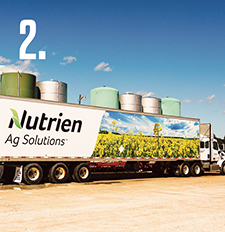
|
ADVANTAGED POSITION ACROSS THE AG VALUE CHAIN
Our global reach provides competitive advantages to support higher upstream sales of manufactured fertilizer and proprietary products, drive supply chain efficiencies, optimize transportation and logistics and efficiently supply our customers. |
|

|
PROVEN FINANCIAL STRENGTH AND STABILITY
Our business is diversified, which enhances our earnings profile. Our downstream Nutrien Ag Solutions (“Retail”) business provides greater stability to our earnings base and counter-cyclical cash flow, while our low-cost upstream fertilizer production assets are positioned to generate significant cash flow, providing the ability to invest in our business and consistently return capital to our shareholders. |
| 12 | Nutrien Annual Report 2024 |

|
Overview |
MD&A
|
Five-year highlights |
Financial statements and notes |
||||||||||||
| Nutrien’s advantage |
|
|
1. UNIQUE RELATIONSHIP WITH THE FARMER
|
|||||
| >4,500 |
>600,000 |
4M |
||||
| crop consultants |
customer accounts |
sustainable agriculture program acres1 |
||||
|
|
2. ADVANTAGED POSITION ACROSS THE AG VALUE CHAIN
|
|||||
| World-class production assets | Global supply chain excellence | Leading ag retail network | ||||
| 27Mmt |
~660 |
>1,900 |
||||
| upstream fertilizer manufactured sales volumes |
midstream fertilizer distribution points |
Retail locations |
||||
| ~2,000 |
5 |
~1,500 |
||||
| proprietary products |
specialized marine terminals2 |
crop input suppliers |
||||
|
|
3. PROVEN FINANCIAL STRENGTH AND STABILITY
|
|||||
| Substantial cash generation | Balanced approach to capital allocation (2020–2024) (percent) |
|||||
| $4.8B
annual average cash provided by operating activities (2020–2024) |
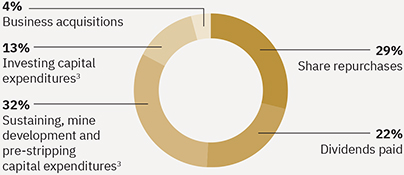
|
|||||
| 1 | This is a non-financial measure. See the “Terms and definitions” section. |
| 2 | Owned or accessed through Canpotex. |
| 3 | This is a supplementary financial measure. See the “Other financial measures” section. |
| Nutrien Annual Report 2024 | 13 | ||||
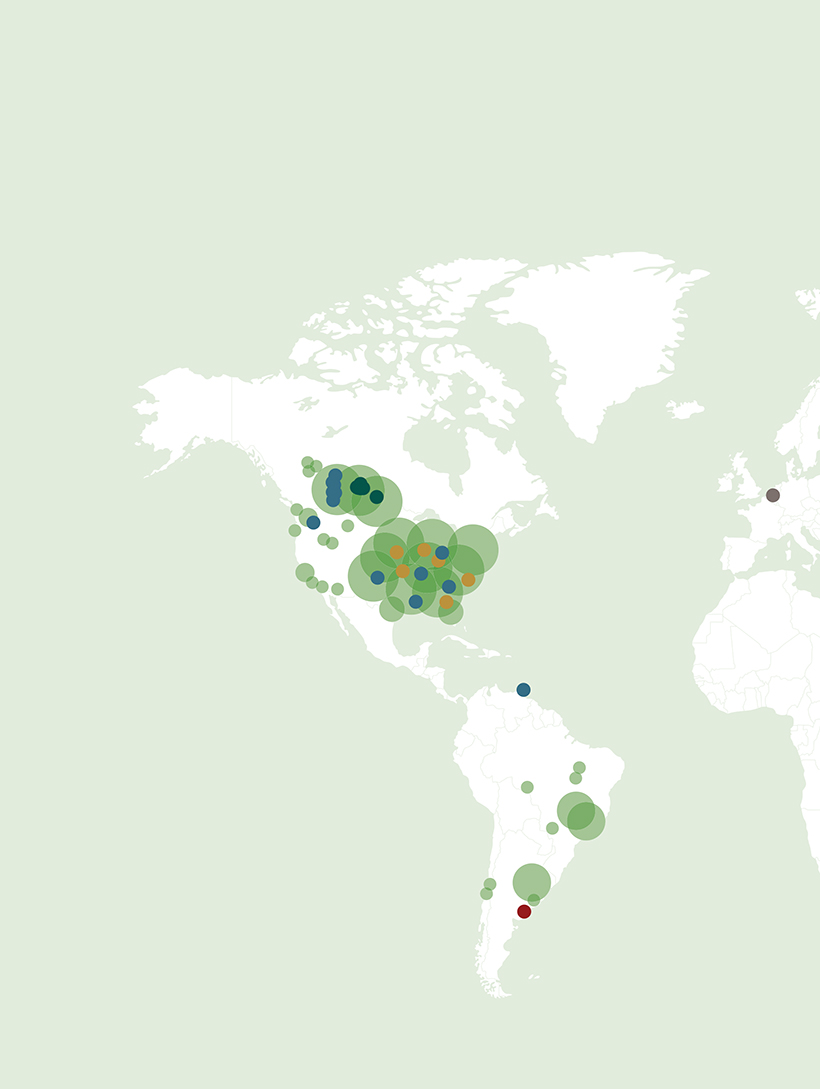

|
Overview |
MD&A
|
Five-year highlights |
Financial statements and notes |
||||||||||
|
Global profile |
|
Our upstream fertilizer manufacturing assets are primarily located in North America, with access to high-quality resources, lower cost inputs and an extensive midstream distribution network to efficiently supply our customers. Our downstream Retail business serves farmers in key agricultural markets in North America, Australia and South America.
|
||
| 13
Nitrogen production and upgrade facilities in North America and Trinidad and Tobago |
6
Potash mines in Canada |
|
| 1,300
Retail locations in North America |
6
Phosphate production and upgrade facilities in the US |
|
|
200
Retail locations in South America |
||
| 14 | Nutrien Annual Report 2024
|
||

|
|
Overview |
MD&A
|
Five-year highlights |
Financial statements and notes |
||||||||||
| Global profile |
| Retail | Nitrogen | Joint venture and investments | ||||
| Potash | Phosphate | European distribution | ||||
| 400
Retail locations in Australia |
| Nutrien Annual Report 2024 | 15 | ||

|
Overview |
MD&A
|
Five-year highlights |
Financial statements and notes |
||||||||||
|
Market fundamentals and
outlook |
||||||||||||||
| 16 | Nutrien Annual Report 2024 |

|
Overview |
MD&A
|
Five-year highlights |
Financial statements and notes |
||||||||||
|
Market fundamentals and
outlook |
||||||||||||||
OPERATING ENVIRONMENT
We operate in a rapidly changing world and must anticipate and adapt to our environment. We seek to understand the specific markets where we operate as well as the broader trends that influence and shape our operational landscape. This understanding helps us to seize new opportunities as they emerge and better identify the risks that could impact our ability to deliver on our strategy.
| Nutrien Annual Report 2024 | 17 |
|
|
Overview |
MD&A
|
Five-year highlights |
Financial statements and notes |
||||||||||
| Market fundamentals and outlook | ||||||||||||||
MARKET FUNDAMENTALS AND OUTLOOK
Agriculture and retail markets

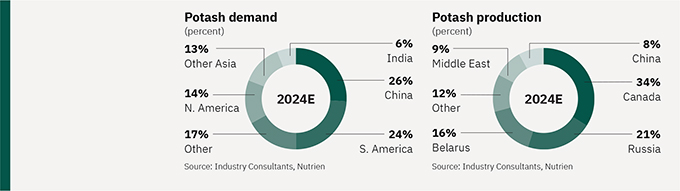

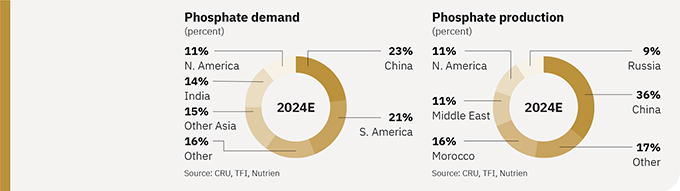
$125B
2024 total global
crop input sales1
Crop nutrients
72.5Mmt
2024 global potash
(KCl) demand
~159Mmt
2024 global nitrogen
(N) demand
~51Mmt
2024 global phosphate
(P2O5) demand
| 1 | Represents total market sales of seed, fertilizer and crop protection products in the US, Canada, Australia and Brazil. |
18 | Nutrien Annual Report 2024
|
|
Overview |
MD&A
|
Five-year highlights |
Financial statements and notes |
||||||||||
| Market fundamentals and outlook | ||||||||||||||
AGRICULTURE AND RETAIL MARKETS
Market fundamentals
Total crop protection, seed and fertilizer sales in our Retail operating regions equated to approximately $125 billion in 2024. As the world’s population increases, farmers are challenged to increase yields from a finite arable land base. This drives growth in demand for crop inputs and agronomic services.
The agriculture retail industry is highly fragmented in most of the major markets in which we operate, primarily composed of small and medium-sized competitors. Scale, reliability of supply and the ability to provide innovative products and solutions, including digital offerings, are increasingly important to farmers.
In North America, the primary crops grown include corn, soybeans, wheat, canola and cotton. It is a more mature market with farmers leveraging advanced agriculture tools and willing and able to invest in high-value products and services.
In Australia, our customers require a full suite of crop production inputs but also solutions for livestock, water and irrigation services given the more mixed nature of farm operations.
Brazil is one of the world’s largest and fastest-growing agriculture markets. It is currently the largest soybean producer and the third largest producer of corn globally. Its retail industry is highly fragmented, the supply chain is extended due to the significant reliance on imported crop inputs and there remains opportunity for adoption of more advanced products and services at the farmer level.
Market outlook
Global grain stocks-to-use ratios are historically low, and demand remains strong, providing a supportive environment for ag commodity prices in 2025. We expect US corn plantings to range between 91 and 93 million acres and soybean plantings to range from 84 to 86 million acres in 2025. The projected increase in corn acreage, combined with a shortened fall application season in 2024, supports our outlook for strong North American fertilizer demand in the first half of the year.
In Brazil, generally favorable soil moisture conditions and stronger crop prices are expected to lead to an increase in safrinha corn planted acreage of approximately five percent, supporting crop input demand in the first half of 2025.
A weaker Australian dollar and strong grain and oilseed export demand is supporting grower economics, and conditions remain positive for 2025 crop input demand.
US ag retail industry profile
(percent)
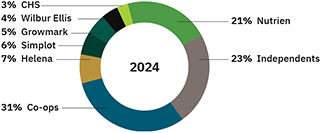
Source: Croplife
Global grains ending stocks & stocks/use ratio1
| (ending stocks Mmt) | (stocks/use ratio %) |

Source: USDA, Nutrien
| 1 | Global grains include corn, wheat, rice, barley, oats, millets, mixed grains, rye and sorghum. RoW is Rest of World excluding China and the US. |
| Nutrien Annual Report 2024 | 19 | ||||
|
|
Overview |
MD&A
|
Five-year highlights |
Financial statements and notes |
||||||||||
| Market fundamentals and outlook |
||||||||||||||
CROP NUTRIENT MARKETS: POTASH
Market fundamentals
Potash strengthens root systems supporting water uptake, drought and disease tolerance and increases the uptake of other nutrients. Potash demand growth is driven by increasing nutrient requirements of higher-yielding crops and improving soil fertility practices, particularly in emerging markets where potash has been historically under-applied and crop yields lag.
High-quality potash reserves in significant quantities are limited to a small number of countries. Canada has the largest known global potash reserves, accounting for approximately 40 percent of the total. Approximately 75 percent of the world’s potash production capacity is held by the six largest producing companies.
Building new production capacity requires significant capital and time to bring online. The expected cost for a greenfield project, including infrastructure, ranges up to $7 billion and requires a minimum of 10 years.1 Brownfield projects have a significant per-tonne capital cost advantage over greenfield projects.
Most major potash-consuming countries in Asia and Latin America have limited production capability and rely on imports to meet their needs. Trade typically accounts for approximately three-quarters of demand for potash, resulting in a globally diversified marketplace.
Inflation in operating and logistics costs has increased the short run marginal cost of potash supply and higher capital costs has also impacted the long-run margin cost.
Market outlook
Global potash shipments rebounded to approximately 72.5 million tonnes in 2024, driven by improved supply and supportive application economics that contributed to increased demand in key markets such as China, Brazil and Southeast Asia.
We forecast global potash shipments between 71 and 75 million tonnes in 2025. The high end of the range captures the potential for stronger underlying global consumption and the lower end captures the potential for reduced supply availability. We anticipate the potential for supply tightness with limited global capacity additions in 2025 and reported operational challenges and maintenance work in key producing regions.
|
|
|
|||
| Global potash demand | Delivered cash cost of potash to Brazil2,3 | |||
| (million tonnes KCl) | ($ per tonne) | |||
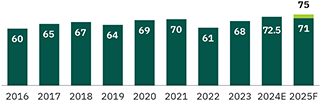
|
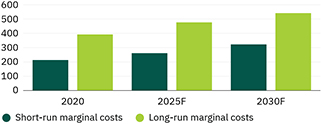
|
|||
| Source: IFA, Argus, CRU, SPGCI, Nutrien | Source: CRU, Nutrien | |||
| 1 | 3 million tonne KCl conventional potash mine in Saskatchewan, Canada. Cost includes rail, utility systems, port facilities and, if applicable, cost of deposit. |
| 2 | Based on CRU historical data and forecasts. |
| 3 | Short-run marginal cost refers to the breakeven delivered cash cost of the market-clearing high-cost production on a short-term basis. Long-run marginal cost refers to the full economic cost of new capacity. |
| 20 | | Nutrien Annual Report 2024 | |||
|
|
Overview |
MD&A
|
Five-year highlights |
Financial statements and notes |
||||||||||
| Market fundamentals and outlook |
||||||||||||||
CROP NUTRIENT MARKETS: NITROGEN
Market fundamentals
Nitrogen is an essential crop nutrient and is a fundamental building block of plant proteins that improves both crop yield and quality. The necessity of nitrogen for crop yield supports a strong and growing demand source for nitrogen fertilizers. Additionally, nitrogen is used as an input in many industrial processes and has the potential to provide further value if markets for low-carbon ammonia emerge.
Production of nitrogen products is the most geographically diverse of the three primary crop nutrients due to the widespread availability of hydrogen sources. Access to reliable and competitively priced energy feedstock supply is an important driver of profitability, as recent geopolitical events continue to create additional volatility in certain global energy markets. North American nitrogen producers currently have an advantaged cost position due to the relatively low price of natural gas compared to competitors in Europe and Asia.
The US is the third largest nitrogen-producing country but remains one of the largest importers of nitrogen products. China and India are the largest-consuming countries of nitrogen products, accounting for approximately 40 percent of the world’s consumption.
Market outlook
Global urea and UAN prices have increased in the first quarter of 2025, driven by strengthening demand in key import markets and restricted supply, including continued Chinese urea export restrictions. Global ammonia prices have trended lower to start the year due to seasonal demand weakness and the anticipation of incremental supply in the US and export capacity from Russia. We expect North American natural gas prices to remain highly competitive compared to Europe and Asia, with Henry Hub natural gas prices projected to average between $3.25 and $3.50 per MMBtu for the year.
The US nitrogen supply and demand balance is expected to be tight ahead of the spring application season, as nitrogen fertilizer net imports in the first half of the 2024/2025 fertilizer year were down approximately 60 percent compared to the five-year average. Additionally, nitrogen demand for the spring season is expected to be strong due to the limited fall ammonia application season and higher expected corn acreage.
|
|
|
|||
| Global ammonia demand | Natural gas prices in key regions | |||
| (million tonnes NH3) | ($ per MMBtu) | |||

|
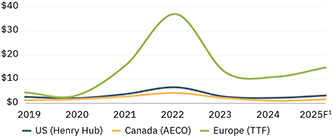
|
|||
| Source: SPGCI, CRU, Argus, Nutrien | Source: Bloomberg, SPGCI, ICE, CME, Nutrien | |||
| 1 | 2025F based on front month Europe TTF futures prices as of February 14, 2025. North American natural gas prices are based on the Nutrien 2025 forecast. |
| Nutrien Annual Report 2024 | 21 | ||||
|
|
Overview |
MD&A
|
Five-year highlights |
Financial statements and notes |
||||||||||
| Market fundamentals and outlook |
||||||||||||||
CROP NUTRIENT MARKETS: PHOSPHATE
Market fundamentals
Phosphorus is essential to all living things and is key to energy reactions in the plant, particularly photosynthesis, and vital to plant growth. Additionally, phosphate is used as an input in animal feed, food ingredients and for industrial processes.
Phosphate rock is found in significant quantity and quality in only a handful of geographic locations, with only 11 major phosphate-producing countries. Due to the concentration of deposits, the majority of recent capacity additions have come from existing producers in North Africa, the Middle East and China.
China is the world’s largest producer of phosphate, and its trade policy has a major impact on the global market. In 2024, Chinese DAP/MAP exports were down approximately 35 percent from 2021 levels as a result of export restrictions.
India and Brazil are the largest importers of phosphate fertilizers, with limited domestic production. In more mature markets like North America, we have seen continued demand growth for phosphate fertilizers that incorporate secondary nutrients and micronutrients like Nutrien’s MAP+MST product.
Market outlook
Phosphate fertilizer markets remain firm, particularly in North America where channel inventories were estimated to be historically low entering 2025. We expect Chinese phosphates exports similar to 2024 levels, with total DAP/MAP exports ranging between 6 and 7 million tonnes, and tight stocks in India to support demand ahead of their key planting season.
|
|
|
|||
| Global P2O5 demand | China DAP/MAP exports | |||
| (million tonnes P2O5) | (millions tonnes) | |||

|
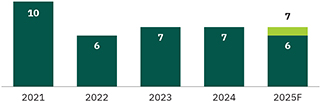
|
|||
| Source: CRU, TFI, Industry Consultants, Nutrien | Source: CRU, Argus, Nutrien | |||
| 22 | | Nutrien Annual Report 2024 | |||
|
|
Overview |
MD&A
|
Five-year highlights |
Financial statements and notes |
||||||||||
| Megatrends |
||||||||||||||

We define megatrends as macro-level long-term trends and global dynamics that are expected to shape our operating environment. A megatrend typically stems from complex interactions between policy developments, environmental changes, socio-economic shifts and technological advancements. Evaluating and monitoring megatrends helps inform Nutrien’s strategy and the related risks we look to manage. See page 28 for more information on our strategy and page 42 for our key enterprise risks.
FOOD SECURITY
Despite advances in modern agriculture, food security remains a global challenge. Producing enough nutritious food for the world’s eight billion people, and transporting it to where it is needed, is straining existing global resources. It is estimated that nearly 10 percent of the world’s population is food insecure. A rising population, expected to grow by close to two billion people by 2050, is further increasing the scale of this challenge.
The agricultural landscape continues to evolve and be influenced by climate change, biodiversity loss, water stress, geopolitical volatility, technology and digitalization, along with social trends that could impact the ability to address global food security.
| Nutrien Annual Report 2024 | 23 | ||||
|
|
Overview |
MD&A
|
Five-year highlights |
Financial statements and notes |
||||||||||
| Megatrends |
||||||||||||||

CLIMATE CHANGE, BIODIVERSITY
LOSS AND WATER RESOURCES
The convergence of climate change, biodiversity loss and water resource challenges forms a critical intersection that is expected to influence global environmental policy and corporate decisions in agriculture and mining for the foreseeable future. The agriculture value chain is expected to face long-term challenges related to climate change, including continued expectations for climate actions, reductions of GHG emissions and physical impacts from climate change on farmers and agriculture production.
GEOPOLITICAL
VOLATILITY
Geopolitical turmoil around the world is being driven by nationalism, polarization and economic instability. Due to globalization, regional events are having global impacts. Trade disputes, tariffs, restrictions and tensions have resulted in, and may continue to result in, supply chain disruptions and price volatility for energy and several other key commodities. Geopolitical fragmentation can lead to increased costs associated with diverging and sometimes incompatible regulations.
| 24 | Nutrien Annual Report 2024 |
|
|
Overview |
MD&A
|
Five-year highlights |
Financial statements and notes |
||||||||||
| Megatrends |
||||||||||||||

TECHNOLOGY AND
DIGITALIZATION
Digital technologies and access to vast amounts of data are supporting the transformation of the agriculture and mining industries. In mining operations, advances in automation and autonomous mining are improving safety by removing workers from the more hazardous areas and enabling productivity increases. Agriculture and food systems are undergoing technological changes driven by big data, digital connectivity, artificial intelligence and innovations in biotechnology.
New applications of emerging technologies, such as artificial intelligence and predictive analytics, have the potential to greatly improve operational productivity. The regulatory environment around artificial intelligence continues to evolve at a different pace than its use. Adoption of such technologies is expected to be uneven given vast differences in access and investment.
SOCIETAL
EXPECTATIONS
Stakeholders remain focused on corporate transparency and accountability. Some investors consider environmental and social principles alongside traditional financial metrics in capital allocation decisions and, along with regulators, are considering those principles in evaluating disclosure enhancements. Beyond climate-related matters, societal concerns include broad ecosystem impacts, as well as the expectation that companies operate in the best interest of stakeholders keeping public health goals in mind.
In response to these expectations, governments may impose new regulations or increase the stringency of existing ones. An inability to meet stakeholder expectations for environmental and social performance could increase stakeholder scrutiny, which could, in turn result in increased difficulty for companies as they seek to access cost-efficient capital, retain talent or deliver on their strategic priorities.
| Nutrien Annual Report 2024 | 25 | ||||

|
|
Overview |
MD&A
|
Five-year highlights |
Financial statements and notes |
||||||||||
| Nutrien’s strategy Capital allocation |
||||||||||||||
STRATEGY
Our vision is to be the leading global agricultural solutions provider, delivering superior shareholder value through safe and sustainable operations. We are focused on strategic initiatives that we believe will help achieve our vision: improving safety and operating performance, increasing earnings and cash flow, while generating higher risk-adjusted returns. We take a disciplined and intentional approach to capital allocation that is designed to optimize the sources and uses of our cash and prioritize sustaining safe and reliable operations, maintaining a healthy balance sheet, strategically investing in our business and providing meaningful returns to our shareholders.
| 26 | Nutrien Annual Report 2024 |

|
|
Overview |
MD&A
|
Five-year highlights |
Financial statements and notes |
||||||||||
| Nutrien’s strategy Capital allocation |
| Nutrien Annual Report 2024 | | 27 |
|
|
Overview |
MD&A
|
Five-year highlights |
Financial statements and notes |
||||||||||
| Nutrien’s strategy |
Our strategy is focused on three priorities that span our upstream, midstream and downstream businesses.

|
SIMPLIFY AND FOCUS
Simplify our approach and focus on business activities that are core to our long-term vision and strategic direction, exploring opportunities to exit non-core activities. |
|

|
OPERATIONAL EXCELLENCE
Enhance safety, increase operational efficiency and asset utilization, maximize cost savings and improve the quality of earnings. |
|
|
|
DISCIPLINED AND INTENTIONAL CAPITAL ALLOCATION
Optimize the sources and uses of our cash and prioritize sustaining safe and reliable operations, maintaining a strong and flexible balance sheet, strategically investing in our business and providing meaningful returns to our shareholders. |
| 28 | | Nutrien Annual Report 2024 |
|
|
Overview |
MD&A
|
Five-year highlights |
Financial statements and notes |
||||||||||
| Nutrien’s strategy |

Simplify
| • | Pursuing divestiture of non-core Retail assets in South America |
| • | Reviewing strategic options for our 50 percent ownership stake in Profertil |
| • | Evaluating further options with regards to our ownership in Sinofert Holdings Limited (“Sinofert”) |
| • | Centralizing functions to drive efficiencies and streamline decision making |
Focus
| • | Prioritizing safety to ensure our people go home safe, every day |
| • | Enhancing low-cost upstream North American fertilizer production assets |
| • | Strengthening our global distribution network |
| • | Investing in our core Retail business with a focus on proprietary products |
| ~$200M | +$500M | ~$60M | ||
| annual consolidated cost savings expected to be achieved in 2025, ahead of our initial target of 2026 |
expected reduction in 2025 capital expenditures from 2023 levels | proceeds from divestment of non-core assets, including 13 percent of our total ownership position in Sinofert and the sale of land in Argentina | ||
| 2026 Target | 2024 Actuals | 2023 Actuals | ||||||||||
| Simplify and focus |
||||||||||||
| Consolidated cost savings1 |
~$200M | Ahead of Schedule | N/A | |||||||||
| 1 | Based on targeted reductions in operational and corporate costs. |
| Nutrien Annual Report 2024 | 29 | ||||
|
|
Overview |
MD&A
|
Five-year highlights |
Financial statements and notes |
||||||||||
| Nutrien’s strategy |
||||||||||||||

Maintain low-cost position and enhance safety and the reliability of our upstream assets
| • Investing in Potash mine automation technology and operational excellence
• Increasing Nitrogen reliability and energy efficiency
• Improving Phosphate reliability and cost stewardship |
35% | 12% | ||
| potash ore tonnes mined using automation in 2024 |
increased gas utilization in Trinidad compared to 2023 |
|||
Drive midstream supply chain efficiencies across our network
| • Optimizing our logistics infrastructure |
• Leveraging our extensive sales and distribution capabilities |
|||
Optimize downstream Retail network to enhance margins and our ability to efficiently serve the farmer
| • Consolidating and modernizing our North American footprint
• Executing on a margin improvement plan in Brazil |
>50 | >50 | ||
| North American Retail sites consolidated into centralized locations over the past 5 years |
Retail Brazil locations closed, idled 5 blending facilities, and restructured our workforce in Brazil |
|||
| 2026 Target | 2024 Actuals | 2023 Actuals | ||||||||||
| Operational excellence |
||||||||||||
| Potash ore tonnes mined using automation |
40%—50% | 35% | 22% | |||||||||
| Ammonia operating rate1 |
92%—93% | 88% | 88% | |||||||||
|
P2O5 operating rate |
87%—90% | 78% | 83% | |||||||||
| 1 | Operating rate represents production volumes divided by production capacity (excluding Joffre and Trinidad facilities). |
| 30 | | Nutrien Annual Report 2024 | |||
|
|
Overview |
MD&A
|
Five-year highlights |
Financial statements and notes |
||||||||||
| Nutrien’s strategy |
||||||||||||||
| 3. | DISCIPLINED AND INTENTIONAL CAPITAL ALLOCATION |

Safe and reliable operations
| • | Sustain our assets to support safe and reliable operations |
| • | Focus on continuous improvement initiatives and investments that enhance the utilization rates, reliability and efficiency of our assets |
| • | Monitor technology, policy and market developments that may make emissions reduction projects economically viable |
Consistent shareholder returns
| • | Return capital to shareholders through a combination of share repurchases and a stable and growing dividend per share |
| • | Consider reduction in share count in the decision criteria for future dividend per share growth |
Strong and flexible balance sheet
| • | Evaluate our assets to ensure they are generating an appropriate return |
| • | Provide sufficient and flexible access to liquidity while optimizing the cost of our capital through the cycle |
| • | Expect to maintain an average adjusted net debt to adjusted EBITDA leverage ratio below 3:1 through the cycle |
High-value growth opportunities
| • | Leverage existing assets to deliver upstream fertilizer volume and proprietary products growth |
| • | Progress targeted growth investments that have a strong fit with our strategy, provide returns in excess of our hurdle rates and have a relatively low degree of execution risk |
| 2026 Target | 2024 Actuals | 2023 Actuals | ||||||||||
| Disciplined and intentional capital allocation |
||||||||||||
| Annual average capital expenditures (2024-2026)1 |
$2.2B–$2.3B | $2.2B | $2.6B | |||||||||
| Potash manufactured sales volumes (million tonnes) |
14.0–15.0 | 13.9 | 13.2 | |||||||||
| Nitrogen manufactured sales volumes (million tonnes) |
11.5–12.0 | 10.7 | 10.4 | |||||||||
| Retail adjusted EBITDA |
$1.9B–$2.1B | $1.7B | $1.5B | |||||||||
| 1 | Comprised of sustaining capital expenditures, investing capital expenditures and mine development and pre-stripping capital expenditures that are supplementary financial measures. See the “Other financial measures” section. |
| Nutrien Annual Report 2024 | 31 | ||||
|
|
Overview |
MD&A
|
Five-year highlights |
Financial statements and notes |
||||||||||
| Capital allocation |
||||||||||||||
| SAFE AND RELIABLE OPERATIONS |

|
|
|
Sustaining, mine development and pre-stripping capital expenditures1 |
||
| $1.7B | ||
|
2024 |
||
| Sustaining, mine development and pre-stripping capital expenditures (percent) |
Key 2024 actions
• Completed reliability work and replaced key identified end-of-life assets across our upstream operations, including five major maintenance turnarounds and planned outages at four of our Nitrogen sites
• Received the National Safety Council’s Green Cross for Safety Innovation award in recognition of tele-remote technology in our potash mines
• Invested in maintenance and safety-related initiatives for our downstream Retail facilities |
|
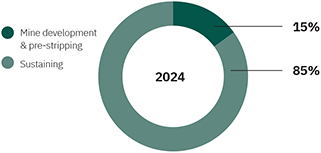
|
||
| STRONG AND FLEXIBLE BALANCE SHEET |

|
|
|
Adjusted net debt to adjusted EBITDA2 |
||
|
2.2X |
||
| 2024 | ||
| Debt and equity3,4 (percent) |
Key 2024 actions
• Maintained our Baa2/BBB investment-grade credit rating
• Repaid $500 million in senior notes that matured in 2024 and issued a total of $1.0 billion of 3-year and 10-year senior notes |
|

|
| 1 | This is a supplementary financial measure. See the “Other financial measures” section. |
| 2 | This is a capital management measure that includes non-GAAP components. See the “Non-GAAP financial measures” and “Other financial measures” sections. |
| 3 | As at December 31, 2024. |
| 4 | Debt includes short-term debt, long-term debt and lease liabilities, including the current portions of each where applicable. |
| 32 | | Nutrien Annual Report 2024 | |||
|
|
Overview |
MD&A
|
Five-year highlights |
Financial statements and notes |
||||||||||
| Capital allocation |
||||||||||||||
| CONSISTENT SHAREHOLDER RETURNS |
Key 2024 actions
• Repurchased 3.9M shares for a total of ~$190 million in the second half of 2024
• Announced a 1 percent increase to our quarterly dividend to $0.545 per share in February 2025, our seventh increase since 2018
• In February 2025, we approved the purchase of up to 5 percent of Nutrien’s outstanding common shares over a twelve-month period through a renewal of our normal course issuer bid |
|
|
Cash used for dividends and share repurchases |
||
| 4.3% | ||
|
average dividend yield in 2024 |
||
| $1.2B
returned to shareholders through dividends and share repurchases in 2024 |
| HIGH-VALUE GROWTH OPPORTUNITIES |
Key 2024 actions
• Invested in potash autonomous mining machines and technology and increased our ore tonnes mined using automation by more than 75% (vs 2023)
• Invested in low-cost nitrogen brownfield expansions and added incremental ammonium sulfate capability at our Redwater nitrogen site
• Invested in proprietary products, network optimization and digital capabilities to better serve our customers |
|
|
Targeted growth investments |
||
| $430M | ||
|
investing capital expenditures in 2024 |
||
| 8%
growth in proprietary crop nutritional and biostimulants gross margin in 2024 (vs 2023) |
| Nutrien Annual Report 2024 | 33 | ||||


|
Overview |
MD&A
|
Five-year highlights |
Financial statements and notes |
||||||||||
|
Corporate governance |
GOVERNANCE
We embed strong corporate governance systems and principles in our business to place the interests of our shareholders and other stakeholders at the center of every decision we make. Our governance supports value preservation and long-term value creation by ensuring our businesses’ principal risks and opportunities are being appropriately identified and addressed.
| 34 | Nutrien Annual Report 2024 |

|
|
Overview |
MD&A
|
Five-year highlights |
Financial statements and notes |
||||||||||
|
Corporate
governance |
| Nutrien Annual Report 2024 | 35 | ||||
|
|
Overview |
MD&A
|
Five-year highlights |
Financial statements and notes |
||||||||||
| Corporate governance |
Nutrien’s corporate governance structure includes policies and processes that define the roles of the Board and the Executive Leadership Team (“ELT”). Our Board oversees the execution of our corporate strategy and management of risk. Below are highlights of our corporate governance practices. For more information, see our most recent Management Proxy Circular.
Board diversity
Having a mix of directors on the Board from varied backgrounds and with a diverse range of experience and skills fosters enhanced decision-making capacity and promotes strong corporate governance. Our Board Diversity Policy includes a target that women comprise no fewer than 30 percent of the Board members. As of December 31, 2024, four of our directors were women (33 percent of the total number of directors).
Executive compensation
Nutrien’s compensation framework is based on a pay-for-performance philosophy, with the majority of executive compensation being at risk. Each year, we include an advisory “say on pay” vote at our annual meeting.
Board skills
Our Board competencies and skills matrices are essential tools to evaluate whether the Board has the right skills, perspectives, experience and expertise for proper oversight and effective decision making. The Board regularly reviews the skills matrix.
Core business skills1
(percent of Board of Directors)
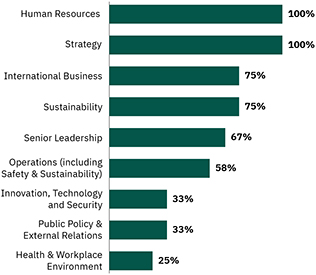
Core industry experience1
(percent of Board of Directors)

| 1 | As disclosed in Nutrien’s 2024 Management Proxy Circular. |
| 36 | | Nutrien Annual Report 2024 |
|
|
Overview |
MD&A
|
Five-year highlights |
Financial statements and notes |
||||||||||
| Corporate governance |
||||||||||||||

|
|
|
|
|
|
|||||
| Russell Girling | Ken Seitz | Christopher Burley | Maura Clark | Michael Hennigan | Miranda Hubbs | |||||
| Chair | President and Chief Executive Officer | Director | Director | Director | Director | |||||
|
|
|
|
|
|
|
|||||
| Raj Kushwaha | Julie Lagacy | Consuelo Madere | Keith Martell | Aaron Regent | Nelson Luiz Costa Silva | |||||
| Director | Director | Director | Director | Director | Director |
EXECUTIVE LEADERSHIP TEAM
|
|
|
|
|
|||||||||
| Ken Seitz | Noralee Bradley | Andrew Kelemen | Chris Reynolds | |||||||||
| President and Chief Executive Officer | Executive Vice President, External Affairs and Chief Sustainability and Legal Officer | Executive Vice President and Chief Corporate Development and Strategy Officer | Executive Vice President and Chief Commercial Officer | |||||||||
|
|
|
|
|
|||||||||
| Jeff Tarsi | Mark Thompson | Sarah Walters | Trevor Williams | |||||||||
| Executive Vice President and President, Global Retail | Executive Vice President and Chief Financial Officer | Executive Vice President and Chief People Officer | Executive Vice President and President, Nitrogen and Phosphate |
| Nutrien Annual Report 2024 | 37 | ||||
|
|
Overview |
MD&A
|
Five-year highlights |
Financial statements and notes |
||||||||||
| Risk governance |
||||||||||||||
Risk management is an integral part of doing business and is governed by our Board, which has the highest level of oversight for risk governance. The Board is responsible for overseeing the execution and alignment of Nutrien’s corporate strategy and risk management processes.
Nutrien’s ELT has the responsibility of ensuring the Company’s principal risks are being appropriately identified, assessed and addressed. Management keeps the Board and each of the Board committees regularly apprised of risks and developments relevant to their mandates.
Responsibility and accountability for risk management are embedded in all levels of our organization, and we strive to integrate risk management into key decision-making processes and strategies. By considering risk throughout our business, we seek to effectively manage the risks that could have an impact on our ability to deliver on our strategy.
Role of the Board committees
While the Board as a whole oversees our strategy and risk management processes, each Board committee has oversight over business topics and certain risk areas relevant to their committee mandate. More information can be found in Nutrien’s Board and Board committee charters on our website at nutrien.com.
| Board/Board Committee
|
Oversight includes the following business topics or risk areas
|
|||
| Board of Directors |
• Corporate strategy
• Oversight of safety, health, environmental and security matters |
• Risk management
• Human resources and compensation
• Governance and compliance |
||
| Audit Committee |
• Accounting and financial reporting
• Internal controls |
• Compliance
• Financial risk management |
||
| Corporate Governance & Nominating Committee |
• Corporate governance
• Board diversity
• Director compensation |
• Director orientation and continuing education
• Board evaluation |
||
| Human Resources & Compensation Committee |
• Executive compensation
• Succession planning |
• Equity, diversity and inclusion, including the Company’s Indigenous Strategy as it relates to Indigenous employment and human resources matters with appropriate coordination with the S&S Committee
• Learning and development |
||
| Safety & Sustainability (“S&S”) Committee |
• Sustainability priorities
• Risks, strengths and opportunities related to safety and sustainability including climate-related impacts |
• Safety and sustainability performance and strategy
• Cybersecurity and data privacy
• Status of remediation projects and environmental provisions
• The Company’s Indigenous Strategy as it relates to Indigenous engagement and stakeholder relations, with appropriate coordination with the Human Resources & Compensation Committee |
||
| 38 | | Nutrien Annual Report 2024 | |||
|
|
Overview |
MD&A
|
Five-year highlights |
Financial statements and notes |
||||||||||
| Risk management process |
||||||||||||||
Risk management is integrated in our strategy and business processes to facilitate informed decision making and responsible management of resources. Our Enterprise Risk Management process is overseen by our Enterprise Risk Management Team and guided by our global risk management framework. The framework promotes consistent and integrated application of risk management principles and processes across our organization and is scalable to support all levels of the business.
Nutrien’s operating segments and corporate functions use this framework to identify, assess and develop mitigation actions for key risks that could affect their strategy, operations or future performance. Assessment criteria embedded in the risk framework follow best practices and allow for comparability of different types of risks. Key criteria include the likelihood of impacting our business and the potential severity of impact.
Risks are evaluated at the management level to fully understand Nutrien’s risk landscape and identify interdependencies between risks. A consolidated view of our risks is presented to our ELT and senior leaders for review and discussion. Nutrien’s key enterprise risks are then presented to the Board at least annually.

| Nutrien Annual Report 2024 | 39 | ||||

|
|
Overview |
MD&A
|
Five-year highlights |
Financial statements and notes |
||||||||||
|
Key enterprise risks |
| 40 | Nutrien Annual Report 2024 |


|
Overview |
MD&A
|
Five-year highlights |
Financial statements and notes |
||||||||||
|
Key enterprise risks |
KEY ENTERPRISE RISKS
Nutrien characterizes a key risk as a risk or combination of risks that could threaten the effective delivery of our business model, future financial peformance, liquidity or ability to deliver on our strategy.
| Nutrien Annual Report 2024 | 41 |
|
|
Overview |
MD&A
|
Five-year highlights |
Financial statements and notes |
||||||||||
| Key enterprise risks |
||||||||||||||
Our key enterprise risks are discussed below and, while these represent our significant risks, we also continue to be exposed to other important general business, financial, operational and climate-related risks. For a more detailed discussion of these key risks and other risks that may have a material effect on us, refer to Nutrien’s 2024 Annual Information Form.
| 1 |
Competition and shifting market fundamentals
|
|||
| Description
Global macroeconomic conditions and shifting market fundamentals – including trade tariffs and trade restrictions, market volatility, geopolitical conditions, increased price competition or new entrants, and/or a significant change in agriculture production or consumption trends – could lead to a sustained environment of reduced demand for our products, increased costs and/or low or volatile commodity prices, thereby negatively impacting our short- and long-term profitability. |
Risk management approach
We operate across the ag value chain and have a diversified portfolio of products and services that are designed to enable us to respond to changing economic conditions. We have a favorable cost-structure and the flexibility to make operational changes across our portfolio to help minimize the impact of changing market dynamics. We prioritize a strong and flexible balance sheet and focus on initiatives that simplify and enhance our core business, optimize our advantages across the ag value chain and allocate capital to high-value investments.
See page 18 of this report for more information on our market fundamentals. |
|||
| 2 |
Changing regulations
|
|||
| Description
Changing laws, regulations and government policies, including those relating to the environment, climate change (including regulation of GHG emissions), data privacy, health and safety, and taxes and royalties, could affect our ability to produce or sell certain products, reduce our efficiency and competitive advantage, increase our costs of raw materials, energy, transportation and compliance, or require us to make capital improvements to our operations. These and other factors could impact our strategy, operations, financial results or reputation. |
Risk management approach
Our Government & External Affairs Team maintains an active engagement strategy with governments and regulators, including participation in industry associations. These relationships allow us to keep current on regulatory developments affecting our business or industry, allowing us to anticipate new or changing laws and regulations and put us in the best position for success while leveraging our industry association allies. |
|||

| 42 | | Nutrien Annual Report 2024 | |||
|
|
Overview |
MD&A
|
Five-year highlights |
Financial statements and notes |
||||||||||
| Key enterprise risks |
||||||||||||||
| 3 |
Political, economic and social instability
|
|||
| Description
We are a global business with significant operations in Canada and the US as well as operations outside of North America, including Australia, South America, Trinidad and certain European countries.
We are subject to numerous risks and uncertainties related to international sales and operations, and wide-ranging political, economic and social instability. These risks include, but are not limited to: restrictions on monetary distributions in jurisdictions we operate, inflation and/or conditions resulting from governmental attempts to reduce inflation, currency exchange rate fluctuations between the US dollar and foreign currencies, labor disruptions, competitive restrictions, forced divestitures or changes to, or termination or nullification of, existing agreements, military or other armed conflicts, mining permits or leases, the imposition of tariffs, exchange controls, |
international sanctions, embargoes, trade barriers or other restrictions. Instability in political or regulatory regimes could also affect our ability to do business and could impact our financial results or the value of our assets.
Risk management approach
Our Government & External Affairs Team maintains an active engagement strategy with governments, regulators and other stakeholders in the countries where we operate or plan to operate and is well positioned with the US Administration. We assess capital investments and project decisions against political, country-specific and other related risk factors and avoid or reduce our exposure to jurisdictions with unacceptable risk levels. We actively monitor regulatory and political developments and global trends that may impact us. |
|||
| 4 |
Agricultural changes and trends
|
|||
| Description
The agricultural landscape continues to evolve as a result of factors including, but not limited to, farm and industry consolidation, changing farmer demographics, technology developments, sustainability practices, changing government programs and policies, climate change and shifting social trends, many of which vary from jurisdiction to jurisdiction. These factors as well as other factors affecting long-term demand for our products and services could adversely impact our strategy and our financial results. |
Risk management approach
We operate across the ag value chain and have a diversified portfolio of products and services that enable us to adapt to changes in the agriculture industry and help position us to achieve long-term value creation. Our downstream Retail network provides access and insights directly to the farmer, providing an opportunity to anticipate trends and respond faster to the needs of our customers. We are focused on bringing value-added products and services to market that address key grower challenges, including offering financing solutions through Nutrien Financial and expanding innovative proprietary product offerings.
See page 28 of this report for more information on our strategy. |
|||
| 5 |
Cybersecurity threats
|
|||
| Description
Information technology and operational control systems are embedded in our business and as we become more dependent on these systems, third-party systems and cloud-based platforms, we may become more exposed to cyberattacks, which continue to become increasingly sophisticated. Cybersecurity risks can include attacks on information technology and infrastructure by hackers, industrial espionage, terrorist attacks, viruses, ransom events, the unintended disclosure of confidential |
information and/or personally identifiable information, the misuse or loss of control over computer control systems, power outages, business and/or supply chain disruptions, and related breaches. Any of these could result in business disruptions, increased defense or insurance costs, reputational damage, personal injury or third-party claims, which could, in turn, negatively impact our operations, financial results or reputation. |
|||
| Nutrien Annual Report 2024 | 43 | ||||
|
|
Overview |
MD&A
|
Five-year highlights |
Financial statements and notes |
||||||||||
|
Key enterprise risks |
| 5 |
Cybersecurity threats (continued)
|
|||
| Risk management approach
Our Global Information Management and Cyber Security Team is supported by third-party specialists, oversees our network security and may assist in incident response. We promote a strong culture of cybersecurity awareness to minimize threats and vulnerabilities, which is supported by our cybersecurity framework, policies and best practices. |
Threat and risk assessments are completed for all new information technology systems, and our cybersecurity incident response processes are backstopped by external response measures. We also conduct regular simulated phishing and targeted cybersecurity training as well as incident response training. |
|||
| 6 |
Supply chain disruption
|
|||
| Description
Our ability to produce and supply our customers and markets with products can be negatively impacted by disruptions in our inbound and outbound supply chains. These disruptions can result in difficulties supplying key materials or supplies to our facilities or impair our ability (or the ability of the third parties upon which we rely) to deliver products to our customers in a timely manner. Ongoing geopolitical conflicts, regulatory instability, sanctions, tariffs, labor disputes and extreme weather events or disasters have created and could create supply chain challenges and disruptions, and/or limit our future ability to sell or distribute our products in a timely manner, any of which could negatively impact our business and financial results. |
Risk management approach
Our business structure and position across the ag value chain provides us the flexibility to optimize our operations and distribution network to be able to respond to potential supply chain disruptions. We have an extensive and diverse transportation and storage network that allows us to effectively manage and adapt to logistical challenges. We maintain a sizable and diverse network of suppliers that we regularly review to ensure we can maintain critical feedstocks for our operations. |
|||
| 7 |
Climate change
|
|||
| Description
Our business and our customers are subject to risks related to or resulting from climate change, which are commonly grouped into physical risk and transition risk categories.
Physical risks include the impacts that climate change could have on our operations, supply chains and customers. These may cause or result in, among other things, more frequent and severe weather events, diminishing biodiversity, impacts to growing seasons or crop yields and changing weather factors such as temperature, precipitation, wind and water levels, and affect freshwater availability. These risks may also result in operational or supply chain disruptions.
Transition risks relate to the risk inherent in changing strategies, policies or investments as society and industry work to reduce the reliance on carbon and its impact on the climate. Impacts from transition risks include, among other things, policy constraints on emissions, carbon pricing mechanisms, water restrictions, land use restrictions or incentives, changing consumer preferences and market demand and supply shifts. |
We are also subject to reputational risks associated with climate change, including our stakeholders’ perception of the agriculture industry and our role in the transition to a lower-carbon economy. These and other factors resulting from climate change could adversely impact our operations, financial results or liquidity.
Risk management approach
Our capital allocation framework and preventive maintenance programs help support the long-term reliability and efficiency of our assets. Additionally, our geographically diversified network of facilities and operations helps to minimize the overall impact of physical risk from climate change on our Company.
For more information refer to our 2024 Sustainability Report on our website at nutrien.com. |
|||
| 44 | | Nutrien Annual Report 2024 |
|
|
Overview |
MD&A
|
Five-year highlights |
Financial statements and notes |
||||||||||
|
Key enterprise risks |
| 8 |
Safety, health and environment
|
|||
| Description
Our operations are subject to safety, health and environmental risks inherent in mining, manufacturing and the transportation, storage and distribution of our products. These inherent risks could result in injuries or fatalities, or impact air quality, biodiversity, water resources or related ecosystems near our operations, which could, in turn, negatively impact our operations, financial performance or reputation. |
Risk management approach
Our safety strategy and governance processes are designed to follow regulatory, industry and internal standards of safety, health and environmental. We have structured incident prevention and response systems in place and conduct regular security vulnerability assessments. We have crisis communication protocols and emergency response programs across our business and maintain environmental monitoring and control systems, including third-party reviews of key containment structures.
For more information refer to our 2024 Sustainability Report on our website at nutrien.com. |
|||
| 9 |
Talent and organization culture
|
|||
| Description
Our ability to attract and retain qualified top talent, including skillsets in high demand or in certain regions, and provide the necessary organizational structure, programs and culture to engage and develop our employees, is crucial to our growth and achieving our business results. Failure to do so could impact our operations, financial results or our ability to achieve our growth objectives. |
Risk management approach
Our Talent Attraction and Sourcing Team focuses on building a diverse and talented workforce. We are committed to the career development of our employees and building a culture grounded in our organizational purpose and the values of safety, inclusion, integrity and results. Our talent succession process focuses on identifying and managing critical roles and the proactive build-up of internal and external bench strength. Our incentive programs are competitive, performance-based and they support our purpose-driven culture. |
|||
| 10 |
Capital redeployment
|
|||
| Description
We may not be able to deploy capital to efficiently achieve sustained growth, effectively execute on opportunities or meet stakeholder expectations – whether due to market conditions, lack of investment options or otherwise, or deploying capital in a manner inconsistent with our strategic priorities – could impact our returns, operations, reputation, access to or cost of capital, or result in potential asset impairments. |
Risk management approach
We continue to concentrate on creating long-term value through a disciplined and intentional approach to capital allocation. We prioritize sustaining safe and reliable operations, maintaining a healthy balance sheet, strategically investing in our business and providing meaningful returns to our shareholders.
See page 31 of this report for more information on our capital allocation and key actions. |
|||

| Nutrien Annual Report 2024 | | 45 |


|
Overview |
MD&A
|
Five-year highlights |
Financial statements and notes |
||||||||||
|
Profile and results |
| 46 | Nutrien Annual Report 2024 |

|
|
Overview |
MD&A
|
Five-year highlights |
Financial statements and notes |
||||||||||
| Profile and results |
||||||||||||||
PROFILE AND RESULTS
Nutrien has four reportable operating segments: Retail, Potash, Nitrogen and Phosphate. The downstream Retail segment distributes crop nutrients, crop protection products, seed and merchandise, and provides services, including financing, directly to farmers through a network of Retail locations in North America, South America and Australia. The upstream Potash, Nitrogen and Phosphate segments are differentiated by the chemical nutrient contained in the products that each produces.
| • | Adjusted EBITDA is the primary profit measure used to evaluate the segments’ performance as it excludes the impact of non-cash impairments and impairment reversals and other costs that are centrally managed by our corporate function. Refer to Note 3 to the consolidated financial statements for details. |
| • | Net sales (sales less freight, transportation and distribution expenses) is the primary measure used in planning and forecasting in the Potash, Nitrogen and Phosphate operating segments. |
| Nutrien Annual Report 2024 | 47 | ||||

|
Overview | MD&A | Five-year highlights | Financial statements and notes | ||||||||||
|
Results |
2024 NUTRIEN AG SOLUTIONS (“RETAIL”) OPERATING SEGMENT AND RESULTS
Retail – #1 Global ag retailer
Our global Retail network of over 1,900 locations in seven countries provides farmers with a comprehensive portfolio of value-added agronomic products and services that includes crop nutrients, crop protection products, seed and application services. The size and scale of our network provides reach and flexibility to reliably serve our customers throughout the growing season. We are focused on building leading digital capabilities that support data-driven insights to more efficiently serve our farmer customers and offer competitive credit products that meet their crop input financing needs.
We produce an innovative portfolio of approximately 2,000 proprietary crop nutrient, crop protection and seed products. These proprietary products generate a higher margin for Nutrien and enhance crop production efficiency and profitability for the farmer. We are a leading provider of plant nutritional products, including biostimulants, which aim to increase crop yields through enhanced nutrient efficiency and improved plant and soil health outcomes.
Over 4,500 crop consultants support our customers in crop planning, seed selection, soil sampling, variable rate fertilizer application and crop monitoring. Our agronomic tools and expertise combined with our broad portfolio of value-added products aim to support the agricultural productivity of our customers.
Our Retail business generated adjusted EBITDA of $1.7 billion in 2024, higher than the prior year, supported by improved product margins in all geographies and lower expenses. Lower crop nutrients selling prices and volumes were more than offset by higher per-tonne margins in North America, including growth in our proprietary crop nutritional and biostimulant product lines. Crop protection product gross margin increased, supported by proprietary products, strong operational execution and the selling through of lower cost inventory in South America compared to 2023. Seed gross margin increased as improved margins in North America more than offset the impact of dry weather and competitive market pressures in Brazil.
| ($ millions, except as otherwise noted) | 2024 | 2023 | % Change | |||||||||
| Sales |
17,832 | 19,542 | (9 | ) | ||||||||
| Cost of goods sold |
13,211 | 15,112 | (13 | ) | ||||||||
| Gross margin |
4,621 | 4,430 | 4 | |||||||||
| Adjusted EBITDA 1 |
1,696 | 1,459 | 16 | |||||||||
| 1 | See Note 3 to the consolidated financial statements. |
| Sales | Gross margin | |||||||||||||||
| ($ millions) | 2024 | 2023 | 2024 | 2023 | ||||||||||||
| Crop nutrients |
7,211 | 8,379 | 1,444 | 1,378 | ||||||||||||
| Crop protection products |
6,313 | 6,750 | 1,622 | 1,553 | ||||||||||||
| Seed |
2,235 | 2,295 | 431 | 427 | ||||||||||||
| Services and other |
918 | 927 | 716 | 710 | ||||||||||||
| Merchandise |
897 | 1,001 | 150 | 172 | ||||||||||||
| Nutrien Financial |
361 | 322 | 361 | 322 | ||||||||||||
| Nutrien Financial elimination 1 |
(103 | ) | (132 | ) | (103 | ) | (132 | ) | ||||||||
| Total |
17,832 | 19,542 | 4,621 | 4,430 | ||||||||||||
| 1 | Represents elimination of the interest and service fees charged by Nutrien Financial to Retail branches. |
Supplemental data
| Gross margin | % of product line 1 | |||||||||||||||
| ($ millions, except as otherwise noted) | 2024 | 2023 | 2024 | 2023 | ||||||||||||
| Proprietary products |
||||||||||||||||
| Crop nutrients |
421 | 391 | 29 | 28 | ||||||||||||
| Crop protection products |
470 | 461 | 29 | 30 | ||||||||||||
| Seed |
154 | 168 | 36 | 39 | ||||||||||||
| Merchandise |
15 | 11 | 10 | 6 | ||||||||||||
| Total |
1,060 | 1,031 | 23 | 23 | ||||||||||||
| 1 | Represents percentage of proprietary product margins over total product line gross margin. |
48 | Nutrien Annual Report 2024
|
|
Overview | MD&A | Five-year highlights | Financial statements and notes | ||||||||||
|
Results |
| Sales volumes (tonnes - thousands) |
Gross margin / tonne (dollars) |
|||||||||||||||
|
|
2024 | 2023 | 2024 | 2023 | ||||||||||||
| Crop nutrients |
||||||||||||||||
| North America |
8,547 | 8,985 | 142 | 127 | ||||||||||||
| International |
3,715 | 3,647 | 62 | 65 | ||||||||||||
| Total |
12,262 | 12,632 | 118 | 109 | ||||||||||||

|
|
2024 versus 2023 | |
| Crop nutrients |
Sales decreased in 2024 due to lower selling prices and sales volumes. Gross margin increased due to higher per-tonne margins in North America, including growth in our proprietary crop nutritional and biostimulant product lines. | |
| Crop protection products |
Sales were lower in 2024 mainly due to lower selling prices. Gross margin improvements in 2024 were supported by proprietary products, strong operational execution and the selling through of lower cost inventory in South America compared to 2023. | |
| Seed |
Sales decreased in 2024 mainly due to the impact of competitive pricing pressure in South America. Gross margin increased in 2024 as improved margins in North America more than offset the impact of dry weather and competitive market pressures in Brazil. | |
| Merchandise |
Sales and gross margin decreased in 2024 due to reductions in Australia primarily related to weather-related impacts on water equipment sales and animal health products. | |
| Nutrien Financial |
Sales and gross margin increased in 2024 due to higher financing rates offered. | |
| Adjusted EBITDA |
Adjusted EBITDA increased in 2024, supported by higher product margins in all geographies and lower expenses. We also recognized a $25 million gain on the sale of land in Argentina as we continue to simplify our business. | |
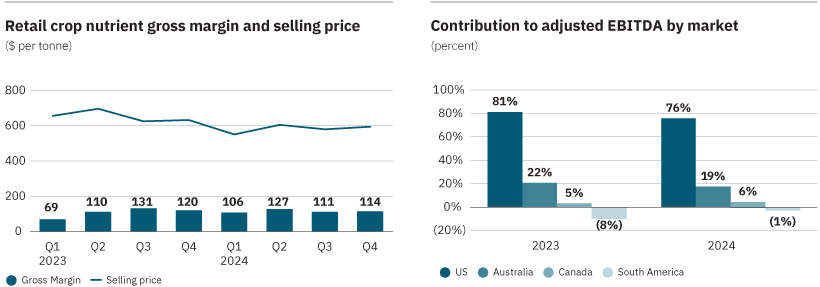
Nutrien Annual Report 2024 | 49
|
|
Overview | MD&A | Five-year highlights | Financial statements and notes | ||||||||||
|
Results |
Selected retail measures
| (percentages) | 2024 | 2023 | ||||||
| Financial performance measures 1 |
||||||||
| Cash operating coverage ratio |
63 | 68 | ||||||
| Adjusted average working capital to sales |
20 | 19 | ||||||
| Adjusted average working capital to sales excluding Nutrien Financial |
– | 1 | ||||||
| Nutrien Financial adjusted net interest margin |
5.3 | 5.2 | ||||||
| 1 | These are non-GAAP financial measures. See the “Non-GAAP financial measures” section. |
Nutrien Financial
We offer flexible financing solutions to our customers in support of Nutrien’s agricultural product and service sales. Qualifying Retail customers in the US and Australia are offered extended payment terms, typically up to one year, to facilitate the alignment of farmer crop cycles with cash flows. Nutrien Financial revenues are primarily earned through interest from farmers.
We hold a significant portion of receivables from customers that have historically experienced a low-default rate. We manage our credit portfolio based on a combination of review of customer credit metrics, past experience with the customer and exposure to any single customer. Nutrien Financial, which is our wholly owned finance captive, monitors and services the portfolio of our high-quality receivables from customers that have the lowest risk of default among Retail’s receivables from customers. We monitor the results of this portfolio of receivables separately because we calculate the cost of capital attributable to the high-quality receivables from customers differently from our other receivables. Specifically, we assume a debt-to-equity ratio of 7:1 in funding Nutrien Financial receivables, based on the underlying credit quality of the assets.
Nutrien Financial relies on corporate capital for funding. For 2024, we estimated the deemed interest expense using an average borrowing rate of 5.6 percent (2023 — 4.1 percent) applied to the notional debt required to fund the portfolio of receivables from customers monitored and serviced by Nutrien Financial. The balance of our Retail receivables (outside of Nutrien Financial) is subject to marginally higher credit risk.
| As at December 31 | ||||||||||||||||||||||||||||||||
| ($ millions) | Current | |
<31 Days past due |
|
|
31–90 Days past due |
|
|
>90 Days past due |
|
|
Gross receivables |
|
Allowance | 1 | |
2024 Net receivables |
|
|
2023 Net receivables |
|
|||||||||||
| North America |
1,671 | 289 | 112 | 156 | 2,228 | (50 | ) | 2,178 | 2,206 | |||||||||||||||||||||||
| International |
575 | 51 | 19 | 64 | 709 | (10 | ) | 699 | 687 | |||||||||||||||||||||||
| Nutrien Financial receivables |
2,246 | 340 | 131 | 220 | 2,937 | (60 | ) | 2,877 | 2,893 | |||||||||||||||||||||||
| 1 | Bad debt expense on the above receivables for 2024 was $55 million (2023 – $35 million) in the Retail segment. |
50 | Nutrien Annual Report 2024
|
|
Overview | MD&A | Five-year highlights | Financial statements and notes | ||||||||||
|
Results |
2024 POTASH OPERATING SEGMENT AND RESULTS
Potash – #1 Global potash producer
We operate six low-cost potash mines in Saskatchewan, which have access to the best potash geology in the world and are located in a stable geopolitical environment, minimizing supply risk for our customers. We produce multiple grades of potash and our flexible network provides the ability to efficiently adjust operating capability in response to changing market conditions.
Our extensive North American transportation and distribution network includes approximately 5,800 owned or leased railcars serviced by multiple railway providers.
Through Canpotex – our joint venture potash export, sales and marketing company – we have access to four North American marine terminals and other facilities as needed to export potash to customers in approximately 40 countries around the world.
Our engagement practices help in building relationships and supporting our communities, including the procurement of materials and supplies from over 35 Indigenous owned and operated businesses.
Our Potash business delivered adjusted EBITDA of $1.8 billion as lower net selling prices were partially offset by higher sales volumes. Sales volumes were the highest on record, supported by low channel inventories and strong potash affordability in North America and key offshore markets. Higher potash production supported by the continued advancement of mine automation contributed to our lower controllable cash cost of product manufactured for the year.
| ($ millions, except as otherwise noted) | 2024 | 2023 | % Change | |||||||||
| Net sales |
2,989 | 3,759 | (20 | ) | ||||||||
| Cost of goods sold |
1,448 | 1,396 | 4 | |||||||||
| Gross margin |
1,541 | 2,363 | (35 | ) | ||||||||
| Adjusted EBITDA 1 |
1,848 | 2,404 | (23 | ) | ||||||||
|
1 See Note 3 to the consolidated financial statements. |
||||||||||||
|
Manufactured product
|
||||||||||||
| ($ per tonne, except as otherwise noted) |
|
2024 | 2023 | |||||||||
| Sales volumes (tonnes – thousands) |
||||||||||||
| North America |
4,672 | 4,843 | ||||||||||
| Offshore |
|
|
|
9,214 | 8,373 | |||||||
| Total sales volumes |
|
|
|
13,886 | 13,216 | |||||||
| Net selling price |
||||||||||||
| North America |
285 | 348 | ||||||||||
| Offshore |
|
|
|
180 | 248 | |||||||
| Average net selling price |
215 | 284 | ||||||||||
| Cost of goods sold |
|
|
|
104 | 105 | |||||||
| Gross margin |
111 | 179 | ||||||||||
| Depreciation and amortization |
|
|
|
44 | 35 | |||||||
| Gross margin excluding depreciation and amortization 1 |
|
|
|
155 | 214 | |||||||
|
1 This is a non-GAAP financial measure. See the “Non-GAAP financial measures” section. |
||||||||||||
Nutrien Annual Report 2024 | 51
|
|
Overview | MD&A | Five-year highlights | Financial statements and notes | ||||||||||
|
Results |
| Supplemental data
|
||||||||||||
|
|
|
2024 | 2023 | |||||||||
| Potash controllable cash cost of product manufactured per tonne 1 |
|
|
|
54 | 58 | |||||||
| Canpotex sales by market (percentage of sales volumes) |
||||||||||||
| Latin America |
40 | 47 | ||||||||||
| Other Asian markets 2 |
28 | 28 | ||||||||||
| China |
13 | 9 | ||||||||||
| India |
7 | 5 | ||||||||||
| Other markets |
|
|
|
12 | 11 | |||||||
| Total |
|
|
|
100 | 100 | |||||||
|
1 This is a non-GAAP financial measure. See the “Non-GAAP financial measures” section. 2 All Asian markets except China and India. |
||||||||||||
|
|
2024 versus 2023 | |
| Sales volumes |
Sales volumes in 2024 were the highest on record, supported by low channel inventories and strong potash affordability in North America and key offshore markets. | |
| Net selling price per tonne |
Net selling price per tonne decreased in 2024 primarily due to a decline in benchmark prices. | |
| Cost of goods sold per tonne |
Cost of goods sold per tonne decreased in 2024 primarily due to higher production volumes and lower royalties, partially offset by higher depreciation. | |
| Adjusted EBITDA |
Adjusted EBITDA decreased in 2024 mainly due to lower net selling prices, partially offset by record sales volumes. Higher potash production, supported by the continued advancement of mine automation, contributed to our lower controllable cash cost of product manufactured for the full year of 2024. | |
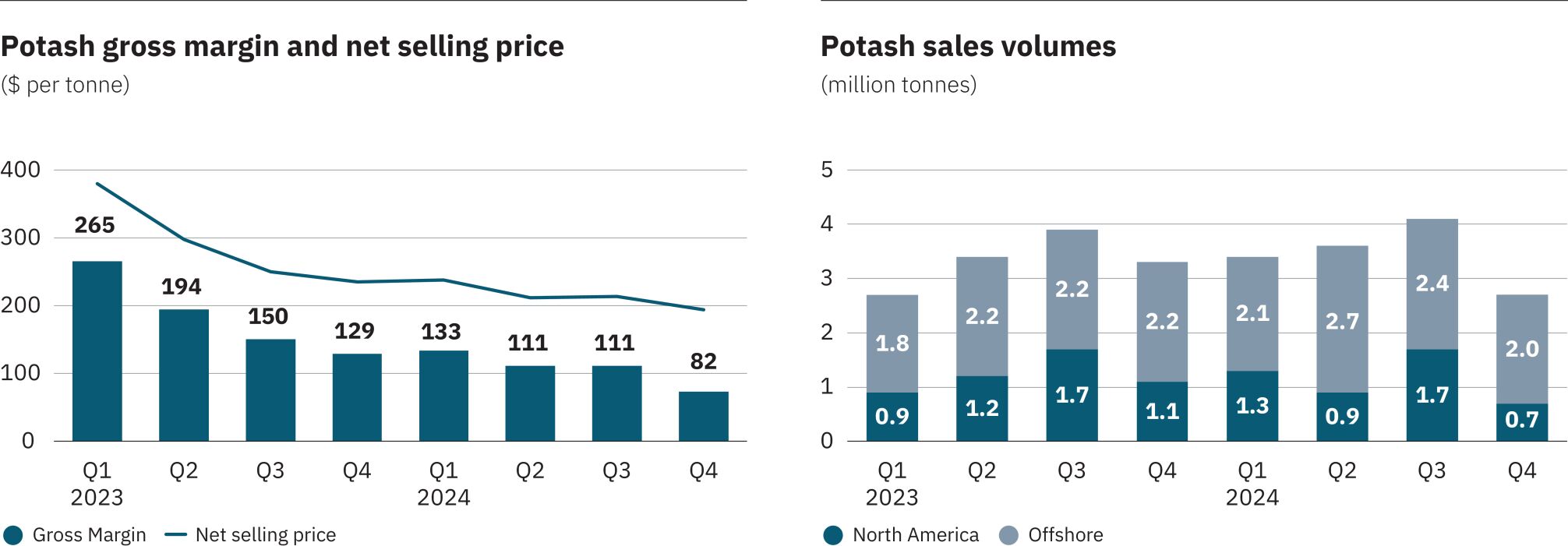
Potash production
| Operational capability 2 | Production | |||||||||||||||||||||||||||||||||||||||||
| (million tonnes KCl) |
|
|
|
|
|
Nameplate capacity 1 | 2025 | 2024 |
|
2024 | 2023 | |||||||||||||||||||||||||||||||
| Rocanville |
6.5 | 5.0 | 5.1 | 5.02 | 4.97 | |||||||||||||||||||||||||||||||||||||
| Allan |
4.0 | 2.7 | 2.4 | 2.40 | 2.39 | |||||||||||||||||||||||||||||||||||||
| Lanigan |
3.8 | 3.2 | 3.0 | 3.40 | 2.89 | |||||||||||||||||||||||||||||||||||||
| Vanscoy |
3.0 | 1.1 | 1.1 | 1.03 | 1.05 | |||||||||||||||||||||||||||||||||||||
| Cory |
3.0 | 2.1 | 2.1 | 2.11 | 1.50 | |||||||||||||||||||||||||||||||||||||
| Patience Lake |
0.3 | 0.3 | 0.3 | 0.25 | 0.20 | |||||||||||||||||||||||||||||||||||||
| Total |
20.6 | 14.4 | 14.0 | 14.21 | 13.00 | |||||||||||||||||||||||||||||||||||||
| 1 | Represents estimates of capacity as at December 31, 2024. Estimates based on capacity as per design specifications or Canpotex entitlements once determined. In the case of Patience Lake, estimate reflects current operational capability. Estimates for all other facilities do not necessarily represent operational capability. |
| 2 | Estimated annual achievable production based on expected staffing and operational readiness (estimated at the beginning of the year, and may vary during the year, and year to year, including between our facilities). Estimate does not include inventory-related shutdowns and unplanned downtime. |
52 | Nutrien Annual Report 2024
|
|
Overview | MD&A | Five-year highlights | Financial statements and notes | ||||||||||
|
Results |
2024 NITROGEN OPERATING SEGMENT AND RESULTS
Nitrogen – #3 Global nitrogen producer
We produce nitrogen at nine strategically located production facilities throughout Canada, the US and Trinidad and operate four regional product upgrade sites in North America. Our North American operations, which account for approximately 85 percent of our Nitrogen sales volumes, have access to some of the lowest cost natural gas in the world and are well positioned to serve agriculture and industrial markets. Our Trinidad operations support sales to approximately 30 countries and have natural gas supply contracts indexed to ammonia prices.
We produce a diverse portfolio of nitrogen products, including ESN®, which aims to improve nitrogen-use efficiency, and have flexibility to optimize product mix in changing market conditions. Our transportation and distribution network leverages truck, rail, pipeline, barge and marine vessel modes, including direct access to tidewater in both the US and Trinidad.
We leverage carbon capture, utilization and storage technology at two of our facilities. In 2024, we received verification of the carbon intensity of ammonia production at our Redwater facility under The Fertilizer Institute’s Verified Ammonia Carbon Intensity Program. We have captured and sold at least 1 million tonnes of CO2 annually for the last five years, of which approximately 450K tonnes of CO2 were permanently sequestered via enhanced oil recovery from our operations in 2024.
Our Nitrogen business generated adjusted EBITDA of $1.9 billion, relatively flat compared to the prior year as lower net selling prices offset higher sales volumes and lower natural gas costs. Sales volumes increased due to higher production at our operations in Trinidad and reliability improvements across our network in North America increasing the availability of upgraded products. Cost of goods sold per tonne decreased primarily due to lower natural gas costs in North America and the impact of higher production volumes.
| ($ millions, except as otherwise noted) | 2024 | 2023 | % Change | |||||||||
| Net sales |
3,745 | 4,207 | (11 | ) | ||||||||
| Cost of goods sold |
2,535 | 2,828 | (10 | ) | ||||||||
| Gross margin |
1,210 | 1,379 | (12 | ) | ||||||||
| Adjusted EBITDA 1 |
1,884 | 1,930 | (2 | ) | ||||||||
|
1 See Note 3 to the consolidated financial statements. |
||||||||||||
|
Manufactured product
|
||||||||||||
| ($ per tonne, except as otherwise noted) |
|
2024 | 2023 | |||||||||
| Sales volumes (tonnes – thousands) |
||||||||||||
| Ammonia |
2,483 | 2,436 | ||||||||||
| Urea and ESN® |
3,188 | 3,125 | ||||||||||
| Solutions, nitrates and sulfates |
|
|
|
5,023 | 4,862 | |||||||
| Total sales volumes |
|
|
|
10,694 | 10,423 | |||||||
| Net selling price |
||||||||||||
| Ammonia |
410 | 469 | ||||||||||
| Urea and ESN® |
421 | 480 | ||||||||||
| Solutions, nitrates and sulfates |
|
|
|
221 | 244 | |||||||
| Average net selling price |
324 | 367 | ||||||||||
| Cost of goods sold |
|
|
|
213 | 233 | |||||||
| Gross margin |
111 | 134 | ||||||||||
| Depreciation and amortization |
|
|
|
55 | 55 | |||||||
| Gross margin excluding depreciation and amortization 1 |
|
|
|
166 | 189 | |||||||
|
1 This is a non-GAAP financial measure. See the “Non-GAAP financial measures” section. |
||||||||||||
Nutrien Annual Report 2024 | 53
|
|
Overview | MD&A | Five-year highlights | Financial statements and notes | ||||||||||
|
Results |
Supplemental data
|
|
2024 | 2023 | ||||||
| Ammonia controllable cash cost of product manufactured per tonne 1 |
61 | 60 | ||||||
| Sales volumes (tonnes – thousands) |
||||||||
| Fertilizer |
6,259 | 6,067 | ||||||
| Industrial and feed |
4,435 | 4,356 | ||||||
| Natural gas costs ($ per MMBtu) |
||||||||
| Overall natural gas cost excluding realized derivative impact |
3.15 | 3.51 | ||||||
| Realized derivative impact |
0.09 | (0.02 | ) | |||||
| Overall natural gas cost |
3.24 | 3.49 | ||||||
|
1 This is a non-GAAP financial measure. See the “Non-GAAP financial measures” section. |
|
|||||||
|
|
2024 versus 2023 | |
| Sales volumes |
Sales volumes increased in 2024 due to higher production at our operations in Trinidad and reliability improvements across our network in North America increasing the availability of upgraded products. | |
| Net selling price per tonne |
Net selling price per tonne was lower in 2024 for all major nitrogen products due to weaker benchmark prices. | |
| Cost of goods sold per tonne |
Cost of goods sold per tonne decreased in 2024 primarily due to lower natural gas costs in North America and the impact of higher production volumes. | |
| Adjusted EBITDA |
Adjusted EBITDA for 2024 was relatively flat as lower net selling prices offset higher sales volumes and lower natural gas costs. Our total ammonia production increased in 2024 supported by less maintenance downtime and improved natural gas utilization and reliability at our operations in Trinidad. | |

Nitrogen production
| Ammonia 1 | Urea 2 | |||||||||||||||||||||||
| (million tonnes, except as otherwise noted) | |
Annual capacity |
3 |
Production | |
Annual capacity |
3 |
Production | ||||||||||||||||
| 2024 | 2023 | 2024 | 2023 | |||||||||||||||||||||
| Trinidad 4 |
2.2 | 1.27 | 1.11 | 0.7 | 0.47 | 0.32 | ||||||||||||||||||
| Redwater |
1.0 | 0.86 | 0.89 | 0.7 | 0.70 | 0.76 | ||||||||||||||||||
| Augusta |
0.8 | 0.68 | 0.74 | 0.6 | 0.52 | 0.56 | ||||||||||||||||||
| Lima |
0.7 | 0.59 | 0.68 | 0.5 | 0.46 | 0.51 | ||||||||||||||||||
| Geismar |
0.6 | 0.58 | 0.43 | 0.4 | 0.38 | 0.30 | ||||||||||||||||||
| Carseland |
0.5 | 0.46 | 0.53 | 0.7 | 0.65 | 0.75 | ||||||||||||||||||
| Fort Saskatchewan |
0.5 | 0.44 | 0.39 | 0.4 | 0.40 | 0.35 | ||||||||||||||||||
| Borger |
0.5 | 0.35 | 0.24 | 0.6 | 0.42 | 0.31 | ||||||||||||||||||
| Joffre |
0.5 | 0.38 | 0.34 | – | – | – | ||||||||||||||||||
| Total |
7.3 | 5.61 | 5.35 | 4.6 | 4.00 | 3.86 | ||||||||||||||||||
| Adjusted total 5 |
|
|
|
3.96 | 3.90 |
|
|
|
|
|
|
|
|
|
||||||||||
| Ammonia operating rate 5 (%) |
|
|
|
88 | 88 |
|
|
|
|
|
|
|
|
|
||||||||||
| 1 | All figures are shown on a gross production basis. |
| 2 | Reflects capacity and production of urea liquor prior to final product upgrade. Urea liquor is used in the production of solid urea, UAN and DEF. |
| 3 | Annual capacity estimates include allowances for normal operating plant conditions. |
| 4 | In 2023, Trinidad production was restricted due to natural gas curtailments. |
| 5 | Excludes Trinidad and Joffre. |
54 | Nutrien Annual Report 2024
|
|
Overview | MD&A | Five-year highlights | Financial statements and notes | ||||||||||
|
Results |
2024 PHOSPHATE OPERATING SEGMENT AND RESULTS
Phosphate – #2 North American phosphate producer
Nutrien has two large integrated phosphate production facilities and four regional product upgrade sites in the US. Our high-quality phosphate rock enables production of a diverse mix of phosphate products, including solid and liquid fertilizers, feed and industrial acids. We are the largest producer of purified phosphoric acid in North America and sell the majority of our product in this market, benefiting from our extensive distribution network and customer relationships.
Our Phosphate business generated adjusted EBITDA of $384 million, lower than the prior year due to weaker industrial and feed net selling prices and the impact of lower production, partially offset by lower sulfur and ammonia input costs. Sales volumes were lower primarily due to weather-related events and plant outages that impacted production volumes. Lower production volumes and higher water treatment costs related to weather-related events increased our cost of goods sold per tonne, which was partially offset by lower sulfur and ammonia input costs.
| ($ millions, except as otherwise noted) | 2024 | 2023 | % Change | |||||||||
| Net sales |
1,657 | 1,993 | (17 | ) | ||||||||
| Cost of goods sold |
1,510 | 1,760 | (14 | ) | ||||||||
| Gross margin |
147 | 233 | (37 | ) | ||||||||
| Adjusted EBITDA 1 |
384 | 470 | (18 | ) | ||||||||
| 1 | See Note 3 to the consolidated financial statements. |
Manufactured product
| ($ per tonne, except as otherwise noted) | 2024 | 2023 | ||||||
| Sales volumes (tonnes — thousands) |
||||||||
| Fertilizer |
1,751 | 1,912 | ||||||
| Industrial and feed |
683 | 639 | ||||||
| Total sales volumes |
2,434 | 2,551 | ||||||
| Net selling price |
||||||||
| Fertilizer |
612 | 568 | ||||||
| Industrial and feed |
822 | 1,010 | ||||||
| Average net selling price |
671 | 678 | ||||||
| Cost of goods sold |
603 | 583 | ||||||
| Gross margin |
68 | 95 | ||||||
| Depreciation and amortization |
119 | 115 | ||||||
| Gross margin excluding depreciation and amortization 1 |
187 | 210 | ||||||
| 1 | This is a non-GAAP financial measure. See the “Non-GAAP financial measures” section. |
|
|
2024 versus 2023 | |
| Sales volumes |
Sales volumes decreased in 2024 primarily due to weather-related events and plant outages that impacted production volumes. | |
| Net selling price |
Net selling price per tonne decreased in 2024 due to lower industrial and feed net selling prices which reflect the typical lag in price realizations relative to benchmark prices. | |
| Cost of goods sold per tonne |
Cost of goods sold per tonne increased in 2024 due to lower production volumes and higher water treatment costs related to weather-related events, partially offset by lower sulfur and ammonia input costs. | |
| Adjusted EBITDA |
Adjusted EBITDA decreased in 2024 due to weaker industrial and feed net selling prices and the impact of lower production, partially offset by lower sulfur and ammonia input costs. | |
Nutrien Annual Report 2024 | 55
|
|
Overview | MD&A | Five-year highlights | Financial statements and notes | ||||||||||
|
Results |

Phosphate production
| Phosphate rock | Phosphoric acid (P2O5) | Liquid products | Solid fertilizer products | |||||||||||||||||||||||||||||||||||||||||||||
| (million tonnes, except as otherwise noted) |
Annual capacity |
Production | Annual capacity |
Production | Annual capacity |
Production | Annual capacity |
Production | ||||||||||||||||||||||||||||||||||||||||
| 2024 | 2023 | 2024 | 2023 | 2024 | 2023 | 2024 | 2023 | |||||||||||||||||||||||||||||||||||||||||
| Aurora |
5.4 | 3.99 | 4.24 | 1.2 | 0.97 | 1.00 | 2.7 | 1 | 2.05 | 2.13 | 0.9 | 0.76 | 0.77 | |||||||||||||||||||||||||||||||||||
| White Springs |
2.0 | 1.19 | 1.27 | 0.5 | 0.36 | 0.40 | 0.7 | 2 | 0.29 | 0.33 | 0.8 | 0.31 | 0.33 | |||||||||||||||||||||||||||||||||||
| Total |
7.4 | 5.18 | 5.51 | 1.7 | 1.33 | 1.40 | 3.4 | 2.34 | 2.46 | 1.7 | 1.07 | 1.10 | ||||||||||||||||||||||||||||||||||||
|
P2O5 operating rate (%) |
|
|
|
|
|
|
|
|
|
|
|
|
78 | 83 |
|
|
|
|
|
|
|
|
|
|
|
|
|
|
|
|
|
|
||||||||||||||||
| 1 | A substantial portion is consumed internally in the production of downstream products. The balance is exported to phosphate fertilizer producers or sold domestically to dealers who custom-mix liquid fertilizer. Capacity is composed of 2.0 million tonnes MGA and 0.7 million tonnes SPA. |
| 2 | Represents annual SPA capacity. A substantial portion is consumed internally in the production of downstream products. The balance is exported to phosphate fertilizer producers or sold domestically to dealers who custom-mix liquid fertilizer. |
In addition to the production above, annual capacity (in millions of tonnes) for phosphate feed and purified acid was 0.7 and 0.3 million tonnes, respectively. Production in 2024 was 0.31 and 0.17 million tonnes, respectively, and 2023 production was 0.30 and 0.16 million tonnes, respectively.
56 | Nutrien Annual Report 2024
|
|
Overview | MD&A | Five-year highlights | Financial statements and notes | ||||||||||
|
Results |
2024 CORPORATE AND OTHERS AND ELIMINATIONS
“Corporate and Others” is a non-operating segment comprising corporate and administrative functions that provide support and governance to our operating segments. It also includes gross margin related to our non-core business. Intersegment sales, costs of goods sold and expenses are removed from the consolidated results in Eliminations. Intersegment activities include sale of product between our segments, primarily from Potash, Nitrogen and Phosphate to our Retail segment.
| ($ millions, except as otherwise noted) | 2024 | 2023 | % Change | |||||||||
| Corporate and Others |
||||||||||||
| Gross margin 1 |
13 | – | n/m | |||||||||
| Adjusted EBITDA 1 |
(456 | ) | (267 | ) | 71 | |||||||
| Eliminations |
||||||||||||
| Gross margin |
(2 | ) | 69 | n/m | ||||||||
| Adjusted EBITDA 1 |
(1 | ) | 62 | n/m | ||||||||
| 1 | See Note 3 to the consolidated financial statements. |
|
|
2024 versus 2023 | |
| Corporate and Others |
Adjusted EBITDA decreased in 2024 due to an $80 million gain in 2023 from our other post-retirement benefit plan amendments. | |
| Eliminations |
Eliminations of gross margin in 2024 resulted from higher intersegment inventory held by our Retail segment compared to a recovery of gross margin in 2023 which reflected the sell-through of higher cost inventory. | |
FINANCE COSTS, INCOME TAXES AND OTHER COMPREHENSIVE (LOSS) INCOME
| ($ millions, except as otherwise noted) | 2024 | 2023 | % Change | |||||||||
| Finance costs |
720 | 793 | (9 | ) | ||||||||
| Income tax expense |
436 | 670 | (35 | ) | ||||||||
| Other comprehensive (loss) income |
(234 | ) | 81 | n/m | ||||||||
|
|
2024 versus 2023 | |||||||||
| Finance costs |
Finance costs were lower in 2024 primarily due to lower average short-term debt balance from lower working capital requirements, partially offset by the increase in average long-term debt balance throughout 2024. |
|
||||||||
| Weighted average debt balances and rates
|
||||||||||
|
|
($ millions, except as otherwise noted) | 2024 | 2023 | |||||||
| Short-term debt balance 1 | 3,328 | 3,988 | ||||||||
| Short-term debt rate (%) 1 | 6.1 | 6.1 | ||||||||
| Long-term debt balance | 9,629 | 9,112 | ||||||||
| Long-term debt rate (%) | 5.0 | 5.0 | ||||||||
| Lease obligations balance | 1,375 | 1,200 | ||||||||
| Lease obligations rate (%) | 4.6 | 4.0 | ||||||||
|
1 North American weighted average short-term debt balances were $2,679 million (2023 – $3,306 million) and rates were 5.5 percent (2023 –5.6 percent). |
|
|||||||||
| Income tax expense |
Income tax expense decreased in 2024 due to lower earnings and lower discrete tax adjustments. The discrete tax adjustments in 2023 were related to a change in recognition of deferred tax assets in South America as they no longer met the asset recognition criteria, the impact of changes in our tax declarations in Switzerland (“Swiss Tax Reform”), and Canadian audit assessments. Refer to Note 10 to the consolidated financial statements for additional information. |
|
||||||||
| Effective tax rates and discrete items
|
||||||||||
|
|
($ millions, except as otherwise noted) | 2024 | 2023 | |||||||
| Actual effective tax rate on earnings (%) | 40 | 33 | ||||||||
| Actual effective tax rate including discrete items (%) | 38 | 34 | ||||||||
| Discrete tax adjustments that impacted the rate | (13 | ) | 28 | |||||||
| Other comprehensive (loss) income | Other comprehensive loss in 2024 was mainly due to the depreciation of the Australian, Brazilian and Canadian currencies, relative to the US dollar, compared to a gain in 2023. |
|
||||||||
Nutrien Annual Report 2024 | 57
|
|
Overview | MD&A | Five-year highlights | Financial statements and notes | ||||||||||
|
Results |
| 2025 Guidance ranges 1,2 as of February 19, 2025 |
||||||||||||
| (billions of US dollars, except as otherwise noted) | Low | High | 2024 Actual | |||||||||
| Retail adjusted EBITDA |
1.65 | 1.85 | 1.7 | |||||||||
| Potash sales volumes (million tonnes) 3 |
13.6 | 14.4 | 13.9 | |||||||||
| Nitrogen sales volumes (million tonnes) 3 |
10.7 | 11.2 | 10.7 | |||||||||
| Phosphate sales volumes (million tonnes) 3 |
2.35 | 2.55 | 2.4 | |||||||||
| Depreciation and amortization |
2.35 | 2.45 | 2.3 | |||||||||
| Finance costs |
0.65 | 0.75 | 0.7 | |||||||||
| Effective tax rate on adjusted net earnings (%) 4 |
22.0 | 25.0 | 24.1 | |||||||||
| Capital expenditures 5 |
2.0 | 2.1 | 2.2 | |||||||||
| 1 | Guidance provided in our news release dated February 19, 2025. |
| 2 | See the “Forward-Looking Statements” section. |
| 3 | Manufactured product only. |
| 4 | This is a non-GAAP financial measure. See the “Non-GAAP Financial Measures” section. |
| 5 | Comprised of sustaining capital expenditures, investing capital expenditures and mine development and pre-stripping capital expenditures. See the “Other Financial Measures” section. |
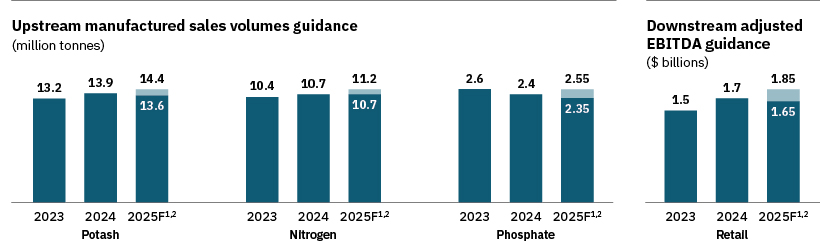
2025 SENSITIVITIES
| Effect on 1 | ||||||||
| ($ millions, except EPS amounts) | Adjusted EBITDA | Adjusted EPS | 4 | |||||
| $25 per tonne change in potash net selling prices |
± 280 | ± 0.45 | ||||||
| $25 per tonne change in ammonia net selling prices 2 |
± 35 | ± 0.05 | ||||||
| $25 per tonne change in urea and ESN® net selling prices |
± 85 | ± 0.15 | ||||||
| $25 per tonne change in solutions, nitrates and sulfates net selling prices |
± 130 | ± 0.20 | ||||||
| $1 per MMBtu change in NYMEX natural gas price 3 |
± 190 | ± 0.30 | ||||||
| 1 | See the “Forward-Looking Statements” section. |
| 2 | Includes related impact on natural gas costs in Trinidad, which is linked to benchmark ammonia pricing. |
| 3 | Nitrogen related impact. |
| 4 | Assumes 486 million shares outstanding for all earnings per share (“EPS”) sensitivities. |
58 | Nutrien Annual Report 2024
|
|
Overview | MD&A | Five-year highlights | Financial statements and notes | ||||||||||
|
Results |
| ($ millions, except as otherwise noted) | 2024 | 2023 | 2022 | |||||||||
| Sales |
25,972 | 29,056 | 37,884 | |||||||||
| Net earnings |
700 | 1,282 | 7,687 | |||||||||
| Basic net earnings per share (dollars) |
1.36 | 2.53 | 14.22 | |||||||||
| Diluted net earnings per share (dollars) |
1.36 | 2.53 | 14.18 | |||||||||
| Total assets |
51,840 | 52,749 | 54,586 | |||||||||
| Total non-current financial liabilities |
9,880 | 9,912 | 8,939 | |||||||||
| Dividends declared per share (dollars) |
2.16 | 2.12 | 1.92 | |||||||||
|
|
2024 versus 2023 | 2023 versus 2022 | ||
| Sales |
Sales decreased primarily due to lower fertilizer net selling prices, partially offset by record Potash sales volumes. | Sales decreased primarily due to lower net selling prices compared to the historically strong prices in 2022, partially offset by higher sales volumes for Retail crop nutrients, Potash and Nitrogen. | ||
| Net earnings and earnings per share |
Net earnings and earnings per share decreased primarily due to lower sales (see above), partially offset by lower operational expenses due to lower input costs such as cost to purchase inventories, natural gas, royalties and provincial mining taxes.
Net earnings in 2024 were also impacted by a previously disclosed $220 million loss on foreign currency derivatives in Brazil (see the “Controls and Procedures” section of this MD&A and Note 5 to the consolidated financial statements). Our impairment of assets were lower in 2024. We recorded $530 million non-cash impairments of our Retail – Brazil and Nitrogen Geismar Clean Ammonia project assets in 2024 compared to non-cash impairment of $774 million of Retail, Phosphate and Nitrogen assets recorded in 2023. Refer to Note 14 to the consolidated financial statements for additional information. |
Net earnings and earnings per share decreased primarily due to lower net selling prices across our nutrient segments due to a decline in benchmark prices. This was partially offset by lower costs and expenses, which are based on selling or benchmark prices, such as royalties, provincial mining taxes, natural gas and cost to purchase inventories.
In 2023, we recorded $774 million non-cash impairments of our Retail – South America assets, Phosphate White Springs and Nitrogen Trinidad assets compared to non-cash impairment reversals of $780 million of Phosphate assets recorded in 2022. |
||
| Assets and non-current financial liabilities |
Total assets decreased in 2024 compared to 2023 primarily due to the non-cash impairments discussed above as well as from lower working capital assets from reduced net selling prices and lower cost of inventories.
Non-current financial liabilities increased due to the higher long-term debt balance from the issuance of new senior notes, partially offset by the repayment of senior notes upon maturity in 2024. |
Total assets decreased approximately 3 percent from 2022 primarily due to lower receivables and inventories as we collected and sold through our higher-valued receivables and inventories from historically strong prices in 2022 and $774 million of non-cash impairments (as described above). This is partially offset by higher capital spending on property, plant and equipment.
Non-current financial liabilities increased due to the higher long-term debt balance from the issuance of new senior notes, partially offset by the repayment of senior notes upon maturity in 2023. |
||
| Dividends declared per share |
Dividends declared per share increased as we declared a higher quarterly dividend per share of $0.54 in 2024 compared to $0.53 in 2023. | Dividends declared per share increased as we declared a higher quarterly dividend per share of $0.53 in 2023 compared to $0.48 in 2022. | ||
Nutrien Annual Report 2024 | 59
|
|
Overview | MD&A | Five-year highlights | Financial statements and notes | ||||||||||
|
Results |
FINANCIAL CONDITION REVIEW
| As at | ||||||||||||||||
| ($ millions, except as otherwise noted) | December 31, 2024 | December 31, 2023 | $ Change | % Change | ||||||||||||
| Assets |
||||||||||||||||
| Cash and cash equivalents |
853 | 941 | (88 | ) | (9 | ) | ||||||||||
| Receivables |
5,390 | 5,398 | (8 | ) | – | |||||||||||
| Inventories |
6,148 | 6,336 | (188 | ) | (3 | ) | ||||||||||
| Property, plant and equipment |
22,604 | 22,461 | 143 | 1 | ||||||||||||
| Intangible assets |
1,819 | 2,217 | (398 | ) | (18 | ) | ||||||||||
| Liabilities and Shareholders’ Equity |
||||||||||||||||
| Short-term debt |
1,534 | 1,815 | (281 | ) | (15 | ) | ||||||||||
| Payables and accrued charges |
9,118 | 9,467 | (349 | ) | (4 | ) | ||||||||||
| Long-term debt, including current portion |
9,918 | 9,425 | 493 | 5 | ||||||||||||
| Share capital |
13,748 | 13,838 | (90 | ) | (1 | ) | ||||||||||
| Retained earnings |
11,106 | 11,531 | (425 | ) | (4 | ) | ||||||||||
| Assets | Liabilities | |
| Explanations for changes in Cash and cash equivalents are in the “Liquidity and Capital Resources – Sources and Uses of Cash” section.
Receivables remained flat compared to 2023. We had higher receivables due to lower crop margins and weather challenges contributing to longer collection periods. This was offset by lower net selling prices across all our operating segments. In addition, the weaker foreign exchange rates against the US dollar, primarily from Canada, Australia and Brazil, resulted in the lower receivables.
Inventories decreased across most of our operating segments due to lower cost to purchase inventories for resale and lower input costs, such as natural gas and sulfur. We also closely managed our inventory levels to improve working capital.
Property, plant and equipment increased due to capital expenditures incurred partially offset by non-cash impairments related to our Retail – Brazil assets and Nitrogen Geismar Clean Ammonia project in 2024.
Intangible assets decreased due to an impairment of our Retail – Brazil assets in 2024. |
Short-term debt decreased due to lower drawdowns on our commercial paper program based on our working capital requirements.
Payables and accrued charges decreased due to lower operational and capital expenditures and lower foreign exchange rates in Canada, Australia and Brazil against the US dollar. Cost to purchase inventories for resale, natural gas and sulfur costs, and expenses tied to selling prices, such as royalties decreased.
Long-term debt, including the current portion, increased due to the issuance of $1,000 million of senior notes in 2024, which exceeded the repayment of $500 million in senior notes upon maturity in the same period.
Shareholders’ equity
Share capital decreased primarily from shares repurchased under our normal course issuer bid program.
Retained earnings decreased as dividends declared and share repurchases exceeded net earnings in 2024. |
We do not hold material cash and cash equivalents in currencies other than the US dollar and Canadian dollar. As at December 31, 2024, we held the equivalent of approximately $347 million US dollars in other jurisdictions outside the US and Canada. We do not depend on repatriation of cash from our foreign subsidiaries to meet our liquidity and capital resource needs in North America.
60 | Nutrien Annual Report 2024
|
|
Overview | MD&A | Five-year highlights | Financial statements and notes | ||||||||||
|
Results |
LIQUIDITY AND CAPITAL RESOURCES
Sources and uses of liquidity
Liquidity risk arises from our general funding needs and in the management of our assets, liabilities and capital structure. We manage liquidity risk to maintain sufficient liquid financial resources to fund our financial position and meet our commitments and obligations in a cost-effective manner. Our primary sources of liquidity in 2024 and our expected ongoing primary uses of liquidity are listed below:
| Primary uses of liquidity | Primary sources of liquidity | |
| – seasonal working capital requirements – operational expenses – capital expenditures to sustain our assets to support safe and reliable operations – high-value growth opportunities – shareholder returns through dividends and/or share repurchases – principal payments of debt securities |
– cash from operations (including customer prepayments) – commercial paper issuances – increase of credit facility limits and drawdowns – debt capital markets – supplier financing arrangements |
|
We believe that our internally generated cash flow, supplemented by available borrowings under new or existing financing sources, if necessary, will be sufficient to meet our anticipated capital expenditures, planned growth and development activities, and other cash requirements for the foreseeable future. We do not reasonably expect any presently known trend or uncertainty to affect our ability to access our historical sources of liquidity.
Cash requirements
The following aggregated information about our contractual obligations and other commitments summarizes our liquidity and capital resource requirements as at December 31, 2024. Commitments reflect the estimated cash outflows for these obligations.
| Consolidated financial statements note reference |
Payments due by period | |||||||||||||||||||||
| ($ millions) | Total | Within 1 year |
1 to 3 years |
3 to 5 years |
Over 5 years |
|||||||||||||||||
| Long-term debt |
19, 24 | 9,725 | 1,037 | 1,033 | 1,500 | 6,155 | ||||||||||||||||
| Estimated interest payments on long-term debt |
24 | 6,032 | 471 | 830 | 693 | 4,038 | ||||||||||||||||
| Asset retirement obligations and accrued environmental costs |
22 | 4,053 | 178 | 246 | 184 | 3,445 | ||||||||||||||||
| Lease liabilities |
20, 24 | 1,355 | 356 | 437 | 197 | 365 | ||||||||||||||||
| Estimated interest payments on lease liabilities |
24 | 239 | 50 | 66 | 40 | 83 | ||||||||||||||||
| Purchase commitments |
24 | 1,335 | 1,039 | 75 | 43 | 178 | ||||||||||||||||
| Capital commitments |
24 | 99 | 77 | 22 | – | – | ||||||||||||||||
| Other commitments |
24 | 613 | 189 | 222 | 80 | 122 | ||||||||||||||||
| Derivatives |
5 | 33 | 33 | – | – | – | ||||||||||||||||
| Total |
|
23,484 | 3,430 | 2,931 | 2,737 | 14,386 | ||||||||||||||||
The information presented in the table above does not include planned but not legally committed capital expenditures, business acquisitions or shareholder returns, including share repurchases and dividends. In addition to the commitments included above, we have other obligations for goods and services as part of our normal operations, which may terminate on short notice, including purchase commitments for crop input products.
For information on income taxes and pension and other post-retirement benefits funding, refer to Note 10 and Note 21, respectively, to the consolidated financial statements. Future cash requirements are subject to changes in regulations, actuarial assumptions and our expected operating results.
On February 19, 2025, our Board approved a share repurchase program of up to a maximum of 24,462,941 common shares, representing 5 percent of Nutrien’s outstanding common shares. The 2025 normal course issuer bid, which is subject to acceptance by the Toronto Stock Exchange, will commence on March 3, 2025. The share repurchase program will expire on the earlier of March 2, 2026, the date on which we have acquired the maximum number of common shares allowable or the date we determine not to make any further repurchases.
On February 19, 2025, our Board of Directors declared and increased our quarterly dividend to $0.545 per share payable on April 10, 2025, to shareholders of record on March 31, 2025. The total estimated dividend to be paid is $265 million.
Nutrien Annual Report 2024 | 61
|
|
Overview | MD&A | Five-year highlights | Financial statements and notes | ||||||||||
|
Results |
Sources and uses of cash
|
Cash provided by operating activities |
|
– Lower cash provided by operating activities from lower net realized selling prices across all segments, which resulted in lower cash collections. This was partially offset by lower cash paid for income taxes and cash paid to our suppliers primarily due to lower cost to purchase inventory for resale and other costs such as royalties, natural gas and sulfur costs. |
||
|
Cash used in investing activities |
|
– Lower cash used in investing activities due to lower turnaround activities and investing capital expenditures consistent with our capital allocation priorities in 2024. |
||
|
Cash used in financing activities |
|
– Lower cash used in financing activities due to decreased share repurchases in 2024. We also issued $1.0 billion senior notes in 2024 compared to $1.5 billion in 2023. |
||
62 | Nutrien Annual Report 2024
|
|
Overview | MD&A | Five-year highlights | Financial statements and notes | ||||||||||
|
Results |
CAPITAL STRUCTURE AND MANAGEMENT
We manage our capital structure with a focus on maintaining a strong balance sheet, enabling a strong investment-grade credit rating.
Principal debt instruments
As part of the normal course of business, we closely monitor our liquidity position. We use a combination of cash generated from operations and short-term and long-term debt to finance our operations. We continually evaluate various financing arrangements and may seek to engage in transactions from time to time when market and other conditions are favorable.
Capital structure (debt and equity)
| ($ millions) | December 31, 2024 | December 31, 2023 | ||||||
| Short-term debt |
1,534 | 1,815 | ||||||
| Current portion of long-term debt |
1,037 | 512 | ||||||
| Current portion of lease liabilities |
356 | 327 | ||||||
| Long-term debt |
8,881 | 8,913 | ||||||
| Lease liabilities |
999 | 999 | ||||||
| Shareholders’ equity |
24,442 | 25,201 | ||||||
Senior notes and debentures
As at December 31, 2024, our long-term debt consisted primarily of senior notes and debentures with the following maturities and interest rates:
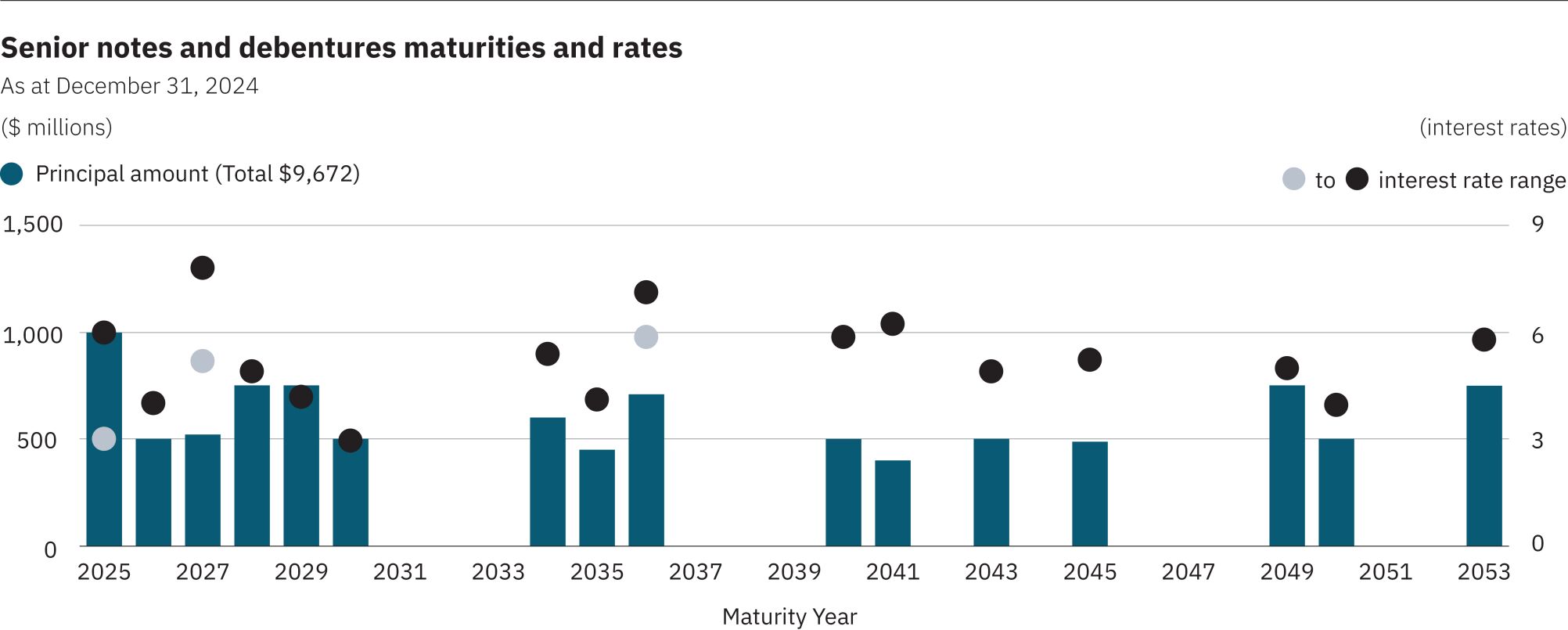
| ($ millions, except as otherwise noted) | Rate of interest (%) | Maturity | Amount | |||||||||
| Senior notes repaid in 2024 |
5.9 | November 7, 2024 | 500 | |||||||||
| Senior notes issued in 2024 |
5.2 | June 21, 2027 | 400 | |||||||||
| Senior notes issued in 2024 |
5.4 | June 21, 2034 | 600 | |||||||||
|
|
|
|
|
|
|
|
1,000 | |||||
The senior notes issued in 2024 are unsecured, rank equally with our existing unsecured debt, and have no sinking fund requirements prior to maturity. Each series is redeemable and has various provisions for redemption prior to maturity, at our option, at specified prices.
Nutrien Annual Report 2024 | 63
|
|
Overview | MD&A | Five-year highlights | Financial statements and notes | ||||||||||
|
Results |
Credit facilities and other debt
We have several available credit facilities in the jurisdictions where we operate. We have a commercial paper program, which is limited to the undrawn amount under our $4,500 million unsecured revolving term credit facility and excess cash invested in highly liquid securities. As at December 31, 2024, we had a $961 million outstanding balance in commercial paper.
As at December 31, 2024, $243 million in letters of credit were outstanding and committed, with $219 million of remaining credit available under our dedicated letter of credit facilities.
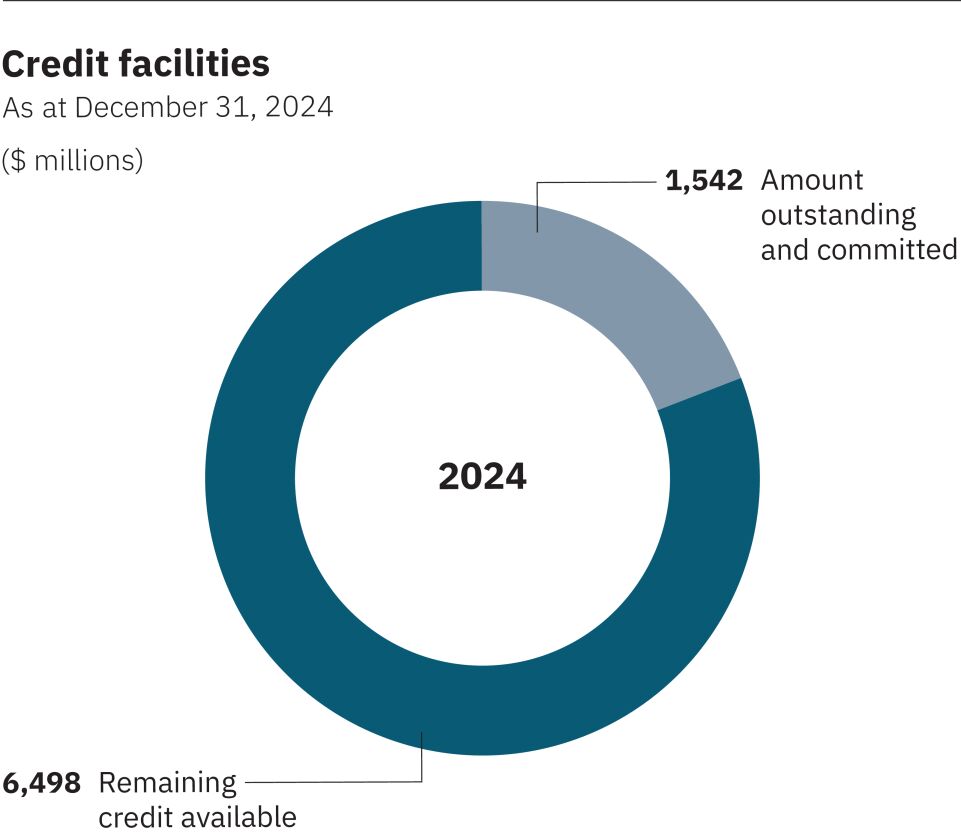
Lease obligations
We also had lease obligations totaling $1,355 million (including current portion) with a weighted average effective interest rate of 4.8 percent as at December 31, 2024.
Debt covenants
Our credit facilities have financial tests and other covenants with which we must comply at each quarter-end. Non-compliance with any such covenants could result in accelerated payment of amounts borrowed and termination of lenders’ further funding obligations under the credit facilities. We were in compliance with all such covenants as at December 31, 2024.
The table below summarizes the limit and result of our key financial covenant:
| As at December 31 | Limit | 2024 | ||||||
| Debt to capital ratio 1 |
0.65 : 1.00 | 0.35 : 1.00 | ||||||
| 1 | Refer to Note 4 to the consolidated financial statements for the detailed calculation. |
Credit ratings
Our ability to access reasonably priced debt in the capital markets depends, in part, on the quality of our credit ratings. We continue to maintain investment-grade credit ratings for our long-term debt. A downgrade of the credit rating of our long-term debt could increase the interest rates applicable to borrowings under our credit facilities.
Commercial paper markets are normally a source of same-day cash for us. Our access to the US commercial paper market primarily depends on maintaining our current short-term credit ratings as well as general conditions in the money markets.
| Long-term debt rating (outlook) | Short-term debt rating | |||||||||||||||
| As at December 31 | 2024 | 2023 | 2024 | 2023 | ||||||||||||
| Moody’s |
Baa2 (stable | ) | Baa2 (stable | ) | P-2 | P-2 | ||||||||||
| S&P |
BBB (stable | ) | BBB (stable | ) | A-2 | A-2 | ||||||||||
A credit rating is not a recommendation to buy, sell or hold securities. Such ratings may be subject to revision or withdrawal at any time by the respective credit rating agency and each rating should be evaluated independently of any other rating.
Moody’s stable outlook on Nutrien’s credit rating means that there is a low likelihood of a rating change over the medium term. S&P’s stable outlook on Nutrien’s credit rating means that the rating is not likely to change (generally up to two years).
Outstanding share data
|
|
As at February 18, 2025 | |
| Common shares |
489,258,826 |
|
| Options to purchase common shares |
2,927,323 | |
For more information on our capital structure and management, see Note 4 to the consolidated financial statements.
64 | Nutrien Annual Report 2024
|
|
Overview | MD&A | Five-year highlights | Financial statements and notes | ||||||||||
|
Results |
OTHER FINANCIAL INFORMATION
| Nature of financial information and consolidated financial statements note reference |
|
Description | ||
| Off-Balance Sheet Arrangements
(Notes 5, 12, 22, 25 and 27) |
|
Principal off-balance sheet activities primarily include:
– Agreement to reimburse losses of Canpotex. – Issuance of guarantee contracts. – An agency arrangement with a financial institution in relation to certain customer loans. – Certain non-financial derivatives that were entered into and continued to be held for the purpose of the receipt or delivery of a non-financial item, such as grain or natural gas, in accordance with expected purchase, sale or usage requirements. Other derivatives are included on our balance sheet at fair value.
We do not reasonably expect any presently known trend or uncertainty to affect our ability to continue using these arrangements, except as indicated above. |
||
| Related Party Transactions
(Note 26) |
|
Our most material related party is Canpotex, which provides us with low-cost marketing and logistics for the offshore potash markets that we serve. | ||
| Financial Instruments and Other Instruments
(Note 5) |
|
Our financial instruments are subject to various risks such as credit, liquidity and market risks. As discussed in the “Governance” section, our ELT is responsible for ensuring that our principal risks, including financial risks, are being appropriately identified, assessed and addressed. | ||
Critical accounting estimates
We prepare our consolidated financial statements in accordance with IFRS, which requires us to make judgments, assumptions and estimates in applying accounting policies. Critical accounting estimates are those which are highly uncertain at the time they are made or where different estimates would be reasonably likely to have a material impact on our financial condition or results of operations. We have discussed the development, selection and application of our key accounting policies, and the critical accounting estimates and assumptions they involve, with the Audit Committee of the Board.
Refer to the notes to the consolidated financial statements for additional information on the following critical accounting estimates including methodology used for calculating our estimates (when applicable), key assumptions used, and factors considered in our estimates and judgments.
| Consolidated financial statements note reference |
|
Critical accounting estimate description | ||
| Notes 14 and 27 |
|
Long-lived asset impairments and reversals
We review, at each reporting period, for conditions to determine whether there is any indication that an impairment exists that could potentially impact the carrying amount of our long-lived assets to be held and used. When such indicators exist, impairment testing is performed. We review, at each reporting period, for possible reversal of the impairment for non-financial assets, other than goodwill. |
||
| Notes 15 and 27 |
|
Goodwill impairment analysis
We test our operating segments that have goodwill allocated to them when events or circumstances indicate that there could be an impairment, or at least annually on October 1. Goodwill is more susceptible to impairment risk if business operating results or economic conditions deteriorate and we anticipate not meeting our forecasts. The key assumptions with the greatest influence on the calculation of the recoverable amounts are the discount rates, terminal growth rates and forecasted EBITDA. The key forecast assumptions were based on historical data and our estimates of future results from internal sources considering industry and market information. Key assumptions in our testing models may change, and changes that could reasonably be expected to occur may cause impairment. Such change in assumptions could be driven by global supply and demand, other market factors, changes in regulations, and other future events outside our control. Refer to note 14 of the consolidated financial statements for sensitivity analysis. |
||
Nutrien Annual Report 2024 | 65
|
|
Overview | MD&A | Five-year highlights | Financial statements and notes | ||||||||||
|
Results |
| Consolidated financial statements note reference |
|
Critical accounting estimate description | ||
| Notes 22 and 27 |
Asset retirement obligations (“AROs”) and accrued environmental costs (“ERLs”) – measurement
AROs and ERLs have a high degree of estimation uncertainty for future costs and estimated remediation timelines. The Potash and Phosphate segments have AROs and ERLs associated with their mining operations while the Corporate and Others segment has these liabilities associated with non-operational sites. Refer to note 22 of the consolidated financial statements for sensitivity analysis.
For the Nitrogen segment, there are no significant AROs recorded as there is no reasonable basis for estimating a date or range of dates of cessation of operations. We considered the historical performance of our facilities as well as our planned maintenance, major upgrades and replacements, which can extend the useful lives beyond the foreseeable future. |
|||
QUARTERLY RESULTS
|
|
2024 | 2023 | ||||||||||||||||||||||||||||||
| ($ millions, except as otherwise noted) | Q4 | Q3 | Q2 | Q1 | Q4 | Q3 | Q2 | Q1 | ||||||||||||||||||||||||
| Sales |
5,079 | 5,348 | 10,156 | 5,389 | 5,664 | 5,631 | 11,654 | 6,107 | ||||||||||||||||||||||||
| Net earnings |
118 | 25 | 392 | 165 | 176 | 82 | 448 | 576 | ||||||||||||||||||||||||
| Net earnings attributable to equity holders of Nutrien |
113 | 18 | 385 | 158 | 172 | 75 | 440 | 571 | ||||||||||||||||||||||||
| Net earnings per share attributable to equity holders of Nutrien |
||||||||||||||||||||||||||||||||
| Basic |
0.23 | 0.04 | 0.78 | 0.32 | 0.35 | 0.15 | 0.89 | 1.14 | ||||||||||||||||||||||||
| Diluted |
0.23 | 0.04 | 0.78 | 0.32 | 0.35 | 0.15 | 0.89 | 1.14 | ||||||||||||||||||||||||
Our quarterly earnings are significantly affected by the seasonality of our business, fertilizer benchmark prices, and are affected by demand-supply conditions, farmer affordability and weather. See Note 28 to the consolidated financial statements.
Other material transactions or events that impacted our quarterly results included:
| Quarter |
Transaction or event | |
| 2024 Q2 |
$530 million non-cash impairment of assets comprised of a $335 million non-cash impairment of the Retail – Brazil intangible assets and property plant and equipment due to the ongoing market instability and more moderate margin expectations, and a $195 million non-cash impairment of our Nitrogen Geismar Clean Ammonia project property, plant and equipment as we are no longer pursuing the project. Net earnings were also impacted by a $220 million loss on foreign currency derivatives in Brazil. | |
| 2023 Q2 |
$698 million non-cash impairment of assets comprised of a $233 million non-cash impairment of our Phosphate White Springs property, plant and equipment due to a decrease in our forecasted phosphate margins and a $465 million non-cash impairment of our Retail – South America assets primarily related to goodwill mainly due to the impact of crop input price volatility, more moderate long-term growth assumptions and higher interest rates which lowered our forecasted earnings. | |
66 | Nutrien Annual Report 2024
|
|
Overview | MD&A | Five-year highlights | Financial statements and notes | ||||||||||
|
Results |
FOURTH QUARTER RESULTS
| ($ millions, except as otherwise noted) Three months ended December 31 |
Sales | Gross margin | ||||||||||||||||||||||
| 2024 | 2023 | % Change | 2024 | 2023 | % Change | |||||||||||||||||||
| Retail |
||||||||||||||||||||||||
| Crop nutrients |
1,528 | 1,808 | (15 | ) | 294 | 346 | (15 | ) | ||||||||||||||||
| Crop protection products |
948 | 960 | (1 | ) | 351 | 333 | 5 | |||||||||||||||||
| Seed |
184 | 202 | (9 | ) | 52 | 36 | 44 | |||||||||||||||||
| Services and other |
228 | 236 | (3 | ) | 188 | 188 | – | |||||||||||||||||
| Merchandise |
230 | 251 | (8 | ) | 40 | 41 | (2 | ) | ||||||||||||||||
| Nutrien Financial |
77 | 70 | 10 | 77 | 70 | 10 | ||||||||||||||||||
| Nutrien Financial elimination 1 |
(16 | ) | (25 | ) | (36 | ) | (16 | ) | (25 | ) | (36 | ) | ||||||||||||
| Total |
3,179 | 3,502 | (9 | ) | 986 | 989 | – | |||||||||||||||||
| 1 | Represents elimination for the interest and service fees charged by Nutrien Financial to Retail branches. |
Manufactured product
| (Dollars, except as otherwise noted) Three months ended December 31 |
Sales tonnes (thousands) | Average dollars per tonne | ||||||||||||||||||||||
| 2024 | 2023 | % Change | 2024 | 2023 | % Change | |||||||||||||||||||
| Potash |
||||||||||||||||||||||||
| North America |
718 | 1,089 | (34 | ) | 270 | 342 | (21 | ) | ||||||||||||||||
| Offshore |
2,040 | 2,214 | (8 | ) | 168 | 182 | (8 | ) | ||||||||||||||||
| Sales |
2,758 | 3,303 | (17 | ) | 194 | 235 | (17 | ) | ||||||||||||||||
| Cost of goods sold |
|
|
|
|
|
|
|
|
|
112 | 106 | 6 | ||||||||||||
| Gross margin |
|
|
|
|
|
|
|
|
|
82 | 129 | (36 | ) | |||||||||||
| Nitrogen |
||||||||||||||||||||||||
| Ammonia |
701 | 651 | 8 | 448 | 416 | 8 | ||||||||||||||||||
| Urea and ESN® |
888 | 739 | 20 | 403 | 428 | (6 | ) | |||||||||||||||||
| Solutions, nitrates and sulfates |
1,325 | 1,344 | (1 | ) | 213 | 215 | (1 | ) | ||||||||||||||||
| Sales |
2,914 | 2,734 | 7 | 327 | 321 | 2 | ||||||||||||||||||
| Cost of goods sold |
|
|
|
|
|
|
|
|
|
221 | 218 | 1 | ||||||||||||
| Gross margin |
|
|
|
|
|
|
|
|
|
106 | 103 | 3 | ||||||||||||
| Phosphate |
||||||||||||||||||||||||
| Fertilizer |
435 | 579 | (25 | ) | 615 | 557 | 10 | |||||||||||||||||
| Industrial and feed |
173 | 174 | (1 | ) | 812 | 860 | (6 | ) | ||||||||||||||||
| Sales |
608 | 753 | (19 | ) | 671 | 627 | 7 | |||||||||||||||||
| Cost of goods sold |
|
|
|
|
|
|
|
|
|
631 | 535 | 18 | ||||||||||||
| Gross margin |
|
|
|
|
|
|
|
|
|
40 | 92 | (57 | ) | |||||||||||
| Three months ended December 31 | ||||||||||||||||||||||||
| ($ millions, except as otherwise noted) |
|
|
|
2024 | 2023 | % Change | ||||||||||||||||||
| Adjusted EBITDA |
||||||||||||||||||||||||
| Retail |
340 | 229 | 48 | |||||||||||||||||||||
| Potash |
291 | 463 | (37 | ) | ||||||||||||||||||||
| Nitrogen |
471 | 391 | 20 | |||||||||||||||||||||
| Phosphate |
86 | 130 | (34 | ) | ||||||||||||||||||||
| Corporate and others |
(160 | ) | (117 | ) | 37 | |||||||||||||||||||
| Eliminations |
|
|
|
|
|
|
|
|
|
27 | (21 | ) | n/m | |||||||||||
| Adjusted EBITDA 1 |
|
|
|
|
|
|
|
|
|
1,055 | 1,075 | (2 | ) | |||||||||||
| Net earnings |
|
|
|
|
|
|
|
|
|
118 | 176 | (33 | ) | |||||||||||
| 1 | This is a non-GAAP financial measure. See the “Non-GAAP financial measures” section. |
Nutrien Annual Report 2024 | 67
|
|
Overview | MD&A | Five-year highlights | Financial statements and notes | ||||||||||
|
Results |
Highlights of our 2024 fourth quarter compared to the 2023 fourth quarter results were as follows:
|
|
Q4 2024 versus Q4 2023 | |
| Retail |
Adjusted EBITDA increased in the fourth quarter of 2024 due to lower expenses and higher crop protection and seed margins, including increased proprietary products gross margins and improved margins and selling expenses in Brazil. During the fourth quarter, we recognized a $25 million gain on the sale of land in Argentina as we continue to simplify our business.
Crop nutrients sales decreased in the fourth quarter of 2024 due to lower sales volumes, which were impacted by wet weather in North America and strategic actions related to our margin improvement plan in Brazil. Gross margin decreased in the fourth quarter as higher per-tonne margins in North America were more than offset by lower sales volumes.
Crop protection products sales were lower in the fourth quarter of 2024 mainly due to lower selling prices. Gross margin improvements for the fourth quarter of 2024 were supported by proprietary products, strong operational execution and the selling through of lower cost inventory in South America compared to the same period in 2023.
Seed sales decreased in the fourth quarter of 2024 mainly due to the impact of competitive pricing pressure in South America. Gross margin for the fourth quarter increased, supported by higher proprietary gross margin, including improved margins in South America due to strategic actions related to our margin improvement plan in Brazil.
Merchandise sales and gross margin decreased in the fourth quarter due to reductions in Australia primarily related to weather-related impacts on water equipment sales and animal health products.
Nutrien Financial sales and gross margin increased in the fourth quarter of 2024 due to higher financing rates offered. |
|
| Potash |
Adjusted EBITDA decreased in the fourth quarter of 2024 due to lower net selling prices and sales volumes.
Sales volumes decreased in the fourth quarter of 2024 compared to the fourth quarter record delivered in the prior year due to a more restricted fall application window in North America and lower volumes to China and Other Asian markets.
Net selling price per tonne decreased in the fourth quarter of 2024 primarily due to a decline in benchmark prices.
Cost of goods sold per tonne increased in the fourth quarter of 2024 as higher depreciation and the impact of more planned turnaround activity more than offset lower royalties. |
|
| Nitrogen |
Adjusted EBITDA increased in the fourth quarter of 2024 primarily due to higher sales volumes and ammonia net selling prices. Our total ammonia production increased in fourth quarter supported by less maintenance downtime and improved natural gas utilization and reliability at our operations in Trinidad.
Sales volumes increased in the fourth quarter due to higher urea production and strong regional demand for ammonia.
Net selling price per tonne was higher in the fourth quarter of 2024 primarily due to stronger ammonia net selling prices and a favorable geographic mix.
Cost of goods sold per tonne increased in the fourth quarter of 2024 mainly due to higher natural gas costs in Trinidad, partially offset by lower natural gas costs in North America. |
|
| Phosphate |
Adjusted EBITDA was lower in the fourth quarter of 2024 as higher net selling prices were more than offset by the impact of lower production volumes and higher input costs.
Sales volumes were lower in the fourth quarter primarily due to weather-related events and plant outages that impacted production volumes.
Net selling price per tonne increased in the fourth quarter of 2024 primarily due to the strength of fertilizer benchmark prices.
Cost of goods sold per tonne increased in the fourth quarter of 2024 due to lower production volumes, higher depreciation, and higher input costs, including sulfur. |
|
| Other fourth quarter financial highlights |
Adjusted EBITDA in the Corporate and Others segment was lower in the fourth quarter of 2024 mainly due to an $80 million gain in 2023 from our other post-retirement benefit plan amendments.
Finance costs were lower in the fourth quarter of 2024 primarily due to lower average short-term debt balance from lower working capital requirements, partially offset by the increase in average long-term debt balance throughout 2024.
Income tax was an expense in the fourth quarter of 2024 compared to a recovery in the same period in 2023 mainly due to higher earnings and lower discrete tax adjustments. In the fourth quarter of 2023, our discrete tax items included a $134 million income tax recovery due to the Swiss Tax Reform adjustment. These factors resulted in a positive effective tax rate in the fourth quarter of 2024 compared to a negative effective tax rate in the same period in 2023. |
|
68 | Nutrien Annual Report 2024
|
|
Overview | MD&A | Five-year highlights | Financial statements and notes | ||||||||||
|
Results |
CONTROLS AND PROCEDURES
Disclosure controls and procedures
We maintain disclosure controls and procedures designed to provide reasonable assurance that information required to be disclosed by Nutrien in its annual filings, interim filings (as these terms are defined in National Instrument 52-109 – Certification of Disclosure in Issuers’ Annual and Interim Filings (“NI 52-109”)), and other reports filed or submitted by us under securities legislation is recorded, processed, summarized and reported within the required time periods. Our Chief Executive Officer and Chief Financial Officer, after evaluating the effectiveness of our disclosure controls and procedures as of the end of the period covered by the annual filings, being December 31, 2024, have concluded that, as of such date, our disclosure controls and procedures were effective in providing reasonable assurance that information required to be disclosed by Nutrien in its annual filings, interim filings, or other reports filed or submitted by it under securities legislation is (a) recorded, processed, summarized and reported within the time periods specified in the securities legislation, and (b) accumulated and communicated to management, including our Chief Executive Officer and Chief Financial Officer, as appropriate, to allow timely decisions regarding required disclosure.
There are inherent limitations to the effectiveness of any system of disclosure controls and procedures, including the possibility of human error and the circumvention or overriding of the controls and procedures. Accordingly, even effective disclosure controls and procedures can only provide reasonable assurance of achieving their control objectives.
Internal control over financial reporting
Management is responsible for establishing and maintaining adequate internal control over financial reporting (“ICFR”), as defined in Rules 13a-15(f) and 15d-15(f) under the Securities Exchange Act of 1934, as amended, and NI 52-109. ICFR is designed to provide reasonable assurance regarding the reliability of financial reporting and preparation of consolidated financial statements for external purposes in accordance with IFRS. Any system of ICFR, no matter how well designed, has inherent limitations. Therefore, even those systems determined to be effective can provide only reasonable assurance with respect to financial statement preparation and presentation. The Board of Directors, through its Audit Committee, oversees management’s responsibilities for financial reporting and internal controls.
Under the supervision and with the participation of our management, including our Chief Executive Officer and Chief Financial Officer, we have designed ICFR based on the framework issued by the Committee of Sponsoring Organizations of the Treadway Commission in Internal Control – Integrated Framework (2013) and conducted an evaluation of the design and effectiveness of our ICFR as of the end of the fiscal year ended December 31, 2024. Based on this evaluation, our Chief Executive Officer and Chief Financial Officer concluded that, as at December 31, 2024, Nutrien maintained effective internal control over financial reporting.
A material weakness is a deficiency, or a combination of deficiencies, in ICFR, such that there is a reasonable possibility that a material misstatement of the annual financial statements, or interim financial statements, will not be prevented or detected on a timely basis. Other than in connection with the material weakness and subsequent remediation described below, there has been no change in our ICFR during the three and twelve months ended December 31, 2024, that has materially affected, or is reasonably likely to materially affect, our ICFR.
The Company’s independent public accountant, KPMG LLP, has issued an attestation report on the Company’s internal control over financial reporting as at December 31, 2024, which is included in our 2024 Annual Report.
Remediation of material weakness
As at June 30, 2024 and September 30, 2024, we had a material weakness related to controls over derivative contract authorization in Brazil, which resulted in unauthorized execution of derivative contracts in the second quarter of 2024. The material weakness was identified by our management in late June 2024 and was a result of changes that were introduced to our derivative contract authorization and execution process in Brazil during the second quarter of 2024. As a result of those changes, our controls were not designed effectively during the relevant time periods to ensure that segregation of duties was maintained and checks of authorization were performed in a timely manner and that derivative contracts entered into were recorded in our treasury reporting systems on a timely basis. The material weakness did not result in any errors or a material misstatement to our interim or annual financial statements.
Under the oversight of the Audit Committee, in the fourth quarter of 2024, we completed the remediation of the material weakness described above by redesigning certain processes and controls related to authorization and execution of derivative contracts in Brazil and enhancing the supervision and review activities related to trading in derivative contracts in Brazil. Management supervised the evaluation of the remediation measures implemented by the Company. Based on this evaluation, including testing the effectiveness of the controls addressing the material weakness, management have concluded that the previously identified material weakness relating to the effectiveness of its ICFR described above has been remediated as at December 31, 2024.
Nutrien Annual Report 2024 | 69
|
|
Overview | MD&A | Five-year highlights | Financial statements and notes | ||||||||||
|
Results |
FORWARD-LOOKING STATEMENTS
Certain statements and other information included in this document, including within the “2025 Guidance” section and the “Market outlook” sections for each segment, constitute “forward-looking information” or “forward-looking statements” (collectively, “forward-looking statements”) under applicable securities laws (such statements are often accompanied by words such as “anticipate”, “forecast”, “expect”, “believe”, “may”, “will”, “should”, “estimate”, “project”, “intend” or other similar words). All statements in this document, other than those relating to historical information or current conditions, are forward-looking statements, including, but not limited to: Nutrien’s business strategies, plans, prospects and opportunities; Nutrien’s 2025 annual guidance, including expectations regarding our Retail adjusted EBITDA, Potash sales volumes, Nitrogen sales volumes, Phosphate sales volumes, depreciation and amortization, finance costs, effective tax rate on adjusted earnings and capital expenditures; our 2025 adjusted EBITDA and adjusted earnings per share sensitivity analysis; our belief that Nutrien’s production assets are positioned to generate significant cash flow and the resulting benefits thereof; expectations regarding 2025 annual consolidated cost savings, Nutrien’s 2026 targets, including with respect to Retail adjusted EBITDA, Potash sales volumes, Nitrogen sales volumes, annual consolidated cost savings, Potash ore tonnes mined using automation, Ammonia operating rate, Phosphate operating rate and supply chain optimization and efficiency run-rate value; Nutrien’s market outlook for 2025 and the projections and expectations related thereto; expectations regarding our capital allocation strategies, including with respect to investments that enhance utilization rates, reliability and efficiency of our assets, maintaining a strong and flexible balance sheet with a targeted average adjusted net debt to adjusted EBITDA leverage ratio of 3:1, returning capital to shareholders through share repurchases and dividends and investment in high-value opportunities to generate significant long-term returns; our ability to advance strategic priorities and high value growth investments; capital spending expectations for 2025 and beyond, including spending related to advancement of proprietary products, network optimization and digital capabilities in Retail, expanding and optimizing our downstream business, enabling digital solutions and competitive financing through Nutrien Financial, automation in Potash mining, and brownfield expansions in Nitrogen; expectations regarding our ability to generate cash flow and return capital to our shareholders, including our expectations regarding share repurchases and stable and growing dividends; expectations that internally generated cash flow, as supplemented by new and existing financing sources, will be sufficient to meet our anticipated future cash requirements; expectations regarding performance of our operating segments in 2025, including volume growth in existing Potash and Nitrogen upstream assets and enhanced margins and earnings growth in Retail; our operating segment market outlooks and our expectations for market conditions, fundamentals and trends in 2025 and beyond, including agriculture and crop nutrient markets and global energy supply, the anticipated supply and demand for our products and services, expected market, industry and growing conditions with respect to crop nutrient application rates, planted acres, farmer crop investment, crop mix, including the need to replenish soil nutrient levels, production volumes and expenses, shipments, natural gas costs and availability, consumption, prices, operating rates, the impact of seasonality, import and export volumes, tariffs, trade or export restrictions, economic sanctions and restrictions, operating rates, inventories, crop development, natural gas curtailments in Trinidad and elsewhere, and global population growth expectations; expectations concerning future product offerings; expectations regarding environmental compliance requirements and costs; the negotiation of sales and other contracts, including the expiry of existing contracts; acquisitions and divestitures and the anticipated benefits thereof; and expectations in connection with our ability to deliver long-term returns to shareholders. These forward-looking statements are subject to a number of assumptions, risks and uncertainties, many of which are beyond our control, which could cause actual results to differ materially from such forward-looking statements. As such, undue reliance should not be placed on these forward-looking statements.
All of the forward-looking statements are qualified by the assumptions that are stated or inherent in such forward-looking statements, including the assumptions referred to below and elsewhere in this document. Although we believe that these assumptions are reasonable, having regard to our experience and our perception of historical trends, the assumptions set forth below are not exhaustive of the factors that may affect any of the forward-looking statements and the reader should not place undue reliance on these assumptions and such forward-looking statements. Current conditions, economic and otherwise, render assumptions, although reasonable when made, subject to greater uncertainty.
Key assumptions that have been made in relation to the operation of our business as currently planned and our ability to achieve our business objectives include, among other things, assumptions with respect to our ability to successfully implement our business strategies, growth and capital allocation investments and initiatives that we will conduct our operations and achieve results of operations as anticipated; our ability to successfully complete, integrate and realize the anticipated benefits of our already completed and future acquisitions and divestitures, and that we will be able to implement our standards, controls, procedures and policies in respect of any acquired businesses and realize the expected synergies on the anticipated timeline or at all; that future business, regulatory and industry conditions will be within the parameters expected by us, including with respect to prices, expenses, margins, demand, supply, product availability, shipments, consumption, weather conditions, including the current La Niña weather pattern, supplier agreements, product distribution agreements, availability, inventory levels, exports, tariffs, including general or retaliatory tariffs, trade restrictions, international trade arrangements, crop development and cost of labor and interest, exchange and effective tax rates; assumptions with respect to global economic conditions and the accuracy of our market outlook expectations for 2025 and in the future; assumptions related to our assessment of recoverable amount estimates of our assets, including in relation to our Retail – Brazil asset impairments; potash demand growth in offshore markets and normalization of Canpotex port operations; our intention to complete share repurchases under our normal course issuer bid programs, including TSX approval, the funding of such share repurchases, existing and future market conditions, including with respect to the price of our common shares, capital allocation priorities, and compliance with respect to applicable limitations under securities laws and regulations and stock exchange policies; assumptions related to our ability to fund our dividends at the current level and at increased levels in the future; our expectations regarding the impacts, direct and indirect, of certain geopolitical conflicts, including the war in Eastern Europe and the conflict in the Middle East on, among other things, global supply and demand, including for crop nutrients, energy and commodity prices, global interest rates, supply chains and the global macroeconomic environment, including inflation; the adequacy of our cash generated from operations and our ability to access our credit facilities or capital markets for additional sources of financing; our ability to identify suitable candidates for acquisitions and divestitures and negotiate acceptable terms; availability of investment opportunities that align with our strategic priorities and growth strategy; our ability to maintain investment grade ratings and achieve our performance targets; our ability to successfully negotiate sales and other contracts; and our ability to successfully implement new initiatives and programs.
70 | Nutrien Annual Report 2024
|
|
Overview | MD&A | Five-year highlights | Financial statements and notes | ||||||||||
|
Results |
In respect of our 2026 Potash sales volume target, we have made assumptions with respect to, among other things: market conditions, fertilizer and commodity prices, supply and demand, capital availability, logistics, our ability to maintain market share and that potash operations will operate within expectations. In respect of 2026 nitrogen sales volume target, we have made assumptions with respect to, among other things: market conditions, fertilizer and commodity prices, supply and demand, capital availability, natural gas availability, timely execution of expansion projects and reliability.
Events or circumstances could cause actual results to differ materially from those in the forward-looking statements. With respect to our business generally and our ability to meet other targets, commitments, goals, strategies and related milestones and schedules disclosed in this document, such events or circumstances include, but are not limited to: general global economic, market and business conditions; failure to achieve expected results of our business strategy, capital allocation initiatives or results of operations or targets, such as our targeted $200 million in annual consolidated cost savings, expected capital expenditures in 2025, delivering upstream fertilizer sales volume growth and advancing high return downstream Retail growth opportunities; failure to complete announced and future acquisitions or divestitures at all or on the expected terms and within the expected timeline; seasonality; climate change and weather conditions, including the current La Niña weather pattern, and impacts from regional flooding and/or drought conditions; crop planted acreage, yield and prices; the supply and demand and price levels for our products; governmental and regulatory requirements and actions by governmental authorities, including changes in government policy (including in respect of general or retaliatory tariffs, export restrictions and climate change initiatives), government ownership requirements, and changes in environmental, tax, antitrust, and other laws or regulations and the interpretation thereof; trade restrictions, including the imposition of any tariffs, or other changes to international trade arrangements; the effects of current and future international trade agreements or other developments affecting the level of global trade; political or military risks, including civil unrest, actions by armed groups or conflict and malicious acts including terrorism and industrial espionage; our ability to access sufficient, cost-effective and timely transportation, distribution and storage of products (including potential rail transportation and port disruptions due to labor strikes and/or work stoppages or other similar actions); the occurrence of a major environmental or safety incident or becoming subject to legal or regulatory proceedings; innovation and cybersecurity risks related to our systems, including our costs of addressing or mitigating such risks; counterparty and sovereign risk; delays in completion of turnarounds at our major facilities or challenges related to our major facilities that are out of our control; interruptions of or constraints in availability of key inputs, including natural gas and sulfur; any significant impairment of the carrying amount of certain assets; the risk that rising interest rates and/or deteriorated business operating results may result in the further impairment of assets or goodwill attributed to certain CGUs; risks related to reputational loss; certain complications that may arise in our mining processes; the ability to attract, engage and retain skilled employees and strikes or other forms of work stoppages; geopolitical conflicts, including the war in Eastern Europe and the conflict in the Middle East, and their potential impact on, among other things, global market conditions and supply and demand, including for crop nutrients, energy and commodity prices, interest rates, supply chains and the global economy generally; our ability to execute on our strategies related to environmental, social and governance matters, and achieve related expectations, targets and commitments, including risks associated with disclosure thereof; and other risk factors detailed from time to time in Nutrien reports filed with the Canadian securities regulators and the SEC in the US.
The purpose of our 2025 Retail adjusted EBITDA, depreciation and amortization, finance costs, effective tax rate on adjusted earnings and capital expenditures guidance ranges are to assist readers in understanding our expected and targeted financial results, and this information may not be appropriate for other purposes.
The forward-looking statements in this document are made as of the date hereof and Nutrien disclaims any intention or obligation to update or revise any forward-looking statements in this document as a result of new information or future events, except as may be required under applicable Canadian securities legislation or applicable US federal securities laws. Any forward-looking statements contained herein are expressly qualified by this cautionary statement.
Nutrien Annual Report 2024 | 71
|
|
Overview | MD&A | Five-year highlights | Financial statements and notes | ||||||||||
|
Results |
APPENDICES
Non-GAAP financial measures
We use both IFRS measures and certain non-GAAP financial measures to assess performance. Non-GAAP financial measures are financial measures disclosed by the Company that: (a) depict historical or expected future financial performance, financial position or cash flow of the Company; (b) with respect to their composition, exclude amounts that are included in, or include amounts that are excluded from, the composition of the most directly comparable financial measure disclosed in the primary financial statements of the Company; (c) are not disclosed in the financial statements of the Company; and (d) are not a ratio, fraction, percentage or similar representation. Non-GAAP ratios are financial measures disclosed by the Company that are in the form of a ratio, fraction, percentage or similar representation that has a non-GAAP financial measure as one or more of its components, and that are not disclosed in the financial statements of the Company.
These non-GAAP financial measures and non-GAAP ratios are not standardized financial measures
under IFRS and, therefore, are unlikely to be comparable to similar financial measures presented by other companies. Management believes these non-GAAP financial measures and non-GAAP ratios provide transparent and useful supplemental information to help investors evaluate our financial performance, financial condition and liquidity using the same measures as management. These non-GAAP financial measures and non-GAAP ratios should not be considered as a substitute for, or superior to, measures of financial performance prepared in accordance with IFRS.
The following section outlines our non-GAAP financial measures and non-GAAP ratios, their compositions, and why management uses each measure. It also includes reconciliations to the most directly comparable IFRS measures. Except as otherwise described herein, our non-GAAP financial measures and non-GAAP ratios are calculated on a consistent basis from period to period and are adjusted for specific items in each period, as applicable. As additional non-recurring or unusual items arise in the future, we generally exclude these items in our calculations.
Adjusted EBITDA (consolidated)
Most directly comparable IFRS financial measure: Net earnings (loss).
Definition: Adjusted EBITDA is calculated as net earnings (loss) before finance costs, income taxes, depreciation and amortization, share-based compensation and certain foreign exchange gain/loss (net of related derivatives). We also adjust this measure for the following other income and expenses that are excluded when management evaluates the performance of our day-to-day operations: integration and restructuring related costs, impairment or reversal of impairment of assets, gain or loss on disposal of certain businesses and investments, asset retirement obligations (“ARO”) and accrued environmental costs (“ERL”) related to our non-operating sites, and loss related to financial instruments in Argentina.
Why we use the measure and why it is useful to investors: It is not impacted by long-term investment and financing decisions, but rather focuses on the performance of our day-to-day operations. It provides a measure of our ability to service debt and to meet other payment obligations and as a component of employee remuneration calculations.
| ($ millions) | 2024 | 2023 | ||||||
| Net earnings |
700 | 1,282 | ||||||
| Finance costs |
720 | 793 | ||||||
| Income tax expense |
436 | 670 | ||||||
| Depreciation and amortization |
2,339 | 2,169 | ||||||
| EBITDA 1 |
4,195 | 4,914 | ||||||
| Adjustments: |
||||||||
| Share-based compensation expense (recovery) |
37 | (14 | ) | |||||
| Foreign exchange loss, net of related derivatives |
360 | 91 | ||||||
| ARO/ERL related expenses for non-operating sites |
151 | 152 | ||||||
| Loss related to financial instruments in Argentina |
35 | 92 | ||||||
| Restructuring costs |
47 | 49 | ||||||
| Impairment of assets |
530 | 774 | ||||||
| Adjusted EBITDA |
5,355 | 6,058 | ||||||
| 1 | EBITDA is calculated as net earnings before finance costs, income taxes, and depreciation and amortization. |
72 | Nutrien Annual Report 2024
|
|
Overview | MD&A | Five-year highlights | Financial statements and notes | ||||||||||
|
Results |
Adjusted net earnings and adjusted net earnings per share
Most directly comparable IFRS financial measure: Net earnings (loss) and diluted net earnings (loss) per share.
Definition: Adjusted net earnings and related per share information are calculated as net earnings (loss) before share-based compensation and certain foreign exchange gain/loss (net of related derivatives), net of tax. We also adjust this measure for the following other income and expenses (net of tax) that are excluded when management evaluates the performance of our day-to-day operations: certain integration and restructuring related costs, impairment or reversal of impairment of assets, gain or loss on disposal of certain businesses and investments, gain or loss on early extinguishment of debt or on settlement of derivatives due to discontinuance of hedge accounting, asset retirement obligations and accrued environmental costs related to our non-operating sites, loss related to financial instruments in Argentina, change in recognition of tax losses and deductible temporary differences related to impairments and certain changes to tax declarations. We generally apply the annual forecasted effective tax rate to specific adjustments during the year, and at year-end, we apply the actual effective tax rate.
Why we use the measure and why it is useful to investors: Focuses on the performance of our day-to-day operations and is used as a component of employee remuneration calculations.
| 2024 | 2023 | |||||||||||||||||||||||
| ($ millions, except as otherwise noted) | Increases (decreases) |
Post-tax | Per diluted share |
Increases (decreases) |
Post-tax | Per diluted share |
||||||||||||||||||
| Net earnings attributable to equity holders of Nutrien |
674 | 1.36 | 1,258 | 2.53 | ||||||||||||||||||||
| Adjustments: |
||||||||||||||||||||||||
| Share-based compensation expense (recovery) |
37 | 27 | 0.05 | (14 | ) | (11 | ) | (0.02 | ) | |||||||||||||||
| Foreign exchange loss, net of related derivatives |
360 | 346 | 0.70 | 91 | 83 | 0.17 | ||||||||||||||||||
| Restructuring costs |
47 | 38 | 0.08 | 49 | 40 | 0.08 | ||||||||||||||||||
| Impairment of assets |
530 | 492 | 1.00 | 774 | 702 | 1.42 | ||||||||||||||||||
| ARO/ERL related expenses for non-operating sites |
151 | 106 | 0.21 | 152 | 110 | 0.22 | ||||||||||||||||||
| Loss related to financial instruments in Argentina |
35 | 35 | 0.07 | 92 | 92 | 0.18 | ||||||||||||||||||
| Swiss Tax Reform adjustment |
– | – | – | (134 | ) | (134 | ) | (0.27 | ) | |||||||||||||||
| Change in recognition of deferred tax assets |
– | – | – | 66 | 66 | 0.13 | ||||||||||||||||||
| Sub-total adjustments |
1,160 | 1,044 | 2.11 | 1,076 | 948 | 1.91 | ||||||||||||||||||
| Adjusted net earnings |
|
|
|
1,718 | 3.47 |
|
|
|
2,206 | 4.44 | ||||||||||||||
Effective tax rate on adjusted net earnings
Effective tax rate on adjusted net earnings guidance is a forward-looking non-GAAP financial measure as it includes adjusted net earnings, which is a non-GAAP financial measure. It is provided to assist readers in understanding our expected financial results. Effective tax rate on adjusted net earnings guidance excludes certain items that management is aware of that permit management to focus on the performance of our operations (see the Adjusted Net Earnings and Adjusted Net Earnings Per Share section for items generally adjusted). We do not provide a reconciliation of this forward-looking measure to the most directly comparable financial measures calculated and presented in accordance with IFRS because a meaningful or accurate calculation of reconciling items and the information is not available without unreasonable effort due to unknown variables, including the timing and amount of certain reconciling items, and the uncertainty related to future results. These unknown variables may include unpredictable transactions of significant value that may be inherently difficult to determine without unreasonable efforts. The probable significance of such unavailable information, which could be material to future results, cannot be addressed.
Effective tax rate on adjusted net earnings ratio is calculated as adjusted income tax expense divided by adjusted earnings before income taxes. We use this measure to provide the actual result for a previously disclosed forward-looking effective tax rate on adjusted net earnings guidance.
| (millions of US dollars, except as otherwise noted) | 2024 | |||
| Earnings before income taxes |
1,136 | |||
| Adjustments 1 |
1,160 | |||
| Adjusted earnings before income taxes |
2,296 | |||
| Income tax expense |
436 | |||
| Adjustments 2 |
116 | |||
| Adjusted income tax expense |
552 | |||
| Effective tax rate on adjusted net earnings (%) |
24.1 | |||
| 1 | Calculated as sum of pre-tax adjustments noted in the Adjusted Net Earnings section. |
| 2 | Calculated as difference between the sum of pre-tax and post-tax adjustments noted in the Adjusted Net Earnings section. |
Gross margin excluding depreciation and amortization per tonne – manufactured product
Most directly comparable IFRS financial measure: Gross margin.
Definition: Gross margin per tonne less depreciation and amortization per tonne for manufactured products. Reconciliations are provided in the “Results” section.
Why we use the measure and why it is useful to investors: Focuses on the performance of our day-to-day operations, which excludes the effects of items that primarily reflect the impact of long-term investment and financing decisions.
Nutrien Annual Report 2024 | 73
|
|
Overview | MD&A | Five-year highlights | Financial statements and notes | ||||||||||
|
Results |
Potash controllable cash cost of product manufactured (“COPM”) per tonne
Most directly comparable IFRS financial measure: Cost of goods sold (“COGS”) for the Potash segment.
Definition: Total Potash COGS excluding depreciation and amortization expense included in COPM, royalties, natural gas costs and carbon taxes, change in inventory, and other adjustments, divided by potash production tonnes.
Why we use the measure and why it is useful to investors: To assess operational performance. Potash controllable cash COPM excludes the effects of production from other periods and the impacts of our long-term investment decisions, supporting a focus on the performance of our day-to-day operations. Potash controllable cash COPM also excludes royalties and natural gas costs and carbon taxes, which management does not consider controllable, as they are primarily driven by regulatory and market conditions.
| ($ millions, except as otherwise noted) | 2024 | 2023 | ||||||
| Total COGS – Potash |
1,448 | 1,396 | ||||||
| Change in inventory |
36 | (40 | ) | |||||
| Other adjustments 1 |
(21 | ) | (26 | ) | ||||
| COPM |
1,463 | 1,330 | ||||||
| Depreciation and amortization in COPM |
(581 | ) | (427 | ) | ||||
| Royalties in COPM |
(79 | ) | (100 | ) | ||||
| Natural gas costs and carbon taxes in COPM |
(36 | ) | (46 | ) | ||||
| Controllable cash COPM |
767 | 757 | ||||||
| Production tonnes (tonnes – thousands) |
14,205 | 12,998 | ||||||
| Potash controllable cash COPM per tonne |
54 | 58 | ||||||
| 1 | Other adjustments include unallocated production overhead that is recognized as part of cost of goods sold but is not included in the measurement of inventory and changes in inventory balances. |
Ammonia controllable cash COPM per tonne
Most directly comparable IFRS financial measure: Total manufactured COGS for the Nitrogen segment.
Definition: Total Nitrogen COGS excluding depreciation and amortization expense included in COGS, cash COGS for products other than ammonia, other adjustments, and natural gas and steam costs, divided by net ammonia production tonnes.
Why we use the measure and why it is useful to investors: To assess operational performance. Ammonia controllable cash COPM excludes the effects of production from other periods, the costs of natural gas and steam, and long-term investment decisions, supporting a focus on the performance of our day-to-day operations.
| ($ millions, except as otherwise noted) | 2024 | 2023 | ||||||
| Total Manufactured COGS – Nitrogen 1 |
2,282 | 2,435 | ||||||
| Total Other COGS – Nitrogen 1 |
253 | 393 | ||||||
| Total COGS – Nitrogen |
2,535 | 2,828 | ||||||
| Depreciation and amortization in COGS |
(483 | ) | (474 | ) | ||||
| Cash COGS for products other than ammonia |
(1,450 | ) | (1,693 | ) | ||||
| Ammonia |
||||||||
| Total cash COGS before other adjustments |
602 | 661 | ||||||
| Other adjustments 1 |
(165 | ) | (222 | ) | ||||
| Total cash COPM |
437 | 439 | ||||||
| Natural gas and steam costs in COPM |
(292 | ) | (304 | ) | ||||
| Controllable cash COPM |
145 | 135 | ||||||
| Production tonnes (net tonnes 2 – thousands) |
2,372 | 2,276 | ||||||
| Ammonia controllable cash COPM per tonne |
61 | 60 | ||||||
| 1 | Other adjustments include unallocated production overhead that is recognized as part of cost of goods sold but is not included in the measurement of inventory and changes in inventory balances. |
| 2 | Ammonia tonnes available for sale, as not upgraded to other nitrogen products. |
74 | Nutrien Annual Report 2024
|
|
Overview | MD&A | Five-year highlights | Financial statements and notes | ||||||||||
|
Results |
Retail adjusted average working capital to sales and retail adjusted average working capital to sales excluding Nutrien Financial
Definition: Retail adjusted average working capital divided by Retail adjusted sales for the last four rolling quarters. We exclude in our calculations the sales and working capital of certain acquisitions during the first year following the acquisition. We also look at this metric excluding Nutrien Financial revenue and working capital.
Why we use the measure and why it is useful to investors: To evaluate operational efficiency. A lower or higher percentage represents increased or decreased efficiency, respectively. The metric excluding Nutrien Financial shows the impact that the working capital of Nutrien Financial has on the ratio.
| ($ millions, except as otherwise noted) | 2024 | 2023 | ||||||
| Average current assets |
10,981 | 11,470 | ||||||
| Average current liabilities |
7,424 | 7,666 | ||||||
| Average working capital |
3,557 | 3,804 | ||||||
| Average working capital from certain recent acquisitions |
– | – | ||||||
| Adjusted average working capital |
3,557 | 3,804 | ||||||
| Average Nutrien Financial working capital |
(3,561 | ) | (3,561 | ) | ||||
| Adjusted average working capital excluding Nutrien Financial |
(4 | ) | 243 | |||||
| Sales |
17,832 | 19,542 | ||||||
| Sales from certain recent acquisitions |
– | – | ||||||
| Adjusted sales |
17,832 | 19,542 | ||||||
| Nutrien Financial revenue |
(361 | ) | (322 | ) | ||||
| Adjusted sales excluding Nutrien Financial |
17,471 | 19,220 | ||||||
| Adjusted average working capital to sales (%) |
20 | 19 | ||||||
| Adjusted average working capital to sales excluding Nutrien Financial (%) |
– | 1 | ||||||
Nutrien Financial adjusted net interest margin
Definition: Nutrien Financial revenue less deemed interest expense divided by average Nutrien Financial net receivables outstanding for the last four rolling quarters.
Why we use the measure and why it is useful to investors: Used by credit rating agencies and others to evaluate the financial performance of Nutrien Financial.
| ($ millions, except as otherwise noted) | 2024 | 2023 | ||||||
| Nutrien Financial revenue |
361 | 322 | ||||||
| Deemed interest expense 1 |
(174 | ) | (136 | ) | ||||
| Net interest |
187 | 186 | ||||||
| Average Nutrien Financial net receivables |
3,561 | 3,561 | ||||||
| Nutrien Financial adjusted net interest margin (%) |
5.3 | 5.2 | ||||||
| 1 | Average borrowing rate applied to the notional debt required to fund the portfolio of receivables from customers monitored and serviced by Nutrien Financial. |
Nutrien Annual Report 2024 | 75
|
|
Overview | MD&A | Five-year highlights | Financial statements and notes | ||||||||||
|
Results |
Retail cash operating coverage ratio
Definition: Retail selling, general and administrative, and other expenses (income), excluding depreciation and amortization expense, divided by Retail gross margin excluding depreciation and amortization expense in cost of goods sold, for the last four rolling quarters.
Why we use the measure and why it is useful to investors: To understand the costs and underlying economics of our Retail operations and to assess our Retail operating performance and ability to generate cash flow.
| ($ millions, except as otherwise noted) | 2024 | 2023 | ||||||
| Selling expenses |
3,418 | 3,375 | ||||||
| General and administrative expenses |
191 | 217 | ||||||
| Other expenses |
87 | 158 | ||||||
| Operating expenses |
3,696 | 3,750 | ||||||
| Depreciation and amortization in operating expenses |
(751 | ) | (749 | ) | ||||
| Operating expenses excluding depreciation and amortization |
2,945 | 3,001 | ||||||
| Gross margin |
4,621 | 4,430 | ||||||
| Depreciation and amortization in cost of goods sold |
20 | 10 | ||||||
| Gross margin excluding depreciation and amortization |
4,641 | 4,440 | ||||||
| Cash operating coverage ratio (%) |
63 | 68 | ||||||
Return on invested capital (“ROIC”)
Definition: ROIC is calculated as net operating profit after taxes divided by the average invested capital for the last four rolling quarters.
Net operating profit after taxes, a non-GAAP financial measure, is calculated as earnings before finance costs and income taxes, depreciation and amortization related to the fair value adjustments as a result of the Merger (the merger of equals transaction between PotashCorp and Agrium), share-based compensation, and certain foreign exchange gain/loss (net of related derivatives) and Nutrien Financial earnings before finance costs and income taxes. The most directly comparable IFRS financial measure to net operating profit after taxes is earnings before finance costs and income taxes. We also adjust this measure for the following other income and expenses that are excluded when management evaluates the performance of our day-to-day operations: integration and restructuring related costs, impairment or reversal of impairment of assets, gain or loss on disposal of certain businesses and investments, and IFRS adoption transition adjustments. A tax rate of 25 percent is applied on the calculated amount. Prior to 2023, we were adjusting for Nutrien Financial revenue; however, in 2023, we updated our calculation to adjust for Nutrien Financial earnings before finance costs and income taxes to further refine our calculations.
Invested capital is calculated as last four rolling quarter average of total assets less cash and cash equivalents; payables and accrued charges; Merger fair value adjustments on goodwill, intangible assets, and property, plant and equipment; and average Nutrien Financial working capital.
We exclude in our calculations the related financial information of certain acquisitions during the first year following the acquisition.
76 | Nutrien Annual Report 2024
|
|
Overview | MD&A | Five-year highlights | Financial statements and notes | ||||||||||
|
Results |
Why we use the measure and why it is useful to investors: ROIC provides useful information to evaluate how efficiently we allocate our capital and is used as a component of employee remuneration calculations.
| ($ millions, except as otherwise noted) | 2024 | 2023 | ||||||
| Earnings before finance costs and income taxes |
1,856 | 2,745 | ||||||
| Merger adjustments 1 |
216 | 194 | ||||||
| Restructuring costs |
47 | 49 | ||||||
| Share-based compensation expense (recovery) |
37 | (14 | ) | |||||
| Impairment (reversal of impairment) of assets |
530 | 774 | ||||||
| ARO/ERL related expense for non-operating sites |
151 | 152 | ||||||
| Foreign exchange loss, net of related derivatives |
360 | 91 | ||||||
| Loss related to financial instruments in Argentina |
35 | 92 | ||||||
| Nutrien Financial earnings before finance costs and income taxes |
(170 | ) | (127 | ) | ||||
| Net operating profit |
3,062 | 3,956 | ||||||
| Tax (calculated at 25%) |
766 | 989 | ||||||
| Net operating profit after tax |
2,296 | 2,967 | ||||||
| ($ millions, except as otherwise noted) | 2024 | 2023 | ||||||
| Average total assets |
52,579 | 53,874 | ||||||
| Average cash and cash equivalents |
(718 | ) | (926 | ) | ||||
| Average payables and accrued charges |
(8,547 | ) | (9,050 | ) | ||||
| Average merger adjustments 1 |
(9,628 | ) | (9,896 | ) | ||||
| Average Nutrien Financial receivables |
(3,561 | ) | (3,561 | ) | ||||
| Invested capital |
30,125 | 30,441 | ||||||
|
|
|
|
|
|
|
|
||
| Return on invested capital (%) |
8 | 10 | ||||||
| 1 | Depreciation and amortization related to the fair value adjustments as a result of the Merger. |
Nutrien Annual Report 2024 | 77
|
|
Overview | MD&A | Five-year highlights | Financial statements and notes | ||||||||||
|
Results |
Other financial measures
Supplementary financial measures
Supplementary financial measures are financial measures disclosed by the Company that: (a) are, or are intended to be, disclosed on a periodic basis to depict the historical or expected future financial performance, financial position or cash flow of the Company; (b) are not disclosed in the financial statements of the Company; (c) are not non-GAAP financial measures; and (d) are not non-GAAP ratios.
Sustaining capital expenditures: Represents capital expenditures that are required to sustain operations at existing levels and include major repairs and maintenance and plant turnarounds.
Investing capital expenditures: Represents capital expenditures related to significant expansions of current operations or to create cost savings (synergies). Investing capital expenditures excludes capital outlays for business acquisitions and equity-accounted investees.
Mine development and pre-stripping capital expenditures: Represents capital expenditures that are required for activities to open new areas underground and/or develop a mine or ore body to allow for future production mining and activities required to prepare and/or access the ore, i.e., removal of an overburden that allows access to the ore.
Cash used for dividends and share repurchases: Calculated as dividends paid to Nutrien’s shareholders plus repurchase of common shares as reflected in the consolidated statements of cash flows. This measure is useful as it represents return of capital to shareholders.
Capital management measures
Capital management measures are financial measures disclosed by the Company that: (a) are intended to enable an individual to evaluate the Company’s objectives, policies and processes for managing the Company’s capital; (b) are not a component of a line item disclosed in the primary financial statements of the Company; (c) are disclosed in the notes of the financial statements of the Company; and (d) are not disclosed in the primary financial statements of the Company.
The following section outlines our capital management measure, its composition and why management uses the measure.
Adjusted net debt to adjusted EBITDA: Calculated as adjusted net debt to adjusted EBITDA. Both components are non-GAAP financial measures. This ratio measures financial leverage and our ability to pay our debt.
The most directly comparable measure for adjusted net debt is total short-term and long-term debt and lease liabilities less cash and cash equivalents and is defined as the total of short-term and long-term debt plus lease liabilities less cash and cash equivalents and unamortized fair value adjustments. This measure is useful as it adjusts for the unamortized fair value adjustments that arose at the time of the Merger and is non-cash in nature.
| ($ millions, except as otherwise noted) | 2024 | 2023 | ||||||
| Short-term debt |
1,534 | 1,815 | ||||||
| Current portion of long-term debt |
1,037 | 512 | ||||||
| Current portion of lease liabilities |
356 | 327 | ||||||
| Long-term debt |
8,881 | 8,913 | ||||||
| Lease liabilities |
999 | 999 | ||||||
| Total debt |
12,807 | 12,566 | ||||||
| Cash and cash equivalents |
(853 | ) | (941 | ) | ||||
| Unamortized fair value adjustments |
(276 | ) | (294 | ) | ||||
| Adjusted net debt |
11,678 | 11,331 | ||||||
78 | Nutrien Annual Report 2024
TERMS AND DEFINITIONS
| Terms |
|
|
| AECO | Alberta Energy Company, Canada | |
| ABARES | Australian Bureau of Agricultural and Resource Economics and Sciences | |
| AgbioInvestor | AgbioInvestor, UK | |
| Argus | Argus Media group, UK | |
| Bloomberg | Bloomberg Finance L.P., USA | |
| Conab | The National Supply Company (CONAB) is a public company under the Ministry of Agriculture, Livestock and Food Supply – MAPA. | |
| CME | Chicago Mercantile Exchange | |
| Croplife | Croplife Media Group, USA | |
| CRU | CRU International Ltd., UK | |
| ICE | Intercontinental Exchange | |
| IFA | International Fertilizer Association | |
| IMEA | Mato Grosso Institute of Agricultural Economics | |
| Moody’s | Moody’s Corporation (NYSE: MCO), USA | |
| NYMEX | New York Mercantile Exchange, USA | |
| NYSE | New York Stock Exchange, USA | |
| S&P | S&P Global Inc., USA | |
| SPGCI | S&P Global Commodity Insights | |
| StatsCan | Statistics Canada | |
| TFI | The Fertilizer Institute, USA | |
| TTF | Title Transfer Facility | |
| TSX | Toronto Stock Exchange, Canada | |
| USDA | United States Department of Agriculture, USA | |
| WASDE | World Agriculture Supply and Demand Estimates, USA | |
| AUD | Australian dollar | |
| BRL | Brazilian real |
|
| CAD | Canadian dollar | |
| USD | United States dollar | |
| Scientific terms |
|
|
||
| Potash | KCl | potassium chloride, 60–63.2% K2O (solid) | ||
| Nitrogen | CO2 | carbon dioxide | ||
|
|
CO2e | carbon dioxide equivalent | ||
|
|
DEF | diesel exhaust fluid | ||
| 126 | Nutrien Annual Report 2024 |
| Scientific terms |
|
|
||
|
|
ESN® | Environmentally Smart Nitrogen®, 44% nitrogen | ||
|
|
UAN | urea ammonium nitrate solution, 28–32% N (liquid) | ||
| Phosphate | AS | ammonium sulfate (solid) | ||
|
|
DAP | diammonium phosphate, 46% P2O5 (solid) | ||
|
|
MAP | monoammonium phosphate, 52% P2O5 (solid) | ||
|
|
MGA | merchant grade acid, 54% P2O5 (liquid) | ||
|
|
MST | micronized sulfur technology, P + S | ||
|
|
P2O5 | diphosphorus pentoxide | ||
|
|
SPA | superphosphoric acid, 70% P2O5 (liquid) | ||
| Product measures |
|
|||
| K2O tonne | Measures the potassium content of products having different chemical analyses | |||
| Mmt | Million metric tonnes | |||
| MMBtu | Metric Million British thermal units | |||
| P2O5 tonne | Measures the phosphorus content of products having different chemical analyses | |||
| Product tonne | Standard measure of the weights of all types of potash, nitrogen and phosphate products | |||
| Definitions |
|
|
| Brownfield | New project expanding or developing an existing facility or operation. | |
| CCUS | Carbon capture, utilization and storage. Process by which CO2 produced from various industrial processes is captured and either utilized for further industrial processes or transported to a permanent storage location to prevent release into the atmosphere. | |
| Capital expenditures | Represents the sum of: sustaining capital expenditures, investing capital expenditures and mine development and pre-stripping capital expenditures. See the “Other Financial Measures” section. | |
| Clean ammonia | Ammonia made with direct GHG emissions reduced by at least 90 percent compared to a conventional process, produced from hydrogen obtained using the next generation of ammonia production technology, such as auto-thermal reforming or water electrolysis with renewable power; this definition does not include end product use. | |
| Community investment | Represents cash disbursements, matching of employee gifts and in-kind contributions of equipment, goods and services, and employee volunteerism (on corporate time). | |
| Compound annual growth rate | Represents the rate of return that would be required for an investment to grow from its beginning balance to its ending balance assuming the profits were reinvested at the end of each year of the investment’s lifespan. | |
| EBITDA | Calculated as net earnings (loss) before finance costs, income taxes and depreciation and amortization. | |
| Greenfield | New project on a previously undeveloped site. | |
| Greenhouse gas (“GHG”) | Gases that contribute to the greenhouse effect and global warming by trapping heat in the atmosphere. These gases include those outlined by the Kyoto Protocol and covered under the Greenhouse Gas Protocol Accounting and Reporting Standards. They include the following seven major greenhouse gases: carbon dioxide (CO2), methane (CH4), nitrous oxide (N2O), sulfur hexafluoride (SF6), perfluorocarbons (PFC’s), hydrofluorocarbons (HFC’s), and nitrogen trifluoride (NF3), | |
| Latin America | South America, Central America, Caribbean and Mexico. | |
| Lost-time injury frequency | Total lost-time injuries for every 200,000 hours worked for all Nutrien employees, contractors and others on site. Calculated as the total lost-time injuries multiplied by 200,000 hours worked divided by the actual number of hours worked. | |
| Nutrien Annual Report 2024 | 127 |
| Definitions |
|
|
| Low-carbon ammonia | Ammonia made with direct GHG emissions typically reduced by approximately 60 percent but up to 80 percent compared to a conventional process, produced by primarily using carbon capture, utilization and storage (“CCUS”) or other low-emission production technologies; this definition does not include end product use. | |
| Merger | The merger of equals transaction between PotashCorp and Agrium completed effective January 1, 2018, pursuant to which PotashCorp and Agrium combined their businesses pursuant to a statutory plan of arrangement under the Canada Business Corporations Act and became wholly owned subsidiaries of Nutrien Ltd. | |
| North America | Canada and the US. | |
| Offshore | All markets except Canada and the US. | |
| Serious injury and fatality | A work-related fatality or life-altering injury/illness experienced by an employee or directly supervised contractor conducting work on behalf of Nutrien. | |
| Scope 1 | Direct greenhouse gas emissions produced by Nutrien owned or controlled facilities. | |
| Scope 2 | Indirect greenhouse gas emissions resulting from the generation of purchased or acquired electricity, heating, cooling and steam consumed by Nutrien owned or controlled facilities. | |
| Sustainable agriculture | Aims to increase farm productivity, support farmer profitability and livelihoods, and foster environmental stewardship. * Developed in general alignment with the approach of the United Nations Food and Agriculture Organization. |
|
| Sustainable agriculture program acres | Acres participating in programs that track field-level data which can be analyzed for performance metrics that incentivize farmers to adopt practices and products resulting in quantifiable, incremental benefits which may be verified. This is an annual calculation, not cumulative. | |
| Total employee turnover rate | The number of permanent employees who left the Company due to voluntary and involuntary terminations, including retirements and deaths, as a percentage of average permanent employees for the year. | |
| Total recordable injury frequency | Total recordable injuries for every 200,000 hours worked for all Nutrien employees, contractors and others on site. Calculated as the total recordable injuries multiplied by 200,000 hours worked divided by the actual number of hours worked. | |
| 128 | Nutrien Annual Report 2024 |
Exhibit 99.3
FINANCIAL STATEMENTS & NOTES
Management’s responsibility |
82 |
|
Notes to the consolidated financial statements |
|
||
Reports of independent registered public accounting firm |
83 |
|
General information |
|||
|
1 |
| |
Description of business |
90 |
||
Consolidated statements of earnings |
86 |
|
2 |
| |
Basis of presentation |
90 |
Consolidated statements of comprehensive income |
86 |
|
Segment operations and management |
|
||
|
3 |
| |
Segment information |
91 |
||
Consolidated statements of cash flows |
87 |
|
4 |
| |
Capital management |
94 |
Consolidated statements of changes in |
|
|
5 |
| |
Financial instruments and related risk management |
95 |
shareholders’ equity |
88 |
|
Detailed information on financial performance |
|
||
Consolidated balance sheets |
89 |
|
6 |
| |
Nature of expenses |
99 |
|
|
|
7 |
| |
Share-based compensation |
99 |
|
|
|
8 |
| |
Other expenses (income) |
100 |
|
|
|
9 |
| |
Finance costs |
101 |
|
|
|
10 |
| |
Income taxes |
101 |
|
|
|
11 |
| |
Net earnings per share |
103 |
|
|
|
Detailed information on financial position |
|
||
|
|
|
12 |
| |
Receivables |
103 |
|
|
|
13 |
| |
Inventories |
103 |
|
|
|
14 |
| |
Property, plant and equipment |
104 |
|
|
|
15 |
| |
Goodwill and intangible assets |
106 |
|
|
|
16 |
| |
Investments |
107 |
|
|
|
17 |
| |
Other assets |
108 |
|
|
|
18 |
| |
Payables and accrued charges |
109 |
|
|
|
19 |
| |
Debt |
109 |
|
|
|
20 |
| |
Lease liabilities |
111 |
|
|
|
21 |
| |
Pension and other post-retirement benefits |
111 |
|
|
|
22 |
| |
Asset retirement obligations and accrued environmental costs |
114 |
|
|
|
23 |
| |
Share capital |
115 |
|
|
|
Other disclosures |
|
||
|
|
|
24 |
| |
Commitments |
115 |
|
|
|
25 |
| |
Guarantees |
116 |
|
|
|
26 |
| |
Related party transactions |
116 |
|
|
|
27 |
| |
Contingencies and other matters |
117 |
|
|
|
28 |
| |
Accounting policies, estimates and judgments |
118 |
Nutrien Annual Report 2024 | 81
MANAGEMENT’S RESPONSIBILITYFOR FINANCIAL REPORTING
Management’s Report on the Consolidated Financial Statements
The accompanying consolidated financial statements and related financial information are the responsibility of the management of Nutrien Ltd. (the “Company”). They have been prepared in accordance with International Financial Reporting Standards (“IFRS”) as issued by the International Accounting Standards Board and include amounts based on estimates and judgments. Financial information included elsewhere in this report is consistent with the consolidated financial statements.
The consolidated financial statements are approved by the Board of Directors on the recommendation of the Audit Committee. The Audit Committee, appointed by the Board of Directors, is composed entirely of independent directors. The Audit Committee discusses and analyzes the Company’s condensed consolidated financial statements and Management’s Discussion and Analysis (“MD&A”) with management before such information is approved by the committee and submitted to securities commissions or other regulatory authorities. The Audit Committee and management also analyze the annual consolidated financial statements and MD&A prior to their approval by the Board of Directors.
The Board of Directors, through its Audit Committee, oversees management’s responsibilities for financial reporting and internal controls. The Audit Committee’s duties also include reviewing critical accounting policies and significant estimates and judgments underlying the consolidated financial statements as presented by management and approving the fees of our independent registered public accounting firm.
Our independent registered public accounting firm, KPMG LLP, performs an audit of the consolidated financial statements, the results of which are reflected in their Report of Independent Registered Public Accounting Firm for 2024. KPMG LLP has full and independent access to the Audit Committee to discuss their audit and related matters.
Management’s Annual Report on Internal Control Over Financial Reporting
Management is responsible for establishing and maintaining adequate internal control over financial reporting (“ICFR”), as defined in Rules 13a-15(f) and 15d-15(f) of the Securities Exchange Act of 1934, as amended, and National Instrument 52-109 – Certification of Disclosure in Issuers’ Annual and Interim Filings. Internal control over financial reporting is designed to provide reasonable assurance regarding the reliability of financial reporting and preparation of financial statements for external purposes in accordance with IFRS.
Under our supervision and with the participation of management, the Company conducted an evaluation of the design and effectiveness of our internal control over financial reporting as at the end of the fiscal year covered by this report, based on the framework issued by the Committee of Sponsoring Organizations of the Treadway Commission in Internal Control – Integrated Framework (2013). Based on this evaluation, management concluded that, as at December 31, 2024, the Company maintained effective internal control of financial reporting. Other than in connection with the material weakness and subsequent remediation described below, there has been no change in our ICFR during the three and twelve months ended December 31, 2024, that has materially affected, or is reasonably likely to materially affect, our ICFR.
The Company’s independent public accountant, KPMG LLP, has issued an attestation report on the Company’s internal control over financial reporting as at December 31, 2024, as reflected in their Report of Independent Registered Public Accounting Firm for 2024.
Remediation of Material Weakness
A material weakness is a deficiency, or a combination of deficiencies, in ICFR, such that there is a reasonable possibility that a material misstatement of the annual financial statements, or interim financial statements, will not be prevented or detected on a timely basis. As at June 30, 2024 and September 30, 2024, we had a material weakness related to controls over derivative contract authorization in Brazil, which resulted in unauthorized execution of derivative contracts in the second quarter of 2024. The material weakness was identified by our management in late June 2024 and was a result of changes that were introduced to our derivative contract authorization and execution process in Brazil during the second quarter of 2024. As a result of those changes, our controls were not designed effectively during the relevant time periods to ensure that segregation of duties was maintained and checks of authorization were performed in a timely manner and that derivative contracts entered into were recorded in our treasury reporting systems on a timely basis. The material weakness did not result in any errors or a material misstatement to our interim or annual financial statements.
Under the oversight of the Audit Committee, in the fourth quarter of 2024, we completed the remediation of the material weakness described above by redesigning certain processes and controls related to authorization and execution of derivative contracts in Brazil and enhancing the supervision and review activities related to trading in derivative contracts in Brazil. Management supervised the evaluation of the remediation measures implemented by the Company. Based on this evaluation, including testing the effectiveness of the controls addressing the material weakness, management have concluded that the previously identified material weakness relating to the effectiveness of its ICFR described above has been remediated as at December 31, 2024.
|
/s/ Ken Seitz Ken Seitz President and Chief Executive Officer February 20, 2025 |
/s/ Mark Thompson Mark Thompson Executive Vice President and Chief Financial Officer February 20, 2025 |
Nutrien Annual Report 2024 | 82
REPORT OF INDEPENDENT REGISTERED PUBLIC ACCOUNTING FIRM
To the Shareholders and Board of Directors of Nutrien Ltd.
Opinion on Internal Control Over Financial Reporting
We have audited Nutrien Ltd. and subsidiaries’ (the “Company”) internal control over financial reporting as of December 31, 2024, based on criteria established in Internal Control – Integrated Framework (2013) issued by the Committee of Sponsoring Organizations of the Treadway Commission. In our opinion, the Company maintained, in all material respects, effective internal control over financial reporting as of December 31, 2024, based on criteria established in Internal Control – Integrated Framework (2013) issued by the Committee of Sponsoring Organizations of the Treadway Commission.
We also have audited, in accordance with the standards of the Public Company Accounting Oversight Board (United States) (“PCAOB”), the consolidated balance sheets of the Company as of December 31, 2024 and 2023, the related consolidated statements of earnings, comprehensive income, cash flows, and changes in shareholders’ equity for the years then ended, and the related notes (collectively, the “consolidated financial statements”), and our report dated February 20, 2025 expressed an unqualified opinion on those consolidated financial statements.
Basis for Opinion
The Company’s management is responsible for maintaining effective internal control over financial reporting and for its assessment of the effectiveness of internal control over financial reporting, included in the accompanying Management’s Annual Report on Internal Control Over Financial Reporting. Our responsibility is to express an opinion on the Company’s internal control over financial reporting based on our audit. We are a public accounting firm registered with the PCAOB and are required to be independent with respect to the Company in accordance with the US federal securities laws and the applicable rules and regulations of the Securities and Exchange Commission and the PCAOB.
We conducted our audit in accordance with the standards of the PCAOB. Those standards require that we plan and perform the audit to obtain reasonable assurance about whether effective internal control over financial reporting was maintained in all material respects. Our audit of internal control over financial reporting included obtaining an understanding of internal control over financial reporting, assessing the risk that a material weakness exists, and testing and evaluating the design and operating effectiveness of internal control based on the assessed risk. Our audit also included performing such other procedures as we considered necessary in the circumstances. We believe that our audit provides a reasonable basis for our opinion.
Definition and Limitations of Internal Control Over Financial Reporting
A company’s internal control over financial reporting is a process designed to provide reasonable assurance regarding the reliability of financial reporting and the preparation of financial statements for external purposes in accordance with generally accepted accounting principles. A company’s internal control over financial reporting includes those policies and procedures that (1) pertain to the maintenance of records that, in reasonable detail, accurately and fairly reflect the transactions and dispositions of the assets of the company; (2) provide reasonable assurance that transactions are recorded as necessary to permit preparation of financial statements in accordance with generally accepted accounting principles, and that receipts and expenditures of the company are being made only in accordance with authorizations of management and directors of the company; and (3) provide reasonable assurance regarding prevention or timely detection of unauthorized acquisition, use, or disposition of the company’s assets that could have a material effect on the financial statements.
Because of its inherent limitations, internal control over financial reporting may not prevent or detect misstatements. Also, projections of any evaluation of effectiveness to future periods are subject to the risk that controls may become inadequate because of changes in conditions, or that the degree of compliance with the policies or procedures may deteriorate.
/s/ KPMG LLP
Chartered Professional Accountants
Calgary, Canada
February 20, 2025
Nutrien Annual Report 2024 | 83
REPORT OF INDEPENDENT REGISTERED PUBLIC ACCOUNTING FIRM
To the Shareholders and Board of Directors of Nutrien Ltd.
Opinion on the Consolidated Financial Statements
We have audited the accompanying consolidated balance sheets of Nutrien Ltd. and subsidiaries (the “Company”) as of December 31, 2024 and 2023, the related consolidated statements of earnings, comprehensive income, cash flows, and changes in shareholders’ equity for the years then ended, and the related notes (collectively, the “consolidated financial statements”). In our opinion, the consolidated financial statements present fairly, in all material respects, the financial position of the Company as of December 31, 2024 and 2023, and its financial performance and its cash flows for the years then ended, in conformity with International Financial Reporting Standards as issued by the International Accounting Standards Board.
We also have audited, in accordance with the standards of the Public Company Accounting Oversight Board (United States) (“PCAOB”), the Company’s internal control over financial reporting as of December 31, 2024, based on criteria established in Internal Control – Integrated Framework (2013) issued by the Committee of Sponsoring Organizations of the Treadway Commission, and our report dated February 20, 2025 expressed an unqualified opinion on the effectiveness of the Company’s internal control over financial reporting.
Basis for Opinion
These consolidated financial statements are the responsibility of the Company’s management. Our responsibility is to express an opinion on these consolidated financial statements based on our audits. We are a public accounting firm registered with the PCAOB and are required to be independent with respect to the Company in accordance with the US federal securities laws and the applicable rules and regulations of the Securities and Exchange Commission and the PCAOB.
We conducted our audits in accordance with the standards of the PCAOB. Those standards require that we plan and perform the audit to obtain reasonable assurance about whether the consolidated financial statements are free of material misstatement, whether due to error or fraud. Our audits included performing procedures to assess the risks of material misstatement of the consolidated financial statements, whether due to error or fraud, and performing procedures that respond to those risks. Such procedures included examining, on a test basis, evidence regarding the amounts and disclosures in the consolidated financial statements. Our audits also included evaluating the accounting principles used and significant estimates made by management, as well as evaluating the overall presentation of the consolidated financial statements. We believe that our audits provide a reasonable basis for our opinion.
Critical Audit Matter
The critical audit matter communicated below is a matter arising from the current period audit of the consolidated financial statements that was communicated or required to be communicated to the Audit Committee and that: (1) relates to accounts or disclosures that are material to the consolidated financial statements and (2) involved our especially challenging, subjective, or complex judgments. The communication of a critical audit matter does not alter in any way our opinion on the consolidated financial statements, taken as a whole, and we are not, by communicating the critical audit matter below, providing a separate opinion on the critical audit matter or on the accounts or disclosures to which it relates.
Goodwill Impairment Assessment of the Retail North America Group of Cash-Generating Units
As discussed in Note 15 to the consolidated financial statements, the carrying amount of goodwill as of December 31, 2024 was $12,043 million, of which $6,961 million of goodwill is attributed to the Retail North America group of cash-generating units (“Retail North America CGU”). The Retail North America CGU is tested for impairment annually, and whenever events or changes in circumstances may indicate the carrying amount, including goodwill, exceeds its estimated recoverable amount. The calculation of the recoverable amount of the Retail North America CGU involved estimates including the forecasted earnings before tax, interest, depreciation and amortization (“EBITDA”), terminal growth rate and discount rate.
We identified the calculation of the recoverable amount of goodwill for the Retail North America CGU as of October 1, 2024 as a critical audit matter. A high degree of auditor judgment was required to evaluate the Company’s forecasted EBITDA, terminal growth rate and discount rate used to calculate the recoverable amount of the Retail North America CGU. Minor changes to these assumptions could have had a significant effect on the Company’s calculation of the recoverable amount of the Retail North America CGU. Additionally, the audit effort associated with this estimate required specialized skills and knowledge.
The following are the primary procedures we performed to address this critical audit matter. We evaluated the design and tested the operating effectiveness of certain internal controls related to the calculation of the recoverable amount of goodwill for the Retail North America CGU. This included controls related to the determination of the forecasted EBITDA, terminal growth rate and discount rate. We evaluated the Company’s forecasted EBITDA for the Retail North America CGU by comparing it to historical results taking into account changes in conditions and events affecting the Company. We evaluated the terminal growth rate by comparing it to the historical growth of the Retail North America CGU and to market information, including forecasted inflation and forecasted gross domestic product in the United States. We assessed the Company’s ability to accurately forecast EBITDA by comparing historical forecasts of EBITDA to actual results. In addition, we involved valuation professionals with specialized skills and knowledge, who assisted in:
Nutrien Annual Report 2024 | 84
Chartered Professional Accountants
We have served as the Company’s auditor since 2018.
/s/ KPMG LLP
Calgary, Canada
February 20, 2025
Nutrien Annual Report 2024 | 85
In millions of dollars, except as otherwise noted
CONSOLIDATED STATEMENTS OF EARNINGS
For the years ended December 31 |
Note |
2024 |
2023 |
|
Note 2 |
||||
SALES |
3 |
25,972 |
29,056 |
|
Freight, transportation and distribution |
6 |
956 |
974 |
|
Cost of goods sold |
6, 13 |
17,486 |
19,608 |
|
GROSS MARGIN |
7,530 |
8,474 |
||
Selling expenses |
6 |
3,435 |
3,397 |
|
General and administrative expenses |
6 |
644 |
626 |
|
Provincial mining taxes |
6 |
255 |
398 |
|
Share-based compensation expense (recovery) |
7 |
37 |
(14) |
|
Impairment of assets |
14, 15 |
530 |
774 |
|
Foreign exchange loss, net of related derivatives |
5 |
360 |
91 |
|
Other expenses |
8 |
413 |
457 |
|
EARNINGS BEFORE FINANCE COSTS AND INCOME TAXES |
1,856 |
2,745 |
||
Finance costs |
9 |
720 |
793 |
|
EARNINGS BEFORE INCOME TAXES |
1,136 |
1,952 |
||
Income tax expense |
10 |
436 |
670 |
|
NET EARNINGS |
700 |
1,282 |
||
Attributable to |
||||
Equity holders of Nutrien |
674 |
1,258 |
||
Non-controlling interest |
26 |
24 |
||
NET EARNINGS |
700 |
1,282 |
||
NET EARNINGS PER SHARE ATTRIBUTABLE TO EQUITY HOLDERS OF NUTRIEN ("EPS") |
11 |
|||
Basic |
1.36 |
2.53 |
||
Diluted |
1.36 |
2.53 |
||
Weighted average shares outstanding for basic EPS |
11 |
494,198,000 |
496,381,000 |
|
Weighted average shares outstanding for diluted EPS |
11 |
494,365,000 |
496,994,000 |
|
CONSOLIDATED STATEMENTS OF COMPREHENSIVE INCOME
For the years ended December 31 (net of related income taxes) |
Note |
2024 |
2023 |
|
NET EARNINGS |
700 |
1,282 |
||
Other comprehensive (loss) income |
||||
Items that will not be reclassified to net earnings: |
||||
Net actuarial gain (loss) on defined benefit plans |
21 |
17 |
(17) |
|
Net fair value gain on investments |
16 |
55 |
4 |
|
Items that have been or may be subsequently reclassified to net earnings: |
||||
(Loss) gain on currency translation of foreign operations |
(254) |
89 |
||
Other |
(52) |
5 |
||
OTHER COMPREHENSIVE (LOSS) INCOME |
(234) |
81 |
||
COMPREHENSIVE INCOME |
466 |
1,363 |
||
Attributable to |
||||
Equity holders of Nutrien |
443 |
1,338 |
||
Non-controlling interest |
23 |
25 |
||
COMPREHENSIVE INCOME |
466 |
1,363 |
||
(See Notes to the Consolidated Financial Statements) |
Nutrien Annual Report 2024 | 86
In millions of dollars, except as otherwise noted
CONSOLIDATED STATEMENTS OF CASH FLOWS
For the years ended December 31 |
Note |
2024 |
|
2023 |
|
|
|
|
Note 2 |
OPERATING ACTIVITIES |
|
|
|
|
Net earnings |
|
700 |
|
1,282 |
Adjustments for: |
|
|
|
|
Depreciation and amortization |
|
2,339 |
|
2,169 |
Share-based compensation expense (recovery) |
7 |
37 |
|
(14) |
Impairment of assets |
14, 15 |
530 |
|
774 |
Provision for deferred income tax |
|
31 |
|
7 |
Net (undistributed) distributed earnings of equity-accounted investees |
|
(8) |
|
117 |
Loss related to financial instruments in Argentina |
8 |
35 |
|
92 |
Long-term income tax receivables and payables |
17 |
47 |
|
(65) |
Other long-term assets, liabilities and miscellaneous |
|
311 |
|
197 |
Cash from operations before working capital changes |
|
4,022 |
|
4,559 |
Changes in non-cash operating working capital: |
|
|
|
|
Receivables |
|
(224) |
|
879 |
Inventories and prepaid expenses and other current assets |
|
60 |
|
1,376 |
Payables and accrued charges |
|
(323) |
|
(1,748) |
CASH PROVIDED BY OPERATING ACTIVITIES |
|
3,535 |
|
5,066 |
INVESTING ACTIVITIES |
|
|
|
|
Capital expenditures 1 |
14, 15 |
(2,154) |
|
(2,600) |
Business acquisitions, net of cash acquired |
|
(21) |
|
(153) |
Proceeds from (purchase of) investments, held within three months, net |
|
44 |
|
(112) |
Purchase of investments |
|
(112) |
|
(31) |
Net changes in non-cash working capital |
|
27 |
|
(22) |
Other |
|
83 |
|
(40) |
CASH USED IN INVESTING ACTIVITIES |
|
(2,133) |
|
(2,958) |
FINANCING ACTIVITIES |
|
|
|
|
Repayment of debt, maturing within three months, net |
19 |
(142) |
|
(458) |
Proceeds from debt |
19 |
1,022 |
|
1,500 |
Repayment of debt |
19 |
(659) |
|
(648) |
Repayment of principal portion of lease liabilities |
19, 20 |
(402) |
|
(375) |
Dividends paid to Nutrien's shareholders |
23 |
(1,060) |
|
(1,032) |
Repurchase of common shares, inclusive of related tax |
23 |
(184) |
|
(1,047) |
Issuance of common shares |
23 |
18 |
|
33 |
Other |
|
(46) |
|
(34) |
CASH USED IN FINANCING ACTIVITIES |
|
(1,453) |
|
(2,061) |
EFFECT OF EXCHANGE RATE CHANGES ON CASH AND CASH EQUIVALENTS |
|
(37) |
|
(7) |
(DECREASE) INCREASE IN CASH AND CASH EQUIVALENTS |
|
(88) |
|
40 |
CASH AND CASH EQUIVALENTS – BEGINNING OF YEAR |
|
941 |
|
901 |
CASH AND CASH EQUIVALENTS – END OF YEAR |
|
853 |
|
941 |
Cash and cash equivalents is composed of: |
|
|
|
|
Cash |
|
741 |
|
909 |
Short-term investments |
|
112 |
|
32 |
|
|
853 |
|
941 |
SUPPLEMENTAL CASH FLOWS INFORMATION |
|
|
|
|
Interest paid |
|
740 |
|
729 |
Income taxes paid |
|
321 |
|
1,764 |
Total cash outflow for leases |
|
558 |
|
501 |
1 Includes additions to property, plant and equipment, and intangible assets of $2,025 million and $129 million (2023 – $2,415 million and $185 million), respectively.
(See Notes to the Consolidated Financial Statements)
Nutrien Annual Report 2024 | 87
In millions of dollars, except as otherwise noted
CONSOLIDATED STATEMENTS OF CHANGES IN SHAREHOLDERS’ EQUITY
Accumulated Other Comprehensive |
||||||||||||||||||||||
(Loss) Income ("AOCI") |
||||||||||||||||||||||
(Loss) Gain |
||||||||||||||||||||||
on Currency |
Equity |
|||||||||||||||||||||
Number of |
Translation |
Holders |
Non- |
|||||||||||||||||||
Common |
Share |
Contributed |
of Foreign |
Total |
Retained |
of |
Controlling |
Total |
||||||||||||||
(inclusive of related tax) |
Shares |
Capital |
Surplus |
Operations |
Other |
AOCI |
Earnings |
Nutrien |
Interest |
Equity |
||||||||||||
BALANCE – DECEMBER 31, 2022 |
507,246,105 |
14,172 |
109 |
(374) |
(17) |
(391) |
11,928 |
25,818 |
45 |
25,863 |
||||||||||||
Net earnings |
‐ |
‐ |
‐ |
‐ |
‐ |
‐ |
1,258 |
1,258 |
24 |
1,282 |
||||||||||||
Other comprehensive income (loss) |
‐ |
‐ |
‐ |
88 |
(8) |
80 |
‐ |
80 |
1 |
81 |
||||||||||||
Shares repurchased (Note 23) |
(13,378,189) |
(374) |
(26) |
‐ |
‐ |
‐ |
(600) |
(1,000) |
‐ |
(1,000) |
||||||||||||
Dividends declared - |
$ |
2.12 |
/share (Note 23) |
‐ |
‐ |
‐ |
‐ |
‐ |
‐ |
(1,050) |
(1,050) |
‐ |
(1,050) |
|||||||||
Non-controlling interest transactions |
‐ |
‐ |
‐ |
‐ |
‐ |
‐ |
(2) |
(2) |
(25) |
(27) |
||||||||||||
|
Effect of share-based compensation including issuance of common shares (Note 7) |
683,814 |
40 |
‐ |
‐ |
‐ |
‐ |
‐ |
40 |
‐ |
40 |
||||||||||||
Transfer of net gain on sale of investment |
‐ |
‐ |
‐ |
‐ |
(14) |
(14) |
14 |
‐ |
‐ |
‐ |
||||||||||||
Transfer of net loss on cash flow hedges |
‐ |
‐ |
‐ |
‐ |
12 |
12 |
‐ |
12 |
‐ |
12 |
||||||||||||
Transfer of net actuarial loss on defined benefit plans |
‐ |
‐ |
‐ |
‐ |
17 |
17 |
(17) |
‐ |
‐ |
‐ |
||||||||||||
BALANCE – DECEMBER 31, 2023 |
494,551,730 |
13,838 |
83 |
(286) |
(10) |
(296) |
11,531 |
25,156 |
45 |
25,201 |
||||||||||||
Net earnings |
‐ |
‐ |
‐ |
‐ |
‐ |
‐ |
674 |
674 |
26 |
700 |
||||||||||||
Other comprehensive (loss) income |
‐ |
‐ |
‐ |
(251) |
20 |
(231) |
‐ |
(231) |
(3) |
(234) |
||||||||||||
Shares repurchased (Note 23) |
(3,944,903) |
(110) |
(20) |
‐ |
‐ |
‐ |
(60) |
(190) |
‐ |
(190) |
||||||||||||
Dividends declared - |
$ |
2.16 |
/share (Note 23) |
‐ |
‐ |
‐ |
‐ |
‐ |
‐ |
(1,063) |
(1,063) |
‐ |
(1,063) |
|||||||||
Non-controlling interest transactions |
‐ |
‐ |
‐ |
‐ |
‐ |
‐ |
‐ |
‐ |
(33) |
(33) |
||||||||||||
|
Effect of share-based compensation including issuance of common shares (Note 7) |
418,619 |
20 |
5 |
‐ |
‐ |
‐ |
‐ |
25 |
‐ |
25 |
||||||||||||
Transfer of net gain on sale of investment |
‐ |
‐ |
‐ |
‐ |
‐ |
‐ |
7 |
7 |
‐ |
7 |
||||||||||||
Transfer of net loss on cash flow hedges |
‐ |
‐ |
‐ |
‐ |
29 |
29 |
‐ |
29 |
‐ |
29 |
||||||||||||
Transfer of net actuarial gain on defined benefit plans |
‐ |
‐ |
‐ |
‐ |
(17) |
(17) |
17 |
‐ |
‐ |
‐ |
||||||||||||
BALANCE – DECEMBER 31, 2024 |
491,025,446 |
13,748 |
68 |
(537) |
22 |
(515) |
11,106 |
24,407 |
35 |
24,442 |
||||||||||||
(See Notes to the Consolidated Financial Statements) |
||||||||||||||||||||||
Nutrien Annual Report 2024 | 88
In millions of dollars, except as otherwise noted
CONSOLIDATED BALANCE SHEETS
As at December 31 |
Note |
2024 |
2023 |
|
ASSETS |
||||
Current assets |
||||
Cash and cash equivalents |
853 |
941 |
||
Receivables |
5, 12, 19 |
5,390 |
5,398 |
|
Inventories |
13 |
6,148 |
6,336 |
|
Prepaid expenses and other current assets |
1,401 |
1,495 |
||
13,792 |
14,170 |
|||
Non-current assets |
||||
Property, plant and equipment |
14 |
22,604 |
22,461 |
|
Goodwill |
15 |
12,043 |
12,114 |
|
Intangible assets |
15 |
1,819 |
2,217 |
|
Investments |
16 |
698 |
736 |
|
Other assets |
17 |
884 |
1,051 |
|
TOTAL ASSETS |
51,840 |
52,749 |
||
LIABILITIES |
||||
Current liabilities |
||||
Short-term debt |
19 |
1,534 |
1,815 |
|
Current portion of long-term debt |
19 |
1,037 |
512 |
|
Current portion of lease liabilities |
20 |
356 |
327 |
|
Payables and accrued charges |
18 |
9,118 |
9,467 |
|
12,045 |
12,121 |
|||
Non-current liabilities |
||||
Long-term debt |
19 |
8,881 |
8,913 |
|
Lease liabilities |
20 |
999 |
999 |
|
Deferred income tax liabilities |
10 |
3,539 |
3,574 |
|
Pension and other post-retirement benefit liabilities |
21 |
227 |
252 |
|
Asset retirement obligations and accrued environmental costs |
22 |
1,543 |
1,489 |
|
Other non-current liabilities |
164 |
200 |
||
TOTAL LIABILITIES |
27,398 |
27,548 |
||
SHAREHOLDERS’ EQUITY |
||||
Share capital |
23 |
13,748 |
13,838 |
|
Contributed surplus |
68 |
83 |
||
Accumulated other comprehensive loss |
(515) |
(296) |
||
Retained earnings |
11,106 |
11,531 |
||
Equity holders of Nutrien |
24,407 |
25,156 |
||
Non-controlling interest |
35 |
45 |
||
TOTAL SHAREHOLDERS’ EQUITY |
24,442 |
25,201 |
||
TOTAL LIABILITIES AND SHAREHOLDERS’ EQUITY |
51,840 |
52,749 |
||
(See Notes to the Consolidated Financial Statements) |
||||
Approved by the Board of Directors,
|
/s/ Christopher Burley Director |
/s/ Aaron Regent Director |
Nutrien Annual Report 2024 | 89
In millions of dollars, except as otherwise noted
NOTES TO THE CONSOLIDATED FINANCIAL STATEMENTS
General information
Note 1 | Description of business
Nutrien Ltd. (collectively with its subsidiaries, “Nutrien”, “we”, “us”, “our” or “the Company”) is a leading global provider of crop inputs and services. We operate a world-class network of production, distribution and ag retail facilities that positions us to efficiently serve the needs of farmers.
The Company is a corporation organized under the laws of Canada with its registered head office located at Suite 1700, 211 19th Street East, Saskatoon, Saskatchewan, Canada, S7K 5R6.
Our business operations are further categorized into upstream, midstream and downstream through our involvement across the agriculture value chain.
|
|
Upstream |
This is comprised of our low-cost production assets including mining and manufacturing of essential crop nutrients needed for fertilizer production, such as potash, nitrogen and phosphate |
Potash |
|
Nitrogen |
|
Phosphate |
|
Midstream |
This includes our global logistics and distribution network that facilitates our ability to efficiently and reliably sell and transport products from our facilities to our customers and downstream retail locations. |
Downstream |
We operate one of the largest global agriculture Retail networks, allowing us to deliver crop inputs and services directly to farmers. |
Our Corporate function provide support and governance to above business activities.
Note 2 | Basis of presentation
We prepared these consolidated financial statements in accordance with International Financial Reporting Standards (“IFRS”) as issued by the International Accounting Standards Board (“IASB”). We have consistently applied the same accounting policies throughout all periods presented, as if these policies had always been in effect, with the exception of the accounting standards adopted effective January 1, 2024, as disclosed in Note 28. These consolidated financial statements are presented in millions of US dollars, unless otherwise indicated, which is the functional currency of Nutrien and the majority of its subsidiaries.
Certain immaterial 2023 figures have been reclassified in the consolidated statements of earnings, consolidated statements of cash flows and Note 6 Other expenses (income).
These consolidated financial statements were authorized for issue by the Board of Directors on February 20, 2025.
Sensitivity analyses included throughout the notes should be used with caution as the changes are hypothetical and not reflective of future performance. The sensitivities have been calculated independently of changes in other key variables. We prepared these consolidated financial statements under the historical cost basis, except for items that IFRS requires to be measured at fair value. Reference to n/a indicates information is not applicable.
Nutrien Annual Report 2024 | 90
In millions of dollars, except as otherwise noted
Segment operations and management
Note 3 | Segment information
We have four reportable operating segments: Nutrien Ag Solutions (“Retail”), Potash, Nitrogen and Phosphate. Our downstream Retail segment distributes crop nutrients, crop protection products, seed and merchandise, and provides agronomic application services and solutions, including the services offered through Nutrien Financial. Retail also manufactures and distributes proprietary products and provides services directly to farmers through a network of retail locations in North America, South America and Australia. Our upstream Potash, Nitrogen and Phosphate segments are differentiated by the chemical nutrient contained in the products that each segment produces and are supported by midstream activities, which include the global sales, freight, transportation and distribution of our products, which are reported within these segments, respectively. Sales reported under our Corporate and Others segment relate to our non-core business.
Our Executive Leadership Team (“ELT”), which is comprised of officers at the Executive Vice President level and above, is the Chief Operating Decision Maker (“CODM”). Our CODM uses adjusted EBITDA, calculated as below, to measure performance and allocate resources to the operating segments. Our CODM considers adjusted EBITDA to be a meaningful measure because it is not impacted by long-term investment and financing decisions, but rather focuses on the performance of our day-to-day operations. In addition, it excludes the impact of impairments and other costs that are centrally managed by our corporate function.
We determine the composition of the reportable segments based on factors including risks and returns, internal organization, and internal reports reviewed by the CODM. We allocate certain expenses across segments based on reasonable considerations such as production capabilities or historical trends.
|
|
Downstream |
|
Upstream and Midstream |
|
|
|
|
|
|
||||
|
|
|
|
|
|
|
|
|
|
Corporate |
|
|
|
|
2024 |
Retail |
Potash |
Nitrogen |
Phosphate |
and Others |
Eliminations |
Consolidated |
|||||||
Sales |
– third party |
17,832 |
|
3,008 |
|
3,500 |
|
1,610 |
|
22 |
|
‐ |
|
25,972 |
|
– intersegment |
‐ |
|
370 |
|
807 |
|
278 |
|
‐ |
|
(1,455) |
|
‐ |
Sales |
– total |
17,832 |
|
3,378 |
|
4,307 |
|
1,888 |
|
22 |
|
(1,455) |
|
25,972 |
|
Freight, transportation and distribution 3 |
‐ |
|
389 |
|
562 |
|
231 |
|
‐ |
|
(226) |
|
956 |
|
Net sales |
17,832 |
|
2,989 |
|
3,745 |
|
1,657 |
|
22 |
|
(1,229) |
|
25,016 |
|
Cost of goods sold |
13,211 |
|
1,448 |
|
2,535 |
|
1,510 |
|
9 |
|
(1,227) |
|
17,486 |
|
Gross margin |
4,621 |
|
1,541 |
|
1,210 |
|
147 |
|
13 |
|
(2) |
|
7,530 |
|
Selling expenses (recovery) |
3,418 |
|
10 |
|
26 |
|
6 |
|
‐ |
|
(25) |
|
3,435 |
|
General and administrative expenses |
191 |
|
12 |
|
24 |
|
14 |
|
403 |
|
‐ |
|
644 |
|
Provincial mining taxes |
‐ |
|
255 |
|
‐ |
|
‐ |
|
‐ |
|
‐ |
|
255 |
|
Share-based compensation expense |
‐ |
|
‐ |
|
‐ |
|
‐ |
|
37 |
|
‐ |
|
37 |
|
|
Impairment of assets (Notes 14 and 15) |
335 |
|
‐ |
|
195 |
|
‐ |
|
‐ |
|
‐ |
|
530 |
|
|
Foreign exchange loss, net of related derivatives |
‐ |
|
‐ |
|
‐ |
|
‐ |
|
360 |
|
‐ |
|
360 |
|
Other expenses (income) |
87 |
|
25 |
|
(135) |
|
33 |
|
379 |
|
24 |
|
413 |
|
|
Earnings (loss) before finance costs and income taxes |
590 |
|
1,239 |
|
1,100 |
|
94 |
|
(1,166) |
|
(1) |
|
1,856 |
|
Depreciation and amortization |
771 |
|
609 |
|
589 |
|
290 |
|
80 |
|
‐ |
|
2,339 |
|
EBITDA 1 |
1,361 |
|
1,848 |
|
1,689 |
|
384 |
|
(1,086) |
|
(1) |
|
4,195 |
|
Restructuring costs |
‐ |
|
‐ |
|
‐ |
|
‐ |
|
47 |
|
‐ |
|
47 |
|
Share-based compensation expense |
‐ |
|
‐ |
|
‐ |
|
‐ |
|
37 |
|
‐ |
|
37 |
|
|
Impairment of assets (Notes 14 and 15) |
335 |
|
‐ |
|
195 |
|
‐ |
|
‐ |
|
‐ |
|
530 |
|
|
Loss related to financial instruments in Argentina |
‐ |
|
‐ |
|
‐ |
|
‐ |
|
35 |
|
‐ |
|
35 |
|
|
ARO/ERL related expense for non-operating sites 2 |
‐ |
|
‐ |
|
‐ |
|
‐ |
|
151 |
|
‐ |
|
151 |
|
|
Foreign exchange loss, net of related derivatives |
‐ |
|
‐ |
|
‐ |
|
‐ |
|
360 |
|
‐ |
|
360 |
|
Adjusted EBITDA |
1,696 |
|
1,848 |
|
1,884 |
|
384 |
|
(456) |
|
(1) |
|
5,355 |
|
Assets |
22,149 |
|
13,792 |
|
11,603 |
|
2,453 |
|
2,571 |
|
(728) |
|
51,840 |
|
1 EBITDA is calculated as net earnings (loss) before finance costs, income taxes, and depreciation and amortization.
2 ARO/ERL refers to asset retirement obligations and accrued environmental costs. Refer to Note 22.
3 Potash freight, transportation and distribution costs only apply to our North American potash sales volumes.
Nutrien Annual Report 2024 | 91
In millions of dollars, except as otherwise noted
|
|
Downstream |
|
Upstream and Midstream |
|
|
|
|
|
|
||||
|
|
|
|
|
|
|
|
|
|
Corporate |
|
|
|
|
2023 |
Retail |
|
Potash |
|
Nitrogen |
Phosphate |
|
and Others |
|
Eliminations |
|
Consolidated |
||
Sales |
– third party |
19,542 |
|
3,735 |
|
3,804 |
|
1,975 |
|
‐ |
|
‐ |
|
29,056 |
|
– intersegment |
‐ |
|
431 |
|
931 |
|
288 |
|
‐ |
|
(1,650) |
|
‐ |
Sales |
– total |
19,542 |
|
4,166 |
|
4,735 |
|
2,263 |
|
‐ |
|
(1,650) |
|
29,056 |
|
Freight, transportation and distribution |
‐ |
|
407 |
|
528 |
|
270 |
|
‐ |
|
(231) |
|
974 |
|
Net sales |
19,542 |
|
3,759 |
|
4,207 |
|
1,993 |
|
‐ |
|
(1,419) |
|
28,082 |
|
Cost of goods sold |
15,112 |
|
1,396 |
|
2,828 |
|
1,760 |
|
‐ |
|
(1,488) |
|
19,608 |
|
Gross margin |
4,430 |
|
2,363 |
|
1,379 |
|
233 |
|
‐ |
|
69 |
|
8,474 |
|
Selling expenses (recovery) |
3,375 |
|
12 |
|
27 |
|
6 |
|
‐ |
|
(23) |
|
3,397 |
|
General and administrative expenses |
217 |
|
13 |
|
21 |
|
11 |
|
364 |
|
‐ |
|
626 |
|
Provincial mining taxes |
‐ |
|
398 |
|
‐ |
|
‐ |
|
‐ |
|
‐ |
|
398 |
|
Share-based compensation recovery |
‐ |
|
‐ |
|
‐ |
|
‐ |
|
(14) |
|
‐ |
|
(14) |
|
|
Impairment of assets (Notes 14 and 15) |
465 |
|
‐ |
|
76 |
|
233 |
|
‐ |
|
‐ |
|
774 |
|
|
Foreign exchange loss, net of related derivatives |
‐ |
|
‐ |
|
‐ |
|
‐ |
|
91 |
|
‐ |
|
91 |
|
Other expenses (income) |
158 |
|
(1) |
|
(27) |
|
40 |
|
257 |
|
30 |
|
457 |
|
|
Earnings (loss) before finance costs and income taxes |
215 |
|
1,941 |
|
1,282 |
|
(57) |
|
(698) |
|
62 |
|
2,745 |
|
Depreciation and amortization |
759 |
|
463 |
|
572 |
|
294 |
|
81 |
|
‐ |
|
2,169 |
|
EBITDA |
974 |
|
2,404 |
|
1,854 |
|
237 |
|
(617) |
|
62 |
|
4,914 |
|
Restructuring costs |
20 |
|
‐ |
|
‐ |
|
‐ |
|
29 |
|
‐ |
|
49 |
|
Share-based compensation recovery |
‐ |
|
‐ |
|
‐ |
|
‐ |
|
(14) |
|
‐ |
|
(14) |
|
|
Impairment of assets (Notes 14 and 15) |
465 |
|
‐ |
|
76 |
|
233 |
|
‐ |
|
‐ |
|
774 |
|
|
Loss related to financial instruments in Argentina |
‐ |
|
‐ |
|
‐ |
|
‐ |
|
92 |
|
‐ |
|
92 |
|
|
ARO/ERL related expense for non-operating sites |
‐ |
|
‐ |
|
‐ |
|
‐ |
|
152 |
|
‐ |
|
152 |
|
|
Foreign exchange loss, net of related derivatives |
‐ |
|
‐ |
|
‐ |
|
‐ |
|
91 |
|
‐ |
|
91 |
|
Adjusted EBITDA |
1,459 |
|
2,404 |
|
1,930 |
|
470 |
|
(267) |
|
62 |
|
6,058 |
|
Assets |
23,056 |
|
13,571 |
|
11,466 |
|
2,438 |
|
2,818 |
|
(600) |
|
52,749 |
|
Retail Segment Product Line |
Sales |
Crop nutrients |
Dry and liquid macronutrient and micronutrient products including potash, nitrogen and phosphate, specialty fertilizers and proprietary liquid micronutrient products. |
Crop protection products |
Various third-party supplier and proprietary products designed to maintain crop quality and manage plant diseases, weeds and other pests. |
Seed |
Various third-party supplier seed brands and proprietary seed product lines. |
Services and other revenues |
Product application, soil and leaf testing, crop scouting and precision agriculture services, water services and brokerage agency services. |
Merchandise |
Fencing, feed supplements, livestock-related animal health products, storage and irrigation equipment, and other products. |
Nutrien Financial |
Financing solutions provided to US and Australia Retail branches and customers in support of Nutrien’s agricultural product and service sales. |
Nutrien Annual Report 2024 | 92
In millions of dollars, except as otherwise noted
Segment |
Products |
Sales Prices Impacted By |
Potash |
|
|
Nitrogen |
|
|
Phosphate |
|
|
2024 |
2023 |
||
Retail sales by product line |
|||
Crop nutrients |
7,211 |
8,379 |
|
Crop protection products |
6,313 |
6,750 |
|
Seed |
2,235 |
2,295 |
|
Services and other |
918 |
927 |
|
Merchandise |
897 |
1,001 |
|
Nutrien Financial |
361 |
322 |
|
Nutrien Financial elimination 1 |
(103) |
(132) |
|
17,832 |
19,542 |
||
Potash sales by geography |
|||
Manufactured product |
|||
North America |
1,719 |
2,090 |
|
Offshore 2 |
1,658 |
2,076 |
|
Other potash and purchased products |
1 |
‐ |
|
3,378 |
4,166 |
||
Nitrogen sales by product line |
|||
Manufactured product |
|||
Ammonia |
1,232 |
1,337 |
|
Urea and ESN® |
1,480 |
1,624 |
|
Solutions, nitrates and sulfates |
1,300 |
1,367 |
|
Other nitrogen and purchased products |
295 |
407 |
|
4,307 |
4,735 |
||
Phosphate sales by product line |
|||
Manufactured product |
|||
Fertilizer |
1,237 |
1,264 |
|
Industrial and feed |
627 |
703 |
|
Other phosphate and purchased products |
24 |
296 |
|
1,888 |
2,263 |
1 Represents elimination of the interest and service fees charged by Nutrien Financial to Retail branches.
2 Relates to Canpotex, a major customer, and includes other revenue representing provisional pricing adjustments of $4 million (2023 – $(394) million) (Note 26).
|
Sales – Third Party by Customer Location |
|
Non-Current Assets at December 31, 1 |
||||
|
2024 |
|
2023 |
|
2024 |
|
2023 |
United States |
15,899 |
|
17,656 |
|
15,773 |
|
16,001 |
Canada |
2,872 |
|
3,111 |
|
19,281 |
|
18,987 |
Australia |
3,305 |
|
3,389 |
|
948 |
|
1,069 |
Canpotex (Note 26) |
1,658 |
|
2,076 |
|
‐ |
|
‐ |
Trinidad |
69 |
|
29 |
|
730 |
|
661 |
Brazil |
855 |
|
1,048 |
|
138 |
|
555 |
Other South America |
733 |
2 |
876 |
2 |
63 |
|
48 |
Other |
581 |
3 |
871 |
3 |
353 |
|
389 |
|
25,972 |
|
29,056 |
|
37,286 |
|
37,710 |
1 Excludes financial instruments (other than equity-accounted investees), deferred tax assets and post-employment benefit assets.
2 Other South America third-party sales includes sales to Argentina of $368 million (2023 – $526 million).
3 Other third-party sales primarily relate to Europe of $317 million (2023 – $314 million) and Others of $264 million (2023 – $557 million).
Nutrien Annual Report 2024 | 93
In millions of dollars, except as otherwise noted
Canpotex sales by market (%) |
2024 |
|
2023 |
Latin America |
40 |
|
47 |
Other Asian markets 1 |
28 |
|
28 |
China |
13 |
|
9 |
India |
7 |
|
5 |
Other markets |
12 |
|
11 |
1 All Asian markets except China and India.
Note 4 | Capital management
Our capital allocation policy prioritizes safe and reliable operations, a strong and flexible balance sheet, return of capital to shareholders through a combination of stable and growing dividends and share repurchases, and a strategy to allocate remaining cash flow to high-value growth opportunities. We monitor our capital structure and, based on changes in economic conditions, may adjust allocation of capital accordingly.
We have access to the capital markets through our base shelf prospectus discussed further below. We use a combination of short-term and long-term debt to finance our operations. We typically pay floating rates of interest on short-term debt and credit facilities, and fixed rates on senior notes and debentures.
We include total debt, adjusted total debt, adjusted net debt and shareholders’ equity as components of our capital structure. We monitor the following measures to evaluate our ability to service debt, make strategic investments and ensure we are in compliance with our debt covenants:
|
2024 |
|
2023 |
Adjusted net debt to adjusted EBITDA (refer to Note 3) |
2.2 |
|
1.9 |
Adjusted EBITDA to adjusted finance costs |
7.2 |
|
7.3 |
Debt to capital (calculated as adjusted total debt to adjusted capital) (Limit: 0.65 : 1.00) |
0.35 : 1.00 |
|
0.33 : 1.00 |
Adjusted EBITDA is calculated in Note 3, while the calculations of the remaining components in the above ratios are set out in the following tables:
As at December 31 |
2024 |
|
2023 |
Short-term debt |
1,534 |
|
1,815 |
Current portion of long-term debt |
1,037 |
|
512 |
Current portion of lease liabilities |
356 |
|
327 |
Long-term debt |
8,881 |
|
8,913 |
Lease liabilities |
999 |
|
999 |
Total debt |
12,807 |
|
12,566 |
Letters of credit – financial |
101 |
|
94 |
Adjusted total debt |
12,908 |
|
12,660 |
As at December 31 |
2024 |
|
2023 |
Total debt |
12,807 |
|
12,566 |
Cash and cash equivalents |
(853) |
|
(941) |
Net unamortized fair value adjustments |
(276) |
|
(294) |
Adjusted net debt |
11,678 |
|
11,331 |
As at December 31 |
2024 |
|
2023 |
Total shareholders' equity |
24,442 |
|
25,201 |
Adjusted total debt |
12,908 |
|
12,660 |
Adjusted capital |
37,350 |
|
37,861 |
Nutrien Annual Report 2024 | 94
In millions of dollars, except as otherwise noted
|
2024 |
|
2023 |
Finance costs |
720 |
|
793 |
Unwinding of discount on asset retirement obligations |
(49) |
|
(33) |
Borrowing costs capitalized to property, plant and equipment |
82 |
|
71 |
Interest on net defined benefit pension and other post-retirement plan obligations |
(5) |
|
(5) |
Adjusted finance costs |
748 |
|
826 |
In 2024, we filed a base shelf prospectus in Canada and the US qualifying the issuance of common shares, debt securities and other securities during a period of 25 months from March 22, 2024. In 2024, we issued senior notes of $1.0 billion pursuant to the base shelf prospectus and the applicable prospectus supplement. Refer to Note 19 for details.
Note 5 | Financial instruments and related risk management
Our ELT, along with the Board of Directors (including Board committees), is responsible for monitoring our risk exposures and managing our policies to address these risks. Our strategic and risk management processes are integrated to ensure we understand the benefit from the relationship between strategy, risk and value creation. Outlined below are our risk management strategies we have developed to mitigate the financial market risks that we are exposed to.
Credit Risk |
Risk Management Strategies |
Receivables from customers |
|
Cash and cash equivalents and other receivables |
|
Aging of receivables (%) as at December 31:
|
2024 |
|
2023 |
||||||||
|
Retail (Nutrien Financial) |
|
Retail (Excluding Nutrien Financial) |
|
Potash, Nitrogen and Phosphate |
|
Retail (Nutrien Financial) |
|
Retail (Excluding Nutrien Financial) |
|
Potash, Nitrogen and Phosphate |
Current |
76 |
|
70 |
|
94 |
|
78 |
|
78 |
|
89 |
30 days or less past due |
13 |
|
9 |
|
6 |
|
13 |
|
6 |
|
11 |
31 – 90 days past due |
4 |
|
3 |
|
‐ |
|
4 |
|
4 |
|
‐ |
Greater than 90 days past due |
7 |
|
18 |
|
‐ |
|
5 |
|
12 |
|
‐ |
|
100 |
|
100 |
|
100 |
|
100 |
|
100 |
|
100 |
Nutrien Annual Report 2024 | 95
In millions of dollars, except as otherwise noted
Maximum exposure to credit risk as at December 31:
|
2024 |
|
2023 |
Cash and cash equivalents |
853 |
|
941 |
Receivables (excluding income tax receivable) |
5,145 |
|
5,103 |
|
5,998 |
|
6,044 |
Liquidity Risk |
Risk Management Strategies |
Access to cash |
Refer to Note 19 for our available credit facilities. |
The following maturity analysis of our financial liabilities and gross settled derivative contracts (for which the cash flows are settled simultaneously) is based on the expected undiscounted contractual cash flows from the date of the consolidated balance sheets to the contractual maturity date.
|
Carrying Amount |
|
Contractual |
|
|
|
|
|
|
|
|
|
of Liability as at |
|
Cash |
|
Within |
|
1 to 3 |
|
3 to 5 |
|
Over 5 |
2024 |
December 31 |
|
Flows |
|
1 Year |
|
Years |
|
Years |
|
Years |
Short-term debt 1 |
1,534 |
|
1,534 |
|
1,534 |
|
‐ |
|
‐ |
|
‐ |
Payables and accrued charges 2 |
8,662 |
|
8,662 |
|
8,662 |
|
‐ |
|
‐ |
|
‐ |
Long-term debt, including current portion 1 |
9,918 |
|
15,757 |
|
1,508 |
|
1,863 |
|
2,193 |
|
10,193 |
Lease liabilities, including current portion 1 |
1,355 |
|
1,594 |
|
406 |
|
503 |
|
237 |
|
448 |
Derivatives |
33 |
|
33 |
|
33 |
|
‐ |
|
‐ |
|
‐ |
|
21,502 |
|
27,580 |
|
12,143 |
|
2,366 |
|
2,430 |
|
10,641 |
1 Contractual cash flows include contractual interest payments related to debt obligations and lease liabilities. Interest rates on debt with variable rates are based on the prevailing rates as at December 31, 2024.
2 Excludes non-financial liabilities and includes payables of approximately $2.7 billion related to our supplier financing arrangement. These payables were paid in January 2025.
Supplier Financing Arrangements
We enter into contractual arrangements whereby we advance payment to suppliers under inventory prepayment programs to secure product discounts on future inventory purchases. Under these arrangements, we may use financial institutions to remit payment directly to the supplier in accordance with the contractual payment terms. We classify the obligations under these arrangements within Payables and accrued charges as the settlement with the financial institution occurs within the normal payment terms with the supplier.
As at December 31 |
2024 |
Carrying amounts of liabilities under supplier financing arrangements: |
|
Presented within payables and accrued charges |
2,710 |
- of which suppliers have received payment |
2,710 |
The amounts payable to the financial institution are due within 50 days from the date of payment to the supplier. Our normal payment terms for trade and other payables that are not part of supplier financing arrangements are 60 days from invoice date. The associated payments of amounts classified within payables and accrued charges are included in cash provided by operating activities within the consolidated statements of cash flows.
Nutrien Annual Report 2024 | 96
In millions of dollars, except as otherwise noted
Market Risks |
Account |
Risk Management Strategies |
|
Interest rate |
Short-term and long-term debt |
|
We did not believe we have material exposure to interest, price or foreign exchange risk on our financial instruments as at December 31, 2024 and 2023. |
Price |
Natural gas derivative instruments |
|
|
Price |
Investment at fair value |
|
|
Foreign exchange |
Financial instruments in a foreign currency |
|
|
Foreign Currency Derivatives
|
|
2024 |
|
2023 |
Foreign exchange loss (gain) |
|
14 |
|
(10) |
Hyperinflationary loss |
|
97 |
|
114 |
Loss (gain) on foreign currency derivatives at fair value through profit or loss |
|
249 |
|
(13) |
Foreign exchange loss, net of related derivatives |
|
360 |
|
91 |
In 2024, we entered into various foreign currency derivative contracts. The losses on our foreign currency derivatives were primarily related to Brazil, which matured in July 2024. As of December 31, 2024, outstanding derivative contracts were related to our ongoing risk management strategy.
The fair value of our net foreign exchange currency derivative (liabilities) assets as at December 31, 2024 was $(13) million (December 31, 2023 – $11 million). The following table presents the significant foreign currency derivatives that existed as at December 31:
As at December 31, 2024 |
As at December 31, 2023 |
||||||||||
Average |
Average |
||||||||||
Contract |
Contract |
||||||||||
Maturities |
Rate |
Maturities |
Rate |
||||||||
Notional |
(year) |
(1:1) |
Notional |
(year) |
(1:1) |
||||||
Derivatives not designated as hedges |
|||||||||||
Forwards (Sell/buy) |
|||||||||||
USD/Canadian dollars ("CAD") |
604 |
2025 |
1.4382 |
435 |
2024 |
1.3207 |
|||||
Brazilian real ("BRL")/USD |
233 |
2025 |
5.5383 |
94 |
2024 |
4.8688 |
|||||
Australian dollars ("AUD")/USD |
89 |
2025 |
1.5341 |
86 |
2024 |
1.5269 |
|||||
USD/BRL |
47 |
2025 |
5.7470 |
‐ |
‐ |
‐ |
|||||
USD/AUD |
7 |
2025 |
1.6081 |
‐ |
‐ |
‐ |
|||||
Derivatives designated as hedges |
|||||||||||
Forwards (Sell/buy) |
|||||||||||
USD/CAD |
538 |
2025 |
1.3828 |
601 |
2024 |
1.3565 |
|||||
Nutrien Annual Report 2024 | 97
In millions of dollars, except as otherwise noted
Fair Value
Financial Instruments at Fair Value |
Fair Value Method and Associated Level within the Fair Value Hierarchy |
Cash and cash equivalents |
Carrying amount (approximation to fair value assumed due to short-term nature) |
Equity securities |
Closing bid price of the common shares (Level 1) as at the balance sheet date |
Debt securities |
Closing bid price of the debt or other instruments with similar terms and credit risk (Level 2) as at the balance sheet date |
Foreign exchange forward contracts, swaps and options, and natural gas swaps not traded in an active market |
Based on quoted forward exchange rates or a discounted cash flow (“DCF”) model. Inputs included contractual cash flows based on prices for natural gas futures contracts, fixed prices and notional volumes specified by the swap contracts, the time value of money, liquidity risk, our own credit risk (related to instruments in a liability position) and counterparty credit risk (related to instruments in an asset position). Futures contract prices used as inputs in the model were supported by prices quoted in an active market and therefore categorized in Level 2. |
Financial Instruments at Amortized Cost |
Fair Value Method |
Receivables, short-term debt, and payables and accrued charges |
Carrying amount (approximation to fair value assumed due to short-term nature) |
Long-term debt |
Quoted market prices (Level 1 or 2 depending on the market liquidity of the debt) |
Other long-term debt instruments |
Carrying amount (approximation to fair value) |
The following table presents our fair value hierarchy for financial instruments carried at fair value on a recurring basis or measured at amortized cost and require fair value disclosure. The table does not include fair value information for financial instruments that are measured using their carrying amount as a reasonable approximation of fair value.
As at December 31, 2024 |
As at December 31, 2023 |
||||||||||||||
Carrying |
Carrying |
||||||||||||||
Financial assets (liabilities) measured at |
Amount |
Level 1 |
Level 2 |
Level 3 |
Amount |
Level 1 |
Level 2 |
Level 3 |
|||||||
Fair value on a recurring basis 1 |
|||||||||||||||
Derivative instrument assets |
22 |
‐ |
22 |
‐ |
20 |
‐ |
20 |
‐ |
|||||||
|
Other current financial assets – marketable securities 2 |
108 |
23 |
85 |
‐ |
173 |
35 |
138 |
‐ |
|||||||
|
Investments at fair value through other comprehensive income ("FVTOCI") (Note 16) |
221 |
211 |
‐ |
10 |
190 |
180 |
‐ |
10 |
|||||||
|
Investments at fair value through profit or loss ("FVTPL") (Note 16) |
‐ |
‐ |
‐ |
‐ |
45 |
‐ |
‐ |
45 |
|||||||
Derivative instrument liabilities |
(33) |
‐ |
(33) |
‐ |
(16) |
‐ |
(16) |
‐ |
|||||||
Amortized cost |
|||||||||||||||
Investments at amortized cost (Note 16) |
‐ |
‐ |
‐ |
‐ |
19 |
16 |
‐ |
‐ |
|||||||
Current portion of long-term debt |
|||||||||||||||
Senior notes and debentures |
(999) |
(1,002) |
‐ |
‐ |
(499) |
‐ |
(502) |
‐ |
|||||||
Fixed and floating rate debt |
(38) |
‐ |
(38) |
‐ |
(13) |
‐ |
(13) |
‐ |
|||||||
Long-term debt |
|||||||||||||||
Senior notes and debentures |
(8,866) |
(3,309) |
(4,953) |
‐ |
(8,884) |
(3,110) |
(5,462) |
‐ |
|||||||
Fixed and floating rate debt |
(15) |
‐ |
(15) |
‐ |
(29) |
‐ |
(29) |
‐ |
|||||||
1 During 2024 and 2023, there were no transfers between levels for financial instruments measured at fair value on a recurring basis. Our policy is to recognize transfers at the end of the reporting period.
2 Marketable securities consist of equity and debt securities.
Nutrien Annual Report 2024 | 98
In millions of dollars, except as otherwise noted
Detailed information on financial performance
Note 6 | Nature of expenses
|
2024 |
|
2023 |
Purchased and produced raw materials and product for resale 1 |
14,289 |
|
16,635 |
Depreciation and amortization |
2,339 |
|
2,169 |
Employee costs 2 |
3,077 |
|
2,858 |
Freight |
1,133 |
|
1,171 |
Impairment of assets (Notes 14 and 15) |
530 |
|
774 |
Provincial mining taxes 3 |
255 |
|
398 |
Restructuring costs |
47 |
|
49 |
Contract services |
793 |
|
753 |
Lease expense |
110 |
|
103 |
Fleet fuel, repairs and maintenance |
354 |
|
369 |
Loss related to financial instruments in Argentina |
35 |
|
92 |
ARO/ERL related expenses for non-operating sites (Note 22) |
151 |
|
143 |
Gain on amendments to other post-retirement pension plans |
‐ |
|
(80) |
Bad debt |
117 |
|
55 |
Project feasibility |
92 |
|
92 |
Customer prepayment costs |
58 |
|
55 |
Foreign exchange (gain) loss, net of related derivatives |
360 |
|
91 |
Earnings of equity-accounted investees |
(130) |
|
(101) |
Other expenses |
506 |
|
685 |
Total cost of goods sold and expenses |
24,116 |
|
26,311 |
1 Significant expenses include supplies, energy, fuel, purchases of raw material (natural gas – feedstock, sulfur, ammonia and reagents) and product for resale (crop nutrients, crop protection products and seed).
2 Includes salaries and wages, employee benefits, and share-based compensation.
3 Includes Saskatchewan potash production tax and Saskatchewan resource surcharge of $161 million and $94 million (2023 – $279 million and $119 million), respectively, as required under Saskatchewan provincial legislation.
Note 7 | Share-based compensation
Plans |
|
Eligibility |
|
Granted |
|
Vesting Period |
|
Maximum Term |
|
Settlement |
Stock Options |
|
Officers and eligible employees |
|
Annually |
|
25 percent per year over four years |
|
10 years |
|
Shares 1 |
Performance Share Units ("PSUs") |
|
Officers and eligible employees |
|
Annually |
|
On third anniversary of grant date based on total shareholder return relative to PSU peer group (75 percent weighting) and return on invested capital (25 percent weighting) |
|
Not applicable |
|
Cash |
Restricted Share Units ("RSUs") |
|
Officers and eligible employees |
|
Annually |
|
On third anniversary of grant date and not subject to performance conditions |
|
Not applicable |
|
Cash |
Deferred Share Units ("DSUs") |
|
Non-executive directors |
|
At the discretion of the Board of Directors |
|
Fully vest upon grant |
|
Not applicable |
|
Cash 2 |
Stock Appreciation Rights ("SARs") |
|
Awards no longer granted; legacy awards only |
|
Awards no longer granted; legacy awards only |
|
25 percent per year over four years |
|
10 years |
|
Cash |
1 Stock options may also be settled by cash settlement or, if approved by the Company, by a broker-assisted "cashless exercise" arrangement or a “net exercise” arrangement.
2 Directors can redeem their DSUs for cash only when they leave the Board of Directors for an amount equal to the market value of the common shares at the time of redemption or as mandated by the Nutrien DSU Plan.
Nutrien Annual Report 2024 | 99
In millions of dollars, except as otherwise noted
|
|
|
Year of Grant |
||
Stock options |
|
Based on |
2024 |
|
2023 |
|
Weighted average grant date fair value per option |
|
Black-Scholes-Merton option-pricing model as of the date of the grant |
14.22 |
|
25.67 |
Weighted average assumptions: |
|
|
|
|
|
Exercise price per option |
|
Quoted market closing price of common shares on the last trading day immediately preceding the date of the grant |
53.45 |
|
78.95 |
Expected annual dividend yield (%) |
|
Annualized dividend rate as of the date of the grant |
4.06 |
|
2.49 |
Expected volatility (%) |
|
Historical volatility of Nutrien's shares over a period commensurate with the expected life of the grant |
33 |
|
33 |
Risk-free interest rate (%) |
|
Zero-coupon government issues implied yield available on equivalent remaining term at the time of the grant |
4.23 |
|
3.84 |
Average expected life of options (years) |
|
Historical experience |
8.5 |
|
8.5 |
|
|
|
|
|
Compensation (Recovery) Expense |
||
|
Units Granted |
|
Units Outstanding |
|
|
|
|
|
in 2024 |
|
as at December 31, 2024 |
|
2024 |
|
2023 |
Stock options |
626,186 |
|
2,967,797 |
|
7 |
|
8 |
PSUs |
656,161 |
|
1,636,585 |
|
3 |
|
(39) |
RSUs |
896,660 |
|
1,935,771 |
|
30 |
|
23 |
DSUs |
47,945 |
|
456,574 |
|
(2) |
|
(4) |
SARs |
‐ |
|
110,616 |
|
(1) |
|
(2) |
|
|
|
|
|
37 |
|
(14) |
Note 8 | Other expenses (income)
|
2024 |
|
2023 |
Restructuring costs |
47 |
|
49 |
Earnings of equity-accounted investees |
(130) |
|
(101) |
Bad debt expense |
117 |
|
55 |
Project feasibility costs |
92 |
|
92 |
Customer prepayment costs |
58 |
|
55 |
Insurance recoveries |
(65) |
|
‐ |
Legal expenses |
47 |
|
34 |
Consulting expenses |
10 |
|
21 |
Loss on natural gas derivatives not designated as hedge |
8 |
|
‐ |
Loss related to financial instruments in Argentina |
35 |
|
92 |
ARO/ERL related expenses for non-operating sites (Note 22) |
151 |
|
152 |
Gain on amendments to other post-retirement pension plans |
‐ |
|
(80) |
Other expenses |
43 |
|
88 |
|
413 |
|
457 |
Argentina has certain currency controls in place that limit our ability to settle our foreign currency-denominated obligations or remit cash out of Argentina. We utilize various financial instruments such as Blue Chip Swaps or Bonds for the Reconstruction of a Free Argentina (“BOPREAL”) that effectively allow companies to transact in US dollars. We incurred losses on these transactions due to the significant divergence between the market exchange rate used for these financial instruments and the official Central Bank of Argentina rate. These losses are recorded as part of loss related to financial instruments in Argentina.
Nutrien Annual Report 2024 | 100
In millions of dollars, except as otherwise noted
Note 9 | Finance costs
2024 |
2023 |
||
Interest expense |
|||
Short-term debt |
223 |
303 |
|
Long-term debt |
479 |
446 |
|
Lease liabilities |
63 |
48 |
|
Total interest expense |
765 |
797 |
|
Unwinding of discount on asset retirement obligations (Note 22) |
49 |
33 |
|
Interest on net defined benefit pension and other post-retirement plan obligations (Note 21) |
5 |
5 |
|
Borrowing costs capitalized to property, plant and equipment |
(82) |
(71) |
|
Interest income |
(28) |
(35) |
|
Other finance costs |
11 |
64 |
|
720 |
793 |
Borrowing costs capitalized to property, plant and equipment in 2024 were calculated by applying an average capitalization rate of 5.3 percent (2023 – 5.4 percent) to expenditures on qualifying assets.
Note 10 | Income taxes
|
2024 |
|
2023 |
Current income tax |
|
|
|
Tax expense for current year |
409 |
|
637 |
Adjustments in respect of prior years |
(4) |
|
26 |
Total current income tax expense |
405 |
|
663 |
Deferred income tax |
|
|
|
Origination and reversal of temporary differences |
44 |
|
5 |
Swiss Tax Reform adjustment |
‐ |
|
(134) |
Adjustments in respect of prior years |
(10) |
|
31 |
Change in recognition of tax losses and deductible temporary differences |
(3) |
|
105 |
Total deferred income tax expense |
31 |
|
7 |
Income tax expense included in net earnings |
436 |
|
670 |
In 2023, we recorded a deferred tax asset of $134 million related to an increase in the tax basis of our Swiss assets as a result of changes to our Switzerland tax declarations.
We operate in a specialized industry and in several tax jurisdictions; as a result, our earnings are subject to various rates of taxation. We have operations in countries where the global minimum top-up tax under Pillar Two tax legislation has been enacted or substantively enacted. Our current exposure is minimal.
Nutrien Annual Report 2024 | 101
In millions of dollars, except as otherwise noted
The provision for income taxes differs from the amount that would have resulted from applying the Canadian statutory income tax rates to earnings before income taxes as follows:
|
2024 |
|
2023 |
Earnings (loss) before income taxes |
|
|
|
Canada |
699 |
|
1,427 |
United States |
709 |
|
976 |
Australia |
169 |
|
161 |
Trinidad |
(62) |
|
(75) |
Other |
(379) |
|
(537) |
|
1,136 |
|
1,952 |
Canadian federal and provincial statutory income tax rate (%) |
27 |
|
27 |
Income tax at statutory rates |
307 |
|
527 |
Adjusted for the effect of: |
|
|
|
Impact of foreign tax rates |
(151) |
|
(139) |
Non-taxable income |
(49) |
|
(67) |
Production-related deductions |
(44) |
|
(54) |
Change in estimates related to prior years |
(19) |
|
(7) |
Change in recognition of tax losses and deductible temporary differences |
(3) |
|
105 |
Swiss Tax Reform adjustment |
‐ |
|
(134) |
Current year losses and deductible temporary differences for which no deferred tax asset is recognized |
300 |
|
314 |
Withholding taxes |
50 |
|
20 |
Non-deductible expenses |
19 |
|
25 |
Tax authority examinations |
12 |
|
62 |
Other |
14 |
|
18 |
Income tax expense included in net earnings |
436 |
|
670 |
Deferred Income Tax (Recovery) |
|||||||
Deferred Income Tax (Assets) |
Expense Recognized |
||||||
Liabilities |
in Net Earnings |
||||||
As at December 31 |
2024 |
2023 |
2024 |
2023 |
|||
Deferred income tax assets |
|||||||
Asset retirement obligations and accrued environmental costs |
(411) |
(400) |
(11) |
(17) |
|||
Tax loss and other carryforwards |
(334) |
(347) |
9 |
52 |
|||
Lease liabilities |
(304) |
(307) |
(1) |
(8) |
|||
Payables and accrued charges |
(102) |
(96) |
(6) |
2 |
|||
Inventories |
(99) |
(108) |
10 |
47 |
|||
Pension and other post-retirement benefit liabilities |
(96) |
(108) |
5 |
50 |
|||
Long-term debt |
(88) |
(99) |
10 |
18 |
|||
Receivables |
(63) |
(50) |
(13) |
(2) |
|||
Other assets |
(1) |
(1) |
‐ |
‐ |
|||
Deferred income tax liabilities |
|||||||
Property, plant and equipment |
4,470 |
4,410 |
63 |
40 |
|||
Goodwill and intangible assets |
137 |
173 |
(34) |
(168) |
|||
Other liabilities |
29 |
30 |
(1) |
(7) |
|||
3,138 |
3,097 |
31 |
7 |
||||
As at December 31, 2024 |
Amount |
Expiry Date |
|
Unused federal operating losses |
1,892 |
2025 – Indefinite |
|
Unused federal capital losses |
566 |
Indefinite |
The unused tax losses and credits with no expiry dates can be carried forward indefinitely. As at December 31, 2024, we had $2,475 million of federal tax losses and deductible temporary differences for which we did not recognize deferred tax assets.
We have determined that it is probable that all recognized deferred tax assets will be realized through a combination of future reversals of temporary differences and taxable income.
We did not recognize deferred tax liabilities related to temporary differences associated with investments in subsidiaries and equity-accounted investees amounting to $7,644 million as at December 31, 2024 (2023 – $7,010 million).
Nutrien Annual Report 2024 | 102
In millions of dollars, except as otherwise noted
Note 11 | Net earnings per share
|
2024 |
|
2023 |
Weighted average number of common shares |
494,198,000 |
|
496,381,000 |
Dilutive effect of stock options |
167,000 |
|
613,000 |
Weighted average number of diluted common shares |
494,365,000 |
|
496,994,000 |
Options excluded from the calculation of diluted net earnings per share due to the option exercise prices being greater than the average market price of common shares were as follows:
|
2024 |
|
2023 |
Number of options excluded |
2,056,982 |
|
821,763 |
Detailed information on financial position
Note 12 | Receivables
As at December 31 |
|
|
2024 |
|
2023 |
Receivables from customers |
Segment |
|
|
|
|
Third parties |
Retail (Nutrien Financial) 1 |
2,937 |
|
2,943 |
|
|
|
Retail |
1,211 |
|
1,097 |
|
|
Potash, Nitrogen, Phosphate |
532 |
|
577 |
Related party – Canpotex |
Potash (Note 26) |
122 |
|
162 |
|
|
Less allowance for expected credit losses of receivables from customers |
|
(167) |
|
(111) |
|
|
|
|
4,635 |
|
4,668 |
Rebates |
239 |
|
198 |
||
Income taxes (Note 10) |
245 |
|
295 |
||
Other receivables |
271 |
|
237 |
||
|
|
|
5,390 |
|
5,398 |
1 Includes $2,531 million of very low risk of default and $406 million of low risk of default (2023 – $2,578 million of very low risk of default and $365 million of low risk of default).
Qualifying receivables from customers financed by Nutrien Financial represent high-quality receivables from customers that have been rated very low to low risk of default among Retail’s receivables from customers.
Customer credit with a financial institution of $405 million as at December 31, 2024, related to our agency agreement, is not recognized in our consolidated balance sheets. Through the agency agreement, we only have a limited recourse involvement to the extent of an indemnification of the financial institution to a maximum of 5 percent (2023 – 5 percent) of the qualified customer loans. Historical indemnification losses on this arrangement have been negligible, and the average aging of the customer loans with the financial institution is current.
Note 13 | Inventories
As at December 31 |
2024 |
|
2023 |
Product purchased for resale |
4,745 |
|
4,941 |
Finished products |
357 |
|
351 |
Intermediate products |
154 |
|
160 |
Raw materials |
252 |
|
299 |
Materials and supplies |
640 |
|
585 |
|
6,148 |
|
6,336 |
Nutrien Annual Report 2024 | 103
In millions of dollars, except as otherwise noted
By Segment |
2024 |
|
2023 |
Retail |
4,817 |
|
5,041 |
Potash |
433 |
|
371 |
Nitrogen |
478 |
|
493 |
Phosphate |
420 |
|
431 |
|
6,148 |
|
6,336 |
Inventories expensed to cost of goods sold during the year were $17,284 million (2023 – $19,391 million).
Note 14 | Property, plant and equipment
|
|
|
|
|
Machinery |
|
Mine |
|
|
|
|
|
Land and |
|
Buildings and |
|
and |
Development |
Assets Under |
|
|
||
Improvements |
Improvements |
|
Equipment |
|
Costs |
|
Construction |
|
Total |
||
Useful life range (years) |
3 – 85 |
|
1 – 65 |
|
1 – 80 |
|
1 – 60 |
|
n/a |
|
|
Carrying amount – December 31, 2023 |
1,175 |
|
6,376 |
|
11,327 |
|
1,115 |
|
2,468 |
|
22,461 |
Additions |
‐ |
|
1 |
|
7 |
|
‐ |
|
2,073 |
|
2,081 |
Additions – Right-of-use ("ROU") assets |
‐ |
|
61 |
|
356 |
|
‐ |
|
‐ |
|
417 |
Disposals |
(4) |
|
(11) |
|
(30) |
|
(2) |
|
(9) |
|
(56) |
Transfers |
119 |
|
222 |
|
1,632 |
|
296 |
|
(2,269) |
|
‐ |
Foreign currency translation and other |
(14) |
|
(40) |
|
(5) |
|
20 |
|
42 |
|
3 |
Depreciation |
(45) |
|
(210) |
|
(1,170) |
|
(142) |
|
‐ |
|
(1,567) |
Depreciation – ROU assets |
(2) |
|
(56) |
|
(362) |
|
‐ |
|
‐ |
|
(420) |
Impairment |
(1) |
|
(59) |
|
(60) |
|
‐ |
|
(195) |
|
(315) |
Carrying amount – December 31, 2024 |
1,228 |
|
6,284 |
|
11,695 |
|
1,287 |
|
2,110 |
|
22,604 |
Balance – December 31, 2024 is composed of: |
|
|
|
|
|
|
|
|
|
|
|
Cost |
1,726 |
|
9,193 |
|
24,421 |
|
3,223 |
|
2,110 |
|
40,673 |
Accumulated depreciation and |
|
|
|
|
|
|
|
|
|
|
|
impairments |
(498) |
|
(2,909) |
|
(12,726) |
|
(1,936) |
|
‐ |
|
(18,069) |
Carrying amount – December 31, 2024 |
1,228 |
|
6,284 |
|
11,695 |
|
1,287 |
|
2,110 |
|
22,604 |
Balance – December 31, 2024 is composed of: |
|
|
|
|
|
|
|
|
|
|
|
Owned property, plant and equipment |
1,200 |
|
5,916 |
|
10,832 |
|
1,287 |
|
2,110 |
|
21,345 |
ROU assets |
28 |
|
368 |
|
863 |
|
‐ |
|
‐ |
|
1,259 |
Carrying amount – December 31, 2024 |
1,228 |
|
6,284 |
|
11,695 |
|
1,287 |
|
2,110 |
|
22,604 |
Carrying amount – December 31, 2022 |
1,201 |
|
6,340 |
|
11,017 |
|
1,108 |
|
2,101 |
|
21,767 |
Additions |
1 |
|
5 |
|
37 |
|
‐ |
|
2,422 |
|
2,465 |
Additions – ROU assets |
1 |
|
70 |
|
338 |
|
‐ |
|
‐ |
|
409 |
Disposals |
(6) |
|
(7) |
|
(37) |
|
‐ |
|
(1) |
|
(51) |
Transfers |
26 |
|
188 |
|
1,401 |
|
237 |
|
(1,852) |
|
‐ |
Foreign currency translation and other |
12 |
|
34 |
|
99 |
|
3 |
|
(165) |
|
(17) |
Depreciation |
(39) |
|
(184) |
|
(1,054) |
|
(138) |
|
‐ |
|
(1,415) |
Depreciation – ROU assets |
(2) |
|
(60) |
|
(326) |
|
‐ |
|
‐ |
|
(388) |
Impairment |
(19) |
|
(10) |
|
(148) |
|
(95) |
|
(37) |
|
(309) |
Carrying amount – December 31, 2023 |
1,175 |
|
6,376 |
|
11,327 |
|
1,115 |
|
2,468 |
|
22,461 |
Balance – December 31, 2023 is composed of: |
|
|
|
|
|
|
|
|
|
|
|
Cost |
1,631 |
|
9,050 |
|
23,237 |
|
2,938 |
|
2,468 |
|
39,324 |
Accumulated depreciation and |
|
|
|
|
|
|
|
|
|
|
|
impairments |
(456) |
|
(2,674) |
|
(11,910) |
|
(1,823) |
|
‐ |
|
(16,863) |
Carrying amount – December 31, 2023 |
1,175 |
|
6,376 |
|
11,327 |
|
1,115 |
|
2,468 |
|
22,461 |
Balance – December 31, 2023 is composed of: |
|
|
|
|
|
|
|
|
|
|
|
Owned property, plant and equipment |
1,145 |
|
5,980 |
|
10,486 |
|
1,115 |
|
2,468 |
|
21,194 |
ROU assets |
30 |
|
396 |
|
841 |
|
‐ |
|
‐ |
|
1,267 |
Carrying amount – December 31, 2023 |
1,175 |
|
6,376 |
|
11,327 |
|
1,115 |
|
2,468 |
|
22,461 |
Nutrien Annual Report 2024 | 104
In millions of dollars, except as otherwise noted
Depreciation breakdown |
2024 |
2023 |
|
Freight, transportation and distribution |
176 |
165 |
|
Cost of goods sold |
1,303 |
1,157 |
|
Selling expenses |
464 |
453 |
|
General and administrative expenses |
42 |
48 |
|
Depreciation recorded in earnings |
1,985 |
1,823 |
|
Depreciation recorded in inventory |
159 |
145 |
Impairment of Assets
For each cash generating unit (“CGU”) or groups of CGUs in which we complete an impairment analysis, the recoverable amount estimate used the following key assumptions: our forecasted EBITDA, discount rate, long-term growth rate and recoverable market value. For our Phosphate CGUs, we also estimate the end of expected mine life. We used key assumptions that were based on historical data and estimates of future results from internal sources, independent third-party price benchmarks, and mineral reserve technical reports (relating to Phosphate CGUs), as well as industry and market information.
Retail – Brazil
In 2024, we recorded an impairment loss of $335 million on our Retail – Brazil CGU due to a decrease in our forecasted EBITDA as a result of ongoing market instability and more moderate margin expectations. Of the total impairment amount recognized, $120 million related to the impairment of property, plant and equipment and $215 million related to intangible and other assets within the CGU.
We used the fair value less cost to dispose (“FVLCD”) methodology (Level 3) based on a market approach using the sales comparison method to assess the recoverable value of the Retail – Brazil CGU at June 30, 2024. This is a change from the methodology used in our 2023 analysis, as the market approach resulted in a more representative fair value of the CGU as restructuring initiatives in Brazil are currently being developed. In 2023, we used the FVLCD methodology based on after-tax discounted cash flows (10-year projections plus a terminal value) and an after-tax discount rate (14.4 percent). In 2024, we incorporated assumptions that an independent market participant would apply.
June 30, 2024 |
|
Retail – Brazil |
Recoverable amount comprised of: |
|
|
Working capital and other |
|
324 |
Property, plant and equipment |
|
92 |
Intangible assets |
|
‐ |
The key assumptions with the greatest influence on the calculation of the impairment are the estimated recoverable value of property, plant and equipment and intangible assets. Any change to these estimates could directly impact the impairment amount.
In 2023, we recorded an impairment of $465 million on our Retail – South America groups of CGUs. Prior to June 30, 2023, the Retail – Brazil CGU was part of the Retail – South America group of CGUs at which time the goodwill of the group was deemed to be fully impaired.
Nitrogen
In 2024, we decided that we are no longer pursuing our Geismar Clean Ammonia project. As a result, we recorded an impairment loss of $195 million to fully write off the amount of property, plant and equipment related to this project. As the project was cancelled before it generated revenue, the recoverable amount, which was based on its value in use was $nil.
In 2023, we identified an impairment trigger for our Trinidad CGU, part of our Nitrogen segment, due to a new natural gas contract and the resulting outlook for higher expected natural gas costs and constrained near-term availability. As a result, we recognized an impairment loss of $76 million. We expect improved natural gas availability in Trinidad as the development of additional natural gas fields is anticipated to add new natural gas supply starting in 2026.
Phosphate
In 2023, we completed an impairment analysis for our Phosphate CGUs, White Springs and Aurora, due to a decrease in our forecasted phosphate margins. As a result, we recognized an impairment loss of $233 million in our White Springs CGU.
Nutrien Annual Report 2024 | 105
In millions of dollars, except as otherwise noted
Note 15| Goodwill and intangible assets
|
|
|
Intangible Assets |
||||||||
|
|
|
Customer |
|
|
|
Trade |
|
|
|
|
|
Goodwill |
|
Relationships 1 |
|
Technology |
|
Names |
|
Other |
|
Total |
Useful life range (years) |
n/a |
|
5 – 15 |
|
1 – 20 |
|
3 – 15 ² |
|
1 – 30 |
|
|
Carrying amount – December 31, 2023 |
12,114 |
|
1,061 |
|
843 |
|
98 |
|
215 |
|
2,217 |
Additions |
‐ |
|
‐ |
|
152 |
|
‐ |
|
3 |
|
155 |
Foreign currency translation and other |
(71) |
|
(19) |
|
12 |
|
(6) |
|
1 |
|
(12) |
Amortization 3 |
‐ |
|
(162) |
|
(124) |
|
(8) |
|
(47) |
|
(341) |
Impairment |
‐ |
|
(86) |
|
(48) |
|
(51) |
|
(15) |
|
(200) |
Carrying amount – December 31, 2024 |
12,043 |
|
794 |
|
835 |
|
33 |
|
157 |
|
1,819 |
Balance – December 31, 2024 is composed of: |
|
|
|
|
|
|
|
|
|
|
|
Cost |
12,381 |
|
1,981 |
|
1,406 |
|
144 |
|
656 |
|
4,187 |
Accumulated amortization and impairment |
(338) |
|
(1,187) |
|
(571) |
|
(111) |
|
(499) |
|
(2,368) |
Carrying amount – December 31, 2024 |
12,043 |
|
794 |
|
835 |
|
33 |
|
157 |
|
1,819 |
Carrying amount – December 31, 2022 |
12,368 |
|
1,229 |
|
702 |
|
95 |
|
271 |
|
2,297 |
Additions |
‐ |
|
‐ |
|
206 |
|
‐ |
|
‐ |
|
206 |
Foreign currency translation and other |
168 |
|
39 |
|
49 |
|
11 |
|
‐ |
|
99 |
Amortization 3 |
‐ |
|
(164) |
|
(114) |
|
(8) |
|
(56) |
|
(342) |
Impairment |
(422) |
|
(43) |
|
‐ |
|
‐ |
|
‐ |
|
(43) |
Carrying amount – December 31, 2023 |
12,114 |
|
1,061 |
|
843 |
|
98 |
|
215 |
|
2,217 |
Balance – December 31, 2023 is composed of: |
|
|
|
|
|
|
|
|
|
|
|
Cost |
12,542 |
|
2,046 |
|
1,263 |
|
160 |
|
656 |
|
4,125 |
Accumulated amortization and impairment |
(428) |
|
(985) |
|
(420) |
|
(62) |
|
(441) |
|
(1,908) |
Carrying amount – December 31, 2023 |
12,114 |
|
1,061 |
|
843 |
|
98 |
|
215 |
|
2,217 |
1 The average remaining amortization period of customer relationships as at December 31, 2024, was approximately 4 years.
2 Certain trade names have indefinite useful lives as there are no regulatory, legal, contractual, cooperative, economic or other factors that limit their useful lives.
3 Amortization of $276 million was included in selling expenses during the year ended December 31, 2024 (2023 – $279 million).
Goodwill Impairment Testing
Goodwill by CGU or Group of CGUs at December 31 |
2024 |
|
2023 |
Retail – North America |
6,961 |
|
6,981 |
Retail – Australia |
539 |
|
590 |
Potash |
154 |
|
154 |
Nitrogen |
4,389 |
|
4,389 |
|
12,043 |
|
12,114 |
We performed our annual impairment test on goodwill and did not identify any impairment.
In testing for impairment of goodwill, we calculate the recoverable amount for a CGU or groups of CGUs containing goodwill. We used the FVLCD methodology based on after-tax discounted cash flows (five-year projections plus a terminal value) and incorporated assumptions an independent market participant would apply. We adjusted discount rates for each CGU or group of CGUs for the risk associated with achieving our forecasts and for the country risk premium in which we expect to generate cash flows. FVLCD is a Level 3 measurement . We use our market capitalization (where applicable) and comparative market multiples to ensure discounted cash flow results are reasonable.
The key assumptions with the greatest influence on the calculation of the recoverable amounts are the discount rates, terminal growth rates and forecasted EBITDA. The key forecast assumptions were based on historical data and our estimates of future results from internal sources considering industry and market information.
During our performance of our annual impairment test, the Retail – North America group of CGUs recoverable amount exceeded its carrying amount by $2.8 billion. Goodwill is more susceptible to impairment risk if there is an increase in the discount rate or a deterioration in business operating results or economic conditions and actual results do not meet our forecasts. A reduction in the terminal growth rate, an increase in the discount rate or a decrease in forecasted EBITDA could cause impairment in the future as shown in the table below.
Nutrien Annual Report 2024 | 106
In millions of dollars, except as otherwise noted
|
|
Key Assumption |
|
Change Required for Carrying Amount |
|
2024 Annual Impairment Testing |
|
Used in Impairment Model |
|
to Equal Recoverable Amount |
|
Terminal growth rate (%) |
|
2.5 |
|
1.4 |
Percentage point decrease |
Discount rate 1 (%) |
|
7.3 |
|
1.1 |
Percentage point increase |
Forecasted EBITDA over forecast period ($ millions) |
|
8,300 |
|
11.1 |
Percent decrease |
1 The discount rate used in the previous measurement at October 1, 2023 was 8.6 percent. At December 31, 2024, the discount rate was 8.0 percent.
The following table indicates the key assumptions used in testing the remaining groups of CGUs:
Terminal Growth Rate (%) |
Discount Rate (%) |
|||||||
2024 |
2023 |
2024 |
2023 |
|||||
Retail – Australia |
2.6 |
2.1 |
7.9 |
9.0 |
||||
Potash |
2.5 |
2.5 |
6.3 |
7.6 |
||||
Nitrogen |
2.3 |
2.3 |
7.6 |
8.3 |
||||
In 2023, we revised our forecasted EBITDA for the Retail – South America group of CGUs, which triggered an impairment analysis. Due to the impact of crop input price volatility, more moderate long-term growth assumptions and higher interest rates, we lowered our product margin expectations and deferred certain of our planned strategic investments. As a result, we recognized an impairment loss of $422 million related to goodwill, and $43 million related to intangible assets.
Note 16 | Investments
|
|
|
Principal Place |
|
Proportion of Ownership Interest and |
|
|
|
|
|
|
|
of Business and |
|
Voting Rights Held (%) |
|
Carrying Amount |
||
As at December 31 |
Principal Activity |
|
Incorporation |
|
2024 |
2023 |
|
2024 |
2023 |
Equity-accounted investees |
|
|
|
|
|
|
|
|
|
Profertil |
Nitrogen producer |
|
Argentina |
|
50 |
50 |
|
349 |
340 |
Canpotex |
Marketing and logistics of potash |
|
Canada |
|
50 |
50 |
|
‐ |
‐ |
Other associates and joint ventures |
|
|
|
|
|
|
128 |
142 |
|
Total equity-accounted investees |
|
|
|
|
|
|
477 |
482 |
|
Investments at FVTOCI |
|
|
|
|
|
||||
Sinofert Holdings Limited ("Sinofert") |
Fertilizer supplier and distributor |
|
China/Bermuda |
|
19 |
22 |
|
211 |
180 |
Other |
|
|
|
|
|
|
|
10 |
10 |
Total investments at FVTOCI |
|
|
|
|
|
|
221 |
190 |
|
Investments at FVTPL |
|
|
|
|
|
|
|
|
|
Other |
|
|
|
|
|
|
|
‐ |
45 |
Total investments at FVTPL |
|
|
|
|
|
|
‐ |
45 |
|
Investments at amortized cost |
|
|
|
|
|
|
|
|
|
Other |
|
|
|
|
|
|
|
‐ |
19 |
Total investments at amortized cost |
|
|
|
|
|
|
‐ |
19 |
|
Total investments |
|
|
|
|
|
|
698 |
736 |
|
We continuously assess our ability to exercise significant influence or joint control over our investments. We elected to account for our investment in Sinofert as FVTOCI as it is held for strategic purposes.
Nutrien Annual Report 2024 | 107
In millions of dollars, except as otherwise noted
Summarized Financial Information of Profertil 1 |
|
|
|
|
For the years ended December 31 |
|
2024 |
|
2023 |
Sales |
|
667 |
|
762 |
Depreciation and amortization |
|
5 |
|
5 |
Interest expense |
|
4 |
|
10 |
Interest income |
|
49 |
|
170 |
Income tax expense |
|
4 |
|
166 |
Net earnings and total comprehensive income |
|
244 |
|
178 |
Proportionate share of Profertil earnings |
|
122 |
|
89 |
Elimination of unrealized profit |
|
1 |
|
1 |
Total proportionate share of Profertil earnings |
|
123 |
|
90 |
Dividends received from Profertil |
|
114 |
|
199 |
As at December 31 |
|
2024 |
|
2023 |
Current assets 2 |
|
297 |
|
355 |
Non-current assets |
|
666 |
|
658 |
|
|
963 |
|
1,013 |
Current liabilities 3 |
|
85 |
|
143 |
Non-current liabilities 4 |
|
179 |
|
186 |
|
|
264 |
|
329 |
Net assets of Profertil |
|
699 |
|
684 |
Proportionate share of net assets of Profertil |
|
350 |
|
342 |
Elimination of unrealized profit |
|
(1) |
|
(2) |
Carrying amount of interest in Profertil |
|
349 |
|
340 |
1 Summarized financial information of Profertil, which represents the amounts included in its own financial statements, adjusted for fair value adjustments at acquisition and differences in accounting policies.
2 Includes cash and cash equivalents of $110 million (2023 – $204 million).
3 Includes current financial liabilities (excluding trade and other payables and provisions) of $5 million (2023 – $21 million).
4 Includes non-current financial liabilities (excluding trade and other payables and provisions) of $11 million (2023 – $‐ million).
Future conditions related to Profertil may be affected by political, economic and social instability. We are exposed to foreign exchange risk related to fluctuations in the Argentine peso against the US dollar and currency controls, which may restrict our ability to repatriate dividends from Profertil.
Note 17 | Other assets
As at December 31 |
2024 |
2023 |
|
Deferred income tax assets (Note 10) |
401 |
477 |
|
Ammonia catalysts 1 |
126 |
113 |
|
Long-term income tax receivable (Note 10) |
48 |
91 |
|
Accrued pension benefit assets (Note 21) |
140 |
138 |
|
Other |
169 |
232 |
|
884 |
1,051 |
1 Net of accumulated amortization of $100 million (2023 – $99 million).
Nutrien Annual Report 2024 | 108
In millions of dollars, except as otherwise noted
Note 18 | Payables and accrued charges
As at December 31 |
2024 |
|
2023 |
Trade and other payables (Note 5) |
5,359 |
|
5,477 |
Customer prepayments |
1,881 |
|
2,084 |
Dividends |
265 |
|
262 |
Accrued compensation |
606 |
|
597 |
Current portion of asset retirement obligations and accrued environmental costs (Note 22) |
188 |
|
165 |
Accrued interest |
112 |
|
117 |
Current portion of share-based compensation (Note 7) |
34 |
|
32 |
Current portion of derivatives |
33 |
|
16 |
Income taxes (Note 10) |
22 |
|
14 |
Provincial mining taxes |
‐ |
|
1 |
Other taxes |
49 |
|
62 |
Current portion of pension and other post-retirement benefits (Note 21) |
15 |
|
15 |
Customer rebates |
44 |
|
19 |
Other accrued expenses |
469 |
|
567 |
Other |
41 |
|
39 |
|
9,118 |
|
9,467 |
Note 19 | Debt
Credit facility limits at December 31 |
Maturity |
2024 |
Unsecured revolving term facility 1 |
September 4, 2029 |
4,500 |
Uncommitted revolving demand facility |
n/a |
1,000 |
Unsecured revolving term facility 2 |
September 3, 2025 |
750 |
Other credit facilities 3 |
Various |
1,290 |
Accounts receivable purchase facility |
|
500 |
1 In 2024, we extended the maturity date from September 14, 2027 to September 4, 2029, subject to extension at the request of Nutrien provided that the resulting maturity date may not exceed five years from the date of request.
2 In 2024, we extended the maturity date from September 10, 2024 to September 3, 2025 and reduced the facility limit from $1,500 million to $750 million.
3 Total facility limit amounts include some facilities with maturities in excess of one year.
Principal covenants and events of default under the unsecured revolving term credit facilities include a debt to capital ratio (refer to Note 4) and other customary events of default and covenant provisions. Non-compliance with such covenants could result in accelerated repayment and/or termination of the credit facility. We were in compliance with all covenants as at December 31, 2024 (Note 4).
In 2024, we entered into an uncommitted $500 million accounts receivable repurchase facility (the “repurchase facility”), where we may sell certain receivables from customers to a financial institution and agree to repurchase those receivables at a future date. When we draw under this repurchase facility, the receivables from customers remain on our consolidated balance sheet as we control and retain substantially all of the risks and rewards associated with the receivables. As at December 31, 2024, there were no borrowings made under this facility.
As at December 31 |
Rate of Interest (%) |
|
2024 |
|
2023 |
||
Credit facilities |
|
|
|
|
|
|
|
Other credit facilities |
|
|
|
|
|
|
|
South America |
3.3 |
– |
8.3 |
|
307 |
|
219 |
Australia |
|
|
5.3 |
|
198 |
|
221 |
Other |
|
|
4.6 |
|
1 |
|
21 |
Commercial paper 1 |
|
|
4.7 |
|
961 |
|
1,175 |
Other short-term debt |
|
|
|
|
67 |
|
179 |
Total short-term debt |
|
|
|
|
1,534 |
|
1,815 |
1 We use our $4,500 million commercial paper program for our short-term cash requirements. The amount available under the commercial paper program is limited to the availability of backup funds under the $4,500 million unsecured revolving term credit facility and excess cash invested in highly liquid securities.
Nutrien Annual Report 2024 | 109
In millions of dollars, except as otherwise noted
As at December 31 |
Rate of Interest (%) |
|
Maturity |
|
2024 |
|
2023 |
||
Senior notes 1 |
|
|
|
|
|
|
|
|
|
|
|
|
5.900 |
|
November 7, 2024 |
|
‐ |
|
500 |
|
|
|
3.000 |
|
April 1, 2025 |
|
500 |
|
500 |
|
|
|
5.950 |
|
November 7, 2025 |
|
500 |
|
500 |
|
|
|
4.000 |
|
December 15, 2026 |
|
500 |
|
500 |
|
|
|
5.200 |
|
June 21, 2027 |
|
400 |
|
‐ |
|
|
|
4.900 |
|
March 27, 2028 |
|
750 |
|
750 |
|
|
|
4.200 |
|
April 1, 2029 |
|
750 |
|
750 |
|
|
|
2.950 |
|
May 13, 2030 |
|
500 |
|
500 |
|
|
|
5.400 |
|
June 21, 2034 |
|
600 |
|
‐ |
|
|
|
4.125 |
|
March 15, 2035 |
|
450 |
|
450 |
|
|
|
7.125 |
|
May 23, 2036 |
|
212 |
|
212 |
|
|
|
5.875 |
|
December 1, 2036 |
|
500 |
|
500 |
|
|
|
5.625 |
|
December 1, 2040 |
|
500 |
|
500 |
|
|
|
6.125 |
|
January 15, 2041 |
|
401 |
|
401 |
|
|
|
4.900 |
|
June 1, 2043 |
|
500 |
|
500 |
|
|
|
5.250 |
|
January 15, 2045 |
|
489 |
|
489 |
|
|
|
5.000 |
|
April 1, 2049 |
|
750 |
|
750 |
|
|
|
3.950 |
|
May 13, 2050 |
|
500 |
|
500 |
|
|
|
5.800 |
|
March 27, 2053 |
|
750 |
|
750 |
Debentures 1 |
|
|
7.800 |
|
February 1, 2027 |
|
120 |
|
120 |
Other credit facilities |
|
|
Various |
|
Various |
|
53 |
|
42 |
|
|
|
|
|
|
|
9,725 |
|
9,214 |
Add net unamortized fair value adjustments |
|
276 |
|
294 |
|||||
Less net unamortized debt issue costs |
|
(83) |
|
(83) |
|||||
Total long-term debt |
|
|
|
|
|
|
9,918 |
|
9,425 |
Less current maturities |
|
(1,037) |
|
(512) |
|||||
|
|
|
|
|
|
|
8,881 |
|
8,913 |
1 Each series of senior notes and debentures is unsecured and has no sinking fund requirements prior to maturity. Each series is redeemable and has various provisions that allow redemption prior to maturity, at our option, at specified prices.
We are subject to certain customary covenants including limitation on liens, merger and change of control covenants, and customary events of default. As calculated in Note 4, we were in compliance with these covenants as at December 31, 2024.
|
Short-Term |
|
Long-Term |
|
Lease |
|
|
|
Debt |
|
Debt |
|
Liabilities |
|
Total |
Balance – December 31, 2023 |
1,815 |
|
9,425 |
|
1,326 |
|
12,566 |
Cash flows (cash inflows and outflows presented on a net basis) |
(287) |
|
495 |
|
(402) |
|
(194) |
Additions and other adjustments to ROU liabilities |
‐ |
|
‐ |
|
470 |
|
470 |
Foreign currency translation and other non-cash changes |
6 |
|
(2) |
|
(39) |
|
(35) |
Balance – December 31, 2024 |
1,534 |
|
9,918 |
|
1,355 |
|
12,807 |
Balance – December 31, 2022 |
2,142 |
|
8,582 |
|
1,204 |
|
11,928 |
Cash flows (cash inflows and outflows presented on a net basis) |
(458) |
|
832 |
|
(375) |
|
(1) |
Additions and other adjustments to ROU liabilities |
‐ |
|
‐ |
|
492 |
|
492 |
Foreign currency translation and other non-cash changes |
131 |
|
11 |
|
5 |
|
147 |
Balance – December 31, 2023 |
1,815 |
|
9,425 |
|
1,326 |
|
12,566 |
Nutrien Annual Report 2024 | 110
In millions of dollars, except as otherwise noted
Note 20 | Lease liabilities
As at December 31 |
Average Rate of Interest (%) |
2024 |
2023 |
||
Lease liabilities – non-current |
4.7 |
999 |
999 |
||
Current portion of lease liabilities |
5.0 |
356 |
327 |
||
Total |
1,355 |
1,326 |
Note 21 | Pension and other post-retirement benefits
We offer the following pension and other post-retirement benefits to qualified employees: defined benefit pension plans; defined contribution pension plans; and health, dental and life insurance, referred to as other post-retirement plans. Substantially all our employees participate in at least one of these plans.
Description of Defined Benefit Pension Plans
|
Plan Type |
Contributions |
United States |
|
|
Canada |
|
|
Supplemental Plans in US and Canada for Senior Management |
|
|
Our defined benefit pension plans are funded with separate funds that are legally separated from the Company and administered through the Pension Committee in each country, which is composed of our employees. The Pension Committee is required by law to act in the best interests of the plan participants and, in the US and Canada, is responsible for the governance of the plans, including setting certain policies (e.g., investment and contribution) of the funds. The current investment policy for each country’s plans generally does not include currency hedging strategies. Plan assets held in trusts are governed by local regulations and practices in each country, as is the nature of the relationship between the Company and the trustees and their composition.
Description of Other Post-Retirement Plans
We provide health care plans for certain eligible retired employees in the US, Canada and Trinidad. Eligibility for these benefits is generally based on a combination of age and years of service at retirement. Certain terms of the plans include
In addition, certain Medicare eligible retired employees in the US receive an annual contribution to a Healthcare Reimbursement Account, which can be used to purchase health benefits through a private exchange. This annual contribution can be used for premiums or to pay deductibles and/or co-insurance. Finally, we provide non-contributory life insurance plans for certain retired employees who meet specific age and service eligibility requirements.
Nutrien Annual Report 2024 | 111
In millions of dollars, except as otherwise noted
Risks
The defined benefit pension and other post-retirement plans expose us to broadly similar actuarial risks. The most significant risks include investment risk and interest rate risk as discussed below. Other risks include longevity risk.
Investment risk |
A deficit will be created if plan assets underperform the discount rate used in the defined benefit obligation valuation. To mitigate investment risk, we employ
Investment risk is measured and monitored on an ongoing basis through quarterly investment portfolio reviews, annual liability measurements and periodic asset/liability studies. |
Interest rate risk |
A decrease in bond interest rates will increase the pension liability; however, this is generally expected to be partially offset by an increase in the return on the plan’s debt investments. |
Financial Information
|
2024 |
|
2023 |
||||||||
|
|
|
Plan |
|
|
|
|
|
Plan |
|
|
|
Obligation |
|
Assets |
|
Net |
|
Obligation |
|
Assets |
|
Net |
Balance – beginning of year |
(1,439) |
|
1,310 |
|
(129) |
|
(1,507) |
|
1,330 |
|
(177) |
Components of defined benefit expense recognized in earnings |
|
|
|
|
|
|
|
|
|
|
|
Current service cost for benefits earned during the year |
(15) |
|
‐ |
|
(15) |
|
(16) |
|
‐ |
|
(16) |
Interest (expense) income |
(69) |
|
64 |
|
(5) |
|
(70) |
|
65 |
|
(5) |
Past service cost, including curtailment gains and settlements 1 |
(1) |
|
‐ |
|
(1) |
|
76 |
|
‐ |
|
76 |
Foreign exchange rate changes and other |
28 |
|
(21) |
|
7 |
|
(8) |
|
4 |
|
(4) |
|
Subtotal of components of defined benefit (recovery) expense recognized in earnings |
(57) |
|
43 |
|
(14) |
|
(18) |
|
69 |
|
51 |
|
Remeasurements of the net defined benefit liability recognized in Other Comprehensive Income ("OCI") during the year |
|
|
|
|
|
|
|
|
|
|
|
Actuarial gain arising from: |
|
|
|
|
|
|
|
|
|
|
|
Changes in financial assumptions |
47 |
|
‐ |
|
47 |
|
7 |
|
‐ |
|
7 |
Changes in demographic assumptions |
4 |
|
‐ |
|
4 |
|
‐ |
|
‐ |
|
‐ |
|
Loss on plan assets (excluding amounts included in net interest) |
‐ |
|
(29) |
|
(29) |
|
‐ |
|
(30) |
|
(30) |
Subtotal of remeasurements |
51 |
|
(29) |
|
22 |
|
7 |
|
(30) |
|
(23) |
Cash flows |
|
|
|
|
|
|
|
|
|
|
|
Contributions by plan participants |
(3) |
|
3 |
|
‐ |
|
(4) |
|
4 |
|
‐ |
Employer contributions |
‐ |
|
19 |
|
19 |
|
‐ |
|
20 |
|
20 |
Benefits paid |
84 |
|
(84) |
|
‐ |
|
83 |
|
(83) |
|
‐ |
Subtotal of cash flows |
81 |
|
(62) |
|
19 |
|
79 |
|
(59) |
|
20 |
Balance – end of year 2 |
(1,364) |
|
1,262 |
|
(102) |
|
(1,439) |
|
1,310 |
|
(129) |
Balance is composed of: |
|
|
|
|
|
|
|
|
|
|
|
Non-current assets |
|
|
|
|
|
|
|
|
|
|
|
Other assets (Note 17) |
|
|
|
|
140 |
|
|
|
|
|
138 |
Current liabilities |
|
|
|
|
|
|
|
|
|
|
|
Payables and accrued charges (Note 18) |
|
|
|
|
(15) |
|
|
|
|
|
(15) |
Non-current liabilities |
|
|
|
|
|
|
|
|
|
|
|
Pension and other post-retirement benefit liabilities |
|
|
|
|
(227) |
|
|
|
|
|
(252) |
1 In 2023, there were design plan changes that resulted in a gain of $80 million to other post-retirement pension plans.
2 Obligations arising from funded and unfunded pension plans are $1,206 million and $158 million (2023 – $1,266 million and $173 million), respectively. Other post-retirement benefit plans have no plan assets and are unfunded.
Nutrien Annual Report 2024 | 112
In millions of dollars, except as otherwise noted
Plan Assets
|
2024 |
|
2023 |
||||||||
|
Quoted Prices |
|
|
|
|
|
Quoted Prices |
|
|
|
|
|
in Active |
|
|
|
Total |
|
in Active |
|
|
|
Total |
|
Markets for |
|
|
|
Fair |
|
Markets for |
|
|
|
Fair |
As at December 31 |
Identical Assets |
|
Other 1 |
|
Value |
|
Identical Assets |
|
Other 1 |
|
Value |
Cash and cash equivalents |
16 |
|
3 |
|
19 |
|
30 |
|
5 |
|
35 |
Equity securities and equity funds |
|
|
|
|
|
|
|
|
|
|
|
US |
10 |
|
131 |
|
141 |
|
9 |
|
115 |
|
124 |
International |
‐ |
|
7 |
|
7 |
|
‐ |
|
9 |
|
9 |
Debt securities 2 |
‐ |
|
875 |
|
875 |
|
‐ |
|
909 |
|
909 |
Other |
‐ |
|
220 |
|
220 |
|
‐ |
|
233 |
|
233 |
Total pension plan assets |
26 |
|
1,236 |
|
1,262 |
|
39 |
|
1,271 |
|
1,310 |
1 Approximately 96 percent (2023 – 96 percent) of the Other plan assets are held in funds whose fair values are estimated using their net asset value per share. For the majority of these funds, the redemption frequency is immediate. The Pension Committee manages the asset allocation based upon our current liquidity and income needs.
2 Debt securities included US securities of 75 percent (2023 – 76 percent), International securities of 21 percent (2023 – 20 percent) and Mortgage-backed securities of 4 percent (2023 – 4 percent).
We use letters of credit or surety bonds to secure certain Canadian unfunded defined benefit plan liabilities as at December 31, 2024.
We expect to contribute approximately $170 million to all pension and post-retirement plans in 2025. Total contributions recognized as expense under all defined contribution plans for 2024 was $153 million (2023 – $139 million).
We used the following significant assumptions to determine the benefit obligations and expense for our significant plans as at and for the year ended December 31. These assumptions are determined by management and are reviewed annually by our independent actuaries.
|
Pension |
|
Other |
||||||||
|
2024 |
|
2023 |
|
|
|
2024 |
|
|
|
2023 |
Assumptions used to determine the benefit obligations 1: |
|
|
|
|
|
|
|
|
|
|
|
Discount rate (%) |
5.35 |
|
5.03 |
|
|
|
5.04 |
|
|
|
4.81 |
Rate of increase in compensation levels (%) |
3.89 |
|
4.28 |
|
|
|
n/a |
|
|
|
n/a |
Medical cost trend rate – assumed (%) 2 |
n/a |
|
n/a |
|
4.50 |
– |
6.50 |
|
4.50 |
– |
6.75 |
Medical cost trend rate – year reaches ultimate trend rate |
n/a |
|
n/a |
|
|
|
2033 |
|
|
|
2033 |
Mortality assumptions (years) 3 |
|
|
|
|
|
|
|
|
|
|
|
Life expectancy at 65 for a male member currently at age 65 |
20.7 |
|
20.7 |
|
|
|
21.2 |
|
|
|
21.0 |
Life expectancy at 65 for a female member currently at age 65 |
22.9 |
|
22.9 |
|
|
|
23.7 |
|
|
|
23.6 |
Average duration of the defined benefit obligations (years) 4 |
11.8 |
|
12.3 |
|
|
|
10.7 |
|
|
|
10.6 |
1 The current year’s expense is determined using the assumptions that existed at the end of the previous year.
2 We assumed a graded medical cost trend rate starting at 6.50 percent in 2024, moving to 4.50 percent by 2033 (2023 – starting at 6.75 percent, moving to 4.50 percent by 2033). The annual health care reimbursement amount is assumed to increase by 2.00 percent each year.
3 Based on actuarial advice in accordance with the latest available published tables, adjusted where appropriate to reflect future longevity improvements for each country.
4 Weighted average length of the underlying cash flows.
Of the most significant assumptions, a change in discount rates has the greatest potential impact on our pension and other post-retirement benefit plans, with sensitivity to change as follows:
|
Change in Assumption |
|
2024 |
|
2023 |
Benefit obligation as reported |
|
|
1,364 |
|
1,439 |
Discount rate |
1.0 percentage point decrease |
|
170 |
|
190 |
|
1.0 percentage point increase |
|
(140) |
|
(150) |
Nutrien Annual Report 2024 | 113
In millions of dollars, except as otherwise noted
Note 22 | Asset retirement obligations and accrued environmental costs
|
|
Cash Flow |
|
Discounted |
|
Discount Rate |
||
As at December 31, 2024 |
|
Payments (years) 1 |
|
Cash Flows 2,3 |
|
+0.5% |
|
-0.5% |
Asset retirement obligations |
|
|
|
|
|
(90) |
|
105 |
Retail |
|
1 – 30 |
|
14 |
|
|
|
|
Potash |
|
30 – 505 |
|
114 |
|
|
|
|
Phosphate |
|
1 – 80 |
|
485 |
|
|
|
|
Corporate and others 4,5 |
|
1 – 70 |
|
758 |
|
|
|
|
Accrued environmental costs |
|
|
|
|
|
(5) |
|
5 |
Retail |
|
1 – 30 |
|
60 |
|
|
|
|
Corporate and others |
|
1 – 30 |
|
300 |
|
|
|
|
Total |
|
|
|
1,731 |
|
|
|
|
1 Time frame in which payments are expected to principally occur from December 31, 2024. Adjustments to the years can result from changes to the mine life and/or changes in the rate of tailings volumes.
2 Risk-free discount rates used to discount cash flows reflect current market assessments of the time value of money and the risks specific to the timing and jurisdiction of the obligation. Risk-free discount rates range from 3.1 percent to 5.5 percent.
3 Total undiscounted cash flows are $4.0 billion. For the Potash segment, this represents total undiscounted cash flows in the first year of decommissioning. This excludes tailings dissolution, fine tails capping, tailings management area reclamation, post-reclamation activities and monitoring, and final decommissioning beyond the first year of decommissioning, which are estimated to take an additional 120 to 480 years.
4 For nitrogen sites, there are no significant asset retirement obligations recorded. We considered the historical performance of our facilities as well as our planned maintenance, major upgrades and replacements, which can extend the useful lives beyond the foreseeable future.
5 Includes certain potash and phosphate sites that are non-operating sites, with the majority of phosphate site payments taking place over the next 10 years.
Asset |
Accrued |
||||
Retirement |
Environmental |
||||
Obligations |
Costs |
Total |
|||
Balance – December 31, 2023 |
1,259 |
395 |
1,654 |
||
Disposals |
(42) |
‐ |
(42) |
||
Change in estimate (Note 8) |
228 |
(9) |
219 |
||
Settlements |
(77) |
(22) |
(99) |
||
Accretion |
48 |
1 |
49 |
||
Foreign currency translation and other |
(45) |
(5) |
(50) |
||
Balance – December 31, 2024 |
1,371 |
360 |
1,731 |
||
Balance – December 31, 2024 is composed of: |
|||||
Current liabilities |
|||||
Payables and accrued charges (Note 18) |
160 |
28 |
188 |
||
Non-current liabilities |
|||||
Asset retirement obligations and accrued environmental costs |
1,211 |
332 |
1,543 |
We are subject to numerous environmental requirements under federal, provincial, state and local laws in the countries in which we operate. We have gypsum stack capping, and closure and post-closure obligations in White Springs, Florida and Geismar, Louisiana, through our subsidiaries pursuant to the financial assurance regulatory requirements in those states. As at December 31, 2024, we had $499 million in surety bonds and letters of credit outstanding relating to these financial assurance obligations. The recorded provisions may not necessarily reflect our obligations under these financial assurances.
Nutrien Annual Report 2024 | 114
In millions of dollars, except as otherwise noted
Note 23 | Share capital
Authorized
We are authorized to issue an unlimited number of common shares without par value and an unlimited number of preferred shares. The common shares are not redeemable or convertible. The preferred shares may be issued in one or more series with rights and conditions to be determined by the Board of Directors.
Share Repurchase Programs
|
|
|
|
|
Maximum |
|
Maximum |
|
Number of |
|
Commencement |
|
|
|
Shares for |
|
Shares for |
|
Shares |
|
Date |
|
Expiry |
|
Repurchase |
|
Repurchase (%) |
|
Repurchased |
2022 Normal Course Issuer Bid 1 |
March 1, 2022 |
|
February 7, 2023 |
|
55,111,110 |
|
10 |
|
55,111,110 |
2023 Normal Course Issuer Bid |
March 1, 2023 |
|
February 29, 2024 |
|
24,962,194 |
|
5 |
|
5,375,397 |
2024 Normal Course Issuer Bid |
March 1, 2024 |
|
February 28, 2025 |
|
24,728,159 |
|
5 |
|
3,944,903 |
2025 Normal Course Issuer Bid 2 |
March 3, 2025 |
|
March 2, 2026 |
|
24,462,941 |
|
5 |
|
‐ |
1 The original expiry date was February 28, 2023, but we acquired the maximum aggregate number of common shares allowable on February 7, 2023.
2 On February 19, 2025, our Board of Directors approved a share repurchase program. The 2025 normal course issuer bid, which is subject to acceptance by the Toronto Stock Exchange, will expire earlier than the date above if we acquire the maximum number of common shares allowable or otherwise decide not to make any further repurchases.
Purchases under the normal course issuer bids were, or may be, made through open market purchases at market prices as well as by other means permitted by applicable securities regulatory authorities, including private agreements.
Summary of share repurchases |
2024 |
2023 |
|
Number of common shares repurchased for cancellation |
3,944,903 |
13,378,189 |
|
Average price per share (US dollars) |
47.31 |
74.73 |
|
Total cost, inclusive of tax |
190 |
1,000 |
As of February 18, 2025, an additional 1,887,537 common shares were repurchased for cancellation at a cost of $96 million and an average price per share of $50.82.
Dividends Declared
During 2024, we declared a dividend of $0.54 per share for each of the three months ended March 31, June 30, and September 30. During the three months ended December 31, 2024, we declared a dividend of $0.54 per share, which was paid on January 17, 2025 to shareholders of record on December 31, 2024.
On February 19, 2025, our Board of Directors declared and increased our quarterly dividend to $0.545 per share payable on April 10, 2025, to shareholders of record on March 31, 2025. The total estimated dividend to be paid is $265 million.
Other disclosures
Note 24 | Commitments
Principal Portion and |
|||||||||||
Estimated Interest |
|||||||||||
Lease |
Long-Term |
Purchase |
Capital |
Other |
|||||||
December 31, 2024 |
Liabilities |
Debt |
Commitments |
Commitments |
Commitments |
Total |
|||||
Within 1 year |
406 |
1,508 |
1,039 |
77 |
189 |
3,219 |
|||||
1 to 3 years |
503 |
1,863 |
75 |
22 |
222 |
2,685 |
|||||
3 to 5 years |
237 |
2,193 |
43 |
‐ |
80 |
2,553 |
|||||
Over 5 years |
448 |
10,193 |
178 |
‐ |
122 |
10,941 |
|||||
Total |
1,594 |
15,757 |
1,335 |
99 |
613 |
19,398 |
|||||
Nutrien Annual Report 2024 | 115
In millions of dollars, except as otherwise noted
Purchase Commitments
In 2023, we renewed our natural gas purchase agreement in Trinidad. The agreement is a minimum take or pay arrangement providing for approximately 75 percent of the expected requirements of the Trinidad ammonia complex and provides for prices that vary primarily with benchmark ammonia prices and annual escalating floor prices. The commitments included in the foregoing table are based on floor prices and minimum purchase quantities.
Profertil has various natural gas contracts denominated in US dollars, the latest of which expires in 2028 and account for virtually all of Profertil’s natural gas requirements. YPF S.A., our joint venture partner in Profertil, supplies approximately 70 percent of the natural gas under these contracts.
In 2023, we entered into natural gas pipeline transportation agreements at our Geismar plant, the latest of which expires in 2033 and accounts for approximately 80 percent of the expected natural gas requirements in Geismar.
The Carseland facility has a power cogeneration agreement expiring on December 31, 2026, which provides 60 megawatt-hours of power per hour. The price for the power is based on a fixed charge adjusted for inflation and a variable charge based on the cost of natural gas provided to the facility for power generation.
Agreements for the purchase of sulfur for use in production of phosphoric acid provide for specified purchase quantities and prices based on market rates at the time of delivery, which expire in 2025. Commitments included in the foregoing table are based on expected contract prices.
Other Commitments
Other commitments consist principally of pipeline capacity, technology service contracts, managed services contracts, throughput and various rail contracts, and committed donations, the latest of which expires in 2038, and mineral lease commitments, the latest of which expires in 2045.
Note 25 | Guarantees
In the normal course of business, we provide indemnification agreements to counterparties in transactions such as purchase and sale contracts, service agreements, director/officer contracts, and leasing transactions. The terms of these indemnification agreements
We directly guarantee our share of certain commitments of Canpotex (such as railcar leases) under certain agreements with third parties. We would be required to perform on these guarantees in the event of default by the investee. No material loss is anticipated by reason of such agreements and guarantees.
Note 26 | Related party transactions
Sales and Purchases of Goods
We sell potash outside Canada and the US exclusively through Canpotex. Canpotex sells potash to buyers, including Nutrien, in export markets pursuant to term and spot contracts at agreed-upon prices. Our total revenue is recognized at the amount received from Canpotex representing proceeds from their sale of potash, less net costs of Canpotex. Sales to Canpotex are shown in Note 3. The receivable outstanding from Canpotex is shown in Note 12 and arose from sale transactions described above. It is unsecured and bears no interest. Any credit losses held against this receivable are expected to be negligible. Purchases from Canpotex in 2024 were $146 million (2023 – $92 million).
As at December 31 |
2024 |
|
2023 |
Receivables from Canpotex |
122 |
|
162 |
Payables to Canpotex |
66 |
|
64 |
Nutrien Annual Report 2024 | 116
In millions of dollars, except as otherwise noted
Key Management Personnel Compensation and Transactions with Post-Employment Benefit Plans
2024 |
2023 |
||
Salaries and other short-term benefits |
12 |
10 |
|
Share-based compensation |
6 |
(7) |
|
Post-employment benefits |
2 |
2 |
|
Termination benefits |
4 |
2 |
|
24 |
7 |
Disclosures related to our post-employment benefit plans are shown in Note 21.
Note 27 | Contingencies and other matters
Accounting Estimates and Judgments
The following judgments are required to determine our exposure to possible losses and gains related to environmental matters and other various claims and lawsuits pending:
Where no amounts are recognized, such amounts are contingent and disclosure may be appropriate. While the amount disclosed in the consolidated financial statements may not be material, the potential for large liabilities exists and, therefore, these estimates could have a material impact on our consolidated financial statements.
Supporting Information
Canpotex
Nutrien is a shareholder in Canpotex, which markets Canadian potash outside of Canada and the US. Should any operating losses or other liabilities be incurred by Canpotex, the shareholders have contractually agreed to reimburse it in proportion to each shareholder’s productive capacity. Through December 31, 2024, we are not aware of any operating losses or other liabilities.
Mining Risk
The risk of underground water inflows and other underground risks is insured on a limited basis, subject to insurance market availability. Through December 31, 2024, we are not aware of any material losses or other liabilities that we have not accrued for.
Environmental Remediation, Legal and Other Matters
We are engaged in ongoing site assessment and/or remediation activities at a number of facilities and sites. Anticipated costs associated with these matters are added to accrued environmental costs in the manner described in Note 22.
We have established provisions for environmental site assessment and/or remediation matters to the extent that we consider expenses associated with those matters likely to be incurred. Except for the uncertainties described below, we do not believe that our future obligations with respect to these matters are reasonably likely to have a material adverse effect on our consolidated financial statements.
Legal matters with significant uncertainties include the following:
Nutrien Annual Report 2024 | 117
In millions of dollars, except as otherwise noted
In addition, various other claims and lawsuits are pending against the Company in the ordinary course of business. While it is not possible to determine the ultimate outcome of such actions at this time, and inherent uncertainties exist in predicting such outcomes, we believe that the ultimate resolution of such actions is not reasonably likely to have a material adverse effect on our consolidated financial statements.
The breadth of our operations and the global complexity of tax regulations require assessments of uncertainties and judgments in estimating the taxes we will ultimately pay. The final taxes paid are dependent upon many factors, including negotiations with taxing authorities in various jurisdictions, outcomes of tax litigation, and resolution of disputes arising from federal, provincial, state and local tax audits. The resolution of these uncertainties and the associated final taxes may result in adjustments to our tax assets and tax liabilities.
We own facilities that have been either permanently or indefinitely shut down. We expect to incur nominal annual expenditures for site security and other maintenance costs at some of these facilities. Should the facilities be dismantled, certain other shutdown-related costs may be incurred. Such costs are not expected to have a material adverse effect on our consolidated financial statements and would be recognized and recorded in the period in which they are incurred.
Note 28| Accounting policies, estimates and judgments
The following discusses the significant accounting policies, estimates, judgments and assumptions that we have adopted and applied and how they affect the amounts reported in the consolidated financial statements. Certain of our policies involve accounting estimates and judgments because they require us to make subjective or complex judgments about matters that are inherently uncertain and because of the likelihood that materially different amounts could be reported under different conditions or using different assumptions.
Basis of Consolidation
Principal (Wholly Owned) Operating Subsidiaries |
Location |
Principal Activity |
Potash Corporation of Saskatchewan Inc. |
Canada |
Mining and/or processing of crop nutrients and corporate functions |
Nutrien (Canada) Holdings ULC |
Canada |
Manufacturer and distributor of crop nutrients and corporate functions |
Agrium Canada Partnership |
Canada |
Manufacturer and distributor of crop nutrients |
Agrium Potash Ltd. |
Canada |
|
Cominco Fertilizer Partnership |
US |
|
Loveland Products Inc. |
US |
|
Nutrien Ag Solutions (Canada) Inc. |
Canada |
Crop input retailer |
Nutrien Ag Solutions, Inc. |
US |
|
Nutrien Ag Solutions Limited |
Australia |
|
PCS Nitrogen Fertilizer, L.P. |
US |
Producer of nitrogen products |
PCS Nitrogen Trinidad Limited |
Trinidad |
|
PCS Phosphate Company, Inc. |
US |
Mining and/or processing of phosphate products |
PCS Sales (USA), Inc. |
US |
Marketing and sales of potash, nitrogen and phosphate products |
Nutrien Financial US LLC |
US |
Provide financing to customers |
Nutrien Annual Report 2024 | 118
In millions of dollars, except as otherwise noted
Climate Change
Climate-related risks and opportunities could impact our accounting estimates and judgments including, but not limited to, assessment of our asset useful lives, impairment of other long-lived assets, and asset retirement obligations and accrued environmental costs. There are also ongoing regulatory initiatives that could further impact our accounting estimates and judgments, and we will continue to monitor these developments and their impact on our consolidated financial statements.
Revenue
Transfer of Control for Sale of Goods |
Transfer of Control for Sale of Services |
|
At the point in time when the product is
|
Over time as the promised service is rendered. |
Judgment is used to determine whether we are acting as principal or agent by evaluating who
For transactions in which we act as an agent rather than the principal, revenue is recognized net of any commissions earned. The related commissions are recognized as the sales occur or as unconditional contracts are signed.
We recognize revenue on sales to Canpotex (as described in Note 26) when there is a transfer of control, either at the time the product is loaded for shipping or delivered, depending on the terms of the contract. Sales revenue is recognized using a provisional price at the time control is transferred to Canpotex, with the final pricing determined upon Canpotex’s final sale to a third party (generally between one and three months from date of sale to Canpotex).
Our sales revenue relating to our Potash, Nitrogen and Phosphate segments is generally recorded and measured based on the “freight on board” mine, plant, warehouse or terminal price specified in the contract (except for certain vessel sales or specific product sales that are shipped and recorded on a delivered basis), which reflects the consideration we expect to be entitled to in exchange for the goods or services, adjusted for any variable consideration (e.g., any trade discounts or estimated volume rebates). Our customer contracts may provide certain product quality specification guarantees but do not generally provide for refunds or returns.
Due to the nature of goods and services sold, any single estimate would have only a negligible impact on revenue.
As the expected period between when control over a promised good or service is transferred and when the customer pays for that good or service is generally less than 12 months, we apply the practical expedient as provided in IFRS 15, “Revenue from Contracts with Customers,” and do not adjust the promised amount of consideration for the effects of financing.
Intersegment sales are made under terms that approximate market value.
Seasonality in our business results from increased demand for products during planting season. Crop input sales are generally higher in the spring and fall application seasons. Crop input inventories are normally accumulated leading up to each application season. Our cash collections generally occur after the application season is complete, while customer prepayments made to us are typically concentrated in December and January and inventory prepayments paid to our suppliers are typically concentrated in the period from November to January. Feed and industrial sales are more evenly distributed throughout the year.
Share-Based Compensation
Estimation involves determining
Nutrien Annual Report 2024 | 119
In millions of dollars, except as otherwise noted
Income Taxes
Taxation on earnings (loss) is composed of current and deferred income tax. Taxation is recognized in the statements of earnings unless it relates to items recognized either in OCI or directly in shareholders’ equity.
Current Income Tax |
Deferred Income Tax |
|
|
|
|
The realized and unrealized excess tax benefits from share-based compensation arrangements are recognized in contributed surplus as current and deferred tax, respectively. |
||
The final taxes paid, and potential adjustments to tax assets and liabilities, are dependent upon many factors including
Deferred income tax is not accounted for
Deferred tax assets are
As provided in the amendments to International Accounting Standards (“IAS”) 12, we apply the mandatory exception to recognize and disclose information about deferred tax assets and liabilities related to Pillar Two income taxes. The mandatory exception has been applied retrospectively, with no material impact on our consolidated financial statements.
Financial Instruments
Financial instruments are classified and measured as follows based on the objective of the business model for managing the instrument or group of instruments and the contractual terms of the cash flows.
Fair Value Classification |
FVTPL |
FVTOCI |
Amortized Cost |
Instrument type |
Cash and cash equivalents, derivatives, and certain equity investments not held for trading |
Certain equity investments not held for trading for which an irrevocable election was made at initial recognition |
Receivables, short-term debt, payables and accrued charges, long-term debt, lease liabilities, and other long-term debt instruments |
Financial instruments are recognized at trade date when we commit to purchase or sell the asset.
Derivatives are used to lock in exchange rates. For designated and qualified cash flow hedges
We assess whether our derivative hedging transactions are expected to be or were highly effective, both at the hedge’s inception and on an ongoing basis, in offsetting changes in fair values of hedged items.
Nutrien Annual Report 2024 | 120
In millions of dollars, except as otherwise noted
Hedging Transaction |
Measurement of Ineffectiveness |
Potential Sources of Ineffectiveness |
Foreign exchange |
Comparison of the cumulative changes in fair value and the cumulative change in the fair value of a hypothetical derivative with terms based on the hedged forecast cash flows |
Changes in
|
New York Mercantile Exchange (“NYMEX”) natural gas hedges |
Assessed on a prospective and retrospective basis using regression analyses |
Changes in
|
Financial assets and financial liabilities are offset, and the net amount is presented in the consolidated balance sheets when we
Fair Value Measurements
Estimated fair values for financial instruments are designed to approximate amounts for which the instruments could be exchanged in a current arm’s length transaction between knowledgeable, willing parties. The valuation policies and procedures for financial reporting purposes are determined by our finance department.
Fair value measurements are categorized into different levels within a fair value hierarchy based on the degree to which the lowest level inputs are observable and their significance:
Level 1 |
Level 2 |
Level 3 |
Unadjusted quoted prices (in active markets accessible at the measurement date for identical assets or liabilities) |
Quoted prices (in markets that are not active or based on inputs that are observable for substantially the full term of the asset or liability) |
Prices or valuation techniques that require inputs that are both unobservable and significant to the overall measurement |
Fair value estimates
Inventories
Costs are allocated to inventory using the weighted average cost method.
Net realizable value is based on:
Products and Raw Materials |
Materials and Supplies |
|
|
Inventories are valued monthly. Various factors impact our estimates of net realizable value, including inventory levels, forecasted prices of key production inputs, global nutrient capacities, crop price trends, and changes in regulations and standards employed.
Vendors may offer various incentives to purchase products for resale. Vendor rebates and prepay discounts are accounted for as a reduction of the prices of the suppliers’ products. Rebates based on the amount of materials purchased reduce cost of goods sold as inventory is sold. Rebates earned based on sales volumes of products are offset to cost of goods sold.
Rebates that are probable and can be reasonably estimated are accrued. Rebates that are not probable or estimable are accrued when certain milestones are achieved.
Estimation of rebates can be complex in nature as vendor arrangements are diverse. The amount of the accrual is determined by analyzing and reviewing historical trends to apply negotiated rates to estimated and actual purchase volumes. Estimated amounts accrued throughout the year could also be impacted if actual purchase volumes differ from projected volumes.
Nutrien Annual Report 2024 | 121
In millions of dollars, except as otherwise noted
Property, Plant and Equipment
|
Owned |
Right-of-Use (Leased) |
Description |
|
|
|
Owned |
Right-of-Use (Leased) |
Measurement |
|
|
Depreciation method |
|
|
|
Estimated useful lives, expected patterns of consumption, depreciation method and residual values are reviewed at least annually. |
|
Judgment/practical expedients |
Judgment is required in determining
|
Judgment is required to determine whether a contract or arrangement includes a lease and if it is reasonably certain that an extension option will be exercised. We seek to maximize operational flexibility in managing our leasing activities by including extension options when negotiating new leases. Extension options are exercisable at our option and not by the lessors. In determining if a renewal period should be included in the lease term, we consider all relevant factors that create an economic incentive for us to exercise a renewal, including
Estimation is used to determine the useful lives of ROU assets, the lease term and the appropriate discount rate applied to the lease payments to calculate the lease liability. |
|
Uncertainties are inherent in estimating reserve quantities, particularly as they relate to assumptions regarding future prices, the geology of our mines, the mining methods used, and the related costs incurred to develop and mine reserves. Changes in these assumptions could result in material adjustments to reserve estimates, which could result in impairments or changes to depreciation expense in future periods. |
We have chosen to
|
Other |
Not applicable. |
Lease agreements do not contain significant covenants; however, leased assets may be used as security for lease liabilities and other borrowings. |
Nutrien Annual Report 2024 | 122
In millions of dollars, except as otherwise noted
Goodwill and Intangible Assets
Goodwill is carried at cost less any accumulated impairment losses, is not amortized, and represents the excess of the cost of an acquisition over the fair value of the Company’s share of the net identifiable assets of the acquired subsidiary at the date of acquisition. Goodwill is allocated to a CGU or group of CGUs for impairment testing based on the level at which it is monitored by management and not at a level higher than an operating segment. The allocation is made to the CGU or group of CGUs expected to benefit from the business combination in which the goodwill arose.
Intangible assets are generally measured at cost less accumulated amortization and any accumulated impairment losses. Accumulated amortization is calculated on a straight-line basis over the asset’s useful life. We use judgment to determine which expenditures are eligible for capitalization as intangible assets. Costs incurred internally from researching and developing a product are expensed as incurred until technological feasibility is established, at which time the costs are capitalized until the product is available for its intended use. Judgment is required in determining when technological feasibility of a product is established. Intangible assets with finite lives are amortized on a straight-line basis over their estimated useful lives. At least annually, the useful lives are reviewed and adjusted if appropriate.
Impairment of Long-Lived Assets
To assess impairment, assets are grouped at the smallest levels for which there are separately identifiable cash inflows that are largely independent of the cash inflows from other assets or groups of assets (this can be at the asset or CGU level).
At the end of each reporting period, we review conditions to determine whether there is any indication that an impairment exists that could potentially impact the carrying amounts of both our long-lived assets to be held and used (including property, plant and equipment, and investments), and our goodwill and intangible assets. When such indicators exist, impairment testing is performed. Additionally, goodwill is tested at least annually on October 1.
We review, at each reporting period, for possible reversal of the impairment for non-financial assets, other than goodwill.
Estimates and judgment involve
We cannot predict if an event that triggers impairment or a reversal of impairment will occur, when it will occur or how it will affect reported asset amounts. Asset impairment amounts previously recorded could be affected if different assumptions were used or if market and other conditions change. Such changes could result in non-cash charges materially affecting our consolidated financial statements.
Equity-Accounted Investments
For equity-accounted investments reduced to zero, we do not eliminate our share of the unrealized earnings. If the investee earns a profit in the subsequent period, we then recognize our share of the earnings only after adjusting for the unrealized earnings that were not previously eliminated.
Pension and Other Post-Retirement Benefits
When a plan amendment occurs before a settlement, we recognize past service cost before any gain or loss on settlement.
Our discount rate assumptions are impacted by
Net actuarial gains or loss incurred during the period for defined benefit plans are closed out to retained earnings at each period-end.
Nutrien Annual Report 2024 | 123
In millions of dollars, except as otherwise noted
Asset Retirement Obligations and Accrued Environmental Costs
Asset retirement obligations and accrued environmental costs include
We consider the following factors as we estimate our provisions:
It is reasonably possible that the ultimate costs could change in the future and that changes to these estimates could have a material effect on our consolidated financial statements. We review our estimates for any changes in assumptions at the end of each reporting period.
We recognized contingent liabilities related to our business combinations or acquisitions, which represent additional environmental costs that are present obligations although cash outflows of resources are not probable. These contingent liabilities are subsequently measured at the higher of the amount initially recognized and the amount that would be recognized if the liability becomes probable.
Share Capital
Common shares are classified as equity. Incremental costs directly attributable to the issuance of common shares are recognized as a deduction from equity, net of any tax effects. When we repurchase our own common shares, share capital and contributed surplus is reduced by the average carrying value of the shares repurchased. The excess of the purchase price over the average carrying value is recognized as a deduction from retained earnings. If the average carrying value of the shares repurchased is less than the average carrying value of the shares in share capital, the excess is recognized as an addition to share capital. Shares are cancelled upon repurchase.
Standards, Amendments and Interpretations Effective and Applied
The IASB and IFRS Interpretations Committee (“IFRIC”) has issued certain standards and amendments or interpretations to existing standards that were effective, and we have applied.
In 2024, we adopted the following standards, amendments and annual improvements with no material impact on our consolidated financial statements:
In 2024, we adopted Supplier Finance Arrangements (Amendments to IAS 7 and IFRS 7). Refer to Note 5 Financial Instruments and related risk management for disclosures related to our supplier finance arrangements.
Standards, Amendments and Interpretations Not Yet Effective and Not Applied
The IASB and IFRIC have issued the following standards, amendments or interpretations to existing standards that were not yet effective and not applied as at December 31, 2024.
The following amendments will be adopted in 2025 and are not expected to have a material impact on our consolidated financial statements:
Nutrien Annual Report 2024 | 124
In millions of dollars, except as otherwise noted
The following amendments are being reviewed to determine the potential impact on our consolidated financial statements:
Nutrien Annual Report 2024 | 125
Exhibit 99.4
CONSENT OF INDEPENDENT REGISTERED PUBLIC ACCOUNTING FIRM
The Board of Directors of Nutrien Ltd.
We consent to the use of:
| • | our report dated February 20, 2025 on the consolidated financial statements of Nutrien Ltd. (the “Entity”) which comprise the consolidated balance sheets as at December 31, 2024 and December 31, 2023, the related consolidated statements of earnings, comprehensive income, cash flows, and changes in shareholders’ equity for each of the years in the two-year period ended December 31, 2024, and the related notes (collectively the “consolidated financial statements”), and |
| • | our report dated February 20, 2025 on the effectiveness of the Entity’s internal control over financial reporting as of December 31, 2024 |
each of which is included in the Annual Report on Form 40-F of the Entity for the fiscal year ended December 31, 2024.
We also consent to the incorporation by reference of such reports in the registration statements on Form S-8 of the Entity (File Nos. 333-222384, 333-222385 and 333-226295) and Form F-10 of the Entity (File No. 333-278180).
/s/ KPMG LLP
Chartered Professional Accountants
Calgary, Canada
February 28, 2025
Exhibit 99.5
CERTIFICATION
REQUIRED BY RULE 13a-14(a) OR RULE 15d-14(a) OF THE
SECURITIES EXCHANGE ACT OF 1934, AS ADOPTED PURSUANT TO
SECTION 302 OF THE SARBANES-OXLEY ACT OF 2002
I, Ken Seitz, certify that:
| 1. | I have reviewed this Annual Report on Form 40-F of Nutrien Ltd.; |
| 2. | Based on my knowledge, this report does not contain any untrue statement of a material fact or omit to state a material fact necessary to make the statements made, in light of the circumstances under which such statements were made, not misleading with respect to the period covered by this report; |
| 3. | Based on my knowledge, the financial statements, and other financial information included in this report, fairly present in all material respects the financial condition, results of operations and cash flows of the registrant as of, and for, the periods presented in this report; |
| 4. | The registrant’s other certifying officer and I are responsible for establishing and maintaining disclosure controls and procedures (as defined in Exchange Act Rules 13a-15(e) and 15d-15(e)) and internal control over financial reporting (as defined in Exchange Act Rules 13a-15(f) and 15d-15(f)) for the registrant and have: |
(a) designed such disclosure controls and procedures, or caused such disclosure controls and procedures to be designed under our supervision, to ensure that material information relating to the registrant, including its consolidated subsidiaries, is made known to us by others within those entities, particularly during the period in which this report is being prepared;
(b) designed such internal control over financial reporting, or caused such internal control over financial reporting to be designed under our supervision, to provide reasonable assurance regarding the reliability of financial reporting and the preparation of financial statements for external purposes in accordance with generally accepted accounting principles;
(c) evaluated the effectiveness of the registrant’s disclosure controls and procedures and presented in this report our conclusions about the effectiveness of the disclosure controls and procedures, as of the end of the period covered by this report based on such evaluation; and
(d) disclosed in this report any change in the registrant’s internal control over financial reporting that occurred during the period covered by the annual report that has materially affected, or is reasonably likely to materially affect, the registrant’s internal control over financial reporting; and
| 5. | The registrant’s other certifying officer and I have disclosed, based on our most recent evaluation of internal control over financial reporting, to the registrant’s auditors and the audit committee of the registrant’s board of directors (or persons performing the equivalent functions): |
(a) all significant deficiencies and material weaknesses in the design or operation of internal control over financial reporting which are reasonably likely to adversely affect the registrant’s ability to record, process, summarize and report financial information; and
(b) any fraud, whether or not material, that involves management or other employees who have a significant role in the registrant’s internal control over financial reporting.
Date: February 28, 2025
| By: | /s/ Ken Seitz |
|
| Ken Seitz | ||
| President and Chief Executive Officer |
Exhibit 99.6
CERTIFICATION
REQUIRED BY RULE 13a-14(a) OR RULE 15d-14(a) OF THE
SECURITIES EXCHANGE ACT OF 1934, AS ADOPTED PURSUANT TO
SECTION 302 OF THE SARBANES-OXLEY ACT OF 2002
I, Mark Thompson, certify that:
| 1. | I have reviewed this Annual Report on Form 40-F of Nutrien Ltd.; |
| 2. | Based on my knowledge, this report does not contain any untrue statement of a material fact or omit to state a material fact necessary to make the statements made, in light of the circumstances under which such statements were made, not misleading with respect to the period covered by this report; |
| 3. | Based on my knowledge, the financial statements, and other financial information included in this report, fairly present in all material respects the financial condition, results of operations and cash flows of the registrant as of, and for, the periods presented in this report; |
| 4. | The registrant’s other certifying officer and I are responsible for establishing and maintaining disclosure controls and procedures (as defined in Exchange Act Rules 13a-15(e) and 15d-15(e)) and internal control over financial reporting (as defined in Exchange Act Rules 13a-15(f) and 15d-15(f)) for the registrant and have: |
(a) designed such disclosure controls and procedures, or caused such disclosure controls and procedures to be designed under our supervision, to ensure that material information relating to the registrant, including its consolidated subsidiaries, is made known to us by others within those entities, particularly during the period in which this report is being prepared;
(b) designed such internal control over financial reporting, or caused such internal control over financial reporting to be designed under our supervision, to provide reasonable assurance regarding the reliability of financial reporting and the preparation of financial statements for external purposes in accordance with generally accepted accounting principles;
(c) evaluated the effectiveness of the registrant’s disclosure controls and procedures and presented in this report our conclusions about the effectiveness of the disclosure controls and procedures, as of the end of the period covered by this report based on such evaluation; and
(d) disclosed in this report any change in the registrant’s internal control over financial reporting that occurred during the period covered by the annual report that has materially affected, or is reasonably likely to materially affect, the registrant’s internal control over financial reporting; and
| 5. | The registrant’s other certifying officer and I have disclosed, based on our most recent evaluation of internal control over financial reporting, to the registrant’s auditors and the audit committee of the registrant’s board of directors (or persons performing the equivalent functions): |
(a) all significant deficiencies and material weaknesses in the design or operation of internal control over financial reporting which are reasonably likely to adversely affect the registrant’s ability to record, process, summarize and report financial information; and
(b) any fraud, whether or not material, that involves management or other employees who have a significant role in the registrant’s internal control over financial reporting.
Date: February 28, 2025
| By: | /s/ Mark Thompson |
|
| Mark Thompson | ||
| Executive Vice President and Chief Financial Officer |
Exhibit 99.7
CERTIFICATIONS
Pursuant to Section 906 of the Sarbanes-Oxley Act of 2002 (subsections (a) and (b) of Section 1350, Chapter 63 of Title 18, United States Code), each of the undersigned officers of Nutrien Ltd. (the “Company”), does hereby certify, to such officer’s knowledge, that:
The Annual Report on Form 40-F for the year ended December 31, 2024 (the “Form 40-F”), of the Company fully complies with the requirements of Section 13(a) or 15(d) of the Securities Exchange Act of 1934 and information contained in the Form 40-F fairly presents, in all material respects, the financial condition and results of operations of the Company.
Date: February 28, 2025
| By: | /s/ Ken Seitz |
|
| Ken Seitz | ||
| President and Chief Executive Officer |
Date: February 28, 2025
| By: | /s/ Mark Thompson |
|
| Mark Thompson | ||
| Executive Vice President and Chief Financial Officer |
Exhibit 99.8
February 28, 2025
Nutrien Ltd.
Ladies and Gentlemen:
Re: Annual Report on Form 40-F
Reference is made to the Annual Report on Form 40-F (the “Annual Report”) filed by Nutrien Ltd. under the Securities Exchange Act of 1934, as amended.
I, Craig Funk, B.Sc., M.Sc., P.Eng., P.Geo., a qualified person, am responsible for preparing or supervising the preparation of (1) the technical report entitled “National Instrument 43-101 Technical Report on Allan Potash Deposit (KL 112R C), Saskatchewan, Canada” dated effective December 31, 2024 (the “Allan Technical Report”); (2) the technical report entitled “National Instrument 43-101 Technical Report on Cory Potash Deposit (KL 103 C), Saskatchewan, Canada” dated effective December 31, 2024 (the “Cory Technical Report”); (3) the technical report entitled “National Instrument 43-101 Technical Report on Lanigan Potash Deposit (KLSA 001 D), Saskatchewan, Canada” dated effective December 31, 2024 (the “Lanigan Technical Report”); (4) the technical report entitled “National Instrument 43-101 Technical Report on Rocanville Potash Deposit (KL 305), Saskatchewan, Canada” dated effective December 31, 2024 (the “Rocanville Technical Report); and (5) the technical report entitled “National Instrument 43-101 Technical Report on Vanscoy Potash Deposit (KL 114 D) Saskatchewan, Canada” dated effective December 31, 2024 (together with the Allan Technical Report, the Cory Technical Report, the Lanigan Technical Report and the Rocanville Technical Report, the “Technical Reports”).
I hereby consent to the inclusion in the Annual Report of references to and information derived from the Technical Reports and to the use of my name therein. I hereby also consent to the incorporation by reference of such information in the registration statements on Form S-8 (File Nos. 333-222384, 333-222385 and 333-226295) and on Form F-10 (File No. 333-278180), of Nutrien Ltd.
Yours truly,
| /s/ Craig Funk |
| Craig Funk, B.Sc., M.Sc., P.Eng., P.Geo. |
| Director, GeoServices & Land – Engineering, Technology & Capital |
| Nutrien Ltd. |
Exhibit 99.9
February 28, 2025
Nutrien Ltd.
Ladies and Gentlemen:
Re: Annual Report on Form 40-F
Reference is made to the Annual Report on Form 40-F (the “Annual Report”) filed by Nutrien Ltd. under the Securities Exchange Act of 1934, as amended.
I, Jodi Derkach, B.Sc., P.Geo., a qualified person, am responsible for preparing or supervising the preparation of (1) the technical report entitled “National Instrument 43-101 Technical Report on Allan Potash Deposit (KL 112R C), Saskatchewan, Canada” dated effective December 31, 2024 (the “Allan Technical Report”); (2) the technical report entitled “National Instrument 43-101 Technical Report on Cory Potash Deposit (KL 103 C), Saskatchewan, Canada” dated effective December 31, 2024 (the “Cory Technical Report”); (3) the technical report entitled “National Instrument 43-101 Technical Report on Lanigan Potash Deposit (KLSA 001 D), Saskatchewan, Canada” dated effective December 31, 2024 (the “Lanigan Technical Report”); (4) the technical report entitled “National Instrument 43-101 Technical Report on Rocanville Potash Deposit (KL 305), Saskatchewan, Canada” dated effective December 31, 2024 (the “Rocanville Technical Report); and (5) the technical report entitled “National Instrument 43-101 Technical Report on Vanscoy Potash Deposit (KL 114 D) Saskatchewan, Canada” dated effective December 31, 2024 (together with the Allan Technical Report, the Cory Technical Report, the Lanigan Technical Report and the Rocanville Technical Report, the “Technical Reports”).
I hereby consent to the inclusion in the Annual Report of references to and information derived from the Technical Reports and to the use of my name therein. I hereby also consent to the incorporation by reference of such information in the registration statements on Form S-8 (File Nos. 333-222384, 333-222385 and 333-226295) and on Form F-10 (File No. 333-278180), of Nutrien Ltd.
Yours truly,
| /s/ Jodi Derkach |
| Jodi Derkach, B.Sc., P.Geo. |
| Senior Manager, Land & Resource |
| Nutrien Ltd. |
Exhibit 99.10
Information concerning mine safety violations or other regulatory matters required by
Section 1503(a) of the Dodd-Frank Wall Street Reform and Consumer Protection Act.
The following table reflects citations, orders and notices issued to us by the United States Mine Safety and Health Administration (the “MSHA”) for the year ended December 31, 2024 (the “Reporting Period”) and contains certain additional information as required by Section 1503(a) of the Dodd-Frank Wall Street Reform and Consumer Protection Act and Item 104 of Regulation S-K, including information regarding mining-related fatalities, proposed assessments from the MSHA and legal actions (“Legal Actions”) before the United States Federal Mine Safety and Health Review Commission (“FMSHRC”), an independent adjudicative agency that provides administrative trial and appellate review of legal disputes arising under the United States Federal Mine Safety and Health Act of 1977, as amended by the Mine Improvement and New Emergency Response Act of 2006 (the “Act”).
Included below is the information required by Section 1503(a) with respect to our facilities at Aurora, North Carolina (MSHA Identification Number 31-00212) (“Aurora”) and White Springs, Florida (MSHA Identification Number 08-00798) (“White Springs”) for the Reporting Period(1):
| Aurora | White Springs |
|||||||||
| (a) |
the total number of violations of mandatory health or safety standards that could significantly and substantially contribute to the cause and effect of a coal or other mine safety or health hazard under Section 104 of the Act for which a citation was received from the MSHA | 1 | 18 | |||||||
| (b) |
the total number of orders issued under Section 104(b) of the Act | 0 | 0 | |||||||
| (c) |
the total number of citations and orders for unwarrantable failure of the Company to comply with mandatory health or safety standards under Section 104(d) of the Act | 0 | 0 | |||||||
| (d) |
the total number of flagrant violations under Section 110(b)(2) of the Act | 0 | 0 | |||||||
| (e) |
the total number of imminent danger orders issued under Section 107(a) of the Act | 0 | 0 | |||||||
| (f) |
the total dollar value of proposed assessments from the MSHA under the Act | $ | 1,756 | $ | 60,236 | |||||
| (g) |
the total number of mining-related fatalities | 0 | 1 | |||||||
| (h) |
received written notice from the MSHA of a pattern of violations under Section 104(e) of the Act | 0 | 0 | |||||||
| (i) |
received written notice from the MSHA of potential to have a pattern of violations under Section 104(e) of the Act | 0 | 0 | |||||||
| (j) |
the total number of Legal Actions pending as of the last day of the Reporting Period | 0 | 0 | |||||||
| (k) |
Legal Actions instituted during the Reporting Period | 0 | 0 | |||||||
| (l) |
Legal Actions resolved during the Reporting Period | 0 | 0 | |||||||
| (1) | The number of violations and orders as well as amounts included in the total dollar value of proposed assessments are as posted on the MSHA data retrieval system as of January 21, 2025. |