 エドガーで原本を確認する
| ☒ | ANNUAL REPORT PURSUANT TO SECTION 13 OR 15(d) OF THE SECURITIES EXCHANGE ACT OF 1934 |
| ☐ | TRANSITION REPORT PURSUANT TO SECTION 13 OR 15(d) OF THE SECURITIES EXCHANGE ACT OF 1934 |
Israel |
||
|
(State or other jurisdiction of incorporation or organization) |
(I.R.S. Employer Identification No.) |
Title of each class |
Trading Symbol(s) |
Name of each exchange on which registered |
||
American Depositary Shares, each representing one Ordinary Share |
TEVA |
New York Stock Exchange |
| Large accelerated filer | ☒ | Accelerated filer | ☐ | |||
Non-accelerated filer |
☐ | Smaller reporting company | ☐ | |||
| Emerging growth company | ☐ | |||||
TABLE OF CONTENTS
| Page | ||||||
| 1 | ||||||
| 1 | ||||||
| PART I | ||||||
| Item 1. |
2 | |||||
| Item 1A. |
29 | |||||
| Item 1B. |
54 | |||||
| Item 1C. |
54 | |||||
| Item 2. |
56 | |||||
| Item 3. |
56 | |||||
| Item 4. |
56 | |||||
| PART II | ||||||
| Item 5. |
Market for the Registrant’s Common Equity, Related Stockholder Matters and Issuer Purchases of Equity Securities | 57 | ||||
| Item 6. |
58 | |||||
| Item 7. |
Management’s Discussion and Analysis of Financial Condition and Results of Operations |
59 | ||||
| Item 7A. |
87 | |||||
| Item 8. |
90 | |||||
| Item 9. |
Changes in and Disagreements with Accountants on Accounting and Financial Disclosure |
179 | ||||
| Item 9A. |
179 | |||||
| Item 9B. |
180 | |||||
| Item 9C. |
Disclosure Regarding Foreign Jurisdictions that Prevent Inspections (Not Applicable) |
180 | ||||
| PART III | ||||||
| Item 10. |
180 | |||||
| Item 11. |
181 | |||||
| Item 12. |
Security Ownership of Certain Beneficial Owners and Management and Related Stockholder Matters | 181 | ||||
| Item 13. |
Certain Relationships and Related Transactions, and Director Independence |
181 | ||||
| Item 14. |
181 | |||||
| PART IV | ||||||
| Item 15. |
182 | |||||
| Item 16. |
186 | |||||
INTRODUCTION AND USE OF CERTAIN TERMS
Unless otherwise indicated, all references to the “Company,” “we,” “our” and “Teva” refer to Teva Pharmaceutical Industries Limited and its subsidiaries, and references to “revenues” refer to net revenues. References to “U.S. dollars,” “dollars,” “U.S. $” and “$” are to the lawful currency of the United States of America, and references to “NIS” are to new Israeli shekels. References to “ADS(s)” are to Teva’s American Depositary Share(s). References to “MS” are to multiple sclerosis. Market data, including both sales and share data, is based on information provided by IQVIA, a provider of market research to the pharmaceutical industry (“IQVIA”), unless otherwise stated. References to “R&D” are to Research and Development, references to “IPR&D” are to in-process R&D, references to “S&M” are to Selling and Marketing and references to “G&A” are to General and Administrative. Some amounts in this report may not add up due to rounding. All percentages have been calculated using unrounded amounts. This report on Form 10-K contains many of the trademarks and trade names used by Teva in the United States and internationally to distinguish its products and services. Any third-party trademarks mentioned in this report are the property of their respective owners.
CAUTIONARY NOTE REGARDING FORWARD-LOOKING STATEMENTS
In addition to historical information, this Annual Report on Form 10-K, and the reports and documents incorporated by reference in this Annual Report on Form 10-K, may contain forward-looking statements within the meaning of the Private Securities Litigation Reform Act of 1995, which are based on management’s current beliefs and expectations and are subject to substantial risks and uncertainties, both known and unknown, that could cause our future results, performance or achievements to differ significantly from that expressed or implied by such forward-looking statements. You can identify these forward-looking statements by the use of words such as “should,” “expect,” “anticipate,” “estimate,” “target,” “may,” “project,” “guidance,” “intend,” “plan,” “believe” and other words and terms of similar meaning and expression in connection with any discussion of future operating or financial performance. Important factors that could cause or contribute to such differences include risks relating to:
| • | our ability to successfully compete in the marketplace, including: that we are substantially dependent on our generic products; concentration of our customer base and commercial alliances among our customers; competition faced by our generic medicines from other pharmaceutical companies and changes in regulatory policy that may result in additional costs and delays; delays in launches of new generic products; our ability to develop and commercialize additional pharmaceutical products; competition for our innovative medicines; our ability to achieve expected results from investments in our product pipeline; our ability to develop and commercialize additional pharmaceutical products; our ability to successfully execute our Pivot to Growth strategy, including to expand our innovative and biosimilar medicines pipeline and profitably commercialize the innovative medicines and biosimilar portfolio, whether organically or through business development, and to sustain and focus our portfolio of generic medicines; and the effectiveness of our patents and other measures to protect our intellectual property rights, including any potential challenges to our Orange Book patent listings in the U.S.; |
| • | our significant indebtedness, which may limit our ability to incur additional indebtedness, engage in additional transactions or make new investments; and our potential need to raise additional funds in the future, which may not be available on acceptable terms or at all; |
| • | our business and operations in general, including: the impact of global economic conditions and other macroeconomic developments and the governmental and societal responses thereto; the widespread outbreak of an illness or any other communicable disease, or any other public health crisis; effectiveness of our optimization efforts; significant disruptions of information technology systems, including cybersecurity attacks and breaches of our data security; interruptions in our supply chain or problems with internal or third party manufacturing; challenges associated with conducting business globally, including political or economic instability, major hostilities or terrorism, such as the ongoing conflict between Russia and Ukraine and the state of war declared in Israel; our ability to attract, hire, |
1
| integrate and retain highly skilled personnel; our ability to successfully bid for suitable acquisition targets or licensing opportunities, or to consummate and integrate acquisitions; and our prospects and opportunities for growth if we sell assets or business units and close or divest plants and facilities, as well as our ability to successfully and cost-effectively consummate such sales and divestitures, including our planned divestiture of our API business; |
| • | compliance, regulatory and litigation matters, including: failure to comply with complex legal and regulatory environments; the effects of governmental and civil proceedings and litigation which we are, or in the future become, party to; the effects of reforms in healthcare regulation and reductions in pharmaceutical pricing, reimbursement and coverage; increased legal and regulatory action in connection with public concern over the abuse of opioid medications; our ability to timely make payments required under our nationwide opioids settlement agreement and provide our generic version of Narcan® (naloxone hydrochloride nasal spray) in the amounts and at the times required under the terms of such agreement; scrutiny from competition and pricing authorities around the world, including our ability to comply with and operate under our deferred prosecution agreement (“DPA”) with the U.S. Department of Justice (“DOJ”); potential liability for intellectual property right infringement; product liability claims; failure to comply with complex Medicare, Medicaid and other governmental programs reporting and payment obligations; compliance with sanctions and trade control laws; environmental risks; and the impact of ESG issues; |
| • | the impact of the state of war declared in Israel and the military activity in the region, including the risk of disruptions to our operations and facilities, such as our manufacturing and R&D facilities, located in Israel, the impact of our employees who are military reservists being called to active military duty, and the impact of the war on the economic, social and political stability of Israel; |
| • | other financial and economic risks, including: our exposure to currency fluctuations and restrictions as well as credit risks; potential impairments of our long-lived assets; the impact of geopolitical conflicts including the state of war declared in Israel and the conflict between Russia and Ukraine; potential significant increases in tax liabilities; the effect on our overall effective tax rate of the termination or expiration of governmental programs or tax benefits, or of a change in our business; and the impact of any future failure to establish and maintain effective internal control over our financial reporting; |
and other factors discussed in this Annual Report on Form 10-K including in the section captioned “Risk Factors.” Forward-looking statements speak only as of the date on which they are made, and we assume no obligation to update or revise any forward-looking statements or other information contained herein, whether as a result of new information, future events or otherwise. You are cautioned not to put undue reliance on these forward-looking statements.
PART I
ITEM 1. BUSINESS
Business Overview
We are a global pharmaceutical leader, harnessing our generics expertise and stepping up innovation to continue the momentum behind the discovery, delivery, and expanded development of modern medicine.
We operate worldwide, with headquarters in Israel and a significant presence in the United States, Europe and many other markets around the world. Today, our global network of capabilities enables our approximately 37,000 employees across 57 markets to push the boundaries of scientific innovation and deliver quality medicines to help improve health outcomes for millions of patients every day.
Teva was incorporated in Israel on February 13, 1944 and is the successor to a number of Israeli corporations, the oldest of which was established in 1901.
2
Our Business Segments
We operate our business through three segments: United States (previously referred to as the North America segment), Europe and International Markets. Each business segment manages our entire product portfolio in its region, including generics, which includes biosimilars and over-the-counter (“OTC”) products, as well as innovative medicines. This structure enables strong alignment and integration between operations, commercial regions, R&D and our global marketing and portfolio function, optimizing our product lifecycle across therapeutic areas.
In addition to these three segments, we have other activities, primarily the sale of active pharmaceutical ingredients (“API”) to third parties, certain contract manufacturing services and an out-licensing platform offering a portfolio of products to other pharmaceutical companies through our affiliate Medis.
For information regarding our major customers, see note 19 to our consolidated financial statements.
Below is an overview of our three business segments:
United States
As part of a recent shift in executive management responsibilities and in line with our Pivot to Growth strategy, commencing January 1, 2024, Canada is reported as part of our International Markets segment. See note 19 to our consolidated financial statements.
We are one of the leading generic pharmaceutical companies in the United States. We market approximately 500 generic prescription products in more than 1,400 dosage strengths, packaging sizes and forms, including oral solid dosage forms, injectable products, inhaled products, liquids, transdermal patches, ointments and creams. Most of our generic sales in the United States are made to retail drug chains, mail order distributors and wholesalers.
Our innovative medicines portfolio in the United States includes our core therapeutic area of central nervous system (“CNS”), with a strong emphasis on neurodegenerative disorders, neuropsychiatry, movement disorders, migraine and multiple sclerosis (“MS”). We also have innovative medicines in respiratory, oncology and selected other areas.
Our CNS portfolio includes AUSTEDO® (deutetrabenazine) tablets for the treatment of neurodegenerative and movement disorders – chorea associated with Huntington’s disease and tardive dyskinesia, AJOVY® (fremanezumab-vfrm) injection for the preventive treatment of migraine in adults, UZEDY® (risperidone) extended-release injectable suspension for the treatment of schizophrenia in adults, and COPAXONE® (glatiramer acetate) injection for the treatment of relapsing forms of MS.
We maintain a presence in oncology, including innovative, generic and biosimilar medicines, such as Truxima® (rituximab-abbs) injection for intravenous use, our first oncology biosimilar product in the United States for the treatment of Non-Hodgkin’s Lymphoma (“NHL”) and Chronic Lymphocytic Leukemia (“CLL”), and BENDEKA® (bendamustine HCl), which is a liquid, low-volume (50 mL) and short-time 10-minute infusion formulation of bendamustine hydrochloride for the treatment of CLL and indolent B-cell NHL, that we licensed from Eagle Pharmaceuticals, Inc. (“Eagle”).
We maintain a presence in the respiratory business by delivering a range of medicines for the treatment of asthma and chronic obstructive pulmonary disease (“COPD”).
Anda, our distribution business in the United States, distributes generic, biosimilar and innovative medicines, and OTC pharmaceutical products from Teva and various third-party manufacturers, to independent retail pharmacies, pharmacy retail chains, hospitals and physician offices in the United States. Anda is able to compete in the distribution market by maintaining a broad portfolio of products, competitive pricing and delivery throughout the United States.
3
Europe
Our Europe segment includes the European Union, the United Kingdom and certain other European countries.
We are one of the leading generic pharmaceutical companies in Europe. We are among the top three generic pharmaceutical companies in a number of European markets, including some of the largest markets in Europe. We are not substantially dependent on any single country in Europe for our total generic European revenues, which could be affected by pricing reforms or changes in regulations and public policy.
Despite their diversity and highly fragmented nature, the European markets share many characteristics that allow us to leverage our pan-European presence and broad portfolio. Global customers are important partners in our generic business and are expanding across Europe, although customer consolidation is lower than in the United States. We are one of a few generic pharmaceutical companies with a pan-European footprint, while most of our competitors focus on a limited number of selected markets or business lines.
Our OTC portfolio in Europe includes global brands such as SUDOCREM® as well as local and regional brands such as NasenDuo®, DICLOX FORTE®, OLFEN® Max and FLEGAMINA®.
Our innovative medicines portfolio in Europe focuses on three main areas: CNS (including migraine), respiratory and oncology. Our leading products in Europe are AJOVY and COPAXONE. AJOVY was granted EU marketing authorization in 2019 and, as of December 31, 2024, we have launched AJOVY in most European countries. COPAXONE continues to be among the primary products for the treatment of MS, although alternative therapies and competing glatiramer acetate products have been introduced to various markets in Europe. In line with our Pivot to Growth strategy, we are constantly evaluating and optimizing our products portfolio, including through the sale of certain product rights in our Europe segment.
International Markets
Our International Markets segment includes all countries in which we operate other than those in our United States and Europe segments. The International Markets segment covers a substantial portion of the global pharmaceutical industry, including more than 35 countries. As part of a recent shift in executive management responsibilities, commencing January 1, 2024, Canada is reported under our International Markets segment and is no longer included as part of our United States segment. For more information, see note 19 to our consolidated financial statements.
The countries in our International Markets segment include highly regulated, mainly generic markets, such as Canada and Israel, branded generics-oriented markets, such as Russia and certain Latin America markets, and hybrid markets, such as Japan. Each market’s strategy is built upon differentiation and filling the unmet needs of that market. Our integrated sales force enables us to extract synergies across our branded generic, OTC, biosimilars and innovative medicines product offerings and across various channels (e.g., retail, institutional).
In Japan, one of our key markets within our International Markets segment, we operate our generics business through a business venture with Takeda Pharmaceutical Companies Limited (“Takeda”), in which we own a 51% stake and Takeda owns the remaining 49%. In line with our Pivot to Growth strategy, on December 5, 2024, we announced that we entered into an agreement with JKI Co. Ltd., established by the fund managed and operated by private equity firm J-Will Partners Co. Ltd., to sell our business venture in Japan, which includes generic products and legacy products. We expect to complete the divestiture by April 1, 2025, subject to standard closing conditions, including obtaining required regulatory approvals. See note 2 to our consolidated financial statements.
Our innovative medicines portfolio in our International Markets segment focuses on three main areas: CNS (including migraine), respiratory and oncology. By the end of 2024, we launched AJOVY in certain countries within our International Markets segment, including in Canada, Japan, Australia, Israel, South Korea, Brazil and others.
4
AUSTEDO was launched in China and Israel during 2021 and in Brazil in 2022.
Pivot to Growth Strategy
In 2024, we continued to execute on the four key pillars of our “Pivot to Growth” strategy, which we announced in May 2023.
| • | On the first pillar, delivering on our growth engines, we continued to show strong performance of our key innovative products, mainly AUSTEDO, AJOVY, and UZEDY, as well as on our late-stage pipeline of biosimilars, with the launches of SIMLANDI® (adalimumab-ryvk) injection and the expected launch of SELARSDITM (ustekinumab-aekn) injection, and the progress we made on our proposed biosimilars to Prolia®, Simponi® and Simponi Aria® which were submitted for regulatory review in the U.S. and the EU; |
| • | On the second pillar, stepping up innovation through delivering on our late-stage innovative pipeline, we have been accelerating the development of certain key pipeline assets, including the recent positive Phase 2b results for duvakitug (anti-TL1A), and expect a number of milestones and data points for olanzapine LAI and DARI (Dual-action Asthma Rescue Inhaler, ICS/SABA) in the near future; |
| • | On the third pillar, sustaining our generic medicines powerhouse with a global commercial footprint, focused portfolio, pipeline and manufacturing footprint, we continued to optimize our generics business and build a strong pipeline of biosimilars, with several successful launches of high-value complex generics in 2024; and |
| • | Lastly, on our fourth pillar, focusing our business by optimizing our portfolio and global manufacturing footprint. This will enable strategic capital deployment, to accelerate our growth engines and reorganize certain of our business units to a more optimal structure. We continued our efforts on capital allocation and disciplined cost management by focusing on debt repayment, and optimizing our working capital management. |
Our Product Portfolio and Business Offering
Our product and service portfolio includes generic medicines, biosimilar medicines, innovative medicines, OTC products, a distribution business, API and contract manufacturing. Each region manages the entire range of products and services offered in its area, and our generics, biosimilars, OTC and innovative franchise units optimize our pipeline and product lifecycle across therapeutic areas. In most markets in which we operate, we use an integrated and comprehensive marketing model, offering a broad portfolio of products, including innovative medicines, generic products, biosimilars and OTC products. As part of our Pivot to Growth strategy, we intend to divest our API business, in order to focus on our core business strengths and capital allocation towards growth engines and innovation.
Generic Medicines
Generic medicines are the chemical and therapeutic equivalents of originator medicines and are typically more affordable in comparison to the originator’s products. Generic medicines are required to meet similar governmental requirements as their brand-name equivalents, such as those relating to current Good Manufacturing Practices (“cGMP”), manufacturing processes and health authorities’ inspections, and must receive regulatory approval prior to their sale in any given country. Generic medicines may be manufactured and marketed if relevant patents on their brand-name equivalents (and any additional government-mandated market exclusivity periods) have expired or have been challenged or otherwise circumvented.
We develop, manufacture and sell generic medicines in a variety of dosage forms, including tablets, capsules, injectables, inhalants, liquids, transdermal patches, ointments and creams. We offer a broad range of basic chemical entities, as well as specialized product families, such as sterile products, hormones, high-potency drugs and cytotoxic substances, in both parenteral and solid dosage forms.
5
We also offer generic products with medical devices and combination products.
Our generics business has a wide-reaching commercial presence. We have a top three leadership position in many countries, including the United States and some key European markets. We have a robust product portfolio, comprehensive R&D capabilities and product pipeline, and a global operational network, which enables us to execute key generic launches to further expand our product pipeline and diversify our revenue stream. We use these capabilities to help overcome price erosion in our generics business.
When considering whether to develop a generic medicine, we take into account a number of factors, including our overall strategy, regional and local patient and customer needs, R&D and manufacturing capabilities, regulatory considerations, commercial factors and the intellectual property landscape. We will challenge patents when appropriate if we believe they are either invalid or would not be infringed by our generic version. We may seek alliances to acquire rights to products we do not have in our portfolio, to share development costs or litigation risks, or to resolve patent and regulatory barriers to entry.
In line with our Pivot to Growth strategy, we have been optimizing our global generics portfolio through product discontinuation and cost-structure improvements, focusing on pipeline optimization and high-value generics, including complex generics. This has resulted in the ongoing network optimization of our generics business, including our manufacturing and supply network, and in the closure or divestment of a significant number of manufacturing plants around the world in recent years.
In markets such as the United States, the United Kingdom, Canada, the Netherlands and Israel, generic medicines may be substituted by the pharmacist for their brand name equivalent or according to their prescribed International Nonproprietary Name (“INN”). In these so-called “pure generic” markets, physicians and patients have little control over the choice of generic manufacturer, and consequently generic medicines are not actively marketed or promoted to physicians or consumers. Instead, the relationship between the manufacturer and pharmacy chains, distributors, health funds and other health insurers is critical. Many of these markets have automatic substitution models when generics are available as alternatives to brands. In Russia, Turkey, Ukraine, Kazakhstan and certain Latin American and European countries, generic medicines are generally sold under brand names alongside the originator brand. These markets are referred to as “branded generic” markets and in certain cases are “out of pocket” markets in which consumers can pay for a particular branded generic medicine (as opposed to government or privately funded medical health insurance), often at the recommendation of their physician. Branded generic products are actively promoted and a sales force is necessary to create and maintain brand awareness. Other markets, such as Germany, Japan, France, Italy and Spain, are hybrid markets with elements of both approaches.
Our position in the generics market has been supported by our global R&D function, as well as our API R&D and manufacturing activities, which provide vertical integration for our products.
For information about our product launches and pipeline of generic medicines in the United States and Europe, see “Item 7—Management’s Discussion and Analysis of Financial Condition and Results of Operations—Segment Information—United States Segment” and “Item 7—Management’s Discussions and Analysis of Financial Condition and Results of Operations—Segment Information—Europe Segment.”
Biologic medicines are large and complex medicines produced by or made from living cells or organisms. Biosimilars are highly similar to the reference biologic, in both structure and function (e.g., pharmacodynamics, pharmacokinetics, safety, efficacy and immunogenicity) and, for any approved uses, have no clinically meaningful differences from the reference product in terms of safety, purity, and potency.
In recent years, we launched the following biosimilar medicines: Truxima® (rituximab-abbs) (U.S.: 2019; Canada: 2020), Herzuma® (trastuzumab-pkrb) (U.S./Canada: 2020) and Ranivisio® (ranibizumab) (EU/UK: 2022; Canada: 2023).
6
On February 24, 2024, Teva and Alvotech announced that the FDA approved SIMLANDI® (adalimumab-ryvk) injection, as an interchangeable biosimilar to Humira®, for the treatment of adult rheumatoid arthritis, juvenile idiopathic arthritis, adult psoriatic arthritis, adult ankylosing spondylitis, Crohn’s disease, adult ulcerative colitis, adult plaque psoriasis, adult hidradenitis suppurativa and adult uveitis. On May 21, 2024, Teva and Alvotech announced the availability of SIMLANDI in the U.S.
On April 16, 2024, Teva and Alvotech announced that the FDA approved SELARSDITM (ustekinumab-aekn) injection for subcutaneous use, as a biosimilar to Stelara®, for the treatment of moderate to severe plaque psoriasis and for active psoriatic arthritis in adults and pediatric patients six years and older.
On January 10, 2025, we announced that we entered into a strategic partnership with Samsung Bioepis for the commercialization of EPYSQLI® (eculizumab), Samsung Bioepis’ biosimilar to Soliris® (eculizumab-aagh) in the U.S., for the treatment of patients with paroxysmal nocturnal hemoglobinuria (PNH), atypical hemolytic uremic syndrome (aHUS) and generalized myasthenia gravis (gMG). Under the terms of the agreement, Samsung Bioepis will be responsible for the development, regulatory registration, manufacture and supply of the product, and Teva will be responsible for commercialization of the product in the U.S.
On January 13, 2025, we announced we entered into a collaboration agreement with Formycon for the commercialization of FYB203, Formycon’s biosimilar candidate to Eylea® (aflibercept) in Europe (excluding Italy), the United Kingdom, Switzerland and in Israel, for the treatment of neovascular age-related macular degeneration (nAMD) and other severe retinal diseases. Under the terms of the agreement, Teva will lead the commercialization of FYB203 in the designated regions, to be marketed under the brand name AHZANTIVE®, subject to regulatory approval.
For information on our biosimilar products pipeline, see “—Research and Development” below.
Innovative Medicines
Our innovative medicines business is focused on delivering innovative solutions to patients and providers via medicines, devices and services in key regions and markets around the world, and includes our core therapeutic area of CNS, with a strong emphasis on neurodegenerative disorders, neuropsychiatry, movement disorders, migraine and MS. We also have innovative medicines in respiratory, oncology and selected other areas.
We deploy medical and sales and marketing professionals within specific therapeutic areas who seek to address the needs of patients and healthcare professionals. We tailor our patient support, payer relations and medical affairs activities to the distinct characteristics of each therapeutic area and medicine.
The U.S. market is the most significant market in our innovative medicines business. In Europe and International Markets, we leverage existing synergies between our innovative medicines business and our generics and OTC businesses. Our innovative medicines presence in International Markets is mainly built on our CNS, respiratory and oncology medicines.
We have built specialized “Patient Support Programs” to help patients adhere to their treatments, improve patient outcomes and, in certain markets, ensure timely delivery of medicines and assist in securing reimbursement. These programs reflect the importance we place on supporting patients and ensuring better medical outcomes for them. Patient Support Programs are currently operated in many countries around the world in multiple therapeutic areas. We believe that it is important to provide a range of services and solutions tailored to meet the needs of patients according to their specific condition and local market requirements. We believe this capability provides an important competitive advantage in the innovative medicines business.
7
Below is a description of our key innovative medicines:
CNS (including Movement Disorders and Migraine)
Our CNS portfolio includes AUSTEDO for the treatment of tardive dyskinesia and chorea associated with Huntington’s disease, AJOVY for the preventive treatment of migraine, UZEDY for the treatment of schizophrenia, and COPAXONE for the treatment of relapsing forms of MS.
AUSTEDO
| • | AUSTEDO® (deutetrabenazine) tablets are a deuterated form of a small molecule inhibitor of vesicular monoamine 2 transporter, or VMAT2, that is designed to regulate the levels of a specific neurotransmitter, dopamine, in the brain. All regulatory exclusivities for AUSTEDO are now expired. |
| • | AUSTEDO was launched in the U.S. in 2017. It is indicated for the treatment of chorea associated with Huntington’s disease and for the treatment of tardive dyskinesia in adults, which is a debilitating, often irreversible movement disorder caused by certain medications used to treat mental health or gastrointestinal conditions. It is one of only two products approved for tardive dyskinesia in the U.S. |
| • | AUSTEDO was launched in China and Israel in 2021 and in Brazil in 2022. We continue with additional submissions in various other countries around the world. |
| • | AUSTEDO is protected in the United States by 14 Orange Book patents expiring between 2031 and 2038. We received notice letters from two ANDA filers regarding the filing of their ANDAs with paragraph (IV) certifications for certain of the patents listed in the Orange Book for AUSTEDO. On April 29, 2022 and June 8, 2022, we reached agreements with Lupin and Aurobindo, respectively, to sell their generic products beginning in April 2033, or earlier under certain circumstances. In addition, Apotex filed a petition for inter partes review (“IPR”) by the Patent and Trial Appeal Board (“PTAB”) of the patent covering the deutetrabenazine compound that expires in 2031. On March 9, 2022, the U.S. Patent and Trademark Office denied Apotex’s petition and declined to institute a review of the deutetrabenazine patent. In China, invalidity proceedings were initiated against the deutetrabenazine compound patent by a local Chinese pharmaceutical company, and were discontinued following a settlement between the parties. There are no further patent litigations pending regarding AUSTEDO at this time. |
| • | AUSTEDO XR (deutetrabenazine) extended-release tablets was approved by the FDA on February 17, 2023 in three doses of 6, 12 and 24 mg, and became commercially available in the U.S. in May 2023. The FDA approved AUSTEDO XR as a one pill, once-daily treatment option in doses of 30, 36, 42, and 48 mg in May 2024 and in 18 mg in July 2024. AUSTEDO XR is a once-daily formulation indicated in adults for tardive dyskinesia and chorea associated with Huntington’s disease, which is additional to the currently marketed twice-daily AUSTEDO. AUSTEDO XR is protected by 11 Orange Book patents expiring between 2031 and 2041. |
| • | On January 17, 2025, the Centers for Medicare and Medicaid Services (“CMS”) released a list of prescription medicines selected for price-setting discussions, which included AUSTEDO and AUSTEDO XR. The price-setting process will commence no later than February 28, 2025, and the revised prices set by the government, which will apply to eligible Medicare patients, are expected to become effective on January 1, 2027. As the price-setting process is still in its early stages, the extent to which prices for AUSTEDO and AUSTEDO XR will change as a result of such discussions remains uncertain and may be impacted by litigation or a change in administration. |
AJOVY
| • | AJOVY® (fremanezumab-vfrm) injection is a fully humanized monoclonal antibody that binds to calcitonin gene-related peptide (“CGRP”) and is indicated for the preventive treatment of migraine in adults. AJOVY was launched in the U.S. in 2018. |
8
| • | During 2019, AJOVY was granted a marketing authorization in the European Union by the European Medicines Agency (“EMA”) in a centralized process and began receiving marketing authorizations in various countries in our International Markets segment. By the end of 2023, we launched AJOVY in most European countries and in certain countries within our International Markets segment, such as Canada, Japan, Australia, Israel, South Korea, Brazil and others. We are moving forward with plans to launch in other countries around the world. |
| • | Our auto-injector device for AJOVY became commercially available in the European Union in March 2020, in the U.S. in April 2020 and in Canada in April 2021. |
| • | AJOVY is the only anti-CGRP subcutaneous product indicated for quarterly treatment. AJOVY faces competition from multiple other products. |
| • | AJOVY is protected worldwide by patents expiring in 2026 at the earliest; extensions have been granted in several countries, including the United States and in Europe, until 2031. Additional patents relating to the use of AJOVY in the treatment of migraine have also been issued in the United States and will expire between 2035 and 2039. Such patents are also pending in other countries. AJOVY will also be protected by regulatory exclusivity for 12 years from marketing approval in the United States (obtained in September 2018) and 10 years from marketing approval in Europe (obtained in April 2019). |
| • | In October 2017, we filed a lawsuit in the U.S. District Court for the District of Massachusetts alleging that Eli Lilly & Co.’s (“Lilly”) marketing and sale of its galcanezumab product for the treatment of migraine infringes nine Teva patents, including three method of treatment patents and six composition of matter patents. Lilly then submitted IPR petitions to the PTAB, challenging the validity of the nine Teva patents. The PTAB issued decisions upholding the three method of treatment patents but finding the six composition of matter patents invalid, which decisions were affirmed by the Court of Appeals for the Federal Circuit on August 16, 2021. A jury trial regarding the three method of treatment patents resulted in a verdict in Teva’s favor on November 9, 2022, in which the three method of treatment patents were determined to be valid and infringed by Lilly, and Teva was awarded $176.5 million in damages. On September 26, 2023, the U.S. District Court for the District of Massachusetts issued a decision that reversed the jury’s verdict and damages award, finding Teva’s method of treatment patents to be invalid. Teva appealed this ruling on October 24, 2023, and the matter is fully briefed. No date has been set for the appeal hearing. |
| • | In addition, in 2018 we entered into separate agreements with Alder Biopharmaceuticals, Inc. and Lilly resolving the European Patent Office oppositions that they filed against our AJOVY patents. The settlement agreement with Lilly also resolved Lilly’s action to revoke the patent protecting AJOVY in the United Kingdom. |
UZEDY
| • | UZEDY® (risperidone) extended-release injectable suspension was approved by the FDA on April 28, 2023 for the treatment of schizophrenia in adults, and was launched in the U.S. in May 2023. UZEDY is a subcutaneous, long-acting formulation of risperidone that controls the steady release of risperidone. UZEDY is protected by four Orange Book patents expiring between 2027 and 2040. UZEDY is protected by regulatory exclusivity until April 28, 2026. We are moving forward with plans to launch UZEDY in other countries around the world. UZEDY faces competition from multiple other products. |
COPAXONE
| • | COPAXONE® (glatiramer acetate injection) continues to play an important role in the treatment of MS in the United States (according to IQVIA data as of late 2023) and in Europe. COPAXONE is indicated for the treatment of patients with relapsing forms of MS (“RMS”), including the reduction of the frequency of relapses in relapsing-remitting multiple sclerosis (“RRMS”), including in patients who have experienced a first clinical episode and have MRI features consistent with MS. |
9
| • | COPAXONE is believed to have a unique mechanism of action that works with the immune system, unlike many therapies that are believed to rely on general immune suppression or cell sequestration to exert their effect. COPAXONE provides a proven mix of efficacy, safety and tolerability. |
| • | In certain European countries, Teva remains in litigation against generic companies regarding COPAXONE. |
| • | The market for MS treatments continues to develop, particularly with the approval of generic versions of COPAXONE. Oral branded and generic treatments for MS, such as Tecfidera® (generic: Dimethyl) and Gilenya® (generic: Fingolimod) continue to present significant and increasing competition. COPAXONE also continues to face competition from existing injectable products, as well as from monoclonal antibodies, such as Ocrevus®, Kesimpta® and Tysabri®. |
Oncology
Our innovative oncology medicines portfolio mainly includes BENDEKA and TREANDA® in the United States.
BENDEKA and TREANDA
| • | BENDEKA® (bendamustine hydrochloride) injection and TREANDA® (bendamustine hydrochloride) injection are approved in the United States for the treatment of patients with Chronic Lymphocytic Leukemia (“CLL”) and patients with indolent B-cell Non-Hodgkin’s Lymphoma (“NHL”) that has progressed during or within six months of treatment with rituximab or a rituximab-containing regimen. We launched BENDEKA in the United States in January 2016. It is a liquid, low-volume (50 mL) and short-time 10-minute infusion formulation of bendamustine hydrochloride that we licensed from Eagle. |
| • | BENDEKA faces direct competition from Belrapzo® (a ready-to-dilute bendamustine hydrochloride product from Eagle) and from Vivimusta®. Other competitors to BENDEKA include combination therapies such as R-CHOP (a combination of cyclophosphamide, vincristine, doxorubicin and prednisone in combination with rituximab) and CVP-R (a combination of cyclophosphamide, vincristine and prednisolone in combination with rituximab) for the treatment of NHL, as well as a combination of fludarabine, doxorubicin and rituximab for the treatment of CLL and newer targeted oral therapies, such as ibrutinib, idelilisib and venetoclax. The orphan drug exclusivity that had attached to bendamustine products expired in December 2022. |
| • | In April 2019, we signed an amendment to the license agreement with Eagle extending the royalty term applicable to the United States to the full period for which we sell BENDEKA and increased the royalty rate. In consideration, Eagle agreed to assume a portion of BENDEKA-related patent litigation expenses. |
| • | There are 18 patents listed in the U.S. Orange Book for BENDEKA with expiration dates in 2026 and 2031. In August 2021, the Court of Appeals for the Federal Circuit affirmed the district court’s decision upholding the validity of all of the asserted patents and finding infringement by two remaining ANDA filers. Another ANDA filer did not join the appeal, and Teva also settled with two ANDA filers. |
| • | Teva also settled litigation against three 505(b)(2) applicants, Hospira, Inc. (“Hospira”), Dr. Reddy’s Laboratories (“DRL”) and Accord Healthcare (“Accord”). Based on these settlement agreements, Hospira, Accord and DRL can launch their products on November 17, 2027, or earlier under certain circumstances. In 2023, Teva and Eagle also filed suit against BendaRx Corp. in the U.S. District Court for the District of Delaware, following its filing of a 505(b)(2) NDA for a bendamustine product, and that litigation is still pending. |
| • | In addition to the settlement with Eagle regarding its bendamustine 505(b)(2) NDA, between 2015 and 2020, we reached final settlements with 22 ANDA filers for generic versions of the lyophilized form of |
10
| TREANDA and one 505(b)-(2) NDA filer for a generic version of the liquid form of TREANDA, providing for the launch of generic versions of TREANDA prior to patent expiration. Currently, there are multiple generic TREANDA products on the market. |
Respiratory
Our respiratory portfolio includes rescue and maintenance inhalers in treatment classes that are most commonly used for patients with asthma and COPD. The list of products includes ProAir® RespiClick®, QVAR® Redihaler, BRALTUS®, CINQAIR/CINQAERO®, DuoResp® Spiromax® and AirDuo® RespiClick®.
| • | QVAR RediHaler (beclomethasone dipropionate HFA) inhalation aerosol, a BAI, is indicated for the maintenance treatment of asthma as a prophylactic therapy in patients four years of age and older. In January 2024, Teva received notice of a Paragraph IV challenge to the QVAR RediHaler patents from an ANDA filer for the 40mcg/inhalation strength. In September 2024, Teva received notice of a Paragraph IV challenge to the QVAR RediHaler patents from an ANDA filer for the 80mcg/inhalation strength. Teva filed suits against the ANDA filer in the U.S. District Court for the District of New Jersey and these litigations are currently pending. |
| • | BRALTUS (tiotropium bromide) is a long-acting muscarinic antagonist, indicated for adult patients with COPD, delivered via the Zonda® inhaler. It was launched in Europe in August 2016. |
| • | CINQAIR/CINQAERO (reslizumab) injection is a humanized interleukin-5 antagonist monoclonal antibody for add-on maintenance treatment of adult patients with severe asthma and with an eosinophilic phenotype. This biologic treatment was launched in the U.S. and in certain European countries in 2016 and in Canada in 2017. |
Our portfolio of inhalers utilizing innovative multi-dose dry powder inhaler (“MDPI”) platform includes ProAir Respiclick (albuterol sulfate) inhalation powder and AirDuo RespiClick (fluticasone propionate and salmeterol inhalation powder) in the U.S., as well as DuoResp Spiromax (budesonide and formoterol) in Europe.
For information on our innovative medicines pipeline, see “—Research and Development” below.
Other Activities
We have other sources of revenues, primarily the sale of APIs to third parties, certain contract manufacturing services and an out-licensing platform offering a portfolio of products to other pharmaceutical companies through our affiliate Medis.
We produce approximately 350 APIs for our own use and for sale to third parties in many therapeutic areas. APIs used in pharmaceutical products are subject to regulatory oversight by health authorities. We utilize a variety of production technologies, including chemical synthesis, semi-synthetic fermentation, enzymatic synthesis, high potency manufacturing, plant extract technology, peptide synthesis, vitamin D derivatives synthesis and steroids. Our advanced technology and expertise in the field of solid state particle technology enable us to meet specifications for particle size distribution, bulk density, specific surface area and polymorphism, as well as other characteristics.
On January 31, 2024, we announced that we intend to divest our API business (including its R&D, manufacturing and commercial activities) through a sale. The intention to divest is in alignment with our Pivot to Growth strategy. However, there can be no assurance regarding the ultimate timing or structure of a potential divestiture or that a divestiture will be agreed or completed at all.
We provide contract manufacturing services related to products divested in connection with the sale of certain business lines, as well as other miscellaneous items. Our other activities are not included in our United States, Europe and International Markets segments described above.
11
Research and Development
Our R&D activities span the breadth of our business, including innovative medicines, generic medicines (finished goods and API), biosimilars and OTC medicines.
All of our R&D activities are concentrated under one global group with overall responsibility for innovative medicines, generic medicines and biosimilars, enabling better focus and efficiency.
Our innovative R&D product pipeline is focused on biologic and small molecule products. Innovative medicines development activities include preclinical assessment (including toxicology, pharmacokinetics, pharmacodynamics and pharmacology studies), clinical development (including pharmacology and the design, execution and analysis of global safety and efficacy trials), as well as regulatory strategy to deliver registration of our pipeline products. We develop novel innovative medicines in our core therapeutic and disease focus areas. We have neuroscience projects in areas such as neuropsychiatry, migraine and movement disorders/neurodegeneration. Our immunology projects include both novel compounds and delivery systems designed to address unmet patient needs.
We develop generic products for our United States, Europe and International Markets segments. Our focus is on high-value generics and complex formulations with complex technologies, which have higher barriers to entry. Generic R&D activities, which are carried out in development centers located around the world, include product formulation, analytical method development, stability testing, management of bioequivalence, bio-analytical studies, other clinical studies and registration of generic drugs in all of the markets where we operate. We also operate several clinics where most of our bioequivalence studies are performed as well as most of our Phase 1 studies for innovative medicines. We have more than 1,000 generic products in our pre-approved global pipeline, which includes products in all stages of the approval process: pre-submission, post-submission and after tentative approval.
In addition, our generic R&D supports our OTC business in developing OTC products, as well as in overseeing the work performed by contract developers.
Our current R&D capabilities include solid oral dosage forms (such as tablets and capsules), inhalation, semi-solid and liquid formulations (such as ointments and creams), sterile formulations and other dosage forms, and delivery systems, such as matrix systems, special coating systems for sustained release products, orally disintegrating systems, sterile systems, such as vials, syringes, blow-fill-seal systems, long-acting release injectable, transdermal patches, oral thin film, drug device combinations and nasal delivery systems.
We pursue biosimilar pipeline projects in other therapeutic and disease areas that leverage our global R&D and commercial areas of expertise. Biosimilar development activities, such as analytical method development, testing for analytical biosimilarity, pre-clinical work, chemical manufacturing and control, clinical studies and regulatory strategy, are conducted either in Teva’s various global development sites, or through our collaborations and strategic partnerships as mentioned below (see note 2 to our consolidated financial statements).
Our API R&D division focuses on the development of processes and physical compound characterization for the manufacturing of APIs, including intermediates, synthetic and fermentation products, for both our generic and proprietary drugs. Our facilities in various locations worldwide include one large development center focusing on synthetic products, three centers with specific expertise specializing in fermentation, semi-synthetic products and high-potency APIs, and a center for oligonucleotides and peptides. Our substantial investment in API R&D generates a steady flow of API products, supporting the timely introduction of generic products to market in compliance with increasing regulatory requirements. The API R&D division also seeks methods to continuously reduce API production costs, enabling us to improve our cost structure. On January 31, 2024, we announced that we intend to divest our API business (including its R&D, manufacturing and commercial activities) through a sale.
12
In line with our Pivot to Growth strategy, and our focus on internal growth that leverages our R&D capabilities, we have entered into, and expect to pursue, in-licensing, acquisition, collaboration, funding and other partnership opportunities to supplement and expand our existing innovative medicines and biosimilar pipeline (e.g., the transactions with mAbxience, Launch Therapeutics, Alvotech, Modag, Sanofi, Royalty Pharma and Biolojic). In parallel, we evaluate and expand the development scope of our existing R&D pipeline products as well as our existing products for submission in additional markets and additional indications.
Innovative Medicines Pipeline
Below is a description of key products in our innovative medicines pipeline as of January 28, 2025:
| Phase 2 |
Phase 3 |
|||
| Neuroscience | Olanzapine LAI (TEV-‘749) Schizophrenia (September 2022) |
|||
| Immunology | Duvakitug (anti-TL1A) (TEV-’574) (1) Inflammatory Bowel Disease |
Dual Action Rescue Inhaler (DARI) (ICS/SABA; TEV-’248) (3) Asthma (February 2023) |
||
| Emrusolmin (2) (TEV-‘286) Multiple System Atropy |
| (1) | In collaboration with Sanofi. |
| (2) | In collaboration with Modag. |
| (3) | In collaboration with Launch Therapeutics. |
Biosimilar Products Pipeline
We have additional biosimilar products in development internally and with our partners that are in various stages of clinical trials and regulatory review worldwide, including confirmatory clinical trials for biosimilars to Xgeva® (denosumab), which was submitted for regulatory review in Europe, Xolair® (omalizumab), the biosimilars to Eylea® (aflibercept) and Entyvio® (vedolizymab), which are in collaboration with Alvotech for the U.S. market, and a biosimilar in collaboration with mAbxience. Our proposed biosimilar to Prolia® (denosumab) was submitted for regulatory review in the U.S. and Europe. Our proposed biosimilars to Simponi® and Simponi Aria® (golimumab), which are in collaboration with Alvotech, were submitted for regulatory review in the U.S.
Operations
We operate our business globally and believe that our global infrastructure provides us with the following capabilities and advantages:
| • | global R&D facilities that enable us to have a broad global generic pipeline and product line, as well as a focused pipeline of innovative medicines; |
| • | API manufacturing capabilities that offer a stable, high-quality supply of key APIs, vertically integrated with our pharmaceutical operations, which we intend to divest as mentioned above; |
| • | pharmaceutical manufacturing facilities approved by the FDA, EMA and other regulatory authorities located around the world, which offer a broad range of production technologies and the ability to concentrate production in order to achieve high quality and economies of scale; and |
| • | high-volume, technologically advanced distribution facilities for solid dosage forms, injectable and blow-fill-seal, which are available mainly in North America, Europe, Latin America, India and Israel, |
13
| and which allow us to deliver new products to our customers quickly and efficiently, providing a cost-effective, safe and reliable supply. |
These capabilities provide us with the means to respond on a global scale to a wide range of therapeutic and commercial requirements of patients, customers and healthcare providers.
Pharmaceutical Production
We operate 34 finished dosage and packaging pharmaceutical plants in 27 countries. These plants manufacture solid dosage forms, sterile injectables, liquids, semi-solids, inhalers, transdermal patches and other medicinal products. In 2024, we produced approximately 72 billion tablets and capsules, and approximately 547 million sterile units.
The manufacturing sites located in North America, Europe, Latin America, India and Israel make up the majority of our production capacity.
We use several external contract manufacturers to achieve operational and cost benefits. We continue to strengthen our third-party operations unit to strategically work with our supplier base in order to meet cost, supply security and quality targets on a sustainable basis in alignment with our global procurement organization.
Our policy is to maintain multiple supply sources for APIs to appropriately mitigate risk in our supply chain to the extent possible. However, our ability to do so may be limited by regulatory and other requirements.
In recent years, we have closed or divested a significant number of manufacturing plants in the United States, Europe, Israel, Japan and India in connection with a restructuring plan and our ongoing efforts to consolidate our manufacturing and supply network.
Raw Materials for Pharmaceutical Production
In general, we purchase our raw materials and supplies required for the production of our products in the open market. For some products, we purchase such raw materials and supplies from one source (the only source available to us) or a single source (the only approved source among many available to us), thereby requiring us to obtain such raw materials and supplies from that particular source. We mitigate, where possible, our raw material supply risks through inventory management and alternative sourcing strategies. See also “Item 7—Management’s Discussion and Analysis of Financial Condition and Results of Operations—Macroeconomic and Geopolitical Environment.”
We source a portion of our APIs from our own manufacturing facilities. Additional APIs are purchased from suppliers located in Europe, Asia and the Americas. We have implemented a supplier audit program to ensure that our suppliers meet our high standards and are able to fulfill the requirements of our global operations.
We currently have 13 API production facilities, producing approximately 350 APIs in various therapeutic areas. Our API intellectual property portfolio includes hundreds of granted patents and pending applications.
We have expertise in a variety of production technologies, including chemical synthesis, semi-synthetic fermentation, enzymatic synthesis, high-potency manufacturing, plant extract technology, peptides synthesis, vitamin D derivatives synthesis and steroids. Our advanced technology and expertise in the field of solid-state particle technology enable us to meet specifications for particle size distribution, bulk density, specific surface area and polymorphism, as well as other characteristics.
Our API facilities are required to comply with applicable cGMP requirements under U.S., European, Japanese and other applicable quality standards. Our API plants are regularly inspected by the FDA, European agencies and other authorities, as applicable.
14
On January 31, 2024, we announced that we intend to divest our API business (including its R&D, manufacturing and commercial activities) through a sale.
Patents and Other Intellectual Property Rights
We rely on a combination of patents, trademarks, copyrights, trade secrets and other proprietary know-how and regulatory exclusivities, as well as contractual protections, to establish and protect our intellectual property rights. We own or license numerous patents covering our products in the United States and other countries. We have also developed many brand names and own many trademarks covering our products. We consider the overall protection of our intellectual property rights to be of material value and act to protect these rights from infringement. We license or assign certain intellectual property rights to third parties in connection with certain business transactions.
Environment, Health and Safety
We are committed to business practices that promote socially and environmentally responsible economic growth. During 2024, we continued to make significant progress on our ESG strategy.
On Environment, Health and Safety (“EHS”), among other things, in 2024:
| • | we continued the implementation of our global EHS management system in all countries where we operate, which promotes proactive compliance with applicable EHS requirements, establishes EHS standards throughout our global operations and helps drive continuous improvement in our EHS performance; |
| • | proactively evaluated EHS compliance through self-evaluation and an internal audit program in addition to some external audits, addressing non-conformities through appropriate corrective and preventative actions; |
| • | developed EHS leading indicators to drive consistent work patterns of high performing organizations; and |
| • | continued to promote climate change mitigation and adaptation strategy according to international standards. |
Please see the section entitled “Environmental” from Teva’s 2023 Healthy Future Sustainability Report (which can be found on our website) for more detailed information regarding our environmental goals and activities. Nothing on our website, including Teva’s 2023 Healthy Future Sustainability Report or sections thereof, shall be deemed incorporated by reference into this Annual Report or any other filing with the U.S. Securities and Exchange Commission.
Quality
We are committed to complying with global quality requirements and guidance by developing and manufacturing our products in accordance with Current Good Clinical Practices (CGCP), Current Good Laboratory Practices (CGLP), and Current Good Manufacturing Practices (CGMP), thereby leveraging quality as a competitive advantage. In 2024, we continued our commitment to comply with regulatory authorities’ expectations in our manufacturing sites across the globe for safe, effective and quality products. We actively engaged in discussions with authorities to mitigate potential drug shortages and participated in several industry-wide task forces. We continue to focus on ensuring our systems and processes are designed to meet current regulatory expectations, are suitable to facilitate intended operations, and are sustainable to ensure a reliable supply of quality products globally. Our Quality Management System (QMS) makes quality a priority, enabling continuous improvement. We seek to ensure that quality is embedded in our corporate culture through employee training and is reflected in all our daily operations, ensuring the delivery of reliable and high-quality products.
15
Competition
Sales of generic medicines have benefitted from increasing awareness and acceptance on the part of healthcare insurers and institutions, consumers, physicians and pharmacists around the world. Factors contributing to this increased awareness are the passage of legislation permitting or encouraging generic substitution and the publication by regulatory authorities of lists of equivalent pharmaceuticals, which provide physicians and pharmacists with generic alternatives. In addition, various government agencies and many private managed care or insurance programs encourage the substitution of brand-name pharmaceuticals with generic products as a cost-savings measure in the purchase of, or reimbursement for, prescription pharmaceuticals.
In the United States, we are subject to competition in the generic drug market from domestic and international generic drug manufacturers and brand-name pharmaceutical companies through introduction of next-generation medicines, authorized generics, existing brand equivalents and manufacturers of therapeutically similar drugs. An increase in FDA approvals for existing generic products is increasing the competition on our base generic products. Price competition from additional generic versions of the same product typically results in margin pressures, which is causing some generics companies to increase focus on portfolio efficiency.
The European market continues to be even more competitive, especially in terms of pricing, higher quality standards, customer service and portfolio relevance. We are one of a few companies with a pan-European footprint, while most of our European competitors focus on a limited number of selected markets or business lines. Our leadership position in Europe allows us to be a reliable partner to fulfill the needs of patients, physicians, pharmacies, customers and payers.
In our International Markets, our global scale and broad portfolio give us a competitive advantage over local competitors, allowing us to optimize our offerings through a combination of high-quality medicines and unique go-to-market approaches.
Furthermore, in several markets such as Japan, governments have issued or are in the process of issuing regulations designed to increase generic penetration. In Japan, ongoing regulatory pricing reductions and generic competition to off-patented products have negatively affected our sales. These conditions result in intense competition in generics, with generic companies competing for advantage based on pricing, time to market, reputation and customer service.
The biosimilars business is also highly competitive and continues to evolve as intellectual property protections for biological products continue to expire in the United States. While we believe that our biologics knowledge and experience provide us with competitive advantages, we anticipate significant competition in the biosimilar space. Risks related to commercialization of our prospective biosimilars include the number of competitors, potential for steeper than anticipated price erosion, and intellectual property challenges that may impact timely commercialization. There is also a risk of lower or slower uptake due to various factors that may differ among biosimilars such as competitive practices, physician hesitancy to prescribe biosimilars for certain therapeutic areas, and level of financial incentives (payer or government). We anticipate that the downward pressure on uptake may ease in the future as physicians and payers become increasingly aware of the benefits of biosimilars and more comfortable prescribing them.
Our innovative medicines business faces intense competition from both innovative and generic pharmaceutical companies. Our innovative medicines business may continue to be affected by price reforms and changes in the political landscape. We believe that our primary competitive advantages include our commercial marketing teams, global R&D capabilities, the body of scientific evidence substantiating the safety and efficacy of our various medicines, our patient-centric solutions, physician and patient experience with our medicines and our medical capabilities, which are tailored to our product offerings, regional and local markets and the needs of our stakeholders.
16
Human Capital Management
Our People
Our employees are the heart of our Company. In the highly competitive pharmaceutical industry, it is imperative that we attract, develop and retain top talent on an ongoing basis. To do this, we seek to make Teva an inclusive, diverse and safe workplace, with meaningful compensation, benefits and wellbeing programs, and we offer training and leadership development programs that foster career growth.
Oversight
Our Human Resources and Compensation Committee, Compliance Committee and Board of Directors play key roles in overseeing culture and talent at Teva and devote time throughout the year to human capital strategy and execution in such areas as: inclusion and diversity, Company culture, employee engagement, training and development, recruiting and turnover, leadership development and succession planning. Management regularly updates our Board of Directors on internal metrics in these areas.
Employees
As of December 31, 2024, Teva’s global workforce consisted of 36,830 employees.
As a global company, we have employees in 57 countries around the world, representing a wide range of nationalities. In certain countries, we are party to collective bargaining agreements with certain groups of employees.
The following table presents our workforce headcount by employment type:
| December 31, | ||||||||||||
| 2024 | 2023 | 2022 | ||||||||||
| Full-time |
33,892 | 35,001 | 34,004 | |||||||||
| Part-time |
1,794 | 1,471 | 1,121 | |||||||||
| Contractor |
1,144 | 1,379 | 1,701 | |||||||||
| Total |
36,830 | 37,851 | 36,826 | |||||||||
| Total full time equivalent |
36,167 | 37,226 | 36,520 | |||||||||
The following table presents our workforce headcount by geographic area (excluding contractors)1:
| December 31, | ||||||||||||
| 2024 | 2023 | 2022 | ||||||||||
| United States(1) |
5,104 | 5,438 | 5,249 | |||||||||
| Europe |
18,555 | 18,602 | 17,834 | |||||||||
| International Markets (excluding Israel) |
8,707 | 9,047 | 8,802 | |||||||||
| Israel |
3,320 | 3,385 | 3,240 | |||||||||
| Total (excluding contractors) |
35,686 | 36,472 | 35,125 | |||||||||
We monitor our employee turnover on an ongoing basis, as it is an important indicator in connection with our human capital management that informs our understanding of our retention, recruitment and talent engagement.
| 1 | Workforce headcount of employees was adjusted to reflect the change in our segments, with the move of Canada from our North America segment (now referred to as United States segment), to our International Markets segment. |
17
Inclusion and Diversity
Teva’s Board of Directors and executive management view inclusion and diversity as important to our ability to innovate and grow our business, leveraging our diverse workforce to deliver on business excellence and innovation. We strive to create and sustain an inclusive and diverse work environment in furtherance of our business objectives.
We seek to foster an inclusive work environment that allows all people to express themselves and realize their full potential. Teva’s Position on Inclusion and Diversity outlines our commitment to establishing an enabling environment across all business units. Our Inclusion and Diversity (“I&D”) framework, governed by our I&D global team, provides a foundation for embedding I&D across our business. Our dedicated global I&D lead is responsible for the execution of the global I&D framework, including strategy and initiatives, partnerships and alignment of activities across regions and business units.
We are committed to pay equity at all levels and we conduct equitable pay research and report our findings annually in our ‘Healthy Future’ Sustainability Report. For example, in 2023, the most recent year for which findings are available, we conducted comprehensive equitable pay research among all of our employees, and found that among those in the same level, function/profession and location, we have no pay gap, paying women 0.01% more than men for base salaries. We take action to minimize any gaps identified during our annual rewards cycle. Because pay differences are often created when employees are hired into Teva or are promoted, we have worked with our talent acquisition team to introduce new tools and approaches to avoid pay differences during the offer stage.
In addition, we support a fair and inclusive hiring process for all employees. In 2024, we conducted a review of our talent acquisition process and modified elements to ensure it provides fair opportunities for individuals from all backgrounds. Our I&D global team monitors and assesses our I&D programs and efforts, using regular surveys to strengthen and adapt our programs, as needed. We seek to support our inclusive and diverse culture through employee resource groups (“ERGs”), mentoring programs and training, among other things.
In the U.S., the Teva Employee Resource Group Network represents several distinct ERGs, which have a key role in creating a culture of inclusion and bringing together employees with shared characteristics and life experiences to foster opportunities for networking, mentoring, collaboration, community outreach, career development, leadership training and cultural exchanges. Currently, our ERGs include groups for women, Black Heritage, Latinx, Abilities (individuals with disabilities), Veterans, and LGBTQ+.
In Israel, we partnered with several providers, including Co-Impact, to look beyond traditional recruitment efforts to increase integration of Arab populations.
In addition, we enhanced opportunities for learning and skills development on I&D-related topics through designated sessions to raise awareness, reduce bias and further integrate inclusive leadership among our people managers.
The following table presents percentage of our global employee population identifying as female and male, as of December 31, 2024:
| Female | Male | |||||||
| Total employees |
47 | % | 53 | % | ||||
| Managers |
49 | % | 51 | % | ||||
| Senior management |
34 | % | 66 | % | ||||
Health and Safety
The health and safety of our employees is critical to our ability to supply medicines to our patients. Our Environment, Health, Safety and Sustainability Policy and global Environment Health and Safety Management System guide our employee health and safety practices.
18
We have implemented this system, which often exceeds regulatory requirements, to provide a global standard of care.
As a result of the state of war declared in Israel in October 2023 and the ongoing military activity in the region, the health, safety and wellbeing of our Israel-based employees have been a top priority. We provided support through mental health professionals, training for managers, designated support groups, and initiatives to support our employees’ families. In addition, we increased support of an emergency supply of medicines to hospitals, pharmacies and patients and we donated products and are providing other humanitarian aid. In late 2023, we established Support the Soul (‘Metaplim BaNefesh’), a holistic, large-scale, long-term solution to support and care for Israel’s therapists so they can more effectively treat those impacted by the events of the war in Israel. Despite the circumstances, we maintained full business continuity with an uninterrupted supply of medicines.
Employee Career Growth, Training and Development
We invest in employee career growth and development at Teva. Our talent development programs benefit employees individually by providing them with the resources they need to enhance their professional and management abilities, develop leadership skills and achieve their career aspirations, which in turn helps us to remain competitive in our industry.
We maintain a range of learning resources to support employees of all levels in developing skills and contributing to Teva’s strategy, ultimately driving business performance. Much of our employee training is in-role, amplified by global online training and locally-tailored training modules to meet different challenges, help gain new leadership and essential skills and ensure compliance with our policies. In 2023, we introduced a new talent development system based on artificial intelligence (“AI”) capabilities to match employee skills with development opportunities across the company. By the end of 2024, we rolled out this capability to approximately 12,000 employees globally.
Our Teva Grow program for employees provides development in essential soft skills, success in a global setting and company knowledge. We also provide an extensive catalog of lessons from an online learning platform. For Teva managers, we refreshed our development programs to develop the skills, capabilities and mindset required of managers, taking into account our Pivot to Growth strategy.
We focus on succession planning through global talent review processes that identify and accelerate successors’ readiness to fill senior positions across Teva. In order to measure our success, we track the proportion of positions filled with internal successors and other related statistics.
Compensation, Benefits and Wellbeing
We provide competitive compensation, health and retirement programs for our employees. We offer variable pay in the form of bonuses and stock-based compensation for eligible employees and have one global annual bonus plan.
In 2024, we continued to focus on employee wellbeing. In addition to having our annual global wellbeing month dedicated to raising awareness of the importance of wellbeing, we leveraged practical tools and local programs to address the physical, financial, social and mental health needs of our employees and their families. We offer programs and initiatives that promote healthy nutrition, physical activity and mental wellbeing. For example, our organizations in many countries introduced or expanded employee assistance programs to cover psychological support and counseling for employees and their families. In addition, in the U.S., we launched a preventative medicine application. This application fuses AI technology with medical protocols and expertise to provide employees with health check-ups adapted to their age, health plan, location, risk factors and personal history.
19
Employee Engagement and Satisfaction
We have been monitoring employee morale during this time in many ways, including by conducting our annual employee survey. In 2024, we achieved 87% response rate, an increase of 1% compared to 2023. Results of the survey show that employee satisfaction across the survey dimensions have generally remained stable. Employees feel connected with Teva’s purpose and values, are confident in Teva’s positive impact on society, and believe they are treated with respect. In addition, they feel they are able to be themselves at work, they are treated fairly regardless of personal background or characteristics, and that Teva promotes a culture of diversity and inclusiveness.
Management reviews the survey results closely to determine areas for improvement and creates action plans to address any gaps. Survey results are communicated to employees though global communications and town halls and shared with our Board of Directors.
Please see the section entitled “Healthy People” in our Teva 2023 Sustainability Report (which is located on our website) for more detailed information regarding our Human Capital programs and initiatives. Nothing on our website, including our 2023 ‘Healthy Future’ Sustainability Report or sections thereof, shall be deemed incorporated by reference into this Annual Report or any other filing with the Securities and Exchange Commission.
Regulation
United States
Food and Drug Administration and the Drug Enforcement Administration
All pharmaceutical manufacturers selling products in the United States are subject to extensive regulation by the United States federal government, principally by the Food and Drug Administration (“FDA”) and the Drug Enforcement Administration (“DEA”), and, to a lesser extent, by state and local governments. The Federal Food, Drug, and Cosmetic Act (“FCDA”), the Controlled Substances Act (“CSA”) and other federal and state statutes and regulations govern or influence the development, manufacture, testing, safety, efficacy, labeling, approval, storage, distribution, recordkeeping, advertising, promotion, sale, import and export of our products. Our facilities are periodically inspected by the FDA, which has extensive enforcement powers over the activities of pharmaceutical manufacturers. Noncompliance with applicable requirements may result in fines, criminal penalties, civil injunction against shipment of products, recall and seizure of products, total or partial suspension of production, sale or import of products, refusal of the government to enter into supply contracts or to approve New Drug Applications (“NDAs”), Abbreviated New Drug Applications (“ANDAs”) or Biologics License Application (“BLAs”) and criminal prosecution by the U.S. Department of Justice (“DOJ”). The FDA also has the authority to deny or revoke approvals of marketing applications and the power to halt the operations of non-complying manufacturers. Any failure to comply with applicable FDA policies and regulations could have a material adverse effect on our operations.
FDA approval is required before any “new drug” (including generic versions of previously approved drugs) may be marketed, including new strengths, dosage forms and formulations of previously approved drugs. Applications for FDA approval must contain information relating to bioequivalence (for generics), safety, toxicity and efficacy (for new drugs), product formulation, raw material suppliers, stability, manufacturing processes, packaging, labeling and quality control. FDA procedures generally require that commercial manufacturing equipment be used to produce test batches for FDA approval. The FDA also requires validation of manufacturing processes so that a company may market new products. The FDA conducts pre-approval and post-approval reviews and plant inspections to ensure compliance with regulatory standards and to verify the quality and safety of products.
The federal CSA and its implementing regulations establish a closed system of controlled substance distribution for legitimate handlers.
20
The CSA imposes registration, security, recordkeeping and reporting, storage, manufacturing, distribution, importation and other requirements upon legitimate handlers under the oversight of the DEA. The DEA categorizes drugs, substances, and certain chemicals used to make drugs into one of five schedules—Schedule I, II, III, IV, or V—depending on the drug’s acceptable medical use and the abuse or dependency potential. Facilities that manufacture, distribute, conduct chemical analysis, import or export any controlled substance must register annually with the DEA. The DEA performs an inspection of all entities requesting a DEA registration prior to issuing a controlled substance registration for review of the facility and material security, material handling procedures, record keeping, and reporting procedures. The DEA also performs cyclical inspections of all DEA registrants to review accountability, record keeping, and security. Failure to maintain compliance with applicable requirements, particularly as manifested in the loss or diversion of controlled substances, can result in enforcement action, such as civil penalties, refusal to renew necessary registrations or the initiation of proceedings to revoke those registrations. In certain circumstances, violations could lead to criminal prosecution.
The Drug Price Competition and Patent Term Restoration Act of 1984 (the “Hatch-Waxman Act”) established the procedures for obtaining FDA approval for generic drug products. This act also provides market exclusivity provisions that can delay the approval of certain NDAs and ANDAs. One such provision allows a five-year period of data exclusivity for NDAs containing new chemical entities and a three-year period of market exclusivity for NDAs (including different dosage forms) containing new clinical trial(s) essential to the approval of the application. The Orphan Drug Act grants seven years of exclusive marketing rights to a specific drug for treatment of a rare disease or condition. The FDCA defines “rare disease or condition” as one that either affects fewer than 200,000 people in the U.S., or for which a manufacturer has no reasonable expectation of recovering drug treatment research and development costs. Market exclusivity provisions are distinct from patent protections and apply equally to patented and non-patented drug products. Another provision of the Hatch-Waxman Act extends certain patents for up to five years as compensation for the reduction of effective life of the patent which resulted from time spent in clinical trials and the FDA review process.
Under the Hatch-Waxman Act, any company submitting an ANDA or an NDA under Section 505(b)(2) of the FDCA (i.e., an NDA that, similar to an ANDA, relies, in whole or in part, on FDA’s prior approval of another company’s drug product; also known as a “505(b)(2) application”) must make certain certifications with respect to the patent status of the drug for which it is seeking approval. In the event that such applicant plans to challenge the validity or enforceability of an existing listed patent or asserts that the proposed product does not infringe an existing listed patent, it files a “Paragraph IV” certification. In the case of ANDAs, the Hatch-Waxman Act provides for a potential 180-day period of generic exclusivity for the first company to file a “substantially complete” ANDA with a Paragraph IV certification. This filing triggers a regulatory process in which the FDA is required to delay the final approval of subsequently filed ANDAs containing Paragraph IV certifications until 180 days after the first commercial marketing. For both ANDAs and 505(b)(2) applications, when litigation is brought by the patent holder, in response to this Paragraph IV certification, the FDA generally may not approve the ANDA or 505(b)(2) application until the earlier of 30 months or a court decision finding the patent invalid, not infringed or unenforceable. Submission of an ANDA or a 505(b)(2) application with a Paragraph IV certification can result in protracted and expensive patent litigation.
Products manufactured outside the United States and marketed in the United States are subject to all of the above regulations, as well as to FDA, DEA and U.S. customs regulations at the port of entry. Products marketed outside the United States that are manufactured in the United States are additionally subject to various export statutes and regulations, as well as regulation by the country in which the products are to be sold.
Our products also include biopharmaceutical products that are comparable to brand-name biologics, as well as products that are approved as biosimilar versions of brand-name biological products. While regulations are still being developed by the FDA relating to the Biologics Price Competition and Innovation Act of 2009 (“BCPIA”), which created a statutory pathway for the approval of biosimilar versions of brand-name biological products. The BPCIA authorizes the FDA to approve “abbreviated” BLAs for products whose sponsors demonstrate biosimilarity to reference products previously approved under BLAs. Biosimilarity to an approved reference product requires, among other things, that there are no differences in route of administration, dosage, form and strength and conditions of use.
21
The FDA may also separately determine whether biosimilar products are interchangeable with their reference products. To be interchangeable, a biosimilar product must have the same clinical result as the reference product. The BPCIA provides a framework for addressing potential patent infringement disputes. The FDA has issued multiple guidance documents to provide a roadmap for demonstrating the interchangeability and development of biosimilar products.
In September 2022, the FDA User Fee Reauthorization Act of 2022 (“FUFRA”) was enacted in the United States. The FUFRA authorizes the FDA to collect user fees from parties that submit drug, biosimilar or medical device product applications for review or that are named in approved applications as the sponsor of certain products through FDA fiscal year 2027. These fees are used by the FDA to support the product review process at the agency. Various fees must be paid by these manufacturers at different times, such as annually and with the submission of different types of applications. In return for this additional funding, the FDA has entered into agreements with each of the affected industries (known as the “user fee agreements”) that commit the agency to interacting with manufacturers and reviewing applications such as NDAs, ANDAs and BLAs in certain ways, and taking action on those applications at certain times. The agency is obligated to set specific timelines to communicate with companies, meet with company product sponsors during the review process and take action on their applications.
The Inflation Reduction Act and Certain Government Programs
The Inflation Reduction Act (“IRA”) of 2022 was signed into law in August 2022. The IRA restructures Medicare’s benefit design and requires manufacturers of certain drugs to engage in price setting discussions with Medicare, imposes rebates and discount requirements under Medicare Part B and Medicare Part D, and replaces the Part D coverage gap discount program with a new discounting program. In particular, the U.S. Department of Health and Human Services (“HHS”) is directed to select a subset of medicines with the highest annual expenditures to Medicare Parts B and D that have been on the market for 9 years (or 13 years for biologics) without an available generic (or biosimilar) on the market. Drugs with an available generic or biosimilar, certain drugs that represent a limited portion of Medicare program spending, drugs with an orphan designation as their only FDA approved indication, and all plasma-derived products are exempt from the process. The law allows HHS to levy an excise tax and civil monetary penalties against non-compliant manufacturers or those who refuse to participate in the process. The CMS selected 10 Part D drugs for the first round in August 2024 which is expected to become effective commencing January 1, 2026. The second set of 15 Part D drugs selected by CMS was announced by CMS on January 17, 2025, which list included Teva’s Austedo and Austedo XR products. This initiates a price-setting process with CMS commencing June 2025, and the price set by the government is expected to become effective as of January 1, 2027. The drug price-setting program is currently subject to legal challenges, including by Teva. On January 15, 2025, Teva filed a lawsuit against CMS in the U.S. District Court for the District of Columbia, alleging that CMS’s implementation of the Drug Price Negotiation Program portion of the IRA is arbitrary and contrary to the plain meaning of the statute, in violation of the Administrative Procedure Act (“APA”), and is therefore unconstitutional. The IRA and the CMS’s price-setting program may undergo regulatory updates following the change in the U.S. federal administration.
The IRA also imposes rebate requirements on manufacturers of single-source generics and other drugs covered under Medicare Part B and Part D where the price increases of the drug outpace inflation. Multisource generics and all products with an average manufacturer’s price less than $100 per year, per individual, are exempt from these inflationary rebate requirements. The CMS will monitor for products with price increases higher than the rate of inflation on a quarterly basis. Rebates will be calculated as the total number of units sold multiplied by the amount the product exceeds the inflation-adjusted price, with 2021 as the base year to measure cumulative changes relative to inflation. Noncompliant manufacturers will be subject to a civil monetary penalty of at least 125% of the calculated rebate amount.
The CMS administers the Medicaid drug rebate program, in which pharmaceutical manufacturers pay quarterly rebates to each state Medicaid agency.
22
Generally, for generic drugs marketed under ANDAs, manufacturers (including Teva) are required to rebate 13% of the average manufacturer price, and for products marketed under NDAs or BLAs, manufacturers are required to rebate the greater of 23.1% of the average manufacturer price or the difference between such price and the commercial best price during a specified period. An additional rebate for products marketed under ANDAs, NDAs or BLAs is payable if the average manufacturer price increases at a rate higher than inflation and other methodologies apply to new formulations of existing drugs.
The incoming U.S. administration may propose policy changes to the Public Health Service’s 340B drug pricing program (the “340B program”) administered by the Health Resources and Services Administration (“HRSA”) that create additional uncertainty for Teva’s business. These may include changes to the level of scrutiny applied by HRSA to enforce any perceived 340B program noncompliance or impose restrictions on manufacturers as to how manufacturers administer their 340B pricing, and what requirements manufacturers can impose on 340B covered entities. Some regulatory restrictions by HRSA are currently subject to legal challenges and may undergo regulatory updates following administration changes or court decisions. Additionally, state legislators may also enact such similar laws and regulations. Some states have already enacted such laws and regulations, which are currently subject to legal challenges.
All state Medicaid programs have implemented voluntary supplemental drug rebate programs that may provide states with additional manufacturer rebates in exchange for preferred status on a state’s formulary or for patient populations that are not included in the traditional Medicaid drug benefit coverage. In addition, a number of states, including New York, have enacted legislation that requires entities to pay assessments or taxes on the sale or distribution of opioid medications in order to address the misuse of prescription opioid medications. Finally, a number of states have established Prescription Drug Affordability Boards or similar review boards and implemented IRA-like price controls on pharmaceutical manufacturers. These proposals create new authorities for state regulatory bodies to control prices and/or limit reimbursement for certain drugs. Such efforts may expand to additional states.
Other U.S. Healthcare Laws and Compliance Requirements
In the United States, our current and future operations are subject to regulation by various federal, state and local authorities in addition to the FDA, including but not limited to, CMS, other divisions of the HHS, (e.g., the Office of Inspector General (“OIG”), Office for Civil Rights (“OCR”) and the Health Resources and Service Administration (“HRSA”)), the DOJ, and individual U.S. Attorney offices within the DOJ, and state and local governments. For example, our business practices, including our contractual arrangements and any future sales, marketing and scientific or educational grant programs may be required to comply with federal fraud and abuse laws, transparency requirements, and similar state laws, each as amended, as applicable. Such laws include, without limitation, state and federal fraud and abuse laws, including the federal Antikickback Statute (“AKS”), federal False Claims Act (“FCA”), and transparency laws and regulations related to drug pricing and payments and other transfers of value made to physicians and other healthcare providers.
If our operations are found to be in violation of any such laws or any other governmental regulations that apply, we may be subject to penalties, including, without limitation, administrative, civil and criminal penalties, damages, fines, disgorgement, integrity oversight and reporting obligations, exclusion from participation in federal and state healthcare programs and responsible individuals may be subject to imprisonment. The civil monetary penalties statute imposes penalties against any person or entity who, among other things, is determined to have presented or caused to be presented a claim to, among others, a federal healthcare program that the person knows or should know is for a medical or other item or service that was not provided as claimed or is false or fraudulent.
23
Additionally, the federal Physician Payments Sunshine Act (the “Sunshine Act”), and its implementing regulations, require that certain manufacturers of drugs, devices, biological and medical supplies for which payment is available under Medicare, Medicaid or the Children’s Health Insurance Program (with certain exceptions) report information related to certain payments or other transfers of value made or distributed to physicians (defined to include doctors, dentists, optometrists, podiatrists and chiropractors), certain non-physician practitioners (such as physician assistants and nurse practitioners), and teaching hospitals, or to entities or individuals at the request of, or designated on behalf of, the physicians and teaching hospitals and to report annually to CMS certain ownership and investment interests held by physicians and their immediate family members. Failure to report accurately could result in penalties. In addition, many states also govern the reporting of payments or other transfers of value, many which differ from each other in significant ways, are often not pre-empted, and may have a more prohibitive effect than the Sunshine Act, thus further complicating compliance efforts.
Europe
General
In Europe, marketing authorizations for pharmaceutical products may be obtained either through a centralized procedure for a license valid in all member countries of the European Union, which is granted by the EMA, or through national procedures granted by the national competent authorities via a mutual recognition procedure which requires submission of applications in other chosen member states following approval by a so-called reference member state, a decentralized procedure that entails simultaneous submission of applications to chosen member states or occasionally through a local national procedure.
During 2022, we continued to register products in the European Union, primarily using the decentralized procedure (simultaneous submission of applications to chosen member states). We continue to use, on occasion, the mutual recognition and centralized procedures.
The European pharmaceutical industry is highly regulated and much of the legislative and regulatory framework is driven by the European Commission, together with the European Parliament and the Council of Europe. This has many benefits, including the potential to harmonize standards across the complex European market, but it also has the potential to create complexities affecting the entire European market.
European Union
The medicines regulatory framework of the European Union requires that medicinal products, including generic versions of previously approved products and new strengths, dosage forms and formulations of previously approved products, receive a marketing authorization before they can be placed on the market in the European Union. Authorizations are granted after a favorable assessment of quality, safety and efficacy by the respective health authorities. To comply with formal requirements, the application must contain the quality related information of the product (chemical, physical, biological and microbiological data, information about manufacturing process, raw materials, packaging and labelling data, quality control procedures), data confirming product safety (toxicological and pharmacological information), and product efficacy information (clinical studies or clinical trials).
In order to control expenditures on pharmaceuticals, most member states of the European Union regulate the pricing of such products and in some cases limit the range of different forms of a drug available for prescription by national health services. These controls can result in considerable price differences among member states.
In addition to patent protection, exclusivity provisions in the European Union may prevent companies from applying for marketing approval for a generic product for eight years (or 10 years for orphan medicinal products) from the date of the first marketing authorization of the original product in the European Union. Further, the generic product will be barred from market entry (marketing exclusivity) for a further two years, with the possibility of extending the market exclusivity by one additional year under certain circumstances. As part of the European Commission’s review of the general pharmaceutical legislation, the provisions relating to regulatory exclusivity are currently under review. Proposed changes have been published in 2023 and amendments are being discussed. The implementation date and transitional provisions remain unclear.
24
The term of certain pharmaceutical patents may be extended in the European Union by up to five years upon grant of Supplementary Protection Certificates (“SPC”). The purpose of this extension is to increase effective patent life (i.e., the period between grant of a marketing authorization and patent expiration) to 15 years.
Subject to the respective pediatric regulation, the holder of an SPC may obtain a further patent term extension of up to six months under certain conditions. This six-month period cannot be claimed if the license holder claims a one-year extension of the period of marketing exclusivity based on the grounds that a new pediatric indication brings a significant clinical benefit in comparison with other existing therapies.
In July 2019, the SPC Manufacturing Waiver Regulation came into force in the European Union (subject to certain conditions) allowing products manufactured prior to SPC expiration to be exempt from SPC infringement if such products are manufactured for export to non-European Union markets or (no earlier than six months before SPC expiry) for launch in the European Union upon expiration of the SPC. This waiver applies from July 2, 2022 to all SPCs that came into effect after July 1, 2019 or, if the SPC was applied for after July 1, 2019, from the date the SPC comes into effect. This legislation was due to be reviewed prior to July 2024, but the review has been delayed.
Orphan designated products, which receive, under certain conditions, a blanket period of 10 years of market exclusivity, may receive an additional two years of exclusivity instead of an extension of the SPC if the requirements of the pediatric regulation are met. The criteria and protection period for orphan designated products are currently under review by the European Commission, as part of the review of the general pharmaceutical legislation referred to above.
The legislation also allows for R&D work during the patent and SPC term for the purpose of developing and submitting registration dossiers.
In November 2020 the European Commission published a “Pharmaceutical Strategy for Europe,” which sets out a suite of policies that will shape the future European regulatory environment. These wide-ranging policies represent a multi-year program aimed, through review and revision of existing legislation, to provide a flexible regulatory system that, amongst other things, will lead to accelerated availability of medicines and promote sustainability of that system.
On June 1, 2023, the Unified Patent Court (“UPC”) Agreement and the unitary patent regulations entered into force. The UPC is a new European court with jurisdiction over disputes relating to European patents and currently covers 18 European Union participating Member States. During an initial transitional period ending in 2030 (which may be extended to 2037), both the UPC and national courts have jurisdiction over infringement or invalidity actions relating to European patents, unless the patentee has opted-out the patent from the jurisdiction of the UPC. After the transitional period, the UPC will have exclusive competence for disputes relating to European patents, without a possibility to opt-out. The unitary patent regulations introduced a new option for applicants at the European patent office to request the grant of a European patent with unitary effect over the 18 European Union participating Member States (instead of the traditional combination of national designations).
United Kingdom
On December 31, 2020, the United Kingdom formally left the European Union (also known as “Brexit”). As a result of Brexit, the European Medicines Agency (“EMA”) relocated its headquarters from London to Amsterdam. Following Brexit, the United Kingdom now regulates generic drugs and medical devices independently from the European Union. In the United Kingdom, while the United Kingdom’s Medicines and Healthcare Products Regulatory Agency (“MHRA”) handles the approval process and regulatory compliance requirements for products supplied to United Kingdom patients, the MHRA’s regulatory process still generally follows those of the EMA. Although certain regulatory and technical challenges remain, we continue to have processes and contingencies in place to minimize their impact, and to maintain our ability to supply medicines to patients in the United Kingdom, and to supply medicines made in the United Kingdom to other markets.
25
Medical Devices
Although not subject to FDA regulation as standalone medical devices, certain of our products are regulated as medical devices in the European Union. In 2017, the European Union adopted the European Union Medical Device Regulation (“EU MDR”), replacing the prior European Union Medical Device Directive (“EU MDD”) framework. The EU MDR specifies new risk classification rules, as well as changes to clinical studies, post-marketing surveillance, device traceability and oversight by notified bodies. The EU MDR became applicable on May 26, 2021. Transitional provisions (which were extended in early 2023) apply to the marketing of devices certified under the MDD under certain conditions and depending on the device’s risk classification. In the U.K., the EU MDD, as adopted into U.K. law, remains applicable to all medical devices, although new UK legislation relating to medical devices is expected in 2025.
International Markets
In addition to regulations in the United States and Europe, we, and our partners, are subject to a variety of regulations in other jurisdictions governing, among other things, clinical trials and any commercial sales, marketing and distribution of our products. Such regulations may be similar or, in some cases, more stringent than those applicable in the United States and Europe.
Whether or not we, or our partners, obtain FDA approval for a product, we must obtain the requisite approvals from regulatory authorities in foreign countries prior to the commencement of clinical trials or marketing of such product in those countries. The requirements and processes governing the conduct of clinical trials, product licensing, pricing and reimbursement vary from country to country. In addition, we, and our partners, may be subject to foreign laws and regulations and other compliance requirements, including, without limitation, anti-kickback laws, false claims laws and other fraud and abuse laws, as well as laws and regulations requiring transparency of pricing and marketing information and governing the privacy and security of personal information. The majority of the countries in which we market our products have enacted and/or amended privacy regulation. We and our partners are implementing measures as needed to comply with such privacy requirements.
If we, or our partners, fail to comply with applicable foreign regulatory requirements, we may be subject to, among other things, fines, suspension or withdrawal of regulatory approvals, product recalls, seizure of products, operating restrictions and criminal prosecution.
Miscellaneous Regulatory Matters
We are subject to various national, regional and local laws of general applicability, such as laws regulating working conditions. We are also subject to country specific data protection laws and regulations applicable to the collection and processing of personal data around the world. In addition, we are subject to various national, regional and local environmental protection laws and regulations, including those governing ESG related matters, such as mandatory reporting and due diligence obligations. We are also subject to various national, regional and local laws regulating how we interact with healthcare professionals and representatives of government that impact our promotional and other commercial activities. Additionally, we may be subject to various new national, regional and local laws and regulations, such as the NIS2 Directive, the Cyber Resilience Act, the Digital Services Act, the Data Act, the Data Governance Act, the California Climate Corporate Date Accountability Act, the California Climate-Related Financial Risk Act, the EU’s Directive No. 2464/2022 on Corporate Sustainability Reporting (“CSRD”), the European Health Data Space or the revision of the European Pharmaceutical Legislation (both not yet agreed), which could impact our business activities and processes. Many countries outside the EU have enacted cybersecurity laws, which laws may relate to Teva depending on the circumstances.
Data exclusivity provisions exist in many countries around the world and may be introduced in additional countries in the future, although their application is not uniform. In general, these exclusivity provisions prevent the approval and/or submission of generic drug applications to the health authorities for a fixed period of time following the first approval of the brand-name product in that country.
26
As these exclusivity provisions operate independently of patent exclusivity, they may prevent the submission of generic drug applications for some products even after the patent protection has expired.
In July 2020, the European Court of Justice in a case known as “Schrems II”, invalidated the adequacy of the EU-US Privacy Shield Certification Programme under the EU General Data Protection Regulation (“GDPR”) and called into question the framework in which personal data can be transferred from the EU to outside the EU. As a result, companies are required to conduct and document comprehensive data transfer assessments, and if supplementary measures cannot address an adequate level of protection, then such transfers shall be restricted. In July 2023, the European Commission determined that the Data Privacy Framework (“DPF”), a replacement for the invalidated EU-US Privacy Shield, ensures an adequate level of protection for EU personal data transferred to the United States. Today, many other countries outside the EU are also implementing their own personal data transfer framework, and as such we continue to monitor global developments to address requirements regarding international data transfers. On August 1, 2024, the EU Artificial Intelligence Act Regulation (EU) 2024/1689 came into force, which regulates companies’ use of artificial intelligence systems. We have already begun to prepare for implementation once the relevant provisions come into force and are continuously monitoring further regulatory developments in the area both within the EU and in other jurisdictions. Many countries outside the EU have started working on local laws, or issued administrative measures, frameworks or guidance related to the use of artificial intelligence.
In the United States, the legislative and regulatory landscape for data privacy and protection continues to evolve with an increasing focus on privacy and data protection issues. There are numerous federal and state laws and regulations governing the collection, use, processing and protection of personal data. Most states have data security breach laws requiring data protection measures and potentially requiring notification to regulators and impacted consumers.
The Health Insurance Portability and Accountability Act of 1996, as amended by the Health Information Technology for Economic and Clinical Health Act of 2009 (collectively, “HIPAA”) mandates the adoption of specific standards for electronic transactions and code sets that are used to transmit certain types of health information. HIPAA also sets forth federal rules protecting the privacy and security of protected health information (“PHI”). The law provides both criminal and civil fines and penalties for covered entities that fail to comply with HIPAA. In 2009, the law was amended to impose certain of the HIPAA privacy and security requirements directly upon business associates of covered entities and significantly increased the monetary penalties for violations of HIPAA. We have established administrative, physical and technical safeguards to protect the confidentiality, integrity and availability of PHI to the extent we are subject to HIPAA maintained or transmitted by such entities.
Numerous states have or are in the process of enacting state level consumer privacy laws and regulations governing the collection, use and processing of personal data. Additionally, the California Consumer Privacy Act of 2018 (“CCPA”) as amended established a privacy framework for covered businesses by creating an expanded definition of personal information, establishing new data privacy rights for consumers in the State of California, imposing special rules on the collection of consumer data from minors, and creating a new and potentially severe statutory damages framework for violations of the CCPA and for businesses that fail to implement reasonable security procedures and practices to prevent data breaches. Further, the California Privacy Rights Act (“CPRA”), effective January 1, 2023 (with certain provisions having retroactive effect to January 1, 2022), creates additional obligations with respect to processing and storing personal information. While clinical trial data and information governed by HIPAA are currently exempt from the current versions of the CCPA and CPRA, other personal information may be applicable and possible changes to the CCPA and CPRA may broaden its scope.
Some states have or in the process of enacting state consumer health information privacy laws (e.g., Washington’s My Health My Data Act) requiring protection of state residents’ health information not protected by HIPAA and potentially requiring reporting to state regulators with respect to our health and patient information privacy governance and practices.
27
In October 2015, the European Commission adopted regulations providing detailed rules for the safety features appearing on the packaging of medicinal products for human use. This legislation, part of the Falsified Medicines Directive (“FMD”), is intended to prevent counterfeit medicines entering into the supply chain and will allow wholesale distributors and others who supply medicines to the public to verify the authenticity of the medicine at the level of the individual pack. The safety features comprise a unique identifier and a tamper-evident seal on the outer packaging, which are to be applied to certain categories of medicines. FMD is effective as of February 2019. Teva’s packaging sites, distribution centers and contract manufacturing operators (“CMOs”) for the European market comply with this new requirement.
In November 2013, the federal Drug Supply Chain Security Act (the “DSCSA”) became effective in the United States, mandating an industry-wide, electronic, interoperable system to trace prescription drugs through the pharmaceutical distribution supply chain with a ten-year phase-in process. By November 2018, all manufacturers and re-packagers were required to mark each prescription drug package with a unique serialized code. Per the enhanced drug distribution security section of DSCSA, manufacturers were required by November 2023 to have systems and processes in place to verify product at the package level and electronically provide package level serial number details to downstream trading partners. Although the FDA announced additional extensions and periods of enforcement discretion in August 2023 and October 2024, Teva’s packing sites, distribution centers and CMOs for the U.S. market comply with the requirements. Additionally, in February 2019, the EU enacted the Falsified Medicines Directive (“FMD”), traceability requirements for drug products, which Teva complies with as well. Other countries are following suit with variations of two main requirements: (i) to be able to associate the unit data with the uniquely-identified shipping package, or (ii) to report the data for tracking and tracing of products, reimbursements and other purposes. Certain countries, such as Russia, China, Korea, Turkey, Argentina, Brazil and India (for exported products), already have laws mandating serialization and aggregation and we are working to comply with these requirements. Other countries, including India (for domestic market), Indonesia, Kazakhstan, Malaysia, Taiwan, Ukraine and other Latin American countries are currently considering mandating similar requirements.
Available Information
Our main corporate website address is http://www.tevapharm.com. Copies of our Quarterly Reports on Form 10-Q, Annual Report on Form 10-K and Current Reports on Form 8-K filed or furnished to the U.S. Securities and Exchange Commission (the “SEC”), and any amendments to the foregoing, will be provided without charge to any shareholder submitting a written request to our company secretary at our principal executive offices or by sending an email to TevaIR@tevapharm.com. All of our SEC filings are also available on our website at http://www.tevapharm.com, as soon as reasonably practicable after having been electronically filed or furnished to the SEC. The SEC maintains an Internet site that contains reports, proxy and information statements and other information regarding issuers that file electronically with the SEC at www.sec.gov. The information on our website is not, and will not be deemed, a part of this report or incorporated into any other filings we make with the SEC. We also file our annual reports and other information with the Israeli Securities Authority through its fair disclosure electronic system called MAGNA. You may review these filings on the website of the MAGNA system operated by the Israeli Securities Authority at www.magna.isa.gov.il or on the website of the Tel Aviv Stock Exchange (the “TASE”) at www.tase.co.il.
Our 2024 ESG Progress report, which will provide enhanced ESG disclosures, is expected to be published in April 2025. Information in our ESG Progress Report shall not be deemed incorporated by reference into this Annual Report or any other filing with the SEC.
28
| ITEM 1A. | RISK FACTORS |
Our business faces significant risks. You should carefully consider all of the information set forth in this Annual Report and in our other filings with the SEC, including the following risk factors which we face and which are faced by our industry. Our business, financial condition and results of operations could be materially adversely affected by any of these risks. This report also contains forward-looking statements that involve risks and uncertainties. Our results could materially differ from those anticipated in these forward-looking statements as a result of certain factors including the risks described below and elsewhere in this report and our other SEC filings. For a summary of the risk factors included in this Item 1A and for further details on our forward-looking statements, see “Forward-Looking Statements and Risk Factor Summary” on page 1.
Risks related to our ability to successfully compete in the marketplace
Sales of our generic medicines comprise a significant portion of our business, and we are subject to the significant risks associated with the generic pharmaceutical business.
Sales of our generic medicines have historically represented and are expected to continue to represent a significant portion of our business. In 2024, total revenues from sales of our generic medicines in all our business segments were $9,461 million, or 57.2% of our total revenues. As part of our Pivot to Growth strategy, we are focusing on a prioritized portfolio and pipeline of high-value generics opportunities. However, generic pharmaceuticals are generally less profitable than innovative medicines, and have faced price erosion in each of our business segments, placing even greater importance on our ability to continually introduce new products. Although we intend to invest in the development of more complex, high-value generic products such as drug device combinations and long-acting injectables, there is no assurance as to when we will be successful in achieving our expected results, if at all.
We also expect to continue to experience significant adverse challenges in the U.S. generics market deriving from limitations on our ability to influence generic medicine pricing in the long term and a decrease in value from future launches and growth. If we experience further difficulty in this market, this may continue to adversely affect our revenues and profits from our United States business segment or cause us to recognize one or more goodwill impairments relating to this reporting unit.
Sales of our generic products may be adversely affected by the concentration of our customer base and commercial alliances among our customers.
A significant portion of our sales are made to relatively few U.S. retail drug chains, wholesalers, managed care purchasing organizations, mail order distributors and hospitals. These customers have undergone significant consolidation and formed various commercial alliances, which may continue to increase the pricing pressures that we face in the United States. The presence of large buying groups, and the prevalence and influence of managed care organizations and similar institutions, have increased pressure on price, as well as terms and conditions required to do business. In the United States, several large buying groups account for the majority of generics purchases, enabling each of them with significant bargaining power. Additionally, our customers may form commercial alliances which result in heightened pricing pressure and competition in the markets in which we operate. For example, several major hospital systems in the United States formed a nonprofit company in 2018 to manufacture their own generic medicines. We expect the trend of pricing pressures from our customers and price erosion to continue.
Our sales may also be affected by fluctuations in the buying patterns of our significant customers, whether resulting from seasonality, pricing, wholesaler buying decisions or other factors. In addition, since a significant portion of our U.S. revenues is derived from relatively few key customers, any financial difficulties experienced by a single key customer, any delay in receiving payments from such a customer, or any significant reduction in or loss of business with such a customer could have a material adverse effect on our business, financial condition and results of operations. For a description of our net sales from our major customers, see note 19 to our consolidated financial statements.
29
Our revenues and profits from generic products may decline as a result of competition from other pharmaceutical companies and changes in regulatory policy.
Our generic drugs face intense competition. Prices of generic drugs may, and often do, decline, sometimes dramatically, especially as additional generic pharmaceutical companies receive approvals and enter the market for a given product and competition intensifies. Consequently, our ability to sustain our sales and profitability on any given product over time is affected by the number of companies selling competitive products, including new market entrants, and the timing of their approvals. For example, although in 2024, the majority of the increase in revenues in our U.S. generics business were driven by higher revenues from lenalidomide capsules (the generic version of Revlimid®), this trend may not continue due to the intense competition expected in the coming years. The goals established under the Generic Drug User Fee Act, and increased funding of the FDA’s Office of Generic Drugs, have led to more and faster generic approvals, and consequently increased competition for some of our products. The FDA has stated that it has established new steps to enhance competition, promote access and lower drug prices and is approving increasing numbers of generic applications. While these FDA initiatives are expected to benefit our generic product pipeline, they will also benefit competitors that seek to launch products in established generic markets where we currently offer products. In recent years, there has also been an increase in the number of generic manufacturers targeting significant new generic opportunities with exclusivity under the Hatch-Waxman Act, or which are complex to develop. Many of the smaller generic manufacturers have increased their capabilities, level of sophistication and development resources in recent years. The FDA has also been limiting the availability of exclusivity periods for new products, which reduces the economic benefit from being first-to-file for generic approvals. For example, the 180-day market exclusivity period under the Hatch-Waxman Act for a new product can be forfeited by failure to obtain approval or to launch a product within a specified time or if certain conditions exist, some of which may be outside our control. The failure to maintain our industry-leading performance in the United States on first-to-file opportunities and to develop and commercialize high complexity generic products could adversely affect our sales and profitability.
Furthermore, brand pharmaceutical companies continue to manage products in a challenging environment through marketing agreements with payers, pharmacy benefits managers and generic manufacturers. For example, brand companies often sell or license their own generic versions of their products, known as “authorized generics,” either directly or through other generic pharmaceutical companies. No significant regulatory approvals are required for authorized generics, and brand companies do not face any other significant barriers to entry into such market. Brand companies may seek to delay introductions of generic equivalents through a variety of commercial and regulatory tactics. Many pharmaceutical companies increasingly have used state and federal legislative and regulatory means to delay generic (including biosimilar) competition. These efforts have included pursuing new patents for existing products to extend patent protection; obtaining new regulatory exclusivities; selling the brand product as their own authorized generics; using the Citizen Petition process to request amendments to FDA standards or otherwise delay generic (or biosimilar) drug approvals; seeking changes to U.S. Pharmacopeia, an organization which publishes industry recognized compendia of drug standards; using the legislative and regulatory process to have drugs reclassified or rescheduled; attaching patent extension amendments to unrelated federal legislation; and entering into agreements with pharmacy benefit management companies to block the dispensing of generic (including biosimilar) products. These actions may increase the costs and risks of our efforts to introduce generic products and may delay or prevent such introduction altogether.
In addition, the U.S. Congress and various state legislatures in the United States have passed, or have proposed passing, legislation that could have an adverse impact on pharmaceutical manufacturers’ ability to (i) settle litigation initiated pursuant to the Hatch-Waxman Act and Biologics Price Competition and Innovation Act (“BPCIA”); (ii) secure the full benefit of first-to-file regulatory approval status secured under the Hatch-Waxman Act; and (iii) recover their investments into the development of an innovative, generic or biosimilar product. Hatch-Waxman and BPCIA create various pathways for generic drug manufacturers to secure accelerated approvals of their abbreviated new drug applications and abbreviated biologics license applications. The new laws and proposals from the federal and state governments could serve to change, directly and indirectly, the Hatch-Waxman Act and BPCIA, including the incentives to develop generic and biosimilar products, as well as the ability of generic manufacturers to accelerate the launch of their new generic and biosimilar products.
30
They also could impact the ability of brand manufacturers to protect their investments in the intellectual property associated with their branded specialty and innovative biologic products.
Additionally, pharmaceutical pricing reforms in the United States have also been introduced through the enactment of the Inflation Reduction Act of 2022 (the “IRA”), which could lead to greater pricing pressures on our products. For more information, see “—Risks related to compliance, regulation and litigation—Our operations are subject to complex legal and regulatory environments.” If we fail to comply with applicable laws and regulations we may suffer legal consequences that may have a material effect on our business, operations or reputation.
In the European Union, certain exclusivity provisions may prevent companies from applying for marketing approval for a generic product for a certain amount of years, and further, the generic product will be barred from market entry (marketing exclusivity) for an additional two years, which may be extended by a year in certain circumstances. See “Item 1—Business—Regulation” for more information.
We continue to monitor these legislative developments and evaluate whether any changes to our business practices and operations are necessary in order to comply with such legislative reforms and advocate for policies that support both innovation and access to high quality medicines for patients. However, we cannot accurately predict the ultimate impact of such legislative developments on our business or whether additional changes in regulatory policies will occur in the future.
We have experienced, and may continue to experience, delays in launches of our new generic products.
Although we believe we have one of the most extensive pipelines of generic products in the industry, we have in the past been unable to successfully execute a number of generic launches and may face similar challenges in the future. As a result of delays in the timing of launches, we may not be able to realize the economic benefits anticipated in connection with our planned launch timing. If we cannot execute timely launches of new products, we may not be able to offset the increasing price erosion on existing products in the United States resulting from pricing pressures and accelerated generics approvals for competing products. Such unsuccessful launches can be caused by many factors, including, delays in regulatory approvals, lack of operational or clinical readiness or patent litigation. Failure or delays to execute launches of new generic products could have a material adverse effect on our business, financial condition and results of operations.
We may be unable to take advantage of the increasing number of high-value biosimilars opportunities.
We aim to be a global leader in biopharmaceuticals. As part of our Pivot to Growth strategy, we have been capitalizing on our late-stage pipeline of biosimilar products. The development, manufacture and commercialization of biosimilar products require specialized expertise and are very costly and subject to complex evolving regulation. Due to the complex process and significant financial and other resources required to develop biosimilars, obstacles and delays, including budget constraints, may arise, which increase the cost of development or force us to abandon a potential product in which we may have invested substantial amounts of time and resources. We have made and will continue to make significant investments and collaborations to capitalize on biosimilar opportunities. However, the market for biosimilar products, in particular for key lifecycle products, is facing increasingly intense competition, including from new market entrants, growing pricing pressures, as well as from existing innovative products that maintain a significant market share, and there is no assurance that we will be able to successfully capitalize on biosimilar opportunities. Failure to develop and commercialize biosimilars, either by us or through collaborations with third parties, could have a material adverse effect on our business, financial condition, results of operations and prospects.
31
Our innovative medicines face intense competition from companies that have greater resources and capabilities and we must make significant investments in our pipeline of innovative medicines to address such competition, which may not achieve expected results.
We face intense competition to our innovative medicines. As part of our Pivot to Growth strategy, we have been focused on delivering on our growth engines, mainly AUSTEDO, AJOVY and UZEDY, and stepping up the innovation of our late-stage innovative pipeline assets. However, many of our competitors are larger and/or have substantially more experience in the development, acquisition and marketing of branded, innovative and consumer-oriented products. They may be able to respond more quickly to new or emerging market preferences or to devote greater resources to the development and marketing of new products and/or technologies than we can. As a result, any products and/or innovations that we develop may become obsolete or noncompetitive before we can recover the expenses incurred in connection with their development. In addition, we must demonstrate the benefits of our products relative to competing products that are often more familiar or otherwise better established to physicians, patients and third-party payers. If competitors introduce new products or new variations on their existing products, our marketed products, even those protected by patents, may be replaced in the marketplace or we may be required to lower our prices. For example, the following may have a significant effect on our financial results and cash flow:
| • | AUSTEDO: our future success depends on our ability to maximize the growth and commercial success of AUSTEDO and AUSTEDO XR. If our revenues derived from AUSTEDO and AUSTEDO XR do not increase as expected if we lose market share to competing therapies, it may have an adverse effect on our results of operations; |
| • | AJOVY faces strong competition from two products that were introduced into the market around the same time and are competing for market share in the same space, as well as from other emerging competing therapies, including oral CGRP products; |
| • | UZEDY is a late entrant in the atypical antipsychotic long-acting injectables (LAIs) space and faces significant competition from multiple well-established products. Although UZEDY is well differentiated in the LAI space, more branded and generic products that recently launched or will launch in the near future can further impact UZEDY’s growth; |
| • | COPAXONE faces competition from generic versions in the U.S. and competing glatiramer acetate products in Europe, as well as from orally-administered therapies. Since the introduction of generic and oral competition, COPAXONE’s revenues and profitability have decreased. We expect the trend of decreasing revenues and profitability for COPAXONE to continue in the future; and |
| • | there is a trend in the innovative medicines industry of seeking to “outsource” drug development by acquiring companies with promising drug candidates and we face substantial competition from historically innovative companies, as well as companies with greater financial resources than us, for such acquisition targets. |
In order to remain competitive, we must invest significant resources to expand our pipeline for innovative medicines and biosimilars, both through our own efforts and through collaborations with, and in-licensing or acquisition of products from, third parties. We have entered into, and expect to pursue, in-licensing, acquisition, collaboration, funding and partnership opportunities to supplement and expand our existing innovative medicines and biosimilar pipeline, such as our collaborations with Alvotech, Modag, Sanofi, Royalty Pharma, Biolojic, Launch Therapeutics and mAbxience. However, there is no assurance that such collaborations will achieve the results we expect and we or our counterparties could fail to perform the obligations thereunder, including due to the failure to obtain regulatory approvals and increasing competition, pricing pressures and other financial constraints.
Furthermore, the development of innovative medicines involves lengthier and more complex processes and greater expertise and resources than those used in the development of generic medicines. For example, the time from discovery to commercial launch of an innovative medicine can be 15 years or more and involves multiple stages, including intensive preclinical and clinical testing and highly complex, lengthy and expensive regulatory approval processes, which vary from country to country.
32
The longer it takes to develop a new product, the less time that remains to recover development costs and generate profits. During each stage, we may encounter obstacles that delay the development process and increase expenses, potentially forcing us to abandon a potential product in which we may have invested substantial amounts of time and resources. These obstacles may include preclinical failures, difficulty enrolling patients in clinical trials, delays in completing formulation and other work needed to support an application for approval, adverse reactions or other safety concerns arising during clinical testing, insufficient clinical trial data to support the safety or efficacy of the product candidate, widespread supply chain breakdowns, delays as a result of new requirements implemented by health authorities such as the U.S. FDA and EMA requirement on material use, and delays or failures to obtain required regulatory approvals for the product candidate or the facilities in which it is manufactured. In addition, our innovative medicines require much greater use of a direct sales force than does our generics business. Our ability to realize revenues from direct marketing and sales activities depends on our ability to attract and retain qualified sales personnel. Competition for qualified sales personnel is intense. We may also need to enter into co-promotion, contract sales force or other such arrangements with third parties, for example, where our own direct sales force is not large enough or sufficiently well-aligned to achieve maximum market penetration. Any failure to attract or retain qualified sales personnel or to enter into third-party arrangements on favorable terms could prevent us from successfully maintaining current sales levels or commercializing new innovative medicines.
If generic or biosimilar products that compete with any of our innovative medicines are approved and sold, sales of our innovative medicines will be adversely affected.
Certain of our leading innovative medicines face patent challenges and impending patent expirations and some have recently become susceptible to generic competition, such as TREANDA in 2022. Generic equivalents and biosimilars for branded pharmaceutical products are typically sold at lower costs than the branded products. After the introduction of a competing generic product, a significant percentage of the prescriptions previously written for the branded product are often written for the generic version. Legislation enacted in most U.S. states allows or, in some instances, mandates that a pharmacist dispense an available generic equivalent (or interchangeable biosimilar) when filling a prescription for a branded product in the absence of specific instructions from the prescribing physician. Branded products typically experience a significant loss in revenues following the introduction of a competing generic (or biosimilar) product, even if the branded product is still subject to an existing patent since generic manufacturers may offer generic (or biosimilar) products while patent litigation is pending. Our innovative medicines are or may become subject to competition from generic equivalents because our patent protection expired or may expire soon. In addition, we may not be successful in our efforts to obtain additional patent protection for our innovative medicines through the development and commercialization of proprietary product improvements and new and enhanced dosage forms.
Our success depends on our ability to develop and commercialize additional pharmaceutical products.
Our financial results depend upon our ability to develop and commercialize additional innovative, biosimilar and generic products in a timely manner. Commercialization requires that we successfully develop, test and manufacture pharmaceutical products. All of our products must receive regulatory approval and meet, and continue to comply with, regulatory and safety standards; if health or safety concerns arise with respect to a product, we may be forced to withdraw it from the market. Developing and commercializing additional pharmaceutical products is also subject to difficulties relating to the availability, on commercially reasonable terms, of raw materials, including API and other key ingredients; preclusion from commercialization by the proprietary rights of others; the costs of manufacture and commercialization; costly legal actions brought by our competitors that may delay or prevent development or commercialization of a new product; and delays and costs associated with the approval process of the FDA and other U.S. and international regulatory agencies.
The development and commercialization process, particularly with respect to innovative medicines and biosimilar medicines, as well as complex generic medicines that we increasingly focus on, is both time-consuming and costly, and involves a high degree of business risk.
33
Our products currently under development, if and when fully developed and tested, may not perform as we expect. Necessary regulatory approvals may not be obtained in a timely manner, if at all, and we may not be able to produce and market such products successfully and profitably. Delays in any part of the process or our inability to obtain regulatory approval of our products could adversely affect our operating results by restricting or delaying our introduction of new products.
We depend on the effectiveness of our patents, confidentiality agreements and other measures to protect our intellectual property rights.
The success of our innovative medicines business depends substantially on our ability to obtain patents and to defend our intellectual property rights. If we fail to protect our intellectual property adequately, competitors may manufacture and market products identical or similar to ours. We have been issued numerous patents covering our innovative medicines, and have filed, and expect to continue to file, patent applications seeking to protect newly developed technologies and products in various countries, including the United States. Currently pending patent applications may not result in issued patents or be approved on a timely basis or at all. Any existing or future patents issued to or licensed by us may not provide us with any competitive advantages for our products or may be challenged or circumvented by competitors or governments.
Efforts to defend the validity of our patents are expensive and time-consuming, and there can be no assurance that such efforts will be successful. Our ability to enforce our patents also depends on the laws of individual countries and each country’s practices regarding the enforcement of intellectual property rights and may also be impacted by regulatory actions taken by governmental authorities that affect our ability to use and maintain our intellectual property rights. The loss of patent protection or regulatory exclusivity on innovative medicines, including potential challenges to our Orange Book patent listings in the United States, could materially impact our business, results of operations, financial condition and prospects.
We also rely on trade secrets, unpatented proprietary know-how, trademarks, regulatory exclusivity and continuing technological innovation that we seek to protect, in part by confidentiality agreements with licensees, suppliers, employees and consultants. These measures may not provide adequate protection for our unpatented technology. If these agreements are breached, it is possible that we will not have adequate remedies. Disputes may arise concerning the ownership of intellectual property or the applicability of confidentiality agreements. Furthermore, our trade secrets and proprietary technology may otherwise become known or be independently developed by our competitors or we may not be able to maintain the confidentiality of information relating to such products. If we are unable to adequately protect our technology, trade secrets or proprietary know-how, or enforce our intellectual property rights, our results of operations, financial condition and cash flows could suffer.
Risks related to our significant indebtedness
We have significant debt outstanding, which requires significant interest and principal payments, requires compliance with certain covenants and restricts our ability to incur additional indebtedness or engage in other transactions.
As of December 31, 2024, we have consolidated debt of $17,783 million outstanding, compared to $19,833 million outstanding as of December 31, 2023. The cash required to finance our interest and principal payment obligations under such debt reduces the cash available to fund our capital expenditures and grow our business and reduces our flexibility to respond to changes in economic and industry conditions. If we are unable to meet our debt service and other financial obligations, we could be forced to restructure or refinance our indebtedness, seek additional debt or equity capital or sell assets. We may be unable to obtain such financing or capital or sell our assets on satisfactory terms, if at all. Any refinancing of our indebtedness could be at significantly higher interest rates, incur significant transaction fees or include more restrictive covenants. See “Item 7—Management’s Discussion and Analysis of Financial Condition and Results of Operations—Liquidity” and note 9 to our consolidated financial statements for a detailed discussion of our outstanding indebtedness.
34
Our unsecured syndicated sustainability-linked revolving credit facility (“RCF”) contains certain covenants, including certain limitations on incurring liens and indebtedness and maintenance of certain financial ratios, including a maximum leverage ratio, which becomes more restrictive over time. Non-compliance with such covenants, under certain circumstances, may result in our inability to borrow under the RCF or an event of default in all borrowings under the RCF. Additionally, non-compliance with such covenants, when greater than a specified threshold amount as set forth in each series of senior notes and when sustainability-linked senior notes is outstanding, could lead to an event of default under our senior notes and sustainability-linked senior notes due to cross acceleration provisions.
While we continue to take steps to reduce our debt and improve profitability, if we fail to satisfy our financial ratio covenants, we may need to renegotiate and amend the covenants, or refinance the debt with different repayment terms. We cannot guarantee that we will be able to amend such agreements or refinance such debt on terms satisfactory to us, or at all. If we experience lower than anticipated earnings or cash flows, to maintain compliance with our financial ratio covenants, we may curtail spending or divest assets, which could constrain our ability to grow our business.
We may need to raise additional funds in the future, which may not be available on acceptable terms or at all.
We may consider issuing additional debt or equity securities in the future to refinance existing debt or for general corporate purposes, including to fund our growth strategies, and to fund potential acquisitions or investments. If we issue ordinary equity, convertible preferred equity or convertible debt securities to raise additional funds, our existing shareholders may experience dilution, and the new equity or debt securities may have rights, preferences and privileges senior to those of our existing shareholders. If we incur additional debt, it may increase our leverage relative to our earnings or to our equity capitalization, requiring us to pay additional interest and potentially lowering our credit ratings. Our ability to incur debt may also be impacted by our credit ratings, which could impact the cost and availability of our future borrowings and, accordingly, our cost of capital. We have in the past been and may in the future be subject to ratings downgrades or negative outlooks by ratings agencies, which could negatively impact our ability to raise debt or borrow funds in amounts or on terms that are favorable to us, if at all. Additionally, capital and credit markets, which have been disrupted by macroeconomic pressures, have experienced volatility. As a result, access to additional financing may be challenging and is largely dependent upon market conditions, which could materially impact our business, results of operations, financial condition and prospects. If we are unable to raise additional funds in the future in amounts and on terms that are acceptable to us, we may not be able to develop or enhance our products, execute our business plan, take advantage of future opportunities or respond to competitive pressures or unanticipated customer requirements.
Risks related to our general business and operations
Global economic conditions may negatively affect us and may magnify certain risks that affect our business.
In response to rising inflation in recent years, central banks in the markets in which we operate, including the United States Federal Reserve, have tightened their monetary policies and raised interest rates, and any developments to such measures are difficult to predict in anticipation of the macroeconomic and political developments. Higher interest rates and volatility in financial markets could lead to additional economic uncertainty or recession. Increased inflation rates have increased our and our suppliers’ operating costs, including labor costs, manufacturing costs and R&D costs. If we are unable to manage rising costs as a result of inflation and its broader effects on the markets in which we operate in the future, our operations may be materially affected. In addition to rising inflation, the global economy has also been impacted by fluctuating foreign exchange rates and geopolitical tensions, which could result in supply chain disruptions. Supply chain disruptions could continue to result in delays in our production and distribution processes, R&D initiatives and our ability to timely respond to consumer demand. As we have substantial international operations, fluctuations in exchange rates between the currencies in which we operate and the U.S. dollar could increase our operating costs and adversely affect our results of operations, profits and cash flows.
35
The duration and extent of rising inflation, higher interest rates, foreign exchange rate fluctuations, geopolitical tensions and other macroeconomic headwinds are uncertain and we cannot accurately predict whether we will be able to effectively mitigate their impact on our business.
Due to the complexity of our supply chain, we have experienced supply discontinuities due to macroeconomic issues, regulatory actions, including sanctions and trade restrictions, labor disturbances and approval delays, which impacted our ability to timely meet demand in certain instances. These adverse market forces have a direct impact on our overall performance. Any such disruptions could have a material adverse impact on our business and our results of operation and financial condition.
The widespread outbreak of an illness or any other communicable disease, or any other public health crisis, and the governmental and societal responses thereto, could adversely affect our business, results of operations and financial condition.
Widespread outbreaks of disease or other public health crises and responses thereto have in the past and may in the future negatively impact the global economy, disrupt global supply chains and create significant volatility and disruption of financial markets. For example, during the COVID-19 pandemic, we experienced disruptions in countries and regions in which we manufacture our products and conduct our clinical trials, as well as changes in customer stocking and purchasing patterns. In response to the COVID-19 pandemic, we temporarily closed certain of our facilities and faced other protectionist measures and restrictions imposed by government, which caused certain delays and disruptions in our materials, supply, and which also resulted in delays in our clinical trials due to slowdowns in recruitment for studies and suspended regulatory inspections, delays in regulatory approvals of new products due to reduced capacity or re-prioritization of regulatory agencies and delays in pre-commercial launch activities. The new working environment that emerged as a result of the COVID-19 pandemic, with many employees working remotely, also increased the exposure of many companies, including us, to cyber-attacks and data security breaches. Future outbreaks of disease, including a resurgence of COVID-19, and any government response thereto, could have a material adverse impact on the global economy, our supply chain, our business operations, and our financial performance.
We have taken precautionary measures, and may take additional measures, intended to minimize the risks of future potential public health crises to our employees and operations.
Implementation of ongoing optimization efforts may adversely affect our business, financial condition and results of operations.
We have and will continue to implement changes to optimize our business operations and reallocate resources towards growth opportunities. As part of such optimization efforts, we may face wrongful termination, discrimination or other legal claims from employees affected by ongoing changes in our workforce. We may incur substantial costs defending against such claims, regardless of their merits, and such claims may significantly increase our severance costs.
Upon the proposed divestiture of any assets, including divestitures of business units as part of our Pivot to Growth strategy to focus on our core businesses, as well as divestitures of our facilities in connection with our ongoing plant optimization, we may not be able to consummate such divestitures at a favorable price or in a timely manner. Any divestiture that we are unable to complete may cause additional costs associated with retaining, closing or disposing of the impacted businesses.
Any workforce reduction and site consolidation may result in the loss of numerous long-term employees, the loss of institutional knowledge and expertise, the reallocation of certain job responsibilities, the disruption of business continuity and legal claims from affected employees, all of which could negatively affect operational efficiencies and our ability to achieve growth and profitability through the development and sale of new pharmaceutical products.
36
We cannot guarantee that, following such efficiency measures, our business will be more efficient or effective.
Significant disruptions of our information technology systems could adversely affect our business.
We rely extensively on information technology systems (including cloud services) in order to conduct business, including systems managed by third-party service providers. These systems include programs and processes relating to internal and external communications, ordering and managing materials from suppliers, converting materials to finished products, shipping products to customers, processing transactions, summarizing and reporting results of operations, processing payments to employees and vendors, calculating sales receivables, generating our financial results, and complying with information technology security compliance and other regulatory, legal or tax requirements. These information technology systems could be damaged or cease to function properly due to the poor performance or failure of third-party service providers, catastrophic events, power outages, network outages, failed upgrades or other similar events. If our business continuity plans do not effectively resolve such issues on a timely basis, we may suffer significant interruptions in conducting our business, which may adversely impact our business, financial condition and results of operations.
Furthermore, our systems and networks, and those managed by our third-party service providers, have been, and are expected to continue to be, the target of increasingly advanced and evolving cyber-attacks which may pose a risk to the security of our systems and the confidentiality, availability and integrity of our data, as well as disrupt our operations or damage our facilities or those of third parties. Our exposure to cybersecurity risks may be heightened by the global scope of our operations. Because the techniques, tools and tactics used in cyber-attacks frequently change and may be difficult to detect for periods of time, despite our attention to such threats, we may face difficulties in anticipating and implementing adequate preventative measures or mitigating harms after such an attack. Cybersecurity attacks may become increasingly complex as they are enhanced or facilitated by the emergence of new technologies such as artificial intelligence (“AI”) that are used to identify and target new vulnerabilities in our information technology systems or those of our customers, third-party vendors and other business partners. For example, AI and deepfake technologies could be used to attack information systems by creating more effective phishing emails or social engineering and by exploiting vulnerabilities in electronic security programs utilizing false image or voice recognition. There is no assurance that we, our customers, third-party vendors or other business partners will be able to promptly and effectively respond to such new increasingly sophisticated threats. Additionally, there is no assurance that we will be able to leverage the use of AI technologies within our business, which may position us in a competitive disadvantage relative to our competitors.
In addition, hardware, software or applications we develop or procure from third parties may contain defects in design or manufacture or other problems that could unexpectedly compromise information security. We outsource administration of certain functions to vendors that could be targets of cyber-attacks. Any manipulation, theft, loss and/or fraudulent use of customer, employee or proprietary data as a result of a cyber-attack targeting us or one of our third-party service providers could subject us to significant litigation, liability and costs, as well as adversely impact our reputation with customers and regulators. A cyber-attack on our information technology systems may lead to substantial interruptions in our business, legal claims and liability, regulatory investigations and penalties, and reputational damage, which could have a material adverse effect on our business, financial condition and results of operations. While we maintain insurance coverage that is designed to address certain aspects of cyber risks, such insurance coverage may be insufficient to cover all losses or all types of claims that may arise in the event we experience a cybersecurity incident, data security breach or disruption, unauthorized access, or failure of systems.
A data security breach could adversely affect our business and reputation.
In the ordinary course of our business, we collect and store sensitive data, including intellectual property, proprietary business information and personally identifiable information (including of our employees, customers, suppliers and business partners).
37
Any data breach may subject us to civil fines and penalties, or regulatory orders, fines or sanctions such as under the EU GDPR or EU NIS2, or equivalent under relevant national laws, the federal Health Insurance Portability and Accountability Act of 1996 (“HIPAA”) as amended, and other relevant state and federal privacy laws in the United States, including the California Consumer Privacy Act (“CCPA”) and other laws and regulations including across our International Markets. Our failure, or the failure of our third-party vendors, to comply with applicable laws and regulations relating to data security and our involvement or the involvement of any of our third-party vendors in any data security incidents could result in legal claims and liability, obligations to report incidents to governmental agencies, regulatory investigations and penalties, and reputational damage, which could have a material adverse effect on our business, financial condition and results of operations.
We have procedures, tools, processes and services in place to detect and respond to cyber-attacks, data breaches, security incidents, and compromises of personal and other information. If our efforts to protect the security of data are unsuccessful, a cyber-attack, data breach, security incident, or compromise of personal information may result in costly legal claims and liability, financial penalties, government enforcement actions, for example under the EU GDPR or EU NIS2, private litigation, negative publicity or a reduction in supply of essential medicines to the public, or regulator orders requiring us to change the way our business is conducted, each of which could further result in reputation or brand damage with customers, and our business, financial condition, results of operations or prospects could suffer.
The manufacture of our products is highly complex, and an interruption in our supply chain or problems with internal or third party manufacturing could adversely affect our results of operations.
Our products are either manufactured at our own facilities or obtained through supply agreements with third parties. Many of our products are the result of complex manufacturing processes, and some require highly specialized raw materials. Problems may arise during manufacturing for a variety of reasons, including equipment malfunction, failure to follow specific protocols and procedures, problems with or shortages of raw materials, natural disasters, extreme weather events such as floods, heatwaves, blizzards, hurricanes, wildfires, the rise of sea level, and water stress, and other environmental factors. Additionally, as our manufacturing plants and equipment age, they may become more prone to failure. If we are not able to make capital improvements to such plants and equipment, or if they otherwise deteriorate, we could experience disruptions to our operations, manufacturing delays, further obsolescence and increased costs associated with repairs, which could have a material adverse effect on our business and financial condition.
For some of our key raw materials, we have only a single, source of supply, and alternate sources of supply may not be readily available. If our supply of certain raw materials or finished products is interrupted from time to time, or proves insufficient to meet demand, our cash flows and results of operations could be adversely impacted. Additionally, any such supply interruption could result in a supply shortage to patients depending on the number of competitors able to meet the supply needs. Moreover, the streamlining of our manufacturing network may result in our product supply becoming more dependent on a smaller number of specific manufacturing plants. Our inability to timely manufacture any of our key products may result in claims and penalties from customers and could have a material adverse effect on our business, financial condition and results of operations as well as result in reputational harm.
In recent years, medicine shortages have become an increasingly widespread problem around the world. We are working diligently across our supply chain to ensure continuous and stable supply. Many European countries are implementing legal and regulatory measures, such as mandatory stockpiling and high penalties in order to prevent supply disruptions. Such measures may lead to substantial monetary losses in case we experience long-term supply disruptions in the relevant territories.
We also rely on complex shipping arrangements to and from the various facilities of our supply chain. Customs clearance and shipping by land, air or sea routes rely on and may be affected by factors that are not in our full control or are hard to predict.
38
A significant portion of our costs is comprised of raw materials for our products as well as energy, transportation and labor costs for our manufacturing and operations. We have experienced increases in labor and other operational costs, partly due to macroeconomic pressures. While we seek to pass along such increased costs to our customers, there is no assurance that we will be able to successfully and promptly increase our pricing to offset such increased costs in the future. Our ability to increase our pricing may be limited or delayed by regulatory restrictions and we may only be able to increase our pricing to the extent our competitors also increase their prices, as any increase in our pricing exceeding that of our competitors could negatively impact our competitive position. Any failure to effectively and timely pass along our increased costs to our customers may adversely impact our results of operations and financial condition.
We have significant operations globally, including in countries that may be adversely affected by political or economic instability, major hostilities or acts of terrorism, which exposes us to risks and challenges associated with conducting business internationally.
We are a global pharmaceutical company with worldwide operations. While a substantial majority of our sales in 2024 were in the United States and Europe, and an increasing portion of our sales and operational network are located in other regions. Certain of the regions in which we operate may be more susceptible to political and economic instability, such as the state of war declared in Israel in October 2023 and the ongoing military activity in the region, as well as the conflict between Russia and Ukraine, that could result in a loss of sales in such regions. Our global headquarters and several manufacturing and R&D facilities are located in Israel and currently remain largely unaffected, and we have no manufacturing or R&D facilities in Russia or Ukraine. However, the duration, severity and global implications (including potential inflation and devaluation consequences) of these and other geopolitical conflicts that may arise in the future, cannot be predicted at this time and could have an effect on our business, exchange rate exposure, supply chain, operational costs and commercial presence in these markets.
Significant portions of our operations are conducted outside the markets in which our products are sold, and accordingly we often import a substantial number of products into such markets. We may, therefore, be denied access to our customers or suppliers or denied the ability to ship products from any of our sites as a result of a closing of the borders of the countries in which we sell our products, or in which our operations are located, due to economic, legislative, political and military conditions, including hostilities and acts of terror, in such countries. In addition, certain countries have put regulations in place requiring local manufacturing of goods, while foreign-made products are subject to pricing penalties or even bans from participation in public procurement auctions.
We face additional risks inherent in conducting business internationally, including compliance with laws and regulations of many jurisdictions that apply to our international operations. These laws and regulations include intellectual property laws, data privacy requirements, labor relations laws, tax laws, competition regulations, import and trade restrictions, economic sanctions, export requirements, the Foreign Corrupt Practices Act (“FCPA”), the UK Bribery Act 2010 and other similar local laws that prohibit corrupt payments to governmental officials or certain payments or remunerations and provisions of things of value to customers and, in some cases, other private sector counterparties. Modifications of such laws or court decisions regarding such laws may adversely affect us and may impact our ability to continue our international operations. Given the high level of complexity of these laws, there is a risk that some provisions may be breached by us, for example through fraudulent or negligent behavior of individual employees (or third parties acting on our behalf), our failure to comply with certain formal documentation requirements, or otherwise. Actions by our employees, or by third-party intermediaries acting on our behalf, in violation of such laws, whether carried out in the United States or elsewhere in connection with the conduct of our business have exposed us, and may further expose us, to significant liability for violations of the FCPA or other anti-corruption laws. In 2016, we paid a monetary fine for FCPA violations and entered into a three-year deferred prosecution agreement with the DOJ, which included retaining an independent compliance monitor. The FCPA also requires us to keep and maintain accurate books and records and systems of internal controls to prevent bribery and corruption. Violations of these laws and regulations could result in fines, criminal sanctions against us, our officers or our employees, implementation of compliance programs and prohibitions on the conduct of our business.
39
Any such violation could include prohibitions on our ability to offer our products in one or more countries and could materially damage our reputation, our brand, our ability to attract and retain employees, our business, our financial condition and our results of operations.
Our corporate headquarters and a portion of our manufacturing activities are located in Israel. Our Israeli operations are dependent upon materials imported from outside Israel. Accordingly, our operations and information technology systems could be materially and adversely affected by acts of terrorism, including through cybersecurity threats, or if major hostilities were to escalate in the Middle East or trade between Israel and its present trading partners were materially impaired, including as a result of acts of terrorism in the United States or elsewhere. The state of war declared in Israel in October 2023, and the ongoing military activity in the region, may result in disruption to our operations and facilities, such as our manufacturing and R&D facilities located in Israel, and impact our employees, some of which are military reservists being called to active military duty, and impact the economic, social and political stability of Israel.
Our continued success depends on our ability to attract, hire, integrate and retain highly skilled key personnel.
Given the size, complexity and global reach of our business and our multiple areas of focus, we are especially reliant upon our ability to recruit and retain highly qualified management and other key employees. Our ability to attract and retain such employees may be diminished by the financial, legal and regulatory challenges we have faced in recent years, the increased importance of delivering on corporate sustainability goals and their reputational impact as well as increased competition for talent. In addition, the success of our R&D activity depends on our ability to attract and retain sufficient numbers of skilled scientific personnel. Changes in our management as a result of the appointment or departure of members of management and other key employees may also cause disruptions to our business and result in the loss of key personnel with institutional knowledge of our business, negative impacts on our relationships with existing employees and customers and increased operating costs related to integrating new personnel. Any difficulty in recruiting, hiring, integrating, retaining and motivating talented and skilled members of our organization may impair or delay our ability to execute our Pivot to Growth strategy.
We may not be able to find or successfully bid for suitable acquisition targets or licensing opportunities, or consummate and integrate future acquisitions.
In addition to pursuing organic growth opportunities, we intend to continue to evaluate and pursue potential acquisitions, strategic alliances, joint ventures and licenses, among other transactions, as part of our strategy to optimize our business and product portfolio and reallocate resources to fund growth. Relying on such transactions as sources of new innovative medicines, biosimilar and other products, or as a means of growth, involves risks that could adversely affect our future revenues and operating results. We may not be successful in seeking or consummating appropriate opportunities to enable us to execute our business strategy. We may not be able to pursue opportunities due to financial capacity constraints, we may not be able to obtain necessary regulatory approvals, and we may fail to consummate an announced transaction. We may fail to integrate acquired assets successfully into our existing business, and could incur or assume significant debt and unknown or contingent liabilities, including, among others, patent infringement, product liability or breach of diligence claims. In addition, we, or the partners with which we may enter into licensing or other collaboration agreements, may not be able to perform effectively under such agreements, impairing our ability to monetize opportunities related to them.
40
We may decide to sell, close or otherwise divest business units, assets or facilities, and any failure to successfully and cost-effectively consummate such divestitures could adversely affect our prospects and opportunities for growth.
We will continue to consider selling, closing or otherwise divesting certain business units, assets and facilities as the focus of our business evolves, including as part of our Pivot to Growth strategy, if we determine that such assets are not critical to our strategy or we believe the opportunity to monetize the asset is attractive or for various other reasons, including for the reduction of indebtedness. For example, as previously announced, we intend to divest our API business, which divestiture is subject to various conditions, including reaching an agreement with a prospective purchaser on terms satisfactory to Teva, satisfying any conditions to closing the divestiture and obtaining any necessary approvals. We have also closed or divested a significant number of manufacturing plants and R&D facilities in the past and may close or divest additional plants and facilities as part of our ongoing efforts regarding optimizing our business. There can be no assurance that we will be able to complete any divestitures of our business units, assets or facilities, including our intended divestiture of our API business, on the timing or upon the terms we expect, if at all. Such divestitures may also divert management’s attention from our core business operations, increase our expenses in the short-term and disrupt our relationships with existing employees, customers or suppliers.
We may fail to identify appropriate opportunities to divest assets on terms acceptable to us or may fail to transition employees and continuing operations from closed sites and disposed businesses efficiently. If divestiture opportunities are found, consummation of any such divestiture may be subject to closing conditions, including obtaining necessary regulatory approvals, and we may fail to consummate an anticipated divestiture. Although our expectation is to engage in asset sales only if they advance or otherwise support our overall strategy, any such sale could result in disruptions to our business operations, result in unanticipated expenses and reduce the size or scope of our business, the capabilities or durability of our manufacturing network, our market share in particular markets or our opportunities with respect to certain markets. If we are unable to complete our planned divestitures in a timely and cost-effective manner, or we do not realize the anticipated cost savings or other benefits of such transactions, our prospects and opportunities for growth may be negatively impacted.
Risks related to compliance, regulation and litigation
Our operations are subject to complex legal and regulatory environments. If we fail to comply with applicable laws and regulations we may suffer legal consequences that may have a material effect on our business, operations or reputation.
We operate around the world in complex legal and regulatory environments. For instance, we must comply with requirements of the FDA, EMA, U.S. state licensure bodies, and other healthcare regulators with respect to the manufacture, labeling, sale, distribution, marketing, advertising, promotion and development of pharmaceutical products, as further described below. We are also subject to pricing laws, including newly-enacted state laws in the United States, which impose penalties for pricing certain products above state-defined threshold, as well as competition laws, economic sanctions, export controls, import and trade laws and regulations, anti-bribery laws, privacy laws, cGMP requirements, labor laws and health and safety laws. Any failure to comply with applicable laws, rules and regulations may result in civil and/or criminal legal proceedings and lead to fines, damages, mandatory compliance programs and other sanctions and remedies that may materially affect our business and operations as well as our reputation. In addition, as rules and regulations change or as interpretations of those rules and regulations evolve, our prior conduct may be investigated.
Our business operations are subject to extensive regulation by the FDA and various other U.S. federal and state regulatory authorities, the EMA and other foreign regulatory authorities that establish requirements relating to, among other things, manufacturing practices, product labeling, and advertising and post marketing reporting, including adverse event reports and field alerts due to manufacturing quality concerns. The process of obtaining regulatory approvals to market a drug or medical device can be costly and time-consuming, and approvals might not be granted for future products, or additional indications or uses of existing products, on a timely basis, if at all.
41
Delays in the receipt of, or failure to obtain approvals for, future products, or new indications and uses, could result in delayed realization of product revenues, reduction in revenues and substantial additional costs. We may continue to experience similar delays. No assurance can be given that we will remain in compliance with applicable FDA and other regulatory requirements once approval or marketing authorization has been obtained for a product.
Additionally, our facilities are subject to ongoing regulation, including periodic inspection by the FDA and other regulatory authorities, and we must incur expense and expend effort to ensure compliance with these complex regulations. Following an inspection, an agency may issue a notice listing conditions that are believed to violate cGMP or other regulations, or take other regulatory action, including issuing a warning letter for violations of “regulatory significance” that may result in enforcement action if not promptly and adequately corrected. In recent years, regulatory agencies around the world have increased their scrutiny of pharmaceutical manufacturers. This has resulted in requests for product recalls, temporary plant shutdowns to address specific issues and other remedial actions. Our manufacturing facilities, as well as those of our vendors and manufacturing partners, have also been the subject of increased regulatory oversight, leading to increased expenditures required to ensure compliance with new or more stringent production and quality control regulations. These regulatory actions have and may adversely impact our ability to supply various products around the world and to obtain approvals for new products manufactured at the affected facilities. If any regulatory body were to require one or more of our significant manufacturing facilities to cease or limit production, or to halt the approval of new or pending regulatory applications, our business and reputation could be adversely affected. In addition, because regulatory approval to manufacture a drug is site-specific, the delay and cost of remedial actions or obtaining approval to manufacture at a specific facility could have a material adverse effect on our business, financial condition and results of operations.
In addition, we are subject to regulations in various jurisdictions, including the Federal Drug Supply Chain Security Act in the U.S., the Falsified Medicines Directive in the European Union and many other such regulations in other countries that require us to develop electronic systems to serialize, track, trace and authenticate units of our products through the supply chain and distribution system. Compliance with these regulations may result in increased expenses for us or impose greater administrative burdens on our organization, and failure to meet these requirements could result in fines or other penalties.
Additionally, the enactment of the IRA represents the most significant pharmaceutical pricing reform in the United States to date and includes legislative changes that could lead to greater pricing pressures on our products, which could be material, such as amendments to (i) eliminate the “donut hole” under the Medicare Part D program beginning in 2025; (ii) modify the “noninterference” provisions of the Medicare Part D enabling statute to require the U.S. Department of Health and Human Services to set the prices of a subset of drugs and biologics with the highest annual expenditures under Medicare Parts B and D, which as of January 2025 includes AUSTEDO and AUSTEDO XR and in the future, could include other innovative products and biologics within our portfolio of products; and (iii) impose manufacturer rebates on certain single-source Part B and Part D drugs when prices rise faster that the rate of inflation.
A number of state legislatures have been considering legislation that would implement IRA-like frameworks for state regulated insurance markets. There are uncertainties as to the extent to which the IRA and similar frameworks will be implemented under the incoming U.S. administration. We continue to monitor these legislative developments and evaluate whether any changes to our business practices and operations are necessary in order to comply with such legislative reforms and advocate for policies that support both innovation and access to high quality medicines for patients. However, we cannot accurately predict the ultimate impact of such legislative developments on our business or whether additional changes in regulatory policies will occur in the future.
Additionally, the incoming U.S. administration may propose policy changes that create additional uncertainty for Teva’s business. These may include new price restrictions on products Teva sells to Medicare or other government purchasers, or other regulatory changes impacting reimbursement or competitive dynamics in multisource markets.
42
Failure to comply with all applicable regulatory requirements may subject us to operating restrictions and criminal prosecution, monetary penalties and other disciplinary actions, including, sanctions, warning letters, product seizures, recalls, fines, injunctions, suspension, shutdown of production, revocation of approvals or the inability to obtain future approvals, or exclusion from future participation in government healthcare programs. Any of these events could disrupt our business and have a material adverse effect on our revenues, profitability and financial condition.
Governmental and civil proceedings and litigation which we are, or in the future become, party to may have an adverse impact on our business.
In the ordinary course of our business, we are exposed to lawsuits, claims, proceedings and government investigations that could preclude or delay the commercialization of our products or disrupt our business operations. We are currently subject to several governmental and civil proceedings and litigations relating to our pricing marketing, and manufacturing practices, intellectual property, product liability, competition matters, opioids, securities disclosures, financial reporting and accounting practices, corporate governance and environmental matters. These investigations and litigations are costly and involve a significant diversion of management attention. Such proceedings are unpredictable and may develop over lengthy periods of time. An adverse resolution of these proceedings may result in large monetary fines, damages, additional litigation, such as securities and derivative actions, and other non-monetary sanctions and remedies, such as mandated compliance agreements, all of which can be expensive and disruptive to our operations and business, and can impact decisions related to our product offerings and portfolio.
Due to increasing numbers of securities claims over the last several years and related payouts under insurance policies, in addition to increased settlement values in “event-driven” litigation and a growing number of plaintiff shareholder law firms eager to bring claims, premiums and deductibles for insurance, including D&O insurance, have been increasing and some insurers are reducing the number of companies they insure, causing the supply of insurance to lag behind demand. This could increase our premiums, reduce the scope and capacity of our coverage, and adversely affect our ability to maintain and renew our existing insurance policies on favorable terms or at all. While we continue to maintain insurance coverage intended to address certain risks, such coverage may be insufficient to cover claims and losses we face.
Healthcare reforms, and related reductions in pharmaceutical pricing, reimbursement and coverage, by governmental authorities and third-party payers may adversely affect our business.
The continuing increase in expenditures for healthcare has been the subject of considerable government attention almost everywhere we conduct business. Private health insurers and government health authorities continue to seek ways to reduce or contain healthcare costs, including by reducing or eliminating coverage for certain products and lowering reimbursement levels. The focus on reducing or containing healthcare costs has been fueled by controversies, political debate and publicity about prices for pharmaceutical products that some consider excessive, including Congressional and other inquiries into drug pricing, including with respect to our innovative medicines, which could have a material adverse effect on our reputation. In most of the countries and regions where we operate, including the United States, Western Europe, Israel, Russia, Japan, certain countries in Central and Eastern Europe and several countries in Latin America, pharmaceutical prices are subject to new government policies designed to reduce healthcare costs, and may be subject to additional regulatory efforts, funding restrictions, legislative proposals, policy interpretations, investigations and legal proceedings regarding pricing practices. These changes frequently adversely affect pricing and profitability and may cause delays in market entry, or decisions to forgo or discontinue development programs for our products. Certain U.S. states have implemented or are considering, pharmaceutical price controls or patient access constraints under the Medicaid program, and some jurisdictions have implemented or are considering price-control regimes that would apply to broader segments of their populations that are not Medicaid-eligible.
43
Private third-party payers, such as health plans, increasingly challenge pharmaceutical product pricing, which could result in lower prices, lower reimbursement rates and a reduction in demand for our products.
Under federal law, companies participating in the Medicaid Drug Rebate program must also participate in the Public Health Service’s 340B drug pricing program. See “Item 1—Business—Regulation” for more information.
The incoming U.S. administration may propose policy changes that create additional uncertainty for Teva’s business. These may include changes to the level of scrutiny applied by HRSA to enforce 340B program non-compliance, new price restrictions on products Teva sells to Medicaid, Medicare or other government purchasers, or other regulatory changes impacting reimbursement or competitive dynamics in multisource markets. Additionally, in its June 2024 decision in Loper Bright Enterprises v. Raimondo (the “Loper decision”), the U.S. Supreme Court overturned the longstanding Chevron doctrine, under which courts were required to give deference to regulatory agencies’ reasonable interpretations of ambiguous federal statutes. The Loper decision could result in additional legal challenges to regulations and guidance issued by federal agencies applicable to our operations, including those issued by the FDA. Additionally, the Loper decision may result in increased regulatory uncertainty, inconsistent judicial interpretations and other impacts to the agency rulemaking process. We cannot predict which additional measures may be adopted or the impact of current and additional measures on the marketing, pricing and demand for our products, which could have a material adverse effect on our business, financial condition and results of operations.
Increased purchasing power of entities that negotiate on behalf of Medicare, Medicaid, and private sector beneficiaries may result in increased pricing pressure by influencing the reimbursement policies of third-party payers. Healthcare reform legislation has increased the number of patients who have insurance coverage for our products, but provisions such as the assessment of a branded pharmaceutical manufacturer fee and an increase in the amount of rebates that manufacturers pay for coverage of their drugs by Medicaid programs may have an adverse effect on us. It is uncertain how current and future reforms, including any new legislation enacted during the incoming U.S. administration, in these areas will influence the future of our business operations and financial condition. In addition, “tender systems” for generic pharmaceuticals have been implemented (by both public and private entities) in a number of significant markets in which we operate, including in some European markets, in an effort to lower prices. Under such tender systems, manufacturers submit bids that establish prices for generic pharmaceutical products. These measures impact marketing practices and reimbursement of drugs and may further increase pressure on reimbursement margins. Certain other countries may consider the implementation of a tender system. Failing to win tenders or our withdrawal from participating in tenders, or the implementation of similar systems in other markets leading to further price declines, could have a material adverse effect on our business, financial position and results of operations.
Public concern over the abuse of opioid medications, increased legal and regulatory action and the nationwide settlement could negatively affect our business.
Certain governmental and regulatory agencies are focused on the abuse of opioid medications in the United States. U.S. federal, state and local governmental and regulatory agencies have conducted and may in the future conduct investigations of us, other pharmaceutical manufacturers and other supply chain participants with regard to the manufacture, sale, marketing and distribution of opioid medications. In June 2023, we consummated a nationwide settlement to settle claims brought by various states and political subdivisions in connection with our manufacture, marketing, sale and distribution of opioids. The payments required to be made under this settlement agreement and others may have an adverse impact on our operations and cash flows and there is no assurance that we will have the liquidity or other resources necessary to make such payments and provide supplies of naloxone hydrochloride nasal spray (our generic version of Narcan®) in the amounts and at the times required under the terms of our nationwide and other settlements. For further information, see “Opioids Litigation” in note 12b to our consolidated financial statements.
44
Additionally, we are defending claims and putative class action lawsuits in Canada in relation to the manufacture, sale, marketing and distribution of opioid medications. The loss or settlement of any such claims related to opioids could have a material adverse impact on our liquidity.
In addition to the costs and potential consequences associated with defending the governmental investigations and legal proceedings, legislative, regulatory or industry measures to address the misuse of prescription opioid medications may also affect our business in ways that we are not able to predict. For example, a number of states, including New York, have enacted legislation that requires the payment of assessments or taxes on the sale or distribution of opioid medications in those states. If other states or local jurisdictions successfully enact similar legislation and we are not able to mitigate the impact on our business through operational changes or commercial arrangements, such legislation in the aggregate may have a material adverse effect on our business, financial condition and results of operations.
Furthermore, we utilize controlled substances in certain of our current products and products in development, and therefore must meet the requirements of the Controlled Substances Act of 1970 and related regulations administered by the DEA in the U.S., as well as the requirements of similar laws and regulations in other countries where we operate, relating to the manufacture, importation, shipment, storage, sale, and use of controlled substances. While we have compliance systems in place, risks associated with these laws and regulations cannot be entirely eliminated by policies and procedures. For example, violations of the Controlled Substances Act of 1970 and related laws and regulations by direct customers (such as distributors and wholesalers), down-stream customers (such as pharmacies) and health-care providers may expose us to liability and penalties and could have a material adverse effect on our business, financial condition, results of operations, cash flows, and/or share price. In addition, prescription drug abuse and the diversion of opioids and other controlled substances are the frequent subject of public attention, including, for example, past media reports over the appropriateness of prescription of medications used to treat attention deficit hyperactivity disorder (ADHD). The occurrence of any of the above risks could have a material adverse effect on our business, financial condition, reputations, results of operations, cash flows or share price.
The pharmaceutical sector is facing increased government scrutiny from competition and pricing authorities around the world, which may expose us to significant damages and commercial restrictions that can materially and adversely affect our business.
We are required to comply with competition laws in the territories where we do business around the world. Compliance with these laws has been the subject of increasing focus and activity by regulatory authorities, both in the United States and Europe, in recent years. Alleged actions by our employees, in violation of such laws, or evolving interpretations of competition law as applicable to certain practices, have exposed us, and may further expose us, to investigations and legal proceedings, which may result in significant liability for violations of competition laws, which may have a material adverse effect on our reputation, business, financial condition and results of operations. We have been and may in the future be subject to investigations, claims and proceedings relating to violations of these competition laws and regulations, such as the Sherman Act. In August 2023, we reached a deferred prosecution agreement with the DOJ to settle certain price-fixing and market allocation charges brought against us in 2020, and in October 2024, we reached a settlement agreement with the DOJ Civil Division to resolve potential False Claims Act claims based on similar allegations. In addition, we are a party to numerous civil claims brought by state officials and private plaintiffs alleging that Teva, together with other pharmaceutical manufacturers, engaged in conspiracies to fix prices and/or allocate market share of generic products in the United States. For further information, see “Government Investigations and Litigation Relating to Pricing and Marketing” in note 12b to our consolidated financial statements. If any investigations, claims or proceedings are adversely determined against us, we may face material adverse effects on our business, including monetary penalties, debarment from federally funded health care programs and reputational harm. We have been involved in numerous litigations involving challenges to the validity or enforceability of listed patents (including our own), and therefore settling patent litigations has been and will likely continue to be an important part of our business. There is continued scrutiny of our patent settlements, including from the U.S. Federal Trade Commission (“FTC”) and the European Commission.
45
Accordingly, we may receive formal or informal requests from competition law authorities around the world for information about a particular settlement agreement, and there is a risk that governmental authorities, customers, other downstream purchasers or others may commence actions against us alleging violations of antitrust laws based on our settlement agreements. We are currently defendants in antitrust actions brought by U.S. states, the European Commission and private plaintiffs involving numerous settlement agreements and, since 2015, we have been subject to a consent decree with the FTC, which imposes on us certain injunctive reliefs with respect to our ability to enter into patent settlements in the United States. The U.S. Congress and certain state legislatures in the United States have also passed, or have proposed passing, legislation that could adversely impact our ability to settle patent litigations. For example, the State of California has enacted legislation that creates a presumption, with certain exceptions and safe harbors, that various types of patent litigation settlements are anti-competitive, and imposes substantial monetary penalties on companies and individuals who do not comply. The enforcement of this law has been preliminarily enjoined on constitutional grounds, but such legislation still creates a risk of significant potential exposure for settling patent litigations and, in turn, makes it more difficult to settle in the first place, which could have a material adverse effect on our business.
Following calls in recent years from policy makers and other stakeholders in many countries for governmental intervention to address the high prices of certain pharmaceutical products, we are currently, and may in the future be, subject to governmental investigations, claims or other legal or regulatory actions regarding our pricing and/or other alleged exclusionary practices. These include, among others, U.S. Congressional investigations regarding both our innovative medicines and generic medicines, the European Commission’s proceedings related to COPAXONE with the recent decision by the European Commission from October 31, 2024, and litigation concerning the U.K. Competition and Markets Authority’s inquiry regarding hydrocortisone. Additionally, in June 2024, Teva received a civil investigative demand from the FTC, seeking documents and information related to patents listed in the Orange Book in connection with certain of the Company’s inhaler products, which followed letters sent by the FTC in November 2023 and April 2024, notifying Teva and other pharmaceutical companies as well as the FDA, under 21 CFR 314.53, that in the FTC’s view, certain of our and other pharmaceutical companies’ patents have been improperly listed in the Orange Book, resulting in potential delays to generic competition, and subsequently, certain members of the U.S. Congress expressed similar concerns of the FTC. Any such investigation may have a material adverse effect on our reputation, business, financial condition and results of operations. For further information, see “Competition Matters” and “Government Investigations and Litigation Relating to Pricing and Marketing” in note 12b to our consolidated financial statements.
Third parties may claim that we infringe their intellectual property rights and we may have sold or may in the future elect to sell products prior to the final resolution of outstanding intellectual property litigation, and, as a result, we may be prevented from manufacturing and selling some of our products and could be subject to liability for damages in the United States, Europe and other markets where we do business.
Our ability to introduce new products depends in large part upon the success of our challenges to patent rights held by third parties or our ability to develop non-infringing products. Based upon a variety of legal and commercial factors, we may elect to sell a product even though patent litigation is still pending, either before any court decision is rendered or while an appeal of a lower court decision is pending. The outcome of such patent litigation could, in certain cases, materially adversely affect our business. For further information, see “Intellectual Property Litigation” in note 12b to our consolidated financial statements.
If we sell products prior to a final court decision, and such decision is adverse to us, we could be required to cease selling the infringing products, causing us to lose future sales revenue from such products and we could face substantial liabilities for patent infringement, in the form of either payment for the innovator’s lost profits or a royalty on our sales of the infringing products. These damages may be significant and could materially adversely affect our business. In the United States, in the event of a finding of willful infringement, the damages assessed may be up to three times the profits lost by the patent owner. Because of the discount pricing typically involved with generic pharmaceutical products, patented brand products generally realize a significantly higher profit margin than generic pharmaceutical products.
46
As a result, the damages assessed may be significantly higher than our profits. In addition, even if we do not suffer damages, we may incur significant legal and related expenses in the course of successfully defending against infringement claims.
We may be susceptible to significant product liability claims that are not covered by insurance.
Our business inherently exposes us to claims for injuries, including both physical injuries and/or related economic losses, allegedly resulting from the use of our products. As our portfolio of available products expands, particularly with new innovative medicines, we may experience increases in product liability claims asserted against us.
We maintain an insurance program, which may include commercial insurance, self-insurance (including direct risk retention), or a combination of both approaches, in amounts and on terms that it believes are reasonable and prudent in light of its business and related risks. We sell, and will continue to sell, pharmaceutical products that are not covered by product liability insurance. In addition, we may be subject to claims for which insurance coverage is denied, as well as claims that exceed our policy limits. Product liability coverage for pharmaceutical companies is becoming more expensive and increasingly difficult to obtain. As a result, we may not be able to obtain the type and amount of insurance we desire, or any insurance on reasonable terms, in the markets in which we operate. For further information see “Product Liability Litigation” in note 12b to our consolidated financial statements.
Any failure to comply with the complex reporting and payment obligations under the Medicare and Medicaid programs may result in further litigation or sanctions, in addition to those that we have announced in previous years.
The U.S. laws and regulations regarding Medicare and/or Medicaid reimbursement and rebates and other governmental programs are complex. Some of the applicable laws may impose liability (and possible exclusion from Medicare, Medicaid and other programs), even in the absence of specific intent to defraud. The subjective decisions and complex methodologies used in making calculations under these programs are subject to review and challenge, and it is possible that such reviews could result in material changes. In August 2020, the U.S. Attorney’s office in Boston, Massachusetts brought a civil action in the U.S. District Court for the District of Massachusetts against Teva, alleging that Teva’s donations to certain 501(c)(3) charities that provided financial assistance to multiple sclerosis patients violated the Anti-Kickback Statute. On October 10, 2024, Teva entered into a settlement agreement with the DOJ to resolve these claims, pursuant to which Teva will pay $425 million over six years. In addition, we are notified from time to time of governmental investigations regarding drug reimbursement or pricing issues. For further information, see “Government Investigations and Litigation Relating to Pricing and Marketing” in note 12b to our consolidated financial statements. Certain parts of Medicare benefits are under scrutiny, as the U.S. Congress looks for ways to reduce government spending on prescription medicines.
Sanctions and trade control laws create the potential for significant liabilities, penalties and reputational harm.
As a company with global operations, we are subject to national laws as well as international treaties and conventions controlling imports, exports, re-export, transfer and diversion of goods (including finished goods, materials, APIs, packaging materials, other products and machines), services and technology. These include import and customs laws, export controls, trade embargoes and economic sanctions, restrictions on sales to parties that are listed on (or are owned or controlled by one or more parties listed on) denied party watch lists and anti-boycott measures (collectively “Customs and Trade Controls”). Applicable Customs and Trade Controls are administered by Israel’s Ministry of Finance, the U.S. Treasury’s Office of Foreign Assets Control, the U.S. Department of Commerce, other U.S. agencies and multiple other agencies of other jurisdictions around the world where we do business.
47
Customs and Trade Controls relate to a number of aspects of our business, including most notably the sales of finished goods and API as well as the licensing of our intellectual property. Compliance with Customs and Trade Controls has been the subject of increasing focus and activity by regulatory authorities, both in the United States and elsewhere, in recent years, and requirements under applicable Customs and Trade Controls in general, change frequently. Sanctions imposed with respect to the ongoing conflict between Russia and Ukraine have been particularly dynamic and future geopolitical conflicts involving other jurisdictions may result in further changes to the sanctions environment. Any such changes to the sanctions environment may require us to withdraw from or limit our exposure to certain markets or to terminate certain business relationships in order to remain in compliance with applicable laws. Although we have policies and procedures designed to address compliance with Customs and Trade Controls, actions by our employees, by third-party intermediaries (such as distributors and wholesalers) or others acting on our behalf in violation of relevant laws and regulations may expose us to liability and penalties for violations of Customs and Trade Controls and accordingly may have a material adverse effect on our reputation and our business, financial condition and results of operations.
Our failure to comply with applicable environmental, health and safety laws and regulations worldwide could adversely impact our business and results of operations.
We are subject to laws and regulations concerning the environment, safety matters, regulation of chemicals and product safety in the countries where we manufacture and sell our products or otherwise operate our business. These requirements include regulation of the handling, manufacture, transportation, storage, use and disposal of materials, including the direct and indirect discharge of pollutants and pharmaceutical residues into the environment. In addition, in November 2024, the European Union adopted revisions to the Urban Wastewater Treatment Directive that requires pharmaceutical companies to pay for a majority of the costs to remove micropollutants from wastewater and its proportional share of costs to collect and verify data on their products and other costs, based on the quantities of a relevant substance in the products the company places on the market and the hazardousness of those substances. Compliance with such laws and regulations will require ongoing, potentially increasing, compliance-related costs and, if we fail to comply with these laws and regulations, we may be subject to substantial fines and penalties, enforcement actions, mandatory corrective actions and/or legal proceedings. In the normal course of our business, we are also exposed to risks relating to possible releases of hazardous substances into the environment, which could cause environmental or property damage or personal injuries, and which could require remediation, including of contaminated soil and/or groundwater, or replacement of equipment. Under certain laws, we may be required to remediate contamination at certain properties, regardless of whether the contamination was caused by us or by previous occupants or users of the property. Further, changes in laws or regulations with respect to the use and/or presence of per- and polyfluoroalkyl substances (PFAS) in our products or the components used in the research, development, manufacture and/or packaging of our products could disrupt or restrict our ability to develop, produce or sell our products in the affected jurisdictions, potentially resulting in a material adverse effect on our business. Climate change, and evolving laws, regulations and policies regarding climate change, could also pose additional legal or regulatory requirements related to greenhouse gas (“GHG”) emissions and climate risk reporting, carbon pricing, cap-and-trade programs, carbon taxes and mandatory reduction targets. These more stringent requirements could, among other things, increase our costs of sourcing, production, and transportation, as well as have negative reputational impacts if we fail to meet such requirements. While we have validated Science-Based Targets for GHG reductions, failure to respond to risks regarding climate change may have a material adverse effect on our business, financial condition, results of operations and reputation. The consequences of climate change, such as extreme weather and water scarcity, could pose risks to our facilities and disruption of our activities.
Natural disasters and extreme weather events resulting from climate change, such as floods, heatwaves, blizzards, hurricanes, wildfires, the rise of sea level, and water stress, could impact our business activities and our ability to deliver our products to customers. We evaluate these risks in our supply planning, loss prevention and business continuity planning. The implementation of an Environmental, Health and Safety Management System across our facilities has resulted in the development of processes to prepare and respond to a range of natural emergencies that may occur, including extreme weather events.
48
We have been placing increased attention on water management, implementing a scarcity-focused approach to water conservation to align with community needs and advance toward sustainable operations. If our planning and risk management regarding natural disasters and extreme weather events fail, our facilities could be impacted and our activities could be significantly disrupted.
Our business could be negatively impacted by ESG issues.
In recent years, there has been an increased focus from certain investors, employees, consumers, regulators (including the SEC), and other stakeholders concerning ESG matters. These matters can contribute to the long-term sustainability of companies’ performance and an inability to successfully perform on ESG matters can result in negative impacts to our reputation, recruitment, retention, operations, financial results, the price of our shares, and our ability to attract or retain certain types of customers and investors. From time to time, we announce certain initiatives, including goals, regarding our focus areas, which include environmental matters, sustainable procurement, access to medicines and healthcare, compliance and integrity and I&D. We could fail, or be perceived to fail, either in identifying our ESG focus areas, or in our achievement of our initiatives or goals, whether described in our announcements, our Sustainability progress report or otherwise, or we could fail to accurately report our progress on such initiatives and goals. Such failures could be due to changes in our business or evolving regulations in the countries in which we operate, and any such failures or perceived failures could expose us to negative impacts, including government enforcement actions or private litigation. We have also issued sustainability-linked senior notes with targets that include improving access to medicines in low- and middle-income countries and reducing GHG emissions, and failure to achieve such targets could negatively impact our reputation and also result in increased payments to holders of such senior notes.
A variety of organizations measure performance on ESG topics, including on topics such as the cost, even if unintended, of our actions on climate change and inequality in society. We could be criticized for the scope of such initiatives or goals or perceived as not acting responsibly or far enough in connection with these matters. Any such ESG matters could have a material adverse effect on our reputation, business, financial condition and results of operations. Additionally, companies across a variety of industries, including the pharmaceutical industry, are experiencing increased shareholder activism regarding ESG matters. If we are required to respond to actions by activist shareholders, we could incur disruptions to the operation of our business and our management’s attention could be diverted. While we monitor a broad range of ESG issues, there can be no certainty that we will manage such issues successfully, or that we will successfully meet the expectations of investors, employees, consumers and other stakeholders.
Moreover, our selection of disclosure frameworks that seek to align with various reporting standards may change from time to time and may result in lack of meaningful or comparative data from period to period. Our interpretation of reporting standards may differ from those of others and such standards may change over time, any of which could result in significant revisions to our goals or reported progress in achieving such goals. Collecting, measuring, and reporting ESG information and metrics can be costly, difficult and time consuming, is subject to evolving reporting standards, and can present numerous operational, reputational, financial, legal and other risks, any of which could have a material impact, including on our business, financial condition, reputation and stock price. Inadequate processes to collect, review, validate and assure this data and information prior to disclosure could be subject to potential liability related to such information.
Furthermore, there are an increasing number of ESG-related regulatory disclosure regulations with which Teva may have to comply. For example, in October 2023, California enacted legislation that will ultimately require certain companies that (i) do business in California to publicly disclose their Scopes 1, 2 and 3 greenhouse gas emissions, with third party assurance of such data, and issue public reports on their climate-related financial risk and related mitigation measures and (ii) operate in California and make certain climate-related claims to provide enhanced disclosures around the achievement of climate-related claims, including the use of voluntary carbon credits to achieve such claims. In addition, in December 2022, the European Union adopted Directive No 2464/2022 on Corporate Sustainability Reporting (“CSRD”).
49
The CSRD introduces detailed sustainability reporting obligations, requiring in-scope companies to make sustainability reports in accordance with the European Sustainability Reporting Standards (“ESRS”), which include certain mandatory disclosures and other voluntary disclosures on impacts, risks, and opportunities in relation to sustainability matters identified as material by the relevant entity. In addition to assessing the financial effects of a sustainability matter on a company, materiality assessments will require the relevant company to take into account non-financial considerations as to the materiality of a sustainability matter from an impact perspective when it pertains to the undertaking’s actual or potential, positive or negative impacts on people or the environment over the short-, medium-or long-term. Impacts may include those connected with the company’s own operations and upstream and downstream value chain, including through its products and services, as well as through its business relationships. Teva expects to first have to disclose pursuant to the CSRD, in accordance with the ESRS, in 2026. Furthermore, Article 8 of Regulation (EU) 2020/852 (EU Taxonomy) requires those in-scope companies to report how and to what extent their activities are associated with economic activities that qualify as environmentally sustainable defined herein. This disclosure obligation may lead to increased compliance burdens and costs. Additionally, could lead to the disclosure of information which may have a negative impact on our operations and reputation, and which may lead to additional exposure. Failure to accurately comply with any ESG obligations may result in enforcement actions, sanctions, reputational harm or private litigation.
In addition to regulatory disclosures, there are a number of ESG-related regulations requiring the implementation of certain due diligence processes and internal compliance systems in relation to a range of human rights and environmental matters with which Teva may have to comply (collectively, “Sustainability Due Diligence Laws”). For example, a number of jurisdictions have passed or proposed mandatory due diligence requirements in relation to forced labor and human rights matters across corporate groups as well as entity levels and supply chains, including the EU’s Directive (EU) 2024/1760 on corporate sustainability due diligence and Regulation (EU) 2023/1115 on the making available in the EU and the export from the EU of certain commodities and products associated with deforestation and forest degradation. Compliance with Sustainability Due Diligence Laws of this nature may require the development or update of internal compliance and enterprise risk management policies and related procedures; assigning board and/or management oversight as well as day-to-day operational responsibility for in-scope human rights and environmental matters; implementation of periodic compliance risk assessments; updates to contractual frameworks and agreements; the development of preventative and/or corrective action plans; changes to purchasing, design, and distribution practices, where relevant; and the development or update of notification mechanisms and complaints procedures. The compliance burden and related costs may increase over time. Failure to comply with applicable Sustainability Due Diligence Laws may lead to investigations and audits, fines, exclusion from public procurement, other enforcement action or liabilities, including civil liability or liability from third-party claims, and reputational damage.
Risks related to our financial condition
Because we have substantial international operations, our sales, profits and cash flow may be adversely affected by currency fluctuations and restrictions as well as credit risks.
Fluctuations in exchange rates between the currencies in which we operate in, and the U.S. dollar, may have a material adverse effect on our results of operations, the value of balance sheet items denominated in foreign currencies and our financial condition.
In 2024, approximately 47% of our revenues were denominated in currencies other than the U.S. dollar. As a result, we are subject to significant foreign currency risks, including repatriation restrictions in certain countries, and may face heightened risks as we enter new markets. A substantial proportion of our sales, particularly in Latin America, Central and Eastern European countries and Asia, are recorded in local currencies, which exposes us to the direct risk of devaluations, hyperinflation or exchange rate fluctuations. In addition, although the majority of our operating costs are recorded in, or linked to, the U.S.
50
dollar, in 2024, we incurred a substantial amount of operating costs in currencies other than the U.S. dollar, which only partially offset the currency risk derived from our sales in non-U.S. dollars. Moreover, the strengthening of the U.S. dollar versus other currencies in which we operate, negatively impacted our revenues, results of operations, profits and cash flows. We use derivative financial instruments and “hedging” techniques, such as issuance of debt in non-U.S. dollar currencies, to manage our balance sheet and income statement exposure to currency exchange rate fluctuations in the major foreign currencies in which we operate. However, not all of our potential exposure is covered, and some elements of our consolidated financial statements, such as our equity position, are not protected against foreign currency exposures. Therefore, our exposure to exchange rate fluctuations could have a material adverse effect on our financial results.
The imposition of price controls or restrictions on the conversion of foreign currencies could also have a material adverse effect on our financial results. In addition, operating internationally exposes us to credit risks of customers and other counterparties in a number of jurisdictions. Some of these customers and other counterparties may have lesser creditworthiness than others and the legal system for enforcing collections in such jurisdictions may be less well-developed.
Our long-lived assets may continue to lead to significant impairments in the future.
We regularly review our long-lived assets, including identifiable intangible assets, goodwill and property, plant and equipment, for impairment. Goodwill and acquired indefinite life intangible assets are subject to impairment review on an annual basis and whenever potential impairment indicators are present. Other long-lived assets are reviewed when there is an indication that impairment may have occurred. The amount of goodwill, identifiable intangible assets and property, plant and equipment on our consolidated balance sheet may increase following acquisitions or other collaboration agreements. Changes in market conditions, including further increases in discount rates, exchange rate fluctuations, or other changes in the future outlook of value may lead to further impairments in the future. In addition, the potential divestment of assets, including the closure or divestment of manufacturing plants and R&D facilities, headquarters and other office locations, may lead to additional impairments. Future events or decisions may lead to asset impairments and/or related charges. For assets that are not impaired, we may adjust the remaining useful lives. Certain non-cash impairments may result from a change in our strategic goals, business direction or other factors relating to the overall business environment. Any significant impairment could have a material adverse effect on our results of operations. See notes 6 and 7 in our consolidated financial statements, for descriptions of impairments of intangible assets and goodwill in recent periods.
Our tax liabilities could be larger than anticipated.
We are subject to tax in many jurisdictions, and significant judgment is required in determining our provision for income taxes. Likewise, we are subject to audit by tax authorities in many jurisdictions. In such audits, our interpretation of tax legislation may be challenged and tax authorities in various jurisdictions may disagree with, and subsequently challenge, the amount of profits taxed in such jurisdictions under our inter-company agreements.
Although we believe our estimates are reasonable, the ultimate outcome of such audits and related litigation could be different from our provision for taxes and may have a material adverse effect on our consolidated financial statements and cash flows. For additional information see note 13 to our consolidated financial statements.
On December 12, 2022, the EU Council announced that EU member states had reached an agreement to implement the minimum taxation component of 15% (“Pillar Two”) of the OECD’s reform of international taxation, as part of the base erosion and profit shifting (“BEPS”) for large multinational corporations. Other countries have also enacted legislation effective as early as January 1, 2024 with general implementation of a global minimum tax by January 1, 2025, or are expected to enact such legislation in the future.
51
Although, the potential impact of Pillar Two on our 2024 consolidated financial statements is not expected to have a material impact on our effective tax rate, it could have a material impact on our effective tax rate and consolidated financial statements in the future.
The termination or expiration of governmental programs or tax benefits, or a change in our business, could adversely affect our overall effective tax rate.
Our tax expenses and the resulting effective tax rate reflected in our consolidated financial statements may increase over time as a result of changes in corporate income tax rates, other changes in the tax laws of the various countries in which we operate, such as the recent enactments by both the European Union and non-European Union countries of a global minimum tax, or changes in our product mix or the mix of countries where we generate profit. We have benefited, and currently benefit, from a variety of government programs and tax benefits that generally carry conditions that we must meet in order to be eligible to obtain such benefits. If we fail to meet the conditions upon which certain favorable tax treatment is based, we would not be able to claim future tax benefits and could be required to refund tax benefits already received. Additionally, some of these programs and the related tax benefits are available to us for a limited number of years, and these benefits expire from time to time.
Any of the following could have a material effect on our overall effective tax rate: some government programs may be discontinued, or the applicable tax rates may increase; we may be unable to meet the requirements for continuing to qualify for some programs and certain restructuring activities have led and may lead to the loss of certain tax benefits we currently receive; these programs and tax benefits may be unavailable at their current levels; upon expiration of a particular benefit, we may not be eligible to participate in a new program or qualify for a new tax benefit that would offset the loss of the expiring tax benefit; or we may be required to refund previously recognized tax benefits if we are found to be in violation of the stipulated conditions.
Failure to establish and maintain effective internal control over financial reporting could have a material adverse effect on our ability to report our financial condition, results of operations, or cash flows accurately and on a timely basis and could harm our reputation.
As a publicly traded company, we are subject to the Securities Exchange Act of 1934 (the “Exchange Act”) and the Sarbanes-Oxley Act of 2002 (“Sarbanes-Oxley Act”). The Sarbanes-Oxley Act requires that we maintain effective disclosure controls and procedures and internal control over financial reporting. As part of its annual review of the effectiveness of Teva’s internal control over financial reporting as of December 31, 2024, management has concluded that Teva’s internal control over financial reporting was effective. A material weakness, which was previously disclosed in our Annual Report on Form 10-K for the year ended December 31, 2023, and in our Quarterly Reports on Form 10-Q for the periods ended March 31, June 30 and September 30, 2024, has been remediated after newly implemented controls had been operating effectively for a sufficient period of time.
Although this material weakness was remediated as of December 31, 2024, there is no assurance that additional material weaknesses will not arise in the future. Any failure to achieve and maintain effective internal control over financial reporting could have a material adverse effect on the market for our ordinary shares. For a discussion of our internal control over financial reporting, see “Part II, Item 9A. Controls and Procedures” of this Annual Report on Form 10-K.
Risks related to equity ownership
Shareholder rights and responsibilities as a shareholder are governed by Israeli law, which differs in some material respects from the rights and responsibilities of shareholders of U.S. companies.
The rights and responsibilities of the holders of our ordinary shares are governed by our articles of association and by Israeli law.
52
These rights and responsibilities differ in some material respects from the rights and responsibilities of shareholders of U.S. corporations. In particular, a shareholder of an Israeli company has a duty to act in good faith and in a customary manner in exercising his or her rights and performing his or her obligations towards the company and other shareholders, and to refrain from abusing his or her power in the company, including, among other things, in voting at a general meeting of shareholders on matters such as amendments to a company’s articles of association, increases in a company’s authorized share capital, mergers and acquisitions and related party transactions requiring shareholder approval. In addition, a shareholder shall refrain from depriving other shareholders, and a shareholder who is aware that it possesses the power to determine the outcome of a shareholder vote or to appoint or prevent the appointment of a director or executive officer in the company has a duty of fairness toward the company. These provisions may be interpreted to impose additional obligations and liabilities on holders of our ordinary shares that are not typically imposed on shareholders of U.S. corporations.
Provisions of Israeli law and our articles of association may delay, prevent or make difficult an acquisition of us, prevent a change of control and negatively impact our share price.
Israeli corporate law regulates acquisitions of shares through tender offers and mergers, requires special approvals for transactions involving directors, officers or significant shareholders, and regulates other matters that may be relevant to these types of transactions. Furthermore, Israeli tax considerations may make potential acquisition transactions unappealing to us or to some of our shareholders. For example, Israeli tax law may subject a shareholder who exchanges his or her ordinary shares for shares in a foreign corporation to taxation before disposition of the investment in the foreign corporation. These provisions of Israeli law may delay, prevent or make difficult an acquisition of our company, which could prevent a change of control and, therefore, depress the price of our shares. In addition, our articles of association contain certain provisions that may make it more difficult to acquire us, such as provisions that provide for a classified board of directors and that our Board of Directors may issue preferred shares. These provisions may have the effect of delaying or deterring a change in control of us, thereby limiting the opportunity for shareholders to receive a premium for their shares and possibly affecting the price that some investors are willing to pay for our securities.
Our American Depositary Shares (“ADSs”) and ordinary shares are traded on different stock exchanges and this may result in price variations.
Our ADSs have been traded in the United States since 1982, and on the New York Stock Exchange (the “NYSE”) since 2012, and our ordinary shares have been listed on the TASE since 1951. Trading in our securities on these markets takes place in different currencies (our ADSs are traded in U.S. dollars and our ordinary shares are traded in New Israeli Shekels), and at different times (resulting from different time zones, different trading days and different public holidays in the United States and Israel). As a result, the trading prices of our securities on these two markets may differ due to these factors. In addition, any decrease in the price of our securities on one of these markets could cause a decrease in the trading price of our securities on the other market.
It may be difficult to enforce non-Israeli judgments in Israeli courts against us, our officers and our directors.
We are incorporated in Israel. Certain of our executive officers and directors and our outside auditors are not residents of the United States, and a substantial portion of our assets and the assets of these persons are located outside the United States. Therefore, it may be difficult for an investor, or any other person or entity, to file or enforce an action against us or any of those persons under non-Israeli law in an Israeli court. In addition, an Israeli court may be deemed forum non conveniens for such legal proceedings. It may also be difficult to effect service of process on these persons in the United States, Europe or elsewhere.
53
Business Segment 1
|
Number of Facilities |
Square Feet (in thousands) |
||||||
United States |
13 |
3,340 |
||||||
Europe |
25 |
9,000 |
||||||
International Markets |
19 |
4,850 |
||||||
Worldwide Total Manufacturing and R&D Facilities |
57 |
17,150 |
||||||
1 |
Number of facilities was adjusted to reflect the change in our segments, with the move of Canada from our North America segment (now referred to as United States segment), to our International Markets segment. In addition to the manufacturing and R&D facilities discussed above, we maintain numerous office, distribution and warehouse facilities around the world. |
PART II
ITEM 5. MARKET FOR THE COMPANY’S COMMON EQUITY, RELATED STOCKHOLDER MATTERS AND ISSUER PURCHASES OF EQUITY SECURITIES
American Depositary Shares (“ADSs”)
Our ADSs, which have been traded in the United States since 1982, were admitted to trade on the Nasdaq National Market in October 1987 and were subsequently traded on the Nasdaq Global Select Market. On May 30, 2012, we transferred the listing of our ADSs to the New York Stock Exchange (the “NYSE”). The ADSs are quoted under the symbol “TEVA.” Citibank, N.A. serves as depositary for the ADSs. Each ADS represents one ordinary share.
Various other stock exchanges quote derivatives and options on our ADSs under the symbol “TEVA.”
Ordinary Shares
Our ordinary shares have been listed on the Tel Aviv Stock Exchange (“TASE”) since 1951.
Holders
The number of record holders of ADSs at December 31, 2024 was 1,747.
The number of record holders of ordinary shares at December 31, 2024 was 142.
The number of record holders is based upon the actual number of holders registered on our books at such date and does not include holders of shares in “street names” or persons, partnerships, associations, corporations or other entities identified in security position listings maintained by depository trust companies.
Dividends
We have not paid dividends on our ordinary shares or ADSs since December 2017.
Unregistered Sales of Equity Securities and Use of Proceeds
None.
57
Performance Graph
Set forth below is a performance graph comparing the cumulative total return (assuming reinvestment of dividends), in U.S. dollars, for the calendar years ended December 31, 2020, 2021, 2022, 2023 and 2024, of $100 invested on December 31, 2019 in the Company’s ADSs, the Standard & Poor’s 500 Index and the Dow Jones U.S. Pharmaceuticals Index.
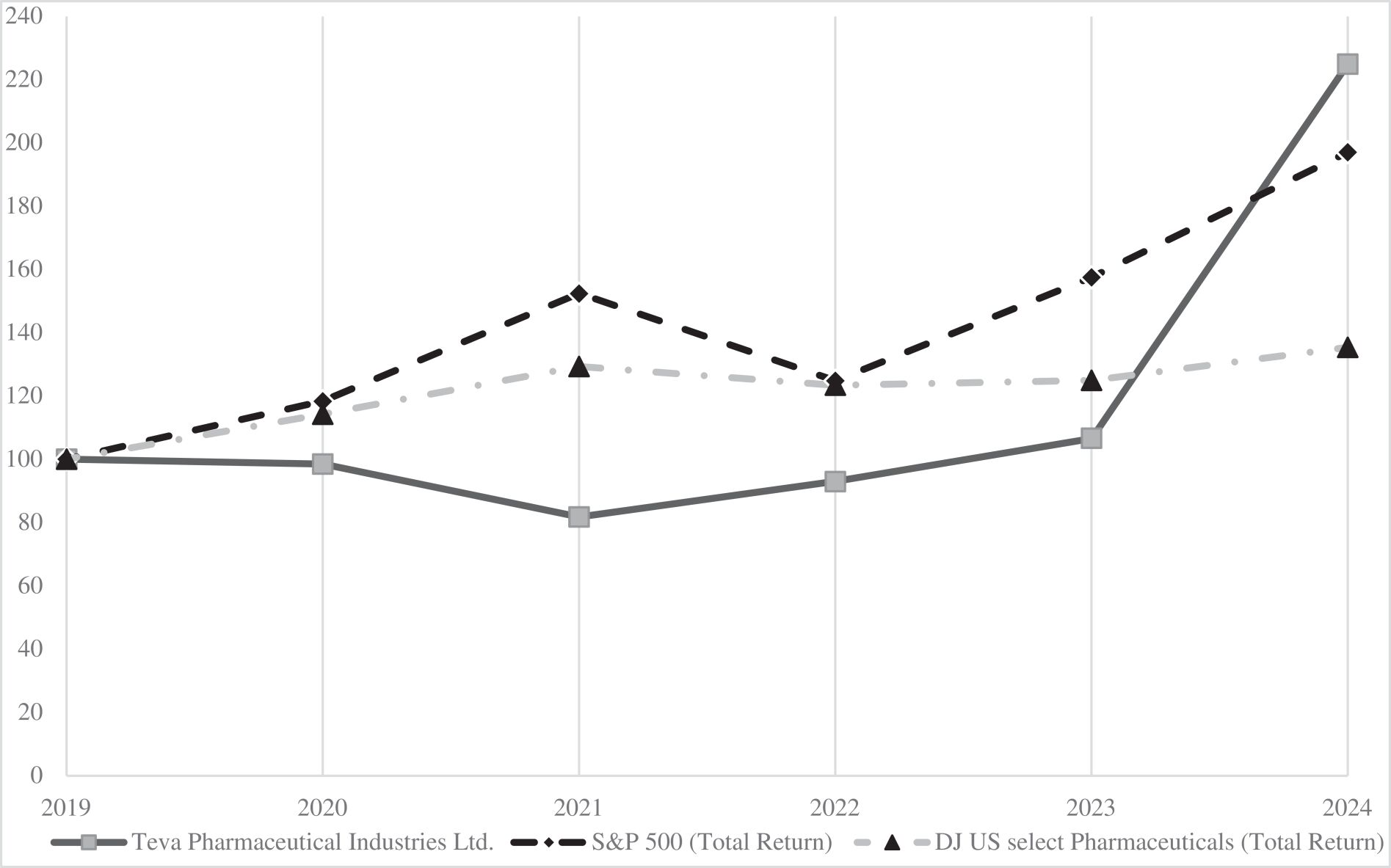
| * | $100 invested on December 31, 2019 in stock or index – including reinvestment of dividends. Indexes calculated on month-end basis. |
ITEM 6. [RESERVED]
58
ITEM 7. MANAGEMENT’S DISCUSSION AND ANALYSIS OF FINANCIAL CONDITION AND RESULTS OF OPERATIONS
Business Overview
We are a global pharmaceutical leader, harnessing our generics expertise and stepping up innovation to continue the momentum behind the discovery, delivery and expanded development of modern medicine.
We operate worldwide, with headquarters in Israel and a significant presence in the United States, Europe and many other markets around the world. Today, our global network of capabilities enables our approximately 37,000 employees across 57 markets to push the boundaries of scientific innovation and deliver quality medicines to help improve health outcomes for millions of patients every day.
Teva was incorporated in Israel on February 13, 1944 and is the successor to a number of Israeli corporations, the oldest of which was established in 1901.
Our Business Segments
We operate our business through three segments: United States (previously referred to as the North America segment, see below “—United States Segment”), Europe and International Markets. Each business segment manages our entire product portfolio in its region, including generics, which includes biosimilars and OTC products, as well as innovative medicines. This structure enables strong alignment and integration between operations, commercial regions, R&D and our global marketing and portfolio function, optimizing our product lifecycle across therapeutic areas.
In addition to these three segments, we have other activities, primarily the sale of API to third parties, certain contract manufacturing services and an out-licensing platform offering a portfolio of products to other pharmaceutical companies through our affiliate Medis.
Pivot to Growth Strategy
In 2024, we continued to execute on the four key pillars of our “Pivot to Growth” strategy, which we announced in May 2023.
| • | On the first pillar, delivering on our growth engines, we continued to show strong performance of our key innovative products, mainly AUSTEDO, AJOVY, and UZEDY, as well as on our late-stage pipeline of biosimilars, with the launches of SIMLANDI® (adalimumab-ryvk) injection and the expected launch of SELARSDI (ustekinumab-aekn) injection, and the progress we made on our proposed biosimilars to Prolia®, Simponi® and Simponi Aria® which were submitted for regulatory review in the U.S. and the EU; |
| • | On the second pillar, stepping up innovation through delivering on our late-stage innovative pipeline, we have been accelerating the development of certain key pipeline assets, including the recent positive Phase 2b results for duvakitug (anti-TL1A), and expect a number of milestones and data points for olanzapine LAI and DARI (Dual-action Asthma Rescue Inhaler, ICS/SABA) in the near future; |
| • | On the third pillar, sustaining our generic medicines powerhouse with a global commercial footprint, focused portfolio, pipeline and manufacturing footprint, we continued to optimize our generics business and build a strong pipeline of biosimilars, with several successful launches of high-value complex generics in 2024; and |
| • | Lastly, on our fourth pillar, focusing our business by optimizing our portfolio and global manufacturing footprint. This will enable strategic capital deployment, to accelerate our growth engines and reorganize certain of our business units to a more optimal structure. We continued our efforts on capital allocation and disciplined cost management by focusing on debt repayment, and optimizing our working capital management. |
59
Macroeconomic and Geopolitical Environment
In recent years, the global economy has been impacted by fluctuating foreign exchange rates. In 2024, approximately 47% of our revenues were denominated in currencies other than the U.S. dollar and we manufacture our products largely outside of the United States. Fluctuations in the U.S. dollar versus other currencies in which we operate may materially impact our revenues, results of operations, profits and cash flows. Additionally, in recent years, in many of the markets in which we operate we experienced higher levels of inflation resulting in higher interest rates, though in certain other markets, such as the EU, we recently experienced a decrease in inflation which resulted in lower interests rates. The global economy has also been impacted by geopolitical tensions which have resulted in disruptions to global supply chains, including our internal supply chain. In October 2023, Israel was attacked by a terrorist organization and entered a state of war on several fronts, which as of the date of this Annual Report on Form 10-K is ongoing. Our global headquarters as well as several of our manufacturing and R&D facilities are located in Israel and, while operations there currently remain largely unaffected, the impact of this war on our operations may increase, which could be material, as a result of the continuation, escalation or expansion of this war. In light of the above, supply chain disruptions could continue to result in delays in our production and distribution processes, R&D initiatives and our ability to timely respond to consumer demand. We have implemented certain measures in response to such events and are continually considering various initiatives, including price adjustments where we are not restricted contractually or regulatorily, enhanced inventory management, alternative sourcing strategies for our raw material supply and backup production plans for key products, to allow us to partially mitigate and offset the impact of these macroeconomic and geopolitical factors. However, although inflationary and other macroeconomic pressures have and may continue to ease, the higher costs we have experienced during recent periods have already impacted our operations and will likely continue to have an effect on our financial results.
Highlights
Significant highlights of 2024 included:
| • | Our revenues in 2024 were $16,544 million, an increase of 4% in U.S. dollars, or 6% in local currency terms, compared to 2023. This increase was mainly due to higher revenues from generic products in all our segments, including from lenalidomide capsules (the generic version of Revlimid®) in our U.S. segment, from our innovative products AUSTEDO, UZEDY and AJOVY, as well as the sale of certain product rights, partially offset by an upfront payment received in 2023 related to the collaboration on our duvakitug (anti-TL1A) asset, and lower revenues from certain innovative products, primarily COPAXONE and BENDEKA and TREANDA. |
| • | Our United States segment generated revenues of $8,034 million and profit of $2,296 million in 2024. Revenues increased by 4% and profit increased by 4% compared to 2023. |
| • | Our Europe segment generated revenues of $5,103 million and profit of $1,575 million in 2024. Revenues increased by 5% in U.S. dollars or 4% in local currency terms, compared to 2023. Profit increased by 7% compared to 2023. |
| • | Our International Markets segment generated revenues of $2,463 million and profit of $440 million in 2024. Revenues increased by 5% in U.S. dollars or 18% in local currency terms, compared to 2023. Profit decreased by 5% compared to 2023. |
| • | Our revenues from other activities in 2024 were $944 million, an increase of 2% in both U.S. dollars and local currency terms, compared to 2023. |
| • | R&D expenses, net in 2024 were $998 million, an increase of 5% compared to $953 million in 2023. |
| • | Impairments of identifiable intangible assets were $251 million and $350 million in the years ended December 31, 2024 and 2023, respectively. |
| • | We recorded goodwill impairment charges of $1,280 million in 2024 related to our Teva API reporting unit, compared to a goodwill impairment charge of $700 million in 2023 related to our International Markets reporting unit. |
60
| • | We recorded expenses of $1,388 million for other asset impairments, restructuring and other items in 2024, compared to expenses of $718 million in 2023. |
| • | We recorded expenses of $761 million in legal settlements and loss contingencies in 2024, compared to expenses of $1,043 million in 2023. |
| • | Operating loss was $303 million in 2024, compared to an operating income of $433 million in 2023. |
| • | Financial expenses, net were $981 million in 2024, compared to $1,057 million in 2023. |
| • | In 2024, we recognized a tax expense of $676 million, or 53%, on a pre-tax loss of $1,284 million. In 2023, we recognized a tax benefit of $7 million, or 1%, on a pre-tax loss of $624 million. |
| • | Our debt was $17,783 million as of December 31, 2024, compared to $19,833 million as of December 31, 2023. |
| • | Cash flow generated from operating activities in 2024 was $1,247 million, compared to $1,368 million in 2023. The decrease in 2024 resulted mainly due to an upfront payment received in 2023 related to the collaboration on our duvakitug (anti-TL1A) asset, a negative impact from accounts payables, the classification of payments to Allergan in connection with lenalidomide (generic equivalent of Revlimid®) as cash flow used in operating activities, and higher tax payments, partially offset by higher profit from AUSTEDO and from the sale of certain product rights, lower inventory levels, and a positive impact from accounts receivables. |
| • | During 2024, we generated free cash flow of $2,068 million, which we define as comprising $1,247 million in cash flow generated from operating activities, $1,291 million in beneficial interest collected in exchange for securitized accounts receivables (under our EU securitization program) and $43 million proceeds from divestitures of businesses and other assets, partially offset by $498 million in cash used for capital investments and $15 million in cash used for acquisition of businesses, net of cash acquired. During 2023, we generated free cash flow of $2,387 million. The decrease in 2024 resulted mainly from lower cash flow generated from operating activities. |
Results of Operations
The discussion that follows includes a comparison of our results of operations and liquidity and capital resources for fiscal years 2024 and 2023. For a comparison of our results of operations and financial condition for fiscal years 2023 and 2022, see “Item 7—Management’s Discussion and Analysis of Financial Condition and Results of Operations” of our 2023 Annual Report on Form 10-K, filed with the SEC on February 12, 2024.
Segment Information
United States Segment
The following table presents revenues, expenses and profit for our United States segment for the past two years:
| Year ended December 31, | ||||||||||||||||
| 2024 | 2023 | |||||||||||||||
| (U.S. $ in millions / % of Segment Revenues) | ||||||||||||||||
| Revenues |
$ | 8,034 | 100% | $ | 7,731 | 100% | ||||||||||
| Cost of sales |
3,646 | 45.4% | 3,421 | 44.3% | ||||||||||||
| Gross profit |
4,388 | 54.6% | 4,310 | 55.7% | ||||||||||||
| R&D expenses |
633 | 7.9% | 604 | 7.8% | ||||||||||||
| S&M expenses |
1,049 | 13.1% | 938 | 12.1% | ||||||||||||
| G&A expenses |
410 | 5.1% | 378 | 4.9% | ||||||||||||
| Other loss (income) |
§ | § | (5 | ) | § | |||||||||||
|
|
|
|
|
|
|
|
|
|||||||||
| Segment profit* |
$ | 2,296 | 28.6% | $ | 2,394 | 31.0% | ||||||||||
|
|
|
|
|
|
|
|
|
|||||||||
61
| * | Segment profit does not include amortization and certain other items. |
| § | Represents an amount less than $0.5 million or 0.5%, as applicable. |
United States Revenues
As part of a recent shift in executive management responsibilities and in line with our Pivot to Growth strategy, commencing January 1, 2024, Canada is reported as part of our International Markets segment. Prior period amounts were recast to reflect this change. See note 19 to our consolidated financial statements.
Revenues from our United States segment in 2024 were $8,034 million, an increase of $303 million, or 4%, compared to 2023, mainly due to higher revenues from generic products, including from lenalidomide capsules (the generic version of Revlimid®) and our innovative products AUSTEDO and UZEDY, as well as revenues from the sale of certain product rights, partially offset by an upfront payment received in 2023 related to the collaboration on our duvakitug (anti-TL1A) asset, lower revenues from certain innovative products, primarily BENDEKA and TREANDA and COPAXONE, as well as from Anda, our distribution business.
Revenues by Major Products and Activities
The following table presents revenues for our United States segment by major products and activities for the past two years:
| Year ended December 31, | Percentage Change 2024-2023 |
|||||||||||
| 2024 | 2023 | |||||||||||
| (U.S. $ in millions) | ||||||||||||
| Generic products (including biosimilars) |
$ | 3,599 | $ | 3,138 | 15 | % | ||||||
| AJOVY |
207 | 211 | (2 | %) | ||||||||
| AUSTEDO |
1,642 | 1,225 | 34 | % | ||||||||
| BENDEKA and TREANDA |
168 | 237 | (29 | %) | ||||||||
| COPAXONE |
242 | 297 | (18 | %) | ||||||||
| UZEDY |
117 | 23 | N/A | |||||||||
| Anda |
1,536 | 1,577 | (3 | %) | ||||||||
| Other* |
523 | 1,025 | (49 | %) | ||||||||
|
|
|
|
|
|||||||||
| Total |
$ | 8,034 | $ | 7,731 | 4 | % | ||||||
|
|
|
|
|
|||||||||
| * | Other revenues in 2024 include the sale of certain product rights. Other revenues in 2023 were mainly comprised of a $500 million upfront payment received in the fourth quarter of 2023, in connection with the collaboration on our duvakitug (anti-TL1A) asset (see note 2 to our consolidated financial statements). |
Generic products (including biosimilars) revenues in our United States segment in 2024 increased by 15% to $3,599 million, compared to 2023, mainly due to higher revenues from lenalidomide capsules (the generic version of Revlimid®), the launch of liraglutide injection 1.8mg (an authorized generic of Victoza®) and the launch of SIMLANDI (adalimumab-ryvk) injection (the biosimilar to Humira®), partially offset by increased competition to other generic products.
Among the most significant generic products we sold in the United States in 2024 were lenalidomide capsules (the generic version of Revlimid®), epinephrine injectable solution (the generic equivalent of EpiPen® and EpiPen Jr®), Truxima® (the biosimilar to Rituxan®) and liraglutide 1.8 mg injection (an authorized generic of Victoza®).
On February 24, 2024, Alvotech and Teva announced that the FDA approved SIMLANDI (adalimumab-ryvk) injection, as an interchangeable biosimilar to Humira®, for the treatment of adult rheumatoid arthritis, juvenile idiopathic arthritis, adult psoriatic arthritis, adult ankylosing spondylitis, Crohn’s disease, adult ulcerative colitis, adult plaque psoriasis, adult hidradenitis suppurativa and adult uveitis.
62
On May 21, 2024, Alvotech and Teva announced the availability of SIMLANDI in the U.S.
On April 16, 2024, Alvotech and Teva announced that the FDA has approved SELARSDI (ustekinumab-aekn) injection for subcutaneous use, as a biosimilar to Stelara®, for the treatment of moderate to severe plaque psoriasis and for active psoriatic arthritis in adults and pediatric patients six years and older.
On June 24, 2024, Teva announced the launch of liraglutide injection 1.8mg (an authorized generic of Victoza®) in the United States. Liraglutide injection is indicated to improve glycemic control in adults and pediatric patients aged 10 years and older with type 2 diabetes mellitus and reduce the risk of cardiovascular events in adults with type 2 diabetes mellitus and established cardiovascular disease.
In July 2024, Teva launched paclitaxel protein-bound particles for injectable suspension (albumin-bound) (a therapeutically equivalent product to Abraxane®) in the United States for the treatment of breast cancer after failure of combination chemotherapy for metastatic disease, the treatment of locally advanced or metastatic non-small cell lung cancer, and the treatment of patients with metastatic adenocarcinoma of the pancreas.
On October 1, 2024, Teva launched octreotide acetate for injectable suspension, the first generic version of Sandostatin® LAR Depot. Octreotide acetate for injectable suspension is indicated for the treatment of acromegaly and severe diarrhea associated with carcinoid syndrome, and is available to patients in the U.S.
For more information on our generic products, including biosimilars, see “Item 1—Business—Our Product Portfolio and Business Offering—Generic Medicines.”
In 2024, our total prescriptions were approximately 283 million (based on trailing twelve months), representing 7.4% of total U.S. generic prescriptions according to IQVIA data.
AJOVY revenues in our United States segment in 2024 decreased by 2% to $207 million, compared to 2023, mainly due to unfavorable net pricing including an increase in sales allowance due to a non-recurring item, partially offset by growth in volume. In 2024, AJOVY’s exit market share in the United States in terms of total number of prescriptions was 29.6%, compared to 25.7% in 2023.
For more information on AJOVY, see “Item 1—Business—Our Product Portfolio and Business Offering—Innovative Medicines—AJOVY.”
AUSTEDO revenues in our United States segment in 2024 increased by 34% to $1,642 million, compared to 2023, mainly due to growth in volume including the launch of AUSTEDO XR in May 2023, as well as expanded access for patients.
For more information on AUSTEDO, see “Item 1—Business—Our Product Portfolio and Business Offering—Innovative Medicines—AUSTEDO.”
UZEDY revenues in our United States segment in 2024 were $117 million.
For more information on UZEDY, see “Item 1—Business—Our Product Portfolio and Business Offering—Innovative Medicines—UZEDY.”
BENDEKA and TREANDA combined revenues in our United States segment in 2024 decreased by 29% to $168 million, compared to 2023, mainly due to competition from alternative therapies, as well as the entry of generic bendamustine products into the market. The orphan drug exclusivity that was attached to bendamustine products expired in December 2022.
63
For more information on BENDEKA and TREANDA, see “Item 1—Business—Our Product Portfolio and Business Offering—Innovative Medicines—Oncology.”
COPAXONE revenues in our United States segment in 2024 decreased by 18% to $242 million, compared to 2023, mainly due to market share erosion and competition, partially offset by a reduction in sales allowance.
For more information on COPAXONE, see “Item 1—Business—Our Product Portfolio and Business Offering—Innovative Medicines—COPAXONE.”
Anda revenues from third parties in our United States segment in 2024 decreased by 3% to $1,536 million, compared to 2023, mainly due to lower volumes. Anda, our distribution business in the United States, distributes generic, biosimilar and innovative medicines and OTC pharmaceutical products from Teva and various third-party manufacturers, to independent retail pharmacies, pharmacy retail chains, hospitals and physician offices in the United States. Anda is able to compete in the distribution market by maintaining a broad portfolio of products, competitive pricing and delivery throughout the United States.
Product Launches and Pipeline
In 2024, we launched the generic version and biosimilar version of the following branded products in the United States:
| Product Name |
Brand Name |
Launch Date |
Total Annual U.S. Branded Sales at Time of Launch (U.S. $ in millions (IQVIA))* |
|||||||
| Mifepristone Tablets |
Korlym® | January | $ | 2 | ||||||
| ALVAIZ™ (eltrombopag choline tablets) 505(b)(2) |
Promacta® | February | $ | 1,145 | ||||||
| Fingolimod Capsules |
Gilenya® | February | $ | 483 | ||||||
| SIMLANDI Injection** |
N/A | May | No Data | |||||||
| Liraglutide injection |
Victoza® | June | $ | 1,759 | ||||||
| Paclitaxel Protein-Bound Particles for Injectable Suspension (albumin-bound) |
Abraxane® | July | $ | 809 | ||||||
| Mesalamine Delayed-Release Tablets, USP |
N/A | August | $ | 167 | ||||||
| Sulfamethoxazole and Trimethoprim Injection, USP in the PREMIERProRx® Label |
N/A | August | $ | 1 | ||||||
| Lisdexamfetamine Dimesylate Chewable Tablets CII - USA |
Vyvanse® | September | $ | 200 | ||||||
| Naloxone Hydrochloride Nasal Spray (OTC) |
Narcan® | September | $ | 66 | *** | |||||
| Metoclopramide Injection, USP |
N/A | September | $ | 12 | ||||||
| Octreotide Acetate for Injectable Suspension |
Sandostatin® | October | $ | 802 | ||||||
| Tiopronin Tablets, 100 mg |
Thiola® | October | $ | 0 | ||||||
| Lisdexamfetamine Dimesylate Capsules, 20 mg, 30 mg, 40 mg, 50 mg, 60 mg and 70 mg |
Vyvanse® | December | $ | 4,108 | ||||||
| Lapatinib Tablets, 250 mg |
Tykerb® | December | $ | 17 | ||||||
| * | The figures presented are for the twelve months ended in the calendar quarter immediately prior to our launch or re-launch. |
64
| ** | SIMLANDI (adalimumab-ryvk) injection, as an interchangeable biosimilar to Humira®. |
| *** | Represents estimated sales based on OTC sales reported through IQVIA. |
As of December 31, 2024, our generic products pipeline in the United States includes 127 product applications awaiting FDA approval, including 65 tentative approvals. This total reflects all pending ANDAs, supplements for product line extensions and tentatively approved applications and includes some instances where more than one application was submitted for the same reference product. Excluding overlaps, the branded products underlying these pending applications had U.S. sales for the twelve months ended September 30, 2024 of approximately $122 billion, according to IQVIA. Approximately 78% of pending applications include a paragraph IV patent challenge and we believe we are first to file with respect to 54 of these products, or 82 products including final approvals where launch is pending a settlement agreement or court decision. Collectively, these first to file opportunities represent over $80 billion in U.S. brand sales for the twelve months ended September 30, 2024, according to IQVIA.
IQVIA reported brand sales are one of the many indicators of future potential value of a launch, but equally important are the mix and timing of competition, as well as cost effectiveness. The potential advantages of being the first filer with respect to some of these products may be subject to forfeiture, shared exclusivity or competition from so-called “authorized generics,” which may ultimately affect the value derived.
In 2024, we received tentative approvals for generic equivalents of the products listed in the table below, excluding overlapping applications. A “tentative approval” indicates that the FDA has substantially completed its review of an application and final approval is expected once the relevant patent expires, a court decision is reached, a 30-month regulatory stay lapses or a 180-day exclusivity period awarded to another manufacturer either expires or is forfeited.
| Generic Name |
Brand Name | Total U.S. Annual Branded Market (U.S. $ in millions (IQVIA))* |
||||
| Tofacitinib ER Tabs, 11 and 22 mg |
Xeljanz XR® | $ | 1,787 | |||
| Enzalutamide Tablets, 40 mg and 80 mg |
Xtandi® | $ | 1,253 | |||
| Sugammadex Sodium Injection, Eq. 200 mg base/2 mL (Eq. 100 mg base/mL) |
Bridion® | $ | 1,055 | |||
| Palbociclib Capsules |
Ibrance® | $ | 504 | |||
| Binimetinib Tablets, 15 mg |
Mektovi® | $ | 176 | |||
| Fedratinib Capsules, 100 mg |
Inrebic® | $ | 59 | |||
| Glycerol Phenylbutyrate Oral Liquid, 1.1 g/mL |
Ravicti® | $ | 44 | |||
| Metoclopramide Nasal Spray, 15 mg/spray** |
GIMOTI® | No Data | ||||
| * | The figures presented are for the twelve months ended in the calendar quarter immediately prior to our launch or re-launch. |
| ** | Marketed through Specialty Pharmacy that does not report to IQVIA. |
For a description of our innovative medicines pipeline, see “Item 1—Business—Our Product Portfolio and Business Offering—Innovative Medicines” above.
United States Gross Profit
Gross profit from our United States segment in 2024 was $4,388 million, an increase of 2% compared to $4,310 million in 2023.
Gross profit margin for our United States segment in 2024 decreased to 54.6%, compared to 55.7% in 2023. This decrease was mainly due to an upfront payment received in 2023 related to the collaboration on our duvakitug (anti-TL1A) asset, partially offset by a favorable mix of products primarily driven by higher revenues from AUSTEDO and lenalidomide capsules (the generic version of Revlimid®).
65
United States R&D Expenses
R&D expenses relating to our United States segment in 2024 were $633 million, an increase of 5% compared to $604 million in 2023.
For a description of our R&D expenses in 2024, see “—Teva Consolidated Results—Research and Development (R&D) Expenses” below.
United States S&M Expenses
S&M expenses relating to our United States segment in 2024 were $1,049 million, an increase of 12% compared to $938 million in 2023. This increase was mainly due to promotional activities related to AUSTEDO, primarily consisting of a direct-to-consumer advertising campaign and our patient support programs.
United States G&A Expenses
G&A expenses relating to our United States segment in 2024 were $410 million, an increase of 8% compared to $378 million in 2023.
United States Profit
Profit from our United States segment consists of revenues less cost of sales, R&D expenses, S&M expenses, G&A expenses and any other loss (income) related to this segment. Segment profit does not include amortization and certain other items.
Profit from our United States segment in 2024 was $2,296 million, a decrease of 4% compared to $2,394 million in 2023. This decrease was mainly due to higher operational expenses, partially offset by higher revenues, as discussed above.
Europe Segment
The following table presents revenues, expenses and profit for our Europe segment for the past two years:
| Year ended December 31, | ||||||||||||||||
| 2024 | 2023 | |||||||||||||||
| (U.S. $ in millions / % of Segment Revenues) | ||||||||||||||||
| Revenues |
$ | 5,103 | 100.0% | $ | 4,837 | 100.0% | ||||||||||
| Cost of sales |
2,197 | 43.1% | 2,111 | 43.6% | ||||||||||||
| Gross profit |
2,905 | 56.9% | 2,726 | 56.4% | ||||||||||||
| R&D expenses |
229 | 4.5% | 220 | 4.5% | ||||||||||||
| S&M expenses |
826 | 16.2% | 767 | 15.9% | ||||||||||||
| G&A expenses |
272 | 5.3% | 263 | 5.4% | ||||||||||||
| Other loss (income) |
3 | § | (2 | ) | § | |||||||||||
|
|
|
|
|
|
|
|
|
|||||||||
| Segment profit* |
$ | 1,575 | 30.9% | $ | 1,478 | 30.6% | ||||||||||
|
|
|
|
|
|
|
|
|
|||||||||
| * | Segment profit does not include amortization and certain other items. |
| § | Represents an amount less than 0.5%. |
Europe Revenues
Our Europe segment includes the European Union, the United Kingdom and certain other European countries.
66
Revenues from our Europe segment in 2024 were $5,103 million, an increase of $266 million, or 5%, compared to 2023. In local currency terms, revenues increased by 4%, mainly due to higher revenues from generic and OTC products as well as higher revenues from AJOVY, partially offset by lower revenues from COPAXONE, respiratory products and other products. Our revenues in 2024 and 2023 were also impacted by the sale of certain product rights.
In 2024, revenues were positively impacted by exchange rate fluctuations of $64 million, including hedging effects, compared to 2023. Revenues in 2024 were affected by a $21 million positive hedging impact, compared to a $12 million negative hedging impact in 2023, which are included in “Other” in the table below. See note 10d to our consolidated financial statements.
Revenues by Major Products and Activities
The following table presents revenues for our Europe segment by major products and activities for the past two years:
| Year ended December 31, | Percentage Change 2024-2023 |
|||||||||||
| 2024 | 2023 | |||||||||||
| (U.S. $ in millions) | ||||||||||||
| Generic products (including OTC and biosimilars) |
$ | 3,926 | $ | 3,664 | 7 | % | ||||||
| AJOVY |
216 | 160 | 34 | % | ||||||||
| COPAXONE |
213 | 231 | (8 | %) | ||||||||
| Respiratory products |
244 | 265 | (8 | %) | ||||||||
| Other* |
504 | 516 | (2 | %) | ||||||||
|
|
|
|
|
|||||||||
| Total |
$ | 5,103 | $ | 4,837 | 5 | % | ||||||
|
|
|
|
|
|||||||||
| * | Other revenues in 2024 and 2023 include the sale of certain product rights. |
Generic products revenues (including OTC and biosimilar products) in our Europe segment in 2024 increased by 7% to $3,926 million compared to 2023. In local currency terms, revenues increased by 6%, mainly due to price increases as a result of market conditions such as inflationary pressures in certain markets, as well as higher revenues from recently launched products.
AJOVY revenues in our Europe segment in 2024 were $216 million, an increase of 34%, in both U.S. dollars and local currency terms, compared to 2023. This increase was due to growth in volumes.
For more information on AJOVY, see “Item 1—Business—Our Product Portfolio and Business Offering—Innovative Medicines—AJOVY.”
COPAXONE revenues in our Europe segment in 2024 decreased by 8% to $213 million, compared to 2023, in both U.S. dollars and local currency terms, compared to 2023. This decrease was mainly due to price reductions and a decline in volume resulting from the availability of alternative therapies and competing glatiramer acetate products.
For more information on COPAXONE, see “Item 1—Business—Our Product Portfolio and Business Offering—Innovative Medicines—COPAXONE.”
Respiratory products revenues in our Europe segment in 2024 decreased by 8% to $244 million, compared to 2023. In local currency terms, revenues decreased by 9%, mainly due to net price reductions and lower volumes.
67
Product Launches and Pipeline
As of December 31, 2024, our generic products pipeline in Europe included 686 generic approvals relating to 71 compounds in 149 formulations and one EMA approval received during 2024. In addition, approximately 1,483 marketing authorization applications are pending approval in 37 European countries, which approvals relate to 92 compounds in 212 formulations. No applications are pending with the EMA.
For a description of our innovative medicines pipeline, see “Item 1—Business—Research and Development” above.
Europe Gross Profit
Gross profit from our Europe segment in 2024 was $2,905 million, an increase of 7% compared to $2,726 million in 2023.
Gross profit margin for our Europe segment in 2024 increased to 56.9%, compared to 56.4% in 2023, mainly due to a positive impact from hedging activities, as well as a decrease in our operational costs.
Europe R&D Expenses
R&D expenses relating to our Europe segment in 2024 were $229 million, an increase of 4% compared to $220 million in 2023.
For a description of our R&D expenses in 2024, see “—Teva Consolidated Results—Research and Development (R&D) Expenses” below.
Europe S&M Expenses
S&M expenses relating to our Europe segment in 2024 were $826 million, an increase of 8% compared to $767 million in 2023. This increase was mainly to support revenue growth.
Europe G&A Expenses
G&A expenses relating to our Europe segment in 2024 were $272 million, an increase of 3% compared to $263 million in 2023.
Europe Profit
Profit of our Europe segment consists of revenues less cost of sales, R&D expenses, S&M expenses, G&A expenses and any other loss (income) related to this segment. Segment profit does not include amortization and certain other items.
Profit from our Europe segment in 2024 was $1,575 million, an increase of 7% compared to $1,478 million in 2023, mainly due to higher revenues in 2024, partially offset by higher S&M expenses.
68
International Markets Segment
The following table presents revenues, expenses and profit for our International Markets segment for the past two years:
| Year ended December 31, | ||||||||||||||||
| 2024 | 2023 | |||||||||||||||
| (U.S. $ in millions / % of Segment Revenues) | ||||||||||||||||
| Revenues |
$ | 2,463 | 100% | $ | 2,351 | 100% | ||||||||||
| Cost of sales |
1,229 | 49.9% | 1,191 | 50.6% | ||||||||||||
| Gross profit |
1,235 | 50.1% | 1,160 | 49.4% | ||||||||||||
| R&D expenses |
112 | 4.5% | 104 | 4.4% | ||||||||||||
| S&M expenses |
534 | 21.7% | 487 | 20.7% | ||||||||||||
| G&A expenses |
150 | 6.1% | 142 | 6.1% | ||||||||||||
| Other loss (income) |
(2 | ) | § | (39 | ) | (1.6% | ) | |||||||||
|
|
|
|
|
|
|
|
|
|||||||||
| Segment profit* |
$ | 440 | 17.9% | $ | 465 | 19.8% | ||||||||||
|
|
|
|
|
|
|
|
|
|||||||||
| * | Segment profit does not include amortization and certain other items. |
| § | Represents an amount less than 0.5%. |
International Markets Revenues
Our International Markets segment includes all countries in which we operate other than the United States and the countries included in our Europe segments. The International Markets segment covers a substantial portion of the global pharmaceutical industry, including more than 35 countries. As part of a recent shift in executive management responsibilities, commencing January 1, 2024, Canada is reported under our International Markets segment and is no longer included as part of our United States segment. Prior period amounts were recast to reflect this change. See note 19 to our consolidated financial statements.
The countries in our International Markets segment include highly regulated, mainly generic markets, such as Canada and Israel, branded generics-oriented markets, such as Russia and certain Latin America markets and hybrid markets, such as Japan.
As of the date of this Annual Report on Form 10-K, sustained conflict between Russia and Ukraine and disruption in the region is ongoing. Russia and Ukraine markets are included in our International Markets segment results and we have no manufacturing or R&D facilities in these markets. During the year ended December 31, 2024, the impact of this conflict on our International Markets segment’s results of operations and financial condition was immaterial. Consistent with our foreign exchange risk management hedging programs, in the year ended December 31, 2024, we partially hedged our exposure to currency exchange rate fluctuations with respect to our balance sheet assets, revenues and expenses. As of the end of 2024, we hedge a small part of our projected net revenues in Russian ruble for 2025. Prior to and since the escalation of the conflict, we have been taking measures to reduce our operational cash balances in Russia and Ukraine. We have been monitoring the solvency of our customers in Russia and Ukraine and have taken measures, where practicable, to mitigate our exposure to risks related to the conflict in the region. However, the duration, severity and global implications (including potential inflation and devaluation consequences) of the conflict cannot be predicted at this time and could have an effect on our business, including on our exchange rate exposure, supply chain, operational costs and commercial presence in these markets.
On December 5, 2024, we announced that we entered into an agreement with JKI Co. Ltd., established by the fund managed and operated by private equity firm J-Will Partners Co. Ltd., to sell our Teva-Takeda business venture in Japan, which includes generic products and legacy products, with an expected closing date of April 1, 2025, subject to standard closing conditions. See notes 2 and 22 to our consolidated financial statements.
69
Revenues from our International Markets segment in 2024 were $2,463 million, an increase of $112 million, or 5%, compared to 2023. In local currency terms, revenues increased by 18% compared to 2023, mainly due to higher revenues from generic products in most markets, partially offset by regulatory price reductions and generic competition to off-patented products in Japan. The higher revenues in our International Markets segment in 2024 were impacted by the sale of certain product rights.
In 2024, revenues were negatively impacted by exchange rate fluctuations of $321 million net of hedging effects, compared to 2023. Revenues in 2024, were affected by a $13 million positive hedging impact, compared to a $9 million positive hedging impact in 2023, which are included in “Other” in the table below. See note 10d to our consolidated financial statements.
Revenues by Major Products and Activities
The following table presents revenues for our International Markets segment by major products and activities for the past two years:
| Year ended December 31, | Percentage Change 2024-2023 |
|||||||||||
| 2024 | 2023 | |||||||||||
| (U.S. $ in millions) | ||||||||||||
| Generic products (including OTC and biosimilars) |
$ | 1,937 | $ | 1,932 | § | |||||||
| AJOVY |
84 | 63 | 33% | |||||||||
| COPAXONE |
48 | 63 | (24% | ) | ||||||||
| AUSTEDO |
46 | 15 | 199% | |||||||||
| Other* |
349 | 278 | 25% | |||||||||
|
|
|
|
|
|||||||||
| Total |
$ | 2,463 | $ | 2,351 | 5% | |||||||
|
|
|
|
|
|||||||||
| * | Other revenues in 2024 include the sale of certain product rights. |
| § | Represents an amount less than 0.5%. |
Generic products revenues (including OTC and biosimilar products) in our International Markets segment in 2024 were flat, compared to 2023. In local currency terms, revenues increased by 15%, mainly due to higher revenues in most markets, as well as price increases, largely as a result of higher costs due to inflationary pressure, partially offset by regulatory price reductions and generic competition to off-patented products in Japan.
AJOVY was launched in certain countries in our International Markets segment, including in Canada, Japan, Australia, Israel, South Korea, Brazil and others. AJOVY revenues in our International Markets segment in 2024 increased by 33% to $84 million, compared to 2023. In local currency terms, revenues increased by 39%, due to growth in existing markets in which AJOVY was launched.
For more information on AJOVY, see “Item 1—Business—Our Product Portfolio and Business Offering— Innovative Medicines—AJOVY.”
COPAXONE revenues in our International Markets segment in 2024 decreased by 24% to $48 million, compared to 2023. In local currency terms, revenues decreased by 11%, mainly due to market share erosion and competition.
For more information on COPAXONE, see “Item 1—Business—Our Product Portfolio and Business Offering—Innovative Medicines—COPAXONE.”
AUSTEDO was launched in China and Israel in 2021 and in Brazil in 2022, for the treatment of chorea associated with Huntington’s disease and for the treatment of tardive dyskinesia. In February 2024, we
70
announced a strategic partnership for the marketing and distribution of AUSTEDO in China. We continue to pursue additional submissions in various other markets.
AUSTEDO revenues in our International Markets segment in 2024 were $46 million. In local currency terms, revenues increased by 205%, substantially due to the launch of a strategic partnership in China.
For more information on AUSTEDO, see “Item 1—Business—Our Product Portfolio and Business Offering—Innovative Medicines—AUSTEDO.”
International Markets Gross Profit
Gross profit from our International Markets segment in 2024 was $1,235 million, an increase of 6% compared to $1,160 million in 2023.
Gross profit margin for our International Markets segment in 2024 increased to 50.1%, compared to 49.4% in 2023. This increase was mainly due to the sale of certain product rights, price increases largely as a result of higher costs due to inflationary pressure, a favorable mix of products sold, and a positive hedging impact, partially offset by regulatory price reductions and generic competition to off-patented products in Japan.
International Markets R&D Expenses
R&D expenses relating to our International Markets segment in 2024 were $112 million, an increase of 7% compared to $104 million in 2023.
For a description of our R&D expenses in 2024, see “—Teva Consolidated Results—Research and Development (R&D) Expenses” below.
International Markets S&M Expenses
S&M expenses relating to our International Markets segment in 2024 were $534 million, an increase of 10% compared to $487 million in 2023, mainly to support revenue growth, including through our strategic partnership in China for AUSTEDO.
International Markets G&A Expenses
G&A expenses relating to our International Markets segment in 2024 were $150 million, an increase of 5% compared to $142 million in 2023.
International Markets Other Income
Other income relating to our International Markets segment in 2023 was $2 million, compared to $39 million in 2023. Other income in 2023 was mainly the result of a capital gain from the sale of assets.
International Markets Profit
Profit of our International Markets segment consists of revenues less cost of sales, R&D expenses, S&M expenses, G&A expenses and any other loss (income) related to this segment. Segment profit does not include amortization and certain other items.
Profit from our International Markets segment in 2024 was $440 million a decrease of 5% compared to $465 million in 2023. This decrease was mainly due to higher S&M expenses, lower other income and higher R&D expenses.
71
Other Activities
We have other sources of revenues, primarily the sale of APIs to third parties, certain contract manufacturing services and an out-licensing platform offering a portfolio of products to other pharmaceutical companies through our affiliate Medis. Our other activities are not included in the United States, Europe or International Markets segments described above.
On January 31, 2024, we announced that we intend to divest our API business (including its R&D, manufacturing and commercial activities) through a sale. The intention to divest is in alignment with our Pivot to Growth strategy. However, there can be no assurance regarding the ultimate timing or structure of the potential divestiture or that a divestiture will be agreed or completed at all. For further information, see note 2 to our consolidated financial statements.
Our revenues from other activities in 2024 were $944 million, an increase of 2% in both U.S. dollars and local currency terms, compared to 2023.
API sales to third parties in 2024 were $553 million, reflecting an increase of 3% in both U.S. dollars and local currency terms compared to 2023, following a reallocation of an immaterial business within our other activities, in line with our intention to divest our API business.
Teva Consolidated Results
Revenues
Revenues in 2024 were $16,544 million, an increase of 4%, in U.S. dollars or 6% in local currency terms, compared to 2023. This increase was mainly due to higher revenues from generic products in all our segments, including from lenalidomide capsules (the generic version of Revlimid®) in our U.S. segment, from our innovative products AUSTEDO, UZEDY and AJOVY, as well as the sale of certain product rights, partially offset by an upfront payment received in 2023 related to the collaboration on our duvakitug (anti-TL1A) asset, and lower revenues from certain innovative products, primarily COPAXONE and BENDEKA and TREANDA. See “—United States Revenues,” “—Europe Revenues,” “—International Markets Revenues” and “—Other Activities” above.
Exchange rate movements during 2024, net of hedging effects, negatively impacted revenues by $257 million, compared to 2023. See note 10d to our consolidated financial statements.
Gross Profit
Gross profit in 2024 was $8,064 million, an increase of 5% compared to 2023.
Gross profit margin was 48.7% in 2024, compared to 48.2% in 2023. This increase in gross profit margin was mainly due to a favorable mix of products, primarily driven by higher revenues from AUSTEDO and lenalidomide capsules (the generic version of Revlimid®), and the sale of certain product rights, partially offset by an upfront payment received in 2023 related to the collaboration on our duvakitug (anti-TL1A) asset.
Research and Development (R&D) Expenses, net
Our R&D activities for innovative medicines and biosimilar products in each of our segments include costs of discovery research, preclinical work, drug formulation, early- and late-stage clinical development and product registration costs. These expenditures are reported net of contributions received from collaboration partners. Our spending takes place throughout the development process, including (i) early-stage projects in both discovery and preclinical phases; (ii) middle-stage projects in clinical programs up to Phase 3; (iii) late-stage projects in Phase 3 programs, including where a new drug application is currently pending approval; (iv) post-approval studies for marketed products; and (v) indirect expenses, such as costs of internal administration, infrastructure and personnel.
72
Our R&D activities for generic products in each of our segments include both (i) direct expenses relating to product formulation, analytical method development, stability testing, management of bioequivalence and other clinical studies and regulatory filings; and (ii) indirect expenses, such as costs of internal administration, infrastructure and personnel.
Our R&D expenses, net in 2024 were $998 million, an increase of 5% compared to $953 million in 2023, as we continue to execute on our Pivot to Growth strategy.
Our higher R&D expenses, net in 2024, compared to 2023, were mainly due to an increase in immunology and in immuno-oncology, our late-stage innovative pipeline in neuroscience (mainly neuropsychiatry), and our biosimilars pipeline, partially offset by a decline in various generics projects.
Our R&D expenses, net in 2024 were also impacted by reimbursements from our strategic partnerships entered in 2023 and 2024. See note 2 to our consolidated financial statements.
R&D expenses as a percentage of revenues were 6.0% in 2024, flat compared to 2023.
Selling and Marketing (S&M) Expenses
S&M expenses in 2024 were $2,541 million, an increase of 9% compared to 2023. Our S&M expenses were primarily the result of the factors discussed above under “—United States Segment— S&M Expenses,” “—Europe Segment— S&M Expenses” and “—International Markets Segment— S&M Expenses.”
S&M expenses as a percentage of revenues were 15.4% in 2024, compared to 14.7% in 2023.
General and Administrative (G&A) Expenses
G&A expenses in 2024 were $1,161 million, flat compared to 2023.
G&A expenses as a percentage of revenues were 7.0% in 2024, compared to 7.3% in 2023.
Identifiable Intangible Asset Impairments
We recorded expenses of $251 million for identifiable intangible asset impairments in 2024, compared to expenses of $350 million in 2023. See note 6 to our consolidated financial statements.
Goodwill Impairment
We recorded goodwill impairment charges of $1,280 million in the year ended December 31, 2024, related to our Teva API reporting unit. We recorded a goodwill impairment charge of $700 million in the year ended December 31, 2023 related to our International Markets reporting unit. See note 7 to our consolidated financial statements.
Other Asset Impairments, Restructuring and Other Items
We recorded expenses of $1,338 million for other asset impairments, restructuring and other items in 2024, compared to expenses of $718 million in 2023. See note 15 to our consolidated financial statements.
Legal Settlements and Loss Contingencies
In 2024, we recorded expenses of $761 million in legal settlements and loss contingencies, compared to expenses of $1,043 million in 2023. See note 11 to our consolidated financial statements.
73
Other Income
Other income in 2024 was $14 million, compared to $49 million in 2023. Other income in 2023 included a capital gain from the sale of assets in our International Markets segment. See note 16 to our consolidated financial statements.
Operating Income (Loss)
Operating loss was $303 million in 2024, compared to operating income of $433 million in 2023.
Operating loss as a percentage of revenues was 0.9% in 2024, compared to operating income as a percentage of revenues of 2.7% in 2023. This decrease was mainly due to higher goodwill and other assets impairment charges as well as increased S&M expenses, partially offset by higher gross profit and lower legal settlements and loss contingencies.
Financial Expenses, Net
Financial expenses, net were $981 million in 2024, compared to $1,057 million in 2023. Financial expenses in 2024 were mainly comprised of net-interest expenses of $915 million. Financial expenses in 2023 were mainly comprised of net-interest expenses of $961 million.
Reconciliation Table to Consolidated Income (Loss) Before Income Taxes
The following table presents a reconciliation of our segment profits to Teva’s consolidated operating income (loss) and to consolidated income (loss) before income taxes for the past two years:
| Year ended December 31, |
||||||||
| 2024 | 2023 | |||||||
| (U.S. $ in millions) | ||||||||
| United States profit |
$ | 2,296 | $ | 2,394 | ||||
| Europe profit |
1,575 | 1,478 | ||||||
| International Markets profit |
440 | 465 | ||||||
|
|
|
|
|
|||||
| Total reportable segments profit |
4,311 | 4,338 | ||||||
| Profit of other activities |
18 | 24 | ||||||
|
|
|
|
|
|||||
| Total segments profit |
4,329 | 4,361 | ||||||
| Amounts not allocated to segments: |
||||||||
| Amortization |
588 | 616 | ||||||
| Other assets impairments, restructuring and other items (1) |
1,388 | 718 | ||||||
| Goodwill impairment |
1,280 | 700 | ||||||
| Intangible assets impairments |
251 | 350 | ||||||
| Legal settlements and loss contingencies |
761 | 1,043 | ||||||
| Other unallocated amounts |
364 | 502 | ||||||
|
|
|
|
|
|||||
| Consolidated operating income (loss) |
(303 | ) | 433 | |||||
|
|
|
|
|
|||||
| Financial expenses, net |
981 | 1,057 | ||||||
|
|
|
|
|
|||||
| Consolidated income (loss) before income taxes |
$ | (1,284 | ) | $ | (624 | ) | ||
|
|
|
|
|
|||||
Income Taxes
In 2024, we recognized a tax expense of $676 million, or 53%, on a pre-tax loss of $1,284 million.
74
In 2023, we recognized a tax benefit of $7 million, or 1%, on a pre-tax loss of $624 million. See note 13 to our consolidated financial statements.
Net Income (Loss) Attributable to non-controlling interests
Net loss attributable to non-controlling interests was $320 million in 2024, compared to a net loss attributable to non-controlling interests of $56 million in 2023. The higher net loss in 2024 was mainly due to higher impairments of tangible assets largely related to the classification of our business venture in Japan as held for sale. See note 15 to our consolidated financial statements.
Net Income (Loss) Attributable to Teva
Net loss was $1,639 million in 2024, compared to a net loss of $559 million in 2023. This change was mainly due to higher income taxes, as well as higher operating loss in 2024, partially offset by higher net loss attributable to non-controlling interests, as discussed above.
Diluted Shares Outstanding and Earnings (Loss) Per Share
The weighted average diluted shares outstanding used for the fully diluted share calculation for 2024 and 2023 was 1,131 million and 1,119 million shares, respectively.
Diluted loss per share was $1.45 for the year ended December 31, 2024, compared to diluted loss per share of $0.50 for the year ended December 31, 2023. See note 18 to consolidated financial statements.
Share Count for Market Capitalization
We calculate share amounts using the outstanding number of shares (i.e., excluding treasury shares) plus shares that would be outstanding upon the exercise of options and vesting of RSUs and PSUs and the conversion of our convertible senior debentures, in each case, at period end.
As of December 31, 2024 and 2023, the fully diluted share count for purposes of calculating our market capitalization was approximately 1,174 million and 1,157 million, respectively.
Impact of Currency Fluctuations on Results of Operations
In 2024, approximately 47% of our revenues were denominated in currencies other than the U.S. dollar. Since our results are reported in U.S. dollars, we are subject to significant foreign currency risks. Accordingly, changes in the rate of exchange between the U.S. dollar and local currencies in the markets in which we operate (primarily the euro, British pound, Canadian dollar, Swiss franc, Russian ruble, Japanese yen and the new Israeli shekel) impact our results.
During 2024, the following main currencies relevant to our operations decreased in value against the U.S. dollar (each on an annual average compared to annual average basis): the Argentinian peso by 68%, the Turkish lira by 28%, the Chilean peso by 11%, the Ukraine hryvna by 8%, the Russian ruble by 8%, the Brazilian real by 7% and the Japanese yen by 7%. The following main currencies relevant to our operations increased in value against the U.S. dollar: the Polish zloty by 6%, the British pound by 3% and the Swiss franc by 2%.
As a result, exchange rate movements during 2024, net of hedging effects, negatively impacted overall revenues by $257 million and operating income by $103 million in comparison with 2023.
In 2024, a positive hedging impact of $34 million was recognized under revenues and a negative hedging impact of $5 million was recognized under cost of sales. In 2023, a negative hedging impact of $2 million was recognized under revenues and a negative hedging impact of $1 million was recognized under cost of sales.
75
Hedging transactions against future projected revenues and expenses are recognized on the balance sheet at their fair value on a quarterly basis, while the foreign exchange impact on the underlying revenues and expenses may occur in subsequent quarters. See note 10d to our consolidated financial statements.
Commencing the third quarter of 2018, the cumulative inflation in Argentina exceeded 100% or more over a 3-year period. Although this triggered highly inflationary accounting treatment, it did not have a material impact on our results of operations.
Commencing the second quarter of 2022, the cumulative inflation in Turkey exceeded 100% or more over a three-year period. Although this triggered highly inflationary accounting treatment, it did not have a material impact on our results of operations.
Liquidity and Capital Resources
Total balance sheet assets were $39,326 million as of December 31, 2024, compared to $43,479 million as of December 31, 2023.
Our working capital balance, which includes accounts receivables net of SR&A, inventories, prepaid expenses and other current assets, accounts payables, employee-related obligations, accrued expenses and other current liabilities, was negative $2,837 million as of December 31, 2024, compared to a negative $1,374 million as of December 31, 2023. This decrease was mainly due to a classification of the working capital balance related to our API business and our business venture in Japan as held for sale (see note 2 to our consolidated financial statements), a decrease in inventory levels as well as in accounts receivables, net of SR&A, as we continue our efforts on capital allocation efficiencies and disciplined cost management to optimize our working capital management, a negative impact from several tax items, primarily the agreement with the Israeli Tax Authorities entered into in June 2024 (see note 13 to our consolidated financial statements), partially offset by a decrease in accounts payables.
Cash investment in property, plant and equipment and intangible assets in 2024 was $498 million, compared to $526 million in 2023. Depreciation was $471 million in 2024, compared to $537 million in 2023.
Cash and cash equivalents as of December 31, 2024 were $3,300 million compared to $3,226 million as of December 31, 2023.
Our cash on hand that is not used for ongoing operations is generally invested in bank deposits, as well as liquid securities that bear fixed and floating rates.
Teva’s principal sources of short-term liquidity are its cash on hand, existing cash investments, liquid securities and available credit facilities, primarily its $1.8 billion unsecured syndicated sustainability-linked revolving credit facility entered into in April 2022, as amended on February 6, 2023 and on May 3, 2024 (“RCF”). See note 9 to our consolidated financial statements.
2024 Debt Balance and Movements
As of December 31, 2024, our debt was $17,783 million, compared to $19,833 million as of December 31, 2023. This decrease was mainly due to the repayment at maturity of $1,641 million of our senior notes and $429 million of exchange rate fluctuations.
In April 2024, we repaid $956 million of our 6% senior notes at maturity.
In October 2024, we repaid $685 million of our 1.13% senior notes at maturity.
76
Our debt as of December 31, 2024 was effectively denominated in the following currencies: 61% in U.S. dollars, 37% in euro and 2% in Swiss franc.
The portion of total debt classified as short-term as of December 31, 2024 was 10%, compared to 8% as of December 31, 2023.
Our financial leverage, which is the ratio between our debt and the sum of our debt and equity, was 77% as of December 31, 2024, compared to 71% as of December 31, 2023.
Our average debt maturity was approximately 5.5 years as of December 31, 2024, compared to 6.0 years as of December 31, 2023.
In January 2025, we repaid $426 million of our 6% senior notes at maturity.
In January 2025, we repaid $427 million of our 7.13% senior notes at maturity.
For further information, see note 9 to our consolidated financial statements.
2023 Debt Balance and Movements
In March 2023, we repaid $646 million of our 1.25% senior notes at maturity.
In July 2023, we repaid $1,000 million of our 2.8% senior notes at maturity.
In July 2023, a total amount of $700 million was withdrawn under the RCF, of which $200 million was repaid in September 2023 and the remaining amount of $500 million was repaid in the fourth quarter of 2023.
Total Equity
Total equity was $5,380 million as of December 31, 2024, compared to $8,126 million as of December 31, 2023. This decrease was mainly due to a net loss of $1,959 million, a negative impact of $530 million from exchange rate fluctuations and the reclassification of $340 million from our non-controlling interests to redeemable non-controlling interests, related to our business venture in Japan.
Exchange rate fluctuations affected our balance sheet, as approximately 93% of our net assets (including both non-monetary and monetary assets) were in currencies other than the U.S. dollar. When compared to December 31, 2023, changes in currency rates had a negative impact of $530 million on our equity as of December 31, 2024. The following main currencies decreased in value against the U.S. dollar: Russian ruble by 23%, Mexican peso by 22%, Chilean peso by 13%, Japanese yen by 11%, Canadian dollar by 8%, Swiss franc by 7%, Bulgarian lev by 6%, euro by 6%, Polish zloty by 4% and British pound by 1%. All comparisons are on a year-end to year-end basis.
Cash Flow
We continually seek to improve the efficiency of our working capital management. Periodically, as part of our cash and commercial relationship management activities, we make decisions in our commercial and supply chain activities which drive an acceleration of receivable payments from customers, or deceleration of payments to vendors. This has the effect of increasing or decreasing cash from operations during any given period. Increased cash from operations has the effect of reducing our leverage ratio, which is measured net of cash and cash equivalents, as of the end of such period. In connection with strategic continual improvement, we obtained more favorable payment terms from many of our vendors which are expected to continue in future periods. In addition, in periods in which receivable payments from customers are delayed, we have and expect we may in the future extend the time to pay certain vendors, so as to balance our liquidity position.
77
Such decisions have and may in the future have a material impact on our annual operating cash flow measurement, as well as on our quarterly results.
Cash flow generated from operating activities in 2024 was $1,247 million, compared to $1,368 million in 2023. The decrease in 2024 resulted mainly from an upfront payment received in 2023 related to the collaboration on our duvakitug (anti-TL1A) asset, a negative impact from accounts payables, the classification of payments to Allergan in connection with lenalidomide (generic equivalent of Revlimid®) as cash flow used in operating activities, and higher tax payments, partially offset by higher profit from AUSTEDO and from the sale of certain product rights, lower inventory levels, and a positive impact from accounts receivables.
During 2024, we generated free cash flow of $2,068 million, which we define as comprising $1,247 million in cash flow generated from operating activities, $1,291 million in beneficial interest collected in exchange for securitized accounts receivables (under our EU securitization program) and $43 million proceeds from divestitures of businesses and other assets, partially offset by $498 million in cash used for capital investments and $15 million in cash used for acquisition of businesses, net of cash acquired. During 2023, we generated free cash flow of $2,387 million, which we define as comprising $1,368 million in cash flow generated from operating activities, $1,477 million in beneficial interest collected in exchange for securitized accounts receivables (under our EU securitization program) and $68 million proceeds from divestitures of businesses and other assets, partially offset by $526 million in cash used for capital investments. The decrease in 2024 resulted mainly from lower cash flow generated from operating activities.
Dividends
We have not paid dividends on our ordinary shares or ADSs since December 2017.
Commitments
In addition to financing obligations under short-term debt and long-term senior notes and loans, debentures and convertible debentures, our major contractual obligations and commercial commitments include leases, royalty payments, contingent payments pursuant to acquisition agreements, collaboration agreements and participation in joint ventures associated with R&D activities. For further information on our agreements with mAbxience, Launch Therapeutics and Abingworth, Biolojic Design, Royalty Pharma, Sanofi, Modag, Alvotech, Takeda and MedinCell, see note 2 to our consolidated financial statements.
We are committed to pay royalties to owners of know-how, partners in alliances and certain other arrangements, and to parties that financed R&D at a wide range of rates as a percentage of sales of certain products, as defined in the agreements. In some cases, the royalty period is not defined; in other cases, royalties will be paid over various periods not exceeding 20 years.
In connection with certain development, supply and marketing, and research and collaboration or services agreements, we are required to indemnify, in unspecified amounts, the parties to such agreements against third-party claims relating to (i) infringement or violation of intellectual property or other rights of such third party; or (ii) damages to users of the related products. Except as described in our financial statements, we are not aware of any material pending action that may result in the counterparties to these agreements claiming such indemnification.
78
Aggregated Contractual Obligations
The following table summarizes our material contractual obligations and commitments as of December 31, 2024:
| Payments Due by Period | ||||||||||||||||||||
| Total | Less than 1 year |
1-3 years |
3-5 years |
More than 5 years |
||||||||||||||||
| (U.S. $ in millions) | ||||||||||||||||||||
| Long-term debt obligations, including estimated interest* |
$ | 22,818 | $ | 2,549 | $ | 7,618 | $ | 5,373 | $ | 7,278 | ||||||||||
| Purchase obligations (including purchase orders) |
1,806 | 1,493 | 227 | 39 | 47 | |||||||||||||||
|
|
|
|
|
|
|
|
|
|
|
|||||||||||
| Total |
$ | 24,624 | $ | 4,042 | $ | 7,845 | $ | 5,412 | $ | 7,325 | ||||||||||
|
|
|
|
|
|
|
|
|
|
|
|||||||||||
| * | Long-term debt obligations mainly include senior notes, sustainability-linked senior notes and convertible senior debentures, as disclosed in note 9 to our consolidated financial statements. |
The total gross amount of unrecognized tax benefits for uncertain tax positions was $449 million on December 31, 2024. Payment of these obligations would result from settlements with tax authorities. Due to the difficulty in determining the timing and magnitude of settlements, these obligations are not included in the table above. Correspondingly, it is difficult to ascertain whether we will pay any significant amount related to these obligations within the next year.
We have committed to make potential future milestone payments to third parties under various agreements. These payments are contingent upon the occurrence of certain future events and, given the nature of these events, it is unclear when, if ever, we may be required to pay such amounts. As of December 31, 2024, if all development milestones and targets, for compounds in Phase 2 and more advanced stages of development, are achieved, the total contingent payments could reach an aggregate amount of up to $91 million. Additional contingent payments are owed upon achievement of product approval or launch milestones.
We have committed to pay royalties to owners of know-how, partners in alliances and pursuant to certain other arrangements and to parties that financed research and development, at a wide range of rates as a percentage of sales or of the gross margin of certain products, as defined in the underlying agreements.
Due to the uncertainty of the timing of these payments, these amounts, and the amounts described in the previous paragraph, are not included in the table above.
Off-Balance Sheet Arrangements
Except for securitization transactions, which are disclosed in note 10f to our consolidated financial statements, we do not have any material off-balance sheet arrangements.
Non-GAAP Net Income and Non-GAAP EPS Data
We present non-GAAP net income and non-GAAP earnings per share (“EPS”) as management believes that such data provide useful information to investors because they are used by management and our Board of Directors, in conjunction with other performance metrics, to evaluate our operational performance, to prepare and evaluate our work plans and annual budgets and ultimately to evaluate the performance of management, including annual compensation. While other qualitative factors and judgment also affect annual compensation, the principal quantitative element in the determination of such compensation are performance targets tied to the work plan, which are based on these non-GAAP measures.
Non-GAAP financial measures have no standardized meaning and accordingly have limitations in their usefulness to investors. Investors are cautioned that, unlike financial measures prepared in accordance with U.S.
79
GAAP, non-GAAP measures may not be comparable with the calculation of similar measures for other companies. These non-GAAP financial measures are presented solely to permit investors to more fully understand how management assesses our performance. The limitations of using non-GAAP financial measures as performance measures are that they provide a view of our results of operations without including all events during a period and may not provide a comparable view of our performance to other companies in the pharmaceutical industry. Investors should consider non-GAAP net income and non-GAAP EPS in addition to, and not as replacements for, or superior to, measures of financial performance prepared in accordance with GAAP.
In preparing our non-GAAP net income and non-GAAP EPS data, we exclude items that either have a non-recurring impact on our financial performance or which, in the judgment of our management, are items that, either as a result of their nature or size, could, were they not excluded, potentially cause investors to extrapolate future performance from an improper base that is not reflective of our underlying business performance. Certain of these items are also excluded because of the difficulty in predicting their timing and scope. The items excluded from our non-GAAP net income and non-GAAP EPS include:
| • | amortization of purchased intangible assets; |
| • | legal settlements and material litigation fees and/or loss contingencies, due to the difficulty in predicting their timing and scope; |
| • | impairments of long-lived assets, including intangibles, property, plant and equipment and goodwill; |
| • | restructuring expenses, including severance, retention costs, contract cancellation costs and certain accelerated depreciation expenses primarily related to the rationalization of our plants or to certain other strategic activities, such as the realignment of R&D focus or other similar activities; |
| • | acquisition- or divestment- related items, including changes in contingent consideration, integration costs, banker and other professional fees and inventory step-up; |
| • | expenses related to our equity compensation; |
| • | significant one-time financing costs, amortization of issuance costs and terminated derivative instruments, and marketable securities investment valuation gains/losses; |
| • | unusual tax items; |
| • | other awards or settlement amounts, either paid or received; |
| • | other exceptional items that we believe are sufficiently large that their exclusion is important to facilitate an understanding of trends in our financial results, such as impacts due to changes in accounting, significant costs for remediation of plants, or other unusual events; and |
| • | corresponding tax effects of the foregoing items. |
80
The following table presents our non-GAAP net income and non-GAAP EPS for the years ended December 31, 2024 and 2023, as well as reconciliations of each measure to their nearest GAAP equivalents:
| Year ended December 31, |
||||||||||||
| ($ in millions except per share amounts) | 2024 | 2023 | ||||||||||
| Net income (Loss) attributable to Teva |
($) | (1,639 | ) | (559 | ) | |||||||
| Increase (decrease) for excluded items: |
||||||||||||
| Amortization of purchased intangible assets |
588 | 616 | ||||||||||
| Legal settlements and loss contingencies(1) |
761 | 1,043 | ||||||||||
| Goodwill impairment(2) |
1,280 | 700 | ||||||||||
| Impairment of long-lived assets(3) |
1,275 | 378 | ||||||||||
| Restructuring costs |
74 | 111 | ||||||||||
| Equity compensation |
123 | 121 | ||||||||||
| Contingent consideration(4) |
303 | 548 | ||||||||||
| Loss (Gain) on sale of business |
(15 | ) | (3 | ) | ||||||||
| Accelerated depreciation |
13 | 80 | ||||||||||
| Financial expenses |
49 | 66 | ||||||||||
| Items attributable to non-controlling interests(3) |
(339 | ) | (92 | ) | ||||||||
| Other non-GAAP items(5) |
229 | 335 | ||||||||||
| Corresponding tax effects and unusual tax items(6) |
157 | (446 | ) | |||||||||
| Non-GAAP net income attributable to Teva |
($) | ($) | 2,860 | 2,898 | ||||||||
| Non-GAAP tax rate(7) |
15.3 | % | 13.0 | % | ||||||||
| GAAP diluted earnings (loss) per share attributable to Teva |
($) | ($) | (1.45) | (0.50 | ) | |||||||
| EPS difference(8) |
3.94 | 3.06 | ||||||||||
| Non-GAAP diluted EPS attributable to Teva(8) |
($) | ($) | 2.49 | 2.56 | ||||||||
| Non-GAAP average number of shares (in millions)(8) |
1,150 | 1,131 | ||||||||||
| (1) | Adjustments for legal settlements and loss contingencies in 2024 were mainly related to legal expenses of $357 million recorded in connection with a decision by the European Commission in its antitrust investigation into COPAXONE, and an update to the estimated settlement provision of $278 million for the opioid cases (mainly the effect of the passage of time on the net present value of the discounted payments and the settlement agreement with the city of Baltimore). Adjustments for legal settlements and loss contingencies in 2023 were mainly related to an update to the estimated provision of $370 million related to the DOJ patient assistance program litigation, an update to the estimated settlement provision of $269 million related to the remaining opioid cases, the provision of $207 million relating to the U.S. DOJ criminal antitrust charges on the marketing and pricing of certain Teva USA generic products and the provision of $100 million related to the settlement of the reverse-payment antitrust litigation over certain HIV medicines. |
| (2) | In 2024 goodwill impairment charges of $1,280 million were recorded related to our API reporting unit. In 2023 goodwill impairment charges of $700 million were recorded related to our International Markets reporting unit |
| (3) | Adjustments for impairment of long-lived assets and items attributable to non-controlling interests in 2024 primarily consisted of $715 million and $342 million, respectively, related to the classification of our business venture in Japan as held for sale. In addition, in 2024 we recognized an impairment of $275 million related to the classification of our API business (including its R&D, manufacturing and commercial activities) as held for sale. |
| (4) | Adjustments for contingent consideration primarily related to a change in the estimated future royalty payments to Allergan in connection with lenalidomide capsules (the generic version of Revlimid®) of $270 million and $422 million, in 2024 and 2023, respectively |
81
| (5) | Other non-GAAP items include other exceptional items that we believe are sufficiently large that their exclusion is important to facilitate an understanding of trends in our financial results, primarily related to the rationalization of our plants, certain inventory write-offs, material litigation fees and other unusual events. |
| (6) | Adjustments for corresponding tax effects and unusual tax items in 2024 include a tax item in an amount of $495 million related to the settlement agreement with the ITA to settle certain litigation with respect to taxes payable for the Company’s taxable years 2008 through 2020. |
| (7) | Non-GAAP tax rate is tax expenses (benefit) excluding the impact of non-GAAP tax adjustments presented above as a percentage of income (loss) before income taxes excluding the impact of non-GAAP adjustments presented above. |
| (8) | EPS difference and diluted non-GAAP EPS are calculated by dividing our non-GAAP net income attributable to Teva by our non-GAAP diluted weighted average number of shares. |
Trend Information
The following factors are expected to have a significant effect on our 2025 results:
| • | continued growth of our innovative medicines AUSTEDO, AJOVY and UZEDY; |
| • | continued execution on the key pillars of our Pivot to Growth strategy; |
| • | expanding and accelerating our innovative medicines and biosimilar pipeline, including by pursuing business development and other partnership opportunities; |
| • | ability to successfully execute key generic launches in a timely manner including complex generic products, and to successfully develop and launch new biosimilar products; |
| • | continued competition for our generic products where multiple similar generic products have been launched, resulting in pricing pressure in the generics markets. We do, however, also see certain generic opportunities to grow our business, including our portfolio of new drug applications and our portfolio of approved complex products; |
| • | continued decline in sales of COPAXONE and certain other innovative medicines due to loss of exclusivity, generic competition and/or availability of alternative therapies; |
| • | our disciplined cash management and debt repayment schedule; |
| • | ongoing impact of macroeconomic headwinds and geopolitical tensions, including global supply chain disruptions, increases in labor and other operational costs, as well as exchange rate fluctuations. For further details, see “—Macroeconomic and Geopolitical Environment” above; |
| • | ongoing evaluation to further focus our business by optimizing our portfolio and global manufacturing footprint to achieve additional operational efficiencies, including potential divestitures, such as our intention to divest the Teva API business, which may affect our business and operations; |
| • | continued payments related to litigation and tax settlements; and |
| • | continued efforts towards achieving our long-term financial goals. |
For additional information, please see “Item 1—Business” above and elsewhere in this Item 7.
Critical Accounting Policies
For a description of our significant accounting policies, see note 1 to our consolidated financial statements.
The preparation of our consolidated financial statements in conformity with U.S. GAAP requires management to make estimates and assumptions in certain circumstances that affect the amounts reported in the accompanying consolidated financial statements and related footnotes. Actual results may differ from these estimates. We base our judgments on our experience and on various assumptions that we believe to be reasonable under the circumstances.
82
Of our policies, the following are considered critical to an understanding of our consolidated financial statements as they require the application of subjective and complex judgment, involving critical accounting estimates and assumptions impacting our consolidated financial statements. We have applied our policies and critical accounting estimates consistently across our businesses.
The critical accounting estimates relate to the following:
| • | Revenue Recognition and SR&A in the United States |
| • | Income Taxes |
| • | Contingencies |
| • | Goodwill |
| • | Identifiable Intangible Assets |
| • | Contingent consideration |
Revenue Recognition and SR&A in the United States
Our gross product revenues are subject to a variety of deductions which are generally estimated and recorded in the same period that the revenues are recognized, and primarily represent chargebacks, rebates and sales allowances to wholesalers, retailers and government agencies with respect to our pharmaceutical products. Those deductions represent estimates of rebates and discounts related to gross sales for the reporting period and, as such, knowledge and judgment of market conditions and practice are required when estimating the impact of these revenue deductions on gross sales for a reporting period.
Historically, our changes of estimates reflecting actual results or updated expectations, have not been material to our overall business. Product-specific rebates, however, may have a significant impact on year-over-year individual product growth trends. If any of our ratios, factors, assessments, experiences or judgments are not indicative or accurate predictors of our future experience, our results could be materially affected. The sensitivity of our estimates can vary by program, type of customer and geographic location. However, estimates associated with governmental allowances, U.S. Medicaid and other performance-based contract rebates are most at risk for material adjustment because of the extensive time delay between the recording of the accrual and its ultimate settlement, an interval that can generally range up to one year. Because of this time lag, in any given quarter, our adjustments to actual can incorporate revisions of several prior quarters. See also “Revenue recognition” in note 1 to the consolidated financial statements.
Income Taxes
The provision for income tax is calculated based on our assumptions as to our entitlement to various benefits under the applicable tax laws in the jurisdictions in which we operate. The entitlement to such benefits depends upon our compliance with the terms and conditions set out in these laws.
Accounting for uncertainty in income taxes requires that it be more likely than not that the tax benefits recognized in the financial statements be sustained based on technical merits. The amount of benefits recorded for these positions is measured as the largest benefit more likely than not to be sustained. Significant judgment is required in making these determinations.
Deferred taxes are determined utilizing the asset and liability method based on the estimated future tax effects of differences between the financial accounting and tax bases of assets and liabilities under the applicable tax laws. Valuation allowances are provided if, based upon the weight of available evidence, it is more likely than not that some or all of the deferred tax assets will not be realized. In the determination of the appropriate valuation allowances, we have considered the most recent projections of future business results and prudent tax planning alternatives that may allow us to realize the deferred tax assets. Taxes which would apply in the event of disposal of investments in subsidiaries have not been taken into account in computing deferred taxes, as it is our intention to hold these investments rather than realize them.
83
Taxes have not been provided for tax-exempt income, as the Company intends to permanently reinvest these earnings and does not currently foresee a need to distribute dividends out of these earnings. In addition, the Company announced a suspension of dividend distribution on ordinary shares and ADSs in 2017. Furthermore, deferred taxes have not been provided for the retained earnings of the Company’s foreign subsidiaries because the Company does not expect these subsidiaries to distribute taxable dividends in the foreseeable future, as their earnings and excess cash are used to pay down the group’s external liabilities, and the Company expects to have sufficient resources in the Israeli companies to fund its cash needs in Israel. An assessment of the tax that would have been payable had the Company’s foreign subsidiaries distributed their income to the Company is not practicable because of the multiple levels of corporate ownership and multiple tax jurisdictions involved in each hypothetical dividend distribution.
For a discussion of the valuation allowance, deferred tax and valuation allowance estimates see notes 1 and 13 to our consolidated financial statements.
Contingencies
From time to time, Teva and/or its subsidiaries are subject to claims for damages and/or equitable relief arising in the ordinary course of business. In addition, in large part as a result of the nature of its business, Teva is frequently subject to litigation, governmental investigations and other legal proceedings. Except for income tax contingencies or contingent consideration acquired in a business combination, Teva records a provision in its consolidated financial statements to the extent that it concludes that a contingent liability is probable and the amount thereof is reasonably estimable. When accruing these costs, Teva will recognize an accrual in the amount within a range of loss that is the best estimate within the range. When no amount within the range is a better estimate than any other amount, Teva accrues for the minimum amount within the range. Teva records anticipated recoveries under existing insurance contracts at the gross amount that is expected to be collected when they are considered probable to occur.
Teva reviews the adequacy of the accruals on a periodic basis and, although it believes that its present reserves are adequate, changes in facts and circumstances in the future may lead to adjustments to reserve estimates and could have a material impact on Teva’s results of operations, cash flows and financial condition in the period that reserve estimates are adjusted or paid. As such accruals are based on management’s judgment as to the probability of losses and, where applicable, actuarially determined estimates, accruals may materially differ from actual verdicts, settlements or other agreements made with regards to such contingencies. Litigation outcomes and contingencies are unpredictable and excessive verdicts can occur. Accordingly, management’s assessments involve complex judgments concerning future events and often rely heavily on estimates and assumptions.
Goodwill
Goodwill reflects the excess of the consideration transferred, including the fair value of any contingent consideration and any non-controlling interest in the acquiree, over the assigned fair values of the identifiable net assets acquired, as part of a business combination. Goodwill is not amortized, and is assigned to reporting units and tested for impairment at least annually, in the second quarter of the fiscal year, and whenever events or changes in circumstances indicate the carrying value of a reporting unit may not be recoverable. The provisions of the accounting standard for goodwill allow us to first assess qualitative factors to determine whether it is necessary to perform the next goodwill impairment quantitative test.
Examples of events or circumstances that may be indicative of impairment include, but are not limited to: macroeconomic and industry conditions, overall financial performance and adverse changes in legal, regulatory, market share and other relevant entity specific events.
The Company estimates the fair values of all reporting units using a discounted cash flow model which utilizes Level 3 unobservable inputs. Key estimates include the revenue growth rates taking into consideration industry and market conditions, terminal growth rate and the discount rate.
84
The discount rate used is based on the WACC, adjusted for the relevant risk associated with country-specific and business-specific characteristics.
The carrying value of each reporting unit is determined by assigning the assets and liabilities, including the existing goodwill, to those reporting units.
When necessary, we record charges for impairments of goodwill for the amount by which the carrying amount exceeds the fair value of these assets.
See note 7 and note 19 to our consolidated financial statements for further details on the goodwill impairments recognized in 2024 and 2023, and on Teva’s operating and reporting segments.
Identifiable Intangible Assets
Identifiable intangible assets are comprised of definite and indefinite life intangible assets.
Definite life intangible assets primarily include acquired product rights and other rights related to products approved by the FDA or the equivalent regulatory agencies in other countries. These assets are amortized using mainly the straight-line method over their estimated period of useful life, or based on economic benefit models when they better reflect the expected cash flow patterns. Amortization of acquired developed products is recorded under cost of sales, while amortization of marketing and distribution rights, if separable, is recorded under selling and marketing expenses.
Indefinite life intangible assets, primarily IPR&D assets, are monitored for research and development progress, clinical trial outcomes, and regulatory approvals to identify any triggering events for impairment.
The fair value of acquired identifiable intangible assets is determined using an income approach. This method starts with a forecast of all expected future net cash flows associated with the asset and then adjusts the forecast to present value by applying an appropriate discount rate that reflects the risk factors associated with the cash flow streams.
Whenever impairment indicators are identified for definite life intangible assets, Teva reconsiders the asset’s estimated life, calculates the undiscounted value of the asset’s or asset group’s cash flows and then calculates, if required, the discounted value of cash flow by applying an appropriate discount rate to the undiscounted cash flow streams. Teva then compares such value against the asset’s or asset group’s carrying amount. If the carrying amount is greater, Teva records an impairment loss for the excess of carrying value over fair value based on the discounted cash flows.
For indefinite life intangible assets Teva performs an impairment test annually in the second quarter and whenever events or changes in circumstances indicate the carrying value of an asset may not be recoverable. Teva determines the fair value of the asset annually or when triggering events are present, based on discounted cash flows and records an impairment loss if book value exceeds fair value.
Examples of events or circumstances that may be indicative of impairment include:
| • | A projection or forecast that indicates losses or reduced profits associated with an asset. This could result, for example, from a change in the competitive landscape modifying our assumptions about market share or pricing prospectively, a government reimbursement program that results in an inability to sustain projected product revenues and profitability, or lack of acceptance of a product by patients, physicians or payers limiting our projected growth. |
| • | A significant adverse change in legal factors or in the business climate that could affect the value of the asset. For example, a successful challenge of our patent rights by a competitor would likely result in generic competition earlier than expected. And conversely, a lost challenge of patent rights in connection with our generic file would likely result in delayed entry. |
85
| • | A significant adverse change in the extent or manner in which an asset is used. For example, restrictions imposed by the FDA or other regulatory authorities could affect our ability to manufacture or sell a product. |
| • | For IPR&D projects, this could result from, among other things, a change in outlook affecting assumptions around competition or timing of entry such as approval success or the related timing of approval, clinical trial data results, other delays in the projected launch dates or additional expenditures required to commercialize the product. |
The more significant estimates and assumptions inherent in the estimate of the fair value of identifiable intangible assets include (i) assumptions associated with forecasting product profitability, including sales and cost to sell projections, (ii) tax rates which seek to incorporate the geographic diversity of the projected cash flows, (iii) expected impact of competitive, legal and/or regulatory forces on the projections and the impact of technological risk, R&D expenditure for ongoing support of product rights or continued development of IPR&D, and (iv) estimated useful lives and IPR&D expected launch dates. Additionally, for IPR&D assets the risk of failure has been factored into the fair value measure.
While all intangible assets other than goodwill can face events and circumstances that can lead to impairment, in general, intangible assets other than goodwill that are most at risk of impairment include IPR&D assets and newly acquired or recently impaired indefinite-lived brand assets. IPR&D assets are high-risk assets, as R&D is an inherently risky activity. Consequently, IPR&D assets could be determined to be no longer commercially viable. Newly acquired and recently impaired indefinite-lived assets are more vulnerable to impairment as the assets are recorded at fair value and are then subsequently measured at the lower of fair value or carrying value annually or when triggering events are present. As such, immediately after acquisition or impairment, even small declines in the outlook for these assets can negatively impact our ability to recover the carrying value and can result in an impairment charge.
Contingent consideration
Contingent consideration incurred in a business combination is included as part of the acquisition price, and recorded at a probability weighted assessment of its fair value, as of the acquisition date, using unobservable inputs. Assessing the fair value of contingent consideration requires the use of significant estimates and judgments, including, but not limited to, probability of technical success (achievement of the contingent event), the estimated amount and timing of projected cash flows, and the risk-adjusted discount rate. Contingent consideration is remeasured each reporting period using Level 3 inputs, and the change in fair value, including accretion for the passage of time, is recorded as income or expense under other asset impairments, restructuring and other items in the consolidated statements of income. Contingent consideration payments made or received soon after the acquisition date are classified as investing activities in the consolidated statements of cash flows. Contingent consideration payments not made or received soon after the acquisition date, that are related to the acquisition date fair value, are reported as financing activities in the consolidated statements of cash flows, and amounts paid or received in excess of the original acquisition date fair value are reported as operating activities in the consolidated statements of cash flows.
Recently Issued Accounting Pronouncements
See note 1 to our consolidated financial statements.
86
ITEM 7A. QUANTITATIVE AND QUALITATIVE DISCLOSURES ABOUT MARKET RISK
General
The objective of our financial risk management measures is to minimize the impact of risks arising from foreign exchange and interest rate fluctuations. To reduce these risks, we take various operational measures in order to achieve a natural hedge and may enter, from time to time, into financial derivative instruments. Our derivative transactions are executed through global banks. We believe that due to our diversified derivatives portfolio, the credit risk associated with any of these banks is minimal. No derivative instruments are entered into for trading purposes.
Exchange Rate Risk Management
We operate our business worldwide and, as such, we are subject to foreign exchange risks on our results of operations, our monetary assets and liabilities and our foreign subsidiaries’ net assets. For further information on currencies in which we operate, see “Item 7— Management’s Discussion and Analysis of Financial Condition and Results of Operations —Impact of Currency Fluctuations on Results of Operations.”
We generally prefer to borrow in U.S. dollars or euros; however, from time to time we borrow funds in other currencies, such as the Swiss franc, in order to benefit from same currency revenues in relation to same currency costs and same currency assets in relation to same currency liabilities.
Cash Flow Exposure
Our total revenues were $16,544 million in 2024. Of these revenues, approximately 47% were denominated in currencies other than the U.S. dollar, of which 22% in euros and the rest in other currencies, none of which accounted for more than 3% of total revenues in 2024. In most currencies, we recorded corresponding expenses.
In certain currencies, primarily the euro, our revenues generally exceed our expenses. Conversely, in other currencies, primarily the new Israeli shekel and the Indian rupee, our expenses generally exceed our revenues.
We enter into financial derivatives to hedge part of those currencies which do not have a sufficient natural hedge, in order to reduce the impact of foreign exchange fluctuations on our operating results.
As of December 31, 2024, we hedged part of our expected operating results for 2025 in currencies other than the U.S. dollar, primarily the British pound, Canadian dollar, Swiss franc, Swedish krona, Polish zloty, Japanese yen, Chilean peso, Indian rupee and Israeli shekel.
In certain cases, we may hedge exposure arising from a specific transaction, executed in a currency other than the functional currency, by entering into forward contracts and/or by using plain-vanilla and exotic option strategies. We generally limit the term of hedging transactions to a maximum of eighteen months.
Balance Sheet Exposure
With respect to our monetary assets and liabilities, the exposure arises when the monetary assets and/or liabilities are denominated in currencies other than the functional currency of our subsidiaries. We strive to limit our exposure through natural hedging. The remaining exposure is hedged almost in full by entering into financial derivative instruments. To the extent possible, the hedging activity is carried out on a consolidated level.
87
The table below presents exposures exceeding $50 million in absolute values:
| Net exposure as of December 31, 2024 |
||||
| Liability/Asset | (U.S. $ in millions) | |||
| IL/USD |
833 | |||
| GBP/EUR |
647 | |||
| PLN/EUR |
313 | |||
| USD/JPY |
287 | |||
| CHF/EUR |
269 | |||
| BGN/EUR |
202 | |||
| EUR/RUB |
167 | |||
| INR/USD |
149 | |||
| EUR/USD |
101 | |||
| USD/PLN |
82 | |||
| EUR/CAD |
81 | |||
| USD/MXN |
81 | |||
| USD/CAD |
54 | |||
Outstanding Foreign Exchange Hedging Transactions
As of December 31, 2024, we had outstanding derivatives, primarily forwards and currency option contracts, with a corresponding notional amount of approximately $3.9 billion and $21 million, respectively. As of December 31, 2023, we had outstanding derivatives, primarily forwards and currency option contracts, with a corresponding notional amount of approximately $2.5 billion and $0.2 billion, respectively.
The table below presents the net notional and fair values of the financial derivatives entered into as of December 31, 2024 in order to reduce currency exposure arising from our cash flow and balance sheet exposures. The table below presents only currency paired with hedged net notional values exceeding $50 million.
| Currency (sold) |
Cross Currency (bought) |
Net Notional Value | Fair Value | 2024 Weighted Average Cross Currency Prices or Strike Prices |
||||||||||||||||||||
| 2024 | 2023 | 2024 | 2023 | |||||||||||||||||||||
| (U.S. $ in millions) | ||||||||||||||||||||||||
| Forward: |
||||||||||||||||||||||||
| USD |
ILS | 857 | 79 | 7 | 2 | 3.69 | ||||||||||||||||||
| EUR |
GBP | 646 | 246 | 5 | (17 | ) | 0.85 | |||||||||||||||||
| JPY |
USD | 306 | 179 | 11 | (4 | ) | 150.05 | |||||||||||||||||
| EUR |
CHF | 300 | 354 | (3 | ) | (3 | ) | 0.95 | ||||||||||||||||
| EUR |
PLN | 279 | 151 | 3 | (1 | ) | 4.32 | |||||||||||||||||
| EUR |
USD | 236 | 252 | (2 | ) | (8 | ) | 1.09 | ||||||||||||||||
| USD |
INR | 179 | 122 | (2 | ) | (8 | ) | 83.75 | ||||||||||||||||
| GBP |
USD | 126 | 58 | 5 | (18 | ) | 1.28 | |||||||||||||||||
| CHF |
USD | 118 | 50 | 5 | (2 | ) | 0.87 | |||||||||||||||||
| USD |
PLN | 117 | 58 | 3 | 1 | 4.00 | ||||||||||||||||||
| CAD |
USD | 116 | 52 | 3 | (5 | ) | 1.36 | |||||||||||||||||
| USD |
SEK | 87 | * | 2 | — | 10.55 | ||||||||||||||||||
| MXN |
USD | 69 | * | 1 | — | 18.26 | ||||||||||||||||||
| EUR |
CAD | 61 | * | — | — | 1.49 | ||||||||||||||||||
| Options: |
||||||||||||||||||||||||
| EUR |
USD | * | 132 | — | (3 | ) | — | |||||||||||||||||
| GBP |
USD | * | 86 | — | (2 | ) | — | |||||||||||||||||
| USD |
ILS | * | 68 | — | (2 | ) | — | |||||||||||||||||
| CAD |
USD | * | * | — | — | — | ||||||||||||||||||
| CHF |
USD | * | * | — | (1 | ) | — | |||||||||||||||||
| * | Represents net notional value of less than $50 million. |
88
Foreign Subsidiaries Net Assets
Under certain market conditions, we may hedge against possible fluctuations in foreign subsidiaries’ net assets (“net investment hedge”). In these cases, we may use cross currency swaps and forward contracts.
Interest Rate Risk Management
We are subject to interest rate risk on our investments and on our borrowings. We manage interest rate risk in the aggregate, while focusing on our immediate and intermediate liquidity needs.
We raise capital through various debt instruments including senior notes, sustainability-linked senior notes, and convertible debentures that bear fixed or variable interest rates, as well as a syndicated sustainability-linked revolving credit facility and securitization programs that bear a variable interest rate. In some cases, as described below, we have swapped from a fixed to a variable interest rate (“fair value hedge”), from a variable to a fixed interest rate and from a fixed to a fixed interest rate with an exchange from a currency other than the functional currency (“cash flow hedge”), reducing overall interest expenses or hedging risks associated with interest rate fluctuations. As of December 31, 2024, all outstanding senior notes, sustainability-linked senior notes and convertible debentures bear a fixed interest rate.
In certain cases, we may hedge, in whole or in part, against exposure arising from a specific transaction, such as debt issuances related to an acquisition or debt refinancing, by entering into forward and interest rate swap contracts and/or by using options.
The table below presents the aggregate outstanding debt by currencies and maturities as of December 31, 2024:
| Currency |
Total Amount |
Interest Rate Ranges |
2025 | 2026 | 2027 | 2028 | 2029 | 2030 & thereafter |
||||||||||||||||||||||||||||
| (U.S. dollars in millions) | ||||||||||||||||||||||||||||||||||||
| Fixed Rate: |
||||||||||||||||||||||||||||||||||||
| USD |
10,920 | 3.15 | % | 8.13 | % | 427 | 3,374 | 1,000 | 1,250 | 1,600 | 3,269 | |||||||||||||||||||||||||
| Euro |
6,514 | 1.63 | % | 7.88 | % | 945 | — | 1,873 | 778 | 835 | 2,083 | |||||||||||||||||||||||||
| CHF |
387 | 1.00 | % | 1.00 | % | 387 | — | — | — | — | — | |||||||||||||||||||||||||
| USD convertible debentures* |
23 | 0.25 | % | 0.25 | % | — | — | — | — | — | — | |||||||||||||||||||||||||
| Variable Rate: |
||||||||||||||||||||||||||||||||||||
| Total: |
17,844 | $ | 1,759 | $ | 3,374 | $ | 2,873 | $ | 2,028 | $ | 2,435 | $ | 5,352 | |||||||||||||||||||||||
|
|
|
|
|
|
|
|
|
|
|
|
|
|
|
|||||||||||||||||||||||
| Less debt issuance costs |
(61 | ) | ||||||||||||||||||||||||||||||||||
|
|
|
|||||||||||||||||||||||||||||||||||
| Total: |
$ | 17,783 | ||||||||||||||||||||||||||||||||||
|
|
|
|||||||||||||||||||||||||||||||||||
| * | Classified under short-term debt. |
89
ITEM 8. |
FINANCIAL STATEMENTS AND SUPPLEMENTARY DATA |
Page |
||||
| 91 | ||||
| 95 | ||||
| 96 | ||||
| 97 | ||||
| 98 | ||||
| 99 | ||||
| 101 | ||||
December 31, 2024 |
December 31, 2023 |
|||||||
| ASSETS |
||||||||
| Current assets: |
||||||||
| Cash and cash equivalents |
$ | 3,300 | $ | 3,226 | ||||
| Accounts receivables, net of allowance for credit losses of $78 million and $95 million as of December 31, 2024 and December 31, 2023, respectively |
3,059 | 3,408 | ||||||
| Inventories |
3,007 | 4,021 | ||||||
| Prepaid expenses |
1,006 | 1,255 | ||||||
| Other current assets |
409 | 504 | ||||||
| Assets held for sale |
1,771 | 70 | ||||||
| |
|
|
|
|||||
| Total current assets |
12,552 | 12,485 | ||||||
| Deferred income taxes |
1,799 | 1,812 | ||||||
| Other non-current assets |
462 | 470 | ||||||
| Property, plant and equipment, net |
4,581 | 5,750 | ||||||
| Operating lease right-of-use |
367 | 397 | ||||||
| Identifiable intangible assets, net |
4,418 | 5,387 | ||||||
| Goodwill |
15,147 | 17,177 | ||||||
| |
|
|
|
|||||
| Total assets |
$ | 39,326 | $ | 43,479 | ||||
| |
|
|
|
|||||
| LIABILITIES AND EQUITY |
||||||||
| Current liabilities: |
||||||||
| Short-term debt |
$ | 1,781 | $ | 1,672 | ||||
| Sales reserves and allowances |
3,678 | 3,535 | ||||||
| Accounts payables |
2,203 | 2,602 | ||||||
| Employee-related obligations |
624 | 611 | ||||||
| Accrued expenses |
2,792 | 2,771 | ||||||
| Other current liabilities |
1,020 | 1,044 | ||||||
| Liabilities held for sale |
698 | 13 | ||||||
| |
|
|
|
|||||
| Total current liabilities |
12,796 | 12,247 | ||||||
| Long-term liabilities: |
||||||||
| Deferred income taxes |
483 | 606 | ||||||
| Other taxes and long-term liabilities |
4,028 | 4,019 | ||||||
| Senior notes and loans |
16,002 | 18,161 | ||||||
| Operating lease liabilities |
296 | 320 | ||||||
| |
|
|
|
|||||
| Total long-term liabilities |
20,809 | 23,106 | ||||||
| |
|
|
|
|||||
| Commitments and contingencies |
||||||||
| Total liabilities |
33,606 | 35,353 | ||||||
| |
|
|
|
|||||
| Redeemable non-controlling interests |
340 | — | ||||||
| |
|
|
|
|||||
| Equity: |
||||||||
| Teva shareholders’ equity: |
||||||||
| Ordinary shares of NIS 0.10 par value per share; December 31, 2024 and December 31, 2023: authorized 2,495 million shares; issued 1,240 million shares and 1,227 million shares, respectively |
58 | 57 | ||||||
| Additional paid-in capital |
27,764 | 27,807 | ||||||
| Accumulated deficit |
(15,173 | ) | (13,534 | ) | ||||
| Accumulated other comprehensive loss |
(3,148 | ) | (2,697 | ) | ||||
| Treasury shares as of December 31, 2024 and December 31, 2023: 107 million and 106 million ordinary shares, respectively |
(4,128 | ) | (4,128 | ) | ||||
| |
|
|
|
|||||
| 5,373 | 7,506 | |||||||
| |
|
|
|
|||||
| Non-controlling interests |
7 | 620 | ||||||
| |
|
|
|
|||||
| Total equity |
5,380 | 8,126 | ||||||
| |
|
|
|
|||||
| Total liabilities, redeemable non-controlling interests and equity |
$ | 39,326 | $ | 43,479 | ||||
| |
|
|
|
|||||
Year ended December 31, |
||||||||||||
2024 |
2023 |
2022 |
||||||||||
| Net revenues |
$ | 16,544 | $ | 15,846 | $ | 14,925 | ||||||
| Cost of sales |
8,481 | 8,200 | 7,952 | |||||||||
| |
|
|
|
|
|
|||||||
| Gross profit |
8,064 | 7,645 | 6,973 | |||||||||
| Research and development expenses, net |
998 | 953 | 838 | |||||||||
| Selling and marketing expenses |
2,541 | 2,336 | 2,265 | |||||||||
| General and administrative expenses |
1,161 | 1,162 | 1,180 | |||||||||
| Intangible assets impairments |
251 | 350 | 355 | |||||||||
| Goodwill impairment |
1,280 | 700 | 2,045 | |||||||||
| Other asset impairments, restructuring and other items |
1,388 | 718 | 512 | |||||||||
| Legal settlements and loss contingencies |
761 | 1,043 | 2,082 | |||||||||
| Other loss (income) |
(14 | ) | (49 | ) | (107 | ) | ||||||
| |
|
|
|
|
|
|||||||
| Operating income (loss) |
(303 | ) | 433 | (2,197 | ) | |||||||
| Financial expenses – net |
981 | 1,057 | 966 | |||||||||
| |
|
|
|
|
|
|||||||
| Income (loss) before income taxes |
(1,284 | ) | (624 | ) | (3,163 | ) | ||||||
| Income taxes (benefit) |
676 | (7 | ) | (643 | ) | |||||||
| Share in (profits) losses of associated companies – net |
(1 | ) | (2 | ) | (21 | ) | ||||||
| |
|
|
|
|
|
|||||||
| Net income (loss) |
(1,959 | ) | (615 | ) | (2,499 | ) | ||||||
| Net income (loss) attributable to non-controlling interests |
(320 | ) | (56 | ) | (53 | ) | ||||||
| |
|
|
|
|
|
|||||||
| Net income (loss) attributable to Teva |
(1,639 | ) | (559 | ) | (2,446 | ) | ||||||
| |
|
|
|
|
|
|||||||
| Earnings (loss) per share attributable to ordinary shareholders: |
||||||||||||
| Basic |
$ | (1.45 | ) | $ | (0.50 | ) | $ | (2.20 | ) | |||
| |
|
|
|
|
|
|||||||
| Diluted |
$ | (1.45 | ) | $ | (0.50 | ) | $ | (2.20 | ) | |||
| |
|
|
|
|
|
|||||||
| Weighted average number of shares (in millions): |
||||||||||||
| Basic |
1,131 | 1,119 | 1,110 | |||||||||
| |
|
|
|
|
|
|||||||
| Diluted |
1,131 | 1,119 | 1,110 | |||||||||
| |
|
|
|
|
|
|||||||
Year ended December 31, |
||||||||||||
2024 |
2023 |
2022 |
||||||||||
| Net income (loss) |
$ | (1,959 | ) | $ | (615 | ) | $ | (2,499 | ) | |||
| Other comprehensive income (loss), net of tax: |
||||||||||||
| Currency translation adjustment |
(530 | ) | 80 | (356 | ) | |||||||
| Unrealized gain (loss) on derivative financial instruments, net |
28 | 29 | 29 | |||||||||
| Unrealized gain (loss) on defined benefit plans, net |
(6 | ) | (18 | ) | 57 | |||||||
| |
|
|
|
|
|
|||||||
| Total other comprehensive income (loss) |
(508 | ) | 91 | (270 | ) | |||||||
| |
|
|
|
|
|
|||||||
| Total comprehensive income (loss) |
(2,467 | ) | (524 | ) | (2,769 | ) | ||||||
| Comprehensive income (loss) attributable to non-controlling interests |
(381 | ) | (106 | ) | (169 | ) | ||||||
| |
|
|
|
|
|
|||||||
| Comprehensive income (loss) attributable to Teva |
$ | (2,086 | ) | $ | (418 | ) | $ | (2,600 | ) | |||
| |
|
|
|
|
|
|||||||
Teva shareholders’ equity |
||||||||||||||||||||||||||||||||||||
Ordinary shares |
||||||||||||||||||||||||||||||||||||
Number of shares (in millions) |
Stated value |
Additional paid-in
capital |
Retained earnings (accumulated deficit) |
Accumulated other comprehensive income (loss) |
Treasury shares |
Total Teva share- holders’ equity |
Non-controlling
interests |
Total equity |
||||||||||||||||||||||||||||
(U.S. dollars in millions) |
||||||||||||||||||||||||||||||||||||
| Balance at January 1, 2022 |
1,209 | 57 | 27,561 | (10,529 | ) | (2,683 | ) | (4,128 | ) | 10,278 | 966 | 11,244 | ||||||||||||||||||||||||
| Changes during 2022: |
||||||||||||||||||||||||||||||||||||
| Net income (loss) |
(2,446 | ) | (2,446 | ) | (53 | ) | (2,499 | ) | ||||||||||||||||||||||||||||
| Other comprehensive income (loss) |
(154 | ) | (154 | ) | (116 | ) | (270 | ) | ||||||||||||||||||||||||||||
| Issuance of shares |
8 | * | 1 | 1 | 1 | |||||||||||||||||||||||||||||||
| Stock-based compensation expense |
124 | 124 | 124 | |||||||||||||||||||||||||||||||||
| Transactions with non-controlling interests |
(2 | ) | (2 | ) | ||||||||||||||||||||||||||||||||
| |
|
|
|
|
|
|
|
|
|
|
|
|
|
|
|
|
|
|||||||||||||||||||
| Balance at December 31, 2022 |
1,217 | 57 | 27,688 | (12,975 | ) | (2,838 | ) | (4,128 | ) | 7,804 | 794 | 8,598 | ||||||||||||||||||||||||
| Changes during 2023: |
||||||||||||||||||||||||||||||||||||
| Net income (loss) |
(559 | ) | (559 | ) | (56 | ) | (615 | ) | ||||||||||||||||||||||||||||
| Other comprehensive income (loss) |
141 | 141 | (50 | ) | 91 | |||||||||||||||||||||||||||||||
| Issuance of Shares |
10 | * | * | * | * | |||||||||||||||||||||||||||||||
| Stock-based compensation expense |
121 | 121 | 121 | |||||||||||||||||||||||||||||||||
| Dividend to non-controlling interests ** |
(68 | ) | (68 | ) | ||||||||||||||||||||||||||||||||
| |
|
|
|
|
|
|
|
|
|
|
|
|
|
|
|
|
|
|||||||||||||||||||
| Balance at December 31, 2023 |
1,227 | 57 | 27,807 | (13,534 | ) | (2,697 | ) | (4,128 | ) | 7,506 | 620 | 8,126 | ||||||||||||||||||||||||
| Changes during 2024: |
||||||||||||||||||||||||||||||||||||
| Net income (loss) |
(1,639 | ) | (1,639 | ) | (320 | ) | (1,959 | ) | ||||||||||||||||||||||||||||
| Other comprehensive income (loss) |
(447 | ) | (447 | ) | (61 | ) | (508 | ) | ||||||||||||||||||||||||||||
| Issuance of Shares |
13 | 1 | * | 1 | 1 | |||||||||||||||||||||||||||||||
| Stock-based compensation expense |
123 | 123 | 123 | |||||||||||||||||||||||||||||||||
| Proceeds from exercise of options |
19 | 19 | 19 | |||||||||||||||||||||||||||||||||
| Dividend to non-controlling interests ** |
(18 | ) | (18 | ) | ||||||||||||||||||||||||||||||||
| Purchase of shares from non-controlling interests*** |
(45 | ) | (3 | ) | (48 | ) | (16 | ) | (64 | ) | ||||||||||||||||||||||||||
| Reclassification to redeemable non-controlling interests**** |
(142 | ) | (142 | ) | (198 | ) | (340 | ) | ||||||||||||||||||||||||||||
| |
|
|
|
|
|
|
|
|
|
|
|
|
|
|
|
|
|
|||||||||||||||||||
| Balance at December 31, 2024 |
1,240 | $ | 58 | $ | 27,764 | $ | (15,173 | ) | $ | (3,148 | ) | $ | (4,128 | ) | $ | 5,373 | $ | 7 | $ | 5,380 | ||||||||||||||||
| |
|
|
|
|
|
|
|
|
|
|
|
|
|
|
|
|
|
|||||||||||||||||||
| * | Represents an amount less than $0.5 million. |
| ** | Mainly in connection with a declaration of dividends to non-controlling interests in Teva’s business venture in Japan. |
| *** | Purchase of shares from non-controlling interests in a Teva’s subsidiary in Switzerland. |
| **** | In connection with the expected sale of Teva’s business venture in Japan. See note 22. |
Year ended December 31, |
||||||||||||
2024 |
2023 |
2022 |
||||||||||
| Operating activities: |
||||||||||||
| Net income (loss) |
$ | (1,959 | ) | $ | (615 | ) | $ | (2,499 | ) | |||
| Adjustments to reconcile net income (loss) to net cash provided by operations: |
||||||||||||
| Impairment of goodwill |
1,280 | 700 | 2,045 | |||||||||
| Impairment of long-lived assets and assets held for sale |
1,275 | 378 | 402 | |||||||||
| Depreciation and amortization |
1,059 | 1,153 | 1,308 | |||||||||
| Net change in operating assets and liabilities |
(435 | ) | (72 | ) | 1,355 | |||||||
| Deferred income taxes — net and uncertain tax positions |
(634 | ) | (317 | ) | (1,064 | ) | ||||||
| Stock-based compensation |
123 | 121 | 124 | |||||||||
| Net loss (gain) from sale of business and long-lived assets |
(22 | ) | (41 | ) | 10 | |||||||
| Other items * |
560 | 61 | (91 | ) | ||||||||
| |
|
|
|
|
|
|||||||
| Net cash provided by (used in) operating activities |
1,247 | 1,368 | 1,590 | |||||||||
| |
|
|
|
|
|
|||||||
| Investing activities: |
||||||||||||
| Beneficial interest collected in exchange for securitized trade receivables |
1,291 | 1,477 | 1,140 | |||||||||
| Purchases of property, plant and equipment and intangible assets |
(498 | ) | (526 | ) | (548 | ) | ||||||
| Proceeds from sale of business and long lived assets |
43 | 68 | 68 | |||||||||
| Purchases of investments and other assets |
(71 | ) | (46 | ) | (1 | ) | ||||||
| Proceeds from sale of investments |
40 | — | 4 | |||||||||
| Acquisitions of businesses, net of cash acquired |
(15 | ) | — | (7 | ) | |||||||
| Other investing activities |
2 | (5 | ) | — | ||||||||
| |
|
|
|
|
|
|||||||
| Net cash provided by (used in) investing activities |
792 | 968 | 656 | |||||||||
| |
|
|
|
|
|
|||||||
| Financing activities: |
||||||||||||
| Repayment of senior notes and loans and other long term liabilities |
(1,641 | ) | (4,152 | ) | (1,369 | ) | ||||||
| Proceeds from senior notes, net of issuance costs |
— | 2,451 | — | |||||||||
| Proceeds from short term debt |
— | 700 | — | |||||||||
| Repayment of short term debt |
— | (700 | ) | — | ||||||||
| Purchase of shares from non-controlling interests |
(64 | ) | — | — | ||||||||
| Dividends paid to non-controlling interests |
(78 | ) | — | — | ||||||||
| Other financing activities |
(8 | ) | (212 | ) | (118 | ) | ||||||
| |
|
|
|
|
|
|||||||
| Net cash provided by (used in) financing activities |
(1,791 | ) | (1,913 | ) | (1,487 | ) | ||||||
| |
|
|
|
|
|
|||||||
| Translation adjustment on cash and cash equivalents |
(174 | ) | (30 | ) | (123 | ) | ||||||
| |
|
|
|
|
|
|||||||
| Net change in cash, cash equivalents and restricted cash |
74 | 393 | 636 | |||||||||
| Balance of cash, cash equivalents and restricted cash at beginning of year |
3,227 | 2,834 | 2,198 | |||||||||
| |
|
|
|
|
|
|||||||
| Balance of cash, cash equivalents and restricted cash at end of year |
$ | 3,300 | $ | 3,227 | $ | 2,834 | ||||||
| |
|
|
|
|
|
|||||||
| Reconciliation of cash, cash equivalents and restricted cash reported in the consolidated balance sheets: |
||||||||||||
| Cash and cash equivalents |
3,300 | 3,226 | 2,801 | |||||||||
| Restricted cash included in other current assets |
— | 1 | 33 | |||||||||
| |
|
|
|
|
|
|||||||
| Total cash, cash equivalents and restricted cash shown in the statement of cash flows |
3,300 | 3,227 | 2,834 | |||||||||
| |
|
|
|
|
|
|||||||
| * | Adjustment in the year ended December 31, 2024 mainly relates to an agreement with the Israeli Tax Authorities to settle certain litigation in an amount of $495 million relating to taxes payable for the years 2008 through 2020. |
Year ended December 31, |
||||||||||||
2024 |
2023 |
2022 |
||||||||||
| Non-cash financing and investing activities: |
||||||||||||
| Beneficial interest obtained in exchange for securitized trade receivables |
$ | 1,286 | $ | 1,446 | $ | 1,189 | ||||||
| Dividend declared to non-controlling interests |
— | $ | 67 | $ | — | |||||||
| Cash paid during the year for: |
||||||||||||
| Interest |
$ | 1,004 | $ | 1,078 | $ | 948 | ||||||
| Income taxes, net of refunds |
$ | 471 | $ | 298 | $ | 543 | ||||||
Year ended December 31, |
||||||||||||
2024 |
2023 |
2022 |
||||||||||
| Other current assets |
$ | (1,104 | ) | $ | (1,525 | ) | $ | (828 | ) | |||
| Trade payables, accrued expenses, employee-related obligations and other liabilities |
258 | 1,588 | 2,012 | |||||||||
| Trade receivables net of sales reserves and allowances |
245 | 12 | 334 | |||||||||
| Inventories |
166 | (147 | ) | (163 | ) | |||||||
| |
|
|
|
|
|
|||||||
| $ | (435 | ) | $ | (72 | ) | $ | 1,355 | |||||
| |
|
|
|
|
|
|||||||
a. |
General: |
b. |
New accounting pronouncements |
c. |
Acquisitions: |
d. |
Collaborative arrangements: |
e. |
Equity investments: |
f. |
Fair value measurement: |
g. |
Investment in debt securities: |
h. |
Cash and cash equivalents: |
i. |
Restricted cash: |
j. |
Accounts Receivables: |
k. |
Concentration of credit risks: |
l. |
Inventories: |
m. |
Long-lived assets: |
| 1. | An initial qualitative assessment may be performed to determine whether it is more likely than not that the fair value of the reporting unit is less than its carrying amount. |
| 2. | If the Company concludes it is more likely than not that the fair value of the reporting unit is less than its carrying amount, a quantitative fair value test is performed. An impairment charge for the amount by which the carrying amount exceeds the reporting unit’s fair value is recognized. |
n. |
Contingent consideration: |
0. |
Contingencies: |
p. |
Treasury shares: |
q. |
Stock-based compensation: |
r. |
Deferred income taxes: |
| 1. | Taxes that would apply in the event of disposal of investments in subsidiaries, as it is generally the Company’s intention to hold these investments, not to realize them. The determination of the amount of related unrecognized deferred tax liability is not practicable. |
| 2. | Amounts of tax-exempt income generated from the Company’s current Approved Enterprises and unremitted earnings from foreign subsidiaries retained for reinvestment in the Group. See note 13f. |
s. |
Uncertain tax positions: |
t. |
Derivatives and hedging: |
u. |
Revenue recognition: |
v. |
Research and development: |
w. |
Shipping and handling costs: |
x. |
Advertising costs: |
y. |
Restructuring: |
z. |
Segment reporting: |
(a) |
United States segment. |
(b) |
Europe segment, which includes the European Union, the United Kingdom and certain other European countries. |
(c) |
International Markets segment, which includes all countries in which Teva operates other than those in the United States and Europe segments. |
aa. |
Earnings per share: |
bb. |
Securitization and factoring |
cc. |
Supplier finance program |
dd. |
Divestitures |
ee. |
Debt instruments |
ff. |
Leases |
December 31, |
December 31, |
|||||||
2024 |
2023 |
|||||||
(U.S. $ in millions) |
||||||||
Accounts receivables |
222 | — | ||||||
Inventories |
$ | 647 | $ | 12 | ||||
Property, plant and equipment, net and others |
913 | 5 | ||||||
Identifiable intangible assets, net |
83 | — | ||||||
Goodwill |
255 | 30 | ||||||
Other current assets |
99 | 23 | ||||||
Other non-current assets |
236 | — | ||||||
Expected loss on sale* |
(684 | ) | — | |||||
Total assets of the disposal group classified as held for sale in the consolidated balance sheets |
$ | 1,771 | $ | 70 | ||||
Accounts payables |
(283 | ) | — | |||||
Other current liabilities |
(49 | ) | (13 | ) | ||||
Other non-current liabilities |
(85 | ) | — | |||||
Expected loss on sale* |
(281 | ) | — | |||||
Total liabilities of the disposal group classified as held for sale in the consolidated balance sheets |
$ | (698 | ) | $ | (13 | ) | ||
| * | Includes an expected loss from reclassification of currency translation adjustments to the consolidated statements of income (loss) upon sale. |
Year ended December 31, 2024 |
||||||||||||||||||||
United states |
Europe |
International Markets |
Other activities |
Total |
||||||||||||||||
(U.S.$ in millions) |
||||||||||||||||||||
Sale of goods |
6,327 | 4,891 | 2,280 | 933 | 14,430 | |||||||||||||||
Licensing arrangements |
103 | 35 | 24 | 11 | 173 | |||||||||||||||
Distribution |
1,536 | 1 | 39 | — | 1,576 | |||||||||||||||
Other* |
68 | 176 | 121 | § | 365 | |||||||||||||||
| $ | 8,034 | $ | 5,103 | $ | 2,463 | $ | 944 | $ | 16,544 | |||||||||||
| * | “Other” revenues in all segments include revenues related to sales of certain product rights. |
| § | Represents an amount less than $0.5 million. |
Year ended December 31, 2023 |
||||||||||||||||||||
United states |
Europe |
International Markets |
Other activities |
Total |
||||||||||||||||
(U.S.$ in millions) |
||||||||||||||||||||
Sale of goods |
5,554 | 4,631 | 2,229 | 565 | 12,979 | |||||||||||||||
Licensing arrangements * |
597 | 51 | 28 | 5 | 681 | |||||||||||||||
Distribution |
1,577 | § | 38 | — | 1,615 | |||||||||||||||
Other** |
2 | 155 | 57 | 357 | 570 | |||||||||||||||
| $ | 7,731 | $ | 4,837 | $ | 2,351 | $ | 926 | $ | 15,846 | |||||||||||
| * | Revenues from licensing arrangements in United states segment were mainly comprised of $500 million upfront payment received in connection with the collaboration on Teva’s anti-TL1A asset. See note 2. |
| ** | “Other” revenues in Europe segment mainly related to the sale of certain product rights. |
| § | Represents an amount less than $0.5 million. |
Year ended December 31, 2022 |
||||||||||||||||||||
United states |
Europe |
International Markets |
Other activities |
Total |
||||||||||||||||
(U.S.$ in millions) |
||||||||||||||||||||
Sale of goods |
5,383 | 4,455 | 2,257 | 671 | 12,766 | |||||||||||||||
Licensing arrangements |
136 | 51 | 22 | 4 | 212 | |||||||||||||||
Distribution |
1,471 | 1 | 46 | — | 1,519 | |||||||||||||||
Other |
13 | 18 | 27 | 370 | 428 | |||||||||||||||
| $ | 7,003 | $ | 4,525 | $ | 2,352 | $ | 1,045 | $ | 14,925 | |||||||||||
Sales Reserves and Allowances |
||||||||||||||||||||||||||||||||
Reserves included in Accounts Receivable, net |
Rebates |
Medicaid and other governmental allowances |
Chargebacks |
Returns |
Other |
Total reserves included in Sales Reserves and Allowances |
Total |
|||||||||||||||||||||||||
(U.S.$ in millions) |
||||||||||||||||||||||||||||||||
| Balance at January 1, 2024 |
$ | 61 | 1,603 | 540 | 859 | 436 | 97 | $ | 3,535 | $ | 3,596 | |||||||||||||||||||||
| Provisions related to sales made in current year period |
390 | 4,640 | 787 | 7,952 | 276 | 149 | 13,804 | 14,194 | ||||||||||||||||||||||||
| Provisions related to sales made in prior periods |
— | 5 | 22 | (11 | ) |
(22 | ) |
(3 | ) |
(9 | ) |
(9 | ) | |||||||||||||||||||
| Credits and payments |
(395 | ) |
(4,531 | ) |
(781 | ) |
(7,851 | ) | (286 | ) | (126 | ) | (13,575 | ) | (13,970 | ) | ||||||||||||||||
| Translation differences |
— | (43 | ) | (7 | ) | (13 | ) | (5 | ) | (9 | ) | (77 | ) | (77 | ) | |||||||||||||||||
| |
|
|
|
|
|
|
|
|
|
|
|
|
|
|
|
|||||||||||||||||
| Balance at December 31, 2024 |
$ | 56 | $ | 1,674 | $ | 561 | $ | 936 | $ | 399 | $ | 108 | $ | 3,678 | $ | 3,734 | ||||||||||||||||
| |
|
|
|
|
|
|
|
|
|
|
|
|
|
|
|
|||||||||||||||||
Sales Reserves and Allowances |
||||||||||||||||||||||||||||||||
Reserves included in Accounts Receivable, net |
Rebates |
Medicaid and other governmental allowances |
Chargebacks |
Returns |
Other |
Total reserves included in Sales Reserves and Allowances |
Total |
|||||||||||||||||||||||||
(U.S.$ in millions) |
||||||||||||||||||||||||||||||||
| Balance at January 1, 2023 |
$ | 67 | $ | 1,575 | $ | 663 | $ | 991 | $ | 455 | $ | 66 | $ | 3,750 | $ | 3,817 | ||||||||||||||||
| Provisions related to sales made in current year period |
354 | 4,015 | 654 | 7,579 | 264 | 109 | 12,621 | 12,975 | ||||||||||||||||||||||||
| Provisions related to sales made in prior periods |
— | (31 | ) | (33 | ) | (54 | ) | 17 | — | (101 | ) | (101 | ) | |||||||||||||||||||
| Credits and payments |
(360 | ) | (3,974 | ) | (748 | ) | (7,662 | ) | (304 | ) | (77 | ) | (12,765 | ) | (13,125 | ) | ||||||||||||||||
| Translation differences |
— | 18 | 4 | 5 | 4 | (1 | ) | 30 | 30 | |||||||||||||||||||||||
| |
|
|
|
|
|
|
|
|
|
|
|
|
|
|
|
|||||||||||||||||
| Balance at December 31, 2023 |
$ | 61 | $ | 1,603 | $ | 540 | $ | 859 | $ | 436 | $ | 97 | $ | 3,535 | $ | 3,596 | ||||||||||||||||
| |
|
|
|
|
|
|
|
|
|
|
|
|
|
|
|
|||||||||||||||||
December 31, |
||||||||
2024 |
2023 |
|||||||
(U.S. $ in millions) |
||||||||
| Finished products |
$ | 1,783 | $ | 2,346 | ||||
| Raw and packaging materials |
671 | 993 | ||||||
| Products in process |
353 | 500 | ||||||
| Materials in transit and payments on account |
199 | 183 | ||||||
| |
|
|
|
|||||
| $ | 3,007 | $ | 4,021 | |||||
| |
|
|
|
|||||
December 31, |
||||||||
2024 |
2023 |
|||||||
(U.S. $ in millions) |
||||||||
| Machinery and equipment |
$ | 3,092 | $ | 4,807 | ||||
| Buildings |
1,968 | 2,488 | ||||||
| Computer equipment and other assets |
2,388 | 2,419 | ||||||
| Assets under construction and payments on account |
1,330 | 1,427 | ||||||
| Land |
213 | 246 | ||||||
| |
|
|
|
|||||
| 8,991 | 11,387 | |||||||
| Less- accumulated depreciation |
(4,410 | ) | (5,637 | ) | ||||
| |
|
|
|
|||||
| $ | 4,581 | $ | 5,750 | |||||
| |
|
|
|
|||||
Gross carrying amount net of impairment |
Accumulated amortization |
Net carrying amount |
||||||||||||||||||||||
December 31, |
||||||||||||||||||||||||
2024 |
2023 |
2024 |
2023 |
2024 |
2023 |
|||||||||||||||||||
(U.S. $ in millions) |
||||||||||||||||||||||||
| Product rights |
$ | 15,915 | $ | 17,981 | $ | 11,998 | $ | 13,274 | $ | 3,917 | $ | 4,707 | ||||||||||||
| Trade names |
568 | 583 | 300 | 269 | 268 | 314 | ||||||||||||||||||
| In-process research and development (IPR&D) |
233 | 366 | — | — | 233 | 366 | ||||||||||||||||||
| |
|
|
|
|
|
|
|
|
|
|
|
|||||||||||||
| Total |
$ | 16,716 | $ | 18,930 | $ | 12,298 | $ | 13,543 | $ | 4,418 | $ | 5,387 | ||||||||||||
| |
|
|
|
|
|
|
|
|
|
|
|
|||||||||||||
| (a) | Identifiable product rights of $194 million, mainly due to updated market assumptions regarding price and volume of products mainly in the U.S.; and |
| (b) | IPR&D assets of $57 million, mainly related to generic pipeline products resulting from development progress and changes in other key valuation indications (e.g., market size, competition assumptions, legal landscape and launch date). |
| (a) | Identifiable product rights of $ 260 million due to: (i) $148 million related to updated market assumptions regarding price and volume of products; and (ii) $112 million in Japan, mainly related to regulatory pricing reductions; and |
| (b) | IPR&D assets of $90 million, mainly related to generic pipeline products resulting from development progress and changes in other key valuation indications (e.g., market size, competition assumptions, legal landscape and launch date). |
| (a) | Identifiable product rights of $310 million due to: (i) $256 million related to updated market assumptions regarding price and volume of products, and (ii) $54 million related to a change in Teva’s commercial plans regarding a certain program, as part of portfolio optimization efforts, which also included an inventory write-off of $108 million; and |
| (b) | IPR&D assets of $45 million, due to generic pipeline products resulting from development progress and changes in other key valuation indications (e.g., market size, competition assumptions, legal landscape and launch date). |
Other |
||||||||||||||||||||||||||||
North America |
United States |
Europe |
International Markets |
Teva’s API |
Medis |
Total |
||||||||||||||||||||||
(U.S. $ in millions) |
||||||||||||||||||||||||||||
| Balance as of December 31, 2022 (1) |
$ | 6,450 | $ | — | 8,302 | $ | 1,339 | $ | 1,293 | $ | 249 | $ | 17,633 | |||||||||||||||
| Changes during the period: |
||||||||||||||||||||||||||||
| Goodwill impairment |
— | — | (700 | ) | — | — | (700 | ) | ||||||||||||||||||||
| Goodwill reclassified as assets held for sale |
— | — | (30 | ) | — | — | (30 | ) | ||||||||||||||||||||
| Translation differences |
9 | 164 | 66 | 20 | 16 | 275 | ||||||||||||||||||||||
| |
|
|
|
|
|
|
|
|
|
|
|
|
|
|||||||||||||||
| Balance as of December 31, 2023 (1) |
$ | 6,459 | $ | — | $ | 8,466 | $ | 675 | $ | 1,313 | $ | 265 | $ | 17,177 | ||||||||||||||
| Goodwill allocation related to the shift of Canada to International Markets |
(6,459 | ) | 5,813 | — | 646 | — | — | — | ||||||||||||||||||||
| |
|
|
|
|
|
|
|
|
|
|
|
|
|
|||||||||||||||
| Balance as of January 1, 2024 |
$ | — | $ | 5,813 | $ | 8,466 | $ | 1,321 | $ | 1,313 | $ | 265 | $ | 17,177 | ||||||||||||||
| |
|
|
|
|
|
|
|
|
|
|
|
|
|
|||||||||||||||
| Other changes during the period: |
||||||||||||||||||||||||||||
| Goodwill impairment |
— | — | — | — | (1,280 | ) | — | (1,280 | ) | |||||||||||||||||||
| Goodwill reclassified as assets held for sale |
— | (81 | ) |
(98 | ) | (50 | ) | — | (7 | ) | (236 | ) | ||||||||||||||||
| Translation differences and other |
— | — | (293 | ) | (161 | ) | (33 | ) | (26 | ) | (513 | ) | ||||||||||||||||
| |
|
|
|
|
|
|
|
|
|
|
|
|
|
|||||||||||||||
| Balance as of December 31, 2024 (1) |
$ | — | $ | 5,732 | $ | 8,075 | $ | 1,110 | $ | — | $ | 232 | $ | 15,147 | ||||||||||||||
| |
|
|
|
|
|
|
|
|
|
|
|
|
|
|||||||||||||||
| (1) | Cumulative goodwill impairment as of December 31, 2024, December 31, 2023 and December 31, 2022 was approximately $29.58 billion, $28.3 billion and $27.6 billion, respectively. |
Year ended December 31, |
Year ended December 31, |
Year ended December 31, |
||||||||||
2024 |
2023 |
2022 |
||||||||||
(U.S. $ in millions) |
(U.S. $ in millions) |
(U.S. $ in millions) |
||||||||||
| Operating lease cost: |
||||||||||||
| Fixed payments and variable payments that depend on an index or rate |
123 | 132 | 142 | |||||||||
| Variable lease payments not included in the lease liability |
16 | 5 | 4 | |||||||||
| Short-term lease cost |
3 | 3 | 2 | |||||||||
| |
|
|
|
|
|
|||||||
| $ | 142 | $ | 139 | $ | 148 | |||||||
| |
|
|
|
|
|
|||||||
Year ended December 31, |
Year ended December 31, |
Year ended December 31, |
||||||||||
2024 |
2023 |
2022 |
||||||||||
(U.S. $ in millions) |
(U.S. $ in millions) |
(U.S. $ in millions) |
||||||||||
| Cash paid for amounts included in the measurement of lease liabilities: |
||||||||||||
| Operating cash flows from operating leases |
$ | 143 | $ | 141 | $ | 140 | ||||||
| Right-of-use (non-cash):
|
||||||||||||
| Operating leases |
$ | 137 | $ | 121 | $ | 81 | ||||||
December 31, |
December 31, |
|||||||
2024 |
2023 |
|||||||
(U.S. $ in millions) |
(U.S. $ in millions) |
|||||||
| Operating leases: |
||||||||
| Operating lease ROU assets |
$ | 367 | $ | 397 | ||||
| |
|
|
|
|||||
| Other current liabilities |
87 | 97 | ||||||
| Operating
|
296 | 320 | ||||||
| |
|
|
|
|||||
| Total operating lease liabilities |
$ | 383 | $ | 417 | ||||
| |
|
|
|
|||||
December 31, |
December 31, |
|||||||
2024 |
2023 |
|||||||
| Weighted average remaining lease term |
||||||||
| Operating leases |
6.1 years | 6.1 years | ||||||
| Weighted average discount rate |
||||||||
| Operating leases |
6.5 | % | 6.0 | % | ||||
December 31, |
||||
2024 |
||||
(U.S. $ in millions) |
||||
| 2025 |
120 | |||
| 2026 |
102 | |||
| 2027 |
81 | |||
| 2028 |
57 | |||
| 2029 and thereafter |
135 | |||
| |
|
|||
| Total operating lease payments |
$ | 495 | ||
| |
|
|||
| Less: imputed interest |
112 | |||
| |
|
|||
| Present value of lease liabilities |
$ | 383 | ||
| |
|
|||
a. |
Short-term debt: |
December 31, |
||||||||||||||||
Weighted average interest rate as of December 31, 2024 |
Maturity |
2024 |
2023 |
|||||||||||||
(U.S. $ in millions) |
||||||||||||||||
| Convertible debentures |
0.25 | % | 2026 | $ | 23 | $ | 23 | |||||||||
| Current maturities of long-term liabilities |
|
1,758 | 1,649 | |||||||||||||
| |
|
|
|
|||||||||||||
| Total short term debt |
|
$ | 1,781 | $ | 1,672 | |||||||||||
b. |
Long-term debt: |
Interest rate as of December 31, 2024 |
Maturity |
December 31, 2024 |
December 31, 2023 |
|||||||||||||
(U.S. $ in millions) |
||||||||||||||||
Senior notes USD 1,250 million (4) |
6.00 | % | 2024 | — | 956 | |||||||||||
Senior notes EUR 1,500 million (5) |
1.13 | % | 2024 | — | 693 | |||||||||||
Senior notes EUR 1,000 million (6) |
6.00 | % | 2025 | 429 | 453 | |||||||||||
Senior notes USD 1,000 million (7) |
7.13 | % | 2025 | 427 | 427 | |||||||||||
Senior notes EUR 900 million |
4.50 | % | 2025 | 515 | 547 | |||||||||||
Senior notes CHF 350 million |
1.00 | % | 2025 | 387 | 416 | |||||||||||
Senior notes USD 3,500 million |
3.15 | % | 2026 | 3,374 | 3,374 | |||||||||||
Senior notes EUR 700 million |
1.88 | % | 2027 | 730 | 771 | |||||||||||
Sustainability-linked senior notes USD 1,000 million (1)(*) |
4.75 | % | 2027 | 1,000 | 1,000 | |||||||||||
Sustainability-linked senior notes EUR 1,100 million (1)(*) |
3.75 | % | 2027 | 1,144 | 1,215 | |||||||||||
Senior notes USD 1,250 million |
6.75 | % | 2028 | 1,250 | 1,250 | |||||||||||
Senior notes EUR 750 million |
1.63 | % | 2028 | 778 | 826 | |||||||||||
Sustainability-linked senior notes USD 1,000 million (2)(*) |
5.13 | % | 2029 | 1,000 | 1,000 | |||||||||||
Sustainability-linked senior notes USD 600 million (3)(*) |
7.88 | % | 2029 | 600 | 600 | |||||||||||
Sustainability-linked senior notes EUR 800 million (3)(*) |
7.38 | % | 2029 | 835 | 884 | |||||||||||
Sustainability-linked senior notes EUR 1,500 million (2)(*) |
4.38 | % | 2030 | 1,562 | 1,656 | |||||||||||
Sustainability-linked senior notes USD 500 million (3)(*) |
8.13 | % | 2031 | 500 | 500 | |||||||||||
Sustainability-linked senior notes EUR 500 million (3)(*) |
7.88 | % | 2031 | 521 | 552 | |||||||||||
Senior notes USD 789 million |
6.15 | % | 2036 | 783 | 783 | |||||||||||
Senior notes USD 2,000 million |
4.10 | % | 2046 | 1,986 | 1,986 | |||||||||||
Total senior notes |
17,821 | 19,889 | ||||||||||||||
Other long-term debt |
— | 1 | ||||||||||||||
Less current maturities |
(1,758 | ) | (1,649 | ) | ||||||||||||
Less debt issuance costs |
(61 | ) | (80 | ) | ||||||||||||
Total senior notes and loans |
$ | 16,002 | $ | 18,161 | ||||||||||||
| (1) | If Teva fails to achieve certain sustainability performance targets, a one-time premium payment of 0.15%-0.45% out of the principal amount will be paid at maturity or upon earlier redemption, if such redemption is on or after May 9, 2026. |
| (2) | If Teva fails to achieve certain sustainability performance targets, the interest rate shall increase by 0.125%-0.375% per annum, from and including May 9, 2026. |
| (3) | If Teva fails to achieve certain sustainability performance targets, the interest rate shall increase by 0.100%-0.300% per annum, from and including September 15, 2026. |
| (4) | In April 2024, Teva repaid $956 million of its 6% senior notes due 2024 at maturity. |
| (5) | In October 2024, Teva repaid $685 million of its 1.13% senior notes due 2024 at maturity. |
(6) |
In January 2025, Teva repaid $426 million of its 6% senior notes due 2025 at maturity. |
(7) |
In January 2025, Teva repaid $427 million of its 7.13% senior notes due 2025 at maturity. |
| * | Interest rate adjustments and a potential one-time premium payment related to the sustainability-linked bonds are treated as bifurcated embedded derivatives. See note 10c. |
December 31, 2024 |
||||
(U.S. $ in millions) |
||||
| 2026* |
$ | 3,397 | ||
| 2027 |
2,874 | |||
| 2028 |
2,028 | |||
| 2029 |
2,435 | |||
| 2030 and thereafter |
5,352 | |||
| |
|
|||
| $ | 16,086 | |||
| |
|
|||
| * | Including $23 million convertible notes. See note 9a. |
a. |
Foreign exchange risk management: |
b. |
Interest risk management: |
c. |
Bifurcated embedded derivatives: |
d. |
Derivative instrument outstanding: |
|
December 31, 2024 |
December 31, 2023 |
|||||||
(U.S. $ in millions) |
||||||||
| Cross-currency swap-cash flow hedge (1) |
$ | — | $ | 169 | ||||
| |
|
|
|
|||||
Fair value |
||||||||||||||||
Designated as hedging instruments |
Not designated as hedging instruments |
|||||||||||||||
|
December 31, 2024 |
December 31, 2023 |
December 31, 2024 |
December 31, 2023 |
|||||||||||||
| Reported under |
(U.S. $ in millions) |
(U.S. $ in millions) |
||||||||||||||
| Asset derivatives: |
||||||||||||||||
| Other current assets: |
||||||||||||||||
| Option and forward contracts |
$ | — | $ | — | $ | 71 | $ | 38 | ||||||||
| Other non-current assets: |
||||||||||||||||
| Cross-currency swaps - cash flow hedge (1) |
— | 8 | — | — | ||||||||||||
| Liability derivatives: |
||||||||||||||||
| Other current liabilities: |
||||||||||||||||
| Option and forward contracts |
$ | — | $ | — | $ | (24 | ) | $ | (39 | ) | ||||||
| Reported under |
Financial expenses, net |
Other comprehensive income (loss) |
||||||||||||||||||||||
Year ended December 31, |
Year ended December 31, |
|||||||||||||||||||||||
2024 |
2023 |
2022 |
2024 |
2023 |
2022 |
|||||||||||||||||||
(U.S. $ in millions) |
||||||||||||||||||||||||
| Line items in which effects of hedges are recorded |
$ | 981 | $ | 1,057 | $ | 966 | $ | (508 | ) | $ | 91 | $ | (270 | ) | ||||||||||
| Cross-currency swaps - cash flow hedge (1) |
(8 | ) | (11 | ) | — | 1 | 1 | — | ||||||||||||||||
| Reported under |
Financial expenses, net |
Net revenues |
||||||||||||||||||||||
Year ended December 31, |
Year ended December 31, |
|||||||||||||||||||||||
2024 |
2023 |
2022 |
2024 |
2023 |
2022 |
|||||||||||||||||||
(U.S. $ in millions) |
||||||||||||||||||||||||
| Line items in which effects of hedges are recorded |
$ | 981 | $ | 1,057 | $ | 966 | $ | (16,544 | ) | $ | (15,846 | ) | $ | (14,925 | ) | |||||||||
| Option and forward contracts (2) |
(109 | ) | (54 | ) | (12 | ) | — | — | — | |||||||||||||||
| Option and forward contracts economic hedge (3) |
— | — | — | (34 | ) | 2 | (11 | ) | ||||||||||||||||
| (1) | On March 31, 2023, Teva entered into a cross-currency interest rate swap agreement, designated as cash flow hedge for accounting purposes with respect to an intercompany loan due October 2026, denominated in Japanese yen. The agreement was terminated in the first quarter of 2024 and resulted in cash proceeds of $16 million. |
| (2) | Teva uses foreign exchange contracts (mainly option and forward contracts) to hedge balance sheet items from currency exposure. These foreign exchange contracts are not designated as hedging instruments for accounting purposes. In connection with these foreign exchange contracts, Teva recognizes gains or losses that offset the revaluation of the balance sheet items also recorded under financial expenses, net. |
| (3) | Teva entered into option and forward contracts designed to limit the exposure of foreign exchange fluctuations on projected revenues and expenses recorded in Swiss franc, Japanese yen, British pound, Russian ruble, Canadian dollar, Polish zloty and some other currencies to protect its projected operating results for 2024 and 2025. These derivative instruments do not meet the criteria for hedge accounting, however, they are accounted for as an economic hedge. These derivative instruments, which may include hedging transactions against future projected revenues and expenses, are recognized on the balance sheet at their fair value on a quarterly basis, while the foreign exchange impact on the underlying revenues and expenses may occur in subsequent quarters. In 2024, the positive impact from these derivatives recognized under revenues was $34 million. In 2023, the negative impact from these derivatives recognized under was $2 million. In 2022, the positive impact from these derivatives recognized under revenues was $11 million. Changes in the fair value of the derivative instruments are recognized in the same line item in the statements of income as the underlying exposure being hedged. Cash flows associated with these derivatives are reflected as cash flows from operating activities in the consolidated statements of cash flows. |
e. |
Amortizations due to terminated derivative instruments: |
f. |
Securitization: |
As of and for the year ended December 31, |
||||||||
2024 |
2023 |
|||||||
(U.S. $ in millions) |
||||||||
| Sold receivables at the beginning of the year |
$ | 686 | $ | 636 | ||||
| Proceeds from sale of receivables |
4,737 | 4,391 | ||||||
| Cash collections (remitted to the owner of the receivables) |
(4,768 | ) | (4,365 | ) | ||||
| Effect of currency exchange rate changes |
(29 | ) | 24 | |||||
| |
|
|
|
|||||
| Sold receivables at the end of the year |
$ | 626 | $ | 686 | ||||
| |
|
|
|
|||||
g. |
Supplier Finance Program Obligation |
As of and for the year ended December 31, 2024 |
||||
(U.S. $ in millions) |
||||
| Confirmed obligations outstanding at the beginning of the year |
$ | 108 | ||
| Invoices confirmed during the year |
533 | |||
| Confirmed invoices paid during the year |
(483 | ) | ||
| |
|
|||
| Confirmed obligations outstanding at the end of the year |
$ | 158 | ||
| |
|
|||
a. |
Commitments: |
b. |
Contingencies |
a. |
Income (loss) before income taxes: |
Year ended December 31, |
||||||||||||
2024 |
2023 |
2022 |
||||||||||
(U.S. $ in millions) |
||||||||||||
Parent Company and its Israeli subsidiaries |
$ | (456 | ) | $ | (767 | ) | $ | (119 | ) | |||
Non-Israeli subsidiaries |
(828 | ) | 143 | (3,044 | ) | |||||||
| $ | (1,284 | ) | $ | (624 | ) | $ | (3,163 | ) | ||||
Year ended December 31, |
||||||||||||
2024 |
2023 |
2022 |
||||||||||
(U.S. $ in millions) |
||||||||||||
In Israel |
$ | 721 | $ | (402 | ) | $ | 33 | |||||
Outside Israel |
(45 | ) | 395 | (676 | ) | |||||||
| $ | 676 | $ | (7 | ) | $ | (643 | ) | |||||
Current |
$ | 1,094 | $ | 333 | $ | 430 | ||||||
Deferred |
(418 | ) | (340 | ) | (1,073 | ) | ||||||
| $ | 676 | $ | (7 | ) | $ | (643 | ) | |||||
2024 |
2023 |
2022 |
||||||||||
(U.S. $ in millions) |
||||||||||||
Income (loss) before income taxes |
$ | (1,284 | ) | $ | (624 | ) | $ | (3,163 | ) | |||
Statutory tax rate in Israel |
23 | % | 23 | % | 23 | % | ||||||
Theoretical provision for income taxes |
$ | (295 | ) | $ | (144 | ) | $ | (727 | ) | |||
Increase (decrease) in the provision for income taxes due to: |
||||||||||||
Tax benefits arising from net deferred taxes, resulting from intellectual property related integration plans, including carryforward losses |
(87) | (272) | — | |||||||||
The Parent Company and its Israeli subsidiaries - Settlement with the Israeli tax authorities |
514 | — | — | |||||||||
Increase (decrease) in other uncertain tax positions - net |
171 | — | — | |||||||||
Tax benefits arising from reduced tax rates under benefit programs |
14 | 15 | ||||||||||
Mainly nondeductible items and prior year tax |
16 | — | 35 | |||||||||
Non-Israeli subsidiaries |
||||||||||||
Impairments that did not have a corresponding tax effect, non-deductible interest and other items |
463 | 372 | 941 | |||||||||
Adjustments to valuation allowances on deferred tax assets (*) |
(105) | — | — | |||||||||
Worthless stock deduction (**) |
— | (909 | ) | |||||||||
Increase (decrease) in other uncertain tax positions - net |
(1 | ) | 23 | 2 | ||||||||
Effective consolidated income taxes |
$ | 676 | $ | (7 | ) | $ | (643 | ) | ||||
* |
Mainly related to deduction of interest expenses in the United States. |
| ** | In 2022, one of Teva’s U.S. subsidiaries was determined to be insolvent for tax purposes (i.e., its liabilities exceeded the fair market value of its assets), mainly in light of its accumulated operational losses. Consequently, Teva recognized on its 2022 tax return, a worthless stock deduction of approximately $4.2 billion, with a related tax benefit of approximately $909 million. |
c. |
Deferred income taxes: |
December 31, |
||||||||
2024 |
2023 |
|||||||
(U.S. $ in millions) |
||||||||
Deferred tax assets (liabilities), net: |
||||||||
Inventory related |
$ | 88 | $ | 76 | ||||
Sales reserves and allowances |
55 | 81 | ||||||
Provision for legal settlements |
667 | 702 | ||||||
Intangible assets (*) |
170 | (118 | ) | |||||
Carryforward losses and deductions and credits (**) |
1,557 | 2,463 | ||||||
Property, plant and equipment |
(157 | ) | (225 | ) | ||||
Deferred interest |
789 | 799 | ||||||
Provisions for employee related obligations |
95 | 80 | ||||||
Other (***) |
69 | 357 | ||||||
| 3,333 | 4,215 | |||||||
Valuation allowance—in respect of carryforward losses and deductions that may not be utilized |
(2,017 | ) | (3,009 | ) | ||||
| $ | 1,316 | $ | 1,206 | |||||
| (*) | The increase in deferred tax is mainly due to intellectual property related integration. |
| (**) | The amounts are shown after reduction for unrecognized tax benefits of $163 million and $2 million as of December 31, 2024 and 2023, respectively. |
| (***) | The amounts shown for 2023 are primarily comprised of Capitalization of R&D Expenses. |
December 31, |
||||||||
2024 |
2023 |
|||||||
(U.S. $ in millions) |
||||||||
Long-term assets—deferred income taxes |
1,799 | 1,812 | ||||||
Long-term liabilities—deferred income taxes |
(483 | ) | (606 | ) | ||||
| $ | 1,316 | $ | 1,206 | |||||
d. |
Uncertain tax positions: |
Year ended December 31, |
||||||||||||
2024 |
2023 |
2022 |
||||||||||
(U.S. $ in millions) |
||||||||||||
| Balance at the beginning of the year |
$ | 651 | $ | 638 | $ | 672 | ||||||
| Increase (decrease) related to prior year tax positions, net |
109 | (1 | ) | (46 | ) | |||||||
| Increase related to current year tax positions |
53 | 15 | 42 | |||||||||
| Decrease related to settlements with tax authorities and lapse of applicable statutes of limitations |
(395 | ) | (15 | ) | (31 | ) | ||||||
| Other |
29 | 14 | 1 | |||||||||
| |
|
|
|
|
|
|||||||
| Balance at the end of the year |
$ | 449 | $ | 651 | $ | 638 | ||||||
| |
|
|
|
|
|
|||||||
e. |
Tax assessments: |
f. |
Basis of taxation: |
| a. | Investment of at least 7% of income, or at least NIS 75 million (approximately $22 million) in R&D activities; and |
| b. | One of the following: |
| a. | At least 20% of the workforce (or at least 200 employees) are employed in R&D; |
| b. | A venture capital investment approximately equivalent to at least $2 million was previously made in the company; or |
| c. | Growth in sales or workforce by an average of 25% over the three years preceding the tax year. |
a. |
Ordinary shares and ADSs |
b. |
Stock-based compensation plans |
Year ended December 31, |
||||||||||||||||||||||||
2024 |
2023 |
2022 |
||||||||||||||||||||||
|
Number (in thousands) |
Weighted average exercise price |
Number (in thousands) |
Weighted average exercise price |
Number (in thousands) |
Weighted average exercise price |
|||||||||||||||||||
Balance outstanding at beginning of year |
22,703 | $ | 36.89 | 24,119 | $ | 36.83 | 29,015 | $ | 36.96 | |||||||||||||||
Changes during the year: |
||||||||||||||||||||||||
Exercised |
(1,284 | ) | 15.37 | — | — | — | — | |||||||||||||||||
Forfeited |
(1,211 | ) | 34.13 | (885 | ) | 34.65 | (2,378 | ) | 33.77 | |||||||||||||||
Expired |
(2,495 | ) | 48.84 | (531 | ) | 37.57 | (2,518 | ) | 41.26 | |||||||||||||||
Balance outstanding at end of year |
17,713 | 39.96 | 22,703 | 36.89 | 24,119 | 36.83 | ||||||||||||||||||
Balance exercisable at end of year |
17,713 | 39.96 | 22,703 | 36.89 | 24,119 | 36.83 | ||||||||||||||||||
Number of ordinary shares issuable upon exercise of vested options |
||||||||||||
Range of exercise prices |
Balance at end of period (in thousands) |
Weighted average exercise price |
Weighted average remaining life |
|||||||||
Number of shares |
$ |
Years |
||||||||||
$15.01 - $25.00 |
6,152 | 18.96 | 3.14 | |||||||||
$25.01 - $35.00 |
5,167 | 34.67 | 2.16 | |||||||||
$35.01 - $45.00 |
57 | 37.70 | 1.92 | |||||||||
$45.01 - $55.00 |
2,987 | 53.25 | 1.28 | |||||||||
$55.01 - $65.00 |
3,350 | 59.01 | 0.34 | |||||||||
Total |
17,713 | 36.96 | 2.01 | |||||||||
Year ended December 31, |
||||||||||||||||||||||||
2024 |
2023 |
2022 |
||||||||||||||||||||||
|
Number (in thousands) |
Weighted average grant date fair value |
Number (in thousands) |
Weighted average grant date fair value |
Number (in thousands) |
Weighted average grant date fair value |
|||||||||||||||||||
Balance outstanding at beginning of year |
35,664 | $ | 9.07 | 32,302 | $ | 9.11 | 24,412 | $ | 11.58 | |||||||||||||||
Granted |
11,557 | 13.66 | 16,608 | 9.77 | 18,755 | 7.42 | ||||||||||||||||||
Vested |
(11,464 | ) | 9.46 | (10,195 | ) | 10.28 | (7,571 | ) | 13.02 | |||||||||||||||
Forfeited |
(1,947 | ) | 9.81 | (3,052 | ) | 9.81 | (3,293 | ) | 9.81 | |||||||||||||||
Balance outstanding at end of year |
33,810 | 10.46 | 35,664 | 9.07 | 32,302 | 9.11 | ||||||||||||||||||
Year ended December 31, |
||||||||||||
2024 |
2023 |
2022 |
||||||||||
(U.S. $ in millions) |
||||||||||||
Employee stock options |
$ | — | $ | — | $ | 2 | ||||||
RSUs and PSUs |
123 | 121 | 122 | |||||||||
Total stock-based compensation expense |
123 | 121 | 124 | |||||||||
Tax effect on stock-based compensation expense |
11 | 11 | 9 | |||||||||
Net effect |
$ | 112 | $ | 110 | $ | 115 | ||||||
c. |
Dividends |
d. |
Accumulated other comprehensive loss |
Net Unrealized Gains (Losses) |
Benefit Plans |
|||||||||||||||
Foreign currency translation adjustments |
Derivative financial instruments |
Actuarial gains(losses) and prior service (costs) credits |
Total |
|||||||||||||
(U.S. $ in millions) |
||||||||||||||||
| Balance as of January 1, 2022 |
$ | (2,274 | ) | (324 | ) | (85 | ) | (2,683 | ) | |||||||
| Other comprehensive income(loss) before reclassifications |
(223 | ) | — | 40 | (183 | ) | ||||||||||
| Amounts reclassified to the statements of income |
— | 29 | 27 | 56 | ||||||||||||
| |
|
|
|
|
|
|
|
|||||||||
| Net other comprehensive income(loss) before tax |
(223 | ) | 29 | 67 | (127 | ) | ||||||||||
| Corresponding income tax |
(17 | ) | — | (10 | ) | (27 | ) | |||||||||
| |
|
|
|
|
|
|
|
|||||||||
| Net other comprehensive income(loss) after tax* |
(240 | ) | 29 | 57 | (154 | ) | ||||||||||
| |
|
|
|
|
|
|
|
|||||||||
| Balance as of December 31, 2022 |
(2,514 | ) | (295 | ) | (28 | ) | (2,838 | ) | ||||||||
| |
|
|
|
|
|
|
|
|||||||||
| Other comprehensive income(loss) before reclassifications |
167 | (1 | ) | (17 | ) | 149 | ||||||||||
| Amounts reclassified to the statements of income |
— | 30 | (4 | ) | 26 | |||||||||||
| |
|
|
|
|
|
|
|
|||||||||
| Net other comprehensive income(loss) before tax |
167 | 29 | (21 | ) | 175 | |||||||||||
| Corresponding income tax |
(37 | ) | — | 3 | (34 | ) | ||||||||||
| |
|
|
|
|
|
|
|
|||||||||
| Net other comprehensive income(loss) after tax* |
130 | 29 | (18 | ) | 141 | |||||||||||
| |
|
|
|
|
|
|
|
|||||||||
| Balance as of December 31, 2023 |
(2,384 | ) | (266 | ) | (46 | ) | (2,697 | ) | ||||||||
| |
|
|
|
|
|
|
|
|||||||||
| Other comprehensive income(loss) before reclassifications |
(456 | ) | (1 | ) | (457 | ) | ||||||||||
| Amounts reclassified to the statements of income |
— | 28 | (6 | ) | 22 | |||||||||||
| |
|
|
|
|
|
|
|
|||||||||
| Net other comprehensive income(loss) before tax |
(456 | ) | 28 | (7 | ) | (434 | ) | |||||||||
| Corresponding income tax |
(17 | ) | — | 1 | (16 | ) | ||||||||||
| |
|
|
|
|
|
|
|
|||||||||
| Net other comprehensive income(loss) after tax* |
(473 | ) | 28 | (6 | ) | (450 | ) | |||||||||
| |
|
|
|
|
|
|
|
|||||||||
| Balance as of December 31, 2024 |
$ | (2,857 | ) | $ | (238 | ) | $ | (52 | ) | $ | (3,148 | ) | ||||
| |
|
|
|
|
|
|
|
|||||||||
| * | Amounts do not include foreign currency translation adjustments attributable to non-controlling interests of $61 million loss in 2024, $50 million loss in 2023 and $116 million loss in 2022. |
Year ended December 31, |
||||||||||||
2024 |
2023 |
2022 |
||||||||||
(U.S. $ in millions) |
||||||||||||
| (
* ) |
$ | 1,024 | $ | 28 | $ | 47 | ||||||
| Contingent consideration (see note 20) |
303 | 548 | 261 | |||||||||
| Restructuring |
74 | 111 | 146 | |||||||||
| Other |
(14 | ) | 30 | 57 | ||||||||
| |
|
|
|
|
|
|||||||
| Total |
$ | 1,388 | $ | 718 | $ | 512 | ||||||
| |
|
|
|
|
|
|||||||
| (*) | Including impairments related to exit and disposal activities. |
Year ended December 31, |
||||||||||||
2024 |
2023 |
2022 |
||||||||||
(U.S. $ in millions) |
||||||||||||
| Restructuring |
||||||||||||
| Employee termination |
$ | 53 | $ | 52 | $ | 117 | ||||||
| Other |
21 | 59 | 29 | |||||||||
| |
|
|
|
|
|
|||||||
| Total |
$ | 74 | $ | 111 | $ | 146 | ||||||
| |
|
|
|
|
|
|||||||
Employee termination costs |
Other |
Total |
||||||||||
(U.S. $ in millions ) |
||||||||||||
| Balance as of January 1, 2022 |
$ | (131 | ) | $ | (7 | ) | $ | (138 | ) | |||
| |
|
|
|
|
|
|||||||
| Provision |
(117 | ) | (29 | ) | (146 | ) | ||||||
| Utilization and other* |
136 | 29 | 165 | |||||||||
| |
|
|
|
|
|
|||||||
| Balance as of December 31, 2022 |
$ | (112 | ) | $ | (7 | ) | $ | (119 | ) | |||
| |
|
|
|
|
|
|||||||
| Provision |
(52 | ) | (59 | ) | (111 | ) | ||||||
| Utilization and other* |
90 | 59 | 149 | |||||||||
| |
|
|
|
|
|
|||||||
| Balance as of December 31, 2023 |
$ | (75 | ) | $ | (7 | ) | $ | (82 | ) | |||
| |
|
|
|
|
|
|||||||
| Provision |
(53 | ) | (21 | ) | (74 | ) | ||||||
| Utilization and other* |
73 | 16 | 88 | |||||||||
| |
|
|
|
|
|
|||||||
| Balance as of December 31, 2024 |
$ | (55 | ) | $ | (13 | ) | $ | (68 | ) | |||
| |
|
|
|
|
|
|||||||
| * | Includes adjustments for foreign currency translation. |
Year ended December 31, |
||||||||||||
2024 |
2023 |
2022 |
||||||||||
(U.S. $ in millions) |
||||||||||||
| Gain on divestitures, net of divestitures related costs |
$ | 15 | $ | 3 | $ | 46 | ||||||
| Section 8 and similar payments |
1 | 5 | 13 | |||||||||
| Gain (loss) on sale of assets |
2 | 25 | 18 | |||||||||
| Other, net |
(5 | ) | 16 | 31 | ||||||||
| |
|
|
|
|
|
|||||||
| Total other income |
$ | 14 | $ | 49 | $ | 107 | ||||||
| |
|
|
|
|
|
|||||||
Year ended December, 31 |
||||||||||||
2024 |
2023 |
2022 |
||||||||||
(U.S. $ in millions) |
||||||||||||
| Interest expenses and other bank charges |
$ | 1,002 | $ | 1,029 | $ | 930 | ||||||
| (Income) loss from investments |
(86 | ) | (68 | ) | (10 | ) | ||||||
| Foreign exchange (gains) losses, net |
17 | 30 | (16 | ) | ||||||||
| Other, net (*) |
48 | 66 | 61 | |||||||||
| |
|
|
|
|
|
|||||||
| Total finance expense, net |
$ | 981 | $ | 1,057 | $ | 966 | ||||||
| |
|
|
|
|
|
|||||||
| (*) | Amortization of issuance costs and terminated derivative instruments. |
Year ended December, 31 |
||||||||||||
2024 |
2023 |
2022 |
||||||||||
(U.S. $ in millions, except share data) |
||||||||||||
| Net income (loss) used for the computation of basic and diluted earnings (loss) per share |
$ | (1,639 | ) | $ | (559 | ) | $ | (2,446 | ) | |||
| |
|
|
|
|
|
|||||||
| Weighted average number of shares used in the computation of basic earnings (loss) per share |
1,131 | 1,119 | 1,110 | |||||||||
| |
|
|
|
|
|
|||||||
| Weighted average number of shares used in the computation of diluted earnings (loss) per share |
1,131 | 1,119 | 1,110 | |||||||||
| |
|
|
|
|
|
|||||||
| (a) | United States segment. |
| (b) | Europe segment, which includes the European Union, the United Kingdom and certain other European countries. |
| (c) | International Markets segment, which includes all countries other than the United States and countries included in the Europe segment. |
a. |
Segment information: |
Year ended December 31, |
||||||||||||
2024 |
||||||||||||
United States |
Europe |
International Markets |
||||||||||
(U.S. $ in millions) |
||||||||||||
| Revenues |
$ | 8,034 | $ | 5,103 | $ | 2,463 | ||||||
| Cost of sales |
3,646 | 2,197 | 1,229 | |||||||||
| R&D expenses |
633 | 229 | 112 | |||||||||
| S&M expenses |
1,049 | 826 | 534 | |||||||||
| G&A expenses |
410 | 272 | 150 | |||||||||
| Other loss (income) |
§ | 3 | (2 | ) | ||||||||
| |
|
|
|
|
|
|||||||
| Segment profit |
$ | 2,296 | $ | 1,575 | $ | 440 | ||||||
| |
|
|
|
|
|
|||||||
| § | Represents an amount less than $0.5 million. |
Year ended December 31, |
||||||||||||
2023 |
||||||||||||
United States |
Europe |
International Markets |
||||||||||
(U.S. $ in millions) |
||||||||||||
| Revenues |
$ | 7,731 | $ | 4,837 | $ | 2,351 | ||||||
| Cost of sales |
3,421 | 2,111 | 1,191 | |||||||||
| R&D expenses |
604 | 220 | 104 | |||||||||
| S&M expenses |
938 | 767 | 487 | |||||||||
| G&A expenses |
378 | 263 | 142 | |||||||||
| Other loss (income) |
(5 | ) | (2 | ) | (39 | ) | ||||||
| |
|
|
|
|
|
|||||||
| Segment profit |
$ | 2,394 | $ | 1,478 | $ | 465 | ||||||
| |
|
|
|
|
|
|||||||
Year ended December 31, |
||||||||||||
2022 |
||||||||||||
United States |
Europe |
International Markets |
||||||||||
(U.S. $ in millions) |
||||||||||||
| Revenues |
$ | 7,003 | $ | 4,525 | $ | 2,352 | ||||||
| Cost of sales |
3,269 | 1,825 | 1,128 | |||||||||
| R&D expenses |
485 | 213 | 119 | |||||||||
| S&M expenses |
879 | 748 | 467 | |||||||||
| G&A expenses |
440 | 246 | 154 | |||||||||
| Other loss (income) |
(3 | ) | (3 | ) | (54 | ) | ||||||
| |
|
|
|
|
|
|||||||
| Segment profit |
$ | 1,934 | $ | 1,496 | $ | 538 | ||||||
| |
|
|
|
|
|
|||||||
Year ended December 31, |
||||||||||||
2024 |
2023 |
2022 |
||||||||||
(U.S. $ in millions) |
||||||||||||
| United States profit |
$ | 2,296 | $ | 2,394 | $ | 1,934 | ||||||
| Europe profit |
1,575 | 1,478 | 1,496 | |||||||||
| International Markets profit |
440 | 465 | 538 | |||||||||
| |
|
|
|
|
|
|||||||
| Total reportable segments profit |
4,311 | 4,338 | 3,968 | |||||||||
| Profit of other activities |
18 | 24 | 172 | |||||||||
| |
|
|
|
|
|
|||||||
| Amounts not allocated to segments: |
— | |||||||||||
| Amortization |
588 | 616 | 732 | |||||||||
| Other assets impairments, restructuring and other items |
1,388 | 718 | 512 | |||||||||
| Goodwill impairment |
1,280 | 700 | 2,045 | |||||||||
| Intangible assets impairments |
251 | 350 | 355 | |||||||||
| Legal settlements and loss contingencies |
761 | 1,043 | 2,082 | |||||||||
| Other unallocated amounts |
364 | 502 | 610 | |||||||||
| |
|
|
|
|
|
|||||||
| Consolidated operating income (loss) |
(303 | ) | 433 | (2,197 | ) | |||||||
| |
|
|
|
|
|
|||||||
| Financial expenses, net |
981 | 1,057 | 966 | |||||||||
| |
|
|
|
|
|
|||||||
| Consolidated income (loss) before income taxes |
$ | (1,284 | ) |
$ | (624 | ) | $ | (3,163 | ) | |||
| |
|
|
|
|
|
|||||||
b. |
Segment revenues by major products and activities: |
Year ended December 31, |
||||||||||||
2024 |
2023 |
2022 |
||||||||||
(U.S. $ in millions) |
||||||||||||
| Generic products (including biosimilars) |
$ | 3,599 | $ | 3,138 | $ | 3,155 | ||||||
| AJOVY |
207 | 211 | 210 | |||||||||
| AUSTEDO |
1,642 | 1,225 | 963 | |||||||||
| BENDEKA and TREANDA |
168 | 237 | 309 | |||||||||
| COPAXONE |
242 | 297 | 359 | |||||||||
| UZEDY |
117 | 23 | — | |||||||||
| Anda |
1,536 | 1,577 | 1,471 | |||||||||
| Other* |
523 | 1,025 | 536 | |||||||||
| |
|
|
|
|
|
|||||||
| Total |
$ | 8,034 | $ | 7,731 | $ | 7,003 | ||||||
| |
|
|
|
|
|
|||||||
| * | Other revenues in 2024 include the sale of certain product rights. Other revenues in 2023 were mainly comprised of a $500 million upfront payment received in the fourth quarter of 2023, in connection with the collaboration on Teva’s duvakitug (anti-TL1A) asset (see note 2). |
Year ended December 31, |
||||||||||||
2024 |
2023 |
2022 |
||||||||||
(U.S. $ in millions) |
||||||||||||
| Generic products (including OTC and biosimilars) |
$ | 3,926 | $ | 3,664 | $ | 3,466 | ||||||
| AJOVY |
216 | 160 | 124 | |||||||||
| COPAXONE |
213 | 231 | 268 | |||||||||
| Respiratory products |
244 | 265 | 273 | |||||||||
| Other* |
504 | 516 | 393 | |||||||||
| |
|
|
|
|
|
|||||||
| Total |
$ | 5,103 | $ | 4,837 | $ | 4,525 | ||||||
| |
|
|
|
|
|
|||||||
| * | Other revenues in 2024 and 2023 include the sale of certain product rights. |
Year ended December 31, |
||||||||||||
2024 |
2023 |
2022 |
||||||||||
(U.S. $ in millions) |
||||||||||||
| Generic products (including OTC and biosimilars) |
$ | 1,937 | $ | 1,932 | $ | 1,980 | ||||||
| AJOVY |
84 | 63 | 42 | |||||||||
| COPAXONE |
48 | 63 | 64 | |||||||||
| AUSTEDO |
46 | 15 | 8 | |||||||||
| Other* |
349 | 278 | 257 | |||||||||
| |
|
|
|
|
|
|||||||
| Total |
$ | 2,463 | $ | 2,351 | $ | 2,352 | ||||||
| |
|
|
|
|
|
|||||||
* |
Other revenues in 2024 include the sale of certain product rights. |
c. |
Supplemental data—major customers: |
Percentage of Third Party Net Sales |
||||||||||||
2024 |
2023 |
2022 |
||||||||||
| McKesson Corporation |
12 | % | 9 | % | 10 | % | ||||||
| AmerisourceBergen Corporation |
9 | % | 9 | % | 10 | % | ||||||
d. |
Property, plant and equipment—by geographical location were as follows: |
December 31, |
||||||||
2024 |
2023 |
|||||||
(U.S. $ in millions) |
||||||||
| Israel |
$ | 1,066 | $ | 1,312 | ||||
| Germany |
1,262 | 1,318 | ||||||
| United States |
561 | 596 | ||||||
| Croatia |
277 | 447 | ||||||
| Czech republic |
206 | 309 | ||||||
| Hungary |
83 | 279 | ||||||
| Ireland |
261 | 266 | ||||||
| Other |
865 | 1,222 | ||||||
| |
|
|
|
|||||
| Total property, plant and equipment |
$ | 4,581 | $ | 5,750 | ||||
| |
|
|
|
|||||
December 31, 2024 |
||||||||||||||||
Level 1 |
Level 2 |
Level 3 |
Total |
|||||||||||||
(U.S. $ in millions) |
||||||||||||||||
Cash and cash equivalents: |
||||||||||||||||
Money markets |
$ | 2,005 | — | — | $ | 2,005 | ||||||||||
Cash, deposits and other |
1,295 | — | — | 1,295 | ||||||||||||
Investment in securities: |
||||||||||||||||
Equity securities |
12 | — | — | 12 | ||||||||||||
Other |
3 | — | — | 3 | ||||||||||||
Derivatives: |
||||||||||||||||
: |
||||||||||||||||
Options and forward contracts |
— | 71 | — | 71 | ||||||||||||
: |
— | |||||||||||||||
Options and forward contracts |
— | (24 | ) | — | (24 | ) | ||||||||||
Bifurcated embedded derivatives |
— | — | § | — | ||||||||||||
Contingent consideration* |
— | — | (401 | ) | (401 | ) | ||||||||||
Total |
$ | 3,315 | $ | 47 | $ | (401 | ) | $ | 2,961 | |||||||
December 31, 2023 |
||||||||||||||||
Level 1 |
Level 2 |
Level 3 |
Total |
|||||||||||||
(U.S. $ in millions) |
||||||||||||||||
Cash and cash equivalents: |
||||||||||||||||
Money markets |
$ | 1,704 | — | — | $ | 1,704 | ||||||||||
Cash, deposits and other |
1,522 | — | — | 1,522 | ||||||||||||
Investment in securities: |
||||||||||||||||
Investment in convertible bond security |
— | — | 40 | 40 | ||||||||||||
Equity securities |
7 | — | — | 7 | ||||||||||||
Other |
1 | — | — | 1 | ||||||||||||
Restricted cash |
1 | — | — | 1 | ||||||||||||
Derivatives: |
||||||||||||||||
: |
||||||||||||||||
Options and forward contracts |
38 | — | 38 | |||||||||||||
Cross-currency interest rate swap |
8 | — | 8 | |||||||||||||
: |
||||||||||||||||
Options and forward contracts |
— | (39 | ) | — | (39 | ) | ||||||||||
Bifurcated embedded derivatives |
— | — | § | — | ||||||||||||
Contingent consideration* |
— | — | (517 | ) | (517 | ) | ||||||||||
Total |
$ | 3,235 | $ | 7 | $ | (477 | ) | $ | 2,765 | |||||||
| § | Represents an amount less than $0.5 million. |
| * | Contingent consideration represents liabilities recorded at fair value in connection with acquisitions. The contingent consideration liability is recorded under accrued expenses and other taxes and long term liabilities. |
December 31, 2024 |
December 31, 2023 |
|||||||
(U.S. $ in millions) |
||||||||
Fair value at the beginning of the period |
$ | (477 | ) | $ | (250 | ) | ||
Investment in convertible bond * |
— | 25 | ||||||
Conversion option* |
— | 15 | ||||||
Redemption of convertible bond security* |
(40) | — | ||||||
Bifurcated embedded derivatives |
§ | § | ||||||
Adjustments to provisions for contingent consideration: |
||||||||
Allergan transaction |
(270 | ) | (422 | ) | ||||
Eagle transaction |
(31 | ) | (132 | ) | ||||
Novetide transaction |
(2 | ) | 2 | |||||
Settlement of contingent consideration: |
||||||||
Allergan transaction |
363 | 207 | ||||||
Eagle transaction |
54 | 76 | ||||||
Novetide transaction |
2 | 2 | ||||||
Fair value at the end of the period |
$ | (401 | ) | $ | (477 | ) | ||
| § | Represents an amount less than $0.5 million. |
| * | On September 29, 2023, Teva purchased $40 million of subordinated convertible bonds of Alvotech. On June 26, 2024, Alvotech announced its intention to exercise its redemption rights and redeemed the convertible bonds, which were paid to Teva in July 2024 (see note 2). |
Estimated fair value* |
||||||||
December 31, |
||||||||
2024 |
2023 |
|||||||
(U.S. $ in millions) |
||||||||
Senior notes and sustainability-linked senior notes included under senior notes and loans |
$ | 15,717 | $ | 17,214 | ||||
Senior notes and convertible senior debentures included under short-term debt |
1,779 | 1,651 | ||||||
Total* |
$ | 17,496 | $ | 18,865 | ||||
| * | The fair value was estimated based on quoted market prices. |
a. |
Long-term employee-related obligations consisted of the following: |
December 31, |
||||||||
2024 |
2023 |
|||||||
(U.S. $ in millions) |
||||||||
Accrued severance obligations |
$ | 65 | $ | 74 | ||||
Defined benefit plans |
63 | 73 | ||||||
Total (*) |
$ | 128 | $ | 148 | ||||
(*) |
Teva’s long-term employee-related obligations are presented in the Consolidated Balance Sheet under other taxes and long-term liabilities. |
b. |
Terms of arrangements: |
| Column A |
Column B |
Column C |
Column D |
Column E |
||||||||||||||||
Balance at beginning of period |
Charged to costs and expenses |
Charged to other accounts |
Deductions |
Balance at end of period |
||||||||||||||||
| Allowance for doubtful accounts including credit losses: |
||||||||||||||||||||
| Year ended December 31, 2024 |
$ | 164 | $ | 35 | $ | (8 | ) | $ | (46 | ) | 146 | |||||||||
| |
|
|
|
|
|
|
|
|
|
|||||||||||
| Year ended December 31, 2023 |
$ | 162 | $ | 10 | $ | (6 | ) | $ | (2 | ) | 164 | |||||||||
| |
|
|
|
|
|
|
|
|
|
|||||||||||
| Year ended December 31, 2022 |
$ | 164 | $ | 8 | $ | (2 | ) | $ | (8 | ) | $ | 162 | ||||||||
| |
|
|
|
|
|
|
|
|
|
|||||||||||
| Allowance in respect of carryforward tax losses and deductions that may not be utilized: |
||||||||||||||||||||
| Year ended December 31, 2024 |
$ | 3,009 | $ | 100 | $ | — | $ | (1,093 | ) | $ | 2,017 | |||||||||
| |
|
|
|
|
|
|
|
|
|
|||||||||||
| Year ended December 31, 2023 |
$ | 3,072 | $ | 161 | $ | — | $ | (224 | ) | $ | 3,009 | |||||||||
| |
|
|
|
|
|
|
|
|
|
|||||||||||
| Year ended December 31, 2022 |
$ | 2,723 | $ | 443 | $ | — | $ | (93 | ) | $ | 3,072 | |||||||||
| |
|
|
|
|
|
|
|
|
|
|||||||||||
| Name and Title |
Date |
Action |
Expiration Date |
Maximum Shares Subject to Plan (1)
|
||||||||||
| Richard D. Francis, President and CEO |
November 15, 2024 | Adopted | March 6, 2025 | 279,109 | ||||||||||
| Richard Daniell, EVP, Head of European Commercial |
November 19, 2024 | Adopted | March 7, 2025 | 287,741 | ||||||||||
| Dr. Eric Hughes, EVP, Global R&D and Chief Medical Officer |
November 15, 2024 | Adopted | August 4, 2025 | 100,893 | ||||||||||
| Eli Kalif, EVP, Chief Financial Officer |
November 29, 2024 | Adopted | June 13, 2025 | 111,525 | ||||||||||
| David R. McAvoy, EVP, Chief Legal Officer |
November 15, 2024 | Adopted | March 6, 2025 | 16,741 | ||||||||||
|
(1) |
Certain plans include shares to be sold solely to cover tax withholding obligations. |
PART IV
ITEM 15. EXHIBITS, FINANCIAL STATEMENT SCHEDULES
| (a) | The following financial statements are filed as part of this Annual Report on Form 10-K: |
| page | ||||
| 91 | ||||
| 95 | ||||
| 96 | ||||
| 97 | ||||
| 98 | ||||
| 99 | ||||
| 101 | ||||
| Financial Statement Schedule: |
||||
| 178 | ||||
Exhibits
(b) The information called for by this Item is incorporated herein by reference to the Exhibit Index in this Form 10-K.
182
183
184
185
| * | Filed herewith. |
| (1) | English translation or summary from Hebrew original, which is the official version |
ITEM 16. FORM 10-K SUMMARY
None.
186
SIGNATURES
Pursuant to the requirements of Section 13 or 15(d) of the Securities Exchange Act of 1934, the registrant has duly caused this report to be signed on its behalf by the undersigned, thereunto duly authorized.
| TEVA PHARMACEUTICAL INDUSTRIES LIMITED | ||
| By: | /s/ Richard D. Francis |
|
| Name: | Richard D. Francis | |
| Title: | President and Chief Executive Officer | |
| Dated: | February 5, 2025 | |
POWER OF ATTORNEY
KNOW ALL PERSONS BY THESE PRESENT, that each of the undersigned directors and/or officers of Teva Pharmaceutical Industries Limited, a corporation organized under the laws of Israel, hereby constitutes and appoints Richard D. Francis, Eli Kalif, David R. McAvoy and Amir Weiss, and each of them, his or her true and lawful attorneys-in-fact and agents, with full power of substitution, for him or her and in his or her name, place and stead, in any and all capacities, to sign, execute and deliver with the U.S. Securities and Exchange Commission any and all amendments to this Annual Report on Form 10-K, with all exhibits thereto, and other documents in connection therewith, granting unto said attorneys-in-fact and agents, and each of them, full power and authority to do and perform each and every act and thing requisite and necessary to be done in connection therewith, as fully to all intents and purposes as he or she might or could do in person, hereby ratifying and confirming that all said attorneys-in-fact and agents, or any of them or their or his or her substitute or substitutes, may lawfully do or cause to be done by virtue hereof.
Pursuant to the requirements of the Securities Exchange Act of 1934, this annual report has been signed below by the following persons on behalf of the registrant and in the capacities and on the dates indicated.
| Name |
Title |
Date |
||||
| By: | /s/ Dr. Sol J. Barer Dr. Sol J. Barer |
Chairman of the Board of Directors | February 5, 2025 | |||
| By: | /s/ Richard D. Francis Richard D. Francis |
President and Chief Executive Officer and Director | February 5, 2025 | |||
| By: | /s/ Eli Kalif Eli Kalif |
Executive Vice President, Chief Financial Officer (Principal Financial Officer) | February 5, 2025 | |||
| By: | /s/ Amir Weiss Amir Weiss |
Senior Vice President, Chief Accounting Officer (Principal Accounting Officer) | February 5, 2025 | |||
| By: | /s/ Rosemary A. Crane Rosemary A. Crane |
Director | February 5, 2025 | |||
| By: | /s/ Amir Elstein Amir Elstein |
Director | February 5, 2025 | |||
187
| Name |
Title |
Date |
||||
| By: | /s/ Chen Lichtenstein Chen Lichtenstein |
Director | February 5, 2025 | |||
| By: | /s/ Gerald M. Lieberman Gerald M. Lieberman |
Director | February 5, 2025 | |||
| By: | /s/ Roberto A. Mignone Roberto A. Mignone |
Director | February 5, 2025 | |||
| By: | /s/ Dr. Perry D. Nisen Dr. Perry D. Nisen |
Director | February 5, 2025 | |||
| By: | /s/ Prof. Ronit Satchi-Fainaro Prof. Ronit Satchi-Fainaro |
Director | February 5, 2025 | |||
| By: | /s/ Prof. Varda Shalev Prof. Varda Shalev |
Director | February 5, 2025 | |||
| By: | /s/ Janet S. Vergis Janet S. Vergis |
Director | February 5, 2025 | |||
| By: | /s/ Dr. Tal Zaks Dr. Tal Zaks |
Director | February 5, 2025 | |||
188
Exhibit 10.8
Execution Version
EMPLOYMENT AGREEMENT
This Employment Agreement (this “Agreement”), dated as of June 14, 2022 (the “Execution Date”), is entered into by and between TEVA PHARMACEUTICALS USA, INC., a Delaware corporation (“Teva USA”), and ERIC HUGHES (the “Executive”).
R E C I T A L S:
WHEREAS, Teva USA desires to employ the Executive and the Executive has indicated his willingness to provide his services to Teva USA on the terms and conditions set forth herein; and
WHEREAS, Teva USA and the Executive deem it to be in their mutual best interests to memorialize the terms of such employment in a formal agreement.
NOW, THEREFORE, on the basis of the foregoing premises and in consideration of the mutual covenants and agreements contained herein, the parties hereto agree as follows:
1. Effective Date. This Agreement shall be effective as of August 1, 2022 (the “Effective Date”).
2. Term of Employment. Teva USA hereby agrees to employ the Executive and the Executive hereby accepts such employment with Teva USA, on the terms and conditions hereinafter set forth. The term of employment (the “Term of Employment”) hereunder shall commence on the Effective Date and shall continue until the Termination Date, as defined in Section 7 below.
3. Position; Duties and Responsibilities; Place of Performance.
(a) The Executive will be appointed as Executive Vice President, Global R&D and Chief Medical Officer of the Teva Group, effective August 1, 2022. In such capacity, the Executive reports directly to the President and Chief Executive Officer of Teva Pharmaceutical Industries Ltd. (“TPI”, and collectively with Teva USA, the “Company”). In addition, the Executive has such additional executive duties and responsibilities as may be assigned to him by the President and Chief Executive Officer of TPI. If the Executive is elected as a director or officer of any subsidiary or affiliate of the Company, the Executive shall serve in such capacity or capacities without additional compensation.
(b) During the Term of Employment the Executive’s principal place of employment will be at Teva USA’s headquarters in Parsippany, New Jersey, USA. The Executive understands and agrees that it is expected that the Executive will be required to travel extensively (including internationally) in connection with the performance of his duties hereunder.
(c) Notwithstanding anything in this Agreement to the contrary, the Executive (i) shall not have authority to bind TPI or any of its non-U.S. subsidiaries and (ii) shall be subject to such further restrictions as to his activities on behalf of TPI or its non-U.S. subsidiaries as may be determined by TPI from time to time.
4. Exclusivity. Subject to the terms and conditions set forth in this Agreement, the Executive shall devote his full business time, attention, and efforts to the performance of his duties under this Agreement and shall not engage in any other business or occupation during the Term of Employment, including, without limitation, any activity that (a) conflicts with the interests of the Company or its affiliates, (b) interferes with the proper and efficient performance of his duties for the Company or (c) interferes with the exercise of his judgment in the Company’s or its affiliates’ best interests. Notwithstanding the foregoing, nothing herein shall preclude the Executive from: (i) serving, with the prior written consent of the President and Chief Executive Officer of TPI (which shall not be unreasonably withheld or delayed), as a member of the board of directors or advisory boards (or their equivalents in the case of a non-corporate entity) of non-competing businesses and charitable organizations; (ii) engaging in charitable activities and community affairs; (iii) speaking at meetings of business, charitable and civic organizations; or (iv) subject to the terms and conditions set forth in Section 9 hereof, managing his personal investments and affairs; provided, however, that the activities set out in clauses (i), (ii), (iii) and (iv) shall be limited by the Executive so as not to be in contradiction to any Company policy and/or materially interfere, individually or in the aggregate, with the performance of his duties and responsibilities hereunder or create a potential business or fiduciary conflict.
5. Compensation and Benefits.
(a) Base Salary. For services rendered under this Agreement, Teva USA shall pay the Executive a salary at the rate of U.S. $700,000 per annum (such salary, or any adjusted salary granted to the Executive pursuant to this Section 5(a), the “Base Salary”). In addition, the Compensation Committee, with input from the President and Chief Executive Officer of TPI, shall periodically consider whether to approve adjustments to the Executive’s Base Salary, according to the considerations specified in the shareholder-approved compensation policy of TPI in effect from time to time (the “Compensation Policy”) and subject to approval as required under applicable law and the Compensation Policy. The Executive’s Base Salary shall be payable in accordance with the payroll practices of Teva USA as the same shall exist from time to time.
(b) Sign-On Cash Payment. Executive shall be granted a cash payment of up to $500,000 (the “Sign-On Cash Payment”), which is designed to compensate the Executive for any reimbursement payments he will be required to pay to his previous employer due to his resignation. The Sign-On Cash Payment shall be paid within thirty (30) days following the Executive’s presentation of appropriate supporting documentation. The Executive acknowledges and agrees that in the event of termination pursuant to Section 7(c) or Section 7(f) within two (2) years following the Effective Date, Executive shall repay to the Company the amount of the Sign-On Cash Payment that was paid to him.
(c) Annual Bonus. For each fiscal year that ends during the Term of Employment, the Executive shall be eligible to be considered for an annual bonus under the Company’s annual cash bonus plan in accordance with the Compensation Policy (the “Annual Bonus”) and subject to the sole discretion of the President and Chief Executive Officer of TPI, the Compensation Committee and the TPI Board, with a target amount equal to 100% of Executive’s Base Salary.
2
If payable, the Annual Bonus shall be paid to the Executive at the same time as annual bonuses are generally payable to other similarly situated senior executives of the Company, subject to the Executive’s continuous employment through the payment date, except as otherwise set forth in this Agreement. For the sake of clarity, in the event of an increase in the Base Salary during a fiscal year, the Annual Bonus calculation (if any) for such fiscal year shall be made on a prorated basis based on the relative portions of such fiscal year to which the original Base Salary and the increased Base Salary relate. For the avoidance of doubt, for 2022, the Executive shall be considered for an Annual Bonus under the Company’s 2022 Executive Officers Annual Bonus Plan on a prorated basis based on the number of days the Executive is employed during 2022 and reflecting the Executive’s Base Salary as provided above.
(d) Equity Awards.
(i) Executive shall be granted a one-time award of Restrictive Share Units (“Sign-On RSUs”) with a total fair market value of U.S. $2,000,000 at Grant Date (as defined below), subject to (1) the Executive’s commencement of employment with the Company, (2) the terms of TPI’s 2020 Long Term Equity-Based Incentive Plan (the “Equity Plan”) (including any applicable sub-plans and the terms of the award agreement), (3) the Executive’s acceptance of the award agreement (4) the Compensation Policy, and (5) any applicable law. The number of Sign-On RSUs shall be determined according to the fair market value of the Sign-On RSUs on or about the Grant Date (as defined below), in accordance with the terms of the Equity Plan and the resolutions of the Compensation Committee and the Board, and based on Company practice. The Sign-on RSUs shall vest in equal installments on the first (1st), second (2nd), third (3rd) and fourth (4th) anniversaries of the Grant Date. The Sign-On RSUs will be granted on the Effective Date (or, if the Company is subject to a blackout on the Effective Date, then seven (7) days after such blackout period ends) (the “Grant Date”).
(ii) During the Term of Employment, the Executive shall be considered for equity-based compensation awards under the Equity Plan or any subsequent plan, at the sole discretion of the President and Chief Executive Officer of TPI, the Compensation Committee and the TPI Board. Any such awards shall be granted on such terms and conditions as may be determined by the Compensation Committee and the TPI Board.
(e) Benefits. During the Term of Employment, the Executive shall be eligible to participate in such benefit plans and programs as shall be provided to similarly situated executives of Teva USA, including medical insurance, long-term and short-term disability insurance, dental insurance, life insurance, 401(k) plan, Supplemental Deferred Compensation Plan and other benefit programs that may be adopted by Teva USA from time to time (but, excluding, for the avoidance of doubt, Teva USA’s Supplemental Executive Retirement Plan and Defined Contribution Supplemental Executive Retirement Plan). Nothing contained herein shall be construed to limit the Company’s ability to amend, suspend, or terminate any employee benefit plan or policy at any time without providing the Executive notice, and the right to do so is expressly reserved.
(f) Car Allowance. During the Term of Employment, the Executive will be provided with a car allowance of U.S. $2,000 per month.
3
(g) Vacation. During the Term of Employment, the Executive shall be entitled to the same number of vacation days, holidays, sick days and other paid time off benefits as are generally allowed to other similarly situated executives of Teva USA in accordance with Teva USA’s policy as in effect from time to time. Teva USA’s expectation is that the Executive will take a reasonable amount of vacation (not to exceed five (5) weeks per year). Because there are no set vacation allocations, the Executive acknowledges that, in accordance with Teva USA’s policy, the Company will not make any payment for unused vacation time in connection with a termination of the Executive’s employment for any reason.
(h) Domestic Relocation.
(i) General. During a period of one (1) year from the Effective Date, the Executive will be entitled to a one (1) time domestic relocation support related to the Executive’s move to the area where he will reside, which is expected to be within reasonable commuting distance of Teva USA’s corporate headquarters in Parsippany, NJ, USA. The terms of the domestic relocation support will be in accordance with the Company’s US Domestic Relocation Policy (the “Relocation Policy”).
(ii) Changes to Relocation Policy. The Executive acknowledges, agrees and understands that the Relocation Policy does not form part of this Agreement and the Company reserves the right to amend, suspend, or terminate the Relocation Policy at any time without providing the Executive notice, and the right to do so is expressly reserved. Notwithstanding the foregoing, in the event of any conflict between the Relocation Policy and this Agreement, the terms of this Agreement shall prevail.
(iii) Repayment of Relocation Expenses. The Executive acknowledges and agrees that in the event of termination pursuant to Section 7(c) or Section 7(f) within two (2) years following the Effective Date, Executive shall repay to the Company a prorated portion of the relocation expenses that were paid by the Company pursuant to Section 5(h)(i) for the period in which he will not be employed by the Company.
6. Ordinary Business Expenses. During the Term of Employment, Teva USA shall reimburse the Executive for all reasonable out-of-pocket expenses incurred by the Executive in connection with the business of the Company and in the performance of his duties under this Agreement, including expenses for travel, lodging and similar items, all in accordance with Teva USA’s expense reimbursement policy, as the same may be modified from time to time. Teva USA shall reimburse all such proper expenses upon the Executive’s presentation to Teva USA of an itemized accounting of such expenses with reasonable supporting data.
7. Termination of Employment.
(a) General. The Term of Employment shall terminate upon the earliest to occur of (i) the Executive’s death, (ii) a termination by reason of a Disability (as defined below), (iii) a termination by Teva USA with or without Cause (as defined below) and (iv) a termination by the Executive with or without Good Reason (as defined below). The date on which employee-employer relations cease to exist between the parties (including as a result of acceleration of such cessation due to a waiver by the Company of Executive’s services during the relevant Notice Period (as defined below) and payment to the Executive of the entire amount the Executive is entitled to in respect of such Notice Period) shall be referred to in this Agreement as the “Termination Date”.
4
For the avoidance of doubt, in the event the Executive shall be employed by any other member of the Teva Group following a termination of employment by Teva USA, such termination by Teva USA shall not be deemed termination of employment of the Executive. Upon the termination of the Executive’s employment with the Teva Group for any reason, except as may otherwise be requested by the Company in writing and agreed upon in writing by the Executive, the Executive shall resign from any and all directorships, committee memberships or any other positions the Executive holds with any member of the Teva Group.
(b) Death or Disability. The Executive’s employment shall terminate automatically upon his death. Teva USA may terminate the Executive’s employment immediately after the occurrence of a Disability, such termination to be effective upon the Executive’s receipt of written notice of such termination. In the event the Executive’s employment is terminated due to his death or Disability, the Executive or his estate or his beneficiaries, as the case may be, shall be entitled to (i) all accrued but unpaid Base Salary through the Termination Date; (ii) any unpaid or unreimbursed expenses incurred in accordance with Teva USA policy, including amounts due under Section 6 hereof to the extent incurred prior to the Termination Date; (iii) any other amounts required to be paid pursuant to applicable law, if any; and (iv) accrued and/or vested benefits under any plan or agreement covering the Executive which shall be governed by the terms of such plan or agreement (items (i) through (iv) collectively, the “Accrued Obligations”).
For purposes of this Agreement, “Disability” shall mean any physical or mental disability or infirmity that renders the Executive incapable of performing his usual and customary duties as set forth herein for a period of one hundred twenty (120) days during any twelve (12) month period. Any question as to the existence or extent of the Executive’s Disability upon which the Executive and Teva USA cannot agree shall be determined by a qualified, independent physician selected by Teva USA and approved by the Executive or the Executive’s representatives (which approval shall not be unreasonably withheld or delayed). The determination of any such physician shall be final and conclusive for all purposes of this Agreement.
Except as set forth in this Section 7(b), following the Executive’s termination by reason of his death or Disability, the Executive shall have no further rights to any compensation or any other benefits under this Agreement.
(c) Termination by Teva USA for Cause. In the event of Cause, Teva USA may terminate the Executive’s employment for Cause as described in this Section 7(c). In the event Teva USA terminates the Executive’s employment for Cause, he shall be entitled only to (A) all accrued but unpaid Base Salary through the Termination Date; and (B) any unpaid or unreimbursed expenses incurred in accordance with Teva USA policy, including amounts due under Section 6 hereof to the extent incurred prior to the Termination Date. Following a termination of the Executive’s employment for Cause, except as set forth in this Section 7(c), the Executive shall have no further rights to any compensation or any other benefits.
5
For purposes of this Agreement, “Cause” shall mean: (A) the Executive’s indictment for, conviction of or pleading of guilty or nolo contendere to, (i) a felony or (ii) any crime involving moral turpitude; (B) the Executive’s embezzlement, dishonesty, misappropriation of Company property, breach of fiduciary duty or fraud with regard to the Company or any of its assets or businesses; (C) the Executive’s willful misconduct or gross negligence in the performance of the Executive’s duties or continual failure to perform the material duties of his position; (D) the Executive’s material violation of a Company rule or regulation; or (E) the Executive’s breach of a material provision of this Agreement.
(d) Termination by Teva USA without Cause. Teva USA may terminate the Executive’s employment at any time without Cause, effective three (3) months following the Executive’s receipt of written notice of such termination (in this Section 7(d), the “Notice Period”). Teva USA may, in its sole and absolute discretion, by written notice, waive the services of the Executive during the Notice Period or in respect of any part of such period, and at Teva USA’s sole discretion accelerate the effective date of such termination of employee-employer relationship (such accelerated date shall constitute the Termination Date), all on the condition that Teva USA pay the Executive the monthly Base Salary and all additional compensation and benefits to which the Executive is entitled in respect of the Notice Period without regard to any such Teva USA waiver.
In the event the Executive’s employment is terminated by Teva USA without Cause (other than by reason of his death or Disability), the Executive shall be entitled to:
(i) the Accrued Obligations;
(ii) a lump sum cash payment in an amount equal to nine (9) months of the Executive’s then-current Base Salary, payable on the sixtieth (60th) day following the Termination Date;
(iii) an amount equal to nine (9) months of the Executive’s then-current Base Salary in consideration for the Executive’s undertaking set forth in Section 9(e) below and subject to the Executive’s compliance therewith, such amount to be paid in substantially equal installments in accordance with the payroll practices of Teva USA during the nine (9) month period commencing on the Termination Date; and
(iv) a lump sum cash payment payable on the sixtieth (60th) day following the Termination Date in an amount equal to (A) the monthly COBRA premium cost for the Executive and the Executive’s covered dependents under Teva USA’s group health plan as of the date of such termination, multiplied by (B) eighteen (18).
Notwithstanding the foregoing, and without derogating from any other remedy available to the Company, (A) the payments and benefits described in subsections (ii) through (iv) above shall immediately cease, (B) the Company shall have no further obligations to the Executive with respect thereto and (C) the Executive shall promptly repay to Teva USA any payments or benefits paid or provided to the Executive pursuant to subsections (ii) through (iv) above, in the event that the Executive breaches any provision of Section 9 hereof.
Following a termination of the Executive’s employment by Teva USA without Cause, except as set forth in this Section 7(d), the Executive shall have no further rights to any compensation or any other benefits under this Agreement.
6
(e) Termination by the Executive for Good Reason. The Executive may terminate his employment for Good Reason and receive severance compensation upon such termination as described in this Section 7(e).
(i) The Executive may terminate his employment for Good Reason by providing Teva USA three (3) months’ written notice setting forth with reasonable specificity the event that constitutes Good Reason, which written notice, to be effective, must be provided to Teva USA within ninety (90) days following the occurrence of such event. During such three (3) month notice period, Teva USA shall have a cure right (if curable), and if not cured within such period, the Executive’s termination will be effective upon the date immediately following the expiration of the three (3) month notice period.
(ii) In the event of the Executive’s termination for Good Reason, the Executive shall be entitled to the same payments and other benefits as provided in Section 7(d)(i) through (d)(iv) above for a termination without Cause, it being agreed that the Executive’s right to any such payments shall be subject to the same terms and conditions as described in Section 7(d) above, including, without limitation, the forfeiture of the Executive’s right to the payments and benefits described in subsections (d)(ii) through (iv) thereof, and the Executive’s obligation to promptly repay such amounts, in the event that the Executive breaches any provision of Section 9 hereof. Following a termination of the Executive’s employment by the Executive for Good Reason, except as set forth in this Section 7(e), the Executive shall have no further rights to any compensation or any other benefits under this Agreement.
For purposes of this Agreement, “Good Reason” shall mean, without the Executive’s express written consent, the occurrence of any of the following events: (A) the Company’s breach of a material provision of this Agreement, (B) a material diminution in the Executive’s duties or responsibilities that is inconsistent with the Executive’s position as described herein, or (C) a material reduction by Teva USA in the Executive’s rate of annual Base Salary.
(f) Termination by the Executive without Good Reason. The Executive may terminate his employment without Good Reason by providing Teva USA three (3) months’ written notice of such termination (in this Section 7(f), the “Notice Period”). In the event that the Executive’s employment is terminated by the Executive without Good Reason, the Executive shall be entitled to the Accrued Obligations.
In the event of the termination of the Executive’s employment under this Section 7(f), Teva USA may, in its sole and absolute discretion, by written notice, waive the services of the Executive during the Notice Period or in respect of any part of such period, and at Teva USA’s sole discretion accelerate the effective date of such termination of employee-employer relationship (such accelerated date shall constitute the Termination Date) and still have it treated as a termination without Good Reason.
Following a termination of the Executive’s employment by the Executive without Good Reason, except as set forth in this Section 7(f), the Executive shall have no further rights to any compensation or any other benefits under this Agreement.
7
(g) Change of Control. In the event that the Executive’s employment is terminated pursuant to subsection (d) of this Section, during the one (1) year period following a Change in Control event (as defined in the Compensation Policy as in effect on the date hereof), and such termination is a result of such Change in Control event, then, in addition to any payments or other benefits to which the Executive is entitled pursuant to Section 7(d), the Executive shall also be entitled to receive a lump sum cash payment in an amount equal to $1,500,000, payable on the next regular payroll date immediately following the sixtieth (60th) day after the Termination Date.
(h) Release. Notwithstanding any provision herein to the contrary, the payment of any amount or provision of any benefit pursuant to subsection (b), (d), (e) or (g) of this Section 7 (other than the Accrued Obligations) (collectively, the “Severance Benefits”) shall be conditioned upon the Executive’s execution, delivery to Teva USA, and non-revocation of a release of claims in the form attached as Exhibit A hereto, as the same may be revised from time to time by Teva USA upon the advice of counsel (the “Release of Claims”) (and the expiration of any revocation period contained in the Release of Claims) within sixty (60) days following the Termination Date. If the Executive fails to execute the Release of Claims in such a timely manner so as to permit any revocation period to expire prior to the end of such sixty (60) day period, or timely revokes his acceptance of such release following its execution, the Executive shall not be entitled to any of the Severance Benefits. Further, to the extent that any portion of the Severance Benefits constitutes “nonqualified deferred compensation” within the meaning of Section 409A of the U.S. Internal Revenue Code of 1986, as amended (the “Code”) and all applicable regulations and guidance thereunder (“Section 409A”), any payment of any amount or provision of any benefit otherwise scheduled to occur prior to the sixtieth (60th) day following the date of the Executive’s termination of employment hereunder, but for the condition that the Executive execute the Release of Claims as set forth herein, shall not be made until the first regularly scheduled payroll date following such sixtieth (60th) day (subject to any additional delay as may be required under Section 11(a) of this Agreement), after which any remaining Severance Benefits shall thereafter be provided to the Executive according to the applicable schedule set forth herein. For the avoidance of doubt, in the event of a termination by reason of the Executive’s death or Disability, the Executive’s obligations herein to execute and not revoke the Release of Claims may be satisfied on his behalf by his estate or a person having legal power of attorney over his affairs.
(i) Compliance with Covenants. Notwithstanding any provision herein to the contrary, and without derogating from any other remedy available to the Company, in the event that the Executive breaches any provision of Section 9 hereof, (A) payment or provision of the Severance Benefits shall immediately cease (without prejudice to any other remedies available to the Company hereunder and/or pursuant to applicable law), (B) the Company shall have no further obligations to the Executive with respect to payment or provision of the Severance Benefits and (C) the Executive shall promptly repay to the Company any Severance Benefits paid or provided to the Executive pursuant to this Section 7 prior to the date of such breach.
(j) Return of Property. Upon termination of the Executive’s employment, or earlier if required by the Company, the Executive shall promptly return to Teva USA any cell phone, laptop or other hand-held device provided to the Executive, and any confidential or proprietary information of the Company or any of their subsidiaries or affiliates that remains in the Executive’s possession; provided, however, that nothing in this Agreement or elsewhere shall prevent the Executive from retaining and utilizing documents relating to his personal benefits, entitlements and obligations; documents relating to his personal tax obligations; his desk calendar, personal contact list, and the like; and such other records and documents as may reasonably be approved by the President and Chief Executive Officer of TPI (such approval not to be unreasonably withheld or delayed).
8
8. Representations. The Executive hereby represents to the Company that (a) he is legally entitled to enter into this Agreement and to perform the services contemplated herein and is not bound under any employment, consulting or other agreement to render services to any third party, (b) he has the full right, power and authority, subject to no rights of third parties, to grant to the Company the rights contemplated by Section 9(b) hereof, and (c) he does not now have, nor within the last three (3) years has he had, any ownership interest in any business enterprise (other than interests in publicly traded corporations where his ownership does not exceed one percent (1%) or more of the equity capital) which is a customer of the Teva Group (as defined below), or from which the Teva Group purchases any goods or services or to whom such corporations owe any financial obligations or are required or directed to make any payments.
9. Executive’s Covenants.
(a) Disclosure of Information. The Executive recognizes and acknowledges that the trade secrets, know-how and proprietary information and processes of TPI, Teva USA and their subsidiaries and affiliates (the “Teva Group”), as they may exist from time to time, are valuable, special and unique assets of the business of the Teva Group, access to and knowledge of which are essential to the performance of the Executive’s duties hereunder. The Executive will not, during or at any time following the Term of Employment, in whole or in part, disclose such secrets, know-how or processes to any person, firm, corporation, association or other entity for any reason or purpose whatsoever, nor shall the Executive make use of any such secrets, know-how or processes for his own purposes or for the benefit of any person, firm, corporation or other entity (except for a member of the Teva Group) under any circumstances during or after the Term of Employment; provided, that, after the termination of his employment, these restrictions shall not apply to such secrets, know-how and processes which are then in the public domain (provided that the Executive was not responsible, directly or indirectly, for such secrets, know-how or processes entering the public domain without the Company’s consent). In addition, nothing contained in this Agreement shall be construed to prohibit the Executive from reporting possible violations of federal or state law or regulation to any governmental agency or regulatory body or making other disclosures that are protected under any whistleblower provisions of federal or state law or regulation, or from filing a charge with or participating in any investigation or proceeding conducted by any governmental agency or regulatory body.
(b) DTSA Disclosure. Pursuant to 18 U.S.C. § 1833(b), an individual may not be held criminally or civilly liable under any federal or state trade secret law for the disclosure of a trade secret that: (i) is made (A) in confidence to a federal, state or local government official, either directly or indirectly, or to an attorney, and (B) solely for the purpose of reporting or investigating a suspected violation of law or (ii) is made in a complaint or other document filed in a lawsuit or other proceeding, if such filing is made under seal. Additionally, an individual who files a lawsuit for retaliation by an employer for reporting a suspected violation of law may disclose a trade secret to the attorney of the individual and use the trade secret information in the court proceeding, if the individual: (A) files any document containing the trade secret under seal and (B) does not disclose the trade secret except pursuant to court order.
9
(c) Inventions. Without additional compensation, the Executive hereby sells, transfers and assigns to the Company, or to any person or entity designated by the Company, all of the entire right, title and interest of the Executive in, and to, all inventions, ideas, disclosures and improvements, whether patented or unpatented, and copyrightable material, made or conceived by the Executive, solely or jointly, during the Term of Employment, which relate to methods, apparatus, designs, products, processes or devices, sold, leased, used or under consideration or development by the Company or any of its subsidiaries or affiliates, or which otherwise relate to or pertain to the business, functions or operations of the Company or any of its subsidiaries or affiliates or which arise from the efforts of the Executive during the course of his employment for the Company or any of its subsidiaries or affiliates. The Executive shall communicate promptly and disclose to the Company, in such form as the Company requests, all information, details and data pertaining to the aforementioned inventions, ideas, disclosures and improvements. The Executive shall execute and deliver to the Company such formal transfers and assignments and such other papers and documents as may be necessary or required of the Executive to permit the Company or any person or entity designated by the Company to file and prosecute the patent applications and, as to copyrightable material, to obtain copyright thereof. Any invention relating to the business of the Company and its subsidiaries or affiliates made by the Executive within one year following the termination of the Term of Employment shall be deemed to fall within the provisions of this paragraph unless proved to have been first conceived and made following such termination.
(d) Covenant Not to Interfere. During the Term of Employment and for a period of twelve (12) months following the Termination Date, the Executive shall not, directly or indirectly, (i) solicit or induce, or in any manner attempt to solicit or induce, any person employed by, or as agent of, the Company, its subsidiaries or affiliates to terminate such person’s contract of employment or agency, as the case may be, with the Company, its subsidiaries or affiliates or (ii) divert, or attempt to divert, any person, concern or entity from doing business with the Company, its subsidiaries or affiliates, or attempt to induce any such person, concern or entity to cease being a customer or supplier of the Company, its subsidiaries or affiliates.
(e) Covenant Not to Compete. By signing this Agreement, the Executive hereby acknowledges and agrees that, in his capacity as Executive Vice President, Global R&D and Chief Medical Officer of the Teva Group, the Executive will have a great deal of exposure and access to a broad variety of commercially valuable proprietary information of the Teva Group, including, by way of illustration, confidential information regarding the Teva Group’s current and future products and strategies, costs and other financial information, R&D and marketing plans and strategies, etc. As a result of the Executive’s knowledge of the above information and in consideration for the benefits offered by the Company under this Agreement, the Executive affirms and recognizes his continuing obligations with respect to the use and disclosure of confidential and proprietary information of the Teva Group pursuant to the Teva Group’s policies and the terms and conditions of this Agreement, and hereby agrees that, during the Term of Employment and for a period of nine (9) months following the Termination Date (to the extent such restriction does not violate any statute or public policy), the Executive shall not, directly or indirectly (whether as an officer, director, owner, employee, partner, consultant or other direct or indirect service provider) perform any services for a company which division, subsidiary or product group is engaged in development, manufacture of, sale of or trading in (i) generic products or (ii) specialty pharmaceutical products (including but not limited to biopharmaceutical products) that are competitive with a product developed, manufactured, sold or otherwise traded in by the Company as of the date of such termination of employment, where the determination of whether a certain product constitutes competition to a product manufactured, sold or otherwise traded in by the Teva Group shall be reasonably determined on an ad-hoc basis at the relevant time by the President and Chief Executive Officer of TPI.
10
(f) Non-Disparagement. During the Term of Employment and at all times thereafter, the Executive agrees not to (i) make any disparaging or defamatory comments regarding any member of the Teva Group or any of its current or former directors, officers, employees or products or (ii) make any negative or disparaging comments concerning any aspect of the Executive’s relationship with any member of the Teva Group or any conduct or events relating to any termination of the Executive’s employment with the Company.
(g) Cooperation. During the Term of Employment and at all times thereafter, the Executive agrees to cooperate with the Company and its attorneys in connection with any matter related to the period he was employed by Teva USA and/or his services to other members of the Teva Group, including but not limited to any threatened, pending, and/or subsequent litigation, government investigation, or other formal inquiry against ant member of the Teva Group, and shall make himself available upon notice to prepare for and appear at deposition, hearing, arbitration, mediation, or trial in connection with any such matters. Such cooperation will include willingness to be interviewed by representatives of the Company and to participate in legal proceedings by deposition or testimony.
(h) Blue Pencil. It is the desire and intent of the parties that the provisions of this Section 9 be enforced to the fullest extent permissible under the laws and public policies applied in each jurisdiction in which enforcement is sought. Accordingly, if any particular provision or clause of this Section 9 shall be adjudicated to be invalid or unenforceable or overly broad in scope, time or geographic region, then such provision or clause shall be deemed amended to delete therefrom the portion thus adjudicated to be invalid or unenforceable or to reduce or narrow down the portion thus adjudicated to be too broad in scope, time or geographic region, such deletion, reduction or narrowing down to apply only with respect to the operation of this Section 9 in the particular jurisdiction in which such adjudication is made.
(i) Injunctive Relief. Executive acknowledges and agrees that Teva USA entered into this Agreement in reliance on the provisions of this Section 9 and the enforcement of this Section 9 is necessary to ensure the preservation, protection and continuity of the goodwill of the Teva Group’s business and confidential information. Executive agrees that, due to the nature of the business of the Teva Group, the restrictions set forth in this Section 9 are reasonable as to time, geography and scope. Executive agrees that the Teva Group would suffer irreparable harm and continuing damage for which money damages would be insufficient if Executive were to breach, or threaten to breach, this Section 9. Executive furthermore agrees that the Teva Group would by reason of such breach, or threatened breach, be entitled to injunctive, a decree for specific performance, other equitable relief in aid of arbitration in a court of appropriate jurisdiction, and all other relief as may be proper (including money damages if appropriate), to the extent permitted by law, without the need to post any bond. Executive further consents and stipulates to the entry of such injunctive relief in such a court prohibiting Executive from breaching the terms of this Section 9.
11
This section shall not, however, diminish the right of the Teva Group to claim and recover damages and other appropriate relief in addition to injunctive relief. Notwithstanding anything to the contrary contained herein, in the event of a breach of any covenant by Executive, the duration of any restriction breached shall be extended for a period equal to any time period that Executive was in violation of such covenant.
(j) Further Representations and Covenants. In signing this Agreement, Executive gives the Teva Group assurance that Executive has carefully read and considered all of the terms and conditions of this Section 9. Executive agrees that these restraints are necessary for the reasonable and proper protection of the Teva Group and its confidential information and that each and every one of the restraints is reasonable in respect to subject matter, length of time and geographic area, and that these restraints, individually or in the aggregate, will not prevent Executive from obtaining other suitable employment during the period in which Executive is bound by the restraints. Executive agrees that, before providing services to any entity during the period of time that Executive is subject to the constraints in this Section 9, Executive will provide a copy of this Section 9 to such entity, and Executive shall ensure that such entity acknowledge to the Company in writing that it has read this Section 9. Executive acknowledges that each of these covenants has a unique, very substantial and immeasurable value to the Teva Group, and that Executive has sufficient assets and skills to provide a livelihood while such covenants remain in force. Executive further covenants that Executive will not challenge the reasonableness or enforceability of any of the covenants set forth in this Section 9, and that Executive will reimburse the Teva Group for all costs (including, without limitation, reasonable attorneys’ fees) incurred in connection with any action to enforce any of the provisions of this Section 9 if either the Teva Group prevails on any material issue involved in such dispute or if Executive challenges the reasonableness or enforceability of any of the provisions of this Section 9. It is also agreed that each member of the Teva Group will have the right to enforce all of Executive’s obligations under this Agreement.
10. Insurance. The Company may, at its election and for its benefit, insure the Executive against death, and the Executive shall submit to such physical examination and supply such information as may be reasonably required in connection therewith.
11. Additional Section 409A Provisions. All payments and benefits under this Agreement shall be made and provided in a manner that is intended to comply with Section 409A, to the extent applicable. Notwithstanding any provision in this Agreement to the contrary:
(a) The payment (or commencement of a series of payments) hereunder of any “nonqualified deferred compensation” (within the meaning of Section 409A) upon a termination of employment shall be delayed until such time as the Executive has also undergone a “separation from service” as defined in U.S. Treasury Regulation Section 1.409A-1(h), at which time such “nonqualified deferred compensation” (calculated as of the Termination Date) shall be paid (or commence to be paid) to the Executive on the schedule set forth in this Agreement as if the Executive had undergone such termination of employment (under the same circumstances) on the date of his ultimate “separation from service.” Any payment otherwise required to be made hereunder to the Executive at any date as a result of the termination of the Executive’s employment shall be delayed for such period of time as may be necessary to meet the requirements of Section 409A(a)(2)(B)(i) of the Code (the “Delay Period”) in the event that the Executive is deemed at the time of his “separation from service” to be a “specified employee” (in each case, within the meaning of Section 409A) and if such delay is otherwise required to avoid additional tax under Section 409A(a)(2) of the Code.
12
In such event, on the first business day following the expiration of the Delay Period, the Executive shall be paid, in a single lump sum cash payment, an amount equal to the aggregate amount of all payments delayed pursuant to the preceding sentence, and any remaining payments not so delayed shall continue to be paid pursuant to the payment schedule set forth herein.
(b) Each payment in a series of payments hereunder shall be deemed to be a separate payment for purposes of Section 409A.
(c) To the extent that any right to reimbursement of expenses or payment of any benefit in-kind under this Agreement constitutes “nonqualified deferred compensation” (within the meaning of Section 409A), (i) any such expense reimbursement shall be made by Teva USA no later than the last day of the taxable year following the taxable year in which such expense was incurred by the Executive, (ii) the right to reimbursement or in-kind benefits shall not be subject to liquidation or exchange for another benefit, and (iii) the amount of expenses eligible for reimbursement or in-kind benefits provided during any taxable year shall not affect the expenses eligible for reimbursement or in-kind benefits to be provided in any other taxable year; provided that the foregoing clause shall not be violated with regard to expenses reimbursed under any arrangement covered by Section 105(b) of the Code solely because such expenses are subject to a limit related to the period during which the arrangement is in effect.
(d) While the payments and benefits provided hereunder are intended to be structured in a manner to avoid the implication of any penalty taxes under Section 409A, in no event whatsoever shall the Company or any of its affiliates be liable for (i) any additional tax, interest or penalties that may be imposed on the Executive as a result of Section 409A or (ii) any damages for failing to comply with Section 409A (other than for withholding obligations or other obligations applicable to employers, if any, under Section 409A).
12. Clawback. All payments made pursuant to this Agreement are subject to the “clawback” provisions in the Compensation Policy.
13. Required Stock Ownership. The Executive acknowledges and agrees to adhere to the Company’s stock ownership guidelines applicable to senior executives of the Company, as may be amended from time to time in the Company’s sole discretion.
14. No-Hedging Policy. The Executive acknowledges and agrees to adhere to the Company’s No-Hedging Policy applicable to senior executives of the Company, as may be amended from time to time in the Company’s sole discretion.
15. No-Pledging Policy. The Executive acknowledges and agrees to adhere to the Company’s No-Pledging Policy applicable to senior executives of the Company, as may be amended from time to time in the Company’s sole discretion.
16. Notices. Any notice required or permitted to be given under this Agreement shall be deemed sufficient if in writing and if sent by registered mail to the Executive at his home address as reflected on the records of the Company, in the case of the Executive, or, in the case of the Company, to TPI at TPI’s headquarters, Attention: Group Executive VP, Human Resources, or to such other officer or address as the Company shall notify the Executive.
13
17. Waiver of Breach. A waiver by the Company or the Executive of a breach of any provision of this Agreement by the other party shall not operate or be construed as a waiver of any subsequent breach by the other party.
18. Governing Law; Severability. This Agreement shall be governed by and construed and enforced in accordance with the laws of the state of New Jersey without giving effect to the choice of law or conflict of laws provisions thereof. Whenever possible, each provision or portion of any provision of this Agreement will be interpreted in such manner as to be effective and valid under applicable law but the invalidity or unenforceability of any provision or portion of any provision of this Agreement in any jurisdiction shall not affect the validity or enforceability of the remainder of this Agreement in that jurisdiction or the validity or enforceability of this Agreement, including that provision or portion of any provision, in any other jurisdiction. In addition, should a court determine that any provision or portion of any provision of this Agreement, is not reasonable or valid, either in period of time, geographical area, or otherwise, the parties agree that such provision should be interpreted and enforced to the maximum extent which such court deems reasonable or valid.
19. Taxes. The Company may withhold from any payments made under this Agreement all applicable taxes, including but not limited to income, employment and social insurance taxes, as shall be required by applicable law.
20. Assignment. This Agreement may be assigned, without the consent of the Executive, by Teva USA to any member of the Teva Group or to any person, partnership, corporation or other entity that has purchased all or substantially all the assets of Teva USA and/or TPI; provided, that such assignee assumes any and all of the obligations of the Company hereunder. The Company shall cause any person, firm or corporation acquiring all or substantially all of the assets of Teva USA to execute a written instrument agreeing to assume any and all of the obligations of the Company hereunder as a condition to acquiring such assets.
21. Compensation Policy. This Agreement shall be subject to the Compensation Policy and nothing herein shall derogate in any way from the Company’s rights thereunder.
22. Entire Agreement; Amendment. This Agreement contains the entire agreement of the parties and supersedes any and all agreements, letters of intent or understandings between the Executive and (a) the Company, (b) any member of the Teva Group or (c) any of the Company’s principal shareholders, affiliates or subsidiaries, except as to the Company’s equity compensation plans and other separate agreements, plans and programs referred to herein; provided, that this Agreement shall not alter the Executive’s obligations to any member of the Teva Group under any confidentiality, invention assignment, or similar agreement or arrangement to which the Executive is a party with any member of the Teva Group, which obligations shall remain in force and effect. Notwithstanding the foregoing, in the event of any inconsistency between this Agreement and the Compensation Policy, the terms of the Compensation Policy shall control. This Agreement may be changed only by an agreement in writing signed by a party against whom enforcement of any waiver, change, modification, extension or discharge is sought.
14
23. Headings. The headings of the sections and subsections contained in this Agreement are for convenience only and shall not be deemed to control or affect the meaning or construction of any provision of this Agreement.
24. Counterparts. This Agreement may be executed in one or more counterparts, each of which shall be deemed an original and all of which together shall be considered one and the same agreement. Signatures delivered by facsimile or by e-mail as a portable document format (.pdf) file or image file attachment shall be effective for all purposes.
25. Survival. The provisions of this Agreement that are intended to survive the termination of this Agreement shall survive such termination in accordance with their terms.
26. Indemnification. In accordance with and subject to the provisions of Israeli law applicable to TPI and the applicable provisions of TPI’s Articles of Association and the Compensation Policy then in effect, Executive shall be indemnified and released by the Company in accordance with the provisions of the Indemnification and Release Agreement attached hereto as Exhibit B, the terms of which shall be incorporated by reference herein.
* * *
15
Execution Version
IN WITNESS WHEREOF, the parties have executed this Agreement as of the date specified in the first paragraph of this Agreement.
| TEVA PHARMACEUTICALS USA, INC. | ||
| By: |
/s/ Daniel Lawlor |
|
| Name: Daniel Lawlor |
||
| Title: SVP, HR Regional Lead |
||
| By: |
/s/ Brian Shanahan |
|
| Name: Brian Shanahan |
||
| Title: Secretary |
||
| EXECUTIVE |
| /s/ Eric Hughes |
| Eric Hughes |
16
EXHIBIT A
FORM OF RELEASE AGREEMENT
As a material inducement to Teva Pharmaceuticals USA, Inc. (“Teva USA”) to providing the severance benefits and other benefits and payments in excess of the amounts required to be paid to Eric Hughes (the “Executive”) by applicable law (if any) under the employment agreement (the “Employment Agreement”) dated as of June 14, 2022 by and between Teva USA and the Executive, and in consideration of its agreements and obligations under the Employment Agreement and for other good and valuable consideration, the receipt of which is hereby acknowledged by the Executive, the Executive on behalf of himself and his family, agents, representatives, heirs, executors, trustees, administrators, attorneys, successors and assigns (the “Releasors”) hereby irrevocably, unconditionally and generally releases Teva USA, Teva Pharmaceutical Industries Ltd., and their and the Teva Group’s direct and indirect parents, subsidiaries, affiliates, shareholders, officers, directors, employees and attorneys, and the heirs, executors, administrators, receivers, successors and assigns of all of the foregoing (collectively, the “Corporate Releasees”), from, and hereby waives and/or settles any and all, actions, causes of action, suits, debts, sums of money, agreements, promises, damages, or any liability, claims or demands, known or unknown and of any nature whatsoever and which the Executive ever had, now has or hereafter can, shall or may have, for, upon, or by reason of any matter, cause or thing whatsoever from the beginning of the world to the date of this release (collectively, the “Executive Claims”) arising directly or indirectly pursuant to or out of his employment with Teva USA, the performance of services for Teva USA or any Corporate Releasee or the termination of such employment or services and, specifically, without limitation, any rights and/or the Executive Claims (a) arising under or pursuant to any contract, express or implied, written or oral, relating to the Executive’s employment or termination thereof or the employment relationship, including, without limitation, the Employment Agreement; (b) for wrongful dismissal or termination of employment; (c) arising under any federal, state, local or other statutes, orders, laws, ordinances, regulations or the like that relate to the employment relationship and/or that specifically prohibit discrimination based upon age, race, religion, sex, national origin, disability, sexual orientation or any other unlawful bases, including, but not limited to, any and all claims under Title VII of the Civil Rights Act of 1964, as amended, the Civil Rights Act of 1991, as amended, the Age Discrimination in Employment Act of 1967, as amended, the Older Workers Benefit Protection Act of 1990, the Equal Pay Act of 1963, the Americans with Disabilities Act of 1990, as amended, the Family and Medical Leave Act of 1993, the Employee Retirement Income Security Act of 1974, as amended, and applicable rules and regulations promulgated pursuant to or concerning any of the foregoing statutes; (d) for damages, including, without limitation, punitive or compensatory damages or for attorneys’ expenses, costs, wages, injunctive or equitable relief resulting or pertaining to those matters released hereunder; and (e) relating to salaries, benefits, bonuses, compensation, fringe benefits, social benefits according to any law or agreement, amounts of manager’s insurance, pension fund, provident fund and education fund, overtime, severance pay, sick pay, recreation payments, vacation payments, prior notice payments, options or other securities, reimbursement of expenses and/or any other payments or benefits due to the Executive. This paragraph shall not apply to any rights or claims that the Executive may have: (i) for a breach of Teva USA’s obligation to provide, or cause to be provided, the severance and other payments and benefits due under the Employment Agreement; (ii) for disability, life insurance, health, welfare, qualified and nonqualified pension and other employee benefit plans in accordance with the terms of the applicable plans; and (iii) any right(s) of indemnification that the Executive may have, whether under or pursuant to the Employment Agreement, this release or the charter, bylaws or other governing plans, policies or arrangements of, or any insurance policy maintained by Teva USA, for any and all actions undertaken by the Executive in his capacity as an employee, contractor, consultant, agent, officer, director, shareholder, trustee, fiduciary or other representative of Teva USA.
17
The Releasors agree not to bring any action, suit or proceeding whatsoever (including the initiation of governmental proceedings or investigations of any type) against any of the Corporate Releasees for any matter or circumstance concerning which the Releasors have released the Corporate Releasees under this Release. Further, the Executive agrees not to encourage any other person or suggest to any other person that he, he or it institute any legal action against the Corporate Releasees, and the Executive hereby declares, confirms and undertakes that, if the Releasors or anyone else in their name should deliver a claim as mentioned above, the Executive shall reimburse the Corporate Releasees and anyone else on their behalf to the full extent of the sum of the legal expenses and legal fees incurred by them as a result of any such claim; and in the event that Releasors prevail in such legal action, then the Corporate Releasees shall reimburse such sum to the Executive. Notwithstanding the foregoing, this Release is not intended to interfere with the Executive’s right to file a charge with the U.S. Equal Employment Opportunity Commission (the “EEOC”) in connection with any claim the Executive believes the Executive may have against Teva USA. The Releasors hereby agree to waive the right to any relief (monetary or otherwise) in any action, suit or proceeding the Executive may bring in violation of this Release, including any proceeding before the EEOC or any other similar body or in any proceeding brought by the EEOC or any other similar body on the Executive’s behalf. In addition, nothing contained in this release shall be construed to prohibit the Releasors from reporting possible violations of federal or state law or regulation to any governmental agency or regulatory body or making other disclosures that are protected under any whistleblower provisions of federal or state law or regulation, or from filing a charge with or participating in any investigation or proceeding conducted by any governmental agency or regulatory body.
To the extent applicable, this release shall constitute a dismissal and compromise notice for the purposes of Section 29 of the Israeli Severance Pay Law 5713-1963.
Representation by Counsel/Revocation.
(a) By executing this release, the Executive acknowledges that: (i) he has been advised by Teva USA to consult with an attorney before executing this release and has consulted and been represented by counsel in connection therewith; (ii) he has been provided with at least a twenty-one (21) day period to review and consider whether to sign this release and, by executing and delivering this release to Teva USA, he is waiving any remaining portion of such twenty-one (21) day period; and (iii) he has been advised that he has seven (7) days following execution of the Release to revoke this release (the “Revocation Period”).
(b) This release will not be effective or enforceable until the Revocation Period has expired. Any revocation of this release shall only be effective if an originally executed written notice of revocation is delivered to Teva USA on or before 5:00 p.m. EST on the last day of the Revocation Period. If so revoked, this release shall be deemed to be void ab initio and of no further force and effect.
(c) Defined terms not otherwise defined herein shall have the same meanings ascribed to them in the Employment Agreement.
18
Dated: [To be Executed Following a Termination of Employment]
|
|
19
Exhibit B
Indemnification and Release Agreement
This Indemnification and Release Agreement (this “Indemnification Agreement”) is being entered into, pursuant to the resolutions of the Board of Directors (the “Board”) of Teva Pharmaceutical Industries Ltd., a company organized under the laws of the State of Israel (the “Company”), dated July 31, 2012 and the resolutions of the Human Resources and Compensation Committee of the Board, and the Audit Committee of the Board, each dated July 30, 2012.
It is in the best interest of the Company to retain and attract as office holders the most capable persons available and such persons are becoming increasingly reluctant to serve in companies unless they are provided with adequate protection through insurance, exemption and indemnification in connection with such service.
You are or have been appointed as an office holder of the Company, and in order to enhance your service to the Company in an effective manner, the Company desires to provide for your indemnification to the fullest extent permitted by law and the Company’s Articles of Association (the “Articles of Association”). In consideration of your service to the Company, the Company hereby agrees as follows:
1. The Company hereby undertakes to indemnify you to the maximum extent permitted by the Articles of Association and the Israeli Companies Law, 5759 – 1999, as amended from time to time (the “Companies Law”), the Israeli Securities Law, 5728-1968, as amended from time to time (the “Securities Law”) and any other applicable law, in respect of the following expenses or liabilities imposed on, or incurred by, you in consequence of any act performed or omission committed by you in your capacity as an “Office Holder” (such term shall bear the meaning assigned to it in the Companies Law) of the Company (including your service, at the request of the Company, as an officer, director, employee or board observer of any other company controlled directly or indirectly by the Company (a “Subsidiary”) or in which the Company holds shares (an “Affiliate”)).
1.1 any monetary liability imposed on you in favor of another person by a court judgment, including a settlement or an arbitrator’s award which was approved by court;
1.2 reasonable litigation expenses, including attorneys’ fees, actually incurred by you in connection with an investigation or proceeding that was conducted against you by a competent authority which has been Terminated Without the Filing of an Indictment (as such term is defined in the Companies Law) against you and without the Imposition on you of a Monetary Liability In Lieu of a Criminal Proceeding (as such term is defined in the Companies Law), or which has been Terminated Without the Filing of an Indictment against you but with the Imposition on you of a Monetary Liability in Lieu of a Criminal Proceeding in respect of a crime which does not require the proof of mens rea (criminal intent) or in connection with a monetary sanction;
20
1.3 reasonable litigation expenses, including attorneys’ fees, actually incurred by you or charged to you by a court, in a proceeding instituted against you by the Company or on its behalf or by another person, or in any criminal proceeding in which you were acquitted, or in any criminal proceedings in which you were convicted of a crime which does not require the proof of mens rea (criminal intent); and
1.4 payment which you are obligated to make to an injured party as set forth in Section 52(54)(a)(1)(a) of the Securities Law, and expenses actually incurred by you in connection with a proceeding under Chapters H’3, H’4, or I’1 of the Securities Law, including reasonable legal expenses, which term includes attorneys’ fees or in connection with Article D of Chapter Four of Part Nine of the Companies Law.
For the purpose of this Indemnification Agreement, “expenses” shall include, without limitation, attorneys’ fees and all other costs, expenses and obligations paid or incurred by you in connection with investigating, defending, being a witness in or participating in (including on appeal), or preparing to defend, be a witness in or participate in any claim relating to any matter for which indemnification hereunder may be provided, and expenses paid or incurred by you in successfully enforcing this Indemnification Agreement. Expenses shall be considered paid or incurred by you at such time as you are required to pay or incur such cost or expenses, including upon receipt of an invoice or payment demand.
2. Notwithstanding the forgoing provisions of Section 1, except to the extent permitted by applicable law, the Company will not indemnify you for any amount you may be obligated to pay in respect of:
2.1 A breach of your duty of loyalty to the Company or a Subsidiary or Affiliate, unless committed in good faith and with reasonable grounds to believe that such act would not prejudice the interests of the Company or a Subsidiary or Affiliate;
2.2 A breach of your duty of care to the Company or a Subsidiary or an Affiliate committed intentionally or recklessly;
2.4 An action or omission taken by you with the intent of unlawfully realizing personal gain;
2.5 A fine, monetary sanction, forfeit or penalty imposed upon you; or
2.6 With respect to proceedings or claims initiated or brought voluntarily by you against the Company or a Subsidiary or an Affiliate, other than by way of defense, by way of third party notice to the Company or a Subsidiary or an Affiliate, or by way of countersuit in connection with claims brought against you.
3. To the fullest extent permitted by law, the Company will, following receipt by the Company of your written request therefor, make available all amounts payable to you in accordance with Section 1 above on the date on which such amounts are first payable by you (“Time of Indebtedness”), and with respect to items referred to in Sections 1.2, 1.3 and 1.4 above, even prior to the time on which the applicable court renders its decision, provided however, that advances given to cover legal expenses will be repaid by you to the Company if it is determined that you are not lawfully entitled to such indemnification.
21
As part of the aforementioned undertaking, the Company will make available to you any security or guarantee that you may be required to post in accordance with an interim decision given by a court or an arbitrator, including for the purpose of substituting liens imposed on your assets.
4. The Company will indemnify you and advance expenses in accordance with this Indemnification Agreement even if at the relevant Time of Indebtedness you are no longer an Office Holder of the Company or a Subsidiary or an Affiliate, provided that the obligations with respect to which you will be indemnified hereunder are in respect of actions taken or omissions committed by you while you were an Office Holder of the Company or such Subsidiary or such Affiliate as aforesaid, and in such capacity.
5. The undertaking of the Company set forth in Section 1.1 shall be limited as follows:
5.1 to matters that are connected or otherwise related to those events or circumstances set forth in Schedule A hereto.
5.2 the maximum amount for which the Company undertakes to indemnify you for the matters and circumstances described in Section 1.1, jointly and in the aggregate, shall not exceed US$ 200 million according to the representative rate of exchange, or any other official rate of exchange that may replace it, at the Time of Indebtedness calculated with respect to each Office Holder of the Company. Such amount has been determined by the Board to be reasonable under the circumstances.
6. Subject to the limitations of Section 5 above and Section 7 below, the indemnification hereunder will, in each case, cover all sums of money that you will be obligated to pay, in those circumstances for which indemnification is permitted under the law, the Articles of Association and under this Indemnification Agreement.
7. Notwithstanding anything to the contrary herein, the Company will not indemnify you for any liability with respect to which you have received payment by virtue of an insurance policy or another indemnification agreement, including, without limitation, an indemnification undertaking provided by a Subsidiary or an Affiliate, other than for amounts which are in excess of the amounts actually paid to you pursuant to any such insurance policy or other indemnity agreement (including deductible amounts not covered by insurance policies), all within the limits set forth in Section 5 above. In order to eliminate any duplication of benefits, the Company will be entitled to receive any amount collected by you from a third party in connection with liabilities actually indemnified hereunder, up to the amount actually paid to you by the Company as indemnification hereunder, to be transferred by you to the Company within fifteen (15) days following the receipt of the said amount.
In the event of payment by the Company pursuant to this Indemnification Agreement, the Company shall be subrogated to the extent of such payment to all of your rights of recovery, and you shall execute all documents required, and shall do everything that may be necessary, to secure such rights, including the execution of such documents necessary to enable the Company effectively to bring suit to enforce such rights.
22
8. In all indemnifiable circumstances, indemnification will be subject to the following:
8.1 You shall promptly notify the Company in writing of any legal proceedings initiated against you and of all possible or threatened legal proceedings for which you may seek indemnification hereunder, without delay, and in any event within seven (7) days following your first becoming aware thereof, provided, however, that your failure to notify the Company as aforesaid shall not derogate from your right to be indemnified as provided herein except and to the extent that such failure to provide notice prejudices the Company’s ability to defend against such action or to conduct any related legal proceeding. You shall deliver to the Company, or to such person as it shall advise you, without delay all documents you receive in connection with these proceedings or possible or threatened proceedings. Notice to the Company shall be directed to the Chairman of the Board, and in the event you are the Chairman of the Board, to the Chairman of the Audit Committee, at the address of the Company’s principal office (or at such other address as the Company shall advise you).
8.2 Other than with respect to proceedings that have been initiated against you by the Company or in its name, the Company shall be entitled to undertake the conduct of your defense in respect of such legal proceedings and/or to hand over the conduct thereof to any attorney which the Company may choose for that purpose, except to an attorney who is not, upon reasonable grounds, acceptable to you. In such case, the fees and expenses of such counsel shall be paid by the Company. The Company shall notify you of any such decision to defend within ten (10) calendar days of receipt of notice of any such proceeding.
The Company or the attorney as aforesaid shall be entitled, within the context of the conduct as aforesaid, to conclude such proceedings, all as they shall see fit, including by way of settlement.
Notwithstanding the foregoing, in the case of criminal proceedings, the Company or the attorneys as aforesaid will not have the right to plead guilty in your name or to agree to a plea-bargain in your name without your consent. Furthermore, in a civil proceeding (whether before a court or as a part of a compromise arrangement), the Company and/or its attorneys will not have the right to admit to any occurrences that are not indemnifiable pursuant to this Indemnification Agreement and/or pursuant to law, without your consent. However, the aforesaid will not prevent the Company or its attorneys as aforesaid, with the approval of the Company, to come to a financial arrangement with a plaintiff in a civil proceeding or to consent to the entry of any judgment against you or enter into any settlement, arrangement or compromise, in each case without your consent, so long as such arrangement, judgment, settlement or compromise: (i) does not include an admission of your fault, (ii) is fully indemnifiable pursuant to this Indemnification Agreement and pursuant to law and (iii) further provides, as an unconditional term thereof, the full release of you from all liability in respect of such proceeding. This paragraph shall not apply to a proceeding brought by you under Section 8.7 below.
8.3 You will fully cooperate with the Company and/or any attorney as aforesaid in every reasonable way as may be required of you within the context of their conduct of such legal proceedings, including but not limited to the execution of power(s) of attorney and other documents required to enable the Company or its attorney as aforesaid to conduct your defense in your name, and to represent you in all matters connected therewith, in accordance with the aforesaid and will give the Company all information and access to documents, files and your advisors and representatives as shall be within your power, in every reasonable way as may be required by the Company with respect to any such legal proceedings, provided that the Company shall cover all reasonable costs incidental thereto such that you will not be required to pay the same or to finance the same yourself, and provided, further, that you shall not be required to take any action that would reasonably prejudice your defense in connection with any indemnifiable proceeding.
23
8.4 Notwithstanding the provisions of Sections 8.2 and 8.3 above, (i) if in a proceeding to which you are a party by reason of your status as an Office Holder of the Company or any Subsidiary or Affiliate, the named parties to any such proceeding include both you and the Company or any Subsidiary or Affiliate, and joint representation is inappropriate under applicable standards of professional conduct due to a conflict of interest or potential conflict of interest (including the availability to the Company and its Subsidiary or Affiliate, on the one hand, and you, on the other hand, of different or inconsistent defenses or counterclaims) that exists between you and the Company, or (ii) if the Company fails to assume the defense of such proceeding in a timely manner, or (iii) if the Company refers the conduct of your defense to an attorney who is not, upon reasonable grounds, acceptable to you, you shall be entitled to be represented by separate legal counsel, which may represent other persons similarly situated, of the Company’s choice and reasonably acceptable to you and such other persons, at the sole expense of the Company. In addition, if the Company fails to comply with any of its material obligations under this Indemnification Agreement or in the event that the Company or any other person takes any action to declare this Indemnification Agreement void or unenforceable, or institutes any action, suit or proceeding to deny or to recover from you the benefits intended to be provided to you hereunder, except with respect to such actions, suits or proceedings brought by the Company that are resolved in favor of the Company, you shall have the right to retain counsel of your choice, reasonably acceptable to the Company and at the expense of the Company, to represent you in connection with any such matter.
8.5 If, in accordance with Section 8.2 (but subject to Section 8.4), the Company has taken upon itself the conduct of your defense, you shall have the right to employ counsel in any such action, suit or proceeding, who shall fully update, and be fully updated by, the Company on the defense procedure and shall consult with, and be consulted with by, the Company and the attorney conducting the legal defense on behalf of the Company, but the fees and expenses of such counsel, incurred after the assumption by the Company of the defense thereof, shall be at your expense and the Company will have no liability or obligation pursuant to this Indemnification Agreement or the above resolutions to indemnify you for any legal expenses, including any legal fees, that you may incur in connection with your defense, unless the Company shall agree to such expenses; in which event all reasonable fees and expenses of your counsel shall be borne by the Company to the extent so agreed to by the Company.
8.6 The Company will have no liability or obligation pursuant to this Indemnification Agreement to indemnify you for any amount expended by you pursuant to any compromise or settlement agreement reached in any suit, demand or other proceeding as aforesaid without the Company’s consent to such compromise or settlement, which consent shall not be unreasonably withheld.
8.7 The Board and/or applicable committee(s) thereof and/or any other person(s) authorized by the Board will consider the request for indemnification and the amount thereof and will determine if you are entitled to indemnification and the amount thereof. In the event that you make a request for payment of an amount of indemnification hereunder or a request for an advancement of indemnification expenses hereunder and the Company fails to timely determine your right to indemnification hereunder or fails to timely make such payment or advancement in
24
whole or in part, you may request that a determination with respect to your entitlement thereto shall be made in the specific case by an Independent Counsel agreed upon by the Company and you, and in the absence of such agreement, appointed by the head of the Israeli Bar Association. The Company agrees to pay the reasonable fees of the Independent Counsel referred to above and to fully indemnify such counsel against any and all expenses, claims, liabilities and damages arising out of or relating to this Indemnification Agreement or its engagement pursuant hereto, provided, however, that you shall reimburse the Company for any such fees, expenses, claims, liabilities and damages in the event the matter is resolved in favor of the Company. “Independent Counsel” means a law firm, or a member of a law firm, that is experienced in matters of Israeli corporate law and neither presently is, nor in the past five years has been, retained to represent: (i) the Company, an “interested party” (as defined in the Companies Law) of the Company or you in any matter material to either such party (other than in the capacity of Independent Counsel with respect to this Indemnification Agreement or similar indemnification agreements of the Company), or (ii) any other party to the proceeding giving rise to a claim for indemnification hereunder. Notwithstanding the foregoing, the term “Independent Counsel” shall not include any person who, under the applicable standards of professional conduct then prevailing, would have a conflict of interest in representing either the Company or you in an action to determine your rights under this Indemnification Agreement.
8.8 Neither the Company nor any of its agents, employees, directors or officers shall make any statement to the public or to any other person regarding any settlement of claims made pursuant to this Indemnification Agreement against you that would in any manner cast any negative light, inference or aspersion against you.
8.9 By signing this Indemnification Agreement you hereby accept that you shall not make any statement to the public or to any other person regarding any settlement of claims made pursuant to this Indemnification Agreement against you or the Company that would in any manner cast any negative light, inference or aspersion against the Company, and that you will keep the terms of such settlement confidential.
9. The Company hereby exempts you, to the fullest extent permitted by law and the Articles of Association, from any liability for damages caused as a result of a breach of your duty of care to the Company, provided that in no event shall you be exempt with respect to any actions listed in Section 2 above or for a breach of your duty of care in connection with a Distribution (as defined in the Companies Law).
10. Subject to Section 20 below, if any act, resolution, approval or other procedure is required for the validation of any of the undertakings in this Indemnification Agreement, the Company undertakes to cause them to be done or adopted in a manner which will enable the Company to fulfill all its undertakings as aforesaid.
11. To the fullest extent permitted by law and the Articles of Association (as stated above), nothing contained in this Indemnification Agreement shall derogate from the Company’s right (but in no way shall the Company be obligated) to indemnify you post factum for any amounts which you may be obligated to pay as set forth in Section 1 above without regard to the limitations set forth in Section 5 above. Your rights of indemnification hereunder shall not be deemed exclusive of any other rights you may have under the Articles of Association or applicable law or otherwise.
25
12. If any undertaking included in this Indemnification Agreement is held invalid or unenforceable, such invalidity or unenforceability will not affect any of the other undertakings which will remain in full force and effect. Furthermore, if such invalid or unenforceable undertaking may be modified or amended so as to be valid and enforceable as a matter of law, such undertaking will be deemed to have been modified or amended, and any competent court or arbitrator is hereby authorized to modify or amend such undertaking, so as to be valid and enforceable to the maximum extent permitted by law.
13. This Indemnification Agreement and the agreements herein shall be governed by and construed and enforced in accordance with the laws of the State of Israel, without regard to the rules of conflict of laws, and any dispute arising from or in connection with this Indemnification Agreement is hereby submitted to the sole and exclusive jurisdiction of the competent courts in Tel Aviv, Israel.
14. This Indemnification Agreement cancels and replaces any preceding letter of indemnification or arrangement for indemnification that may have been issued to you by the Company. Notwithstanding the foregoing, the indemnification obligation set forth in this Indemnification Agreement will also apply, subject to the terms, conditions and limitations set forth in this Indemnification Agreement, with respect to actions performed, or omissions committed, in your capacity as an Office Holder of the Company or a Subsidiary or an Affiliate, during the period prior to the date of this Indemnification Agreement.
15. Neither the settlement nor termination of any proceeding nor the failure of the Company to award indemnification or to determine that indemnification is payable shall create an adverse presumption that you are not entitled to indemnification hereunder. In addition, the termination of any proceeding by judgment or order (unless such judgment or order provides so specifically) or settlement shall not create a presumption that you did not act in good faith and in a manner which you reasonably believed to be in or not opposed to the best interests of the Company or, with respect to any criminal action or proceeding, that you had reasonable cause to believe that your action was unlawful.
16. This Indemnification Agreement shall be (a) binding upon all successors and assigns of the Company (including any transferee of all or a substantial portion of the business, stock and/or assets of the Company and any direct or indirect successor by merger or consolidation or otherwise by operation of law), and (b) binding on and shall inure to the benefit of your heirs, personal representatives, executors and administrators. This Indemnification Agreement shall continue for your benefit and your heirs’, personal representatives’, executors’ and administrators’ benefit after you cease to be an Office Holder of the Company.
17. The obligations of the Company according to this Indemnification Agreement shall be interpreted broadly and in a manner that shall facilitate its execution, to the extent permitted by law, and for the purposes for which it was intended. In the event of a conflict between any provision of this Indemnification Agreement and any provision of the law which cannot be conditioned upon, changed or added to, the said provision of the law shall supersede the specific provision in this Indemnification Agreement, but shall not limit or diminish the validity of the remaining provisions of this Indemnification Agreement.
26
18. Subject to Section 20 below, the Company hereby agrees to indemnify and exempt you to the fullest extent permitted by law, notwithstanding that such indemnification or exemption is not specifically authorized by the other provisions of this Indemnification Agreement. In the event of any change after the date of this Indemnification Agreement in any applicable law, statute or rule which expands the right of an Israeli company to indemnify Office Holders, it is the intent of the parties hereto that you shall enjoy by this Indemnification Agreement the greater benefits afforded by such change and such changes shall to the extent permitted by applicable law be, ipso facto, within the purview of your rights and the Company’s obligations pursuant to this Indemnification Agreement.
19. Subject to Section 5 above and notwithstanding anything else to the contrary herein, in the event of any change in the Articles of Association after the date of this Indemnification Agreement which narrows the Company’s right to indemnify you under this Agreement, such change shall apply only with respect to actions performed, or omissions committed, by you in your capacity as an Office Holder of the Company, of a Subsidiary or of an Affiliate, after the date of such change, to the extent permitted by applicable law.
20. Notwithstanding anything to the contrary herein, nothing in this Indemnification Agreement shall require or obligate the Company to amend its Articles of Association, or take any action with respect thereto.
21. No waiver of any of the provisions of this Indemnification Agreement shall be deemed or shall constitute a waiver of any other provisions of this Indemnification Agreement (whether or not similar), nor shall such waiver constitute a continuing waiver. Any waiver shall be in writing.
22. All notices and other communications required or permitted under this Indemnification Agreement shall be in writing, shall be effective (i) if mailed, three (3) business days after mailing (unless mailed abroad, in which case it shall be effective five (5) business days after mailing), (ii) if by air courier, two (2) business days after delivery to the courier service, (iii) if sent by messenger, upon delivery, (iv) if sent via facsimile, upon transmission and electronic (or other) confirmation of receipt or (if transmitted and received on a non-business day) on the first business day following transmission and electronic (or other) confirmation of receipt and (iv) if sent by email, on the date of transmission or (if transmitted and received on a non-business day) on the first business day following transmission, except where a notice is received stating that such mail has not been successfully delivered.
23. This Indemnification Agreement shall continue in effect regardless of whether you continue to serve as an Office Holder of the Company.
24. This Indemnification Agreement may be executed in any number of counterparts, each of which shall be deemed an original and enforceable against the parties actually executing such counterpart, and all of which together shall constitute one and the same instrument; it being understood that parties need not sign the same counterpart. The exchange of an executed Agreement (in counterparts or otherwise) by facsimile or by electronic delivery in pdf format shall be sufficient to bind the parties to the terms and conditions of this Indemnification Agreement, as an original.
The Board has determined, based on the current activity of the Company, that the amount stated in Section 5 is reasonable under the circumstances, and that those events and circumstances specified in Schedule A are foreseeable in light of the Company’s activities as of the date hereof.
27
Schedule A
All references in this schedule to the “Company” shall be deemed to refer to a Subsidiary or Affiliate as well, to the extent that your service as an office holder, director, employee or board observer of the Subsidiary or Affiliate is at the request of the Company in the circumstances described in the preface of Section 1 to the Indemnification Agreement.
1. The offering of securities by the Company and/or by a shareholder to the public and/or to private investors or the offer by the Company to purchase securities from the public and/or from private investors or other holders pursuant to a prospectus, agreement, notice, report, tender and/or other proceeding, whether in Israel, the United States or abroad;
2. Occurrences resulting from the Company’s public filings or omissions to make a public filing, delisting of shares, or buy-back of Company’s securities;
3. Occurrences in connection with investments the Company make in other corporations whether before and/or after the investment is made, entering into the transaction, the execution, development and monitoring thereof, including without limitation, actions taken by you in the name of the Company as an Office Holder and/or board observer of the corporation which is the subject of the transaction and the like;
4. The sale, purchase and holding of negotiable securities or other investments for or in the name of the Company;
5. Actions in connection with an actual or anticipated change in ownership, control or structure of the Company, its reorganization, dissolution, including without limitation, a merger, sale or acquisition of shares, or change in capital;
6. Actions in connection with any actual or proposed transaction not in the ordinary course of business of the Company, including without limitation, the sale, lease or purchase of any assets, subsidiary, operations and/or business, or part thereof, of the Company;
7. Actions concerning the approval of transactions of the Company with officers and/or directors and/or holders of controlling interests in the Company, and any other transactions referred to in Section 270 of the Companies Law;
8. Without derogating from the generality of the above, actions in connection with the purchase or sale of companies, legal entities, business, securities or assets, and the division or consolidation thereof, including without limitation, any Tender Offer, Forced Sale of Shares, Arrangement and Compromise (as such capitalized terms are defined in the Companies Law) or any reorganization, merger or consolidation of whatever kind or nature within the meaning of any law applicable to such claim or demand;
B-1
9. Actions taken in connection with labor relations and/or employment matters in the Company and trade relations of the Company, including without limitation, with employees, independent contractors, customers, suppliers and various service providers;
10. Actions in connection with products or services developed and/or commercialized by the Company, including without limitation, the performance of pre-clinical and clinical trials on such products, whether performed by the Company or by third parties on behalf of the Company, and/or in connection with the certification, distribution, sale, license or use of such products, including without limitation in connection with professional liability and product liability claims and/or in connection with the procedure of obtaining regulatory or other approvals regarding such products, whether in Israel or abroad and including without limitation, liabilities arising out of advertising or marketing, including without limitation, misrepresentations regarding the Company’s products and unlawful distribution of emails;
11. Actions taken in connection with the intellectual property of the Company, and its protection, including without limitation, the registration or assertion of rights to intellectual property and the defense of claims related to intellectual property, including without limitation, any assertion that the Company’s products violate, infringe, misappropriate or misuse the intellectual property rights of any third party;
12. Actions taken pursuant to or in accordance with the policies and procedures of the Company (including without limitation, tax policies and procedures), whether such policies and procedures are published or not;
13. Approval of corporate actions, in good faith, including without limitation, the approval of the acts of the Company’s management, their guidance and their supervision;
14. Claims of failure to exercise business judgment and a reasonable level of proficiency, expertise and care in regard of the Company’s business;
15. Violations of laws requiring the Company to obtain regulatory and governmental licenses, permits and authorizations in any jurisdiction;
16. Claims in connection with publishing or providing any information, including without limitation, any filings with governmental authorities, on behalf of the Company in the circumstances required under applicable laws;
17. Any claim or demand made under any securities laws of any jurisdiction or by reference thereto, or related to the failure to disclose any information in the manner or time such information is required to be disclosed pursuant to any securities authority or any stock exchange disclosure or other rules, or any other claims relating to relationships with investors, debt holders, shareholders and the investment community; or related to inadequate or improper disclosure of information to investors, debt holders, shareholders and the investment community, claims relating to or arising out of financing arrangements, any breach of financial covenants or other obligations towards lenders or debt holders of the Company, class actions, violations of laws requiring the Company to obtain regulatory and governmental licenses, permits and authorizations in any jurisdiction; actions taken in connection with the issuance of any type of securities of Company, including
B-2
without limitation, the grant of options to purchase any of the same, or related to the purchase, holding or disposition of securities of the Company or any other investment activity involving or effected by such securities, including, without limitation, any offering of the Company’s securities to private investors or to the public, and listing of such securities, or the offer by the Company to purchase securities from the public or from private investors or other holders, and any undertakings, representations, warranties and other obligations related to any such offering, listing or offer or to the Company’s status as a public company or as an issuer of securities;
18. Any claim or demand made by any lenders or other creditors or for monies borrowed by, or other indebtedness of, the Company;
19. Any claim or demand made directly or indirectly in connection with complete or partial failure, by the Company, or their respective directors, officers and employees, to pay, report, keep applicable records or otherwise, any state, municipal, federal, county, local, city or foreign taxes or other mandatory payments of any nature whatsoever, including, without limitation, income, sales, use, transfer, excise, value added, registration, severance, stamp, occupation, customs, duties, real property, personal property, capital stock, social security, unemployment, disability, payroll or employee withholding or other withholding, including without limitation, any interest, penalty or addition thereto, whether disputed or not;
20. Any claim or demand arising out of dealings by the Company with third parties, including without limitation, agents, employees, customers, suppliers, creditors or others;
21. Any claim or demand arising out of presentations or reports submitted or delivered (or not submitted or delivered) to shareholders (whether current or prospective), customers or creditors of the Company or to any governmental entity or agency, including without limitation, relevant securities authorities or commissions;
22. Any claim or demand made by purchasers, holders, lessors or other users of products of the Company, or individuals treated with or exposed to such products, for damages or losses related to such use or treatment;
23. Review, approval and actions taken in connection with the financial and tax reports of the Company, including without limitation, any action, consent or approval related to or arising from the foregoing, including without limitation, execution of certificates for the benefit of third parties related to the financial statements;
24. Claims in connection with anti-competitive laws and regulations and laws and regulation of commercial wrongdoing;
25. Claims in connection with breach of confidentiality obligations, acts in regard of invasion of privacy, including with respect to databases, and acts in connection with slander and defamation;
26. Claims or demands made by any third party suffering any personal injury and/or bodily injury and/or property damage to business or personal property through any act or omission attributed to the Company, or its employees, agents or other persons acting or allegedly acting on their behalf;
B-3
27. Any administrative, regulatory or judicial actions, orders, decrees, suits, demands, demand letters, directives, claims, liens, investigations, proceedings or notices of noncompliance or violation by any governmental entity, including without limitation, the Office of the Chief Scientist or the Investments Center of the Israeli Ministry of Industry, Trade and Labor, the Israeli Antitrust Authority, the Israel Securities Authority, the United States Securities and Exchange Commission, or other person alleging the failure to comply with any statute, law, ordinance, rule, regulation, order or decree of any governmental entity applicable to the Company, or any of its businesses, subsidiaries, assets or operations, or the terms and conditions of any operating certificate or licensing agreement;
28. Any action or decision regarding Distribution;
29. An announcement, a statement, including without limitation, a position taken, or an opinion made in good faith by an Office Holder in the course of her duties and in conjunction with her duties, including without limitation, during a meeting of the Board or one of the committees of the Board;
30. An act or omission undertaken in contradiction to the Company’s Memorandum of Association or Articles of Association;
31. Any action or decision in relation to work safety and/or working conditions;
32. An act or omission undertaken in negotiating, signing and performing an insurance policy or any claim relating to a failure to maintain appropriate insurance and/or adequate safety measures;
33. Any claim or demand made by a customer, supplier, contractor or other third party transacting any form of business with the Company, in the ordinary course of their business, relating to the negotiations or performance of such transaction, or representations or inducements provided in connection therewith or otherwise.
34. Any administrative, regulatory, civil or judicial actions, orders, decrees, suits, demands, demand letters, directives, claims, liens, investigations, proceedings or notices of noncompliance or violation by any governmental entity or other person alleging potential responsibility or liability (including without limitation, potential responsibility or liability for costs of enforcement, investigation, cleanup, governmental response, removal or remediation, for natural resources damages, property damage, personal injuries, or penalties or for contribution, indemnification, cost recovery, compensation, or injunctive relief) arising out of, based on or related to (x) the presence of release, spill, emission, leaking, dumping, pouring, deposit, disposal, discharge, leaching or migration into the environment (each a “Release”) or threatened Release of, or exposure to, any hazardous, toxic, explosive or radioactive substances, wastes or other pollutants and all other substances or wastes of any nature regulated pursuant to any environmental law, at any location, whether or not owned, operated, leased or managed by the Company, or any of its subsidiaries, or (y) circumstances forming the basis of any violation of any environmental law, environmental permit, license, registration or other authorization required under applicable environmental and/or public health law.
B-4
Exhibit 10.20
Execution Version
EMPLOYMENT AGREEMENT
This Employment Agreement (this “Agreement”), dated as of September 19, 2023 (the “Execution Date”), is entered into by and between TEVA PHARMACEUTICALS USA, INC., a Delaware corporation (“Teva USA”), and CHRISTINE FOX (the “Executive”).
R E C I T A L S:
WHEREAS, Teva USA desires to employ the Executive and the Executive has indicated her willingness to provide her services to Teva USA on the terms and conditions set forth herein; and
WHEREAS, Teva USA and the Executive deem it to be in their mutual best interests to memorialize the terms of such employment in a formal agreement.
NOW, THEREFORE, on the basis of the foregoing premises and in consideration of the mutual covenants and agreements contained herein, the parties hereto agree as follows:
1. Effective Date. This Agreement shall be effective as of November 20, 2023 (the “Effective Date”).
2. Term of Employment. Teva USA hereby agrees to employ the Executive and the Executive hereby accepts such employment with Teva USA, on the terms and conditions hereinafter set forth. The term of employment (the “Term of Employment”) hereunder shall commence on the Effective Date and shall continue until the Termination Date, as defined in Section 7 below.
3. Position; Duties and Responsibilities; Place of Performance.
(a) The Executive will be appointed as Executive Vice President, U.S. Commercial, effective November 20, 2023. In such capacity, the Executive reports directly to the President and Chief Executive Officer of Teva Pharmaceutical Industries Ltd. (“TPI”, and collectively with Teva USA, the “Company”). In addition, the Executive has such additional executive duties and responsibilities as may be assigned to her by the President and Chief Executive Officer of TPI. If the Executive is elected as a director or officer of any subsidiary or affiliate of the Company, the Executive shall serve in such capacity or capacities without additional compensation.
(b) During the Term of Employment the Executive’s principal place of employment will be at Teva USA’s headquarters in Parsippany, New Jersey, USA. The Executive understands and agrees that it is expected that the Executive will be required to travel extensively (including internationally) in connection with the performance of her duties hereunder.
(c) Notwithstanding anything in this Agreement to the contrary, the Executive (i) shall not have authority to bind TPI or any of its non-U.S. subsidiaries and (ii) shall be subject to such further restrictions as to her activities on behalf of TPI or its non-U.S. subsidiaries as may be determined by TPI from time to time.
4. Exclusivity. Subject to the terms and conditions set forth in this Agreement, the Executive shall devote her full business time, attention, and efforts to the performance of her duties under this Agreement and shall not engage in any other business or occupation during the Term of Employment, including, without limitation, any activity that (a) conflicts with the interests of the Company or its affiliates, (b) interferes with the proper and efficient performance of her duties for the Company or (c) interferes with the exercise of her judgment in the Company’s or its affiliates’ best interests. Notwithstanding the foregoing, nothing herein shall preclude the Executive from: (i) serving, with the prior written consent of the President and Chief Executive Officer of TPI (which shall not be unreasonably withheld or delayed), as a member of the board of directors or advisory boards (or their equivalents in the case of a non-corporate entity) of non-competing businesses and charitable organizations; (ii) engaging in charitable activities and community affairs; (iii) speaking at meetings of business, charitable and civic organizations; or (iv) subject to the terms and conditions set forth in Section 9 hereof, managing her personal investments and affairs; provided, however, that the activities set out in clauses (i), (ii), (iii) and (iv) shall be limited by the Executive so as not to be in contradiction to any Company policy and/or materially interfere, individually or in the aggregate, with the performance of her duties and responsibilities hereunder or create a potential business or fiduciary conflict.
5. Compensation and Benefits.
(a) Base Salary. For services rendered under this Agreement, Teva USA shall pay the Executive a salary at the rate of U.S. $800,000 per annum (such salary, or any adjusted salary granted to the Executive pursuant to this Section 5(a), the “Base Salary”). In addition, the Compensation Committee, with input from the President and Chief Executive Officer of TPI, shall periodically consider whether to approve adjustments to the Executive’s Base Salary, according to the considerations specified in the shareholder-approved compensation policy of TPI in effect from time to time (the “Compensation Policy”) and subject to approval as required under applicable law and the Compensation Policy. The Executive’s Base Salary shall be payable in accordance with the payroll practices of Teva USA as the same shall exist from time to time.
(b) Sign-On Cash Payment. Executive shall be granted a cash payment of $650,000 (the “Sign-On Cash Payment”). The Sign-On Cash Payment shall be paid within thirty (30) days of the Effective Date. The Executive acknowledges and agrees that in the event of termination pursuant to Section 7(c) or Section 7(f) within two (2) years following the Effective Date, Executive shall repay to the Company the amount of the Sign-On Cash Payment that was paid to her.
(c) Annual Bonus. For each fiscal year that ends during the Term of Employment, the Executive shall be eligible to be considered for an annual bonus under the Company’s annual cash bonus plan in accordance with the Compensation Policy (the “Annual Bonus”) and subject to the sole discretion of the President and Chief Executive Officer of TPI, the Compensation Committee and the TPI Board, with a target amount equal to 100% of Executive’s Base Salary. If payable, the Annual Bonus shall be paid to the Executive at the same time as annual bonuses are generally payable to other similarly situated senior executives of the Company, subject to the Executive’s continuous employment through the payment date, except as otherwise set forth in this Agreement. For the sake of clarity, in the event of an increase in the Base Salary during a fiscal year, the Annual Bonus calculation (if any) for such fiscal year shall be made on a prorated basis based on the relative portions of such fiscal year to which the original Base Salary and the increased Base Salary relate. For the avoidance of doubt, for 2023, the Executive shall not be considered for an Annual Bonus under the Company’s 2023 Executive Officers Annual Bonus Plan.
2
(d) Equity Awards.
(i) Executive shall be granted a one-time award of Restrictive Share Units (“Sign-On RSUs”) with a total fair market value of U.S. $2,400,000 at Grant Date (as defined below), subject to (1) the Executive’s commencement of employment with the Company, (2) the terms of TPI’s 2020 Long Term Equity-Based Incentive Plan (the “Equity Plan”) (including any applicable sub-plans and the terms of the award agreement), (3) the Executive’s acceptance of the award agreement, (4) the Compensation Policy, and (5) any applicable law. The number of Sign-On RSUs shall be determined according to the fair market value of the Sign-On RSUs on or about the Grant Date (as defined below), in accordance with the terms of the Equity Plan and the resolutions of the Compensation Committee and the Board, and based on Company practice. The Sign-on RSUs shall vest in equal installments on the first (1st), second (2nd), third (3rd) and fourth (4th) anniversaries of the Grant Date. The Sign-On RSUs will be granted on the Effective Date (or, if the Company is subject to a blackout on the Effective Date, then seven (7) days after such blackout period ends) (the “Grant Date”).
(ii) During the Term of Employment, the Executive shall be considered for equity-based compensation awards under the Equity Plan or any subsequent plan, at the sole discretion of the President and Chief Executive Officer of TPI, the Compensation Committee and the TPI Board. Any such awards shall be granted on such terms and conditions as may be determined by the Compensation Committee and the TPI Board.
(e) Benefits. During the Term of Employment, the Executive shall be eligible to participate in such benefit plans and programs as shall be provided to similarly situated executives of Teva USA, including medical insurance, long-term and short-term disability insurance, dental insurance, life insurance, 401(k) plan, Supplemental Deferred Compensation Plan and other benefit programs that may be adopted by Teva USA from time to time (but, excluding, for the avoidance of doubt, Teva USA’s Supplemental Executive Retirement Plan and Defined Contribution Supplemental Executive Retirement Plan). Nothing contained herein shall be construed to limit the Company’s ability to amend, suspend, or terminate any employee benefit plan or policy at any time without providing the Executive notice, and the right to do so is expressly reserved.
(f) Vacation. During the Term of Employment, the Executive shall be entitled to the same number of vacation days, holidays, sick days and other paid time off benefits as are generally allowed to other similarly situated executives of Teva USA in accordance with Teva USA’s policy as in effect from time to time. Teva USA’s expectation is that the Executive will take a reasonable amount of vacation (not to exceed five (5) weeks per year). Because there are no set vacation allocations, the Executive acknowledges that, in accordance with Teva USA’s policy, the Company will not make any payment for unused vacation time in connection with a termination of the Executive’s employment for any reason.
3
(g) Domestic Relocation.
(i) General. During a period of three (3) years from the Effective Date, the Executive will be entitled to a one (1) time domestic relocation support related to the Executive’s move to the area where she will reside, which is expected to be within reasonable commuting distance of Teva USA’s corporate headquarters in Parsippany, NJ, USA. The terms of the domestic relocation support will be in accordance with the Company’s US Domestic Relocation Policy (the “Relocation Policy”).
(ii) Changes to Relocation Policy. The Executive acknowledges, agrees and understands that the Relocation Policy does not form part of this Agreement and the Company reserves the right to amend, suspend, or terminate the Relocation Policy at any time without providing the Executive notice, and the right to do so is expressly reserved. Notwithstanding the foregoing, in the event of any conflict between the Relocation Policy and this Agreement, the terms of this Agreement shall prevail.
(iii) Repayment of Relocation Expenses. The Executive acknowledges and agrees that in the event of termination pursuant to Section 7(c) or Section 7(f) within two (2) years following the initiation of the domestic relocation benefits, Executive shall repay to the Company a prorated portion of the relocation expenses that were paid by the Company pursuant to Section 5(g)(i) for the period in which she will not be employed by the Company.
6. Ordinary Business Expenses. During the Term of Employment, Teva USA shall reimburse the Executive for all reasonable out-of-pocket expenses incurred by the Executive in connection with the business of the Company and in the performance of her duties under this Agreement, including expenses for travel, lodging and similar items, all in accordance with Teva USA’s expense reimbursement policy, as the same may be modified from time to time. Teva USA shall reimburse all such proper expenses upon the Executive’s presentation to Teva USA of an itemized accounting of such expenses with reasonable supporting data.
7. Termination of Employment.
(a) General. The Term of Employment shall terminate upon the earliest to occur of (i) the Executive’s death, (ii) a termination by reason of a Disability (as defined below), (iii) a termination by Teva USA with or without Cause (as defined below) and (iv) a termination by the Executive with or without Good Reason (as defined below). The date on which employee-employer relations cease to exist between the parties (including as a result of acceleration of such cessation due to a waiver by the Company of Executive’s services during the relevant Notice Period (as defined below) and payment to the Executive of the entire amount the Executive is entitled to in respect of such Notice Period) shall be referred to in this Agreement as the “Termination Date”. For the avoidance of doubt, in the event the Executive shall be employed by any other member of the Teva Group following a termination of employment by Teva USA, such termination by Teva USA shall not be deemed termination of employment of the Executive. Upon the termination of the Executive’s employment with the Teva Group for any reason, except as may otherwise be requested by the Company in writing and agreed upon in writing by the Executive, the Executive shall resign from any and all directorships, committee memberships or any other positions the Executive holds with any member of the Teva Group.
4
(b) Death or Disability. The Executive’s employment shall terminate automatically upon her death. Teva USA may terminate the Executive’s employment immediately after the occurrence of a Disability, such termination to be effective upon the Executive’s receipt of written notice of such termination. In the event the Executive’s employment is terminated due to her death or Disability, the Executive or her estate or her beneficiaries, as the case may be, shall be entitled to (i) all accrued but unpaid Base Salary through the Termination Date; (ii) any unpaid or unreimbursed expenses incurred in accordance with Teva USA policy, including amounts due under Section 6 hereof to the extent incurred prior to the Termination Date; (iii) any other amounts required to be paid pursuant to applicable law, if any; and (iv) accrued and/or vested benefits under any plan or agreement covering the Executive which shall be governed by the terms of such plan or agreement (items (i) through (iv) collectively, the “Accrued Obligations”).
For purposes of this Agreement, “Disability” shall mean any physical or mental disability or infirmity that renders the Executive incapable of performing her usual and customary duties as set forth herein for a period of one hundred twenty (120) days during any twelve (12) month period. Any question as to the existence or extent of the Executive’s Disability upon which the Executive and Teva USA cannot agree shall be determined by a qualified, independent physician selected by Teva USA and approved by the Executive or the Executive’s representatives (which approval shall not be unreasonably withheld or delayed). The determination of any such physician shall be final and conclusive for all purposes of this Agreement.
Except as set forth in this Section 7(b), following the Executive’s termination by reason of her death or Disability, the Executive shall have no further rights to any compensation or any other benefits under this Agreement.
(c) Termination by Teva USA for Cause. In the event of Cause, Teva USA may terminate the Executive’s employment for Cause as described in this Section 7(c). In the event Teva USA terminates the Executive’s employment for Cause, she shall be entitled only to (A) all accrued but unpaid Base Salary through the Termination Date; and (B) any unpaid or unreimbursed expenses incurred in accordance with Teva USA policy, including amounts due under Section 6 hereof to the extent incurred prior to the Termination Date. Following a termination of the Executive’s employment for Cause, except as set forth in this Section 7(c), the Executive shall have no further rights to any compensation or any other benefits.
For purposes of this Agreement, “Cause” shall mean: (A) the Executive’s indictment for, conviction of or pleading of guilty or nolo contendere to, (i) a felony or (ii) any crime involving moral turpitude; (B) the Executive’s embezzlement, dishonesty, misappropriation of Company property, breach of fiduciary duty or fraud with regard to the Company or any of its assets or businesses; (C) the Executive’s willful misconduct or gross negligence in the performance of the Executive’s duties or continual failure to perform the material duties of her position; (D) the Executive’s material violation of a Company rule or regulation; or (E) the Executive’s breach of a material provision of this Agreement.
(d) Termination by Teva USA without Cause. Teva USA may terminate the Executive’s employment at any time without Cause, effective three (3) months following the Executive’s receipt of written notice of such termination (in this Section 7(d), the “Notice Period”).
5
Teva USA may, in its sole and absolute discretion, by written notice, waive the services of the Executive during the Notice Period or in respect of any part of such period, and at Teva USA’s sole discretion accelerate the effective date of such termination of employee-employer relationship (such accelerated date shall constitute the Termination Date), all on the condition that Teva USA pay the Executive the monthly Base Salary and all additional compensation and benefits to which the Executive is entitled in respect of the Notice Period without regard to any such Teva USA waiver.
In the event the Executive’s employment is terminated by Teva USA without Cause (other than by reason of her death or Disability), the Executive shall be entitled to:
(i) the Accrued Obligations;
(ii) a lump sum cash payment in an amount equal to nine (9) months of the Executive’s then-current Base Salary, payable on the sixtieth (60th) day following the Termination Date;
(iii) an amount equal to nine (9) months of the Executive’s then-current Base Salary in consideration for the Executive’s undertaking set forth in Section 9(e) below and subject to the Executive’s compliance therewith, such amount to be paid in substantially equal installments in accordance with the payroll practices of Teva USA during the nine (9) month period commencing on the Termination Date; and
(iv) a lump sum cash payment payable on the sixtieth (60th) day following the Termination Date in an amount equal to (A) the monthly COBRA premium cost for the Executive and the Executive’s covered dependents under Teva USA’s group health plan as of the date of such termination, multiplied by (B) eighteen (18).
Notwithstanding the foregoing, and without derogating from any other remedy available to the Company, (A) the payments and benefits described in subsections (ii) through (iv) above shall immediately cease, (B) the Company shall have no further obligations to the Executive with respect thereto and (C) the Executive shall promptly repay to Teva USA any payments or benefits paid or provided to the Executive pursuant to subsections (ii) through (iv) above, in the event that the Executive breaches any provision of Section 9 hereof.
Following a termination of the Executive’s employment by Teva USA without Cause, except as set forth in this Section 7(d), the Executive shall have no further rights to any compensation or any other benefits under this Agreement.
(e) Termination by the Executive for Good Reason. The Executive may terminate her employment for Good Reason and receive severance compensation upon such termination as described in this Section 7(e).
(i) The Executive may terminate her employment for Good Reason by providing Teva USA three (3) months’ written notice setting forth with reasonable specificity the event that constitutes Good Reason, which written notice, to be effective, must be provided to Teva USA within ninety (90) days following the occurrence of such event. During such three (3) month notice period, Teva USA shall have a cure right (if curable), and if not cured within such period, the Executive’s termination will be effective upon the date immediately following the expiration of the three (3) month notice period.
6
(ii) In the event of the Executive’s termination for Good Reason, the Executive shall be entitled to the same payments and other benefits as provided in Section 7(d)(i) through (d)(iv) above for a termination without Cause, it being agreed that the Executive’s right to any such payments shall be subject to the same terms and conditions as described in Section 7(d) above, including, without limitation, the forfeiture of the Executive’s right to the payments and benefits described in subsections (d)(ii) through (iv) thereof, and the Executive’s obligation to promptly repay such amounts, in the event that the Executive breaches any provision of Section 9 hereof. Following a termination of the Executive’s employment by the Executive for Good Reason, except as set forth in this Section 7(e), the Executive shall have no further rights to any compensation or any other benefits under this Agreement.
For purposes of this Agreement, “Good Reason” shall mean, without the Executive’s express written consent, the occurrence of any of the following events: (A) the Company’s breach of a material provision of this Agreement, (B) a material diminution in the Executive’s duties or responsibilities that is inconsistent with the Executive’s position as described herein, or (C) a material reduction by Teva USA in the Executive’s rate of annual Base Salary.
(f) Termination by the Executive without Good Reason. The Executive may terminate her employment without Good Reason by providing Teva USA three (3) months’ written notice of such termination (in this Section 7(f), the “Notice Period”). In the event that the Executive’s employment is terminated by the Executive without Good Reason, the Executive shall be entitled to the Accrued Obligations.
In the event of the termination of the Executive’s employment under this Section 7(f), Teva USA may, in its sole and absolute discretion, by written notice, waive the services of the Executive during the Notice Period or in respect of any part of such period, and at Teva USA’s sole discretion accelerate the effective date of such termination of employee-employer relationship (such accelerated date shall constitute the Termination Date) and still have it treated as a termination without Good Reason.
Following a termination of the Executive’s employment by the Executive without Good Reason, except as set forth in this Section 7(f), the Executive shall have no further rights to any compensation or any other benefits under this Agreement.
(g) Change of Control. In the event that the Executive’s employment is terminated pursuant to subsection (d) of this Section 7, during the one (1) year period following a Change in Control event (as defined in the Compensation Policy as in effect on the date hereof), and such termination is a result of such Change in Control event, then, in addition to any payments or other benefits to which the Executive is entitled pursuant to Section 7(d), the Executive shall also be entitled to receive a lump sum cash payment in an amount equal to $1,500,000, payable on the next regular payroll date immediately following the sixtieth (60th) day after the Termination Date.
(h) Release. Notwithstanding any provision herein to the contrary, the payment of any amount or provision of any benefit pursuant to subsection (b), (d), (e) or (g) of this Section 7 (other than the Accrued Obligations) (collectively, the “Severance Benefits”) shall be conditioned upon the Executive’s execution, delivery to Teva USA, and non-revocation of a release of claims in the form attached as Exhibit A hereto, as the same may be revised from time to time by Teva USA upon the advice of counsel (the “Release of Claims”) (and the expiration of any revocation period contained in the Release of Claims) within sixty (60) days following the Termination Date.
7
If the Executive fails to execute the Release of Claims in such a timely manner so as to permit any revocation period to expire prior to the end of such sixty (60) day period, or timely revokes her acceptance of such release following its execution, the Executive shall not be entitled to any of the Severance Benefits. Further, to the extent that any portion of the Severance Benefits constitutes “nonqualified deferred compensation” within the meaning of Section 409A of the U.S. Internal Revenue Code of 1986, as amended (the “Code”) and all applicable regulations and guidance thereunder (“Section 409A”), any payment of any amount or provision of any benefit otherwise scheduled to occur prior to the sixtieth (60th) day following the date of the Executive’s termination of employment hereunder, but for the condition that the Executive execute the Release of Claims as set forth herein, shall not be made until the first regularly scheduled payroll date following such sixtieth (60th) day (subject to any additional delay as may be required under Section 11(a) of this Agreement), after which any remaining Severance Benefits shall thereafter be provided to the Executive according to the applicable schedule set forth herein. For the avoidance of doubt, in the event of a termination by reason of the Executive’s death or Disability, the Executive’s obligations herein to execute and not revoke the Release of Claims may be satisfied on her behalf by her estate or a person having legal power of attorney over her affairs.
(i) Compliance with Covenants. Notwithstanding any provision herein to the contrary, and without derogating from any other remedy available to the Company, in the event that the Executive breaches any provision of Section 9 hereof, (A) payment or provision of the Severance Benefits shall immediately cease (without prejudice to any other remedies available to the Company hereunder and/or pursuant to applicable law), (B) the Company shall have no further obligations to the Executive with respect to payment or provision of the Severance Benefits and (C) the Executive shall promptly repay to the Company any Severance Benefits paid or provided to the Executive pursuant to this Section 7 prior to the date of such breach.
(j) Return of Property. Upon termination of the Executive’s employment, or earlier if required by the Company, the Executive shall promptly return to Teva USA any cell phone, laptop or other hand-held device provided to the Executive, and any confidential or proprietary information of the Company or any of their subsidiaries or affiliates that remains in the Executive’s possession; provided, however, that nothing in this Agreement or elsewhere shall prevent the Executive from retaining and utilizing documents relating to her personal benefits, entitlements and obligations; documents relating to her personal tax obligations; her desk calendar, personal contact list, and the like; and such other records and documents as may reasonably be approved by the President and Chief Executive Officer of TPI (such approval not to be unreasonably withheld or delayed).
8. Representations. The Executive hereby represents to the Company that (a) she is legally entitled to enter into this Agreement and to perform the services contemplated herein and is not bound under any employment, consulting or other agreement to render services to any third party, (b) she has the full right, power and authority, subject to no rights of third parties, to grant to the Company the rights contemplated by Section 9(b) hereof, and (c) she does not now have, nor within the last three (3) years has she had, any ownership interest in any business enterprise (other than interests in publicly traded corporations where her ownership does not exceed one percent (1%) or more of the equity capital) which is a customer of the Teva Group (as defined below), or from which the Teva Group purchases any goods or services or to whom such corporations owe any financial obligations or are required or directed to make any payments.
8
9. Executive’s Covenants.
(a) Disclosure of Information. The Executive recognizes and acknowledges that the trade secrets, know-how and proprietary information and processes of TPI, Teva USA and their subsidiaries and affiliates (the “Teva Group”), as they may exist from time to time, are valuable, special and unique assets of the business of the Teva Group, access to and knowledge of which are essential to the performance of the Executive’s duties hereunder. The Executive will not, during or at any time following the Term of Employment, in whole or in part, disclose such secrets, know-how or processes to any person, firm, corporation, association or other entity for any reason or purpose whatsoever, nor shall the Executive make use of any such secrets, know-how or processes for her own purposes or for the benefit of any person, firm, corporation or other entity (except for a member of the Teva Group) under any circumstances during or after the Term of Employment; provided, that, after the termination of her employment, these restrictions shall not apply to such secrets, know-how and processes which are then in the public domain (provided that the Executive was not responsible, directly or indirectly, for such secrets, know-how or processes entering the public domain without the Company’s consent). In addition, nothing contained in this Agreement shall be construed to prohibit the Executive from reporting possible violations of federal or state law or regulation to any governmental agency or regulatory body or making other disclosures that are protected under any whistleblower provisions of federal or state law or regulation, or from filing a charge with or participating in any investigation or proceeding conducted by any governmental agency or regulatory body.
(b) DTSA Disclosure. Pursuant to 18 U.S.C. § 1833(b), an individual may not be held criminally or civilly liable under any federal or state trade secret law for the disclosure of a trade secret that: (i) is made (A) in confidence to a federal, state or local government official, either directly or indirectly, or to an attorney, and (B) solely for the purpose of reporting or investigating a suspected violation of law or (ii) is made in a complaint or other document filed in a lawsuit or other proceeding, if such filing is made under seal. Additionally, an individual who files a lawsuit for retaliation by an employer for reporting a suspected violation of law may disclose a trade secret to the attorney of the individual and use the trade secret information in the court proceeding, if the individual: (A) files any document containing the trade secret under seal and (B) does not disclose the trade secret except pursuant to court order.
(c) Inventions. Without additional compensation, the Executive hereby sells, transfers and assigns to the Company, or to any person or entity designated by the Company, all of the entire right, title and interest of the Executive in, and to, all inventions, ideas, disclosures and improvements, whether patented or unpatented, and copyrightable material, made or conceived by the Executive, solely or jointly, during the Term of Employment, which relate to methods, apparatus, designs, products, processes or devices, sold, leased, used or under consideration or development by the Company or any of its subsidiaries or affiliates, or which otherwise relate to or pertain to the business, functions or operations of the Company or any of its subsidiaries or affiliates or which arise from the efforts of the Executive during the course of her employment for the Company or any of its subsidiaries or affiliates. The Executive shall communicate promptly and disclose to the Company, in such form as the Company requests, all information, details and data pertaining to the aforementioned inventions, ideas, disclosures and improvements.
9
The Executive shall execute and deliver to the Company such formal transfers and assignments and such other papers and documents as may be necessary or required of the Executive to permit the Company or any person or entity designated by the Company to file and prosecute the patent applications and, as to copyrightable material, to obtain copyright thereof. Any invention relating to the business of the Company and its subsidiaries or affiliates made by the Executive within one year following the termination of the Term of Employment shall be deemed to fall within the provisions of this paragraph unless proved to have been first conceived and made following such termination.
(d) Covenant Not to Interfere. During the Term of Employment and for a period of twelve (12) months following the Termination Date, the Executive shall not, directly or indirectly, (i) solicit or induce, or in any manner attempt to solicit or induce, any person employed by, or as agent of, the Company, its subsidiaries or affiliates to terminate such person’s contract of employment or agency, as the case may be, with the Company, its subsidiaries or affiliates or (ii) divert, or attempt to divert, any person, concern or entity from doing business with the Company, its subsidiaries or affiliates, or attempt to induce any such person, concern or entity to cease being a customer or supplier of the Company, its subsidiaries or affiliates.
(e) Covenant Not to Compete. By signing this Agreement, the Executive hereby acknowledges and agrees that, in her capacity as Executive Vice President, U.S. Commercial, the Executive will have a great deal of exposure and access to a broad variety of commercially valuable proprietary information of the Teva Group, including, by way of illustration, confidential information regarding the Teva Group’s current and future products and strategies, costs and other financial information, R&D and marketing plans and strategies, etc. As a result of the Executive’s knowledge of the above information and in consideration for the benefits offered by the Company under this Agreement, the Executive affirms and recognizes her continuing obligations with respect to the use and disclosure of confidential and proprietary information of the Teva Group pursuant to the Teva Group’s policies and the terms and conditions of this Agreement, and hereby agrees that, during the Term of Employment and for a period of nine (9) months following the Termination Date (to the extent such restriction does not violate any statute or public policy), the Executive shall not, directly or indirectly (whether as an officer, director, owner, employee, partner, consultant or other direct or indirect service provider) perform any services for a company which division, subsidiary or product group is engaged in development, manufacture of, sale of or trading in (i) generic products or (ii) specialty pharmaceutical products (including but not limited to biopharmaceutical products) that are competitive with a product developed, manufactured, sold or otherwise traded in by the Company as of the date of such termination of employment, where the determination of whether a certain product constitutes competition to a product manufactured, sold or otherwise traded in by the Teva Group shall be reasonably determined on an ad-hoc basis at the relevant time by the President and Chief Executive Officer of TPI.
(f) Non-Disparagement. During the Term of Employment and at all times thereafter, the Executive agrees not to (i) make any disparaging or defamatory comments regarding any member of the Teva Group or any of its current or former directors, officers, employees or products or (ii) make any negative or disparaging comments concerning any aspect of the Executive’s relationship with any member of the Teva Group or any conduct or events relating to any termination of the Executive’s employment with the Company.
10
(g) Cooperation. During the Term of Employment and at all times thereafter, the Executive agrees to cooperate with the Company and its attorneys in connection with any matter related to the period she was employed by Teva USA and/or her services to other members of the Teva Group, including but not limited to any threatened, pending, and/or subsequent litigation, government investigation, or other formal inquiry against ant member of the Teva Group, and shall make herself available upon notice to prepare for and appear at deposition, hearing, arbitration, mediation, or trial in connection with any such matters. Such cooperation will include willingness to be interviewed by representatives of the Company and to participate in legal proceedings by deposition or testimony.
(h) Blue Pencil. It is the desire and intent of the parties that the provisions of this Section 9 be enforced to the fullest extent permissible under the laws and public policies applied in each jurisdiction in which enforcement is sought. Accordingly, if any particular provision or clause of this Section 9 shall be adjudicated to be invalid or unenforceable or overly broad in scope, time or geographic region, then such provision or clause shall be deemed amended to delete therefrom the portion thus adjudicated to be invalid or unenforceable or to reduce or narrow down the portion thus adjudicated to be too broad in scope, time or geographic region, such deletion, reduction or narrowing down to apply only with respect to the operation of this Section 9 in the particular jurisdiction in which such adjudication is made.
(i) Injunctive Relief. Executive acknowledges and agrees that Teva USA entered into this Agreement in reliance on the provisions of this Section 9 and the enforcement of this Section 9 is necessary to ensure the preservation, protection and continuity of the goodwill of the Teva Group’s business and confidential information. Executive agrees that, due to the nature of the business of the Teva Group, the restrictions set forth in this Section 9 are reasonable as to time, geography and scope. Executive agrees that the Teva Group would suffer irreparable harm and continuing damage for which money damages would be insufficient if Executive were to breach, or threaten to breach, this Section 9. Executive furthermore agrees that the Teva Group would by reason of such breach, or threatened breach, be entitled to injunctive, a decree for specific performance, other equitable relief in aid of arbitration in a court of appropriate jurisdiction, and all other relief as may be proper (including money damages if appropriate), to the extent permitted by law, without the need to post any bond. Executive further consents and stipulates to the entry of such injunctive relief in such a court prohibiting Executive from breaching the terms of this Section 9. This section shall not, however, diminish the right of the Teva Group to claim and recover damages and other appropriate relief in addition to injunctive relief. Notwithstanding anything to the contrary contained herein, in the event of a breach of any covenant by Executive, the duration of any restriction breached shall be extended for a period equal to any time period that Executive was in violation of such covenant.
(j) Further Representations and Covenants. In signing this Agreement, Executive gives the Teva Group assurance that Executive has carefully read and considered all of the terms and conditions of this Section 9. Executive agrees that these restraints are necessary for the reasonable and proper protection of the Teva Group and its confidential information and that each and every one of the restraints is reasonable in respect to subject matter, length of time and geographic area, and that these restraints, individually or in the aggregate, will not prevent Executive from obtaining other suitable employment during the period in which Executive is bound by the restraints. Executive agrees that, before providing services to any entity during the period of time that Executive is subject to the constraints in this Section 9, Executive will provide a copy of this Section 9 to such entity, and Executive shall ensure that such entity acknowledge to the Company in writing that it has read this Section 9.
11
Executive acknowledges that each of these covenants has a unique, very substantial and immeasurable value to the Teva Group, and that Executive has sufficient assets and skills to provide a livelihood while such covenants remain in force. Executive further covenants that Executive will not challenge the reasonableness or enforceability of any of the covenants set forth in this Section 9, and that Executive will reimburse the Teva Group for all costs (including, without limitation, reasonable attorneys’ fees) incurred in connection with any action to enforce any of the provisions of this Section 9 if either the Teva Group prevails on any material issue involved in such dispute or if Executive challenges the reasonableness or enforceability of any of the provisions of this Section 9. It is also agreed that each member of the Teva Group will have the right to enforce all of Executive’s obligations under this Agreement.
10. Insurance. The Company may, at its election and for its benefit, insure the Executive against death, and the Executive shall submit to such physical examination and supply such information as may be reasonably required in connection therewith.
11. Additional Section 409A Provisions. All payments and benefits under this Agreement shall be made and provided in a manner that is intended to comply with Section 409A, to the extent applicable. Notwithstanding any provision in this Agreement to the contrary:
(a) The payment (or commencement of a series of payments) hereunder of any “nonqualified deferred compensation” (within the meaning of Section 409A) upon a termination of employment shall be delayed until such time as the Executive has also undergone a “separation from service” as defined in U.S. Treasury Regulation Section 1.409A-1(h), at which time such “nonqualified deferred compensation” (calculated as of the Termination Date) shall be paid (or commence to be paid) to the Executive on the schedule set forth in this Agreement as if the Executive had undergone such termination of employment (under the same circumstances) on the date of her ultimate “separation from service.” Any payment otherwise required to be made hereunder to the Executive at any date as a result of the termination of the Executive’s employment shall be delayed for such period of time as may be necessary to meet the requirements of Section 409A(a)(2)(B)(i) of the Code (the “Delay Period”) in the event that the Executive is deemed at the time of her “separation from service” to be a “specified employee” (in each case, within the meaning of Section 409A) and if such delay is otherwise required to avoid additional tax under Section 409A(a)(2) of the Code. In such event, on the first business day following the expiration of the Delay Period, the Executive shall be paid, in a single lump sum cash payment, an amount equal to the aggregate amount of all payments delayed pursuant to the preceding sentence, and any remaining payments not so delayed shall continue to be paid pursuant to the payment schedule set forth herein.
(b) Each payment in a series of payments hereunder shall be deemed to be a separate payment for purposes of Section 409A.
12
(c) To the extent that any right to reimbursement of expenses or payment of any benefit in-kind under this Agreement constitutes “nonqualified deferred compensation” (within the meaning of Section 409A), (i) any such expense reimbursement shall be made by Teva USA no later than the last day of the taxable year following the taxable year in which such expense was incurred by the Executive, (ii) the right to reimbursement or in-kind benefits shall not be subject to liquidation or exchange for another benefit, and (iii) the amount of expenses eligible for reimbursement or in-kind benefits provided during any taxable year shall not affect the expenses eligible for reimbursement or in-kind benefits to be provided in any other taxable year; provided that the foregoing clause shall not be violated with regard to expenses reimbursed under any arrangement covered by Section 105(b) of the Code solely because such expenses are subject to a limit related to the period during which the arrangement is in effect.
(d) While the payments and benefits provided hereunder are intended to be structured in a manner to avoid the implication of any penalty taxes under Section 409A, in no event whatsoever shall the Company or any of its affiliates be liable for (i) any additional tax, interest or penalties that may be imposed on the Executive as a result of Section 409A or (ii) any damages for failing to comply with Section 409A (other than for withholding obligations or other obligations applicable to employers, if any, under Section 409A).
12. Clawback. All payments made pursuant to this Agreement are subject to the “clawback” provisions in the Compensation Policy and any other Clawback policy that will be adopted by the Company from time to time.
13. Required Stock Ownership. The Executive acknowledges and agrees to adhere to the Company’s stock ownership guidelines applicable to senior executives of the Company, as may be amended from time to time in the Company’s sole discretion.
14. No-Hedging Policy. The Executive acknowledges and agrees to adhere to the Company’s No-Hedging Policy applicable to senior executives of the Company, as may be amended from time to time in the Company’s sole discretion.
15. No-Pledging Policy. The Executive acknowledges and agrees to adhere to the Company’s No-Pledging Policy applicable to senior executives of the Company, as may be amended from time to time in the Company’s sole discretion.
16. Notices. Any notice required or permitted to be given under this Agreement shall be deemed sufficient if in writing and if sent by registered mail to the Executive at her home address as reflected on the records of the Company, in the case of the Executive, or, in the case of the Company, to TPI at TPI’s headquarters, Attention: Group Executive VP, Human Resources, or to such other officer or address as the Company shall notify the Executive.
17. Waiver of Breach. A waiver by the Company or the Executive of a breach of any provision of this Agreement by the other party shall not operate or be construed as a waiver of any subsequent breach by the other party.
18. Governing Law; Severability. This Agreement shall be governed by and construed and enforced in accordance with the laws of the state of New Jersey without giving effect to the choice of law or conflict of laws provisions thereof. Whenever possible, each provision or portion of any provision of this Agreement will be interpreted in such manner as to be effective and valid under applicable law but the invalidity or unenforceability of any provision or portion of any provision of this Agreement in any jurisdiction shall not affect the validity or enforceability of the remainder of this Agreement in that jurisdiction or the validity or enforceability of this Agreement, including that provision or portion of any provision, in any other jurisdiction.
13
In addition, should a court determine that any provision or portion of any provision of this Agreement, is not reasonable or valid, either in period of time, geographical area, or otherwise, the parties agree that such provision should be interpreted and enforced to the maximum extent which such court deems reasonable or valid.
19. Taxes. The Company may withhold from any payments made under this Agreement all applicable taxes, including but not limited to income, employment and social insurance taxes, as shall be required by applicable law.
20. Assignment. This Agreement may be assigned, without the consent of the Executive, by Teva USA to any member of the Teva Group or to any person, partnership, corporation or other entity that has purchased all or substantially all the assets of Teva USA and/or TPI; provided, that such assignee assumes any and all of the obligations of the Company hereunder. The Company shall cause any person, firm or corporation acquiring all or substantially all of the assets of Teva USA to execute a written instrument agreeing to assume any and all of the obligations of the Company hereunder as a condition to acquiring such assets.
21. Compensation Policy. This Agreement shall be subject to the Compensation Policy and nothing herein shall derogate in any way from the Company’s rights thereunder.
22. Entire Agreement; Amendment. This Agreement contains the entire agreement of the parties and supersedes any and all agreements, letters of intent or understandings between the Executive and (a) the Company, (b) any member of the Teva Group or (c) any of the Company’s principal shareholders, affiliates or subsidiaries, except as to the Company’s equity compensation plans and other separate agreements, plans and programs referred to herein; provided, that this Agreement shall not alter the Executive’s obligations to any member of the Teva Group under any confidentiality, invention assignment, or similar agreement or arrangement to which the Executive is a party with any member of the Teva Group, which obligations shall remain in force and effect. Notwithstanding the foregoing, in the event of any inconsistency between this Agreement and the Compensation Policy, the terms of the Compensation Policy shall control. This Agreement may be changed only by an agreement in writing signed by a party against whom enforcement of any waiver, change, modification, extension or discharge is sought.
23. Headings. The headings of the sections and subsections contained in this Agreement are for convenience only and shall not be deemed to control or affect the meaning or construction of any provision of this Agreement.
24. Counterparts. This Agreement may be executed in one or more counterparts, each of which shall be deemed an original and all of which together shall be considered one and the same agreement. Signatures delivered by facsimile or by e-mail as a portable document format (.pdf) file or image file attachment shall be effective for all purposes.
25. Survival. The provisions of this Agreement that are intended to survive the termination of this Agreement shall survive such termination in accordance with their terms.
14
26. Indemnification. In accordance with and subject to the provisions of Israeli law applicable to TPI and the applicable provisions of TPI’s Articles of Association and the Compensation Policy then in effect, Executive shall be indemnified and released by the Company in accordance with the provisions of the Indemnification and Release Agreement attached hereto as Exhibit B, the terms of which shall be incorporated by reference herein.
* * *
15
IN WITNESS WHEREOF, the parties have executed this Agreement as of the date specified in the first paragraph of this Agreement.
| TEVA PHARMACEUTICALS USA, INC. |
||
| By: | /s/ Daniel Lawlor |
|
| Name: | Daniel Lawlor |
|
| Title: | SVP, North America HR Region Lead |
|
| By: | /s/ Brian Shanahan |
|
| Name: | Brian Shanahan |
|
| Title: | Secretary |
|
| EXECUTIVE |
| /s/ Christine Fox |
| Christine Fox |
16
EXHIBIT A
FORM OF RELEASE AGREEMENT
As a material inducement to Teva Pharmaceuticals USA, Inc. (“Teva USA”) to providing the severance benefits and other benefits and payments in excess of the amounts required to be paid to Christine Fox (the “Executive”) by applicable law (if any) under the employment agreement (the “Employment Agreement”) dated as of September 19, 2023 by and between Teva USA and the Executive, and in consideration of its agreements and obligations under the Employment Agreement and for other good and valuable consideration, the receipt of which is hereby acknowledged by the Executive, the Executive on behalf of herself and her family, agents, representatives, heirs, executors, trustees, administrators, attorneys, successors and assigns (the “Releasors”) hereby irrevocably, unconditionally and generally releases Teva USA, Teva Pharmaceutical Industries Ltd., and their and the Teva Group’s direct and indirect parents, subsidiaries, affiliates, shareholders, officers, directors, employees and attorneys, and the heirs, executors, administrators, receivers, successors and assigns of all of the foregoing (collectively, the “Corporate Releasees”), from, and hereby waives and/or settles any and all, actions, causes of action, suits, debts, sums of money, agreements, promises, damages, or any liability, claims or demands, known or unknown and of any nature whatsoever and which the Executive ever had, now has or hereafter can, shall or may have, for, upon, or by reason of any matter, cause or thing whatsoever from the beginning of the world to the date of this release (collectively, the “Executive Claims”) arising directly or indirectly pursuant to or out of her employment with Teva USA, the performance of services for Teva USA or any Corporate Releasee or the termination of such employment or services and, specifically, without limitation, any rights and/or the Executive Claims (a) arising under or pursuant to any contract, express or implied, written or oral, relating to the Executive’s employment or termination thereof or the employment relationship, including, without limitation, the Employment Agreement; (b) for wrongful dismissal or termination of employment; (c) arising under any federal, state, local or other statutes, orders, laws, ordinances, regulations or the like that relate to the employment relationship and/or that specifically prohibit discrimination based upon age, race, religion, sex, national origin, disability, sexual orientation or any other unlawful bases, including, but not limited to, any and all claims under Title VII of the Civil Rights Act of 1964, as amended, the Civil Rights Act of 1991, as amended, the Age Discrimination in Employment Act of 1967, as amended, the Older Workers Benefit Protection Act of 1990, the Equal Pay Act of 1963, the Americans with Disabilities Act of 1990, as amended, the Family and Medical Leave Act of 1993, the Employee Retirement Income Security Act of 1974, as amended, and applicable rules and regulations promulgated pursuant to or concerning any of the foregoing statutes; (d) for damages, including, without limitation, punitive or compensatory damages or for attorneys’ expenses, costs, wages, injunctive or equitable relief resulting or pertaining to those matters released hereunder; and (e) relating to salaries, benefits, bonuses, compensation, fringe benefits, social benefits according to any law or agreement, amounts of manager’s insurance, pension fund, provident fund and education fund, overtime, severance pay, sick pay, recreation payments, vacation payments, prior notice payments, options or other securities, reimbursement of expenses and/or any other payments or benefits due to the Executive. This paragraph shall not apply to any rights or claims that the Executive may have: (i) for a breach of Teva USA’s obligation to provide, or cause to be provided, the severance and other payments and benefits due under the Employment Agreement; (ii) for disability, life insurance, health, welfare, qualified and nonqualified pension and other employee benefit plans in accordance with the terms of the applicable plans; and (iii) any right(s) of indemnification that the Executive may have, whether under or pursuant to the Employment Agreement, this release or the charter, bylaws or other governing plans, policies or arrangements of, or any insurance policy maintained by Teva USA, for any and all actions undertaken by the Executive in her capacity as an employee, contractor, consultant, agent, officer, director, shareholder, trustee, fiduciary or other representative of Teva USA.
17
The Releasors agree not to bring any action, suit or proceeding whatsoever (including the initiation of governmental proceedings or investigations of any type) against any of the Corporate Releasees for any matter or circumstance concerning which the Releasors have released the Corporate Releasees under this Release. Further, the Executive agrees not to encourage any other person or suggest to any other person that he, she or it institute any legal action against the Corporate Releasees, and the Executive hereby declares, confirms and undertakes that, if the Releasors or anyone else in their name should deliver a claim as mentioned above, the Executive shall reimburse the Corporate Releasees and anyone else on their behalf to the full extent of the sum of the legal expenses and legal fees incurred by them as a result of any such claim; and in the event that Releasors prevail in such legal action, then the Corporate Releasees shall reimburse such sum to the Executive. Notwithstanding the foregoing, this Release is not intended to interfere with the Executive’s right to file a charge with the U.S. Equal Employment Opportunity Commission (the “EEOC”) in connection with any claim the Executive believes the Executive may have against Teva USA. The Releasors hereby agree to waive the right to any relief (monetary or otherwise) in any action, suit or proceeding the Executive may bring in violation of this Release, including any proceeding before the EEOC or any other similar body or in any proceeding brought by the EEOC or any other similar body on the Executive’s behalf. In addition, nothing contained in this release shall be construed to prohibit the Releasors from reporting possible violations of federal or state law or regulation to any governmental agency or regulatory body or making other disclosures that are protected under any whistleblower provisions of federal or state law or regulation, or from filing a charge with or participating in any investigation or proceeding conducted by any governmental agency or regulatory body.
To the extent applicable, this release shall constitute a dismissal and compromise notice for the purposes of Section 29 of the Israeli Severance Pay Law 5713-1963.
Representation by Counsel/Revocation.
(a) By executing this release, the Executive acknowledges that: (i) she has been advised by Teva USA to consult with an attorney before executing this release and has consulted and been represented by counsel in connection therewith; (ii) she has been provided with at least a twenty-one (21) day period to review and consider whether to sign this release and, by executing and delivering this release to Teva USA, she is waiving any remaining portion of such twenty-one (21) day period; and (iii) she has been advised that she has seven (7) days following execution of the Release to revoke this release (the “Revocation Period”).
(b) This release will not be effective or enforceable until the Revocation Period has expired. Any revocation of this release shall only be effective if an originally executed written notice of revocation is delivered to Teva USA on or before 5:00 p.m. EST on the last day of the Revocation Period. If so revoked, this release shall be deemed to be void ab initio and of no further force and effect.
(c) Defined terms not otherwise defined herein shall have the same meanings ascribed to them in the Employment Agreement.
18
Dated: [To be Executed Following a Termination of Employment]
|
|
19
Exhibit B
Indemnification and Release Agreement
This Indemnification and Release Agreement (this “Indemnification Agreement”) is being entered into, pursuant to the resolutions of the Board of Directors (the “Board”) of Teva Pharmaceutical Industries Ltd., a company organized under the laws of the State of Israel (the “Company”), dated July 31, 2012 and the resolutions of the Human Resources and Compensation Committee of the Board, and the Audit Committee of the Board, each dated July 30, 2012.
It is in the best interest of the Company to retain and attract as office holders the most capable persons available and such persons are becoming increasingly reluctant to serve in companies unless they are provided with adequate protection through insurance, exemption and indemnification in connection with such service.
You are or have been appointed as an office holder of the Company, and in order to enhance your service to the Company in an effective manner, the Company desires to provide for your indemnification to the fullest extent permitted by law and the Company’s Articles of Association (the “Articles of Association”). In consideration of your service to the Company, the Company hereby agrees as follows:
1. The Company hereby undertakes to indemnify you to the maximum extent permitted by the Articles of Association and the Israeli Companies Law, 5759 – 1999, as amended from time to time (the “Companies Law”), the Israeli Securities Law, 5728-1968, as amended from time to time (the “Securities Law”) and any other applicable law, in respect of the following expenses or liabilities imposed on, or incurred by, you in consequence of any act performed or omission committed by you in your capacity as an “Office Holder” (such term shall bear the meaning assigned to it in the Companies Law) of the Company (including your service, at the request of the Company, as an officer, director, employee or board observer of any other company controlled directly or indirectly by the Company (a “Subsidiary”) or in which the Company holds shares (an “Affiliate”)).
1.1 any monetary liability imposed on you in favor of another person by a court judgment, including a settlement or an arbitrator’s award which was approved by court;
1.2 reasonable litigation expenses, including attorneys’ fees, actually incurred by you in connection with an investigation or proceeding that was conducted against you by a competent authority which has been Terminated Without the Filing of an Indictment (as such term is defined in the Companies Law) against you and without the Imposition on you of a Monetary Liability In Lieu of a Criminal Proceeding (as such term is defined in the Companies Law), or which has been Terminated Without the Filing of an Indictment against you but with the Imposition on you of a Monetary Liability in Lieu of a Criminal Proceeding in respect of a crime which does not require the proof of mens rea (criminal intent) or in connection with a monetary sanction;
20
1.3 reasonable litigation expenses, including attorneys’ fees, actually incurred by you or charged to you by a court, in a proceeding instituted against you by the Company or on its behalf or by another person, or in any criminal proceeding in which you were acquitted, or in any criminal proceedings in which you were convicted of a crime which does not require the proof of mens rea (criminal intent); and
1.4 payment which you are obligated to make to an injured party as set forth in Section 52(54)(a)(1)(a) of the Securities Law, and expenses actually incurred by you in connection with a proceeding under Chapters H’3, H’4, or I’1 of the Securities Law, including reasonable legal expenses, which term includes attorneys’ fees or in connection with Article D of Chapter Four of Part Nine of the Companies Law.
For the purpose of this Indemnification Agreement, “expenses” shall include, without limitation, attorneys’ fees and all other costs, expenses and obligations paid or incurred by you in connection with investigating, defending, being a witness in or participating in (including on appeal), or preparing to defend, be a witness in or participate in any claim relating to any matter for which indemnification hereunder may be provided, and expenses paid or incurred by you in successfully enforcing this Indemnification Agreement. Expenses shall be considered paid or incurred by you at such time as you are required to pay or incur such cost or expenses, including upon receipt of an invoice or payment demand.
2. Notwithstanding the forgoing provisions of Section 1, except to the extent permitted by applicable law, the Company will not indemnify you for any amount you may be obligated to pay in respect of:
2.1 A breach of your duty of loyalty to the Company or a Subsidiary or Affiliate, unless committed in good faith and with reasonable grounds to believe that such act would not prejudice the interests of the Company or a Subsidiary or Affiliate;
2.2 A breach of your duty of care to the Company or a Subsidiary or an Affiliate committed intentionally or recklessly;
2.4 An action or omission taken by you with the intent of unlawfully realizing personal gain;
2.5 A fine, monetary sanction, forfeit or penalty imposed upon you; or
2.6 With respect to proceedings or claims initiated or brought voluntarily by you against the Company or a Subsidiary or an Affiliate, other than by way of defense, by way of third party notice to the Company or a Subsidiary or an Affiliate, or by way of countersuit in connection with claims brought against you.
3. To the fullest extent permitted by law, the Company will, following receipt by the Company of your written request therefor, make available all amounts payable to you in accordance with Section 1 above on the date on which such amounts are first payable by you (“Time of Indebtedness”), and with respect to items referred to in Sections 1.2, 1.3 and 1.4 above, even prior to the time on which the applicable court renders its decision, provided however, that advances given to cover legal expenses will be repaid by you to the Company if it is determined that you are not lawfully entitled to such indemnification.
21
As part of the aforementioned undertaking, the Company will make available to you any security or guarantee that you may be required to post in accordance with an interim decision given by a court or an arbitrator, including for the purpose of substituting liens imposed on your assets.
4. The Company will indemnify you and advance expenses in accordance with this Indemnification Agreement even if at the relevant Time of Indebtedness you are no longer an Office Holder of the Company or a Subsidiary or an Affiliate, provided that the obligations with respect to which you will be indemnified hereunder are in respect of actions taken or omissions committed by you while you were an Office Holder of the Company or such Subsidiary or such Affiliate as aforesaid, and in such capacity.
5. The undertaking of the Company set forth in Section 1.1 shall be limited as follows:
5.1 to matters that are connected or otherwise related to those events or circumstances set forth in Schedule A hereto.
5.2 the maximum amount for which the Company undertakes to indemnify you for the matters and circumstances described in Section 1.1, jointly and in the aggregate, shall not exceed US$ 200 million according to the representative rate of exchange, or any other official rate of exchange that may replace it, at the Time of Indebtedness calculated with respect to each Office Holder of the Company. Such amount has been determined by the Board to be reasonable under the circumstances.
6. Subject to the limitations of Section 5 above and Section 7 below, the indemnification hereunder will, in each case, cover all sums of money that you will be obligated to pay, in those circumstances for which indemnification is permitted under the law, the Articles of Association and under this Indemnification Agreement.
7. Notwithstanding anything to the contrary herein, the Company will not indemnify you for any liability with respect to which you have received payment by virtue of an insurance policy or another indemnification agreement, including, without limitation, an indemnification undertaking provided by a Subsidiary or an Affiliate, other than for amounts which are in excess of the amounts actually paid to you pursuant to any such insurance policy or other indemnity agreement (including deductible amounts not covered by insurance policies), all within the limits set forth in Section 5 above. In order to eliminate any duplication of benefits, the Company will be entitled to receive any amount collected by you from a third party in connection with liabilities actually indemnified hereunder, up to the amount actually paid to you by the Company as indemnification hereunder, to be transferred by you to the Company within fifteen (15) days following the receipt of the said amount.
In the event of payment by the Company pursuant to this Indemnification Agreement, the Company shall be subrogated to the extent of such payment to all of your rights of recovery, and you shall execute all documents required, and shall do everything that may be necessary, to secure such rights, including the execution of such documents necessary to enable the Company effectively to bring suit to enforce such rights.
8. In all indemnifiable circumstances, indemnification will be subject to the following:
22
8.1 You shall promptly notify the Company in writing of any legal proceedings initiated against you and of all possible or threatened legal proceedings for which you may seek indemnification hereunder, without delay, and in any event within seven (7) days following your first becoming aware thereof, provided, however, that your failure to notify the Company as aforesaid shall not derogate from your right to be indemnified as provided herein except and to the extent that such failure to provide notice prejudices the Company’s ability to defend against such action or to conduct any related legal proceeding. You shall deliver to the Company, or to such person as it shall advise you, without delay all documents you receive in connection with these proceedings or possible or threatened proceedings. Notice to the Company shall be directed to the Chairman of the Board, and in the event you are the Chairman of the Board, to the Chairman of the Audit Committee, at the address of the Company’s principal office (or at such other address as the Company shall advise you).
8.2 Other than with respect to proceedings that have been initiated against you by the Company or in its name, the Company shall be entitled to undertake the conduct of your defense in respect of such legal proceedings and/or to hand over the conduct thereof to any attorney which the Company may choose for that purpose, except to an attorney who is not, upon reasonable grounds, acceptable to you. In such case, the fees and expenses of such counsel shall be paid by the Company. The Company shall notify you of any such decision to defend within ten (10) calendar days of receipt of notice of any such proceeding.
The Company or the attorney as aforesaid shall be entitled, within the context of the conduct as aforesaid, to conclude such proceedings, all as they shall see fit, including by way of settlement.
Notwithstanding the foregoing, in the case of criminal proceedings, the Company or the attorneys as aforesaid will not have the right to plead guilty in your name or to agree to a plea-bargain in your name without your consent. Furthermore, in a civil proceeding (whether before a court or as a part of a compromise arrangement), the Company and/or its attorneys will not have the right to admit to any occurrences that are not indemnifiable pursuant to this Indemnification Agreement and/or pursuant to law, without your consent. However, the aforesaid will not prevent the Company or its attorneys as aforesaid, with the approval of the Company, to come to a financial arrangement with a plaintiff in a civil proceeding or to consent to the entry of any judgment against you or enter into any settlement, arrangement or compromise, in each case without your consent, so long as such arrangement, judgment, settlement or compromise: (i) does not include an admission of your fault, (ii) is fully indemnifiable pursuant to this Indemnification Agreement and pursuant to law and (iii) further provides, as an unconditional term thereof, the full release of you from all liability in respect of such proceeding. This paragraph shall not apply to a proceeding brought by you under Section 8.7 below.
8.3 You will fully cooperate with the Company and/or any attorney as aforesaid in every reasonable way as may be required of you within the context of their conduct of such legal proceedings, including but not limited to the execution of power(s) of attorney and other documents required to enable the Company or its attorney as aforesaid to conduct your defense in your name, and to represent you in all matters connected therewith, in accordance with the aforesaid and will give the Company all information and access to documents, files and your advisors and representatives as shall be within your power, in every reasonable way as may be required by the Company with respect to any such legal proceedings, provided that the Company shall cover all reasonable costs incidental thereto such that you will not be required to pay the same or to finance the same yourself, and provided, further, that you shall not be required to take any action that would reasonably prejudice your defense in connection with any indemnifiable proceeding.
23
8.4 Notwithstanding the provisions of Sections 8.2 and 8.3 above, (i) if in a proceeding to which you are a party by reason of your status as an Office Holder of the Company or any Subsidiary or Affiliate, the named parties to any such proceeding include both you and the Company or any Subsidiary or Affiliate, and joint representation is inappropriate under applicable standards of professional conduct due to a conflict of interest or potential conflict of interest (including the availability to the Company and its Subsidiary or Affiliate, on the one hand, and you, on the other hand, of different or inconsistent defenses or counterclaims) that exists between you and the Company, or (ii) if the Company fails to assume the defense of such proceeding in a timely manner, or (iii) if the Company refers the conduct of your defense to an attorney who is not, upon reasonable grounds, acceptable to you, you shall be entitled to be represented by separate legal counsel, which may represent other persons similarly situated, of the Company’s choice and reasonably acceptable to you and such other persons, at the sole expense of the Company. In addition, if the Company fails to comply with any of its material obligations under this Indemnification Agreement or in the event that the Company or any other person takes any action to declare this Indemnification Agreement void or unenforceable, or institutes any action, suit or proceeding to deny or to recover from you the benefits intended to be provided to you hereunder, except with respect to such actions, suits or proceedings brought by the Company that are resolved in favor of the Company, you shall have the right to retain counsel of your choice, reasonably acceptable to the Company and at the expense of the Company, to represent you in connection with any such matter.
8.5 If, in accordance with Section 8.2 (but subject to Section 8.4), the Company has taken upon itself the conduct of your defense, you shall have the right to employ counsel in any such action, suit or proceeding, who shall fully update, and be fully updated by, the Company on the defense procedure and shall consult with, and be consulted with by, the Company and the attorney conducting the legal defense on behalf of the Company, but the fees and expenses of such counsel, incurred after the assumption by the Company of the defense thereof, shall be at your expense and the Company will have no liability or obligation pursuant to this Indemnification Agreement or the above resolutions to indemnify you for any legal expenses, including any legal fees, that you may incur in connection with your defense, unless the Company shall agree to such expenses; in which event all reasonable fees and expenses of your counsel shall be borne by the Company to the extent so agreed to by the Company.
8.6 The Company will have no liability or obligation pursuant to this Indemnification Agreement to indemnify you for any amount expended by you pursuant to any compromise or settlement agreement reached in any suit, demand or other proceeding as aforesaid without the Company’s consent to such compromise or settlement, which consent shall not be unreasonably withheld.
8.7 The Board and/or applicable committee(s) thereof and/or any other person(s) authorized by the Board will consider the request for indemnification and the amount thereof and will determine if you are entitled to indemnification and the amount thereof. In the event that you make a request for payment of an amount of indemnification hereunder or a request for an advancement of indemnification expenses hereunder and the Company fails to timely determine your right to indemnification hereunder or fails to timely make such payment or advancement in
24
whole or in part, you may request that a determination with respect to your entitlement thereto shall be made in the specific case by an Independent Counsel agreed upon by the Company and you, and in the absence of such agreement, appointed by the head of the Israeli Bar Association. The Company agrees to pay the reasonable fees of the Independent Counsel referred to above and to fully indemnify such counsel against any and all expenses, claims, liabilities and damages arising out of or relating to this Indemnification Agreement or its engagement pursuant hereto, provided, however, that you shall reimburse the Company for any such fees, expenses, claims, liabilities and damages in the event the matter is resolved in favor of the Company. “Independent Counsel” means a law firm, or a member of a law firm, that is experienced in matters of Israeli corporate law and neither presently is, nor in the past five years has been, retained to represent: (i) the Company, an “interested party” (as defined in the Companies Law) of the Company or you in any matter material to either such party (other than in the capacity of Independent Counsel with respect to this Indemnification Agreement or similar indemnification agreements of the Company), or (ii) any other party to the proceeding giving rise to a claim for indemnification hereunder. Notwithstanding the foregoing, the term “Independent Counsel” shall not include any person who, under the applicable standards of professional conduct then prevailing, would have a conflict of interest in representing either the Company or you in an action to determine your rights under this Indemnification Agreement.
8.8 Neither the Company nor any of its agents, employees, directors or officers shall make any statement to the public or to any other person regarding any settlement of claims made pursuant to this Indemnification Agreement against you that would in any manner cast any negative light, inference or aspersion against you.
8.9 By signing this Indemnification Agreement you hereby accept that you shall not make any statement to the public or to any other person regarding any settlement of claims made pursuant to this Indemnification Agreement against you or the Company that would in any manner cast any negative light, inference or aspersion against the Company, and that you will keep the terms of such settlement confidential.
9. The Company hereby exempts you, to the fullest extent permitted by law and the Articles of Association, from any liability for damages caused as a result of a breach of your duty of care to the Company, provided that in no event shall you be exempt with respect to any actions listed in Section 2 above or for a breach of your duty of care in connection with a Distribution (as defined in the Companies Law).
10. Subject to Section 20 below, if any act, resolution, approval or other procedure is required for the validation of any of the undertakings in this Indemnification Agreement, the Company undertakes to cause them to be done or adopted in a manner which will enable the Company to fulfill all its undertakings as aforesaid.
11. To the fullest extent permitted by law and the Articles of Association (as stated above), nothing contained in this Indemnification Agreement shall derogate from the Company’s right (but in no way shall the Company be obligated) to indemnify you post factum for any amounts which you may be obligated to pay as set forth in Section 1 above without regard to the limitations set forth in Section 5 above. Your rights of indemnification hereunder shall not be deemed exclusive of any other rights you may have under the Articles of Association or applicable law or otherwise.
25
12. If any undertaking included in this Indemnification Agreement is held invalid or unenforceable, such invalidity or unenforceability will not affect any of the other undertakings which will remain in full force and effect. Furthermore, if such invalid or unenforceable undertaking may be modified or amended so as to be valid and enforceable as a matter of law, such undertaking will be deemed to have been modified or amended, and any competent court or arbitrator is hereby authorized to modify or amend such undertaking, so as to be valid and enforceable to the maximum extent permitted by law.
13. This Indemnification Agreement and the agreements herein shall be governed by and construed and enforced in accordance with the laws of the State of Israel, without regard to the rules of conflict of laws, and any dispute arising from or in connection with this Indemnification Agreement is hereby submitted to the sole and exclusive jurisdiction of the competent courts in Tel Aviv, Israel.
14. This Indemnification Agreement cancels and replaces any preceding letter of indemnification or arrangement for indemnification that may have been issued to you by the Company. Notwithstanding the foregoing, the indemnification obligation set forth in this Indemnification Agreement will also apply, subject to the terms, conditions and limitations set forth in this Indemnification Agreement, with respect to actions performed, or omissions committed, in your capacity as an Office Holder of the Company or a Subsidiary or an Affiliate, during the period prior to the date of this Indemnification Agreement.
15. Neither the settlement nor termination of any proceeding nor the failure of the Company to award indemnification or to determine that indemnification is payable shall create an adverse presumption that you are not entitled to indemnification hereunder. In addition, the termination of any proceeding by judgment or order (unless such judgment or order provides so specifically) or settlement shall not create a presumption that you did not act in good faith and in a manner which you reasonably believed to be in or not opposed to the best interests of the Company or, with respect to any criminal action or proceeding, that you had reasonable cause to believe that your action was unlawful.
16. This Indemnification Agreement shall be (a) binding upon all successors and assigns of the Company (including any transferee of all or a substantial portion of the business, stock and/or assets of the Company and any direct or indirect successor by merger or consolidation or otherwise by operation of law), and (b) binding on and shall inure to the benefit of your heirs, personal representatives, executors and administrators. This Indemnification Agreement shall continue for your benefit and your heirs’, personal representatives’, executors’ and administrators’ benefit after you cease to be an Office Holder of the Company.
17. The obligations of the Company according to this Indemnification Agreement shall be interpreted broadly and in a manner that shall facilitate its execution, to the extent permitted by law, and for the purposes for which it was intended. In the event of a conflict between any provision of this Indemnification Agreement and any provision of the law which cannot be conditioned upon, changed or added to, the said provision of the law shall supersede the specific provision in this Indemnification Agreement, but shall not limit or diminish the validity of the remaining provisions of this Indemnification Agreement.
26
18. Subject to Section 20 below, the Company hereby agrees to indemnify and exempt you to the fullest extent permitted by law, notwithstanding that such indemnification or exemption is not specifically authorized by the other provisions of this Indemnification Agreement. In the event of any change after the date of this Indemnification Agreement in any applicable law, statute or rule which expands the right of an Israeli company to indemnify Office Holders, it is the intent of the parties hereto that you shall enjoy by this Indemnification Agreement the greater benefits afforded by such change and such changes shall to the extent permitted by applicable law be, ipso facto, within the purview of your rights and the Company’s obligations pursuant to this Indemnification Agreement.
19. Subject to Section 5 above and notwithstanding anything else to the contrary herein, in the event of any change in the Articles of Association after the date of this Indemnification Agreement which narrows the Company’s right to indemnify you under this Agreement, such change shall apply only with respect to actions performed, or omissions committed, by you in your capacity as an Office Holder of the Company, of a Subsidiary or of an Affiliate, after the date of such change, to the extent permitted by applicable law.
20. Notwithstanding anything to the contrary herein, nothing in this Indemnification Agreement shall require or obligate the Company to amend its Articles of Association, or take any action with respect thereto.
21. No waiver of any of the provisions of this Indemnification Agreement shall be deemed or shall constitute a waiver of any other provisions of this Indemnification Agreement (whether or not similar), nor shall such waiver constitute a continuing waiver. Any waiver shall be in writing.
22. All notices and other communications required or permitted under this Indemnification Agreement shall be in writing, shall be effective (i) if mailed, three (3) business days after mailing (unless mailed abroad, in which case it shall be effective five (5) business days after mailing), (ii) if by air courier, two (2) business days after delivery to the courier service, (iii) if sent by messenger, upon delivery, (iv) if sent via facsimile, upon transmission and electronic (or other) confirmation of receipt or (if transmitted and received on a non-business day) on the first business day following transmission and electronic (or other) confirmation of receipt and (iv) if sent by email, on the date of transmission or (if transmitted and received on a non-business day) on the first business day following transmission, except where a notice is received stating that such mail has not been successfully delivered.
23. This Indemnification Agreement shall continue in effect regardless of whether you continue to serve as an Office Holder of the Company.
24. This Indemnification Agreement may be executed in any number of counterparts, each of which shall be deemed an original and enforceable against the parties actually executing such counterpart, and all of which together shall constitute one and the same instrument; it being understood that parties need not sign the same counterpart. The exchange of an executed Agreement (in counterparts or otherwise) by facsimile or by electronic delivery in pdf format shall be sufficient to bind the parties to the terms and conditions of this Indemnification Agreement, as an original.
The Board has determined, based on the current activity of the Company, that the amount stated in Section 5 is reasonable under the circumstances, and that those events and circumstances specified in Schedule A are foreseeable in light of the Company’s activities as of the date hereof.
27
Schedule A
All references in this schedule to the “Company” shall be deemed to refer to a Subsidiary or Affiliate as well, to the extent that your service as an office holder, director, employee or board observer of the Subsidiary or Affiliate is at the request of the Company in the circumstances described in the preface of Section 1 to the Indemnification Agreement.
1. The offering of securities by the Company and/or by a shareholder to the public and/or to private investors or the offer by the Company to purchase securities from the public and/or from private investors or other holders pursuant to a prospectus, agreement, notice, report, tender and/or other proceeding, whether in Israel, the United States or abroad;
2. Occurrences resulting from the Company’s public filings or omissions to make a public filing, delisting of shares, or buy-back of Company’s securities;
3. Occurrences in connection with investments the Company make in other corporations whether before and/or after the investment is made, entering into the transaction, the execution, development and monitoring thereof, including without limitation, actions taken by you in the name of the Company as an Office Holder and/or board observer of the corporation which is the subject of the transaction and the like;
4. The sale, purchase and holding of negotiable securities or other investments for or in the name of the Company;
5. Actions in connection with an actual or anticipated change in ownership, control or structure of the Company, its reorganization, dissolution, including without limitation, a merger, sale or acquisition of shares, or change in capital;
6. Actions in connection with any actual or proposed transaction not in the ordinary course of business of the Company, including without limitation, the sale, lease or purchase of any assets, subsidiary, operations and/or business, or part thereof, of the Company;
7. Actions concerning the approval of transactions of the Company with officers and/or directors and/or holders of controlling interests in the Company, and any other transactions referred to in Section 270 of the Companies Law;
8. Without derogating from the generality of the above, actions in connection with the purchase or sale of companies, legal entities, business, securities or assets, and the division or consolidation thereof, including without limitation, any Tender Offer, Forced Sale of Shares, Arrangement and Compromise (as such capitalized terms are defined in the Companies Law) or any reorganization, merger or consolidation of whatever kind or nature within the meaning of any law applicable to such claim or demand;
B-1
9. Actions taken in connection with labor relations and/or employment matters in the Company and trade relations of the Company, including without limitation, with employees, independent contractors, customers, suppliers and various service providers;
10. Actions in connection with products or services developed and/or commercialized by the Company, including without limitation, the performance of pre-clinical and clinical trials on such products, whether performed by the Company or by third parties on behalf of the Company, and/or in connection with the certification, distribution, sale, license or use of such products, including without limitation in connection with professional liability and product liability claims and/or in connection with the procedure of obtaining regulatory or other approvals regarding such products, whether in Israel or abroad and including without limitation, liabilities arising out of advertising or marketing, including without limitation, misrepresentations regarding the Company’s products and unlawful distribution of emails;
11. Actions taken in connection with the intellectual property of the Company, and its protection, including without limitation, the registration or assertion of rights to intellectual property and the defense of claims related to intellectual property, including without limitation, any assertion that the Company’s products violate, infringe, misappropriate or misuse the intellectual property rights of any third party;
12. Actions taken pursuant to or in accordance with the policies and procedures of the Company (including without limitation, tax policies and procedures), whether such policies and procedures are published or not;
13. Approval of corporate actions, in good faith, including without limitation, the approval of the acts of the Company’s management, their guidance and their supervision;
14. Claims of failure to exercise business judgment and a reasonable level of proficiency, expertise and care in regard of the Company’s business;
15. Violations of laws requiring the Company to obtain regulatory and governmental licenses, permits and authorizations in any jurisdiction;
16. Claims in connection with publishing or providing any information, including without limitation, any filings with governmental authorities, on behalf of the Company in the circumstances required under applicable laws;
17. Any claim or demand made under any securities laws of any jurisdiction or by reference thereto, or related to the failure to disclose any information in the manner or time such information is required to be disclosed pursuant to any securities authority or any stock exchange disclosure or other rules, or any other claims relating to relationships with investors, debt holders, shareholders and the investment community; or related to inadequate or improper disclosure of information to investors, debt holders, shareholders and the investment community, claims relating to or arising out of financing arrangements, any breach of financial covenants or other obligations towards lenders or debt holders of the Company, class actions, violations of laws requiring the Company to obtain regulatory and governmental licenses, permits and authorizations in any jurisdiction; actions taken in connection with the issuance of any type of securities of Company, including
B-2
without limitation, the grant of options to purchase any of the same, or related to the purchase, holding or disposition of securities of the Company or any other investment activity involving or effected by such securities, including, without limitation, any offering of the Company’s securities to private investors or to the public, and listing of such securities, or the offer by the Company to purchase securities from the public or from private investors or other holders, and any undertakings, representations, warranties and other obligations related to any such offering, listing or offer or to the Company’s status as a public company or as an issuer of securities;
18. Any claim or demand made by any lenders or other creditors or for monies borrowed by, or other indebtedness of, the Company;
19. Any claim or demand made directly or indirectly in connection with complete or partial failure, by the Company, or their respective directors, officers and employees, to pay, report, keep applicable records or otherwise, any state, municipal, federal, county, local, city or foreign taxes or other mandatory payments of any nature whatsoever, including, without limitation, income, sales, use, transfer, excise, value added, registration, severance, stamp, occupation, customs, duties, real property, personal property, capital stock, social security, unemployment, disability, payroll or employee withholding or other withholding, including without limitation, any interest, penalty or addition thereto, whether disputed or not;
20. Any claim or demand arising out of dealings by the Company with third parties, including without limitation, agents, employees, customers, suppliers, creditors or others;
21. Any claim or demand arising out of presentations or reports submitted or delivered (or not submitted or delivered) to shareholders (whether current or prospective), customers or creditors of the Company or to any governmental entity or agency, including without limitation, relevant securities authorities or commissions;
22. Any claim or demand made by purchasers, holders, lessors or other users of products of the Company, or individuals treated with or exposed to such products, for damages or losses related to such use or treatment;
23. Review, approval and actions taken in connection with the financial and tax reports of the Company, including without limitation, any action, consent or approval related to or arising from the foregoing, including without limitation, execution of certificates for the benefit of third parties related to the financial statements;
24. Claims in connection with anti-competitive laws and regulations and laws and regulation of commercial wrongdoing;
25. Claims in connection with breach of confidentiality obligations, acts in regard of invasion of privacy, including with respect to databases, and acts in connection with slander and defamation;
26. Claims or demands made by any third party suffering any personal injury and/or bodily injury and/or property damage to business or personal property through any act or omission attributed to the Company, or its employees, agents or other persons acting or allegedly acting on their behalf;
B-3
27. Any administrative, regulatory or judicial actions, orders, decrees, suits, demands, demand letters, directives, claims, liens, investigations, proceedings or notices of noncompliance or violation by any governmental entity, including without limitation, the Office of the Chief Scientist or the Investments Center of the Israeli Ministry of Industry, Trade and Labor, the Israeli Antitrust Authority, the Israel Securities Authority, the United States Securities and Exchange Commission, or other person alleging the failure to comply with any statute, law, ordinance, rule, regulation, order or decree of any governmental entity applicable to the Company, or any of its businesses, subsidiaries, assets or operations, or the terms and conditions of any operating certificate or licensing agreement;
28. Any action or decision regarding Distribution;
29. An announcement, a statement, including without limitation, a position taken, or an opinion made in good faith by an Office Holder in the course of her duties and in conjunction with her duties, including without limitation, during a meeting of the Board or one of the committees of the Board;
30. An act or omission undertaken in contradiction to the Company’s Memorandum of Association or Articles of Association;
31. Any action or decision in relation to work safety and/or working conditions;
32. An act or omission undertaken in negotiating, signing and performing an insurance policy or any claim relating to a failure to maintain appropriate insurance and/or adequate safety measures;
33. Any claim or demand made by a customer, supplier, contractor or other third party transacting any form of business with the Company, in the ordinary course of their business, relating to the negotiations or performance of such transaction, or representations or inducements provided in connection therewith or otherwise.
34. Any administrative, regulatory, civil or judicial actions, orders, decrees, suits, demands, demand letters, directives, claims, liens, investigations, proceedings or notices of noncompliance or violation by any governmental entity or other person alleging potential responsibility or liability (including without limitation, potential responsibility or liability for costs of enforcement, investigation, cleanup, governmental response, removal or remediation, for natural resources damages, property damage, personal injuries, or penalties or for contribution, indemnification, cost recovery, compensation, or injunctive relief) arising out of, based on or related to (x) the presence of release, spill, emission, leaking, dumping, pouring, deposit, disposal, discharge, leaching or migration into the environment (each a “Release”) or threatened Release of, or exposure to, any hazardous, toxic, explosive or radioactive substances, wastes or other pollutants and all other substances or wastes of any nature regulated pursuant to any environmental law, at any location, whether or not owned, operated, leased or managed by the Company, or any of its subsidiaries, or (y) circumstances forming the basis of any violation of any environmental law, environmental permit, license, registration or other authorization required under applicable environmental and/or public health law.
B-4
Exhibit 10.23
TEVA PHARMACEUTICAL INDUSTRIES LIMITED
AWARD AGREEMENT
This Award Agreement (this “Agreement”), is made effective as of [•], between Teva Pharmaceutical Industries Limited (the “Company”) and [•] (the “Participant”). Capitalized terms used and not otherwise defined herein shall have the meanings assigned thereto in the Company’s 2020 Long-Term Equity-Based Incentive Plan (the “Plan”).
Pursuant to Sections 6 and 7 of the Plan, the Company hereby grants to the Participant as of the Grant Date (as defined below) the number of Restricted Share Units (“RSUs”) and Performance Share Units (“PSUs”) (RSUs and PSUs are collectively and individually referred to herein as “Awards”) set forth below, subject to the terms and conditions contained herein and in the appendices attached hereto, as well as the terms and conditions of the Plan and the compensation policy for executive officers and directors, as may be amended from time to time at the Company’s sole discretion, which are incorporated herein in their entirety. All dollar amounts in this Agreement are in U.S. dollars.
| Total Fair Value of the Award:
|
$[•] | |
| Fair Value of each RSU:
|
$[•] | |
| Fair Value of each PSU:
|
$[•] | |
| RSUs Granted: | [•], which represents approximately [•] of the Total Fair Value of the Award divided by the Fair Value of each RSU, rounded down to the nearest whole number.
|
|
| Target Number of PSUs Granted: | [•], which represents approximately [•] of the Total Fair Value of the Award divided by the Fair Value of each PSU, rounded down to the nearest whole number.
The Target Number of PSUs Granted represents the number of PSUs that would be earned, subject to vesting, if the Company were to achieve the target level of the PSU Performance Objectives and the target Absolute Stock Price Modifier during the PSU Performance Period. The number of PSUs earned, if any, is subject to an increase or decrease based on the Company’s actual achievement of the PSU Performance Objectives during the PSU Performance Period, as modified by the Absolute Stock Price Modifier, and may range from [•] to [•]% of the Target Number of PSUs Granted.
|
|
| Grant Date:
|
[•] | |
| Vesting of [•] of RSUs Granted:
|
[•] anniversary of the Grant Date, subject to the Participant’s continued employment through such date. | |
| Vesting of [•] of RSUs Granted:
|
[•] anniversary of the Grant Date, subject to the Participant’s continued employment through such date. | |
| Vesting of [•] of RSUs Granted:
|
[•] anniversary of the Grant Date, subject to the Participant’s continued employment through such date. | |
| Vesting of the Balance of RSUs Granted:
|
[•] anniversary of the Grant Date, subject to the Participant’s continued employment through such date. | |
| Settlement of Vested RSUs: | Upon vesting, RSUs shall be settled by delivering one Share for each RSU (or the cash value of one Share, if so determined by the Committee) that vested as soon as practicable, but in any event no later than thirty (30) days, following the vesting date.
|
|
| PSU Performance Period:
|
[•] | |
- 2 -
| 1. | Restricted Share Units. |
(A) Grant of RSUs. As set forth above, the Company hereby grants to the Participant, as of the Grant Date, the number of RSUs as set forth in the table above.
(B) No Share Issuance at Grant. No Shares shall be issued or delivered to the Participant at the time the RSUs are granted.
| 2. | Performance Share Units. |
(A) Grant of PSUs. As set forth above, the Company hereby grants to the Participant, as of the Grant Date, the Target Number of PSUs Granted as set forth in the table above.
(B) No Share Issuance at Grant. No Shares shall be issued or delivered to the Participant at the time the PSUs are granted.
(C) Determination of the Earned PSUs. The Human Resources and Compensation Committee (the “Committee”) and, as applicable, the Board shall have the sole authority to determine the level of achievement of the PSU Performance Objectives and the Absolute Stock Price Modifier and to calculate the number of Earned PSUs, and shall do so as soon as practicable following the completion of the PSU Performance Period and release of Financial Statements as set forth in the table above. For the avoidance of doubt, nothing herein shall derogate from the Committee’s and the Board’s discretion to reduce variable compensation.
(D) Adjustment of PSU Performance Objectives. The Committee and, as applicable, the Board shall have the discretion to designate additional business criteria on which the Performance Objectives may be based, adjust (increase or decrease) modify or amend any of the Performance Objectives, including, without limitation, adjustments, modifications or amendments for one or more of the following items of gain, loss, profit or expense: (i) determined to be extraordinary, unusual or non-recurring in nature; (ii) related to changes in accounting principles under GAAP or tax laws; (iii) related to currency fluctuations;(iv) related to productivity initiatives or new business initiatives; (v) related to discontinued operations that do not qualify as a segment of business under GAAP; or (vi) attributable to the business operations or assets of any entity acquired or licensed by the Company during the fiscal year.
| 3. | Other Provisions. |
(A) Vesting. The Awards granted hereunder shall vest and settle as set forth in the table above.
(B) Termination of Employment. In order to vest in the Awards, the Participant must be actively employed by the Company or its Affiliates on the applicable vesting date, except as expressly provided in the Participant’s employment agreement including any amendment thereof and/or company policy applicable to Participant and/or the Plan.
- 3 -
(C) Withholding. The Company or the Employer, or a third party holding Awards on behalf of the Participant, shall have the right to make all payments or distributions pursuant to this Agreement to the Participant net of any applicable taxes, fees or other required deductions, such as, but not limited to, income taxes, capital gains taxes, social security premiums, and custody fees, trustee charges, fees for transfer of any Award or its underlying Share payable by the Participant or required to be paid or withheld as a result of the settlement of an RSU or a PSU, the delivery of a Share or its transfer, and/or of any dividends or dividend equivalents accrued or paid on any Award and/or on any underlying Shares, and any other event occurring pursuant to the Plan or this Agreement, that necessitates the withholding of income, employment or capital gains taxes or any other required deductions or payments (hereinafter referred to as “Taxes”). The Company or the Employer, may withhold from wages or other amounts payable to the Participant such Taxes as may be required by law or otherwise payable by the Participant, or to otherwise require the Participant to pay such Taxes.
(D) Other Effective Documents; Other Agreements.
| (i) | The terms and provisions of the Compensation Policy and the Plan are incorporated herein by reference and made a part hereof. In case of contradiction between the terms of this Agreement and/or its appendices and/or the Plan and/or the Compensation Policy, it is agreed that the terms of the Plan and the Compensation Policy shall prevail over the terms of this Agreement and any appendix, and that the terms of any appendix shall prevail over the terms of this Agreement. The Participant agrees (x) that by not declining this Agreement within 30 days following Grant Date, he/she will become a party to the agreements set forth in any appendix attached hereto, (y) to the terms of an Award administration framework agreement and its terms and conditions, as may be set forth in an appendix or as requested by the Company or the Employer in the future, and shall also agree to such agreement in writing and (z) to the extent applicable, to adhere to the terms of the Company’s insider trading policy. In addition to any restrictions on resale and transfer noted in the Plan, Shares acquired pursuant to the Plan may be subject to certain restrictions on resale and/or disclosure of such sale imposed by local securities laws. Accordingly, the Participant is encouraged to seek legal advice prior to any resale of such Shares. |
| (ii) | The Participant is advised to exercise caution regarding the Awards. If the Participant is in any doubt about any provisions of the Plan or this Agreement, the Participant should obtain independent professional advice. Receiving Awards may have tax consequences under local tax laws. Neither the Company nor any of its Affiliates is responsible for, and has not provided, any advice to the Participant regarding the Plan or the Awards, including but not limited to legal, investment or tax advice. |
| (iii) | The Participant acknowledges and agrees that, if the Participant’s employment location changes or the Participant’s employment transfers to a different Employer, whether the Participant will be able to continue participating in the Plan will depend on the Participant’s circumstances and will be determined by Teva in its discretion in accordance with the Plan. |
- 4 -
(E) Clawback/Recoupment Policy. By signing this Agreement, the Participant grants the Employer a power of attorney to deduct from any payments due to the Participant by the Employer, any amounts owed by the Participant under Section 21(h) of the Plan and/or any Company policy applicable to the Participant, in accordance with applicable law.
(F) Binding Effect. This Agreement shall be binding upon the heirs, executors, administrators, and successors of the parties hereto.
(G) Governing Law. This Agreement (including, for the avoidance of doubt, any appendices attached hereto) shall be construed and interpreted in accordance with the local laws of country where the Participant is or was last employed by the Employer without giving effect to the principles of the conflicts of laws thereof. Whenever possible, each provision or portion of any provision of this Agreement will be interpreted in such manner as to be effective and valid under applicable law, but the invalidity or unenforceability of any provision or portion of any provision of this Agreement in any jurisdiction, shall not affect the validity or enforceability of the remainder of this Agreement in that jurisdiction or the validity or enforceability of this Agreement, including that provision or portion of any provision, in any other jurisdiction. In addition, should a court determine that any provision or portion of any provision of this Agreement is not reasonable or valid, either in period of time, geographical area, or otherwise, the parties agree that such provision should be interpreted and enforced to the maximum extent which such court deems reasonable or valid.
(H) Entire Agreement; Modification. This Agreement (together with any appendices attached hereto) and the Plan constitute the entire agreement between the parties relative to the subject matter hereof, and supersede all proposals, written or oral, and all other communications between the parties relating to the subject matter of this Agreement. This Agreement may be modified or amended in accordance with Section 18 of the Plan.
(I) Counterparts; Electronic Signature. The award agreement shall be deemed automatically accepted by the Participant and the Participant shall be subject to all its terms and conditions, unless the Participant clicks the “I decline” button at the end of the award agreement on Equate+ within 30 days following the Grant Date. The Participant certifies that the Participant (A) has been furnished with all relevant information and materials with respect to the terms and conditions of the Award, (B) has read and understands such information and materials, (C) is fully aware and knowledgeable of the terms and conditions of the Award, and (D) completely and voluntarily agrees to the terms and conditions of the Award, as set forth in the Plan and this Agreement.
(J) Stock Plan Administration Service Provider. The Participant acknowledges that the Company may, from time to time, engage third party service providers for the administration of the Plan (“Administration Provider”). As a courtesy to the Participant, such administration services may also assist Participant in keeping track and managing its equity- based compensation awarded by the Company. At the Company’s sole and absolute discretion, these services may be limited in time and scope.
- 5 -
Participant acknowledges and agrees that to the extent Participant does not sell the Awards and/or the Underlying Shares or do not transfer them to his/her holdings, and such Awards and/or Underlying Shares are held and/or managed by the Company, by a trustee or by an Administration Provider for more than four (4) years from the Grant Date, then the Company may, at its sole and absolute discretion, demand the following from the Participant: (a) to exercise (by “net exercise”) and /or settle, as applicable, the Awards and to sell the entire Underlying Shares or to transfer them on Participant’s name, in such a manner that no such Awards and/or Underlying Shares will remain in trust or managed by an Administration Provider and (b) that should the Participant not provide any other instructions until such date to be set in advance by the Company the Participant shall be deemed to have instructed the trustee or the Administration Provider, on such date, to exercise (by “net exercise”) and /or settle, as applicable, the Awards and to sell all Underlying Shares held by the Trustee or managed by the Administration Provider at such time. Upon the receipt of the consideration, the Company or any of its Affiliates, the Trustee or the Administration Provider, as applicable, will act as follows: (i) offset the tax amount paid and the other mandatory payments in respect of the exercise and/or settlement of the Awards and the sale of the Underlying Shares and/or the transfer thereof from the consideration received from the sale, and transfer them, whether by the Trustee, by the Administration Provider or by the Company or any of its Affiliates, to the tax authorities and to any other entity; (ii) offset from the consideration received, commissions and other expenses, as detailed in the applicable trust agreement and/or the agreement with the Administration Provider and (iii) transfer the remaining consideration (or any Underlying Shares) after the aforementioned sale and any other remaining monetary balance from the aforementioned sale after the deduction of the above components (as long as there is a remaining balance) to the Participant’s bank account to which the Participant’s salary is transferred by the Company (or by any Affiliate of the Company, as the case may be), and to the extent that on that date the Participant is no longer employed by the Company or any of its Affiliates, to the bank account to which the Participant’s salary was transferred prior to the termination of employment with the Company or its Affiliate. In any event, the Trustee will not transfer to the Participant any shares or amounts, prior to the deduction of the tax and other mandatory payments applicable to the Participant in respect of the exercise and/or settlement of the Awards and the sale and transfer of the Underlying Shares (if any tax payments and other mandatory payments are required) and the sums in connection with the aforementioned commissions and the expenses incurred by the trustee and the Administration Provider.
- 6 -
EXHIBIT A
| PSU Performance Objectives
|
Revenue Growth Objective [•] Free Cash Flow Objective [•] | |||||||||
| Absolute Stock Price Modifier | Whether the Absolute Stock Price Modifier will apply will be determined based on the achievement level of Weighted Performance (revenue growth and free cash flow) and the Company’s 20-trading day average stock price ending on the last trading day of the last month of the PSU Performance Period (December 2026), in accordance with the following table (subject to capitalization adjustments as set forth in the Plan):
|
|||||||||
| Achievement Level of Weighted Performance (Revenue Growth & FCF) |
Average Stock Price December 2026 (20-trading day average closing stock price) |
Absolute Stock Price Modifier | ||||||||
| Less than or Equal to Target Performance | No Modifier Applied | |||||||||
| Greater than Target Performance | Less than $[•] | Capped at [•]% Payout | ||||||||
| Greater than Target Performance | Equal to or Greater than $[•] | Apply the Modifier as Determined by the Below Chart | ||||||||
|
If, based on the preceding paragraph, it is determined that an Absolute Stock Price Modifier will apply, then the modifier to be applied will be determined as follows:
The Committee shall determine the highest average stock price attained during calendar year [•] based on a 30 consecutive trading day average, where each trading day’s price is determined using a 15 trading day average. If the stock price as so determined is greater than $[•], then the modifier to be applied shall be as follows: |
||||||||||
| Stock Price | Modifier | |||||||||
| Greater than or equal to $[•] but less than $[•] | [•]% (no modifier) | |||||||||
- 7 -
| Greater than or equal to $[•] but less than $[•] | [•]% | |||||||
| Greater than or equal to $[•] but less than $[•] | [•]% | |||||||
| Greater than or equal to $[•] but less than $[•] | [•]% | |||||||
| Greater than or equal to $[•] but less than $[•] | [•]% | |||||||
| Greater than or equal to $[•] but less than $[•] | [•]% | |||||||
| Greater than or equal to $[•] | [•]% | |||||||
| The “Weighted Performance” is the weighted average of the Company’s level of performance achievement, in percentage terms, on the Revenue Growth Objective ([•]% weighting) and the Free Cash Flow Objective ([•]% weighting)
|
||||||||
| Earned PSUs: | The “Weighted Performance” is the weighted average of the Company’s level of performance achievement, in percentage terms, on the Revenue Growth Objective ([•]% weighting) and the Free Cash Flow Objective ([•]% weighting)
The number of Earned PSUs shall equal the product of (i) the Target Number of PSUs Granted, (ii) the Weighted Performance and (iii) the Absolute Stock Price Modifier; provided, however, that the number of Earned PSUs shall not be greater than [•]% of the Target Number of PSUs Granted.
Any PSUs that do not become Earned PSUs based on performance during the PSUs Performance Period shall not be eligible to vest pursuant to this Agreement and shall immediately be forfeited to the Company for no consideration upon expiration of the PSU Performance Period.
|
|||||||
| Vesting Date of Earned PSUs (if any):
|
[•] anniversary of the Grant Date, subject to the Participant’s continued employment through such date. | |||||||
| Settlement of Vested, Earned PSUs:
|
Upon vesting, Earned PSUs shall be settled by delivering one Share for each Earned PSU (or the cash value of one Share, if so determined by the Committee) that vested as soon as practicable, but in any event no later than thirty (30) days, following the vesting date.
|
|||||||
- 8 -
Exhibit 19
Effective: November, 2024
Insider Trading Policy and Procedure
Purpose and Scope
The purpose of this policy (“Policy”) is to establish the principles and expectations of Teva Pharmaceutical Industries Limited and its subsidiaries (collectively, “Teva”) with respect to insider trading laws and other applicable securities laws and regulations regarding trading in securities. This Policy applies to all of the members of our Board of Directors (“Directors”), Teva executive officers and employees, as well as their family members and any other persons living in their home, their family members who do not live in their home but whose transactions in Teva securities are directed by or subject to their influence or control and any entity controlled by any person covered by this Policy. Teva may also determine that other persons should be subject to this Policy, such as contractors and consultants, agents and representatives, as well as professional advisors (e.g., accountants, attorneys, and investment bankers) who have access to material non-public information on Teva (“Advisors”).
This Policy applies to transactions in Teva’s securities, which include our American Depositary Shares listed on the New York Stock Exchange (“ADS”), our ordinary shares listed on the Tel Aviv Stock Exchange and our debt securities, and also to other securities that Teva may issue or for which Teva’s securities serve as underlying assets (e.g., options, warrants, puts and calls or similar instruments related to Teva securities, whether or not listed for trading on a securities exchange) (collectively, “Teva securities”) and, in certain circumstances, to the securities of other companies as well.
If you have any questions regarding this Policy, please contact the Legal Department at [*****].
Standards
Trading On or “Tipping” Material Non-Public Information is Strictly Prohibited
| a. | No Director, executive officer or employee of Teva, or any other person subject to this Policy, may engage in transactions, whether directly or indirectly or through family members or other persons or entities, in Teva securities (including on behalf of Teva or any other person or entity) while in possession of material non-public information about Teva or its securities, except as otherwise specified in this Policy. |
| b. | No Director, executive officer or employee of Teva, or any other person subject to this Policy, may directly or indirectly disclose material non-public information about Teva or its securities, or about other companies with which Teva does business that is learned in the course of working for or otherwise providing services to Teva, to others (including another Teva employee, or a Director, and/or any third party, who do not have a legitimate need to know the information) to trade on the basis of such information or to pass such information along to others who might trade on the basis of such information (a practice known as “tipping”). Communication of material non-public information via web sites, blogs, social media, chat rooms, message boards or similar means may also be considered tipping. |
| c. | No Director, executive officer or employee of Teva, or any other person subject to this Policy, who, in the course of working for or otherwise providing services to Teva, learns of material non-public information about a company with which Teva does business, including, but not limited to, a customer, alliance partner, or supplier of Teva, or that is involved in a potential transaction or any other business relationship with or for Teva, may engage in transactions, whether directly or indirectly, or through family members or other persons or entities, in the securities of such other company while in possession of material non-public information about such other company or its securities, except as otherwise specified in this Policy. Information that is not material to Teva may nonetheless be material to such other company. |
| d. | Information is “material” if its disclosure would reasonably be expected to have an effect (whether positive or negative) on the price of a company’s securities or would likely be considered important by a reasonable investor in determining whether to trade in such securities in any way. Examples of material information include, but are not limited to: |
| • | Significant mergers, acquisitions, sale or dispositions, and joint ventures, or the licensing or other transaction involving a significant product. |
| • | Sales, earnings, or other financial results or developments. |
| • | Changes to, or confirmation of, earnings, our credit rating, or other financial guidance. |
| • | The commencement, acquisition, or loss of a significant contract or other business relationship, including that of a major customer. |
| • | An offering of securities. |
| • | Personnel changes involving senior management. |
| • | The regulatory approval or denial of a significant product, or the delay of a significant product launch or clinical trial. |
| • | Recall of a major product. |
| • | The results, whether or not favorable, of a significant clinical trial, litigation, settlement, audit (internal or external) or government investigation. |
| • | Material changes to the listing or trading of our securities. |
| • | Significant regulatory or other legal developments or compliance events. |
| • | Significant cybersecurity incidents. |
| • | Changes in dividends, dividend policies or stock repurchase programs. |
These examples are intended to be illustrative and are by no means exhaustive. Be aware that whether information is “material” may be judged by the public, the media, regulators, investors, and the judicial system with the benefit of hindsight.
2
| e. | Information is considered “non-public” unless it has been widely disseminated in a manner that makes the information available to investors generally and investors have had a reasonable time to digest the information. Information generally would be considered widely disseminated if it has been disclosed through the major newswire services, a broadcast on widely-available radio, television programs, publication in a widely-available newspaper, magazine, or news website, or public disclosure documents filed with the SEC that are available on the SEC’s website. By contrast, information would likely not be considered widely disseminated if it is available only to the Company’s employees, or Directors, or if it is only available to a select group of analysts, brokers, and institutional investors. Generally, a “reasonable time” following the release of the information to the public would require at least one full New York Stock Exchange trading day after the information became public. |
| f. | Since determining whether a fact or development constitutes material non-public information often requires legal analysis, you should exercise caution prior to trading. If you are in doubt as to whether certain non-public information is material, you should err on the side of caution and assume that it is material or consult with the Legal Department. Certain persons subject to this Policy may not trade in Teva securities during a Blackout period (see below) and certain Company executives and all Directors may not trade in Teva securities without preclearance by the Company in accordance with this Policy. |
| g. | It is against the law for holders of material nonpublic information to use the information to their advantage in trading stocks. The careful handling of material nonpublic information is essential to maintain fairness and openness in financial markets |
Speculative and Other Special Types of Transactions
Teva has determined that there is a heightened legal risk and/or the appearance of or actual impropriety for a Director, executive officer or employee of Teva, or any other person subject to this Policy, to engage in short-term or speculative transactions in Teva securities. You are strongly discouraged from participating in any transaction in which profit is earned through a decline in value of Teva securities, such as short sales or hedges. Consider seeking advice from the Teva legal department if in doubt. These transactions include, but are not limited to:
| a. | “Short sales” (i.e., the sale of securities which are not then owned by the seller and which the seller hopes can be purchased at a lower price in the future). |
| b. | “Short sales against the box” (i.e., selling owned, but not delivered, securities). |
| c. | Buying put and selling call options (i.e., the right to sell or buy securities within a certain time period at a specified price). |
| d. | Other hedging, derivative, or speculative transactions involving Teva securities, including forward sale contracts, equity swaps, and zero-cost collars, in which you would benefit from a decline in value of Teva securities. |
Compliance with Israeli Short-Swing Profits Provisions; Reporting Trades to the Company Secretary’s Office
Under Israeli law, a Principal Insider (as such term is defined in the Israeli Securities Law, 5728-1968 and which includes Directors, executive officers, internal auditor and comptroller) of Teva who buys and sells, or sells and buys, Teva securities within a three-month period is generally presumed to have traded on inside information. Therefore, all such persons are advised to monitor carefully the timing of any purchases and sales of Teva securities so as to avoid triggering this provision of Israeli law and consult with Teva Legal department if in doubt and not already required to pre-clear such a transaction.
3
To facilitate compliance, and subject to the other requirements of this Policy, all Principal Insiders are required to report to the Company Secretary’s Office at [*****] every purchase or sale of Teva securities within one week of the effective date of the transaction.
Open Window and Blackout Periods
All Directors and executive officers and all other Teva employees who are involved in the preparation or review of Teva’s financial statements and related public disclosures, or such other individuals as may be identified by Teva, as well as their family members and any other persons living in their home, their family members who do not live in their home but whose transactions in Teva securities are directed by or are subject to their influence or control, and any entity controlled by any such person are subject to the following mandatory blackout procedures. If you are a Teva employee involved in the preparation or review of Teva’s financial statements and related public disclosures, or are otherwise identified by Teva as an individual who should be subject to the following blackout procedures, Teva will notify you that you are subject to these blackout procedures (all persons subject to these blackout procedures shall be known as “Blackout Persons”). If you have any uncertainty whether you are covered by the blackout procedures, please contact the Legal Department at [*****].
| a. | Quarterly Blackout Periods: Teva’s announcement of its quarterly financial results almost always has the potential to have a material effect on the various markets for Teva securities. Therefore, to avoid even the appearance of trading on the basis of material non-public information, regardless of whether or not a Blackout Person is aware of any material non-public information, such Blackout Person may not engage in transactions involving Teva securities during the period beginning ten (10) calendar days prior to the end of each fiscal quarter and ending on the first full business day after the day on which Teva’s quarterly or annual results are released in the United States. |
For example, if Teva announces quarterly or annual results before trading begins on a Tuesday, the first time a Blackout Person can buy or sell Teva securities is the opening of the market on Wednesday (assuming such Blackout Person is not aware of other material non-public information at that time). However, if Teva announces quarterly or annual results after trading begins on that Tuesday, the first time a Blackout Person can buy or sell Teva securities is the opening of the market on Thursday (assuming such Blackout Person is not aware of other material non-public information at that time).
Teva will endeavor to send out a notice each quarter setting forth the specific dates for the quarterly “blackout” and “open window” periods to the Blackout Persons, but each Blackout Person is responsible also for monitoring their compliance with this section of the Policy. Lack of notice is not a defense.
| b. | Interim Earnings Guidance and Event-Specific Blackout Periods: Teva may on occasion issue interim earnings guidance or other potentially material information by means of a press release, SEC filing or other means designed to achieve widespread dissemination of the information. Blackout Persons should anticipate that trading will be prohibited while Teva is in the process of assembling the information to be released and until the information has actually been disseminated to the market. Teva may designate additional blackout periods to cover these events. |
From time to time, an event may occur that is material to Teva and is known by only a few individuals. So long as the event remains material and non-public, the persons who are aware of the event, as well as other persons designated by the Teva Legal Department, may not trade (or tip) in Teva securities. The existence of an event-specific blackout will not be announced, other than to those who are aware of the event giving rise to the blackout.
4
If, however, a person whose trades are subject to pre-clearance requests permission to trade in Teva securities during an event-specific blackout, the Legal Department will inform the requesting person of the existence of a blackout period, without disclosing the reason for the blackout. Any person made aware of the existence of an event-specific blackout should not disclose the existence of the blackout to any other person. The failure of the Teva Legal Department to designate a person as being subject to an event-specific blackout will not relieve that person of the obligation not to trade while aware of material non-public information.
Directors and executive officers may also be subject to event-specific blackouts pursuant to the SEC’s Regulation Blackout Trading Restriction, which prohibits certain sales and other transfers by insiders during certain pension plan blackout periods.
| c. | Exceptions: The quarterly trading restrictions and interim earnings guidance and event-specific blackout periods do not apply to those transactions to which this Policy does not apply, as described below under the headings “Certain Exceptions.” Further, the requirement for pre-clearance, the quarterly trading restrictions and event-driven trading restrictions do not apply to transactions conducted pursuant to Rule 10b5-1 plans, described under the heading “Exception for Rule 10b5-1 Plans.” |
| d. | It is important to emphasize that the institution of blackout periods is an internal Teva policy. It does not create a “safe harbor” or otherwise insulate a person from the consequences of insider trading, which could include severe criminal and civil sanctions. Even if a blackout period is not in effect, at no time may you trade in Teva securities if you are aware of material non-public information about Teva. |
Individual Responsibility
| a. | Persons subject to this Policy are prohibited from trading in Teva securities, including from engaging in sales to cover the exercise price or taxes payable in connection with an exercise or vesting of options, RSUs, and PSUs, or any other equity instrument of the Company, while in possession of material non-public information. |
| b. | The existence of a personal financial hardship does not excuse you from compliance with this Policy. |
| c. | From time to time, you may have to forego a proposed transaction in Teva securities even if you planned to make the transaction before learning of the material non-public information and even though you believe that you may suffer from an economic loss. |
| d. | Ultimately, you are the one responsible for ensuring that you and your family members and any other persons living in your home, your family members who do not live in your home but whose transaction in Teva securities are directed by or are subject to your influence or control and any entity that you or such other person controls comply with this Policy in all respects. Accordingly, any internal policy, guideline, action or general advice of Teva, the Legal Department or any other employee or Director, whether pursuant to this Policy or otherwise, does not in any way constitute legal advice or insulate an individual from liability under applicable securities laws. |
Post-Termination Transactions
This Policy continues to apply to you even after your employment or term of service with Teva has terminated. If you are in possession of material non-public information when your employment or term of service terminates (including information regarding Teva or regarding another company which you obtained in the course of your employment or term of service with Teva), you may not trade in Teva securities and/or the other company’s securities as set forth in this Policy until the information becomes public or is no longer material.
5
Certain Exceptions
This Policy does not apply to the following transactions:
| a. | The vesting of options, RSUs, or PSUs, including the withholding of shares by Teva to satisfy tax withholding requirements; however, this Policy does apply to the sale of such equity awards, including the sale of such equity awards to cover the exercise price or taxes payable in connection with an exercise or vesting. |
| b. | The automatic purchase of securities resulting from periodic contributions to the Teva Retirement Savings Plan, the Teva Supplemental Deferred Compensation Plan, or any other employee stock purchase plan deducted through payroll along with any matching contributions. |
| c. | The automatic purchase of securities resulting from the reinvestment of dividends paid on a security. |
| d. | Any other purchase of Teva securities from, or sale of Teva securities to, Teva. |
| e. | Transactions in broadly-invested mutual funds and index funds. |
| f. | The sale of securities pursuant to pre-approved trading plans that comply with Rule 10b5-1 under the Exchange Act and any applicable Israeli or other United States law and applicable securities exchange rules and regulations. |
Exception for Rule 10B5-1 Plans
Trades in Teva securities by Directors, executive officers and other persons subject to the procedures set forth in this Policy that are executed pursuant to a Rule 10b5-1 plan are not subject to the blackout procedures set forth above. Rule 10b5-1 under the Exchange Act (“Rule 10b5-1” and any plan established thereunder, a “Rule 10b5-1 Plan”) provides an affirmative defense to insider trading allegations under the U.S. federal securities laws for trading plans that meet certain requirements. In general, a Rule 10b5-1 plan must be entered into when you are not aware of any material non-public information. Once the plan is adopted, you must not exercise any influence over the amount of securities to be traded, the price at which they are to be traded or the date of the trade. The plan must either specify (including by formula) the amount, pricing and timing of transactions in advance or delegate discretion on those matters to an independent third party. In addition, any Rule 10b5-1 Plan may be entered into or modified only (i) at a time when the person entering into, or modifying the plan is not aware of material nonpublic information about the Company or Company Securities and (ii) in the case of individuals subject to blackout procedures, during an open “Window Period.”
Once a Rule 10b5-1 Plan is adopted or modified, it is subject to a “cooling-off” period before execution of the first trade. The “cooling-off” period for directors and officers subject to Section 16 of the Exchange Act ends on the later of: (1) 90 days following the Rule 10b5-1 Plan adoption or modification or (2) two business days following the disclosure in Form 10-Q or Form 10-K of the Company’s financial results for the fiscal quarter in which the Rule 10b5-1 Plan was adopted or modified (however, the cooling-off period will not exceed 120 days following plan adoption or modification). For all other individuals, a 30 day cooling-off period is required.
A person may not enter into overlapping Rule 10b5-1 Plans (subject to certain exceptions) and may only enter into one single-trade Rule 10b5-1 Plan during any 12-month period (subject to certain exceptions). Directors and officers subject to Section 16 of the Exchange Act must include a representation in their Rule 10b5-1 Plan certifying that: (i) they are not aware of any material nonpublic information; and (ii) they are adopting the Rule 10b5-1 Plan in good faith and not as part of a plan or scheme to evade the prohibitions in Rule 10b-5.
All persons entering into a Rule 10b5-1 Plan must act in good faith with respect to that plan.
6
Consequences of Insider Trading Violations
| a. | Law enforcement agencies and securities regulators worldwide aggressively investigate suspected insider trading violations and have brought numerous high-profile prosecutions and enforcement actions. Regulators have also prosecuted insider trading violations where an employee or insider has traded in the securities of another company based on material nonpublic information learned in connection with their employment or role as an insider. |
| b. | Violators of the insider trading laws are subject to imprisonment, criminal fines administrative sanctions, disgorgement of profits, civil penalties and/or private party damages. |
Violation of Policy
| a. | Any breach of this Policy, including failure to report actual or potential violations of this Policy or applicable law, may result in disciplinary measures, including termination of employment. |
Please contact the Legal Department at [*****] with any questions concerning this Policy.
| b. | Teva personnel are required to promptly report any known or suspected improper activity in violation of this Policy, Teva’s Code of Conduct, or applicable laws and regulations. Such reports can be made to the Compliance or Legal Department or through Teva’s Office of Business Integrity and may also be submitted anonymously using the Teva Integrity Hotline. |
Non-Retaliation
Teva will not tolerate any form of retaliation against anyone for making a good faith report of a potential violation.
Modifications to Policy
Teva may at any time change this Policy or adopt such other policies or procedures that it considers appropriate to carry out the purposes of this Policy. Notice of any such change will be delivered to you by regular or electronic mail (or other delivery option in Teva’s discretion). You will be deemed to have received, be bound by and agree to revisions of this Policy when such revisions have been delivered to you.
7
| Addendum to Teva’s Insider Trading Policy |
|
The Board of Directors of Teva Pharmaceutical Industries Limited (together with its subsidiaries, “Teva”) has adopted this Addendum (this “Addendum”) to Teva’s Insider Trading Policy (the “Policy”). This Addendum applies to all of the members of our Board of Directors (“directors”), executive officers (“executive officers”) subject to Section 16 of the Securities Exchange Act of 1934, as amended (the “Exchange Act”), as well as their family members and any other persons living in their home, their family members who do not live in their home but whose transactions in Teva securities are directed by or are subject to their influence or control and any entity controlled by any person covered by this Addendum, and any Principal Insider (as such term is defined in the Israeli Securities Law, 5728).
This Addendum is in addition to and supplements the Policy and the Policy is incorporated by reference in this Addendum. Capitalized terms used herein and not defined herein shall have the meanings set forth in the Policy.
If you have any questions regarding this Addendum, please contact the Legal Department at [*****].
Pre-Clearence Procedures
Directors, executive officers or other persons subject to this Addendum, may not engage in any transaction involving Teva’s securities (including a stock plan transaction, such as an option exercise, or a gift, loan, pledge, contribution to a trust, or any other transfer) at any time, including during “open window” periods, without first obtaining written pre-clearance of the proposed transaction from the Company Secretary or his or her designee (the “Insider Trading Compliance Officer”). Directors, executive officers and others subject to pre-clearance should follow the following procedures when seeking pre-clearance of a transaction:
| 1. | A request for pre-clearance of a transaction should be submitted to the Insider Trading Compliance Officer by emailing [*****] and submitting the completed Stock Transaction Request form attached as Annex A to this Policy (other than the “Confirmation of Transaction” section) or otherwise providing information substantially in the form set forth therein at least three (3) business days in advance of the proposed transaction. Transactions that have received pre-clearance must be completed within three (3) business days of receipt of pre-clearance; if not completed within that time period, a new request for pre-clearance must be made. |
| 2. | The Insider Trading Compliance Officer is under no obligation to approve a trade or transaction submitted for pre-clearance, and may determine not to permit the transaction. |
| 3. | The Insider Trading Compliance Officer may not transact in Teva securities unless the Chief Financial Officer or the Chief Legal Officer (or the Company Secretary if the Insider Trading Compliance Officer is someone other than the Company Secretary) has approved the transaction in advance pursuant to this Addendum. |
| 4. | Even if you have received an affirmative pre-clearance, you may not complete the transaction in the required window if you come into possession of new non-public information that may be material for the Company prior to executing the transaction. In that case, a new pre-clearance request for review must be made. |
8
You should seek and obtain pre-clearance from the Insider Trading Compliance Officer prior to discussing a potential trade with your broker or other advisors. If pre-clearance is denied, such denial must be kept confidential by the person requesting pre-clearance. Unless otherwise provided, pre-clearance of a transaction is valid for three (3) business days. If the transaction is not executed within that time, the person requesting pre-clearance must request pre-clearance again. The requestor should also indicate whether he or she has effected any non-exempt “opposite-way” transactions within the past (6) six months and should be prepared to report the proposed transaction on an appropriate Form 4 or Form 5. The requestor should also be prepared to comply with SEC Rule 144 and file Form 144, if applicable, at the time of any sale.
Transactions in Teva’s securities executed pursuant to a trading plan established pursuant to Rule 10b5-1 under the Exchange Act (“Rule 10b5-1”) (any such plan, a “Rule 10b5-1 plan”) are not subject to the pre-clearance procedures set forth herein. However, the adoption or modification of a Rule 10b5-1 Plan by directors, executive officers and other persons subject to the pre-clearance procedures must be approved in writing by the Insider Trading Compliance Officer. In case of an early termination of a Rule 10b5-1 Plan, the Insider Trading Compliance Officer should be notified. In every instance, all Rule 10b5-1 Plans must meet the requirements of Rule 10b5-1. Any Rule 10b5-1 Plan to be established by such persons must be submitted for approval (5) five business days prior to the entry into the Rule 10b5-1 Plan, and any proposed modifications must be submitted for approval to the Insider Trading Compliance Officer at least (3) three business days prior to the consummation of such modifications (in each case, unless a shorter period has been approved by the Insider Trading Compliance Officer). No further pre-approval of transactions conducted pursuant to the Rule 10b5-1 Plan will then be required.
Following execution of any transaction in Teva securities by a director, executive officer, or other persons subject to the pre-clearance procedures (including transactions effected pursuant to a Rule 10b5-1 plan), such trade or transaction must be reported to the Legal Department at [*****] by delivery of the completed “Confirmation of Transaction” section of the Stock Transaction Request form attached as Annex A to this Addendum, or by otherwise providing information substantially in the form set forth therein no later than the next business day after the transaction occurs. Each such report should include: (i) the date of the transaction, (ii) quantity of shares, and (iii) price and broker-dealer (if any) through which the transaction was effected. This reporting requirement may be satisfied by sending (or having your broker send) duplicate confirmations of trades to the Legal Department at [*****] if such information is received by the Legal Department on (or before) the required date. This requirement is in addition to any required notification that Teva receives from the broker who completes the trade.
Neither the Insider Trading Compliance Officer nor the Legal Department assumes responsibility for, and approval from the Insider Trading Compliance Officer does not protect you from, the consequences of prohibited or non-compliant insider trading. Ultimately, you are the one responsible for ensuring that you and your family members subject to this Addendum, and entities controlled by you or by your family members, or such other persons comply with this Addendum and the Policy in all respects. Accordingly, any internal policy, guideline, action, or general advice of Teva, the Insider Trading Compliance Officer, the Legal Department, or any other employee or director, whether pursuant to this Addendum, the Policy or otherwise, does not in any way constitute legal advice or insulate an individual from liability under applicable securities laws.
Speculative Transactions
Teva has determined that there is a heightened legal risk and/or the appearance of or actual impropriety for a director, executive officer, or other person subject to this Addendum, to engage in short-term or speculative transactions in Teva securities. Accordingly, your trading in Teva securities is subject to the following requirements:
9
| 1. | Publicly Traded Options and other Derivatives. You may not engage in transactions in publicly traded options or other derivative securities, on an exchange or in any other organized market, related to Teva’s securities. Given the relatively short-term nature of many such derivatives, transactions in derivatives may create the appearance that you are trading based on material non-public information or are focusing attention on short-term performance at the expense of long-term objectives. |
| 2. | No-Hedging Policy. You are prohibited from hedging your equity-based awards and any other Teva securities held by you or for you (whether such securities are subject to transfer restrictions or not). Examples includes purchasing or selling options on Teva securities, purchasing or selling puts, calls, straddles, equity swaps or other derivative securities linked to Teva’s securities or engaging in “short” sales on Teva securities. |
| 3. | No-Pledging Policy. You are prohibited from pledging or using your equity-based awards and any other Teva securities held by you (whether they are subject to transfer restrictions or not) as collateral for loans or any type of security interest, including, but not limited to, holding such securities in a margin account; however, the Audit Committee may, at its discretion, provide exceptions to this prohibition. |
| 4. | Standing and Limit Orders. You are strongly discouraged from placing standing or limit orders on Teva securities, except under a Rule 10b5-1 plan. Standing and limit orders should be used only for a very brief period of time. A standing or limit order placed with a broker to sell or purchase securities at a specified price leaves you with no control over the timing of the transaction. A standing or limit order transaction executed by the broker may occur at a time when you are in possession of material non-public information or are otherwise prohibited from trading in Teva securities, resulting in an inadvertent violation of this Policy. |
Post-Termination Transactions
If you are aware of material non-public information when your employment or services with Teva has terminated, you may not trade in Teva securities until that information has become public or is no longer material. In addition, transactions executed within six (6) months after you cease to be an insider may be taken into account for purposes of determining the existence of short swing profits under Section 16(b) of the Exchange Act or any other similar short swing provisions. In all other respects, the procedures set forth in this Addendum will cease to apply to your transactions in Teva securities upon the expiration of any “blackout period” that is applicable to your transactions at the time of termination of your employment or services.
Company Assistance
Your compliance with this Addendum and the Policy is of the utmost importance both for you and for Teva. If you have any questions about this Addendum, the Policy, or their application to any proposed transaction, you should obtain additional guidance from the Legal Department at [*****].
Modifications to Addendum
Teva may at any time change this Addendum or adopt such other policies or procedures that it considers appropriate to carry out the purposes of this Addendum. Notice of any such change will be delivered to you by regular or electronic mail (or other delivery option in Teva’s discretion). You will be deemed to have received, be bound by, and agree to revisions of this Addendum when such revisions have been delivered to you.
10
Certification
All directors and executive officers and any other person subject to the procedures set forth in this Addendum must certify their understanding of, and intent to comply with, the Teva Insider Trading Policy and this Addendum on a form that will be presented to them. This Addendum is effective November 2024 and supersedes any previous policy of Teva concerning insider trading restrictions applicable to directors, executive officers, principal insiders and other persons subject to the procedures set forth in this Addendum. This Addendum does not alter any content or requirements contained in the Policy.
11
Pursuant to the pre-clearance procedures of the Addendum to Teva Insider Trading Policy, I hereby notify Teva Pharmaceutical Industries Limited (the “Company”) of my intent to trade the securities of the Company as indicated below:
| REQUESTER INFORMATION | ||
| Name: Email/phone number: |
||
| INTENT TO PURCHASE | ||
| Number of ordinary shares, ADSs or other securities: | ____________________________ | |
| Intended trade date: | ____________________________ | |
| Means of acquiring securities: | ☐ Acquisition through employee benefit plan (please specify): ____________________________ |
|
| ☐ Purchase through a broker on the open market | ||
| ☐ Other (please specify): __________________________________________ | ||
| Under a Rule 10b5-1 plan | ☐ | |
| INTENT TO SELL | ||
| Number of ordinary shares, ADSs or other securities: | ____________________________ | |
| Intended trade date: | ____________________________ | |
| Means of selling securities: | ☐ Sale through employee benefit plan (please specify): ___________________________________ |
|
| ☐ Sale through a broker on the open market | ||
| ☐ Other (please specify): __________________________________________ | ||
| Under a Rule 10b5-1 plan | ☐ | |
| CERTIFICATION
I hereby certify that (1) I am not in possession of material non-public information concerning the Company or its securities and (2) to the best of my knowledge, the proposed trade(s) listed above do(es) not violate the Teva Insider Trading Policy or Addendum to Teva Insider Trading Policy and compl(y)/(ies) with the requirements of applicable law. I understand that, if I trade while possessing material non-public information or in violation of Teva trading restrictions, I may be subject to severe civil and/or criminal penalties, and may be subject to discipline by the Company, including, but not limited to, termination. |
||
|
|
|
|||
| Signature | Date |
| CONFIRMATION OF TRANSACTION (to be completed following the purchase or sale on the same day in which such a transaction occurs)
I hereby confirm that the transaction(s) requested above was (were) executed as follows: |
||||
| ☐ Purchase of shares:
*Number of shares: _______ |
Price per share: _______ |
Date and approximate time of purchase: _______ |
||
| ☐ Sale of shares:
*Number of shares: _______ |
Price per share: _______ |
Date and approximate time of sale: _______ |
||
|
|
|
|||
| Signature | Date |
|
|
|
|||
| Signature | Date |
| * | NOTE: Multiple lots must be listed on separate forms or broken out herein. |
Exhibit 21
The following is a list of subsidiaries of the Company as of December 31, 2024, omitting some subsidiaries which, considered in the aggregate, would not constitute a significant subsidiary.
| Name of Subsidiary |
Jurisdiction of Organization |
|
| Anda Inc. | United States | |
| Actavis Group PTC ehf | Iceland | |
| Actavis Pharma Holding ehf | Iceland | |
| Actavis U.K. Group Ltd. | United Kingdom | |
| Arrow International Limited | Malta | |
| Mepha Schweiz AG | Switzerland | |
| Merckle GmbH | Germany | |
| Pliva Hrvatska d.o.o. | Croatia | |
| Ratiopharm GmbH | Germany | |
| Salomon, Levin & Elstein Ltd. | Israel | |
| Teva API B.V. | Netherlands | |
| Teva Canada Limited | Canada | |
| Teva Biotech GmbH | Germany | |
| Teva Capital Services Switzerland GmbH | Switzerland | |
| Teva Czech Industries s.r.o | Czech Republic | |
| Teva Health GmbH | Germany | |
| Teva Finance Services II B.V. | Curacao | |
| Teva Italia S.r.l | Italy | |
| Teva Limited Liability Company | Russia | |
| Teva Pharma S.L.U | Spain | |
| Teva Pharmaceuticals Finance Netherlands B.V. | Netherlands | |
| Teva Pharmaceuticals International GmbH | Switzerland | |
| Teva Pharmaceuticals Ireland | Ireland | |
| Teva Pharmaceuticals USA, Inc. | United States | |
| Teva Pharm. Works Private Ltd. Company | Hungary | |
| Teva Operations Poland Sp. Z.o.o. | Poland | |
| Teva Santé SAS | France | |
| Teva Takeda Pharma Ltd. | Japan | |
| Teva Takeda Yakuhin Ltd. | Japan | |
| Teva UK Limited | United Kingdom |
Exhibit 23
CONSENT OF INDEPENDENT REGISTERED PUBLIC ACCOUNTING FIRM
We hereby consent to the incorporation by reference in the Registration Statements on Form S-8 (Nos. 333-168331, 333-206753, 333-212851, 333-214077, 333-220382 and 333-241003) of Teva Pharmaceutical Industries Limited of our report dated February 5, 2025 relating to the financial statements, financial statement schedule, and the effectiveness of internal control over financial reporting, which appears in this Form 10-K.
/s/ Kesselman & Kesselman
Kesselman & Kesselman
Certified Public Accountants (Isr.)
A member of PricewaterhouseCoopers International Limited
Tel-Aviv, Israel
February 5, 2025
Exhibit 31.1
CERTIFICATION OF CHIEF EXECUTIVE OFFICER PURSUANT TO SECTION 302
I, Richard D. Francis, certify that:
| 1. | I have reviewed this annual report on Form 10-K of Teva Pharmaceutical Industries Limited; |
| 2. | Based on my knowledge, this report does not contain any untrue statement of a material fact or omit to state a material fact necessary to make the statements made, in light of the circumstances under which such statements were made, not misleading with respect to the period covered by this report; |
| 3. | Based on my knowledge, the financial statements, and other financial information included in this report, fairly present in all material respects the financial condition, results of operations and cash flows of the company as of, and for, the periods presented in this report; |
| 4. | The company’s other certifying officer and I are responsible for establishing and maintaining disclosure controls and procedures (as defined in Exchange Act Rules 13a-15(e) and 15d-15(e)) and internal control over financial reporting (as defined in Exchange Act Rules 13a-15(f) and 15d-15(f)) for the company and have: |
| a. | designed such disclosure controls and procedures, or caused such disclosure controls and procedures to be designed under our supervision, to ensure that material information relating to the company, including its consolidated subsidiaries, is made known to us by others within those entities, particularly during the period in which this report is being prepared; |
| b. | designed such internal control over financial reporting, or caused such internal control over financial reporting to be designed under our supervision, to provide reasonable assurance regarding the reliability of financial reporting and the preparation of financial statements for external purposes in accordance with generally accepted accounting principles; |
| c. | evaluated the effectiveness of the company’s disclosure controls and procedures and presented in this report our conclusions about the effectiveness of the disclosure controls and procedures, as of the end of the period covered by this report based on such evaluation; and |
| d. | disclosed in this report any change in the company’s internal control over financial reporting that occurred during the company’s most recent fiscal quarter (the registrant’s fourth fiscal quarter in the case of an annual report) that has materially affected, or is reasonably likely to materially affect, the company’s internal control over financial reporting; and |
| 5. | The company’s other certifying officer and I have disclosed, based on our most recent evaluation of internal control over financial reporting, to the company’s auditors and the audit committee of the company’s board of directors (or persons performing the equivalent functions): |
| a. | all significant deficiencies and material weaknesses in the design or operation of internal control over financial reporting which are reasonably likely to adversely affect the company’s ability to record, process, summarize and report financial information; and |
| b. | any fraud, whether or not material, that involves management or other employees who have a significant role in the company’s internal control over financial reporting. |
Date: February 5, 2025
| /s/ Richard D. Francis |
| Richard D. Francis |
| President and Chief Executive Officer |
Exhibit 31.2
CERTIFICATION OF CHIEF FINANCIAL OFFICER PURSUANT TO SECTION 302
I, Eli Kalif, certify that:
| 1. | I have reviewed this annual report on Form 10-K of Teva Pharmaceutical Industries Limited; |
| 2. | Based on my knowledge, this report does not contain any untrue statement of a material fact or omit to state a material fact necessary to make the statements made, in light of the circumstances under which such statements were made, not misleading with respect to the period covered by this report; |
| 3. | Based on my knowledge, the financial statements, and other financial information included in this report, fairly present in all material respects the financial condition, results of operations and cash flows of the company as of, and for, the periods presented in this report; |
| 4. | The company’s other certifying officer and I are responsible for establishing and maintaining disclosure controls and procedures (as defined in Exchange Act Rules 13a-15(e) and 15d-15(e)) and internal control over financial reporting (as defined in Exchange Act Rules 13a-15(f) and 15d-15(f)) for the company and have: |
| a. | designed such disclosure controls and procedures, or caused such disclosure controls and procedures to be designed under our supervision, to ensure that material information relating to the company, including its consolidated subsidiaries, is made known to us by others within those entities, particularly during the period in which this report is being prepared; |
| b. | designed such internal control over financial reporting, or caused such internal control over financial reporting to be designed under our supervision, to provide reasonable assurance regarding the reliability of financial reporting and the preparation of financial statements for external purposes in accordance with generally accepted accounting principles; |
| c. | evaluated the effectiveness of the company’s disclosure controls and procedures and presented in this report our conclusions about the effectiveness of the disclosure controls and procedures, as of the end of the period covered by this report based on such evaluation; and |
| d. | disclosed in this report any change in the company’s internal control over financial reporting that occurred during the company’s most recent fiscal quarter (the registrant’s fourth fiscal quarter in the case of an annual report) that has materially affected, or is reasonably likely to materially affect, the company’s internal control over financial reporting; and |
| 5. | The company’s other certifying officer and I have disclosed, based on our most recent evaluation of internal control over financial reporting, to the company’s auditors and the audit committee of the company’s board of directors (or persons performing the equivalent functions): |
| a. | all significant deficiencies and material weaknesses in the design or operation of internal control over financial reporting which are reasonably likely to adversely affect the company’s ability to record, process, summarize and report financial information; and |
| b. | any fraud, whether or not material, that involves management or other employees who have a significant role in the company’s internal control over financial reporting. |
Date: February 5, 2025
| /s/ Eli Kalif |
| Eli Kalif |
| Executive Vice President, Chief Financial Officer |
Exhibit 32
CERTIFICATION OF THE CHIEF EXECUTIVE OFFICER AND CHIEF FINANCIAL OFFICER
PURSUANT TO 18 U.S.C. SECTION 1350, AS ADOPTED PURSUANT TO SECTION 906 OF THE
SARBANES-OXLEY ACT OF 2002
In connection with the Annual Report of Teva Pharmaceutical Industries Limited (the “Company”) on Form 10-K for the period ended December 31, 2024 as filed with the Securities and Exchange Commission on the date hereof (the “Report”), we, Richard D. Francis, President and Chief Executive Officer of the Company, and Eli Kalif, Chief Financial Officer of the Company, certify, pursuant to 18 U.S.C. §1350, as adopted pursuant to §906 of the Sarbanes-Oxley Act of 2002, that:
| (1) | The Report fully complies with the requirements of section 13(a) or 15(d) of the Securities Exchange Act of 1934; and |
| (2) | The information contained in the Report fairly presents, in all material respects, the financial condition and results of operations of the Company. |
Dated: February 5, 2025
| /s/ Richard D. Francis |
| Richard D. Francis |
| President and Chief Executive Officer |
| /s/ Eli Kalif |
| Eli Kalif |
| Executive Vice President, Chief Financial Officer |