株探米国株
英語
エドガーで原本を確認する
6-K 1 a6k03312026.htm 6-K Document

UNITED STATES
SECURITIES AND EXCHANGE COMMISSION
Washington, D.C. 20549
 
 
Form 6-K
 
 
REPORT OF FOREIGN PRIVATE ISSUER
PURSUANT TO RULE 13a-16 OR 15d-16
UNDER THE SECURITIES EXCHANGE ACT OF 1934
For the month of April 2026
Commission File Number: 001-35783
 
Alamos Gold Inc.
(Translation of registrant’s name into English)
 
 
181 Bay Street, Suite 3910
Toronto, Ontario, Canada
M5J 2T3
(Address of principal executive office) 
 
Indicate by check mark whether the registrant files or will file annual reports under cover of Form 20-F or Form 40-F.
Form 20-F  o           Form 40-F  x

The information contained in Exhibits 99.2 and 99.3 of this Form 6-K is incorporated by reference into the registrant’s registration statements on Form F-10: File No. 333-289416, Form F-3: File No. 333-236697 and Form S-8: File Nos. 333-206182 and 333-280913.


EXHIBIT INDEX
 
EXHIBIT
NO.
DESCRIPTION
    

SIGNATURES
Pursuant to the requirements of the Securities Exchange Act of 1934, the registrant has duly caused this report to be signed on its behalf by the undersigned, thereunto duly authorized.
 
    Alamos Gold Inc.
Date: April 30, 2026
    By:   /s/ Scott K. Parsons
    Name:    Scott K. Parsons
    Title:   Senior Vice President, Corporate Development & Investor Relations


EX-99.1 2 ex991alamosgoldq12026earni.htm EX-99.1 Document

TRADING SYMBOL: TSX:AGI NYSE:AGI

Alamos Gold Inc.
Brookfield Place, 181 Bay Street, Suite 3910, P.O. Box #823
Toronto, Ontario M5J 2T3
Telephone: (416) 368-9932 or 1 (866) 788-8801
image_0a.jpg
All amounts are in United States dollars, unless otherwise stated.
Alamos Gold Reports First Quarter 2026 Results
Strong margin expansion drives record cash flow from operations and solid ongoing free cash flow of $102 million

Toronto, Ontario (April 29, 2026) - Alamos Gold Inc. (TSX:AGI; NYSE:AGI) (“Alamos” or the “Company”) today reported its financial results for the quarter ended March 31, 2026.
“Our first quarter production was in line with guidance driven by a solid performance from the Island Gold District. Underground mining rates at Island Gold increased to a new record, and milling rates at Magino increased significantly over the past six weeks following the implementation of additional improvements. We expect all three of our operations to contribute to a 20% increase in production in the second quarter, with further growth into the second half of the year at substantially lower costs driven by the ongoing ramp up of mining rates at Island Gold. We expect this trend of growing production and declining costs to continue through the end of the decade as we advance our portfolio of high-return growth projects, underpinning one of the strongest outlooks in the sector,” said John A. McCluskey, President and Chief Executive Officer.
First Quarter 2026 Operational and Financial Highlights
•Produced 123,900 ounces of gold in the first quarter of 2026, in-line with quarterly guidance with strong results from the Island Gold District offsetting lower than planned production at Young-Davidson. Production is expected to increase in the second quarter with further growth in the second half of the year, putting the Company on track to achieve full year production guidance
•Sold 121,924 ounces of gold at an average realized price of $4,829 per ounce, generating record quarterly revenues of $596.7 million, including silver sales. This represented a 79% increase from the first quarter of 2025 and marked the fourth consecutive quarter of record revenues
•Cost of sales were $205.5 million, or $1,685 per ounce in the first quarter. Total cash costs1 of $1,230 per ounce and all-in sustaining costs ("AISC"1) of $1,862 per ounce for the first quarter were above the top end of guidance for the first half of 2026, as previously guided. Total cash costs and AISC are expected to decrease in the second quarter and further into the second half of the year, driven by low-cost growth from the Island Gold District, and lower costs from Young-Davidson
•First quarter cash flow from operating activities was $242.5 million (including a record $338.0 million before changes in working capital and taxes paid1, or $0.80 per share)
•Generated strong free cash flow1 of $101.7 million in the first quarter, while continuing to invest in high return growth projects, and net of $82.0 million paid in cash taxes
•Reported net earnings were $191.4 million for the first quarter, or $0.46 per share. Adjusted net earnings1 were $232.0 million, or $0.55 per share1. Adjusted earnings include after-tax adjustment for net losses on commodity hedge derivatives of $20.2 million, adjustments for net unrealized foreign exchange losses recorded within deferred taxes and foreign exchange totaling $19.3 million, and other adjustments of $1.1 million
1 | Alamos Gold Inc


TRADING SYMBOL: TSX:AGI NYSE:AGI
•Cash and cash equivalents increased to $659.5 million at March 31, 2026, up from $623.1 million at the end of 2025. This reflected strong ongoing free cash flow while funding high-return growth, increased shareholder returns, and $42.7 million used to retire additional legacy gold hedges. The Company remains well-positioned to internally fund all of its growth initiatives with strong ongoing free cash flow, net cash of $459.5 million, and approximately $1.2 billion of total liquidity
•Announced a 60% increase in the quarterly dividend rate to $0.04 per share, with $16.6 million paid in the first quarter
•Repurchased and eliminated approximately one-third of legacy gold hedges from Argonaut Gold Inc. ("Argonaut") that were scheduled to mature in the second half of 2026, providing further upside to higher gold prices. These contracts totaled 15,000 ounces at an average price of $1,821 per ounce. The Company utilized existing cash to eliminate the hedges at a cost of $42.7 million for an effective price of approximately $4,667 per ounce
•Announced the IGD Expansion Study on February 3, 2026, outlining a long-life operation that is expected to become one of the largest, lowest-cost, and most profitable gold mines in Canada with annual production expected to increase to average 534,000 ounces over the initial 10 years (starting in 2028) at average mine-site AISC of $1,025 per ounce. At a gold price of $4,500 per ounce and USD/CAD foreign exchange rate of $0.74:1, the Island Gold District has an estimated after-tax net present value ("NPV") (5%) of $12.2 billion, making it one of the most valuable gold mines in Canada. The IGD Expansion is progressing well and remains on track for completion in 2028
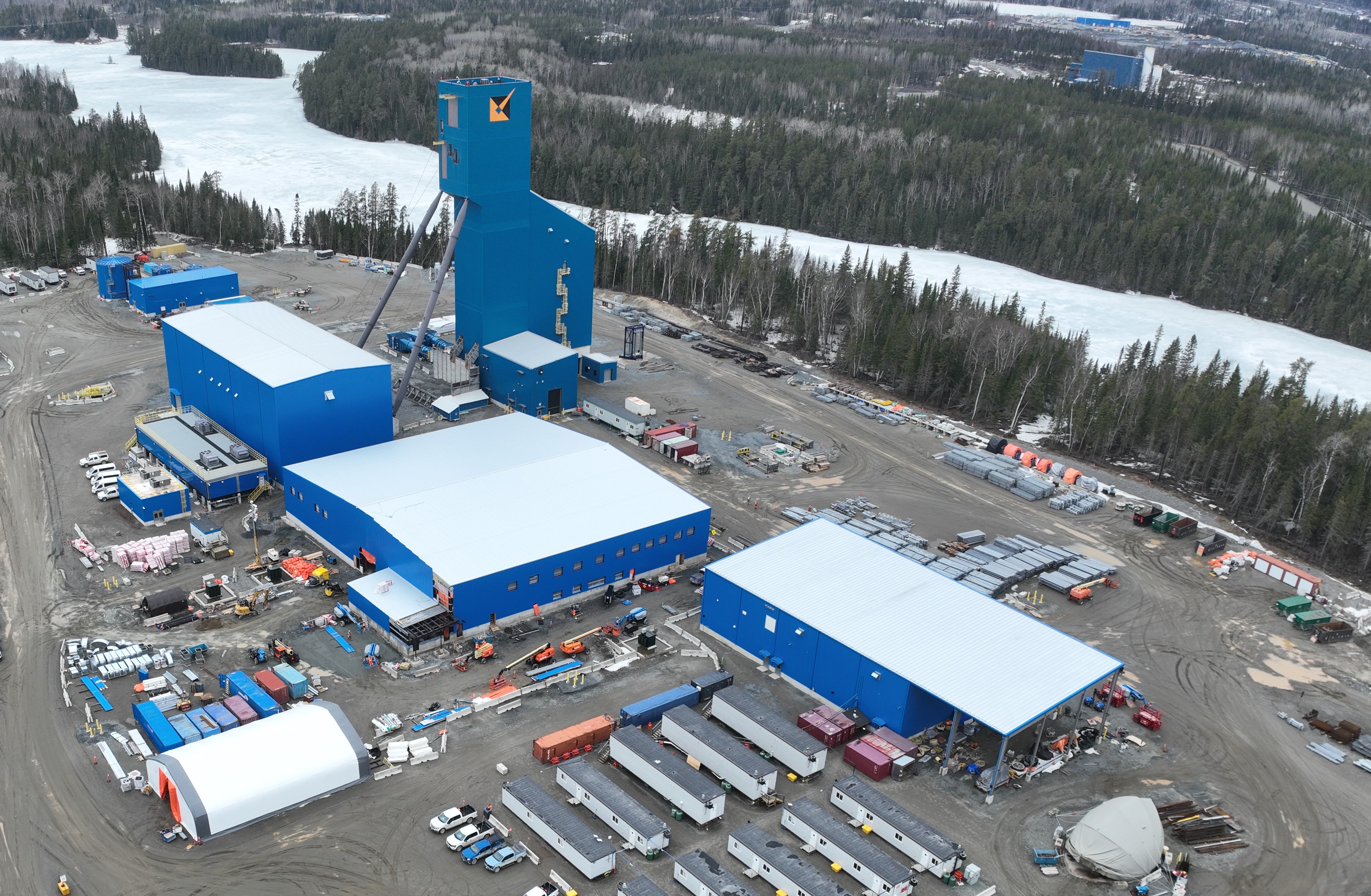
•Advanced the Phase 3+ Shaft Expansion at the Island Gold District. This included completing the shaft sink and advancing construction of the paste plant and administrative complex. Construction of the shaft and surface infrastructure is expected to be substantially complete by the end of 2026, and commissioning of the shaft completed in early 2027
•Reported year-end 2025 Mineral Reserves of 15.9 million ounces (265 million tonnes ("mt")), a 32% increase from the end of 2024, with grades also increasing 5% to 1.87 grams per tonne (“g/t Au”). This marked the seventh consecutive year Mineral Reserves have increased for a cumulative increase of 64%, with grades also increasing 24% over that time frame

(1) Refer to the “Non-GAAP Measures and Additional GAAP Measures” section at the end of this press release and associated MD&A for a description and calculation of these measures.
2 | Alamos Gold Inc


TRADING SYMBOL: TSX:AGI NYSE:AGI
Highlight Summary
Three Months Ended March 31,
    2026    
    2025    
Financial Results (in millions)
Operating revenues
    $596.7    
    $333.0    
Cost of sales (1)
    $205.5    
    $195.2    
Earnings from operations
    $344.8    
    $94.7    
Earnings before income taxes
    $315.2    
    $25.7    
Net earnings
    $191.4    
    $15.2    
Adjusted net earnings (2)
    $232.0    
    $59.8    
Adjusted earnings before interest, taxes, depreciation and
amortization (2)
    $383.2    
    $145.4    
Cash provided by operating activities
    $242.5    
    $79.6    
Cash provided by operating activities before changes in working capital and taxes paid (2)
    $338.0    
    $131.4    
Capital expenditures (sustaining) (2)
    $45.2    
    $26.8    
Sustaining finance leases (2)(3)
    $3.8    
    $4.3    
Capital expenditures (growth) (2)
    $127.2    
    $66.3    
Capital expenditures (capitalized exploration)
    $11.1    
    $6.6    
Free cash flow (2)(3)
    $101.7    
    ($20.1)
Operating Results
Gold production (ounces)
    123,900    
    125,000    
Gold sales (ounces)
    121,924    
    117,583    
Per Ounce Data
Average realized gold price (5)
    $4,829    
    $2,802    
Average spot gold price (London PM Fix)
    $4,873    
    $2,859    
Cost of sales per ounce of gold sold
 (includes amortization) (1)
    $1,685    
    $1,660    
Total cash costs per ounce of gold sold (2)
    $1,230    
    $1,158    
All-in sustaining costs per ounce of gold sold (2)
    $1,862    
    $1,661    
Share Data
Earnings per share, basic
    $0.46    
    $0.04    
Earnings per share, diluted
    $0.45    
    $0.04    
Adjusted earnings per share, basic (2)
    $0.55    
    $0.14    
Weighted average common shares outstanding (basic) (000’s)
    419,899    
    420,415    
Financial Position (in millions)
Cash and cash equivalents (4)
    $659.5    
    $623.1    
(1)Cost of sales includes mining and processing costs, royalties, and amortization expense.
(2)Refer to the “Non-GAAP Measures and Additional GAAP Measures” section at the end of this press release and associated MD&A for a description and calculation of these measures.
(3)Sustaining finance leases at the Island Gold District are not included as additions to mineral property, plant and equipment in cash flows used in investing activities.
(4)Cash and cash equivalents in the comparatives reflect the balance as at December 31, 2025.
(5)Average realized gold price for the three months ended March 31, 2026 included the delivery of ounces into the gold prepayment facility based on the prepay price of $4,166 ($2,524 per ounce for the three months ended March 31, 2025).


3 | Alamos Gold Inc


TRADING SYMBOL: TSX:AGI NYSE:AGI

Three Months Ended March 31,
    2026    
    2025    
Gold production (ounces)
Island Gold District (7)
    61,200    
    59,200    
Young-Davidson
    30,000    
    35,400    
Mulatos District (8)
    32,700    
    30,400    
Gold sales (ounces)
Island Gold District (7)
    57,109    
    53,388    
Young-Davidson
    31,042    
    35,475    
Mulatos District (8)
    33,773    
    28,720    
Cost of sales (in millions) (1)
Island Gold District (7)
    $87.8    
    $79.5    
Young-Davidson
    $67.4    
    $65.1    
Mulatos District (8)
    $50.1    
    $50.6    
Cost of sales per ounce of gold sold (includes amortization) (1)
Island Gold District (7)
    $1,537    
    $1,489    
Young-Davidson
    $2,171    
    $1,835    
Mulatos District (8)
    $1,483    
    $1,762    
Total cash costs per ounce of gold sold (2)
Island Gold District (7)
    $1,189    
    $1,040    
Young-Davidson
    $1,643    
    $1,311    
Mulatos District (8)
    $921    
    $1,191    
Mine-site all-in sustaining costs per ounce of gold sold (2)(3)
Island Gold District (7)
    $1,760    
    $1,418    
Young-Davidson
    $2,181    
    $1,615    
Mulatos District (8)
    $995    
    $1,278    
Capital expenditures (sustaining, growth, and capitalized exploration) (in millions) (2)
Island Gold District (4)(7)
    $123.0    
    $72.3    
Young-Davidson (5)
    $25.9    
    $18.8    
Mulatos District (6)(8)
    $17.3    
    $4.0    
Other
    $21.1    
    $8.9    
(1)Cost of sales includes mining and processing costs, royalties, and amortization expense.
(2)Refer to the “Non-GAAP Measures and Additional GAAP Measures” section at the end of this press release and associated MD&A for a description and calculation of these measures.
(3)For the purposes of calculating mine-site all-in sustaining costs, the Company does not include an allocation of corporate and administrative expense and corporate share-based compensation expense.
(4)Includes capitalized exploration at Island Gold District of $3.4 million for the three months ended March 31, 2026 ($3.9 million for the three months March 31, 2025).
(5)Includes capitalized exploration at Young-Davidson $3.4 million for the three months ended March 31, 2026 ($2.0 million for the three months ended March 31, 2025).
(6)Includes capitalized exploration at Mulatos District $2.2 million for the three months ended March 31, 2026 ($0.7 million for the three months ended March 31, 2025).
(7)The Island Gold District includes Island Gold and Magino mines.
(8)The Mulatos District includes Mulatos and La Yaqui Grande mines.

4 | Alamos Gold Inc


TRADING SYMBOL: TSX:AGI NYSE:AGI

Environment, Social and Governance Summary Performance
Health and Safety
•Total Recordable Injury Frequency Rate1 of 1.47 in the first quarter, consistent with the fourth quarter of 2025
•Lost time injury frequency rate1 of nil in the first quarter, consistent with the fourth quarter of 2025
•During the first quarter, Alamos had 20 recordable injuries across its sites and no lost time injuries
The Company’s Home Safe Every Day safety leadership training program, and newly introduced Home Safe Eight safety initiative, continue to be delivered across the workforce. Alamos’ Home Safe Eight is a new initiative consisting of eight non-negotiable safety rules targeting high-risk activities. These enhanced initiatives focus on areas such as energy isolation, working at heights, and safe vehicle operation, and are designed to significantly reduce the potential for injury through consistent and disciplined application.
Alamos strives to maintain a safe, healthy working environment for all, with a strong safety culture where everyone is continually reminded of the importance of keeping themselves and their colleagues healthy and injury-free. The Company’s overarching commitment is to have all employees and contractors return Home Safe Every Day.
Environment
•Continued reclamation activities at the Cerro Pelon, El Victor and San Carlos pits in the Mulatos District, with work expected to be completed in the second quarter of 2026
•Zero significant environmental incidents
There were four reportable spills in the first quarter. At the Young-Davidson mine, two reportable spills occurred: one involving a sodium sulfide container, and another resulting from a natural gas line leak. At the Island Gold District, one spill occurred involving an engine oil container. At the Mulatos District, a small amount of heap leach material spilled beyond the leach pad and was quickly remediated.
All spills were promptly addressed by site teams at the time of occurrence and are not expected to have any lasting impact on the natural environment. The Company remains committed to preserving the long-term health and viability of the natural environment surrounding its operations and projects. This includes investing in new initiatives to reduce the Company's environmental footprint, with the goal of minimizing the impacts of its activities.
Community
Alamos continued to provide charitable donations, sponsorships, medical support and infrastructure investments within its local communities, including:
•Ongoing financial support for various institutions in Kirkland Lake to support their services and continued operations
•Sponsorship of various events and teams, including the Canadian Mining Games, Junior Explorers Challenge, Temagami First Nation Ice Road Challenge, Larder Lake Fishing Derby, and a local team participating in the Youth Bowl Canada Championship
•Cash donations to various health, education, and food programs in the communities in which Alamos operates
The Company believes that excellence in sustainability provides a net benefit to all stakeholders and continues to engage with local communities to better understand local challenges and priorities. Ongoing investments in local infrastructure, health care, education, cultural and community programs remain a focus of the Company.
5 | Alamos Gold Inc


TRADING SYMBOL: TSX:AGI NYSE:AGI
Governance and Disclosure
•Completed annual fieldwork and assurance of Alamos’ compliance with the World Gold Council’s Responsible Gold Mining Principles (“RGMPs”). Alamos expects to publish its 2025 RGMP Report in the second quarter of 2026
The Company maintains the highest standards of corporate governance to ensure that corporate decision-making reflects its values, including the Company’s commitment to sustainable development.
(1) Frequency rate is calculated as incidents per 200,000 hours worked.

6 | Alamos Gold Inc


TRADING SYMBOL: TSX:AGI NYSE:AGI

Outlook and Strategy
2026 Guidance
Island Gold District Young-Davidson Mulatos District Lynn Lake Total
Gold production (000's ounces)
290 - 330 155 - 175 125 - 145 570 - 650
Cost of sales, including amortization (in millions) (2)
$920
Cost of sales, including amortization ($ per ounce) (2)
$1,450 - $1,550
Total cash costs ($ per ounce) (1)
$875 - $975 $1,350 - $1,450 $930 - $1,030 $1,020 - $1,120
All-in sustaining costs ($ per ounce) (1)
$1,500 - $1,600
Mine-site all-in sustaining costs ($ per ounce) (1)(3)
$1,340 - $1,440 $1,730 - $1,830 $1,000 - $1,100
Capital expenditures ($ millions)
Sustaining capital (1)(4)
$135 - $150 $55 - $65 $3 - $5 $193 - $220
Growth capital (1)(4)
$355 - $385 $25 - $30 $137 - $145 $140 - $160 $657 - $720
Total sustaining and growth capital (1)(4)
$490 - $535 $80 - $95 $140 - $150 $140 - $160 $850 - $940
Capitalized exploration (1)
$33 $12 $9 $6 $60
Total capital expenditures and capitalized exploration (1)
$523 - $568 $92 - $107 $149 - $159 $146 - $166 $910 - $1,000
(1)Refer to the "Non-GAAP Measures and Additional GAAP" section at the end of this press release and associated MD&A for a description of these measures.
(2)Cost of sales includes mining and processing costs, royalties, and amortization expense but excludes silver credit, and is calculated based on the mid-point of total cash cost guidance.
(3)For the purposes of calculating mine-site all-in sustaining costs at individual mine sites the Company allocates a portion of share based compensation to the mine sites, but does not include an allocation of corporate and administrative expenses to the mine sites.
(4)Sustaining and growth capital guidance excludes capitalized exploration.

The Company’s objective is to operate a sustainable business model that supports growing returns to all stakeholders over the long-term, through growing production, expanding margins, and increasing profitability. This includes a balanced approach to capital allocation focused on generating strong ongoing free cash flow while re-investing in high-return internal growth opportunities, and supporting higher returns to shareholders.
During the first quarter, the Company delivered on these objectives across multiple fronts, including meeting quarterly guidance while continuing to advance its high-return growth projects. First quarter production of 123,900 ounces was in line with guidance with a strong performance from the Island Gold District more than offsetting lower production from Young-Davidson. As previously guided, total cash costs and AISC were above first half guidance, with both expected to decrease in the second quarter and more significantly in the second half of the year. Reflecting strong ongoing margins, the Company generated $101.7 million of free cash flow in the first quarter while funding its peer leading pipeline of growth projects, and net of $82.0 million of cash taxes paid. Higher production, lower costs and lower cash taxes are expected to drive stronger free cash flow through the remainder of year.
Underground mining rates at Island Gold increased to average a new record of over 1,400 tpd during the first quarter, while the addition of the supplementary crushed ore feed in the second half of February and other operational improvements supported the ramp up of processing rates in the Magino mill to average 9,200 tpd over the past six weeks. The ramp up of underground mining rates is expected to continue through the year supporting growing production from the Island Gold District.
All three operations are expected to contribute to a substantial growth in the second quarter with production expected to increase to between 145,000 and 155,000 ounces. With stronger production expected into the second half of the year, the Company remains on track to achieve full year guidance. Reflecting the stronger production, AISC are expected to decrease approximately 5% in the second quarter with a more significant improvement into the second half of the year. The Company continues to monitor the impact of ongoing inflationary pressures across its cost structure. This includes higher labour, contractor, diesel, electricity and natural gas costs, and the downstream impact of higher energy prices on other consumables. The Company expects to manage these cost pressures with productivity improvements through the year driving costs lower and significant margin expansion at current gold prices.
7 | Alamos Gold Inc


TRADING SYMBOL: TSX:AGI NYSE:AGI
This trend of growing production and declining costs is expected to continue through the end of the decade driven by the Company's portfolio of high-return and low-cost growth projects. This includes the Island Gold District shaft and mill expansion, PDA and Lynn Lake, all of which continued to advance during the first quarter. These projects are expected to nearly double gold production to approximately one million ounces annually by 2030, underpinning one of the strongest outlooks in the sector.

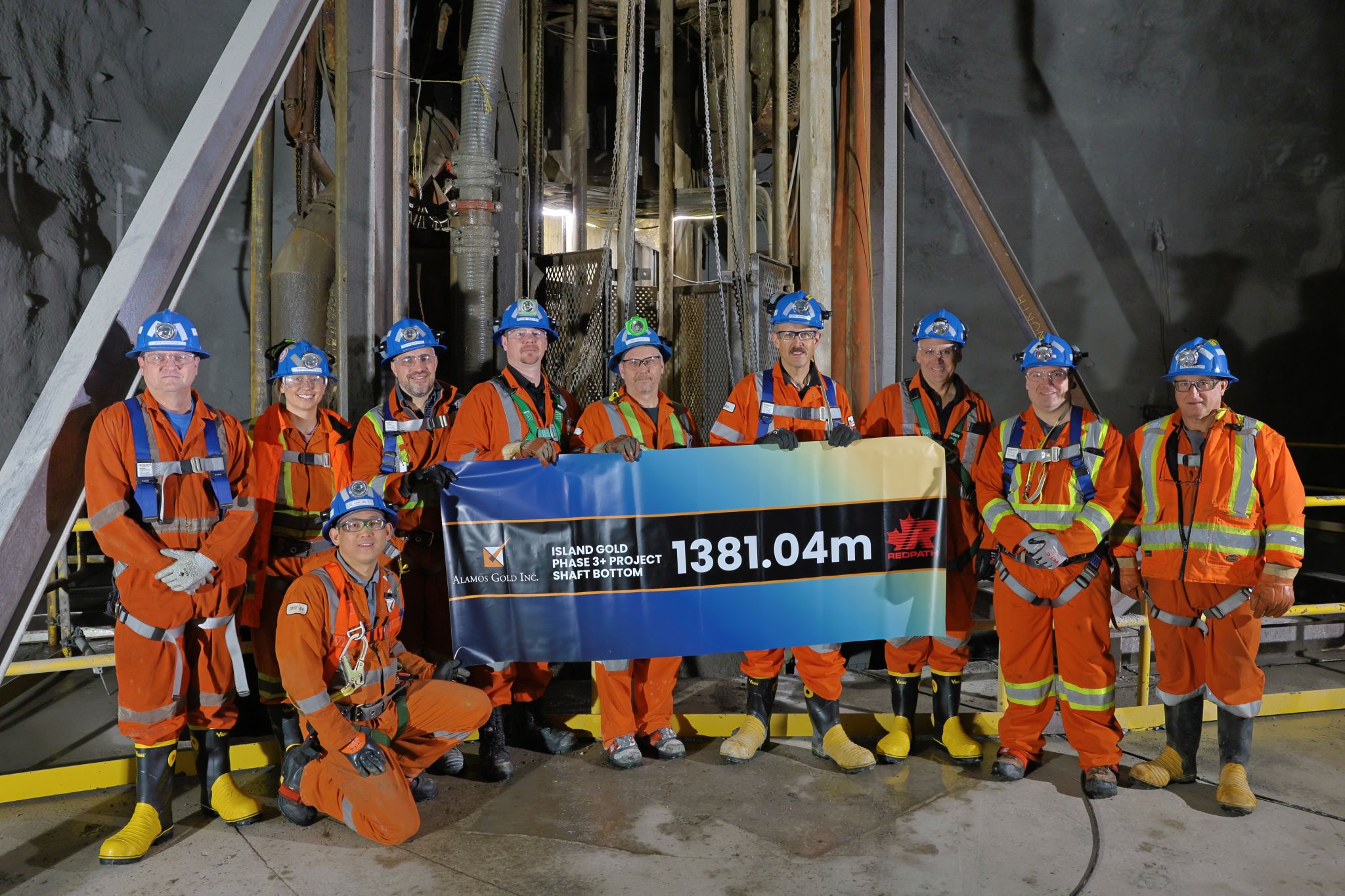
The Island Gold District will be a key driver of this growth over the next several years. The Phase 3+ Shaft Expansion achieved a significant milestone during the first quarter with the completion of the shaft sink to its planned depth of 1,381 metres ("m"). Work on the shaft bottom infrastructure will continue through 2026 with commissioning of the shaft expected to be completed early in 2027. This is expected to drive consolidated gold production to a range of between 650,000 and 730,000 ounces in 2027, a 13% increase from 2026.
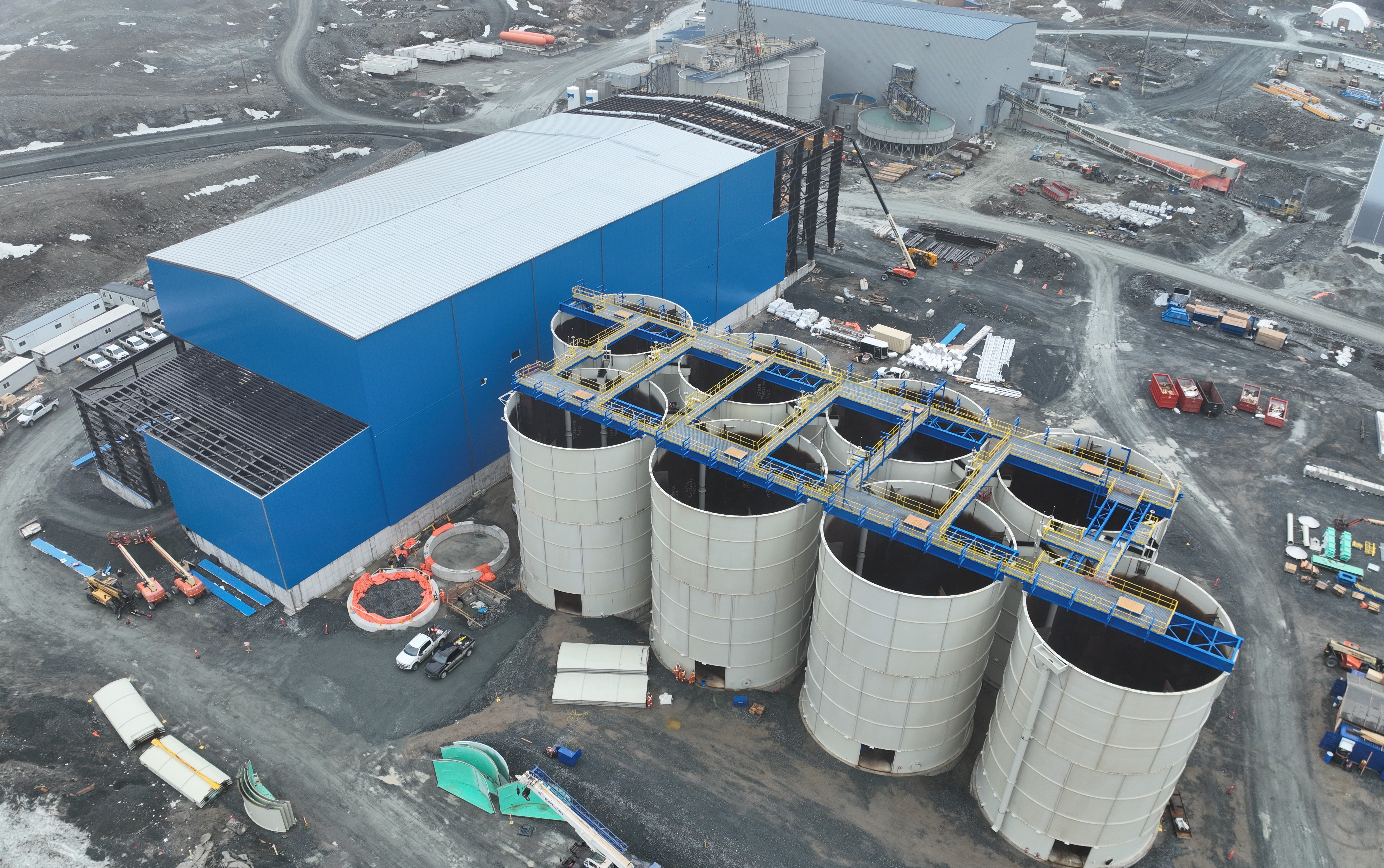
In parallel, work on the Magino mill expansion to 20,000 tpd continues to progress with construction and exterior cladding of the new mill building well underway. The completion of the IGD Expansion in 2028 is expected to support a further increase in production to a range of 755,000 to 835,000 ounces, representing a 15% increase from 2027 and cumulative 46% increase from 2025.
Further growth is expected into 2029 with initial production from Lynn Lake, and the ramp up of underground mining rates at Island Gold to 3,000 tpd, as outlined in the IGD Expansion Study. By 2030, production is expected to increase to a rate of approximately one million ounces annually.
Total cash costs and AISC in 2027 are expected to decrease 19% and 10%, respectively, from 2025 driven by low-cost growth from the Island Gold District with the completion of the shaft and connecting the Magino mill to low-cost grid power. A further decrease in costs is expected into 2028 with AISC expected to be between $1,200 and $1,300 per ounce, representing an 18% decrease from 2025. This is expected to be driven by the first full year of production from PDA in Mexico and a further increase in low-cost production from the Island Gold District with the completion of the IGD Expansion. Costs are expected to continue decreasing into 2029 and 2030 with the ramp up of underground mining rates at Island Gold to 3,000 tpd, and the start of production from the low-cost Lynn Lake project.
Capital spending in 2026 is expected to range between $850 and $940 million, excluding capitalized exploration of $60 million. The largest portion of this budget will be focused on the completion of the shaft expansion and larger mill expansion within the Island Gold District. Capital spending is expected to decline slightly in 2027 with increased spending at Lynn Lake offset by lower spending on PDA and the Island Gold District. In 2028, capital spending is expected to decrease approximately 24% compared to 2027 as the IGD Expansion is completed. A more significant decrease is expected into 2029 and 2030 with the completion of construction at Lynn Lake.
A record $97 million has been budgeted globally for exploration in 2026, a 37% increase from the $71 million spent in 2025. The increase reflects significant ongoing exploration success, including a 32% increase in Global Mineral Reserves to 15.9 million ounces in 2025, with grades also increasing 5% to 1.87 g/t Au (265 mt). This includes expanded budgets at each of the Island Gold District, Young-Davidson and Lynn Lake. The Island Gold District remains the largest portion of the budget with $43 million planned for 2026, following up on another year of substantial Mineral Reserve growth.
The Company remains well positioned to fund its high-return growth projects internally with strong ongoing free cash flow, $659.5 million of cash and cash equivalents at the end of the first quarter of 2026, and approximately $1.2 billion of total liquidity. At current gold prices, the Company expects to continue generating strong free cash flow while funding its growth projects, with significant increases starting in 2027 with the completion of the Phase 3+ Shaft Expansion. The Company also remains focused on shareholder returns. Given the strong ongoing free cash flow, and significant growth expected over the next several years, the Company increased its quarterly dividend rate by 60% to $0.04 per share in the first quarter, and will continue to assess opportunities to be active on its share buyback.
8 | Alamos Gold Inc


TRADING SYMBOL: TSX:AGI NYSE:AGI

First Quarter 2026 Results
Island Gold District Financial and Operational Review
Three Months Ended March 31
2026  2025 
Gold production (ounces)
    61,200    
    59,200    
Gold sales (ounces)
    57,109    
    53,388    
Financial Review (in millions)
Operating Revenues
    $279.3    
    $152.0    
Cost of sales (1)
    $87.8    
    $79.5    
Earnings from operations
    $189.7    
    $71.4    
Cash provided by operating activities
    $177.2    
    $86.9    
Capital expenditures (sustaining) (2)
    $27.9    
    $15.5    
Lease payments (sustaining) (2),(5)
    $3.8    
    $4.3    
Capital expenditures (growth) (2)
    $87.9    
    $48.6    
Capital expenditures (capitalized exploration) (2)
    $3.4    
    $3.9    
Mine-site free cash flow (2),(5)
    $58.0    
    $18.9    
Cost of sales, including amortization per ounce of gold sold (1)
    $1,537    
    $1,489    
Total cash costs per ounce of gold sold (2)
    $1,189    
    $1,040    
Mine-site all-in sustaining costs per ounce of gold sold (2),(3)
    $1,760    
    $1,418    
Island Gold Mine
Underground Operations
Tonnes of ore mined
    128,113    
    110,226    
Tonnes of ore mined per day
    1,423    
    1,225    
Average grade of gold (4)
    9.38    
    11.50    
Metres developed
    1,756    
    2,157    
Island Gold Mill Operations (8)
Tonnes of ore processed
    113,164    
    109,067    
Tonnes of ore processed per day
    1,257    
    1,212    
Average grade of gold (4)
    9.95    
    11.36    
Contained ounces milled
    36,188    
    39,838    
Average recovery rate
    97%    
    98%    
Magino Mine
Open Pit Operations
Tonnes of ore mined - open pit (6)
    1,073,079    
    1,064,870    
Tonnes of ore mined per day
    11,923    
    11,832    
Total waste mined - open pit (7)
    3,418,216    
    3,446,128    
Total tonnes mined - open pit
    4,491,294    
    4,510,998    
Waste-to-ore ratio (7)
    3.19    
    3.24    
Average grade of gold (4)
    0.81    
    0.77    
Magino Mill Operations (8)
Tonnes of ore processed
    675,984    
    651,153    
Tonnes of ore processed per day
    7,511    
    7,235    
Average grade of gold processed (4)
    1.18    
    0.86    
Contained ounces milled
    25,539    
    17,920    
Average recovery rate
    94%    
    92%    
Island Gold District Mill Operations
Tonnes of ore processed per day
    8,768    
    8,447    
Average grade of gold processed (4)
    2.43    
    2.36    
Average recovery rate
    96%    
    97%    
(1)Cost of sales includes mining and processing costs, royalties, and amortization.
(2)Refer to the “Non-GAAP Measures and Additional GAAP Measures” section at the end of this press release and associated MD&A for a description and calculation of these measures.
(3)For the purposes of calculating mine-site all-in sustaining costs, the Company does not include an allocation of corporate and administrative expense and corporate share-based compensation expense.
(4)Grams per tonne of gold.
(5)Mine-site free cash flow does not include lease payments which are classified as cash flows used in financing activities on the consolidated financial statements.
(6)Includes ore stockpiled during the periods.
(7)Total waste mined includes operating waste and capitalized stripping.
9 | Alamos Gold Inc


TRADING SYMBOL: TSX:AGI NYSE:AGI
(8)Magino mill results include the processing of open pit ore from Magino and excess underground ore not processed within the Island Gold mill for the three months ended March 31, 2026. Grades of gold processed from the Magino mine averaged 1.07 g/t Au.


The Island Gold District produced 61,200 ounces in the first quarter of 2026, slightly higher than the fourth quarter of 2025 and prior year period.
Island Gold Operational Review
Underground mining rates increased to average a record 1,423 tpd in the first quarter, 16% higher than the prior year period and consistent with first quarter guidance. Mining rates are expected to steadily increase through the remainder of the year to 2,000 tpd by the end of 2026. A further increase in mining rates to 2,400 tpd is expected early in 2027 with the commissioning of the shaft infrastructure.
Underground grades mined averaged 9.38 g/t Au during the first quarter, in line with guidance. Grades are expected to remain at similar levels in the second quarter and increase in the second half of the year to average close to the mid-point of guidance for the full year.
Processing rates within the Island Gold mill averaged 1,257 tpd for the first quarter, with excess underground ore processed in the Magino mill. Mill recoveries averaged 97% for the first quarter, in line with expectations.
As outlined in the IGD Expansion Study, the Island Gold mill will continue operating until early 2028 and process approximately 1,265 tpd of higher grade underground ore. The remaining underground ore mined beyond the Island Gold mill capacity will be blended at increasing rates with open pit ore and processed within the Magino mill. Following the expected completion of the larger Magino mill expansion to 20,000 tpd in early 2028, the Island Gold mill will be shut down and all underground and open pit ore will be processed within the larger and more cost-effective Magino mill.
Magino Operational Review
Total mining rates averaged 49,903 tpd during the first quarter, including 11,923 tpd of ore, consistent with the prior year period. Grades mined of 0.81 g/t Au for the first quarter were 5% higher than the prior year period and slightly above annual guidance.
Milling rates averaged 7,511 tpd in the first quarter, 4% higher than the prior year period and slightly below first quarter guidance of 7,800 tpd. During the first quarter, a temporary crusher was added to provide supplemental ore feed after the existing secondary crusher arrangement. Following the completion of this new installation in the second half of February, milling rates increased substantially, averaging 9,200 tpd over the past six weeks. Milling rates are expected to remain at similar levels during the second quarter reflecting scheduled liner changes in the ball and SAG mills, as well as conveyor belt replacements. Milling rates are expected to increase to steady state levels of approximately 10,000 tpd by the third quarter, consistent with guidance.
As outlined in the IGD Expansion Study, further improvements are planned for the existing crushing and conveying circuit as part of a larger expansion to 20,000 tpd. These include the addition of a gyratory crusher, ore bins, and a new truck dump configuration allowing for the direct tipping of ore. In addition to the connection to grid power, these changes will significantly improve the performance of the existing crushing circuit by reducing ore rehandling and ensuring more consistent and higher ore flow to the mill.
Grades processed averaged 1.18 g/t Au during the first quarter, and included approximately 10,000 tonnes of higher grade underground ore. Recoveries for the first quarter were 94%.
Island Gold District Financial Review
Revenues of $279.3 million in the first quarter were 84% higher than the prior year period, driven by higher realized gold prices and an increase in ounces sold.
Cost of sales of $87.8 million in the first quarter were 10% higher than the prior year period, due to higher ounces sold and ongoing inflation.
10 | Alamos Gold Inc


TRADING SYMBOL: TSX:AGI NYSE:AGI
Total cash costs of $1,189 per ounce and mine-site AISC of $1,760 per ounce in the first quarter were higher than the prior year period, driven by increased royalty costs, ongoing labour inflation, higher diesel and energy costs, and contractor costs. In addition, increased mine-site AISC reflected higher sustaining capital in support of the IGD Expansion to 20,000 tpd. Total cash costs and mine-site AISC were in line with plan and are expected to decrease in the second half of the year.
Capital expenditures totaled $123.0 million in the first quarter, including $27.9 million of sustaining capital, $3.8 million of sustaining lease payments, and $3.4 million of capitalized exploration. Growth capital spending of $87.9 million was primarily focused on the Phase 3+ Shaft Expansion, including shaft site infrastructure, paste plant, and underground development, as well as the larger Magino mill expansion to 20,000 tpd. The shaft sink was completed in the first quarter, reaching the planned depth of 1,381 m.
The Island Gold District generated strong mine-site free cash flow of $58.0 million in the first quarter, net of the significant capital investment related to the Phase 3+ Shaft and IGD Expansions. At current gold prices, the Island Gold District is expected to continue generating strong free cash flow while funding the expansion of the operation and a robust exploration program, with significant free cash flow growth starting in the latter part of 2026.
11 | Alamos Gold Inc


TRADING SYMBOL: TSX:AGI NYSE:AGI

Young-Davidson Financial and Operational Review
Three Months Ended March 31
    2026    
    2025    
Gold production (ounces)
    30,000    
    35,400    
Gold sales (ounces)
    31,042    
    35,475    
Financial Review (in millions)
Operating Revenues
    $153.6    
    $101.2    
Cost of sales (1)
    $67.4    
    $65.1    
Earnings from operations
    $84.7    
    $35.1    
Cash provided by operating activities
$97.4
    $58.0    
Capital expenditures (sustaining) (2)
    $16.6    
    $10.7    
Capital expenditures (growth) (2)
    $5.9    
    $6.1    
Capital expenditures (capitalized exploration) (2)
    $3.4    
    $2.0    
Mine-site free cash flow (2)
    $71.5    
    $39.2    
Cost of sales, including amortization per ounce of gold sold (1)
    $2,171    
    $1,835    
Total cash costs per ounce of gold sold (2)
    $1,643    
    $1,311    
Mine site all-in sustaining costs per ounce of gold sold (2),(3)
    $2,181    
    $1,615    
Underground Operations
Tonnes of ore mined
    648,489    
    608,601    
Tonnes of ore mined per day
    7,205    
    6,762    
Average grade of gold (4)
    1.73    
    2.00    
Metres developed
    2,387    
    2,132    
Mill Operations
Tonnes of ore processed
    610,700    
    599,215    
Tonnes of ore processed per day
    6,786    
    6,658    
Average grade of gold (4)
    1.75    
    2.01    
Contained ounces milled
    34,267    
    38,765    
Average recovery rate
    89%    
    91%    
(1)Cost of sales includes mining and processing costs, royalties and amortization.
(2)Refer to the “Non-GAAP Measures and Additional GAAP Measures” section at the end of this press release and associated MD&A for a description and calculation of these measures.
(3)For the purposes of calculating mine-site all-in sustaining costs, the Company does not include an allocation of corporate and administrative expense and corporate share-based compensation expense.
(4)Grams per tonne of gold.

Operational review
Young-Davidson produced 30,000 ounces of gold in the first quarter, 15% lower than the prior year period due to lower grades mined and processed. With higher mining rates and grades expected to drive stronger production through the remainder of the year, the operation remains on track to achieve full year guidance.
Mining rates averaged 7,205 tpd in the first quarter, below first quarter guidance of 7,600 tpd reflecting a longer than expected timeline to complete rehabilitation work on one of three existing ore passes, as well as delays in commissioning a newly constructed ore pass resulting in more rehandling of ore. Both passes are now fully operational, bringing the total number of active ore passes to four. This is expected to increase operational flexibility and support increased mining rates of approximately 8,000 tpd in the second quarter and through the remainder of the year.
Grades mined of 1.73 g/t Au for the first quarter were below the low end of annual guidance of 1.90 g/t Au reflecting higher than planned mining dilution. This was primarily driven by stope overbreak within a small number of stopes. As part of ongoing standard operating practices, the Company continues to review its drilling and blasting design with a focus on minimizing dilution. Mined grades are expected to increase to within guided levels through the remainder of the year.
12 | Alamos Gold Inc


TRADING SYMBOL: TSX:AGI NYSE:AGI


Milling rates averaged 6,786 tpd in the first quarter, below guidance reflecting longer than planned downtime for scheduled maintenance and an unscheduled repair to a transformer in the mill. Milling rates are expected to increase to average 8,000 tpd through the rest of the year. Excess underground ore mined but not processed in the first quarter will be processed through the remainder of the year. Milled grades averaged 1.75 g/t Au for the first quarter, consistent with mined grades. Mill recoveries averaged 89% for the first quarter, slightly lower than the prior year period and annual guidance reflecting lower grades processed.
Financial Review
Revenues increased to $153.6 million in the first quarter, 52% higher than the prior year period, driven by higher realized gold prices, partially offset by lower ounces sold.
Cost of sales of $67.4 million in the first quarter were 4% higher than the prior year period, reflecting inflation, partially offset by lower ounces sold.
First quarter total cash costs of $1,643 per ounce and mine-site AISC of $2,181 per ounce were higher than the prior year period, primarily due to lower grades processed, increased electricity and diesel costs, higher royalty expense, and ongoing labour inflation. The increase in mine-site AISC also reflected higher sustaining capital expenditures across a lower number of ounces sold. Both total cash costs and mine-site AISC are expected to decrease into the second quarter and through the rest of the year driven by higher mining rates and grades.
Capital expenditures in the first quarter totaled $25.9 million, including $16.6 million of sustaining capital and $5.9 million of growth capital. Additionally, $3.4 million was invested in capitalized exploration during the quarter.
Young-Davidson continues to generate strong ongoing mine-site free cash flow, including $71.5 million in the first quarter. With a 14-year Mineral Reserve life, the operation is well-positioned to generate strong ongoing free cash flow over the long-term.
13 | Alamos Gold Inc


TRADING SYMBOL: TSX:AGI NYSE:AGI

Mulatos District Financial and Operational Review
Three Months Ended March 31,
    2026    
    2025    
Gold production (ounces)
    32,700    
    30,400    
Gold sales (ounces)
    33,773    
    28,720    
Financial Review (in millions)
Operating Revenues
    $168.1    
    $84.0    
Cost of sales (1)
    $50.1    
    $50.6    
Earnings from operations
    $115.1    
    $31.1    
Cash provided by operating activities
    $78.1    
    $4.6    
Capital expenditures (sustaining) (2)
    $0.7    
    $0.6    
Capital expenditures (growth) (2)
    $14.4    
    $2.7    
Capital expenditures (capitalized exploration) (2)
    $2.2    
    $0.7    
Mine-site free cash flow (2)
    $60.8    
    $0.6    
Cost of sales, including amortization per ounce of gold sold (1)
    $1,483    
    $1,762    
Total cash costs per ounce of gold sold (2)
    $921    
    $1,191    
Mine site all-in sustaining costs per ounce of gold sold (2),(3)
    $995    
    $1,278    
La Yaqui Grande Mine
Open Pit Operations
Tonnes of ore mined - open pit
    953,949    
    994,813    
Total waste mined - open pit
    3,784,228    
    4,085,874    
Total tonnes mined - open pit
    4,738,177    
    5,080,687    
Waste-to-ore ratio
    3.97    
    4.11    
Crushing and Heap Leach Operations
Tonnes of ore stacked
    981,923    
    1,022,583    
Average grade of gold processed (4)
    1.37    
    0.75    
Contained ounces stacked
    43,245    
    24,610    
Average recovery rate
    61%    
    84%    
Ore crushed per day (tonnes)
    10,900    
    11,400    
(1)Cost of sales includes mining and processing costs, royalties, and amortization expense.
(2)Refer to the “Non-GAAP Measures and Additional GAAP Measures” section at the end of this press release and associated MD&A for a description and calculation of these measures.
(3)For the purposes of calculating mine-site all-in sustaining costs, the Company does not include an allocation of corporate and administrative expense and corporate share-based compensation expense.
(4)Grams per tonne of gold.

Mulatos District Operational Review
The Mulatos District produced 32,700 ounces in the first quarter, an 8% increase from the prior year period reflecting a stronger contribution from La Yaqui Grande, which more than offset lower production from residual leaching at Mulatos.
La Yaqui Grande produced 26,500 ounces in the first quarter, 28% higher than the prior year period reflecting higher grades stacked during the quarter, and the recovery of ounces stacked in previous quarters. Stacking rates averaged 10,900 tpd in the first quarter, consistent with the top end of the annual guidance range. Grades stacked averaged 1.37 g/t Au, consistent with the high-end of annual guidance. Recovery rates were 61% in the first quarter, lower than the prior year period, reflecting timing. Recovery rates are expected to increase in the second quarter and through the rest of the year as a significant portion of ounces stacked during the first quarter are recovered.
Mulatos has been in the residual leaching phase since December 2023 and produced 6,200 ounces in the first quarter.

14 | Alamos Gold Inc


TRADING SYMBOL: TSX:AGI NYSE:AGI
Mulatos District Financial Review
Revenues of $168.1 million in the first quarter were 100% higher than the prior year period, reflecting higher realized gold prices and ounces sold.

Cost of sales of $50.1 million in the first quarter were consistent with the prior year period, reflecting a higher contribution of lower cost production from La Yaqui Grande. Total cash costs of $921 per ounce and mine-site AISC of $995 per ounce in the first quarter were lower than the prior year period, also a result of the higher contribution of lower cost ounces from La Yaqui Grande and higher grades stacked.
Capital expenditures totaled $17.3 million in the first quarter, including $0.7 million of sustaining capital and $2.2 million of capitalized exploration. Growth capital spending of $14.4 million was primarily related to portal construction, procurement activities, detailed engineering, and concrete foundation work for the PDA mill. Spending on PDA is expected to ramp up further during the second quarter and into the second half of the year as construction activities advance. The project remains on budget and on track for completion in mid-2027.
The Mulatos District generated strong mine-site free cash flow of $60.8 million in the first quarter, driven by higher realized gold prices and ounces sold compared to the prior year period. The strong free cash flow generation was net of $50.9 million of cash tax payments in the first quarter, primarily related to 2025 payable income and mining taxes. Cash tax installments in Mexico related to the 2026 fiscal year are expected to average between $20 and $25 million per quarter for the remainder of the year, based on a budgeted gold price of $4,000 per ounce. At current gold prices, the Mulatos District is expected to generate strong mine-site free cash flow through the remainder of the year while funding PDA and a significant exploration program.
First Quarter 2026 Development Activities
Island Gold District (Ontario, Canada)
Phase 3+ Shaft and IGD Expansion
In 2022, the Company announced the Phase 3+ Shaft Expansion at Island Gold from 1,200 tpd to 2,400 tpd. The expansion includes the construction of a shaft and paste plant, as well as accelerated development to support the higher mining rates. With the commissioning of the shaft expected to be completed in early 2027, the operation will transition from trucking ore and waste up the ramp to skipping ore and waste to surface, driving production higher and costs significantly lower. As at March 31, 2026, 100% of the Phase 3+ Shaft Expansion growth capital has been spent and committed.
On February 3, 2026, the Company announced the IGD Expansion Study outlining a larger, long-life, low-cost mine with an average annual gold production of 534,000 ounces over the initial 10 years (starting in 2028) at average mine-site AISC of $1,025 per ounce. The IGD Expansion growth capital of $542 million will be spent on the expansion of the Magino mill to 20,000 tpd, accelerated underground development, and mobile equipment to support higher underground and open pit mining rates of 3,000 tpd and 17,000 tpd, respectively.
As outlined in the IGD Expansion Study, the Island Gold mill will continue operating and will be dedicated to processing approximately 1,265 tpd of higher grade underground ore until the expected completion of the Magino mill expansion in first quarter of 2028. The remaining underground ore mined, beyond the Island Gold mill capacity of 1,265 tpd, will be blended at increasing rates with open pit ore and processed within the Magino mill. As at March 31, 2026, 11% of growth capital related to the IGD Expansion has been spent and committed, with the majority of spending focused on the Magino mill expansion.
During the first quarter of 2026, the Company spent $87.9 million in growth capital at the Island Gold District. Progress during the first quarter is summarized as follows:
•Shaft sinking completed to planned depth of 1,381 m
•Concrete liner to the shaft bottom and excavation of the loading pocket completed
15 | Alamos Gold Inc


TRADING SYMBOL: TSX:AGI NYSE:AGI
•Mechanical and electrical outfitting for the water handling facility and shaft bin house substantially complete
•Magino mill expansion to 20,000 tpd progressing, with installation of structural steel completed, cladding and roofing activities well underway, and all eight leach tanks erected
•Paste plant construction advancing with expected completion in second quarter of 2026
•Completed installation of structural steel for new administrative complex, with roofing and cladding underway
•Advanced lateral development in support of higher mining rates ramp up through 2026
Construction of shaft and surface infrastructure is expected to be substantially complete by the end of 2026, and commissioning of the shaft completed in early 2027. The IGD Expansion to 20,000 tpd remains on track to be completed in early 2028.
(in US$M)
Growth capital
P3+ Estimate February 20261
Spent to date1,2
Committed to date1
% of Spent & Committed
Shaft & Shaft Surface Complex 324 
    275    
    34    
    95%    
Accelerated Underground Development, Infrastructure, and Equipment 255 
    218    
    37    
    100%    
Site Infrastructure, Mill and Other3,4
165 
    174    
    8    
    110%    
General Indirect Costs 91 
    84    
    3    
    96%    
Total Phase 3+ Shaft Expansion Growth Capital $ 835  $ 751  $ 82 
    100%    

(in US$M)
Growth capital
IGD Expansion Estimate February 20261
Spent to date1,2
Committed to date1
% of Spent & Committed
Mill Expansion 199 
    20    
    28    
    24%    
Accelerated Underground Development 166 
    5    
    —    
    3%    
Mining Equipment 81 
    —    
    —    
    —%    
Site Infrastructure and Other 96 
    —    
    6    
    6%    
Total IGD Expansion Growth Capital $ 542  $ 25  $ 34 
    11%    
1.Reflects updated capital estimates released in February 2026 as part of the IGD Expansion, based on USD/CAD exchange $0.74:1. Spent to date based on average USD/CAD of $0.73:1 since the start of 2022. Committed to date based on the spot USD/CAD rate as at March 31, 2026 of $0.72:1.
2.Amount spent to date accounted for on an accrual basis, including working capital movements.
3.Spent to date includes components for Magino mill expansion to 20,000 tpd which were not included in P3+ Estimate.
4.Includes power upgrade spent to-date on a 100% basis and does not reflect partner’s contributions.


16 | Alamos Gold Inc


TRADING SYMBOL: TSX:AGI NYSE:AGI
Island Gold shaft site area - April 2026
image_1a.jpg

Island Gold paste plant - April 2026
image_2a.jpg
17 | Alamos Gold Inc


TRADING SYMBOL: TSX:AGI NYSE:AGI
Island Gold shaft sinking completed (depth of 1,381 m) - April 2026
image_3a.jpg

Magino mill expansion - April 2026
image_4a.jpg
18 | Alamos Gold Inc


TRADING SYMBOL: TSX:AGI NYSE:AGI

Lynn Lake (Manitoba, Canada)
On January 13, 2025, the Company announced a positive construction decision on the Lynn Lake project. With the approval of the Closure Plan in January 2025, the required permitting and pre-construction conditions have been met allowing for the start of construction on the project.
In February 2025, an internal economic study and development plan was released on the BT and Linkwood satellite deposits located in proximity to the Lynn Lake project. The BT and Linkwood deposits are expected to provide a source of additional mill feed to the Lynn Lake project, extending the combined mine life of the project, increase longer term rates of production, and enhance the overall economics.
With significantly longer mine life, incorporating the BT and Linkwood deposits, the Company has re-engineered and optimized a number of elements within the broader Lynn Lake development plan. This includes several scope changes, most notably increasing the mill capacity by 13% to 9,000 tpd, driving production higher and stronger economics.
Reflecting scope changes to support a larger operation, three years of inflation since the 2023 Feasibility Study, and the longer construction timeline due to the 2025 wildfires, initial capital for the project was increased to $937 million, with $871 million remaining to be spent as of the start of 2026.
The updated parameters for the Lynn Lake project, incorporating the revised initial capital, larger Mineral Reserve base including BT and Linkwood, and increased mill throughput, are as follows:
•Average annual production of 186,000 ounces over the initial 10 years
•Low mine-site AISC of $829 per ounce over the initial 10 years ($1,039 per ounce over the life of mine)
•Long mine life of 25 years with total production of three million ounces (based on Mineral Reserves at the end of 2024)
•Attractive economics with significant near-mine and regional exploration upside
Capital spending on the Lynn Lake project in 2026 is expected to be between $140 and $160 million, which will be second half-weighted with a gradual ramp up in the first half of the year. Construction activities in 2026 include permanent camp construction, bulk earthworks, power infrastructure upgrades, and orders for long lead-time items.
The majority of initial capital will be spent in 2027 and 2028, with first production expected in the first half of 2029. With attractive economics and significant exploration upside, the Lynn Lake project is a key component of the Company’s leading high-return organic growth profile.
During the first quarter of 2026, the Company spent $18.4 million in development capital at the Lynn Lake project, with key activities summarized as follows:
•Advanced expansion of temporary camp, with expected completion in second quarter
•Commenced permanent camp construction with bulk earthworks completed
•Initiated blasting activities for starter pit at MacLellan
•Placed long lead time orders for mill construction
•Completed geotechnical drilling for tailings management area
PDA (Sonora, Mexico)
On September 4, 2024, the Company reported the results of the development plan for the PDA project located within the Mulatos District. PDA is a higher-grade underground deposit adjacent to the Mulatos open pit and will benefit from the use of existing crushing infrastructure from Cerro Pelon, supporting lower initial capital and project execution risk.
19 | Alamos Gold Inc


TRADING SYMBOL: TSX:AGI NYSE:AGI
In January 2025, the Company announced it was granted approval of an amendment to its existing environmental impact assessment (Manifestación de Impacto Ambiental) by Mexico’s Secretariat of Environment and Natural Resources, allowing for the start of construction on the PDA project. Total initial capital estimate of $165 million remains unchanged with the majority of spending expected in 2026, and first production on track for mid-2027.
As outlined in the 2024 development plan, PDA is expected to produce an average of 127,000 ounces per year over the first four years and 104,000 ounces over the current mine life. Total cash costs are expected to average $921 per ounce and mine-site AISC $1,003 per ounce.
Reflecting the low cost structure and low initial capital, PDA is expected to be a high-return project with significant exploration upside. Based on the development plan released in September 2024, PDA has an estimated after-tax IRR of 46% and after-tax NPV (5%) of $269 million using base case gold price assumption of $1,950 per ounce and a MXN/USD foreign exchange rate of 18:1. Using a $2,500 per ounce gold price, PDA's after-tax IRR increases to 73%, and after-tax NPV (5%) increases to $492 million.
During the first quarter of 2026, the Company spent $14.4 million in growth capital at the PDA project, with key activities summarized as follows:
•Earthworks for key surface infrastructure substantially complete
•Advanced development of portal access with underground development expected to start in second quarter
Progressed mill foundation work and ordered long lead time items

PDA mill area - April 2026
image_5a.jpg


20 | Alamos Gold Inc


TRADING SYMBOL: TSX:AGI NYSE:AGI
First Quarter 2026 Exploration Activities
Island Gold District (Ontario, Canada)
A total of $43 million has been budgeted for exploration at the Island Gold District in 2026, up from $24 million spent in 2025. The exploration program will continue to build on the success from 2025 with high-grade gold mineralization extended across the Island Gold deposit, as well as within multiple structures within the hanging wall and footwall.
In 2025, drilling programs at Island Gold and Magino focused on delineation drilling to convert a large Inferred Mineral Resource Base to Mineral Reserves. This program was executed successfully and resulted in a significant increase in Mineral Reserves at both Island Gold and Magino, which was incorporated into the Island Gold District Expansion study that was announced on February 3, 2026. With the deposit open laterally and at depth, there is significant potential for further growth in Mineral Reserves and Resources.
A total of 50,000 m of underground exploration drilling is planned in 2026 with a focus on defining new Mineral Reserves and Resources in proximity to existing production horizons and infrastructure. This includes drilling across the strike extent of main Island Gold deposit (E1E and C-Zones), as well as within a growing number of newly defined hanging-wall and footwall zones.
These potential high-grade Mineral Reserve and Resource additions would be low cost to develop, given their proximity to existing infrastructure, and provide increased operational flexibility as mining rates increase. To support the underground exploration program, 1,090 m of underground exploration drift development is planned to extend drill platforms on the multiple levels.
Additionally, 48,000 m of surface exploration drilling has been budgeted targeting the area between the Island Gold and Magino deposits, as well as the down-plunge extension of the Island Gold deposit, below a depth of 1,500 m.
The regional exploration program at the Island Gold District includes 16,000 m of surface drilling. The focus of the regional program will be following up on high-grade mineralization intersected in the 2025 drill program at Cline and Pick located approximately seven km northeast of the Island Gold mine.
During the first quarter of 2026, 8,664 m of underground exploration drilling was completed in 34 holes, and 3,819 m of underground delineation drilling across 18 holes. Additionally, 3,359 m of surface exploration drilling was completed in six holes. As part of the regional exploration program, 4,710 m of drilling was also completed in 10 holes.
Total exploration expenditures during the first quarter were $5.2 million, of which $3.4 million was capitalized.
Young-Davidson (Ontario, Canada)
A total of $17 million has been budgeted for exploration at Young-Davidson in 2026, up from $13 million spent in 2025. This includes 48,000 m of underground exploration drilling focused on extending mineralization within the Young-Davidson syenite, which hosts the majority of Mineral Reserves and Mineral Resources, and to test and expand on higher grade gold mineralization that has been intersected within two areas of focus in the hanging wall. This new style of higher-grade mineralization is located in close proximity to the existing Mid-Mine infrastructure, with grades intersected well above the current Mineral Reserve grade.
To support the underground exploration program, 200 m of development is planned which includes further extension of the 9620-level hanging wall exploration drift that was completed in 2025. The regional program includes 10,000 m of drilling focused on evaluating several targets including the Otisse NE target and the Biralger target located approximately 3 km and 17 km northeast of Young-Davidson, respectively. A comprehensive data compilation project commenced in 2025, and will be completed in 2026 for the Wydee and Matachewan projects, both acquired in 2024, and located to in proximity to Young-Davidson.
21 | Alamos Gold Inc


TRADING SYMBOL: TSX:AGI NYSE:AGI
During the first quarter, 13,634 m of underground exploration drilling was completed in 32 holes across multiple levels. Drilling is targeting syenite-hosted mineralization, as well as continuing to test mineralization in the hanging wall sediments and mafic-ultramafic stratigraphy.
A total of 4,865 m of regional surface exploration drilling was also completed in 16 holes in the first quarter focused on evaluating the Otisse NE and Biralger targets.
Total exploration expenditures during the first quarter of 2026 were $4.9 million, of which $3.4 million was capitalized.
Mulatos District (Sonora, Mexico)
A total of $21 million has been budgeted at Mulatos for exploration in 2026, consistent with $20 million spent in 2025. The regional drilling program is expected to total 44,500 m and includes 20,000 m of surface exploration drilling at the Cerro Pelon sulphide target, 9,000 m at the recently discovered Halcon target, and an additional 15,500 m planned across several early to advanced stage targets within the Mulatos District. The planned addition of a mill to process higher-grade sulfides has created new opportunities for growth within the Mulatos District, including Cerro Pelon and the Halcon target.
During the first quarter, 5,270 m of surface exploration drilling was completed in 19 holes at Cerro Pelon, and 3,251 m were completed in 10 holes at Halcon. Additionally, 1,676 m were drilled in 9 regional holes across the district.
Total exploration expenditures during the first quarter were $5.1 million, of which $2.2 million was capitalized.
Lynn Lake (Manitoba, Canada)
A total of $6 million has been budgeted for exploration at the Lynn Lake project in 2026. This is up from $3 million spent in 2025. The exploration budget includes 13,500 m to test the potential for underground mining opportunities below the Gordon and MacLellan open pits.
During the first quarter of 2026, 7,195 m of surface exploration drilling was completed in 14 holes at Gordon, and 4,111 m in nine holes at MacLellan.
Exploration spending totaled $2.1 million in the first quarter, all of which was capitalized.
Qiqavik (Quebec, Canada)
A total of $7 million has been budgeted for exploration at the Qiqavik project in 2026, similar to 2025. Qiqavik is a camp-scale property covering 60,400 ha in the Cape Smith Greenstone Belt in Nunavik, Quebec. The Qiqavik project covers 50 km of strike covering prospective gold hosting environments and several major crustal-scale structures such as the Qiqavik break and the Bergeron fault. Early-stage exploration completed to date indicates that high-grade gold occurrences are controlled by structural splays off the Qiqavik Break.

The 2026 exploration program will follow up on discoveries made across several target areas during the 2025 drill program, and test the next series of highest priority targets as outlined in a press release dated January 28, 2026. The success of this early-stage greenfield drilling program across multiple target areas continues to support the significant gold endowment potential of the Qiqavik Project.
A total of 8,000 m of helicopter-supported exploration drilling is planned in 2026. The 2026 program will also focus on advancing other targets across the belt with ongoing geological mapping, drone magnetics, prospecting, and additional till sampling.
Exploration spending was $0.7 million in the first quarter, all of which was expensed.

22 | Alamos Gold Inc


TRADING SYMBOL: TSX:AGI NYSE:AGI
Review of First Quarter Financial Results
During the first quarter of 2026, the Company sold 121,924 ounces of gold for record operating revenues of $596.7 million, representing a 79% increase from the prior year period. The increase was due to higher realized gold prices and higher ounces sold at the Island Gold District and Mulatos District.
The average realized gold price in the first quarter was $4,829 per ounce, 72% higher than the prior year period. This was $44 per ounce less than the London PM Fix price for the quarter, primarily reflecting the delivery of 6,127 ounces into the gold prepayment facility executed in the fourth quarter of 2025 based on the prepay price of $4,166 per ounce. The Company delivered 50% of the committed ounces under the facility during the quarter, with the remaining 50% scheduled for delivery in the second quarter.
Cost of sales (which include mining and processing costs, royalties, and amortization expense) were $205.5 million in the first quarter, 5% higher than the prior year period. Key drivers of changes to cost of sales as compared to the prior year period were as follows:
Mining and processing costs were $154.5 million, 11% higher than the prior year period. The higher costs primarily reflects higher ounces sold and increased unit costs.
Total cash costs of $1,230 per ounce and AISC of $1,862 per ounce were higher than the prior year period driven by the higher royalty costs, ongoing labour inflation, and increased diesel, energy, and contractor costs, as well as lower grades mined at Young-Davidson. AISC was also higher than the prior year period reflecting increased sustaining capital spending in support of the IGD Expansion to 20,000 tpd.
Royalty expense was $6.8 million in the first quarter, above the prior year period of $4.8 million, primarily due to a significantly higher average realized gold price and higher ounces sold.
Amortization of $44.2 million, or $363 per ounce sold in the first quarter, was 14% lower than the prior year period, primarily reflecting an increase in the depletion base resulting from the 2025 year-end Mineral Reserves and Resources update.
The Company recognized earnings from operations of $344.8 million in the first quarter, 264% higher than the prior year period, driven by record revenues and margin expansion.
In the first quarter, net losses on commodity derivatives of $29.7 million were lower compared to the prior year period, driven by the early settlement of 15,000 ounces of legacy Argonaut hedges which were scheduled to mature in the second half of 2026, as well as the mark-to-market revaluation of the remaining 2026 and 2027 Argonaut legacy hedges. The lower mark‑to‑market adjustment in the current period compared to the prior year period reflects a reduction in the ounces hedged given the early settlements, and a more significant change in gold price in the prior year period. The cost to eliminate the hedges in the current period was $42.7 million, representing an effective price of $4,667 per ounce. The elimination of the hedges has provided further upside to higher gold prices.
The Company reported net earnings of $191.4 million in the first quarter, compared to $15.2 million in the prior year period. Adjusted net earnings includes net losses on commodity derivatives of $20.2 million, net of tax, adjustments for unrealized foreign exchange losses recorded within deferred taxes and foreign exchange totaling $19.3 million, and other adjustments of $1.1 million.


23 | Alamos Gold Inc


Associated Documents
This press release should be read in conjunction with the Company’s consolidated financial statements for the three-month period ended March 31, 2026 and associated Management’s Discussion and Analysis (“MD&A”), which are available from the Company's website, www.alamosgold.com, in the "Investors" section under "Reports and Financials", and on SEDAR+ (www.sedarplus.ca) and EDGAR (www.sec.gov).
Reminder of First Quarter 2026 Results Conference Call
Senior management will host a conference call on Thursday, April 30, 2026 at 11:00 am ET to discuss the results. Participants may join the conference call via webcast or through the following dial-in numbers:
Via Webcast:
To view the live webcast, please register at www.alamosgold.com, or through the following link view webcast.
Via Phone:
Toronto and International:                (647) 495-7514
Toll free (Canada and the United States):         (888) 596-4144
Participant passcode:                    1813237#
Alternatively, you may register your phone number here within 30 minutes of the scheduled start of the call to receive an instant automated call back.
A playback will be available until May 30, 2026 by dialling (647) 362-9199 or (800) 770-2030 within Canada and the United States. The passcode is 1813237#. The webcast will be archived at www.alamosgold.com.
Qualified Persons
Chris Bostwick, FAusIMM, Alamos’ Senior Vice President, Technical Services, who is a qualified person within the meaning of National Instrument 43-101 ("Qualified Person"), has reviewed and approved the scientific and technical information contained in this press release.
About Alamos
Alamos is a Canadian-based intermediate gold producer with diversified production from three operations in North America. This includes the Island Gold District and Young-Davidson mine in northern Ontario, Canada, and the Mulatos District in Sonora State, Mexico. Additionally, the Company has a strong portfolio of growth projects including the IGD Expansion, and the Lynn Lake project in Manitoba, Canada. Alamos employs more than 2,400 people and is committed to the highest standards of sustainable development. The Company’s shares are traded on the TSX and NYSE under the symbol “AGI”.
FOR FURTHER INFORMATION, PLEASE CONTACT:
Scott K. Parsons
Senior Vice-President, Corporate Development & Investor Relations
(416) 368-9932 x 5439

Khalid Elhaj
Vice President, Business Development & Investor Relations
(416) 368-9932 x 5427


The TSX and NYSE have not reviewed and do not accept responsibility for the adequacy or accuracy of this release.    
24 | Alamos Gold Inc


Cautionary Note Regarding Forward-Looking Statements
This press release contains or incorporates by reference “forward-looking statements” and “forward-looking information” as defined under applicable Canadian and U.S. securities legislation. All statements, other than statements of historical fact, which address events, results, outcomes or developments that the Company expects to occur are, or may be deemed, to be, forward-looking statements and are based on expectations, estimates and projections as at the date of this press release. Forward-looking statements are generally, but not always, identified by the use of forward-looking terminology such as "expect", “assume”, "believe", "anticipate", "likely", "intend", "objective", "estimate", "budget", “potential”, "prospective", "opportunity", "forecast", “target”, "goal", "aim", “on track”, "on pace", “outlook”, “continue”, “ongoing”, "onwards", “plan”, "scheduled", or variations of such words and phrases and similar expressions or statements that certain actions, events or results “may”, “could”, “would”, “might” or “will” be taken, occur or be achieved or the negative connotation of such terms.
Such statements in this press release may include (without limitation) information, assumptions, expectations and guidance as to strategy, plans, and future financial and operating performance, such as those regarding: free cash flow; mine-site free cash flow; costs (including total cash costs, AISC, mine-site AISC, capital expenditures, growth and sustaining capital, capitalized exploration, exploration spending); budgets; tax rates and the payment of taxes; IRR; NPV; total liquidity; returns to stakeholders; impacts of inflation; mine plans; mine life; Mineral Reserve life; Mineral Reserves and Resources; gold and other metal price assumptions; foreign exchange rates; size, value and profitability of operations and the Company's balanced approach to capital allocation; project economics; project risks; mining methodologies; underground development rates; mining, milling and processing rates; total mill feed and throughput rates; recovery rates; anticipated gold production, production rates, timing of production, further production potential and growth; gold grades; exploration potential, budgets, focuses, programs, targets, and projected results; investment in and funding of growth initiatives and projects; operational impacts on the natural environment; the Company's approach to reduction of its environmental footprint, greenhouse gas emissions, and related investments in new initiatives; the Company's climate change strategy and goals; community relations, engagement activities, and initiatives; corporate governance; plans with respect to health and safety; the Island Gold District (IGD) Expansion Study; project milestones and timing and effects of completion of the IGD Expansion and the Phase 3+ Expansion Project; mill expansion; paste plant expansion; infrastructure upgrades; connection of the Magino mill to the electric grid; construction of the 115kV powerline project; in the Mulatos District, the Puerto Del Aire project, Cerro Pelon and the Halcon target; developments at the Lynn Lake project, project milestones and production projections and timing; exploration potential at the Qiqavik Gold project; and any other statements that express management's expectations or estimates of future performance, operational, geological or financial results.
Alamos cautions that forward-looking statements are necessarily based upon several factors and assumptions that, while considered reasonable by the Company at the time of making such statements, are inherently subject to significant business, economic, technical, legal, political and competitive uncertainties and contingencies. Known and unknown factors could cause actual results to differ materially from those projected in the forward-looking statements and undue reliance should not be placed on such statements and information.
Risk factors that may affect Alamos’ ability to achieve the expectations set forth in the forward-looking statements in this document include, but are not limited to: the actual results of current exploration activities; changes to current estimates of Mineral Reserves and Resources; changes to production estimates (which assume accuracy of projected ore grade, mining rates, recovery timing and recovery rate estimates which may be impacted by unscheduled maintenance, weather issues, labour and contractor availability and other operating or technical difficulties in connection with mining or development activities, including geotechnical challenges); conclusions of economic and geological evaluations; the costs and timing of exploration, construction and development of new deposits; changes in project parameters as plans continue to be refined; operations may be exposed to illnesses, diseases, epidemics and pandemics which may impact, among other things, the broader market and the trading price of the Company's shares; the duration of any regulatory responses to any illness, disease, epidemic or pandemic; government and the Company’s attempts to reduce the spread of any illness, disease, epidemic or pandemic which may affect many aspects of the Company's operations including the ability to transport personnel to and from site, contractor and supply availability and the ability to sell or deliver gold doré bars; provincial, state and federal orders or mandates (including with respect to mining operations generally or auxiliary businesses or services required for the Company’s operations) in Canada, Mexico and other jurisdictions in which the Company does or may conduct business; political and economic conditions and developments in the jurisdictions in which the Company operates and in the world generally; fluctuations in the price of gold or certain other commodities such as, diesel fuel, natural gas, and electricity; changes in foreign exchange rates (particularly CAD, MXN and USD); the impact of inflation and any tariffs, trade barriers and/or regulatory costs; changes in the Company's credit rating; any decision to declare a quarterly dividend; employee and community relations; litigation, administrative or regulatory proceedings and any resulting court, administrative, regulatory or arbitral decision(s) or order(s); disruptions affecting operations; availability of and increased costs associated with mining inputs and labour; delays in implementing growth and improvement initiatives; delays with the Phase 3+ Shaft Expansion or the IGD Expansion; delays in or obstructions to construction of the 115kV powerline; delays with the expansion of the Magino mill, paste plant construction project, construction of the Lynn Lake Project, construction of the PDA project, and/or the development or updating of mine plans; changes with respect to the intended method of accessing, mining the deposit, and processing any ore at PDA; risks associated with the start-up of new mines; the risk that the Company’s mines may not perform as planned; uncertainty with the Company’s ability to secure additional capital to execute its business plans; the speculative nature of mineral exploration and development, including the risks of obtaining and maintaining necessary licenses and permits, including the necessary licenses, permits, authorizations and/or approvals from the appropriate regulatory authorities for the Company’s development stage and operating assets; labour and contractor availability (and being able to secure the same on favourable terms); contests over title to properties; expropriation or nationalization of property; inherent risks and hazards associated with mining and mineral processing including industrial hazards, industrial accidents, and environmental hazards including, without limitation, fires, floods, seismic activity and unusual or unexpected formations, pressures and cave-ins; changes in national and local government legislation, controls or regulations in Canada, Mexico, the United States and other jurisdictions in which the Company does or may carry on business in the future; increased costs and risks related to the potential impact of climate change; failure to comply with environmental and health and safety laws and regulations; disruptions in the maintenance or provision of required infrastructure and information technology systems; risk of loss due to sabotage, protests and other civil disturbances; the impact of global liquidity and credit availability and the values of assets and liabilities based on projected future cash flows; risks arising from holding derivative instruments; and business opportunities that may be pursued by the Company.
25 | Alamos Gold Inc


Additional risk factors and details with respect to risk factors that may affect the Company’s ability to achieve the expectations set forth in the forward-looking statements contained in this press release are set out in the Company's latest 40-F/Annual Information Form under the heading “Risk Factors”, which is available on the SEDAR+ website at www.sedarplus.ca or on EDGAR at www.sec.gov. The foregoing should be reviewed in conjunction with the information, risk factors and assumptions found in this press release.
The Company disclaims any intention or obligation to update or revise any forward-looking statements whether as a result of new information, future events or otherwise, except as required by applicable law.
Cautionary Note to U.S. Investors Concerning Measured, Indicated and Inferred Resources
Measured, Indicated and Inferred Resources: All resource and reserve estimates included in this press release or documents referenced in this press release have been prepared in accordance with Canadian National Instrument 43-101 - Standards of Disclosure for Mineral Projects ("NI 43-101") and the Canadian Institute of Mining, Metallurgy and Petroleum ("CIM") - CIM Definition Standards on Mineral Resources and Mineral Reserves, adopted by the CIM Council, as amended ("CIM Standards"). NI 43-101 is a rule developed by the Canadian Securities Administrators, which established standards for all public disclosure an issuer makes of scientific and technical information concerning mineral projects. Mining disclosure in the United States was previously required to comply with SEC Industry Guide 7 (“SEC Industry Guide 7”) under the United States Securities Exchange Act of 1934, as amended. The Securities and Exchange Commission (the “SEC”) has adopted final rules, to replace SEC Industry Guide 7 with new mining disclosure rules under sub-part 1300 of Regulation S-K of the U.S. Securities Act (“Regulation S-K 1300”) which became mandatory for U.S. reporting companies beginning with the first fiscal year commencing on or after January 1, 2021. Under Regulation S-K 1300, the SEC now recognizes estimates of “Measured Mineral Resources”, “Indicated Mineral Resources” and “Inferred Mineral Resources”. In addition, the SEC has amended its definitions of “Proven Mineral Reserves” and “Probable Mineral Reserves” to be substantially similar to international standards.
Investors are cautioned that while the above terms are “substantially similar” to CIM Definitions, there are differences in the definitions under Regulation S-K 1300 and the CIM Standards. Accordingly, there is no assurance any mineral reserves or mineral resources that the Company may report as “proven mineral reserves”, “probable mineral reserves”, “measured mineral resources”, “indicated mineral resources” and “inferred mineral resources” under NI 43-101 would be the same had the Company prepared the mineral reserve or mineral resource estimates under the standards adopted under Regulation S-K 1300. U.S. investors are also cautioned that while the SEC recognizes “measured mineral resources”, “indicated mineral resources” and “inferred mineral resources” under Regulation S-K 1300, investors should not assume that any part or all of the mineralization in these categories will ever be converted into a higher category of mineral resources or into mineral reserves. Mineralization described using these terms has a greater degree of uncertainty as to its existence and feasibility than mineralization that has been characterized as reserves. Accordingly, investors are cautioned not to assume that any measured mineral resources, indicated mineral resources, or inferred mineral resources that the Company reports are or will be economically or legally mineable.

International Financial Reporting Standards: The consolidated financial statements of the Company have been prepared by management in accordance with IFRS, as issued by the IASB (note 2 and 3 to the consolidated financial statements for the years ended December 31, 2025). These accounting principles differ in certain material respects from accounting principles generally accepted in the United States of America. The Company’s reporting currency is the United States dollar unless otherwise noted.
26 | Alamos Gold Inc


Non-GAAP Measures and Additional GAAP Measures

The Company has included certain non-GAAP financial measures to supplement its condensed interim consolidated financial statements for the three months ended March 31, 2026 and 2025, which are presented in accordance with IFRS, including the following:
•adjusted net earnings and adjusted earnings per share;
•cash flow from operating activities before changes in working capital and taxes paid;
•Company-wide free cash flow;
•total mine-site free cash flow;
•mine-site free cash flow;
•total cash costs per ounce of gold sold;
•AISC per ounce of gold sold;
•Mine-site AISC per ounce of gold sold;
•sustaining and non-sustaining capital expenditures; and
•adjusted earnings before interest, taxes, depreciation, and amortization ("Adjusted EBITDA")
The Company believes that these measures, together with measures determined in accordance with IFRS, provide investors with an improved ability to evaluate the underlying performance of the Company. Non-GAAP financial measures do not have any standardized meaning prescribed under IFRS, and therefore they may not be comparable to similar measures employed by other companies. The data is intended to provide additional information and should not be considered in isolation or as a substitute for measures of performance prepared in accordance with IFRS. Management's determination of the components of non-GAAP and additional measures are evaluated on a periodic basis influenced by new items and transactions, a review of investor uses and new regulations as applicable. Any changes to the measures are duly noted and retrospectively applied as applicable.
Adjusted Net Earnings and Adjusted Earnings per Share
“Adjusted net earnings” and “adjusted earnings per share” are non-GAAP financial measures with no standard meaning under IFRS which exclude the following from net earnings:
•Foreign exchange gains or losses
•Items included in other loss
•Impairment expense/reversal of impairment
•Net gain or loss on commodity derivatives
•Certain non-recurring items
•Foreign exchange gain or loss recorded in deferred tax expense
•The income and mining tax impact of items included in other loss
The Company uses adjusted net earnings for its own internal purposes. Management’s internal budgets and forecasts and public guidance do not reflect the items which have been excluded from the determination of adjusted net earnings. Consequently, the presentation of adjusted net earnings enables shareholders to better understand the underlying operating performance of the core mining business through the eyes of management. Management periodically evaluates the components of adjusted net earnings based on an internal assessment of performance measures that are useful for evaluating the operating performance of our business and a review of the non-GAAP measures used by mining industry analysts and other mining companies.
Adjusted net earnings is intended to provide additional information only and does not have any standardized meaning under IFRS and may not be comparable to similar measures presented by other companies. It should not be considered in isolation or as a substitute for measures of performance prepared in accordance with IFRS. The measure is not necessarily indicative of operating profit or cash flows from operations as determined under IFRS. The following table reconciles this non-GAAP measure to the most directly comparable IFRS measure.
27 | Alamos Gold Inc


(in millions)
Three Months Ended March 31,
2026  2025 
Net earnings
    $191.4    
    $15.2    
Adjustments:
Foreign exchange loss (gain)
    4.4    
    (0.4)
Net loss on commodity derivatives, net of tax
    20.2    
    46.3    
Other loss
    1.4    
    1.1    
Unrealized foreign exchange loss (gain) recorded in deferred tax expense
    14.9    
    (2.1)
Other income and mining tax adjustments
    (0.3)
    (0.3)
Adjusted net earnings
    $232.0    
    $59.8    
Adjusted earnings per share – basic
    $0.55    
    $0.14    
Cash Flow from Operating Activities before Changes in Working Capital and Cash Taxes
“Cash flow from operating activities before changes in working+ capital and cash taxes” is a non-GAAP performance measure that could provide an indication of the Company’s ability to generate cash flows from operations, and is calculated by adding back the change in working capital and cash taxes to cash flow from operating activities. “Cash flow from operating activities before changes in working capital and cash taxes” is a non-GAAP financial measure with no standard meaning under IFRS. The following table reconciles this non-GAAP measure to the most directly comparable IFRS measure.
(in millions)
Three Months Ended March 31,
2026  2025 
Cash flow from operating activities
    $242.5    
    $79.6    
Add: Changes in working capital and taxes paid
    95.5    
    51.8    
Cash flow from operating activities before changes in working capital and taxes paid
    $338.0    
    $131.4    
Company-wide Free Cash Flow
“Company-wide free cash flow" is a non-GAAP performance measure calculated from cash flow from operating activities, less mineral property, plant and equipment expenditures and non-recurring costs. The Company believes this to be a useful indicator of our ability to operate without reliance on additional borrowing or usage of existing cash company-wide. Company-wide free cash flow is intended to provide additional information only and does not have any standardized meaning under IFRS and may not be comparable to similar measures of performance presented by other mining companies. Company-wide free cash flow should not be considered in isolation or as a substitute for measures of performance prepared in accordance with IFRS.
(in millions)
Three Months Ended March 31,
2026  2025 
Cash flow from operating activities
    $242.5    
    $79.6    
Less: mineral property, plant and equipment expenditures
    (183.5)
    (99.7)
Add: early settlement of Argonaut legacy hedges (1)
    42.7    
    —    
Company-wide free cash flow
    $101.7    
    ($20.1)
(1) represents the early settlement of 15,000 ounces of the Argonaut legacy hedges scheduled to mature in the second half of 2026.


Mine-site Free Cash Flow

"Mine-site free cash flow" is a non-GAAP financial performance measure calculated as cash flow from operating mine-sites, less mine-site mineral property, plant and equipment expenditures. The Company believes this to be a useful indicator of our ability to operate without reliance on additional borrowing or usage of existing cash. Mine-site free cash flow is intended to provide additional information only and does not have any standardized meaning under IFRS and may not be comparable to similar measures of performance presented by other mining companies. Mine-site free cash flow should not be considered in isolation or as a substitute for measures of performance prepared in accordance with IFRS.

28 | Alamos Gold Inc


Consolidated Mine-Site Free Cash Flow Three Months Ended March 31,
2026  2025 
(in millions)
Cash flow from operating activities
    $242.5    
    $79.6    
Add: operating cash flow used by non-mine site activity (1)
    110.2
    69.9    
Cash flow from operating mine-sites
    $352.7    
    $149.5    
Mineral property, plant and equipment expenditures
    $183.5    
    $99.7    
Less: capital expenditures from development projects, and corporate
    (21.1)
    (8.9)
Capital expenditure and capital advances from mine-sites
    $162.4    
    $90.8    
Total mine-site free cash flow
    $190.3    
    $58.7    

Island Gold District Mine-Site Free Cash Flow Three Months Ended March 31,
2026  2025 
(in millions)
Cash flow from operating activities(1)
    $177.2    
    $86.9    
Mineral property, plant and equipment expenditures
    (119.2)
    (68.0)
Mine-site free cash flow
    $58.0    
    $18.9    

Young-Davidson Mine-Site Free Cash Flow Three Months Ended March 31,
2026  2025 
(in millions)
Cash flow from operating activities(1)
    $97.4    
    $58.0    
Mineral property, plant and equipment expenditures
    (25.9)
    (18.8)
Mine-site free cash flow
    $71.5    
    $39.2    

Mulatos District Mine-Site Free Cash Flow Three Months Ended March 31,
2026  2025 
(in millions)
Cash flow from operating activities
    $78.1    
    $4.6    
Mineral property, plant and equipment expenditures
    (17.3)
    (4.0)
Mine-site free cash flow
    $60.8    
    $0.6    
(1)Cash from operating activities for the Canadian operations excludes the impact of the 6,127 ounces delivered into the gold prepayment arrangement for the three months ended March 31, 2026 (three months ended March 31, 2025 - 12,346 ounces). The non-cash adjustment to reflect the settlement of the gold prepayment arrangement is included in Company-wide free cash flow.


Total Cash Costs per ounce
Total cash costs per ounce is a non-GAAP term typically used by gold mining companies to evaluate the costs of producing gold and to assess the ability of a mining company to generate cash flow from operating activities. Total cash costs per ounce includes mining and processing costs plus applicable royalties, and net of costs allocated to by-product and net realizable value adjustments. Total cash costs per ounce is exclusive of exploration costs. As well, the Company excludes mark-to-market adjustments for the revaluation of previously issued share-based compensation, therefore, total cash costs will incorporate the cost of long term incentives associated with the grant date fair value for instruments issued.
Total cash costs per ounce is intended to provide additional information only and does not have any standardized meaning under IFRS and may not be comparable to similar measures presented by other mining companies. It should not be considered in isolation or as a substitute for measures of performance prepared in accordance with IFRS. The measure is not necessarily indicative of cash flow from operating activities under IFRS or operating costs presented under IFRS.
29 | Alamos Gold Inc


All-in Sustaining Costs per ounce and Mine-site All-in Sustaining Costs
The Company adopted an “all-in sustaining costs per ounce” non-GAAP performance measure in accordance with the World Gold Council. The Company believes the measure more fully defines the total costs associated with producing gold; however, this performance measure has no standardized meaning. Accordingly, there may be some variation in the method of computation of “all-in sustaining costs per ounce” as determined by the Company compared with other mining companies. In this context, “all-in sustaining costs per ounce” for the consolidated Company reflects total mining and processing costs, corporate and administrative costs, share-based compensation, sustaining exploration costs, sustaining capital, sustaining finance leases and other operating costs. The Company excludes mark-to-market adjustments for the revaluation of previously issued share-based compensation, therefore all-in sustaining costs will incorporate the cost of long term incentives associated with the grant date fair value for instruments issued.
For the purposes of calculating "mine-site all-in sustaining costs" at the individual mine-sites, the Company does not include an allocation of corporate and administrative costs and share-based compensation, as detailed in the reconciliations below.
Sustaining capital expenditures are expenditures that do not increase annual gold ounce production at a mine site and excludes all expenditures at the Company’s development projects as well as certain expenditures at the Company’s operating sites that are deemed expansionary in nature. Non-sustaining capital expenditures or growth capital are expenditures primarily incurred at development projects and costs related to major projects at existing operations, where these projects will materially benefit the mine site. Capitalized exploration expenditures are expenditures that meet the IFRS definition for capitalization and are incurred to further expand the known Mineral Reserves and Resources at existing operations or development projects. For each mine-site reconciliation, corporate and administrative costs, and non-site specific costs are not included in the all-in sustaining cost per ounce calculation.
All-in sustaining costs per gold ounce is intended to provide additional information only and does not have any standardized meaning under IFRS and may not be comparable to similar measures presented by other mining companies. It should not be considered in isolation or as a substitute for measures of performance prepared in accordance with IFRS. The measure is not necessarily indicative of cash flow from operating activities under IFRS or operating costs presented under IFRS. 
Total Cash Costs and All-in Sustaining Costs per Ounce Reconciliation Tables
The following tables reconciles these non-GAAP measures to the most directly comparable IFRS measures on a Company-wide and individual mine-site basis.
Total Cash Costs and AISC Reconciliation - Company-wide
Three Months Ended March 31,
2026  2025 
(in millions, except ounces and per ounce figures)
Mining and processing
    $154.5    
    $139.0    
Share-based compensation mark-to-market allocated to sites (included in mining and processing) (2)
    (3.2)
    (4.1)
Costs allocated to silver by-product
    (8.1)
    (3.5)
Royalties
    6.8    
    4.8    
Total cash costs
    $150.0    
    $136.2    
Gold ounces sold
    121,924    
    117,583    
Total cash costs per ounce
    $1,230    
    $1,158    
Total cash costs
    $150.0    
    $136.2    
Corporate and administrative (1)
    11.9    
    10.0    
Sustaining capital expenditures (3)
    45.2    
    26.8    
Sustaining finance leases
    3.8    
    4.3    
Interest on sustaining finance leases
    0.4    
    —    
Share-based compensation expense
    27.0    
    27.9    
Share-based compensation mark-to-market allocated to corporate (2)
    (14.3)
    (12.8)
Sustaining exploration
    0.6    
    0.5    
Accretion of decommissioning liabilities
    2.4    
    2.4    
Total all-in sustaining costs
    $227.0    
    $195.3    
Gold ounces sold
    121,924    
    117,583    
Total all-in sustaining costs per ounce
    $1,862    
    $1,661    
(1)Corporate and administrative expenses exclude expenses incurred at development properties.
30 | Alamos Gold Inc


(2)Share-based compensation included in total cash costs and AISC excludes the impact of mark-to-market adjustments for changes in the Company’s share price in the periods allocated to sites (included in mining and processing costs) and corporate head office (included in share-based compensation expense). The prior year period comparatives have been restated to exclude the impact. See Note 10 (d) of the condensed interim consolidated financial statements for the periods ended March 31, 2026 and 2025 for further details.
(3)Sustaining capital expenditures are defined as those expenditures which do not increase annual gold ounce production at a mine site and exclude all expenditures at growth projects and certain expenditures at operating sites which are deemed expansionary in nature. Total sustaining capital expenditures for the periods are as follow:
Three Months Ended March 31,
2026  2025 
(in millions)
Mineral property, plant and equipment expenditures
    $183.5    
    $99.7    
Less: non-sustaining capital expenditures at:
Island Gold District
    (91.3)
    (52.5)
Young-Davidson
    (9.3)
    (8.1)
Mulatos District
    (16.6)
    (3.4)
Corporate and other
    (21.1)
    (8.9)
Sustaining capital expenditures
    $45.2    
    $26.8    

Island Gold District Total Cash Costs and Mine-site AISC Reconciliation
Three Months Ended March 31,
2026  2025 
(in millions, except ounces and per ounce figures)
Mining and processing
    $67.1    
    $54.6    
Share-based compensation mark-to-market allocated to sites (included in mining and processing) (1)
    (1.1)
    (1.5)
Costs allocated to silver by-product
    (0.8)
    (0.4)
Royalties
    2.7    
    2.8    
Total cash costs
    $67.9    
    $55.5    
Gold ounces sold
    57,109    
    53,388    
Mine-site total cash costs per ounce
    $1,189    
    $1,040    
Total cash costs
    $67.9    
    $55.5    
Sustaining capital expenditures
    27.9    
    15.5    
Sustaining finance leases
    3.8    
    4.3    
Interest on sustaining finance leases
    0.4    
    —    
Accretion of decommissioning liabilities
    0.5    
    0.4    
Total all-in sustaining costs
    $100.5    
    $75.7    
Gold ounces sold
    57,109    
    53,388    
Mine-site all-in sustaining costs per ounce
    $1,760    
    $1,418    

31 | Alamos Gold Inc


Young-Davidson Total Cash Costs and Mine-site AISC Reconciliation
Three Months Ended March 31,
2026  2025 
(in millions, except ounces and per ounce figures)
Mining and processing
    $51.7    
    $47.0    
Share-based compensation mark-to-market allocated to sites (included in mining and processing) (1)
    (1.2)
    (1.4)
Costs allocated to silver by-product
    (1.9)
    (0.7)
Royalties
    2.4    
    1.6    
Total cash costs
    $51.0    
    $46.5    
Gold ounces sold
    31,042    
    35,475    
Mine-site total cash costs per ounce
    $1,643    
    $1,311    
Total cash costs
    $51.0    
    $46.5    
Sustaining capital expenditures
    16.6    
    10.7    
Sustaining exploration
    —    
    —    
Accretion of decommissioning liabilities
    0.1    
    0.1    
Total all-in sustaining costs
    $67.7    
    $57.3    
Gold ounces sold
    31,042    
    35,475    
Mine-site all-in sustaining costs per ounce
    $2,181    
    $1,615    
Mulatos District Total Cash Costs and Mine-site AISC Reconciliation
Three Months Ended March 31,
2026  2025 
(in millions, except ounces and per ounce figures)
Mining and processing
    $35.7    
    $37.4    
Share-based compensation mark-to-market allocated to sites (included in mining and processing) (1)
    (0.9)
    (1.2)
Costs allocated to silver by-product
    (5.4)
    (2.4)
Royalties
    1.7    
    0.4    
Total cash costs
    $31.1    
    $34.2    
Gold ounces sold
    33,773    
    28,720    
Mine-site total cash costs per ounce
    $921    
    $1,191    
Total cash costs
    $31.1    
    $34.2    
Sustaining capital expenditures
    0.7    
    0.6    
Sustaining exploration
    —    
    —    
Accretion of decommissioning liabilities
    1.8    
    1.9    
Total all-in sustaining costs
    $33.6    
    $36.7    
Gold ounces sold
    33,773    
    28,720    
Mine-site all-in sustaining costs per ounce
    $995    
    $1,278    
(1)Share-based compensation included in mine-site total cash costs and mine-site AISC excludes the impact of mark-to-market adjustments for changes in the Company’s share price in the periods allocated to sites included in mining and processing costs.

Adjusted EBITDA
Adjusted EBITDA represents net earnings before interest, taxes, depreciation, and amortization and removes the effects of certain items that the Company believes are not reflective of the Company's underlying performance for the reporting period. The measure also removes the impact of non-cash items such as impairment loss charges or reversals, and net gain or loss on derivative financial instruments. Adjusted EBITDA is an indicator of the Company’s ability to generate liquidity by producing operating cash flow to fund working capital needs, service debt obligations, and fund capital expenditures.
Adjusted EBITDA does not have any standardized meaning under IFRS and may not be comparable to similar measures presented by other mining companies. It should not be considered in isolation or as a substitute for measures of performance prepared in accordance with IFRS. The following table reconciles this non-GAAP measure to the most directly comparable IFRS measure.
32 | Alamos Gold Inc


(in millions)
Three Months Ended March 31,
2026  2025 
Net earnings
    $191.4    
    $15.2    
Adjustments:
Finance income
    (5.9)
    (0.1)
Amortization
    44.2    
    51.4    
Net loss on commodity derivatives
    29.7    
    68.4    
Deferred income tax expense (recovery)
    39.1    
    (2.8)
Current income tax expense
    84.7    
    13.3    
Adjusted EBITDA
    $383.2    
    $145.4    
Additional GAAP Measures
Additional GAAP measures are presented on the Company’s condensed interim consolidated financial statements and are not meant to be a substitute for other subtotals or totals presented in accordance with IFRS, but rather should be evaluated in conjunction with such IFRS measures. The following additional GAAP measures are used and are intended to provide an indication of the Company’s mine and operating performance:
•Earnings from operations - represents the amount of earnings before net finance expense/income, foreign exchange loss/gain, other loss, net loss/gain on commodity derivatives and income tax expense
33 | Alamos Gold Inc


Condensed Interim Consolidated Statements of Financial Position, Comprehensive
Income, and Cash Flow
ALAMOS GOLD INC.
Condensed Interim Consolidated Statements of Financial Position
(Unaudited - stated in millions of United States dollars)
March 31, 2026 December 31, 2025
ASSETS
Current Assets
Cash and cash equivalents
    $659.5    
    $623.1    
Equity securities
    44.4    
    58.9    
Deferred payment consideration
    158.9    
    —    
Amounts receivable
    40.5    
    45.0    
Inventories
    234.0    
    225.4    
Other current assets
    32.0    
    26.0    
Total Current Assets
    1,169.3    
    0.0    
    1,135.5    
Non-Current Assets
Mineral property, plant and equipment
    5,079.0    
    4,957.5    
Deferred income taxes
    37.1    
    34.0    
Inventories
    95.3    
    84.9    
Deferred payment consideration
    143.8    
    142.0    
Other non-current assets
    11.7    
    30.7    
Total Assets
    $6,536.2    
    $6,384.6    
LIABILITIES
Current Liabilities
Accounts payable and accrued liabilities
    $321.9    
    $316.1    
Derivative liabilities
    174.4    
    128.0    
Deferred revenue
    25.3    
    50.0    
Income taxes payable
    37.5    
    53.6    
Current portion of lease liabilities
    10.9    
    11.8    
Current portion of decommissioning liabilities
    10.8    
    8.1    
Total Current Liabilities
    580.8    
    567.6    
Non-Current Liabilities
Deferred income taxes
    912.5    
    873.3    
Derivative liabilities
    72.8    
    129.1    
Debt and financing obligations
    200.0    
    200.0    
Lease liabilities
    8.8    
    11.2    
Decommissioning liabilities
    149.4    
    153.4    
Other non-current liabilities
    4.1    
    4.2    
Total Liabilities
    1,928.4    
    1,938.8    
EQUITY
Share capital
    $4,142.4    
    $4,140.6    
Contributed surplus
    84.8    
    87.7    
Accumulated other comprehensive (loss) income
(11.4)
    0.3    
Retained earnings
    392.0    
    217.2    
Total Equity
    4,607.8    
    4,445.8    
Total Liabilities and Equity
    $6,536.2    
    $6,384.6    

34 | Alamos Gold Inc


ALAMOS GOLD INC.
Condensed Interim Consolidated Statements of Comprehensive Income
For the Three Months Ended March 31, 2026 and 2025
(Unaudited - stated in millions of United States dollars, except share and per share amounts)
Three Months Ended March 31,
2026 2025
OPERATING REVENUES
    $596.7    
    $333.0    
COST OF SALES
Mining and processing
    154.5    
    139.0    
Royalties
    6.8    
    4.8    
Amortization
    44.2    
    51.4    
    205.5    
    195.2    
EXPENSES
Exploration
    7.5    
    5.2    
Corporate and administrative
    11.9    
    10.0    
Share-based compensation
    27.0    
    27.9    
    251.9    
    238.3    
EARNINGS FROM OPERATIONS
    344.8    
    94.7    
OTHER EXPENSES
Net loss on commodity derivatives
    (29.7)
    (68.4)
Finance income
    5.9    
    0.1    
Foreign exchange (loss) gain
    (4.4)
    0.4    
Other loss
    (1.4)
    (1.1)
EARNINGS BEFORE INCOME TAXES
    $315.2    
    $25.7    
INCOME TAXES
Current income tax expense
    (84.7)
    (13.3)
Deferred income tax (expense) recovery
    (39.1)
    2.8    
NET EARNINGS
    $191.4    
    $15.2    
Items that may be subsequently reclassified to net earnings:
Net change in fair value of currency hedging instruments, net of taxes
    (2.0)
    2.5    
Net change in fair value of fuel hedging instruments, net of taxes
    1.0    
    —    
Items that will not be reclassified to net earnings:
Unrealized (loss) gain on equity securities, net of taxes
(10.7)
    4.8    
Total other comprehensive (loss) gain
($11.7)
    $7.3    
COMPREHENSIVE INCOME
    $179.7    
    $22.5    
EARNINGS PER SHARE
– basic
    $0.46    
    $0.04    
– diluted
    $0.45    
    $0.04    

35 | Alamos Gold Inc


ALAMOS GOLD INC.
Condensed Interim Consolidated Statements of Cash Flows
For the Three Months Ended March 31, 2026 and 2025
(Unaudited - stated in millions of United States dollars)
Three Months Ended March 31,
2026 2025
CASH PROVIDED BY (USED IN):
OPERATING ACTIVITIES
Net earnings
    $191.4    
    $15.2    
Adjustments for items not involving cash:
Amortization
    44.2    
    51.4    
Foreign exchange loss (gain)
    4.4    
    (0.4)
Current income tax expense
    84.7    
    13.3    
Deferred income tax expense
    39.1    
    (2.8)
Share-based compensation
    30.7    
    32.3    
Finance income
    (5.9)
    (0.1)
Net loss on commodity derivatives
    29.7    
    68.4    
Deferred revenue recognized
    (25.5)
    (31.2)
Settlement of Argonaut legacy gold hedges
    (42.7)    
    —    
Other items
    (12.1)
    (14.7)
Changes in working capital and taxes paid
    (95.5)
    (51.8)
    242.5    
    79.6    
INVESTING ACTIVITIES
Mineral property, plant and equipment
    (183.5)
    (99.7)
Interest capitalized to mineral, property, plant and equipment
    (3.1)
    (2.0)
    (186.6)
    (101.7)
FINANCING ACTIVITIES
Dividends paid
    (16.1)
    (9.7)
Credit facility transaction costs, standby fees and interest
    (0.4)
    (1.6)
Proceeds from the exercise of options and warrants
    0.6    
    0.2    
Lease payments
    (3.8)
    (4.3)    
    (19.7)
    (15.4)
Effect of exchange rates on cash and cash equivalents
    0.2    
    (0.2)
Net increase (decrease) in cash and cash equivalents
    36.4    
    (37.7)
Cash and cash equivalents - beginning of period
    623.1    
    327.2    
CASH AND CASH EQUIVALENTS - END OF PERIOD
    $659.5    
    $289.5    

36 | Alamos Gold Inc
EX-99.2 3 ex99203312026mda.htm EX-99.2 Document


image2a77.gifALAMOS GOLD INC.

Management’s Discussion and Analysis
(in United States dollars, unless otherwise stated)
For the Three Months ended March 31, 2026  


alamoslogoa20.jpgALAMOS GOLD INC.
For the Three Months Ended March 31, 2026

Table of Contents
Overview of the Business
Highlight Summary
First Quarter 2026 Highlights
Environment, Social and Governance Summary Performance
First Quarter Business Developments
Outlook and Strategy
Island Gold District ("Island Gold District")
Young-Davidson Mine ("Young-Davidson")
Mulatos District ("Mulatos District")
First Quarter 2026 Development Activities
First Quarter 2026 Exploration Activities
Key External Performance Drivers
Summarized Financial and Operating Results
Review of First Quarter Financial Results
Consolidated Expenses and Other
Consolidated Income Tax Expense
Financial Condition
Liquidity and Capital Resources
Outstanding Share Data
Related Party Transactions
Off-Balance Sheet Arrangements
Financial Instruments
Summary of Quarterly Financial and Operating Results
Non-GAAP Measures and Additional GAAP Measures
Accounting Estimates, Policies and Changes
Internal Control over Financial Reporting
Changes in Internal Control over Financial Reporting
Disclosure Controls
Limitations of Controls and Procedures
Cautionary Note to United States Investors
Cautionary Note Regarding Forward-Looking Statements


2026 Management’s Discussion and Analysis
This Management’s Discussion and Analysis (“MD&A”), dated April 29, 2026, relates to the financial condition and results of the consolidated operations of Alamos Gold Inc. (“Alamos” or “Company”), and should be read in conjunction with the Company’s consolidated financial statements for the year ended December 31, 2025 and unaudited condensed interim consolidated financial statements for the three months ended March 31, 2026 and notes thereto. The condensed interim consolidated financial statements have been prepared in accordance with International Financial Reporting Standards ("IFRS" or "GAAP") as issued by the International Accounting Standards Board ("IASB"), applicable to the preparation of interim financial statements in accordance with IAS 34 - Interim Financial Reporting. All results are presented in United States dollars (“US dollars”, "USD" or “$”), unless otherwise stated.
Statements are subject to the risks and uncertainties identified in the "Cautionary Note Regarding Forward-Looking Statements" section of this MD&A. United States investors are also advised to refer to the "Cautionary Note to United States Investors" section of this MD&A.
Overview of the Business

Alamos is a Canadian-based intermediate gold producer with diversified production from three operations in North America. This includes the Island Gold District (comprising the Island Gold and Magino mines) and Young-Davidson mine in Northern Ontario, Canada and the Mulatos District (comprising the Mulatos and La Yaqui Grande mines) in Sonora State, Mexico. Additionally, the Company has a strong portfolio of growth projects, including the Phase 3+ Shaft Expansion (“Phase 3+ Shaft Expansion” or “Phase 3+ Expansion”) and the Island Gold District Expansion ("IGD Expansion") in the Island Gold District, the Lynn Lake project in Manitoba, Canada and the Puerto Del Aire (“PDA”) project in the Mulatos District. Alamos employs more than 2,400 people and is committed to the highest standards of sustainable development.
The Company’s common shares are listed on the Toronto Stock Exchange (TSX: AGI) and the New York Stock Exchange (NYSE: AGI). Further information about Alamos can be found in the Company’s regulatory filings, including the Company's Annual Information Form, available on SEDAR+ at www.sedarplus.ca, on EDGAR at www.sec.gov, and on the Company’s website at www.alamosgold.com.

image1a37.gif                                        3


2026 Management’s Discussion and Analysis
Highlight Summary

Three Months Ended March 31,
2026 2025
Financial Results (in millions)
Operating revenues $596.7  $333.0 
Cost of sales (1)
$205.5  $195.2 
Earnings from operations $344.8  $94.7 
Earnings before income taxes $315.2  $25.7 
Net earnings $191.4  $15.2 
Adjusted net earnings (2)
$232.0  $59.8 
Adjusted earnings before interest, taxes, depreciation and
amortization (2)
$383.2  $145.4 
Cash provided by operating activities $242.5  $79.6 
Cash provided by operating activities before changes in working capital and taxes paid (2)
$338.0  $131.4 
Capital expenditures (sustaining) (2)
$45.2  $26.8 
Sustaining finance leases (2)(3)
$3.8  $4.3 
Capital expenditures (growth) (2)
$127.2  $66.3 
Capital expenditures (capitalized exploration) $11.1  $6.6 
Free cash flow (2)(3)
$101.7  ($20.1)
Operating Results
Gold production (ounces) 123,900  125,000 
Gold sales (ounces) 121,924  117,583 
Per Ounce Data
Average realized gold price (5)
$4,829  $2,802 
Average spot gold price (London PM Fix) $4,873  $2,859 
Cost of sales per ounce of gold sold
 (includes amortization) (1)
$1,685  $1,660 
Total cash costs per ounce of gold sold (2)
$1,230  $1,158 
All-in sustaining costs per ounce of gold sold (2)
$1,862  $1,661 
Share Data
Earnings per share, basic $0.46  $0.04 
Earnings per share, diluted $0.45  $0.04 
Adjusted earnings per share, basic (2)
$0.55  $0.14 
Weighted average common shares outstanding (basic) (000’s) 419,899  420,415 
Financial Position (in millions)
Cash and cash equivalents (4)
$659.5  $623.1 
(1)Cost of sales includes mining and processing costs, royalties, and amortization expense.
(2)Refer to the “Non-GAAP Measures and Additional GAAP Measures” section of this MD&A for a description and calculation of these measures.
(3)Sustaining finance leases at the Island Gold District are not included as additions to mineral property, plant and equipment in cash flows used in investing activities.
(4)Cash and cash equivalents in the comparatives reflect the balance as at December 31, 2025.
(5)Average realized gold price for the three months ended March 31, 2026 included the delivery of ounces into the gold prepayment facility based on the prepay price of $4,166 ($2,524 per ounce for the three months ended March 31, 2025).


image1a37.gif                                        4


2026 Management’s Discussion and Analysis
Three Months Ended March 31,
2026  2025 
Gold production (ounces)
Island Gold District (7)
61,200  59,200 
Young-Davidson 30,000  35,400 
Mulatos District (8)
32,700  30,400 
Gold sales (ounces)
Island Gold District (7)
57,109  53,388 
Young-Davidson 31,042  35,475 
Mulatos District (8)
33,773  28,720 
Cost of sales (in millions) (1)
Island Gold District (7)
$87.8  $79.5 
Young-Davidson $67.4  $65.1 
Mulatos District (8)
$50.1  $50.6 
Cost of sales per ounce of gold sold (includes amortization) (1)
Island Gold District (7)
$1,537  $1,489 
Young-Davidson $2,171  $1,835 
Mulatos District (8)
$1,483  $1,762 
Total cash costs per ounce of gold sold (2)
Island Gold District (7)
$1,189  $1,040 
Young-Davidson $1,643  $1,311 
Mulatos District (8)
$921  $1,191 
Mine-site all-in sustaining costs per ounce of gold sold (2)(3)
Island Gold District (7)
$1,760  $1,418 
Young-Davidson $2,181  $1,615 
Mulatos District (8)
$995  $1,278 
Capital expenditures (sustaining, growth, and capitalized exploration) (in millions) (2)
Island Gold District (4)(7)
$123.0  $72.3 
Young-Davidson (5)
$25.9  $18.8 
Mulatos District (6)(8)
$17.3  $4.0 
Other $21.1  $8.9 
(1)Cost of sales includes mining and processing costs, royalties, and amortization expense.
(2)Refer to the “Non-GAAP Measures and Additional GAAP Measures” section of this MD&A for a description and calculation of these measures.
(3)For the purposes of calculating mine-site all-in sustaining costs, the Company does not include an allocation of corporate and administrative expense and corporate share-based compensation expense.
(4)Includes capitalized exploration at Island Gold District of $3.4 million for the three months ended March 31, 2026 ($3.9 million for the three months March 31, 2025).
(5)Includes capitalized exploration at Young-Davidson $3.4 million for the three months ended March 31, 2026 ($2.0 million for the three months ended March 31, 2025).
(6)Includes capitalized exploration at Mulatos District $2.2 million for the three months ended March 31, 2026 ($0.7 million for the three months ended March 31, 2025).
(7)The Island Gold District includes Island Gold and Magino mines.
(8)The Mulatos District includes Mulatos and La Yaqui Grande mines.


image1a37.gif                                        5


2026 Management’s Discussion and Analysis
First Quarter 2026 Highlights

Operational and Financial Highlights
•Produced 123,900 ounces of gold in the first quarter of 2026, in-line with quarterly guidance with strong results from the Island Gold District offsetting lower than planned production at Young-Davidson. Production is expected to increase in the second quarter with further growth in the second half of the year, putting the Company on track to achieve full year production guidance
•Sold 121,924 ounces of gold at an average realized price of $4,829 per ounce, generating record quarterly revenues of $596.7 million, including silver sales. This represented a 79% increase from the first quarter of 2025 and marked the fourth consecutive quarter of record revenues
•Cost of sales were $205.5 million, or $1,685 per ounce in the first quarter. Total cash costs1 of $1,230 per ounce and all-in sustaining costs ("AISC"1) of $1,862 per ounce for the first quarter were above the top end of guidance for the first half of 2026, as previously guided. Total cash costs and AISC are expected to decrease in the second quarter and further into the second half of the year, driven by low-cost growth from the Island Gold District, and lower costs from Young-Davidson
•First quarter cash flow from operating activities was $242.5 million (including a record $338.0 million before changes in working capital and taxes paid1, or $0.80 per share)
•Generated strong free cash flow1 of $101.7 million in the first quarter, while continuing to invest in high return growth projects, and net of $82.0 million paid in cash taxes
•Reported net earnings were $191.4 million for the first quarter, or $0.46 per share. Adjusted net earnings1 were $232.0 million, or $0.55 per share1. Adjusted earnings include after-tax adjustment for net losses on commodity hedge derivatives of $20.2 million, adjustments for net unrealized foreign exchange losses recorded within deferred taxes and foreign exchange totaling $19.3 million, and other adjustments of $1.1 million
•Cash and cash equivalents increased to $659.5 million at March 31, 2026, up from $623.1 million at the end of 2025. This reflected strong ongoing free cash flow while funding high-return growth, increased shareholder returns, and $42.7 million used to retire additional legacy gold hedges. The Company remains well-positioned to internally fund all of its growth initiatives with strong ongoing free cash flow, net cash of $459.5 million, and approximately $1.2 billion of total liquidity
•Announced a 60% increase in the quarterly dividend rate to $0.04 per share, with $16.6 million paid in the first quarter
•Repurchased and eliminated approximately one-third of legacy gold hedges from Argonaut Gold Inc. ("Argonaut") that were scheduled to mature in the second half of 2026, providing further upside to higher gold prices. These contracts totaled 15,000 ounces at an average price of $1,821 per ounce. The Company utilized existing cash to eliminate the hedges at a cost of $42.7 million for an effective price of approximately $4,667 per ounce
•Announced the IGD Expansion Study on February 3, 2026, outlining a long-life operation that is expected to become one of the largest, lowest-cost, and most profitable gold mines in Canada with annual production expected to increase to average 534,000 ounces over the initial 10 years (starting in 2028) at average mine-site AISC of $1,025 per ounce. At a gold price of $4,500 per ounce and USD/CAD foreign exchange rate of $0.74:1, the Island Gold District has an estimated after-tax net present value ("NPV") (5%) of $12.2 billion, making it one of the most valuable gold mines in Canada. The IGD Expansion is progressing well and remains on track for completion in 2028
•Advanced the Phase 3+ Shaft Expansion at the Island Gold District. This included completing the shaft sink and advancing construction of the paste plant and administrative complex. Construction of the shaft and surface infrastructure is expected to be substantially complete by the end of 2026, and commissioning of the shaft completed in early 2027
•Reported year-end 2025 Mineral Reserves of 15.9 million ounces (265 million tonnes ("mt")), a 32% increase from the end of 2024, with grades also increasing 5% to 1.87 grams per tonne (“g/t Au”). This marked the seventh consecutive year Mineral Reserves have increased for a cumulative increase of 64%, with grades also increasing 24% over that time frame
(1) Refer to the “Non-GAAP Measures and Additional GAAP Measures” section of this MD&A for a description and calculation of these measures.

image1a37.gif                                        6


2026 Management’s Discussion and Analysis
Environment, Social and Governance Summary Performance
Health and Safety
•Total Recordable Injury Frequency Rate1 of 1.47 in the first quarter, consistent with the fourth quarter of 2025
•Lost time injury frequency rate1 of nil in the first quarter, consistent with the fourth quarter of 2025
•During the first quarter, Alamos had 20 recordable injuries across its sites and no lost time injuries
The Company’s Home Safe Every Day safety leadership training program, and newly introduced Home Safe Eight safety initiative, continue to be delivered across the workforce. Alamos’ Home Safe Eight is a new initiative consisting of eight non-negotiable safety rules targeting high-risk activities. These enhanced initiatives focus on areas such as energy isolation, working at heights, and safe vehicle operation, and are designed to significantly reduce the potential for injury through consistent and disciplined application.
Alamos strives to maintain a safe, healthy working environment for all, with a strong safety culture where everyone is continually reminded of the importance of keeping themselves and their colleagues healthy and injury-free. The Company’s overarching commitment is to have all employees and contractors return Home Safe Every Day.
Environment
•Continued reclamation activities at the Cerro Pelon, El Victor and San Carlos pits in the Mulatos District, with work expected to be completed in the second quarter of 2026
•Zero significant environmental incidents
There were four reportable spills in the first quarter. At the Young-Davidson mine, two reportable spills occurred: one involving a sodium sulfide container, and another resulting from a natural gas line leak. At the Island Gold District, one spill occurred involving an engine oil container. At the Mulatos District, a small amount of heap leach material spilled beyond the leach pad and was quickly remediated.
All spills were promptly addressed by site teams at the time of occurrence and are not expected to have any lasting impact on the natural environment. The Company remains committed to preserving the long-term health and viability of the natural environment surrounding its operations and projects. This includes investing in new initiatives to reduce the Company's environmental footprint, with the goal of minimizing the impacts of its activities.
Community
Alamos continued to provide charitable donations, sponsorships, medical support and infrastructure investments within its local communities, including:
•Ongoing financial support for various institutions in Kirkland Lake to support their services and continued operations
•Sponsorship of various events and teams, including the Canadian Mining Games, Junior Explorers Challenge, Temagami First Nation Ice Road Challenge, Larder Lake Fishing Derby, and a local team participating in the Youth Bowl Canada Championship
•Cash donations to various health, education, and food programs in the communities in which Alamos operates
The Company believes that excellence in sustainability provides a net benefit to all stakeholders and continues to engage with local communities to better understand local challenges and priorities. Ongoing investments in local infrastructure, health care, education, cultural and community programs remain a focus of the Company.
Governance and Disclosure
•Completed annual fieldwork and assurance of Alamos’ compliance with the World Gold Council’s Responsible Gold Mining Principles (“RGMPs”). Alamos expects to publish its 2025 RGMP Report in the second quarter of 2026
The Company maintains the highest standards of corporate governance to ensure that corporate decision-making reflects its values, including the Company’s commitment to sustainable development.
(1) Frequency rate is calculated as incidents per 200,000 hours worked.

image1a37.gif                                        7


2026 Management’s Discussion and Analysis
2026 Business Developments
IGD Expansion Study
On February 3, 2026, the Company released results of the IGD Expansion Study, incorporating 8.3 million ounces of Mineral Reserves and an expansion of the Magino mill to 20,000 tpd. This is supported by increased mining rates of 3,000 tpd of high-grade underground ore and 17,000 tpd from the open pit, and is expected to drive production higher and create one of the largest, longest life, and most profitable gold operations in Canada. Highlights include the following:
•Higher production: average annual production of 534,000 ounces over 10 years post expansion (2028+), a 113% increase from 2025
•Average annual production of 490,000 ounces over 15 years during which both the open pit and underground are operating (based on Mineral Reserves only)
•Low-cost structure: average mine-site AISC of $1,025 per ounce over the initial 10 years post expansion (2028+), a decrease of approximately 31% from 2025
•Average total cash costs of $682 per ounce over the initial 10 years (2028+), and $717 per ounce over 15 years with both the open pit and underground operating
•Average AISC of $1,032 per ounce over 15 years, representing an approximate 30% decrease from 2025
•Large, long-life operation underpinned by 8.3 million ounces in Mineral Reserves (128.2 mt grading 2.01 g/t Au, including:
•5.1 million ounces grading 10.61 g/t Au (15.1 mt) at Island Gold underground
•3.1 million ounces grading 0.86 g/t Au (113.1 mt) at Magino open pit
•19-year mine life (based on Mineral Reserves only)
•Low capital intensity and total all-in cost per ounce providing significant margins and profitability
•Growth capital for the IGD Expansion of $542 million focused on the expansion of the Magino mill, and accelerated underground development and mobile equipment to support the higher underground and open pit mining rates
•Including remaining spending on the Phase 3+ Shaft Expansion, total growth capital of $704 million, the majority of which will be spent over the next three years
•Sustaining capital of $2,342 million, or $302 per ounce sold, and total capital of $393 per ounce sold
•Total all-in cost, including growth capital, of $1,155 per ounce providing significant pre-tax margins of more than $3,500 per ounce at current gold prices
•Attractive economics with significant upside
•After-tax NPV (5%) of $8.2 billion at a long-term gold price assumption of $3,200 per ounce and USD/CAD foreign exchange rate of $0.74:1
•After-tax internal rate of return (“IRR”) of 53%
•After-tax NPV (5%) of $12.2 billion and an after-tax IRR of 69% at a gold price of $4,500 per ounce
•Significant upside potential through ongoing Mineral Reserve growth and incorporation of higher-grade regional targets
•Underground Mineral Reserves have increased for 13 consecutive years. With the deposit open laterally and at depth, there is excellent potential for this growth to continue
•Measured & Indicated Mineral Resources of 2.0 million ounces and Inferred Mineral Resources of 1.4 million ounces have not been incorporated into the IGD Expansion Study and represent upside through ongoing resource conversion
•Multiple regional targets, including the nearby past producing Cline-Pick mine, represent further production upside potential as opportunities for additional higher-grade mill feed within the expanded mill. The best hole drilled to date at the Cline-Pick target was announced in a press release dated February 2, 2025, with grades averaging 178 g/t Au over 3.5 m
•Low and decreasing greenhouse gas ("GHG") emission intensity
•56% reduction of GHG emissions per ounce from levels already 30% lower than the industry average. This is expected to be achieved through the completion of the Phase 3+ Shaft Expansion, and connecting the Magino mill to grid power


image1a37.gif                                        8


2026 Management’s Discussion and Analysis
•IGD Expansion largely de-risked and expected to be completed in 2028
•Construction of shaft and surface infrastructure is expected to be substantially complete by the end of 2026, and commissioning of the shaft completed in early 2027. The infrastructure is designed to support higher underground mining rates of 3,000 tpd
•Construction of the larger mill is well underway and sized for 20,000 tpd such that key components of the IGD Expansion are largely de-risked
•Growing free cash flow while funding growth
•Island Gold District is expected to self-finance all growth capital while generating growing free cash flow through to the completion of the expansion in 2028
•After-tax free cash flow is expected to increase to average $0.8 billion per year over 10 years (starting in 2028+) at a long-term gold price of $3,200 per ounce
•At a gold price of $4,500 per ounce, average after-tax free cash flow is expected to increase to $1.3 billion per year over 10 years (starting in 2028+)
2025 Year-End Mineral Reserve and Resource Update
On February 17, 2026, the Company reported its updated Mineral Reserves and Resources as of December 31, 2025. Highlights include the following:
▪Global Proven and Probable Mineral Reserves increased 32% to 15.9 million ounces of gold (265 mt with grades also increasing 5% to 1.87 g/t Au). This was driven by the successful conversion of a large portion of the Island Gold District’s Mineral Resource base into Mineral Reserves
•Island Gold’s Mineral Reserves more than doubled, increasing 125% to 5.1 million ounces (15.1 mt grading 10.61 g/t Au), reflecting the conversion of existing and newly defined Mineral Resources to Mineral Reserves
•Magino’s Mineral Reserves increased 56% to 3.1 million ounces (113 mt grading 0.86 g/t Au), primarily reflecting the successful conversion of Mineral Resources to Mineral Reserves
▪Global Measured and Indicated Mineral Resources increased 6% to 5.5 million ounces of gold (119 mt grading 1.44 g/t Au), driven by additions at Young-Davidson, Lynn Lake and Mulatos, more than offsetting Mineral Resource conversion at Magino
▪Global Inferred Mineral Resources decreased 63% to 2.0 million ounces of gold (35.0 mt grading 1.82 g/t Au), reflecting the successful conversion of Inferred Mineral Resources at both Island Gold and Magino to Mineral Reserves
Dividend Increase
On February 18, 2026, the Company announced an increase in the quarterly dividend to $0.04 per share, 60% higher than 2025 quarterly dividend of $0.025 per share.
Legacy Hedges
In the first quarter, the Company repurchased and eliminated approximately one-third of forward sale contracts that were in place for the second half of 2026, totalling 15,000 ounces at an average price of $1,821 per ounce. These hedges were inherited as part of the Argonaut acquisition in 2024. The Company utilized existing cash to eliminate the hedges at a cost of $42.7 million, representing an effective price of $4,667 per ounce, providing further upside to current gold prices.
Remaining Argonaut legacy hedges total 85,000 ounces at an average price of $1,821 per ounce, with 35,000 ounces maturing in the second half of 2026, and the remaining 50,000 ounces maturing in the first half of 2027. The Company will continue to monitor opportunities to repurchase and eliminate the remaining contracts, having eliminated 245,000 of the initial 330,000 ounces that were inherited in 2024, prior to maturity.


image1a37.gif                                        9


2026 Management’s Discussion and Analysis
Outlook and Strategy
2026 Guidance
Island Gold District Young-Davidson Mulatos District Lynn Lake Total
Gold production (000's ounces)
290 - 330 155 - 175 125 - 145 570 - 650
Cost of sales, including amortization (in millions) (2)
$920
Cost of sales, including amortization ($ per ounce) (2)
$1,450 - $1,550
Total cash costs ($ per ounce) (1)
$875 - $975 $1,350 - $1,450 $930 - $1,030 $1,020 - $1,120
All-in sustaining costs ($ per ounce) (1)
$1,500 - $1,600
Mine-site all-in sustaining costs ($ per ounce) (1)(3)
$1,340 - $1,440 $1,730 - $1,830 $1,000 - $1,100
Capital expenditures ($ millions)
Sustaining capital (1)(4)
$135 - $150 $55 - $65 $3 - $5 $193 - $220
Growth capital (1)(4)
$355 - $385 $25 - $30 $137 - $145 $140 - $160 $657 - $720
Total sustaining and growth capital (1)(4)
$490 - $535 $80 - $95 $140 - $150 $140 - $160 $850 - $940
Capitalized exploration (1)
$33 $12 $9 $6 $60
Total capital expenditures and capitalized exploration (1)
$523 - $568 $92 - $107 $149 - $159 $146 - $166 $910 - $1,000
(1)Refer to the "Non-GAAP Measures and Additional GAAP" section of this MD&A for a description of these measures.
(2)Cost of sales includes mining and processing costs, royalties, and amortization expense but excludes silver credit, and is calculated based on the mid-point of total cash cost guidance.
(3)For the purposes of calculating mine-site all-in sustaining costs at individual mine sites the Company allocates a portion of share based compensation to the mine sites, but does not include an allocation of corporate and administrative expenses to the mine sites.
(4)Sustaining and growth capital guidance excludes capitalized exploration.
The Company’s objective is to operate a sustainable business model that supports growing returns to all stakeholders over the long-term, through growing production, expanding margins, and increasing profitability. This includes a balanced approach to capital allocation focused on generating strong ongoing free cash flow while re-investing in high-return internal growth opportunities, and supporting higher returns to shareholders.
During the first quarter, the Company delivered on these objectives across multiple fronts, including meeting quarterly guidance while continuing to advance its high-return growth projects. First quarter production of 123,900 ounces was in line with guidance with a strong performance from the Island Gold District more than offsetting lower production from Young-Davidson. As previously guided, total cash costs and AISC were above first half guidance, with both expected to decrease in the second quarter and more significantly in the second half of the year. Reflecting strong ongoing margins, the Company generated $101.7 million of free cash flow in the first quarter while funding its peer leading pipeline of growth projects, and net of $82.0 million of cash taxes paid. Higher production, lower costs and lower cash taxes are expected to drive stronger free cash flow through the remainder of year.
Underground mining rates at Island Gold increased to average a new record of over 1,400 tpd during the first quarter, while the addition of the supplementary crushed ore feed in the second half of February and other operational improvements supported the ramp up of processing rates in the Magino mill to average 9,200 tpd over the past six weeks. The ramp up of underground mining rates is expected to continue through the year supporting growing production from the Island Gold District.
All three operations are expected to contribute to a substantial growth in the second quarter with production expected to increase to between 145,000 and 155,000 ounces. With stronger production expected into the second half of the year, the Company remains on track to achieve full year guidance. Reflecting the stronger production, AISC are expected to decrease approximately 5% in the second quarter with a more significant improvement into the second half of the year. The Company continues to monitor the impact of ongoing inflationary pressures across its cost structure. This includes higher labour, contractor, diesel, electricity and natural gas costs, and the downstream impact of higher energy prices on other consumables. The Company expects to manage these cost pressures with productivity improvements through the year driving costs lower and significant margin expansion at current gold prices.
This trend of growing production and declining costs is expected to continue through the end of the decade driven by the Company's portfolio of high-return and low-cost growth projects. This includes the Island Gold District shaft and mill expansion, PDA and Lynn Lake, all of which continued to advance during the first quarter. These projects are expected to nearly double gold production to approximately one million ounces annually by 2030, underpinning one of the strongest outlooks in the sector.
The Island Gold District will be a key driver of this growth over the next several years. The Phase 3+ Shaft Expansion achieved a significant milestone during the first quarter with the completion of the shaft sink to its planned depth of 1,381 metres ("m"). Work on the shaft bottom infrastructure will continue through 2026 with commissioning of the shaft expected to be completed early in 2027. This is expected to drive consolidated gold production to a range of between 650,000 and 730,000 ounces in 2027, a 13% increase from 2026.
In parallel, work on the Magino mill expansion to 20,000 tpd continues to progress with construction and exterior cladding of the new mill building well underway. The completion of the IGD Expansion in 2028 is expected to support a further increase in production to a range of 755,000 to 835,000 ounces, representing a 15% increase from 2027 and cumulative 46% increase from 2025.

image1a37.gif                                        10


2026 Management’s Discussion and Analysis
Further growth is expected into 2029 with initial production from Lynn Lake, and the ramp up of underground mining rates at Island Gold to 3,000 tpd, as outlined in the IGD Expansion Study. By 2030, production is expected to increase to a rate of approximately one million ounces annually.
Total cash costs and AISC in 2027 are expected to decrease 19% and 10%, respectively, from 2025 driven by low-cost growth from the Island Gold District with the completion of the shaft and connecting the Magino mill to low-cost grid power. A further decrease in costs is expected into 2028 with AISC expected to be between $1,200 and $1,300 per ounce, representing an 18% decrease from 2025. This is expected to be driven by the first full year of production from PDA in Mexico and a further increase in low-cost production from the Island Gold District with the completion of the IGD Expansion. Costs are expected to continue decreasing into 2029 and 2030 with the ramp up of underground mining rates at Island Gold to 3,000 tpd, and the start of production from the low-cost Lynn Lake project.
Capital spending in 2026 is expected to range between $850 and $940 million, excluding capitalized exploration of $60 million. The largest portion of this budget will be focused on the completion of the shaft expansion and larger mill expansion within the Island Gold District. Capital spending is expected to decline slightly in 2027 with increased spending at Lynn Lake offset by lower spending on PDA and the Island Gold District. In 2028, capital spending is expected to decrease approximately 24% compared to 2027 as the IGD Expansion is completed. A more significant decrease is expected into 2029 and 2030 with the completion of construction at Lynn Lake.
A record $97 million has been budgeted globally for exploration in 2026, a 37% increase from the $71 million spent in 2025. The increase reflects significant ongoing exploration success, including a 32% increase in Global Mineral Reserves to 15.9 million ounces in 2025, with grades also increasing 5% to 1.87 g/t Au (265 mt). This includes expanded budgets at each of the Island Gold District, Young-Davidson and Lynn Lake. The Island Gold District remains the largest portion of the budget with $43 million planned for 2026, following up on another year of substantial Mineral Reserve growth.
The Company remains well positioned to fund its high-return growth projects internally with strong ongoing free cash flow, $659.5 million of cash and cash equivalents at the end of the first quarter of 2026, and approximately $1.2 billion of total liquidity. At current gold prices, the Company expects to continue generating strong free cash flow while funding its growth projects, with significant increases starting in 2027 with the completion of the Phase 3+ Shaft Expansion. The Company also remains focused on shareholder returns. Given the strong ongoing free cash flow, and significant growth expected over the next several years, the Company increased its quarterly dividend rate by 60% to $0.04 per share in the first quarter, and will continue to assess opportunities to be active on its share buyback.

image1a37.gif                                        11


2026 Management’s Discussion and Analysis
Island Gold District
The Island Gold District is comprised of the adjacent Island Gold and Magino mines, located just east of the town of Dubreuilville, Ontario, Canada, 83 kilometres (“km”) northeast of Wawa. Alamos holds 100% of all mining titles related to the Island Gold District, which comprises approximately 58,921 hectares ("ha"). The Island Gold mine began production in October 2007. The Magino mine declared commercial production in the fourth quarter of 2023.
Island Gold District Financial and Operational Review
Three Months Ended March 31,
2026 2025
Gold production (ounces) 61,200  59,200 
Gold sales (ounces) 57,109  53,388 
Financial Review (in millions)
Operating Revenues $279.3  $152.0 
Cost of sales (1)
$87.8  $79.5 
Earnings from operations $189.7  $71.4 
Cash provided by operating activities $177.2  $86.9 
Capital expenditures (sustaining) (2)
$27.9  $15.5 
Lease payments (sustaining) (2),(5)
$3.8  $4.3 
Capital expenditures (growth) (2)
$87.9  $48.6 
Capital expenditures (capitalized exploration) (2)
$3.4  $3.9 
Mine-site free cash flow (2),(5)
$58.0  $18.9 
Cost of sales, including amortization per ounce of gold sold (1)
$1,537  $1,489 
Total cash costs per ounce of gold sold (2)
$1,189  $1,040 
Mine-site all-in sustaining costs per ounce of gold sold (2),(3)
$1,760  $1,418 
Island Gold Mine
Underground Operations
Tonnes of ore mined 128,113  110,226 
Tonnes of ore mined per day 1,423  1,225 
Average grade of gold (4)
9.38  11.50 
Metres developed 1,756  2,157 
Island Gold Mill Operations (8)
Tonnes of ore processed 113,164  109,067 
Tonnes of ore processed per day 1,257  1,212 
Average grade of gold (4)
9.95  11.36 
Contained ounces milled 36,188  39,838 
Average recovery rate 97 % 98 %
Magino Mine
Open Pit Operations
Tonnes of ore mined - open pit (6)
1,073,079  1,064,870 
Tonnes of ore mined per day 11,923  11,832 
Total waste mined - open pit (7)
3,418,216  3,446,128 
Total tonnes mined - open pit 4,491,294  4,510,998 
Waste-to-ore ratio (7)
3.19  3.24 
Average grade of gold (4)
0.81  0.77 
Magino Mill Operations (8)
Tonnes of ore processed 675,984  651,153 
Tonnes of ore processed per day 7,511  7,235 
Average grade of gold processed (4)
1.18  0.86 
Contained ounces milled 25,539  17,920 
Average recovery rate 94 % 92 %
Island Gold District Mill Operations
Tonnes of ore processed per day 8,768  8,447 
Average grade of gold processed (4)
2.43  2.36 
Average recovery rate 96 % 97 %
(1)Cost of sales includes mining and processing costs, royalties, and amortization.
(2)Refer to the “Non-GAAP Measures and Additional GAAP Measures” section of this MD&A for a description and calculation of these measures.
(3)For the purposes of calculating mine-site all-in sustaining costs, the Company does not include an allocation of corporate and administrative expense and corporate share-based compensation expense.
(4)Grams per tonne of gold.

image1a37.gif                                        12


2026 Management’s Discussion and Analysis
(5)Mine-site free cash flow does not include lease payments which are classified as cash flows used in financing activities on the consolidated financial statements.
(6)Includes ore stockpiled during the periods.
(7)Total waste mined includes operating waste and capitalized stripping.
(8)Magino mill results include the processing of open pit ore from Magino and excess underground ore not processed within the Island Gold mill for the three months ended March 31, 2026. Grades of gold processed from the Magino mine averaged 1.07 g/t Au.

The Island Gold District produced 61,200 ounces in the first quarter of 2026, slightly higher than the fourth quarter of 2025 and prior year period.
Island Gold Operational Review
Underground mining rates increased to average a record 1,423 tpd in the first quarter, 16% higher than the prior year period and consistent with first quarter guidance. Mining rates are expected to steadily increase through the remainder of the year to 2,000 tpd by the end of 2026. A further increase in mining rates to 2,400 tpd is expected early in 2027 with the commissioning of the shaft infrastructure.
Underground grades mined averaged 9.38 g/t Au during the first quarter, in line with guidance. Grades are expected to remain at similar levels in the second quarter and increase in the second half of the year to average close to the mid-point of guidance for the full year.
Processing rates within the Island Gold mill averaged 1,257 tpd for the first quarter, with excess underground ore processed in the Magino mill. Mill recoveries averaged 97% for the first quarter, in line with expectations.
As outlined in the IGD Expansion Study, the Island Gold mill will continue operating until early 2028 and process approximately 1,265 tpd of higher grade underground ore. The remaining underground ore mined beyond the Island Gold mill capacity will be blended at increasing rates with open pit ore and processed within the Magino mill. Following the expected completion of the larger Magino mill expansion to 20,000 tpd in early 2028, the Island Gold mill will be shut down and all underground and open pit ore will be processed within the larger and more cost-effective Magino mill.
Magino Operational Review
Total mining rates averaged 49,903 tpd during the first quarter, including 11,923 tpd of ore, consistent with the prior year period. Grades mined of 0.81 g/t Au for the first quarter were 5% higher than the prior year period and slightly above annual guidance.
Milling rates averaged 7,511 tpd in the first quarter, 4% higher than the prior year period and slightly below first quarter guidance of 7,800 tpd. During the first quarter, a temporary crusher was added to provide supplemental ore feed after the existing secondary crusher arrangement. Following the completion of this new installation in the second half of February, milling rates increased substantially, averaging 9,200 tpd over the past six weeks. Milling rates are expected to remain at similar levels during the second quarter reflecting scheduled liner changes in the ball and SAG mills, as well as conveyor belt replacements. Milling rates are expected to increase to steady state levels of approximately 10,000 tpd by the third quarter, consistent with guidance.
As outlined in the IGD Expansion Study, further improvements are planned for the existing crushing and conveying circuit as part of a larger expansion to 20,000 tpd. These include the addition of a gyratory crusher, ore bins, and a new truck dump configuration allowing for the direct tipping of ore. In addition to the connection to grid power, these changes will significantly improve the performance of the existing crushing circuit by reducing ore rehandling and ensuring more consistent and higher ore flow to the mill.
Grades processed averaged 1.18 g/t Au during the first quarter, and included approximately 10,000 tonnes of higher grade underground ore. Recoveries for the first quarter were 94%.
Island Gold District Financial Review
Revenues of $279.3 million in the first quarter were 84% higher than the prior year period, driven by higher realized gold prices and an increase in ounces sold.
Cost of sales of $87.8 million in the first quarter were 10% higher than the prior year period, due to higher ounces sold and ongoing inflation.
Total cash costs of $1,189 per ounce and mine-site AISC of $1,760 per ounce in the first quarter were higher than the prior year period, driven by increased royalty costs, ongoing labour inflation, higher diesel and energy costs, and contractor costs. In addition, increased mine-site AISC reflected higher sustaining capital in support of the IGD Expansion to 20,000 tpd. Total cash costs and mine-site AISC were in line with plan and are expected to decrease in the second half of the year.
Capital expenditures totaled $123.0 million in the first quarter, including $27.9 million of sustaining capital, $3.8 million of sustaining lease payments, and $3.4 million of capitalized exploration. Growth capital spending of $87.9 million was primarily focused on the Phase 3+ Shaft Expansion, including shaft site infrastructure, paste plant, and underground development, as well as the larger Magino mill expansion to 20,000 tpd. The shaft sink was completed in the first quarter, reaching the planned depth of 1,381 m.
The Island Gold District generated strong mine-site free cash flow of $58.0 million in the first quarter, net of the significant capital investment related to the Phase 3+ Shaft and IGD Expansions. At current gold prices, the Island Gold District is expected to continue generating strong free cash flow while funding the expansion of the operation and a robust exploration program, with significant free cash flow growth starting in the latter part of 2026.

image1a37.gif                                        13


2026 Management’s Discussion and Analysis
Young-Davidson
The Young-Davidson mine is located near the town of Matachewan in Northern Ontario, Canada. The property consists of contiguous mineral leases and claims totaling approximately 18,700 ha and is situated on the site of two past producing mines. The Young-Davidson mine declared commercial production in 2013 and has since produced over two million ounces of gold.
Young-Davidson Financial and Operational Review
Three Months Ended March 31,
2026 2025
Gold production (ounces) 30,000  35,400 
Gold sales (ounces) 31,042  35,475 
Financial Review (in millions)
Operating Revenues $153.6  $101.2 
Cost of sales (1)
$67.4  $65.1 
Earnings from operations $84.7  $35.1 
Cash provided by operating activities $97.4  $58.0 
Capital expenditures (sustaining) (2)
$16.6  $10.7 
Capital expenditures (growth) (2)
$5.9  $6.1 
Capital expenditures (capitalized exploration) (2)
$3.4  $2.0 
Mine-site free cash flow (2)
$71.5  $39.2 
Cost of sales, including amortization per ounce of gold sold (1)
$2,171  $1,835 
Total cash costs per ounce of gold sold (2)
$1,643  $1,311 
Mine site all-in sustaining costs per ounce of gold sold (2),(3)
$2,181  $1,615 
Underground Operations
Tonnes of ore mined 648,489  608,601 
Tonnes of ore mined per day 7,205  6,762 
Average grade of gold (4)
1.73  2.00 
Metres developed 2,387  2,132 
Mill Operations
Tonnes of ore processed 610,700  599,215 
Tonnes of ore processed per day 6,786  6,658 
Average grade of gold (4)
1.75  2.01 
Contained ounces milled 34,267  38,765 
Average recovery rate 89 % 91 %
(1)Cost of sales includes mining and processing costs, royalties and amortization.
(2)Refer to the “Non-GAAP Measures and Additional GAAP Measures” section of this MD&A for a description and calculation of these measures.
(3)For the purposes of calculating mine-site all-in sustaining costs, the Company does not include an allocation of corporate and administrative expense and corporate share-based compensation expense.
(4)Grams per tonne of gold.
Operational review
Young-Davidson produced 30,000 ounces of gold in the first quarter, 15% lower than the prior year period due to lower grades mined and processed. With higher mining rates and grades expected to drive stronger production through the remainder of the year, the operation remains on track to achieve full year guidance.
Mining rates averaged 7,205 tpd in the first quarter, below first quarter guidance of 7,600 tpd reflecting a longer than expected timeline to complete rehabilitation work on one of three existing ore passes, as well as delays in commissioning a newly constructed ore pass resulting in more rehandling of ore. Both passes are now fully operational, bringing the total number of active ore passes to four. This is expected to increase operational flexibility and support increased mining rates of approximately 8,000 tpd in the second quarter and through the remainder of the year.
Grades mined of 1.73 g/t Au for the first quarter were below the low end of annual guidance of 1.90 g/t Au reflecting higher than planned mining dilution. This was primarily driven by stope overbreak within a small number of stopes. As part of ongoing standard operating practices, the Company continues to review its drilling and blasting design with a focus on minimizing dilution. Mined grades are expected to increase to within guided levels through the remainder of the year.
Milling rates averaged 6,786 tpd in the first quarter, below guidance reflecting longer than planned downtime for scheduled maintenance and an unscheduled repair to a transformer in the mill. Milling rates are expected to increase to average 8,000 tpd through the rest of the year. Excess underground ore mined but not processed in the first quarter will be processed through the remainder of the year.

image1a37.gif                                        14


2026 Management’s Discussion and Analysis
Milled grades averaged 1.75 g/t Au for the first quarter, consistent with mined grades. Mill recoveries averaged 89% for the first quarter, slightly lower than the prior year period and annual guidance reflecting lower grades processed.
Financial Review
Revenues increased to $153.6 million in the first quarter, 52% higher than the prior year period, driven by higher realized gold prices, partially offset by lower ounces sold.
Cost of sales of $67.4 million in the first quarter were 4% higher than the prior year period, reflecting inflation, partially offset by lower ounces sold.
First quarter total cash costs of $1,643 per ounce and mine-site AISC of $2,181 per ounce were higher than the prior year period, primarily due to lower grades processed, increased electricity and diesel costs, higher royalty expense, and ongoing labour inflation. The increase in mine-site AISC also reflected higher sustaining capital expenditures across a lower number of ounces sold. Both total cash costs and mine-site AISC are expected to decrease into the second quarter and through the rest of the year driven by higher mining rates and grades.
Capital expenditures in the first quarter totaled $25.9 million, including $16.6 million of sustaining capital and $5.9 million of growth capital. Additionally, $3.4 million was invested in capitalized exploration during the quarter.
Young-Davidson continues to generate strong ongoing mine-site free cash flow, including $71.5 million in the first quarter. With a 14-year Mineral Reserve life, the operation is well-positioned to generate strong ongoing free cash flow over the long-term.

image1a37.gif                                        15


2026 Management’s Discussion and Analysis
Mulatos District
The Mulatos District (Mulatos and La Yaqui Grande mines) is located within the Salamandra Concessions in the Sierra Madre Occidental mountain range in the State of Sonora, Mexico. The Company controls a total of approximately 34,364 ha of mineral concessions within the Mulatos District. The Mulatos mine achieved commercial production in 2006, with La Yaqui Grande commencing operations in June 2022.
Mulatos District Financial and Operational Review
Three Months Ended March 31,
2026 2025
Gold production (ounces) 32,700  30,400 
Gold sales (ounces) 33,773  28,720 
Financial Review (in millions)
Operating Revenues $168.1  $84.0 
Cost of sales (1)
$50.1  $50.6 
Earnings from operations $115.1  $31.1 
Cash provided by operating activities $78.1  $4.6 
Capital expenditures (sustaining) (2)
$0.7  $0.6 
Capital expenditures (growth) (2)
$14.4  $2.7 
Capital expenditures (capitalized exploration) (2)
$2.2  $0.7 
Mine-site free cash flow (2)
$60.8  $0.6 
Cost of sales, including amortization per ounce of gold sold (1)
$1,483  $1,762 
Total cash costs per ounce of gold sold (2)
$921  $1,191 
Mine site all-in sustaining costs per ounce of gold sold (2),(3)
$995  $1,278 
La Yaqui Grande Mine
Open Pit Operations
Tonnes of ore mined - open pit 953,949  994,813 
Total waste mined - open pit 3,784,228  4,085,874 
Total tonnes mined - open pit 4,738,177  5,080,687 
Waste-to-ore ratio 3.97  4.11 
Crushing and Heap Leach Operations
Tonnes of ore stacked 981,923  1,022,583 
Average grade of gold processed (4)
1.37  0.75 
Contained ounces stacked 43,245  24,610 
Average recovery rate 61 % 84 %
Ore crushed per day (tonnes) 10,900  11,400 
(1)Cost of sales includes mining and processing costs, royalties, and amortization expense.
(2)Refer to the “Non-GAAP Measures and Additional GAAP Measures” section of this MD&A for a description and calculation of these measures.
(3)For the purposes of calculating mine-site all-in sustaining costs, the Company does not include an allocation of corporate and administrative expense and corporate share-based compensation expense.
(4)Grams per tonne of gold.
Mulatos District Operational Review
The Mulatos District produced 32,700 ounces in the first quarter, an 8% increase from the prior year period reflecting a stronger contribution from La Yaqui Grande, which more than offset lower production from residual leaching at Mulatos.
La Yaqui Grande produced 26,500 ounces in the first quarter, 28% higher than the prior year period reflecting higher grades stacked during the quarter, and the recovery of ounces stacked in previous quarters. Stacking rates averaged 10,900 tpd in the first quarter, consistent with the top end of the annual guidance range. Grades stacked averaged 1.37 g/t Au, consistent with the high-end of annual guidance. Recovery rates were 61% in the first quarter, lower than the prior year period, reflecting timing. Recovery rates are expected to increase in the second quarter and through the rest of the year as a significant portion of ounces stacked during the first quarter are recovered.
Mulatos has been in the residual leaching phase since December 2023 and produced 6,200 ounces in the first quarter.


image1a37.gif                                        16


2026 Management’s Discussion and Analysis
Mulatos District Financial Review
Revenues of $168.1 million in the first quarter were 100% higher than the prior year period, reflecting higher realized gold prices and ounces sold.
Cost of sales of $50.1 million in the first quarter were consistent with the prior year period, reflecting a higher contribution of lower cost production from La Yaqui Grande. Total cash costs of $921 per ounce and mine-site AISC of $995 per ounce in the first quarter were lower than the prior year period, also a result of the higher contribution of lower cost ounces from La Yaqui Grande and higher grades stacked.
Capital expenditures totaled $17.3 million in the first quarter, including $0.7 million of sustaining capital and $2.2 million of capitalized exploration. Growth capital spending of $14.4 million was primarily related to portal construction, procurement activities, detailed engineering, and concrete foundation work for the PDA mill. Spending on PDA is expected to ramp up further during the second quarter and into the second half of the year as construction activities advance. The project remains on budget and on track for completion in mid-2027.
The Mulatos District generated strong mine-site free cash flow of $60.8 million in the first quarter, driven by higher realized gold prices and ounces sold compared to the prior year period. The strong free cash flow generation was net of $50.9 million of cash tax payments in the first quarter, primarily related to 2025 payable income and mining taxes. Cash tax installments in Mexico related to the 2026 fiscal year are expected to average between $20 and $25 million per quarter for the remainder of the year, based on a budgeted gold price of $4,000 per ounce. At current gold prices, the Mulatos District is expected to generate strong mine-site free cash flow through the remainder of the year while funding PDA and a significant exploration program.

image1a37.gif                                        17


2026 Management’s Discussion and Analysis
First Quarter 2026 Development Activities
Island Gold District (Ontario, Canada)
Phase 3+ Shaft and IGD Expansion
In 2022, the Company announced the Phase 3+ Shaft Expansion at Island Gold from 1,200 tpd to 2,400 tpd. The expansion includes the construction of a shaft and paste plant, as well as accelerated development to support the higher mining rates. With the commissioning of the shaft expected to be completed in early 2027, the operation will transition from trucking ore and waste up the ramp to skipping ore and waste to surface, driving production higher and costs significantly lower. As at March 31, 2026, 100% of the Phase 3+ Shaft Expansion growth capital has been spent and committed.
On February 3, 2026, the Company announced the IGD Expansion Study outlining a larger, long-life, low-cost mine with an average annual gold production of 534,000 ounces over the initial 10 years (starting in 2028) at average mine-site AISC of $1,025 per ounce. The IGD Expansion growth capital of $542 million will be spent on the expansion of the Magino mill to 20,000 tpd, accelerated underground development, and mobile equipment to support higher underground and open pit mining rates of 3,000 tpd and 17,000 tpd, respectively.
As outlined in the IGD Expansion Study, the Island Gold mill will continue operating and will be dedicated to processing approximately 1,265 tpd of higher grade underground ore until the expected completion of the Magino mill expansion in first quarter of 2028. The remaining underground ore mined, beyond the Island Gold mill capacity of 1,265 tpd, will be blended at increasing rates with open pit ore and processed within the Magino mill. As at March 31, 2026, 11% of growth capital related to the IGD Expansion has been spent and committed, with the majority of spending focused on the Magino mill expansion.
During the first quarter of 2026, the Company spent $87.9 million in growth capital at the Island Gold District. Progress during the first quarter is summarized as follows:
•Shaft sinking completed to planned depth of 1,381 m
•Concrete liner to the shaft bottom and excavation of the loading pocket completed
•Mechanical and electrical outfitting for the water handling facility and shaft bin house substantially complete
•Magino mill expansion to 20,000 tpd progressing, with installation of structural steel completed, cladding and roofing activities well underway, and all eight leach tanks erected
•Paste plant construction advancing with expected completion in second quarter of 2026
•Completed installation of structural steel for new administrative complex, with roofing and cladding underway
•Advanced lateral development in support of higher mining rates ramp up through 2026
Construction of shaft and surface infrastructure is expected to be substantially complete by the end of 2026, and commissioning of the shaft completed in early 2027. The IGD Expansion to 20,000 tpd remains on track to be completed in early 2028.
(in US$M)
Growth capital
P3+ Estimate February 20261
Spent to date1,2
Committed to date1
% of Spent & Committed
Shaft & Shaft Surface Complex 324 275  34  95 %
Accelerated Underground Development, Infrastructure, and Equipment 255 218  37  100 %
Site Infrastructure, Mill and Other3,4
165 174  110 %
General Indirect Costs 91 84  96 %
Total Phase 3+ Shaft Expansion Growth Capital $835 $751 $82 100 %
(in US$M)
Growth capital
IGD Expansion Estimate February 20261
Spent to date1,2
Committed to date1
% of Spent & Committed
Mill Expansion 199 20  28  24 %
Accelerated Underground Development 166 —  3 %
Mining Equipment 81 —  —  %
Site Infrastructure and Other 96 —  6 %
Total IGD Expansion Growth Capital $542 $25 $34 11 %
1.Reflects updated capital estimates released in February 2026 as part of the IGD Expansion, based on USD/CAD exchange $0.74:1. Spent to date based on average USD/CAD of $0.73:1 since the start of 2022. Committed to date based on the spot USD/CAD rate as at March 31, 2026 of $0.72:1.
2.Amount spent to date accounted for on an accrual basis, including working capital movements.
3.Spent to date includes components for Magino mill expansion to 20,000 tpd which were not included in P3+ Estimate.
4.Includes power upgrade spent to-date on a 100% basis and does not reflect partner’s contributions.


image1a37.gif                                        18


2026 Management’s Discussion and Analysis
Island Gold shaft site area - April 2026
dji_20260425124704x0009xv.jpg
Island Gold paste plant - April 2026
pasteplant.jpg

image1a37.gif                                        19


2026 Management’s Discussion and Analysis
Island Gold shaft sinking completed (depth of 1,381 m) - April 2026
a1775577711396.jpg
Magino mill expansion - April 2026
dji_20260425091653x0040xv.jpg


image1a37.gif                                        20


2026 Management’s Discussion and Analysis
Lynn Lake (Manitoba, Canada)
On January 13, 2025, the Company announced a positive construction decision on the Lynn Lake project. With the approval of the Closure Plan in January 2025, the required permitting and pre-construction conditions have been met allowing for the start of construction on the project.
In February 2025, an internal economic study and development plan was released on the BT and Linkwood satellite deposits located in proximity to the Lynn Lake project. The BT and Linkwood deposits are expected to provide a source of additional mill feed to the Lynn Lake project, extending the combined mine life of the project, increase longer term rates of production, and enhance the overall economics.
With significantly longer mine life, incorporating the BT and Linkwood deposits, the Company has re-engineered and optimized a number of elements within the broader Lynn Lake development plan. This includes several scope changes, most notably increasing the mill capacity by 13% to 9,000 tpd, driving production higher and stronger economics.
Reflecting scope changes to support a larger operation, three years of inflation since the 2023 Feasibility Study, and the longer construction timeline due to the 2025 wildfires, initial capital for the project was increased to $937 million, with $871 million remaining to be spent as of the start of 2026.
The updated parameters for the Lynn Lake project, incorporating the revised initial capital, larger Mineral Reserve base including BT and Linkwood, and increased mill throughput, are as follows:
•Average annual production of 186,000 ounces over the initial 10 years
•Low mine-site AISC of $829 per ounce over the initial 10 years ($1,039 per ounce over the life of mine)
•Long mine life of 25 years with total production of three million ounces (based on Mineral Reserves at the end of 2024)
•Attractive economics with significant near-mine and regional exploration upside
Capital spending on the Lynn Lake project in 2026 is expected to be between $140 and $160 million, which will be second half-weighted with a gradual ramp up in the first half of the year. Construction activities in 2026 include permanent camp construction, bulk earthworks, power infrastructure upgrades, and orders for long lead-time items.
The majority of initial capital will be spent in 2027 and 2028, with first production expected in the first half of 2029. With attractive economics and significant exploration upside, the Lynn Lake project is a key component of the Company’s leading high-return organic growth profile.
During the first quarter of 2026, the Company spent $18.4 million in development capital at the Lynn Lake project, with key activities summarized as follows:
•Advanced expansion of temporary camp, with expected completion in second quarter
•Commenced permanent camp construction with bulk earthworks completed
•Initiated blasting activities for starter pit at MacLellan
•Placed long lead time orders for mill construction
•Completed geotechnical drilling for tailings management area
PDA (Sonora, Mexico)
On September 4, 2024, the Company reported the results of the development plan for the PDA project located within the Mulatos District. PDA is a higher-grade underground deposit adjacent to the Mulatos open pit and will benefit from the use of existing crushing infrastructure from Cerro Pelon, supporting lower initial capital and project execution risk.
In January 2025, the Company announced it was granted approval of an amendment to its existing environmental impact assessment (Manifestación de Impacto Ambiental) by Mexico’s Secretariat of Environment and Natural Resources, allowing for the start of construction on the PDA project. Total initial capital estimate of $165 million remains unchanged with the majority of spending expected in 2026, and first production on track for mid-2027.
As outlined in the 2024 development plan, PDA is expected to produce an average of 127,000 ounces per year over the first four years and 104,000 ounces over the current mine life. Total cash costs are expected to average $921 per ounce and mine-site AISC $1,003 per ounce.
Reflecting the low cost structure and low initial capital, PDA is expected to be a high-return project with significant exploration upside. Based on the development plan released in September 2024, PDA has an estimated after-tax IRR of 46% and after-tax NPV (5%) of $269 million using base case gold price assumption of $1,950 per ounce and a MXN/USD foreign exchange rate of 18:1. Using a $2,500 per ounce gold price, PDA's after-tax IRR increases to 73%, and after-tax NPV (5%) increases to $492 million.
During the first quarter of 2026, the Company spent $14.4 million in growth capital at the PDA project, with key activities summarized as follows:
•Earthworks for key surface infrastructure substantially complete
•Advanced development of portal access with underground development expected to start in second quarter
•Progressed mill foundation work and ordered long lead time items


image1a37.gif                                        21


2026 Management’s Discussion and Analysis
PDA mill area - April 2026
ballmill.jpg
First Quarter 2026 Exploration Activities
Island Gold District (Ontario, Canada)
A total of $43 million has been budgeted for exploration at the Island Gold District in 2026, up from $24 million spent in 2025. The exploration program will continue to build on the success from 2025 with high-grade gold mineralization extended across the Island Gold deposit, as well as within multiple structures within the hanging wall and footwall.
In 2025, drilling programs at Island Gold and Magino focused on delineation drilling to convert a large Inferred Mineral Resource Base to Mineral Reserves. This program was executed successfully and resulted in a significant increase in Mineral Reserves at both Island Gold and Magino, which was incorporated into the Island Gold District Expansion study that was announced on February 3, 2026. With the deposit open laterally and at depth, there is significant potential for further growth in Mineral Reserves and Resources.
A total of 50,000 m of underground exploration drilling is planned in 2026 with a focus on defining new Mineral Reserves and Resources in proximity to existing production horizons and infrastructure. This includes drilling across the strike extent of main Island Gold deposit (E1E and C-Zones), as well as within a growing number of newly defined hanging-wall and footwall zones.
These potential high-grade Mineral Reserve and Resource additions would be low cost to develop, given their proximity to existing infrastructure, and provide increased operational flexibility as mining rates increase. To support the underground exploration program, 1,090 m of underground exploration drift development is planned to extend drill platforms on the multiple levels.
Additionally, 48,000 m of surface exploration drilling has been budgeted targeting the area between the Island Gold and Magino deposits, as well as the down-plunge extension of the Island Gold deposit, below a depth of 1,500 m.
The regional exploration program at the Island Gold District includes 16,000 m of surface drilling. The focus of the regional program will be following up on high-grade mineralization intersected in the 2025 drill program at Cline and Pick located approximately seven km northeast of the Island Gold mine.

image1a37.gif                                        22


2026 Management’s Discussion and Analysis
During the first quarter of 2026, 8,664 m of underground exploration drilling was completed in 34 holes, and 3,819 m of underground delineation drilling across 18 holes. Additionally, 3,359 m of surface exploration drilling was completed in six holes. As part of the regional exploration program, 4,710 m of drilling was also completed in 10 holes.
Total exploration expenditures during the first quarter were $5.2 million, of which $3.4 million was capitalized.
Young-Davidson (Ontario, Canada)
A total of $17 million has been budgeted for exploration at Young-Davidson in 2026, up from $13 million spent in 2025. This includes 48,000 m of underground exploration drilling focused on extending mineralization within the Young-Davidson syenite, which hosts the majority of Mineral Reserves and Mineral Resources, and to test and expand on higher grade gold mineralization that has been intersected within two areas of focus in the hanging wall. This new style of higher-grade mineralization is located in close proximity to the existing Mid-Mine infrastructure, with grades intersected well above the current Mineral Reserve grade.
To support the underground exploration program, 200 m of development is planned which includes further extension of the 9620-level hanging wall exploration drift that was completed in 2025. The regional program includes 10,000 m of drilling focused on evaluating several targets including the Otisse NE target and the Biralger target located approximately 3 km and 17 km northeast of Young-Davidson, respectively. A comprehensive data compilation project commenced in 2025, and will be completed in 2026 for the Wydee and Matachewan projects, both acquired in 2024, and located to in proximity to Young-Davidson.
During the first quarter, 13,634 m of underground exploration drilling was completed in 32 holes across multiple levels. Drilling is targeting syenite-hosted mineralization, as well as continuing to test mineralization in the hanging wall sediments and mafic-ultramafic stratigraphy.
A total of 4,865 m of regional surface exploration drilling was also completed in 16 holes in the first quarter focused on evaluating the Otisse NE and Biralger targets.
Total exploration expenditures during the first quarter of 2026 were $4.9 million, of which $3.4 million was capitalized.
Mulatos District (Sonora, Mexico)
A total of $21 million has been budgeted at Mulatos for exploration in 2026, consistent with $20 million spent in 2025. The regional drilling program is expected to total 44,500 m and includes 20,000 m of surface exploration drilling at the Cerro Pelon sulphide target, 9,000 m at the recently discovered Halcon target, and an additional 15,500 m planned across several early to advanced stage targets within the Mulatos District. The planned addition of a mill to process higher-grade sulfides has created new opportunities for growth within the Mulatos District, including Cerro Pelon and the Halcon target.
During the first quarter, 5,270 m of surface exploration drilling was completed in 19 holes at Cerro Pelon, and 3,251 m were completed in 10 holes at Halcon. Additionally, 1,676 m were drilled in 9 regional holes across the district.
Total exploration expenditures during the first quarter were $5.1 million, of which $2.2 million was capitalized.
Lynn Lake (Manitoba, Canada)
A total of $6 million has been budgeted for exploration at the Lynn Lake project in 2026. This is up from $3 million spent in 2025. The exploration budget includes 13,500 m to test the potential for underground mining opportunities below the Gordon and MacLellan open pits.
During the first quarter of 2026, 7,195 m of surface exploration drilling was completed in 14 holes at Gordon, and 4,111 m in nine holes at MacLellan.
Exploration spending totaled $2.1 million in the first quarter, all of which was capitalized.
Qiqavik (Quebec, Canada)
A total of $7 million has been budgeted for exploration at the Qiqavik project in 2026, similar to 2025. Qiqavik is a camp-scale property covering 60,400 ha in the Cape Smith Greenstone Belt in Nunavik, Quebec. The Qiqavik project covers 50 km of strike covering prospective gold hosting environments and several major crustal-scale structures such as the Qiqavik break and the Bergeron fault. Early-stage exploration completed to date indicates that high-grade gold occurrences are controlled by structural splays off the Qiqavik Break.
The 2026 exploration program will follow up on discoveries made across several target areas during the 2025 drill program, and test the next series of highest priority targets as outlined in a press release dated January 28, 2026. The success of this early-stage greenfield drilling program across multiple target areas continues to support the significant gold endowment potential of the Qiqavik Project.
A total of 8,000 m of helicopter-supported exploration drilling is planned in 2026. The 2026 program will also focus on advancing other targets across the belt with ongoing geological mapping, drone magnetics, prospecting, and additional till sampling.
Exploration spending was $0.7 million in the first quarter, all of which was expensed.


image1a37.gif                                        23


2026 Management’s Discussion and Analysis
Key External Performance Drivers
Gold Price
The Company’s financial performance is largely dependent on the price of gold, which directly affects the Company’s profitability and cash flow. The price of gold is subject to volatile price movements and is affected by numerous factors, such as the strength of the US dollar, supply and demand, interest rates, and inflation rates, all of which are beyond the Company’s control. During the first quarter of 2026, the Company realized an average gold price of $4,829 per ounce, a 72% increase compared to $2,802 per ounce in the prior year period. The realized gold price for the first quarter was $44 per ounce below the London PM Fix price, primarily reflecting the delivery of 6,127 ounces into the gold prepayment facility executed in the fourth quarter of 2025 based on the prepay price of $4,166 per ounce.
In the first quarter, the Company partially repurchased and eliminated approximately one-third of legacy gold hedges from Argonaut that were in place for the second half of 2026, totalling 15,000 ounces at an average price of $1,821 per ounce. These hedges were inherited as part of the Argonaut acquisition in 2024. The cost to eliminate the hedges was $42.7 million, representing an effective price of $4,667 per ounce, providing further upside to current gold prices. The Company funded the repurchase of the hedges with cash from treasury.
Remaining Argonaut legacy hedges total 85,000 ounces at an average price of $1,821 per ounce, to be delivered during the second half of 2026 and first half of 2027. The Company will continue to monitor opportunities to repurchase and eliminate the remaining contracts, having repurchased and eliminated 245,000 of the 330,000 ounces that were inherited, prior to maturity.
Foreign Exchange Rates
At the Company’s mine sites, a significant portion of operating costs and capital expenditures are denominated in foreign currencies, primarily the Canadian dollar ("CAD") and Mexican peso ("MXN"). Fluctuations in the value of these foreign currencies relative to the US dollar can significantly impact the Company’s costs and cash flow. In the first quarter of 2026, the Canadian dollar averaged approximately $1.37 CAD to $1 USD, compared to $1.44 CAD to $1 USD in the first quarter of 2025. The Mexican peso averaged approximately $17.58 MXN to $1 USD in the first quarter of 2026, compared to $20.42 MXN to $1 USD in the first quarter of 2025.
The Company recorded a foreign exchange loss of $4.4 million in the first quarter. The Canadian dollar to US dollar weakened by 1% compared to the fourth quarter of 2025, ending at 1.39 CAD to $1 USD on March 31, 2026, while the Mexican peso remained stable during the first quarter, ending at $18.02 MXN.
Additionally, the Company is exposed to currency risk through non-monetary assets and liabilities of subsidiaries whose taxable profit or tax loss are denominated in non-US dollar currencies. Changes in exchange rates give rise to temporary differences, resulting in deferred tax assets and liabilities with the resulting deferred tax charged or credited to income tax expense/recovery. The movement of the CAD and MXN rates generated a non-cash foreign exchange loss of $14.9 million in the first quarter on the revaluation of monetary tax and deferred tax balances, recorded within deferred tax expense.
The Company actively manages its currency exposure through a hedging program, which resulted in a realized foreign exchange gain of $0.1 million during the first quarter. The Company applies hedge accounting; accordingly, the realized gain has been applied against operating and capital costs at the operating mines.

image1a37.gif                                        24


2026 Management’s Discussion and Analysis
Summarized Financial and Operating Results
(in millions, except ounces, per share amounts, average realized prices, AISC and total cash costs)
Three Months Ended March 31,
2026  2025 
Gold production (ounces) 123,900  125,000 
Gold sales (ounces)
121,924  117,583 
Operating revenues $596.7  $333.0 
Cost of sales (1)
$205.5  $195.2 
Earnings from operations $344.8  $94.7 
Earnings before income taxes $315.2  $25.7 
Net earnings $191.4  $15.2 
Adjusted net earnings (2)
$232.0  $59.8 
Earnings per share, basic $0.46  $0.04 
Earnings per share, diluted $0.45  $0.04 
Adjusted earnings per share, basic (2)
$0.55  $0.14 
Total assets $6,536.2  $5,364.3 
Total non-current liabilities $1,347.6  $1,356.1 
Cash flow provided by operating activities $242.5  $79.6 
Dividends per share, declared and paid 0.04  0.025 
Average realized gold price per ounce $4,829  $2,802 
Cost of sales per ounce of gold sold, including amortization (1)
$1,685  $1,660 
Total cash costs per ounce of gold sold (2)
$1,230  $1,158 
All-in sustaining costs per ounce of gold sold (2)
$1,862  $1,661 
(1) Cost of sales includes mining and processing costs, royalties, and amortization expense.
(2) Refer to the “Non-GAAP Measures and Additional GAAP Measures” section of this MD&A for a description and calculation of these measures.


image1a37.gif                                        25


2026 Management’s Discussion and Analysis
Review of First Quarter Financial Results
Operating Revenues
During the first quarter of 2026, the Company sold 121,924 ounces of gold for record operating revenues of $596.7 million, representing a 79% increase from the prior year period. The increase was due to higher realized gold prices and higher ounces sold at the Island Gold District and Mulatos District.
The average realized gold price in the first quarter was $4,829 per ounce, 72% higher than the prior year period. This was $44 per ounce less than the London PM Fix price for the quarter, primarily reflecting the delivery of 6,127 ounces into the gold prepayment facility executed in the fourth quarter of 2025 based on the prepay price of $4,166 per ounce. The Company delivered 50% of the committed ounces under the facility during the quarter, with the remaining 50% scheduled for delivery in the second quarter.
Cost of Sales
Cost of sales were $205.5 million in the first quarter, 5% higher than the prior year period. Key drivers of changes to cost of sales as compared to the prior year period were as follows:
Mining and Processing
Mining and processing costs were $154.5 million, 11% higher than the prior year period. The higher costs primarily reflects higher ounces sold and increased unit costs.
Total cash costs of $1,230 per ounce and AISC of $1,862 per ounce were higher than the prior year period driven by the higher royalty costs, ongoing labour inflation, and increased diesel, energy, and contractor costs, as well as lower grades mined at Young-Davidson. AISC was also higher than the prior year period reflecting increased sustaining capital spending in support of the IGD Expansion to 20,000 tpd.
Royalties
Royalty expense was $6.8 million in the first quarter, above the prior year period of $4.8 million, primarily due to a significantly higher average realized gold price and higher ounces sold.
Amortization
Amortization of $44.2 million, or $363 per ounce sold in the first quarter, was 14% lower than the prior year period, primarily reflecting an increase in the depletion base resulting from the 2025 year-end Mineral Reserves and Resources update.
Earnings from Operations
The Company recognized earnings from operations of $344.8 million in the first quarter, 264% higher than the prior year period, driven by record revenues and margin expansion.
Loss on Commodity Derivatives
In the first quarter, net losses on commodity derivatives of $29.7 million were lower compared to the prior year period, driven by the early settlement of 15,000 ounces of legacy Argonaut hedges which were scheduled to mature in the second half of 2026, as well as the mark-to-market revaluation of the remaining 2026 and 2027 Argonaut legacy hedges. The lower mark‑to‑market adjustment in the current period compared to the prior year period reflects a reduction in the ounces hedged given the early settlements, and a more significant change in gold price in the prior year period. The cost to eliminate the hedges in the current period was $42.7 million, representing an effective price of $4,667 per ounce. The elimination of the hedges has provided further upside to higher gold prices.
Net Earnings
The Company reported net earnings of $191.4 million in the first quarter, compared to $15.2 million in the prior year period. Adjusted net earnings includes net losses on commodity derivatives of $20.2 million, net of tax, adjustments for unrealized foreign exchange losses recorded within deferred taxes and foreign exchange totaling $19.3 million, and other adjustments of $1.1 million.


image1a37.gif                                        26


2026 Management’s Discussion and Analysis
Consolidated Expenses and Other
(in millions)
Three Months Ended March 31,
2026 2025
Exploration ($7.5) ($5.2)
Corporate and administrative (11.9) (10.0)
Share-based compensation (27.0) (27.9)
Net loss on commodity derivatives (29.7) (68.4)
Finance income 5.9  0.1 
Foreign exchange (loss) gain (4.4) 0.4 
Other loss (1.4) (1.1)
Exploration
Exploration expense primarily relates to expenditures on early-stage exploration projects, regional exploration programs and corporate exploration support. The Company capitalizes near-mine exploration at its operations and development projects. In the first quarter, exploration expense increased compared to the prior year period primarily due to expanded regional exploration programs across all sites.
Corporate and administrative
Corporate and administrative costs include expenses arising from the overall management of the business that are not part of direct mine operating costs. These costs are incurred at the corporate office located in Canada. In the first quarter, corporate and administrative costs were higher than the prior year period driven by an increase in personnel costs due to increased headcount to support the expansion plans of the Company.
Share-based compensation
Share-based compensation expense of $27.0 million in the first quarter is consistent with the prior year period with the expense being impacted by the change in the Company's share price in the quarter and the corresponding impact on the revaluation of the liability for outstanding cash based long-term incentives.
Loss on commodity derivatives
In the first quarter, net losses on commodity derivatives of $29.7 million were lower compared to the prior year period, driven by the early settlement of 15,000 ounces of legacy Argonaut hedges which were scheduled to mature in the second half of 2026, as well as the mark-to-market revaluation of the remaining 2026 and 2027 Argonaut legacy hedges. The lower mark‑to‑market adjustment in the current period compared to the prior year period reflects a reduction in the ounces hedged given the early settlements, and a more significant change in gold price in the prior year period. The cost to eliminate the hedges in the current period was $42.7 million, representing an effective price of $4,667 per ounce. The elimination of the hedges has provided further upside to higher gold prices.
Finance income
In the first quarter, the Company reported finance income of $5.9 million, driven by interest earned on cash and cash equivalents and accretion on deferred payment consideration, partially offset by finance expense related to accretion expense arising on decommissioning liabilities and standby fees arising on the Company's credit facility. All other interest expense incurred, which is primarily comprised of interest charges on drawn funds under the Company's credit facility, accretion on deferred revenue, and interest arising on finance leases is capitalized to the Phase 3+ Shaft Expansion at Island Gold and the Company's development stage projects.
Foreign exchange (loss) gain
The Company recorded a foreign exchange loss of $4.4 million in the first quarter, compared to a gain of $0.4 million in the prior year period, related to the translation of the Company's net monetary assets and liabilities, resulting from changes in period-end foreign exchange rates.
Other loss
In the first quarter, other loss was consistent with the prior year period.

image1a37.gif                                        27


2026 Management’s Discussion and Analysis
Consolidated Income Tax Expense
The Company is subject to tax in various jurisdictions, including Mexico and Canada. There are a number of factors that can significantly impact the Company’s effective tax rate including the geographic distribution of income, varying rates in different jurisdictions, the non-recognition of tax assets, mining allowances, foreign currency exchange rate movements, changes in tax laws, impact of specific transactions, and tax assessments from tax authorities. Due to the number of factors that can potentially impact the effective tax rate and the sensitivity of the tax provision to these factors, it is expected that the Company’s effective tax rate will fluctuate in future periods.
For the three months ended March 31, 2026, the Company recognized a current income tax expense of $84.7 million and a deferred income tax expense of $39.1 million, compared to current income tax expense of $13.3 million and deferred income tax recovery of $2.8 million in the prior year period. The increase in tax expense was driven by significantly higher profitability in the current period.
The Company paid cash taxes of $82.0 million in the first quarter of 2026, primarily related to mining tax and income tax in respect of the 2025 fiscal year, and installment payments for the 2026 fiscal year. Cash tax payments are expected to decrease to average between $25 and $30 million globally per quarter for the remainder of the year, related to 2026 installment payments based on a budgeted gold price of $4,000 per ounce. Mexico will comprise approximately 70% of global cash taxes. Given the rapid increase in gold prices over the past two years, existing tax pools in Canada are being utilized at a faster pace with more substantial taxes to be paid in Canada in 2026 compared to previous years.
The Company's Mulatos District in Mexico, as well as the Island Gold District and Young-Davidson in Canada, pay income taxes based on their tax functional currency, which is the Mexican peso and Canadian dollar, respectively. The legal entity financial statements for the Mulatos District, Island Gold District and Young-Davidson include foreign exchange and other income items that differ from the US dollar functional currency financial statements. The Company recognized a foreign exchange loss of $14.9 million for the first quarter recorded within tax expense, due to the movement of the Canadian dollar and Mexican peso during the period.
Financial Condition
March 31, 2026 December 31, 2025
Current assets $1,169.3 $1,135.5 Current assets increased driven primarily by cash flow provided by operating activities, partially offset by increased capital expenditures and the early settlement of gold hedges.
Long-term assets 5,366.9 5,249.1 Long‑term assets increased as a result of the Company’s ongoing long‑term construction activities, primarily related to the Phase 3+ Shaft Expansion, increased construction activity at Lynn Lake, and an increase in long-term stockpiles at the Island Gold District.
Total assets $6,536.2  $6,384.6 
Current liabilities 580.8 567.6 Current liabilities decreased primarily due to taxes paid in the quarter and a reduction in the gold prepayment liability, as the Company has delivered 50% of the committed ounces for 2026. These decreases were partially offset by the revaluation and increase in the current portion of the derivative liability related to the remaining 2026–2027 Argonaut legacy hedges.
Non-current liabilities 1,347.6  1,371.2 
Non‑current liabilities decreased due to a decrease in the non-current portion of the derivative liability related to the 2027 Argonaut legacy gold forward contracts, partially offset by an increase in deferred income taxes.
Total liabilities 1,928.4 1,938.8
Shareholders’ equity 4,607.8 4,445.8 The increase in shareholders' equity was primarily due to total comprehensive income generated in the quarter.
Total liabilities and equity $6,536.2 $6,384.6

image1a37.gif                                        28


2026 Management’s Discussion and Analysis
Liquidity and Capital Resources
The Company’s strategy is based on achieving positive cash flow from operations to internally fund operating, capital and project development requirements, generate returns for its shareholders, and bolster the balance sheet. Material increases or decreases in the Company’s liquidity and capital resources will be substantially determined by the success or failure of the Company’s operations, exploration, and development programs, the ability to obtain equity or other sources of financing, the price of gold, and currency exchange rates.
As at March 31, 2026, the Company had cash and cash equivalents of $659.5 million and $44.4 million in equity securities, compared to $623.1 million and $58.9 million, respectively, at December 31, 2025.
In March 2026, the Company repurchased and eliminated forward sale contracts that were in place for the second half of 2026, totalling 15,000 ounces which had an average price of $1,821 per ounce. These hedges were inherited as part of the Argonaut Gold acquisition in 2024. The cost to eliminate the hedges was $42.7 million, representing an effective price of $4,667 per ounce, providing further upside to current gold prices. The Company repurchased the hedges using cash from treasury.
Remaining Argonaut legacy hedges total 85,000 ounces at an average price of $1,821 per ounce across the second half of 2026 and first half of 2027. Given the strong free cash flow being generated, the Company will continue to monitor opportunities to repurchase and eliminate the remaining contracts, having eliminated 245,000 of the initial 330,000 ounces that was inherited, prior to maturity.
The Company has the ability to access capital through its base shelf prospectus and registration statement, which provide flexibility to issue up to $500.0 million of equity and debt securities, or a combination thereof, in Canada and the United States. The Company maintains this capacity for financial flexibility and has no present intention to undertake an offering of securities.
The Company has access to $750.0 million from its credit facility, of which $200.0 million was drawn as at March 31, 2026, resulting in $550.0 million of available capacity, not including an uncommitted $250.0 million accordion feature. The borrowing costs under the credit facility are Adjusted Term SOFR Rate plus 1.45% to 2.50% based on the Company’s net leverage ratio, as defined in the credit facility agreement. As at March 31, 2026, based on the Company's net leverage ratio, the credit facility bears interest at a rate of Adjusted Term SOFR Rate plus 1.45% on drawn amounts and stand-by fees of 0.29% on undrawn amounts. The credit facility matures on February 20, 2029.
The credit facility contains various covenants customary for a loan facility of this nature, including limits on indebtedness, asset sales and liens. It contains financial covenant tests that include (a) a minimum interest coverage ratio of 3.0:1.0 and (b) a maximum net leverage ratio of 3.5:1.0, both as defined in the agreement. As at March 31, 2026, the Company is in compliance with all covenants.
The Company's liquidity position, comprised of cash and cash equivalents and availability under its credit facility, together with cash flows from operating activities, is sufficient to support the Company's normal operating requirements, capital commitments and service debt obligations. With the strong liquidity position and ongoing cash flow generation, the Company remains well positioned to internally fund its organic growth initiatives including the Phase 3+ Shaft Expansion, IGD Expansion, and development of the PDA and Lynn Lake projects.


image1a37.gif                                        29


2026 Management’s Discussion and Analysis
Cash Flow
(in millions)
Three Months Ended March 31,
2026 2025
Cash flow provided by operating activities $242.5  $79.6 
Cash flow used in investing activities (186.6) (101.7)
Cash flow used in financing activities (19.7) (15.4)
Effect of foreign exchange rates on cash and cash equivalents 0.2  (0.2)
Net increase/(decrease) in cash and cash equivalents 36.4  (37.7)
Cash and cash equivalents, beginning of period 623.1  327.2 
Cash and cash equivalents, end of period $659.5  $289.5 
Cash flow provided by operating activities
In the first quarter of 2026, operating activities generated cash flow of $242.5 million compared to $79.6 million in the prior year period, representing a 205% increase. Cash flow from operations increased primarily due to higher operating revenues driven by the increase in the realized gold price and sales volumes. This was partially offset by $42.7 million used for early settlement of Argonaut legacy hedges and cash tax payments of $82.0 million.
Cash flow provided by operations before working capital and taxes paid was a record $338.0 million in the first quarter, compared to $131.4 million in the prior year period.
Cash flow used in investing activities
In the first quarter of 2026, capital expenditures increased significantly to $183.5 million, compared to $99.7 million in the prior year period, with $87.9 million of growth capital at the Island Gold District primarily related to the Phase 3+ Shaft Expansion and underground development, $45.2 million related to various sustaining capital expenditures at operating mine sites, and growth capital of $18.4 million at Lynn Lake and $14.4 million at PDA.
Cash flow used in financing activities
The Company paid a quarterly dividend of $0.04 per share, representing a 60% increase from the quarterly dividend in 2025 as announced on February 18, 2026, for total dividends of 16.6 million. Of this amount, $16.1 million was paid in cash, and the remainder was issued in shares pursuant to the Company's dividend reinvestment plan.
Outstanding Share Data

April 29, 2026
Common shares 419,965,411 
Stock options 2,105,111 
Deferred share units 754,517 
Performance share units 620,294 
Restricted share units 1,680,428 
425,125,761 
Related party transactions
There were no related party transactions during the period other than those disclosed in the Company’s condensed interim consolidated financial statements for the three months ended March 31, 2026.
Off-Balance Sheet Arrangements
The Company does not have any off-balance sheet arrangements.

image1a37.gif                                        30


2026 Management’s Discussion and Analysis
Financial Instruments    
The Company seeks to manage its exposure to fluctuations in commodity prices, fuel prices, foreign exchange rates, and gold and silver prices by entering into derivative financial instruments from time to time.
Commodity option and forward contracts
Legacy Argonaut gold forward contracts
As at March 31, 2026, the Company held forward contracts that were acquired as part of the acquisition of Argonaut. In March 2026, the Company settled 15,000 ounces of the Argonaut legacy hedges, representing a partial settlement of the expected delivery in the second half of 2026 for a cash payment of $42.7 million. The remaining contracts, totaling 35,000 ounces in 2026 and 50,000 ounces in 2027, have an average forward price of $1,821 per ounce. The fair value of the remaining contracts was a liability of $245.8 million at March 31, 2026 (December 31, 2025 - liability of $257.0 million).
Silver Option Contracts
As at March 31, 2026, the Company held contracts to protect against the risk of a decrease in the price of silver. These collars totaling 135,000 ounces, ensure a minimum purchased put option of $85.50 and a maximum average sold call options of $109.50 per ounce, regardless of the movement in silver prices during 2026. As at March 31, 2026, the fair value of these contracts was an asset of $1.8 million (December 31, 2025 - $nil).
Realized loss on commodity derivatives
The Company realized a loss of $42.3 million on the commodity derivatives in the three months ended March 31, 2026 (three months ended March 31, 2025 - $nil), primarily from the settlement of the 15,000 ounces of the Argonaut legacy hedges.
Unrealized gain (loss) on commodity derivatives
The Company recorded an unrealized gain of $12.6 million on commodity derivatives for the three months ended March 31, 2026 (for the three months ended March 31, 2025 - unrealized losses of $68.4 million). The Company has elected to not apply hedge accounting to these contracts, with changes in fair value recorded in net earnings.
Foreign currency contracts
As at March 31, 2026, the Company held option and forward contracts to protect against the risk of an increase in the value of the CAD and MXN versus the USD. These option contracts are for the purchase of local currencies and the sale of USD, which settle on a monthly basis, and are summarized as follows:
CAD contracts:
Period Covered Contract type Contracts
(CAD$ millions)
Average minimum rate (USD/CAD) Average maximum
rate (USD/CAD)
2026 Collars 519.0 1.34 1.40
MXN contracts:
Period Covered Contract type Contracts
(MXN Millions)
Average minimum rate (MXN/USD) Average maximum
rate (MXN/USD)
2026 Collars 1,200.0 17.90 18.85
2027 Collars 150.0 17.52 18.70
The fair value of these contracts was a liability of $0.7 million as at March 31, 2026 (December 31, 2025 - asset of $2.0 million). For the three months ended March 31, 2026, the Company realized a gain of $0.1 million on foreign currency contracts (for the three months ended March 31, 2025 - loss of $1.1 million), which have been applied against operating and capital costs.
Fuel option contracts
As at March 31, 2026, the Company held contracts to protect against the risk of an increase in the price of fuel. These collars totaling 1,134,000 gallons, ensure a minimum purchase call option of $2.32 per gallon and a maximum average sold put options of $2.12 per gallon, regardless of the movement in fuel prices during 2026. The fair value of these contracts was an asset of $1.2 million at March 31, 2026 (December 31, 2025 - liability of $0.1 million).
Debt obligations
As at March 31, 2026, $200 million is outstanding on the Company's credit facility with $550 million remaining available under the facility.

image1a37.gif                                        31


2026 Management’s Discussion and Analysis
Summary of Quarterly Financial and Operating Results
Q1 2026 Q4 2025 Q3 2025 Q2 2025 Q1 2025 Q4 2024 Q3 2024 Q2 2024
Gold ounces produced
123,900  141,500  141,700  137,200  125,000  140,200  152,000  139,100 
Gold ounces sold
121,924  142,147  136,473  135,027  117,583  141,258  145,204  140,923 
Operating revenues $596.7  $575.3  $462.3  $438.2  $333.0  $375.8  $360.9  $332.6 
Earnings from operations $344.8  $330.9  $455.7  $216.2  $94.7  $158.4  $183.3  $138.8 
Net earnings $191.4  $434.9  $276.3  $159.4  $15.2  $87.6  $84.5  $70.1 
Earnings per share, basic $0.46  $1.03  $0.66  $0.38  $0.04  $0.21  $0.20  $0.18 
Earnings per share, diluted $0.45  $1.03  $0.65  $0.38  $0.04  $0.21  $0.20  $0.17 
Adjusted net earnings (1)
$232.0  $227.6  $155.5  $144.1  $59.8  $103.2  $78.1  $96.9 
Adjusted earnings per share, basic (1)
$0.55  $0.54  $0.37  $0.34  $0.14  $0.25  $0.19  $0.24 
Adjusted earnings before interest, taxes, depreciation and amortization (1)(2)
$383.2  $384.6  $283.5  $260.2  $145.4  $207.2  $176.2  $180.9 
Cash provided by operating activities $242.5  $250.9  $265.3  $199.5  $79.6  $192.2  $165.5  $195.0 
Average realized gold price $4,829  $3,998  $3,359  $3,223  $2,802  $2,632  $2,458  $2,336 
(1)Refer to the “Non-GAAP Measures and Additional GAAP Measures” section of this MD&A for a description and calculation of these measures.
(2)Adjusted earnings before interest, taxes, depreciation and amortization has been restated in the prior quarter comparatives to include the impact of non-cash items such as reversals of impairment and net gain or loss on derivative financial instruments.
(3)Magino's results are included in the summary from July 12, 2024 onward.
The Company generated record revenues and strong operating cash flow in the first quarter of 2026, driven primarily by higher realized gold prices. Revenues, earnings from operations, and operating cash flow in prior periods also benefitted from increasing realized gold prices and margin expansion.
Net earnings for the fourth quarter of 2025 benefited from a gain on the sale of the Turkish development projects, while earnings from operations in the third quarter of 2025 benefitted from the reversal of an impairment related to those projects. Earnings from operations in 2025 were impacted by higher share-based compensation expense resulting from a significant increase in the Company’s share price. Operating cash flow for the first quarter of 2025 was affected by lower ounces sold as well as higher cash taxes paid, reflecting strong profitability in 2024.
Non-GAAP Measures and Additional GAAP Measures
The Company has included certain non-GAAP financial measures to supplement its condensed interim consolidated financial statements for the three months ended March 31, 2026 and 2025, which are presented in accordance with IFRS, including the following:
•adjusted net earnings and adjusted earnings per share;
•cash flow from operating activities before changes in working capital and taxes paid;
•Company-wide free cash flow;
•total mine-site free cash flow;
•mine-site free cash flow;
•total cash costs per ounce of gold sold;
•AISC per ounce of gold sold;
•Mine-site AISC per ounce of gold sold;
•sustaining and non-sustaining capital expenditures; and
•adjusted earnings before interest, taxes, depreciation, and amortization ("Adjusted EBITDA")
The Company believes that these measures, together with measures determined in accordance with IFRS, provide investors with an improved ability to evaluate the underlying performance of the Company. Non-GAAP financial measures do not have any standardized meaning prescribed under IFRS, and therefore they may not be comparable to similar measures employed by other companies. The data is intended to provide additional information and should not be considered in isolation or as a substitute for measures of performance prepared in accordance with IFRS. Management's determination of the components of non-GAAP and additional measures are evaluated on a periodic basis influenced by new items and transactions, a review of investor uses and new regulations as applicable. Any changes to the measures are duly noted and retrospectively applied as applicable.

image1a37.gif                                        32


2026 Management’s Discussion and Analysis
Adjusted Net Earnings and Adjusted Earnings per Share
“Adjusted net earnings” and “adjusted earnings per share” are non-GAAP financial measures with no standard meaning under IFRS which exclude the following from net earnings:
•Foreign exchange gains or losses
•Items included in other loss
•Impairment expense/reversal of impairment
•Net gain or loss on commodity derivatives
•Certain non-recurring items
•Foreign exchange gain or loss recorded in deferred tax expense
•The income and mining tax impact of items included in other loss
The Company uses adjusted net earnings for its own internal purposes. Management’s internal budgets and forecasts and public guidance do not reflect the items which have been excluded from the determination of adjusted net earnings. Consequently, the presentation of adjusted net earnings enables shareholders to better understand the underlying operating performance of the core mining business through the eyes of management. Management periodically evaluates the components of adjusted net earnings based on an internal assessment of performance measures that are useful for evaluating the operating performance of our business and a review of the non-GAAP measures used by mining industry analysts and other mining companies.
Adjusted net earnings is intended to provide additional information only and does not have any standardized meaning under IFRS and may not be comparable to similar measures presented by other companies. It should not be considered in isolation or as a substitute for measures of performance prepared in accordance with IFRS. The measure is not necessarily indicative of operating profit or cash flows from operations as determined under IFRS. The following table reconciles this non-GAAP measure to the most directly comparable IFRS measure.
(in millions)
Three Months Ended March 31,
2026 2025
Net earnings $191.4  $15.2 
Adjustments:
Foreign exchange loss (gain) 4.4  (0.4)
Net loss on commodity derivatives, net of tax 20.2  46.3 
Other loss 1.4  1.1 
Unrealized foreign exchange loss (gain) recorded in deferred tax expense 14.9  (2.1)
Other income and mining tax adjustments (0.3) (0.3)
Adjusted net earnings $232.0  $59.8 
Adjusted earnings per share - basic $0.55  $0.14 
Cash Flow from Operating Activities before Changes in Working Capital and Cash Taxes
“Cash flow from operating activities before changes in working capital and cash taxes” is a non-GAAP performance measure that could provide an indication of the Company’s ability to generate cash flows from operations, and is calculated by adding back the change in working capital and cash taxes to cash flow from operating activities. “Cash flow from operating activities before changes in working capital and cash taxes” is a non-GAAP financial measure with no standard meaning under IFRS. The following table reconciles this non-GAAP measure to the most directly comparable IFRS measure.
(in millions)
Three Months Ended March 31,
2026 2025
Cash flow from operating activities $242.5  $79.6 
Add: Changes in working capital and taxes paid 95.5  51.8 
Cash flow from operating activities before changes in working capital and taxes paid $338.0  $131.4 
Company-wide Free Cash Flow
“Company-wide free cash flow" is a non-GAAP performance measure calculated from cash flow from operating activities, less mineral property, plant and equipment expenditures and non-recurring costs. The Company believes this to be a useful indicator of our ability to operate without reliance on additional borrowing or usage of existing cash company-wide.

image1a37.gif                                        33


2026 Management’s Discussion and Analysis
Company-wide free cash flow is intended to provide additional information only and does not have any standardized meaning under IFRS and may not be comparable to similar measures of performance presented by other mining companies. Company-wide free cash flow should not be considered in isolation or as a substitute for measures of performance prepared in accordance with IFRS.
(in millions)
Three Months Ended March 31,
2026 2025
Cash flow from operating activities $242.5  $79.6 
Less: mineral property, plant and equipment expenditures (183.5) (99.7)
Add: early settlement of Argonaut legacy hedges (1)
42.7  — 
Company-wide free cash flow $101.7  ($20.1)
(1)Represents the early settlement of 15,000 ounces of the Argonaut legacy hedges scheduled to mature in the second half of 2026.
Mine-site Free Cash Flow
"Mine-site free cash flow" is a non-GAAP financial performance measure calculated as cash flow from operating mine-sites, less mine-site mineral property, plant and equipment expenditures. The Company believes this to be a useful indicator of our ability to operate without reliance on additional borrowing or usage of existing cash. Mine-site free cash flow is intended to provide additional information only and does not have any standardized meaning under IFRS and may not be comparable to similar measures of performance presented by other mining companies. Mine-site free cash flow should not be considered in isolation or as a substitute for measures of performance prepared in accordance with IFRS.
Consolidated Mine-Site Free Cash Flow Three Months Ended March 31,
2026 2025
(in millions)
Cash flow from operating activities $242.5  $79.6 
Add: operating cash flow used by non-mine site activity (1)
110.2  69.9 
Cash flow from operating mine-sites $352.7  $149.5 
Mineral property, plant and equipment expenditures $183.5  $99.7 
Less: capital expenditures from development projects and corporate (21.1) (8.9)
Capital expenditure and capital advances from mine-sites $162.4  $90.8 
Total mine-site free cash flow $190.3  $58.7 
Island Gold District Mine-Site Free Cash Flow Three Months Ended March 31,
2026 2025
(in millions)
Cash flow from operating activities (1)
$177.2  $86.9 
Mineral property, plant and equipment expenditures (119.2) (68.0)
Mine-site free cash flow $58.0  $18.9 
Young-Davidson Mine-Site Free Cash Flow Three Months Ended March 31,
2026 2025
(in millions)
Cash flow from operating activities (1)
$97.4  $58.0 
Mineral property, plant and equipment expenditures (25.9) (18.8)
Mine-site free cash flow $71.5  $39.2 
Mulatos District Mine-Site Free Cash Flow Three Months Ended March 31,
2026 2025
(in millions)
Cash flow from operating activities $78.1  $4.6 
Mineral property, plant and equipment expenditures (17.3) (4.0)
Mine-site free cash flow $60.8  $0.6 
(1)Cash from operating activities for the Canadian operations excludes the impact of the 6,127 ounces delivered into the gold prepayment arrangement for the three months ended March 31, 2026 (three months ended March 31, 2025 - 12,346 ounces). The non-cash adjustment to reflect the settlement of the gold prepayment arrangement is included in Company-wide free cash flow.

image1a37.gif                                        34


2026 Management’s Discussion and Analysis
Total Cash Costs per ounce
Total cash costs per ounce is a non-GAAP term typically used by gold mining companies to evaluate the costs of producing gold and to assess the ability of a mining company to generate cash flow from operating activities. Total cash costs per ounce includes mining and processing costs plus applicable royalties, and net of costs allocated to by-product and net realizable value adjustments. Total cash costs per ounce is exclusive of exploration costs. As well, the Company excludes mark-to-market adjustments for the revaluation of previously issued share-based compensation, therefore, total cash costs will incorporate the cost of long term incentives associated with the grant date fair value for instruments issued.
Total cash costs per ounce is intended to provide additional information only and does not have any standardized meaning under IFRS and may not be comparable to similar measures presented by other mining companies. It should not be considered in isolation or as a substitute for measures of performance prepared in accordance with IFRS. The measure is not necessarily indicative of cash flow from operating activities under IFRS or operating costs presented under IFRS.
All-in Sustaining Costs per ounce and Mine-site All-in Sustaining Costs
The Company adopted an “all-in sustaining costs per ounce” non-GAAP performance measure in accordance with the World Gold Council. The Company believes the measure more fully defines the total costs associated with producing gold; however, this performance measure has no standardized meaning. Accordingly, there may be some variation in the method of computation of “all-in sustaining costs per ounce” as determined by the Company compared with other mining companies. In this context, “all-in sustaining costs per ounce” for the consolidated Company reflects total mining and processing costs, corporate and administrative costs, share-based compensation, sustaining exploration costs, sustaining capital, sustaining finance leases and other operating costs. The Company excludes mark-to-market adjustments for the revaluation of previously issued share-based compensation, therefore all-in sustaining costs will incorporate the cost of long term incentives associated with the grant date fair value for instruments issued.
For the purposes of calculating "mine-site all-in sustaining costs" at the individual mine-sites, the Company does not include an allocation of corporate and administrative costs and share-based compensation, as detailed in the reconciliations below.
Sustaining capital expenditures are expenditures that do not increase annual gold ounce production at a mine site and excludes all expenditures at the Company’s development projects as well as certain expenditures at the Company’s operating sites that are deemed expansionary in nature. Non-sustaining capital expenditures or growth capital are expenditures primarily incurred at development projects and costs related to major projects at existing operations, where these projects will materially benefit the mine site. Capitalized exploration expenditures are expenditures that meet the IFRS definition for capitalization and are incurred to further expand the known Mineral Reserves and Resources at existing operations or development projects. For each mine-site reconciliation, corporate and administrative costs, and non-site specific costs are not included in the all-in sustaining cost per ounce calculation.
All-in sustaining costs per gold ounce is intended to provide additional information only and does not have any standardized meaning under IFRS and may not be comparable to similar measures presented by other mining companies. It should not be considered in isolation or as a substitute for measures of performance prepared in accordance with IFRS. The measure is not necessarily indicative of cash flow from operating activities under IFRS or operating costs presented under IFRS. 


image1a37.gif                                        35


2026 Management’s Discussion and Analysis
Total Cash Costs and All-in Sustaining Costs per Ounce Reconciliation Tables

The following tables reconciles these non-GAAP measures to the most directly comparable IFRS measures on a Company-wide and individual mine-site basis.
Total Cash Costs and AISC Reconciliation - Company-wide
Three Months Ended March 31,
2026 2025
(in millions, except ounces and per ounce figures)
Mining and processing $154.5  $139.0 
Share-based compensation mark-to-market allocated to sites (included in mining and processing) (2)
(3.2) (4.1)
Costs allocated to silver by-product (8.1) (3.5)
Royalties 6.8  4.8 
Total cash costs $150.0  $136.2 
Gold ounces sold 121,924  117,583 
Total cash costs per ounce $1,230  $1,158 
Total cash costs $150.0  $136.2 
Corporate and administrative (1)
11.9  10.0 
Sustaining capital expenditures (3)
45.2  26.8 
Sustaining finance leases 3.8  4.3 
Interest on sustaining finance leases 0.4  — 
Share-based compensation expense 27.0  27.9 
Share-based compensation mark-to-market allocated to corporate (2)
(14.3) (12.8)
Sustaining exploration 0.6  0.5 
Accretion of decommissioning liabilities 2.4  2.4 
Total all-in sustaining costs $227.0  $195.3 
Gold ounces sold 121,924  117,583 
Total all-in sustaining costs per ounce $1,862  $1,661 
(1)Corporate and administrative expenses exclude expenses incurred at development properties.
(2)Share-based compensation included in total cash costs and AISC excludes the impact of mark-to-market adjustments for changes in the Company’s share price in the periods allocated to sites (included in mining and processing costs) and corporate head office (included in share-based compensation expense). The prior year period comparatives have been restated to exclude the impact. See Note 10 (d) of the condensed interim consolidated financial statements for the periods ended March 31, 2026 and 2025 for further details.
(3)Sustaining capital expenditures are defined as those expenditures which do not increase annual gold ounce production at a mine site and exclude all expenditures at growth projects and certain expenditures at operating sites which are deemed expansionary in nature. Total sustaining capital expenditures for the periods are as follow:

Three Months Ended March 31,
2026 2025
(in millions)
Mineral property, plant and equipment expenditures $183.5  $99.7 
Less: non-sustaining capital expenditures at:
Island Gold District (91.3) (52.5)
Young-Davidson (9.3) (8.1)
Mulatos District (16.6) (3.4)
Corporate and other (21.1) (8.9)
Sustaining capital expenditures $45.2  $26.8 

image1a37.gif                                        36


2026 Management’s Discussion and Analysis
Island Gold District Total Cash Costs and Mine-site AISC Reconciliation
Three Months Ended March 31,
2026 2025
(in millions, except ounces and per ounce figures)
Mining and processing $67.1  $54.6 
Share-based compensation mark-to-market allocated to sites (included in mining and processing) (1)
(1.1) (1.5)
Costs allocated to silver by-product (0.8) (0.4)
Royalties 2.7  2.8 
Total cash costs $67.9  $55.5 
Gold ounces sold 57,109  53,388 
Mine-site total cash costs per ounce $1,189  $1,040 
Total cash costs $67.9  $55.5 
Sustaining capital expenditures 27.9  15.5 
Sustaining finance leases 3.8  $4.3 
Interest on sustaining finance leases 0.4  — 
Accretion of decommissioning liabilities 0.5  0.4 
Total all-in sustaining costs $100.5  $75.7 
Gold ounces sold 57,109  53,388 
Mine-site all-in sustaining costs per ounce $1,760  $1,418 
Young-Davidson Total Cash Costs and Mine-site AISC Reconciliation
Three Months Ended March 31,
2026 2025
(in millions, except ounces and per ounce figures)
Mining and processing $51.7  $47.0 
Share-based compensation mark-to-market allocated to sites (included in mining and processing) (1)
(1.2) (1.4)
Costs allocated to silver by-product (1.9) (0.7)
Royalties 2.4  1.6 
Total cash costs $51.0  $46.5 
Gold ounces sold 31,042  35,475 
Mine-site total cash costs per ounce $1,643  $1,311 
Total cash costs $51.0  $46.5 
Sustaining capital expenditures 16.6  10.7 
Sustaining exploration —  — 
Accretion of decommissioning liabilities 0.1  0.1 
Total all-in sustaining costs $67.7  $57.3 
Gold ounces sold 31,042  35,475 
Mine-site all-in sustaining costs per ounce $2,181  $1,615 

image1a37.gif                                        37


2026 Management’s Discussion and Analysis
Mulatos District Total Cash Costs and Mine-site AISC Reconciliation
Three Months Ended March 31,
2026 2025
(in millions, except ounces and per ounce figures)
Mining and processing $35.7  $37.4 
Share-based compensation mark-to-market allocated to sites (included in mining and processing) (1)
(0.9) (1.2)
Costs allocated to silver by-product (5.4) (2.4)
Royalties 1.7  0.4 
Total cash costs $31.1  $34.2 
Gold ounces sold 33,773  28,720 
Mine-site total cash costs per ounce $921  $1,191 
Total cash costs $31.1  $34.2 
Sustaining capital expenditures 0.7  0.6 
Sustaining exploration —  — 
Accretion of decommissioning liabilities 1.8  1.9 
Total all-in sustaining costs $33.6  $36.7 
Gold ounces sold 33,773  28,720 
Mine-site all-in sustaining costs per ounce $995  $1,278 
(1)Share-based compensation included in mine-site total cash costs and mine-site AISC excludes the impact of mark-to-market adjustments for changes in the Company’s share price in the periods allocated to sites included in mining and processing costs.
Adjusted EBITDA
Adjusted EBITDA represents net earnings before interest, taxes, depreciation, and amortization and removes the effects of certain items that the Company believes are not reflective of the Company's underlying performance for the reporting period. The measure also removes the impact of non-cash items such as impairment loss charges or reversals, and net gain or loss on derivative financial instruments. Adjusted EBITDA is an indicator of the Company’s ability to generate liquidity by producing operating cash flow to fund working capital needs, service debt obligations, and fund capital expenditures.
Adjusted EBITDA does not have any standardized meaning under IFRS and may not be comparable to similar measures presented by other mining companies. It should not be considered in isolation or as a substitute for measures of performance prepared in accordance with IFRS. The following table reconciles this non-GAAP measure to the most directly comparable IFRS measure.
(in millions)
Three Months Ended March 31,
2026 2025
Net earnings $191.4  $15.2 
Adjustments:
Finance income (5.9) (0.1)
Amortization 44.2  51.4 
Net loss on commodity derivatives 29.7  68.4 
Deferred income tax expense (recovery) 39.1  (2.8)
Current income tax expense 84.7  13.3 
Adjusted EBITDA $383.2  $145.4 
Additional GAAP Measures
Additional GAAP measures are presented on the Company’s condensed interim consolidated financial statements and are not meant to be a substitute for other subtotals or totals presented in accordance with IFRS, but rather should be evaluated in conjunction with such IFRS measures. The following additional GAAP measures are used and are intended to provide an indication of the Company’s mine and operating performance:
•Earnings from operations - represents the amount of earnings before net finance expense/income, foreign exchange loss/gain, other loss, net loss/gain on commodity derivatives and income tax expense


image1a37.gif                                        38


2026 Management’s Discussion and Analysis
Accounting Estimates, Judgements, Policies and Changes
The preparation of the Company's consolidated financial statements in accordance with IFRS requires management to make estimates and judgments that affect the amounts reported in the consolidated financial statements and accompanying notes. The critical estimates and judgments applied in the preparation of the Company's condensed interim consolidated financial statements for the three months ended March 31, 2026 are consistent with those used in the Company's consolidated financial statements for the year ended December 31, 2025.
Accounting Policies and Changes
The accounting policies applied in the condensed interim consolidated financial statements for the three months ended March 31, 2026 are consistent with those used in the Company's consolidated financial statements for the year ended December 31, 2025, except for the policies disclosed in note 2 of the condensed interim consolidated financial statements for the three months ended March 31, 2026.
Changes in Accounting Standards not yet effective
For information on new standards and interpretations not yet adopted, refer to note 2 of the condensed interim consolidated financial statements for the three months ended March 31, 2026.
Internal Control over Financial Reporting

Management is responsible for the design, implementation and operating effectiveness of internal control over financial reporting. Under the supervision of the Chief Executive Officer and Chief Financial Officer, management evaluated the design and effectiveness of the Company’s internal control over financial reporting as of March 31, 2026. In making the assessment, management used the criteria set forth in Internal Control - Integrated Framework (2013), issued by the Committee of Sponsoring Organizations of the Treadway Commission. Based on a review of internal control procedures at the end of the period covered by this MD&A, management determined internal control over financial reporting was appropriately designed as at March 31, 2026.
Changes in Internal Control over Financial Reporting

There were no material changes in the Company’s internal control over financial reporting that occurred during the three months ended March 31, 2026 that have materially affected, or are reasonably likely to materially affect, the Company’s internal control over financial reporting.

Disclosure Controls

Management is also responsible for the design and effectiveness of disclosure controls and procedures. The Company’s Chief Executive Officer and Chief Financial Officer have each evaluated the effectiveness of the Company’s disclosure controls and procedures. Based on a review of disclosure controls and procedures at the end of the period covered by this MD&A, management has concluded that these disclosure controls and procedures were appropriately designed as at March 31, 2026.
Limitations of Controls and Procedures
The Company’s management, including the Chief Executive Officer and Chief Financial Officer, believe that internal controls over financial reporting and disclosure controls and procedures, no matter how well designed and operated, have inherent limitations. Therefore, even those systems determined to be properly designed and effective can provide only reasonable assurance that the objectives of the control system are met.

image1a37.gif                                        39


2026 Management’s Discussion and Analysis
Cautionary Note to United States Investors

Measured, Indicated and Inferred Resources: All resource and reserve estimates included in this MD&A or documents referenced in this MD&A have been prepared in accordance with Canadian National Instrument 43-101 - Standards of Disclosure for Mineral Projects ("NI 43-101") and the Canadian Institute of Mining, Metallurgy and Petroleum ("CIM") - CIM Definition Standards on Mineral Resources and Mineral Reserves, adopted by the CIM Council, as amended ("CIM Standards"). NI 43-101 is a rule developed by the Canadian Securities Administrators, which established standards for all public disclosure an issuer makes of scientific and technical information concerning mineral projects. Mining disclosure in the United States was previously required to comply with SEC Industry Guide 7 (“SEC Industry Guide 7”) under the United States Securities Exchange Act of 1934, as amended. The Securities and Exchange Commission (the “SEC”) has adopted final rules, to replace SEC Industry Guide 7 with new mining disclosure rules under sub-part 1300 of Regulation S-K of the U.S. Securities Act (“Regulation S-K 1300”) which became mandatory for U.S. reporting companies beginning with the first fiscal year commencing on or after January 1, 2021. Under Regulation S-K 1300, the SEC now recognizes estimates of “Measured Mineral Resources”, “Indicated Mineral Resources” and “Inferred Mineral Resources”. In addition, the SEC has amended its definitions of “Proven Mineral Reserves” and “Probable Mineral Reserves” to be substantially similar to international standards.
Investors are cautioned that while the above terms are “substantially similar” to CIM Definitions, there are differences in the definitions under Regulation S-K 1300 and the CIM Standards. Accordingly, there is no assurance any mineral reserves or mineral resources that the Company may report as “proven mineral reserves”, “probable mineral reserves”, “measured mineral resources”, “indicated mineral resources” and “inferred mineral resources” under NI 43-101 would be the same had the Company prepared the mineral reserve or mineral resource estimates under the standards adopted under Regulation S-K 1300. U.S. investors are also cautioned that while the SEC recognizes “measured mineral resources”, “indicated mineral resources” and “inferred mineral resources” under Regulation S-K 1300, investors should not assume that any part or all of the mineralization in these categories will ever be converted into a higher category of mineral resources or into mineral reserves. Mineralization described using these terms has a greater degree of uncertainty as to its existence and feasibility than mineralization that has been characterized as reserves. Accordingly, investors are cautioned not to assume that any measured mineral resources, indicated mineral resources, or inferred mineral resources that the Company reports are or will be economically or legally mineable.
International Financial Reporting Standards: The consolidated financial statements of the Company have been prepared by management in accordance with IFRS, as issued by the IASB (note 2 and 3 to the consolidated financial statements for the years ended December 31, 2025). These accounting principles differ in certain material respects from accounting principles generally accepted in the United States of America.

image1a37.gif                                        40


2026 Management’s Discussion and Analysis
Cautionary Note Regarding Forward-Looking Statements
The Company’s reporting currency is the United States dollar unless otherwise noted This MD&A contains or incorporates by reference “forward-looking statements” and “forward-looking information” as defined under applicable Canadian and U.S. securities legislation. All statements, other than statements of historical fact, which address events, results, outcomes or developments that the Company expects to occur are, or may be deemed, to be, forward-looking statements and are based on expectations, estimates and projections as at the date of this MD&A. Forward-looking statements are generally, but not always, identified by the use of forward-looking terminology such as "expect", “assume”, "believe", "anticipate", "likely", "intend", "objective", "estimate", "budget", “potential”, "prospective", "opportunity", "forecast", “target”, "goal", "aim", “on track”, "on pace", “outlook”, “continue”, “ongoing”, "onwards", “plan”, "scheduled", or variations of such words and phrases and similar expressions or statements that certain actions, events or results “may”, “could”, “would”, “might” or “will” be taken, occur or be achieved or the negative connotation of such terms.
Such statements in this MD&A may include (without limitation) information, assumptions, expectations and guidance as to strategy, plans, and future financial and operating performance, such as those regarding: free cash flow; mine-site free cash flow; costs (including total cash costs, AISC, mine-site AISC, capital expenditures, growth and sustaining capital, capitalized exploration, exploration spending); budgets; tax rates and the payment of taxes; IRR; NPV; total liquidity; returns to stakeholders; impacts of inflation; mine plans; mine life; Mineral Reserve life; Mineral Reserves and Resources; gold and other metal price assumptions; foreign exchange rates; size, value and profitability of operations and the Company's balanced approach to capital allocation; project economics; project risks; mining methodologies; underground development rates; mining, milling and processing rates; total mill feed and throughput rates; recovery rates; anticipated gold production, production rates, timing of production, further production potential and growth; gold grades; exploration potential, budgets, focuses, programs, targets, and projected results; investment in and funding of growth initiatives and projects; operational impacts on the natural environment; the Company's approach to reduction of its environmental footprint, greenhouse gas emissions, and related investments in new initiatives; the Company's climate change strategy and goals; community relations, engagement activities, and initiatives; corporate governance; plans with respect to health and safety; the Island Gold District (IGD) Expansion Study; project milestones and timing and effects of completion of the IGD Expansion and the Phase 3+ Expansion Project; mill expansion; paste plant expansion; infrastructure upgrades; connection of the Magino mill to the electric grid; construction of the 115kV powerline project; in the Mulatos District, the Puerto Del Aire project, Cerro Pelon and the Halcon target; developments at the Lynn Lake project, project milestones and production projections and timing; exploration potential at the Qiqavik Gold project; and any other statements that express management's expectations or estimates of future performance, operational, geological or financial results.
Alamos cautions that forward-looking statements are necessarily based upon several factors and assumptions that, while considered reasonable by the Company at the time of making such statements, are inherently subject to significant business, economic, technical, legal, political and competitive uncertainties and contingencies. Known and unknown factors could cause actual results to differ materially from those projected in the forward-looking statements and undue reliance should not be placed on such statements and information.
Risk factors that may affect Alamos’ ability to achieve the expectations set forth in the forward-looking statements in this document include, but are not limited to: the actual results of current exploration activities; changes to current estimates of Mineral Reserves and Resources; changes to production estimates (which assume accuracy of projected ore grade, mining rates, recovery timing and recovery rate estimates which may be impacted by unscheduled maintenance, weather issues, labour and contractor availability and other operating or technical difficulties in connection with mining or development activities, including geotechnical challenges); conclusions of economic and geological evaluations; the costs and timing of exploration, construction and development of new deposits; changes in project parameters as plans continue to be refined; operations may be exposed to illnesses, diseases, epidemics and pandemics which may impact, among other things, the broader market and the trading price of the Company's shares; the duration of any regulatory responses to any illness, disease, epidemic or pandemic; government and the Company’s attempts to reduce the spread of any illness, disease, epidemic or pandemic which may affect many aspects of the Company's operations including the ability to transport personnel to and from site, contractor and supply availability and the ability to sell or deliver gold doré bars; provincial, state and federal orders or mandates (including with respect to mining operations generally or auxiliary businesses or services required for the Company’s operations) in Canada, Mexico and other jurisdictions in which the Company does or may conduct business; political and economic conditions and developments in the jurisdictions in which the Company operates and in the world generally; fluctuations in the price of gold or certain other commodities such as, diesel fuel, natural gas, and electricity; changes in foreign exchange rates (particularly CAD, MXN and USD); the impact of inflation and any tariffs, trade barriers and/or regulatory costs; changes in the Company's credit rating; any decision to declare a quarterly dividend; employee and community relations; litigation, administrative or regulatory proceedings and any resulting court, administrative, regulatory or arbitral decision(s) or order(s); disruptions affecting operations; availability of and increased costs associated with mining inputs and labour; delays in implementing growth and improvement initiatives; delays with the Phase 3+ Shaft Expansion or the IGD Expansion; delays in or obstructions to construction of the 115kV powerline; delays with the expansion of the Magino mill, paste plant construction project, construction of the Lynn Lake Project, construction of the PDA project, and/or the development or updating of mine plans; changes with respect to the intended method of accessing, mining the deposit, and processing any ore at PDA; risks associated with the start-up of new mines; the risk that the Company’s mines may not perform as planned; uncertainty with the Company’s ability to secure additional capital to execute its business plans; the speculative nature of mineral exploration and development, including the risks of obtaining and maintaining necessary licenses and permits, including the necessary licenses, permits, authorizations and/or approvals from the appropriate regulatory authorities for the Company’s development stage and operating assets; labour and contractor availability (and being able to secure the same on favourable terms); contests over title to properties; expropriation or nationalization of property; inherent risks and hazards associated with mining and mineral processing including industrial hazards, industrial accidents, and environmental hazards including, without limitation, fires, floods, seismic activity and unusual or unexpected formations, pressures and cave-ins; changes in national and local government legislation, controls or regulations in Canada, Mexico, the United States and other jurisdictions in which the Company does or may carry on business in the future; increased costs and risks related to the potential impact of climate change; failure to comply with environmental and health and safety laws and regulations; disruptions in the maintenance or provision of required infrastructure and information technology systems; risk of loss due to sabotage, protests and other civil disturbances; the impact of global liquidity and credit availability and the values of assets and liabilities based on projected future cash flows; risks arising from holding derivative instruments; and business opportunities that may be pursued by the Company.

image1a37.gif                                        41


2026 Management’s Discussion and Analysis
Additional risk factors and details with respect to risk factors that may affect the Company’s ability to achieve the expectations set forth in the forward-looking statements contained in this MD&A are set out in the Company's latest 40-F/Annual Information Form under the heading “Risk Factors”, which is available on the SEDAR+ website at www.sedarplus.ca or on EDGAR at www.sec.gov. The foregoing should be reviewed in conjunction with the information, risk factors and assumptions found in this MD&A.
The Company disclaims any intention or obligation to update or revise any forward-looking statements whether as a result of new information, future events or otherwise, except as required by applicable law.
Qualified Persons
Chris Bostwick, FAusIMM, Alamos’ Senior Vice President, Technical Services, who is a qualified person within the meaning of National Instrument 43-101 ("Qualified Person"), has reviewed and approved the scientific and technical information contained in this MD&A.


image1a37.gif                                        42
EX-99.3 4 ex99303312026quarterlyfs.htm EX-99.3 Document


image2a77a.gifALAMOS GOLD INC.

Financial Statements
(in United States dollars, unless otherwise stated)
For the Three Months Ended March 31, 2026 and 2025 


image59.jpg
Q1 2026 FINANCIAL REPORT
ALAMOS GOLD INC.
Condensed Interim Consolidated Statements of Financial Position
(Unaudited - stated in millions of United States dollars)
March 31, 2026 December 31, 2025
ASSETS
Current Assets
Cash and cash equivalents $659.5  $623.1 
Equity securities 44.4  58.9 
Deferred payment consideration (Note 5)
158.9  157.1 
Amounts receivable (Note 3)
40.5  45.0 
Inventories (Note 4)
234.0  225.4 
Other current assets 32.0  26.0 
Total Current Assets 1,169.3  1,135.5 
Non-Current Assets
Mineral property, plant and equipment (Note 5)
5,079.0  4,957.5 
Deferred income taxes 37.1  34.0 
Inventories (Note 4)
95.3  84.9 
Deferred payment consideration (Note 5)
143.8  142.0 
Other non-current assets 11.7  30.7 
Total Assets $6,536.2  $6,384.6 
LIABILITIES
Current Liabilities
Accounts payable and accrued liabilities (Note 6)
$321.9  $316.1 
Derivative liabilities (Note 7)
174.4  128.0 
Deferred revenue (Note 8)
25.3  50.0 
Income taxes payable 37.5  53.6 
Current portion of lease liabilities 10.9  11.8 
Current portion of decommissioning liabilities 10.8  8.1 
Total Current Liabilities 580.8  567.6 
Non-Current Liabilities
Deferred income taxes 912.5  873.3 
Derivative liabilities (Note 7)
72.8  129.1 
Debt and financing obligations (Note 9)
200.0  200.0 
Lease liabilities 8.8  11.2 
Decommissioning liabilities 149.4  153.4 
Other non-current liabilities 4.1  4.2 
Total Liabilities 1,928.4  1,938.8 
EQUITY
Share capital (Note 10)
$4,142.4  $4,140.6 
Contributed surplus 84.8  87.7 
Accumulated other comprehensive (loss) income (11.4) 0.3 
Retained earnings 392.0  217.2 
Total Equity 4,607.8  4,445.8 
Total Liabilities and Equity $6,536.2  $6,384.6 
Commitments (Note 5)
The accompanying notes form an integral part of these condensed interim consolidated financial statements.

2
Alamos Gold Inc.


image59.jpg
Q1 2026 FINANCIAL REPORT
ALAMOS GOLD INC.
Condensed Interim Consolidated Statements of Comprehensive Income
For the Three Months Ended March 31, 2026 and 2025
(Unaudited - stated in millions of United States dollars, except share and per share amounts)
Three Months Ended March 31,
2026 2025
OPERATING REVENUES $596.7  $333.0 
COST OF SALES
Mining and processing 154.5  139.0 
Royalties 6.8  4.8 
Amortization 44.2  51.4 
205.5  195.2 
EXPENSES
Exploration 7.5  5.2 
Corporate and administrative 11.9  10.0 
Share-based compensation (Note 10)
27.0  27.9 
251.9  238.3 
EARNINGS FROM OPERATIONS 344.8  94.7 
OTHER EXPENSES
Net loss on commodity derivatives (Note 7)
(29.7) (68.4)
Finance income (Note 11)
5.9  0.1 
Foreign exchange (loss) gain (4.4) 0.4 
Other loss (Note 12)
(1.4) (1.1)
EARNINGS BEFORE INCOME TAXES $315.2  $25.7 
INCOME TAXES
Current income tax expense (84.7) (13.3)
Deferred income tax (expense) recovery (39.1) 2.8 
NET EARNINGS $191.4  $15.2 
Items that may be subsequently reclassified to net earnings:
Net change in fair value of currency hedging instruments, net of taxes (2.0) 2.5 
Net change in fair value of fuel hedging instruments, net of taxes 1.0  — 
Items that will not be reclassified to net earnings:
Unrealized (loss) gain on equity securities, net of taxes (10.7) 4.8 
Total other comprehensive (loss) gain ($11.7) $7.3 
COMPREHENSIVE INCOME $179.7  $22.5 
EARNINGS PER SHARE (Note 13)
– basic $0.46  $0.04 
– diluted $0.45  $0.04 
Weighted average number of common shares outstanding (000's)
– basic 419,899  420,415 
– diluted 421,817  422,821 
The accompanying notes form an integral part of these condensed interim consolidated financial statements.
3
Alamos Gold Inc.


image59.jpg
Q1 2026 FINANCIAL REPORT
ALAMOS GOLD INC.
Condensed Interim Consolidated Statements of Changes in Equity
For the Three Months Ended March 31, 2026 and 2025
(Unaudited - stated in millions of United States dollars)
March 31, 2026 March 31, 2025
SHARE CAPITAL (Note 10)
Balance, beginning of the year $4,140.6  $4,138.5 
Issuance of shares related to share-based compensation 0.4  — 
Issuance of shares related to dividend reinvestment plan ("DRIP") 0.5  0.7 
Issuance of shares related to employee share purchase plan ("ESPP") 0.7  1.8 
Transfer from contributed surplus of share-based compensation redeemed 0.1  — 
Exercise of Orford warrants and options 0.1  0.8 
Balance, end of period $4,142.4  $4,141.8 
CONTRIBUTED SURPLUS
Balance, beginning of the year $87.7  $89.3 
Share-based compensation 0.4  1.3 
Transfer to share capital of share-based compensation redeemed (0.1) — 
Distribution of share-based compensation (3.2) (3.2)
Exercise of Orford warrants and options —  (0.2)
Balance, end of period $84.8  $87.2 
ACCUMULATED OTHER COMPREHENSIVE INCOME (LOSS)
Balance, beginning of the year on currency hedging instruments $2.9  ($5.3)
Net change in fair value of currency hedging instruments, net of taxes (2.0) 2.5 
$0.9  ($2.8)
Balance, beginning of the year on fuel hedging instruments (0.2) ($0.1)
Net change in fair value of fuel hedging instruments, net of taxes 1.0  — 
$0.8  ($0.1)
Balance, beginning of the year on equity securities ($2.4) ($31.9)
Net change in unrealized gain on equity securities, net of taxes (10.7) 4.8 
($13.1) ($27.1)
Balance, end of period ($11.4) ($30.0)
RETAINED EARNINGS (DEFICIT)
Balance, beginning of the year $217.2  ($606.2)
Dividends (Note 10(e))
(16.6) (10.4)
Net earnings 191.4  15.2 
Balance, end of period $392.0  ($601.4)
TOTAL EQUITY
$4,607.8  $3,597.6 
The accompanying notes form an integral part of these condensed interim consolidated financial statements.
4
Alamos Gold Inc.

image59.jpg
Q1 2026 FINANCIAL REPORT
ALAMOS GOLD INC.
Condensed Interim Consolidated Statements of Cash Flows
For the Three Months Ended March 31, 2026 and 2025
(Unaudited - stated in millions of United States dollars)
Three Months Ended March 31,
2026 2025
CASH PROVIDED BY (USED IN):
OPERATING ACTIVITIES
Net earnings $191.4  $15.2 
Adjustments for items not involving cash:
Amortization 44.2  51.4 
Foreign exchange loss (gain) 4.4  (0.4)
Current income tax expense 84.7  13.3 
 Deferred income tax expense 39.1  (2.8)
Share-based compensation (Note 10)
30.7  32.3 
Finance income (5.9) (0.1)
Net loss on commodity derivatives 29.7 68.4
Deferred revenue recognized (Note 8)
(25.5) (31.2)
Settlement of Argonaut legacy gold hedges (Note 7)
(42.7) — 
Other items (Note 14)
(12.1) (14.7)
Changes in working capital and taxes paid (Note 14)
(95.5) (51.8)
242.5  79.6 
INVESTING ACTIVITIES
Mineral property, plant and equipment (183.5) (99.7)
Interest capitalized to mineral property, plant and equipment (Note 5)
(3.1) (2.0)
(186.6) (101.7)
FINANCING ACTIVITIES
Dividends paid (Note 10)
(16.1) (9.7)
Credit facility transaction costs, standby fees and interest (0.4) (1.6)
Proceeds from the exercise of options and warrants 0.6  0.2 
Lease payments (3.8) (4.3)
(19.7) (15.4)
Effect of exchange rates on cash and cash equivalents 0.2  (0.2)
Net increase (decrease) in cash and cash equivalents 36.4  (37.7)
Cash and cash equivalents - beginning of period 623.1  327.2 
CASH AND CASH EQUIVALENTS - END OF PERIOD $659.5  $289.5 
The accompanying notes form an integral part of these condensed interim consolidated financial statements.
5
Alamos Gold Inc.


image59.jpg
Q1 2026 FINANCIAL REPORT
ALAMOS GOLD INC.
Notes to Condensed Interim Consolidated Financial Statements
March 31, 2026 and 2025
(Unaudited - in United States dollars, unless otherwise indicated, tables stated in millions of United States dollars)
1 DESCRIPTION OF BUSINESS AND NATURE OF OPERATIONS
Alamos Gold Inc. ("Alamos"), a company incorporated under the Business Corporation Act (Ontario), and its wholly-owned subsidiaries (collectively the “Company”) is a publicly traded company with common shares listed on the Toronto Stock Exchange (TSX:AGI) and the New York Stock Exchange (NYSE: AGI). The Company's registered office is located at 181 Bay Street, Suite 3910, Toronto, Ontario, M5J 2T3.
Alamos is a Canadian-based intermediate gold producer with diversified production from three operations in North America. This includes the Island Gold District (comprising the Island Gold and Magino mines) and Young-Davidson mine in Northern Ontario, Canada and the Mulatos District (comprising the Mulatos and La Yaqui Grande mines) in Sonora State, Mexico. Additionally, the Company has a strong portfolio of growth projects, including the Phase 3+ Shaft Expansion and the Island Gold District Expansion in the Island Gold District, the Lynn Lake project in Manitoba, Canada and the Puerto Del Aire project in the Mulatos District.
2 BASIS OF PREPARATION
Statement of Compliance
These condensed interim consolidated financial statements are prepared in accordance with IAS 34, Interim Financial Reporting(“IAS 34”) as issued by the International Accounting Standards Board (“IASB”). These statements were prepared using the same accounting policies and methods of computation as the Company’s consolidated financial statements for the year ended December 31, 2025 with the exception of the following:
Effective January 1, 2026, the Company adopted certain amendments to IFRS 9 Financial Instruments and IFRS 7 Financial Instruments: Disclosures.
The Company's interim results are not necessarily indicative of its results for a full year. All amounts are expressed in US dollars, unless otherwise noted. References to CAD $ represent Canadian dollars.
These condensed interim consolidated financial statements do not include all disclosures required by International Financial Reporting Standards (“IFRS”) for annual consolidated financial statements and accordingly should be read in conjunction with the Company’s audited consolidated financial statements for the year ended December 31, 2025, prepared in accordance with IFRS as issued by the IASB.
The condensed interim consolidated financial statements were authorized for issue by the Board of Directors on April 29, 2026.
Recent Accounting Pronouncements
The Company adopted the following accounting standards and amendments to accounting standards, effective January 1, 2026:
In May 2024, the IASB issued amendments to IFRS 9 Financial Instruments and IFRS 7 Financial Instruments: Disclosures. The amendments have been adopted by the Company, however the amendments did not result in any changes to the financial statements.
Changes in Accounting Standards not yet effective
In April 2024, the IASB issued IFRS 18 Presentation and Disclosure in Financial Statements ("IFRS 18"), which replaces IAS 1 Presentation of Financial Statements. IFRS 18 introduces new presentation and disclosure requirements intended to improve the consistency and comparability of financial information, with a primary focus on the statement of profit or loss.
The adoption of IFRS 18 requires all income and expenses to be classified into one of five categories: operating, investing, financing, income taxes and discontinued operations, and introduces two new mandatory subtotals: operating profit and profit before financing and income taxes. The standard also enhances guidance on the aggregation and disaggregation of information in the financial statements and introduces new disclosure requirements for management‑defined performance measures (“MPMs”). From a cash flow statement perspective, IFRS 18 introduces changes to the starting point used to determine cash flows from operating activities, which will be based on operating profit rather than net income. IAS 7 Statement of Cash Flows has not been substantively amended, and any changes to the classification of cash flows would be made solely to align with the presentation adopted in the statement of profit or loss.
6
Alamos Gold Inc.


image59.jpg
Q1 2026 FINANCIAL REPORT
The Company is currently assessing the impact of IFRS 18 on its consolidated financial statements. Based on a preliminary assessment, the Company expects that the adoption of IFRS 18 will primarily affect the presentation of the statement of comprehensive income, the categorization of certain income and expense items, and the disclosures related to MPMs.
The Company will adopt IFRS 18 for its consolidated financial statements for the annual period beginning January 1, 2027, and comparative information for the year ending December 31, 2026 will be restated in accordance with the new standard.
3 AMOUNTS RECEIVABLE
March 31, 2026 December 31, 2025
Sales tax receivables
Canada $19.3  $26.4 
Mexico 15.5  13.2 
Other receivables 5.7  5.4 
$40.5  $45.0 
4 INVENTORIES
March 31, 2026 December 31, 2025
In-process precious metals $110.8  $100.4 
Ore in stockpiles 117.3  100.8 
Dore, and refined precious metals 18.2  27.3 
Parts and supplies 83.0  81.8 
$329.3  $310.3 
Less: Long-term stockpiled ore inventory (95.3) (84.9)
$234.0  $225.4 
Long term inventory consists of long-term stockpiles which are expected to be recovered after one year. As at March 31, 2026, long term stockpiles are comprised of low-grade stockpiles at the Magino mine.
7
Alamos Gold Inc.


image59.jpg
Q1 2026 FINANCIAL REPORT
5 MINERAL PROPERTY, PLANT AND EQUIPMENT
Plant and equipment (iv)
Mineral Property Exploration and evaluation Total
Cost
At December 31, 2024 $2,597.5  $4,100.3  $181.4  $6,879.2 
Additions1
145.2  429.0  (0.7) 573.5 
Transfer of Puerto del Aire assets 2
—  19.4  (19.4) — 
Disposal of Turkish projects and Quartz Mountain (i)
(1.9) (142.4) (85.4) (229.7)
Revisions to decommissioning liabilities —  10.6  —  10.6 
Disposals (21.6) —  —  (21.6)
At December 31, 2025 $2,719.2  $4,416.9  $75.9  $7,212.0 
Additions 17.6  157.2  —  174.8 
Revision to decommissioning liabilities —  (1.2) —  (1.2)
Disposals (5.2) —  —  (5.2)
At March 31, 2026 $2,731.6  $4,572.9  $75.9  $7,380.4 
Accumulated amortization and impairment
At December 31, 2024 $968.0  $1,208.3  $84.9  $2,261.2 
Amortization 140.6  89.2  —  229.8 
Reversal of impairment (i)
(0.3) (142.4) (76.1) (218.8)
Disposals (17.7) —  —  (17.7)
At December 31, 2025 $1,090.6  $1,155.1  $8.8  $2,254.5 
Amortization 32.0  19.1  —  51.1 
Disposals (4.2) —  —  (4.2)
At March 31, 2026 $1,118.4  $1,174.2  $8.8  $2,301.4 
Net carrying value
At December 31, 2025 $1,628.6  $3,261.8  $67.1  $4,957.5 
At March 31, 2026 $1,613.2  $3,398.7  $67.1  $5,079.0 
1. Included in additions is the repurchase of a royalty on the Young-Davidson mine of $2.0 million.
2. Puerto del Aire was determined to have achieved technical feasibility and commercial viability as of January 31, 2025, and was reclassified from an exploration and evaluation asset to a development stage asset following a mandatory impairment test.
The net carrying values and capital additions by segment (Note 15) are as follows:
March 31, 2026 December 31, 2025
Mineral Property, Plant and Equipment
Capital additions for the three months ended1
Mineral Property, Plant and Equipment
Capital additions for the year ended1
Young-Davidson $1,587.6  $21.5  $1,581.9  $94.8 
Island Gold District 2,948.2  114.0  2,881.3  397.3 
Mulatos 216.5  10.1  221.2  28.2 
Corporate and other2
326.7  29.2  273.1  53.2 
$5,079.0  $174.8  $4,957.5  $573.5 
1.Segment capital additions are presented on an accrual basis. Mineral property, plant and equipment in the consolidated statements of cash flows are presented on a cash expenditure basis. 
2.Corporate and other consists of corporate balances and exploration and development projects.
8
Alamos Gold Inc.


image59.jpg
Q1 2026 FINANCIAL REPORT

(i) Disposition of Turkish Projects and Quartz Mountain
(a) Sale of Turkish Projects
On October 27, 2025, the Company completed the sale of its Turkish Projects to Tümad Madencilik Sanayi ve Ticaret A.Ş (“Tümad”) for total cash consideration of $470.0 million. On the date of closing, the Company received $157.3 million in cash, net of transaction costs of $2.7 million . The remaining purchase price is payable by Tümad to Alamos as follows:
•$160.0 million payable on the one-year anniversary of the closing of the transaction; and
•$150.0 million payable on the two-year anniversary of the closing of the transaction.
The anniversary payments are secured by bank guarantees provided by international financial institutions with investment grade ratings, which were also received on closing.
As at March 31, 2026, a current deferred payment consideration of $155.9 million and a non-current deferred payment consideration of $139.8 million have been recorded in the condensed interim consolidated statement of financial position, reflecting the fair value and timing of the future payments. The transaction also resulted in a reversal of a previously recognized impairment of $218.8 million for the year ended December 31, 2025.
(b) Sale of Quartz Mountain Gold Project ("Quartz Mountain")
On October 22, 2025, the Company completed the sale of its option to earn 100% interest in Quartz Mountain to Q-Gold Resources Ltd. ("Q-Gold") for consideration of up to $21.0 million and a 9.9% equity interest in Q-Gold. On the date of closing the Company received $2.8 million in cash, net of transaction costs of $0.1 million and 13,924,702 common shares of Q-Gold recorded at a fair value of $2.9 million. The remaining consideration of up to $18.2 million will be payable in cash or common shares of Q-Gold, at Alamos’ election, and is comprised of $8.2 million of guaranteed payments to be paid over three years, and $10.0 million of milestone payments.

As at March 31, 2026, a current deferred payment consideration of $3.0 million and a non-current deferred payment consideration of $4.0 million have been recorded in the condensed interim consolidated statement of financial position, reflecting the fair value and timing of the future payments.

(ii) Royalties

The Company is obliged to make certain royalty payments on its mineral properties. The following table includes the significant royalties payable by the Company:
Location Royalties payable
Mulatos 1.0% Extraordinary Mining Duty due to the Mexican government
Young-Davidson
1.5% net smelter royalty
Magino 3% net smelter royalty
Island Gold 2-3% net smelter royalties, dependent on claim

(iii) Right-of-use assets ("ROU assets")

Amortization during the three months ended March 31, 2026 includes depreciation for ROU assets of $2.9 million. The net book value of property, plant and equipment includes ROU assets with an aggregate net book value of $26.2 million as at March 31, 2026.

(iv) Capitalized interest

For the three months ended March 31, 2026, the Company capitalized interest of $3.8 million, respectively related to qualifying capital expenditures at the Phase 3+ Expansion project, Lynn Lake and Puerto del Aire development assets (for the three months ended March 31, 2025 - $7.3 million), which had a weighted average borrowing rate of 5.51% (three months ended March 31, 2025 - 6.61%).
(v) Capital Commitments
The carrying value of construction in progress at March 31, 2026 was $733.3 million (December 31, 2025 - $657.8 million). As of March 31, 2026, the Company has $277.2 million in committed capital purchases (December 31, 2025 - $260.8 million).
9
Alamos Gold Inc.


image59.jpg
Q1 2026 FINANCIAL REPORT
6 ACCOUNTS PAYABLE AND ACCRUED LIABILITIES
March 31, 2026 December 31, 2025
Trade accounts payable and accrued liabilities $238.7  $246.9 
Royalties payable 6.8  8.4 
Share-based compensation liability 75.8  60.2 
Other 0.6  0.6 
$321.9  $316.1 
7 FINANCIAL INSTRUMENTS AND RISK MANAGEMENT
a) Fair value measurements of financial instruments measured at fair value
The following table sets forth the Company’s financial assets and liabilities that are measured at fair value on a recurring basis by level within the fair value hierarchy. The Company does not have any non-recurring fair value measurements as at March 31, 2026. Levels 1 to 3 of the fair value hierarchy are defined based on the degree to which fair value inputs are observable or unobservable, as follows:
•Level 1 inputs are quoted prices (unadjusted) in active markets for identical assets or liabilities;
•Level 2 inputs are inputs other than quoted prices included within Level 1 that are observable for the net asset or liability, either directly or indirectly; and
•Level 3 inputs are unobservable (supported by little or no market activity)1.
March 31, 2026 December 31, 2025
Level 1 Level 2 Level 1 Level 2
Financial assets (liabilities)3
Fair value through profit or loss
Commodity options not designated as hedging instruments
—  1.8  —  — 
Gold forwards acquired from Argonaut not designated as hedging instruments 2
—  (245.8) —  (257.0)
Fair value through OCI
Equity securities 44.4  —  58.9  — 
Currency derivatives designated as hedging instruments —  (0.7) —  2.0 
Fuel options designated as hedging instruments —  1.2  —  (0.1)
$44.4  ($243.5) $58.9  ($255.1)
1The Company did not hold any financial instruments classified as Level 3 as at March 31, 2026 and December 31, 2025.
2 The current portion of the Argonaut gold forwards as at March 31, 2026 is $174.4 million with the remaining balance recognized as long-term on the condensed interim consolidated statements of financial position (December 31, 2025 - $128.0 million current portion).
3On a gross basis, total derivatives recognized as at March 31, 2026 consist of total assets of $3.7 million included in other current assets and total liabilities of $247.2 million included in current and non-current derivative liabilities on the condensed interim consolidated statements of financial position.
Fair Value Methodology
The methods of measuring financial assets and liabilities have not changed during the three months ended March 31, 2026.
The fair value of option and forward contracts are determined using a market approach with reference to observable market prices for identical assets traded in an active market. These are classified within Level 2 of the fair value hierarchy. The use of reasonably possible alternative assumptions would not significantly affect the Company’s results.


10
Alamos Gold Inc.


image59.jpg
Q1 2026 FINANCIAL REPORT
Derivative Instruments designated as cash flow hedges

Currency option and forward contracts and fuel option contracts
The Company enters into option and forward contracts to hedge against the risk of an increase in the value of the Canadian dollar and Mexican peso versus the US dollar. These option and forward contracts are for the purchase of local currencies and the sale of US dollars, which settle on a monthly basis, and the Company believes this is an appropriate manner of managing currency risk.
The effective portion of the changes in fair value of the hedging instrument for the three months ended March 31, 2026 recorded in accumulated other comprehensive loss is:
Three Months Ended March 31,
2026 2025
Balance, beginning of the period $2.9  ($5.3)
Change in value on currency instruments (2.6) 2.4 
Less: realized loss on CAD currency instruments 0.1  1.3 
Less: realized gain on MXN currency instruments (0.2) (0.2)
Deferred income tax related to hedging instruments 0.7  (1.0)
$0.9  ($2.8)
For the three months ended March 31, 2026, the Company did not recognize any ineffectiveness on the hedging instruments.
The open contracts, which settle on a monthly basis, are summarized as at March 31, 2026:
Canadian Dollar contracts
Period covered Contract type Contracts
(CAD$ millions)
Average minimum rate (USD/CAD) Average maximum
rate (USD/CAD)
2026
Collars1
519.0 1.34 1.40
Mexican Peso contracts
Period covered Contract type Contracts
(MXN$ millions)
Average minimum rate (USD/MXN) Average maximum
rate (USD/MXN)
2026
Collars2
1,200.0 17.90 18.85
2027
Collars3
150.0 17.52 18.70
1 48% of the 2026 collars have barriers which average to USD/CAD1.43 to allow further participation in the scenario of weakening Canadian dollar. If the barriers get triggered, the maximum average rate for those collars will be at 1.38.
2 90% of the collars have barriers which average to USD/MXN 20.52 to allow further participation in the scenario of weakening Mexican Peso. If the barriers get triggered, the maximum average rate for those collars will be at 18.624.
3 100% of the collars have barriers which average to USD/MXN 20.27 to allow further participation in the scenario of weakening Mexican Peso. If the barriers get triggered, the maximum average rate for those collars will be at 18.70.

The fair value of these contracts was a liability of $0.7 million as at March 31, 2026 (December 31, 2025 - asset of $2.0 million).
The effective portion of the changes in fair value of the fuel contracts for the three months ended March 31, 2026 recorded in accumulated other comprehensive loss is:
Three Months Ended March 31,
2026 2025
Balance, beginning of the period ($0.2) ($0.1)
Change in value on fuel contracts 1.6  — 
Less: realized gain on fuel contracts (0.3) — 
Deferred income tax related to fuel contracts (0.3) — 
$0.8  ($0.1)
11
Alamos Gold Inc.


image59.jpg
Q1 2026 FINANCIAL REPORT
As at March 31, 2026, the Company held contracts to protect against the risk of an increase in the price of fuel. These collars totaling 1,134,000 gallons, ensure a minimum purchase call option of $2.32 per gallon and a maximum average sold put options of $2.12 per gallon, regardless of the movement in fuel prices during 2026. As at March 31, 2026, the fair value of these contracts was an asset of $1.2 million (December 31, 2025 - liability of $0.1 million).
Derivative Instruments not designated as cash flow hedges
Legacy Argonaut gold forward contracts
As at March 31, 2026, the Company held forward contracts that were acquired as part of the acquisition of Argonaut. In March 2026, the Company settled 15,000 ounces of the Argonaut legacy hedges, representing a partial settlement of the expected delivery in the second half of 2026, for a cash payment of $42.7 million, resulting in a realized loss of $42.7 million for the three months ended March 31, 2026. The remaining contracts, totaling 35,000 ounces in 2026 and 50,000 ounces in 2027, have an average forward price of $1,821 per ounce. The fair value of the remaining contracts was a liability of $245.8 million at March 31, 2026 (December 31, 2025 - liability of $257.0 million).

Silver Option Contracts

As at March 31, 2026, the Company held contracts to protect against the risk of a decrease in the price of silver. These collars totaling 135,000 ounces, ensure a minimum purchased put option of $85.50 and a maximum average sold call options of $109.50 per ounce, regardless of the movement in silver prices during 2026. As at March 31, 2026, the fair value of these contracts was an asset of $1.8 million (December 31, 2025 - $nil).
Realized loss on commodity derivatives
The Company realized a loss of $42.3 million on the commodity derivatives in the three months ended March 31, 2026 (three months ended March 31, 2025 - $nil), primarily from the settlement of the 15,000 ounces of the Argonaut legacy hedges.
Unrealized gain (loss) on commodity derivatives
The Company recorded an unrealized gain of $12.6 million for the three months ended March 31, 2026 (three months ended March 31, 2025 - unrealized loss of $68.4 million). The Company has elected to not apply hedge accounting to these contracts, with changes in fair value recorded in net earnings.
8 DEFERRED REVENUE
Deferred Revenue
At December 31, 2024 $116.6 
Deferred revenue recognized (124.6)
Accretion expense 8.0 
Advanced consideration from gold sale prepayment agreement 50.0
At December 31, 2025 $50.0 
Deferred revenue recognized (25.5)
Accretion expense 0.8 
At March 31, 2026
$25.3 
In December 2025, the Company entered into a gold sale prepayment agreement. Under the terms of the gold prepayment, the Company received advanced consideration of $50.0 million in exchange for the delivery of 12,255 ounces in the first half of 2026, settled monthly, based on the average forward curve price of $4,166 per ounce.
During the three months ended March 31, 2026, 6,127 ounces were physically delivered relating to the gold sale prepayment agreement.
During the three months ended March 31, 2026, accretion expense of $0.8 million was capitalized (three months ended March 31, 2025 - $2.8 million) (Note 5).
12
Alamos Gold Inc.


image59.jpg
Q1 2026 FINANCIAL REPORT
9 DEBT
March 31, 2026
Nominal Amount Carrying Amount Fair Value
Revolving Credit Facility (i)
$200.0  $200.0  $200.0 
(i) Revolving credit facility ("Facility")
During 2024, the Company drew down $250.0 million from the Facility. In the fourth quarter of 2025, the Company repaid $50.0 million of the facility with $200 million outstanding as at March 31, 2026.

The Facility bears interest at a rate of Adjusted Term SOFR Rate plus 1.45% on drawn amounts and stand-by fees of 0.29% on undrawn amounts. The Facility matures on February 20, 2029. The Company has $550.0 million available under the Facility which remains undrawn as at March 31, 2026.

The Facility contains various covenants customary for a loan facility of this nature, including limits on indebtedness, asset sales and liens. It contains financial covenant tests that include (a) a minimum interest coverage ratio of 3.0:1.0 and (b) a maximum net leverage ratio of 3.5:1.0, both as defined in the agreement. As at March 31, 2026, the Company is in compliance with all covenants.
10 SHARE CAPITAL
a)    Authorized share capital of the Company consists of an unlimited number of fully paid Common Shares without par value.
Number of Shares Amount
Outstanding at December 31, 2024 420,365,051  $4,138.5 
Shares issued through:
Share-based compensation plans 411,984  4.5 
DRIP (ii)
90,767  2.6 
ESPP (iii)
252,730  6.6 
Exercise of Orford replacement stock options 67,141  1.5
Shares repurchased and cancelled (1,326,929) (13.1)
Outstanding at December 31, 2025 419,860,744  $4,140.6 
Shares issued through:
Share-based compensation plans 69,010  0.5 
DRIP (ii)
14,320  0.5 
ESPP (iii)
13,553  0.7 
Exercise of Orford replacement stock options 4,890  0.1 
Outstanding at March 31, 2026 419,962,517  $4,142.4 

(i) Normal Course Issuer Bid
In December 2025, the Company renewed its NCIB permitting the purchase for cancellation of up to 18,580,120 common shares, representing 5% of the Company’s public float. The Company may purchase Common Shares under the NCIB up to December 23, 2026. For the three months ended March 31, 2026, the Company did not purchase any Common Shares (three months ended March 31, 2025 - nil).
(ii) DRIP
The Company allows existing shareholders to participate in a DRIP. This provides shareholders the option of increasing their investment in the Company by electing to receive common shares in place of cash dividends. The Company has the discretion to elect to issue such common shares at up to a 5% discount to the prevailing market price from treasury, or purchase the common shares on the open market. For the three months ended March 31, 2026, the Company issued 14,320 shares pursuant to the DRIP, valued at $0.5 million (three months ended March 31, 2025, issued 30,652 shares, valued at $0.7 million).
13
Alamos Gold Inc.


image59.jpg
Q1 2026 FINANCIAL REPORT

(iii) ESPP
The Company has an ESPP which enables employees to purchase Class A common shares through payroll deductions. At the option of the Company, the common shares can be issued from treasury based on the volume weighted average closing price of the last five days prior to the end of the month, or the shares may be purchased for plan participants in the open market. During the three months ended March 31, 2026, the Company issued 13,553 shares from treasury pursuant to the Employee Share Purchase Plan, valued at $0.7 million (three months ended March 31, 2025 - 78,778 shares valued at $1.8 million). Beginning in February 2026, the Company elected to purchase shares from the open market to settle ESPP obligations.
(b) Stock options
The following is a continuity of the changes in the number of stock options outstanding:
Number Weighted average exercise price (CAD$)
Outstanding at December 31, 2024 2,231,405  $11.37 
Granted 275,485  33.59 
Exercised (411,984) 10.75 
Forfeited (55,072) 14.27
Outstanding at December 31, 2025 2,039,834  $14.43 
Granted 134,287  70.70 
Exercised (69,010) 9.49 
Outstanding at March 31, 2026 2,105,111  $18.18 
During the three months ended March 31, 2026, the weighted average share price at the date of exercise for stock options exercised was CAD $67.72 (for the three months ended March 31, 2025, no options exercised)
Stock options granted
During the three months ended March 31, 2026, the Company granted 134,287 stock options (for the three months ended March 31, 2025 - 263,413). The following table presents the weighted average fair value assumptions used in the Black-Scholes valuation:
For options granted for the three months ended: March 31, 2026 March 31, 2025
Weighted average share price at grant date (CAD$) 70.70 33.45
Average risk-free rate 2.53  % 2.45  %
Average expected dividend yield 0.29  % 0.43  %
Average expected stock price volatility (based on historical volatility) 38  % 37  %
Average expected life of option (months) 42 42
Weighted average per share fair value of stock options granted (CAD$) 25.03 9.77
14
Alamos Gold Inc.


image59.jpg
Q1 2026 FINANCIAL REPORT
Stock options outstanding and exercisable as at March 31, 2026:
Outstanding Exercisable
Range of exercise prices (CAD$) Number of options Weighted average exercise price
(CAD$)
Weighted average remaining contractual life (years) Number of options Weighted average exercise price
(CAD$)
$7.01 - $8.00 268,202  7.63  0.8  268,202  7.63 
$8.01 - $11.00 741,118  9.46  2.3  741,118  9.46 
$11.01 - $15.00 284,722  14.05  3.9  284,722  14.05 
$15.01 - $23.83 401,297  16.09  4.9  248,867  16.05 
$23.84 - $36.72 275,485  33.59  5.9  87,811  33.45 
$36.73 - $70.70 134,287  70.70  6.9  —  70.70 
2,105,111  $18.18  3.6  1,630,720  $12.26 
(c)    Other employee long-term incentives
The following is a continuity of the changes in the number of other long-term incentives ("LTI"):
Restricted share units ("RSU") Deferred share units ("DSU") Performance share units ("PSU")
Outstanding units, December 31, 2024 1,911,592  1,106,780  1,031,795 
Granted 397,329  56,947  194,945 
Forfeited (151,915) —  — 
Settled (641,670) (436,264) (399,966)
Outstanding units, December 31, 2025 1,515,336  727,463  826,774 
Granted 188,449  25,087  95,707 
Forfeited/expired (2,352) —  — 
Settled (6,976) —  (302,187)
Outstanding units, March 31, 2026 1,694,457  752,550  620,294 
The settlement of LTI is either in cash or equity depending on the feature of the specific LTI plan. The settlement of DSUs are in cash, PSUs are equity or cash settled at the Company's discretion, and certain RSUs are cash settled with the remaining settled in cash or equity at the Company's discretion, depending on the year of grant.
PSUs and RSUs granted to non-executives vest on the third anniversary from the date of grant. RSUs granted to executives vest in three equal tranches commencing on the first anniversary of the grant date. Mandatory or elective DSUs vest immediately and the Board of Directors determines the vesting schedule for discretionary DSUs at the time of grant.
The weighted average fair value of the RSUs, DSUs and PSUs granted during the three months ended March 31, 2026 was $70.70, $69.55 and $70.70 per unit, respectively (three months ended March 31, 2025 - $33.45 per unit, respectively).

(d) Share-based compensation expense

For the three months ended March 31, 2026, total share-based compensation expense recognized in the Condensed Interim Consolidated Statements of Comprehensive Income relating to the Company's long-term incentive plans was $30.7 million (three months ended March 31, 2025 - $32.3 million), of which $3.7 million was recognized in cost of sales (three months ended March 31, 2025 - $4.4 million). For the three months ended March 31, 2026, $1.3 million of share-based compensation expense was capitalized to mineral property, plant and equipment (three months ended March 31, 2025 - $1.3 million).


15
Alamos Gold Inc.


image59.jpg
Q1 2026 FINANCIAL REPORT
The impact of mark-to-market adjustments on the share-based compensation expense recognized in the Condensed Interim Consolidated Statements of Comprehensive Income arising from the change in the Company's share price for the three months ended March 31, 2026 and 2025 was as follows:
Three Months Ended March 31,
2026 2025
Increase in share-based compensation expense due to mark-to-market adjustments (1)
$17.5  $16.9 
(1) Of the total increase in share-based compensation expense due to mark-to market adjustments, $3.2 million was included in cost of sales for the three months ended March 31, 2026 (three months ended March 31, 2025 - $4.1 million).
e) Dividends
During the three months ended March 31, 2026, the Company declared dividends totaling $16.6 million, of which $16.1 million were paid in cash (three months ended March 31, 2025 - $9.7 million in cash). The remaining $0.5 million were issued in the form of common shares pursuant to the Company's DRIP (three months ended March 31, 2025 - $0.7 million in shares).
11 FINANCE INCOME
Three Months Ended March 31,
2026 2025
Interest expense (i) ($0.8) ($0.7)
Accretion on reclamation provision (2.4) (2.4)
Deferred payment accretion (Note 5)
3.5  — 
Interest income 5.7  3.2 
Other (0.1) — 
$5.9  $0.1 
(i) During the three months ended March 31, 2026, $3.8 million of interest was capitalized in mineral property, plant and equipment (three months ended March 31, 2025 - $7.3 million). Capitalized interest is inclusive of non-cash accretion on deferred revenue (Note 8). Total interest paid, including interest capitalized, during the three months ended March 31, 2026 was $3.5 million (three months ended March 31, 2025 - $2.3 million).
12 OTHER LOSS
Three Months Ended March 31,
2026 2025
Loss on disposal of assets ($1.0) ($0.4)
Turkish Projects care and maintenance and arbitration costs —  (1.1)
Other (0.4) 0.4 
($1.4) ($1.1)
16
Alamos Gold Inc.


image59.jpg
Q1 2026 FINANCIAL REPORT
13 EARNINGS PER SHARE
Three Months Ended March 31,
2026 2025
Net earnings $191.4  $15.2 
Weighted average number of common shares outstanding (in thousands) 419,899  420,415 
Basic earnings per share $0.46  $0.04 
Dilutive effect of potential common share equivalents (in thousands) 1,918  2,406 
Diluted weighted average number of common shares outstanding (in thousands) 421,817  422,821 
Diluted earnings per share $0.45  $0.04 
The following table lists the share units excluded from the computation of diluted earnings per share. The instruments were excluded as they have an anti-dilutive effect on diluted earnings per share. The exercise price relating to the particular security exceeded the average market price of the Company's common shares of CAD $60.34 for the three months ended March 31, 2026 (CAD $32.23 for the three months ended March 31, 2025) or the inclusion of the equity securities had an anti-dilutive effect on net earnings.
Share units excluded from calculation of diluted earnings per share:
For the Three Months Ended March 31
(thousands) 2026 2025
Stock options 134  263 
14 SUPPLEMENTAL CASH FLOW INFORMATION
Changes in working capital and income taxes paid: Three Months Ended March 31,
2026 2025
Amounts receivable $4.6  $9.9 
Inventory (13.5) (6.9)
Prepaid expenses 2.1  0.1 
Accounts payable and accrued liabilities (6.7) (2.1)
Cash taxes paid (82.0) (52.8)
($95.5) ($51.8)
Other items: Three Months Ended March 31,
2026 2025
Employee share purchase plan contributions $0.4  $1.1 
Reclamation activities (1.3) (3.0)
Distribution of share-based compensation (17.9) (15.3)
Interest received 5.7  3.2 
Loss on disposal of assets 1.0  0.4 
Reduction of obligation to renounce flow-through exploration expenditures —  (1.2)
Other —  0.1 
($12.1) ($14.7)
17
Alamos Gold Inc.


image59.jpg
Q1 2026 FINANCIAL REPORT
15 SEGMENTED INFORMATION
Operating results of operating segments are reviewed by the Company’s chief operating decision maker, being the Company’s Chief Executive Officer, to make decisions about resources to be allocated to the segments and to assess their performance. The Company considers its reportable operating segments to be its operating mines and significant development projects. During the third quarter of 2025, the Island Gold and Magino operating segments were combined to form a single operating segment following the publication of a new combined life of mine plan and continued consolidation of the Island Gold District's operations and reporting which integrated their milling operations and unified their revenue streams. Comparative information has been updated to reflect this combination. The Company operates in two principal geographical areas - Canada, and Mexico. The Young-Davidson, Island Gold and Magino mines operate in Canada, and the Mulatos mine operates in Sonora, Mexico.
Significant information relating to the Company's reporting operating segments is as follows:
For the Three Months Ended March 31, 2026
Young-Davidson Island Gold District
Mulatos1
Corporate/other2,3
Total
Operating revenues $153.6  $279.3  $168.1  ($4.3) $596.7 
Cost of sales
Mining and processing 51.7  67.1  35.7  —  154.5 
Royalties 2.4  2.7  1.7  —  6.8 
Amortization 13.3  18.0  12.7  0.2  44.2 
67.4  87.8  50.1  0.2  205.5 
Expenses
Exploration 1.5  1.8  2.9  1.3  7.5 
Corporate and administrative —  —  —  11.9  11.9 
Share-based compensation —  —  —  27.0  27.0 
Earnings from operations $84.7  $189.7  $115.1  ($44.7) $344.8 
Finance income $5.9 
Foreign exchange loss (4.4)
Net loss on commodity derivatives (29.7)
Other loss (1.4)
Earnings before income taxes $315.2 

18
Alamos Gold Inc.


image59.jpg
Q1 2026 FINANCIAL REPORT
For the Three Months Ended March 31, 2025
Young-Davidson Island Gold District
Mulatos1
Corporate/other2
Total
Operating revenues $101.2  $152.0  $84.0  ($4.2) $333.0 
Cost of sales — 
Mining and processing 47.0  $54.6  37.4  —  139.0 
Royalties 1.6  $2.8  0.4  —  4.8 
Amortization 16.5  $22.1  12.8  —  51.4 
65.1  79.5  50.6  —  195.2 
Expenses
Exploration 1.0  $1.1  2.3  0.8  5.2 
Corporate and administrative —  —  —  10.0  10.0 
Share-based compensation —  —  —  27.9  27.9 
Earnings (loss) from operations $35.1  $71.4  $31.1  ($42.9) $94.7 
Finance income 0.1 
Foreign exchange gain 0.4 
Loss on commodity derivatives (68.4)
Other loss (1.1)
Earnings before income taxes $25.7 

1 Mulatos includes the La Yaqui Grande operation.
2 Corporate and other consists of corporate balances, exploration and development projects, and mines in reclamation.
3 Includes the impact on revenues of delivering ounces into the Company's gold sale prepayment arrangement (Note 8).

(b) Segment assets and liabilities
The following table presents assets and liabilities by segment:
Total Assets Total Liabilities
March 31, 2026 December 31, 2025 March 31, 2026 December 31, 2025
Young-Davidson $1,815.1  $1,838.4  $624.7  $584.0 
Island Gold District 3,274.0  3,179.3  583.0  607.9 
Mulatos1
762.7  697.2  152.9  164.0 
Corporate/other2
684.4  669.7  567.8  582.3 
Total assets and liabilities $6,536.2  $6,384.6  $1,928.4  $1,938.2 
1 Mulatos includes the La Yaqui Grande operation.
2 Corporate and other consists of corporate balances, exploration and development projects, mines in reclamation.


19
Alamos Gold Inc.

EX-99.4 5 ex994109f2ceoq12026.htm EX-99.4 Document

FORM 52-109F2
CERTIFICATION OF INTERIM FILINGS
FULL CERTIFICATE

I, John A. McCluskey, the certifying officer and Chief Executive Officer of Alamos Gold Inc., certify the following:
1. Review: I have reviewed the interim financial report and interim MD&A (together, the “interim filings”) of
Alamos Gold Inc. (the “issuer”) for the interim period ended March 31, 2026.

2. No misrepresentations: Based on my knowledge, having exercised reasonable diligence, the interim filings do not contain any untrue statement of a material fact or omit to state a material fact required to be stated or that is necessary to make a statement not misleading in light of the circumstances under which it was made, with respect to the period covered by the interim filings.

3. Fair presentation: Based on my knowledge, having exercised reasonable diligence, the interim financial report together with the other financial information included in the interim filings fairly present in all material respects the financial condition, financial performance and cash flows of the issuer, as of the date of and for the periods presented in the interim filings.

4. Responsibility: The issuer’s other certifying officer and I are responsible for establishing and maintaining disclosure controls and procedures (DC&P) and internal control over financial reporting (ICFR), as those terms are defined in National Instrument 52-109 Certification of Disclosure in Issuers’ Annual and Interim Filings, for the issuer.

5. Design: Subject to the limitations, if any, described in paragraphs 5.2 and 5.3, the issuer’s other certifying officer and I have, as at the end of the period covered by the interim

a.designed DC&P, or caused it to be designed under our supervision, to provide reasonable assurance that
i.material information relating to the issuer is made known to us by others, particularly during the period in which the interim filings are being prepared; and
ii.information required to be disclosed by the issuer in its annual filings, interim filings or other reports filed or submitted by it under securities legislation is recorded, processed, summarized and reported within the time periods specified in securities legislation; and

b. designed ICFR, or caused it to be designed under our supervision, to provide reasonable assurance regarding the reliability of financial reporting and the preparation of financial statements for external purposes in accordance with the issuer’s GAAP.

5.1 Control framework: The control framework the issuer’s other certifying officer and I used to design the issuer’s ICFR is COSO (Committee of Sponsoring Organizations of the Treadway Commission) framework.

5.2 ICFR – material weakness relating to design: N/A

5.3 Limitation on scope of design: N/A

6. Reporting changes in ICFR: The issuer has disclosed in its interim MD&A any change in the issuer’s ICFR that occurred during the period beginning on January 1, 2026 and ended on March 31, 2026 that has materially affected, or is reasonably likely to materially affect, the issuer’s ICFR.

Date: April 29, 2026

/s/ John A. McCluskey_    
John A. McCluskey
Chief Executive Officer

EX-99.5 6 ex995109f2cfoq12026.htm EX-99.5 Document

FORM 52-109F2
CERTIFICATION OF INTERIM FILINGS
FULL CERTIFICATE

I, Gregory Fisher, the certifying officer and Chief Financial Officer of Alamos Gold Inc., certify the following:

1. Review: I have reviewed the interim financial report and interim MD&A (together, the “interim filings”) of Alamos Gold Inc. (the “issuer”) for the interim period ended March 31, 2026.

2. No misrepresentations: Based on my knowledge, having exercised reasonable diligence, the interim filings do not contain any untrue statement of a material fact or omit to state a material fact required to be stated or that is necessary to make a statement not misleading in light of the circumstances under which it was made, with respect to the period covered by the interim filings.

3. Fair presentation: Based on my knowledge, having exercised reasonable diligence, the interim financial report together with the other financial information included in the interim filings fairly present in all material respects the financial condition, financial performance and cash flows of the issuer, as of the date of and for the periods presented in the interim filings.

4. Responsibility: The issuer’s other certifying officer and I are responsible for establishing and maintaining disclosure controls and procedures (DC&P) and internal control over financial reporting (ICFR), as those terms are defined in National Instrument 52-109 Certification of Disclosure in Issuers’ Annual and Interim Filings, for the issuer.

5. Design: Subject to the limitations, if any, described in paragraphs 5.2 and 5.3, the issuer’s other certifying officer and I have, as at the end of the period covered by the interim filings
adesigned DC&P, or caused it to be designed under our supervision, to provide reasonable assurance that
i.material information relating to the issuer is made known to us by others, particularly during the period in which the interim filings are being prepared; and
ii.information required to be be disclosed by the issuer in its annual filings, interim filings or other reports filed or submitted by it under securities legislation is recorded, processed, summarized and reported within the time periods specified in securities legislation; and
b. designed ICFR, or caused it to be designed under our supervision, to provide reasonable assurance regarding the reliability of financial reporting and the preparation of financial statements for external purposes in accordance with the issuer’s GAAP.

5.1 Control framework: The control framework the issuer’s other certifying officer and I used to design the issuer’s ICFR is COSO (Committee of Sponsoring Organizations of the Treadway Commission) framework.

5.2 ICFR – material weakness relating to design: N/A

5.3 Limitation on scope of design: N/A

6. Reporting changes in ICFR: The issuer has disclosed in its interim MD&A any change in the issuer’s ICFR that occurred during the period beginning on January 1, 2026 and ended on March 31, 2026, that has materially affected, or is reasonably likely to materially affect, the issuer’s ICFR

Date: April 29, 2026

/s/ Gregory Fisher
Gregory Fisher
Chief Financial Officer