FYfalse20240001166691http://fasb.org/srt/2024#ChiefExecutiveOfficerMember5010050101http://www.comcast.com/20241231#ProgrammingAndProductionCostshttp://www.comcast.com/20241231#ProgrammingAndProductionCostshttp://www.comcast.com/20241231#ProgrammingAndProductionCostshttp://www.comcast.com/20241231#FilmMonetizedOnItsOwnAndEntertainmentLicenseAgreementForProgramMaterialIncludingSportsRightsAdvancesCapitalizedCostsNoncurrenthttp://www.comcast.com/20241231#ProgrammingAndProductionCostshttp://fasb.org/us-gaap/2024#OtherAssetsNoncurrenthttp://fasb.org/us-gaap/2024#GoodwillAndIntangibleAssetImpairment66.6633.3333.33http://fasb.org/us-gaap/2024#OtherAssetsNoncurrenthttp://fasb.org/us-gaap/2024#OtherAssetsNoncurrenthttp://fasb.org/us-gaap/2024#AccruedLiabilitiesCurrenthttp://fasb.org/us-gaap/2024#AccruedLiabilitiesCurrenthttp://fasb.org/us-gaap/2024#OtherLiabilitiesNoncurrenthttp://fasb.org/us-gaap/2024#OtherLiabilitiesNoncurrentiso4217:USDxbrli:sharesiso4217:USDxbrli:sharescmcsa:segmentxbrli:pureiso4217:GBPiso4217:EURiso4217:CNYcmcsa:vote00011666912024-01-012024-12-310001166691us-gaap:CommonClassAMember2024-01-012024-12-310001166691cmcsa:Notes0.000PercentDue2026Member2024-01-012024-12-310001166691cmcsa:Notes0.250PercentDue2027Member2024-01-012024-12-310001166691cmcsa:Notes1.500PercentDue2029Member2024-01-012024-12-310001166691cmcsa:Notes0.250PercentDue2029Member2024-01-012024-12-310001166691cmcsa:Notes0.750PercentDue2032Member2024-01-012024-12-310001166691cmcsa:Notes3.250PercentDue2032Member2024-01-012024-12-310001166691cmcsa:Notes1.875PercentDue2036Member2024-01-012024-12-310001166691cmcsa:Notes3.550PercentDue2036Member2024-01-012024-12-310001166691cmcsa:Notes1.250PercentDue2040Member2024-01-012024-12-310001166691cmcsa:Notes5.250PercentDue2040Member2024-01-012024-12-310001166691cmcsa:Notes5.50PercentDue2029Member2024-01-012024-12-310001166691cmcsa:ExchangeableSubordinatedDebentures2.0PercentDue2029Member2024-01-012024-12-3100011666912024-06-300001166691us-gaap:CommonClassAMember2025-01-150001166691us-gaap:CommonClassBMember2025-01-1500011666912023-01-012023-12-3100011666912022-01-012022-12-3100011666912023-12-3100011666912022-12-3100011666912021-12-3100011666912024-12-310001166691us-gaap:CommonClassAMember2024-12-310001166691us-gaap:CommonClassAMember2023-12-310001166691us-gaap:CommonClassBMember2024-12-310001166691us-gaap:CommonClassBMember2023-12-310001166691us-gaap:CommonStockMemberus-gaap:CommonClassAMember2023-12-310001166691us-gaap:CommonStockMemberus-gaap:CommonClassAMember2022-12-310001166691us-gaap:CommonStockMemberus-gaap:CommonClassAMember2021-12-310001166691us-gaap:CommonStockMemberus-gaap:CommonClassAMember2024-01-012024-12-310001166691us-gaap:CommonStockMemberus-gaap:CommonClassAMember2023-01-012023-12-310001166691us-gaap:CommonStockMemberus-gaap:CommonClassAMember2022-01-012022-12-310001166691us-gaap:CommonStockMemberus-gaap:CommonClassAMember2024-12-310001166691us-gaap:CommonStockMemberus-gaap:CommonClassBMember2023-12-310001166691us-gaap:CommonStockMemberus-gaap:CommonClassBMember2024-12-310001166691us-gaap:CommonStockMemberus-gaap:CommonClassBMember2022-12-310001166691us-gaap:CommonStockMemberus-gaap:CommonClassBMember2021-12-310001166691us-gaap:AdditionalPaidInCapitalMember2023-12-310001166691us-gaap:AdditionalPaidInCapitalMember2022-12-310001166691us-gaap:AdditionalPaidInCapitalMember2021-12-310001166691us-gaap:AdditionalPaidInCapitalMember2024-01-012024-12-310001166691us-gaap:AdditionalPaidInCapitalMember2023-01-012023-12-310001166691us-gaap:AdditionalPaidInCapitalMember2022-01-012022-12-310001166691us-gaap:AdditionalPaidInCapitalMember2024-12-310001166691us-gaap:RetainedEarningsMember2023-12-310001166691us-gaap:RetainedEarningsMember2022-12-310001166691us-gaap:RetainedEarningsMember2021-12-310001166691us-gaap:RetainedEarningsMember2024-01-012024-12-310001166691us-gaap:RetainedEarningsMember2023-01-012023-12-310001166691us-gaap:RetainedEarningsMember2022-01-012022-12-310001166691us-gaap:RetainedEarningsMember2024-12-310001166691us-gaap:TreasuryStockCommonMember2024-12-310001166691us-gaap:TreasuryStockCommonMember2023-12-310001166691us-gaap:TreasuryStockCommonMember2022-12-310001166691us-gaap:TreasuryStockCommonMember2021-12-310001166691us-gaap:AccumulatedOtherComprehensiveIncomeMember2023-12-310001166691us-gaap:AccumulatedOtherComprehensiveIncomeMember2022-12-310001166691us-gaap:AccumulatedOtherComprehensiveIncomeMember2021-12-310001166691us-gaap:AccumulatedOtherComprehensiveIncomeMember2024-01-012024-12-310001166691us-gaap:AccumulatedOtherComprehensiveIncomeMember2023-01-012023-12-310001166691us-gaap:AccumulatedOtherComprehensiveIncomeMember2022-01-012022-12-310001166691us-gaap:AccumulatedOtherComprehensiveIncomeMember2024-12-310001166691us-gaap:NoncontrollingInterestMember2023-12-310001166691us-gaap:NoncontrollingInterestMember2022-12-310001166691us-gaap:NoncontrollingInterestMember2021-12-310001166691us-gaap:NoncontrollingInterestMember2024-01-012024-12-310001166691us-gaap:NoncontrollingInterestMember2023-01-012023-12-310001166691us-gaap:NoncontrollingInterestMember2022-01-012022-12-310001166691us-gaap:NoncontrollingInterestMember2024-12-310001166691cmcsa:ExternalCustomersMemberus-gaap:OperatingSegmentsMembercmcsa:ResidentialConnectivityAndPlatformsSegmentMember2024-01-012024-12-310001166691cmcsa:ExternalCustomersMemberus-gaap:OperatingSegmentsMembercmcsa:BusinessServicesConnectivitySegmentMember2024-01-012024-12-310001166691cmcsa:ExternalCustomersMemberus-gaap:OperatingSegmentsMembercmcsa:MediaSegmentMember2024-01-012024-12-310001166691cmcsa:ExternalCustomersMemberus-gaap:OperatingSegmentsMembercmcsa:StudiosSegmentMember2024-01-012024-12-310001166691cmcsa:ExternalCustomersMemberus-gaap:OperatingSegmentsMembercmcsa:ThemeParksSegmentMember2024-01-012024-12-310001166691cmcsa:ExternalCustomersMemberus-gaap:OperatingSegmentsMember2024-01-012024-12-310001166691cmcsa:IntersegmentCustomersMemberus-gaap:OperatingSegmentsMembercmcsa:ResidentialConnectivityAndPlatformsSegmentMember2024-01-012024-12-310001166691cmcsa:IntersegmentCustomersMemberus-gaap:OperatingSegmentsMembercmcsa:BusinessServicesConnectivitySegmentMember2024-01-012024-12-310001166691cmcsa:IntersegmentCustomersMemberus-gaap:OperatingSegmentsMembercmcsa:MediaSegmentMember2024-01-012024-12-310001166691cmcsa:IntersegmentCustomersMemberus-gaap:OperatingSegmentsMembercmcsa:StudiosSegmentMember2024-01-012024-12-310001166691cmcsa:IntersegmentCustomersMemberus-gaap:OperatingSegmentsMembercmcsa:ThemeParksSegmentMember2024-01-012024-12-310001166691cmcsa:IntersegmentCustomersMemberus-gaap:OperatingSegmentsMember2024-01-012024-12-310001166691us-gaap:OperatingSegmentsMembercmcsa:ResidentialConnectivityAndPlatformsSegmentMember2024-01-012024-12-310001166691us-gaap:OperatingSegmentsMembercmcsa:BusinessServicesConnectivitySegmentMember2024-01-012024-12-310001166691us-gaap:OperatingSegmentsMembercmcsa:MediaSegmentMember2024-01-012024-12-310001166691us-gaap:OperatingSegmentsMembercmcsa:StudiosSegmentMember2024-01-012024-12-310001166691us-gaap:OperatingSegmentsMembercmcsa:ThemeParksSegmentMember2024-01-012024-12-310001166691us-gaap:OperatingSegmentsMember2024-01-012024-12-310001166691us-gaap:CorporateNonSegmentMember2024-01-012024-12-310001166691srt:ConsolidationEliminationsMember2024-01-012024-12-310001166691us-gaap:CorporateNonSegmentMembercmcsa:MediaStudiosThemeParksSegmentsHeadquartersAndOtherMember2024-01-012024-12-310001166691us-gaap:CorporateNonSegmentMembercmcsa:CorporateAndOtherTypeMember2024-01-012024-12-310001166691cmcsa:ExternalCustomersMemberus-gaap:OperatingSegmentsMembercmcsa:ResidentialConnectivityAndPlatformsSegmentMember2023-01-012023-12-310001166691cmcsa:ExternalCustomersMemberus-gaap:OperatingSegmentsMembercmcsa:BusinessServicesConnectivitySegmentMember2023-01-012023-12-310001166691cmcsa:ExternalCustomersMemberus-gaap:OperatingSegmentsMembercmcsa:MediaSegmentMember2023-01-012023-12-310001166691cmcsa:ExternalCustomersMemberus-gaap:OperatingSegmentsMembercmcsa:StudiosSegmentMember2023-01-012023-12-310001166691cmcsa:ExternalCustomersMemberus-gaap:OperatingSegmentsMembercmcsa:ThemeParksSegmentMember2023-01-012023-12-310001166691cmcsa:ExternalCustomersMemberus-gaap:OperatingSegmentsMember2023-01-012023-12-310001166691cmcsa:IntersegmentCustomersMemberus-gaap:OperatingSegmentsMembercmcsa:ResidentialConnectivityAndPlatformsSegmentMember2023-01-012023-12-310001166691cmcsa:IntersegmentCustomersMemberus-gaap:OperatingSegmentsMembercmcsa:BusinessServicesConnectivitySegmentMember2023-01-012023-12-310001166691cmcsa:IntersegmentCustomersMemberus-gaap:OperatingSegmentsMembercmcsa:MediaSegmentMember2023-01-012023-12-310001166691cmcsa:IntersegmentCustomersMemberus-gaap:OperatingSegmentsMembercmcsa:StudiosSegmentMember2023-01-012023-12-310001166691cmcsa:IntersegmentCustomersMemberus-gaap:OperatingSegmentsMembercmcsa:ThemeParksSegmentMember2023-01-012023-12-310001166691cmcsa:IntersegmentCustomersMemberus-gaap:OperatingSegmentsMember2023-01-012023-12-310001166691us-gaap:OperatingSegmentsMembercmcsa:ResidentialConnectivityAndPlatformsSegmentMember2023-01-012023-12-310001166691us-gaap:OperatingSegmentsMembercmcsa:BusinessServicesConnectivitySegmentMember2023-01-012023-12-310001166691us-gaap:OperatingSegmentsMembercmcsa:MediaSegmentMember2023-01-012023-12-310001166691us-gaap:OperatingSegmentsMembercmcsa:StudiosSegmentMember2023-01-012023-12-310001166691us-gaap:OperatingSegmentsMembercmcsa:ThemeParksSegmentMember2023-01-012023-12-310001166691us-gaap:OperatingSegmentsMember2023-01-012023-12-310001166691us-gaap:CorporateNonSegmentMember2023-01-012023-12-310001166691srt:ConsolidationEliminationsMember2023-01-012023-12-310001166691us-gaap:CorporateNonSegmentMembercmcsa:MediaStudiosThemeParksSegmentsHeadquartersAndOtherMember2023-01-012023-12-310001166691us-gaap:CorporateNonSegmentMembercmcsa:CorporateAndOtherTypeMember2023-01-012023-12-310001166691cmcsa:ExternalCustomersMemberus-gaap:OperatingSegmentsMembercmcsa:ResidentialConnectivityAndPlatformsSegmentMember2022-01-012022-12-310001166691cmcsa:ExternalCustomersMemberus-gaap:OperatingSegmentsMembercmcsa:BusinessServicesConnectivitySegmentMember2022-01-012022-12-310001166691cmcsa:ExternalCustomersMemberus-gaap:OperatingSegmentsMembercmcsa:MediaSegmentMember2022-01-012022-12-310001166691cmcsa:ExternalCustomersMemberus-gaap:OperatingSegmentsMembercmcsa:StudiosSegmentMember2022-01-012022-12-310001166691cmcsa:ExternalCustomersMemberus-gaap:OperatingSegmentsMembercmcsa:ThemeParksSegmentMember2022-01-012022-12-310001166691cmcsa:ExternalCustomersMemberus-gaap:OperatingSegmentsMember2022-01-012022-12-310001166691cmcsa:IntersegmentCustomersMemberus-gaap:OperatingSegmentsMembercmcsa:ResidentialConnectivityAndPlatformsSegmentMember2022-01-012022-12-310001166691cmcsa:IntersegmentCustomersMemberus-gaap:OperatingSegmentsMembercmcsa:BusinessServicesConnectivitySegmentMember2022-01-012022-12-310001166691cmcsa:IntersegmentCustomersMemberus-gaap:OperatingSegmentsMembercmcsa:MediaSegmentMember2022-01-012022-12-310001166691cmcsa:IntersegmentCustomersMemberus-gaap:OperatingSegmentsMembercmcsa:StudiosSegmentMember2022-01-012022-12-310001166691cmcsa:IntersegmentCustomersMemberus-gaap:OperatingSegmentsMembercmcsa:ThemeParksSegmentMember2022-01-012022-12-310001166691cmcsa:IntersegmentCustomersMemberus-gaap:OperatingSegmentsMember2022-01-012022-12-310001166691us-gaap:OperatingSegmentsMembercmcsa:ResidentialConnectivityAndPlatformsSegmentMember2022-01-012022-12-310001166691us-gaap:OperatingSegmentsMembercmcsa:BusinessServicesConnectivitySegmentMember2022-01-012022-12-310001166691us-gaap:OperatingSegmentsMembercmcsa:MediaSegmentMember2022-01-012022-12-310001166691us-gaap:OperatingSegmentsMembercmcsa:StudiosSegmentMember2022-01-012022-12-310001166691us-gaap:OperatingSegmentsMembercmcsa:ThemeParksSegmentMember2022-01-012022-12-310001166691us-gaap:OperatingSegmentsMember2022-01-012022-12-310001166691us-gaap:CorporateNonSegmentMember2022-01-012022-12-310001166691srt:ConsolidationEliminationsMember2022-01-012022-12-310001166691us-gaap:CorporateNonSegmentMembercmcsa:MediaStudiosThemeParksSegmentsHeadquartersAndOtherMember2022-01-012022-12-310001166691us-gaap:CorporateNonSegmentMembercmcsa:CorporateAndOtherTypeMember2022-01-012022-12-310001166691us-gaap:OperatingSegmentsMembercmcsa:DomesticBroadbandMembercmcsa:ResidentialConnectivityAndPlatformsSegmentMember2024-01-012024-12-310001166691us-gaap:OperatingSegmentsMembercmcsa:DomesticBroadbandMembercmcsa:ResidentialConnectivityAndPlatformsSegmentMember2023-01-012023-12-310001166691us-gaap:OperatingSegmentsMembercmcsa:DomesticBroadbandMembercmcsa:ResidentialConnectivityAndPlatformsSegmentMember2022-01-012022-12-310001166691us-gaap:OperatingSegmentsMembercmcsa:DomesticWirelessMembercmcsa:ResidentialConnectivityAndPlatformsSegmentMember2024-01-012024-12-310001166691us-gaap:OperatingSegmentsMembercmcsa:DomesticWirelessMembercmcsa:ResidentialConnectivityAndPlatformsSegmentMember2023-01-012023-12-310001166691us-gaap:OperatingSegmentsMembercmcsa:DomesticWirelessMembercmcsa:ResidentialConnectivityAndPlatformsSegmentMember2022-01-012022-12-310001166691us-gaap:OperatingSegmentsMembercmcsa:InternationalConnectivityMembercmcsa:ResidentialConnectivityAndPlatformsSegmentMember2024-01-012024-12-310001166691us-gaap:OperatingSegmentsMembercmcsa:InternationalConnectivityMembercmcsa:ResidentialConnectivityAndPlatformsSegmentMember2023-01-012023-12-310001166691us-gaap:OperatingSegmentsMembercmcsa:InternationalConnectivityMembercmcsa:ResidentialConnectivityAndPlatformsSegmentMember2022-01-012022-12-310001166691us-gaap:OperatingSegmentsMembercmcsa:ResidentialConnectivityMembercmcsa:ResidentialConnectivityAndPlatformsSegmentMember2024-01-012024-12-310001166691us-gaap:OperatingSegmentsMembercmcsa:ResidentialConnectivityMembercmcsa:ResidentialConnectivityAndPlatformsSegmentMember2023-01-012023-12-310001166691us-gaap:OperatingSegmentsMembercmcsa:ResidentialConnectivityMembercmcsa:ResidentialConnectivityAndPlatformsSegmentMember2022-01-012022-12-310001166691us-gaap:OperatingSegmentsMembercmcsa:VideoMembercmcsa:ResidentialConnectivityAndPlatformsSegmentMember2024-01-012024-12-310001166691us-gaap:OperatingSegmentsMembercmcsa:VideoMembercmcsa:ResidentialConnectivityAndPlatformsSegmentMember2023-01-012023-12-310001166691us-gaap:OperatingSegmentsMembercmcsa:VideoMembercmcsa:ResidentialConnectivityAndPlatformsSegmentMember2022-01-012022-12-310001166691us-gaap:OperatingSegmentsMemberus-gaap:AdvertisingMembercmcsa:ResidentialConnectivityAndPlatformsSegmentMember2024-01-012024-12-310001166691us-gaap:OperatingSegmentsMemberus-gaap:AdvertisingMembercmcsa:ResidentialConnectivityAndPlatformsSegmentMember2023-01-012023-12-310001166691us-gaap:OperatingSegmentsMemberus-gaap:AdvertisingMembercmcsa:ResidentialConnectivityAndPlatformsSegmentMember2022-01-012022-12-310001166691us-gaap:OperatingSegmentsMembercmcsa:OtherMembercmcsa:ResidentialConnectivityAndPlatformsSegmentMember2024-01-012024-12-310001166691us-gaap:OperatingSegmentsMembercmcsa:OtherMembercmcsa:ResidentialConnectivityAndPlatformsSegmentMember2023-01-012023-12-310001166691us-gaap:OperatingSegmentsMembercmcsa:OtherMembercmcsa:ResidentialConnectivityAndPlatformsSegmentMember2022-01-012022-12-310001166691us-gaap:OperatingSegmentsMembercmcsa:DomesticAdvertisingMembercmcsa:MediaSegmentMember2024-01-012024-12-310001166691us-gaap:OperatingSegmentsMembercmcsa:DomesticAdvertisingMembercmcsa:MediaSegmentMember2023-01-012023-12-310001166691us-gaap:OperatingSegmentsMembercmcsa:DomesticAdvertisingMembercmcsa:MediaSegmentMember2022-01-012022-12-310001166691us-gaap:OperatingSegmentsMembercmcsa:DomesticDistributionMembercmcsa:MediaSegmentMember2024-01-012024-12-310001166691us-gaap:OperatingSegmentsMembercmcsa:DomesticDistributionMembercmcsa:MediaSegmentMember2023-01-012023-12-310001166691us-gaap:OperatingSegmentsMembercmcsa:DomesticDistributionMembercmcsa:MediaSegmentMember2022-01-012022-12-310001166691us-gaap:OperatingSegmentsMembercmcsa:InternationalNetworksMembercmcsa:MediaSegmentMember2024-01-012024-12-310001166691us-gaap:OperatingSegmentsMembercmcsa:InternationalNetworksMembercmcsa:MediaSegmentMember2023-01-012023-12-310001166691us-gaap:OperatingSegmentsMembercmcsa:InternationalNetworksMembercmcsa:MediaSegmentMember2022-01-012022-12-310001166691us-gaap:OperatingSegmentsMembercmcsa:OtherMembercmcsa:MediaSegmentMember2024-01-012024-12-310001166691us-gaap:OperatingSegmentsMembercmcsa:OtherMembercmcsa:MediaSegmentMember2023-01-012023-12-310001166691us-gaap:OperatingSegmentsMembercmcsa:OtherMembercmcsa:MediaSegmentMember2022-01-012022-12-310001166691us-gaap:OperatingSegmentsMembercmcsa:ContentLicensingMembercmcsa:StudiosSegmentMember2024-01-012024-12-310001166691us-gaap:OperatingSegmentsMembercmcsa:ContentLicensingMembercmcsa:StudiosSegmentMember2023-01-012023-12-310001166691us-gaap:OperatingSegmentsMembercmcsa:ContentLicensingMembercmcsa:StudiosSegmentMember2022-01-012022-12-310001166691us-gaap:OperatingSegmentsMembercmcsa:TheatricalMembercmcsa:StudiosSegmentMember2024-01-012024-12-310001166691us-gaap:OperatingSegmentsMembercmcsa:TheatricalMembercmcsa:StudiosSegmentMember2023-01-012023-12-310001166691us-gaap:OperatingSegmentsMembercmcsa:TheatricalMembercmcsa:StudiosSegmentMember2022-01-012022-12-310001166691us-gaap:OperatingSegmentsMembercmcsa:OtherMembercmcsa:StudiosSegmentMember2024-01-012024-12-310001166691us-gaap:OperatingSegmentsMembercmcsa:OtherMembercmcsa:StudiosSegmentMember2023-01-012023-12-310001166691us-gaap:OperatingSegmentsMembercmcsa:OtherMembercmcsa:StudiosSegmentMember2022-01-012022-12-310001166691country:US2024-01-012024-12-310001166691country:US2023-01-012023-12-310001166691country:US2022-01-012022-12-310001166691country:GB2024-01-012024-12-310001166691country:GB2023-01-012023-12-310001166691country:GB2022-01-012022-12-310001166691cmcsa:OtherGeographicLocationsMember2024-01-012024-12-310001166691cmcsa:OtherGeographicLocationsMember2023-01-012023-12-310001166691cmcsa:OtherGeographicLocationsMember2022-01-012022-12-310001166691srt:MinimumMembercmcsa:ResidentialConnectivityAndPlatformsSegmentMember2024-12-310001166691srt:MaximumMembercmcsa:ResidentialConnectivityAndPlatformsSegmentMember2024-12-310001166691cmcsa:CertainInternationalCustomersUnderContractMembersrt:MaximumMembercmcsa:ResidentialConnectivityAndPlatformsSegmentMember2024-12-310001166691cmcsa:CertainInternationalCustomersUnderContractMembersrt:MaximumMembercmcsa:ResidentialConnectivityAndPlatformsSegmentMember2024-01-012024-12-3100011666912025-01-01cmcsa:CertainInternationalCustomersUnderContractMembercmcsa:ResidentialConnectivityAndPlatformsSegmentMember2024-12-310001166691cmcsa:InternationalConnectivityMembersrt:MinimumMembercmcsa:ResidentialConnectivityAndPlatformsSegmentMember2024-01-012024-12-310001166691cmcsa:DomesticWirelessMembersrt:MinimumMembercmcsa:ResidentialConnectivityAndPlatformsSegmentMember2024-01-012024-12-310001166691cmcsa:VideoMembersrt:MinimumMembercmcsa:ResidentialConnectivityAndPlatformsSegmentMember2024-01-012024-12-310001166691cmcsa:DomesticWirelessMembersrt:MaximumMembercmcsa:ResidentialConnectivityAndPlatformsSegmentMember2024-01-012024-12-310001166691cmcsa:InternationalConnectivityMembersrt:MaximumMembercmcsa:ResidentialConnectivityAndPlatformsSegmentMember2024-01-012024-12-310001166691cmcsa:VideoMembersrt:MaximumMembercmcsa:ResidentialConnectivityAndPlatformsSegmentMember2024-01-012024-12-310001166691us-gaap:OperatingSegmentsMemberus-gaap:AdvertisingMembersrt:MinimumMembercmcsa:ResidentialConnectivityAndPlatformsSegmentMember2024-01-012024-12-310001166691us-gaap:OperatingSegmentsMemberus-gaap:AdvertisingMembersrt:MaximumMembercmcsa:ResidentialConnectivityAndPlatformsSegmentMember2024-01-012024-12-310001166691srt:MinimumMembercmcsa:BusinessServicesConnectivitySegmentMember2024-12-310001166691srt:MaximumMembercmcsa:BusinessServicesConnectivitySegmentMember2024-12-3100011666912025-01-01cmcsa:BusinessServicesConnectivitySegmentMember2024-12-310001166691us-gaap:AdvertisingMembercmcsa:MediaSegmentsMember2024-01-012024-12-310001166691cmcsa:DistributionMembercmcsa:MediaSegmentsMember2024-01-012024-12-3100011666912025-01-01cmcsa:ContentLicensingMembercmcsa:StudiosSegmentMember2024-12-310001166691cmcsa:TheatricalMembercmcsa:StudiosSegmentMember2024-01-012024-12-310001166691us-gaap:NotesReceivableMemberus-gaap:UnbilledRevenuesMembercmcsa:EquipmentInstallmentPlanMember2024-12-310001166691us-gaap:NotesReceivableMemberus-gaap:UnbilledRevenuesMembercmcsa:EquipmentInstallmentPlanMember2023-12-310001166691cmcsa:ContentLicensingMembersrt:MinimumMembercmcsa:StudiosSegmentMember2024-01-012024-12-310001166691cmcsa:ContentLicensingMembersrt:MaximumMembercmcsa:StudiosSegmentMember2024-01-012024-12-310001166691cmcsa:BusinessServicesConnectivitySegmentMember2024-01-012024-12-310001166691cmcsa:ProductionTaxIncentivesFilmAndTelevisionOffsetMember2024-12-310001166691cmcsa:ProductionTaxIncentivesFilmAndTelevisionOffsetMember2023-12-310001166691cmcsa:ProductionTaxIncentivesProgrammingAndProductionCostsOffsetMember2024-01-012024-12-310001166691cmcsa:ProductionTaxIncentivesProgrammingAndProductionCostsOffsetMember2023-01-012023-12-310001166691cmcsa:ProductionTaxIncentivesProgrammingAndProductionCostsOffsetMember2022-01-012022-12-310001166691cmcsa:ProductionTaxIncentivesReceivableMember2024-12-310001166691cmcsa:ProductionTaxIncentivesReceivableMember2023-12-310001166691us-gaap:ForeignCountryMember2024-12-310001166691cmcsa:CapitalLossCarryforwardFederalInternalCorporateReorganizationMember2024-12-310001166691cmcsa:CapitalLossCarryforwardFederalInternalCorporateReorganizationMember2024-01-012024-12-310001166691cmcsa:UniversalBeijingResortTermLoansMember2024-12-310001166691cmcsa:UniversalBeijingResortTermLoansMember2023-12-310001166691cmcsa:MaturingInFiveYearsOrLessMemberus-gaap:SeniorNotesMember2024-12-310001166691cmcsa:MaturingInFiveYearsOrLessMemberus-gaap:SeniorNotesMember2023-12-310001166691cmcsa:MaturingBetweenFiveAndTenYearsMemberus-gaap:SeniorNotesMember2024-12-310001166691cmcsa:MaturingBetweenFiveAndTenYearsMemberus-gaap:SeniorNotesMember2023-12-310001166691cmcsa:MaturingInGreaterThan10YearsMemberus-gaap:SeniorNotesMember2024-12-310001166691cmcsa:MaturingInGreaterThan10YearsMemberus-gaap:SeniorNotesMember2023-12-310001166691cmcsa:ForeignCurrencyDenominatedSeniorNotesAndTermLoansMemberMember2024-12-310001166691cmcsa:ForeignCurrencyDenominatedSeniorNotesAndTermLoansMemberMember2023-12-310001166691cmcsa:RevolvingCreditFacilityDueMay172029Memberus-gaap:RevolvingCreditFacilityMemberus-gaap:LineOfCreditMember2024-05-310001166691us-gaap:RevolvingCreditFacilityMemberus-gaap:LineOfCreditMember2024-10-012024-12-310001166691us-gaap:CommercialPaperMember2024-12-310001166691us-gaap:CommercialPaperMember2023-12-310001166691us-gaap:RevolvingCreditFacilityMember2023-12-310001166691us-gaap:RevolvingCreditFacilityMember2024-12-310001166691cmcsa:RevolvingCreditFacilityDueMay172029Memberus-gaap:RevolvingCreditFacilityMemberus-gaap:LineOfCreditMember2024-12-310001166691us-gaap:CrossCurrencyInterestRateContractMemberus-gaap:FairValueHedgingMember2024-12-310001166691us-gaap:CrossCurrencyInterestRateContractMemberus-gaap:FairValueHedgingMember2023-12-310001166691us-gaap:CrossCurrencyInterestRateContractMemberus-gaap:CashFlowHedgingMember2024-12-310001166691us-gaap:CrossCurrencyInterestRateContractMemberus-gaap:CashFlowHedgingMember2023-12-310001166691us-gaap:ForeignExchangeForwardMemberus-gaap:FairValueHedgingMember2024-12-310001166691us-gaap:ForeignExchangeForwardMemberus-gaap:FairValueHedgingMember2023-12-310001166691cmcsa:ForeignCurrencyDenominatedIntercompanyLoansMemberus-gaap:NetInvestmentHedgingMember2024-12-310001166691cmcsa:ForeignCurrencyDenominatedIntercompanyLoansMemberus-gaap:NetInvestmentHedgingMember2023-12-310001166691us-gaap:CrossCurrencyInterestRateContractMemberus-gaap:NetInvestmentHedgingMember2024-12-310001166691us-gaap:CrossCurrencyInterestRateContractMemberus-gaap:NetInvestmentHedgingMember2023-12-310001166691us-gaap:InterestRateSwapMemberus-gaap:FairValueHedgingMember2024-12-310001166691us-gaap:InterestRateSwapMemberus-gaap:FairValueHedgingMember2023-12-310001166691cmcsa:ForeignCurrencyDenominatedDebtObligationsAndIntercompanyFundingArrangementsDenominatedInACurrencyOtherThanFunctionalMember2024-01-012024-12-310001166691cmcsa:ForeignCurrencyDenominatedDebtObligationsAndIntercompanyFundingArrangementsDenominatedInACurrencyOtherThanFunctionalMember2023-01-012023-12-310001166691cmcsa:ForeignCurrencyDenominatedDebtObligationsAndIntercompanyFundingArrangementsDenominatedInACurrencyOtherThanFunctionalMember2022-01-012022-12-310001166691cmcsa:AtairosMember2020-10-312020-10-310001166691cmcsa:AtairosMember2020-11-012020-11-300001166691cmcsa:AtairosMember2020-10-310001166691cmcsa:AtairosMember2020-11-300001166691cmcsa:AtairosMember2024-12-310001166691cmcsa:AtairosMembersrt:MinimumMember2024-12-310001166691cmcsa:AtairosMembersrt:MaximumMember2024-12-310001166691cmcsa:AtairosMemberus-gaap:VariableInterestEntityNotPrimaryBeneficiaryMember2024-12-310001166691cmcsa:AtairosMember2024-01-012024-12-310001166691cmcsa:AtairosMember2023-01-012023-12-310001166691cmcsa:AtairosMember2022-01-012022-12-310001166691cmcsa:AtairosMember2023-12-310001166691cmcsa:HuluMember2019-12-310001166691cmcsa:HuluMember2023-10-012023-12-310001166691cmcsa:HuluMember2023-12-310001166691cmcsa:HuluMember2024-12-310001166691cmcsa:HuluMember2019-01-012019-12-310001166691cmcsa:ShortTermInstrumentsMember2024-12-310001166691cmcsa:ShortTermInstrumentsMember2023-12-310001166691us-gaap:OtherInvestmentsMember2024-01-012024-12-310001166691us-gaap:OtherInvestmentsMember2023-01-012023-12-310001166691us-gaap:OtherInvestmentsMember2022-01-012022-12-310001166691cmcsa:UniversalBeijingResortMemberus-gaap:VariableInterestEntityPrimaryBeneficiaryMember2024-12-310001166691cmcsa:UniversalBeijingResortMembercmcsa:UniversalBeijingResortTermLoansMemberus-gaap:VariableInterestEntityPrimaryBeneficiaryMember2024-12-310001166691cmcsa:UniversalBeijingResortMemberus-gaap:VariableInterestEntityPrimaryBeneficiaryMember2023-12-310001166691cmcsa:UniversalBeijingResortMembercmcsa:UniversalBeijingResortTermLoansMemberus-gaap:VariableInterestEntityPrimaryBeneficiaryMember2023-12-310001166691cmcsa:DistributionSystemMember2024-12-310001166691cmcsa:DistributionSystemMember2023-12-310001166691cmcsa:CustomerPremiseEquipmentMember2024-12-310001166691cmcsa:CustomerPremiseEquipmentMember2023-12-310001166691cmcsa:BuildingsThemeParkInfrastructureAndLeaseholdImprovementsMember2024-12-310001166691cmcsa:BuildingsThemeParkInfrastructureAndLeaseholdImprovementsMember2023-12-310001166691us-gaap:OtherCapitalizedPropertyPlantAndEquipmentMember2024-12-310001166691us-gaap:OtherCapitalizedPropertyPlantAndEquipmentMember2023-12-310001166691us-gaap:ConstructionInProgressMember2024-12-310001166691us-gaap:ConstructionInProgressMember2023-12-310001166691us-gaap:LandMember2024-12-310001166691us-gaap:LandMember2023-12-310001166691country:US2024-12-310001166691country:US2023-12-310001166691us-gaap:NonUsMember2024-12-310001166691us-gaap:NonUsMember2023-12-310001166691us-gaap:OperatingSegmentsMembercmcsa:CableCommunicationsSegmentsMember2022-12-310001166691us-gaap:OperatingSegmentsMembercmcsa:ResidentialConnectivityAndPlatformsSegmentMember2022-12-310001166691us-gaap:OperatingSegmentsMembercmcsa:BusinessServicesConnectivitySegmentMember2022-12-310001166691us-gaap:OperatingSegmentsMembercmcsa:MediaSegmentMember2022-12-310001166691us-gaap:OperatingSegmentsMembercmcsa:StudiosSegmentMember2022-12-310001166691us-gaap:OperatingSegmentsMembercmcsa:ThemeParksSegmentMember2022-12-310001166691us-gaap:OperatingSegmentsMembercmcsa:SkyLimitedSegmentMember2022-12-310001166691us-gaap:OperatingSegmentsMembercmcsa:CableCommunicationsSegmentsMember2023-01-012023-12-310001166691us-gaap:OperatingSegmentsMembercmcsa:SkyLimitedSegmentMember2023-01-012023-12-310001166691us-gaap:OperatingSegmentsMembercmcsa:CableCommunicationsSegmentsMember2023-12-310001166691us-gaap:OperatingSegmentsMembercmcsa:ResidentialConnectivityAndPlatformsSegmentMember2023-12-310001166691us-gaap:OperatingSegmentsMembercmcsa:BusinessServicesConnectivitySegmentMember2023-12-310001166691us-gaap:OperatingSegmentsMembercmcsa:MediaSegmentMember2023-12-310001166691us-gaap:OperatingSegmentsMembercmcsa:StudiosSegmentMember2023-12-310001166691us-gaap:OperatingSegmentsMembercmcsa:ThemeParksSegmentMember2023-12-310001166691us-gaap:OperatingSegmentsMembercmcsa:SkyLimitedSegmentMember2023-12-310001166691us-gaap:OperatingSegmentsMembercmcsa:CableCommunicationsSegmentsMember2024-01-012024-12-310001166691us-gaap:OperatingSegmentsMembercmcsa:SkyLimitedSegmentMember2024-01-012024-12-310001166691us-gaap:OperatingSegmentsMembercmcsa:CableCommunicationsSegmentsMember2024-12-310001166691us-gaap:OperatingSegmentsMembercmcsa:ResidentialConnectivityAndPlatformsSegmentMember2024-12-310001166691us-gaap:OperatingSegmentsMembercmcsa:BusinessServicesConnectivitySegmentMember2024-12-310001166691us-gaap:OperatingSegmentsMembercmcsa:MediaSegmentMember2024-12-310001166691us-gaap:OperatingSegmentsMembercmcsa:StudiosSegmentMember2024-12-310001166691us-gaap:OperatingSegmentsMembercmcsa:ThemeParksSegmentMember2024-12-310001166691us-gaap:OperatingSegmentsMembercmcsa:SkyLimitedSegmentMember2024-12-310001166691us-gaap:OperatingSegmentsMembercmcsa:SkyLimitedSegmentMember2022-01-012022-12-310001166691us-gaap:FranchiseRightsMember2024-12-310001166691us-gaap:FranchiseRightsMember2023-12-310001166691us-gaap:LicensingAgreementsMember2024-12-310001166691us-gaap:LicensingAgreementsMember2023-12-310001166691us-gaap:CustomerRelationshipsMember2024-12-310001166691us-gaap:CustomerRelationshipsMember2023-12-310001166691us-gaap:ComputerSoftwareIntangibleAssetMember2024-12-310001166691us-gaap:ComputerSoftwareIntangibleAssetMember2023-12-310001166691us-gaap:OtherIntangibleAssetsMember2024-12-310001166691us-gaap:OtherIntangibleAssetsMember2023-12-310001166691cmcsa:SkyLimitedSegmentMember2022-01-012022-12-310001166691cmcsa:DeferredCompensationPlansMember2024-12-310001166691cmcsa:DeferredCompensationPlansMember2023-12-310001166691cmcsa:DeferredCompensationPlansMember2022-12-310001166691cmcsa:DeferredCompensationPlansMember2024-01-012024-12-310001166691cmcsa:DeferredCompensationPlansMember2023-01-012023-12-310001166691cmcsa:DeferredCompensationPlansMember2022-01-012022-12-310001166691us-gaap:CommonClassAMember2021-12-310001166691us-gaap:CommonClassBMember2021-12-310001166691us-gaap:CommonClassAMember2022-01-012022-12-310001166691us-gaap:CommonClassBMember2022-01-012022-12-310001166691us-gaap:CommonClassAMember2022-12-310001166691us-gaap:CommonClassBMember2022-12-310001166691us-gaap:CommonClassAMember2023-01-012023-12-310001166691us-gaap:CommonClassBMember2023-01-012023-12-310001166691us-gaap:CommonClassBMember2024-01-012024-12-310001166691us-gaap:AccumulatedTranslationAdjustmentMember2024-12-310001166691us-gaap:AccumulatedTranslationAdjustmentMember2023-12-310001166691us-gaap:AccumulatedGainLossNetCashFlowHedgeParentMember2024-12-310001166691us-gaap:AccumulatedGainLossNetCashFlowHedgeParentMember2023-12-310001166691us-gaap:AccumulatedDefinedBenefitPlansAdjustmentMember2024-12-310001166691us-gaap:AccumulatedDefinedBenefitPlansAdjustmentMember2023-12-310001166691us-gaap:EmployeeStockOptionMember2024-01-012024-12-310001166691us-gaap:PhantomShareUnitsPSUsMember2024-01-012024-12-310001166691us-gaap:RestrictedStockUnitsRSUMember2024-01-012024-12-310001166691us-gaap:RestrictedStockUnitsRSUMember2024-12-310001166691us-gaap:RestrictedStockUnitsRSUMember2023-01-012023-12-310001166691us-gaap:RestrictedStockUnitsRSUMember2022-01-012022-12-31
UNITED STATES
SECURITIES AND EXCHANGE COMMISSION
Washington, D.C. 20549
FORM 10-K
|
|
|
|
|
|
| (Mark One) |
☒ |
ANNUAL REPORT PURSUANT TO SECTION 13 OR 15(d) OF THE SECURITIES EXCHANGE ACT OF 1934 |
FOR THE FISCAL YEAR ENDED December 31, 2024
OR
|
|
|
|
|
|
☐ |
TRANSITION REPORT PURSUANT TO SECTION 13 OR 15(d) OF THE SECURITIES EXCHANGE ACT OF 1934 |
FOR THE TRANSITION PERIOD FROM to
|
|
|
|
|
|
|
|
|
|
|
|
|
|
|
|
|
|
|
|
| Commission File Number |
|
Registrant; State of Incorporation; Address and
Telephone Number
|
|
I.R.S. Employer Identification No. |
001-32871 |
|
COMCAST CORPORATION |
|
27-0000798 |
Pennsylvania
One Comcast Center
Philadelphia, PA 19103-2838
(215) 286-1700
|
|
|
|
|
|
|
|
|
|
|
|
|
|
|
SECURITIES REGISTERED PURSUANT TO SECTION 12(b) OF THE ACT: |
| Title of Each Class |
|
Trading symbol(s) |
|
Name of Each Exchange on Which Registered |
Class A Common Stock, $0.01 par value |
|
CMCSA |
|
The Nasdaq Stock Market LLC |
| 0.000% Notes due 2026 |
|
CMCS26 |
|
The Nasdaq Stock Market LLC |
| 0.250% Notes due 2027 |
|
CMCS27 |
|
The Nasdaq Stock Market LLC |
| 1.500% Notes due 2029 |
|
CMCS29 |
|
The Nasdaq Stock Market LLC |
| 0.250% Notes due 2029 |
|
CMCS29A |
|
The Nasdaq Stock Market LLC |
| 0.750% Notes due 2032 |
|
CMCS32 |
|
The Nasdaq Stock Market LLC |
3.250% Notes due 2032 |
|
CMCS32A |
|
The Nasdaq Stock Market LLC |
| 1.875% Notes due 2036 |
|
CMCS36 |
|
The Nasdaq Stock Market LLC |
3.550% Notes due 2036 |
|
CMCS36A |
|
The Nasdaq Stock Market LLC |
| 1.250% Notes due 2040 |
|
CMCS40 |
|
The Nasdaq Stock Market LLC |
5.250% Notes due 2040 |
|
CMCS40A |
|
The Nasdaq Stock Market LLC |
| 5.50% Notes due 2029 |
|
CCGBP29 |
|
New York Stock Exchange |
2.0% Exchangeable Subordinated Debentures due 2029 |
|
CCZ |
|
New York Stock Exchange |
|
|
|
|
|
|
SECURITIES REGISTERED PURSUANT TO SECTION 12(g) OF THE ACT:
NONE
|
Indicate by check mark if the registrant is a well-known seasoned issuer, as defined in Rule 405 of the Securities Act. Yes ☒ No ☐
Indicate by check mark if the registrant is not required to file reports pursuant to Section 13 or Section 15(d) of the Act. Yes ☐ No ☒
Indicate by check mark whether the registrant (1) has filed all reports required to be filed by Section 13 or 15(d) of the Securities Exchange Act of 1934 during the preceding 12 months (or for such shorter period that the registrant was required to file such reports) and (2) has been subject to such filing requirements for the past 90 days. Yes ☒ No ☐
Indicate by check mark whether the registrant has submitted electronically every Interactive Data File required to be submitted pursuant to Rule 405 of Regulation S-T (§232.405 of this chapter) during the preceding 12 months (or for such shorter period that the registrant was required to submit such files). Yes ☒ No ☐
Indicate by check mark whether the registrant is a large accelerated filer, an accelerated filer, a non-accelerated filer, a smaller reporting company, or an emerging growth company. See the definitions of “large accelerated filer,” “accelerated filer,” “smaller reporting company” and “emerging growth company” in Rule 12b-2 of the Exchange Act.
|
|
|
|
|
|
|
|
|
|
|
|
|
|
|
|
|
|
|
|
|
|
|
|
|
|
|
|
|
|
Large accelerated filer |
☒ |
Accelerated filer |
☐ |
Non-accelerated filer |
☐ |
Smaller reporting company |
☐ |
Emerging growth company |
☐ |
If an emerging growth company, indicate by check mark if the registrant has elected not to use the extended transition period for complying with any new or revised financial accounting standards provided pursuant to Section 13(a) of the Exchange Act. ☐
Indicate by check mark whether the registrant has filed a report on and attestation to its management’s assessment of the effectiveness of its internal control over financial reporting under Section 404(b) of the Sarbanes-Oxley Act (15 U.S.C. 7262(b)) by the registered public accounting firm that prepared or issued its audit report. Yes ☒ No ☐
If securities are registered pursuant to Section 12(b) of the Act, indicate by check mark whether the financial statements of the registrant included in the filing reflect the correction of an error to previously issued financial statements. ☐
Indicate by check mark whether any of those error corrections are restatements that required a recovery analysis of incentive-based compensation received by any of the registrant’s executive officers during the relevant recovery period pursuant to §240.10D-1 (b). ☐
Indicate by check mark whether the registrant is a shell company (as defined in Rule 12b-2 of the Exchange Act). Yes ☐ No ☒
As of June 30, 2024, the aggregate market value of the Comcast Corporation common stock held by non-affiliates of the registrant was $150.621 billion.
Indicate the number of shares outstanding of each of the registrant’s classes of common stock, as of the latest practicable date:
As of January 15, 2025, there were 3,771,578,226 shares of Comcast Corporation Class A common stock and 9,444,375 shares of Class B common stock outstanding.
DOCUMENTS INCORPORATED BY REFERENCE
Comcast Corporation – Part III – The registrant’s definitive Proxy Statement for its annual meeting of shareholders.
Comcast Corporation
2024 Annual Report on Form 10-K
Table of Contents
|
|
|
|
|
|
|
|
|
| PART I |
| Item 1 |
|
|
| Item 1A |
|
|
| Item 1B |
|
|
Item 1C |
|
|
| Item 2 |
|
|
| Item 3 |
|
|
| Item 4 |
|
|
|
| PART II |
| Item 5 |
|
|
| Item 6 |
|
|
| Item 7 |
|
|
| Item 7A |
|
|
| Item 8 |
|
|
| Item 9 |
|
|
| Item 9A |
|
|
| Item 9B |
|
|
| Item 9C |
|
|
|
|
|
|
| PART III |
| Item 10 |
|
|
| Item 11 |
|
|
| Item 12 |
|
|
| Item 13 |
|
|
| Item 14 |
|
|
|
| PART IV |
| Item 15 |
|
|
| Item 16 |
|
|
|
|
|
|
Explanatory Note
This Annual Report on Form 10-K is for the year ended December 31, 2024. This Annual Report on Form 10-K modifies and supersedes documents filed before it. The U.S Securities and Exchange Commission (“SEC”) allows us to “incorporate by reference” information that we file with it, which means that we can disclose important information to you by referring you directly to those documents. Information incorporated by reference is considered to be part of this Annual Report on Form 10-K. In addition, information that we file with the SEC in the future will automatically update and supersede information contained in this Annual Report on Form 10-K. Unless indicated otherwise, throughout this Annual Report on Form 10-K, we refer to Comcast and its consolidated subsidiaries, as “Comcast,” “we,” “us” and “our.”
This Annual Report on Form 10-K contains trademarks, service marks and trade names owned by us, as well as those owned by others.
Numerical information in this report is presented on a rounded basis using actual amounts. Minor differences in totals and percentage calculations may exist due to rounding.
Part I
Item 1: Business
We are a global media and technology company that reaches customers, viewers and guests worldwide through the connectivity and platforms services we provide and the content and experiences we create. We deliver broadband, wireless, video and voice services primarily under the Xfinity, Comcast Business, Sky and NOW brands; produce, distribute and stream leading entertainment, sports and news through brands including NBC, Telemundo, Universal, Peacock and Sky; and own and operate Universal theme parks.
We operate two primary businesses:
•Connectivity & Platforms: Contains our broadband, wireless, video and wireline voice businesses in the United States, United Kingdom and Italy (collectively, the “Connectivity & Platforms markets”). Also includes the operations of our Sky-branded entertainment television networks in the United Kingdom and Italy. Our Connectivity & Platforms business is reported in two segments, Residential Connectivity & Platforms and Business Services Connectivity.
•Content & Experiences: Contains our media and entertainment businesses that produce and distribute entertainment, sports, news and other content for global audiences and that own and operate theme parks and attractions in the United States and Asia. Our Content & Experiences business is reported in three segments, Media, Studios and Theme Parks.
In November 2024, we announced our intention to create a new independent publicly traded company (“SpinCo”) comprised primarily of a strong portfolio of domestic cable television networks currently within our Media segment, including USA Network, E!, Syfy, MSNBC, CNBC, Oxygen and the Golf Channel along with complementary digital assets including Fandango, Rotten Tomatoes, GolfNow and SportsEngine, through a tax-free spin-off (the “Spin-off”). We are targeting to complete the Spin-off by the end of 2025, subject to the satisfaction of customary conditions, including obtaining final approval from our Board of Directors, satisfactory completion of SpinCo financings, receipt of tax opinions and receipt of any regulatory approvals. There can be no assurance that a separation transaction will occur, or, if one does occur, of its terms or timing.
For additional information on our businesses and segments, refer to Item 7: Management’s Discussion and Analysis of Financial Condition and Results of Operations and Note 2 to the consolidated financial statements included in this Annual Report on Form 10-K.
Description of Our Businesses
|
|
|
Connectivity & Platforms Business |
Residential Connectivity & Platforms Segment
Our Residential Connectivity & Platforms segment primarily includes:
•Residential broadband and wireless services (collectively, “Residential Connectivity”)
•Residential and business video services, Sky-branded entertainment television networks and advertising
We offer services to customers individually and as bundled services at a discounted rate.
Residential Connectivity
Broadband
We offer broadband services in the United States over our hybrid fiber-optic and coaxial (“HFC”) network, as well as through direct fiber-to-the-premises connections for certain customers, and internationally in the United Kingdom and Italy by leveraging networks owned by third-party telecommunications providers.
Our domestic broadband offerings have a range of service levels, including up to gigabit-plus downstream speeds that we offer across nearly our entire footprint. As part of our low-income broadband adoption program, we offer qualifying domestic customers broadband services at discounted rates through our Internet Essentials and Internet Essentials Plus services, with downstream speeds of up to 75 and 100 megabits per second, respectively. In 2024, we began offering prepaid domestic broadband services with downstream speeds of up to 200 megabits per second marketed under the NOW brand. We also offer monthly access to our network of Wi-Fi hotspots.
|
|
|
|
|
|
|
|
|
|
1 |
Comcast 2024 Annual Report on Form 10-K |
We continue to evolve and enhance our domestic network capabilities, including deploying technology in select markets that will enable us to deliver multigigabit symmetrical broadband speeds (i.e., comparable upstream and downstream speeds), as described in the Network and Technology discussion below.
We offer Xumo Stream Box (formerly Flex) devices to our domestic customers. The Xumo Stream Box provides access to and integration of streaming content and music from certain internet-based apps, including direct-to-consumer streaming services (“DTC streaming services”) such as Peacock, Disney+ and Netflix, and certain pay-per-view and video on demand programming that is available over the internet. We also offer certain bundled DTC streaming services to our broadband customers. We earn commission revenue from the sale of DTC streaming services when sold with our broadband services or through our video platforms, including X1 and Sky Q.
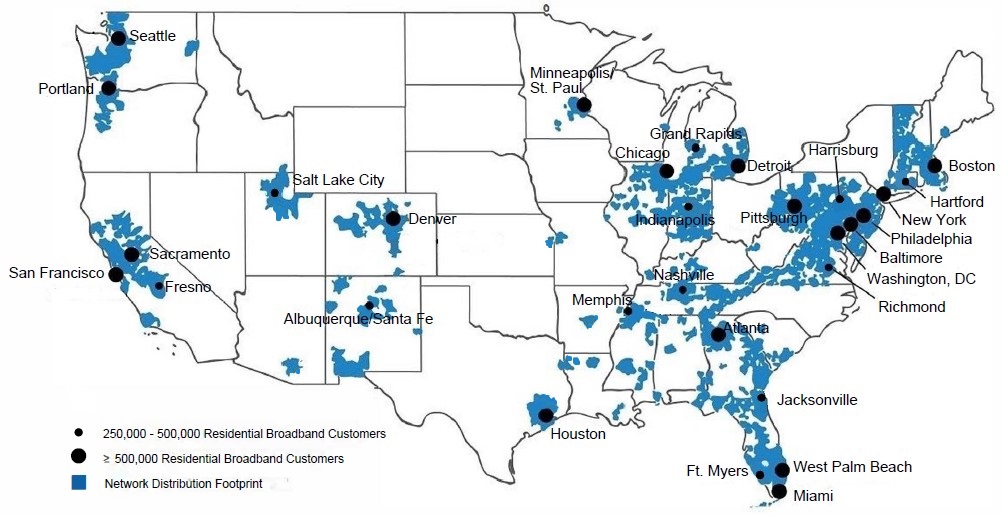
The map below highlights our domestic network footprint and the markets where we had 250,000 or more domestic residential broadband customers as of December 31, 2024.
Our international broadband services primarily include fiber-to-the-cabinet offerings, and increasingly fiber-to-the-premises offerings.
As part of our domestic and international broadband services, we offer to customers our advanced, proprietary wireless gateways that combine an internet modem with a Wi-Fi router to deliver reliable internet speeds and enhanced coverage through an in-and-out-of-home Wi-Fi network. In addition, customers may personalize and manage their Wi-Fi network and connected devices with our mobile apps and online portal. Broadband customers have access to our expanding network of secure Wi-Fi hotspots.
Wireless
We offer wireless services for wireless handsets, tablets and smart watches (“wireless devices”) to residential customers in the United States and the United Kingdom using mobile virtual network operator (“MVNO”) rights. Our domestic wireless services are offered over Verizon’s wireless network and our existing network of secure residential, outdoor and business Wi-Fi hotspots, and are offered initially only as part of our bundled service offerings to customers that subscribe to our qualifying broadband services.
Wireless customers may activate multiple lines per account. We offer domestic customers services on an unlimited data plan, on shared data plans or per gigabyte of data used. In 2024, we began offering prepaid unlimited data plans marketed under the NOW brand. We offer international customers services on various gigabyte plans or an unlimited data plan. Customers may either bring their own device or purchase devices from us with the option to pay upfront or finance the purchase interest-free over 24 months for domestic customers and over 24 to 48 months for international customers.
|
|
|
|
|
|
|
|
|
Comcast 2024 Annual Report on Form 10-K |
2 |
|
Video
We offer video services to residential and business customers primarily through our X1 platform in the United States over our network, and through our Sky Q platform internationally in the United Kingdom and Italy using a combination of satellite transmission and broadband connections. X1 and Sky Q are cloud-based platforms that provide integrated search functionality leveraging set-top boxes and voice-activated remote controls. The integrated features operate across content in customers’ video service packages and content from internet-based streaming services that customers may access in a manner similar to our Xumo Stream Box. We offer a range of video packages from basic linear service to full linear service, which typically include free-to-air networks and a range of other linear television networks including premium, sports and news networks. Our international video packages also include Sky-branded entertainment television networks that offer entertainment, premium movie and free-to-air programming, as well as Sky Sports networks that are part of our Media segment. Customers may also subscribe to digital video recorder (“DVR”) services or access our video on demand services with programming that is available for no additional cost or to rent or buy digitally. These viewing options are also available through our mobile apps and online portals.
We also offer DTC streaming services marketed under the NOW brand, with an offering in the United States that launched in 2023. NOW services provide video content over the internet and do not require a set-top box. Our international NOW service offerings include packages for monthly access to entertainment, sports and movie programming, as well as daily pass options for sports programming. Our domestic NOW TV service is only offered to qualifying residential broadband customers and includes monthly access to a variety of linear television networks; entertainment and movie programming; integrated access to free streaming channels from Xumo Play, NBC and Sky; and access to the ad-supported tier of Peacock.
We also offer video services in the United Kingdom and Italy over a broadband connection without the need for a satellite dish. These services have an operating system similar to Sky Q and are offered to customers through Sky Stream, which leverages a streaming device and Wi-Fi, or to customers that purchase our Sky Glass smart televisions.
Advertising
As part of our distribution agreements with domestic cable networks, we generally receive an allocation of scheduled advertising time that our advertising business sells, and we also sell advertising on our Sky-branded entertainment television networks and on our digital platforms. We also enter into representation agreements under which we sell advertising on behalf of third parties both domestically and internationally. Additionally, we offer technology, tools, data-driven services and marketplace solutions to customers in the media industry to facilitate effective engagement of advertisers with their target audiences.
Other
We offer residential wireline voice services primarily using interconnected Voice over Internet Protocol (“VoIP”) technology, and we offer residential security and automation services. We also license our technology platforms to other multichannel video providers and distribute certain of our Sky-branded entertainment television networks to third-party video service providers.
Business Services Connectivity Segment
Our Business Services Connectivity segment consists of our domestic service offerings for small businesses, which include broadband, wireline voice and wireless services, as well as our enterprise solutions offerings for medium-sized customers and larger enterprises. Certain business customers subscribe to our video services, and the associated revenue is included in our Residential Connectivity & Platforms segment. We also have certain business connectivity service offerings in the United Kingdom.
Our domestic broadband offerings have a range of service levels, including fiber-based services that deliver symmetrical speeds ranging up to 100 gigabits per second.
Our small business broadband, wireline voice and wireless service offerings are similar to those provided to our residential customers and also include cloud-based cybersecurity services, wireless backup connectivity, advanced Wi-Fi solutions, video monitoring services and other cloud-based services.
Our enterprise solutions offerings also include ethernet network services, which connect multiple locations and provide higher downstream and upstream speed options, advanced voice services, and a software-defined networking product. Larger enterprises may also receive support services related to Wi-Fi networks, router management, network security, business continuity risks and other services. These services are primarily provided to Fortune 1000 companies and other large enterprises with multiple locations both within and outside of our distribution footprint, where we provide coverage outside of our service areas through agreements with other companies to use their networks.
|
|
|
|
|
|
|
|
|
|
3 |
Comcast 2024 Annual Report on Form 10-K |
Network and Technology
The segments within our Connectivity & Platforms business use our HFC network in the United States, which we believe is sufficiently flexible and scalable to support our future technology requirements and enables us to continue to grow capacity and capabilities over time. This network provides the two-way transmissions required to provide connectivity services and interactive video and entertainment services through our platforms, and consists primarily of headends, fiber-optic and coaxial cables owned or leased by us, and equipment such as lasers, routers, switches and content distribution servers. Across nearly our entire domestic footprint, we leverage DOCSIS 3.1 to offer up to gigabit-plus downstream broadband speeds to residential and business customers. We also deploy fiber-to-the-premises with symmetrical speed offerings ranging up to 10 gigabits per second to residential customers who request that service, subject to local construction constraints, and up to 100 gigabits per second to business customers. We offer domestic wireless services using an MVNO agreement that allows us to offer services using Verizon’s wireless network along with our existing network of Wi-Fi hotspots across our network.
We continue to evolve and enhance our domestic network capabilities. In connection with a multiyear network transformation plan, in 2022 we began rolling out downstream speeds of up to 2 gigabits per second to our residential customers, which are now available to approximately 50% of our HFC network footprint. In 2023, we began deploying in select markets DOCSIS 4.0, which enables us to deliver multigigabit symmetrical broadband speeds over our existing HFC network. Additionally, as part of our network evolution, our engineering teams have been virtualizing and automating many core network functions using various technologies to expand capacity, increase operating efficiency, and identify and fix network issues proactively before they affect our customers. Our investment in virtualizing the network helps maintain network reliability and operational efficiency regardless of whether we connect a residence using either fiber or our HFC network. We continue to extend our network’s reach to new homes and businesses within our existing service areas, as well as edging-out to new service areas to expand the number of homes and businesses passed, and a significant portion of new homes and businesses passed are connected with fiber. We also partner with local, state and federal agencies when possible to provide services to unserved and underserved communities leveraging governmental subsidies where available.
The components of our domestic network require periodic maintenance and replacement and are primarily located on owned and leased properties, and in locations under agreements with local public utilities and municipalities. We operate national and regional data centers with equipment that is used to provide our services, and we maintain network operations centers with equipment necessary to monitor and manage the status of our services and network.
Our international services are offered leveraging third-party networks, as well as our own core fiber network for broadband and wireline voice services in the United Kingdom. The related operating plant and equipment used to provide our video and connectivity services include leased satellite system signal receiving, encoding and decoding devices, and owned and leased headends and distribution networks, including coaxial, fiber-optic cables and other related equipment. For a majority of international customers, our video platform is delivered via one-way digital satellite transmission that uses satellites leased from third parties for the distribution of television networks, augmented by a set-top box and two-way broadband connectivity. We offer broadband and wireline voice services in the United Kingdom and Italy using third-party networks. In many cases, the fee for us to access these networks is on regulated terms. The ranges of service levels and speeds we offer are dependent upon the capabilities and reach of these third-party networks. We offer wireless services in the United Kingdom using a combination of a third-party’s network and our own mobile core network.
Our Connectivity & Platforms business engineering teams continue to focus on technology initiatives to develop and deploy next-generation media, content delivery, content aggregation and streaming platforms that support X1, Sky Q, NOW, Sky Stream, Sky Glass, Xumo and our cloud DVR technology. These platforms are based on our global technology platform and integrate linear television networks, owned and third-party DTC streaming services and other internet-based apps, and on demand programming into a unified experience with voice-activated remote control search and interactive features. We also continue to focus on leveraging our own cloud network services to deliver video and advanced search capabilities. Our Connectivity & Platforms business also pursues technology initiatives related to broadband and wireless services that leverage our global technology platform. We provide our customers with in-and-out-of-home Wi-Fi, the ability to manage their Wi-Fi network and connected home with our mobile apps and online portal, advanced security technology, and other features.
Programming
To offer video services, Residential Connectivity & Platforms licenses substantial amounts of linear television programming from third parties and from our Media segment. The fees associated with these distribution agreements are generally based on the number of subscribers receiving the television network programming and a per subscriber fee, although programming expenses for certain television networks are based on a fixed fee. Additionally, certain of our agreements include the rights to offer such programming through multiple delivery platforms, such as through our on demand services, online portal, mobile apps, the Xumo Stream Box, and our NOW and NOW TV streaming services.
|
|
|
|
|
|
|
|
|
Comcast 2024 Annual Report on Form 10-K |
4 |
|
The programming on our Sky-branded entertainment television networks includes content licensed from third parties and from our Studios segment, including certain original content. Our most significant agreements for the licensing of film and television entertainment content include exclusive rights with Paramount, Warner Bros. and our Studios segment.
Other Sources of Supply and Operations
We purchase from a limited number of suppliers a significant amount of customer premise equipment, including wireless gateways and set-top boxes, network equipment, and services to provide our broadband and video services to residential and business customers. We also purchase from a limited number of suppliers a significant number of wireless devices. We use a limited number of vendors to provide customer billing for our residential and business customers.
Our technical services groups perform various tasks, including installations, plant maintenance and upgrades to our domestic network, and servicing and upgrades of customer premise equipment. The service vehicles used by our technical services groups are primarily owned. Our customer service teams provide primarily 24/7 call-answering capability and other services, and also offer our services to residential and business customers.
Competition
Residential Connectivity & Platforms
Broadband
We compete with a number of companies, many with significant financial resources, that offer internet services, including:
•wireline telecommunications companies
•wireless telecommunications companies
•municipal broadband networks and power companies
•satellite broadband providers
Certain wireline telecommunications companies, such as AT&T, Frontier, Lumen and Verizon in the United States and BT and Virgin Media O2 in the United Kingdom, have built and are continuing to build fiber-based wireline network infrastructure further into their networks, which enables them to provide data transmission speeds that exceed those that can be provided with traditional copper digital subscriber line (“DSL”) technology, and are offering services with these higher speeds in many of our service areas. Certain companies that offer DSL service have increased data transmission speeds, lowered prices or created bundled services to compete with our broadband services.
Various wireless companies are offering internet services using a variety of technologies, including 5G fixed wireless networks and 4G and 5G wireless broadband services. These networks work with devices such as smartphones, laptops, tablets, and mobile and fixed wireless routers, as well as wireless data cards.
Other companies and municipalities have launched fiber-based or newer satellite-based broadband technologies that provide services in certain areas in which we operate.
Domestic broadband-deployment funding initiatives at the federal and state levels may result in other service providers deploying subsidized internet access within our footprint. The availability of these and other offerings could negatively impact the demand for our domestic broadband services.
Wireless
We compete with national and regional wireless service providers in the United States, including AT&T, T-Mobile and Verizon, and wireless service providers in the United Kingdom that offer wireless service on both a stand-alone basis and with other services as bundled offerings.
Video
We compete with a number of companies offering video services in the Connectivity & Platforms markets, including:
•DTC streaming service providers and aggregators, including:
◦subscription-based services, such as Disney+ and Netflix, that offer online services that enable internet streaming and downloading of movies, television shows and other video programming
◦virtual multichannel video providers, such as Hulu + Live TV and YouTube TV, that offer streamed linear television networks
◦free ad-supported television services
|
|
|
|
|
|
|
|
|
|
5 |
Comcast 2024 Annual Report on Form 10-K |
◦companies that offer streaming devices that access and integrate streaming content
•direct broadcast satellite (“DBS”) providers that transmit satellite signals to substantially all households in the Connectivity & Platforms markets to provide video programming and other information similar to our video services
•companies that have built and continue to build fiber-based networks that provide video services similar to ours and provide bundled offerings that include wireless and/or broadband services
•other providers that build and operate communications systems and services in the same areas that we serve, including traditional providers of linear television programming
•a broad array of other online content providers, such as social networking platforms and user-generated content providers
•other companies, such as broadcast television stations, that provide multiple free-to-air networks
Similar to the competitive environment in our Media segment, our Sky-branded entertainment television networks compete for the distribution of our television network programming to third-party video service providers and for viewers’ attention and audience share.
Advertising
We compete for the sale of advertising with digital properties, including an increasing number of ad-supported DTC streaming service providers and other online content providers, such as social networking platforms and user-generated content providers, as well as with television networks and stations, and all other advertising platforms. Similar to the competitive environment in our Media segment, the willingness of advertisers to purchase advertising from us may be adversely affected by declines in audience ratings and television viewership, difficulty in measuring fragmented audiences and the increasing number of entertainment choices available. Our advertising is sold to local, regional and national advertisers, and competition is affected by the market conditions in the specific geographic locations in which we operate. We also compete with companies offering technology, tools and other services to customers in the media industry.
Business Services Connectivity
Business Services Connectivity primarily competes with wireline telecommunications companies and wide area network managed service providers. Competition for our connectivity services for small business customers is generally similar to the Residential Connectivity & Platforms segment. We compete for the sale of enterprise solutions offerings primarily with wide area network managed service providers, cloud-based application service providers and other telecommunication carriers.
Seasonality and Cyclicality
Results in our Residential Connectivity & Platforms segment are impacted by the seasonal nature of residential customers receiving our services, including in college and vacation markets in the United States, and by the timing of the European football seasons in our international markets, which generally result in negative impacts to net customer relationship additions/(losses) in the second quarter of each year.
Similar to seasonal and cyclical variations in our Media segment, advertising revenue is subject to cyclical patterns and changes in viewership levels, driven by timing of the winter holiday season, political campaigns, sports seasons and when programming is aired.
|
|
|
Content & Experiences Business |
Media Segment
We operate our Media segment as a combined television and streaming business, which primarily includes:
•NBCUniversal’s national and regional cable networks
•NBC and Telemundo broadcast networks and owned local broadcast television stations
•Peacock DTC streaming service
•International television networks, including Sky Sports networks in the United Kingdom and Italy
We distribute a wide variety of programming on our linear television networks and streaming services to appeal to consumers with varying preferences across demographics and geographic areas.
|
|
|
|
|
|
|
|
|
Comcast 2024 Annual Report on Form 10-K |
6 |
|
Revenue is primarily generated from the sale of advertising and from the distribution of our television and streaming programming.
We sell advertising on our linear television networks, Peacock and other digital properties. Our advertising sales are affected by the prices we charge for each advertising unit, which are generally based on the size and demographics of our viewing audiences, audience ratings on our television networks, the number of advertising units we can place in our programming and on our digital properties, and our ability to sell advertising across our television and streaming business.
We receive fees from the distribution of our television networks to traditional multichannel video providers, such as our Residential Connectivity & Platforms segment, and virtual multichannel video providers that offer streamed linear television networks. Our distribution agreements are generally multiyear, with revenue based on the number of subscribers receiving the programming on our television networks and a per subscriber fee, although revenue for certain of our television networks is based on a fixed fee. These fees include amounts for our owned television networks, including under NBC and Telemundo retransmission consent agreements, as well as associated fees from NBC-affiliated and Telemundo-affiliated local broadcast television stations. We also receive monthly retail or wholesale subscription fees for Peacock.
We also generate revenue from the licensing of our owned content and technology and from various digital properties.
Domestic Cable Networks
We operate a diversified portfolio of cable networks operating predominantly in the United States. The table below presents a summary of NBCUniversal’s national cable networks and their advertising reach to U.S. households.
|
|
|
|
|
|
|
|
|
|
|
|
|
|
| Cable Network |
Approximate U.S.
Households as of
December 31, 2024
(in millions)(a)
|
Description of Programming |
| USA Network |
66 |
|
|
|
General entertainment and sports |
| E! |
65 |
|
|
|
Entertainment and pop culture |
| Syfy |
65 |
|
|
|
Genre-based entertainment |
| MSNBC |
65 |
|
|
|
News, political commentary and information |
| Bravo |
65 |
|
|
|
Lifestyle entertainment |
| CNBC |
64 |
|
|
|
Business and financial news |
| Oxygen |
62 |
|
|
|
True crime |
| Golf Channel |
54 |
|
|
|
Golf competition and golf entertainment |
| Universal Kids |
43 |
|
|
|
Children’s entertainment |
| Universo |
16 |
|
|
|
Spanish-language entertainment |
| CNBC World |
16 |
|
|
|
Global financial news |
|
|
|
|
|
(a)Household data is based on information from The Nielsen Company as of December 31, 2024 using its Cable Coverage Universe Estimates report and dynamic ad insertion estimates. The Nielsen estimates include subscribers to both traditional and certain virtual multichannel video providers. The Nielsen estimates are not based on information provided by us and are included solely to enable comparisons between our cable networks and those operated by our peers.
Our regional sports networks serve approximately 11 million households across the United States, including in markets such as Boston, Philadelphia, Sacramento and San Francisco.
Domestic Broadcast Networks
NBC
The NBC network features original entertainment, news and sports programming that reaches viewers in virtually all U.S. television households through more than 200 affiliated stations across the United States, including our 11 owned NBC local broadcast television stations. The NBC owned local broadcast television stations include stations in 8 of the top 10 general markets and collectively reached approximately 35 million U.S. television households as of December 31, 2024, representing approximately 28% of U.S. television households. In addition to broadcasting the NBC network’s national programming, local broadcast television stations deliver local news, weather, and investigative and consumer reporting.
|
|
|
|
|
|
|
|
|
|
7 |
Comcast 2024 Annual Report on Form 10-K |
Telemundo
The Telemundo network, a Spanish-language broadcast network, features original entertainment, news, live specials and sports programming that reaches viewers in over 96% of all U.S. Hispanic television households through 122 affiliated stations, including our 30 owned Telemundo local broadcast television stations, and our national feed. The Telemundo owned local broadcast television stations include stations in all of the top 20 U.S. Hispanic markets and collectively reached approximately 71% of U.S. Hispanic television households as of December 31, 2024. In addition to broadcasting the Telemundo network’s national programming, local broadcast television stations deliver local news, weather, and investigative and consumer reporting. We also own an independent Telemundo station serving the Puerto Rico television market.
Peacock
Peacock is our DTC streaming service, featuring NBCUniversal and third-party content. Programming choices include exclusive Peacock originals, current NBC, Bravo and Telemundo shows, news, late-night comedy, live sports and a library of television shows and movies, as well as several live channels. The service is available on internet-connected devices and offered through two subscription-based tiers: an ad-supported tier and a tier featuring the same content ad-free, with certain limited exceptions. The ad-free tier also allows customers to download and watch select programming offline and provides customers with a live stream of their local NBC affiliate stations. We offer Peacock in the United States directly to customers or through arrangements with third parties and our Residential Connectivity & Platforms segment, which offer Peacock to customers on our behalf.
International Networks
We operate a diversified portfolio of international television networks, including premium sports networks under the Sky Sports brand in the United Kingdom and Italy, with a majority of networks dedicated to a specific sport, such as European football. We also operate several NBCUniversal international television networks globally, including CNBC International, Studio Universal, Telemundo International and Universal TV.
Programming
Our television networks and Peacock include content licensed from our Studios segment and from third parties, as well as content produced by Media segment businesses, such as live news and sports programming and certain original content, including late-night comedy for NBC and original telenovelas for Telemundo.
We have various multiyear agreements for the licensing of content, including contracts related to television and/or streaming rights for sporting events. We generally seek to include in our sports rights agreements the rights to distribute content on one or more of our television networks and on digital properties, including Peacock.
Our most significant sports rights agreements relate to the NBA, NFL, Olympics and English Premier League. The table below presents a summary of these and certain other sports rights:
|
|
|
|
|
|
|
|
|
Television and/or Streaming Rights |
Market |
Rights Expiration |
NBA and WNBA(a) |
United States, United Kingdom and Italy |
2035-36 NBA season and 2036 WNBA season |
NFL(b) |
United States |
2033-34 season |
| Summer and Winter Olympic Games |
United States |
2032 |
| English Premier League |
United Kingdom, Italy and United States |
2028-29, 2027-28 and 2027-28 seasons, respectively |
| PGA Tour and other golf events |
United States |
Between 2026 and 2031 |
NASCAR(c) |
United States |
2031 |
| Big Ten football and basketball |
United States |
2029-30 season |
World Wrestling Entertainment (“WWE”) |
United States |
2029 on television and 2026 on Peacock |
| Formula One |
United Kingdom and Italy |
2029 and 2027, respectively |
| England and Wales Cricket Board |
United Kingdom |
2028 |
| English Football League |
United Kingdom |
2028-29 season |
| Serie A |
Italy |
2028-29 season |
| FIFA World Cup (Spanish-language) |
United States |
2026 |
| Certain professional sports teams through our Regional Sports Networks |
Certain regions in the United States |
Between 2027 and 2040 |
|
|
|
|
|
|
|
|
|
Comcast 2024 Annual Report on Form 10-K |
8 |
|
(a) Beginning with the 2025-26 NBA season and 2026 WNBA season, includes the rights to produce and distribute across our networks and on Peacock a specified number of NBA and WNBA regular season and playoff games, the NBA All-Star game and NBA All-Star Saturday Night each season, as well as six NBA Conference Finals series and three WNBA Finals series over the term of the agreements. A certain number of NBA games will also be distributed in the Spanish language on Telemundo.
(b) Includes the rights to produce and distribute on NBC and on Peacock a specified number of regular season games that includes Sunday Night Football games, Thursday Kickoff games and Thanksgiving night games, playoff games, and three remaining Super Bowl games, the next of which is in February 2026. The agreement expires after the 2033-34 season, with a termination right available to the NFL after the 2029-30 season. The agreement also includes rights to additional exclusive games on Peacock. All of the NFL games are also distributed in the Spanish language on Universo or Telemundo.
(c) Includes the unilateral right by the other party (i.e., the licensor) to the agreement, under certain circumstances, to shorten the term of the agreement by one year.
Our television and streaming business competes for the acquisition of content, including sports rights, and for on-air and creative talent primarily with other television networks, DTC streaming providers, and local broadcast television stations. In Europe, major sports rights, which are significant to our international networks, are usually tendered through a competitive auction process, with the winning bidder or bidders acquiring rights over a 3 to 5 year period.
Studios Segment
Our Studios segment primarily includes our NBCUniversal and Sky film and television studio production and distribution operations. Our studio production facilities primarily include our owned Universal City location in Los Angeles, California and our leased studios in Atlanta, Georgia and in Elstree, United Kingdom. Revenue is generated primarily from the worldwide licensing of our owned film and television content and from the worldwide distribution of our produced and acquired films for exhibition in movie theaters. We also generate revenue from the sale of physical and digital home entertainment products, as well as the production and licensing of live stage plays and the distribution of content produced by third parties.
Film Studios
Our film studios develop, produce, acquire, market and distribute filmed entertainment worldwide. Our films are produced primarily under the following names:
•Universal Pictures
•Illumination
•DreamWorks Animation
•Focus Features
•Working Title
We distribute the majority of our films initially for exhibition in movie theaters, while other films are initially distributed through licensing agreements. After their initial release, we distribute films globally to different customers over multiple licensing windows. We license films, including recent films and selections from our film library, which is comprised of more than 6,500 movies in a variety of genres, to linear television networks and DTC streaming service providers, and to video on demand services provided by multichannel video providers. This includes licenses to our Media and Residential Connectivity & Platforms segments. Certain films are also licensed to our Media segment and made available for viewing on Peacock on the same date as the theatrical release. We also distribute films globally through the sale of physical and digital home entertainment products. Additionally, we acquire distribution rights to films produced by third parties, which may be limited to particular geographic regions, specific forms of media or certain periods of time. Theatrical revenue is significantly affected by the timing of each release and the number of films we distribute, their acceptance by audiences, the number of exhibition screens, ticket prices, the percentage of ticket sales retention by the exhibitors and the popularity of competing films at the time our films are released. The success of a film in movie theaters is generally a significant factor in determining the revenue a film is likely to generate in succeeding licensing windows and through physical and digital home entertainment product sales.
We develop and produce films both alone and jointly with other studios or production companies. In certain cases, we have also entered into film co-financing arrangements with third party studios and non-studio entities to jointly finance or distribute certain of our film productions. These arrangements can take various forms, but in most cases involve the grant of an economic interest in a film to an investor. Investors generally assume the full risks and rewards of ownership proportionate to their ownership in the film.
In connection with film studio productions, we typically owe “residuals” payments to individuals hired under collective bargaining agreements, which are generally calculated based on post-theatrical or content licensing revenue. We also typically owe “participations” payments to creative talent, to third parties under co-financing agreements and to other parties involved in content production, which are generally based on the financial performance of the content.
|
|
|
|
|
|
|
|
|
|
9 |
Comcast 2024 Annual Report on Form 10-K |
Television Studios
Our television studios develop, produce and distribute original content, including scripted and unscripted television series. We also produce television content jointly as co-producers with third-party studios and production companies. Our television studios produce content primarily under the following names:
•Universal Television
•Universal Content Productions
•Universal Television Alternative Studio
•Universal International Studios
•Sky Studios
Our original content is primarily initially licensed to linear television networks and DTC streaming service providers, including those in our Media and Residential Connectivity & Platforms segments. We also license content after its initial airing, license older television content from our television library, and distribute owned and acquired content globally through the sale of physical and digital home entertainment products. The production and distribution costs related to original broadcast television content generally exceed the revenue generated from the initial license, which means that obtaining additional licenses following the initial network license is critical to the content’s financial success. Similar to our film studios, we typically owe residuals and participations payments in connection with television studio productions.
Theme Parks Segment
Our Theme Parks segment primarily includes the operations of the following Universal theme parks:
•Universal Orlando Resort: Includes two theme parks, Universal Studios Florida and Islands of Adventure, and our water park, Volcano Bay, all of which are located in Orlando, Florida. Universal Orlando Resort also includes Universal CityWalk Orlando, a dining, retail and entertainment complex, and features on-site themed hotels in which we own a noncontrolling interest, and will include an additional theme park, Epic Universe, that is expected to open in May 2025.
•Universal Studios Hollywood: Includes the Universal Studios Hollywood theme park located in Hollywood, California and Universal CityWalk Hollywood, a dining, retail and entertainment complex.
•Universal Studios Japan: Includes the Universal Studios Japan theme park located in Osaka, Japan.
•Universal Beijing Resort: Includes the Universal Studios Beijing theme park, as well as Universal CityWalk Beijing, a dining, retail and entertainment complex, and on-site themed hotels, all of which are located in Beijing, China. Universal Beijing Resort is owned by us and a consortium of Chinese state-owned companies (see Note 7 to the consolidated financial statements included in this Annual Report on Form 10-K).
Our Theme Parks segment properties are primarily owned by us, although certain properties are leased, including land in Beijing, China and Osaka, Japan. We have invested and will continue to invest significantly in existing and new theme park attractions, hotels and infrastructure, as well as in new destinations and experiences, such as Epic Universe; Universal Kids Resort, a smaller-scale theme park in Frisco, Texas expected to open in 2026; and Universal Horror Unleashed, a year-round horror entertainment experience in Las Vegas, Nevada expected to open in 2025.
Revenue is generated primarily from guest spending at our theme parks, including ticket sales and in-park spending on food, beverages and merchandise, and from our consumer products business. Revenue for our theme parks generally depends on the overall environment for travel and tourism, including consumer spending on leisure and other recreational activities.
We also license the right to use the Universal Studios brand name and other intellectual property and provide other services to third parties, including the party that owns and operates the Universal Studios Singapore theme park on Sentosa Island, Singapore. The themed elements in our rides, attractions, and merchandising are based on intellectual property in our Studios and Media segments and intellectual property licensed from third parties under long-term agreements.
Competition
Media
Our Media segment competes for viewers’ attention and audience share with all forms of programming provided to viewers, including DTC streaming service providers; television networks; local broadcast television stations; physical and digital home entertainment products; video on demand and pay-per-view services; online activities, such as social networking and viewing user-generated content; gaming products; and other forms of entertainment, news and information.
|
|
|
|
|
|
|
|
|
Comcast 2024 Annual Report on Form 10-K |
10 |
|
Media competes for the sale of advertising with digital properties, including an increasing number of ad-supported DTC streaming service providers and other online content, such as social networking platforms and user-generated content, as well as with other television networks and stations, and all other advertising platforms. The willingness of advertisers to purchase advertising from us may be adversely affected by lower audience ratings and viewership at the related networks, stations or digital properties. Declines in audience ratings can be caused by increased competition for the leisure time of viewers and by audience fragmentation resulting from the increasing number and forms of entertainment choices available. Additionally, it is increasingly challenging to accurately measure fragmented audiences.
Our domestic cable networks and international networks compete primarily with other cable networks and programming providers for carriage by multichannel video providers and DTC streaming service providers. Our domestic broadcast networks compete with the other broadcast networks in markets across the United States to secure affiliations with independently owned local broadcast television stations, which are necessary to ensure the effective distribution of broadcast network programming to a nationwide audience. Peacock competes for subscribers primarily with other DTC streaming service providers, as well as with traditional providers of linear television programming.
Studios
Our film and television studios compete for audiences with other major film and television studios, independent film producers and creators of content, as well as with alternative forms of entertainment. The competitive position of our studios primarily depends on the number of films and television series and episodes produced, their distribution and marketing success, and consumer response. Our studios also compete to obtain creative, performing and technical talent, including writers, actors, directors, and producers, as well as scripts for films and television shows, and for the distribution of, and consumer interest in, their content. We also compete with other major film and television studios and other producers of entertainment content for the exhibition of content in theaters, on demand, on television networks, and on DTC streaming services.
Theme Parks
Our theme parks compete with other multi-park entertainment companies as well as other providers of entertainment, tourism, recreational activities and lodging. The competitive position of our theme parks primarily depends on the quality and popularity of rides and attractions, including effective use of intellectual property in themed attractions. There is increased competition in areas with high concentrations of theme parks and other attractions operated by several companies. Macroeconomic conditions and other factors may also result in shifting consumer preferences toward other types of destinations, experiences and products.
Seasonality and Cyclicality
Revenue and costs and expenses in our Media segment are cyclical as a result of our periodic broadcasts of major sporting events, such as the Olympic Games and the Super Bowl. In particular, advertising revenue increases due to increased demand for advertising time for these events and distribution revenue increases in the period of broadcasts of the Olympic Games. Costs and expenses also increase as a result of our production costs for these broadcasts and the recognition of the related rights fees.
Revenue in Media is also subject to cyclical advertising patterns and changes in viewership levels. Domestic advertising revenue is generally higher in the second and fourth quarters of each year and in even-numbered years due to increases in advertising in the spring and in the period leading up to and including the winter holiday season, and advertising related to candidates running for political office and issue-oriented advertising, respectively. International advertising revenue typically has seasonally higher audience levels in winter months, with lower levels in summer months due to the timing of European football seasons, winter holidays and summer vacations. Revenue also fluctuates depending on the timing of when our programming is aired, which typically results in additional advertising revenue in the second and fourth quarters of each year.
Revenue in Studios fluctuates due to the timing, nature and number of films released in movie theaters, through DTC streaming services and viewing on demand, and on physical and digital home entertainment products. Release dates are determined by several factors, including competition and the timing of vacation and holiday periods. As a result, revenue tends to be seasonal, with increases experienced each year during the summer months and around the winter holiday season. We incur significant marketing expenses before and throughout the release of a film in movie theaters and as a result, we typically incur losses on a film prior to and during the film’s exhibition in movie theaters. Content licensing revenue also fluctuates due to the timing of when our film and television content is made available to licensees. Revenue from our television studios fluctuates in part due to a correlation with the broadcast network season beginning annually in September.
Revenue in Theme Parks fluctuates with changes in theme park attendance that typically result from the seasonal nature of vacation travel and weather variations, local entertainment offerings and the opening of new attractions, as well as with changes in currency exchange rates. Our theme parks generally experience peak attendance during the spring holiday period, the summer months when schools are closed and the winter holiday season.
|
|
|
|
|
|
|
|
|
|
11 |
Comcast 2024 Annual Report on Form 10-K |
Our other business interests reported in Corporate and Other consist primarily of our Sky-branded video services and television networks in Germany, Comcast Spectacor, which owns the Philadelphia Flyers and the Wells Fargo Center arena in Philadelphia, Pennsylvania, and Xumo, our consolidated streaming platform joint venture with Charter Communications formed in June 2022. Xumo is focused on developing and offering a streaming platform on a variety of devices, including Xumo TV smart televisions, which have an operating system that leverages our global technology platform, and also operates the Xumo Play streaming service.
Legislation and Regulation
Our businesses are subject to various federal, state, local, and international laws and regulations. In the United States in particular, the Communications Act of 1934, as amended (the “Communications Act”), and Federal Communications Commission (“FCC”) rules and regulations affect significant aspects of our communications businesses.
Beyond the more significant regulations summarized below, legislators and regulators at all levels of government frequently consider changing, and sometimes do change, existing statutes, rules or regulations, or interpretations of existing statutes, rules or regulations, or prescribe new ones, any of which may significantly affect our businesses and ability to effectively compete. Applying existing laws in novel ways to new technologies, including streaming services and artificial intelligence (“AI”), may also affect our business. These legislators and regulators, along with some state attorneys general and foreign governmental authorities, have been active in conducting inquiries and reviews regarding our services. State legislative and regulatory initiatives can create a patchwork of different and/or conflicting state requirements, such as with respect to privacy and Open Internet/net neutrality regulations, that can affect our businesses and ability to effectively compete.
Legislative and regulatory activity has increased in recent years, particularly with respect to broadband networks. For example, Congress has approved tens of billions of dollars in new funding for broadband deployment and adoption initiatives, and may consider other proposals that address communications issues, including whether it should rewrite the Communications Act to account for changes in the communications marketplace. Federal agencies have considered adopting new regulations for communications services, including broadband, although it is uncertain whether those initiatives will continue under the new Administration. States and localities are increasingly proposing new regulations impacting communications services, including broader regulation of broadband networks. Regulators in various international jurisdictions are similarly considering changes to telecommunications and media requirements. Any of these regulations could significantly affect our business and our legal and compliance costs. In addition, United States and foreign regulators and courts could adopt new interpretations of existing competition or antitrust laws or enact new competition or antitrust laws or regulatory tools that could negatively impact our businesses. Any future legislative, judicial, regulatory or administrative actions may increase our costs or impose additional restrictions on our businesses, some of which may be significant. We are unable to predict the outcome or effects of any of these potential actions or any other legislative or regulatory proposals on our businesses.
The following paragraphs summarize the more significant legal and regulatory requirements and risks affecting our businesses.
|
|
|
Communications-Related Regulations in the United States |
Broadband
Our broadband services are subject to a number of regulations and commitments.
In 2023, the FCC adopted broad rules that prohibit digital discrimination of access to broadband service based on income level, race, ethnicity, color, religion and national origin; this order currently is subject to legal challenge in federal court. In 2024, the FCC reclassified broadband internet access services as a “telecommunications service” subject to traditional common carriage regulation under Title II of the Communications Act. However, a federal appellate court in January 2025 overturned that reclassification, ruling that broadband internet access service is an “information service” under Title I of the Communications Act and that the FCC does not have authority to subject broadband services to utility-style regulations such as rate regulation and market entry and exit requirements under Title II. As a Title I “information service,” broadband is only subject to light-touch regulation such as broadband disclosure requirements, and deployment, subscription, and pricing reporting requirements. States and localities have in the past enacted and may in the future periodically consider new broadband-related regulations, including those regarding government-owned broadband networks, net neutrality and broadband affordability, which could create a patchwork of, and potentially inconsistent, federal, state and local regulatory regimes. New broadband regulations, if adopted, may have adverse effects on our businesses, and we cannot predict the outcome of any pending or future litigation or how any rules will ultimately be interpreted and enforced and how they might affect our business.
|
|
|
|
|
|
|
|
|
Comcast 2024 Annual Report on Form 10-K |
12 |
|
We, from time to time, participate in broadband-deployment funding initiatives at the federal and state levels and may also become subject to additional broadband-related commitments as a condition of receiving federal or state broadband funding. We cannot predict how and to whom any such funds will be awarded, when the initiatives will be terminated or the impact of these initiatives on our businesses.
A number of municipalities operate municipally owned broadband networks, and there may be further efforts by local governments to expand or create government-owned networks, particularly in light of federal funding for broadband deployment. Certain states have enacted laws that restrict or prohibit local municipalities from operating municipally owned broadband networks, and there may be efforts in other state legislatures to restrict the development of government-owned networks. Other states, however, have amended or may amend such laws to facilitate such networks. Much of the federal funding authorized for broadband deployment is conditioned on states agreeing to make it available for potential use by government-owned networks, although the funding prioritizes deployment to unserved and underserved areas and locations. We cannot predict how successful any of those efforts will be and how they might affect our businesses.
Video and Media
We are subject to laws and regulations that apply to the cable services we provide through our Residential Connectivity & Platforms business and to our cable networks and local broadcast television stations in our Media business. These laws and regulations can constrain our ability to compete, particularly against DTC streaming service providers, which are not subject to these same requirements.
Federal, state and local franchising rules and regulations may require us to provide adequate channel capacity, facilities and financial support for public, educational and governmental access programming; comply with certain renewal procedures for our franchise agreements; pay franchise fees; and comply with customer service, accessibility, and certain other requirements. In addition, the FCC and other federal agencies can impact the programming networks that we carry, as well as how we price, package, bill and market our video services. FCC regulations also require cable operators to carry programming transmitted by certain local broadcast television stations (“must-carry” requirement) or to negotiate a “retransmission consent” agreement with certain other stations that will frequently involve payments from cable operators to the station; govern program access by preventing cable networks affiliated with cable operators from favoring affiliated cable operators over competing multichannel video providers; grant licenses to broadcast television stations for 8-year cycles, which may not be renewed on favorable terms, or at all; limit local and national television ownership, as well as foreign ownership in a broadcast television station; and regulate children’s programming.
The FCC enforces these rules on a case-by-case basis based on complaints filed by consumers, state and local governments, and other entities. We have been involved in disputes at the FCC in some of these areas and may be involved in new disputes in the future, including potential disputes related to content moderation and free speech. We cannot predict the outcome of any such disputes or associated litigation. The FCC and Congress have previously considered proposals that would require companies that own multiple cable networks to make each of their networks available individually when negotiating distribution agreements with MVPDs and potentially with DTC streaming and other OTT service providers. We currently offer our cable networks on a packaged basis (in “tiers”) and, in various cases, individually. We have been involved in program access disputes at the FCC and may be subject to new complaints in the future.
Furthermore, certain states and localities have adopted laws to impose franchise or other fees on DTC streaming services. To date, courts have invalidated those laws, but we cannot predict the outcome of any future litigation.
Wireless
We offer a wireless voice and data service primarily using our MVNO rights to provide the service over Verizon’s wireless network. MVNOs are subject to many of the same FCC regulations as facilities-based wireless carriers, such as E911 services and local number portability, as well as certain state or local regulations. The FCC or other regulatory authorities may adopt new or different regulations for MVNOs and/or mobile broadband providers in the future, which could adversely affect our wireless phone service offering or our business generally.
Voice
We provide voice services using VoIP technology. The FCC has adopted a number of regulations for providers of nontraditional voice services such as ours, including regulations relating to privacy of customer proprietary network information, local number portability duties and benefits, disability access, E911, law enforcement assistance, outage reporting, Universal Service Fund contribution obligations, rural call completion, customer equipment back-up power, robocall mitigation, service discontinuance and certain regulatory filing requirements. State regulatory commissions and legislatures in other jurisdictions may continue to consider imposing regulatory requirements on our voice services as long as the regulatory classification of VoIP remains unsettled at the federal level.
|
|
|
|
|
|
|
|
|
|
13 |
Comcast 2024 Annual Report on Form 10-K |
Spectrum Allocations
The FCC, the Department of Commerce’s National Telecommunications and Information Administration, and other federal agencies have taken, and in some cases are preparing to take, steps to evaluate and potentially modify certain spectrum allocations and rules to make available additional spectrum that likely will be used for licensed and/or unlicensed commercial services, including 5G and Wi-Fi services, which could impact our businesses. We cannot predict the timing or outcome of these spectrum allocation actions. Additional commercial spectrum could impact current marketplace dynamics, including the ability of wireless providers to compete with our services. Further, if the FCC reallocates spectrum that our businesses currently use to provide services, we could be required to transition our operations to different frequencies in order to accommodate the reallocation of spectrum for 5G, which could disrupt our services and impose additional costs.
|
|
|
International Communications-Related and Other Regulations |
Certain of our international businesses are subject to telecommunications and media-specific regulation, including those related to broadband and voice services and television networks, in Europe, Latin America, and other international jurisdictions, and all of our international businesses are subject to regulation under generally applicable laws, such as competition, consumer protection, data protection, and taxation in the jurisdictions where they operate. Our international businesses are currently, and may be in the future, subject to proceedings or investigations from regulatory and antitrust authorities in the jurisdictions in which those businesses operate.
|
|
|
Other Areas of Regulation |
Intellectual Property
Copyright, trademark, unfair competition, patent, trade secret and other proprietary-rights laws of the United States and other countries help protect our intellectual property rights. In particular, unauthorized copying, distribution and piracy of programming and films over the internet, through devices, software and websites, counterfeit DVDs/Blu-rays and through other platforms interfere with the market for copyrighted works and present challenges for our content businesses. We have actively engaged in the enforcement of our intellectual property rights and likely will continue to expend substantial resources to protect our content. Although many legal protections exist to combat such practices, the extent of copyright protection is sometimes ambiguous and the use of technological protections can be controversial. Modifications to existing laws, a weakening of these protections or their enforcement or a failure of existing laws, in the United States or internationally, to adapt to new technologies could have an adverse effect on our ability to license and sell our programming.
U.S. copyright laws establish a cable compulsory copyright license that requires our video distribution business to contribute a specified percentage of revenue to a federal copyright royalty pool in exchange for retransmitting copyrighted material included in broadcast signals. We also pay standard industry licensing fees for the public performance of music in the programs we create or distribute. The cable compulsory copyright license and the royalties we pay are subject to audits and possible regulatory and legislative changes that could impact the royalty fees we pay and our ability to retransmit broadcast signals over cable systems. In addition, the landscape for music licensing is constantly changing, and music fees we pay are subject to new fee demands and negotiations. We cannot predict how changes to the compulsory copyright license and music licensing will impact the fees that we pay.
Privacy and Data Protection Regulation
Our businesses are subject to laws and regulations that impose various restrictions and obligations related to privacy and the processing of individuals’ personal information. In the United States, federal privacy laws and regulations, such as those found within the Communications Act or the Video Privacy Protection Act, restrict companies’ collection, use, disclosure and retention of personal information. The proliferation of laws at the state level has expanded consumers’ rights to include individual rights of access, deletion, portability, correction, the right to appeal, and the individual’s right to “opt in” to collection and use of certain types of “sensitive” personal information. Internationally, many of the laws that apply to our businesses are similar to the European Union’s General Data Protection Regulation and the United Kingdom’s Data Protection Act of 2018, which broadly regulate the processing of personal data collected from individuals in the European Union and United Kingdom, respectively.
|
|
|
|
|
|
|
|
|
Comcast 2024 Annual Report on Form 10-K |
14 |
|
Some of our businesses are also subject to the FTC’s general oversight of consumer privacy protections through its enforcement authority over unfair and deceptive acts or practices, as well as through its enforcement authority over the Children’s Online Privacy Protection Act. The FTC has sought to expand its authority in this area through various rulemakings related to general privacy, targeted advertising and children’s privacy. There has been an increased focus on children’s privacy at both the state and federal levels within the United States, as well as internationally. These new laws may require changes to our products and services and could adversely affect our advertising businesses.
In addition, many international data protection laws, some federal laws, and all 50 U.S. states have security breach notification requirements that obligate businesses to provide notice to consumers and government agencies if certain information has been accessed or exfiltrated by an unauthorized party; some of these laws also require documented information security programs.
State and Local Taxes
Some U.S. states and localities have imposed or are considering imposing, through both legislative and administrative channels, new or additional taxes or fees on, or limiting or eliminating incentives or credits earned or monetized by, our businesses, or imposing adverse methodologies by which taxes, fees, incentives or credits are computed, earned or monetized. These include combined reporting or other changes to general business taxes, central assessments for property tax, and taxes and fees on the businesses operated or services provided by our businesses, most notably new taxes or fees on digital advertising or other digital commerce. In some situations, DBS providers and other competitors (such as DTC streaming service providers) that deliver their services over a broadband connection do not face the same state and local tax and fee burdens. Congress has also considered, and may consider again, proposals to bar or limit states from imposing taxes on these DBS providers or other competitors (such as DTC streaming service providers) that are equivalent to the taxes or fees that we pay. The Internet Tax Freedom Act (“ITFA”) prohibits most states and localities from imposing sales and other taxes on our internet access charges and discriminating against electronic commerce; however, some jurisdictions may challenge the ITFA or the application of the ITFA to our business, or may assert that certain taxes akin to right-of-way fees are not preempted by the ITFA or other federal laws.
Other Regulations
U.S. states and localities, and various regulatory authorities, actively regulate other aspects of our businesses, including our Studios and Theme Parks businesses, accessibility to our video and voice services and broadcast television programming for people with disabilities, customer service standards, inside wiring, cable equipment, pole attachments, universal service fees, regulatory fees, public safety, telemarketing, leased access, indecency, loudness of commercial advertisements, advertising, political broadcasting, sponsorship identification, Emergency Alert System, equal employment opportunity and other employment-related practices, environmental-related matters, our equipment supply chain, and technical standards relating to the operation of cable systems and television stations. In addition, our international businesses are subject to various similar regulations, including those that cover television broadcasting, programming, and advertising. We are occasionally subject to enforcement actions and investigations at the FCC and other federal, state, and local agencies, as well as foreign governments and regulatory authorities, which can result in fines, sanctions and/or ongoing compliance plans and government oversight.
Human Capital Resources
As of December 31, 2024, we had approximately 182,000 full-time and part-time employees calculated on a full-time equivalent basis. Approximately 30% of our employees were located in over 30 countries outside the United States, with larger workforce concentrations in the United Kingdom, Western Europe, East Asia and South Asia. We also use freelance and temporary employees in the normal course of our business. A small overall portion of our full-time U.S. employees are unionized, although many of Content & Experiences’ freelance and temporary writers, directors, actors, technical and production personnel, as well as some on-air and creative talent employees, are covered by industry-wide collective bargaining agreements or work councils. Outside the United States, employees in certain countries, particularly in Europe, are represented by an employee representative organization, such as a union, works council or employee association.
Our company has been built on a foundation of respect, integrity and trust, and we are committed to creating and fostering a work environment that promotes those values. As a global media and technology company, we have a wide range of employees, including management professionals, technicians, engineers, call center employees, theme park employees, and media talent and production employees. Some of our key workforce-related programs and initiatives include the following.
Employee Engagement
•We seek to create an engaged workforce through proactive listening and constructive dialogue, including through employee engagement surveys, as well as through employee resource groups.
|
|
|
|
|
|
|
|
|
|
15 |
Comcast 2024 Annual Report on Form 10-K |
•We are committed to creating an environment that encourages employees to ask questions, raise concerns and speak up about a workplace issue or suspected illegal or unethical conduct. We provide several channels for speaking up without fear of retaliation, including a helpline and a web portal that are administered by an independent third-party company and allow for anonymous reporting when permitted by applicable laws.
Talent Development
•We provide a wide variety of opportunities for professional growth for all employees with in-classroom and online trainings and on-the-job experience.
•We offer education tuition assistance to full-time employees in the United States.
•Our Board of Directors discusses succession planning for our CEO and the remainder of our senior executive management team at least once a year. Throughout the year, our senior executive management team, as well as a broader array of executives throughout our businesses, make presentations to the Board and its committees and interact with our directors informally outside of regularly scheduled Board meetings, which provides directors with meaningful insight into our current pool of talent, what attracts and retains our executives, and our company culture.
•We promote a culture that embraces equal opportunity for all.
•Comcast has nine voluntary employee resource groups with more than 36,000 members in 240 chapters across the U.S. These employee-led organizations are open to all and contribute to business priorities, career development, and foster an inclusive and collaborative workplace.
Health and Welfare Benefits
•We offer a robust portfolio of health and welfare programs and solutions designed to meet the unique needs of our employees and their families, delivered through a consistent and seamless member experience.
•Our offerings include comprehensive and affordable health care coverage options along with a variety of additional tools and resources, including access to dedicated health care navigators, expert medical opinion services, virtual primary care services and a diabetes management program. In addition, we offer comprehensive family planning options, including for adoption and surrogacy, and provide specialized support teams to help employees manage all stages in the family planning journey including parenthood.
•We continue to invest in the emotional wellbeing of our employees and offer a broad array of tools and resources such as our Employee Assistance Program, which provides personal counseling sessions to support employees and their families and provide problem-solving support for a broad range of issues, including stress, anxiety, depression, substance use and more. We also offer various digital emotional wellbeing tools, including child learning and behavior support, meditation, stress management, sleep issues, depression, chronic pain and substance use.
Financial Benefits
•We focus on attracting and retaining employees by providing compensation and benefits packages that are competitive within the applicable market, taking into account the job position’s location and responsibilities.
•We provide competitive financial benefits such as a 401(k) retirement plan in the United States with a company match and other retirement arrangements internationally.
•We have employee stock purchase plans in the United States, United Kingdom, India and several other European countries where most of our full-time and part-time employees can purchase our stock at a discount.
•We generally grant stock-based awards on an annual basis to a meaningful portion of our employees, with over 24,000 employees receiving such awards in 2024.
•We offer financial literacy training and counseling to support employees in making their own financial decisions.
Available Information and Websites
Our phone number is (215) 286-1700, and our principal executive offices are located at One Comcast Center, Philadelphia, PA 19103-2838. Our Annual Reports on Form 10-K, Quarterly Reports on Form 10-Q, Current Reports on Form 8-K and any amendments to such reports filed with or furnished to the SEC under Sections 13(a) or 15(d) of the Securities Exchange Act of 1934, as amended (the “Exchange Act”), are available free of charge on the SEC’s website at www.sec.gov and on our website at www.comcastcorporation.com as soon as reasonably practicable after such reports are electronically filed with the SEC. The information posted on our websites is not incorporated into our SEC filings.
|
|
|
|
|
|
|
|
|
Comcast 2024 Annual Report on Form 10-K |
16 |
|
Caution Concerning Forward-Looking Statements
This Annual Report on Form 10-K includes statements that may constitute “forward-looking statements” within the meaning of the Private Securities Litigation Reform Act of 1995, Section 27A of the Securities Act of 1933, and Section 21E of the Securities Exchange Act of 1934. Forward-looking statements are not historical facts or statements of current conditions, but instead represent only our beliefs regarding future events, many of which, by their nature, are inherently uncertain and outside of our control. These may include estimates, projections and statements relating to our business plans, objectives and expected operating results, which are based on current expectations and assumptions that are subject to risks and uncertainties that may cause actual results to differ materially. These forward-looking statements are generally identified by words such as “believe,” “project,” “expect,” “anticipate,” “estimate,” “intend,” “potential,” “strategy,” “future,” “opportunity,” “commit,” “plan,” “goal,” “may,” “should,” “could,” “will,” “would,” “will be,” “will continue,” “will likely result” and similar expressions. In evaluating these statements, you should consider various factors, including the risks and uncertainties we describe in “Risk Factors” and in other reports we file with the SEC.
Any of these factors could cause our actual results to differ materially from those expressed or implied by our forward-looking statements, which could adversely affect our businesses, results of operations or financial condition. Readers are cautioned not to place undue reliance on forward-looking statements, which speak only as of the date they are made. We undertake no obligation to update or revise publicly any forward-looking statements, whether because of new information, future events or otherwise.
|
|
|
|
|
|
|
|
|
|
17 |
Comcast 2024 Annual Report on Form 10-K |
Item 1A: Risk Factors
Risks Related to Our Business, Industry and Operations
Our businesses operate in highly competitive and dynamic industries, and our businesses and results of operations could be adversely affected if we do not compete effectively.
Our businesses operate in intensely competitive, consumer-driven, rapidly changing environments. We compete with a growing number of companies that provide a broad range of communications products and services and entertainment, sports, news and information content to consumers. There can be no assurance that we will be able to compete effectively against our competitors or that competition will not have an adverse effect on our businesses.
Below is a summary of our most significant sources of competition. Many of these competitors offer competitive pricing, packaging and/or bundling of services to customers, which further increases competition. For a more detailed description of the competition facing our businesses, see Item 1: Business and refer to the “Competition” discussion within that section.
•Connectivity & Platforms’ broadband services compete primarily against wireline telecommunications companies, including many that are increasing deployment of fiber-based networks; wireless telecommunications companies offering internet services (using a variety of technologies, including 5G fixed wireless networks and 4G and 5G wireless broadband services); electric cooperatives and municipalities in the United States that own and operate their own broadband networks; and DBS and newer satellite broadband providers. Broadband-deployment funding initiatives at the federal and state level may result in other service providers deploying new subsidized internet access networks within our footprint, and in cases where we receive subsidies, may impose constraints on how we conduct our businesses. For a more extensive discussion of the significant risks associated with the regulation of our businesses, see “—We are subject to regulation by federal, state, local and foreign authorities, which impose additional costs and restrictions on our businesses” below and Item 1: Business and refer to the “Legislation and Regulation” discussion within that section.
•Our wireless and voice services compete with both telecommunications and wireless telecommunication providers.
•Competition for video services consists primarily of DTC streaming service providers and aggregators, DBS providers and telecommunications companies.
•Business Services Connectivity primarily competes with wireline telecommunications companies and wide area network managed service providers.
•Our businesses in Content & Experiences, as well as our video business, face substantial and increasing competition from providers of similar types of entertainment, sports, news and information content, as well as from other forms of entertainment, including from social networking and user-generated content, as well as tourism, recreational activities and lodging. They must compete to obtain talent, popular content (including sports programming), advertising and other resources required to successfully operate their businesses. This competition has further intensified as certain DTC streaming service providers have commissioned, and may continue to commission, high-cost programming and acquire live sports programming rights to attract viewers at significant costs.
Competitors with significant resources, greater efficiencies of scale, fewer regulatory burdens and more competitive pricing and packaging continue to increasingly compete with our businesses in all forms. Some of these competitors could also have preferential access to customer data or other competitive information. Further, consolidation of, or cooperation between, our competitors may increase competition in all of these areas. For example, cooperation between competitors may allow them to offer a range of products and services, including aggregating certain content into a stand-alone offering, offering free or lower cost DTC streaming services, potentially on an exclusive basis, through unlimited data-usage plans for broadband and wireless services or bundling DTC streaming services on their platforms.
Our competitive position may be negatively affected if we do not provide our customers with a satisfactory customer experience. In addition, our ability to compete effectively depends on our perceived image and reputation among our various constituencies, including our customers, consumers, advertisers, business partners, employees, investors and government authorities. For example, some of these constituencies may have their own, and some have conflicting, environmental, social and governance priorities, which may present risks to our reputation and brands if these constituencies perceive misalignment.
Changes in consumer behavior continue to adversely affect our businesses and challenge existing business models.
Distribution platforms for viewing and purchasing content continue to challenge existing business models, increase the number of competitors that our businesses face, and have driven, and will continue to drive, changes in consumer behavior as consumers seek control over when, where and how they consume content and access communications services, and how much or for how long they pay for such content.
|
|
|
|
|
|
|
|
|
Comcast 2024 Annual Report on Form 10-K |
18 |
|
The number of entertainment choices available to consumers, including DTC streaming service providers and aggregators, social networking and user-generated content platforms, and gaming and virtual reality products and services, continue to increase, intensify audience fragmentation and disaggregate how content traditionally has been distributed to and viewed by consumers. The continuing trend of content owners, including us with Peacock, delivering their content directly to consumers, rather than through, or in addition to, traditional video distribution channels also disrupts traditional media distribution business models. As consumers increasingly turn to DTC streaming services in lieu of linear video services, which continue to experience accelerated net customer losses, our video customers and video revenues, and linear television network subscriber fees received from video service providers, each decrease. In addition to reducing traditional television viewership, these trends when coupled with time-shifting technologies, such as DVR and on demand services, have caused, and likely will continue to cause, audience ratings declines for our television networks. Shifting content consumption patterns also may result in lower demand for home entertainment products or theatrical attendance. While we have adapted some of our video and content offerings to compete in the evolving media distribution landscape, such as by offering Peacock and NOW, there also can be no assurance that we will be able to successfully compete or that Peacock will grow or sustain its revenue or user base, successfully compete as a stand-alone DTC streaming service or fully offset decreases to our linear television networks’ results of operations.
Our failure to effectively anticipate or adapt to emerging competitors or changes in consumer behavior, including among younger consumers, and shifting business models could have an adverse effect on our competitive position, businesses and results of operations.
A decline in advertisers’ expenditures or changes in advertising markets could negatively impact our businesses.
We compete for the sale of advertising time with digital properties, including an increasing number of ad-supported DTC streaming service providers as advertisers have shifted, and may continue to shift, a larger portion of their total expenditures to digital media. We also compete with other online content providers, such as social networking platforms and user-generated content providers, television networks and stations, and all other advertising platforms. Because we derive substantial revenue from the sale of advertising, a decline in expenditures by advertisers, including through traditional linear television distribution models or on Peacock, could negatively impact our results of operations. We have experienced, and may continue to experience, declines caused by the economic prospects of specific advertisers or industries and economic conditions generally; increased competition for the leisure time of viewers, audience fragmentation and viewing content on DTC streaming services; use of time-shifting or advertising-blocking technologies; and regulatory intervention on advertising placement. Lower audience ratings and reduced viewership, which many of our linear television networks have experienced, and likely will continue to experience, as well as the level of popularity of Peacock, affect advertisers’ willingness to purchase advertising from us and the rates paid. Advertising sales and rates also are dependent on the methodology used for audience measurement and could be negatively affected if methodologies do not accurately reflect actual viewership levels.
Our success depends on consumer acceptance of our content, and our businesses may be adversely affected if our content fails to achieve sufficient consumer acceptance.
We create and acquire media, sports and entertainment content, the success of which depends substantially on consumer tastes and preferences that often change in unpredictable ways. To meet the changing preferences of our consumer markets, we must consistently create, acquire, market and distribute a broad array of content and theme park attractions. We have invested, and will continue to invest, substantial amounts in content, such as the production of films and original content for television networks and streaming services, and in the creation of new theme parks and theme park attractions, before learning the extent to which they will earn consumer acceptance.
We obtain a significant portion of our content from third parties, such as movie studios, television production companies, sports organizations and other suppliers, sometimes on an exclusive basis. Competition for popular content, particularly for sports programming, is intense. Entering into or renewing contracts for such content rights or acquiring additional rights has in the past resulted, and may result in the future, in significantly increased costs, potentially over an extended contractual term. Particularly with respect to contracts for sports rights, our results of operations and cash flows over the term of a contract depend on a number of factors, including the strength of the advertising market, audience size, the timing and amount of rights payments, and the ability to secure distribution from, impose surcharges on, or obtain carriage on multichannel video providers or to grow and retain subscribers to our own DTC services. There can be no assurance that revenue generated from these contracts will exceed our costs for the rights and of producing and distributing the programming. In addition, media companies may determine not to license popular content to us, and as more content owners offer their content directly to consumers through their own platforms, they may reduce the quantity and quality of the content they license to our linear television networks or Peacock. The inability to enter into or renew some or all of these contracts on acceptable terms could reduce the reach of our programming, which could adversely affect our results of operations and businesses.
|
|
|
|
|
|
|
|
|
|
19 |
Comcast 2024 Annual Report on Form 10-K |
We also create content for licensing to third parties and to our linear television networks or Peacock. The inability to license such content on acceptable terms or at all could negatively impact our business. Moreover, we may generate lower revenue when we opt to retain our content for our own use, including for Peacock, rather than licensing it to third parties who pay licensing fees for such content.
If our content does not achieve sufficient consumer acceptance, or if we cannot obtain or retain rights to popular content on acceptable terms, or at all, our businesses may be adversely affected.
Programming expenses for our video services are increasing on a per subscriber basis, which could adversely affect our video businesses.
We expect programming expenses for our video services to continue to be the largest single expense item for our Residential Connectivity & Platforms business and to continue to increase on a per subscriber basis. Part of these programming expenses include payments to certain local broadcast television stations in exchange for their required consent for the retransmission of broadcast network programming to video services customers; we expect to continue to be subject to demands for payment and other concessions from local broadcast television stations. These market factors may be exacerbated by consolidation in the media industry, which may further increase our programming expenses. If we are unable to offset programming cost increases through rate increases, the sale of additional services, cost management or other initiatives, the increasing cost of programming could have an adverse effect on our results of operations.
Moreover, as our contracts with programming providers expire, there can be no assurance that they will be renewed on acceptable terms, or at all, in which case we may be unable to provide such programming as part of our video services, and our businesses and results of operations could be adversely affected.
The loss of programming distribution agreements, or the renewal of these agreements on less favorable terms, could adversely affect our businesses.
Our linear television networks depend on their ability to secure and maintain distribution agreements with traditional and virtual multichannel video providers. The number of subscribers to our television networks has been, and likely will continue to be, reduced as a result of fewer subscribers to multichannel video providers as the media distribution business model changes. Similarly, multichannel video providers may elect not to enter into agreements to distribute some or all of our linear television networks as a result of these changing market dynamics. In addition, our broadcast television networks depend on their ability to secure and maintain network affiliation agreements with third-party local broadcast television stations in the markets where we do not own the affiliated local broadcast television station. Our owned local broadcast television stations must elect, with respect to retransmission by certain multichannel video providers, either “must-carry” status, in which we require the provider to carry the station without paying any compensation to us, or “retransmission consent,” in which we give up our right to mandatory carriage and instead seek to negotiate the terms and conditions of carriage, including the amount of compensation, if any, paid to us by such provider.
For all of these types of arrangements, our ability to renew agreements on acceptable terms may be affected by evolving market dynamics and industry consolidation. There can be no assurance that any of these agreements will be entered into or renewed in the future on similar terms. The inability to enter into or renew some or all of these agreements could reduce our revenues and the reach of our programming, which could adversely affect our businesses.
Our businesses depend on using and protecting certain intellectual property rights and on not infringing, misappropriating or otherwise violating the intellectual property rights of others.
We rely on our intellectual property, such as patents, copyrights, trademarks and trade secrets, as well as licenses and other agreements with our vendors and other third parties, to use various technologies, conduct our business operations and sell our products and services. Legal challenges to our intellectual property rights and claims of intellectual property infringement, misappropriation or other violation by third parties could require that we enter into royalty or licensing agreements on unfavorable terms, incur substantial monetary liability, or be enjoined preliminarily or permanently from further use of the intellectual property in question, from importing into the United States or other jurisdictions in which we operate hardware or software that uses such intellectual property or from the continuation of our businesses as currently conducted. We may need to change our business practices if any of these events occur, which may limit our ability to compete effectively and could have an adverse effect on our results of operations. Even if we believe any such challenges or claims are without merit, they can be time-consuming, costly to defend and may divert management’s attention and resources away from our businesses. Moreover, if we are unable to obtain, or continue to obtain, licenses from our vendors and other third parties on reasonable terms, or at all, our businesses could be adversely affected.
|
|
|
|
|
|
|
|
|
Comcast 2024 Annual Report on Form 10-K |
20 |
|
In addition, intellectual property constitutes a significant part of the value of our businesses, and our success is highly dependent on protecting the intellectual property rights of the content we create or acquire against third-party misappropriation, reproduction or infringement. The unauthorized reproduction, distribution or display of copyrighted material negatively affects our ability to generate revenue from the legitimate sale of our content, as well as from the sale of advertising in connection with our content, and increases our costs due to our active enforcement of our intellectual property rights. The legal landscape for new technologies, including AI, remains uncertain, and legal developments could impact our ability to protect against unauthorized third-party use, misappropriation, reproduction or infringement or impact our ability to deploy new technologies. Our use or adoption of new and emerging technologies may also increase our exposure to intellectual property claims.
Piracy and other unauthorized uses of content are made easier, and the enforcement of intellectual property rights more challenging, by technological advances that allow the conversion of programming, films and other content into digital formats, which facilitates the creation, transmission and sharing of high-quality unauthorized copies. In particular, piracy of programming and films through unauthorized distribution platforms continues to present challenges for our businesses. For example, certain entities may stream our broadcast television content illegally online without our consent and without paying us any compensation, and sporting events on our international networks may be illegally transmitted. While piracy is a challenge in the United States, it is particularly prevalent in many parts of the world that lack developed copyright laws, effective enforcement of copyright laws and technical protective measures like those in effect in the United States. If any U.S. or international laws intended to combat piracy and protect intellectual property rights are repealed or weakened or are not adequately enforced, or if the legal system fails to adapt to new technologies that facilitate piracy, we may be unable to effectively protect our rights, the value of our intellectual property may be negatively impacted and our costs of enforcing our rights may increase.
We may be unable to obtain necessary hardware, software and operational support.
We depend on third-party vendors to supply us with a significant amount of the hardware, software and operational support necessary to provide certain of our products and services. We also rely on third-party satellite transponder capacity to provide video services in Europe, as well as on third-party wireless networks to offer certain wireless services in the United States and internationally. Some of these vendors represent our primary source of supply or grant us the right to incorporate their intellectual property into some of our hardware and software products. While we monitor the operations and financial condition of key vendors in an attempt to detect any potential difficulties, there can be no assurance that we would timely identify any operating or financial difficulties associated with these vendors or that we could effectively mitigate our risks with respect to any such difficulties. If any of these vendors experience operating or financial difficulties, including as a result of cybersecurity vulnerabilities or incidents, faulty software updates, or any other supply chain compliance-related issues, if our demand exceeds their capacity or if they breach or terminate their agreements with us or are otherwise unable to meet our specifications or provide the equipment, products or services we need in a timely manner (or at all), or at reasonable prices, our ability to provide some products or services may be adversely affected and we may incur additional costs.
Our businesses depend on keeping pace with technological developments.
Our success is, to a large extent, dependent on our ability to acquire, develop, adopt and leverage new and existing technologies, and our competitors’ use of certain types of technology, including AI, and equipment may provide them with a competitive advantage. New technologies can materially impact our businesses in a number of ways, including affecting the demand for our products, the distribution methods of our products and content to our customers, how we create our entertainment products, the ways in which our customers can purchase and view our content and the growth of distribution platforms available to advertisers. For example, current and new wireless internet technologies (including 5G fixed wireless networks and 4G and 5G wireless broadband services) continue to evolve rapidly and may allow for greater speed and reliability for those services as compared with prior technologies and create further competition for our businesses. In addition, some companies and U.S. municipalities are building advanced fiber-based networks that provide very fast internet access speeds, and some providers offer newer satellite broadband services. We expect advances in communications technology to continue to occur in the future.
If we choose technology or equipment that is not as effective or attractive to consumers as that employed by our competitors, if we fail to employ technologies desired by consumers or that enhance our business operations, such as through the use of AI, or if we fail to execute effectively on our technology initiatives, our businesses and results of operations could be adversely affected. We also will continue to incur additional costs as we execute our technology initiatives, such as the deployment of multigigabit symmetrical speeds by leveraging our DOCSIS 4.0 technology and the development and enhancement of various streaming platforms. There can be no assurance that we can execute on these and other initiatives in a manner sufficient to grow or maintain our revenue or to successfully compete in the future. We also may generate less revenue or incur increased costs if changes in our competitors’ product offerings require that we offer certain services or enhancements at a lower or no cost to our customers or that we increase our research and development expenditures.
|
|
|
|
|
|
|
|
|
|
21 |
Comcast 2024 Annual Report on Form 10-K |
A cyber attack, information or security breach, or technology disruption or failure may negatively impact our ability to conduct our business or result in the misuse of confidential information, all of which could adversely affect our business, reputation and results of operations.
Network and information systems and other technologies, including those that are related to our network management, customer service operations and programming delivery and are embedded in our products and services, are critical to our business activities. In the ordinary course of our business, there are constant attempts by unauthorized parties to cause systems-related events and security incidents and to identify and exploit vulnerabilities in security architecture and system design. These incidents include computer hacking, cyber attacks, computer viruses, worms or other destructive or disruptive software, denial of service attacks, phishing attacks, malware, ransomware, malicious social engineering, theft, misconduct, fraud and other malicious activities. Incidents can be caused inadvertently by us or our third-party vendors, such as process breakdowns, human error, software or hardware failures or vulnerabilities in security architecture or system design.
Cyber threats and attacks are constantly evolving and are growing in sophistication and frequency, which increases the difficulty of detecting and successfully defending against them. For example, we expect threat actors will continue to gain sophistication by using tools and techniques, such as AI, that are specifically designed to circumvent security controls. Some cyber attacks have had, and in the future can have, cascading impacts that unfold with increasing speed across networks, information systems and other technologies across the world and create latent vulnerabilities in our and third-party vendors’ systems and other technologies. We also obtain certain confidential, proprietary and personal information about our customers, personnel and vendors, that in many cases is provided or made available to third-party vendors who agree to protect it, which has in the past, and may in the future, become compromised through a cyber attack or data breach, misappropriation, misuse, leakage, falsification or accidental release or loss of information by us or a third party. Due to the nature of our businesses, we may be at a disproportionately heightened risk of these types of incidents occurring because we maintain certain information necessary to conduct our business in digital form. We also incorporate third-party software (including extensive open-source software), applications, and data hosting and cloud-based services into many aspects of our products, services and operations, as well as rely on service providers to help us perform our business operations, all of which expose us to cyber attacks with respect to such third-party suppliers and service providers and their products and services. Due to applicable laws, regulations and contractual obligations, we may be held responsible for cybersecurity breaches or incidents experienced by such third parties in relation to the information we share with them. Due to the complexity and interconnectedness of our systems and those of our third-party vendors, the process of enhancing our protective measures can itself create a risk of systems disruptions and security issues.
While we develop and maintain systems, and operate programs that seek to prevent security incidents from occurring, these efforts are costly and must be constantly monitored and updated in the face of sophisticated and rapidly evolving attempts to overcome our security measures and protections. The occurrence of both intentional and unintentional incidents has caused, and may from time to time in the future cause, a variety of business impacts. These include degradation or disruption of our network, products and services, excessive call volume to call centers, theft or misuse of our intellectual property or other assets, disruption of the security of our internal systems, products, services or satellite transmission signals, power outages, and the compromise or exfiltration of sensitive, personal, proprietary, confidential or technical business information and customer or vendor data, and reputational impacts. In addition, despite efforts to detect unlawful intrusions, attacks can persist for an extended period of time before being detected, and following detection, it may take considerable time to understand the nature, scope, impact and timing of the incident. Moreover, the amount and scope of insurance we maintain against losses resulting from any of the foregoing events likely would not be sufficient to fully cover our losses or otherwise adequately compensate us for disruptions to our business that may result. Repercussions of these incidents, some of which we have experienced in the past, could include litigation or cause regulators to impose significant fines or other remedial measures, including with respect to relevant customer privacy rules, or otherwise have an adverse effect on our company. Despite our efforts, we expect that we will continue to experience such incidents in the future, and there can be no assurance that any such incident will not have an adverse effect on our business, reputation or results of operations. Refer to Item 1C: Cybersecurity for additional information.
|
|
|
|
|
|
|
|
|
Comcast 2024 Annual Report on Form 10-K |
22 |
|
Weak economic conditions may have a negative impact on our businesses.
A substantial portion of our revenue comes from customers whose spending patterns may be affected by prevailing economic conditions. Weak economic conditions in the United States, in Europe or globally could adversely affect demand for any of our products and services and have a negative impact on our results of operations. For example, weak economic conditions will likely impact our customers’ discretionary spending and as a result, they may reduce the level of services to which they subscribe or may discontinue subscribing to one or more of our services altogether. This risk may be increased by the expanded availability of free or lower cost competitive services, such as certain DTC streaming services, or substitute services for broadband and voice services, such as wireless and public Wi-Fi networks. Weak economic conditions also negatively impact our advertising revenue, the performance of our films and home entertainment releases, and attendance and spending in our theme parks. In particular, the success of our theme parks and theatrical releases largely depends on consumer demand for out-of-home entertainment experiences, which may be limited by weakened economic conditions. Weak economic conditions may also cause governments and regulators to impose additional tax or product affordability regulations, which could have a negative impact on our results of operations.
Weak economic conditions and disruptions in the global financial markets, such as high interest rates, may impact our ability to obtain financing or to refinance existing debt on acceptable terms, if at all, which could increase the cost of our borrowings over time and may increase our exposure to currency fluctuations in countries where we operate. Further, inflationary pressures in the United States, in Europe and globally may also have negative impacts on our cost structure and pricing models and may impact the ability of third parties (including advertisers, customers, suppliers, wholesale distributors, retailers and content creators, among others) to satisfy their obligations to us.
Acquisitions and other strategic initiatives present many risks, and we may not realize the financial and strategic goals that we had contemplated.
From time to time, we make acquisitions and investments and may pursue other strategic initiatives, such as the proposed Spin-off. In connection with such acquisitions and strategic initiatives, we may incur significant or unanticipated expenses, fail to realize anticipated benefits and synergies, have difficulty incorporating an acquired or new line of business, disrupt relationships with current and new employees, customers and vendors, incur significant debt, divert the attention of management from our current operations, or have to delay or not proceed with announced transactions or initiatives. These and other circumstances could also result in the impairment of goodwill and long-lived assets. Additionally, federal regulatory or antitrust agencies such as the FCC or DOJ or international regulators may impose restrictions on the operation of our businesses as a result of our seeking regulatory approvals for any significant acquisitions and strategic initiatives or may dissuade us from pursuing certain transactions. The occurrence of any of these events could have an adverse effect on our business and results of operations.
We face risks relating to doing business internationally that could adversely affect our businesses.
We operate our businesses worldwide. There are risks inherent in doing business internationally, including global financial market turmoil; economic volatility and global economic slowdown; currency exchange rate fluctuations and inflationary pressures; geopolitical risks, including acts of terror and war; requirements of local laws and customs relating to the publication and distribution of content and the display and sale of advertising; import or export restrictions, tariffs, sanctions and trade regulations; difficulties in developing, staffing and managing foreign operations; issues related to occupational safety and adherence to diverse local labor laws and regulations; and potentially adverse tax developments. Additionally, although we employ foreign currency derivative instruments to hedge certain exposure to foreign currency exchange rate risks, including the British pound, euro and Japanese yen, the use of such derivative instruments may not be sufficient to mitigate exchange rate fluctuations. In addition, doing business internationally subjects us to risks relating to political or social unrest, as well as corruption and government regulations, including U.S. laws such as the Foreign Corrupt Practices Act and the U.K. Bribery Act, that impose stringent requirements on how we conduct our foreign operations. Moreover, foreign enforcement of laws and contractual rights in certain countries where we do business can be inconsistent and unpredictable, which may affect our ability to enforce our rights or make investments that we believe otherwise make strategic sense. If any of these events occur or our conduct does not comply with such laws and regulations, our businesses may be adversely affected.
|
|
|
|
|
|
|
|
|
|
23 |
Comcast 2024 Annual Report on Form 10-K |
Natural disasters, severe weather and other uncontrollable events could adversely affect our business, reputation and results of operations.
Our services, products and properties are vulnerable to damage from the occurrence of certain events, including natural disasters, severe weather events such as hurricanes and wildfires, and a range of other unforeseeable events such as infectious disease outbreaks, terrorist attacks or other similar events. Such events have in the past caused, and could in the future cause, a variety of adverse business impacts including degradation or disruption of our network, products and services, excessive call volume to call centers, a reduction in demand for our products, services and theme parks, disruption of our internal systems, products, services or satellite transmission signals, power outages, and damage to our or our customers’ or vendors’ equipment and properties. These events also may result in lost revenue and large expenditures to repair or replace damaged properties, products and services and could lead to litigation and regulatory fines or remedial measures, including if we inadvertently contributed to damages suffered by others.
The amount and scope of insurance we maintain against losses resulting from these types of events likely would not be sufficient to fully cover our losses or otherwise adequately compensate us for disruptions to our business that may result. We expect that we will continue to experience some or all of these events in the future, and there can be no assurance that any such event will not have an adverse effect on our business, reputation or results of operations.
The loss of key management personnel or popular on-air and creative talent could have an adverse effect on our businesses.
We rely on certain key management personnel in the operation of our businesses. While we maintain long-term and emergency transition plans for key management personnel and believe we could either identify internal candidates or attract outside candidates to fill any vacancy created by the loss of any key management personnel, the loss of one or more of our key management personnel could have a negative impact on our businesses.
In addition, our Content & Experiences business depends on the abilities and expertise of on-air and creative talent. If we fail to attract or retain on-air or creative talent, if the costs to attract or retain such talent increase materially, or if these individuals cause negative publicity or lose their current appeal, our businesses could be adversely affected.
Labor disputes, whether involving employees or sports organizations, may disrupt our operations and adversely affect our businesses.
Many of the writers, directors, actors, technical and production personnel, as well as some on-air and creative talent employees in our Content & Experiences business, are covered by collective bargaining agreements or works councils. Many of these collective bargaining agreements are industry-wide agreements, and we may lack practical control over the negotiations and terms of the agreements. If we are unable to reach agreement with a labor union before the expiration of a collective bargaining agreement, our employees who were covered by that agreement may have a right to strike or take other actions that could adversely affect us, which could disrupt our operations and reduce our revenue, and the resolution of any disputes may increase our costs. For example, the Writers Guild of America (“Writers Guild”) and the Screen Actors Guild-American Federation of Television and Radio Artists (“SAG”) work stoppages in 2023 paused productions, which reduced content licensing revenue at our Studios segment. There can be no assurance that we will renew our collective bargaining agreements as they expire or that we can renew them on favorable terms or without any work stoppages in the future.
In addition, labor disputes in sports organizations with which we have programming rights agreements of varying scope and duration could have an adverse effect on our businesses.
Risks Related to Legal, Regulatory and Governance Matters
We are subject to regulation by federal, state, local and foreign authorities, which impose additional costs and restrictions on our businesses.
Our businesses are subject to various federal, state, local and federal laws and regulations. In the United States in particular, the Communications Act and FCC rules and regulations affect significant aspects of our communications businesses.
Legislators and regulators at all levels of government frequently consider changing, and sometimes do change, existing statutes, rules or regulations, or interpretations of existing statutes, rules or regulations, or prescribe new ones, any of which may significantly affect our businesses and ability to effectively compete. Applying existing laws in novel ways to new technologies, including streaming services and AI, may also affect our business. These legislators and regulators, along with some state attorneys general and foreign governmental authorities, have been active in conducting inquiries and reviews regarding our services. State legislative and regulatory initiatives can create a patchwork of different and/or conflicting state requirements, such as with respect to privacy and Open Internet/net neutrality regulations, that can affect our businesses and ability to effectively compete.
|
|
|
|
|
|
|
|
|
Comcast 2024 Annual Report on Form 10-K |
24 |
|
Legislative and regulatory activity has increased in recent years, particularly with respect to broadband networks. For example, Congress has approved tens of billions of dollars in new funding for broadband deployment and adoption initiatives, and may from time to time consider other proposals that address communications issues, including whether it should rewrite the Communications Act to account for changes in the communications marketplace. Federal agencies have considered adopting new regulations for communications services, including broadband, although it is uncertain whether those initiatives will continue under the new Administration. States and localities are increasingly proposing new regulations impacting communications services, including broader regulation of broadband networks. Regulators in various international jurisdictions are similarly considering changes to telecommunications and media requirements. Any of these regulations could significantly affect our business and our legal and compliance costs.
In addition, United States and foreign regulators and courts could adopt new interpretations of existing competition or antitrust laws or enact new competition or antitrust laws or regulatory tools that could negatively impact our businesses. Any future legislative, judicial, regulatory or administrative actions may increase our costs or impose additional restrictions on our businesses, some of which may be significant. We are unable to predict the outcome or effects of any of these potential actions or any other legislative or regulatory proposals on our businesses.
Failure to comply with the laws and regulations applicable to our businesses could result in administrative enforcement actions, fines, and civil and criminal liability. Any changes to the legal and regulatory framework applicable to any of our services or businesses could have an adverse impact on our businesses and results of operations. For a more extensive discussion of the significant risks associated with the regulation of our businesses, see Item 1: Business and refer to the “Legislation and Regulation” discussion within that section.
Unfavorable litigation or governmental investigation results could require us to pay significant amounts or lead to onerous operating procedures.
We are subject from time to time to a number of lawsuits both in the United States and in foreign countries, including claims relating to competition, intellectual property rights (including patents), employment and labor matters, personal injury and property damage, free speech, customer privacy, regulatory requirements, advertising, marketing and selling practices, and credit and collection issues. Greater constraints on the use of arbitration to resolve certain of these disputes could adversely affect our business. We also spend substantial resources complying with various regulatory and government standards, including any related investigations and litigation. We may incur significant expenses defending any such suit or government charge and may be required to pay amounts or otherwise change our operations in ways that could adversely impact our businesses, results of operations or financial condition.
Our Class B common stock has substantial voting rights and separate approval rights over several potentially material transactions, and our Chairman and CEO has considerable influence over our company through his beneficial ownership of our Class B common stock.
Our Class B common stock has a non-dilutable 33 1/3% of the combined voting power of our Class A and Class B common stock. This non-dilutable voting power is subject to proportional decrease to the extent the number of shares of Class B common stock is reduced below 9,444,375, which was the number of shares of Class B common stock outstanding on the date of our 2002 acquisition of AT&T Corp.’s cable business, subject to adjustment in specified situations. Stock dividends payable on the Class B common stock in the form of Class B or Class A common stock do not decrease the non-dilutable voting power of the Class B common stock. The Class B common stock also has separate approval rights over several potentially material transactions, even if they are approved by our Board of Directors or by our other shareholders and even if they might be in the best interests of our other shareholders. These potentially material transactions include mergers or consolidations involving us, transactions (such as a sale of all or substantially all of our assets) or issuances of securities that require shareholder approval, transactions that result in any person or group owning shares representing more than 10% of the combined voting power of the resulting or surviving corporation, issuances of Class B common stock or securities exercisable or convertible into Class B common stock, and amendments to our articles of incorporation or by-laws that would limit the rights of holders of our Class B common stock. Brian L. Roberts, our chairman and CEO, beneficially owns all of the outstanding shares of our Class B common stock and, accordingly, has considerable influence over our company and the potential ability to transfer effective control by selling the Class B common stock, which could be at a premium.
Item 1B: Unresolved Staff Comments
None.
|
|
|
|
|
|
|
|
|
|
25 |
Comcast 2024 Annual Report on Form 10-K |
Item 1C: Cybersecurity
Our management, with involvement and input from our Board of Directors, performs an annual enterprise-wide risk management (“ERM”) assessment to identify and manage key existing and emerging risks for our company. Our ERM process assesses the characteristics and circumstances of the evolving business environment at the time and seeks to identify both the potential impacts to our company of a particular risk and the velocity with which the risk may manifest (e.g., rapidly in less than three months or more slowly in more than twelve months). Our executive management team has the overall responsibility for, and oversight of, our ERM process, and an ERM steering committee manages the process, with one or more senior business executives then monitoring and managing each of the identified risks.
Cybersecurity is among the risks identified for Board-level oversight as a result of our most recent ERM assessment, with our Audit Committee of the Board overseeing our policies, practices and assessments with respect to cybersecurity.
The Board and/or our Audit Committee receive regular updates throughout the year on cybersecurity. Each of our Board and Audit Committee separately receives an annual report on cybersecurity matters and related risk exposures from our primary businesses’ Chief Information Security Officers (“CISOs”) and Chief Technology Officers or other similar officers (“CTOs”). Our Audit Committee also receives regular updates on our cybersecurity posture throughout the year, as appropriate. When covered during an Audit Committee meeting, the chair of the Audit Committee reports on its discussion to the full Board.
In addition to this Board-level oversight, our Cybersecurity Leadership Council (“CLC”) oversees our cybersecurity strategy and is responsible for overseeing and managing our cybersecurity risks. The CLC includes our Chief Financial Officer (“CFO”), Chief Legal Officer, head of Internal Audit, Chief Privacy and Data Strategy Officer, and lead internal securities counsel, as well as the CISOs, CTOs, CFOs and General Counsels of our primary businesses. Given the complex and varied nature of our businesses, the Connectivity & Platforms and Content & Experiences businesses each have a dedicated CISO who we believe is appropriately qualified to assess and manage cybersecurity risks. The Connectivity & Platforms CISO has served in various roles in product security and privacy at our company since 2016 and held various leadership and technical positions in Fortune 500 companies before joining our company. The Content & Experiences CISO has served in various roles in information security at our company since 2018 and held various roles in managing security operation center service portfolios and information security before joining our company.
The CLC conducts regular meetings throughout the year during which CISOs provide updates and report on meaningful cybersecurity risks, threats, incidents and vulnerabilities in accordance with the CLC’s reporting framework, as well as related priorities, mitigation and remediation activities, financial and employee resource levels, regulatory compliance, technology trends and third-party provider risks. To help inform this reporting framework, our primary businesses maintain incident response plans and other policies and procedures designed to respond to, mitigate and remediate cybersecurity incidents according to a defined set of severity ratings based on the potential impact to our business, information technology systems, network or data, including data held or information technology services provided by third-party vendors or other service providers.
Network and information systems and other technologies, including those that are related to our network management, customer service operations and programming delivery and are embedded in our products and services, are critical to our business activities. We frequently obtain certain confidential, proprietary and/or personal information about our customers, personnel and vendors, which in many cases is provided or made available to third-party vendors who agree to protect it. As a result, we have multiple layers of security designed to detect and block cybersecurity events, as well as a dedicated team of cybersecurity personnel, who assist our CISOs in helping to assess, identify, monitor, detect and manage cybersecurity risks, threats, vulnerabilities and incidents. In the normal course, we engage assessors, consultants and other third parties to assist in various cyber-related matters. For example, an outside consulting firm conducts a National Institute of Standards and Technology and International Organization for Standardization-based cybersecurity capability maturity assessment every three years, which is reviewed with the Audit Committee, and our security teams leverage third-party advisors, as appropriate. We also perform penetration tests, data recovery testing, security audits and risk assessments throughout the year. Our cybersecurity program also incorporates intelligence sharing capabilities about emerging threats within the telecommunications industry and other industries through collaboration with peer companies and specialized consultants and through public-private partnerships with government intelligence agencies. We hold cybersecurity trainings for our employees and request that key vendors do the same.
|
|
|
|
|
|
|
|
|
Comcast 2024 Annual Report on Form 10-K |
26 |
|
However, while we develop and maintain systems, and operate programs that seek to prevent security incidents from occurring, these systems and programs must be constantly monitored and updated in the face of sophisticated and rapidly evolving attempts to overcome our security measures and protections. The occurrence of both intentional and unintentional incidents has caused, and could cause in the future, a variety of adverse business impacts. See “Item 1A: Risk Factors” above for additional information on risks related our business, including for example risks related to cyber attacks, information and system breaches, and technology disruptions and failures; our reliance on using and protecting certain intellectual property rights; keeping pace with technological developments; legal and regulatory developments; and obtaining hardware, software and operational support from third-party vendors.
Item 2: Properties
We believe our physical assets are generally in good operating condition and are suitable and adequate for our business operations. We own our corporate headquarters, which is located in Philadelphia, Pennsylvania at One Comcast Center.
|
|
|
Connectivity & Platforms Business |
Our principal physical assets for the operations of the Residential Connectivity & Platforms and the Business Services Connectivity segments consist of operating plant and equipment, including our network in the United States. Refer to Item 1: Business: Network and Technology for additional information.
Our Connectivity & Platforms business headquarters is located in One Comcast Center, Philadelphia, Pennsylvania. We also own the Comcast Technology Center, which is a center for our technology and engineering workforce located adjacent to the Comcast Center, and our Sky headquarters, located in Middlesex, United Kingdom.
We also own or lease buildings throughout the Connectivity & Platforms markets that contain administrative space, retail stores and customer service centers, and warehouses.
|
|
|
Content & Experiences Business |
Our Content & Experiences business and NBCUniversal headquarters are located in New York, New York at 30 Rockefeller Plaza and its surrounding campus, which include offices and studios used by the Media segment. We own substantially all of the space we occupy at 30 Rockefeller Plaza, and we lease the spaces in the surrounding campus.
Other principal locations supporting our Media segment operations include our leased Telemundo headquarters and production facilities in Miami, Florida, as well as our Universal City location in Los Angeles, California, our owned CNBC headquarters and production facilities located in Englewood Cliffs, New Jersey and our leased NBC Sports headquarters and production facilities in Stamford, Connecticut.
Refer to Item 1: Business: Studios Segment and Theme Parks Segment for information on properties used in those respective segment operations.
We also own or lease additional offices, studios, production facilities, screening rooms, retail operations, warehouse space, satellite transmission receiving facilities and data centers in numerous locations in the United States and around the world.
Item 3: Legal Proceedings
See Note 14 to the consolidated financial statements included in this Annual Report on Form 10-K for a discussion of legal proceedings.
Item 4: Mine Safety Disclosures
Not applicable.
|
|
|
|
|
|
|
|
|
|
27 |
Comcast 2024 Annual Report on Form 10-K |
Part II
Item 5: Market for Registrant’s Common Equity, Related Stockholder Matters and Issuer Purchases of Equity Securities
Market Information
Comcast’s Class A common stock is listed on The Nasdaq Stock Market LLC under the symbol CMCSA. There is no established public trading market for Comcast’s Class B common stock. The Class B common stock can be converted, on a share for share basis, into Class A common stock.
Holders
Record holders as of January 15, 2025 are presented in the table below.
|
|
|
|
|
|
| Stock Class |
Record
Holders
|
| Class A Common Stock |
303,127 |
|
| Class B Common Stock |
1 |
|
Holders of Class A common stock in the aggregate hold 662/3% of the combined voting power of our common stock. The number of votes that each share of Class A common stock has at any given time depends on the number of shares of Class A common stock and Class B common stock then outstanding, with each share of Class B common stock having 15 votes per share. The Class B common stock represents 331/3% of the combined voting power of our common stock, which percentage is generally non-dilutable under the terms of our articles of incorporation. Mr. Brian L. Roberts beneficially owns all outstanding shares of Class B common stock. Generally, including as to the election of directors, holders of Class A common stock and Class B common stock vote as one class except where class voting is required by law.
Dividends
We expect to continue to pay quarterly dividends, although each dividend is subject to approval by our Board of Directors. Refer to Liquidity and Capital Resources in Item 7: Management’s Discussion and Analysis of Financial Condition and Results of Operations for additional information.
Share Repurchases
The table below summarizes Comcast’s common stock repurchases during 2024.
|
|
|
|
|
|
|
|
|
|
|
|
|
|
|
|
|
|
|
| Period |
Total Number of
Shares
Purchased |
Average
Price Per
Share |
Total Number of
Shares
Purchased as
Part of Publicly
Announced
Authorization |
Total Dollar
Amount
Purchased Under the Publicly Announced
Authorization |
Maximum Dollar Value
of Shares That
May Yet Be Purchased
Under the Publicly
Announced
Authorization(a) |
|
First Quarter 2024 |
55,961,536 |
|
$ |
43.03 |
|
55,961,536 |
|
$ |
2,408,046,377 |
|
$ |
13,186,952,831 |
|
|
Second Quarter 2024 |
56,381,926 |
|
$ |
39.29 |
|
56,381,926 |
|
$ |
2,214,999,556 |
|
$ |
10,971,953,275 |
|
|
Third Quarter 2024 |
49,913,271 |
|
$ |
39.44 |
|
49,913,271 |
|
$ |
1,968,792,051 |
|
$ |
9,003,161,225 |
|
|
October 1-31, 2024 |
16,562,668 |
|
$ |
41.66 |
|
16,562,668 |
|
$ |
689,999,638 |
|
$ |
8,313,161,586 |
|
|
November 1-30, 2024 |
12,943,713 |
|
$ |
43.26 |
|
12,943,713 |
|
$ |
559,999,640 |
|
$ |
7,753,161,946 |
|
|
December 1-31, 2024 |
20,002,768 |
|
$ |
39.89 |
|
20,002,768 |
|
$ |
797,999,685 |
|
$ |
6,955,162,262 |
|
|
| Total |
211,765,882 |
|
$ |
40.80 |
|
211,765,882 |
|
$ |
8,639,836,946 |
|
$ |
6,955,162,262 |
|
|
(a)In September 2022, our Board of Directors approved a share repurchase program authorization of $20 billion and in January 2024, our Board of Directors terminated the existing program and approved a new program authorization of $15 billion effective as of January 26, 2024, which had no expiration date. In January 2025, our Board of Directors terminated this existing program and approved a new program authorization of $15 billion, which has no expiration date. We expect to repurchase additional shares of our Class A common stock under this authorization in the open market or in private transactions, subject to market and other conditions.
|
|
|
|
|
|
|
|
|
Comcast 2024 Annual Report on Form 10-K |
28 |
|
The following graph compares the annual percentage change in the cumulative total shareholder return on Comcast’s Class A common stock during the five years ended December 31, 2024 with the cumulative total returns on the Standard & Poor’s 500 Stock Index and a select peer group consisting of us and other companies engaged in the transmission and distribution and media industries. This peer group consists of our Class A common stock and the common stock of AT&T Inc., Charter Communications, Inc., Fox Corp. (Class A), Lumen Technologies, Inc., Paramount Global (Class B), T-Mobile US, Inc., Verizon Communications Inc., Warner Bros. Discovery Inc. and The Walt Disney Company.
The comparison assumes $100 was invested on December 31, 2019 in our Class A common stock and in each of the following indices and assumes the reinvestment of dividends.
|
|
|
|
|
|
|
|
|
|
|
|
|
|
|
Comparison of 5 Year Cumulative Total Return |
|
|
|
|
|
|
|
|
|
|
|
|
|
|
|
|
|
|
|
2020 |
2021 |
2022 |
2023 |
2024 |
| Comcast Class A |
$ |
119 |
|
$ |
117 |
|
$ |
83 |
|
$ |
107 |
|
$ |
95 |
|
| S&P 500 Stock Index |
$ |
118 |
|
$ |
152 |
|
$ |
125 |
|
$ |
157 |
|
$ |
197 |
|
Peer Group |
$ |
112 |
|
$ |
103 |
|
$ |
79 |
|
$ |
87 |
|
$ |
103 |
|
|
|
|
|
|
|
Item 6: [Reserved]
[Reserved]
|
|
|
|
|
|
|
|
|
|
29 |
Comcast 2024 Annual Report on Form 10-K |
Item 7: Management’s Discussion and Analysis of Financial Condition and Results of Operations
Management’s discussion and analysis of financial condition and results of operations is provided as a supplement to, and should be read in conjunction with, the consolidated financial statements and related notes (“Notes”) to enhance the understanding of our operations and our present business environment. For more information about our company’s operations and the risks facing our businesses, see Item 1: Business and Item 1A: Risk Factors, respectively. Refer to Item 7: Management’s Discussion and Analysis of Financial Condition and Results of Operations in our
2023 Annual Report on Form 10-K for management’s discussion and analysis of our financial condition and results of operations for fiscal year 2022, including comparison to fiscal year 2023.
We are a global media and technology company with two primary businesses: Connectivity & Platforms and Content & Experiences. We present the operations of (1) our Connectivity & Platforms business in two segments: Residential Connectivity & Platforms and Business Services Connectivity; and (2) our Content & Experiences business in three segments: Media, Studios and Theme Parks. The discussion and analysis that follows includes the results of the cable television networks and complementary digital assets proposed to be included in the Spin-off and does not reflect or give effect to what our results of operations and financial condition may be following the Spin-off, if consummated.
|
|
|
Consolidated Revenue, Net Income Attributable to Comcast Corporation and Adjusted EBITDA(a) |
| (in billions) |
|
|
|
|
|
|
|
|
|
|
|
|
|
|
|
|
|
|
|
|
|
|
Revenue |
|
Net Income Attributable to Comcast Corporation |
|
Adjusted EBITDA |
|
(a)Adjusted EBITDA is a financial measure that is not defined by generally accepted accounting principles in the United States (“GAAP”). Refer to the “Non-GAAP Financial Measures” section on page 44 for additional information, including our definition and our use of Adjusted EBITDA, and for a reconciliation from net income attributable to Comcast Corporation to Adjusted EBITDA. Revenue, Net Income Attributable to Comcast Corporation and Adjusted EBITDA charts are not presented on the same scale.
|
|
|
2024 Revenue and Adjusted EBITDA Segment Contribution(a) |
(a)Charts exclude the results of Content & Experiences Headquarters and Other, Corporate and Other, and eliminations. Refer to our Management’s Discussion and Analysis of Financial Condition and Results of Operations for additional information.
|
|
|
|
|
|
|
|
|
Comcast 2024 Annual Report on Form 10-K |
30 |
|
2024 Developments
|
|
|
|
|
|
Connectivity & Platforms(a) |
Content & Experiences(a)(b) |
|
|
|
|
(a) Revenue and Adjusted EBITDA charts are not presented on the same scale.
(b) Segment details in the charts exclude the results of Content & Experiences Headquarters and Other and Eliminations and therefore the amounts do not equal the total.
|
|
|
|
|
|
|
|
|
| Residential Connectivity & Platforms |
|
Media |
|
•Revenue remained consistent due to decreases in video and other revenue, offset by increases in domestic broadband, domestic wireless, international connectivity and advertising revenue.
•Adjusted EBITDA increased primarily due to a decrease in programming expenses, while revenue remained consistent.
•Adjusted EBITDA margin increased from 37.5% to 38.2%.
Business Services Connectivity
•Revenue increased due to an increase in revenue from enterprise solutions offerings and small business customers.
•Adjusted EBITDA increased due to an increase in revenue, partially offset by increased costs and expenses.
•Adjusted EBITDA margin decreased from 57.2% to 56.7%.
Customer Metrics
•Total customer relationships decreased by 527,000 to 51.6 million.
•Domestic broadband customers decreased by 411,000 to 31.8 million.
•Domestic wireless lines increased by 1.2 million to 7.8 million.
•Domestic video customers decreased by 1.6 million to 12.5 million.
•Domestic homes and businesses passed increased by 1.2 million to 63.7 million.
Capital Expenditures
•Total Connectivity & Platforms capital expenditures remained consistent at $8.3 billion, reflecting increased spending on line extensions and support capital, offset by decreased spending on customer premise equipment and scalable infrastructure.
|
|
•Revenue increased primarily due to the impact of the Paris Olympics in 2024. Excluding $1.9 billion of incremental revenue associated with this event, revenue increased due to increases in domestic distribution and international networks revenue.
•Adjusted EBITDA increased primarily due to an increase in revenue, partially offset by an increase in programming and production costs driven by the Paris Olympics.
•Peacock generated revenue and costs and expenses of $4.9 billion and $6.7 billion in 2024, respectively, including the Paris Olympics, compared to $3.4 billion and $6.1 billion in 2023, respectively. Paid subscribers increased by 5 million to 36 million in 2024.
Studios
•Revenue decreased primarily due to decreases in theatrical and content licensing revenue. 2023 included the impact of the Writers Guild and SAG work stoppages.
•Adjusted EBITDA increased due to a decrease in costs and expenses driven by programming and production, partially offset by a decrease in revenue.
Theme Parks
•Revenue decreased due to decreases in revenue at our domestic theme parks, as well as the negative impact of foreign currency at our international theme parks.
•Adjusted EBITDA decreased due to a decrease in revenue and an increase in costs and expenses.
•Capital expenditures continues to reflect significant spending for the development of Epic Universe in Orlando.
|
|
|
|
|
|
|
|
|
|
|
31 |
Comcast 2024 Annual Report on Form 10-K |
Other
•Repurchased a total of 212 million shares of our Class A common stock for $8.6 billion in 2024 compared to a total of 262 million shares of our Class A common stock for $11.0 billion in 2023. Raised our dividend by $0.08 to $1.24 per share on an annualized basis in January 2024 and paid $4.8 billion of dividends in 2024.
•In the fourth quarter of 2023, we exercised our put right requiring Disney to purchase our interest in Hulu and received $8.6 billion, representing $9.2 billion for our share of Hulu’s minimum equity value presented as an advance on the sale of our investment in our consolidated balance sheet, less $557 million for our share of prior capital calls. We expect to receive additional proceeds for the sale of our interest in Hulu following the final determination of Hulu’s fair value pursuant to a third-party appraisal process, at which time we will recognize the sale of our interest. See Note 7.
•In November 2024, we announced our intention to create SpinCo, a new independent publicly traded company through a tax-free spin-off. We are targeting to complete the Spin-off by the end of 2025, subject to the satisfaction of customary conditions. There can be no assurance that a separation transaction will occur, or, if one does occur, of its terms or timing.
|
|
|
Consolidated Operating Results |
|
|
|
|
|
|
|
|
|
|
|
|
|
|
| Year ended December 31 (in millions, except per share data) |
2024 |
2023 |
|
Change
2023 to 2024 |
|
| Revenue |
$ |
123,731 |
|
$ |
121,572 |
|
|
1.8 |
% |
|
| Costs and Expenses: |
|
|
|
|
|
| Programming and production |
37,026 |
|
36,762 |
|
|
0.7 |
|
|
| Marketing and promotion |
8,073 |
|
7,971 |
|
|
1.3 |
|
|
| Other operating and administrative |
40,533 |
|
39,190 |
|
|
3.4 |
|
|
| Depreciation |
8,729 |
|
8,854 |
|
|
(1.4) |
|
|
| Amortization |
6,072 |
|
5,482 |
|
|
10.8 |
|
|
|
|
|
|
|
|
|
|
|
|
|
|
| Total costs and expenses |
100,434 |
|
98,258 |
|
|
2.2 |
|
|
| Operating income |
23,297 |
|
23,314 |
|
|
(0.1) |
|
|
| Interest expense |
(4,134) |
|
(4,087) |
|
|
1.2 |
|
|
| Investment and other income (loss), net |
(490) |
|
1,252 |
|
|
NM |
|
| Income before income taxes |
18,673 |
|
20,478 |
|
|
(8.8) |
|
|
| Income tax expense |
(2,796) |
|
(5,371) |
|
|
(48.0) |
|
|
| Net income |
15,877 |
|
15,107 |
|
|
5.1 |
|
|
| Less: Net income (loss) attributable to noncontrolling interests |
(315) |
|
(282) |
|
|
12.0 |
|
|
| Net income attributable to Comcast Corporation |
$ |
16,192 |
|
$ |
15,388 |
|
|
5.2 |
% |
|
| Basic earnings per common share attributable to Comcast Corporation shareholders |
$ |
4.17 |
|
$ |
3.73 |
|
|
11.7 |
% |
|
Diluted earnings per common share attributable to Comcast Corporation shareholders |
$ |
4.14 |
|
$ |
3.71 |
|
|
11.7 |
% |
|
Weighted-average number of common shares outstanding - basic |
3,885 |
|
4,122 |
|
(5.8) |
% |
|
Weighted average number of common shares outstanding - diluted |
3,908 |
|
4,148 |
|
(5.8) |
% |
|
|
|
|
|
|
|
Adjusted EBITDA(a) |
$ |
38,069 |
|
$ |
37,633 |
|
|
1.2 |
% |
|
Percentage changes that are considered not meaningful are denoted with NM.
(a)Adjusted EBITDA is a non-GAAP financial measure. Refer to the “Non-GAAP Financial Measures” section on page 44 for additional information, including our definition and our use of Adjusted EBITDA, and for a reconciliation from net income attributable to Comcast Corporation to Adjusted EBITDA.
|
|
|
|
|
|
|
|
|
Comcast 2024 Annual Report on Form 10-K |
32 |
|
Consolidated Revenue
The following graph illustrates the contributions to the change in consolidated revenue made by our Connectivity & Platforms and Content & Experiences businesses, as well as by Corporate and Other activities, including eliminations.
(a) Graph is presented using a truncated scale.
Revenue for our segments and other businesses is discussed separately below under the heading “Segment Operating Results.”
Consolidated Costs and Expenses
The following graph illustrates the contributions to the change in consolidated costs and expenses, excluding depreciation expense and amortization expense, made by our Connectivity & Platforms and Content & Experiences businesses, as well as by Corporate and Other activities, including adjustments and eliminations.
(a) Graph is presented using a truncated scale.
Costs and expenses for our segments and our corporate operations and other businesses are discussed separately below under the heading “Segment Operating Results.”
Consolidated depreciation and amortization expense increased in 2024 compared to 2023 primarily due to increased amortization of certain acquisition-related intangible assets related to the linear media business, partially offset by a decrease in depreciation of our international property and equipment and a decrease in the amortization of software.
Amortization expense from acquisition-related intangible assets totaled $2.7 billion and $2.3 billion in 2024 and 2023, respectively. Amounts primarily relate to customer relationship intangible assets recorded in connection with the Sky transaction in 2018 and the NBCUniversal transaction in 2011.
|
|
|
|
|
|
|
|
|
|
33 |
Comcast 2024 Annual Report on Form 10-K |
Consolidated interest expense increased in 2024 compared to 2023 primarily due to an increase in average debt outstanding and higher weighted-average interest rates in the current year, partially offset by interest expense in the prior year associated with a collateralized obligation that was repaid in the fourth quarter of 2023.
Consolidated investment and other income (loss), net increased in 2024 compared to 2023.
|
|
|
|
|
|
|
|
|
|
| Year ended December 31 (in millions) |
2024 |
2023 |
|
| Equity in net income (losses) of investees, net |
$ |
(680) |
|
$ |
789 |
|
|
| Realized and unrealized gains (losses) on equity securities, net |
(313) |
|
(130) |
|
|
| Other income (loss), net |
502 |
|
592 |
|
|
| Total investment and other income (loss), net |
$ |
(490) |
|
$ |
1,252 |
|
|
The change in equity in net income (losses) of investees, net in 2024 compared to 2023 was primarily due to our investment in Atairos. The income (losses) at Atairos were driven by fair value adjustments on its underlying investments with income (loss) of $(474) million and $1.1 billion in 2024 and 2023, respectively.
The change in realized and unrealized gains (losses) on equity securities, net in 2024 compared to 2023 was primarily due to higher losses on nonmarketable securities in the current year.
The change in other income (loss), net in 2024 compared to 2023 primarily resulted from foreign exchange remeasurement.
|
|
|
Consolidated Income Tax Expense |
Our effective income tax rate in 2024 and 2023 was 15.0% and 26.2%, respectively.
The decrease in income tax expense in 2024 was primarily driven by a tax benefit from an internal corporate reorganization completed in 2024, as well as lower domestic income before income taxes.
See Note 5 for additional information on our income taxes.
|
|
|
Consolidated Net Income (Loss) Attributable to Noncontrolling Interests |
The changes in net income (loss) attributable to noncontrolling interests in 2024 compared to 2023 was primarily due to our regional sports networks.
|
|
|
|
|
|
|
|
|
Comcast 2024 Annual Report on Form 10-K |
34 |
|
|
|
|
Segment Operating Results |
Our segment operating results are presented based on how we assess operating performance and internally report financial information. See Note 2 for additional information on our segments.
|
|
|
Connectivity & Platforms Overview |
|
|
|
|
|
|
|
|
|
|
|
|
|
|
|
|
|
|
|
|
|
|
2023 to 2024 |
|
| Year ended December 31 (in millions) |
2024 |
2023 |
|
Change |
Constant Currency Change(b) |
|
|
| Revenue |
|
|
|
|
|
|
|
| Residential Connectivity & Platforms |
$ |
71,574 |
|
$ |
71,946 |
|
|
(0.5) |
% |
(1.0) |
% |
|
|
| Business Services Connectivity |
9,701 |
|
9,255 |
|
|
4.8 |
|
4.8 |
|
|
|
| Total Connectivity & Platforms revenue |
$ |
81,275 |
|
$ |
81,201 |
|
|
0.1 |
% |
(0.3) |
% |
|
|
| Adjusted EBITDA |
|
|
|
|
|
|
|
| Residential Connectivity & Platforms |
$ |
27,338 |
|
$ |
26,948 |
|
|
1.4 |
% |
1.2 |
% |
|
|
| Business Services Connectivity |
5,500 |
|
5,291 |
|
|
3.9 |
|
4.0 |
|
|
|
| Total Connectivity & Platforms Adjusted EBITDA |
$ |
32,838 |
|
$ |
32,239 |
|
|
1.9 |
% |
1.7 |
% |
|
|
Adjusted EBITDA Margin(a) |
|
|
|
|
|
|
|
| Residential Connectivity & Platforms |
38.2 |
% |
37.5 |
% |
|
70 bps |
80 bps |
|
|
| Business Services Connectivity |
56.7 |
|
57.2 |
|
|
(50) bps |
(50) bps |
|
|
| Total Connectivity & Platforms Adjusted EBITDA margin |
40.4 |
% |
39.7 |
% |
|
70 bps |
80 bps |
|
|
|
|
|
|
|
|
|
|
|
|
|
|
|
|
|
|
|
|
|
|
|
|
|
|
|
|
|
|
|
|
|
|
|
|
|
|
|
|
|
|
|
|
|
|
|
|
|
|
|
|
|
|
|
|
|
|
|
|
|
|
|
|
|
|
|
|
|
|
|
|
|
|
|
|
|
|
|
|
|
|
|
|
|
|
|
|
|
|
|
|
|
|
|
|
|
|
|
|
|
|
|
|
|
|
|
|
|
|
|
|
|
|
|
|
|
|
|
|
|
|
|
|
|
|
|
|
|
|
|
|
|
|
|
|
|
|
|
|
|
|
|
|
|
|
(a)Our Adjusted EBITDA margin is Adjusted EBITDA as a percentage of revenue. We believe this metric is useful particularly as we continue to focus on growing our higher-margin businesses and improving overall operating cost management. The changes reflect the year-over-year basis point changes in the rounded Adjusted EBITDA margins.
(b)Constant currency is a non-GAAP financial measure. Refer to the “Non-GAAP Financial Measures” section on page 44 for additional information, including our definition and our use of constant currency, and for a reconciliation of constant currency amounts.
We continue to focus on growing our higher-margin connectivity businesses while managing overall operating costs. We also continue to invest in our network to support higher-speed broadband offerings and to expand the number of homes and businesses passed. A competitive environment, which has increased in recent years, has had negative impacts on our customer relationships additions/(losses). In addition, government funding for the Affordable Connectivity Program, which provided a monthly discount towards broadband service for eligible low-income households, expired during the second quarter of 2024, which had a negative impact on our residential domestic broadband customer relationships. We believe our residential connectivity revenue will increase as a result of growth in average domestic broadband revenue per customer, as well as increases in domestic wireless and international connectivity revenue. At the same time, we expect continued declines in video revenue as a result of domestic customer net losses due to shifting video consumption patterns and the competitive environment, although customer net losses typically mitigate the impact of continued rate increases on programming expenses. We also expect continued declines in other revenue related to declines in wireline voice revenue. We believe our Business Services Connectivity segment will continue to grow by offering competitive services, including enterprise solutions.
|
|
|
|
|
|
|
|
|
|
35 |
Comcast 2024 Annual Report on Form 10-K |
Connectivity & Platforms Customer Metrics
|
|
|
|
|
|
|
|
|
|
|
|
|
|
|
|
|
|
|
|
|
|
|
|
|
|
Net Additions / (Losses) |
| (in thousands) |
2024 |
2023 |
|
2024 |
2023 |
|
| Customer Relationships |
|
|
|
|
|
|
Domestic Residential Connectivity & Platforms customer relationships(a) |
31,172 |
|
31,648 |
|
|
(476) |
|
(212) |
|
|
International Residential Connectivity & Platforms customer relationships(a) |
17,811 |
17,847 |
|
(36) |
|
(93) |
|
|
Business Services Connectivity customer relationships(b) |
2,626 |
2,641 |
|
(16) |
|
17 |
|
|
| Total Connectivity & Platforms customer relationships |
51,609 |
52,136 |
|
(527) |
|
(288) |
|
|
| Domestic Broadband |
|
|
|
|
|
|
| Residential customers |
29,373 |
29,748 |
|
(375) |
|
(64) |
|
|
| Business customers |
2,469 |
2,505 |
|
(36) |
|
(2) |
|
|
| Total domestic broadband customers |
31,842 |
32,253 |
|
(411) |
|
(66) |
|
|
| Domestic Wireless |
|
|
|
|
|
|
Total domestic wireless lines(c) |
7,826 |
6,588 |
|
1,237 |
|
1,275 |
|
|
| Domestic Video |
|
|
|
|
|
|
| Total domestic video customers |
12,523 |
14,106 |
|
(1,583) |
|
(2,037) |
|
|
Domestic homes and businesses passed(d) |
63,692 |
62,457 |
|
|
|
|
Domestic broadband penetration of homes and businesses passed(e) |
49.8 |
% |
51.5 |
% |
|
|
|
|
(a)Residential Connectivity & Platforms customer relationships generally represent the number of residential customer locations that subscribe to at least one of our services. International Residential Connectivity & Platforms customer relationships represent customers receiving Sky services in the United Kingdom and Italy. Because each of our services includes a variety of product tiers, which may change from time to time, net additions or losses in any one period will reflect a mix of customers at various tiers.
(b)Business Services Connectivity customer metrics are generally counted based on the number of locations receiving services, including locations within our network in the United States, as well as locations outside of our network both in the United States and internationally. Certain arrangements whereby third parties provide connectivity services leveraging our network are also generally counted based on the number of locations served.
(c)Domestic wireless lines represent the number of residential and business customers’ wireless devices. An individual customer relationship may have multiple wireless lines.
(d)Connectivity & Platforms domestic homes and businesses are considered passed if we can connect them to our network in the United States without further extending the transmission lines. Homes and businesses passed is an estimate based on the best available information.
(e)Penetration is calculated by dividing the number of domestic customers located within our network by the number of domestic homes and businesses passed.
|
|
|
|
|
|
|
|
|
|
|
|
|
|
|
|
|
|
|
|
|
|
2023 to 2024 |
|
|
2024 |
2023 |
|
Change |
Constant Currency Change(a) |
|
|
| Average monthly total Connectivity & Platforms revenue per customer relationship |
$ |
130.57 |
|
$ |
129.43 |
|
|
0.9 |
% |
0.4 |
% |
|
|
| Average monthly total Connectivity & Platforms Adjusted EBITDA per customer relationship |
$ |
52.75 |
|
$ |
51.39 |
|
|
2.7 |
% |
2.5 |
% |
|
|
(a)Constant currency is a non-GAAP financial measure. Refer to the “Non-GAAP Financial Measure” section on page 44 for additional information, including our definition and our use of constant currency, and for a reconciliation of constant currency amounts.
Average monthly total revenue per customer relationship is impacted by rate adjustments and changes in the types and levels of services received by our residential and business customers, as well as changes in advertising and other revenue and in foreign currency exchange rates. While revenue from our individual service offerings is also impacted by changes in the allocation of revenue among services sold in a bundle, the allocation does not impact average monthly total revenue per customer relationship. Each of our services has a different contribution to Adjusted EBITDA margin. We use average monthly Adjusted EBITDA per customer relationship to evaluate the profitability of our customer base across our service offerings. We believe both metrics are useful to understand the trends in our business, and average monthly Adjusted EBITDA per customer relationship is useful particularly as we continue to focus on growing our higher-margin businesses.
|
|
|
|
|
|
|
|
|
Comcast 2024 Annual Report on Form 10-K |
36 |
|
Connectivity & Platforms — Supplemental Costs and Expenses Information
Connectivity & Platforms supplemental costs and expenses information in the table below is presented on an aggregate basis across the Connectivity & Platforms segments as the segments use certain shared infrastructure, including our network in the United States. Costs and expenses information reported separately for the Residential Connectivity & Platforms and Business Services Connectivity segments includes each segment’s direct costs and an allocation of shared costs.
|
|
|
|
|
|
|
|
|
|
|
|
|
|
|
|
|
|
|
|
|
|
|
|
|
|
| |
|
|
|
|
|
|
|
|
2023 to 2024 |
|
| (in millions) |
|
|
|
|
|
|
|
2024 |
2023 |
|
|
Change |
Constant Currency Change(g) |
|
|
| Costs and Expenses |
|
|
|
|
|
|
|
|
|
|
|
|
|
|
|
Programming(a) |
|
|
|
|
|
|
|
$ |
16,881 |
|
$ |
18,067 |
|
|
|
(6.6) |
% |
(7.1) |
% |
|
|
Technical and support(b) |
|
|
|
|
|
|
|
7,617 |
|
7,416 |
|
|
|
2.7 |
|
2.3 |
|
|
|
Direct product costs(c) |
|
|
|
|
|
|
|
6,607 |
|
6,146 |
|
|
|
7.5 |
|
6.0 |
|
|
|
Marketing and promotion(d) |
|
|
|
|
|
|
|
4,772 |
|
4,720 |
|
|
|
1.1 |
|
0.6 |
|
|
|
Customer service(e) |
|
|
|
|
|
|
|
2,732 |
|
2,783 |
|
|
|
(1.9) |
|
(2.3) |
|
|
|
Other(f) |
|
|
|
|
|
|
|
9,828 |
|
9,830 |
|
|
|
— |
|
(0.6) |
|
|
|
| Total Connectivity & Platforms costs and expenses |
|
|
|
|
|
|
|
$ |
48,438 |
|
$ |
48,962 |
|
|
|
(1.1) |
% |
(1.7) |
% |
|
|
(a)Programming expenses, which represent our most significant operating expense, are the fees we incur to provide video services to our customers, and primarily include fees related to the distribution of television network programming and fees charged for retransmission of the signals from local broadcast television stations. These expenses also include the costs of content on the Sky-branded entertainment television networks, including amortization of licensed content.
(b)Technical and support expenses primarily consists of costs for labor to complete service call and installation activities; and costs for network operations and satellite transmission, product development, fulfillment and provisioning.
(c)Direct product costs primarily consists of access fees related to using wireless and broadband networks owned by third parties to deliver our services and costs of products sold, including wireless devices and Sky Glass smart televisions.
(d)Marketing and promotion expenses primarily consists of the costs associated with attracting new customers and promoting our service offerings.
(e)Customer service expenses primarily consists of the personnel and other costs associated with customer service and certain selling activities.
(f)Other expenses primarily consists of administrative personnel costs; franchise and other regulatory fees; fees paid to third parties where we sell advertising on their behalf; bad debt; building and office expenses, taxes and billing costs; and other business, headquarters and support costs necessary to operate the Connectivity & Platforms business.
(g)Constant currency is a non-GAAP financial measure. Refer to the “Non-GAAP Financial Measures” section on page 44 for additional information, including our definition and our use of constant currency, and for a reconciliation of constant currency amounts.
|
|
|
Residential Connectivity & Platforms Segment Results of Operations |
|
|
|
|
|
|
|
|
|
|
|
|
|
|
|
|
|
|
|
|
|
|
|
|
|
|
|
|
| |
|
|
|
|
|
|
|
|
|
2023 to 2024 |
|
| (in millions) |
|
|
|
|
|
|
|
2024 |
2023 |
|
|
Change |
Constant Currency Change(a) |
|
|
| Revenue |
|
|
|
|
|
|
|
|
|
|
|
|
|
|
|
| Domestic broadband |
|
|
|
|
|
|
|
$ |
26,228 |
|
$ |
25,489 |
|
|
|
2.9 |
% |
2.9 |
% |
|
|
| Domestic wireless |
|
|
|
|
|
|
|
4,273 |
|
3,664 |
|
|
|
16.6 |
|
16.6 |
|
|
|
| International connectivity |
|
|
|
|
|
|
|
4,854 |
|
4,207 |
|
|
|
15.4 |
|
12.4 |
|
|
|
| Total residential connectivity |
|
|
|
|
|
|
|
35,355 |
|
33,359 |
|
|
|
6.0 |
|
5.6 |
|
|
|
| Video |
|
|
|
|
|
|
|
26,872 |
|
28,797 |
|
|
|
(6.7) |
|
(7.2) |
|
|
|
| Advertising |
|
|
|
|
|
|
|
4,089 |
|
3,969 |
|
|
|
3.0 |
|
2.1 |
|
|
|
| Other |
|
|
|
|
|
|
|
5,259 |
|
5,820 |
|
|
|
(9.6) |
|
(10.2) |
|
|
|
| Total revenue |
|
|
|
|
|
|
|
71,574 |
|
71,946 |
|
|
|
(0.5) |
|
(1.0) |
|
|
|
| Costs and Expenses |
|
|
|
|
|
|
|
|
|
|
|
|
|
|
|
| Programming |
|
|
|
|
|
|
|
16,881 |
|
18,067 |
|
|
|
(6.6) |
|
(7.1) |
|
|
|
| Other |
|
|
|
|
|
|
|
27,355 |
|
26,932 |
|
|
|
1.6 |
|
0.8 |
|
|
|
| Total costs and expenses |
|
|
|
|
|
|
|
44,237 |
|
44,998 |
|
|
|
(1.7) |
|
(2.3) |
|
|
|
| Adjusted EBITDA |
|
|
|
|
|
|
|
$ |
27,338 |
|
$ |
26,948 |
|
|
|
1.4 |
% |
1.2 |
% |
|
|
(a)Constant currency is a non-GAAP financial measure. Refer to the “Non-GAAP Financial Measures” section on page 44 for additional information, including our definition and our use of constant currency, and for a reconciliation of constant currency amounts.
|
|
|
|
|
|
|
|
|
|
37 |
Comcast 2024 Annual Report on Form 10-K |
Residential Connectivity & Platforms Segment – Revenue
Domestic broadband revenue primarily consists of revenue from sales of broadband services to residential customers in the United States, including equipment and installation services. Domestic broadband revenue also includes revenue related to Xumo Stream Boxes and commission revenue from the sale of certain DTC streaming services.
Domestic broadband revenue increased in 2024 primarily due to an increase in average rates.
Domestic wireless revenue primarily consists of revenue from sales of wireless services and devices, including handsets, tablets and smart watches, to residential customers in the United States.
Domestic wireless revenue increased in 2024 primarily due to an increase in the number of customer lines and device sales.
International connectivity revenue primarily consists of revenue from sales of broadband services, including equipment and installation services, wireless services and wireless devices to residential customers in the United Kingdom and Italy, as well as commission revenue from the sale of certain third-party DTC streaming services.
International connectivity revenue increased in 2024 primarily due to an increase in broadband revenue resulting from an increase in average rates and an increase in wireless revenue primarily resulting from an increase in the sale of wireless services. This increase includes the positive impact of foreign currency.
Video revenue primarily consists of revenue from sales of video services to residential and business customers across the Connectivity & Platforms markets, including equipment and installation services. Video revenue includes pay-per-view and other transactional revenue and franchise fees, as well as revenue from sales of certain hardware, including Sky Glass smart televisions.
Video revenue decreased in 2024 due to declines in the overall number of video customers, partially offset by an overall increase in average rates.
Advertising revenue primarily consists of revenue from the sale of advertising across our platforms in the Connectivity & Platforms markets, including advertising as part of our distribution agreements with cable networks in the United States, and advertising on Sky-branded entertainment television networks and on our digital properties. Advertising also includes revenue where we enter into representation agreements under which we sell advertising on behalf of third parties and from our advanced advertising businesses.
Advertising revenue increased in 2024 primarily driven by an increase in domestic political advertising, partially offset by lower domestic nonpolitical advertising.
Other revenue primarily consists of revenue in the Connectivity & Platforms markets from sales of wireline voice services to residential customers; our residential security and automation services businesses; the licensing of our technology platforms to other multichannel video providers; the distribution of certain of our Sky-branded entertainment television networks to third-party video service providers; commissions from electronic retailing networks; and certain billing and collection fees.
Other revenue decreased in 2024 primarily due to a decrease in residential wireline voice revenue driven by a decline in the number of customers.
Residential Connectivity & Platforms Segment – Costs and Expenses
Programming expenses decreased in 2024 primarily due to a decline in the number of domestic video subscribers, partially offset by domestic contractual rate increases.
Other expenses increased in 2024 primarily due to an increase in direct product costs, the impact of foreign currency and higher technical and support costs, partially offset by lower severance charges in 2024 compared to severance and other charges in 2023.
|
|
|
|
|
|
|
|
|
Comcast 2024 Annual Report on Form 10-K |
38 |
|
|
|
|
Business Services Connectivity Segment Results of Operations |
|
|
|
|
|
|
|
|
|
|
|
|
|
|
|
|
|
|
|
|
|
|
|
|
|
| (in millions) |
|
|
|
|
|
|
|
2024 |
|
2023 |
|
|
Change
2023 to 2024 |
|
| Revenue |
|
|
|
|
|
|
|
$ |
9,701 |
|
|
$ |
9,255 |
|
|
|
4.8 |
% |
|
| Costs and expenses |
|
|
|
|
|
|
|
4,201 |
|
|
3,964 |
|
|
|
6.0 |
|
|
| Adjusted EBITDA |
|
|
|
|
|
|
|
$ |
5,500 |
|
|
$ |
5,291 |
|
|
|
3.9 |
% |
|
Business services connectivity revenue primarily consists of revenue from our service offerings for small business locations in the United States, which include broadband, wireline voice and wireless services, as well as our enterprise solutions offerings, and our business connectivity service offerings in the United Kingdom.
Business services connectivity revenue increased in 2024 primarily due to an increase in revenue from enterprise solutions offerings and from higher rates from small business customers.
Business services connectivity costs and expenses increased in 2024 primarily due to increases in direct product costs, marketing and promotion expenses, and technical and support expenses. Severance charges in 2024 were consistent compared to severance and other charges in 2023.
|
|
|
Content & Experiences Overview |
|
|
|
|
|
|
|
|
|
|
|
|
|
|
|
|
| Year ended December 31 (in millions) |
2024 |
2023 |
|
Change
2023 to 2024 |
|
|
|
| Revenue |
|
|
|
|
|
|
|
| Media |
$ |
28,148 |
|
$ |
25,355 |
|
|
11.0 |
% |
|
|
|
|
|
|
|
|
|
|
|
| Studios |
11,092 |
|
11,625 |
|
|
(4.6) |
|
|
|
|
| Theme Parks |
8,617 |
|
8,947 |
|
|
(3.7) |
|
|
|
|
| Headquarters and Other |
50 |
|
64 |
|
|
(21.7) |
|
|
|
|
| Eliminations |
(2,798) |
|
(2,800) |
|
|
0.1 |
|
|
|
|
| Total Content & Experiences revenue |
$ |
45,108 |
|
$ |
43,191 |
|
|
4.4 |
% |
|
|
|
Adjusted EBITDA |
|
|
|
|
|
|
|
| Media |
$ |
3,130 |
|
$ |
2,955 |
|
|
5.9 |
% |
|
|
|
|
|
|
|
|
|
|
|
| Studios |
1,404 |
|
1,269 |
|
|
10.7 |
|
|
|
|
| Theme Parks |
2,949 |
|
3,345 |
|
|
(11.8) |
|
|
|
|
| Headquarters and Other |
(831) |
|
(946) |
|
|
12.2 |
|
|
|
|
| Eliminations |
82 |
|
77 |
|
|
5.9 |
|
|
|
|
| Total Content & Experiences Adjusted EBITDA |
$ |
6,735 |
|
$ |
6,700 |
|
|
0.5 |
% |
|
|
|
We operate our Media segment as a combined television and streaming business. We expect that the number of subscribers and audience ratings at our linear television networks will continue to decline as a result of the competitive environment and shifting video consumption patterns, which we aim to mitigate over time by continued growth in paid subscribers and advertising revenue at Peacock. We expect to continue to incur significant costs related to content and marketing at Peacock. Revenue and programming expenses are also impacted by the timing of certain sporting events, including the Olympics in the third quarter of 2024 and our acquisition of NBA rights, which begin in 2025.
Our Studios segment generates revenue primarily from third parties and from licensing content to our Media segment. While results of operations for our Studios segment are not impacted, results for our total Content & Experiences business may be impacted as the Studios segment licenses content to the Media segment, including for Peacock, rather than licensing the content to third parties. The Writers Guild and the SAG work stoppages from May to September 2023 and July to November 2023, respectively, resulted in reduced content licensing revenue at our Studios segment and reduced programming and production costs at both our Studios and Media segments in 2023.
We continue to invest significantly in existing and new theme park attractions, hotels and infrastructure, including Epic Universe in Orlando, which we expect will open in May 2025, as well as in new destinations and experiences, which we believe will have a positive impact on attendance and guest spending at our theme parks.
|
|
|
|
|
|
|
|
|
|
39 |
Comcast 2024 Annual Report on Form 10-K |
|
|
|
Media Segment Results of Operations |
|
|
|
|
|
|
|
|
|
|
|
|
|
|
| Year ended December 31 (in millions) |
2024 |
2023 |
|
Change
2023 to 2024 |
|
| Revenue |
|
|
|
|
|
| Domestic advertising |
$ |
10,008 |
|
$ |
8,600 |
|
|
16.4 |
% |
|
| Domestic distribution |
11,826 |
|
10,663 |
|
|
10.9 |
|
|
| International networks |
4,282 |
|
4,109 |
|
|
4.2 |
|
| Other |
2,031 |
|
1,983 |
|
|
2.4 |
|
|
| Total revenue |
28,148 |
|
25,355 |
|
|
11.0 |
|
|
| Costs and Expenses |
|
|
|
|
|
| Programming and production |
18,968 |
|
16,921 |
|
|
12.1 |
|
|
| Marketing and promotion |
1,473 |
|
1,389 |
|
|
6.1 |
|
|
| Other |
4,577 |
|
4,091 |
|
|
11.9 |
|
|
| Total costs and expenses |
25,017 |
|
22,400 |
|
|
11.7 |
|
|
Adjusted EBITDA |
$ |
3,130 |
|
$ |
2,955 |
|
|
5.9 |
% |
|
Media Segment – Revenue
Revenue increased in 2024 primarily due to the Paris Olympics in 2024. Excluding incremental revenue associated with this event, revenue increased in 2024 driven by increases in domestic distribution and international networks revenue.
|
|
|
|
|
|
|
|
|
|
|
|
|
|
| Year ended December 31 (in millions) |
2024 |
2023 |
|
Change
2023 to 2024 |
|
| Total revenue |
$ |
28,148 |
|
$ |
25,355 |
|
|
11.0 |
% |
|
Olympics |
1,906 |
|
— |
|
|
NM |
|
Total revenue, excluding Olympics |
$ |
26,242 |
|
$ |
25,355 |
|
|
3.5 |
% |
|
| Total domestic advertising revenue |
$ |
10,008 |
|
$ |
8,600 |
|
|
16.4 |
% |
|
Olympics |
1,432 |
|
— |
|
|
NM |
|
Domestic advertising revenue, excluding Olympics |
$ |
8,576 |
|
$ |
8,600 |
|
|
(0.3) |
% |
|
| Total domestic distribution revenue |
$ |
11,826 |
|
$ |
10,663 |
|
|
10.9 |
% |
|
| Olympics |
473 |
|
— |
|
|
NM |
|
| Domestic distribution revenue, excluding Olympics |
$ |
11,353 |
|
$ |
10,663 |
|
|
6.5 |
% |
|
Percentage changes that are considered not meaningful are denoted with NM.
Domestic advertising revenue primarily consists of revenue generated from sales of advertising on our linear television networks, Peacock and other digital properties operating predominantly in the United States.
Domestic advertising revenue increased in 2024 primarily due to the Paris Olympics in 2024. Excluding incremental revenue associated with this event, domestic advertising revenue remained consistent in 2024 primarily due to a decrease in revenue at our linear television networks, offset by an increase in revenue at Peacock.
Domestic distribution revenue primarily consists of revenue generated from the distribution of our television networks operating predominantly in the United States to traditional and virtual multichannel video providers, and from NBC-affiliated and Telemundo-affiliated local broadcast television stations. Our revenue from distribution agreements is generally based on the number of subscribers receiving the programming on our television networks and a per subscriber fee. Distribution revenue also includes Peacock subscription fees.
Domestic distribution revenue increased in 2024, including the impact of the Paris Olympics in 2024. Excluding incremental revenue associated with this event, domestic distribution revenue increased in 2024 primarily due to an increase in Peacock paid subscribers, partially offset by a decrease in revenue at our linear television networks. The decrease at our networks was primarily due to a decline in the number of subscribers, partially offset by contractual rate increases.
|
|
|
|
|
|
|
|
|
Comcast 2024 Annual Report on Form 10-K |
40 |
|
International networks revenue primarily consists of revenue generated by our networks operating predominantly outside the United States, including the Sky Sports networks in the United Kingdom and Italy. This revenue primarily results from the distribution of our television networks to traditional and virtual multichannel video providers and other platforms, as well as sales of advertising. A significant portion of this revenue comes from the Residential Connectivity & Platforms segment.
International networks revenue increased in 2024 primarily due to an increase in revenue associated with the distribution of sports networks and the positive impact of foreign currency.
Other revenue primarily consists of revenue generated from various digital properties and the licensing of our owned content and technology.
* * *
Media segment total revenue included $4.9 billion and $3.4 billion related to Peacock in 2024 and 2023, respectively, including amounts related to the Paris Olympics in 2024. We had 36 million and 31 million paid subscribers of Peacock as of 2024 and 2023, respectively. Peacock paid subscribers represent customers from which we recognize distribution revenue, including both customers that pay us directly and customers receiving the service through arrangements with companies who sell Peacock on our behalf. In these arrangements, paid subscribers are counted based on the terms of the arrangement when the related revenue is recognized. As a result, certain customers are counted when they activate their account, while other customers are counted when the Peacock service is made available to them as part of their bundled service offering regardless of whether it is activated.
Media Segment – Costs and Expenses
Programming and production costs primarily consists of the amortization of owned and licensed content, including sports rights, direct production costs, production overhead, on-air talent costs and costs associated with the distribution of our television networks to multichannel video providers.
Programming and production costs increased in 2024 primarily due to costs associated with the Paris Olympics, an increase in other sports programming costs for our domestic television networks, the impact of foreign currency, an increase in entertainment content costs for our television networks, including the impact of the Writers Guild and SAG work stoppages in the prior year, and higher programming costs at Peacock.
Marketing and promotion expenses primarily consists of the costs associated with promoting our television networks, Peacock and other digital properties.
Marketing and promotion expenses increased in 2024 primarily due to increased costs associated with the Paris Olympics, partially offset by lower costs related to marketing for entertainment programming.
Other expenses primarily consists of salaries, employee benefits, rent and other overhead expenses.
Other expenses increased in 2024 primarily due to an increase in costs related to Peacock and higher severance charges in 2024.
* * *
Media segment total costs and expenses included $6.7 billion and $6.1 billion related to Peacock in 2024 and 2023, respectively, including amounts related to the Paris Olympics in 2024.
|
|
|
|
|
|
|
|
|
|
41 |
Comcast 2024 Annual Report on Form 10-K |
|
|
|
Studios Segment Results of Operations |
|
|
|
|
|
|
|
|
|
|
|
|
|
|
| Year ended December 31 (in millions) |
2024 |
2023 |
|
Change
2023 to 2024 |
|
| Revenue |
|
|
|
|
|
| Content licensing |
$ |
8,063 |
|
$ |
8,231 |
|
|
(2.0) |
% |
|
| Theatrical |
1,693 |
|
2,079 |
|
|
(18.6) |
|
|
| Other |
1,335 |
|
1,315 |
|
|
1.5 |
|
|
|
|
|
|
|
|
| Total revenue |
11,092 |
|
11,625 |
|
|
(4.6) |
|
|
| Costs and Expenses |
|
|
|
|
|
| Programming and production |
7,257 |
|
7,958 |
|
|
(8.8) |
|
|
| Marketing and promotion |
1,483 |
|
1,579 |
|
|
(6.1) |
|
|
| Other |
947 |
|
818 |
|
|
15.7 |
|
|
| Total costs and expenses |
9,687 |
|
10,356 |
|
|
(6.5) |
|
|
Adjusted EBITDA |
$ |
1,404 |
|
$ |
1,269 |
|
|
10.7 |
% |
|
Studios Segment – Revenue
Content licensing revenue primarily relates to the licensing of our owned film and television content in the United States and internationally to television networks and DTC streaming service providers, as well as through video on demand services provided by multichannel video providers and other service providers.
Content licensing revenue decreased in 2024 primarily due to the timing of when content was made available by our film studios, partially offset by the timing of when content was made available by our television studios under licensing agreements, including the impact of the Writers Guild and SAG work stoppages in the prior year.
Theatrical revenue primarily relates to the worldwide distribution of our produced and acquired films for exhibition in movie theaters.
Theatrical revenue decreased in 2024 primarily due to higher revenue from releases in our 2023 slate, including The Super Mario Bros. Movie, Oppenheimer and Fast X, compared to revenue from releases in our 2024 slate, including Despicable Me 4, Wicked, and Kung Fu Panda 4.
Other revenue primarily consists of the sale of physical and digital home entertainment products, as well as the production and licensing of live stage plays and the distribution of content produced by third parties.
Studios Segment – Costs and Expenses
Programming and production costs primarily consists of the amortization of capitalized film and television production and acquisition costs; residuals and participations expenses; and distribution expenses.
Programming and production costs decreased in 2024 primarily due to lower costs associated with theatrical releases, partially offset by higher costs associated with content licensing sales, including the impact of the Writers Guild and SAG work stoppages in the prior year.
Marketing and promotion expenses primarily consists of expenses associated with advertising for our theatrical releases.
Marketing and promotion expenses decreased in 2024 primarily due to decreased spending on current year and upcoming theatrical film releases.
Other expenses include salaries, employee benefits, rent and other overhead expenses.
|
|
|
Theme Parks Segment Results of Operations |
|
|
|
|
|
|
|
|
|
|
|
|
|
|
| Year ended December 31 (in millions) |
2024 |
2023 |
|
Change
2023 to 2024 |
|
| Revenue |
$ |
8,617 |
|
$ |
8,947 |
|
|
(3.7) |
% |
|
| Costs and expenses |
5,668 |
|
5,602 |
|
|
1.2 |
|
|
Adjusted EBITDA |
$ |
2,949 |
|
$ |
3,345 |
|
|
(11.8) |
% |
|
|
|
|
|
|
|
|
|
|
Comcast 2024 Annual Report on Form 10-K |
42 |
|
Theme parks segment revenue primarily relates to guest spending at our theme parks, including ticket sales and in-park spending, and to our consumer products business.
Theme park segment revenue decreased in 2024 primarily due to decreases at our domestic theme parks primarily driven by decreased park attendance, as well as the negative impact of foreign currency at our international theme parks.
Theme parks segment costs and expenses primarily consists of theme park operations, including repairs and maintenance and related administrative expenses; food, beverage and merchandise costs; labor costs; and sales and marketing costs.
Theme parks segment costs and expenses increased in 2024 primarily due to higher costs associated with park operations and preopening costs for Epic Universe, partially offset by the impact of foreign currency. We expect to incur additional preopening costs for Epic Universe ahead of the expected opening in May 2025.
|
|
|
Content & Experiences Headquarters, Other and Eliminations |
Headquarters and Other Results of Operations
|
|
|
|
|
|
|
|
|
|
|
|
|
|
| Year ended December 31 (in millions) |
2024 |
2023 |
|
Change
2023 to 2024 |
|
| Revenue |
$ |
50 |
|
$ |
64 |
|
|
(21.7) |
% |
|
| Costs and expenses |
881 |
|
1,010 |
|
|
(12.8) |
|
|
Adjusted EBITDA |
$ |
(831) |
|
$ |
(946) |
|
|
12.2 |
% |
|
Headquarters and Other expenses primarily consists of overhead, personnel and other costs necessary to operate the Content & Experiences business. Expenses decreased in 2024 primarily due to higher severance charges in 2023.
Eliminations
|
|
|
|
|
|
|
|
|
|
|
|
|
|
| Year ended December 31 (in millions) |
2024 |
2023 |
|
Change
2023 to 2024 |
|
| Revenue |
$ |
(2,798) |
|
$ |
(2,800) |
|
|
(0.1) |
% |
|
| Costs and expenses |
(2,880) |
|
(2,877) |
|
|
0.1 |
|
|
Adjusted EBITDA |
$ |
82 |
|
$ |
77 |
|
|
5.9 |
% |
|
Amounts represent eliminations of transactions between segments in our Content & Experiences business, the most significant being content licensing between the Studios and Media segments, which are affected by the timing of recognition of content licenses.
Eliminations increase or decrease to the extent that additional content is made available to our other segments within the Content & Experiences business. Refer to Note 2 for additional information on transactions between our segments.
|
|
|
Corporate, Other and Eliminations |
|
|
|
Corporate and Other Results of Operations |
|
|
|
|
|
|
|
|
|
|
|
|
|
|
| Year ended December 31 (in millions) |
2024 |
2023 |
|
Change
2023 to 2024 |
|
| Revenue |
$ |
2,933 |
|
$ |
2,763 |
|
|
6.1 |
% |
|
| Costs and expenses |
4,308 |
|
4,098 |
|
|
5.1 |
|
|
|
|
|
|
|
|
|
|
|
|
|
|
| Adjusted EBITDA |
$ |
(1,376) |
|
$ |
(1,335) |
|
|
(3.1) |
% |
|
Corporate and Other primarily consists of overhead and personnel costs; Sky-branded video services and television networks in Germany; Comcast Spectacor, which owns the Philadelphia Flyers and the Wells Fargo Center arena in Philadelphia, Pennsylvania; and Xumo, our consolidated streaming platform joint venture.
Corporate and Other revenue increased in 2024 reflecting higher revenue across each of our other businesses.
Corporate and Other costs and expenses increased in 2024 primarily due to increases related to corporate functions and increased marketing associated with the Paris Olympics, partially offset by lower costs related to Sky operations in Germany, including charges related to entertainment content and the impact of the timing of recognition of costs in the prior year as a result of the 2022 FIFA World Cup. We will have expanded German broadcast rights to Bundesliga beginning with the 2025/2026 season, which will result in an increase in programming and production costs.
|
|
|
|
|
|
|
|
|
|
43 |
Comcast 2024 Annual Report on Form 10-K |
|
|
|
|
|
|
|
|
|
|
|
|
|
|
| Year ended December 31 (in millions) |
2024 |
2023 |
|
Change
2023 to 2024 |
|
| Revenue |
$ |
(5,585) |
|
$ |
(5,583) |
|
|
— |
% |
|
| Costs and expenses |
(5,456) |
|
(5,611) |
|
|
(2.8) |
|
|
| Adjusted EBITDA |
$ |
(128) |
|
$ |
28 |
|
|
NM |
|
Percentage changes that are considered not meaningful are denoted with NM.
Amounts represent eliminations of transactions between our Connectivity & Platforms, Content & Experiences and other businesses, the most significant being distribution of television network programming between the Media and Residential Connectivity & Platforms segments. Eliminations of transactions between segments within Content & Experiences are presented separately. Amounts are affected by the periodic broadcast of the Olympic Games, including the Paris Olympics in 2024. Refer to Note 2 for additional information on transactions between our segments.
|
|
|
Non-GAAP Financial Measures |
Consolidated Adjusted EBITDA
Adjusted EBITDA is a non-GAAP financial measure and is the primary basis used to measure the operational strength and performance of our businesses as well as to assist in the evaluation of underlying trends in our businesses. This measure eliminates the significant level of noncash depreciation and amortization expense that results from the capital-intensive nature of certain of our businesses and from intangible assets recognized in business combinations. It is also unaffected by our capital and tax structures, and by our investment activities, including the results of entities that we do not consolidate, as our management excludes these results when evaluating our operating performance. Our management and Board of Directors use this financial measure to evaluate our consolidated operating performance and the operating performance of our operating segments and to allocate resources and capital to our operating segments. It is also a significant performance measure in our annual incentive compensation programs. Additionally, we believe that Adjusted EBITDA is useful to investors because it is one of the bases for comparing our operating performance with that of other companies in our industries, although our measure of Adjusted EBITDA may not be directly comparable to similar measures used by other companies.
We define Adjusted EBITDA as net income attributable to Comcast Corporation before net income (loss) attributable to noncontrolling interests, income tax expense, investment and other income (loss), net, interest expense, depreciation and amortization expense, and other operating gains and losses (such as impairment charges related to fixed and intangible assets and gains or losses on the sale of long-lived assets), if any. From time to time, we may exclude from Adjusted EBITDA the impact of certain events, gains, losses or other charges (such as significant legal settlements) that affect the period-to-period comparability of our operating performance.
We reconcile consolidated Adjusted EBITDA to net income attributable to Comcast Corporation. This measure should not be considered a substitute for operating income (loss), net income (loss), net income (loss) attributable to Comcast Corporation, or net cash provided by operating activities that we have reported in accordance with GAAP.
|
|
|
|
|
|
|
|
|
|
Reconciliation from Net Income Attributable to Comcast Corporation to Adjusted EBITDA |
| Year ended December 31 (in millions) |
2024 |
2023 |
|
Net income attributable to Comcast Corporation |
$ |
16,192 |
|
$ |
15,388 |
|
|
| Net income (loss) attributable to noncontrolling interests |
(315) |
|
(282) |
|
|
Income tax expense |
2,796 |
|
5,371 |
|
|
| Interest expense |
4,134 |
|
4,087 |
|
|
| Investment and other (income) loss, net |
490 |
|
(1,252) |
|
|
| Depreciation |
8,729 |
|
8,854 |
|
|
| Amortization |
6,072 |
|
5,482 |
|
|
|
|
|
|
|
|
|
|
Adjustments(a) |
(30) |
|
(16) |
|
|
|
|
|
|
| Adjusted EBITDA |
$ |
38,069 |
|
$ |
37,633 |
|
|
(a)Amounts represent the impact of certain events, gains, losses or other charges that are excluded from Adjusted EBITDA, including costs associated with the Spin-off and costs related to our investment portfolio.
|
|
|
|
|
|
|
|
|
Comcast 2024 Annual Report on Form 10-K |
44 |
|
Constant Currency
Constant currency and constant currency growth rates are non-GAAP financial measures that present our results of operations excluding the estimated effects of foreign currency exchange rate fluctuations. Certain of our businesses, including Connectivity & Platforms, have operations outside the United States that are conducted in local currencies. As a result, the comparability of the financial results reported in U.S. dollars is affected by changes in foreign currency exchange rates. In our Connectivity & Platforms business, we use constant currency and constant currency growth rates to evaluate the underlying performance of the businesses, and we believe they are helpful for investors because such measures present operating results on a comparable basis year over year to allow the evaluation of their underlying performance.
Constant currency and constant currency growth rates are calculated by comparing the results for each comparable prior year period adjusted to reflect the average exchange rates from each current year period presented rather than the actual exchange rates that were in effect during the respective periods.
Reconciliation of Connectivity & Platforms Constant Currency
|
|
|
|
|
|
|
|
|
|
|
|
|
|
|
|
2023 |
|
| Year ended December 31 (in millions) |
As Reported |
Effects of Foreign Currency |
Constant Currency Amounts |
|
|
|
| Revenue |
|
|
|
|
|
|
| Residential Connectivity & Platforms |
$ |
71,946 |
$ |
355 |
$ |
72,301 |
|
|
|
| Business Services Connectivity |
9,255 |
1 |
9,256 |
|
|
|
| Total Connectivity & Platforms revenue |
$ |
81,201 |
$ |
356 |
$ |
81,557 |
|
|
|
| Adjusted EBITDA |
|
|
|
|
|
|
| Residential Connectivity & Platforms |
$ |
26,948 |
$ |
60 |
$ |
27,008 |
|
|
|
| Business Services Connectivity |
5,291 |
(1) |
5,291 |
|
|
|
| Total Connectivity & Platforms Adjusted EBITDA |
$ |
32,239 |
$ |
60 |
$ |
32,299 |
|
|
|
| Adjusted EBITDA Margin |
|
|
|
|
|
|
| Residential Connectivity & Platforms |
37.5 |
% |
(10) bps |
37.4 |
% |
|
|
|
| Business Services Connectivity |
57.2 |
|
— bps |
57.2 |
|
|
|
|
| Total Connectivity & Platforms Adjusted EBITDA margin |
39.7 |
% |
(10) bps |
39.6 |
% |
|
|
|
|
|
|
|
|
|
|
|
|
|
|
|
|
|
|
|
|
|
|
|
|
|
|
|
|
|
|
|
|
|
|
|
|
|
|
|
|
|
|
|
|
|
|
|
|
|
|
|
|
|
|
|
|
|
|
|
|
|
|
|
|
|
|
|
|
|
|
|
|
|
|
|
|
|
|
|
|
|
|
|
|
|
|
|
|
|
|
|
|
|
|
|
|
|
|
|
|
|
|
|
|
|
|
|
|
|
|
|
|
|
|
|
|
|
|
|
|
|
|
|
|
|
|
|
|
|
|
|
|
|
|
|
|
|
|
|
|
|
|
|
|
|
2023 |
|
|
As Reported |
Effects of Foreign Currency |
Constant Currency Amounts |
|
|
|
| Average monthly total Connectivity & Platforms revenue per customer relationship |
$ |
129.43 |
|
$ |
0.57 |
|
$ |
130.00 |
|
|
|
|
| Average monthly total Connectivity & Platforms Adjusted EBITDA per customer relationship |
$ |
51.39 |
|
$ |
0.09 |
|
$ |
51.48 |
|
|
|
|
|
|
|
|
|
|
|
|
|
|
|
|
|
|
|
| |
2023 |
|
| (in millions) |
As Reported |
Effects of Foreign Currency |
Constant Currency Amounts |
|
|
|
| Costs and Expenses |
|
|
|
|
|
|
| Programming |
$ |
18,067 |
|
$ |
100 |
|
$ |
18,167 |
|
|
|
|
| Technical and support |
7,416 |
|
27 |
|
7,443 |
|
|
|
|
| Direct product costs |
6,146 |
|
84 |
|
6,230 |
|
|
|
|
| Marketing and promotion |
4,720 |
|
22 |
|
4,741 |
|
|
|
|
| Customer service |
2,783 |
|
11 |
|
2,795 |
|
|
|
|
| Other |
9,830 |
|
53 |
|
9,883 |
|
|
|
|
| Total Connectivity & Platforms costs and expenses |
$ |
48,962 |
|
$ |
297 |
|
$ |
49,259 |
|
|
|
|
|
|
|
|
|
|
|
|
|
|
45 |
Comcast 2024 Annual Report on Form 10-K |
Reconciliation of Residential Connectivity & Platforms Constant Currency
|
|
|
|
|
|
|
|
|
|
|
|
|
|
|
|
|
|
|
|
|
|
|
|
|
|
|
|
|
|
|
|
|
2023 |
|
|
| (in millions) |
|
|
|
|
|
|
As Reported |
|
Effects of Foreign Currency |
|
Constant Currency Amounts |
|
|
|
|
|
|
| Revenue |
|
|
|
|
|
|
|
|
|
|
|
|
|
|
|
|
|
| Domestic broadband |
|
|
|
|
|
|
$ |
25,489 |
|
|
$ |
— |
|
|
$ |
25,489 |
|
|
|
|
|
|
|
| Domestic wireless |
|
|
|
|
|
|
3,664 |
|
|
— |
|
|
3,664 |
|
|
|
|
|
|
|
| International connectivity |
|
|
|
|
|
|
4,207 |
|
|
112 |
|
|
4,319 |
|
|
|
|
|
|
|
| Total residential connectivity |
|
|
|
|
|
|
33,359 |
|
|
112 |
|
|
33,472 |
|
|
|
|
|
|
|
| Video |
|
|
|
|
|
|
28,797 |
|
|
169 |
|
|
28,966 |
|
|
|
|
|
|
|
| Advertising |
|
|
|
|
|
|
3,969 |
|
|
35 |
|
|
4,004 |
|
|
|
|
|
|
|
| Other |
|
|
|
|
|
|
5,820 |
|
|
39 |
|
|
5,859 |
|
|
|
|
|
|
|
| Total revenue |
|
|
|
|
|
|
71,946 |
|
|
355 |
|
|
72,301 |
|
|
|
|
|
|
|
| Costs and Expenses |
|
|
|
|
|
|
|
|
|
|
|
|
|
|
|
|
|
| Programming |
|
|
|
|
|
|
18,067 |
|
|
100 |
|
|
18,167 |
|
|
|
|
|
|
|
| Other |
|
|
|
|
|
|
26,932 |
|
|
195 |
|
|
27,126 |
|
|
|
|
|
|
|
| Total costs and expenses |
|
|
|
|
|
|
44,998 |
|
|
295 |
|
|
45,293 |
|
|
|
|
|
|
|
| Adjusted EBITDA |
|
|
|
|
|
|
$ |
26,948 |
|
|
$ |
60 |
|
|
$ |
27,008 |
|
|
|
|
|
|
|
Other Adjustments
From time to time, we present adjusted information, such as revenue, to exclude the impact of certain events, gains, losses or other charges. This adjusted information is a non-GAAP financial measure. We believe, among other things, that the adjusted information may help investors evaluate our ongoing operations and can assist in making meaningful period-over-period comparisons.
|
|
|
Liquidity and Capital Resources |
|
|
|
|
|
|
|
|
|
|
|
|
| Year ended December 31 (in billions) |
2024 |
2023 |
|
|
|
| Cash provided by operating activities |
$ |
27.7 |
|
$ |
28.5 |
|
|
|
|
| Cash used in investing activities |
$ |
(15.7) |
|
$ |
(7.2) |
|
|
|
|
| Cash used in financing activities |
$ |
(10.9) |
|
$ |
(19.9) |
|
|
|
|
|
|
|
|
|
|
|
|
|
| December 31 (in billions) |
2024 |
2023 |
| Cash and cash equivalents |
$ |
7.3 |
|
$ |
6.2 |
|
Debt |
$ |
99.1 |
|
$ |
97.1 |
|
Our businesses generate significant cash flows from operating activities. We believe that we will be able to continue to meet our current and long-term liquidity and capital requirements, including fixed charges, through our cash flows from operating activities; existing cash, cash equivalents and investments; available borrowings under our existing credit facility; and our ability to obtain future external financing. Refer to the “Contractual Obligations” discussion below for additional information regarding our cash requirements. We anticipate that we will continue to use a substantial portion of our cash flows from operating activities in repaying our debt obligations, funding our capital expenditures and cash paid for intangible assets, investing in business opportunities, and returning capital to shareholders.
We entered into a new revolving credit facility in May 2024 (see Note 6). We maintain significant availability under our revolving credit facility and our commercial paper program to meet our short-term liquidity requirements. Our commercial paper program generally provides a lower-cost source of borrowing to fund our short-term working capital requirements. As of December 31, 2024, amounts available under our revolving credit facility, net of amounts outstanding under our commercial paper program and outstanding letters of credit and bank guarantees, totaled $11.8 billion.
|
|
|
|
|
|
|
|
|
Comcast 2024 Annual Report on Form 10-K |
46 |
|
We are subject to customary covenants and restrictions set forth in agreements related to debt issued at Comcast and certain of our subsidiaries, including the indentures governing our public debt securities and the credit agreement governing the Comcast revolving credit facility. Our revolving credit facility contains a financial covenant pertaining to leverage, which is the ratio of debt to EBITDA, as defined in the agreement. Compliance with this financial covenant is tested on a quarterly basis. As of December 31, 2024, we met this financial covenant, and we expect to remain in compliance with this financial covenant and other covenants related to our debt.
Operating Activities
|
|
|
|
|
|
|
|
|
|
Components of Net Cash Provided by Operating Activities |
| Year ended December 31 (in millions) |
2024 |
2023 |
|
| Operating income |
$ |
23,297 |
|
$ |
23,314 |
|
|
| Depreciation and amortization |
14,802 |
|
14,336 |
|
|
|
|
|
|
| Noncash share-based compensation |
1,288 |
|
1,241 |
|
|
| Changes in operating assets and liabilities |
(1,559) |
|
(2,055) |
|
|
| Payments of interest |
(3,657) |
|
(3,711) |
|
|
| Payments of income taxes |
(7,096) |
|
(5,107) |
|
|
| Proceeds from investments and other |
597 |
|
483 |
|
|
| Net cash provided by operating activities |
$ |
27,673 |
|
$ |
28,501 |
|
|
The variance in changes in operating assets and liabilities in 2024 was primarily related to the timing of amortization and related payments for our film and television costs, including the timing of sports, which was partially offset by reduced spending in the prior year due to the work stoppages.
The decrease in payments of interest in 2024 was primarily due to the payments of interest in the prior year associated with our collateralized obligation which was repaid in the fourth quarter of 2023, partially offset by increased debt balances following debt issuances in the current year and higher weighted-average interest rates.
Payments of income taxes increased in 2024 and included higher payments in the current year related to the 2023 tax year, primarily driven by the taxable gain recognized on our investment in Hulu. Payments of income taxes in 2024 were favorably impacted by the timing of transferable tax credit purchases, as payments for certain tax credits used in 2024 will be made in 2025. Additionally, we expect to receive a federal income tax refund in 2025 as a result of carrying back a capital loss created primarily as part of a 2024 internal corporate reorganization to offset capital gains recognized in our federal income tax returns for 2021 through 2023 (see Note 5).
Investing Activities
Net cash used in investing activities increased in 2024 primarily due to net proceeds received as an advance on the sale of our interest in Hulu in the prior year (see Note 7), partially offset by decreased cash paid for intangible assets related to software development in the current year and decreased purchases of investments.
We expect to receive additional proceeds for the sale of our interest in Hulu following the finalization of the third-party appraisal process, at which time we will recognize the sale of our interest. See Note 7.
In September 2023, we entered into an agreement with T-Mobile to sell certain of our spectrum licenses. The agreement provides us with a right to remove certain licenses from the transaction, which will result in total cash consideration between $1.2 billion and $3.3 billion. The sale is expected to close in 2028 subject to various conditions and approvals.
Capital Expenditures
Capital expenditures remained consistent in 2024 compared to 2023. Spending on theme park attractions increased in 2024, and included costs associated with the construction of Epic Universe. 2023 expenditures included the acquisition of land for potential theme park expansion opportunities. The costs associated with the construction of Universal Beijing Resort are presented separately in our consolidated statements of cash flows. See Note 7.
Our most significant capital expenditures are within the Connectivity & Platforms business, and we expect that this will continue in the future. Connectivity & Platforms’ capital expenditures remained consistent in 2024 compared to 2023 primarily due to increased spending on line extensions and support capital, offset by decreased spending on customer premise equipment and scalable infrastructure. The table below summarizes the capital expenditures we incurred in our segments in the Connectivity & Platforms business in 2024 and 2023.
|
|
|
|
|
|
|
|
|
|
47 |
Comcast 2024 Annual Report on Form 10-K |
|
|
|
|
|
|
|
|
|
|
| Year ended December 31 (in millions) |
2024 |
2023 |
|
| Customer premise equipment |
$ |
2,013 |
|
$ |
2,234 |
|
|
| Scalable infrastructure |
3,024 |
|
3,161 |
|
|
| Line extensions |
2,691 |
|
2,333 |
|
|
| Support capital |
557 |
|
514 |
|
|
| Total |
$ |
8,286 |
|
$ |
8,241 |
|
|
We expect our capital expenditures in 2025 will continue to be focused on investments in the Connectivity & Platforms business in scalable infrastructure as we increase capacity and continue to execute our plans to upgrade our network to deliver multigigabit symmetrical speeds, in line extensions for the expansion of homes and businesses passed, and in the continued deployment of wireless gateways. In addition, we expect to continue investment in existing and new attractions at our Universal theme parks, including Epic Universe. Capital expenditures for subsequent years will depend on numerous factors, including competition, changes in technology, regulatory changes, the timing and rate of deployment of new services, the capacity required for existing services, the timing of new attractions at our theme parks and potential acquisitions.
Financing Activities
Net cash used in financing activities decreased in 2024 primarily due to repayment of a collateralized obligation in the prior year (see Note 7), a decrease in repurchases of common stock under our share repurchase program and employee plans, lower repurchases and repayments of debt in the current year, repayments of short-term borrowings, net in the prior year and higher proceeds from borrowings in the current year.
In September 2024, we issued €1.8 billion aggregate principal amount of fixed-rate euro senior notes maturing in 2032 and 2036 and entered into a corresponding cross-currency swap, effectively converting the debt to an aggregate U.S. dollar principal amount of $2.0 billion with a weighted-average interest rate of 4.72%. We also issued £750 million ($1.0 billion using exchange rates on the date of issuance) principal amount of fixed rate sterling senior notes maturing in 2040 with an interest rate of 5.25%. The net proceeds from this issuance were intended for working capital and general corporate purposes, including the early redemption of $725 million of our outstanding 5.25% Notes due 2025, which was completed in October 2024, and the repayment of certain of our other outstanding debt with near-term maturities. In May 2024, we issued $3.3 billion aggregate principal amount of fixed-rate senior notes, which have maturities ranging between 2029 and 2054 and a weighted-average interest rate of 5.38%. The net proceeds from this issuance were used for the repayment of our outstanding commercial paper, and for working capital and general corporate purposes.
In 2024, we made debt repayments of $3.6 billion, including $1.9 billion principal amount of notes due at maturity and $750 million of 5.250% Notes due 2025, $391 million of 3.950% Notes due 2025, $256 million of 3.375% Notes due 2025, and $104 million of 3.150% Notes due 2026.
We have made, and may from time to time in the future make, optional repayments on our debt obligations, which may include repurchases or exchanges of our outstanding public notes and debentures, depending on various factors, such as market conditions. Any such repurchases may be effected through privately negotiated transactions, market transactions, tender offers, redemptions or otherwise. In particular, we may repurchase varying amounts of our outstanding public notes and debentures with short to medium term maturities through privately negotiated or market transactions. See Notes 6 and 7 for additional information on our financing activities.
Share Repurchases and Dividends
In the second quarter of 2021, we restarted our share repurchase program, which had been paused since the beginning of 2019. In January 2024, our Board of Directors terminated our existing program and approved a new share repurchase program authorization of $15 billion effective as of January 26, 2024, which had no expiration date. In 2024, we repurchased a total of 212 million shares of our Class A common stock for $8.6 billion under our authorization programs. We did not purchase any shares outside of these programs. As of December 31, 2024, we had $7.0 billion remaining under the authorization, and in January 2025, our Board of Directors terminated the existing program and approved a new share repurchase program authorization of $15 billion, which has no expiration date. We expect to repurchase additional shares of our Class A common stock under this new authorization in the open market or in private transactions, subject to market and other conditions.
In 2024, our Board of Directors declared quarterly dividends of $0.31 per share, including our fourth quarter dividend payable in January 2025 and we made dividend payments of $4.8 billion. In January 2025, our Board of Directors approved a 6.5% increase in our dividend to $1.32 per share on an annualized basis and approved our first quarter dividend of $0.33 per share, to be paid in April 2025. We expect to continue to pay quarterly dividends, although each dividend is subject to approval by our Board of Directors.
|
|
|
|
|
|
|
|
|
Comcast 2024 Annual Report on Form 10-K |
48 |
|
The chart below summarizes share repurchases and dividend payments. In addition, we paid $463 million and $291 million in 2024 and 2023, respectively, related to employee taxes associated with the administration of our share-based compensation plans and excise taxes related to share repurchases. Our share repurchases have more than offset dilution that resulted from issuing our Class A common stock in connection with our share-based compensation plans in those years, thereby having the effect of reducing the total number of our Class A common stock outstanding.
|
|
|
Share Repurchases Under Share Repurchase Program Authorization and Dividends Paid and Weighted-Average Number of Common Shares Outstanding - Diluted |
($ in billions and shares in millions) |
Contractual Obligations
The following table summarizes our most significant contractual obligations as of December 31, 2024:
|
|
|
|
|
|
|
|
|
|
|
|
As of December 31, 2024 (in billions) |
Total |
Within the next 12 months |
Beyond the next 12 months |
Debt obligations(a) |
$ |
105.1 |
|
$ |
4.9 |
|
$ |
100.2 |
|
| Programming and production obligations |
96.2 |
|
17.2 |
|
79.0 |
|
(a) Amounts represent the face value of debt and exclude interest payments.
Our largest contractual obligations relate to our outstanding debt. As of December 31, 2024, our debt had a weighted-average time to maturity of approximately 16 years. Including the effects of our derivative financial instruments, as of December 31, 2024, our debt had a weighted-average interest rate based on the stated coupons of 3.7% and the percentage of our debt obligations that were fixed-rate debt was 98%. We typically fund and expect to continue to be able to fund debt maturities and interest payments with cash flows generated in our operations; existing cash, cash equivalents and investments; or proceeds from additional external financing. See Note 6 and Item 7A for additional information on our debt.
We also have significant contractual obligations associated with our programming and production expenses. We have multiyear agreements for television and/or streaming rights of sporting events, such as for the NBA, the NFL, the Olympics and the English Premier League, which represent the substantial majority of our programming and production obligations. Connectivity & Platforms’ programming expenses related to the distribution of third-party television networks are generally acquired under multiyear distribution agreements with fees based on the number of subscribers receiving the television network programming and a per subscriber fee. The amounts included in the table above relate to minimum guaranteed commitments for these distribution agreements or fixed fees, and as a result, we expect the total fees to be paid under these arrangements to be significantly higher than the amounts included above. We have funded and expect to continue to be able to fund our programming and production obligations with the cash generated from our operations. As of December 31, 2024, approximately 37% of cash payments related to our programming and production obligations are due after five years, of which the vast majority related to multiyear sports rights agreements. See Note 4 for additional information on programming and production costs.
Our other contractual obligations relate primarily to operating leases (see Note 14) and other arrangements recorded in our consolidated balance sheets and/or disclosed in the notes to our financial statements, including benefit plan obligations (see Note 10), liabilities for uncertain tax positions (see Note 5), our remaining unfunded capital commitment to Atairos (see Note 7) and a contractual obligation related to an interest held by a third party in the revenue of certain theme parks (see Note 14).
|
|
|
|
|
|
|
|
|
|
49 |
Comcast 2024 Annual Report on Form 10-K |
Guarantee Structure
Our debt is primarily issued at Comcast, although we also have debt at certain of our subsidiaries as a result of acquisitions and other issuances. A substantial amount of this debt is subject to guarantees by Comcast and by certain subsidiaries that we have put in place to simplify our capital structure. We believe this guarantee structure provides liquidity benefits to debt investors and helps to simplify credit analysis with respect to relative value considerations of guaranteed subsidiary debt.
|
|
|
|
|
|
|
|
|
Debt and Guarantee Structure |
|
|
| December 31 (in billions) |
2024 |
2023 |
| Debt Subject to Cross-Guarantees |
|
|
| Comcast |
$ |
94.6 |
|
$ |
91.9 |
|
NBCUniversal(a) |
1.6 |
|
1.6 |
|
Comcast Cable(a) |
0.9 |
|
0.9 |
|
|
97.1 |
|
94.4 |
|
| Debt Subject to One-Way Guarantees |
|
|
| Sky |
3.0 |
|
3.6 |
|
Other(a) |
0.1 |
|
0.1 |
|
|
3.1 |
|
3.8 |
|
| Debt Not Guaranteed |
|
|
Universal Beijing Resort(b) |
3.4 |
|
3.5 |
|
| Other |
1.4 |
|
1.5 |
|
|
4.8 |
|
5.0 |
|
Debt issuance costs, premiums, discounts, fair value adjustments for acquisition accounting and hedged positions, net |
(6.0) |
|
(6.1) |
|
| Total debt |
$ |
99.1 |
|
$ |
97.1 |
|
|
|
|
|
(a)NBCUniversal Media, LLC (“NBCUniversal”), Comcast Cable Communications, LLC (“Comcast Cable”) and Comcast Holdings Corporation (“Comcast Holdings”), which is included within other debt subject to one-way guarantees, are each consolidated subsidiaries subject to the periodic reporting requirements of the SEC. The guarantee structures and related disclosures in this section, together with Exhibit 22, satisfy these reporting obligations.
(b)Universal Beijing Resort debt financing is secured by the assets of Universal Beijing Resort and the equity interests of the investors. See Note 7 for additional information.
Cross-Guarantees
Comcast, NBCUniversal and Comcast Cable (the “Guarantors”) fully and unconditionally, jointly and severally, guarantee each other’s debt securities. NBCUniversal and Comcast Cable also guarantee other borrowings of Comcast, including its revolving credit facility. These guarantees rank equally with all other general unsecured and unsubordinated obligations of the respective Guarantors. However, the obligations of the Guarantors under the guarantees are structurally subordinated to the indebtedness and other liabilities of their respective non-guarantor subsidiaries. The obligations of each Guarantor are limited to the maximum amount that would not render such Guarantor’s obligations subject to avoidance under applicable fraudulent conveyance provisions of U.S. and non-U.S. law. Each Guarantor’s obligations will remain in effect until all amounts payable with respect to the guaranteed securities have been paid in full. However, a guarantee by NBCUniversal or Comcast Cable of Comcast’s debt securities, or by NBCUniversal of Comcast Cable’s debt securities, will terminate upon a disposition of such Guarantor entity or all or substantially all of its assets.
The Guarantors are each holding companies that principally hold investments in, borrow from and lend to non-guarantor subsidiary operating companies; issue and service third-party debt obligations; repurchase shares and pay dividends; and engage in certain corporate and headquarters activities. The Guarantors are generally dependent on non-guarantor subsidiary operating companies to fund these activities.
As of December 31, 2024 and 2023, the combined Guarantors have noncurrent notes payable to non-guarantor subsidiaries of $88 billion and $136 billion, respectively, and noncurrent notes receivable from non-guarantor subsidiaries of $14 billion and $18 billion, respectively. This financial information is that of the Guarantors presented on a combined basis with intercompany balances between the Guarantors eliminated. The combined financial information excludes financial information of non-guarantor subsidiaries. The underlying net assets of the non-guarantor subsidiaries are significantly in excess of the Guarantor obligations. Excluding investments in non-guarantor subsidiaries, external debt and the noncurrent notes payable and receivable with non-guarantor subsidiaries, the Guarantors do not have material assets, liabilities or results of operations.
|
|
|
|
|
|
|
|
|
Comcast 2024 Annual Report on Form 10-K |
50 |
|
One-Way Guarantees
Comcast provides full and unconditional guarantees of certain debt issued by Sky Limited (“Sky”), including all of its senior notes, and other consolidated subsidiaries not subject to the periodic reporting requirements of the SEC.
Comcast also provides a full and unconditional guarantee of $138 million principal amount of subordinated debt issued by Comcast Holdings. Comcast’s obligations under this guarantee are subordinated and subject, in right of payment, to the prior payment in full of all of Comcast’s senior indebtedness, including debt guaranteed by Comcast on a senior basis, and are structurally subordinated to the indebtedness and other liabilities of its non-guarantor subsidiaries (for purposes of this Comcast Holdings discussion, Comcast Cable and NBCUniversal are included within the non-guarantor subsidiary group). Comcast’s obligations as guarantor will remain in effect until all amounts payable with respect to the guaranteed debt have been paid in full. However, the guarantee will terminate upon a disposition of Comcast Holdings or all or substantially all of its assets. Comcast Holdings is a consolidated subsidiary holding company that directly or indirectly holds 100% and approximately 37% of our equity interests in Comcast Cable and NBCUniversal, respectively.
As of December 31, 2024 and 2023, Comcast and Comcast Holdings, the combined issuer and guarantor of the guaranteed subordinated debt, have noncurrent senior notes payable to non-guarantor subsidiaries of $53 billion and $104 billion, respectively, and noncurrent notes receivable from non-guarantor subsidiaries of $10 billion and $14 billion, respectively. This financial information is that of Comcast and Comcast Holdings presented on a combined basis with intercompany balances between Comcast and Comcast Holdings eliminated. The combined financial information excludes financial information of non-guarantor subsidiaries of Comcast and Comcast Holdings. The underlying net assets of the non-guarantor subsidiaries of Comcast and Comcast Holdings are significantly in excess of the obligations of Comcast and Comcast Holdings. Excluding investments in non-guarantor subsidiaries, external debt, and the noncurrent notes payable and receivable with non-guarantor subsidiaries, Comcast and Comcast Holdings do not have material assets, liabilities or results of operations.
|
|
|
Critical Accounting Estimates |
The preparation of our consolidated financial statements requires us to make estimates that affect the reported amounts of assets, liabilities, revenue and expenses, and the related disclosure of contingent assets and contingent liabilities. We base our judgments on our historical experience and on various other assumptions that we believe are reasonable under the circumstances, the results of which form the basis for making estimates about the carrying value of assets and liabilities that are not readily apparent from other sources. Actual results may differ from these estimates under different assumptions or conditions.
We believe our estimates associated with the valuation and impairment testing of goodwill and cable franchise rights and the accounting for film and television costs are critical in the preparation of our consolidated financial statements. Management has discussed the development and selection of these critical accounting estimates with the Audit Committee of our Board of Directors, and the Audit Committee has reviewed the related disclosures below. See also Notes 4 and 9.
Valuation and Impairment Testing of Goodwill and Cable Franchise Rights
We assess the recoverability of our goodwill and indefinite-lived intangible assets, including cable franchise rights, annually as of July 1, or more frequently whenever events or substantive changes in circumstances indicate that the assets might be impaired. The assessment of recoverability may first consider qualitative factors to determine whether the existence of events or circumstances leads to a determination that it is more likely than not that the fair value of a reporting unit or an indefinite-lived intangible asset is less than its carrying amount. A quantitative assessment is performed if the qualitative assessment results in a more-likely-than-not determination or if a qualitative assessment is not performed. In connection with our impairment assessment process, from time to time, we perform quantitative assessments of our reporting units and cable franchise rights in order to support our qualitative assessments.
Goodwill
Goodwill results from business combinations and represents the excess amount of the consideration paid over the identifiable assets and liabilities recorded in the acquisition. We test goodwill for impairment at the reporting unit level.
When performing a quantitative assessment, we estimate the fair values of our reporting units primarily based on a discounted cash flow analysis that involves significant judgment, including market participant estimates of future cash flows expected to be generated by the business and the selection of discount rates. When performing this analysis, we also consider multiples of earnings from comparable public companies and recent market transactions.
|
|
|
|
|
|
|
|
|
|
51 |
Comcast 2024 Annual Report on Form 10-K |
We performed qualitative assessments in 2024 for goodwill in our Residential Connectivity & Platforms, Business Services Connectivity, Studios and Theme Parks segments in connection with our annual impairment testing. These analyses considered the results of previous quantitative assessments, and also considered various factors that would affect the estimated fair value of these reporting units in our qualitative assessments, including changes in projected future cash flows, recent market transactions and overall macroeconomic conditions, discount rates, and changes in our market capitalization. Based on these assessments, we concluded that it was more likely than not that the estimated fair values of our reporting units were substantially higher than their carrying values and that the performance of a quantitative impairment test was not required. We performed a quantitative assessment in 2024 for goodwill in our Media segment. Based on this assessment, the estimated fair value of the Media reporting unit substantially exceeded its carrying value and no impairment was required.
Changes in market conditions, laws and regulations, and key assumptions made in future quantitative assessments, such as expected cash flows, competitive factors, discount rates, and value indications from market transactions, including the proposed Spin-off of businesses within our Media segment, could negatively impact the results of future impairment testing and could result in the recognition of an impairment charge.
Cable Franchise Rights
Our cable franchise rights assets result from agreements we have with state and local governments that allow us to construct and operate a cable business within a specified geographic area. The value of a franchise is derived from the economic benefits we receive from the right to solicit new customers and to market additional services in a particular service area. The amounts we record for cable franchise rights are primarily a result of cable system acquisitions. Typically when we acquire a cable system, the most significant asset we record is the value of the cable franchise rights.
When performing a quantitative assessment, we estimate the fair values of our cable franchise rights primarily based on a discounted cash flow analysis that involves significant judgment, including the estimate of future cash flows and the selection of discount rates.
In 2024, we performed a qualitative assessment of our cable franchise rights. At the time of our previous quantitative assessment in 2022, which was pursuant to our practice of performing quantitative assessments of cable franchise rights approximately once every four years, the estimated fair values of our franchise rights substantially exceeded their carrying values. We also considered various factors that would affect the estimated fair values of our cable franchise rights in our qualitative assessment, including changes in our projected future cash flows, recent market transactions and overall macroeconomic conditions, discount rates, and changes in our market capitalization. Based on this assessment, we concluded that it was more likely than not that the estimated fair values of our cable franchise rights were substantially higher than the carrying values and that the performance of a quantitative impairment test was not required.
Changes in market conditions, laws and regulations, and key assumptions made in future quantitative assessments, such as expected cash flows, competitive factors, discount rates, and value indications from market transactions, could negatively impact the results of future impairment testing and could result in the recognition of an impairment charge.
Film and Television Content
We capitalize costs for owned film and television content, including direct costs, production overhead, print costs, development costs and interest, as well as acquired libraries. We have determined that the predominant monetization strategy for the substantial majority of our content is on an individual basis. Amortization for owned content predominantly monetized on an individual basis and accrued costs associated with participations and residuals payments are recorded using the individual film forecast computation method, which recognizes the costs in the same ratio as the associated ultimate revenue.
Our estimates of ultimate revenue for films generally include revenue from all sources that are expected to be earned within 10 years from the date of a film’s initial release. These estimates are based on the distribution strategy and historical performance of similar content, as well as factors unique to the content itself. The most sensitive factor affecting our estimate of ultimate revenue for a film intended for theatrical release is the film’s theatrical performance, as subsequent revenue from the licensing and sale of a film has historically exhibited a high correlation to its theatrical performance. Upon a film’s release, our estimates of revenue from succeeding markets, including from content licensing across multiple platforms and home entertainment sales, are revised based on historical relationships and an analysis of current market trends.
|
|
|
|
|
|
|
|
|
Comcast 2024 Annual Report on Form 10-K |
52 |
|
With respect to television series or other owned television programming, the most sensitive factor affecting our estimate of ultimate revenue is whether the series can be successfully licensed beyond its initial license window. Initial estimates of ultimate revenue are limited to the amount of revenue attributed to the initial license window. Once it is determined that a television series or other owned television programming can be licensed beyond the initial license window, revenue estimates for these additional windows or platforms, such as U.S. and international syndication, home entertainment, and other distribution platforms, are included in ultimate revenue. Revenue estimates for produced episodes include revenue expected to be earned within 10 years of delivery of the initial episode or, if still in production, 5 years from the delivery of the most recent episode, if later.
We capitalize the costs of licensed content when the license period begins, the content is made available for use and the costs of the licenses are known. Licensed content is amortized as the associated programs are used, incorporating estimated viewing patterns.
Capitalized film and television costs are subject to impairment testing when certain triggering events are identified. The substantial majority of our owned content is evaluated for impairment on an individual title basis. Licensed content that is not part of a film group is tested for impairment primarily on a channel, network or platform basis, with the exception of our broadcast networks and owned local broadcast television stations, which are tested on a daypart basis. Sports rights are accounted for as executory contracts and are not subject to impairment. When performing an impairment assessment, we estimate fair value primarily based on a discounted cash flow analysis that involves significant judgment, including market participant estimates of future cash flows, which are supported by internal forecasts. Impairments of capitalized film and television costs were not material in any of the periods presented.
We recognize the costs of multiyear, live-event sports rights as the rights are utilized over the contract term based on estimated relative value. Estimated relative value is generally based on terms of the contract and the nature of and potential revenue generation of the deliverables within the contract.
|
|
|
|
|
|
|
|
|
|
53 |
Comcast 2024 Annual Report on Form 10-K |
Item 7A: Quantitative and Qualitative Disclosures About Market Risk
|
|
|
Interest Rate Risk Management |
We maintain a mix of fixed-rate and variable-rate debt and we are exposed to the market risk of adverse changes in interest rates. In order to manage the cost and volatility relating to the interest cost of our outstanding debt, we enter into various interest rate risk management derivative transactions in accordance with our policy.
We monitor our exposure to the risk of adverse changes in interest rates through the use of techniques that include market valuation and sensitivity analyses. We do not engage in any speculative or leveraged derivative transactions.
Our interest rate derivative financial instruments, which primarily include cross-currency swaps and interest rate swaps, represent an integral part of our interest rate risk management program.
The effect of our interest rate derivative financial instruments to our consolidated interest expense was an increase of $49 million in 2024, a decrease of $56 million in 2023 and a decrease of $66 million in 2022. Interest rate derivative financial instruments may have a significant effect on consolidated interest expense in the future.
The table below summarizes by contractual year of maturity the principal amount of our debt, notional amount of our interest rate instruments, effective rates, and fair values subject to interest rate risk maintained by us as of December 31, 2024. We had no variable rate debt outstanding as of December 31, 2024. We estimate interest rates on variable rate swaps using the relevant average implied forward rates through the year of maturity based on the yield curve in effect on December 31, 2024, plus the applicable borrowing margin.
|
|
|
|
|
|
|
|
|
|
|
|
|
|
|
|
|
|
|
|
|
|
|
|
|
|
|
| (in billions) |
2025 |
2026 |
2027 |
2028 |
2029 |
Thereafter |
Total |
Estimated
Fair Value as of
December 31, 2024
|
| Debt |
|
|
|
|
|
|
|
|
| Fixed-rate debt |
$ |
4.9 |
|
$ |
4.9 |
|
$ |
5.7 |
|
$ |
7.0 |
|
$ |
4.8 |
|
$ |
77.7 |
|
$ |
105.1 |
|
$ |
89.8 |
|
Average interest rate(a) |
2.9 |
% |
1.7 |
% |
3.3 |
% |
4.0 |
% |
3.7 |
% |
3.8 |
% |
3.6 |
% |
|
|
|
|
|
|
|
|
|
|
|
|
|
|
|
|
|
|
|
| Fixed-to-Variable Interest Rate Swaps |
Notional amount(b) |
$ |
— |
|
$ |
1.3 |
|
$ |
0.3 |
|
$ |
1.0 |
|
$ |
— |
|
$ |
— |
|
$ |
2.5 |
|
$ |
(0.2) |
|
| Average pay rate |
— |
% |
6.5 |
% |
6.3 |
% |
6.8 |
% |
— |
% |
— |
% |
6.6 |
% |
|
| Average receive rate |
— |
% |
3.3 |
% |
3.6 |
% |
4.2 |
% |
— |
% |
— |
% |
3.7 |
% |
|
|
|
|
|
|
|
|
|
|
|
|
|
|
|
|
|
|
|
|
|
|
|
|
|
|
|
|
|
|
|
|
|
|
|
|
|
|
|
|
|
|
|
|
|
(a)Includes the effects of our fixed-to-fixed cross-currency swaps, which are discussed further below under the heading “Foreign Exchange Risk Management.”
(b)Notional amounts are used to calculate the interest to be paid or received and do not represent our exposure to credit loss. The estimated fair value approximates the amount of payments to be made or proceeds to be received to settle the outstanding contracts, excluding accrued interest.
See Notes 1 and 6 for additional information.
|
|
|
|
|
|
|
|
|
Comcast 2024 Annual Report on Form 10-K |
54 |
|
|
|
|
Foreign Exchange Risk Management |
We have significant operations in a number of countries outside the United States, and certain of our operations are conducted in foreign currencies. The value of these currencies, primarily including the British pound, euro, Japanese yen and Chinese yuan, fluctuates relative to the U.S. dollar. These changes could adversely affect the U.S. dollar equivalent value of our non-U.S. dollar operations, which could negatively affect our business, financial condition or results of operations in a given period or in specific territories.
As part of our overall strategy to manage the level of exposure to the risk of foreign exchange rate fluctuations, we enter into derivative financial instruments related to a significant portion of our foreign currency exposure for transactions denominated in currencies other than the functional currency of the transacting entity. We use cross-currency swaps as fair value and cash flow hedges for certain debt obligations denominated in a currency other than the functional currency of the issuer. Cross-currency swaps effectively convert foreign currency denominated debt to debt denominated in the functional currency, which hedge currency exchange risks associated with foreign currency denominated debt. We also enter into foreign currency forward contracts that change in value as currency exchange rates fluctuate to protect the functional currency equivalent value of non-functional currency denominated assets, liabilities, commitments, and forecasted non-functional currency revenue and expenses. In accordance with our policy, we hedge forecasted foreign currency transactions for periods generally not to exceed 30 months. Certain of these derivatives are designated as fair value hedges, including foreign currency forwards designated as fair value hedges on our foreign currency intercompany loans receivable.
We are also exposed to foreign exchange risk on the consolidation of our foreign operations. We have foreign currency denominated debt and cross-currency swaps designated as hedges of our net investments in certain of these subsidiaries.
See Note 6 for additional information.
We have analyzed our foreign currency exposure related to our foreign operations as of December 31, 2024, including our hedging contracts, to identify assets and liabilities denominated in a currency other than their functional currency. For those assets and liabilities, we then evaluated the effect of a hypothetical 10% shift in currency exchange rates, inclusive of the effects of derivatives. The results of our analysis indicate that such a shift in exchange rates would not have a material impact on our 2024 net income attributable to Comcast Corporation.
|
|
|
Counterparty Credit Risk Management |
We manage the credit risks associated with our derivative financial instruments through diversification and the evaluation and monitoring of the creditworthiness of counterparties. Although we may be exposed to losses in the event of nonperformance by counterparties, we do not expect such losses, if any, to be significant. We have agreements with certain counterparties that include collateral provisions. These provisions require a party with an aggregate unrealized loss position in excess of certain thresholds to post cash collateral for the amount in excess of the threshold. The threshold levels in our collateral agreements are based on our and the counterparty’s credit ratings. As of December 31, 2024 and 2023, we were not required to post collateral under the terms of these agreements, nor did we hold any collateral under the terms of these agreements.
|
|
|
|
|
|
|
|
|
|
55 |
Comcast 2024 Annual Report on Form 10-K |
Item 8: Comcast Corporation Financial Statements and Supplementary Data
|
|
|
|
|
|
|
|
|
Comcast 2024 Annual Report on Form 10-K |
56 |
|
Management’s Report on Financial Statements
Our management is responsible for the preparation, integrity and fair presentation of information in the consolidated financial statements, including estimates and judgments. The consolidated financial statements presented in this report have been prepared in accordance with accounting principles generally accepted in the United States. Our management believes the consolidated financial statements and other financial information included in this report fairly present, in all material respects, the financial condition, results of operations and cash flows as of and for the periods presented in this report. The consolidated financial statements have been audited by Deloitte & Touche LLP, an independent registered public accounting firm, as stated in their report, which is included herein.
Management’s Report on Internal Control Over Financial Reporting
Our management is responsible for establishing and maintaining an adequate system of internal control over financial reporting. Our system of internal control over financial reporting is designed to provide reasonable assurance regarding the reliability of financial reporting and the preparation of financial statements for external purposes in accordance with accounting principles generally accepted in the United States.
Our internal control over financial reporting includes those policies and procedures that:
•Pertain to the maintenance of records that, in reasonable detail, accurately and fairly reflect our transactions and dispositions of our assets.
•Provide reasonable assurance that our transactions are recorded as necessary to permit preparation of our financial statements in accordance with accounting principles generally accepted in the United States, and that our receipts and expenditures are being made only in accordance with authorizations of our management and our directors.
•Provide reasonable assurance regarding prevention or timely detection of unauthorized acquisition, use or disposition of our assets that could have a material effect on the financial statements.
Because of its inherent limitations, a system of internal control over financial reporting can provide only reasonable assurance and may not prevent or detect misstatements. Further, because of changes in conditions, effectiveness of internal control over financial reporting may vary over time. Our system contains self-monitoring mechanisms, and actions are taken to correct deficiencies as they are identified.
Our management conducted an evaluation of the effectiveness of the system of internal control over financial reporting based on the framework in Internal Control — Integrated Framework (2013) issued by the Committee of Sponsoring Organizations of the Treadway Commission. Based on this evaluation, our management concluded that the system of internal control over financial reporting was effective as of December 31, 2024. The effectiveness of internal control over financial reporting has been audited by Deloitte & Touche LLP, an independent registered public accounting firm, as stated in their report, which is included herein.
Audit Committee Oversight
The Audit Committee of the Board of Directors, which is comprised solely of independent directors, has oversight responsibility for our financial reporting process and the audits of the consolidated financial statements and internal control over financial reporting. The Audit Committee meets regularly with management and with our internal auditors and independent registered public accounting firm (collectively, the “auditors”) to review matters related to the quality and integrity of our financial reporting, internal control over financial reporting (including compliance matters related to our Code of Conduct), and the nature, extent, and results of internal and external audits. Our auditors have full and free access and report directly to the Audit Committee. The Audit Committee recommended, and the Board of Directors approved, that the audited consolidated financial statements be included in this Form 10-K.
|
|
|
|
|
|
|
|
|
|
|
|
|
|
|
| /s/ BRIAN L. ROBERTS |
|
/s/ JASON S. ARMSTRONG |
|
/s/ DANIEL C. MURDOCK |
| Brian L. Roberts |
|
Jason S. Armstrong |
|
Daniel C. Murdock |
|
Chairman and
Chief Executive Officer
|
|
Chief Financial Officer |
|
Executive Vice President, Chief
Accounting Officer and Controller |
|
|
|
|
|
|
|
|
|
|
57 |
Comcast 2024 Annual Report on Form 10-K |
Report of Independent Registered Public Accounting Firm
To the Shareholders and Board of Directors of
Comcast Corporation
Opinions on the Financial Statements and Internal Control over Financial Reporting
We have audited the accompanying consolidated balance sheets of Comcast Corporation and subsidiaries (the “Company”) as of December 31, 2024 and 2023, the related consolidated statements of income, comprehensive income, cash flows, and changes in equity for each of the three years in the period ended December 31, 2024, and the related notes (collectively referred to as the “financial statements”). We also have audited the Company’s internal control over financial reporting as of December 31, 2024, based on criteria established in Internal Control — Integrated Framework (2013) issued by the Committee of Sponsoring Organizations of the Treadway Commission (COSO).
In our opinion, the financial statements referred to above present fairly, in all material respects, the financial position of the Company as of December 31, 2024 and 2023, and the results of its operations and its cash flows for each of the three years in the period ended December 31, 2024, in conformity with accounting principles generally accepted in the United States of America. Also, in our opinion, the Company maintained, in all material respects, effective internal control over financial reporting as of December 31, 2024, based on criteria established in Internal Control — Integrated Framework (2013) issued by COSO.
Basis for Opinions
The Company’s management is responsible for these financial statements, for maintaining effective internal control over financial reporting, and for its assessment of the effectiveness of internal control over financial reporting, included in the accompanying Management’s Report on Internal Control Over Financial Reporting. Our responsibility is to express an opinion on these financial statements and an opinion on the Company’s internal control over financial reporting based on our audits. We are a public accounting firm registered with the Public Company Accounting Oversight Board (United States) (PCAOB) and are required to be independent with respect to the Company in accordance with the U.S. federal securities laws and the applicable rules and regulations of the Securities and Exchange Commission and the PCAOB.
We conducted our audits in accordance with the standards of the PCAOB. Those standards require that we plan and perform the audits to obtain reasonable assurance about whether the financial statements are free of material misstatement, whether due to error or fraud, and whether effective internal control over financial reporting was maintained in all material respects.
Our audits of the financial statements included performing procedures to assess the risks of material misstatement of the financial statements, whether due to error or fraud, and performing procedures to respond to those risks. Such procedures included examining, on a test basis, evidence regarding the amounts and disclosures in the financial statements. Our audits also included evaluating the accounting principles used and significant estimates made by management, as well as evaluating the overall presentation of the financial statements. Our audit of internal control over financial reporting included obtaining an understanding of internal control over financial reporting, assessing the risk that a material weakness exists, and testing and evaluating the design and operating effectiveness of internal control based on the assessed risk. Our audits also included performing such other procedures as we considered necessary in the circumstances. We believe that our audits provide a reasonable basis for our opinions.
Definition and Limitations of Internal Control over Financial Reporting
A company’s internal control over financial reporting is a process designed to provide reasonable assurance regarding the reliability of financial reporting and the preparation of financial statements for external purposes in accordance with generally accepted accounting principles. A company’s internal control over financial reporting includes those policies and procedures that (1) pertain to the maintenance of records that, in reasonable detail, accurately and fairly reflect the transactions and dispositions of the assets of the company; (2) provide reasonable assurance that transactions are recorded as necessary to permit preparation of financial statements in accordance with generally accepted accounting principles, and that receipts and expenditures of the company are being made only in accordance with authorizations of management and directors of the company; and (3) provide reasonable assurance regarding prevention or timely detection of unauthorized acquisition, use, or disposition of the company’s assets that could have a material effect on the financial statements.
Because of its inherent limitations, internal control over financial reporting may not prevent or detect misstatements. Also, projections of any evaluation of effectiveness to future periods are subject to the risk that controls may become inadequate because of changes in conditions, or that the degree of compliance with the policies or procedures may deteriorate.
Critical Audit Matters
The critical audit matters communicated below are matters arising from the current-period audit of the financial statements that were communicated or required to be communicated to the audit committee and that (1) relate to accounts or disclosures that are material to the financial statements and (2) involved our especially challenging, subjective, or complex judgments. The communication of critical audit matters does not alter in any way our opinion on the financial statements, taken as a whole, and we are not, by communicating the critical audit matters below, providing separate opinions on the critical audit matters or on the accounts or disclosures to which they relate.
Revenue - Refer to Note 3 to the financial statements.
Critical Audit Matter Description
The Company’s Residential Connectivity & Platforms segment generates revenue from customers that subscribe to broadband and wireless connectivity services, video services and wireline voice services. These services are offered to customers individually and as bundled services at a discounted rate.
|
|
|
|
|
|
|
|
|
Comcast 2024 Annual Report on Form 10-K |
58 |
|
Report of Independent Registered Public Accounting Firm
The processing and recording of revenue are reliant upon multiple information technology (IT) systems.
Given the volume of data and the number of IT systems, subjective auditor judgment was involved in evaluating the sufficiency of audit evidence over revenue recognition for bundled services within the Residential Connectivity & Platforms segment, including the involvement of professionals with expertise in IT to identify, test, and evaluate the Company’s systems and automated controls used in processing revenue transactions.
How the Critical Audit Matter Was Addressed in the Audit
Our audit procedures related to the judgments necessary to determine the appropriate recognition and processing of revenue included the following, among others:
•We tested the effectiveness of controls in the revenue recognition processes, including those in place to (a) establish revenue recognition accounting policies for bundled services, (b) record revenue, including any related discounts, in accordance with the established accounting policies, and (c) reconcile the various systems to the Company’s general ledger.
•With the assistance of our IT specialists, we:
◦Identified the relevant systems and databases used to process revenue transactions and tested the relevant IT controls over each of those systems and databases.
◦Performed testing of automated business controls over revenue from domestic residential and business customers.
•We tested the allocation of revenue for bundled services by selecting a sample of subscriber invoices, evaluating management’s determination of the transaction price and the distinct performance obligations, and recalculating the allocation of transaction price to each performance obligation based on the respective stand-alone selling prices.
•We tested the accuracy and completeness of the subscriber information used in our audit procedures by selecting a sample of the subscribers, and for those selections agreeing the selected subscriber information to supporting documentation.
•We developed expectations of revenue at a disaggregated level based on historical transaction prices, changes in stand-alone selling prices and current year volumes. We also developed an expectation of aggregate domestic residential revenue from subscribers based on cash received during the year. We compared those estimates to revenue recognized by the Company.
Goodwill - Refer to Note 9 to the financial statements.
Critical Audit Matter Description
The Company’s evaluation of goodwill for impairment is performed at the reporting unit level. To determine its reporting units, the Company evaluates the components one level below the segment level and aggregates the components if they have similar economic characteristics. The Company performed a quantitative assessment of goodwill for the Media reporting unit, which involved a comparison of the fair value of the Media reporting unit to its carrying value.
The Company used the discounted cash flow model to estimate fair value, which requires management to make significant judgments related to discount rates and forecasts of expected cash flows. Changes in these assumptions could have a significant impact on either the fair value, the amount of any goodwill impairment charge, or both.
The goodwill balance was $58 billion as of December 31, 2024, of which $20 billion was allocated to the Media reporting unit. Based on the quantitative assessment, the estimated fair value of the Media reporting unit exceeded its carrying value and no impairment was recognized.
We identified the goodwill impairment assessment of the Media reporting unit as a critical audit matter because of the significant judgments made by management to estimate the fair value of the Media reporting unit. This required a high degree of auditor judgment and an increased extent of effort, when performing audit procedures to evaluate management’s conclusion related to the aggregation of components into a single reporting unit and the reasonableness of management’s estimates and assumptions related to the selection of the discount rate, revenue growth rate and Adjusted EBITDA margin included in future expected cash flows for the Media reporting unit.
How the Critical Audit Matter Was Addressed in the Audit
Our audit procedures to evaluate the determination of the reporting unit as well as the discount rate, revenue growth rate and Adjusted EBITDA margin included in future expected cash flows used by management to estimate the fair value of the Media reporting unit included the following, among others:
•We tested the effectiveness of controls over management’s goodwill impairment evaluation, including those over (a) the accounting policies regarding identification of the unit of account for goodwill and (b) the determination of the fair value of Media, such as controls related to management’s selection of the discount rate and forecasts of future expected cash flows.
•With the assistance of our fair value specialists, we evaluated the reasonableness of the (1) valuation methodology and (2) discount rate, including testing the source information underlying the determination of the discount rate, testing the mathematical accuracy of the calculation, and developing a range of independent estimates and comparing those to the discount rate selected by management.
•We evaluated management’s ability to accurately forecast future revenue and Adjusted EBITDA margin by comparing prior year forecasts to actual results in the respective years.
|
|
|
|
|
|
|
|
|
|
59 |
Comcast 2024 Annual Report on Form 10-K |
Report of Independent Registered Public Accounting Firm
•We evaluated the reasonableness of management’s current forecasts of future revenue and Adjusted EBITDA margin by comparing such forecasts to historical results and to forecasted information included in Company press releases as well as in analyst and industry reports of the Company and companies in its peer group.
Income Taxes - Refer to Note 5 to the financial statements.
Critical Audit Matter Description
The Company completed an internal corporate reorganization which resulted in a federal net capital loss of $9.1 billion, which can be carried back three years. Given capital gains recognized in prior federal income tax returns, the Company recognized an income tax benefit and a corresponding refund receivable of $1.9 billion.
We identified the accounting for the tax benefit as a critical audit matter due to the significant judgment required to (1) determine whether the tax position’s technical merits are more-likely-than-not to be sustained and (2) measure the amount of the tax benefit that qualifies for recognition. Auditing the Company’s accounting for this position required a high degree of auditor judgment, specialized knowledge, and involvement of our tax specialists.
How the Critical Audit Matter Was Addressed in the Audit
Our audit procedures related to the tax benefit associated with the internal corporate reorganization included the following, among others:
•We tested the effectiveness of controls over management’s determination of the tax position and the measurement of the tax benefit.
•With the assistance of our tax specialists, we:
◦Evaluated management’s memoranda and third-party opinions used by management to support its position and the related accounting impacts. We assessed the consistency of management’s position with our interpretation of the relevant laws and regulations.
◦Assessed management’s methods and assumptions used in calculating the capital loss and measuring the tax benefit.
◦Recalculated the tax basis of the entities included in the calculation of the capital loss by comparing the amounts to supporting evidence and evaluating the appropriateness of management’s assumptions used to determine the tax basis.
/s/ Deloitte & Touche LLP
Philadelphia, Pennsylvania
January 31, 2025
We have served as the Company’s auditor since 1963.
|
|
|
|
|
|
|
|
|
Comcast 2024 Annual Report on Form 10-K |
60 |
|
Comcast Corporation
Consolidated Statements of Income
|
|
|
|
|
|
|
|
|
|
|
|
|
|
|
|
|
|
| Year ended December 31 (in millions, except per share data) |
2024 |
|
2023 |
|
2022 |
| Revenue |
$ |
123,731 |
|
|
$ |
121,572 |
|
|
$ |
121,427 |
|
| Costs and Expenses: |
|
|
|
|
|
| Programming and production |
37,026 |
|
|
36,762 |
|
|
38,213 |
|
| Marketing and promotion |
8,073 |
|
|
7,971 |
|
|
8,506 |
|
| Other operating and administrative |
40,533 |
|
|
39,190 |
|
|
38,263 |
|
| Depreciation |
8,729 |
|
|
8,854 |
|
|
8,724 |
|
| Amortization |
6,072 |
|
|
5,482 |
|
|
5,097 |
|
|
|
|
|
|
|
| Goodwill and long-lived asset impairments |
— |
|
|
— |
|
|
8,583 |
|
| Total costs and expenses |
100,434 |
|
|
98,258 |
|
|
107,385 |
|
| Operating income |
23,297 |
|
|
23,314 |
|
|
14,041 |
|
| Interest expense |
(4,134) |
|
|
(4,087) |
|
|
(3,896) |
|
| Investment and other income (loss), net |
(490) |
|
|
1,252 |
|
|
(861) |
|
| Income before income taxes |
18,673 |
|
|
20,478 |
|
|
9,284 |
|
| Income tax expense |
(2,796) |
|
|
(5,371) |
|
|
(4,359) |
|
| Net income |
15,877 |
|
|
15,107 |
|
|
4,925 |
|
| Less: Net income (loss) attributable to noncontrolling interests |
(315) |
|
|
(282) |
|
|
(445) |
|
| Net income attributable to Comcast Corporation |
$ |
16,192 |
|
|
$ |
15,388 |
|
|
$ |
5,370 |
|
| Basic earnings per common share attributable to Comcast Corporation shareholders |
$ |
4.17 |
|
|
$ |
3.73 |
|
|
$ |
1.22 |
|
| Diluted earnings per common share attributable to Comcast Corporation shareholders |
$ |
4.14 |
|
|
$ |
3.71 |
|
|
$ |
1.21 |
|
|
|
|
|
|
|
|
|
|
|
|
|
See accompanying notes to consolidated financial statements.
|
|
|
|
|
|
|
|
|
|
61 |
Comcast 2024 Annual Report on Form 10-K |
Comcast Corporation
Consolidated Statements of Comprehensive Income
|
|
|
|
|
|
|
|
|
|
|
|
|
|
|
|
|
|
| Year ended December 31 (in millions) |
2024 |
|
2023 |
|
2022 |
| Net income |
$ |
15,877 |
|
|
$ |
15,107 |
|
|
$ |
4,925 |
|
Other comprehensive income (loss), net of tax (expense) benefit: |
|
|
|
|
|
Currency translation adjustments, net of deferred taxes of $(137), $(29) and $310 |
(895) |
|
|
1,478 |
|
|
(4,242) |
|
| Cash flow hedges: |
|
|
|
|
|
Deferred gains (losses), net of deferred taxes of $(4), $8 and $(18) |
57 |
|
|
16 |
|
|
281 |
|
Realized (gains) losses reclassified to net income, net of deferred taxes of $(1), $38 and $(3) |
(1) |
|
|
(158) |
|
|
(192) |
|
Employee benefit obligations and other, net of deferred taxes of $(9), $(2) and $(11) |
31 |
|
|
3 |
|
|
33 |
|
Other comprehensive income (loss) |
(807) |
|
|
1,338 |
|
|
(4,120) |
|
| Comprehensive income (loss) |
15,070 |
|
|
16,445 |
|
|
805 |
|
| Less: Net income (loss) attributable to noncontrolling interests |
(315) |
|
|
(282) |
|
|
(445) |
|
| Less: Other comprehensive income (loss) attributable to noncontrolling interests |
(17) |
|
|
(19) |
|
|
(29) |
|
| Comprehensive income attributable to Comcast Corporation |
$ |
15,402 |
|
|
$ |
16,746 |
|
|
$ |
1,280 |
|
See accompanying notes to consolidated financial statements.
|
|
|
|
|
|
|
|
|
Comcast 2024 Annual Report on Form 10-K |
62 |
|
Comcast Corporation
Consolidated Statements of Cash Flows
|
|
|
|
|
|
|
|
|
|
|
|
|
|
|
|
|
|
| Year ended December 31 (in millions) |
2024 |
|
2023 |
|
2022 |
| Operating Activities |
|
|
|
|
|
| Net income |
$ |
15,877 |
|
|
$ |
15,107 |
|
|
$ |
4,925 |
|
| Adjustments to reconcile net income to net cash provided by operating activities: |
|
|
|
|
|
| Depreciation and amortization |
14,802 |
|
|
14,336 |
|
|
13,821 |
|
| Goodwill and long-lived asset impairments |
— |
|
|
— |
|
|
8,583 |
|
| Share-based compensation |
1,288 |
|
|
1,241 |
|
|
1,336 |
|
| Noncash interest expense (income), net |
464 |
|
|
316 |
|
|
309 |
|
| Net (gain) loss on investment activity and other |
1,088 |
|
|
(768) |
|
|
1,177 |
|
| Deferred income taxes |
(902) |
|
|
(2,739) |
|
|
(834) |
|
| Changes in operating assets and liabilities, net of effects of acquisitions and divestitures: |
|
|
|
|
|
| Current and noncurrent receivables, net |
136 |
|
|
(996) |
|
|
(1,327) |
|
| Film and television costs, net |
290 |
|
|
(260) |
|
|
(451) |
|
| Accounts payable and accrued expenses related to trade creditors |
(758) |
|
|
(520) |
|
|
497 |
|
| Other operating assets and liabilities |
(4,611) |
|
|
2,784 |
|
|
(1,623) |
|
| Net cash provided by operating activities |
27,673 |
|
|
28,501 |
|
|
26,413 |
|
| Investing Activities |
|
|
|
|
|
| Capital expenditures |
(12,181) |
|
|
(12,242) |
|
|
(10,626) |
|
| Cash paid for intangible assets |
(2,949) |
|
|
(3,298) |
|
|
(3,141) |
|
|
|
|
|
|
|
| Construction of Universal Beijing Resort |
(116) |
|
|
(137) |
|
|
(330) |
|
|
|
|
|
|
|
|
|
|
|
|
|
| Proceeds from sales of businesses and investments |
771 |
|
|
661 |
|
|
1,985 |
|
Advance on sale of investment |
— |
|
|
8,610 |
|
|
— |
|
| Purchases of investments |
(1,082) |
|
|
(1,313) |
|
|
(2,274) |
|
|
|
|
|
|
|
| Other |
(113) |
|
|
558 |
|
|
246 |
|
| Net cash provided by (used in) investing activities |
(15,670) |
|
|
(7,161) |
|
|
(14,140) |
|
| Financing Activities |
|
|
|
|
|
| Proceeds from (repayments of) short-term borrowings, net |
— |
|
|
(660) |
|
|
660 |
|
| Proceeds from borrowings |
6,268 |
|
|
6,052 |
|
|
2,745 |
|
|
|
|
|
|
|
| Repurchases and repayments of debt |
(3,573) |
|
|
(4,015) |
|
|
(2,307) |
|
Repayment of collateralized obligation |
— |
|
|
(5,175) |
|
|
— |
|
| Repurchases of common stock under repurchase program and employee plans |
(9,103) |
|
|
(11,291) |
|
|
(13,328) |
|
| Dividends paid |
(4,814) |
|
|
(4,766) |
|
|
(4,741) |
|
|
|
|
|
|
|
|
|
|
|
|
|
|
|
|
|
|
|
| Other |
339 |
|
|
5 |
|
|
786 |
|
| Net cash provided by (used in) financing activities |
(10,883) |
|
|
(19,850) |
|
|
(16,184) |
|
| Impact of foreign currency on cash, cash equivalents and restricted cash |
(26) |
|
|
9 |
|
|
(86) |
|
| Increase (decrease) in cash, cash equivalents and restricted cash |
1,095 |
|
|
1,500 |
|
|
(3,997) |
|
| Cash, cash equivalents and restricted cash, beginning of year |
6,282 |
|
|
4,782 |
|
|
8,778 |
|
| Cash, cash equivalents and restricted cash, end of year |
$ |
7,377 |
|
|
$ |
6,282 |
|
|
$ |
4,782 |
|
See accompanying notes to consolidated financial statements.
|
|
|
|
|
|
|
|
|
|
63 |
Comcast 2024 Annual Report on Form 10-K |
Comcast Corporation
Consolidated Balance Sheets
|
|
|
|
|
|
|
|
|
|
|
|
| December 31 (in millions, except share data) |
2024 |
|
2023 |
| Assets |
|
|
|
| Current Assets: |
|
|
|
| Cash and cash equivalents |
$ |
7,322 |
|
|
$ |
6,215 |
|
| Receivables, net |
13,661 |
|
|
13,813 |
|
|
|
|
|
|
|
|
|
| Other current assets |
5,817 |
|
|
3,959 |
|
| Total current assets |
26,801 |
|
|
23,987 |
|
| Film and television costs |
12,541 |
|
|
12,920 |
|
| Investments |
8,647 |
|
|
9,385 |
|
| Property and equipment, net |
62,548 |
|
|
59,686 |
|
| Goodwill |
58,209 |
|
|
59,268 |
|
| Franchise rights |
59,365 |
|
|
59,365 |
|
| Other intangible assets, net |
25,599 |
|
|
27,867 |
|
| Other noncurrent assets, net |
12,501 |
|
|
12,333 |
|
| Total assets |
$ |
266,211 |
|
|
$ |
264,811 |
|
| Liabilities and Equity |
|
|
|
| Current Liabilities: |
|
|
|
| Accounts payable and accrued expenses related to trade creditors |
$ |
11,321 |
|
|
$ |
12,437 |
|
| Deferred revenue |
3,507 |
|
|
3,242 |
|
| Accrued expenses and other current liabilities |
10,679 |
|
|
13,284 |
|
| Current portion of debt |
4,907 |
|
|
2,069 |
|
Advance on sale of investment |
9,167 |
|
|
9,167 |
|
|
|
|
|
| Total current liabilities |
39,581 |
|
|
40,198 |
|
| Noncurrent portion of debt |
94,186 |
|
|
95,021 |
|
| Deferred income taxes |
25,227 |
|
|
26,003 |
|
| Other noncurrent liabilities |
20,942 |
|
|
20,122 |
|
| Commitments and contingencies |
|
|
|
| Redeemable noncontrolling interests |
237 |
|
|
241 |
|
| Equity: |
|
|
|
Preferred stock—authorized, 20,000,000 shares; issued, zero |
— |
|
|
— |
|
Class A common stock, $0.01 par value—authorized, 7,500,000,000 shares; issued, 4,651,093,045 and 4,842,108,959; outstanding, 3,778,302,017 and 3,969,317,931 |
47 |
|
|
48 |
|
Class B common stock, $0.01 par value—authorized, 75,000,000 shares; issued and outstanding, 9,444,375 |
— |
|
|
— |
|
| Additional paid-in capital |
38,102 |
|
|
38,533 |
|
| Retained earnings |
56,972 |
|
|
52,892 |
|
Treasury stock, 872,791,028 Class A common shares |
(7,517) |
|
|
(7,517) |
|
| Accumulated other comprehensive income (loss) |
(2,043) |
|
|
(1,253) |
|
| Total Comcast Corporation shareholders’ equity |
85,560 |
|
|
82,703 |
|
| Noncontrolling interests |
477 |
|
|
523 |
|
| Total equity |
86,038 |
|
|
83,226 |
|
| Total liabilities and equity |
$ |
266,211 |
|
|
$ |
264,811 |
|
See accompanying notes to consolidated financial statements.
|
|
|
|
|
|
|
|
|
Comcast 2024 Annual Report on Form 10-K |
64 |
|
Comcast Corporation
Consolidated Statements of Changes in Equity
|
|
|
|
|
|
|
|
|
|
|
|
|
|
|
|
|
|
|
|
|
|
|
|
|
| (in millions, except per share data) |
2024 |
|
2023 |
|
2022 |
|
|
|
|
|
|
|
| Redeemable Noncontrolling Interests |
|
|
|
|
|
|
|
|
|
|
|
|
| Balance, beginning of year |
$ |
241 |
|
|
$ |
411 |
|
|
$ |
519 |
|
|
|
|
|
|
|
|
Contributions from (distributions to) noncontrolling interests, net |
(13) |
|
|
(24) |
|
|
(77) |
|
|
|
|
|
|
|
|
| Other |
— |
|
|
(171) |
|
|
(80) |
|
|
|
|
|
|
|
|
| Net income (loss) |
9 |
|
|
25 |
|
|
49 |
|
|
|
|
|
|
|
|
| Balance, end of year |
$ |
237 |
|
|
$ |
241 |
|
|
$ |
411 |
|
|
|
|
|
|
|
|
|
|
|
|
|
|
|
|
|
|
|
|
|
| Class A Common Stock |
|
|
|
|
|
|
|
|
|
|
|
|
| Balance, beginning of year |
$ |
48 |
|
|
$ |
51 |
|
|
$ |
54 |
|
|
|
|
|
|
|
|
|
|
|
|
|
|
|
|
|
|
|
|
|
| Repurchases of common stock under repurchase program and employee plans |
(2) |
|
|
(2) |
|
|
(3) |
|
|
|
|
|
|
|
|
| Balance, end of year |
$ |
47 |
|
|
$ |
48 |
|
|
$ |
51 |
|
|
|
|
|
|
|
|
|
|
|
|
|
|
|
|
|
|
|
|
|
| Class B Common Stock |
|
|
|
|
|
|
|
|
|
|
|
|
|
|
|
|
|
|
|
|
|
|
|
|
|
Balance, beginning and end of year |
$ |
— |
|
|
$ |
— |
|
|
$ |
— |
|
|
|
|
|
|
|
|
|
|
|
|
|
|
|
|
|
|
|
|
|
| Additional Paid-In Capital |
|
|
|
|
|
|
|
|
|
|
|
|
| Balance, beginning of year |
$ |
38,533 |
|
|
$ |
39,412 |
|
|
$ |
40,173 |
|
|
|
|
|
|
|
|
| Share-based compensation |
1,169 |
|
|
1,063 |
|
|
1,055 |
|
|
|
|
|
|
|
|
Repurchases of common stock under repurchase program and employee plans |
(1,841) |
|
|
(2,086) |
|
|
(2,431) |
|
|
|
|
|
|
|
|
| Issuances of common stock under employee plans |
240 |
|
|
272 |
|
|
278 |
|
|
|
|
|
|
|
|
|
|
|
|
|
|
|
|
|
|
|
|
|
| Other |
2 |
|
|
(127) |
|
|
337 |
|
|
|
|
|
|
|
|
| Balance, end of year |
$ |
38,102 |
|
|
$ |
38,533 |
|
|
$ |
39,412 |
|
|
|
|
|
|
|
|
|
|
|
|
|
|
|
|
|
|
|
|
|
| Retained Earnings |
|
|
|
|
|
|
|
|
|
|
|
|
| Balance, beginning of year |
$ |
52,892 |
|
|
$ |
51,609 |
|
|
$ |
61,902 |
|
|
|
|
|
|
|
|
|
|
|
|
|
|
|
|
|
|
|
|
|
Repurchases of common stock under repurchase program and employee plans |
(7,251) |
|
|
(9,309) |
|
|
(10,897) |
|
|
|
|
|
|
|
|
| Dividends declared |
(4,862) |
|
|
(4,795) |
|
|
(4,757) |
|
|
|
|
|
|
|
|
| Other |
— |
|
|
(1) |
|
|
(10) |
|
|
|
|
|
|
|
|
| Net income |
16,192 |
|
|
15,388 |
|
|
5,370 |
|
|
|
|
|
|
|
|
| Balance, end of year |
$ |
56,972 |
|
|
$ |
52,892 |
|
|
$ |
51,609 |
|
|
|
|
|
|
|
|
|
|
|
|
|
|
|
|
|
|
|
|
|
| Treasury Stock at Cost |
|
|
|
|
|
|
|
|
|
|
|
|
|
|
|
|
|
|
|
|
|
|
|
|
|
| Balance, beginning and end of year |
$ |
(7,517) |
|
|
$ |
(7,517) |
|
|
$ |
(7,517) |
|
|
|
|
|
|
|
|
|
|
|
|
|
|
|
|
|
|
|
|
|
| Accumulated Other Comprehensive Income (Loss) |
|
|
|
|
|
|
|
|
|
|
|
|
| Balance, beginning of year |
$ |
(1,253) |
|
|
$ |
(2,611) |
|
|
$ |
1,480 |
|
|
|
|
|
|
|
|
|
|
|
|
|
|
|
|
|
|
|
|
|
| Other comprehensive income (loss) |
(790) |
|
|
1,358 |
|
|
(4,091) |
|
|
|
|
|
|
|
|
|
|
|
|
|
|
|
|
|
|
|
|
|
| Balance, end of year |
$ |
(2,043) |
|
|
$ |
(1,253) |
|
|
$ |
(2,611) |
|
|
|
|
|
|
|
|
|
|
|
|
|
|
|
|
|
|
|
|
|
| Noncontrolling Interests |
|
|
|
|
|
|
|
|
|
|
|
|
| Balance, beginning of year |
$ |
523 |
|
|
$ |
684 |
|
|
$ |
1,398 |
|
|
|
|
|
|
|
|
| Other comprehensive income (loss) |
(17) |
|
|
(19) |
|
|
(29) |
|
|
|
|
|
|
|
|
Contributions from (distributions to) noncontrolling interests, net |
295 |
|
|
166 |
|
|
89 |
|
|
|
|
|
|
|
|
| Other |
— |
|
|
— |
|
|
(280) |
|
|
|
|
|
|
|
|
| Net income (loss) |
(324) |
|
|
(307) |
|
|
(495) |
|
|
|
|
|
|
|
|
| Balance, end of year |
$ |
477 |
|
|
$ |
523 |
|
|
$ |
684 |
|
|
|
|
|
|
|
|
| Total equity |
$ |
86,038 |
|
|
$ |
83,226 |
|
|
$ |
81,627 |
|
|
|
|
|
|
|
|
| Cash dividends declared per common share |
$ |
1.24 |
|
|
$ |
1.16 |
|
|
$ |
1.08 |
|
|
|
|
|
|
|
|
See accompanying notes to consolidated financial statements.
|
|
|
|
|
|
|
|
|
|
65 |
Comcast 2024 Annual Report on Form 10-K |
Comcast Corporation
Notes to Consolidated Financial Statements
|
|
|
Note 1: Summary of Significant Accounting Policies |
Basis of Presentation
The accompanying consolidated financial statements include all entities in which we have a controlling voting interest and variable interest entities (“VIEs”) required to be consolidated, including Universal Beijing Resort (see Note 7).
We translate assets and liabilities of our foreign operations where the functional currency is the local currency into U.S. dollars at the exchange rate as of the balance sheet date and translate revenue and expenses using average periodic exchange rates. The related translation adjustments are recorded as a component of accumulated other comprehensive income (loss) in our consolidated balance sheets. Any foreign currency transaction gains or losses are included in our consolidated statements of income in investment and other income (loss), net. For disclosures containing future amounts where the functional currency is the local currency, we translate the amounts into U.S. dollars at the exchange rates as of the balance sheet date.
In November 2024, we announced our intention to create SpinCo, a new independent publicly traded company comprised of select domestic cable television networks along with complementary digital assets through a tax-free spin-off. We are targeting to complete the Spin-off by the end of 2025, subject to the satisfaction of customary conditions, including obtaining final approval from our Board of Directors, satisfactory completion of SpinCo financings, receipt of tax opinions and receipt of any regulatory approvals. There can be no assurance that a separation transaction will occur, or, if one does, of its terms or timing. The consolidated financial statements and related notes do not reflect the proposed Spin-off.
Reclassifications
Our current liability for accrued participations and residuals is separately disclosed in Note 4 in the current year and is included within the “accrued expenses and other current liabilities” caption in our consolidated balance sheet for all periods presented. Previously these amounts were presented in a separate caption in our consolidated balance sheet.
Accounting Policies
Our consolidated financial statements are prepared in accordance with GAAP, which require us to select accounting policies, including in certain cases industry-specific policies, and make estimates that affect the reported amount of assets, liabilities, revenue and expenses, and the related disclosure of contingent assets and contingent liabilities. Actual results could differ from these estimates. The following accounting policies are specific to the industries in which we operate:
•capitalization and amortization of film and television costs (see Note 4)
•costs for connecting customers to our HFC network (see Note 8)
Information on other accounting policies and methods that we use in the preparation of our consolidated financial statements are included, where applicable, in their respective footnotes that follow. Below is a discussion of accounting policies and methods used in our consolidated financial statements that are not presented within other footnotes.
Advertising Expenses
Advertising costs are expensed as incurred.
Fair Value Measurements
The accounting guidance related to fair value measurements establishes a hierarchy based on the types of inputs used for the various valuation techniques. The levels of the hierarchy are described below.
•Level 1: Values are determined using quoted market prices for identical financial instruments in an active market.
•Level 2: Values are determined using quoted prices for similar instruments in active markets; quoted prices for identical or similar instruments in markets that are not active; and model-derived valuations in which all significant inputs and significant value drivers are observable in active markets.
•Level 3: Values are determined using models that use significant inputs that are primarily unobservable, discounted cash flow methodologies or similar techniques, as well as instruments for which the determination of fair value requires significant management judgment or estimation.
We use this three-tier fair value hierarchy to measure the fair value of certain financial instruments on a recurring basis, such as for investments (see Note 7); on a non-recurring basis, such as for acquisitions and impairment testing (see Note 9); and for disclosure purposes, such as for debt (see Note 6). Our assessment of the significance of a particular input to the fair value measurement requires judgment and may affect the valuation and classification within the fair value hierarchy.
|
|
|
|
|
|
|
|
|
Comcast 2024 Annual Report on Form 10-K |
66 |
|
Recent Accounting Pronouncements
Income Tax Disclosures
In December 2023, the Financial Accounting Standards Board (“FASB”) issued updated accounting guidance related to income tax disclosures. The updated accounting guidance, among other things, requires additional disclosure primarily related to the income tax rate reconciliation and income taxes paid. We will adopt the updated accounting guidance in our Annual Report on Form 10-K for the year ending December 31, 2025.
Disaggregation of Income Statement Expenses
In November 2024, the FASB issued updated accounting guidance related to disclosures about certain costs and expenses. The updated accounting guidance, among other things, requires quantitative disclosures for employee compensation, selling expenses and purchases of inventory. The updated guidance is effective beginning in our Annual Report on Form 10-K for the year ending December 31, 2027.
|
|
|
Note 2: Segment Information |
We are a global media and technology company with five segments: Residential Connectivity & Platforms, Business Services Connectivity, Media, Studios and Theme Parks. Our segments align to our primary business operations and how our Chairman and Chief Executive Officer, the chief operating decision maker, reviews our operating results. See Note 3 for a description of the various products and services within each segment.
Our segments generally report transactions with one another as if they were stand-alone businesses in accordance with GAAP, and these transactions are eliminated in consolidation. When multiple segments enter into transactions to provide products and services to third parties, revenue is generally allocated to our segments based on relative value. Transactions between our segments generally include intercompany profit consistent with third-party transactions. The Residential Connectivity & Platforms and the Business Services Connectivity segments use certain shared infrastructure, including our network in the United States, and each segment is presented with its direct costs and an allocation of shared costs, as well as revenue from its customers.
Our financial data by segment is presented in the tables below. We do not present asset information for our segments as this information is not used to allocate resources.
|
|
|
|
|
|
|
|
|
|
67 |
Comcast 2024 Annual Report on Form 10-K |
|
|
|
|
|
|
|
|
|
|
|
|
|
|
|
|
|
|
|
|
|
|
|
|
|
|
|
|
Year Ended December 31, 2024 |
|
|
|
|
|
|
| (in millions) |
Residential Connectivity & Platforms |
Business Services Connectivity |
Media |
Studios |
Theme Parks |
Total |
|
|
|
|
|
|
| Revenue from external customers |
$ |
71,401 |
|
$ |
9,678 |
|
$ |
23,463 |
|
$ |
7,832 |
|
$ |
8,615 |
|
$ |
120,990 |
|
|
|
|
|
|
|
Intersegment revenue(a) |
173 |
|
23 |
|
4,685 |
|
3,259 |
|
1 |
|
8,142 |
|
|
|
|
|
|
|
|
71,574 |
|
9,701 |
|
28,148 |
|
11,092 |
|
8,617 |
|
129,132 |
|
|
|
|
|
|
|
Reconciliation of Revenue |
|
|
|
|
|
|
|
|
|
|
|
|
Other revenue(b) |
|
|
|
|
|
2,982 |
|
|
|
|
|
|
|
Eliminations(a) |
|
|
|
|
|
(8,383) |
|
|
|
|
|
|
|
| Total consolidated revenue |
|
|
|
|
|
$ |
123,731 |
|
|
|
|
|
|
|
|
|
|
|
|
|
|
|
|
|
|
|
|
Less segment expenses:(c) |
|
|
|
|
|
|
|
|
|
|
|
|
| Programming and production |
$ |
16,881 |
|
|
$ |
18,968 |
|
$ |
7,257 |
|
|
|
|
|
|
|
|
|
| Marketing and promotion |
|
|
1,473 |
|
1,483 |
|
|
|
|
|
|
|
|
|
Other(d) |
27,355 |
|
4,201 |
|
4,577 |
|
947 |
|
5,668 |
|
|
|
|
|
|
|
|
Segment Adjusted EBITDA(e) |
$ |
27,338 |
|
$ |
5,500 |
|
$ |
3,130 |
|
$ |
1,404 |
|
$ |
2,949 |
|
$ |
40,322 |
|
|
|
|
|
|
|
|
|
|
|
|
|
|
|
|
|
|
|
|
Reconciliation of total segment Adjusted EBITDA |
|
|
|
|
|
|
|
|
|
|
|
Media, Studios and Theme Parks headquarters and other(f) |
|
|
|
|
|
(831) |
|
|
|
|
|
|
|
Corporate and other(b)(e) |
|
|
|
|
|
(1,346) |
|
|
|
|
|
|
|
Eliminations |
|
|
|
|
|
(47) |
|
|
|
|
|
|
|
| Depreciation |
|
|
|
|
|
(8,729) |
|
|
|
|
|
|
|
| Amortization |
|
|
|
|
|
(6,072) |
|
|
|
|
|
|
|
| Interest expense |
|
|
|
|
|
(4,134) |
|
|
|
|
|
|
|
| Investment and other income (loss), net |
|
|
|
|
|
(490) |
|
|
|
|
|
|
|
Income before income taxes |
|
|
|
|
|
$ |
18,673 |
|
|
|
|
|
|
|
|
|
|
|
|
|
|
|
|
|
|
|
|
|
|
|
|
|
|
|
|
|
|
|
|
|
|
|
Year Ended December 31, 2023 |
|
|
|
|
|
|
| (in millions) |
Residential Connectivity & Platforms |
Business Services Connectivity |
Media |
Studios |
Theme Parks |
Total |
|
|
|
|
|
|
| Revenue from external customers |
$ |
71,739 |
|
$ |
9,233 |
|
$ |
20,734 |
|
$ |
8,308 |
|
$ |
8,948 |
|
$ |
118,962 |
|
|
|
|
|
|
|
Intersegment revenue(a) |
207 |
|
22 |
|
4,621 |
|
3,317 |
|
(1) |
|
8,166 |
|
|
|
|
|
|
|
|
71,946 |
|
9,255 |
|
25,355 |
|
11,625 |
|
8,947 |
|
127,128 |
|
|
|
|
|
|
|
Reconciliation of Revenue |
|
|
|
|
|
|
|
|
|
|
|
|
Other revenue(b) |
|
|
|
|
|
2,827 |
|
|
|
|
|
|
|
Eliminations(a) |
|
|
|
|
|
(8,383) |
|
|
|
|
|
|
|
| Total consolidated revenue |
|
|
|
|
|
$ |
121,572 |
|
|
|
|
|
|
|
|
|
|
|
|
|
|
|
|
|
|
|
|
Less segment expenses:(c) |
|
|
|
|
|
|
|
|
|
|
|
|
| Programming and production |
$ |
18,067 |
|
|
$ |
16,921 |
|
$ |
7,958 |
|
|
|
|
|
|
|
|
|
| Marketing and promotion |
|
|
1,389 |
|
1,579 |
|
|
|
|
|
|
|
|
|
Other(d) |
26,932 |
|
3,964 |
|
4,091 |
|
818 |
|
5,602 |
|
|
|
|
|
|
|
|
Segment Adjusted EBITDA(e) |
$ |
26,948 |
|
$ |
5,291 |
|
$ |
2,955 |
|
$ |
1,269 |
|
$ |
3,345 |
|
$ |
39,808 |
|
|
|
|
|
|
|
|
|
|
|
|
|
|
|
|
|
|
|
|
Reconciliation of total segment Adjusted EBITDA |
|
|
|
|
|
|
|
|
|
|
|
Media, Studios and Theme Parks headquarters and other(f) |
|
|
|
|
|
(946) |
|
|
|
|
|
|
|
Corporate and other(b)(e) |
|
|
|
|
|
(1,318) |
|
|
|
|
|
|
|
Eliminations |
|
|
|
|
|
105 |
|
|
|
|
|
|
|
| Depreciation |
|
|
|
|
|
(8,854) |
|
|
|
|
|
|
|
| Amortization |
|
|
|
|
|
(5,482) |
|
|
|
|
|
|
|
| Interest expense |
|
|
|
|
|
(4,087) |
|
|
|
|
|
|
|
| Investment and other income (loss), net |
|
|
|
|
|
1,252 |
|
|
|
|
|
|
|
Income before income taxes |
|
|
|
|
|
$ |
20,478 |
|
|
|
|
|
|
|
|
|
|
|
|
|
|
|
|
Comcast 2024 Annual Report on Form 10-K |
68 |
|
|
|
|
|
|
|
|
|
|
|
|
|
|
|
|
|
|
|
|
|
|
|
|
|
|
|
|
|
Year Ended December 31, 2022 |
|
|
|
|
|
|
| (in millions) |
Residential Connectivity & Platforms |
Business Services Connectivity |
Media |
Studios |
Theme Parks |
Total |
|
|
|
|
|
|
| Revenue from external customers |
$ |
72,177 |
|
$ |
8,798 |
|
$ |
22,147 |
|
$ |
8,294 |
|
$ |
7,541 |
|
$ |
118,957 |
|
|
|
|
|
|
|
Intersegment revenue(a) |
208 |
|
21 |
|
4,572 |
|
3,963 |
|
1 |
|
8,765 |
|
|
|
|
|
|
|
|
72,386 |
|
8,819 |
|
26,719 |
|
12,257 |
|
7,541 |
|
127,722 |
|
|
|
|
|
|
|
Reconciliation of Revenue |
|
|
|
|
|
|
|
|
|
|
|
|
Other revenue(b) |
|
|
|
|
|
2,737 |
|
|
|
|
|
|
|
Eliminations(a) |
|
|
|
|
|
(9,032) |
|
|
|
|
|
|
|
| Total consolidated revenue |
|
|
|
|
|
$ |
121,427 |
|
|
|
|
|
|
|
|
|
|
|
|
|
|
|
|
|
|
|
|
Less segment expenses:(c) |
|
|
|
|
|
|
|
|
|
|
|
|
| Programming and production |
$ |
18,500 |
|
|
$ |
17,650 |
|
$ |
8,778 |
|
|
|
|
|
|
|
|
|
| Marketing and promotion |
|
|
1,520 |
|
1,699 |
|
|
|
|
|
|
|
|
|
Other(d) |
27,775 |
|
3,759 |
|
3,951 |
|
819 |
|
4,858 |
|
|
|
|
|
|
|
|
Segment Adjusted EBITDA(e) |
$ |
26,111 |
|
$ |
5,060 |
|
$ |
3,598 |
|
$ |
961 |
|
$ |
2,683 |
|
$ |
38,414 |
|
|
|
|
|
|
|
|
|
|
|
|
|
|
|
|
|
|
|
|
Reconciliation of total segment Adjusted EBITDA |
|
|
|
|
|
|
|
|
|
|
|
Media, Studios and Theme Parks headquarters and other(f) |
|
|
|
|
|
(881) |
|
|
|
|
|
|
|
Corporate and other(b)(e) |
|
|
|
|
|
(1,021) |
|
|
|
|
|
|
|
Eliminations |
|
|
|
|
|
(66) |
|
|
|
|
|
|
|
| Depreciation |
|
|
|
|
|
(8,724) |
|
|
|
|
|
|
|
| Amortization |
|
|
|
|
|
(5,097) |
|
|
|
|
|
|
|
Goodwill and long-lived asset impairments(g) |
|
|
|
|
|
(8,583) |
|
|
|
|
|
|
|
| Interest expense |
|
|
|
|
|
(3,896) |
|
|
|
|
|
|
|
| Investment and other income (loss), net |
|
|
|
|
|
(861) |
|
|
|
|
|
|
|
Income before income taxes |
|
|
|
|
|
$ |
9,284 |
|
|
|
|
|
|
|
(a)Our most significant intersegment revenue transactions include distribution revenue in Media related to fees from Residential Connectivity & Platforms for the rights to distribute television programming, and content licensing revenue in Studios for licenses of owned content to Media. Revenue for licenses of content from Studios to Media is generally recognized at a point in time, consistent with the recognition of transactions with third parties, when the content is delivered and made available for use. The costs of these licenses in Media are recognized as the content is used over the license period. The difference in timing of recognition between segments results in an Adjusted EBITDA impact in eliminations, as the profits (losses) on these transactions are deferred in our consolidated results and recognized as the content is used over the license period.
(b)Includes the operations of our Sky-branded video services and television networks in Germany; Comcast Spectacor, which owns the Philadelphia Flyers and the Wells Fargo Center arena in Philadelphia, Pennsylvania; and Xumo, our consolidated streaming platform joint venture with Charter Communications. Corporate and other also includes overhead and personnel costs for Corporate.
(c)The significant expense categories and amounts align with the segment-level information that is regularly provided to our chief operating decision maker. Intersegment expenses are included in the amounts shown.
(d)Other for each segment primarily includes:
Residential Connectivity & Platforms and Business Services Connectivity: technical and support; direct product costs; marketing and promotion; customer service; administrative personnel costs; franchise and other regulatory fees; fees paid to third parties where we sell advertising on their behalf; bad debt; and other business, headquarters and support costs, including building and office expenses, taxes and billing costs necessary to operate the Residential Connectivity & Platforms and Business Services Connectivity segments. Our chief operating decision maker uses aggregate expense information to manage the operations of the Business Services Connectivity segment.
Media and Studios: salaries, employee benefits, rent and other overhead expenses.
Theme Parks: theme park operations, including repairs and maintenance and related administrative expenses; food, beverage and merchandise costs; labor costs; and sales and marketing costs. Our chief operating decision maker uses aggregate expense information to manage the operations of the Theme Parks segment.
(e)We use Adjusted EBITDA as the measure of profit or loss for our segments. For each of our segments, our chief operating decision maker uses Adjusted EBITDA to measure operational strength and performance, assist in the evaluation of underlying trends, and allocate resources in the annual budget and forecasting process. Adjusted EBITDA is also a significant performance measure in our annual incentive compensation programs. From time to time we may report the impact of certain events, gains, losses or other charges related to our segments within Corporate and other.
(f)Includes overhead, personnel costs and other costs necessary to operate the Media, Studios and Theme Parks segments.
(g)Refer to Note 9 for a discussion of impairment charges in 2022 related to goodwill and long-lived assets.
|
|
|
|
|
|
|
|
|
|
69 |
Comcast 2024 Annual Report on Form 10-K |
|
|
|
|
|
|
|
|
|
|
|
|
|
|
|
|
|
|
| Year ended December 31 (in millions) |
2024 |
|
2023 |
|
2022 |
| Domestic broadband |
$ |
26,228 |
|
|
$ |
25,489 |
|
|
$ |
24,469 |
|
| Domestic wireless |
4,273 |
|
|
3,664 |
|
|
3,071 |
|
| International connectivity |
4,854 |
|
|
4,207 |
|
|
3,426 |
|
| Total residential connectivity |
35,355 |
|
|
33,359 |
|
|
30,966 |
|
| Video |
26,872 |
|
|
28,797 |
|
|
30,496 |
|
| Advertising |
4,089 |
|
|
3,969 |
|
|
4,546 |
|
| Other |
5,259 |
|
|
5,820 |
|
|
6,378 |
|
Total Residential Connectivity & Platforms Segment |
71,574 |
|
|
71,946 |
|
|
72,386 |
|
|
|
|
|
|
|
Total Business Services Connectivity Segment |
9,701 |
|
|
9,255 |
|
|
8,819 |
|
|
|
|
|
|
|
| Domestic advertising |
10,008 |
|
|
8,600 |
|
|
10,360 |
|
| Domestic distribution |
11,826 |
|
|
10,663 |
|
|
10,525 |
|
| International networks |
4,282 |
|
|
4,109 |
|
|
3,729 |
|
| Other |
2,031 |
|
|
1,983 |
|
|
2,105 |
|
Total Media Segment |
28,148 |
|
|
25,355 |
|
|
26,719 |
|
|
|
|
|
|
|
| Content licensing |
8,063 |
|
|
8,231 |
|
|
9,348 |
|
| Theatrical |
1,693 |
|
|
2,079 |
|
|
1,607 |
|
| Other |
1,335 |
|
|
1,315 |
|
|
1,302 |
|
Total Studios Segment |
11,092 |
|
|
11,625 |
|
|
12,257 |
|
|
|
|
|
|
|
Total Theme Parks Segment |
8,617 |
|
|
8,947 |
|
|
7,541 |
|
|
|
|
|
|
|
Other revenue(a) |
2,982 |
|
|
2,827 |
|
|
2,737 |
|
Eliminations(a) |
(8,383) |
|
|
(8,383) |
|
|
(9,032) |
|
| Total revenue |
$ |
123,731 |
|
|
$ |
121,572 |
|
|
$ |
121,427 |
|
(a)See Note 2 for additional information on intersegment revenue transactions.
We operate primarily in the United States but also in select international markets. The table below summarizes our consolidated revenue from customers in certain geographic locations.
|
|
|
|
|
|
|
|
|
|
|
|
|
|
|
|
|
|
| Year ended December 31 (in millions) |
2024 |
|
2023 |
|
2022 |
| United States |
$ |
96,237 |
|
|
$ |
94,375 |
|
|
$ |
96,441 |
|
| United Kingdom |
14,194 |
|
|
13,364 |
|
|
13,380 |
|
| Other |
13,300 |
|
|
13,833 |
|
|
11,606 |
|
| Total revenue |
$ |
123,731 |
|
|
$ |
121,572 |
|
|
$ |
121,427 |
|
Residential Connectivity & Platforms Segment
Residential Connectivity & Platforms generates revenue from customers that subscribe to our residential broadband and wireless connectivity services, residential and business video services and residential wireline voice services in the United States, the United Kingdom and Italy. We offer these services individually and as bundled services at a discounted rate.
Subscription rates and related charges vary according to the services and features customers receive, and customers are typically billed in advance and pay on a monthly basis. Revenue from customers that purchase bundled services at a discounted rate is allocated between the separate services based on the respective stand-alone selling prices. The stand-alone selling prices are determined based on the current prices at which we separately sell the services. Significant judgment is used to determine performance obligations that should be accounted for separately and the allocation of revenue when services are combined in a bundle.
|
|
|
|
|
|
|
|
|
Comcast 2024 Annual Report on Form 10-K |
70 |
|
While a portion of our customers are subject to contracts for their services, which are typically 1 month to 2 years in length, based on our evaluation of the terms of these contracts, we recognize revenue for these services primarily on a basis that is consistent with our customers that are not subject to contracts and recognize revenue as the services are provided on a monthly basis. Installation fees for these customers are deferred and recognized as revenue over the period of benefit to the customer, which is less than a year. Certain international customers are under contracts, with terms typically ranging from rolling monthly to 24 months, depending on the service, and may only discontinue service in accordance with the terms of their contracts. We recognize revenue for these customers as the services are provided over the contract period. At any given time, the amount of future revenue to be earned from these customers related to existing agreements is equal to less than 10% of our annual Residential Connectivity & Platforms revenue and will generally be recognized within 24 months. Sales commissions are generally expensed as incurred, as the related period of benefit is less than a year. Sales commissions for the international customers under contract are generally deferred and recognized over the respective contract terms.
Our services generally involve customer premise equipment, such as wireless gateways and set-top boxes, that are generally considered part of our services for revenue recognition. We recognize revenue from the sale of devices, including wireless devices and Sky Glass smart televisions, when they are transferred to the customer. Under an equipment installment plan, customers typically have the option to finance wireless devices and Sky Glass smart televisions interest-free over 24 months, and up to 48 months for international customers. Equipment installment plan receivables under these arrangements are recorded net of imputed interest when the devices are transferred to the customer.
We also have arrangements to sell certain DTC streaming services to our customers. We have concluded we are the sales agent in these arrangements, and we record net commission revenue as earned, which is generally as customers are billed on a monthly basis, within domestic broadband and international connectivity revenue.
Under the terms of our domestic cable franchise agreements, we are generally required to pay the cable franchising authority an amount based on gross video revenue. We generally pass these and other similar fees through to our domestic customers and classify these fees in the respective Residential Connectivity & Platforms services revenue, with the corresponding costs included in other operating and administrative expenses.
Advertising
Revenue is generated from the sale of advertising and technology, tools and solutions relating to advertising businesses. As part of distribution agreements with domestic cable networks, we generally receive an allocation of scheduled advertising time that we sell to advertisers. In addition, we generate revenue from the sale of advertising on our owned Sky-branded entertainment television networks and our digital platforms. In most cases, the available advertising units are sold by our sales force. We also enter into representation agreements under which we sell advertising on behalf of third parties. Since we are acting as the principal in these arrangements, we record the advertising that is sold in advertising revenue and the fees paid to the third parties in other operating and administrative expenses. In some cases, we work with representation firms as an extension of our sales force to sell a portion of the advertising units allocated to us and record the revenue net of agency commissions.
We have determined that a contract exists for our advertising sales arrangements once all terms and conditions are agreed upon, typically when the number of advertising units is specifically identified and scheduled. Advertisements are generally aired or delivered within one year once all terms and conditions are agreed upon. Revenue from these arrangements is recognized in the period in which advertisements are aired or delivered. Payment terms vary by contract, although terms generally require payment within 30 to 60 days from when advertisements are aired or delivered. We also provide technology, tools, data-driven services and marketplace solutions to customers in the media industry to facilitate the more effective engagement of advertisers with their target audiences and recognize revenue when these services are provided.
Business Services Connectivity Segment
Business Services Connectivity generates revenue from subscribers to a variety of our products and services which are offered to businesses. Our connectivity service offerings for small business locations in the United States primarily include broadband, wireline voice and wireless services that are similar to those provided to our residential customers and include certain other features specific to businesses. Our enterprise solutions offerings for medium-sized customers and larger enterprises also include ethernet network services, advanced voice services and a software-defined networking product. We also have certain business connectivity service offerings in the United Kingdom.
|
|
|
|
|
|
|
|
|
|
71 |
Comcast 2024 Annual Report on Form 10-K |
We recognize revenue as the services are provided over the contract period. Substantially all of our customers are initially under contracts, with terms typically ranging from 2 years for small and medium-sized businesses to up to 5 years for larger enterprises. Customers with contracts may only discontinue service in accordance with the terms of their contracts. At any given time, the amount of future revenue to be earned related to fixed pricing under existing agreements is equal to approximately half of our annual Business Services Connectivity segment revenue, of which the substantial majority will be recognized within 2 years. Customers under contract typically pay on a monthly basis. Installation revenue and sales commissions are generally deferred and recognized over the respective contract terms.
Media Segment
Advertising
Media generates revenue from the sale of advertising on our linear television networks, Peacock and other digital properties.
We have determined that a contract exists for our advertising sales once all terms and conditions are agreed upon, typically when the number of advertising units is specifically identified and scheduled. Advertisements are generally aired or delivered within one year once all terms and conditions are agreed upon. Revenue is recognized, net of agency commissions, in the period in which advertisements are aired or delivered and payment occurs thereafter, with payment generally required within 30 days. In some instances, we guarantee audience ratings for the advertisements. To the extent there is a shortfall in contracts where the ratings were guaranteed, a portion of the revenue is deferred until the shortfall is settled, typically by providing additional advertising units generally within one year of the original airing.
Distribution
Media generates revenue from the distribution of television programming in the United States and internationally to traditional multichannel video providers, such as our Residential Connectivity & Platforms segment, and to virtual multichannel video providers that offer streamed linear television networks. This revenue includes amounts under NBC and Telemundo retransmission consent agreements, and we also receive associated fees from NBC-affiliated and Telemundo-affiliated local broadcast television stations. We also receive monthly subscription fees for our Peacock service either directly from customers or from companies who sell Peacock to customers on our behalf. We have determined that we are principal in these arrangements and in the event we do not have transparency into the pricing charged by a company selling Peacock on our behalf, the amount of revenue recognized is limited to the fees receivable from that company pursuant to our arrangement.
Monthly fees received under distribution agreements with multichannel video providers are generally under multiyear agreements with revenue based on the number of subscribers receiving the programming on our television networks and a per subscriber fee, although revenue for certain of our television networks is based on a fixed fee. Payment terms and conditions vary by contract type, although terms generally include payment within 60 days. These arrangements are accounted for as licenses of functional intellectual property and revenue is recognized as programming is provided.
Studios Segment
Content Licensing
Studios generates revenue from the worldwide licensing of our owned film and television content to television networks and DTC streaming service providers, as well as through video on demand services provided by multichannel video providers and other service providers. Our agreements generally include fixed pricing and span multiple years. For example, following a film’s theatrical release, Studios may license the exhibition rights of a film to different customers over multiple successive distribution windows.
We recognize revenue when the content is delivered and available for use by the licensee. When the term of an existing agreement is renewed or extended, we recognize revenue when the licensed content becomes available under the renewal or extension. Payment terms and conditions vary by contract type, although payments are generally collected over the license term. The amount of future revenue to be earned related to fixed pricing under existing third-party agreements at any given time equals approximately one-half year to 1 year of annual Studios content licensing revenue, which is the segment with the largest portion of this future revenue. The majority of this revenue will be recognized within 2 years. This amount may fluctuate from period to period depending on the timing of the releases and the availability of content under existing agreements and may not represent the total revenue expected to be recognized as it does not include revenue from future agreements or from variable pricing or optional purchases under existing agreements.
For our agreements that include variable pricing, such as pricing based on the number of subscribers to a DTC streaming service sold by our customers, we generally recognize revenue as our customers sell to their subscribers.
|
|
|
|
|
|
|
|
|
Comcast 2024 Annual Report on Form 10-K |
72 |
|
Theatrical
Studios generates revenue from the worldwide distribution of our produced and acquired films for exhibition in movie theaters. Our arrangements with exhibitors generally entitle us to a percentage of ticket sales. We recognize revenue as the films are viewed and exhibited in theaters and payment generally occurs within 30 days after exhibition.
Theme Parks Segment
Theme Parks generates revenue primarily from guest spending at our Universal theme parks in Orlando, Florida; Hollywood, California; Osaka, Japan; and Beijing, China. Guest spending includes ticket sales and in-park spending on food, beverages and merchandise. We also generate revenue from our consumer products business. Additionally, we license the right to use the Universal Studios brand name and other intellectual property and provide other services to third parties, including the party that owns and operates the Universal Studios Singapore theme park on Sentosa Island, Singapore. We recognize revenue from ticket sales when the tickets are used, generally within a year from the date of purchase. For annual passes, we generally recognize revenue on a straight-line basis over the period the pass is available to be used. We recognize revenue from in-park spending and consumer products at the point of sale.
Consolidated Balance Sheets
The table below summarizes our accounts receivable, other balances that are not separately presented in our consolidated balance sheets that relate to the recognition of revenue and collection of the related cash, and deferred costs associated with our contracts with customers.
|
|
|
|
|
|
|
|
|
|
|
|
| December 31 (in millions) |
2024 |
|
2023 |
| Receivables, gross |
$ |
14,399 |
|
|
$ |
14,511 |
|
| Less: Allowance for credit losses |
738 |
|
|
698 |
|
| Receivables, net |
$ |
13,661 |
|
|
$ |
13,813 |
|
| Noncurrent receivables, net (included in other noncurrent assets, net) |
$ |
1,853 |
|
|
$ |
1,914 |
|
Contract acquisition and fulfillment costs (included in other noncurrent assets, net)(a) |
$ |
1,184 |
|
|
$ |
1,088 |
|
| Noncurrent deferred revenue (included in other noncurrent liabilities) |
$ |
665 |
|
|
$ |
618 |
|
(a) Amortization of contract acquisition and fulfillment costs totaled $716 million, $692 million and $707 million in 2024, 2023 and 2022, respectively, included in marketing and promotion and other operating and administrative expenses.
|
|
|
|
|
|
|
|
|
|
|
|
|
|
|
|
|
|
Changes in Allowance for Credit Losses |
|
|
|
|
|
| (in millions) |
2024 |
|
2023 |
|
2022 |
| Beginning balance |
$ |
698 |
|
|
$ |
736 |
|
|
$ |
658 |
|
| Current-period provision for expected credit losses |
747 |
|
|
775 |
|
|
758 |
|
| Write-offs charged against the allowance, net of recoveries and other |
(707) |
|
|
(812) |
|
|
(680) |
|
| Ending balance |
$ |
738 |
|
|
$ |
698 |
|
|
$ |
736 |
|
Our accounts receivables include amounts not yet billed related to equipment installment plans, as summarized in the table below.
|
|
|
|
|
|
|
|
|
|
|
|
| December 31 (in millions) |
2024 |
|
2023 |
| Receivables, net |
$ |
1,827 |
|
|
$ |
1,695 |
|
| Noncurrent receivables, net (included in other noncurrent assets, net) |
1,225 |
|
|
1,223 |
|
|
|
|
|
| Total |
$ |
3,052 |
|
|
$ |
2,918 |
|
|
|
|
Note 4: Programming and Production Costs |
|
|
|
|
|
|
|
|
|
|
|
|
|
|
|
|
|
|
| Year ended December 31 (in millions) |
2024 |
|
2023 |
|
2022 |
| Video distribution programming |
$ |
11,428 |
|
|
$ |
12,460 |
|
|
$ |
13,013 |
|
| Film and television content: |
|
|
|
|
|
Owned(a) |
9,617 |
|
|
10,224 |
|
|
10,765 |
|
| Licensed, including sports rights |
14,668 |
|
|
12,619 |
|
|
13,151 |
|
| Other |
1,314 |
|
|
1,459 |
|
|
1,283 |
|
| Total programming and production costs |
$ |
37,026 |
|
|
$ |
36,762 |
|
|
$ |
38,213 |
|
(a) Amount includes amortization of owned content of $7.8 billion, $7.8 billion and $8.6 billion for the year ended December 31, 2024, 2023 and 2022, respectively, as well as participations and residuals expenses.
|
|
|
|
|
|
|
|
|
|
73 |
Comcast 2024 Annual Report on Form 10-K |
Video Distribution Programming Expenses
We incur programming expenses related to the license of the rights to distribute or integrate third-party programmed television networks, platforms and related content included in video services we sell to end consumers. Programming is generally acquired under multiyear distribution agreements, with fees typically based on the number of customers receiving the television network programming and a per subscriber fee. Programming distribution arrangements are accounted for as executory contracts with expenses generally recognized based on the rates in the agreements, and the arrangements are not subject to impairment.
Film and Television Content
We incur costs related to the production of owned content and the license of the rights to use content owned by third parties and sports rights on our owned television networks and digital properties, which are described as owned and licensed content, respectively. We have determined that the predominant monetization strategy for the substantial majority of our content is on an individual basis.
Capitalized Film and Television Costs
|
|
|
|
|
|
|
|
|
|
|
|
| December 31 (in millions) |
2024 |
|
2023 |
| Owned: |
|
|
|
| In production and in development |
$ |
3,342 |
|
|
$ |
2,893 |
|
| Completed, not released |
209 |
|
|
317 |
|
| Released, less amortization |
4,545 |
|
|
4,340 |
|
|
8,095 |
|
|
7,551 |
|
| Licensed, including sports advances |
4,446 |
|
|
5,369 |
|
|
|
|
|
|
|
|
|
|
|
|
|
| Film and television costs |
$ |
12,541 |
|
|
$ |
12,920 |
|
Production tax incentives reduced capitalized owned film and television costs by $455 million and $418 million as of December 31, 2024 and 2023, respectively, and resulted in a reduction of programming and production costs of $652 million, $578 million and $733 million in 2024, 2023 and 2022, respectively. We have receivables related to our production tax incentives of $2.2 billion and $1.9 billion as of December 31, 2024 and 2023, respectively, a substantial majority of which are reflected in other noncurrent assets in our consolidated balance sheets.
The table below summarizes estimated future amortization expense for the capitalized film and television costs recorded in our consolidated balance sheets as of December 31, 2024.
|
|
|
|
|
|
|
|
|
|
|
|
|
|
|
|
|
| (in millions) |
|
|
|
|
|
Owned |
|
Licensed |
| Completed, not released: |
|
|
|
|
|
|
|
|
| 2025 |
|
|
|
|
|
$ |
127 |
|
|
|
|
|
|
|
|
|
|
|
|
| Released and licensed content: |
|
|
|
|
|
|
|
|
| 2025 |
|
|
|
|
|
$ |
2,299 |
|
|
$ |
2,373 |
|
| 2026 |
|
|
|
|
|
$ |
842 |
|
|
$ |
1,471 |
|
| 2027 |
|
|
|
|
|
$ |
452 |
|
|
$ |
351 |
|
We have future minimum commitments for licensed content that are not recognized in our consolidated balance sheet as of December 31, 2024 totaling $2.8 billion.
The following table summarizes the amount of accrued participation and residual liabilities that we expect to pay during the upcoming operating cycle.
|
|
|
|
|
|
|
|
|
|
|
|
| December 31 (in millions) |
2024 |
|
2023 |
| Current portion of accrued participations and residuals |
$ |
1,444 |
|
|
$ |
1,671 |
|
|
|
|
|
|
|
|
|
|
Comcast 2024 Annual Report on Form 10-K |
74 |
|
Capitalization and Recognition of Film and Television Content
We capitalize costs for owned film and television content, including direct costs, production overhead, print costs, development costs and interest, as well as acquired libraries. Amortization for owned content predominantly monetized on an individual basis and accrued costs associated with participations and residuals payments are recorded using the individual film forecast computation method, which recognizes the costs in the same ratio as the associated ultimate revenue. Estimates of ultimate revenue and total costs are based on anticipated release patterns and distribution strategies, public acceptance and historical results for similar productions. Amortization for content predominantly monetized with other owned or licensed content is recorded based on estimated usage. In determining the method of amortization and estimated life of an acquired film or television library, we generally use the method and the life that most closely follow the undiscounted cash flows over the estimated life of the asset. We do not capitalize costs related to the distribution of a film in movie theaters or the licensing or sale of a film or television production, which primarily include costs associated with marketing and distribution.
We capitalize the costs of licensed content when the license period begins, the content is made available for use and the costs of the licenses are known. Licensed content is amortized as the associated programs are used, incorporating estimated viewing patterns.
Owned and licensed content are presented as noncurrent assets in film and television costs. We present amortization of owned and licensed content and accrued costs associated with participations and residuals payments in programming and production costs.
Film and television productions may be eligible for tax incentives from certain state, local or foreign jurisdictions. These incentives generally provide for transferable or redeemable tax credits upon meeting established levels of qualified production spending within a participating jurisdiction. We record a receivable for a production tax incentive program when there is a reasonable assurance of collection with a corresponding reduction of capitalized film and television costs, and the related amortization.
We may enter into co-financing arrangements with third parties to jointly finance or distribute certain of our film productions. These arrangements can take various forms, but in most cases involve the grant of an economic interest in a film to an investor who owns an undivided copyright interest in the film. The number of investors and the terms of these arrangements can vary, although investors generally assume the full risks and rewards of ownership proportionate to their ownership in the film. We account for the proceeds received from the investor under these arrangements as a reduction of our capitalized film costs and the investor’s interest in the profit or loss of the film is recorded as either a charge or a benefit, respectively, in programming and production costs. The investor’s interest in the profit or loss of a film is recorded each period using the individual film forecast computation method.
When an event or a change in circumstance occurs that was known or knowable as of the balance sheet date and that indicates the fair value of either owned or licensed content is less than the unamortized costs in the balance sheet, we determine the fair value and record an impairment charge to the extent the unamortized costs exceed the fair value. Owned content is assessed either individually or in identified film groups, for content predominantly monetized on an individual basis or with other content, respectively. The substantial majority of our owned content is evaluated for impairment on an individual title basis. Licensed content that is not part of a film group is generally assessed in packages, channels or dayparts. A daypart is an aggregation of programs broadcast during a particular time of day or programs of a similar type. Licensed content is tested for impairment primarily on a channel, network or platform basis, with the exception of our broadcast networks and owned local broadcast television stations, which are tested on a daypart basis. Estimated fair values of owned and licensed content are generally based on Level 3 inputs including analysis of market participant estimates of future cash flows. We record charges related to impairments or content that is substantively abandoned to programming and production costs.
Sports Rights
We recognize the costs of multiyear, live-event sports rights as the rights are used over the contract term based on estimated relative value. Estimated relative value is generally based on the terms of the contract and the nature of and potential revenue generation of the deliverables within the contract. Sports rights are accounted for as executory contracts and are not subject to impairment. When cash payments, including advanced payments, exceed the relative value of the sports rights delivered, we recognize an asset in licensed content. Production costs incurred in advance of airing are also presented in licensed content.
|
|
|
|
|
|
|
|
|
|
75 |
Comcast 2024 Annual Report on Form 10-K |
|
|
|
|
|
|
|
|
|
|
|
|
|
|
|
|
|
|
Income (Loss) Before Income Taxes |
|
|
|
|
|
| Year ended December 31 (in millions) |
2024 |
|
2023 |
|
2022 |
|
|
|
|
|
|
| Domestic |
$ |
19,615 |
|
|
$ |
22,164 |
|
|
$ |
19,329 |
|
| Foreign |
(942) |
|
|
(1,686) |
|
|
(10,045) |
|
|
$ |
18,673 |
|
|
$ |
20,478 |
|
|
$ |
9,284 |
|
|
|
|
|
|
|
|
|
|
|
|
|
|
|
|
|
|
|
Components of Income Tax Expense |
|
|
|
|
|
| Year ended December 31 (in millions) |
2024 |
|
2023 |
|
2022 |
| Current Expense (Benefit): |
|
|
|
|
|
| Federal |
$ |
2,194 |
|
|
$ |
6,270 |
|
|
$ |
4,025 |
|
| State |
1,115 |
|
|
1,591 |
|
|
961 |
|
| Foreign |
389 |
|
|
249 |
|
|
207 |
|
|
3,698 |
|
|
8,110 |
|
|
5,193 |
|
| Deferred Expense (Benefit): |
|
|
|
|
|
| Federal |
(599) |
|
|
(2,126) |
|
|
(281) |
|
| State |
(49) |
|
|
(468) |
|
|
(483) |
|
| Foreign |
(253) |
|
|
(145) |
|
|
(70) |
|
|
(902) |
|
|
(2,739) |
|
|
(834) |
|
| Income tax expense (benefit) |
$ |
2,796 |
|
|
$ |
5,371 |
|
|
$ |
4,359 |
|
Our income tax expense (benefit) differs from the federal statutory amount because of the effect of the items detailed in the table below.
|
|
|
|
|
|
|
|
|
|
|
|
|
|
|
|
|
|
| Year ended December 31 (in millions) |
2024 |
|
2023 |
|
2022 |
| Federal tax at statutory rate |
$ |
3,921 |
|
|
$ |
4,300 |
|
|
$ |
1,950 |
|
| State income taxes, net of federal benefit |
363 |
|
|
418 |
|
|
454 |
|
Foreign income taxed at different rates(a) |
363 |
|
|
455 |
|
|
586 |
|
|
|
|
|
|
|
|
|
|
|
|
|
| Adjustments to uncertain and effectively settled tax positions, net |
332 |
|
|
353 |
|
|
179 |
|
|
|
|
|
|
|
|
|
|
|
|
|
Tax credits(a) |
(328) |
|
|
(280) |
|
|
(171) |
|
| Excess tax benefits recognized on share-based compensation |
(4) |
|
|
4 |
|
|
(30) |
|
| Tax legislation |
(24) |
|
|
8 |
|
|
(287) |
|
Internal corporate reorganization |
(1,920) |
|
|
— |
|
|
— |
|
| Goodwill impairment |
— |
|
|
— |
|
|
1,666 |
|
| Other |
93 |
|
|
113 |
|
|
12 |
|
| Income tax expense (benefit) |
$ |
2,796 |
|
|
$ |
5,371 |
|
|
$ |
4,359 |
|
(a) We updated our presentation in 2024 to include all federal tax credits within the “tax credits” caption, which results in reclassification of prior period amounts. Federal tax credits for foreign income taxes previously presented within the “foreign income taxed at different rates” caption and federal research and development credits previously presented in a stand-alone caption are now presented within the “tax credits” caption.
We base our provision for income taxes on our current period income, changes in our deferred income tax assets and liabilities, income tax rates, changes in estimates of our uncertain tax positions, tax planning opportunities available in the jurisdictions in which we operate and excess tax benefits or deficiencies that arise when the tax consequences of share-based compensation differ from amounts previously recognized in the statements of income. We recognize deferred tax assets and liabilities when there are temporary differences between the financial reporting basis and tax basis of our assets and liabilities and for the expected benefits of using net operating loss carryforwards. When a change in the tax rate or tax law has an impact on deferred taxes, we apply the change based on the years in which the temporary differences are expected to reverse. We record the change in our consolidated financial statements in the period of enactment.
|
|
|
|
|
|
|
|
|
Comcast 2024 Annual Report on Form 10-K |
76 |
|
The determination of the income tax consequences of a business combination includes identifying the tax basis of assets and liabilities acquired and any contingencies associated with uncertain tax positions assumed or resulting from the business combination. Deferred tax assets and liabilities related to temporary differences of an acquired entity are recorded as of the date of the business combination and are based on our estimate of the ultimate tax basis that will be accepted by the various tax authorities. We record liabilities for contingencies associated with prior tax returns filed by the acquired entity based on criteria set forth in the appropriate accounting guidance. We adjust the deferred tax accounts and the liabilities periodically to reflect any revised estimated tax basis and any estimated settlements with the various tax authorities. The effects of these adjustments are recorded to income tax expense.
From time to time, we engage in transactions in which the tax consequences may be subject to uncertainty. In these cases, we evaluate our tax position using the recognition threshold and the measurement attribute in accordance with the accounting guidance related to uncertain tax positions. Examples of these transactions include business acquisitions and dispositions, including consideration paid or received in connection with these transactions, certain financing transactions, and the allocation of income among state and local tax jurisdictions. Significant judgment is required in assessing and estimating the tax consequences of these transactions. We determine whether it is more likely than not that a tax position will be sustained on examination, including the resolution of any related appeals or litigation processes, based on the technical merits of the position. A tax position that meets the more-likely-than-not recognition threshold is measured to determine the amount of benefit to be recognized in our consolidated financial statements. We classify interest and penalties, if any, associated with our uncertain tax positions as a component of income tax expense (benefit).
|
|
|
|
|
|
|
|
|
|
|
|
Components of Net Deferred Tax Liability |
|
|
|
| December 31 (in millions) |
2024 |
|
2023 |
| Deferred Tax Assets: |
|
|
|
| Net operating loss and other loss carryforwards |
$ |
4,415 |
|
|
$ |
3,530 |
|
Advance on sale of investment (see Note 7) |
2,437 |
|
|
2,367 |
|
|
|
|
|
| Nondeductible accruals and other |
4,232 |
|
|
4,100 |
|
| Less: Valuation allowance |
4,498 |
|
|
3,679 |
|
| |
6,586 |
|
|
6,318 |
|
| Deferred Tax Liabilities: |
|
|
|
| Property and equipment and intangible assets |
28,672 |
|
|
29,337 |
|
| Investments |
934 |
|
|
1,002 |
|
| Debt |
2,055 |
|
|
1,814 |
|
|
|
|
|
Foreign subsidiaries and undistributed foreign earnings |
43 |
|
|
59 |
|
|
|
|
|
|
31,704 |
|
|
32,212 |
|
| Net deferred tax liability |
$ |
25,118 |
|
|
$ |
25,894 |
|
|
|
|
|
|
|
|
|
|
|
|
|
|
|
|
|
|
|
Changes in our Valuation Allowance for Deferred Tax Assets |
|
|
|
|
|
| (in millions) |
2024 |
|
2023 |
|
2022 |
| Beginning balance |
$ |
3,679 |
|
|
$ |
3,295 |
|
|
$ |
2,907 |
|
| Additions charged to income tax expense and other accounts |
910 |
|
|
469 |
|
|
433 |
|
| Deductions from reserves |
(91) |
|
|
(84) |
|
|
(45) |
|
| Ending balance |
$ |
4,498 |
|
|
$ |
3,679 |
|
|
$ |
3,295 |
|
Changes in our net deferred tax liability in 2024 that were not recorded as deferred income tax expense (benefit) are primarily related to an increase of $124 million associated with items included in other comprehensive income (loss).
As of December 31, 2024, net operating loss and other carryforwards primarily reflects foreign net operating loss carryforwards of $11.8 billion, which primarily relate to our foreign operations in Europe and the majority of which can be carried forward indefinitely. The determination of the realization of the foreign net operating loss carryforwards is dependent on our subsidiaries’ taxable income or loss, redetermination from taxing authorities, and foreign laws that can change from year to year and impact the amount of such carryforwards. We recognize a valuation allowance if we determine it is more likely than not that some portion, or all, of a deferred tax asset will not be realized. As of December 31, 2024 and 2023, our valuation allowance was primarily related to our foreign net operating loss carryforwards.
|
|
|
|
|
|
|
|
|
|
77 |
Comcast 2024 Annual Report on Form 10-K |
During 2024, we completed an internal corporate reorganization related to certain foreign subsidiaries, which resulted in a federal net capital loss of $9.1 billion as of December 31, 2024. This capital loss can be carried back and applied against capital gains recognized on our prior federal income tax returns for 2021 through 2023, and as a result, we recognized an income tax benefit and a corresponding refund receivable of $1.9 billion. Deferred federal income tax has not been recognized on the excess of the financial reporting basis over the tax basis in foreign subsidiaries resulting from the reorganization where indefinite reversal criteria have been met. Any liabilities would be recognized upon a taxable disposition of such subsidiaries; however, the determination of the amount of any unrecognized deferred income tax liabilities is not practicable.
A net current federal tax receivable of $2.0 billion is included in other current assets within our consolidated balance sheet as of December 31, 2024. There were no net current federal tax receivables as of December 31, 2023.
Uncertain Tax Positions
|
|
|
|
|
|
|
|
|
|
|
|
|
|
|
|
|
|
Reconciliation of Unrecognized Tax Benefits |
|
|
|
|
|
(in millions) |
2024 |
|
2023 |
|
2022 |
| Gross unrecognized tax benefits, January 1 |
$ |
2,593 |
|
|
$ |
2,161 |
|
|
$ |
2,042 |
|
| Additions based on tax positions related to the current year |
396 |
|
|
546 |
|
|
380 |
|
| Additions based on tax positions related to prior years |
201 |
|
|
1 |
|
|
56 |
|
|
|
|
|
|
|
| Reductions for tax positions of prior years |
(268) |
|
|
(43) |
|
|
(145) |
|
| Reductions due to expiration of statutes of limitations |
(29) |
|
|
(56) |
|
|
(148) |
|
| Settlements with tax authorities and other |
(28) |
|
|
(15) |
|
|
(24) |
|
| Gross unrecognized tax benefits, December 31 |
$ |
2,865 |
|
|
$ |
2,593 |
|
|
$ |
2,161 |
|
|
|
|
|
|
|
|
|
|
|
|
|
Our gross unrecognized tax benefits include both amounts related to positions for which we have recorded liabilities for potential payment obligations and those for which tax has been assessed and paid. The amounts exclude the federal benefits on state tax positions that were recorded to deferred income taxes. If we were to recognize our gross unrecognized tax benefits in the future, $2.2 billion would impact our effective tax rate and the remaining amount would increase our deferred income tax liability. The amount and timing of the recognition of any such tax benefit is dependent on the completion of examinations of our tax filings by the various tax authorities and the expiration of statutes of limitations. It is reasonably possible that certain tax contests could be resolved within the next 12 months that may result in a decrease in our effective tax rate. Accrued interest and penalties associated with our liability for uncertain tax positions were not material in any period presented.
The IRS has completed its examination of our income tax returns for all years through 2022. Various states are examining our state tax returns and the tax years of those tax returns currently under examination vary by state, with most of the periods relating to tax years 2011 and forward. Various foreign jurisdictions are examining our tax returns and the tax years of those tax returns currently under examination vary by country, with most of the periods relating to tax years 2010 and forward.
|
|
|
|
|
|
|
|
|
|
|
|
|
|
|
|
|
|
|
|
|
Debt Outstanding |
|
|
|
|
|
|
| December 31 (in billions) |
Weighted-Average Interest Rate as of December 31, 2024 |
|
Weighted-Average Interest Rate as of December 31, 2023 |
|
2024(b) |
2023(b) |
|
|
|
|
|
|
|
|
|
|
|
|
|
|
| Term loans |
3.2 |
% |
|
3.2 |
% |
|
$ |
3.1 |
|
$ |
3.1 |
|
| Senior notes with maturities of 5 years or less, at face value |
3.4 |
% |
|
3.5 |
% |
|
26.7 |
|
25.9 |
|
| Senior notes with maturities between 5 and 10 years, at face value |
3.6 |
% |
|
3.3 |
% |
|
18.1 |
|
18.8 |
|
| Senior notes with maturities greater than 10 years, at face value |
3.9 |
% |
|
3.8 |
% |
|
55.4 |
|
53.4 |
|
| Finance lease obligations and other |
|
|
|
|
1.9 |
|
2.0 |
|
| Debt issuance costs, premiums, discounts, fair value adjustments for acquisition accounting and hedged positions, net |
|
|
|
|
(6.0) |
|
(6.1) |
|
| Total debt |
4.1 |
% |
(a) |
4.0 |
% |
(a) |
99.1 |
|
97.1 |
|
| Less: Current portion |
|
|
|
|
4.9 |
|
2.1 |
|
Noncurrent portion of debt |
|
|
|
|
$ |
94.2 |
|
$ |
95.0 |
|
(a)Rate represents an effective interest rate and includes the effects of amortization of debt issuance costs, premiums, discounts, fair value adjustments for acquisition accounting and hedged positions, as well as the effects of our derivative financial instruments.
|
|
|
|
|
|
|
|
|
Comcast 2024 Annual Report on Form 10-K |
78 |
|
(b)As of December 31, 2024, included in our outstanding debt were foreign currency denominated senior notes and term loans with principal amounts of £3.3 billion, €8.5 billion and ¥22.3 billion RMB. As of December 31, 2023, included in our outstanding debt were foreign currency denominated senior notes and term loans with principal amounts of £2.6 billion, €6.7 billion and ¥22.1 billion RMB.
Our senior notes are unsubordinated and unsecured obligations and are subject to parent and/or subsidiary guarantees. As of December 31, 2024 and 2023, substantially all of our debt obligations were fixed-rate debt and our debt had an estimated fair value of $89.8 billion and $92.2 billion, respectively. The estimated fair value of our publicly traded debt was primarily based on Level 1 inputs that use quoted market value for the debt. The estimated fair value of debt for which there are no quoted market prices was based on Level 2 inputs that use interest rates available to us for debt with similar terms and remaining maturities.
|
|
|
|
|
|
Principal Maturities of Debt |
|
| (in billions) |
|
| 2025 |
$ |
4.9 |
|
| 2026 |
$ |
4.9 |
|
| 2027 |
$ |
5.7 |
|
| 2028 |
$ |
7.0 |
|
| 2029 |
$ |
4.8 |
|
| Thereafter |
$ |
77.7 |
|
Revolving Credit Facility and Commercial Paper Program
In May 2024, we entered into a new $11.8 billion revolving credit facility with a syndicate of banks, due May 17, 2029, that may be used for general corporate purposes. We may increase the commitments under the facility up to a total of $14.8 billion, as well as extend the expiration date to no later than May 17, 2031, subject to the approval of the lenders. The interest rate consists of a benchmark rate plus a borrowing margin that is determined based on Comcast’s credit rating. As of December 31, 2024, the borrowing margin for borrowings based on the Adjusted Term SOFR Rate, as defined in the agreement, was 0.875%. The facility requires that we maintain a certain financial ratio based on debt and EBITDA, as defined in the agreement. In connection with our entry into the new credit facility, we terminated our prior credit facility dated as of March 30, 2021.
Our commercial paper program is supported by our revolving credit facility and provides a lower cost source of borrowing to fund short-term working capital requirements.
As of December 31, 2024 and 2023, we had no borrowings outstanding under our revolving credit facility or our commercial paper program. As of December 31, 2024, amounts available under our revolving credit facility, net of amounts outstanding under our commercial paper program and outstanding letters of credit and bank guarantees, totaled $11.8 billion.
Letters of Credit and Bank Guarantees
As of December 31, 2024, we and certain of our subsidiaries had undrawn irrevocable standby letters of credit and bank guarantees totaling $288 million to cover potential fundings under various agreements.
|
|
|
|
|
|
|
|
|
|
79 |
Comcast 2024 Annual Report on Form 10-K |
Derivatives and Hedging
We use financial instruments designated as hedging instruments primarily to manage exposures to (1) foreign exchange rate fluctuations resulting from certain foreign currency denominated debt obligations and intercompany funding arrangements and from the consolidation of our foreign operations; and (2) interest rate risk relating to our debt. Our objective is to manage the financial and operational exposure arising from these risks by offsetting gains and losses on underlying exposures with gains and losses on the instruments used to hedge them.
|
|
|
|
|
|
|
|
|
|
|
|
|
|
|
|
|
|
|
|
December 31, 2024 |
December 31, 2023 |
| (in billions) |
Designation |
Notional |
Net Derivative Asset (Liability) |
Notional |
Net Derivative Asset (Liability) |
| Foreign Exchange Risk |
|
|
|
|
|
| Foreign Currency Denominated Debt |
|
|
|
|
|
| Cross-currency swaps |
Fair value hedge |
$ |
1.9 |
|
$ |
(0.1) |
|
$ |
— |
|
$ |
— |
|
| Cross-currency swaps |
Cash flow hedge |
0.8 |
|
(0.2) |
|
0.8 |
|
(0.2) |
|
| Intercompany Loans |
|
|
|
|
| Foreign currency forwards |
Fair value hedge |
1.7 |
|
0.1 |
|
2.0 |
|
— |
|
| Net Investments in Foreign Subsidiaries |
|
|
|
|
|
Foreign currency denominated debt(a) |
Net investment hedge |
7.3 |
|
|
7.4 |
|
|
| Cross-currency swaps |
Net investment hedge |
1.7 |
|
0.4 |
|
2.8 |
|
— |
|
| Interest Rate Risk |
|
|
|
|
|
| Fixed-to-variable interest rate swaps |
Fair value hedge |
$ |
2.5 |
|
$ |
(0.2) |
|
$ |
2.5 |
|
$ |
(0.2) |
|
(a)Our foreign currency denominated debt designated as net investment hedges are non-derivative instruments and amount shown is the value of debt designated as a hedge.
The fair value of our derivative financial instruments are primarily measured using Level 2 inputs using a market-based approach. Net cash received or paid related to our derivative instruments is classified in our consolidated statements of cash flows based on the objective of the instrument and the classifications of the applicable underlying cash flows.
Changes in the fair value of derivative instruments accounted for as fair value hedges are primarily recorded within earnings and changes in the fair value of cash flow hedges are recorded as a component of accumulated other comprehensive income (loss) until the hedged items affect earnings. The earnings impacts are recorded within the same line item as the item being hedged. The table below summarizes the impact of our hedged foreign currency denominated debt and intercompany loans and the associated derivative contracts on the other income (loss) component of investment and other income (loss).
|
|
|
|
|
|
|
|
|
|
|
|
|
|
|
|
|
|
| (in billions) |
2024 |
|
2023 |
|
2022 |
| Foreign currency transaction gains (losses) |
$ |
— |
|
|
$ |
(0.2) |
|
|
$ |
(0.6) |
|
| Derivative gains (losses) |
$ |
0.1 |
|
|
$ |
0.3 |
|
|
$ |
0.6 |
|
Transaction gains and losses resulting from currency movements on debt and changes in the fair value of cross-currency swaps designated as net investment hedges are recorded within the currency translation adjustments component of accumulated other comprehensive income (loss). The table below summarizes the amount of pre-tax gains (losses) related to net investment hedges recognized in the cumulative translation adjustments component of other comprehensive income (loss).
|
|
|
|
|
|
|
|
|
|
|
|
|
|
|
|
|
|
| (in billions) |
2024 |
|
2023 |
|
2022 |
| Effect of net investment hedges |
$ |
0.9 |
|
|
$ |
0.3 |
|
|
$ |
(0.4) |
|
|
|
|
|
|
|
|
|
|
Comcast 2024 Annual Report on Form 10-K |
80 |
|
|
|
|
Note 7: Investments and Variable Interest Entities |
|
|
|
|
|
|
|
|
|
|
|
|
|
|
|
|
|
|
Investment and Other Income (Loss), Net |
|
|
|
|
|
Year ended December 31 (in millions) |
2024 |
|
2023 |
|
2022 |
| Equity in net income (losses) of investees, net |
$ |
(680) |
|
|
$ |
789 |
|
|
$ |
(537) |
|
| Realized and unrealized gains (losses) on equity securities, net |
(313) |
|
|
(130) |
|
|
(320) |
|
| Other income (loss), net |
502 |
|
|
592 |
|
|
(3) |
|
| Investment and other income (loss), net |
$ |
(490) |
|
|
$ |
1,252 |
|
|
$ |
(861) |
|
The amount of unrealized gains (losses), net recognized in 2024, 2023 and 2022 that related to marketable and nonmarketable equity securities still held as of the end of each reporting period was $(288) million, $(140) million and $(394) million, respectively.
|
|
|
|
|
|
|
|
|
|
|
|
Investments |
|
|
|
December 31 (in millions) |
2024 |
|
2023 |
| Equity method |
$ |
7,252 |
|
|
$ |
7,615 |
|
| Marketable equity securities |
11 |
|
|
39 |
|
| Nonmarketable equity securities |
1,221 |
|
|
1,482 |
|
| Other investments |
184 |
|
|
559 |
|
| Total investments |
8,668 |
|
|
9,694 |
|
| Less: Current investments |
21 |
|
|
310 |
|
| Noncurrent investments |
$ |
8,647 |
|
|
$ |
9,385 |
|
Equity Method
We use the equity method to account for investments in which we have the ability to exercise significant influence over the investee’s operating and financial policies, or in which we hold a partnership or limited liability company interest in an entity with specific ownership accounts, unless we have virtually no influence over the investee’s operating and financial policies. Equity method investments are recorded at cost and are adjusted to recognize (1) our share, based on percentage ownership or other contractual basis, of the investee’s net income or loss after the date of investment, (2) amortization of the recorded investment that exceeds our share of the book value of the investee’s net assets, (3) additional contributions made and dividends or other distributions received, and (4) impairments resulting from other-than-temporary declines in fair value. For some investments, we record our share of the investee’s net income or loss one quarter in arrears due to the timing of our receipt of such information. Gains or losses on the sale of equity method investments are recorded to other income (loss), net. If an equity method investee were to issue additional securities that would change our proportionate share of the entity, we would recognize the change, if any, as a gain or loss to other income (loss), net. Cash distributions received from equity method investments are considered returns on investment and are presented within operating activities in the consolidated statements of cash flows to the extent of cumulative equity in net income of the investee. Additional distributions are presented as investing activities. Distributions presented within operating activities totaled $297 million, $217 million and $162 million in 2024, 2023 and 2022, respectively.
Atairos
On January 1, 2016, we established Atairos Group, Inc., a strategic company focused on investing in and operating companies in a range of industries and business sectors, both domestically and internationally. Atairos is controlled by management companies led by our former CFO through interests that carry all of the voting rights. We are the only third-party investor in Atairos.
In November 2020, we amended our agreement with Atairos, which primarily extended the investment term of the agreement from up to 12 years to up to 16.5 years, extended the period in which capital can be recycled to the full investment period and decreased our commitment to fund Atairos from up to $5 billion to up to $4.5 billion in the aggregate at any one time, subject to certain offsets, with the maximum amount of annual capital calls reduced to $400 million, plus certain amounts previously distributed. In addition, we have separately committed to fund Atairos $40 million annually for a management fee, subject to certain adjustments. The management company investors have committed to fund from $50 million to $100 million, with at least $40 million to be funded by our former CFO, subject to his continued role with Atairos. Our economic interests do not carry voting rights and obligate us to absorb approximately 99% of any losses and they provide us the right to receive approximately 86% of any residual returns in Atairos, in either case on a cumulative basis.
|
|
|
|
|
|
|
|
|
|
81 |
Comcast 2024 Annual Report on Form 10-K |
We have concluded that Atairos is a VIE, that we do not have the power to direct the activities that most significantly impact the economic performance of Atairos as we have no voting rights and only certain consent rights, and that we are not a related party with our former CFO or the management companies. We therefore do not consolidate Atairos and account for our investment as an equity method investment. Certain distributions retained by Atairos on our behalf are accounted for as advances and classified within other investments. Atairos may pledge our remaining unfunded capital commitment as security to lenders in connection with certain financing arrangements. This has no effect on our funding commitments. There are no other liquidity arrangements, guarantees or other financial commitments between Comcast and Atairos, and therefore our maximum risk of financial loss is our investment balance and our remaining unfunded capital commitment of $1.4 billion as of December 31, 2024.
Atairos follows investment company accounting and records its investments at their fair values each reporting period with the net gains or losses reflected in its statement of operations. We recognize our share of these gains and losses in equity in net income (losses) of investees, net. In 2024, 2023 and 2022, we made cash capital contributions totaling $73 million, $145 million, and $52 million, respectively, to Atairos. As of December 31, 2024 and 2023, our investment, inclusive of advances classified within other investments, was $5.1 billion and $5.5 billion, respectively.
Hulu and Collateralized Obligation
In 2019, we entered into a series of agreements with The Walt Disney Company and certain of its subsidiaries, whereby we relinquished our board seats and substantially all voting rights associated with our investment in Hulu, and Disney assumed full operational control. Concurrent with these agreements, we also acquired additional ownership interest in Hulu previously held by AT&T. Following these transactions, our interest was approximately 33% and we had the right, but not the obligation, to fund our proportionate share of future equity capital calls. The agreements included put and call provisions regarding our ownership interest in Hulu, pursuant to which, as early as January 2024, we could require Disney to buy, and Disney could require us to sell our interest, in either case, for fair value at that future time subject to a minimum equity value of $27.5 billion for 100% of the equity of Hulu. In the third quarter of 2023, we amended these agreements and agreed, among other things, that the put/call provisions regarding our interest could be exercised in November 2023 (in addition to subsequent periods) and that we would fund our share of prior equity capital calls if the put/call was exercised in November 2023.
In November 2023, we exercised our put right requiring Disney to purchase our interest in Hulu. As a result, in the fourth quarter of 2023, Disney paid us $8.6 billion, representing $9.2 billion for our share of Hulu’s minimum equity value, less $557 million for our share of prior capital calls. Additional proceeds for any excess of the fair value of our interest over the $9.2 billion minimum equity value will be due following final determination of Hulu’s fair value pursuant to a third-party appraisal process. In connection with the transaction, Disney also agreed to share with us 50% of the future tax benefits resulting from the purchase of our interest in Hulu. Because we continue to hold our interest in Hulu, the $9.2 billion payment from Disney is treated as an advance on the sale of our interest, which will be recognized following the finalization of the appraisal process. The receipt of the minimum proceeds resulted in a tax gain in 2023. The recorded value of our investment in Hulu of $883 million and $863 million as of December 31, 2024 and 2023, respectively, continues to reflect our historical cost in applying the equity method, and therefore, is less than its fair value.
In 2019, we entered into a financing arrangement with a syndicate of banks whereby we received proceeds of $5.2 billion under a term loan facility, which was fully collateralized by the minimum guaranteed proceeds of the put/call option related to our investment in Hulu. The term loan was due at the earlier of March 2024 or upon receipt of the proceeds under the put/call provisions and was repaid in the fourth quarter of 2023.
We present the advance on the sale of our investment and the term loan separately in our consolidated balance sheets in the captions “advance on sale of investment” and “collateralized obligation,” respectively.
Marketable Equity Securities
We classify investments with readily determinable fair values that are not accounted for under the equity method as marketable equity securities and the carrying values are primarily presented in other current assets. The changes in fair value of our marketable equity securities between measurement dates are recorded in realized and unrealized gains (losses) on equity securities, net. The fair values of our marketable equity securities are based on Level 1 inputs that use quoted market prices.
|
|
|
|
|
|
|
|
|
Comcast 2024 Annual Report on Form 10-K |
82 |
|
Nonmarketable Equity Securities
We classify investments without readily determinable fair values that are not accounted for under the equity method as nonmarketable equity securities. The accounting guidance requires nonmarketable equity securities to be recorded at cost and adjusted to fair value at each reporting period. However, the guidance allows for a measurement alternative, which is to record the investments at cost, less impairment, if any, and subsequently adjust for observable price changes of identical or similar investments of the same issuer. We generally apply the measurement alternative, adjusting the investments for observable price changes of identical or similar investments of the same issuer, to our nonmarketable equity securities. When an observable event occurs, we estimate the fair values of our nonmarketable equity securities primarily based on Level 2 inputs that are derived from observable price changes of similar securities adjusted for insignificant differences in rights and obligations. The changes in value are recorded in realized and unrealized gains (losses) on equity securities, net.
Other Investments
Other investments also includes certain short-term instruments with maturities over three months when purchased, such as commercial paper, certificates of deposit and U.S. government obligations, that are generally accounted for at amortized cost. We had no short-term instruments as of December 31, 2024. As of December 31, 2023, these short-term instruments totaled $254 million. The carrying amounts of these investments approximate their fair values, which are primarily based on Level 2 inputs that use interest rates for instruments with similar terms and remaining maturities. Proceeds from short-term instruments in 2024, 2023 and 2022 were $702 million, $560 million and $1.6 billion, respectively. Purchases of short-term instruments in 2024, 2023 and 2022 were $443 million, $506 million and $1.8 billion, respectively.
Impairment Testing of Investments
We review our investment portfolio, other than our marketable equity securities, each reporting period to determine whether there are identified events or circumstances that would indicate there is a decline in the fair value. For our nonpublic investments, if there are no identified events or circumstances that would have a significant adverse effect on the fair value of the investment, then the fair value is not estimated. For our equity method investments, if an investment is deemed to have experienced an other-than-temporary decline below its cost basis, we reduce the carrying amount of the investment to its quoted or estimated fair value, as applicable, and establish a new cost basis for the investment. For our nonmarketable equity securities, we record the impairment to realized and unrealized gains (losses) on equity securities, net. For our equity method investments, we record the impairment to other income (loss), net.
Consolidated Variable Interest Entity
Universal Beijing Resort
In 2018, we entered into an agreement with a consortium of Chinese state-owned companies to build and operate a Universal theme park and resort in Beijing, China (“Universal Beijing Resort”), which opened in September 2021. We own a 30% interest in Universal Beijing Resort and the construction was funded through a combination of debt financing and equity contributions from the partners in accordance with their equity interests. The debt financing, which is being provided by a syndicate of Chinese financial institutions, contains certain covenants and a maximum borrowing limit of ¥29.7 billion RMB (approximately $4.2 billion). The debt financing is secured by the assets of Universal Beijing Resort and the equity interests of the investors. As of December 31, 2024, Universal Beijing Resort had $3.4 billion of debt outstanding, including $3.0 billion principal amount of a term loan outstanding under the debt financing agreement. As of December 31, 2023, Universal Beijing Resort had $3.5 billion of debt outstanding, including $3.1 billion principal amount of a term loan outstanding under the debt financing agreement.
We have concluded that Universal Beijing Resort is a VIE based on its governance structure, and we consolidate it because we have the power to direct activities that most significantly impact its economic performance. There are no liquidity arrangements, guarantees or other financial commitments between us and Universal Beijing Resort, and therefore our maximum risk of financial loss is our 30% interest. Universal Beijing Resort’s results of operations are reported in our Theme Parks segment. Our consolidated statements of cash flows includes the costs of construction and related borrowings in the “construction of Universal Beijing Resort” and “proceeds from borrowings” captions, respectively, and equity contributions from the noncontrolling interests are included in other financing activities.
As of December 31, 2024, our consolidated balance sheets included assets and liabilities of Universal Beijing Resort totaling $7.3 billion and $7.0 billion, respectively. As of December 31, 2023, our consolidated balance sheets included assets and liabilities of Universal Beijing Resort totaling $7.8 billion and $7.2 billion, respectively. The assets and liabilities of Universal Beijing Resort primarily consist of property and equipment, operating lease assets and liabilities, and debt.
|
|
|
|
|
|
|
|
|
|
83 |
Comcast 2024 Annual Report on Form 10-K |
|
|
|
Note 8: Property and Equipment |
|
|
|
|
|
|
|
|
|
|
|
|
|
|
|
|
|
|
| December 31 (in billions) |
Weighted-Average
Original Useful Life
as of December 31, 2024 |
|
2024 |
|
2023 |
| Distribution systems |
11 years |
|
$ |
47.8 |
|
|
$ |
45.7 |
|
| Customer premise equipment |
6 years |
|
23.2 |
|
|
25.0 |
|
| Buildings, theme park infrastructure and leasehold improvements |
32 years |
|
22.1 |
|
|
20.9 |
|
| Other equipment |
11 years |
|
18.1 |
|
|
17.5 |
|
| Construction in process |
N/A |
|
8.6 |
|
|
7.1 |
|
| Land |
N/A |
|
2.2 |
|
|
2.2 |
|
| Property and equipment, at cost |
|
|
122.1 |
|
|
118.4 |
|
| Less: Accumulated depreciation |
|
|
59.5 |
|
|
58.7 |
|
| Property and equipment, net |
|
|
$ |
62.5 |
|
|
$ |
59.7 |
|
|
|
|
|
|
|
|
|
|
|
|
|
Property and Equipment by Geographic Location |
|
|
|
| December 31 (in billions) |
2024 |
|
2023 |
| United States |
$ |
52.6 |
|
|
$ |
48.7 |
|
| Other |
10.0 |
|
|
11.0 |
|
| Property and equipment, net |
$ |
62.5 |
|
|
$ |
59.7 |
|
Property and equipment are stated at cost. We capitalize improvements that extend asset lives and expense repairs and maintenance costs as incurred. We record depreciation using the straight-line method over the asset’s estimated useful life. For assets that are sold or retired, we remove the applicable cost and accumulated depreciation and, unless the gain or loss on disposition is presented separately, we recognize it as a component of depreciation expense. Capital expenditures for the construction of Universal Beijing Resort are presented separately in our consolidated statements of cash flows.
We capitalize the costs associated with the construction of and improvements to our HFC network, including scalable infrastructure and line extensions; costs associated with acquiring and deploying new customer premise equipment; and costs associated with installation of our services, including the customer’s connection to our network, in accordance with the accounting guidance related to cable television companies. Costs capitalized include all direct costs for labor and materials, as well as various indirect costs. Costs incurred in connection with subsequent disconnects, and reconnects of previously deployed customer premise equipment, are expensed as they are incurred.
We evaluate the recoverability of our property and equipment whenever events or substantive changes in circumstances indicate that the carrying amount may not be recoverable. The evaluation is based on the cash flows generated by the underlying asset groups, including estimated future operating results, trends or other determinants of fair value. If the total of the expected future undiscounted cash flows were less than the carrying amount of the asset group, we would recognize an impairment charge to the extent the carrying amount of the asset group exceeded its estimated fair value. Unless presented separately, the impairment charge is included as a component of depreciation expense.
Certain of our cable franchise agreements and lease agreements contain provisions requiring us to restore facilities or remove property in the event that the franchise or lease agreement is not renewed. We expect to continually renew our cable franchise agreements and therefore cannot reasonably estimate liabilities associated with such agreements. A remote possibility exists that franchise agreements could be terminated unexpectedly, which could result in us incurring significant expense in complying with restoration or removal provisions. We do not have any material liabilities related to asset retirement obligations recorded in our consolidated financial statements.
|
|
|
|
|
|
|
|
|
Comcast 2024 Annual Report on Form 10-K |
84 |
|
|
|
|
Note 9: Goodwill and Intangible Assets |
|
|
|
|
|
|
|
|
|
|
|
|
|
|
|
|
|
|
|
|
|
|
|
|
|
|
|
|
|
|
|
|
|
|
|
|
|
|
|
|
|
|
|
|
|
|
|
| (in billions) |
Cable
Communications |
Residential Connectivity & Platforms |
Business Services Connectivity |
Media |
Studios |
Theme
Parks |
Sky |
|
Total |
|
|
|
|
|
|
Balance, December 31, 2022 |
|
|
|
|
|
|
|
|
|
|
|
|
|
|
|
| Goodwill |
$ |
16.2 |
|
$ |
— |
|
$ |
— |
|
$ |
14.7 |
|
$ |
3.7 |
|
$ |
5.8 |
|
$ |
26.0 |
|
|
$ |
66.4 |
|
|
|
|
|
|
|
Accumulated impairment losses(a) |
— |
|
— |
|
— |
|
— |
|
— |
|
— |
|
(7.9) |
|
|
(7.9) |
|
|
|
|
|
|
|
|
$ |
16.2 |
|
$ |
— |
|
$ |
— |
|
$ |
14.7 |
|
$ |
3.7 |
|
$ |
5.8 |
|
$ |
18.1 |
|
|
$ |
58.5 |
|
|
|
|
|
|
|
| Segment change |
(16.2) |
|
27.4 |
|
2.2 |
|
4.7 |
|
— |
|
— |
|
(18.1) |
|
|
— |
|
|
|
|
|
|
|
| Foreign currency translation and other |
— |
|
0.8 |
|
— |
|
0.3 |
|
— |
|
(0.3) |
|
— |
|
|
0.8 |
|
|
|
|
|
|
|
Balance, December 31, 2023 |
|
|
|
|
|
|
|
|
|
|
|
|
|
|
|
| Goodwill |
$ |
— |
|
$ |
34.5 |
|
$ |
2.2 |
|
$ |
21.9 |
|
$ |
3.7 |
|
$ |
5.4 |
|
$ |
— |
|
|
$ |
67.8 |
|
|
|
|
|
|
|
Accumulated impairment losses(a) |
— |
|
(6.3) |
|
— |
|
(2.2) |
|
— |
|
— |
|
— |
|
|
(8.5) |
|
|
|
|
|
|
|
|
$ |
— |
|
$ |
28.2 |
|
$ |
2.2 |
|
$ |
19.7 |
|
$ |
3.7 |
|
$ |
5.4 |
|
$ |
— |
|
|
$ |
59.3 |
|
|
|
|
|
|
|
|
|
|
|
|
|
|
|
|
|
|
|
|
|
|
|
| Foreign currency translation and other |
— |
|
(0.4) |
|
— |
|
(0.2) |
|
— |
|
(0.5) |
|
— |
|
|
(1.0) |
|
|
|
|
|
|
|
Balance, December 31, 2024 |
|
|
|
|
|
|
|
|
|
|
|
|
|
|
|
| Goodwill |
$ |
— |
|
$ |
33.9 |
|
$ |
2.2 |
|
$ |
21.7 |
|
$ |
3.7 |
|
$ |
5.0 |
|
$ |
— |
|
|
$ |
66.4 |
|
|
|
|
|
|
|
Accumulated impairment losses(a) |
— |
|
(6.1) |
|
— |
|
(2.2) |
|
— |
|
— |
|
— |
|
|
(8.2) |
|
|
|
|
|
|
|
|
$ |
— |
|
$ |
27.8 |
|
$ |
2.2 |
|
$ |
19.5 |
|
$ |
3.7 |
|
$ |
5.0 |
|
$ |
— |
|
|
$ |
58.2 |
|
|
|
|
|
|
|
|
|
|
|
|
|
|
|
|
|
|
|
|
|
|
|
|
|
|
|
|
|
|
|
|
|
|
|
|
|
|
|
|
|
|
|
|
|
|
|
|
|
|
|
|
|
|
|
(a) Amounts relate to the 2022 impairment related to Sky, with the 2023 amounts allocated to our new segments on a consistent basis with goodwill. Amounts are impacted by foreign currency translation each period.
Goodwill is calculated as the excess of the consideration transferred over the identifiable net assets acquired in a business combination and represents the future economic benefits expected to arise from anticipated synergies and intangible assets acquired that do not qualify for separate recognition, including increased footprint, assembled workforce, noncontractual relationships and other agreements. We assess the recoverability of our goodwill annually, or more frequently whenever events or substantive changes in circumstances indicate that the carrying amount of a reporting unit may exceed its fair value. We test goodwill for impairment at the reporting unit level. To determine our reporting units, we evaluate the components one level below the segment level and we aggregate the components if they have similar economic characteristics. We evaluate the determination of our reporting units used to test for impairment periodically or whenever events or substantive changes in circumstances occur. The assessment of recoverability may first consider qualitative factors to determine whether the existence of events or circumstances leads to a determination that it is more likely than not that the fair value of a reporting unit is less than its carrying amount. A quantitative assessment is performed if the qualitative assessment results in a more-likely-than-not determination or if a qualitative assessment is not performed. The quantitative assessment considers whether the carrying amount of a reporting unit exceeds its fair value, in which case an impairment charge is recorded to the extent the reporting unit’s carrying value exceeds its fair value. Unless presented separately, the impairment charge is included as a component of amortization expense.
In 2022, we recorded a goodwill impairment of $8.1 billion in our Sky reporting unit. The fair value of the reporting unit was estimated using a discounted cash flow analysis. When performing this analysis, we also considered multiples of earnings from comparable public companies and recent market transactions. The decline in fair value primarily resulted from an increased discount rate and reduced estimated future cash flows as a result of macroeconomic conditions in the Sky territories. The impairment is presented in goodwill and long-lived asset impairments in the consolidated statements of income.
|
|
|
|
|
|
|
|
|
|
85 |
Comcast 2024 Annual Report on Form 10-K |
|
|
|
|
|
|
|
|
|
|
|
|
|
|
|
|
|
|
Intangible Assets |
|
|
|
|
|
| |
|
2024 |
2023 |
| December 31 (in billions) |
Weighted-Average
Original Useful Life
as of December 31, 2024
|
Gross
Carrying
Amount
|
Accumulated
Amortization
|
Gross
Carrying
Amount
|
Accumulated
Amortization
|
| Indefinite-Lived Intangible Assets: |
|
|
|
|
|
| Franchise rights |
N/A |
$ |
59.4 |
|
|
$ |
59.4 |
|
|
| FCC licenses |
N/A |
2.8 |
|
|
2.8 |
|
|
Total |
|
$ |
62.2 |
|
|
$ |
62.2 |
|
|
|
|
|
|
|
|
| Finite-Lived Intangible Assets: |
|
|
|
|
|
| Customer relationships |
13 years |
$ |
20.5 |
|
$ |
(15.1) |
|
$ |
20.8 |
|
$ |
(13.3) |
|
| Software |
5 years |
24.9 |
|
(16.2) |
|
23.2 |
|
(14.8) |
|
| Other agreements and rights |
27 years |
11.4 |
|
(2.7) |
|
11.3 |
|
(2.2) |
|
| Total |
|
$ |
56.8 |
|
$ |
(34.0) |
|
$ |
55.3 |
|
$ |
(30.3) |
|
Indefinite-Lived Intangible Assets
Indefinite-lived intangible assets consist primarily of our cable franchise rights. Our cable franchise rights represent the values we attributed to agreements with state and local authorities that allow access to homes and businesses in cable service areas acquired in business combinations. We do not amortize our cable franchise rights because we have determined that they meet the definition of indefinite-lived intangible assets since there are no legal, regulatory, contractual, competitive, economic or other factors that limit the period over which these rights will contribute to our cash flows. We reassess this determination periodically or whenever events or substantive changes in circumstances occur. The purchase of spectrum rights is presented separately in our consolidated statements of cash flows.
We assess the recoverability of our cable franchise rights and other indefinite-lived intangible assets annually, or more frequently whenever events or substantive changes in circumstances indicate that the assets might be impaired. We evaluate the unit of account used to test for impairment of our cable franchise rights and other indefinite-lived intangible assets periodically or whenever events or substantive changes in circumstances occur to ensure impairment testing is performed at an appropriate level. The assessment of recoverability may first consider qualitative factors to determine whether it is more likely than not that the fair value of an indefinite-lived intangible asset is less than its carrying amount. A quantitative assessment is performed if the qualitative assessment results in a more-likely-than-not determination or if a qualitative assessment is not performed. When performing a quantitative assessment, we estimate the fair value of our cable franchise rights and other indefinite-lived intangible assets. If the fair value of our cable franchise rights or other indefinite-lived intangible assets were less than the carrying amount, we would recognize an impairment charge for the difference between the estimated fair value and the carrying value of the assets. Unless presented separately, the impairment charge is included as a component of amortization expense.
Finite-Lived Intangible Assets
Finite-lived intangible assets are subject to amortization and consist primarily of customer relationships acquired in business combinations, software, trade names and intellectual property rights. Our finite-lived intangible assets are amortized primarily on a straight-line basis over their estimated useful life or the term of the associated agreement.
The table below presents the estimated amortization expense of our customer relationships and other agreements and rights, including trade names and intellectual property rights.
|
|
|
|
|
|
Estimated Amortization Expense |
|
| (in billions) |
|
| 2025 |
$ |
3.0 |
|
| 2026 |
$ |
2.8 |
|
| 2027 |
$ |
0.6 |
|
| 2028 |
$ |
0.5 |
|
| 2029 |
$ |
0.5 |
|
|
|
|
|
|
|
|
|
|
Comcast 2024 Annual Report on Form 10-K |
86 |
|
We capitalize direct development costs associated with internal-use software, including external direct costs of material and services and payroll costs for employees devoting time to these software projects. We also capitalize costs associated with arrangements that constitute the purchase of, or convey a license to, software licenses. We generally amortize them on a straight-line basis over a period not to exceed five years. We expense maintenance and training costs, as well as costs incurred during the preliminary stage of a project, as they are incurred. We capitalize initial operating system software costs and amortize them over the life of the associated hardware.
We evaluate the recoverability of our finite-lived intangible assets whenever events or substantive changes in circumstances indicate that the carrying amount may not be recoverable. The evaluation is based on the cash flows generated by the underlying asset groups, including estimated future operating results, trends or other determinants of fair value. If the total of the expected future undiscounted cash flows were less than the carrying amount of the asset group, we would recognize an impairment charge to the extent the carrying amount of the asset group exceeded its estimated fair value. Unless presented separately, the impairment charge is included as a component of amortization expense.
In 2022, in connection with our annual goodwill impairment assessment, we also recorded impairments of intangible assets, which primarily related to customer relationship assets resulting from our Sky acquisition. These impairments totaled $485 million and are presented in goodwill and long-lived asset impairments in the consolidated statements of income.
|
|
|
Note 10: Employee Benefit Plans |
Deferred Compensation Plans
|
|
|
|
|
|
|
|
|
|
|
|
As of and for the year ended December 31 (in millions) |
2024 |
2023 |
2022 |
| Benefit obligation |
$ |
4,812 |
|
$ |
4,507 |
|
$ |
4,158 |
|
| Interest expense |
$ |
370 |
|
$ |
341 |
|
$ |
272 |
|
We maintain unfunded, nonqualified deferred compensation plans for certain members of management and nonemployee directors. The amount of compensation deferred by each participant is based on participant elections. Participant accounts are credited with income primarily based on a fixed annual rate. Participants are eligible to receive distributions from their account based on elected deferral periods that are consistent with the plans and applicable tax law.
We have purchased life insurance policies to recover a portion of the future payments related to our deferred compensation plans. As of December 31, 2024 and 2023, the cash surrender value of these policies, which is recorded to other noncurrent assets, net, was $566 million and $512 million, respectively.
Pension and Postretirement Benefit Plans
We sponsor several 401(k) defined contribution retirement plans that allow eligible employees to contribute a portion of their compensation through payroll deductions in accordance with specified plan guidelines. We make contributions to the plans that include matching a percentage of the employees’ contributions up to certain limits. In 2024, 2023 and 2022, expenses related to these plans totaled $661 million, $650 million and $632 million, respectively.
We participate in various multiemployer benefit plans, including pension and postretirement benefit plans, that cover some of our employees and temporary employees who are represented by labor unions. We also participate in other multiemployer benefit plans that provide health and welfare and retirement savings benefits to active and retired participants. If we cease to be obligated to make contributions or were to otherwise withdraw from participation in any of these plans, applicable law would require us to fund our allocable share of the unfunded vested benefits, which is known as a withdrawal liability. In addition, actions taken by other participating employers may lead to adverse changes in the financial condition of one of these plans, which could result in an increase in our withdrawal liability. Total contributions we made to multiemployer benefit plans and any potential withdrawal liabilities were not material in any of the periods presented.
|
|
|
|
|
|
|
|
|
|
87 |
Comcast 2024 Annual Report on Form 10-K |
Common Stock
In the aggregate, holders of our Class A common stock have 662/3% of the voting power of our common stock and holders of our Class B common stock have 331/3% of the voting power of our common stock, which percentage is generally non-dilutable under the terms of our articles of incorporation. Each share of our Class B common stock is entitled to 15 votes. The number of votes held by each share of our Class A common stock depends on the number of shares of Class A and Class B common stock outstanding at any given time. The 331/3% aggregate voting power of our Class B common stock cannot be diluted by additional issuances of any other class of common stock. Our Class B common stock is convertible, share for share, into Class A common stock, subject to certain restrictions.
We present excise tax payments related to repurchases of common stock within repurchases of common stock under repurchase program and employee plans in the consolidated statements of cash flows.
|
|
|
|
|
|
|
|
|
|
|
|
|
|
| Shares of Common Stock Outstanding |
|
|
|
|
|
(in millions) |
Class A |
|
|
|
Class B |
| Balance, December 31, 2021 |
4,524 |
|
|
|
|
9 |
|
| Stock compensation plans |
12 |
|
|
|
|
— |
|
| Repurchases and retirements of common stock |
(332) |
|
|
|
|
— |
|
| Employee stock purchase plans |
7 |
|
|
|
|
— |
|
|
|
|
|
|
|
|
|
|
|
|
|
| Balance, December 31, 2022 |
4,211 |
|
|
|
|
9 |
|
| Stock compensation plans |
14 |
|
|
|
|
— |
|
| Repurchases and retirements of common stock |
(262) |
|
|
|
|
— |
|
| Employee stock purchase plans |
7 |
|
|
|
|
— |
|
| Balance, December 31, 2023 |
3,969 |
|
|
|
|
9 |
|
| Stock compensation plans |
14 |
|
|
|
|
— |
|
| Repurchases and retirements of common stock |
(212) |
|
|
|
|
— |
|
| Employee stock purchase plans |
6 |
|
|
|
|
— |
|
| Balance, December 31, 2024 |
3,778 |
|
|
|
|
9 |
|
|
|
|
|
|
|
|
|
|
|
|
|
|
| Weighted-Average Common Shares Outstanding |
|
|
|
|
| Year ended December 31 (in millions) |
2024 |
2023 |
2022 |
|
| Weighted-average number of common shares outstanding – basic |
3,885 |
|
4,122 |
|
4,406 |
|
|
| Effect of dilutive securities |
24 |
|
25 |
|
24 |
|
|
Weighted-average number of common shares outstanding – diluted |
3,908 |
|
4,148 |
|
4,430 |
|
|
| Antidilutive securities |
184 |
|
169 |
|
176 |
|
|
Weighted-average common shares outstanding used in calculating diluted earnings per common share attributable to Comcast Corporation shareholders (“diluted EPS”) considers the impact of potentially dilutive securities using the treasury stock method. Our potentially dilutive securities include potential common shares related to our stock options and our restricted share units (“RSUs”). Diluted EPS excludes the impact of potential common shares related to our stock options in periods in which the combination of the option exercise price and the associated unrecognized compensation expense is greater than the average market price of our common stock. Antidilutive securities represent the number of potential common shares related to share-based compensation awards that were excluded from diluted EPS because their effect would have been antidilutive.
|
|
|
|
|
|
|
|
|
|
|
|
| Accumulated Other Comprehensive Income (Loss) |
|
|
|
| December 31 (in millions) |
2024 |
|
2023 |
| Cumulative translation adjustments |
$ |
(2,474) |
|
|
$ |
(1,596) |
|
|
|
|
|
| Deferred gains (losses) on cash flow hedges |
106 |
|
|
49 |
|
| Unrecognized gains (losses) on employee benefit obligations and other |
325 |
|
|
293 |
|
|
|
|
|
|
|
|
|
| Accumulated other comprehensive income (loss), net of deferred taxes |
$ |
(2,043) |
|
|
$ |
(1,253) |
|
|
|
|
|
|
|
|
|
|
Comcast 2024 Annual Report on Form 10-K |
88 |
|
|
|
|
Note 12: Share-Based Compensation |
|
|
|
|
|
|
|
|
|
|
|
|
|
|
|
|
|
|
|
|
|
|
|
|
Year ended December 31 (in millions) |
2024 |
|
2023 |
|
2022 |
| Share-based compensation expense |
$ |
1,069 |
|
|
$ |
1,021 |
|
|
$ |
1,100 |
|
Related income tax benefit |
$ |
222 |
|
|
$ |
203 |
|
|
$ |
248 |
|
Our share-based compensation plans consist primarily of awards of RSUs and stock options to certain employees and directors as part of our long-term incentive compensation structure. Awards generally vest over a period of 5 years and, in the case of stock options, have a 10 year term. RSUs include performance stock units awarded to certain senior executives with vesting after 3 years based upon the achievement of certain performance conditions. These performance stock units are not material to our consolidated results of operations in any period presented. As of December 31, 2024, virtually all of our stock options outstanding were net settled stock options, which result in fewer shares being issued and no cash proceeds being received by us when the options are exercised. Additionally, eligible employees may purchase shares of our common stock at a discount under our employee stock purchase plans.
|
|
|
|
|
|
|
|
|
|
|
|
Stock Options and Restricted Share Units |
|
|
|
| As of December 31, 2024, unless otherwise stated (in millions, except per share data) |
Stock
Options |
|
RSUs |
| Awards granted during 2024 |
4 |
|
|
35 |
|
| Weighted-average exercise price of awards granted during 2024 |
$ |
40.72 |
|
|
|
Stock options outstanding and unvested RSUs |
224 |
|
|
62 |
|
| Weighted-average exercise price of stock options outstanding |
$ |
41.70 |
|
|
|
Weighted-average fair value at grant date of unvested RSUs |
|
|
$ |
42.11 |
|
The cost associated with our share-based compensation is based on an award’s estimated fair value at the date of grant and is recognized over the period in which any related services are provided. RSUs are primarily valued based on the closing price of our common stock on the date of grant and are discounted for the lack of dividends, if any, during the vesting period. We use the Black-Scholes option pricing model to estimate the fair value of stock option awards.
The table below presents the weighted-average fair value on the date of grant of RSUs and stock options awarded under our various plans and the related weighted-average valuation assumptions.
|
|
|
|
|
|
|
|
|
|
|
|
|
|
|
|
|
|
| Year ended December 31 |
2024 |
|
2023 |
|
2022 |
| RSUs fair value |
$ |
42.23 |
|
|
$ |
37.14 |
|
|
$ |
45.20 |
|
| Stock options fair value |
$ |
9.93 |
|
|
$ |
8.41 |
|
|
$ |
8.77 |
|
| Stock Option Valuation Assumptions: |
|
|
|
|
|
| Dividend yield |
2.9 |
% |
|
3.2 |
% |
|
2.4 |
% |
| Expected volatility |
24.8 |
% |
|
26.2 |
% |
|
25.0 |
% |
| Risk-free interest rate |
4.2 |
% |
|
4.2 |
% |
|
1.8 |
% |
| Expected option life (in years) |
5.1 |
|
5.9 |
|
5.8 |
As of December 31, 2024, we had unrecognized pretax compensation expense of $2.1 billion related to unvested RSUs and unvested stock options that will be recognized over a weighted-average period of approximately 1.6 years.
|
|
|
|
|
|
|
|
|
|
89 |
Comcast 2024 Annual Report on Form 10-K |
|
|
|
Note 13: Supplemental Financial Information |
|
|
|
|
|
|
|
|
|
|
|
|
Cash Payments for Interest and Income Taxes |
|
|
|
| Year ended December 31 (in millions) |
2024 |
2023 |
2022 |
| Interest |
$ |
3,657 |
|
$ |
3,711 |
|
$ |
3,413 |
|
Income taxes(a)(b) |
$ |
7,096 |
|
$ |
5,107 |
|
$ |
5,265 |
|
(a) Cash payments for income taxes in 2024 includes $1.7 billion related to the purchase of third-party transferable tax credits.
(b) Changes in other operating assets and liabilities in the consolidated statements of cash flows included an increase in current tax receivables and a decrease in current taxes payable for the year ended December 31, 2024, and an increase in current taxes payable for the year ended December 31, 2023. See Notes 5 and 7.
Noncash Activities
During 2024:
•we acquired $2.8 billion of property and equipment and intangible assets that were accrued but unpaid
•we recorded a liability of $1.2 billion for a quarterly cash dividend of $0.31 per common share paid in January 2025
During 2023:
•we acquired $2.1 billion of property and equipment and intangible assets that were accrued but unpaid
•we recorded a liability of $1.2 billion for a quarterly cash dividend of $0.29 per common share paid in January 2024
During 2022:
•we acquired $2.0 billion of property and equipment and intangible assets that were accrued but unpaid
•we recorded a liability of $1.1 billion for a quarterly cash dividend of $0.27 per common share paid in January 2023
Cash, Cash Equivalents and Restricted Cash
The following table provides a reconciliation of cash, cash equivalents and restricted cash reported in the consolidated balance sheets to the total of the amounts reported in our consolidated statements of cash flows.
|
|
|
|
|
|
|
|
|
| December 31 (in millions) |
2024 |
2023 |
Cash and cash equivalents |
$ |
7,322 |
|
$ |
6,215 |
|
| Restricted cash included in other current assets and other noncurrent assets, net |
55 |
|
67 |
|
| Cash, cash equivalents and restricted cash, end of year |
$ |
7,377 |
|
$ |
6,282 |
|
Our cash equivalents consist primarily of money market funds and U.S. government obligations, as well as commercial paper and certificates of deposit with maturities of three months or less when purchased. The carrying amounts of our cash equivalents approximate their fair values, which are primarily based on Level 1 inputs.
|
|
|
Note 14: Commitments and Contingencies |
Licensed Content
We have significant fixed-price purchase obligations related to long-term agreements for licensed content. Refer to Note 4 for additional information.
Leases
Our leases consist primarily of real estate, vehicles and other equipment. We determine if an arrangement is a lease at inception. Lease assets and liabilities are recognized upon commencement of the lease based on the present value of the future minimum lease payments over the lease term. The lease term includes options to extend the lease when it is reasonably certain that we will exercise that option. We generally use our incremental borrowing rate based on information available at the commencement of the lease in determining the present value of future payments. The lease asset also includes any lease payments made and initial direct costs incurred and excludes lease incentives. Lease assets and liabilities are not recorded for leases with an initial term of one year or less.
|
|
|
|
|
|
|
|
|
Comcast 2024 Annual Report on Form 10-K |
90 |
|
For our operating leases recorded in the balance sheets, lease expense is based on the future minimum lease payments recognized on a straight-line basis over the term of the lease plus any variable lease costs. In 2024, 2023 and 2022, operating lease expenses, inclusive of short-term and variable lease expenses, recognized in our consolidated statements of income were each $1.2 billion.
|
|
|
|
|
|
|
|
|
|
|
|
Operating Lease Assets and Liabilities Recorded in our Consolidated Balance Sheet |
| December 31 (in millions) |
2024 |
|
2023 |
| Other noncurrent assets, net |
$ |
5,524 |
|
|
$ |
5,786 |
|
| Accrued expenses and other current liabilities |
$ |
751 |
|
|
$ |
748 |
|
| Other noncurrent liabilities |
$ |
5,569 |
|
|
$ |
5,838 |
|
|
|
|
|
|
|
|
Future Minimum Lease Commitments for Operating Leases |
|
|
| (in millions) |
|
December 31,
2024 |
| 2025 |
|
$ |
965 |
|
| 2026 |
|
896 |
|
| 2027 |
|
787 |
|
| 2028 |
|
624 |
|
| 2029 |
|
406 |
|
| Thereafter |
|
6,163 |
|
| Total future minimum lease payments |
|
9,840 |
|
| Less: imputed interest |
|
(3,521) |
|
| Total liability |
|
$ |
6,319 |
|
The weighted-average remaining lease terms for operating leases and the weighted-average discount rates used to calculate our operating lease liabilities as of December 31, 2024 were 17 years and 4.2%, respectively, and as of December 31, 2023 were 17 years and 4.1%, respectively.
In 2024, 2023 and 2022, cash payments for operating leases recorded in the consolidated balance sheets were $1.0 billion, $963 million and $965 million, respectively. Lease assets and liabilities associated with operating leases entered into or modified were not material in any period presented.
Contractual Obligation
We are party to a contractual obligation that involves an interest held by a third party in the revenue of certain theme parks. The arrangement provides the counterparty with the right to periodic payments associated with current period revenue which are recorded as an operating expense, and beginning in June 2017, the option to require NBCUniversal to purchase the interest for cash in an amount based on a contractual formula. The contractual formula is based on an average of specified historical theme park revenue at the time of exercise, which amount could be significantly higher than our carrying value. As of December 31, 2024, our carrying value was $1.1 billion, and the estimated value of the contractual obligation was $1.8 billion based on inputs to the contractual formula as of that date.
Contingencies
We are subject to legal proceedings and claims that arise in the ordinary course of our business. While the amount of ultimate liability with respect to such proceedings and claims is not expected to materially affect our results of operations, cash flows or financial position, any such legal proceedings or claims could be time-consuming and injure our reputation.
|
|
|
|
|
|
|
|
|
|
91 |
Comcast 2024 Annual Report on Form 10-K |
Item 9: Changes in and Disagreements with Accountants on Accounting and Financial Disclosure
None.
Item 9A: Controls and Procedures
Conclusions regarding disclosure controls and procedures
Our principal executive and principal financial officers, after evaluating the effectiveness of our disclosure controls and procedures (as defined in Exchange Act Rules 13a-15(e) and 15d-15(e)) as of the end of the period covered by this report, have concluded that, based on the evaluation of these controls and procedures required by paragraph (b) of Exchange Act Rules 13a-15 or 15d-15, such disclosure controls and procedures were effective.
Management’s annual report on internal control over financial reporting
Refer to Management’s Report on Internal Control Over Financial Reporting on page 57.
Attestation report of the registered public accounting firm
Refer to Report of Independent Registered Public Accounting Firm on page 58.
Changes in internal control over financial reporting
There were no changes in internal control over financial reporting identified in connection with the evaluation required by paragraph (d) of Exchange Act Rules 13a-15 or 15d-15 that occurred during the last fiscal quarter that have materially affected, or are reasonably likely to materially affect, our internal control over financial reporting.
Item 9B: Other Information
On January 28, 2025, the Company’s Board of Directors adopted Amended and Restated Bylaws of the Company, effective immediately. The Amended and Restated Bylaws were amended to specify that proposals of business that would have an adverse effect on the rights, powers or preferences of a class of capital stock that require consent of one or more classes of stock in order to be effected may be made only by the Board or holder(s) of any class of capital stock that would be adversely affected. The Amended and Restated Bylaws also incorporate other minor clean-up and conforming changes. The foregoing description is qualified in its entirety by reference to the Amended and Restated Bylaws, which are filed as Exhibit 3.2 to this Annual Report on Form 10-K and incorporated herein by reference.
Item 9C: Disclosure Regarding Foreign Jurisdictions that Prevent Inspections
Not applicable.
|
|
|
|
|
|
|
|
|
Comcast 2024 Annual Report on Form 10-K |
92 |
|
Part III
Item 10: Directors, Executive Officers and Corporate Governance
Except for the information regarding executive officers required by Item 401 of Regulation S-K, we incorporate the information required by this item by reference to our definitive proxy statement for our annual meeting of shareholders. We refer to this proxy statement as the 2025 Proxy Statement.
The term of office of each of our executive officers continues until his successor is selected and qualified or until his earlier death, resignation or removal. The following table sets forth information concerning our executive officers, including their ages, positions and tenure, as of the date hereof.
|
|
|
|
|
|
|
|
|
|
|
|
| Name |
Age |
Officer Since |
Position with Comcast |
| Brian L. Roberts |
65 |
1986 |
Chairman and Chief Executive Officer |
| Michael J. Cavanagh |
59 |
2015 |
President |
| Jason S. Armstrong |
48 |
2023 |
Chief Financial Officer |
| Jennifer Khoury |
51 |
2023 |
Chief Communications Officer |
| Daniel C. Murdock |
51 |
2017 |
Executive Vice President; Chief Accounting Officer and Controller |
| Thomas J. Reid |
60 |
2019 |
Chief Legal Officer and Secretary |
Brian L. Roberts has served as a director and as Chairman of the Board and Chief Executive Officer for more than five years. Mr. Roberts previously served as President until October 2022. As of December 31, 2024, Mr. Roberts had sole voting power over approximately 331/3% of the combined voting power of our two classes of common stock. He is a son of our late founder, Mr. Ralph J. Roberts.
Michael J. Cavanagh has served as President since October 2022 and Chief Financial Officer between July 2015 and January 2023. Prior to joining our company, Mr. Cavanagh had been Co-President and Co-Chief Operating Officer for The Carlyle Group, a global investment firm, since 2014. Prior to that, Mr. Cavanagh was the Co-Chief Executive Officer of the Corporate & Investment Bank of JPMorgan Chase & Co. from 2012 until 2014; the Chief Executive Officer of JPMorgan Chase & Co.’s Treasury & Securities Services business from 2010 to 2012; and the Chief Financial Officer of JPMorgan Chase & Co. from 2004 to 2010.
Jason S. Armstrong has served as Chief Financial Officer since January 2023. He previously served as Treasurer between July 2020 and October 2023 and as Deputy Chief Financial Officer between January 2022 and January 2023, and held various other senior positions since joining our company in 2014, including as Chief Financial Officer of Sky Limited and as Senior Vice President of Investor Relations. Prior to that, Mr. Armstrong spent 14 years at Goldman Sachs & Co. LLC where he most recently served as Managing Director, Deputy Business Unit Leader of the firm’s Technology, Media and Telecommunications Research Group.
Jennifer Khoury has served as Chief Communications Officer since February 2020. She had held various other senior positions since joining our company in 1999, including Senior Vice President of Corporate and Digital Communications, leading communications for Comcast Cable and the corporation’s digital and social media. Previously, Ms. Khoury led communications, public affairs and social responsibility programs and campaigns for AT&T Broadband and MediaOne and served as a strategic consultant for ML Strategies, LLC.
Daniel C. Murdock has served as an Executive Vice President since March 2020, Chief Accounting Officer since March 2017 and Controller since July 2015. Prior to joining our company, Mr. Murdock had been with the U.S. Securities and Exchange Commission where he served as the Deputy Chief Accountant in the agency’s Office of the Chief Accountant since 2013. Prior to that, he was Deloitte & Touche’s Audit/Industry Professional Practice Director for media and entertainment.
Thomas J. Reid has served as Chief Legal Officer and Secretary since April 2019. Prior to joining our company, Mr. Reid had served as the Chairman and Managing Partner of Davis Polk & Wardwell LLP, a global law firm, since 2011. Prior to that, Mr. Reid was a partner at Davis Polk & Wardwell LLP from 2003 to 2011 and a Managing Director in the Investment Banking Division of Morgan Stanley from 2000 to 2003.
Item 11: Executive Compensation
We incorporate the information required by this item by reference to our 2025 Proxy Statement.
|
|
|
|
|
|
|
|
|
|
93 |
Comcast 2024 Annual Report on Form 10-K |
Item 12: Security Ownership of Certain Beneficial Owners and Management and Related Stockholder Matters
We incorporate the information required by this item by reference to our 2025 Proxy Statement.
Item 13: Certain Relationships and Related Transactions, and Director Independence
We incorporate the information required by this item by reference to our 2025 Proxy Statement.
Item 14: Principal Accountant Fees and Services
We incorporate the information required by this item relating to our principal accountant, Deloitte & Touche LLP (PCAOB ID No. 34), by reference to our 2025 Proxy Statement.
|
|
|
|
|
|
|
|
|
Comcast 2024 Annual Report on Form 10-K |
94 |
|
Part IV
Item 15: Exhibits and Financial Statement Schedules
(a) Our consolidated financial statements are filed as a part of this report on Form 10-K in Item 8, Financial Statements and Supplementary Data, and a list of Comcast’s consolidated financial statements are found on page 56 of this report. Financial statement schedules are omitted because the required information is not applicable, or because the information required is included in the consolidated financial statements and notes thereto.
(b) Exhibits required to be filed by Item 601 of Regulation S-K (all of which are under Commission File No. 001-32871, except as otherwise noted):
|
|
|
|
|
|
|
|
|
|
|
Amended and Restated Articles of Incorporation of Comcast Corporation (incorporated by reference to Exhibit 3.1 to Comcast’s Current Report on Form 8-K filed on December 15, 2015). |
|
|
|
|
Certificate of a Change of Registered Office Provider (incorporated by reference to Exhibit 3.1.1 to Comcast’s Annual Report on Form 10-K for the year ended December 31, 2023). |
|
|
|
|
|
Amended and Restated By-Laws of Comcast Corporation. |
|
|
|
|
Specimen Class A Common Stock Certificate (incorporated by reference to Exhibit 4.1 to Comcast’s Annual Report on Form 10-K for the year ended December 31, 2002). |
|
|
|
|
Indenture, dated January 7, 2003, between Comcast Corporation, the subsidiary guarantor party thereto, and The Bank of New York Mellon (f/k/a The Bank of New York), as trustee (incorporated by reference to Exhibit 4.4 to Comcast’s Annual Report on Form 10-K for the year ended December 31, 2008). |
|
|
|
|
First Supplemental Indenture, dated March 25, 2003, to the Indenture between Comcast Corporation, the subsidiary guarantors party thereto, and The Bank of New York Mellon (f/k/a The Bank of New York), as trustee, dated January 7, 2003 (incorporated by reference to Exhibit 4.5 to Comcast’s Annual Report on Form 10-K for the year ended December 31, 2008). |
|
|
|
|
|
Second Supplemental Indenture, dated August 31, 2009, to the Indenture between Comcast Corporation, the subsidiary guarantors party thereto, and The Bank of New York Mellon, as Trustee, dated January 7, 2003, as supplemented by a First Supplemental Indenture dated March 25, 2003 (incorporated by reference to Exhibit 4.1 to Comcast’s Current Report on Form 8-K filed on September 2, 2009). |
|
|
|
|
Third Supplemental Indenture, dated March 27, 2013, to the Indenture between Comcast Corporation, the subsidiary guarantors party thereto, and The Bank of New York Mellon (f/k/a The Bank of New York), as trustee, dated January 7, 2003, as supplemented by a First Supplemental Indenture dated March 25, 2003 and a second Supplemental Indenture dated August 31, 2009 (incorporated by reference to Exhibit 4.4 to Comcast’s Quarterly Report on Form 10-Q for the quarter ended March 31, 2013). |
|
|
|
|
Fourth Supplemental Indenture, dated October 1, 2015, to the Indenture dated January 7, 2003 between Comcast Corporation, the subsidiary guarantors party thereto, and The Bank of New York Mellon (f/k/a The Bank of New York), as trustee, as supplemented by a First Supplemental Indenture dated March 25, 2003, a second Supplemental Indenture dated August 31, 2009 and a Third Supplemental Indenture dated March 27, 2013 (incorporated by reference to Exhibit 4.1 to Comcast’s Quarterly Report on Form 10-Q for the quarter ended September 30, 2015). |
|
|
|
|
|
Senior Indenture dated September 18, 2013, among Comcast Corporation, the guarantors party thereto and The Bank of New York Mellon, as trustee (incorporated by reference to Exhibit 4.3 to Comcast’s Registration Statement on Form S-3 filed September 18, 2013). |
|
|
|
|
First Supplemental Indenture dated as of November 17, 2015, to the Senior Indenture dated September 18, 2013, among Comcast Corporation, the guarantors party thereto, and The Bank of New York Mellon, as trustee (incorporated by reference to Exhibit 4.4 to Post Effective Amendment No. 2 to Comcast’s Registration Statement on Form S-3 filed November 23, 2015). |
|
|
|
|
|
Second Supplemental Indenture dated as of July 29, 2022, to the Senior Indenture dated September 18, 2013, among Comcast Corporation, the guarantors party thereto, and The Bank of New York Mellon, as trustee, as supplemented by a First Supplemental Indenture dated November 17, 2015 (incorporated by reference to Exhibit 4.4 to Comcast’s Registration Statement on Form S-3 filed July 29, 2022). |
|
|
|
|
Indenture, dated as of April 30, 2010, between NBC Universal, Inc. (n/k/a NBCUniversal Media, LLC) and The Bank of New York Mellon, as trustee (incorporated by reference to Exhibit 4 to the Registration Statement on Form S-4 of NBCUniversal Media, LLC (Commission File No. 333-174175) filed on May 13, 2011). |
|
|
|
|
|
|
|
|
|
|
|
|
|
95 |
Comcast 2024 Annual Report on Form 10-K |
|
|
|
|
|
|
|
|
|
|
|
First Supplemental Indenture, dated March 27, 2013, to the Indenture between NBCUniversal Media, LLC (f/k/a NBC Universal, Inc.) and The Bank of New York Mellon, as trustee, dated April 30, 2010 (incorporated by reference to Exhibit 4.3 to Comcast’s Quarterly Report on Form 10-Q for the quarter ended March 31, 2013). |
|
|
|
|
|
Second Supplemental Indenture, dated October 1, 2015, to the Indenture dated April 30, 2010 between NBC Universal, Inc. (n/k/a NBCUniversal Media, LLC) and The Bank of New York Mellon, as trustee, as supplemented by a First Supplemental Indenture dated March 27, 2013 (incorporated by reference to Exhibit 4.2 to Comcast’s Quarterly Report on Form 10-Q for the quarter ended September 30, 2015). |
|
|
|
|
|
Trust Deed dated September 5, 2014 among BSKYB Finance UK plc, British Sky Broadcasting Group plc, the initial guarantors party thereto and BNY Mellon Corporate Trustee Services Limited, as trustee (incorporated by reference to Exhibit 4.13 to Comcast’s Annual Report on Form 10-K for the year ended December 31, 2018). |
|
|
|
|
|
Supplemental Trust Deed dated March 18, 2015 among Sky Group Finance plc (f/k/a BSKYB Finance UK plc), Sky plc (f/k/a British Sky Broadcasting Group plc), the initial guarantors party thereto and BNY Mellon Corporate Trustee Services Limited, as trustee (incorporated by reference to Exhibit 4.14 to Comcast’s Annual Report on Form 10-K for the year ended December 31, 2018). |
|
|
|
|
|
Description of Comcast Corporation’s securities registered pursuant to Section 12 of the Securities Exchange Act. |
|
|
|
|
|
Certain instruments defining the rights of holders of long-term obligation of the registrant and certain of its subsidiaries (the total amount of securities authorized under each of which does not exceed ten percent of the total assets of the registrant and its subsidiaries on a consolidated basis), are omitted pursuant to Item 601(b)(4)(iii)(A) of Regulation S-K. We agree to furnish copies of any such instruments to the SEC upon request. |
|
|
|
|
|
Credit Agreement dated as of May 17, 2024, among Comcast Corporation, the financial institutions party thereto, JPMorgan Chase Bank, N.A., as administrative agent, Citibank, N.A., as syndication agent, and Bank of America, N.A., Barclays Bank PLC, Mizuho Bank, Ltd., Morgan Stanley MUFG Partners, LLC and Wells Fargo Bank, National Association, as co-documentation agents (incorporated by reference to Exhibit 10.1 to Comcast’s Current Report on Form 8-K filed on May 17, 2024). |
|
|
|
|
|
Comcast Select Deferred Compensation Plan, as amended and restated effective October 12, 2021 (incorporated by reference to Exhibit 10.3 to Comcast’s Annual Report on Form 10-K for the year ended December 31, 2021). |
|
|
|
|
|
Comcast Corporation 2003 Stock Option Plan, as amended and restated April 10, 2020 (incorporated by reference to Exhibit 10.4 to Comcast’s Quarterly Report on Form 10-Q for the quarter ended March 31, 2020). |
|
|
|
|
Comcast Corporation 2002 Deferred Compensation Plan, as amended and restated effective March 1, 2021 (incorporated by reference to Exhibit 10.2 to Comcast’s Quarterly Report on Form 10-Q for the quarter ended March 31, 2021). |
|
|
|
|
Comcast Corporation 2005 Deferred Compensation Plan, as amended and restated effective May 14, 2024. |
|
|
|
|
|
Comcast Corporation 2002 Restricted Stock Plan, as amended and restated effective May 14, 2024. |
|
|
|
|
Comcast Corporation 2006 Cash Bonus Plan, as amended and restated effective February 18, 2015 (incorporated by reference to Exhibit 10.11 to Comcast’s Annual Report on Form 10-K for the year ended December 31, 2015). |
|
|
|
|
Comcast Corporation Non-Employee Director Compensation Plan, as amended and restated effective July 11, 2023 (incorporated by reference to Exhibit 10.3 to Comcast’s Quarterly Report on Form 10-Q for the quarter ended June 30, 2023). |
|
|
|
|
|
Comcast Corporation 2002 Employee Stock Purchase Plan, as amended and restated effective May 14, 2024. |
|
|
|
|
Comcast-NBCUniversal 2011 Employee Stock Purchase Plan, as amended and restated effective May 14, 2024. |
|
|
|
|
Comcast Corporation 2023 Omnibus Equity Incentive Plan, effective June 7, 2023 (incorporated by reference to Exhibit 10.1 to Comcast’s Current Report on Form 8-K filed on June 9, 2023). |
|
|
|
|
|
Employment Agreement with Brian L. Roberts, dated as of July 26, 2017 (incorporated by reference to Exhibit 10.2 to Comcast’s Quarterly Report on Form 10-Q for the quarter ended June 30, 2017). |
|
|
|
|
|
Amendment No. 1 to Employment Agreement with Brian L. Roberts, dated as of December 16, 2019 (incorporated by reference to Exhibit 10.20 to Comcast’s Annual Report on Form 10-K for the year ended December 31, 2019). |
|
|
|
|
|
Employment Agreement dated as of December 27, 2022 between Comcast Corporation and Michael J. Cavanagh (incorporated by reference to Exhibit 10.15 to Comcast’s Annual Report on Form 10-K for the year ended December 31, 2022). |
|
|
|
|
|
|
|
|
|
|
|
|
Comcast 2024 Annual Report on Form 10-K |
96 |
|
|
|
|
|
|
|
|
|
|
|
|
Employment Agreement dated as of January 6, 2023 between Comcast Corporation and Jason S. Armstrong (incorporated by reference to Exhibit 10.16 to Comcast’s Annual Report on Form 10-K for the year ended December 31, 2022). |
|
|
|
|
|
Employment Agreement between Comcast Corporation and Jennifer Khoury, dated as of December 31, 2022 (incorporated by reference to Exhibit 10.2 to Comcast’s Quarterly Report on Form 10-Q for the quarter ended June 30, 2024). |
|
|
|
|
|
Employment Agreement between Comcast Corporation and Thomas J. Reid, dated as of April 17, 2024 (incorporated by reference to Exhibit 10.3 to Comcast’s Quarterly Report on Form 10-Q for the quarter ended June 30, 2024). |
|
|
|
|
|
Form of Non-Qualified Stock Option and Long-Term Incentive Awards Summary Schedule under the Comcast Corporation 2003 Stock Option Plan. |
|
|
|
|
|
Form of Non-Qualified Stock Option and Long-Term Incentive Awards Summary Schedule under the Comcast Corporation 2023 Omnibus Equity Incentive Plan. |
|
|
|
|
|
Form of Performance-Based Restricted Stock Unit Award and Long-Term Incentive Awards Summary Schedule under the Comcast Corporation 2002 Restricted Stock Plan (incorporated by reference to Exhibit 10.37 to Comcast’s Annual Report on Form 10-K for the year ended December 31, 2020). |
|
|
|
|
|
Form of Performance-Based Stock Option Award (incorporated by reference to Exhibit 10.24 to Comcast’s Annual Report on Form 10-K for the year ended December 31, 2022). |
|
|
|
|
|
Form of Performance-Based Restricted Stock Unit Award and Long-Term Incentive Awards Summary Schedule. |
|
|
|
|
|
Form of Time-Based Restricted Stock Unit Award. |
|
|
|
|
|
Form of Airplane Time Sharing Agreement (incorporated by reference to Exhibit 10.60 to Comcast’s Annual Report on Form 10-K for the year ended December 31, 2014). |
|
|
|
|
Form of Director Indemnification Agreement (incorporated by reference to Exhibit 10.3 to Comcast’s Quarterly Report on Form 10-Q for the quarter ended June 30, 2009). |
|
|
|
|
|
Fourth Amended and Restated Shareholders Agreement, dated as of April 15, 2022, among Atairos Group, Inc., Comcast AG Holdings, LLC, Atairos Partners, L.P., Atairos Management, L.P. and Comcast Corporation (incorporated by reference to Exhibit 10.27 to Comcast’s Annual Report on Form 10-K for the year ended December 31, 2022). |
|
|
|
|
|
First Amendment dated June 2, 2023 to Fourth Amended and Restated Shareholders Agreement, dated as of April 15, 2022, among Atairos Group, Inc., Comcast AG Holdings, LLC, Atairos Partners, L.P. and Atairos Management, L.P. (incorporated by reference to Exhibit 10.28 to Comcast’s Annual Report on Form 10-K for the year ended December 31, 2023). |
|
|
|
|
|
Second Amendment dated February 26, 2024 to Fourth Amended and Restated Shareholders Agreement, dated as of April 15, 2022, among Atairos Group, Inc., Comcast AG Holdings, LLC, Atairos Partners, L.P. and Atairos Management, L.P. |
|
|
|
|
|
Consultant Agreement, dated as of January 20, 1987, between Steven Spielberg and Universal City Florida Partners (incorporated by reference to Exhibit 10.49 to the Registration Statement on Form S-4 of Universal City Development Partners, Ltd. and UCDP Finance, Inc. filed on January 20, 2010 (File No. 333-164431)). |
|
|
|
|
Amendment dated February 5, 2001 to the Consultant Agreement dated as of January 20, 1987, between the Consultant and Universal City Florida Partners (incorporated by reference to Exhibit 10.50 to the Registration Statement on Form S-4 of Universal City Development Partners, Ltd. and UCDP Finance, Inc. filed on January 20, 2010 (File No. 333-164431)). |
|
|
|
|
Amendment to the Consultant Agreement, dated as of October 18, 2009, between Steven Spielberg, Diamond Lane Productions, Inc. and Universal City Development Partners, Ltd. (incorporated by reference to Exhibit 10.52 to the Registration Statement on Form S-4 of Universal City Development Partners, Ltd. and UCDP Finance, Inc. filed on January 20, 2010 (File No. 333-164431)). |
|
|
|
|
|
Letter Agreement dated July 15, 2003, among Diamond Lane Productions, Vivendi Universal Entertainment LLLP and Universal City Development Partners, Ltd. (incorporated by reference to Exhibit 10.51 to the Registration Statement on Form S-4 of Universal City Development Partners, Ltd. and UCDP Finance, Inc. filed on January 20, 2010 (File No. 333-164431)). |
|
|
|
|
Comcast Corporation Insider Trading Policies. |
|
|
|
|
List of subsidiaries. |
|
|
|
|
|
|
|
|
|
|
97 |
Comcast 2024 Annual Report on Form 10-K |
|
|
|
|
|
|
|
|
|
|
|
|
|
Subsidiary guarantors and issuers of guaranteed securities and affiliates whose securities collateralize securities of the registrant. |
|
|
|
|
|
Consent of Deloitte & Touche LLP. |
|
|
|
|
|
Certification of Chief Executive Officer and Chief Financial Officer pursuant to Section 302 of the Sarbanes-Oxley Act of 2002. |
|
|
|
|
|
Certification of Chief Executive Officer and Chief Financial Officer pursuant to Section 906 of the Sarbanes-Oxley Act of 2002. |
|
|
|
|
|
Comcast Corporation Recoupment Policy (incorporated by reference to Exhibit 97 to Comcast’s Annual Report on Form 10-K for the year ended December 31, 2023). |
|
|
|
| 101 |
|
The following financial statements from Comcast Corporation’s Annual Report on Form 10-K for the year ended December 31, 2024, filed with the Securities and Exchange Commission on January 31, 2025, formatted in Inline Extensible Business Reporting Language (iXBRL): (1) the Consolidated Statement of Income; (2) the Consolidated Statement of Comprehensive Income; (3) the Consolidated Statement of Cash Flows; (4) the Consolidated Balance Sheet; (5) the Consolidated Statement of Changes in Equity; and (6) the Notes to Consolidated Financial Statements. |
| 104 |
|
Cover Page Interactive Data File (embedded within the iXBRL document) |
| * |
|
Constitutes a management contract or compensatory plan or arrangement. |
Item 16: Form 10-K Summary
None.
|
|
|
|
|
|
|
|
|
Comcast 2024 Annual Report on Form 10-K |
98 |
|
Signatures
Pursuant to the requirements of Section 13 or 15(d) of the Securities Exchange Act of 1934, the Registrant has duly caused this report to be signed on its behalf by the undersigned, thereunto duly authorized in Philadelphia, Pennsylvania on January 31, 2025.
|
|
|
|
|
|
|
|
|
|
|
|
|
By: |
|
/s/ BRIAN L. ROBERTS |
|
|
|
Brian L. Roberts |
|
|
|
Chairman and Chief Executive Officer |
Pursuant to the requirements of the Securities Exchange Act of 1934, this report has been signed below by the following persons on behalf of the Registrant and in the capacities and on the dates indicated.
|
|
|
|
|
|
|
|
|
|
|
|
|
|
|
| Signature |
|
Title |
|
Date |
|
|
|
| /s/ BRIAN L. ROBERTS |
|
Chairman and Chief Executive Officer; Director
(Principal Executive Officer)
|
|
January 31, 2025 |
| Brian L. Roberts |
|
|
|
|
|
| /s/ JASON S. ARMSTRONG |
|
Chief Financial Officer
(Principal Financial Officer)
|
|
January 31, 2025 |
| Jason S. Armstrong |
|
|
|
|
|
| /s/ DANIEL C. MURDOCK |
|
Executive Vice President, Chief Accounting
Officer and Controller
(Principal Accounting Officer)
|
|
January 31, 2025 |
| Daniel C. Murdock |
|
|
|
|
|
|
|
| /s/ KENNETH J. BACON |
|
Director |
|
January 31, 2025 |
| Kenneth J. Bacon |
|
|
|
|
|
|
|
| /s/ THOMAS J. BALTIMORE, JR. |
|
Director |
|
January 31, 2025 |
| Thomas J. Baltimore, Jr. |
|
|
|
|
|
|
|
/s/ LOUISE F. BRADY |
|
Director |
|
January 31, 2025 |
Louise F. Brady |
|
|
|
|
|
|
|
| /s/ MADELINE S. BELL |
|
Director |
|
January 31, 2025 |
| Madeline S. Bell |
|
|
|
|
|
| /s/ EDWARD D. BREEN |
|
Director |
|
January 31, 2025 |
| Edward D. Breen |
|
|
|
|
|
| /s/ JEFFREY A. HONICKMAN |
|
Director |
|
January 31, 2025 |
| Jeffrey A. Honickman |
|
|
|
|
|
/s/ WONYA Y. LUCAS |
|
Director |
|
January 31, 2025 |
Wonya Y. Lucas |
|
|
|
|
|
|
| /s/ ASUKA NAKAHARA |
|
Director |
|
January 31, 2025 |
| Asuka Nakahara |
|
|
|
|
|
|
|
| /s/ DAVID C. NOVAK |
|
Director |
|
January 31, 2025 |
| David C. Novak |
|
|
|
|
|
|
|
|
|
|
|
|
|
|
|
99 |
Comcast 2024 Annual Report on Form 10-K |
EX-3.2
2
ex32-12312024a.htm
EX-3.2
Document
Exhibit 3.2
AMENDED AND RESTATED BYLAWS
OF
COMCAST CORPORATION
* * * * *
January 28, 2025
* * * * *
ARTICLE 1
OFFICES
Section 1.01 Registered Office. The registered office of the Comcast Corporation (the “Corporation”) shall be located within the Commonwealth of Pennsylvania at such place as the Board of Directors (hereinafter referred to as the “Board of Directors” or the “Board”) shall determine from time to time.
Section 1.02 Other Offices. The Corporation may also have offices at such other places, within or without the Commonwealth of Pennsylvania, as the Board of Directors may determine from time to time.
ARTICLE 2
MEETINGS OF SHAREHOLDERS
Section 2.01 Place of Meetings of Shareholders. Meetings of shareholders may be held at such geographic locations, within or without the Commonwealth of Pennsylvania, as may be fixed from time to time by the Board of Directors. If no such geographic location is so fixed by the Board of Directors or the Board of Directors does not determine to hold a meeting by means of electronic technology (as provided in the next sentence) rather than at a geographic location, meetings of the shareholders shall be held at the executive office of the Corporation. If a meeting of the shareholders is held by means of the Internet or other electronic communications technology in a fashion pursuant to which the shareholders have the opportunity to read or hear the proceedings substantially concurrently with their occurrence, vote on matters submitted to the shareholders, pose questions to the Directors, make appropriate motions and comment on the business of the meeting, the meeting need not be held at a particular geographic location.
Section 2.02 Annual Meetings of Shareholders.
(a)Time. Subject to Article SIXTH of the Articles of Incorporation, a meeting of the shareholders of the Corporation shall be held in each calendar year, on such date and at such time as the Board of Directors may determine, or if the Board of Directors fails to set a date and time, on the second Thursday of June at 9:00 o’clock a.m., if not a holiday on which national banks are or may elect to be closed (“Holiday”), and if such day is a Holiday, then such meeting shall be held on the next business day at such time.
(b)Election of Directors. At each annual meeting, Directors shall be elected to serve for the ensuing year and until their successors shall have been selected and qualified or until their earlier death, resignation or removal.
Section 2.03 Special Meetings of Shareholders. Special meetings of the shareholders may be called at any time by the Board of Directors. Special meetings of the shareholders may not be called by shareholders. Upon the written instruction of the Board of Directors, which instruction specifies the general nature of the business to be transacted at such meeting as well as the date, time and place of such meeting, it shall be the duty of the Secretary to give due notice thereof as required by Section 2.04 hereof.
Section 2.04 Notices of Meetings of Shareholders. Notice complying with Article 6 of these Bylaws of every meeting of the shareholders shall be given to each shareholder of record entitled to vote at the meeting at least: (a) 10 days prior to the day named for a meeting that will consider a transaction under Chapter 3 of Title 15 of the Pennsylvania Consolidated Statutes or Chapter 19 of the Pennsylvania Business Corporation Law of 1988, as
amended (the “Pennsylvania BCL”) or (b) five days prior to the day named for the meeting in any other case.
Section 2.05 Quorum of and Action by Shareholders.
(a)General Rule. A meeting of shareholders duly called shall not be organized for the transaction of business unless a quorum is present as to at least one of the matters to be considered. Except as provided in subsections (c), (d) and (e) of this Section 2.05, the presence of shareholders entitled to cast at least a majority of the votes that all shareholders are entitled to cast on a particular matter to be acted upon at the meeting shall constitute a quorum for the purpose of consideration of and action on the matter. To the extent that a quorum is present with respect to consideration of and action on a particular matter or matters but a quorum is not present as to another matter or matters, consideration of and action on the matter or matters for which a quorum is present may occur, and, after such consideration and action, the meeting may be adjourned for purposes of the consideration of and action on the matter or matters for which a quorum is not present.
(b)Action by Shareholders. Except as otherwise specifically provided by law, all matters coming before a meeting of shareholders shall be determined by a vote of shares. Except as otherwise provided by a resolution adopted by the Board of Directors, by the Articles of Incorporation, by the Pennsylvania BCL or by these Bylaws, whenever any corporate action is to be taken by vote of the shareholders of the Corporation at a duly organized meeting of shareholders, it shall be authorized by a majority of the votes cast at the meeting by the holders of shares entitled to vote with respect to such matter; provided that in no event may the required shareholder vote be reduced below that provided above.
(c)Continuing Quorum. The shareholders present at a duly organized meeting can continue to do business until adjournment, notwithstanding the withdrawal of enough shareholders to leave less than a quorum.
(d)Election of Directors at Adjourned Meetings. Those shareholders entitled to vote who attend a meeting at which Directors are to be elected that has been previously adjourned for lack of a quorum with respect thereto, although less than a quorum as fixed in subsection (a), shall nevertheless constitute a quorum for the purpose of electing Directors at such reconvened meeting.
(e)Conduct of Other Business at Adjourned Meetings. Those shareholders entitled to vote who attend a meeting at which a matter other than the election of Directors is to be acted upon, that has been previously adjourned for one or more periods aggregating at least 15 days because of an absence of a quorum with respect thereto, although less than a quorum as fixed in subsection (a), shall nevertheless constitute a quorum for the purpose of acting upon such matter if the notice states that those shareholders who attend the adjourned meeting shall nevertheless constitute a quorum for the purpose of acting upon such matter.
Section 2.06 Adjournments.
(a)General Rule. Adjournments of any regular or special meeting of shareholders, including one at which Directors are to be elected, may be taken for such periods as the shareholders present and entitled to vote shall direct.
(b)Lack of Quorum. Without limiting the generality of Section 2.06(c), if a meeting cannot be organized because a quorum has not attended, those shareholders present may, except as otherwise provided in the Pennsylvania BCL, adjourn the meeting to such time and place as they may determine. To the extent, as set forth in Section 2.05(a), that a quorum was not present with respect to consideration of and action on a particular matter at a duly called and organized meeting, consideration of and action on such matter may be adjourned to such date, time and place as those shareholders present may determine, and the balance of the matters to be considered at such meeting for which a quorum was present may be considered and acted upon at the initial meeting.
(c)Notice of an Adjourned Meeting. When a meeting of shareholders is adjourned, it shall not be necessary to give any notice of the adjourned meeting or of the business to be transacted at an adjourned meeting, other than by announcement at the meeting at which the adjournment is taken, unless the Board fixes a new record date for the adjourned meeting or the Pennsylvania BCL requires notice of the business to be transacted and such notice has not been previously given.
Section 2.07 Voting List, Voting and Proxies.
(a)Voting List. The officer or agent having charge of the transfer books for shares of the Corporation shall make a complete list of the shareholders entitled to vote at any meeting of shareholders, arranged in alphabetical order, with the address of and the number of shares held by each. The list shall be produced and kept open at the date, time and place of the meeting and shall be subject to the inspection of any shareholder during the whole time of the meeting for the purposes thereof except that the Corporation shall not be required to produce the list at a meeting of shareholders for which a judge or judges of election are appointed but instead shall furnish the list to the judge or judges of election.
(b)Method of Voting. At the discretion of the presiding officer of a meeting of shareholders,
(i) in elections for Directors voting need not be by ballot but may be taken by voice, show of hands or such other method determined by the presiding officer unless it is required by vote of the shareholders, before the vote begins, that the vote be taken by ballot and (ii) with respect to any other action to be taken by vote at the meeting, as set forth in Section 2.05(b), voting need not be by ballot but may be taken by voice, show of hands or such other method determined by the presiding officer to the fullest extent permitted by applicable law (including the Pennsylvania BCL).
(c)Proxies. At all meetings of shareholders, shareholders entitled to vote may attend and vote either in person or by proxy. Every proxy shall be executed or authenticated by the shareholder or by such shareholder’s duly authorized attorney-in-fact and shall be filed with, or transmitted to, the Secretary or his or her designated agent. A shareholder or such shareholder’s duly authorized attorney-in-fact may execute or authenticate in writing or transmit an electronic message authorizing another person to act for such shareholder by proxy. A proxy, unless coupled with an interest (as defined in Section 1759(d) of the Pennsylvania BCL), shall be revocable at will, notwithstanding any other agreement or any provision in the proxy to the contrary, but the revocation of a proxy shall not be effective until notice thereof has been given to the Secretary or his or her designated agent in writing or by electronic transmission. An unrevoked proxy shall not be valid after three years from the date of its execution unless a longer time is expressly provided therein. A proxy shall not be revoked by the death or incapacity of the maker unless, before the vote is counted or the authority is exercised, notice of the death or incapacity is given to the Secretary or his or her designated agent in writing or by electronic transmission.
(d)Judges of Election. In advance of any meeting of shareholders of the Corporation, the Board of Directors may appoint one or three Judges of Election, who need not be shareholders and who will have such duties as provided in Section 1765(a)(3) of the Pennsylvania BCL, to act at the meeting or any adjournment thereof. If one or three Judges of Election are not so appointed, the presiding officer of the meeting may, and on the request of any shareholder shall, appoint one or three Judges of Election at the meeting. In case any person appointed as a Judge of Election fails to appear or refuses to act, the vacancy may be filled by appointment made by the Board of Directors in advance of the convening of the meeting or at the meeting by the presiding officer. A person who is a candidate for office to be filled at the meeting shall not act as a Judge of Election. Unless the Pennsylvania BCL permits otherwise, this Section 2.07(d) may be modified only by a Bylaw amendment adopted by the shareholders.
(e)No Action by Written Consent in Lieu of a Meeting. Subject to Article NINTH of the Articles of Incorporation, the shareholders shall not be permitted to act by written consent in lieu of a meeting.
Section 2.08 Participation in Meetings by Electronic Means. The Board of Directors may permit, by resolution with respect to a particular meeting of the shareholders, or the presiding officer of such meeting may permit, one or more persons to participate in that meeting, count for the purposes of determining a quorum and exercise all rights and privileges to which such person might be entitled were such person personally in attendance, including the right to vote, by means of conference telephone or other electronic means, including, without limitation, the Internet. Unless the Board of Directors so permits by resolution, or the presiding officer of such meeting so permits, no person may participate in a meeting of the shareholders by means of conference telephone or other electronic means.
Section 2.09 Notice of Shareholder Nominations and Other Business at Meetings of Shareholders.
(a)Annual Meeting.
(i)Nominations of persons for election to the Board of Directors, and the proposal of business other than nominations, may be brought before any annual meeting of the shareholders only:
(A) if it shall have been specified in the written notice of the meeting (or any supplement thereto) given by the Corporation; or (B) by or at the direction of the Board of Directors; or (C) by the presiding officer of the meeting unless a majority of the Directors then in office object to such business being conducted at the meeting; or (D) if it shall have been specified in a written notice delivered to the Secretary of the Corporation (the “Shareholder Notice”) by or on behalf of any shareholder who shall have been a shareholder of record at the time the Shareholder Notice is delivered to the Secretary and on the record date for determination of shareholders entitled to vote at such meeting and who shall continue to be entitled to vote thereat on the date of the meeting, and who complies with the notice procedures and other requirements set forth in this Section 2.09; or (E) by way of proxy access in accordance with Section 3.11. For the avoidance of doubt, clauses (D) and (E) of this Section 2.09(a)(i) shall be the exclusive means for a shareholder to make Director nominations and clause (D) of this Section 2.09(a)(i) shall be the exclusive means for a shareholder to propose other business (other than a proposal included in the Corporation’s proxy statement pursuant to and in compliance with Rule 14a-8 promulgated under the Securities Exchange Act of 1934, as amended, or any successor provision thereto (the “Exchange Act”)) at an annual meeting of shareholders.
(ii)For nominations or other business to be properly brought before an annual meeting by a shareholder pursuant to clause (D) of Section 2.09(a)(i), the shareholder must have given a timely Shareholder Notice and, in the case of business other than nominations, such business must be a proper subject for shareholder action. To be timely, each Shareholder Notice must be delivered to and received (and include all information required by these Bylaws) by the Secretary of the Corporation at the principal executive offices of the Corporation: (A) in the case of an annual meeting that is called for a date that is within 30 days before or after the anniversary date of the immediately preceding annual meeting of shareholders, by the “Close of Business” (as defined in Section 2.09(d)(ii)) not less than 90 days, and not more than 120 days, prior to such anniversary date; and (B) in the case of an annual meeting that is called for a date that is not within 30 days before or after the anniversary date of the immediately preceding annual meeting (or if no annual meeting was held in the preceding year), not later than the Close of Business on the 10th day following the day on which “Public Announcement” (as defined in Section 2.09(d)(ii)) of the date of the meeting is first made by the Corporation. In no event shall the recess, adjournment or postponement of an annual meeting, or the Public Announcement thereof, commence a new time period (or extend any time period) for the giving of a Shareholder Notice, and a shareholder shall not be entitled to make additional or substitute nominations following the expiration of the time periods set forth in this Section 2.09(a). The number of nominees a shareholder may nominate for election at the annual meeting (or in the case of a shareholder giving the Shareholder Notice on behalf of a beneficial owner, the number of nominees a shareholder may nominate for election at the annual meeting on behalf of the beneficial owner) shall not exceed the number of Directors to be elected at such annual meeting.
(iii)Each such Shareholder Notice must set forth:
(A)as to each person whom the shareholder proposes to nominate for election or re-election as a Director: (1) all information relating to such person that is required to be disclosed in solicitations of proxies for election of directors in an election contest, or is otherwise required, in each case pursuant to and in accordance with Regulation 14A under the Exchange Act; and (2) the information required to be submitted pursuant to Section 3.10, including all fully completed and signed Questionnaires described in Section 3.10(a)(ii);
(B)as to any other business that the shareholder proposes to bring before the meeting, a brief description of the business desired to be brought before the meeting, the text of the proposal or business (including the text of any resolutions proposed for consideration and in the event that such business includes a proposal to amend these Bylaws, the language of the proposed amendment), the reasons for conducting such business at the meeting, a description of any substantial interest (within the meaning of Item 5 of Schedule 14A under the Exchange Act) in such business of such shareholder and the Shareholder Associated Person (as defined in Section 2.09(d)(i)), if any, on whose behalf the proposal is made and all other information relating to such proposed business that would be required to be disclosed in a proxy statement or other filing required to be made by the shareholder in connection with the solicitation of proxies in support of such proposed business pursuant to Regulation 14A under the Exchange Act;
(C)as to the shareholder giving the Shareholder Notice and the Shareholder Associated Person, if any, on whose behalf the nomination is made or the other business is proposed:
(1)the name and address of such shareholder, as they appear on the Corporation’s books, and the name and address of any Shareholder Associated Person;
(2)the class or series and number of shares of stock of the Corporation which are owned of record by such shareholder or any Shareholder Associated Person as of the date of the Shareholder Notice, the dates such shares of stock of the Corporation were acquired and the investment intent at the time of such acquisition;
(3)a representation that the shareholder (or a “Qualified Representative” thereof, as defined in Section 2.09(d)(iv)) intends to appear at the meeting to make the nomination or bring the business specified in the Shareholder Notice before the meeting;
(4)the class or series and number of shares of stock of the Corporation which are “Beneficially Owned” (as defined in Section 2.09(d)(iii)) by such shareholder or any Shareholder Associated Person as of the date of the Shareholder Notice;
(5)a reasonably detailed description of any (x) purpose, plan or proposal which such shareholder or Shareholder Associated Person may have which relate to or would result in any action or matter that would be required to be disclosed pursuant to Item 4 of Exchange Act Schedule 13D (regardless of whether the requirement to file a Schedule 13D is applicable) and (y) any agreement, arrangement or understanding with respect to the nomination or other business between or among such shareholder or any Shareholder Associated Person and any other person (naming such person or persons), including, without limitation, any agreements that would be required to be disclosed pursuant to Item 5 or Item 6 of Exchange Act Schedule 13D (regardless of whether the requirement to file a Schedule 13D is applicable);
(6)a reasonably detailed description (which description shall include, in addition to all other information, information identifying all parties thereto) of any “Derivative Instrument” (as defined in Section 2.09(d)(v)), all of which Derivative Instruments shall be disclosed without regard to whether (x) any such Derivative Instrument is required to be, or is capable of being, settled through delivery of shares of any class or series of capital stock of the Corporation or (y) such shareholder or Shareholder Associated Person may have entered into other transactions that hedge or mitigate the economic effect of such Derivative Instrument;
(7)a representation as to whether the shareholder or any Shareholder Associated Person or any other participant (as defined in Item 4 of Schedule 14A under the Exchange Act) will engage in a solicitation within the meaning of Rule 14a-1(l) under the Exchange Act (without reference to the exception in Section 14a- 1(l)(2)(iv)) with respect to the nomination or other business and, if so, whether or not such solicitation will be conducted as an exempt solicitation under Rule 14a-2(b) of the Exchange Act, the name of each participant in such solicitation, and (x) in the case of a proposal of business other than nominations, a representation as to whether such person or group intends to deliver, through means satisfying each of the conditions that would be applicable to the Corporation under either Exchange Act Rule 14a-16(a) or Exchange Act Rule 14a-16(n) a proxy statement and form of proxy to holders of at least the percentage of the Corporation’s voting shares required under applicable law to carry the proposal and/or (y) in the case of any solicitation that is subject to Rule 14a-19 of the Exchange Act, confirming that such person or group will engage in such solicitation in accordance with Rule 14a-19 under the Exchange Act;
(8)any performance-related fees (other than an asset-based fee) that such shareholder or any Shareholder Associated Person is directly or indirectly entitled to based on any increase or decrease in the value of shares of the Corporation or in Derivative Instruments, if any; and
(9)any equity interests or Derivative Instruments in any principal competitor of the Corporation (as defined for the purposes of Section 8 of the Clayton Antitrust Act of 1914, as amended) held by or on behalf of such shareholder or Shareholder Associated Person;
(D)a representation that immediately after soliciting the percentage of holders referred to in the representation required under Section 2.09(a)(iii)(C)(7) of these Bylaws, and in any event no later than the 10th day before the applicable meeting of shareholders, such shareholder will provide the Corporation with documents, which may take the form of a statement and documentation from a proxy solicitor, confirming that the necessary steps have been taken to deliver a proxy statement and form of proxy to holders of the percentage of the voting power of the Corporation’s stock entitled to vote generally in the election of Directors in accordance with Rule 14a-19 under the Exchange Act;
(E)any other information relating to the shareholder giving the Shareholder Notice or any Shareholder Associated Person, or to each person whom the shareholder proposes to nominate for election or re-election as a Director, that would be required to be disclosed in a proxy statement or other filing required to be made in connection with the solicitation of proxies in support of such nominee pursuant to Section 14 of the Exchange Act; and
(F)such other information relating to the proposed nomination or other business as the Corporation may reasonably require to determine whether the nomination or other business proposed is a proper matter for shareholder action.
(iv)In addition, to be considered timely, a Shareholder Notice shall further be updated and supplemented, if necessary, so that the information provided or required to be provided in such notice shall be true and correct as of the record date for the meeting and as of the date that is 10 days prior to the meeting or any adjournment or postponement thereof, and such update and supplement shall be delivered to the Secretary of the Corporation at the principal executive offices of the Corporation not later than five days after the record date for the meeting in the case of the update and supplement required to be made as of the record date, and not later than eight days prior to the date for the meeting or any adjournment or postponement thereof in the case of the update and supplement required to be made as of 10 days prior to the meeting or any adjournment or postponement thereof. For the avoidance of doubt, the obligation to update and supplement as set forth in this Section 2.09(a)(iv) or any other Section of these Bylaws shall not limit the Corporation’s rights with respect to any deficiencies in any Shareholder Notice, extend any applicable deadlines under these Bylaws or enable or be deemed to permit a shareholder who has previously submitted a Shareholder Notice under these Bylaws to amend or update any proposal or to submit any new proposal, including by changing or adding nominees, matters, business and/or resolutions proposed to be brought before a meeting of shareholders.
(b)Special Meeting. Nominations of persons for election to the Board of Directors may be made at a special meeting of shareholders at which Directors are to be elected pursuant to the Corporation’s notice of meeting: (i) by or at the direction of the Board of Directors; or (ii) provided that the Board of Directors has determined that one or more Directors are to be elected at such meeting, by or on behalf of any shareholder who shall have been a shareholder of record at the time the Shareholder Notice is delivered to the Secretary and on the record date for such meeting, and who shall continue to be entitled to vote thereat on the date of the meeting, and who complies with the notice procedures and other requirements set forth in this Section 2.09(b). To be timely, the Shareholder Notice required by this Section 2.09(b) must comply with the notice procedures and information requirements set forth in Section 2.09(a)(iii) and (iv), and must be delivered to the Secretary of the Corporation at the principal executive offices of the Corporation by the Close of Business not more than 120 days prior to such special meeting and not later than the Close of Business on the later of 90 days prior to such special meeting or the 10th day following the day on which Public Announcement of the date of the special meeting and of the nominees proposed by the Board of Directors to be elected at such meeting is first made by the Corporation. Subject to compliance with the notice procedures and other requirements set forth in this Section 2.09(b), the number of nominees a shareholder may nominate for election at the special meeting (or in the case of a shareholder giving the notice on behalf of a beneficial owner, the number of nominees a shareholder may nominate for election at the special meeting on behalf of such beneficial owner) shall not exceed the number of Directors to be elected at such special meeting. In no event shall the recess, adjournment or postponement of a special meeting, or the Public Announcement thereof, commence a new time period (or extend any time period) for the giving of a Shareholder Notice, and a shareholder shall not be entitled to make additional or substitute nominations following the expiration of the time periods set forth in this Section 2.09(b).
(c)General. Except as otherwise required by law, only such persons who are nominated in accordance with the procedures set forth in this Section 2.09 or, with respect to annual meetings only, Section 3.11, shall be eligible to be elected at any meeting of shareholders to serve as Directors and only such other business as shall have been brought before the meeting in accordance with the procedures set forth in this Section 2.09 shall be conducted at a meeting of shareholders. Notwithstanding any other provision of these Bylaws, a shareholder (and any Shareholder Associated Person), shall also comply with all applicable requirements of the Exchange Act and the rules and regulations thereunder with respect to the matters set forth in this Section 2.09, and any failure to comply therewith shall be deemed a failure to comply with this Section 2.09 (provided, however, that any references in these Bylaws to the Exchange Act or the rules and regulations promulgated thereunder are not intended to and shall not limit any requirements applicable to nominations or proposals as to any other business to be considered pursuant to this Section 2.09). Except as otherwise provided by applicable law, each of the Board of Directors, a committee of the Board of Directors, any officer designated by the Board of Directors or a committee of the Board of Directors, or the presiding officer of the meeting shall have the power to determine whether a nomination or any other business proposed to be brought before the meeting was made or proposed, as the case may be, in accordance with the procedures set forth in these Bylaws, including, for the avoidance of doubt, whether the shareholder giving the Shareholder Notice seeking nomination and any Shareholder Associated Person has complied or failed to comply with the information and solicitation requirements set forth in these Bylaws and requirements of Rule 14a-19 under the Exchange Act and/or provided or failed to provide satisfactory documentation that such requirements had been met. If any proposed nomination or other business is not in compliance with these Bylaws, including due to failure to comply with requirements of Rule 14a-19 under the Exchange Act (or failure to timely provide documentation sufficient to satisfy the Corporation that such nomination complies with the requirements of Rule 14a-19 under the Exchange Act in accordance with Section 2.09(a)(iii)(D)), then except as otherwise required by law, the presiding officer of the meeting shall declare that any such nomination shall be disregarded or such other business shall not be transacted, notwithstanding that votes and proxies in respect of such vote may have been received by the Corporation (which votes and proxies, if any, for the avoidance of doubt, shall also be disregarded). In furtherance and not by way of limitation of the foregoing provisions of this Section 2.09, unless otherwise required by law, or otherwise determined by the Board of Directors, a committee of the Board of Directors, any officer designated by the Board of Directors or a committee of the Board of Directors, or the presiding officer of the meeting, (i) if the shareholder does not provide the information required under Section 2.09(a)(iv) or Section 3.10 to the Corporation within the time frames specified therein, or (ii) if the shareholder (or a Qualified Representative thereof) does not appear at the annual or special meeting of shareholders of the Corporation to present a nomination or other business, any such nomination shall be disregarded and such other business shall not be transacted, notwithstanding that votes and proxies in respect of such vote may have been received by the Corporation (which votes and proxies, if any, for the avoidance of doubt, shall also be disregarded).
(d)Definitions.
(i)For purposes of these Bylaws, a “Shareholder Associated Person” of any shareholder means: (A) any beneficial owner (as used herein, within the meaning of Section 13(d) of the Exchange Act) of shares of stock of the Corporation on whose behalf any proposal or nomination is made by such shareholder; (B) any affiliates or associates of such shareholder or any beneficial owner described in clause (A); and (C) any affiliate who controls such shareholder or any beneficial owner described in clause (A).
(ii)For purposes of this Section 2.09 and Section 3.11 of these Bylaws, the “Close of Business” shall mean 6:00 p.m. local time at the principal executive offices of the Corporation on any calendar day, whether or not the day is a business day. A “Public Announcement” shall mean disclosure in a press release reported by the Dow Jones News Service, Associated Press or a comparable national news service or in a document publicly filed by the Corporation with the U.S. Securities and Exchange Commission (the “SEC”) pursuant to Section 13, 14 or 15(d) of the Exchange Act.
(iii)For purposes of clause (4) of Section 2.09(a)(iii)(C) shares shall be treated as “Beneficially Owned” by a person if the person (A) beneficially owns such shares, directly or indirectly, for purposes of Section 13(d) of the Exchange Act and Regulations 13D and 13G thereunder or (B) has or shares pursuant to any agreement, arrangement or understanding (whether or not in writing): (1) the right to acquire such shares (whether such right is exercisable immediately or only after the passage of any length of time whatsoever or the fulfillment of a condition or both); (2) the right to vote such shares, alone or in concert with others; and/or (3) investment power with respect to such shares, including the power to dispose of, or to direct the disposition of, such shares.
(iv)To be considered a “Qualified Representative” of a shareholder for purposes of these Bylaws, a person must be a duly authorized officer, manager or partner of such shareholder or authorized by a writing executed by such shareholder (or a reliable reproduction of the writing) or an electronic transmission delivered by such shareholder to the Corporation prior to the making of a nomination or proposal at a meeting of shareholders (and in any event no later than 24 hours before the meeting) stating that such person is authorized to act for such shareholder as proxy at the meeting of shareholders, which writing or electronic transmission (or a reliable reproduction of the writing or electronic transmission) must be produced by such person at the meeting of shareholders.
(v)For purposes of this Section 2.09, “Derivative Instrument” means any agreement, arrangement, instrument, contract, right or understanding, whether written or oral (including, without limitation, and regardless of whether or not such agreement, arrangement, instrument, contract, right or understanding shall be subject to settlement in shares of the Corporation, through the delivery of cash or other property, or otherwise, any derivative, long or short positions, profit interests, forwards, futures, swaps, options, warrants, convertible securities, stock appreciation or similar rights, hedging or pledging transactions, voting rights, dividend rights, borrowed or loaned shares or similar right with an exercise or conversion privilege or a settlement payment or mechanism at a price related to any class or series of shares of the Corporation or otherwise), that has been entered into as of the date of the Shareholder Notice by, or on behalf of, such shareholder or any Shareholder Associated Person, the effect or intent of which is to transfer to or from any such shareholder or any Shareholder Associated Person, in whole or in part, any of the economic consequences of ownership of any security of the Corporation (including, without limitation, creating or mitigating loss to, managing risk from or benefiting from share price changes of), maintain, increase or decrease the voting power of the shareholder or any Shareholder Associated Person with respect to securities of the Corporation, or to otherwise benefit economically from, any increase or decrease in the value of any security of the Corporation.
(e)This Section 2.09 shall not apply to a proposal proposed to be made by a shareholder if the shareholder has notified the Corporation of the shareholder’s intention to present the proposal at a meeting of shareholders only pursuant to and in compliance with Rule 14a-8 under the Exchange Act and such proposal has been included in a proxy statement that has been prepared by the Corporation to solicit proxies for such meeting. Notwithstanding anything in these Bylaws to the contrary, a proposal (other than a proposal included in the Corporation’s proxy statement pursuant to and in compliance with Rule 14a-8 under the Exchange Act) that (i) has the effect of implementing corporate action or (ii) requests that the Corporation or the Board of Directors pursue or consider corporate action or any related step for such corporate action, which in either case if implemented, would make any change in the preferences, limitations or rights of one or more outstanding classes or series of the Corporation’s capital stock adverse to such class or series, including without limitation by seeking to limit the rights of the holders of the Corporation’s Class B Common Stock to transfer, vote or otherwise exercise rights with respect to capital stock of the Corporation, which would require the consent of holders of one or more outstanding classes or series of the Corporation’s capital stock in order to effect such corporate action, may be made only (A) by or at the direction of the Board of Directors or (B) by a holder of record of the class or series of capital stock that would be adversely affected, or, if more than one class or series of capital stock would be adversely affected, jointly by at least one holder of record of each class or series of capital stock that would be adversely affected, in each case, who satisfies the procedures and requirements of Section 2.09. Nothing in this Section 2.09 shall be deemed to affect any rights of the holders of any series of Preferred Stock to elect Directors pursuant to any applicable provisions of the Articles of Incorporation (including any Preferred Stock designation).
(f)Any shareholder directly or indirectly soliciting proxies from other shareholders must use a proxy card color other than white, which shall be reserved for the exclusive use for solicitation by the Board of Directors.
Section 2.10 Conduct Of Meetings Of Shareholders.
(a)Presiding Officer. There shall be a presiding officer at every meeting of the shareholders. Subject to Article SIXTH of the Articles of Incorporation, the presiding officer shall be an officer or director appointed by the Board of Directors or in the manner authorized by the Board of Directors; provided that if a presiding officer is not designated by the Board of Directors or in the manner authorized by the Board of Directors, the Chairman of the Board shall be the presiding officer.
(b)Authority of Presiding Officer. Except as prescribed by the Board of Directors, the presiding officer shall determine the order of business and shall have the authority to establish and enforce rules for the conduct of the meeting of the shareholders and the safety of those in attendance as, in the judgment of the presiding officer, are necessary, appropriate or convenient for the conduct of the meeting. The presiding officer, in addition to making any other determinations that may be appropriate to the conduct of the meeting, shall declare that a nomination or other business was not properly brought before the meeting if the facts warrant (including if a determination is made that a nomination or other business was not made or proposed, as the case may be, in accordance with Section 2.09 or Section 3.11 of these Bylaws), and if such presiding officer should so declare, such nomination shall be disregarded or such other business shall not be transacted.
(c)Procedural Standard. Any action by the presiding officer in adopting rules for, and in conducting, a meeting of the shareholders shall be fair to the shareholders. The conduct of the meeting need not follow Robert’s Rules of Order or any other published rules for the conduct of a meeting.
(d)Closing of the Polls. The presiding officer shall announce at the meeting of the shareholders when the polls close for each matter voted upon. If no announcement is made, the polls shall be deemed to have closed upon the final adjournment of the meeting. After the polls close, no ballots, proxies or votes, nor any revocations or changes thereto, may be accepted.
ARTICLE 3
Section 3.01 Board of Directors.
(a)General Powers. Except as otherwise provided by law, the Articles of Incorporation or these Bylaws, all powers of the Corporation shall be exercised by or under the authority of, and the business and affairs of the Corporation shall be managed under the direction of, the Board of Directors.
(b)Number. The number of Directors shall be as determined by the Board of Directors from
time to time.
(c)Vacancies. Each Director shall hold office until the expiration of the term for which such person was selected and until such person’s successor has been selected and qualified or until such person’s earlier death, resignation or removal. Subject to Article SIXTH of the Articles of Incorporation, any vacancies on the Board of Directors, including vacancies resulting from an increase in the number of Directors, may be filled by a majority vote of the remaining members of the Board of Directors, though less than a quorum, or by a sole remaining Director, or, if there are no remaining Directors, by the shareholders, and each person so selected shall be a Director to serve for the balance of the unexpired term.
(d)Removal. The entire Board of Directors or any individual Director may be removed from office only for cause by the vote of the shareholders entitled to elect directors.
(e)Qualification. A Director must be a natural person at least 18 years of age.
Section 3.02 Place of Meetings. Meetings of the Board of Directors may be held at such place within or without the Commonwealth of Pennsylvania as the Board of Directors may appoint from time to time or as may be designated in the notice of the meeting.
Section 3.03 Regular Meetings. A regular meeting of the Board of Directors shall be held at least annually at such place and time as the Board of Directors may designate. Subject to Article SIXTH of the Articles of Incorporation, at such meeting, the Board of Directors shall elect officers of the Corporation. In addition to such regular meeting, the Board of Directors shall have the power to fix by resolution the place, date and time of other regular meetings of the Board of Directors.
Section 3.04 Special Meetings. Special meetings of the Board of Directors shall be held whenever ordered by the Chairman of the Board, the Chief Executive Officer, by the Board of Directors or by any officer of the Corporation authorized by Article SIXTH of the Articles of Incorporation to call special meetings of the Board of Directors for so long as such officer is also a Director of the Corporation.
Section 3.05 Participation in Meetings by Electronic Means. Any Director may participate in any meeting of the Board of Directors or of any committee (provided such Director is otherwise entitled to participate), be counted for the purpose of determining a quorum thereof and exercise all rights and privileges to which such Director might be entitled were such Director personally in attendance, including the right to vote, or any other rights attendant to presence in person at such meeting, by means of conference telephone or other electronic means, including, without limitation, the Internet, by means of which all persons participating in the meeting can hear each other.
Section 3.06 Notices of Meetings of Board of Directors.
(a)Regular Meetings. No notice shall be required to be given of any regular meeting, unless the same is held at other than the place, date or time for holding such meeting as fixed in accordance with Section
3.03 of these Bylaws, in which event 48 hours’ notice shall be given of the place and time of such meeting complying with Article 6 of these Bylaws.
(b)Special Meetings. Written notice stating the place, date and time of any special meeting of the Board of Directors shall be sufficient if given at least 48 hours, as provided in Article 6, in advance of the date and time fixed for the meeting.
Section 3.07 Quorum; Action by the Board of Directors. A majority of the Directors in office shall be necessary to constitute a quorum for the transaction of business and, subject to Article SIXTH of the Articles of Incorporation and these Bylaws, the acts of a majority of the Directors present and voting at a meeting at which a quorum is present shall be the acts of the Board of Directors. If there is no quorum present at a duly convened meeting of the Board of Directors, the majority of those present may adjourn the meeting from place to place and from time to time.
Section 3.08 Informal Action by the Board of Directors. Any action required or permitted to be taken at a meeting of the Board of Directors may be taken without a meeting if, prior or subsequent to the action, a consent or consents thereto by all of the Directors in office is filed with the Secretary.
Section 3.09 Committees.
(a)Establishment and Powers. The Board of Directors of the Corporation may, by resolution adopted by a majority of the Directors in office, establish one or more committees to consist of one or more Directors of the Corporation. Any committee, to the extent provided in the applicable resolution of the Board of Directors or in the Bylaws, shall have and may exercise all of the powers and authority of the Board of Directors, except that a committee shall not have any power or authority as to the following:
(i)The submission to shareholders of any action requiring approval of shareholders under the Pennsylvania BCL.
(ii)The creation or filling of vacancies in the Board of Directors.
(iii)The adoption, amendment or repeal of the Bylaws.
(iv)The amendment or repeal of any resolution of the Board of Directors that by its terms is amendable or repealable only by the Board of Directors.
(v)Action on matters committed by the Articles of Incorporation, the Bylaws or resolution of the Board of Directors to another committee of the Board of Directors.
(b)Alternate Members. The Board of Directors may designate one or more Directors otherwise eligible to serve on a committee of the Board as alternate members of any committee who may replace any absent or disqualified member at any meeting of the committee or for the purpose of any written action by the committee. In the absence or disqualification of a member and alternate member or members of a committee, the member or members thereof present at any meeting and not disqualified from voting, whether or not such member or members constitute a quorum, may unanimously appoint another Director to act at the meeting in the place of the absent or disqualified member.
(c)Term. Each committee of the Board of Directors shall serve at the pleasure of the Board
of Directors.
(d)Status of Committee Action. The term “Board of Directors” or “Board,” when used in any provision of these Bylaws relating to the organization or procedures of or the manner of taking action by the Board of Directors, shall be construed to include and refer to any committee of the Board of Directors. Any provision of these Bylaws relating or referring to action to be taken by the Board of Directors or the procedure required therefor shall be satisfied by the taking of corresponding action by a committee of the Board of Directors to the extent authority to take the action has been delegated to the committee in accordance with this Section.
Section 3.10 Submission of Information by Director Nominees.
(a)To be eligible to be a nominee for election or re-election as a Director of the Corporation, a person must deliver to the Secretary of the Corporation at the principal executive offices of the Corporation the following information:
(i)a written representation and agreement, which shall be signed by such person and pursuant to which such person shall represent and agree that such person: (A) consents to serving as a Director if elected and to being named as a nominee in a proxy statement, form of proxy and ballot relating to the meeting at which Directors are to be elected, and currently intends to serve as a Director for the full term for which such person is standing for election; (B) if elected as a Director, will comply with all of the Corporation’s corporate governance, conflict of interest, confidentiality, and stock ownership and trading policies and guidelines, and any other Corporation policies and guidelines applicable to Directors (which will be promptly provided following a written request therefor); (C) understands his or her duties as a director under Pennsylvania law and agrees to act in accordance with those duties while serving as a Director; (D) is not and will not become a party to any agreement, arrangement or understanding with, and has not given any commitment or assurance to, any person or entity (other than the Corporation), with respect to any direct or indirect compensation, reimbursement or indemnification in connection with service or action as a nominee and as a Director of the Corporation if so elected that has not been disclosed to the Corporation; and (E) is not and will not become a party to any agreement, arrangement or understanding with, and has not given any commitment or assurance to, any person or entity, with respect to how such person, if elected, will vote or act on any issue that has not been disclosed to the Corporation or that could limit or interfere with such person’s ability to comply, if elected, with his or her fiduciary duties under applicable law; and
(ii)all fully completed and signed questionnaires prepared by the Corporation (including those questionnaires required of the Corporation’s Directors and any other questionnaire the Corporation determines is necessary or advisable to assess whether a nominee will satisfy any qualifications or requirements imposed by the Articles of Incorporation or these Bylaws, any applicable law, rule, regulation, order or decree to which the Corporation is subject, including rules or regulations of any stock exchange on which the Corporation’s shares of common stock are listed, and the Corporation’s corporate governance policies and guidelines) (all of the foregoing, “Questionnaires”). The Questionnaires will be promptly provided following a written request therefor.
(b)A nominee for election or re-election as a Director of the Corporation shall also provide to the Corporation such other information as it may reasonably request, which may be in the form of an interview with a nominee at the request of the Board of Directors. The Corporation may request such additional information as necessary to permit the Corporation to determine the eligibility of such person to serve as a Director, including information relevant to a determination of whether such person qualifies as independent pursuant to the Corporation’s standards in its Corporate Governance Guidelines and otherwise qualifies as independent under any other standards established by the Corporation and the rules of any stock exchange on which the Corporation’s shares of common stock are listed.
(c)If a shareholder has submitted notice of an intent to nominate a candidate for election or re-election as a director pursuant to Section 2.09 or Section 3.11, all written and signed representations and agreements and all fully completed and signed Questionnaires described in Section 3.10(a) shall be provided to the Corporation at the same time as a Shareholder Notice submitted pursuant to Section 2.09 or a Nomination Notice (as defined in Section 3.11(d)(i)), as applicable. The additional information described in Section 3.10(b) shall be provided to the Corporation promptly upon request by the Corporation, but in any event within five business days after such request. All information provided pursuant to this Section 3.10 shall be deemed part of the Shareholder Notice submitted pursuant to Section 2.09 or a Nomination Notice submitted pursuant to Section 3.11, as applicable.
(d)Notwithstanding the foregoing, if any information submitted pursuant to this Section 3.10 is inaccurate or incomplete in any material respect (as determined by the Board of Directors or any authorized committee thereof), such information shall be deemed not to have been provided in accordance with this Section
3.10 and these Bylaws. Upon written request of the Secretary of the Corporation on behalf of the Board of Directors (or a duly authorized committee thereof), the shareholder giving the Shareholder Notice shall provide, within five business days after delivery of such request (or such longer period as may be specified in such request), (i) written verification, reasonably satisfactory to the Board of Directors, any committee thereof, or any authorized officer of the Corporation, to demonstrate the accuracy and/or completeness of any information submitted and (ii) a written affirmation of any information submitted as of an earlier date. If the shareholder giving the Shareholder Notice fails to provide such written verification or affirmation within such period, the information as to which written verification or affirmation was requested shall be deemed not to have been provided in accordance with this Section
3.10 and these Bylaws.
Section 3.11 Proxy Access.
(a)Inclusion of Shareholder Nominees in Corporation’s Proxy Statement.
(i)Subject to the provisions of this Section 3.11, if expressly requested in the relevant Nomination Notice (as defined below), the Corporation shall include in its proxy statement for any annual meeting of shareholders (but not at any special meeting of shareholders): (A) the names of any person or persons therein nominated for the election of Directors (each, a “Shareholder Nominee”), who shall also be included on the Corporation’s form of proxy and ballot, by any Eligible Shareholder (as defined below) or group of up to 20 Eligible Shareholders that, as determined by the Board of Directors, has (individually and collectively, in the case of a group) satisfied all applicable conditions and complied with all applicable procedures and requirements set forth in this Section 3.11 (such Eligible Shareholder or group of Eligible Shareholders being a “Nominating Shareholder”); (B) disclosure about each Shareholder Nominee and the Nominating Shareholder required under the rules of the SEC or other applicable law to be included in the proxy statement; (C) any statement included by the Nominating Shareholder in the Nomination Notice for inclusion in the proxy statement in support of each Shareholder Nominee’s election to the Board of Directors (subject, without limitation, to Section 3.11(e)(ii), and provided that such statement does not exceed 500 words and fully complies with Section 14 of the Exchange Act, including Rule 14a-9 thereunder (the “Supporting Statement”)); and (D) any other information that the Corporation or the Board of Directors determines, in their discretion, to include in the proxy statement relating to the Nominating Shareholder and the nomination of each Shareholder Nominee, including, without limitation, any statement in opposition to the nomination, any of the information provided pursuant to this Section 3.11 and any solicitation materials or related information with respect to a Shareholder Nominee.
(ii)For purposes of this Section 3.11, any determination to be made by the Board of Directors may be made by the Board of Directors, a committee of the Board of Directors or any officer of the Corporation designated by the Board of Directors or a committee of the Board of Directors, or the Chair or presiding officer of the meeting, and any such determination shall be final and binding on any Eligible Shareholder, any Nominating Shareholder, any Shareholder Nominee and any other person so long as made in good faith (without any further requirements).
(b)Maximum Number of Shareholder Nominees.
(i)The Corporation shall not be required to include in the proxy statement for an annual meeting of shareholders more Shareholder Nominees than that number constituting the greater of
(A) two or (B) 20% of the total number of Directors of the Corporation then serving on the last day on which a Nomination Notice may be submitted pursuant to this Section 3.11 (rounded down to the nearest whole number) (the “Maximum Number”).
(ii)The Maximum Number for a particular annual meeting shall be reduced by: (A) each Shareholder Nominee whose nomination is withdrawn by the Nominating Shareholder or who becomes unwilling to serve on the Board of Directors; (B) each Shareholder Nominee who ceases to satisfy, or each Shareholder Nominee of a Nominating Shareholder that ceases to satisfy, the eligibility requirements in this Section 3.11, as determined by the Board of Directors; (C) each Shareholder Nominee who the Board of Directors itself decides to nominate for election at such annual meeting; and (D) the number of incumbent Directors who had been Shareholder Nominees at either of the preceding two annual meetings of shareholders and whose reelection at the upcoming annual meeting of shareholders is being recommended by the Board of Directors. In the event that one or more vacancies for any reason occurs on the Board of Directors after the deadline for submitting a Nomination Notice as set forth in Section 3.11(d) but before the date of the annual meeting of shareholders and the Board of Directors resolves to reduce the size of the Board of Directors in connection therewith, the Maximum Number shall be calculated based on the number of Directors in office as so reduced.
(iii)If the number of Shareholder Nominees pursuant to this Section 3.11 for any annual meeting of shareholders exceeds the Maximum Number then, promptly upon notice from the Corporation, each Nominating Shareholder will select one Shareholder Nominee for inclusion in the proxy statement until the Maximum Number is reached, going in order of the amount (largest to smallest) of shares of the Corporation’s common stock that each Nominating Shareholder disclosed as owned in its Nomination Notice, with the process repeated if the Maximum Number is not reached after each Nominating Shareholder has selected one Shareholder Nominee. If, after the deadline for submitting a Nomination Notice as set forth in Section 3.11(d), a Nominating Shareholder or a Shareholder Nominee ceases to satisfy the eligibility requirements in this Section 3.11, as determined by the Board of Directors, a Nominating Shareholder withdraws its nomination or a Shareholder Nominee becomes unwilling to serve on the Board of Directors, whether before or after the mailing or other distribution of the definitive proxy statement, then the Corporation: (A) shall not be required to include in its proxy statement or on any ballot or form of proxy the Shareholder Nominee or any successor or replacement Shareholder Nominee proposed by the Nominating Shareholder or by any other Nominating Shareholder and (B) may otherwise communicate to the shareholders of the Corporation, including, without limitation, by amending or supplementing its proxy statement or ballot or form of proxy, that the Shareholder Nominee will not be included as a Shareholder Nominee in the proxy statement or on any ballot or form of proxy and will not be voted on at the annual meeting of shareholders (notwithstanding that proxies in respect of such vote may have been received by the Corporation).
(c)Eligibility of Nominating Shareholder.
(i)An “Eligible Shareholder” is a person who has either (A) been a record holder of the shares of common stock of the Corporation used to satisfy the eligibility requirements in this Section 3.11(c) continuously for the three-year period specified in Section 3.11(c)(ii) or (B) provides to the Secretary, within the time period referred to in Section 3.11(d), evidence of continuous ownership of such shares for such three-year period from one or more securities intermediaries in a form that the Board of Directors determines acceptable.
(ii)An Eligible Shareholder or group of up to 20 Eligible Shareholders may submit a nomination in accordance with this Section 3.11 only if the person or group (in the aggregate) has continuously owned at least the Minimum Number (as defined below) (as adjusted for any stock splits, reverse stock splits, stock dividends or similar events) of shares of the Corporation’s common stock throughout the three-year period preceding and including the date of submission of the Nomination Notice, and continues to own at least the Minimum Number of shares through the date of the annual meeting of shareholders. The following shall be treated as one Eligible Shareholder if such Eligible Shareholder shall provide together with the Nomination Notice documentation satisfactory to the Board of Directors that the Eligible Shareholder consists only of funds that are: (A) under common management and investment control; (B) under common management and funded primarily by the same employer; or (C) a “group of investment companies” (as defined in the Investment Company Act of 1940, as amended). In the event of a nomination by a Nominating Shareholder that includes a group of Eligible Shareholders, any and all requirements and obligations for an Eligible Shareholder shall apply to each Eligible Shareholder in such group; provided, however, that the Minimum Number shall apply to the aggregate ownership of the group of Eligible Shareholders constituting the Nominating Shareholder. Should any Eligible Shareholder cease to satisfy the eligibility requirements in this Section 3.11, as determined by the Board of Directors, or withdraw from a group of Eligible Shareholders constituting a Nominating Shareholder at any time prior to the annual meeting of shareholders, the Nominating Shareholder shall be deemed to own only the shares held by the remaining Eligible Shareholders. As used in this Section 3.11, any reference to a “group” or “group of Eligible Shareholders” refers to any Nominating Shareholder that consists of more than one Eligible Shareholder and to all the Eligible Shareholders that make up such Nominating Shareholder.
(iii)The “Minimum Number” of shares of the Corporation’s common stock means 3% of the aggregate number of shares outstanding of each class of the Corporation’s common stock, as disclosed in each filing by the Corporation under the Exchange Act during the three-year period prior to the submission of the Nomination Notice.
(iv)For purposes of this Section 3.11, an Eligible Shareholder “owns” only those outstanding shares of the Corporation’s common stock as to which such Eligible Shareholder possesses both: (A) the full voting and investment rights pertaining to such shares and (B) the full economic interest in (including the opportunity for profit from and the risk of loss on) such shares; provided that the number of shares calculated in accordance with clauses (A) and (B) shall not include any shares: (1) purchased or sold by such Eligible Shareholder or any of its affiliates in any transaction that has not been settled or closed, (2) that are subject to short positions or were otherwise sold short by such Eligible Shareholder or any of its affiliates, (3) borrowed by such Eligible Shareholder or any of its affiliates for any purpose or purchased by such Eligible Shareholder or any of its affiliates pursuant to an agreement to resell or subject to any other obligation to resell to another person, or (4) subject to any option, warrant, forward contract, swap, contract of sale, other derivative or similar agreement entered into by such Eligible Shareholder or any of its affiliates, whether any such instrument or agreement is to be settled with shares, with cash based on the notional amount or value of outstanding shares of common stock of the Corporation or a combination thereof, in any such case, which instrument or agreement has, or is intended to have, or if exercised or settled would have, the purpose or effect of reducing in any manner, to any extent or at any time in the future, such Eligible Shareholder’s or any of its affiliates’ full right to vote or direct the voting of any such shares, and/or hedging, offsetting or altering to any degree any gain or loss arising from the full economic interest in such shares by such Eligible Shareholder or any of its affiliates. An Eligible Shareholder “owns” shares held in the name of a nominee or other intermediary so long as the Eligible Shareholder retains the right to instruct how the shares are voted with respect to the election of Directors and possesses the full economic interest in the shares. An Eligible Shareholder’s ownership of shares shall be deemed to continue during any period in which the Eligible Shareholder has delegated any voting power by means of a proxy, power of attorney or other similar instrument or arrangement that is revocable at any time by the Eligible Shareholder. An Eligible Shareholder’s ownership of shares shall be deemed to continue during any period in which the Eligible Shareholder has loaned such shares; provided that the Eligible Shareholder has the power to recall such loaned shares on not more than five business days’ notice. The terms “owned,” “owning” and other variations of the word “own” shall have correlative meanings. Whether outstanding shares of the Corporation are “owned” for these purposes shall be determined by the Board of Directors. For purposes of this Section 3.11(c)(iv), the term “affiliate” or “affiliates” shall have the meaning ascribed thereto under the General Rules and Regulations under the Exchange Act.
(v)No Eligible Shareholder shall be permitted to be in more than one group constituting a Nominating Shareholder, and if any Eligible Shareholder appears as a member of more than one group, such Eligible Shareholder shall be deemed to be a member of only the group that owns the largest aggregate number of shares of each class of the Corporation’s common stock, as reflected in the Nomination Notice.
(d)Nomination Notice.
(i)To nominate a Shareholder Nominee pursuant to this Section 3.11 the Nominating Shareholder (including each Eligible Shareholder in the case of a Nominating Shareholder
consisting of a group of Eligible Shareholders) must deliver to the Secretary of the Corporation at the principal executive offices of the Corporation all of the following information and documents in a form that the Board of Directors determines acceptable (collectively, the “Nomination Notice”), by the Close of Business not less than 120 days, and not more than 150 days, prior to the anniversary of the date that the Corporation first mailed or otherwise distributed its proxy statement for the prior year’s annual meeting of shareholders; provided, however, that if (and only if) the annual meeting of shareholders is not scheduled to be held within a period that commences 30 days before and concludes 30 days after the first anniversary
date of the preceding year’s annual meeting of shareholders, including if no annual meeting was held in the preceding year (an annual meeting date outside such period being referred to herein as an “Other Meeting Date”), the Nomination Notice shall be given in the manner provided herein by the Close of Business on the later of the date that is 180 days prior to such Other Meeting Date or the 10th day following the date a Public Announcement of such Other Meeting Date is first made by the Corporation (and in no event shall the adjournment or postponement of an annual meeting, or the Public Announcement thereof, commence a new time period (or extend any time period) for the giving of the Nomination Notice):
(A)one or more written statements from the record holder of the shares (and from each intermediary through which the shares are or have been held during the requisite three-year holding period) verifying that, as of a date within seven days prior to the date of the Nomination Notice, the Nominating Shareholder owns, and has continuously owned for the preceding three years, the Minimum Number of shares, and the Nominating Shareholder’s agreement to provide, within five business days after the record date for the annual meeting, written statements from the record holder and intermediaries verifying the Nominating Shareholder’s continuous ownership of the Minimum Number of shares through the record date;
(B)an agreement to hold the Minimum Number of shares through the annual meeting and to provide immediate notice if the Nominating Shareholder ceases to own the Minimum Number of shares at any time prior to the date of the annual meeting;
(C)a Schedule 14N (or any successor form) relating to each Shareholder Nominee, completed and filed with the SEC by the Nominating Shareholder, as applicable, in accordance with SEC rules;
(D)the information that would be required to be set forth in a Shareholder Notice pursuant to Section 2.09 (other than information required by clauses (C)(7), (C)(8) and (D) of Section 2.09(a)(iii)), including the information required with respect to any nominee for election as a Director, any shareholder giving notice of an intent to nominate a candidate for election, and any shareholder, beneficial owner or other person on whose behalf the nomination is made under this Section 3.11, and including the written representations, agreements and Questionnaires described in Section 3.10(a);
(E)a written notice, in a form deemed satisfactory by the Board of Directors, of the nomination of each Shareholder Nominee that includes the following additional information, agreements, representations and warranties by the Nominating Shareholder: (1) a representation and warranty that the Nominating Shareholder acquired the securities of the Corporation in the ordinary course of business and did not acquire, and is not holding, securities of the Corporation for the purpose or with the intent of changing or influencing control of the Corporation; (2) a representation and warranty that the Nominating Shareholder has not nominated and will not nominate for election to the Board of Directors at the annual meeting any person other than such Nominating Shareholder’s Shareholder Nominee(s); (3) a representation and warranty that the Nominating Shareholder has not engaged in and will not engage in, and has not been and will not be a participant (as defined in Item 4 of Exchange Act Schedule 14A) in, a solicitation within the meaning of Rule 14a-1(l) under the Exchange Act (without reference to the exception in Section 14a-1(l)(2)(iv)) with respect to the annual meeting, other than with respect to such Nominating Shareholder’s Shareholder Nominee(s) or any nominee of the Board of Directors; (4) a representation and warranty that the Nominating Shareholder will not use any form of proxy and
ballot other than the Corporation’s form of proxy and ballot in soliciting shareholders in connection with the election of a Shareholder Nominee at the annual meeting; (5) a representation and warranty that each Shareholder Nominee’s candidacy or, if elected, membership on the Board of Directors would not violate the Articles of Incorporation, the Bylaws, any applicable law, rule, regulation, order or decree to which the Corporation is subject, including rules or regulations of any stock exchange on which the Corporation’s shares of common stock are listed; (6) a representation and warranty that each Shareholder Nominee: (a) does not have any direct or indirect relationship with the Corporation that would cause the Shareholder Nominee to be
deemed not independent pursuant to the Corporation’s standards in its Corporate Governance Guidelines and otherwise qualifies as independent under any other standards established by the Corporation and the rules of any stock exchange on which the Corporation’s shares of common stock are listed; (b) meets the audit committee and compensation committee independence
requirements under the rules of any stock exchange on which the Corporation’s shares of common stock are listed; (c) is a “non-employee director” for the purposes of Rule 16b-3 under the Exchange Act (or any successor rule); (d) is not and has not been subject to any event specified in Rule 506(d)(1) of Regulation D (or any successor rule) under the Securities Act of 1933 or Item 401(f) of Regulation S-K (or any successor rule) under the Exchange Act, without reference to whether the event is material to an evaluation of the ability or integrity of such Shareholder Nominee; and (e) meets the Director qualifications set forth in the Corporation’s Corporate Governance Guidelines and any other standards established by the Corporation (notwithstanding this clause (6), for the avoidance of doubt, the Board is responsible for making the final determination of the Shareholder Nominee’s independence); (7) a representation and warranty that the Nominating Shareholder satisfies the eligibility requirements set forth in Section 3.11(c) and intends to continue to satisfy such eligibility requirements through the date of the annual meeting;
(8) details of any position of a Shareholder Nominee as an employee, officer or director of any company, and of any other material relationship with or material financial interest in any company, within the three years preceding the submission of the Nomination Notice; (9) if desired, a Supporting Statement; and (10) in the case of a nomination by a Nominating Shareholder comprised of a group, the designation by all Eligible Shareholders in such group of one Eligible Shareholder that is authorized to act on behalf of the Nominating Shareholder with respect to matters relating to the nomination, including withdrawal of the nomination;
(F)an executed agreement, in a form deemed satisfactory by the Board of Directors, pursuant to which the Nominating Shareholder (including in the case of a group, each Eligible Shareholder in that group) agrees: (1) to comply with all applicable laws, rules and regulations in connection with the nomination, solicitation and election of the Shareholder Nominee; (2) to file any written solicitation or other communication with the Corporation’s shareholders relating to one or more of the Corporation’s Directors or Director nominees or any Shareholder Nominee with the SEC, regardless of whether any such filing is required under any rule or regulation or whether any exemption from filing is available for such materials under any rule or regulation; (3) to assume all liability stemming from any action, suit or proceeding concerning any actual or alleged legal or regulatory violation arising out of any communication by the Nominating Shareholder or any of its Shareholder Nominees with the Corporation, the shareholders of the Corporation or any other person in connection with the nomination or election of Directors, including, without limitation, the Nomination Notice; (4) to indemnify and hold harmless (jointly with all other Eligible Shareholders, in the case of a group of Eligible Shareholders) the Corporation and each of its Directors, officers and employees individually against any liability, loss, damages, expenses or other costs (including attorneys’ fees) incurred in connection with any threatened or pending action, suit or proceeding, whether legal, administrative or investigative, against the Corporation or any of its Directors, officers or employees arising out of or relating to a failure or alleged failure of the Nominating Shareholder or any of its Shareholder Nominees to comply with, or any breach or alleged breach of, its or their obligations, agreements or representations under, this Section 3.11; (5) in the event that any information included in the Nomination Notice or any other communication by the Nominating Shareholder (including with respect to any Eligible Shareholder included in a group) with the Corporation, the shareholders of the Corporation or any other person in connection with the
nomination or election ceases to be true and accurate in all material respects (or omits a material fact necessary to make the statements made not misleading), to promptly (and in any event within 48 hours of discovering such misstatement or omission) notify the Corporation and any other recipient of such communication of the misstatement or omission in such previously provided
information and of the information that is required to correct the misstatement or omission; and (6) in the event that the Nominating Shareholder (including any Eligible Shareholder in a group) has failed to continue to satisfy the eligibility requirements described in Section 3.11(c), to promptly notify the Corporation; and
(G)the Shareholder Nominee’s written representation and agreement: (1) to promptly, but in any event within 10 days after such request, provide to the Corporation the information described in Section 3.10(b); and (2) at the reasonable request of the Board of Directors, any committee or any officer of the Corporation, to meet with the Board of Directors, any committee or any officer of the Corporation to discuss matters relating to the nomination of such Shareholder Nominee to the Board of Directors, including the information provided by such Shareholder Nominee to the Corporation in connection with his or her nomination and such Shareholder Nominee’s eligibility to serve as a member of the Board of Directors.
(ii)The information and documents required by this Section 3.11(d) to be provided by the Nominating Shareholder shall be provided with respect to and executed by each Eligible Shareholder in the case of a Nominating Shareholder comprised of a group of Eligible Shareholders. The Nomination Notice shall be deemed submitted on the date on which all of the information and documents referred to in this Section 3.11(d) (other than any information and documents contemplated to be provided after the date the Nomination Notice is provided) have been delivered to and received by the Secretary.
(e)Exceptions.
(i)Notwithstanding anything to the contrary contained in this Section 3.11, the Corporation may omit from its proxy statement any Shareholder Nominee and any information concerning such Shareholder Nominee (including a Nominating Shareholder’s Supporting Statement) and no vote on such Shareholder Nominee will occur (notwithstanding that proxies in respect of such vote may have been received by the Corporation), and the Nominating Shareholder may not, after the last day on which a Nomination Notice would be timely, cure in any way any defect preventing the nomination of such Shareholder Nominee, if: (A) the Corporation receives a notice pursuant to the advance notice requirements set forth in Section 2.09 that a shareholder intends to nominate a candidate for Director at the annual meeting, whether or not such notice is subsequently withdrawn or made the subject of a settlement with the Corporation; (B) the Nominating Shareholder (or, in the case of a Nominating Shareholder consisting of a group of Eligible Shareholders, the Eligible Shareholder that is authorized to act on behalf of the Nominating Shareholder), or any Qualified Representative thereof, does not appear at the annual meeting to present the nomination submitted pursuant to this Section 3.11, the Nominating Shareholder withdraws its nomination or the presiding officer of the annual meeting declares that such nomination was not made in accordance with the procedures prescribed by this Section 3.11 and shall therefore be disregarded; (C) the Board of Directors in good faith determines that such Shareholder Nominee fails to satisfy all the standards set forth in Section 3.11(d)(i)(E)(6)(a)-(e), such Shareholder Nominee has been, within the past three years, an officer or director of a competitor, as defined for purposes of Section 8 of the Clayton Antitrust Act of 1914, as amended, or if such Shareholder Nominee’s nomination or election to the Board of Directors would result in the Corporation violating or failing to be in compliance with the Articles of Incorporation, the Bylaws or any applicable law, rule, regulation, order or decree to which the Corporation is subject, including any rules or regulations of any stock exchange on which the Corporation’s shares of common stock are listed; (D) such Shareholder Nominee was nominated for election to the Board of Directors pursuant to this Section 3.11 at one of the Corporation’s two preceding annual meetings of shareholders and either withdrew from or became ineligible or unavailable for election at such annual meeting or received less than 25% of the votes that all shareholders are entitled to cast in favor of the election of such Shareholder Nominee; or (E) the Corporation is notified, or the Board of Directors determines, that the Nominating Shareholder or such Shareholder Nominee has failed to continue to satisfy the eligibility requirements described in Section 3.11(c), any of the representations and warranties made in the Nomination Notice ceases to be true and accurate in all material respects (or omits a material fact necessary to make the statements made not misleading), such Shareholder Nominee becomes unwilling or unable to serve on the Board of Directors or any material violation or breach occurs of any of the obligations, agreements, representations or warranties of the Nominating Shareholder or such Shareholder Nominee under this Section 3.11.
(ii)Notwithstanding anything to the contrary contained in this Section 3.11, the Corporation may omit from its proxy statement, or may supplement or correct, any information, including all or any portion of the Supporting Statement or any other statement in support of a Shareholder Nominee included in the Nomination Notice, if the Board of Directors determines that: (A) such information is not true in all material respects or omits a material statement necessary to make the statements made not misleading; (B) such information directly or indirectly impugns the character, integrity or personal reputation of, or directly or indirectly makes charges concerning improper, illegal or immoral conduct or associations, without factual foundation, with respect to, any individual, corporation, partnership, association or other entity, organization or governmental authority; (C) the inclusion of such information in the proxy statement would otherwise violate SEC proxy rules or any other applicable law, rule or regulation; or (D) the inclusion of such information in the proxy statement would impose a material risk of liability upon the Corporation.
(iii)The Corporation may solicit against, and include in the proxy statement its own statement relating to, any Shareholder Nominee.
ARTICLE 4
OFFICERS
Section 4.01 Election and Office. The Corporation shall have a Chairman of the Board, a Chief Executive Officer, a President, a Secretary and a Treasurer who, subject to Article SIXTH of the Articles of Incorporation, shall be elected by the Board of Directors. Subject to Article SIXTH of the Articles of Incorporation, the Board of Directors may create the positions of, define the powers, rank and duties of and elect additional officers or assistant officers. Any number of offices may be held by the same person. The Chairman of the Board must be a Director of the Corporation. The Board of Directors may delegate to any officer the power to appoint subordinate officers and to retain or appoint employees or other agents, and to prescribe the rank, authority and duties of such subordinate officers, employees or other agents.
Section 4.02 Term. Each officer of the Corporation shall hold office until his successor is selected and qualified or until his earlier death, resignation or removal. Subject to Article SIXTH of the Articles of Incorporation, any officer may be removed by a vote of a majority of the Directors then in office or in the case of an officer appointed by another officer of the Corporation, by such officer. The terms of the Chairman of the Board and the Chief Executive Officer are fixed pursuant to Article SIXTH of the Articles of Incorporation.
Section 4.03 Powers and Duties of the Chairman of the Board. The Chairman of the Board shall have such powers and shall perform such duties as are provided in Article SIXTH of the Articles of Incorporation.
Section 4.04 Powers and Duties of the Chief Executive Officer. The Chief Executive Officer shall have such powers and shall perform such duties as are provided in Article SIXTH of the Articles of Incorporation.
Section 4.05 Powers and Duties of the President. The President shall have such powers and shall perform such duties as may, subject to Article SIXTH of the Articles of Incorporation, from time to time be assigned to the President by the Board of Directors.
Section 4.06 Powers and Duties of the Secretary. Unless otherwise determined by the Board of Directors, the Secretary shall be responsible for the keeping of the minutes of all meetings of the shareholders, the Board of Directors, and all committees of the Board, and for the giving and serving of all notices for the Corporation.
The Secretary shall perform all other duties ordinarily incident to the office of Secretary and shall have such other powers and perform such other duties as may be assigned to the Secretary by the Board of Directors.
Section 4.07 Powers and Duties of the Treasurer. Unless otherwise determined by the Board of Directors, the Treasurer shall have charge of all the funds and securities of the Corporation. When necessary or proper, unless otherwise determined by the Board of Directors, the Treasurer shall endorse for collection on behalf of the Corporation checks, notes and other obligations, and shall deposit the same to the credit of the Corporation to such banks or depositories as the Board of Directors may designate and may sign all receipts and vouchers for payments made to the Corporation. The Treasurer shall be responsible for the regular entry in books of the Corporation to be kept for such purpose of a full and accurate account of all funds and securities received and paid by the Treasurer on account of the Corporation. Whenever required by the Board of Directors, the Treasurer shall render a statement of the financial condition of the Corporation. The Treasurer shall have such other powers and shall perform the duties as may be assigned to such officer from time to time by the Board of Directors. The Treasurer shall give such bond, if any, for the faithful performance of the duties of such office as shall be required by the Board of Directors.
Section 4.08 Vacancies. Subject to Article SIXTH of the Articles of Incorporation, the Board of Directors shall have the power to fill any vacancies in any office occurring for any reason.
Section 4.09 Delegation of Office. Subject to Article SIXTH of the Articles of Incorporation, the Board of Directors may delegate the powers or duties of any officer of the Corporation to any other person from time to time.
ARTICLE 5
CAPITAL STOCK
Section 5.01 Share Certificates.
(a)Execution. Unless otherwise provided by the Board of Directors, every share certificate shall be signed by two officers and sealed with the corporate seal, which may be a facsimile, engraved or printed, but where such certificate is signed by a transfer agent or a registrar, the signature of any corporate officer upon such certificate may be a facsimile, engraved or printed. In case any officer who has signed, or whose facsimile signature has been placed upon, any share certificate shall have ceased to be such officer because of death, resignation or otherwise, before the certificate is issued, it may be issued with the same effect as if the officer had not ceased to be such at the date of its issue. The provisions of this Section shall be subject to any inconsistent or contrary agreement at the time between the Corporation and any transfer agent or registrar.
(b)Designations, Voting Rights, Preferences, Limitations and Special Rights. To the extent the Corporation is authorized to issue shares of more than one class or series, every certificate shall set forth upon the face or back of the certificate (or shall state on the face or back of the certificate that the Corporation will furnish to any shareholder upon request and without charge) a full or summary statement of the designations, voting rights, preferences, limitations and special rights of the shares of each class or series authorized to be issued so far as they have been fixed and determined and the authority of the Board of Directors to fix and determine the designations, voting rights, preferences, limitations and special rights of the classes and series of shares of the Corporation.
(c)Fractional Shares. Except as otherwise determined by the Board of Directors, shares or certificates therefor may be issued as fractional shares for shares held by any dividend reinvestment plan or
employee benefit plan created or approved by the Corporation’s Board of Directors, but not by any other person.
Section 5.02 Transfer of Shares. Transfer of shares shall be made on the books of the Corporation as required by law. A transfer of shares represented by a share certificate shall be made only upon surrender of the share certificate, duly endorsed or with duly executed stock powers attached and otherwise in proper form for transfer, which certificate shall be canceled at the time of the transfer.
Section 5.03 Determination of Shareholders of Record.
(a)Fixing Record Date for Purposes of Meetings. The Board of Directors of the Corporation may fix a time prior to the date of any meeting of shareholders as a record date for the determination of the shareholders entitled to notice of, or to vote at, the meeting, which time, except in the case of an adjourned meeting, shall be not more than 90 days prior to the date of the meeting of shareholders. Only shareholders of record on the date fixed shall be so entitled notwithstanding any transfer of shares on the books of the Corporation after any record date fixed as provided in this subsection. When a determination of shareholders of record has been made as provided in this Section 5.03 for purposes of a meeting, the determination shall apply to any adjournment thereof unless the Board of Directors fixes a new record date for the adjourned meeting.
(b)Fixing Record Date for Purpose of Distributions. The Board of Directors of the Corporation may fix a time prior to the date of payment of a distribution as a record date for the determination of the shareholders entitled to be paid the distribution, which time shall be not more than 90 days prior to the date of payment. Only shareholders of record on the date fixed shall be so entitled notwithstanding any transfer of shares on the books of the Corporation after any record date fixed as provided in this subsection.
(c)Fixing Record Date for Other Purposes. The Board of Directors of the Corporation may fix a time prior to an event or action as a record date for the determination of shareholders with respect to an event or action other than a meeting of shareholders or payment of a distribution, which time shall be not more than 90 days prior to the date of the event or action.
(d)Determination when No Record Date Fixed. If a record date is not fixed:
(i)The record date for determining shareholders entitled to notice of or to vote at a meeting of shareholders shall be at the close of business on the day next preceding the day on which notice is given or, if notice is waived, at the close of business on the day immediately preceding the day on which the meeting is held.
(ii)The record date for determining shareholders for any other purpose shall be at the close of business on the day on which the Board of Directors adopts the resolution relating thereto.
(e)Certification by Nominee. The Board of Directors may adopt a procedure whereby a shareholder of the Corporation may certify in writing to the Corporation that all or a portion of the shares registered in the name of the shareholder are held for the account of a specified person or persons. The resolution of the Board of Directors may set forth:
(i)the classification of shareholder who may certify;
(ii)the purpose or purposes for which the certification may be made;
(iii)the form of certification and information to be contained therein;
(iv)if the certification is with respect to a record date, the time after the record date within which the certification must be received by the Corporation; and
(v)such other provisions with respect to the procedure as are deemed necessary or
desirable.
Upon receipt by the Corporation of a certification complying with the procedure, the persons specified in the certification shall be deemed, for the purposes set forth in the certification, to be the holders of record of the number of shares specified in place of the shareholder making the certification.
Section 5.04 Lost Share Certificates. Unless waived in whole or in part by the Board of Directors or any of the Chairman, any Vice Chairman, the President, any Senior Vice President, Secretary or Treasurer, unless the Board of Directors prohibits such waiver by such officer, any person requesting the issuance of a new certificate in lieu of an alleged lost, destroyed, mislaid or wrongfully taken certificate shall (a) give to the Corporation his or her bond of indemnity with an acceptable surety, and (b) satisfy such other requirements as may be imposed by the Corporation.
Thereupon, a new share certificate shall be issued to the registered owner or his or her assigns in lieu of the alleged lost, destroyed, mislaid or wrongfully taken certificate; provided that the request therefor and issuance thereof have been made before the Corporation has notice that such shares have been acquired by a bona fide purchaser.
ARTICLE 6
NOTICES; COMPUTING TIME PERIODS
Section 6.01 Contents of Notice. Whenever any notice of a meeting of the Board of Directors or of shareholders is required to be given pursuant to these Bylaws or the Articles of Incorporation of the Corporation, as the same may be amended from time to time, or otherwise, the notice shall specify the geographic location, if any, date and time of the meeting; in the case of a special meeting of shareholders or where otherwise required by law or the Bylaws, the general nature of the business to be transacted at such meeting; and any other information required by law.
Section 6.02 Method of Notice. Any notice required to be given to any person under the provisions of the Articles of Incorporation or these Bylaws shall be given to the person either personally or by sending a copy thereof (a) by first class or express mail, postage prepaid, or courier service, charges prepaid, to such person’s postal address appearing on the books of the Corporation, or, in the case of a Director, supplied by such Director to the Corporation for the purpose of notice or (b) by facsimile transmission, e-mail or other electronic communication to such person’s facsimile number or address for e-mail or other electronic communication supplied by such person to the Corporation for purposes of notice. Notice delivered pursuant to clause (a) of the preceding sentence shall be deemed to have been given to the person entitled thereto when deposited in the United States mail or with a courier service for delivery to that person, and notice pursuant to clause (b) of the preceding sentence shall be deemed to have been given to the person entitled thereto when sent. Except as otherwise provided in these Bylaws, or as otherwise directed by the Board of Directors, notices of meetings may be given by, or at the direction of, the Secretary.
Section 6.03 Computing Time Periods.
(a)Days to be Counted. Except as otherwise provided by law, the Articles of Incorporation or these Bylaws, in computing the number of days for purposes of these Bylaws, all days shall be counted, including Saturdays, Sundays and any Holiday. In computing the number of days for the purpose of giving notice of any meeting, the date upon which the notice is given shall be counted but the day set for the meeting shall not be counted.
(b)One Day Notice. In any case where only one day’s notice is being given, notice must be given at least 24 hours in advance of the date and time specified for the meeting in question by delivery in person or by telephone, facsimile, email or other means of electronic communication.
Section 6.04 Waiver of Notice. Whenever any notice is required to be given under the provisions of the Pennsylvania BCL or other applicable law or the Articles of Incorporation or these Bylaws, a waiver thereof in writing, signed by the person or persons entitled to the notice, whether before or after the time stated therein, shall be deemed equivalent to the giving of the notice. Except as otherwise required by law or the next sentence, neither the business to be transacted at, nor the purpose of, a meeting need be specified in the waiver of notice of the meeting. In the case of a special meeting of shareholders, the waiver of notice shall specify the general nature of the business to be transacted. Attendance of a person at any meeting shall constitute a waiver of notice of the meeting except where a person attends a meeting for the express purpose of objecting, at the beginning of the meeting, to the transaction of any business because the meeting was not lawfully called or convened.
Section 6.05 Modification of Proposal Contained in Notice. Whenever the language of a proposed resolution is included in a written notice of a meeting required to be given under the provisions of the Pennsylvania BCL or the Articles of Incorporation or these Bylaws, the meeting considering the resolution may without further notice adopt it with such clarifying or other amendments as do not enlarge its original purpose.
Section 6.06 Bulk Mail. Notice of any regular or special meeting of the shareholders, or any other notice required by the Pennsylvania BCL or by the Articles of Incorporation or these Bylaws to be given to all shareholders or to all holders of a class or a series of shares, may be given by any class of post-paid mail if the notice is deposited in the United States mail at least 20 days prior to the day named for the meeting or any corporate or shareholder action specified in the notice.
Section 6.07 Shareholders Without Forwarding Addresses. Notice or other communications need not be sent to any shareholder with whom the Corporation has been unable to communicate for more than 24 consecutive months because communications to the shareholder have been returned unclaimed or the shareholder has otherwise failed to provide the Corporation with a current address. Whenever the shareholder provides the Corporation with a current address, the Corporation shall commence sending notices and other communications to the shareholder in the same manner as to other shareholders.
ARTICLE 7
INDEMNIFICATION OF DIRECTORS, OFFICERS AND OTHER PERSONS
Section 7.01 Indemnification and Insurance.
(a)Indemnification of Directors and Officers.
(i)Each Indemnitee (as defined below) shall be indemnified and held harmless by the Corporation to the fullest extent permitted by Pennsylvania law against all expense, liability and loss (including, without limitation, attorneys’ fees, judgments, fines, taxes, penalties, and amounts paid or to be paid in settlement) reasonably incurred or suffered by the Indemnitee in connection with any Proceeding (as defined below) arising out of or related to Indemnitee’s service at any time in a Covered Capacity. No indemnification pursuant to this Section shall be made, however: (A) in any case where the act or failure to act giving rise to the claim for indemnification is determined by a court to have constituted willful misconduct or recklessness; or (B) in connection with a Proceeding (or part thereof) initiated by an Indemnitee (except in connection with a Proceeding to enforce a right to indemnification or advancement of expenses under this Article 7), unless the Proceeding (or part thereof) was authorized by the Board of Directors.
(ii)The right to indemnification provided in this Section shall include the right to have the expenses incurred by the Indemnitee in participating in any Proceeding paid by the Corporation in advance of the final disposition of the Proceeding arising out of or related to Indemnitee’s service at any time in a Covered Capacity automatically and without any action or approval required by the Board of Directors; provided that, if Pennsylvania law continues so to require, the payment of such expenses incurred by the Indemnitee in advance of the final disposition of a Proceeding shall be made only upon delivery to the Corporation of an undertaking, by or on behalf of the Indemnitee, to repay all amounts so advanced without interest if it shall ultimately be determined that the Indemnitee is not entitled to be indemnified under this Section or otherwise.
(iii)For purposes of this Article, (A) “Indemnitee” shall mean each Director and each officer of the Corporation (including Directors and officers who have ceased serving in any such capacity) who was or is a party to, or is threatened to be made a party to, or is a witness or other participant in, any Proceeding, by reason of the fact that he or she is or was a Director or officer of the Corporation or is or was serving in any capacity at the request or for the benefit of the Corporation as a director, officer, employee, agent, partner, or fiduciary of, or in any other capacity for, another corporation or any limited liability company, partnership, joint venture, trust, employee benefit plan, or other entity; (B) “Proceeding” shall mean any threatened, pending or completed action, suit, claim, counterclaim, cross claim, arbitration, alternate dispute resolution mechanism, investigation, inquiry, administrative hearing or any other actual, threatened or completed proceeding, whether civil, criminal, administrative or investigative, including any appeal therefrom, and whether instituted by or on behalf of the Corporation or any other party; and (C) service as a Director or officer of the Corporation or in any other capacity of the type referred to in clause (A) of this paragraph shall be deemed service in a “Covered Capacity.”
(iv)The provisions of this Article shall inure to the benefit of and be enforceable by an Indemnitee’s heirs, executors, administrators and legal representatives.
(b)Indemnification of Employees and Other Persons. The Corporation may, by action of its Board of Directors and to the extent provided in such action, indemnify employees and other persons, and provide for advancement of expenses to such persons in the manner set forth in (a)(ii), above, as though they were Indemnitees, except that, if Pennsylvania law continues to so require, to the extent that an employee or agent of the Corporation has been successful on the merits or otherwise in defense of any Proceeding or in defense of any claim, issue or matter therein, the Corporation shall indemnify such person against expenses (including attorneys’ fees) actually and reasonably incurred by such person in connection therewith. Directors and officers of entities that have merged into, or have been consolidated with, or have been liquidated into, the Corporation shall not be Indemnitees with respect to Proceedings involving any action or failure to act of such Director or officer prior to the date of such merger, consolidation or liquidation, but such persons may be indemnified by the Board of Directors pursuant to the first sentence of this Section 7.01(b).
(c)Non-Exclusivity of Rights. The rights to indemnification and to the advancement of expenses provided in or pursuant to this Article shall not be exclusive of any other rights that any person may have or hereafter acquire under any statute, provision of the Articles of Incorporation or Bylaws, agreement, vote of shareholders or Directors, or otherwise.
(d)Insurance. The Corporation may purchase and maintain insurance, at its expense, for the benefit of any person on behalf of whom insurance is permitted to be purchased by Pennsylvania law against any expense, liability or loss, whether or not the Corporation would have the power to indemnify such person under Pennsylvania or other law. The Corporation may also purchase and maintain insurance to insure its indemnification obligations whether arising hereunder or otherwise.
(e)Fund For Payment of Expenses. The Corporation may create a fund of any nature, which may, but need not be, under the control of a trustee, or otherwise may secure in any manner its indemnification obligations, whether arising hereunder, under the Articles of Incorporation, by agreement, vote of shareholders or Directors, or otherwise.
Section 7.02 Amendment. The provisions of this Article 7 shall constitute a contract between the Corporation and each of its Directors and officers which may be modified as to any Indemnitee only with that person’s consent or as specifically provided in this Section. Notwithstanding any other provision of these Bylaws relating to their amendment generally, any repeal or amendment of this Article 7 which is adverse to any Indemnitee shall apply to such Indemnitee only on a prospective basis, and shall not reduce or limit the rights of an Indemnitee to indemnification or to the advancement of expenses with respect to any action or failure to act occurring prior to the time of such repeal or amendment. Notwithstanding any other provision of these Bylaws, no repeal or amendment of these Bylaws shall affect any or all of this Article so as either to reduce or limit indemnification or the advancement of expenses in any manner unless adopted by (a) the unanimous vote of the Directors of the Corporation then-serving, or (b) the affirmative vote of shareholders entitled to cast at least 80% of the votes that all shareholders are entitled to cast in the election of Directors; provided that no such amendment shall have retroactive effect inconsistent with the preceding sentence.
Section 7.03 Changes in Pennsylvania Law. References in this Article to Pennsylvania law or to any provision thereof shall be to such law, as it existed on the date this Article was adopted or as such law thereafter may be changed; provided that in the case of any change which: (a) limits the indemnification rights or the rights to advancement of expenses which the Corporation may provide, the rights to indemnification and to the advancement of expenses provided in this Article shall continue as theretofore to the extent permitted by law; and (b) permits the Corporation, without the requirement of any further action by shareholders or Directors, to provide broader indemnification rights or rights to the advancement of expenses than the Corporation was permitted to provide prior to such change, then the rights to indemnification and the advancement of expenses shall be so broadened to the extent permitted by law.
ARTICLE 8
FISCAL YEAR
Section 8.01 Determination of Fiscal Year. The Board of Directors shall have the power by resolution to fix the fiscal year of the Corporation. If the Board of Directors shall fail to do so, the Chief Executive Officer shall fix the fiscal year.
ARTICLE 9
ARTICLES OF INCORPORATION
Section 9.01 Inconsistent Provisions. In the event of any conflict between the provisions of these Bylaws and the provisions of the Articles of Incorporation, including, but not limited to, Article SIXTH of the Articles of Incorporation, the provisions of the Articles of Incorporation shall govern and control.
ARTICLE 10
AMENDMENTS
Section 10.01 Amendments. Except as otherwise provided in these Bylaws or in the Articles of Incorporation, including Article SIXTH, Article SEVENTH and Article TENTH of the Articles of Incorporation:
(a)Shareholders. The shareholders entitled to vote thereon shall have the power to alter, amend or repeal these Bylaws, by the vote of a majority of the votes cast at a duly organized meeting of shareholders by the holders of shares entitled to vote thereon, at any regular or special meeting, duly convened after notice to the shareholders of such purpose. In the case of a meeting of shareholders to amend or repeal these Bylaws, written notice shall be given to each shareholder that the purpose, or one of the purposes, of the meeting is to consider the adoption, amendment or repeal of the Bylaws.
(b)Board of Directors. The Board of Directors (but not a committee thereof) shall have the power to alter, amend and repeal these Bylaws, regardless of whether the shareholders have previously adopted the Bylaw being amended or repealed, subject to the power of the shareholders to change such action; provided, however, that the Board of Directors shall not have the power to amend these Bylaws on any subject that is expressly committed to the shareholders by the express terms hereof, by the Pennsylvania BCL or otherwise.
ARTICLE 11
INTERPRETATION OF BYLAWS; SEPARABILITY
Section 11.01 Interpretation. All words, terms and provisions of these Bylaws shall be interpreted and defined by and in accordance with the Pennsylvania BCL.
Section 11.02 Separability. The provisions of these Bylaws are independent of and separable from each other, and no provision shall be affected or rendered invalid or unenforceable by virtue of the fact that for any reason any other or others of them may be invalid or unenforceable in whole or in part.
ARTICLE 12
DETERMINATIONS BY THE BOARD
Section 12.01 Effect of Board Determinations. Any determination involving interpretation or application of these Bylaws made in good faith by the Board of Directors shall be final, binding and conclusive on all parties in interest.
EX-4.15
3
ex415-12312024.htm
EX-4.15
Document
Exhibit 4.15
DESCRIPTION OF COMCAST CORPORATION’S SECURITIES
REGISTERED PURSUANT TO SECTION 12 OF THE SECURITIES
EXCHANGE ACT OF 1934
As of December 31, 2024, Comcast Corporation (“Comcast,” the “Company,” “we,” “us” or “our”) had thirteen classes of securities registered under Section 12 of the Securities Exchange Act of 1934, as amended (the “Exchange Act”): (1) our common stock, (2) our 2.0% Exchangeable Subordinated Debentures due 2029, (3) our 5.50% Notes due 2029, (4) our 0.000% Notes due 2026, (5) our 0.250% Notes due 2027, (6) our 1.500% Notes due 2029, (7) our 0.250% Notes due 2029, (8) our 0.750% Notes due 2032, (9) our 3.250% Notes due 2032, (10) our 1.875% Notes due 2036, (11) our 3.550% Notes due 2036, (12) our 1.250% Notes due 2040 and (13) our 5.250% Notes due 2040.
(1) DESCRIPTION OF OUR COMMON STOCK
In the following summary, references to the “Company,” “we,” “us” and “our” refer only to Comcast and not any of its subsidiaries. The statements made under this caption include summaries of certain provisions contained in our articles of incorporation and by-laws. This summary does not purport to be complete and is qualified in its entirety by reference to such articles of incorporation and by-laws.
We have two classes of common stock outstanding: Class A common stock, $0.01 par value per share, and Class B common stock, $0.01 par value per share. There are currently authorized 7.5 billion shares of Class A common stock, 75 million shares of Class B common stock and 20 million shares of preferred stock. Our Board of Directors (the “Board”) may issue preferred stock, in one or more series, without par value, with full, limited, multiple, fractional, or no voting rights, and with such designations, preferences, qualifications, privileges, limitations, restrictions, options, conversion rights and other special rights as our Board shall determine.
Dividends
Subject to the preferential rights of any preferred stock then outstanding, holders of our Class A common stock and Class B common stock are entitled to receive, from time to time, when, as and if declared, in the discretion of our Board, such cash dividends as our Board may from time to time determine, out of such funds as are legally available therefor, in proportion to the number of shares held by them, respectively, without regard to class.
Holders of our Class A common stock and Class B common stock will also be entitled to receive, from time to time, when, as and if declared by our Board, such dividends of our stock or other property as our Board may determine, out of such funds as are legally available therefor. However, stock dividends on, or stock splits of, any class of common stock will not be paid or issued unless paid or issued on all classes of our common stock, in which case they will be paid or issued only in shares of that class; provided, however, that stock dividends on, or stock splits of, our Class B common stock may also be paid or issued in shares of our Class A common stock.
Voting Rights
As a general matter, on all matters submitted for a vote to holders of all classes of our voting stock, holders of our Class A common stock in the aggregate hold 66 2/3% of the aggregate voting power of our capital stock, and holders of our Class B common stock in the aggregate hold a non-dilutable 33 1/3% of the combined voting power of our capital stock. This nondilutable voting power is subject to proportional decrease to the extent the number of shares of Class B common stock is reduced below 9,444,375, subject to adjustment in specified situations. Stock dividends payable on the Class B common stock in the form of Class B common stock do not decrease the nondilutable voting power of the Class B common stock.
Approval Rights
Except as required by law, holders of Class A common stock have no specific approval rights over any corporate actions. Holders of our Class B common stock have an approval right over (1) any merger of us with another company or any other transaction, in each case that requires our shareholders’ approval under applicable law, or any other transaction that would result in any person or group owning shares representing in excess of 10% of the aggregate voting power of the resulting or surviving corporation, or any issuance of securities (other than pursuant to director or officer stock option or purchase plans) requiring our shareholders’ approval under the rules and regulations of any stock exchange or quotation system; (2) any issuance of our Class B common stock or any securities exercisable or exchangeable for or convertible into our Class B common stock; and (3) articles of incorporation or by-law amendments (such as an amendment to the articles of incorporation to opt in to any of the Pennsylvania antitakeover statutes) and other actions (such as the adoption, amendment or redemption of a shareholder rights plan) that limit the rights of holders of our Class B common stock or any subsequent transferee of our Class B common stock to transfer, vote or otherwise exercise rights with respect to our capital stock.
Conversion of Class B Common Stock
The Class B common stock is convertible share for share into Class A common stock, subject to certain restrictions.
Preference on Liquidation
In the event of our liquidation, dissolution or winding up, either voluntary or involuntary, the holders of Class A common stock and Class B common stock are entitled to receive, subject to any liquidation preference of any preferred stock then outstanding, our remaining assets, if any, in proportion to the number of shares held by them without regard to class.
Mergers, Consolidations, Etc.
Our articles of incorporation provide that if in a transaction such as a merger, consolidation, share exchange or recapitalization, holders of each class of our common stock outstanding do not receive the same consideration for each of their shares of our common stock (i.e., the same amount of cash or the same number of shares of each class of stock issued in the transaction in proportion to the number of shares of our common stock held by them, respectively, without regard to class), holders of each such class of our common stock will receive “mirror” securities (i.e., shares of a class of stock having substantially equivalent rights as the applicable class of our common stock).
Miscellaneous
The holders of Class A common stock and Class B common stock do not have any preemptive rights. All shares of Class A common stock and Class B common stock presently outstanding are, and all shares of the Class A common stock offered hereby, or issuable upon conversion, exchange or exercise of securities offered hereby, will, when issued, be, fully paid and nonassessable.
(2) DESCRIPTION OF OUR 2.0% EXCHANGEABLE SUBORDINATED DEBENTURES DUE 2029
The following summary of our 2.0% Exchangeable Subordinated Debentures due 2029 (the “ZONES”) is based on the indenture dated as of June 15, 1999 between Comcast Holdings Corporation (“Comcast Holdings” or the “Issuer”) and Deutsche Bank Trust Company Americas (formerly known as Bankers Trust Company), as Trustee (the “Trustee”) (the “Base Indenture”), as amended by the first supplemental indenture dated as of September 12, 2005 among Comcast Holdings, the Trustee and Comcast (together with the Base Indenture, the “Indenture”). This summary does not purport to be complete and is qualified in its entirety by reference to such Indenture. For the purposes of this summary, references to “we” and “our” refer only to Comcast Holdings.
General
The ZONES are unsecured, subordinated obligations of Comcast Holdings and will mature on November 15, 2029.
Principal, premium, if any, and interest on the ZONES are payable at the office or agency we maintain for such purpose within the City and State of New York or, at our option, payment of interest may be made by check mailed to the holders of the ZONES at their respective addresses set forth in the register of holders of the ZONES, provided that all payments with respect to ZONES, the holders of which have given wire transfer instructions, on or prior to the relevant record date, to the paying agent, are made by wire transfer of immediately available funds to the accounts specified by the holders. Until we otherwise designate, our office or agency in New York will be the office of the trustee maintained for that purpose.
The ZONES are issued in denominations of one ZONES and integral multiples thereof.
Interest
We make quarterly interest payments in an amount equal to $0.4082 per ZONES, or 2.0% per year of the original principal amount, plus the amount of any quarterly cash dividend paid on the reference shares attributable to each ZONES. Holders of the ZONES are not expected to receive interest attributable to any cash dividend on the reference shares for this payment period because Sprint has never paid a cash dividend on its Sprint PCS stock.
Interest on the ZONES accrues from the issue date of the ZONES. We pay this interest quarterly in arrears on February 15, May 15, August 15 and November 15 of each year, beginning February 15, 2000, but subject to our right to defer quarterly payments of interest.
We also distribute, as additional interest on the ZONES, any property, including cash (other than any quarterly cash dividend), distributed on or with respect to the reference shares (other than publicly traded equity securities, which will themselves become reference shares). If the additional interest on the reference shares includes publicly traded securities (other than equity securities), we will distribute those securities. We will not, however, distribute fractional units of securities. We will pay cash instead of distributing the fractional units. Otherwise, we will distribute the fair market value of any property comprising additional interest as determined in good faith by our board of directors. We will distribute any additional interest to holders of the ZONES on the 20th business day after it is distributed on the reference shares. The record date for any distribution of additional interest is the 10th business day after the date any cash or property is distributed on the reference shares.
If extraordinary dividends on the reference shares are paid, the contingent principal amount will be reduced on a quarterly basis to the extent necessary so that the yield to the date of computation (including all interest payments other than those attributable to regular periodic cash dividends) does not exceed 2.0%. In no event will the contingent principal amount be less than zero. Changes in the contingent principal amount will not affect the amount of the quarterly interest payments.
If interest or additional interest is payable on a date that is not a business day (as defined at the end of this paragraph), payment will be made on the next business day (and without any interest or other payment in respect of this delay). However, if the next business day is in the next calendar year, payment of interest will be made on the preceding business day. A “business day” means each Monday, Tuesday, Wednesday, Thursday and Friday which is not a day on which banking institutions in The City of New York are authorized or obligated by law or regulation to close.
Deferral of interest payments
If no event of default has occurred and is continuing under the ZONES, we can, on one or more occasions, defer quarterly interest payments on the ZONES for up to 20 consecutive quarterly periods.
If we terminate a deferral period and subsequently elect to defer quarterly interest payments, we will again be subject to the 20 consecutive quarterly period limitation.
We will not, however, be subject to the 20 consecutive quarterly period limitation on deferral if, as a result of a tender offer, an exchange offer, a business combination or otherwise, all reference shares cease to be outstanding, and we subsequently elect to defer quarterly payments of interest on the ZONES.
Any deferral of interest payments cannot extend, however, beyond the maturity date of the ZONES. We can never defer distributions of additional interest.
If we defer quarterly payments of interest, the contingent principal amount of the ZONES will increase by the amount of the deferred quarterly payments of interest, plus accrued interest thereon at an annual rate of 2.0%, compounded quarterly, and the early exchange ratio will be 100% for the quarter following each deferral of a payment of quarterly interest. Once we have paid all deferred quarterly interest, plus accrued interest thereon, together with the quarterly interest payment for the current quarterly interest payment period, the contingent principal amount will reduce by the amount of that payment of deferred quarterly interest plus accrued interest thereon, the early exchange ratio will decrease to 95% and we can again defer quarterly interest payments as described above. Instead of accruing cash interest on the ZONES during a quarterly deferral period, so long as the current market value of the reference shares exceeds the original principal amount of the ZONES, we may at our option, but are not obligated to, increase the number of reference shares attributable to each ZONES by an annual rate of 2.0%. If we elect to make this increase, we will be deemed current on that quarterly payment of interest and will not increase the contingent principal amount, although the early exchange ratio will remain at 100% only for the five business days immediately following the scheduled quarterly interest payment date related to the deferral. After that five day period, the early exchange ratio will decrease to 95%. At the time we give notice that we intend to defer a quarterly payment of interest, we must elect to either accrue cash interest on the ZONES for that quarterly interest period or increase the number of reference shares attributable to the ZONES, each as described above.
If we elect to defer interest on the ZONES in any particular quarter, we will give the trustee notice. We will also prepare a press release and provide it to DTC for dissemination through the DTC broadcast facility. We will give this notice one business day before the earlier of:
|
|
|
|
•the record date for the next date that interest on the ZONES is payable; or |
|
|
|
|
•the date we are required to give notice to the NYSE (or any other applicable self-regulatory organization) or to holders of the ZONES of the record date or the date any quarterly interest payment is payable. |
We refer to the last date on which we can give notice that we intend to defer the payment of interest in respect of a quarterly payment of interest as a deferral notice date. When applicable, we will state in any deferral notice that we are not subject to the 20 consecutive period limitation on deferrals and may continue to defer the payment of quarterly interest until maturity or earlier redemption.
Principal amount
The original principal amount per ZONES is equal to its initial purchase price, or $81.6325. The minimum amount payable upon redemption or maturity of a ZONES (which we refer to as the contingent principal amount) will initially be equal to the original principal amount. If an “extraordinary dividend” is ever paid on the reference shares, the contingent principal amount will be reduced on a quarterly basis to the extent necessary so that the yield to the date of computation (including all quarterly interest payments other than those attributable to regular periodic cash dividends) does not exceed a 2.0% annual yield. In no event will the contingent principal amount be less than zero.
An “extraordinary dividend” means a dividend or distribution consisting of cash or any other property (other than additional reference shares), except for regular periodic cash dividends.
If all of the reference shares cease to be outstanding as a result of a tender offer, an exchange offer, a business combination or otherwise, the maturity of the ZONES will not be accelerated and the ZONES will continue to remain outstanding until the maturity date unless earlier redeemed by us.
At maturity, holders will be entitled to receive the higher of (a) the contingent principal amount of the ZONES or (b) the sum of the current market value of the reference shares on the maturity date plus any deferred quarterly payments of interest (including any accrued interest thereon), plus, in each case, the final period distribution.
A “final period distribution” means, in respect of (a) the maturity date, a distribution determined in accordance with clauses (2), (3) and (4) below, and (b) the redemption date, a distribution determined in accordance with clauses (1), (2), (3) and (4) below. If the redemption date is in connection with a rollover offering, the distribution determined in accordance with clause (4) shall be all dividends and distributions on or in respect of the reference shares which a holder of reference shares on the pricing date (defined below) would be entitled to receive.
|
|
|
|
(1)Unless (a) the scheduled redemption date of the ZONES is also a scheduled quarterly interest payment date or (b) quarterly interest has been deferred for the then current quarterly dividend period, an amount equal to an annual rate of 2.0% on the original principal amount of the ZONES from the most recent scheduled interest payment date to the date of redemption, plus |
|
|
|
|
(2)all dividends and distributions on or in respect of the reference shares declared by the applicable reference company and for which the ex- date for the dividend or distribution falls during the period from the date of original issuance of the ZONES to the most recent scheduled interest payment date and which have not been distributed to holders of reference shares prior to the most recent scheduled interest payment date, plus |
|
|
|
|
(3)all dividends and distributions on or in respect of the reference shares which a holder of reference shares during the period from the most recent scheduled quarterly interest payment date to the date immediately preceding the first trading day of the averaging period is entitled to receive, plus |
|
|
|
|
(4)a distribution equal to the sum of, for each successive day in the averaging period that is anticipated on the first day of the averaging period to be a trading day, the amounts determined in accordance with the following formula: |
E x (1 - 0.05n)
where:
|
|
|
|
|
|
|
|
|
E = all dividends and distributions on or in respect of the reference shares which a holder of reference shares on the applicable day would be entitled to receive, provided that an ex- date that occurs on a day that is not a scheduled trading day shall be deemed to have occurred on the immediately preceding scheduled trading day; and |
|
|
|
|
|
|
|
|
|
n = the number of scheduled trading days that have elapsed in the averaging period with the first trading day of the averaging period being counted as zero. |
A holder of the ZONES is only entitled to receive distributions determined in accordance with clauses (2), (3) or (4) to the extent actually distributed by the applicable reference company. Amounts calculated with respect to cash amounts paid by the applicable reference company on reference shares as described in clauses (2), (3) or (4) before the redemption date or the maturity date, as the case may be, will be paid on the redemption date or the maturity date, as the case may be.
Amounts calculated with respect to all other property distributed, or the cash value of the property, will be distributed within 20 business days after it is distributed on the reference shares.
Exchange option
At any time or from time to time, holders of the ZONES may exchange the ZONES for an amount of cash equal to 95% (which we refer to as the early exchange ratio) of the exchange market value of the reference shares attributable to each ZONES. The early exchange ratio will be equal to (a) 95% of the exchange market value of the reference shares attributable to each ZONES or (b) during a deferral of the quarterly interest payments on the ZONES or, if we so elect, during the pendency of any tender or exchange offer for any of the reference shares, 100% of the exchange market value of the reference shares attributable to each ZONES.
We will pay the amount due upon exchange as soon as reasonably practicable after delivery of an exchange notice to the trustee, but in no event earlier than three trading days after the date of the notice or later than ten trading days after the date of the notice.
The “exchange market value” means the closing price (as defined below) on the trading day (as defined below) following the date of delivery of an exchange notice to the trustee, unless more than 500,000 ZONES have been delivered for exchange on that date. If more than 500,000 ZONES have been delivered for exchange, then the exchange market value shall be the average closing price on the five trading days following that date.
If more than 500,000 ZONES are delivered for exchange on any one day, we will give the trustee notice. We will also issue a press release prior to 9:00 a.m., New York City time, on the next trading day, and provide it to DTC for dissemination through the DTC broadcast facility. Our failure to provide these notices, however, will not affect the determination of exchange market value as described above.
So long as the ZONES are held through DTC, a holder may exercise his or her exchange right through the relevant direct participant in the DTC ATOP system. If the ZONES are held in certificated form, such holder may exercise his or her exchange right as follows:
|
|
|
|
•complete and manually sign an exchange notice in the form available from the trustee and deliver this notice to the trustee at the office maintained by the trustee for this purpose; |
|
|
|
|
•surrender the ZONES to the trustee; |
|
|
|
|
•if required, furnish appropriate endorsement and transfer documents; and |
|
|
|
|
•if required, pay all transfer or similar taxes. |
Pursuant to the Indenture, the date on which all of the foregoing requirements have been satisfied is the redemption date with respect to the ZONES delivered for exchange.
Redemption
We may redeem at any time all but not some of the ZONES at a redemption price equal to the sum of the higher of the contingent principal amount of the ZONES or the sum of the current market value of the reference shares plus any deferred quarterly payments of interest, plus, in either case, the final period distribution.
The “current market value” (other than in the case of a rollover offering, which is described below) is defined as the average closing price per reference share on the 20 trading days (which we refer to as the averaging period) immediately prior to (but not including) the fifth business day preceding the redemption date; provided, however, that for purposes of determining the payment required upon redemption in connection with a rollover offering, “current market value” means the closing price per reference share on the trading day immediately preceding the date that the rollover offering is priced (which we refer to as the pricing date) or, if the rollover offering is priced after 4:00 p.m., New York City time, on the pricing date, the closing price per share on the pricing date, except that if there is not a trading day immediately preceding the pricing date or (where pricing occurs after 4:00 p.m., New York City time, on the pricing date) if the pricing date is not a trading day, “current market value” means the market value per reference share as of the redemption date as determined by a nationally recognized independent investment banking firm retained by us.
A “rollover offering” means a refinancing by us of the ZONES by way of either (a) a sale of the reference shares or (b) a sale of securities that are priced by reference to the reference shares, in either case, by means of a completed public offering or offerings by us (which may include one or more exchange offers) and which is expected to yield net proceeds which are sufficient to pay the redemption amount for all of the ZONES. The trustee will notify holders if we elect to redeem their ZONES in connection with a rollover offering not less than 30 nor more than 60 business days prior to the redemption date. We will also issue a press release prior to 4:00 p.m., New York City time, on the business day immediately before the day on which the closing price of the reference shares is to be measured for the purpose of determining the current market value in connection with a rollover offering. The notice will state we are firmly committed to price the rollover offering, will specify the date on which the rollover offering is to be priced (including whether the rollover offering will be priced during trading on the pricing date or after the close of trading on the pricing date) and consequently, whether the closing price for the reference shares by which the current market value will be measured will be the closing price on the trading date immediately preceding the pricing date or the closing price on the pricing date.
We will provide that press release to DTC for dissemination through the DTC broadcast facility.
The “closing price” of any security on any date of determination means the closing sale price (or, if no closing sale price is reported, the last reported sale price) of that security (regular way) on the NYSE on that date or, if that security is not listed for trading on the NYSE on that date, as reported in the composite transactions for the principal United States securities exchange on which that security is so listed, or if that security is not so listed on a United States national or regional securities exchange, as reported by the Nasdaq National Market, or if that security is not so reported, the last quoted bid price for that security in the over-the-counter market as reported by the National Quotation Bureau or similar organization. In the event that no such quotation is available for any day, our board of directors will be entitled to determine the closing price on the basis of those quotations that it in good faith considers appropriate. To the extent that trading of reference shares regular way continues past 4:00 p.m., New York City time, “closing price” shall be deemed to refer to the price at the time that is then customary for determining the trading day’s index levels for stocks traded on the primary national securities exchange or automated quotation system on which the reference shares are then traded or quoted. All references to 4:00 p.m., New York City time, in the definition of “current market value” shall thereafter be deemed to refer to the then customary determination time.
A “trading day” is defined as a day on which the security, the closing price of which is being determined, (a) is not suspended from trading on any national or regional securities exchange or association or over-the-counter market at the close of business and (b) has traded at least once on the national or regional securities exchange or association or over-the-counter market that is the primary market for the trading of that security.
In addition, if at any time on or prior to January 30, 2000, a “tax event” shall occur and be continuing, we will have the right exercisable within 180 days after such “tax event”, upon not less than 15 business days’ notice, to redeem the ZONES, in whole, at a redemption price equal to the higher of the contingent principal amount of the ZONES or the sum of the current market value of the reference shares, determined by reference to an averaging period of 5 rather than 20 trading days, plus, in either case, the final period distribution (computed by accounting for the 5-day averaging period), plus any deferred quarterly payments of interest.
A “tax event” means that the trustee shall have received an opinion of nationally recognized independent tax counsel experienced in such matters to the effect that as a result of (a) any amendment to, clarification of, or change (including any announced prospective change) in the laws, or any regulations thereunder, of the United States or any political subdivision or taxing authority thereof or therein, or (b) any judicial decision, official administrative pronouncement, ruling, regulatory procedure, notice or announcement, including any notice or announcement of intent to adopt such procedures or regulations, in each case, on or after the date of the prospectus supplement applicable to the ZONES (a “change in tax law”), there is the creation by such change in tax law of a substantial risk that, as a result of entrance into the ZONES, we will be treated for purposes of Section 1259 of the Internal Revenue Code as having constructively sold some or all of our Sprint PCS Stock.
We will give holders 30 business days’ notice before the redemption of the ZONES (in the case of a redemption not pursuant to a “tax event”) and will irrevocably deposit with the trustee sufficient funds to pay the redemption amount. Distributions to be paid on or before the redemption date of the ZONES will be payable to the holders on the record dates for the related dates of distribution.
Once notice of redemption is given and funds are irrevocably deposited, interest on the ZONES will cease to accrue on and after the date of redemption and all rights of the holders of the ZONES will cease, except for the right of the holders to receive the redemption amount (but without interest on that redemption amount), including, if applicable, the final period distribution.
If the redemption date is not a business day, then the redemption amount will be payable on the next business day (and without any interest or other payment in respect of that delay). However, if the next business day is in the next calendar year, the redemption amount will be payable on the preceding business day.
If we improperly withhold or refuse to pay the redemption amount for the ZONES, interest on the ZONES will continue to accrue at an annual rate of 2.0% from the original redemption date to the actual date of payment. In this case, the actual payment date will be considered the redemption date for purposes of calculating the redemption amount. The final period distribution will be deemed paid on the original redemption date scheduled to the extent paid as set forth in the definition of final period distribution above.
In compliance with applicable law (including the United States federal securities laws), we and our affiliates may, at any time, purchase outstanding ZONES by tender, in the open market or by private agreement.
Subordination
The ZONES are unsecured and junior in right of payment to all senior indebtedness (as we define below). This means that no payment of principal, premium (if any) or interest on the ZONES may be made if:
|
|
|
|
•any of our senior indebtedness is not paid when due, any applicable grace period with respect to any default for non-payment of principal, premium, interest or any other payment due on any senior indebtedness has ended and that default has not been cured or waived or ceased to exist; or |
|
|
|
|
•the maturity of any senior indebtedness has been accelerated because of a default. |
On any distribution of our assets to creditors upon any dissolution, winding-up, liquidation or reorganization, whether voluntary or involuntary or in bankruptcy, insolvency, receivership, reorganization or other similar proceedings, all principal of, premium, if any, interest and any other amounts due or to become due on, all senior indebtedness must be paid in full before the holders of the ZONES are entitled to receive or retain any payment. Because of this subordination, if we dissolve or otherwise liquidate, holders of senior indebtedness may receive more, ratably, and holders of subordinated debt, including the ZONES, may receive less, ratably, than our other creditors. Upon payment in full of the senior indebtedness, the holders of the ZONES will assume rights similar to the holders of senior indebtedness to receive any remaining payments or distributions applicable to senior indebtedness until all amounts owing on the ZONES are paid in full. The ZONES are intended to rank equally with all other existing and future subordinated debt and trade obligations of Comcast Holdings.
“Senior indebtedness” means the principal of, premium, if any, interest on, and any other payment due pursuant to any of the following, whether outstanding today or incurred by us in the future:
|
|
|
|
•all of our indebtedness for money borrowed, including any indebtedness secured by a mortgage or other lien which is (1) given to secure all or part of the purchase price of property subject to the mortgage or lien, whether given to the vendor of that property or to another lender, or (2) existing on property at the time we acquire it; |
|
|
|
|
•all of our indebtedness evidenced by notes, debentures, bonds or other securities sold by us for money; |
|
•all of our lease obligations which are capitalized on our books in accordance with generally accepted accounting principles; |
|
|
|
|
•all indebtedness of others of the kinds described in the first two bullet points above and all lease obligations of others of the kind described in the third bullet point above that we, in any manner, assume or guarantee or that we in effect guarantee through an agreement to purchase, whether that agreement is contingent or otherwise; and |
|
|
|
|
•all renewals, extensions or refundings of indebtedness of the kinds described in the first, second or fourth bullet point above and all renewals or extensions of leases of the kinds described in the third or fourth bullet point above; |
unless, in the case of any particular indebtedness, lease, renewal, extension or refunding, the instrument or lease creating or evidencing it or the assumption or guarantee relating to it expressly provides that such indebtedness, lease, renewal, extension or refunding is not superior in right of payment to subordinated debt securities.
Our senior debt securities, and any indebtedness outstanding under our senior subordinated debentures indenture dated as of October 17, 1991 between us and Harris Trust and Savings Bank as successor trustee to Morgan Guaranty Trust Company of New York, constitute senior indebtedness for purposes of the Indenture. Senior Indebtedness does not include any indebtedness that is by its terms junior or equal with the ZONES.
The ZONES do not limit our ability or that of our subsidiaries to incur additional indebtedness, including indebtedness that ranks senior in priority of payment to the ZONES.
Amount payable upon bankruptcy
Upon dissolution, winding-up, liquidation or reorganization, whether voluntary or involuntary or in bankruptcy, insolvency, receivership or other similar proceedings in respect of Comcast Holdings, holders of the ZONES should be entitled to a claim against us in an amount equal to the higher of (a) the contingent principal amount of the ZONES or (b) the sum of the current market value (without giving effect to the provisions relating to rollover offerings) of the reference shares plus any deferred quarterly payments of interest (including any accrued interest thereon), plus, in either case, the final period distribution determined as if the date of such event was the maturity date of the ZONES.
Because of the subordination provisions contained in the Indenture, the amount holders actually receive is likely to be substantially less than the amount of their claim.
Dilution adjustments
For purposes of this document, “reference company” means Sprint and any other issuer of a reference share.
A “reference share” means, collectively:
|
|
|
|
•initially, one share of Sprint PCS stock; and |
|
|
|
|
•after the issuance of the ZONES, each share or fraction of a share of publicly traded equity securities received by a holder of a reference share in respect of that reference share, and, to the extent the reference share remains outstanding after any of the following events but without duplication, including the reference share, in each case directly or as the result of successive applications of this paragraph upon any of the following events: |
|
|
|
|
◦the distribution on or in respect of a reference share in reference shares; |
|
|
|
|
◦the combination of reference shares into a smaller number of shares or other units; |
|
|
|
|
◦the subdivision of outstanding shares or other units of reference shares; |
|
|
|
|
◦the conversion or reclassification of reference shares by issuance or exchange of other securities; |
|
|
|
|
◦any consolidation or merger of a reference company, or any surviving entity or subsequent surviving entity of a reference company (which we refer to as a reference company successor), with or into another entity (other than a merger or consolidation in which the reference company is the continuing corporation and in which the reference company common stock outstanding immediately prior to the merger or consolidation is not exchanged for cash, securities or other property of the reference company or another corporation); |
|
|
|
|
◦any statutory exchange of securities of the reference company or any reference company successor with another corporation (other than in connection with a merger or acquisition and other than a statutory exchange of securities in which the reference company is the continuing corporation and in which the reference company common stock outstanding immediately prior to the statutory exchange is not exchanged for cash, securities or other property of the reference company or another corporation); and |
|
|
|
|
◦any liquidation, dissolution or winding up of the reference company or any reference company successor. |
For purposes of the foregoing:
|
|
|
|
•a conversion or redemption by Sprint of all shares of Sprint PCS stock pursuant to Article Sixth, Section 7.1 of its Articles of Incorporation shall be deemed a consolidation or merger, with the Sprint PCS Group deemed to be the reference company, with Sprint deemed to be the reference company successor if Sprint FON stock or any other common stock of Sprint is issued in exchange for the Sprint PCS stock or with the relevant acquiror of the Sprint PCS Group assets deemed to be the reference company successor if common stock other than Sprint FON stock is issued in exchange for the Sprint PCS stock; and |
|
|
|
|
•a redemption by Sprint pursuant to Article Sixth, Section 7.2 of its Articles of Incorporation of all of the outstanding shares of Sprint PCS stock in exchange for common stock of one or more wholly-owned subsidiaries that collectively hold all of the assets and liabilities attributed to its PCS Group shall be deemed an exchange of shares of Sprint PCS stock for shares of common stock of the relevant subsidiary or subsidiaries. |
As described above under “Interest,” we will pay as additional interest to holders of the ZONES any property received in distribution on a reference share, unless it is also a reference share, in which case it shall become part of a reference share. Upon any distribution of fractional shares or units of securities, other than fractional reference shares, we will pay the holders cash in lieu of distribution of such fractional shares or other units.
A “reference share offer” means any tender offer or exchange offer made for all or a portion of a class of reference shares of a reference company. A “reference share offer” shall include a conversion or redemption by Sprint of less than all shares of Sprint PCS stock pursuant to Article Sixth, Section 7.1 of its Articles of Incorporation.
If a reference share offer is made, we may, at our option, either:
|
|
|
|
•during the pendency of the offer, increase the early exchange ratio to 100%; or |
|
|
|
|
•make a reference share offer adjustment. |
A “reference share offer adjustment” means including as part of a reference share each share of publicly traded equity securities, if any, deemed to be distributed on or in respect of a reference share as average transaction consideration less the reference share proportionate reduction (as defined below).
The average transaction consideration deemed to be received by a holder of one reference share in a reference share offer will be equal to (a) the aggregate consideration actually paid or distributed to all holders of reference shares in the reference share offer, divided by (b) the total number of reference shares outstanding immediately prior to the expiration of the reference share offer and entitled to participate in that reference share offer.
The “reference share proportionate reduction” means a proportionate reduction in the number of reference shares which are the subject of the applicable reference share offer and attributable to one ZONES calculated in accordance with the following formula:
where:
|
|
|
|
|
|
|
|
|
R = the fraction by which the number of reference shares of the class of reference shares subject to the reference share offer and attributable to one ZONES will be reduced. |
|
|
|
|
|
|
|
|
|
X = the aggregate number of reference shares of the class of reference shares subject to the reference share offer accepted in the reference share offer. |
|
|
|
|
|
|
|
|
|
N = the aggregate number of reference shares of the class of reference shares subject to the reference share offer outstanding immediately prior to the expiration of the reference share offer. |
R = X / N If we elect to make a reference share offer adjustment, we will distribute as additional interest on each ZONES the average transaction consideration deemed to be received on the reference shares of the class subject to the reference share offer and attributable to each ZONES immediately prior to giving effect to the reference share proportionate reduction relating to that reference share offer (other than average transaction consideration that is publicly traded equity securities which will themselves become reference shares as a result of a reference share offer adjustment).
If we elect to make a reference share offer adjustment, and during the pendency of the reference share offer another reference share offer is commenced in relation to the reference shares the subject of the then existing reference share offer, we can change our original election by electing to increase the early exchange ratio to 100% during the pendency of the new reference share offer, or we can continue to elect to make a reference share offer adjustment. We will similarly be entitled to change our election for each further reference share offer made during the pendency of any reference share offer for the same class of reference shares. For the purposes of these adjustments, a material change to the terms of an existing reference share offer will be deemed to be a new reference share offer.
If we elect to increase the early exchange ratio to 100% in connection with a reference share offer, no reference share offer adjustment will be made and we cannot change our election if any further reference share offer is made.
We will give the trustee notice of our election in the event of any reference share offer. We will also prepare a press release and provide it to DTC for dissemination through the DTC broadcast facility. We will give this notice no later than 10 business days before the scheduled expiration of the reference share offer.
Calculations in respect of the ZONES
We are responsible for making all calculations called for under the ZONES. These calculations include, but are not limited to, determination of:
|
|
|
|
•the contingent principal amount of the ZONES; |
|
|
|
|
•the current market value of the reference shares; |
|
|
|
|
•the exchange market value of the reference shares; |
|
|
|
|
•the final period distribution on the ZONES; |
|
|
|
|
•the cash value of any property distributed on the reference shares; |
|
|
|
|
•the average transaction consideration in a reference share offer; |
|
|
|
|
•the composition of a reference share; and |
|
|
|
|
•the amount of accrued interest payable upon redemption or at maturity of the ZONES. |
We will make all these calculations in good faith and, absent manifest error, our calculations are final and binding on holders of the ZONES. We will provide a schedule of our calculations to the trustee and the trustee is entitled to rely upon the accuracy of our calculations without independent verification.
Modification and Waiver
Comcast Holdings, when authorized by a resolution of its Board certified to the Trustee, and the Trustee, without consent of holders, may from time to time and at any time enter into an indenture or indentures supplemental hereto for one or more of the following purposes:
(a) to evidence the succession of another corporation to the Issuer, or successive successions, and the assumption by the successor corporation of the covenants, agreements and obligations of the Issuer;
(b) to cure any ambiguity or to correct or supplement any provision contained herein or in any supplemental indenture which may be defective or inconsistent with any other provision contained herein or in any supplemental indenture; or to make such other provisions in regard to matters or questions arising under the Indenture or under any supplemental indenture as the Board may deem necessary or desirable and which shall not adversely affect the interests of the holders of the ZONES in any material respect; (c) to establish the form or terms of securities of any series as permitted by Sections 2.01 and 2.03 to the Base Indenture;
(d) to evidence and provide for the acceptance of appointment hereunder by a successor trustee with respect to the ZONES and to add to or change any of the provisions of the Base Indenture as shall be necessary to provide for or facilitate the administration of the trusts hereunder by more than one trustee, pursuant to the requirements of Section 5.10 to the Base Indenture;
(e) to comply with any requirements in connection with the qualification of the Indenture under the Trust Indenture Act of 1939;
(f) to provide for uncertificated or unregistered securities and to make all appropriate changes for such purpose;
(g) to make any change that does not adversely affect the rights of any holder;
(h) as provided by or pursuant to a board resolution or indenture supplemental hereto establishing the terms of one or more series of ZONES;
(i) to add to the covenants of the Issuer such new covenants, restrictions, conditions or provisions as its Board shall consider to be for the protection of the holders of ZONES, and with respect to which the Trustee has received an opinion of counsel to a similar effect, and to make the occurrence, or the occurrence and continuance, of a default in any such additional covenants, restrictions, conditions or provisions an Event of Default; provided, that in respect of any such additional covenant, restriction, condition or provision such supplemental indenture may provide for a particular period of grace after default (which period may be shorter or longer than that allowed in the case of other defaults) or may provide for an immediate enforcement upon such an Event of Default or may limit the remedies available to the Trustee upon such an Event of Default or may limit the right of the holders of a majority in aggregate principal amount of the ZONES to waive such an Event of Default; or
(j) to make any change so long as no ZONES are outstanding.
With the consent of the holders of not less than a majority in aggregate principal amount of the ZONES at the time outstanding of all series affected by such supplemental indenture (voting as one class), the Issuer, when authorized by a resolution of its Board, and the Trustee may, from time to time and at any time, enter into an indenture or indentures supplemental hereto for the purpose of adding any provisions to or changing in any manner or eliminating any of the provisions of the Indenture or of any supplemental indenture or of modifying in any manner the rights of the holders of the ZONES; provided, that no such supplemental indenture shall without the consent of each holder affected thereby:
(a) change the stated maturity of the principal of, or any sinking fund obligation or any installment of interest on the ZONES; (b) reduce the principal thereof or the rate of interest thereon, or any premium payable with respect thereto;
(c) change any place of payment where, or the currency in which, any ZONES or any premium or the interest thereon is payable;
(d) change the provisions for calculating the optional redemption price, including the definitions relating thereto; make any change to Section 4.07 or 4.10 to the Base Indenture;
(e) reduce the percentage in principal amount of outstanding ZONES the consent of whose holders is required for any such supplemental indenture, for any waiver of compliance with any provisions of the Indenture or any defaults and their consequences provided for in the Base Indenture;
(f) alter or impair the right to convert any ZONES at the rate and upon the terms provided in Article 13 to the Base Indenture;
(g) waive a default in the payment of principal of or interest on any ZONES;
(h) adversely affect the rights of such holder under any mandatory redemption or repurchase provision or any right of redemption or repurchase at the option of such holder;
(i) modify any of the provisions of Section 7.02 to the Base Indenture, except to increase any such percentage or to provide that certain other provisions of the Indenture cannot be modified or waived without the consent of the holder of ZONES affected thereby; or
(j) change or waive any provision that, pursuant to a board resolution or indenture supplemental hereto establishing the terms of the ZONES, is prohibited to be so changed or waived.
Events of Default
“Event of Default” means each one of the following events which shall have occurred and be continuing:
|
|
|
|
(a)default in the payment of any installment of interest upon any ZONES as and when the same shall become due and payable, and continuance of such default for a period of 30 days; |
|
|
|
|
(b)default in the payment of all or any part of the principal on any ZONES as and when the same shall become due and payable either at maturity, upon redemption, by declaration or otherwise; |
|
|
|
|
(c)default in the performance, or breach, of any covenant or warranty of the Issuer in respect of the ZONES (other than a covenant or warranty in respect of the ZONES a default in whose performance or whose breach is elsewhere in this section specifically dealt with), and continuance of such default or breach for a period of 90 days after there has been given, by registered or certified mail, to the Issuer by the Trustee or to the Issuer and the Trustee by the holders of at least 25% in principal amount of the outstanding ZONES affected thereby, a written notice specifying such default or breach and requiring it to be remedied and stating that such notice is a “Notice of Default” pursuant to the Indenture; |
|
|
|
|
(d)a court having jurisdiction in the premises shall enter a decree or order for relief in respect of the Issuer in an involuntary case under any applicable bankruptcy, insolvency or other similar law now or hereafter in effect, or appointing a receiver, liquidator, assignee, custodian, trustee or sequestrator (or similar official) of the Issuer or for any substantial part of its property or ordering the winding up or liquidation of its affairs, and such decree or order shall remain unstayed and in effect for a period of 180 consecutive days; |
|
|
|
|
(e)the Issuer shall commence a voluntary case under any applicable bankruptcy, insolvency or other similar law now or hereafter in effect, or consent to the entry of an order for relief in an involuntary case under any such law, or consent to the appointment of or taking possession by a receiver, liquidator, assignee, custodian, trustee or sequestrator (or similar official) of the Issuer or for any substantial part of its property, or make any general assignment for the benefit of creditors; or |
|
|
|
|
(f)any other Event of Default provided in the supplemental indenture or resolution of the Board under which such ZONES are issued or in the form of security for such series. |
If an Event of Default described in clauses (a), (b), (c), or (f) above occurs and is continuing, then, and in each and every such case, unless the principal of all ZONES shall have already become due and payable, either the Trustee or the holders of not less than 25% in aggregate principal amount of the ZONES then outstanding hereunder (each such series voting as a separate class) by notice in writing to the Issuer (and to the Trustee if given by holders), may declare the entire principal of all ZONES and the interest accrued thereon, if any, to be due and payable immediately, and upon any such declaration the same shall become immediately due and payable. If an Event of Default described in clauses (d) or (e) occurs and is continuing, then the principal amount of all ZONES then outstanding and interest accrued thereon, if any, shall be and become immediately due and payable, without any notice or other action by any holder or the Trustee, to the full extent permitted by applicable law.
(3) DESCRIPTION OF OUR 5.50% NOTES DUE 2029
The following summary of our 5.50% Notes due 2029 (the “2029 Notes”) is based on the indenture dated as of January 7, 2003 among Comcast as the issuer (the “Issuer”), certain guarantors named therein and the Bank of New York (the “Base Indenture”), as amended by the first supplemental indenture dated as of March 25, 2003, the second supplemental indenture dated as of August 31, 2009, the third supplemental indenture dated as of March 27, 2013 and the fourth supplemental indenture dated as of October 1, 2015 among Comcast, Comcast Cable Communications, LLC, NBCUniversal Media, LLC (together with Comcast Cable Communications, LLC, the “Guarantors”), and The Bank of New York Mellon (f/k/a The Bank of New York), as trustee (the “Trustee”) (collectively with the Base Indenture, the “Indenture”). This summary does not purport to be complete and is qualified in its entirety by reference to such Indenture.
Interest Payments
The 2029 Notes bears interest at a rate of 5.50% per annum and we will pay interest on the 2029 Notes on November 23 of each year, beginning November 23, 2011. Interest on the 2029 Notes is computed on the basis of the actual number of days in the period for which interest is being calculated and the actual number of days from and including the date from which interest begins to accrue for the period (or November 23, 2010 if no interest has been paid on the 2029 Notes), to but excluding the next scheduled interest payment date. If the scheduled interest payment date is not a business day, then interest will be paid on the first business day following the scheduled interest payment date. Interest periods are unadjusted. The day count convention is ACTUAL/ACTUAL (ICMA).
Guarantees
Our obligations under the 2029 Notes and the Indenture, including the payment of principal, premium, if any, and interest, are fully and unconditionally guaranteed by each of the Guarantors
The guarantees do not contain any restrictions on the ability of any Guarantor to (i) pay dividends or distributions on, or redeem, purchase, acquire, or make a liquidation payment with respect to, any of that Guarantor’s capital stock or (ii) make any payment of principal, interest or premium, if any, on or repay, repurchase or redeem any debt securities of that Guarantor.
Optional Redemption
The Issuer has the right at its option to redeem any of the 2029 Notes in whole or in part, at any time or from time to time prior to their maturity, on at least 30 days, but not more than 60 days, prior notice mailed to the registered address of each holder of notes, at a redemption price equal to the greater of (i) 100% of the principal amount of such notes and (ii) the sum of the present values of the remaining scheduled payments of principal and interest thereon (exclusive of interest accrued to the date of redemption) discounted to the redemption date on an annual basis (actual/actual (ICMA)) at the Comparable Government Bond Rate plus 28 basis points (the “Make-Whole Amount”) plus, in each case, accrued and unpaid interest thereon to the date of redemption.
“Comparable Government Bond Rate” means the price, expressed as a percentage (rounded to three decimal places, 0.0005 being rounded upwards), at which the gross redemption yield (as calculated by the trustee) on the 2029 Notes, if they were to be purchased at such price on the third business day prior to the date fixed for redemption, would be equal to the gross redemption yield on such business day of the Comparable Government Bond (as defined below) on the basis of the middle market price of the Comparable Government Bond prevailing at 11:00 a.m. (London time) on such business day as determined by an independent investment bank selected by the Issuer.
“Comparable Government Bond” means, in relation to any Comparable Government Bond Rate calculation, at the discretion of an independent investment bank selected by the Issuer, a United Kingdom government bond whose maturity is closest to the maturity of the 2029 Notes, or if such independent investment bank in its discretion considers that such similar bond is not in issue, such other United Kingdom government bond as such independent investment bank may, with the advice of three brokers of, and/or market makers in, United Kingdom government bonds selected by such independent investment bank, determine to be appropriate for determining the Comparable Government Bond Rate.
On and after the redemption date, interest will cease to accrue on the 2029 Notes or any portion of the 2029 Notes called for redemption (unless we default in the payment of the redemption price and accrued interest). On or before the redemption date, we will deposit with the trustee money sufficient to pay the redemption price of and (unless the redemption date shall be an interest payment date) accrued and unpaid interest to the redemption date on the 2029 Notes to be redeemed on such date. If less than all of the 2029 Notes of any series are to be redeemed, the 2029 Notes to be redeemed shall be selected by the trustee by such method as the trustee shall deem fair and appropriate. Additionally, we may at any time repurchase notes in the open market and may hold or surrender such notes to the trustee for cancellation.
The 2029 Notes are also subject to redemption prior to maturity if certain events occur involving United States taxation. If any of these special tax events do occur, the 2029 Notes will be redeemed at a redemption price of 100% of their principal amount plus accrued and unpaid interest to the date fixed for redemption. See “-Redemption for Tax Reasons.”
Payment of Additional Amounts
We are required, subject to the exceptions and limitations set forth below, to pay as additional interest on the 2029 Notes such additional amounts as are necessary in order that the net payment by us or a paying agent of the principal of and interest on the 2029 Notes to a holder who is not a United States person (as defined below), after withholding or deduction for any present or future tax, assessment or other governmental charge imposed by the United States or a taxing authority in the United States will not be less than the amount provided in the 2029 Notes to be then due and payable; provided, however, that the foregoing obligation to pay additional amounts shall not apply:
|
|
|
|
(1)to any tax, assessment or other governmental charge that would not have been imposed but for the holder, or a fiduciary, settlor, beneficiary, member or shareholder of the holder if the holder is an estate, trust, partnership or corporation, or a person holding a power over an estate or trust administered by a fiduciary holder, being considered as: |
|
|
|
|
(a)being or having been engaged in a trade or business in the United States or having or having had a permanent establishment in the United States; |
|
|
|
|
(b)having a current or former connection with the United States (other than a connection arising solely as a result of the ownership of the 2029 Notes, the receipt of any payment or the enforcement of any rights hereunder), including being or having been a citizen or resident of the United States; |
|
|
|
|
(c)being or having been a personal holding company, a passive foreign investment company or a controlled foreign corporation with respect to the United States or a corporation that has accumulated earnings to avoid United States federal income tax; |
|
|
|
|
(d)being or having been a “10-percent shareholder” of Comcast as defined in section 871(h)(3) of the United States Internal Revenue Code of 1986, as amended (the “Code”) or any successor provision; or |
|
|
|
|
(e)being a bank receiving payments on an extension of credit made pursuant to a loan agreement entered into the ordinary course of its trade or business; |
|
|
|
|
(2)to any holder that is not the sole beneficial owner of the 2029 Notes, or a portion of the 2029 Notes, or that is a fiduciary, partnership or limited liability company, but only to the extent that a beneficiary or settlor with respect to the fiduciary, a beneficial owner or member of the partnership or limited liability company would not have been entitled to the payment of an additional amount had the beneficiary, settlor, beneficial owner or member received directly its beneficial or distributive share of the payment; |
|
|
|
|
(3)to any tax, assessment or other governmental charge that would not have been imposed but for the failure of the holder or any other person to comply with certification, identification or information reporting requirements concerning the nationality, residence, identity or connection with the United States of the holder or beneficial owner of the 2029 Notes, if compliance is required by statute, by regulation of the United States or any taxing authority therein or by an applicable income tax treaty to which the United States is a party as a precondition to exemption from such tax, assessment or other governmental charge; |
|
|
|
|
(4)to any tax, assessment or other governmental charge that is imposed otherwise than by withholding by us or a paying agent from the payment; |
|
|
|
|
(5)to any tax, assessment or other governmental charge that would not have been imposed but for a change in law, regulation, or administrative or judicial interpretation that becomes effective more than 15 days after the payment becomes due or is duly provided for, whichever occurs later; |
|
|
|
|
(6)to any estate, inheritance, gift, sales, excise, transfer, wealth, capital gains or personal property tax or similar tax, assessment or other governmental charge; |
|
|
|
|
(7)to any withholding or deduction that is imposed on a payment to an individual and that is required to be made pursuant to any law implementing or complying with, or introduced in order to conform to, any European Union Directive on the taxation of savings; |
|
|
|
|
(8)to any tax, assessment or other governmental charge required to be withheld by any paying agent from any payment of principal of or interest on any note, if such payment can be made without such withholding by at least one other paying agent; |
|
|
|
|
(9)to any tax, assessment or other governmental charge that would not have been imposed but for the presentation by the holder of any note, where presentation is required, for payment on a date more than 30 days after the date on which payment became due and payable or the date on which payment thereof is duly provided for, whichever occurs later; or |
|
|
|
|
(10)in the case of any combination of items (1), (2), (3), (4), (5), (6), (7), (8), and (9). |
The 2029 Notes are subject in all cases to any tax, fiscal or other law or regulation or administrative or judicial interpretation applicable to the 2029 Notes. Except as specifically provided under this heading “-Payments of Additional Amounts,” we will not be required to make any payment for any tax, assessment or other governmental charge imposed by any government or a political subdivision or taxing authority of or in any government or political subdivision.
As used under this heading “-Payments of Additional Amounts” and under the heading “-Redemption for Tax Reasons”, the term “United States” means the United States of America (including the states and the District of Columbia and any political subdivision thereof), and the term “United States person” means any individual who is a citizen or resident of the United States for U.S. federal income tax purposes, a corporation, partnership or other entity created or organized in or under the laws of the United States, any state of the United States or the District of Columbia (other than a partnership that is not treated as a United States person under any applicable Treasury regulations), or any estate or trust the income of which is subject to United States federal income taxation regardless of its source.
Redemption for Tax Reasons
If, as a result of any change in, or amendment to, the laws (or any regulations or rulings promulgated under the laws) of the United States (or any taxing authority in the United States), or any change in, or amendments to, an official position regarding the application or interpretation of such laws, regulations or rulings, which change or amendment is announced or becomes effective on or after the date of the prospectus supplement applicable to the 2029 Notes, we become or, based upon a written opinion of independent counsel selected by the Issuer, will become obligated to pay additional amounts as described herein under the heading “-Payment of Additional Amounts” with respect to the 2029 Notes, then we may at any time at our option redeem, in whole, but not in part, the 2029 Notes on not less than 30 nor more than 60 days prior notice, at a redemption price equal to 100% of their principal amount, together with interest accrued but unpaid on those notes to the date fixed for redemption.
No Mandatory Redemption or Sinking Fund
There is no mandatory redemption prior to maturity or sinking fund payments for the 2029 Notes.
Additional Debt
The indenture does not limit the amount of debt we may issue under the indenture or otherwise.
Certain Covenants
The Issuer and the Guarantors are subject to some restrictions on their activities for the benefit of holders of all series of debt securities issued under the Indenture. The restrictive covenants summarized below apply, unless the covenants are waived or amended, so long as any of the debt securities are outstanding.
The Indenture does not contain any financial covenants other than those summarized below and does not restrict the Issuer or its subsidiaries from paying dividends or incurring additional debt. In addition, the Indenture does not protect holders of notes issued under it in the event of a highly leveraged transaction or a change in control.
Limitation on Liens Securing Indebtedness
Neither Issuer nor any Guarantor shall create, incur or assume any Lien (other than any Permitted Lien) on such person’s assets, including the Capital Stock of its wholly owned subsidiaries to secure the payment of Indebtedness of the Issuer or any Guarantor, unless the Issuer secures the outstanding 2029 Notes equally and ratably with (or prior to) all Indebtedness secured by such Lien, so long as such Indebtedness shall be so secured.
Limitation on Sale and Leaseback Transactions
Neither the Issuer nor any Guarantor shall enter into any Sale and Leaseback Transaction involving any of such person’s assets, including the Capital Stock of its wholly owned subsidiaries.
The restriction in the foregoing paragraph shall not apply to any Sale and Leaseback Transaction if:
|
|
|
|
•the lease is for a period of not in excess of three years, including renewal of rights; |
|
|
|
|
•the lease secures or relates to industrial revenue or similar financing; |
|
|
|
|
•the transaction is solely between the Issuer and a Guarantor or between or among Guarantors; or |
|
|
|
|
•the Issuer or such Guarantor, within 270 days after the sale is completed, applies an amount equal to or greater than (a) the net proceeds of the sale of the assets or part thereof leased or (b) the fair market value of the assets or part thereof leased (as determined in good faith by the Issuer’s Board of Directors) either to: |
|
|
|
|
◦the retirement (or open market purchase) of notes, other long-term Indebtedness of the Issuer ranking on a parity with or senior to the 2029 Notes or long-term Indebtedness of a Guarantor; or |
|
|
|
|
◦the purchase by the Issuer or any Guarantor of other property, plant or equipment related to the business of the Issuer or any Guarantor having a value at least equal to the value of the assets or part thereof leased. |
“Capitalized Lease” means, as applied to any person, any lease of any property (whether real, personal, or mixed) of which the discounted present value of the rental obligations of such person as lessee, in conformity with GAAP, is required to be capitalized on the balance sheet of such person; and “Capitalized Lease Obligation” is defined to mean the rental obligations, as aforesaid, under such lease.
“Capital Stock” means, with respect to any person, any and all shares, interests, participations, or other equivalents (however designated, whether voting or non-voting) of such person’s capital stock or other ownership interests, whether now outstanding or issued after the date of the Indenture, including, without limitation, all common stock and preferred stock.
“Currency Agreement” means any foreign exchange contract, currency swap agreement, or other similar agreement or arrangement designed to protect against the fluctuation in currency values.
“GAAP” means generally accepted accounting principles in the United States of America as in effect as of the date of determination, including, without limitation, those set forth in the opinions and pronouncements of the Accounting Principles Board of the American Institute of Certified Public Accountants and statements and pronouncements of the Financial Accounting Standards Board or in such other statements by such other entity as approved by a significant segment of the accounting profession. All ratios and computations contained in the Indenture shall be computed in conformity with GAAP applied on a consistent basis.
“Guarantee” means any obligation, contingent or otherwise, of any person directly or indirectly guaranteeing any Indebtedness or other obligation of any other person and, without limiting the generality of the foregoing, any obligation, direct or indirect, contingent or otherwise, of such person:
|
|
|
|
•to purchase or pay (or advance or supply funds for the purchase or payment of) such Indebtedness or other obligation of such other person (whether arising by virtue of partnership arrangements, or by agreement to keep-well, to purchase assets, goods, securities, or services, to take-or-pay, or to maintain financial statement conditions or otherwise); or |
|
|
|
|
•entered into for purposes of assuring in any other manner the obligee of such Indebtedness or other obligation of the payment thereof or to protect such obligee against loss in respect thereof (in whole or in part); |
provided that the term “Guarantee” shall not include endorsements for collection or deposit in the ordinary course of business. The term “Guarantee” used as a verb has a corresponding meaning.
“Indebtedness” means, with respect to any person at any date of determination (without duplication):
|
|
|
|
•all indebtedness of such person for borrowed money; |
|
|
|
|
•all obligations of such person evidenced by bonds, debentures, notes, or other similar instruments; |
|
|
|
|
•all obligations of such person in respect of letters of credit or other similar instruments (including reimbursement obligations with respect thereto); |
|
|
|
|
•all obligations of such person to pay the deferred and unpaid purchase price of property or services (but excluding trade accounts payable or accrued liabilities arising in the ordinary course of business); |
|
|
|
|
•all obligations of such person as lessee under Capitalized Leases; |
|
|
|
|
•all Indebtedness of other persons secured by a Lien on any asset of such person, whether or not such Indebtedness is assumed by such person; provided that the amount of such Indebtedness shall be the lesser of: |
|
|
|
|
◦the fair market value of such asset at such date of determination; and |
|
|
|
|
◦the amount of such Indebtedness; |
|
|
|
|
•all Indebtedness of other persons Guaranteed by such person to the extent such Indebtedness is Guaranteed by such person; and |
|
|
|
|
•to the extent not otherwise included in this definition, obligations under Currency Agreements and Interest Rate Agreements. |
The amount of Indebtedness of any person at any date shall be the outstanding balance at such date of all unconditional obligations as described above and, with respect to contingent obligations, the maximum liability upon the occurrence of the contingency giving rise to the obligation; provided:
|
|
|
|
•that the amount outstanding at any time of any Indebtedness issued with original issue discount is the face amount of such Indebtedness less the remaining unamortized portion of the original issue discount of such Indebtedness at such time as determined in conformity with GAAP; and |
|
|
|
|
•that Indebtedness shall not include any liability for federal, state, local, or other taxes. |
“Interest Rate Agreements” means any obligations of any person pursuant to any interest rate swaps, caps, collars, and similar arrangements providing protection against fluctuations in interest rates. For purposes of the indenture, the amount of such obligations shall be the amount determined in respect thereof as of the end of the then most recently ended fiscal quarter of such person, based on the assumption that such obligation had terminated at the end of such fiscal quarter, and in making such determination, if any agreement relating to such obligation provides for the netting of amounts payable by and to such person thereunder or if any such agreement provides for the simultaneous payment of amounts by and to such person, then in each such case, the amount of such obligations shall be the net amount so determined, plus any premium due upon default by such person.
“Lien” means, with respect to any asset, any mortgage, lien, pledge, charge, security interest or encumbrance of any kind, or any other type of preferential arrangement that has the practical effect of creating a security interest, in respect of such asset. For the purposes of the Indenture, the Issuer or any Guarantor shall be deemed to own subject to a Lien any asset that it has acquired or holds subject to the interest of a vendor or lessor under any conditional sale agreement, capital lease or other title retention agreement relating to such asset.
“Permitted Liens” means:
|
|
|
|
•any Lien on any asset incurred prior to the date of the Indenture; |
|
|
|
|
•any Lien on any assets acquired after the date of the Indenture (including by way of merger or consolidation) by the Issuer or any Guarantor, which Lien is created, incurred or assumed contemporaneously with such acquisition, or within 270 days thereafter, to secure or provide for the payment or financing of any part of the purchase price thereof, or any Lien upon any assets acquired after the date of the Indenture existing at the time of such acquisition (whether or not assumed by the Issuer or any Guarantor), provided that any such Lien shall attach only to the assets so acquired; |
|
|
|
|
•any Lien on any assets in favor of the Issuer or any Guarantor; |
|
|
|
|
•any Lien on assets incurred in connection with the issuance of tax-exempt governmental obligations (including, without limitation, industrial revenue bonds and similar financing); |
|
|
|
|
•any Lien granted by any Guarantor on assets to the extent limitations on the incurrence of such Liens are prohibited by any agreement to which such Guarantor is subject as of the date of the Indenture; and |
|
|
|
|
•any renewal of or substitution for any Lien permitted by any of the preceding bullet points, including any Lien securing reborrowing of amounts previously secured within 270 days of the repayment thereof, provided that no such renewal or substitution shall extend to any assets other than the assets covered by the Lien being renewed or substituted. |
“Sale and Leaseback Transaction” means any direct or indirect arrangement with any person or to which any such person is a party, providing for the leasing to the Issuer or a Guarantor of any property, whether owned by the Issuer or such Guarantor at the date of the original issuance of the 2029 Notes or later acquired, which has been or is to be sold or transferred by the Issuer or such Guarantor to such person or to any other person by whom funds have been or are to be advanced on the security of such property.
Consolidation, Merger and Sale of Assets
The Indenture restricts the Issuer’s ability to consolidate with, merge with or into, or sell, convey, transfer, lease, or otherwise dispose of all or substantially all of its property and assets as an entirety or substantially an entirety in one transaction or a series of related transactions to any person (other than a consolidation with or merger with or into or a sale, conveyance, transfer, lease or other disposition to a wholly-owned subsidiary with a positive net worth; provided that, in connection with any merger of the Issuer and a wholly-owned subsidiary, no consideration other than common stock in the surviving person shall be issued or distributed to the Issuer’s stockholders) or permit any person to merge with or into such party unless:
|
|
|
|
•the Issuer is the continuing person or the person formed by such consolidation or into which such party is merged or that acquired or leased such property and assets shall be a corporation or limited liability company organized and validly existing under the laws of the United States of America or any jurisdiction thereof and shall expressly assume, by a supplemental indenture, executed and delivered to the Trustee, all of the Issuer’s obligations on all of the 2029 Notes and under the Indenture; |
|
|
|
|
•immediately after giving effect to such transaction, no default or event of default shall have occurred and be continuing; and |
|
|
|
|
•the Issuer delivers to the Trustee an officers’ certificate and opinion of counsel, in each case stating that such consolidation, merger, or transfer and such supplemental indenture complies with this provision and that all conditions precedent provided for in the Indenture and notes relating to such transaction have been complied with; |
provided, however, that the foregoing limitations will not apply if, in the good faith determination of the Issuer’s board of directors, whose determination must be set forth in a board resolution, the principal purpose of such transaction is to change the state of incorporation of such party; and provided further that any such transaction shall not have as one of its purposes the evasion of the foregoing limitations.
Upon any express assumption of the Issuer’s obligations as described above, the Issuer shall be released and discharged from all obligations and covenants under the Indenture and all the 2029 Notes.
The Indenture and the guarantees do not limit the ability of any guarantor to consolidate with or merge into or sell all or substantially all its assets. Upon the sale or disposition of any guarantor (by merger, consolidation, the sale of its capital stock or the sale of all or substantially all of its assets) to any person, that guarantor will be deemed released from all its obligations under the Indenture and its guarantee.
Modification and Waiver
The Issuer and the Trustee may amend or supplement the Indenture or the 2029 Notes without notice to or the consent of any holder:
|
|
|
|
•to cure any ambiguity, defect, or inconsistency in the Indenture; provided that such amendments or supplements shall not adversely affect the interests of the holders in any material respect; |
|
|
|
|
•to comply with the provisions described under “-Certain Covenants-Consolidation, Merger and Sale of Assets;” |
|
|
|
|
•to comply with any requirements of the SEC in connection with the qualification of the Indenture under the Trust Indenture Act; |
|
|
|
|
•to evidence and provide for the acceptance of appointment hereunder by a successor Trustee; |
|
|
|
|
•to establish the form or forms or terms of the 2029 Notes as permitted by the Indenture; |
|
|
|
|
•to provide for uncertificated notes and to make all appropriate changes for such purpose; |
|
|
|
|
•to make any change that does not adversely affect the rights of any holder; |
|
|
|
|
•to add to its covenants such new covenants, restrictions, conditions or provisions for the protection of the holders, and to make the occurrence, or the occurrence and continuance, of a default in any such additional covenants, restrictions, conditions or provisions an event of default; or |
|
|
|
|
•to make any change so long as no 2029 Notes are outstanding. |
Subject to certain conditions, without prior notice to any holder of 2029 Notes, modifications and amendments of the Indenture may be made by the Issuer and the Trustee with respect to any series of 2029 Notes with the written consent of the holders of a majority in principal amount of the affected series of 2029 Notes, and compliance by the Issuer with any provision of the Indenture with respect to any series of 2029 Notes may be waived by written notice to the Trustee by the holders of a majority in principal amount of the affected series of 2029 Notes outstanding; provided, however, that each affected holder must consent to any modification, amendment or waiver that:
|
|
|
|
•changes the stated maturity of the principal of, or any installment of interest on, the 2029 Notes of the affected series; |
|
|
|
|
•reduces the principal amount of, or premium, if any, or interest on, the 2029 Notes of the affected series; |
|
|
|
|
•changes the place or currency of payment of principal of, or premium, if any, or interest on, the 2029 Notes of the affected series; |
|
|
|
|
•changes the provisions for calculating the optional redemption price, including the definitions relating thereto; |
|
•changes the provisions relating to the waiver of past defaults or changes or impairs the right of holders to receive payment or to institute suit for the enforcement of any payment of the 2029 Notes of the affected series on or after the due date therefor; |
|
|
|
|
•reduces the above-stated percentage of outstanding 2029 Notes of the affected series the consent of whose holders is necessary to modify or amend or to waive certain provisions of or defaults under the Indenture; |
|
|
|
|
•waives a default in the payment of principal of, premium, if any, or interest on the 2029 Notes; or |
|
|
|
|
•modifies any of the provisions of this paragraph, except to increase any required percentage or to provide that certain other provisions cannot be modified or waived without the consent of the holder of each 2029 Note of the series affected by the modification. |
It is not necessary for the consent of the holders under the Indenture to approve the particular form of any note amendment, supplement or waiver, but it shall be sufficient if such consent approves the substance thereof. After an amendment, supplement or waiver under the Indenture becomes effective, notice must be given to the holders affected thereby briefly describing the amendment, supplement, or waiver. Supplemental indentures will be mailed to holders upon request. Any failure to mail such notice, or any defect therein, shall not, however, in any way impair or affect the validity of any such supplemental indenture or waiver.
Events of Default
For purposes of this section, the term “Obligor” shall mean each of the Issuer and Guarantors, in each case excluding such entities’ subsidiaries.
An event of default for a series of 2029 Notes is defined under the Indenture as being:
|
|
|
|
(1)a default by any Obligor in the payment of principal or premium on the 2029 Notes of such series when the same becomes due and payable whether at maturity, upon acceleration, redemption or otherwise; |
|
|
|
|
(2)a default by any Obligor in the payment of interest on the 2029 Notes of such series when the same becomes due and payable, if that default continues for a period of 30 days; |
|
|
|
|
(3)default by any Obligor in the performance of or breach by any Obligor of any of its other covenants or agreements in the Indenture applicable to all the 2029 Notes or applicable to the 2029 Notes of any series and that default or breach continues for a period of 30 consecutive days after written notice is received from the Trustee or from the holders of 25% or more in aggregate principal amount of the 2029 Notes of all affected series; |
|
|
|
|
(4)any guarantee is not in full force and effect; |
|
|
|
|
(5)a court having jurisdiction enters a decree or order for: |
|
|
|
|
◦relief in respect of any Obligor in an involuntary case under any applicable bankruptcy, insolvency, or other similar law now or hereafter in effect; |
|
|
|
|
◦appointment of a receiver, liquidator, assignee, custodian, Trustee, sequestrator or similar official of any Obligor for any substantial part of such party’s property and assets; or |
|
|
|
|
◦the winding up or liquidation of any Obligor’s affairs and such decree or order shall remain unstayed and in effect for a period of 180 consecutive days; or |
|
|
|
|
◦commences a voluntary case under any applicable bankruptcy, insolvency, or other similar law now or hereafter in effect, or consent to the entry of an order for relief in an involuntary case under any such law; |
|
|
|
|
◦consents to the appointment of or taking possession by a receiver, liquidator, assignee, custodian, trustee, sequestrator, or similar official of such party or for any substantial part of such party’s property; or |
|
|
|
|
◦effects any general assignment for the benefit of creditors. |
A default under any Obligor’s other indebtedness is not a default under the Indenture.
If an event of default other than an event of default specified in clauses (5) and (6) above occurs with respect to an issue of 2029 Notes and is continuing under the Indenture, then, and in each and every such case, either the Trustee or the holders of not less than 25% in aggregate principal amount of such 2029 Notes then outstanding under the Indenture by written notice to the Issuer and to the Trustee, if such notice is given by the holders, may, and the Trustee at the request of such holders shall, declare the principal amount of and accrued interest, if any, on such 2029 Notes to be immediately due and payable. The amount due upon acceleration shall include only the original issue price of the 2029 Notes and accrued to the date of acceleration and accrued interest, if any. Upon a declaration of acceleration, such principal amount of and accrued interest, if any, on such 2029 Notes shall be immediately due and payable. If an event of default specified in clauses (5) and (6) above occurs with respect to any Obligor, the principal amount of and accrued interest, if any, on each issue of 2029 Notes then outstanding shall be and become immediately due and payable without any notice or other action on the part of the Trustee or any holder.
Upon certain conditions such declarations may be rescinded and annulled and past defaults may be waived by the holders of a majority in aggregate principal amount of an issue of 2029 Notes that has been accelerated. Furthermore, subject to various provisions in the Indenture, the holders of at least a majority in aggregate principal amount of an issue of 2029 Notes by notice to the Trustee may waive an existing default or event of default with respect to such 2029 Notes and its consequences, except a default in the payment of principal of or interest on such 2029 Notes or in respect of a covenant or provision of the Indenture which cannot be modified or amended without the consent of the holders of each such 2029 Notes. Upon any such waiver, such default shall cease to exist, and any event of default with respect to such 2029 Notes shall be deemed to have been cured, for every purpose of the Indenture; but no such waiver shall extend to any subsequent or other default or event of default or impair any right consequent thereto. For information as to the waiver of defaults, see “-Modification and Waiver.”
The holders of at least a majority in aggregate principal amount of an issue of 2029 Notes may direct the time, method, and place of conducting any proceeding for any remedy available to the Trustee or exercising any trust or power conferred on the Trustee with respect to such 2029 Notes. However, the Trustee may refuse to follow any direction that conflicts with law or the Indenture, that may involve the Trustee in personal liability, or that the Trustee determines in good faith may be unduly prejudicial to the rights of holders of such issue of 2029 Notes not joining in the giving of such direction and may take any other action it deems proper that is not inconsistent with any such direction received from holders of such issue of 2029 Notes. A holder may not pursue any remedy with respect to the Indenture or any series of 2029 Notes unless:
|
|
|
|
•the holder gives the Trustee written notice of a continuing event of default; |
|
|
|
|
•the holders of at least 25% in aggregate principal amount of such series of 2029 Notes make a written request to the Trustee to pursue the remedy in respect of such event of default; |
|
|
|
|
•the requesting holder or holders offer the Trustee indemnity satisfactory to the Trustee against any costs, liability, or expense; |
|
|
|
|
•the Trustee does not comply with the request within 60 days after receipt of the request and the offer of indemnity; and |
|
|
|
|
•during such 60-day period, the holders of a majority in aggregate principal amount of such series of 2029 Notes do not give the Trustee a direction that is inconsistent with the request. |
These limitations, however, do not apply to the right of any holder of the 2029 Note to receive payment of the principal of, premium, if any, or interest on such the 2029 Note, or to bring suit for the enforcement of any such payment, on or after the due date for the 2029 Notes, which right shall not be impaired or affected without the consent of the holder.
The Indenture requires certain of officers of the Issuer to certify, on or before a date not more than 120 days after the end of each fiscal year, as to their knowledge of the Issuer’s compliance with all conditions and covenants under the Indenture, such compliance to be determined without regard to any period of grace or requirement of notice provided under the Indenture.
(4) DESCRIPTION OF OUR 0.000% NOTES DUE 2026, OUR 0.250% NOTES DUE 2027, OUR 0.250% NOTES DUE 2029, OUR 0.750% NOTES DUE 2032, OUR 1.250% NOTES DUE 2040, OUR 1.500% NOTES DUE 2029 AND OUR 1.875% NOTES DUE 2036
The following summary of our 0.000% Notes due 2026 (the “2026 Euro Notes”), our 0.250% Notes due 2027 (the “2027 Euro Notes”), our 0.250% Notes due 2029 (the “2029 Euro Notes”), our 0.750% Notes due 2032 (solely for purposes of this Section 4, the “2032 Euro Notes”), our 1.250% Notes due 2040 (the “2040 Euro Notes”), our 1.500% Notes due 2029 (the “2029 Sterling Notes”) and our 1.875% Notes due 2036 (the “2036 Sterling Notes” and together with the 2026 Euro Notes, the 2027 Euro Notes, the 2029 Euro Notes, the 2032 Euro Notes, the 2040 Euro Notes and the 2029 Sterling Notes, collectively, solely for purposes of this Section 4, the “Notes”) is based on the senior indenture dated as of September 18, 2013 among Comcast as issuer (the “Issuer”), Comcast Cable Communications, LLC and NBCUniversal Media, LLC (the “Guarantors”) and The Bank of New York Mellon (f/k/a The Bank of New York), as trustee (the “Trustee”) (the “Base Indenture”), as amended by the first supplemental indenture dated as of November 17, 2015 among the Issuer, the Guarantors and the Trustee (collectively with the Base Indenture, the “Indenture”).
This summary does not purport to be complete and is qualified in its entirety by reference to such Indenture.
Interest Payments
Interest on the Notes is computed on the basis of the actual number of days in the period for which interest is being calculated and the actual number of days from and including the last date to which interest was paid on the Notes (or February 20, 2020 if no interest has been paid in the case of the 2027 Euro Notes, the February 2032 Euro Notes, the 2040 Euro Notes, the 2029 Sterling Notes or the 2036 Sterling Notes, or September 14, 2021 if no interest has been paid in the case of the 2026 Euro Notes or the 2029 Euro Notes), to but excluding the next scheduled interest payment date. This payment convention is referred to as ACTUAL/ACTUAL (ICMA) as defined in the rulebook of the International Capital Market Association.
If any interest payment date, maturity date or redemption date falls on a day that is not a business day, the payment will be made on the next business day with the same force and effect as if made on the relevant interest payment date, maturity date or redemption date, and no interest will accrue in respect of the delay.
The term “business day” means any day other than a Saturday or Sunday (i) which is not a day on which banking institutions in The City of New York or London are authorized or obligated by law, regulation or executive order to close and (ii) in the case of the 2026 Euro Notes, the 2027 Euro Notes, the 2029 Euro Notes, the February 2032 Euro Notes and the 2040 Euro Notes (collectively, solely for purposes of this Section 4, the “Euro Notes”), on which the Trans-European Automated Real-Time Gross Settlement Express Transfer System (the TARGET2 system) or any successor thereto is open.
Issuance in Euro; Issuance in GBP
Principal, premium, if any, and interest payments in respect of the Euro Notes are payable in euro. If euro is unavailable to the Issuer due to the imposition of exchange controls or other circumstances beyond the Issuer’s control, then all payments in respect of the Euro Notes will be made in U.S. dollars until euro is again available to the Issuer. The amount payable on any date in euro will be converted into U.S. dollars at the Market Exchange Rate (as defined below) or, if such Market Exchange Rate is not then available, on the basis of the most recently available market exchange rate for euro. Any payment in respect of the Euro Notes so made in U.S. dollars will not constitute an event of default under the Indenture.
Principal, premium, if any, and interest payments in respect of the 2029 Sterling Notes and the 2036 Sterling Notes (together, solely for purposes of this Section 4, the “Sterling Notes”) are payable in GBP. If GBP is unavailable to the Issuer due to the imposition of exchange controls or other circumstances beyond the Issuer’s control, then all payments in respect of the Sterling Notes will be made in U.S. dollars until GBP is again available to the Issuer.
The amount payable on any date in GBP will be converted into U.S. dollars at the Market Exchange Rate (as defined below) or, if such Market Exchange Rate is not then available, on the basis of the most recently available market exchange rate for GBP. Any payment in respect of the Sterling Notes so made in U.S. dollars will not constitute an event of default under the Indenture.
The amount payable on any date in euro or GBP, as applicable, will be converted into U.S. dollars at the Market Exchange Rate (as defined below) or, if such Market Exchange Rate is not then available, on the basis of the then most recent U.S. dollar/euro exchange rate or U.S. dollar/GBP exchange rate, as applicable. Any payment in respect of the Notes so made in U.S. dollars will not constitute an event of default under the Indenture. Neither the Trustee nor the paying agent are responsible for obtaining exchange rates, effecting currency conversions or otherwise handling re-denominations.
“Market Exchange Rate” means the noon buying rate in The City of New York for cable transfers of euro or GBP, as applicable, as certified for customs purposes (or, if not so certified, as otherwise determined) by the Federal Reserve Bank of New York.
Guarantees
The Issuer’s obligations, including the payment of principal, premium, if any, and interest, are fully and unconditionally guaranteed by each of the Guarantors as described in the prospectus applicable to the Notes.
The guarantees do not contain any restrictions on the ability of any Guarantor to (i) pay dividends or distributions on, or redeem, purchase, acquire, or make a liquidation payment with respect to, any of that Guarantor’s capital stock or (ii) make any payment of principal, interest or premium, if any, on or repay, repurchase or redeem any debt securities of that Guarantor.
Optional Redemption
The Issuer has the right at the Issuer’s option to redeem any of the Notes of each series in whole or in part, at any time or from time to time prior to their maturity, on at least 15 days, but not more than 30 days, prior notice delivered electronically or mailed to the registered address of each holder of notes, at the applicable Redemption Price. The Issuer will calculate the Redemption Price in connection with any redemption hereunder.
“Redemption Price” means:
• with respect to the 2026 Euro Notes, at any time prior to August 14, 2026 (one month prior to the maturity of the 2026 Euro Notes) (the “2026 Par Call Date”), the greater of (i) 100% of the principal amount of such notes and (ii) the sum of the present values of the principal amount of such notes and the scheduled payments of interest thereon (exclusive of interest accrued to the date of redemption) from the redemption date to the 2026 Par Call Date, in each case discounted to the redemption date on an actual (ACTUAL/ACTUAL (ICMA)) basis at a rate equal to the applicable comparable government bond rate plus 10 basis points; provided that, if the 2026 Euro Notes are redeemed on or after the 2026 Par Call Date, the Redemption Price will equal 100% of the principal amount of such notes;
• with respect to the 2027 Euro Notes, at any time prior to March 20, 2027 (two months prior to the maturity of the 2027 Euro Notes) (the “2027 Par Call Date”), the greater of (i) 100% of the principal amount of such notes and (ii) the sum of the present values of the principal amount of such notes and the scheduled payments of interest thereon (exclusive of interest accrued to the date of redemption) from the redemption date to the 2027 Par Call Date, in each case discounted to the redemption date on an actual (ACTUAL/ACTUAL (ICMA)) basis at a rate equal to the applicable comparable government bond rate plus 15 basis points; provided that, if the 2027 Euro Notes are redeemed on or after the 2027 Par Call Date, the Redemption Price will equal 100% of the principal amount of such notes;
• with respect to the 2029 Euro Notes, at any time prior to June 14, 2029 (three months prior to the maturity of the 2029 Euro Notes) (the “2029 Par Call Date”), the greater of (i) 100% of the principal amount of such notes and (ii) the sum of the present values of the principal amount of such notes and the scheduled payments of interest thereon (exclusive of interest accrued to the date of redemption) from the redemption date to the 2029 Par Call Date, in each case discounted to the redemption date on an actual (ACTUAL/ACTUAL (ICMA)) basis at a rate equal to the applicable comparable government bond rate plus 15 basis points; provided that, if the 2029 Euro Notes are redeemed on or after the 2029 Par Call Date, the Redemption Price will equal 100% of the principal amount of such notes;
• with respect to the 2032 Euro Notes, at any time prior to November 20, 2031 (three months prior to the maturity of the 2032 Euro Notes) (the “2032 Par Call Date”), the greater of (i) 100% of the principal amount of such notes and (ii) the sum of the present values of the principal amount of such notes and the scheduled payments of interest thereon (exclusive of interest accrued to the date of redemption) from the redemption date to the 2032 Par Call Date, in each case discounted to the redemption date on an actual (ACTUAL/ACTUAL (ICMA)) basis at a rate equal to the applicable comparable government bond rate plus 20 basis points; provided that, if the 2032 Euro Notes are redeemed on or after the 2032 Par Call Date, the Redemption Price will equal 100% of the principal amount of such notes;
• with respect to the 2040 Euro Notes, at any time prior to August 20, 2039 (six months prior to the maturity of the 2040 Euro Notes) (the “2040 Par Call Date”), the greater of (i) 100% of the principal amount of such notes and (ii) the sum of the present values of the principal amount of such notes and the scheduled payments of interest thereon (exclusive of interest accrued to the date of redemption) from the redemption date to the 2040 Par Call Date, in each case discounted to the redemption date on an actual (ACTUAL/ACTUAL (ICMA)) basis at a rate equal to the applicable comparable government bond rate plus 25 basis points; provided that, if the 2040 Euro Notes are redeemed on or after the 2040 Par Call Date, the Redemption Price will equal 100% of the principal amount of such notes;
• with respect to the 2029 Sterling Notes, at any time prior to November 20, 2028 (three months prior to the maturity of the 2029 Sterling Notes) (the “2029 Par Call Date”), the greater of (i) 100% of the principal amount of such notes and (ii) the sum of the present values of the principal amount of such notes and the scheduled payments of interest thereon (exclusive of interest accrued to the date of redemption) from the redemption date to the 2029 Par Call Date, in each case discounted to the redemption date on an actual (ACTUAL/ACTUAL (ICMA)) basis at a rate equal to the applicable comparable government bond rate plus 15 basis points; provided that, if the 2029 Sterling Notes are redeemed on or after the 2029 Par Call Date, the Redemption Price will equal 100% of the principal amount of such notes; and
• with respect to the 2036 Sterling Notes, at any time prior to November 20, 2035 (three months prior to the maturity of the 2036 Sterling Notes) (the “2036 Par Call Date”), the greater of (i) 100% of the principal amount of such notes and (ii) the sum of the present values of the principal amount of such notes and the scheduled payments of interest thereon (exclusive of interest accrued to the date of redemption) from the redemption date to the 2036 Par Call Date, in each case discounted to the redemption date on an actual (ACTUAL/ACTUAL (ICMA)) basis at a rate equal to the applicable comparable government bond rate plus 15 basis points; provided that, if the 2036 Sterling Notes are redeemed on or after the 2036 Par Call Date, the Redemption Price will equal 100% of the principal amount of such notes;
plus, in each case, accrued and unpaid interest thereon to the date of redemption.
The term “comparable government bond” means (i) with respect to the Euro Notes, in relation to any comparable government bond rate calculation, at the discretion of an independent investment banker selected by the Issuer, a German government bond whose maturity is closest to the maturity of the applicable series of Euro Notes to be redeemed (assuming for this purpose that each series of Euro Notes matured on the related Par Call Date), or if such independent investment banker in its discretion determines that such similar bond is not in issue, such other German government bond as such independent investment banker may, with the advice of three brokers of, and/ or market makers in, German government bonds selected by the Issuer, determine to be appropriate for determining the comparable government bond rate and (ii) with respect to the Sterling Notes, in relation to any comparable government bond rate calculation, at the discretion of an independent investment banker selected by the Issuer, a United Kingdom government bond whose maturity is closest to the maturity of the applicable series of Sterling Notes to be redeemed (assuming for this purpose that each series of Sterling Notes matured on the related Par Call Date), or if such independent investment banker in its discretion determines that such similar bond is not in issue, such other United Kingdom government bond as such independent investment banker may, with the advice of three brokers of, and/or market makers in, United Kingdom government bonds selected by the Issuer, determine to be appropriate for determining the comparable government bond rate.
The term “comparable government bond rate” means the yield to maturity, expressed as a percentage (rounded to three decimal places, with 0.0005 being rounded upwards), on the third business day prior to the date fixed for redemption, of the applicable comparable government bond on the basis of the middle market price of such comparable government bond prevailing at 11:00 a.m. (London time) on such business day as determined by an independent investment banker selected by the Issuer.
The term “independent investment banker” means each of BNP Paribas, Citigroup Global Markets Limited and J.P. Morgan Securities plc (or their respective successors), with respect to the 2027 Euro Notes, the 2032 Euro Notes, the 2040 Euro Notes and the Sterling Notes, and Barclays Bank PLC and Deutsche Bank AG, London Branch (or their respective successors), with respect to the 2026 Euro Notes and the 2029 Euro Notes, or if each such firm is unwilling or unable to select the comparable government bond, an independent investment banking institution of international standing appointed by the Issuer.
On and after the redemption date, interest will cease to accrue on the Notes or any portion of the Notes called for redemption (unless the Issuer defaults in the payment of the Redemption Price and accrued interest). On or before the redemption date, the Issuer will deposit with the Trustee or the paying agent money sufficient to pay the Redemption Price of and (unless the redemption date shall be an interest payment date) accrued and unpaid interest to the redemption date on the Notes to be redeemed on such date. If less than all of the Notes of any series are to be redeemed, the Notes to be redeemed shall be selected by the Trustee by lottery provided that notes represented by a Global Note will be selected for redemption by the applicable depositary in accordance with its standard procedures therefor). Additionally, the Issuer may at any time repurchase Notes in the open market and may hold or surrender such Notes to the Trustee for cancellation.
The Notes are also subject to redemption prior to maturity if certain events occur involving United States taxation. If any of these special tax events occur, the Notes may be redeemed at a redemption price of 100% of their principal amount plus accrued and unpaid interest to the date fixed for redemption.
Payment of Additional Amounts
The Issuer will, subject to the exceptions and limitations set forth below, pay as additional interest in respect of the Notes such additional amounts as are necessary in order that the net payment by the Issuer or its paying agent of the principal of and interest in respect of the Notes to a beneficial owner who is not a United States person (as defined below), after withholding or deduction for any present or future tax, assessment or other governmental charge imposed by the United States or a taxing authority in the United States, will not be less than the amount provided in the Notes to be then due and payable; provided, however, that the foregoing obligation to pay additional amounts shall not apply:
(1) to the extent any tax, assessment or other governmental charge that is imposed by reason of the holder (or the beneficial owner for whose benefit such holder holds such Note), or a fiduciary, settlor, beneficiary, member or shareholder of the holder or beneficial owner if the holder or beneficial owner is an estate, trust, partnership, corporation or other entity, or a person holding a power over an estate or trust administered by a fiduciary holder, being considered as:
(a)being or having been engaged in a trade or business in the United States or having or having had a permanent establishment in the United States;
(b)having a current or former connection with the United States (other than a connection arising solely as a result of the ownership of the Notes or the receipt of any payment or the enforcement of any rights thereunder), including being or having been a citizen or resident of the United States;
(c)being or having been a personal holding company, a passive foreign investment company or a controlled foreign corporation for U.S. federal income tax purposes, a foreign-tax exempt organization, or a corporation that has accumulated earnings to avoid U.S. federal income tax;
(d)being or having been a “10-percent shareholder” of the Issuer or applicable Guarantor as defined in section 871(h)(3) of the U.S. Internal Revenue Code of 1986, as amended (the “Code”), or any successor provision; or
(e)being a bank receiving payments on an extension of credit made pursuant to a loan agreement entered into in the ordinary course of its trade or business, as described in Section 881(c)(3) of the Code or any successor provision;
(2) to any holder that is not the sole beneficial owner of the Notes, or a portion of the Notes, or that is a fiduciary, partnership, limited liability company or other fiscally transparent entity, but only to the extent that a beneficial owner with respect to the holder, a beneficiary or settlor with respect to the fiduciary, or a beneficial owner or member of the partnership, limited liability company or other fiscally transparent entity, would not have been entitled to the payment of an additional amount had the beneficiary, settlor, beneficial owner or member received directly its beneficial or distributive share of the payment;
(3) to the extent any tax, assessment or other governmental charge would not have been imposed but for the failure of the holder or any other person to comply with certification, identification or information reporting requirements concerning the nationality, residence, identity or connection with the United States of the holder or beneficial owner of the Notes, if compliance is required by statute, by regulation of the United States or any taxing authority therein or by an applicable income tax treaty to which the United States is a party as a precondition to exemption from, or reduction in such tax, assessment or other governmental charge;
(4) to any tax, assessment or other governmental charge that is imposed otherwise than by withholding by the Issuer or an applicable withholding agent from the payment;
(5) to any tax, assessment or other governmental charge that would not have been imposed but for a change in law, regulation, or administrative or judicial interpretation that becomes effective more than 15 days after the payment becomes due or is duly provided for, whichever occurs later;
(6) to any estate, inheritance, gift, sales, excise, transfer, wealth, capital gains or personal property tax or similar tax, assessment or other governmental charge or excise tax imposed on the transfer of Notes;
(7) to any tax, assessment or other governmental charge required to be withheld by any paying agent from any payment of principal of or interest on any Note, if such payment can be made without such withholding by at least one other paying agent;
(8) to the extent any tax, assessment or other governmental charge that would not have been imposed but for the presentation by the holder of any Note, where presentation is required, for payment on a date more than 30 days after the date on which payment became due and payable or the date on which payment thereof is duly provided for, whichever occurs later;
(9) to any tax, assessment or other governmental charge that is imposed or withheld solely by reason of the beneficial owner being a bank (i) purchasing the Notes in the ordinary course of its lending business or (ii) that is neither (A) buying the Notes for investment purposes only nor (B) buying the Notes for resale to a third party that either is not a bank or holding the Notes for investment purposes only;
(10) to any tax, assessment or other governmental charge imposed under Sections 1471 through 1474 of the Code (or any amended or successor provisions), any current or future regulations or official interpretations thereof, any agreement entered into pursuant to Section 1471(b) of the Code or any fiscal or regulatory legislation, rules or practices adopted pursuant to any intergovernmental agreement entered into in connection with the implementation of such sections of the Code whether currently in effect or as published and amended from time to time; or
(11) in the case of any combination of items (1) through (10) above.
If the Issuer is required to pay additional amounts with respect to the Notes, the Issuer will notify the Trustee and paying agent pursuant to an officer’s certificate that specifies the amount of such additional amounts payable and the time when such amounts are payable. If the Trustee and the paying agent do not receive such an officer’s certificate from us, the Trustee and paying agent may rely on the absence of such an officer’s certificate in assuming that no such additional amounts are payable.
The Notes are also subject to redemption prior to maturity if certain events occur involving U.S. taxation. If any of these special tax events occur, the Notes may be redeemed at a redemption price of 100% of their principal amount plus accrued and unpaid interest to the date fixed for redemption.
See “—Redemption for Tax Reasons.”
The Notes are subject in all cases to any tax, fiscal or other law or regulation or administrative or judicial interpretation applicable to the Notes. Except as specifically provided under this heading “—Payment of Additional Amounts,” the Issuer will not be required to make any payment for any tax, assessment or other governmental charge imposed by any government or a political subdivision or taxing authority of or in any government or political subdivision.
As used under this heading “—Payment of Additional Amounts” and under the heading “—Redemption for Tax Reasons,” the term “United States” means the United States of America, the states of the United States, and the District of Columbia, and the term “United States person” means any individual who is a citizen or resident of the United States for U.S. federal income tax purposes, a corporation, partnership or other entity created or organized in or under the laws of the United States, any state of the United States or the District of Columbia, or any estate or trust the income of which is subject to U.S. federal income taxation regardless of its source.
Redemption for Tax Reasons
If, as a result of any change in, or amendment to, the laws (or any regulations or rulings promulgated under the laws) of the United States (or any taxing authority in the United States), or any change in, or amendment to, an official position regarding the application or interpretation of such laws, regulations or rulings, which change or amendment is announced or becomes effective on or after the date of the prospectus supplement applicable to the Notes, the Issuer becomes or, based upon a written opinion of independent counsel selected by the Issuer, will become obligated to pay additional amounts as described under the heading “—Payment of Additional Amounts” with respect to the Notes, then the Issuer may at any time at its option redeem, in whole, but not in part, the Notes on not less than 15 nor more than 30 days’ prior notice, at a redemption price equal to 100% of their principal amount, together with accrued and unpaid interest on the Notes to, but not including, the date fixed for redemption.
No Mandatory Redemption or Sinking Fund
There is no mandatory redemption prior to maturity nor are there any sinking fund payments for the Notes.
Additional Debt
The Indenture does not limit the amount of debt the Issuer may issue under the Indenture or otherwise.
Certain Covenants
The Issuer and the Guarantors have agreed to some restrictions on their activities for the benefit of holders of all series of the Notes issued under the Indenture. The restrictive covenants summarized below apply, unless the covenants are waived or amended, so long as any of the Notes are outstanding.
The Indenture does not contain any financial covenants other than those summarized below and does not restrict the Issuer or the Issuer’s subsidiaries from paying dividends or incurring additional debt. In addition, the Indenture does not protect holders of Notes issued under it in the event of a highly leveraged transaction or a change in control.
Limitation on Liens Securing Indebtedness
With respect to the Notes of each series, each Obligor has covenanted under the Indenture not to create or incur any Lien on any of its Properties, whether owned at the time the Indenture is executed or acquired afterward, in order to secure any of its Indebtedness, without effectively providing that the Notes of such series shall be equally and ratably secured until such time as such Indebtedness is no longer secured by such Lien, except:
(a) Liens existing as of the date of initial issuance of the Notes of such series;
(b) Liens granted after the date of initial issuance of the Notes of such series, created in favor of the registered holders of the Notes of such series;
(c) Liens securing such Obligor’s Indebtedness which are incurred to extend, renew or refinance Indebtedness which is secured by Liens permitted to be incurred under the lien restriction covenant of the Indenture, so long as such Liens are limited to all or part of substantially the same Property which secured the Liens extended, renewed or replaced and the amount of Indebtedness secured is not increased (other than by the amount equal to any costs and expenses (including any premiums, fees or penalties) incurred in connection with any extension, renewal or refinancing); and
(d) Permitted Liens.
Notwithstanding the restrictions above, any Obligor may, without securing the Notes of any series, create or incur Liens which would otherwise be subject to the restrictions set forth above, if after giving effect to those Liens, the Obligor’s Aggregate Debt together with the Aggregate Debt of each other Obligor does not exceed the greater of (i) 15% of the Issuer’s Consolidated Net Worth calculated as of the date of the creation or incurrence of the Lien and (ii) 15% of the Issuer’s Consolidated Net Worth calculated as of the date of initial issuance of the Notes of such series; provided that Liens created or incurred pursuant to the terms described in this paragraph may be extended, renewed or replaced so long as the amount of Indebtedness secured by such Liens is not increased (other than by the amount equal to any costs and expenses (including any premiums, fees or penalties) incurred in connection therewith) and such refinancing Indebtedness, if then outstanding, is included in subsequent calculations of Aggregate Debt of such Obligor.
Limitation on Sale and Lease-Back Transactions
With respect to the Notes of each series, each Obligor has covenanted under the Indenture not to enter into any sale and lease-back transaction for the sale and leasing back of any Property, whether owned at the time the Indenture is executed or acquired afterward, unless:
• such transaction was entered into prior to the date of the initial issuance of the Notes of such series;
• such transaction was for the sale and leasing back to such Obligor of any Property by one of its Subsidiaries;
• such transaction involves a lease for less than three years;
• such Obligor would be entitled to incur Indebtedness secured by a mortgage on the Property to be leased in an amount equal to the Attributable Liens with respect to such sale and lease-back transaction without equally and ratably securing the Notes of such series pursuant to the first paragraph of “—Limitation on Liens Securing Indebtedness” above; or
• such Obligor applies an amount equal to the fair value of the Property sold to the purchase of Property or to the retirement of its long-term Indebtedness within 365 days of the effective date of any such sale and lease-back transaction. In lieu of applying such amount to such retirement, such Obligor may deliver the Notes to the Trustee therefor for cancellation, such Notes to be credited at the cost thereof to the Obligor.
Notwithstanding the previous paragraph (including the bulleted list), any Obligor may enter into any sale and lease-back transaction which would otherwise be subject to the foregoing restrictions with respect to the Notes of any series if after giving effect thereto and at the time of determination, its Aggregate Debt together with the Aggregate Debt of all other Obligors does not exceed the greater of (i) 15% of the Issuer’s Consolidated Net Worth calculated as of the closing date of the sale and lease-back transaction and (ii) 15% of the Issuer’s Consolidated Net Worth calculated as of the date of initial issuance of the Notes of such series.
“Aggregate Debt” means, with respect to an Obligor, the sum of the following as of the date of determination:
(1) the aggregate principal amount of such Obligor’s Indebtedness incurred after the date of initial issuance of the Notes and secured by Liens not permitted by the first paragraph (including the bulleted list) under “—Limitation on Liens Securing Indebtedness” above; and
(2) such Obligor’s Attributable Liens in respect of sale and lease-back transactions entered into after the date of the initial issuance of the Notes pursuant to the last paragraph under “—Limitation on Sale and Lease-Back Transactions” above.
“Attributable Liens” means in connection with a sale and lease-back transaction of an Obligor the lesser of:
(1) the fair market value of the assets subject to such transaction (as determined in good faith by the board of directors (in the case of the Issuer) or the equivalent governing body (in the case of any Guarantor)); and
(2) the present value (discounted at a rate per annum equal to the average interest borne by all outstanding Notes of each series issued under the Indenture determined on a weighted average basis and compounded semi-annually) of the obligations of the lessee for rental payments during the term of the related lease.
“Capital Lease” means any Indebtedness represented by a lease obligation of a Person incurred with respect to real property or equipment acquired or leased by such Person and used in its business that would be required to be recorded as a capital lease in accordance with GAAP as in effect as of the date of the Indenture, whether entered into before or after the date of the Indenture.
“Consolidated Net Worth” of any Person means, as of any date of determination, the stockholders’ equity or members’ capital of such Person as reflected on the most recent consolidated balance sheet of such Person and prepared in accordance with GAAP.
“GAAP” means generally accepted accounting principles set forth in the opinions and pronouncements of the Accounting Principles Board of the American Institute of Certified Public Accountants and statements and pronouncements of the Financial Accounting Standards Board or in such other statements by such other entity as have been approved by a significant segment of the accounting profession, which are in effect in the United States as of (i) the date of the Indenture, for purposes of the definition of “Capital Lease” and (ii) the date of determination, for all other purposes under the Indenture.
“Hedging Obligations” means, with respect to any specified Person, the obligations of such Person under:
(1) interest rate swap agreements (whether from fixed to floating or from floating to fixed), interest rate cap agreements, interest rate lock agreements and interest rate collar agreements;
(2) other agreements or arrangements designed to manage interest rates or interest rate risk;
(3) other agreements or arrangements designed to protect such Person against fluctuations in currency exchange rates or commodity prices; and
(4) other agreements or arrangements designed to protect such Person against fluctuations in equity prices.
“Indebtedness” of any specified Person means, without duplication, any indebtedness in respect of borrowed money or that is evidenced by bonds, notes, debentures or similar instruments or letters of credit (or reimbursement agreements with respect thereto) or representing the balance deferred and unpaid of the purchase price of any Property (including pursuant to Capital Leases), except any such balance that constitutes an accrued expense, trade payable or other payable in the ordinary course, if and to the extent any of the foregoing indebtedness would appear as a liability upon an unconsolidated balance sheet of such Person (but does not include contingent liabilities which appear only in a footnote to a balance sheet).
“Lien” means any lien, security interest, charge or encumbrance of any kind (including any conditional sale or other title retention agreement, any lease in the nature thereof, and any agreement to give any security interest).
“Obligor” means each of the Issuer and each Guarantor.
“Permitted Liens” means, with respect to an Obligor:
(1) Liens on any of the applicable Obligor’s assets, created solely to secure obligations incurred to finance the refurbishment, improvement or construction of such asset, which obligations are incurred no later than 24 months after completion of such refurbishment, improvement or construction, and all renewals, extensions, refinancings, replacements or refundings of such obligations;
(2)(a) Liens given to secure the payment of the purchase price incurred in connection with the acquisition (including acquisition through merger or consolidation) of Property (including shares of stock), including Capital Lease transactions in connection with any such acquisition; provided that with respect to this clause (a) the Liens shall be given within 24 months after such acquisition and shall attach solely to the Property acquired or purchased and any improvements then or thereafter placed thereon, (b) Liens existing on Property at the time of acquisition thereof or at the time of acquisition by such Obligor of any Person then owning such Property whether or not such existing Liens were given to secure the payment of the purchase price of the Property to which they attach and (c) all renewals, extensions, refinancings, replacements or refundings of such obligations under this clause (2);
(3) Liens in favor of customs and revenue authorities arising as a matter of law to secure payment of customs duties in connection with the importation of goods;
(4) Liens for taxes not yet due or that are being contested in good faith by appropriate proceedings, provided that adequate reserves with respect thereto are maintained on such Obligor’s books in conformity with GAAP;
(5) Liens securing reimbursement obligations with respect to letters of credit that encumber documents and other Property relating to such letters of credit and the products and proceeds thereof;
(6) Liens encumbering customary initial deposits and margin deposits and other Liens in the ordinary course of business, in each case securing Hedging Obligations and forward contracts, options, futures contracts, futures options, swaps, equity hedges or similar agreements or arrangements designed to protect such Obligor from fluctuations in interest rates, currencies, equities or the price of commodities;
(7) Liens in favor of the Issuer or any Guarantor;
(8) inchoate Liens incident to construction or maintenance of real property, or Liens incident to construction or maintenance of real property, now or hereafter filed of record for sums not yet delinquent or being contested in good faith, if reserves or other appropriate provisions, if any, as shall be required by GAAP shall have been made therefor;
(9) statutory Liens arising in the ordinary course of business with respect to obligations which are not delinquent or are being contested in good faith, if reserves or other appropriate provisions, if any, as shall be required by GAAP shall have been made therefor;
(10) Liens consisting of pledges or deposits to secure obligations under workers’ compensation laws or similar legislation, including Liens of judgments thereunder which are not currently dischargeable;
(11) Liens consisting of pledges or deposits of Property to secure performance in connection with operating leases made in the ordinary course of business to which such Obligor is a party as lessee, provided the aggregate value of all such pledges and deposits in connection with any such lease does not at any time exceed 16 2⁄3% of the annual fixed rentals payable under such lease;
(12) Liens consisting of deposits of Property to secure such Obligor’s statutory obligations in the ordinary course of its business;
(13) Liens consisting of deposits of Property to secure (or in lieu of) surety, appeal or customs bonds in proceedings to which such Obligor is a party in the ordinary course of its business, but not in excess of $25,000,000;
(14) Liens on “margin stock” (as defined in Regulation U of the Board of Governors of the Federal Reserve System);
(15) Liens permitted under sale and lease-back transactions, and any renewals or extensions thereof, so long as the Indebtedness secured thereby does not exceed $300,000,000 in the aggregate;
(16) Liens arising in connection with asset securitization transactions, so long as the aggregate outstanding principal amount of the obligations of all Obligors secured thereby does not exceed $300,000,000 at any one time;
(17) Liens securing Specified Non-Recourse Debt;
(18) Liens (i) of a collection bank on the items in the course of collection, (ii) in favor of a banking or other financial institution arising as a matter of law encumbering deposits or other funds maintained with a financial institution (including the right of set off) and which are customary in the banking industry and (iii) attaching to other prepayments, deposits or earnest money in the ordinary course of business; and
(19) Take-or-pay obligations arising in the ordinary course of business.
“Person” means any individual, corporation, limited liability company, partnership, joint venture, association, joint stock company, trust, unincorporated organization, or any other entity, including any government or any agency or political subdivision thereof.
“Property” means with respect to any Person any property or asset, whether real, personal or mixed, or tangible or intangible, including shares of capital stock.
“Specified Non-Recourse Debt” means any account or trade receivable factoring, securitization, sale or financing facility, the obligations of which are non-recourse (except with respect to customary representations, warranties, covenants and indemnities made in connection with such facility) to the applicable Obligor.
“Subsidiary” of any specified Person means any corporation, limited liability company, limited partnership, association or other business entity of which more than 50% of the total voting power of shares of capital stock entitled (without regard to the occurrence of any contingency) to vote in the election of directors, managers or trustees thereof is at the time owned or controlled, directly or indirectly, by such Person or one or more of the other Subsidiaries of that Person or a combination thereof.
Consolidation, Merger and Sale of Assets
The Issuer may not consolidate or combine with or merge with or into or, directly or indirectly, sell, assign, convey, lease, transfer or otherwise dispose of all or substantially all of the Issuer’s assets to any Person or Persons (other than a transfer or other disposition of assets to any of the Issuer’s wholly owned Subsidiaries), in a single transaction or through a series of transactions, unless:
• the Issuer shall be the continuing Person or, if the Issuer is not the continuing Person, the resulting, surviving or transferee Person (the “surviving entity”) is a company or limited liability company organized (or formed in the case of a limited liability company) and existing under the laws of the United States or any State or territory thereof or the District of Columbia;
• the surviving entity will expressly assume all of the Issuer’s obligations under the Notes and the Indenture and will execute a supplemental indenture, in a form satisfactory to the Trustee, which will be delivered to the Trustee;
• immediately after giving effect to such transaction or series of transactions on a pro forma basis, no default has occurred and is continuing; and
• the Issuer or the surviving entity will have delivered to the Trustee an officer’s certificate and opinion of counsel stating that the transaction or series of transactions and a supplemental indenture, if any, complies with this covenant and that all conditions precedent in the Indenture relating to the transaction or series of transactions have been satisfied.
The restrictions in the third bullet above shall not be applicable to:
• the merger or consolidation of the Issuer with an affiliate if the Issuer’s board of directors, determines in good faith that the purpose of such transaction is principally to change the Issuer’s state of incorporation or convert the Issuer’s form of organization to another form; or
• the merger of the Issuer with or into a single direct or indirect wholly owned subsidiary pursuant to Section 1924(b)(4) (or any successor provision) of the Business Corporation Law of the State of Pennsylvania or Section 251(g) (or any successor provision) of the General Corporation Law of the State of Delaware (or similar provision of the Issuer’s state of incorporation).
If any consolidation or merger or any sale, assignment, conveyance, lease, transfer or other disposition of all or substantially all of the Issuer’s assets occurs in accordance with the Indenture, the successor person will succeed to, and be substituted for, and may exercise every right and power of ours under the Indenture with the same effect as if such successor person had been named in the Issuer’s place in the Indenture. The Issuer will (except in the case of a lease) be discharged from all obligations and covenants under the Indenture and any debt securities issued thereunder (including the Notes).
Existence
Except as permitted under “—Consolidation, Merger and Sale of Assets,” the Indenture requires the Issuer to do or cause to be done all things necessary to preserve and keep in full force and effect the Issuer’s existence, rights and franchises; provided, however, that the Issuer shall not be required to preserve any right or franchise if the Issuer determines that its preservation is no longer desirable in the conduct of business.
Information
The Issuer is required to furnish to the Trustee any document or report the Issuer is required to file with the SEC pursuant to Section 13 or Section 15(d) of the Exchange Act within 15 days after such document or report is filed with the SEC; provided that in each case the delivery of materials to the Trustee by electronic means or filing documents pursuant to the SEC’s “EDGAR” system (or any successor electronic filing system) shall be deemed to constitute “filing” with the Trustee for purposes of this covenant. Delivery of the reports, information and documents required by this section to be delivered to the Trustee is for informational purposes only and the Trustee’s receipt of such shall not constitute constructive notice of any information contained therein or determinable from information contained therein.
Modification and Waiver
The Issuer, the Guarantors and the Trustee may amend or modify the Indenture or the Notes of any series without notice to or the consent of any holder in order to:
• cure any ambiguities, omissions, defects or inconsistencies in the Indenture in a manner that does not adversely affect the interests of the holders in any material respect;
• make any change that would provide any additional rights or benefits to the holders of the Notes;
• provide for or add guarantors with respect to the Notes;
• secure the Notes of any series;
• establish the form or terms of Notes of any series;
• provide for uncertificated Notes in addition to or in place of certificated Notes;
• evidence and provide for the acceptance of appointment by a successor trustee;
• provide for the assumption by the Issuer’s successor, if any, to the Issuer’s or their obligations to holders of any outstanding Notes in compliance with the applicable provisions of the Indenture;
• qualify the Indenture under the Trust Indenture Act;
• conform any provision in the Indenture or the terms of the securities of any series to the prospectus, offering memorandum, offering circular or any other document pursuant to which the securities of such series were offered; or
• make any change that does not adversely affect the rights of any holder in any material respect.
Other amendments and modifications of the Indenture or the Notes of any series may be made with the consent of the holders of not less than a majority in aggregate principal amount of the Notes of all series and the debt securities of all other series outstanding under the Indenture that are affected by the amendment or modification (voting together as a single class), and the Issuer’s compliance with any provision of the Indenture with respect to the debt securities of any series issued under the Indenture (including the Notes) may be waived by written notice to the Issuer and the Trustee by the holders of a majority in aggregate principal amount of the debt securities of all series outstanding under the Indenture that are affected by the waiver (voting together as a single class). However, no modification or amendment may, without the consent of the holder of such affected senior debt security:
• reduce the principal amount, or extend the fixed maturity, of the Notes of such series or alter or waive the redemption provisions of the Notes of such series;
• impair the right of any holder of the Notes of such series to receive payment of principal or interest on the Notes of such series on and after the due dates for such principal or interest;
• change the currency in which principal, any premium or interest is paid;
• reduce the percentage in principal amount outstanding of Notes of such series which must consent to an amendment, supplement or waiver or consent to take any action;
• impair the right to institute suit for the enforcement of any payment on the Notes of such series;
• waive a payment default with respect to the Notes of such series;
• reduce the interest rate or extend the time for payment of interest on the Notes of such series; or
• adversely affect the ranking of the Notes of such series.
An amendment, supplemental indenture or waiver which changes, eliminates or waives any covenant or other provision of the Indenture which has expressly been included solely for the benefit of one or more particular series of the Notes, or which modifies the rights of the holders of the Notes of such series with respect to such covenant or other provision, shall be deemed not to affect the rights under the Indenture of the holders of debt securities of any other series.
Events of Default
Each of the following constitutes an event of default in the Indenture with respect to the Notes of any series:
(a) default in paying interest on the Notes of such series when it becomes due and the default continues for a period of 30 days or more;
(e) default in paying principal on the Notes of such series when due;
(f) default by any Obligor in the performance, or breach, of any covenant in the Indenture (other than defaults specified in clause (a) or (b) above) and the default or breach continues for a period of 90 days or more after the Issuer receives written notice from the Trustee or the Issuer and the Trustee receive notice from the holders of at least 25% in aggregate principal amount of the Notes of all affected series and the debt securities of all other affected series outstanding under the Indenture (voting together as a single class);
(g) certain events of bankruptcy, insolvency, reorganization, administration or similar proceedings with respect to the Issuer or any Obligor have occurred; or
(h) any Guarantee shall not be (or shall be claimed by the relevant Guarantor not to be) in full force and effect.
If an event of default (other than an event of default specified in clause (d) above) under the Indenture occurs and is continuing, then the Trustee may and, at the direction of the holders of at least 25% in aggregate principal amount of the Notes of all affected series and the debt securities of all other affected series outstanding under the Indenture (voting together as a single class), will by written notice, require the Issuer to repay immediately the entire principal amount of the outstanding debt securities of each affected series, together with all accrued and unpaid interest.
If an event of default under the Indenture specified in clause (d) occurs and is continuing, then the entire principal amount of the outstanding Notes will automatically become due immediately and payable without any declaration or other act on the part of the Trustee or any holder.
After a declaration of acceleration or any automatic acceleration under clause (d) described above, the holders of a majority in principal amount of the outstanding Notes of any series (each such series voting as a separate class) may rescind this accelerated payment requirement with respect to the Notes of such series if all existing events of default with respect to the Notes of such series, except for nonpayment of the principal and interest on the Notes of such series that have become due solely as a result of the accelerated payment requirement, have been cured or waived and if the rescission of acceleration would not conflict with any judgment or decree and if all sums paid or advanced by the Trustee under the Indenture and the reasonable compensation, expenses, disbursements and advances of the Trustee and its agents and counsel have been paid.
The holders of a majority in principal amount of the Notes of all affected series and the debt securities of all other affected series outstanding under the Indenture (voting together as a single class) may, by written notice to the Issuer and the Trustee, also waive past defaults, except
a default in paying principal or interest on any outstanding senior debt security of such series, or in respect of a covenant or a provision that cannot be modified or amended without the consent of all affected holders of the Notes of such series.
The holders of at least 25% in aggregate principal amount of the Notes of all affected series and the debt securities of all other affected series outstanding under the Indenture (voting together as a single class) may seek to institute a proceeding only after they have made written request, and offered indemnity reasonably satisfactory to the Trustee, to the Trustee to institute a proceeding and the Trustee has failed to do so within 60 days after it received this request and offer of indemnity. In addition, within this 60-day period the Trustee must not have received directions inconsistent with this written request by holders of a majority in principal amount of the Notes of all affected series and the debt securities of all other affected series then outstanding. These limitations do not apply, however, to a suit instituted by a holder of the Notes of any affected series for the enforcement of the payment of principal or interest on or after the due dates for such payment.
During the existence of an event of default of which a responsible officer of the Trustee has actual knowledge or has received written notice from the Issuer or any holder of the Notes, the Trustee is required to exercise the rights and powers vested in it under the Indenture, and use the same degree of care and skill in its exercise, as a prudent person would under the circumstances in the conduct of that person’s own affairs. If an event of default has occurred and is continuing, the Trustee is not under any obligation to exercise any of its rights or powers at the request or direction of any of the holders unless the holders have offered to the Trustee security or indemnity reasonably satisfactory to the Trustee. Subject to certain provisions, the holders of a majority in aggregate principal amount of the Notes of all affected series and the debt securities of all other affected series outstanding under the Indenture (voting together as a single class) have the right to direct the time, method and place of conducting any proceeding for any remedy available to the Trustee, or exercising any trust, or power conferred on the Trustee.
The Trustee will, within 90 days after any default occurs with respect to the Notes of any series, give notice of the default to the holders of the Notes of such series, unless the default was already cured or waived. Unless there is a default in paying principal or interest when due, the Trustee can withhold giving notice to the holders if it determines in good faith that the withholding of notice is in the interest of the holders.
The Issuer is required to furnish to the Trustee an annual statement as to compliance with all conditions and covenants under the Indenture within 120 days of the end of each fiscal year.
(5) DESCRIPTION OF OUR 3.250% NOTES DUE 2032, OUR 3.550% NOTES DUE 2036 AND OUR 5.250% NOTES DUE 2040
The following summary of our 3.250% Notes due 2032 (solely for purposes of this Section 5, the “2032 Euro Notes”), our 3.550% Notes due 2036 (the “2036 Euro Notes”) and our 5.250% Notes due 2040 (the “2040 Sterling Notes” and together with the 2032 Euro Notes and the 2036 Euro Notes, collectively, solely for purposes of this Section 5, the “Notes”) is based on the senior indenture dated as of September 18, 2013 among Comcast as issuer (the “Issuer”), Comcast Cable Communications, LLC and NBCUniversal Media, LLC (the “Guarantors”) and The Bank of New York Mellon (f/k/a The Bank of New York), as trustee (the “Trustee”) (the “Base Indenture”), as amended by the first supplemental indenture dated as of November 17, 2015 among the Issuer, the Guarantors and the Trustee (the “First Supplemental Indenture”) and as further amended by the second supplemental indenture dated as of July 29, 2022 (the “Second Supplemental Indenture” and, collectively with the Base Indenture and the First Supplemental Indenture, the “Indenture”). This summary does not purport to be complete and is qualified in its entirety by reference to such Indenture.
Interest Payments
Interest on the Notes is computed on the basis of the actual number of days in the period for which interest is being calculated and the actual number of days from and including the last date to which interest was paid on the Notes (or September 26, 2024 if no interest has been paid), to but excluding the next scheduled interest payment date. This payment convention is referred to as ACTUAL/ACTUAL (ICMA) as defined in the rulebook of the International Capital Market Association.
If any interest payment date, maturity date or redemption date falls on a day that is not a business day, the payment will be made on the next business day with the same force and effect as if made on the relevant interest payment date, maturity date or redemption date, and no interest will accrue in respect of the delay.
The term “business day” means any day other than a Saturday or Sunday (i) which is not a day on which banking institutions in The City of New York or London are authorized or obligated by law, regulation or executive order to close and (ii) in the case of the 2032 Euro Notes and the 2036 Euro Notes (collectively, solely for purposes of this Section 5, the “Euro Notes”), on which the Trans-European Automated Real-Time Gross Settlement Express Transfer System (the T2 system) or any successor thereto is open.
Issuance in Euro; Issuance in GBP
Principal, premium, if any, and interest payments in respect of the Euro Notes are payable in euro. If euro is unavailable to the Issuer due to the imposition of exchange controls or other circumstances beyond the Issuer’s control, then all payments in respect of the Euro Notes will be made in U.S. dollars until euro is again available to the Issuer. The amount payable on any date in euro will be converted into U.S. dollars at the Market Exchange Rate (as defined below) or, if such Market Exchange Rate is not then available, on the basis of the most recently available market exchange rate for euro. Any payment in respect of the Euro Notes so made in U.S. dollars will not constitute an event of default under the Indenture.
Principal, premium, if any, and interest payments in respect of the 2040 Sterling Notes are payable in GBP. If GBP is unavailable to the Issuer due to the imposition of exchange controls or other circumstances beyond the Issuer’s control, then all payments in respect of the 2040 Sterling Notes will be made in U.S. dollars until GBP is again available to the Issuer. The amount payable on any date in GBP will be converted into U.S. dollars at the Market Exchange Rate (as defined below) or, if such Market Exchange Rate is not then available, on the basis of the most recently available market exchange rate for GBP. Any payment in respect of the 2040 Sterling Notes so made in U.S. dollars will not constitute an event of default under the Indenture.
The amount payable on any date in euro or GBP, as applicable, will be converted into U.S. dollars at the Market Exchange Rate (as defined below) or, if such Market Exchange Rate is not then available, on the basis of the then most recent U.S. dollar/euro exchange rate or U.S. dollar/GBP exchange rate, as applicable. Any payment in respect of the Notes so made in U.S. dollars will not constitute an event of default under the Indenture. Neither the Trustee nor the paying agent are responsible for obtaining exchange rates, effecting currency conversions or otherwise handling re-denominations.
“Market Exchange Rate” means the noon buying rate in The City of New York for cable transfers of euro or GBP, as applicable, as certified for customs purposes (or, if not so certified, as otherwise determined) by the Federal Reserve Bank of New York.
Guarantees
The Issuer’s obligations, including the payment of principal, premium, if any, and interest, are fully and unconditionally guaranteed by each of the Guarantors as described in the prospectus applicable to the Notes.
The guarantees do not contain any restrictions on the ability of any Guarantor to (i) pay dividends or distributions on, or redeem, purchase, acquire, or make a liquidation payment with respect to, any of that Guarantor’s capital stock or (ii) make any payment of principal, interest or premium, if any, on or repay, repurchase or redeem any debt securities of that Guarantor.
Optional Redemption
Prior to June 26, 2032 (three (3) months prior to the maturity date of the 2032 Euro Notes) with respect to the 2032 Euro Notes (the “2032 Euro Notes Par Call Date”), prior to June 26, 2036 (three (3) months prior to the maturity date of the 2036 Euro Notes) with respect to the 2036 Euro Notes (the “2036 Euro Notes Par Call Date”) and prior to June 26, 2040 (three (3) months prior to the maturity date of the 2040 Sterling Notes) with respect to the 2040 Sterling Notes (the “2040 Sterling Notes Par Call Date” and, together with the 2032 Euro Notes Par Call Date and the 2036 Euro Notes Par Call Date, each, solely for purposes of this Section 5, a “Par Call Date”), the Issuer may redeem such Notes at its option, in whole or in part, at any time and from time to time, at a redemption price (expressed as a percentage of the principal amount and rounded to three decimal places) equal to the greater of:
(1) (a) the sum of the present values of the remaining scheduled payments of principal and interest thereon discounted to the redemption date (assuming, for this purpose, that such Notes mature on the applicable Par Call Date) on an annual basis (ACTUAL/ACTUAL (ICMA)) at the applicable comparable government bond rate, as defined below, plus 20 basis points, in the case of the Euro Notes and 15 basis points, in the case of the 2040 Sterling Notes, as applicable, less (b) interest accrued to the date of redemption, and
(2) 100% of the principal amount of the Notes of the applicable series to be redeemed,
plus, in either case, accrued and unpaid interest thereon to the redemption date.
On or after the applicable Par Call Date, the Issuer may redeem such series of Notes, in whole or in part, at any time and from time to time, at a redemption price equal to 100% of the principal amount of the Notes being redeemed, plus accrued and unpaid interest thereon to the redemption date.
The term “comparable government bond” means (i) with respect to the Euro Notes, in relation to any comparable government bond rate calculation, at the discretion of an independent investment banker selected by the Issuer, a German government bond whose maturity is closest to the maturity of the applicable series of Euro Notes to be redeemed (assuming for this purpose that each series of Euro Notes matured on the related Par Call Date), or if such independent investment banker in its discretion determines that such similar bond is not in issue, such other German government bond as such independent investment banker may, with the advice of three brokers of, and/ or market makers in, German government bonds selected by the Issuer, determine to be appropriate for determining the comparable government bond rate and (ii) with respect to the 2040 Sterling Notes, in relation to any comparable government bond rate calculation, at the discretion of an independent investment banker selected by the Issuer, a United Kingdom government bond whose maturity is closest to the maturity of the 2040 Sterling Notes (assuming for this purpose that the 2040 Sterling Notes matured on the 2040 Sterling Notes Par Call Date), or if such independent investment banker in its discretion determines that such similar bond is not in issue, such other United Kingdom government bond as such independent investment banker may, with the advice of three brokers of, and/or market makers in, United Kingdom government bonds selected by the Issuer, determine to be appropriate for determining the comparable government bond rate.
The term “comparable government bond rate” means the yield to maturity, expressed as a percentage (rounded to three decimal places, with 0.0005 being rounded upwards), on the third business day prior to the date fixed for redemption, of the applicable comparable government bond on the basis of the middle market price of such comparable government bond prevailing at 11:00 a.m. (London time) on such business day as determined by an independent investment banker selected by the Issuer.
The term “independent investment banker” means each of Barclays Bank PLC and BNP Paribas (or their respective successors), or if each such firm is unwilling or unable to select the comparable government bond, an independent investment banking institution of international standing appointed by the Issuer.
The Notes are also subject to redemption prior to maturity if certain events occur involving United States taxation. If any of these special tax events occur, the Notes may be redeemed at a redemption price of 100% of their principal amount plus accrued and unpaid interest to the date fixed for redemption.
The Issuer’s determination of the redemption price shall be conclusive and binding for all purposes, absent manifest error.
Notice of any redemption will be mailed or electronically delivered (or otherwise transmitted in accordance with the depositary’s procedures) at least 10 days but not more than 60 days before the redemption date to each holder of the applicable series of Notes to be redeemed.
In the case of a partial redemption, selection of the applicable series of Notes for redemption will be made, if such series of Notes are in the form of one or more global securities, in accordance with the procedures of Clearstream and Euroclear (or another depositary) or, if such series of Notes are not in the form of one or more global securities, by lot. No Notes of any series of a principal amount of €100,000 or less with respect to the Euro Notes, or £100,000 or less with respect to the 2040 Sterling Notes, will be redeemed in part. If any Note of a series is to be redeemed in part only, the notice of redemption that relates to such Note will state the portion of the principal amount of the applicable Note to be redeemed. A new Note of any series in a principal amount equal to the unredeemed portion of the applicable Note will be issued in the name of the holder of such note upon surrender for cancellation of such original Note. For so long as any series of Notes are registered in the name of Clearstream and Euroclear (or another depositary) or such depositary’s nominee, the redemption of such series of Notes shall be done in accordance with the policies and procedures of the depositary.
Unless the Issuer defaults in payment of the redemption price, on and after the redemption date, interest will cease to accrue on the applicable series of Notes or portions thereof called for redemption.
Payment of Additional Amounts
The Issuer will, subject to the exceptions and limitations set forth below, pay as additional interest in respect of the Notes such additional amounts as are necessary in order that the net payment by the Issuer or its paying agent of the principal of and interest in respect of the Notes to a beneficial owner who is not a United States person (as defined below), after withholding or deduction for any present or future tax, assessment or other governmental charge imposed by the United States or a taxing authority in the United States, will not be less than the amount provided in the Notes to be then due and payable; provided, however, that the foregoing obligation to pay additional amounts shall not apply:
(1)to the extent any tax, assessment or other governmental charge that is imposed by reason of the holder (or the beneficial owner for whose benefit such holder holds such Note), or a fiduciary, settlor, beneficiary, member or shareholder of the holder or beneficial owner if the holder or beneficial owner is an estate, trust, partnership, corporation or other entity, or a person holding a power over an estate or trust administered by a fiduciary holder, being considered as:
(a) being or having been engaged in a trade or business in the United States or having or having had a permanent establishment in the United States;
(b) having a current or former connection with the United States (other than a connection arising solely as a result of the ownership of the Notes or the receipt of any payment or the enforcement of any rights thereunder), including being or having been a citizen or resident of the United States;
(c) being or having been a personal holding company, a passive foreign investment company or a controlled foreign corporation for U.S. federal income tax purposes, a foreign-tax exempt organization, or a corporation that has accumulated earnings to avoid U.S. federal income tax;
(d) being or having been a “10-percent shareholder” of the Issuer or applicable Guarantor as defined in Section 871(h)(3) of the U.S. Internal Revenue Code of 1986, as amended (the “Code”), or any successor provision; or
(e) being a bank receiving payments on an extension of credit made pursuant to a loan agreement entered into in the ordinary course of its trade or business, as described in Section 881(c)(3) of the Code or any successor provision;
(2) to any holder that is not the sole beneficial owner of the Notes, or a portion of the Notes, or that is a fiduciary, partnership, limited liability company or other fiscally transparent entity, but only to the extent that a beneficial owner with respect to the holder, a beneficiary or settlor with respect to the fiduciary, or a beneficial owner or member of the partnership, limited liability company or other fiscally transparent entity, would not have been entitled to the payment of an additional amount had the beneficiary, settlor, beneficial owner or member received directly its beneficial or distributive share of the payment;
(2)to the extent any tax, assessment or other governmental charge would not have been imposed but for the failure of the holder or any other person to comply with certification, identification or information reporting requirements concerning the nationality, residence, identity or connection with the United States of the holder or beneficial owner of the Notes, if compliance is required by statute, by regulation of the United States or any taxing authority therein or by an applicable income tax treaty to which the United States is a party as a precondition to exemption from, or reduction in such tax, assessment or other governmental charge;
(4) to any tax, assessment or other governmental charge that is imposed otherwise than by withholding by the Issuer or an applicable withholding agent from the payment;
(5) to any tax, assessment or other governmental charge that would not have been imposed but for a change in law, regulation, or administrative or judicial interpretation that becomes effective more than 15 days after the payment becomes due or is duly provided for, whichever occurs later;
(6) to any estate, inheritance, gift, sales, excise, transfer, wealth, capital gains or personal property tax or similar tax, assessment or other governmental charge or excise tax imposed on the transfer of Notes;
(7) to any tax, assessment or other governmental charge required to be withheld by any paying agent from any payment of principal of or interest on any Note, if such payment can be made without such withholding by at least one other paying agent;
(8) to the extent any tax, assessment or other governmental charge that would not have been imposed but for the presentation by the holder of any Note, where presentation is required, for payment on a date more than 30 days after the date on which payment became due and payable or the date on which payment thereof is duly provided for, whichever occurs later;
(9) to any tax, assessment or other governmental charge that is imposed or withheld solely by reason of the beneficial owner being a bank (i) purchasing the Notes in the ordinary course of its lending business or (ii) that is neither (A) buying the Notes for investment purposes only nor (B) buying the Notes for resale to a third party that either is not a bank or holding the Notes for investment purposes only;
(10) to any tax, assessment or other governmental charge imposed under Sections 1471 through 1474 of the Code (or any amended or successor provisions), any current or future regulations or official interpretations thereof, any agreement entered into pursuant to Section 1471(b) of the Code or any fiscal or regulatory legislation, rules or practices adopted pursuant to any intergovernmental agreement entered into in connection with the implementation of such sections of the Code whether currently in effect or as published and amended from time to time; or
(11) in the case of any combination of items (1) through (10) above.
If the Issuer is required to pay additional amounts with respect to the Notes, the Issuer will notify the Trustee and paying agent pursuant to an officer’s certificate that specifies the amount of such additional amounts payable and the time when such amounts are payable. If the Trustee and the paying agent do not receive such an officer’s certificate from us, the Trustee and paying agent may rely on the absence of such an officer’s certificate in assuming that no such additional amounts are payable.
The Notes are also subject to redemption prior to maturity if certain events occur involving U.S. taxation. If any of these special tax events occur, the Notes may be redeemed at a redemption price of 100% of their principal amount plus accrued and unpaid interest to the date fixed for redemption. See “—Redemption for Tax Reasons.”
The Notes are subject in all cases to any tax, fiscal or other law or regulation or administrative or judicial interpretation applicable to the Notes. Except as specifically provided under this heading “—Payment of Additional Amounts,” the Issuer will not be required to make any payment for any tax, assessment or other governmental charge imposed by any government or a political subdivision or taxing authority of or in any government or political subdivision.
As used under this heading “—Payment of Additional Amounts” and under the heading “—Redemption for Tax Reasons,” the term “United States” means the United States of America, the states of the United States, and the District of Columbia, and the term “United States person” means any individual who is a citizen or resident of the United States for U.S. federal income tax purposes, a corporation, partnership or other entity created or organized in or under the laws of the United States, any state of the United States or the District of Columbia, or any estate or trust the income of which is subject to U.S. federal income taxation regardless of its source.
Redemption for Tax Reasons
If, as a result of any change in, or amendment to, the laws (or any regulations or rulings promulgated under the laws) of the United States (or any taxing authority in the United States), or any change in, or amendment to, an official position regarding the application or interpretation of such laws, regulations or rulings, which change or amendment is announced or becomes effective on or after the date of the prospectus supplement applicable to the Notes, the Issuer becomes or, based upon a written opinion of independent counsel selected by the Issuer, will become obligated to pay additional amounts as described under the heading “—Payment of Additional Amounts” with respect to the Notes, then the Issuer may at any time at its option redeem, in whole, but not in part, the Notes on not less than 15 nor more than 30 days’ prior notice, at a redemption price equal to 100% of their principal amount, together with accrued and unpaid interest on the Notes to, but not including, the date fixed for redemption.
No Mandatory Redemption or Sinking Fund
There is no mandatory redemption prior to maturity nor are there any sinking fund payments for the Notes.
Additional Debt
The Indenture does not limit the amount of debt the Issuer may issue under the Indenture or otherwise.
Certain Covenants
The Issuer and the Guarantors have agreed to some restrictions on their activities for the benefit of holders of all series of the Notes issued under the Indenture. The restrictive covenants summarized below apply, unless the covenants are waived or amended, so long as any of the Notes are outstanding.
The Indenture does not contain any financial covenants other than those summarized below and does not restrict the Issuer or the Issuer’s subsidiaries from paying dividends or incurring additional debt. In addition, the Indenture does not protect holders of Notes issued under it in the event of a highly leveraged transaction or a change in control.
Limitation on Liens Securing Indebtedness
With respect to the Notes of each series, each Obligor has covenanted under the Indenture not to create or incur any Lien on any of its Properties, whether owned at the time the Indenture is executed or acquired afterward, in order to secure any of its Indebtedness, without effectively providing that the Notes of such series shall be equally and ratably secured until such time as such Indebtedness is no longer secured by such Lien, except:
(a) Liens existing as of the date of initial issuance of the Notes of such series;
(b) Liens granted after the date of initial issuance of the Notes of such series, created in favor of the registered holders of the Notes of such series;
(c) Liens securing such Obligor’s Indebtedness which are incurred to extend, renew or refinance Indebtedness which is secured by Liens permitted to be incurred under the lien restriction covenant of the Indenture, so long as such Liens are limited to all or part of substantially the same Property which secured the Liens extended, renewed or replaced and the amount of Indebtedness secured is not increased (other than by the amount equal to any costs and expenses (including any premiums, fees or penalties) incurred in connection with any extension, renewal or refinancing); and
(d) Permitted Liens.
Notwithstanding the restrictions above, any Obligor may, without securing the Notes of any series, create or incur Liens which would otherwise be subject to the restrictions set forth above, if after giving effect to those Liens, the Obligor’s Aggregate Debt together with the Aggregate Debt of each other Obligor does not exceed the greater of (i) 15% of the Issuer’s Consolidated Net Worth calculated as of the date of the creation or incurrence of the Lien and (ii) 15% of the Issuer’s Consolidated Net Worth calculated as of the date of initial issuance of the Notes of such series; provided that Liens created or incurred pursuant to the terms described in this paragraph may be extended, renewed or replaced so long as the amount of Indebtedness secured by such Liens is not increased (other than by the amount equal to any costs and expenses (including any premiums, fees or penalties) incurred in connection therewith) and such refinancing Indebtedness, if then outstanding, is included in subsequent calculations of Aggregate Debt of such Obligor.
Limitation on Sale and Lease-Back Transactions
With respect to the Notes of each series, each Obligor has covenanted under the Indenture not to enter into any sale and lease-back transaction for the sale and leasing back of any Property, whether owned at the time the Indenture is executed or acquired afterward, unless:
• such transaction was entered into prior to the date of the initial issuance of the Notes of such series;
• such transaction was for the sale and leasing back to such Obligor of any Property by one of its Subsidiaries;
• such transaction involves a lease for less than three years;
• such Obligor would be entitled to incur Indebtedness secured by a mortgage on the Property to be leased in an amount equal to the Attributable Liens with respect to such sale and lease-back transaction without equally and ratably securing the Notes of such series pursuant to the first paragraph of “—Limitation on Liens Securing Indebtedness” above; or
• such Obligor applies an amount equal to the fair value of the Property sold to the purchase of Property or to the retirement of its long-term Indebtedness within 365 days of the effective date of any such sale and lease-back transaction. In lieu of applying such amount to such retirement, such Obligor may deliver the Notes to the Trustee therefor for cancellation, such Notes to be credited at the cost thereof to the Obligor.
Notwithstanding the previous paragraph (including the bulleted list), any Obligor may enter into any sale and lease-back transaction which would otherwise be subject to the foregoing restrictions with respect to the Notes of any series if after giving effect thereto and at the time of determination, its Aggregate Debt together with the Aggregate Debt of all other Obligors does not exceed the greater of (i) 15% of the Issuer’s Consolidated Net Worth calculated as of the closing date of the sale and lease-back transaction and (ii) 15% of the Issuer’s Consolidated Net Worth calculated as of the date of initial issuance of the Notes of such series.
“Aggregate Debt” means, with respect to an Obligor, the sum of the following as of the date of determination:
(1) the aggregate principal amount of such Obligor’s Indebtedness incurred after the date of initial issuance of the Notes and secured by Liens not permitted by the first paragraph (including the bulleted list) under “—Limitation on Liens Securing Indebtedness” above; and
(2) such Obligor’s Attributable Liens in respect of sale and lease-back transactions entered into after the date of the initial issuance of the Notes pursuant to the last paragraph under “—Limitation on Sale and Lease-Back Transactions” above.
“Attributable Liens” means in connection with a sale and lease-back transaction of an Obligor the lesser of:
(1) the fair market value of the assets subject to such transaction (as determined in good faith by the board of directors (in the case of the Issuer) or the equivalent governing body (in the case of any Guarantor)); and
(2) the present value (discounted at a rate per annum equal to the average interest borne by all outstanding Notes of each series issued under the Indenture determined on a weighted average basis and compounded semi-annually) of the obligations of the lessee for rental payments during the term of the related lease.
“Capital Lease” means any Indebtedness represented by a lease obligation of a Person incurred with respect to real property or equipment acquired or leased by such Person and used in its business that would be required to be recorded as a capital lease in accordance with GAAP as in effect as of the date of the Indenture, whether entered into before or after the date of the Indenture.
“Consolidated Net Worth” of any Person means, as of any date of determination, the stockholders’ equity or members’ capital of such Person as reflected on the most recent consolidated balance sheet of such Person and prepared in accordance with GAAP.
“GAAP” means generally accepted accounting principles set forth in the opinions and pronouncements of the Accounting Principles Board of the American Institute of Certified Public Accountants and statements and pronouncements of the Financial Accounting Standards Board or in such other statements by such other entity as have been approved by a significant segment of the accounting profession, which are in effect in the United States as of (i) the date of the Indenture, for purposes of the definition of “Capital Lease” and (ii) the date of determination, for all other purposes under the Indenture.
“Hedging Obligations” means, with respect to any specified Person, the obligations of such Person under:
(1) interest rate swap agreements (whether from fixed to floating or from floating to fixed), interest rate cap agreements, interest rate lock agreements and interest rate collar agreements;
(2) other agreements or arrangements designed to manage interest rates or interest rate risk;
(3) other agreements or arrangements designed to protect such Person against fluctuations in currency exchange rates or commodity prices; and
(4) other agreements or arrangements designed to protect such Person against fluctuations in equity prices.
“Indebtedness” of any specified Person means, without duplication, any indebtedness in respect of borrowed money or that is evidenced by bonds, notes, debentures or similar instruments or letters of credit (or reimbursement agreements with respect thereto) or representing the balance deferred and unpaid of the purchase price of any Property (including pursuant to Capital Leases), except any such balance that constitutes an accrued expense, trade payable or other payable in the ordinary course, if and to the extent any of the foregoing indebtedness would appear as a liability upon an unconsolidated balance sheet of such Person (but does not include contingent liabilities which appear only in a footnote to a balance sheet).
“Lien” means any lien, security interest, charge or encumbrance of any kind (including any conditional sale or other title retention agreement, any lease in the nature thereof, and any agreement to give any security interest).
“Obligor” means each of the Issuer and each Guarantor.
“Permitted Liens” means, with respect to an Obligor:
(1) Liens on any of the applicable Obligor’s assets, created solely to secure obligations incurred to finance the refurbishment, improvement or construction of such asset, which obligations are incurred no later than 24 months after completion of such refurbishment, improvement or construction, and all renewals, extensions, refinancings, replacements or refundings of such obligations;
(2)(a) Liens given to secure the payment of the purchase price incurred in connection with the acquisition (including acquisition through merger or consolidation) of Property (including shares of stock), including Capital Lease transactions in connection with any such acquisition; provided that with respect to this clause (a) the Liens shall be given within 24 months after such acquisition and shall attach solely to the Property acquired or purchased and any improvements then or thereafter placed thereon, (b) Liens existing on Property at the time of acquisition thereof or at the time of acquisition by such Obligor of any Person then owning such Property whether or not such existing Liens were given to secure the payment of the purchase price of the Property to which they attach and (c) all renewals, extensions, refinancings, replacements or refundings of such obligations under this clause (2);
(3) Liens in favor of customs and revenue authorities arising as a matter of law to secure payment of customs duties in connection with the importation of goods;
(4) Liens for taxes not yet due or that are being contested in good faith by appropriate proceedings, provided that adequate reserves with respect thereto are maintained on such Obligor’s books in conformity with GAAP;
(5) Liens securing reimbursement obligations with respect to letters of credit that encumber documents and other Property relating to such letters of credit and the products and proceeds thereof;
(6) Liens encumbering customary initial deposits and margin deposits and other Liens in the ordinary course of business, in each case securing Hedging Obligations and forward contracts, options, futures contracts, futures options, swaps, equity hedges or similar agreements or arrangements designed to protect such Obligor from fluctuations in interest rates, currencies, equities or the price of commodities;
(7) Liens in favor of the Issuer or any Guarantor;
(8) inchoate Liens incident to construction or maintenance of real property, or Liens incident to construction or maintenance of real property, now or hereafter filed of record for sums not yet delinquent or being contested in good faith, if reserves or other appropriate provisions, if any, as shall be required by GAAP shall have been made therefor;
(9) statutory Liens arising in the ordinary course of business with respect to obligations which are not delinquent or are being contested in good faith, if reserves or other appropriate provisions, if any, as shall be required by GAAP shall have been made therefor;
(10) Liens consisting of pledges or deposits to secure obligations under workers’ compensation laws or similar legislation, including Liens of judgments thereunder which are not currently dischargeable;
(11) Liens consisting of pledges or deposits of Property to secure performance in connection with operating leases made in the ordinary course of business to which such Obligor is a party as lessee, provided the aggregate value of all such pledges and deposits in connection with any such lease does not at any time exceed 16 2⁄3% of the annual fixed rentals payable under such lease;
(12) Liens consisting of deposits of Property to secure such Obligor’s statutory obligations in the ordinary course of its business;
(13) Liens consisting of deposits of Property to secure (or in lieu of) surety, appeal or customs bonds in proceedings to which such Obligor is a party in the ordinary course of its business, but not in excess of $25,000,000;
(14) Liens on “margin stock” (as defined in Regulation U of the Board of Governors of the Federal Reserve System);
(15) Liens permitted under sale and lease-back transactions, and any renewals or extensions thereof, so long as the Indebtedness secured thereby does not exceed $300,000,000 in the aggregate;
(16) Liens arising in connection with asset securitization transactions, so long as the aggregate outstanding principal amount of the obligations of all Obligors secured thereby does not exceed $300,000,000 at any one time;
(17) Liens securing Specified Non-Recourse Debt;
(18) Liens (i) of a collection bank on the items in the course of collection, (ii) in favor of a banking or other financial institution arising as a matter of law encumbering deposits or other funds maintained with a financial institution (including the right of set off) and which are customary in the banking industry and (iii) attaching to other prepayments, deposits or earnest money in the ordinary course of business; and
(19) Take-or-pay obligations arising in the ordinary course of business.
“Person” means any individual, corporation, limited liability company, partnership, joint venture, association, joint stock company, trust, unincorporated organization, or any other entity, including any government or any agency or political subdivision thereof.
“Property” means with respect to any Person any property or asset, whether real, personal or mixed, or tangible or intangible, including shares of capital stock.
“Specified Non-Recourse Debt” means any account or trade receivable factoring, securitization, sale or financing facility, the obligations of which are non-recourse (except with respect to customary representations, warranties, covenants and indemnities made in connection with such facility) to the applicable Obligor.
“Subsidiary” of any specified Person means any corporation, limited liability company, limited partnership, association or other business entity of which more than 50% of the total voting power of shares of capital stock entitled (without regard to the occurrence of any contingency) to vote in the election of directors, managers or trustees thereof is at the time owned or controlled, directly or indirectly, by such Person or one or more of the other Subsidiaries of that Person or a combination thereof.
Consolidation, Merger and Sale of Assets
The Issuer may not consolidate or combine with or merge with or into or, directly or indirectly, sell, assign, convey, lease, transfer or otherwise dispose of all or substantially all of the Issuer’s assets to any Person or Persons (other than a transfer or other disposition of assets to any of the Issuer’s wholly owned Subsidiaries), in a single transaction or through a series of transactions, unless:
• the Issuer shall be the continuing Person or, if the Issuer is not the continuing Person, the resulting, surviving or transferee Person (the “surviving entity”) is a company or limited liability company organized (or formed in the case of a limited liability company) and existing under the laws of the United States or any State or territory thereof or the District of Columbia;
• the surviving entity will expressly assume all of the Issuer’s obligations under the Notes and the Indenture and will execute a supplemental indenture, in a form satisfactory to the Trustee, which will be delivered to the Trustee;
• immediately after giving effect to such transaction or series of transactions on a pro forma basis, no default has occurred and is continuing; and
• the Issuer or the surviving entity will have delivered to the Trustee an officer’s certificate and opinion of counsel stating that the transaction or series of transactions and a supplemental indenture, if any, complies with this covenant and that all conditions precedent in the Indenture relating to the transaction or series of transactions have been satisfied.
The restrictions in the third bullet above shall not be applicable to:
• the merger or consolidation of the Issuer with an affiliate if the Issuer’s board of directors, determines in good faith that the purpose of such transaction is principally to change the Issuer’s state of incorporation or convert the Issuer’s form of organization to another form; or
• the merger of the Issuer with or into a single direct or indirect wholly owned subsidiary pursuant to Section 1924(b)(4) (or any successor provision) of the Business Corporation Law of the State of Pennsylvania or Section 251(g) (or any successor provision) of the General Corporation Law of the State of Delaware (or similar provision of the Issuer’s state of incorporation).
If any consolidation or merger or any sale, assignment, conveyance, lease, transfer or other disposition of all or substantially all of the Issuer’s assets occurs in accordance with the Indenture, the successor person will succeed to, and be substituted for, and may exercise every right and power of ours under the Indenture with the same effect as if such successor person had been named in the Issuer’s place in the Indenture. The Issuer will (except in the case of a lease) be discharged from all obligations and covenants under the Indenture and any debt securities issued thereunder (including the Notes).
Existence
Except as permitted under “—Consolidation, Merger and Sale of Assets,” the Indenture requires the Issuer to do or cause to be done all things necessary to preserve and keep in full force and effect the Issuer’s existence, rights and franchises; provided, however, that the Issuer shall not be required to preserve any right or franchise if the Issuer determines that its preservation is no longer desirable in the conduct of business.
Information
The Issuer is required to furnish to the Trustee any document or report the Issuer is required to file with the SEC pursuant to Section 13 or Section 15(d) of the Exchange Act within 15 days after such document or report is filed with the SEC; provided that in each case the delivery of materials to the Trustee by electronic means or filing documents pursuant to the SEC’s “EDGAR” system (or any successor electronic filing system) shall be deemed to constitute “filing” with the Trustee for purposes of this covenant. Delivery of the reports, information and documents required by this section to be delivered to the Trustee is for informational purposes only and the Trustee’s receipt of such shall not constitute constructive notice of any information contained therein or determinable from information contained therein.
Modification and Waiver
The Issuer, the Guarantors and the Trustee may amend or modify the Indenture or the Notes of any series without notice to or the consent of any holder in order to:
• cure any ambiguities, omissions, defects or inconsistencies in the Indenture in a manner that does not adversely affect the interests of the holders in any material respect;
• make any change that would provide any additional rights or benefits to the holders of the Notes;
• provide for or add guarantors with respect to the Notes;
• secure the Notes of any series;
• establish the form or terms of Notes of any series;
• provide for uncertificated Notes in addition to or in place of certificated Notes;
• evidence and provide for the acceptance of appointment by a successor trustee;
• provide for the assumption by the Issuer’s successor, if any, to the Issuer’s or their obligations to holders of any outstanding Notes in compliance with the applicable provisions of the Indenture;
• qualify the Indenture under the Trust Indenture Act;
• conform any provision in the Indenture or the terms of the securities of any series to the prospectus, offering memorandum, offering circular or any other document pursuant to which the securities of such series were offered; or
• make any change that does not adversely affect the rights of any holder in any material respect.
Other amendments and modifications of the Indenture or the Notes of any series may be made with the consent of the holders of not less than a majority in aggregate principal amount of the Notes of all series and the debt securities of all other series outstanding under the Indenture that are affected by the amendment or modification (voting together as a single class), and the Issuer’s compliance with any provision of the Indenture with respect to the debt securities of any series issued under the Indenture (including the Notes) may be waived by written notice to the Issuer and the Trustee by the holders of a majority in aggregate principal amount of the debt securities of all series outstanding under the Indenture that are affected by the waiver (voting together as a single class). However, no modification or amendment may, without the consent of the holder of such affected senior debt security:
• reduce the principal amount, or extend the fixed maturity, of the Notes of such series or alter or waive the redemption provisions of the Notes of such series;
• impair the right of any holder of the Notes of such series to receive payment of principal or interest on the Notes of such series on and after the due dates for such principal or interest;
• change the currency in which principal, any premium or interest is paid;
• reduce the percentage in principal amount outstanding of Notes of such series which must consent to an amendment, supplement or waiver or consent to take any action;
• impair the right to institute suit for the enforcement of any payment on the Notes of such series;
• waive a payment default with respect to the Notes of such series;
• reduce the interest rate or extend the time for payment of interest on the Notes of such series; or
• adversely affect the ranking of the Notes of such series.
An amendment, supplemental indenture or waiver which changes, eliminates or waives any covenant or other provision of the Indenture which has expressly been included solely for the benefit of one or more particular series of the Notes, or which modifies the rights of the holders of the Notes of such series with respect to such covenant or other provision, shall be deemed not to affect the rights under the Indenture of the holders of debt securities of any other series.
Events of Default
Each of the following constitutes an event of default in the Indenture with respect to the Notes of any series:
(a) default in paying interest on the Notes of such series when it becomes due and the default continues for a period of 30 days or more;
(e) default in paying principal on the Notes of such series when due;
(f) default by any Obligor in the performance, or breach, of any covenant in the Indenture (other than defaults specified in clause (a) or (b) above) and the default or breach continues for a period of 90 days or more after the Issuer receives written notice from the Trustee or the Issuer and the Trustee receive notice from the holders of at least 25% in aggregate principal amount of the Notes of all affected series and the debt securities of all other affected series outstanding under the Indenture (voting together as a single class);
(g) certain events of bankruptcy, insolvency, reorganization, administration or similar proceedings with respect to the Issuer or any Obligor have occurred; or
(h) any Guarantee shall not be (or shall be claimed by the relevant Guarantor not to be) in full force and effect.
If an event of default (other than an event of default specified in clause (d) above) under the Indenture occurs and is continuing, then the Trustee may and, at the direction of the holders of at least 25% in aggregate principal amount of the Notes of all affected series and the debt securities of all other affected series outstanding under the Indenture (voting together as a single class), will by written notice, require the Issuer to repay immediately the entire principal amount of the outstanding debt securities of each affected series, together with all accrued and unpaid interest.
If an event of default under the Indenture specified in clause (d) occurs and is continuing, then the entire principal amount of the outstanding Notes will automatically become due immediately and payable without any declaration or other act on the part of the Trustee or any holder.
After a declaration of acceleration or any automatic acceleration under clause (d) described above, the holders of a majority in principal amount of the outstanding Notes of any series (each such series voting as a separate class) may rescind this accelerated payment requirement with respect to the Notes of such series if all existing events of default with respect to the Notes of such series, except for nonpayment of the principal and interest on the Notes of such series that have become due solely as a result of the accelerated payment requirement, have been cured or waived and if the rescission of acceleration would not conflict with any judgment or decree and if all sums paid or advanced by the Trustee under the Indenture and the reasonable compensation, expenses, disbursements and advances of the Trustee and its agents and counsel have been paid.
The holders of a majority in principal amount of the Notes of all affected series and the debt securities of all other affected series outstanding under the Indenture (voting together as a single class) may, by written notice to the Issuer and the Trustee, also waive past defaults, except
a default in paying principal or interest on any outstanding senior debt security of such series, or in respect of a covenant or a provision that cannot be modified or amended without the consent of all affected holders of the Notes of such series.
The holders of at least 25% in aggregate principal amount of the Notes of all affected series and the debt securities of all other affected series outstanding under the Indenture (voting together as a single class) may seek to institute a proceeding only after they have made written request, and offered indemnity reasonably satisfactory to the Trustee, to the Trustee to institute a proceeding and the Trustee has failed to do so within 60 days after it received this request and offer of indemnity. In addition, within this 60-day period the Trustee must not have received directions inconsistent with this written request by holders of a majority in principal amount of the Notes of all affected series and the debt securities of all other affected series then outstanding. These limitations do not apply, however, to a suit instituted by a holder of the Notes of any affected series for the enforcement of the payment of principal or interest on or after the due dates for such payment.
During the existence of an event of default of which a responsible officer of the Trustee has actual knowledge or has received written notice from the Issuer or any holder of the Notes, the Trustee is required to exercise the rights and powers vested in it under the Indenture, and use the same degree of care and skill in its exercise, as a prudent person would under the circumstances in the conduct of that person’s own affairs. If an event of default has occurred and is continuing, the Trustee is not under any obligation to exercise any of its rights or powers at the request or direction of any of the holders unless the holders have offered to the Trustee security or indemnity reasonably satisfactory to the Trustee. Subject to certain provisions, the holders of a majority in aggregate principal amount of the Notes of all affected series and the debt securities of all other affected series outstanding under the Indenture (voting together as a single class) have the right to direct the time, method and place of conducting any proceeding for any remedy available to the Trustee, or exercising any trust, or power conferred on the Trustee.
The Trustee will, within 90 days after any default occurs with respect to the Notes of any series, give notice of the default to the holders of the Notes of such series, unless the default was already cured or waived. Unless there is a default in paying principal or interest when due, the Trustee can withhold giving notice to the holders if it determines in good faith that the withholding of notice is in the interest of the holders.
The Issuer is required to furnish to the Trustee an annual statement as to compliance with all conditions and covenants under the Indenture within 120 days of the end of each fiscal year.
EX-10.5
4
ex105-12312024.htm
EX-10.5
Document
EXHIBIT 10.5
COMCAST CORPORATION
2005 DEFERRED COMPENSATION PLAN
ARTICLE 1 – BACKGROUND AND COVERAGE OF PLAN
1.1. Background and Adoption of Plan.
1.1.1. Amendment and Restatement of the Plan. In recognition of the services provided by certain key employees and in order to make additional retirement benefits and increased financial security available on a tax-favored basis to those individuals, the Board of Directors of Comcast Corporation, a Pennsylvania corporation (the “Board”), hereby amends and restates the Comcast Corporation 2005 Deferred Compensation Plan (the “Plan”), effective May 14, 2024 (the “Restatement Effective Date”).
1.1.2. Prior Deferred Compensation Plan. The Comcast Corporation 2002 Deferred Compensation Plan (the “Prior DC Plan”) holds deferred compensation amounts credited before January 1, 2005 and income, gains, and losses credited with respect to such amounts. To preserve the favorable tax treatment available to deferrals under the Prior DC Plan in light of the enactment of Section 409A, the Board has amended the Prior DC Plan to suspend deferrals under the Prior DC Plan of deferred compensation amounts earned and vested on and after January 1, 2005. Amounts earned and vested prior to January 1, 2005 are and will remain subject to the terms of the Prior DC Plan. Amounts earned and vested on and after January 1, 2005 will be available to be deferred pursuant to the Plan, subject to its terms and conditions.
1.1.3. Prior Equity Plan.
(a) Deferred compensation amounts attributable to Restricted Stock Units granted before the Restatement Effective Date, and income, gains, and losses credited with respect to such amounts, are outstanding under the Comcast Corporation 2022 Restricted Stock Plan (the “Prior Equity Plan”) and, to the extent a diversification election was made with respect thereto in accordance with the Prior Equity Plan, outstanding under the Plan (as in effect immediately prior to the Restatement Effective Date), and will remain subject to the terms of the Prior Equity Plan (and, to the extent a diversification election was made with respect thereto, the terms of the Plan, as in effect immediately prior to the Restatement Effective Date). Restricted Stock Units granted on or after the Restatement Effective Date (and income, gains and losses thereon) shall be subject to initial deferral elections and subsequent deferral elections as provided in this Plan.
(b) Participants who are RSU Deferral Eligible Employees and Non-Employee Directors may elect to defer the receipt of Restricted Stock Units granted on and after the Restatement Effective Date as provided in Part B of Article 3.
1.2. Section 409A.
1.2.1. With respect to amounts held under the Plan that subject to Section 409A of the Code, the Plan is intended to comply with the requirements of Section 409A of the Code, and the provisions of the Plan shall be interpreted in a manner that satisfies the requirements of Section 409A of the Code, and the Plan shall be operated accordingly. If any provision of the Plan or otherwise would otherwise frustrate or conflict with this intent, the provision, term, or condition shall be interpreted and deemed amended so as to avoid this conflict. If any amount payable to a Participant under the Plan includes a “series of installment payments” (within the meaning of Treasury Regulations § 1.409A-2(b)(2)(iii)), a Participant’s right to such series of installment payments shall be treated as a right to a series of separate payments and not as a right to a single payment, and if any Award or other amount under the Plan includes “dividend equivalents” (within the meaning of Treasury Regulations § 1.409A-3(e)), a Participant’s right to such dividend equivalents shall be treated separately from the right to other amounts under the Award or other such amount. Notwithstanding the foregoing, the tax treatment of the benefits provided under the Plan or any applicable Award Agreement is not warranted or guaranteed, and in no event shall the Company be liable for all or any portion of any taxes, penalties, interest or other expenses that may be incurred by a Participant on account of non-compliance with Section 409A of the Code.
1.2.2. In addition to the powers reserved to the Board and the Administrator under Article 10 of the Plan, the Board and the Administrator reserve the right to amend the Plan, either retroactively or prospectively, in whatever respect is required to achieve and maintain compliance with the requirements of Section 409A.
1.3. Plan Unfunded and Limited to Non-Employee Directors, Directors Emeriti and Select Group of Management or Highly Compensated Employees. The Plan, including the deferral provisions of Article 3 and the other provisions of the Plan relating to the deferral of Restricted Stock Units, is unfunded and is maintained primarily for the purpose of providing Non-Employee Directors, Directors Emeriti and a select group of management or highly compensated employees the opportunity to defer the receipt of compensation otherwise payable to such Non-Employee Directors, Directors Emeriti and eligible employees in accordance with the terms of the Plan.
1.4. References to Written Forms, Elections and Notices. Any action under the Plan that requires a written form, election, notice or other action shall be treated as completed if taken via electronic or other means, to the extent authorized by the Administrator.
ARTICLE 2 – DEFINITIONS
2.1. “Account” means the bookkeeping accounts established pursuant to Section 5.1 and maintained by the Administrator in the names of the respective Participants, to which all amounts deferred, and earnings allocated under the Plan shall be credited, and from which all amounts distributed pursuant to the Plan shall be debited.
2.2. “Active Participant” means:
2.2.1. Each Participant who is in active service as a Non-Employee Director or a Director Emeritus; and
2.2.2. Each Participant who is actively employed by a Participating Company as an Eligible Employee.
2.3. “Administrator” means the Committee or its delegate.
2.4. “Affiliate” means, with respect to any Person, any other Person that, directly or indirectly, is in control of, is controlled by, or is under common control with, such Person. For purposes of this definition, the term “control,” including its correlative terms “controlled by” and “under common control with,” mean, with respect to any Person, the possession, directly or indirectly, of the power to direct or cause the direction of the management and policies of such Person, whether through the ownership of voting securities, by contract or otherwise.
2.5. “Annual Rate of Pay” means, as of any date, an employee’s annualized base pay rate. An employee’s Annual Rate of Pay shall not include sales commissions or other similar payments or awards, including payments earned under any sales incentive arrangement for employees of NBCUniversal.
2.6. “Applicable Interest Rate.”
2.6.1. Active Participants.
(a) Protected Account Balances. Except as otherwise provided in Section 2.6.2, with respect to Protected Account Balances, the term “Applicable Interest Rate,” means the interest rate that, when compounded daily pursuant to rules established by the Administrator from time to time, is mathematically equivalent to 12% (0.12) per annum, compounded annually.
(b) Crediting Rate. Except as otherwise provided in Section 2.6.2, for amounts (other than Protected Account Balances) credited with respect to Initial Deferral Elections or with respect to Company Credits, and for amounts credited pursuant to Subsequent Deferral Elections that are attributable to such amounts, the term “Applicable Interest Rate,” means the interest rate that, when compounded daily pursuant to rules established by the Administrator from time to time, is mathematically equivalent to 9% (0.09) per annum, compounded annually.
2.6.2. Termination or Transition of Service. Effective for the period beginning as soon as administratively practicable following (i) a significant reduction in a Participant’s compensation and services to the Company, as determined by the Administrator in its sole discretion, and (ii) a Participant’s employment termination date, in each case, to the date the Participant’s Account is distributed in full, the Administrator, in its sole discretion, may designate the term “Applicable Interest Rate” for such Participant’s Account to mean the lesser of (x) the rate in effect under Section 2.6.1 or (y) the Prime Rate plus one percent. A
Participant’s re-employment by a Participating Company following an employment termination date shall not affect the Applicable Interest Rate that applies to the part of the Participant’s Account (including interest credited with respect to such part of the Participant’s Account) that was credited before such employment termination date. Notwithstanding the foregoing, the Administrator may delegate its authority to determine the Applicable Interest Rate under this Section 2.6.2 to an officer of the Company or committee of two or more officers of the Company.
2.7. “Award” means an award of Restricted Stock Units granted under the Equity Plan.
2.8. “Award Agreement” means the grant document that includes the specific terms and conditions of an Award.
2.9. “Beneficiary” means such person or persons or legal entity or entities, including, but not limited to, an organization exempt from federal income tax under section 501(c)(3) of the Code, designated by a Participant or Beneficiary to receive benefits pursuant to the terms of the Plan after such Participant’s or Beneficiary’s death. If no Beneficiary is designated by the Participant or Beneficiary, or if no Beneficiary survives the Participant or Beneficiary (as the case may be), the Participant’s Beneficiary shall be the Participant’s Surviving Spouse if the Participant has a Surviving Spouse and otherwise the Participant’s estate, and the Beneficiary of a Beneficiary shall be the Beneficiary’s Surviving Spouse if the Beneficiary has a Surviving Spouse and otherwise the Beneficiary’s estate.
2.10. “Board” means the Board of Directors of the Company.
2.11. “Change of Control” means any transaction or series of transactions that constitutes a change in the ownership or effective control or a change in the ownership of a substantial portion of the assets of the Company, within the meaning of Section 409A.
2.12. “Code” means the Internal Revenue Code of 1986, as amended.
2.13. “Comcast Spectacor” means Comcast Spectacor, LLC.
2.14. “Committee” means the Compensation Committee of the Board of Directors of the Company.
2.15. “Company” means Comcast Corporation, a Pennsylvania corporation, including any successor thereto by merger, consolidation, acquisition of all or substantially all the assets thereof, or otherwise.
2.16. “Company Credits” means amounts credited to a Participant’s Account that were approved before March 1, 2021 pursuant to provisions of the Plan relating to Company Credits that were in effect before the Restatement Effective Date.
2.17.
“Company Stock” means with respect to amounts credited to the Company Stock Fund (i) as Deferred Stock Units, (ii) pursuant to deferral elections by Non-Employee Directors or Directors Emeriti made pursuant to Section 3.1(a), and (iii) pursuant to deemed transfers pursuant to Article 5, Class A Common Stock, par value $0.01, of the Company and such other securities issued by the Company as may be subject to adjustment in the event that shares of Company Stock are changed into, or exchanged for, a different number or kind of shares of stock or other securities of the Company, whether through merger, consolidation, reorganization, recapitalization, stock dividend, stock split-up or other substitution of securities of the Company. In such event, the Administrator shall make appropriate equitable anti-dilution adjustments to the number and class of hypothetical shares of Company Stock credited to Participants’ Accounts under the Company Stock Fund. The number of hypothetical shares of Company Stock credited to a Participant’s Account shall be rounded down to the next lower share, and the value of fractional shares that otherwise have been credited to the Company Stock Fund shall be credited to the Income Fund. Any reference to the term “Company Stock” in the Plan shall be a reference to the appropriate number and class of shares of stock as adjusted pursuant to this Section 2.17. The Administrator’s adjustment shall be effective and binding for all purposes of the Plan.
2.18. “Company Stock Fund” means a hypothetical investment fund pursuant to which income, gains, and losses are credited to a Participant’s Account as if the Account, to the extent deemed invested in the Company Stock Fund, were invested in hypothetical shares of Company Stock, and, except as otherwise provided in Section 2.17 with respect to fractional shares, all dividends and other distributions paid with respect to Company Stock shall be credited to an Other Investment Fund as a hypothetical purchase on the applicable dividend or distribution payment date, provided that with respect to (a) Deferred Stock Units, including Company Stock credited to the Accounts of Non-Employee Directors, dividends and other distributions shall be credited to the Company Stock Fund as a hypothetical purchase of Company Stock at Fair Market Value on the applicable dividend or distribution payment date and (b) with respect to Company Stock credited to the Accounts of Covered Participants, dividends and other distributions shall be credited to one or more Other Investment Funds as a hypothetical purchase on the applicable dividend or distribution payment date. Except to the extent provided by Section 5.2(b)(i)(C) with respect to Section 16 Officers or by the Administrator with respect to Participants who are not Section 16 Officers, amounts credited to the Company Stock Fund may not thereafter be transferred to the Income Fund or another Other Investment Fund, provided further that dividends and other distributions paid with respect to Deferred Stock Units shall be credited to the Company Stock Fund as a hypothetical purchase of shares of Company Stock at Fair Market Value on the applicable dividend or distribution payment date, and dividends and other distributions paid with respect to the Accounts of Covered Participants shall be credited to Other Investment Funds as a hypothetical purchase of one or more Other Investment Funds on the applicable dividend or distribution payment date; provided that any such dividends and other distributions shall be subject to the same vesting terms and conditions (including performance goals) as are applicable to the Deferred Stock Units (if any) in accordance with the terms of the Equity Plan and the applicable Award Agreement. To the extent a distribution of a Participant’s Account is attributable to amounts credited to the Company Stock Fund (i) as Deferred Stock Units that have never been the subject of a completed Diversification Election or (ii) under circumstances described in Section 3.15.2, distributions shall be made in the form of shares of Company Stock.
All other distributions of Account balances shall be made in cash.
2.19. “Compensation” means:
2.19.1. In the case of a Non-Employee Director, the total remuneration payable in cash or payable in Company Stock (as elected by a Non-Employee Director pursuant to the Comcast Corporation 2002 Non-Employee Director Compensation Plan) for services as a member of the Board and as a member of any committee of the Board and in the case of a Director Emeritus, the total remuneration payable in cash for services to the Board.
2.19.2. In the case of an Eligible Employee, the total cash remuneration for services payable by a Participating Company, excluding (i) Severance Pay, (ii) sales commissions or other similar payments or awards other than cash bonus arrangements described in Section 2.19.3, (iii) bonuses earned under any program designated by the Company’s Programming Division as a “long-term incentive plan” and (iv) cash bonuses earned under any long-term incentive plan for employees of NBCUniversal, provided that the term “Compensation” shall not include cash remuneration for services payable by a Participating Company for services performed outside of the United States or the United Kingdom.
2.19.3. Except as otherwise provided by the Administrator, with respect to any Eligible Employee who is employed by NBCUniversal or any cash bonus arrangement maintained for the benefit of employees of NBCUniversal under which there is a defined sales incentive target goal and target payout that provides for payment on a quarterly, semi-annual or annual basis, the term “Compensation” shall include cash bonuses earned under any such sales incentive arrangement for employees of NBCUniversal, provided that such cash bonus arrangement is the exclusive cash bonus arrangement in which such Eligible Employee is eligible to participate and provided further that such cash bonus is attributable to services performed by an Eligible Employee in the United States or the United Kingdom.
2.20. “Contribution Limit” means the product of (i) five (5) times (ii) Total Compensation.
2.21. “Covered Participant” means, as of any relevant date of determination, (i) any Section 16 Officer for whom disclosure was required pursuant to Item 402 of SEC Regulation S-K in the Company’s most recent filing with the SEC under the Securities Exchange Act of 1934, as amended, and (ii) any individual, as determined by the Administrator in its discretion.
2.22. “Deceased Participant” means a Participant whose employment, or, in the case of a Participant who was a Non-Employee Director or Director Emeritus, a Participant whose service as a Non-Employee Director or Director Emeritus, is terminated by death.
2.23. “Deferred Stock Units” means the number of hypothetical Shares subject to the portion of an Award covered by an Election.
2.24. “Director Emeritus” means an individual designated by the Board, in its sole discretion, as Director Emeritus, pursuant to the Board’s Director Emeritus Policy.
2.25. “Disability” means:
2.25.1. An individual’s inability to engage in any substantial gainful activity by reason of any medically determinable physical or mental impairment which can be expected to result in death or can be expected to last for a continuous period of not less than 12 months; or
2.25.2. Circumstances under which, by reason of any medically determinable physical or mental impairment which can be expected to result in death or can be expected to last for a continuous period of not less than 12 months, an individual is receiving income replacement benefits for a period of not less than three months under an accident or health plan covering employees of the individual’s employer.
2.25.3. If different from the definition in Section 2.25.1 or Section 2.25.2 above, “Disability” as it may be defined in such Participant’s employment agreement between the Participant and the Company or an Affiliate, if any.
2.26. “Disabled Participant” means:
2.26.1. A Participant whose employment or, in the case of a Participant who is a Non-Employee Director or Director Emeritus, a Participant whose service as a Non-Employee Director or Director Emeritus, is terminated by reason of Disability;
2.26.2. The duly-appointed legal guardian of an individual described in Section 2.26.1 acting on behalf of such individual.
2.27. “Domestic Relations Order” means any judgment, decree or order (including approval of a property settlement agreement) which:
2.27.1. Relates to the provision of child support, alimony payments or marital property rights to a spouse or former spouse of a Participant; and
2.27.2. Is made pursuant to a State domestic relations law (including a community property law).
2.28. “Diversification Election” means an election by a Participant other than a Non-Employee Director to have a portion of the Participant’s Account credited in the form of Deferred Stock Units and attributable to any grant of Restricted Stock or Restricted Stock Units deemed liquidated and credited thereafter under the Income Fund or an Other Investment Fund, as provided in Section 3.15.1, if (and to the extent that) it is approved by the Administrator in accordance with Section 3.15.2.
2.29. “Election” means, as applicable, an Initial Deferral Election, a Regular Deferral Election, or a Subsequent Deferral Election.
2.30. “Eligible Comcast Employee” means
2.30.1. Each employee of a Participating Company other than NBCUniversal, provided that such employee has an Annual Rate of Pay of $350,000 or more as of the date on which an Initial Deferral Election is filed with the Administrator; and
2.30.2. Each New Key Employee who is an employee of a Participating Company other than NBCUniversal.
2.31. “Eligible Comcast Spectacor Employee” means:
2.31.1. Each Eligible Comcast Employee who is providing services to Comcast Spectacor under a secondment arrangement between the Company and Comcast Spectacor.
2.31.2. Each employee of Comcast Spectacor, provided that such employee (a) has been designated as an Eligible Comcast Spectacor Employee by the Administrator and (b) has an Annual Rate of Pay of $350,000 or more as of the date on which an Initial Election is filed with the Administrator.
2.32. “Eligible Employee” means:
2.32.1. Each Eligible Comcast Employee;
2.32.2. Each Eligible NBCU Employee;
2.32.3. Each Eligible Comcast Spectacor Employee; and
2.32.4. Each other employee of a Participating Company who is designated by the Administrator, in its discretion, as an Eligible Employee.
2.33. “Eligible NBCU Employee” means individuals described in this Section 2.33, provided that, in each case, except as otherwise designated by the Administrator, such individual’s Compensation is administered under NBCUniversal’s common payroll system.
2.33.1. Each New Key Employee who is an employee of NBCUniversal.
2.33.2. Each employee of NBCUniversal who has been designated as a member of NBCUniversal’s Executive Committee or Management Committee by the Chief Executive Officer of NBCUniversal and approved by the Administrator.
2.34. “Equity Plan” means the Comcast Corporation 2023 Omnibus Equity Incentive Plan and any successor plan.
2.35. “Fair Market Value”
2.35.1. If Shares, or shares of any Other Investment Fund are listed on a stock exchange, Fair Market Value shall be determined based on the last reported sale price of a share on the principal exchange on which shares are listed on the date of determination, or if such date is not a trading day, the next trading date.
2.35.2. If Shares, or shares of any Other Investment Fund are not so listed, but trades of shares are reported on a quotation system, Fair Market Value shall be determined based on the last quoted sale price of a share on the quotation system on the date of determination, or if such date is not a trading day, the next trading date.
2.35.3. If Shares, or shares of any Other Investment Fund are not so listed nor trades of shares so reported, Fair Market Value shall be determined by the Administrator in good faith.
2.36. “Family Member” has the meaning given to such term in General Instructions A.1(a)(5) to Form S-8 under the Securities Act of 1933, as amended, and any successor thereto.
2.37. “Hardship” means an “unforeseeable emergency,” as defined in Section 409A. The Administrator shall determine whether the circumstances of the Participant constitute an unforeseeable emergency and thus a Hardship within the meaning of this Section 2.37. Following a uniform procedure, the Administrator’s determination shall consider any facts or conditions deemed necessary or advisable by the Administrator, and the Participant shall be required to submit any evidence of the Participant’s circumstances that the Administrator requires. The determination as to whether the Participant’s circumstances are a case of Hardship shall be based on the facts of each case; provided however, that all determinations as to Hardship shall be uniformly and consistently made according to the provisions of this Section 2.37 for all Participants in similar circumstances.
2.38. “High Balance Participant” means:
2.38.1. a Participant the value of whose Account that is deemed invested in the Income Fund is greater than or equal to the Income Fund Limit, as determined by the Administrator;
2.38.2. a Participant who is a Non-Employee Director; and
2.38.3. a Participant who is a Covered Participant.
2.39. “Inactive Participant” means each Participant (other than a Non-Employee Director or Section 16 Officer described in Section 3.5(a), Retired Participant, Deceased Participant or Disabled Participant) who is not in active service as a Non-Employee Director or Director Emeritus and is not actively employed by a Participating Company.
2.40. “Income Fund” means a hypothetical investment fund pursuant to which income, gains and losses are credited to a Participant’s Account as if the Account, to the extent deemed invested in the Income Fund, including an amount equal to the Fair Market Value of Deferred Stock Units subject to a Diversification Election is credited as of the effective date of such Diversification Election, were credited with interest at the Applicable Interest Rate.
In addition, the Income Fund shall also be deemed to hold dividend equivalents and earnings on dividend equivalents credited with respect to Deferred Stock Units. For purposes of this Section 2.40, the Income Fund shall include amounts credited to the Income Fund under the Prior DC Plan and the Prior Equity Plan.
2.41. “Income Fund Limit” means:
2.41.1. With respect to Participants other than Participants described in Section 2.41.2, Section 2.41.3, and Section 2.41.4, $100 million, provided that if the amount credited to a Participant’s Income Fund is greater than $100 million, the Income Fund Limit applicable to such Participant for any applicable Plan Year shall be equal to the amount credited to a Participant’s Income Fund as of the December 31 immediately preceding such applicable Plan Year until such balance is equal to or less than $100 million.
2.41.2. With respect to Participants who are Non-Employee Directors, $0 (zero dollars).
2.41.3. With respect to Participants who are Covered Participants as of such date, $0 (zero dollars).
2.41.4. Effective as of the last day of the month following the date a Participant first becomes a Non-Employee Director or a Covered Participant, $0 (zero dollars).
The Administrator may waive or modify downward the Income Fund Limit applicable to one or more High Balance Participants in its discretion. For purposes of this Section 2.41, the Income Fund shall include amounts credited to the Income Fund under the Prior DC Plan and the Prior Equity Plan.
2.42. “Initial Deferral Election.”
2.42.1. Non-Employee Directors and Directors Emeriti. With respect to Non-Employee Directors and Directors Emeriti, the term “Initial Deferral Election” means one or more written elections on a form provided by the Administrator and filed with the Administrator in accordance with Article 3, pursuant to which a Non-Employee Director or Director Emeritus may:
(a) Elect to defer the receipt of any portion of the Compensation payable for the performance of services as a Non-Employee Director or a Director Emeritus, net of required withholdings and deductions as determined by the Administrator in its sole discretion;
(b) Elect to defer the receipt of Restricted Stock Units; and
(c) Designate the time of payment of the amount of deferred Compensation and Deferred Stock Units to which the Initial Deferral Election relates.
2.42.2. Eligible Employees. The term “Initial Deferral Election” means one or more written elections provided by the Administrator and filed with the Administrator in accordance with Article 3 pursuant to which an Eligible Employee may:
(a) Subject to the limitations described in Section 2.42.3,
(i) elect to defer Compensation payable for the performance of services as an Eligible Employee following the time that such election is filed; and
(ii) for a Participant who is an RSU Deferral Eligible Employee, elect to defer the receipt of Restricted Stock Units that qualify as Performance-Based Compensation;
(b) Designate the time of payment of the amount of deferred Compensation and Deferred Stock Units to which the Initial Deferral Election relates.
2.42.3. The following rules shall apply to Initial Deferral Elections other than Initial Deferral Elections described in Section 2.42.2(a)(ii):
(a) Subject to the limits on deferrals of Compensation described in Section 2.42.3(b) and Section 2.42.3(c):
(i) the maximum amount of base salary available for deferral shall be determined net of required withholdings and deductions as determined by the Administrator in its sole discretion, but shall in no event be less than 85% of the Participant’s base salary and
(ii) the maximum amount of a Signing Bonus available for deferral pursuant to an Initial Deferral Election shall not exceed 50%, except as otherwise determined by the Administrator in its discretion on an exceptions basis for Participants who are not Section 16 Officers.
(b) The maximum amount subject to Initial Deferral Elections for any Plan Year shall not exceed 35% of Total Compensation, except as otherwise determined by the Administrator in its discretion on an exceptions basis for Participants who are not Section 16 Officers.
(c) No Initial Deferral Election with respect to Compensation expected to be earned in a Plan Year and credited to the “Income Fund” shall be effective if the sum of (x) the value of the Eligible Employee’s Account in the Plan, plus (y) the value of the Eligible Employee’s Account in the Prior DC Plan, plus (z) the value of the Eligible Employee’s Account in the Prior Equity Plan to the extent such Account is credited to the “Income Fund” thereunder, exceeds the Contribution Limit with respect to such Plan Year, determined as of September 30th immediately preceding such Plan Year.
2.43. “NBCUniversal” means NBCUniversal, LLC and its subsidiaries.
2.44. “New Key Employee” means:
2.44.1. Employees of Comcast.
(a) Except as provided in Section 2.44.4, each employee of a Participating Company other than NBCUniversal:
(i) who (x) becomes an employee of a Participating Company and (y) has an Annual Rate of Pay of $350,000 or more as of his employment commencement date, or
(ii) who (x) has an Annual Rate of Pay that is increased to $350,000 or more and (y) immediately preceding such increase, was not an Eligible Employee.
2.44.2. Employees of NBCUniversal. Except as provided in Section 2.44.4, each employee of NBCUniversal who (x) first becomes a member of the NBCUniversal Executive Committee or the NBCUniversal Management Committee and approved by the Administrator during a Plan Year and (y) immediately preceding the effective date of such membership, was not an Eligible Employee.
2.44.3. Employees of Comcast Spectacor. Except as provided in Section 2.44.4, each employee of Comcast Spectacor:
(a) who (i) becomes an employee of Comcast Spectacor, (ii) has an Annual Rate of Pay of $350,000 or more as of his employment commencement date and (iii) is designated as an Eligible Comcast Spectacor Employee by the Administrator, or
(b) who (x) is designated as an Eligible Comcast Spectacor Employee by the Administrator, (y) has an Annual Rate of Pay that is increased to $350,000 or more and (z) immediately preceding such increase, was not an Eligible Employee.
2.44.4. Notwithstanding Section 2.44.1, 2.44.2, 2.44.3 or 3.3(b) to the contrary, no individual shall be treated as a New Key Employee or a New Non-Employee Director with respect to any Plan Year if:
(a) Such employee or Non-Employee Director was eligible to participate in another plan sponsored by the Company or an Affiliate of the Company which is considered to be of a similar type as defined in Treasury Regulation Section 1.409A-1(c)(2)(i)(A) or (B) with respect to such Plan Year; or
(b) Such employee or Non-Employee Director has been eligible to participate in the Plan or any other plan referenced in Section 2.44.4(a) (other than with respect to the accrual of earnings) at any time during the 24-month period ending on the date such employee would, but for this Section 2.44.4, otherwise become a New Key Employee.
2.45. “Non-Employee Director” means a member of the Board who is not an Eligible Employee of a Participating Company.
2.46. “Normal Retirement” means:
2.46.1. For a Participant who is an employee of a Participating Company immediately preceding his termination of employment, a termination of employment that is treated by the Participating Company as a retirement under its employment policies and practices as in effect from time to time; and
2.46.2. For a Participant who is a Non-Employee Director or Director Emeritus immediately preceding his termination of service, the Participant’s normal retirement from the Board.
2.47. “Other Investment Fund” means the Company Stock Fund and such other hypothetical investment funds designated by the Administrator with respect to any Participant, pursuant to which income, gains, and losses are credited to such Participant’s Account as if the Account, to the extent deemed invested in such Other Investment Fund, were credited with income, gains, and losses as if actually invested in such Other Investment Fund. The Participant shall designate the Other Investment Funds in which the Participant’s Account shall be invested in accordance with rules established by the Administrator.
2.48. “Participant” means each individual who has made an Initial Deferral Election, or for whom an Account is established pursuant to Section 5.1, and who has an undistributed amount credited to an Account under the Plan, including an Active Participant, a Deceased Participant, a Retired Participant, an RSU Deferral Eligible Employee, a Disabled Participant, and an Inactive Participant.
2.49. “Participating Company” means the Company and each Affiliate of the Company in which the Company owns, directly or indirectly, 50 percent or more of the voting interests or value, other than such an affiliate designated by the Administrator as an excluded Affiliate. Notwithstanding the foregoing, the Administrator may delegate its authority to designate an eligible Affiliate as an excluded Affiliate under this Section 2.49 to an officer of the Company or committee of two or more officers of the Company.
2.50. “Performance-Based Compensation” means Compensation or an Award that satisfies the requirements for “Performance-Based Compensation” under Section 409A.
2.51. “Performance Period” means a period of at least 12 months during which a Participant may earn Performance-Based Compensation. The Performance Period for annual incentive bonuses earned by Eligible Comcast Spectacor Employees shall be Comcast Spectacor’s fiscal year ending June 30.
2.52. “Person” means an individual, a corporation, a partnership, an association, a trust or any other entity or organization.
2.53. “Plan” means the Comcast Corporation 2005 Deferred Compensation Plan, as set forth herein, and as amended from time to time.
2.54. “Plan Year” means the calendar year.
2.55. “Prime Rate” means, for any calendar year, the interest rate that, when compounded daily pursuant to rules established by the Administrator from time to time, is mathematically equivalent to the prime rate of interest (compounded annually) as published in the Eastern Edition of The Wall Street Journal on the last business day preceding the first day of such calendar year, and as adjusted as of the last business day preceding the first day of each calendar year beginning thereafter.
2.56. “Prior DC Plan” means the Comcast Corporation 2002 Deferred Compensation Plan.
2.57. “Protected Account Balance” means a Participant’s Protected Account Balance, as determined under the terms of the Plan as in effect immediately before the Restatement Effective Date, including interest credits attributable to such amounts. Notwithstanding this Section 2.57, except as otherwise provided by the Administrator, the Protected Account Balance of an Eligible Comcast Employee who is re-employed by a Participating Company following an employment termination date shall be zero.
2.58. “Regular Deferral Election” means a written election with respect to an Award on a form provided by the Administrator, pursuant to which a Participant:
2.58.1. Elects, within the time or times specified in Section 3.8.2 to defer the distribution date of Shares issuable with respect to Restricted Stock Units; and
2.58.2. Designates the distribution date of such Shares.
2.59. “Restatement Effective Date” means February 28, 2023.
2.60. “Restricted Stock Unit” means a unit that entitles the Participant, upon the Vesting Date set forth in an Award, to receive one Share.
2.61. “Retired Participant” means a Participant who has terminated service pursuant to a Normal Retirement.
2.62. “RSU Account” means the portion of a Participant’s Account that is attributable to Deferred Stock Units.
2.63. “RSU Deferral Eligible Employee” means:
2.63.1. An Eligible Comcast Employee whose Annual Rate of Pay is $350,000 or more as of both: (a) the date on which an Initial Deferral Election or Regular Deferral Election is filed with the Administrator; and (b) the first day of the calendar year in which such Initial Deferral Election or Regular Deferral Election is filed.
2.63.2. Each New Key Employee.
2.63.3. Each other employee of a Participating Company who is designated by the Administrator, in its sole and absolute discretion, as an RSU Deferral Eligible Employee.
Notwithstanding anything in this Section 2.63 to the contrary, except as otherwise provided by the Administrator, no Participant who is an employee of NBCUniversal, LLC, a Delaware limited liability company, and its subsidiaries (collectively, “NBCUniversal”) shall be an RSU Deferral Eligible Employee.
2.64. “Section 16 Officer” means an “officer” of the Company, as defined pursuant to Rule 16a-1(f) under the Securities Exchange Act of 1934, as amended.
2.65. “Section 409A” means section 409A of the Internal Revenue Code of 1986, as amended, as interpreted by the various Notices, Announcements, Proposed Regulations and Final Regulations thereunder.
2.66. “Severance Pay” means any amount that is payable in cash and is identified by a Participating Company as severance pay, or any amount which is payable on account of periods beginning after the last date on which an employee (or former employee) is required to report for work for a Participating Company.
2.67. “Share” or “Shares” means a share or shares of Class A Common Stock, par value $0.01, of the Company.
2.68. “Signing Bonus” means Compensation payable in cash and designated by the Administrator as a special bonus intended to induce an individual to accept initial employment (or re-employment) by a Participating Company or to execute an employment agreement, or an amount payable in connection with a promotion.
2.69. “Subsequent Deferral Election” means:
2.69.1. With respect to Compensation, one or more written elections on a form provided by the Administrator, filed with the Administrator in accordance with Article 3, pursuant to which a Participant or Beneficiary may elect to defer the time of payment of amounts previously deferred in accordance with the terms of a previously filed Initial Deferral Election or Subsequent Deferral Election.
2.69.2. With respect to Deferred Stock Units, means a written election on a form provided by the Administrator, filed with the Administrator in accordance with Section 3.8.3, pursuant to which a Participant: (i) elects, within the time or times specified in Section 3.8.3, to further defer the distribution date of Shares issuable with respect to Deferred Stock Units and (ii) designates the distribution date of such Shares.
2.70. “Surviving Spouse” means the widow or widower, as the case may be, of a Deceased Participant or a Deceased Beneficiary (as applicable).
2.71. Termination of Employment. For purposes of the Plan, a transfer of an employee between two employers, each of which is the Company or an Affiliate, shall not be deemed a termination of employment. A Participant who is a Non-Employee Director shall be treated as having terminated employment on the Participant’s termination of service as a Non-Employee Director, provided that if such a Participant is designated as a Director Emeritus upon termination of service as a Non-Employee Director, such Participant shall not be treated as having terminated employment until the Participant’s termination of service as a Director Emeritus.
2.72. “Third Party” means any Person, together with such Person’s Affiliates, provided that the term “Third Party” shall not include the Company or an Affiliate of the Company.
2.73. “Total Compensation” means:
2.73.1. The sum of an Eligible Employee’s Annual Rate of Pay, plus any target bonus amount under a cash bonus award that is includible as “Compensation” under Section 2.19, plus the grant date value of any annual long-term incentive award granted in the immediately preceding Plan Year, all as determined by the Administrator in its sole discretion, as of the September 30th immediately preceding the Plan Year.
2.73.2. For the purpose of determining Total Compensation under the Plan, the Administrator, in its sole discretion, may determine the applicable value of an Eligible Employee’s annual long-term incentive award in appropriate circumstances, such as where the Eligible Employee’s actual annual long-term incentive award (if any) reflects a new hire’s short period of service, or other similar circumstances.
2.74. “Vesting Date” means the date on which the Participant vests in a Restricted Stock Unit.
ARTICLE 3 – INITIAL AND SUBSEQUENT DEFERRAL ELECTIONS
Part A: Deferrals of Base Salary and Bonus. Sections 3.1 through 3.5 shall apply to the deferral of Compensation.
3.1. Elections.
(a) Initial Deferral Elections. Subject to any applicable limitations or restrictions on Initial Deferral Elections, each Non-Employee Director, Director Emeritus and Eligible Employee shall have the right to defer Compensation by filing an Initial Deferral Election with respect to Compensation that he would otherwise be entitled to receive for a calendar year or other Performance Period at the time and in the manner described in this Article 3. Notwithstanding the foregoing, an individual who is expected to become a New Key Employee on a specific date shall be treated as an “Eligible Employee” for purposes of this Section 3.1(a) and may file an Initial Deferral Election before the date on which such individual becomes a New Key Employee. The Compensation of such Non-Employee Director, Director Emeritus or Eligible Employee for a calendar year or other Performance Period shall be reduced in an amount equal to the portion of the Compensation deferred by such Non-Employee Director, Director Emeritus or Eligible Employee for such period of time pursuant to such Non-Employee Director’s, Director Emeritus’s or Eligible Employee’s Initial Deferral Election. Such reduction shall be effected on a pro rata basis from each periodic installment payment of such Non-Employee Director’s, Director Emeritus’s or Eligible Employee’s Compensation for such period of time (in accordance with the general pay practices of the Participating Company), and credited, as a bookkeeping entry, to such Non-Employee Director’s, Director Emeritus’s or Eligible Employee’s Account in accordance with Section 5.1. Amounts credited to the Accounts of Non-Employee Directors in the form of Company Stock shall be credited to the Company Stock Fund and credited with income, gains and losses in accordance with Section 5.2(c).
(b) Subsequent Deferral Elections. Each Participant or Beneficiary shall have the right to elect to defer the time of payment or to change the manner of payment of amounts previously deferred in accordance with the terms of a previously made Initial Deferral Election pursuant to the terms of the Plan by filing a Subsequent Deferral Election at the time, to the extent, and in the manner described in this Article 3.
3.2. Filing of Initial Deferral Election: General. An Initial Deferral Election shall be filed on the form provided by the Administrator for this purpose. Except as provided in Section 3.3:
(a) No such Initial Deferral Election shall be effective with respect to Compensation other than Signing Bonuses or Performance-Based Compensation unless it is filed with the Administrator on or before December 31 of the calendar year preceding the calendar year to which the Initial Deferral Election applies.
(b) No such Initial Deferral Election shall be effective with respect to Performance-Based Compensation unless it is filed with the Administrator at least six months before the end of the Performance Period during which such Performance-Based Compensation may be earned.
(c) No such Initial Deferral Election shall be effective with respect to a Signing Bonus for an Eligible Employee other than a New Key Employee unless (i) such Signing Bonus is forfeitable if the Participant fails to continue in service to a specified date (other than as the result of the Participant’s termination of employment because of death, Disability or Company-initiated termination without cause, as determined by the Administrator), and (ii) the Initial Deferral Election is filed with the Administrator on or before the 30th day following the date of grant of such Signing Bonus and at least one year before such specified date.
3.3. Filing of Initial Deferral Election by New Key Employees and New Non-Employee Directors.
(a) New Key Employees. Notwithstanding Section 3.1 and Section 3.2, a New Key Employee may file an Initial Deferral Election:
(i) To defer Compensation payable for services to be performed after the date of such Initial Deferral Election. An Initial Deferral Election to defer Compensation payable for services to be performed after the date of such Initial Deferral Election must be filed with the Administrator within 30 days of the date such New Key Employee first becomes eligible to participate in the Plan.
(ii) To defer Compensation payable as a Signing Bonus. An Initial Deferral Election to defer Compensation payable as a Signing Bonus must be filed with the Administrator before such New Key Employee commences service as an Eligible Employee.
An Initial Deferral Election by such New Key Employee for succeeding calendar years or applicable Performance Periods shall be made in accordance with Section 3.1 and Section 3.2.
(b) New Non-Employee Directors. Notwithstanding Section 3.1 and Section 3.2, and except as otherwise provided in Section 2.44.4, a Non-Employee Director may elect to defer Compensation by filing an Initial Deferral Election with respect to his Compensation attributable to services provided as a Non-Employee Director in the calendar year in which a Non-Employee Director’s election as a member of the Board becomes effective (provided that such Non-Employee Director is not a member of the Board immediately preceding such effective date), beginning with Compensation earned following the filing of an Initial Deferral Election with the Administrator and before the close of such calendar year. Such Initial Deferral Election must be filed with the Administrator within 30 days of the effective date of such Non-Employee Director’s election. Any Initial Deferral Election by such Non-Employee Director for succeeding calendar years shall be made in accordance with Section 3.1 and Section 3.2.
3.4. Years to which Initial Deferral Election May Apply.
(a) Separate Initial Deferral Elections for Each Calendar Year or Applicable Performance Period. A separate Initial Deferral Election may be filed for each calendar year or other applicable Performance Period as to which a Non-Employee Director, Director Emeritus or Eligible Employee desires to defer such Non-Employee Director’s, Director Emeritus’s or Eligible Employee’s Compensation. The failure of a Non-Employee Director, Director Emeritus or Eligible Employee to make an Initial Deferral Election for any calendar year or other applicable Performance Period shall not affect such Non-Employee Director’s or Eligible Employee’s right to make an Initial Deferral Election for any other calendar year or other applicable Performance Period.
(b) Initial Deferral Election of Distribution Date. Each Non-Employee Director, Director Emeritus or Eligible Employee shall, contemporaneously with an Initial Deferral Election, also elect the time of payment of the amount of the deferred Compensation to which such Initial Deferral Election relates; provided, however, that, except as otherwise specifically provided by the Plan, no distribution may commence earlier than January 2nd of the second calendar year beginning after the date the compensation subject to the Initial Deferral Election would be paid but for the Initial Deferral Election, nor later than January 2nd of the
seventh calendar year beginning after the date the compensation subject to the Initial Deferral Election would be paid but for the Initial Deferral Election.
Further, each Non-Employee Director, Director Emeritus or Eligible Employee may select with each Initial Deferral Election the manner of distribution in accordance with Article 4.
3.5. Subsequent Deferral Elections. No Subsequent Deferral Election shall be effective until 12 months after the date on which such Subsequent Deferral Election is filed.
(a) Active Participants, Non-Employee Directors, and Section 16 Officers. Each (i) Active Participant, (ii) except as otherwise determined by the Administrator, each Participant who is actively employed by a Participating Company who is not an Active Participant, and (iii) each Participant designated by the Administrator who has served as a Non-Employee Director or Section 16 Officer at any time on or after January 1, 2019 (whether or not such individual is an Active Participant), who has filed an Initial Deferral Election, or who has filed a Subsequent Deferral Election, may elect to defer the time of payment of any part or all of such Participant’s Account for a minimum of five (5) and a maximum of seven (7) additional years from the previously-elected payment date by filing a Subsequent Deferral Election with the Administrator at least 12 months before the lump-sum distribution or initial installment payment would otherwise be made. The number of Subsequent Deferral Elections under this Section 3.5(a) shall not be limited. The Administrator may designate the specific Other Investment Fund or Funds to which the Account of any individual who has terminated service to the Company shall be deemed invested.
(b) Inactive Participants. Except as otherwise provided in Section 3.5(a), the Administrator may, in its sole and absolute discretion, permit an Inactive Participant to make a Subsequent Deferral Election defer the time of payment of any part or all of such Inactive Participant’s Account for a minimum of five (5) years and a maximum of seven (7) additional years from the previously-elected payment date, by filing a Subsequent Deferral Election with the Administrator at least 12 months before the lump-sum distribution or initial installment payment would otherwise be made. The number of Subsequent Deferral Elections under this Section 3.5(b) shall be determined by the Administrator in its sole and absolute discretion.
(c) Surviving Spouses – Subsequent Deferral Election. A Beneficiary of a Deceased Participant who is a Deceased Participant’s Surviving Spouse may elect distribution to commence on the earlier of a date within 60 days following a Participant’s death, or the date otherwise specified pursuant to an initial Deferral Election, a Regular Deferral Election, or a Subsequent Deferral Election. A Surviving Spouse who is a Deceased Participant’s Beneficiary may also elect to defer the time of payment of any part or all of such Deceased Participant’s Account the payment of which would be made more than 12 months after the date of such election. Such election shall be made by filing a Subsequent Deferral Election with the Administrator in which the Surviving Spouse shall specify the change in the time of payment, which shall be no less than five (5) years nor more than seven (7) years from the previously-elected payment date. A Surviving Spouse may make a total of two (2) Subsequent Deferral Elections under this Section 3.5(c), with respect to all or any part of the Deceased Participant’s Account. Subsequent Deferral Elections pursuant to this Section 3.5(c) may specify different changes with respect to different parts of the Deceased Participant’s Account.
(d) Beneficiary of a Deceased Participant Other Than a Surviving Spouse – Subsequent Deferral Election. A Beneficiary of a Deceased Participant other than a Surviving Spouse may elect distribution to commence on the earlier of a date within 60 days following a Participant’s death, or the date otherwise specified pursuant to an initial Deferral Election, a Regular Deferral Election, or a Subsequent Deferral Election. In addition, such Beneficiary may elect to defer the time of payment, of any part or all of such Deceased Participant’s Account the payment of which would be made more than 12 months after the date of such election. Such election shall be made by filing a Subsequent Deferral Election with the Administrator in which the Beneficiary shall specify the deferral of the time of payment, which shall be no less than five (5) years nor more than seven (7) years from the previously-elected payment date. A Beneficiary may make one (1) Subsequent Deferral Election under this Section 3.5(d), with respect to all or any part of the Deceased Participant’s Account. Subsequent Deferral Elections pursuant to this Section 3.5(d) may specify different changes with respect to different parts of the Deceased Participant’s Account.
(e) Retired Participants and Disabled Participants. The Administrator may, in its sole and absolute discretion, permit a Retired Participant or a Disabled Participant to make a Subsequent Deferral Election to defer the time of payment of any part or all of such Retired or Disabled Participant’s Account that would not otherwise become payable within twelve (12) months of such Subsequent Deferral Election for a minimum of five (5) years and a maximum of seven (7) additional years from the previously-elected payment date by filing a Subsequent Deferral Election with the Administrator on or before the close of business on the date that is at least twelve (12) months before the date on which the lump-sum distribution or initial installment payment would otherwise be made. The number of Subsequent Deferral Elections under this Section 3.5(e) shall be determined by the Administrator in its sole and absolute discretion.
Part B: Deferred Stock Units. Sections 3.6 through 3.17 shall apply to the deferral of Shares issuable pursuant to Awards. A Participant may elect to defer the receipt of Shares that would otherwise be issuable with respect to Restricted Stock Units as to which a Vesting Date has not occurred, as provided by the Administrator in the Award, consistent, however, with the following:
3.6. Initial Deferral Election and Regular Deferral Election.
3.6.1. Initial Deferral Election. Except as otherwise determined by the Administrator, an Initial Deferral Election is not available with respect to an Award unless such Award qualifies as Performance-Based Compensation.
(a) Election. To the extent determined by the Administrator, each Participant who is a Non-Employee Director or an RSU Deferral Eligible Employee shall have the right to defer the receipt of some or all of the Shares issuable with respect to Restricted Stock Units as to which a Vesting Date has not yet occurred, by filing an Initial Deferral Election to defer the receipt of such Shares on a form provided by the Administrator for this purpose.
(b) Deadline for Initial Deferral Election. No Initial Deferral Election to defer the receipt of Shares issuable with respect to Restricted Stock Units that are not Performance-Based Compensation shall be effective unless it is filed with the Administrator on or before the 30th day following the Date of Grant and 12 or more months in advance of the applicable Vesting Date. No Initial Deferral Election to defer the receipt of Shares issuable with respect to Restricted Stock Units that are Performance-Based Compensation shall be effective unless it is filed with the Administrator at least six months before the end of the Performance Period during which such Performance-Based Compensation may be earned.
3.6.2. Regular Deferral Election.
(a) Election. To the extent determined by the Administrator, each Participant who is an RSU Deferral Eligible Employee shall have the right to defer the receipt of some or all of the Shares issuable with respect to Restricted Stock Units as to which a Vesting Date has not yet occurred, and that are not subject to an Initial Deferral Election, by filing a Regular Deferral Election to defer the receipt of such Shares on a form provided by the Administrator for this purpose.
(b) Deadline for Regular Deferral Election. No Regular Deferral Election to defer the receipt of Shares issuable with respect to Restricted Stock Units shall be effective unless it is filed with the Administrator on or before the close of business at least one year before the scheduled Vesting Date of such Restricted Stock Units.
3.7. Effect of Failure of Vesting Date to Occur. An Election shall be null and void if a Vesting Date with respect to the Restricted Stock Units does not occur before the distribution date for Shares issuable with respect to such Restricted Stock Units identified in such Election.
3.8. Deferral Period. Except as otherwise provided in Section 3.8.3, all Shares issuable with respect to Restricted Stock Units that are subject to an Election shall be delivered to the Participant (or the Participant’s Beneficiary) without any legend or restrictions (except those that may be imposed by the Administrator, in its sole judgment, to comply with applicable securities laws), on the distribution date for such Shares designated by the Participant on the most recently filed Election. The distribution date may vary with each separate Election. A Participant may elect the distribution to commence on the earlier of a date within 60 days following the Participant’s death or the date otherwise specified pursuant to an Initial Deferral Election, a Regular Deferral Election, or a Subsequent Deferral Election.
3.8.1. Initial Deferral Election. Except as otherwise specifically provided by the Plan, no distribution pursuant to an Initial Deferral Election may be made earlier than the second anniversary of the Vesting Date, nor later than the seventh anniversary of the Vesting Date.
3.8.2. Regular Deferral Election. No distribution pursuant to a Regular Deferral Election may be made earlier than the fifth anniversary of the Vesting Date, nor later than January 2nd of the eighth calendar year beginning after the Vesting Date.
3.8.3. Subsequent Deferral Elections. Notwithstanding anything in this Section 3.8 to the contrary, no Subsequent Deferral Election shall be effective until 12 months after the date on which such Subsequent Deferral Election is made.
(a) Each Active Participant, and each Participant designated by the Administrator who has served as a Non-Employee Director or Section 16 Officer at any time on or after January 1, 2019 (whether or not such individual is an Active Participant) (A) who has previously made an Initial Deferral Election or a Regular Deferral Election to receive a distribution of part or all of his or her Account, or (B) who, pursuant to this Section 3.8 has made a Subsequent Deferral Election to defer the distribution date for Deferred Stock Units may delay the payment date for an additional period from the originally-elected distribution date, (provided that no distribution pursuant to a Subsequent Deferral Election may be made earlier than the fifth anniversary of the previously-elected distribution date, nor later than the seventh anniversary of the previously-elected distribution date), by filing a Subsequent Deferral Election with the Administrator on or before the close of business at least one year before the date on which the distribution would otherwise be made. The number of Subsequent Deferral Elections under this Section 3.8.3 shall not be limited. Notwithstanding the foregoing, except as otherwise provided by the Administrator, an Active Participant who returns to service with a Participating Company following a termination of service may not make a Subsequent Deferral Election with respect to amounts subject to an Initial Deferral Election or a Subsequent Deferral Election that was filed with the Administrator before such return to service.
(b) A Deceased Participant’s Successor-in-Interest may elect to file a Subsequent Deferral Election to defer the distribution date for the Deceased Participant’s Deferred Stock Units for five additional years from the date payment would otherwise be made. A Subsequent Deferral Election must be filed with the Administrator at least one year before the date on which the distribution would otherwise be made, as reflected on the Deceased Participant’s last Election.
(c) A Retired Participant may elect to defer the distribution date of the Retired Participant’s Deferred Stock Units for five additional years from the date payment would otherwise be made. A Subsequent Deferral Election must be filed with the Administrator at least one year before the date on which the distribution would otherwise be made, as reflected on the Retired Participant’s last Election.
3.9. Distributions of RSU Accounts.
3.9.1. Manner of Distribution. Amounts credited to an RSU Account shall be distributed pursuant to an Initial Deferral Election, a Regular Deferral Election, or a Subsequent Deferral Election in either:
(a) A lump sum payment; or
(b) Substantially equal monthly or annual installments over a five- (5) or ten- (10) year period. Installment distributions payable in the form of Shares shall be rounded to the next lower whole Share.
3.9.2. Discretion to Provide for Distribution in Full Upon or Following a Change of Control. To the extent permitted by Section 409A, in connection with a Change of Control, and for the 12-month period following a Change of Control, the Administrator may exercise its discretion to terminate the deferral provisions of the Plan and, notwithstanding any other provision of the Plan or the terms of any Initial Deferral Election, Regular Deferral Election or Subsequent Deferral Election, distribute the RSU Account of each Participant in full and thereby effect the revocation of any outstanding Initial Deferral Elections, Regular Deferral Election or Subsequent Deferral Elections.
3.10. Hardship. Notwithstanding the terms of an Initial Deferral Election, Regular Deferral Election or Subsequent Deferral Election with respect to an Award, if, at the Participant’s request, the Administrator determines that the Participant has incurred a Hardship, the Administrator may, in its discretion, authorize the immediate distribution of all or any portion of the Participant’s RSU Account.
3.11. Other Acceleration Events. To the extent permitted by Section 409A, notwithstanding the terms of an Initial Deferral Election, Regular Deferral Election or Subsequent Deferral Election with respect to an Award, distribution of all or part of a Participant’s RSU Account may be made consistent with Section 8.2.
3.12. Book Accounts. An RSU Account shall be established for each Participant who makes an Election with respect to an Award. Deferred Stock Units shall be credited to the RSU Account as of the date an Election becomes effective. Each Deferred Stock Unit will represent a hypothetical Share credited to the Account in lieu of delivery of the Shares to which the Election applies. To the extent an RSU Account is deemed invested in an Other Investment Fund, the Administrator shall credit income, gains, and losses on the same basis as if the RSU Account were directly invested in such Other Investment Fund. To the extent an RSU Account is deemed invested in the Income Fund, the Administrator shall credit earnings with respect to such RSU Account at the Applicable Interest Rate, as further provided in Section 3.14.
3.13. Plan-to-Plan Transfers. The Administrator may delegate its authority to arrange for plan-to-plan transfers as described in this Section 3.13 to an officer of the Company or Administrator of two or more officers of the Company.
3.13.1. The Administrator may, with a Participant’s consent, make such arrangements as it may deem appropriate to transfer the Company’s obligation to pay benefits with respect to such Participant which have not become payable under this Plan, to another employer, whether through a deferred compensation plan, program or arrangement sponsored by such other employer or otherwise, or to another deferred compensation plan, program or arrangement sponsored by the Company or an Affiliate. Following the completion of such transfer, with respect to the benefit transferred, the Participant shall have no further right to payment under this Plan.
3.13.2. The Administrator may, with a Participant’s consent, make such arrangements as it may deem appropriate to assume another employer’s obligation to pay benefits with respect to such Participant which have not become payable under the deferred compensation plan, program, or arrangement under which such future right to payment arose, to the Plan, or to assume a future payment obligation of the Company or an Affiliate under another plan, program or arrangement sponsored by the Company or an Affiliate. Upon the completion of the Plan’s assumption of such payment obligation, the Administrator shall establish an RSU Account for such Participant, and the Account shall be subject to the rules of this Plan, as in effect from time to time.
3.14. Crediting of Income, Gains, and Losses on RSU Accounts.
3.14.1. In General. Except as otherwise provided in this Section 3.14 or Section 3.15, the value of such portion of a Participant’s RSU Account shall be determined as if it were invested in the Company Stock Fund.
3.14.2. Credits to Other Investment Funds.
(a) Post-Termination Elections. To the extent credited to the Income Fund, the RSU Accounts of Non-Employee Directors and Section 16 Officers whose Subsequent Deferral Elections are made after their termination of service shall be credited to an Other Investment Fund. The Administrator may designate the specific Other Investment Fund or Funds to which the RSU Account of any individual who has terminated service to the Company shall be invested.
(b) High Balance Participants.
(i) If the Income Fund of a Participant other than a Non-Employee Director or Covered Participant exceeds the Income Fund Limit as of the last day of a Plan Year, the excess of (x) the amount credited to the Participant’s Income Fund over (y) the Income Fund Limit shall be deemed transferred to an Other Investment Fund as of such last day of such Plan Year.
(ii) All amounts credited to a Non-Employee Director’s RSU Account shall be deemed invested in an Other Investment Fund. The amount credited to the Income Fund with respect to an individual who becomes a Non-Employee Director shall be transferred to an Other Investment Fund as of the first day of the month next following the date such individual becomes a Non-Employee Director, and all amounts credited to the Non-Employee Director’s RSU Account on and after such date shall be deemed invested in an Other Investment Fund.
(iii) All amounts credited to the Covered Participant’s RSU Account shall be deemed invested in an Other Investment Fund. The amount credited to the Income Fund with respect to an individual who becomes a Covered Participant shall be transferred to an Other Investment Fund as of the first day of the month next following the date such individual becomes a Covered Participant, and all amounts credited to the Covered Participant’s RSU Account on and after such date shall be deemed invested in an Other Investment Fund.
(c) Section 16 Officers. Pursuant to rules established by the Administrator, a Section 16 Officer may elect to (x) transfer amounts credited to their RSU Accounts that were previously subject to a Diversification Election and that are deemed to be invested in the Income Fund to an Other Investment Fund, or (y) transfer amounts credited to their RSU Accounts that were previously subject to a Diversification Election and that are deemed to be invested in an Other Investment Fund to the Income Fund to the extent that immediately after such transfer, the amount credited to such Section 16 Officer’s Income Fund does not exceed the Income Fund Limit.
(d) Subsequent Deferral Elections. Amounts subject to a Subsequent Deferral Election that takes effect while a Participant’s Income Fund exceeds the Income Fund Limit shall be deemed invested in an Other Investment Fund.
3.14.3. Protocol for Deemed Transfers between Income Fund and an Other Investment Fund. As provided in this Article 3, the timing of distributions of amounts credited to a Participant’s RSU Account is established pursuant to Initial Deferral Elections, Regular Deferral Elections, and Subsequent Deferral Elections, and a Participant may elect various distribution dates for amounts subject to Initial Deferral Elections, Regular Deferral Elections, and Subsequent Deferral Elections. Amounts deemed transferred from the Income Fund to Other Investment Funds as a result of the application of the Income Fund Limit or pursuant to elective transfers described in Section 3.14.2(c), and amounts deemed transferred from an Other Investment Fund to the Income Fund pursuant to elective transfers described in Section 3.14.2(c) shall be sourced and allocated on a uniform and consistent basis as determined by the Administrator, provided that amounts transferred among Funds, and any income, gains, or losses credited with respect to such transferred amounts, shall continue to be subject to the distribution timing and manner of distribution election to which such amounts were subject immediately before the deemed transfer.
3.15. Diversification Elections. This Section 3.18 shall not apply to (x) elective transfers described in Section 3.14.2(c) of amounts that were previously subject to a Diversification Election or (y) the Account of any Non-Employee Director.
3.15.1. In General. Except as otherwise provided in Section 3.15.2, and Section 3.15.5, the opportunity to make a Diversification Election shall be available at any time that a Registration Statement filed under the 1933 Act (a “Registration Statement”) is effective with respect to the Plan.
3.15.2. Administrator Approval of Diversification Elections. The opportunity to make a Diversification Election and the extent to which a Diversification Election applies to Deferred Stock Units credited to the Company Stock Fund may be approved or rejected by the Administrator in its sole discretion. A Diversification Election shall only be effective if (and to the extent) approved by the Administrator.
3.15.3. Time and Manner of Making Diversification Elections. Each Participant and, in the case of a Deceased Participant, the Successor-in-Interest, may make a Diversification Election to convert Deferred Stock Units attributable to such Award credited to the Company Stock Fund to the Income Fund. Except as otherwise provided in Section 3.15.2, no deemed transfers shall be permitted from the Income Fund to the Company Stock Fund. Diversification Elections under this Section 3.15.3 shall be prospectively effective on the later of: (A) the date designated by the Participant on a Diversification Election filed with and approved by the Administrator; or (B) the business day next following the lapse of six months from the date Deferred Stock Units subject to the Diversification Election are credited to the Participant’s RSU Account. In no event may a Diversification Election be effective earlier than the business day next following the lapse of six (6) months from the date Deferred Stock Units are credited to the RSU Account following the lapse of restrictions with respect to an Award.
3.15.4. Interfund Transfers and Timing of Credits. RSU Account balances subject to a Diversification Election under this Section 3.15 shall be deemed transferred from the Company Stock Fund to the Income Fund or Other Investment Fund, as applicable, immediately following the effective date of such Diversification Election. The value of amounts deemed invested in the Income Fund or Other Investment Fund immediately following the effective date of a Diversification Election shall be based on hypothetical sales of Shares underlying the liquidated Deferred Stock Units (and, if applicable, hypothetical purchases of shares of Other Investment Funds) at Fair Market Value as of the effective date of a Diversification Election.
3.15.5. Diversification Limit. No Diversification Election during a calendar year by an Eligible Employee shall be effective and credited to the Income Fund if the sum of (x) the value of the Eligible Employee’s Account in the Prior Equity Plan, plus (y) the value of the Eligible Employee’s Account in the 2002 Deferred Compensation Plan, plus (z) the value of the Eligible Employee’s Account in this Plan exceeds the Contribution Limit with respect to such calendar year, determined as of September 30th immediately preceding such calendar year.
ARTICLE 4 – MANNER OF DISTRIBUTION
4.1. Manner of Distribution. Except as otherwise provided in Section 3.9 with respect to RSU Accounts:
(a) Amounts credited to an Account shall be distributed, pursuant to an Initial Deferral Election or Subsequent Deferral Election in either:
(i) a lump sum payment; or
(ii) Substantially equal monthly or annual installments over a five (5)- or ten (10)- year period.
Installment distributions payable in the form of shares of Company Stock shall be rounded to the next lower whole share. Except for amounts described in Section 5.2(c), all distributions shall be made in cash.
(b) To the extent permitted by Section 409A, notwithstanding any Initial Deferral Election, Subsequent Deferral Election or any other provision of the Plan to the contrary:
(i) distributions pursuant to Initial Deferral Elections or Subsequent Deferral Elections shall be made in one lump sum payment unless the portion of a Participant’s Account subject to distribution, as of both the date of the Initial Deferral Election or Subsequent Deferral Election and the benefit commencement date, has a value of more than $10,000;
(ii) following a Participant’s termination of employment for any reason, if the amount credited to the Participant’s Account has a value of $10,000 or less, the Administrator may, in its sole discretion, direct that such amount be distributed to the Participant (or Beneficiary, as applicable) in one lump sum payment, provided that the payment is made on or before the later of (i) December 31 of the calendar year in which the Participant terminates employment or (ii) the date two and one-half months after the Participant terminates employment.
4.2. Determination of Account Balances for Purposes of Distribution. The amount of any distribution made pursuant to Section 4.1 shall be based on the balances in the Participant’s Account on the date the recordkeeper appointed by the Administrator transmits the distribution request for a Participant to the Administrator for payment and processing, provided that payment with respect to such distribution shall be made as soon as reasonably practicable following the date the distribution request is transmitted to the Administrator. For this purpose, the balance in a Participant’s Account shall be calculated by crediting income, gains and losses under the Other Investment Fund and Income Fund, as applicable, through the date immediately preceding the date on which the distribution request is transmitted from the recordkeeper.
4.3. Plan-to-Plan Transfers; Change in Time and Form of Election Pursuant to Special Section 409A Transition Rules. The Administrator may delegate its authority to arrange for plan-to-plan transfers or to permit benefit elections as described in this Section 4.3 to an officer of the Company or committee of two or more officers of the Company.
(a) The Administrator may, with a Participant’s consent, make such arrangements as it may deem appropriate to transfer the Company’s obligation to pay benefits with respect to such Participant which have not become payable under this Plan, to another employer, whether through a deferred compensation plan, program or arrangement sponsored by such other employer or otherwise, or to another deferred compensation plan, program or arrangement sponsored by the Company or an Affiliate. Following the completion of such transfer, with respect to the benefit transferred, the Participant shall have no further right to payment under this Plan.
(b) The Administrator may, with a Participant’s consent, make such arrangements as it may deem appropriate to assume another employer’s obligation to pay benefits with respect to such Participant which have not become payable under the deferred compensation plan, program or arrangement under which such future right to payment arose, to the Plan, or to assume a future payment obligation of the Company or an Affiliate under another plan, program or arrangement sponsored by the Company or an Affiliate. Upon the completion of the Plan’s assumption of such payment obligation, the Administrator shall establish an Account for such Participant, and the Account shall be subject to the rules of this Plan, as in effect from time to time.
4.4. Required Suspension of Payment of Benefits. Notwithstanding any provision of the Plan or any Participant’s election as to the date or time of payment of any benefit payable under the Plan, to the extent compliance with the requirements of Treas. Reg. § 1.409A-3(i)(2) (or any successor provision) is necessary to avoid the application of an additional tax under Section 409A to payments due to the Participant upon or following his separation from service, then notwithstanding any other provision of this Plan, any such payments that are otherwise due within six months following the Participant’s separation from service will be deferred and paid to the Participant in a lump sum immediately following that six-month period.
4.5. Most Recently Filed Initial Deferral Election or Subsequent Deferral Election Controlling. Except as otherwise specifically provided by the Plan, no distribution of the amounts deferred by a Participant shall be made before the earlier of the Participant’s, Surviving Spouse’s, or Other Beneficiary’s death or the payment date designated by the Participant or Beneficiary on the most recently filed Initial Deferral Election or Subsequent Deferral Election with respect to each deferred amount.
ARTICLE 5 – BOOK ACCOUNTS
5.1. Deferred Compensation Account. A Deferred Compensation Account shall be established for each Non-Employee Director, Director Emeritus and Eligible Employee when such Non-Employee Director, Director Emeritus or Eligible Employee becomes a Participant. Compensation deferred pursuant to the Plan shall be credited to the Account on the date such Compensation would otherwise have been payable to the Participant. An RSU Account shall be established for each Participant who elects to defer the receipt of Shares issuable pursuant to an Award.
5.2. Crediting of Income, Gains, and Losses on Accounts. This Section 5.2 shall not apply to RSU Accounts that are subject to Section 3.14.
(a) In General. Except for amounts credited to the Accounts of Participants who are:
(i) Non-Employee Directors who have elected to defer the receipt of Compensation payable in the form of Company Stock,
(ii) Non-Employee Directors whose Account has been credited to an Other Investment Fund pursuant to Section 5.2(b)(1)(B)(3);
(iii) Covered Participants whose Account has been credited to an Other Investment Fund pursuant to Section 5.2(b)(1)(B)(4);
(iv) Participants subject to the Income Fund Limit; and
(v) Section 16 Officers who, pursuant to rules established by the Administrator, have elected to transfer amounts credited to their Accounts that are deemed to be invested in the Income Fund to an Other Investment Fund; and
(vi) Non-Employee Directors and Section 16 Officers, with respect to amounts subject to Subsequent Deferral Elections permitted to be made after their termination of service;
all amounts credited to Participants’ Accounts shall be credited with income, gains and losses as if they were invested in the Income Fund.
(b) Crediting of Income, Gains, and Losses on Accounts Subject to Investment Restrictions.
(i) Credits to Other Investment Funds.
(A) Post-Termination Elections. The Accounts of Non-Employee Directors and Section 16 Officers whose Subsequent Deferral Elections are made after their termination of service in accordance with Section 3.5(a) shall be credited to an Other Investment Fund.
(B) Participants Whose Income Fund Exceeds the Income Fund Limit.
(1) Subsequent Deferral Election. Amounts subject to a Subsequent Deferral Election that takes effect when the amount credited to the Income Fund with respect to a Participant exceeds $100 million shall be deemed invested in an Other Investment Fund.
(2) Year-End Adjustments. Except with respect to Participants who are subject to Section 5.2(b)(i)(B)(3) or Section 5.2(b)(i)(B)(4), if the amount credited to the Income Fund with respect to a Participant exceeds $100 million as of the last day of a Plan Year, the lesser of (x) the amount credited to the Income Fund with respect to such Participant for such Plan Year or (y) the excess of (I) the amount credited to the Income Fund with respect to such Participant as of the last day of such Plan Year over (II) $100 million shall be transferred to an Other Investment Fund as of such last day.
(3) Non-Employee Directors. If a Non-Employee Director’s Income Fund exceeds the Income Fund Limit, the amount credited to the Non-Employee Director’s Income Fund shall be transferred to an Other Investment Fund and all amounts credited to the Non-Employee Director’s Account shall be deemed invested in an Other Investment Fund. The amount credited to the Income Fund with respect to an individual who has an Account under the Plan and who becomes a Non-Employee Director after shall be transferred to an Other Investment Fund as of the first day of the month next following the date such individual becomes a Non-Employee Director, and all amounts credited to the Non-Employee Director’s Account on and after such date shall be deemed invested in an Other Investment Fund (provided that such Non-Employee Director has consented to waive his or her rights with respect to (i) the Applicable Interest Rate applicable to such Non-Employee Director’s Account (including the Protected Account Balance) for purposes of any current or future Initial Deferral Elections and Subsequent Deferral Elections while such individual is a Non-Employee Director and (ii) the application of Section 10.2 to such Non-Employee Director’s Account).
(4) Covered Participants. If a Covered Participant’s Income Fund exceeds the Income Fund Limit, the amount credited to the Covered Participant’s Income Fund shall be transferred to an Other Investment Fund and all amounts credited to the Covered Participant’s Account shall be deemed invested in an Other Investment Fund. The amount credited to the Income Fund with respect to an individual who has an Account under the Plan and who becomes a Covered Participant shall be transferred to an Other Investment Fund as of the first day of the month next following the date such individual becomes a Covered Participant, and all amounts credited to the Covered Participant’s Account on and after such date shall be deemed invested in an Other Investment Fund for purposes of any current or future Initial Deferral Elections and Subsequent Deferral Elections while such individual is a Covered Participant and (ii) the application of Section 10.2 to such Covered Participant’s Account).
(C) Section 16 Officers. Pursuant to rules established by the Administrator, a Section 16 Officer may elect to (x) transfer amounts credited to their Account that are deemed to be invested in the Income Fund to an Other Investment Fund, or (y) transfer amounts credited to their Account that are deemed to be invested in an Other Investment Fund to the Income Fund to the extent that immediately after such transfer, the amount credited to such Section 16 Officer’s Income Fund does not exceed the Income Fund Limit.
(ii) Protocol for Deemed Transfers between Income Fund and an Other Investment Fund. As provided in Article III, the timing of distributions of amounts credited to a Participant’s Account is established pursuant to Initial Deferral Elections and Subsequent Deferral Elections, and a Participant may elect various distribution dates for amounts subject to Initial Deferral Elections and Subsequent Deferral Elections. Amounts deemed transferred from the Income Fund to Other Investment Funds as a result of the application of the Income Fund Limit or pursuant to elective transfers described in Section 5.2(b)(i)(C), and amounts deemed transferred from an Other Investment Fund to the Income Fund pursuant to elective transfers described in Section 5.2(b)(i)(C) shall be sourced and allocated on a uniform and consistent basis as determined by the Administrator, provided that amounts transferred among Funds, and any income, gains, or losses credited with respect to such transferred amounts, shall continue to be subject to the distribution timing and manner of distribution election to which such amounts were subject immediately before the deemed transfer.
(c) Stock Fund Credits. Amounts credited to the Accounts of Non-Employee Directors, Covered Participants, and High Balance Participants in the form of Company Stock shall be credited with income, gains, and losses as if they were invested in the Company Stock Fund. Except as otherwise provided with respect to Section 16 Officers pursuant to Section 5.2(b)(i)(C) or by the Administrator with respect to Participants who are not Section 16 Officers, no portion of such Participant’s Account may be deemed transferred from the Company Stock Fund to the Income Fund or to an Other Investment Fund. Amounts credited in the form of Company Stock at the time of distribution to the Accounts of (i) Non-Employee Directors and (ii) Participants under circumstances described in Section 5.2(a)(vi) shall be distributed in the form of Company Stock, rounded to the nearest lower whole share.
(d) Timing of Credits. Except as otherwise provided in this Section 5.2, Compensation deferred pursuant to the Plan shall be deemed invested in the Income Fund on the date such Compensation would otherwise have been payable to the Participant, provided that if (i) Compensation would otherwise have been payable to a Participant on a Company payroll date that falls within five (5) days of the end of a calendar month, and (ii) based on the Administrator’s regular administrative practices, it is not administratively practicable for the Administrator to transmit the deferred amount of such Compensation to the Plan’s recordkeeper on or before the last day of the month, such deferred amount shall not be deemed invested in the Income Fund until the first day of the calendar month next following such Company payroll date. Accumulated Account balances subject to an investment fund election under Section 5.2(b) shall be deemed invested in the applicable investment fund as of the effective date of such election. The value of amounts deemed invested in an Other Investment Fund shall be based on hypothetical purchases and sales of such Other Investment Fund at Fair Market Value as of the effective date of the applicable investment election.
5.3. Status of Deferred Amounts. Regardless of whether or not the Company is a Participant’s employer, all Compensation deferred under this Plan shall continue for all purposes to be a part of the general funds of the Company.
5.4. Participants’ Status as General Creditors. Regardless of whether or not the Company is a Participant’s employer, an Account (including an RSU Account) shall at all times represent a general obligation of the Company. The Participant shall be a general creditor of the Company with respect to this obligation, and shall not have a secured or preferred position with respect to the Participant’s Accounts. Nothing contained herein shall be deemed to create an escrow, trust, custodial account or fiduciary relationship of any kind. Nothing contained herein shall be construed to eliminate any priority or preferred position of a Participant in a bankruptcy matter with respect to claims for wages.
ARTICLE 6 – NO ALIENATION OF BENEFITS; PAYEE DESIGNATION
6.1. Non-Alienation. Except as otherwise required by applicable law, or as provided by Section 6.2, the right of any Participant or Beneficiary to any benefit or interest under any of the provisions of this Plan shall not be subject to encumbrance, attachment, execution, garnishment, assignment, pledge, alienation, sale, transfer, or anticipation, either by the voluntary or involuntary act of any Participant or any Participant’s Beneficiary or by operation of law, nor shall such payment, right, or interest be subject to any other legal or equitable process.
6.2. Domestic Relations Orders. Notwithstanding any other provision of the Plan or the terms of any Initial Deferral Election or Subsequent Deferral Election, the Plan shall honor the terms of a Domestic Relations Order if the Administrator determines that it satisfies the requirements of the Plan’s policies relating to Domestic Relations Orders as in effect from time to time, provided that a Domestic Relations Order shall not be honored unless (i) it provides for payment of all or a portion of a Participant’s Account under the Plan to the Participant’s spouse or former spouse and (ii) it provides for such payment in the form of a single cash lump sum that is payable as soon as administratively practicable following the determination that the Domestic Relations Order meets the conditions for approval.
6.3. Payee Designation. Subject to the terms and conditions of the Plan, a Participant or Beneficiary may direct that any amount payable pursuant to an Initial Deferral Election or a Subsequent Deferral Election on any date designated for payment be paid to any person or persons or legal entity or entities, including, but not limited to, an organization exempt from federal income tax under section 501(c)(3) of the Code, instead of to the Participant or Beneficiary. Such a payee designation shall be provided to the Administrator by the Participant or Beneficiary in writing on a form provided by the Administrator, and shall not be effective unless it is provided immediately preceding the time of payment. The Company’s payment pursuant to such a payee designation shall relieve the Company and its Affiliates of all liability for such payment.
ARTICLE 7 – DEATH OF PARTICIPANT
7.1. Death of Participant. Except as otherwise provided in Section 3.5 or Section 3.8, a Deceased Participant’s Account and a Deceased Participant’s RSU Account shall be distributed in accordance with the last Initial Deferral Election or Subsequent Deferral Election made by the Deceased Participant before the Deceased Participant’s death.
7.2. Designation of Beneficiaries. Each Participant (and Beneficiary) shall have the right to designate one or more Beneficiaries to receive distributions in the event of the Participant’s (or Beneficiary’s) death by filing with the Administrator a Beneficiary designation on a form that may be prescribed by the Administrator for such purpose from time to time. The designation of a Beneficiary or Beneficiaries may be changed by a Participant (or Beneficiary) at any time prior to such Participant’s (or Beneficiary’s) death by the delivery to the Administrator of a new Beneficiary designation form. The Administrator may require that only the Beneficiary or Beneficiaries identified on the Beneficiary designation form prescribed by the Administrator be recognized as a Participant’s (or Beneficiary’s) Beneficiary or Beneficiaries under the Plan, and that absent the completion of the currently prescribed Beneficiary designation form, the Participants (or Beneficiary’s) Beneficiary designation shall be the Participant’s (or Beneficiary’s) estate.
ARTICLE 8 – HARDSHIP, OTHER ACCELERATION EVENTS, AND CLAWBACKS
8.1. Hardship. Notwithstanding the terms of an Initial Deferral Election or Subsequent Deferral Election, if, at the Participant’s request, the Administrator determines that the Participant has incurred a Hardship, the Board may, in its discretion, authorize the immediate distribution of all or any portion of the Participant’s Account.
8.2. Other Acceleration Events. To the extent permitted by Section 409A, notwithstanding the terms of an Initial Deferral Election or Subsequent Deferral Election, distribution of all or part of a Participant’s Account may be made:
(a) To fulfill a domestic relations order (as defined in section 414(p)(1)(B) of the Code) to the extent permitted by Treasury Regulations section 1.409A-3(j)(4)(ii) or any successor provision of law).
(b) To the extent necessary to comply with laws relating to avoidance of conflicts of interest, as provided in Treasury Regulation section 1.409A-3(j)(4)(iii) (or any successor provision of law).
(c) To pay employment taxes to the extent permitted by Treasury Regulation section 1.409A-3(j)(4)(vi) (or any successor provision of law).
(d) In connection with the recognition of income as the result of a failure to comply with Section 409A, to the extent permitted by Treasury Regulation section 1.409A-3(j)(4)(vii) (or any successor provision of law).
(e) To pay state, local or foreign taxes to the extent permitted by Treasury Regulation section 1.409A-3(j)(4)(xi) (or any successor provision of law).
(f) In satisfaction of a debt of a Participant to a Participating Company where such debt is incurred in the ordinary course of the service relationship between the Participant and the Participating Company, to the extent permitted by Treasury Regulation section 1.409A-3(j)(4)(xiii) (or any successor provision of law).
(g) In connection with a bona fide dispute as to a Participant’s right to payment, to the extent permitted by Treasury Regulation section 1.409A-3(j)(4)(xiv) (or any successor provision of law).
8.3. Clawbacks. Notwithstanding anything to the contrary contained herein, all amounts deferred under the Plan, including all amounts held in any Account (including any RSU Account) and all Deferred Stock Units, and any earnings credited thereto, shall be subject to any clawback or recoupment arrangements or policies the Company has in place from time to time (including, without limitation, any policy adopted to comply with Rule 10D-1 of the 1934 Act or any related stock exchange rules), and the Committee may, to the extent permitted or shall, to the extent required, by applicable law and stock exchange rules or by any applicable Company policy or arrangement, cancel, require reimbursement or provide for the forfeiture of such amount.
ARTICLE 9 – INTERPRETATION
9.1. Authority of Administrator. The Administrator shall have full and exclusive authority to construe, interpret and administer this Plan and the Administrator’s construction and interpretation thereof shall be binding and conclusive on all persons for all purposes.
9.2. Claims Procedure. If an individual (hereinafter referred to as the “Applicant,” which reference shall include the legal representative, if any, of the individual) does not receive timely payment of benefits to which the Applicant believes he is entitled under the Plan, the Applicant may make a claim for benefits in the manner hereinafter provided.
An Applicant may file a claim for benefits with the Administrator on a form supplied by the Administrator. If the Administrator wholly or partially denies a claim, the Administrator shall provide the Applicant with a written notice stating:
(a) The specific reason or reasons for the denial;
(b) Specific reference to pertinent Plan provisions on which the denial is based;
(c) A description of any additional material or information necessary for the Applicant to perfect the claim and an explanation of why such material or information is necessary; and
(d) Appropriate information as to the steps to be taken in order to submit a claim for review.
Written notice of a denial of a claim shall be provided within 90 days of the receipt of the claim, provided that if special circumstances require an extension of time for processing the claim, the Administrator may notify the Applicant in writing that an additional period of up to 90 days will be required to process the claim.
If the Applicant’s claim is denied, the Applicant shall have 60 days from the date of receipt of written notice of the denial of the claim to request a review of the denial of the claim by the Administrator. Request for review of the denial of a claim must be submitted in writing. The Applicant shall have the right to review pertinent documents and submit issues and comments to the Administrator in writing. The Administrator shall provide a written decision within 60 days of its receipt of the Applicant’s request for review, provided that if special circumstances require an extension of time for processing the review of the Applicant’s claim, the Administrator may notify the Applicant in writing that an additional period of up to 60 days shall be required to process the Applicant’s request for review.
It is intended that the claims procedures of this Plan be administered in accordance with the claims procedure regulations of the Department of Labor set forth in 29 CFR § 2560.503-1.
Claims for benefits under the Plan must be filed with the Administrator at the following address:
Comcast Corporation
One Comcast Center
1701 John F. Kennedy Boulevard
Philadelphia, PA 19103
Attention: Chief Legal Officer & Secretary
ARTICLE 10 – AMENDMENT OR TERMINATION
10.1. Amendment or Termination.
10.1.1. In General. Except as otherwise provided by Section 10.2, the Company, by action of the Board or by action of the Administrator, shall have the right at any time, or from time to time, to amend or modify this Plan. The Company, by action of the Board, shall have the right to terminate this Plan at any time.
10.1.2. Discretion to Provide for Distribution in Full Upon or Following a Change of Control. To the extent permitted by Section 409A, in connection with a Change of Control, and for the 12-month period following a Change of Control, the Administrator may exercise its discretion to terminate the Plan and, notwithstanding any other provision of the Plan or the terms of any Initial Deferral Election or Subsequent Deferral Election, distribute the Account balance of each Participant in full and thereby effect the revocation of any outstanding Initial Deferral Elections or Subsequent Deferral Elections.
10.2. Amendment of Rate of Credited Earnings. No amendment shall change the Applicable Interest Rate with respect to the portion of a Participant’s Account that is attributable to an Initial Deferral Election or Subsequent Deferral Election made with respect to Compensation and filed with the Administrator before the date of adoption of such amendment by the Board or the Administrator without the consent of the Participant. For purposes of this Section 10.2, a Subsequent Deferral Election to defer the payment of part or all of an Account for an additional period after a previously-elected payment date (as described in Section 3.5) shall be treated as a separate Subsequent Deferral Election from any previous Initial Deferral Election or Subsequent Deferral Election with respect to such Account.
ARTICLE 11 – WITHHOLDING OF TAXES
11.1. In General. Whenever the Participating Company is required to credit deferred Compensation or Deferred Stock Units to the Account of a Participant, the Participating Company shall have the right to require the Participant to remit to the Participating Company an amount sufficient to satisfy any federal, state and local withholding tax requirements prior to the date on such deferred amounts shall be deemed credited to the Account of the Participant, or take any action whatever that it deems necessary to protect its interests with respect to tax liabilities. The Participating Company’s obligation to credit deferred Compensation to an Account or Deferred Stock Units to an RSU Account shall be conditioned on the Participant’s compliance, to the Participating Company’s satisfaction, with any withholding requirement. To the maximum extent possible, the Participating Company shall satisfy all applicable withholding tax requirements by withholding tax from other Compensation payable by the Participating Company to the Participant, or by the Participant’s delivery of cash to the Participating Company in an amount equal to the applicable withholding tax.
11.2. Taxes. Subject to the rules of Section 11.3, the Company shall be entitled, if necessary or desirable, to withhold the amount of any tax, charge, or assessment attributable to the grant of any Award, the occurrence of a Vesting Date with respect to any Award, or distribution of all or any part of a Participant’s Account. The Company shall not be required to deliver Shares pursuant to any Award or distribute a Participant’s Account until it has been indemnified to its satisfaction for any such tax, charge, or assessment.
11.3. Payment of Tax Liabilities; Election to Withhold Shares or Pay Cash to Satisfy Tax Liability.
11.3.1. In connection with the distribution of a Participant’s RSU Account, or if, under the terms of an Award, a Participant’s rights with respect to Restricted Stock Units become free of a substantial risk of forfeiture as the result of the Participant’s satisfaction of the age and service conditions for retirement eligibility, and, as a result thereof, employment tax liabilities arise, the Company shall have the right to (A) require the Participant to remit to the Company an amount sufficient to satisfy any federal, state and/or local withholding tax requirements, or (B) take any action whatever that it deems necessary to protect its interests with respect to tax liabilities. The Company’s obligation to make any delivery or transfer of Shares shall be conditioned on the Participant’s compliance, to the Company’s satisfaction, with any withholding requirement.
11.3.2. If part of a Participant’s Award is subject to an Initial Deferral Election or a Regular Deferral Election, or, under the terms of an Award, a Participant’s rights with respect to Restricted Stock Units become free of a substantial risk of forfeiture as the result of the satisfaction of a performance or service condition, or the Participant’s satisfaction of the age and service conditions for retirement eligibility, and, as a result thereof, employment tax liabilities arise, then, except to the extent the Participant affirmatively elects otherwise as part of the Initial Deferral Election or Regular Deferral Election, the Participant shall be required to remit to the Company an amount sufficient to satisfy any federal, state and/or local withholding tax requirements. As part of the Participant’s Initial Deferral Election or Regular Deferral Election, the Participant may elect that Shares subject to such Award be withheld by the Company to the extent necessary to pay such employment tax liabilities (on a fully grossed-up basis to cover income and other withholding tax liabilities that may arise in connection with such an event), notwithstanding that such Shares may not yet have vested and become deliverable in accordance with the terms of the Award. Shares withheld pursuant to this Section 11.3.2 shall be deemed allocated and offset against the number of Restricted Stock Units that may become subject to vesting under the terms of the Award on a basis pro rata to the Restricted Stock Units that give rise to the employment tax liabilities.
ARTICLE 12 – MISCELLANEOUS PROVISIONS
12.1. No Right to Continued Employment. Nothing contained herein shall be construed as conferring upon any Participant the right to remain in service as a Non-Employee Director or Director Emeritus or in the employment of a Participating Company as an executive or in any other capacity.
12.2. Expenses of Plan. All expenses of the Plan shall be paid by the Participating Companies.
12.3. Gender and Number. Whenever any words are used herein in any specific gender, they shall be construed as though they were also used in any other applicable gender. The singular form, whenever used herein, shall mean or include the plural form, and vice versa, as the context may require.
12.4. Law Governing Construction. The construction and administration of the Plan and all questions pertaining thereto, shall be governed by the Employee Retirement Income Security Act of 1974, as amended (“ERISA”), and other applicable federal law and, to the extent not governed by federal law, by the laws of the Commonwealth of Pennsylvania.
12.5. Headings Not a Part Hereof. Any headings preceding the text of the several Articles, Sections, subsections, or paragraphs hereof are inserted solely for convenience of reference and shall not constitute a part of the Plan, nor shall they affect its meaning, construction, or effect.
12.6. Severability of Provisions. If any provision of this Plan is determined to be void by any court of competent jurisdiction, the Plan shall continue to operate and, for the purposes of the jurisdiction of that court only, shall be deemed not to include the provision determined to be void.
ARTICLE 13 – EFFECTIVE DATE
The original effective date of the Plan is January 1, 2005. The amended and restated Plan document approved and adopted on the Restatement Effective Date shall be effective as of the Restatement Effective Date.
EX-10.6
5
ex106-12312024.htm
EX-10.6
Document
COMCAST CORPORATION
2002 RESTRICTED STOCK PLAN
(As Amended and Restated, Effective May 14, 2024)
1.BACKGROUND AND PURPOSE
(a)Background. COMCAST CORPORATION, a Pennsylvania corporation, hereby amends and restates the Comcast Corporation 2002 Restricted Stock Plan (the “Plan”) effective May 14, 2024.
(b)Purpose. The purpose of the Plan is to promote the ability of Comcast Corporation to recruit and retain employees and enhance the growth and profitability of Comcast Corporation by providing the incentive of long-term awards for continued employment and the attainment of performance objectives.
(c)Purpose of the Amendment; Credits Affected. The Plan was previously amended and restated, effective January 1, 2005 in order (i) to preserve the favorable tax treatment available to amounts deferred pursuant to the Plan before January 1, 2005 and the earnings credited in respect of such amounts (each a “Grandfathered Amount”) in light of the enactment of section 409A of the Internal Revenue Code of 1986, as amended (the “Code”) as part of the American Jobs Creation Act of 2004, and the issuance of various Notices, Announcements, Proposed Regulations and Final Regulations thereunder (collectively, “Section 409A”), and (ii) with respect to all other amounts eligible to be deferred under the Plan, to comply with the requirements of Section 409A. Grandfathered Amounts will continue to be subject to the terms and conditions of the Plan as in effect prior to January 1, 2005. All amounts eligible to be deferred under the Plan other than Grandfathered Amounts will be subject to the terms of this amendment and restatement of the Plan and Section 409A.
(d)Reservation of Right to Amend to Comply with Section 409A. In addition to the powers reserved to the Board and the Committee under Paragraph 14 of the Plan, the Board and the Committee reserve the right to amend the Plan, either retroactively or prospectively, in whatever respect is required to achieve and maintain compliance with the requirements of the Section 409A.
(e)Deferral Provisions of Plan Unfunded and Limited to Select Group of Management or Highly Compensated Employees. Deferral Eligible Grantees and Non-Employee Directors may elect to defer the receipt of Restricted Stock and Restricted Stock Units as provided in Paragraph 8. The deferral provisions of Paragraph 8 and the other provisions of the Plan relating to the deferral of Restricted Stock and Restricted Stock Units are unfunded and maintained primarily for the purpose of providing a select group of management or highly compensated employees the opportunity to defer the receipt of compensation otherwise payable to such eligible employees in accordance with the terms of the Plan.
(f) References to Written Forms, Elections and Notices. Any action under the Plan that requires a written form, election, notice or other action shall be treated as completed if taken via electronic or other means, to the extent authorized by the Committee.
2.DEFINITIONS
(a)[RESERVED]
(b)“Account” means unfunded bookkeeping accounts established pursuant to Paragraph 8(h) and maintained by the Committee in the names of the respective Grantees (i) to which Deferred Stock Units, dividend equivalents and earnings on dividend equivalents shall be credited with respect to the portion of the Account allocated to the Company Stock Fund and (ii) to which amounts credited to the Income Fund or an Other Investment Fund are credited with income, gains, and losses as provided in Article 8, reduced by distributions in accordance with the Plan.
(c)“Active Grantee” means each Grantee who is actively employed by a Participating Company.
(d)“Affiliate” means, with respect to any Person, any other person that, directly or indirectly, is in control of, is controlled by, or is under common control with, such Person. For purposes of this definition, the term “control,” including its correlative terms “controlled by” and “under common control with,” mean, with respect to any Person, the possession, directly or indirectly, of the power to direct or cause the direction of the management and policies of such Person, whether through the ownership of voting securities, by contract or otherwise.
(e)“Annual Rate of Pay” means, as of any date, an employee’s annualized base pay rate. An employee’s Annual Rate of Pay shall not include sales commissions or other similar payments or awards.
(f)“Applicable Interest Rate” means:
(i)Except as otherwise provided in Paragraph 2(f)(ii):
(A)The Applicable Interest Rate with respect to amounts credited to the Income Fund that are attributable to (1) dividends and other distributions credited with respect to Deferred Stock Units that are deferred pursuant to Initial Deferral Elections made before January 1, 2010 and (2) Diversification Elections and Special Diversification Elections made before January 1, 2010 shall be the interest rate that, when compounded annually pursuant to rules established by the Committee from time to time, is mathematically equivalent to 8% (0.08) per annum, or such other interest rate established by the Committee from time to time.
(B)The Applicable Interest Rate with respect to amounts credited to the Income Fund that are attributable to:
(1)dividends and other distributions credited with respect to Deferred Stock Units that are deferred pursuant to Initial Deferral Elections made on or after January 1, 2010 and before January 1, 2014; and
(2)Diversification Elections and Special Diversification Elections made on or after January 1, 2010 and before January 1, 2014 and Subsequent Deferral Elections made before January 1, 2021 with respect to the amounts described in this Paragraph 2(f)(i)(B)(2);
(3)shall be the interest rate that, when compounded annually pursuant to rules established by the Committee from time to time, is mathematically equivalent to 12% per annum, or such other interest rate established by the Committee from time to time.
(C)Effective with respect to amounts credited to the Income Fund that are attributable to:
(1)dividends and other distributions credited with respect to Deferred Stock Units that are deferred pursuant to Initial Deferral Elections made on or after January 1, 2014 and before January 1, 2021:
(2)dividends and other distributions credited with respect to Deferred Stock Units that are deferred pursuant to Regular Deferral Elections made before January 1, 2021; and
(3)Diversification Elections and Special Diversification Elections that become effective on or after January 1, 2014 and before January 1, 2021, and Subsequent Deferral Elections made before January 1, 2021 with respect to the amounts described in this Paragraph 2(f)(i)(C)(3);
(4)the “Applicable Interest Rate” shall be the Applicable Interest Rate that applies to “Protected Account Balances” under the Comcast Corporation 2005 Deferred Compensation Plan (the “2005 Deferred Compensation Plan”) if, as of the September 30th immediately preceding the Plan Year to which the Initial Deferral Election, Regular Deferral Election or Diversification Election applies, the sum of (x) the Grantee’s Account under the 2005 Deferred Compensation Plan to the extent such Account is credited to the Income Fund, plus (y) the Grantee’s Account under the Comcast Corporation 2002 Deferred Compensation Plan (the “2002 Deferred Compensation Plan”) to the extent such Account is credited to the Income Fund, plus (z) the portion of the Grantee’s Account under this Plan credited to the Income Fund, is less than the High-Water Mark. If the conditions described in the preceding sentence do not apply, the “Applicable Interest Rate” shall be the Applicable Interest Rate that applies under the 2005 Deferred Compensation Plan to amounts credited pursuant to Initial Deferral Elections with respect to compensation earned after December 31, 2013, that are not Protected Account Balances.
(ii)Effective for the period beginning as soon as administratively practicable following (A) a significant reduction in a Grantee’s compensation and services to the Company, as determined by the Committee in its sole discretion, and (B) a Grantee’s employment termination date, in each case, to the date the Grantee’s Account is distributed in full, the Committee, in its sole and absolute discretion, may designate the term “Applicable Interest Rate” for such Grantee’s Account to mean the lesser of: (A) the rate in effect under Paragraph 2(f)(i) or (B) the interest rate that, when compounded annually pursuant to rules established by the Committee from time to time, is mathematically equivalent to the Prime Rate plus one percent, compounded annually as of the last day of the calendar year. A Grantee’s re-employment by a Participating Company following an employment termination date shall not affect the Applicable Interest Rate that applies to the part of the Grantee’s Account (including interest credited with respect to such part of the Grantee’s Account) that was credited before such employment termination date. Notwithstanding the foregoing, the Committee may delegate its authority to determine the Applicable Interest Rate under this Paragraph 2(f)(ii) to an officer of the Company or committee of two or more officers of the Company.
(g) “AT&T Broadband Transaction” means the acquisition of AT&T Broadband Corp. (now known as Comcast Cable Communications, LLC) by the Company.
(h)“Award” means an award of Restricted Stock or Restricted Stock Units granted under the Plan.
(i)“Board” means the Board of Directors of the Company.
(j)“Change in Control” means:
(i)Except as provided in Paragraph 2(j)(ii), “Change in Control” means the occurrence of any one or more of the following events:
(A)following February 22, 2016, any person or “group” (as defined in Section 13(d) of the 1934 Act) (each, a “Person”), other than an employee benefit plan or trust maintained by the Company, becomes the “beneficial owner” (as defined in Rule 13d-3 under the 1934 Act), directly or indirectly, of securities of the Company representing 30% or more of the combined voting power of the Company’s outstanding securities entitled to vote generally in the election of directors, unless a majority of the directors of the Company in office immediately preceding the date on which such Person acquires such beneficial ownership, by resolution negates the effectiveness of this provision in a particular circumstance);
(B)at any time during a period of 12 consecutive months, individuals who at the beginning of such period constituted the Board and any new member of the Board whose election or nomination for election was approved by a vote of at least a majority of the directors then still in office who either were directors at the beginning of such period or whose election or nomination for election was so approved, cease for any reason to constitute a majority of members of the Board;
(C)the consummation of (x) a merger, consolidation, reorganization or similar corporate transaction involving the Company or any of its subsidiaries with any other corporation or entity, which would result in the combined voting power of the Company’s securities entitled to vote generally in the election of directors outstanding immediately prior to such merger, consolidation, reorganization or other similar transaction representing (either by remaining outstanding or being converted into voting securities of the surviving entity or, if applicable, the ultimate parent thereof) less than a majority of the combined voting power of the Company or such surviving entity or parent outstanding immediately after such merger, consolidation, reorganization or other similar transaction, or (y) any sale, lease, exchange or other transfer to any Person of all or substantially all of the assets of the Company, in one transaction or a series of related transactions; or
(D)the approval by the shareholders of the Company of a liquidation or dissolution of the Company.
(ii)For purposes of Paragraph 8, and with respect to the distribution of amounts subject to an Award that constitute “deferred compensation” (within the meaning of Section 409A), the term “Change in Control” shall mean any transaction or series of transactions that constitutes a change in the ownership or effective control or a change in the ownership of a substantial portion of the assets of the Company, within the meaning of Section 409A.
(k)“Code” means the Internal Revenue Code of 1986, as amended.
(l)“Comcast Plan” means any restricted stock, restricted stock unit, stock bonus, stock option or other compensation plan, program or arrangement established or maintained by the Company or an Affiliate, including but not limited to this Plan, the Comcast Corporation 2003 Stock Option Plan, the Comcast Corporation 2002 Stock Option Plan, the Comcast Corporation 1996 Stock Option Plan, Comcast Corporation 1987 Stock Option Plan and the Comcast Corporation 2002 Deferred Stock Option Plan.
(m)“Committee” means the Compensation Committee of the Board, provided that all references to the Committee shall be treated as references to the Committee’s delegate with respect to any Award granted within the scope of the delegate’s authority pursuant to Paragraph 5(f).
(n)“Common Stock” means Class A Common Stock, par value $0.01, of the Company.
(o)“Company” means Comcast Corporation, a Pennsylvania corporation, including any successor thereto by merger, consolidation, acquisition of all or substantially all the assets thereof, or otherwise.
(p) “Company Stock Fund” means a hypothetical investment fund pursuant to which Deferred Stock Units are credited with respect to a portion of an Award subject to an Election, and thereafter until (i) the date of distribution or (ii) the effective date of a Diversification Election, to the extent a Diversification Election applies to such Deferred Stock Units, as applicable. The portion of a Grantee’s Account deemed invested in the Company Stock Fund shall be treated as if such portion of the Account were invested in hypothetical shares of Common Stock otherwise deliverable as Shares upon the Vesting Date associated with Restricted Stock or Restricted Stock Units, and all dividends and other distributions paid with respect to Common Stock were credited to the Income Fund, held uninvested in cash and credited with interest at the Applicable Interest Rate as of the next succeeding December 31 (to the extent the Account continues to be deemed credited in the form of Deferred Stock Units through such December 31), provided that dividends and other distributions paid with respect to Common Stock shall be credited with interest at the Applicable Interest Rate commencing as of the date on which dividends or other distributions are paid, provided further that dividends and other distributions paid with respect to the Accounts of Non-Employee Directors after July 31, 2020 shall be credited to the Company Stock Fund as a hypothetical purchase of Common Stock at Fair Market Value on the applicable dividend or distribution payment date, and dividends and other distributions paid with respect to the Accounts of Covered Grantees after February 28, 2021 shall be credited to Other Investment Funds as a hypothetical purchase of one or more Other Investment Funds on the applicable dividend or distribution payment date. To the extent a distribution of a Grantee’s Account is attributable to amounts credited to the Company Stock Fund (i) as Deferred Stock Units that have never been the subject of a completed Diversification Election or (ii) under circumstances described in Paragraph 8(j)(ii)(A), distributions shall be made in the form of Common Stock. All other distributions of Account balances shall be made in cash.
(q) “Covered Grantee” means, as of any relevant date of determination, (i) any Section 16 Officer for whom disclosure was required pursuant to Item 402 of SEC Regulation S-K in the Company’s most recent filing with the SEC under the 1934 Act and (ii) any individual, as determined by the Committee in its discretion.
(r)“Date of Grant” means the date on which an Award is granted.
(s)“Deceased Grantee” means:
(i)A Grantee whose employment by a Participating Company is terminated by death; or
(ii)A Grantee who dies following termination of employment by a Participating Company.
(t)“Deferral Eligible Employee” means:
(i)Effective for the period extending from January 1, 2014 through December 31, 2018:
(A)An Eligible Employee whose Annual Rate of Pay is $250,000 or more as of both: (x) the date on which an Initial Deferral Election or Regular Deferral Election is filed with the Committee; and (y) the first day of the calendar year in which such Initial Deferral Election or Regular Deferral Election is filed.
(B)Each New Key Employee.
(C)Each other employee of a Participating Company who is designated by the Committee, in its sole and absolute discretion, as a Deferral Eligible Employee.
(ii)Effective on and after January 1, 2019:
(A)An Eligible Employee whose Annual Rate of Pay is $350,000 or more as of both: (x) the date on which an Initial Deferral Election or Regular Deferral Election is filed with the Committee; and (y) the first day of the calendar year in which such Initial Deferral Election or Regular Deferral Election is filed.
(B)Each New Key Employee.
(C)Each other employee of a Participating Company who is designated by the Committee, in its sole and absolute discretion, as a Deferral Eligible Employee.
(iii)Notwithstanding anything in this Paragraph 2(t) to the contrary, except as otherwise provided by the Committee or its delegate, no Grantee who is an employee of NBCUniversal, LLC, a Delaware limited liability company, and its subsidiaries (collectively, “NBCUniversal”) shall be a Deferral Eligible Employee with respect to any Award granted to such Grantee on or after January 29, 2011.
(u)“Deferred Stock Units” means the number of hypothetical Shares subject to an Election.
(v)“Disability” means:
(i)A Grantee’s substantial inability to perform Grantee’s employment duties due to partial or total disability or incapacity resulting from a mental or physical illness, injury or other health-related cause for a period of 12 consecutive months or for a cumulative period of 52 weeks in any two-calendar year period; or
(ii)If different from the definition in Paragraph 2(v)(i) above, “Disability” as it may be defined in such Grantee’s employment agreement between the Grantee and the Company or an Affiliate, if any.
(w)“Disabled Grantee” means:
(i)A Grantee whose employment by a Participating Company is terminated by reason of Disability;
(ii)The duly-appointed legal guardian of an individual described in Paragraph 2(w)(i) acting on behalf of such individual.
(x)“Diversification Election” means a Grantee’s election to have a portion of the Grantee’s Account credited in the form of Deferred Stock Units and attributable to any grant of Restricted Stock or Restricted Stock Units deemed liquidated and credited thereafter under the Income Fund or an Other Investment Fund, as provided in Paragraph 8(k)(i), if (and to the extent that) it is approved by the Committee or its delegate in accordance with Paragraph 8(k)(ii), provided that no Diversification Election by a Grantee who is a Non-Employee Director shall be recognized on or after July 31, 2020.
(y)“Election” means, as applicable, an Initial Deferral Election, Regular Deferral Election, or a Subsequent Deferral Election.
(z)“Eligible Employee” means an employee of a Participating Company, as determined by the Committee.
(aa)“Fair Market Value” means:
(i)If Shares or shares of any Other Investment Fund are listed on a stock exchange, Fair Market Value shall be determined based on the last reported sale price of a share on the principal exchange on which shares are listed on the date of determination, or if such date is not a trading day, the next trading date.
(ii)If Shares or shares of any Other Investment Fund are not so listed, but trades of shares are reported on the Nasdaq National Market, Fair Market Value shall be determined based on the last quoted sale price of a share on the Nasdaq National Market on the date of determination, or if such date is not a trading day, the next trading date.
(iii)If Shares or shares of any Other Investment Fund are not so listed nor trades of shares so reported, Fair Market Value shall be determined by the Committee in good faith.
(ab)“Family Member” has the meaning given to such term in General Instructions A.1(a)(5) to Form S-8 under the Securities Act of 1933, as amended, and any successor thereto.
(ac)“Grandfathered Amount” means amounts described in Paragraph 1(c) that were deferred under the Plan and that were earned and vested before January 1, 2005.
(ad)“Grantee” means an Eligible Employee or Non-Employee Director who is granted an Award.
(ae)“Hardship” means an “unforeseeable emergency,” as defined in Section 409A. The Committee shall determine whether the circumstances of the Grantee constitute an unforeseeable emergency and thus a Hardship within the meaning of this Paragraph 2(ee). Following a uniform procedure, the Committee’s determination shall consider any facts or conditions deemed necessary or advisable by the Committee, and the Grantee shall be required to submit any evidence of the Grantee’s circumstances that the Committee requires. The determination as to whether the Grantee’s circumstances are a case of Hardship shall be based on the facts of each case; provided however, that all determinations as to Hardship shall be uniformly and consistently made according to the provisions of this Paragraph 2(ee) for all Grantees in similar circumstances.
(af)“High Balance Participant” means:
(i)A Grantee the value of whose Account that is deemed invested in the Income Fund is greater than or equal to the Income Fund Limit, as determined by the Committee;
(ii)Effective July 31, 2020, a Grantee who is, as of any relevant date of determination, a Non-Employee Director; and
(iii)Effective February 28, 2021, a Grantee who is, as of any relevant date of determination, a Covered Grantee.
(ag)“High-Water Mark” means:
(i)With respect to amounts credited to the Income Fund on account of Diversification Elections made in 2014, the highest of the sum of the amounts described in (A), (B) and (C) below as of the last day of any calendar quarter beginning after December 31, 2008 and before October 1, 2013:
(A)the Grantee’s Account under the 2005 Deferred Compensation Plan, to the extent credited to the Income Fund; plus
(B)the Grantee’s Account under the 2002 Deferred Compensation Plan, to the extent credited to the Income Fund; plus
(C)the portion of the Grantee’s Account under this Plan credited to the Income Fund.
(ii)With respect to amounts credited to the Income Fund on account of Diversification Elections and Special Diversification Elections made after 2014, the sum of (x) plus (y) where (x) equals the highest of the sum of the amounts described in Paragraphs 2(ee)(i)(A), (B) and (C) as of the last day of any calendar quarter beginning after December 31, 2008 and before January 1, 2014, and (y) equals the sum of:
(A)The amount credited to the Income Fund with respect to a Grantee’s Account under Section 3.8 of the 2005 Deferred Compensation Plan after December 31, 2013 and on or before September 30, 2014 that is contractually committed pursuant to an employment agreement entered into on or before December 31, 2013; plus
(B)The deferred portion of a Grantee’s cash bonus award earned for 2013 to the extent credited to the Income Fund and payable, but for the Grantee’s deferral election under the 2005 Deferred Compensation Plan after December 31, 2013 and on or before September 30, 2014; plus
(C)The amount credited to the Income Fund pursuant to a Diversification Election or Special Diversification Election made by a Grantee before January 1, 2014 with respect to Restricted Stock Units that vest after December 31, 2013 and on or before September 30, 2014.
(ah) “Income Fund” means a hypothetical investment fund pursuant to which an amount equal to the Fair Market Value of Deferred Stock Units subject to a Diversification Election is credited as of the effective date of such Diversification Election and, except as otherwise provided in Paragraph 8(j) and Paragraph 8(k), as to which interest is credited thereafter until the date of distribution at the Applicable Interest Rate. In addition, the Income Fund shall also be deemed to hold dividend equivalents and earnings on dividend equivalents credited to a Grantee’s Account as described in Paragraph 2(b) and Paragraph 2(p). Notwithstanding any other provision of the Plan to the contrary, for purposes of determining the time and form of payment of amounts credited to the Income Fund, the rules of the 2005 Deferred Compensation Plan shall apply on the same basis as if such amounts were credited to a Grantee’s account under such 2005 Deferred Compensation Plan. The “9% Fund” means that portion of the Income Fund with respect to which the Applicable Interest Rate is 9%. The “12% Fund” means that portion of the Income Fund with respect to which the Applicable Interest Rate is 12%. The “Prime Plus One Fund” means that portion of the Income Fund with respect to which the Applicable Interest Rate is described in Paragraph 2(f)(ii). For purposes of this Paragraph 2(hh), the Income Fund shall include amounts credited to the Income Fund under the 2002 Deferred Compensation Plan and the 2005 Deferred Compensation Plan.
(ai)“Income Fund Limit” means:
(i)With respect to Grantees other than Non-Employee Directors and Covered Grantees, $100 million, provided that if the amount credited to a Grantee’s Income Fund is greater than $100 million as of December 31, 2019, the Income Fund Limit applicable to such Grantee for any applicable Plan Year shall be equal to the amount credited to a Grantee’s Income Fund as of the December 31 immediately preceding such applicable Plan Year until such balance is equal to or less than $100 million.
(ii)With respect to Grantees who are Non-Employee Directors, effective as of July 31, 2020, $0 (zero dollars).
(iii)With respect to Grantees who are Covered Grantees, effective as of February 28, 2021, $0 (zero dollars).
(iv)Effective as of the last day of the month following the date a Grantee first becomes a Non-Employee Director or a Covered Grantee, $0 (zero dollars).
(A)The Committee may waive or modify downward the Income Fund Limit applicable to one or more High Balance Participants in its discretion. For purposes of this Paragraph 2(ii), the Income Fund shall include amounts credited to the Income Fund under the 2002 Deferred Compensation Plan and 2005 Deferred Compensation Plan.
(aj)“Initial Deferral Election” means a written election on a form provided by the Committee, pursuant to which a Grantee: (i) elects, within the time or times specified in Paragraph 8(a)(i), to defer the distribution date of Shares issuable with respect to Restricted Stock Units; and (ii) designates the distribution date of such Shares.
(ak)“New Key Employee” means:
(i)Effective for the period extending from January 1, 2014 through December 31, 2018, each employee of a Participating Company who:
(A)becomes an employee of a Participating Company and has an Annual Rate of Pay of $250,000 or more as of his employment commencement date; or
(B)has an Annual Rate of Pay that is increased to $250,000 or more and who, immediately preceding such increase, was not a Deferral Eligible Employee.
(ii)Effective on and after January 1, 2019, each employee of a Participating Company who:
(A)becomes an employee of a Participating Company and has an Annual Rate of Pay of $350,000 or more as of his employment commencement date; or
(B)has an Annual Rate of Pay that is increased to $350,000 or more and who, immediately preceding such increase, was not a Deferral Eligible Employee.
(al)“Non-Employee Director” means an individual who is a member of the Board, and who is not an Eligible Employee, including an individual who is a member of the Board and who previously was an employee of the Company.
(am)“Normal Retirement” means a Grantee’s termination of employment that is treated by the Participating Company as a retirement under its employment policies and practices as in effect from time to time.
(an)“Other Available Shares” means, as of any date, the sum of:
(i)The total number of Shares owned by a Grantee or such Grantee’s Family Member that were not acquired by such Grantee or such Grantee’s Family Member pursuant to a Comcast Plan or otherwise in connection with the performance of services to the Company or an Affiliate; plus
(ii)The excess, if any of:
(A)The total number of Shares owned by a Grantee or such Grantee’s Family Member other than the Shares described in Paragraph 2(nn)(i); over
(B)The sum of:
(1)The number of such Shares owned by such Grantee or such Grantee’s Family Member for less than six months; plus
(2)The number of such Shares owned by such Grantee or such Grantee’s Family Member that has, within the preceding six months, been the subject of a certification pursuant to Paragraph 9(c)(ii) or any similar certification under any other Comcast Plan; plus
(3)The number of such Shares owned by such Grantee or such Grantee’s Family Member that has, within the preceding six months, been received in exchange for Shares surrendered as payment, in full or in part, or as to which ownership was attested to as payment, in full or in part, of the exercise price for an option to purchase any securities of the Company or an Affiliate of the Company, under any Comcast Plan, but only to the extent of the number of Shares surrendered or attested to; plus
(4)The number of such Shares owned by such Grantee or such Grantee’s Family Member as to which evidence of ownership has, within the preceding six months, been provided to the Company in connection with the crediting of “Deferred Stock Units” to such Grantee’s Account under the Comcast Corporation 2002 Deferred Stock Option Plan (as in effect from time to time).
(5)For purposes of this Paragraph 2(nn), a Share that is subject to an Election pursuant to Paragraph 8 or a deferral election pursuant to another Comcast Plan shall not be treated as owned by a Grantee until all conditions to the delivery of such Share have lapsed. For purposes of determining the number of Other Available Shares, the term “Shares” shall also include the securities held by a Grantee or such Grantee’s Family Member immediately before the consummation of the AT&T Broadband Transaction that have converted into Shares.
(ao)“Other Investment Fund” means the Company Stock Fund and such other hypothetical investment funds designated by the Committee, pursuant to which income, gains, and losses are credited to a Grantee’s Account as if the Account, to the extent deemed invested in such Other Investment Fund, were credited with income, gains, and losses as if actually invested in such Other Investment Fund. The Grantee shall designate the Other Investment Funds in which the Grantee’s Account shall be invested in accordance with rules established by the Committee.
(ap)“Participating Company” means the Company and each of the Subsidiary Companies.
(aq)“Performance-Based Compensation” means “Performance-Based Compensation” within the meaning of Section 409A.
(ar)“Performance Period” means a period of at least 12 months during which a Grantee may earn Performance-Based Compensation.
(as)“Person” means an individual, a corporation, a partnership, an association, a trust or any other entity or organization.
(at)“Plan” means the Comcast Corporation 2002 Restricted Stock Plan, as set forth herein, and as amended from time to time.
(au)“Plan Year” means the calendar year.
(av)“Prime Rate” means, for any calendar year, the interest rate that, when compounded daily pursuant to rules established by the Committee from time to time, is mathematically equivalent to the prime rate of interest (compounded annually) as published in the Eastern Edition of The Wall Street Journal on the last business day preceding the first day of such calendar year, and as adjusted as of the last business day preceding the first day of each calendar year beginning thereafter.
(aw)“Regular Deferral Election” means a written election on a form provided by the Committee, pursuant to which a Grantee: (i) elects, within the time or times specified in Paragraph 8(a)(ii), to defer the distribution date of Shares issuable with respect to Restricted Stock Units; and (ii) designates the distribution date of such Shares.
(ax)“Restricted Stock” means Shares subject to restrictions as set forth in an Award.
(ay)“Restricted Stock Unit” means a unit that entitles the Grantee, upon the Vesting Date set forth in an Award, to receive one Share.
(az)“Retired Grantee” means a Grantee who has terminated employment pursuant to a Normal Retirement.
(ba)“Rule 16b-3” means Rule 16b-3 promulgated under the 1934 Act, as in effect from time to time.
(bb)“Section 16 Officer” means an “officer” of the Company, as defined pursuant to Rule 16a-1(f) under the 1934 Act.
(bc)“Share” or “Shares” means a share or shares of Common Stock.
(bd)“Special Diversification Election” means, with respect to each separate Award, a Diversification Election made before October 22, 2020 by a Grantee other than a Non-Employee Director to have more than 40 percent of the Deferred Stock Units credited to such Grantee’s Account in the Company Stock Fund liquidated and credited thereafter under the Income Fund or an Other Investment Fund, as provided in Paragraph 8(k)(i), if (and to the extent that) it is approved by the Committee or its delegate in accordance with Paragraph 8(k)(ii).
(be)“Subsequent Deferral Election” means a written election on a form provided by the Committee, filed with the Committee in accordance with Paragraph 8(d), pursuant to which a Grantee: (i) elects, within the time or times specified in Paragraph 8(d), to further defer the distribution date of Shares issuable with respect to Restricted Stock or Restricted Stock Units; and (ii) designates the distribution date of such Shares.
(bf)“Subsidiary Companies” means all business entities that, at the time in question, are subsidiaries of the Company, within the meaning of section 424(f) of the Code.
(bg)“Successor-in-Interest” means the estate or beneficiary to whom the right to payment under the Plan shall have passed by will or the laws of descent and distribution.
(bh)“Terminating Event” means a Change in Control.
(bi)“Third Party” means any Person, together with such Person’s Affiliates, provided that the term “Third Party” shall not include the Company or an Affiliate of the Company.
(bj)“Vesting Date” means, as applicable: (i) the date on which the restrictions imposed on a Share of Restricted Stock lapse or (ii) the date on which the Grantee vests in a Restricted Stock Unit.
(bk)“1933 Act” means the Securities Act of 1933, as amended.
(bl)“1934 Act” means the Securities Exchange Act of 1934, as amended.
3.RIGHTS TO BE GRANTED
(a)Rights that may be granted under the Plan are:
(a)Rights to Restricted Stock which gives the Grantee ownership rights in the Shares subject to the Award, subject to a substantial risk of forfeiture, as set forth in Paragraph 7, and to deferred payment, as set forth in Paragraph 8; and
(b)Rights to Restricted Stock Units which give the Grantee the right to receive Shares upon a Vesting Date, as set forth in Paragraph 7, and to deferred payment, as set forth in Paragraph 8. The maximum number of Shares subject to Awards that may be granted to any single individual in any calendar year, adjusted as provided in Paragraph 10, shall be 4.0 million Shares.
4.SHARES SUBJECT TO THE PLAN
(a)Shares Available for Grant. Subject to adjustment as provided in Paragraph 10, not more than 304 million Shares in the aggregate may be issued under the Plan pursuant to the grant of Awards. The Shares issued under the Plan may, at the Company’s option, be either Shares held in treasury or Shares originally issued for such purpose.
(b)Shares Returned to the Reserve. If Restricted Stock or Restricted Stock Units are forfeited pursuant to the terms of an Award, the Shares underlying such forfeited Award shall return to the pool of Shares available for issuance under the Plan.
(c)Share Recycling Prohibitions. If the Company withholds Shares to satisfy its tax withholding obligations, such withheld Shares shall not again become available for Awards or increase the number of Shares available for grant under Paragraph 4(a).
5.ADMINISTRATION OF THE PLAN
(a)Administration. The Plan shall be administered by the Committee, provided that with respect to Awards to Non-Employee Directors, the rules of this Paragraph 5 shall apply so that all references in this Paragraph 5 to the Committee shall be treated as references to either the Board or the Committee acting alone.
(b)Grants. Subject to the express terms and conditions set forth in the Plan, the Committee shall have the power, from time to time, to select those Employees and Non-Employee Directors to whom Awards shall be granted under the Plan, to determine the number of Shares and/or Restricted Stock Units, as applicable, to be granted pursuant to each Award, and, pursuant to the provisions of the Plan, to determine the terms and conditions of each Award, including the restrictions applicable to such Shares and the conditions upon which a Vesting Date shall occur. The determination of the Committee in all such matters shall be conclusive.
(c)Meetings. The Committee shall hold meetings at such times and places as it may determine. Acts approved at a meeting by a majority of the members of the Committee or acts approved in writing by the unanimous consent of the members of the Committee shall be the valid acts of the Committee.
(d)Exculpation. No member of the Committee shall be personally liable for monetary damages for any action taken or any failure to take any action in connection with the administration of the Plan or the granting of Awards thereunder unless (i) the member of the Committee has breached or failed to perform the duties of his office, and (ii) the breach or failure to perform constitutes self-dealing, willful misconduct or recklessness; provided, however, that the provisions of this Paragraph 5(d) shall not apply to the responsibility or liability of a member of the Committee pursuant to any criminal statute.
(e)Indemnification. Service on the Committee shall constitute service as a member of the Board. Each member of the Committee shall be entitled without further act on his part to indemnity from the Company to the fullest extent provided by applicable law and the Company’ s Articles of Incorporation and By-laws in connection with or arising out of any action, suit or proceeding with respect to the administration of the Plan or the granting of Awards thereunder in which he may be involved by reason of his being or having been a member of the Committee, whether or not he continues to be such member of the Committee at the time of the action, suit or proceeding.
(f) Delegation of Authority. The Committee may delegate its authority with respect to the grant, amendment, interpretation and administration of grants and awards of restricted stock and restricted stock units to a person, persons or committee, in its sole and absolute discretion. Actions taken by the Committee’s duly-authorized delegate shall have the same force and effect as actions taken by the Committee. Any delegation of authority pursuant to this Paragraph 5(f) shall continue in effect until the earliest of:
(i)such time as the Committee shall, in its sole and absolute discretion, revoke such delegation of authority;
(ii)in the case of delegation to a person that is conditioned on such person’s continued service as an employee of the Company or as a member of the Board, the date such delegate shall cease to serve in such capacity for any reason; or
(iii)the delegate shall notify the Committee that he or she declines to continue to exercise such authority.
6.ELIGIBILITY
Awards may be granted only to Eligible Employees and Non-Employee Directors.
7.RESTRICTED STOCK AND RESTRICTED STOCK UNIT AWARDS
The Committee may grant Awards in accordance with the Plan, provided that the Board or the Committee may grant Awards to Non-Employee Directors authorized by the Comcast Corporation 2002 Non-Employee Director Compensation Plan, or otherwise. With respect to Awards to Non-Employee Directors, the rules of this Paragraph 7 shall apply so that either the Board or the Committee acting alone shall have all of the authority otherwise reserved in this Paragraph 7 to the Committee.
The terms and conditions of Awards shall be set forth in writing as determined from time to time by the Committee, consistent, however, with the following:
(a)Time of Grant. All Awards shall be granted on or before May 19, 2026.
(b)Terms of Awards. The provisions of Awards need not be the same with respect to each Grantee. No cash or other consideration shall be required to be paid by the Grantee in exchange for an Award.
(c)Awards and Agreements. Each Grantee shall be provided with an agreement specifying the terms of an Award. The Company shall arrange for the recording of Grantee’s ownership of the Restricted Stock on a book entry recordkeeping system maintained on behalf of the Company.
(d)Restrictions. Subject to the provisions of the Plan and the Award, the Committee may establish a period commencing with the Date of Grant during which the Grantee shall not be permitted to sell, transfer, pledge or assign Restricted Stock or Restricted Stock Units awarded under the Plan.
(e)Vesting/Lapse of Restrictions. Subject to the provisions of the Plan and the Award, a Vesting Date for Restricted Stock or Restricted Stock Units subject to an Award shall occur at such time or times and on such terms and conditions as the Committee may determine and as are set forth in the Award; provided, however, that except as otherwise provided by the Committee, a Vesting Date shall occur only if the Grantee is an employee of a Participating Company as of such Vesting Date, and has been an employee of a Participating Company continuously from the Date of Grant. The Award may provide for Restricted Stock or Restricted Stock Units to vest in installments, as determined by the Committee. The Committee may, in its sole discretion, waive, in whole or in part, any remaining conditions to vesting with respect to such Grantee’s Restricted Stock or Restricted Stock Units, provided that for avoidance of doubt, such unilateral discretion shall not apply to any grant of rights that is designated as intended to satisfy the rules for performance-based compensation under section 162(m) of the Code.
(f)Rights of the Grantee. Grantees may have such rights with respect to Shares subject to an Award as may be determined by the Committee and set forth in the Award, including the right to vote such Shares, and the right to receive dividends paid with respect to such Shares. A Grantee whose Award consists of Restricted Stock Units shall not have the right to vote with respect to such Restricted Stock Units. With respect to Awards of Restricted Stock Units granted prior to March 1, 2015, a Grantee shall not have the right to receive dividend equivalents with respect to such Restricted Stock Units.
(g)Dividend Equivalents. With respect to Awards of Restricted Stock Units granted on and after March 1, 2015, the Committee may, in its discretion, provide for the payment of dividend equivalents with respect to Restricted Stock Units, which may be paid directly to the Grantee, accrued and paid by the Company at such time or times specified in the applicable agreement specifying the terms of an Award, or treated as reinvested in additional Restricted Stock Units, or a combination thereof, as determined by the Committee in its sole discretion.
(h)Termination of Grantee’s Employment. A transfer of an Eligible Employee between two employers, each of which is a Participating Company, shall not be deemed a termination of employment. A Grantee who is a Non-Employee Director shall be treated as having been terminated upon the Grantee’s termination of service as a Non-Employee Director, provided that if such a Grantee is designated as a Director Emeritus upon termination of service as a Non-Employee Director, such Non-Employee Director shall not be treated as having been terminated until the Grantee’s termination of service as a Director Emeritus. In the event that a Grantee’s employment with all Participating Companies terminates, all Restricted Shares and/or Restricted Stock Units as to which a Vesting Date has not occurred shall be forfeited by the Grantee and deemed canceled by the Company.
(i)Delivery of Shares. For purposes of the Plan, the Company may satisfy its obligation to deliver Shares issuable under the Plan by arranging for the recording of Grantee’s ownership of Shares issuable under the Plan on a book entry recordkeeping system maintained on behalf of the Company. Except as otherwise provided by Paragraph 8, when a Vesting Date occurs with respect to all or a portion of an Award of Restricted Stock or Restricted Stock Units, the Company shall notify the Grantee that a Vesting Date has occurred, and shall deliver to the Grantee (or the Grantee’s Successor-in-Interest) Shares as to which a Vesting Date has occurred (or in the case of Restricted Stock Units, the number of Shares represented by such Restricted Stock Units) without any legend or restrictions (except those that may be imposed by the Committee, in its sole judgment, under Paragraph 9(a)). The right to payment of any fractional Shares that may have accrued shall be satisfied in cash, measured by the product of the fractional amount times the Fair Market Value of a Share at the Vesting Date, as determined by the Committee.
8.DEFERRAL ELECTIONS
A Grantee may elect to defer the receipt of Shares that would otherwise be issuable with respect to Restricted Stock Units as to which a Vesting Date has not occurred, as provided by the Committee in the Award, consistent, however, with the following:
(a)Initial Deferral Election and Regular Deferral Election.
(i)Initial Deferral Election.
(A)Election. Each Grantee who is a Non-Employee Director or a Deferral Eligible Employee shall have the right to defer the receipt of some or all of the Shares issuable with respect to Restricted Stock Units as to which a Vesting Date has not yet occurred, by filing an Initial Deferral Election to defer the receipt of such Shares on a form provided by the Committee for this purpose.
(B)Deadline for Initial Deferral Election. No Initial Deferral Election to defer the receipt of Shares issuable with respect to Restricted Stock Units that are not Performance-Based Compensation shall be effective unless it is filed with the Committee on or before the 30th day following the Date of Grant and 12 or more months in advance of the applicable Vesting Date. No Initial Deferral Election to defer the receipt of Shares issuable with respect to Restricted Stock Units that are Performance-Based Compensation shall be effective unless it is filed with the Committee at least six months before the end of the Performance Period during which such Performance-Based Compensation may be earned.
(ii)Regular Deferral Election.
(A)Election. Each Grantee who is a Deferral Eligible Employee shall have the right to defer the receipt of some or all of the Shares issuable with respect to Restricted Stock Units as to which a Vesting Date has not yet occurred, and that are not subject to an Initial Deferral Election, by filing a Regular Deferral Election to defer the receipt of such Shares on a form provided by the Committee for this purpose.
(B)Deadline for Regular Deferral Election. No Regular Deferral Election to defer the receipt of Shares issuable with respect to Restricted Stock Units shall be effective unless it is filed with the Committee on or before the close of business at least one year before the scheduled Vesting Date of such Restricted Stock Units.
(b)Effect of Failure of Vesting Date to Occur. An Election shall be null and void if a Vesting Date with respect to the Restricted Stock Units does not occur before the distribution date for Shares issuable with respect to such Restricted Stock Units identified in such Election.
(c)Deferral Period. Except as otherwise provided in Paragraph 8(d), all Shares issuable with respect to Restricted Stock Units that are subject to an Election shall be delivered to the Grantee (or the Grantee’s Successor-in-Interest) without any legend or restrictions (except those that may be imposed by the Committee, in its sole judgment, under Paragraph 9(a)), on the distribution date for such Shares designated by the Grantee on the most recently filed Election. The distribution date may vary with each separate Election. A Grantee may elect distribution to commence on the earlier of a date within 60 days following the Grantee’s death or the date otherwise specified pursuant to an Initial Deferral Election, a Regular Deferral Election, or a Subsequent Deferral Election.
(i)Initial Deferral Election. Except as otherwise specifically provided by the Plan:
(A)With respect to Initial Deferral Elections made with respect to Restricted Stock Units subject to Awards granted before January 1, 2021, no distribution pursuant to an Initial Deferral Election may be made earlier than January 2nd of the third calendar year beginning after the Vesting Date, nor later than January 2nd of the eleventh calendar year beginning after the Vesting Date.
(B)With respect to Initial Deferral Elections made with respect to Restricted Stock Units subject to Awards granted after December 31, 2020, no distribution pursuant to an Initial Deferral Election may be made earlier than January 2nd of the second calendar year beginning after the Vesting Date, nor later than January 2nd of the seventh calendar year beginning after the Vesting Date.
(ii)Regular Deferral Election.
(A)With respect to Regular Deferral Elections made with respect to Restricted Stock Units subject to Awards granted before January 1, 2021, no distribution pursuant to an Initial Deferral Election may be made earlier than the fifth anniversary of the Vesting Date, nor later than January 2nd of the eleventh calendar year beginning after the Vesting Date.
(B)With respect to Regular Deferral Elections made with respect to Restricted Stock Units subject to Awards granted after December 31, 2021, no distribution pursuant to an Initial Deferral Election may be made earlier than the fifth anniversary of the Vesting Date, nor later than January 2nd of the eighth calendar year beginning after the Vesting Date.
(d) Additional Elections. Notwithstanding anything in this Paragraph 8(d) to the contrary, no Subsequent Deferral Election shall be effective until 12 months after the date on which such Subsequent Deferral Election is made.
(i)Each Active Grantee, and each Grantee designated by the Committee who has served as a Non-Employee Director or Section 16 Officer at any time on or after January 1, 2019 (whether or not such individual is an Active Grantee) (A) who has previously made an Initial Deferral Election or a Regular Deferral Election to receive a distribution of part or all of his or her Account, or (B) who, pursuant to this Paragraph 8(d)(i) has made a Subsequent Deferral Election to defer the distribution date for Shares issuable with respect to Restricted Stock Units may delay the payment date for an additional period from the originally-elected distribution date, provided that—
(A)With respect to Subsequent Deferral Elections made with respect to Restricted Stock Units subject to Awards granted before January 1, 2021, no distribution pursuant to an Initial Deferral Election may be made earlier than the fifth anniversary of the previously-elected distribution date, nor later than the tenth anniversary of the previously-elected distribution date;
(B)With respect to Subsequent Deferral Elections made with respect to Restricted Stock Units subject to Awards granted after December 31, 2020, no distribution pursuant to an Initial Deferral Election may be made earlier than the fifth anniversary of the previously-elected distribution date, nor later than the seventh anniversary of the previously-elected distribution date;
(C)by filing a Subsequent Deferral Election with the Committee on or before the close of business at least one year before the date on which the distribution would otherwise be made. The number of Subsequent Deferral Elections under this Paragraph 8(d)(i) shall not be limited. Notwithstanding the foregoing, except as otherwise provided by the Committee, an Active Grantee who returns to service with a Participating Company following a termination of service may not make a Subsequent Deferral Election with respect to amounts subject to an Initial Deferral Election or a Subsequent Deferral Election that was filed with the Committee before such return to service.
(ii)A Deceased Grantee’s Successor-in-Interest may elect to file a Subsequent Deferral Election to defer the distribution date for the Deceased Grantee’s Shares issuable with respect to Restricted Stock Units for five additional years from the date payment would otherwise be made. A Subsequent Deferral Election must be filed with the Committee at least one year before the date on which the distribution would otherwise be made, as reflected on the Deceased Grantee’s last Election.
(iii)A Retired Grantee may elect to defer the distribution date of the Retired Grantee’s Shares issuable with respect to Restricted Stock Units for five additional years from the date payment would otherwise be made. A Subsequent Deferral Election must be filed with the Committee at least one year before the date on which the distribution would otherwise be made, as reflected on the Retired Grantee’s last Election.
(e)Distributions of Accounts.
(i)Manner of Distribution. Amounts credited to an Account shall be distributed pursuant to an Initial Deferral Election, a Regular Deferral Election, or a Subsequent Deferral Election in either:
(A)A lump sum payment; or
(B)With respect to Initial Deferral Elections, Regular Deferral Elections, and Subsequent Deferral Elections made with respect to Restricted Stock Units subject to Awards granted before January 1, 2021, substantially equal monthly or annual installments over a five- (5), ten- (10) or fifteen- (15) year period; or
(C)With respect to Initial Deferral Elections, Regular Deferral Elections, and Subsequent Deferral Elections made with respect to Restricted Stock Units subject to Awards granted after December 31, 2020, substantially equal monthly or annual installments over a five- (5) or ten- (10) year period.
(D)Installment distributions payable in the form of shares of Common Stock shall be rounded to the next lower whole share.
(ii)Discretion to Provide for Distribution in Full Upon or Following a Change in Control. To the extent permitted by Section 409A, in connection with a Change in Control, and for the 12-month period following a Change in Control, the Committee may exercise its discretion to terminate the deferral provisions of the Plan and, notwithstanding any other provision of the Plan or the terms of any Initial Deferral Election, Regular Deferral Election or Subsequent Deferral Election, distribute the Account of each Grantee in full and thereby effect the revocation of any outstanding Initial Deferral Elections, Regular Deferral Election or Subsequent Deferral Elections.
(f)Hardship. Notwithstanding the terms of an Initial Deferral Election, Regular Deferral Election or Subsequent Deferral Election, if, at the Grantee’s request, the Committee determines that the Grantee has incurred a Hardship, the Committee may, in its discretion, authorize the immediate distribution of all or any portion of the Grantee’s Account.
(g)Other Acceleration Events. To the extent permitted by Section 409A, notwithstanding the terms of an Initial Deferral Election, Regular Deferral Election or Subsequent Deferral Election, distribution of all or part of a Grantee’s Account may be made:
(i)To fulfill a domestic relations order (as defined in section 414(p)(1)(B) of the Code) to the extent permitted by Treasury Regulations section 1.409A-3(j)(4)(ii) or any successor provision of law).
(ii)To the extent necessary to comply with laws relating to avoidance of conflicts of interest, as provided in Treasury Regulation section 1.409A-3(j)(4)(iii) (or any successor provision of law).
(iii)To pay employment taxes to the extent permitted by Treasury Regulation section 1.409A-3(j)(4)(vi) (or any successor provision of law).
(iv)In connection with the recognition of income as the result of a failure to comply with Section 409A, to the extent permitted by Treasury Regulation section 1.409A-3(j)(4)(vii) (or any successor provision of law).
(v)To pay state, local or foreign taxes to the extent permitted by Treasury Regulation section 1.409A-3(j)(4)(xi) (or any successor provision of law).
(vi)In satisfaction of a debt of a Grantee to a Participating Company where such debt is incurred in the ordinary course of the service relationship between the Grantee and the Participating Company, to the extent permitted by Treasury Regulation section 1.409A-3(j)(4)(xiii) (or any successor provision of law).
(vii)In connection with a bona fide dispute as to a Grantee’s right to payment, to the extent permitted by Treasury Regulation section 1.409A-3(j)(4)(xiv) (or any successor provision of law).
(h)Book Accounts. An Account shall be established for each Grantee who makes an Election. Deferred Stock Units shall be credited to the Account as of the date an Election becomes effective. Each Deferred Stock Unit will represent a hypothetical share of Common Stock credited to the Account in lieu of delivery of the Shares to which the Election applies. To the extent an Account is deemed invested in an Other Investment Fund, the Committee shall credit income, gains, and losses on the same basis as if the Account were directly invested in such Other Investment Fund. To the extent an Account is deemed invested in the Income Fund, the Committee shall credit earnings with respect to such Account at the Applicable Interest Rate, as further provided in Paragraph 8(k).
(i)Plan-to-Plan Transfers. The Committee may delegate its authority to arrange for plan-to-plan transfers as described in this Paragraph 8(i) to an officer of the Company or committee of two or more officers of the Company.
(i)The Committee may, with a Grantee’s consent, make such arrangements as it may deem appropriate to transfer the Company’s obligation to pay benefits with respect to such Grantee which have not become payable under this Plan, to another employer, whether through a deferred compensation plan, program or arrangement sponsored by such other employer or otherwise, or to another deferred compensation plan, program or arrangement sponsored by the Company or an Affiliate. Following the completion of such transfer, with respect to the benefit transferred, the Grantee shall have no further right to payment under this Plan.
(ii)The Committee may, with a Grantee’s consent, make such arrangements as it may deem appropriate to assume another employer’s obligation to pay benefits with respect to such Grantee which have not become payable under the deferred compensation plan, program or arrangement under which such future right to payment arose, to the Plan, or to assume a future payment obligation of the Company or an Affiliate under another plan, program or arrangement sponsored by the Company or an Affiliate. Upon the completion of the Plan’s assumption of such payment obligation, the Committee shall establish an Account for such Grantee, and the Account shall be subject to the rules of this Plan, as in effect from time to time.
(j)Crediting of Income, Gains, and Losses on Accounts.
(i)In General. Except as otherwise provided in this Paragraph 8(j) or Paragraph 8(k), the value of a Grantee’s Account as of any date shall be determined as if it were invested in the Company Stock Fund.
(ii)Credits to Other Investment Funds.
(A)Post-Termination Elections. To the extent credited to the Income Fund, the Accounts of Non-Employee Directors and Section 16 Officers whose Subsequent Deferral Elections are made after their termination of service shall be credited to an Other Investment Fund. The Committee may designate the specific Other Investment Fund or Funds to which the Account of any individual who has terminated service to the Company shall be invested.
(B)High Balance Participants.
(1)If the Income Fund of a Grantee other than a Non-Employee Director or Covered Grantee exceeds the Income Fund Limit as of the last day of a Plan Year, the excess of (x) the amount credited to the Grantee’s Income Fund over (y) the Income Fund Limit shall be deemed transferred to an Other Investment Fund as of such last day of such Plan Year.
(2)If a Non-Employee Director’s Income Fund exceeds the Income Fund Limit as of July 31, 2020, the amount credited to the Non-Employee Director’s Income Fund shall be transferred to an Other Investment Fund as of August 1, 2020, and all amounts credited to the Non-Employee Director’s Account on and after August 1, 2020 shall be deemed invested in an Other Investment Fund. The amount credited to the Income Fund with respect to an individual who becomes a Non-Employee Director after August 1, 2020 shall be transferred to an Other Investment Fund as of the first day of the month next following the date such individual becomes a Non-Employee Director, and all amounts credited to the Non-Employee Director’s Account on and after such date shall be deemed invested in an Other Investment Fund.
(3)If a Covered Grantee’s Income Fund exceeds the Income Fund Limit as of February 28, 2021, the amount credited to the Covered Grantee’s Income Fund shall be transferred to an Other Investment Fund as of March 1, 2021, and all amounts credited to the Covered Grantee’s Account on and after March 1, 2021 shall be deemed invested in an Other Investment Fund. The amount credited to the Income Fund with respect to an individual who becomes a Covered Grantee after March 1, 2021 shall be transferred to an Other Investment Fund as of the first day of the month next following the date such individual becomes a Covered Grantee, and all amounts credited to the Covered Grantee’s Account on and after such date shall be deemed invested in an Other Investment Fund.
(C)Section 16 Officers. Pursuant to rules established by the Committee or its delegate, a Section 16 Officer may elect to (x) transfer amounts credited to their Accounts that were previously subject to a Diversification Election and that are deemed to be invested in the Income Fund to an Other Investment Fund, or (y) transfer amounts credited to their Accounts that were previously subject to a Diversification Election and that are deemed to be invested in an Other Investment Fund to the Income Fund to the extent that immediately after such transfer, the amount credited to such Section 16 Officer’s Income Fund does not exceed the Income Fund Limit.
(D)Subsequent Deferral Elections. Amounts subject to a Subsequent Deferral Election that takes effect while a Grantee’s Income Fund exceeds the Income Fund Limit shall be deemed invested in an Other Investment Fund.
(iii)Protocol for Deemed Transfers between Income Fund and an Other Investment Fund. As provided in Article 8, the timing of distributions of amounts credited to a Grantee’s Account is established pursuant to Initial Deferral Elections, Regular Deferral Elections, and Subsequent Deferral Elections, and a Grantee may elect various distribution dates for amounts subject to Initial Deferral Elections, Regular Deferral Elections, and Subsequent Deferral Elections. Amounts deemed transferred from the Income Fund to Other Investment Funds as a result of the application of the Income Fund Limit or pursuant to elective transfers described in Paragraph 8(j)(ii)(C), and amounts deemed transferred from an Other Investment Fund to the Income Fund pursuant to elective transfers described in Paragraph 8(j)(ii)(C) shall be sourced and allocated on a uniform and consistent basis as determined by the Committee, provided that amounts transferred among Funds, and any income, gains, or losses credited with respect to such transferred amounts, shall continue to be subject to the distribution timing and manner of distribution election to which such amounts were subject immediately before the deemed transfer.
(k) Diversification Elections. This Paragraph 8(k) shall not apply to (x) elective transfers described in Paragraph 8(j)(ii)(C) of amounts that were previously subject to a Diversification Election or (y) effective July 31, 2020 the Account of any Non-Employee Director.
(i)In General. Except as otherwise provided in Paragraph 8(k)(ii) and Paragraph 8(k)(v), the opportunity to make a Diversification Election shall be available at any time that a Registration Statement filed under the 1933 Act (a “Registration Statement”) is effective with respect to the Plan.
(ii)Committee Approval of Diversification Elections. The opportunity to make a Diversification Election on and after October 22, 2020 and the extent to which a Diversification Election applies to Deferred Stock Units credited to the Company Stock Fund may be approved or rejected by the Committee or its delegate in its sole discretion. A Diversification Election shall only be effective if (and to the extent) approved by the Committee or its delegate.
(iii)Time and Manner of Making Diversification Elections. Each Grantee and, in the case of a Deceased Grantee, the Successor-in-Interest, may make a Diversification Election to convert Deferred Stock Units attributable to such Award credited to the Company Stock Fund to the Income Fund. Except as otherwise provided in Paragraph 8(j)(ii), no deemed transfers shall be permitted from the Income Fund to the Company Stock Fund. Diversification Elections under this Paragraph 8(k)(iii) shall be prospectively effective on the later of: (A) the date designated by the Grantee on a Diversification Election filed with and approved by the Committee; or (B) the business day next following the lapse of six months from the date Deferred Stock Units subject to the Diversification Election are credited to the Grantee’s Account. In no event may a Diversification Election be effective earlier than the business day next following the lapse of six (6) months from the date Deferred Stock Units are credited to the Account following the lapse of restrictions with respect to an Award.
(iv)Interfund Transfers and Timing of Credits. Account balances subject to a Diversification Election under this Paragraph 8(k) shall be deemed transferred from the Company Stock Fund to the Income Fund or Other Investment Fund, as applicable, immediately following the effective date of such Diversification Election. The value of amounts deemed invested in the Income Fund or Other Investment Fund immediately following the effective date of a Diversification Election shall be based on hypothetical sales of Common Stock underlying the liquidated Deferred Stock Units (and, if applicable, hypothetical purchases of shares of Other Investment Funds) at Fair Market Value as of the effective date of a Diversification Election.
(v)Diversification Limit. No Diversification Election during a calendar year by an Eligible Employee shall be effective after October 22, 2020 if the sum of (x) the value of the Eligible Employee’s Account in the 2005 Deferred Compensation Plan, plus (y) the value of the Eligible Employee’s Account in the 2002 Deferred Compensation Plan, plus (z) the value of the Eligible Employee’s Account in this Plan to the extent such Account is credited to the “Income Fund,” exceeds the “Contribution Limit” (as defined in the 2005 Deferred Compensation Plan) with respect to such calendar year, determined as of September 30th immediately preceding such calendar year.
(l)Grantees’ Status as General Creditors. A Grantee’s right to delivery of Shares subject to an Election under this Paragraph 8, or to amounts deemed invested in the Income Fund pursuant to a Diversification Election, shall at all times represent the general obligation of the Company. The Grantee shall be a general creditor of the Company with respect to this obligation, and shall not have a secured or preferred position with respect to such obligation. Nothing contained in the Plan or an Award shall be deemed to create an escrow, trust, custodial account or fiduciary relationship of any kind. Nothing contained in the Plan or an Award shall be construed to eliminate any priority or preferred position of a Grantee in a bankruptcy matter with respect to claims for wages.
(m)Non-Assignability, Etc. The right of a Grantee to receive Shares subject to an Election under this Paragraph 8, or to amounts deemed invested in the Income Fund pursuant to a Diversification Election, shall not be subject in any manner to attachment or other legal process for the debts of such Grantee; and no right to receive Shares or cash payments hereunder shall be subject to anticipation, alienation, sale, transfer, assignment or encumbrance.
(n)Required Suspension of Payment of Benefits. Notwithstanding any provision of the Plan or any Grantee’s election as to the date or time of payment of any benefit payable under the Plan, To the extent compliance with the requirements of Treas. Reg. § 1.409A-3(i)(2) (or any successor provision) is necessary to avoid the application of an additional tax under Section 409A to payments due to the Grantee upon or following his separation from service, then notwithstanding any other provision of this Plan, any such payments that are otherwise due within six months following the Grantee’s separation from service will be deferred and paid to the Grantee in a lump sum immediately following that six month period.
9.SECURITIES LAWS; TAXES
(a)Securities Laws. The Committee shall have the power to make each grant of Awards under the Plan subject to such conditions as it deems necessary or appropriate to comply with the then-existing requirements of the 1933 Act and the 1934 Act, including Rule 16b-3. Such conditions may include the delivery by the Grantee of an investment representation to the Company in connection with a Vesting Date occurring with respect to Shares subject to an Award, or the execution of an agreement by the Grantee to refrain from selling or otherwise disposing of the Shares acquired for a specified period of time or on specified terms.
(b)Taxes. Subject to the rules of Paragraph 9(c), the Company shall be entitled, if necessary or desirable, to withhold the amount of any tax, charge or assessment attributable to the grant of any Award or the occurrence of a Vesting Date with respect to any Award, or distribution of all or any part of a Grantee’s Account. The Company shall not be required to deliver Shares pursuant to any Award or distribute a Grantee’s Account until it has been indemnified to its satisfaction for any such tax, charge or assessment.
(c)Payment of Tax Liabilities; Election to Withhold Shares or Pay Cash to Satisfy Tax Liability.
(i)In connection with the grant of any Award, the occurrence of a Vesting Date under any Award or the distribution of a Grantee’s Account, or if, under the terms of an Award, a Grantee’s rights with respect to Restricted Stock Units become free of a substantial risk of forfeiture as the result of the Grantee’s satisfaction of the age and service conditions for retirement eligibility, and, as a result thereof, employment tax liabilities arise, the Company shall have the right to (A) require the Grantee to remit to the Company an amount sufficient to satisfy any federal, state and/or local withholding tax requirements, or (B) take any action whatever that it deems necessary to protect its interests with respect to tax liabilities. The Company’s obligation to make any delivery or transfer of Shares shall be conditioned on the Grantee’s compliance, to the Company’s satisfaction, with any withholding requirement.
(ii)Except as otherwise provided in this Paragraph 9(c)(ii), any tax withholding obligations incurred in connection with the grant of any Award, the occurrence of a Vesting Date under any Award under the Plan that is not subject to an Initial Deferral Election, Regular Deferral Election or Subsequent Deferral Election, or the distribution of the portion of a Grantee’s Account that is credited to the Company Stock Fund, shall be satisfied by the Company’s withholding a portion of the Shares subject to such Award having a Fair Market Value approximately equal to the minimum amount of taxes required to be withheld by the Company under applicable law, unless otherwise determined by the Committee with respect to any Grantee. Notwithstanding the foregoing, the Committee may permit a Grantee to elect one or more of the following:
(A)To the extent permitted by applicable law, to have taxes withheld in excess of the minimum amount required to be withheld by the Company under applicable law, provided that the Grantee certifies in writing to the Company at the time of such election that the Grantee owns Other Available Shares having a Fair Market Value that is at least equal to the Fair Market Value to be withheld by the Company in payment of withholding taxes in excess of such minimum amount;
(B)With respect to tax liabilities arising on or after January 1, 2017, to have Shares otherwise deliverable to the Grantee after the application of the other provisions of this Paragraph 9(c)(ii) redeemed by the Company for the Fair Market Value of such Shares on the vesting date or other time of delivery of Shares, and have the cash proceeds of such redemption remitted by the Company to the Grantee to facilitate one or more estimated tax payments to the Internal Revenue Service or other taxing authority for the taxable year in which such vesting occurs, provided that the Grantee certifies in writing to the Company at the time of such election that the Grantee owns Other Available Shares having a Fair Market Value that is at least equal to the Fair Market Value of such Shares to be redeemed by the Company; and
(C)To pay to the Company in cash all or a portion of the taxes to be withheld in connection with such grant, Vesting Date or Account distribution.
(D)In all cases, the Shares so withheld or redeemed by the Company, as applicable, shall have a Fair Market Value that does not exceed the amount of taxes to be withheld or remitted via estimated tax payments minus the cash payment, if any, made by the Grantee or withheld from an Account distribution. Any election pursuant to this Paragraph 9(c)(ii) must be in writing made prior to the date specified by the Committee, and in any event prior to the date the amount of tax to be withheld or paid is determined.
An election pursuant to this Paragraph 9(c)(ii) may be made only by a Grantee or, in the event of the Grantee’s death, by the Grantee’s legal representative. Shares withheld or redeemed, as applicable, pursuant to this Paragraph 9(c)(ii) shall not be available for subsequent grants under the Plan. The Committee may add such other requirements and limitations regarding elections pursuant to this Paragraph 9(c)(ii) as it deems appropriate.
(iii)If part of a Grantee’s Award is subject to an Initial Deferral Election or a Regular Deferral Election, or, under the terms of an Award, a Grantee’s rights with respect to Restricted Stock Units become free of a substantial risk of forfeiture as the result of the satisfaction of a performance or service condition, or the Grantee’s satisfaction of the age and service conditions for retirement eligibility, and, as a result thereof, employment tax liabilities arise, then, except to the extent the Grantee affirmatively elects otherwise as part of the Initial Deferral Election or Regular Deferral Election, the Grantee shall be required to remit to the Company an amount sufficient to satisfy any federal, state and/or local withholding tax requirements. As part of the Grantee’s Initial Deferral Election or Regular Deferral Election, the Grantee may elect that Shares subject to such Award be withheld by the Company to the extent necessary to pay such employment tax liabilities (on a fully grossed-up basis to cover income and other withholding tax liabilities that may arise in connection with such an event), notwithstanding that such Shares may not yet have vested and become deliverable in accordance with the terms of the Award. Shares withheld pursuant to this Paragraph 9(c)(iii) shall be deemed allocated and offset against the number of Restricted Stock Units that may become subject to vesting under the terms of the Award on a basis pro rata to the Restricted Stock Units that give rise to the employment tax liabilities. With respect to any Grantee under the Plan who is subject to the short-swing profit recapture rules of section 16(b) of the 1934 Act, the requirement to withhold Shares pursuant to this Paragraph 9(c)(iii) is intended to permit such Grantees to obtain the benefit of section 16(b)(3)(e) of the 1934 Act.
10.CHANGES IN CAPITALIZATION
The aggregate number of Shares and class of Shares as to which Awards may be granted and the number of Shares covered by each outstanding Award shall be appropriately adjusted in the event of a stock dividend, stock split, recapitalization or other change in the number or class of issued and outstanding equity securities of the Company resulting from a subdivision or consolidation of the Shares and/or other outstanding equity security or a recapitalization or other capital adjustment (not including the issuance of Shares and/or other outstanding equity securities on the conversion of other securities of the Company which are convertible into Shares and/or other outstanding equity securities) affecting the Shares which is effected without receipt of consideration by the Company. The Committee shall have authority to determine the adjustments to be made under this Paragraph 10 and any such determination by the Committee shall be final, binding and conclusive.
11.TERMINATING EVENTS
(a) The Committee shall give Grantees at least thirty (30) days’ notice (or, if not practicable, such shorter notice as may be reasonably practicable) prior to the anticipated date of the consummation of a Terminating Event. Except as otherwise provided in Paragraph 11(b), the Committee may, in its discretion, provide in such notice that upon the consummation of such Terminating Event, any conditions to the occurrence of a Vesting Date with respect to an Award of Restricted Stock or Restricted Stock Units (other than Restricted Stock or Restricted Stock Units that have previously been forfeited) shall be eliminated, in full or in part. Further, the Committee may, in its discretion, provide in such notice that notwithstanding any other provision of the Plan or the terms of any Election made pursuant to Paragraph 8, upon the consummation of a Terminating Event, Shares issuable with respect to Restricted Stock or Restricted Stock Units subject to an Election made pursuant to Paragraph 8 shall be transferred to the Grantee, and all amounts credited to the Income Fund shall be paid to the Grantee.
(b) No amounts subject to an Award under the Plan that constitute “deferred compensation” (as defined in Section 409A) shall be subject to distribution before the scheduled vesting date for such distribution in connection with a Change in Control unless such Change in Control constitutes a change in the ownership or effective control of the Company, or in the ownership of a substantial portion of the Company’s assets (in either case, as defined in Section 409A of the Code), except to the extent that earlier distribution would not result in any obligation to pay interest or additional tax under Section 409A.
12.CLAIMS PROCEDURE
If an individual (hereinafter referred to as the “Applicant,” which reference shall include the legal representative, if any, of the individual) does not receive timely payment of benefits to which the Applicant believes he is entitled under Paragraph 8 of the Plan, the Applicant may make a claim for benefits in the manner hereinafter provided.
An Applicant may file a claim for benefits with the Committee on a form supplied by the Committee. If the Committee wholly or partially denies a claim, the Committee shall provide the Applicant with a written notice stating:
(a)The specific reason or reasons for the denial;
(b)Specific reference to pertinent Plan provisions on which the denial is based;
(c)A description of any additional material or information necessary for Applicant to perfect the claim and an explanation of why such material or information is necessary; and
(d)Appropriate information as to the steps to be taken in order to submit a claim for review.
Written notice of a denial of a claim shall be provided within 90 days of the receipt of the claim, provided that if special circumstances require an extension of time for processing the claim, the Committee may notify the Applicant in writing that an additional period of up to 90 days will be required to process the claim.
If the Applicant’s claim is denied, the Applicant shall have 60 days from the date of receipt of written notice of the denial of the claim to request a review of the denial of the claim by the Committee. Request for review of the denial of a claim must be submitted in writing. The Applicant shall have the right to review pertinent documents and submit issues and comments to the Committee in writing. The Committee shall provide a written decision within 60 days of its receipt of the Applicant’s request for review, provided that if special circumstances require an extension of time for processing the review of the Applicant’s claim, the Committee may notify the Applicant in writing that an additional period of up to 60 days shall be required to process the Applicant’s request for review.
It is intended that the claims procedures of this Plan be administered in accordance with the claims procedure regulations of the Department of Labor set forth in 29 CFR § 2560.503-1.
Claims for benefits under the Plan must be filed with the Committee at the following address:
Comcast Corporation
One Comcast Center, 52nd Floor
1701 John F. Kennedy Boulevard
Philadelphia, PA 19103-2838
Attention: General Counsel
13.REPAYMENT
If it is determined by the Board that gross negligence, intentional misconduct or fraud by a Section 16 Officer or a former Section 16 Officer caused or partially caused the Company to have to restate all or a portion of its financial statements, the Board, in its sole discretion, may, to the extent permitted by law and to the extent it determines in its sole judgment that it is in the best interests of the Company to do so, require repayment of any Shares of Restricted Stock granted after February 28, 2007 or Shares delivered pursuant to the vesting of Restricted Stock Units granted after February 28, 2007 to such Section 16 Officer or former Section 16 Officer, or to effect the cancellation of unvested Restricted Stock or unvested Restricted Stock Units, if (i) the vesting of the Award was calculated based upon, or contingent on, the achievement of financial or operating results that were the subject of or affected by the restatement, and (ii) the extent of vesting of the Award would have been less had the financial statements been correct. In addition, to the extent that the receipt of an Award subject to repayment under this Paragraph 13 has been deferred pursuant to Paragraph 8 (or any other plan, program or arrangement that permits the deferral of receipt of an Award), such Award (and any earnings credited with respect thereto) shall be forfeited in lieu of repayment.
14.AMENDMENT AND TERMINATION
The Plan may be terminated by the Board at any time. The Plan may be amended by the Board or the Committee at any time. No Award shall be affected by any such termination or amendment without the written consent of the Grantee.
15.INTERPRETATION
The Committee shall have the power to interpret the Plan’s provisions, prescribe, amend and rescind rules and regulations for the Plan, and make all other determinations necessary or advisable for the administration of the Plan. All determinations by the Committee shall be final, conclusive and binding on all Persons, including Grantees and their beneficiaries.
16.16. TERM OF PLAN
The Plan shall expire on May 19, 2026, unless sooner terminated by the Board.
17. GOVERNING LAW
The Plan and all determinations made and actions taken pursuant to the Plan shall be governed in accordance with Pennsylvania law.
EX-10.9
6
ex109-12312024.htm
EX-10.9
Document
EXHIBIT 10.9
COMCAST CORPORATION
2002 EMPLOYEE STOCK PURCHASE PLAN
1.Purpose.
COMCAST CORPORATION, a Pennsylvania corporation, hereby amends and restates the Comcast Corporation 2002 Employee Stock Purchase Plan (the “Plan”), effective as of May 14, 2024. The Plan is intended to encourage and facilitate the purchase of shares of common stock of Comcast Corporation by Eligible Employees of the Company and any Participating Companies, thereby providing such Eligible Employees with a personal stake in the Company and a long-range inducement to remain in the employ of the Company and Participating Companies. It is the intention of the Company that the Plan qualify as an “employee stock purchase plan” within the meaning of section 423 of the Code.
2.Definitions.
(a)“Account” means a bookkeeping account established by the Committee on behalf of a Participant to hold Payroll Deductions.
(b)“Affiliate” means, with respect to any Person, any other Person that, directly or indirectly, is in control of, is controlled by, or is under common control with, such Person. For purposes of this definition, the term “control,” including its correlative terms “controlled by” and “under common control with,” mean, with respect to any Person, the possession, directly or indirectly, of the power to direct or cause the direction of the management and policies of such Person, whether through the ownership of voting securities, by contract or otherwise.
(c)“Board” means the Board of Directors of the Company.
(d)“Brokerage Account” means the brokerage account established under the Plan by the Company for each Participant, to which Shares purchased under the Plan shall be credited.
(e)“Change of Control” means any transaction or series of transactions as a result of which any Person who was a Third Party immediately before such transaction or series of transactions owns then-outstanding securities of the Company such that such Person has the ability to direct the management of the Company, as determined by the Board in its discretion. The Board may also determine that a Change of Control shall occur upon the completion of one or more proposed transactions. The Board’s determination shall be final and binding.
(f)“Code” means the Internal Revenue Code of 1986, as amended.
(g)“Committee” means the Compensation Committee of the Board.
(h)“Company” means Comcast Corporation, a Pennsylvania corporation, including any successor thereto by merger, consolidation, acquisition of all or substantially all the assets thereof, or otherwise.
(i)“Compensation” means an Eligible Employee’s wages as reported on Form W-2 (i.e., wages as defined in section 3401(a) of the Code and all other payments of compensation for which the Participating Company is required to furnish the employee a written statement under sections 6041(d) and 6051(a)(3) of the Code) from a Participating Company, reduced by reimbursements or other expense allowances, fringe benefits (cash and non-cash), moving expenses, deferred compensation, and welfare benefits, but including salary reduction contributions and elective contributions that are not includible in gross income under sections 125 or 402(a)(8) of the Code.
(j)“Comcast Group” means the Company and any Affiliate of the Company.
(k)“Election Form” means the written or electronic form acceptable to the Committee which an Eligible Employee shall use to make an election to purchase Shares through Payroll Deductions pursuant to the Plan.
(l)“Eligible Employee” means an Employee who is not an Ineligible Employee.
(m)“Eligible Employer” means the Company and any subsidiary of the Company, within the meaning of section 424(f) of the Code.
(n)“Employee” means a person who is an employee of a Participating Company.
(o)“Fair Market Value” means the closing price per Share on the principal national securities exchange on which the Shares are listed or admitted to trading or, if not listed or traded on any such exchange, on the National Market System of the National Association of Securities Dealers Automated Quotation System (“NASDAQ”), or if not listed or traded on any such exchange or system, the fair market value as reasonably determined by the Board or the Committee, which determination shall be conclusive.
(p)“Five Percent Owner” means an Employee who, with respect to a Participating Company, is described in section 423(b)(3) of the Code.
(q)“Ineligible Employee” means an Employee who, as of an Offering Commencement Date:
(1)is a Five Percent Owner;
(2)has been continuously employed by the Comcast Group on a full-time basis for less than 90 days;
(3)has been continuously employed by the Comcast Group on a part-time basis for less than one year; or
(4)is restricted from participating under Paragraph 3(b).
For purposes of this Paragraph 2(q), an Employee is employed on a part-time basis if the Employee customarily works less than 20 hours per week. For purposes of this Paragraph 2(q), an Employee is employed on a full-time basis if the Employee customarily works 20 or more hours per week.
(r)“Offering” means an offering of Shares by the Company to Eligible Employees pursuant to the Plan.
(s)“Offering Commencement Date” means the first day of each January 1, April 1, July 1 and October 1 beginning on or after Offerings are authorized by the Board or the Committee, until the Plan Termination Date, provided that the first Offering Commencement Date shall be on the Effective Date.
(t)“Offering Period” means the period extending from an Offering Commencement Date through the following Offering Termination Date.
(u)“Offering Termination Date” means the last day of each March, June, September and December following an Offering Commencement Date, or such other Offering Termination Date established in connection with a Terminating Event.
(v)“Participant” means an Eligible Employee who has timely delivered an Election Form to the Committee in accordance with procedures established by the Committee.
(w)“Participating Company” means each Eligible Employer whose employees’ Compensation is administered under the Company’s common payroll system, other than such an Eligible Employer that is designated by the Board or Committee as an excluded Eligible Employer, provided that the Board or Committee may designate an Eligible Employer whose employees’ Compensation is not administered under the Company’s common payroll system as a Participating Company. Notwithstanding the foregoing, the Board or the Committee may delegate its authority to designate or exclude an Eligible Employer as a Participating Company under this Paragraph 2(w) to an officer of the Company or committee of two or more officers of the Company.
(x)“Payroll Deductions” means amounts withheld from a Participant’s Compensation pursuant to the Plan, as described in Paragraph 5.
(y)“Person” means an individual, a corporation, a partnership, an association, a trust or any other entity or organization.
(z)“Plan” means the Comcast Corporation 2002 Employee Stock Purchase Plan, as set forth in this document, and as may be amended from time to time.
(aa)“Plan Termination Date” means the earlier of:
(1)the Offering Termination Date for the Offering in which the maximum number of Shares specified in Paragraph 9 have been issued pursuant to the Plan; or
(2)the date as of which the Board or the Committee chooses to terminate the Plan as provided in Paragraph 14.
(ab)“Purchase Price” means 85 percent of the lesser of: (1) the Fair Market Value per Share on the Offering Commencement Date, or if such date is not a trading day, then on the next trading day thereafter or (2) the Fair Market Value per Share on the Offering Termination Date, or if such date is not a trading day, then on the trading day immediately preceding the Offering Termination Date.
(ac)“Shares” means shares of Comcast Corporation Class A Common Stock, par value $0.01.
(ad)“Successor-in-Interest” means the Participant’s executor or administrator, or such other person or entity to which the Participant’s rights under the Plan shall have passed by will or the laws of descent and distribution.
(ae)“Terminating Event” means any of the following events:
(1)the liquidation of the Company; or
(2)a Change of Control.
(af)“Third Party” means any Person, together with such Person’s Affiliates, provided that the term “Third Party” shall not include the Company or an Affiliate of the Company.
(ag)“Termination Form” means the written or electronic form acceptable to the Committee which an Employee shall use to discontinue participation during an Offering Period pursuant to Paragraph 7(b).
3.Eligibility and Participation.
(a)Eligibility. Except to the extent participation is restricted under Paragraph 3(b), each Eligible Employee shall be eligible to participate in the Plan.
(b)Restrictions on Participation. Notwithstanding any provisions of the Plan to the contrary, no Employee shall be eligible to purchase Shares in an Offering to the extent that:
(1)immediately after the purchase of Shares, such Employee would be a Five Percent Owner; or
(2)a purchase of Shares would permit such Employee’s rights to purchase stock under all employee stock purchase plans of the Participating Companies which meet the requirements of section 423(b) of the Code to accrue at a rate which exceeds $25,000 in fair market value (as determined pursuant to section 423(b)(8) of the Code) for each calendar year in which such right to purchase Shares is outstanding.
(c)Commencement of Participation. An Eligible Employee shall become a Participant by completing an Election Form and filing it with the Committee on or before the 15th day of the month immediately preceding the Offering Commencement Date for the first Offering to which such Election Form applies. Payroll Deductions for a Participant shall commence on first payroll period ending after the applicable Offering Commencement Date when his or her authorization for Payroll Deductions becomes effective, and shall end on the Plan Termination Date, unless sooner terminated by the Participant pursuant to Paragraph 7(b).
4.Shares Per Offering.
The Plan shall be implemented by a series of Offerings that shall commence after Offerings have been authorized by the Board or the Committee, and terminate on the Plan Termination Date. Offerings shall be made with respect to Compensation accumulated during each Offering Period for the period commencing with the first day of the first Offering Period (when such Offering Period is authorized by the Board or the Committee) and ending with the Plan Termination Date. Shares available for any Offering shall be the difference between the maximum number of Shares that may be issued under the Plan, as determined pursuant to Paragraph 8(a), for all of the Offerings, less the actual number of Shares purchased by Participants pursuant to prior Offerings, provided that the maximum number of Shares subject to purchase by any Participant for any Offering Period shall not exceed 1,500. If the total number of Shares subject to purchase under the Plan on any Offering Termination Date exceeds the maximum number of Shares available, the Board or the Committee shall make a pro rata allocation of Shares available for delivery and distribution in as nearly a uniform manner as practicable, and as it shall determine to be fair and equitable, and the unapplied Account balances shall be returned to Participants as soon as practicable following the Offering Termination Date.
5.Payroll Deductions.
(a)Amount of Payroll Deductions. On the Election Form, an Eligible Employee may elect to have Payroll Deductions of not more than 10 percent of Compensation earned for each payroll period ending within the Offering Period, subject to the limitation that the maximum amount of Payroll Deductions for any Eligible Employee for any calendar year shall not exceed $21,250. The rules established by the Committee regarding Payroll Deductions, as reflected on the Election Form, shall be consistent with section 423(b)(5) of the Code.
(b)Participants’ Accounts. All Payroll Deductions with respect to a Participant pursuant to Paragraph 5(a) shall be credited to the Participant’s Account under the Plan.
(c)Changes in Payroll Deductions. A Participant may discontinue Payroll Deductions during an Offering Period by providing a Termination Form to the Committee at any time before the Offering Termination Date applicable to any Offering. No other change can be made during an Offering, including, but not limited to, changes in the amount of Payroll Deductions for such Offering. A Participant may change the amount of Payroll Deductions for subsequent Offerings by giving written notice (or notice in another form pursuant to procedures established by the Committee) of such change to the Committee on or before the 15th day of the month immediately preceding the Offering Commencement Date for the Offering for which such change is effective.
6.Purchase of Shares.
(a)In General. On each Offering Termination Date, each Participant shall be deemed to have purchased a number of Shares equal to the quotient obtained by dividing the balance credited to the Participant’s Account as of the Offering Termination Date, by the Purchase Price. Shares deemed purchased by a Participant under the Plan shall be credited to the Participant’s Brokerage Account as soon as practicable following the Offering Termination Date.
(b)Terminating Events. The Company shall give Participants at least 30 days’ notice (or, if not practicable, such shorter notice as may be reasonably practicable) prior to the anticipated date of the consummation of a Terminating Event. The 20th day following the issuance of such notice by the Company (or such earlier date as the Board or the Committee may reasonably determine) shall constitute the Offering Termination Date for any outstanding Offering.
(c)Transferability of Rights to Purchase Shares. No right to purchase Shares pursuant to the Plan shall be transferable other than by will or by the laws of descent and distribution, and no such right to purchase Shares pursuant to the Plan shall be exercisable during the Participant’s lifetime other than by the Participant.
7.Termination of Participation.
(a)Account. Except as provided in Paragraph 7(c), no amounts shall be distributed from Participants’ Accounts during an Offering Period.
(b)Suspension of Participation. A Participant may discontinue Payroll Deductions during an Offering Period by providing a Termination Form to the Committee at any time before the Offering Termination Date applicable to any Offering. All amounts credited to such Participant’s Account shall be applied to the purchase of Shares pursuant to Paragraph 6. A Participant who discontinues Payroll Deductions during an Offering Period by providing a Termination Form shall be eligible to participate in the Offering next following the date on which the Participant delivers the Termination Form to the Committee.
(c)Termination of Employment. Upon termination of a Participant’s employment for any reason, all amounts credited to such Participant’s Account shall be returned to the Participant, or, following the Participant’s death, to the Participant’s Successor-in-Interest.
8.Interest.
No interest shall be paid or allowed with respect to Payroll Deductions paid into the Plan or credited to any Participant’s Account.
9.Shares.
(a)Maximum Number of Shares; Adjustments. Subject to adjustment as provided in this Paragraph 9, not more than 201 million Shares in the aggregate may be issued pursuant to the Plan pursuant to Offerings under the Plan, including Offerings commenced since the Plan first became effective as the Comcast Corporation 2001 Employee Stock Purchase Plan. Shares delivered pursuant to the Plan may, at the Company’s option, be either treasury Shares or Shares originally issued for such purpose. In the event that Shares are changed into or exchanged for a different number or kind of shares of stock or other securities of the Company, whether through merger, consolidation, reorganization, recapitalization, stock dividend, stock split-up or other substitution of securities of the Company, the Board or the Committee shall make appropriate equitable anti-dilution adjustments to the number and class of shares of stock available for issuance under the Plan, to the number and class of shares of stock subject to outstanding Offerings and to the Purchase Price. Any reference to the Purchase Price in the Plan and in any related documents shall be a reference to the Purchase Price as so adjusted. Any reference to the term “Shares” in the Plan and in any related documents shall be a reference to the appropriate number and class of shares of stock available for issuance under the Plan, as adjusted pursuant to this Paragraph 9. The Board’s or the Committee’s adjustment shall be effective and binding for all purposes of this Plan. All Shares issued pursuant to the Plan shall be validly issued, fully paid and nonassessable.
(b)Participant’s Interest in Shares. A Participant shall have no interest in Shares offered under the Plan until Shares are credited to the Participant’s Brokerage Account.
(c)Crediting of Shares to Brokerage Account. Shares purchased under the Plan shall be credited to the Participant’s Brokerage Account as soon as practicable following the Offering Termination Date.
(d)Restrictions on Purchase. The Board or the Committee may, in its discretion, require as conditions to the purchase of any Shares under the Plan such conditions as it may deem necessary to assure that such purchase of Shares is in compliance with applicable securities laws.
(e)Restrictions on Sale of Shares. The Board or the Committee may, in its discretion, require as conditions to the sale of any Shares credited to Participants’ Brokerage Accounts under the Plan (i) such conditions as it may deem necessary to assure that such sale of Shares is in compliance with applicable securities laws and (ii) a minimum holding period (not to exceed one year) following the purchase of Shares before Shares credited to Participants’ Brokerage Accounts may be sold or otherwise transferred, provided that such holding period, if any, shall not apply to Shares credited to the Brokerage Account of a Participant who has terminated employment on account of death or disability.
10.Expenses.
The Participating Companies shall pay all fees and expenses incurred (excluding individual Federal, state, local or other taxes) in connection with the Plan.
No charge or deduction for any such expenses will be made to a Participant upon the termination of his or her participation under the Plan or upon the distribution of certificates representing Shares purchased with his or her Payroll Deductions.
11.Taxes.
The Participating Companies shall have the right to withhold from each Participant’s Compensation an amount equal to all federal, state, city or other taxes as the Participating Companies shall determine are required to be withheld by them in connection with the purchase of Shares under the Plan and in connection with the sale of Shares acquired under the Plan. In connection with such withholding, the Participating Companies may make any such arrangements as they may deem necessary or appropriate to protect their interests.
12.Plan and Contributions Not to Affect Employment.
The Plan shall not confer upon any Eligible Employee any right to continue in the employ of the Participating Companies.
13.Administration.
The Plan shall be administered by the Committee. The Board and the Committee shall have authority to interpret the Plan, to prescribe, amend and rescind rules and regulations relating to it, and to make all other determinations deemed necessary or advisable in administering the Plan, with or without the advice of counsel. The Committee may delegate its administrative duties, subject to its review and supervision, to the appropriate officers and employees of the Company. The determinations of the Board and the Committee on the matters referred to in this Paragraph 13 shall be conclusive and binding.
14.Amendment and Termination.
The Board or the Committee may terminate the Plan at any time and may amend the Plan from time to time in any respect; provided, however, that upon any termination of the Plan, all Shares or Payroll Deductions (to the extent not yet applied to the purchase of Shares) under the Plan shall be distributed to the Participants, provided further, that no amendment to the Plan shall affect the right of any Participant to receive his or her proportionate interest in the Shares or his or her Payroll Deductions (to the extent not yet applied to the purchase of Shares) under the Plan, and provided further that the Company may seek shareholder approval of an amendment to the Plan if such approval is determined to be required by or advisable under the regulations of the Securities and Exchange Commission or the Internal Revenue Service, the rules of any stock exchange or system on which the Shares are listed or other applicable law or regulation.
15.Effective Date.
The original effective date of the Plan was December 20, 2000. The effective date of this amendment and restatement of the Plan is May 14, 2024.
16.Government and Other Regulations.
(a)In General. The purchase of Shares under the Plan shall be subject to all applicable laws, rules and regulations, and to such approvals by any governmental agencies as may be required.
(b)Securities Law. The Committee shall have the power to make each Offering under the Plan subject to such conditions as it deems necessary or appropriate to comply with the then-existing requirements of the Securities Act of 1933, as amended, and the Securities Exchange Act of 1934, as amended, including Rule 16b-3 (or any similar rule) promulgated by the Securities and Exchange Commission thereunder.
17.Non-Alienation.
No Participant shall be permitted to assign, alienate, sell, transfer, pledge or otherwise encumber his right to purchase Shares under the Plan prior to time that Shares are credited to the Participant’s Brokerage Account. Any attempt at assignment, alienation, sale, transfer, pledge or other encumbrance shall be void and of no effect.
18.Notices.
Any notice required or permitted hereunder shall be sufficiently given only if delivered personally, telecopied, or sent by first class mail, postage prepaid, and addressed:
If to the Company:
Comcast Corporation
One Comcast Center
1701 JFK Boulevard
Philadelphia, PA 19103
Fax: 215-286-7794
Attention: General Counsel
Or any other address provided pursuant to notice provided by the Committee.
If to the Participant:
At the address on file with the Participating Company from time to time, or to such other address as either party may hereafter designate in writing (or via such other means of communication permitted by the Committee) by notice similarly given by one party to the other.
19.Successors.
The Plan shall be binding upon and inure to the benefit of any successors or assigns of the Company.
20.Severability.
If any part of this Plan shall be determined to be invalid or void in any respect, such determination shall not affect, impair, invalidate or nullify the remaining provisions of this Plan which shall continue in full force and effect.
21.Acceptance.
The election by any Eligible Employee to participate in this Plan constitutes his or her acceptance of the terms of the Plan and his or her agreement to be bound hereby.
22.Applicable Law.
This Plan shall be construed in accordance with the laws of the Commonwealth of Pennsylvania, to the extent not preempted by applicable Federal law.
EX-10.10
7
ex1010-12312024.htm
EX-10.10
Document
EXHIBIT 10.10
COMCAST-NBCUNIVERSAL
2011 EMPLOYEE STOCK PURCHASE PLAN
1.Purpose.
COMCAST CORPORATION, a Pennsylvania corporation, hereby amends and restates the Comcast-NBCUniversal 2011 Employee Stock Purchase Plan (the “Plan”), effective as of May 14, 2024. The Plan is intended to encourage and facilitate the purchase of shares of common stock of Comcast Corporation by Eligible Employees of NBCUniversal and any Participating Companies, thereby providing such Eligible Employees with a personal stake in the Company and a long-range inducement to remain in the employ of NBCUniversal and Participating Companies. It is the intention of the Company that the Plan not qualify as an “employee stock purchase plan” within the meaning of section 423 of the Code.
2.Definitions.
(a)“Account” means a bookkeeping account established by the Committee on behalf of a Participant to hold Payroll Deductions.
(b)“Affiliate” means, with respect to any Person, any other Person that, directly or indirectly, is in control of, is controlled by, or is under common control with, such Person. For purposes of this definition, the term “control,” including its correlative terms “controlled by” and “under common control with,” mean, with respect to any Person, the possession, directly or indirectly, of the power to direct or cause the direction of the management and policies of such Person, whether through the ownership of voting securities, by contract or otherwise.
(c)“Board” means the Board of Directors of the Company.
(d)“Brokerage Account” means the brokerage account established under the Plan by the Company for each Participant, to which Shares purchased under the Plan shall be credited.
(e)“Change of Control” means any transaction or series of transactions as a result of which any Person who was a Third Party immediately before such transaction or series of transactions owns then-outstanding securities of the Company such that such Person has the ability to direct the management of the Company, as determined by the Board in its discretion. The Board may also determine that a Change of Control shall occur upon the completion of one or more proposed transactions. The Board’s determination shall be final and binding.
(f)“Code” means the Internal Revenue Code of 1986, as amended.
(g)“Comcast Group” means the Company and any Affiliate of the Company.
(h)“Committee” means the Compensation Committee of the Board or its delegate.
(i)“Company” means Comcast Corporation, a Pennsylvania corporation, including any successor thereto by merger, consolidation, acquisition of all or substantially all the assets thereof, or otherwise.
(j)“Compensation” means an Eligible Employee’s wages as reported on Form W-2 (i.e., wages as defined in section 3401(a) of the Code and all other payments of compensation for which the Participating Company is required to furnish the employee a written statement under sections 6041(d) and 6051(a)(3) of the Code) from a Participating Company, reduced by reimbursements or other expense allowances, fringe benefits (cash and non-cash), moving expenses, deferred compensation, and welfare benefits, but including salary reduction contributions and elective contributions that are not includible in gross income under sections 125 or 402(a)(8) of the Code.
(k)“Effective Date” means the effective date referenced in Paragraph 15.
(l)“Election Form” means the written or electronic form acceptable to the Committee which an Eligible Employee shall use to make an election to purchase Shares through Payroll Deductions pursuant to the Plan.
(m)“Eligible Employee” means an Employee who is not an Ineligible Employee.
(n)“Eligible Employer” means NBCUniversal and any Subsidiary of NBCUniversal other than:
(1)a Subsidiary that is organized under the laws of a jurisdiction outside of the United States of America, other than a Subsidiary referenced pursuant to Section 2(r)(1)(iv); or
(2)except as otherwise provided by the Committee, a Subsidiary that is a “Participating Company” as defined in the Comcast Corporation 2002 Employee Stock Purchase Plan.
(o)“Employee” means any employee who is employed by a Participating Company and designated on the books and records of such Participating Company as an employee, provided that the term “Employee” shall not include:
(1)an individual covered by a collective bargaining agreement, unless such agreement specifically provides for participation hereunder;
(2)except as otherwise provided by Paragraph 2(q)(1)(iii), an individual who is not on a United States employee payroll of a Participating Company or an individual with respect to whom the Participating Company does not report such individual’s compensation as wages on Form W-2;
(3)an individual who has entered into an agreement with a Participating Company which excludes such individual from participation in employee benefit plans of a Participating Company (whether or not such individual is treated or classified as an employee for certain specified purposes that do not include eligibility to participate in the Plan); and
(4)an individual who is not classified by the Participating Company as an employee, even if such individual is retroactively re-characterized as an employee by a third party or a Participating Company.
(p)“Fair Market Value” means the closing price per Share on the principal national securities exchange on which the Shares are listed or admitted to trading or, if not listed or traded on any such exchange, on the National Market System of the National Association of Securities Dealers Automated Quotation System (“NASDAQ”), or if not listed or traded on any such exchange or system, the fair market value as reasonably determined by the Board or the Committee, which determination shall be conclusive.
(q)“Five Percent Owner” means an Employee who, with respect to a Participating Company, is described in section 423(b)(3) of the Code.
(r)“Ineligible Employee” means:
(1)For an employee of any Participating Employer other than Universal Orlando, an Employee who, as of an Offering Commencement Date:
i.is a Five Percent Owner;
ii.has been continuously employed by the Comcast Group on a full-time basis for less than 90 days;
iii.has been continuously employed by the Comcast Group on a part-time basis for less than one year;
iv.except as otherwise provided by the Committee, an employee who is (i) employed by a Subsidiary that is organized under the laws of a jurisdiction outside of the United States of America or (ii) whose principal work location is outside of the United States; or
v.is an individual whose employment is classified by the Participating Company to which such individual is employed as an internship, or as “temporary” or “intermittent,” all in accordance with uniformly applied personnel policies.
For purposes of this Paragraph 2(q)(1), an employee is employed on a part-time basis if the Employee customarily works less than 20 hours per week. For purposes of this Paragraph 2(q), an Employee is employed on a full-time basis if the Employee customarily works 20 or more hours per week.
(2)For an employee of Universal Orlando, an employee who, as of an Offering Commencement Date:
i.is a Five Percent Owner;
ii.has been continuously employed by the Comcast Group on a full-time basis for less than 90 days;
iii.has been continuously employed by the Comcast Group on a part-time basis for less than one year;
iv.except as otherwise provided by the Committee, an employee who is (i) employed by a Subsidiary that is organized under the laws of a jurisdiction outside of the United States of America or (ii) whose principal work location is outside of the United States; or
v.is an individual whose employment is classified by the Participating Company to which such individual is employed as an internship, or as “temporary,” “intermittent” or “seasonal,” all in accordance with uniformly applied personnel policies.
For purposes of this Paragraph 2(q)(2), an employee is employed on a part-time basis if Universal Orlando has classified the Employee as a “Casual Employee.” For purposes of this Paragraph 2(q)(2) an Employee is employed on a full-time basis if Universal Orlando has classified the Employee as a Regular Employee.
(s)“NBCUniversal” means NBCUniversal, LLC, a Delaware limited liability company.
(t)“Offering” means an offering of Shares by the Company to Eligible Employees pursuant to the Plan.
(u)“Offering Commencement Date” means the first day of each January 1, April 1, July 1 and October 1 beginning on or after July 1, 2011 until the Plan Termination Date.
(v)“Offering Period” means the period extending from an Offering Commencement Date through the following Offering Termination Date.
(w)“Offering Termination Date” means the last day of each March, June, September and December following an Offering Commencement Date, or such other Offering Termination Date established in connection with a Terminating Event.
(x)“Participant” means an Eligible Employee who has timely delivered an Election Form to the Committee in accordance with procedures established by the Committee.
(y)“Participating Company” means all Eligible Employers except such Eligible Employers as may be designated for exclusion by the Board or the Committee from time to time. Notwithstanding the foregoing, the Board or the Committee may delegate its authority to exclude an Eligible Employer from being a Participating Company under this Paragraph 2(x) to an officer of the Company or committee of two or more officers of the Company.
(z)“Payroll Deductions” means amounts withheld from a Participant’s Compensation pursuant to the Plan, as described in Paragraph 5.
(aa)“Person” means an individual, a corporation, a partnership, an association, a trust or any other entity or organization.
(ab)“Plan” means the Comcast-NBCUniversal 2011 Employee Stock Purchase Plan, as set forth in this document, and as may be amended from time to time.
(ac)“Plan Termination Date” means the earliest of:
(1)the Offering Termination Date for the Offering in which the maximum number of Shares specified in Paragraph 9 have been issued pursuant to the Plan; or
(2)the date as of which the Board or the Committee chooses to terminate the Plan as provided in Paragraph 14.
(ad)“Purchase Price” means 85 percent of the lesser of: (1) the Fair Market Value per Share on the Offering Commencement Date, or if such date is not a trading day, then on the next trading day thereafter or (2) the Fair Market Value per Share on the Offering Termination Date, or if such date is not a trading day, then on the trading day immediately preceding the Offering Termination Date.
(ae)“Shares” means shares of Comcast Corporation Class A Common Stock, par value $0.01.
(af)“Subsidiary” means any Affiliate of NBCUniversal that is controlled by NBCUniversal.
(ag)“Successor-in-Interest” means the Participant’s executor or administrator, or such other person or entity to which the Participant’s rights under the Plan shall have passed by will or the laws of descent and distribution.
(ah)“Terminating Event” means any of the following events:
(1)the liquidation of the Company; or
(2)a Change of Control.
(ai)“Third Party” means any Person, together with such Person’s Affiliates, provided that the term “Third Party” shall not include the Company or an Affiliate of the Company.
(aj)“Termination Form” means the written or electronic form acceptable to the Committee which an Employee shall use to discontinue participation during an Offering Period pursuant to Paragraph 7(b).
(ak)“Universal Orlando” means Universal City Development Partners, Ltd. and its subsidiaries.
3.Eligibility and Participation.
(a)Eligibility. Except to the extent participation is restricted under Paragraph 3(b), each Eligible Employee shall be eligible to participate in the Plan.
(b)Restrictions on Participation. Notwithstanding any provisions of the Plan to the contrary, no Employee shall be eligible to purchase Shares in an Offering to the extent that:
(1)immediately after the purchase of Shares, such Employee would be a Five Percent owner; or
(2)a purchase of Shares would permit such Employee’s rights to purchase stock under this Plan, after taking into account such Employee’s purchases under the Comcast Corporation 2002 Employee Stock Purchase Plan, if any, to accrue at a rate which exceeds $25,000 in fair market value (as determined on the same basis as if this Plan were subject to section 423(b)(8) of the Code) for each calendar year in which such right to purchase Shares is outstanding.
(c)Commencement of Participation. An Eligible Employee shall become a Participant by completing an Election Form and filing it with the Committee on or before the 15th day of the month immediately preceding the Offering Commencement Date for the first Offering to which such Election Form applies. Payroll Deductions for a Participant shall commence on the first payroll period ending after the applicable Offering Commencement Date when his or her authorization for Payroll Deductions becomes effective, and shall end on the Plan Termination Date, unless sooner terminated by the Participant pursuant to Paragraph 7(b).
4.Shares Per Offering.
The Plan shall be implemented by a series of Offerings that shall commence after Offerings have been authorized by the Board or the Committee, and terminate on the Plan Termination Date. Offerings shall be made with respect to Compensation accumulated during each Offering Period for the period commencing with the first day of the first Offering Period (when such Offering Period is authorized by the Board or the Committee) and ending with the Plan Termination Date. Shares available for any Offering shall be the difference between the maximum number of Shares that may be issued under the Plan, as determined pursuant to Paragraph 9(a), for all of the Offerings, less the actual number of Shares purchased by Participants pursuant to prior Offerings, provided that the maximum number of Shares subject to purchase by any Participant for any Offering Period shall not exceed 1,500. If the total number of Shares subject to purchase under the Plan on any Offering Termination Date exceeds the maximum number of Shares available, the Board or the Committee shall make a pro rata allocation of Shares available for delivery and distribution in as nearly a uniform manner as practicable, and as it shall determine to be fair and equitable, and the unapplied Account balances shall be returned to Participants as soon as practicable following the Offering Termination Date.
5.Payroll Deductions.
(a)Amount of Payroll Deductions. On the Election Form, an Eligible Employee may elect to have Payroll Deductions of not more than 10 percent of Compensation earned for each payroll period ending within the Offering Period, subject to the limitation that the maximum amount of Payroll Deductions for any Eligible Employee for any calendar year (including, for this purpose, any payroll deductions for such calendar year pursuant to the Comcast Corporation 2002 Employee Stock Purchase Plan, if any) shall not exceed $21,250, or, with respect to Participants whose compensation is denominated in currency other than United States dollars, if any, the equivalent amount as denominated in such local currency, as determined by the Committee.
(b)Participants’ Accounts. All Payroll Deductions with respect to a Participant pursuant to Paragraph 5(a) shall be credited to the Participant’s Account under the Plan.
(c)Changes in Payroll Deductions. A Participant may discontinue Payroll Deductions during an Offering Period by providing a Termination Form to the Committee at any time before the Offering Termination Date applicable to any Offering. No other change can be made during an Offering, including, but not limited to, changes in the amount of Payroll Deductions for such Offering. A Participant may change the amount of Payroll Deductions for subsequent Offerings by giving written notice (or notice in another form pursuant to procedures established by the Committee) of such change to the Committee on or before the 15th day of the month immediately preceding the Offering Commencement Date for the Offering for which such change is effective.
6.Purchase of Shares.
(a)In General. On each Offering Termination Date, each Participant shall be deemed to have purchased a number of Shares equal to the quotient obtained by dividing the balance credited to the Participant’s Account as of the Offering Termination Date, by the Purchase Price. Shares deemed purchased by a Participant under the Plan (net of Shares withheld under Paragraph 11) shall be credited to the Participant’s Brokerage Account as soon as practicable following the Offering Termination Date.
(b)Terminating Events. The Company shall give Participants at least 30 days’ notice (or, if not practicable, such shorter notice as may be reasonably practicable) prior to the anticipated date of the consummation of a Terminating Event. The 20th day following the issuance of such notice by the Company (or such earlier date as the Board or the Committee may reasonably determine) shall constitute the Offering Termination Date for any outstanding Offering.
(c)Transferability of Rights to Purchase Shares. No right to purchase Shares pursuant to the Plan shall be transferable other than by will or by the laws of descent and distribution, and no such right to purchase Shares pursuant to the Plan shall be exercisable during the Participant’s lifetime other than by the Participant.
7.Termination of Participation.
(a) Account. Except as provided in Paragraph 7(c), no amounts shall be distributed from Participants’ Accounts during an Offering Period.
(b) Suspension of Participation. A Participant may discontinue Payroll Deductions during an Offering Period by providing a Termination Form to the Committee at any time before the Offering Termination Date applicable to any Offering, provided that a Participant’s Payroll Deductions shall be discontinued to the extent required in connection with a Participant’s hardship withdrawal under the rules of the NBCUniversal Capital Accumulation Plan, the Comcast Corporation Retirement-Investment Plan or any other plan, program or arrangement pursuant to which discontinuance of contributions to the Plan may be required in connection with a Participant’s hardship withdrawal. All amounts credited to such Participant’s Account shall be applied to the purchase of Shares pursuant to Paragraph 6. A Participant who discontinues Payroll Deductions during an Offering Period by providing a Termination Form shall be eligible to participate in the Offering next following the date on which the Participant delivers the Termination Form to the Committee. A Participant (other than a Participant whose payroll is administered by Universal Orlando) whose Payroll Deductions are suspended during an Offering Period because of a hardship withdrawal under the rules of the NBCUniversal Capital Accumulation Plan, the Comcast Corporation Retirement-Investment Plan or any other plan, program or arrangement pursuant to which discontinuance of contributions to the Plan may be required in connection with a Participant’s hardship withdrawal shall automatically resume Payroll Deductions at the rate in effect immediately before the suspension for the next Offering Period that commences after the conclusion of the suspension, unless the Participant elects otherwise.
(c)Termination of Employment. Upon termination of a Participant’s employment for any reason, all amounts credited to such Participant’s Account shall be returned to the Participant, or, following the Participant’s death, to the Participant’s Successor-in-Interest.
8.Interest.
No interest shall be paid or allowed with respect to Payroll Deductions paid into the Plan or credited to any Participant’s Account.
9. Shares.
(a) Maximum Number of Shares; Adjustments. Subject to adjustment as provided in this Paragraph 9, not more than 12,100,000 Shares in the aggregate may be issued pursuant to the Plan pursuant to Offerings under the Plan. Shares delivered pursuant to the Plan may, at the Company’s option, be either treasury Shares or Shares originally issued for such purpose. In the event that Shares are changed into or exchanged for a different number or kind of shares of stock or other securities of the Company, whether through merger, consolidation, reorganization, recapitalization, stock dividend, stock split-up or other substitution of securities of the Company, the Board or the Committee shall make appropriate equitable anti-dilution adjustments to the number and class of shares of stock available for issuance under the Plan, to the number and class of shares of stock subject to outstanding Offerings and to the Purchase Price. Any reference to the Purchase Price in the Plan and in any related documents shall be a reference to the Purchase Price as so adjusted. Any reference to the term “Shares” in the Plan and in any related documents shall be a reference to the appropriate number and class of shares of stock available for issuance under the Plan, as adjusted pursuant to this Paragraph 9. The Board’s or the Committee’s adjustment shall be effective and binding for all purposes of this Plan. All Shares issued pursuant to the Plan shall be validly issued, fully paid and nonassessable.
(b)Participant’s Interest in Shares. A Participant shall have no interest in Shares offered under the Plan until Shares are credited to the Participant’s Brokerage Account.
(c)Crediting of Shares to Brokerage Account. Shares purchased under the Plan shall be credited to the Participant’s Brokerage Account as soon as practicable following the Offering Termination Date.
(d)Restrictions on Purchase. The Board or the Committee may, in its discretion, require as conditions to the purchase of any Shares under the Plan such conditions as it may deem necessary to assure that such purchase of Shares is in compliance with applicable securities laws.
(e)Restrictions on Sale of Shares. The Board or the Committee may, in its discretion, require as conditions to the sale of any Shares credited to Participants’ Brokerage Accounts under the Plan (i) such conditions as it may deem necessary to assure that such sale of Shares is in compliance with applicable securities laws and (ii) a minimum holding period (not to exceed one year) following the purchase of Shares before Shares credited to Participants’ Brokerage Accounts may be sold or otherwise transferred, provided that such holding period, if any, shall not apply to Shares applied to pay withholding taxes pursuant to Paragraph 11 or to Shares credited to the Brokerage Account of a Participant who has terminated employment on account of death or disability.
10.Expenses.
The Participating Companies shall pay all fees and expenses incurred (excluding individual Federal, state, local or other taxes) in connection with the Plan. No charge or deduction for any such expenses will be made to a Participant upon the termination of his or her participation under the Plan or upon the distribution of certificates representing Shares purchased with his or her Payroll Deductions.
11.Taxes.
The Participating Companies shall have the right to withhold from each Participant’s Compensation an amount equal to all federal, state, city or other taxes as the Participating Companies shall determine are required to be withheld by them in connection with the purchase of Shares under the Plan and in connection with the sale of Shares acquired under the Plan. The Company’s obligation to make any delivery or transfer of Shares shall be conditioned on the Participant’s compliance, to the Company’s satisfaction, with any withholding requirement.
Any tax liabilities incurred in connection with a Participant’s participation in the Plan may, to the extent such liabilities cannot be satisfied in full by withholding cash payable in connection with a taxable event, be satisfied by withholding a portion of the Shares otherwise creditable under the Plan having a Fair Market Value approximately equal to the minimum amount of taxes required to be withheld under applicable law.
12.Plan and Contributions Not to Affect Employment.
The Plan shall not confer upon any Eligible Employee any right to continue in the employ of the Participating Companies.
13.Administration.
The Plan shall be administered by the Committee. The Board and the Committee shall have authority to interpret the Plan, to prescribe, amend and rescind rules and regulations relating to it, and to make all other determinations deemed necessary or advisable in administering the Plan, with or without the advice of counsel. The Committee may delegate its administrative duties, subject to its review and supervision, to the appropriate officers and employees of the Company. The determinations of the Board and the Committee on the matters referred to in this Paragraph 13 shall be conclusive and binding.
14.Amendment and Termination.
The Board or the Committee may terminate the Plan at any time and may amend the Plan from time to time in any respect; provided, however, that upon any termination of the Plan, all Shares or Payroll Deductions (to the extent not yet applied to the purchase of Shares) under the Plan shall be distributed to the Participants, provided further, that no amendment to the Plan shall affect the right of any Participant to receive his or her proportionate interest in the Shares or his or her Payroll Deductions (to the extent not yet applied to the purchase of Shares) under the Plan, provided further that the Company may seek shareholder approval of the Plan or any amendment to the Plan if such approval is determined to be required by or advisable under the regulations of the Securities and Exchange Commission or the Internal Revenue Service, the rules of any stock exchange or system on which the Shares are listed or other applicable law or regulation, and provided further that the Board or the Committee may condition the effectiveness of any Election Form on such shareholder approval.
15.Effective Date.
The Plan was originally adopted on January 29, 2011. The first Offering Period under the Plan commenced on July 1, 2011. The Effective Date of this amendment and restatement of the Plan is May 14, 2024.
16.Government and Other Regulations.
(a)In General. The purchase of Shares under the Plan shall be subject to all applicable laws, rules and regulations, and to such approvals by any governmental agencies as may be required.
(b)Securities Law. The Committee shall have the power to make each Offering under the Plan subject to such conditions as it deems necessary or appropriate to comply with the then-existing requirements of the Securities Act of 1933, as amended, and the Securities Exchange Act of 1934, as amended, including Rule 16b-3 (or any similar rule) promulgated by the Securities and Exchange Commission thereunder.
17.Non-Alienation.
No Participant shall be permitted to assign, alienate, sell, transfer, pledge or otherwise encumber his right to purchase Shares under the Plan prior to time that Shares are credited to the Participant’s Brokerage Account. Any attempt at assignment, alienation, sale, transfer, pledge or other encumbrance shall be void and of no effect.
18.Notices.
Any notice required or permitted hereunder shall be sufficiently given only if delivered personally, telecopied, or sent by first class mail, postage prepaid, and addressed:
If to the Company:
Comcast Corporation
One Comcast Center
1701 JFK Boulevard
Philadelphia, PA 19103
Fax: 215-286-7794
Attention: General Counsel
Or any other address provided pursuant to notice provided by the Committee.
If to the Participant:
At the address on file with the Participating Company from time to time, or to such other address as either party may hereafter designate in writing (or via such other means of communication permitted by the Committee) by notice similarly given by one party to the other.
19.Successors.
The Plan shall be binding upon and inure to the benefit of any successors or assigns of the Company.
20.Severability.
If any part of this Plan shall be determined to be invalid or void in any respect, such determination shall not affect, impair, invalidate or nullify the remaining provisions of this Plan which shall continue in full force and effect.
21.Acceptance.
The election by any Eligible Employee to participate in this Plan constitutes his or her acceptance of the terms of the Plan and his or her agreement to be bound hereby.
22.Applicable Law.
This Plan shall be construed in accordance with the laws of the Commonwealth of Pennsylvania, to the extent not preempted by applicable Federal law.
EX-10.18
8
ex1018-12312024.htm
EX-10.18
Document
FORM OF COMCAST CORPORATION
NON-QUALIFIED OPTION AWARD
This is a Non-Qualified Stock Option Award dated [●] (“Award”) from Comcast Corporation (the “Sponsor”) to the Optionee.
1.Definitions. As used herein:
(a)“Affiliate” means, with respect to any Person, any other Person that, directly or indirectly, is in control of, is controlled by, or is under common control with, such Person. For purposes of this definition, the term “control,” including its correlative terms “controlled by” and “under common control with,” mean, with respect to any Person, the possession, directly or indirectly, of the power to direct or cause the direction of the management and policies of such Person, whether through the ownership of voting securities, by contract or otherwise.
(b)“Board” means the board of directors of the Sponsor.
(c)“Cause” [means (i) fraud; (ii) misappropriation; (iii) embezzlement; (iv) gross negligence in the performance of duties; (v) self-dealing; (vi) misrepresentation; (vii) dishonesty; (viii) conviction of a crime of a felony; (ix) material violation of any Company policy; (x) material violation of the Company’s Code of Ethics and Business Conduct or, (xi) in the case of an employee of a Company who is a party to an employment agreement with a Company, material breach of such agreement; provided that as to items (ix), (x) and (xi), if capable of being cured, such event or condition remains uncured following 30 days written notice thereof.]1[ has the meaning set forth in the Optionee’s employment agreement with the Sponsor, or, if no such agreement exists or has expired prior to such time, then “Cause” means (i) fraud; (ii) embezzlement or other misappropriation of funds; (iii) gross negligence or willful misconduct in the performance of duties; (iv) self-dealing; (v) material misrepresentation with respect to the Sponsor; (vi) conviction of a felony; or (vii) material violation of the Employee Handbook, the Code of Conduct or any other written Company policy.]2
(d)“Change in Control” [means “Change in Control” as defined in the Plan.]3[means any transaction or series of transactions as a result of which any Person who was a Third Party immediately before such transaction or series of transactions owns then-outstanding securities of the Sponsor such that such Person has the ability to direct the management of the Sponsor, as determined by the Board in its discretion. The Board may also determine that a Change in Control shall occur upon the completion of one or more proposed transactions. The Board’s determination shall be final and binding.]4
(e)“Closing” means the closing of the acquisition and sale of the Shares as described in, and subject to the provisions of, Paragraph 9 hereof.
(f)“Closing Date” means the date of the Closing.
(g)“Code” means the Internal Revenue Code of 1986, as amended.
(h)“Committee” means those members of the Board who have been designated pursuant to the Plan to act in that capacity.
1 For certain grants during and prior to 2022.
2 For certain grants during and after 2021.
3 For certain grants during and after 2018.
4 For certain grants prior to 2018.
(i)“Common Stock” means the Sponsor’s Class A Common Stock, par value, $.01 per share.
(j)“Company” means the Sponsor and each of its Subsidiaries.
(k)“Date of Exercise” means the date on which the notice required by Paragraph 6 hereof is hand-delivered, placed in the United States mail postage prepaid, or delivered to a telegraph or telex facility.
(l)“Date of Grant” means the date hereof, the date on which the Sponsor awarded the Option.
(m)Disability” means a disability within the meaning of section 22(e)(3) of the Code.
(n) “Expiration Date” means the earliest of the following:
(1)[If the Optionee’s Termination of Employment with the Company is due to any reason other than death, Disability, Retirement, Discharge Without Cause (as defined in the Optionee’s employment agreement with the Company), With Good Reason (as defined in the Optionee’s Employment Agreement) or Cause, the date 90 days following such Termination of Employment;
(2)If the Optionee’s Termination of Employment with the Company occurs after qualifying for Retirement, the date 39 months after the date of the Optionee’s Termination of Employment, subject to cancellation by the Committee pursuant to Paragraph 3[(b)];
(3)If the Optionee’s Termination of Employment with the Company is due to Discharge Without Cause (as defined in the Optionee’s employment agreement) or With Good Reason (as defined in the Optionee’s employment agreement), the date that is 90 days following the first anniversary of the Termination of Employment;]5
(1)[If the Optionee’s Termination of Employment with the Company is due to any reason other than death, Disability, Retirement or Cause, the date 90 days following such Termination of Employment;
(2)Subject to cancellation by the Committee pursuant to Paragraph 3[(c)], if the Optionee’s Termination of Employment with the Company (other than a Termination of Employment with the Company for Cause) occurs after qualifying for Retirement,
(a)the date three months after the third anniversary of the date of the Optionee’s Termination of Employment if, at the time of such Termination of Employment, the Optionee has completed at least ten (10) but less than fifteen (15) years of service with the Company;
(b)the date three months after the fifth anniversary of the date of the Optionee’s Termination of Employment if, at the time of such Termination of Employment, the Optionee has completed at least fifteen (15) but less than twenty (20) years of service with the Company; or
(c)the date three months after the nine and one-half year anniversary of the date of the Optionee’s Termination of Employment if, at the time of such Termination of Employment, the Optionee has completed twenty (20) or more years of service with the Company;]6
5 For certain grants prior to 2016.
6 For certain grants during and after 2016.
(3)[If the Optionee’s Termination of Employment with the Company is because of death or Disability, the third anniversary of the date of the Optionee’s Termination of Employment because of such death or Disability;]7
(1)[If the Optionee’s Termination of Employment with the Company is due to any reason other than death, Disability, Cause, or a Retirement Termination, the date 90 days following such Termination of Employment
(2)If the Optionee’s Termination of Employment with the Company is because of death or Disability, the day before the tenth anniversary of the Date of Grant
(3)Subject to cancellation by the Committee pursuant to Paragraph 3(d), following the Optionee’s Retirement Termination, the day before the tenth anniversary of the Date of Grant] 8
(4)If the Optionee’s Termination of Employment with the Company is for Cause, the date of such Termination of Employment; or
(5)The day before the tenth anniversary of the Date of Grant.
(o)“Fair Market Value” means the Fair Market Value of a Share, as determined pursuant to the Plan.
(p)[“Long-Term Incentive Awards Summary Schedule” means the schedule attached hereto, which sets forth specific information relating to the grant, vesting and exercise of the Option.]9
(q)“Option” means the option hereby granted.
(r)“Option Price” [means the «strike price» per Share, as calculated pursuant to the Plan.]10 [means the per Share exercise price of the Option, as calculated pursuant to the Plan and set forth on the attached Long-Term Incentive Awards Summary Schedule.]11
(s)[“Optionee” means the individual to whom the Option has been granted as identified on the attached Long-Term Incentive Awards Summary Schedule.]12
(t)“Person” means an individual, a corporation, a partnership, an association, a trust or any other entity or organization.
(u)“Plan” means the Comcast Corporation 2003 Stock Option Plan, incorporated herein by reference.
(v)“Retirement” An Optionee will be qualified for Retirement [after reaching age 62 and completing 10 or more years of service with the Company]13[ at such time when the sum of the Optionee’s age and completed Years of Service equals or exceeds 70 (provided that the Optionee has at least reached age 62 and completed 5 or more Years of Service)]14.
7 For grants during and after 2018.
8 For certain grants during and after 2021.
9 For certain grants during and after 2016.
10 For certain grants prior to 2016.
11 For certain grants during and after 2016.
12 For certain grants during and after 2016.
13 For certain grants during and prior to 2022.
14 For certain grants during and after 2021.
(w)“Shares” [mean the «Total Options» shares of Common Stock, which are the subject of the Option hereby granted.]15 [mean the total number of shares of Common Stock, which are the subject of the Option hereby granted, as set forth on the attached Long-Term Incentive Awards Summary Schedule.]16
(x)“Sponsor” means Comcast Corporation, a Pennsylvania corporation, including any successor thereto by merger, consolidation, acquisition of all or substantially all the assets thereof, or otherwise.
(y)“Subsidiary” means any business entity that, at the time in question, is a subsidiary of the Sponsor within the meaning of section 424(f) of the Code.
(z)“Ten Percent Shareholder” means a person who on the Date of Grant owns, either directly or within the meaning of the attribution rules contained in section 424(d) of the Code, stock possessing more than 10% of the total combined voting power of all classes of stock of his employer corporation or of its parent or subsidiary corporations, as defined respectively in sections 424(e) and (f) of the Code, provided that the employer corporation is the Sponsor or a Subsidiary.
(aa)“Terminating Event” means any of the following events:
(1)the liquidation of the Sponsor; or
(2)a Change in Control.
(ab)“Termination of Employment” means the Optionee’s termination of employment. For purposes of the Plan and this Award, the Optionee’s Termination of Employment occurs on the date the Optionee ceases to have a regular obligation to perform services for the Company, without regard to whether (i) the Optionee continues on the Company’s payroll for regular, severance or other pay or (ii) the Optionee continues to participate in one or more health and welfare plans maintained by the Company on the same basis as active employees. Whether the Optionee ceases to have a regular obligation to perform services for the Company shall be determined by the Committee in its sole discretion. Notwithstanding the foregoing, if the Optionee is a party to an employment agreement or severance agreement with the Company which establishes the effective date of the Optionee’s termination of employment for purposes of this Award, that date shall apply.
(ac)“Third Party” means any Person other than a Company, together with such Person’s Affiliates, provided that the term “Third Party” shall not include the Sponsor or an Affiliate of the Sponsor.
(ad)“Years of Service” means completed continuous years of service as reflected in the personnel records of the Company.
(ae)“1933 Act” means the Securities Act of 1933, as amended.
(af)“1934 Act” means the Securities Exchange Act of 1934, as amended.
2.Grant of Option. Subject to the terms and conditions set forth herein and in the Plan, the Sponsor hereby grants to the Optionee the Option to purchase any or all of the Shares.
3.Time of Exercise of Options.
(a)[Except as provided in Paragraph 3(b) or 4, the Option may be exercised after such time or times as set forth below, and shall remain exercisable until the Expiration Date, when the right to exercise shall terminate absolutely:
15 For certain grants prior to 2016.
16 For certain grants during and after 2016.
«Vest_Year_2» [●] of the Shares subject to the Option may be exercised following the second anniversary of the Date of Grant.
«Vest_Year_3» [●] of the Shares subject to the Option may be exercised following the second anniversary of the Date of Grant.
«Vest_Year_4» [●] of the Shares subject to the Option may be exercised following the second anniversary of the Date of Grant.
«Vest_Year_5» [●] of the Shares subject to the Option may be exercised following the second anniversary of the Date of Grant.
«Vest_Year_6» [●] of the Shares subject to the Option may be exercised following the second anniversary of the Date of Grant.
«Vest_Year_7» [●] of the Shares subject to the Option may be exercised following the second anniversary of the Date of Grant.
«Vest_Year_8» [●] of the Shares subject to the Option may be exercised following the second anniversary of the Date of Grant.
«Vest_Year_9» [●] of the Shares subject to the Option may be exercised following the second anniversary of the Date of Grant.
«Vest_Year_9.5» [●] of the Shares subject to the Option may be exercised following the second anniversary of the Date of Grant.
(b)No Shares subject to the Option shall first become exercisable following the Optionee’s Termination of Employment for any reason other than death or Disability, after qualifying for Retirement or due to Discharge Without Cause (as defined in the Optionee’s employment agreement) or With Good Reason (as defined in the Optionee’s employment agreement). All Shares subject to the Option shall vest and become exercisable upon the Optionee’s Termination of Employment because of death or Disability. Furthermore, the Option shall continue to vest and become exercisable in accordance with Paragraph 3(a) for a period of three years following the Optionee’s Termination of Employment after a qualifying retirement; provided, however, that the Option will be subject to cancellation by the Committee, in its sole discretion, if the Optionee breaches either of the following non-solicitation or non-competition obligations during the 39-month period following such Termination of Employment:]17
(a) [[If Optionee fails to accept (i) this Award document and (ii) the Employee Assignment of Inventions and Intellectual Property Rights Agreement in accordance with the online grant acceptance procedures described in the Cover Memorandum to this Award on or before Friday, September 2, 2016 at 5:00 p.m. Eastern Daylight Time, the grant will lapse, the Option granted under this Award will be forfeited and this Award shall be deemed canceled.
(b)Provided that Optionee has timely satisfied the online grant acceptance condition described in Paragraph 3(a), and]18 except as provided in Paragraphs 3(b), 3(c) or 4, the Option may be exercised after such time or times as set forth on the attached Long-Term Incentive Awards Summary Schedule, and shall remain exercisable until the Expiration Date, when the right to exercise shall terminate absolutely. No Shares subject to the Option shall first become exercisable following the Optionee’s Termination of Employment for any reason other than death or Disability or after qualifying for Retirement.
17 For certain grants prior to 2016.
18 For certain grants during 2016.
(c)All Shares subject to the Option shall vest and become exercisable upon the Optionee’s Termination of Employment because of death or Disability. Furthermore, the Option shall continue to vest and become exercisable in accordance with the attached Long-Term Incentive Awards Summary Schedule following the Optionee’s Termination of Employment (other than a Termination of Employment with the Company for Cause) after qualifying for Retirement [for a period of:]19
OPTION 1:
(1)[three (3) years following such Termination of Employment if, at the time of such Termination of Employment, the Optionee has completed at least ten (10) but less than fifteen (15) years of service with the Company;
(2)five (5) years following such Termination of Employment if, at the time of such Termination of Employment, the Optionee has completed at least fifteen (15) but less than twenty (20) years of service with the Company; or
(3)nine and one-half (9½) years following such Termination of Employment if, at the time of such Termination of Employment, the Optionee has completed twenty (20) or more years of service with the Company.]20
OPTION 2:
(1)[[●] years following such Termination of Employment if, at the time of such Termination of Employment, the Optionee has completed at least ten (10) but less than fifteen (15) years of service with the Company;
(2)[●] years following such Termination of Employment if, at the time of such Termination of Employment, the Optionee has completed at least fifteen (15) but less than twenty (20) years of service with the Company; or
(3)[●] years following such Termination of Employment if, at the time of such Termination of Employment, the Optionee has completed twenty (20) or more years of service with the Company.]21
(d)Notwithstanding the foregoing, the Option will be subject to cancellation by the Committee, in its sole discretion, if the Optionee breaches either of the following non-solicitation or non-competition obligations during the period following Termination of Employment in which the Option remains exercisable by the Optionee pursuant to the terms of this Award:]22
(1)The Optionee shall not, directly or indirectly, solicit, induce, encourage or attempt to influence any customer, employee, consultant, independent contractor, service provider or supplier of the Company to cease to do business or to terminate the employment or other relationship with the Company.
(2)The Optionee shall not, directly or indirectly, engage or be financially interested in (as an agent, consultant, director, employee, independent contractor, officer, owner, partner, principal or otherwise), any activities for any business (whether conducted by an entity or individuals, including the Optionee in self-employment) that is engaged in competition, directly or indirectly through any entity controlling, controlled by or under common control
19 For certain grants during and prior to 2022.
20 For certain grants during and after 2016.
21 For certain grants during and after 2021.
22 For certain grants during and after 2016.
with such business, with any of the business activities carried on by the Company, any of its subsidiaries or any other business unit of the Company, or being planned by the Company, any of its subsidiaries or any other business unit of the Company with the Optionee’s knowledge at the time of the Optionee’s Termination of Employment. This restriction shall apply in any geographical area of the United States in which the Company carries out business activities. Nothing herein shall prevent the Optionee from owning for investment up to [one percent (1%)]23 [five percent (5%)]24 of any class of equity security of an entity whose securities are traded on a national securities exchange or market.
(e)[The Option shall continue to vest and become exercisable for a period of one year following the Optionee’s Termination of Employment due to a Discharge Without Cause (as defined in the Optionee’s employment agreement) or With Good Reason (as defined in the Optionee’s employment agreement).]25
(f)[If the Option remains unexercised immediately before the time at which the Option is scheduled to expire in accordance with the rules of the Plan and this grant document, the Option shall be deemed automatically exercised in accordance with Paragraph [7(h)(ii)] of the Plan immediately before the time at which the Option is scheduled to expire, if the Option satisfies the following conditions:
(3)The Option is covered by a then current registration statement or a Notification under Regulation A under the 1933 Act.
(4)The last reported sale price of a Share on the principal exchange on which Shares are listed on the date of determination, or if such date is not a trading day, the last preceding trading day, exceeds the Option Price by such amount as may be determined by the Committee or its delegate from time to time. Absent a contrary determination, such excess per Share shall be $0.01.
(5)The Optionee to whom such Option has been granted has not terminated employment for Cause, and, immediately before the time at which such Option is scheduled to expire, there is no basis for a termination of employment for Cause.
An Option subject to this Paragraph 3(d) shall be exercised via cashless exercise, such that subject to the other terms and conditions of the Plan, following the date of exercise, the Company shall deliver to the Optionee Shares having a value, at the time of exercise, equal to the excess, if any, of (A) the value of such Shares based on the last reported sale price of such Shares on the principal exchange on which Shares are listed on the date of determination, or if such date is not a trading day, the last preceding trading date, over (B) the sum of (1) the aggregate option price for such Shares, plus (2) the applicable tax withholding amounts (as determined pursuant to Paragraph 15 of the Plan) for such exercise; provided that in connection with such cashless exercise that would not result in the issuance of a whole number of Shares, the Company shall pay cash in lieu of any fractional Share.]26
4.Terminating Event.
(a)The Sponsor shall give the Optionee at least thirty (30) days’ notice (or, if not practicable, such shorter notice as may be reasonably practicable) prior to the anticipated date of the consummation of a Terminating Event. Upon receipt of such notice, and for a period of ten (10) days thereafter
23 For certain grants during and after 2016.
24 For certain grants prior to 2016.
25 For certain grants prior to 2016.
26 For certain grants during and after 2016.
(or such shorter period as the Board shall reasonably determine and so notify the Optionee), the Optionee shall be permitted to exercise the Option to the extent the Option is then exercisable; provided that, the Sponsor may, by similar notice, require the Optionee to exercise the Option, to the extent the Option is then exercisable, or to forfeit the Option (or portion thereof, as applicable). The Committee may, in its discretion, provide that upon the Optionee’s receipt of the notice of a Terminating Event under this Paragraph 4(a), the entire number of Shares covered by Options shall become immediately exercisable. Upon the close of the period described in this Paragraph 4(a) during which an Option may be exercised in connection with a Terminating Event, such Option (including such portion thereof that is not exercisable) shall terminate to the extent that such Option has not theretofore been exercised.
(b)Notwithstanding Paragraph 4(a), in the event the Terminating Event is not consummated, the Option shall be deemed not to have been exercised and shall be exercisable thereafter to the extent it would have been exercisable if no such notice had been given.
5.Payment for Shares. Full payment for Shares purchased upon the exercise of an Option shall be made via cashless exercise, such that subject to the other terms and conditions of the Award and the Plan, the Company shall deliver to the Optionee Shares having a Fair Market Value, as of the Date of Exercise, equal to the excess, if any, of (a) the Fair Market Value of such Shares on the Date of Exercise of the Option over (b) the sum of (i) the aggregate Option Price for such Shares, plus (ii) the applicable tax withholding amounts (as determined pursuant to Paragraph 14 of the Award and Paragraph 15(b) of the Plan) for such exercise, provided that in connection with a cashless exercise that would not result in the issuance of a whole number of Shares, the Company shall withhold cash that would otherwise be payable to the Optionee from its regular payroll or the Optionee shall deliver cash or a certified check payable to the order of the Company for the balance of the option price for a whole Share to the extent necessary to avoid the issuance of a fractional Share or the payment of cash by the Company.
6.Manner of Exercise. The Option shall be exercised by giving written notice of exercise in accordance with the manner prescribed by the Committee. Such notice shall be deemed to have been given when hand-delivered, telecopied or mailed, first class postage prepaid, and shall be irrevocable once given.
7.Nontransferability of Option. The Option may not be transferred or assigned by the Optionee otherwise than by will or the laws of descent and distribution or be exercised during his life other than by the Optionee or for his benefit by his attorney-in-fact or guardian. Any attempt at assignment, transfer, pledge or disposition of the Option contrary to the provisions hereof or the levy of any execution, attachment or similar process upon the Option shall be null and void and without effect. Any exercise of the Option by a person other than the Optionee shall be accompanied by appropriate proofs of the right of such person to exercise the Option.
8.Securities Laws. The Committee may from time to time impose any conditions on the exercise of the Option as it deems necessary or appropriate to comply with the then-existing requirements of the 1933 Act or the 1934 Act, including Rule 16b-3 (or any similar rule) of the Securities and Exchange Commission. If the listing, registration or qualification of Shares issuable on the exercise of the Option upon any securities exchange or under any federal or state law, or the consent or approval of any governmental regulatory body is necessary as a condition of or in connection with the purchase of such Shares, the Sponsor shall not be obligated to issue or deliver the certificates representing the Shares otherwise issuable on the exercise of the Option unless and until such listing, registration, qualification, consent or approval shall have been effected or obtained. If registration is considered unnecessary by the Sponsor or its counsel, the Sponsor may cause a legend to be placed on such Shares calling attention to the fact that they have been acquired for investment and have not been registered.
9.Issuance of Certificate at Closing. Subject to the provisions of this Paragraph 9, the Closing Date shall occur as promptly as is feasible after the exercise of the Option. Subject to the provisions of Paragraphs 8 and 10 hereof, a certificate for the Shares issuable on the exercise of the Option shall be delivered to the Optionee or to his personal representative, heir or legatee at the Closing.
10.Rights Prior to Exercise. The Optionee shall not have any right as a stockholder with respect to any Shares subject to his Options until the Option shall have been exercised in accordance with the terms of the Plan and the Award and the Company shall have delivered the Shares. In the event that the Optionee’s Termination of Employment with the Company is for Cause, upon a determination by the Committee, the Optionee shall automatically forfeit all Shares otherwise subject to delivery upon exercise of an Option but for which the Sponsor has not yet delivered the Shares.
11.Status of Option; Interpretation. The Option is intended to be a non-qualified stock option. Accordingly, it is intended that the transfer of property pursuant to the exercise of the Option be subject to federal income tax in accordance with section 83 of the Code. The Option is not intended to qualify as an incentive stock option within the meaning of section 422 of the Code. The interpretation and construction of any provision of this Option or the Plan made by the Committee shall be final and conclusive and, insofar as possible, shall be consistent with the intention expressed in this Paragraph 11.
12.Option Not to Affect Employment. The Option granted hereunder shall not confer upon the Optionee any right to continue in service as an employee, officer or director of the Sponsor or any subsidiary of the Sponsor.
13.Miscellaneous.
(a)The address for the Optionee to which notice, demands and other communications to be given or delivered under or by reason of the provisions hereof shall be the address contained in the Company’s personnel records, or such other address as the Optionee may provide to the Company by written notice.
(b)This Award may be executed in one or more counterparts all of which taken together will constitute one and the same instrument.
(c)The validity, performance, construction and effect of this Award shall be governed by the laws of the Commonwealth of Pennsylvania, without giving effect to principles of conflicts of law.
(d)The Optionee hereby irrevocably and unconditionally consents to submit to the exclusive jurisdiction of the courts of the Commonwealth of Pennsylvania and of the United States of America, in each case located in Philadelphia, Pennsylvania, for any actions, suits or proceedings arising out of or relating to this Award and the transactions contemplated hereby (“Litigation”) and agrees not to commence any Litigation except in any such court, and further agrees that service of process, summons, notice or document by U.S. registered mail to his respective address shall be effective service of process for any Litigation brought against him in any such court. Each party hereby irrevocably and unconditionally waives any objection to the laying of venue of any Litigation in the courts of the Commonwealth of Pennsylvania or of the United States of America, in each case located in Philadelphia, Pennsylvania, and hereby further irrevocably and unconditionally waives and agrees not to plead or claim in any such court that any Litigation brought in any such court has been brought in an inconvenient forum.
14.Withholding of Taxes. Whenever the Sponsor proposes or is required to deliver or transfer Shares in connection with the exercise of the Option, the Sponsor shall have the right to (a) withhold Shares subject to the Optionee’s exercise of the Option as provided in Paragraph 5 of the Award and Paragraph 15(b) of the Plan, (b) require the Optionee to remit to the Sponsor an amount sufficient to satisfy any
federal, state and/or local withholding tax requirements prior to the delivery or transfer of any certificate or certificates for such Shares or (c) take whatever action it deems necessary to protect its interests with respect to tax liabilities.
IN WITNESS WHEREOF, the Sponsor has granted this Award on the day and year first above written.
|
|
|
|
|
|
|
|
|
|
COMCAST CORPORATION |
|
BY:
ATTEST: ________________________________
|
FORM OF LONG-TERM INCENTIVE AWARDS SUMMARY SCHEDULE27
This Long-Term Incentive Awards Summary Schedule (the “Schedule”) provides certain information related to the Non-Qualified Stock Options and Restricted Stock Units you were granted by Comcast Corporation on (the “Date of Grant”). This Schedule is intended to be, and shall at all times be interpreted as, part of your Comcast Corporation Non-Qualified Option award document.
Non-Qualified Stock Option Award
OPTION 1:
|
|
|
|
|
|
Optionee: |
[●] |
Date of Grant: |
[●] |
Common Stock: |
[●] |
|
Per Share Option Price:
Shares Subject to Option:
|
$[●] |
Vesting Dates/Exercisability of Option: |
[●] of the Shares subject to the Option may be exercised following [●]. |
Option Term: |
10 Years, except as otherwise provided in your Comcast Corporation Non-Qualified Option award document. |
OPTION 2:
27 For grants during and after 2016.
|
|
|
|
|
|
| Optionee: |
[●] |
| Date of Grant: |
[●] |
| Common Stock: |
Comcast Corporation Class A Common Stock |
| Per Share Option Price: |
$[●] |
| Shares Subject to Option: |
[●] |
| Vesting Dates /Exercisability of Option: |
[●] of the Shares subject to the Option may be exercised following the second anniversary of the Date of Grant.
[●] of the Shares subject to the Option may be exercised following the third anniversary of the Date of Grant.
[●] of the Shares subject to the Option may be exercised following the fourth anniversary of the Date of Grant.
[●] of the Shares subject to the Option may be exercised following the fifth anniversary of the Date of Grant.
[●] of the Shares subject to the Option may be exercised following the sixth anniversary of the Date of Grant.
[●] of the Shares subject to the Option may be exercised following the seventh anniversary of the Date of Grant.
[●] of the Shares subject to the Option may be exercised following the eighth anniversary of the Date of Grant.
[●] of the Shares subject to the Option may be exercised following the ninth anniversary of the Date of Grant.
[●] of the Shares subject to the Option may be exercised following the nine and one-half year anniversary of the Date of Grant.
|
| Option Term: |
10 Years, except as otherwise provided in your Comcast Corporation Non-Qualified Option award document. |
OPTION 328:
28 For certain grants during and after 2021.
|
|
|
|
|
|
| Optionee: |
[●] |
| Date of Grant: |
[●] |
| Common Stock: |
Comcast Corporation Class A Common Stock |
| Per Share Option Price: |
$[●] |
| Shares Subject to Option: |
[●] |
| Vesting Dates /Exercisability of Option: |
[●] of the Shares subject to the Option may be exercised following the second anniversary of the Date of Grant.
[●] of the Shares subject to the Option may be exercised following the third anniversary of the Date of Grant.
[●] of the Shares subject to the Option may be exercised following the fourth anniversary of the Date of Grant.
[●] of the Shares subject to the Option may be exercised following the fifth anniversary of the Date of Grant.
|
| Option Term: |
10 Years, except as otherwise provided in your Comcast Corporation Non-Qualified Option award document. |
EX-10.19
9
ex1019-12312024.htm
EX-10.19
Document
COMCAST CORPORATION
FORM OF NON-QUALIFIED OPTION AWARD
This is a Non-Qualified Stock Option Award dated as of the Date of Grant (together with all schedules hereto, this “Agreement”) is entered into by and between Comcast Corporation (the “Company”) and the Optionee.
1.Definitions. The following terms have the meanings ascribed to them below. Capitalized terms used in this Award but not defined herein have the meanings given to them in the Plan.
(a)“Award” means the award of Options granted pursuant to this Agreement.
(b) “Board” means the board of directors of the Company.
(c)“Cause” has the meaning set forth in the Optionee’s employment agreement with the Company, or, if no such agreement exists or has expired prior to such time, then “Cause” has the meaning set forth in the Plan.
(d)“Closing” means the closing of the acquisition and sale of the Shares as described in, and subject to the provisions of, Paragraph 8 hereof.
(e)“Closing Date” means the date of the Closing.
(f)“Code” means the Internal Revenue Code of 1986, as amended.
(g)“Common Stock” means the Company’s Class A Common Stock, par value, $.01 per share.
(h)“Company” means the Company (including any successor thereto by merger, consolidation, acquisition of all or substantially all the assets thereof, or otherwise) and each of its Subsidiaries.
(i)“Date of Exercise” means the date on which the notice required by Paragraph 5 hereof is delivered to the Company, in the form and in such manner as provided by the Committee from time to time.
(j)“Date of Grant” means the grant date identified on the attached Long-Term Incentive Award Summary Schedule.
(k)“Expiration Date” means the earliest of the following:
(1)If the Optionee’s Termination of Employment with the Company is due to any reason other than death, Disability, Cause, or a Retirement Termination, the date 90 days following such Termination of Employment;
(2)If the Optionee’s Termination of Employment with the Company is because of death or Disability, the day before the tenth anniversary of the Date of Grant;
(3)If the Optionee’s Termination of Employment with the Company is for Cause, the date of such Termination of Employment;
(4)Subject to cancellation by the Committee pursuant to Paragraph 3(d), following the Optionee’s Retirement Termination, the day before the tenth anniversary of the Date of Grant; or
(5)The day before the tenth anniversary of the Date of Grant.
(l)“Fair Market Value” means the Fair Market Value of a share of Common Stock, as determined pursuant to the Plan.
(m)“HSR Act” means the Hart-Scott-Rodino Antitrust Improvements Act of 1976, as amended.
(n)“Long-Term Incentive Awards Summary Schedule” means the schedule attached hereto, which sets forth specific information relating to the grant, vesting and exercise of the Option.
(o)“Option” means the option hereby granted.
(p)“Optionee” means the individual to whom the Option has been granted as identified on the attached Long-Term Incentive Awards Summary Schedule.
(q)“Option Price” means the per Share exercise price of the Option, as calculated pursuant to the Plan and set forth on the attached Long-Term Incentive Awards Summary Schedule.
(r)“Person” means an individual, a corporation, a partnership, an association, a trust or any other entity or organization.
(s)“Plan” means the Comcast Corporation 2023 Omnibus Equity Incentive Plan (as amended from time to time and including any successor plan thereto), incorporated herein by reference.
(t)“Retirement Termination” means the Optionee’s Termination of Employment for any reason (other than (i) due to the Optionee’s death or Disability or (ii) by the Company for Cause) at such time when the sum of the Optionee’s age and completed Years of Service equals or exceeds 70 (provided that the Optionee has at least reached age 62 and completed 5 or more Years of Service).
(u)“Shares” means the total number of shares of Common Stock, which are the subject of the Option hereby granted, as set forth on the attached Long-Term Incentive Awards Summary Schedule.
(v)“Subsidiary” means any business entity that, at the time in question, is a subsidiary of the Company within the meaning of section 424(f) of the Code.
(w)“Termination of Employment” means the Optionee’s termination of employment with the Participating Companies. For purposes of the Plan and this Award, the Optionee’s Termination of Employment occurs on the date the Optionee ceases to have a regular obligation to perform services for the Company, without regard to whether (i) the Optionee continues on the payroll of the Company for regular, severance or other pay or (ii) the Optionee continues to participate in one or more health and welfare plans maintained by the Company on the same basis as active employees. Whether the Optionee ceases to have a regular obligation to perform services for the Company shall be determined by the Committee in its sole discretion. Notwithstanding the foregoing, if the Optionee is a party to an employment agreement or severance agreement with the Company which establishes the effective date of the Optionee’s termination of employment for purposes of this Award, that date shall apply.
(x)“Years of Service” means completed continuous years of service as reflected in the personnel records of the Company.
(y)“1933 Act” means the Securities Act of 1933, as amended.
(z)“1934 Act” means the Securities Exchange Act of 1934, as amended.
2.Grant of Option.
(a)Subject to the terms and conditions set forth herein and in the Plan, the Company hereby grants to the Optionee the Option to purchase any or all of the Shares, as set forth in the Long-Term Incentive Awards Summary Schedule.
(b)Subject to Section 409A of the Code, to the extent applicable, the Company reserves the right to replace the Option, to the extent not yet exercised, with other compensation of comparable value, terms and conditions if, before the earlier of (i) the date the Option has been exercised in full or (ii) the Expiration Date, the Company determines that in connection with the Optionee’s transfer to a location different from the Optionee’s principal place of business on the date of grant, local regulatory requirements render the Option’s continued holding of the Option impracticable.
3.Time of Exercise of Options.
(a)Except as provided in Paragraphs 3(b) or 3(c), the Option may be exercised after such time or times as set forth on the attached Long-Term Incentive Awards Summary Schedule, and shall remain exercisable until the Expiration Date, when the right to exercise shall terminate absolutely; provided that the Optionee has complied with all applicable provisions of the HSR Act. No Shares subject to the Option shall first become exercisable following the Optionee’s Termination of Employment for any reason other than death or Disability or following the Optionee’s Retirement Termination.
(b)All Shares subject to the Option shall vest and become exercisable upon the Optionee’s Termination of Employment because of death or Disability; provided that the Optionee has complied with all applicable provisions of the HSR Act.
(c)Notwithstanding Paragraph 3(a) to the contrary, and subject to the obligations described in Paragraph 3(d); provided that the Optionee has complied with all applicable provisions of the HSR Act, in the event of the Optionee’s Retirement Termination, the Option shall continue to vest and will become exercisable as set forth on the Long-Term Incentive Awards Summary Schedule.
(d)Notwithstanding the foregoing, the Option will be subject to cancellation by the Committee, in its sole discretion, if the Optionee breaches either of the following non-solicitation or non-competition obligations during the period following the Optionee’s Termination of Employment in which the Option remains exercisable by the Optionee pursuant to the terms of this Award:
(1)The Optionee shall not, directly or indirectly, solicit, induce, encourage or attempt to influence any customer, employee, consultant, independent contractor, service provider or supplier of the Company to cease to do business or to terminate the employment or other relationship with the Company.
(2)The Optionee shall not, directly or indirectly, (A) engage or be financially interested in (as an agent, consultant, director, employee, independent contractor, officer, owner, partner, principal or otherwise), any activities for any business (whether conducted by an entity or individuals, including the Optionee in self-employment) that is engaged in competition, directly or indirectly through any entity controlling, controlled by or under common control with such business, with any of the business activities carried on by the Company, any of its subsidiaries or any other business unit of the Company, or being planned by the Company, any of its subsidiaries or any other business unit of the Company with the Optionee’s knowledge at the time of the Optionee’s termination of employment (each a, “Competitive Business”) or (B) work in the Optionee’s profession (whether or not for a Competitive Business); provided that nothing in this Paragraph 3(b)(2) shall prevent the Optionee from engaging in the practice of law. This restriction shall apply in any geographical area of the United States in which the Company carries out business activities. Nothing herein shall prevent the Optionee from owning for investment up to one percent (1%) of any class of equity security of an entity whose securities are traded on a national securities exchange or market.
(e)If the Option remains unexercised immediately before the time at which the Option is scheduled to expire in accordance with the rules of the Plan and this grant document, the Option shall be deemed automatically exercised in accordance with Section 9(e)(ii) of the Plan immediately before the time at which the Option is scheduled to expire, if the Option satisfies the following conditions:
(1)The Option is covered by a then current registration statement or a Notification under Regulation A under the 1933 Act.
(2)The last reported sale price of a share of Common Stock on the principal exchange on which shares of Common Stock are listed on the date of determination, or if such date is not a trading day, the last preceding trading day, exceeds the Option Price by such amount as may be determined by the Committee from time to time. Absent a contrary determination, such excess per share shall be $0.01.
(3)The Optionee to whom such Option has been granted has not terminated employment for Cause, and, immediately before the time at which such Option is scheduled to expire, there is no basis for a termination of employment for Cause.
(4)The Optionee has complied with all applicable provisions of the HSR Act.
4.An Option subject to this Paragraph 3(e) shall be exercised via cashless exercise, such that subject to the other terms and conditions of the Plan, following the date of exercise, the Company shall deliver to the Optionee Shares having a value, at the time of exercise, equal to the excess, if any, of (A) the value of such Shares based on the last reported sale price of such Shares on the principal exchange on which Shares are listed on the date of determination, or if such date is not a trading day, the last preceding trading date, over (B) the sum of (1) the aggregate option price for such Shares, plus (2) the applicable tax withholding amounts (as determined pursuant to Section 11 of the Plan) for such exercise.
5. (f) If Options would have become exercisable pursuant to the Long-Term Incentive Awards Summary Schedule or this Paragraph 3, but did not vest solely because the Optionee was not in compliance with all applicable provisions of the HSR Act, then, unless the Options have expired, the such Options shall become exercisable on the first date following the date on which they would have become exercisable pursuant to the Long-Term Incentive Awards Summary Schedule or this Paragraph 3 on which Optionee has complied with all applicable provisions of the HSR Act.
6.Payment for Shares. Full payment for Shares purchased upon the exercise of an Option shall be made via cashless exercise, such that subject to the other terms and conditions of this Award and the Plan, the Company shall deliver to the Optionee Shares having a Fair Market Value, as of the Date of Exercise, equal to the excess, if any, of (a) the Fair Market Value of such Shares on the Date of Exercise of the Option over (b) the sum of (i) the aggregate Option Price for such Shares, plus (ii) the applicable tax withholding amounts (as determined pursuant to Paragraph 13 of this Award and Section 11 of the Plan) for such exercise.
7.Manner of Exercise. The Option shall be exercised by giving written notice of exercise in accordance with the manner prescribed by the Committee.
8.Non-transferability of Option. The Option may not be transferred or assigned by the Optionee otherwise than by will or the laws of descent and distribution or be exercised during his life other than by the Optionee or for his benefit by his attorney-in-fact or guardian. Any attempt at assignment, transfer, pledge or disposition of the Option contrary to the provisions hereof or the levy of any execution, attachment or similar process upon the Option shall be null and void and without effect. Any exercise of the Option by a person other than the Optionee shall be accompanied by appropriate proofs of the right of such person to exercise the Option.
9.Securities Laws. The Committee may from time to time impose any conditions on the exercise of the Option as it deems necessary or appropriate to comply with the then-existing requirements of the 1933 Act or the 1934 Act, including Rule 16b-3 (or any similar rule) of the Securities and Exchange Commission. If the listing, registration or qualification of Shares issuable on the exercise of the Option upon any securities exchange or under any federal or state law, or the consent or approval of any governmental regulatory body is necessary as a condition of or in connection with the purchase of such Shares, the Company shall not be obligated to issue or deliver the certificates representing the Shares otherwise issuable on the exercise of the Option unless and until such listing, registration, qualification, consent or approval shall have been effected or obtained. If registration is considered unnecessary by the Company or its counsel, the Company may cause a legend to be placed on such Shares calling attention to the fact that they have been acquired for investment and have not been registered.
10.Issuance of Certificate at Closing. Subject to the provisions of this Paragraph 8, the Closing Date shall occur as promptly as is feasible after the exercise of the Option. Subject to the provisions of Paragraphs 7 and 9 hereof, a certificate for the Shares issuable on the exercise of the Option shall be delivered to the Optionee or to his personal representative, heir or legatee at the Closing.
11.Rights Prior to Exercise. The Optionee shall not have any right as a stockholder with respect to any Shares subject to his Options until the Option shall have been exercised in accordance with the terms of the Plan and this Award and the Company shall have delivered the Shares. In the event that the Optionee’s Termination of Employment with the Company is for Cause, upon a determination by the Committee, the Optionee shall automatically forfeit all Shares otherwise subject to delivery upon exercise of an Option but for which the Company has not yet delivered the Shares.
12.Status of Option; Interpretation. The Option is intended to be a non-qualified stock option. Accordingly, it is intended that the transfer of property pursuant to the exercise of the Option be subject to federal income tax in accordance with section 83 of the Code. The Option is not intended to qualify as an incentive stock option within the meaning of section 422 of the Code. The interpretation and construction of any provision of this Option or the Plan made by the Committee shall be final and conclusive and, insofar as possible, shall be consistent with the intention expressed in this Paragraph 10.
13.Option Not to Affect Employment. The Option granted hereunder shall not confer upon the Optionee any right to continue in service as an employee, officer or director of the Company or any subsidiary of the Company.
14.Miscellaneous.
(a)The address for the Optionee to which notice, demands and other communications to be given or delivered under or by reason of the provisions hereof shall be the Optionee’s address contained in the Company’s personnel records, or such other address as the Optionee may provide to the Company by written notice.
(b)This Award may be executed in one or more counterparts all of which taken together will constitute one and the same instrument.
(c)The validity, performance, construction and effect of this Award shall be governed by the laws of the Commonwealth of Pennsylvania, without giving effect to principles of conflicts of law.
(d)If any term or provision of this Award is held to be invalid or unenforceable for any reason, such invalidity or unenforceability shall not affect any other term or provision hereof and this Award shall continue in full force and effect as if such invalid or unenforceable term or provision (to the extent of the invalidity or unenforceability) had not been contained herein.
15.Withholding of Taxes. Whenever the Company proposes or is required to deliver or transfer Shares in connection with the exercise of the Option, the Company shall have the right to (a) withhold Shares subject to the Optionee’s exercise of the Option as provided in Paragraph 4 of the Award and Section 11 of the Plan, (b) require the Optionee to remit to the Company an amount sufficient to satisfy any federal, state and/or local withholding tax requirements prior to the delivery or transfer of any certificate or certificates for such Shares or (c) take whatever action it deems necessary to protect its interests with respect to tax liabilities.
16.Data Protection. Optionee acknowledges that their personal data will be processed in accordance with the data privacy policy, notice and/or agreement that is applicable to them in connection with their employment.
17.Cancellation/Clawback. Optionee hereby acknowledges and agrees that Optionee and the Award are subject to the terms and conditions of Section 14 (Recoupment) of the Plan.
18.Provisions of Plan Control. This Agreement is subject to all the terms, conditions and provisions of the Plan, including the amendment provisions thereof, and to such rules, regulations and interpretations relating to the Plan as may be adopted by the Committee and as may be in effect from time to time. The terms of the Plan are incorporated herein by reference. If and to the extent that this Agreement conflicts with the Plan, the Plan shall control, and this Agreement shall be deemed to be modified accordingly.
19.Entire Agreement. This Agreement, the Plan and any other agreements, schedules, exhibits and other documents referred to herein or therein constitute the entire agreement and understanding between the parties in respect of the subject matter hereof and supersede all prior and contemporaneous arrangements, agreements and understandings, both oral and written, whether in term sheets, presentations or otherwise, between the parties with respect to the subject matter hereof.
20.Successors and Assigns; No Third-Party Beneficiaries. This Agreement shall inure to the benefit of and be binding upon the Company and Optionee and their respective heirs, successors, legal representatives and permitted assigns. Nothing in this Agreement, express or implied, is intended to confer on any Person other than the Company and Optionee, and their respective heirs, successors, legal representatives and permitted assigns, any rights, remedies, obligations or liabilities under or by reason of this Agreement.
21.Imposition of other Requirements and Optionee Undertaking. The Company reserves the right to impose other requirements on Optionee’s participation in the Plan, on the Award and on any Shares to be issued upon settlement of the Award, to the extent the Company determines it is necessary or advisable for legal or administrative reasons. Optionee agrees to take whatever additional action and execute whatever additional documents the Company may deem necessary or advisable to accomplish the foregoing or to carry out or give effect to any of the obligations or restrictions imposed on either Optionee or the Award pursuant to this Agreement.
22.References. References herein to rights and obligations of Optionee shall apply, where appropriate, to the Optionee’s legal representative or estate without regard to whether specific reference to such legal representative or estate is contained in a particular provision of this Agreement.
IN WITNESS WHEREOF, the Company has granted this Award on the day and year first above written.
FORM OF LONG-TERM INCENTIVE AWARDS SUMMARY SCHEDULE
This Long-Term Incentive Awards Summary Schedule (the “Schedule”) provides certain information related to the Non-Qualified Stock Options and Restricted Stock Units you were granted by Comcast Corporation on (the “Date of Grant”). This Schedule is intended to be, and shall at all times be interpreted as, part of your Comcast Corporation Non-Qualified Option award document.
Non-Qualified Stock Option Award
|
|
|
|
|
|
| Optionee: |
[●] |
| Date of Grant: |
[●] |
| Common Stock: |
Comcast Corporation Class A Common Stock |
| Per Share Option Price: |
$[●] |
| Shares Subject to Option: |
[●] |
| Vesting Dates /Exercisability of Option: |
[●] of the Shares subject to the Option may be exercised following the second anniversary of the Date of Grant.
[●] of the Shares subject to the Option may be exercised following the third anniversary of the Date of Grant.
[●] of the Shares subject to the Option may be exercised following the fourth anniversary of the Date of Grant.
[●] of the Shares subject to the Option may be exercised following the fifth anniversary of the Date of Grant.
|
| Option Term: |
10 Years, except as otherwise provided in your Comcast Corporation Non-Qualified Option award document. |
EX-10.22
10
ex1022-12312024.htm
EX-10.22
Document
FORM OF COMCAST CORPORATION
PERFORMANCE STOCK UNIT AWARD
This Performance Stock Unit Award Agreement, dated [●] (together with all schedules hereto, this “Agreement”), is being entered into by and between Comcast Corporation (the “Company”) and [Grantee][Participant].
1.Definitions. The following terms have the meanings ascribed to them below. Capitalized terms used in this Agreement but not defined herein have the meanings given to them in the Plan [or in the DC Plan, as applicable].
(a)“Account” means an unfunded bookkeeping account established pursuant to Paragraph 6(e) and maintained by the Committee in the name of [Grantee][Participant] (i) to which Deferred Stock Units are deemed credited and (ii) to which an amount equal to the Fair Market Value of Deferred Stock Units with respect to which a Diversification Election has been made and interest thereon are deemed credited, reduced by distributions in accordance with the [DC] Plan.
(b)“Award” means the award of Performance Stock Units granted pursuant to this Agreement.
(c)“Board” means the Board of Directors of the Company.
(d)“Cause” has the meaning set forth in the [Grantee][Participant]’s employment agreement with the Company, or, if no such agreement exists or has expired prior to such time, then “Cause” means (i) fraud; (ii) embezzlement or other misappropriation of funds; (iii) gross negligence or willful misconduct in the performance of duties; (iv) self-dealing; (v) material misrepresentation with respect to the Company; (vi) conviction of a felony; or (vii) material violation of the Employee Handbook, the Code of Conduct or any other written Company policy.
(e) “Code” means the Internal Revenue Code of 1986, as amended.
(f)“Committee” means the Compensation Committee of the Board or its delegate.
(g)“Date of Grant” means the date first set forth above, on which the Company awarded the Performance Stock Units to [Grantee][Participant].
(h) [“DC Plan” means the Comcast Corporation 2005 Deferred Compensation Plan (as amended from time to time and including any successor plan thereto).][Reserved]
(i)“Deferred Stock Units” means the number of hypothetical Shares subject to an Election.
(j)“Earned PSUs” has the meaning set forth on the attached Long-Term Incentive Awards Summary Schedule.
(k)“Employer” means the Company, the Subsidiary Company or the Affiliate of the Company for which [Grantee][Participant] is performing services on the Vesting Date.
[(l)“Grantee” means the individual to whom this Award has been granted, as identified on the attached Long-Term Incentive Awards Summary Schedule.]
[(l)][(m)]“HSR Act” means the Hart-Scott-Rodino Antitrust Improvements Act of 1976, as amended.
[(m)][(n)]“Long-Term Incentive Awards Summary Schedule” means the schedule attached hereto, which sets forth specific information relating to the grant and vesting of this Award (including the Service Condition and the Performance Condition applicable to this Award).
[(n)“Participant” means the individual to whom this Award has been granted, as identified on the attached Long-Term Incentive Awards Summary Schedule.]
(o)“Performance Condition” has the meaning set forth on the attached Long-Term Incentive Awards Summary Schedule.
(p)“Performance Stock Units” means the Restricted Stock Units subject to Service Conditions and Performance Conditions granted to [Grantee][Participant] pursuant to this Award.
(q)“Person” means an individual, a corporation, a partnership, an association, a trust or any other entity or organization.
(r)“Plan” means the Comcast Corporation [2002 Restricted Stock Plan][2023 Omnibus Equity Incentive Plan] (as amended from time to time and including any successor plan thereto), incorporated herein by reference.
(s) [“Pro Rata Amount” means a fraction, (i) the numerator of which is the sum of (A) the number of calendar days elapsed during the period starting with and inclusive of [●] and ending on the effective date of the [Grantee][Participant]’s Termination of Employment plus (B) the number of days of continued vesting to which [Grantee][Participant] is entitled upon a Termination of Employment by the Company without Cause or by the [Grantee][Participant] for Good Reason (as defined in the [Grantee][Participant]’s employment agreement) pursuant to the [Grantee][Participant]’s employment agreement (if any) (but in no event to exceed [●] days) and (ii) the denominator of which is [●].]
(t)“Retirement Termination” means [Grantee][Participant]’s Termination of Employment for any reason (other than (i) due to [Grantee][Participant]’s death or Disability or (ii) by the applicable Participating Company for Cause) at such time when the sum of [Grantee][Participant]’s age and completed Years of Service equals or exceeds [●] (provided that [Grantee][Participant] has at least reached age [●] and completed [●] or more Years of Service).
(u)“Rule 16b-3” means Rule 16b-3 promulgated under the 1934 Act, as in effect from time to time.
(v) “Service Condition” has the meaning set forth on the attached Long-Term Incentive Awards Summary Schedule.
(w)“Service Vesting Date” has the meaning set forth on the attached Long-Term Incentive Awards Summary Schedule.
(x)“Shares” mean shares of the Company’s Class A Common Stock, par value $.01 per share.
(y)“Termination of Employment” means [Grantee][Participant]’s termination of employment with the Participating Companies. For purposes of the Plan and this Award, [Grantee][Participant]’s Termination of Employment occurs on the date [Grantee][Participant] ceases to have a regular obligation to perform services for the Participating Companies, without regard to whether (i) [Grantee][Participant] continues on the payroll of any Participating Company for regular, severance or other pay or (ii) [Grantee][Participant] continues to participate in one or more health and welfare plans maintained by any Participating Company on the same basis as active employees. Whether [Grantee][Participant] ceases to have a regular obligation to perform services for the Participating Companies shall be determined by the Committee in its sole discretion. Notwithstanding the foregoing, if [Grantee][Participant] is a party to an employment agreement or severance agreement with any Participating Company which establishes the effective date of [Grantee][Participant]’s termination of employment for purposes of this Award, that date shall apply.
(z)“Vesting Date” means the date(s) on which both of the Service Condition and the Performance Condition applicable to any Performance Stock Units are satisfied (or deemed satisfied) pursuant to the terms of this Agreement (including the Long-Term Incentive Awards Summary Schedule).
(aa)“Years of Service” means completed continuous years of service as reflected in the personnel records of the Company and the Subsidiary Companies.
(bb)“1934 Act” means the Securities Exchange Act of 1934, as amended.
2.Grant of Performance Stock Units. Subject to the terms and conditions set forth herein and in the Plan, the Company hereby grants to [Grantee][Participant] the Performance Stock Units, as set forth in the Long-Term Incentive Awards Summary Schedule attached hereto. Each Performance Stock Unit represents the right to receive between [●]% and [●]% of a Share based on achievement of the Performance Condition, as set forth in the Long-Term Incentive Awards Summary Schedule, subject to the terms and conditions set forth herein and in the Plan, including the satisfaction of the applicable Service Condition.
3.Dividend Equivalents.
(a)The Performance Stock Units are granted with dividend equivalent rights. If the Company declares a cash dividend on the Shares, an amount equivalent to such dividend will be credited to an unfunded bookkeeping account with respect to each outstanding and unvested Performance Stock Unit (the “Dividend Equivalent Amount”) on the record date of such dividend.
(b)The Dividend Equivalent Amount will be credited as cash, without interest, and will not be converted to Shares. The Dividend Equivalent Amount will be payable in cash, but subject to and only upon the applicable Vesting Date(s) of the underlying Performance Stock Units as determined in accordance with Paragraph 4 below, and will be cancelled and forfeited if the underlying Performance Stock Units are cancelled or forfeited (including as a result of failing to satisfy the applicable Service Condition or Performance Condition).
4.Vesting of Performance Stock Units.
(a)Subject to the terms and conditions set forth in this Agreement and in the Plan, the Performance Stock Units shall vest in accordance with the terms and conditions set forth on the attached Long-Term Incentive Awards Summary Schedule; provided that [Grantee][Participant] has complied with all applicable provisions of the HSR Act. As of the applicable Vesting Date, [Grantee][Participant] shall be entitled to the delivery of Shares with respect to the applicable Earned PSUs.
(b)Notwithstanding anything to the contrary in this Agreement of the Plan, the Service Condition [and the Performance Condition] applicable to the Performance Stock Units shall be deemed fully satisfied upon [Grantee][Participant]’s Termination of Employment due to [Grantee][Participant]’s death or Disability[, and[, subject to the determination of the Committee,] [the Performance Stock Units will remain outstanding and will vest subject to the satisfaction of the applicable Performance Condition] [or] [the Target PSUs with a Service Vesting Date subsequent to the termination of employment, as set forth on the Long-Term Incentive Awards Summary Schedule, will vest immediately following such Termination of Employment]; provided that [Grantee][Participant] has complied with all applicable provisions of the HSR Act.
(c) Notwithstanding anything to the contrary in this Agreement, and subject to the obligations described in Paragraph 4(e), in the event of [Grantee][Participant]’s Retirement Termination, the Service Condition applicable to the Performance Stock Units shall be deemed fully satisfied and the Performance Stock Units will remain outstanding and will vest subject to the satisfaction of the Performance Conditions, as set forth on the Long-Term Incentive Awards Summary Schedule; provided that [Grantee][Participant] has complied with all applicable provisions of the HSR Act. :
(d) [Notwithstanding anything to the contrary in this Agreement, and subject to the obligations described in Paragraph 4(e), in the event of [Grantee][Participant]’s Termination of Employment by the Company without Cause or by the [Grantee][Participant] with Good Reason (as defined in the [Grantee][Participant]’s employment agreement), the Service Condition shall be deemed satisfied based on the Pro Rata Amount and the Performance Stock Units will remain outstanding and will vest subject to the satisfaction of the Performance Conditions, as set forth on the Long-Term Incentive Awards Summary Schedule; provided that [Grantee][Participant] has complied with all applicable provisions of the HSR Act. As of the applicable Vesting Date, [Grantee][Participant] shall be entitled to the delivery of a number of Shares determined by multiplying (i) the number of Earned PSUs that would have been delivered had the [Grantee][Participant] remained employed through the Service Vesting Date by (ii) the Pro Rata Amount.]
(e)[[Notwithstanding Paragraph [4(c) [or 4(d)]]], the Performance Stock Units will be subject to forfeiture, as determined by the Committee in its sole discretion, if [Grantee][Participant] breaches either of the following non-solicitation or non-competition obligations during the period following [Grantee][Participant]’s Termination of Employment and before the applicable Vesting Date:
(1) [Grantee][Participant] shall not, directly or indirectly, solicit, induce, encourage or attempt to influence any customer, employee, consultant, independent contractor, service provider or supplier of the Company or any Subsidiary Company to cease to do business or to terminate the employment or other relationship with the Company or any Subsidiary Company.
(2) [Grantee][Participant] shall not, directly or indirectly, engage or be financially interested in (as an agent, consultant, director, employee, independent contractor, officer, owner, partner, principal or otherwise), any activities for any business (whether conducted by an entity or individuals, including [Grantee][Participant] in self-employment) that is engaged in competition, directly or indirectly through any entity controlling, controlled by or under common control with such business, with any of the business activities carried on by the Company, any of its subsidiaries or any other business unit of the Company, or being planned by the Company, any of its subsidiaries or any other business unit of the Company with [Grantee][Participant]’s knowledge at the time of [Grantee][Participant]’s termination of employment (each a, “Competitive Business”) or (B) work in Participant’s profession (whether or not for a Competitive Business); provided that nothing in this Section 4(f)(2) shall prevent the Participant from engaging in the practice of law. This restriction shall apply in any geographical area of the United States in which the Company carries out business activities. Nothing herein shall prevent [Grantee][Participant] from owning for investment up to one percent (1%) of any class of equity security of an entity whose securities are traded on a national securities exchange or market.
(e) If Performance Stock Units would have vested pursuant to the Long-Term Incentive Awards Summary Schedule or Paragraphs [4(b), [or] 4(c) [or 4(d)]], but did not vest solely because [Grantee][Participant] was not in compliance with all applicable provisions of the HSR Act, then, notwithstanding anything to the contrary in this Agreement, the Vesting Date for such Performance Stock Units shall occur on the first date following the date on which they would have been earned and become vested pursuant to the Long-Term Incentive Awards Summary Schedule or Paragraphs [4(b), [or] 4(c) [or 4(d)]] on which [Grantee][Participant] has complied with all applicable provisions of the HSR Act.
5. Forfeiture of Performance Stock Units.
(a) Subject to the terms and conditions set forth in this Agreement and in the Plan, in the event of [Grantee][Participant]’s Termination of Employment other than due to (i) [Grantee][Participant]’s death or Disability or (ii) [Grantee][Participant]’s Retirement Termination, [Grantee][Participant] shall forfeit the Performance Stock Units effective as of such Termination of Employment. Upon a forfeiture of the Performance Stock Units as provided in this Paragraph 5, the Performance Stock Units shall be deemed canceled.
(b) The provisions of Paragraph 5(a) shall not apply to Shares issued in respect of the Performance Stock Units as to which a Vesting Date has occurred.
6.Deferral Elections. [Grantee][Participant] may elect to defer the receipt of Shares issuable with respect to Performance Stock Units, consistent, however, with the following:
(a) Initial Deferral Elections. [Grantee][Participant] shall have the right to make an Initial Deferral Election to defer the receipt of all or a portion of the Shares issuable with respect to Performance Stock Units hereby granted by filing an Initial Deferral Election to defer the receipt of such Shares on the form provided by the Committee for this purpose.
(1) Deadline for Initial Deferral Election. An Initial Deferral Election to defer the receipt of Shares issuable with respect to Performance Stock Units hereby granted shall not be effective unless it is filed with the Committee on or before [●].
(2) Deferral Period. Subject to Paragraph 6[(b)][(c)], all Shares issuable with respect to Performance Stock Units that are subject to an Initial Deferral Election under this Paragraph 6(a) shall be delivered to [Grantee][Participant] without any legend or restrictions (except those that may be imposed by the Committee, in its sole judgment, under Paragraph 9), on the date designated by [Grantee][Participant], which shall be designated in accordance with the deferral periods permissible under the terms of the DC Plan on the date the Initial Deferral Election is made.
(3) Effect of Failure of Vesting Date to Occur. An Initial Deferral Election shall be null and void if a Vesting Date does not occur with respect to Performance Stock Units identified in such Initial Deferral Election.
[(b) Regular Deferral Elections. No Regular Deferral Election shall be effective until 12 months after the date on which a Regular Deferral Election is filed with the Committee. [Grantee][Participant] shall have the right to make a Regular Deferral Election to defer the receipt of all or a portion of the Shares issuable with respect to Restricted Stock Units hereby granted that are not subject to an Initial Deferral Election by filing a Regular Deferral Election to defer the receipt of such Shares on the form provided by the Committee for this purpose.
(1) Deadline for Regular Deferral Election. A Regular Deferral Election to defer the receipt of Shares issuable with respect to Performance Stock Units hereby granted shall not be effective unless it is filed with the Committee: [●]
(2) Deferral Period. If [Grantee][Participant] makes a Regular Deferral Election to defer the distribution date for Shares issuable with respect to some or all of the Performance Stock Units hereby granted, [Grantee][Participant] may elect to defer the distribution date for a minimum of five years and a maximum of seven additional years from the Service Vesting Date.
(3) Effect of Failure of Vesting Date to Occur. A Regular Deferral Election shall be null and void if a Vesting Date does not occur with respect to Restricted Stock Units identified in such Initial Deferral Election.]
[(b)][(c)] Subsequent Deferral Elections. No Subsequent Deferral Election shall be effective until 12 months after the date on which a Subsequent Deferral Election is filed with the Committee.
(1) If [Grantee][Participant] makes an Initial Deferral Election, a Regular Deferral Election or pursuant to this Paragraph 6[(b)][(c)](1) makes a Subsequent Deferral Election to defer the distribution date for Shares issuable with respect to some or all of the Performance Stock Units hereby granted, [Grantee][Participant] may elect to defer the distribution date for a minimum of five years and a maximum of seven additional years from the previously-elected distribution date by filing a Subsequent Deferral Election with the Committee on or before the close of business at least one year before the date on which the distribution would otherwise be made.
(2) If [Grantee][Participant] dies before Shares subject to an Initial Deferral Election under Paragraph 6(a) are to be delivered, the estate or beneficiary to whom the right to delivery of such Shares shall have passed may make a Subsequent Deferral Election to defer receipt of all or any portion of such Shares for five additional years from the date delivery of Shares would otherwise be made, provided that such Subsequent Deferral Election must be filed with the Committee at least one year before the date on which the distribution would otherwise be made, as reflected on [Grantee][Participant]’s last Election.
(3) If [Grantee][Participant] has a Termination of Employment before Shares subject to an Initial Deferral Election, a Regular Deferral Election or a Subsequent Deferral Election are required to be delivered, [Grantee][Participant] may make a Subsequent Deferral Election to defer all or any portion of such Shares for a minimum of five years and a maximum of seven additional years from the previously-elected distribution date. Such a Subsequent Deferral Election must be filed with the Committee at least one year before the date on which the distribution would otherwise be made.
(d) Diversification Election. As provided in the [DC] Plan and as described in the prospectus for the [DC] Plan, a [Grantee][Participant] with an Account may be eligible to make a Diversification Election on an election form supplied by the Committee for this purpose.
(e) Book Accounts. An Account shall be established for each [Grantee][Participant] who makes an Initial Deferral Election. Deferred Stock Units shall be credited to the Account as of the Date an Initial Deferral Election becomes effective. Each Deferred Stock Unit will represent a hypothetical Share credited to the Account in lieu of delivery of the Shares to which an Initial Deferral Election, Regular Deferral Election or a Subsequent Deferral Election applies. If an eligible [Grantee][Participant] makes a Diversification Election, then to the extent an Account is deemed invested in the Income Fund, the Committee shall credit earnings with respect to such Account at the Applicable Interest Rate.
(f) Status of Deferred Amounts. [Grantee][Participant]’s right to delivery of Shares subject to an Initial Deferral Election, Regular Deferral Election or Subsequent Deferral Election, or to amounts deemed invested in the Income Fund pursuant to a Diversification Election, shall at all times represent the general obligation of the Company. [Grantee][Participant] shall be a general creditor of the Company with respect to this obligation, and shall not have a secured or preferred position with respect to such obligation. Nothing contained in the [DC] Plan or an Award shall be deemed to create an escrow, trust, custodial account or fiduciary relationship of any kind. Nothing contained in the [DC] Plan or an Award shall be construed to eliminate any priority or preferred position of [Grantee][Participant] in a bankruptcy matter with respect to claims for wages.
(g) Non-Assignability, Etc. The right of [Grantee][Participant] to receive Shares subject to an Election under this Paragraph 6, or to amounts deemed invested in the Income Fund pursuant to a Diversification Election, shall not be subject in any manner to attachment or other legal process for the debts of [Grantee][Participant]; and no right to receive Shares or cash hereunder shall be subject to anticipation, alienation, sale, transfer, assignment or encumbrance.
7.Nontransferability of Award. The Award and any Performance Stock Units hereunder may not be transferred or assigned by [Grantee][Participant] other than by will or the laws of descent and distribution or be exercised during his life other than by [Grantee][Participant] or for his benefit by his attorney-in-fact or guardian. Any attempt at assignment, transfer, pledge or disposition of any Performance Stock Units contrary to the provisions hereof or the levy of any execution, attachment or similar process upon the Performance Stock Units shall be null and void and without effect.
8.Notices. Any notice to the Company under this Agreement shall be made in care of the Committee at the Company’s main office in Philadelphia, Pennsylvania. The address for [Grantee][Participant] to which notice, demands and other communications to be given or delivered under or by reason of the provisions hereof shall be [Grantee][Participant]’s address as reflected in the Company’s personnel records. All notices under this Agreement shall be deemed to have been given when hand-delivered or mailed, first class postage prepaid.
9.Securities Laws. The Committee may from time to time impose any conditions on the Shares issuable with respect to Performance Stock Units as it deems necessary or advisable to ensure that the Plan and this Award satisfies the conditions of Rule 16b-3, and that Shares are issued and resold in compliance with the Securities Act of 1933, as amended.
10.Delivery of Shares; Repayment.
(a) Delivery of Shares. Except as otherwise provided in Paragraph 6, the Company shall notify [Grantee][Participant] that a Vesting Date with respect to Performance Stock Units has occurred. Within ten (10) business days of a Vesting Date, the Company shall, without payment from [Grantee][Participant], satisfy its obligations to (1) pay the Dividend Equivalent Amount (if any) and (2) deliver Shares underlying the applicable Earned PSUs by arranging for the recording of [Grantee][Participant]’s ownership of Shares issuable under the Plan on a book entry recordkeeping system maintained on behalf of the Company, without any legend or restrictions, except for such restrictions as may be imposed by the Committee, in its sole judgment, under Paragraph 9, provided that the Dividend Equivalent Amount (if any) will not be paid and/or Shares will not be delivered to [Grantee][Participant] until appropriate arrangements have been made with the Employer for the withholding of any taxes which may be due with respect to such payment of the Dividend Equivalent Amount and/or delivery of such Shares. The Company may condition delivery of certificates for Shares upon the prior receipt from [Grantee][Participant] of any undertakings which it may determine are required to assure that the certificates are being issued in compliance with federal and state securities laws. The right to payment of any fractional Shares shall be satisfied in cash, measured by the product of the fractional amount multiplied by the Fair Market Value of a Share on the Vesting Date, as determined by the Committee.
(b) Repayment. Notwithstanding anything to the contrary contained herein, the Award shall be subject to any clawback or recoupment arrangements or policies the Company has in place from time to time (including, without limitation, any policy adopted to comply with Rule 10D-1 of the 1934 Act or any related stock exchange rules), and the Committee may, to the extent permitted or shall, to the extent required, by applicable law and stock exchange rules or by any applicable Company policy or arrangement, cancel or require reimbursement of the Award or any Shares issued or cash received upon vesting, exercise or settlement of the Award or sale of Shares underlying the Award. In addition, to the extent that the receipt of an Award subject to repayment under this Paragraph 10(b) has been deferred pursuant to Paragraph 6 (or any other plan, program or arrangement that permits the deferral of receipt of an Award), such Award (and any earnings credited with respect thereto) shall be forfeited in lieu of repayment.
11.Rights Prior to Settlement. [Grantee][Participant] shall not have any right as a stockholder with respect to any Shares subject to his or her Performance Stock Unit until the Performance Stock Unit shall have been settled in accordance with the terms of the Plan and this Agreement, and the Company shall have delivered the Shares.
12.Section 409A. [Grantee][Participant] understands and agrees that all payments made pursuant to this Award are intended to be exempt and/or comply with Section 409A of the Code (together with its implement regulations and guidance, “Section 409A”), and shall be interpreted on a basis consistent with such intent. For the avoidance of doubt, the Company makes no representations that the payments provided pursuant this Award comply with Section 409A, and in no event will the Company be liable for any taxes, penalties, interest or other expenses that may be incurred by you on account of non-compliance with Section 409A. Notwithstanding anything to the contrary in this Agreement, to the extent that any Performance Stock Units are determined by the Company to be “nonqualified deferred compensation” for purposes Section 409A, and Shares become deliverable with respect to this Award as a result of [Grantee][Participant]’s Termination of Employment, such Shares will only be delivered if such Termination of Employment constitutes a “separation from service” within the meaning of Treas. Reg. § 1.409A-1(h) and, to the extent compliance with the requirements of Treas. Reg. § 1.409A-3(i)(2) is necessary to avoid the application of an additional tax under Section 409A of the Code, as determined by the Company, Shares that would otherwise become deliverable upon [Grantee][Participant]’s “separation from service” will be deferred (without interest) and issued to [Grantee][Participant] immediately following the expiration of the six-month period measured from the date of [Grantee][Participant]’s separation from service.
13. Severability. If any term or provision of this Agreement is held to be invalid or unenforceable for any reason, such invalidity or unenforceability shall not affect any other term or provision hereof and this Agreement shall continue in full force and effect as if such invalid or unenforceable term or provision (to the extent of the invalidity or unenforceability) had not been contained herein.
14. Award Not to Affect Employment. The Award granted hereunder shall not confer upon [Grantee][Participant] any right to continue in the employment of the Company or any Subsidiary Company or Affiliate of the Company.
15.Governing Law. The validity, performance, construction and effect of this Award shall be governed by the laws of the Commonwealth of Pennsylvania, without giving effect to principles of conflicts of law.
[16. Data Protection. Participant acknowledges that their personal data will be processed in accordance with the data privacy policy, notice and/or agreement that is applicable to them in connection with their employment.]
IN WITNESS WHEREOF, the Company has granted this Award on the Date of Grant.
COMCAST CORPORATION
Name: [ ]
Title: [ ]
LONG-TERM INCENTIVE AWARDS SUMMARY SCHEDULE
This Long-Term Incentive Awards Summary Schedule (this “Schedule”) provides certain information related to the Performance Stock Units [Grantee][Participant] was granted by the Company on the Date of Grant pursuant to the Performance Stock Unit Award Agreement to which this Schedule is attached.
Capitalized terms that are not otherwise defined in this Schedule shall have the meanings given to them in the applicable Performance Stock Unit Award Agreement or in the Plan.
This Schedule is intended to be, and shall at all times be interpreted as, a part of the Performance Stock Unit Award Agreement to which it relates.
Performance Stock Unit Award
|
|
|
|
|
|
| [Grantee][Participant]: |
[●] |
| Date of Grant: |
[●] |
| Common Stock: |
Comcast Corporation Class A Common Stock |
| Number of Performance Stock Units Granted: |
[●] Performance Stock Units (“Target PSUs”) |
| Vesting of Performance Stock Units: |
The Performance Stock Units will vest upon the satisfaction of both of the Service Condition and the Performance Condition applicable to the Performance Stock Units, as set forth in more detail below. |
Performance Condition:1 |
The satisfaction of the “Performance Condition” will be determined as follows:
[The number of Performance Stock Units earned and eligible to vest and convert to Shares (the “Earned PSUs”) will be equal to (i) the number of Target PSUs multiplied by (ii) the [Final][●] Performance Goal Achievement Percentage.]
|
1 The performance goals may be any financial, operational or shareholder return metrics (or any combination thereof) determined by the Board or the Committee, and may be measured on an absolute and/or relative basis.
|
|
|
|
|
|
| [[●] Performance Goal Achievement Percentage][●]:] |
[[●]% of the Target PSUs are subject to the [●] Performance Goal [and [●]% of the Target PSUs are subject to the [●] Performance Goal.]]
[[●] Performance Goal]
[The “[●] Performance Goal Achievement Percentage” will be [determined based on the level of achievement of [●],] determined as follows (provided that there will be straight-line interpolation to derive the [●] Performance Goal Achievement Percentage not expressly set forth below):
[●]
[[●] Performance Goal]
[The “[●] Performance Goal Achievement Percentage” will be [determined based on the level of achievement of [●],] determined as follows (provided that there will be straight-line interpolation to derive the [●] Performance Goal Achievement Percentage not expressly set forth below):
[●]]
|
| [[●][TSR] Modifier Performance Goal Achievement Percentage:] |
[The “[●][TSR] Modifier Performance Goal Achievement Percentage” will be [determined based on the level of achievement of [●][TSR],] determined as follows [(provided that there will be straight-line interpolation to derive the [●][TSR] Modifier Performance Goal Achievement Percentage not expressly set forth below)]:
[●]]
|
| [[Final] Performance Achievement Percentage:] |
[The “[Final] Performance Achievement Percentage” means (A) [●][the [mathematical average] of [(i) the [●] Performance Goal Achievement Percentage[,][and] (ii) the [●] Performance Goal Achievement Percentage [multiplied by (B) the [●][TSR] Modifier Performance Goal Achievement Percentage]]].] |
|
|
|
|
|
|
| Performance Period: |
[The “Performance Period” means the [●][the period beginning [●] and ending [●].] |
| Service Condition: |
Except as otherwise provided in Paragraph 4 of Performance Stock Unit Award Agreement, [Grantee][Participant] will satisfy the “Service Condition” applicable to the Earned PSUs on [each of] the date[s] set forth below ([each, a][the] “Service Vesting Date”), subject to [Grantee][Participant]’s continued employment through the applicable Service Vesting Date[s]:
[●]
|
| Definitions: |
“[“Adjusted EBITDA” means [●].]
[“[Adjusted] EPS” [●].]
[“[Adjusted] ROIC” means [●].]
[“TSR” means [●].]
|
EX-10.23
11
ex1023-12312024.htm
EX-10.23
Document
FORM OF COMCAST CORPORATION
RESTRICTED STOCK UNIT AWARD
This Restricted Stock Unit Award Agreement dated as of the Date of Grant (together with all schedules hereto, the “Agreement”) is entered into by and between Comcast Corporation (the “Company”) and Grantee.
1. Definitions. The following terms have the meanings ascribed to them below. Capitalized terms used in this Agreement but not defined herein, have the meanings given to them in the Plan [or in the DC Plan, as applicable].
(a) “Account” means an unfunded bookkeeping account established pursuant to Paragraph 6(d) and maintained by the Committee in the name of Grantee (i) to which Deferred Stock Units are deemed credited and (ii) to which an amount equal to the Fair Market Value of Deferred Stock Units with respect to which a Diversification Election has been made and interest thereon are deemed credited, reduced by distributions in accordance with the DC Plan.
(b) “Award” means the award of Restricted Stock Units granted pursuant to this Agreement.
(c) “Board” means the Board of Directors of the Company.
(d) “Cause” has the meaning set forth in the Grantee’s employment agreement with the Company, or, if no such agreement exists or such agreement has expired prior to such time, then “Cause” has the meaning set forth in the Plan.
(e) “Code” means the Internal Revenue Code of 1986, as amended.
(f) “Date of Grant” means the grant date [identified on the attached Long-Term Incentive Awards Summary Schedule][as indicated for Grantee on the website of the third party administrator for the Plan].
(g) “DC Plan” means the Comcast Corporation 2005 Deferred Compensation Plan (as amended from time to time).
(h) “Deferred Stock Units” means the number of hypothetical Shares subject to an Election.
(i) “Diversification Election” has the meaning set forth in the DC Plan.
(j) “Election” means a Regular Deferral Election or a Subsequent Deferral Election.
(k) “Employer” means the Company, a Subsidiary Company, or any of their respective Affiliates for which Grantee is performing services on the Vesting Date.
(l) “Grantee” means the individual to whom this Award has been granted as identified on the [attached Long-Term Incentive Awards Summary Schedule][website for the third party administrator for the Plan].
(m) “HSR Act” means the Hart-Scott-Rodino Antitrust Improvements Act of 1976, as amended.
(n) “Income Fund” has the meaning set forth in the DC Plan.
(o) “Long-Term Incentive Awards Summary Schedule” means the schedule attached hereto, which sets forth specific information relating to the grant and vesting of this Award (including the Service Condition applicable to this Award).
(p) “Plan” means the Comcast Corporation [2002 Restricted Stock Plan] [2023 Omnibus Equity Incentive Plan] (as amended from time to time and including any successor plan thereto), which is incorporated herein by reference.
(q) “Regular Deferral Election” has the meaning set forth in the DC Plan.
(r) “Restricted Period” means, with respect to each Restricted Stock Unit, the period beginning on the Date of Grant and ending on the Vesting Date.
(s) “Restricted Stock Units” means the Restricted Stock Units subject to Service Conditions granted to Grantee pursuant to this Agreement, [as set forth in the Long-Term Incentive Awards Summary Schedule attached hereto][as indicated for Grantee on the website of the third party administrator for the Plan].
(t) [“Retirement Termination” means Grantee’s Termination of Employment [after having reached age 62 and completed 10 or more Years of Service, for any reason other than (i) due to Grantee’s death or Disability or (ii) by the applicable Participating Company for Cause.] [at such time when the sum of Grantee’s age and completed Years of Service equals or exceeds 70 (provided that Grantee has at least reached age 62 and completed 5 or more Years of Service)].]
(u) [“Retirement Vesting Date” means a date on which Grantee is scheduled to satisfy the age and service conditions of Paragraph 4(c)(1), 4(c)(2) or 4(c)(3).]
(v) “Rule 16b-3” means Rule 16b-3 promulgated under the 1934 Act, as in effect from time to time.
(w) “Service Condition” has the meaning set forth on the attached Long-Term Incentive Awards Summary Schedule.
(x) “Service Vesting Date” has the meaning set forth on the attached Long-Term Incentive Awards Summary Schedule.
(y) “Shares” mean shares of the Company’s Class A Common Stock, par value $.01 per share.
(z) “Subsequent Deferral Election” has the meaning set forth in the DC Plan.
(aa) “Termination of Employment” means Grantee’s termination of employment with the Participating Companies. For purposes of the Plan and this Award, Grantee’s Termination of Employment occurs on the date Grantee ceases to have a regular obligation to perform services for the Participating Companies, without regard to whether (i) Grantee continues on the payroll of any Participating Company for regular, severance or other pay or (ii) Grantee continues to participate in one or more health and welfare plans maintained by any Participating Company on the same basis as active employees. Whether Grantee ceases to have a regular obligation to perform services for the Participating Companies shall be determined by the Committee in its sole discretion. Notwithstanding the foregoing, if Grantee is a party to an employment agreement or severance agreement with any Participating Company which establishes the effective date of Grantee’s termination of employment for purposes of this Award, that date shall apply.
(bb) “Vesting Date” means the date(s) on which the Service Condition applicable to any Restricted Stock Units is satisfied (or deemed satisfied) pursuant to the terms of this Agreement (including the Long-Term Incentive Awards Summary Schedule).
(cc) [“Years of Service” means completed continuous years of service as reflected in the personnel records of the Company and the Company Subsidiaries.]
(dd) “1934 Act” means the Securities Exchange Act of 1934, as amended.
2. Grant of Restricted Stock Units.
(a) The Company hereby grants to Grantee the Restricted Stock Units. Each Restricted Stock Unit represents the right to receive one Share as set forth in the Long-Term Incentive Awards Summary Schedule, subject to the terms and conditions set forth herein and in the Plan, including the satisfaction of the applicable Service Condition.
(b) Subject to Section 409A of the Code, to the extent applicable, the Company reserves the right to replace the Restricted Stock Units, to the extent not yet vested, with other compensation of comparable value, terms and conditions if, before the Vesting Date [or Retirement Vesting Date], the Company determines that in connection with Grantee’s transfer to a location different from Grantee’s principal place of business on the Date of Grant, local regulatory requirements render Grantee’s continued holding of unvested Restricted Stock Units impracticable.
3. Dividend Equivalents.
(a) The Restricted Stock Units are granted with dividend equivalent rights. If the Company declares a cash dividend on the Shares, an amount equivalent to such dividend will be credited to an unfunded bookkeeping account on the dividend payment date with respect to each Restricted Stock Unit that is outstanding and unvested as of the record date of such dividend (the “Dividend Equivalent Amount”).
(b) The Dividend Equivalent Amount will be credited as cash, without interest, and will not be converted to Shares. The Dividend Equivalent Amount will be payable in cash, but subject to and only upon the applicable Vesting Date(s) of the underlying Restricted Stock Units as determined in accordance with Paragraph 4 below, and will be cancelled and forfeited if the underlying Restricted Stock Units are cancelled or forfeited (including as a result of failing to satisfy the applicable Service Condition), determined in accordance with Paragraph 5 below.
4. Vesting of Restricted Stock Units.
(a) [Subject to the terms and conditions set forth in this Agreement and in the Plan, the Restricted Stock Units shall vest in accordance with the terms and conditions set forth on the attached Long-Term Incentive Awards Summary Schedule; provided, however, that on the Vesting Date, Grantee is, and has from the Date of Grant continuously been, an employee of a Participating Company during the Restricted Period. As of the applicable Vesting Date, Grantee shall be entitled to the delivery of Shares with respect to the applicable Restricted Stock Units; provided that Grantee has complied with all applicable provisions of the HSR Act.
(b) Notwithstanding anything to the contrary in this Agreement, the Service Condition applicable to the Restricted Stock Units shall be deemed fully satisfied upon Grantee’s Termination of Employment due to Grantee’s death or Disability; provided that Grantee has complied with all applicable provisions of the HSR Act.
(c) Notwithstanding Paragraph 4(a) to the contrary, and subject to the obligations described in Paragraph 4(d), [in the event of Grantee’s Retirement Termination, the Service Condition applicable to the Restricted Stock Units shall be deemed fully satisfied; provided that Grantee has complied with all applicable provisions of the HSR Act.] [, if, Grantee has a Retirement Termination, and, at the time of such Retirement Termination:
(1) Grantee has completed at least ten (10) but less than fifteen (15) Years of Service, any Service Vesting Date applicable to the Restricted Stock Units that would have occurred on or prior to the date that is the third (3rd) anniversary of such Retirement Termination shall continue to occur in accordance with the terms of the Long-Term Incentive Awards Summary Schedule, the Restricted Stock Units will remain outstanding and as of each such Vesting Date, Grantee shall be entitled to the delivery of Shares with respect to such Restricted Stock Units; provided that Grantee has complied with all applicable provisions of the HSR Act;
(2) Grantee has completed at least fifteen (15) but less than twenty (20) Years of Service, any Service Vesting Date applicable to the Restricted Stock Units that would have occurred on or prior to the date that is the fourth (4th) anniversary of such Retirement Termination shall continue to occur in accordance with the terms of the Long-Term Incentive Awards Summary Schedule, the Restricted Stock Units will remain outstanding and as of each such Vesting Date, Grantee shall be entitled to the delivery of Shares with respect to such Restricted Stock Units; provided that Grantee has complied with all applicable provisions of the HSR Act; or
(3) Grantee has completed twenty (20) or more Years of Service, any Service Vesting Date applicable to the Restricted Stock Units that would have occurred on or prior to the date that is the fifth (5th) anniversary of such Retirement Termination shall continue to occur in accordance with the terms of the Long-Term Incentive Awards Summary Schedule, the Restricted Stock Units will remain outstanding and as of each such Vesting Date, Grantee shall be entitled to the delivery of Shares with respect to such Restricted Stock Units; provided that Grantee has complied with all applicable provisions of the HSR Act.]
(d) Notwithstanding Paragraph 4(b) or Paragraph 4(c), the Restricted Stock Units will be subject to forfeiture by the Committee, in its sole discretion, if Grantee breaches either of the following non-solicitation or non-competition obligations during the period following a Termination of Employment and before the applicable Vesting Date:
(1) Grantee shall not, directly or indirectly, solicit, induce, encourage or attempt to influence any customer, employee, consultant, independent contractor, service provider or supplier of the Company to cease to do business or to terminate the employment or other relationship with the Company.
(2) Grantee shall not, directly or indirectly, engage or be financially interested in (as an agent, consultant, director, employee, independent contractor, officer, owner, partner, principal or otherwise), any activities for any business (whether conducted by an entity or individuals, including Grantee in self-employment) that is engaged in competition, directly or indirectly through any entity controlling, controlled by or under common control with such business, with any of the business activities carried on by the Company, any of its subsidiaries or any other business unit of the Company, or being planned by the Company, any of its subsidiaries or any other business unit of the Company with Grantee’s knowledge at the time of Grantee’s termination of employment. This restriction shall apply in any geographical area of the United States in which the Company carries out business activities. Nothing herein shall prevent Grantee from owning for investment up to one percent (1%) of any class of equity security of an entity whose securities are traded on a national securities exchange or market.
(e) If Restricted Stock Units would have vested pursuant to the Long-Term Incentive Awards Summary Schedule or Paragraph 4(b) or 4(c), but did not vest solely because Grantee was not in compliance with all applicable provisions of the HSR Act, then, notwithstanding anything to the contrary in this Agreement, the Vesting Date for such Restricted Stock Units shall occur on the first date following the date on which they would have been earned and become vested pursuant to the Long-Term Incentive Awards Summary Schedule or Paragraph 4(b) or 4(c) on which Grantee has complied with all applicable provisions of the HSR Act. ]
(a) [Subject to the terms and conditions set forth herein and in the Plan, Grantee shall vest in the Restricted Stock Units on the Vesting Dates, and as of each Vesting Date shall be entitled to the delivery of Shares with respect to such Restricted Stock Units; provided, however, that on the Vesting Date, Grantee is, and has from the Date of Grant continuously been, an employee of a Participating Company during the Restricted Period.
(b) Notwithstanding Paragraph 4(a), if:
(1) Grantee experiences a Termination of Employment due to Grantee’s death or Disability, any Vesting Date for the Restricted Stock Units shall be accelerated so that such Vesting Date will be deemed to occur on the date of such Termination of Employment with respect to the number of Restricted Stock Units that would have otherwise vested on such Vesting Date; or
(2) Grantee experiences a Termination of Employment by reason of redundancy (within the meaning of the law applicable to Grantee’s employment), or due to Grantee’s retirement with the agreement of the Company, or otherwise at the discretion of the Sky Group Chief Executive Officer, the Restricted Stock Units granted pursuant to this Award that are scheduled to vest on the next scheduled Vesting Date following Grantee’s Termination of Employment shall not be forfeited and shall continue to vest in accordance with the Long-Term Incentive Awards Summary, and as of such Vesting Date, Grantee shall be entitled to the delivery of Shares with respect to such number of Restricted Stock Units. Restricted Stock Units granted pursuant to this Award that are scheduled to vest later than the next scheduled Vesting Date following Grantee’s termination of employment, if any, shall be forfeited as provided in Paragraph 5(a).]
5. Forfeiture of Restricted Stock Units.
(a) Subject to the terms and conditions set forth in this Agreement and in the Plan, in the event of Grantee’s Termination of Employment during the Restricted Period, except as otherwise specifically set forth in Paragraph 4, Grantee shall forfeit the Restricted Stock Units effective as of such Termination of Employment. Upon a forfeiture of the Restricted Stock Units as provided in this Paragraph 5, the Restricted Stock Units shall be deemed canceled.
(b) The provisions of Paragraph 5(a) shall not apply to Shares issued in respect of the Restricted Stock Units as to which a Vesting Date has occurred.
6. Deferral Elections. Grantee may elect to defer the receipt of Shares issuable with respect to Restricted Stock Units, consistent, however, with the following:
(a) Regular Deferral Elections. No Regular Deferral Election shall be effective until 12 months after the date on which a Regular Deferral Election is filed with the Committee. Grantee shall have the right to make a Regular Deferral Election to defer the receipt of all or a portion of the Shares issuable with respect to Restricted Stock Units hereby granted by filing a Regular Deferral Election to defer the receipt of such Shares on the form provided by the Committee for this purpose.
(1) Deadline for Regular Deferral Election. A Regular Deferral Election to defer the receipt of Shares issuable with respect to Restricted Stock Units hereby granted shall not be effective unless it is filed with the Committee:
(a) For Restricted Stock Units with a Service Vesting Date on the 13-month anniversary of the Date of Grant, the close of business on the 30th day following the Date of Grant.
(b) For Restricted Stock Units with a Service Vesting Date on the second anniversary of the Date of Grant, the close of business on the first anniversary of the Date of Grant;
(c) For Restricted Stock Units with a Service Vesting Date on the third anniversary of the Date of Grant, the close of business on the second anniversary of the Date of Grant;
(d) For Restricted Stock Units with a Service Vesting Date on the fourth anniversary of the Date of Grant, the close of business on the third anniversary of the Date of Grant;
(e) For Restricted Stock Units with a Service Vesting Date on the fifth anniversary of the Date of Grant, the close of business on the fourth anniversary of the Date of Grant.
(2) Deferral Period. If Grantee makes a Regular Deferral Election to defer the distribution date for Shares issuable with respect to some or all of the Restricted Stock Units hereby granted, Grantee may elect to defer the distribution date for a minimum of five years and a maximum of seven additional years from the Service Vesting Date.
(3) Effect of Failure of Vesting Date to Occur. A Regular Deferral Election shall be null and void if a Vesting Date does not occur with respect to Restricted Stock Units identified in such Regular Deferral Election.
(b) Subsequent Deferral Elections. No Subsequent Deferral Election shall be effective until 12 months after the date on which a Subsequent Deferral Election is filed with the Committee.
(1) If Grantee makes a Regular Deferral Election, or pursuant to this Paragraph 6(b)(1) makes a Subsequent Deferral Election to defer the distribution date for Shares issuable with respect to some or all of the Restricted Stock Units hereby granted for which a Regular Deferral Election had previously been made, Grantee may elect to defer the distribution date for a minimum of five years and a maximum of seven additional years from the previously-elected distribution date by filing a Subsequent Deferral Election with the Committee on or before the close of business at least one year before the date on which the distribution would otherwise be made.
(2) If Grantee dies before Shares subject to a Regular Deferral Election under Paragraph 6(a) are to be delivered, the estate or beneficiary to whom the right to delivery of such Shares shall have passed may make a Subsequent Deferral Election to defer receipt of all or any portion of such Shares for five additional years from the date delivery of Shares would otherwise be made, provided that such Subsequent Deferral Election must be filed with the Committee at least one year before the date on which the distribution would otherwise be made, as reflected on Grantee’s last Election.
(3) If Grantee has a Termination of Employment before Shares subject to a Regular Deferral Election or a Subsequent Deferral Election are required to be delivered under this Award, Grantee may make a Subsequent Deferral Election to defer all or any portion of such Shares for a minimum of five years and a maximum of seven additional years from the previously-elected distribution date. Such a Subsequent Deferral Election must be filed with the Committee at least one year before the date on which the distribution would otherwise be made.
(c) Diversification Election. As provided in the DC Plan and as described in the prospectus for the DC Plan, a Grantee with an Account may be eligible to make a Diversification Election on an election form supplied by the Committee for this purpose.
(d) Book Accounts. An Account shall be established for each Grantee who makes a Regular Deferral Election. Deferred Stock Units shall be credited to the Account as of the date a Regular Deferral Election becomes effective. Each Deferred Stock Unit will represent a hypothetical Share credited to the Account in lieu of delivery of the Shares to which a Regular Deferral Election or Subsequent Deferral Election applies. If an eligible Grantee makes a Diversification Election, then to the extent an Account is deemed invested in the Income Fund or Other Investment Fund, the Committee shall credit earnings with respect to such Account in accordance with the terms of the DC Plan.
(e) Status of Deferred Amounts. Grantee’s right to delivery of Shares subject to a Regular Deferral Election or Subsequent Deferral Election, or to amounts deemed invested in the Income Fund or Other Investment Fund pursuant to a Diversification Election, shall at all times represent the general obligation of the Company. Grantee shall be a general creditor of the Company with respect to this obligation, and shall not have a secured or preferred position with respect to such obligation. Nothing contained in the DC Plan or an Award shall be deemed to create an escrow, trust, custodial account or fiduciary relationship of any kind. Nothing contained in the DC Plan or an Award shall be construed to eliminate any priority or preferred position of Grantee in a bankruptcy matter with respect to claims for wages.
(f) Non-Assignability, Etc. The right of Grantee to receive Shares subject to an Election under this Paragraph 6, or to amounts deemed invested in the Income Fund or Other Investment Fund pursuant to a Diversification Election, shall not be subject in any manner to attachment or other legal process for the debts of Grantee; and no right to receive Shares or cash hereunder shall be subject to anticipation, alienation, sale, transfer, assignment or encumbrance.
7. Nontransferability of Award. The Award and any Restricted Stock Units hereunder may not be transferred or assigned by Grantee other than by will or the laws of descent and distribution or be exercised during his life other than by Grantee or for his benefit by his attorney-in-fact or guardian. Any attempt at assignment, transfer, pledge or disposition of any Restricted Stock Units contrary to the provisions hereof or the levy of any execution, attachment or similar process upon the Restricted Stock Units shall be null and void and without effect.
8. Notices. Any notice to the Company under this Agreement shall be made in care of the Committee at the Company’s main office in Philadelphia, Pennsylvania. The address for Grantee to which notice, demands and other communications to be given or delivered under or by reason of the provisions hereof shall be Grantee’s address as reflected in the Employer’s personnel records.
9. Securities Laws. The Committee may from time to time impose any conditions on the Shares issuable with respect to Restricted Stock Units as it deems necessary or advisable to ensure that the Plan and this Award satisfies the conditions of Rule 16b-3, and that Shares are issued and resold in compliance with the Securities Act of 1933, as amended.
10. Delivery of Shares. Except as otherwise provided in Paragraph 6, within ten (10) business days of a Vesting Date, the Company shall, without payment from Grantee, satisfy its obligations to (1) pay the Dividend Equivalent Amount (if any) and (2) deliver Shares underlying the applicable Restricted Stock Units by arranging for the recording of Grantee’s ownership of Shares issuable under the Plan on a book entry recordkeeping system maintained on behalf of the Company, without any legend or restrictions, except for such restrictions as may be imposed by the Committee, in its sole judgment, under Paragraph 9; provided that the Dividend Equivalent Amount (if any) will not be paid and/or Shares will not be delivered to Grantee until appropriate arrangements have been made with the Employer for the withholding of any taxes which may be due with respect to such payment of the Dividend Equivalent Amount and/or delivery of such Shares. The Company may condition delivery of certificates for Shares upon the prior receipt from Grantee of any undertakings which it may determine are required to assure that the certificates are being issued in compliance with federal and state securities laws.
11. Rights Prior to Settlement. Grantee shall not have any right as a shareholder with respect to any Shares subject to his or her Restricted Stock Unit until the Restricted Stock Unit shall have been settled in accordance with the terms of the Plan and this Agreement, and the Company shall have delivered the Shares.
12. Section 409A. Grantee understands and agrees that this Award and all payments with respect thereto are intended to comply with and/or be exempt from Section 409A of the Code (together with its implement regulations and guidance, “Section 409A”). This Agreement shall be interpreted in a manner that is consistent with such intent and the Award shall be operated accordingly. If any provision of the Plan or any term or condition of this Award would otherwise frustrate or conflict with this intent, the provision, term or condition shall be interpreted an deemed amended so as to avoid this conflict. Notwithstanding anything in the Plan of this Agreement to the contrary, if the Board considers Grantee to be a “specified employee” under Section 409A at the time of Grantee’s “separation from service” (as defined in Section 409A), and any amount hereunder is “deferred compensation” subject to Section 409A, any distribution of such amount that otherwise would be made to Grantee with respect to the Award as a result of such “separation from service” shall not be made until the date that is six months after such “separation from service,” except to the extent that earlier distribution would not result in Grantee incurring interest or additional tax under Section 409A. If the Award includes a “series of installment payments” (within the meaning of Treasury Regulations § 1.409A-2(b)(2)(iii)), Grantee’s right to such series of installment payments shall be treated as a right to a series of separate payments and not as a right to a single payment, and if the Award includes “dividend equivalents” (within the meaning of Treasury Regulations § 1.409A-3(e)), Grantee’s right to such dividend equivalents shall be treated separately from the right to other amounts under the Award. Notwithstanding the foregoing, the tax treatment of the benefits provided under the Plan or this Agreement is not warranted or guaranteed, and in no event shall the Company be liable for all or any portion of any taxes, penalties, interest or other expenses that may be incurred by Grantee on account of non-compliance with Section 409A.
13. Award Not to Affect Employment. The Award granted hereunder shall not confer upon Grantee any right to continue in the employment of the Company or any Subsidiary Company or Affiliate of the Company.
14. Governing Law. The validity, performance, construction and effect of this Award shall be governed by the laws of the Commonwealth of Pennsylvania, without giving effect to principles of conflicts of law.
15. Data Protection. Grantee acknowledges that their personal data will be processed in accordance with the data privacy policy, notice and/or agreement that is applicable to them in connection with their employment.
16. [Additional Terms. This Award is subject to all applicable provisions set out in APPENDIX A to this Agreement, titled ‘Global Appendix’, including any provisions that are specific to Grantee’s jurisdiction, if any.][Reserved]
17. Cancellation/Clawback. Grantee hereby acknowledges and agrees that Grantee and the Award are subject to the terms and conditions of Section 14 (Recoupment) of the Plan.
18. Provisions of Plan Control. This Agreement is subject to all the terms, conditions and provisions of the Plan, including the amendment provisions thereof, and to such rules, regulations and interpretations relating to the Plan as may be adopted by the Committee and as may be in effect from time to time. The terms of the Plan are incorporated herein by reference. If and to the extent that this Agreement conflicts with the Plan, the Plan shall control, and this Agreement shall be deemed to be modified accordingly.
19. Entire Agreement. This Agreement, the Plan and any other agreements, schedules, exhibits and other documents referred to herein or therein constitute the entire agreement and understanding between the parties in respect of the subject matter hereof and supersede all prior and contemporaneous arrangements, agreements and understandings, both oral and written, whether in term sheets, presentations or otherwise, between the parties with respect to the subject matter hereof.
20. Severability. If any provision of this Agreement is or becomes or is deemed to be invalid, illegal or unenforceable in any jurisdiction, or would disqualify the Plan or this Agreement under any law deemed applicable by the Committee, such provision shall be construed or deemed amended to conform to applicable laws, or if it cannot be so construed or deemed amended without, in the determination of the Committee, materially altering the intent of this Agreement, such provision shall be stricken as to such jurisdiction, and the remainder of this Agreement shall remain in full force and effect.
21. Successors and Assigns; No Third-Party Beneficiaries. This Agreement shall inure to the benefit of and be binding upon the Company and Grantee and their respective heirs, successors, legal representatives and permitted assigns. Nothing in this Agreement, express or implied, is intended to confer on any Person other than the Company and Grantee, and their respective heirs, successors, legal representatives and permitted assigns, any rights, remedies, obligations or liabilities under or by reason of this Agreement.
22. Imposition of other Requirements and Grantee Undertaking. The Company reserves the right to impose other requirements on Grantee’s participation in the Plan, on the Award and on any Shares to be issued upon settlement of the Award, to the extent the Company determines it is necessary or advisable for legal or administrative reasons. Grantee agrees to take whatever additional action and execute whatever additional documents the Company may deem necessary or advisable to accomplish the foregoing or to carry out or give effect to any of the obligations or restrictions imposed on either Grantee or the Award pursuant to this Agreement.
23. References. References herein to rights and obligations of Grantee shall apply, where appropriate, to Grantee’s legal representative or estate without regard to whether specific reference to such legal representative or estate is contained in a particular provision of this Agreement.
IN WITNESS WHEREOF, the Company has granted this Award on the Date of Grant.
COMCAST CORPORATION
Name: [ ]
Title: [ ]
LONG-TERM INCENTIVE AWARDS SUMMARY SCHEDULE
This Long-Term Incentive Awards Summary Schedule (this “Schedule”) provides certain information related to the Restricted Stock Units you were granted by Comcast Corporation on the Date of Grant (as described below). This Schedule is intended to be, and shall at all times be interpreted as, a part of your Comcast Corporation Restricted Stock Unit Award document.
Restricted Stock Unit Award
|
|
|
|
|
|
| Grantee: |
[ ] |
| Date of Grant: |
[ ] |
| Common Stock: |
Comcast Corporation Class A Common Stock |
| Service Vesting Dates of Restricted Stock Units: |
[ ] |
| Service Condition: |
Except as otherwise provided in Paragraph 4 of the Restricted Stock Unit Award Agreement, Grantee will satisfy the “Service Condition” applicable to the Restricted Stock Units on the Service Vesting Dates as set forth above, subject to Grantee’s continued employment through the applicable Service Vesting Date. |
EX-10.28
12
ex1028-12312024.htm
EX-10.28
Document
SECOND AMENDMENT TO FOURTH AMENDED AND RESTATED SHAREHOLDERS
AGREEMENT OF ATAIROS GROUP, INC.
This Second Amendment (this “Amendment”) to the Fourth Amended and Restated Shareholders Agreement of Atairos Group Inc. dated as of April 15, 2022 with effect from December 15,2021, as amended by the First Amendment to the Fourth Amended and Restated Shareholders Agreement of Atairos Group Inc. dated as of June 2, 2023 (the “Shareholders Agreement”), is dated February 26, 2024 (the “Effective Date”) and entered into among Atairos Group, Inc., a Cayman Islands exempted company (the “Company”). Comcast AG Holdings, LLC, a Delaware limited liability company (the “Comcast Shareholder”). Atairos Partners, L.P., a Cayman Islands exempted limited partnership (the “ManagementCo Shareholder”) and Atairos Management, L.P., a Delaware limited partnership (the “Manager”). Capitalized terms used but not defined herein are used with the definitions set forth in the Shareholders Agreement.
The parties hereto agree as follows:
1.Amendment of Shareholders Agreement - Definition of “Marketable Securities”. The Shareholders Agreement is hereby amended pursuant to Section 12.03(a) thereof so that the definition of “Marketable Securities” set forth in Section 1.01(a) thereof reads in its entirety as follows (with underlined text added):
“ “Marketable Securities” mean Publicly Traded Securities that are not, when held both by the Company immediately prior to a proposed distribution and a Shareholder immediately following a proposed distribution, subject to material legal or contractual restrictions on transferability, including any volume limitations under Rule 144 of the Securities Act, and that can be freely sold without requiring registration under the Securities Act.”
2.Amendment of Shareholders Agreement - Section 8.05(b). The Shareholders Agreement is hereby amended pursuant to Section 12.03(a) thereof to amend Section 8.05(b) thereof in its entirety as follows (with underlined text added):
“Distributions in Kind. Prior to the commencement of the winding up of the Company, the Company shall not make any distributions in kind of securities unless such securities are Marketable Securities; provided that, prior to the commencement of the winding up of the Company, the Company shall not distribute Marketable Securities of any class of securities in any rolling 30-dav period in an amount that exceeds 50% of the average reported daily trading volume of such class of securities during the four weeks preceding the first day of such period. Following the commencement of the winding up of the Company, subject to Section 11.01(b), the Company may distribute in kind any securities (whether or not Marketable Securities) or other property constituting all or any portion of an Investment in such amounts as the Company shall in its reasonable discretion determine. In any distribution of property in kind, the Company shall not discriminate among the Shareholders but shall in any such distribution (i) distribute to the Shareholders property of the same type and (ii)if cash and property in kind are to be distributed simultaneously in respect of any Investment, distribute cash and property in kind in the same proportion to each Shareholder.
For purposes of distributions pursuant to Section 8.02 and allocations pursuant to Section 8.07, (A) Marketable Securities shall be valued at the average of their closing sale prices on the principal securities exchange on which such securities were traded on each trading day during the five trading day period ending immediately prior to such distribution, or if such securities are not primarily traded on a securities exchange, the five day average of their closing bid prices as shown by the National Association of Securities Dealers Automated Quotation System or comparable established over-the-counter trading system consisting of the five trading day period immediately prior to such distribution and (B) all other property to be distributed in kind shall be valued at the Fair Market Value thereof determined by the Manager in its reasonable discretion on a date as near as reasonably practicable to the date of notice of such distribution.”
3.Aggregation of Learfield and TriNet Investments. The Comcast Shareholder acknowledges that Learfield Holdco, LLC (“Learfield”) has completed a recapitalization and, as a result, the Company’s investment in Learfield (the “Learfield Investment”) now consists of an investment in certain recapitalized Learfield securities (the “Recapitalized Securities”). For all purposes of the Shareholders Agreement, from and after the date hereof;
(a)All unreturned Capital Contributions in respect of the Learfield Investment shall be allocated to the Company’s Investment in TriNet Group, Inc. (the “TriNet Investment”) (i.e., the Learfield Investment and the TriNet Investment shall be deemed to be a single Investment made by the Company for purposes of Articles 8 and 11 of the Shareholders Agreement);
(b)Except as contemplated by clause 3(d) below, the Learfield Investment shall not constitute a “realized Investment” for purposes of Section 8.02 unless and until the TriNet Investment (exclusive of the Recapitalized Securities) becomes a “realized Investment” for purposes of Section 8.02, in which case both the Learfield Investment and the TriNet Investment shall constitute “realized Investments” for purposes of Section 8.02;
(c)Any Proceeds received in respect of the Learfield Investment prior to the date hereof and applied in accordance with Section 8.02 shall not be affected by this Amendment. Any Proceeds received in respect of the Learfield Investment after the date hereof shall be deemed to have been received in respect of the TriNet Investment (inclusive of the Recapitalized Securities) and shall be applied in accordance with Section 8.02 accordingly; and
(d)For purposes of applying Section 8.03(b)(ii), any partial sale or other disposition of the TriNet Investment shall be treated as two or more (as appropriate) separate Investments. In the event of any partial realization of the TriNet Investment (exclusive of the Recapitalized Securities), an equivalent share of the Learfield Investment shall also be deemed to have been partially realized (e.g., if 30% of the TriNet Investment (exclusive of the Recapitalized Securities) becomes realized, then 30% of the Learfield Investment shall similarly become realized) for purposes of applying the provisions of Section 8.03(b)(ii). In the event of any realization of the Recapitalized Securities, the Proceeds of such realization shall be applied first to recover any remaining unrecovered Capital Contributions in respect of (x) the TriNet Investment and the Learfield Investment (on an aggregate combined basis) and all related Priority Return and then (y) Management Fee and Qualifying Company Expenses allocable to the TriNet Investment and the Learfield Investment (on an aggregate combined basis) and all related Priority Return, and to the extent any of such Proceeds remain available for distribution after such recovery, such remaining Proceeds shall be distributed in accordance with Section 8.02 (and, for the avoidance of doubt, the distribution of such remaining Proceeds shall reflect such prior recovery).
(e)For purposes of calculating the amounts distributable in respect of the Priority Return and the recovery of Management Fee and Qualifying Company Expenses (including the Priority Return in respect of such recovery) related to the Learfield Investment, all such amounts shall be calculated as if due and payable on September 30, 2023 and shall not increase after such date.
4. Payment. On or immediately following the Effective Date of this Amendment, in consideration of the agreement of the Atairos Shareholder and the Manager to the amendments set forth herein, the Comcast Shareholder shall make a one-time payment to the Manager in the amount of $2,500,000. For all purposes of the Shareholders Agreement, such payment shall not constitute any Capital Contribution made by Comcast Shareholder or any payment (including any Management Fee payment) made by the Company to the Manager and shall not affect Comcast Shareholder’s obligations under the Shareholders Agreement, including, without limitation, Comcast Shareholder’s Capital Commitment or Available Capital Commitment.
5. Governing Law. This Amendment, and all claims arising under or in connection therewith, shall be governed by, and construed in accordance with, the laws of the State of New York, without regard to the conflict of laws rules of such state.
6. Miscellaneous. Except as provided herein, all terms and conditions of the Shareholders Agreement remain in full force and effect. In connection with any controversy or claim arising out of or relating to this Amendment: (x) the liability of each party; (y) the manner of dispute resolution; and (z) the apportionment of costs and expenses (including attorneys fees) shall, in each instance, be determined in the same manner as if such controversy or claim had arisen under the Shareholders Agreement, as amended hereby.
[Remainder of page is intentionally blank.]
IN WITNESS WHEREOF, each of the undersigned has caused this Amendment to be executed and delivered as of the date first above written.
COMPANY:
|
|
|
|
|
|
| ATAIROS GROUP, INC. |
| By: |
/s/ Clare McGrory |
|
Name: Clare McGrory |
|
Title: Chief Financial Officer |
MANAGER:
|
|
|
|
|
|
| ATAIROS MANAGEMENT, L.P. |
| By: |
Atairos Family GP, LLC, its general partner |
|
|
|
|
| By: |
/s/ Clare McGrory |
|
Name: Clare McGrory |
|
Title: Chief Financial Officer |
SHAREHOLDERS:
|
|
|
|
|
|
| COMCAST AG HOLDINGS, LLC |
| By: |
/s/ Marc A. Rockford |
|
Name: Marc A. Rockford |
|
Title: Senior Vice President |
|
|
|
|
|
|
| ATAIROS PARTNERS, L.P. |
| By: |
Atairos Family GP, LLC, its general partner |
|
|
|
|
| By: |
/s/ Clare McGrory |
|
Name: Clare McGrory |
|
Title: Chief Financial Officer |
Signature Page to Second Amendment to 4th AAR Shareholders Agreement of Atairos Group, Inc.
EX-19
13
ex19-12312024.htm
EX-19
Document
Exhibit 19
COMCAST CORPORATION
Insider Trading Policies and Procedures
Comcast Corporation’s insider trading policies and procedures are set forth on Annexes A-C.
Annex A
Insider Trading and Stock Tipping Policy
1.0 Purpose
Comcast Corporation and its consolidated subsidiaries (collectively, the “Company”), including Comcast Corporate, Comcast Cable, NBCUniversal, and Sky (each a “Business Unit”), are committed to complying with securities laws, including the federal and state securities laws of the United States (collectively, “securities laws”), which prohibit insider trading.
The Company has adopted this Insider Trading and Stock Tipping Policy (this “Policy”) to reinforce the Company’s prohibition of insider trading and illegal stock tipping, and help protect the Company, and its employees and directors from potential violations of insider trading under the securities laws.
2.0 Applicable To
This Policy applies to all Company employees and to all directors of Comcast Corporation (collectively, “employees”).
3.0 Principles and Definitions
The Company strictly prohibits insider trading. Insider trading is against the law, can lead to serious penalties, and can harm the Company’s reputation. As a result, we strictly prohibit using material, non-public information to buy or sell securities of our Company or sharing that information with others. We also strictly prohibit the buying or selling of securities of another company if an employee learns material, non-public information about that other company through such employee’s work at the Company.
For purposes of this Policy, “securities” are broadly defined to include stock, put and call options, other derivatives, debt securities (such as bonds and notes), stock issued under Company-sponsored stock purchase plans, and any other similar equity or debt or instruments of Comcast Corporation, Comcast Cable, NBCUniversal, Sky, or of another company. As such, all forms of hedging or monetization transactions and other complex transactions that involve securities should be considered trades in securities for purposes of this Policy.
Information is “material” if there is a substantial likelihood that a reasonable investor would consider the information important in deciding whether to buy, sell, or hold a security. Some examples of information that could potentially be considered material, depending on the actual context and the company in question, include:
•earnings announcements;
•near-term financial forecasts;
•significant financial developments (including new dividend or share repurchase actions);
•possible acquisitions or divestitures;
•important product, technology, or strategy developments;
•significant commercial contracts;
•withdrawal of audit opinions;
•bankruptcy;
•cybersecurity incidents that significantly compromise operations or expose or lose a significant amount of customer or other sensitive information; and
•major litigation and governmental investigations.
Information is “nonpublic” if it has not yet been widely disseminated publicly, such as through press releases, including quarterly earnings releases, filings with the U.S. Securities and Exchange Commission, shareholder conferences where executives speak that are open to the public, and news reports based on information provided by the Company.
“Another company” could include the Company’s suppliers, contractors, customers, business partners, companies in which the Company has an investment, or other similar third parties with whom the Company does business.
4.0 Requirements and Procedures
4.1 Insider Trading Prohibition
Employees are prohibited from buying, selling, or otherwise trading, directly or indirectly through another person or entity, the following:
•A security of the Company based on material, nonpublic information that they learned in the course of their work; or
•A security of another company, if the employee learns material, nonpublic information about that other company through such employee's work at the Company.
4.2 Illegal Stock Tipping Prohibition
Employees also are prohibited from illegal stock “tipping”, which is recommending or suggesting that anyone else buy, sell, or otherwise trade a security of the Company or another company based on material, nonpublic information described above in Section 4.1.
Both the tipper (the person providing the information) and the tippee (the person who receives the information) violate insider trading laws if the tippee then trades in that security based on the material, nonpublic information provided by the tipper, even if the tipper did not trade in the security.
4.3 Other Related Requirements
In addition, under the Comcast Corporation Fair Disclosure Policy, employees may not disclose material, nonpublic information about the Company to analysts, shareholders, or other securities market professionals, when the Company has not publicly disclosed such material, nonpublic information simultaneously, without authorized approval.
Consistent with the Safeguard Proprietary and Confidential Information section of the Code of Conduct, an employee must protect confidential information, including material information, that they learn in the course of their work – regarding the Company or another company – and guard against its unauthorized use or dissemination.
Each employee is responsible for adhering to this Policy and any other policies and procedures applicable to their Business Unit, including any policies and procedures applicable to the Company’s news organizations.
5.0 Consequences of Violations
Insider trading is against the law. Employees who violate the law (and anyone who illegally trades on information provided by an employee) may be subject to severe penalties, including imprisonment, disgorgement (forfeit) of profits, substantial fines, and monetary damages.
In addition, failure to comply with this Policy may result in disciplinary action, including but not limited to termination of employment, impact to compensation, or other appropriate action, regardless of an employee’s title or tenure.
6.0 Reporting Violations or Concerns
The Company expects employees to report any suspected or actual violations of this Policy by contacting their manager or another local leader; a Human Resources representative; Legal (including Compliance); or the Helpline or Web Portal. For more information on the available reporting channels, visit your Business Unit’s intranet, www.ComcastNBCUniversalListens.com, or www.ComcastSkyListens.com.
Company policy prohibits retaliation against any employee who in good faith raises a concern or assists in the investigation of suspected illegal or unethical conduct, even if a reported concern is ultimately unsubstantiated.
Nothing in this Policy or any other Company policy limits an employee’s ability to communicate with or provide information to any governmental agency or commission, including the U.S. Securities and Exchange Commission or foreign equivalent, regarding possible legal violations without disclosure to the Company, as protected under applicable whistleblower laws.
7.0 Points of Contact
For inquiries about this Policy or for general questions about insider trading compliance requirements, employees should contact the Comcast Corporate Securities and Governance Group in the Comcast Corporate Law Department, or their Business Unit’s Compliance Group.
8.0 Policy Owner
Comcast Corporate Securities and Governance Group.
Annex B
Blackout Period and Pre-Clearance Policy
Introduction
This policy describes our policy regarding blackout periods and pre-clearance procedures for trading in Comcast’s equity and debt securities and NBCUniversal’s and Sky’s debt securities (collectively, “Company securities”) by our directors, executive officers and other employees designated by Comcast’s Chief Legal Officer. While all employees and directors subject to this policy must refrain from trading during certain blackout periods, certain senior level employees and directors have additional requirements to pre-clear trades involving Company securities as described below.
In all instances, as set forth in our Code of Conduct, no employee or director may trade, directly or indirectly, in Company securities while he or she is aware of material, nonpublic information.
Blackout Periods
Quarterly Blackout Periods. Our announcement of quarterly financial results almost always has the potential to have a material effect on the market for our securities. Therefore, to avoid even the appearance of trading while aware of material, nonpublic information, our directors, executive officers and other employees designated by Comcast’s Chief Legal Officer or his or her designee may not, either directly or indirectly through family members, controlled trusts or entities or otherwise, engage in any transaction involving Company securities as described below during a quarterly blackout period. Each quarterly blackout period begins on the tenth to last trading day of each fiscal quarter and ends after the first full trading day following the issuance of our quarterly earnings release. Comcast’s Chief Legal Officer or his or her designee(s) will send persons subject to quarterly blackout periods an email reminder before the start of each period.
Event-Specific Blackout Periods. From time to time, facts and circumstances may arise that are potentially material to our company. In such an instance, Comcast’s Chief Legal Officer or his or her designee may require that certain persons not trade in Company securities or another company’s securities while the potentially material information remains nonpublic. The existence of an event-specific blackout period will not be announced to anyone other than those who are subject to that blackout period. Any person made aware of the existence of an event-specific blackout period may not disclose its existence to any other person.
Pre-Clearance Procedures
In addition to being subject to our quarterly blackout periods, our directors, executive officers and certain senior level employees designated by Comcast’s Chief Legal Officer or his or her designee may not at any time (even if outside of a blackout period), either directly or indirectly through family members, controlled trusts or entities or otherwise, engage in any transaction involving Company securities as described below without first obtaining pre-clearance of the transaction from Comcast’s Chief Legal Officer or his or her designees.
Comcast’s Chief Legal Officer or his designees are under no obligation to approve a transaction submitted for pre-clearance or to disclose the reason for not approving it.
Because express permission is at all times required for such persons to trade, limit orders (in which a broker is instructed to buy or sell a specified number of shares in the future if and when the stock reaches a predetermined price) are prohibited, unless they are effected pursuant to a written trading plan entered into in accordance with our Rule 10b5-1 Trading Plan Policy; see “Rule 10b5-1 Trading Plans” below for more information.
Types of Transactions Covered by the Policy
Trading restrictions during our quarterly blackout periods and/or pre-clearance requirements apply to the following types of transactions involving Company securities:
•buying or selling Company securities;
•gifting Company securities (other than transactions involving family trusts for estate planning purposes);
•exercising stock options (except for the limited exception for expiring options provided below and for options that automatically exercise upon expiration);
•the sale of stock acquired through an employee stock purchase plan or sharesave plan;
•initiating or terminating elections to reinvest cash dividends in Comcast stock; and
•entering into hedging or monetization transactions, such as put or call options, collars and forward sale contracts.
These restrictions apply to all trading activity, whether direct or indirect through family members, controlled trusts or entities or otherwise. However, these restrictions do not apply to trades in broker discretionary, or managed, accounts unless (i) you instruct your broker or investment advisor to make specific investments in securities covered by this policy or (ii) you are subject to Section 16 of the Securities Exchange Act.
For those also subject to the pre-clearance procedures, in addition to the transactions described above, the following types of transactions must be pre-cleared:
•margining securities or loans secured by, or pledges of, securities;
•contributing securities to a family trust or other estate planning transactions;
•making a diversification election of restricted stock into a deferred compensation account or investing activities in a stock fund in the deferred compensation plan; and
•making any other transfer not expressly permitted below.
This policy does not apply to the following types of transactions:
•initiating or changing payroll deductions in an employee stock purchase or sharesave plan;
•continuing to reinvest cash dividends in Comcast stock pursuant to an existing dividend reinvestment plan; or
•exercising a stock option that is scheduled to expire during a blackout period, provided that, Comcast’s Chief Legal Officer or his designee first grants you permission to do so and you do not sell any Company securities acquired upon exercising such stock option.
Rule 10b5-1 Trading Plans
Persons subject to the quarterly blackout periods and/or pre-clearance procedures may consider entering into a written Rule 10b5-1 trading plan with respect to Comcast stock. All persons subject to the quarterly blackout periods and/or pre-clearance procedures who wish to enter into a Rule 10b5-1 trading plan must first pre-clear the plan with Comcast’s Chief Legal Officer or his or her designee as required by our Rule 10b5-1 Trading Plan Policy. Trades in Comcast stock pursuant to a Rule 10b5-1 trading plan that is entered into in accordance with our Rule 10b5-1 Trading Plan Policy may be effected during a quarterly blackout period and without further pre-clearance. Our Rule 10b5-1 Trading Plan Policy is attached as Appendix I.
Post-Employment Transactions
Even after a person’s employment terminates, he or she may not trade in Company securities while aware of any material, nonpublic information.
Appendix I
Rule 10b5-1 Trading Plan Policy
Introduction
U.S. federal securities laws and the Code of Conduct of Comcast Corporation and its subsidiaries prohibit the purchase or sale of company securities on the basis of material nonpublic information about the securities of the company. As described below, Rule 10b5-1 under the U.S. Securities Exchange Act of 1934, as amended (the “Exchange Act”), may provide a “safe harbor” under which transactions in company securities will not be deemed in violation of this “insider trading” prohibition. Comcast has adopted this policy to set forth the terms and conditions under which it will permit employees and directors who are subject to its Blackout Period and Pre-Clearance Policy (“Covered Persons”)1 to enter into trading plans under Rule 10b5-1.2
Under Rule 10b5-1, the U.S. Securities and Exchange Commission (“SEC”) provides a tool for managing the risk of insider trading by establishing an affirmative defense so that purchases and sales of securities which satisfy the objective and subjective conditions of the rule will not be deemed made “on the basis of” material nonpublic information. The tool can be a binding contract, an instruction to another person to purchase or sell securities or a written plan to purchase or sell securities, in each case that complies with all the applicable requirements of Rule 10b5-1. Any such binding contract, instruction or written plan, referred to in this policy as a “Trading Plan,” must also comply with the more restrictive provisions of this policy.
Types of Trading Plans Permitted
A Trading Plan must:
1.specify the amount, price and date of purchases or sales of securities,
2.include a formula or other method for determining the amount, price and date of purchases or sales of securities, or
3.prohibit any subsequent influence over how, when or whether to effect purchases or sales of securities.
A Trading Plan may provide for the exercise of stock options, the sale of shares acquired from a stock option exercise, or the sale of restricted stock upon vesting.
1 All of Comcast’s directors and executive officers are Covered Persons. Comcast’s Chief Legal Officer or his designee determines which other employees are Covered Persons and communicates information regarding blackout periods to Covered Persons at least quarterly.
2 An employee who is not subject to Comcast’s Blackout Period and Pre-Clearance Policy may enter into a Rule 10b5-1 trading plan consistent with the requirements set forth in this policy without Comcast’s pre-clearance. Such employee must (i) enter into, modify or terminate such trading plan only when not aware of any material nonpublic information about the securities of the company and (ii) comply with all other requirements of this policy applicable to Non-Section 16 Insiders.
Limitations on When a Covered Person May Enter into a Trading Plan
A Covered Person may enter into a Trading Plan only during a “Permitted Time,” which is a time when the person can otherwise purchase or sell securities under the Blackout Period and Pre-Clearance Policy and the Insider Trading and Stock Tipping Policy (i.e., not during a quarterly blackout period, event-specific blackout period or otherwise when the person is aware of material nonpublic information). A Covered Person must (i) enter into a Trading Plan in good faith and not as part of a plan or scheme to evade the insider trading laws or Comcast policy3 and (ii) act in good faith with respect to a Trading Plan throughout its duration.
A Covered Person may not enter into more than two Trading Plans in any calendar year. In addition, if a Trading Plan is only for one trade (i.e., a single-trade plan), a Covered Person may not enter into another Trading Plan within a 12-month period following the adoption of such Trading Plan.
Rule 10b5-1 does not permit a person to enter into or alter a corresponding or hedging transaction or position with respect to the securities contained in a Trading Plan, and a Covered Person may not enter into multiple overlapping trading plans, i.e., plans that are designed to set up pre-existing hedged trading programs.
Pre-Clearance of Trading Plans
A Covered Person must obtain written pre-clearance from Comcast’s Chief Legal Officer or his or her designee before entering into a Trading Plan. Upon request, Comcast will (i) provide a Covered Person’s broker with a letter attaching a current copy of this policy and (ii) acknowledge to a Covered Person’s broker that the Covered Person may then enter into a Trading Plan (i.e., it is then a Permitted Time). It is the Covered Person’s, and his or her broker’s, responsibility to assure that a Trading Plan complies with this policy. Comcast is not required to approve a Trading Plan, sign any Trading Plan documents (other than for the purpose of the acknowledgement specified above) or provide any representations or indemnities to a Covered Person or his or her broker. Comcast reserves the right, however, to pre-approve a Trading Plan. Pre-clearance by Comcast’s Chief Legal Officer or his or her designee for a Covered Person to enter into a Trading Plan will not be deemed confirmation that the Trading Plan complies with this policy. However, a Trading Plan with Comcast’s stock plan administrator shall be deemed in compliance with this policy.
Cooling-Off Periods
Section 16 Insiders
The first trade under a Trading Plan for Section 16 Insiders may not occur until the later of (i) 90 calendar days following the date on which the Trading Plan is entered into or modified or (ii) two business days following the filing of the Annual Report on Form 10-K (the “10-K”) or Quarterly Report on Form 10-Q (the “10-Q”) if a Trading Plan is entered into or modified during the quarterly period covered by the 10-K or 10-Q.
Non-Section 16 Insiders
The first trade under a Trading Plan for employees other than Section 16 Insiders (“Non-Section 16 Insiders”) may not occur until on or after 30 calendar days following the date on which the Trading Plan is adopted or modified.
Limitation on When a Covered Person May Modify or Terminate a Trading Plan
A Covered Person may modify or terminate a Trading Plan only (i) during a Permitted Time and (ii) with the prior written approval of both Comcast’s Chief Legal Officer and Chief Financial Officer. The approving persons shall determine, in their sole judgment and at their sole discretion, whether the proposed modification or termination is appropriate under the circumstances.
Suspension
All Trading Plans must permit Comcast to suspend purchases and sales of securities if Comcast notifies the broker that such a suspension is required by law, regulation or court order, if this policy is amended or if other events occur that would prohibit sales under such Trading Plan.
Public Disclosure
Comcast is required to publicly disclose in its periodic reports under the Exchange Act the adoption, modification or termination of Trading Plans by Section 16 Insiders, including the identity of the Section 16 Insider and a description of the material terms of a Trading Plan (e.g. date of adoption or termination, duration and the aggregate amount of securities to be sold or purchased under the Trading Plan). If applicable, Comcast must also publicly disclose in its periodic reports any trading plans adopted or terminated by any Section 16 Insiders, whether or not adopted under Rule 10b5-1, along with a description of their material terms.
Adoption of a Trading Plan does not eliminate the need for filing with the SEC of Forms 4 or 144, if otherwise required. Persons who file Forms 4 must check a box indicating that a transaction was made pursuant to a Trading Plan. Forms 144 are valid only for 90 days and persons who file Forms 144 in connection with a Trading Plan must indicate on the Form 144 (in the applicable location) the date of the Trading Plan.
Annex C
Repurchase Procedures of Comcast Securities
Introduction
From time to time, the Board of Directors of Comcast Corporation may authorize (i) one or more programs to repurchase its Class A common stock (the “common stock”) and (ii) repurchases of debt securities of Comcast and its subsidiaries (together with the common stock, the “securities”). Management is typically delegated authority to determine the size, manner and timing of such repurchases, subject to the terms of the applicable authorization. At management’s direction, repurchases of securities may be effected in the open market or in private transactions.
Procedures
Common Stock
Comcast may repurchase its common stock in accordance with the Board’s authorization, including through trading arrangements that are intended to satisfy Rule 10b5-1 of the U.S. Securities Exchange Act of 1934 (each a “Rule 10b5-1 trading arrangement”) or otherwise. During a quarterly or event-specific blackout period under Comcast’s Blackout Period and Pre-Clearance Policy, Comcast may repurchase its common stock solely pursuant to then-existing Rule 10b5-1 trading arrangements, unless otherwise approved by the Chief Legal Officer. The President, the Chief Financial Officer and the Chief Legal Officer must determine that there is no material non-public information with respect to the common stock before the Company adopts a Rule 10b5-1 trading arrangement and must otherwise approve repurchases of common stock other than pursuant to a Rule 10b5-1 trading arrangement. As any deem appropriate, in their discretion, such officers may communicate with other knowledgeable Comcast officers in making such determination. Repurchases of common stock should be generally designed to satisfy the non-exclusive safe harbor of Rule 10b-18 of the Exchange Act and be made in compliance with applicable securities laws.
Debt Securities
Comcast may repurchase its debt securities from time to time in such amounts as determined in accordance with Comcast policies after confirming with the Chief Legal Officer and Chief Financial Officer. This procedure does not apply to redemptions.
EX-21
14
ex21-12312024.htm
EX-21
Document
|
|
|
|
|
|
| Legal Name |
State/Country of Organization |
| >NBBC, LLC |
DE |
| 1440 Ontario Inc. |
Canada |
| 1440 Productions LLC |
DE |
| 1440 Productions UK Limited |
United Kingdom |
| 1440 Quebec Inc. |
Canada |
| 1701 JFK Boulevard, L.P. |
DE |
| 170151 DCA Investment Holdings, LLC |
DE |
| 170151 DCA Investment, LLC |
DE |
| 17A LLC |
DE |
| 18A Hotel LLC |
DE |
| 18A LLC |
DE |
| 18th & Arch Hotel, LLC |
DE |
| 18th & Arch Street GP, LLC |
DE |
| 18th & Arch Street Limited, LLC |
DE |
| 18th & Arch, LP |
DE |
| 19A LLC |
DE |
| 19th & Arch Holdings, LLC |
DE |
| 19th & Arch II, LLC |
DE |
| 19th & Arch, LLC |
DE |
| 1X Productions LLC |
DE |
| 2 Baked Productions LLC |
LA |
| 3BG Holdings Company II LLC |
DE |
| 3BG Holdings L.L.C. |
DE |
| ABB RFL, LLC |
DE |
| Abigail Productions LLC |
DE |
| Active Voices Limited |
United Kingdom |
| Advanced IS, LLC |
DE |
| AF Productions LLC |
DE |
| Agreed Voices Limited |
United Kingdom |
| Albatros Datenservice GmbH |
Germany |
| Albatros Solutions (Pty) Ltd |
South Africa |
| All Her Production Pty Ltd |
Australia |
| All That Limited |
United Kingdom |
| Alpine Hideaway Productions LLC |
DE |
| Alternate Reality Productions LLC |
DE |
| Alternative Studio LLC |
DE |
| American Cablesystems Northeast, a Limited Partnership |
MA |
| Ancient Futures Limited |
United Kingdom |
| ANF Production Pty Ltd |
Australia |
| Arcadia Pictures Limited |
United Kingdom |
| Arcadia Productions LLC |
DE |
| Ash Dance Films LLC |
DE |
| Asia NBC (ANBC) Services LLC |
DE |
| Athena Discovery Labs Limited |
United Kingdom |
| Athletes Direct LLC |
DE |
|
|
|
|
|
|
| Attheraces Holdings Limited |
United Kingdom |
| Attheraces Limited |
United Kingdom |
| AWTV Holding, LLC |
DE |
| AWTV, LLC |
DE |
| B5 Pictures LLC |
DE |
| Bad Behaviour Productions Pty Ltd |
Australia |
| Baking Show, LLC |
CA |
| Barricade Productions Limited |
United Kingdom |
| Barter Music LLC |
DE |
| Battleship Delta Investments L.L.C. |
LA |
| BD2 Productions Inc. |
Canada |
| Beautiful Day Productions LLC |
DE |
| Beeswax.io Corporation |
DE |
| Beijing International Resort Co., Ltd |
China |
| Beshert LLC |
DE |
| Big Dipper Productions Pty Ltd |
Australia |
| Big Idea Entertainment, LLC |
DE |
| Big Idea.com, LLC |
DE |
| Big Minyan Films LLC |
CT |
| Big Sky Music, LLC |
DE |
| Big Smoke Pictures Limited |
United Kingdom |
| Billy National Tour General Partner LLC |
DE |
| Billy National Tour II General Partner LLC |
DE |
| Birmingham Broadcasting (WVTM TV) LLC |
AL |
| Blast ! Films Limited |
United Kingdom |
| Blastr Productions LLC |
DE |
| Bleecker Production Services Limited |
United Kingdom |
| Blue Face Limited |
Ireland |
| Blue Moon Pictures Limited |
United Kingdom |
| Blueface Italia S.r.l. |
Italy |
| Blueface Limited |
United Kingdom |
| Blueface US, LLC |
DE |
| Bluerace, Inc. |
DE |
| BluVector, Inc. |
DE |
| Boardwalk Films LLC |
DE |
| Bobwell Productions LLC |
DE |
| Bone Appetite Productions LLC |
DE |
| Boomerang Media Holdings II LLC |
DE |
| Boomerang Media Holdings III LLC |
DE |
| Bourne Again Limited |
United Kingdom |
| Bourne Film Productions Inc. |
Canada |
| Box Hill Films Limited |
United Kingdom |
| Bravo Holding LLC |
DE |
| Bravo Media LLC |
NY |
| Bravo Media Productions Game of Crowns LLC |
RI |
| Bravo Media Productions LLC |
DE |
|
|
|
|
|
|
| Bravo Peacock Music LLC |
DE |
| Bravo Platinum Hit Music LLC |
DE |
| Bravo TV New Zealand Limited |
New Zealand |
| Bring It On The Musical LLC |
DE |
| Broken Seal LLC |
DE |
| BRS Golf Limited |
Ireland |
| Bullwinkle Studios, LLC |
DE |
| Business News (Asia) LLP |
Singapore |
| Business News (Europe) Partnership |
DE |
| Butterfly Films Limited |
United Kingdom |
| Cabin Fever Productions LLC |
DE |
| Cable Television of Gary, Inc. |
IN |
| Cablevision Associates of Gary Joint Venture |
IN |
| Cablevision Investment of Detroit, LLC |
MI |
| CACO Holding Company LLC |
DE |
| Callisto Media West, LLC |
DE |
| Canciones de NBC Universo, LLC |
DE |
| Cardinal Rule Productions LLC |
DE |
| Carnival (Charles Dickens) Limited |
United Kingdom |
| Carnival (DAX) Limited |
United Kingdom |
| Carnival Film & Television Limited |
United Kingdom |
| Carnival Productions Limited |
United Kingdom |
| Carnival Productions Two Limited |
United Kingdom |
| Carnivores Productions Pty Ltd |
Australia |
| Castle Pictures Limited |
United Kingdom |
| Catalina Content, LLC |
DE |
| CBS Holdco, LLC |
DE |
| CC Holdco, LLC |
DE |
| Centenary Canada Holding Company |
Canada |
| Central Moon Music, LLC |
DE |
| Central Moon Productions LLC |
DE |
| Century-TCI California Communications, L.P. |
DE |
| Century-TCI Holdings, LLC |
DE |
| Charlie’s Tale LLC |
DE |
| Charlie’s Tale Limited |
United Kingdom |
| Chester Films Productions Ltd |
United Kingdom |
| Chimp Simple Productions LLC |
DE |
| CityWalk Hollywood Holding LLC |
DE |
| Clara Film Distribution LLC |
DE |
| Class of 07 Productions Pty Ltd |
Australia |
| Classic Feature Productions, LLC |
DE |
| Classic Media Holdings, LLC |
DE |
| Classic Media Music, LLC |
DE |
| Classic Media Pictures, LLC |
DE |
| Classic Media Productions, LLC |
DE |
| Classic Media, LLC |
DE |
|
|
|
|
|
|
| Classic Services II, LLC |
DE |
| Classic Services, Inc. |
DE |
| Cloud Wing UK Limited |
United Kingdom |
| CNBC (UK) Limited |
United Kingdom |
| CNBC Advertising (Shanghai) Co., Ltd. |
China |
| CNBC LLC |
DE |
| CNBC Media Productions LLC |
DE |
| CNBC Productions of Louisiana LLC |
LA |
| CNBC Publishing LLC |
DE |
| CNBC World LLC |
DE |
| Colt 87 Films Limited |
United Kingdom |
| COM Indiana, LLC |
DE |
| COM Indianapolis, LLC |
DE |
| COM South, LLC |
CO |
| Comcast ABB Business Services, LLC |
CO |
| Comcast ABB Note Consolidation, Inc. |
DE |
| Comcast ABB of Georgia II, LLC |
GA |
| Comcast AG Holdings, LLC |
DE |
| Comcast Amateur Sports, LLC |
DE |
| Comcast Baseball Investment, LLC |
DE |
| Comcast Bidco Holdings Limited |
United Kingdom |
| Comcast Bidco Limited |
United Kingdom |
| Comcast Broadband Security, LLC |
DE |
| Comcast Business Class Security of MA, LLC |
DE |
| Comcast Business Class Security, LLC |
DE |
| Comcast Business Communications Canada, LLC |
DE |
| Comcast Business Communications, LLC |
PA |
| Comcast Business International, LLC |
DE |
| Comcast Business Ireland Limited |
Ireland |
| Comcast Cable Communications Canada, Inc. |
Canada |
| Comcast Cable Communications Management, LLC |
DE |
| Comcast Cable Communications, LLC |
DE |
| Comcast Cable EP Services, Inc. |
DE |
| Comcast Cable Funding I, LLC |
DE |
| Comcast Cable of Indiana, LLC |
DE |
| Comcast Cable of Indiana/Michigan/Texas I, LLC |
TX |
| Comcast Cable of Maryland, LLC |
DE |
| Comcast Cablevision of Southeast Michigan, Inc. |
DE |
| Comcast California Collection Services, LLC |
CA |
| Comcast Capital Corporation |
DE |
| Comcast Capital International Limited |
United Kingdom |
| Comcast CBRS, LLC |
DE |
| Comcast CCH Subsidiary Holdings, Inc. |
DE |
| Comcast CCW Holdings, LLC |
DE |
| Comcast CHC Subsidiary Holdings, Inc. |
DE |
| Comcast CHC, LLC |
DE |
|
|
|
|
|
|
| Comcast Children’s Network Holdings, LLC |
DE |
| Comcast CMCSA International Spain, S.L.U. |
Spain |
| Comcast Commercial Services Group Holdings, LLC |
DE |
| Comcast Connected Health, LLC |
DE |
| Comcast Contribution Holdings, LLC |
DE |
| Comcast Corporate Services UK Limited |
United Kingdom |
| Comcast CSA Holdings, LLC |
DE |
| Comcast CV GP, LLC |
DE |
| Comcast CV, L.P. |
DE |
| Comcast DC Radio, LLC |
DE |
| Comcast ENG, LLC |
DE |
| Comcast Financial Agency Corporation |
DE |
| Comcast Funding I, LLC |
DE |
| Comcast Garden State, LLC |
DE |
| Comcast Gary Holdings, LLC |
DE |
| Comcast Government Services, LLC |
PA |
| Comcast Hockey Investment, LLC |
DE |
| Comcast Hockey, LLC |
DE |
| Comcast Holdings Corporation |
PA |
| Comcast Holdings III, LLC |
DE |
| Comcast Horror Entertainment Holdings, LLC |
DE |
| Comcast Houston Advertising Holdings, LLC |
DE |
| Comcast Hulu Holdings, LLC |
DE |
| Comcast ICCP, LLC |
CO |
| Comcast In Demand Holdings, Inc. |
DE |
| Comcast India Engineering Center I LLP |
India |
| Comcast India US Holdings, LLC |
DE |
| Comcast Interactive Media, LLC |
DE |
| Comcast International Australia Pty Ltd |
Australia |
| Comcast International Canada Ltd. |
Canada |
| Comcast International France SAS |
France |
| Comcast International Germany GmbH |
Germany |
| Comcast International Holdings UK Limited |
United Kingdom |
| Comcast International Italy S.r.l. |
Italy |
| Comcast International Singapore PTE. Ltd. |
Singapore |
| Comcast IP Holdings I, LLC |
DE |
| Comcast IP Phone of Missouri, LLC |
MO |
| Comcast IP Phone of Oregon, LLC |
DE |
| Comcast IP Phone, LLC |
PA |
| Comcast LA Holdings, Inc. |
DE |
| Comcast LCP, Inc. |
DE |
| Comcast Midcontinent, LLC |
DE |
| Comcast MO Cable News, LLC |
MA |
| Comcast MO Digital Radio, LLC |
MA |
| Comcast MO Financial Services, LLC |
CO |
| Comcast MO of Burnsville/Eagan, LLC |
MN |
|
|
|
|
|
|
| Comcast MO Real Estate, Inc. |
CO |
| Comcast MO SPC I, LLC |
DE |
| Comcast MO SPC II, LLC |
DE |
| Comcast MVNO II, LLC |
DE |
| Comcast Navy Acquisition, LLC |
DE |
| Comcast Navy Contribution, LLC |
DE |
| Comcast Navy Holdings, LLC |
DE |
| Comcast NECN Holdings, LLC |
DE |
| Comcast Neptune Illinois, PLLC |
IL |
| Comcast New Media Development, Inc. |
PA |
| Comcast of Alabama, LLC |
AL |
| Comcast of Alameda, Inc. |
CA |
| Comcast of Arizona, LLC |
CO |
| Comcast of Arkansas/Louisiana/Minnesota/Mississippi/Tennessee, LLC |
DE |
| Comcast of Avalon, LLC |
DE |
| Comcast of Baltimore City, LLC |
CO |
| Comcast of Boston, Inc. |
NY |
| Comcast of Brockton, Inc. |
DE |
| Comcast of Burlington County, LLC |
DE |
| Comcast of California I, Inc. |
NV |
| Comcast of California II, Inc. |
CA |
| Comcast of California II, LLC |
DE |
| Comcast of California III, Inc. |
PA |
| Comcast of California III, LLC |
CO |
| Comcast of California IV, Inc. |
WY |
| Comcast of California IX, Inc. |
PA |
| Comcast of California X, Inc. |
PA |
| Comcast of California XI, Inc. |
DE |
| Comcast of California XII, LLC |
DE |
| Comcast of California XIII, Inc. |
CA |
| Comcast of California XV, LLC |
DE |
| Comcast of California/Colorado, LLC |
DE |
| Comcast of California/Colorado/Florida/Oregon, Inc. |
PA |
| Comcast of California/Colorado/Illinois/Indiana/Michigan, LLC |
DE |
| Comcast of California/Connecticut/Michigan |
CO |
| Comcast of California/Idaho, Inc. |
ID |
| Comcast of California/Illinois, LLC |
CO |
| Comcast of California/Maryland/Pennsylvania/Virginia/West Virginia, LLC |
DE |
| Comcast of California/Massachusetts/Michigan/Utah, LLC |
DE |
| Comcast of Carolina, LLC |
SC |
| Comcast of Central New Jersey II, LLC |
DE |
| Comcast of Central New Jersey, LLC |
DE |
| Comcast of Chicago, Inc. |
IL |
| Comcast of Clinton, LLC |
MI |
|
|
|
|
|
|
| Comcast of Colorado IX, LLC |
DE |
| Comcast of Colorado/Pennsylvania/West Virginia, LLC |
DE |
| Comcast of Connecticut, Inc. |
OK |
| Comcast of Connecticut/Georgia/Massachusetts/New Hampshire/New York/North Carolina/Virginia/Vermont, LLC |
DE |
| Comcast of Cupertino, Inc. |
CA |
| Comcast of Davis County, Inc. |
PA |
| Comcast of Detroit |
MI |
| Comcast of Detroit, LLC |
MI |
| Comcast of East San Fernando Valley, LP |
CO |
| Comcast of Elkton, LLC |
DE |
| Comcast of Flint, Inc. |
MI |
| Comcast of Florida/Georgia |
MI |
| Comcast of Fort Wayne Limited Partnership |
IN |
| Comcast of Fresno, Inc. |
CA |
| Comcast of Garden State L.P. |
DE |
| Comcast of Georgia I, LLC |
GA |
| Comcast of Georgia/Illinois/Michigan, LLC |
FL |
| Comcast of Georgia/Massachusetts, LLC |
DE |
| Comcast of Georgia/Michigan, LLC |
CA |
| Comcast of Georgia/Pennsylvania, LLC |
DE |
| Comcast of Georgia/South Carolina II, LLC |
DE |
| Comcast of Georgia/South Carolina, LLC |
CO |
| Comcast of Gloucester County, LLC |
DE |
| Comcast of Grosse Pointe, Inc. |
MI |
| Comcast of Harford County, LLC |
MD |
| Comcast of Houston, LLC |
DE |
| Comcast of Howard County, LLC |
MD |
| Comcast of Illinois I, Inc. |
IL |
| Comcast of Illinois II, Inc. |
KS |
| Comcast of Illinois III, Inc. |
IL |
| Comcast of Illinois IV, Inc. |
IL |
| Comcast of Illinois IX, LLC |
DE |
| Comcast of Illinois V, Inc. |
DE |
| Comcast of Illinois VI, LLC |
DE |
| Comcast of Illinois VII, Inc. |
DE |
| Comcast of Illinois VIII, LLC |
DE |
| Comcast of Illinois X, LLC |
DE |
| Comcast of Illinois XI, LLC |
DE |
| Comcast of Illinois XII, LLC |
NJ |
| Comcast of Illinois XIII, L.P. |
AZ |
| Comcast of Illinois/Indiana, LLC |
FL |
| Comcast of Illinois/Indiana/Michigan, LLC |
DE |
| Comcast of Illinois/Indiana/Ohio, LLC |
DE |
| Comcast of Illinois/Ohio/Oregon, LLC |
DE |
| Comcast of Illinois/West Virginia, LLC |
DE |
|
|
|
|
|
|
| Comcast of Indiana/Kentucky/Utah, LLC |
CA |
| Comcast of Indiana/Michigan, LLC |
IA |
| Comcast of Indiana/Michigan/Pennsylvania, LLC |
IA |
| Comcast of Indianapolis, L.P. |
DE |
| Comcast of Indianapolis, LLC |
DE |
| Comcast of Inkster, LLC |
MI |
| Comcast of Jersey City, LLC |
DE |
| Comcast of Laurel, Inc. |
MS |
| Comcast of Lawrence, LLC |
DE |
| Comcast of Levittown, LLC |
DE |
| Comcast of Lompoc, LLC |
DE |
| Comcast of Long Beach Island, LLC |
DE |
| Comcast of Louisiana/Mississippi/Texas, LLC |
DE |
| Comcast of Lower Merion, LLC |
DE |
| Comcast of Macomb, LLC |
MI |
| Comcast of Maine/New Hampshire, Inc. |
NH |
| Comcast of Maryland II, LLC |
DE |
| Comcast of Maryland Limited Partnership |
MD |
| Comcast of Maryland, LLC |
CO |
| Comcast of Massachusetts II, Inc. |
DE |
| Comcast of Massachusetts III, Inc. |
DE |
| Comcast of Massachusetts/Virginia, Inc. |
VA |
| Comcast of Mercer County, LLC |
DE |
| Comcast of Meridian, Inc. |
MS |
| Comcast of Michigan I, LLC |
DE |
| Comcast of Michigan II, LLC |
DE |
| Comcast of Michigan III, Inc. |
DE |
| Comcast of Michigan IV, LLC |
CO |
| Comcast of Michigan, LLC |
DE |
| Comcast of Michigan/Mississippi/Tennessee, Inc. |
DE |
| Comcast of Milton, Inc. |
MA |
| Comcast of Minnesota, Inc. |
PA |
| Comcast of Minnesota/Wisconsin, Inc. |
PA |
| Comcast of Mississippi Call Center, LLC |
DE |
| Comcast of Missouri, LLC |
CO |
| Comcast of Monmouth County, LLC |
DE |
| Comcast of Mt. Clemens, LLC |
MI |
| Comcast of Muncie, LLC |
IN |
| Comcast of Muncie, LP |
IN |
| Comcast of Muskegon |
MI |
| Comcast of Nashville I, LLC |
DE |
| Comcast of Nashville II, LLC |
DE |
| Comcast of Needham, Inc. |
DE |
| Comcast of New Hampshire, Inc. |
DE |
| Comcast of New Jersey II, LLC |
DE |
| Comcast of New Jersey, LLC |
NJ |
|
|
|
|
|
|
| Comcast of New Mexico, LLC |
CO |
| Comcast of New Mexico/Pennsylvania, LLC |
DE |
| Comcast of New York, LLC |
DE |
| Comcast of Northern California I, Inc. |
PA |
| Comcast of Northern Illinois, Inc. |
IL |
| Comcast of Northern Indiana, Inc. |
DE |
| Comcast of Northwest New Jersey, LLC |
DE |
| Comcast of Novato, Inc. |
OR |
| Comcast of Ocean County, LLC |
DE |
| Comcast of Ohio, Inc. |
OH |
| Comcast of Oregon I, Inc. |
DE |
| Comcast of Oregon II, Inc. |
DE |
| Comcast of Pennsylvania I, LLC |
DE |
| Comcast of Pennsylvania II, Inc. |
CO |
| Comcast of Pennsylvania II, L.P. |
DE |
| Comcast of Pennsylvania III, LLC |
CO |
| Comcast of Pennsylvania, LLC |
DE |
| Comcast of Pennsylvania/Maryland, LLC |
DE |
| Comcast of Philadelphia II, LLC |
DE |
| Comcast of Philadelphia, LLC |
DE |
| Comcast of Plainfield, LLC |
DE |
| Comcast of Potomac, LLC |
DE |
| Comcast of Richmond, LLC |
VA |
| Comcast of Sacramento I, LLC |
CA |
| Comcast of Sacramento II, LLC |
CA |
| Comcast of Sacramento III, LLC |
CA |
| Comcast of San Joaquin, Inc. |
WY |
| Comcast of San Leandro, Inc. |
CA |
| Comcast of Santa Cruz, Inc. |
CO |
| Comcast of Santa Maria, LLC |
DE |
| Comcast of Shelby, LLC |
MI |
| Comcast of Sierra Valleys, Inc. |
PA |
| Comcast of South Chicago, Inc. |
IL |
| Comcast of South Jersey, LLC |
DE |
| Comcast of Southeast Pennsylvania, LLC |
DE |
| Comcast of Southern California, Inc. |
OR |
| Comcast of Southern Illinois, LLC |
DE |
| Comcast of Southern Mississippi, Inc. |
DE |
| Comcast of Southern New England, Inc. |
MA |
| Comcast of Southern Tennessee, LLC |
DE |
| Comcast of St. Paul, Inc. |
MN |
| Comcast of Sterling Heights, LLC |
MI |
| Comcast of Taylor, LLC |
DE |
| Comcast of Tennessee, LLC |
DE |
| Comcast of the District Holdings, Inc. |
DE |
| Comcast of the District, LLC |
DC |
|
|
|
|
|
|
| Comcast of the Meadowlands, LLC |
DE |
| Comcast of the South |
CO |
| Comcast of the South, LLC |
DE |
| Comcast of Tupelo, Inc. |
MS |
| Comcast of Utah I, LLC |
IN |
| Comcast of Utah II, Inc. |
PA |
| Comcast of Utica, LLC |
MI |
| Comcast of Virginia, LLC |
CO |
| Comcast of Warren, LLC |
MI |
| Comcast of Wasatch, Inc. |
PA |
| Comcast of West Virginia, LLC |
DE |
| Comcast of Wildwood, LLC |
DE |
| Comcast of Wisconsin, Inc. |
CO |
| Comcast OTR1, LLC |
DE |
| Comcast Palm Beach GP, LLC |
DE |
| Comcast Philadelphia Corporation IV East |
PA |
| Comcast Philadelphia Holdings, LLC |
DE |
| Comcast Phone of Alabama, LLC |
DE |
| Comcast Phone of Arizona, LLC |
DE |
| Comcast Phone of Arkansas, LLC |
DE |
| Comcast Phone of California, LLC |
DE |
| Comcast Phone of Central Indiana, LLC |
DE |
| Comcast Phone of Colorado, LLC |
DE |
| Comcast Phone of Connecticut, Inc. |
CO |
| Comcast Phone of D.C., LLC |
DE |
| Comcast Phone of Delaware, LLC |
DE |
| Comcast Phone of Florida, LLC |
DE |
| Comcast Phone of Georgia, LLC |
CO |
| Comcast Phone of Idaho, LLC |
DE |
| Comcast Phone of Illinois, LLC |
DE |
| Comcast Phone of Iowa, LLC |
DE |
| Comcast Phone of Kansas, LLC |
DE |
| Comcast Phone of Kentucky, LLC |
DE |
| Comcast Phone of Louisiana, LLC |
DE |
| Comcast Phone of Maine, LLC |
DE |
| Comcast Phone of Massachusetts, Inc. |
DE |
| Comcast Phone of Michigan, LLC |
DE |
| Comcast Phone of Minnesota, Inc. |
MN |
| Comcast Phone of Mississippi, LLC |
DE |
| Comcast Phone of Missouri, LLC |
DE |
| Comcast Phone of Montana, LLC |
DE |
| Comcast Phone of Nebraska, LLC |
DE |
| Comcast Phone of Nevada, LLC |
DE |
| Comcast Phone of New Hampshire, LLC |
DE |
| Comcast Phone of New Mexico, LLC |
DE |
| Comcast Phone of New York, LLC |
DE |
|
|
|
|
|
|
| Comcast Phone of North Carolina, LLC |
DE |
| Comcast Phone of North Dakota, LLC |
DE |
| Comcast Phone of Northern Maryland, Inc. |
MD |
| Comcast Phone of Ohio, LLC |
DE |
| Comcast Phone of Oklahoma, LLC |
DE |
| Comcast Phone of Oregon, LLC |
DE |
| Comcast Phone of Pennsylvania, LLC |
DE |
| Comcast Phone of Rhode Island, LLC |
DE |
| Comcast Phone of South Carolina, Inc. |
SC |
| Comcast Phone of South Dakota, LLC |
DE |
| Comcast Phone of Tennessee, LLC |
DE |
| Comcast Phone of Texas, LLC |
DE |
| Comcast Phone of Utah, LLC |
DE |
| Comcast Phone of Vermont, LLC |
DE |
| Comcast Phone of Virginia, LLC |
VA |
| Comcast Phone of Washington, LLC |
DE |
| Comcast Phone of West Virginia, LLC |
DE |
| Comcast Phone of Wisconsin, LLC |
DE |
| Comcast Phone, LLC |
DE |
| Comcast Programming Management, LLC |
DE |
| Comcast Programming Ventures III, LLC |
DE |
| Comcast Programming Ventures V, LLC |
DE |
| Comcast PSM Holdings II, LLC |
DE |
| Comcast PSM Holdings, LLC |
DE |
| Comcast QCOM TV Partners GP, LLC |
DE |
| Comcast RL Holdings, LLC |
DE |
| Comcast Sky Holdings, Inc. |
DE |
| Comcast Sky Intermediate Holdings Limited |
United Kingdom |
| Comcast Snap Holdings II, LLC |
DE |
| Comcast Snap Holdings, Inc. |
DE |
| Comcast Spectacor Events, LLC |
DE |
| Comcast Spectacor Holding Company, LLC |
DE |
| Comcast Spectacor Ventures, LLC |
PA |
| Comcast Spectacor, LLC |
PA |
| Comcast Sports Management Services, LLC |
DE |
| Comcast Sports NY Holdings, LLC |
DE |
| Comcast SportsNet Bay Area Holdings, LLC |
DE |
| Comcast SportsNet California, LLC |
DE |
| Comcast SportsNet Chicago Holdings, LLC |
DE |
| Comcast SportsNet NE Holdings, LLC |
DE |
| Comcast SportsNet New England Holdings, LLC |
DE |
| Comcast SportsNet New England, LLC |
DE |
| Comcast SportsNet Philadelphia Holdings, LLC |
DE |
| Comcast SportsNet Philadelphia, L.P. |
PA |
| Comcast Spotlight Charter Cable Advertising, LP |
DE |
| Comcast STB Software MOT, LLC |
DE |
|
|
|
|
|
|
| Comcast STB Software TW, LLC |
DE |
| Comcast Technology Solutions, LLC |
DE |
| Comcast Technology, Inc. |
DE |
| Comcast Ventures, LLC |
DE |
| Comcast Ventures, LP |
DE |
| Comcast Warranty and Home Insurance Agency, LLC |
DE |
| Comcast XSG, LLC |
DE |
| Comcast/Charter Master Cable Advertising, LLC |
DE |
| Community Realty, LLC |
NV |
| Compound Films Limited |
United Kingdom |
| Conditional Access Licensing, LLC |
DE |
| Corpus Vivos Productions LLC |
DE |
| Cotham Hill Productions, LLC |
CA |
| Covert Productions LLC |
DE |
| CP Entertainment Services LLC |
DE |
| CR Films, LLC |
DE |
| Crazy Hill Productions Inc. |
Canada |
| Creative Interactive Productions LLC |
DE |
| Creative Park Productions LLC |
DE |
| Creative Screen Productions LLC |
CA |
| Creative Writing Productions LLC |
DE |
| Critical Incident Productions Pty Ltd |
Australia |
| Crossover Connect, LLC |
DE |
| CS Development Holdings, LLC |
PA |
| CS DPS Holdings, LLC |
DE |
| CS eSports Korea Ltd. |
South Korea |
| CS Fusion Investors, LLC |
PA |
| CS KJV Holdings, LLC |
DE |
| CS Phase Two Investors, LLC |
PA |
| CS Philadelphia Lacrosse Team, LLC |
DE |
| CS Philadelphia OW Team, LLC |
DE |
| CS PL Investors (GP), LLC |
DE |
| CSLP Phase One GP, LLC |
PA |
| CSLP Phase One Investor, L.P. |
PA |
| CSLP Phase One Operator, L.P. |
PA |
| CSNNE Partner, LLC |
DE |
| CTC Concourse, LLC |
DE |
| Curlew Films LLC |
DE |
| Cymru International Limited |
United Kingdom |
| DA Films LLC |
DE |
| Daily Essentials LLC |
DE |
| DailyCandy Commerce, LLC |
DE |
| DailyCandy, LLC |
DE |
| Dame Films Limited |
United Kingdom |
| Dame Productions Inc. |
Canada |
| Dark Room Pictures LLC |
LA |
|
|
|
|
|
|
| Dark Universe Productions LLC |
DE |
| Deep Blue Communications, LLC |
NY |
| Deer Park Pictures LLC |
DE |
| Defying Gravity LLC |
DE |
| Del Mar Productions LLC |
DE |
| Delgany Productions LLC |
DE |
| Delta Films LLC |
LA |
| Desert Fox Films Limited |
United Kingdom |
| Diagonal View Limited |
United Kingdom |
| Diary Productions LLC |
DE |
| Digital Golf Solutions SAS |
France |
| Direct Alternative Productions LLC |
DE |
| Directed Voices Limited |
United Kingdom |
| Dirt Road Films LLC |
DE |
| Discos Telemundo, LLC |
DE |
| Discover a Star |
CA |
| DM4 Productions LLC |
DE |
| DR 3000 Films LLC |
DE |
| DreamWorks Animation Home Entertainment II, LLC |
DE |
| DreamWorks Animation Home Entertainment, L.L.C. |
DE |
| DreamWorks Animation Hong Kong Limited |
Hong Kong |
| DreamWorks Animation International Services, LLC |
DE |
| DreamWorks Animation L.L.C. |
DE |
| DreamWorks Animation Licensing, LLC |
DE |
| DreamWorks Animation Live Theatrical Productions LLC |
DE |
| DreamWorks Animation Online, Inc. |
DE |
| DreamWorks Animation Publishing, LLC |
DE |
| DreamWorks Animation Television Post-Production, LLC |
DE |
| DreamWorks Distribution Limited |
United Kingdom |
| DreamWorks MCN, LLC |
DE |
| DreamWorks Post-Production L.L.C. |
DE |
| DreamWorks, LLC |
DE |
| DTC Development LLC |
DE |
| DW Animation Ireland Limited |
Ireland |
| DWA Film Productions II Ltd |
United Kingdom |
| DWA Film Productions Limited |
United Kingdom |
| DWA Finance I L.L.C. |
DE |
| DWA Glendale Properties, LLC |
DE |
| DWA Holdings, LLC |
DE |
| DWA III Holdings, LLC |
DE |
| DWA International Investments, LLC |
DE |
| DWA International Television Properties, LLC |
DE |
| DWA Kids, LLC |
CA |
| DWA Live Stage Development, LLC |
DE |
| DWA NV Holdings, LLC |
DE |
| Dylan Holdings LLC |
DE |
|
|
|
|
|
|
| E Entertainment Servicios, S. de R.L. de C.V. |
Mexico |
| E! Digital Lab Productions LLC |
DE |
| E! Distribution, L.L.C. |
DE |
| E! Entertainment Audiovisual Servicos e Representacoes Ltda. |
Brazil |
| E! Entertainment Mexico Holdings LLC |
DE |
| E! Entertainment Mexico, LLC |
DE |
| E! Entertainment Television International Holdings, LLC |
DE |
| E! Entertainment Television, LLC |
DE |
| E! Holdings, LLC |
DE |
| E! LatAm Holdings, LLC |
DE |
| E! Media Productions, LLC |
DE |
| E! Networks Productions, LLC |
DE |
| Earth Holdings LLC |
DE |
| El Paradiso Films Limited |
United Kingdom |
| Enterprise Corporate Services LLC |
DE |
| Entertainment for All, LLC |
DE |
| Entertainment Rights US Holdings, LLC |
DE |
| Entertainment Systems, LLC |
DE |
| Estrella Communications LLC |
DE |
| Estudios Mexicanos Telemundo, S.A. de C.V. |
Mexico |
| ETV Holdings, LLC |
DE |
| Evelyn Bay Productions Pty Ltd |
Australia |
| Evergreen Pictures LLC |
DE |
| Exclamation Music, LLC |
CA |
| Exhibition Music LLC |
DE |
| Exmont Productions LLC |
DE |
| Explorer Productions Limited |
United Kingdom |
| Exposure Studios, LLC |
DE |
| EZLinks Golf Holdings, LLC |
DE |
| EZLinks Golf LLC |
DE |
| F10 Productions LLC |
DE |
| Fab 5 Films LLC |
DE |
| Factual Voices Limited |
United Kingdom |
| Family Insight, LLC |
DE |
| Fandango at Home, LLC |
VA |
| Fandango Holdings LLC |
VA |
| Fandango Loyalty Solutions, LLC |
VA |
| Fandango Marketing, Inc. |
VA |
| Fandango Media, LLC |
VA |
| Fandango Merchandising, LLC |
VA |
| Fantail Funding LLC |
DE |
| Far North Entertainment Holdings, Inc. |
Canada |
| Faraway Connections, LLC |
DE |
| Farraday Films Investments LLC |
LA |
| Fast Productions Limited |
United Kingdom |
| FeiWeiMeiDi Information Technology (Beijing) Co., Ltd. |
China |
|
|
|
|
|
|
| Feline Productions Limited |
United Kingdom |
| FF5 Productions Canada, Inc. |
Canada |
| FF8 Productions LLC |
DE |
| FF9 Pictures Limited |
United Kingdom |
| FF9 Productions LLC |
DE |
| FFSO LIMITED |
United Kingdom |
| FFSO Productions LLC |
DE |
| Filmmaker Production Services LLC |
DE |
| Filmmaker Studio Services LLC |
DE |
| Fireball Films Limited |
United Kingdom |
| First Alternative Productions LLC |
DE |
| First Man Productions LLC |
LA |
| First Podcast Productions LLC |
DE |
| Fitness Video Ventures, LLC |
DE |
| Flagship Development LLC |
DE |
| Flock of Peacocks Music JV/ASCAP LLC |
DE |
| Fluency Productions LLC |
DE |
| Fly Town Productions LLC |
DE |
| Flyers Skate Zone, L.P. |
PA |
| FM Production Services LLC |
DE |
| FNV LLC |
CA |
| Focus Features International LLC |
DE |
| Focus Features LLC |
DE |
| Focus Features Productions LLC |
DE |
| For Games Music, LLC |
DE |
| Forecast Fund Investments, LLC |
DE |
| Forecast Labs, LLC |
DE |
| FPS Rink, L.P. |
PA |
| FPS Rink, LLC |
PA |
| FPS Urban Renewal, Inc. |
NJ |
| FreeWheel Advertisers Limited |
United Kingdom |
| FreeWheel Advertisers, Inc. |
DE |
| FreeWheel Media, Inc. |
DE |
| Friedgold Talent LLC |
DE |
| Front Page News LLC |
DE |
| FTNV LLC |
DE |
| Future Platform LLC |
DE |
| G4 Media Productions, LLC |
DE |
| G4 Media, LLC |
DE |
| G4 Studio Productions, LLC |
DE |
| Gable Films Inc. |
Canada |
| Gable Productions LLC |
DE |
| Gadget Films LLC |
DE |
| Gamut Productions LLC |
DE |
| Gatto Productions Pty Ltd |
Australia |
| Genacast Ventures II, LLC |
DE |
|
|
|
|
|
|
| Genacast Ventures, LLC |
DE |
| GEP Adam Inc. |
Canada |
| GEP Amalgamation Inc. |
Canada |
| GEP BC Effects Inc. |
Canada |
| GEP Blockbuster Inc. |
Canada |
| GEP Chucky Inc. |
Canada |
| GEP Cope Inc. |
Canada |
| GEP Crime Inc. |
Canada |
| GEP CZ Inc. |
Canada |
| GEP E Inc. |
Canada |
| GEP Fault Inc. |
Canada |
| GEP Gacy Inc. |
Canada |
| GEP Hatch Inc. |
Canada |
| GEP Hindsight Inc. |
Canada |
| GEP Hunting Inc. |
Canada |
| GEP Impulse C Inc. |
Canada |
| GEP Innocence Inc. |
Canada |
| GEP Irrational Inc. |
Canada |
| GEP Issues Inc. |
Canada |
| GEP Laid Inc. |
Canada |
| GEP Liars Inc. |
Canada |
| GEP MBTB Inc. |
Canada |
| GEP Monk Inc. |
Canada |
| GEP Nye Inc. |
Canada |
| GEP One Inc. |
Canada |
| GEP Ontario Effects Inc. |
Canada |
| GEP Podcast Inc. |
Canada |
| GEP Productions Inc. |
Canada |
| GEP Puddin Inc. |
Canada |
| GEP Quantum Inc. |
Canada |
| GEP Quebec Effects Inc. |
Canada |
| GEP Resident Inc. |
Canada |
| GEP Umbrella A Inc. |
Canada |
| GEP Umbrella B Inc. |
Canada |
| Getting Away Productions, Inc. |
Canada |
| GIGA Television GmbH |
Germany |
| Gilmore Films LLC |
DE |
| Glacier Pictures Limited |
United Kingdom |
| Global Ad Sales Limited |
United Kingdom |
| Global Advertising (Guangzhou) Co., Ltd. |
China |
| Global Fiction Inc. |
DE |
| Global Post Workers LLC |
DE |
| Gloss Mountain Productions LLC |
DE |
| Gold Key Home Video, LLC |
DE |
| Gold Medal Productions LLC |
DE |
| Gold Rush Films LLC |
DE |
|
|
|
|
|
|
| Golfcolorado.com, LLC |
CO |
| GolfNow Enterprises Inc. |
Canada |
| Golfnow, LLC |
FL |
| Good Machine International LLC |
NY |
| Good Machine LLC |
NY |
| GOTJ Distribution, LLC |
NY |
| Gramercy Film Productions Inc. |
Canada |
| Gramercy Productions LLC |
DE |
| Grunewald Films Limited |
United Kingdom |
| GTCR/Boomerang Holdings/B, LLC |
DE |
| Harlan Films LLC |
DE |
| Here We Go Productions LLC |
DE |
| Heyday Television Limited |
United Kingdom |
| High Tea Pictures Limited |
United Kingdom |
| Hilltop Coffee LLC |
DE |
| Hilltop Hot Dogs LLC |
DE |
| Hilltop Services LLC |
DE |
| Hood 3 Inc. |
Canada |
| House of Gods Productions Pty Ltd |
Australia |
| Housewives Productions Pty Ltd |
Australia |
| Housing for Tomorrow Corp. |
FL |
| Houston SportsNet Finance, LLC |
DE |
| Houston SportsNet Holdings LLC |
DE |
| HTVP Limited |
United Kingdom |
| Husdawg Communications LLC |
CA |
| iControl Networks, Inc. |
DE |
| IFH-U Holding B.V. |
Netherlands |
| Illumination Entertainment Marketing LLC |
DE |
| Illumination Studios Paris |
France |
| Imagine Films Entertainment LLC |
DE |
| IMG-LA Productions LLC |
DE |
| Impossibly Simple, LLC |
DE |
| Incuborn Solutions, LLC |
AZ |
| Independent Fibre Retail Limited |
United Kingdom |
| Indigo Development and Entertainment Arts LLC |
DE |
| Infobonn Text-, Informations- und Pressebüro Verwaltungsgesellschaft mbH |
Germany |
| Inittowinit LLC |
DE |
| Insect Productions LLC |
DE |
| International Channel Pack Distribution Limited |
United Kingdom |
| International Journeys, LLC |
CA |
| International Media Distribution, LLC |
CO |
| Irreverent Productions Pty Ltd |
Australia |
| It Had To Be Murder Holdings LLC |
DE |
| Japan Productions Ltd |
United Kingdom |
| JB5 Productions Limited |
United Kingdom |
|
|
|
|
|
|
| Jet Tracks, LLC |
CA |
| Joint Films Inc. |
Canada |
| Jupiter Entertainment Holdings, LLC |
DE |
| Jupiter Entertainment North, LLC |
DE |
| Jupiter Entertainment, LLC |
DE |
| K25 Productions Pty Ltd |
Australia |
| Karaoke Productions Limited |
United Kingdom |
| Kempston Hardwick Developments Limited |
United Kingdom |
| Kingsley Film Productions LLC |
DE |
| Knightly Film Productions LLC |
DE |
| KNSD Granite Ridge, LLC |
DE |
| KNTV License LLC |
DE |
| KNTV Television LLC |
DE |
| Kvinde Productions LLC |
DE |
| LA to UK Productions Limited |
United Kingdom |
| LAB Productions Pty Ltd |
Australia |
| Lassie Distribution, LLC |
NY |
| Laurel Productions LLC |
DE |
| Lauren Film Productions LLC |
DE |
| Lava Films LLC |
DE |
| Lenfest Jersey, LLC |
DE |
| LEVL Parent, LLC |
DE |
| License Holdings 17A, LLC |
DE |
| License Holdings 18A, LLC |
DE |
| Little Lotta Music, LLC |
DE |
| Logoring, LLC |
DE |
| Lone Star Films Limited |
United Kingdom |
| Long Branch Productions Inc. |
Canada |
| Love American Journeys, LLC |
CA |
| Love Bugs Film LLC |
LA |
| Love Minky Television Development Inc. |
Canada |
| Love Productions Limited |
United Kingdom |
| Love Productions USA, Inc. |
CA |
| Low Voices Limited |
United Kingdom |
| LSS Football LLC |
NY |
| LX Networks LLC |
DE |
| M Brothers Film 2 LLC |
DE |
| M Brothers Productions LLC |
DE |
| MachineQ, LLC |
DE |
| Magic Carpet Productions LLC |
DE |
| Magic Monday Pty Ltd |
Australia |
| Mammoth Films LLC |
DE |
| Marital Assets, LLC |
DE |
| Mark III Funding, LLC |
DE |
| MarketLink Indianapolis Cable Advertising, LLC |
DE |
| MAS Group Holdings, LLC |
DE |
|
|
|
|
|
|
| MAS Intermediate I, Inc. |
DE |
| MAS Intermediate II, Inc. |
DE |
| Masergy Cloud Communications, Inc. |
CA |
| Masergy Cloud UC Corporation |
CA |
| Masergy Communications India Private Ltd. |
India |
| Masergy Communications UK Limited |
United Kingdom |
| Masergy Communications, Inc. |
DE |
| Masergy Comunicaciones S. de R.L. de C.V. |
Mexico |
| Masergy Holdings, Inc. |
DE |
| Masergy Philippines Inc. |
Philippines |
| Matchbox Eureka One Pty Ltd |
Australia |
| Matchbox New Zealand Productions Limited |
New Zealand |
| Matchbox Pictures Pty Ltd |
Australia |
| Matchbox Productions Pty Ltd |
Australia |
| Mathgamain Films Limited |
United Kingdom |
| MB2 Productions LLC |
DE |
| MCA Toys Holdings LLC |
DE |
| MCA Toys LLC |
DE |
| MD Films PR LLC |
DE |
| MDOA Ltd |
United Kingdom |
| Media Core LLC |
DE |
| MediaNaviCo LLC |
VA |
| Merchandising Company of America LLC |
DE |
| Metrological Group B.V. |
Netherlands |
| Metrological Media Innovations B.V. |
Netherlands |
| Metrological Widgets B.V. |
Netherlands |
| Michael Film Distribution LLC |
DE |
| Migration Productions LLC |
DE |
| Minaret Films LLC |
DE |
| Mins 2 Productions LLC |
DE |
| Mins3 Production LLC |
DE |
| Mirage Pictures Limited |
United Kingdom |
| Monkey Business Productions LLC |
DE |
| Monkey Kids Limited |
United Kingdom |
| Monkey Kingdom Limited |
United Kingdom |
| Monkey Kingdom LLC |
DE |
| Monkey Television LLC |
DE |
| Moon Spin Films, LLC |
DE |
| MovieTickets.com Promotions, LLC |
VA |
| MovieTickets.com, LLC |
VA |
| MSNBC Cable L.L.C. |
DE |
| MSNBC Canada Distribution Inc. |
DE |
| MSNBC Music Publishing LLC |
DE |
| MSNBC Super Desk LLC |
DE |
| MTC Acquisition LLC |
DE |
| Munchkinland Productions LP |
DE |
|
|
|
|
|
|
| Music of Syfy Channel LLC |
DE |
| Music of USA Cable Entertainment LLC |
DE |
| Music of USA Network LLC |
DE |
| Musica Telemundo, LLC |
DE |
| Must See Music LLC |
DE |
| MW Sports Holdings, LLC |
DE |
| National Center for Safety Initiatives, LLC |
DE |
| NBC (UK) Holdings Limited |
United Kingdom |
| NBC Enterprises LLC |
NV |
| NBC Facilities LLC |
NY |
| NBC Interactive Media LLC |
DE |
| NBC Investments LLC |
DE |
| NBC Network Productions LLC |
DE |
| NBC News Archives LLC |
NY |
| NBC News Bureaus LLC |
DE |
| NBC News Channel LLC |
DE |
| NBC News Digital LLC |
DE |
| NBC News Worldwide LLC |
DE |
| NBC Olympics LLC |
DE |
| NBC Olympics Planning LLC |
DE |
| NBC Pageants LLC |
DE |
| NBC Palm Beach Investment I LLC |
CA |
| NBC Palm Beach Investment II LLC |
CA |
| NBC Program Ventures LLC |
DE |
| NBC Records LLC |
DE |
| NBC Shop LLC |
DE |
| NBC Sports Gold LLC |
NY |
| NBC Sports Mobile Apps, LLC |
DE |
| NBC Sports Network, L.P. |
DE |
| NBC Sports Next, LLC |
DE |
| NBC Sports Ventures LLC |
DE |
| NBC Stations Management II LLC |
DE |
| NBC Stations Management LLC |
CO |
| NBC Storage Management LLC |
DE |
| NBC Sub (WCMH), LLC |
DE |
| NBC Subsidiary (KNBC-TV) LLC |
DE |
| NBC Subsidiary (WCAU-TV), L.P. |
DE |
| NBC Subsidiary (WMAQ-TV) LLC |
DE |
| NBC Subsidiary (WRC-TV) LLC |
DE |
| NBC Subsidiary (WTVJ-TV) LLC |
DE |
| NBC Syndication Holding LLC |
DE |
| NBC Telemundo License Holding LLC |
DE |
| NBC Telemundo License LLC |
DE |
| NBC Telemundo LLC |
DE |
| NBC TV Stations Sales & Marketing LLC |
DE |
| NBC Universal (Singapore) Holdings I Pte. Ltd. |
Singapore |
|
|
|
|
|
|
| NBC Universal (Singapore) Holdings II Pte. Ltd. |
Singapore |
| NBC Universal Digital Solutions LLC |
DE |
| NBC Universal Global Networks Deutschland GmbH |
Germany |
| NBC Universal Global Networks España, S.L.U. |
Spain |
| NBC Universal Global Networks France SAS |
France |
| NBC Universal Global Networks Latin America LLC |
DE |
| NBC Universal Global Networks Management Limited |
United Kingdom |
| NBC Universal Global Networks UK Limited |
United Kingdom |
| NBC Universal International Television Distribution Germany GmbH |
Germany |
| NBC Universal International Television Distribution Singapore Pte. Ltd. |
Singapore |
| NBC Universal Networks International Brasil Ltda. |
Brazil |
| NBC Universal Television Japan, Ltd. |
Japan |
| NBC Universal Television Studio Digital Development LLC |
DE |
| NBC Universo LLC |
DE |
| NBC Universo Music Publishing, LLC |
DE |
| NBC West, LLC |
DE |
| NBC/Hearst-Argyle Syndication, LLC |
DE |
| NBC/IJV LLC |
DE |
| NBC-A&E Holding LLC |
DE |
| NBCBoston Real Estate LLC |
DE |
| NBC-NPN Holding LLC |
DE |
| NBCP Holdings LLC |
NY |
| NBC-Rainbow Holding LLC |
CA |
| NBCU Acquisition Sub LLC |
DE |
| NBCU Cable Entertainment Holding LLC |
DE |
| NBCU Corporate Holdings, LLC |
DE |
| NBCU Digital Music LLC |
DE |
| NBCU Dutch Holding (US) LLC |
DE |
| NBCU Emerging Networks LLC |
DE |
| NBCU Global Networks Asia Pte. Ltd. |
Singapore |
| NBCU International LLC |
DE |
| NBCU New LLC I |
DE |
| NBCU New LLC II |
DE |
| NBCU New Site Holdings LLC |
DE |
| NBCU Television Holding LLC |
DE |
| NBCUniversal Ad Sales and Marketing LLC |
DE |
| NBCUniversal Asia, LLC |
DE |
| NBCUniversal Atlas LLC |
DE |
| NBCUniversal Cahuenga, LLC |
DE |
| NBCUniversal Content Commerce LLC |
DE |
| NBCUniversal Digital Enterprises LLC |
DE |
| NBCUniversal Digital Enterprises Productions LLC |
DE |
| NBCUniversal Digital Entertainment LLC |
DE |
| NBCUniversal Digital Lab LLC |
DE |
|
|
|
|
|
|
| NBCUniversal Enterprise, Inc. |
DE |
| NBCUniversal Entertainment Japan LLC |
Japan |
| NBCUniversal Fandango Holdings, LLC |
VA |
| NBCUniversal Funding LLC |
DE |
| NBCUniversal Government Services LLC |
DE |
| NBCUniversal International Limited |
United Kingdom |
| NBCUniversal International Networks Acquisitions Limited |
United Kingdom |
| NBCUniversal International Networks Australia Pty Ltd |
Australia |
| NBCUniversal International Networks Holdings Limited |
United Kingdom |
| NBCUniversal International Networks Limited |
United Kingdom |
| NBCUniversal International Networks US LLC |
DE |
| NBCUniversal International Operations Limited |
United Kingdom |
| NBCUniversal International Television Distribution South Africa (Proprietary) Limited |
South Africa |
| NBCUniversal Media Distribution Services Private Limited |
India |
| NBCUniversal Media, LLC |
DE |
| NBCUniversal Networks International Argentina Holdings LLC |
DE |
| NBCUniversal Networks International Argentina S.R.L. |
Argentina |
| NBCUniversal Networks International Brasil Programadora S.A. |
Brazil |
| NBCUniversal Networks International Colombia S.A.S. |
Colombia |
| NBCUniversal Networks International Guatemala, Limitada |
Guatemala |
| NBCUniversal Networks International Mexico, S. de R.L. de C.V. |
Mexico |
| NBCUniversal Networks International Panama, S. de R.L. |
Panama |
| NBCUniversal Networks International Spanish Latin America LLC |
DE |
| NBCUniversal Production Services LLC |
DE |
| NBCUniversal Production Support NY LLC |
DE |
| NBCUniversal Real Estate LLC |
DE |
| NBCUniversal Shared Services, LLC |
DE |
| NBCUniversal, LLC |
DE |
| NBC-VVTV Holding LLC |
CA |
| NBC-VVTV2 Holding LLC |
CA |
| NBC-West Coast Holding II LLC |
DE |
| NBC-West Coast Holding LLC |
DE |
| NBC-XFL Holding LLC |
DE |
| NCL Co, LLC |
DE |
| Neos Ventures Limited |
United Kingdom |
| New England Cable News |
MA |
| New Media, LLC |
DE |
| New Mexico Lighting & Grip LLC |
DE |
| NewCo Cable, Inc. |
DE |
| Newco OTS LLC |
DE |
| News Worthy Pictures Limited |
United Kingdom |
| Newsvine, Inc. |
WA |
| New-U Pictures Facilities LLC |
DE |
| New-U Studios LLC |
DE |
| Next Pursuit, LLC |
DE |
|
|
|
|
|
|
| NF Films LLC |
DE |
| Night Fury Productions LLC |
DE |
| No Other Way Productions, LLC |
DE |
| Nobody Films LLC |
DE |
| North American Television LLC |
NV |
| Northbridge Programming Inc. |
Canada |
| Northern Entertainment of Louisiana LLC |
LA |
| Northern Entertainment Productions LLC |
DE |
| Not-4-Not Productions Limited |
United Kingdom |
| Novel Pictures Limited |
United Kingdom |
| Now A Warning LLC |
DE |
| Now A Warning Production Services Corp. |
NY |
| Nueva Granada Investments, LLC |
DE |
| Nuevo Mundo Music LLC |
DE |
| NVU - Texas LLC |
DE |
| NVU – Vegas LLC |
DE |
| NVUL LLC |
DE |
| O2 Holdings, LLC |
DE |
| O2 Music, LLC |
DE |
| Obscure Pictures Limited |
United Kingdom |
| Octave Productions, LLC |
DE |
| October Films LLC |
NY |
| OFI Holdings LLC |
DE |
| Omega Point Productions Limited |
United Kingdom |
| One Belmont Insurance Company |
VT |
| One NZ Television Limited |
New Zealand |
| One-Horned Wonder Productions LLC |
DE |
| Opaque Show Limited |
United Kingdom |
| Open 4 Business Productions LLC |
DE |
| Original Content Productions LLC |
DE |
| Orsa Films LLC |
DE |
| Outlet Broadcasting LLC |
RI |
| Outlet Communications LLC |
DE |
| Owl Films Limited |
United Kingdom |
| Oxygen Cable, LLC |
DE |
| Oxygen Media Interactive LLC |
DE |
| Oxygen Media Productions LLC |
DE |
| Oxygen Media, LLC |
DE |
| P-1 Acquisition Sub LLC |
DE |
| Pacific Data Images II, LLC |
CA |
| Pacific Data Images L.L.C. |
DE |
| Pacific Regional Programming Partners |
NY |
| Palm Beach Group Cable Joint Venture |
FL |
| Pants On Fire Productions Inc. |
Canada |
| Papaya Holdings, LLC |
DE |
| Para Siempre Productions LLC |
DE |
|
|
|
|
|
|
| Parks Holdings Acquisition LLC |
DE |
| Parks Holdings Acquisition Sub LLC |
DE |
| Parthenon Media Group Limited |
United Kingdom |
| Partially Baked Productions LLC |
DE |
| Pattison Development, LLC |
PA |
| Pattison Realty, LLC |
PA |
| PCA Productions LLC |
DE |
| Peacock Cards, Inc. |
KY |
| Peacock Media Productions LLC |
DE |
| Peacock Productions (UK) LLC |
DE |
| Peacock TV EMEA Limited |
United Kingdom |
| Peacock TV LLC |
DE |
| Peacock TV Music LLC |
DE |
| Pennebaker LLC |
DE |
| Peppercorn Films LLC |
DE |
| PG Filmed Entertainment LLC |
DE |
| PG Television LLC |
DE |
| Philadelphia Flyers Enterprises Company |
Canada |
| Philadelphia Flyers, L.P. |
DE |
| Philadelphia Flyers, LLC |
DE |
| Philadelphia Live, LLLP |
DE |
| Phoenix Productions Limited |
United Kingdom |
| PhotoOps, LLC |
TN |
| Plaxo, Inc. |
DE |
| Playground Productions Pty Ltd |
Australia |
| Podcast 2 Series LLC |
DE |
| Pop Pop Productions LLC |
DE |
| Portland Hockey, LLC |
DE |
| PowerCloud Systems, Inc. |
DE |
| Priority Films Limited |
United Kingdom |
| Production Voices Limited |
United Kingdom |
| PSC SA Productions LLC |
DE |
| QCOM TV Partners |
PA |
| Rachel Films LLC |
DE |
| RDK Management, LLC |
DE |
| Realand Productions LLC |
DE |
| Red Alert Productions Limited |
United Kingdom |
| Redemption Productions LLC |
DE |
| Regional Film Distributors LLC |
DE |
| Regional Pacific Holdings II LLC |
DE |
| Regional Pacific Holdings LLC |
DE |
| Remoter Productions Pty Ltd |
Australia |
| Retechorators, LLC |
DE |
| Rider Productions LLC |
DE |
| Right Alternative Productions LLC |
DE |
| Ring Me Films LLC |
LA |
|
|
|
|
|
|
| Rising Voices Limited |
United Kingdom |
| Rosey Film Productions LLC |
DE |
| Roving, LLC |
DE |
| Rowan Tree Films Limited |
United Kingdom |
| Rubin Productions LLC |
DE |
| RW2 Films Limited |
New Zealand |
| S.A.T.V. Publishing Limited |
United Kingdom |
| Saga Features LLC |
DE |
| Saga Productions Limited |
United Kingdom |
| Saigon Broadcasting LLC |
DE |
| Salt Snake LLC |
DE |
| Sarcophagus Films Limited |
United Kingdom |
| Satellite Services, LLC |
DE |
| Savannah Beast LLC |
DE |
| Savoy Pictures, LLC |
DE |
| SC Collection Limited |
United Kingdom |
| Sci Fi Lab Development LLC |
DE |
| Sci-Fi Channel Europe, L.L.C. |
DE |
| Scope Communications LLC |
CA |
| Scream Squad Films Inc. |
Canada |
| Scream Squad Films LLC |
DE |
| Scripted Voices Limited |
United Kingdom |
| Second Alternative Productions LLC |
DE |
| Second Podcast Productions LLC |
DE |
| Servicios de Produccion Reforma, S.A. de C.V. |
Mexico |
| Shaftesbury Avenue LLC |
DE |
| Silver Tower Productions LLC |
DE |
| Sing 2 Productions LLC |
DE |
| Sing 3 Productions LLC |
DE |
| Six Feathers Music LLC |
DE |
| Sky Channel SA |
Belgium |
| Sky Comedy Limited |
United Kingdom |
| Sky Corporate Secretary Limited |
United Kingdom |
| Sky CP Limited |
United Kingdom |
| Sky Deutschland Fernsehen GmbH & Co. KG |
Germany |
| Sky Deutschland GmbH |
Germany |
| Sky Deutschland Interaction Center I GmbH |
Germany |
| Sky Deutschland Interaction Center II GmbH |
Germany |
| Sky Deutschland Service Center GmbH |
Germany |
| Sky Deutschland Verwaltungs GmbH |
Germany |
| Sky Finance Europe Limited |
United Kingdom |
| Sky German Holdings GmbH |
Germany |
| Sky Group Finance Limited |
United Kingdom |
| Sky Healthcare Scheme 2 Limited |
United Kingdom |
| Sky History Limited |
United Kingdom |
| Sky In-Home Service Limited |
United Kingdom |
|
|
|
|
|
|
| Sky International AG |
Switzerland |
| Sky International Operations Limited |
United Kingdom |
| Sky IP International Limited |
United Kingdom |
| Sky IQ Limited |
United Kingdom |
| Sky Ireland Limited |
Ireland |
| Sky Italia Network Service S.r.l. |
Italy |
| Sky Italia S.r.l. |
Italy |
| Sky Italian Holdings S.p.A. |
Italy |
| Sky Labs Aalborg A/S |
Denmark |
| Sky Limited |
United Kingdom |
| Sky Manufacturing Services Limited |
Hong Kong |
| Sky Media GmbH |
Germany |
| Sky Ocean Ventures Partner Limited |
United Kingdom |
| Sky Operational Finance Limited |
United Kingdom |
| Sky Österreich Fernsehen GmbH |
Austria |
| Sky Österreich Verwaltung GmbH |
Austria |
| Sky Pension Plan Trustees Limited |
United Kingdom |
| Sky Retail Stores Limited |
United Kingdom |
| Sky SNA Limited |
United Kingdom |
| Sky SNI Limited |
United Kingdom |
| Sky SNI Operations Limited |
United Kingdom |
| Sky Studios Limited |
United Kingdom |
| Sky Studios Productions Limited |
United Kingdom |
| Sky Subscribers Services Limited |
United Kingdom |
| Sky Supply Chain Services Poland sp. z o.o. |
Poland |
| Sky Switzerland SA |
Switzerland |
| Sky Telecommunications Services Limited |
United Kingdom |
| Sky Television Limited |
United Kingdom |
| Sky UK Investments Limited |
United Kingdom |
| Sky UK Limited |
United Kingdom |
| Sky Ventures Limited |
United Kingdom |
| SkyShowtime CE Europe Kft |
Hungary |
| SkyShowtime Iberia S.R.L. |
Spain |
| SkyShowtime Nordics AB |
Sweden |
| SkyShowtime Poland sp. z o.o. |
Poland |
| Smiley Face Productions LLC |
DE |
| Snapped TV Productions LLC |
DE |
| SNL Entertainment Holdings Sub LLC |
DE |
| SNL Entertainment, LLC |
DE |
| Snow Globe Production Pty Ltd |
Australia |
| Solar Energy World, LLC |
MD |
| Someone’s Favorite Show LLC |
DE |
| South Shore Films Limited |
United Kingdom |
| Spanish-Language Productions LLC |
DE |
| Spectacor Adjoining Real Estate New Arena, L.P. |
DE |
| Spectrum Arena Limited Partnership |
PA |
|
|
|
|
|
|
| Speex, LLC |
DE |
| Spooky Files 2 Production Pty Ltd |
Australia |
| Spooky Files Productions Pty Ltd |
Australia |
| Sports Cards LLC |
KY |
| Sports Ventures Sub LLC |
DE |
| SportsChannel New England LLC |
CT |
| SportsChannel Pacific Associates |
NY |
| SportsEngine Canada, Inc. |
Canada |
| SportsEngine LLC |
DE |
| SportsEngine UK Limited |
Ireland |
| SportsEngine, Inc. |
DE |
| Sprout Michigan Productions, LLC |
MI |
| Sprout Network Music, LLC |
DE |
| SPV New Productions Canada Inc. |
Canada |
| SPV New Productions LLC |
DE |
| St. Giles LLC |
DE |
| St. Louis Productions LLC |
DE |
| Stamford Media Center & Productions LLC |
DE |
| Stamford Studios Digital Factory LLC |
DE |
| StarPlay Productions Limited |
United Kingdom |
| Static Films Limited |
United Kingdom |
| Station Operations LLC |
DE |
| Station Venture Holdings, LLC |
DE |
| Station Venture Operations, LP |
DE |
| Stiletto Cinema Partners Inc. |
Canada |
| Stiletto Pictures LLC |
DE |
| Stuart Street Digital Studios LLC |
CA |
| Studio Distribution Services Canada Corporation |
Canada |
| Studio Distribution Services LLC |
DE |
| SUB I - USA Holding LLC |
DE |
| Sugar Films Limited |
United Kingdom |
| Sunny Days Productions LLC |
DE |
| Surehouse, LLC |
DE |
| Syfy Channel Publishing LLC |
DE |
| Syfy Films LLC |
DE |
| Syfy LLC |
DE |
| Syfy Media Productions LLC |
DE |
| Tale Productions LLC |
DE |
| Talk Video Productions, LLC |
DE |
| TCI California Holdings, LLC |
CO |
| TCI IL-Holdings II, LLC |
CO |
| TCI IL-Holdings, Inc. |
CO |
| TCI Pacific Communications, LLC |
DE |
| TCP Security Company LLC |
TX |
| TeamUnify, LLC |
OR |
| Ted Production Pty Ltd |
Australia |
|
|
|
|
|
|
| Telemundo 10370 Montana Ave LLC |
DE |
| Telemundo 2400 Monroe Street LLC |
DE |
| Telemundo 314 Redwood LLC |
DE |
| Telemundo 500 Media Place LLC |
DE |
| Telemundo 6380 Polaris LLC |
DE |
| Telemundo Global Publishing LLC |
DE |
| Telemundo Group LLC |
DE |
| Telemundo Internacional LLC |
DE |
| Telemundo International Studios LLC |
DE |
| Telemundo Las Vegas License LLC |
DE |
| Telemundo Las Vegas LLC |
DE |
| Telemundo Media LLC |
DE |
| Telemundo Mid-Atlantic LLC |
DE |
| Telemundo Music Publishing, LLC |
DE |
| Telemundo Network Group LLC |
DE |
| Telemundo of Arizona LLC |
DE |
| Telemundo of Chicago LLC |
DE |
| Telemundo of Denver LLC |
DE |
| Telemundo of Florida LLC |
DE |
| Telemundo of Fresno LLC |
DE |
| Telemundo of New England LLC |
DE |
| Telemundo of New Mexico LLC |
DE |
| Telemundo of North Carolina LLC |
DE |
| Telemundo of Northern California LLC |
CA |
| Telemundo of Puerto Rico LLC |
Puerto Rico |
| Telemundo of San Diego LLC |
DE |
| Telemundo of Texas LLC |
DE |
| Telemundo of Utah LLC |
DE |
| Telemundo Rio Grande Valley, LLC |
DE |
| Telemundo Television Studios, LLC |
DE |
| Terra Properties LLC |
DE |
| Terrace Studios LLC |
DE |
| TGC, LLC |
DE |
| That Technology, LLC |
DE |
| The Bros Movie LLC |
DE |
| The Cloud Networks Limited |
United Kingdom |
| The Comcast Network, LLC |
DE |
| The Connor Project LLC |
DE |
| The Praise Productions LLC |
DE |
| The Production Hive, LLC |
DE |
| The Worst Productions LLC |
DE |
| Third Alternative Productions LLC |
DE |
| Third Wish Productions Limited |
United Kingdom |
| This Technology (Beijing) Software Co., Ltd |
China |
| Three Act Pictures Limited |
United Kingdom |
| Three Belmont Insurance Company |
NY |
|
|
|
|
|
|
| Tier One Subsidiary LLC |
DE |
| Tony Ayres Productions Pty Ltd |
Australia |
| Toothless Productions Limited |
United Kingdom |
| Top Alternative Studio LLC |
DE |
| Transatlantic Productions LLC |
DE |
| Transistor Films Limited |
United Kingdom |
| Treasure LTR Productions LLC |
DE |
| Tribune-United Cable of Oakland County |
MI |
| Trio Entertainment Network Inc. |
Canada |
| Trip Productions LLC |
LA |
| Truck 44 Productions LLC |
DE |
| True Blue Productions LLC |
DE |
| True North Productions Limited |
United Kingdom |
| True Productions Pty Ltd |
Australia |
| TTP Films Limited |
United Kingdom |
| Turn Up The Volume Productions Pty Ltd |
Australia |
| Tuxedo Terrace Films LLC |
DE |
| Two Plus Voices Limited |
United Kingdom |
| TyJade Ranch LLC |
DE |
| TZGZ Productions LLC |
DE |
| UCS Project I LLC |
DE |
| UCTC of Los Angeles County, Inc. |
DE |
| UDX Shared Services US, LLC |
FL |
| UIP (UK) Limited |
United Kingdom |
| Umbrella NZ Television Limited |
New Zealand |
| UMSI Productions Limited |
United Kingdom |
| Underground Producciones S.A. |
Argentina |
| United Cable Television of Los Angeles, LLC |
CA |
| United Cable Television of Oakland County, Ltd. |
CO |
| United International Pictures of Panama, Inc. |
DE |
| United of Oakland, Inc. |
DE |
| Universal (Beijing) Consulting Company Limited |
China |
| Universal / U-Drive Joint Venture |
CA |
| Universal 13th Street.com LLC |
CA |
| Universal 1440 Entertainment LLC |
DE |
| Universal Access LLC |
VA |
| Universal Animation Studios LLC |
DE |
| Universal Arenas Holdings, LLC |
DE |
| Universal Beijing Development Services LLC |
DE |
| Universal Beijing Owner Holding LLC |
DE |
| Universal Beijing Servicer Holding LLC |
DE |
| Universal Beijing Services LLC |
DE |
| Universal Beijing WFOE Holding LLC |
DE |
| Universal Cable Productions Development LLC |
DE |
| Universal City Development Partners, Ltd. |
FL |
| Universal City Florida Holding Co. I |
FL |
|
|
|
|
|
|
| Universal City Florida Holding Co. II |
FL |
| Universal City Property Management II LLC |
DE |
| Universal City Restaurant Venture, LLC |
DE |
| Universal City Studios LLC |
DE |
| Universal City Studios Productions LLLP |
DE |
| Universal City Travel Partners |
FL |
| Universal Consumer Products France SAS |
France |
| Universal Consumer Products Germany GmbH |
Germany |
| Universal Consumer Products Iberia, S.L.U. |
Spain |
| Universal Consumer Products Italy S.r.l. |
Italy |
| Universal Content Productions LLC |
DE |
| Universal Creative LLC |
DE |
| Universal Film Exchanges Holdings II LLC |
DE |
| Universal Film Exchanges LLC |
DE |
| Universal First-Run Productions LLC |
DE |
| Universal First-Run Television LLC |
DE |
| Universal HD LLC |
DE |
| Universal Home Entertainment Productions LLC |
DE |
| Universal International Films LLC |
DE |
| Universal International Studios Limited |
United Kingdom |
| Universal Kids LLC |
DE |
| Universal Kids Media Productions LLC |
DE |
| Universal Kids’ Network LLC |
DE |
| Universal Network Programming LLC |
DE |
| Universal Orlando Foundation, Inc. |
FL |
| Universal Orlando Online Merchandise Store |
FL |
| Universal Pictures (Australasia) Pty. Ltd. |
Australia |
| Universal Pictures (Beijing) Consulting Company Limited |
China |
| Universal Pictures (Hong Kong) Limited |
Hong Kong |
| Universal Pictures (Shanghai) Trading Company Limited |
China |
| Universal Pictures (Singapore) Holdings Pte. Ltd. |
Singapore |
| Universal Pictures (UK) Limited |
United Kingdom |
| Universal Pictures Canadian Services LLC |
DE |
| Universal Pictures Company of Puerto Rico LLC |
DE |
| Universal Pictures Corporation of China LLC |
DE |
| Universal Pictures Entertainment Productions Limited |
United Kingdom |
| Universal Pictures Germany GmbH |
Germany |
| Universal Pictures Group (UK) Limited |
United Kingdom |
| Universal Pictures Home Entertainment LLC |
DE |
| Universal Pictures International Australasia Pty Ltd |
Australia |
| Universal Pictures International Austria GmbH |
Austria |
| Universal Pictures International Brazil Ltda. |
Brazil |
| Universal Pictures International Entertainment Limited |
United Kingdom |
| Universal Pictures International France SAS |
France |
| Universal Pictures International Germany GmbH |
Germany |
| Universal Pictures International Italy S.R.L. |
Italy |
|
|
|
|
|
|
| Universal Pictures International Korea Company |
South Korea |
| Universal Pictures International Limited |
United Kingdom |
| Universal Pictures International LLC |
Russia |
| Universal Pictures International New Zealand Limited |
New Zealand |
| Universal Pictures International Spain, S.L.U. |
Spain |
| Universal Pictures International Switzerland GmbH |
Switzerland |
| Universal Pictures International UK & EIRE Limited |
United Kingdom |
| Universal Pictures Limited |
United Kingdom |
| Universal Pictures México S. de R.L. de C.V. |
Mexico |
| Universal Pictures México Services S. de R.L. de C.V. |
Mexico |
| Universal Pictures Productions GmbH |
Germany |
| Universal Pictures Productions Limited |
United Kingdom |
| Universal Pictures Rus LLC |
Russia |
| Universal Pictures Subscription Television Limited |
United Kingdom |
| Universal Pictures Switzerland GmbH |
Switzerland |
| Universal Pictures Vidéo (France) SAS |
France |
| Universal Pictures Visual Programming Limited |
United Kingdom |
| Universal Rank Hotel Partners |
FL |
| Universal Set Services LLC |
DE |
| Universal Stage Productions Development LLC |
DE |
| Universal Stage Productions LLC |
DE |
| Universal Stage Productions UK Limited |
United Kingdom |
| Universal Studio Group (Australia) Pty Ltd |
Australia |
| Universal Studio Group Animation LLC |
DE |
| Universal Studio Group IP LLC |
DE |
| Universal Studios Canada Inc. |
Canada |
| Universal Studios Carousel Post Production LLC |
DE |
| Universal Studios Channel Holdings LLC |
CA |
| Universal Studios Child Care Center LLC |
DE |
| Universal Studios China Investment LLLP |
DE |
| Universal Studios Company LLC |
DE |
| Universal Studios Corner Store LLC |
DE |
| Universal Studios Development Venture Five LLC |
DE |
| Universal Studios Development Venture Seven LLC |
DE |
| Universal Studios Development Venture Six LLC |
DE |
| Universal Studios Development Venture Two LLC |
DE |
| Universal Studios Digital Cinema Ventures, LLC |
DE |
| Universal Studios Enterprises LLC |
DE |
| Universal Studios Film Production LLC |
DE |
| Universal Studios Fitness Center LLC |
DE |
| Universal Studios Home Entertainment LLC |
DE |
| Universal Studios Home Entertainment Productions LLC |
DE |
| Universal Studios Hotel II LLC |
DE |
| Universal Studios Hotel IV LLC |
DE |
| Universal Studios Hotel LLC |
DE |
| Universal Studios Hotel V LLC |
DE |
|
|
|
|
|
|
| Universal Studios Hotel VI LLC |
DE |
| Universal Studios Hotel VII LLC |
DE |
| Universal Studios Interactive Entertainment LLC |
DE |
| Universal Studios International B.V. |
Netherlands |
| Universal Studios International Television Do Brasil Ltda. |
Brazil |
| Universal Studios Korea Planning Services LLC |
DE |
| Universal Studios Licensing LLC |
DE |
| Universal Studios Limited |
United Kingdom |
| Universal Studios LLC |
DE |
| Universal Studios Music LLLP |
DE |
| Universal Studios Network Programming |
CA |
| Universal Studios NewCanada LLC |
DE |
| Universal Studios Pacific Partners LLC |
DE |
| Universal Studios Pay Television LLC |
DE |
| Universal Studios Pay TV Latin America LLC |
DE |
| Universal Studios Pay-Per-View Development LLC |
DE |
| Universal Studios Recreation China Planning Services LLC |
DE |
| Universal Studios Recreation Japan Planning Services LLC |
DE |
| Universal Studios Satellite Services LLC |
DE |
| Universal Studios Singapore Planning Services LLC |
DE |
| Universal Studios Store Hollywood LLC |
DE |
| Universal Studios Store Orlando LLC |
DE |
| Universal Studios Television Distribution Spain, S.L.U. |
Spain |
| Universal Studios TV Channel Poland LLC |
DE |
| Universal Subscription Television Americas LLC |
DE |
| Universal Syndicated Productions LLC |
DE |
| Universal Television Emerald Holdings LLC |
CA |
| Universal Television Emerald Productions LLC |
CA |
| Universal Television Enterprises LLC |
DE |
| Universal Television Group LLC |
DE |
| Universal Television LLC |
NY |
| Universal Television Music Publishing LLC |
DE |
| Universal Television Networks |
NY |
| Universal Television Productions LLC |
DE |
| Universal Theatrical Group LLC |
DE |
| Universal TV Australia Pty. Limited |
Australia |
| Universal TV Canada Productions LLC |
DE |
| Universal TV France SNC |
France |
| Universal TV Music LLC |
CA |
| Universal TV Music Publishing LLC |
CA |
| Universal TV NewCo LLC |
DE |
| Universal TV Pictures Development LLC |
DE |
| Universal TV Pictures LLC |
DE |
| Universal TV Talk Video LLC |
DE |
| Universal VOD Venture Holdings LLC |
DE |
| Universal Worldwide Television LLC |
DE |
|
|
|
|
|
|
| UPD Films LLC |
DE |
| UPI Development LLC |
DE |
| UPI Films LLC |
DE |
| UPI Pictures LLC |
DE |
| UPI Productions LLC |
DE |
| UPR International LLC |
DE |
| USA Brasil Holdings L.L.C. |
DE |
| USA Cable Entertainment LLC |
DE |
| USA Cable Entertainment Publishing LLC |
DE |
| USA Love Development, LLC |
CA |
| USA Network Media Productions LLC |
DE |
| USA Network Publishing LLC |
DE |
| USA Networks Partner LLC |
DE |
| USANi Holding Company LLC |
DE |
| USG Development LLC |
DE |
| USG UK Production Limited |
United Kingdom |
| USG(A) Virtual Production Infrastructure Pty Ltd |
Australia |
| USI - USA Holding LLC |
DE |
| USI Asset Transfer LLC |
DE |
| USI Entertainment LLC |
DE |
| USI Interim LP LLC |
DE |
| USI Music Publishing LLC |
DE |
| USIE - USA Holding LLC |
DE |
| USI-New Bren Holdco LLC |
DE |
| USJ LLC |
Japan |
| U-Talk Enterprises LLC |
DE |
| V - USA Holding LLC |
DE |
| Valet Productions LLC |
DE |
| Valor Film Productions LLC |
DE |
| VeggieTales Tour, LLC |
DE |
| Verona Films LLC |
DE |
| Versus Holdings, LLC |
DE |
| Video 44 |
IL |
| Video 44 Acquisition LLC |
IL |
| Video Technology Services, LLC |
DE |
| VIEW Quebec Inc. |
Canada |
| Vision Distribution S.p.A. |
Italy |
| Visual Australia Pty Ltd |
Australia |
| Visual BC Inc. |
Canada |
| Visual Productions FF Limited |
New Zealand |
| Visual Quebec Inc. |
Canada |
| vMOTE, LLC |
DE |
| VN Productions LLC |
DE |
| Voyage Productions Limited |
United Kingdom |
| VUE Holding LLC |
DE |
| VUE NewCo LLC |
DE |
|
|
|
|
|
|
| Watch What You Play Music, LLC |
DE |
| WatchBack LLC |
DE |
| WBTS Television LLC |
DE |
| WCAU Holdings, LLC |
DE |
| WellUp, LLC |
DE |
| Western Sky Limited |
United Kingdom |
| WestMarc Development II, LLC |
CO |
| Wicked Asia LLC |
DE |
| Wicked Australia LLC |
DE |
| Wicked Australia Production Pty Ltd |
Australia |
| Wicked Broadway Inc. |
NY |
| Wicked California LP |
DE |
| Wicked LLC |
DE |
| Wicked London LLC |
DE |
| Wicked London Production Limited |
United Kingdom |
| Wicked Oz Investment LLC |
DE |
| Wicked Oz Productions LLC |
DE |
| Wicked Pacific Rim LLC |
DE |
| Wicked Tour Canada Corp. |
DE |
| Wicked Tour Managing Partner LLC |
DE |
| Wicked Tour Productions LP |
DE |
| Wicked UK Production Limited |
United Kingdom |
| Wicked UK Tour Production Limited |
United Kingdom |
| Wicked Worldwide Inc. |
DE |
| Wider Voices Limited |
United Kingdom |
| WiFi Funding LLC |
NY |
| Wimbledon Common Ltd |
United Kingdom |
| WKAQ Holdings LLC |
DE |
| WNJU-TV Broadcasting LLC |
NJ |
| Working Title Films Limited |
United Kingdom |
| Working Title Group LLC |
DE |
| Working Title Productions Limited |
United Kingdom |
| Working Title Television Limited |
United Kingdom |
| WT Film Productions Limited |
United Kingdom |
| WTTV Limited |
United Kingdom |
| WTTV Productions Limited |
United Kingdom |
| WWP Productions Pty Ltd |
Australia |
| WWP2 Films LLC |
DE |
| XF Wireless Investment II, LLC |
DE |
| Xfinity Managed Services, LLC |
DE |
| Xidio, LLC |
DE |
| Xumo LLC |
DE |
| Xumo Services, LLC |
DE |
| YR Production Pty Ltd |
Australia |
| ZAP Television Beteiligungs GmbH |
Germany |
| ZAP Television GmbH & Co. KG |
Germany |
| Znak & Co. LLC |
DE |
|
|
|
|
|
|
| Zoms Productions LLC |
DE |
| Zupp, LLC |
DE |
EX-22
15
ex22-12312024.htm
EX-22
Document
Exhibit 22
Subsidiary guarantors and issuers of guaranteed securities and affiliates whose securities collateralize securities of the registrant
|
|
|
|
|
|
| Securities |
Guarantor(s) |
| Certain debt securities issued by Comcast Corporation under the Senior Indenture dated September 18, 2013, as supplemented and amended by the First Supplemental Indenture dated November 17, 2015 and the Second Supplemental Indenture dated as of July 29, 2022. The 0.000% Notes due 2026, 0.250% Notes due 2027, the 1.500% Notes due 2029, the 0.250% Notes due 2029, the 0.750% Notes due 2032, the 3.250% Notes due 2032, the 1.875% Notes due 2036, the 3.550% Notes due 2036, the 1.250% Notes due 2040 and the 5.250% Notes due 2040 are listed on the Nasdaq Global Market. |
Comcast Cable Communications, LLC and NBCUniversal Media, LLC |
| Certain debt securities issued by Comcast Corporation under the Indenture, dated January 7, 2003, as supplemented and amended by the First Supplemental Indenture dated March 25, 2003, the Second Supplemental Indenture dated August 31, 2009, the Third Supplemental Indenture dated March 27, 2013 and the Fourth Supplemental Indenture dated October 1, 2015. The 5.50% Notes due 2029 are listed on the New York Stock Exchange. |
Comcast Cable Communications, LLC and NBCUniversal Media, LLC |
| 2.0% Exchangeable Subordinated Debentures due 2029 issued by Comcast Holdings Corporation under the Indenture, dated June 15, 1999, as supplemented and amended by the First Supplemental Indenture dated September 12, 2005. The securities are listed on the New York Stock Exchange. |
Comcast Corporation |
EX-23
16
ex23-12312024.htm
EX-23
Document
Consent of Independent Registered Public Accounting Firm
We consent to the incorporation by reference in Registration Statement No. 333-266390 on Form S-3 and Registration Statement Nos. 333-104385, 333-121082, 333-123059, 333-130844, 333-130845, 333-130847, 333-150976, 333-161468, 333-174416, 333-174417, 333-179638, 333-183008, 333-193903, 333-210085, 333-212716, 333-224455, 333-224456, 333-232416, 333-239814, 333-253621, 333-262495, 333-273107, 333-273108, 333-277299 and 333-277301 on Form S-8 of our report dated January 31, 2025, relating to the financial statements of Comcast Corporation and the effectiveness of Comcast Corporation's internal control over financial reporting appearing in this Annual Report on Form 10-K for the year ended December 31, 2024.
|
|
|
| /s/ DELOITTE & TOUCHE LLP |
| Philadelphia, Pennsylvania |
| January 31, 2025 |
EX-31
17
ex31-12312024.htm
EX-31
Document
CERTIFICATIONS
I, Brian L. Roberts, certify that:
1.I have reviewed this Annual Report on Form 10-K of Comcast Corporation;
2.Based on my knowledge, this report does not contain any untrue statement of a material fact or omit to state a material fact necessary to make the statements made, in light of the circumstances under which such statements were made, not misleading with respect to the period covered by this report;
3.Based on my knowledge, the financial statements, and other financial information included in this report, fairly present in all material respects the financial condition, results of operations and cash flows of the registrant as of, and for, the periods presented in this report;
4.The registrant’s other certifying officer and I are responsible for establishing and maintaining disclosure controls and procedures (as defined in Exchange Act Rules 13a-15(e) and 15d-15(e)) and internal control over financial reporting (as defined in Exchange Act Rules 13a-15(f) and 15d-15(f)) for the registrant and have:
a.designed such disclosure controls and procedures, or caused such disclosure controls and procedures to be designed under our supervision, to ensure that material information relating to the registrant, including its consolidated subsidiaries, is made known to us by others within those entities, particularly during the period in which this report is being prepared;
b.designed such internal control over financial reporting, or caused such internal control over financial reporting to be designed under our supervision, to provide reasonable assurance regarding the reliability of financial reporting and the preparation of financial statements for external purposes in accordance with generally accepted accounting principles;
c.evaluated the effectiveness of the registrant’s disclosure controls and procedures and presented in this report our conclusions about the effectiveness of the disclosure controls and procedures, as of the end of the period covered by this report based on such evaluation; and
d.disclosed in this report any change in the registrant’s internal control over financial reporting that occurred during the registrant’s most recent fiscal quarter (the registrant’s fourth fiscal quarter in the case of an Annual Report) that has materially affected, or is reasonably likely to materially affect, the registrant’s internal control over financial reporting; and
5.The registrant’s other certifying officer and I have disclosed, based on our most recent evaluation of internal control over financial reporting, to the registrant’s auditors and the audit committee of the registrant’s board of directors (or persons performing the equivalent functions):
a.all significant deficiencies and material weaknesses in the design or operation of internal control over financial reporting which are reasonably likely to adversely affect the registrant’s ability to record, process, summarize and report financial information; and
b.any fraud, whether or not material, that involves management or other employees who have a significant role in the registrant’s internal control over financial reporting.
Date: January 31, 2025
|
|
|
| /s/ BRIAN L. ROBERTS |
| Name: Brian L. Roberts |
| Title: Chief Executive Officer |
I, Jason S. Armstrong, certify that:
1.I have reviewed this Annual Report on Form 10-K of Comcast Corporation;
2.Based on my knowledge, this report does not contain any untrue statement of a material fact or omit to state a material fact necessary to make the statements made, in light of the circumstances under which such statements were made, not misleading with respect to the period covered by this report;
3.Based on my knowledge, the financial statements, and other financial information included in this report, fairly present in all material respects the financial condition, results of operations and cash flows of the registrant as of, and for, the periods presented in this report;
4.The registrant’s other certifying officer and I are responsible for establishing and maintaining disclosure controls and procedures (as defined in Exchange Act Rules 13a-15(e) and 15d-15(e)) and internal control over financial reporting (as defined in Exchange Act Rules 13a-15(f) and 15d-15(f)) for the registrant and have:
a.designed such disclosure controls and procedures, or caused such disclosure controls and procedures to be designed under our supervision, to ensure that material information relating to the registrant, including its consolidated subsidiaries, is made known to us by others within those entities, particularly during the period in which this report is being prepared;
b.designed such internal control over financial reporting, or caused such internal control over financial reporting to be designed under our supervision, to provide reasonable assurance regarding the reliability of financial reporting and the preparation of financial statements for external purposes in accordance with generally accepted accounting principles;
c.evaluated the effectiveness of the registrant’s disclosure controls and procedures and presented in this report our conclusions about the effectiveness of the disclosure controls and procedures, as of the end of the period covered by this report based on such evaluation; and
d.disclosed in this report any change in the registrant’s internal control over financial reporting that occurred during the registrant’s most recent fiscal quarter (the registrant’s fourth fiscal quarter in the case of an Annual Report) that has materially affected, or is reasonably likely to materially affect, the registrant’s internal control over financial reporting; and
5.The registrant’s other certifying officer and I have disclosed, based on our most recent evaluation of internal control over financial reporting, to the registrant’s auditors and the audit committee of the registrant’s board of directors (or persons performing the equivalent functions):
a.all significant deficiencies and material weaknesses in the design or operation of internal control over financial reporting which are reasonably likely to adversely affect the registrant’s ability to record, process, summarize and report financial information; and
b.any fraud, whether or not material, that involves management or other employees who have a significant role in the registrant’s internal control over financial reporting.
Date: January 31, 2025
|
|
|
| /s/ JASON S. ARMSTRONG |
| Name: Jason S. Armstrong |
| Title: Chief Financial Officer |
EX-32
18
ex32-12312024.htm
EX-32
Document
CERTIFICATION PURSUANT TO SECTION 906 OF THE SARBANES-OXLEY ACT
January 31, 2025
Securities and Exchange Commission
100 F Street, N.E.
Washington, D.C. 20549
Ladies and Gentlemen:
The certification set forth below is being submitted in connection with the Annual Report on Form 10-K of Comcast Corporation (the “Report”) for the purpose of complying with Rule 13a-14(b) or Rule 15d-14(b) of the Securities Exchange Act of 1934 (the “Exchange Act”) and Section 1350 of Chapter 63 of Title 18 of the United States Code.
Brian L. Roberts, the Chief Executive Officer and Jason S. Armstrong, the Chief Financial Officer of Comcast Corporation, each certifies that, to the best of his knowledge:
1.The Report fully complies with the requirements of Section 13(a) or 15(d) of the Exchange Act; and
2.The information contained in the Report fairly presents, in all material respects, the financial condition and results of operations of Comcast Corporation.
|
|
|
| /s/ BRIAN L. ROBERTS |
| Name: Brian L. Roberts |
| Title: Chief Executive Officer |
|
|
|
| /s/ JASON S. ARMSTRONG |
| Name: Jason S. Armstrong |
| Title: Chief Financial Officer |
 エドガーで原本を確認する