株探米国株
英語
エドガーで原本を確認する
As filed with the Securities and Exchange Commission on April 17, 2026.

UNITED STATES
SECURITIES AND EXCHANGE COMMISSION
Washington, D.C. 20549

FORM 20-F
(Mark One)

☐  REGISTRATION STATEMENT PURSUANT TO SECTION 12(b) OR (g) OF THE SECURITIES EXCHANGE ACT OF 1934
OR

☒  ANNUAL REPORT PURSUANT TO SECTION 13 OR 15(d) OF THE SECURITIES EXCHANGE ACT OF 1934

For the fiscal year ended December 31, 2025
OR
☐  TRANSITION REPORT PURSUANT TO SECTION 13 OR 15(d) OF THE SECURITIES EXCHANGE ACT OF 1934
OR

☐  SHELL COMPANY REPORT PURSUANT TO SECTION 13 OR 15(d) OF THE SECURITIES EXCHANGE ACT OF 1934

Commission file number: 001-41996

Hafnia Limited
(Exact name of Registrant as specified in its charter)

Singapore
(Jurisdiction of incorporation or Organization)
10 Pasir Panjang Road, #18-01
Singapore 117438
+65 6434 3770
(Address of principal executive offices)

Mikael Øpstun Skov & Petrus Wouter Van Echtelt
c/o Hafnia Limited
10 Pasir Panjang Road, #18-01
Singapore 117438
+65 6434 3770
ir@hafnia.com

(Name, Telephone, Email and/or Facsimile number and Address of Company Contact Person)

Securities registered or to be registered pursuant to Section 12(b) of the Act:

Title of each class
Trading Symbol
Name of each exchange on which registered
Ordinary shares
HAFN
New York Stock Exchange (“NYSE”)

Securities registered or to be registered pursuant to Section 12(g) of the Act: None

Securities for which there is a reporting obligation pursuant to Section 15(d) of the Act: None

Indicate the number of outstanding shares of each of the issuer’s classes of capital or common stock as of the close of the period covered by the annual report. As at December 31, 2025, there were 497,989,642 outstanding ordinary shares and 14,573,890 treasury shares.

Indicate by check mark if the registrant is a well-known seasoned issuer, as defined in Rule 405 of the Securities Act.
Yes ☒ No ☐
If this report is an annual or transition report, indicate by check mark if the registrant is not required to file reports pursuant to Section 13 or 15(d) of the Securities Exchange Act of 1934.
Yes  ☐ No  ☒
Indicate by check mark whether the registrant (1) has filed all reports required to be filed by Section 13 or 15(d) of the Securities Exchange Act of 1934 during the preceding 12 months (or for such shorter period that the registrant was required to file such reports), and (2) has been subject to such filing requirements for the past 90 days.
Yes  ☒ No ☐
Indicate by check mark whether the registrant has submitted electronically every Interactive Data File required to be submitted pursuant to Rule 405 of Regulation S-T (§232.405) of this chapter during the preceding 12 months (or for such shorter period that the registrant was required to submit such files):
Yes  ☒ No ☐
Indicate by check mark whether the registrant is a large accelerated filer, an accelerated filer, or a non-accelerated filer. See definition of “accelerated filer and large accelerated filer” in Rule 12b-2 of the Exchange Act. (Check one):
Large Accelerated Filer  ☒
Accelerated Filer  ☐
Non-accelerated Filer ☐
   Emerging Growth Company  ☐

If an emerging growth company that prepares its financial statements in accordance with U.S. GAAP, indicate by check mark if the registrant has elected not to use the extended transition period for complying with any new or revised financial accounting standards† provided pursuant to Section 13(a) of the Exchange Act.  ☐
The term “new or revised financial accounting standard” refers to any update issued by the Financial Accounting Standards Board to its Accounting Standards Codification after April 5, 2012.

Indicate by check mark whether the registrant has filed a report on and attestation to its management’s assessment of the effectiveness of its internal control over financial reporting under Section 404(b) of the Sarbanes-Oxley Act (15 U.S.C. 7262(b)) by the registered public accounting firm that prepared or issued its audit report.  ☒

If securities are registered pursuant to Section 12(b) of the Act, indicate by check mark whether the financial statements of the registrant included in the filing reflect the correction of an error to previously issued financial statements.  ☐

Indicate by check mark whether any of those error corrections are restatements that required a recovery analysis of incentive-based compensation received by any of the registrant’s executive officers during the relevant recovery period pursuant to §240.10D-1(b).  ☐

Indicate by check mark which basis of accounting the registrant has used to prepare the financial statements included in this filing:
U.S. GAAP
International Financial Reporting Standards as issued by the International Accounting Standards Board
Other
If “Other” has been checked in response to the previous question, indicate by check mark which financial statement item the registrant has elected to follow.
 ☐ Item 17  ☐ Item 18
If this is an annual report, indicate by check mark whether the registrant is a shell company (as defined in Rule 12b-2 of the Exchange Act). Yes  ☐ No  ☒


TABLE OF CONTENTS

 
Page


PART I
 
ITEM 1.
1
ITEM 2.
1
ITEM 3.
1
ITEM 4.
46
ITEM 4A.
98
ITEM 5.
98
ITEM 6.
142
ITEM 7.
148
ITEM 8.
152
ITEM 9.
153
ITEM 10.
155
ITEM 11.
163
ITEM 12.
165
   
 
PART II

ITEM 13.
166
ITEM 14.
166
ITEM 15.
166
ITEM 16.
167
ITEM 16A.
167
ITEM 16B.
167
ITEM 16C.
167
ITEM 16D.
168
ITEM 16E.
168
ITEM 16F.
168
ITEM 16G.
168


ITEM 16H.
170
ITEM 16I.
170
ITEM 16J.
171
ITEM 16K.
171
   
 
PART III

ITEM 17.
171
ITEM 18.
171
ITEM 19.
172
 
EXPLANATORY NOTE AND PRESENTATION OF FINANCIAL AND OTHER INFORMATION
 
We prepare and report our consolidated financial statements in accordance with IFRS Accounting Standards as issued by the International Accounting Standards Board (“IFRS”). We maintain our books and records in U.S. dollars.
 
Unless otherwise indicated, the terms “Company”, “we”, “us”, or “Hafnia” refer to Hafnia Limited and, as the context requires, Hafnia and its consolidated subsidiaries, and “Group” refers to Hafnia and its consolidated subsidiaries. “Board of Directors” refers to the board of directors of Hafnia Limited as at the date of this Annual Report or, as the context requires, the board of directors of Hafnia Limited from time to time.
 
We use the term deadweight ton, or dwt, in describing the size of our vessels in our Combined Fleet. Dwt, expressed in metric tons, each of which is equivalent to 1,000 kilograms, refers to the maximum weight of cargo and supplies that a vessel can carry.
 
We have made rounding adjustments to some of the figures included in this Annual Report. Accordingly, numerical figures shown as totals in some tables may not be an arithmetic aggregation of the figures that precede them.
 
Unless otherwise indicated, all references to “U.S. dollars”, “U.S. $” and “$” in this Annual Report are to the lawful currency of the United States of America (“U.S.” or the “United States”), references to “Singapore dollars” or “SGD” are to the lawful currency of the Republic of Singapore (“Singapore”), references to “Danske Kroner” or “DKK” are to the lawful currency of Denmark, references to “Euro” or “EUR” are to the lawful common currency of the European Union (“EU” or the “European Union”) member states who have adopted the Euro as their sole national currency and references to “Norwegian Kroner” and “NOK” are to the lawful currency of Norway.
 
As used herein, the terms “Hafnia Vessels” refers to our wholly-owned or sale and lease-back financed vessels, “TC Vessels” refers to our time chartered-in vessels, “JV Vessels” refers to vessels (including newbuilds) owned by joint venture companies in which we have a 50% voting interest and “Pool Vessels” refers to the vessels owned by third parties operating in our Pools. “Pools” refers to the Long Range II (“LR2”) Pool, Long Range I (“LR1”) Pool, Medium Range (“MR”) Pool, Handy Pool, Chemical-MR Pool, Chemical-Handy Pool, Panamax Pool, and Small and City Pools (the Small and City Pools together, the “Specialised Pool”) as further described and defined in “Item 4. Information on the Company”.
 
Additionally, the term “Hafnia Fleet” refers to our Hafnia Vessels, TC Vessels and JV Vessels, collectively, and the term “Combined Fleet” refers to the combined fleet of the Hafnia Fleet, the Pool Vessels, and any other vessels that we commercially manage separately from the Pools.
 
Our Combined Fleet comprises product tankers. Certain of these product tankers could also be referred to as chemical tankers as they have been designed to comply with certain requirements to allow them to transport chemical products. Their ability to transport chemical products is in addition to their ability to transport the type of products normally carried by product tankers, and we therefore consider our ‘chemical’ tankers a variant of our product tankers and not a separate type of vessel.
 
KEY PERFORMANCE INDICATORS
 
Throughout this Annual Report, we provide a number of key performance indicators our management and many competitors in our industry use.
 
“Adjusted EBITDA” is a non-IFRS financial measure and as used herein represents earnings before financial income and expenses, depreciation, impairment, amortisation and taxes. Adjusted EBITDA additionally includes adjustments for gain/(loss) on disposal of vessels and/or subsidiaries, share of profit and loss from equity accounted investments, interest income and interest expense, capitalised financing fees written off and other finance expenses. Adjusted EBITDA is used as a supplemental financial measure by management and external users of consolidated financial statements, such as lenders, to assess our operating performance as well as compliance with the financial covenants and restrictions contained in our financing agreements. We believe that Adjusted EBITDA assists management and investors by increasing comparability of our performance from period to period. This increased comparability is achieved by excluding the potentially disparate effects of interest, depreciation, impairment, amortisation and taxes. These are items that could be affected by various changing financing methods and capital structure which may significantly affect profit/(loss) between periods. Including Adjusted EBITDA as a measure benefits investors in selecting between investment alternatives. Adjusted EBITDA is a non-IFRS financial measure and should not be considered as an alternative to net income or any other measure of our financial performance calculated in accordance with IFRS. Adjusted EBITDA excludes some, but not all, items that affect profit/(loss) and these measures may vary among other companies. Adjusted EBITDA as presented below may not be comparable to similarly titled measures of other companies.
 
Time Charter Equivalent (or “TCE” or “TCE income”) is a standard shipping industry performance measure used primarily to compare period-to-period changes in a shipping company’s performance despite changes in the mix of charter types (i.e., voyage charters and time charters) under which vessels may be employed between the periods. We define TCE income as income from time charters and voyage charters (including certain income from our Pools as described further in “Item 5. Operating and Financial Review and Prospects”) for our Hafnia Vessels and TC Vessels less voyage expenses (including fuel oil, port costs, brokers’ commissions, and other voyage expenses).
 
We present TCE income per operating day, a non-IFRS measure, as we believe it provides additional meaningful information in conjunction with revenues, the most directly comparable IFRS measure, because it assists management in making decisions regarding the deployment and use of our Hafnia Vessels and TC Vessels and in evaluating their financial performance. Our calculation of TCE income may not be comparable to that reported by other shipping companies.
 
These and other key performance indicators are discussed in more detail in “Item 5. Operating and Financial Review and Prospects – A. Operating Results.”
 
MARKET AND INDUSTRY DATA
 
Unless otherwise indicated, information contained in this Annual Report concerning our industry and the markets in which we operate, including our general expectations and market position, market opportunity and market size, is based on industry publications and other published industry sources prepared by third parties, including Clarksons Research Services Limited (“Clarksons Research”), as well as publicly available information. In some cases, we do not expressly refer to the sources from which this data is derived. In that regard, when we refer to one or more sources of this type of data in any paragraph, you should assume that other data of this type appearing in the same paragraph is derived from the same sources, unless otherwise expressly stated or the context otherwise requires. We believe the data from third-party sources are reliable based on our management’s industry knowledge.
 
The discussion contained under the heading “Item 4. Information on the Company – B. Business Overview – Industry” was commissioned by us and provided by Clarksons Research, who have confirmed to us that they believe the discussion accurately describes the international product tanker industry as at the date of this Annual Report. This disclosure was provided to us on March 27, 2026 and Clarksons Research notified us that the cutoff date for the information contained therein was March 1, 2026. The statistical and graphical information we use in this Annual Report has been compiled by Clarksons Research from its database and other industry sources. Clarksons Research compiles and publishes data for the benefit of its clients. In connection therewith, Clarksons Research has advised that (i) certain information in Clarksons Research’s database is derived from estimates or subjective judgments, (ii) the information in the databases of other maritime data collection agencies may differ from the information in Clarksons Research’s database and (iii) while Clarksons Research has taken reasonable care in the compilation of the statistical and graphical information and believes it to be accurate and correct, data compilation is subject to limited audit and validation procedures.
 
TRADEMARKS
 
This Annual Report may contain trademarks, service marks, and trade names of third parties, which are the property of their respective owners. Our use or display of third parties’ trademarks, service marks, trade names, or products in this Annual Report is not intended to, and does not, imply a relationship with, or endorsement or sponsorship by, us. Solely for convenience, the trademarks, service marks and trade names presented in this Annual Report may appear without the ®, TM or SM symbols, but such references are not intended to indicate, in any way, that we will not assert, to the fullest extent under applicable law, our rights or the rights of the applicable licensor to these trademarks, service marks and trade names.
 
CAUTIONARY STATEMENT REGARDING FORWARD-LOOKING STATEMENTS
 
Our disclosure and analysis in this Annual Report, including that pertaining to our operations, cash flows, and financial position, including in particular, the likelihood of our success in developing and expanding our business, contains statements that constitute forward-looking statements about us and our industry. These forward-looking statements are based on current expectations, estimates, assumptions and projections about our business and our future financial results, and you should not place undue reliance on them.
 
All statements other than statements of historical fact or present fact and circumstance contained in this Annual Report, including, without limitation, statements regarding our future results of operations or financial condition, business strategy, acquisition plans and strategy, economic conditions, both generally and in particular in the tanker industry, and objectives of management for future operations, are forward-looking statements. Many of the forward-looking statements contained in this Annual Report can be identified by the use of forward-looking terminology, such as the terms “anticipates”, “assumes”, “believes”, “can”, “contemplate”, “continue”, “could”, “estimates”, “expects”, “forecasts”, “intends”, “likely”, “may”, “might”, “plans”, “potential”, “projects”, “seek”, “should”, “target”, “will”, “would” or, in each case, their negative, or other variations or comparable terminology.
 
Forward-looking statements appear in a number of places in this Annual Report and include, but are not limited to, statements regarding our intentions, beliefs or current expectations concerning, among other things, our financial strength and position, operating results, liquidity, prospects, growth, the implementation of strategic initiatives, as well as other statements relating to our future business development, financial performance and the industry in which we operate. You should not rely on forward-looking statements as predictions of future events. You should be cautioned that forward-looking statements are not guarantees of future performance and that our actual financial position, operating results and liquidity, and the development of the industry and potential market in which we operate in the future may differ materially from those made in, or suggested by, the forward-looking statements contained in this Annual Report. We cannot guarantee that the intentions, beliefs or current expectations upon which our forward-looking statements are based will occur.
 
By their nature, forward-looking statements involve, and are subject to, known and unknown risks, uncertainties and assumptions as they relate to events and depend on circumstances that may or may not occur in the future. Because of these known and unknown risks, uncertainties and assumptions, the outcome may differ materially from those set out in the forward-looking statements. Forward-looking statements are not historical facts or present facts or circumstances but are based on our management’s beliefs and assumptions and on information currently available to our management.
 
Forward-looking statements include, but are not limited to, such matters as:
 
 
our future operating and financial results and our future financial condition, including our ability to obtain financing in the future to fund capital expenditures, acquisitions and other general corporate activities;
 
 
our business strategy, and expected capital spending and operating expenses, including drydocking and insurance costs;
 
 
global and regional economic and political conditions, including piracy and war, including but not limited to, the war between Russia and Ukraine, and other global and regional conflicts including but not limited to, the conflict between Israel and Hamas, U.S. intervention in Venezuela and conflict between the United States, Israel and Iran;
 
 
the health and condition of world economies and currencies, including the value of the U.S. dollar relative to other currencies;
 
 
fluctuations in commodity prices, interest rates and foreign exchange rates;
 
 
our expectations of the availability of vessels to purchase, the time it may take to construct new vessels and vessels’ useful lives as well as our plans to acquire or divest vessels and any associated contracts thereof;
 
 
expected trends in our industry, including those discussed under “Item 4. Information on the Company – B. Business Overview – Industry”;
 
 
expected trends in the supply and demand for products we transport;
 
 
expected employment of the vessels in our Combined Fleet, including our ability to enter into time charters after our current charters expire and our ability to earn income in the spot market;
 
 
expected impact of tariffs, trade barriers, import and export restrictions, port fees and sanctions;
 
 
statements about expected trends in the shipping market, including charter rates for chemical and product tankers and factors affecting supply and demand for chemical and product tankers;
 
 
our intention to reduce carbon emissions intensity; and
 
 
the future price of our ordinary shares.
 
Many of these forward-looking statements are based on our assumptions about factors that are beyond our ability to control or predict and such statements are subject to risks and uncertainties. Actual results may differ materially from those expressed or implied in the forward-looking statements due to various factors, including, but not limited to, those identified under “Item 3. Key Information – D. Risk Factors” in this Annual Report. Any of these factors or a combination of these factors could materially affect our future results of operations and the ultimate accuracy of the forward-looking statements. These factors and the other risk factors described in this Annual Report are not necessarily all of the important factors that could cause actual results or developments to differ materially from those expressed in any of our forward-looking statements. Other unknown or unpredictable factors also could harm our results. These risks and uncertainties include factors relating to:
 
 
general economic, political, security, and business conditions, including the development of the ongoing war between Russia and Ukraine, the conflict between Israel and Hamas, disruptions in the Red Sea, the conflict between the United States, Israel and Iran, which has had a significant direct and indirect impact on the trade of crude oil and refined petroleum products, effects of U.S. intervention in Venezuela, sanctions, and other measures;
 
 
general chemical and product tanker market conditions, including fluctuations in charter rates, vessel values and factors affecting supply and demand of crude oil and petroleum products or chemicals;
 
 
the imposition by the United States, China, EU and other countries of tariffs and other policies and regulations affecting international trade, including fees and import and export restrictions;
 
 
changes in expected trends in recycling of vessels;
 
 
changes in demand in the chemical and product tanker industry, including the market for LR2, LR1, MR and Handy chemical and product tankers;
 
 
competition within our industry, including changes in the supply of chemical and product tankers;
 
 
our ability to successfully employ the vessels in our Hafnia Fleet and the vessels under our commercial management;
 
 
changes in our operating expenses, including fuel prices and lay-up costs when vessels are not on charter, drydocking and insurance costs;
 
 
changes in international treaties, governmental regulation, tax and trade matters and actions taken by regulatory authorities;
 
 
potential disruption of shipping routes and demand due to wars, armed conflict, accidents, piracy or political events;
 
 
vessel breakdowns and instances of loss of hire;
 
 
vessel underperformance and related warranty claims;
 
 
our expectations regarding the availability of vessel acquisitions and our ability to complete the acquisition of newbuild vessels;
 
 
our ability to procure or have access to financing and refinancing;
 
 
our continued borrowing availability under our credit facilities and compliance with the financial covenants therein;
 
 
fluctuations in commodity prices, foreign currency exchange and interest rates;
 
 
potential conflicts of interest involving our significant shareholders;
 
 
our ability to pay dividends;
 
 
technological developments;
 
 
the occurrence, length and severity of epidemics and pandemics and the impact on the demand for transportation of chemical and petroleum products;
 
 
the impact of increasing scrutiny and changing expectations from investors, lenders and other market participants with respect to environmental, social and governance initiatives, objectives and compliance;
 
 
other factors that may affect our financial condition, liquidity and results of operations; and
 
 
other risk factors discussed under “Item 3. Key Information – D. Risk Factors.”
 
Moreover, we operate in a very competitive and rapidly changing environment. New risks and uncertainties emerge from time to time, and it is not possible for us to predict all risks and uncertainties that could have an impact on the forward-looking statements contained in this Annual Report.
 
The results, events and circumstances reflected in the forward-looking statements may not be achieved or occur, and actual results, events or circumstances could differ materially from those described in the forward-looking statements. All forward-looking statements in this Annual Report are qualified in their entirety by the cautionary statements contained in this Annual Report.
 
The forward-looking statements made in this Annual Report relate only to events as at the date on which the statements are made. All future written and verbal forward-looking statements attributable to us or any person acting on our behalf are expressly qualified in their entirety by the cautionary statements contained in or referred to in this section. We undertake no obligation, and specifically decline any obligation, except as required by law, to update or revise any forward-looking statements made in this Annual Report to reflect events or circumstances after the date of this Annual Report or to reflect new information or the occurrence of unanticipated events or otherwise, except as required by law. We may not actually achieve the plans, intentions or expectations disclosed in our forward-looking statements, and you should not place undue reliance on our forward-looking statements because they are statements about events that are not certain to occur as described or at all.

PART I
 
ITEM 1.
IDENTITY OF DIRECTORS, SENIOR MANAGEMENT AND ADVISERS
 
A.
Directors and Senior Management
 
Not applicable.
 
B.
Advisers
 
Not applicable.
 
C.
Auditors
 
Not applicable.
 
ITEM 2.
OFFER STATISTICS AND EXPECTED TIMETABLE
 
A.
Offer Statistics
 
Not applicable.
 
B.
Method And Expected Timetable
 
Not applicable.
 
ITEM 3.
KEY INFORMATION
 
A.
[Reserved]
 
B.
Capitalization and Indebtedness
 
Not applicable.
 
C.
Reasons for the Offer and Use of Proceeds
 
Not applicable.
 
D.
Risk Factors
 
An investment in the ordinary shares of Hafnia Limited involves inherent risk. You should carefully consider the risk factors set out in this section and all information contained in this Annual Report, including the consolidated financial statements and related notes. The risk factors and uncertainties described in this “Item 3. Key Information – D. Risk Factors” are the material known risks and uncertainties faced by us as at the date of this Annual Report and represent those risks that we believe are the material risks relevant to an investor when making an investment in our ordinary shares. Beyond the specific risks we consider material, we could also be impacted by broader factors common to other companies, including issues arising from international operations, climate change, technological shifts, and geopolitical events. An investment in Hafnia Limited and our ordinary shares is suitable only for investors who understand the risks associated with this type of investment and who can afford to lose all or part of their investment.

Our business, financial condition, cash flows, results of operations, ability to pay dividends, future prospects and/or financial performance could be materially and adversely affected if any of the risks described below occur either individually or together with other circumstances. As a result, the market price of our ordinary shares could decline, and you could lose all or part of your investment. You should carefully consider these risk factors and the information and data set forth elsewhere in this Annual Report.

The absence of negative past experience associated with a given risk factor does not mean that the risks and uncertainties described therein should not be considered prior to making an investment decision. If any of the risk factors described below were to materialise, individually or together with other circumstances, it could have material and adverse impact on us and/or our business, results of operations, cash flows, financial condition and/or prospects, which may cause a decline in the value and trading price of our ordinary shares. A decline in the value and trading price in our ordinary shares could result in a loss of all or part of an investment in our ordinary shares. Additional risk factors of which we are currently unaware, or which we currently deem not to be risks, may also have corresponding negative effects.

This Annual Report also contains forward-looking statements that involve risks and uncertainties. See “Cautionary Statement Regarding Forward-Looking Statements.” Our actual results could differ materially and adversely from those anticipated in these forward-looking statements due to certain factors, including the risks facing our Company.

The risk factors included in this “Item 3. Key Information – D. Risk Factors” are presented in a limited number of categories, where each individual risk factor is intended to be placed in the most appropriate category based on the nature of the risk it represents. This does not mean that the risk factor could not have effects outside the category in which it is listed. Within each category, the risk factors deemed most material for us, taking into account their potential negative effect on us and our subsidiaries and the probability of their occurrence, are set out first. This does not mean that the remaining risk factors are ranked in order of materiality or comprehensibility, nor by the probability of their occurrence. The risks mentioned herein could materialise individually, cumulatively, or together with other circumstances. We have indicated in some of the risk factors whether they would concern, affect and/or impact our Hafnia Vessels, TC Vessels, JV Vessels and/or Pool Vessels. This is merely to illustrate the potential impacts and does not mean that categories of vessels not listed in the risk factor in question would not be affected by the risks set out in the risk factor.

Summary of Key Risks

 The bullets below summarise the principal risk factors related to an investment in Hafnia. Refer to the discussion below this summary for further elaboration of these and other risks relevant when considering an investment in our ordinary shares.


Developments in the global economy and the tanker industry, including the chemical and product tanker market, resulting in a reduction of hire and freight rates could adversely affect our business, financial condition, cash flows and results of operation.


The tanker industry is cyclical and volatile, which may adversely affect our earnings and available cash flow.


A reduction in the demand or supply for oil and the occurrence of ‘peak oil’ may have a material adverse effect on our future performance, results of operations, cash flows and financial position.


Changes in the economic, regulatory and political conditions in certain countries or regions and/or the development or increase of geopolitical economic tension as well as government responses thereto, including but not limited to the imposition of tariffs, trade barriers, export restrictions, port fees, and sanctions may have a negative effect on our business, operation, earnings, cash flow and financial condition.


Changes in global trading patterns, particularly, but not limited to, the trading patterns for oil and oil products, may have a negative impact on our business.


An economic slowdown in the world or in certain regions, or changes in the economic and political environment, could have a material adverse effect on our business, financial condition, and results of operations.


We are subject to complex laws and regulations, including environmental laws and regulations, that can increase our liability and adversely affect our business, results of operations, cash flows and financial condition, and our available cash.


Our global operations expose us to risks, such as political instability, terrorist or other attacks, piracy, war, and international hostilities, which may affect the tanker industry and adversely affect our business.


Disruptions to shipping in the Red Sea, Arabian Gulf, and Strait of Hormuz in connection with the conflict between Israel and Hamas and the conflict between the United States, Israel, and Iran or other disruptions to commonly used trading routes could have a negative effect on our operations, business, cash flows, financial condition, and results of operation.


If vessels in our Combined Fleet call on ports located in countries or territories that are subject to sanctions or embargoes imposed by the United States, the European Union, the United Kingdom, or other governments or our operations are otherwise deemed in conflict with sanctions or embargoes, monetary fines or other penalties could be imposed on us and our reputation may suffer harm.


Compliance with international safety regulations and other vessel requirements verified by classification societies may be costly. Noncompliance with such regulations and requirements could adversely affect our business, financial condition, and results of operations.


Operation and management of a chemical and product tanker fleet involves a high degree of risk.


International, regional, and local competition rules and regulations for the shipping industry may adversely affect our business, financial condition and results of operations.


Breakdowns in our information technology, including as a result of cyberattacks, disruptions, failures, or security breaches may negatively impact our business, including our ability to service customers, and may have a material adverse effect on our future performance, results of operations, cash flows and financial position.


The market values of our Hafnia Vessels and JV Vessels may fluctuate substantially potentially leading to impairment charges, losses upon the sale of a vessel or other material adverse effects on our business, financing agreements, or financial condition.


We have purchased approximately 13.97% of TORM plc for investment purposes and are evaluating potential strategic purposes. There can be no assurance that TORM plc and we will pursue, enter or consummate a potential transaction and there are several risks associated with the negotiation, completion and timing of any potential transaction.


Increased levels of competition in the chemical and product tanker industry could adversely affect our business.


We will be required to make substantial additional capital expenditures in order to maintain the quality and operating capacity of our Hafnia Vessels, to acquire new vessels to replace our existing vessels before or at the end of their useful lives and in the event that we should decide to expand the number of vessels in our Hafnia Fleet. If we do not set aside funds or are unable to borrow or raise funds in the future or if we are unable to correctly time our capital expenditures, it may adversely affect our revenue, business, results of operations, financial condition and available cash.


We are subject to certain risks with respect to our counterparties on contracts, and failure of such counterparties to meet their obligations could cause us to suffer losses or negatively impact our results of operations, financial condition, and cash flows.


Insurance may be difficult to obtain and, if obtained, may not be adequate to cover our losses that may result from our operations due to the inherent operational risks of the tanker industry.


Failure to comply with the U.S. Foreign Corrupt Practices Act, the United Kingdom Bribery Act 2010, the Prevention of Corruption Act 1960 of Singapore or other applicable anti-bribery regulations, anti-corruption regulations, anti-money laundering regulations or any other laws affecting our operations could result in fines, criminal penalties or contract terminations and could have an adverse effect on our business, reputation, and financial condition.


We derive a significant portion of our revenue from our top five customers, and the loss or default of any such customers could result in a significant loss of revenue and adversely affect our business.


Our major shareholder, currently BW Group Limited, may have interests that are different from our interests and the interests of our other shareholders.


We are a Singapore company and the rights of our shareholders may differ from the rights and protections typically offered to shareholders of a U.S. corporation organised in Delaware.


We have a significant amount of financial debt and servicing our current or future indebtedness limits funds available for other purposes and if we cannot service our debt, we may lose the vessels in our Hafnia Fleet.


Our credit facilities and lease financing agreements contain covenants that may limit our ability to conduct certain activities, and further, we may be unable to comply with such covenants, which could result in an event of default under the terms of such agreements.


We may be exposed to risk in relation to our use of derivative instruments.


A change in tax laws in any country in which we operate, including, but not limited to, the imposition of freight taxes, or disagreements with tax authorities could adversely affect us.


A change to the way in which our international shipping income is taxed in Singapore could have an adverse effect on our business and results of operations.


We could be treated as or become a passive foreign investment company (“PFIC”) for U.S. federal income tax purposes, which could have adverse U.S. federal income tax consequences to U.S. shareholders.


Our share price has fluctuated in the past, has been volatile, and may be volatile in the future, and as a result, investors in our ordinary shares could incur substantial losses.


We do not know whether a market for our ordinary shares will be sustained to provide you with adequate liquidity. If our share price fluctuates, you could lose a significant part of your investment.


We cannot assure you that we will pay dividends on our ordinary shares.


Future sales or issuances of our ordinary shares in the public markets, the perception that they might occur, or future offerings of debt securities or preferred shares, could cause the price of our ordinary shares to decline, could dilute your voting power and your ownership interest in us and/or could lead to a loss of all or part of your investment.


If we fail to maintain an effective system of internal control over financial reporting, we may not be able to accurately report our financial results or prevent fraud. As a result, shareholders could lose confidence in our financial and other public reporting, which would harm our business and the trading price of our ordinary shares.

Risks Related to Our Industry
 
Developments in the global economy and the tanker industry, including the chemical and product tanker market, resulting in a reduction of hire and freight rates could adversely affect our business, financial condition, cash flows, and results of operation.

Our earnings and available cash are dependent on our ability to charge profitable hire or freight rates for the vessels in our Combined Fleet. A significant portion of our earnings is related to the oil and petroleum product industry and we rely significantly on the cash flows generated from the employment of our Hafnia Vessels and TC Vessels in the product tanker sector of the shipping industry. Due to our lack of diversification, adverse developments in the tanker industry have a significantly greater impact on our financial condition and results of operations than if we maintained more diverse assets or lines of business. Our operations are in this regard subject to most of the risks common in our industry and the chemical and product tanker market. A number of factors outside of our control may adversely affect the hire and freight rates we are able to charge for the vessels in our Combined Fleet, including, but not limited to, the global supply of vessel capacity, fuel prices, emissions taxes, and global demand for oil, oil products and chemicals. Adverse developments in the chemical and product tanker market could therefore negatively affect our financial condition, cash flows and our profitability.

We are particularly exposed to the short-term spot market. As at December 31, 2025, 74% of the vessels in our Hafnia Fleet were operated in the spot market on short-term contracts that normally do not extend beyond three months. Therefore, any adverse changes in the spot market hire or freight rates may significantly impact our revenue and financial condition. Our significant exposure to the short-term spot market entails that our revenue is to a certain extent affected even by short-term fluctuations and extraordinary events that temporarily affect hire or freight rates.

In case of adverse developments in the global economy and the tanker industry that result in, for example, an oversupply of chemical and product tanker capacity, we may not be able to re-charter vessels at attractive rates. If we are unable to re-employ a Hafnia Vessel, we will not receive any revenue from that vessel, but we would still incur expenses relating to maintaining the vessel in operating condition as well as interest and principal on our debt.

We monitor market developments closely to make timely and appropriate decisions regarding the deployment of our Combined Fleet and investment decisions. However, adverse and unpredictable developments in the global chemical and product tanker market could result in deviations between our estimates and assumptions and the actual market situation. A lower demand for chemical and product tanker capacity and consequential reductions in hire and freight rates may have a significant negative impact on us, our business, results of operations, cash flow, financial condition, and ability to pay dividends.

The tanker industry is cyclical and volatile, which may adversely affect our earnings and available cash flow.

The tanker industry is both cyclical and volatile in terms of charter rates and profitability. Periodic adjustments to the supply of and demand for chemical and product tankers cause the industry to be cyclical in nature. We expect continued volatility in market rates for vessels in our Combined Fleet in the foreseeable future with a consequent effect on our short- and medium-term liquidity. A worsening of current global economic conditions may cause tanker charter rates to decline and thereby adversely affect our ability to charter or re-charter vessels in our Combined Fleet or to sell Hafnia Vessels on the expiration or termination of their charters. Additionally, the rates payable in respect of our Hafnia Vessels and TC Vessels currently operating in tanker pools including the Pools, or any renewal or replacement charters that we enter into, may not be sufficient to allow us to operate our Hafnia Vessels and TC Vessels profitably.

Fluctuations in charter rates and vessel values result from changes in the supply and demand for tanker capacity and changes in the supply and demand for oil and oil products. Factors affecting the supply and demand for tankers and the supply and demand for oil and oil products are outside of our control, and the nature, timing, and degree of changes in industry conditions are unpredictable.

The factors that influence supply and demand for tanker capacity and/or influence the demand for the cargo transported by our Combined Fleet and thereby the demand for tanker capacity include, but are not limited to:


supply of and demand for energy resources and oil and petroleum products;


supply of and demand for chemical products;


supply of and demand for alternative sources of energy;


changes in the price of oil and petroleum products, changes in the consumption of oil and petroleum products due to availability of new, alternative energy sources or changes in the price of oil and petroleum products relative to other energy sources, regulations requiring the use of alternative energy sources, or other factors making consumption of oil and petroleum products less attractive;


changes in the consumption of chemicals;


the number of shipyards and the ability of shipyards to deliver vessels;


the price of newbuilds and the number of newbuild orders and deliveries, including slippage in deliveries;


technological advances in tanker design and capacity;


prices of steel and vessel equipment;


availability of financing for new vessels and shipping activity, and the available interest rate on financing;


the number of vessel casualties;


the extent and impact of recycling of older vessels, depending, among other things, on recycling rates and international recycling regulations;


the number of conversions of tankers to other uses or conversions of other vessels to tankers;


the number of product tankers trading crude or “dirty” oil products (such as fuel oil);


the number of crude oil tankers and “dirty” product tankers used for transportation of clean petroleum products;


the number of vessels that are out of service, namely those that are laid up, drydocked, awaiting repairs, used for floating storage, or otherwise not available for hire;


the efficiency and age of the world tanker fleet;


technical developments which affect the efficiency of vessels and the time to vessel obsolescence;


prevailing and expected future freight and charter rates;


cost of bunkers and other sources of fuel for vessels and the impact on vessel speed;


operating costs, including costs associated with classification society surveys, maintenance costs and insurance costs;


regional availability of refining capacity and inventories compared to the geographies of oil production regions;


increases in the production of oil in areas linked by pipelines to consuming areas, the extension of existing or the development of new pipeline systems in markets we may serve or the conversion of existing non-oil pipelines to oil pipelines in those markets;


market expectations with respect to future supply of oil and petroleum products;


regional availability of chemicals production and usage;


developments in international trade, including refinery additions and closures;


national policies regarding strategic oil inventories (including whether strategic reserves are set at a lower level in the future as oil decreases in the energy mix);


global and regional economic and political conditions, including economic slowdowns in certain countries and/or regions;


inflationary pressure and the impact of policies aimed at combating inflation;


currency exchange rates;


changes in seaborne and other transportation patterns, including changes to the distance over which oil, oil products and chemical products are to be moved by sea;


changes in government, industry, or maritime self-regulatory organisations’ rules, regulations, recommendations, and practices or actions taken by regulatory authorities, in relation to, among other things, the environment and/or otherwise affecting maritime transportation;


product imbalances and hence a lack of or surplus supply in certain regions (affecting the level of trading activity);


business disruptions, including supply chain issues, due to climate, weather, and natural, health or other disasters, or otherwise;


seasonal variations in the demand for oil caused by, amongst other things, lower consumption of oil in the northern hemisphere in the summer months as well as refinery maintenance in this period;


global and regional political developments, including ‘trade wars’ and armed conflicts, including the ongoing war between Russia and Ukraine, the conflict between Israel and Hamas, the conflict between the United States, Israel and Iran and the Iranian blockade of the Strait of Hormuz, the potential of trade disputes, including trade disputes between the United States and the EU and between the United States and China, political instability in Venezuela, international hostilities or terrorist activities, attacks on commercial vessels and attacks on oil and petroleum product infrastructure;


Lack of available oil, bunker, and oil products due to the blockade of the Strait of Hormuz;


labour disruptions including strikes and lock-outs;


port or canal congestion;


crew availability;


developments in international trade, including those relating to the imposition of tariffs; and


international sanctions, embargoes, price caps, import and export restrictions, nationalisations, and wars.

Declines in oil prices for an extended period, or market expectations of potential decreases in these prices, could negatively affect the tanker sector and/or our future growth in the tanker sector. Sustained periods of low oil prices typically lead to reduced exploration and extraction because oil companies’ capital expenditure budgets are driven by cash flows from these activities and are therefore sensitive to changes in energy prices. These changes in commodity prices can have a material effect on demand for our services, and periods of low demand can cause excess vessel supply and intensify competition in the industry, often resulting in vessels, particularly older and less technologically advanced vessels, being idle for long periods. We cannot predict the future level of demand for our services or the future conditions of the oil industry. Any decrease in exploration, development or production expenditures by oil companies could reduce our revenues and materially harm our business, results of operations and cash available for distribution.

Developments in technology impacts global supply chains, including by increasing digitalisation and automation, which may affect the demand for the products transported by the vessels in our Combined Fleet. If automation and digitalisation become more commercially viable and/or production of goods becomes more regional or local, the volumes of raw materials, intermediate products, and goods being transported could decrease, which could have a negative effect on the demand for maritime fuels and consequently, our services. Such a decrease in demand for our services would negatively impact our business, financial condition, and results of operations.

In April 2025, the U.S. Trade Representative (“USTR”) introduced port fees to be charged in respect of U.S. port calls by vessels with links to China, including Chinese-built vessels and vessels owned or operated by Chinese entities. In response, the People’s Republic of China in October 2025 announced port fees to be imposed on vessels with links to the United States. In November 2025, both the United States and China suspended the respective port fees for a one-year period. In February 2026, the United States announced America’s Maritime Action Plan according to which universal fees of between 1 to 25 cents per kilogram of cargo imported into the United States by non- U.S.-built vessels could be imposed. No plans for the timeline of implementing such universal import fees have been announced. See “Changes in the economic, regulatory and political conditions in certain countries or regions and/or the development or increase of geopolitical economic tension as well as government responses thereto, including but not limited to the imposition of tariffs, trade barriers, export restrictions, port fees, and sanctions may have a negative effect on our business, operation, earnings, cash flow and financial condition.” for additional description of the U.S. and Chinese port fees and import fees. If port fees, import fees or other fees, including fees specifically affecting vessels with links to certain jurisdictions, are imposed in the United States, China or elsewhere, the supply of vessels may be affected, which could affect the available charter rates and which could have an effect on our results of operations.

A reduction in the demand for oil, including as a result of a shift in consumer demand towards other energy sources, and the occurrence of ‘peak oil’ may have a material adverse effect on our future performance, results of operations, cash flows, and financial position.

A shift in or disruption of the consumer demand from oil towards other energy resources such as wind, solar energy and other renewable energy sources, electricity, natural gas, liquefied natural gas, or hydrogen as well as a shift in governmental commitments and support for energy transition programs will potentially negatively affect the demand for our product tankers. A shift from internal combustion engine vehicles to electric vehicles may also reduce oil demand. Additionally, when global crude oil production reaches its maximum rate and permanently begins to decline (‘peak oil’), it will likely impact the global product tanker market, and, in turn, our business. The International Energy Agency forecasts under their current policies scenario that global oil demand will peak in 2050, but that in a stated policies scenario, the demand for oil will flatten around 2030. The Organization of the Petroleum Exporting Countries (“OPEC”) forecasts an increase in oil demand in both the medium term (until 2030) and the long term (until 2050). Nonetheless, if oil prices fall to uneconomic levels for producers, output may decline. A decline in the production of oil and/or the demand for oil and oil products would likely result in an oversupply of product tanker capacity and may lead to a decline of the earnings from Hafnia Vessels and TC Vessels employed on charters related to market rates and may cause the value of our Hafnia Vessels and JV Vessels to decline. Further, there is a risk that financial institutions and investors will reduce capital allocation to businesses involved in transporting fossil fuels. As such, it is likely that a shift in the demand for oil and the occurrence of ‘peak oil’ would adversely affect our results of operations, cash flow, and access to capital from external sources.

An oversupply of tanker capacity may lead to a reduction of charter and freight rates, which may limit our ability to operate the vessels in our Combined Fleet profitably.

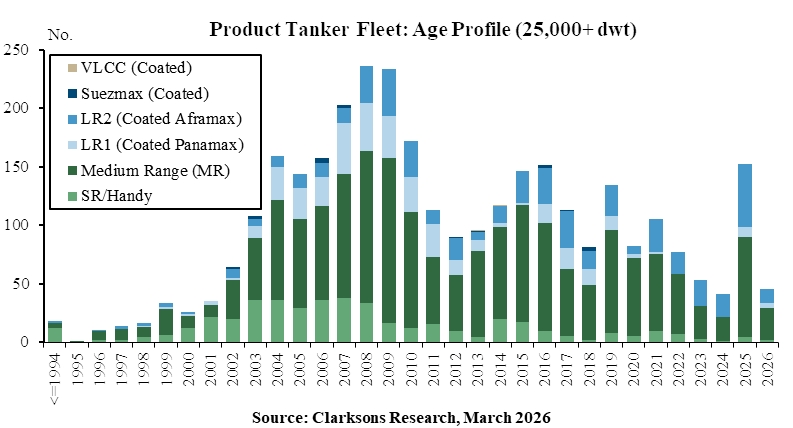
The market supply of tankers is affected by a number of factors, such as supply and demand for energy resources, including oil and petroleum products, supply and demand for seaborne transportation of such energy resources, and the current and expected purchase orders for newbuilds. The product tanker newbuild orderbook equalled approximately 18% of the existing world product tanker fleet in tonnage terms at the end of 2025. No assurance can be given that the orderbook will not increase further in proportion to the existing fleet. The supply of product tankers may also be affected by the use of product tankers in ‘dirty/crude’ trades and by product and crude tankers being “cleaned up” from ‘dirty/crude’ trades and swapped back into the product tanker market to transport clean petroleum products. Recently, a number of large product tankers (LR2s) have been performing ‘dirty trading’, which has reduced the supply of clean product tankers. Should these vessels return to ‘clean’ trades, the increase in available product tanker tonnage may affect the supply and demand balance for our product tankers.

If the capacity of new tankers delivered exceeds the capacity of tankers being recycled or converted to non-trading tankers, tanker capacity will increase. An oversupply of product tanker capacity or a decrease in demand for product tankers or the products carried by product tankers may render us unable to re-charter our Hafnia Vessels and TC Vessels at attractive rates and charter rates could materially decline. If we are unable to re-employ a vessel, we will not receive any revenue from the vessel, but we would still be required to pay interest, debt and operating expenses as necessary to maintain the vessel in operating condition. A reduction in charter rates and the value of our Hafnia Vessels may have a material adverse effect on our future performance, results of operations, and available cash.

Tanker rates are subject to seasonal variations in demand and cyclical fluctuations.

Tanker markets are typically stronger in the winter months as a result of increased oil consumption in the northern hemisphere, but weaker in the summer months as a result of lower oil consumption in the northern hemisphere and refinery maintenance that is typically conducted in the summer months. In addition, unpredictable weather patterns during the winter months in the northern hemisphere tend to disrupt vessel routing and scheduling. The oil price volatility resulting from these factors has historically led to increased oil trading activities in the winter months. As a result, revenues generated by vessels in our Combined Fleet have historically been weaker during the quarters ended June 30 and September 30, and stronger in the quarters ended March 31 and December 31. The seasonality may have an adverse effect on our future performance and result of operations for future quarters, including in the event that the typical seasonal demand in the northern hemisphere does not materialise. In 2025, we experienced a counter-cyclical firm market during the third quarter, but there can be no assurance that such counter-cyclical market tendencies will continue or will be repeated in subsequent years.

Changes in the economic, regulatory and political conditions in certain countries or regions and/or the development or increase of geopolitical economic tension as well as government responses thereto, including but not limited to the imposition of tariffs, trade barriers, export restrictions, port fees, and sanctions may have a negative effect on our business, operation, earnings, cash flow and financial condition.

Governments may turn and have in the past turned to trade barriers to protect or revive their domestic industries against foreign imports. Trade barriers, tariffs, and other measures restricting import and export may affect the demand for shipping and uncertainties relating to trade barriers, tariffs, and other measures restricting import and export may adversely affect our business and financial condition. In particular, recently leaders in the United States, China, the European Union, Mexico, and Canada have announced and/or implemented certain increasingly protective trade measures, including tariffs. The introduction of trade barriers, tariffs, or other trade measures, the perception that they may occur, and/or uncertainties about the extent of such trade barriers, tariffs, or other trade measures may have a material adverse effect on global economic conditions, and may significantly reduce global trade. Furthermore, any such measures may cause an increase in (a) the cost of goods exported from regions globally, (b) the length of time required to transport goods and (c) the risks associated with exporting goods. Such increases may significantly affect the quantity of goods to be shipped, shipping time schedules, voyage expenses, and other associated costs, which could have an adverse impact on our charterers’ business, operating results, and financial condition and could thereby affect their ability to make timely charter hire payments to us and to renew and increase the number of their charters with us. This could have a material adverse effect on our business, results of operations, or financial condition.

Uncertainties relating to tariffs, trade barriers, and other trade measures could furthermore adversely affect our ability to obtain financing in the future on terms commercially acceptable to us or at all, which could have a material adverse effect on our business and financial condition. Additionally, the impact of tariffs, trade barriers, and trade measures on the foreign exchange and securities markets and any resulting changes in, for example, currency exchange rates and the market price of our ordinary shares could in turn adversely impact our business and operations.

For example, our Hafnia Fleet includes many Chinese-built vessels, one vessel financed by sale and lease-back arrangements involving Chinese-owned banks, and 10 JV Vessels which are indirectly partially owned by Chinese companies. In early 2025, the USTR (United States Trade Representative) announced a number of measures relating to Chinese influence in the maritime, logistics and shipbuilding sectors. These included (i) service fees payable in relation to U.S. port calls by vessels with Chinese operators (being the entities identified and whose name would appear on the Vessel Entrance or Clearance Statement (CBP Form 1300) or its electronic equivalent) or Chinese owners based on the net tonnage of the vessel, initially at $0 per net ton, increasing to $50 per net ton as of October 14, 2025, and thereafter increasing on an annual basis for three years to $140 per net ton by 2028, and (ii) service fees payable in relation to U.S. port calls by Chinese-built vessels calculated with reference to the vessel’s net tonnage or containers discharged, initially at $0 per net ton, increasing to $18 per net ton as of October 14, 2025, and thereafter increasing on an annual basis for three years to $33 per net ton by 2028. Vessels subject to service fees under (i) would not be subject to service fees under (ii). Service fees under (i) and (ii) would be payable in connection with the first U.S. port call of a vessel and would be payable once per rotation or string of U.S. port calls with no more than five payments per individual vessel per year. Certain vessels were excluded from the service fee in (ii), including but not limited to, vessels arriving in U.S. ports empty or in ballast, vessels with capacities under certain limits, and certain specialised vessels, including vessels purpose-built for the transport of chemical substances in bulk liquid forms (chemical tankers). Upon order and until delivery of a U.S.-built vessel of equal or greater capacity, the service fee in (ii) could be eligible for suspension on an equivalent size Chinese-built vessel for a period not to exceed three years.

In October 2025, the Chinese Ministry of Transport announced that starting 14 October 2025, special port fees would be applicable to U.S. vessels arriving at Chinese ports. Vessels owned or operated by U.S. enterprises, organisations or individuals or by non- U.S. enterprises or organisations where U.S. enterprises, organisations or individuals directly or indirectly hold 25% of equity, voting rights or board seats would fall within the scope of the Chinese port fees, as would vessels flying the U.S. flag or which were built in the United States. The fee would commence 14 October 2025 at 400 RMB per net ton and would increase annually starting from April 2026, ultimately ending at 1,120 RMB per net ton. The fee would be charged per voyage and would not be charged again at subsequent Chinese port calls on the same voyage with no more than five payments per individual vessel per year.

In October 2025 and November 2025, both the U.S. and Chinese port fees were suspended for one year. It is uncertain whether the port fees will be reintroduced after the end of the suspension period. The reintroduction of the U.S. port fees and the Chinese port fees, or the introduction of other port fee schemes could significantly increase the operating expenses for ships in our Combined Fleet.

In February 2026, with the goal of increasing U.S. shipbuilding capacity and expanding the feet of U.S. -flag and U.S.-built vessels, the U.S. President announced America’s Maritime Action Plan according to which, among other proposals, a ‘Maritime Security Trust Fund’ would be financed in part by imposing universal fees on non-U.S.-built vessels, to be assessed on the weight of the imported tonnage of cargo imported into the United States by non-U.S.-built vessels. No plans for the timeline of implementing such universal import fees have been announced. Further, in February 2026, the U.S. President announced tariffs under section 122 of the Trade Act of 1974, which would apply to almost all imports to the United States.

As the measures in respect of the U.S. and Chinese port fees were only in place for a very short period during 2025, and since the U.S. import fees have not been formally introduced, we are still assessing the fees and their potential effects on us, our operations, our business, and the vessels in our Combined Fleet. The reintroduction of the U.S. port fees and the Chinese port fees, or the introduction of other port fee schemes and/or the introduction of import fees on cargo, could disrupt global shipping patterns and potentially increase congestion and costs at ports worldwide. We may not be able to pass on additional costs and fees, if any, to our customers, and such costs and fees could therefore materially impact our results of operations, cash flow, and ability to pay dividends.

Following the closure of the Strait of Hormuz in early 2026 and Iranian attacks on oil, petroleum products and shipping infrastructure in the adjacent area, export restrictions on certain oil and petroleum products were imposed by a number of countries. Export restrictions may limit the demand for product tankers such as the vessels in our Combined Fleet which could have a negative effect on our business and results of operations. Further, export restrictions on oil and petroleum products could make it harder and/or more expensive for us to operate the vessels in our Combined Fleet, as we may be unable to obtain bunkers for the vessels at acceptable prices or at all. An increase in bunker prices would increase our voyage expenses and could impact our results of operations to the extent that such increased cost is not covered by our customers. Unavailability of bunkers could mean that some of our vessels cannot operate, which would negatively impact our revenue and results of operations.

As at the date of this Annual Report, the extent and impact of such trade measures on our industry, our business, and our operation are unknown and unpredictable.

We are dependent on spot-oriented pools and spot charters, and any decrease in spot charter rates in the future may have a material adverse effect on our business.

As at December 31, 2025, 91 of the vessels in the Hafnia Fleet were employed in either the spot market or our spot market-oriented Pools, exposing us to fluctuations in spot market charter rates. The spot charter market may fluctuate significantly based upon tanker and oil supply and demand. The successful operation of the vessels in our Hafnia Fleet in the competitive spot charter market, including within the Pools, depends on, among other things, obtaining profitable spot charters and minimising, to the extent possible, time spent waiting for charters and time spent traveling unladen to pick up cargo.

The spot market is very volatile, and in the past there have been periods when spot charter rates have declined below the operating cost of vessels. If spot charter rates decline, then we may be unable to operate our Hafnia Vessels and TC Vessels trading in the spot market profitably, meet our obligations, including payments on indebtedness, or pay dividends in the future. Furthermore, as charter rates for spot charters are fixed for a single voyage that may last up to several weeks, during periods in which spot charter rates are rising, we will generally experience delays in realising the benefits from such increases, which may have a material adverse effect on our future performance, results of operations, cash flows, and financial position. Additionally, in relation to TC Vessels and bareboat chartered-in Hafnia Vessels, we may be exposed to changes in charter and freight rates that are significantly below the charter rate agreed in our time charter-in or bareboat charter-in agreements.

Our ability to renew expiring charters or obtain new charters will depend on the prevailing market conditions at the time. If we are not able to obtain new charters in direct continuation with existing charters or upon taking delivery of a newly acquired vessel, or if new charters are entered into at charter rates substantially below the existing charter rates or on terms otherwise less favourable compared to existing charter terms, our revenues and profitability could be adversely affected.

Changes in global trading patterns, particularly, but not limited to, the trading patterns for oil and oil products, may have a negative impact on our business.

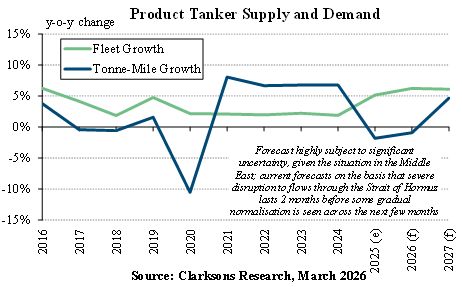
Our business and results of operations are affected by the trading patterns for the cargo we transport, particularly the trading patterns for oil and oil products. Changes to the trade patterns of oil and oil products may have a significant negative or positive impact on the tonne-mile and therefore the demand for our product tankers. Global events may cause demand for oil and petroleum products to stagnate for an extended period of time as was the case from the second half of 2020 until the second quarter of 2022. The global trading patterns for oil and oil products were impacted by the war between Ukraine and Russia, as well as the conflict between Israel and Hamas and the resulting disruptions in the Red Sea, each of which initially led to an increase in the price of oil and oil products, longer seaborne routes and higher earnings for tankers. However, alternative trade routes to bypass the Red Sea were established in the second half of 2024, with total tonnage transiting cross hemispheres gradually decreasing, resulting in shorter voyages which had an impact on our earnings. In 2025, market conditions strengthened during the second half of the year including as a result of the sustained impact of geopolitical developments, particularly in Russia and the Red Sea. In late 2025, commercial vessels were gradually returning to the Red Sea. However, following U.S. military intervention in Iran commencing in late February 2026 and related attacks on commercial vessels and oil and petroleum product infrastructure in the adjacent area, the Red Sea, Arabian Gulf, Strait of Hormuz, and adjacent areas have been subject to increased risks, and the number of commercial vessels in these areas has significantly decreased. While charter rates for product tankers initially increased following the disruption to shipping in the area, we cannot predict the medium or long-term effects of the current military conflict in Iran and the surrounding areas. As a result of the closure of the Strait of Hormuz, certain vessels (including one vessel in our Combined Fleet) were blocked from leaving the Arabian Gulf. See “—Our global operations expose us to risks, such as political instability, terrorist or other attacks, piracy, war, and international hostilities which may affect the tanker industry and adversely affect our business” for more information regarding these regional conflicts.

The continued and future impact of these conflicts on the tanker industry and, consequently, our business is uncertain. A full reversal of sanctions on Russia, Iran and Venezuela and/or the disruptions to shipping routes in the Red Sea, Arabian Gulf and Strait of Hormuz and a corresponding full reversal of the changes to the supply and demand for oil and oil products and trading patterns combined with the older tanker fleet coming back to the international market could have a significant impact on our results of operations. Such reversal of changes to global trading patterns to pre-war status or other changes in global trading patterns, including, but not limited to, any leading to shorter distances of seaborne products trade, or changes in trading patterns as a result of a decrease in economic condition of certain regions or countries or decreases in refinery capacity may have a negative adverse effect on our business, results of operations, financial condition, cash flows and ability to pay dividends.

An economic slowdown in the world or in certain regions, or changes in the economic and political environment, could have a material adverse effect on our business, financial condition, and results of operations.

Historically, there has been a link between the development of the world economy and the demand for oil and oil products. Deterioration or changes in the economic and political environment in certain regions or the world economy could reduce regional or overall demand for chemical and petroleum products and for our services. While market conditions have in recent years generally been good for our industry, economic slowdowns in the world or in certain regions or changes in the economic and political environment throughout the world and/or in certain regions may have a material adverse effect on our business, financial condition, and results of operation.

We anticipate that a significant number of port calls made by vessels in our Combined Fleet will continue to involve the loading or discharging of cargo in ports in the Asia Pacific region. Additionally, we have a number of other interests in the Asia Pacific region, including having placed orders for newbuilds with Chinese and South Korean shipyards. As a result, any negative changes in economic conditions in any Asia Pacific country, particularly in China, may have a material adverse effect on our business, financial condition, and results of operations, as well as our future prospects.

Outside of the Asia Pacific region, the product tanker industry may additionally be negatively affected by other regional economic slowdowns, including a potential economic slowdown in the United States, Europe, or other regions, were to cause a decrease in imports or exports of refined oil products or a decrease in the demand for oil, petroleum and chemical products. This could have a negative impact on our earnings, cash flows, and financial position.

Economic reforms in certain regions or countries, including but not limited to China, the United States, and Europe, or changes in the political, economic, and social conditions or other relevant policies of governments such as changes in laws, regulations or export and import restrictions, could impact the level of imports to and exports from certain regions and countries. For example, taxes, duties or fees imposed on non-resident international transportation enterprises by certain countries or regions could result in an increase in the cost of import and export of cargo, the risks associated therewith, as well as a decrease in any cargo shipped from our charterers. This could have an adverse impact on our charterers’ business, operating results and financial condition and could thereby affect their ability to make timely charter hire payments to us and to renew and increase the number of their time charters with us. Additionally, increased geopolitical tensions may impact trade flows and tanker flows in the future. Recently, a number of tariffs and trade measures have been announced by governments. See “Changes in the economic, regulatory and political conditions in certain countries or regions and/or the development or increase of geopolitical economic tension as well as government responses thereto, including but not limited to the imposition of tariffs, trade barriers, export restrictions, port fees, and sanctions may have a negative effect on our business, operation, earnings, cash flow and financial condition” for a description of the risk related to tariffs and other trade measures. A decrease in the level of imports to and exports from certain countries or regions, including but not limited to China, the United States, and the European Union, could adversely affect our business, operating results, and financial condition.

Further, initiatives in certain regions or countries, including but not limited to the United States, China and the European Union to reduce their dependency on (foreign) oil and achieve carbon neutrality could affect the demand for oil, petroleum, and related products, could have a material adverse effect on our business, cash flows and results of operations.

Outbreaks of epidemic or pandemic diseases or other infectious diseases and governmental responses thereto could materially and adversely affect our business, financial condition, and results of operations.

Our business and operations are subject to risks relating to pandemics, epidemics or other disease outbreaks and government reactions thereto. The COVID-19 pandemic, which began in 2020, led governments and governmental agencies to implement travel bans, quarantines, and other emergency public health measures including lockdowns, which resulted in a significant reduction in global economic activity and volatility in the global financial markets. While COVID-19 no longer constitutes a global health emergency, a re-emergence of COVID-19 or variants hereof or any other outbreaks of epidemic, pandemic or other infectious disease could have an adverse impact on the global economy which may cause the charter rate and freight rate environment for tanker vessels to deteriorate, may reduce the global demand for oil and oil products, may reduce the market value of tanker vessels, may disrupt our normal vessel operations and could lead to an increase of our operating and voyage expenses due to, among other things increased crew costs and health/safety arrangements or increased fuel prices. Any of the foregoing could negatively impact our financial condition, operations and cash flows.

As at December 31, 2025, 74% of the vessels in our Hafnia Fleet operate in the spot market where income margins are particularly sensitive to fluctuations in charter and freight rates and therefore our TCE income may be materially and adversely affected by such fluctuations in charter and freight rates or voyage expenses. We cannot accurately predict how future epidemics, pandemics, or other outbreaks of infectious diseases may affect our business, operations and financial condition because this will depend on various unpredictable factors outside of our control, including, but not limited to, (i) the severity and duration of the outbreak; (ii) the extent of governmental response; (iii) the introduction and extent of financial support measures aimed to reduce the impact on the economy; (iv) the impact on the volatility in the demand for and price of chemical and petroleum products; (v) shortages or reductions in the supply of goods, services or labour; and (vi) fluctuations in general financial or economic conditions arising from the outbreak, such as changes to interest rates or availability of credit.

We may be exposed to fraudulent behaviour, which may have a material adverse effect on our future performance, results of operations, cash flows, and financial position.

The risk of fraud is inherent in all industries. However, the shipping industry has historically experienced a greater risk of fraud and fraudulent behaviour. Potential fraud risks include purposeful manipulation and misrepresentation of consolidated financial statements, misappropriation of assets, corruption including bribery and kickbacks as well as cyberattacks. Additionally, we are exposed to the risk of misrepresentations relating to the cargo we carry and/or other trade documentation, including the risk of fraud in relation to the origin of cargo we carry. If we are exposed to fraud relating to the origin of cargo, we could risk being in breach of applicable sanctions, which could have a significant and material negative impact on our reputation, business, and financial condition.

We have established a system of internal controls to prevent and detect fraud and fraudulent behaviour, consisting of segregation of duties, authorisations for trading, purchase and approval, codes of ethics and conduct, close monitoring of our financial position and a whistleblower facility; however, there can be no assurance that our fraud prevention measures are sufficient to prevent or mitigate our exposure to fraud or fraudulent behaviour. Any such behaviour may have a material adverse effect on our reputation, results of operations, cash flows, and financial position.

If we, including the Pools, cannot pass inspections from classification societies or regulatory bodies or meet our customers’ quality and compliance requirements, we may not be able to operate the vessels in our Combined Fleet profitably, which could have an adverse effect on our future performance, results of operations, cash flows and financial position.

Vessels are subject to inspections from governments and private entities, including classification societies, in order to obtain and maintain necessary permits, licenses, and certificates. A failure by the vessels in our Combined Fleet to pass inspections from governments and private entities and/or to maintain necessary permits, licenses and certificates may adversely affect our ability to employ the vessels, which could have a negative effect on our results of operations, cash flows, and financial position.

Customers, in particular those in the oil industry, have a high focus on quality and compliance standards with their suppliers across the entire value chain, including the shipping and transportation segment. Our, and the Pools’, continuous compliance with these standards and quality requirements is vital for our operations. In late 2024, the Oil Companies International Marine Forum introduced a new Ship Inspection Report Program 2.0 which contains a more comprehensive inspection process than under the previous Ship Inspection Report Program. Noncompliance by us or the Pools either as a sudden and unexpected breach in quality and/or compliance concerning one or more vessels, or as a continuous decrease in the quality concerning one or more vessels occurring over time as well as an increase in requirements by oil operators above and beyond what we deliver, may have a material adverse effect on our future performance, results of operations, cash flows and financial position.

Fluctuations in exchange rates and non-convertibility of currencies could result in financial losses for us.

We generate almost all revenues and incur the majority of our expenses in U.S. dollars. We face exchange rate risks from revenues and expenses paid in currencies other than U.S. dollars. This risk mainly involves DKK, EUR, Indian rupee, SGD, and other major currencies for administrative, operational, and local port expenses. Without adequate hedging, currency fluctuations may cause losses and adversely affect our performance, results of operations, cash flows, and financial position.

Increased requirements relating to the fuel used by vessels may require us to retrofit our Hafnia Vessels and JV Vessels or change our approach to bunker purchase and may cause us to incur significant costs.

Since 2020, the International Maritime Organization (the “IMO”) has, in accordance with Annex VI of the International Convention for the Prevention of Pollution from Ships 1973, as modified by the protocol of 1978 relating thereto (collectively, “MARPOL”), imposed a limit for the sulphur content of vessels’ fuel oil of 0.5% m/m (mass by mass) in fuel used on board the vessels. Shipowners may comply with this regulation by (i) using 0.5% sulphur fuels, which is available around the world but may entail a higher cost; (ii) installing exhaust gas cleaning systems (“scrubbers”) for cleaning of the exhaust gas; or (iii) by retrofitting vessels to be powered by alternative fuel sources, which may not be a viable option for shipowners due to the lack of supply network and high costs involved in this process. In addition to the general 0.5% requirement, certain areas (so-called Emission Control Areas) have been designated in which stricter requirements apply. The cost of compliance with these requirements may be significant and may have a material adverse effect on our future performance, results of operations, cash flows, and financial position. A widening of the spread between the prices of high sulphur fuel and low sulphur fuel may lead to a decrease in the economic viability of older vessels that lack fuel efficiency and a reduction of useful lives for these vessels. For our Hafnia Vessels and JV Vessels that do not have scrubbers, we are complying with the IMO standards by using compliant fuels. We may be or become subject to additional requirements in the future relating to the type and/or quality of fuel used by vessels in our Combined Fleet.

From January 1, 2025, the EU FuelEU Maritime Regulation (“FuelEU”) imposes greenhouse gas (“GHG”) intensity limits for energy used on board vessels trading in or to and from the EU. The required reduction of GHG intensity will gradually increase every five years until 2050. We expect that in most cases, the cost of compliance will be borne by the entity responsible for a vessel’s commercial operation, such as a time charterer or a pool manager. We therefore expect to have to manage or arrange compliance with FuelEU for most vessels in our Combined Fleet. Shipping companies must ensure compliance with FuelEU by purchasing fuels with a lower GHG intensity or arrange compliance by other means, such as pooling over-compliant vessels with under-compliant vessels or by paying a ‘FuelEU penalty’.

We may not be able to pass on the costs of complying with FuelEU to our customers. FuelEU, as well as other future rules, regulations, and requirements relating to the types of fuel and quality of fuel used by vessels in our Combined Fleet may impact our business, lead to additional costs, and affect our results of operations. Furthermore, any transactions relating to FuelEU such as sale or purchase of a right to pool vessels may have tax or VAT implications that are not certain or familiar in the industry and there is a risk that such tax or VAT will have a negative effect on our results of operations or that we will not be able to comply with applicable rules because of the uncertainty of the regulation.

In April 2025, the 83rd session of the Marine Environment Protection Committee (“MEPC”), MEPC 83, approved an amendment to Annex VI of MARPOL providing for a global GHG fuel intensity (“GFI”) standard (the “GFS”). The GFS would require vessels to comply with annual GFI targets, which will reduce over time. Failure in complying with the GFI targets would trigger a requirement to purchase remedial units to achieve compliance. The vote for adoption of the GFS was scheduled for an extraordinary session of the MEPC in October 2025, but the extraordinary session of the MEPC was adjourned to be reconvened in autumn of 2026. It is unclear whether the GFS will be adopted and, if adopted, when the GFS will enter into force.

The global sulphur cap, Emission Control Areas, GHG intensity reduction requirements under FuelEU and GHG intensity reduction requirements under the GFS, if adopted, as well as other regulations relating to the fuels used by vessels may lead to changes in the production quantities and prices of different grades of marine fuel and renewable fuels, including biofuels, and introduce an additional element of uncertainty in fuel markets, which could result in additional costs and adversely affect our cash flows, earnings and results of operations as we may not be able to fully recover any increased cost of fuels from our customers. Furthermore, we may have to incur additional costs to comply with such regulations which we may not be able to recover from our customers. Such additional costs could impact our results of operations and cash flows.

We are subject to complex laws and regulations, including environmental laws and regulations, that can increase our liability and adversely affect our business, results of operations, cash flows and financial condition, and our available cash.

Our operations are affected by extensive and changing international conventions and treaties, national, state and local laws and national and international regulations governing environmental matters, climate change, and the global transition towards low-carbon or carbon-neutral solutions. Such regulatory measures may include, for example, the adoption of sulphur caps, trade regimes (emission trading), carbon taxes, GHG intensity requirements, increased efficiency standards, incentives or mandates for renewable energy, and liability for pollution or other environmental hazards. Regulatory measures relating to the environment and climate change may significantly impact the operation of our Hafnia Vessels and JV Vessels and compliance with such regulatory measures may be expensive and any noncompliance may have an adverse effect on our results of operations.

Areas in which our operations are affected are emission trading schemes such as the EU Emissions Trading System (“EU ETS”). Under the EU ETS, we are required to surrender emission allowances corresponding to a certain amount of our emissions for voyages to and between EU/EEA ports. Noncompliance with the EU ETS or a failure to deal with EU ETS obligations properly and efficiently could have material adverse consequences for our business, results of operations, future performance, and financial condition. Additionally, there is uncertainty about the future pricing of EUAs, and there is a risk that the price of EUAs may be driven up due to factors such as restricted supply, increased demand, and the impact of speculative trading. We cannot accurately predict the consequences of potential future taxation and VAT on EUAs; however, such taxation and VAT may have a negative effect on our results of operations. Additionally, other jurisdictions may introduce emissions taxation applicable to our industry, which could have an impact on our results of operations.

Compliance with current and future legal and regulatory requirements relating to safety and environmental impact and climate change, GHG emissions, air emissions, management of ballast water, as well as requirements relating to the speed and fuel consumption of vessels could increase the cost of operating and maintaining our Hafnia Vessels and JV Vessels, require us to make changes to our business model, require us to accelerate the building of new vessels and increase the construction costs therefor, require us to install new technology, equipment and installations on new and existing vessels, require reductions in cargo capacity, ship modifications or operational changes or restrictions, lead to impairment charges, negatively affect the resale value of our Hafnia Vessels and JV Vessels, force us to retire older vessels earlier than expected, lead to decreased availability of insurance coverage for environmental matters, or result in denial of access to certain jurisdiction waters or ports or detention in certain ports. If these outcomes were to occur, our business, results of operations, cash flows, and financial condition could be adversely affected.

To comply with the International Convention for the Control and Management of Ships’ Ballast Water and Sediments and the sulphur emissions requirements under MARPOL, we may be required to incur costs related to repair and replacement of ballast water treatment systems and scrubbers installed on our Hafnia Vessels during the vessels’ lifetimes. Future investments in ballast water treatment systems and scrubbers as well as new regulation regarding ballast water treatment systems could have an adverse material impact on our business, financial condition, and results of operations depending on the ability to install effective ballast water treatment systems and the extent to which existing vessels must be modified to accommodate such systems. See “Item 4. Information on the Company – B. Business Overview – Environmental and Other Regulations in the Shipping Industry” for more information on the regulations applicable to us in relation to ballast water management and emissions.

In addition, many environmental regulations and requirements under local, national and foreign laws, conventions and regulations are designed to reduce the risk of pollution, such as from oil spills. Our compliance with these requirements could be costly as we could become subject to material liabilities in respect of remediation of spills and releases of oil and hazardous substances including clean-up obligations and natural resources damages liability if there is a release of hazardous materials from our Hafnia Vessels or JV Vessels or otherwise in connection with our operations. These regulations may impose strict liability, which could subject us to liability without regard to whether we were negligent or at fault. We could also become subject to personal injury or property damage claims relating to the release of hazardous substances associated with our existing or historic operations. Violations of, or liabilities under, environmental regulations and requirements can result in substantial penalties, fines, and other sanctions, including, in certain instances, seizure or detention of a vessel, and could harm our reputation with current or potential charterers of the vessels in our Combined Fleet. Further, we are required to satisfy insurance and financial responsibility requirements for potential oil (including marine fuel) spills and other pollution incidents. Although we have arranged such insurance to cover certain environmental risks, there can be no assurance that such insurance will be sufficient to cover all such risks or that any claims will not have a material adverse effect on our business, results of operations, cash flows and financial condition and available cash.

Notwithstanding the measures already taken by us to comply with applicable regulations and standards, additional conventions, laws and regulations may be adopted that could limit our ability to do business or increase the cost of doing business and which may materially and adversely affect our operations. Additionally, evolving demands for stronger protection of the environment, evolving laws and regulations, and evolving decarbonisation policies may have a significant impact on our Hafnia Vessels’ and JV Vessels’ useful lives and residual values and the valuation of our Hafnia Vessels and JV Vessels, and also could have an adverse impact on our future performance, revenue and financial condition. Pressure from governments, investors, lenders, and other market participants to voluntarily participate in ‘green’ shipping initiatives could cause us to incur significant additional expenses. We continue to monitor and assess the potential impact of such developments on our operations and financial performance.

See “Item 4. Information on the Company – B. Business Overview – Environmental and Other Regulations in the Shipping Industry” for a discussion of the environmental and other regulations applicable to us. A failure to comply with applicable laws and regulations may result in administrative and civil penalties, criminal sanctions or the suspension or termination of our operations.

Developments in safety and environmental requirements relating to the recycling of vessels may result in escalated and unexpected costs.

The 2009 Hong Kong International Convention for the Safe and Environmentally Sound Recycling of Ships (the “Hong Kong Convention”) entered into force on June 26, 2025, and aims to ensure that when vessels are being recycled, they do not pose unnecessary risks to the environment, human health, or safety. Under the Hong Kong Convention, each vessel sent for recycling must carry an inventory of its hazardous materials, authorised recycling facilities must provide a vessel-specific recycling plan, and governments must ensure compliance with recycling facilities in their jurisdiction.

In 2013, the Ship Recycling Regulation was adopted in the EU. The regulation, which is aligned with the Hong Kong Convention, requires EU member state-flagged vessels to use only EU-permitted recycling facilities. Under this regulation, vessels calling at EU ports or flying an EU flag must maintain an inventory of hazardous materials. This system identifies and tracks hazardous materials exceeding certain thresholds in the vessel’s structure and equipment.

Although we have not previously recycled vessels, these regulations may affect our future business and operations. We may also need additional contractual provisions when divesting older vessels to ensure the buyer complies with the relevant regulations. Increasing requirements under the EU Ship Recycling Regulation and the Hong Kong Convention could raise costs at shipyards, repair yards, and recycling yards. Such costs might reduce the value of older vessels and/or a vessel’s residual recycling value, potentially failing to cover compliance costs and adversely affecting our future performance, results of operations, cash flows, and financial position. For additional information regarding such regulatory requirements, see “Item 4. Information on the Company – B. Business Overview – Environmental and Other Regulations in the Shipping Industry – Waste Management and Ship Recycling”.

Our global operations expose us to risks, such as political instability, terrorist or other attacks, piracy, war, and international hostilities, which may affect the tanker industry and adversely affect our business.

We are an international tanker company and conduct our operations globally. Our business, results of operations, cash flows, financial condition, and ability to pay dividends, if any, may be adversely affected by changing economic, political and government conditions in the countries and regions where the vessels in our Combined Fleet are employed or registered. Moreover, we operate in a sector of the economy that is likely to be adversely impacted by the effects of political conflicts, including the current political instability in Venezuela, the Middle East and the South China Sea region and other geographic countries and areas including the conflict between Russia and the North Atlantic Treaty Organization and tensions between China and Taiwan, geopolitical events such as terrorist or other attacks (and the threat of future terrorist and other attacks), including attacks on commercial vessels in the Red Sea, and Arabian Sea, piracy, war (or threatened war) or international hostilities, such as those between the United States and North Korea, between Russia and Ukraine, between Israel and Hamas and between the United States, Israel and Iran. Any of these occurrences, including, but not limited to, war in a country in which a material supplier or customer of ours is located, could have an adverse effect on our business, results of operations, and financial condition.

Continuing war and conflicts, terrorist attacks, as well as incidents of terrorism in the Middle East, and the continuing response of the United States and others to these attacks, as well as the threat of future terrorist attacks around the world, continue to cause uncertainty in the world’s financial markets and may affect our business, operating results, and financial condition. In the past, political instability has also resulted in attacks on vessels, mining of waterways, and other efforts to disrupt international shipping, particularly in the Arabian Gulf region and in the Black Sea in connection with the war between Russia and Ukraine and in the Red Sea in connection with the conflict between Israel and Hamas.

We have operations in high-risk areas where we are exposed to the risk of piracy and other types of attacks on ocean-going vessels. Piracy remains prevalent in certain regions, including but not limited to Somalia, the South China Sea, the Indian Ocean, the Gulf of Guinea, the Gulf of Aden, the Celebes Sea, the Sulu Sea, and parts of Asia including the Singapore Strait, posing significant risks to our vessels and crew. Geopolitical turmoil in the Middle East region may lead to collateral damages in the waters off Yemen as well as in the Gulf of Oman or Arabian Gulf. Since late February 2026, the military conflict in Iran has led to missile strikes and collateral damage to vessels in the Arabian Gulf, Strait of Hormuz and adjacent waters as well as damage to infrastructure, including port infrastructure. There have been attacks on vessels in our Combined Fleet in the past and there can be no assurance that we will not be victim of future attacks on our Combined Fleet. Any attacks on vessels in our Combined Fleet, such as attacks by pirates, could result in material damage to the vessels or harm to crew members and could have a material adverse effect on our business, financial condition, cash flows, and results of operations. Product and chemical tankers are exposed to significant risk of damage in the event of attacks such as missile strikes, terrorist attacks, collision or otherwise due to the nature of the cargo which is typically highly flammable and which can significantly damage the environment in the event of a spill. In addition, detention or hijacking as a result of an act of piracy against our Hafnia Vessels or JV Vessels, or increases in cost associated with seeking to avoid such events (including increased bunker costs resulting from vessels being rerouted or travelling at increased speeds as recommended by applicable best management practices) could have a material adverse impact on our business, results of operations, ability to pay dividends, cash flows and financial condition and may result in loss of revenues, increased costs and decreased cash flows to our customers, which could impair their ability to make payments to us under our charters.

Further, such attacks (or the risk of such attacks) may cause increased insurance premiums, restricted or reduced insurance coverage, increased operating costs due to increased security arrangements and increased operational costs, increased crew costs, off-hire, delays, and disruptions. If regions in which our Hafnia Vessels and JV Vessels are employed are or become characterised by insurers as “war risk” zones or Joint War Committee “war and strikes” listed areas, premiums payable for coverage in these areas could increase significantly and such insurance coverage may be more difficult to obtain. In addition, crew and security equipment costs, including costs relating to onboard security guards, could increase in such circumstances. We may not be adequately insured to cover losses from these incidents, which could have a material adverse effect on us. Since early March 2026, several P&I Clubs in the International Group of P&I Clubs, including the P&I Clubs in which our Hafnia Vessels are insured, have issued notices of cancellation of war risk cover relating to Iran and Iranian waters and the Persian/Arabian Gulf and adjacent waters. Where we cannot obtain war risk insurance for our Hafnia Vessels or where such war risk insurance is not available at an acceptable price, we may be restricted from accepting, undertaking and/or completing certain voyages which could result in losses, claims from third parties, and/or lack of income from agreed charters.

Uncertainties relating to war and conflicts and the risk of terrorist, piracy or other attacks on vessels in our Combined Fleet could also in the future adversely affect our ability to obtain additional financing on terms commercially acceptable to us or at all, which could have a material adverse effect on our business and financial condition.

The war between Russia and Ukraine has had a significant direct and indirect impact on the trade of refined petroleum products. This war has resulted in the United States, the United Kingdom, and the European Union, among other countries, implementing sanctions and restrictive measures against certain persons, entities, and activities connected to Russia. See “If vessels in our Combined Fleet call on ports located in countries or territories that are subject to sanctions or embargoes imposed by the United States, the European Union, the United Kingdom, or other governments or our operations are otherwise deemed in conflict with sanctions or embargoes, monetary fines or other penalties could be imposed on us and our reputation may suffer harm.” for a description of the risks related to sanctions.

Disruptions to shipping in the Red Sea, Arabian Gulf, and Strait of Hormuz in connection with the conflict between Israel and Hamas and the conflict between the United States, Israel, and Iran or other disruptions to commonly used trading routes could have a negative effect on our operations, business, cash flows, financial condition, and results of operation.

Since late 2023, the shipping industry has been impacted by disruptions in the Red Sea due to Houthi forces based in Yemen attacking vessels transiting the Red Sea in connection with the conflict between Israel and Hamas. During 2025, vessels were gradually returning to the Red Sea, but since U.S. and Israel attacks on Iran in February and March 2026 and resulting Iranian attacks on surrounding areas, including attacks on commercial vessels, the number of vessels in the Red Sea has significantly decreased. Further, Iran has blocked the Strait of Hormuz and thereby restricted the ability of vessels to enter and exit the Arabian Gulf. We continuously review the situation in the Red Sea, Arabian Gulf, and adjacent areas and, as at the time of this Annual Report, expect to direct our vessels to avoid the Strait of Hormuz and to continue to go around the Cape of Good Hope until we are confident that resuming voyages in the Red Sea is safe for our crew and our vessels.

Our Hafnia Vessels and JV Vessels have in the past frequently passed through the Red Sea and the Suez Canal, and have passed through the Strait of Hormuz to the Arabian Gulf and if they are in the future directed to transit the Red Sea or the Arabian Gulf, there is a risk that they could be subject to attacks. Any such attack may result in material damage to the vessel or harm to our crew members and may additionally cause increased insurance premiums and increased operating costs due to increased security arrangements and unexpected and costly delays and increased crew costs to compensate the crew for the increased risk. Additionally, it may become difficult to obtain adequate insurance coverage at an acceptable price or at all. Furthermore, our crew members may refuse to complete a planned transit of the Red Sea or Strait of Hormuz which could lead to costly delays. Any of the forementioned consequences could have a material adverse effect on our operation and business.

If we choose not to direct the vessels in our Combined Fleet through the Red Sea, they will typically instead transit around the Cape of Good Hope. This voyage is longer and therefore increases the cost of the voyage. While we can currently pass on most of these costs to charterers, there can be no assurance that we will continue to be able to do so. If we cannot pass on the cost of the longer voyage to charterers, our cash flows, results of operations, and financial condition could be adversely impacted. During 2024 and 2025, we have observed a trend towards shorter voyages within hemispheres, bypassing the need to transit the Red Sea or to go around the Cape of Good Hope. A continued trend of shorter voyages or an increase in such a trend may lead to reduced earnings and therefore may negatively impact our results of operations.

If other vessel operators start to direct their vessels to transit the Red Sea and Suez Canal or the Strait of Hormuz and Arabian Gulf while we direct our vessels to avoid the Strait of Hormuz and go around the Cape of Good Hope, our competitiveness may be negatively impacted as our competitors may be able to offer shorter voyages and better rates. Our reduced capacity and/or our reduced competitiveness may negatively impact our cash flows, results of operations, and financial condition.

If security in the Red Sea improves and the industry deems it safe to resume normal transit through the Suez Canal, demand for additional tanker capacity caused by rerouted voyages around the Cape of Good Hope would decline. This could result in shorter voyages, lower demand for our vessels, and downward pressure on charter rates. Such impacts could negatively impact our earnings and financial performance.

We cannot accurately assess or estimate what impact the situation in the Red Sea, Arabian Gulf, and Strait of Hormuz, or other disruptions to commonly used trading routes, could have on our operations and financial condition in the long term.

If vessels in our Combined Fleet call on ports located in countries or territories that are subject to sanctions or embargoes imposed by the United States, the European Union, the United Kingdom, or other governments or our operations are otherwise deemed in conflict with sanctions or embargoes, monetary fines or other penalties could be imposed on us and our reputation may suffer harm.

To the best of our knowledge, our Hafnia Vessels and JV Vessels have not called, in violation of applicable sanctions laws or embargo laws, at ports located in countries or territories subject to country-wide or territory-wide comprehensive sanctions and/or embargoes imposed by the U.S. government, the European Union, the United Kingdom or other authorities (“Sanctioned Jurisdictions”). We endeavour to take precautions reasonably designed to mitigate the risk of any such occurrences, but it is possible that, in the future, vessels in our Combined Fleet may carry cargo from or call on ports in Sanctioned Jurisdictions on charterers’ instructions with or without our consent. If any such activities result in a violation of applicable sanctions or embargo laws, we could be subject to monetary fines, civil or criminal penalties, or other sanctions, and our reputation and the market for our ordinary shares could be adversely affected. Even though we take precautions reasonably designed to mitigate such activities, such as enhanced due diligence and Know Your Customer (“KYC”) procedures for counterparty onboarding, recurrent screening, and including relevant provisions in charter agreements forbidding the use of vessels in our Combined Fleet in trade that would violate sanctions laws or embargo laws, there can be no assurance that we will maintain such compliance, particularly as the scope of certain sanctions laws and embargo laws may be unclear and may be subject to changing interpretations.

Certain sanctions exist under a strict liability regime. This means that for a party to be liable under the sanctions, it is not a requirement that the party knew they were violating sanctions or that they intended to violate sanctions. We could be subject to monetary fines, civil or commercial penalties, or other sanctions for violating applicable sanctions or embargo laws even in circumstances where our conduct or the conduct of one of our charterers was inconsistent with our sanctions-related policies, unintentional, or inadvertent.

The laws and regulations of the jurisdictions in which we operate or whose laws and regulations are otherwise applicable to us vary in their application and do not all apply to the same covered persons or prohibit the same activities. In addition, the sanctions and embargo laws and regulations of each jurisdiction may be amended over time to increase or reduce the restrictions they impose, and the lists of persons and entities designated under these laws and regulations are frequently amended. Moreover, most sanctions regimes provide that entities owned or controlled by the persons or entities designated in such lists are also subject to sanctions. The United States and European Union have enacted new sanctions programs in recent years. Additional countries or territories, as well as additional persons or entities within or affiliated with those countries or territories, have been (and in the future may be) the target of sanctions. Furthermore, the United States has increased its focus on sanctions enforcement with respect to the shipping sector. Following the U.S. intervention in Venezuela in early 2026, it remains uncertain to what extent sanctions on Venezuela will be retained, expanded or amended. The impact of the amendment of the current sanctions regulations on Venezuela could have an impact on our industry and our business, but as at the date of the Annual Report, we are not able to accurately predict such effects. Current or future counterparties of ours may be affiliated with persons or entities that are or may be in the future the subject of sanctions imposed by the United States, the EU, and/or other international bodies. If we determine that such sanctions require us to terminate existing or future contracts to which we or our subsidiaries are party or if we are found to be in violation of such applicable sanctions, our results of operations may be adversely affected, or we may suffer reputational harm. As at the date of this Annual Report, to the best of our knowledge, we do not believe that any of our existing counterparties are affiliated with persons or entities that are subject to such sanctions.

As a result of Russia’s actions in Ukraine, the United States, the European Union and United Kingdom, and other governments have imposed significant sanctions on persons and entities associated with Russia and Belarus, as well as comprehensive sanctions on certain areas within the Donbas and Luhansk regions of Ukraine, and such sanctions apply to entities owned or controlled by such designated persons or entities. These sanctions adversely affect our ability to operate in the region and also restrict parties whose cargo we may carry. Sanctions against Russia have also placed significant prohibitions on the maritime transport of seaborne Russian oil, the importation of certain Russian energy products and other goods, and new investments in the Russian Federation. These sanctions further limit the scope of permissible operations and cargo we may carry. These sanctions, and any future sanctions, whether related to the war between Russia and Ukraine or otherwise, may have an adverse impact on our business, and in a worst-case scenario, our ability to trade with certain countries, including entities and individuals linked to such countries, may be severely restricted. The EU and the United States have prohibited a variety of specified services related to the maritime transport of Russian Federation origin crude oil and petroleum products, including trading/commodities brokering, financing, shipping, insurance (including reinsurance and protection and indemnity), flagging, and customs brokering. An exception exists to permit such services when the price of the seaborne Russian oil does not exceed the relevant price cap, but implementation of this price exception relies on a recordkeeping and attestation process that allows each party in the supply chain of seaborne Russian oil to demonstrate or confirm that oil has been purchased at or below the price cap. From February 27, 2025, the United States has also prohibited the provision of petroleum services in certain specified circumstances, including for the provision of services for products purchased at or below the aforementioned price caps. Violations of the petroleum services prohibition or the price cap policy, including the risk that information, documentation, or attestations provided by parties in the supply chain are later determined to be false or insufficient, may pose additional risks adversely affecting our business.

With effect from December 18, 2023, sanctions were introduced by the EU that prohibit the direct or indirect sale or other transfer of tanker vessels to any natural or legal person in Russia or for use in Russia unless a license is obtained from the competent national authority. With effect from February 24, 2025, a ban was introduced on direct or indirect transactions with certain Russian infrastructure, including ports, except where such transactions are covered by specified exceptions for EU operators and notified to their relevant EU member state.

When we divest vessels from our Hafnia Fleet, we conduct a thorough screening process to ensure that the divestments are made in accordance with applicable sanctions. While we take such precautions, including by way of enhanced due diligence and KYC procedures for counterparty screening, including review of our counterparties’ general use of vessels and include provisions in the agreements for the sale of vessels restricting the buyers from using the divested vessel in trade that would violate sanctions laws or embargo laws, there is a risk that the buyers will breach the terms of the sale agreement and/or have provided misleading or fraudulent information for the purposes of our due diligence and screening procedures, in which case we may be found to have acted in breach of sanctions and could be subject to penalties, reputational or financial harm and our business may be adversely affected.

In February 2026, the EU Council announced a 20th sanctions package regarding Russia which would, amongst other things, introduce a full maritime services ban for Russian crude oil and further restrict the ability of Russia to acquire tankers to be used for the dark fleet. As at the date of this Annual Report, the 20th sanctions package has not been adopted. Conversely, as a result of the conflict in Iran and the resulting volatility in the global oil markets, on March 12, 2026, the United States Department of the Treasury's Office of Foreign Assets Control (OFAC) issued a general license authorizing, through 12:01 a.m. eastern daylight time on April 11, 2026, the sale, delivery, or offloading of Russian Federation origin crude oil or petroleum products loaded on any vessel on or before 12:01 a.m. eastern daylight time on March 12, 2026, including vessels previously blocked by OFAC under several existing sanctions programs.

On 29 September 2025, the EU Council reimposed a number of sanctions on Iran, including restrictions on import to the EU of crude oil, petrochemicals and petroleum products originating from Iran, restrictions on making vessels designed for the transport or storage of oil and petrochemical products, such as the vessels in the Combined Fleet, available to Iranian persons, entities or bodies and obligations for providers of vessels designed for the transport or storage of oil and petrochemical products taking appropriate actions to prevent the vessel being used to carry or store oil or petrochemical products that originate in Iran or have been exported in Iran. Violations of these sanctions, including the risk that information, documentation, or attestations provided by parties in the supply chain are later determined to be false or insufficient, pose risks that may adversely affect our business.

The EU sanctions generally apply to actions taken from within the EU territory, by EU-based employees and EU nationals, and by EU-based companies. Therefore, although the majority of our Hafnia Vessels and JV Vessels are legally owned by non-EU companies, we need to ensure compliance with these sanctions and other applicable sanctions and restrictions when and if we divest vessels.

If sanctions are in the future introduced which restrict the transport, import or export of oil products refined in non-sanctioned countries or territories which are based on unrefined oil from sanctioned countries or territories, our due diligence processes in connection with loading of cargo and purchasing of fuels for our vessels would need to be extended and new procedures would have to be implemented to ensure the accurate tracing and screening of cargoes and fuels. There could be a risk of fraudulent and misleading documentation being included in the chain of documents for fuels and there could be a risk that we could not identify potential sanctions risk in the products we are transporting on behalf of our charterers. Although we contractually restrict our charterers from transporting cargo subject to sanctions, there can be no assurance that we would be able to recover any financial losses suffered as a result of a breach of the applicable sanctions and we could be subject to penalties, reputational or financial harm, and our business may be adversely affected.

Although we believe that we have been and are in compliance with all applicable sanctions and embargo laws and regulations, and intend to maintain such compliance, there can be no assurance that we will be in compliance in the future, particularly as the scope of certain laws may be unclear and may be subject to changing interpretations. Any future violation of applicable sanctions and embargo laws and regulations could result in fines, penalties, or other sanctions that could severely impact our ability to access U.S. capital markets and conduct our business, and could result in some investors deciding, or being required, to divest their interest, or not to invest in us. A breach of sanctions, inadvertently or not, could result in Hafnia becoming a Specially Designated National (“SDN”) under sanctions issued by the United States, European Union, United Kingdom, United Nations or other authorities. This, in turn, could in the worst case be terminal for our business.

Furthermore, a breach of sanctions, inadvertently or not, could constitute a breach under certain of our contractual arrangements, including but not limited to financing arrangements, and such breach of contractual arrangements could have a material negative impact on our business, financial position, and cash flows.

In addition, certain institutional investors may have investment policies or restrictions that prevent them from holding securities of companies that have contracts with countries identified by the U.S. government as state sponsors of terrorism. The determination by these investors not to invest in, or to divest from, our securities may adversely affect the price at which our securities trade. Moreover, our charterers may violate applicable sanctions and embargo laws and regulations as a result of actions that do not involve us or the vessels in our Combined Fleet, and those violations could in turn negatively affect our reputation and the market for our securities. Some investors may decide to divest their interest, or not to invest, in our company simply because we do business with companies that do business in sanctioned countries or territories.

The complexity and evolving nature of sanctions create potential inadvertent misinterpretation, which may expose us to reputational harm even if no actual breach of sanctions has occurred. Furthermore, the concept of ‘good business practice’ in our industry may develop and is in all cases subject to subjective interpretation. Unsubstantiated allegations from journalists or other stakeholders that suggest we may have breached sanctions or may not have followed ‘industry good business practice’ may result in reputational damage, could have a negative impact on market sentiment and therefore the price of our ordinary shares, and could result in a potential loss of business.

We may be subject to litigation that, if not resolved in our favour and not sufficiently insured against, could have a material adverse effect on us.

We and our activities are subject to both Singapore law and foreign laws and regulations, many of which include legal standards, which are subject to interpretation, and we are party to agreements and transactions involving matters of assessment of interests of various stakeholders and valuation of assets, liabilities and contractual rights and obligations. Furthermore, we may be subject to the jurisdiction of courts or arbitral tribunals in many different jurisdictions.

Our counterparties and other stakeholders or authorities may dispute our compliance with laws and regulations or contractual undertakings or the assessments made by us in connection with our business and our entry into agreements or transactions. The outcome of any such dispute or legal proceedings is inherently uncertain and may result in payment of substantial amounts in legal fees and damages or that a transaction or agreement is deemed invalid or voidable. Such proceedings or decisions could have a material adverse effect on our future performance, results of operations, cashflows and financial position. If cases or proceedings in which we may be involved are determined to our disadvantage, it may result in fines, default under our credit facilities, damages, or reputational damage and could have a material adverse effect on our future performance, results of operations, cash flows, and financial position.

Maritime claimants could arrest or attach vessels in our Combined Fleet, which would have a negative effect on our cash flows.

Crew members, suppliers of goods and services to a vessel, shippers of cargo, lenders, and other parties may be entitled to a maritime lien against a vessel for unsatisfied debts, claims, or damages. In many jurisdictions, a maritime lien holder may enforce its lien by arresting or attaching a vessel through judicial or foreclosure proceedings. Furthermore, claimants could try to assert “sister ship” liability against one vessel in our Combined Fleet for claims relating to another of our ships. The arrest or attachment of one or more of the vessels in our Combined Fleet could interrupt our business, result in a significant loss of earnings for the related off-hire period, or require us to pay large sums of money to have the arrest lifted, and could therefore have a material negative effect on our cash flows.

Governments could requisition vessels in our Combined Fleet during a period of war or emergency, which may negatively impact our business, financial condition, cash flows, results of operations, available cash and ability to pay dividends.

A government could requisition one or more of the vessels in our Combined Fleet for title or hire. Requisition for title occurs when a government takes control of a vessel and becomes the owner. Requisition for hire occurs when a government takes control of a vessel and effectively becomes the charterer at dictated charter rates. Generally, requisitions occur during a period of war or emergency. Though we may be entitled to compensation in the event of a requisition or one or more of the vessels in our Combined Fleet, the amount and timing of such payment would be uncertain. Government requisition of one or more of the vessels in our Combined Fleet may negatively impact our business, financial condition, cash flows, results of operations, available cash, and ability to pay dividends.

Technological innovation could lower our vessel utilisation, reduce our charter rates and/or reduce the value of our Hafnia Vessels and JV Vessels.

The charter rates and the value and operational life of a vessel are determined by a number of factors, including the vessel’s efficiency, operational flexibility and physical life. Efficiency includes speed, fuel economy, and the ability to load and discharge cargo quickly. Flexibility includes the ability to enter harbours, utilise related docking facilities, and pass through canals and straits. The length of a vessel’s physical life is related to its original design and construction, its maintenance, and the impact of the stress of operations. We may face competition from companies with more modern vessels with more fuel efficient designs than the vessels in our Hafnia Fleet, and if new tankers are built that are more efficient or more flexible or have longer physical lives than the current generation vessels, competition from the current vessels and any more technologically advanced vessels could adversely affect our vessel utilisation, charter rates for the vessels in our Combined Fleet and the resale value of our Hafnia Vessels and JV Vessels. Similarly, if technologically advanced vessels are needed to comply with environmental laws, the necessary investment, along with the foregoing factors, could have a material adverse effect on our results of operations, cash flow, available cash, and the resale value of vessels.

Global climate change may increase the frequency and severity of weather events and the losses resulting therefrom, which could have a material adverse effect on the economies in the markets in which we operate or plan to operate in the future and therefore on our business.

Over the past several years, changing weather patterns and climate conditions, such as global warming, have added to the unpredictability and frequency of natural disasters in certain parts of the world, including the markets in which we operate and intend to operate, and have created additional uncertainty to future trends. There is a growing consensus today that climate change increases the frequency and severity of extreme weather events and, in recent years, the frequency of major weather events appears to have increased. We cannot predict whether or to what extent damage that may be caused by natural events, such as severe tropical storms, hurricanes, cyclones and typhoons will affect our operations or the economies in our current or future market areas, but the increased frequency and severity of such weather events could increase the negative impact on economic conditions in these regions and affect our ability to transport oil or chemical cargoes. In particular, if one of the regions in which vessels in our Combined Fleet and other vessels we may acquire in the future are operating is impacted by such a natural catastrophe, it could have a material adverse effect on our business, financial condition and results of operations. Further, the economies of such impacted areas may require significant time to recover and there is no assurance that a full recovery will occur.

Increasing scrutiny and changing expectations from investors, lenders, regulators, and other market participants with respect to our Environmental, Social and Governance (“ESG”) policies and disclosure requirements may impose additional costs on us or expose us to additional risks.

Companies across all industries are facing increasing scrutiny relating to their ESG policies and disclosure requirements. Investor advocacy groups, certain institutional investors, investment funds, lenders and other market participants have been increasingly focused on ESG practices, especially as they relate to environmental health and safety, diversity, labour conditions and human rights, and have placed increasing importance on the implications and social cost of their investments. The increased attention and activism related to ESG and similar matters may hinder our access to capital, as investors and lenders may decide to reallocate capital or not commit capital as a result of their assessment of our ESG practices. Failure to adapt to or comply with evolving investor, lender or other industry shareholder expectations and standards, or the perception of not responding appropriately to the growing concern for ESG issues, regardless of whether there is a legal requirement to do so, may damage our reputation or the market price of our ordinary shares, resulting in direct or indirect material and adverse effects on our business and financial condition.

In the EU, rules and regulations have been and are being developed requiring companies to further report on their corporate sustainability. Among these rules is the Corporate Sustainability Reporting Directive (“CSRD”). The CSRD requires companies to disclose information on what they see as risks and opportunities arising from social and environmental issues and on the impact of their activities on people and the environment. The specific information to be reported is set out in the European Sustainability Reporting Standards. The CSRD applies to certain EU companies and companies listed on EU stock exchanges, including non-EU companies listed on EU stock exchanges and will in time also apply to certain non-EU companies with EU subsidiaries or branches in EU member states. Norway has implemented the CSRD into national law, with the CSRD to take effect in Norway at the same time as in the EU. In February 2026, the EU adopted an omnibus I simplification package (“Omnibus I”) which will restrict the scope of the CSRD to companies with more than 1,000 full-time employees and a minimum net turnover of EUR 450 million. As of the date of this Annual Report, Omnibus I has not been implemented in Norway.

In addition to the CSRD, the directive on corporate sustainability due diligence directive (the “CSDDD”) entered into force and must be transposed into national law by EU member states by July 2028, and would be expected to become applicable from mid-2029. The CSDDD will require companies to undertake due diligence on the company’s own operations, their subsidiaries, and where related to their value chain(s), those of their business partners. As a result of Omnibus I, the CSDDD will only apply to very large companies, meaning those with more than 5,000 full-time employees and a global net turnover of at least EUR 1.5 billion.

We are, due to our listing on the Oslo Børs in Norway, subject to the CSRD, the EU Taxonomy Regulation (“EU Taxonomy”), and may in the future become subject to the CSDDD depending on how the CSDDD is implemented into law in Norway and whether we exceed the thresholds set out in the CSDDD. Although the scope of companies subject to the CSRD has been reduced by Omnibus I, we expect to continue to be subject to the CSRD in the future. The EU Taxonomy is a classification scheme that translates the environmental objectives of the European Union into criteria to be used in the determination of whether an economic activity can be considered environmentally sustainable.

We may have to incur significant additional costs and may have to acquire additional resources to implement, monitor, report, and comply with the wide-ranging ESG requirements we are and may become subject to in the future, including, but not limited to, the above-described EU and Norwegian requirements. Additionally, compliance with ESG-requirements may take up time for our management and Board of Directors, and we cannot predict what influence, if any, this will have on our business, future performance, and financial condition. If we cannot comply with applicable ESG reporting requirements, we may be subject to criminal or civil penalties, our reputation may suffer harm, and our business, results of operations, cash flows, and financial condition may be adversely impacted.

We may in the future face increasing pressures from investors, lenders, and other market participants who are increasingly focused on climate change to prioritise sustainable energy practices, reduce our carbon footprint, and promote sustainability. As a result, we may be required to implement more stringent ESG procedures or standards so our existing and future investors and lenders remain invested in us and make further investments in us, especially given the highly focused and specific trade in which we are engaged. We may have to increase our resource allocation to comply with more stringent ESG procedures or standards which could increase our costs and capital expenditures. Members of the investment community are also increasing their focus on ESG disclosures, including disclosures related to GHG and climate change in the energy industry in particular, and diversity and inclusion initiatives and governance standards among companies more generally. As a result, we may face increasing pressure regarding our ESG disclosures. If we do not meet the ESG standards set or expected by investors, lenders, and other market participants, our business and/or our ability to access capital could be adversely impacted.

Certain investors and lenders may exclude oil and oil product transport companies, such as us, from their investing portfolios altogether due to ESG considerations. These limitations in both the debt and equity capital markets may affect our ability to grow as our plans for growth may include accessing the equity and debt capital markets. If those markets are unavailable, or if we are unable to access alternative means of financing on acceptable terms, or at all, we may be unable to implement our business strategy, which would have a material adverse effect on our financial condition and results of operations and impair our ability to service our indebtedness.

Conversely, in recent years, “anti-ESG” sentiment has gained momentum across the United States, with several states and Congress having proposed or enacted “anti-ESG” policies, legislation, or initiatives, or issued related legal opinions, and the U.S. President having recently issued an executive order opposing diversity, equity, and inclusion (DEI) initiatives in the private sector. In 2025, the Securities and Exchange Commission’s (the “SEC”) voted to end its defense of climate-related disclosure rules that the SEC adopted in March 2024, which were facing judicial review in a number of court challenges and ultimately under consideration by the U.S. Court of Appeals for the Eighth Circuit. It is unlikely that the proposed rules in any form will become effective. However, if climate-related disclosure rules do become effective in the future, although the ultimate form and substance of these requirements are not yet known, they may result in additional costs to comply with any such disclosure requirements.

Anti-ESG and anti-DEI-related policies, legislation, initiatives, litigation, legal opinions, and scrutiny could result in us facing additional compliance obligations, becoming the subject of litigation, investigations, and enforcement actions, or sustaining reputational harm, any of which could have a material negative effect on our financial condition. Therefore, to the extent we take actions that are seen as positive by some investors, other investors may take issue with such actions or face regulatory pressure to refrain from investing in or divesting from our business. As we are listed in both Norway and the United States, we may become subject to conflicting requirements. There is a risk that we may be obligated to take certain actions, for example in relation to ESG, which could expose us to litigation, investigations, or enforcement actions in other jurisdictions.

From time to time, in alignment with our sustainability priorities, we may establish and publicly announce goals and commitments with respect to certain ESG items, such as maritime decarbonisation. While we may create and publish voluntary disclosures regarding ESG matters from time to time, many of the statements in those voluntary disclosures are based on hypothetical expectations and assumptions that may or may not be representative of current or actual risks or events or forecasts of expected risks or events, including the costs associated therewith. Such expectations and assumptions are necessarily uncertain and may be prone to error or subject to misinterpretation, given the long timelines involved and the lack of an established single approach to identifying, measuring and reporting on many ESG matters. If we fail to achieve or improperly report on our progress toward achieving our environmental goals and commitments, the resulting negative publicity could adversely affect our reputation, our business and/or our access to capital.

Finally, certain organisations that provide information to investors on corporate governance and related matters have developed rating processes to evaluate companies’ approach to ESG. Such ratings are used by some investors to inform their investment and voting decisions. Unfavourable ESG ratings and recent activism aimed at shifting funding away from companies with fossil fuel-related assets could lead to increased negative investor sentiment toward us and our industry, and to the diversion of investment to other, non-fossil fuel markets, which could negatively impact our access to and costs of capital.

Potential labour disruptions could interfere with our operations and have an adverse effect on our business.

As at December 31, 2025, we had more than 4,500 seafarers employed on Hafnia Vessels directly by us or through external technical managers, and a total of more than 4,800 employees onshore and off-shore. The majority of our seagoing staff is represented by labour unions under collective bargaining agreements in their home countries, which include several jurisdictions. We believe we will be able to negotiate new collective bargaining agreements and/or renew our collective bargaining agreements in the future; however, there is a risk of potential material labour disputes and disruption of our operations associated with the negotiation and renegotiation of such agreements. Future labour disputes and/or adverse employee relations may materially affect our operations and reputation.

Further, we believe we comply with the International Maritime Labour Convention (“MLC”) regarding seagoing staff, but, given the uncertainty around interpretation of the MLC and the local legislation that enacts it in various countries, there are risks associated with compliance. Noncompliance, or alleged noncompliance, with the MLC may lead to arrests and penalties in the ports of ratifying states, which could have material adverse effects on our results of operations and reputation.

Compliance with international safety regulations and other vessel requirements verified by classification societies may be costly. Noncompliance with such regulations and requirements could adversely affect our business, financial condition, and results of operations.

The operation of our Combined Fleet is affected by the International Safety Management Code for the Safe Operation of Ships and for Pollution Prevention (the “ISM Code”), which has been adopted by the IMO and which is mandatory for most vessels under chapter IX of the International Convention for the Safety of Life at Sea of 1974 (as amended, “SOLAS”). The ISM Code provides an international standard for the safe management and operations of ships at sea and requires the party with operational control of a vessel to develop and maintain an extensive “safety management system” that includes, among other things, the adoption of a safety and environmental protection policy.

The hull and machinery of every commercial vessel must be classed by a classification society authorised by the vessel’s flag state. The classification society certifies that a vessel is safe and seaworthy in accordance with the applicable rules and regulations of the flag state and SOLAS. Failure to comply with the ISM Code, including if any vessel does not maintain its class and/or fails any survey, depending on the nature and severity of the noncompliance, may result in the vessel facing restrictions in trading or being off-hire, may subject us to increased liability or invalidate or decrease insurance coverage for the vessel and may result in a denial of access to, or detention in, certain ports. Any such events could negatively affect our business, financial condition, and results of operation. See “Item 4. Information on the Company – B. Business Overview – Classification Societies” for more information on our Hafnia Vessels’ and JV Vessels’ compliance with the ISM Code and classification society requirements.

Our operations need to comply with the ISM Code, the International Ship and Port Facility Security Code (the “ISPS Code”), and national security regulations such as the U.S. Maritime Transportation Security Act of 2002. Furthermore, we are required by various governmental and quasi-governmental agencies to obtain certain permits, licenses, certificates, and financial assurances with respect to our operations. Port authorities or other authorities may carry out security and customs inspections affecting vessels in our Combined Fleet, which could result in the seizure of cargo or vessels, delays, or fines.

If the vessels in our Combined Fleet are determined to be noncompliant with security or customs regulation or other applicable regulation or we fail to obtain such permits, licenses, certificates and financial assurances as required by relevant authorities, we may be prohibited from trading in certain ports and our business, future performance, results of operations, cash flows and financial position may be adversely affected. Changes to applicable security, customs, and other regulations and changes to inspection procedures could impose additional financial and legal obligations on us or our customers and may, in certain cases, render the shipment of certain types of cargo uneconomical or impractical. Any such changes or developments may have a material adverse effect on our business, results of operations, cash flows, financial condition and available cash.

Conventions, laws, and regulations are continually reviewed and often revised and we cannot predict the ultimate cost of complying with such conventions, laws and regulations or the impact thereof on the resale prices or useful lives of our Hafnia Vessels and JV Vessels. Additional conventions, laws, and regulations, including by the IMO, may be adopted which could limit our ability to do business or increase the cost of our doing business and which may materially adversely affect our operations. We cannot predict what additional regulations, if any, may be introduced and passed by the IMO or other relevant regulatory bodies and what effect, if any, such regulations might have on our business and our operations.

See “Item 4. Information on the Company – B. Business Overview – Environmental and Other Regulations in the Shipping Industry” for a discussion of the environmental and other regulations applicable to us.

Risks Related to Our Business

Operation and management of a chemical and product tanker fleet involves a high degree of risk.

The operation of ocean-going vessels carries inherent risks. The vessels in our Combined Fleet and their cargoes will be at risk of being damaged or lost because of events such as marine disasters, bad weather, and other acts of God, business interruptions caused by mechanical failures, grounding, fire, explosions and collisions, human error, war, terrorism, piracy and other circumstances or events. Changing economic, regulatory and political conditions in some countries, including political and military conflicts, have from time to time resulted in attacks on vessels, mining of waterways, piracy, terrorism, labour strikes and boycotts. For example, the war between Russia and Ukraine resulted in missile attacks on commercial vessels in the Black Sea, the conflict between Israel and Hamas resulted in Houthi forces attacking vessels in the Red Sea and the United States and Israel’s military intervention in Iran has resulted in strikes on vessels in the Red Sea and Arabian Sea and a closure of the Strait of Hormuz. See “— Risks Related to Our Industry – Disruptions to shipping in the Red Sea and, Arabian Gulf and Strait of Hormuz in connection with the conflict between Israel and Hamas and the conflict between the United States, Israel and Iran or other disruptions to commonly used trading routes could have a negative effect on our operations, business, cash flows, financial condition, and results of operations” above for more information on the disruptions to shipping in the Red Sea, Arabian Gulf and Strait of Hormuz. These hazards may result in death or injury to persons, loss of revenues or property, payment of ransoms, environmental damage, higher insurance rates, damage to our customer relationships, market disruptions, and interference with shipping routes (such as delay or rerouting), any of which may reduce our revenue or increase our expenses and also subject us to litigation. In addition, the operation of tankers has unique operational risks associated with the transportation of chemical and petroleum products. A spill of such products may cause significant environmental damage, and the associated costs could exceed the insurance coverage available to us. Compared to other types of vessels, tankers are exposed to a higher risk of damage and loss by fire, whether ignited by a terrorist attack, collision, or other cause, due to the high flammability and high volume of the oil transported in tankers.

In recent years, particularly following the implementation of wide-ranging sanctions on the shipping industry, including sanctions on Russia and on the transportation of certain Russian products introduced as a result of the war between Russia and Ukraine, the so-called ‘dark fleet’—comprising vessels that operate outside maritime regulations—has grown significantly. Vessels in the ‘dark fleet’ may be sanctioned or may be operating in breach of applicable sanctions, may be operated in violation of safety and environmental regulations and standards, may be old and poorly maintained, may have inadequate or no insurance, and may have unclear ownership. Because many of these vessels are poorly maintained and operated, the likelihood of incidents and accidents increases, including collisions and other accidents that could involve vessels operating lawfully. In some cases, there is a risk that vessels in the dark fleet turn off their AIS transponders or navigation lights, making it difficult or impossible for others to detect their location. This risk is especially significant if a vessel in the dark fleet is uninsured, as there may be no cover for damage caused by an incident or accident. An incident or accident involving a dark fleet vessel that affects a vessel in our Combined Fleet could result in death or injury to persons, damage to the vessels, and environmental harm, which could in turn have a material adverse effect on our results of operations, financial condition, and cash flow.

We are dependent on the operational performance of the vessels in our Hafnia Fleet and may experience operational problems that result in off-hire days for the vessels and, ultimately, reduced revenue and increased operational and maintenance costs.

We operate our Hafnia Fleet by employing the vessels to our customers. The risks related to the operation of our Hafnia Fleet differ to a certain extent depending on whether we are the registered owner of a vessel or whether we charter in a vessel. As the registered owner of a vessel or the bareboat charterer of a vessel, we assume responsibility for all functions related to the vessel. If we enter into a voyage charter with a customer for such owned or bareboat chartered vessels, we will be responsible for all voyage expenses and brokerage. If we time charter in a vessel, we will be responsible for certain functions related to the vessel while other functions will remain the responsibility of the owner. We may in circumstances where we charter in a vessel (whether on a bareboat charter or on a time charter) not be able to exercise full control of the availability over the chartered-in vessel, for example, due to default by the third party from whom the vessel has been chartered-in. In a long-term time charter or bareboat charter arrangement, we are committed throughout the charter period and will not have the liberty to cancel the charter should the market become unfavourable and we may risk a negative impact on reputation, revenue, results of operations and results. Conversely, if we charter out a vessel, we warrant certain specifications, conditions and performance of the vessels assigned. Should we not be able to meet our obligations, charterers may be entitled to withhold the payment of charter hire, resulting in loss of income and potential contractual liability. Such actions by customers could have a material adverse effect on our business, financial condition, and results of operations.

The vessels in our Combined Fleet may be obligated to deviate from their tasks and conduct salvage operations. Such a salvage operation may prove costly in terms of time and resources, and can thus be a substantial burden on the commercial vessel and may pose risks to the safety of the crew, vessel, and cargo. If we are not able to mitigate this potential exposure and, depending on the number of such salvage operations that must be carried out in the future, this could have a material adverse effect on our future performance, results of operations, cash flows, and financial position.

There is a risk that third parties may engage in criminal activities involving our vessels, for example, by attempting to smuggle drugs or other contraband aboard, with or without our crew’s knowledge. If such contraband is discovered or if our vessels are otherwise affected by criminal activity, we could face reputational damage and regulatory or governmental claims, including the risk of forfeiture of the vessel on which contraband has been found, which may materially affect our business, financial condition, cash flows, and results of operations.

We have in the past acquired and may in the future continue to acquire second-hand vessels. While we inspect previously owned or second-hand vessels prior to purchase, this does not provide us with the same knowledge about their condition that we would have had if these vessels had been built for and operated exclusively by us, and a second-hand vessel may have conditions or defects that we were not aware of. Additionally, we generally do not receive the benefit of warranties from the shipyard for the second-hand vessels we acquire.

All chemical and product tanker companies will be exposed to the risks outlined above. However, we own and operate a considerable fleet, both in absolute and relative terms. The sizable fleet allows us to benefit from long-term planning and optimisation of operational performance, risk management, drydocking, and regulatory changes. Regardless, the risks presented could materially and adversely affect our results of operations and business.

International, regional, and local competition rules and regulations for the shipping industry may adversely affect our business, financial condition, and results of operations.

Part of our strategy has been to grow our Hafnia Fleet through acquisitions and newbuilds. Our Combined Fleet constituted approximately 5% of the global chemical and product tanker fleet as at December 31, 2025, when compared with the worldwide total clean product tanker fleet deadweight tonnage as at March, 2026, as further detailed in “Item 4. Information on the Company – B. Business Overview – Industry”. Any expansion must comply with anti-trust and competition rules, potentially requiring filing for clearances and approvals that may not be available, may be delayed, or may result in a transaction being prohibited or permitted with conditions that may be unacceptable. There can be no assurance that any such transactions will be approved or consummated, which may hinder our growth opportunities or result in penalties from regulatory authorities.

We may in the future experience difficulties in employing and retaining the personnel required to maintain and develop our business, and a shortage of relevantly skilled personnel in the future may have material adverse consequences for our operations, business, and financial condition.

We require highly skilled personnel, both onshore and offshore, to operate our business. There can be no assurance that we will be able to attract and retain such employees on reasonable terms in the future, and our ability to attract and retain employees and management may be affected by circumstances beyond our control.

Our future development and prospects depend to a large degree on the experience, performance, and continued service of our senior management team members and key employees. We cannot guarantee that we will be able to retain the services of the current directors, senior management team members, and key employees, or that we will be able to identify and employ suitable replacements in the future. The loss of services of any of our directors, senior management team members, or key employees and/or the failure to identify and employ suitable replacements in the future may have a material adverse effect on our business, our ability to grow our business, our performance, and our financial condition.

We may additionally experience difficulties in employing technically skilled officers. Our Hafnia Vessels and JV Vessels require technically skilled officers with specialised training in operating and crewing chemical and product tankers. Certain of our customers have officers’ requirement matrices with predetermined standards for vessel operators, including service time and shipping sector experience. The demand for technically skilled officers has increased, leading to a shortage of such personnel. A continuing or worsening deficit in the supply of technically skilled officers could impair our ability to operate and further increase the cost of crewing vessels in our Hafnia Fleet. Additionally, changes to international and national rules of employment may have a material impact on our flexibility in manning our Hafnia Vessels and JV Vessels. Any such developments impacting our ability to attract and retain qualified employees and management on reasonable terms in the future may adversely affect our future performance, results of operations, cash flows, and financial position.

We may have difficulty managing our growth, if any, properly.

We have and may continue to grow by expanding our operations and adding to our Hafnia Fleet. Any future growth will depend upon a number of factors, some of which may not be within our control, including our ability to effectively identify, purchase, finance, develop, and integrate any vessels or businesses. The expansion of our business, if any, may impose significant additional responsibilities on our management and employees. The number of employees that perform services for us, and our current operating and financial systems, may not be adequate if we expand our business, and we may not be able to effectively hire more employees or adequately improve those systems. Finally, acquisitions may require additional equity issuances or debt issuances (with amortisation payments), or entry into other financing arrangements, which could, among other things, reduce our available cash. If any such events occur, our business, reputation, financial condition, and results of operations may be adversely affected, and the amount of cash available for distribution as dividends to our shareholders may be reduced. We cannot give any assurance that we will successfully execute any growth plans or that we will not incur significant expenses and losses in connection with our future growth.

An increase in operating expenses and voyage expenses could have a material adverse effect on our results of operations and cash flows.

Vessel operating expenses include crewing, provisions, deck and engine stores, insurance, certain security measures, and maintenance and repairs. Voyage expenses include expenses such as fuel (bunkers) and port and canal charges. Additionally, if vessels suffer damage, they may need to be repaired at a drydocking facility. The costs of drydocking repairs are unpredictable and can be substantial. The size of these expenses depends on a variety of factors, including many that are beyond our control and subject to market developments, and some, primarily relating to insurance, crewing, and enhanced security measures, have been increasing on a relative basis and may increase further in the future. An increase in vessel operating expenses and/or voyage expenses may have a material adverse effect on our future performance, results of operations, cash flows, and financial position.

Under bareboat charter parties, the charterer is responsible for voyage expenses and vessel operating expenses. Under time charter parties, the charterer is responsible for voyage expenses, and the owner is responsible for the vessel operating expenses. As at December 31, 2025, we had three Hafnia Vessels operating under bareboat charter-in agreements (all entered into in the course of sale and lease-back financing arrangements), and the remaining Hafnia Vessels are owned directly, indirectly, or through one of our joint ventures. Further, as at December 31, 2025, we had 32 Hafnia Vessels, JV Vessels (excluding one newbuild), and TC Vessels on long-term time charter-out agreements (with initial terms of six months or greater). When our Hafnia Vessels are employed in one of the Pools, the Pool is responsible for voyage expenses, and we are responsible for vessel operating expenses. As at December 31, 2025, 91 out of 123 Hafnia Vessels were employed through the Pools or on spot charters outside the Pools. When our Hafnia Vessels operate directly in the spot market on voyage charters, we are responsible for both voyage expenses and vessel operating expenses.

Many of our Hafnia Vessels and TC Vessels are employed in the spot market or in spot market-oriented pools, and therefore, fuel (bunkers) is typically the largest expense affecting our operations. Changes in fuel prices may adversely affect our profitability and results of operations. The cost of fuel, including the fuel efficiency or capability to use lower-priced fuel, can also be an important factor considered by charterers in negotiating charter rates. While we believe we can pass increased costs to customers and gain a competitive advantage from higher fuel prices due to the greater fuel efficiency of our Hafnia Fleet compared to the average global fleet, changes in the price of fuel may adversely affect our profitability. The price and supply of fuel are unpredictable and fluctuate based on events outside our control, including geopolitical developments, such as, but not limited to, the ongoing war between Russia and Ukraine and the conflict between Israel and Hamas, actions by OPEC, and other oil and gas producers, war and unrest in oil-producing countries and regions, regional production patterns and environmental concerns.

In recent years, our operating expenses and voyage expenses have also been influenced by rising inflation in the United States and globally due to, among other things, global supply chain issues, the ongoing war and conflicts between Ukraine and Russia, and between Israel and Hamas, rising energy prices, and strong consumer demands. An inflationary environment can increase our expenses, including the cost of labour, vessel operating expenses, and voyage expenses, which may have a material adverse impact on our financial results. Inflation has had an impact on our operating results, and prolonged periods of inflationary pressure could have a negative macroeconomic effect on the demand for tankers worldwide, which may adversely affect our business, financial condition, and results of operations. Additionally, continued inflationary pressure could negatively affect our future access to financing and could have a negative effect on the securities markets generally, which may, in turn, have a material adverse effect on the market price of our ordinary shares.

Breakdowns in our information technology, including as a result of cyberattacks, disruptions, failures, or security breaches may negatively impact our business, including our ability to service customers, and may have a material adverse effect on our future performance, results of operations, cash flows, and financial position.

Our ability to operate our business and service our customers is dependent on the continued operation of our information technology (“IT”) systems, including our IT systems that relate to, among other things, the location, operation, maintenance, and employment of the vessels in our Combined Fleet. We use our IT systems to communicate with and monitor the vessels in our Combined Fleet, and those vessels rely on our IT systems for their operations. Our IT systems may be compromised by a malicious third party, man-made or natural events, or the intentional or inadvertent actions or inactions by our employees or third-party service providers. If our IT systems experience a breakdown, including as a result of cyberattacks, disruptions, failures, or security breaches, our business information may be lost, destroyed, disclosed, misappropriated, altered, or accessed without consent, and our IT systems, or those of our service providers, may be disrupted. Disruptions may be caused by natural disasters, catastrophic events, deliberate attacks, or other events outside our control, which are difficult or impossible to prevent or prepare for. Any of the foregoing events or occurrences could have a material adverse effect on our business.

Cybercrime attacks could cause disclosure and destruction of business databases, exposure to payment fraud, and could expose us to extortion by making business data temporarily unreadable or subject to threats of publicising, selling, or any other way of exploiting the data. As cyberattacks become increasingly sophisticated, and as tools and resources become more readily available to malicious third parties, there can be no guarantee that our actions, security measures and controls can provide absolute security against compromise though they were designed to prevent, detect or respond to intrusion, to limit access to data, to prevent destruction or alteration of data or to limit the negative impact from such attacks.

Any breakdown in our IT systems, including breaches or other compromises of information security and data security, whether or not involving a cyberattack, and/or disruptions of our IT systems could materially and adversely affect our business and results of operations and may result in decreased performance, downtime, data loss, loss of funds, loss of suppliers or customers and may lead to lost revenues resulting from a loss in competitive advantage due to the unauthorised disclosure, alteration, destruction or use of proprietary information, including intellectual property, the failure to retain or attract customers, the disruption of critical business processes or information technology systems and the diversion of management’s attention and resources. In addition, such a breakdown could result in significant remediation costs, including repairing system damage, engaging third-party experts, deploying additional personnel, training employees, and compensation or incentives offered to third parties whose data has been compromised. We may also be subject to legal claims or proceedings, including regulatory investigations and actions, attendant legal fees, as well as potential settlements, judgments, and fines.

Moreover, cyberattacks against the Ukrainian government and other countries in the region have been reported in connection with the recent war between Russia and Ukraine. To the extent such attacks have collateral effects on global critical infrastructure or financial institutions, such developments could adversely affect our business, operating results, and financial condition. At this time, it is difficult to assess the likelihood of such a threat and any potential impact on our business.

Furthermore, vessels’ GPS systems are subject to the risk of attacks, including the risk of hacking of GPS systems, potentially leading to disruptions of navigational functions or false information, GPS jamming affecting vessels and rendering a vessel’s navigation systems ineffective, and GPS spoofing, where false GPS signals are sent to mislead a vessel’s navigational systems. GPS jamming and GPS spoofing have been observed mainly in high-risk areas, such as the Red Sea, Black Sea, Gulf of Finland, Novorossiysk and Crimea, South Korea’s West Coast, Arabian Gulf, Strait of Hormuz, and Gulf of Oman. If the GPS attack is not identified by the vessel’s crew, there is a risk of navigational errors and maritime accidents.

Additionally, there is a growing trend and development in the use of Artificial Intelligence (“AI”) technologies, notably generative AI. Internally, policies and guidelines have been put into place to educate and govern the appropriate use of AI tools. We have a dedicated IT team to oversee the governance and integration of AI across our systems. At this stage, we do not expect the use of AI to pose an increased risk to our industry or business.

Even without actual breaches of information security, protection against increasingly sophisticated and prevalent cyberattacks may result in significant future prevention, detection, response, and management costs, or other costs, including the deployment of additional cybersecurity technologies, engaging third-party experts, deploying additional personnel, and training employees. Further, as cyberthreats are continually evolving, our controls and procedures may become inadequate, and we may be required to devote additional resources to modify or enhance our systems in the future. Such expenses could have a material adverse effect on our future performance, results of operations, cash flows, and financial position. For information on our cybersecurity policies, please see “Item 16K. Cybersecurity”.

Recent actions by the IMO’s Maritime Safety Committee and U.S. agencies indicate that cybersecurity regulations for the maritime industry are likely to be further developed in the near future to combat cybersecurity threats. By IMO resolution, administrations have been encouraged to ensure that cyber-risk management systems are incorporated by shipowners and managers in their first annual Document of Compliance audit after January 1, 2021. In February 2021, the U.S. Coast Guard published guidance on addressing cyber risks in a vessel’s safety management system, and in January 2025, the U.S. Coast Guard published a final rule, Cybersecurity in the Marine Transportation System, which became effective July 16, 2025. Under this rule, U.S.-flagged vessels, outer continental shelf facilities, and facilities subject to the U.S. Maritime Transportation Security Act are required to develop Cybersecurity and Cyber Incident Response Plans, designate a Cybersecurity Officer to implement plans, and to report certain cyber incidents to the National Response Center. This might cause companies to cultivate additional procedures for monitoring cybersecurity, which could require additional expenses and/or capital expenditures. Additionally, in 2023, the European Union adopted its second Network and Information Security (NIS2) directive. This directive may have an impact on our business and may require us to incur additional expenses and take measures in order to enhance our cybersecurity. If we are not in compliance with applicable rules, we may be subject to penalties for noncompliance. As at the date of this Annual Report, there has been no monetary impact from complying with NIS2.

The market values of our Hafnia Vessels and JV Vessels may fluctuate substantially, potentially leading to impairment charges, losses upon the sale of a vessel, or other material adverse effects on our business, financing agreements, or financial condition.

We have a significant chemical and product tanker fleet. The value of these chemical and product tankers may fluctuate due to a number of different factors including, but not limited to, the prevailing level of charter rates and freight rates, general economic and market conditions affecting the international shipping industry and the oil and energy markets, types, sizes, condition, and ages of vessels, supply and demand for vessels, availability of or developments in other modes of transportation, competition from other owners and operators of chemical and product tankers, cost of newbuilds, applicable governmental or other regulations and technological advances. In addition, as vessels grow older, they generally decline in value. The market values of vessels have generally experienced high volatility. In the past decade, market values were relatively low through 2021, then significantly improved in 2022 and 2023 before declining again in the second half of 2024. Market value of vessels subsequently began to recover in the second half of 2025, and continued into 2026. It is uncertain and unpredictable how the above-mentioned factors will impact the value of our Hafnia Vessels and JV Vessels in both the short term and the long term. Any fluctuations in vessel values may result in us having to record impairment charges or cause us to be unable to sell vessels at a reasonable value, either of which could have a material adverse effect on our business, financial condition, and results of operations. Conversely, if vessel values are elevated at a time when we wish to acquire additional vessels, the cost of acquisition may increase, and this could adversely affect our business, results of operations, cash flow, and financial condition.

We evaluate the carrying amounts of our Hafnia Vessels to determine if events have occurred that would require an impairment of their carrying amounts. In accordance with IFRS, we evaluate the recoverable amount as the higher of fair value less costs to sell and value in use. If the recoverable amount is less than the carrying amount of the vessel/CGU (cash generating unit), the vessel is deemed impaired. The carrying values of our Hafnia Vessels may not represent their fair market value at any point in time because the new market prices of second-hand vessels tend to fluctuate with changes in charter rates and the cost of newbuilds. We did not record an impairment charge for the years ended December 31, 2025, 2024, and 2023. See “Item 5. Operating and Financial Review and Prospects – B. Liquidity and Capital Resources – Our Fleet – Illustrative comparison of excess of carrying amounts over estimated charter-free market value of certain Hafnia Vessels” for information on the carrying value of our vessels. We recorded an aggregate gain of $12.24 million, $28.52 million, and $56.09 million as a result of the disposal of assets for the years ended December 31, 2025, 2024, and 2023, respectively. See Notes 2 and 7 of our Consolidated Financial Statements included in Item 17 of this Annual Report. We cannot assure you that we will not recognise impairment losses in future years.

Additionally, if the market values of our Hafnia Vessels decline, it could restrict the amount of funds we can borrow, or we may not comply with certain financial covenants contained in our current or future credit facilities. If we fail to comply with financial covenants in credit facilities and we cannot remedy the breach, we may be required to prepay debt, and we may be in default of such agreements, which could entitle our lenders to accelerate our debt and foreclose on our Hafnia Vessels. In such circumstances, we may not be able to refinance our debt, obtain additional financing, or make distributions to our shareholders, and our subsidiaries may not be able to make distributions to us.

Furthermore, a drop in the fair market value of our Hafnia Vessels has an impact on how much we will pay out under our dividend policy. See “Item 8. Financial Information – A. Consolidated Statements and Other Financial Information – Dividend Policy” for additional information on our dividend policy.

From time to time, we make investments in companies and/or projects in the shipping industry and companies and/or projects not in the shipping industry. We cannot assure you that we will make a return on these investments, and the underlying projects may be delayed or may fail entirely.

We have in the past and may in the future make investments in companies within the shipping industry or companies not in the shipping industry. Generally, we will make investments in companies we think could benefit or develop our core business in the short, medium, and/or long term. There can be no assurances that we will make a return on such investments. Many of the investments we have made are in companies with an underlying project, for example, the development of a product, service, and/or production facility. These underlying projects may be delayed or may fail entirely.

In 2025, we launched Seascale Energy, a marine fuels joint venture with Cargill. For further information about Seascale Energy, please refer to “Item 4. Information on the Company – A. History and Development of the Company – Seascale Energy”. There can be no assurance that we will make a profit or that Seascale Energy can compete with other marine fuel providers in the market. There is a risk that Seascale Energy could be negatively affected by a reduction in the demand for marine fuels or other changes to the supply and demand for marine fuel services.

We have purchased approximately 13.97% of TORM plc for investment purposes and are evaluating potential strategic purposes. There can be no assurance that we and TORM plc will pursue, enter, or consummate a potential transaction, and there are several risks associated with the negotiation, completion, and timing of any potential transaction.

On September 11, 2025, we entered into a sale and purchase agreement with OCM Njord Holdings S.a.r.l. for the acquisition of 14,156,061 Class A Shares of TORM plc (“TORM”, CSE ticker code “TRMD A”, NASDAQ ticker code “TRMD”) for the price of USD 22 per share or USD 311,433,342 in aggregate. The acquisition was completed on December 22, 2025. Please refer to “Item 4. Information on the Company – A. History and Development of the Company – Acquisition of shares in TORM plc” for further information on our acquisition of shares in TORM.

As disclosed in the Schedule 13D filed with the SEC on December 22, 2025 and as further detailed in “Item 4. Information on the Company – A. History and Development of the Company – Acquisition of shares in TORM plc”, we have acquired shares for investment purposes and believe consolidation is positive for the tanker industry generally and for the shareholders of both Hafnia and TORM. We are evaluating potential strategic opportunities involving our investment in TORM.

There can be no assurance that we and TORM will pursue, enter into or consummate a potential transaction and there is a risk of potential adverse reactions or changes to business relationships resulting from any announcement, pursuit or completion of a potential transaction, or a decision not to pursue a potential transaction, uncertainties as to the timing of a potential transaction, risk of adverse effects on our share price resulting from any announcement, pursuit or consummation of a potential transaction or any failure to pursue or complete a potential transaction and competitive responses to any announcement or consummation of a potential transaction. Further, there is a risk that if a potential transaction is pursued, regulatory or other approvals required to complete a potential transaction are not obtained, or are obtained subject to terms and conditions that are not anticipated and that there is a risk of changes in general economic and/or industry-specific conditions which could affect us and/or TORM and/or the prospects of any potential transaction.

Many of these factors are outside of our control and it is noted that there can be no assurances as to future performance of Hafnia or TORM, that any discussions will result in a proposal, agreement or transaction, nor as to the terms, timing or likelihood of any such transaction proceeding, nor of the potential return of our investment in TORM nor the business prospect following a business combination transaction, if, any. See “—We may have difficulty managing our growth, if any, properly.”

Increased levels of competition in the chemical and product tanker industry could adversely affect our business.

Competition for the transportation of chemical and petroleum products depends on the price, location, size, age, condition, and acceptability of the vessel and its operators to the customer. Our industry relationships are of great importance to our business, and we have close relations with the participants in the Pools and with our customers, of which the majority are international oil companies and national oil companies. We expend significant resources on maintaining and developing such relations. We experience substantial competition for providing transportation services from several companies (both shipowners and operators) and expect further competition in the future. Our existing and potential competitors may have or acquire significantly greater financial resources and larger owned and/or operated fleets and may therefore be able to offer a more competitive service and better charter rates than us. Accordingly, new competition in the industry could have a material adverse effect on our business, financial condition, and operating results.

Our market share may decrease in the future. We may not be able to compete profitably as we expand our business into new geographic regions or provide new services. New markets may require different skills, knowledge, or strategies than we use in our current markets, and the competitors in those new markets may have greater financial strength and capital resources than us.

We will be required to make substantial additional capital expenditures in order to maintain the quality and operating capacity of our Hafnia Vessels, to acquire new vessels to replace our existing vessels before or at the end of their useful lives, and in the event that we should decide to expand the number of vessels in our Hafnia Fleet. If we do not set aside funds or are unable to borrow or raise funds in the future, or if we are unable to correctly time our capital expenditures, it may adversely affect our revenue, business, results of operations, financial condition, and available cash.

Our Hafnia Vessels require substantial capital expenditures to maintain and modernise quality and operating conditions over the long term. The industry standard maintenance capital expenditures include expenses associated with drydocking a vessel or modifying an existing vessel (if such expenditures are incurred to maintain or increase the operating capacity of the vessels). A vessel must be maintained throughout its life and must be drydocked no less than every five years, and under certain circumstances more often, and may additionally be required to be drydocked for unexpected repairs. The cost of drydocking a vessel depends on several factors, including the size, type, and condition of the vessel and the location of the drydocking. We estimate the cost to drydock a vessel to be between $1 million and $3 million, excluding costs relating to modernisation of the vessel. The cost of repairs is unpredictable, may be substantial, and may not be covered fully by insurance. The damage to or total loss of any of the Vessels in our Hafnia Fleet could harm our reputation as a safe and reliable vessel owner and operator, and damage to vessels in our Hafnia Fleet may negatively impact our business, financial condition, results of operations, and available cash. While vessels are undergoing maintenance, modernisation, or repairs, and if our Hafnia Vessels or JV Vessels have to travel to a drydocking facility that is not conveniently located to the vessels’ positions, we will not earn revenue from these vessels. Any unexpected drydocks would negatively affect our vessel utilisation and increase our operating costs. The loss of earnings while these vessels are forced to wait for space or to travel to more distant drydocking facilities may adversely affect our business and financial condition.

Generally, the cost of maintaining a vessel in good operating condition increases with the age of the vessel. We cannot assure you that, as our Hafnia Vessels and JV Vessels age, market conditions will justify the necessary capital expenditures or enable us to operate our Hafnia Vessels and JV Vessels profitably during the remainder of their useful lives. As our Hafnia Fleet is younger than the global average, we are less exposed to such additional maintenance and operational costs in the short term.

We may furthermore be required to perform extraordinary maintenance or modernisations to ensure our Hafnia Vessels’ and JV Vessels’ compliance with regulatory requirements. In recent years, we have seen an escalating number of measures that have required extraordinary capital expenditures and increased operating costs, such as recent requirements relating to ballast water treatment systems. As a result, regulations and standards and ensuing increased capital expenditures and operating costs could have a material adverse effect on our business, financial condition, results of operations, cash flows, and ability to pay dividends.

Our business strategy is based in part upon the expansion of our Hafnia Fleet through the acquisition of additional vessels, either through purchasing vessels in the second-hand market or by contracting newbuilds. For us to be able to replace the vessels in our Hafnia Fleet upon the expiration of their remaining useful lives, we will have to make significant additional capital expenditures. Additionally, we may seek to strategically divest vessels to renew our Hafnia Fleet or to otherwise support our business strategy and our business. The market prices of newbuilds and second-hand vessels fluctuate due to several factors, including factors outside of our control. If we are unable to identify the optimal timing of such investments, divestments, or contracting of newbuilds in relation to the shipping value cycle, it could adversely affect our business, results of operations, financial condition, and future performance. Additionally, if we are unable to fulfil our obligations under any memorandum of agreement or shipbuilding contracts, the sellers of such vessels may be permitted to terminate such contracts, we may forfeit pre-payments, and may be exposed to lawsuits for, among other things, any outstanding balances.

If we do not generate or reserve enough cash from operations to pay for our capital expenditures, such as for the maintenance and modernisation of vessels, replacement of vessels at the end of their useful lives and acquisition of vessels in the event we decide to expand our Hafnia Fleet, we may need to incur additional indebtedness or enter into alternative financing arrangements, which may be on terms that are unfavourable to us. Any funds set aside for vessel maintenance, modernisation, repairs, and replacement will reduce available cash. If we are unable to fund our capital expenditures from operations or secure financing, it may have a material adverse effect on our results of operations, competitive position, future performance, results of operations, cash flows, and financial position.

We are subject to certain risks with respect to our counterparties on contracts, and failure of such counterparties to meet their obligations could cause us to suffer losses or negatively impact our results of operations, financial condition, and cash flows.

We have entered into, and may enter into in the future, contracts material to our operation and business, including, without limitation, charter parties and pooling agreements relating to the vessels in our Combined Fleet, newbuild contracts, financing agreements, technical management agreements, joint venture agreements, and other agreements. Such agreements expose us to counterparty risks.

The ability and willingness of each of our counterparties to perform its obligations under its contracts with us will depend on factors beyond our control and may include, among other things, general economic or political conditions, the condition of the maritime industry, and the financial condition of the counterparty. Although we assess the creditworthiness of our counterparties, prolonged difficult industry conditions could affect a counterparty’s liquidity, increasing our exposure to credit risks and bad debts. Should a counterparty fail to honour its obligations or attempt to renegotiate our agreements, we could sustain significant losses which may adversely affect our business, financial condition, results of operations, cash flows, and ability to pay dividends. Although we may have rights against our counterparties if they default on their obligations to us, we will receive the benefit of that recourse only to the extent that we can recover funds from them.

With respect to our joint venture arrangements and our investment in start-up companies and other companies in which we do not have a controlling interest, we are dependent on our joint venture partners’ and co-investors’ ability and willingness to comply with shareholder agreements and other agreements regarding governance of such companies. Should a counterparty fail to honour its obligations or have plans for any such company that do not align with our plans, it may negatively affect our business, financial condition, reputation, results of operations, and cash flows.

With respect to our charter arrangements, in depressed market conditions, our charterers may no longer need a vessel that is then under charter or may obtain a comparable vessel at lower rates. As a result, charterers may seek to renegotiate the terms of their existing charter agreements or avoid their obligations under those agreements or charterers may not be able to pay us in accordance with our agreement. Furthermore, it is possible that charterers may be affected by geopolitical events and/or consequences hereof such as sanctions and changes to the commodities markets. If charterers fail to meet their obligations to us or attempt to renegotiate our agreements, securing alternative employment for the vessel may be difficult or impossible, and any substitute employment secured may be at lower rates. As a result, we could sustain significant losses adversely affecting our business, financial condition, results of operations and cash flows, as well as our ability to pay dividends.

In our operation as pool manager of third-party vessels, we are exposed to the risk of claims from customers or other parties in respect of Pool Vessels. These risks are mitigated by a number of measures, including but not limited to certain indemnities in our pool agreements. Should our counterparties under the pool agreements fail to honour their obligations or become insolvent, we may be liable for the claims relating to the Pool Vessels. Such claims could materially and adversely affect our business, financial condition, results of operations, and cash flows.

As at December 31, 2025, external technical managers were responsible for 57 of our 114 Hafnia Vessels and JV Vessels (excluding one newbuild). Technical managers are generally responsible for crewing, maintenance, and repair services, and their ability to render the agreed services may be dependent in part on their financial strength. We may have little advance warning of financial or other problems affecting our external technical managers. If these managers cannot provide the agreed services, we may face operating delays, and our business, financial condition, cash flows, and results of operations could be adversely affected.

We are dependent upon our relationships with local shipping agents, as well as port and terminal operators, and other third parties operating in the ports where our customers ship and unload their products. We believe that these relationships will remain critical to our success in the future. If we lose or fail to maintain these relationships and if we cannot enter into new relationships on commercially reasonable terms, or at all, we may lose customers or experience delays or slowdowns which could result in a loss of revenue or inability to execute our contracts in a timely manner and could materially and negatively affect our business and our operations, including our ability to retain and service our customers, financial condition, cash flows and results of operations.

We and our joint ventures have in the past and may in the future order newbuilds. As at the date of this Annual Report, we have  eight vessels on order with shipyards. We are, and if in the future we order additional newbuild vessels we will be, exposed to the risk of failures, extra cost, delays, technical, quality or engineering problems and other counterparty risks. Challenges affecting the shipyards from which we may order newbuilds may affect the timely delivery of newbuilds. Generally, we will obtain refund guarantees as security for pre-delivery instalments paid to the shipyard, but we cannot be sure that these, or any other measures we may take, will fully mitigate the risks relating to ordering newbuilds. A failure by a counterparty to meet its obligations in relation to newbuilds we have ordered or may order in the future may result in delays or cancellations of the delivery of the newbuilds, claims from charterers, renegotiation of terms, delayed renewal of our Hafnia Fleet and consequent deterioration of our competitive position, any of which could have a material adverse effect on our future performance, results of operations, cash flows and financial position.

Newbuild construction is subject to risks that could cause delays, cost overruns or cancellation of our newbuild contracts.

As of April 3, 2026, we were party to a newbuild contract with a South Korean shipyard for the construction of eight MR newbuild product tankers, which are expected to be delivered to us between the third quarter of 2028 and the second quarter of 2029.If we fail to make any or all of the installment payments required under the contract, we may not take delivery of these vessels and we may forfeit all or a portion of the down payments we have then already made under such contracts, and we may be sued for, among other things, any outstanding balances we are obligated to pay and other damages.

The delivery of such vessels or vessels that we may acquire in the future could be delayed, not completed or cancelled, which would delay or eliminate our expected receipt of revenues from the employment of such vessels. In addition, shipyards or sellers could fail to deliver vessels to us as agreed, or we could cancel a purchase contract because such shipyard or seller has not met its obligations.

If the delivery of any vessel is materially delayed or cancelled, especially if we have committed the vessel to a charter for which we become responsible for substantial liquidated damages to the customer as a result of the delay or cancellation, our business, financial condition and results of operations could be adversely affected.

In addition, in the event that a shipyard does not perform under its respective contracts and we are unable to enforce certain refund guarantees with third party banks for any reason, we may lose all or part of our investment, which would have a material adverse effect on our results of operations, financial condition and cash flows.

Insurance may be difficult to obtain and, if obtained, may not be adequate to cover our losses that may result from our operations due to the inherent operational risks of the tanker industry.

Inherent in the operation of any ocean-going vessel is a potential risk of major losses and liabilities, including death or injury to persons, property damage, loss of property, and business interruptions due to political unrest, hostilities, labour strikes, and boycotts. The transportation of chemical and petroleum products is subject to the risk of pollution and environmental damage. Various casualties, accidents and other incidents, including an oil spill or emission of other environmentally hazardous agents from a vessel, may occur during the operation of the vessels in our Hafnia Fleet and could result in death or injury to persons, loss of property, environmental damage, delays in delivery of cargo, loss of revenue from termination of contracts or unavailability of vessels, fines or penalties, higher insurance rates, litigation and damage to our reputation and customer relationships. Any such events could result in significant financial losses and liabilities for us.

We carry insurance to protect against the majority of the accident-related risks involved in our business and operations, including ‘hull and machinery’ (“H&M”) insurance and ‘protection and indemnity’ (“P&I”) insurance. However, incidents may occur where we are not adequately insured, which could have a material adverse effect on us. Additionally, our insurers may refuse to pay claims, or our insurance may be voidable if we take, or fail to take, actions, such as failing to maintain vessel relevant certification with maritime regulatory organisations. Furthermore, insurance costs may increase due to unforeseen incidents or events beyond our control, including changes in regulation, adverse market conditions, and increased geopolitical tensions, which may affect the cost of insurance and the availability of insurance coverage on commercially acceptable terms or at all, or may lead to insurers offering reduced or restricted coverage for certain losses. Any significant uninsured or under-insured loss or liability could have a materially adverse effect on our results of operations, cash flows, financial condition, and our available cash.

Because we obtain some of our insurance through protection and indemnity clubs (“P&I Clubs”), we may be subject to increased premium payments, or calls, in amounts based on our claim records, the claim records of our managers, and other members of the P&I Clubs through which we receive insurance coverage for tortious liability, including pollution-related liability. In addition, our P&I Clubs may not have enough resources to cover claims against them or to maintain their solvency threshold/liquidity ratio. Our payment of these calls could result in significant expense for us, which could have a material adverse effect on our business, results of operations, cash flows, financial condition, available cash, and ability to pay dividends.

Failure to comply with the U.S. Foreign Corrupt Practices Act, the United Kingdom Bribery Act 2010, the Prevention of Corruption Act 1960 of Singapore or other applicable anti-bribery regulations, anti-corruption regulations, anti-money laundering regulations or any other laws affecting our operations could result in fines, criminal penalties or contract terminations and could have an adverse effect on our business, reputation, and financial condition.

We transport oil products and chemicals across a wide variety of national jurisdictions. This entails a risk of business interruptions that may result from political circumstances or inadequacies in the legal systems and law enforcement mechanisms in certain countries in which we operate. Certain countries and international bodies also impose laws and regulations with extra-territorial application (such as sanctions and bribery and corruption legislation), which may further increase the risk of business interruptions and reputational damage resulting from our cross-border activities. In a worst-case scenario, our ability to trade with certain countries, including entities and individuals linked to such countries, may be severely restricted. Although we monitor our own operations and the global political situation closely and have adopted strict anti-bribery and anti-corruption policies as well as procedures to ensure diligence in counterparty onboarding, including observance of relevant anti-money laundering and anti-tax evasion laws and regulations, the political circumstances or inadequacies of the legal systems and law enforcement mechanisms in certain countries in which we operate may have a material negative impact on our reputation, revenue, cash flows and financial condition.

Our operations are subject to anti-corruption and anti-bribery laws, including the United Kingdom Bribery Act 2010 (“U.K. Bribery Act”), the U.S. Foreign Corrupt Practices Act (“FCPA”), as amended, and the Prevention of Corruption Act 1960 of Singapore (“PCA”). We may also be subject to other anti-corruption and anti-bribery regulations in countries where we do business, and we need to comply with such regulations under contractual arrangements, particularly financing agreements. We, as well as our customers, suppliers, and commercial partners, operate in jurisdictions where there is a risk of potential violations of anti-corruption and anti-bribery regulations, and we participate in collaborations and relationships with third parties whose actions could potentially subject us to liability under the U.K. Bribery Act, FCPA, PCA, or other anti-corruption and anti-bribery regulations.

In addition to anti-corruption and anti-bribery laws and regulations, we are also subject to other laws and regulations governing our international operations, including, but not limited to, regulations administered by the governments of the United Kingdom and the United States and authorities in the European Union, such as applicable anti-money laundering and anti-tax evasion laws and regulations, export controls, economic sanctions, customs requirements, anti-boycott requirements, and currency exchange regulations (collectively, “Trade Control Laws”). We cannot predict the nature, scope, or effect of future regulatory requirements to which our operations may be subject, or the manner in which existing anti-corruption and anti-bribery laws and regulations, and other Trade Control Laws may be administered or interpreted.

While we maintain policies and procedures reasonably designed to ensure compliance with applicable anti-corruption and anti-bribery laws and regulations and any other Trade Control Laws, such as enhanced corporate due diligence and KYC procedures for counterparty onboarding, recurrent screening and including relevant provisions in relevant contracts, there can be no assurance that we will be completely effective in ensuring our compliance with all applicable laws, rules, and regulations, particularly as the scope of certain anti-corruption, anti-bribery and other Trade Control Laws may be unclear and may be subject to changing interpretations.

We may be required to document our compliance with applicable anti-corruption and anti-bribery laws and regulations and other Trade Control Laws in the future, including in connection with future transactions or financing arrangements, if any. Failures or delays in documenting our compliance, even if we are in compliance, could adversely affect our business, results of operations, financial condition, future performance, access to financing, liquidity, and reputation.

If we fail to comply with anti-corruption, anti-bribery laws and regulations, and other Trade Control Laws, we may become subject to civil or criminal penalties, disgorgement and other sanctions, remedial measures, and legal expenses, and we may be in breach of material agreements, including financing agreements. Any failure to comply with these laws and regulations, or any actual or alleged violations, or any investigations of potential violations, could adversely affect our business, results of operations, financial condition, future performance, access to financing, liquidity, and reputation. Furthermore, detecting, investigating, and resolving actual or alleged violations is expensive and can consume significant time and attention of our senior management.

If we fail to comply with data privacy laws, we could be exposed to financial and reputational risk and the risk of litigation or fines.

We are subject to data protection and privacy regulations in certain countries in which we operate. The application of such regulation may be uncertain and it is possible that these regulations may be interpreted and applied in a manner that is inconsistent with our data privacy practices. In Singapore, the Personal Data Protection Act 2012 of Singapore (“PDPA”) comprises requirements governing the collection, use, disclosure and care of personal data in Singapore and prescribes data protection obligations, including obligations relating to the transfer of personal data and notification of data breaches. Noncompliance with the PDPA may lead to fines of up to the higher of SGD 1 million or 10% of annual turnover in Singapore. In the EU, the General Data Privacy Regulation (“GDPR”) governs data collection, use, and sharing of data and related consumer privacy rights. The GDPR includes significant penalties for noncompliance, including fines up to the higher of EUR 20 million and/or 4% of global annual revenue.

Within the last five years, we have experienced one data breach, which was reported to the relevant authorities. We have not experienced any consequences as a result of the breach. We may in the future experience data breaches, and such data breaches or other breaches of personal data and privacy regulation could have an adverse impact on our operations, business, reputation, and financial condition.

Complying with various, potentially disparate, laws may be difficult and could cause us to incur substantial costs or require us to change our business practices in a manner adverse to our business. Furthermore, any changes in applicable data privacy regulations may lead to us having to incur additional costs, which could have an adverse effect on our business, financial condition, and results of operations.

We are, to a certain extent, dependent on the Pools, and termination or a withdrawal of a majority of the pool participants may adversely affect our business.

Many of our Hafnia Vessels and TC Vessels participate in the Pools, which are described in “Item 4. Information on the Company – B. Business Overview – The Pools.” Participation in the Pools enhances the financial performance of our Hafnia Vessels and TC Vessels as a result of the higher vessel utilisation. Under the respective pool agreements, the earnings allocated to vessels in a pool are aggregated and divided based on a weighted scale that recognises each vessel’s earnings capacity. The termination of a Pool or the withdrawal of a majority of the participants could adversely affect our ability to commercially market our Combined Fleet and result in a material loss of revenue due to a decline in pool-management fees and commissions earned.

Risks Related to Our Company, Organisation, and Structure

We depend on our subsidiaries to distribute funds to us.

We are a holding company, and our subsidiaries (wholly-owned or partially-owned directly or indirectly by us) and joint venture companies conduct our operations and hold our operating assets. Our ability to satisfy our financial obligations and pay dividends to our shareholders depends on the ability of our subsidiaries to generate profits available for distribution to us. If our subsidiaries are not able to generate profits or are restricted from distributing funds to us as a result of applicable laws and regulations, restrictive covenants in financing arrangements, or the subsidiaries’ or joint ventures’ financial condition, we may be unable to pay our creditors or pay dividends to our shareholders. A payment default by any of the subsidiaries or joint ventures on any financing arrangement could have a material adverse effect on our business, results of operations, cash flow, and financial condition.

We derive a significant portion of our revenue from our top five customers, and the loss or default of any such customers could result in a significant loss of revenue and adversely affect our business.

We have a high customer concentration, with our top five customers accounting for a significant share of our revenue. For the year ended December 31, 2025, revenue from our top five customers (by group) represented 30% of our total revenue. None of our customers (by group) each represented 10% or more of our revenue for the year ended December 31, 2025. Consequently, if we lose one of our top five customers or any of them fails to pay for its services due to the increasing financial pressure on these customers or otherwise, our revenue could be adversely affected. The loss of a significant customer, or a decline in freight rates under our charter agreements with significant customers, or any other difficulties in our relationships with these charterers, could affect our revenue and cash flow and could have a material adverse effect on our business, cash flows, financial condition, and results of operations.

Our major shareholder, currently BW Group Limited, may have interests that are different from our interests and the interests of our other shareholders.

BW Group Limited (“BW Group”), a company owned by corporate interests associated with the Sohmen family, is, as at the date of this Annual Report, a major shareholder holding approximately 45% of the issued and outstanding shares in Hafnia Limited, as further described in “Item 7. Major Shareholders and Related Party Transactions – A. Major Shareholders.” Certain members of our Board of Directors and certain members of our board committees are associated with BW Group, employed by BW Group, and/or hold positions on the board of directors or board committees of other companies in which BW Group has a significant ownership interest.

As long as certain shareholders continue to own a significant percentage of our ordinary shares, they will be able to influence the composition of our Board of Directors and the approval of actions requiring shareholder approval through their voting power. Accordingly, for such period of time, they will have significant influence with respect to our management, business plans and policies, including the appointment and removal of our officers. In particular, as long as such shareholders continue to own a significant percentage of our ordinary shares, they may be able to cause or prevent a change of control of our company or a change in the composition of our Board of Directors and could preclude any unsolicited acquisition of our company. The concentration of ownership could deprive investors of an opportunity to receive a premium for their ordinary shares as part of a sale of our company and ultimately might affect the market price of our ordinary shares. BW Group and its affiliates engage in a broad spectrum of activities, including in the shipping industry. In the ordinary course of their business activities, they may engage in activities where their interests conflict with our interests or those of our other shareholders. For example, they may compete with us and pursue acquisition opportunities that may be complementary to our business, and, as a result, those acquisition opportunities may not be available to us. In addition, they may have an interest in our pursuing acquisitions, divestitures, and other transactions that, in their judgment, could enhance their investment, even though such transactions might involve risks to us and our shareholders. Such potential conflicts may delay or limit the opportunities available to us, and it is possible that conflicts may be resolved in a manner adverse to us or result in agreements that are less favourable to us than terms that would be obtained in arm’s length negotiations with unaffiliated third parties.

As at the date of this Annual Report, none of our shareholders (individually or as a group) own 50% or more of the voting power for the election of our directors. Therefore, we do not qualify as a “controlled company” under the NYSE Continued Listing Standards and are not eligible to take advantage of the controlled company exemption to opt out of certain corporate governance requirements.

We are a Singapore company, and the rights of our shareholders may differ from the rights and protections typically offered to shareholders of a U.S. corporation organised in Delaware.

 We are a Singapore public company limited by shares. The rights of holders of our shares are governed by Singapore law, including the provisions of the Companies Act 1967 of Singapore (“Singapore Companies Act”) and by our Constitution. These rights may differ in certain respects from the rights of shareholders in typical U.S. corporations organised in Delaware. The principal differences are set forth in Exhibit 2.2 “Description of Securities Registered Pursuant to Section 12 of the Securities Exchange Act of 1934”.

We have anti-takeover provisions in our Constitution that could discourage an acquisition of us by others, even if an acquisition would be beneficial to our shareholders, and may prevent the replacement or removal of the members of our Board of Directors.

The Constitution of Hafnia Limited (our or the “Constitution”) contains provisions that could make it more difficult for a third party to acquire us without the consent of our Board of Directors. These provisions include:


restrictions, with certain exceptions, on business transactions with “interested shareholders” (as defined in our Constitution) for a period of three years from the date a shareholder qualifies as an interested shareholder;


restrictions on the time period in which directors may be nominated;


an affirmative vote of 75% of our voting shares for certain “business combination” transactions, including certain mergers and amalgamations, if such “business combination” or merger or amalgamation has not been approved by our Board of Directors; and


an exclusive jurisdiction clause.

These provisions could make it more difficult for a third party to acquire us, even if the third party’s offer may be considered beneficial by a number of shareholders. As a result, shareholders may be limited in their ability to obtain a premium for their shares. In addition, these provisions may adversely affect the market price of shares or inhibit fluctuations in the market price of our shares that could otherwise result from actual or rumoured takeover attempts.

The Singapore Code on Take-Overs and Mergers (the “Singapore Take-over Code”) applies to us as a result of our Singapore legal domicile. On April 30, 2024, the Securities Industry Council (“SIC”) waived the application of the Singapore Take-over Code to us, subject to certain conditions. On January 15, 2026, the SIC confirmed the continued waiver of the application of the Singapore Take-over Code to us, subject to certain conditions. Pursuant to the said waiver, except in the case of a tender offer (within the meaning of U.S. securities laws) where the Tier I Exemptions set forth in Rule 14d-1(c) of the Securities Exchange Act of 1934 are available and the offeror relies on the Tier I Exemptions to avoid full compliance with U.S. tender offer regulations, the Singapore Take-over Code shall not apply to us. For a detailed description of the anti-takeover provisions in our Constitution and the Singapore Take-over Code, see Exhibit 2.2 “Description of Securities Registered Pursuant to Section 12 of the Securities Exchange Act of 1934”.

It may be difficult to serve process on or enforce a U.S. judgment against us, our officers, our directors, and the experts named in this Annual Report because we are a Singapore company.

We are a Singapore public company limited by shares. Our directors and officers and certain of the experts named in this Annual Report are located outside the United States, and a substantial portion of our assets and the assets of the aforementioned persons are located outside the United States. As a result, it may be difficult for you to effect service of process within the United States upon us or any of these persons or to enforce the U.S. judgments obtained in the U.S. courts against us or those persons based on the civil liability provisions of the U.S. securities laws. It is not certain whether courts in Singapore will enforce judgments obtained in other jurisdictions, including the United States, against us or our directors or officers or the experts under the securities laws of those jurisdictions or entertain actions in Singapore against us or our directors or officers or the experts under the securities laws of other jurisdictions.

The United States and Singapore do not currently have a treaty providing for the reciprocal recognition and enforcement of judgments other than arbitration awards, in civil and commercial matters. The enforceability of any judgment of a U.S. federal or state court in Singapore will therefore depend on the laws and any treaties in effect at the time, including conflicts of laws principles (such as those bearing on the question of whether a Singapore court would recognise the basis on which a U.S. court had purported to exercise jurisdiction over a defendant). Additionally, it is not certain that the courts of Singapore or of the non-U.S. jurisdictions in which our offices are located would enter judgments in original actions brought in those courts predicated on U.S. federal or state securities laws or other U.S. laws. In addition, awards for punitive damages in actions brought in the United States (including those under federal and state securities laws permitting punitive damages against us and our directors or officers) or elsewhere may be unenforceable in Singapore.

Holders of book-entry interests in our ordinary shares (for example, where shareholders hold ordinary shares indirectly through a nominee, in our case, Cede & Co which is a nominee of The Depository Trust Company) will be required to be registered members in our register of members in order to have standing to bring an action and, if successful, to enforce a judgment against us, our directors or our executive officers in the Singapore courts. Any such action would be subject to applicable Singapore laws. The administrative process of becoming a registered member could result in delays that could be prejudicial to any legal proceeding or enforcement action.

The international nature of our operations may make the outcome of any bankruptcy proceedings difficult to predict.

The vessels in our Hafnia Fleet are registered and flagged in various jurisdictions, and we conduct operations in countries around the world. Consequently, in the event of any bankruptcy, insolvency, liquidation, dissolution, reorganisation or similar proceeding involving us or any of our subsidiaries, bankruptcy laws other than those of the United States would likely apply. If we become a debtor under U.S. bankruptcy law, bankruptcy courts in the United States may seek to assert jurisdiction over all of our assets, wherever located, including property situated in other countries. However, there can be no assurance that we would become a debtor in the United States, or that a U.S. bankruptcy court would be entitled to, or accept, jurisdiction over such a bankruptcy case, or that courts in other countries that have jurisdiction over us and our operations would recognise a U.S. bankruptcy court’s jurisdiction if any other bankruptcy court would determine it had jurisdiction.

Our Constitution contains an exclusive jurisdiction provision applicable to certain types of actions. This exclusive jurisdiction provision could limit the ability of our shareholders to obtain a favourable judicial forum for disputes against us or our directors or officers.

Our Constitution contains an exclusive jurisdiction provision which designates the courts of Singapore as the exclusive forum for any disputes arising concerning the Singapore Companies Act and/or the Constitution, including any question regarding the existence and scope of any regulation in the Constitution and/or whether there has been a breach of the Singapore Companies Act or the Constitution by an officer or director (whether or not such claim is brought in the name of a shareholder or in the name of the Company). The exclusive jurisdiction provision further provides that unless the Company consents in writing to the selection of an alternative forum, the federal district courts of the United States shall be the exclusive forum for the resolution of any complaint asserting a cause of action arising under the Securities Act or the Exchange Act.

We believe that the exclusive jurisdiction provision in our Constitution benefits us by providing increased consistency in the application of the Securities Act and Exchange Act in the U.S. federal court and increased consistency in the application of Singapore law for the specified types of actions and proceedings. However, the exclusive jurisdiction provision may have the effect of limiting the ability of shareholders to obtain a favourable judicial forum for disputes against us or our directors or officers, and may limit or discourage our shareholders from being able to bring a legal claim against us due to geographic limitations.

The enforceability of exclusive jurisdiction provisions in other companies’ certificates of incorporation, constitutions and bye-laws has been challenged in legal proceedings. There is a risk that a court could find the exclusive jurisdiction provision in our Constitution to be inapplicable or unenforceable in connection with an action. If mandatory laws or other regulations designate the forum for certain causes of action, there is a high likelihood that such a designated applicable forum will not be set aside because of the exclusive jurisdiction provision in our Constitution. If the exclusive jurisdiction provision in our Constitution is set aside, we may incur additional costs associated with resolving such action in jurisdictions other than the jurisdictions set out in the exclusive jurisdiction provision, which could adversely affect our business, financial condition, and results of operation.

Risks Related to Our Indebtedness

Our future capital needs are uncertain, and we may need to raise additional funds in the future.

We may face liquidity issues if poor market conditions in the chemical and product tanker market occur for a prolonged period. Additionally, we may in the future need to raise additional capital to maintain, replace, and expand the operating capacity of our Hafnia Fleet and to fund our operations. Our need for funding in the future will depend on a number of factors, several of which are not under our control, including, but not limited to: the cost and timing of vessel acquisitions, the cost of retrofitting or modifying existing vessels as a result of technological developments in vessel design and vessel equipment, changes in applicable environmental regulations or other regulations and requirements and customer requirements.

We may be required to incur borrowings or raise capital through the sale of debt or equity securities. Our ability to borrow money and access the capital markets through future offerings may be limited by a number of factors, including, but not limited to:


our financial performance;


our credit rating;


the liquidity of the overall capital markets;


Singapore, United States, Norwegian, and global economies;


general economic conditions and other contingencies and uncertainties beyond our control; and


the state of the chemical and product tanker market.

We cannot assure you that we in the future will be able to obtain additional funds on acceptable terms or that we will be able to obtain additional funds at all. Any additional debt or equity financing that we obtain may contain terms such as restrictive covenants, including terms that are more restrictive than the terms included in our existing credit facilities. Additionally, the cost of our debt may in the future increase due to rising interest rates.

The actual or perceived credit quality of our charterers, and any defaults by them, may materially affect our ability to obtain the additional capital resources that we will require to purchase additional vessels or may significantly increase our costs of obtaining such capital. Additionally, we may experience decreased access to lenders and financiers if they decide to withdraw from the tanker industry.

If we cannot obtain the funds for necessary future capital expenditures or such funds are only available to us at a higher than anticipated cost, we may be unable to meet our obligations as they come due, our ability to continue to operate some or all of the vessels in our Hafnia Fleet may be limited, it could cause us to impair the value of our Hafnia Vessels, limit our ability to continue with our expansion plans, if any, and otherwise hinder us from taking advantage of business opportunities as they arise. These factors, or any of them, could have a material adverse effect on our business, financial condition, cash flows, results of operations and the market price of our ordinary shares. Even if we can obtain funds in the future, the terms of such financing agreements may limit our ability to pay dividends.

We have a significant amount of financial debt and servicing our current or future indebtedness limits funds available for other purposes and if we cannot service our debt, we may lose the vessels in our Hafnia Fleet.

Our main financing arrangements are mostly secured fleet financing and, to a lesser extent, financing leases (sale and lease-back arrangements), working capital, and unsecured credit facilities. As at December 31, 2025, we had interest-bearing debt, which includes mortgage debt, bank loans, and liabilities regarding lease liabilities (sale and lease-back arrangements accounted for as financing transactions), net of amortised bank fees of $1,085.2 million and cash and cash equivalents (excluding cash retained in the commercial pools and restricted cash) of $103.6 million. See “Item 5. Operating and Financial Review and Prospects – B. Liquidity and Capital Resources” for more information on our current debt. We may incur additional indebtedness in the future. In addition to our debt, we may, from time to time, guarantee debt incurred by our joint ventures.

Our level of debt from time to time could have important consequences for us, including, but not limited to:


our ability to obtain additional financing for working capital, capital expenditures, vessel acquisitions or other purposes may be impaired or such financing may be unavailable on favourable terms;


our costs of borrowing could increase as we become more leveraged;


we may need to use a substantial portion of our cash from operations to make principal and interest payments on our debt, reducing the funds that would otherwise be available for operations, general corporate activities, future business opportunities, and dividends to our shareholders;


future creditors may subject us to limitations on our business and future financing activities, as well as certain financial and operational covenants, and such restrictions may prevent us from taking actions that otherwise might be deemed to be in the best interests of us and our shareholders;


our debt level could make us more vulnerable than our competitors with less debt to competitive pressures, a downturn in our business, or the economy in general; and


our debt level may limit our flexibility in responding to changing business and economic conditions in our business and the industry where we operate, or detract from our ability to successfully withstand a downturn in our business or the economy in general.

Our ability to service our debt will depend upon, among other things, our future financial and operating performance, which will be affected by prevailing economic conditions as well as financial, business, regulatory, competitive, technical, and other factors, some of which are beyond our control. If our operating income is not sufficient to service our current or future indebtedness, we will be forced to take action, such as reducing or delaying our business activities, acquisitions, investments, or capital expenditures, selling assets, restructuring or refinancing our debt, or seeking additional equity capital. We may not be able to effect any of these remedies on satisfactory terms, without the consent of our existing lenders, or at all. Our inability to service and repay our debt upon maturity and/or our inability to pay in accordance with guarantees provided in respect of debt incurred by our joint venture companies could have a material adverse effect on our future performance, results of operations, and financial condition.

Our credit facilities and lease financing agreements contain covenants that may limit our ability to conduct certain activities, and further, we may be unable to comply with such covenants, which could result in an event of default under the terms of such agreements.

Our credit facilities and lease financing agreements impose, and any future credit facilities and lease financing agreements may impose, certain operating and financial restrictions on us. These restrictions may limit our ability, or the ability of our subsidiaries party thereto, to, among other things:


pay dividends and make capital expenditures if we do not repay amounts drawn under our credit facilities or if there is another default under our credit facilities;


incur additional indebtedness, including the issuance of guarantees;


create liens on our assets;


change the flag, class or management of our Hafnia Vessels or JV Vessels (as applicable) or terminate or materially amend the management agreement relating to each vessel;


sell our Hafnia Vessels or JV Vessels (as applicable);


merge or consolidate with, or transfer all or substantially all our assets to, another person;


increase or reduce capital;


be subject to a change of control; or


enter into a new line of business.

In addition, the terms and conditions of certain of our borrowings require us to maintain specified financial ratios and satisfy financial covenants, including (i) ratios and covenants based on the market value of our Hafnia Vessels, (ii) specified levels of cash and cash equivalents and available credit lines, (iii) specified minimum amounts of equity, (iv) specified levels of collateral coverage, and (v) specific maximum ratios of net debt to total assets or total capitalisation. Should our charter rates or vessel values materially decline in the future, we may seek to obtain waivers or amendments from our lenders with respect to such financial ratios and covenants, or we may be required to take action to reduce our debt or to act in a manner contrary to our business objectives to meet any such financial ratios and satisfy any such financial covenants. Events beyond our control, including changes in the economic and business conditions in the shipping markets in which we operate, may affect our ability to comply with these covenants. We cannot assure you that we will meet these ratios or satisfy these covenants or that our lenders will waive any failure to do so or amend these requirements.

The terms of certain of our credit facilities contain provisions pursuant to which the majority lenders may cancel the loans and require repayment of the outstanding amounts if Sohmen family interests cease to beneficially or legally hold more than 20% or more of our issued share capital. We can give no assurance that BW Group will continue to hold a significant interest in us. Any mandatory prepayment as a result of such a change of control under certain of our credit facilities could lead to the foreclosure of all or a portion of our Hafnia Fleet and could have a material adverse effect on our future performance, results of operations, cash flows, and financial position, and could lead to bankruptcy or other insolvency proceedings.

A breach of any of the covenants in, or our inability to maintain the required financial ratios under, our credit facilities would prevent us from borrowing additional money under our credit facilities or lease financing arrangements and could result in an event of default under our credit facilities, which could materially adversely affect our business, financial condition, and results of operations. If an event of default occurs under our credit facilities or lease financing arrangements, the counterparties could elect to declare the outstanding debt, together with accrued interest and other fees, to be immediately due and payable and foreclose on the collateral securing that debt, which could constitute all or substantially all of our assets. Moreover, in connection with any waivers or amendments to our credit facilities or lease financing arrangements that we may obtain, our lenders may impose additional operating and financial restrictions on us or modify the terms of our existing credit facilities or lease financing arrangements. These restrictions may further restrict our ability to, among other things, pay dividends, repurchase our ordinary shares, make capital expenditures, or incur additional indebtedness.

Furthermore, our debt and lease financing agreements contain cross-default provisions that may be triggered if we default under the terms of any one of our financing agreements (subject to a threshold amount being crossed). In the event of default by us under one of our debt agreements, the lenders under our other debt or lease financing agreements could determine that we are in default under such other financing agreements. Such cross defaults could result in the acceleration of the maturity of such indebtedness under these agreements and the lenders thereunder may foreclose upon any collateral securing that indebtedness, including our Hafnia Vessels, even if we were to subsequently cure such default. In addition, our credit facilities and lease financing arrangements contain subjective acceleration clauses under which the debt could become due and payable in the event of a material adverse change in our business. In the event of such acceleration or foreclosure, we might not have sufficient funds or other assets to satisfy all of our obligations, which would have a material adverse effect on our business, results of operations and financial condition.

The restrictions in our credit facilities and sale and lease-back agreements may prevent us from taking actions that otherwise might be deemed to be in our best interest and in the best interest of our shareholders and it may further affect our ability to operate our business going forward, particularly our ability to incur debt, make capital expenditures or otherwise take advantage of potential business opportunities as they arise.

As at the date of this Annual Report, we are in compliance with all covenants contained in our credit facilities and lease financing arrangements.

We may be exposed to risk in relation to our use of derivative instruments.

Our use of derivative instruments such as freight forward agreements (“FFA”), bunker hedging agreements, and interest rate hedging contracts could result in losses. FFAs may be used to hedge our exposure to the market by providing for the sale of a contracted charter rate on an identified route and period. Bunker hedging agreements may be used to hedge the price of bunkers. Interest rate hedging contracts (including swaps, caps, and options) that are unsecured or secured by existing credit loan facilities may be entered into with lenders as per the International Swaps and Derivatives Association (“ISDA”) agreements. From time to time, we invest in FFAs, by either buying or selling FFA positions. The risks related to such FFA trading are managed through our internal authorisation manual, approved by our Board of Directors, and in accordance with our internal financing and risk management policies. However, if we take positions in derivative instruments and do not correctly anticipate the market movements, we could suffer losses which could negatively affect our results of operations, cash flows, and financial condition.

Risks Related to Tax

A change in tax laws in any country in which we operate, including, but not limited to, the imposition of freight taxes, or disagreements with tax authorities could adversely affect us.

Tax laws, treaties, and regulations are highly complex and subject to interpretation. Consequently, we and our subsidiaries are subject to changing laws, treaties, and regulations in and between the countries in which we operate.

We have global operations with companies incorporated in different jurisdictions and operating out of Singapore, Denmark, Monaco, Dubai, Marshall Islands and the United States. Additionally, we have invested in companies in other countries, and our vessels operate globally and therefore both within international waters and within the territories of a large number of different jurisdictions. Our complex and international operational structure entails that we are subject to changes in tax law, treaties, or regulations, including the interpretation and enforcement thereof, in many different jurisdictions. If jurisdictions in which our vessels operate impose freight taxes applicable to our operations, our results of operations may be negatively affected and such taxes could decrease the earnings available for distribution to our shareholders.

Our tax expense is based on our interpretation of the tax laws in effect at the time the expense was incurred. A change in tax laws, treaties, or regulations, or in the interpretation or enforcement thereof, could result in a materially higher tax expense or a higher effective tax rate on our earnings. Such changes may include measures enacted in response to the ongoing initiatives in relation to fiscal legislation at an international level, such as the Base Erosion and Profit Shifting Project. Additionally, there is a risk that our interpretation of applicable tax laws differs from those of tax authorities, potentially resulting in, inter alia, increased tax burdens or successful challenges to our operational structure and intercompany pricing principles. This could have a material adverse effect on our business, results of operations, and financial condition.

A change to the way in which our international shipping income is taxed in Singapore could have an adverse effect on our business and results of operations.

The majority of our shipping income accrues in Singapore, where we exercise strategic or commercial management over our international shipping activities. Therefore, we are impacted by the Singapore tax legislation. In Singapore, we benefit from the Maritime Sector Initiative – Singapore Registry of Ships award (“MSI-SRS”) and the Maritime Sector Initiative – Approved International Shipping Enterprise award (“MSI-AIS”). Under the MSI-SRS and MSI-AIS, income from international shipping operations is either tax-exempt or taxed on an alternative basis calculated by reference to the net tonnage of the ships for qualifying shipping income. The MSI-SRS is an ongoing award that remains in effect for as long as a company owns and/or operates Singapore flagged vessel(s) for international shipping operations. By contrast, the MSI-AIS is a renewable award granted for ten-year periods. We currently benefit from both the MSI-SRS and the MSI-AIS. Our current MSI-AIS will expire on April 30, 2028, and we intend to apply for a further ten-year extension at that time. Renewal of the MSI-AIS is contingent on various factors. Among other requirements, we must demonstrate a business plan showing how our business can generate economic contributions in Singapore through business spending, employment, and the retention of strategic or commercial management functions in Singapore.

We expect to be able to renew our MSI-AIS where relevant, unless there is a shift in Singapore government policy away from promoting and incentivising the maritime sector. If we do not continue to benefit from the MSI-SRS and/or the MSI-AIS regime, this may have adverse effects on our business, results of operations, and financial condition, and could decrease our earnings available for distribution to shareholders.

We could be treated as or become a passive foreign investment company (“PFIC”) for U.S. federal income tax purposes, which could have adverse U.S. federal income tax consequences to U.S. shareholders.

A foreign corporation will be treated as a PFIC for U.S. federal income tax purposes if either (i) at least 75% of its gross income during the taxable year consists of certain types of “passive income” or (ii) at least 50% of the average value of the corporation’s assets during such taxable year produce or are held for the production of those types of “passive income.” For purposes of these tests, “passive income” includes dividends, interest, and gains from the sale or exchange of investment property and rents and royalties other than rents and royalties which are received from unrelated parties in connection with the active conduct of a trade or business.

For purposes of these tests, income derived from the performance of services does not constitute “passive income.” U.S. shareholders of a PFIC are subject to a disadvantageous U.S. federal income tax regime with respect to the income derived by the PFIC, the distributions they receive from the PFIC, and the gain, if any, they derive from the sale or other disposition of their shares in the PFIC.

Based on our current and proposed method of operation, we do not believe that we will be a PFIC with respect to any taxable year. In this regard, we intend to treat the gross income we derive or are deemed to derive from our time chartering activities as service income, rather than rental income. Accordingly, we believe that our income from our time and voyage chartering activities does not constitute “passive income”, and the assets that we own and operate in connection with the production of that income do not constitute assets that produce or are held for the production of “passive income.”

We believe there is substantial legal authority supporting our position, consisting of case law and U.S. Internal Revenue Service (“IRS”) pronouncements concerning the characterisation of income derived from time charters and voyage charters as service income for other tax purposes. However, we note that there is also legal authority which characterises time charter income as rental income rather than service income for other tax purposes. Accordingly, no assurance can be given that the IRS or a court of law will accept our position, and there is a risk that the IRS or a court of law could determine that we are a PFIC.

Based on the foregoing, we believe that we were not a PFIC with respect to any prior taxable year. However, there can be no assurance that we will not become a PFIC for the current taxable year or any future taxable year as a result of changes in our operations or assets.

If we are or have been a PFIC for any taxable year during a U.S. shareholder’s holding period with respect to our stock, such U.S shareholder will face adverse U.S tax consequences and certain information reporting requirements. Under the PFIC rules, unless such shareholder makes a “mark to market” election (which election could itself have adverse consequences for such shareholder), such shareholder would be liable to pay U.S. federal income tax at the then prevailing income tax rates on ordinary income plus interest upon “excess distributions” and upon any gain from the disposition of our ordinary shares, as if the excess distribution or gain had been recognised rateably over the shareholder’s holding period of our ordinary shares. See “Item 10. Additional Information – E. Taxation” for a more comprehensive description of the U.S. federal income tax consequences to U.S shareholders if we are treated as a PFIC.

We may become liable for taxes on U.S. sourced income, which would reduce our earnings.

Under the U.S. Internal Revenue Code of 1986 as amended (the “Code”), 50% of the gross shipping income of a corporation that owns or charters vessels, as we and our subsidiaries do, that is attributable to transportation that begins or ends, but that does not both begin and end, in the United States generally will be subject to a 4% U.S. federal income tax without allowance for deductions, unless that corporation qualifies for exemption from tax under Section 883 of the Code and the regulations promulgated thereunder by the U.S. Department of the Treasury.

We and our subsidiaries intend to take the position that we qualify for this statutory tax exemption for U.S. federal income tax return reporting purposes. However, there are factual circumstances beyond our control that could cause us not to be eligible for the benefit of this tax exemption and thereby become subject to U.S. federal income tax on our U.S. source shipping income. For example, we may no longer qualify for exemption under Section 883 of the Code for a particular taxable year if shareholders with a five percent or greater interest in our ordinary shares (“5% Shareholders”) owned, in the aggregate, 50% or more of our outstanding ordinary shares for more than half the days during the taxable year, and there do not exist sufficient 5% Shareholders that are qualified shareholders for purposes of Section 883 of the Code to preclude nonqualified 5% Shareholders from owning 50% or more of our ordinary shares for more than half the number of days during such taxable year or we are unable to satisfy certain substantiation requirements with regard to our 5% Shareholders. Due to the factual nature of the issues involved, there can be no assurances on the tax-exempt status of us or any of our subsidiaries.

If we or our subsidiaries are not entitled to exemption under Section 883 of the Code for any taxable year, we or our subsidiaries could be subject for such year to an effective 2% U.S. federal income tax on the shipping income we or they derive during such year which is attributable to the transport of cargoes to or from the United States. The imposition of this tax would have a negative effect on our business and would decrease our earnings available for distribution to our shareholders.

We and certain of our subsidiaries have entered into and may in the future enter into internal agreements which must be at market value or on terms no more favourable than would have been agreed if the transaction was not conducted on an intra-group basis.

We have global operations, and the functions related to owning and operating a global scale chemical and product tanker fleet are spread across various subsidiaries, including crewing, technical maintenance, chartering and ownership of vessels. Cross-border business between our subsidiaries and between us and our subsidiaries can be complicated. We will likely enter into further agreements by and among our subsidiaries on the one hand and Hafnia Limited on the other hand in the future and between two or more of our subsidiaries. To ensure compliance with transfer pricing regulations, such transactions must in general be conducted on an arm’s length basis. We believe that these transactions are conducted on arm’s length terms, but no assurance can be given that we would not have been able to secure more favourable terms from third parties.

Regarding any cross-border transactions, we may face significant compliance challenges with the regulations and administrative requirements around transfer pricing, as they differ from country to country. Tax authorities are increasingly sophisticated in the way they operate and are focusing more closely on transfer pricing in companies that transact cross-border business.

Certain of our subsidiaries are incorporated in offshore jurisdictions and our operations may be subject to economic substance requirements, which could impact our business.

We are a Singapore company. A majority of our subsidiaries are Singapore entities; however, certain of our subsidiaries are as at the date of this Annual Report incorporated in offshore jurisdictions with economic substance laws and regulations with which we may be obligated to comply. We believe that we and our subsidiaries are compliant with applicable economic substance requirements. However, if there were a change in the requirements or interpretation thereof, or if there were an unexpected change to our operations, any such change could result in noncompliance with the economic substance legislation and related fines or other penalties, increased monitoring and audits, and dissolution of the noncompliant entity, which could have an adverse effect on our business, financial condition or operating results.

EU finance ministers rate jurisdictions for tax rates and tax transparency, governance and real economic activity. Countries that are viewed by such finance ministers as not adequately cooperating, including by not implementing sufficient standards in respect of the foregoing, may be put on a “grey list” or a “blacklist.” EU member states have agreed upon a set of measures, which they can choose to apply against grey- or blacklisted countries, including increased monitoring and audits, withholding taxes, special documentation requirements and anti-abuse provisions. The European Commission has stated it will continue to support member states’ efforts to develop a more coordinated approach to sanctions for the listed countries. EU legislation prohibits EU funds from being channelled or transited through entities in countries on the blacklist. If jurisdictions in which we operate are put on the blacklist in the future, it could negatively impact our business.

A loss of a major tax dispute or a successful tax challenge to the Group’s operating structure or to the Group’s tax payments, among other things could result in a higher tax rate on the Group’s earnings, which could result in a significant negative impact on its earnings and cash flows from operations

From time to time, the Group’s tax payments may be subject to review or investigations by tax authorities of the jurisdictions in which the Group operates or in which its vessels call or have called (including but not limited to Singapore, Denmark, United States and other locations which our vessels call in). If any tax authority successfully challenges the Group’s operational structure, intercompany pricing policies or the taxable presence of its subsidiaries in certain countries, or if the Group loses a material tax dispute in any country or any tax challenge of the Group’s tax payments is successful, its effective tax rate on its earnings could increase substantially and the Group’s earnings and cash flows from operations could be materially adversely affected. There are, for instance, several transactions taking place between the companies in the Group and related companies, which must be carried out in accordance with arm’s length principles in order to avoid adverse tax consequences. There can be no assurance that the tax authorities will conclude that the Group’s transfer pricing policy calculates correct arm’s length prices for intercompany transactions, which could lead to an adjustment of the agreed price, which would in turn lead to increased tax cost for the Group.

Risks Related to Ownership of Our Ordinary Shares

Our share price has fluctuated in the past, has been volatile, and may be volatile in the future, and as a result, investors in our ordinary shares could incur substantial losses.

Our share price has fluctuated in the past, has been volatile, and may be volatile in the future. Our share prices may experience rapid and substantial decreases or increases in the foreseeable future that are unrelated to our operating performance or prospects. The stock market in general and the market for shipping companies in particular have experienced extreme volatility that has often been unrelated to the operating performance of particular companies. As a result of this volatility, shareholders may experience substantial losses on their investment in our ordinary shares. The market price for our ordinary shares may be influenced by many factors, including factors that may be unrelated to our operating performance or prospects.

The following factors, among others, could affect the trading price of our ordinary shares:


our operating and financial performance;


investor reactions to our business strategy;


actual or anticipated variations in our quarterly and annual financial results and financial indicators, such as net income, or those of companies that are perceived to be similar to us;


regulatory or legal developments in the United States, European Union, and other countries, especially changes in laws or regulations applicable to our industry;


market conditions in the shipping industry and particularly in the chemical and product tanker market;


general economic, industry and market conditions, including the prevailing economic and market conditions in the energy markets;


geopolitical tension and developments, including but not limited to developments relating to sanctions and wars and armed conflicts affecting shipping and/or important infrastructure for the production or refinery of oil and petroleum products;


strategic actions by our competitors;


our continued compliance with the listing standards of the NYSE and Oslo Børs;


economic, legal, and regulatory factors unrelated to our performance;


mergers and strategic alliances in the shipping industry;


changes in operating performance and stock market valuations of companies in our industry, including our vendors and competitors;


changes in share price and stock market valuations affecting broadly companies on the stock exchanges on which we are listed;


the public reaction to our press releases, our other public announcements and our filings with the SEC;


our success or failure to meet the expectations of analysts, investors, lenders, and other market participants;


announcements concerning us or our competitors;


announcements or lack of announcements relating to potential transactions in connection with our investment in TORM;


changes in revenue or earnings estimates, or changes in recommendations or withdrawals of research coverage, by equity research analysts;


our ability or inability to raise additional capital and the terms on which we raise it;


the suspension of our dividend payments or changes in our dividend policy;


market and industry perception of our success, or lack thereof, in pursuing our growth strategies;


sales of our ordinary shares by us or our shareholders, or the anticipation of such sales;


introductions or announcements of new products offered by us or significant acquisitions, strategic partnerships, joint ventures or capital commitments by us or our competitors and the timing of such introductions or announcements;


price and volume fluctuations in the overall stock market, including as a result of trends in the economy as a whole and those resulting from geopolitical events, natural disasters, severe weather events, terrorist attacks and responses to such events;


our ability to effectively manage our growth;


speculation in the press or investment community;


the failure of research analysts to cover our ordinary shares;


whether investors or securities analysts view our share structure unfavourably, particularly any significant voting control of our executive officers, directors, and their affiliates;


changes in accounting principles, policies, guidance, interpretations, or standards;


additions or departures of key management personnel;


actions by our shareholders;


trading volume of our ordinary shares;


lawsuits threatened or filed against us;


privacy or cybersecurity breaches, data theft or other security incidents or failure to comply with applicable data privacy laws, rules, and regulations;


our ability to obtain, maintain, protect, defend, and enforce our intellectual property;


the realisation of any risks described under this “Risk Factors” section; and


other events or factors, including those resulting from such events, or the prospect of such events, including marine disasters, war, armed conflict, piracy, terrorism and other international conflicts, tariffs, trade wars, environmental accidents, public health issues including pandemics or epidemics, such as the COVID-19 pandemic, climate conditions or other events disrupting our operations or resulting in political or economic instability.

The stock markets in general have experienced extreme volatility that has often been unrelated to the operating performance of particular companies. These broad market fluctuations may adversely affect the trading price of our ordinary shares regardless of our operating performance, financial conditions or other indicators of value. Historically, following periods of volatility in the market and in the market price of a company’s shares, securities class action litigation has often been instituted against companies. Such litigation, if instituted against us, could result in very substantial costs, divert our management’s attention and resources and harm our business, operating results, future prospects, and financial condition.

Additionally, recently securities of certain companies have experienced significant and extreme volatility in share price due to short sellers of shares, known as a “short squeeze.” These short squeezes have caused extreme volatility in those companies and in the market and have led the price per share of those companies to trade at a significantly inflated rate that is disconnected from the underlying value of the company. Many investors who have purchased shares in those companies at an inflated rate face the risk of losing a significant portion of their original investment as the price per share has declined steadily as interest in those shares has abated. While we have no reason to believe our shares would be the target of a short squeeze, there can be no assurance that we will not be in the future, and you may lose a significant portion or all of your investment if you purchase our shares at a rate that is significantly disconnected from our underlying value.

There can be no assurance that our share price will remain at current prices or that you will be able to sell any of our ordinary shares you may have purchased at a price greater than or equal to its original purchase price, or that you will be able to sell our ordinary shares at all.

Our ordinary shares are traded on more than one stock exchange and this may result in price variations between the markets and could expose our shareholders to exchange rate fluctuations.

Our ordinary shares are listed on each of NYSE and Oslo Børs. Trading in our ordinary shares therefore takes place in different currencies (U.S. dollars on the NYSE and NOK on Oslo Børs) and at different times (resulting from different time zones, different trading days and different public holidays in the United States and Norway). The trading prices of our ordinary shares on these two markets may differ as a result of these or other factors. Any decrease in the price of our ordinary shares on either of these markets could cause a decrease in the trading prices of our ordinary shares on the other market.

Cash dividends or other distributions to be declared in respect of our ordinary shares, if any, will be denominated in U.S. dollars. For shareholders trading our ordinary shares through Oslo Børs, any future dividends will be distributed in NOK through Euronext Securities Oslo (the “VPS”). Shareholders may therefore be exposed to foreign currency exchange rate risk. In addition, we may not offer our shareholders the option to elect to receive dividends, if any, in a currency other than U.S. dollars or NOK, as applicable. Consequently, shareholders may be required to arrange foreign currency exchange at their own expense.

You may be liable to pay taxes on dividends or distributions from us or on any income or gains otherwise resulting from your ownership of our shares including any gains as a result of an increase in value of the shares, if any.

You may be liable to pay taxes on income from dividends or distributions or on any gains or income resulting from your ownership of our shares, including any gains as a result of an increase in value of the shares, if any. We advise you to consult your advisors regarding the tax consequences of dividends or other distributions made by us or of any other income or gains resulting from your ownership of our shares.

Currently, there is no withholding tax on dividends in Singapore. We cannot assure you that withholding taxes will not be implemented in the future. If withholding taxes are implemented on dividends or other distributions in Singapore, our shareholders residing in other countries who are not entitled to relief in respect of such withholding tax, whether under the domestic laws of their jurisdiction of residence or under an applicable double taxation agreement, may be subject to double taxation in respect of such dividends or other distributions.

We do not know whether a market for our ordinary shares will be sustained to provide you with adequate liquidity.

Our ordinary shares currently trade on Oslo Børs and on the NYSE. No assurance can be given as to the following:


the likelihood that an active trading market for our ordinary shares will be sustained;


the liquidity of any such market;


the ability of our shareholders to sell their ordinary shares; or


the price that our shareholders may obtain for their ordinary shares.

If an active market for our ordinary shares is not sustained, their market price may decline, and you may not be able to sell your shares. The market price of our ordinary shares may be highly volatile and subject to wide fluctuations. Our financial performance, government regulatory action, tax laws, interest rates, industry trends, and market conditions in general could have a significant impact on the future market price of our ordinary shares.

Additionally, our legal domicile is Singapore. Certain shareholders may, pursuant to their investment policies, not be able to, or otherwise wish not to, hold or invest in shares of a Singapore issuer, which may, as a result, have an adverse effect on trading, liquidity and the price of the ordinary shares.

 The requirements of being a public company listed in the United States, including compliance with the reporting requirements of the Exchange Act, the requirements of the Sarbanes-Oxley Act and the requirements of the NYSE Continued Listing Standards, may strain the Company’s resources, increase the Company’s costs and distract management, and the Company may be unable to comply with these requirements in a timely or cost-effective manner.
 
As a public company listed in both Norway and the United States, we need to comply with requirements under a number of laws and regulations, including the Securities Exchange Act of 1934, as amended (the “Exchange Act”), related rules and regulations of the SEC, certain corporate governance provisions of the Sarbanes-Oxley Act, and the requirements of the NYSE. Complying with these statutes, regulations and requirements has absorbed and may continue to absorb a significant amount of time of our Board of Directors and management and may significantly increase our costs and expenses. As at the date of this Annual Report, we have complied or are in the process of complying with such requirements by:


instituting a more comprehensive compliance function, including for financial reporting and disclosures;

continuing to prepare and distribute periodic public reports in compliance with our obligations under federal securities laws;

complying with rules promulgated by the NYSE;

enhancing our investor relations function;

establishing new internal policies to further strengthen our corporate governance, such as those relating to insider trading; and

involving and retaining to a greater degree outside counsel and accountants in the above activities.

We may not be able to predict or estimate the amount of the additional costs we may incur in the future, the timing of such costs or the degree of impact that our management’s attention to these matters will have on our business. However, such costs could potentially have a material adverse effect on our business, financial condition, and results of operations.

Moreover, diverging disclosure and financial reporting regulations in the United States and Norway increase the complexity and costs of compliance. In particular, increasing uncertainty and regulatory divergence between different jurisdictions relating to climate risk may result in potential inconsistencies in reporting by the Company in the United States and in Norway, add complexity and increase costs for compliance against varying regulatory expectations whilst also making it difficult for the Company to effectively and consistently manage stakeholder expectations and climate risks across its markets.

Furthermore, as at the date of this Annual Report, the Company’s independent registered public accounting firm has attested to the effectiveness of its internal control over financial reporting. The Company’s independent registered public accounting firm has not, but in the future may, issue a report that is adverse in the event it is not satisfied with the level at which the Company’s internal control over financial reporting is documented, designed, operated or reviewed or that discloses a material weakness identified by the Company’s management in its internal control over financial reporting. Compliance with these requirements may strain the Company’s resources, increase its costs and distract management, and the Company may be unable to comply with these requirements in a timely or cost-effective manner. See “If we fail to maintain an effective system of internal control over financial reporting, we may not be able to accurately report our financial results or prevent fraud. As a result, shareholders could lose confidence in our financial and other public reporting, which would harm our business and the trading price of our ordinary shares” for additional information.

Investors with shares registered in a nominee account will need to exercise voting rights through their nominee.

Beneficial owners of shares that are registered in a nominee account (such as through brokers, dealers or other third parties) with the Depository Trust Company (“DTC”) and the Norwegian Central Securities Depository, Euronext Securities Oslo will not be able to exercise voting rights directly, and they will need to receive the voting materials and provide instructions through their nominee prior to the general meetings. We can provide no assurance that beneficial owners of shares will receive the notice of a general meeting in time to instruct their nominees accordingly or otherwise vote their shares in the manner desired by such beneficial owners.

We cannot assure you that we will pay dividends on our ordinary shares.

Our Board of Directors may, in its sole discretion, from time to time, declare and pay cash dividends in accordance with our organisational documents and applicable law. We can only distribute dividends to shareholders out of funds legally available for such payments. We have adopted a dividend policy according to which the payout percentage of net profit is determined based on our level of net loan-to-value; however, the final amount of dividend is decided by our Board of Directors. In addition to cash dividends, we may buy back shares as part of our total distribution to shareholders. The amount utilised in buying back shares may be deducted before declaring dividends for the quarter, such that the combined total of dividends and share buybacks aligns with the dividend policy. Any changes to our dividend policy could adversely affect the market price of our ordinary shares. The timing and amount of any dividends and other distributions declared will depend on, among other things, our capital requirements, including capital expenditure commitments, financial condition, general business conditions, legal restrictions, and any restrictions under borrowing arrangements or other contractual arrangements in place at the time. Therefore, there can be no assurance that we will pay any dividends to holders of our ordinary shares or as to the amount of any such dividends or that we will buy back shares in the future. In addition, our historical results of operations, including cash flows, are not indicative of future financial performance, and our actual results of operations could differ significantly from our historical results of operations. See “Item 8. Financial Information – A. Consolidated Statements and Other Financial Information – Dividend Policy.”

As a foreign private issuer, we are not subject to certain disclosure and procedural requirements under the Exchange Act and we are permitted to adopt, and we have adopted certain home country practices in relation to corporate governance that differ significantly from NYSE corporate governance standards applicable to U.S. issuers. This may afford less protection to our shareholders.

As a foreign private issuer, we are not subject to the same disclosure and procedural requirements as domestic U.S. registrants under the Exchange Act. For instance, we are not required to prepare and file periodic reports and consolidated financial statements with the SEC as frequently or as promptly as U.S. companies whose securities are registered under the Exchange Act, we are not subject to the proxy requirements under Section 14 of the Exchange Act, and we are not required to comply with Regulation FD, which restricts the selective disclosure of material non-public information. In addition, our officers, directors and principal shareholders are exempt from the reporting and “short-swing” profit recovery provisions of Section 16 of the Exchange Act. Moreover, under Singapore law, we are permitted to disclose compensation information for our executive officers on an aggregate rather than an individual, basis.

Rule 303A.01 of the NYSE corporate governance listing rules requires listed companies to have, among other things, a majority of their board members be independent. Though, as a foreign private issuer we are permitted to follow home country practice in lieu of the above requirement, under which there is such a requirement, we expect to have a majority of independent directors. Should we instead rely on the “foreign private issuer” exemptions, our shareholders may be afforded less protection than they otherwise would enjoy under the NYSE corporate governance standards applicable to U.S. domestic issuers. See “Item 16G. Corporate Governance – Foreign Private Issuer Exemption.”

We could lose our foreign private issuer status under U.S. securities laws. The regulatory and compliance costs to us under U.S. securities laws as a U.S. domestic issuer may be significantly higher. We would then also be required to file periodic reports and annual reports on U.S. domestic issuer forms with the SEC, which are more detailed and extensive than the forms available to a foreign private issuer. We may then also be required to modify certain of our policies to comply with good governance practices associated with U.S. domestic issuers. Such conversion and modifications will involve additional costs. In addition, we would then lose our ability to rely upon exemptions from certain corporate governance requirements on the NYSE that are available to foreign private issuers.

Future sales or issuances of our ordinary shares in the public markets, the perception that they might occur, or future offerings of debt securities or preferred shares, could cause the price of our ordinary shares to decline, could dilute your voting power and your ownership interest in us and/or could lead to a loss of all or part of your investment.

Under Singapore law, shareholder approval is required to allow us to issue new shares. At a general meeting, the Board of Directors may be granted certain authorisations to increase our issued share capital by issuance of shares or by instruments that may or will require shares to be issued, including but not limited to warrants. This authorisation, unless revoked or varied by a general meeting, would continue to be in force until the conclusion of the next annual general meeting or the date by which the next annual general meeting is required by law to be held, whichever is earlier. At our annual general meeting held in May 2025, our Board of Directors was granted authority to issue shares.

Issuance of a substantial number of our ordinary shares or sale of a substantial number of our ordinary shares in the public market, particularly sales by our directors, executive officers and significant shareholders, or the perception that these issuances or sales could occur, could adversely affect the market price of our ordinary shares and may make it more difficult for you to sell your ordinary shares at a time and price that you deem appropriate. These sales could also impair our ability to raise additional capital through the sale of our equity securities in the future. Furthermore, the issuance by us of additional shares may decrease our existing shareholders’ proportionate ownership interest in us and their relative voting strength.

As at December 31, 2025, we had 512,563,532 issued ordinary shares (which included 14,573,890 treasury shares). Subject to limited exceptions, all of our ordinary shares outstanding are freely tradable without restrictions or further registration under the Securities Act of 1933, as amended (the “Securities Act”), except for any shares held by our affiliates as defined in Rule 144 under the Securities Act (“Rule 144”). We have entered into a shareholder rights agreement with BW Group which will give BW Group rights to require us to file registration statements covering the sale of their shares or to include such shares in registration statements that we file for ourselves. See “Item 7. Major Shareholders and Related Party Transactions – B. Related Party Transactions” for additional information on this agreement.

In accordance with our remuneration policy, certain members of our senior management and key employees have been granted restricted stock units (“RSUs”) and options to purchase our shares. The options and RSUs aim at incentivising the employees to seek to improve our performance and thereby our share price for the mutual benefit of the recipients of options and RSUs and our shareholders. There was an aggregate of 6,128,328 options and 121,948 RSUs outstanding as at December 31, 2025 (not taking into account options and RSUs voided or forfeited). See “Item 6. Directors, Senior Management and Employees – B. Compensation of Directors and Executive Officers” for additional information on these options and RSUs.

In the future, we may raise capital through debt or equity offerings. Upon bankruptcy or liquidation, holders of our debt securities and preferred shares and other creditors will receive a distribution of our assets prior to the holders of our ordinary shares. Our preference shares, if any were issued, may have a preference on distributions and dividend payments, which could limit our ability to pay dividends to the holders of our ordinary shares. Future debt or equity offerings may dilute our existing shareholders and or may reduce the market price of our ordinary shares.

If we fail to maintain an effective system of internal control over financial reporting, we may not be able to accurately report our financial results or prevent fraud. As a result, shareholders could lose confidence in our financial and other public reporting, which would harm our business and the trading price of our ordinary shares.

We are subject to Section 404 of the Sarbanes-Oxley Act, which requires that (i) we include a report from our management on our internal control over financial reporting and (ii) our independent registered public accounting firm must attest to and report on the effectiveness of our internal control over financial reporting.

As defined in the standards established by the U.S. Public Company Accounting Oversight Board (“PCAOB”), a material weakness is a deficiency, or a combination of deficiencies, in internal control over financial reporting, such that there is a reasonable possibility that a material misstatement of the Company’s annual or interim consolidated financial statements will not be prevented or detected on a timely basis. If there are one or more material weaknesses in the issuer’s internal control over financial reporting, then we may not conclude that our internal control over financial reporting is effective.

In connection with the audit of our consolidated financial statements as of and for the year ended December 31, 2024, we identified three material weaknesses in our internal control over financial reporting. The material weaknesses identified related to (i) not having a sufficient number of personnel with an appropriate level of IFRS accounting skills, SEC reporting knowledge and experience and training in internal control over financial reporting; (ii) not having sufficient information technology controls and documentation; and (iii) the review process over assumptions and inputs used in several key accounting estimates.

In 2025, with the support of advisors and under the supervision of the Chief Financial Officer and the Audit Committee, we implemented significant actions to fully remediate all of the three material weaknesses. These actions were mainly focused on (i) enhancing the Group’s IFRS accounting skills and SEC reporting knowledge through the recruitment of qualified personnel, (ii) establishing and initiating a formal process to evaluate the design and implementation of the Group’s internal control over financial reporting, (iii) establishing a SOX program management office, (iv) engaging advisors to develop and implement additional on-the-job training and guidance for financial reporting personnel and control owners to enhance their understanding of the principles and requirements of internal controls and the relevant financial reporting requirements, (v) enhancing the design and documentation of our controls to evidence the existence of our controls, including information technology general controls, and (vi) enhancing existing and implementing additional management review controls related to the review of relevant assumptions and inputs used in key accounting estimates.

The Company implemented these remedial steps and successfully tested the related internal controls. As a result, the Company concluded that the remediation efforts resulted in the elimination of the previously identified material weaknesses as of December 31, 2025. While these material weaknesses have been remediated, the Company cannot assure investors that the Company will not in the future have additional material weaknesses. Material weaknesses may still exist when we report in the future on the effectiveness of the Company’s internal control over financial reporting as required by Section 404 of the Sarbanes-Oxley Act.

Similarly, as at the date of this Annual Report, our independent registered public accounting firm has attested to and reported on the effectiveness of our internal controls. However, in the future, even if our management concludes that our internal control over financial reporting is effective, the independent registered public accounting firm, after conducting its own independent testing, may issue a report that is adverse if it is not satisfied with our internal controls or the level at which the controls are documented, designed, operated, or reviewed, or if it interprets the relevant requirements differently than we do.

If we fail to achieve and maintain an effective internal control environment, we could potentially suffer material misstatements in our consolidated financial statements and fail to meet our reporting obligations, which could cause shareholders to lose confidence in our reported financial information. This could in turn limit our access to capital markets, harm our results of operations and financial condition, and lead to a decline in the trading price of our ordinary shares. Additionally, ineffective internal control over financial reporting could expose us to increased risk of fraud or misuse of corporate assets and could subject us to potential delisting from the NYSE, regulatory investigations and civil or criminal sanctions, which could harm our business and financial condition, and which would require additional financial and management resources. We may also be required to restate our consolidated financial statements from prior periods.

The historical financial information in this Annual Report may make it difficult to accurately predict our costs of operations in the future.
 
Some of the historical financial information in this Annual Report does not reflect the added costs we have incurred and will incur as a U.S. listed public company or the resulting changes that have occurred in our capital structure and operations as a result of the NYSE Listing. Furthermore, it does not reflect additional costs as a result of our re-domiciliation from Bermuda to Singapore in 2024 (the “Redomiciliation”) and the re-domiciliation of certain of our subsidiaries to Singapore. For more information on our historical financial information, see “Item 5. Operating and Financial Review and Prospects – A. Operating Results” and our consolidated financial statements included elsewhere in this Annual Report.

ITEM 4.
INFORMATION ON THE COMPANY

A.
History and Development of the Company

We are a Singapore public company limited by shares with company registration number (UEN) 202440137E and the legal name “Hafnia Limited”. We redomiciled from Bermuda to Singapore with effect from October 1, 2024 by way of a discontinuance from Bermuda and continuance into Singapore pursuant to Section 132G of the Bermuda Companies Act. Prior to the Redomiciliation, we were an exempted company limited by shares incorporated under the laws of Bermuda on April 29, 2014. We have operated under the name Hafnia Limited from January 16, 2019 to the date of this Annual Report, under the name BW Tankers Limited from February 13, 2018 to January 16, 2019, and under the name BW Pacific Limited from our incorporation on April 29, 2014 to February 13, 2018. We are a holding company, and all of our operations are performed through our subsidiaries.

Our current corporate organisation is the result of a 2019 merger between Hafnia Tankers and BW Tankers. The merger, completed on January 16, 2019, was carried out by way of a triangular merger, where Hafnia Tankers first merged with BW Tankers Corporation (a wholly-owned subsidiary of BW Tankers) with BW Tankers Corporation being the surviving and continuing entity. Thereafter, on January 21, 2019, BW Tankers Corporation merged with BW Tankers (which changed its name to Hafnia Limited with effect from January 16, 2019) in a statutory parent and subsidiary short form merger with BW Tankers being the surviving and continuing entity.

On November 8, 2019, our shares commenced trading on Oslo Axess under the ticker code “HAFNIA.” On April 30, 2020, we were transferred from Oslo Axess to Oslo Børs and began trading under the ticker code “HAFNI.” On February 28, 2023, we began trading on the OTCQX® Best Market, New York, under the ticker (OTCQX: HAFNF). On April 9, 2024, our shares ceased trading on the OTCQX® Best Market and were listed on the NYSE under the ticker symbol “HAFN”.

Currently, our principal executive office is located at 10 Pasir Panjang Road, #18-01, Mapletree Business City, Singapore 117438.

You can reach us in our Singapore office at +65 6434 3770. Our agent for service of process in the United States is Hafnia US, LLC and its address is c/o Corporation Service Company, 251 Little Falls Drive, Wilmington, New Castle County, Delaware, 19808, United States. We also have offices in Copenhagen (Denmark), Houston (United States), Mumbai (India), Dubai (United Arab Emirates) and Monaco.

Our website is https://www.hafnia.com/. Information contained on our website does not constitute part of and is not incorporated by reference into this Annual Report. We have included our website address in this Annual Report solely as an inactive textual reference. The SEC maintains an Internet site (http://www.sec.gov) that contains reports, proxy and information statements, and other information regarding issuers that file electronically with the SEC. None of the information contained on, or that can be accessed through, these websites are incorporated into or forms a part of this Annual Report.

Vessel acquisitions and divestments

We are committed to a strategy of continuous fleet renewal and therefore complete divestments and acquisitions of vessels from time to time to ensure that our Hafnia Fleet is optimally structured.

In the period from January 1, 2026 until the date of this Annual Report, we divested three LR1 vessels, two MR vessels, and one Handy vessel, and further committed to the sale of one LR1, two MRs, and three Handy vessels, all to external parties and pending delivery to the buyers. We have not acquired any vessels during the period but have taken delivery of one newbuild MR vessel in our Ecomar Joint Venture (as defined below) and ordered eight newbuild MR vessels. See “—Recent Developments”.

In 2025, we divested four vessels and we did not acquire any vessels (excluding the acquisition of vessels by the utilisation of purchase options in our sale and lease-back arrangements). Our Ecomar joint venture took delivery of three newbuild MR vessels.

In 2024, we divested two vessels and we did not acquire any vessels (excluding the acquisition of vessels by the utilisation of purchase options in our sale and lease-back arrangements). Our Vista Joint Venture (defined below) took delivery of one newbuild LR2 vessel.

In 2023, we divested six vessels and acquired four vessels which were named Hafnia Atlantic, Hafnia Pacific, Hafnia Pioneer and Hafnia Valentino. Additionally, our Vista Joint Venture took delivery of three newbuild LR2 vessels.

In 2022, we acquired 44 new vessels (through the acquisition of 12 product tankers from Scorpio Tankers Inc. (“Scorpio”) and the acquisition of the CTI Fleet in the CTI Transaction both as described below) and divested 18 vessels. Eight of the vessels divested in 2022 were stainless steel vessels acquired by us in connection with the CTI Transaction. We divested these non-core assets to Ace Tankers Management B.V. In addition to these eight vessels, we divested four LR1 and six Handy vessels in line with our ongoing fleet renewal strategy.

We note that the above does not include any vessel acquisition pursuant to purchase options or purchase obligations in our sale and lease-back arrangements. Our sale and lease-back arrangements are further described in “Item 5. Operating and Financial Review and Prospects – B. Liquidity and Capital Resources – Financing Arrangements”.

Acquisition of Chemical Tankers Inc.’s fleet of vessels

On January 27, 2022, we completed the acquisition of 32 modern-fuel efficient chemical and product tanker vessels (the “CTI Fleet”) through the acquisition of Chemical Tankers Inc. and its subsidiaries (“CTI”) (the “CTI Transaction”). Immediately after closing of the CTI Transaction, we transferred all shares in CTI to our wholly-owned subsidiary Hafnia Holding II Limited. As consideration for the acquisition, the shareholders of CTI received 99,199,394 shares in Hafnia. The consideration shares consisted of a combination of existing shares and newly issued shares. The vessels in the CTI Fleet were built between 2015 and 2017. As described above, we divested eight of the vessels acquired in the CTI Transaction. The remaining 24 vessels were included in our Hafnia Fleet and now operate in our Chemical-MR Pool and Chemical-Handy Pool.

Acquisition of 12 LR1 product tankers from Scorpio Tankers Inc.

On January 27, 2022, we announced our acquisition of a fleet of 12 LR1 product tankers from Scorpio. The total consideration paid to Scorpio for the vessels was $413.8 million. The vessels were built in 2015 (1) and 2016 (11) in South Korea. On February 24, 2022, we (as guarantor) and our subsidiary, Hafnia Pools Pte. Ltd. (as charterer), entered into a sale and lease-back agreement with ICBC Financial Leasing Co., Ltd. (“ICBCL”) for the financing of these vessels. See “Item 5. Operating and Financial Review and Prospects – B. Liquidity and Capital Resources” for additional information on this financing arrangement. We have delivered all vessels to ICBCL and all vessels have been bareboat chartered back to our subsidiary Hafnia Pools Pte. Ltd.

Joint Ventures

Vista Joint Venture

We are joint venture partners with CSSC (Hong Kong) Shipping Company Limited (“CSSC”) in Vista Shipping Pte. Ltd. (“Vista Shipping”) (the “Vista Joint Venture”). The Vista Joint Venture builds and operates LR1 and LR2 product tanker vessels. Vista Shipping and several of the subsidiaries of Vista Shipping were initially incorporated in Marshall Islands; however, these companies have been redomiciled to Singapore. We and CSSC have joint control over the Vista Joint Venture and each have 50% ownership interest. In accordance with the agreement under which the Vista Joint Venture was established, we and CSSC have agreed to provide shareholder loans in proportion to our interest to finance the newbuild program in the Vista Joint Venture. As at the date of this Annual Report, the fleet of the Vista Joint Venture comprises six LR1 vessels and four LR2 vessels. The LR1 vessels are trading in the Hafnia LR1 Pool. The LR2 vessels are chartered to Total or Equinor on long-term time charters.

Andromeda Joint Venture

We are joint venture partners with Andromeda Shipholdings Ltd. (“Andromeda Shipholdings”) in H&A Shipping Pte. Ltd. (“H&A Shipping”) (the “Andromeda Joint Venture”). We and Andromeda Shipholdings have joint control over the Andromeda Joint Venture and each have 50% ownership interest. H&A Shipping and its subsidiaries Green Stars Shipping Pte. Ltd. and Yellow Star Shipping Pte. Ltd. were initially incorporated in Marshall Islands, but were redomiciled to Singapore in 2024. In accordance with the agreement under which the Andromeda Joint Venture was established, we and Andromeda Shipholdings have agreed to provide shareholder loans in proportion to our interest to finance the newbuild program in the Andromeda Joint Venture. The fleet of the Andromeda Joint Venture comprises two MR vessels; Yellow Stars and PS Stars. Both vessels are time chartered to Clearlake on long-term time charters.

Ecomar Joint Venture

We are joint venture partners with Socatra in Ecomar Shipholding SAS (the “Ecomar Joint Venture”). We and Socatra each have 50% ownership interest. The Ecomar Joint Venture is managed in France and controlled by a Management Committee primarily comprising persons living in France. Ecomar Shipholding SAS has four wholly-owned subsidiaries; Ecomar Alpha SAS, Ecomar Bravo SAS, Ecomar Charlie SAS and Ecomar Delta SAS, all of which are incorporated in France.

In connection with the Ecomar Joint Venture, we ordered four newbuild MR vessels from GSI (as defined below). The shipbuilding contracts relating to these vessels were originally entered into between Hafnia SG Pte. Ltd. and the yard but were novated to the Ecomar Joint Venture in October 2023 and subsequently novated from Ecomar Shipholding SAS to each of Ecomar Alpha SAS, Ecomar Bravo SAS, Ecomar Charlie SAS and Ecomar Delta SAS in June 2024. In accordance with the agreement under which the Ecomar Joint Venture was established, we and Socatra have agreed to provide shareholder loans in proportion to our interest to finance the newbuild program in the Ecomar Joint Venture. Each of the four vessels in the Ecomar Joint Venture are to be time chartered to Total on long-term time charters. The Ecomar Joint Venture fleet consists of four MR vessels, with the final vessel delivered in January 2026.

Seascale Energy Joint Venture

We are joint venture partners with Cargill in Seascale Energy Pte. Ltd. (the “Seascale Energy Joint Venture”), which combined the business of the Hafnia Bunkers Alliance with Cargill’s Pure Marine Fuels business and commenced operations in May 2025. We and Cargill each have 50% of the outstanding equity in the Seascale Energy Joint Venture. The Seascale Energy Joint Venture is incorporated in Singapore and is controlled under a dual-CEO structure where both we and Cargill are represented.

Over 25 team members from Cargill and Hafnia operate the Seascale Energy Joint Venture from offices in Singapore, Geneva, Copenhagen and Houston. The Hafnia team members previously worked within the Hafnia Bunkers Alliance, where they assisted with the purchase of bunkers for all Pool Vessels and for vessels operated by third parties. The Hafnia Bunkers Alliance offered a best-in-class bunker management service by utilising our large buying power, economies of scale and full transparency on our procurement processes. By combining the businesses of the Hafnia Bunkers Alliance and Cargill’s Pure Marine Fuels, the Seascale Energy Joint Venture significantly improves such economies of scale and transparency and is now one of the ten largest bunker procurement companies. Since commencing operations in May 2025, the Seascale Energy Joint Venture serviced approximately 2,400 vessels during the year.

Investments

Investment in TORM PLC

 On September 11, 2025, we entered into a sale and purchase agreement with OCM Njord Holdings S.ar.l. to purchase 14,156,061 Class A Shares of TORM plc (the “TORM Class A Shares”) corresponding to, as of the date of this Annual Report, approximately 13.97% of TORM plc’s issued share capital (the “Investment in TORM”), at a price of $22.0 per share, representing $311.4 million in aggregate consideration. The purchase was completed on December 22, 2025. The sale and purchase agreement has been filed as Exhibit 4.2 to this Annual Report.

 We acquired and hold the TORM Class A Shares for investment purposes. We believe consolidation is positive for the tanker industry generally and are evaluating potential strategic opportunities involving the Investment in TORM, including a range of potential options for a combination of the two businesses. There can be no assurance as to whether any such actions will occur, or as to the timing or outcome of any such actions.

See “Item 3. Key Information – D. Risk Factors – We have purchased approximately 13.97% of TORM plc for investment purposes and are evaluating potential strategic purposes. There can be no assurance that we and TORM will pursue, enter or consummate a potential transaction and there are several risks associated with the negotiation, completion and timing of any potential transaction” for more information.

Alternative Investments

In addition to investments in vessels, we have made and will from time to time make alternative investments, such as investments in start-ups or investments in certain projects or companies. In the past, we have invested in projects relating to the production of green energy and projects regarding development of technologies which can possibly be used in our business in a short, medium, or long term perspective. There can be no assurance as to whether any such actions will occur, or as to the timing or outcome of any such actions.

Pools

For information regarding our Pools, see “Item 4. Information on the Company – B. Business Overview – Our Business.”

Our Hafnia Fleet

For information regarding our Hafnia fleet, including the development of our Hafnia fleet, see “Item 4. Information on the Company – B. Business Overview – Our Business.”

Recent Developments

On January 12, 2026, we sold and delivered a MR vessel, Hafnia Libra, to an external party.

On January 26, 2026, we sold and delivered a MR vessel, Hafnia Phoenix, to an external party.

On January 27, 2026, we took delivery of an IMO-II MR vessel, Ecomar Gironde, through its ECOMAR joint venture.

On February 18, 2026, we committed to the sale of Hafnia Leo and Hafnia Crux to external parties, pending delivery.

On February 25, 2026, we committed to the sale of Hafnia Torres to an external party, pending delivery.

On February 27, 2026, we entered into a US$100 million unsecured revolving credit facility with China Merchants Bank, with a final maturity date of February 27, 2029.

On February 27, 2026, we entered into a US$100 million unsecured revolving credit facility with ICBC Bank, with a final maturity date of March 5, 2027.

On March 16, 2026, we sold and delivered an LR1 vessel, Hafnia Zambesi, to an external party.

On March 17, 2026, the Company granted a total of 2,489,948 share options to key management and senior employees under the LTIP 2026 share option program.

On March 20, 2026, we sold and delivered an LR1 vessel, Hafnia Yangtze, to an external party.

On March 27, 2026, we sold and delivered a Handy vessel, Hafnia Malacca, to an external party.

On March 27, 2026, the Company cancelled 12,721,253 treasury shares.

On March 31, 2026, we sold and delivered an LR1 vessel, Hafnia Seine, to an external party.

On March 31, 2026, we cancelled our US$473 million facility and fully repaid the outstanding term loan.

On April 3, 2026, we announced that we had signed a contract for the construction of eight MR newbuild product tankers from a South Korean shipyard, with a total purchase price of approximately US$405 million, with deliveries expected between the third quarter of 2028 and the second quarter of 2029.

On April 9, 2026, we sold and delivered two Handy vessels, Hafnia Sunda and Hafnia Magellan, to an external party.

On April 13, 2026, we sold and delivered an LR1 vessel, Hafnia Shinano, to an external party.

We intend to wind down our Handy and LR2 pool operations in the upcoming financial year. We will exit the Handy segment upon the completion of the sale of our Handy vessels, while the majority of its owned LR2 vessels will be employed via time charters.

B.
Business Overview

We are one of the world’s largest operators of chemical and product tankers and provide transportation of oil and oil products to leading international oil companies and national oil companies, major chemical companies, as well as trading and utility companies. The vessels in our Combined Fleet primarily transport petroleum products and chemicals and operate globally and throughout the whole year. See below for additional information on our Combined Fleet.

Competitive Landscape

We operate in markets that are highly competitive and highly influenced by supply and demand. We compete against other owners and operators of chemical and product tankers in a market where ownership is highly fragmented and our competitors include other publicly listed companies, major oil companies, state-controlled entities and private shipowners.

We compete for charters on the basis of price, vessel location, size, age and condition of the product tankers as well as our reputation as an operator. Competition is also affected by the availability of other vessels which can compete in the trades in which we engage.

Seasonality

We operate the vessels in our Combined Fleet in markets that have historically had seasonal variations in demand, and as a result thereof, variations in charter rates. Seasonal peaks in demand for oil and products we transport can broadly be classified into two main categories; (i) increased demand prior to the winters in the northern hemisphere due to increases in heating oil consumption and (ii) increased demand for gasoline prior to the summer driving season in the United States. Unpredictable weather conditions and variations in oil supply may disrupt our scheduling. These seasonal variations may result in quarter-to-quarter volatility in our operating results as many of the vessels in our Combined Fleet operate in the spot market.

Our Business

As at December 31, 2025, we operated a Combined Fleet of 187 vessels (including the Hafnia Fleet (Hafnia Vessels, TC Vessels and JV Vessels), Pool Vessels and other commercially managed third-party vessels) of which 99 are Hafnia Vessels; 9 are TC Vessels and 16 are JV Vessels (including one newbuild in our Ecomar Joint Venture). All Hafnia Vessels and TC Vessels are owned, leased (sale and lease-back arrangement) or time chartered-in by our subsidiaries. We have three vessel-owning joint ventures which as at December 31, 2025 operated 15 JV Vessels and had one newbuild on order. In addition to our Hafnia Fleet, as at December 31, 2025, we operated 61 Pool Vessels owned by third parties through our Pools and from time to time commercially manage additional vessels for third parties.

We have in-house commercial and technical vessel management operations. We provide in-house commercial management to all of the vessels in our Combined Fleet apart from the vessels in the Andromeda Joint Venture and, as at December 31, 2025, provided in-house technical management for 57 of our Hafnia Vessels and JV Vessels with the remaining 57 Hafnia Vessels and JV Vessels being managed by third-party technical managers. The vessels in our Hafnia Fleet primarily trade through our Pools; however, we charter certain Hafnia Vessels, JV Vessels and TC Vessels directly to customers on time charters or voyage charters.

Our Combined Fleet operates globally, with a total carrying capacity of 10.3 million dwt as at December 31, 2025, and when compared to worldwide dwt as at March 1, 2026 as further detailed in the subsection “Industry” below, has a current market share of 4.3% of operated product tankers worldwide within the segments in which we operate. As at December 31, 2025, the vessels in our Hafnia Fleet had an average age of approximately 4.9 years (LR2), 10.2 years (LR1), 9.3 years (MR) and 10.5 years (Handy), compared to the world LR2, LR1, MR, and Handy fleets’ average age as at March 1, 2026 of approximately 10.6, 15.8, 13.4 and 18.2 years, respectively.

The vessels in our Hafnia Fleet are divided into four main operating segments which are based on the size and type of the vessels:

Long Range II (“LR2”) (85,000 – 124,999 dwt)

Long Range I (“LR1”) (55,000 – 84,999 dwt)

Medium Range (“MR”) (40,000 – 54,999 dwt)

Handy size (“Handy”) (25,000 – 39,999 dwt)

Additionally, we have in recent years from time to time, including through our Pools, operated vessels in two additional smaller segments:

Stainless steel 25k (“Stainless” or “Chemical-Stainless”) (25,000 dwt)

Small and City tankers, all of which we jointly refer to as “Specialised” size (5,000-19,999 dwt).

The vessels in the Hafnia Fleet operate in all of the above-mentioned main operating segments (i.e., not in the Stainless and Specialised segments).

As at December 31, 2025, our Combined Fleet consists of the following vessels:

   
Combined Fleet
 
Hafnia Fleet
 
 
Hafnia
Vessels
(Owned)
Hafnia
Vessels
(Sale and
lease-back)
TC Vessels
JV Vessels
Total
Commercial
management
(including Pool
Vessels)
Total
   
Fleet
 
NB*
   
Total
Fleet
NB*
Total
Fleet
NB*
Total
Fleet
NB*
Total
Fleet
NB*
Total
Fleet
NB*
Total
Fleet
NB*
Total
Specialised
 
-
 
-
   
-
-
-
-
-
-
-
-
-
-
-
-
-
10
-
10
10
-
10
Handy
 
23
 
-
 
 
23
1
-
1
-
-
-
-
-
-
24
-
24
8(1)
-
8
32
-
32
MR
 
45
 
-
   
45
-
-
-
7
-
7
5(4)
1(5)
6
57
1
58
31(2)
-
31
88
1
89
LR1
 
22
 
-
 
 
22
2
-
2
2
-
2
6(6)
-
6
32
-
32
10(3)
-
10
42
-
42
LR2
 
6
 
-
   
6
 
-
 
-
 
-
 
-
 
-
 
-
 
4(6)
 
-
 
4
 
10
 
-
 
10
 
4
 
-
 
4
 
14
 
-
14
Total
 
96
 
-
 
 
96
 
3
 
-
 
3
 
9
 
-
 
9
 
15
 
1
 
16
 
123
 
1
 
124
 
63
 
-
 
63
 
186
 
1
187


* Newbuilds
(1)
Inclusive of vessels in Handy and Chemical-Handy Pool.
(2)
Inclusive of vessels in MR and Chemical-MR Pool.
(3)
Inclusive of vessels in LR1 and Panamax Pool.
(4)
Two owned through 50% ownership in the Andromeda Joint Venture and three owned through 50% ownership in the Ecomar Joint Venture.
(5)
Owned through 50% ownership in the Ecomar Joint Venture.
(6)
Owned through 50% ownership in the Vista Joint Venture.

Our Hafnia Fleet

See below for additional information on the vessels in our Hafnia Fleet:

Long range tankers (LR2)

As at December 31, 2025, our Hafnia Fleet comprised 10 LR2 vessels: six Hafnia Vessels and four JV Vessels. The LR2s can carry a wide range of oils and oil products, including gasoline, diesel, naphtha, kerosene, fuel oil, and crude oil. The following table presents certain key information with respect to the LR2s in our Hafnia Fleet:

Vessel Name
 
Month/ Year
built
 
Shipyard(*)
 
Cargo
Capacity
(dwt)
 
Flag
 
Ownership
%
 
Classification
Society(**)
 
Employment
Type
Hafnia Despina
 
Jan-19
 
Daehan
 
109,990
 
Singapore
 
100%
 
LR
 
LR2 Pool
Hafnia Galatea
 
Mar-19
 
Daehan
 
109,990
 
Singapore
 
100%
 
LR
 
Time Charter
Hafnia Languedoc
 
Mar-23
 
GSI
 
109,999
 
Singapore
 
50%(1)
 
DNV
 
Time Charter
Hafnia Larissa
 
Apr-19
 
Daehan
 
109,990
 
Singapore
 
100%
 
LR
 
LR2 Pool
Hafnia Larvik
 
Oct-23
 
GSI
 
109,999
 
Singapore
 
50%(1)
 
DNV
 
Time Charter
Hafnia Lillesand
 
Feb-24
 
GSI
 
109,999
 
Singapore
 
50%(1)
 
DNV
 
Time Charter
Hafnia Loire
 
May-23
 
GSI
 
109,999
 
Singapore
 
50%(1)
 
DNV
 
Time Charter
Hafnia Neso
 
Jul-19
 
Daehan
 
109,990
 
Singapore
 
100%
 
LR
 
Time Charter
Hafnia Thalassa
 
Sep-19
 
Daehan
 
109,990
 
Singapore
 
100%
 
LR
 
Time Charter
Hafnia Triton
 
Oct-19
 
Daehan
 
109,990
 
Singapore
 
100%
 
LR
 
Time Charter
Total (10 vessels)
         
1,099,936


(*)
In the above table, Daehan refers to Daehan Shipbuilding Co., Ltd. and GSI refers to Guangzhou Shipyard International Co. Ltd.
(**)
For a discussion regarding Classification Society, see the section below “– Classification Societies”.
(1)
Owned through the Vista Joint Venture.

Long range tankers (LR1)

As at December 31, 2025, our Hafnia Fleet comprised 32 LR1 vessels: 24 Hafnia Vessels, two TC Vessels, and six JV Vessels. The LR1s can carry a wide range of oils and oil products, including gasoline, diesel, naphtha, kerosene, fuel oil, and crude oil. The following table presents certain key information with respect to the LR1s in our Hafnia Fleet.

Vessel Name
 
Month/ Year
built
 
Shipyard(*)
 
Cargo
Capacity
(dwt)
 
Flag
 
Ownership
%
 
Classification
Society(**)
 
Employment
Type
Hafnia Africa
 
May-10
 
STX
 
74,539
 
Singapore
 
SLB(1)
 
DNV
 
Panamax Pool
Hafnia Asia
 
Jun-10
 
STX
 
74,490
 
Malta
 
100%
 
DNV
 
Panamax Pool
Hafnia Australia
 
May-10
 
STX
 
74,539
 
Singapore
 
SLB(1)
 
DNV
 
Panamax Pool
Hafnia Beijing
 
Oct-19
 
GSI
 
74,999
 
Malta
 
50%(2)
 
DNV
 
LR1 Pool
Hafnia Exceed
 
Feb-16
 
STX
 
74,664
 
Singapore
 
100%
 
DNV
 
LR1 Pool
Hafnia Excel
 
Nov-15
 
STX
 
74,547
 
Singapore
 
100%
 
DNV
 
LR1 Pool
Hafnia Excellence
 
May-16
 
STX
 
74,613
 
Singapore
 
100%
 
DNV
 
LR1 Pool
Hafnia Excelsior
 
Jan-16
 
STX
 
74,665
 
Singapore
 
100%
 
ABS
 
LR1 Pool
Hafnia Executive
 
May-16
 
STX
 
74,319
 
Singapore
 
100%
 
DNV
 
LR1 Pool
Hafnia Expedite
 
Jan-16
 
STX
 
74,634
 
Singapore
 
100%
 
ABS
 
LR1 Pool
Hafnia Experience
 
Mar-16
 
STX
 
74,669
 
Singapore
 
100%
 
DNV
 
LR1 Pool
Hafnia Express
 
May-16
 
STX
 
74,663
 
Singapore
 
100%
 
DNV
 
LR1 Pool
Hafnia Guangzhou
 
Jul-19
 
GSI
 
74,999
 
Malta
 
50%(2)
 
DNV
 
LR1 Pool
Hafnia Hong Kong
 
Jan-19
 
GSI
 
74,999
 
Malta
 
50%(2)
 
DNV
 
LR1 Pool
Hafnia Kallang
 
Jan-17
 
STX
 
74,189
 
Singapore
 
100%
 
LR
 
LR1 Pool
Hafnia Nanjing
 
Jan-21
 
GSI
 
74,999
 
Singapore
 
50%(2)
 
DNV
 
LR1 Pool
Hafnia Shannon
 
Aug-17
 
STX
 
74,189
 
Singapore
 
100%
 
LR
 
LR1 Pool
Hafnia Pioneer
 
Jun-13
 
DSME
 
81,305
 
Singapore
 
100%
 
LR
 
LR1 Pool
Hafnia Precision
 
Oct-16
 
SPP
 
74,996
 
Singapore
 
100%
 
DNV
 
LR1 Pool
Hafnia Prestige
 
Nov-16
 
SPP
 
74,996
 
Singapore
 
100%
 
DNV
 
LR1 Pool
Hafnia Pride
 
Jul-16
 
SPP
 
74,997
 
Singapore
 
100%
 
DNV
 
LR1 Pool

Hafnia Providence
 
Aug-16
 
SPP
 
74,996
 
Singapore
 
100%
 
DNV
 
LR1 Pool
Hafnia Seine(4)
 
May-08
 
Dalian
 
74,998
 
Singapore
 
100%
 
ABS
 
Panamax Pool
Hafnia Shanghai
 
Jan-19
 
GSI
 
74,999
 
Malta
 
50%(2)
 
DNV
 
LR1 Pool
Hafnia Shenzhen
 
Aug-20
 
GSI
 
74,999
 
Singapore
 
50%(2)
 
DNV
 
LR1 Pool
Hafnia Shinano(4)
 
Oct-08
 
Dalian
 
74,998
 
Singapore
 
100%
 
DNV
 
Time Charter
Hafnia Tagus
 
Mar-17
 
STX
 
74,151
 
Singapore
 
100%
 
LR
 
Time Charter
Hafnia Yangtze(4)
 
Jan-09
 
Dalian
 
74,996
 
Singapore
 
100%
 
ABS
 
Time Charter
Hafnia Yarra
 
Jul-17
 
STX
 
74,189
 
Singapore
 
100%
 
LR
 
Time Charter
Hafnia Zambesi(4)
 
Jan-10
 
Dalian
 
74,995
 
Singapore
 
100%
 
ABS
 
Panamax Pool
Karimata
 
Aug-19
 
Onomichi
 
79,885
 
Panama
 
TC-in(3)
 
ABS
 
LR1 Pool
Sunda
 
Jul-19
 
Onomichi
 
79,902
 
Panama
 
TC-in(3)
 
ABS
 
LR1 Pool
Total (32 vessels)
         
2,408,118


(*)
In the above table, STX refers to K Shipbuilding Co. Ltd. (formerly “STX Offshore and Shipbuilding Co. Ltd.”); GSI refers to Guangzhou Shipyard International Co. Ltd.; DSME refers to Daewoo Shipbuilding & Marine Engineering Co., Ltd., Dalian refers to Dalian Shipbuilding Industry; Tsuneishi refers to Tsuneishi Group (Zhoushan) Shipbuilding Inc.; Onomichi refers to Onomichi Dockyard Co. Ltd., and SPP refers to SPP Shipbuilding Co. Ltd.
(**)
For a discussion regarding Classification Society, see the below section “– Classification Societies”.
(1)
SLB = Sale and lease-back.
(2)
Owned through our Vista Joint Venture.
(3)
TC-in = Time charter in.
(4)
Vessel was sold or committed to sale after December 31, 2025.

Medium range tankers (MR)

As at December 31, 2025, our Hafnia Fleet comprised 57 MR vessels: 45 Hafnia Vessels, seven TC Vessels and five JV Vessels. The MRs carry a wide range of oil and oil products which include gasoline, diesel, naphtha, kerosene, vegetable oil, fuel, crude oil, easy chemicals, etc. The following table presents certain key information with respect to the MRs in our Hafnia Fleet.

Vessel Name
 
Month/ Year
built
 
Shipyard(*)
 
Cargo
Capacity
(dwt)
 
Flag
 
Ownership
%
 
Classification
Society(**)
 
Employment
Type
Basset
 
Nov-19
 
JMU
 
49,875
 
Singapore
 
TC-in(1)
 
ClassNK
 
MR Pool
Beagle
 
Mar-19
 
JMU
 
49,850
 
Panama
 
TC-in(1)
 
ClassNK
 
MR Pool
Boxer
 
Jun-19
 
JMU
 
49,852
 
Singapore
 
TC-in(1)
 
ClassNK
 
MR Pool
Bulldog
 
Feb-20
 
JMU
 
49,856
 
Singapore
 
TC-in(1)
 
ClassNK
 
MR Pool
BW Wren
 
Mar-16
 
SPP
 
49,999
 
Singapore
 
100%
 
DNV
 
MR Pool
Ecomar Garonne
 
Jul-25
 
GSI
 
49,696
 
France
 
50%(2)
 
BV
 
Time Charter
Ecomar Gascogne
 
Jan-25
 
GSI
 
49,776
 
France
 
50%(2)
 
BV
 
Time Charter
Ecomar Guyenne
 
May-25
 
GSI
 
49,763
 
France
 
50%(2)
 
BV
 
Time Charter
Hafnia Andrea
 
Jun-15
 
HMD
 
49,999
 
Singapore
 
100%
 
ABS
 
MR Pool
Hafnia Ane
 
Nov-15
 
GSI
 
49,999
 
Malta
 
100%
 
DNV
 
MR Pool
Hafnia Atlantic
 
Dec-17
 
GSI
 
49,641
 
Singapore
 
100%
 
LR
 
Chemical-MR Pool
Hafnia Bobcat
 
Aug-14
 
SPP
 
49,999
 
Singapore
 
100%
 
LR
 
Time Charter
Hafnia Caterina
 
Aug-15
 
HMD
 
49,999
 
Singapore
 
100%
 
ABS
 
MR Pool
Hafnia Cheetah
 
Feb-14
 
SPP
 
49,999
 
Singapore
 
100%
 
ABS
 
Time Charter
Hafnia Cougar
 
Jan-14
 
SPP
 
49,999
 
Singapore
 
100%
 
LR
 
Time Charter
Hafnia Crux(4)
 
Feb-12
 
GSI
 
49,999
 
Denmark
 
100%
 
LR
 
Time Charter
Hafnia Daisy
 
Aug-16
 
GSI
 
49,999
 
Malta
 
100%
 
DNV
 
Time Charter
Hafnia Eagle
 
Jul-15
 
SPP
 
49,999
 
Singapore
 
100%
 
LR
 
MR Pool
Hafnia Egret
 
Nov-14
 
SPP
 
49,999
 
Singapore
 
100%
 
ABS
 
MR Pool
Hafnia Falcon
 
Feb-15
 
SPP
 
49,999
 
Singapore
 
100%
 
ABS
 
Time Charter
Hafnia Hawk
 
Jun-15
 
SPP
 
49,999
 
Singapore
 
100%
 
ABS
 
MR Pool
Hafnia Henriette
 
Jun-16
 
GSI
 
49,999
 
Malta
 
100%
 
DNV
 
MR Pool
Hafnia Jaguar
 
Mar-14
 
SPP
 
49,999
 
Singapore
 
100%
 
LR
 
MR Pool
Hafnia Kestrel
 
Aug-15
 
SPP
 
49,999
 
Singapore
 
100%
 
ABS
 
Time Charter
Hafnia Kirsten
 
Jan-17
 
GSI
 
49,999
 
Malta
 
100%
 
DNV
 
MR Pool
Hafnia Lene
 
Jul-15
 
GSI
 
49,999
 
Malta
 
100%
 
DNV
 
MR Pool
Hafnia Leo(4)
 
Nov-13
 
GSI
 
49,999
 
Malta
 
100%
 
LR
 
MR Pool(5)
Hafnia Leopard
 
Jan-14
 
SPP
 
49,999
 
Singapore
 
100%
 
LR
 
MR Pool
Hafnia Libra(4)
 
May-13
 
GSI
 
49,999
 
Denmark
 
100%
 
LR
 
MR Pool
Hafnia Lioness
 
Jan-14
 
SPP
 
49,999
 
Singapore
 
100%
 
LR
 
Time Charter

Hafnia Lise
 
Sep-16
 
GSI
 
49,875
 
Malta
 
100%
 
DNV
 
Time Charter
Hafnia Lotte
 
Jan-17
 
GSI
 
49,999
 
Malta
 
100%
 
DNV
 
MR Pool
Hafnia Lynx
 
Nov-13
 
SPP
 
49,999
 
Singapore
 
100%
 
LR
 
MR Pool
Hafnia Merlin
 
Sep-15
 
SPP
 
49,999
 
Singapore
 
100%
 
DNV
 
Time Charter
Hafnia Mikala
 
May-17
 
GSI
 
49,999
 
Malta
 
100%
 
DNV
 
MR Pool
Hafnia Myna
 
Oct-15
 
SPP
 
49,999
 
Singapore
 
100%
 
LR
 
Time Charter
Hafnia Osprey
 
Oct-15
 
SPP
 
49,999
 
Singapore
 
100%
 
DNV
 
MR Pool
Hafnia Pacific
 
Dec-17
 
GSI
 
49,686
 
Singapore
 
100%
 
LR
 
Chemical-MR Pool
Hafnia Panther
 
Jun-14
 
SPP
 
49,999
 
Singapore
 
100%
 
LR
 
MR Pool
Hafnia Petrel
 
Jan-16
 
SPP
 
49,999
 
Singapore
 
100%
 
DNV
 
Time Charter
Hafnia Phoenix(4)
 
Jul-13
 
GSI
 
49,999
 
Denmark
 
100%
 
LR
 
MR Pool
Hafnia Puma
 
Nov-13
 
SPP
 
49,999
 
Singapore
 
100%
 
ABS
 
MR Pool
Hafnia Raven
 
Nov-15
 
SPP
 
49,999
 
Singapore
 
100%
 
DNV
 
MR Pool
Hafnia Swift
 
Jan-16
 
SPP
 
49,999
 
Singapore
 
100%
 
DNV
 
MR Pool
Hafnia Tanzanite
 
Nov-16
 
STX
 
49,478
 
Marshall Islands
 
100%
 
ABS
 
Chemical-MR Pool
Hafnia Tiger
 
Mar-14
 
SPP
 
49,999
 
Singapore
 
100%
 
LR
 
MR Pool
Hafnia Topaz
 
Jul-16
 
STX
 
49,561
 
Marshall Islands
 
100%
 
ABS
 
Chemical-MR Pool
Hafnia Tourmaline
 
Oct-16
 
STX
 
49,513
 
Marshall Islands
 
100%
 
ABS
 
Chemical-MR Pool
Hafnia Turquoise
 
Apr-16
 
STX
 
49,516
 
Marshall Islands
 
100%
 
ABS
 
Chemical-MR Pool
Hafnia Valentino
 
May-15
 
HVS
 
49,126
 
Singapore
 
100%
 
DNV
 
Chemical-MR Pool
Hafnia Violette
 
Mar-15
 
HVS
 
49,126
 
Marshall Islands
 
100%
 
ABS
 
Chemical-MR Pool
Hafnia Viridian
 
Jan-15
 
HVS
 
49,126
 
Marshall Islands
 
100%
 
ABS
 
Chemical-MR Pool
Hokkaido
 
Oct-25
 
HMD
 
49,804
 
Panama
 
TC-in(1)
 
ClassNK
 
MR Pool
Orient Challenge
 
Jun-17
 
HVS
 
49,972
 
Singapore
 
TC-in(1)
 
ClassNK
 
MR Pool
Orient Innovation
 
Jul-17
 
HVS
 
49,997
 
Singapore
 
TC-in(1)
 
ClassNK
 
MR Pool
PS Stars
 
Jan-22
 
HMD
 
49,999
 
Marshall Islands
 
50%(3)
 
LR
 
Time Charter
Yellow Stars
 
Jul-21
 
HMD
 
49,999
 
Marshall Islands
 
50%(3)
 
LR
 
Time Charter
Total (57 vessels)
         
2,843,052


(*)
In the above table, JMU refers to Japan Marine United Corporation; SPP refers to SPP Shipbuilding Co. Ltd.; GSI refers to Guangzhou Shipyard International Co. Ltd.; SKDY refers to Shin Kurushima Dockyard Co. Ltd.; STX refers to K Shipbuilding Co. Ltd. (formerly “STX Offshore and Shipbuilding Co. Ltd”); HVS refers to Hyundai-Vietnam Shipbuilding Co. Ltd. (formerly “Hyundai Vinashin Shipyard Co. Ltd.”); and HMD refers to Hyundai Mipo Dockyard Co. Ltd.
(**)
For a discussion regarding Classification Society, see the below section “Classification Societies”.
(1)
TC-in = Time charter-in.
(2)
Owned through the Ecomar Joint Venture.
(3)
Owned through the Andromeda Joint Venture.
(4)
Vessel was sold or committed to sale after December 31, 2025.
(5)
Vessel joined the pool on January 1, 2026.

Handy tankers (Handy)

As at December 31, 2025, our Hafnia Fleet comprised 24 Handy vessels, all of which are Hafnia Vessels. Our Handy vessels carry a wide range of oil and oil products which include gasoline, diesel, naphtha, kerosene, vegetable oil, fuel, crude oil, easy chemicals, etc. The following table presents certain key information with respect to the Handy vessels in our Hafnia Fleet.

Vessel Name
 
Month/ Year
built
 
Shipyard(*)
 
Cargo
Capacity
(dwt)
 
Flag
 
Ownership
%
 
Classification
Society(**)
 
Employment
Type
Hafnia Achroite
 
Jan-16
 
HMD
 
38,506
 
Marshall Islands
 
100%
 
ABS
 
Chemical-Handy Pool
Hafnia Adamite
 
Sep-15
 
HMD
 
38,506
 
Marshall Islands
 
100%
 
ABS
 
Chemical-Handy Pool
Hafnia Alabaster
 
Nov-15
 
HMD
 
38,506
 
Marshall Islands
 
100%
 
ABS
 
Time Charter
Hafnia Almandine
 
Feb-15
 
HMD
 
38,506
 
Marshall Islands
 
100%
 
ABS
 
Chemical-Handy Pool
Hafnia Amazonite
 
May-15
 
HMD
 
38,506
 
Marshall Islands
 
100%
 
ABS
 
Chemical-Handy Pool

Hafnia Amber
 
Feb-15
 
HMD
 
38,506
 
Marshall Islands
 
100%
 
ABS
 
Chemical-Handy Pool
Hafnia Amessi
 
Jul-15
 
HMD
 
38,506
 
Singapore
 
100%
 
ABS
 
Chemical-Handy Pool
Hafnia Amethyst
 
Mar-15
 
HMD
 
38,506
 
Marshall Islands
 
100%
 
ABS
 
Chemical-Handy Pool
Hafnia Ametrine
 
Apr-15
 
HMD
 
38,506
 
Marshall Islands
 
100%
 
ABS
 
Chemical-Handy Pool
Hafnia Ammolite
 
Aug-15
 
HMD
 
38,506
 
Singapore
 
SLB(1)
 
ABS
 
Chemical-Handy Pool
Hafnia Andesine
 
May-15
 
HMD
 
38,506
 
Marshall Islands
 
100%
 
ABS
 
Chemical-Handy Pool
Hafnia Aquamarine
 
Jun-15
 
HMD
 
38,506
 
Singapore
 
100%
 
ABS
 
Chemical-Handy Pool
Hafnia Aragonite
 
Oct-15
 
HMD
 
38,506
 
Marshall Islands
 
100%
 
ABS
 
Chemical-Handy Pool
Hafnia Aronaldo
 
Jun-15
 
HMD
 
38,506
 
Marshall Islands
 
100%
 
ABS
 
Chemical-Handy Pool
Hafnia Aventurine
 
Apr-15
 
HMD
 
38,506
 
Marshall Islands
 
100%
 
ABS
 
Chemical-Handy Pool
Hafnia Axinite
 
Jul-15
 
HMD
 
38,506
 
Singapore
 
100%
 
ABS
 
Chemical-Handy Pool
Hafnia Azotic
 
Sep-15
 
HMD
 
38,506
 
Marshall Islands
 
100%
 
ABS
 
Chemical-Handy Pool
Hafnia Azurite
 
Aug-15
 
HMD
 
38,506
 
Singapore
 
100%
 
ABS
 
Chemical-Handy Pool
Hafnia Bering
 
Apr-15
 
HMD
 
39,067
 
Singapore
 
100%
 
LR
 
Time Charter
Hafnia Magellan(2)
 
May-15
 
HMD
 
39,067
 
Singapore
 
100%
 
LR
 
Handy Pool
Hafnia Malacca(2)
 
Jul-15
 
HMD
 
39,067
 
Singapore
 
100%
 
LR
 
Handy Pool
Hafnia Soya
 
Nov-15
 
HMD
 
39,067
 
Singapore
 
100%
 
LR
 
Time Charter
Hafnia Sunda(2)
 
Sep-15
 
HMD
 
39,067
 
Singapore
 
100%
 
LR
 
Handy Pool
Hafnia Torres(2)
 
May-16
 
HMD
 
39,067
 
Singapore
 
100%
 
LR
 
Handy Pool
Total (24 vessels)
         
927,510


(*)
In the above table, HMD refers to Hyundai Mipo Dockyard Co. Ltd.
(**)
For a discussion regarding Classification Society, see the below section “Classification Societies”.
(1)
SLB = Sale and lease-back.
(2)
Vessel was sold or committed to sale after December 31, 2025.

Newbuilds

As at December 31, 2025, our Ecomar Joint Venture had one newbuild on order. The vessel was delivered in January 2026. The following table presents certain key information with respect to the newbuild that our Ecomar Joint Venture had on order as at December 31, 2025:

Vessel Name
 
Type
of
vessel
 
Month/
Year
built
 
Shipyard(*)
 
Cargo
Capacity
(dwt)
 
Flag
 
Ownership
%
 
Classification
Society(**)
Ecomar Gironde(1)
 
MR
 
Jan-26
 
GSI
 
49,800
 
France
 
50%(2)
 
BV
Total (1 newbuild)
             
49,800


(*)
GSI refers to Guangzhou Shipyard International Co. Ltd.
(**)
For a discussion regarding Classification Society, see the below section “Classification Societies”.
(1)
Vessel delivered in January 2026.
(2)
Owned through the Ecomar Joint Venture.

All the shipbuilding contracts are subject to customary cancellation provisions. Any newbuilds may be cancelled by us, inter alia, in the event of default by the shipbuilder due to bankruptcy or liquidation, in which case the newbuild(s) will be cancelled against a full refund amount (including interest) which is guaranteed by a bank, and in the event of excessive delay or vessel specification issues, in which case we will be entitled to a customary contract price reduction by way of liquidated damages or to cancel with a refund of pre-delivery instalments together with interest depending on the circumstances. The shipbuilder will be entitled to cancel any newbuilds, inter alia, in the event of payment default by us.

The Pools

As at December 31, 2025, we operated as a pool manager for nine commercial tanker pools: (i) the Small pool, (ii) the City pool ((i) and (ii) together, the “Specialised Pool”), (iii) the Handy pool for Handy vessels (the “Handy Pool”), (iv) the Chemical-Handy pool for certain Handy vessels capable of carrying chemical products (the “Chemical-Handy Pool”), (v) the MR pool for MR vessels (the “MR Pool”), (vi) the Chemical-MR pool for certain MR vessels capable of carrying chemical products (the “Chemical-MR Pool”), (vii) the LR1 pool for LR1 vessels (the “LR1 Pool”), (viii) the Panamax pool for Panamax vessels (the “Panamax Pool”) and (ix) the LR2 pool for LR2 vessels (the “LR2 Pool”) (each of the Specialised Pool, the Handy Pool, the Chemical-Handy Pool, the MR Pool, the Chemical-MR Pool, the LR1 Pool, the LR2 Pool and the Panamax Pool, a “Pool”, and together collectively known as the “Pools”).

In the Pools, we commercially manage Pool Vessels (i.e., vessels owned and/or operated by third parties which are commercially managed through our Pools) in addition to vessels from the Hafnia Fleet.

As at December 31, 2025, the Specialised Pool comprised 10 vessels, all of which were Pool Vessels; the Handy Pool comprised 10 vessels of which six were Pool Vessels; the Chemical-Handy Pool comprised 18 vessels of which one was a Pool Vessel; the MR Pool comprised 62 vessels of which 31 were Pool Vessels; the Chemical-MR Pool comprised nine vessels, all of which were Hafnia Vessels; the LR1 Pool comprised 27 vessels of which four were Pool Vessels; the Panamax Pool comprised ten vessels of which five were Pool Vessels; and the LR2 Pool comprised six vessels of which four were Pool Vessels. We have Hafnia Vessels operating in each of the Pools except the Specialised Pool.

Pool Agreements

We operate the Pools through our pool managing entities, Hafnia Pools Pte. Ltd. and Hafnia Chemical Tankers Pte. Ltd., both of which are wholly-owned subsidiaries of ours (each a “Pool Manager”). The Pools are operated on the basis of eight separate pool agreements, which are amended from time to time (the “Pool Agreements”). These Pool Agreements are entered into between the respective Pool Manager and the relevant pool participants. With respect to our Hafnia Vessels and TC Vessels, the relevant Hafnia entities with ownership (or disponent ownership) of such vessels may also constitute pool participants.

Until February 2023, we operated all the Pools as ‘agent-to-owner’ pools, where the Pool Manager entered into contracts for the employment of the vessels as an agent to the vessels’ respective owners. In February 2023, we changed the Handy Pool, MR Pool, LR1 Pool and the LR2 Pool to a ‘disponent-owner’ model as we believed it would lead to an increase in efficiency and in our access to working capital facilities. In May 2025, we changed the Chemical-Handy Pool and the Chemical-MR Pool to the ‘disponent-owner’-model. In connection with the transition of these two Pools to the ‘disponent-owner’ model, Hafnia Chemical Tankers Pte. Ltd. replaced Hafnia Middle East DMCC as pool manager for the Chemical-Handy and Chemical-MR Pools. We are not currently planning to transition the Specialised Pool from the ‘agent-to-owner’ model to the ‘disponent-owner’ model. We refer to such Pools as “Disponent-Owner Pools”. The Panamax Pool was a Disponent-Owner Pool from its establishment.

The ‘disponent owner’ of a vessel is the person who contractually has the right to use and possession of the vessel, either as owner or charterer of the vessel. Most of the Pools are, as stated above, structured as ‘disponent-owner’-pools where the Pool Manager is the time charterer of the vessels in the pool. Therefore, in addition to the relevant Pool Agreement, each pool participant enters into a time charter with the relevant Pool Manager when entering their vessel in a ‘disponent-owner’-model Pool. On this basis, the relevant Pool Manager contractually becomes the disponent owner of each of the vessels in the ‘disponent-owner’ model pools and enters into contracts for the employment of the vessels in a Pool in its own name.

Pursuant to the Pool Agreements, each vessel is allocated a number of ‘pool points’. A vessel’s pool points are based on its earning capabilities (which are largely defined by its fuel consumption) and may be adjusted in accordance with the terms of the Pool Agreements if, for example, the earning capacity of the vessel changes. In each pool, aggregated earnings of all vessels are, as a general rule, distributed between all participating vessels pro rata to their pool points. Certain exceptions apply, for example, in respect of time charters exceeding 12 months, where each pool participant can elect whether to opt-in or opt-out of earnings (and losses) relating to that time charter.

Though a Pool Manager of a Pool under the ‘disponent-owner’ model has certain rights as time charterer with regard to employment and potential liabilities in connection with such role, the Pool Manager does not recognise TCE income from any Pool Vessel or JV Vessel operating in the Pools, where the relevant pool participant that is a third party owner or joint venture company, respectively, recognises the relevant TCE income. None of the Pool Managers benefit directly from gains or losses of revenue generated by use of the Pool Vessels or JV Vessels, receiving only management fees. Such fees are only a small percentage of the earnings generated by vessels in the Pool.

A pool participant may only withdraw from the pool under certain conditions and shall give notice to the relevant Pool Manager of such withdrawal in accordance with the terms of the relevant Pool Agreement.

Pool participants are fully responsible for the financing, insurance (except insurance related to procurement of bunkers), maintenance, and technical management, including manning, of their vessels.

When the Pool Manager is acting as disponent owner of the Pool Vessels in the Pools structured as ‘disponent-owner’ pools, the Pool Manager is contractually exposed to certain claims, including technical, operational, freight, demurrage and charterer’s liabilities as well as credit risks in relation to the pool participants, its customers, and in relation to letters of indemnity received by the relevant Pool Manager on the discharge of cargo. Some of these risks may be substantial, including, but not limited to, claims on bills of lading if a customer defaults or if a customer is sanctioned while the customer has cargo on board a vessel, in which case the vessel may not earn income until the issues are resolved. The Pool Agreements for the Disponent-Owner Pools include provisions to mitigate these risks; however, there can be no assurance that the risks are or can be fully mitigated. See “Item 3. Key Information – D. Risk Factors – We are subject to certain risks with respect to our counterparties on contracts, and failure of such counterparties to meet their obligations could cause us to suffer losses or negatively impact our results of operations, financial condition, and cash flows.” In addition, as discussed above, the Pool Manager of a Disponent-Owner Pool contractually passes all TCE income/losses on Pool Vessels and JV Vessels to the pool participants.

In our LR1 Pool, the vessels are separated into an A-pool and a B-pool. The B-pool comprises vessels which are 15 years or older with or without ballast water treatment systems or which are under 15 years and do not have ballast water treatment systems. The A-pool and B-pool are not separate pools but rather notional constructs which exist in order to separate the vessels in the LR1 Pool for the purpose of sharing of revenue, expenses, income and claims arising solely in relation to the vessels in the ‘B-pool’ in the LR1 Pool.

Management of vessels in the Pools

The Pools comprise Pool Vessels, Hafnia Vessels, JV Vessels, and TC Vessels. The vessels in the Pools are employed through a variety of maritime transportation arrangements based on the needs of our customers including, inter alia, contracts of affreightment, time charters and voyage charters. These types of contracts are further described below in the section “Commercial Trading of the Combined Fleet.”

Management of the Pools

Each Pool is managed by a pool board, comprising up to two representatives from each pool participant (the “Pool Board”). The Pool Board is the governing body for the Pool, managing the responsibility for the overall strategic direction of the Pools. All decisions and resolutions of the respective Pool Boards must be approved by at least 2/3 of the pool participants and no less than a 2/3 majority of votes cast. Each pool participant has one vote per vessel in the relevant Pool. The Pool Board meets approximately every six months and can hold extraordinary meetings if any pool participant so requests. The Pool Board can decide on all matters relating to the Pool Agreement and can additionally give guidelines to the Pool Manager as to how the Pool Manager shall perform its duties. Certain decisions cannot be taken by the Pool Manager without the prior approval of the Pool Board, including, but not limited to, the committal of a vessel in the Pool on time charters or consecutive voyage charter which will or may at the option of the charterer exceed 12 months (plus 30 days option) or the Pool Manager entering into contracts of affreightment for periods longer than 12 months, any changes to the pool points of a vessel in the Pool, and/or the approval of new pool participants and new pool vessels.

The Pool Board is complemented by the relevant Pool Manager, who, as pool manager, represents the Pools in external relations and oversees the day-to-day commercial operation under the authority of the Pool Board. The Pool Manager has the authority to enter into employment and other material agreements for the vessels in the relevant Pool, including forward freight agreements and bunker hedging agreements transactions on behalf of pool participants in accordance with the terms of the relevant Pool Agreement. Additionally, the Pool Manager performs marketing, bunker purchasing, and commercial operation of the vessels in accordance with the terms of the relevant Pool Agreement.

Third-party vessels in the Pools

The following table presents certain key information with respect to the third-party vessels in the Pools as at December 31, 2025 and does not reflect events such as name changes, ownership changes, and Pool entries which have occurred after December 31, 2025:


Pool
 
Vessel name
 
Year
Built
Capacity
(dwt)
 
Pool entry
Registered Owner
 
Flag
LR2 Pool
 
Eagle Le Havre
 
2017
 
109,999
 
Jul-25
 
AET Bermuda One Pte. Ltd.
 
Singapore
LR2 Pool
 
Eagle Lyon
 
2017
 
99,999
 
Jun-25
 
AET Bermuda One Pte. Ltd
 
Singapore
LR2 Pool
 
Norddolphin(1)
 
2017
 
113,955
 
Sep-22
 
MT Norddolphin Shipping Management B.V.
 
Portugal
LR2 Pool
 
Nordmarlin
 
2017
 
113,959
 
Nov-22
 
MT Nordmarlin Shipping Management B.V.
 
Portugal
                         
Panamax Pool
 
Advantage Pioneer
 
2011
 
74,552
 
Nov-24
 
Syntrend Limited
 
Marshall Islands
Panamax Pool
 
Amazon Falcon(1)
 
2017
 
72,202
 
May-24
 
Meridian Marine Co. Ltd.
 
Greece
Panamax Pool
 
Hafnia Shinano
 
2008
 
74,998
 
Aug-24
 
BW Aldrich Pte. Ltd.
 
Singapore
Panamax Pool
 
Hafnia Yangtze(1)
 
2009
 
74,996
 
Nov-24
 
BW Aldrich Pte. Ltd.
 
Singapore
Panamax Pool
 
Jag Aanchal
 
2008
 
74,811
 
Jul-25
 
The Great Eastern Shipping Co. Ltd.
 
India
                         
LR1 Pool
 
Jag Amisha
 
2009
 
74,889
 
Apr-25
 
The Great Eastern Shipping Co. Ltd.
 
India

LR1 Pool
 
Bluebird
 
2016
 
64,994
 
Feb-17
 
Larine Tankers Pte. Ltd.
 
Singapore
LR1 Pool
 
Kamome Victoria
 
2011
 
74,908
 
Nov-24
 
Shintoku Panama S.A.
 
Panama
LR1 Pool
 
Starling
 
2016
 
74,033
 
Feb-17
 
Larine Tankers Pte. Ltd.
 
Singapore
                         
MR Pool
 
Aegean Star
 
2019
 
44,999
 
Jun-19
 
Saltini Shipping Corporation
 
Marshall Islands
MR Pool
 
Allied Atlantic
 
2018
 
49,995
 
Oct-25
 
Fed Ship III LLC
 
Marshall Islands
MR Pool
 
Alpine Marina
 
2010
 
46,162
 
Jul-23
 
Tornado Navigation Inc.
 
Marshall Islands
MR Pool
 
Angel Star
 
2006
 
48,635
 
Dec-21
 
Selitsa Shipping Corporation
 
Marshall Islands
MR Pool
 
Atalanta T
 
2010
 
44,999
 
Jul-24
 
Atalanta Tankers Ltd
 
Marshall Islands
MR Pool
 
Atlantic Infinity
 
2017
 
49,999
 
Jan-25
 
Mothallah Corp
 
Marshall Islands
MR Pool
 
Atlantic Rainbow
 
2024
 
49,999
 
Oct-25
 
Brilliant Aria Corporation
 
Marshall Islands
MR Pool
 
Atlantic Rosa
 
2025
 
49,999
 
Feb-25
 
Brilliant Crescendo Corporation
 
Marshall Islands
MR Pool
 
Atlantic Sunflower
 
2025
 
49,999
 
Apr-25
 
Brilliant Etude Corporation
 
Marshall Islands
MR Pool
 
Atlantic Sunshine
 
2025
 
49,954
 
Jan-25
 
Brilliant Bolero Corporation
 
Marshall Islands
MR Pool
 
Bantry Bay
 
2023
 
49,999
 
Dec-23
 
AL Tanker I Shipping Pte. Ltd.
 
Singapore
MR Pool
 
Cape Bilbao
 
2025
 
49,998
 
Jul-25
 
Cape Bilbao Navigation Limited
 
Marshall Islands
MR Pool
 
Cepolis
 
2011
 
48,020
 
Dec-25
 
Clymene Shipping Limited
 
Malta
MR Pool
 
Chios Star
 
2018
 
49,999
 
Mar-19
 
Lousios Shipping Corporation
 
Marshall Islands
MR Pool
 
CMC Ancud
 
2014
 
49,990
 
Dec-24
 
MS CMC ANCUD GmbH & Co. KG
 
Liberia
MR Pool
 
Flora Maris
 
2008
 
39,772
 
Nov-24
 
Flora Maris Shipping Inc Panama
 
Panama
MR Pool
 
Grand Ace6
 
2007
 
46,192
 
Jun-25
 
Pos Maritime WD S.A.
 
Panama
MR Pool
 
Ionian Star
 
2019
 
49,999
 
Mar-19
 
Yliki Shipping Corporation
 
Marshall Islands
MR Pool
 
Jag Parth
 
2008
 
46,917
 
Nov-23
 
The Great Eastern Shipping Co. Ltd.
 
India
MR Pool
 
Jag Prachi
 
2013
 
51,486
 
Aug-24
 
The Great Eastern Shipping Co. Ltd.
 
India
MR Pool
 
Jag Priya
 
2010
 
49,999
 
Aug-24
 
The Great Eastern Shipping Co. Ltd.
 
Marshall Islands
MR Pool
 
Jag Priyanka
 
2013
 
49,990
 
Sep-24
 
The Great Eastern Shipping Co. Ltd.
 
India
MR Pool
 
Jag Punit
 
2016
 
49,717
 
Jun-22
 
The Great Eastern Shipping Co. Ltd.
 
India
MR Pool
 
Lysias
 
2008
 
49,999
 
Jun-17
 
Lysias Maritime S.A.
 
Malta
MR Pool
 
MP MR Tanker 1
 
2011
 
49,999
 
Apr-21
 
M Pallonji Shipping Singapore Pte. Ltd.
 
Singapore
MR Pool
 
MP MR Tanker 2
 
2010
 
50,090
 
Nov-24
 
M Pallonji Shipping Singapore Pte. Ltd.
 
Singapore
MR Pool
 
MP MR Tanker 3
 
2010
 
47,962
 
Sep-24
 
M Pallonji Shipping Pvt Ltd
 
India
MR Pool
 
Oinoussian Star
 
2018
 
49,999
 
Feb-20
 
Louros Shipping Corporation
 
Marshall Islands
MR Pool
 
OKEE Ulf(1)
 
2006
 
49,999
 
Nov-22
 
OKEE Ship Twelve GmbH & Co. KG
 
Liberia
MR Pool
 
Philoxenia
 
2019
 
49,999
 
Sep-24
 
Formica Navigation Ltd.
 
Marshall Islands
MR Pool
 
Rich Rainbow
 
2021
 
49,997
 
Nov-23
 
Rich Ocean Shipping Inc.
 
Panama
                         
Handy Pool
 
Bagheera(1)
 
2014
 
39,999
 
Oct-24
 
Vulcan Navigation Ltd
 
Marshall Islands
Handy Pool
 
Prelude
 
2007
 
39,988
 
Sep-25
 
Verda Enterprises Company
 
Liberia
Handy Pool
 
VS Leia
 
2006
 
38,461
 
Mar-19
 
Valloeby Leia Limited
 
Isle of Man
Handy Pool
 
VS Lisbeth(1)
 
2006
 
38,492
 
Apr-18
 
Valloeby Lisbeth Limited
 
Isle of Man
Handy Pool
 
VS Remlin
 
2003
 
34,530
 
Dec-21
 
Valloeby Remlin Limited
 
Isle of Man
Handy Pool
 
VS Spirit
 
2007
 
34,671
 
Mar-20
 
Valloeby Spirit Limited
 
Isle of Man
                         
Chemical-Handy Pool
 
Chemtrans Mobile
 
2016
 
37,596
 
May-25
 
Chemtrans Mobile AS
 
Marshall Islands
                         
Specialised Pool
 
Amur Star
 
2010
 
13,019
 
Aug-20
 
Valloeby Amur Star Ltd.
 
Malta
Specialised Pool
 
Colorado Star
 
2010
 
13,019
 
Aug-20
 
Valloeby Colorado Star Ltd.
 
Malta
Specialised Pool
 
Ganges Star
 
2010
 
13,013
 
Aug-20
 
Valloeby Ganges Star Ltd.
 
Malta
Specialised Pool
 
Kongo Star
 
2010
 
13,011
 
Aug-20
 
Valloeby Kongo Star Ltd.
 
Malta
Specialised Pool
 
Lamentin
 
2007
 
11,320
 
Dec-20
 
Valloeby Lamentin Ltd.
 
Malta
Specialised Pool
 
Lascaux
 
2007
 
11,674
 
Apr-22
 
Valloeby Lascaux Ltd.
 
Malta
Specialised Pool
 
Mississippi Star
 
2010
 
13,054
 
Aug-20
 
Valloeby Mississippi Star Ltd.
 
Malta
Specialised Pool
 
Murray Star
 
2011
 
13,006
 
Aug-20
 
Valloeby Murray Star Ltd.
 
Malta
Specialised Pool
 
Pechora Star
 
2011
 
13,021
 
Aug-20
 
Valloeby Pechora Star Ltd.
 
Malta
Specialised Pool
 
Shannon Star
 
2010
 
13,023
 
Aug-20
 
Valloeby Shannon Star Ltd.
 
Malta
Total 61 Pool Vessels
         
3,004,054


(1)
This vessel has been redelivered from the Pools.

Commercial Management

From time to time we will, in addition to commercial management of third-party vessels through the Pools, perform commercial management of third-party vessels outside of the Pools. As at December 31, 2025, we commercially managed two third-party vessels in addition to the Pool Vessels.

Commercial management of third-party vessels is typically only used when the vessels in question need employment for a limited period of time, for example, between other employment types or before being delivered to new owners. Because the period of commercial management is short, it is generally not practicable to place the vessel in a Pool as this involves a much more intensive and time consuming process, whereas it is much easier to establish a commercial management structure for a single vessel. On occasion, we may also use the commercial management structure to test-employ tonnage which may be a candidate for entering a Pool, but where we want to satisfy ourselves that the vessel in question is able to trade properly in the market before recommending it for pool entry.

When vessels are commercially managed by us, we act as agents to the vessel’s owner (registered owner or disponent owner, as the case may be), not as principals. Owners are responsible for providing the required working capital to us, so we have no outlays for vessel related expenses from our accounts.

Commercial trading of the Combined Fleet

Vessels are employed in the market through a number of different commercial arrangements. The general terms normally found in these types of contracts are described below.

 
Voyage charters in the spot market. The spot market generally refers to the segment of the market where vessels are employed for a single voyage. A vessel earns income from each individual voyage and the owner pays the voyage expenses, including bunker and port costs. Spot market pricing, which can be volatile, is influenced by a number of factors, including the number of competing vessels, the number of cargoes available, oil pricing and arbitrage, worldwide events, and weather. Idle time between voyages is possible depending on the availability of cargo and the positioning of the vessel. Under a spot market voyage charter, the vessel owner pays for both the voyage expenses (less specified amounts covered by the contract) and vessel operating costs.


Time charter. Under a time charter, a vessel is chartered to customers for a fixed period of time at rates that are generally fixed, but may contain a variable component based on inflation, interest rates or changes in current market rates. Under a time charter, the owner operates the vessel and is responsible for crewing and arranging for technical management for the vessel. The owner also bears other operating expenses, such as repairs and maintenance, insurance, stores, lube oil, communications expenses and technical management fees, whereas the charterer bears voyage expenses such as port costs and bunkers.


Contract of affreightment (“COA”). A COA is a contract for the carriage of a specific volume of cargo with multiple voyages over the same route and over a specified period of time which can span a number of years but in most cases runs for 12 months. A COA does not designate the specific vessel or voyage schedules that will transport the cargo, thereby providing both the charterer and the owner greater flexibility than a typical charter alone. The charterer has the flexibility to determine the individual voyage scheduling at a future date and the shipowner may use different vessels to perform the individual voyages. Under this contract arrangement, all of the vessels’ operating, voyage and capital costs are borne by the owner while the freight rate normally is a per-cargo-ton basis with a minimum cargo quantity for every lifting guaranteed by the charterer.


Consecutive voyage contract (“CVC”). Under a CVC, the shipowner provides one vessel for multiple voyages to transport a certain amount of cargo within a specified period covering a specified trade from a fixed place to fixed destinations designated by the customer. All of the vessel’s operating, voyage and capital costs are borne by the owner. The freight rate is normally agreed on a fixed rate basis but can also be floating according to a pre-agreed index.

Our chartering department is responsible for the development, marketing and negotiation of the employment contracts for all of the vessels in our Combined Fleet. Contract negotiations are done directly with our clients as well as through shipbrokers, and in most cases a shipbroker will be nominated subsequently when negotiations are done directly with our clients. Our chartering department is also responsible for chartering-in tonnage on spot voyages to cover certain cargo commitments as well as time chartering-in vessels for arbitrage profits derived through offsetting time charter-out contracts on owned tonnage for longer periods. All contracts are negotiated and concluded by our chartering department on behalf of our Pools under instructions and authority from the Pool Board and our Chief Executive Officer in accordance with our internal approval procedures.

Time charter-out portfolio

As at December 31, 2025, we had 23 Hafnia Vessels and nine JV Vessels trading outside the Pools and entered into time charter contracts with customers for periods longer than six months. In addition, our Ecomar Joint Venture entered into long-term time charters for four newbuild JV Vessels which will commence upon delivery of the vessels. Three of these newbuilds have been delivered to the charterer, Total, on long-term charters and the final vessel, Ecomar Gironde, was delivered in January 2026.

The following table presents key information pertaining to the time charter contracts (including options) as at December 31, 2025:

Vessel Name
Vessel type
Year
built
Charterer
Expiry Date
Extension option period
Hafnia Daisy
MR
2016
Valero
Nov-26
Hafnia Lise
MR
2016
Valero
Oct-26
Hafnia Myna
MR
2015
Petco Trading Labuan Company Ltd
Sep-26
Hafnia Bobcat(1)
MR
2013
Petco Trading Labuan Company Ltd
Nov-26
Hafnia Shinano
LR1
2008
Mercuria Shipping Pte Ltd
Feb-26
Hafnia Soya
Handy
2015
ST Shipping and Transport Pte Ltd
Apr-27
Hafnia Alabaster
 
Handy
 
2015
 
International Shipping and Transportation Company Limited
 
Sep-27
 
Hafnia Yangtze
LR1
2009
Mercuria Shipping Pte Ltd
Apr-26
Hafnia Kestrel
 
MR
 
2015
 
Orient Oil Express Pte Ltd
 
Jan-26
 
Hafnia Merlin
 
MR
 
2015
 
Orient Oil Express Pte Ltd
 
Jan-26
 
Hafnia Cheetah
MR
2014
Orient Oil Express Pte Ltd
Feb-26
Hafnia Crux
MR
2012
PMI
Jan-26
Hafnia Falcon
MR
2015
BP Australia Pty Ltd
Nov-26
Hafnia Neso
 
LR2
 
2019
 
Marathon Maritime Company
 
May-27
 
Hafnia Bering
 
Handy
 
2015
 
ST Shipping and Transport Pte Ltd
 
Jan-28
 
Hafnia Lioness
 
MR
 
2014
 
BP Singapore Pte Ltd
 
Aug-26
 
Hafnia Cougar
 
MR
 
2014
 
Vitol International Shipping Pte. Ltd
 
Aug-26
 
Hafnia Tagus
 
LR1
 
2017
 
Abu Dhabi Marine International Chartering Rsc Limited
 
Sep-26
 
Hafnia Triton
 
LR2
 
2019
 
BP Singapore Pte Ltd
 
Oct-28
 
Hafnia Petrel
 
MR
 
2016
 
BP SHIPPING LTD
 
Oct-27
 
Hafnia Thalassa
 
LR2
 
2019
 
BP Singapore Pte Ltd
 
Nov-28
 
Hafnia Yarra
 
LR1
 
2017
 
Abu Dhabi Marine International Chartering Rsc Limited
 
Nov-26
 
Hafnia Galatea
 
LR2
 
2019
 
BP Singapore Pte Ltd
 
Dec-28
 
Hafnia Languedoc
LR2
2023
CSSA
Mar-30
1+1+1 year
Hafnia Larvik
LR2
2023
Equinor
Oct-28
Hafnia Lillesand
LR2
2024
Equinor
Mar-29
Hafnia Loire
LR2
2023
CSSA
May-30
1+1+1 year
PS Stars
MR
2022
Clearlake
Jan-27
1 year
Yellow Stars
MR
2021
Clearlake
Jul-26
1 year
Ecomar Gascogne
MR
2025
CSSA
Jan-32
1+1+1 year
Ecomar Guyenne
MR
2025
CSSA
May-32
1+1+1 year
Ecomar Garonne
MR
2025
CSSA
Jul-32
1+1+1 year
Ecomar Gironde(2)
MR
2026
CSSA
Jan-33
1+1+1 year
Total 32 vessels


(1)
In January 2025, Hafnia Puma was replaced by Hafnia Bobcat as Hafnia Puma needed repairs.
(2)
Ecomar Gironde was delivered to the charterer after it was delivered from the shipyard in January 2026.

As at December 31, 2025, we had no Hafnia Vessels or TC Vessels trading inside the Pools on time charter contracts with customers for periods longer than six months.

Bareboat and time charter-in portfolio

Bareboat charters

As at December 31, 2025 we had three vessels bareboat chartered-in, all of which have been entered into in the course of the sale and lease-back financing of our Hafnia Vessels. See “Item 5. Operating and Financial Review and Prospects – B. Liquidity and Capital Resources” for additional information on our financing arrangements.

All our sale and lease-back arrangements include annual or monthly purchase options and some also contain purchase obligations upon the expiration of the arrangement.

The following table presents key information pertaining to these bareboat charter contracts as at December 31, 2025:

Vessel Name
Vessel type
Year
built
Owner
Expiry
Date
Extension
option
period
Purchase
Option(s)
Purchase
Obligation
Hafnia Africa
LR1
2010
MI-DAS Line S.A.
Oct-29
N/A
Yes
No
Hafnia Australia
LR1
2010
Yong Sheng Shipping Pte. Ltd.
Dec-29
N/A
Yes
Yes
Hafnia Ammolite
Handy
2015
Sea 15 Leasing Co. Ltd.
Mar-33
N/A
Yes
Yes
Total 3 Vessels


Time charters

As at December 31, 2025, we had nine vessels time chartered-in and nine have purchase options. The following table presents key information pertaining to these time charters:

Vessel Name
Vessel
type
Year
built
Owner
Expiry
Date
Extension option
period
 
Purchase option
Basset
MR
2019
Grace Ocean Private Limited
Nov-26
1 year
Yes
Beagle
MR
2019
Sun Lanes Shipping S.A.
Mar-27
-
Yes
Boxer
MR
2019
Grace Ocean Private Limited
Jun-26
1 year
Yes
Bulldog
MR
2020
Grace Ocean Private Limited
Feb-27
1 year
Yes
Sunda
 
LR1
 
2019
 
Triton Navigation B.V.
 
Jul-26
 
1 year
 
Yes
Karimata
LR1
2019
Triton Navigation B.V.
Sep-26
1 year
Yes
Orient Challenge
MR
2017
OMC Shipping Pte. Ltd.
Jul-26
1 year
Yes
Orient Innovation
MR
2017
OMC Shipping Pte. Ltd.
Aug-26
1 year
Yes
Hokkaido
 
MR
 
2025
 
Sun Lanes Shipping S.A.
 
Oct-30
 
1+1 years
 
Yes
Total 9 vessels
                       

Purchase options

We have purchase options for a number of our chartered-in vessels. The following table presents an overview of our purchase options by year for our chartered-in vessels in millions of U.S. dollars (excluding purchase option premiums and fees and expenses associated with exercising purchase options).

Vessel Name
2026
2027
2028
2029
2030
2031
2032
2033
2034
 
2035
TC Vessels


Beagle(1)
31.25
29.75
 
Basset(1)
31.25
29.75
 
Boxer(1)
31.25
29.75
 
Bulldog(1)
31.25
29.75
 
Karimata(1)
38.00
36.00
 
Orient Challenge(1)
23.90
22.30
 
Orient Innovation(1)
23.90
22.30
 
Sunda(1)
38.00
36.00
 
Hokkaido(1)


48.00
 
46.40
 
44.80
 
43.20
 
 
Sale and lease-back vessels(2)


Hafnia Africa
9.60
8.00
5.50
3.00
 
Hafnia Ammolite(3)
15.1-13.86
13.74-12.44
12.31-10.94
10.82-9.38
9.24-7.73
7.59-6.00
5.86-4.19
4.03-3.72
 
Hafnia Australia
10.90
8.90
6.35


(1)
The purchase option price set out in the table above for the respective vessel is based on the applicable price stipulated in the time charter on the applicable delivery anniversary date. If the vessel is repurchased in between delivery anniversary dates, the purchase option price will be reduced on a pro rata basis.
(2)
The table includes vessels chartered in as at December 31, 2025
(3)
These vessels have purchase options based on the outstanding principal which reduces monthly. The above listed purchase option prices are the purchase options in January and December of the year.

Purchase obligations

A number of the charters under which we charter in our vessels contain purchase obligations according to which we are obligated to purchase the vessel upon the expiration of the charter (excluding fees and expenses associated with exercising purchase obligations).

Set out below is an overview of our purchase obligations for our chartered-in vessels as at December 31, 2025, in millions of U.S. dollars.

Vessel Name(1)
2026
2027
2028
2029
2030
2031
2032
2033
2034
 
2035
Hafnia Australia
4.20
 
Hafnia Ammolite
3.72
 

Environmental and Other Regulations in the Shipping Industry

Our business and the operation of our Combined Fleet are subject to various international treaties and conventions and to the applicable local, national, and subnational laws and regulations of the countries in which the vessels operate or are registered. Such laws and regulations cover a variety of topics, including, but not limited, to air pollution, water pollution, waste management, protection of natural resources, safety and health and environmental protection including storage, handling, emission, transportation and discharge of hazardous and non-hazardous materials. Compliance with such laws, regulations and other requirements may entail significant expense, including vessel modifications and implementation of certain operating procedures.

A variety of government and private entities subject the vessels in our Combined Fleet to both scheduled and unscheduled inspections of compliance with these laws and regulations. These entities include the local port authorities (applicable national authorities such as the U.S. Coast Guard (“USCG”), harbour master or equivalent), classification societies, flag state administrations (countries of registry), charterers, and terminal operators. Certain of these entities require us to obtain governmental or quasi-governmental permits, licenses, approvals, certificates, and other authorisations before our Hafnia Vessels and JV Vessels may operate or conduct certain activities. Failure to comply with these requirements or to obtain the necessary business and technical permits, licenses, approvals, and certificates could require us to incur substantial costs or result in sanctions including suspension and/or freezing of the operation of one or more of our Hafnia Vessels and JV Vessels, suspension and/or freezing of our business and responsibility for all damages arising from any violation. For the avoidance of doubt, all the vessels in our Combined Fleet are subject to the aforementioned requirements to obtain relevant permits, licenses, approvals, certifications and other authorisations, not only our Hafnia Vessels and JV Vessels; however, generally we will not be the entity required to obtain such permits, licenses, approvals, certifications and other authorisations for TC Vessels and/or Pool Vessels and/or other vessels where we are the commercial manager or time charterer.

Governments and other regulators may periodically revise their environmental laws and regulations and other laws and regulations applicable to our industry and business or adopt new ones, and the effects of new or revised laws and regulations on our operations often cannot be predicted. In particular, as further discussed in this “—Environmental and Other Regulations in the Shipping Industry”, the Trump administration in the United States has moved toward rapid deregulation and withdrawal from numerous international organisations and treaties. Although we believe that the operation of our Hafnia Vessels and JV Vessels is substantially in compliance with applicable environmental laws and regulations and that we have all permits, licenses and certificates required for the operation of our Hafnia Vessels and JV Vessels, future noncompliance or failure to maintain necessary permits or approvals could require us to incur substantial costs or temporarily suspend the operation of one or more of our Hafnia Vessels and JV Vessels. There can be no assurance that additional significant costs and liabilities will not be required to be incurred to comply with such current and future laws and regulations, or that such laws and regulations will not have a material effect on our operations, including, but not limited to, any new or inconsistent laws and regulations relating to climate change. In addition, even without such new or inconsistent regulations, our business may be indirectly affected to the extent that climate change results in sea level changes or more intense weather events. New laws and regulations may also apply to our customers, including oil and gas exploration and production companies, which may impact demand for our services.

Compliance with environmental and other regulations applicable to vessels is generally the obligation of the “company” as this term is defined in the ISM Code (defined and described below). The “company” is a vessel’s registered owner unless the responsibility for operation of the vessel has been transferred to another party through a contractual arrangement such as a bareboat charter or a technical management agreement. For our Hafnia Vessels and JV Vessels, the “company” is either our internal technical management entity BW Fleet Management Pte. Ltd. or an external technical manager as described in “Item 4. Information on the Company – B. Business Overview – Technical Management” below. For the TC Vessels and the Pool Vessels, the “company” is either the vessels’ registered owners, a bareboat charterer of a vessel or a technical manager. We do not provide technical management services for vessels owned by third parties; however, we do perform technical management for some of the JV Vessels.

Compliance with environmental and other regulations is in some circumstances not the obligation of the “company” and may continue to be the obligation of the registered owner regardless of whether a bareboat charter or technical management agreement has been entered into or be the obligation of the commercial manager or operator of the vessel.

International environmental treaties and conventions as well as U.S. environmental laws and regulations that apply to the operation of vessels are described below. Other countries, including member countries of the European Union, in which we operate or in which vessels in our Combined Fleet are registered, have or may in the future have laws and regulations that are similar, or more stringent, in nature to the U.S. laws referenced below. A particularly significant organisation in the shipping industry is the IMO, the United Nations agency for maritime safety and the prevention of pollution by vessels. The IMO has adopted a number of regulations relating to the prevention of pollution by vessels, including MARPOL, which is the main international convention covering prevention of pollution of the marine environment by ships from operational or accidental causes and establishes environmental standards relating to, e.g., oil leakage and oil spills, garbage management, sewage, air emissions, and handling and disposal of noxious liquids and harmful substances. MARPOL applies to tankers, among other vessels, and is broken into six Annexes, each of which regulates a different source of pollution. Additionally, IMO has adopted SOLAS, which is intended to specify minimum standards for the construction, equipment, and operations of ships, compatible with their safety. An important entity within IMO is the MEPC, which is the entity addressing environmental issues under IMO. MEPC holds two sessions a year and a reference to, for example, MEPC 83, is a reference to MEPC’s 83rd session.

Water Pollution

International

The IMO and other international bodies have implemented various strategies, measures, codes, conventions, and other initiatives relating to water pollution which have an effect on our industry, including, but not limited to, the following:


a.
International Code for the Construction and Equipment of Ships Carrying Dangerous Chemicals in Bulk

Bulk carriage of chemicals is covered by regulations in Chapter VII of SOLAS (Carriage of Dangerous Goods) and Annex II of MARPOL (Regulations for the Control of Pollution by Noxious Liquid Substances in Bulk). Both SOLAS and MARPOL require chemical tankers constructed after July 1, 1986 to comply with the International Code for the Construction and Equipment of Ships Carrying Dangerous Chemicals in Bulk (as amended, the “IBC Code”). The IBC Code provides international standards for the transportation in bulk by sea of dangerous chemicals and noxious liquid substances, including by prescribing design and construction standards of ships and their equipment, and also covers marine pollution aspects. Ships subject to the IBC Code are designed to one of three standards: type 1, type 2 or type 3, where type 1 prescribes the strictest requirements and type 2 and type 3 prescribe progressively less strict requirements. Additionally, under the IBC Code, those of our vessels carrying chemicals are required to obtain a certificate of fitness for the carriage of dangerous chemicals in bulk. All of our Hafnia Vessels and JV Vessels requiring a certificate under the IBC Code have obtained such a certificate.


b.
International Convention on Civil Liability for Oil Pollution Damage

The IMO adopted the International Convention on Civil Liability for Oil Pollution Damage in 1969 (the “CLC”). The CLC was revised subsequently by the protocol of 1976, the protocol of 1984 and the protocol of 1992 (the “1992 Protocol”). The 1992 Protocol widened the scope of the CLC in certain areas. Parties to the 1992 Protocol are no longer parties to the CLC; however, there are a number of states which are party to the CLC, and which have not yet ratified the 1992 Protocol. The CLC governs pollution damage resulting from spills of persistent oils (i) caused by oil ships actually laden with oil or on first voyage after carriage of oil and have oil residues from a previous voyage and, if the 1992 Protocol applies, (ii) caused by ships constructed or adapted for the carriage of oil in bulk as cargo.

Under the CLC, a vessel’s registered owner may be strictly liable for oil pollution damage caused in the territory of contracting states, including territorial waters, unless the owner can prove certain specific exceptions apply. The 1992 Protocol extends the applicability of the CLC to damage caused within 200 nautical miles from the coast of the contracting states. The CLC includes specific limitations of liability expressed in the International Monetary Fund currency unit, Special Drawing Rights. The specific limitations vary depending on whether the state where the damage occurred is party to the CLC or the 1992 Protocol. The right to limit liability is forfeited under the CLC where the oil pollution is caused by the owner’s actual fault and, under the 1992 Protocol, where the spill is caused by the owner’s intentional or reckless act or omission where the shipowner knew pollution damage would probably result. The CLC requires ships over 2,000 tons covered by it to maintain insurance or other financial security in sums equivalent to an owner’s total liability for a single incident. We have protection and indemnity insurance for environmental incidents. All of our Hafnia Vessels and JV Vessels are in possession of a state-issued certificate attesting that the required insurance coverage under the CLC and 1992 Protocol is in place.


c.
International Convention on Civil Liability for Bunker Oil Pollution

The International Convention on Civil Liability for Bunker Oil Pollution (the “Bunker Convention”) entered into force on November 21, 2008. The Bunker Convention provides a liability, compensation, and compulsory insurance system for the victims of oil pollution damage caused by spills of bunker oil. The Bunker Convention imposes strict liability on shipowners (including the registered owner, bareboat charterer, manager, or operator) for pollution damage in the territorial waters, including the territorial sea and exclusive economic zones, of a state party caused by the escape or discharge of bunker fuel. Registered owners of any sea going vessel and seaborne craft over 1,000 gross tonnage of any type whatsoever, and registered in a state party, or entering or leaving a port in the territory of a state party, will be required to maintain insurance which meets the requirements of the Bunker Convention and to obtain a certificate issued by a state party attesting that such insurance is in force. The state party-issued certificate must be carried on board at all times. P&I Clubs in the International Group issue the required Bunker Convention “Blue Cards” to provide evidence that there is insurance in place that meets the Bunker Convention requirements and thereby enable signatory states to issue certificates. All of our Hafnia Vessels and JV Vessels have received “Blue Cards” from their P&I Club and are in possession of a state-issued certificate attesting that the required insurance cover under the Bunker Convention is in place.


d.
International Convention for the Control and Management of Ships’ Ballast Water and Sediments

The International Convention for the Control and Management of Ships’ Ballast Water and Sediments (the “Ballast Water Management Convention”) aims to prevent the spread of harmful aquatic organisms from one region to another, by establishing standards and procedures for the management and control of ships’ ballast water and sediments. The Ballast Water Management Convention’s implementing regulations call for a phased introduction of mandatory ballast water exchange requirements, to be replaced in time with mandatory concentration limits, and require all ships to carry a ballast water record book and an international ballast water management certificate. The Ballast Water Management Convention was ratified in September 2016 and entered into force in September 2017. The IMO has imposed updated guidelines for ballast water management systems specifying the maximum amount of viable organisms allowed to be discharged from a vessel’s ballast water (the so-called D-2 standard) and required all vessels to meet D-2 standard no later than September 8, 2024. Amendments to the Ballast Water Management Convention came into force on June 1, 2022, which included changes to the form of the Ballast Water Management certificate and the rules requiring commissioning testing of ballast water management systems at the ship’s initial survey or during an additional survey for retrofits. This testing is required before the Ballast Water Management certificate for D-2 standard is issued but does not apply to ships that already have a certified ballast water management system installed. During 2025, two additional IMO resolutions came into force specifying a new format for the ballast water record book and mandating approval of electronic ballast water record books.

All Hafnia Vessels and JV Vessels have ballast water treatment systems installed and have ballast water management certificates.


e.
International Convention on Liability and Compensation for Damage in Connection with the Carriage of Hazardous and Noxious Substances by Sea

In 1996, the IMO adopted the International Convention on Liability and Compensation for Damage in Connection with the Carriage of Hazardous and Noxious Substances by Sea (the “HNS Convention”). The aim of the HNS Convention is to ensure adequate, prompt and effective compensation for damage resulting from shipping accidents involving hazardous and noxious substances. By 2009, the 1996 HNS convention had still not entered into force, due to an insufficient number of ratifications.  A second international conference, held in April 2010, adopted a Protocol to the HNS convention (the “2010 HNS Protocol”) that was designed to address practical problems that had prevented many States from ratifying the original HNS Convention. If the 2010 HNS Protocol enters into force, we could be required to incur additional costs or capital expenses to be compliant.

United States

The United States has implemented various strategies, measures, laws, regulations, and other initiatives relating to water pollution which have an effect on our industry including, but not limited to, the following:


a.
Oil Pollution Act and the Comprehensive Environmental Response, Compensation, and Liability Act

The U.S. Oil Pollution Act of 1990 (the “OPA”) established an extensive regulatory and liability regime for the protection and cleanup of the environment from oil spills. The OPA affects all owners and operators whose vessels trade or operate within the United States, its territories and possessions, or whose vessels operate in the waters of the United States, which includes the U.S. territorial seas and its 200-nautical-mile exclusive economic zone. The Comprehensive Environmental Response, Compensation, and Liability Act (the “CERCLA”) applies to the discharge of hazardous substances whether on land or at sea. These laws may affect us because we carry oil products, petroleum products, chemicals and other liquids, as wells as oil as fuel and lubricants for our engines, and the discharge of these substances could cause an environmental hazard. Under the OPA, vessel owners and operators are “responsible parties” and are jointly, severally and strictly liable (unless the spill results solely from the act or omission of a third party, an act of God or an act of war) for all containment and clean-up costs and other damages arising from discharges or threatened discharges of oil from their vessels, including bunkers. The OPA defines these damages broadly to include:


injury to, destruction or loss of, or loss of use of, natural resources and related assessment costs;

injury to, or economic losses resulting from, the destruction of real and personal property;

net loss of taxes, royalties, rents, fees, or net profit revenues resulting from injury, destruction, or loss of real or personal property, or natural resources;

loss of subsistence use of natural resources that are injured, destroyed, or lost;

lost profits or impairment of earning capacity due to injury, destruction, or loss of real or personal property or natural resources; and

net cost of increased or additional public services necessitated by removal activities following a discharge of oil, such as protection from fire, safety, or health hazards.

The limits of the OPA liability are the greater of $2,500 per gross ton or $21,521,000 for any tanker, other than single-hull tank vessels, over 3,000 gross tons (subject to adjustments for inflation). However, these limits of liability do not apply where the incident is caused by violation of applicable U.S. federal safety, construction, or operating regulations, or by the responsible party’s gross negligence or wilful misconduct. These limits likewise do not apply if the responsible party fails or refuses to report the incident or to cooperate and assist in connection with the substance removal activities. The OPA specifically permits individual states to impose their own liability regimes with regard to oil pollution incidents occurring within their boundaries, and some states have enacted legislation providing for unlimited liability for discharge of pollutants within their waters. In some cases, states, which have enacted their own legislation, have not yet issued implementing regulations defining shipowners’ responsibilities under these laws.

The CERCLA, which also applies to owners and operators of vessels, contains a similar liability regime and provides for recovery of clean-up and removal costs and the imposition of natural resource damages for releases of “hazardous substances” which as defined in the CERCLA does not include petroleum, crude oil, or any fraction thereof. Liability under the CERCLA is limited to the greater of $300 per gross ton or $0.5 million for each release from vessels not carrying hazardous substances as cargo or residue, and the greater of $300 per gross ton or $5 million for each release from vessels carrying hazardous substances as cargo or residue (subject to adjustments for inflation). As with the OPA, these limits of liability do not apply where the incident is caused by violation of applicable U.S. federal safety, construction or operating regulations, or by the responsible party’s gross negligence or wilful misconduct or if the responsible party fails or refuses to report the incident or to cooperate and assist in connection with the substance removal activities. The OPA and CERCLA each preserve the right to recover damages under existing law, including maritime tort law. We believe that we are in substantial compliance with the OPA, the CERCLA and all applicable state regulations in the ports where our Hafnia Vessels and JV Vessels call.

The OPA and CERCLA both require owners and operators of vessels to establish and maintain with the USCG evidence of financial responsibility sufficient to meet the maximum amount of liability to which the particular responsible person may be subject. Vessel owners and operators may satisfy their financial responsibility obligations by providing a proof of insurance, a surety bond, qualification as a self-insurer or a guaranty. Under OPA regulations, an owner or operator of more than one vessel is required to demonstrate evidence of financial responsibility for the entire fleet in an amount equal only to the financial responsibility requirement of the vessel having the greatest maximum liability under the OPA/CERCLA. Each of our ship-owning subsidiaries that has vessels trading in U.S. waters has applied for and obtained from the U.S. Coast Guard National Pollution Funds Center three-year certificates of financial responsibility (“COFRs”), supported by guarantees purchased from an insurance-based provider. As at the date of this Annual Report, all Hafnia Vessels and JV Vessels have a COFR from the U.S. Coast Guard National Pollution Funds Center.


b.
Clean Water Act

The U.S. Clean Water Act (the “CWA”) prohibits the discharge of oil, hazardous substances and ballast water in U.S. navigable waters unless authorised by a duly issued permit or exemption and imposes strict liability in the form of penalties for any unauthorised discharges. The CWA also imposes substantial liability for the costs of removal, remediation and damages and complements the remedies available under the OPA and CERCLA. In addition, many U.S. states that border a navigable waterway have enacted environmental pollution laws that impose strict liability on a person for removal costs and damages resulting from a discharge of oil or a release of a hazardous substance. These laws may be more stringent than U.S. federal law.


c.
Vessel General Permit for Discharges Incidental to the Normal Operation of Vessels and Vessel Incidental Discharge Act

The U.S. Environmental Protection Agency (the “EPA”) regulates the discharge of ballast and bilge water and other substances in U.S. waters under the CWA. The EPA regulations historically have required vessels 79 feet in length or longer (other than commercial fishing vessels and recreational vessels) to obtain and comply with a permit that regulates ballast water discharges and other discharges incidental to the normal operation of certain vessels within U.S. waters.

In March 2013, the EPA issued the Vessel General Permit for Discharges Incidental to the Normal Operation of Vessels (“VGP”). The 2013 VGP focuses on authorising discharges incidental to operations of commercial vessels and contains ballast water discharge limits for most vessels to reduce the risk of invasive species in U.S. waters, more stringent requirements for exhaust gas scrubbers and the use of environmentally acceptable lubricants.

In December 2018, the Vessel Incidental Discharge Act (“VIDA”) was signed into law and restructured the EPA and the USCG programs for regulating incidental discharges from vessels. Rather than requiring CWA permits, the discharges will be regulated under a new CWA Section 312(p) establishing Uniform National Standards for Discharges Incidental to Normal Operation of Vessels. VIDA defines specific roles for the EPA, the U.S. Coast Guard and states. The EPA’s primary responsibility is to develop national standards of performance for the incidental discharges from these vessels, while the USCG is to develop corresponding implementation, compliance and enforcement regulations for those standards, including any requirements governing the design, construction, testing, approval, installation and use of devices necessary to achieve the EPA standards.

In October 2024, the EPA published a final rule, the Vessel Incidental Discharge National Standards of Performance, in the Federal Register. The USCG has two years after issuance of the EPA's rule to finalize the corresponding implementing regulations. The EPA’s rule included three general discharge standards – General Operation and Maintenance, Oil Management, and Biofouling Management – as well as specific standards for 20 different equipment and systems onboard vessels.  The 2013 VGP was scheduled to expire in December 2018; however, under VIDA, the provisions of the 2013 VGP will remain in place until the new EPA and USCG regulations are in place, which remain outstanding. Pursuant to the requirements in the VGP, vessel owners and operators must meet twenty-five sets of state-specific requirements as the CWA’s 401 certification process allows tribes and states to impose their own requirements for vessels operating within their waters. Once both the EPA and USCG regulations are final, effective and enforceable, states will be preempted from establishing more stringent discharge standards. VIDA, however, includes provisions for states to pursue additional requirements through various petition processes. VIDA also specified that the EPA, the USCG and the states all have responsibilities related to enforcement. The USCG is authorized to inspect vessels, establish procedures for investigating and reporting violations, and monitor vessels, as well as detain vessels, as appropriate, for noncompliance with the requirements. The EPA is authorized to take civil actions or pursue criminal penalties against any person that is in violation of the requirements. Finally, the requirements may also be enforced by states or political subdivisions of states. Vessels operating in multiple jurisdictions could face potentially conflicting conditions specific to each jurisdiction that they travel through.


d.
National Invasive Species Act

The USCG regulations adopted under the U.S. National Invasive Species Act require the USCG’s approval of any technology before it is placed on a vessel. As a result, the USCG has provided waivers to vessels which could not install the then as-yet unapproved technology. In May 2016, the USCG published a review of the practicability of implementing a more stringent ballast water discharge standard. The results concluded that technology to achieve a significant improvement in ballast water treatment efficacy could not be practically implemented. In February 2016, the USCG issued a new rule amending the Coast Guard’s ballast water management record-keeping requirements. Effective February 22, 2016, vessels with ballast tanks operating exclusively on voyages between ports or places within a single Captain of the Port zone (an area under the command of an individual Coast Guard officer designated by the Coast Guard Commandant to enforce the relevant regulations and policies in such area), were required to submit an annual report of their ballast water management practices. Further, under the amended requirements, vessels may submit their reports after arrival at the port of destination instead of prior to arrival. As discussed above, under VIDA, existing USCG ballast water management regulations will be phased out and replaced with national standards of performance to be developed by EPA and implemented and enforced by the USCG.

European Union

In October 2009, the European Union amended a directive to impose criminal sanctions for illicit ship-source discharges of polluting substances, including minor discharges, if committed with intent, recklessly or with serious negligence and the discharges individually or in the aggregate result in deterioration of the quality of water. Aiding and abetting the discharge of a polluting substance may also lead to criminal penalties. The directive applies to all types of vessels, irrespective of their flag, but certain exceptions apply to warships or where human safety or that of the ship is in danger. Criminal liability for pollution may result in substantial penalties or fines and increased civil liability claims.

During 2024, the European Council adopted four directives relating to ‘maritime safety’ including directives on investigations of accidents, ship-source pollution, compliance with flag state requirements and port state control. These directives were aimed at aligning EU rules with international standards and enhancing cooperation between European and national authorities. These directives, as adopted by the EU member states, may have an effect on our business, for example if there is pollution from our Hafnia Vessels within the territory of an EU member state.

Anti-Fouling

AFS Convention

Anti-fouling systems (“AFS”), such as paint or surface treatment, are used to coat the bottom of vessels to prevent the attachment of molluscs and other sea life to the hulls of vessels. Our Hafnia Vessels and JV Vessels are subject to the IMO’s International Convention on the Control of Harmful Anti-fouling Systems on Ships (the “AFS Convention”) which prohibits the use of organotin compound coatings in anti-fouling systems. Vessels of over 400 gross tons engaged in international voyages must obtain an International Anti-fouling System Certificate (“IAFS Certificate”) and undergo an initial survey before the vessel is put into service or when the anti-fouling systems are altered or replaced. The AFS Convention was amended in June 2021 to prohibit anti-fouling systems containing cybutryne. Effective January 1, 2023, ships could not apply or re-apply anti-fouling systems containing cybutryne. For ships already bearing an anti-fouling system containing cybutryne, the amendments have effect from the next scheduled renewal of the anti-fouling system after January 1, 2023 but no later than 60 months following the last application to the ship of the anti-fouling system containing cybutryne. Ships bearing an anti-fouling system containing cybutryne shall within this timeframe either remove the anti-fouling system or apply a coating that forms a barrier to the cybutryne leaching from the underlying noncompliant anti-fouling systems. In addition, the IAFS Certificate has been updated to address compliance with the cybutryne restrictions. Ships in operation will need to comply within the first anti-fouling renewal survey and must receive an updated IAFS Certificate no later than January 1, 2025. Ships which are not affected (i.e., with anti-fouling systems which do not contain cybutryne) must receive an updated IAFS Certificate at the next anti-fouling application to the vessel.

We have obtained IAFS Certificates for all of our Hafnia Vessels and JV Vessels.

Biofouling

In 2023, the IMO’s Maritime Environmental Protection Committee adopted revised guidelines for the control and management of ships’ biofouling to minimise the transfer of invasive aquatic species to reduce the threat posed by invasive aquatic species through biofouling on vessels to the well-being of the sea and to improve the vessel’s hydrodynamic performance. Biofouling management practices enhance energy efficiency and reduce greenhouse gas emissions from vessels due to lower fuel demand in operation as a result of a clean hull. The 2023 guidelines focus on operational considerations such as the selection and installation of AFS and the re-installation, re-application or repair of the AFS, as well as guidance on maritime growth prevention systems (“MGPS”). Biofouling inspection frequency or inspection dates (or date ranges) for in-water inspections by competent organisations, crew or personnel should be based on the ship-specific biofouling risk profile, including inspection as a contingency action, and specified in the Biofouling Management Plan (“BFMP”) under the responsibility of shipowners, ship operators and shipmasters. The 2023 guidelines also update the BMFP and biofouling management record book. For vessels without performance monitoring, the first inspection date should be within 12 months of AFS application, reapplication, installation or renewal. Where monitoring indicates that the AFS is not performing effectively soon after application, reapplication, installation or renewal, an inspection should be conducted as soon as practical or possible, in line with the BFMP and contingency action plan. If adequate performance of the AFS is observed through monitoring, the inspection could be conducted up to 18 months after AFS application, reapplication, installation or renewal, noting that such monitoring may not reflect the level of biofouling in all niche areas. Subsequent inspections should occur at least every 12 to 18 months with increased frequency for ageing or damaged AFS. In-water inspections should seek to coincide with existing subsea operations where possible. If no AFS is installed in areas of a ship and no other measures are undertaken such as in-water cleaning or propeller polishing, then inspections should occur more frequently.

A biofouling rating based on the type and extent of biofouling as well as the condition of the AFS and the functioning of any MGPS will be determined by each biofouling inspection. The determined rating scale provides a recommendation on the type of cleaning that should take place should biofouling of a certain rating be present.

For example, a fouling rating of zero is given when there is no fouling. A fouling rating of one is given where submerged areas are partially or entirely covered in microfouling, where metal and painted surface may be visible beneath the fouling. A number of different fouling ratings are defined from light macrofouling (presence of microfouling and multiple macrofouling patches) all the way through to heavy macrofouling (large patches or submerged areas entirely covered in macrofouling). If the AFS is significantly deteriorated, drydocking with maintenance and reapplication of the AFS is recommended.

We have developed a BFMP which is in place on board our Hafnia Vessels and JV Vessels. We measure hull performance daily and run full performance evaluations weekly. Based on the weekly analyses, we initiate inspections to verify the cause of AFS deterioration where such is observed and if the AFS is negatively affected, we effect the necessary rectifications.

Air Pollution and Greenhouse Gasses

International

The IMO and other international bodies have implemented various strategies, measures, codes, conventions and other initiatives relating to air emissions and greenhouse gasses which have an effect on our industry including, but not limited to, the following:


a.
Air Pollution

MARPOL Annex VI regulations for the “Prevention of Air Pollution from Ships” apply to all vessels, fixed and floating drilling rigs and other floating platforms. Annex VI sets limits on sulphur oxide and nitrogen oxide emissions from vessel exhausts, emissions of volatile compounds from cargo tanks, incineration of specific substances, and prohibits deliberate emissions of ozone depleting substances. Annex VI also includes a global cap on sulphur content of fuel oil and allows for special areas to be established with more stringent controls on sulphur emissions. The certification requirements for Annex VI depend on size of the vessel and time of the periodic classification survey. Ships weighing more than 400 gross tons and engaged in international voyages involving countries that have ratified the conventions, or vessels flying the flag of those countries, are required to have an International Air Pollution Certificate (“IAPP Certificate”). Annex VI came into force in the United States on January 8, 2009. All our Hafnia Vessels and JV Vessels have been issued IAPP Certificates.

From January 1, 2020, an upper limit of sulphur content of ship’s fuel oil was reduced to 0.5% from a previous 3.5% under the so-called IMO2020 regulation prescribed in MARPOL. Ships may limit their air pollutants by using compliant fuels such as low sulphur fuel oil (VLSFO) or marine gas oil (MGO), by installing exhaust gas cleaning systems (scrubbers), or by using alternative fuels with low or zero sulphur contents such as liquified natural gas or biofuels. In certain areas, so called emission control areas (“SOx ECAs”), the upper limit of sulphur content is reduced to 0.1%. SOx ECAs include certain coastal areas of North America, the U.S. Caribbean Sea, the Baltic Sea, the North Sea and the Mediterranean Sea and from March 1, 2027 the Canadian Arctic and Norwegian Sea will become SOx ECAs. It was expected that regulations designating areas in the North-East Atlantic as a SOx ECA would be adopted by MEPC in October 2025, but as MEPC ES.2 was postponed, there is currently no fixed timeline for the adoption of the North-East Atlantic SOx ECA to take effect.

In addition to requirements relating to the sulphur content of ship’s fuel oil, the IMO have adopted amendments to MARPOL Annex VI stipulating limits from the nitrogen oxide (NOx) emissions from ship’s engines. The NOx limits were split into different tiers, with tier III, the most restrictive tier, only applying in NOx emission control areas (“NOx ECAs”). Currently, areas in the North American and United States Caribbean, North Sea, Baltic Sea, Canadian Arctic and Norwegian Sea are NOx ECAs. It was expected that regulations designating areas in the North-East Atlantic as a NOx ECA would be adopted by MEPC in October 2025, but as MEPC ES.2 was postponed, there is currently no fixed timeline for the adoption of the North-East Atlantic NOx ECA to take effect. All our Hafnia Vessels and JV Vessels are in compliance with IMO NOx regulations.

Additionally, MEPC 77 adopted a non-binding resolution which urges member states and ship operators to voluntarily use distillate or other cleaner alternative fuels or methods of propulsion that are safe for ships and could contribute to the reduction of black carbon emissions from ships when operating in or near the Arctic. With effect from July 1, 2024, the use or carrying for use of heavy fuel oil (HFO) in Arctic waters is with narrow exceptions prohibited under MARPOL Annex I.

Some of our Hafnia Vessels have exhaust gas cleaning systems (scrubbers) installed. We comply with sulphur requirements by using compliant fuels for the vessels in our Hafnia Fleet.


b.
Greenhouse Gasses | EEDI, EEXI, SEEMP, CII

IMO has introduced measures to reduce emissions of GHGs, including the so-called EEDI, EEXI, SEEMP & CII-frameworks which are described in further detail below. We may incur costs to comply with these standards. Existing rules and standards may be amended or additional or new conventions, laws and regulations may be adopted that could require the installation of expensive emission control systems and could adversely affect our business, results of operations, cash flows and financial condition. At the MEPC 83, the IMO has extended the CII measure to cover the years 2027-2030. The IMO is in the process of reviewing the EEDI/EEXI measures. The amended measures could be more burdensome on our business and operations than the current measures.

  i.
EEDI & EEXI

EEXI (Energy Efficiency eXisting ship Index) is a framework introduced by the IMO for determining energy efficiency and CO2 emissions from the vessel’s operations based on its design parameters.

From January 1, 2023, it became a requirement that vessels subject to the EEXI framework must have an attained EEXI value falling below an allowable maximum value (the required EEXI). If a vessel’s EEXI does not satisfy the required EEXI, it is necessary to implement countermeasures.

EEXI supplements the EEDI (Energy Efficiency Design Index) which has been in force since 2013. EEDI applies to newbuilds while EEXI applies to existing vessels. All of our Hafnia Vessels and JV Vessels are subject to the EEXI framework.

Many of our Hafnia Vessels and JV Vessels were designed to fall below the minimum standard. For the remaining vessels, we have taken steps, including implementing engine and shaft power limitation devices, to ensure compliance with the EEXI regulation by each individual vessel’s compliance date.

As at December 31, 2025, all Hafnia Vessels and JV Vessels are, as applicable, in compliance with EEDI or EEXI certification.


ii.
SEEMP

As of January 1, 2013, certain measures relating to energy efficiency for ships were made mandatory under MARPOL. All ships above 400 gross tonnage became required to develop and implement a Ship Energy Efficiency Management Plan (“SEEMP”). A SEEMP is split into three different parts, each of which includes different requirements on vessel owners and vessel operators.


SEEMP Part I requires all ships of 400 gross tonnage and above to retain a ship-specific Ship Energy Efficiency Management Plan on board. The purpose of SEEMP Part I is to establish a mechanism for a company and/or a ship to improve energy efficiency and reduce carbon intensity. This plan is not subject to confirmation or verification.


SEEMP Part II requires ships of 5,000 gross tonnage and above engaging in international voyages to collect and report their fuel oil consumption data to their flag administration or an organisation authorised by the flag administration. The ships subject to this requirement must develop a ship fuel oil consumption data collection plan which should be confirmed by either their flag administration or an organisation authorised by the flag administration.


SEEMP Part III applies to vessels subject to the below-described CII requirements. From January 1, 2023, all vessels subject to the CII ratings requirements are required to develop a Ship Operational Carbon Intensity Plan (known as “SEEMP Part III”) which must include certain information, including (i) the CII calculation methodology, (ii) required CII values for the next three years, (iii) an implementation plan to achieve the required CII value, and (iv) procedures for self-evaluation and improvement. Additionally, if a vessel has a CII ‘E’ rating for any year or a ‘D’ rating for three consecutive years, it must develop a corrective action plan in the SEEMP Part III. The SEEMP Part III must be verified by the flag administration or an organisation authorised by the flag administration.

As at December 31, 2025, all Hafnia Vessels and JV Vessels were in compliance with the SEEMP Part I, Part II and Part III requirements.


iii.
CII

Carbon Intensity Indicator (“CII”) is a rating scheme developed by the IMO. According to CII, vessels over 5,000 GT must quantify and report their carbon emissions from ongoing operations. CII determines the annual reduction factor needed to continuously improve the vessel’s operational carbon intensity. Based on the collected data, the vessel is rated on a scale from A – E, where A is best. The rating indicates a performance level which is major superior, minor superior, moderate, minor inferior or inferior.

The assessment of CII takes place annually. If a vessel is rated D for three consecutive years or E for one year, a corrective action plan must be provided to indicate how an index of C or above will be reached.

As at December 31, 2025, all Hafnia Vessels and JV Vessels were in compliance with the CII requirements. However, six vessels are rated D and one vessel is rated E. Where required, we have put in place corrective action plans.


c.
Greenhouse Gasses | Global Fuel Standard

In April 2025, MEPC 83 approved amendments to MARPOL Annex VI (Chapter 5 “Regulations on the IMO net-zero framework”) containing mid-term measures to reduce GHG emissions of shipping. These amendments require formal adoption before coming into effect. The amendments were initially scheduled for adoption at MEPC ES.2 in October 2025. However, MEPC ES.2 was postponed by 12 months and it is currently uncertain whether these amendments will be adopted by MEPC and if adopted, when they will come into force.

If adopted in the form approved by MEPC 83, the mid-term measures would introduce a global GHG fuel intensity (GFI) ‘standard’ (the “GFS”) that vessels must comply with. The GFS would decrease over time, thereby requiring gradual reduction of a vessel’s annual GFI and would apply to ships of 5,000 GT and above with certain vessels being excluded from the scope.

The GFS would provide for a base tier GFI target (the “Base Target”) as well as a second tier GFI target (the “Direct Compliance Target”). The assessment of compliance would be undertaken by comparing the Direct Compliance Target with the vessel’s annual attained GFI. Where a vessel achieves a positive compliance balance (due to its attained annual GFI being less than the Direct Compliance Target), it would be considered compliant. Where a vessel achieved a negative compliance balance (due to the attained GFI being greater than the Direct Compliance Target), it would need to balance the negative compliance balance. A vessel which over-complies with the GFS would receive ‘surplus units’, which could be transferred to other vessels, banked for later use or cancelled. A vessel with an attained GFI between the Direct Compliance Target and the Base Target would need to balance a ‘tier 1’ deficit, while a vessel exceeding the Base Target would need to balance ‘tier 1’ and ‘tier 2’ deficits. ‘Tier 1’ deficits can only be balanced through the purchase of ‘tier 1’ remedial units whereas ‘tier 2’ deficits may be balanced by the use of banked surplus units, receipt of surplus units from other vessels and purchase of ‘tier 2’ remedial units.

United States

The United States has implemented various strategies, measures, laws, regulations and other initiatives relating to air emissions and greenhouse gasses which have an effect on our industry including, but not limited to, the following:


a.
Clean Air Act

The U.S. Clean Air Act of 1970 (including its amendments of 1977 and 1990) (the “CAA”) requires the EPA to promulgate standards applicable to emissions of volatile organic compounds and other air contaminants. Our Hafnia Vessels and JV Vessels are subject to vapor control and recovery requirements for certain cargos when loading, unloading, ballasting, cleaning and conducting other operations in regulated port areas and emission standards for so-called “Category 3” marine diesel engines operating in U.S. waters. The marine diesel engine emission standards are currently limited to new engines beginning with the 2004 model year. On April 30, 2010, the EPA promulgated final emission standards for Category 3 marine diesel engines equivalent to those adopted in the amendments to Annex VI to MARPOL. The emission standards were applied in two stages: near-term standards for newly built engines apply from 2011, and long-term standards requiring an 80% reduction in nitrogen dioxides, or NOx, apply from 2016. A further stage of reductions, known as “Tier 4” standards, has also been developed and implemented. However, in October 2020, the EPA published a final rule to provide additional lead time for implementation for certain high-speed vessels. Pursuant to the final rule, the Tier 4 standards apply from model year 2022 for engines installed in a wide range of high-speed vessels, and from model year 2024 for engines installed in certain other such vessels, subject to certain limitations. Separately, in December 2019, the EPA published a final rule concerning national diesel fuel regulations that will allow fuel suppliers to distribute distillate diesel fuel that complies with the 0.5% international sulphur cap instead of fuel standards that otherwise apply to distillate diesel fuel in the United States. Fuel that does not meet the 0.5% sulphur cap cannot be used in ECA boundaries. Compliance with these standards may cause us to incur costs to install control equipment on our Hafnia Vessels and JV Vessels in the future.


b.
Greenhouse Gasses

In 2009 the EPA issued a finding that GHGs endanger public health and safety (the “2009 EPA GHG Endangerment Finding”) and accordingly adopted regulations that regulate the emission of GHGs from certain sources. For example, fossil fuel companies to whom we provide services were subject to regulations by various government agencies, which may include the EPA and bodies within the Department of the Interior. These regulations may include restrictions on certain oil & gas production or stimulation techniques, requirements for the installation and use of certain emissions control technologies, and other regulations that may adversely impact the operations of our customers, which may ultimately reduce demand for our services. Regarding our own operations, the EPA has historically enforced both the CAA and the international standards found in Annex VI of MARPOL concerning marine diesel emissions, and the sulphur content found in marine fuel. Other federal and state regulations relating to the control of greenhouse gas emissions may follow, including climate change initiatives that have been considered in the U.S. Congress. By an executive order signed on January 20, 2025, the United States began the process of withdrawing from the Paris Agreement which finalised on January 27, 2026. The impact of such withdrawal is yet to be known. Further, in February 2026, the Trump administration revoked the 2009 EPA GHG Endangerment Finding and, subsequently, the EPA announced that the CAA does not give it the legal authority to regulate GHGs. Public health and environmental groups swiftly filed legal challenges against the recission of the 2009 EPA GHG Endangerment Finding, arguing that the EPA is legally required to limit such emissions. The outcome of these legal challenges is uncertain. and the extent of the EPA’s enforcement of the CAA and the international standards found in Annex VI of MARPOL is unclear as of the date of this Annual Report.

European Union

The European Union has implemented various strategies, measures, directives, regulations and other initiatives relating to air emissions and greenhouse gasses which have an effect on our industry including, but not limited to, the following:


a.
EU Regulation on monitoring, reporting and verification of carbon dioxide (CO2) emissions

On April 29, 2015, Regulation (EU) 2015/757 of the European Parliament and of the EU Council on the monitoring, reporting and verification of carbon dioxide emissions from maritime transport and amending Directive 2009/16/EC (“EU MRV”) was adopted. EU MRV requires large vessels calling at EU ports to collect and publish data on CO2 emissions and other information and requires owners of vessels over 5,000 gross tons to monitor emissions for each ship on a per-voyage and annual basis from January 1, 2018. Further, from 2019, all ships above 5,000 gross tons, regardless of flag state, calling at EU ports must submit a verified emissions report to the European Commission and the vessel’s flag state by April 30 of each year, and by June 30 of each year vessels must carry a valid document of compliance confirming compliance with Regulation (EU) 2015/757 for the prior reporting period.


b.
EU Emissions Trading System

From January 1, 2024, the EU Emissions Trading System (“EU ETS”) has been extended to cover emissions from ships of 5,000 gross tonnage and above entering EU ports, regardless of flag state. The EU ETS is a “cap” and “trade” system providing for an absolute, gradually decreasing, “cap” on total emissions. Under the EU ETS, shipowners will be required to submit 1 EU allowance (“EUA”) for each ton of CO2 (or CO2-equivalent) they emit. EUAs are financial instruments which can be purchased at auctions (primary market), OTC exchanges (secondary market) or on a direct, bilateral basis.

The EU ETS covers 50% of emission from voyages starting or ending outside the European Union and 100% of emissions that occur between two EU ports and when ships are within EU ports. The EU ETS currently applies to CO2-emissions and will extend to methane (CH4) and nitrous oxide (N2O) from 2026. The EU ETS is gradually phased in and as such, shipping companies were obligated to surrender EUAs in 2025 for 40% of their emissions reported in 2024, and will in 2026 be required to surrender EUAs for 70% of their emissions reported in 2025 and from 2027 for 100% of their reported emissions in the previous year.

The obligation to surrender EUAs will generally rest with the vessel’s registered owner; however, the obligation can be delegated contractually from a vessel’s registered owner to a bareboat charterer or a technical manager. If a shipping company does not surrender the required EUAs, they will be liable to pay a penalty and may be published as a non-complying shipping company. Additionally, if a shipping company is noncompliant for at least two consecutive years, vessels with an EU flag state may be detained and vessels may be prohibited from entering EU member states other than their flag state (if the flag state is an EU member state). The sanctions are based on the shipping company and not the specific vessels.

In 2025, all of our Hafnia Vessels surrendered EUAs for their emissions in 2024 in accordance with the EU ETS.


c.
FuelEU Maritime Regulation

On January 1, 2025, Regulation (EU) 2023/1805 of the European Parliament and of the Council of September 13, 2023 on the use of renewable and low-carbon fuels in maritime transport, and amending Directive 2009/15/EC (“FuelEU”) came into effect. FuelEU sets out uniform rules (i) imposing a limit on the GHG intensity of energy used on board a ship arriving at, staying within, or departing from ports of an EU member state and (ii) an obligation for passenger ships and container ships to use on-shore power supply (OPS) or zero-emission technology in ports of an EU member state. FuelEU applies to ships of 5,000 gross tonnage and above, regardless of their flag state. FuelEU sets out a progressively decreasing maximum yearly average GHG intensity of the energy used on board a ship during the reporting period. The GHGs within the scope of FuelEU are carbon dioxide (CO2), methane (CH4) and nitrous oxide (N2O). The GHG energy intensity requirements in FuelEU will apply to 100% of energy used for voyages between two European Union ports of call and 100% of energy used while a vessel stays in a European Union port of call and to 50% of energy used for voyages between a European Union port of call and a destination outside the European Union and to 50% of the energy used for voyages to or from the outermost regions of the European Union. For container vessels, FuelEU will additionally apply to voyages to and from certain transshipment ports near the European Union.

Shipping companies must submit a standardised emissions monitoring plan for each of their vessels and must collect information in accordance with this monitoring plan. Shipping companies must thereafter submit the relevant information to a verifier and a compliance database to be established by the European Union. Subject to certain restrictions, shipping companies can “bank” or borrow compliance surplus between reporting periods or pool compliance between multiple vessels, including pooling compliance with vessels controlled by another company. Alternatively, the shipping company must pay a FuelEU penalty in respect of the ship. Each year, following banking, borrowing and pooling of compliance and, as applicable, payment of FuelEU Penalty, the verifier will issue to the shipping company a FuelEU document of compliance which must be kept onboard all ships calling at an EU port of call. A ship that is noncompliant with FuelEU for two or more consecutive years may be issued an expulsion order. It is expected that FuelEU will be extended to apply to Norway and Iceland, but no specific date has been set for this extension.

As at the date of this Annual Report, FuelEU documents of compliance for the 2025 calendar year have not yet been issued by the verifiers of our Hafnia Vessels, but we have made plans for complying with FuelEU for all Hafnia Vessels within the scope of FuelEU and expect to receive a FuelEU document of compliance for all these vessels.


d.
Directive (EU) 2016/802 of the European Parliament and of the Council of May 11, 2016 relating to a reduction in the sulphur content of certain liquid fuels (codification)

The European Union has adopted regulations requiring vessels to use reduced sulphur content fuel for their main and auxiliary engines. The European Union has imposed a 0.1% maximum sulphur requirement for fuel used by ships at berth in the Baltic, the North Sea and the English Channel (the so called “SOx-Emission Control Area” under Annex VI to MARPOL). Additionally, as of January 2020, EU member states must ensure that ships in all EU waters, except the SOx-Emission Control Area, use fuels with a 0.5% maximum sulphur content.

Other rules and regulations regarding air pollution and GHG

The issue of climate change and the effect of GHG emissions, in particular emissions from fossil fuels, has attracted and continues to attract attention from a wide range of groups, including politicians, regulators, financial institutions, and the general public. In 2019, a consortium of shipping financiers launched the Poseidon Principles, a framework to assess and disclose the alignment of ship finance portfolios with the climate-related goals of the IMO. While voluntary, signatories commit to implementing the Poseidon Principles in their internal policies.

At the international level, at the 26th Conference to the Parties of the United Nations Framework Convention on Climate Change (“COP 26”), the United States and European Union jointly announced the launch of the Global Methane Pledge, an initiative committing to a collective goal of reducing global methane emissions by at least 30% from 2020 levels by 2030, including “all feasible reductions” in the energy sector. In 2025, Canada took over from the United States as co-convenor of the Global Methane Pledge. At COP 30, a global methane status report showed that more work is required by countries to align with the ambition of the global methane pledge. While at the 28th Conference to the Parties of the United Nations Framework Convention on Climate Change, the United States announced new regulations intended to cut methane pollution from the nation’s oil and gas industry by nearly 80% through 2038, the EPA has extended certain compliance deadlines and has indicated that it may reconsider substantive parts of these regulations. Additionally, on January 7, 2026, the Trump administration withdrew the United States from the United Nations Framework on Climate Change.

Wreck Removal

The Nairobi Convention on the Removal of Wrecks (“Wreck Removal Convention”) entered into force on April 14, 2015 and contains obligations for shipowners to effectively remove wrecks located in a member state’s exclusive economic zone or equivalent 200-nautical-miles zone. The Wreck Removal Convention places strict liability, subject to certain exceptions, on a vessel owner for locating, marking, and removing the wreck of any owned vessel deemed to be a hazard due to factors such as its proximity to shipping routes, traffic density and frequency, type of traffic and vulnerability of port facilities as well as environmental damage. It also makes government certification of insurance, or other form of financial security for such liability, compulsory for ships of 300 gross tonnage and above.

Member states may intervene in certain situations. They can remove, or have removed, wrecks that pose a danger or impediment to navigation or that may be expected to result in major harmful consequences to the marine environment, or damage to the coastline or related interests, of one or more member states. The same applies for a ship that is about, or may reasonably be expected, to sink or to strand as set forth in the Wreck Removal Convention. The cost of such removal and other measures falls on the vessel owner. Should one of our vessels become a wreck subject to the Wreck Removal Convention, substantial costs may be incurred in addition to any losses suffered as a result of the loss of the vessel. The IMO continues to review and introduce new regulations. It is impossible to predict what additional regulations, if any, may be passed by the IMO and what effect, if any, such regulations might have on our operations.

Waste Management and Ship Recycling

International

The IMO and other international bodies have implemented various strategies, measures, codes, conventions and other initiatives relating to waste management and ship recycling which have an effect on our industry including, but not limited to, the following:


a.
Basel Convention on the Control of Transboundary Movements of Hazardous Wastes and their Disposal

The Basel Convention on the Control of Transboundary Movements of Hazardous Wastes and their Disposal (the “Basel Convention”) was adopted on March 22, 1989, entered into force on May 5, 1992, and has been amended a number of times after its adoption. The Basel Convention has 184 state parties, not including the United States. The aim of the Basel Convention is to protect human health and the environment against adverse effects of hazardous wastes. The Basel Convention, among other things, imposes restrictions and prohibitions on the transboundary movement of hazardous waste to or from non-parties to the convention and non-OECD states; imposes restrictions on the transboundary movement of waste to/from/through party states; and includes notification obligations applicable in the event of transboundary movement of wastes between parties to the convention. Ships are not categorised as special categories of waste and the general rules of the Basel Convention therefore apply to ships. The Basel Convention applies to waste generators, exporters, importers and disposers. There is a risk that a seller of a ship meant for recycling will be deemed a waste generator and become subject to the regulation, and compliance with the Basel Convention can be very costly and time consuming. While MEPC 82 approved guidance on the interplay between the Basel Convention and the Hong Kong Convention with respect of the transboundary movement of ships intended for recycling, there is not yet full legal clarity and certainty about the interplay between the Basel Convention and the Hong Kong Convention.


b.
The Hong Kong International Convention for the Safe and Environmentally Sound Recycling of Ships

The Hong Kong Convention aims to ensure that when vessels are being recycled at the end of their operational lives, they do not pose any unnecessary risks to the environment, human health and safety. The Hong Kong Convention entered into force on June 26, 2025. The Hong Kong Convention applies to vessels larger than 500 gross tonnage that fly the flag of a contracting state. Under the Hong Kong Convention, each vessel sent for recycling will have to carry an inventory of its hazardous materials, ship recycling facilities authorised by the competent authorities must provide a ship recycling plan specific for each vessel to be recycled, and governments will be required to ensure that recycling facilities under their jurisdiction comply with the Hong Kong Convention. The hazardous materials, whose use or installation is prohibited in certain circumstances, are listed in an appendix to the Hong Kong Convention. Vessels will be required to have surveys to verify their inventory of hazardous materials initially, throughout their lives and prior to being recycled. As noted above, there is uncertainty relating to the interplay between the Basel Convention and the Hong Kong Convention which has not yet been fully clarified.


c.
OECD Decision of the Council on the Control of Transboundary Movements of Wastes Destined for Recovery Operations

On March 30, 1992, the OECD passed a decision relating to the transboundary movement of waste destined for recovery operations between OECD member countries. The decision has been amended subsequently, including to align with the requirements under the Basel Convention. The OECD decision provides a framework for OECD members to control transboundary movements of waste in an environmentally sound manner.

European Union

The European Union has implemented various strategies, measures, directives, regulations, and other initiatives relating to waste management and ship recycling which have an effect on our industry including, but not limited to, the following:


a.
Regulation (EC) No 1013/2006 of the European Parliament and of the Council of June 14, 2006 on shipments of waste

In 2006, the European Union adopted Regulation (EC) No 1013/2006 of the European Parliament and of the Council of June 14, 2006 on shipments of waste (the “EU Waste Regulation”) which entered into force in July 2007. The EU Waste Regulation implements the Basel Convention (as amended) at the level of the European Union. The EU Waste Regulation, among other things, prohibits the transboundary movement of hazardous waste from EU countries to non-OECD countries. Breaches of the EU Waste Regulation may lead to sanctions such as fines and involved management members may be criminally charged, including fines, jail, and prohibitions on working in certain industries, such as shipping, for a period of time. In 2024, the European Union adopted the Regulation (EU) 2024/1157 of the European Parliament and of the Council of April 11, 2024 on shipments of waste (“New EU Waste Regulation”). The New EU Waste Regulation entered into force on May 20, 2024; however, most provisions will apply from May 2026 and most export rules from May 2027. Until then, the EU Waste Regulation will continue to apply.


b.
Regulation (EU) No 1257/2013 of the European Parliament and of the Council of November 20, 2023 on ship recycling and amending Regulation (EC) No 1013/2006 and Directive 2009/16/EC

In 2013, the European Parliament and the Council of the EU adopted the Regulation (EU) No 1257/2013 of the European Parliament and of the Council of November 20, 2023 on ship recycling and amending Regulation (EC) No 1013/2006 and Directive 2009/16/EC (the “EU Ship Recycling Regulation”). The EU Ship Recycling Regulation entered into force on December 31, 2018 and applies to vessels of no less than 500 gross tonnage operating between different states and flying the flag of an EU member state. The EU Ship Recycling Regulation prescribes that such vessels may be recycled only in facilities authorised by the European Commission. Additionally, any EU-flagged vessel and any non-EU flagged vessel calling at port or anchorage of an EU member state is required to set up and maintain an inventory of hazardous materials. Such a system includes information on the hazardous materials with a quantity above the threshold values specified in relevant EU regulations and that are identified in a ship’s structure and equipment. This inventory should be properly maintained and updated, especially after repairs, conversions, or unscheduled maintenance on board the ship and a statement of compliance must be issued by the ship’s flag state. Breach of or efforts to circumvent the EU Ship Recycling Regulation can lead to penalties and, in respect of breaches of the obligation to carry an inventory of hazardous materials and a statement of compliance, may lead to the ship being warned, detained, dismissed, or excluded from ports or offshore terminals in EU member states.

Vessel Safety and Security Regulations

Safe Management of Vessel and Cargo

The IMO and other international bodies have implemented various strategies, measures, codes, conventions and other initiatives relating to the safe management of vessels and cargo which have an effect on our industry including, but not limited to, the following:


a.
International Safety Management Code for the Safe Operation of Ships and for Pollution Prevention

The ISM Code, which is Chapter IX of SOLAS, imposes certain requirements on the “company”, as this term is defined in the ISM Code. The “company” is a vessel’s registered owner unless the responsibility for operation of the vessel has been transferred to another party through a contractual arrangement such as a bareboat charter or a technical management agreement. The ISM Code requires the “company” to develop an extensive safety management system and the adoption of a policy for safety and environmental protection setting forth instructions and procedures for operating its vessels safely and also describing procedures for responding to emergencies.

For our vessels under internal technical management, we rely on the safety management system developed by our internal technical manager BW Fleet Management Pte. Ltd. for compliance with the ISM Code. For our vessels under external technical management, we rely on the safety management system developed by our external technical manager. If we are not in compliance with the ISM Code, we could be subject to increased liability, may not be able to obtain sufficient insurance coverage, may be in default under our financial arrangements and may be denied access to – or detained in – certain ports.

The ISM Code requires that a safety management certificate be obtained for each vessel. The safety management certificate evidences the compliance with the ISM requirements for a safety management system. A prerequisite for obtaining a safety management certificate is that the relevant “company” holds a document of compliance issued by the flag state for the relevant vessel type. Our internal ship management entity, BW Fleet Management Pte. Ltd., holds documents of compliance under the ISM Code for operation of oil tankers issued by each relevant flag state and all of our Hafnia Vessels and JV Vessels have obtained a safety management certificate.


b.
Goal-based ship construction standards for bulk carriers and oil tankers

In 2010, the Maritime Safety Committee of the IMO adopted a SOLAS regulation on goal-based ship construction standards for bulk carriers and oil tankers. This regulation entered into force on January 1, 2012 with effect for new oil tankers and bulk carriers ordered on or after January 1, 2016, and requires that all oil tankers and bulk carriers over 150 meters in length must have adequate strength, integrity and stability to minimise risk of loss or pollution.


c.
International Convention on Standards of Training, Certification and Watchkeeping for Seafarers

The IMO has adopted the International Convention on the Standards of Training and Certification of Watchkeeping Officers (“STCW”). The STCW establishes minimum training, certification, and watchkeeping standards for seafarers. As of February 2017, all seafarers must meet the STCW standards and be in possession of a valid STCW certificate.


d.
International Maritime Dangerous Goods Code

Amendments to SOLAS Chapter VII apply to vessels transporting dangerous goods and require those vessels be in compliance with the International Maritime Dangerous Goods Code (“IMDG Code”). The IMDG Code was originally adopted in 1965 but has been changed several times since. The carriage of dangerous goods in packaged form shall comply with the IMDG Code. Additionally, the IMDG Code is considered an extension of SOLAS Chapter VII and MARPOL Annex III.


e.
Polar Code

IMO’s International Code for Ships Operating in Polar Waters (the “Polar Code”) is mandatory under SOLAS and MARPOL. The Polar Code entered into force on January 1, 2017, and covers design, construction, equipment, operational, training, search and rescue as well as environmental protection matters relevant to ships operating in the waters surrounding the two poles. It also includes mandatory measures regarding safety and pollution prevention as well as recommendatory provisions. The Code requires ships intending to operate in defined waters of the Antarctic and Arctic to acquire a polar ship certificate. As at December 31, 2025, none of our Hafnia and JV Vessels operate in areas requiring them to acquire a polar ship certificate.


f.
Convention on Limitation of Liability for Maritime Claims

In 1976, the IMO adopted the Convention on Limitation of Liability for Maritime Claims (“LLMC”). The LLMC entered into force in 1986 and has been amended by a protocol of 1996 (“1996 Protocol”) which entered into force in 2004. The 1996 Protocol has been amended subsequently. The LLMC provides a system of limitation of liability for shipowners with specific limits specified for two types of claims: claims for loss of life or personal injury, and property claims (includes damage to property, harbour works and damage to other ships). The limitations of the LLMC apply unless it can be proved that a loss resulted from the personal act or omission, committed with the intent to cause such loss, or recklessly and with knowledge that such loss would probably result. Under the 1996 Protocol, the limits for compensation were increased.


g.
Future regulations

The IMO continues to review and introduce new regulations. It is impossible to predict what additional regulations, if any, may be passed by the IMO and what effect, if any, such regulation may have on our operations. Noncompliance with the ISM Code or other applicable IMO regulations may subject a shipowner or a bareboat charterer to increased liability or penalties, may lead to decreases in available insurance coverage for affected vessels and may result in the denial of access to, or detention in, some ports.

Vessel Security Regulation

In the wake of increased worldwide security concerns, particularly after the terrorist attacks of September 11, 2001 in the United States, there have been a variety of initiatives intended to enhance vessel security and to take preventative measures against security incidents affecting vessels or port facilities.

Chapter XI-2 of SOLAS imposes detailed security obligations on vessels and port authorities and mandates compliance with the International Ship and Port Facility Security Code (the “ISPS Code”). The ISPS Code is designed to enhance the security of ports and ships against terrorism and is applicable to all vessels over 500 gross tonnage operating on international trades. To trade internationally, a vessel must attain an International Ship Security Certificate (“ISSC”) from a recognised security organisation approved by the vessel’s flag state. Vessels operating without a valid certificate may be detained, expelled from, or refused entry at port until they obtain an ISSC. The various requirements, some of which are found in SOLAS, include, for example, on-board installation of automatic identification systems to provide a means for the automatic transmission of safety-related information from among similarly equipped ships and shore stations, including information on a ship’s identity, position, course, speed and navigational status; on-board installation of ship security alert systems, which do not sound on the vessel but only alert the authorities on shore; the development of vessel security plans; ship identification number to be permanently marked on a vessel’s hull; a continuous synopsis record kept on board showing a vessel’s history including the name of the ship, the state whose flag the ship is entitled to fly, the date on which the ship was registered with that state, the ship’s identification number, the port at which the ship is registered and the name of the registered owner(s) and their registered address; and compliance with flag state security certification requirements.

In the United States, the U.S. Maritime Transportation Security Act (“MTSA”) was adopted in 2002. To implement certain portions of the MTSA, the USCG issued regulations requiring the implementation of certain security requirements aboard vessels operating in waters subject to the jurisdiction of the United States and at certain ports and facilities, some of which are regulated by the EPA. The USCG regulations, intended to align with international maritime security standards, exempt non-U.S. vessels from MTSA vessel security measures, provided such vessels have on board a valid ISSC that attests to the vessel’s compliance with SOLAS security requirements and the ISPS Code.

All of our Hafnia Vessels and JV Vessels have a valid ISSC. Future security measures could have a significant financial impact on us. We intend to continue to comply with the various security measures addressed by MTSA, SOLAS and the ISPS Code.

Vessel security costs are significantly affected by piracy, particularly off West Africa, Somalia, the Gulf of Aden, and the Arabian Sea. Detention, ransom. Implementation of industry-standard measures such as BMP Maritime Security is necessary to reduce the Risk As Low As Possible (ALAP). Beyond piracy, geopolitical tensions pose additional threats. Regional conflicts, state-sponsored hostilities, and the spread of missile and drone capabilities increase the risk of targeted attacks on commercial vessels, especially in strategic chokepoints like the Bab El-Mandeb and Strait of Hormuz and Black Sea. Escalating tensions may result in sanctions, port restrictions, or maritime interdictions, disrupting shipping routes and increasing operational and insurance risks. Ongoing monitoring of geopolitical developments, adherence to security advisories, and proactive mitigation measures are essential to safeguard our seafarers, vessels, and cargo to reduce the overall Risk ALAP.

Cybersecurity

Recent action by the IMO’s Maritime Safety Committee and U.S. agencies indicates that cybersecurity regulations for the maritime industry are likely to be further developed in the near future in an attempt to combat cybersecurity threats. By IMO resolution, administrations are encouraged to ensure that cyber-risk management systems are incorporated by shipowners and managers by their first annual Document of Compliance audit after January 1, 2021. In February 2021, the USCG published guidance on addressing cyber risks in a vessel’s safety management system. This might cause companies to cultivate additional procedures for monitoring cybersecurity, which could require additional expenses and/or capital expenditures. In January 2025, the USCG published a final rule, Cybersecurity in the Marine Transportation System, which became effective July 16, 2025. Under this rule, U.S.-flagged vessels, outer continental shelf facilities, and facilities subject to the MTSA are required to develop Cybersecurity and Cyber Incident Response Plans, designate a Cybersecurity Officer to implement plans, and to report certain cyber incidents to the National Response Center.

In 2023, the European Union adopted its second Network and Information Security directive (“NIS2”). This directive has an impact on our business and may require us to incur additional expenses and take measures in order to monitor cybersecurity and if we are not in compliance with applicable rules, we may be subject to penalties for noncompliance.

Maritime Labour Convention

The International Labour Organization is a specialised agency of the UN that has adopted the Maritime Labour Convention, 2006 as amended (the “Maritime Labour Convention”). A Maritime Labour Certificate and a Declaration of Maritime Labour Compliance is required to ensure compliance with the Maritime Labour Convention for all ships that are 500 gross tonnage or above and are either engaged in international voyages or flying the flag of a member state of the International Labour Organization and operating from a port, or between ports, in another country. The Maritime Labour Certificate and Declaration of Maritime Labour Compliance are prima facie evidence of a vessel’s compliance with the requirements of the Maritime Labour Convention and are subject to port state control when vessels enter the ports of other countries which have ratified the Maritime Labour Convention. In addition, vessels flying the flag of countries that have not ratified the Maritime Labour Convention are also subject to inspection with respect to working and living conditions for the seafarers when those vessels enter in ports of countries where the Maritime Labour Convention is in force. Amendments to the Maritime Labour Convention were adopted in 2014, 2016, 2018, 2022 and 2025.

We believe that all our Hafnia Vessels and JV Vessels are in compliance with and are certified to meet the Maritime Labour Convention; however, there are risks associated with ensuring proper compliance due to uncertainty relating to the interpretation of the Maritime Labour Convention and the local legislation enacting it in various countries as well as the methods to be used by port state control to check and ensure compliance.

Technical Management

Our technical department is responsible for the maintenance, marine, vetting, security, crew management and technical operations to ensure that the highest standards with regard to safety and environment are maintained on board our Hafnia Vessels and JV Vessels. As at December 31, 2025, 57 of our Hafnia Vessels and JV Vessels were externally managed on the basis of separate technical management agreements with the remaining Hafnia Vessels and JV Vessels being managed through our in-house technical department.

The following table provides an overview of these externally managed Hafnia Vessels and JV Vessels as at December 31, 2025.

Technical Manager
Vessel Name(s)
Donnelly Tanker Management Ltd
Hafnia Africa, Hafnia Asia, Hafnia Australia, Hafnia Beijing, Hafnia Guangzhou, Hafnia Leo
International Andromeda
PS Stars, Yellow Stars
MMS Co., Ltd. Singapore Branch
Hafnia Hong Kong, Hafnia Nanjing, Hafnia Shanghai, Hafnia Shenzhen
Socatra
 
Ecomar Garonne, Ecomar Gascogne, Ecomar Guyenne
Suntech Ship Management Pte. Ltd.
Hafnia Amessi, Hafnia Amethyst, Hafnia Ammolite, Hafnia Andesine, Hafnia Aquamarine, Hafnia Aventurine, Hafnia Azotic, Hafnia Violette, Hafnia Viridian
Synergy Marine Copenhagen A/S
Hafnia Crux, Hafnia Libra(1), Hafnia Phoenix
Thome Croatia D.O.O
Hafnia Achroite, Hafnia Adamite, Hafnia Alabaster, Hafnia Almandine, Hafnia Amazonite, Hafnia Amber, Hafnia Ametrine, Hafnia Ane, Hafnia Aragonite, Hafnia Aronaldo, Hafnia Axinite, Hafnia Azurite, Hafnia Bering, Hafnia Daisy, Hafnia Henriette, Hafnia Kirsten, Hafnia Lene, Hafnia Lise, Hafnia Lotte, Hafnia Magellan, Hafnia Malacca, Hafnia Mikala, Hafnia Pioneer, Hafnia Soya, Hafnia Sunda, Hafnia Tanzanite, Hafnia Topaz, Hafnia Torres, Hafnia Tourmaline, Hafnia Turquoise
 
Total (57 Vessels)

Further, our technical department is managing various technical projects and vessel modifications across our Hafnia Vessels and certain JV Vessels and is responsible for our programs for newbuilds, including site team, site control, construction, and delivery.

As at December 31, 2025, our technical department had 73 employees, of which 53 are based in Singapore, 5 in Copenhagen, 2 in Houston, 11 in Mumbai, 1 in Monaco and 1 in Dubai.

Classification Societies

The hull, machinery, equipment and systems of every commercial vessel must be “classed” by a classification society authorised by the vessel’s country of registry. The classification society certifies that the vessel is “in-class”, signifying that the vessel has been built, certified and maintained in accordance with all national and international rules, regulations and applicable standards. Additionally, where surveys are required by international conventions, including SOLAS and MARPOL or by laws or other applicable regulations of the vessel’s flag state, the classification society may undertake such surveys acting on behalf of the relevant authority and will certify that the vessel complies with applicable rules and regulations of its flag state and applicable international conventions.

Many insurance underwriters will require a vessel to be certified “in class” by a classification society which is a member of the International Association of Classification Societies (“IACS”). Our Hafnia Vessels and JV Vessels are currently classed with DNV (“DNV”), Nippon Kaiji Kyokai (“ClassNK”), American Bureau of Shipping (“ABS”), Lloyd’s Register of Shipping (“LR”) or Bureau Veritas (“BV”), all of which are members of IACS.

At the date of this Annual Report, all Hafnia Vessels and JV Vessels are certified as being “in class” by their respective classification society.

In order to maintain the class, regular and extraordinary surveys of a vessel’s hull and machinery, including electrical plant and any other equipment required to be classed are performed. These surveys can be divided into three categories:

Annual Survey: Annual surveys are conducted for the vessel’s hull and machinery, including the electrical plant and any special equipment classed. The annual survey must be conducted within three months before or after each anniversary of the date of commencement of the class period indicated in the certificate.

Intermediate survey: Extended annual surveys, referred to as intermediate surveys, have to be carried out either at or in between the second and third annual survey after each special survey. After the third special survey, each intermediate survey shall have the same scope as the previous special survey.

Special survey: Special surveys are conducted for the vessel’s hull, machinery, including the electrical plant, and for any special equipment classed. Special surveys may be referred to as class renewal surveys. Special surveys should be completed within five years after the completion of the construction of the vessel or within five years after the crediting date of the previous special survey. At the special survey, the vessel is thoroughly examined. In lieu of a special survey, at the owner’s request, the surveys relating to a vessel’s machinery may be split into a continuous survey cycle under which the machinery will be surveyed periodically over a five-year period. The period between two subsequent surveys of each area must not exceed five years.

Special surveys and intermediate surveys for vessels over the age of 15 may have a considerable financial impact.

In addition to the abovementioned surveys, many vessels, including the Hafnia Vessels and JV Vessels, are subject to examinations of the outside of the vessel’s bottom and related items. During each five-year special survey period, a minimum of two examinations of the outside of the vessel’s bottom and related items must be conducted. One of these examinations must be conducted in conjunction with the special survey. The interval between two examinations of the vessel’s bottom and related items may not exceed 36 months. Normally, examinations of the vessel’s bottom and related items are conducted while the vessel is in drydock; however, in certain circumstances an alternate examination may be conducted while the vessel is afloat. For vessels over the age of 15, the bottom survey must be performed while the vessel is in drydock.

Generally, if during any of the abovementioned surveys any defects are found, the classification surveyor will require immediate repairs or issue a “Condition of Class” which much be rectified within a prescribed time limit.

If any vessel does not maintain its class and/or fails any annual survey, intermediate survey or special survey, the vessel cannot be traded. If a vessel has a Condition of Class or minor recommendations on its class record, dependent on the nature and severity of the noncompliance, the vessel may face restrictions in trading and could be required to be off-hire while the issues are remedied and additionally, any such failure may be a violation of conditions and covenants in, e.g., our financial contracts and insurance agreements. This could materially and adversely affect our business, financial condition, and results of operations.

Risk of Loss and Liability Insurance

General

Inherent in operation of any ocean-going vessel is the potential risk of major losses and liabilities, death or injury of persons, property damage caused by adverse weather conditions, cargo loss or damage, mechanical failures, human error, collision, war, terrorism, piracy and other circumstances or events; pollution risk stemming from the transportation of oil cargo and chemical cargo by sea and use of hydrocarbon fuel to power vessels; and business interruption due to political unrest, hostilities, labour strikes and boycotts and activist disruption. The occurrence of any of these events may result in loss of revenues or increased costs and may have a material adverse impact on our financial condition and results of operation.

OPA, which in certain circumstances imposes virtually unlimited liability on shipowners, operators, and bareboat charterers of any vessel trading in the U.S. exclusive economic zone for certain oil pollution accidents in the United States, has made liability insurance more expensive for shipowners and operators trading in the U.S. market.

We carry insurance coverage as customary in the shipping industry and while we believe that our current insurance program, as described further below, is adequate to protect us against the majority of accident-related risks involved in the conduct of our business and that an appropriate level of protection and indemnity insurance against pollution liability and environmental damage is maintained, not all risks can be insured against. There can be no assurance that the range of risks we are exposed to are adequately insured against, that any particular claim will be paid, or that we in the future will be able to procure similar adequate insurance coverage on the terms and conditions equal to those we currently have.

More international conventions governing shipping, including bunkers and wreck removal as well as increased limits of liability under existing conventions, have resulted in increased exposures and insurance costs. There may be circumstances where liabilities are difficult to insure or even become uninsurable. Our goal is to maintain an adequate insurance coverage required by its marine operations and to actively monitor any new regulations and threats that may require us to revise our coverage.

Marine and War Risks Insurance

As an integral part of operating our Hafnia Vessels and JV Vessels, we maintain “hull and machinery”, “hull interest”, “war”, “protection and indemnity” insurances and other minor and locally required coverages such as cybersecurity, U.S. COFR, etc. Each insurance is placed with first class marine insurers and collectively affords protection against the majority of accident-related risks that may arise in connection with our marine operations, including damage to and loss of a vessel arising from marine perils such as collisions (including collision liability to third-party vessels where included under the hull policy), grounding, damage caused by crew negligence and adverse weather conditions as well as war perils, including political-type exposures.

In the case of hull and war exposures, our Hafnia Vessels and JV Vessels are insured at no less than an average of 100% of the fair market value, with the product tanker hull deductible applicable to particular damage claims being $100,000 per vessel per casualty. Vessel values are currently reviewed twice a year. There is no deductible for a claim for total loss or for claims brought under the war cover. Within our war policy, we have war loss of hire insurance where a one-day deductible applies. However, not all war cyber exposure can be covered through market buy-backs that are currently available.

Protection and Indemnity Insurance

Protection and indemnity (P&I) insurance is placed with P&I Clubs. We place P&I insurance with P&I Clubs who are members of the International Group of P&I Clubs. P&I insurance indemnifies us in respect of limited contractual exposures including under crew contracts and third-party liabilities arising out of a vessel’s operation in accordance with the rules of the P&I Club where such liabilities are not covered under the vessel’s hull and machinery insurance. P&I liabilities include injury or death of our crew or third parties, cargo loss or damage, claims arising from collisions, damage to third-party property, salvage, towing, wreck removal and pollution.

The current insurance limit for pollution is $1 billion per vessel per incident except where pollution arises from a war peril in which case the limit may be lower.

The 12 P&I Clubs that comprise the International Group insure approximately 90% of the world’s commercial blue water tonnage and have entered into a pooling agreement to reinsure each association’s liabilities. The pooling is regulated by a contractual agreement which defines the risks that can be pooled and how the risks are to be shared between the participating P&I Clubs.

The International Group’s website states that the pool provides a mechanism for sharing all claims in excess of $10 million. The limit of cover provided by International Group Clubs is approximately $8.9 billion and is partly protected through a market reinsurance program from $100 million up to $3.1 billion. The reinsurance premium required by market underwriters is passed on by all P&I Clubs forming part of the mutual P&I rate. The reinsurance premium could materially affect the P&I premium paid by our vessels. Furthermore, if the International Group is unable to renew the reinsurance program, or should there be insufficient reinsurance capacity to maintain the current program, this may impact the limit International Group Clubs can offer.

As a member of a P&I Clubs, which is a member of the International Group, we pay premium to the association based on our claim records as well as the claim record of all other members of the association and through contributions to other P&I Clubs claims via the International Group’s Pooling arrangements in excess of $10 million and any exposure placed with the International Group’s captive, Hydra.

Permits and Authorisations

We are required to obtain certain permits, licenses and certificates with respect to vessels in our Hafnia Fleet. The permits, licenses, and certificates we are required to obtain depend on several factors, including the cargo transported, the waters in which the vessel will operate, the nationality of the vessel’s crew and the age of the vessel. We believe we have obtained all permits, licenses and certificates currently required to permit our Hafnia Vessels and JV Vessels to operate. Additional laws and regulations may be adopted which could limit our ability to do business or increase the cost of us doing business.

Legal Proceedings

We have not been involved in any legal proceedings that we believe may have a significant effect on our business, financial position, results of operations or liquidity, and we are not aware of any proceedings that are pending or threatened that may have a material effect on our business, financial position, results of operations or liquidity. From time to time, we may be subject to legal proceedings and claims in the ordinary course of business, principally property damage and personal injury claims. We expect that these claims would be covered by insurance, subject to certain deductibles. However, those claims, even if lacking merit, could result in the expenditure of significant financial and managerial resources.

Sustainability Reporting

We measure our sustainability targets and goals under CSRD and the EU Taxonomy. Our CSRD Report 2025, furnished to the SEC on Form 6-K, dated April 17, 2026 details our progress meeting such sustainability targets and goals. The content of the CSRD Report 2025 is not incorporated by reference into this Form 20-F.

Industry

The information and data contained in this Annual Report relating to the international tanker industry has been provided by Clarksons Research and is taken from Clarksons Research’s database and other sources. Clarksons Research has advised that: (i) some information in Clarksons Research’s database is derived from estimates or subjective judgments; (ii) the information in the databases of other maritime data collection agencies may differ from the information in Clarksons Research’s database and (iii) while Clarksons Research has taken reasonable care in the compilation of the statistical and graphical information and believes it to be accurate and correct, data compilation is subject to limited audit and validation procedures.

Summary
 

The product tanker market saw firm conditions in 2025, with vessel earnings remaining at high levels.

Into early 2026, conflict in the Middle East has caused significant disruption in the tanker shipping market, and increased uncertainty over the outlook, though initially product tanker vessel earnings have strengthened significantly.

Medium Range (MR) spot earnings averaged around $34,000 per day per day in the first quarter of 2026, up by 85% year-over-year (“y-o-y”), with earnings across March 2026 representing the strongest month on record, although regional variation is becoming marked.

In the short-term, despite the loss of cargo volumes (19% of seaborne products trade passed through the Strait in 2025, with transits 95% below normal levels in late March while some Asian exporters have also put in place oil product export restrictions), a range of mitigating factors are lending support (e.g., additional long-haul flows, supportive arbitrage dynamics, 4% of product tanker fleet capacity is ‘stuck’ in the Gulf, inefficiencies related to waiting time and re-positioning, stock draws to boost volumes on longer-distance trade routes).

A more prolonged period of disruption could cause greater challenges for markets, as negative impacts on oil supply, downstream activity and the global economy build.

Product tanker fleet growth has picked up after stronger newbuild ordering in 2023-24, with fleet capacity expanding by 5% in 2025 and projected to grow by 6% in 2026.
 
Product Tanker Industry Overview
 
The maritime shipping industry is fundamental to international trade as the only practicable and cost-effective means of transporting large volumes of many essential commodities and finished goods. The product tanker industry plays a vital link in the global energy supply chain. Tanker markets are highly competitive, with ship charter hire rates sensitive to changes in demand for and supply of tanker capacity, and are consequently cyclical and volatile. Tankers make up approximately one third of the world’s merchant fleet by tonnage, including product tankers, which generally carry refined petroleum products.
 
In broad terms, tanker demand is a product of the amount of oil carried by tankers and the distance over which the cargo is transported. Seaborne oil trade volumes and patterns are principally affected by changes in underlying oil demand linked to world and regional economic conditions, developments in supply of crude oil and refined petroleum products, shifts in the regional prices of raw materials and products and changes in oil inventory levels.
 
A total of 3.0 billion tonnes of crude oil and oil products were moved by sea in 2025, of which 1.0 billion tonnes was oil products. Over the past ten years, oil products trade has broadly held steady on a volume basis though tonne-mile demand has been stronger as geopolitical disruption has lent significant support to average haul trends in recent years. In particular, trade flow shifts related to the Russia-Ukraine conflict saw a significant surge in tonne-mile demand as Russian producers exported volumes outside of Europe while European importers stepped up purchases from the United States and the Middle East – this dynamic boosted tonne-mile demand by ~14% across 2022 and 2023. Attacks on vessels in the Red Sea, which commenced in late 2023, drove a further 4% uplift to products tonne-mile trade for a brief period during 2024 though this uplift faded over time as trade flows adjusted. In addition, the continued growth in long-haul Middle Eastern exports has been an underlying supportive driver of average haul trends in recent years.
 
The product tanker demand outlook currently remains subject to significant levels of uncertainty, following the significant reduction in oil flows through the Strait of Hormuz (19% of global seaborne oil products passed through the Strait in 2025), with oil tanker transits >90% below normal levels in late March. More than 10m bpd of oil production is now offline in the Middle East (alongside 3% of oil refining capacity amid attacks on infrastructure), while a range of Asian refiners have cut runs with some Asian governments restricting oil product exports (~5% of seaborne oil products trade is currently under some form of export restriction).
 
Clearly, a range of product tanker demand scenarios are possible and much depends on the duration of disruption and also the length of time for vessel traffic to return to ‘normal’. On the basis that significant disruption to vessel traffic lasts until the end of April (before a gradual recovery in volumes is then seen over the subsequent months), oil products trade could contract by 3-4% in 2026 on an annual basis, though significant variation is expected within the year with trade volumes likely to be weak through the second quarter (though tonne-mile demand may be less impacted) before firming during the second half of the year. Growth rates for 2027 are very sensitive to the situation in the Middle East, though some ‘bounce-back’ in volumes could be expected.
 
Recent trends and short-term projections are illustrated in the table below – estimates remain highly subject to the situation in the Middle East.
 
World Seaborne Tanker Trade
 
                                     
Year
 
Crude Oil
   
Oil Products
   
Total
       
 
million tonnes
     
% y-o-y

 
million tonnes
     
% y-o-y

 
million tonnes
     
% y-o-y

2020
   
1,838
     
-7.7%

   
956
     
-11.7%

   
2,794
     
-9.1%

2021
   
1,807
     
-1.7%

   
998
     
4.4%

   
2,805
     
0.4%

2022
   
1,925
     
6.5%

   
1,049
     
5.1%

   
2,974
     
6.0%

2023
   
1,965
     
2.1%

   
1,075
     
2.5%

   
3,040
     
2.2%

2024
   
1,946
     
-1.0%

   
1,066
     
-0.8%

   
3,012
     
-0.9%

2025 (e)
   
1,987
     
2.1%

   
1,046
     
-1.9%

   
3,033
     
0.7%

2026 (f)
   
1,953
     
-1.7%

   
1,011
     
-3.4%

   
2,963
     
-2.3%

2027 (f)
   
2,015
     
3.2%

   
1,057
     
4.6%

   
3,073
     
3.7%

CAGR* (2020-2025)
   
1.6%

           
1.8%


1.7%


CAGR (2015-2025)
   
0.3%

           
0.0%

           
0.2%

       
Source: Clarksons Research, March 2026
(f) forecasts, (e) estimates.
* compounded annual growth rate

The forecast for 2026 is for full year 2026 and is subject to change. There is only limited trade and economic data for 2026 and 2027, with these forecasts subject to significant levels of uncertainty given the current situation in the Middle East. There is no guarantee that trends are sustainable.

World Seaborne Tanker Tonne-Mile Trade
 
                                     
Year
 
Crude Oil
   
Oil Products
   
Total


billion tonne-
miles
     
% y-o-y

 
billion tonne-
miles
     
% y-o-y

 
billion tonne-
miles

   
% y-o-y

2019
   
10,479
     
-2.2%

   
3,118
     
1.6%

   
13,597
     
-1.3%

2020
   
9,766
     
-6.8%

   
2,790
     
-10.5%

   
12,556
     
-7.7%

2021
   
9,304
     
-4.7%

   
3,014
     
8.0%

   
12,319
     
-1.9%

2022
   
9,909
     
6.5%

   
3,216
     
6.7%

   
13,125
     
6.5%

2023
   
10,486
     
5.8%

   
3,434
     
6.8%

   
13,920
     
6.1%

2024
   
10,666
     
1.7%

   
3,666
     
6.8%

   
14,333
     
3.0%

2025 (e)
   
10,911
     
2.3%

   
3,600
     
-1.8%

   
14,511
     
1.2%

2026 (f)
   
10,864
     
-0.4%

   
3,567
     
-0.9%

   
14,431
     
-0.5%

2027 (f)
   
11,063
     
1.8%

   
3,734
     
4.7%

   
14,797
     
2.5%

CAGR (2020-2025)
   
2.2%

           
5.2%

           
2.9%

       
CAGR (2015-2025)
   
1.6%

           
1.9%

           
1.6%


Source: Clarksons Research, Mar 2026
(f) forecasts, (e) estimates.

The forecast for 2026 is for full year 2026 and is subject to change. There is only limited trade and economic data for 2026 and 2027, with these forecasts subject to significant levels of uncertainty given the current situation in the Middle East. There is no guarantee that trends are sustainable.
 
Tanker supply is determined by the size of the existing fleet as measured by cargo carrying capacity. It is influenced by a variety of factors, primarily the size of the existing fleet, the rate of deliveries of newbuilds, scrapping (the terms “scrapping”, “demolition” and “recycling” are used interchangeably), and other operating efficiency factors (for example, storage, time in port or repair yards, congestion and vessel speed) which can influence the level of ‘active supply’ or ships available for charter.
 
As of March 1, 2026, there are a total of 5,934 crude and product tankers sized above 10,000 dwt, with an aggregate capacity of 670.3 million dwt. Product tankers constitute 30% of this fleet in tonnage terms, but 60% of the combined crude and product tanker fleet in terms of vessel numbers.
 
Product tanker fleet growth picked up somewhat in 2025, following several years of very limited expansion, though growth was driven by firm LR2 deliveries (LR2 fleet capacity grew by 11% last year), with many of these LR2s trading dirty for much of 2025, limiting the increase in ‘effective’ product tanker supply. MR/Handy fleet growth rose to 3.5% in 2025, up materially versus previous years but still ‘manageable’ given additional LR2 tonnage trading in the crude sector, while sanctions announcements have also limited ‘mainstream’ supply growth. Product tanker fleet growth is expected to rise to 6% in 2026, although this growth is again set to be driven by LR2 expansion (+10% y-o-y) with MR/Handy growth rising to 5% in 2026. While MR/Handy fleet growth is more moderate than the expansion seen in the LR2 sector and a range of factors may moderate the increase in ‘effective’ supply growth, multiple years of above-trend fleet growth may eventually exert some supply-side pressure on rates and earnings.
 
World Seaborne Tanker Fleet Development and Orderbook (million DWT)
 
                                     
End Year
 
Crude Tanker
   
Product Tanker
   
Total
 
 
million DWT
     
% y-o-y

 
million DWT
     
% y-o-y

 
million DWT
     
% y-o-y

2015
   
347.3
             
144.1
             
491.4
         
2016
   
367.6
     
5.8%

   
153.1
     
6.3%

   
520.7
     
6.0%

2017
   
386.0
     
5.0%

   
159.5
     
4.2%

   
545.4
     
4.7%

2018
   
388.3
     
0.6%

   
162.4
     
1.9%

   
550.7
     
1.0%

2019
   
413.5
     
6.5%

   
170.2
     
4.8%

   
583.7
     
6.0%

2020
   
427.4
     
3.4%

   
173.8
     
2.2%

   
601.2
     
3.0%

2021
   
434.9
     
1.8%

   
177.5
     
2.1%

   
612.4
     
1.9%

2022
   
453.1
     
4.2%

   
181.0
     
2.0%

   
634.1
     
3.5%

2023
   
461.4
     
1.8%

   
185.0
     
2.2%

   
646.3
     
1.9%

2024
   
462.9
     
0.3%

   
188.5
     
1.9%

   
651.4
     
0.8%

2025 (e)
   
466.2
     
0.7%

   
198.2
     
5.1%

   
664.4
     
2.0%

2026 (f)
   
483.8
     
3.8%

   
210.5
     
6.2%

   
694.3
     
4.5%

2027 (f)
   
510.1
     
5.4%

   
223.4
     
6.1%

   
733.5
     
5.6%

CAGR (2020-2025)
   
1.8%

           
2.7%

           
2.0%

       
CAGR (2015-2025)
   
3.0%

           
3.2%

           
3.1%


Fleet (Mar-2026)


469.2


201.1


670.3

Orderbook (Mar-2026)


95.0


37.4


132.3

% Fleet


20.2%


18.6%


19.7%

Source: Clarksons Research, March 2026.
Note (1): (f) = forecast.
Note (2): The product tanker fleet is classified as coated non-IMO graded tankers, IMO III graded tankers, IMO II graded tankers of 25,000 dwt and above which meet criteria: average tank size >3,000 cubic meters (“cbm”), or, where average tank size is unknown, number of tanks <16 (for vessels of 25,000 dwt – 39,999 dwt), <18 tankers (for vessels of 40,000 dwt – 54,999 dwt), < 30 tanks (for vessels of 55,000 dwt – 84,999 dwt), tankers of unknown IMO grade of 25,000 dwt and above, uncoated non-IMO graded tankers below 55,000 dwt. Tankers designated as specialised tankers and all tankers with stainless steel tanks are excluded.
Note (3): The data relating to product tankers is for the fleet sized 10,000 dwt and above.
Note (4): There is potential for the orderbook to be influenced by delays or cancellations.

The charter market is highly competitive. Charter rates are determined by a range of factors, including the underlying supply and demand balance for sea transportation capacity, as well as specific vessel and voyage factors such as the individual route, location and specification of the vessel, and the reputation of the vessel and its manager.
 
After a soft start to 2025, product tanker markets improved across last year with average clean MR earnings rising to $23,585 per day in fourth quarter of 2025 as firm earnings in the crude sector, disruption from sanctions, increased trade volumes (often on longer-haul flows) and seasonally stronger winter demand supported market conditions. Markets have improved further into early 2026, with earnings averaging $27,923 per day across the first couple of months of 2026, up 60% on the long-term trend. In March, earnings improved further, with the conflict in the Middle East causing significant disruption to oil and tanker markets, driving ‘scrambles’ for available tonnage (4% of product tanker fleet capacity is currently still in the Middle East Gulf), while elevated oil product prices have also boosted refining margins in the Atlantic and the temporary Jones Act waiver has provided opportunities for internationally trading vessels to lift domestic U.S. cargoes. Variation is also beginning to emerge regionally, with markets in the West (particularly in the U.S. Gulf) exceptionally strong while pressure has begun to emerge in the East.  Overall, clean MR earnings have averaged $51,299 per day on a global basis in March 2026 so far, one of the strongest months on record.
 
Looking ahead, disruption in the Middle East seems likely to be the key driver of product tanker markets in the short term. Despite the current loss of cargo demand out of the Middle East (and increasingly Asia), earnings generally remain very elevated for now, with a range of mitigating factors lending support though clearly, a prolonged period of disruption would cause greater challenges. The outlook remains very uncertain and much depends on the duration of the disruption to traffic through the Strait and also the length of time required to boost oil production and global refinery runs. On the basis that significant disruption to vessel traffic lasts until the end of April, before the situation then improves gradually over the coming months, initial forecasts suggest that oil products trade could now fall by 3-4% on an annual basis (though tonne-mile demand may be more resilient, potentially falling by 1%) though there is likely to be significant variation within the year. In combination with firmer fleet growth, it is likely that product tanker markets could eventually see softer earnings over the next 12-18 months though markets may remain relatively healthy overall with a range of scenarios possible.
 
Current Environmental and Regulatory Issues
 
The global regulatory and policy consensus surrounding shipping emissions ‘stalled’ in 2025, with the IMO choosing at the Marine Environment Protection Committee’s (MEPC’s) 2nd Extraordinary Session in October to delay the vote on adoption of the Net-Zero Framework (‘Mid-Term’ Measures) for one year amid strong lobbying against the measures, particularly from the United States and Saudi Arabia. The next steps for shipping emissions regulations are now uncertain; the Net-Zero Framework, which includes a technical element limiting the greenhouse gas (GHG) emissions intensity of marine fuels and an economic element creating a maritime GHG emissions pricing measure, will now need to be renegotiated, and implementation timelines will need to be amended; it is unclear whether a year of further negotiations will bring about agreement.
 
Additionally, the breakdown in global consensus has increased the potential for a ‘fragmenting’ of international shipping emissions regulations, with some national and regional governments continuing to develop their own regulations. Chiefly, the EU has continued to progress its shipping emissions regulations; in January 2026, the share of applicable emissions covered by the EU Emissions Trading System (ETS) for which companies will need to surrender allowances increased to 100% (up from 40% in 2024 and 70% in 2025) while the EU’s Carbon Border Adjustment Mechanism (CBAM), which aims to limit the movement of production for emissions-intensive goods to countries with less stringent emission regulations, also came into force at the start of the year.
 
The decision to delay the vote on the Net-Zero Framework and the general breakdown in global consensus around the ‘green transition’ have extended uncertainty around the future regulatory framework and fuelling choices for shipping, and may result in greater regional fragmentation of emissions regulation. Uptake of alternative fuels on newbuild vessels continues in some segments (e.g., large containerships where ‘green’ fleet renewal remains a focus, gas carriers where the cargo can be used as fuel), but in the tanker segment few ships are now being ordered with alternative fuel capability. However, uptake of other ‘green’ technology has continued across the shipping industry, including ‘eco modern’ engines and Energy Saving Technologies.
 
The Product Tanker Industry
 
While crude tankers transport crude oil from points of production to oil refineries or storage locations, product tankers can carry both refined and unrefined petroleum products, including crude oil, “dirty products” (including fuel oil, vacuum gas oil and carbon black feedstock), and “clean products” (e.g., gas oil, gasoline, kerosene and naphtha). Transportation of clean products typically requires a vessel with coated tanks. Most product tankers have coated tanks, allowing vessels to transport various grades of refined petroleum products, vegetable oils and easy chemicals without degrading the vessel’s steel or contaminating the cargo. Dirty products, however, are transported by a mixture of coated and uncoated tankers, as trading patterns and market requirements dictate. “Dirty products” require heating to lower the viscosity of the cargo during transport, but require minimal tank or line preparation as contamination of the cargo is not a crucial consideration. Product tankers make up 60% of the combined crude and product tanker fleet (above 10,000 dwt) in terms of vessel numbers and 30% in terms of dwt, and are a key part of the global tanker trade. Although the product tanker market exhibits some independent behaviour from the crude tanker market, there is also correlation between the two sectors and changes in one market may influence the other.
 
graphic

Product Tanker Demand
 
Introduction
 
Demand for oil tankers is dictated by world oil demand and trade, and the location and accessibility of oil products supplies relative to the principal locations for discharging such cargoes. The metric of tonne-miles is often used as a proxy for oil tanker demand and is a product of (a) the amount of cargo transported in tankers, multiplied by (b) the distance over which cargo is transported. Macroeconomic forces, both globally and regionally, have a significant impact upon world oil products consumption and, consequently, upon the volume of oil products to be transported by sea. The average distance of sea transportation of oil products is affected by trading patterns, which are determined by a combination of economic and geographic factors, refinery developments, regional products imbalances, seasonal variations, oil price trends and differentials in oil products prices between regions, environmental influences, exceptional climatic conditions and geopolitical events.
 
Oil demand cycles move broadly in line with developments in the global economy and are often a key factor influencing tanker demand. In 2025, oil accounted for around a third of world energy consumption. Oil demand has increased from 91.9 million barrels per day (“m bpd”) in 2013 to 103.5m bpd in 2025, driven by increasing world population, global economic expansion and rising oil consumption in the transportation industries in developing countries. The developing world has been the key driver of continued growth in global oil consumption, with oil demand in these nations growing by a CAGR of 1.4% per annum (“p.a.”) over 2015-2025, whilst oil demand in OECD countries has remained relatively steady across the period.
 
In 2025, global oil consumption growth remained moderate, standing at +0.7% y-o-y, with U.S. trade policy volatility generating macro-economic pressures and constraining consumption gains. In particular, consumption of petrochemical feedstocks (e.g., LPG, ethane) was impacted by U.S.-Chinese tensions, though diesel and gasoline demand remained resilient. Projections for 2026 are uncertain, given the current conflict in the Middle East, with the current lack of oil supply (~10m bpd of production has been taken offline in March) and high oil prices (the price of Brent crude stands at around $110/bbl) likely to pressure oil demand significantly should the conflict in the Middle East last for a prolonged period.
 
Key Oil Products Trade Trends
 
Seaborne oil products trade volumes have held steady over the past 10 years overall, though trends have varied significantly during recent years. Oil products trade decreased significantly in 2020 (-11.7%) amidst the impact of COVID-19 on oil demand, before a strong ‘post-COVID’ recovery in trade volumes was seen across 2021-2023. In 2024, oil products trade eased by 0.8% on the back of Russian refinery outages and weaker refinery margins. Volumes then eased back by a further 1.9% in 2025 (standing at 22.6m bpd), as continued refinery outages limited Russian product exports, domestic refinery start-ups in Nigeria and Mexico pressured import demand while petrochemical plant closures in Asia also dragged on trade volumes. Volumes were particularly weak in the first half of 2025, though improvements were seen in the second half.
 
While oil products trade volume growth has been sluggish in recent years, tonne-mile trade growth has been stronger as a range of geo-political disruption factors have boosted the average haul of oil products trade. In particular, the re-distribution of Russian/European flows since the onset of the war between Russia and Ukraine towards longer-haul flows boosted products tonne-mile trade by ~14% across 2022-2023. The onset of re-routing away from the Red Sea in late 2023 also supported products trade average haul, though over time this ‘uplift’ faded as trade patterns adjusted. In 2025, the average haul of oil products trade held steady, as growth on some longer-haul flows (e.g., Middle East Gulf – East Asia, U.S. Gulf – Brazil) was counter-balanced by the decline in Russian longer-haul flows.
 
graphic
 
Initial forecasts for 2026 were for a moderate rebound in oil products trade volumes, with volumes initially projected to increase by 1.3% led by firmer Middle Eastern exports, alongside growing import demand into Asia, driven by continued regional oil demand growth and United States / Europe, on the back of refinery closures in 2025. However, conflict in the Middle East has upended prior forecasts, with the closure of the Strait of Hormuz, attacks on refineries in the Middle East, refinery run cuts and export restrictions in Asia all expected to impact trade volumes. Clearly, a range of scenarios are possible and much depends on the duration of disruption and also the length of time that it takes for vessel traffic to return to ‘normal’. On the basis that significant disruption to vessel traffic lasts until the end of April (before a gradual recovery in volumes is then seen over the subsequent months), oil products trade could contract by 3-4% in 2026 on an annual basis, though significant variation is expected within the year with trade volumes likely to be under pressure through the second quarter before firming during the second half of the year. Growth rates for 2027 are very sensitive to the situation in the Middle East, though some ‘bounce-back’ in volumes could be expected.
 
Key Import Trends
 
In recent years, products imports into different regions have been shaped by a range of factors, including oil demand, refinery margins and trends in refinery capacity while geo-political factors continue to shape import trends, including the current conflict in the Middle East while changes in trade pattern related to the Russia-Ukraine conflict have also been impactful in recent years.
 
Asia remains the largest oil product importer, with the region accounting for 7.2m bpd of import volumes in 2025, 33% of global volumes. Import growth into Asia has been relatively steady over the past few years, with varied trends across the region. In general, Chinese oil product imports have generally increased over recent years, with periods of tighter crude import quotas often driving fuel oil imports despite overall increases in Chinese refinery capacity though other Asian importers have seen softer trends amid increasing refining capacity. Overall, Asian imports fell by a CAGR of -0.3% across 2015-2025. Meanwhile, European product imports have largely held steady in recent years, with slowing oil demand growth being offset by refinery capacity closures – imports into the region fell by a CAGR of -0.6% across 2015-2025. Meanwhile, imports into Oceania have grown by a strong CAGR of 6.1% across the past decade, on the back of refinery closures stimulating increased shipments from East Asia (e.g., Korea). African product imports have grown by a steady CAGR of 1.2% across the past decade and saw modest growth in 2025 despite the gradual ramp-up of the Dangote refinery in Nigeria (though this refinery start-up may lessen import oil product requirement into Nigeria in the coming years). Meanwhile, oil product imports into North America have continued to fall in recent years and further declines were seen in U.S. product imports in 2025 (-6% y-o-y to 1.5m bpd) as increased crude was processed domestically in Gulf Coast refineries. In 2025, oil products imports eased back notably amid softer trends in Asia (as some weak petrochemical margins saw some producers shut-down capacity, lessening oil product import requirement), alongside lower imports in the United States while refinery start-ups in Mexico and Nigeria also dragged on volumes.
 
Initial start-year forecasts for 2026 were for improved oil product import volumes, with refinery closures in Europe and the United States stimulating additional import demand (often on long-haul routes), while continued Asian oil demand growth was also expected to be supportive. However, the current conflict in the Middle East is now expected to be the key driver of oil product import trends in the short-term, with the reduction of crude and products flows through the Strait of Hormuz likely to exert clear pressure on volumes during the coming months. On an annual basis, oil products imports could fall by 3-4% though much depends on the duration of the conflict in the Middle East, while significant variation is expected through the year as well with volumes likely to be firmer in the second half of the year than the first (on the basis that significant disruption to vessel traffic lasts till the end of April, before the situation then improves gradually over the coming months).
 
graphic
 
Key Export Trends
 
The Middle East has been a key and growing products exporter in recent years. Shipments from the region grew by a CAGR of 3.4% across 2015-2025 to reach 4.5m bpd, supported largely by expansion in regional refinery capacity (notably in Saudi Arabia, the United Arab Emirates and Kuwait). Meanwhile, European exports have softened in recent years, with shipments falling by a CAGR of 2.1% on the back of refinery closures (exports fell 6% in 2025 to stand at 4.6m bpd). Exports from North America have been steadier, having grown in recent years (5-year CAGR: 3.2%) as trade flow shifts related to the Russia-Ukraine conflict boosted European demand for U.S. products. Elsewhere, Russian exports fell further in 2025, as Ukrainian drone attacks on Russian refineries led to outages and saw reduced shipments – over the past 10 years, Russian exports have fallen by a CAGR of 0.9%. Asian exports have also edged up in recent years, rising by a CAGR of 0.5% across 2015-2025 to stand at 6.3m bpd.
 
In 2025, oil product exports fell by 1.6% on the back of outages in key exporter countries such as Russia and Kuwait as well as lower European exports due to refinery closures. Start-2026 forecasts were for a gradual recovery in exports led by refinery capacity expansion in the Middle East, alongside India – there was also some potential for some limited additional volumes from Nigeria following the ramp-up of Dangote. However, the reduction in oil flows through the Strait of Hormuz alongside attacks on refineries as well as export bans in Asia all seem set to pressure oil product trade volumes in the near-term. Oil products exports are provisionally projected to fall on an annual basis (by 3-4%) though significant variation across the year is likely.
 
graphic
 
Trading Patterns
 
The average distance (or ‘haul’) of seaborne oil products trade has trended up significantly in recent years. Overall oil products average haul stood at 3,530 miles in 2025, up 21% since 2020, as the impact of Russia-related trade pattern shifts lent significant support (Russia-related trade flow shifts led to a ~14% uplift in oil products tonne-mile demand across 2022-23), while disruption related to Red Sea re-routing supported average haul trends after the onset of re-routing in late 2023 and into 2024, though this ‘uplift’ tapered over time on the back of increased levels of inter-regional trade. Refinery capacity changes have also seen increased trades on longer-haul routes, with increasing capacity in the Middle East a particularly supportive driver (the average haul of Middle Eastern exports stands close to 5,000 miles, well above global average haul). In 2025, products average haul held steady as strong growth in Middle East – East Asia trade was offset by lower Russian exports.
 
Initial expectations for 2026 were for continued average haul growth, with refinery closures in the United States and Europe stimulating additional long-haul trades. However, given the current situation in the Middle East, oil products average haul trends are subject to significant uncertainty. Exports from the Middle East are typically long-haul and so the reduction in Middle Eastern flows would ordinarily pressure oil products trade average haul. However, it is likely that some long-haul replacement flows are also likely to emerge (e.g., USG-Asia / Europe - Asia) and this is likely to provide some support for tonne-mile demand.

graphic
 
Trends In Refining Capacity
Trends in refinery capacity and throughput levels are a key driver of seaborne products trade patterns. At the start of March 2026, global refinery capacity totalled an estimated 101.8m bpd. Over a third of this capacity was located in Asia, with significant capacity also located in North America, Europe and the Middle East. Global refinery capacity has generally expanded steadily over time to meet underlying growth in consumption of oil products, and has grown by around 7m bpd since 2015, although capacity did contract in 2020 and 2021 amid impacts from the COVID-19 pandemic and also in 2025, following the impacts of closures in Europe and the US.
 
In the past decade, the Middle East, Asia and Africa have driven most of the growth in refining capacity. Chinese refining capacity (17m bpd currently) surged during the 2010s, though growth has been slower in the 2020s amid maturing oil demand with a couple of refineries closing in 2024. In the Middle East, refinery capacity has grown by ~3m bpd over the past decade, following the start-ups of the Al Zour refinery in Kuwait and Duqm in Oman in recent years. Other recent refinery start-ups include Dangote refinery in Nigeria (0.65m bpd currently, with further phases proposed) and the Dos Bocas development in Mexico (0.35m bpd capacity, which started up in 2023 but took time to ramp-up). Refinery capacity in the United States and Europe both fell back last year, following closures at LyondellBasell’s 264,000 bpd Houston facility and Phillips 66’s Los Angeles 139,000 bpd plant while the 150,000 bpd Grangemouth site in the UK shut down in 2025.
 
Global refining margins improved marginally in 2025 amid the impacts of refining closures while increased crude oil production also supported, following pressured margins during 2024 when OPEC+ cuts, slowing oil demand growth and refinery capacity growth impacted margins.
 
Steady expansion in global refinery capacity is expected in coming years, driven largely by refinery expansion/development projects in India, China and Africa. Global capacity was provisionally projected to expand by ~1.5% across 2026, with expected start-ups scheduled to come online later in 2026 including projects in India, including Panipat (0.3m bpd capacity currently, rising to 0.5m bpd) and Gujarat (0.28m bpd, increasing to 0.36m bpd) as well as Panjin (0.3m bpd) in China. However, conflict in the Middle East could impact projections, with 3% of global refinery capacity currently offline due to attacks in March and depending on how long this capacity is off-line.
 
graphic
 
Oil Price Trends
 
Developments in the oil price environment can also impact seaborne oil products trade. Oil prices softened further during 2025, on the back of increased oil production (amid the unwinding of OPEC+ curbs, alongside continued growth in Atlantic supply) while demand growth was relatively moderate. Overall, oil supply grew by 2.3% last year, versus a 0.7% gain in demand, with the price of Brent crude softening to $68/bbl across last year, the lowest level in 5 years. However, in early 2026, the conflict in the Middle East and disruption to oil flows through the Strait of Hormuz has led to significant oil price gains – by late March, prices were standing at ~$110/bbl, up from around $60/bbl at the start of 2026.
 
Trends in inventory levels also shape products trade trends. After products inventory levels built significantly during the first half of 2020 due to impacts from the COVID-19 pandemic on oil demand, inventories then eased back over the next couple of years. In the US, inventories have increased in recent years whereas inventories have remained low in Europe. In 2026, IEA member countries agreed to release 400m bbl of oil stocks to combat shortages related to the Middle East conflict (~100m bbl of which was oil products) – while some of these stocks are likely to be used domestically, the drawdown could create tanker demand requirement when volumes are traded internationally. Further stock releases are possible if oil flows through the Strait of Hormuz remain low for a prolonged period.
 
graphic
 
Note (1): March 2026 Brent price as of 27th March 2026
 
Product Tanker Supply
 
Tanker supply is determined by the size of the existing fleet as measured by cargo carrying capacity. It is influenced by a variety of factors, primarily the size of the existing fleet, the rate of deliveries of newbuilds, scrapping, and other operating efficiency factors (for example, storage, time in port or repair yards, congestion and vessel speed) which can influence the level of ‘active supply’ or ships available for charter.
 
The global oil tanker fleet is generally divided into several key vessel types, distinguished principally by carrying capacity. The major types of crude and product tankers are shown in the following table.
 
Crude and Product Tanker Vessel Types
Class of Tanker
Cargo Capacity
(DWT)
Typical Use
Ultra Large Crude
Carriers
(“ULCCs”)
> 320,000
Long-haul crude oil transportations from the Middle East Gulf, West Africa and the Americas, with main destination being the Far East and Northern Europe.
Very Large Crude
Carriers
(“VLCCs”)
200,000 - 319,999
Suezmax
125,000 - 199,999
Medium-haul crude oil transportations from the Middle East Gulf, West Africa, Black Sea, Mediterranean and the United States. Longer-haul shipments from Russia to Asia have increased since the onset of the war between Russia and Ukraine.
Aframax/LR2
85,000 - 124,999
Short-to-medium haul crude oil trades, with major trade routes including intra-regional routes in Europe, the United States/Caribbean, and Asia and growing volumes from the US to Europe and elsewhere. Long-haul shipments from Russia to Asia are also often carried on Aframaxes. LR2 tankers typically trade clean products on medium-to-long haul routes, e.g., from the Middle East Gulf to the Far East or Europe.
     
Panamax/LR1
55,000 - 84,999
Carriage of crude oil and clean and dirty petroleum products cargoes. Transportations often carried out on the Caribbean to U.S. trade lane, along with North Sea, Far East and Mediterranean routes. Large volumes of clean products also carried from the Middle East to Asia or Europe.
MR
40,000-54,999
Flexible vessels involved in medium-haul petroleum products trades both in the Atlantic Basin and intra-Asian/Middle East/Indian Sub-Continent trades.
Short Range (SR)/Handy
25,000 - 39,999
Short-haul of mostly refined petroleum products worldwide, usually on local or regional trade routes (notably intra-Europe).
Source: Clarksons Research, March 2026

The world fleet of crude and product tankers (of 10,000 dwt and above) totaled 5,934 ships of 670.3m dwt at the start of March 2026, including 2,359 crude oil tankers of 469.2m dwt, and 3,575 products tankers of 201.1m dwt. The breakdown of the crude and products components of the fleet is illustrated in the table below. The footnotes to this table detail the assumptions used.
 
World Crude Oil and Product Tanker Fleet
 
Class of Tanker
 
Size (DWT)
   
Fleet
   
% Share
of DWT
   
Average Age
(Years)
   
% Fleet
Over 15
Years
 
 
Number
   
million DWT
 
Crude Tankers
                                   
UL/VLCC (Uncoated)
   
200,000
+
   
912
     
280.9
     
41.9
%
   
13.5
     
42.6
%
Suezmax (Uncoated)
   
125,000 - 199,999
     
678
     
106.4
     
15.9
%
   
12.8
     
40.0
%
Aframax (Uncoated)
   
85,000 - 124,999
     
695
     
76.7
     
11.4
%
   
15.3
     
58.1
%
Panamax (Uncoated)
   
55,000 - 84,999
     
74
     
5.2
     
0.8
%
   
17.8
     
76.9
%
Crude Tanker Total
           
2,359
     
469.2
     
70.0
%
   
14.0
     
45.0
%
Product Tankers
                                               
UL/VLCC (Coated)
   
200,000
+
   
2
     
0.6
     
0.1
%
   
12.1
     
0.0
%
Suezmax (Coated)
   
125,000 - 199,999
     
20
     
3.2
     
0.5
%
   
16.3
     
59.4
%
LR2 (Coated Aframax)
   
85,000 - 124,999
     
521
     
57.8
     
8.6
%
   
10.6
     
33.2
%
LR1 (Coated Panamax)
   
55,000 - 84,999
     
383
     
28.2
     
4.2
%
   
15.8
     
66.7
%
Medium Range (MR)
   
40,000 - 54,999
     
1,864
     
90.4
     
13.5
%
   
13.4
     
46.6
%
SR/Handy
   
25,000 - 39,999
     
435
     
15.9
     
2.4
%
   
18.2
     
73.0
%
SR
   
10,000 - 24,999
     
350
     
5.1
     
0.8
%
   
16.0
     
45.1
%
Product Tanker Total
           
3,575
     
201.1
     
30.0
%
   
14.1
     
47.6
%
Total Oil Tanker
   
10,000
+
   
5,934
     
670.3
     
100.0
%
   
13.9
     
46
%
Source: Clarksons Research, March 2026. Product Tanker Total refers to all vessels of 10,000+ dwt.                              

Note (1): The product tanker fleet is classified as coated non-IMO graded tankers, IMO III graded tankers, IMO II graded tankers of 25,000 dwt and above which meet criteria: average tank size >3,000cbm, or, where average tank size is unknown, number of tanks <16 (for vessels of 25,000 dwt – 39,999 dwt), <18 tankers (for vessels of 40,000 dwt – 54,999 dwt), < 30 tanks (for vessels of 55,000 dwt – 84,999 dwt), tankers of unknown IMO grade of 25,000 dwt and above, uncoated non-IMO graded tankers below 55,000 dwt. Tankers designated as specialised tankers and all tankers with stainless steel tanks are excluded.
Note (2): The data relating to product tankers is for the fleet sized 10,000 dwt and above.

The fleet of product tankers increases as a result of the construction and delivery of newbuilds to the fleet and decreases as a result of the removal of older vessels by demolition or otherwise, or through vessel loss. Over a short-term period, ‘active’ vessel supply is also affected by other factors, such as lay-up, use of vessels for oil storage, or if vessels are awaiting repairs or dry docked. Trends in vessel productivity can also influence effective supply. Although oil product tankers are capable of transporting crude oil, dirty oil products and clean oil products, the transportation of dirty products or crude oil requires significant cleaning operations, which can affect the number of ships immediately available to carry clean refined products. Crude oil tankers can also carry refined oil products once having been cleaned in accordance with applicable law. Permanent removal of a vessel can take place within a relatively short time frame, typically within three months. The construction of a newbuild products tanker, however, typically requires between 18 months and three years from contract signing to delivery of the vessel by the shipyard, depending on the schedule of the relevant shipyard’s orderbook.
 
Product tanker fleet capacity (vessels 10,000+ dwt) grew by a CAGR of 3.2% between the start of 2016 and the start of 2026, a more moderate rate of increase than the 2000-2010 CAGR of 8.4%, when fleet growth was boosted by strong newbuild investment amid robust product tanker market conditions during 2004-2008. In recent years, product tanker fleet growth has been more moderate, averaging 2.7% p.a. across 2021-2025, largely reflecting the more limited contracting appetite in this period, though expansion picked up in 2025, with fleet capacity growth at 5.1%, as deliveries reached a 15-year high in dwt terms. This pickup in projected fleet expansion is forecast to continue in the short-term, after a notable uptick in contracting activity across 2023-2024. Considering potential trends in deliveries and scrapping, growth of 6.2% is projected in 2026, followed by another robust 6.1% in 2027. Fleet growth across 2026 is likely to be strongest in the LR2 sector (10.2% fleet capacity expansion expected in 2026), while fleet growth in the MR/Handy sector may be slightly more moderate (picking up to an expected 3.5% in 2026). However, it is anticipated that fleet growth is likely to be lower in reality, as a number of larger product tankers may trade dirty given the very firm market conditions in 2026 so far, thus limiting available tonnage to transport clean cargoes.
 
Product tanker deliveries (vessels 10,000+ dwt) totalled 162 units of 11.3m dwt in 2025, the highest number of ships delivered since 2010 and ~71% above the ten year average of 110 units of 6.6m dwt. With 50 ships of 3.1m dwt already delivered in the first two months of 2026, the pace of deliveries is expected to increase further across 2026 (13.7m dwt currently scheduled to deliver in 2026) and 2027 (14.8m dwt, set to break 2009’s record of 14.7m dwt), supporting anticipated fleet growth.
 
graphic
 
Fleet growth has also been supported by limited demolition levels in recent years. The level of ship recycling is generally impacted by current and prospective charter market conditions in relation to scrapping prices, while other factors also impact, including operating, repair and survey costs. Product tanker demolition (vessels 10,000+ dwt) has averaged 47 vessels of 2.0m dwt p.a. over the 2010s, with a recent peak of 81 units of 3.5m dwt seen in 2021 during a period of weak earnings. After a period of record low recycling volumes in 2023-2024 (averaging 6 ships of c.0.2m dwt p.a.), scrapping in 2025 reached 33 vessels of 1.7m dwt, which came as markets softened back from their very firm levels over 2022-2024 – which had played a role in holding back tonnage from scrap markets during this period. Demolition activity is expected to remain moderate across 2026-2027. Going forward, in addition to market developments, environmental regulations are eventually expected to become an increasingly important factor in ship recycling decision making, with potential for owners of older units to increasingly scrap ships as environmental and emissions regulations tighten further. Significant ‘fleet renewal’ is expected amidst an ageing product tanker fleet; at the start of March 2026 the fleet had an average age of 14.1 years (up from 9.8 years at the start of 2016), whilst 17% of product tanker fleet capacity was aged 20+ years and 48% was aged 15+ years.
 
graphic

Average product tanker vessel speeds have generally trended downwards over the last c.15 years, against a backdrop of periods of market pressure and an increasing focus on reducing vessel emissions. Product tanker speeds are down by ~19% since 2008, with speeds edging down in 2025. Eventual pressure from environmental regulations could lead to further downwards movement in vessel speeds going forwards, particularly for older ships.
 
The orderbook indicates the number of vessels which have been contracted at shipyards but are yet to be delivered to owners and is indicative of how vessel supply may develop in the coming years. The product tanker orderbook (vessels 10,000+ dwt) stood at 528 vessels of 37.4m dwt at the start of March 2026, equivalent to 19% of existing fleet capacity in dwt terms. Following stronger contracting volumes across 2023-2024, the orderbook rose to 41.6m dwt at the start of 2025 (equivalent to 22% of fleet capacity) – up from a low of 9.5m dwt (5% of fleet capacity) in May 2022. The orderbook has since decreased amid firmer deliveries.
 
World Crude Oil and Product Tanker Orderbook
 
Class of Tanker
 
Size (DWT)
   
Orderbook
   
Orderbook Delivery Schedule
(million DWT)
 
 
No.
   
million DWT
   
% of fleet
   
2026
   
2027
     
2028+

Crude Tankers
                                           
UL/VLCC
   
200,000
+
   
199
     
61.3
     
21.8
%
   
9.2
     
19.1
     
32.9
 
Suezmax (Uncoated)
   
125,000 - 199,999
     
177
     
27.8
     
26.1
%
   
27.8
     
5.9
     
8.6
 
Aframax (Uncoated)
   
85,000 - 124,999
     
51
     
5.8
     
7.6
%
   
5.8
     
1.5
     
2.5
 
Panamax (Uncoated)
   
55,000 - 84,999
     
1
     
0.1
     
1.3
%
   
0.1
     
0.1
     
0.0
 
Crude Tanker Total
           
428
     
95.0
     
20.2
%
   
42.9
     
26.6
     
44.1
 
Product Tankers
                                                       
UL/VLCC (Coated)
   
200,000
+
   
0
     
0.0
     
0.0
%
   
0.0
     
0.0
     
0.0
 
Suezmax (Coated)
   
125,000 - 199,999
     
0
     
0.0
     
0.0
%
   
0.0
     
0.0
     
0.0
 
LR2 (Coated Aframax)
   
85,000 - 124,999
     
166
     
19.0
     
32.8
%
   
5.6
     
7.4
     
5.9
 
LR1 (Coated Panamax)
   
55,000 - 84,999
     
64
     
4.7
     
16.7
%
   
1.5
     
2.2
     
1.1
 
Medium Range (MR)
   
40,000 - 54,999
     
260
     
12.7
     
14.1
%
   
4.4
     
4.7
     
3.6
 
SR/Handy
   
25,000 - 39,999
     
21
     
0.7
     
4.4
%
   
0.5
     
0.2
     
0.0
 
SR
   
10,000 - 24,999
     
17
     
0.3
     
4.9
%
   
0.2
     
0.1
     
0.0
 
Product Tanker Total
           
528
     
37.4
     
18.6
%
   
12.2
     
14.6
     
10.6
 
Total Oil Tanker
   
10,000
+
   
956
     
132.3
     
19.7
%
   
55.1
     
41.2
     
54.7
 
Source: Clarksons Research, March 2026. Product Tanker Total refers to all vessels of 10,000+ dwt.                                                                      
 
Note (1): The product tanker fleet is classified as coated non-IMO graded tankers, IMO III graded tankers, IMO II graded tankers of 25,000 dwt and above which meet criteria: average tank size >3,000cbm, or, where average tank size is unknown, number of tanks <16 (for vessels of 25,000 dwt – 39,999 dwt), <18 tankers (for vessels of 40,000 dwt – 54,999 dwt), < 30 tanks (for vessels of 55,000 dwt – 84,999 dwt), tankers of unknown IMO grade of 25,000 dwt and above, uncoated non-IMO graded tankers below 55,000 dwt. Tankers designated as specialised tankers and all tankers with stainless steel tanks are excluded.
Note (2): Going forward, the orderbook may be influenced by delays, cancellations and the re-negotiation of contracts. Due to these technical and contractual issues, there is currently some uncertainty surrounding the orderbook. The figures quoted above relate to the orderbook as at March 1, 2026 and take no account for these potential delivery problems. In addition further newbuild orders will be placed going forward.
Note (3): The data relating to product tankers is for the fleet sized 10,000 dwt and above.
 
2025 saw 121 product tankers (vessels 10,000+ dwt) of 8.6m dwt contracted, in line with the ten-year average despite easing back from 2024’s recent high of 21.4m dwt, where very firm ordering was supported by the extended period of strong vessel earnings across 2022-2024. Orders in 2025 and 2026 were placed with delivery scheduled in 2026-2031, with total product tanker deliveries in 2026-2027 projected to tick up notably, mainly in the LR2 sector. Newbuild demand is affected by newbuilding prices in relation to current and anticipated charter market conditions. Newbuild prices remain elevated, with the guideline price for an LR1 20% above the ten year average, despite having eased back 4% from 2024’s high.
 
The table below outlines the major builders of MR tankers, ranked by orderbook:
 
MR Tankers - Top Builders
Builder
 
Builder
Country
 
Delivered
2025
 
Orderbook
 
Orderbook Delivery
Schedule (million DWT)
 
 
million DWT
 
No.
 
million DWT
 
2026
   
2027
   
2028+

GSI Nansha
 
China
   
0.2
   
38
   
1.8
   
0.1
   
0.4
   
1.4
 
HD Hyundai Vietnam
 
Vietnam
   
0.5
   
26
   
1.3
   
0.4
   
0.6
   
0.3
 
HD Hyundai (Medium)
 
South Korea
   
0.1
   
19
   
1.0
   
0.7
   
0.2
   
0.1
 
K SB (Jinhae)
 
South Korea
   
0.4
   
17
   
0.8
   
0.1
   
0.6
   
0.1
 
Chengxi Shipyard
 
China
   
0.2
   
13
   
0.6
   
0.5
   
0.1
       
Jingjiang Nanyang
 
China
         
12
   
0.6
   
0.1
   
0.3
   
0.2
 
Jiangsu New YZJ
 
China
   
0.4
   
12
   
0.6
   
0.3
   
0.1
   
0.1
 
Hanwha Philly SY
 
United States
         
10
   
0.5
               
0.5
 
COSCO HI (Dalian)
 
China
         
10
   
0.5
   
0.0
   
0.2
   
0.2
 
Penglai Jinglu SY
 
China
         
10
   
0.5
   
0.1
   
0.4
       
Top 10 % Share
       
42%

 
64%

 
64%

 
54%

 
63%

 
80%

Total
       
4.3
   
260
   
12.7
   
4.4
   
4.7
   
3.6
 
Source: Clarksons Research, March 2026                    

Recent developments in the fleet and orderbook are shown below:
 
graphic

The overall comparison between supply growth and demand growth can be seen in the graph below:

 graphic

The Product Tanker Market
 
The charter market is highly competitive and based primarily on the offered charter rate, the location and technical specification of the vessel and the reputation of the vessel and its manager. Typically, the agreed terms are based on standard industry charter parties prepared to streamline the negotiation and documentation processes. The most common types of employment structures for a tanker are spot market, COA, time charter, bareboat charter and pool employment. When employed in a pool, the vessel is part of a fleet of similar vessels, brought together by their owners in order to exploit efficiencies and benefit from a revenue sharing mechanism. The pool operator sources different cargo shipment contracts and directs the vessels in an efficient way to service these obligations. Pools can benefit from profit and loss sharing effects, sharing geographical market exposure and potentially less idle time through coordination of vessel movements, but vessels sailing in a pool remain vulnerable to adverse market conditions.
 
Freight and hire rates for product tankers trading under spot charters are very sensitive to fluctuating demand for and supply of vessels, and rates are consequently volatile. Rates are also strongly affected by seasonal fluctuations in demand from end consumers. While trends in the product tanker market are heavily impacted by product tanker supply and demand trends, typically market conditions have also been well correlated with crude oil tanker market developments, partly reflecting the fact that some crude and products tankers have the potential to act as ‘swing tonnage’ between the crude, dirty and clean product markets.
 
Rates and earnings in the product tanker market eased back across 2025 overall, though generally remained healthy. Average clean MR spot earnings averaged $20,907 per day, down 24% y-o-y though still 18% above the 10-year average. Markets started the year on a soft note as weak trade volumes during the first half of the year impacted market conditions. However, as the year progressed, some improvement in trade volumes (often on longer-haul trade routes, e.g., East Asia – USWC) and stronger crude tanker earnings helped to support stronger conditions in the product tanker segment - clean MR earnings averaged $23,585 per day in the fourth quarter of 2025, up 30% y-o-y. Markets have enjoyed a very strong start to 2026 as well, as very firm crude tanker earnings have incentivised an increased number of LR2s to trade dirty, while increased trade volumes (amid increased oil production and demand) have also been supportive. Average clean MR spot earnings have averaged $33,557 per day in 2026 so far, close to some of the strongest quarters on record. In particular, Atlantic markets have been very strong in recent weeks, with strong U.S. product exports, high refinery margins and the recent relaxation of Jones Act restrictions supporting demand. LR markets have generally seen similar trends, with earnings generally softer across the first half of 2025 before strengthening in the second half of last year, with further improvement seen during early 2026. Since the start of the Middle East conflict, LR2 liftings have fallen significantly, with a significant share of LR2 demand originating from the Middle East and rates on some ex-Asia routes had begun to ease by late March.
 
graphic
 
Premiums for scrubbers and ‘eco’ engines also remain. Vessels fitted with scrubbers and those built with ‘eco’ specifications are generally able to achieve premiums on these levels. For example, clean earnings for a c.2015-built ‘eco’ scrubber-fitted MR averaged $23,856 per day in 2025, compared with $19,363 per day for a c.2010-built unit (non-‘eco’, non-scrubber fitted).
 
The vessels used in the time charter estimates are standard modern vessels in this market sector. Clarksons Brokers estimate time charter rates each week for these standard vessels, which is informed by transactions and ongoing negotiations associated with vessels of similar size. There is no guarantee that current rates are sustainable and rates may increase and decrease significantly over short periods of time.
 
Product tanker asset values have also fluctuated over time and there is a relationship between changes in asset values and the charter market. Newbuilding prices remain at elevated levels, with price assessments edging up through late 2025 and into early 2026 after softening during early 2025. In March 2026, the guideline newbuilding price for an MR stood at $50m, up 47% since the start of 2020, with a prolonged period of elevated newbuild appetite across various shipping segments, long orderbooks at yards and increases in the cost base at yards providing support.

Meanwhile, secondhand product tanker prices picked up materially over the past six months. The guideline price for a 5-year old secondhand MR tanker stood at $47m in March 2026, up 15% versus levels seen a year ago and 45% above the 10-year trend. Asset values for LR and Handy tankers have followed similar trends to MR tankers.

graphic
The following tables summarise recent market developments relating to Handy, MR and LR1 product tankers for both charter rates and asset values.
Handy Product Tankers: Timecharter and Asset Value Summary Table
 
   
Spot
 
Timecharter (US$/day)
 
Asset Prices (US$ million)
 
 
Earnings
 
1 Year
 
3 Year
 
5 Year Old
 
10 Year Old
 
2015
   
22,094
   
15,880
   
15,250
   
25.0
   
17.0
 
2016
   
8,962
   
13,998
   
14,264
   
19.0
   
14.0
 
2017
   
7,380
   
11,430
   
12,841
   
22.0
   
13.0
 
2018
   
6,734
   
11,572
   
12,750
   
24.0
   
14.0
 
2019
   
14,560
   
13,425
   
12,938
   
25.0
   
15.0
 
2020
   
13,881
   
12,995
   
13,399
   
23.0
   
14.0
 
2021
   
7,930
   
10,797
   
12,854
   
25.0
   
14.5
 
2022
   
45,087
   
17,774
   
14,346
   
34.0
   
23.0
 
2023
   
40,512
   
24,947
   
17,760
   
38.0
   
29.0
 
2024
   
25,215
   
26,192
   
19,563
   
37.0
   
27.0
 
2025
   
20,925
   
18,120
   
16,567
   
39.0
   
29.0
 
2026 YTD*
   
36,956
   
20,542
   
16,188
   
45.0
   
35.0
 
March-2026
   
60,132
   
22,000
   
16,750
   
45.0
   
35.0
 
5 Year Avg
   
28,859
   
19,883
   
16,313
   
34.2
   
24.8
 
5 Year Peak
   
96,711
   
28,000
   
23,250
   
45.5
   
36.0
 
5 Year Trough
   
2,525
   
10,250
   
12,250
   
23.0
   
13.5
 
10 Year Avg
   
19,443
   
16,181
   
14,730
   
28.6
   
19.6
 
10 Year Peak
   
96,711
   
28,000
   
23,250
   
45.5
   
36.0
 
10 Year Trough
   
333
   
10,250
   
12,250
   
19.0
   
13.0
 
20 Year Avg
   
18,360
   
16,115
   
15,213
   
29.0
   
20.0
 
20 Year Peak
   
96,711
   
28,000
   
23,250
   
47.0
   
37.0
 
20 Year Trough
   
333
   
10,000
   
10,500
   
19.0
   
12.0
 
*YTD January - March 2026
 
 Source: Clarksons Research, March 2026.
Note (1): All earnings are basis annual or monthly averages, with values basis end period.
 
MR Product Tankers: Timecharter and Asset Value Summary Table
 
   
Spot
 
Timecharter (US$/day)
 
Asset Prices (US$ million)
 
 
Earnings
 
1 Year
 
3 Year
 
Newbuild
 
5 Year Old
 
2015
   
21,405
   
17,769
   
16,409
   
35.5
   
29.0
 
2016
   
12,124
   
15,092
   
15,212
   
32.5
   
22.0
 
2017
   
10,220
   
13,219
   
14,000
   
33.8
   
25.0
 
2018
   
8,750
   
13,120
   
14,154
   
36.5
   
27.5
 
2019
   
13,740
   
14,683
   
14,714
   
35.8
   
30.0
 
2020
   
15,251
   
14,440
   
14,930
   
34.0
   
26.0
 
2021
   
6,740
   
12,429
   
13,545
   
41.0
   
29.0
 
2022
   
31,775
   
20,570
   
16,123
   
43.5
   
40.0
 
2023
   
28,933
   
26,832
   
22,034
   
47.5
   
43.5
 
2024
   
27,484
   
27,589
   
23,880
   
52.0
   
42.0
 
2025
   
20,907
   
19,654
   
17,481
   
49.0
   
43.0
 
2026 YTD*
   
33,557
   
24,417
   
18,833
   
50.0
   
47.0
 
March-2026
   
51,299
   
31,583
   
21,750
   
50.0
   
47.0
 
5 Year Avg
   
24,067
   
21,776
   
18,774
   
45.8
   
39.1
 
5 Year Peak
   
59,518
   
31,250
   
26,250
   
52.0
   
50.5
 
5 Year Trough
   
3,185
   
11,750
   
13,500
   
34.3
   
27.5
 
10 Year Avg
   
17,827
   
17,842
   
16,634
   
40.2
   
32.8
 
10 Year Peak
   
74,081
   
31,250
   
26,250
   
52.0
   
50.5
 
10 Year Trough
   
3,185
   
11,625
   
13,500
   
32.5
   
22.0
 
20 Year Avg
   
16,681
   
17,751
   
16,936
   
40.0
   
33.0
 
20 Year Peak
   
74,081
   
31,250
   
26,250
   
53.5
   
54.0
 
20 Year Trough
   
3,185
   
11,500
   
12,500
   
32.5
   
22.0
 
*YTD January - March 2026
 
Source: Clarksons Research, March 2026.
Note (1): All earnings are basis annual or monthly averages, with values basis end period.
 
LR1 Product Tankers: Timecharter and Asset Value Summary Table
 
   
Spot
 
Timecharter (US$/day)
 
Asset Prices (US$ million)
 
 
Earnings*
 
1 Year
 
3 Year
 
Newbuild
 
5 Year Old
 
2015
   
24,847
   
23,567
   
20,510
   
45.0
   
35.0
 
2016
   
12,903
   
18,116
   
17,715
   
41.0
   
28.0
 
2017
   
8,247
   
13,077
   
14,875
   
41.5
   
28.0
 
2018
   
8,397
   
12,962
   
14,500
   
44.0
   
30.0
 
2019
   
15,147
   
16,635
   
15,233
   
44.5
   
32.5
 
2020
   
19,858
   
16,918
   
16,288
   
42.5
   
29.0
 
2021
   
7,052
   
13,583
   
15,625
   
51.0
   
31.0
 
2022
   
33,338
   
25,236
   
20,423
   
54.0
   
45.0
 
2023
   
28,155
   
32,707
   
26,188
   
57.5
   
51.0
 
2024
   
30,121
   
34,077
   
28,606
   
62.0
   
53.0
 
2025
   
22,078
   
21,534
   
18,743
   
59.0
   
48.0
 
2026 YTD*
   
44,398
   
28,688
   
21,708
   
60.0
   
55.0
 
March-2026
   
78,733
   
38,250
   
23,917
   
60.0
   
55.0
 
5 Year Avg
   
25,484
   
25,906
   
22,107
   
55.8
   
45.2
 
5 Year Peak
   
110,914
   
42,500
   
32,000
   
62.0
   
58.0
 
5 Year Trough
   
566
   
12,750
   
15,625
   
43.0
   
30.0
 
10 Year Avg
   
18,904
   
20,547
   
18,822
   
49.4
   
37.6
 
10 Year Peak
   
114,370
   
42,500
   
32,000
   
62.0
   
58.0
 
10 Year Trough
   
566
   
12,500
   
14,375
   
41.0
   
26.5
 
20 Year Avg
   
18,755
   
20,568
   
19,373
   
49.5
   
38.8
 
20 Year Peak
   
114,370
   
42,500
   
32,000
   
68.0
   
62.0
 
20 Year Trough
   
566
   
12,500
   
14,000
   
40.5
   
24.0
 
*Basis LR1 Ras Tanura-Chiba Route, **YTD January -March 2026
 
Source: Clarksons Research, March 2026.
Note (1): All earnings are basis annual or monthly averages, with values basis end period.
 
Competitive Landscape
 
The product tanker market is comprised of a variety of ship owners and operators of varying sizes. A vessel is either operated directly by the owner, or by a third party. This includes the use of commercial pool management. Pools are an important feature of the product tanker market, and have been relatively successful compared to other sectors. Pools are arrangements in which owners work together to organise the commercial management of a group of vessels, allowing them to share revenues, while potentially minimising idle time. Conversely, the decision not to compete can mean that pooled vessels are prone to sharing the effects of any adverse market conditions. The leading owners within the product tanker market are detailed below. Ownership of product tankers is more consolidated than in the bulk carrier sector. The below table reflects the ownership of vessels and therefore, vessel operators who have financed one or more vessels through sale and lease-back arrangements may operate a higher number of vessels than the number of vessels listed in the respective segments below. Additionally, some of the owners listed in the below tables are not operators of vessels and therefore not competitors in the market for the operation of product tankers. Certain tankers capable of carrying chemicals are not included in the below tables.
 
Top Handy Product Tanker
 
Top MR Product Tanker
(25,000-39,999 dwt) Owners
 
(40,000-54,999 dwt) Owners
Name
Fleet &
Orderbook
 
Name
Fleet & Orderbook
Number
m
DWT
 
Number
m DWT
Waruna Nusa Sentana
27
0.96
 
TORM A/S
58
2.89
Scorpio Tankers
14
0.54
 
Scorpio Tankers
46
2.27
Maersk Tankers
10
0.39
 
COSCO Shpg Energy
48
2.27
Evalend Shipping
8
0.30
 
Sinokor Merchant
45
2.24
Navi Montanari
7
0.27
 
Nissen Kaiun
40
2.00
IMS SA
7
0.27
 
Hafnia Limited
38
1.90
Hafnia Limited
6
0.23
 
CMG Nanjing Tanker
39
1.88
Spring Marine Mgmt
6
0.23
 
Intl Seaways
31
1.55
Iver Ships BV
6
0.22
 
Pertamina Intl Shpg
23
1.11
Transka Tankers
6
0.22
 
Eastern Pacific Shpg
21
1.05
Top 10 % Share
21.3%
22.0%
 
Top 10 % Share
18.3%
18.6%
Total
456
16.58
 
Fleet Total
2,124
103.09
Source: Clarksons Research, March 2026          
 
Top LR1 Product Tanker
 
Top LR2 Product Tanker
(55,000-84,999 dwt) Owners
 
(85,000-124,999 dwt) Owners
Name
Fleet &
Orderbook
 
Name
Fleet &
Orderbook
Number
m DWT
 
Number
m DWT
Hafnia Limited
24
1.80
 
Scorpio Tankers
38
4.20
Dynacom Tankers Mgmt
22
1.63
 
TORM A/S
21
2.45
COSCO Shpg Energy
17
1.26
 
Eastern Pacific Shpg
20
2.24
Tsakos Energy Nav
14
1.03
 
Navios MLP
18
2.07
d’Amico Intl Shpg
10
0.75
 
Minerva Marine
18
2.03
Evalend Shipping
10
0.75
 
Frontline
18
1.98
Intl Seaways
10
0.75
 
Cido Shipping
16
1.84
TORM A/S
10
0.74
 
Dynacom Tankers Mgmt
16
1.84
Navios MLP
8
0.60
 
Union Maritime
16
1.81
CMG Nanjing Tanker
8
0.54
 
COSCO Shpg Energy
16
1.75
Top 10 % Share
29.8%
29.9%
 
Top 10 % Share
28.7%
28.9%
Fleet Total
447
32.94
 
Fleet Total
687
76.77
Source: Clarksons Research, March 2026

C.
Organizational Structure

Hafnia is the parent company of our subsidiaries. See Exhibit 8.1 for a list of our material subsidiaries and material companies in which we have a 50% (direct or indirect) ownership interest or voting rights interest as at December 31, 2025 and their respective jurisdictions of formation.

We note that in addition to the subsidiaries listed in Exhibit 8.1, we have made investments in a number of companies where our ownership and voting interest is below 50%. In the past, we have for example invested in projects relating to the production of green energy and projects regarding the development of technologies that can possibly be used in our business in a short, medium, or long-term perspective. We do not consider these investments a material part of our business.

D.
Property, Plant and Equipment

We own no material property other than our Hafnia Vessels, shares in our joint ventures and shares in other companies. We lease office space in various jurisdictions and had the following material leases in place as at December 31, 2025:


Singapore: 10 Pasir Panjang Road, #18-01 Mapletree Business City, Singapore 117438


Copenhagen: Hans Bekkevolds Alle 7, 2900 Hellerup, Denmark


Houston: 1800 West Loop South, Suite 1925, Houston, Texas 77027, United States of America


Dubai: Tamweel Tower, #304, Cluster U, Jumeirah Lake Towers, Dubai, United Arab Emirates.

Patents, Licenses and Trademarks

We have no material patents and do not use any licenses other than ordinary information technology licenses.

We do not have a trademark registration of our name (Hafnia) or logo. We have usage rights to our logo.

We have registered our primary domains: hafnia.com, hafniatankers.com and hafniabw.com. None of the information contained on our website is incorporated into or forms a part of this Annual Report.

Facilities

We are not aware of any environmental issues or other constraints that would materially impact the intended use of our facilities.

ITEM 4A.
UNRESOLVED STAFF COMMENTS

Not Applicable.

ITEM 5.
OPERATING AND FINANCIAL REVIEW AND PROSPECTS  INFORMATION ON THE COMPANY

The following presentation of management’s discussion and analysis of results of operations and financial condition should be read in conjunction with our Consolidated Financial Statements, accompanying notes thereto and other financial information appearing in “Item 17. Financial Statements.” You should also carefully read the following discussion with the sections of this Annual Report entitled “Item 3. Key Information – D. Risk Factors”, “Item 4. Information on the Company – B. Business Overview –Industry”, and “Cautionary Statement Regarding Forward-Looking Statements.” Our consolidated financial statements for the years ended December 31, 2025, 2024, and 2023 have been prepared in accordance with IFRS Accounting Standards as issued by the IASB.

For a discussion of our operating results in 2024 compared with 2023, reference is made to “Item 5. Operating and Financial Review and Prospects” included in our 2024 Annual Report on Form 20-F, filed with the SEC on April 30, 2025 (our “2024 Annual Report”).

Our consolidated financial statements are presented in U.S. dollars ($) unless otherwise indicated. Any amounts converted from another non-U.S. currency to U.S. dollars in this Annual Report are at the rate applicable at the relevant date, or the average rate during the applicable period.

Overview

We are an international shipping company providing seaborne transportation of refined oil, other petroleum products and certain chemical products. We operate directly and through our Pools a modern fleet of the following vessel types: LR2, LR1, MR, Handy, and Specialised vessels. See “Item 4. Information on the Company – B. Business Overview – Our Business” for additional information about the vessels in our Combined Fleet.

We operate the following nine pools that we refer to collectively as the Pools: LR2 Pool, LR1 Pool, Panamax Pool, MR Pool, Handy Pool, Chemical-MR Pool, Chemical-Handy Pool and Small and City Pools, which are collectively referred to as the Specialised Pool. See “Item 4 – Information on the Company – B. Business Overview – Our Business – The Pools” for additional information about our Pools. The majority of our Hafnia Vessels and TC Vessels are employed on voyage charters and time charters through our Pools, whereby earnings are subject to profit sharing with other pool participants. Our Pool Managers receive only management fees in connection with such services. Some of our Hafnia Vessels are also employed on time charters and voyage charters outside of the Pools. For our JV Vessels, some are operated through the Pools and some are on time charters outside the Pools.

We believe that our pool employment strategy provides us with a competitive advantage in optimising the earnings of our Hafnia Vessels and TC Vessels. By operating a large number of vessels, our commercial pools offer operating efficiencies, thereby enhancing utilisation rates, which we believe enables us to outperform the spot market over time. We strategically employ our Hafnia Vessels and TC Vessels in pools that are primarily focused on spot market voyage charters, which we believe positions us to capitalise on improving rates in the product tanker market. In addition, our strategy allows us to more efficiently deploy our vessels to limit idle time and provide more stable earnings relative to our non-pooled peers participating in the spot market. Importantly, our pool employment strategy will also allow us to directly benefit from the anticipated fuel savings of our newbuild vessels, as under spot market voyage charters we are responsible for all voyage expenses, including bunker fuel costs, which are generally the largest expense.

Please see below an overview of the utilisation rate for our Hafnia Vessels and TC Vessels for the years ended December 31, 2025, 2024, and 2023, respectively. Utilisation rate is the number of operating days divided by calendar days (for both Hafnia Vessels and TC Vessels).

 
Utilisation rate
 
 
2025
   
2024
   
2023
 
LR2
   
99.1
%
   
94.2
%
   
99.9
%
LR1
   
96.1
%
   
97.2
%
   
96.5
%
MR
   
94.5
%
   
98.1
%
   
98.8
%
Handy
   
87.5
%
   
98.3
%
   
99.1
%
Specialised
   
N/A
(1) 
   
N/A
(1) 
   
98.3
%
All Hafnia Vessels and TC Vessels
   
93.6
%
   
97.7
%
   
98.4
%
(1)
We entered and exited the Specialised segment in 2023.

Our utilisation rates are largely unaffected by increases or decreases in our fleet size. This is due to our definition of operating days (as defined further below), which only excludes technical off-hire days. The reason we only exclude technical off-hire days and not commercial off-hire days is a result of the way we employ our Hafnia Vessels and TC Vessels. When our Hafnia Vessels and TC Vessels are not employed on long-term time charters, they are almost always employed within our Pools which mean that they will earn revenue from the Pool regardless of whether they are commercially on-hire or off-hire due to the profit-sharing mechanisms in the Pools. Our utilisation rates are therefore primarily affected by planned and unplanned drydocking and other repairs, surveys, and maintenance. When we acquire new vessels, we may have to perform maintenance, repairs or modifications to the vessels and change the vessels’ technical manager, which may lead to technical off-hire days.

Revenue

We generate revenue by charging our customers for the transportation of their refined oil products, other petroleum products, and chemical products using our Hafnia Vessels and TC Vessels. Revenue primarily consists of revenue from voyage charters and time charters. Revenue from voyage charters also includes revenue from vessels on COAs, CVCs, or short-term time charters (less than six months) and therefore the main distinction between the revenue streams is whether the underlying contracts are short-term or long-term contracts.

For our agency-based Pools, we have assessed that we have limited rights as Pool Managers. We account for the management fees we receive on External Vessels (Pool Vessels and JV Vessels employed in the Pools) as other operating income. For our Hafnia Vessels and TC Vessels employed in the Pools, we recognise gross revenue in Revenue (Hafnia Vessels and TC Vessels).

For our Disponent-Owner Pools, we have assessed that the rights conferred from the time charter arrangement in the pool agreements under the ‘disponent-owner’ model provided us with the control of a right to a service to be performed using the vessels in such Pools for the end charterers, and hence allowing us as the pool manager to recognise revenue as a principal in line with IFRS 15 – Revenue from Contracts with Customers. We recognise gross revenue for all vessels employed in such Pools, in Revenue (Hafnia Vessels and TC Vessels) for our Hafnia Vessels and TC Vessels, and Revenue (External Vessels in Disponent-Owner Pools) for the External Vessels. We continue to account for the management fees we receive on External Vessels employed in the Pools as other operating income.

Revenue is affected by hire/freight rates and the number of operating days a vessel operates.

We account for investments in the JV Vessels using equity method of accounting. Earnings from those vessels are not consolidated in our financial statements, however if JV Vessels are employed in Disponent-Owner Pools, we will recognise revenue from such vessels in Revenue (External Vessels in Disponent-Owner Pools). Therefore, although we may receive dividends from JV companies, our Revenue (Hafnia Vessels and TC Vessels) does not include revenue from our JV Vessels, unless they are employed in our Disponent-Owner Pools. When the JV Vessels are employed in our Disponent-Owner Pools, revenue, voyage expenses and pool distributions in relation to these JV Vessels nets to zero.
 
The following describes the two basic types of contractual arrangements; voyage charters and time charters:

Voyage charters in the spot market. The spot market generally refers to the segment of the market where vessels are employed for a single voyage. A vessel earns income from each individual voyage. Spot market pricing, which can be volatile, is influenced by a number of factors, including the number of competing vessels, the number of cargoes available, oil pricing and arbitrage, worldwide events and weather. Idle time between voyages is possible depending on the availability of cargo and the positioning of the vessel. Under a spot market voyage charter, the vessel owner pays for the voyage expenses (less specified amounts covered by the contract), including bunker and port costs, and the vessel operating expenses. All freight voyage charter revenues and voyage expenses are recognised on a percentage of completion basis. Load-to-discharge basis is used in determining the percentage of completion for all spot voyages and voyages servicing contracts of affreightment. Under the load-to-discharge method, freight voyage charter revenue is recognised evenly over the period from the point of loading of the current voyage to the point of discharge of the current voyage. We do not begin recognising revenue until we have entered into a contract with a customer, even if the vessel has discharged its cargo and is sailing to the anticipated load port on its next voyage, nor do we recognise revenue when a vessel is off-hire.

Time charter. Under a time charter, vessels are chartered to customers for a fixed period of time at rates that are generally fixed, but may contain a variable component based on inflation, interest rates or changes in current market rates. Under time charters, we operate and are responsible for crewing and arranging for technical management for the vessels. We also bear other operating expenses, such as repairs and maintenance, insurance, stores, lube oil, communications expenses and technical management fees of the vessels. Revenue from time charters, accounted for as operating leases, is recognised rateably over the rental periods of such charters, as services are performed.

The table below illustrates the primary distinctions between the two employment arrangements generally used to employ tankers:

 
Spot Market
Voyage Charter
 
Time Charter
Typical contract length
Single voyage
 
Six months or more
Hire rate basis(1)
Varies
 
Daily
Voyage expenses(2)
Owner pays
 
Charterer pays
Vessel operating expenses for owned, lease financed, or bareboat chartered-in vessels(3)
Owner pays
 
Owner pays
Charterhire expense for time or bareboat chartered-in vessels(3)
Owner pays
 
Owner pays
Off-hire(4)
Charterer does not pay
 
Charterer does not pay
(1)
“Hire rate” refers to the basic payment from the charterer for the use of the vessel.
(2)
“Voyage expenses” primarily include bunkers, port charges, canal tolls, cargo handling operations and brokerage commissions.
(3)
“Vessel operating expenses” and “Charterhire expense” are defined below under “Important Financial and Operational Terms and Concepts”.
(4)
“Off-hire” refers to the time a vessel is not available for service due primarily to scheduled and unscheduled repairs or drydockings. For TC Vessels, we do not pay the charterhire expense when the vessel is off-hire.

As at December 31, 2025, 85 of our Hafnia Vessels and TC Vessels were operating in the Pools or on spot charters outside the Pools and 23 were operating on time charter-out agreements outside of the Pools.

In 2023, we changed our LR2 Pool, LR1 Pool, MR Pool and Handy Pool from agent-to-owner pools to Disponent-Owner Pools as further described in “Item 4. Information on the Company – B. Business Overview – The Pools”. In 2024, an additional Panamax pool was set up under the disponent-owner model. In 2025, we changed our Chemical-Handy Pool and Chemical-MR Pool to Disponent-Owner pools as further described in “Item 4. Information on the Company – B. Business Overview – The Pools”.

How We Evaluate Our Operations

We manage our business through the following operating and reporting segments:

 
LR2 tankers

 
LR1 tankers


MR tankers


Handy tankers

In 2023, our Hafnia Fleet comprised one vessel in the Specialised segment. We have redelivered this vessel to its owner and as at the date of this Annual Report, no vessels in the Hafnia Fleet operate in the Specialised segment. We continue to operate Pool Vessels in the Specialised Pool.

In 2022, after our acquisition of CTI, we began operating in the Stainless segment. We exited the Stainless segment in 2022 after divesting the Stainless vessels we acquired in the CTI Transaction. For accounting purposes, all eight vessels were considered divested in 2022, but the legal completion of two of the divestments occurred in 2023.

Previously, we reported on “Chemical-MR” vessels and “Chemical-Handy” vessels as separate segments, however we have now grouped “Chemical-MR” and “Chemical-Handy” vessels under the MR segment and the Handy segment, respectively. This change is due to a change in how we review operating results. The “Chemical-MR” and “Chemical-Handy” vessels are deemed to be a variation of the existing Handy and MR vessels with similar economic characteristics and hence we felt it appropriate to aggregate with the Handy and MR reportable segments. Furthermore, we have observed that analysts and other market participants reviewing our consolidated financial statements include “Chemical-Handy” and “Chemical-MR” vessels together with their analysis of our Handy and MR vessels.

In addition, we use a variety of qualitative, operational, and financial metrics to assess our performance. Among other measures, management considers each of the following in assessing our business:

Adjusted EBITDA

Adjusted EBITDA is a non-IFRS financial measure and as used herein represents earnings before financial income and expenses, depreciation, impairment, amortisation and taxes. Adjusted EBITDA additionally includes adjustments for gain on disposal of vessels and/or subsidiaries, share of profit and loss from equity accounted investments, interest income and interest expense, capitalised financing fees written off and other finance expenses. Adjusted EBITDA is used as a supplemental financial measure by management and market participants reviewing our consolidated financial statements, such as lenders, to assess our operating performance as well as compliance with the financial covenants and restrictions contained in our financing agreements.

We believe that Adjusted EBITDA assists management and investors by increasing comparability of our performance from period to period. This increased comparability is achieved by excluding the potentially disparate effects of interest, depreciation, impairment, amortisation, and taxes. These are items that could be affected by various changing financing methods and capital structure which may significantly affect profit between periods. Including Adjusted EBITDA as a measure benefits investors in selecting between investment alternatives. Adjusted EBITDA is a non-IFRS financial measure and should not be considered as an alternative to net income or any other measure of our financial performance calculated in accordance with IFRS. Adjusted EBITDA excludes some, but not all, items that affect profit and these measures may vary among other companies. Adjusted EBITDA as presented below may not be comparable to similarly titled measures of other companies.

The following table sets forth a reconciliation of Adjusted EBITDA to profit for the financial year, the most comparable IFRS financial measure, for the years ended December 31, 2025 and 2024.

 
Year Ended December 31,
 
(in thousands of U.S. dollars)
 
2025
   
2024
 
Profit for the financial year
 
$
339,682
   
$
774,035
 
Income tax expense
   
2,495
     
4,418
 
Depreciation charge of property, plant and equipment
   
201,702
     
214,308
 
Amortisation charge of intangible assets
   
427
     
803
 
Gain on disposal of assets
   
(12,236
)
   
(28,520
)
Share of profit of equity-accounted investees, net of tax
   
(17,190
)
   
(20,515
)
Interest income
   
(13,496
)
   
(16,317
)
Interest expense
   
49,768
     
52,375
 
Capitalised financing fees written off
   
2,720
     
2,069
 
Other finance expense
   
5,607
     
9,662
 
Adjusted EBITDA
 
$
559,479
   
$
992,318
 

Time charter equivalent (or “TCE”)

TCE (or TCE income) is a standard shipping industry performance measure used primarily to compare period-to-period changes in a shipping company’s performance despite changes in the mix of charter types (i.e., voyage charters and time charters) under which the vessels may be employed between the periods. We define TCE income as income from time charters and voyage charters (including income from Pools, as described above) for our Hafnia Vessels and TC Vessels less voyage expenses (including fuel oil, port costs, brokers’ commissions and other voyage expenses).

We present TCE income per operating day, a non-IFRS measure, as we believe it provides additional meaningful information in conjunction with revenues, the most directly comparable IFRS measure, because it assists management in making decisions regarding the deployment and use of our Hafnia Vessels and TC Vessels and in evaluating their financial performance. Our calculation of TCE income may not be comparable to that reported by other shipping companies.

The following table reconciles our revenue (Hafnia Vessels and TC Vessels), the most directly comparable IFRS financial measure, to TCE income and TCE income per operating day for the years ended December 31, 2025 and 2024.

 
Year Ended December 31,
 
(in thousands of U.S. dollars, except operating days and TCE income per operating day)
 
2025
   
2024
 
Revenue (Hafnia Vessels and TC Vessels)
 
$
1,421,831
   
$
1,935,596
 
Revenue (External Vessels in Disponent-Owner Pools)
   
860,078
     
933,051
 
Less: Voyage expenses (Hafnia Vessels and TC Vessels)
   
(465,957
)
   
(544,317
)
Less: Voyage expenses (External Vessels in Disponent-Owner Pools)
   
(329,566
)
   
(332,802
)
Less: Pool distributions for External Vessels in Disponent-Owner Pools
   
(530,512
)
   
(600,249
)
TCE income
   
955,874
     
1,391,279
 
Operating days
   
37,924
     
42,160
 
TCE income per operating day
 
$
25,205
   
$
33,000
 

Revenue, voyage expenses and pool distributions in relation to External Vessels in Disponent-Owner Pools nets to zero, and therefore the calculation of TCE income is unaffected by these items:

   
Year Ended December 31,
 
(in thousands of U.S. dollars, except operating days and TCE income per operating day)
 
2025
   
2024
 
Revenue (Hafnia Vessels and TC Vessels)
 
$
1,421,831
   
$
1,935,596
 
Less: Voyage expenses (Hafnia Vessels and TC Vessels)
   
(465,957
)
   
(544,317
)
TCE income
   
955,874
     
1,391,279
 
Operating days
   
37,924
     
42,160
 
TCE income per operating day
 
$
25,205
   
$
33,000
 

‘TCE income’ as used by management is therefore only illustrative of the performance of the Hafnia Vessels and the TC Vessels; not the External Vessels in our Pools.

In certain of management’s analyses below, we use the term “TCE income (voyage charter)”. We define TCE income (voyage charter) as revenue (Hafnia Vessels and TC Vessels) from voyage charter (including income from Hafnia Vessels and TC Vessels trading in the Pools as described above) less voyage expenses (Hafnia Vessels and TC Vessels) relating to voyage charter. “TCE income (voyage charter)” differs from “TCE income” by excluding revenue and voyage expenses, if any, relating to time charters.

For the avoidance of doubt, in all instances where we use the term “TCE income” and it is not succeeded by “(voyage charter)”, we are referring to TCE income from revenue and voyage expenses related to both voyage charter and time charter.

Important Financial and Operational Terms and Concepts

We use a variety of financial and operational terms and concepts. These include the following:

Revenue. Revenue primarily includes revenues from time charters, external pool revenues and voyage charters (in the spot market). Revenue is affected by hire/freight rates and the number of days a vessel operates.

Revenue is also affected by the mix of business between vessels on time charter, vessels in pools and vessels operating on voyage charter outside the pools. Revenue from vessels in pools and on voyage charter is more volatile than revenue from vessels on long-term time charters, as freight rates for vessels in pools and on voyage charter are typically tied to prevailing market rates. Revenue also includes demurrage revenue, which is the compensation for the additional time incurred for the loading and discharging of vessels in breach of the contractual terms of the voyage charter contracts regarding the amount of time available for such loading and discharging.

We distinguish between revenue from Hafnia Vessels and TC Vessels and revenue from External Vessels in Disponent-Owner Pools.

Voyage charters. Voyage charters, or spot charters, are charters under which the customer pays a transportation charge for the movement of a specific cargo between two or more specified ports. We pay all of the voyage expenses under these charters.

Voyage expenses. Voyage expenses primarily include bunker and port expenses, as well as other voyage expenses such as canal tolls, cargo handling operations, brokerage commissions and the pool-allocated profit-sharing adjustment (pool allocation). Under a voyage charter, we pay all voyage expenses. These expenses are subtracted from voyage charter revenues to calculate TCE income.

We distinguish between voyage expenses relating to our Hafnia Vessels and TC Vessels and voyage expenses relating to External Vessels in the Disponent-Owner Pools.

Vessel operating expenses. For our Hafnia Vessels, we are responsible for vessel operating expenses. For TC Vessels, the owner is responsible for vessel operating expenses. Vessel operating expenses include crewing, repairs and maintenance, and insurance as well as other items such as spares and consumable stores, lube oils and communication. The three largest components of our vessel operating expenses are crewing, repairs and maintenance and insurance expenses. Expenses for repairs and maintenance tend to fluctuate from period to period because most repairs and maintenance typically occur during periodic drydocking. Please read “Drydocking” below. We expect these expenses to increase as our fleet matures and to the extent that it expands.

Charter hire expense. Charter hire is the amount we pay, or that is payable to the owners, for time chartered-in vessels for leases of less than 12 months, as well as the non-lease components of time charter contracts with lease terms longer than 12 months. Time charters are usually entered into for a fixed period of time and the charter hire will usually be at rates that are fixed, but may contain a variable component based on inflation, interest rates, or current market rates. Time or bareboat chartered-in vessels (but not sale and lease-back financed vessels) are accounted for pursuant to IFRS 16 – Leases, and are thus initially recognised on the balance sheet as right-of-use assets and lease liabilities without directly taking up the expenses under charter hire expense (if necessary under time charters) and subsequently recognised on the profit and loss statement.

The responsibility for vessel operating expenses for the different types of charter agreements is as follows:


Time chartered-in vessels. The vessel’s owner is responsible for the vessel’s operating expenses.


Bareboat chartered-in vessels. The charterer is responsible for the vessel’s operating expenses.

We only have bareboat chartered-in vessels as a part of our sale and lease-back arrangements. These are accounted for as lease liabilities (sale and lease-back arrangements accounted for as financing transactions) and not pursuant to IFRS 16 – Leases.

Drydocking. We periodically drydock each of our Hafnia Vessels for inspection, repairs and maintenance, and any modifications to comply with industry certification or governmental requirements. Generally, each vessel is drydocked every 30 months to 60 months. Please read “Item 4. Information on the Company – Business Overview – Classification Societies” for additional information about the surveys our vessels are subject to. We capitalise all costs incurred during drydocking and amortize those costs on a straight-line basis from the completion of a drydocking to the estimated completion of the next drydocking. We immediately expense costs for routine repairs and maintenance that do not improve or extend the useful lives of the assets. The number of drydockings undertaken in a given period and the nature of the work performed determine the level of drydocking expenditures.

Depreciation. Depreciation expense typically consists of:


charges related to the depreciation of the historical cost of our Hafnia Vessels (less an estimated residual value) over the estimated useful lives of the vessels;


charges related to the depreciation of our right of use assets (accounted for under IFRS 16 –Leases) which is based upon the straight-line depreciation of the right of use asset over the life of the lease or the useful life of the asset, if a purchase obligation exists or a purchase option is reasonably certain to be exercised; and


charges related to the amortisation of drydocking expenditures over the estimated number of years to the next scheduled drydocking.

External Vessels. Vessels, other than Hafnia Vessels and TC Vessels, employed in one of the Pools.

Operating days. Operating days are defined as the total number of days (including waiting time) in a period during which each vessel is owned, partly owned, operated under a bareboat arrangement (including sale and lease-back) or time chartered-in, net of technical off-hire days. Total operating days stated in this Annual Report and in our consolidated financial statements include operating days for TC Vessels. We use operating days to measure the number of days in a period during which our Hafnia Vessels and TC Vessels actually generate or are capable of generating revenue. We do not count operating days for JV Vessels when calculating our total number of operating days.

Pool distributions. Pool distributions are distributed to the owners of External Vessels in the Disponent-Owner Pools.

Items You Should Consider When Evaluating Our Results

You should consider the following factors when evaluating our historical financial performance and assessing our future prospects:

Our revenue is affected by cyclicity in the tanker markets. The cyclical nature of the tanker industry causes significant increases or decreases in the revenue we earn from our Hafnia Vessels and TC Vessels, particularly those vessels we trade in the spot market or in spot market-oriented pools. We employ a chartering strategy to capture upside opportunities in the spot market while using fixed-rate time charters to reduce downside risks, depending on our outlook for freight rates, oil tanker market conditions and global economic conditions. Historically, the tanker industry has been cyclical, experiencing volatility in profitability due to changes in the supply of, and demand for, tanker capacity. The supply of tanker capacity is influenced by the number and size of new vessels built, vessels scrapped, converted, and lost, the number of vessels that are out of service, and regulations that may effectively cause early obsolescence of tonnage. The demand for tanker capacity is influenced by, among other factors:


global and regional economic and political conditions;


trade barriers, tariffs, and other trade measures affecting crude oil and refined petroleum products and/or the shipping industry;


increases and decreases in production of and demand for crude oil and refined petroleum products;


increases and decreases in OPEC oil production quotas;


the distance crude oil and refined petroleum products need to be transported by sea; and


developments in international trade and changes in seaborne and other transportation patterns.

Tanker rates also fluctuate based on seasonal variations in demand. Tanker markets are typically stronger in the winter months as a result of increased oil consumption and weather delays in the northern hemisphere but weaker in the summer months as a result of lower oil consumption in the northern hemisphere and refinery maintenance that is typically conducted in the summer months. In addition, unpredictable weather patterns during the winter months in the northern hemisphere tend to disrupt vessel routing and scheduling. The oil price volatility resulting from these factors has historically led to increased oil trading activities in the winter months. As a result, revenues generated by our Hafnia Vessels and TC Vessels have historically been weaker during the quarters ended June 30 and September 30, and stronger in the quarters ended March 31 and December 31.

In addition to the above, we face a number of risks associated with our industry and must overcome a variety of challenges to use our competitive strengths in order to profitably implement our business strategy. These risks include, among other things and in addition to the cyclical and seasonal variations in demand mentioned above, our dependence on spot market voyage charters, fluctuating charter values, increases in fuel prices, changing economic, political and governmental conditions affecting our industry and business, international sanctions, embargoes, import and export restrictions, tariffs, nationalisations and wars, material changes in laws and regulations, full performance by counterparties, particularly charterers, maintaining customer relationships, delay in deliveries or non-deliveries from shipyards, piracy, maintaining sufficient liquidity, financing availability and management turnover. See “Item 3. Key Information – D. Risk Factors” for detailed description of the risks we are exposed to.

A.
Operating Results

As of the date of this Annual Report, we operate our Hafnia Vessels and TC Vessels in four main segments: LR2, LR1, MR, and Handy. See the below table for an overview of the main segments in which we have operated in 2023-2025 and of the main segment in which our joint ventures operate as at the date of this Annual Report, where a ● illustrates a segment in which we or our joint ventures operated in the relevant period.

     
Hafnia Vessels and TC Vessels for
the year ended December 31,
 
JV Vessels
 
Segment
 
Date of
Annual
Report
 
2025
 
2024
 
2023
 
Vista Joint
Venture

Andromeda
Joint
Venture
 
Ecomar
Joint
Venture
 
LR2


    •(3) 
       
LR1


•(3)

       
MR(1)


•(4)
   
•(5)
 
Handy(2)


Specialised


(1)
In 2022, we split the MR segment into an MR segment and a “Chemical-MR” segment. These are now both considered part of the MR segment.
(2)
In 2022, we had split the Handy segment into a Handy segment and a “Chemical-Handy” segment. These are now both considered part of the Handy segment.
(3)
Our Vista Joint Venture currently operates in the LR2 and LR1 segments. The Vista Joint Venture entered the LR2 segment in 2023 and operated in the LR2 segment in 2025 and 2024, and operated in the LR1 segment in 2023, 2024 and 2025.
(4)
Our Andromeda Joint Venture currently operates in the MR segment and has operated in the MR segment in 2023, 2024 and 2025.
(5)
Our Ecomar Joint Venture took delivery of three MR vessels in 2025 and one more in 2026, and operated in the MR segment in 2025.

The tables below have been provided at a group level and the analysis has been broken out into segments where the movements are material.

The information below should be read in conjunction with our audited consolidated financial statements for the years ended December 31, 2025, 2024, and 2023. Some of the information contained in this section, including information about our plans and strategies for our business and our expected sources of financing, contains forward-looking statements that involve risks and uncertainties. Please read “Item 3. Key Information – D. Risk Factors” for information on certain factors that may have a material adverse effect on our future performance, results of operations, cash flows and financial position.

We operate in a global industry where, among other things, freight rates are denominated and settled in U.S. dollars and a majority of our cost base is denominated and settled in U.S. dollars. Consequently, our financial reporting is in U.S. dollars.

Results of operations for the year ended December 31, 2025 compared to the year ended December 31, 2024

 
For the year ended
December 31
   
Change
   
Percentage
Change
 
In thousands of U.S. dollars
 
2025
   
2024
   
favourable / (unfavourable)
 
Revenue (Hafnia Vessels and TC Vessels)
 
$
1,421,831
   
$
$1,935,596
   
$
(513,765
)
   
(27
%)
Revenue (External Vessels in Disponent-Owner Pools)
   
860,078
     
933,051
     
(72,973
)
   
(8
%)
Voyage expenses (Hafnia Vessels and TC Vessels)
   
(465,957
)
   
(544,317
)
   
78,360
     
14
%
Voyage expenses (External Vessels in Disponent-Owner Pools)
   
(329,566
)
   
(332,802
)
   
3,236
     
1
%
Pool distributions for External Vessels in Disponent-Owner Pools
   
(530,512
)
   
(600,249
)
   
69,737
     
12
%
   
955,874
     
1,391,279
     
(435,405
)
   
(31
%)
Other operating income
   
31,101
     
35,195
     
(4,094
)
   
(12
%)
Vessel operating expenses
   
(282,123
)
   
(278,041
)
   
(4,082
)
   
(1
%)
Technical management expenses
   
(27,082
)
   
(28,173
)
   
1,091
     
4
%
Charter hire expenses
   
(33,415
)
   
(48,496
)
   
15,081
     
31
%
Other expenses
   
(84,876
)
   
(79,446
)
   
(5,430
)
   
(7
%)
   
559,479
     
992,318
     
(432,839
)
   
(44
%)
Gain on disposal of assets
   
12,236
     
28,520
     
(16,284
)
   
(57
%)
Depreciation charge of property, plant and equipment
   
(201,702
)
   
(214,308
)
   
12,606
     
6
%
Amortisation charge of intangible assets
   
(427
)
   
(803
)
   
376
     
47
%
Operating profit
 
$
369,586
   
$
$805,727
   
$
(436,141
)
   
(54
%)
                               
Interest income
   
13,496
     
16,317
     
(2,821
)
   
(17
%)
Interest expense
   
(49,768
)
   
(52,375
)
   
2,607
     
5
%
Capitalised financing fees written off
   
(2,720
)
   
(2,069
)
   
(651
)
   
(31
%)
Other finance expense
   
(5,607
)
   
(9,662
)
   
4,055
     
42
%
Finance expense - net
   
(44,599
)
   
(47,789
)
   
3,190
     
7
%
Share of profit of equity-accounted investees, net of tax
   
17,190
     
20,515
     
(3,325
)
   
(16
%)
Profit before income tax
 
$
342,177
   
$
$778,453
   
$
(436,276
)
   
(56
%)
Income tax expense
   
(2,495
)
   
(4,418
)
   
1,923
     
44
%
Profit for the financial year
 
$
339,682
   
$
$774,035
   
$
(434,353
)
   
(56
%)
Other comprehensive loss(1)
   
(49,511
)
   
(17,556
)
   
(31,955
)
   
(182
%)
Total comprehensive income
 
$
290,171
   
$
756,479
   
$
(466,308
)
   
(62
%)

(1)
Other comprehensive loss includes foreign currency translation differences and fair value changes on the effective portion of cash flow hedges net of any reclassifications to profit or loss, and net changes in the fair value of equity investments held at fair value through other comprehensive income.

Profit for the financial year. Profit for the financial year ended December 31, 2025 was $339.7 million, a decrease of $434.3 million, or 56%, from a profit of $774.0 million for the financial year ended December 31, 2024. The differences between the two financial years are discussed below.

Revenue. Revenue from our Hafnia Vessels and TC Vessels for the year ended December 31, 2025 was $1,421.8 million, a decrease of $513.8 million, or 27%, from a revenue of $1,935.6 million for the year ended December 31, 2024. TCE income per day decreased to $25,205 per day for the year ended December 31, 2025 from $33,000 per day for the year ended December 31, 2024. The decrease in revenue is discussed below by reportable segment.

The following is a calculation of our TCE income:

 
For the year ended
December 31
   
Change
   
Percentage
Change
 
In thousands of U.S. dollars
 
2025
   
2024
   
favourable / (unfavourable)
 
Revenue (Hafnia Vessels and TC Vessels)
 
$
1,421,831
   
$
1,935,596
   
$
(513,765
)
   
(27
%)
Revenue (External Vessels in Disponent-Owner Pools(1))
   
860,078
     
933,051
     
(72,973
)
   
(8
%)
Voyage expenses (Hafnia Vessels and TC Vessels)
   
(465,957
)
   
(544,317
)
   
78,360
     
14
%
Voyage expenses (External Vessels in Disponent-Owner Pools)
   
(329,566
)
   
(332,802
)
   
3,236
     
1
%
Pool distributions (External Vessels in Disponent-Owner Pools)
   
(530,512
)
   
(600,249
)
   
69,737
     
12
%
TCE income
 
$
955,874
   
$
1,391,279
   
$
(435,405
)
   
(31
%)

(1)
External Vessels in Disponent-Owner Pools means vessels that are commercially managed by us in disponent-owner pool arrangements and which are not Hafnia Vessels or TC Vessels.

In 2023, we changed some of our Pools from an agent-to-owner model to a disponent-owner model. In 2024, our LR2 Pool, LR1 Pool, MR Pool and Handy Pool were Disponent-Owner Pools. In 2024, an additional Panamax pool was set up under the disponent-owner model. For External Vessels in our Disponent-Owner Pools, we recognise revenue, voyage expenses and pool distributions. Recognising Revenue (External Vessels in Disponent-Owner Pools) and voyage expenses (External Vessels in Disponent-Owner Pools) does not affect our profit for the financial year as the net of those two amounts is distributed to the pool participants as pool distributions.

In the following discussions and analysis of our results of operation for the year ended December 31, 2025 compared to the year ended December 31, 2024, any references to ‘revenue’ and ‘voyage expenses’ are references to revenue and voyage expenses relating to the Hafnia Vessels and TC Vessels unless otherwise indicated.

The following is a summary of our consolidated revenue by revenue type, in addition to a reconciliation of voyage expenses, TCE income, TCE income per day and total operating days.

 
For the year ended
December 31
   
Change
   
Percentage
Change
 
In thousands of U.S. dollars
 
2025
   
2024
   
favourable / (unfavourable)
 
Disaggregation of revenue by revenue type
                       
Revenue from time charter
 
$
169,145
   
$
132,505
   
$
36,640
     
28
%
Revenue from voyage charter
 
$
1,252,686
   
$
1,803,091
   
$
(550,405
)
   
(31
%)

Revenue from time charter. Revenue from time charter for the year ended December 31, 2025 was $169.1 million, an increase of $36.6 million, or 28%, from a revenue of $132.5 million for the financial year ended December 31, 2024. The increase in revenue from time charters was mainly due to employing more vessels on time charters outside the Pools. This increase occurred despite lower rates on new time charter contracts compared to prior year contracts for the same vessel types, were comparable data is available (no prior year comparatives for LR2 vessels).

During the year ended December 31, 2025, we employed 27 of our Hafnia Vessels for a total of 6,619 operating days on time charters outside the Pools. These time charters are summarised in the table below:

Vessel
Vessel type
Term
Commencement date
Hafnia Kestrel
 
MR
 
24 months
 
January 20, 2023
Hafnia Merlin
 
MR
 
24 months
 
January 21, 2023
Hafnia Alabaster
 
Handy
 
36 months
 
September 27, 2024
Hafnia Ane
 
MR
 
17 months
 
June 25, 2024
Hafnia Cheetah
 
MR
 
24 months
 
February 21, 2023
Hafnia Daisy
 
MR
 
60 months
 
October 16, 2021
Hafnia Falcon
 
MR
 
24 months
 
May 12, 2023
Hafnia Lene
 
MR
 
24 months
 
January 28, 2023
Hafnia Lise
 
MR
 
61 months
 
September 28, 2021
Hafnia Myna
 
MR
 
24 months
 
September 24, 2024
Hafnia Petrel
 
MR
 
24 months
 
October 14, 2023
Hafnia Bobcat1
 
MR
 
24 months
 
November 24, 2024
Hafnia Shinano
 
LR1
 
18 months
 
August 31, 2024
Hafnia Soya
 
Handy
 
36 months
 
April 5, 2024
Hafnia Swift
 
MR
 
20 months
 
April 16, 2024
Hafnia Yangtze
 
LR1
 
18 months
 
November 1, 2024
Hafnia Kestrel
 
MR
 
12 months
 
January 20, 2025
Hafnia Merlin
 
MR
 
12 months
 
January 20, 2025
Hafnia Cheetah
 
MR
 
12 months
 
February 21, 2025
Hafnia Crux
 
MR
 
10 months
 
March 24, 2025
Hafnia Falcon
 
MR
 
18 months
 
May 12, 2025
Hafnia Neso
 
LR2
 
24 months
 
May 29, 2025
Hafnia Leo
 
MR
 
7 months
 
June 1, 2025
Hafnia Bering
 
Handy
 
30 months
 
July 5, 2025
Hafnia Lioness
 
MR
 
12 months
 
August 24, 2025
Hafnia Cougar
 
MR
 
12 months
 
September 3, 2025
Hafnia Tagus
 
LR1
 
12 months
 
September 30, 2025
Hafnia Triton
 
LR2
 
36 months
 
October 5, 2025
Hafnia Petrel
 
MR
 
24 months
 
October 14, 2025
Hafnia Thalassa
 
LR2
 
36 months
 
November 8, 2025
Hafnia Yarra
 
LR1
 
12 months
 
November 12, 2025
Hafnia Galatea
 
LR2
 
36 months
 
December 19, 2025

(1)
In January 2025, Hafnia Puma was replaced by Hafnia Bobcat as Hafnia Puma needed repairs.

Revenue from voyage charter. Revenue from voyage charter for the year ended December 31, 2025 was $1,252.7 million, a decrease of $550.4 million, or 31%, from a revenue of $1,803.1 million for the financial year ended December 31, 2024. Revenue from voyage charter includes revenue from our Hafnia Vessels and TC Vessels operating in the Pools.

During 2025, the product tanker market remained supported by resilient global oil demand, refinery closures in Europe and the United States, and continued export strength from the U.S. Gulf, the Middle East and Asia. Refining margins improved during parts of the year, and global inventories of refined products declined during the first half of the year before stabilising later in the year. Sanctions affecting certain vessels and trade flows continued to influence market dynamics and limited the availability of compliant tonnage in mainstream trade. In addition, a number of LR2 vessels entered the dirty-trading segment, reducing effective supply in the clean product tanker market. Furthermore, the crude tankers’ participation in clean petroleum products (“CPP”) trades contributed to market volatility during parts of 2024, and this effect moderated entering 2025 as trading patterns normalised.

Notwithstanding these supportive factors, freight rates during 2025 moderated from the elevated levels experienced in 2024. Market conditions in 2024 were materially influenced by geopolitical disruptions in the Red Sea and the rerouting of vessels around the Cape of Good Hope, which increased average sailing distances and product ton-mile demand. In 2025, average voyage distances declined relative to 2024 as trade flows were comparatively more normalised following the heightened rerouting environment of the prior year. Freight rates consequently declined across vessel segments relative to 2024 levels.

Voyage expenses. Voyage expenses for the year ended December 31, 2025, were $466.0 million, a decrease of $78.3 million, or 14%, from $544.3 million for the year ended December 31, 2024. Voyage expenses for the year ended December 31, 2025 consisted of fuel oil consumed amounting to $267.7 million, port costs amounting to $147.3 million, broker’s commission expenses amounting to $19.0 million, other voyage-related expenses (including voyage-related insurance) amounting to $21.8 million and pool allocation of $10.2 million. Voyage expenses for the year ended December 31, 2024 consisted of fuel oil consumed amounting to $357.5 million, port costs amounting to $150.8 million, broker’s commission expenses amounting to $26.3 million, other voyage-related expenses (including voyage-related insurance) amounting to $8.8 million and pool allocation of $0.9 million. The expenses relating to fuel oil consumed have decreased as compared to the year ended December 31, 2024 due to the aforementioned decrease in average voyage distances as trade flows normalised following the heightened rerouting environment of the prior year. Pool allocation relates to adjustments to distribute the earnings of the vessels employed in the pools pro rata to their pool points and the decrease was driven by changes in the pool points of all participating vessels in each individual Pool.

Disaggregation of revenue (Hafnia Vessels and TC Vessels), voyage expenses (Hafnia Vessels and TC Vessels) and TCE income by operating segment

The following is a summary of our consolidated revenue by operating segment, in addition to a reconciliation of voyage expenses, TCE income, TCE income per day and total operating days.

 
For the year ended
December 31,
   
Change
   
Percentage
Change
 
In thousands of U.S. dollars except daily
TCE income and operating days
 
2025
   
2024
   
favourable / (unfavourable)
 
Disaggregation of revenue by operating segment:
                       
LR2
 
$
110,416
   
$
125,387
   
$
(14,971
)
   
(12
%)
LR1
   
374,469
     
522,837
     
(148,368
)
   
(28
%)
MR
   
675,708
     
915,186
     
(239,478
)
   
(26
%)
Handy
   
261,238
     
372,130
     
(110,892
)
   
(30
%)
                               
Disaggregation of voyage expenses by operating segment:
                               
LR2
   
(33,473
)
   
(31,693
)
   
(1,780
)
   
(6
%)
LR1
   
(123,492
)
   
(142,405
)
   
18,913
     
13
%
MR
   
(213,999
)
   
(251,887
)
   
37,888
     
15
%
Handy
   
(94,993
)
   
(118,328
)
   
23,335
     
20
%
                               
Disaggregation of TCE income by operating segment:(1)
                               
LR2
   
76,943
     
93,694
     
(16,751
)
   
(18
%)
LR1
   
250,977
     
380,432
     
(129,455
)
   
(34
%)
MR
   
461,709
     
663,299
     
(201,590
)
   
(30
%)
Handy
   
166,245
     
253,802
     
(87,557
)
   
(34
%)
                               
Daily TCE income per operating segment in U.S dollars:(1)(2)
                               
LR2
   
35,468
     
45,289
     
(9,821
)
   
(22
%)
LR1
   
27,925
     
38,389
     
(10,464
)
   
(27
%)
MR
   
24,174
     
30,781
     
(6,607
)
   
(21
%)
Handy
   
21,682
     
29,402
     
(7,720
)
   
(26
%)
                               
Operating days per operating segment:(3)
                               
LR2
   
2,169
     
2,069
     
100
     
5
%
LR1
   
8,988
      9,910      
(922
)
   
(9
%)
MR
   
19,099
      21,549      
(2,450
)
   
(11
%)
Handy
   
7,668
      8,632      
(964
)
   
(11
%)
Total operating days
   
37,924
      42,160      
(4,236
)
   
(10
%)

We report TCE income, a non-IFRS measure, because (i) we believe it provides additional meaningful information in conjunction with revenue and voyage expenses, the most directly comparable IFRS measures, (ii) it assists our management in making decisions regarding the deployment and use of our Hafnia Vessels and TC Vessels and in evaluating their financial performance, (iii) it is a standard shipping industry performance measure used primarily to compare period-to-period changes in a shipping company’s performance irrespective of changes in the mix of charter types (time charters and voyage charters) under which the vessels may be employed between the periods, and (iv) we believe that it presents useful information to investors.
(1)
This daily amount is calculated on the basis of unrounded amounts, not the rounded amounts in the above table.
(2)
Total operating days include operating days for TC Vessels.

LR2 revenue. LR2 revenue for the year ended December 31, 2025 was $110.4 million, a decrease of $15.0 million, or 12%, from a revenue of $125.4 million for the financial year ended December 31, 2024. The decrease in revenue was mainly due to a decline in ton-mile demand in 2025 as compared to 2024. The elevated ton-mile demand during 2024 can be attributed to longer average sailing distances as vessels were rerouted away from the Suez Canal to the Cape of Good Hope, which benefited the larger vessel segments.

As a result, LR2 TCE income per day decreased to $35,468 per day from $45,289 per day for the years ended December 31, 2025 and 2024, respectively.

LR2 operating days increased to 2,169 days from 2,069 days for the years ended December 31, 2025 and 2024, respectively as all six LR2 vessels went for periodic drydocking during 2024.

LR1 revenue. LR1 revenue for the year ended December 31, 2025 was $374.5 million, a decrease of $148.4 million, or 28%, from a revenue of $522.8 million for the year ended December 31, 2024. The decrease in revenue was primarily driven by the normalisation of trade flows following the elevated ton-mile demand in 2024, and it was further impacted by lower available operating days in 2025. One LR1 vessel, Hafnia Thames, was disposed of during 2024. The full-year impact of this disposal was reflected in 2025, as Hafnia Thames contributed 190 operating days during the year ended December 31, 2024. In addition, operating days from TC Vessels were lower in 2025 compared to 2024, as the time charter contracts for two TC Vessels ended in November 2024 and February 2025, respectively. Lastly, technical off-hire days for drydock and repairs increased by 89 days in 2025 as compared to 2024.

As a result of these factors, LR1 TCE income per day decreased to $27,925 per day from $38,389 per day for the years ended December 31, 2025 and 2024, respectively.

LR1 operating days decreased to 8,988 days from 9,910 days for the years ended December 31, 2025 and 2024, respectively. This decrease was mainly attributable to the disposal of Hafnia Thames, expiry of time charter contracts and higher technical off-hire days.

MR revenue. MR revenue for the year ended December 31, 2025 was $675.7 million, a decrease of $239.5 million, or 26%, from a revenue of $915.2 million for the financial year ended December 31, 2024. The decrease in revenue was primarily driven by the normalisation of trade flows following the elevated ton-mile demand in 2024, and it was further impacted by lower available operating days in 2025.

During 2025, 15 MR vessels completed drydocks, compared to nine in 2024. There were also five unscheduled repairs in 2025 compared to one in 2024. As a result, total technical off-hire days related to drydock and repairs increased by 691 days in 2025 as compared to 2024. In addition, operating days from TC Vessels decreased by 1,197 days, from 3,684 days in 2024 to 2,487 days in 2025, as three long-term time charter contracts ended in 2024 and we had three short-term time charters that occurred only during 2024. Lastly, vessel disposals further contributed to the decrease in operating days. One MR vessel was divested in November 2024 and an additional four MR vessels were divested in 2025, resulting in 645 fewer operating days in 2025 as compared to 2024.

As a result of these factors, MR TCE income per day decreased to $24,174 per day from $30,781 per day for the years ended December 31, 2025 and 2024, respectively.

MR operating days decreased to 19,099 days from 21,549 days for the years ended December 31, 2025 and 2024, respectively, mainly due to the increased technical off-hire, fewer TC Vessels days and vessel disposals.

Handy revenue. Handy revenue for the year ended December 31, 2025 was $261.2 million, a decrease of $110.9 million, or 30%, from a revenue of $372.1 million for the financial year ended December 31, 2024. The decrease in revenue was primarily driven by the normalisation of trade flows following the elevated ton-mile demand in 2024, and it was further impacted by lower available operating days in 2025. During 2025, 23 Handy vessels completed drydocks and there were no drydocks completed for Handy vessels during 2024. As a result, total technical off-hire days related to drydock and repairs increased by 940 days in 2025 as compared to 2024.

As a result, Handy TCE income per day decreased to $21,682 per day from $29,402 per day for the years ended December 31, 2025 and 2024, respectively.

Handy operating days decreased to 7,668 days from 8,632 days for the years ended December 31, 2025 and 2024, respectively. This decrease was driven mainly by the higher technical off-hire days arising from the drydocks done during 2025.

Other operating income. Other operating income, which mainly consists of pool and bunker management fees, for the year ended December 31, 2025 was $31.1 million, a decrease of $4.1 million or 12% from $35.2 million for the year ended December 31, 2024. This decrease was mainly due to lower pool management fees earned in line with the decrease in TCE income as well as lower bunker management fees earned following the transition of the bunker management business to the Seascale Energy Joint Venture from the second quarter of 2025. This was partially offset by corporate support services fees charged to the Seascale Energy Joint Venture and Vista Joint Venture.

Vessel operating expenses and technical management expenses. Vessel operating expenses for the year ended December 31, 2025 was $282.1 million, an increase of $4.1 million or 1%, from $278.0 million for the year ended December 31, 2024. Vessel operating expenses include crewing, repairs and maintenance, and insurance as well as other expenses relating to the operation of our Hafnia Vessels.

Technical management expenses for the year ended December 31, 2025 was $27.1 million, a decrease of $1.1 million or 4% from $28.2 million for the year ended December 31, 2024. Technical management expenses consist of general and administrative costs for the internal technical team and the management fee charged by external technical managers.

Calendar days (excluding TC Vessels) decreased to 37,087 from 38,063 for the years ended December 31, 2025 and 2024, respectively.

The following table is a summary of our vessel operating expenses and technical management expenses by operating segment:

 
For the year ended
December 31,
   
Change
   
Percentage
Change
 
In thousands of U.S. dollars except vessel operating expenses per calendar day, technical management expenses per calendar day and calendar days
 
2025
   
2024
   
favourable /
(unfavourable)
 
Vessel operating expenses
 
$
282,123
   
$
278,041
   
$
(4,082
)
   
(1
%)
                               
Disaggregation of vessel operating expenses by operating segment:
                               
LR2
   
16,182
     
15,624
     
(558
)
   
(4
%)
LR1
   
68,051
     
64,451
     
(3,600
)
   
(6
%)
MR
   
134,338
     
132,876
     
(1,462
)
   
(1
%)
Handy
   
63,552
     
65,089
     
1,537
     
2
%
                               
Vessel operating expenses per calendar day in U.S. dollars:(1)
                               
LR2
   
7,389
     
7,115
     
(274
)
   
(4
%)
LR1
   
7,973
     
7,304
     
(669
)
   
(9
%)
MR
   
7,632
     
7,277
     
(355
)
   
(5
%)
Handy
   
7,255
     
7,410
     
155
     
2
%
                                 
Consolidated vessel operating expenses per calendar day:
   
7,607
     
7,305
     
(302
)
   
(4
%)
                               
Technical management expenses
 
$
27,082
   
$
28,173
   
$
1,091
     
4
%
                               
Disaggregation of technical management expenses by operating segment:
                               
LR2
   
1,837
     
1,947
     
110
     
6
%
LR1
   
6,810
     
7,358
     
548
     
7
%
MR
   
13,052
     
13,619
     
567
     
4
%
Handy
   
5,383
     
5,249
     
(134
)
   
(3
%)
                               
Technical management expenses per calendar day in U.S. dollars:(1)
                               
LR2
   
839
     
887
     
48
     
5
%
LR1
   
798
     
834
     
36
     
4
%
MR
   
742
     
746
     
4
     
1
%
Handy
   
615
     
598
     
(17
)
   
(3
%)
Consolidated technical management expenses per calendar day:
   
730
     
740
     
10
     
1
%
                               
Calendar days by operating segment(2)
                               
LR2
   
2,190
     
2,196
     
6
     
0
%
LR1
   
8,535
     
8,824
     
289
     
3
%
MR
   
17,602
     
18,259
     
657
     
4
%
Handy
   
8,760
     
8,784
     
24
     
0
%
Total calendar days
   
37,087
     
38,063
     
976
     
3
%

This daily amount is calculated on the basis of unrounded amounts, not the rounded amounts in the above table.
(1)
Total calendar days exclude calendar days for TC Vessels.

The average vessel operating expenses per day increased to $7,607 per day for the year ended December 31, 2025 from an average of $7,305 per day for the year ended December 31, 2024. Vessel operating expenses per day increased across all vessel segments, with the largest increases affecting the MR and Handy segments.

Vessel operating expenses and technical management expenses by operating segment are discussed below.

LR2 vessel operating expenses and technical management expenses. Vessel operating expenses for our LR2 segment were $16.2 million for the year ended December 31, 2025, a decrease of $0.6 million, or 4%, from $15.6 million for the year ended December 31, 2024. Calendar days (excluding TC vessels) for LR2 vessels remained stable at 2,190 days for the year ended December 31, 2025 as there were no vessel movements during the year. LR2 vessel operating expenses per day increased to $7,389 per day for the year ended December 31, 2025 from $7,115 per day for the year ended December 31, 2024. This increase was the result of general inflationary pressures which drove up crew mustering and victualing costs.

Technical management expenses for our LR2 segment were $1.8 million for the year ended December 31, 2025, a decrease of $0.1 million or 6% from $1.9 million for the year ended December 31, 2024. LR2 technical management expenses per day decreased to $839 per day from $887 per day for the years ended December 31, 2025 and 2024, respectively.

LR1 vessel operating expenses and technical management expenses. Vessel operating expenses for our LR1 segment were $68.1 million for the year ended December 31, 2025, an increase of $3.6 million, or 6%, from $64.5 million for the year ended December 31, 2024. Calendar days (excluding TC vessels) for LR1 vessels decreased to 8,535 from 8,824 days for the years ended December 31, 2025 and 2024, respectively, mainly due to the divestment of one LR1 vessel in 2024. LR1 vessel operating expenses per day increased to $7,973 per day for the year ended December 31, 2025 from $7,304 per day for the year ended December 31, 2024. This increase was mainly due to higher crewing costs for crew changes, higher insurance deductibles for Hull and Machinery and Protection and Indemnity cases.

Technical management expenses for our LR1 segment were $6.8 million for the year ended December 31, 2025, a decrease of $0.6 million or 7% from $7.4 million for the year ended December 31, 2024. LR1 technical management expenses per day decreased to $798 per day from $834 per day for the years ended December 31, 2025 and 2024, respectively.

MR vessel operating expenses and technical management expenses. Vessel operating expenses for our MR segment were $134.3 million for the year ended December 31, 2025, an increase of $1.4 million, or 1%, from $132.9 million for the year ended December 31, 2024. Calendar days (excluding TC vessels) for MR vessels decreased to 17,602 from 18,259 days for the years ended December 31, 2025 and 2024, respectively, due to the divestment of vessels during 2024 and 2025. MR vessel operating expenses per day increased to $7,632 per day for the year ended December 31, 2025 from $7,277 per day for the year ended December 31, 2024. This increase was mainly due to higher crewing costs for crew changes and higher insurance deductibles for various Hull and Machinery cases.

Technical management expenses for our MR segment were $13.1 million for the year ended December 31, 2025, a decrease of $0.5 million or 4% from $13.6 million for the year ended December 31, 2024. MR technical management expenses per day remained relatively stable at $742 per day for the year ended December 31, 2025.

Handy vessel operating expenses and technical management expenses. Vessel operating expenses for our Handy segment were $63.6 million for the year ended December 31, 2025, a decrease of $1.5 million, or 2%, from $65.1 million for the year ended December 31, 2024. Calendar days (excluding TC vessels) for Handy vessels remained relatively stable at 8,760 days for the year ended December 31, 2025 as there were no vessel movements during the year. Handy vessel operating expenses per day decreased to $7,255 per day for the year ended December 31, 2025 from $7,410 per day for the year ended December 31, 2024. The operating expenses for 2024 were higher due to unforeseen breakdowns and repairs across the Handy fleet.

Technical management expenses for our Handy segment were $5.4 million for the year ended December 31, 2025, an increase of $0.2 million or 3% from $5.2 million for the year ended December 31, 2024. Handy technical management expenses per day increased to $615 per day from $598 per day for the years ended December 31, 2025 and 2024, respectively due to general inflationary pressures.

Charter hire expenses. Charter hire expenses were $33.4 million for the year ended December 31, 2025, a decrease of $15.1 million or 31%, from $48.5 million for the year ended December 31, 2024. The decrease was mainly attributable to three short term time charter-in of MR vessels that were entered into and ended during 2024, and therefore did not contribute to charter hire expenses  in 2025. In addition, the time charters for two LR1 vessels ended in November 2024 and February 2025 respectively. As a result, charter hire expenses related to these vessels were incurred for 11 months and 12 months in 2024, compared to none and two months, respectively, in 2025, which further contributed to the decrease.

Other expenses. Other expenses were $84.9 million for the year ended December 31, 2025, an increase of $5.5 million or 7%, from $79.4 million for the year ended December 31, 2024. The change was primarily driven by an increase in audit fees, IT and compliance costs.

Gain on disposal of assets. Gain on disposal of assets was $12.2 million for the year ended December 31, 2025 a decrease of $16.3 million or 57% from a gain of $28.5 million for the year ended December 31, 2024. During the year ended December 31, 2025, we divested four vessels, compared to two vessels during the year ended December 31, 2024. Although more vessels were divested in 2025, the average gain on disposal per vessel was lower compared to the vessels divested in 2024.

Depreciation charge of property, plant and equipment. Total depreciation was $201.7 million for the year ended December 31, 2025, a decrease of $12.6 million, or 6%, from $214.3 million for the year ended December 31, 2024.

Depreciation for the year ended December 31, 2025 comprised $134.6 million related to vessels, $38.7 million related to drydocking and scrubbers, $28.0 million related to right-of-use assets – vessels, and $0.3 million of other depreciations. For the year ended December 31, 2024, depreciation comprised $139.0 million related to vessels, $35.7 million related to drydocking and scrubbers, $39.3 million related to right-of-use assets – vessels, and $0.3 million of other depreciation.

The decrease was primarily driven by a revision of the residual values of the Group’s vessels for the financial year ended December 31, 2025 and prospectively adjusted for this revision as a change in accounting estimate. This reduced depreciation expense by approximately $5.2 million. Vessel divestments during 2025 and 2024 also contributed to the decrease in depreciation.

Amortisation charge of intangible assets. The amortisation charge was $0.4 million for the year ended December 31, 2025, a decrease of $0.4 million or 47% from $0.8 million for the year ended December 31, 2024. This decrease was due to intangible assets relating to customer contracts being fully amortized by May 2024.

Interest income. Interest income was $13.5 million for the year ended December 31, 2025, a decrease of $2.8 million, or 17%, from $16.3 million for the year ended December 31, 2024. This decrease was mainly due to lower average cash balances and lower interest income earned on cash deposits during 2025 as compared to 2024.

Interest expense. Interest expense was $49.8 million for the year ended December 31, 2025, a decrease of $2.6 million, or 5%, from $52.4 million for the year ended December 31, 2024.

The decrease in financial expenses during the year ended December 31, 2025 when compared to the year ended December 31, 2024 was primarily attributable to a reduction in interest rates in 2025 as compared to 2024 and lower loan balances in 2025 as compared to 2024. The reduction in loan balances was mainly due to routine debt repayments and the exercise of purchase options on 21 of our sales and lease-back financings during 2025.

Capitalised financing fees written off. Capitalised financing fees written off were $2.7 million for the year ended December 31, 2025, an increase of $0.6 million or 31% from $2.1 million for the year ended December 31, 2024. In 2025, the $2.7 million of written off financing fees resulted from the extinguishment of debt and refinancing of certain sale and lease-back liabilities.

Other finance expense. Other finance expense was $5.6 million for the year ended December 31, 2025, a decrease of $4.1 million, or 42%, from $9.7 million for the year ended December 31, 2024. These are generally non-routine items that occur when borrowings are extinguished or refinanced.

Other finance expense for the year ended December 31, 2025 consisted of foreign currency exchange gain of $0.5 million, borrowings undrawn commitment fees of $2.0 million, other financial expenses of $3.6 million and net realised losses on derivatives of $0.5 million.

Other finance expense for the year ended December 31, 2024 consisted of foreign currency exchange loss of $0.5 million, borrowings undrawn commitment fees of $2.4 million, other financial expenses mainly consisting of loan admin fees, fees relating to exercise of purchase options for certain vessels acquired in the CTI Transaction amounting to $5.1 million and net realised losses on derivatives of $1.7 million.

The decrease in other finance expense for the year ended December 31, 2025 as compared to December 31, 2024 was primarily due to  $2.1 million of gains recorded on foreign exchange forward swaps during 2025, which was a $3.6 million favourable change from $1.5 million of losses recorded in 2024. This was partially offset by $2.4 million increase in realised losses recorded on interest rate swaps which do not qualify for hedge accounting. Net foreign currency exchange losses decreased by $1.0 million in 2025 as compared to 2024 due to movements in exchange rates during the period.

Share of profit of equity-accounted investees, net of tax. Share of profit of equity accounted investees, net of tax, for the year ended December 31, 2025 was $17.2 million, a decrease of $3.3 million or 16% from a share of profit of $20.5 million for the year ended December 31, 2024. The decrease was primarily attributable to lower earnings from the six LR1 vessels under the Vista Joint Venture, which are employed in the LR1 Pool. Earnings were higher in 2024 due to elevated ton-mile demand, which has since moderated in 2025 following the normalisation of trade flows and the corresponding decrease in freight rates.

Other comprehensive loss. Other comprehensive loss mainly consists of fair value changes of the effective portion of derivate financial instruments designated as hedging instruments under cash flow hedge accounting, net of any reclassifications to profit or loss as and when the hedged interest expense on the borrowings is recognised in profit or loss, and fair value changes of certain equity investments which are long term and strategic in nature and not held for the purpose of trading. Other comprehensive loss for the year ended December 31, 2025 was $49.5 million, which was an increase of $32.0 million or 182% from a loss of $17.6 million for the year ended December 31, 2024. The decrease was mainly driven by fair value losses recognised on the equity investments in TORM and CHW-LA1, partially offset by an increase in the fair value of Diginex as at December 31, 2025. These fair value changes resulted in a net fair value loss of $37.0 million. In addition, we recognised a fair value loss of $12.9 million in the hedging reserve, driven by changes in the forecasted interest rate environment.

Results of operations for the year ended December 31, 2024 compared to the year ended December 31, 2023

For a discussion of our results for the year ended December 31, 2024, compared to the year ended December 31, 2023, please see “Item 5. Operating and Financial Review and Prospects – A. Operating Results – Results of operations for the year ended December 31, 2024 compared to the year ended December 31, 2023” contained in our 2024 Annual Report on Form 20-F.

B. Liquidity and Capital Resources

We operate in a capital-intensive industry. We have historically financed our acquisition of vessels and other capital expenditures through a combination of cash generated from operations, equity capital, credit facilities, and sale and lease-back arrangements.

Our primary source of funds for our short-term and long-term liquidity needs is expected to be the cash flows generated from our Hafnia Vessels and TC Vessels trading in the Pools, in the spot market or on time charter, in addition to cash on hand. Additionally, we receive repayments on shareholder loans from our joint ventures that have vessels operating in the Pools or on long-term time charters. In addition to cash from operations, our sources of medium and long-term liquidity include new loans, refinancings of existing arrangements, drawdowns under committed secured revolving credit facilities, equity issuances, vessel sales, and sale-and-leaseback agreements.

Historically, market rates for the vessels in our Hafnia Fleet have been volatile and periodic adjustments in supply and demand for tankers make the industry cyclical. We expect continued volatility in market rates for our vessels in the foreseeable future with a consequent effect on our short- and long-term liquidity. When Hafnia Vessels or TC Vessels operate directly in the spot market, we are exposed to high volatility, but we can also take advantage of rising freight and hire rates. In our view, the volatility is reduced for those of our Hafnia Vessels and TC Vessels operating in the Pools because (i) the Pools aggregate the revenues and expenses of all pool participants and distribute net earnings to the participants based on an agreed-upon formula and (ii) some of the vessels in the pool are on time charter, which ensures a less volatile income stream. In addition to Hafnia Vessels trading directly in the spot market and in the Pools, we also have Hafnia Vessels on long-term time charters. The income from these vessels is less volatile but also does not allow us to take advantage of rising rate environments.

In addition to the general volatility in our industry, our cash flows are affected by the number of vessels we have in operation at a given time. This number may increase or decrease during the year due to vessel acquisitions and divestments as well as drydocking, repairs, maintenance or other events impacting the operability of our Hafnia Vessels and TC Vessels.

Furthermore, the cash flows we generate from our Hafnia Vessels and TC Vessels have in the past and may in the future be impacted by geopolitical events such as the COVID-19 pandemic, the war between Russia and Ukraine, as well as other geopolitical risks such as the conflict between Israel and Hamas, the conflict between U.S., Israel and Iran and the resulting disruptions to shipping in the Red Sea and increasing trade protectionism. The volatility brought on by the ongoing war between Russia and Ukraine, which has resulted in the implementation of sanctions on the export of Russian crude oil, refined petroleum products, and vessels involved in those trades, has continued to disrupt supply chains and trade routes. We recorded high revenue and net income during the years ended December 31, 2024 and December 31, 2023 as a result of favourable market conditions that began in March 2022.

At the start of 2025, our performance was negatively impacted by the disruptions in the Red Sea, as an increasing number of alternative, shorter intra-hemispheric trade routes were established, bypassing the Red Sea. Additionally, low crude freight rates in 2024 prompted the transition of crude tankers into trading clean products, which adversely affected our cash flows. The second half saw performance strengthening, due to increased crude production and a growing number of sanctioned crude tankers, which reduced the cannibalisation effect and led to a notable shift of LR2 vessels into the crude trade.

Our short-term liquidity requirements relate to operating expenses for our Hafnia Vessels and voyage expenses for our Hafnia Vessels and JV Vessels, service of our credit facilities and payments on lease liabilities (sale and lease-back arrangements accounted for as financing transactions) and time charters, drydocking of certain Hafnia Vessels, contributions or loans to joint ventures, dividend payments, and exercise of purchase options and purchase obligations coming due in the next 12 months.

Our long-term liquidity requirements relate to repayment of credit facilities, payments relating to lease liabilities (sale and lease-back arrangements accounted for as financing transactions) and time-charters (which are accounted for under IFRS 16 – Leases), capital expenditures including acquisition of new or second-hand vessels, non-vessel investments, drydocking of Hafnia Vessels and payment of dividends on our ordinary shares. Our debt facilities and certain of our obligations related to lease liabilities (sale and lease-back arrangements accounted for as financing transactions) typically require us to make interest payments based on SOFR. Significant increases in interest rates could adversely affect our results of operations and our ability to service our debt; however, as a part of our strategy to minimise financial risk, we use interest rate swaps to reduce our exposure to market risk from changes in interest rates.

During 2025, and in addition to our regularly scheduled debt and lease repayments including payments in relation to credit facilities that are maturing during 2025, we also committed to the following:


The exercise of the purchase options on two MR vessels (Hafnia Tanzanite and Hafnia Tourmaline) under a sale and lease-back arrangement with CSSC. The purchases closed in January 2025 resulting in a reduction of the related finance lease liability of $38.4 million.


The exercise of the purchase options on two Handy vessels (Hafnia Azotic and Hafnia Aronaldo) under a sale and lease-back arrangement with OCY. The purchase of Hafnia Aronaldo closed in June 2025 and the purchase of Hafnia Azotic closed in September 2025, resulting in a reduction of the related finance lease liability of $39.7 million.


The exercise of the purchase options on 12 LR1 vessels (Hafnia Exceed, Hafnia Excel, Hafnia Excellence, Hafnia Excelsior, Hafnia Executive, Hafnia Expedite, Hafnia Experience, Hafnia Express, Hafnia Precision, Hafnia Prestige, Hafnia Pride and Hafnia Providence ) under a sale and lease-back arrangement with ICBC Leasing between July and October 2025, resulting in a reduction of the related finance lease liability of $308.4 million.


The exercise of the purchase options on four Chemical Handy vessels (Hafnia Amessi, Hafnia Aquamarine, Hafnia Axinite and Hafnia Azurite) under a sale and lease-back arrangement with CMB Leasing between September and October 2025, resulting in a reduction of the related finance lease liability of $62.1 million.


The fulfilment of the purchase obligation of one LR1 vessel (Hafnia Asia) under a sale and lease-back agreement with Skaatholmen Shipping Ltd. This purchase closed in July 2025 resulting in a reduction of the related finance lease liability of $17.3 million.

The MUSD 39.2 SEB Facility matured in November 2025 while the MUSD 472 Facility is maturing in September 2026.

We do not have any other debt or leasing financing arrangements scheduled to mature or expire within 12 months of the date of this Annual Report. We may elect to use purchase options under our sale and lease-back arrangements or time charter-in arrangements, in which case the financial lease liabilities or IFRS-16 lease liabilities, as applicable, relating to the vessel(s) in question will be reduced accordingly.

While we believe our current financial position is adequate to address these cash outflows, a deterioration in economic conditions could cause us to breach the covenants under our financing arrangements and could have a material adverse effect on our business, results of operations, cash flows and financial condition. These circumstances could cause us to seek covenant waivers from our lenders and to pursue other means to raise liquidity, such as through the sale of vessels or in the capital markets. A discussion and analysis of our key risks, including sensitivities thereto, can be found in “Item 3. Key Information – D. Risk Factors” and “Item 11. Quantitative and Qualitative Disclosures About Market Risk”.

We continuously evaluate potential transactions that we believe will be accretive to earnings, enhance shareholder value or are in our best interests, which may include the pursuit of additional vessel sales, business combinations, the acquisition of vessels or related businesses, investments in new technologies, the expansion of our operations, repayment of existing debt, share repurchases, short-term investments or other uses. In connection with any transaction, we may enter into additional financing arrangements, refinance existing arrangements or raise capital through public or private debt or equity offerings of our securities. Any funds received or raised by us may be used for any corporate purpose. There is no guarantee that we will grow the size of our fleet or enter into transactions that are accretive to our shareholders.

As at December 31, 2025, we had $427.8 million in liquidity available (December 31, 2024: $517.3 million) with cash and cash equivalents (excluding cash retained in the commercial pools and restricted cash) of $103.6 million (December 31, 2024: $195.3 million) and amounts available and undrawn under our revolving credit facilities of $324.2 million (December 31, 2024: $322.0 million). As at the date of this Annual Report, we hold cash and cash equivalents in U.S. dollars, NOK, EUR, SGD, DKK, and AED (United Arab Emirates Dirham). The changes in our cash balance are discussed below under the section entitled “Cash Flows”. As at December 31, 2025, we had $1,123.0 million (December 31, 2024: $1,122.2 million) in aggregate outstanding indebtedness (which reflects the amounts payable under loans from related and non-related parties, bank borrowings, sale and lease-back liabilities (accounted for as financing transactions) and other lease liabilities). Our credit facilities and other financing arrangements are described below under the section entitled “Financing Arrangements”.

We expect that our existing liquidity and working capital combined with the cash flow we expect to generate from our operations will be sufficient to finance our liquidity needs for a period of at least 12 months from the date of this Annual Report.

Equity

As at December 31, 2025, we had issued 512,563,532 (December 31, 2024: 512,563,532, December 31, 2023: 506,820,170) ordinary shares. At the date of this Annual Report, we have issued 512,563,532 ordinary shares. All ordinary shares issued are fully paid. As at December 31, 2025, we held 14,573,890 shares in treasury (December 31, 2024: 9,639,056, December 31, 2023: 2,626,651).

In the years ended December 31, 2023, we have not had any share repurchase programs. In the year ended December 31, 2024, we launched a share repurchase program to repurchase up to 18,000,000 shares for a total amount of $100.0 million during the period December 2, 2024 until no later than January 27, 2025 for the purposes of reducing the number of outstanding shares and to provide returns to the shareholders. See “Item 16E. Purchases of Equity Securities by the Issuer and Affiliated Purchasers” for more information on our share repurchase program.

Cash Flows

The table below summarises our sources and uses of cash for the periods presented:

In thousands of U.S. dollars
 
For the year ended December 31,
 
Cash flow data
 
2025
   
2024
   
2023
 
Net cash provided by operating activities
 
$
602,889
   
$
1,030,364
   
$
1,060,806
 
Net cash (used in)/provided by investing activities
   
(363,717
)
   
29,892
     
(31,677
)
Net cash used in financing activities
   
(330,165
)
   
(999,209
)
   
(1,086,933
)

For a discussion of cash flows for the year ended December 31, 2024 compared to December 31, 2023, reference is made to “Item 5. Operating and Financial Review and Prospects – B. Liquidity and Capital Resources – Cash Flows” included in our 2024 Annual Report.

Cash flow from operating activities

Changes in net cash flow from operating activities primarily reflect changes in fleet size, fluctuations in spot tanker rates, changes in interest rates, fluctuations in working capital balances and the timing and the amount of drydocking expenditures, repairs, and maintenance activities. Our exposure to the highly cyclical spot tanker market and the growth of our fleet have contributed significantly to historical fluctuations in operating cash flow.

Year ended December 31, 2025 compared to year ended December 31, 2024:
 
The following table sets forth the components of our operating cash flows for the years ended December 31, 2025 and December 31, 2024:
 
 
For the year ended
December 31,
   
Change
   
Percentage
Change
 
In thousands of U.S. dollars
 
2025
   
2024
   
favourable / (unfavourable)
 
Profit for the financial year
 
$
339,682
   
$
774,035
   
$
(434,353
)
   
(56
%)
Adjustments for:
                               
- income tax expense
   
2,495
     
4,418
     
(1,923
)
   
(44
%)
- depreciation and amortisation charges
   
202,129
     
215,111
     
(12,982
)
   
(6
%)
- (gain) on disposal of assets
   
(12,236
)
   
(28,520
)
   
16,284
     
57
%
- interest income
   
(13,496
)
   
(16,317
)
   
2,821
     
17
%
- finance expense
   
58,095
     
64,106
     
(6,011
)
   
(9
%)
- share of (profit) of equity-accounted investees, net of tax
   
(17,190
)
   
(20,515
)
   
3,325
     
16
%
- equity-settled share-based payment transactions
   
3,205
     
2,960
     
245
     
8
%
Operating cash flow before working capital changes
   
562,684
     
995,278
     
(432,594
)
   
(43
%)
Changes in working capital:
                               
- intangible assets
   
(10,746
)
   
(5,919
)
   
(4,827
)
   
(82
%)
- inventories
   
25,128
     
13,549
     
11,579
     
85
%
- trade and other receivables, and prepayments
   
(15,347
)
   
53,415
     
(68,762
)
   
(129
%)
- trade and other payables, and provisions
   
41,329
     
(16,445
)
   
57,774
     
351
%
Cash generated from operations
   
603,048
     
1,039,878
     
(436,830
)
   
(42
%)
Income tax paid
   
(159
)
   
(9,514
)
   
9,355
     
98
%
Net cash provided by operating activities
 
$
602,889
   
$
1,030,364
   
$
(427,475
)
   
(41
%)

Net cash provided by operating activities decreased by $427.5 million in 2025 as compared to 2024. This was primarily driven by the decrease of $435.4 million in TCE income in 2025 as compared to 2024.

Cash flow from investing activities

Cash flows from our investing activities primarily relate to our acquisition of vessels and divestment of vessels as well as our investments in our joint ventures as further described in “Item 4. Information on the Company – A. History and Development of the Company – Joint Ventures”.

Year ended December 31, 2025 compared to year ended December 31, 2024:

The following table sets forth the components of our investing cash flows for the years ended December 31, 2025 and December 31, 2024:

 
For the year ended
December 31
   
Change
   
Percentage
Change
 
In thousands of U.S. dollars
 
2025
   
2024
   
favourable / (unfavourable)
 
Interest income received
 
$
12,006
   
$
12,459
   
$
(453
)
   
(4
%)
Loan to joint ventures
   
(10,918
)
   
(13,207
)
   
2,289
     
17
%
Acquisition of other investments
   
(311,433
)
   
(861
)
   
(310,572
)
   
(36,071
%)
Equity investment in joint venture
   
(25
)
   
(2,217
)
   
2,192
     
99
%
Return of investment in joint venture
   
1,000
     
1,360
     
(360
)
   
(26
%)
Purchase of intangible assets
   
-
     
(23
)
   
23
     
100
%
Proceeds from disposal of property, plant and equipment
   
75,536
     
57,098
     
18,438
     
32
%
Proceeds from disposal of other investments
   
-
     
2,343
     
(2,343
)
   
100
%
Repayment of loan by joint venture company
   
16,316
     
22,540
     
(6,224
)
   
(28
%)
Purchase of property, plant and equipment
   
(146,199
)
   
(49,600
)
   
(96,599
)
   
(195
%)
Net cash (used in)/provided by investing activities
 
$
(363,717
)
 
$
29,892
   
$
(393,609
)
   
(1,317
%)

The increase in net cash used in investing activities of $393.6 million in 2025, as compared to 2024, was primarily due to the acquisition of approximately 14.1 million A shares in TORM for a total consideration of $311.4 million. In addition, we completed 43 vessel drydocks during 2025, compared to 21 in 2024. The costs of drydocks per vessel in 2025 were also higher, as a number of vessels drydocked in 2025 had work performed on their COT coating which increased their drydocking costs. This resulted in a $96.6 million increase in the purchase of property, plant, and equipment. These increases were partially offset by higher proceeds from the disposal of property, plant, and equipment as we divested four vessels during 2025, as compared to two vessels during 2024, as well as other smaller changes in investing activities.

Cash flow from financing activities

Cash flows from financing activities primarily consist of the proceeds from drawdowns, repayments and costs related to our secured and unsecured debt, financial lease liabilities (relating to sale and lease-back contracts) and lease liabilities arising from the recognition of long-term leases onto the balance sheet in accordance with IFRS 16; the issuance and costs related to our ordinary shares and the payment of dividends to our common shareholders.

Year ended December 31, 2025 compared to year ended December 31, 2024:

The following table sets forth the components of our financing cash flows for the years ended December 31, 2025 and December 31, 2024:

 
For the year ended
December 31
   
Change
   
Percentage
Change
 
In thousands of U.S. dollars
 
2025
   
2024
   
favourable / (unfavourable)
 
Proceeds from borrowings from external financial institutions
 
$
900,000
   
$
110,000
   
$
790,000
     
718
%
Repayment of borrowings to external financial institutions
   
(422,774
)
   
(109,136
)
   
(313,638
)
   
(287
%)
Repayment of lease liabilities
   
(524,267
)
   
(201,191
)
   
(323,076
)
   
(161
%)
Payment of financing fees
   
(7,284
)
   
(1,085
)
   
(6,199
)
   
(571
%)
Interest paid to external financial institutions
   
(57,496
)
   
(71,727
)
   
14,231
     
20
%
Proceeds from exercise of employee share options
   
-
     
935
     
(935
)
   
100
%
Proceeds from settlement of derivative financial instruments
   
12,105
     
30,044
     
(17,939
)
   
(60
%)
Dividends paid
   
(198,639
)
   
(699,883
)
   
501,244
     
72
%
Repurchase of treasury shares
   
(27,656
)
   
(49,161
)
   
21,505
     
44
%
Other finance expense paid
   
(4,154
)
   
(8,005
)
   
3,851
     
48
%
Net cash used in financing activities
 
$
(330,165
)
 
$
(999,209
)
 
$
669,044
     
67
%

(1)
See the following table setting forth the cash drawdowns and repayments on our secured credit facilities, unsecured debt, sale and lease-back liabilities, and IFRS 16 lease liabilities during the years ended December 31, 2025 and 2024.

The decrease of $669.0 million in net cash used in financing activities in 2025, as compared to 2024, was primarily due to a decrease in profits and consequently less dividends paid in 2025.

During 2025, we refinanced the MUSD 216 Facility and the MUSD 84 Facility – SEB into the MUSD 715 Facility. We also exercised the purchase options and extinguished the liabilities on 21 sale and lease-back financings and subsequently refinanced most of these vessels under the MUSD 715 Facility and MUSD 175 Facility. We also repaid the debt on sold vessels that were secured under Hafnia Credit Facilities. The net cash used in these refinancing activities and credit facility-related activities was partially offset by drawdowns from the Credit Facilities. Overall, these activities resulted in $103.9 million of net cash used, which was $147.2 million lower than in 2024.

Lastly, we also spent $21.5 million less cash in the repurchase of treasury shares during 2025.

Cash drawdowns and repayments on our secured credit facilities, unsecured debt, sale and lease-back liabilities, and IFRS lease liabilities

The table below sets forth the cash drawdowns and repayments on our secured credit facilities, unsecured debt, sale and lease-back liabilities, and IFRS 16 lease liabilities during the years ended December 31, 2025 and 2024. The table below does not include cash drawdowns and repayments on credit facilities or other financing arrangements obtained in our joint ventures. Furthermore, the below overview does not include a $50 million receivables purchase facility, which was in place during 2021-2023, but which is no longer in place, or any “loans” received from suppliers that constitute or have the function of deferred payment terms.

During these periods, certain credit facilities, unsecured debt, and lease financing arrangements were either entered into, drawn, or repaid in full. We refer to Note 16 and Note 18 of our Consolidated Financial Statements included in Item 17 of this Annual Report for further details of all of our financing arrangements, including the activity that occurred during the years ended December 31, 2025 and 2024.

   
2025
   
2024
 
In thousands of U.S. dollars
 
Drawdowns
   
Repayments
   
Drawdowns
   
Repayments
 
Credit Facilities
                       
$715m facility
 
$
637,000
   
$
   
$
   
$
 
$473m facility
   
     
(37,202
)
   
     
(28,991
)
$374m facility(3)
   
N/A
     
N/A
     
N/A
     
N/A
 
$303m facility
   
96,000
     
(176,000
)
   
110,000
     
(30,000
)
$216m facility(1)
   
     
(131,250
)
   
     
(12,600
)
$175m borrowing base facility – Citibank
   
7,000


(12,500
)
$175m borrowing base facility – UOB
   
     
(1,500
)
   
     
(1,500
)
$175m facility – DBS, E.Sun
   
160,000


$106m facility(2)


(6,777
)
$84m facility – SEB(1)
   
     
(49,855
)
   
     
(4,316
)
$84m facility – DSF
   
     
(8,632
)
   
     
(6,240
)
$50m FFA margin facility(4)


N/A
     
N/A
 
$40m facility
   
     
(2,874
)
   
     
(2,874
)
$39m facility(1)
   
     
(15,458
)
   
     
(3,338
)
Total Credit Facilities
 
$
900,000
   
$
(422,771
)
 
$
110,000
   
$
(109,136
)
                                 
Sale and lease-back
                               
CMB – Fixed rate: (6)
Hafnia Axinite, Hafnia Ammolite, Hafnia Azurite, Hafnia Amessi, Hafnia Aquamarine
   
     
(67,345
)
   
     
(6,130
)
CSSC:(5)
Hafnia Topaz, Hafnia Tourmaline, Hafnia Tanzanite, Hafnia Alabaster, Hafnia Aragonite, Hafnia Achroite
   
     
(34,939
)
   
     
(72,550
)
Doun Kisen:
Hafnia Africa
   
     
(2,328
)
   
     
(2,214
)
ICBCL: (5)
Hafnia Excel, Hafnia Exceed, Hafnia Excellence, Hafnia Executive, Hafnia Expedite, Hafnia Experience, Hafnia Excelsior, Hafnia Express, Hafnia Precision, Hafnia Pride, Hafnia Prestige, Hafnia Providence
   
     
(326,294
)
   
     
(29,580
)
ICBCL:(5)
Hafnia Adamite, Hafnia Almandine, Hafnia Amazonite, Hafnia Amber


N/A
     
N/A
 
Ocean Yield: (5)
Hafnia Aronaldo, Hafnia Azotic, Hafnia Turquoise
   
     
(41,557
)
   
     
(3,088
)
Jiangsu Financial Leasing Sky:(5)
Hafnia Viridian, Hafnia Violette, Hafnia Sirius, Hafnia Sky


(39,638
)
Skaatholmen Shipping: (5)
Hafnia Arctic & Hafnia Asia
   
     
(18,189
)
   
     
(1,755
)
Yong Sheng Shipping:
Hafnia Australia
   
     
(2,094
)
   
     
(2,045
)
Total sale and lease-back liabilities
   
   
$
(492,746
)
 
$
   
$
(156,999
)

In thousands of U.S. dollars
 
2025
   
2024
 
IFRS 16 lease liabilities
 
Additional lease
liabilities
recognised
   
Repayments(7)
   
Additional lease
liabilities
recognised
   
Repayments(7)
 
Basset
 
$
3,259
   
$
(3,495
)
   
3,069
   
$
(3,622
)
Beagle
   
3,421
     
(3,666
)
   
3,273
     
(3,238
)
Boxer
   
3,278
     
(3,571
)
   
3,040
     
(3,375
)
Bulldog
   
3,298
     
(3,397
)
   
3,219
     
(3,677
)
Clearocean Ginkgo(8)


(3,183
)
Clearocean Milano(8)


(2,828
)
Dee4 Larch(8)


(1,347
)
Kamome Victoria(8)


(2,663
)
Karimata
   
4,071
     
(4,511
)
   
3,667
     
(4,121
)
Orient Challenge
   
3,056
     
(3,406
)
   
     
(3,281
)
Orient Innovation
   
3,043
     
(3,407
)
   
     
(3,268
)
Peace Victoria (8)
   
     
(409
)
   
2,568
     
(4,040
)
Sunda
   
4,084
     
(4,537
)
   
3,968
     
(4,220
)
Hokkaido
   
19,892
     
(1,122
)


Total IFRS 16 lease liabilities
 
$
47,402
   
$
(31,521
)
 
$
22,804
   
$
(42,724
)

(1)
This facility has been fully repaid in 2025, as of the date of this Annual Report, is no longer in place.
(2)
This facility has been rolled over on a cashless basis into the $84m – DSF Facility and as at the date of prior year Annual Report is no longer in place.
(3)
This facility was terminated in 2025, as of the date of this Annual Report, is no longer in place.
(4)
This facility has been drawn and repaid on an ongoing basis to support FFA trading margin requirements throughout 2025 and 2024. As this facility is directly linked to the FFA margin trading account with DBS, any drawdowns are automatically netted at DBS with no cashflow impact to Hafnia on an operational basis unless in the event of a margin call.
(5)
As at the date of this Annual Report, we have divested or refinanced all vessels under these SLBs, and therefore, these SLBs are no longer in place.
(6)
We have divested Hafnia Axinite, Hafnia Azurite, Hafnia Amessi and Hafnia Aquamarine, and therefore, as at the date of this Annual Report, this SLB only relates to Hafnia Ammolite
(7)
Repayments for IFRS 16 lease liabilities included in the above table are exclusive of interest on lease liabilities.
(8)
These vessels have been redelivered to their respective owners.
 
Material non-cash transactions

We do not have any material non-cash transactions in the year ended December 31, 2025.

 Financing Arrangements

We finance our operations through secured credit facilities and sale and lease-back arrangements. See the section “Sale and lease-back” below for additional information on the sale and lease-back arrangements we have entered into.

We have entered into credit facilities in a number of our subsidiaries. Additionally, our joint venture companies have entered into credit facilities. We do not recognise the debt of our joint venture companies on our balance sheet as they have been equity accounted, but we have a 50% interest in the debt through our equity ownership of the joint ventures. See below “Hafnia Credit Facilities” for the credit facilities entered into by Hafnia and wholly-owned subsidiaries and “Joint Venture Credit Facilities” for the credit facilities entered into by our joint ventures. We refer to Note 16 and Note 18 of our Consolidated Financial Statements included in Item 17 of this Annual Report for further details on our secured credit facilities, sale and lease-back liabilities, and IFRS 16 lease liabilities and to Note 9 and 10 for additional information about our joint ventures.

Our debt and lease financing agreements may additionally require us to comply with a number of covenants, including financial covenants related to liquidity, consolidated net worth, maximum leverage ratios, loan-to-value ratios and collateral maintenance, informational requirements, including the delivery of quarterly and annual consolidated financial statements and annual projections, and restrictive covenants, including maintenance of adequate insurances; compliance with laws (including environmental); maintenance of flag and class of the vessels; restrictions on consolidations, mergers or sales of assets; approvals on changes in the manager of the vessels; limitations on liens; limitations on additional indebtedness; prohibitions on paying dividends if a covenant breach or an event of default has occurred or would occur as a result of payment of a dividend; prohibitions on transactions with affiliates; and other customary covenants. Furthermore, our debt and lease financing agreements contain customary events of default, including cross-default provisions, as well as subjective acceleration clauses under which the debt could become due and payable in the event of a material adverse change in our business

Hafnia Credit Facilities

As at December 31, 2025, our outstanding liability under our credit facilities (the “Hafnia Credit Facilities”) was $1,057.6 million.

The table below gives an overview of our term loan facilities and revolving credit facilities as at December 31, 2025 and December 31, 2024:
 
Credit Facility(1)
Maturity Date
 
Total outstanding
debt as at
December 31,
2025(2)
   
Total outstanding
debt as at
December 31,
2024(2)
 
In thousands of U.S. dollars
           
MUSD 715 Facility
July 21, 2032
 
$
637,000
     
N/A
 
MUSD 473 Facility
September 30, 2026
   
49,897
   
$
87,098
 
MUSD 303 Facility
February 28, 2029
   
N/A
     
80,000
 
MUSD 216 Facility
October 2, 2026(3)
   
N/A
     
131,250
 
MUSD 175 Facility – Citi
Renewable semi-annually(4)
   
47,500
     
40,500
 
MUSD 175 Facility – UOB
Renewable semi-annually(4)
   
57,000
     
58,500
 
MUSD 175 Facility – DBS, E.Sun
December 18, 2032
   
160,000
     
N/A
 
MUSD 84 Facility – DSF
Up to July 11, 2029
   
71,050
     
79,683
 
MUSD 84 Facility – SEB
December 31, 2026 (term loan) and December 31, 2023 (revolving credit facility)(5)
   
N/A
     
49,855
 
MUSD 50 FFA Facility
Renewable semi-annually(4)
   
N/A
     
N/A
 
MUSD 40 Facility
January 26, 2029
   
33,007
     
35,881
 
MUSD 39 Facility
November 24, 2025(5)
   
N/A
     
15,464
 
Total debt under the credit facilities
   
$
1,057,621
   
$
578,231
 

(1)
The table does not include any “loans” received from suppliers that constitute or have the function of deferred payment terms.
(2)
The balances set forth in the table above reflect the principal outstanding due under each facility as at the specified date and does not reflect any (i) unamortised deferred financing fees or other fees, (ii) discounts/premiums, or (iii) deposits or any other amounts not a part of the principal outstanding amount.
(3)
This facility has been refinanced and, as of the date of this Annual Report, no longer in place.
(4)
The MUSD 175 Facility – Citi, MUSD 175 Facility – UOB facilities were partially drawn as of December 31, 2025, and December 31, 2024. The MUSD 50 FFA Facility was partially drawn as at December 31, 2025 and was undrawn as at December 31, 2024. For the borrowings under these facilities, we are obligated to either roll over into a new loan under the facility in question or repay the loan within the relevant term. Undrawn portions of these facilities were uncommitted as at December 31, 2025, and December 31, 2024 and as at the date of this Annual Report remain uncommitted. An uncommitted facility is a facility where the lenders have no legal obligation to provide a loan but can elect to do so at their discretion.
(5)
This facility has matured and is as of the date of this Annual Report, no longer in place.

Each of the Hafnia Credit Facilities bears a floating interest comprised of applicable SOFR (term SOFR, daily SOFR or daily non-cumulative compounded SOFR, as applicable) and a margin.

Credit facilities

Find below detailed descriptions of each of our current term loan and revolving credit facilities. The facilities are listed with the largest credit facilities first.

MUSD 715 Facility

On July 10, 2025, our wholly-owned subsidiary Hafnia SG Pte. Ltd. entered into a $715 million reducing revolving credit facility (the “MUSD 715 Facility”) with a syndicate comprising BNP Paribas, Skandinaviska Enskilda Banken AB, DBS Bank, E.Sun Bank, ING Bank, IYO Bank, Oversea-Chinese Banking Corporation, Société Générale, Standard Chartered Bank, Taishin Bank and United Overseas Bank with ING Bank as facility coordinator and agent. The MUSD 715 Facility was established to partially refinance four existing debt facilities and for general corporate purposes, with a security package comprising 32 vessels. The MUSD 715 Facility will mature on July 21, 2032.

The MUSD 715 Facility has an uncommitted accordion option of up to $417 million, which can be exercised and established within two years of signing (the “Accordion Facility”). The Accordion Facility (if exercised) shall be established on substantially the same terms and conditions as the original MUSD 715 Facility. The Accordion Facility’s security package will be cross-collateralised with the MUSD 715 Facility’s security package of 32 vessels upon establishment.

The MUSD 715 Facility bears an interest rate of daily non-cumulative compounded SOFR plus a margin.

As at December 31, 2025, the outstanding amount under the MUSD 715 Facility was $637.00 million.

MUSD 473 Facility

On September 24, 2019, our wholly-owned subsidiaries Hafnia Tankers Shipholding Singapore Pte. Ltd., Hafnia Tankers Shipholding Alpha Pte. Ltd., Hafnia Tankers Shipholding Denmark 1 ApS (subsequently merged into our wholly-owned subsidiary Hafnia Tankers ApS), and Hafnia Tankers Singapore Sub-Holding Pte. Ltd. entered into a $473 million senior secured term loan and revolving credit facility (the “MUSD 473 Facility”) with a syndicate comprising of ABN Amro, BNP Paribas, Crédit Agricole, Danske Bank, Danish Ship Finance, ING Bank, Nordea, Oversea-Chinese Banking Corporation, Skandinaviska Enskilda Banken AB, and Standard Chartered Bank with Nordea as facility agent, for the purpose of refinancing two existing debt facilities. The MUSD 473 Facility consists of two tranches of which Tranche A is a $413 million term loan facility (the “2019 Term Loan”) and Tranche B is a $60 million revolving credit facility (the “2019 RCF”).

The MUSD 473 Facility has a term of seven years from the date of first drawdown of the loan. The MUSD 473 Facility bears an interest rate of daily non-cumulative compounded SOFR plus a margin and is payable in quarterly instalments with a balloon at maturity. The first drawdown was made on September 30, 2019 and therefore the facility will expire on September 30, 2026.

On May 27, 2025, the 2019 RCF was partially reduced to $21.82 million due to the release of certain vessels from the security package and Hafnia Tankers Shipholding Singapore Pte. Ltd. was released as a borrower under the MUSD 473 Facility.

As at December 31, 2025, the outstanding amount under the MUSD 473 Facility was $49.90 million consisting of $49.90 million from the 2019 Term Loan while the 2019 RCF has remained undrawn.

MUSD 374 Facility

On March 22, 2021, our wholly-owned subsidiary Hafnia SG Pte. Ltd. entered into a $374 million senior secured term loan and revolving credit facility (the “MUSD 374 Facility”) with a syndicate comprising ABN Amro, BNP Paribas, DBS Bank, ING Bank, IYO Bank, Oversea-Chinese Banking Corporation, Skandinaviska Enskilda Banken AB, Société Générale, Standard Chartered Bank and United Overseas Bank with Standard Chartered Bank as facility coordinator and agent. The MUSD 374 Facility has a term of seven years and consists of a $274 million term loan facility (the “2021 Term Loan”) and a $100 million amortising revolving credit facility (the “2021 RCF”). The MUSD 374 Facility was set up through the refinancing of two existing debt facilities.

The MUSD 374 Facility bears an interest rate of daily non-cumulative compounded SOFR plus a margin and is payable in quarterly instalments with a balloon at maturity. The MUSD 374 Facility has a sustainability margin adjustment mechanism that depends on our continuous improvement in certain emissions-related key performance indicators (KPIs) including a Fleet Sustainability Score determined by Annual Efficiency Ratio Values and the compliance with SOx cap regulations for all Hafnia-owned ships, in which it enjoys a discount on the margin of up to 0.05% if sustainability targets are met or a premium on the margin of up to 0.025% if sustainability targets are not met.

On June 30, 2025 the MUSD 374 Facility was terminated. No outstanding amount was due as the term loan was fully repaid in 2023 and the revolving credit facility remained undrawn at the time of termination.

MUSD 303 Facility

On August 30, 2023, our wholly-owned subsidiary Hafnia SG Pte. Ltd. entered into a $303 million reducing revolving credit facility (the “MUSD 303 Facility”) with a syndicate of banks including BNP Paribas, Citibank, Danske Bank, DBS Bank, IYO Bank, Nordea Bank, Oversea-Chinese Banking Corporation and Standard Chartered Bank with BNP Paribas as facility coordinator and Nordea Bank as facility agent. The MUSD 303 Facility was setup for the purpose of refinancing existing debt and new vessel acquisitions. The MUSD 303 Facility will mature on February 28, 2029.

The MUSD 303 Facility bears an interest rate of daily non-cumulative compounded SOFR plus a margin depending on the level of utilisation of the revolving credit facility. The MUSD 303 Facility has an annual sustainability margin adjustment mechanism with DNV providing the second party opinion on key performance indicators (KPIs) such as emissions-related key performance indicators (KPIs) including a Fleet Sustainability Score determined by Annual Efficiency Ratio Values of all Hafnia-owned ships and relative share of chemical cargoes carried by the Group in which it enjoys a discount on the margin of up to 0.05% if sustainability targets are met or a premium on the margin of up to 0.05% if sustainability targets are not met.

As at December 31, 2025, the MUSD 303 Facility was undrawn.

MUSD 216 Facility

On January 10, 2019, our wholly-owned subsidiary Hafnia SG Pte. Ltd. entered into a $216 million senior secured term loan facility (the “MUSD 216 Facility”) with a syndicate of banks including Nordea, BNP, OCBC, Société Générale, Standard Chartered Bank and United Overseas Bank, for the purpose of financing six LR2 newbuilds. The MUSD 216 Facility has a term of seven years from the drawdown date for the Tranche A Facility and five years from the drawdown date for the Tranche B Facility. As at December 31, 2019, all six LR2 newbuilds have been delivered with the Tranche A Facility fully drawn down. The Tranche B Facility was partially cancelled in September 2019 with the remaining tranche being fully drawn in February 2020. The Tranche B Facility has been fully repaid as at March 31, 2023.

On March 18, 2022, we (through our subsidiary Hafnia SG Pte. Ltd.) successfully upsized the MUSD 216 Facility with a new two-year tenor revolving credit facility tranche of $70 million (“Tranche C”). The tranche is non-amortising. Two lenders from the existing facility participated in Tranche C. Tranche C was cancelled as at November 14, 2023.

The MUSD 216 Facility Tranche A and B bear an interest rate of daily non-cumulative compounded SOFR plus a margin and is payable in quarterly instalments with a balloon at maturity. The MUSD 216 Facility Tranche C bears an interest rate of daily non-cumulative compounded SOFR plus a margin until maturity or cancellation.

On July 21, 2025 the MUSD 216 Facility was terminated with the outstanding amount under Tranche A of $124.95 million being fully repaid.

MUSD 175 Facility – Citi

On January 20, 2023, our wholly-owned subsidiary Hafnia Pools Pte. Ltd. entered into an uncommitted $175 million borrowing base facility (the “MUSD 175 Facility – Citi”) with Citibank N.A. to finance its receivables – freight, demurrage and freight-in-transit for the LR2 and LR1 pools. The MUSD 175 Facility – Citi has a tenor of six months and is renewable every six months. The undrawn portion of the facility remains uncommitted until drawn. This means that the lender does not have a legal obligation to provide loans under the facility but that the terms and conditions of the facility will apply if the facility is drawn. The drawn debt is used to provide back-to-back working capital loans to pool participants in the LR2 and LR1 pools subject to receipt of eligible transaction security.

The MUSD 175 Facility – Citi bears an interest rate of 1 month term SOFR plus a margin.

As at December 31, 2025, the outstanding amount under the MUSD 175 Facility – Citi was $47.50 million.

MUSD 175 Facility – UOB

On February 24, 2023, our wholly-owned subsidiary Hafnia Pools Pte. Ltd. entered into an uncommitted $175 million borrowing base facility (the “MUSD 175 Facility – UOB”) with United Overseas Bank Limited to finance its receivables – freight, demurrage and freight-in-transit for the MR and Handy pools. The MUSD 175 Facility – UOB has a tenor of six months and is renewable every six months. The undrawn portion of the facility remains uncommitted until drawn. This means that the lender does not have a legal obligation to provide loans under the facility but that the terms and conditions of the facility will apply if the facility is drawn. The drawn debt is used to provide back-to-back working capital loans to pool participants in the MR and Handy pools subject to receipt of eligible transaction security. The facility contains an accordion clause that can increase the facility by up to $75 million upon exercise. As at December 31, 2025, this option has not been exercised.

The MUSD 175 Facility – UOB bears an interest rate of 1 month term SOFR plus a margin.

As at December 31, 2025, the outstanding amount under the MUSD 175 Facility – UOB was $57.00 million.

MUSD 175 Facility – DBS, E.Sun

 On December 10, 2025, our wholly-owned subsidiary Hafnia SG Pte. Ltd. entered into a $175 million reducing revolving credit facility (the “MUSD 175 Facility – DBS, E.Sun”) with DBS Bank and E.Sun Bank with DBS Bank as facility agent. The MUSD 175 Facility – DBS, E.Sun was set up with the purpose of refinancing certain existing sale and leaseback arrangements and for general corporate purposes with a security package of 9 Chemical MR and Chemical Handy vessels. The MUSD 175 Facility – DBS, E.Sun will mature on December 18, 2032.

The MUSD 175 Facility – DBS, E.Sun bears an interest rate of 3 month term SOFR plus a margin.

As at December 31, 2025, the outstanding amount under the MUSD175 Facility- DBS,E.Sun was $160.00 million.

MUSD 84 Facility – DSF

On July 11, 2024, our wholly-owned subsidiary Hafnia SG Pte. Ltd. entered into a $84 million senior secured loan facility (the “MUSD 84 Facility – DSF”) with Danish Ship Finance to refinance four of its existing MR vessels under a MUSD 106 facility with the same lender. The MUSD 84 Facility – DSF’s term loan tranche has been fully drawn. The MUSD 84 Facility – DSF has a tenor up to five years and will mature on July 11, 2029.

The MUSD 84 Facility – DSF bears an interest rate of daily non-cumulative compounded SOFR plus a margin and is payable in quarterly instalments with a balloon at maturity.

As at December 31, 2025, the outstanding amount under the term loan under the MUSD 84 Facility – DSF was $71.05 million.

MUSD 84 Facility – SEB

On December 17, 2021, our wholly-owned subsidiary Hafnia SG Pte. Ltd. entered into an $84 million senior secured loan facility (the “MUSD 84 Facility – SEB”) with Skandinaviska Enskilda Banken AB to refinance four of its existing MR vessels under a MUSD 266 facility. The MUSD 84 Facility – SEB has been fully drawn down. The facility consists of a term loan tranche of $69 million and a revolving credit facility tranche with a $16 million commitment. The term loan and revolving credit facility tranches have five- and two-year tenors, respectively.

The MUSD 84 Facility – SEB term loan tranche bears an interest rate of daily non-cumulative compounded SOFR plus a margin and is payable in quarterly instalments with a balloon payment at maturity. The MUSD 84 Facility – SEB revolving credit facility tranche bore interest at a daily, non-cumulative, compounded SOFR rate plus a margin.

On July 21, 2025, the MUSD 84 Facility – SEB was terminated with the outstanding amount of $45.18 million being fully repaid.

MUSD 50 FFA Margin Facility

On August 18, 2023, our wholly-owned subsidiary Hafnia Pools Pte. Ltd. entered into a $50 million uncommitted FFA margin facility (the “MUSD 50 FFA Margin Facility”) agreement with DBS Bank for the purpose of facilitating FFA trading and funding of the margins.

The MUSD 50 FFA Margin Facility bears an interest rate of daily SOFR plus a margin.

As at December 31, 2025, the outstanding amount under the MUSD 50 FFA Margin Facility was $2.17 million.

MUSD 40 Facility

On July 18, 2023, our wholly-owned subsidiary Hafnia SG Pte. Ltd. entered into a $40 million senior secured loan facility (the “MUSD 40 Facility”) with NTT Leasing to refinance two of its existing Handy vessels from a sale and lease-back arrangement with AVIC. The MUSD 40 Facility has been fully drawn down. The MUSD 40 Facility has a tenor of five and a half years and will mature on January 26, 2029.

The MUSD 40 Facility bears an interest rate of 3 month term SOFR plus a margin and is payable in quarterly instalments with a balloon at maturity.

As at December 31, 2025, the outstanding amount under the MUSD 40 Facility was $33.01 million.

MUSD 39 Facility

On January 8, 2019, our wholly-owned subsidiary, Hafnia SG Pte. Ltd. entered into a $30 million unsecured term loan (the “MUSD 30 Facility”) with Skandinaviska Enskilda Banken AB for general working capital. The MUSD 30 Facility had a one-year term, with a final maturity date of December 31, 2019. In January 2020, we extended the MUSD 30 Facility by 15 months, with the revised maturity date being in April 2021.

On November 17, 2020, this facility was refinanced, amended, and restated to a $39 million term loan and revolving credit facility (the “MUSD 39 Facility”), with a revised tenor of five years and a maturity date in November 2025. The term loan tranche amounts to $30 million while the revolving credit facility commitment amounts to $10 million.

The MUSD 39 Facility bears interest at a daily non-cumulative, compounded SOFR rate plus a margin, and is payable in quarterly instalments with a balloon at maturity.

The MUSD 39 Facility has been terminated upon maturity and fully repaid on November 24, 2025.

Financial covenants – Hafnia Credit Facilities

The Hafnia Credit Facilities contain certain financial covenants that the relevant borrower must comply with. As at the date of this Annual Report, we are in compliance with all financial covenants under Hafnia Credit Facilities. See below a description of the financial covenants in the Hafnia Credit Facilities.

Minimum Security Value

For the MUSD 715, 473, 303, 175 – DBS, E.Sun, 84 – DSF, and 40 Facilities, the minimum security value covenant requires that the fair market value of the security vessels equates to or is higher than 125% of the outstanding loan amount and, if applicable, the undrawn RCF, with respect to each loan (to be measured on a semi-annual basis in June 30 and December 31 of each year).

The aggregate fair market value of the security vessels with respect to each loan facility as at December 31, 2025 is as set out in the table below.

Loan facility
Aggregate fair market value
(December 31, 2025)
MUSD 715 Facility
 
196.9% of the outstanding loan amount and undrawn RCF
MUSD 473 Facility
431.7% of the outstanding loan amount and undrawn RCF
MUSD 303 Facility
207.4% of the outstanding loan amount and undrawn RCF
MUSD 175 Facility – DBS, E.Sun
 
174.4% of the outstanding loan amount and undrawn RCF
MUSD 84 Facility – DSF
 
194.4% of the outstanding loan amount
MUSD 40 Facility
194.7% of the outstanding loan amount

For the MUSD 715 Facility, MUSD 473 Facility, MUSD 303 Facility, MUSD 175 Facility – Citi, MUSD 175 Facility – UOB, MUSD 175 Facility – DBS, E.Sun, MUSD 84 Facility – DSF, MUSD 50 FFA Margin Facility, MUSD 40 Facility, we (as a group) as a guarantor are required to comply with the following financial covenants:


we must ensure that our adjusted equity ratio is equal to or higher than 25%;


we must ensure that our adjusted equity is equal to or more than $350 million; and


we must ensure that our cash and cash equivalents under the facilities are at all times more than $60 million, of which $30 million may consist of credit lines.

For the MUSD 50 FFA Margin Facility, there is an additional covenant that the fair market value of vessels less total secured borrowing to total unsecured borrowing ratio not to be less than 2.

Under the Hafnia Credit Facilities, the financial covenants set out above will be tested with respect to each credit facility as at June 30 and December 31 of each year.

Adjusted equity ratio is adjusted equity expressed as a percentage of the sum of liabilities and adjusted equity. Adjusted equity is the total shareholders’ equity as presented in our consolidated financial statements after adjusting the vessels’ values to their fair market values. Cash and cash equivalents are as presented in our consolidated financial statements.

As at December 31, 2025, our adjusted equity ratio was 69.0%, our adjusted equity was $3,306.10 million and the cash and cash equivalents and the available credit line were $427.86 million.

Security – Hafnia Credit Facilities

Our Hafnia Credit Facilities and future credit facilities may be secured by the following items:


a first priority mortgage over the relevant collateralised vessels;


a first priority assignment of earnings, insurances and long-term charters from the mortgaged vessels for the specific facility;


an account pledge for the specific facility;


a pledge of the equity interests of each vessel-owning subsidiary under the specific facility; and


a guarantee from us or from our subsidiaries.

See the below overview of the security granted under the Hafnia Credit Facilities and see the below additional description of the security granted under the Hafnia Credit Facilities.

Credit facility
Mortgage
over
vessel(s)
Assignment of
earnings,
insurances,
and long-term
charters
Account
pledge(s)
Pledge(s) of
equity
interests
Guarantee
MUSD 715 Facility
 
Yes
 
Yes


Yes
MUSD 473 Facility
Yes
Yes
Yes
Yes
MUSD 303 Facility
Yes
Yes
Yes
MUSD 175 Facility – Citi
Yes
Yes
MUSD 175 Facility – UOB
Yes
Yes
MUSD 175 Facility – DBS, E.Sun
 
Yes
 
Yes


Yes
MUSD 84 Facility – DSF
Yes
Yes
Yes
MUSD 50 FFA Margin Facility
Yes
Yes
MUSD 40 Facility
Yes
Yes
Yes

We, Hafnia Limited, have provided a parent guarantee under all Hafnia Credit Facilities in place as at the date of this Annual Report.

Please find below an overview of the vessels with a first priority mortgage under the Hafnia Credit Facilities as at the date of this Annual Report. In each case where a vessel has been collateralised, the mortgage is supplemented by an assignment of earnings, insurance, and long-term charters (charters exceeding 36 months).

Credit facility
Collateralised vessels
MUSD 715 Facility
 
Hafnia Bering, Hafnia Bobcat, Hafnia Despina, Hafnia Eagle, Hafnia Egret, Hafnia Excellence, Hafnia Excelsior, Hafnia Executive, Hafnia Express, Hafnia Falcon, Hafnia Galatea, Hafnia Hawk, Hafnia Kallang, Hafnia Kestrel, Hafnia Larissa, Hafnia Magellan, Hafnia Malacca, Hafnia Merlin, Hafnia Myna, Hafnia Neso, Hafnia Osprey, Hafnia Prestige, Hafnia Pride, Hafnia Providence, Hafnia Shannon, Hafnia Soya, Hafnia Sunda, Hafnia Tagus, Hafnia Thalassa, Hafnia Torres, Hafnia Triton, Hafnia Yarra
MUSD 473 Facility
Hafnia Ane, Hafnia Crux, Hafnia Daisy, Hafnia Henriette, Hafnia Kirsten, Hafnia Lene, Hafnia Leo, Hafnia Lise, Hafnia Lotte, Hafnia Mikala
MUSD 303 Facility
Hafnia Almandine, Hafnia Amber, Hafnia Amethyst, Hafnia Ametrine, Hafnia Amazonite, Hafnia Adamite, Hafnia Turquoise, Hafnia Atlantic, Hafnia Pacific, Hafnia Achroite, Hafnia Alabaster, Hafnia Aragonite, Hafnia Viridian, Hafnia Violette, Hafnia Valentino
MUSD 175 Facility
 
Hafnia Amessi, Hafnia Aquamarine, Hafnia Aronaldo, Hafnia Axinite, Hafnia Azotic, Hafnia Azurite, Hafnia Tanzanite, Hafnia Topaz, Hafnia Tourmaline
MUSD 84 Facility – DSF
Hafnia Petrel, Hafnia Raven, Hafnia Swift, BW Wren
MUSD 40 Facility
Hafnia Andesine, Hafnia Aventurine

Please find below an overview of the Hafnia Credit Facilities as at the date of this Annual Report which have an account pledge of the borrower for the specific credit facility and additional description of the account pledges.

Credit facility
Account Pledge of Borrower
MUSD 175 Facility – UOB
Hafnia Pools Pte. Ltd. has provided four account pledges with floating charges to UOB for two operating and two collections accounts on behalf of the Handy and MR pools.
MUSD 175 Facility – Citi
Hafnia Pools Pte. Ltd. has provided two account pledges with floating charges to Citi for two collection accounts on behalf of the LR1 and LR2 pools.
MUSD 50 FFA Facility
Hafnia Pools Pte. Ltd. has provided two account pledges with floating charges to DBS for one current account and one term deposit account as cash collateral.

In one of the Hafnia Credit Facilities, a pledge has been granted over the equity interest of the vessel owning subsidiaries:

Credit facility
Pledge of equity interest of vessel owning subsidiary
MUSD 473 Facility
Pledges have been granted over the shares in Hafnia Tankers Shipholding Alpha Pte. Ltd. and Hafnia Tankers Singapore Sub-Holding Pte. Ltd.

Joint Venture Credit Facilities

As at December 31, 2025, the outstanding liability under the facilities in our joint ventures was $411.1 million and our interest herein was $205.6 million through our 50% ownership of each of the joint ventures.

The table below gives an overview of the joint ventures’ credit facilities as at December 31, 2025 and December 31, 2024:

Credit Facility
Maturity Date
 
Total outstanding
debt as at
December 31,
2025(1)
   
Total outstanding
debt as at
December 31,
2024(1)
 
In thousands of U.S. dollars
           
Crédit Agricole Financing
Ecomar Joint Venture
15-year charter period from respective deliveries (last delivery on January 27, 2026)
 
$
127,997
   
$
12,906
 
MUSD 111 Facility
Vista Joint Venture
Twelve years after drawdown
(last tranche on September 30, 2032)
   
67,988
     
75,388
 
MUSD 90 Facility
Vista Joint Venture
Ten years after drawdown
(last tranche on May 22, 2033)
   
75,765
     
81,035
 
MUSD 89 Facility
Vista Joint Venture
Seven years after drawdown
(last tranche on February 28, 2024)
   
78,667
     
83,583
 
MUSD 52 Facility
Vista Joint Venture
Twelve years after drawdown
(last tranche on July 21, 2031)
   
27,217
     
30,670
 
MUSD 23 Facility
Andromeda Joint Venture
Seven years after drawdown
(last tranche on December 29, 2028)
   
17,640
     
19,110
 
MUSD 22 Facility
Andromeda Joint Venture
July 27, 2026
   
15,838
     
17,312
 
Total debt under the Joint Venture Credit Facilities
   
$
411,112
   
$
320,004
 
50% of total debt (corresponding to our interest in the debt under the Joint Venture Credit Facilities)
 
$
205,556
   
$
160,002
 

(1)
The balances set forth in the table above reflect the principal outstanding due under each facility as at the specified date and does not reflect any (i) unamortised deferred financing fees or other fees, (ii) discounts/premiums, (iii) deposits or any other amounts not a part of the principal outstanding amount.

Each of the Joint Venture Credit Facilities bears a floating interest comprised of applicable SOFR (term SOFR, daily SOFR or daily non-cumulative compounded overnight SOFR, as applicable) and a margin. The exception hereto is the Crédit Agricole Financing which is not a traditional bank financing but is instead a French tax lease arrangement similar to a sale and lease-back financing arrangement.

Credit facilities

Find below detailed descriptions of each of the credit facilities obtained in our joint ventures. The facilities are listed with the largest credit facilities first.

Crédit Agricole Financing

On September 20, 2024, Ecomar Alpha SAS, Ecomar Bravo SAS, Ecomar Charlie SAS and Ecomar Delta SAS (all of which are part of our Ecomar Joint Venture) entered into French tax lease arrangements for four methanol dual-fuel MR vessels under construction with GSI with Crédit Agricole as the lease arranger (the “Crédit Agricole Financing”). The first three vessels were delivered in 2025 and the fourth vessel was delivered on January 27, 2026. Under the Crédit Agricole Financing, the vessels will be sold to and delivered to special purpose vehicles owned by Crédit Agricole upon delivery from the shipyard and thereafter enter into 15-year bareboat charters with each of Ecomar Alpha SAS, Ecomar Bravo SAS, Ecomar Charlie SAS and Ecomar Delta SAS, commencing upon their respective deliveries. Crédit Agricole, SEB and ABN Amro as lenders will provide loans to the special purpose vehicles to finance the acquisition of the vessels. The Ecomar Joint Venture companies will pay charterhire under the bareboat charters to the special purpose vehicles owned by Crédit Agricole.

The financing arrangement is cross-collateralised across the four vessels.

Charterhire, which is paid semi-annually in arrears, includes a fixed repayment amount and an interest amount calculated based on the daily non-cumulative compounded SOFR plus a margin.

As at December 31, 2025, our loan outstanding for the first three delivered vessels on this facility amounted to $59.95 million (equal to 50% of the total loan outstanding of $119.91 million). As at December 31, 2025, the amount of pre-delivery funding amounted to $7.74 million.

MUSD 111 Facility

On July 19, 2019, Vista Shipholding III, IV, V and VI Limited (part of our Vista Joint Venture) entered into a $111 million senior secured term loan facility with a syndicate of banks including KFW, OCBC, and Société Générale (Hong Kong) to finance the delivery of four LR1 vessels between 2019 and 2021 (the “MUSD 111 Facility”). The facility is backed by Sinosure. The facility has a maturity date falling 12 years after drawdown. In 2020, the Vista entities were redomiciled into Singapore entities (now being Vista Shipholding III, IV, V, VI Pte. Ltd.). The MUSD 111 Facility contains a most favoured nation clause applicable to certain terms including financial covenants, cross default and creditor process provisions.

The MUSD 111 Facility bears an interest rate of daily non-cumulative compounded SOFR plus a margin and is payable in quarterly instalments with a balloon at maturity.

As at December 31, 2025, our loan outstanding on this facility amounted to $33.99 million (equal to 50% of the total loan outstanding of $67.99 million).

MUSD 90 Facility

On December 22, 2022, Vista Shipholding VII Pte. Ltd. and Vista Shipholding VIII Pte. Ltd. (part of our Vista Joint Venture) entered into a $90 million senior secured term loan facility with Standard Chartered Bank (Singapore) Limited and Oversea-Chinese Banking Corporation Limited as lenders to finance the delivery of the first two LR2 vessels (the “MUSD 90 Facility”). The MUSD 90 Facility has been fully drawn down and matures ten years after drawdown. The MUSD 90 Facility has a sustainability margin adjustment mechanism in which it enjoys a discount on the margin of up to 0.05% if sustainability targets including emissions-related Fleet Annual Efficiency Ratio Values determined by Annual Efficiency Ratio Values and Fleet SOx Emissions Intensity targets are met for the mortgaged vessels and a premium on the margin of up to 0.05% if sustainability targets are not achieved. The MUSD 90 Facility contains a most favored nation clause applicable to certain terms including financial covenants, cross default and creditor process provisions.

The MUSD 90 Facility bears an interest rate of 3 month Term SOFR plus a margin and is payable in quarterly instalments with a balloon at maturity.

As at December 31, 2025, our loan outstanding on this facility amounted to $37.88 million (equal to 50% of the total loan outstanding of $75.76 million).

MUSD 89 Facility

On October 13, 2023, Vista Shipholding IX Pte. Ltd. and Vista Shipholding X Pte. Ltd. (part of our Vista Joint Venture) entered into a $89 million senior secured term loan facility with Oversea-Chinese Banking Corporation Limited and Bank of China (Hong Kong) Limited as lenders to finance the delivery of two LR2 vessels (the “MUSD 89 Facility”). The MUSD 89 Facility has been drawn in two tranches; the first on October 31, 2023 and the second tranche on February 28, 2024. The MUSD 89 Facility will mature seven years after drawdown. The MUSD 89 Facility has a sustainability margin adjustment mechanism in which it enjoys a discount on the margin of up to 0.05% if sustainability targets including a Fleet Annual Efficiency Ratio determined by Annual Efficiency Ratio Values are met and a premium on the margin of up to 0.05% if sustainability targets are not achieved. The MUSD 89 Facility contains a most favored nation clause applicable to certain terms including financial covenants, cross default and creditor process provisions.

The MUSD 89 Facility bears an interest rate of 3 month Term SOFR plus a margin and is payable in quarterly instalments with a balloon at maturity.

As at December 31, 2025, our loan outstanding on this facility amounted to $39.33 million (equal to 50% of the total loan outstanding of $78.67 million).

MUSD 52 Facility

On July 26, 2018, Vista Shipholding I Limited and Vista Shipholding II Limited (part of our Vista Joint Venture) entered into a $52 million senior secured term loan facility with the Export-Import Bank of China to finance the delivery of two LR1 vessels (the “MUSD 52 Facility”). The facility has a maturity date falling 12 years after drawdown. In 2020, the Vista entities were redomiciled into Singapore entities (now being Vista Shipholding I Pte. Ltd. and Vista Shipholding II Pte. Ltd.).

The MUSD 52 Facility bears interest at daily SOFR plus a margin and is payable in quarterly instalments, with a balloon payment at maturity.

As at December 31, 2025, our loan outstanding on this facility amounted to $13.61 million (equal to 50% of total loan outstanding of $27.22 million).

MUSD 23 Facility

On December 27, 2021, Green Stars Shipping Limited (part of our Andromeda Joint Venture) entered into a $23 million term loan facility (the “MUSD 23 Facility”) with a bank to finance the delivery of one MR vessel, PS Stars. The facility has a maturity date falling seven years after drawdown. In 2024, Green Stars Shipping Limited was redomiciled to Singapore (now being Green Stars Shipping Pte. Ltd.).

The MUSD 23 Facility was fully drawn down on January 18, 2022. The MUSD 23 Facility contains a most favored nation clause applicable to certain terms including financial covenants, cross default and creditor process provisions.

The MUSD 23 Facility bears an interest rate of daily non-cumulative compounded SOFR plus a margin and is payable in quarterly instalments with a balloon at maturity.

As at December 31, 2025, our share of the bank borrowings outstanding under the facility was $8.82 million (equal to 50% of the total loan outstanding of $17.64 million).

MUSD 22 Facility

On July 22, 2021, Yellow Star Shipping Ltd. (part of our Andromeda Joint Venture) entered into a $22 million term loan facility (the “MUSD 22 Facility”) with Crédit Agricole (London) to finance the delivery of one MR vessel, Yellow Stars. The facility has a maturity date falling five years after drawdown. In 2024, Yellow Star Shipping Ltd. was redomiciled to Singapore (now being Yellow Star Shipping Pte. Ltd.).

The MUSD 22 Facility was fully drawn down on July 27, 2021. The MUSD 22 Facility contains a most favored nation clause applicable to additional financial covenants or changes to existing financial covenants.

The MUSD 22 Facility bears an interest rate of daily non-cumulative compounded SOFR plus a margin and is payable in quarterly instalments with a balloon at maturity.

As at December 31, 2025, our share of the bank borrowings outstanding under the facility was $7.92 million (equal to 50% of the total loan outstanding of $15.84 million).

Financial covenants – Joint Venture Credit Facilities

The Joint Venture Credit Facilities contain certain financial covenants that the relevant borrower must comply with. As at the date of this Annual Report, we are in compliance with all financial covenants under the Joint Venture Credit Facilities. See below a description of the financial covenants in the Joint Venture Credit Facilities.

Minimum Security Value

The Crédit Agricole Financing and the MUSD 111, 89, 88, 52, 23 and 22 Facilities contain a minimum security value covenant which require that the fair market value of the security vessels equates to or is higher than 125% (135% for the MUSD 22 Facility) of the outstanding loan amount with respect to each loan (to be measured on a semi-annual basis in June 30 and December 31 of each year).

The aggregate fair market value of the security vessels with respect to each loan facility as at December 31, 2025 is as set out in the table below.

Credit facility
Aggregate fair market value
(December 31, 2025)
Crédit Agricole Financing
 
144.3%-706.7% of the outstanding loan amount (1)
MUSD 111 Facility
264.0% of the outstanding loan amount
MUSD 90 Facility
215.1% of the outstanding loan amount
MUSD 89 Facility
209.7% of the outstanding loan amount
MUSD 52 Facility
319.7% of the outstanding loan amount
MUSD 23 Facility
265.7% of the outstanding loan amount
MUSD 22 Facility
283.3% of the outstanding loan amount

(1)
The minimum security value covenant calculation for the Crédit Agricole Financing is calculated per vessel.

For the MUSD 111 Facility, MUSD 89 Facility, and MUSD 88 Facility, Hafnia as a guarantor is required to comply with the following financial covenants:


we must ensure that our adjusted equity ratio is equal to or higher than 25%;


we must ensure that our adjusted equity is equal to or more than $350 million; and


we must ensure that our cash and cash equivalents under the facilities is at all times more than $60 million, of which $30 million may consist of credit lines.

Under the Joint Venture Credit Facilities, the financial covenants set out above will be tested as at June 30 and December 31 of each year.

For the MUSD 52 Facility, the borrowers (Vista Shipholding I Pte. Ltd. and Vista Shipholding II Pte. Ltd.) are required to ensure that the aggregate of (1) the market values of the vessels (in the security package for the MUSD 52 Facility) and (2) the market value of any additional security is at all times equal to or greater than 125% of the loan.

The financial covenants set out above will be tested as of December 31 in each year.

For the Crédit Agricole Financing, the Ecomar Shipholding S.A.S. (as guarantor) is required to comply with two financial covenants to ensure that (1) consolidated working capital is more than 0 and that (2) the ratio of net financial indebtedness to consolidated total capitalisation is less than 80% at all times. These financial covenants will be tested as at June 30 and December 31 of each year.

Security – Joint Venture Credit Facilities

Our Joint Venture Credit Facilities and future credit facilities in our joint ventures may be secured by the following items:


a first priority mortgage over the relevant collateralised vessels;


a first priority assignment of earnings, insurances and charters from the mortgaged vessels for the specific facility;


an account pledge of the vessel-owning subsidiary for the specific facility;


a pledge of the equity interests of each vessel owning subsidiary under the specific facility; and


a parent guarantee where the indebtedness is not taken at the level of the parent.

See the overview below of the security granted under the Joint Venture Credit Facilities and see the additional description below of the security granted under the Joint Venture Credit Facilities.

Credit facility
Mortgage
over
vessel(s)
Assignment of
earnings,
insurances,
and long-term
charters
Account
pledge(s)
Pledge(s) of
equity
interests.
Guarantee
Crédit Agricole Financing
Ecomar Joint Venture
 
—(1)
 
 Yes
 
 Yes
 
 —
 
Yes
MUSD 111 Facility
Vista Joint Venture
Yes
Yes
Yes
Yes
Yes
MUSD 90 Facility
Vista Joint Venture
Yes
Yes
Yes
MUSD 89 Facility
Vista Joint Venture
Yes
Yes
Yes
MUSD 52 Facility
Vista Joint Venture
Yes
Yes
Yes
Yes
Yes
MUSD 23 Facility
Andromeda Joint Venture
Yes
Yes
Yes
Yes
MUSD 22 Facility
Andromeda Joint Venture
Yes
Yes
Yes
Yes
Yes

(1)
Due to the structure of the Crédit Agricole Financing, a first priority mortgage is provided from each Crédit Agricole special purpose vehicle to the lenders. This means that while there is a mortgage over each vessel, the mortgages are not provided by the Ecomar Joint Venture.

Please find below an overview of the vessels with a first priority mortgage for the specific credit facility under the Joint Venture Credit Facilities as at the date of this Annual Report. In each case where a vessel has been collateralised, the mortgage is supplemented by an assignment of earnings, insurances, and long-term charters (charters exceeding 12 months) for the relevant vessel(s):

Credit facility
Collateralised vessels
Crédit Agricole Financing
 
Ecomar Gascogne, Ecomar Guyenne, Ecomar Garonne, Ecomar Gironde(1)
MUSD 111 Facility
Hafnia Guangzhou, Hafnia Beijing, Hafnia Shenzhen, Hafnia Nanjing
MUSD 90 Facility
Hafnia Loire, Hafnia Languedoc
MUSD 89 Facility
Hafnia Larvik, Hafnia Lillesand
MUSD 52 Facility
Hafnia Hong Kong, Hafnia Shanghai
MUSD 23 Facility
PS Stars
MUSD 22 Facility
Yellow Stars

(1)
As noted above, the mortgages over these vessels are not provided by companies in the Ecomar Joint Venture but by the Crédit Agricole special purpose vehicle companies which are the legal owners of the vessels.

Please find below an overview of the Joint Venture Credit Facilities as at the date of this Annual Report which have an account pledge under the specific credit facility.

Credit facility
Account Pledge
Crédit Agricole Financing
 
Ecomar Alpha SAS, Ecomar Bravo SAS, Ecomar Charlie SAS and Ecomar Delta SAS have each provided account pledges over their respective earnings account and retention account.
MUSD 111 Facility
Vista Shipping Pte. Ltd. has provided an account pledge with a floating charge on behalf of the four vessel-owning subsidiaries.
MUSD 52 Facility
Vista Shipholding I Pte. Ltd. and Vista Shipholding II Pte. Ltd. have provided an account pledge each with floating charges.
MUSD 22 Facility
Yellow Star Shipping Pte. Ltd. has provided an account pledge over its earnings account and retention account.

Under certain of the Joint Venture Credit Facilities, the security package includes a pledge of shares in the vessel-owning entities. Please find below an overview of the facilities under the Joint Venture Credit Facilities as at the date of this Annual Report which have a pledge of the equity interests of each vessel owning subsidiary for the specific credit facility.

Credit facility
Pledge of equity interest of vessel owning subsidiary
MUSD 111 Facility
Pledges have been granted over the shares in Vista Shipholding III Pte. Ltd., Vista Shipholding IV Pte. Ltd., Vista Shipholding V Pte. Ltd., and Vista Shipholding VI Pte. Ltd.
MUSD 52 Facility
Pledges have been granted over the shares in Vista Shipholding I Pte. Ltd. and Vista Shipholding II Pte. Ltd.
MUSD 23 Facility
A pledge has been granted over the shares in Green Stars Shipping Pte. Ltd.
MUSD 22 Facility
A pledge has been granted over the shares in Yellow Star Shipping Pte. Ltd.

Please find below an overview of the Joint Venture Credit Facilities as at the date of this Annual Report where a guarantee has been provided by Hafnia Limited and the relevant joint venture partner to the lender:

Credit facility
Guarantor
Crédit Agricole Financing
 
We (Hafnia Limited) and Socatra have provided equal several guarantees under this financing arrangement.
MUSD 111 Facility
We (Hafnia Limited) and CSSC have provided equal several guarantees under this facility.
MUSD 90 Facility
We (Hafnia Limited) and CSSC have provided equal several guarantees under this facility.
MUSD 89 Facility
We (Hafnia Limited) and CSSC have provided equal several guarantees under this facility.
MUSD 52 Facility
We (Hafnia Limited) and CSSC have provided equal several guarantees under this facility.
MUSD 23 Facility
We (Hafnia Limited) and Andromeda Shipholdings Ltd have provided joint guarantees under this facility.
MUSD 22 Facility
We (Hafnia Limited) and Andromeda Shipholdings Ltd have provided joint guarantees under this facility.

Sale and lease-back

In addition to the above term loan and revolving credit facilities, we also finance our vessels through sale and lease-back arrangements (“SLB”) with a variety of lessors. Under an SLB, vessels are legally sold to external leasing houses and leased (bareboat chartered) back to us. These vessels are still recognised on our balance sheet, as the sale of the vessels to external leasing houses does not meet the criteria for sale as prescribed by IFRS 15 – Revenue from Contracts with Customers.

As at the date of this Annual Report, we have the following SLBs in place:

Vessel
Lessor
Delivery Date
(to Lessor)
Charter Period /
Expiry Date
 
Amount
outstanding as
at
December 31,
2025(1),(2)
   
Amount
outstanding as at
December 31,
2024(1),(2)
 
In thousands of U.S. dollars
                 
Hafnia Africa
Doun Kisen Co., Ltd.
October 26, 2017
October 2029
   
9,950
     
12,279
 
Hafnia Australia
Yong Sheng Shipping
Pte. Ltd.
February 14, 2018
February 2030
   
10,917
     
13,012
 
Hafnia Ammolite
CMB Financial
Leasing Co. Ltd.
March 13, 2023
10-year charter period
   
15,209
     
16,497
 
SLBs no longer in place(1)

No longer in place 
N/A
   
N/A
     
485,108
 
Total debt under the SLBs:
         
$
36,077
   
​$526,897
 

(1)
The above table includes only those of our SLBs which are in place as at the date of this Annual Report. The category SLBs no longer in place thus contains the sum of outstanding amounts as at December 31, 2025 and December 31, 2024, respectively, for SLBs which are no longer in place as at the date of this Annual Report. As at December 31, 2025, there are no vessels that relate to the sale and lease-back arrangements in this category. As at December 31, 2024, the sale and lease-back arrangements in this category relate to Hafnia Excel, Hafnia Exceed, Hafnia Excellence, Hafnia Executive, Hafnia Expedite, Hafnia Experience, Hafnia Excelsior, Hafnia Express, Hafnia Precision, Hafnia Pride, Hafnia Prestige, Hafnia Providence, Hafnia Asia, Hafnia Aronaldo, Hafnia Azotic, Hafnia Aquamarine, Hafnia Amessi, Hafnia Axinite, Hafnia Azurite, Hafnia Tourmaline and Hafnia Tanzanite.
(2)
The balances set forth in the table above reflect the principal outstanding due under each SLB as at the specified date and does not reflect any unamortised deferred financing fees or any other amounts not a part of the principal outstanding amount.

All of our SLBs contain purchase options which entitle us to repurchase the vessels at a predetermined time and price in accordance with the terms set out in the relevant bareboat charter. Additionally, all SLBs with the exception of the Doun Kisen SLB contain purchase obligations according to which we are required to repurchase the vessels at a predetermined time and price. See “Item 4. Information on the Company – Our Business – Bareboat and time charter-in portfolio – Purchase options” and “Item 4. Information on the Company – Our Business – Bareboat and time charter-in portfolio – Purchase obligations” for additional information on these purchase obligations and purchase options.

All SLBs bear a floating interest comprised of applicable term SOFR and a margin except for the CMB SLB and the Doun Kisen SLB which bear a fixed interest.

Sale and lease-back arrangements

See below further description of our sale and lease-back arrangements in place as at the date of this Annual Report:

CMB | Hafnia Ammolite

In March 2023, we refinanced five Handy vessels, Hafnia Azurite, Hafnia Ammolite, Hafnia Axinite, Hafnia Amessi, and Hafnia Aquamarine, via sale and lease-back financing arrangements with CMB Financial Leasing Co. Ltd (“CMB”) (the “CMB SLBs”). The vessels were delivered to CMB in March and April 2023 and chartered back to us on 10-year bareboat charters. The CMB SLBs are cross-collateralised across the five vessels in the event of cross-default of any of the vessels.

Charterhire, which is paid quarterly in arrears, includes a fixed repayment and interest amount.

Subsequently, Hafnia Azurite, Hafnia Axinite, Hafnia Amessi and Hafnia Aquamarine have been refinanced under Hafnia Credit Facilities. Therefore, the CMB SLB now only applies to Hafnia Ammolite.

As at December 31, 2025, the outstanding payments under these CMB SLBs were $15.21 million..

Doun Kisen Co., Ltd. | Hafnia Africa

On October 26, 2017, we entered into an SLB with Doun Kisen Co., Ltd. for the sale and lease-back of the vessel Hafnia Africa (the “Doun Kisen SLB”). The Doun Kisen SLB will expire in October 2029.

Charterhire, which is paid monthly in advance, includes a fixed repayment amount per vessel of approximately USD 0.25m per month.

As at December 31, 2025, outstanding payments under the Doun Kisen SLB were $9.95 million.

Yong Sheng Shipping Pte. Ltd. | Hafnia Australia

On December 29, 2017, we entered into an SLB with Yong Sheng Shipping Pte. Ltd. for the sale and lease-back of the vessel Hafnia Australia (the “Yong Sheng SLB”). The Yong Sheng SLB will expire in February 2030.

Charterhire, which is paid quarterly in advance, includes a fixed repayment amount per vessel in addition to a quarterly adjustment calculated on prevailing 3 month term SOFR rates plus a margin.

As at December 31, 2025, outstanding payments under the Yong Sheng SLB were $10.92 million.

Financial covenants – SLBs

Our SLBs contain certain financial covenants that the relevant borrower must comply with. As at the date of this Annual Report, we are in compliance with all financial covenants under our SLBs.

See below a description of the financial covenants in the SLBs that we (as a group) are required to comply with:


we must ensure that our adjusted equity ratio is equal to or higher than 25%;


we must ensure that our adjusted equity is equal to or more than $350 million; and


we must ensure that our cash and cash equivalents under the facilities are at all times more than $60 million, of which $30 million may consist of credit lines.

Under the SLBs, the financial covenants set out above will be tested for each SLB as at June 30 and December 31 of each year.

Adjusted equity ratio is adjusted equity expressed as a percentage of the sum of liabilities and adjusted equity. Adjusted equity is the total shareholders’ equity as presented in our consolidated financial statements after adjusting the vessels’ values to their fair market values. Cash and cash equivalents are as presented in our consolidated financial statements.

As at December 31, 2025, our adjusted equity ratio was 69.0%, our adjusted equity was $3,306.10 million and the cash and cash equivalents and the available credit line were $427.86 million.

Security – SLBs

Our SLBs may be secured by the following items:


a first priority assignment of earnings, insurances, and long-term charters from the bareboat chartered vessels to the lessors for the specific SLB; and


a parent guarantee where the SLB is not entered into at the level of the parent company.

See the overview below of the security granted under the SLBs as at the date of this Annual Report and see additional description below of the security granted under the SLBs.

SLB
Assignment of
earnings,
insurances,
and long-term
charters
Account
pledge(s)
Parent
Guarantee
CMB SLB
Yes
Yes
Doun Kisen SLB
Yes
Yes
Yong Sheng SLB
Yes
Yes

See the below overview of the SLBs as at the date of this Annual Report which have a first priority assignment of earnings, insurances, and long-term charters from the bareboat chartered vessels to the lessors for the specific facility.

SLB
First priority assignment of earnings, insurances, and long-term charters
from bareboat chartered vessels
CMB SLB
Hafnia Ammolite
Doun Kisen SLB
Hafnia Africa
Yong Sheng SLB
Hafnia Australia

All SLBs as at the date of this Annual Report have a parent guarantee from Hafnia Limited over the bareboat charterparty agreement where the SLB is not taken at the level of the parent.

Guarantees

As described above, we, Hafnia Limited and/or wholly owned subsidiaries, have issued guarantees to banks and other companies in relation to our Hafnia Credit Facilities, Joint Venture Credit Facilities and SLBs.

We have issued financial guarantees to certain banks in respect of the Hafnia Credit Facilities and SLBs granted to our wholly-owned subsidiaries. These bank borrowings and outstanding payments under SLBs amount to $1,093.7 million as at December 31, 2025 (December 31, 2024: $1,105.3 million). Corporate guarantees given will become due and payable on demand if an event of default occurs.

Ecomar Joint Venture

We and Socatra have issued first demand financial guarantees to certain banks in respect of credit facilities granted to the Ecomar Joint Venture (Ecomar Alpha SAS, Ecomar Bravo SAS, Ecomar Charlie SAS and Ecomar Delta SAS). Financial borrowings provided to the Ecomar Joint Venture through the Crédit Agricole Financing amounted to $128.0 million as at December 31, 2025. (December 31, 2024: $12.9 million). The first demand financial guarantees will become due and payable on demand if an event of default occurs. In addition, the Ecomar Joint Venture (Ecomar Shipholding SAS) has provided an additional first demand guarantee in respect of the credit facilities granted to the four Ecomar subsidiaries. During the year ended December 31, 2025, the largest potential liability in respect of these financial guarantees was $76.8 million (including interest and fees).

Vista Joint Venture

We and CSSC have issued several financial guarantees to certain banks in respect of credit facilities granted to our Vista Joint Venture. Bank borrowings provided to the Vista Joint Venture amounted to $249.6 million as at December 31, 2025 (December 31, 2024: $270.7 million). Corporate guarantees given will become due and payable on demand if an event of default occurs. During the year ended December 31, 2025, the largest potential liability in respect of these financial guarantees was $124.8 million (excluding interest and fees).

Andromeda Joint Venture

We and Andromeda Shipholdings have issued a joint financial guarantee to certain banks in respect of credit facilities granted to our Andromeda Joint Venture. Bank borrowings provided to the Andromeda Joint Venture amounted to $33.5 million as at December 31, 2025 (December 31, 2024: $36.4 million). Corporate guarantees given will become due and payable on demand if an event of default occurs. During the year ended December 31, 2025, the largest potential liability in respect of this guarantee was $33.5 million (excluding interest and fees).

Loans Receivable

We and/or one of our subsidiaries have provided loans to certain of our joint ventures and to our commercial pools.

Loans provided to joint ventures

As at December 31, 2025, we have provided $17.3 million (December 31, 2024: $33.6 million) as shareholder loans to our Vista Joint Venture that remain outstanding. The loans receivable from the Vista Joint Venture are unsecured, bear interest at 5% fixed per annum. As we do not expect the Vista Joint Venture to settle the loans within the next 12 months, the loans receivable are classified as “non-current” receivables. During the year ended December 31, 2025, the largest amount outstanding in respect of the loans provided to the Vista Joint Venture was $33.6 million (excluding interest and fees).

As at December 31, 2025, we have provided $32.6 million (December 31, 2024: $28.7 million) as shareholder loans to our Ecomar Joint Venture. loans receivable from the Ecomar Joint Venture are unsecured, bear interest at a rate from time to time corresponding to the maximum deductible rate acceptable by French tax authorities as published every quarter. As we do not expect the Ecomar Joint Venture to settle the loans within the next 12 months, the loans receivable are classified as “non-current” receivables. During the year ended December 31, 2025, the largest amount outstanding in respect of the loans provided to the Ecomar Joint Venture was $32.6 million (excluding interest and fees).

As at December 31, 2025, we have provided $5.3 million (December 31, 2024: $6.3 million) as shareholder loans to our Andromeda Joint Venture that remain outstanding. The loans receivable from the Andromeda Joint Venture are unsecured, bear no interest. In our consolidated financial statements, we account for these shareholder loans as equity investments rather than shareholder loans. During the year ended December 31, 2025, the largest amount outstanding in respect of the loans provided to the Andromeda Joint Venture was $6.3 million.

As of December 31, 2025, we have provided $7.1 million (December 31, 2024: N/A) as convertible shareholder loans to our Complexio Joint Venture that remain outstanding. The loans receivable from the Complexio Joint Venture are unsecured, bear interest at 3% fixed per annum and have a maturity of March 18, 2027. We have the option to convert the loans receivable and any unpaid interest into equity upon maturity. As we do not expect the Complexio Joint Venture to settle the loans within the next 12 months, the loans receivable are classified as “non-current” receivables. During the year ended December 31, 2025, the largest amount outstanding on the loans provided to the Complexio Joint Venture was $7.1 million.

Loans provided to the Pools

In 2022, we provided additional financing to the Pools of $15.0 million. We have been fully repaid under this financing arrangement in April 2023.

From time to time, we may provide working capital loans to participants in the Pools. These loans are provided with funds drawn under our MUSD 175 Facility – UOB or our MUSD 175 Facility – Citi. As stated in “Item 5. Operating and Financial Review and Prospects – B. Liquidity and Capital Resources – Financing Arrangements – Hafnia Credit Facilities” above, the total amount drawn under these two facilities as at December 31, 2025, was $57.0 million and $47.5 million, respectively.

Capital Expenditures

We make capital expenditures from time to time in connection with drydocking activities and maintenance in the ordinary course and in order to comply with environmental and other governmental regulations and in connection with our vessel acquisitions. As of the date of this Annual Report, we have entered, and we may in the future enter, into contracts to acquire newbuilds. We may in the future enter into resale contracts or contracts to acquire second-hand vessels.

We have purchase options and purchase obligations under certain of our time charter-in and bareboat charter-in agreements – see “Item 4. Information on the Company – B. Business Overview” for additional information on these purchase options and purchase obligations. In the future, we will have to make capital expenditures in relation to purchase obligations and may elect to use our purchase options, which will also require capital expenditures.

The table below presents our capital expenditures for the years ended December 31, 2025, 2024 and 2023. The table does not include capital expenditures in our joint ventures, nor does it include non-cash transactions.

Capital Expenditures ($ million)
 
2025
   
2024
   
2023
 
Vessels
 
$
52.2
   
$
10.8
   
$
153.1
 
Drydocking and scrubbers(2)
   
91.3
     
36.2
     
25.8
 
Ballast Water Treatment System(1)
   
1.9
     
1.7
     
5.4
 
Others
   
0.4
     
0.1
     
0.1
 
Purchase of property, plant and equipment
 
$
145.8
   
$
48.8
   
$
184.4
 

(1)
In our consolidated financial statements for the years ended December 31, 2025, 2024 and 2023, this amount related to ballast water treatment systems is considered included under “Vessels”.
(2)
This does not include any capital expenditure incurred on TC Vessels. We may from time to time incur minor capital expenditures relating to TC Vessels.

See below detailed description of these capital expenditures.

Vessel acquisition, construction and divestment

Vessel acquisitions

For the period from January 1, 2026 until the date of this Annual Report, we acquired no new vessels (excluding vessels acquired pursuant to purchase options in our sale and lease-back arrangements) and took delivery of one newbuild vessel in our Ecomar Joint Venture.

In 2025, we acquired no new vessels (excluding vessels acquired pursuant to purchase options in our sale and lease-back arrangements) and we took delivery of three new vessels in our Ecomar Joint Venture. In 2024, we acquired no new vessels (excluding vessels acquired pursuant to purchase options in our sale and lease-back arrangements) and we took delivery of one new vessel in our Vista Joint Venture. In 2023, we acquired four new vessels. Additionally, we took delivery of three newbuild vessels in our Vista Joint Venture. In 2022, we acquired 44 vessels, primarily through the acquisition of 12 product tankers from Scorpio and our acquisition of Chemical Tankers Inc. as further described in “Item 4. Information on the Company – A. History and Development of the Company”. Additionally, our Andromeda Joint Venture took delivery of a newbuild vessel, PS Stars, in 2022.

The table below lists the vessels acquired by us and our joint ventures in 2025, 2024 and 2023 as well as in 2026 up to the date of this Annual Report. Please note that the list does not include vessel acquisitions as a result of the exercise of purchase options in sale and lease-back arrangements.

Vessel
Vessel Type
Constructed/Acquired
During the year ended
December 31, 20__
Ecomar Gironde (1)
 
MR
 
Constructed
 
26
Ecomar Garonne (1)
 
MR
 
Constructed
 
25
Ecomar Guyenne (1)
 
MR
 
Constructed
 
25
Ecomar Gascogne (1)
 
MR
 
Constructed
 
25
Hafnia Lillesand(2)
LR2
Constructed
24
Hafnia Larvik(2)
LR2
Constructed
23
Hafnia Loire(2)
LR2
Constructed
23
Hafnia Languedoc(2)
LR2
Constructed
23
Hafnia Valentino
MR
Acquired
23
Hafnia Atlantic
MR
Acquired
23
Hafnia Pacific
MR
Acquired
23
Hafnia Pioneer
LR1
Acquired
23

(1)
Owned through our Ecomar Joint Venture
(2)
Owned through our Vista Joint Venture.

Vessel construction

As of this Annual Report, we had eight MR newbuilds on order at Hyundai Heavy Industries, with deliveries expected between the third quarter of 2028 and the second quarter of 2029.

As at December 31, 2025, our Ecomar Joint Venture had one newbuild on order.

Vessel
Vessel Type
Expected delivery
during the year ended
December 31, 20__
Shipyard
Ecomar Gironde(1)(2)
MR
26
GSI

(1)
Owned through our Ecomar Joint Venture.
(2)
This vessel was delivered to our Ecomar Joint Venture in January 2026.

Vessel divestments

In 2025, we divested 4 vessels. In 2024, we divested two vessels. In 2023, we divested six vessels. For additional descriptions of the development of our fleet, see “Item 4. Information on the Company – Business Overview”.

Vessel Modification and Upgrades

From time to time, we have to make capital expenditures in order to modify and upgrade our Hafnia Vessels, including in order to comply with applicable environmental rules and regulations. Ongoing costs for compliance with environmental regulations and society classification survey costs are a component of our vessel operating expenses.

It is likely that we will incur additional costs in the future to ensure our Hafnia Vessels comply with applicable regulations. We are not currently aware of any regulatory changes or environmental liabilities that we anticipate will necessitate significant vessel modifications or vessel upgrades which will have a material impact on our results of operations or financial condition.

Drydock

From time to time, and no less than once every five years, each of our Hafnia Vessels has to be drydocked for maintenance, repairs and surveys. See “Item 4. Information on the Company – B. Business Overview – Classification Societies” for additional description of the classification society surveys our vessels are subject to. The actual cost of drydocking a vessel depends on several factors, including the location of the drydock and whether any specific vessel maintenance or vessel upgrades need to be carried out while the vessel is in drydock. We try to coordinate any vessel modification and vessel upgrades, so they can be performed while the vessel is in drydock for its regular special surveys.

During the years ended December 31, 2025, 2024, and 2023, we commenced and completed the following drydocks, as described below:

   
2025
   
2024
   
2023
 
Number of vessels
   
45
     
25
     
17
 
-          Drydocks completed during the year
   
43
     
21
     
14
 
-          Drydocks in-progress as at end of the year
   
2
     
4
     
3
 
Cost (thousands of U.S. dollars)
 
$
91,278
   
$
36,229
   
$
25,831
 
Off-hire days related to drydocks
   
2,001
     
617
     
436
 

For the Hafnia Vessels we had in operation as at December 31, 2025, we foresee the following drydocks and related costs for the period through December 31, 2029:

   
For the Years Ending December 31,
 
   
2026
   
2027
   
2028
   
2029
 
Number of vessels
   
25
     
9
     
12
     
16
 
Expected cost (thousands of U.S. dollars)
 
$
60,933
   
$
17,369
   
$
27,400
   
$
34,750
 

In addition to the above-listed expected costs for planned drydocks, we may have to incur costs related to emergency drydocks if a vessel is damaged and requires repairs that need to be conducted while the vessel is out of the water. As our fleet matures and expands, our drydock expenses will likely increase.

Ballast Water Treatment Systems

We have installed ballast water treatment systems on all of our Hafnia Vessels. We may in the future be required to make capital expenditures relating to ballast water treatment systems if we purchase second-hand vessels that do not have the necessary equipment or if changing regulations or changing circumstances require us to replace or update the ballast water treatment systems installed on our Hafnia Vessels. We do not have off-hire days which are only related to the installation of ballast water treatment systems as we coordinate the installation of ballast water treatment systems to take place while the vessels are in drydock for their special surveys.

The following table summarises ballast water treatment systems activity for the years ended December 31, 2025, 2024 and 2023:

   
2025
   
2024
   
2023
 
Number of vessels(1)
   
5
     
6
     
6
 
Cost (thousands of U.S. dollars)(2)
 
$
1,884
   
$
1,684
   
$
5,379
 

(1)
The number of vessels is the number of Hafnia Vessels where the installation of BWTS was completed in the year ended December 31, 2025, 2024 and 2023, respectively.
(2)
The costs relating to the installation of BWTS is split over several years. The numbers included in the table above are the costs that according to our accounting policies are attributable to each year, not the costs relating to the installations listed under “Number of vessels”.

Exhaust Gas Cleaning Systems (Scrubbers)

In the years ended December 31, 2025, 2024, and 2023, we have not installed any scrubbers on our Hafnia Vessels. We do not currently have any plans for further installation of scrubbers on the Hafnia Vessels. We may in the future be required to make capital expenditures relating to scrubbers, if we purchase second-hand vessels that do not have the necessary equipment or if changing regulations or changing circumstances require us to replace or update the scrubbers installed on our Hafnia Vessels.

Projects and upgrades

In addition to upgrades required pursuant to new regulations and repairs and modifications performed during our normal drydocks, we aim to continuously make environmental upgrades to our Hafnia Vessels to increase their energy efficiency, decrease emissions and improve their environmental impact. Additionally, we make upgrades and modifications to our Hafnia Vessels to extend their commercial lives. Such upgrades are ordinarily scheduled for a vessel’s third special survey, which is performed in its 15th year.

During the years ended December 31, 2025, 2024, and 2023, the costs of our projects and upgrades (which were not attributable to ordinary drydocks, other vessel surveys, or installation of ballast water treatment systems) were:

   
2025
   
2024
   
2023
 
Cost (thousands of U.S. dollars)
 
$
52,179
   
$
10,830
   
$
9,206
 

For the Hafnia Vessels we had in operation as at December 31, 2025, we have budgeted for the following projects and upgrades in addition to our planned drydocks for the period through December 31, 2028:

   
For the Years Ending December 31,
 
   
2026
   
2027
   
2028
   
2029
 
Expected cost (thousands of U.S. dollars)
 
$
33,324
   
$
4,235
   
$
4,465
   
$
4,795
 

Dividends

In September 2025, April 2024 and November 2022, we updated our dividend policy. See “Item 8. Financial Information – A. Consolidated Statements and Other Financial Information – Dividend Policy” for additional information on our dividend policy. The declaration and payment of dividends is subject to the discretion of our Board of Directors.

Our Fleet – Illustrative comparison of the excess of carrying amounts over the estimated charter-free market value of certain Hafnia Vessels.

During the past few years, the market values of vessels have experienced particular volatility and as a result, the charter-free market value, or basic market value, of all vessels is well above the carrying amounts of those vessels.

The table set forth below indicates the carrying amount of each of our Hafnia Vessels as at December 31, 2025 and December 31, 2024 and the aggregate difference between the carrying amount and the market value represented by such vessels (see footnotes to the table set forth below). This aggregate difference represents the approximate analysis of the amount by which we believe we would record a gain if we sold those vessels, in the current environment, on industry standard terms, in cash transactions and to a willing buyer where we are not under any compulsion to sell, and where the buyer is not under any compulsion to buy. For purposes of this calculation, we have assumed (i) that the vessels would be sold at a price that reflects our estimate of their basic market values and (ii) for vessels that are under lease financing arrangements, the carrying value of the vessel at the date indicated would be the price at which we would purchase those vessels back from the lessor. We have not included in the table below those of our vessels that are accounted for as right of use assets under IFRS 16 – Leases or any of our JV Vessels.

Our estimate of basic market value assumes that our vessels are all in good and seaworthy condition without need for repair and if inspected would be certified in class without notations of any kind. Additionally, our estimate of each vessel’s basic market rate takes into account the estimated cost to sell the vessel. Our estimates are based on information available from various industry sources, including:


reports by industry analysts and data providers that focus on our industry and related dynamics affecting vessel values;


news and industry reports of similar vessel sales;


news and industry reports of sales of vessels that are not similar to our vessels where we have made certain adjustments in an attempt to derive information that can be used as part of our estimates;


approximate market values for our vessels or similar vessels that we have received from ship brokers, whether solicited or unsolicited, or that ship brokers have generally disseminated;


offers that we may have received from potential purchasers of our vessels; and


vessel sale prices and values of which we are aware through both formal and informal communications with shipowners, shipbrokers, industry analysts and various other shipping industry participants and observers.

As we obtain information from various industries and other sources, our estimates of basic market value are inherently uncertain. In addition, vessel values and revenues are highly volatile; as such, our estimates may not be indicative of the current or future basic market value of our Hafnia Vessels or prices that we could achieve if we were to sell them.

 
Carrying value as at,
 
Vessel Name
Year Built
 
December 31, 2025
   
December 31, 2024
 
Hafnia Kestrel
2015
   
24,882,752
   
$
24,536,955
 
Hafnia Merlin
2015
   
25,319,630
     
24,721,919
 
BW Wren
2016
   
25,493,791
     
26,605,778
 
Hafnia Achroite
2016
   
25,131,359
     
23,840,883
 
Hafnia Adamite
2015
   
23,868,436
     
22,403,779
 
Hafnia Africa
2010
   
18,222,055
     
16,589,584
 
Hafnia Alabaster
2015
   
24,032,032
     
22,356,320
 
Hafnia Almandine
2015
   
26,133,573
     
24,217,630
 
Hafnia Amazonite
2015
   
24,123,960
     
22,521,751
 
Hafnia Amber
2015
   
23,488,243
     
23,425,679
 
Hafnia Amessi
2015
   
23,704,159
     
22,192,692
 
Hafnia Amethyst
2015
   
23,561,968
     
22,151,124
 
Hafnia Ametrine
2015
   
25,563,102
     
22,468,247
 
Hafnia Ammolite
2015
   
23,407,782
     
22,177,894
 
Hafnia Andesine
2015
   
25,583,031
     
22,211,357
 
Hafnia Andrea
2015
   
24,928,614
     
24,441,942
 
Hafnia Andromeda
2011
   
N/A
(1) 
   
16,208,641
 
Hafnia Ane
2015
   
23,997,056
     
23,081,850
 
Hafnia Aquamarine
2015
   
24,089,412
     
22,140,889
 
Hafnia Aragonite
2015
   
23,911,467
     
22,398,414
 
Hafnia Aronaldo
2015
   
23,380,909
     
22,425,322
 
Hafnia Asia
2010
   
17,903,219
     
16,570,635
 
Hafnia Atlantic
2017
   
38,186,301
     
38,898,284
 
Hafnia Australia
2010
   
17,400,271
     
16,684,929
 
Hafnia Aventurine
2015
   
25,509,785
     
22,117,702
 
Hafnia Axinite
2015
   
25,548,651
     
22,431,333
 
Hafnia Azotic
2015
   
25,959,513
     
22,449,976
 
Hafnia Azurite
2015
   
25,820,033
     
22,689,529
 
Hafnia Bering
2015
   
22,111,017
     
21,184,693
 
Hafnia Bobcat
2014
   
22,603,916
     
23,910,129
 
Hafnia Caterina
2015
   
24,867,761
     
24,643,307
 
Hafnia Cheetah
2014
   
22,070,096
     
23,368,240
 
Hafnia Cougar
2014
   
21,763,044
     
23,157,264
 
Hafnia Crux
2012
   
17,279,210
     
18,579,462
 
Hafnia Daisy
2016
   
24,657,182
     
25,998,466
 
Hafnia Despina
2019
   
38,361,581
     
39,997,336
 
Hafnia Eagle
2015
   
25,532,975
     
24,640,546
 
Hafnia Egret
2014
   
23,154,964
     
23,881,582
 
Hafnia Exceed
2016
   
27,684,346
     
29,878,920
 
Hafnia Excel
2015
   
27,467,747
     
27,416,977
 
Hafnia Excellence
2016
   
27,251,093
     
29,620,428
 
Hafnia Excelsior
2016
   
28,322,810
     
29,261,698
 
Hafnia Executive
2016
   
27,377,110
     
29,645,882
 
Hafnia Expedite
2016
   
27,310,907
     
29,434,898
 
Hafnia Experience
2016
   
27,723,654
     
30,170,188
 
Hafnia Express
2016
   
27,363,175
     
29,836,645
 
Hafnia Falcon
2015
   
24,937,972
     
24,913,521
 
Hafnia Galatea
2019
   
38,595,595
     
40,460,172
 
Hafnia Hawk
2015
   
24,968,031
     
24,715,029
 
Hafnia Henriette
2016
   
23,175,721
     
24,411,590
 
Hafnia Jaguar
2014
   
21,902,473
     
23,411,802
 
Hafnia Kallang
2017
   
29,464,341
     
31,111,688
 
Hafnia Kirsten
2017
   
24,720,928
     
26,104,381
 
Hafnia Larissa
2019
   
38,842,602
     
40,698,886
 
Hafnia Lene
2015
   
23,951,473
     
23,158,406
 
Hafnia Leo
2013
   
18,848,730
     
20,228,140
 
Hafnia Leopard
2014
   
21,999,405
     
23,441,872
 
Hafnia Libra
2013
   
N/A
(2) 
   
19,867,179
 
Hafnia Lioness
2014
   
21,762,643
     
23,172,986
 
Hafnia Lise
2016
   
24,611,423
     
25,983,081
 
Hafnia Lotte
2017
   
24,682,467
     
26,118,997
 
Hafnia Lupus
2012
   
N/A
(1) 
   
18,337,418
 
Hafnia Lynx
2013
   
20,543,238
     
21,832,775
 
Hafnia Magellan
2015
   
22,116,338
     
21,185,887
 

Hafnia Malacca
2015
   
22,260,622
     
21,141,348
 
Hafnia Mikala
2017
   
25,089,486
     
26,472,180
 
Hafnia Myna
2015
   
24,749,809
     
24,714,502
 
Hafnia Neso
2019
   
39,713,837
     
41,606,525
 
Hafnia Shannon
2017
   
30,009,748
     
31,627,549
 
Hafnia Nordica
2010
   
N/A
(1) 
   
13,930,656
 
Hafnia Osprey
2015
   
25,200,246
     
24,746,830
 
Hafnia Pacific
2017
   
39,266,872
     
39,161,239
 
Hafnia Panther
2014
   
22,820,587
     
24,272,538
 
Hafnia Petrel
2016
   
25,200,246
     
26,411,381
 
Hafnia Phoenix
2013
   
N/A
(2) 
   
20,216,264
 
Hafnia Pioneer
2013
   
27,923,911
     
29,840,992
 
Hafnia Precision
2016
   
27,306,816
     
29,784,784
 
Hafnia Prestige
2016
   
27,368,294
     
29,910,621
 
Hafnia Pride
2016
   
27,227,374
     
29,786,081
 
Hafnia Providence
2016
   
26,869,595
     
29,400,596
 
Hafnia Puma
2013
   
20,711,009
     
21,972,810
 
Hafnia Raven
2015
   
24,168,635
     
24,890,156
 
Hafnia Seine
2008
   
10,687,114
     
12,018,011
 
Hafnia Shinano
2008
   
11,245,631
     
12,800,920
 
Hafnia Soya
2015
   
22,474,585
     
21,306,338
 
Hafnia Sunda
2015
   
22,553,305
     
21,284,206
 
Hafnia Swift
2016
   
25,317,043
     
26,568,105
 
Hafnia Tagus
2017
   
29,723,998
     
31,370,686
 
Hafnia Tanzanite
2016
   
25,049,721
     
25,801,027
 
Hafnia Taurus
2011
   
N/A
(1) 
   
16,174,185
 
Hafnia Thalassa
2019
   
40,153,587
     
42,024,721
 
Hafnia Tiger
2014
   
22,246,724
     
23,693,832
 
Hafnia Topaz
2016
   
25,974,732
     
26,987,578
 
Hafnia Torres
2016
   
22,069,254
     
22,834,715
 
Hafnia Tourmaline
2016
   
26,606,822
     
27,538,002
 
Hafnia Triton
2019
   
39,881,138
     
41,729,920
 
Hafnia Turquoise
2016
   
26,376,891
     
27,004,007
 
Hafnia Valentino
2015
   
32,967,813
     
30,975,712
 
Hafnia Violette
2016
   
27,890,460
     
24,283,925
 
Hafnia Viridian
2015
   
27,872,518
     
24,243,626
 
Hafnia Yangtze
2009
   
11,717,273
     
13,551,575
 
Hafnia Yarra
2017
   
29,956,950
     
31,565,903
 
Hafnia Zambesi
2010
   
14,649,694
     
15,783,316
 

(1)
These vessels were divested in 2025.
(2)
These vessels were reclassified to assets held for sale as at December 31, 2025.

As at December 31, 2025 and 2024, the basic charter-free market value is higher than each vessel’s carrying value.

Material Cash Requirements

The following table sets forth our material cash requirements as at December 31, 2025:

In millions of U.S. dollars
 
Less than
1 year
   
1 to 3
years
   
4 to 5
years
   
More than
5 years
 
Principal obligations under secured credit facilities(1)
 
$
186.2
   
$
185.6    
$
232.0      
451.7
 
Principal obligations under sale and lease-back liabilities(1)
   
5.9
     
11.8
     
11.7
     
7.7
 
Obligations under IFRS 16 – lease liabilities(2)
   
23.1
      9.5       7.8      
 
Estimated interest payments on secured credit facilities(3)
   
53.3
      87.1       61.4       37.5  
Estimated interest payments on sale and lease-back liabilities(3)
   
1.5
     
2.2
     
1.1
     
0.6
 
Expected drydocking costs
   
60.9
     
44.8
      152.7      
N/A
(4) 
Total
 
$
330.9    
$
341.0    
$
466.7    
$
497.5  

(1)
Represents principal and maturity payments due on our secured credit facilities and sale and lease-back liabilities which are described in Note 20 of our Consolidated Financial Statements included in Item 17 of this Annual Report. These payments are based on amounts outstanding as at December 31, 2025.
(2)
Represents our obligations on our IFRS 16 lease liabilities.
(3)
Represents estimated interest payments on our secured credit facilities and sale and lease-back liabilities. These payments were estimated by taking into consideration: (i) the margin on each financing arrangement and (ii) the forward interest rate curve calculated from interest swap rates, as published by a third party, as at December 31, 2025. The forward curve was calculated as follows as at December 31, 2025:

Year 1
 
$
54.8  
Year 2
 
$
47.2  
Years 3 to 5
 
$
104.6
 
Over 5 years
 
$
38.1  

(4)
While we will incur costs relating to drydocks in the future, including more than five years in the future, we only do five-year forecasts and therefore are not able to accurately estimate the costs of drydocks after five years.

Off-Balance Sheet Arrangements

We are committed to making certain charter hire payments to third parties for chartered-in vessels. IFRS 16 requires us to recognise, on a discounted basis, the rights and obligations created by the commitment to lease assets on the balance sheet. Leases with a term of less than 12 months or of low value would be considered as off-balance sheet arrangements.

Additionally, we previously had a $50 million receivables purchase facility, an off-balance-sheet arrangement. This $50 million receivables purchase facility is no longer in place.

Derivatives

We used financial instruments to reduce the risk associated with fluctuations in interest rates, commodity prices and foreign currency exchange rates. See Note 2 and Note 8 in our Consolidated Financial Statements included herein for additional information.

Recent Accounting Pronouncements

During the years ended December 31, 2025, 2024 and 2023, we have applied a number of new IFRS standards and amendments to IFRS standards as they have become effective.

The adoption of such new and revised IFRS standards has no material effect on the amounts reported in our consolidated financial statements attached to this Annual Report. For further description of these amendments to our accounting policies see Note 2.2 to our Consolidated Financial Statements for the years ended December 31, 2025, 2024 and 2023, respectively, all of which are included in Item 17 of this Annual Report.

C. Research and Development, Patents and Licenses, Etc.

Not applicable.

D. Trend Information

We are dependent on the charter and freight rates that the vessels in our Combined Fleet, particularly those in our Hafnia Fleet, can achieve. Charter and freight rates for product tankers largely depend on market dynamics at any given time. The product tanker market has been cyclical and volatile in the past and may be volatile in the future.

In recent years, the market for product tankers has been particularly impacted by geopolitical conflicts, such as the ongoing war between Russia and Ukraine, the conflict between Israel and Hamas, disruptions in the Red Sea, the conflict between the United States, Israel and Iran, and the effects of U.S. intervention in Venezuela. These conflicts, together with related sanctions and trade restrictions, have significantly altered global trading patterns, which had a material positive influence on the product tanker market due to ton-miles gain from vessels rerouting.

As a result of the wars and conflicts, several countries have announced or implemented trade measures, including tariffs, which may impact trade routes and product tanker demand. These measures could have a direct impact on our business, such as the imposition of fees on vessels operated or built by certain countries, potentially increasing costs for specific trade flows. Additionally, these measures could also have spillover effects, including protective trade measures that influence the cost of goods transported, leading to shifts in trade patterns and the formation of alternative trade routes. Given the uncertainty surrounding timing, scope and effect of these proposed actions, whether adopted in full or in part, we are currently unable to accurately assess or estimate its potential impact on our business and operations.

In addition, sanctions against Russia have intensified in recent periods. In 2025, a significant number of tankers were added to sanction lists maintained by the U.S. Office of Foreign Assets Control, the European Union, and the United Kingdom. It is generally expected that these sanctioned vessels will be unable to return to mainstream trade even if sanctions are eventually lifted. The removal of such vessels from the compliant trading fleet has reduced available tonnage, which may support higher utilisation for our vessels.

Crude tanker cannibalisation was an important factor affecting the product tanker market in 2024 but returned to more historically normal levels in 2025. At the same time, a significant number of LR2 product tankers migrated into the crude tanker market, driven in part by the increasing number of sanctioned crude tankers, which led to a strong crude earnings market. In 2025, around 80% of the LR2 newbuild capacity, or the equivalent thereof, moved into crude trading, with more than half of the coated LR2 fleet now operating in the crude trade.

As a result, the product tanker supply outlook remains positive. Despite the orderbook-to-fleet ratio for product tankers being around 20% of the total fleet, it is more balanced than the figure suggests. The average age of the global tanker fleet continues to increase, with a growing number of tankers becoming scrap candidates. Although scrapping levels have been low in recent years, we believe the aging fleet will still have a significant impact, as older vessels typically operate at a lower utilisation rate compared to younger vessels.

In addition, the current newbuilding program consists primarily of coated LR2s. To the extent that a significant portion of these vessels will be absorbed into the crude market, the incremental supply to the product tanker market may be more limited than headline orderbook figures imply. Our analyses indicate that the combination of an increased volume of vessels being recycled. Reduced utilisation stemming from the aging of the global fleet, a growing number of sanctioned vessels, and the continued migration of LR2s into the crude trade, may contribute to creating a tighter supply and demand scenario which should support continued strong earnings.

For more information on the trends affecting our business, see “Item 4. Information on the Company – B. Business Overview –Industry”.

E. Critical Accounting Judgement and Estimates

Our consolidated financial statements are prepared in conformity with IFRS Accounting Standards, as issued by the IASB.

In preparing our consolidated financial statements, we make judgments, estimates, and assumptions about the application of our accounting policies, which affect the reported amounts of assets, liabilities, revenue, and expenses. These judgments, estimates and assumptions are affected by the accounting policies applied. Certain amounts included in or affecting this Annual Report and our consolidated financial statements and related disclosures are estimated, requiring us to make assumptions with respect to values or conditions that cannot be known with certainty at the time the consolidated financial statements are prepared. A critical accounting estimate or assumption is one that is both important to the portrayal of our financial condition and results and requires management’s most difficult, subjective, or complex judgments, often due to the need to estimate the effects of inherently uncertain matters. Management evaluates such estimates on an ongoing basis, using historical results and experience, consideration of relevant trends, consultation with experts, and other methods considered reasonable in the particular circumstances. Our management believes that the accounting estimates used in for the historical consolidated financial statements of Hafnia Limited are appropriate and that the resulting financial statement line items are reasonable. However, future results of Hafnia Limited could differ from original estimates, requiring adjustments to financial statement line items in future periods

Our critical accounting judgments and estimates relating to “Accounting for pool arrangements”, “Identification of cash-generating units”, “Impairment of non-financial assets” and “Vessel life and residual value” are further described in the notes to our Consolidated Financial Statements, which are filed as part of this Annual Report, beginning on page F-1; see in particular Note 2 in general, Note 2.3 “Critical accounting judgements and estimates”, and Note 7 “Property, plant and equipment”.

F. Safe Harbor

Forward-looking information discussed in this Item 5 includes assumptions, expectations, projections, intentions, and beliefs about future events. These statements are intended as “forward-looking statements”.

We caution that assumptions, expectations, projections, intentions, and beliefs about future events may and often do vary from actual results and the difference can be material. See the section entitled “Cautionary Statement Regarding Forward-Looking Statements” at the beginning of this Annual Report.

ITEM 6.
DIRECTORS, SENIOR MANAGEMENT AND EMPLOYEES

A.
Directors and Senior Management

The following table sets forth information regarding our executive officers and directors as at December 31, 2025.

Executive Officers

Name
Position
Mikael Øpstun Skov
Chief Executive Officer
Petrus Wouter Van Echtelt
Chief Financial Officer

Board of Directors

Name
 
Age
Group
 
Position
 
Served since
 
2025 Board
attendance
 
Gender
 
Expertise*
Andreas Sohmen-Pao
 
Over 50
 
Chair
 
May 16, 2014
 
4/4
 
Male
 
Financial, Risk
Management, Industry,
ESG
Donald John Ridgway
 
Over 50
 
Director
 
January 16, 2019
 
4/4
 
Male
 
Financial, Risk
Management, Industry,
ESG
Peter Graham Read
 
Over 50
 
Director
 
January 16, 2019
 
4/4
 
Male
 
Financial, Risk
Management, Industry,
ESG
Suyin Anand
 
30-50
 
Director
 
November 6, 2023
 
4/4
 
Female
 
Industry, ESG
Emily Tan(1)
 
Over 50
 
Director
 
May 14, 2025
 
3/4
 
Female
 
Risk
Management, Industry,
ESG


(1)
Replaced Erik Bartnes on the Board of Directors in May 2025.
(*)
In the above table, ‘Financial’ refers to experience in accounting, investment banking, certifications or advanced degrees in finance, accounting, or related fields, or experience in the position of chief financial officer or financial director in publicly traded firms or subsidiaries; ‘Risk Management’ refers to experience as risk consultant in an advisory firm, experience with financial risk/risk management duties or member of a risk committee; ‘Industry’ refers to experience as a part of the management of a shipping and/or oil & gas company; and ‘ESG’ refers to experience in decarbonisation, economic development, diversity, and inclusion programs.

The following is a brief biography of each of our executive officers and directors:

Biographies of Executive Officers and Directors

Executive Officers

Mikael Øpstun Skov, Chief Executive Officer

Mikael Øpstun Skov is the chief executive officer of Hafnia, a role he assumed in January 2019 after the merger between Hafnia Tankers and BW Tankers. Mr. Skov was the co-founder and CEO of Hafnia Tankers and has more than 40 years of experience in the shipping industry. Prior to establishing Hafnia Tankers, Mr. Skov held various positions over his 25-year career at TORM A/S, of which the last two years he served as CEO. Mr. Skov is a board member of ZeroNorth A/S, Complexio Limited and Clipper Group Ltd. Mr. Skov is a Danish citizen and resides in Monaco.

Petrus Wouter Van Echtelt, Chief Financial Officer

Petrus Wouter Van Echtelt is the chief financial officer of Hafnia, a role he assumed in November 2017 and continued to hold after the merger between Hafnia Tankers and BW Tankers in January 2019. Mr. Van Echtelt has more than 25 years of experience in investment banking and ship finance. Prior to Hafnia, Mr. Van Echtelt was CFO of BW Tankers from 2017, a role he took after leaving ABN AMRO Bank as head of Transportation and Logistics sector Asia Pacific & Middle East. For 17 years, Mr. Van Echtelt held various positions in the corporate finance and capital markets group of ABN AMRO and its predecessors (MeesPierson and Fortis Bank). Prior to joining MeesPierson, he worked for Gilde Investments from 1998 until 2000. Mr. Van Echtelt is a Dutch citizen and resides in the Netherlands.

Board of Directors

Andreas Sohmen-Pao, Chair

Mr. Sohmen-Pao has been the chair of Hafnia’s Board of Directors since the merger between Hafnia Tankers and BW Tankers in January 2019. He is currently chair of BW Group and its listed affiliates: BW LPG, BW Offshore, BW Energy and Cadeler. He is also chairman of Sembcorp Industries and the Global Centre for Maritime Decarbonization, and a trustee of Lloyd’s Register Foundation.

Mr. Sohmen-Pao was previously chair of the Singapore Maritime Foundation and Chief Executive Officer of BW Group. He has also served as a non-executive director of The Hongkong and Shanghai Banking Corporation, Navigator Holdings, the Maritime and Port Authority of Singapore, The London P&I Club, Sport Singapore, Singapore’s National Parks Board and The Esplanade, among others.

Mr. Sohmen-Pao graduated from Oxford University in England with an honours degree in Oriental Studies and holds an MBA from Harvard Business School. He is an Austrian citizen and resides in Singapore.

Donald John Ridgway, Director

Mr. Ridgway has served on Hafnia’s Board of Directors since 2019, and previously served as a director of Hafnia Tankers from 2017. He previously served as chair of Tindall Riley and as a director of Tindall Riley (Britannia) Ltd.

Mr. Ridgway has over 45 years of experience in the oil & gas shipping industry and has held various executive roles in shipping in his career, culminating in eight years as CEO of BP Shipping, where he ran a fleet of over 280 vessels and oversaw more than 2,000 staff members.

Mr. Ridgway was chair of the Oil Companies International Marine Forum (OCIMF) and the Marine Preservation Association; president of the API Marine Committee, and director of Britannia P&I Insurance, Alaska Tanker Company, ITOPF and the UK Chamber of Shipping, among others.

Mr. Ridgway is a qualified Master Mariner; has a master’s degree from the Judge Institute, Cambridge University; is a Chartered Marine Technologist and a Fellow of the Institute of Marine Engineering. He is a UK citizen and resides in London.

Peter Graham Read, Director

Mr. Read has been a member of Hafnia’s Board of Directors since January 2019.

In his 37-year career at KPMG, he served as partner and chaired various sectors. He held the position of Head of the UK Shipping Practice and later became the Head of the UK TMT (Telecoms, Media, and Technology) Practice. In 2008, he took on the role of chairing the UK TMT Practice and the Global Japanese Practice (EMA). He maintained both positions until his retirement from KPMG in 2013.

Since 2013, Mr. Read has taken up several non-executive roles, including chairing the board of Welbeck Publishing Group Limited, Gemini Books Group Limited and Quarto PLC. He has also served as a non-executive director and chaired the audit committees of Napster Group PLC, Quayle Munro Holdings Limited, the Professional Cricketers Association, the Royal Automobile Club, the RAC Foundation, Motorsport UK, and the Jaguar Daimler Heritage Trust.

Mr. Read graduated from Southampton University with a degree in Commerce and Accountancy. He is a UK citizen residing in London.

Suyin Anand, Director

Ms. Anand has served on Hafnia’s Board of Directors since November 2023. Ms. Anand has over 20 years of experience across maritime, mining and technology in legal and commercial roles. In her 15-year legal career, Ms. Anand was a partner at the law firm Ince & Co in Hong Kong, and recognised as one of the top 10 maritime lawyers internationally. Ms. Anand transitioned to the commercial space where she was Head of Shipping for South32 and aluminium sales business. Ms. Anand is currently the Chief Executive Officer of GlobalOre. Prior to this, she was Head of Strategy and Transformation, ASEAN at IBM Consulting, Singapore.

Ms. Anand holds a Bachelor of Laws from the National University of Singapore and an Executive MBA from Kellogg-HKUST. Ms. Anand is a Singaporean citizen and resides in Singapore.

Emily Tan, Director

Ms. Tan has served on Hafnia’s Board of Directors since May 2025. Ms. Tan is Chief Executive Officer of Thales Solutions Asia Pte Ltd, and Country Director of Thales in Singapore.  Prior to joining Thales, Ms. Tan held global and regional leadership roles in Shell Renewables and Energy Solutions; Shell Bitumen and Shell Chemicals.   Ms. Tan began her career with the Singapore Economic Development Board, and the Agency for Science, Technology and Research.

Ms. Tan holds an MBA from INSEAD, France; a Master’s in Electrical Engineering and Computer Science from the Massachusetts Institute of Technology (MIT); and Bachelor’s in Electrical Engineering from the University of Illinois at Urbana Champaign (UIUC), USA. Ms. Tan is a Singaporean citizen and resides in Singapore.

B.
Compensation of Directors and Executive Officers

Compensation of Directors

None of the directors decides on their own remuneration. The Nomination Committee proposes the fees that are approved by shareholders at the annual general meeting. It was resolved by the shareholders at the 2025 annual general meeting that the annual fee to the chair of the Board of Directors for the period from the 2025 annual general meeting to the 2026 annual general meeting is $100,000 and the annual fee for a member of the Board of Directors for the period from the 2025 annual general meeting to the 2026 annual general meeting is $90,000. The total amount paid to members of the Board of Directors as remuneration for their work on our Board of Directors in 2025 was $460,000.

To maintain the independence of the Board of Directors, the directors’ remuneration is not linked to our performance, nor do we grant share options, similar instruments or retirement benefits to board members as consideration for their work on our board.

As a general rule, our directors do not undertake special tasks for Hafnia in addition to their directorship. Fees for any such services rendered shall be approved by the Board of Directors.

Compensation of Executive Officers

The Board of Directors has adopted guidelines and principles for determining the remuneration of executive officers, which are presented to the shareholders at the annual general meeting and made available on the Company’s website.

The Remuneration Committee (as described below) administers all performance-related elements of the remuneration of executive management. Annually, the Remuneration Committee prepares recommendations to the Board of Directors relating to the remuneration of the executive officers. The compensation of Hafnia’s executive officers in 2023, 2024 and 2025 was comprised of the following components:

   
2025
   
2024
   
2023

Salary and other allowances during the year
 
$
1,346,086
   
$
1,319,805
(1)
 
$
1,332,662
 
Cash based bonus
   
2,474,093
     
2,455,028
     
2,384,239
 
Retention bonus
   
N/A
     
N/A


N/A
 
Pension
   
N/A
(2)

 
N/A
(2)
   
N/A
(2)
Total
 
$
3,820,179
   
$
3,774,833
   
$
3,716,901
 

(1)
2024 salary figures remain unchanged from 2023, but not all amounts were paid in USD. FX rate fluctuations therefore result in slight differences in USD amounts.
(2)
Our executive officers do not receive a pension as part of the remuneration package. This is considered part of the cash compensation.

In 2025, we paid $3.82 million in aggregate cash compensation to our executive officers.

In addition to the compensation listed above, our executive officers may receive customary non-monetary benefits such as newspaper subscription, a telephone subscription, accommodation when travelling, laptop and Internet access.

In addition to cash compensation and non-monetary benefits, we have adopted a long-term share incentive plan applicable to executive management and certain other key employees. See below for an additional description of this long-term share incentive plan.

Long-term Incentive Plan

We operate an equity-settled, share-based long-term incentive plan for our senior management and key employees (the “LTIP”).

Under this LTIP, share options have been granted to senior management and certain key employees on March 22, 2023 (“LTIP 2023”), March 5, 2024 (“LTIP 2024”), February 27, 2025 (“LTIP 2025”) and February 26, 2026 (“LTIP 2026”).

The share options under the LTIP are granted to senior management and key employees of Hafnia at the discretion of the Board of Directors. The LTIP is a stand-alone plan, and a share option grant in any single year does not indicate or guarantee a share option grant in any subsequent years. The LTIP is also a retention program, meaning that the share option grant is subject to the option holder’s continued employment with us at the exercise date, and that neither the employee nor a company within our group with which such employee is employed has given notice of termination of such employee’s employment prior to that date.

The share options under the LTIP, with the exception of LTIP 2025 and LTIP 2026, were issued before the Redomiciliation, and gave the option holder a right to (i) subscribe for new shares or (ii) purchase one existing common share in us with a par value of $0.01.

The share options generally vest over a three-year period from the grant date. In December 2023, the vesting for our CEO’s options under LTIP 2021 was accelerated with these options vesting on December 20, 2023. In May 2024, the Remuneration Committee granted accelerated vesting to all participants of LTIP 2022, whose options vested on May 30, 2024.

The exercise price for the vested share options shall be the higher of (i) $0.01 (being the par value) and (ii) market value as at the grant date, increased by a hurdle rate of 5% p.a. from the grant date until the vesting date, compounded annually at the anniversary of the grant date (the “exercise price market value”).

With the Redomiciliation and as Singapore does not recognise the concept of par value, for the LTIPs granted prior to the Redomiciliation, this translates to the option holder having a right to (i) subscribe for new shares or (ii) purchase one existing ordinary share in us, at an exercise price of the higher of (a) $0.01 and (b) the exercise price market value. For LTIP 2025 and LTIP 2026, which were granted after the Redomiciliation, the terms for exercise of options have been logically amended to reflect the Redomiciliation but are otherwise on similar terms as the previous LTIPs.

Share options cannot be exercised during blackout periods for trading in our shares, as from time to time resolved by the Board of Directors (such as during periods prior to the publication of financial information and when there is other inside information in Hafnia). The share options generally expire on the date falling six years from the grant date. If applicable insider trading rules should prevent an option holder from exercising share options prior to the expiry date, the Board of Directors may resolve to extend the exercise period.

See below an overview of the aggregate outstanding options under the respective LTIP (including both exercised and unexercised options) but excluding those voided due to the option holder leaving Hafnia.

Option holder
Mikael Øpstun Skov
(CEO)
Petrus Wouter Van
Echtelt (CFO)
Other option holders
Total
 
No. of options
No. of options
No. of options
No. of options
LTIP 2023
(expiry date February 28, 2029)
 
595,374
 
129,645
 
1,005,670
 
1,730,689
LTIP 2024
(expiry date March 5, 2030)
 
617,581
 
134,479
 
1,157,184
 
1,909,244
LTIP 2025
(expiry date February 27, 2031)
 
770,533
 
193,475
 
1,524,387
 
2,488,395
LTIP 2026
(expiry date February 26, 2032)
 
771,013
 
193,596
 
1,525,339
 
2,489,948

Additionally, find below an overview of the movements in and exercise of the share options:

 
At the beginning
of the year
 
Granted during
the year
   
Exercised during
the year
 
At the end
of the year
2025
               
LTIP 2023
1,730,689*


1,730,689*
LTIP 2024
1,909,244*


1,909,244*
LTIP 2025
 
2,488,395
   
 
2,488,395
Total
3,639,933
 
2,488,395
   
 
6,128,328
                 
2024
               
LTIP 2019
355,334
 
   
(355,334)
 
LTIP 2020
197,372*
 
   
(157,372)
 
40,000*
LTIP 2021
2,073,945
 
   
(2,073,945)
 
LTIP 2022
1,849,428
 
   
(1,849,428)
 
LTIP 2023
1,849,428


1,849,428*
LTIP 2024
 
2,032,414
   
 
2,032,414*
Total
6,325,507
 
2,032,414
   
(4,436,079)
 
3,921,842

* All remaining options under LTIP 2020 were voided in 2020 due to the option holder leaving Hafnia. In 2024, certain options granted in LTIP 2023 and LTIP 2024 were voided due to option holder leaving Hafnia. Voided options are not capable of exercised. The total number of outstanding options as at December 31, 2024 capable of being exercised (after vesting, as applicable) was 3,639,933.

Restricted share units

On March 15, 2022, we granted a total of 462,356 restricted share units (“RSU 2022”) to key management and senior employees, of which 182,922 were granted to the CEO and 39,897 were granted to the CFO.

As at the date of this Annual Report, 371,697 restricted share units have been settled by physical delivery of shares to the employees when they vested on March 15, 2025 and March 15, 2026. 29,685 RSUs have been forfeited due to the holder leaving Hafnia. As at the date of this Annual Report, there are 60,974 outstanding RSUs, all of which are held by the CEO. These will vest in March 2027.

C.
Board Practices

Board of Directors

Our Board of Directors currently consists of five directors. A director is not required to hold any shares in our company by way of qualification. The directors may exercise all of our powers to borrow money, mortgage or charge of otherwise grant a security interest in our undertaking, property and uncalled capital, or any part thereof, and issue debentures, debenture stock or other securities, except for the issuance of preference shares which requires obtaining prior shareholder approval, whether outright or as security for any of our debt, liability or obligations or of any third party.

Our Board of Directors is elected annually by a vote of a majority of the ordinary shares represented at the meeting where a quorum is present. A quorum is constituted by two or more persons present in person throughout the meeting and who represent in person or by proxy more than 33% of the total issued and outstanding voting shares of the Company. Our Constitution provides that our board shall consist of not less than three directors or such number in excess thereof as the shareholders may determine. Each director shall hold office until the next annual general meeting following his or her election or until his or her successor is elected.

There are no service contracts between us and any member of our Board of Directors that provide for the accrual of benefits, compensation or otherwise, upon termination of their employment or service.

Our Board of Directors has determined that the following directors qualify as “independent” under Rule 10A-3 of the Exchange Act and the Norwegian Code of Practice for Corporate Governance: Donald John Ridgway, Peter Graham Read, Suyin Anand and Emily Tan.

As a foreign private issuer, we are permitted to follow home country corporate governance practices subject to the NYSE corporate governance listing standards. We rely on home country practice in Singapore and/or Norway to be exempted from certain of the corporate governance requirements of the NYSE. See “Item 16G. Corporate Governance – Foreign Private Issuer Exemption”.

Committees

Audit Committee

We have established an audit committee (the “Audit Committee”) comprising two members: Peter Graham Read and Suyin Anand. Suyin became a member of the Audit Committee in May 2025, replacing Erik Bartnes who has stepped down from the Board of Directors. The Audit Committee is chaired by Peter Graham Read. Neither of the members of the Audit Committee (i) has been a partner or director of our external auditor KPMG within the last 12 months nor (ii) holds, or has held, any financial interest in KPMG within the last ten years.

The members of the Audit Committee are independent of Hafnia and shall serve while they remain on the Board of Directors or until the members of the Board of Directors decide otherwise, or until the members wish to retire from their role as a member of the Audit Committee.

The Audit Committee reports and makes recommendations to the Board of Directors, but the Board of Directors retains responsibility for implementing such recommendations.

It was resolved by the shareholders at the 2025 annual general meeting that the annual fee to the chair of the Audit Committee for the period from the 2025 annual general meeting to the 2026 annual general meeting is $15,000 and the annual fee for a member of the Audit Committee for the period from the 2025 annual general meeting to the 2026 annual general meeting is $10,000. The total amount paid to members of the Audit Committee as remuneration for their work on our Audit Committee in 2025 was $25 thousand (rounded).

Remuneration Committee

We have established a remuneration committee (the “Remuneration Committee”) comprising two members: Andreas Sohmen-Pao and Donald John Ridgway. Donald John Ridgway became a member of the Remuneration Committee in May 2025, replacing Erik Bartnes who has stepped down from the Board of Directors. The Remuneration Committee is chaired by Andreas Sohmen-Pao.

The members of the Remuneration Committee shall serve while they remain on the Board of Directors, or until the members of the Board of Directors decide otherwise or wish to retire from their role as a member of the Remuneration Committee.

The primary purpose of the Remuneration Committee is to assist the Board of Directors in discharging its duty relating to determining management’s compensation. The Remuneration Committee reports and makes recommendations to the Board of Directors, but the Board of Directors retains responsibility for implementing such recommendations. Any remuneration to be paid to the members of the Remuneration Committee is to be decided at the annual general meeting.

It was resolved by the shareholders at the 2025 annual general meeting that the annual fee to the chair of the Remuneration Committee for the period from the 2025 annual general meeting to the 2026 annual general meeting is $10,000 and the annual fee for a member of the Remuneration Committee for the period from the 2025 annual general meeting to the 2026 annual general meeting is $5,000. The total amount paid to members of the Remuneration Committee as remuneration for their work on our Remuneration Committee in 2025 was $15,000.

Nomination Committee

We have established a nomination committee (the “Nomination Committee”) comprising three members: Elaine Yew Wen Suen, Bjarte Bøe and Alicia Yik Jie Ting. The Nomination Committee is chaired by Elaine Yew Wen Suen.

Elaine Yew Wen Sue. Ms. Yew is a Non-Executive Director on a number of private and public sector Boards, a senior executive Coach, and Advisor to family-owned businesses. Until end 2025, Ms. Yew was a Senior Partner in Egon Zehnder, one of the world’s largest executive search and talent strategy firms. Ms. Yew was the Asia Lead of the firm’s Global Board Advisory practice and her focus was on Boards, CEOs and other C-suite succession planning. Ms. Yew also advised clients on CEO development, top team effectiveness, organizational culture and board effectiveness. Before joining the firm, Ms. Yew led an industry change program while at Global Freight Exchange, the world’s first Internet-based global marketplace for air cargo. Prior to that, Ms. Yew was Executive Director with Goldman Sachs in the European Equities Division and was a Consultant with Monitor Company. Ms. Yew started her career with the Singapore Economic Development Board, helping Singapore companies develop their presence in Indochina and Myanmar in the early 1990s. Ms. Yew is a trained Coach and Fellow of the Institute of Coaching, McLean, affiliated to the Harvard Medical School. She is also a certified Mediator and uses some of the principles in helping people work better together. Ms. Yew is an independent Non-Executive Director on the Board of SPH Media Holdings; and is also on the Board of MOH Holdings, the holding company of Singapore’s public healthcare clusters, where she chairs the Human Resource Committee. She chairs the independent Nomination Committees of BW Offshore, BW Energy, BW LPG, Hafnia and Cadeler, all listed on the Oslo Stock Exchange, with BW LPG, Hafnia and Cadeler also dual-listed on the New York Stock Exchange.  She sits on the board of The Majurity Trust, a philanthropic foundation, on the board of Wild Rice Ltd, a not-for-profit theatre company, and on the board of Capella Hotels Group. She is also a board member of the Singapore International Mediation Centre and is a Justice of the Peace. She had previously served for nine years on the Board of Trustees of the National University of Singapore. Ms. Yew has a BA with Honours in English and Drama from the University of Kent and an MBA from INSEAD in Fontainebleau, France. Ms. Yew has been a member of the Nomination Committee of Hafnia since May 2020.

Bjarte Bøe. Mr. Bøe has over 30 years of experience in the finance industry. He currently serves as a director of CMB Tech, a NYSE and Belgium listed shipping company. He also serves as a director of Eika Group, a Norwegian savings bank group, as Chairman of Nordic Financial Regulation Group, and as Chairman of Merkantilbygg, a Norwegian real estate company. He has previously served on the following boards: Jøtul (a Norwegian wood oven manufacturer), Seadrill (a U.S. and Oslo listed drilling company), Hermitage Offshore (a U.S. offshore supply vessel company), Ellos group AB (a Swedish retail company), and Agera Venture (a Norwegian venture capital company). Mr. Bøe is a member of the Nomination Committee of BW Offshore Limited since May 2014, and Hafnia Limited, BW LPG Limited and BW Energy Limited since May 2020. Mr. Bøe was chair of the Investment Committee at SEB Venture Capital, a subsidiary of Skandinaviska Enskilda Banken AB (publ), a Nordic financial services group, where from 1995 to June 2019, he held a range of management positions.

Alicia Yik Jie Ting. Ms. Yik is COO for Altara Management, a company affiliated with BW Group Chairman Mr. Andreas Sohmen-Pao.  Previously, Ms. Yik was an Executive Director at J.P. Morgan Private Bank in Asia. Prior to that, she worked at Bank of America Merrill Lynch focusing on Strategy and Business Development.  Ms. Yik has more than 13 years of professional experience in the financial industry, and holds a Bachelor of Business Management degree in Finance and a Bachelor of Science degree in Economics from the Singapore Management University. Ms. Yik has been a member of the Nomination Committee since May 2025.

The members of our Nomination Committee are not members of the Board of Directors. Alicia Yik Jie Ting, member of the Nomination Committee, is employed by BW Group and holds positions on committees in other companies wherein BW Group has a significant ownership interest. The two other members are not employed by BW Group, but both hold positions on committees in other companies wherein BW Group has a significant ownership interest.

The members of the Nomination Committee shall serve until the shareholders in an annual general meeting determines otherwise, or they wish to retire from their role as member of the Nomination Committee.

The purpose of the Nomination Committee is to represent the common interests of all shareholders by assisting the Board of Directors in evaluation of operational effectiveness and suitability and to be responsible for the Board of Directors’ succession plans by nominating candidates for the election as directors and as chair of the Board of Directors and for nominating members of the Nomination Committee as well as coordinating with the Remuneration Committee to make recommendations for remuneration of these persons.

It was resolved by the shareholders at the 2025 annual general meeting that the annual fee to a member of the Nomination Committee for the period from the 2025 annual general meeting to the 2026 annual general meeting is $2,500. The total amount paid to members of the Nomination Committee as remuneration for their work on our Nomination Committee in 2025 was $7,500.

Clawback Policy

In March 2024, our Board of Directors adopted a policy regarding the recovery of erroneously awarded compensation (“Clawback Policy”) in accordance with the applicable standards of the NYSE and Section 10D and Rule 10D-1 of the Securities Exchange Act of 1934, as amended. Our Clawback Policy is administered by the Board of Directors or, if so designated by the Board of Directors, the Remuneration Committee of the Board of Directors, which has discretion, in accordance with applicable laws, rules, and regulations, to interpret and implement recovery measures under the policy. The full text of our Clawback Policy is filed as Exhibit 97.1 to this Annual Report.


D.
Employees

As at December 31, 2025, we had a global headcount of 4,876 colleagues, consisting of 277 full-time onshore employees representing 27 nationalities of which 146 are based in Singapore, 87 in Copenhagen, 20 in Houston, 11 in Dubai, 11 in Mumbai and 2 in Monaco; 2,368 seafarers representing 26 nationalities employed on internally managed Hafnia Vessels; and 2,231 seafarers employed through external technical managers on externally managed Hafnia Vessels. Our seafarers are—directly through our subsidiaries or indirectly through external technical managers—covered by a number of collective bargaining agreements which are renewed and renegotiated from time to time.

E.
Share Ownership

See the above section in this Item 6: “B. Compensation. – Long-Term Incentive Plan” and “Item 7. Major Shareholders and Related Party Transactions – A. Major Shareholders”.

F.
Disclosure of a Registrant’s Action to Recover Erroneously Awarded Compensation

None.

ITEM 7.
MAJOR SHAREHOLDERS AND RELATED PARTY TRANSACTIONS

A. Major Shareholders

The following table presents the beneficial ownership of our ordinary shares as at April 1, 2026, for:


each person, or group of affiliated persons, known by us to own beneficially 5% or more of our outstanding ordinary shares;


each of our executive officers and members of our Board of Directors; and

all of our executive officers and members of our Board of Directors as a group.
Beneficial ownership is determined in accordance with the rules of the SEC and generally includes voting or investment power with respect to securities. Under those rules, beneficial ownership includes any shares as to which the individual or entity has sole or shared voting power or investment power. Except as otherwise indicated, and subject to community property laws where applicable, we believe, based on the information provided to us, that the persons and entities named in the table below have sole voting and investment power with respect to all ordinary shares shown as beneficially owned by them.

The percentage of beneficial ownership for the following table is based on 499,781,305 ordinary shares issued and outstanding (which number excludes 60,974 treasury shares) as at April 14, 2026. Options to purchase shares that are exercisable within 60 days are deemed to be beneficially owned by the persons holding these options for the purpose of computing percentage ownership of that person, but are not treated as outstanding for the purpose of computing any other person’s ownership percentage.

   
Number of
Ordinary shares
Beneficially Owned
   
Percentage of
Ordinary shares
Beneficially Owned
 
Executive Officers and Board Members
           
Mikael Øpstun Skov, Chief Executive Officer
   
1,130,978
   
< 1%
 
Petrus Wouter Van Echtelt, Chief Financial Officer
   
91,994
   
< 1%
 
Andreas Sohmen-Pao, Chair
   
226,444,049
     
45%

Donald John Ridgway, Director


Peter Graham Read, Director


Suyin Anand, Director


Emily Tan, Director


All Executive Officers and Board Members as a group (7 individuals)
   
227,667,021
     
46%

5% Shareholders
               
BW Group Limited
   
226,444,049
     
45%

Folketrygdfondet
   
28,384,622
     
6%


BW Group Limited is controlled by corporate interests associated with the Sohmen family. Mr. Andreas Sohmen-Pao, the chair of our Board of Directors, is a member of the Sohmen family. During the last three years, BW Group’s ownership stake has decreased from 53% (February 28, 2022) to 45% (April 14, 2026).

Folketrygdfondet manages the Government Pension Fund Norway on behalf of the Norwegian Ministry of Finance. Folketrygdfondet became the owner of more than 5% of shares on April 29, 2024.

None of the above shareholders holds voting rights that are different from those that are held by Hafnia’s other shareholders.

Our ordinary shares trade on Oslo Børs under the symbol HAFNI, and on the NYSE under the symbol HAFN. Since Hafnia is a Singapore company, the principal register of members is maintained by Hafnia in Singapore. As of April 14, 2026, Cede & Co, a nominee of The Depository Trust Company, is the recorded holder of 499,842,279 ordinary shares. As at April 14, 2026, approximately 85% of our ordinary shares were held through the VPS and traded on the Oslo Børs. On March 27, 2026, we cancelled 12,721,253 treasury shares, resulting in 60,974 treasury shares remaining.

We are not aware of any arrangement that may, at a subsequent date, result in a change of control of our Company.

B.
Related Party Transactions

A director who is in any way, whether directly or indirectly, interested in a transaction or proposed transaction with our company is required to either (i) declare the nature of his interest at a meeting of the directors of our Company; or (ii) send a written notice to our Company containing details on the nature, character and extent of such director’s interest in the transaction or proposed transaction in accordance with the Singapore Companies Act. Following a declaration of interest and unless disqualified by the chair of the relevant board meeting, such director may vote in respect of any contract, proposed contract, or arrangement that he or she has an interest in and may be counted in the quorum at any meeting of our directors at which any such contract or proposed contract or arrangement is considered, except certain interested provisions as set out in the Constitution where such director may not vote, be counted in the quorum or act as chair of the meeting.

Our largest shareholder is BW Group. BW Group is owned by a company controlled by corporate interests associated with the Sohmen family. The chair of our Board of Directors, Andreas Sohmen-Pao, is a member of the Sohmen family.

We are not affiliated with any other entities in the shipping industry other than BW Group and affiliates of BW Group.

From time to time, we enter into agreements with BW Group Limited and affiliates of BW Group and other related parties. We may enter into transactions with BW Group Limited and affiliates of BW Group and other related parties from time to time in the future.

We describe below transactions and series of similar transactions, currently in place or currently proposed, to which we were a party or will be a party, which are considered material for our operations or where the amounts involved per annum exceed or will exceed $100,000. Other than as described below, there is not currently, nor are there any currently proposed, transactions or series of similar transactions meeting these criteria to which we have been or will be a party.

Shareholder Rights Agreement

We have entered into a shareholder rights agreement (the “Shareholder Rights Agreement”) with BW Group, pursuant to which we have granted certain rights to BW Group and their affiliates and certain of their transferees.

Pursuant to the Shareholder Rights Agreement, BW Group has the right to designate members to the Board of Directors in accordance with and for so long as BW Group meets certain beneficial ownership thresholds. Further, pursuant to the terms of the Shareholder Rights Agreement, BW Group has agreed that it shall not, and shall cause its controlled affiliates not to, transfer any shares of voting securities of Hafnia without the prior written consent of Hafnia to (i) any person or any shareholder group in an amount constituting 15% or more of the voting securities of Hafnia then outstanding or (ii) any person or shareholder that, immediately following such transfer, would beneficially own in the aggregate 15% or more of the voting securities of Hafnia then outstanding.

BW Group also has certain customary demand and piggyback registration rights with respect to Hafnia’s ordinary shares pursuant to the Shareholder Rights Agreement.

The Shareholder Rights Agreement will require Hafnia to provide a standard indemnity to BW Group and its controlled affiliates against any claims relating to any untrue statement of a material fact (or omission of a material fact) in any registration statement or prospectus. The Shareholder Rights Agreement also requires BW Group and its controlled affiliates to indemnify Hafnia with respect to any untrue statement of a material fact (or omission of a material fact) in any registration statement or prospectus, if such statement or omission was made in reliance upon and in conformity with written information furnished to the Company by BW Group and its controlled affiliates specifically for the use therein.

The registration rights will be subject to customary restrictions such as the number of registrations, minimum offering sizes, blackout periods and, if a registration is underwritten, any limitations on the number of shares to be included in the underwritten offering as advised by the managing underwriter.

The Shareholder Rights Agreement will terminate, unless provided otherwise therein, on the earlier of the date that BW Group and its controlled affiliates collectively beneficially own less than 10% of the total issued and outstanding ordinary shares of Hafnia or are free to sell their ordinary shares without restriction under Rule 144 of the Securities Act. The foregoing summary of the Shareholder Rights Agreement does not purport to be complete and is qualified in its entirety by reference to the Shareholder Rights Agreement, attached as Exhibit 2.1 to this Annual Report.

Corporate Services Agreement

We have entered into a corporate services agreement (the “Corporate Services Agreement”) with BW Maritime Pte. Ltd. (“BW Maritime”), a subsidiary of BW Group Limited. Under this Corporate Services Agreement, BW Maritime provides certain services to us. These services include the provision of rent of office space and facilities, communications and branding, quality and risk management services, tax services, legal services, corporate secretarial services, information technology services, insurance agency services, and internal audit services. Further, BW Group Limited is providing certain risk coverage services to us.

The Corporate Services Agreement may be terminated by either party serving notice during the required notice period as set forth in the respective area of service or if it is silent not less than 180 days’ written notice.

The Corporate Services Agreement is renewed each year and has been renewed for services with effect from January 1, 2026.

Share lending agreements

In the past, we have from time to time entered into share lending agreements with BW Group. Shares borrowed by us under share lending agreements are classified as treasury shares. We use such treasury shares, for example, to fulfil exercised options under our equity incentive plans. Subsequent to our borrowing of shares, we will re-issue new shares in the same amount as borrowed, and these newly issued shares will be returned to the lender as redelivery of the borrowed shares.

In 2024, we entered into a share-lending agreement with BW Group on May 27, 2024. This share lending agreement was entered into by us to ensure that we could promptly deliver existing shares to employees exercising their vested options under LTIP 2022 and to employees with restricted share units under RSU 2022. As consideration for the loan of the shares, BW Group received a fixed handling fee and a variable fee of 0.40% per cent per annum from the date of the share lending agreement until the day the borrowed shares were redelivered by way of the issuance of new shares at a subscription price of $0.01 per share. These new shares were issued on June 27, 2024.

While we did not enter into a share lending agreement in 2025, we may enter into similar share lending agreements with BW Group Limited or other shareholders in the future.

Loans to joint venture companies

From time to time, we have provided loans to our joint venture companies and companies in which we have minority ownership stake. See “Item 5. Operating and Financial Review and Prospects – B. Liquidity and Capital Resources – Loans Receivable” for a description of these loan arrangements.

Directors and executive management

Remuneration of our directors and executive management is disclosed in “Item 6. Directors, Senior Management and Employees – B. Compensation of Directors and Executive Officers”.

C.
Interests of Experts and Counsel

Not applicable.

ITEM 8.
FINANCIAL INFORMATION

A. Consolidated Statements and Other Financial Information

Financial Statements

See “Item 17. Financial Statements” which contains our consolidated financial statements prepared in accordance with IFRS.

Legal Proceedings

See “Item 4. Information on the Company – B. Business Overview – Business – Legal Proceedings”.

Dividend Policy

Under our Constitution, our Board of Directors may declare cash dividends or distributions. We are subject to Singapore legal constraints that may affect our ability to pay dividends on our ordinary shares and make other payments. Under Singapore law, a company may only declare and pay dividends out of its profits.

Since we are a holding company with no material assets other than the shares of our subsidiaries through which we conduct our operations, our ability to pay dividends depends on our subsidiaries distributing their earnings and cash flow to us. See “Item 3. Key Information – D. Risk Factors – Risks Related to Ownership of Our Ordinary Shares” for a discussion of risks related to our ability to pay dividends.

We are domiciled in Singapore. There are no restrictions on our ability to transfer funds into or out of Singapore to pay dividends to U.S. residents who are holders of our ordinary shares, or to other non-resident holders of our ordinary shares, in currency other than Singapore Dollars.

Our paying agent for dividends to shareholders holding their shares through the NYSE is Broadridge Corporate Issuer Solutions, Inc. and our paying agent for dividends to shareholders through the OSE is DNB Bank ASA.

Under our Constitution, each ordinary share is entitled to dividends if, as and when dividends are declared by our Board of Directors, subject to any preferred dividend right of the holders of any preference shares.

We intend to pay dividends in amounts that will allow us to retain sufficient liquidity to fund our obligations and execute our business plan going forward. Furthermore, we have in place a number of financing agreements that include covenants that would restrict our ability, without the prior consent of the lenders, to distribute dividends if we are not in compliance with certain financial covenants or have existing events of default.

We updated our dividend policy in November 2022 to better align our dividend payout strategy with our overall financial performance. We further updated our dividend policy in April 2024 to increase the dividend payout ratio relative to the payout ratio under the November 2022 policy.

Beginning Q1 of 2024, we target a quarterly payout ratio of net profit, adjusted for extraordinary items, as set forth in the following table:

Net loan to value
Payout of net profit (%)
 
Above 40%
 
50
 
Above 30% but equal to or below 40%
 
60
 
Above 20% but equal to or below 30%
 
80
 
Equal to or below 20%
 
90
 

We further updated the definition of net loan-to-value in September 2025 to reflect the impact of the Investment in TORM. Beginning Q3 of 2025, our net loan-to-value is calculated as all debt (excluding debt relating to the pools), including finance lease debt, minus cash (excluding cash retained in the commercial pools), divided by broker vessel values (for 100% owned vessels) and the lower of the market value or purchase price of the Investment in TORM. The calculation of net loan-to-value does not include debt or the values of vessels held through our joint ventures.

The final dividend amount is decided by the Board of Directors. In addition to cash dividends, we may buy back shares as part of our total distribution to shareholders.

In deciding whether to declare a dividend and determining the dividend amount, the Board of Directors will, in addition to the net loan-to-value, take into consideration our capital structure and capital requirements, our liquidity position, financial condition, general business condition, any legal restrictions, our capital expenditure plans and market outlook. Additionally, the Board of Directors will consider any restrictions under borrowing arrangements or other contractual arrangements in place at the time.

There can be no assurance that a dividend will be declared in any given year. If a dividend is declared, there can be no assurance that the dividend amount or yield will be as contemplated above.

The following table sets forth our dividend payout ratio for each quarter of the years ended December 31, 2023, 2024 and 2025 where we declared a dividend. For the periods where a dividend was declared, the Board of Directors did not find it necessary to make any adjustments when determining the amounts of dividends to be paid out, except to take into account payments utilised for the Share Buyback Program described in “Item 16E. Purchases of Equity Securities by the Issuer and Affiliated Purchasers”.

Financial period
 
Net loan to value
   
Payout Ratio (%)
 
Q1 2023
   
31.4
%
   
60
%
Q2 2023
   
30.1
%
   
60
%
Q3 2023
   
27.4
%
   
70
%
Q4 2023
   
26.3
%
   
70
%
April 2024 increase in payout ratio
               
Q1 2024
   
24.2
%
   
80
%
Q2 2024
   
21.3
%
   
80
%
Q3 2024
   
19.1
%
   
90
%
Q4 2024
   
23.2
%
   
80
%(1)
Q1 2025
   
24.1
%
   
80
%(2)
Q2 2025
   
24.1
%
   
80
%
September 2025 revised definition to net loan-to-value
               
Q3 2025
   
20.5
%
   
80
%
Q4 2025
   
24.9
%
   
80
%


(1)
For Q4 2024, the 80% payout ratio included the amount utilised for the Share Buyback Program described in “Item 16E. Purchases of Equity Securities by the Issuer and Affiliated Purchasers” during that period.

(2)
For Q1 2025, the 80% payout ratio excluded the amount utilised for the Share Buyback Program described in “Item 16E. Purchases of Equity Securities by the Issuer and Affiliated Purchasers” during that period. If the amount was included, the payout ratio for Q1 2025 would correspond to 123%.

B.
Significant Changes

A discussion of the significant changes in our business can be found under “Item 4. Information on the Company – A. History and Development of the Company” and “Item 4. Information on the Company – B. Business Overview”.

ITEM 9.  
THE OFFER AND LISTING

A.
Offering and Listing Details

See “Item 9. The Offer and Listing – C. Markets.”

B.
Plan of Distribution

Not applicable.

C.
Markets

Our ordinary shares currently trade on Oslo Børs under the symbol HAFNI and on the NYSE under the symbol HAFN. As at April 1, 2026, we had 499,781,305 ordinary shares issued and outstanding.

On April 5, 2024 and April 8, 2024, trading of our shares was suspended on the OSE to facilitate the commencement of the NYSE Listing.

Norwegian securities laws

Set out below is a summary of certain aspects of securities trading in Norway and the possible implications for shareholders of owning shares in a company that is trading on the OSE in addition to trading on the NYSE. Shareholders, whether they trade their shares through the NYSE or the OSE, who wish to clarify the aspects of securities trading in Norway and/or its impact on shareholders trading their shares in the United States should consult with and rely upon their own advisors.

The summary is based on the rules and regulations in force in Norway as at the date of this Annual Report, which may be subject to changes occurring after such date. This summary does not purport to be a comprehensive description of securities trading in Norway.

Introduction

The OSE and Euronext Expand are the only regulated markets for securities trading in Norway, being part of Euronext and operated by Oslo Børs ASA. Oslo Børs ASA is 100% owned by Euronext Nordics Holding AS, a holding company established by Euronext N.V. Euronext is a pan-European stock exchange with its registered office in Amsterdam and corporate headquarters at La Défense in Greater Paris. Euronext owns seven regulated markets across Europe, including Amsterdam, Brussels, Dublin, Lisbon, Milan, Oslo and Paris.

Information, control and surveillance

Under Norwegian law, the OSE is required to perform a number of surveillance and control functions. The surveillance and corporate control unit of the OSE monitors all market activity on a continuous basis. Market surveillance systems are largely automated, promptly warning department personnel of abnormal market developments.

The Financial Supervisory Authority of Norway controls the issuance of securities in both the equity and bond markets in Norway and evaluates whether the issuance documentation contains the required information and whether it would otherwise be unlawful to carry out the issuance.

Under Norwegian law, a company that is listed on a Norwegian regulated market, or has applied for listing on such market, must promptly release any inside information directly concerning the company (i.e., any information of a precise nature relating directly or indirectly to financial instruments, the issuer thereof or other matters which are likely to have a significant effect on the price of the relevant financial instruments or related financial instruments, and which are not publicly available or commonly known in the market). A company may, however, delay the release of such information in order not to prejudice its legitimate interests, provided that it is able to ensure the confidentiality of the information and that the delayed release would not be likely to mislead the public. The OSE may levy fines on companies violating these requirements

Disclosure obligations

If a person’s, entity’s or consolidated group’s proportion of the total issued shares and/or rights to shares in a company listed on a regulated market in Norway (with Norway as its home state, which is the case for the Company) reaches, exceeds or falls below the respective thresholds of 5%, 10%, 15%, 20%, 25%, 1/3, 50%, 2/3 or 90% of the share capital or the voting rights of that company, the person, entity or group in question has an obligation under the Norwegian Securities Trading Act of 29 June 2007 no. 75, as amended (the “Norwegian Securities Trading Act”) to notify the OSE and the issuer immediately. The same applies if the disclosure thresholds are passed due to other circumstances, such as a change in the company’s share capital.

In addition, the Company’s Constitution requires shareholders to make such notifications to the Company regarding their interest in securities in the Company as they are required to make under all applicable rules and regulations to which the Company is subject. See Exhibit 1.1 “Constitution of Hafnia Limited” for more information on the disclosure obligations set forth in our Constitution and Exhibit 2.2 “Description of Securities Registered Pursuant to Section 12 of the Securities Exchange Act of 1934” for a description of the material terms of our Constitution.

Insider trading

According to Norwegian law, subscription for, purchase, sale, exchange or other acquisitions or disposals of financial instruments that are listed, or subject to the application for listing, on a Norwegian regulated market, or incitement to such dispositions, must not be undertaken by anyone who has inside information and thereby uses that information, as defined in Article 7 of Regulation (EU) No 596/2014 of the European Parliament and of the Council of 16 April 2014 on market abuse, and as implemented in Norway in accordance with Section 3-1 of the Norwegian Securities Trading Act. The same applies to the entry into, purchase, sale or exchange of options or futures/forward contracts or similar rights (including financial derivatives) whose value or price either depends on or has an effect on the price or value of such financial instruments or incitement to such dispositions.

Mandatory offer requirements

The Norwegian Securities Trading Act requires any person, entity or consolidated group that becomes the owner of shares representing more than one-third (or more than 40% or 50%) of the voting rights of a company listed on a Norwegian regulated market (with the exception of certain foreign companies) to, within four weeks, make an unconditional general offer for the purchase of the remaining shares in that company. A mandatory offer obligation may also be triggered where a party acquires the right to become the owner of shares that, together with the party’s own shareholding, represent more than one-third (or more than 40% or 50% as applicable) of the voting rights in the company and the OSE decides that this is regarded as an effective acquisition of the shares in question.

The mandatory offer obligation ceases to apply if the person, entity or consolidated group sells the portion of the shares that exceeds the relevant threshold within four weeks of the date on which the mandatory offer obligation was triggered.

When a mandatory offer obligation is triggered, the person subject to the obligation is required to immediately notify the OSE and the company in question accordingly. The notification is required to state whether an offer will be made to acquire the remaining shares in the company or whether a sale will take place. As a rule, a notification to the effect that an offer will be made cannot be retracted. The offer and the offer document required are subject to approval by the OSE before the offer is submitted to the shareholders or made public.

The offer price per share must be at least as high as the highest price paid or agreed by the offeror for the shares in the six-month period prior to the date the threshold was exceeded. If the acquirer acquires or agrees to acquire additional shares at a higher price prior to the expiration of the mandatory offer period, the acquirer is obliged to restate its offer at such higher price. A mandatory offer must be in cash or contain a cash alternative at least equivalent to any other consideration offered.

In case of failure to make a mandatory offer or to sell the portion of the shares that exceeds the relevant threshold within four weeks, the OSE may force the acquirer to sell the shares exceeding the threshold by public auction. Moreover, a shareholder who fails to make an offer may not, as long as the mandatory offer obligation remains in force, exercise rights in the company, such as voting in a general meeting, without the consent of a majority of the remaining shareholders. The shareholder may, however, exercise his/her/its rights to dividends in the event of a share capital increase. If the shareholder neglects his/her/its duty to make a mandatory offer, the OSE may impose a cumulative daily fine that runs until the circumstance has been rectified.

Any person, entity or consolidated group that owns shares representing more than one-third of the votes in a company listed on a Norwegian regulated market (with the exception of certain foreign companies) is obliged to make an offer to purchase the remaining shares of the company (repeated offer obligation) if the person, entity or consolidated group through acquisition becomes the owner of shares representing 40%, or more of the votes in the company. The same applies correspondingly if the person, entity or consolidated group through acquisition becomes the owner of shares representing 50% or more of the votes in the company. The mandatory offer obligation ceases to apply if the person, entity or consolidated group sells the portion of the shares which exceeds the relevant threshold within four weeks of the date on which the mandatory offer obligation was triggered.

Any person, entity or consolidated group that at the time of listing of the company had a shareholding above any of the above- mentioned thresholds may increase its shareholding up to the next applicable threshold (if any) without triggering the mandatory bid obligation.

Any person, entity or consolidated group that following listing of the company has passed any of the above-mentioned thresholds in such a way as not to trigger the mandatory bid obligation and has therefore not previously made an offer for the remaining shares in the company in accordance with the mandatory offer rules is, as a main rule, obliged to make a mandatory offer in the event of a subsequent acquisition of shares in the company.

D.
Selling Shareholders

Not applicable.

E.
Dilution

Not applicable.

F.
Expenses of the Issue

Not applicable.

ITEM 10.
ADDITIONAL INFORMATION

A.
Share Capital

Not applicable.

B.
Constitution

Our Constitution has been filed as Exhibit 1.1 to this Annual Report.

A description of the material terms of our Constitution and of the rights and restrictions attaching to our shares is included in “Description of Securities Registered Pursuant to Section 12 of the Securities Exchange Act of 1934”, which has been filed as Exhibit 2.2 to this Annual Report and is incorporated by reference herein.

C.
Material Contracts

Contracts that we consider to both material and outside the ordinary course of business and which are to be performed in whole or in part after the filing of this Annual Report are attached as exhibits to this Annual Report.

See “Item 4. Information on the Company – A. History and Development of the Company”, “Item 4. Information on the Company – B. Business Overview”, “Item 5. Operating and Financial Review and Prospects – B. Liquidity and Capital Resources”, “Item 6. Directors, Senior Management and Employees B. – Compensation of Directors and Executive Officers – Long-Term Incentive Plan” and “Item 7. Major Shareholders and Related Party Transactions – B. Related Party Transactions” for a discussion of material contracts entered into outside of the ordinary course of business in the preceding two years.

D.
Exchange Controls

Generally, there are no exchange control restrictions in effect in Singapore.

E.
Taxation

The following is a description of the material Singapore and U.S. federal income tax considerations relevant to an investment decision by a potential investor with respect to our ordinary shares. This discussion does not address all of the tax consequences that may be relevant in light of the investor’s particular circumstances. Potential investors should consult their tax advisers regarding the U.S. federal, state, local and non-U.S. tax consequences of owning and disposing of our ordinary shares in their particular circumstances.


Singapore Tax Considerations

The following discussion is a summary of material Singapore income tax, goods and services tax (“GST”), and stamp duty considerations relevant to the purchase, ownership, and disposition of our ordinary shares by an investor who is not tax resident or domiciled in Singapore and who does not carry on business or otherwise have a presence in Singapore. The statements made herein regarding taxation are general in nature and based on certain aspects of the current tax laws of Singapore and administrative guidelines issued by the relevant authorities in force as of the date hereof and are subject to any changes in such laws or administrative guidelines, or in the interpretation of those laws or guidelines, occurring after such date, which changes could be made on a retroactive basis. The statements made herein do not describe all of the tax considerations that may be relevant to all our shareholders, some of which (such as dealers in securities) may be subject to different rules. The statements are not intended to be and do not constitute legal or tax advice and no assurance can be given that courts or fiscal authorities responsible for the administration of such laws will agree with the interpretation adopted herein. Each prospective investor should consult an independent tax advisor regarding all Singapore income tax and other tax consequences applicable to them from owning or disposing of our ordinary shares in light of the investor’s particular circumstances. The statements below are based upon the assumption that we are tax resident in Singapore for Singapore income tax purposes after the Redomiciliation and that we (including our subsidiaries) do not own any Singapore residential properties. It is emphasised that neither we nor any other person involved in this document accepts responsibility for any tax effects or liabilities resulting from the acquisition, holding or disposal of our shares.

Income Taxation Under Singapore Law

Dividend Distributions with Respect to Ordinary Shares

We are registered and tax resident in Singapore. Under the one-tier corporate tax system, dividends paid by a Singapore tax resident company will be exempt from Singapore tax in the hands of a shareholder, whether or not the shareholder is an individual or a company, and whether or not the shareholder is a Singapore tax resident. Singapore does not impose withholding tax on dividend distributions.

Capital Gains upon Disposition of Ordinary Shares

Under current Singapore tax law, there is generally no tax on capital gains while gains of an income nature would be subject to tax at the prevailing income tax rate. As such, any profits from the disposal of our ordinary shares would not ordinarily (where such decision to transact would have been made in Singapore) be taxable in Singapore unless the profits are deemed to be income in nature. However, there are no specific laws or regulations which deal with the characterisation of whether a gain is income or capital in nature. If the decision to transact can be construed as having been made in Singapore and the gains from the disposal of ordinary shares can be construed to be of an income nature (the Inland Revenue Authority of Singapore (“IRAS”) would look at various factors such as the motive, the holding period, the frequency of transactions, the nature of the subject matter, the circumstances of realisation, the mode of financing and other factors to determine the nature of the trade), the disposal profits would be taxable as income rather than capital gains. Such gains, even if they do not arise from an activity in the ordinary course of trade or business or from an ordinary incident of some other business activity, may also be considered gains or profits of an income nature if the investor had the intention or purpose of making a profit at the time of acquisition of the shares. As the circumstances of each prospective investor will vary from one another, each prospective investor should consult an independent tax advisor on the Singapore income tax and other tax consequences that will apply to their individual circumstances.

Subject to certain conditions being satisfied, gains derived by a company from the disposal of our ordinary shares on or after June 1, 2012 will not be subject to Singapore income tax under section 13W of the Singapore Income Tax Act 1947, if the divesting company legally and beneficially owns a minimum shareholding of 20% of our ordinary shares and these shares have been so owned for a continuous minimum period of 24 months. For disposals occurring on or after 1 January 2026, the 20% threshold may comprise ordinary shares and/or preference shares that are accounted for as equity by the investee company under the accounting principles adopted by the investee company (or the International Financial Reporting Standards, if the investee company is not required to comply with any accounting principles in preparing its consolidated financial statements), and may be assessed on a group basis. For the purposes of such group assessment, two companies are in the same group if more than 50% of the total number of issued ordinary shares in one company are beneficially owned by the other company, or more than 50% of the total number of issued ordinary shares in each of those companies are beneficially owned by a common company. This safe harbour rule is only applicable if the divesting company, at the time of lodgment of its income tax return in Singapore relating to the period in which the disposal of ordinary shares occurred, provides such information and documentation as may be specified by the IRAS.

In addition, pursuant to section 34A or 34AA of the Singapore Income Tax Act 1947, shareholders that apply, or that are required to apply, the Financial Reporting Standard 39 (“FRS 39”), Financial Reporting Standard 109 (“FRS 109”) or Singapore Financial Reporting Standard (International) 9 (Financial Instruments) (“SFRS(I) 9”) (as the case may be), for the purposes of Singapore income tax may be required to recognise unrealised gains or losses (not being gains or losses in the nature of capital) in accordance with the provisions of FRS 39, FRS 109 or SFRS(I) 9 (as modified by the applicable provisions of Singapore income tax law) even though no sale or disposal of our ordinary shares has been made. Shareholders that may be subject to such tax treatment should consult their own accounting and tax advisors regarding the Singapore income tax consequences of their acquisition, holding and disposal of our ordinary shares arising from the adoption of FRS 39, FRS 109, or SFRS(I) 9.

Notwithstanding the above, foreign investors may potentially claim that gains from the disposition of our ordinary shares are not sourced or received in Singapore (so that such gains will not be subject to Singapore income tax) if: (i) the foreign investor is not a tax resident in Singapore; (ii) the foreign investor does not maintain a permanent establishment in Singapore, to which the disposition gains may be effectively connected; and (iii) the entire process (including the negotiation, deliberation, execution of the acquisition and sale, etc.) leading up to the actual acquisition and sale of our ordinary shares is performed outside of Singapore.

Shipping Income

All our shipping income (excluding income from our Joint Ventures) accrues in Singapore, where we exercise strategic or commercial management over our international shipping activities. Therefore, we are impacted by Singapore income tax legislation. In Singapore, we are currently subject to preferential tax treatment under the Maritime Sector Incentive-Shipping Enterprise (Singapore Registry of Ships)(“MSI-SRS”) scheme and the Maritime Sector Incentive-Approved International Shipping Enterprise (“MSI-AIS”) award. Under the MSI-SRS scheme and MSI-AIS, income from international shipping operations is tax exempt. The MSI-SRS is applicable so long as a company owns and/or operates Singapore flagged vessel(s) for international shipping operations, and requires no additional application or approval. Meanwhile, the MSI-AIS is a renewable award every ten years. Our current ten-year period under the MSI-AIS award will expire on April 30, 2028 and we intend to apply for a further ten-year extension of the MSI-AIS award. Renewal of the MSI-AIS award is contingent on various factors where we will be required to, for example, demonstrate a business plan on how our business can generate economic contributions in Singapore through business spending, employment and ensuring that our strategic or commercial management is in Singapore.

Global Minimum Tax under Pillar Two

Singapore has implemented the Income Inclusion Rule (“IIR”) and the Domestic Top-up Tax (“DTT”) under Pillar Two of the OECD BEPS 2.0 initiative through the enactment of the Multinational Enterprise (Minimum Tax) Act 2024. The IIR imposes a top-up tax on a relevant Singapore parent entity of a multinational enterprise (“MNE”) group with respect to its ownership interests in a low-taxed constituent entity that has an effective tax rate (determined for the MNE group on a jurisdictional basis) that is below 15%. The DTT tops up the effective tax rate of in-scope MNE groups in respect of the profits of their group entities that are operating in Singapore to 15%. Both the DTT and the IIR will apply to business profits of MNE groups with annual group revenue of at least €750 million, as reflected in the consolidated financial statements of the ultimate parent entity, for financial years starting on or after January 1, 2025. The Singapore Ministry of Finance has reserved its position on the Undertaxed Profits Rule, and stated that this will be considered at a later stage as it focuses on implementing the IIR and the DTT for the time being. We will be an in-scope MNE for 2025 and will be subject to IIR and DTT. However, as the majority of our profits arises from international shipping and international shipping income and ancillary international shipping income are specifically excluded from the tax base, we do not envisage Pillar Two of the OECD BEPS 2.0 initiative to have a material impact on us.

Stamp Duty

Where shares evidenced in certificated form are transferred and an instrument of transfer is executed (whether physically or in the form of an electronic instrument) in Singapore or outside Singapore and which is received in Singapore, Singapore stamp duty is payable on the instrument of transfer for the sale of our ordinary shares at the rate of 0.2% of the consideration for, or market value of, the transferred shares, whichever is higher. The Singapore stamp duty is borne by the purchaser unless there is an agreement to the contrary. Where the instrument of transfer is executed outside of Singapore and is received in Singapore, Singapore stamp duty must be paid within 30 days of receipt of the instrument of transfer in Singapore. Electronic instruments that are executed outside Singapore are treated as received in Singapore if: (a) it is retrieved or accessed by a person in Singapore; (b) an electronic copy of it is stored on a device (including a computer) and brought into Singapore; or (c) an electronic copy of it is stored on a computer in Singapore. Where the instrument of transfer is executed in Singapore, Singapore stamp duty must be paid within 14 days of the execution of the instrument of transfer.

Goods and Services Tax

The issuance or transfer of our ordinary shares to investors belonging in Singapore is exempt from Singapore GST, while such issuance or transfer to investors belonging outside Singapore is zero-rated (i.e., charged at 0%). Hence, investors should not incur any GST on the subscription or subsequent transfer of our ordinary shares.

The sale of our ordinary shares by a GST-registered investor belonging in Singapore for GST purposes to another person belonging in Singapore is an exempt supply. Any input GST incurred by the GST-registered investor in making the exempt supply is generally not recoverable.

Where our ordinary shares are sold by a GST-registered investor in the course of or furtherance of a business carried on by such investor contractually to and for the direct benefit of a person belonging outside Singapore, the sale should generally, subject to satisfaction of certain conditions, be considered a zero-rated supply. Subject to the normal rules for input tax claims, any input GST incurred by the GST-registered investor in making such a supply in the course of or furtherance of a business carried out by such investor may be fully recoverable.

Each prospective investor should consult an independent tax advisor on the recoverability of input GST incurred on expenses in connection with the purchase and sale of our ordinary shares if applicable.

Services consisting of arranging, brokering, underwriting, or advising on the issue, allotment or transfer of ownership of our ordinary shares rendered by a GST-registered person to an investor belonging in Singapore for GST purposes in connection with the investor’s purchase, holding, or transfer of our ordinary shares will be subject to GST at the current standard rate of 9%. Similar services rendered by a GST-registered person contractually to and for the direct benefit of an investor belonging outside Singapore should generally, subject to the satisfaction of certain conditions, be zero-rated (i.e., charged at 0% GST).

Tax Treaties Regarding Withholding Taxes

There is currently no comprehensive avoidance of double taxation agreement between the United States and Singapore which applies to withholding taxes on dividends or capital gains.

U.S. Federal Income Tax Considerations

The following discussion is a summary of the material U.S. federal income tax consequences to us of our activities and, subject to the limitations described below, to U.S. Holders (as defined below) of owning and disposing of our ordinary shares, but it does not purport to be a comprehensive description of all tax considerations that may be relevant to a particular person’s decision to acquire our ordinary shares.

This discussion is based on the Code, administrative pronouncements, judicial decisions, and final, temporary and proposed Treasury regulations, all as of the date hereof, any of which is subject to change, possibly with retroactive effect.

The discussion below is based, in part, on the description of our business as described in this Annual Report and, unless otherwise stated, assumes that we conduct, and will continue to conduct, our business as described herein.

U.S. Federal Income Taxation of Our Shipping Income

We anticipate that we will earn substantially all our income from the chartering of vessels for use on a time or voyage charter basis, including through participation in a commercial pool, or from the performance of services directly related to those uses, all of which we refer to as “shipping income”.

Unless we qualify for an exemption from U.S. federal income taxation under the rules of Section 883 as discussed below, we will be subject to U.S. federal income taxation on our U.S.-source gross shipping income. For this purpose, “shipping income” includes income that is derived from, or in connection with (i) the use of vessels, (ii) the hiring or leasing for use of vessels, (iii) the performance of services directly related to the use of vessels, and (iv) the participation in a pool, partnership, strategic alliance, joint operating agreement or other joint venture that directly or indirectly generates income described in (i) through (iii). For U.S. federal income tax purposes, U.S.-source shipping income includes 50% of shipping income that is attributable to transportation that begins or ends, but that does not both begin and end, in the United States and 100% of shipping income attributable to transportation exclusively between U.S. ports. Shipping income attributable to transportation exclusively between non-U.S. ports will be considered to be 100% derived from sources outside the United States and not subject to any U.S. federal income tax. We do not expect to engage in transportation that produces income that is considered to be 100% U.S.-source shipping income.

Under Section 883 and the applicable Treasury regulations, a non-U.S. corporation will be exempt from U.S. federal income tax on its U.S.-source shipping income if:


(1)
it is organised in a “qualified foreign country”, which is a country that grants an “equivalent exemption” from tax to corporations organised in the United States in respect of each category of shipping income for which exemption is being claimed under Section 883; and


(2)
either


(a)
more than 50% of the value of its shares is beneficially owned, directly or indirectly, by “qualified shareholders”, which as defined includes, among others, individuals who are “residents” of a qualified foreign country;

(b)
its shares are “primarily traded and regularly traded on an established securities market” in a qualified foreign country or in the United States; or

(c)
it is a “controlled foreign corporation” and one or more qualified U.S. persons generally own more than 50 percent of the total value of all the outstanding stock.

Following the Redomiciliation, we are tax resident in Singapore, which is a qualified foreign country that currently grants the requisite equivalent exemption from tax in respect of each category of shipping income we expect to earn in the future. Therefore, we would be exempt from U.S. federal income taxation with respect to our U.S.-source shipping income if we are able to satisfy any of the ownership tests described above. As discussed further below, as at the date of this Annual Report, it is not clear whether we will be able to satisfy any of these tests for any taxable year.

Under Treasury regulations promulgated under Section 883, stock of a non-U.S. corporation will be “primarily traded” on an established securities market in a given country for a particular taxable year if, with respect to the class or classes of stock relied upon to meet the “regularly traded” requirement discussed in the next sentence, the number of shares of each such class that are traded during such taxable year on all established securities markets in that country exceeds the number of shares in such class that are traded during such taxable year on established securities markets in any other country. The stock of a non-U.S. corporation generally will be considered to be “regularly traded” on an established securities market for any taxable year during which one or more classes of stock that, in the aggregate, represent more than 50% of the vote and value of the outstanding stock in such non-U.S. corporation satisfy certain listing and trading volume requirements. However, a class of stock will not satisfy the “regularly traded” requirement for any taxable year during which 50% or more of the vote and value of the outstanding shares of such class is owned, actually or constructively under specified attribution rules, on more than half the days during the taxable year by persons who each own 5% or more of the vote and value of such class of outstanding shares (“5% Override Rule”). In the event the 5% Override Rule is met, the Treasury regulations provide that the 5% Override Rule will nevertheless not apply if we can establish that within the group of 5% shareholders, there are sufficient qualified shareholders for purposes of Section 883 to preclude non-qualified shareholders in such group from owning 50% or more of the total value of our ordinary shares for more than half the number of days during the taxable year. In order to benefit from this exception to the 5% Override Rule, the Company must satisfy certain substantiation requirements with respect to the identity of its shareholders.

Whether we continue to qualify for the exemption under Section 883 may, in certain circumstances, depend on a specified percentage of our ordinary shares being owned, directly or indirectly, by shareholders who meet certain tests, including being resident in the United States or certain foreign countries. In such circumstances, we would be required to satisfy certain substantiation and reporting requirements to establish that we so qualify, which in turn would require such shareholders (and certain intermediaries through which they indirectly own our ordinary shares) to provide us with certain documentation. The ownership of our ordinary shares may not allow us to so qualify for the exemption under Section 883, or, even if the ownership of our ordinary shares would allow us to so qualify, we may not be able to satisfy the substantiation and reporting requirements that we would need to meet to establish that we so qualify. As a result, although we expect to use reasonable efforts to determine whether we can qualify for the exemption under Section 883, we cannot provide any assurance that we will qualify for the exemption under Section 883 for 2026 or any subsequent taxable year. If the benefits of Section 883 are unavailable, our U.S.-source shipping income would be subject to a 4% tax imposed by Section 887 of the Code on a gross basis, without the benefit of deductions, to the extent that such income is not considered to be “effectively connected” with the conduct of a U.S. trade or business, as described below. Because we expect that no more than 50% of our shipping income would be treated as U.S.-source shipping income under the sourcing rules described above, we expect that the maximum effective rate of U.S. federal income tax on our shipping income would not exceed 2% under the 4% gross basis tax rules. The imposition of this tax could have a negative effect on our business and could decrease our earnings available for distribution to our shareholders.

If the exception under Section 883 were unavailable, and any of our U.S.-source shipping income were considered to be “effectively connected” with the conduct of a U.S. trade or business, as described below, any such “effectively connected” U.S.-source shipping income, net of applicable deductions, would be subject to U.S. federal income tax, currently imposed at a rate of 21%. In addition, we would generally be subject to the 30% “branch profits” tax on earnings effectively connected with the conduct of such trade or business, as determined after allowance for certain adjustments, and on certain interest paid or deemed paid attributable to the conduct of such U.S. trade or business.

Our U.S.-source shipping income would be considered “effectively connected” with the conduct of a U.S. trade or business only if:


we had, or were considered to have, a fixed place of business in the United States involved in the earning of U.S.-source shipping income; and


substantially all of our U.S.-source shipping income was attributable to regularly scheduled transportation, such as the operation of a vessel that follows a published schedule with repeated sailings at regular intervals between the same points for voyages that begin or end in the United States.

 We do not intend to have, or permit circumstances that would result in us having, any vessel sailing to or from the United States on a regularly scheduled basis. Based on the foregoing and on the expected mode of our shipping operations and other activities, it is anticipated that none of our U.S.-source shipping income will be “effectively connected” with the conduct of a U.S. trade or business.

U.S. Federal Income Taxation of Gain on Sale of Assets

Regardless of whether we qualify for exemption under Section 883, we will not be subject to U.S. federal income tax with respect to gains realised on a sale of a vessel, provided the sale is considered to occur outside of the United States under U.S. federal income tax principles. In general, a sale of a vessel will be considered to occur outside of the United States for this purpose if title to the vessel, and risk of loss with respect to the vessel, pass to the buyer outside of the United States. To the extent circumstances permit, we intend to structure any sale of vessels in such a manner, including effecting the sale and delivery of vessels outside of the United States.

U.S. Federal Income Taxation of U.S. Holders

A “U.S. Holder” is a holder who, for U.S. federal income tax purposes, is a beneficial owner of our ordinary shares and is (i) a citizen or resident of the United States; (ii) a corporation, or other entity taxable as a corporation, created or organised in or under the laws of the United States, any state therein or the District of Columbia; or (iii) an estate or trust the income of which is subject to U.S. federal income taxation regardless of its source.

The following discussion applies only to a U.S. Holder that holds our ordinary shares as capital assets for U.S. federal income tax purposes. In addition, the following discussion does not describe all of the tax consequences that may be relevant in light of the U.S. Holder’s particular circumstances, including alternative minimum tax and Medicare contribution tax consequences, as well as the tax consequences applicable to U.S. Holders subject to special rules, such as:


certain financial institutions;

dealers or traders in securities who use a mark-to-market method of tax accounting;

persons holding our ordinary shares as part of a hedging transaction, straddle, wash sale, conversion transaction or integrated transaction or persons entering into a constructive sale with respect to our ordinary shares;

persons whose functional currency for U.S. federal income tax purposes is not the U.S. dollar;

entities classified as partnerships for U.S. federal income tax purposes;

tax-exempt entities;

persons holding ordinary shares in accounts that offer certain tax advantages, including an “individual retirement account” or “Roth IRA”;

persons that own or are deemed to own 10 percent or more of our shares by vote or value; or

persons holding ordinary shares in connection with a trade or business conducted outside of the United States.
 
If an entity that is classified as a partnership for U.S. federal income tax purposes owns our ordinary shares, the U.S. federal income tax treatment of a partner will generally depend on the status of the partner and the activities of the partnership. Partnerships owning our ordinary shares and partners in such partnerships should consult their tax advisers as to the particular U.S. federal income tax consequences of owning and disposing of our ordinary shares.

U.S. Holders should consult their tax advisers concerning the U.S. federal, state, local and non-U.S. tax consequences of owning and disposing of our ordinary shares in their particular circumstances.

Distributions

Subject to the PFIC rules described below, distributions paid on our ordinary shares, other than certain pro rata distributions of ordinary shares, will generally be treated as dividends to the extent paid out of the Company’s current or accumulated earnings and profits (as determined under U.S. federal income tax principles). Because the Company does not maintain calculations of its earnings and profits under U.S. federal income tax principles, it is expected that distributions to U.S. Holders generally will be reported as dividends. The amount of the dividend generally will be treated as foreign-source dividend income to U.S. Holders and will not be eligible for the dividends-received deduction generally available to U.S. corporations under the Code. Dividends will be included in a U.S. Holder’s income on the date of the U.S. Holder’s receipt of the dividend.

Subject to applicable limitations, including a holding period requirement, dividends paid on our ordinary shares to certain non-corporate U.S. Holders will generally be treated as “qualified dividend income” that is taxable to such U.S. Holders at preferential tax rates provided that (i) our ordinary shares are readily tradable on an established securities market in the United States (such as the NYSE, on which our ordinary shares are expected to be traded); and (ii) we are not a PFIC for the taxable year during which the dividend is paid or the immediately preceding taxable year (which, as discussed below, we do not believe that we are, were for our 2025 taxable year, or will be for any future taxable years). Any dividends paid by us which are not eligible for these preferential rates will be taxed as ordinary income to a non-corporate U.S. Holder. U.S. Holders should consult their tax advisers regarding the availability of the preferential tax rates on dividends in their particular circumstances.

Sale or Other Disposition of Our Ordinary shares

Subject to the PFIC rules described below, gain or loss realised on the sale or other disposition of our ordinary shares will be capital gain or loss, and will be long-term capital gain or loss if the U.S. Holder held our ordinary shares for more than one year. The amount of the gain or loss will equal the difference between the U.S. Holder’s tax basis in the ordinary shares disposed of and the amount realised on the disposition. This gain or loss will generally be U.S.-source gain or loss for foreign tax credit limitation purposes. A U.S. Holder’s ability to deduct capital losses is subject to certain limitations.

Passive Foreign Investment Company Rules

In general, a non-U.S. corporation will be considered a PFIC for any taxable year in which (i) 75% or more of its gross income consists of passive income or (ii) 50% or more of the average quarterly value of its assets consists of assets that produce, or are held for the production of, passive income. For purposes of the above calculations, a non-U.S. corporation that directly or indirectly owns at least 25% by value of the shares of another corporation is treated as if it held its proportionate share of the assets of the other corporation and received directly its proportionate share of the income of the other corporation. Passive income generally includes dividends, interest, rents, royalties and capital gains, other than rents and royalties which are received from unrelated parties in connection with the active conduct of a trade or business. For purposes of these tests, income derived from the performance of services generally does not constitute passive income.

We believe that we were not a PFIC for our 2025 taxable year. Based on our current and expected operations, we believe that we will not be a PFIC with respect to our 2026 taxable year and do not expect to become a PFIC in the foreseeable future. We intend to treat our income from our time charters and voyage charters, including through commercial pools, as services income, and not as rental income, for purposes of applying these rules. Accordingly, we believe that our income from our time charters and voyage charters, including through commercial pools, does not constitute passive income for purposes of determining whether we are a PFIC, and, consequently, the assets that we own and operate in connection with the production of that income do not constitute passive assets. While there is no authority under the PFIC rules that directly addresses the treatment of income derived from time charters and voyage charters, including through commercial pools, as passive or nonpassive income, there is substantial legal authority supporting the treatment of such income as not constituting passive income for other tax purposes. However, there is also authority which characterises income from time charters as rental income rather than services income for other tax purposes. Accordingly, the IRS or a court might not accept our position, and there is a risk that the IRS or a court may determine that we are a PFIC. Moreover, no assurance can be given that we would not become a PFIC for any future taxable year if the nature and extent of our operations change.

If the IRS were successful in asserting that we have been a PFIC for any taxable year during which a U.S. Holder held our ordinary shares, a U.S. Holder could be subject to certain adverse tax consequences. Unless the U.S. Holder were to make a timely “mark-to-market” election, as discussed below, gain recognised on a sale or other disposition (including certain pledges) of our ordinary shares would be allocated rateably over the U.S. Holder’s holding period of the ordinary shares. The amounts allocated to the taxable year of disposition and to the years before we became a PFIC would be taxed as ordinary income. The amount allocated to each other taxable year would be subject to tax at the highest rate in effect for that taxable year for individuals or corporations, as appropriate, and an interest charge would be imposed on the tax attributable to the allocated amounts. Further, to the extent that any distribution received by a U.S. Holder on its ordinary shares exceeded 125% of the average of the annual distributions on the ordinary shares received during the preceding three years or the U.S. Holder’s holding period, whichever is shorter, that distribution would be subject to taxation in the same manner as gain, described immediately above. In addition, generally we would continue to be treated as a PFIC with respect to the U.S. Holder for all succeeding years during which the U.S. Holder held our ordinary shares, even if we ceased to meet the threshold requirements for PFIC status. If we were treated as a PFIC for the taxable year in which we paid a dividend or the prior taxable year, the dividend would not constitute “qualified dividend income” and the preferential tax rates discussed above (under “ – Distributions”) would not apply.

In addition, if we were treated as a PFIC, certain of our corporate subsidiaries may also be treated as PFICs (any such subsidiaries which are PFICs, “Lower-tier PFICs”). Under attribution rules, if we were treated as a PFIC, U.S. Holders will be deemed to own their proportionate shares of our Lower-tier PFICs and will be subject to U.S. federal income tax according to the rules described herein on (i) certain distributions by a Lower-tier PFIC and (ii) a disposition of shares of a Lower-tier PFIC, in each case as if the U.S. Holder held such shares directly, even though holders have not received the proceeds of those distributions or dispositions directly.

If we were to be treated as a PFIC for any taxable year and our ordinary shares were “regularly traded” on a “qualified exchange”, a U.S. Holder could make a mark-to-market election that would result in tax treatment different from the general tax treatment for PFICs described above. Our ordinary shares will be treated as “regularly traded” in any calendar year in which more than a de minimis quantity of the ordinary shares are traded on a qualified exchange on at least 15 days during each calendar quarter. The NYSE, on which our ordinary shares are expected to be listed, is a qualified exchange for this purpose. Even if the mark-to-market election is available with respect to our ordinary shares, such election will generally not be available with respect to any of our subsidiaries that are Lower-tier PFICs. U.S. Holders should consult their tax advisers regarding the availability and advisability of making a mark-to-market election in their particular circumstances.

If a U.S. Holder were to make the mark-to-market election, such U.S. Holder generally would recognise as ordinary income any excess of the fair market value of our ordinary shares at the end of each taxable year over its adjusted tax basis, and would recognise an ordinary loss in respect of any excess of the adjusted tax basis of our ordinary shares over their fair market value at the end of the taxable year (but only to the extent of the net amount of income previously included as a result of the mark-to-market election). If a U.S. Holder were to make the election, the U.S. Holder’s tax basis in the ordinary shares would be adjusted to reflect the income or loss amounts recognised. Any gain recognised on the sale or other disposition of our ordinary shares in a year when we are a PFIC would be treated as ordinary income and any loss would be treated as an ordinary loss (but only to the extent of the net amount of income previously included as a result of the mark-to-market election). Dividends paid on our ordinary shares would not constitute “qualified dividend income” and the preferential tax rates discussed above (under “– Distributions”) would not apply.

We do not intend to provide information necessary for U.S. Holders to make qualified electing fund elections, which if available could result in a further alternative treatment.

If a U.S. Holder owns our ordinary shares during any year in which we are treated as a PFIC, the U.S. Holder generally must file an annual report on an IRS Form 8621(or any successor form) with the U.S. Holder’s federal income tax return for that year.

Backup Withholding and Information Reporting

Payments of dividends and sales proceeds that are made within the United States or through certain U.S.-related financial intermediaries generally are subject to information reporting, and may be subject to backup withholding, unless (i) the U.S. Holder is a corporation or other exempt recipient or (ii) in the case of backup withholding, the U.S. Holder provides a correct taxpayer identification number and certifies that it is not subject to backup withholding.

The amount of any backup withholding from a payment to a U.S. Holder will be allowed as a credit against the holder’s U.S. federal income tax liability and may entitle it to a refund, provided that the required information is timely furnished to the IRS.

Certain U.S. Holders who are individuals or entities closely held by individuals may be required to report information relating to securities of non-U.S. companies, such as our ordinary shares, subject to certain exceptions (including an exception for securities held in accounts maintained by financial institutions, in which case the accounts themselves may be reportable if maintained by non-U.S. financial institutions). U.S. Holders should consult their tax advisers regarding their reporting obligations with respect to our ordinary shares.

F.
Dividends and Paying Agents

Not applicable.

G.
Statement by Experts

Not applicable.

H.
Documents on Display

We are subject to the public reporting requirements of the Exchange Act. Accordingly, we are required to file reports and other information with the SEC, including annual reports on Form 20-F and reports on Form 6-K. The SEC maintains an Internet site at www.sec.gov that contains reports, proxy and information statements and other information we file electronically with the SEC.

As a foreign private issuer, we are exempt under the Exchange Act from, among other things, the rules prescribing the furnishing and content of proxy statements, and our executive officers, directors and principal shareholders are exempt from short-swing profit recovery provisions contained in Section 16 of the Exchange Act. In addition, we will not be required under the Exchange Act to file periodic reports and consolidated financial statements with the SEC as frequently or as promptly as U.S. companies whose securities are registered under the Exchange Act.

However, we will file with the SEC, within four months after the end of each financial year, or such applicable time as required by the SEC, an annual report on Form 20-F containing consolidated financial statements audited by an independent registered public accounting firm. We also intend to furnish the SEC with current reports on Form 6-K that include quarterly consolidated financial statements. In accordance with the Holding Foreign Insiders Accountable Act, as of March 18, 2026 our executive officers and directors began making Section 16(a) beneficial ownership reports with the SEC.

In addition, since our ordinary shares are traded on the Oslo Børs, we have filed periodic and intermediate reports with, and furnished other information to, the Oslo Børs. Material information provided to the Oslo Bors is furnished to the SEC on Form 6-K.

We will send the transfer agent a copy of all notices of shareholders’ meetings and other reports, communications and information that are made generally available to shareholders. The transfer agent has agreed to mail to all shareholders all notices of shareholders’ meetings and a notice containing the information (or a summary of the information) contained in any notice of a meeting of our shareholders received by the transfer agent and to make available to all shareholders such notices and all such other reports and communications received by the transfer agent.

I.
Subsidiary Information

Not Applicable.

J.
Annual Report to Security Holders

If we are required to provide an annual report pursuant to the requirements of the Oslo Børs or Singapore law, we will submit the annual report to the SEC on Form 6-K in electronic format in accordance with the EDGAR Filer Manual.

ITEM 11.
QUANTITATIVE AND QUALITATIVE DISCLOSURES ABOUT MARKET RISK

Market Risk.

Market risk is the risk that changes in market prices, such as foreign exchange rates, interest rates and equity prices will affect our income or the value of our holdings of financial instruments. The objective of market risk management is to manage and control market risk exposures within acceptable parameters, while optimising the return.

We buy and sell derivatives, and also incur financial liabilities, in order to manage market risks. All such transactions are conducted within the guidelines set by us. Generally, we seek to apply hedge accounting in order to manage volatility in profit or loss.

Price Risk.

Our revenue is primarily derived from voyages carried out by the Hafnia Vessels and the TC Vessels. This makes us exposed to considerable volatility, particularly for those of our Hafnia Vessels and TC Vessels which operate on voyage charters in the spot market, or which operate in our spot market-oriented Pools. We have mitigated some of this volatility by employing some of our Hafnia Vessels and TC Vessels on 0–24-month time charters or long-term time charters for our newbuilds which provide an income stream that is not affected to the same extent by fluctuations in freight rates. In 2025, approximately 7% (2024: 5%, 2023: 5%) of our shipping revenue was derived from vessels under fixed income charters (comprising time charters).

We have additionally entered into freight forward agreements to manage our exposure to volatile freight rates. As of December 31, 2025, we had outstanding positions with a notional amount of $19.2 million (2024: $79.7 million, 2023: $69.7 million) which will mature in the 12 months from December 31, 2025.

If the spot rates for all of our vessel classes had increased or decreased by $1,000, our TCE income would be higher/lower by $31.3 million (2024: $37.1 million, 2023: $37.1 million) as a result of higher/lower spot rates.

Our Hafnia Vessels and TC Vessels primarily consume fuel oil, referred to in the shipping industry as bunkers, and therefore face the risk of fluctuations in fuel oil costs. The price of bunkers is affected by the global political and economic environment and can be unpredictable.

Historically, fuel expenses have been our most significant expense. Under a time charter, the charterer is responsible for fuel costs and therefore, fixed-income time charters reduce our exposure to fuel price fluctuations. We are exposed to fluctuations in bunker prices which are not reflected in the freight rates achieved by us. To reduce this exposure, we hedge our bunker exposure with oil product instruments to the extent that the bunker element in the freight rates achieved is considered fixed.

In 2025, fuel oil consumed by Hafnia Vessels and TC Vessels amounted to $267.7 million (2024: $357.5 million, 2023: $349.1 million). If the price of fuel had increased/decreased by $1 per metric ton with all other variables including tax rate being held constant, the net results would be lower/higher by $838,920 (2024: $891,737, 2023: $801,249) as a result of higher/lower fuel consumption expense.

We own vessels and lease vessels on sale and lease-back arrangements and therefore we are exposed to risks associated with changes in the value of the vessels, which can vary considerably during their useful lives, including as a result of fluctuations in freight rates. As at December 31, 2025, the carrying value of our Hafnia Vessels was $2,459.4 million (2024: $2,588.2 million, 2023: $2,742.1 million). Based on broker valuations, our Hafnia Vessels had a market value of $3,472.2 million as at December 31, 2025 (2024: $3,907.0 million, 2023: $4,214.4 million).

Currency Risk.

The functional currency of most of our Group entities is U.S. dollars. Our operating revenue, and the majority of our interest-bearing debt and contractual obligations for vessels under construction are denominated in U.S. dollars. Our Hafnia Vessels are also valued in U.S. dollars when trading in the second-hand market. We are exposed to foreign currency exchange risks for administrative expenses incurred by offices or agents globally, predominantly in Monaco, Denmark and Singapore. Further, we are required to pay port charges in currencies other than U.S. dollars; however, foreign currency exposure in port charges is minimal as any increase is usually compensated by a corresponding increase in freight, particularly in the tanker sector through industry-wide increases in Worldscale flat rates. At December 31, 2025, 2024 and 2023, we have assessed that we have immaterial exposure to foreign currency risks. However, we have entered into foreign exchange contracts to hedge its general and administrative costs to avoid short term volatility.

Interest Rate Risk.

We adopt a policy to ensure that between 40% and 75% of our interest rate risk exposure is fixed-rate or limited to a threshold. This is achieved partly by entering into fixed-rate instruments and partly by borrowing at a floating rate and using interest rate swaps as hedges of the variability in cash flows attributable to interest rate risk. We apply a hedge ratio of 1:1. We determine the existence of an economic relationship between the hedging instrument and hedged item based on the reference interest rates, tenors, repricing dates and maturities and the notional or par amounts. We assess whether the derivative designated in each hedging relationship is expected to be effective in offsetting changes in cash flows of the hedged item using the hypothetical derivative method. In these hedge relationships, the main sources of ineffectiveness are: (1) the effect of the counterparty and our own credit risk on the fair value of the swaps, which is not reflected in the change in the fair value of the hedged cash flows attributable to the change in interest rates; and (2) differences in repricing dates between the swaps and the borrowings. We have interest-bearing financial liabilities in the form of borrowings from external financial institutions at variable rates. We manage our cashflow interest rate risks by swapping a portion of our floating rate interest payments to fixed rate payments using interest rate swaps. A fundamental reform of major interest rate benchmarks has been undertaken globally to replace or reform IBOR with alternative nearly risk-free rates (referred to as “IBOR reform”). We had significant exposure to IBORs on our financial instruments which has been replaced or reformed as a part of the IBOR reform. Generally, U.S. LIBOR has been replaced by U.S. SOFR. We no longer have any instruments, including any hedging relationships, subject to IBOR rates.

We hold derivatives for risk management purposes. These derivatives have floated legs that are indexed to the U.S. dollar SOFR. Our derivative instruments are governed by contracts based on the ISDA master agreements.

If the interest rates had increased/decreased by 50 basis points, with all other variables including tax rate being held constant, the net results will be lower/higher by $1.5 million (2024: $2.8 million, 2023: $1.8 million) as a result of higher/lower interest expense on the portion of the borrowings that is not covered by the interest rate swap instruments. If the interest rates had increased/decreased by 50 basis points, with all other variables including tax rate being held constant, the net results will be lower/higher by approximately $2.3 million (2024: $4.8 million, 2023: $5.8 million) as a result of higher/lower interest expense on borrowings; had no hedging been in place.

Cash flow interest rate risk is the risk that future cash flows of a financial instrument will fluctuate because of changes in market interest rates. Fair value interest rate risk is the risk that the value of a financial instrument will fluctuate due to changes in market interest rates. We entered into interest rate agreements to limit exposure to interest rate fluctuations. As at December 31, 2025, the notional principal amount of these interest rate swaps represents 35% (2024: 45%, 2023: 80%) of our borrowings on floating interest rates.

Credit risk.

Our credit risk is primarily attributable to trade receivables and contract assets, cash and cash equivalents, restricted cash and loans receivable from joint ventures. The maximum exposure is represented by the carrying value of each financial asset on the balance sheet.

We perform periodic credit evaluations of our charterers. We have implemented policies to ensure cash funds are deposited and derivatives are entered into with banks and internationally recognised financial institutions with a good credit rating and that our Hafnia Vessels and TC Vessels are fixed to charterers with an appropriate credit rating who can provide sufficient guarantees.
 
We apply the simplified lifetime approach and use a provision matrix to determine the ECLs of trade receivables and contract assets. It is based on our historical observed default rates and is adjusted by a current and forward-looking estimate based on current economic conditions.

Credit risk is concentrated on several charterers. We adopt the policy of dealing only with customers with an appropriate credit history. Derivative counterparties and cash transactions are limited to high-credit-quality financial institutions. We have policies that limit the amount of credit exposure to any financial institution.

Liquidity risk.

Prudent liquidity risk management implies maintaining sufficient cash and the availability of funding through an adequate amount of committed credit facilities to meet operating and capital expenditure needs. To address the inherent unpredictability of short-term liquidity requirements, we maintain sufficient cash for our daily operations in short-term cash deposits with banks, have access to the unutilised portions of revolving credit facilities and borrowing base facilities with financial institutions.

Capital Risk.

Our objectives when managing capital are to safeguard our ability to continue as a going concern and to maintain an optimal capital structure so as to maximise shareholders’ value. In order to maintain or achieve an optimal capital structure, we may adjust the amount of dividends paid, return capital to shareholders, obtain new borrowings or sell assets to reduce borrowings. We are in compliance with all externally imposed capital requirements.

Inflation risk.

Inflation has a significant impact on operating or other expenses; however, our contracts do not generally contain inflation-adjustment mechanisms and we are subject to risks related to inflation.

We consider inflation to be a significant risk to costs in the current and foreseeable future economic environment. Should the world economy continue to be affected by inflationary pressures this could result in increased operating and financing costs.

ITEM 12.
DESCRIPTION OF SECURITIES OTHER THAN EQUITY SECURITIES

A.
Debt Securities

Not applicable.

B.
Warrants and Rights

Not applicable.

C.
Other Securities

Not applicable.

D.
American Depositary Shares

Not applicable.

PART II

ITEM 13.
DEFAULTS, DIVIDEND ARREARAGES AND DELINQUENCIES

Not applicable.

ITEM 14.
MATERIAL MODIFICATIONS TO THE RIGHTS OF SECURITY HOLDERS AND USE OF PROCEEDS

See the “Notice of Scheme meeting and Explanatory Statement in relation to Hafnia Limited’s redomiciliation to Singapore”, attached as Exhibit 99.2 to Hafnia’s Form 6-K furnished to the SEC on August 19, 2024, for a discussion of the modifications to the rights of Hafnia’s security holders that resulted from Hafnia’s redomiciliation from Bermuda to Singapore and Hafnia’s common shares, par value $0.01 per share, becoming ordinary shares, no par value. There were no material modifications to the rights of Hafnia’s security holders in FY 2025.

ITEM 15.
CONTROLS AND PROCEDURES

A. Disclosure Controls and Procedures

We maintain disclosure controls and procedures (as defined in Rules 13a-15(e) and 15d-15(e) under the Exchange Act) that are designed to ensure that information required to be disclosed in our reports under the Exchange Act is recorded, processed, summarised and reported within the time periods specified in the SEC’s rules and forms and that such information is accumulated and communicated to our senior management, including our Chief Executive Officer (“CEO”) and Chief Financial Officer (“CFO”), as appropriate, to allow timely decisions regarding required disclosures.

Any controls and procedures, no matter how well designed and operated, can provide only reasonable assurance of achieving the desired control objectives as there are inherent limitations to the effectiveness of any system of disclosure controls and procedures, including the possibility of human error and the circumvention or overriding of the controls and procedures.

We evaluated the effectiveness of the Company’s disclosure controls and procedures as of December 31, 2025. Based on that evaluation, our CEO and CFO have concluded that, as of such date, our disclosure controls and procedures were effective.

B.
Management’s Annual Report on Internal Control Over Financial Reporting

Our management, including our Chief Executive Officer and Chief Financial Officer, is responsible for establishing and maintaining adequate internal control over financial reporting, as defined in Rules 13a-15(f) and 15d-15(f) of the Exchange Act. Our internal control over financial reporting is designed by management to provide reasonable assurance regarding the reliability of financial reporting and the preparation and fair presentation of our consolidated financial statements.

An effective internal control system, no matter how well designed, has inherent limitations, including the possibility of human error or overriding of controls, and therefore can provide only reasonable assurance with respect to reliable financial reporting. Because of its inherent limitations, our internal control over financial reporting may not prevent or detect all misstatements, or fraud. In addition, projecting any evaluation of effectiveness of our internal control over financial reporting to future periods is subject to the risk that controls may become inadequate because of changes in conditions, or that the degree of compliance with the policies and procedures may deteriorate.

Under the supervision and with the participation of our Chief Executive Officer and Chief Financial Officer, management assessed the effectiveness of our internal control over financial reporting as of December 31, 2025, based on criteria established in the Internal Control-Integrated Framework (2013) issued by the Committee of Sponsoring Organizations of the Treadway Commission (“COSO”). Based on those criteria, our management, including our Chief Executive Officer and Chief Financial Officer, concluded that our internal control over financial reporting was effective.

C.
Attestation Report of the Registered Public Accounting Firm

The effectiveness of the Company’s internal control over financial reporting as of December 31, 2025, has been audited by KPMG LLP, an independent registered public accounting firm, as stated in its report on the Company’s internal control over financial reporting included on page F-4 of this Annual Report.
 
D.
Changes in Internal Control Over Financial Reporting

During the period covered by this Annual Report and as described below, there were changes to our internal control over financial reporting that materially affected, or are reasonably likely to materially affect, internal control over financial reporting.

Remediation of Previously Identified Material Weaknesses

As mentioned in our annual report on Form 20-F for the year ended December 31, 2024, we had identified three material weaknesses with respect to internal controls that related to:


(i)
not having a sufficient number of personnel with an appropriate level of IFRS accounting skills, SEC reporting knowledge and experience and training in internal control over financial reporting;


(ii)
not having sufficient information technology controls and documentation; and

(iii)
the review process over assumptions and inputs used in several key accounting estimates.

During 2024 and 2025, with the support of advisors and under the supervision of the Chief Financial Officer and the Audit Committee, management implemented several actions to remediate the previously identified material weaknesses, including:


(i)
enhancing the Group’s IFRS accounting skills and SEC reporting knowledge through the recruitment of qualified personnel;

(ii)
establishing and initiating a formal process to evaluate the design and implementation of the Group’s internal control over financial reporting;

(iii)
establishing a SOX program management office;

(iv)
engaging advisors to develop and implement additional on-the-job training and guidance for financial reporting personnel and control owners to enhance their understanding of the principles and requirements of internal controls and the relevant financial reporting requirements,

(v)
enhancing the design and documentation of our controls to evidence the existence of our controls, including information technology general controls, and

(vi)
enhancing existing and implementing additional management review controls related to the review of relevant assumptions and inputs used in key accounting estimates.
 
The Group implemented these remedial steps and successfully tested the related internal controls. As a result, the Group concluded that the remediation efforts resulted in the elimination of the previously identified material weaknesses as of December 31, 2025. While these material weaknesses have been remediated, the Group cannot assure you that the Group will not in the future have additional material weaknesses. Material weaknesses may still exist when we report in the future on the effectiveness of the Group’s internal control over financial reporting as required by Section 404 of the Sarbanes-Oxley Act. See “Item 3. Key Information — D. Risk Factors – Risks Related to Ownership of Our Ordinary Shares — If we fail to maintain an effective system of internal control over financial reporting, we may not be able to accurately report our financial results or prevent fraud. As a result, shareholders could lose confidence in our financial and other public reporting, which would harm our business and the trading price of our ordinary shares.”

Other than as described in this Item 15.D., there were no changes in the Group’s internal control over financial reporting that occurred during the period covered by this annual report that have materially affected, or are reasonably likely to materially affect, the Group’s internal control over financial reporting.

ITEM 16.
[RESERVED]
 
ITEM 16A.
AUDIT COMMITTEE FINANCIAL EXPERT

Our Board of Directors has determined that Mr. Peter Read and Ms. Suyin Anand are independent directors and audit committee financial experts in accordance with SEC Rule 10a-3 pursuant to Section 10A of the Exchange Act.

ITEM 16B.
CODE OF ETHICS

We have adopted a code of ethics, which we refer to as our Code of Conduct, which applies to all of our employees (both on-shore and offshore), directors and officers.

A copy of our Code of Conduct can be found on our website at www.hafnia.com. This website is provided as an inactive textual reference only. None of the information contained on this website is incorporated into or forms a part of this Annual Report.

We intend to satisfy any disclosure requirements regarding any amendment to, or waiver from, a provision of our Code of Conduct by posting such information on our website.

ITEM 16C.
PRINCIPAL ACCOUNTANT FEES AND SERVICES

Our principal accountant for the financial years ended December 31, 2025, and December 31, 2024 was KPMG LLP (PCAOB ID: 1051).

The following table sets forth the aggregate fees in connection with certain professional services rendered by our principal accountant for the audit of our annual consolidated financial statements and services provided by the principal accountant in connection with statutory and regulatory filings and engagements:

   
For the financial year ended December 31,
 
(in thousands of US$)
 
2025
   
2024
 
Audit Fees (a)
    3,610       2,023  
Audit-Related Fees (b)
    58       42  
Other Fees (c)
    183       267  
Total
    3,851
      2,332


Our Audit Committee approves all audit, audit-related and non-audit services not prohibited by law to be performed by our independent auditors.


(a)
Audit Fees

Audit Fees include the aggregate fees for professional services rendered in connection with the audit of our annual consolidated financial statements and audit services related to the NYSE Listing, including services related to the review of documents filed with the SEC.


(b)
Audit-Related Fees

Audit-related fees consisted of assurance and related services rendered by the principal accountant related to the performance of the audit of our consolidated financial statements which have not been reported under Audit Fees above.

 
(c)
Other Fees

Other fees consisted of assurance services in relation to the Group’s sustainability reporting, prepared in accordance with the Corporate Sustainability Reporting Directive, and tax services related to transfer pricing documentation rendered by the principal accountant.

ITEM 16D.
EXEMPTIONS FROM THE LISTING STANDARDS FOR AUDIT COMMITTEES

Not applicable.

ITEM 16E.
PURCHASES OF EQUITY SECURITIES BY THE ISSUER AND AFFILIATED PURCHASERS


Period
 
Total number of
ordinary shares
purchased
   
Average price
paid per
share
(in U.S. dollars)
   
Total number of
shares purchased as
part of publicly
announced
   
Maximum amount
that may yet be
purchased
 
January 2025 (January 1 – January 27, 2025)
   
5,245,557
     
5.26
     
5,245,557
   
$
23,305,399
 
Total
   
5,245,557
     
5.26
     
5,245,557
   
$
23,305,399
 

2024 $100 million Shares Buyback Program

On November 27, 2024, our Board of Directors authorised a share buyback program (the “Share Buyback Program”), to purchase up to 18,000,000 shares for a total amount of up to USD 100,000,000 during the period from December 2, 2024 until no later than January 27, 2025. Repurchases were made through open market transactions on the NYSE in accordance with U.S. securities laws and regulations, including compliance with the safe harbour provided by Rule 10b-18 and 10b5-1 promulgated by the U.S. Securities and Exchange Commission under the U.S. Securities Exchange Act of 1934, as amended.

In December 2024 and January 2025, we repurchased $49.1 million and $27.6 million, respectively, in aggregate principal amount. Please see “Item 8. Financial Information – A. Consolidated Statements and Other Financial Information – Dividend Policy” for a description of the interaction of the Share Buyback Program with our dividend policy. On January 27, 2025, we announced the end of the Share Buyback Program.

ITEM 16F.
CHANGE IN REGISTRANT’S CERTIFYING ACCOUNTANT

Not applicable.

ITEM 16G.
CORPORATE GOVERNANCE

In general, under the NYSE corporate governance standards, foreign private issuers, as defined under the Exchange Act, are permitted to follow home country corporate governance practices instead of the corporate governance practices of the NYSE, subject to certain exceptions. Accordingly, we intend to follow certain corporate governance practices of our home country, Singapore and/or Norway, as applicable, in lieu of certain of the corporate governance requirements of the NYSE.

We have aligned our corporate governance practices with the Norwegian Code of Practice for Corporate Governance dated August 28, 2025 issued by the Norwegian Corporate Governance Board (the “Code of Practice”).

A report on our compliance with the Code of Practice is attached to this Annual Report as Exhibit 15.2.

For a summary of any significant ways in which our corporate governance practices differ from those followed by U.S. domestic companies under NYSE rules, please see “– Foreign Private Issuer Exemption” below.

Foreign Private Issuer Exemption

In general, under the NYSE corporate governance standards, foreign private issuers, as defined under the Exchange Act, are permitted to follow home country corporate governance practices instead of the corporate governance practices of the NYSE, subject to certain exceptions. Accordingly, we intend to follow certain corporate governance practices of our home country, Singapore, and the jurisdiction of our principal listing, Norway, in lieu of certain of the corporate governance requirements of the NYSE. A brief summary of those differences is provided below. Additionally, though the CEO of a U.S. domestic company listed on the NYSE must annually certify that he or she is not aware of any violation by the company of NYSE corporate governance standards, as a foreign private issuer we are exempt from that requirement.

Independence of directors. The NYSE requires that a listed U.S. company maintain a majority of independent directors. As permitted under Singapore law and our Constitution, our Board of Directors is composed of five members, of whom four qualify as “independent” under the listing standards of the NYSE.

Audit committee. The NYSE requires, among other things, that a listed NYSE U.S. company have an audit committee of at least three members all of whom must be independent in accordance with Rule 10A-3 under the Exchange Act and an audit committee charter specifying certain specific duties and obligations of the audit committee. Consistent with our status as a foreign private issuer and the jurisdiction of our domicile (Singapore), our Audit Committee consists of two members (who are independent under the NYSE listing standards and U.S. securities laws relating to audit committees) and we will rely on home country practice in Singapore to be exempt from certain of the corporate governance requirements of the NYSE, including the requirement to have three audit committee members.

Compensation committee. The NYSE requires that a listed NYSE U.S. company have a compensation committee of independent directors and a compensation committee charter specifying the purpose, duties and evaluation procedures of the compensation committee. We will rely on home country practice in Singapore to be exempted from certain of the corporate governance requirements of the NYSE, such that we will not be amending the composition of our current Remuneration Committee.

Nominating and governance committee. The NYSE requires that a listed NYSE U.S. company have a nominating/corporate governance committee of independent directors and a committee charter specifying the purpose, duties and evaluation procedures of the committee. We will rely on home country practice in Singapore to be exempted from certain of the corporate governance requirements of the NYSE, although we currently have a Nomination Committee responsible for the Board of Directors succession plans by nominating candidates for the election as directors and as chair of the Board of Directors and for nominating members of the Nomination Committee, as well as making recommendations for remuneration of these persons.

Shareholder Approval. The NYSE requires that a NYSE-listed company obtain shareholder approval for, among other things, the issuance of shares (i) in connection with the acquisition of stock or assets of another company; (ii) when it would result in a change of control; (iii) when a share option or purchase plan is to be established or materially amended or other equity compensation arrangement made or materially amended, pursuant to which shares may be acquired by officers, directors, employees, or consultants; or (iv) in connection with a transaction (other than a public offering) involving the sale, issuance or potential issuance of shares at a price less than market value. Our Constitution, consistent with our status as a foreign private issuer and the jurisdiction of our domicile (Singapore), will require shareholder approval for issuances of shares.

Corporate governance guidelines. The NYSE requires U.S. companies to adopt and disclose corporate governance guidelines. The guidelines must address, among other things, director qualification standards, director responsibilities, director access to management and independent advisers, director compensation, director orientation and continuing education, management succession and an annual performance evaluation. We are not required to adopt such guidelines under Singapore law and we have not adopted such guidelines. We have adopted a corporate governance policy, a copy of which can be found on our website at www.hafnia.com. This website is provided as an inactive textual reference only. None of the information contained on this website is incorporated into or forms a part of this Annual Report. As stated above, we have aligned our corporate governance practices with the Code of Practice.

If at any time we cease to be a “foreign private issuer” under the rules of the NYSE and the Exchange Act, as applicable, our Board of Directors will be required to take all action necessary to comply with the NYSE corporate governance rules.

Due to our status as a foreign private issuer and our intent to follow certain home country corporate governance practices, our shareholders will not have the same protections afforded to shareholders of companies that are subject to all the NYSE corporate governance standards. See Exhibit 2.2 “Description of Securities Registered Pursuant to Section 12 of the Securities Exchange Act of 1934” for additional description of our ordinary shares.

In addition, as a foreign private issuer, we will not be subject to the following requirements under U.S. securities laws applicable to domestic issuers:


The requirement to file quarterly reports on Form 10-Q, from filing proxy solicitation materials on Schedule 14A or 14C in connection with annual or special meetings of shareholders.

The requirement to file reports on Form 8-K disclosing significant events within four business days of their occurrence.

The disclosure requirements of Regulation FD.

ITEM 16H.
MINE SAFETY DISCLOSURE

Not applicable.

ITEM 16I.
DISCLOSURE REGARDING FOREIGN JURISDICTIONS THAT PREVENT INSPECTIONS

Not applicable.

ITEM 16J.
INSIDER TRADING POLICY

Our Board of Directors has adopted an insider policy governing the purchase, sale and other dispositions of our ordinary shares by our directors, executive officers and employees. A copy of our insider policy is included as Exhibit 11.3 to this Annual Report.

ITEM 16K.
CYBERSECURITY

Risk management and strategy


We recognize the critical importance of cybersecurity in protecting our operations, IT infrastructure, and business continuity. Our IT systems support essential functions, including vessel operations, financial reporting, regulatory compliance, and stakeholder communications. To safeguard these systems, we have established a comprehensive cybersecurity framework based on industry standards and best practices.


Hafnia’s IT infrastructure is fully hosted in Azure Enterprise Scale Landing Zones, which provides a secure cloud environment with built-in security controls. We have also outsourced first-level 24/7 cybersecurity surveillance to a third-party security operations center (“SOC”), which follows ISO 27000 standards and utilizes 900+ detection rules, a library of custom automation, and hands-on keyboard responses to detect, halt and eradicate threats including, but not limited to, ransomware, compromised credentials, malicious insider actions, malware, zero-days, non-malware attacks, multi-vector attacks, and malicious links in emails and other communication tools. The digital forensics and incident response provided by the SOC includes forensics, root cause investigation, analysis and reporting to stakeholders, with evidence processed in Azure with a chain of custody, legal support and expert witness testimony. ISO 27000 refers to a series of standards for information security management systems for information published by the International Organization for Standardization (“ISO”) and the International Electrotechnical Commission.


Our cybersecurity risk management strategy aligns with regulatory frameworks, including the NIS2 Directive, SEC disclosure requirements (Item 16K), IMO cybersecurity guidelines and GDPR data protection obligations. As of the date of this Annual Report, we have not experienced any material impact from the implementation of NIS2.


Our cybersecurity strategy includes the following key components:


Continuous Security Monitoring: Our IT systems are monitored 24/7 by the SOC to detect and mitigate threats.
 
Quarterly Automated Penetration Testing: We conduct automated penetration testing to identify vulnerabilities proactively.

Ongoing Cybersecurity Awareness Training: Employees undergo continuous security awareness and phishing training through a third-party platform that automatically delivers personalized, gamified training.

Policies and Guidelines: Detailed set of cybersecurity policies and procedures for employees.

Regular Risk Assessments & Audits: Cyber risk assessments are conducted quarterly to identify vulnerabilities and implement controls.

Regulatory Compliance: We adhere to NIS2, SEC 16K, IMO, and GDPR cybersecurity standards.

IT Security Policies

Hafnia’s IT Security Policy is based on industry-leading frameworks, including ISO 27001 and NIST standards, ensuring the confidentiality, integrity, and availability of our IT systems and data. Our policy applies to all employees and stakeholders, establishing clear protocols for incident response, access management, and risk mitigation.

Additionally, we utilize key security controls including:


Identity and Access Management (IAM): Enforcing multi-factor authentication (MFA) and role-based access control.

Advanced Threat Protection: Leveraging Microsoft Azure security features, including threat intelligence and endpoint protection.

Incident Response Framework: A structured approach to identifying, containing, and remediating cyber threats.

Regular Security Audits: Ensuring compliance with ISO 27000, NIS2, and maritime cybersecurity regulations.

Governance


Hafnia’s cybersecurity governance structure ensures clear accountability and oversight at the highest levels of the organization.


The Chief Information Officer (CIO), who is ISO 27000 certified, is responsible for overseeing cybersecurity risk management and reports directly to senior leadership and the Board of Directors. Our CIO has more than 25 years of designing, implementing and managing enterprise grade IT infrastructures and has worked with multiple international companies on designing secure and complex infrastructures. In his work experience, our CIO has designed, developed and advised on cybersecurity and cybersecurity strategies.


Key governance measures include:


Quarterly Cybersecurity Reporting: The CIO provides quarterly cybersecurity updates to the Audit Committee of the Board of Directors.

Executive Oversight: The management team reviews cybersecurity risks regularly to ensure alignment with business strategy.

Continuous Risk Monitoring: The IT team conducts ongoing assessments of cyber threats and presents findings to senior leadership.

Cybersecurity Testing and Awareness

To enhance cyber resilience, Hafnia has implemented a proactive cybersecurity testing and awareness program, which includes:


Quarterly automated penetration testing to simulate attacks and identify security vulnerabilities.

Ongoing cybersecurity awareness training using third-party platform that automatically delivers personalized, gamified training to enhance employee security awareness and phishing detection skills.

Regular security drills and audits to validate our security posture and ensure compliance with regulatory frameworks.

Cybersecurity Threats and Incident Disclosure


For the year ended December 31, 2025, through the date of this report, to our knowledge we have not experienced any material cybersecurity incidents. Despite this, we acknowledge the evolving nature of cybersecurity threats, including ransomware attacks, phishing, data breaches, and supply chain vulnerabilities.

Hafnia remains committed to enhancing cybersecurity resilience through continuous investments in security technologies, monitoring, and training. While no system is entirely immune to cyber threats, our structured approach to cybersecurity ensures that we are well-prepared to mitigate and respond to potential risks.

Please also see ”Item 3. Key Information - D. Risk Factors - Breakdowns in our information technology, including as a result of cyberattacks, disruptions, failures, or security breaches may negatively impact our business, including our ability to service customers, and may have a material adverse effect on our future performance, results of operations, cash flows and financial position”.

PART III

ITEM 17.
FINANCIAL STATEMENTS

Financial Statements are filed as part of this Annual Report, beginning on page F-1.

ITEM 18.
FINANCIAL STATEMENTS

We have responded to Item 17 in lieu of this item.

ITEM 19.
EXHIBITS

The following documents are filed as part of this Annual Report.

EXHIBIT INDEX

   
Incorporation by Reference
Exhibit No.
Description
Form
File No.
Exhibit
Filing Date
Constitution of Hafnia Limited
20-F
001-41996
1.1
April 30, 2025
           
Certificate of Incorporation of BW Pacific Limited, Certificate of Incorporation on Change of Name to BW Tankers Limited, Certificate of Incorporation on Change of Name to Hafnia Limited and Certificate of Merger of Hafnia Limited with BW Tankers Corporation
20-F
001-41996
1.3
March 27, 2024
           
Certificate Confirming Registration by Transfer of Company
20-F
001-41996
1.3
April 30, 2025
           
Shareholder Rights Agreement
6-K
001-41996
99.2
July 12, 2024


Description of Securities Registered Pursuant to Section 12 of the Securities Exchange Act of 1934


Corporate Services Agreement for 2026


Sale and Purchase Agreement, dated as of September 11, 2025, by and between OCM Njord Holdings S.a r.l. and Hafnia Limited


List of subsidiaries


Insider Policy


Certification of the Chief Executive Officer under Section 302 of the Sarbanes-Oxley Act of 2002
       
           
Certification of the Chief Finance Officer under Section 302 of the Sarbanes-Oxley Act of 2002
       
           
Certification of the Chief Executive Officer under Section 906 of the Sarbanes-Oxley Act of 2002
       
           
Certification of the Chief Finance Officer under Section 906 of the Sarbanes-Oxley Act of 2002
       
           
Consent of Clarksons
       
           
Corporate Governance Report
       
           
Policy for the Recovery of Erroneously Rewarded Compensation
20-F
001-41996
97.1
April 30, 2025
           
101.INS
Inline XBRL Instance Document (the instance document does not appear in the Interactive Data File because its XBRL tags are embedded within the Inline XBRL document).
       
           
101.SCH
Inline XBRL Taxonomy Extension Schema Document
       
           
101.CAL
Inline XBRL Taxonomy Extension Schema Document
       
           
101.DEF
Inline XBRL Taxonomy Extension Definition Linkbase Document
       
           
101.LAB
Inline XBRL Taxonomy Extension Label Linkbase Document
       
           
101.PRE
Inline XBRL Taxonomy Extension Presentation Linkbase Document
       
           
104.1
Cover Page Interactive Data File (formatted as inline XBRL and contained in Exhibit 101)
       

*
Previously filed and incorporated by reference herein.
**
To be filed by amendment.

SIGNATURES

The registrant hereby certifies that it meets all of the requirements for filing on Form 20-F and that it has duly caused and authorised the undersigned to sign this Annual Report on its behalf.

Date: April 17, 2026
Hafnia Limited


By:
/s/ Mikael Øpstun Skov

Name:
 Mikael Øpstun Skov

Title:
Chief Executive Officer


By:
/s/ Petrus Wouter Van Echtelt

Name:
 Petrus Wouter Van Echtelt

Title:
Chief Financial Officer


HAFNIA LIMITED
(The Company was incorporated in Bermuda and re-domiciled in Singapore on 1 October 2024, Registration Number: 202440137E)
AND ITS SUBSIDIARIES

CONSOLIDATED FINANCIAL STATEMENTS
As of 31 December 2025, and 2024 and each of the years in the three-year period ended 31 December 2025

Contents


Page
Consolidated financial statements

F-2
F-6
F-7
F-8
F-10
F-12

Report of Independent Registered Public Accounting Firm

To the Shareholders and Board of Directors
Hafnia Limited:

Opinion on the Consolidated Financial Statements

We have audited the accompanying consolidated balance sheets of Hafnia Limited and subsidiaries (the Company) as of December 31, 2025 and 2024, the related consolidated statements of comprehensive income, changes in equity, and cash flows for each of the years in the three-year period ended December 31, 2025, and the related notes (collectively, the consolidated financial statements). In our opinion, the consolidated financial statements present fairly, in all material respects, the financial position of the Company as of December 31, 2025 and 2024, and the results of its operations and its cash flows for each of the years in the three-year period ended December 31, 2025, in conformity with IFRS Accounting Standards as issued by the International Accounting Standards Board (IFRS Accounting Standards).

We also have audited, in accordance with the standards of the Public Company Accounting Oversight Board (United States) (PCAOB), the Company’s internal control over financial reporting as of December 31, 2025, based on criteria established in Internal Control – Integrated Framework (2013) issued by the Committee of Sponsoring Organizations of the Treadway Commission, and our report dated April 17, 2026  expressed an unqualified opinion on the effectiveness of the Company’s internal control over financial reporting.

Basis for Opinion

These consolidated financial statements are the responsibility of the Company’s management. Our responsibility is to express an opinion on these consolidated financial statements based on our audits. We are a public accounting firm registered with the PCAOB and are required to be independent with respect to the Company in accordance with the U.S. federal securities laws and the applicable rules and regulations of the Securities and Exchange Commission and the PCAOB.

We conducted our audits in accordance with the standards of the PCAOB. Those standards require that we plan and perform the audit to obtain reasonable assurance about whether the consolidated financial statements are free of material misstatement, whether due to error or fraud. Our audits included performing procedures to assess the risks of material misstatement of the consolidated financial statements, whether due to error or fraud, and performing procedures that respond to those risks. Such procedures included examining, on a test basis, evidence regarding the amounts and disclosures in the consolidated financial statements. Our audits also included evaluating the accounting principles used and significant estimates made by management, as well as evaluating the overall presentation of the consolidated financial statements. We believe that our audits provide a reasonable basis for our opinion.

Critical Audit Matter

The critical audit matter communicated below is a matter arising from the current period audit of the consolidated financial statements that was communicated or required to be communicated to the audit committee and that: (1) relates to accounts or disclosures that are material to the consolidated financial statements; and (2) involved our especially challenging, subjective, or complex judgments. The communication of a critical audit matter does not alter in any way our opinion on the consolidated financial statements, taken as a whole, and we are not, by communicating the critical audit matter below, providing a separate opinion on the critical audit matter or on the accounts or disclosures to which it relates.

Sufficiency of audit evidence on revenue from voyage charters in progress at year-end

As discussed in Note 3 to the consolidated financial statements, the Company had US$1,252,686 thousands and US$860,078 thousands of revenue from voyage charters for Hafnia Vessels and TC Vessels, and External Vessels in Disponent-Owner Pools, respectively for the year ended December 31, 2025, a portion of which related to voyage charters in progress at year-end. As discussed in Note 2.4(a), the Company recognizes revenue for voyage charters using the load-to-discharge method based on the percentage of estimated duration of the voyage completed at year-end and the amount of consideration that the Company expects to be entitled to.

We identified the evaluation of the sufficiency of audit evidence on revenue from voyage charters in progress at year-end as a critical audit matter. Subjective auditor judgement was required to determine the nature and extent of procedures to evaluate estimated duration of the voyage and the amount of consideration that the Company expects to be entitled to, which had a significant impact on revenue from voyage charters in progress at year end.

The following are the primary procedures we performed to address this critical audit matter. We applied auditor judgment to determine the nature and extent of procedures to be performed on revenue from voyage charters in progress at year-end.

We obtained the Company’s assessment of estimated revenue from voyage charters in progress at year-end based on subsequent actual results and evaluated the impact on recorded amount of revenue. We evaluated the design and tested the operating effectiveness of certain internal controls used by the Company in assessing the appropriateness of the estimated revenue from voyage charters in progress at year-end.

We selected a sample of voyage charters in progress at year-end and performed the following procedures: (1) compared details of voyage start dates, voyage completion dates (that occurred subsequent to year-end), and actual considerations the Company was entitled to, against the underlying original documents; and (2) developed expectations of revenue from voyage charters in progress at year-end based on the underlying original documents and subsequent actual results and compared them to the estimated revenue from voyage charters in progress at year-end. We evaluated the sufficiency of audit evidence obtained by assessing the results of the procedures performed, including the appropriateness of the nature and extent of such evidence.

/s/ KPMG LLP

We have served as the Company’s auditor since 2018.

Singapore
April 17, 2026

Report of Independent Registered Public Accounting Firm

To the Shareholders and Board of Directors
Hafnia Limited:

Opinion on Internal Control Over Financial Reporting

We have audited Hafnia Limited and subsidiaries’ (the Company) internal control over financial reporting as of December 31, 2025, based on criteria established in Internal Control – Integrated Framework (2013) issued by the Committee of Sponsoring Organizations of the Treadway Commission. In our opinion, the Company maintained, in all material respects, effective internal control over financial reporting as of December 31, 2025, based on criteria established in Internal Control – Integrated Framework (2013) issued by the Committee of Sponsoring Organizations of the Treadway Commission.

We also have audited, in accordance with the standards of the Public Company Accounting Oversight Board (United States) (PCAOB), the consolidated balance sheets of the Company as of December 31, 2025 and 2024, the related consolidated statements of comprehensive income, changes in equity, and cash flows for each of the years in the three-year period ended December 31, 2025, and the related notes (collectively, the consolidated financial statements), and our report dated April 17, 2026 expressed an unqualified opinion on those consolidated financial statements.

Basis for Opinion

The Company’s management is responsible for maintaining effective internal control over financial reporting and for its assessment of the effectiveness of internal control over financial reporting, included in the accompanying Management’s Annual Report on Internal Control over Financial Reporting. Our responsibility is to express an opinion on the Company’s internal control over financial reporting based on our audit. We are a public accounting firm registered with the PCAOB and are required to be independent with respect to the Company in accordance with the U.S. federal securities laws and the applicable rules and regulations of the Securities and Exchange Commission and the PCAOB.

We conducted our audit in accordance with the standards of the PCAOB. Those standards require that we plan and perform the audit to obtain reasonable assurance about whether effective internal control over financial reporting was maintained in all material respects. Our audit of internal control over financial reporting included obtaining an understanding of internal control over financial reporting, assessing the risk that a material weakness exists, and testing and evaluating the design and operating effectiveness of internal control based on the assessed risk. Our audit also included performing such other procedures as we considered necessary in the circumstances. We believe that our audit provides a reasonable basis for our opinion.

Definition and Limitations of Internal Control Over Financial Reporting

A company’s internal control over financial reporting is a process designed to provide reasonable assurance regarding the reliability of financial reporting and the preparation of financial statements for external purposes in accordance with generally accepted accounting principles. A company’s internal control over financial reporting includes those policies and procedures that (1) pertain to the maintenance of records that, in reasonable detail, accurately and fairly reflect the transactions and dispositions of the assets of the company; (2) provide reasonable assurance that transactions are recorded as necessary to permit preparation of financial statements in accordance with generally accepted accounting principles, and that receipts and expenditures of the company are being made only in accordance with authorizations of management and directors of the Company; and (3) provide reasonable assurance regarding prevention or timely detection of unauthorized acquisition, use, or disposition of the company’s assets that could have a material effect on the financial statements.

Because of its inherent limitations, internal control over financial reporting may not prevent or detect misstatements. Also, projections of any evaluation of effectiveness to future periods are subject to the risk that controls may become inadequate because of changes in conditions, or that the degree of compliance with the policies or procedures may deteriorate.

/s/ KPMG LLP

Singapore
April 17, 2026


HAFNIA LIMITED
AND ITS SUBSIDIARIES

CONSOLIDATED STATEMENT OF COMPREHENSIVE INCOME
For the year ended 31 December

 
Note
   
 
2025
US$’000
   
 
2024
US$’000
   
 
2023
US$’000
 
Revenue (Hafnia Vessels and TC Vessels)
   
3
     
1,421,831
     
1,935,596
     
1,915,472
 
Revenue (External Vessels in Disponent-Owner Pools)1
   
3
     
860,078
     
933,051
     
756,234
 
Voyage expenses (Hafnia Vessels and TC Vessels)
   
4
     
(465,957
)
   
(544,317
)
   
(548,865
)
Voyage expenses (External Vessels in Disponent-Owner Pools)1
   
4
     
(329,566
)
   
(332,802
)
   
(279,749
)
Pool distributions for External Vessels in Disponent-Owner Pools1
           
(530,512
)
   
(600,249
)
   
(476,485
)
           
955,874
     
1,391,279
     
1,366,607
 
                               
Other operating income
           
31,101
     
35,195
     
44,984
 
Vessel operating expenses
   
4
     
(282,123
)
   
(278,041
)
   
(268,869
)
Technical management expenses
           
(27,082
)
   
(28,173
)
   
(25,692
)
Charter hire expenses
           
(33,415
)
   
(48,496
)
   
(34,571
)
Other expenses
   
4
     
(84,876
)
   
(79,446
)
   
(69,571
)
           
559,479
     
992,318
     
1,012,888
 
                               
Gain on disposal of assets
           
12,236
     
28,520
     
56,087
 
Depreciation charge of property, plant and equipment
           
(201,702
)
   
(214,308
)
   
(209,727
)
Amortisation charge of intangible assets
           
(427
)
   
(803
)
   
(1,300
)
Operating profit
           
369,586
     
805,727
     
857,948
 
                               
Interest income
           
13,496
     
16,317
     
17,629
 
Interest expense
           
(49,768
)
   
(52,375
)
   
(77,385
)
Capitalised financing fees written off
           
(2,720
)
   
(2,069
)
   
(5,894
)
Other finance expense
           
(5,607
)
   
(9,662
)
   
(11,845
)
Finance expense – net
           
(44,599
)
   
(47,789
)
   
(77,495
)
                               
Share of profit of equity-accounted investees, net of tax
   
10
     
17,190
     
20,515
     
19,073
 
Profit before income tax
           
342,177
     
778,453
     
799,526
 
                               
Income tax expense
   
5
     
(2,495
)
   
(4,418
)
   
(6,251
)
Profit for the financial year
           
339,682
     
774,035
     
793,275
 
                               
Other comprehensive income/(loss):
                               
                               
Items that may be subsequently reclassified to profit or loss
                               
Foreign operations - foreign currency translation differences
           
325
     
(135
)
   
(92
)
Cash flow hedges - effective portion of changes in fair value
           
(2,822
)
   
14,522
     
13,378
 
Cash flow hedges - reclassified to profit or loss
           
(10,057
)
   
(33,129
)
   
(42,524
)
           
(12,554
)
   
(18,742
)
   
(29,238
)
Item that will not be subsequently reclassified to profit or loss
                               
Equity investments at FVOCI – net change in fair value
           
(36,957
)
   
1,186
     
9,720
 
Total other comprehensive loss, net of tax
           
(49,511
)
   
(17,556
)
   
(19,518
)
                               
Total comprehensive income for the year
           
290,171
     
756,479
     
773,757
 
                               
Earnings per share attributable to the equity holders of the Company
                               
(expressed in US$ per share)
                               
Basic earnings per share
   
6
     
0.68
     
1.52
     
1.57
 
Diluted earnings per share
   
6
     
0.67
     
1.50
     
1.56
 

1 “TC Vessels” are vessels that have been time chartered-in to the Group.“External Vessels in Disponent-Owner Pools” means vessels that are commercially managed by the Group in the Disponent-Owner Pool arrangements that are not Hafnia Vessels or TC Vessels. See Note 2.3(a) for details on the accounting for pool arrangements.

The accompanying notes form an integral part of these consolidated financial statements.

HAFNIA LIMITED
AND ITS SUBSIDIARIES

CONSOLIDATED BALANCE SHEET
As at 31 December

 
Note
   
 
2025
US$’000
   
 
2024
US$’000
 
Vessels and scrubbers
   
7
     
2,344,757
     
2,521,223
 
Dry docking
   
7
     
114,636
     
66,945
 
Right-of-use assets - Vessels
   
7
     
38,413
     
18,661
 
Other property, plant and equipment
   
7
     
865
     
733
 
Total property, plant and equipment
           
2,498,671
     
2,607,562
 
                       
Intangible assets
           
83
     
510
 
Total intangible assets
           
83
     
510
 
                       
Other investments
   
20
     
297,581
     
23,069
 
Derivative financial instruments
   
8
     
2,627
     
12,024
 
Restricted cash
   
13
     
10,000
     
13,542
 
Loans receivable from joint ventures
   
9
     
59,845
     
64,133
 
Joint ventures
   
10
     
97,821
     
81,371
 
Trade and other receivables, and prepayments
    12
      1,320        
Total other non-current assets
           
469,194
     
194,139
 
                       
Total non-current assets
           
2,967,948
     
2,802,211
 
                       
Intangible assets
            16,665       5,919  
Total intangible assets
            16,665       5,919  
                         
Inventories
   
11
     
69,027
     
94,155
 
Trade and other receivables, and prepayments
   
12
     
521,954
     
503,836
 
Derivative financial instruments
   
8
     
6,237
     
12,601
 
Cash at bank and on hand
   
13
     
103,609
     
195,271
 
Cash retained in the commercial pools
   
13
     
88,966
     
88,297
 
Assets held for sale
    7
      37,490        
Total other current assets
            827,283       894,160  
                         
Total current assets
           
843,948
     
900,079
 
                       
Total assets
           
3,811,896
     
3,702,290
 
                       
Share capital
   
14
     
1,093,055
     
1,093,055
 
Other reserves
   
15
     
468,761
     
517,713
 
Treasury shares
   
14
     
(78,449
)
   
(53,439
)
Retained earnings
           
846,220
     
705,177
 
Total shareholders’ equity
           
2,329,587
     
2,262,506
 
                         
Borrowings
   
16
     
910,402
     
785,954
 
Total non-current liabilities
           
910,402
     
785,954
 
                       
Borrowings
   
16
     
212,574
     
336,295
 
Derivative financial instruments
   
8
     
163
     
1,939
 
Current income tax liabilities
           
5,019
     
2,757
 
Trade and other payables, and provisions
   
17
     
354,151
     
312,839
 
Total current liabilities
           
571,907
     
653,830
 
                       
Total liabilities
           
1,482,309
     
1,439,784
 
                       
Total shareholders’ equity and liabilities
           
3,811,896
     
3,702,290
 

The accompanying notes form an integral part of these consolidated financial statements.

HAFNIA LIMITED
AND ITS SUBSIDIARIES

CONSOLIDATED STATEMENT OF CHANGES IN EQUITY
For the financial year ended 31 December

Note
   
Share
capital
US$’000
   
Translation
reserve
US$’000
   
Hedging
reserve
US$’000
   
Treasury
shares
US$’000
   
Capital
reserve
US$’000
   
Share-based
payment
reserve
US$’000
   
Fair value
reserves
US$’000
   
Retained
earnings
US$’000
   
Total
US$’000
 
Balance at 1 January 2025
       
1,093,055
     
(198
)
   
20,705
     
(53,439
)
   
482,382
     
3,918
     
10,906
     
705,177
      2,262,506  
Transactions with owners
                                                                           
Equity-settled share-based payment


3,205
     
     
      3,205  
Share options exercised


2,646
     
(2,112
)
   
(534
)
                     
Purchase of treasury shares
   
14


(27,656
)


      (27,656 )
Dividends paid
   
23


(198,639
)
   
(198,639
)
Total transactions with owners                               (25,010 )     (2,112 )     2,671             (198,639 )     (223,090 )
Total comprehensive income
                                                                               
Profit for the financial year


339,682
      339,682  
Other comprehensive income/(loss)
           
     
325
     
(12,879
)


(36,957
)
   
      (49,511 )
Total comprehensive income for the year                   325       (12,879 )                       (36,957 )     339,682       290,171  
Balance at 31 December 2025
           
1,093,055
     
127
     
7,826
     
(78,449
)
   
480,270
     
6,589
     
(26,051
)
   
846,220
      2,329,587  

 
Note
   
Share
capital
US$’000
   
Share
premium
US$’000
   
Contributed
surplus
US$’000
   
Translation
reserve
US$’000
   
Hedging
reserve
US$’000
   
Treasury
shares
US$’000
   
Capital
reserve
US$’000
   
Share-
based
payment
reserve
US$’000
   
Fair
value
reserves
US$’000
   
Retained
earnings
US$’000
   
Total
US$’000
 
Balance at 1 January 2024
         
5,069
     
1,044,849
     
537,112
     
(63
)
   
39,312
     
(17,951
)
   
(25,137
)
   
3,788
     
9,720
     
631,025
     
2,227,724
 
Transactions with owners
                                                                                             
Equity-settled share-based payment


2,960


2,960
 
Share options exercised


33,358
     
(29,593
)
   
(2,830
)


935
 
Purchase of treasury shares and issuance of shares
   
14
     
57
     
43,080


(68,846
)


(25,709
)
Dividends paid
   
23


(699,883
)
   
(699,883
)
Total transactions with owners             57       43,080       -                   (35,488 )     (29,593 )     130             (699,883 )     (721,697 )
Other transactions
                                                                                               
Effect of re-domiciliation
    14       1,087,929       (1,087,929 )     (537,112 )                       537,112                          
Total other transactions
            1,087,929       (1,087,929 )     (537,112 )                       537,112                          
Total comprehensive income
                                                                                               
Profit for the financial year


774,035
     
774,035
 
Other comprehensive (loss)/income


(135
)
   
(18,607
)


1,186
     
     
(17,556
)
Total comprehensive income for the year
                              (135 )     (18,607 )                       1,186       774,035       756,479  
Balance at 31 December 2024
           
1,093,055


(198
)
   
20,705
     
(53,439
)
   
482,382
     
3,918
     
10,906
     
705,177
     
2,262,506
 

The accompanying notes form an integral part of these consolidated financial statements.
F-8
HAFNIA LIMITED
AND ITS SUBSIDIARIES

CONSOLIDATED STATEMENT OF CHANGES IN EQUITY
For the financial year ended 31 December

Note
   
Share
capital
US$’000
   
Share
premium
US$’000
   
Contributed
surplus
US$’000
   
Translation
reserve
US$’000
   
Hedging
reserve
US$’000
   
Treasury
shares
US$’000
   
Capital
reserve
US$’000
   
Share-based
payment
reserve
US$’000
   
Fair value
reserves
US$’000
   
Retained
earnings
US$’000
   
Total
US$’000
 
Balance at 1 January 2023
       
5,035
     
1,023,996
     
537,112
     
29
     
68,458
     
(12,675
)
   
(710
)
   
5,873
     
     
381,886
      2,009,004  
Transactions with owners
                                                                                           
Equity-settled share-based payment


2,822
     
     
      2,822  
Share options exercised


39,063
     
(24,427
)
   
(4,907
)
   
     
      9,729  
Purchase of treasury shares and issuance of shares
   
14
     
34
     
20,853


(44,339
)


      (23,452 )
Dividends paid
    23      


(544,136
)
   
(544,136
)
Total transactions with owners             34       20,853                         (5,276 )     (24,427 )     (2,085 )           (544,136 )     (555,037 )
Total comprehensive income
                                                                                               
Profit for the financial year


793,275
      793,275  
Other comprehensive (loss)/income


(92
)
   
(29,146
)


9,720
     
      (19,518 )
Total comprehensive income for the year                               (92 )     (29,146 )                       9,720       793,275       773,757  
Balance at 31 December 2023
           
5,069
     
1,044,849
     
537,112
     
(63
)
   
39,312
     
(17,951
)
   
(25,137
)
   
3,788
     
9,720
     
631,025
      2,227,724  

The accompanying notes form an integral part of these consolidated financial statements.
HAFNIA LIMITED
AND ITS SUBSIDIARIES

CONSOLIDATED STATEMENT OF CASH FLOWS
For the financial year ended 31 December

Note
   
2025
US$’000
   
2024
US$’000
   
2023
US$’000
 
Cash flows from operating activities
                     
Profit for the financial year
       
339,682
     
774,035
     
793,275
 
                           
Adjustments for:
                           
- income tax expense
       
2,495
     
4,418
     
6,251
 
- depreciation and amortisation charges
       
202,129
     
215,111
     
211,027
 
- gain on disposal of assets
       
(12,236
)
   
(28,520
)
   
(56,087
)
- interest income
       
(13,496
)
   
(16,317
)
   
(17,629
)
- finance expense
       
58,095
     
64,106
     
95,124
 
- share of profit of equity-accounted investees, net of tax
       
(17,190
)
   
(20,515
)
   
(19,073
)
- equity-settled share-based payment transactions
       
3,205
     
2,960
     
2,822
 
Operating cash flows before working capital changes
       
562,684
     
995,278
     
1,015,710
 
                           
Changes in working capital:
                           
- intangible assets
        (10,746 )     (5,919 )      
- inventories
       
25,128
     
13,549
     
(17,773
)
- trade and other receivables, and prepayments
       
(15,347
)
   
86,140
     
(139,166
)
- trade and other payables, and provisions
       
41,329
     
(49,170
)
   
205,663
 
Cash generated from operations
       
603,048
     
1,039,878
     
1,064,434
 
Income tax paid
       
(159
)
   
(9,514
)
   
(3,628
)
Net cash provided by operating activities
       
602,889
     
1,030,364
     
1,060,806
 
                           
Cash flows from investing activities
                           
Interest income received
       
12,006
     
12,459
     
13,583
 
Loan to joint ventures
    9      
(10,918
)
   
(13,207
)
   
(15,488
)
Acquisition of other investments
     20(f)      
(311,433
)
   
(861
)
   
(10,408
)
Equity investment in joint ventures
   
10
     
(25
)
   
(2,217
)
   
(2,240
)
Return of investment in joint venture             1,000       1,360        
Purchase of intangible assets
           
     
(23
)
   
 
Proceeds from disposal of property, plant and equipment
    7      
75,536
     
57,098
     
142,793
 
Proceeds from disposal of other investments             -       2,343        
Repayment of loans by joint ventures
   
9
     
16,316
     
22,540
     
23,975
 
Dividend received from joint venture
   
10


500
 
Purchase of property, plant and equipment
    7      
(146,199
)
   
(49,600
)
   
(184,392
)
Net cash (used in)/provided by investing activities
           
(363,717
)
   
29,892
     
(31,677
)
                               
Cash flows from financing activities
                               
Proceeds from borrowings from external financial institutions
           
900,000
     
110,000
     
247,030
 
Repayment of borrowings to external financial institutions
           
(422,774
)
   
(109,136
)
   
(309,064
)
Repayment of borrowings to non-related parties


(5,429
)
Repayment of lease liabilities
 
     
(524,267
)
   
(201,191
)
   
(390,153
)
Payment of financing fees
         
(7,284
)
   
(1,085
)
   
(3,997
)
Interest paid to external financial institutions1
         
(57,496
)
   
(71,727
)
   
(109,006
)
Interest paid to a third party


(5,707
)
Proceeds from exercise of employee share options
         
     
935
     
9,286
 
Proceeds from settlement of derivative financial instruments1           12,105       30,044       35,372  
Dividends paid
    23      
(198,639
)
   
(699,883
)
   
(544,136
)
Repurchase of treasury shares     14       (27,656 )     (49,161 )      
Other finance expense paid
           
(4,154
)
   
(8,005
)
   
(11,129
)
Net cash used in financing activities
           
(330,165
)
   
(999,209
)
   
(1,086,933
)
                               
Net (decrease)/increase in cash and cash equivalents
           
(90,993
)
   
61,047
     
(57,804
)
Cash and cash equivalents at beginning of the financial year
           
283,568
     
222,521
     
280,325
 
Cash and cash equivalents at end of the financial year
   
13
     
192,575
     
283,568
     
222,521
 
                               
Cash and cash equivalents at end of the financial year comprises of:
                               
Cash at bank and on hand
           
103,609
     
195,271
     
141,621
 
Cash retained in the commercial pools
           
88,966
     
88,297
     
80,900
 
           
192,575
     
283,568
     
222,521
 

1 Revisions were made to the prior years comparatives as the Group had previously presented proceeds from settlement of derivative financial instruments of US$30,044,000 (2023: US$35,372,000) for the financial year ended 31 December 2024 and 31 December 2023 within interest paid to external financial institutions on  a net basis. The Group has revised the prior years comparatives of proceeds from settlement of derivative financial instruments to be presented on a gross basis in accordance with IAS 7. The revision in comparatives had been assessed by the Group to be immaterial.

The accompanying notes form an integral part of these consolidated financial statements.
Material non-cash transactions
On 2 January 2024, the Company settled borrowed shares from BW Group Limited, amounting to US$23.4 million, through the issuance of 3,431,577 new ordinary shares.

Reconciliation of liabilities arising from financing activities


Non-cash changes
US$’000
     
1 January
2025
US$’000
 
Financial
cash
flows (i)
US$’000
 
Additional
leases
capitalised
during the
financial year
 
Interest
expense and Other finance expense
 
Fair value
changes on
cash flow
hedges
 
Capitalised
financing fees
written off
 
31 December
2025
US$’000
 
Bank borrowings
   
575,376
     
432,119
     
     
40,353
     
     
277
     
1,048,125
 
Finance and other lease liabilities
   
546,873
     
(543,759
)
   
47,402
     
21,892
     
     
2,443
     
74,851
 
Derivative financial instruments
   
(22,935
)
   
12,105
     
     
(8,320
)
   
11,143
     
     
(8,007
)


Non-cash changes
US$’000
     
 
1 January
2024
US$’000
 
Financial
cash
flows (i)
US$’000
 
Additional
leases
capitalised
during the
financial year
 
Interest
expense
 
Fair value
changes on
cash flow
hedges
 
Capitalised
financing fees
written off
 
31 December
2024
US$’000
 
Bank borrowings
   
572,511
   
(36,604
)
 
   
39,469


575,376
 
Finance and other lease liabilities
   
719,840
   
(244,044
)
 
22,806
   
46,202
   
   
2,069
   
546,873
 
Derivative financial instruments
   
(45,964
)
 
37,551


(14,522
)
 
   
(22,935
)

         
Non-cash changes
US$’000
     
 
1 January
2023
US$’000
 
Financial
cash
flows (i)
US$’000
 
Extinguishment
of finance lease
liability against
receivables
 
Additional
leases
capitalised
during the
financial year
 
Interest
expense
 
Fair value
changes on
cash flow
hedges
 
Capitalised
financing fees
written off
 
31 December
2023
US$’000
 
Bank borrowings
   
726,376
   
(201,957
)


46,213
   
   
1,879
   
572,511
 
Loan from non-related
parties
   
5,429
   
(11,136
)


5,707


Finance and other lease
liabilities
   
1,043,482
   
(362,310
)
 
(44,600
)
 
11,852
   
67,401
   
   
4,015
   
719,840
 
Derivative financial
instruments
   
(69,136
)
 
35,963


(12,791
)
 
   
(45,964
)

(i)
The financing cash flows make up the net amount of proceeds from borrowings, repayments of borrowings, interest paid, financing fees paid, proceeds from settlement of derivative financial instruments and other finance expense paid as reported in the consolidated statement of cash flows.

The accompanying notes form an integral part of these consolidated financial statements.

HAFNIA LIMITED
AND ITS SUBSIDIARIES

NOTES TO THE CONSOLIDATED FINANCIAL STATEMENTS
For the financial year ended 31 December 2025


These notes form an integral part of and should be read in conjunction with the accompanying consolidated financial statements.

1
General information

Hafnia Limited (the “Company” and together with its subsidiaries, the “Group”) is listed on the Oslo and New York Stock Exchanges. It was incorporated and domiciled in Bermuda, but was re-domiciled to Singapore on 1 October 2024, with its registered office located at 10 Pasir Panjang Road, #18-01 Mapletree Business City, Singapore 117438.

The principal activity of the Company is that of investment holding. The principal activities of its subsidiaries are ship owning, chartering and provision of global maritime services in the product and chemical tankers market.

These consolidated financial statements were authorised for issue by the Board of Directors of the Company on 17 April 2026.

2.
Material accounting policies

2.1
Basis of preparation

The consolidated financial statements have been prepared in accordance with IFRS Accounting Standards as issued by the International Accounting Standards Board (“IFRS”) ,and have been prepared under the historical cost convention, except as disclosed in the accounting policies below.

2.2
Changes in material accounting policies

New standards and amendment to published standards, effective in 2025 and subsequent financial years

The Group has applied the following amendment to IFRS for the first time for the annual period beginning on 1 January 2025:


Amendments to IAS 21 The Effects of Changes in Foreign Exchange Rates: Lack of Exchangeability.

This amendment does not have a material effect on the consolidated financial statements.

Accounting standard issued and not yet effective

The following new standards, interpretations, and amendments to standards will become effective for the first time in annual periods beginning after 1 January 2025, and early adoption is permitted. In preparing these consolidated financial statements, the Group has not early adopted any new or amended standards or interpretations.

 
i)
IFRS 18 – Presentation and Disclosures in Financial Statements
IFRS 18 Presentation and Disclosure in Financial Statements replaces IAS 1 Presentation of Financial Statements, applies for annual reporting periods beginning on or after 1 January 2027. The new standard introduces the following key new requirements:

Entities are required to classify all income and expenses into five categories in the statement of profit or loss, namely the operating, investing, financing, discontinued operations and income tax categories. Entities are also required to present a newly defined operating profit subtotal.
Management defined performance measures (MPMs) are disclosed in a single note in the financial statements.
Enhanced guidance is provided on how to group information in the financial statements.

In addition, all entities are required to use the operating profit subtotal as the starting point for the statement of cash flows when presenting operating cash flows under the indirect method.

The Group intends to adopt this new standard when it becomes effective. At the date of authorization of the consolidated financial statements, the Group continues to assess and evaluate the impact to its financials on the initial adoption of these new accounting standards and interpretations and its related applicable period.

 
ii)
Other accounting standards

The following amendments to IFRS are not expected to have a material impact on the Group’s consolidated financial statements.

 
Classification and Measurement of Financial Instruments (Amendments to IFRS 9 and IFRS 7)
 
Annual Improvements to IFRS – Volume 11; and
 
Contracts Referencing Nature-dependent Electricity (Amendments to IFRS 9 and IFRS 7)

2.
Material accounting policies (continued)

2.3
Critical accounting judgements and estimates

The preparation of consolidated financial statements in conformity with IFRS requires management to exercise its judgement in the process of applying the Group’s accounting policies. It also requires the use of certain critical accounting estimates and assumptions discussed below.

Certain amounts included in or affecting the consolidated financial statements and related disclosures are estimated, requiring the Group to make assumptions with respect to values or conditions which cannot be known with certainty at the time the consolidated financial statements are prepared. A critical accounting estimate or assumption is one which is both important to the portrayal of the Group’s financial condition and results and requires management’s most difficult, subjective or complex judgements, often as a result of the need to make estimates about the effect of matters that are inherently uncertain. Management evaluates such estimates on an ongoing basis, using historical results and experience, consideration of relevant trends, consultation with experts and other methods considered reasonable in the particular circumstances.

Information about critical judgements in applying accounting policies that have the most material effect on the amounts recognised in the consolidated financial statements is included in the following notes:

Note 2.3(a) – Revenue recognition under the “disponent-owner” model.
Note 2.3(a) and 2.9 – Definition and identification of cash generating units.

Information about assumptions and estimation uncertainties that have a significant risk of resulting in a material adjustment to the carrying amounts within the next financial year are included in the following notes:

Note 2.3(b) and 2.9 – Impairment of non-financial assets and cash generating units;
Note 2.3(b), 2.6 and 7(d) – Residual value assumptions and useful lives of vessels, dry-docking and scrubbers;

(a)
Critical judgements in applying the Group’s accounting policies

The following are the critical judgements that management has made in the process of applying the Group’s accounting policies and which have the most material effect on the amounts recognised in the consolidated financial statements.

Accounting for pool arrangements

The Group is involved in a commercial pool arrangement whereby vessels are managed by the Group under the “disponent-owner” model (“Disponent-Owner Pools”).


The Group operates as a pool manager for nine (2024: ten, 2023: nine) commercial pools:

(1)
Long Range I (“LR1”) Pool

(2)
Panamax Pool

(3)
Long Range II (“LR2”) Pool

(4)
Medium range (“MR”) Pool

(5)
Handy size (“Handy”) Pool

(6)
Chemical handy size (“Chemical-Handy”) Pool

(7)
Chemical medium range (“Chemical-MR”) Pool

(8)
Small and City tankers (“Specialised”) Pools

2.
Material accounting policies (continued)

For a pool arrangement under the Disponent-Owner Pools, the key considerations are:


The pool agreement establishes a time-charter arrangement for the vessels in the Disponent-Owner Pools between the pool participants and the pool manager;


The pool manager, as the “disponent-owner” of the vessels, has the right to obtain substantially all of the economic benefits from the use of the vessels in the Disponent-Owner Pools, as the pool manager is the contractual and legal entity who charters in vessels from the pool participants and subsequently charters out the vessels to the external charterers under its own name as the “disponent-owner”;


The pool manager, as the “disponent-owner” of the vessels, also has the right to direct the use of the vessels in the Disponent-Owner Pools, including having the right to direct how and for what purpose the vessels will be used.

The Group has evaluated that the time-charter arrangement constitutes a lease under IFRS 16 – Leases to the pool manager of the Disponent-Owner Pools. Management has assessed that the rights conferred from the pool agreements under the “disponent-owner” model provided the pool manager with the control of a right to a service to be performed using the vessels in the Disponent-Owner Pools for which it has control over, for the end charterers. Hence, management has assessed that this allows the pool manager to recognise the revenue as a principal in line with IFRS 15 - Revenue from Contracts with Customers.

2.
Material accounting policies (continued)

In such arrangements, the Group as the pool manager recognises the gross revenue and voyage expenses earned pertaining to the vessels placed by the Group in the Disponent-Owner Pools as “Revenue (Hafnia Vessels and TC Vessels)” and “Voyage expenses (Hafnia Vessels and TC Vessels)” respectively, and adjustments due to pool allocations recognised separately as “pool allocation”; the gross revenue and voyage expenses earned pertaining to the external vessels placed by pool participants other than the Group as “Revenue (External Vessels in Disponent-Owner Pools)” and “Voyage expenses (External Vessels in Disponent-Owner Pools)” respectively; and expenses relating to pool distributions to external pool participants other than the Group separately as “Pool distributions for External Vessels in Disponent-Owner Pools”.

On the consolidated balance sheet, the Group recognises the pool’s assets and liabilities over which the Group, as pool manager, has legal rights and obligations respectively. This includes all cash balances of the pool as the pool bank accounts are opened in the name of the pool manager; all trade receivables from end charterers for which contracts are entered into in the name of the pool manager as the “disponent-owner”; the trade payables for which contracts are entered into in the name of the pool manager; and fuel oil as inventory and its corresponding payables, as the pool manager purchases fuel oil as the “disponent-owner” of the vessels based on the contractual terms of the Pool Agreements under the “disponent-owner” model.


Identification of cash-generating units

The Group organises the commercial management of the fleet of vessels into nine (2024: ten, 2023: nine) individual commercial pools. For the financial years ended 31 December 2025, 2024 and 2023, there are no Hafnia Vessels or TC Vessels in the Specialised Pools. The Group has assessed that each individual commercial pool constitutes a separate cash-generating unit (“CGU”). This is due to 1) the vessels in each individual pool generating cashflows that are largely interdependent with each other, as the pool arrangements create operational dependencies between vessels in each segment as the pool manager has the right and ability to direct and deploy all the vessels to gain efficiencies for the entire fleet of vessels in the pool; 2) the decisions of the pool manager are made solely for the benefit of the entire commercial pool and not for individual vessels; and 3) each individual pool is managed on a portfolio basis to optimise performance and for internal and external management reporting. For vessels outside of the commercial pools and deployed on a time-charter basis, each of these vessels constitutes a separate CGU. Any time-chartered in vessels which are recognised as right-of-use assets by the Group and subsequently deployed in the commercial pools are included as part of the pool CGUs.

(b)
Critical accounting estimates

The key assumptions concerning the future and other critical accounting estimates at the end of the balance sheet date that have a significant risk of causing a material adjustment to the carrying amounts of assets and liabilities within the next financial year are disclosed below. Estimates and underlying assumptions are reviewed on an ongoing basis and are consistent with the Group’s risk assessment where appropriate. Revisions to accounting estimates are recognised prospectively.

Impairment of non-financial assets

Property, plant and equipment and right-of-use assets are tested for impairment at least annually or whenever there is any objective evidence or indication that these assets may be impaired. The recoverable amount of an asset, and where applicable, a CGU, is determined based on the higher of fair value less costs to sell and value-in-use calculations prepared on the basis of management’s assumptions and estimates.


All impairment calculations demand a high degree of estimation, which include assessments of the expected cash flows arising from such assets under various modes of deployment, and the selection of discount rates. Changes to these estimates may materially impact the impairment charges recognised, and future changes may lead to reversals of any previously recognised impairment charges. The Group views that the forecast of future freight rates, representing the main driver of recoverable amounts of the Group’s vessels to be inherently difficult to estimate. This is further complicated by the volatility in oil prices caused by geopolitics and macroeconomic forces, together with the cyclical nature of freight rates prevailing in the tankers market.

Changes to these brokers’ estimates may materially impact the impairment charges recognised and future changes may lead to reversals of any previously recognised impairment charges.
2.
Material accounting policies (continued)

Vessel life and residual value

The Group depreciates the vessels on a straight-line basis after deduction of residual values over the ship’s estimated useful life of 25 years, from the date the ship was originally delivered from the shipyard. Scrubbers are depreciated over an estimated useful life of 5 years, which management considers reasonable based on expected usage. Dry docking costs are generally depreciated over 2.5 to 5 years depending on the age and serviceability of the vessels. Vessel residual value is estimated by multiplying the lightweight tonnage of each vessel by the prevailing scrap value, less the estimated cost to scrap. Management reviews the residual value at each reporting date, considering factors such as trends in steel prices, vessel type and flag, estimated bunkers on vessel, delivery location, and overall market conditions. Consequently, residual value may change due to fluctuations in these estimates. Any adjustments arising from changes in these estimates are recognised prospectively.

The useful lives of vessels, scrubbers and dry dockings and vessel residual values are critical accounting estimates as they directly impact the amount of depreciation charge to be presented in the consolidated financial statements. Due to the size of the Group’s fleet of owned vessels, the impact could be material depending on the estimates adopted by management.

2.4
Revenue and income recognition

Revenue comprises the fair value of consideration received or receivable for the rendering of services in the ordinary course of the Group’s activities, net of rebates, discounts and off-hire charges, and after eliminating sales within the Group.

(a)
Revenue

The Group’s source of revenue is vessel revenue, comprising of time charter hire and voyage charter hire. Revenue is recognised when or as performance obligations are satisfied by transferring services to the customer over time, provided that the stage of completion can be measured reliably. Revenue is measured as the consideration that the Group expects to be entitled. Vessel revenue (voyage charter hire and demurrage revenue) is recognised in the Consolidated Statement of Comprehensive Income according to the entered charter parties from the date of load to the date of delivery of the cargo (discharge). The recognition is determined using the load-to-discharge method based on the percentage of the estimated duration of the voyage completed at the balance sheet date because the customer receives the benefit during the voyage as it is provided.

Time charter hire - The Group earns time charter revenue as a lessor by placing its vessels on time charter arrangements with end charterers. Revenue generated from time charter hire is accounted for as revenue earned under operating leases and is therefore within the scope of IFRS 16 – Leases. The Group has determined that the existing time charter arrangements meet the definition of an operating lease under IFRS 16, with the Group as lessor, on the basis that the charterer manages the vessels to enter into transportation contracts with their customers, and thereby enjoys the economic benefits derived from such arrangements.

Furthermore, the charterer can direct the use of a vessel (subject to certain limitations in the charter arrangement) throughout the period of use.

2.
Material accounting policies (continued)

Moreover, under IFRS 16, the Group is required to identify the lease and non-lease components of revenue and account for each component in accordance with the applicable accounting standard. In the time charter arrangements, the Group has determined that the lease component is the vessel, and the non-lease component is the technical management services provided to operate the vessel. These components are accounted for as follows:


Fixed lease revenue earned under these time charter arrangements is recognised on a straight-line basis over the term of the lease.


The non-lease component is accounted for as services revenue under IFRS 15 - Revenue from Contracts with Customers. This revenue is recognised “over time” as the customer (i.e. the charterer) is simultaneously receiving and consuming the benefits of the service. The performance obligations in a time charter contract are satisfied over the term of the contract beginning when the vessel is delivered to the charterer until it is redelivered back to the Group.

Voyage charter hire - The Group earns voyage charter revenue primarily by commercially managing vessels in commercial pool arrangements and by trading them in the spot market. Revenue generated from voyage charter hires and pools is within the scope of IFRS 15 – Revenue from Contracts with Customers. Voyage charter contracts contain conditions regarding the amount of time available for loading and discharging of the vessel. If these conditions are breached, the Group is compensated for the additional time incurred in the form of demurrage revenue. Demurrage is not treated as a separate performance obligation as the promise under the voyage charter contract to the charterer remains the same and there are no distinct goods and services provided along with the demurrage charges.

Demurrage revenue – Voyage charter contracts contain conditions regarding the amount of time available for loading and discharging of the vessel. If these conditions are breached, the Group is compensated for the additional time incurred in the form of demurrage revenue. Demurrage revenue is recognised in accordance with the terms and conditions of the charter parties. Upon completion of the voyage, the Group assesses the time spent in port, and a demurrage claim based on the relevant contractual conditions is submitted to the charterers. The claim will often be met by counterclaims due to differences in the interpretation of the agreement compared to the actual circumstances of the additional time used. Based on previous experience, 95% of the demurrage claim submitted is recognised as demurrage revenue upon initial recognition. Demurrage is not treated as a separate performance obligation as the promise under the voyage charter contract to the charterer remains the same and there are no distinct goods and services provided along with the demurrage charges. The additional time required to execute the charterer’s orders does not provide a distinct service, but it is part of the single performance obligation of making the vessel available to execute the charterer’s orders. Therefore, demurrage revenue will be allocated entirely to the single performance obligation in the voyage charter contract and recognition will follow the revenue recognition pattern for voyage charter revenue on load-to-discharge basis.

The Group receives the demurrage payment upon reaching final agreement on the amount, which can be a substantial period after the original demurrage claim was submitted. Any adjustments to the final agreement are recognised as demurrage revenue.

(b)
Other income

The Group in its capacity as the pool manager, recognises commission income in the form of pool management fees from external pool participants. The Group also recognises non-pool related management fees from the provision of management and commercial support services. Such fees are recognised over time as other income based on the period of services provided.

(c)
Interest income

Interest income is recognised on an accrual basis using the effective interest method.


2.
Material accounting policies (continued)

2.5
Group accounting

(a)
Subsidiaries

Consolidation

Subsidiaries are entities over which the Group has control. The Group controls an entity when the Group is exposed to, or has rights to, variable returns from its involvement with the entity and has the ability to affect those returns through its power over the entity. Subsidiaries are consolidated from the date on which control is transferred to the Group. They are deconsolidated from the date that control ceases.

In preparing the consolidated financial statements, transactions, balances and unrealised gains on transactions between group companies are eliminated.

(b)
Joint ventures

Joint ventures are entities over which the Group has joint control as a result of contractual arrangements and rights to the net assets of the entities rather than rights to its assets and obligations for its liabilities.

Investments in joint ventures are accounted for in the consolidated financial statements using the equity method of accounting (net of accumulated impairment losses).

Investments in joint ventures are initially recognised at cost. The cost of an acquisition is measured at the fair value of the assets given, equity instruments issued or liabilities incurred or assumed at the date of exchange, plus costs directly attributable to the acquisition.

Any excess of the Group’s share of the net fair value of the investee’s identifiable assets and liabilities over the cost of the investment is recognised in profit or loss during the period when it occurs.


In applying the equity method of accounting, the Group’s share of its joint ventures’ post-acquisition profits or losses is recognised in profit or loss and its share of post-acquisition other comprehensive income is recognised in other comprehensive income. These post-acquisition movements and distributions received from joint ventures are adjusted against the carrying amount of the investments. When the Group’s share of losses in a joint venture equals or exceeds its interest in the joint venture including any other unsecured non-current receivables, the Group does not recognise further losses, unless it has incurred obligations or has made payments on behalf of the joint venture. Subsequent to initial recognition, the consolidated financial statements include the Group’s share of the profit or loss and other comprehensive income of equity accounted investees, from the date that joint control commences until the date that joint control ceases.

Unrealised gains on transactions between the Group and its joint ventures are eliminated to the extent of the Group’s interest in the joint ventures. Unrealised losses are also eliminated unless the transaction provides evidence of an impairment of the asset transferred. Where necessary, adjustments are made to the consolidated financial statements of joint ventures to ensure consistency of accounting policies with those of the Group.

2.
Material accounting policies (continued)

2.6
Property, plant and equipment

(a)
Recognition and measurement

(1)
Property, plant and equipment are initially recognised at cost and subsequently carried at cost less accumulated depreciation and accumulated impairment losses.

(2)
The cost of an item of property, plant and equipment initially recognised includes expenditure that is directly attributable to the acquisition of the item.

(3)
If significant parts of an item of property, plant and equipment have different useful lives, they are accounted for as separate components.

(b)
Depreciation

(1)
Depreciation is calculated using a straight-line method to allocate the depreciable amounts of property, plant and equipment, after taking into account the residual values, over their estimated useful lives. The residual values, estimated useful lives and depreciation method of property, plant and equipment are reviewed, and adjusted as appropriate, at least annually. The effects of any revision are recognised in profit or loss when the changes arise. The estimated useful lives are as follows:

Vessels
 
- Tankers
25 years
- Scrubbers
5 years
- Dry docking
2.5 to 5 years
   
Others
 
- Other property, plant and equipment (“PPE”)
5 years
 
A proportion of the consideration paid for new vessels is capitalised as dry docking. These costs are depreciated over the period to the next scheduled dry docking, which is generally 2.5 to 5 years. At the commencement of new dry docking, the remaining carrying amount of the previous dry docking will be written off to profit or loss.

(2)
Significant components of individual assets are assessed and if a component has a useful life that is different from the remainder of that asset, that component is depreciated separately.

(c)
Subsequent expenditures

Subsequent expenditures relating to property, plant and equipment, including scrubbers and dry docking that has already been recognised, is added to the carrying amount of the asset only when it is probable that future economic benefits associated with the assets will flow to the Group and the cost of the item can be measured reliably. All other repair and maintenance expense is recognised in profit or loss when incurred.

(d)
Disposal

Upon disposal of an item of property, plant and equipment, the difference between the net disposal proceeds and its carrying amount is recognised in profit or loss.

2.
Material accounting policies (continued)

2.7
Non-derivative financial assets

(a)
Recognition and initial measurement

Trade receivables are initially recognised when they are originated and measured at their transaction price if there is no significant financing component. Other financial assets are recognised when the Group becomes a party to the contractual provisions of the instrument.

Financial assets are initially recognised at fair value plus transaction costs except for financial assets at fair value through profit or loss (“FVTPL”), which are recognised at fair value. Transaction costs for financial assets at FVTPL are recognised immediately in profit or loss.

(b)
Classification

The Group classifies its non-derivative financial assets at amortised cost, at fair value through other comprehensive income (“FVOCI”) and at FVTPL. The classification depends on the business model in which a financial asset is managed and its contractual cash flows characteristics. Management determines the classification of its non-derivative financial assets at initial recognition. Non-derivative financial assets are not reclassified subsequent to their initial recognition unless the Group changes its business model for managing financial assets, in which case all affected non-derivative financial assets are reclassified on the first day of the first reporting period following the change in the business model. The Group holds the following classes of financial assets:

(1)
Non-derivative financial assets at amortised cost

A non-derivative financial asset is classified at amortised cost if it meets both of the following conditions of being solely payments of interest and principal and is not designated at FVTPL:

-
it is held within a business model whose objective is to hold assets to collect contractual cash flows; and

-
its contractual terms give rise on specified dates to cash flows that are solely payments of principal and interest on the principal amount outstanding.

(2)
Equity investments at FVOCI

On initial recognition of an equity investment that is not held-for-trading, the Group may irrevocably elect to present subsequent changes in the investment’s fair value in other comprehensive income. This election is made on an investment-by-investment basis.

All the equity investments have been irrevocably elected to be classified as FVOCI and are presented as other investments within the consolidated balance sheet. Further details are described in Note 20.

(3)
Non-derivative financial assets at FVTPL

All financial assets not classified as measured at amortised cost or FVOCI as described above are measured at FVTPL.

2.
Material accounting policies (continued)

(c)
Business model assessment

The Group makes an assessment of the objective of the business model in which a financial asset is held at a portfolio level because this best reflects the way the business is managed and information is provided to management. The information considered includes:

Transfers of financial assets to third parties in transactions that do not qualify for derecognition are not considered sales for this purpose, consistent with the Group’s continuing recognition of the assets.

(d)
Subsequent measurement

Financial assets at FVTPL and FVOCI are subsequently carried at fair value. Financial assets at amortised cost are subsequently carried at amortised cost using the effective interest method. Interest income is recognised in profit or loss.

Changes in the fair values of financial assets at FVTPL including the effects of currency translation are recognised in profit or loss while changes in the fair values of financial assets at FVOCI are recognised in other comprehensive income and are never reclassified to profit or loss.

(e)
Derecognition of financial assets

Financial assets are derecognised when the contractual rights to the cash flows from the financial asset expire, or it transfers the rights to receive the contractual cashflows in a transaction in which substantially all of the risks and rewards of ownership of the financial asset are transferred or in which the Group neither retains substantially all of the risks and rewards of ownership and it does not retain control of the financial asset.

(f)
Impairment

For trade receivables and contract assets, the Group applied the simplified approach permitted by IFRS 9, which requires the loss allowance to be measured at an amount equal to lifetime expected credit losses (“ECL”).

The Group applies the general approach to provide for ECLs on all other financial instruments. Under the general approach, the loss allowance is measured at an amount equal to 12-month ECLs at initial recognition. The Group has assessed that no ECL allowances are required as at the balance sheet date.

At each balance sheet date, the Group assesses whether the credit risk of a financial instrument has increased significantly since initial recognition. When credit risk has increased significantly since initial recognition, loss allowance is measured at an amount equal to lifetime ECLs.

2.
Material accounting policies (continued)

Measurement of ECLs

For trade and other receivables and contract assets, lifetime ECLs are computed using a provision matrix based on historically observed default rates. For loans receivable from joint ventures, the Group considers a downside scenario where the cashflows from the sale of the joint venture’s assets are considered, to assess the recoverability of the loans receivable from joint ventures. Based on the assessment done by the Group, no ECLs have been recorded.

Credit-impaired financial assets

At each balance sheet date, the Group assesses whether financial assets carried at amortised cost are credit-impaired. A financial asset is ‘credit-impaired’ when one or more events that have a detrimental impact on the estimated future cash flows of the financial asset have occurred.

Evidence that a financial asset is credit-impaired includes the following observable data:

-
significant financial difficulty of the debtor;

-
a breach of contract such as a default;

-
the restructuring of a loan or advance by the Group on terms that the Group would not consider otherwise;

-
it is probable that the debtor will enter bankruptcy or other financial reorganisation; or

-
the disappearance of an active market for a security because of financial difficulties.

Presentation of allowance for ECLs in the consolidated balance sheet

Loss allowances for financial assets measured at amortised cost and contract assets are deducted from the gross carrying amount of these assets.

When the asset becomes uncollectible, it is written off against the allowance account. Subsequent recoveries of amounts previously written off are recognised as other expense.

The allowance for impairment loss account is reduced through profit or loss in a subsequent period when the amount of ECL decreases and the related decrease can be objectively measured. The carrying amount of the asset previously impaired is increased to the extent that the new carrying amount does not exceed the amortised cost had no impairment been recognised in prior periods.
2.
Material accounting policies (continued)


2.8
Non-derivative financial liabilities

Non-derivative financial liabilities, primarily comprising borrowings (refer to Note 2.10), trade and other payables (refer to Note 2.12) are initially measured at fair value less directly attributable transaction costs. They are subsequently measured at amortised cost under the effective interest method. Interest expense and foreign exchange gains and losses are recognised in profit or loss.

The Group derecognises a financial liability when its contractual obligations are discharged, cancelled, or expired. The Group also derecognises a financial liability when its terms are modified and the cash flows of the modified liability are substantially different, in which case a new financial liability based on the modified terms is recognised at fair value.

On derecognition of a financial liability, the difference between the carrying amount extinguished and the consideration paid (including any non-cash assets transferred or liabilities assumed) is recognised in profit or loss.

2.9
Impairment of non-financial assets

Property, plant and equipment including right-of-use assets are tested for impairment at least annually or whenever there is objective evidence or indication that these assets may be impaired.

For the purpose of impairment testing, the recoverable amount, which is the higher of the asset’s (or CGU’s) value in use and its fair value less cost of disposal, is determined on an individual asset basis unless the asset does not generate cash flows that are largely independent of those from other assets. If this is the case, the recoverable amount is determined for the CGU to which the asset belongs. The Group organises the commercial management of the fleet of vessels into individual commercial pools which each constitutes a separate CGU (Note 2.3 (a)). To determine the value in use, the estimated future cash flows are discounted to their present value using a pre-tax discount rate that reflects current market assessments of the time value of money and the risks specific to the asset or CGU.

If the recoverable amount of the asset (or CGU) is estimated to be less than its carrying amount, the carrying amount of the asset (or CGU) is reduced to its recoverable amount. The impairment is then allocated to each single vessel on a pro-rata basis, based on the carrying amount of each vessel in the CGU with the limit of the higher of fair value less cost of disposal and value in use. The difference between the carrying amount and recoverable amount is recognised as an impairment loss in profit or loss.

An impairment loss for an asset or assets within the CGU is reversed if, and only if, there has been a change in the estimate of the asset’s or assets within the CGU’s recoverable amount since the last impairment loss was recognised. Impairment losses recognised in prior periods are assessed at each balance sheet date for any indications that the loss has decreased or no longer exists. The carrying amount of the asset or assets within the CGU is increased to its revised recoverable amount, provided that this amount does not exceed the carrying amount that would have been determined (net of any accumulated amortisation and depreciation) had no impairment loss been recognised for the asset or assets within the CGU in prior years. A reversal of impairment loss for an asset or assets within the CGU  is recognised in profit or loss.

The Group conducts an impairment review of its non-financial assets annually.
2.
Material accounting policies (continued)

2.10
Borrowings

Borrowings are recognised initially at fair value, net of transaction costs incurred. Borrowings are subsequently measured at amortised cost. Any difference between the proceeds (net of transaction costs) and the redemption value is recognised in profit or loss over the period of the borrowings using the effective interest method.

Borrowings are presented as current liabilities if they are due within the  next 12 months unless the Group has a right to defer settlement for at least 12 months after the balance sheet date, and that right must have substance (defined as having a discernible effect) and exist at the end of the reporting period, in which case they are presented as non-current liabilities..

The Group derecognises a borrowing when its contractual obligations are discharged, cancelled, or expired. The Group also derecognises a borrowing when its terms are modified and the cash flows of the modified liability are substantially different, in which case a new financial liability based on the modified terms is recognised at fair value..

On derecognition of a borrowing, the difference between the carrying amount extinguished and the consideration paid (including any non-cash assets transferred or liabilities assumed) is recognised in profit or loss.

2.11
Borrowing costs

Borrowing costs such as interest expense are recognised in profit or loss using the effective interest method.

2.12
Trade and other payables

Trade payables are obligations to pay for goods or services that have been acquired from suppliers in the ordinary course of business including pool distributions payable to third party pool participants. Trade and other payables are classified as current liabilities if payment is due within one year or less. If not, they are presented as non-current liabilities.

Trade and other payables are initially recognised at fair value and subsequently measured at amortised cost using the effective interest method, and are derecognised when the Group’s obligation has been discharged or cancelled or expired.

2.13
Derivative financial instruments and hedging activities

Derivative financial instruments are initially recognised at its fair value on the date the contract is entered into and is subsequently carried at its fair value. The fair value of derivative financial instruments represents the amount estimated by the Group and the Group’s banks and brokers, that the Group will receive or pay to terminate the derivatives at the balance sheet date.

For derivative financial instruments that are not designated or do not qualify for hedge accounting, any fair value gains or losses are recognised in profit or loss as other finance expense or income or under time charter equivalent (“TCE”) income.

The Group designates certain derivatives as hedging instruments in qualifying hedging relationships and documents at the inception of the transaction the relationship between the hedging instruments and hedged items, as well as its risk management objectives and strategies for undertaking various hedging transactions.

The Group also documents its assessment, both at hedge inception and on a periodic basis, of whether the derivatives designated as hedging instruments are highly effective in offsetting changes in fair value or cash flows of the hedged items prospectively.


The Group enters into hedge relationships where the critical terms of the hedging instrument match exactly with the terms of the hedged item and no hedge ineffectiveness is deemed to exist. In circumstances when the terms of the hedged item do not match exactly the critical terms of the hedging instrument, the Group uses the hypothetical derivative method to assess effectiveness of hedging relationship.
2.
Material accounting policies (continued)

Cash flow hedges – interest rate swaps, forward freight agreements and forward exchange agreements

The Group has entered into interest rate swaps that are cash flow hedges for the Group’s exposure to interest rate risk on its borrowings.

For the purpose of hedge accounting, management may designate a portion of, or the full nominal value of loans to be hedged by the total notional value of the interest rate swaps available; for portfolio hedging or for one-to-one hedging. There is no imbalance that would create ineffectiveness and cause the relationship to be inconsistent with the purpose of hedge accounting. The fair value changes on the effective portion of interest rate derivatives designated as cash flow hedges are recognised in other comprehensive income, accumulated in the hedging reserve and reclassified to profit or loss when the hedged interest expense on the borrowings is recognised in profit or loss. The fair value changes on the ineffective portion of these interest rate derivatives are recognised immediately in profit or loss.


The Group has entered into freight forward agreements (“FFA”) and foreign exchange contracts to manage its exposure to freight rates and foreign exchange risk respectively.


The Group does not apply hedge accounting for FFAs and foreign exchange contracts and therefore all changes in fair values are recognised in profit or loss under TCE income and other finance expense or income respectively.
2.
Material accounting policies (continued)

2.14
Leases

(a)
When the Group is the lessee

At inception of a contract, the Group assesses whether a contract is, or contains, a lease. As per the definition in IFRS 16, a contract is, or contains, a lease if the contract conveys the right to control the use of an identified asset for a period of time in exchange for consideration.

For leases of vessels, the Group allocates the consideration in the contract to each non-lease component on the basis of its stand-alone price. The lease component is then allocated based on the residual amount of the remaining lease consideration.

The Group recognises a right-of-use asset and a lease liability at the lease commencement date. The right-of-use asset is initially measured at cost, which comprises the initial amount of the lease liability adjusted for any lease payments made at or before the commencement date, plus any initial direct costs incurred and an estimate of costs to dismantle and remove the underlying asset or to restore the underlying asset, less any lease incentives received.

The right-of-use asset is subsequently carried at cost less accumulated depreciation and accumulated impairment losses. Depreciation is calculated using a straight-line method from the commencement date to the end of the lease term, unless the lease transfers ownership of the underlying asset to the Group by the end of the lease term or the cost of the right-of-use asset reflects that the Group will exercise a purchase option. In that case, the right-of-use asset will be depreciated over the useful life of the underlying asset, which is determined on the same basis as those of property and equipment.

Lease liabilities are initially measured at the present value of the lease payments that are not paid at the commencement date, discounted using the interest rate implicit in the lease or, if that rate cannot be readily determined, the applicable incremental borrowing rate. Generally, the Group uses the incremental borrowing rates as the discount rates. The Group determines the incremental borrowing rates by obtaining interest rates from various external financing sources.

Lease payments included in the measurement of the lease liability comprise of fixed payments, including in-substance fixed payments.

Lease liabilities are subsequently measured at amortised cost using the effective interest method. Lease liabilities are remeasured when there is a change in the Group’s assessment of whether it will exercise a purchase, extension or termination option.

When the lease liability is remeasured, a corresponding adjustment is made to the carrying amount of the right-of-use asset, or is recognised in profit or loss if the carrying amount of the right-of-use asset has been reduced to zero.

The Group presents right-of-use assets as a part of total property, plant and equipment and lease liabilities in ‘borrowings’ in the consolidated balance sheet.

Short-term and low value leases

The Group has elected not to recognise right-of-use assets and lease liabilities for leases with lease terms that are less than 12 months and other low-value assets. Lease payments associated with these leases are recognised as an expense in profit or loss on a straight-line basis over the lease term.

2.
Material accounting policies (continued)

(b)
When the Group is the lessor

Operating leases

Leases of assets in which the Group retains substantially all risks and rewards incidental to ownership are classified as operating leases. Assets leased out under operating leases are included in property, plant and equipment. Rental income (net of any incentives given to lessee) is recognised on a straight-line basis over the lease term.

(c)
Sale and leaseback

Sale and leaseback transactions are where the Group transfers an asset to another entity (the buyer-lessor) and leases that asset back from the buyer-lessor.


Where the buyer-lessor does not obtain control of the transferred asset, the Group continues to recognise the transferred asset and recognises a financial liability equal to the transfer proceeds. The Group accounts for the financial liability by applying IFRS 9. Under such sale and leaseback financing arrangements entered into by the Group, the financial liability is recognised initially at fair value, net of transaction costs incurred. The financial liability is subsequently stated at amortised cost. Any difference between the proceeds (net of transaction costs) and the redemption value is recognised in profit or loss over the period of the financial liability using the effective interest method.

2.15
Inventories

Inventories comprise mainly fuel and lubricating oils which are used for operation of vessels.

The cost of inventories includes purchase costs, as well as any other costs incurred in bringing inventory on board the vessel. Inventories are accounted for on a first-in, first-out basis, and stated at lower of cost and net realisable value. Consumption of inventories is recognised as an expense in profit or loss when the usage occurs.

2.16
Income taxes

Income tax expense comprises current taxes. Income taxes are recognised as income or expense in profit or loss, except to the extent that it relates to items recognised in other comprehensive income, in which case the tax expense is recognised in other comprehensive income.

The current income tax charge is calculated on the basis of the tax laws enacted or substantively enacted at the balance sheet date in the countries where the Group operates and generates taxable income. Positions taken in tax returns are evaluated periodically, with respect to situations in which applicable tax regulations are subject to interpretation, and provisions are established where appropriate, on the basis of amounts expected to be paid to the tax authorities. The Group does not have any material temporary differences arising between the tax bases of assets and liabilities and their carrying amounts in the consolidated financial statements. Therefore, no deferred tax assets or liabilities have been recognised.

The Group operates in several countries which have enacted new legislations to implement the global minimum top-up tax (Pillar 2 of BEPS 2.0) in 2024.  The Group’s main sources of revenue are from international shipping. Under Pillar 2, international shipping income is specifically exempted from minimum top-up taxes.  The Group generates non-shipping income mainly from its pool and bunker management activities. However, the Group is incurring effective tax rate of more than 15% in the jurisdictions with such activities, such as Denmark. The Group does not have material Pillar 2 exposures for 2025 and will continue to monitor the potential impact of top-up taxes and the legislations and tax rules in jurisdictions such as Dubai where the Group operates in, as Pillar 2 develops.

The Group has applied the temporary mandatory relief from deferred tax accounting for the impact of global minimum top-up tax and will account for it as a current tax when it is incurred.

2.
Material accounting policies (continued)

2.17
Employee benefits

Employee benefits are recognised as an expense in the period it is incurred.

2.18
Foreign currency translation

(a)
Functional and presentation currency

Items included in the consolidated financial statements of each entities in the Group are measured using the currency of the primary economic environment in which the entity operates (the “functional currency”). The consolidated financial statements are presented in United States (“US”) Dollars, which is the Group’s functional currency. All financial information presented in US dollars has been rounded to the nearest thousand, unless otherwise stated.

(b)
Transactions and balances

Transactions in a currency other than the functional currency (“foreign currency”) are translated into the functional currency using the exchange rates prevailing at the date of the transactions. Foreign currency exchange gains and losses resulting from the settlement of such transactions, and from the translation of monetary assets and liabilities denominated in foreign currencies at the closing rates at the balance sheet date, are recognised in profit or loss.

2.19
Cash and cash equivalents, Cash retained in the commercial pools, and Restricted cash

Cash and cash equivalents comprise cash balances and short-term deposits with maturities of three months or less from the date of acquisition that are subjected to an insignificant risk of changes in their fair value, and are used by the Group in the management of its short-term commitments. Cash and cash equivalents refer to cash on hand and deposits held at call with financial institutions. They are presented as “cash and cash equivalents” and “cash retained in the commercial pools”. The restricted cash represents amounts placed in FFA collateral accounts and debt service reserve accounts for sale and leaseback financing.

2.20
Share capital and treasury shares

Ordinary shares are classified as equity. Incremental costs directly attributable to the issuance of new equity instruments are taken to equity as a deduction, net of tax, from the proceeds.


When any entity within the Group purchases the Company’s ordinary shares (“treasury shares”), the carrying amount which includes the consideration paid and any directly attributable transaction cost is presented as a component within equity attributable to the Company’s equity holders, until they are cancelled, sold, or reissued.


When treasury shares are subsequently sold or reissued pursuant to an employee share option scheme, the cost of treasury shares is reversed from the treasury share account and the realised gain or loss on sale or reissue, net of any directly attributable incremental transaction costs, is recognised in the capital reserve.

2.21
Dividends

Dividends are recognised in the financial year in which they are paid, after being approved for payment by the directors of the Company.

2.
Material accounting policies (continued)

2.22
Provisions

Provisions are recognised when the Group has a present legal or constructive obligation whereby as a result of past events, it is more likely than not that an outflow of resources will be required to settle the obligation and a reliable estimate of the settlement amount can be made. When the Group expects a provision to be reimbursed, the reimbursement is recognised as a separate asset but only when the reimbursement is virtually certain.

2.23
Assets held for sale

Non-current assets comprising assets and liabilities, that are highly probable to be recovered primarily through sale or distribution rather than through continuing use, are classified as held for sale. Prior to being classified as held for sale, the assets, or components of a disposal group, are remeasured in accordance with the Group’s accounting policies and measured at the lower of their carrying amount and fair value less costs to sell.

2.24
Earnings per share

The Group presents basic and diluted earnings per share data for its ordinary shares. Basic earnings per share is calculated by dividing the profit or loss attributable to ordinary shareholders of the Company by the weighted-average number of ordinary shares outstanding during the financial year, adjusted for treasury shares held. Diluted earnings per share is determined by adjusting the profit or loss attributable to ordinary shareholders and the weighted-average number of ordinary shares outstanding for treasury shares held and the effects of all dilutive potential ordinary shares, which comprise share options and restricted share units granted to employees.


3.
Revenue


2025
US$’000
   
 
2024
US$’000
   
 
2023
US$’000
 
Hafnia Vessels and TC Vessels
                       
Revenue from time charter
   
169,145
     
132,505
     
134,436
 
Revenue from voyage charter
   
1,252,686
     
1,803,091
     
1,781,036
 
   
1,421,831
     
1,935,596
     
1,915,472
 
External Vessels in Disponent-Owner Pools
                       
Revenue from voyage charter
   
860,078
      933,051
      756,234


2,281,909
     
2,868,647
     
2,671,706
 
IFRS 15 Revenue from Contracts with Customers

Payments for trade receivables are generally due immediately on discharge upon issuance of the invoice. Information about trade receivables from contracts with customers and contract assets is presented in Note 12.

IFRS 16 Lease Revenue

The following table summarises the lease and non-lease components of revenue from time charters during the financial years ended 31 December 2025, 2024 and 2023. The Group’s contracts under time charter arrangements do not separate the time charter rate into lease and non-lease components. The Group has estimated these amounts by reference to the fair market value of vessel operating expenses for the non-lease component.

 
2025
US$’000
   
2024
US$’000
   
2023
US$’000
 
Lease component of revenue from time charter
   
113,842
     
92,180
     
94,078
 
Non-lease component of revenue from time charter
   
55,303
     
40,325
     
40,358
 
Total revenue from time charter
   
169,145
     
132,505
     
134,436
 
4.
Expenses by nature


2025
US$’000
   
 
2024
US$’000
   
 
2023
US$’000
 
Hafnia Vessels and TC Vessels
                       
Fuel oil consumed
   
267,694
     
357,532
     
349,081
 
Port costs
   
147,237
     
150,806
     
158,967
 
Brokers’ commission expenses
   
19,040
     
26,245
     
26,451
 
Other voyage expenses
   
21,752
     
8,809
     
2,633
 
Pool allocation
   
10,234
     
925
     
11,733
 
Voyage expenses
   
465,957
     
544,317
     
548,865
 
                       
External Vessels in Disponent-Owner Pools
                       
Fuel oil consumed
   
190,633
     
190,064
     
161,820
 
Port costs
   
94,851
     
71,231
     
62,691
 
Brokers’ commission expenses
   
29,454
     
51,386
      48,500  
Other voyage expenses
   
24,305
     
18,369
     
14,532
 
Pool allocation
   
(9,677
)
   
1,752
     
(7,794
)
Voyage expenses
   
329,566
     
332,802
     
279,749
 

Employee benefits – seafaring crew
   
167,349
     
167,275
     
163,462
 
Maintenance and repair expenses
   
80,100
     
79,716
     
76,994
 
Insurance expenses
   
16,340
     
13,143
     
12,234
 
Other vessel operating expenses
   
18,334
     
17,907
     
16,179
 
Vessel operating expenses
   
282,123
     
278,041
     
268,869
 
                         
Corporate support service fee
   
3,531
     
2,730
     
5,090
 
Employee benefits – shore-based staff
   
50,454
     
50,605
     
42,816
 
Other operating expenses
   
30,891
     
26,111
     
21,665
 
Other expenses
   
84,876
     
79,446
     
69,571
 
5.
Income taxes

Based on the tax laws in the jurisdictions in which the Group and its subsidiaries operate, qualifying international shipping profits are exempted from income tax. Non-shipping profits may be taxable at the prevailing tax rate of each tax jurisdiction where the profit is earned.

Income tax expense


2025
US$’000
   
2024
US$’000
   
2023
US$’000
 
Tax expense attributable to profit is made up of:
                       
Current income tax
   
4,389
     
5,849
     
6,540
 
Over provision of income tax in prior years
   
(1,894
)
   
(1,431
)
   
(289
)
   
2,495
     
4,418
     
6,251
 

The majority of the Group’s international shipping income accrues in Singapore, where the Group exercises strategic and commercial control over its international shipping activities. As such, the majority of the Group’s tax bases is subject to Singapore tax legislation. The Group is entitled to the Maritime Sector Incentive – Singapore Registry of Ships (“MSI-SRS”) and has also been awarded the Maritime Sector Incentive – Approved International Shipping Enterprise (“MSI-AIS”) by the Maritime and Port Authority of Singapore (“MPA”). The MSI-SRS incentive generally applies to Singapore-flagged vessels and does not entail a separate application to the MPA. The MSI-AIS award, which is effective until till 30 April 2028, is granted on an application basis and is renewable subject to the Group meeting all relevant qualifying conditions such as minimum business spending in Singapore. The Group has satisfied these conditions to date and expects to continue to do so. Under the MSI-SRS entitlement and MSI-AIS Award, profits arising from qualifying international shipping activities are tax exempt in Singapore.

Corporate income tax is levied as appropriate on the Group’s non-international shipping activities which mainly comprise of pool and bunker management activities conducted in Singapore and Denmark.

The income tax expense reconciliation of the Group is as follows:

Reconciliation of effective tax rate
 
 
2025
US$’000
   
 
2024
US$’000
   
 
2023
US$’000
 
Profit before income tax
   
342,177
     
778,453
     
799,526
 
Tax calculated at a tax rate of 17% (2024: 0%, 2023: 0%)
   
58,170


Exempt shipping profit under Section 13A & 13E of the Singapore Income Tax Act
    (51,472 )            
Effect of different tax rates in other countries and effects from Pillar 2.0 top up taxes
    (2,309 )    


Tax on income derived from non-shipping activities
   
4,389
     
5,849
     
6,540
 
Over provision of income tax in prior years
   
(1,894
)
   
(1,431
)
   
(289
)
Income tax expense
   
2,495
     
4,418
     
6,251
 
6.
Earnings per share

Basic earnings per share is calculated by dividing the net profit attributable to equity holders of the Company by the weighted average number of ordinary shares outstanding during the financial year.


2025
US$’000
   
2024
US$’000
   
2023
US$’000
 
Net profit attributable to equity holders of the Company
   
339,682
     
774,035
     
793,275


(a)
Basic earnings per share

     
2025
     
2024
     
2023
 
Number of shares
                       
Issued common shares at 1 January
   
512,563,532
     
506,820,170
     
503,388,593
 
Effect of share options exercised satisfied from treasury shares
   
12,352,736
     
10,849,214
     
5,308,923
 
Effect of new shares issued
   
     
4,609,675
     
2,876,884
 
Effect of treasury shares purchased
   
(26,738,326
)
   
(12,181,501
)
   
(6,430,681
)
Weighted-average number of ordinary shares at 31 December
   
498,177,942
     
510,097,558
     
505,143,719
 
Basic earnings per share (US$ per share)
   
0.68
     
1.52
     
1.57

(b)
Diluted earnings per share


2025
   

2024
   
 
2023
 
Number of shares
                       
Weighted-average number of ordinary shares (basic)
   
498,177,942
     
510,097,558
     
505,143,719
 
Effect of share options on issue
   
5,935,695
     
5,010,957
     
3,544,217
 
Weighted-average number of ordinary shares at 31 December
   
504,113,637
     
515,108,515
     
508,687,936
 
Diluted earnings per share (US$ per share)
   
0.67
     
1.50
     
1.56

Diluted earnings per share is determined by adjusting profit or loss attributable to ordinary shareholders and the weighted average number of ordinary shares outstanding, adjusted for own shares held, and the effects of all dilutive potential ordinary shares, which comprise share options and restricted share units granted to employees.

The average market value of the Company’s shares for purposes of calculating the dilutive effect of share options was based on quoted market prices for the period during which the options were outstanding.

7.
Property, plant and equipment

 
Vessels and scrubbers
US$’000
   
Dry
docking
US$’000
   
Right-of-
use
assets –
Vessels
US$’000
   
Others
US$’000
   
Total
US$’000
 
Cost
                             
At 1 January 2025
   
3,510,379
     
156,844
     
221,713
     
1,578
     
3,890,514
 
Additions (Note 7(a))
   
54,063
     
91,278
     
47,789
     
471
     
193,601
 
Disposal of vessels (Note 7(a))
   
(87,873
)
   
(8,454
)


(96,327
)
Reclassified to assets held for sale (Note 7(a))
    (50,163 )     (4,252 )                 (54,415 )
Write off on expiration of leases
                (51,907 )           (51,907 )
Write off on completion of dry docking cycle
   
     
(42,340
)


(42,340
)
At 31 December 2025
   
3,426,406
     
193,076
     
217,595
     
2,049
     
3,839,126
 
Accumulated depreciation and impairment charges
                                       
At 1 January 2025
   
989,156
     
89,899
     
203,052
     
845
     
1,282,952
 
Depreciation charge
   
134,607
     
38,719
     
28,037
     
339
     
201,702
 
Disposal of vessels (Note 7(a))
   
(27,308
)
   
(5,719
)


(33,027
)
Reclassified to assets held for sale
    (14,806 )     (2,119 )                 (16,925 )
Write off on expiration of leases
                (51,907 )           (51,907 )
Write off on completion of dry docking cycle
   
     
(42,340
)


(42,340
)
At 31 December 2025
   
1,081,649
     
78,440
     
179,182
     
1,184
     
1,340,455
 
Net book value
                                       
At 31 December 2025
   
2,344,757
     
114,636
     
38,413
     
865
     
2,498,671
 
Cost
                                       
At 1 January 2024
   
3,573,265
     
143,375
     
199,582
     
1,495
     
3,917,717
 
Additions (Note 7(a))
   
12,514
     
36,230
     
23,411
     
83
     
72,238
 
Disposal of vessels (Note 7(a))
   
(75,400
)
   
(3,555
)
   
(1,280
)
   
     
(80,235
)
Write off on completion of dry docking cycle
   
     
(19,206
)


(19,206
)
At 31 December 2024
   
3,510,379
     
156,844
     
221,713
     
1,578
     
3,890,514
 
Accumulated depreciation and impairment charges
                                       
At 1 January 2024
   
899,327
     
75,216
     
165,021
     
531
     
1,140,095
 
Depreciation charge
   
139,048
     
35,635
     
39,311
     
314
     
214,308
 
Disposal of vessels (Note 7(a))
   
(49,219
)
   
(1,746
)
   
(1,280
)
   
     
(52,245
)
Write off on completion of dry docking cycle
   
     
(19,206
)


(19,206
)
At 31 December 2024
   
989,156
     
89,899
     
203,052
     
845
     
1,282,952
 
Net book value
                                       
At 31 December 2024
   
2,521,223
     
66,945
     
18,661
     
733
     
2,607,562
 
 
(a)
Additions and disposals:


For the financial years ended 2025 and 2024, the Group did not acquire any vessels


For the financial year ended 2025, the Group disposed of four MR vessels to external parties (2024: disposed of one LR1 vessel and one MR vessel to external parties).


For the financial year ended 2025, the Group committed to the sale of two MR vessels, Hafnia Libra and Hafnia Phoenix. The vessels were classified as assets held for sale.


During the financial year ended 2024, the Group’s LR1 vessel, Hafnia Shannon (formerly known as Hafnia Nile), was involved in a collision with another vessel, resulting in extensive damage. As a result of the collision, the vessel was unable to resume operations until the necessary salvage operations and repairs were completed. The Group has incurred salvage and repair costs as at the balance sheet date but has insurance contracts under which it can make claims for compensation. The vessel was subsequently repaired and was operational during the financial year ended 31 December 2025.


The Group had simultaneously recorded compensation receivable from the insurer when salvage costs are initially recognised as a provision, as the Group had determined that a reimbursement right exists. For repair costs, which were recognised as separate loss events when incurred, the Group had simultaneously recorded a compensation receivable from the insurer as the Group had determined that it has a right to exert a claim for compensation for the loss events.


As at 31 December 2025, the Group had recognised US$16.4 million (2024: US$29.9 million) of insurance receivables, which are predominantly in relation to salvage costs (2024: salvage and repair costs).

F-34
7.
Property, plant and equipment (continued)

(b)
As at 31 December 2025 and 2024, the Group assessed whether its vessels had indicators of impairment by reference to internal and external factors including macroeconomic and geopolitical factors affecting the product and chemical tanker businesses according to its stated policy set out in Note 2.3(b) and Note 2.9.


The Group further obtained valuation reports from independent ship brokers to assess whether the fair value of vessels exceeded their carrying values at the balance sheet date. These valuations (which are considered a Level 2 measure of fair value) of the Group’s vessels exceeded their respective carrying amounts. The Group concluded that there were no indicators of impairment for the vessels owned and leased by the Group.


(c)
The Group has mortgaged vessels with a total carrying amount of US$1,982.2 million (2024: US$2,332.6 million) as collateral over the Group’s bank borrowings.


(d)
For the financial year ended 31 December 2025, the Group has revised the residual values of the Group’s vessels for the financial year ended 31 December 2025 and prospectively adjusted for this revision as a change in accounting estimate beginning from 1 January 2025 in accordance with IAS 8 Accounting Policies, Changes in Accounting Estimates and Errors. Depreciation charge decreased by approximately US$5.2 million for the financial year ended 31 December 2025 due to this revision in residual values. This revision in residual values is expected to result in a reduction in depreciation expense over the remaining useful lives of the Group’s vessels. The impact on profit or loss for future periods cannot be reasonably estimated as of 31 December 2025 due to uncertainty surrounding scrap prices.

8.
Derivative financial instruments

   
2025
US$’000
   
2024
US$’000
 
   
Assets
   
Liabilities
   
Assets
   
Liabilities
 
Cash flow hedges
                       
- Interest rate swaps
   
8,007
     
     
22,935
     
 
Non-hedging instruments
                               
- Forward freight agreements
   
590
     
     
1,690
     
891
 
- Forward foreign exchange contracts
   
267
     
163
     
     
1,048
 
     
8,864
     
163
     
24,625
     
1,939
 
Classified as:
                               
Non-current
   
2,627
     
     
12,024
     
 
Current
   
6,237
     
163
     
12,601
     
1,939
 
     
8,864
     
163
     
24,625
     
1,939
 

Cash flow hedges

Interest rate derivatives

For the year ended 31 December 2025, the Group entered into interest rate swap contracts that qualify for hedge accounting. As a result of these interest rate swap contracts, the Group paid interest at fixed rates varying from 1.38% to 3.02% (2024: 0.46% to 3.02%) per annum and receives interest at a floating rate based on compounded Secured Overnight Financing Rate (“SOFR”) with a credit adjustment spread, where applicable.

The notional principal amount of these outstanding interest rate swaps as at 31 December 2025 amounted to US$394.8 million (2024: US$506.2 million). Of these, US$94.8 million matures within one year and US$300.0 million matures within two to five years.


8.
Derivative financial instruments (continued)

Non-hedging instruments

Forward foreign exchange contracts

The Group entered into forward foreign exchange contracts to swap United States Dollars for Singapore Dollars and Danish Kroner with an external financial institution. The notional principal amounts of the outstanding forward foreign exchange contracts as at 31 December 2025 and 2024 comprise the following:

   
2025
US$’000


2024
US$’000
 
Currency
 
Notional
amounts in
local
currency
   
US$
equivalent
   
Notional
amounts in
local
currency
   
US$
equivalent
 
Singapore Dollars
   
32,608
     
25,508
     
27,648
     
21,039
 
Danish Kroner
    85,000       13,339       60,000       8,818  

As at 31 December 2025, these forward foreign exchange contracts will mature within the next 12 months from the balance sheet date. No hedge accounting is adopted and the fair value changes of these forward exchange contracts are recorded in profit or loss.

Freight forward agreements

The Group entered into a number of forward freight agreements in order to hedge its spot voyage exposure for its vessels trading in the pools. As at 31 December 2025, the Group has outstanding positions with a notional amount of US$19.2 million (2024: US$79.7 million), which will mature in the next one year. No hedge accounting is adopted, and the fair value changes of these freight forward agreements are recorded in profit or loss.

9.
Loans receivable from joint ventures

The Group and CSSC (Hong Kong) Shipping Company Limited (“CSSC Shipping”), Societe d’Armement et de Transports SOCATRA S.A.S (“SOCATRA”) and Simbolo Holdings Limited (“Simbolo”), are joint venture partners in Vista Shipping Pte. Ltd. (“Vista”), Ecomar Shipholding S.A.S (“Ecomar”); and Complexio Ltd. (“Complexio”) respectively.

As part of financing for the newbuilds under Vista and Ecomar, each joint venture partner provides to the joint venture a shareholder’s loan to finance 50% of the initial payment instalments for the product tanker vessels. For the financial year ended 31 December 2025, the Group provided shareholder loans in the form of convertible loan notes to Complexio to support its working capital requirements.

In 2025, the Group provided debt financing of US$10.9 million (2024: US$13.2 million) to the joint ventures.

The loans receivable from Vista bears interest at a fixed rate of 5% per annum (2024: 3% per annum), while the loan receivable from Ecomar bears interest at a rate corresponding to the maximum deductible quarterly rate accepted by the French tax authorities. The loans receivable from Vista and Ecomar are subsequently measured at amortised cost and approximate their fair values.

The loans receivable from Complexio are unsecured, mature in March 2027 and bears interest at a fixed rate of 3% per annum. The Group has the option to convert its loans receivable including unpaid interest receivable from Complexio into equity upon maturity. The loans receivable from Complexio are subsequently measured at FVTPL and the carrying amount as at 31 December 2025 approximate their fair values.

As the Group does not expect the joint ventures to settle the loans within the next 12 months, the loans receivable are classified as “non-current” receivables.

F-36
10.
Joint ventures

For the financial year ended 2025 and 2024, the material joint ventures of the Group, all of which are equity-accounted are Vista Shipping Pte. Ltd. (“Vista”), domiciled in Singapore; H&A Shipping Pte. Ltd. (“H&A Shipping”), domiciled in Singapore; and Ecomar Shipholding S.A.S (“Ecomar”), domiciled in France.

The entities are structured as separate vehicles in ship owning; with the legal form of the separate vehicles and the contractual terms between the joint arrangement partners not conferring upon the partners direct rights to assets and obligations for liabilities relating to the joint arrangement. This results in the Group having residual interest in the joint arrangement’s net assets. Accordingly, the Group has classified its interest in the three entities as joint ventures.

The following tables summarise the financial information of the material joint ventures as included in its own consolidated financial statements. The tables also reconcile the summarised financial information to the carrying amount of the Group’s interest in the joint ventures.

(1)
Vista


2025
US$’000
   
 
2024
US$’000
 
Percentage ownership interest
   
50
%
   
50
%
                 
Non-current assets
   
413,507
     
427,959
 
Current assets
   
43,119
     
63,657
 
Non-current liabilities
   
(265,854
)
   
(317,722
)
Current liabilities
   
(28,904
)
   
(45,350
)
Net assets (100%)
   
161,868
     
128,544
 
                 
Group’s share of net assets (50%)
   
80,934
     
64,272
 
Hedging reserve
    41        
Carrying amount of interest in joint venture
    80,975       64,272  
                 
Revenue
   
99,293
     
112,907
 
Other income
   
2,972
     
2,623
 
Expenses
   
(68,854
)
   
(73,951
)
Profit and total comprehensive income (100%)
   
33,411
     
41,579


Profit and total comprehensive income (50%)
   
16,706
     
20,790
 
Adjustment to previously recognised share of profit from prior year     -       35  
Group’s share of total comprehensive income (50%)
   
16,706
     
20,825
 

10.
Joint ventures (continued)


(2)
H&A Shipping


2025
US$’000
   

2024
US$’000
 
Percentage ownership interest
   
50
%
   
50
%
                 
Non-current assets
   
59,271
     
59,892
 
Current assets
   
5,071
     
5,388
 
Non-current liabilities
   
(41,151
)
   
(46,093
)
Current liabilities
   
(4,731
)
   
(4,940
)
Net assets (100%)
   
18,460
     
14,247
 
                 
Group’s share of net assets (50%)
   
9,230
     
7,124
 
Shareholder’s loans
   
5,308
     
6,308
 
Alignment of accounting policies
   
20
     
1,153
 
Carrying amount of interest in joint venture
   
14,558
     
14,585
 
                 
Revenue
   
11,069
     
11,459
 
Other income
   
1,496
     
1,866
 
Expenses
   
(9,377
)
   
(10,791
)
Profit and total comprehensive income (100%)
   
3,188
     
2,534
 
                 
Profit and total comprehensive income (50%)
   
1,594
     
1,267
 
Adjustment to previously recognised share of profit from prior year
    (474 )      
Alignment of accounting policies
   
(147
)
   
147
 
Group’s share of total comprehensive income (50%)
   
973
     
1,414
 

(3)
Ecomar


2025
US$’000
   
 
2024
US$’000
 
Percentage ownership interest
   
50
%
   
50
%
 
               
Non-current assets
   
185,498
     
68,964
 
Current assets
   
13,872
     
4,928
 
Non-current liabilities
   
(172,098
)
   
(77,032
)
Current liabilities
    (32,795 )      
Net liabilities (100%)
   
(5,523
)
   
(3,140
)
 
               
Group’s share of net liabilities (50%)
   
(2,762
)
   
(1,570
)
Unrecognised share of losses
   
2,762
     
1,633
 
Translation reserve
   
     
(63
)
Carrying amount of interest in joint venture


Revenue
   
20,549
     
 
Other income
   
1,717
     
32
 
Expenses
   
(24,490
)
   
(3,321
)
Loss and total comprehensive loss (100%)
   
(2,224
)
   
(3,289
)
               
Loss and total comprehensive loss (50%)
   
(1,112
)
   
(1,645
)
Adjustment to previously recognised share of loss from prior year
    (13 )      
Unrecognised share of loss for the current year
   
1,125
     
1,633
 
Group’s share of total comprehensive loss (50%)
   
     
(12
)

The Group has a number of immaterial joint ventures. The following table summarises, in aggregate, the carrying amount and share of profit of these joint ventures that are accounted for using the equity method:


2025
US$’000
   
2024
US$’000
 
Carrying amount of interest in immaterial joint ventures
   
2,288
     
2,514
 
Group’s share of total comprehensive loss
   
(489
)
   
(1,712
)

11.
Inventories

     
2025
US$’000
     
2024
US$’000
 
Fuel oil
   
60,517
     
84,984
 
Lubricating oils
   
8,510
     
9,171


69,027
     
94,155
 

The cost of inventories recognised as expenses included in “voyage expenses (Hafnia Vessels and TC Vessels)” amounted to US$267.7 million (2024: US$357.5 million); and included in “voyage expenses (External Vessels in Disponent-Owner Pools)” amounted to US$190.6 (2024: US$190.1 million). There was no write down of inventory to net realisable values as at the respective financial years ended 31 December 2025 and 31 December 2024.

12.
Trade and other receivables, and prepayments

  Note
2025
US$’000


2024
US$’000

Current
             
Trade receivables              
-related parties1,2
     
2,075
     
501
 
-non-related parties       320,619       322,674  
Contract assets
                 
-non-related parties
     
64,141
     
80,838
 
Less: Allowance made for trade receivables and contract assets
     
         
-non-related parties
20(b)


Prepayments
      71,867       16,159  
Other receivables
                 
- non-related parties
      63,252       83,664  

      521,954       503,836  
Non-current
                 
Prepayments
      1,320        

1
Related parties refer to joint ventures of the Group.

2
Revisions were made to the prior year comparatives as the Group has presented trade receivables from related parties of US$501,000 within trade receivables from non-related parties for the year ended 31 December 2024. This revision had been determined by the Group to be immaterial.

The carrying amounts of trade and other receivables, and prepayments, are unsecured and interest free, principally denominated in United States Dollars and approximate their fair values due to the short period to maturity.

Included within trade receivables as at the financial years ended 31 December 2025 and 2024 are contract assets. These contract assets relate to the Group’s rights to consideration for proportional performance from voyage charters in progress at the balance sheet date. These contract assets are transferred to trade receivables when the rights to such consideration become unconditional, typically when the Group has satisfied its performance obligations upon completion of the voyage. As voyage charters in progress have an expected duration of less than one year, the Group applies the practical expedient available under IFRS 15 and does not disclose information about remaining performance obligations as at balance sheet date. There were no impairment losses recognised on contract assets (2024: US$Nil).

F-39
13.
Cash and cash equivalents including restricted cash

   
2025
US$’000
   
2024
US$’000
 
Cash at bank and on hand
   
103,609
     
195,271
 
Cash retained in the commercial pools
   
88,966
     
88,297
 
Restricted cash
   
10,000
     
13,542


202,575
     
297,110
 
Less: Restricted cash
   
(10,000
)
   
(13,542
)
Cash and cash equivalents
   
192,575
     
283,568
 

Cash at bank and on hand includes fixed deposits placed in various financial institutions, which bear interest from 3.68% to 4.35% (2024: 4.00% to 5.48%), with varying periods to maturity.

For the financial years ended 2025 and 2024, the restricted cash represents amounts placed in debt service reserve accounts for sale and leaseback financing, and cash from FFA collateral accounts. This restricted cash is not available to finance the Group’s day to day operations. During the financial year 2025, the debt service reserve account for the sale and leaseback financing was fully released.

The cash retained in the commercial pools represents cash in the pool bank accounts that are opened in the name of the Group’s pool management company and can only be used for the operation of vessels within the commercial pools.

14.
Share capital

   
Number of
outstanding shares
   
Share
capital
US$’000
   
Share
premium
US$’000
   
Total
US$’000
 
At 1 January 2025 and 31 December 2025
    512,563,532       1,093,055             1,093,055  
                                 
At 1 January 2024
    506,820,170       5,069       1,044,849       1,049,918  
Issuance of shares
    5,743,362       57       43,080       43,137  
Effect of re-domiciliation1
    -       1,087,929       (1,087,929 )      
At 31 December 2024
    512,563,532       1,093,055             1,093,055  
                                 
At 1 January 2023
   
503,388,593
     
5,035
     
1,023,996
     
1,029,031
 
Issuance of shares
   
3,431,577
     
34
     
20,853
     
20,887
 
At 31 December 2023
   
506,820,170
     
5,069
     
1,044,849
     
1,049,918
 

1
Subsequent to the re-domiciliation of the Company to Singapore, the issued common shares no longer have any par value and the share premium recognised in the financial year ended 2024 has been subsequently reclassed to share capital.

14.
Share capital (continued)

(a)
Issued and fully paid share capital

As at 31 December 2025, the Company has 512,563,532 (2024: 512,563,532) issued shares, of which 14,573,890 (2024: 9,639,056) are treasury shares. All issued ordinary shares are fully paid with no par value. The newly issued ordinary shares rank pari passu with the existing shares.

On 1 October 2024, the Company re-domiciled from Bermuda to Singapore and all common shares of the Company became ordinary shares of the Company. 

On 27 June 2024, the Company settled borrowed shares from BW Group by way of issuing 2,311,785 new common shares. Following the issuance of the new common shares, there are 512,563,532 issued shares in the Company, each with a nominal value of USD 0.01, all of which have been validly and legally issued and fully paid.

On 29 May 2024, the Company entered into another share lending agreement with BW Group whereby BW Group lent 2,311,785 shares of the Company. The borrowed shares would be redelivered by way of the Company issuing new shares to BW Group at a subscription price of USD 0.01 per share. This allowed the Company to promptly deliver existing shares held in treasury to employees who exercise their vested options under the Long-Term Incentive Plan (LTIP) 2022 and those entitled to receive shares under the Restricted Share Units (RSU) program.

On 2 January 2024, the Company settled borrowed shares from BW Group by way of issuing 3,431,577 new common shares. Following the issuance of the new common shares, there were 510,251,747 issued shares in the Company, each with a nominal value of USD 0.01, all of which have been validly and legally issued and fully paid.

On 20 December 2023, the Company entered into another share lending agreement with BW Group, whereby BW Group lent 3,431,577 shares of the Company. Following this transaction, the Company had 3,431,577 treasury shares. The borrowed shares were redelivered by way of the Company issuing new shares to BW Group at a subscription price of US$0.01 per share. The share issuance was only completed on 2 January 2024. This allowed the Company to promptly deliver existing shares held in treasury to employees who exercise their vested options under the LTIP 2021.

On 1 March 2023, the Company settled these borrowed shares by way of issuing 3,431,577 new common shares to BW Group. Following the issuance of the new common shares, there were 506,820,170 issued shares in the Company, each with a nominal value of US$0.01, all of which have been validly and legally issued and fully paid.

On 28 February 2023, the Company entered into a share lending agreement with BW Group Limited (“BW Group”), whereby BW Group lent 3,431,577 shares of the Company. The borrowed shares were redelivered by way of the Company issuing new shares to BW Group at a subscription price of US$0.01 per share. Following this transaction, the Company had 3,431,577 newly issued shares and 3,431,577 treasury shares. This allowed the Company to promptly deliver existing shares held in treasury to employees who exercise their vested options under the LTIP 2020.

Treasury shares

The reserve for the Company’s treasury shares comprises the cost of the Company’s shares held by the Group. As at 31 December 2025, the Group held 14,573,890 of the Company’s shares (2024: 9,639,056; 2023: 2,626,651).

15.
Other reserves


2025
US$’000
   
 
2024
US$’000
   
 
2023
US$’000
 
(a)          Composition:
                       
Share-based payment reserve
   
6,589
     
3,918
     
3,788
 
Hedging reserve
   
7,826
     
20,705
     
39,312
 
Capital reserve
   
480,270
     
482,382
     
(25,137
)
Translation reserve
   
127
     
(198
)
   
(63
)
Fair value reserve
   
(26,051
)
   
10,906
     
9,720


468,761
     
517,713
     
27,620


2025
US$’000
   
 
2024
US$’000
   
 
2023
US$’000
 
(b)          Movements of the reserves


Hedging reserve


At beginning of the financial year
 
20,705
   
39,312
   
68,458
 
Fair value (losses)/gains on cash flow hedges
 
(2,822
)
 
14,522
   
13,378
 
Reclassification to profit or loss
 
(10,057
)
 
(33,129
)
 
(42,524
)
At end of the financial year
 
7,826
   
20,705
   
39,312


Fair value reserve                        
At beginning of the financial year
   
10,906
     
9,720
     
 
Fair value (losses)/gains on revaluation
   
(36,957
)
   
1,186
     
9,720
 
At end of the financial year
   
(26,051
)
   
10,906
     
9,720
 

More information about derivatives used as hedges is disclosed in Note 8.

Capital reserve

Capital reserve comprises of reversal of the cost of the treasury shares acquired and recorded in the treasury shares account against the option price on those shares upon exercise of employees share options during the financial year.

During the financial year ended 31 December 2024, the contributed surplus amounted to US$537.1 million was reclassified to capital reserve, following the Company’s re-domiciliation from Bermuda to Singapore on 1 October 2024.

Translation reserve

The foreign currency translation reserve represents exchange differences arising from the translation of the consolidated financial statements of foreign operations whose functional currencies are different from that of the Group’s presentation currency.

Fair value reserve

The fair value reserve comprises the cumulative net change in the fair value of equity investments which were accounted as FVOCI.

Share-based payment reserve

The Company operates seven equity-settled share-based compensation plans, namely the LTIP and RSU. As at 31 December 2025, the LTIP 2019, 2020, 2021 and 2022 have been fully awarded. Under the LTIP 2023, at the end of the vesting periods between 2023 and 2026, common shares of 1,730,689 may be acquired by employees of the Company at a predetermined exercise price. Under the LTIP 2024, at the end of the vesting periods between 2024 and 2027, common shares of 1,909,244 may be acquired by employees of the Company at a predetermined exercise price. Under the LTIP 2025, at the end of the vesting periods between 2025 and 2028, common shares of 2,488,395 may be acquired by employees of the Company at a predetermined exercise price. Under the RSU, at the end of the vesting period between 2022 and 2025, RSUs of 121,948 may be awarded to certain employees of the Company.

As at 31 December 2024, the LTIP 2019, 2020, 2021 and 2022 have been fully awarded. Under the LTIP 2023, at the end of the vesting periods between 2023 and 2026, common shares of 1,849,428 may be acquired by employees of the Company at a predetermined exercise price. Under the LTIP 2024, at the end of the vesting periods between 2024 and 2027, common shares of 2,032,414 may be acquired by employees of the Company at a predetermined exercise price. Under the RSU, at the end of the vesting periods between 2022 and 2025, RSUs of 462,356 may be awarded to certain employees of the Company.

16.
Borrowings


2025
US$’000
   
 
2024
US$’000
 
Current                
Bank borrowings    
184,773
     
252,556
 
Sale and leaseback liabilities
   
5,925
     
64,506
 
Other lease liabilities
   
21,876
     
19,233
 
     
212,574
     
336,295
 
                 
Non-current
               
Bank borrowings
   
863,352
     
322,820
 
Sale and leaseback liabilities
   
31,170
     
461,924
 
Other lease liabilities
   
15,880
     
1,210
 
     
910,402
     
785,954
 
Total borrowings
   
1,122,976
     
1,122,249
 

Bank borrowings

As at 31 December 2025, bank borrowings consist of eight (2024: ten) credit facilities from external financial institutions. The table below summarises key information of the bank borrowings:
 
Facility amount
 
Outstanding
amount
US$’000
   
Maturity date
 
US$473 million facility
   
49,897
       
- US$413 million term loan
           
2026
 
- US$60 million revolving credit facility
           
2026
 
US$84 million facility
   
71,050
      2029  
US$40 million facility
    33,007       2029  
US$303 million facility
             
- US$303 million revolving credit facility
            2029  
US$715 million facility
   
637,000
         
- US$715 million revolving credit facility
            2032  
Up to US$175 million borrowing base facility
    47,500       2026  
Up to US$175 million borrowing base facility (with an accordion option of up to US$75 million)
   
57,000
     
2026
 
US$175 million facility
   
160,000


- US$175 million revolving credit facility
           
2032
 

The Group’s revolving credit facilities will be available for utilisation if there is no event of default or default which is continuing or would result from the proposed utilisation or under the existing utilisations; and relevant conditions are met. The Group pays commitment fees to have these revolving credit facilities which are between 35-40% (2024: 35-40%) of the facilities’ margin.

On 10 December 2025, the Group entered into a US$175 million revolving credit facility.

On 24 November 2025, the US$39 million facility term loan tranche matured.

On 22 August 2025, the US$39 million facility revolving credit facility tranche matured.

On 21 July 2025, the Group refinanced its US$216 million and US$84 million facilities into a separate US$715 million facility.

On 30 June 2025, the Group cancelled its US$374 million facility.

On 27 May 2025, the Group partially cancelled its US$473 million facility revolving credit facility tranche.

On 11 July 2024, the Group refinanced its US$106 million facility into a  separate US$84 million facility.
 
16.
Borrowings (continued)

Sale and leaseback liabilities

Sale and leaseback liabilities consist of various facilities provided by external leasing houses under sale-and-leaseback contracts. Under these contracts, the vessels were legally sold to external leasing houses and leased back by the Group. The sale of vessels under these sale and leaseback arrangements did not meet the criteria for sale as prescribed by IFRS 15 Revenue with customers as the Group has assessed that there was no transfer of control of the vessels. The Group continues to have the right to direct the use of the vessels and to obtain the remaining economic benefits from the vessels. The Group also has the option/obligation to repurchase the vessels from the leasing houses. As a result of the assessment performed, the vessels were not derecognised from the Group’s consolidated balance sheet. These transactions were treated as financing arrangements since lease inception, with the proceeds received from the external leasing houses reflected as sale and leaseback liabilities, which were accounted for as financing transactions.

During the financial year ended 2025, the Group exercised the purchase options on twenty one of its existing sale and leaseback financings with CSSC (Hong Kong) Shipping Company Limited, ICBC Financial Leasing, CMB Financial Leasing, Ocean Yield Limited and Sole Shipping. These transactions were accounted for as an extinguishment of existing sale and leaseback liabilities.

During the financial year ended 2024, the Group exercised the purchase options on six of its existing sale and leaseback financings with Jiangsu Financial Lease Co Limited and CSSC (Hong Kong) Shipping Company Limited. These transactions were accounted for as an extinguishment of existing sale and leaseback liabilities.

Facility amount
 
Outstanding
amount
US$’000
   
Maturity date
 
CMB finance lease
   
15,179
     
2033
 
Hafnia Tankers finance leases
   
21,917
     
2029 – 2030
 

Interest rates

The weighted average effective interest rates per annum of total borrowings at the balance sheet date are as follows:

   
2025
   
2024
 
Bank borrowings
   
5.3
%
   
6.8
%
Sale and leaseback liabilities
   
5.8
%
   
6.9
%

The exposure of borrowings to interest rate risk is disclosed in Note 20.

Maturity of borrowings

The contractual undiscounted cash flows have the following maturity:

     
2025
US$’000
     
2024
US$’000
  
Later than one year and not later than five years
   
459,412
     
517,013
 
Later than five years
   
450,990
     
268,941
 
     
910,402
     
785,954
 

Carrying amounts and fair values

The carrying values of the bank borrowings and sale and leaseback liabilities approximate their fair values.
 
16.
Borrowings (continued)

Financial and non-financial covenants

The Group has bank borrowings and sale and leaseback liabilities that contain financial and non-financial covenants. Any breach of covenants will result in bank borrowings and sale and leaseback liabilities becoming payable on demand. The Group was in compliance with financial and non-financial covenants as at 31 December 2025 and 31 December 2024.

17.
Trade and other payables, and provisions


2025
US$’000
   

2024
US$’000
 
Trade payables
               
- related parties1
    21,751       27,046  
- non-related parties
   
218,100
     
166,384
 
Accrued operating expenses
   
109,671
     
118,153
 
Other payables


- related parties1


32
 
- non-related parties
   
1,213
     
1,224
 
Provisions
    3,416


354,151
     
312,839
 
Classified as:
               
Current
   
354,151
     
312,839
 
     
354,151
     
312,839
 

1
Related parties refer to joint ventures of the Group and subsidiaries of the holding companies that have significant influence in the Group.

The carrying amounts of trade and other payables, principally denominated in United States Dollars, approximate their fair values due to the short period to maturity.

The trade and other payables due to related parties are unsecured and interest-free.

The provision is related to an ongoing legal dispute. The Group’s legal counsel has advised that there is presently too much factual uncertainty to reliably predict the outcome of this claim.

Information about the Group’s exposure to currency and liquidity risks is included in Note 20.

F-45

18.
Leases – as lessee

Leases as lessee under IFRS 16

The Group leases vessels, office spaces, and other equipment from external parties under non-cancellable operating lease agreements. The leases have varying terms including options to extend and options to purchase.

Information about leases for which the Group is a lessee is presented below.

(1)
Amounts recognised in profit or loss

   
2025
US$’000
   
2024
US$’000
   
2023
US$’000
 
Interest expense on lease liabilities
   
1,434
     
1,469
     
2,178
 
Expenses relating to short-term leases for vessels, included in charter hire expenses
   
11,089
     
19,997
     
5,594
 
Expenses relating to short-term leases for offices, included in rental expenses
   
1,833
     
1,984
     
1,988
 

(2)
Amounts recognised in statement of cash flows

   
2025
US$’000
   
2024
US$’000
   
2023
US$’000
 
Total cash outflow for leases
   
31,521
     
44,192
     
45,969
 

(3)
Extension options

Some leases contain extension options exercisable by the Group up to one year before the end of the non-cancellable contract period. The extension options held are exercisable only by the Group and not by the lessors. The Group assesses at lease commencement date whether it is reasonably certain to exercise the extension options. The Group reassesses whether it is reasonably certain to exercise the options if there is a material event or material changes in circumstances within its control. In the financial year ended 2025 and 2024, the Group exercised options on certain leases to extend their charter period for a duration of one year and recognised additional lease liabilities with a corresponding increase in ROU assets as part of lease remeasurement.

The Group estimated that the potential future lease payments, should it exercise the extension options, would result in an increase in lease liabilities of US$61.3 million (2024: US$89.2 million).

19.
Commitments

Newbuild commitments

The Group has equity interests in joint ventures and is obliged to provide its share of working capital for the joint ventures’ newbuild program through either equity contributions or shareholder’s loans. The commitments may not be utilised by the joint ventures.

The future minimum capital contributions to be made at the balance sheet date but not yet recognised are as follows:

   
2025
US$’000
 
Less than one year
   
14,197
 

Operating lease commitments - where the Group is a lessor
 
The Group leases vessels to non-related parties under non-cancellable operating lease agreements. The Group classifies these leases as operating leases as the Group retains substantially all risks and rewards incidental to ownership of the leased assets.

The undiscounted lease payments under operating leases to be received after the reporting date are classified as follows:


2025
US$’000
 
Less than one year
   
145,063
 
One to two years
   
59,443
 
Two to five years
   
28,390
 
     
232,896
 

F-46

20.
Financial risk management

Financial risk factors

The Group’s activities expose it to a variety of financial risks: market risk (including price risk, currency risk and interest rate risk); credit risk; liquidity risk and capital risk. The Group’s overall risk management programme focuses on the unpredictability of financial markets and seeks to minimise potential adverse effects on the Group’s financial performance.

Financial risk management is handled by the Group as part of its operations. The management team identifies, evaluates and manages financial risks in close co-operation with all operating units. The Board provides written principles for overall risk management, as well as written policies covering specific areas, such as foreign exchange risk, interest rate risk, credit risk and use of derivative and non-derivative financial instruments.

(a)
Market risk

Market risk is the risk that changes in market prices, such as foreign exchange rates, interest rates and equity prices will affect the Group’s income or the value of its holdings of financial instruments. The objective of market risk management is to manage and control market risk exposures within acceptable parameters, while optimising the return.

The Group enters into derivatives, and also incurs financial liabilities such as borrowings, in order to manage market risks. All such transactions are carried out within the guidelines set by the Group. Generally, the Group seeks to apply hedge accounting in order to manage volatility in profit or loss.
 
Price risk

The shipping market can be subject to material fluctuations. The Group’s vessels are employed under a variety of chartering arrangements including time charters and voyage charters.

In 2025, 7% (2024: 5%, 2023: 5%) of the Group’s shipping revenue was derived from vessels under fixed income charters (comprising time charters).

The Group is exposed to the risk of variations in fuel oil costs, which are affected by the global political and economic environment. Fuel expenses are the Group’s most material expense. Under a time charter, the charterer is responsible for fuel costs, therefore, fixed income charters also reduce exposure to fuel price fluctuations.

In 2025, fuel oil costs comprised 43% (2024: 47%, 2023: 47%) of the Group’s operating expenses. If price of fuel oil has increased/decreased by US$1 (2024: US$1, 2023: US$1) per metric ton with all other variables including tax rate being held constant, the net profit before tax will be lower/higher by US$838,920 (2024: US$891,737, 2023: US$801,249) as a result of higher/lower fuel oil consumption expense.

The Group has entered into forward freight agreements to limit the risk involved in trading in the spot market. Details of the Group’s outstanding forward freight agreements are disclosed in Note 8.

Currency risk

At 31 December 2025, 2024 and 2023, the Group has assessed the exposure to foreign currency risks and determined it to be immaterial. However, the Group has entered into foreign exchange contracts to hedge its general and administrative costs to avoid short-term volatility.

Details of the Group’s outstanding forward exchange contracts are disclosed in Note 8.
 
20.
Financial risk management (continued)

Interest rate risk

The Group adopts a policy of ensuring that between 40% and 75% (2024: 40% and 75%) of its interest rate risk exposure is at a fixed-rate or limited to a certain threshold. This is achieved partly by entering into fixed-rate instruments and partly by borrowing at a floating rate and using interest rate swaps as hedges of the variability in cash flows attributable to interest rate risk. For the secured interest rate swaps of the Group, management applies a hedge ratio of 1:1.

Cash flow and fair value interest rate risks

Cash flow interest rate risk is the risk that future cash flows of a financial instrument will fluctuate because of changes in market interest rates. Fair value interest rate risk is the risk that the value of a financial instrument will fluctuate due to changes in market interest rates.

The Group entered into interest rate agreements to limit exposure to interest rate fluctuations. The details of these exposures are disclosed in Note 8. As at 31 December 2025, the notional principal amount of these interest rate swaps represents 35% (2024: 45%, 2023: 80%) of the Group’s borrowings on fixed and floating interest rates.

As at the balance sheet date, the interest rate profile of interest-bearing financial instruments, as reported to the management, was as follows:

   
Nominal amount
 
   
2025
US$’000
 
2024
US$’000
 
2023
US$’000
 
Interest bearing financial instruments
               
Financial assets
   
59,845
     
64,133
     
69,626
 
Financial liabilities
   
1,122,976
     
1,122,249
     
1,251,990
 
Effect of interest rate swaps
   
(394,760
)
   
(506,197
)
   
(1,005,586
)
     
788,061
     
680,185
     
316,030
 

The Group is exposed mainly to the Secured Overnight Financing Rate (“SOFR”). The Group completed the three-month US$ LIBOR transition to SOFR during the financial year ended 31 December 2023.

Hedge effectiveness

Hedge effectiveness is determined at the inception of the hedging relationship, and through periodic prospective effectiveness assessments to ensure that an economic relationship exists between the hedged item and hedging instrument.

The Group enters into hedge relationships where the critical terms of the hedging instrument match exactly with the terms of the hedged item. If changes in circumstances affect the terms of the hedged item such that the critical terms no longer match exactly with the critical terms of the hedging instrument, it would result in hedge ineffectiveness.

A qualitative assessment is first made for each hedging relationship to determine if there is any hedge ineffectiveness at inception. If there is hedge ineffectiveness identified at inception or throughout the course of the hedge relationship due to critical terms not fully matching due to a change in circumstances, the Group quantifies and assesses hedge ineffectiveness using the hypothetical derivative method.

In these hedge relationships, the main sources of ineffectiveness are:

(1)
the effect of the counterparty and the Group’s own credit risk on the fair value of the swaps, which is not reflected in the change in the fair value of the hedged cash flows attributable to the change in interest rates;

(2)
differences in repricing dates between the swaps and the borrowings; and

(3)
transitioning the hedged item and the hedging instrument to alternative benchmark rates at different times, which may result in temporary mismatch in benchmark interest rates or permanent difference in adjustment spreads;

Ineffectiveness of US$2.6 million has been recognised in relation to the interest rate swaps in other gains or losses in profit or loss for 2025 (2024: US$4.4 million, 2023: US$6.6 million).
20.
Financial risk management (continued)

Cash flow sensitivity analysis for variable rate instruments

If the interest rates has increased/decreased by 50 basis points, with all other variables including tax rate being held constant, the profit before tax will be lower/higher by approximately US$1.5 million (2024: US$2.8 million, 2023: US$1.8 million) as a result of higher/lower interest expense on the portion of the borrowings that is not covered by the interest rate swap instruments.

If the interest rates have increased/decreased by 50 basis points, with all other variables including tax rate being held constant, the profit before tax will be lower/higher by approximately US$2.3 million (2024: US$4.8 million, 2023: US$5.8 million) as a result of higher/lower interest expense on borrowings; had no hedging been in place

(b)
Credit risk

The Group’s credit risk is primarily attributable to trade receivables and contract assets, cash and cash equivalents restricted cash and loans receivable from joint ventures. The maximum exposure is represented by the carrying value of each financial asset on the consolidated balance sheet.

The Group performs periodic credit evaluations of its charterers. The Group has implemented policies to ensure cash funds are deposited and derivatives are entered into with banks and internationally recognised financial institutions with a good credit rating and the vessels are chartered out to charterers with an appropriate credit rating who can provide sufficient guarantees.

Trade receivables and contract assets

Credit risk is concentrated on several charterers and the Group adopts the policy of dealing only with customers with appropriate credit history.

The Group has determined that the ECL provision estimated based on an allowance matrix of 0.07% for trade receivables aged “Past due up to three months” and “Past due for more than six months”, respectively, as at 31 December 2025, 2024 and 2023 were immaterial. Accordingly, no ECL allowance was recorded by the Group.

The age analysis of trade receivables and contract assets is as follows:

   
2025
US$’000
   
2024
US$’000
   
2023
US$’000
 
Current (not past due)
   
93,445
     
199,076
     
312,744
 
Past due 0 to 3 months
   
182,364
     
68,653
     
86,920
 
Past due for more than 3 months
   
111,026
     
136,284
     
108,178
 
Less: Allowance for impairment


386,835
     
404,013
     
507,842
 

Loans receivable from joint ventures

The loans extended to Vista and Ecomar form an extension of the Group’s investment in product tankers via co-ownership with another strategic investor. As the vessels owned by the joint ventures generate positive cash flows and the outlook remains positive, management considers the credit risk of loans issued to the joint ventures as low. As a result of the qualitative assessment performed, no ECL provision has been recognised. The loans extended to Complexio are measured at FVTPL and are not tested for impairment.

Cash and cash equivalents

The cash and cash equivalents are held with high credit quality financial institutions. Impairment on cash and cash equivalents has been measured on the 12 month expected loss basis and reflects the short maturities of the exposures. The Group considers that its cash and cash equivalents have low credit risk based on the external credit ratings of the counterparties. The amount of the allowance on cash and cash equivalents is negligible.

Derivatives

The derivatives are entered into with high credit quality financial institutions.
 
20.
Financial risk management (continued)

(c)
Liquidity risk

Prudent liquidity risk management implies maintaining sufficient cash and the availability of funding through an adequate amount of committed credit facilities to meet operating and capital expenditure needs. To address the inherent unpredictability of short-term liquidity requirements, the Group maintains sufficient cash for its daily operations in short-term cash deposits with banks, has access to undrawn  revolving credit facilities amounting to US$324.2 million (2024: US$322.0 million). In the financial year ended 2023, the Group entered into a trade receivable factoring agreement (with limited recourse to the Group) with financial institutions. This factoring agreement ended in the financial year ended 2023.

The maturity profile of the Group’s financial liabilities based on contractual undiscounted cash flows is as follows:


Less than
1 year
US$’000
   
Between 1
and 2 years
US$’000
   
Between 2
and 5 years
US$’000
   
Over
5 years
US$’000
 
At 31 December 2025


Trade and other payables, and provisions1
   
350,735


Derivative financial instruments
   
163


Interest payments arising from financing activities
   
56,041
     
47,863
     
105,369
     
38,083
 
Borrowings
   
186,154
     
92,777
     
324,853
     
451,670
 
Sale and leaseback liabilities and other lease liabilities
   
27,811
     
10,262
     
29,115
     
7,731


620,904
     
150,902
     
459,337
     
497,484


Less than
1 year
US$’000
   
Between 1
and 2 years
US$’000
   
Between 2
and 5 years
US$’000
   
Over
5 years
US$’000
 
At 31 December 2024


Trade and other payables, and provisions1
   
312,839


Derivative financial instruments
   
1,939


Interest payments arising from financing activities
   
55,598
     
33,239
     
53,365
     
15,659
 
Borrowings
   
253,803
     
231,878
     
92,550
     
-
 
Sale and leaseback liabilities and other lease liabilities
   
84,029
     
48,834
     
146,842
     
269,773


708,208
     
313,951
     
292,757
     
285,432


Less than
1 year
US$’000
   
Between 1
and 2 years
US$’000
   
Between 2
and 5 years
US$’000
   
Over
5 years
US$’000
 
At 31 December 2023


Trade and other payables, and provisions1
   
385,478


Derivative financial instruments
   
276


Interest payments arising from financing activities
   
60,437
     
50,567
     
78,168
     
31,528
 
Borrowings
   
175,900
     
148,090
     
228,992
     
24,386
 
Sale and leaseback liabilities and other lease liabilities
   
94,071
     
79,666
     
198,617
     
354,043
 
   
716,162
     
278,323
     
505,777
     
409,957
 

1
Excluding provisions
 
20.
Financial risk management (continued)

(d)
Capital risk

The Group’s objectives when managing capital are to safeguard the Group’s ability to continue as a going concern and to maintain an optimal capital structure so as to maximise shareholders’ value. In order to maintain or achieve an optimal capital structure, the Group may adjust the amount of dividends paid, return capital to shareholders, obtain new borrowings or sell assets to reduce borrowings.

The Group is subject to capital requirements imposed by its external lenders in the form of financial covenants attached to its borrowing facilities.

These requirements are monitored quarterly and reported to management and the board of directors. During the financial years ended 31 December 2025, 2024 and 2023, the Group is in compliance with all externally imposed capital requirements.


(e)
Accounting classifications and fair values

The following tables present assets and liabilities recognised and measured at fair value and classified by level of the following fair value measurement hierarchy:

(1)
quoted prices (unadjusted) in active markets for identical assets or liabilities (Level 1);

(2)
inputs other than quoted prices included within Level 1 that are observable for the asset or liability, either directly (that is, as prices) or indirectly (that is, derived from prices) (Level 2); and

(3)
inputs for the asset or liability that are not based on observable market data (that is, unobservable inputs) (Level 3).
20.
Financial risk management (continued)

 
Carrying amount
   
Fair value
 
 
Note
   
Fair value
hedging
instruments/
Mandatorily
at FVTPL
- others
US$’000
   
Financial
assets at
amortised
cost
US$’000
   
FVOCI –
equity
instruments
US$’000
   
Total
US$’000
   
Level 1
US$’000
   
Level 2
US$’000
   
Level 3
US$’000
   
Total
US$’000
 
At 31 December 2025
                                                     
Financial assets measured at fair value
                                                     
Loans receivable from joint venture
    9
      7,046                   7,046                   7,046       7,046  
Forward foreign exchange contracts
    8
      267                   267             267             267  
Forward freight agreements
    8
      590                   590             590             590  
Interest rate swaps used for hedging
   
8
     
8,007


8,007
     
     
8,007
     
     
8,007
 
Other investments


297,581
     
297,581
     
284,981
     
     
12,600
     
297,581
 
           
15,910
     
     
297,581
     
313,491
                                 
Financial assets not measured at fair value
                                                                       
Loans receivable from joint ventures
   
9
     
     
52,799
     
     
52,799
                                 
Trade and other receivables, and prepayments1
   
12
     
     
450,087
     
     
450,087
                                 
Restricted cash
    13
     
     
10,000
     
     
10,000
                                 
Cash at bank and on hand
   
13
     
     
103,609
     
     
103,609
                                 
Cash retained in the commercial pools
   
13
     
     
88,966
     
     
88,966


705,461
           
705,461
                                 

1
Excluding prepayments
 
20.
Financial risk management (continued)

 
Carrying amount
   
Fair value


Note
   
Fair value –
hedging
instruments
US$’000
   
Other
financial
liabilities
US$’000
   
Total
US$’000
   
Level 1
US$’000
   
Level 2
US$’000
   
Level 3
US$’000
   
Total
US$’000
 
At 31 December 2025
                                               
Financial liabilities measured at fair value
                                               
Forward foreign exchange contract     8
      (163 )           (163 )           (163 )           (163 )
Financial liabilities not measured at fair value
                                                               
Bank borrowings
   
16
     
     
(1,048,125
)
   
(1,048,125
)
                               
Sale and leaseback liabilities and other lease liabilities
   
16
     
     
(74,851
)
   
(74,851
)
                               
Trade and other payables, and provisions2
   
17
     
     
(350,735
)
   
(350,735
)


(1,473,711
)
   
(1,473,711
)
                               

2
Excluding provisions
20.
Financial risk management (continued)

     
Carrying amount
 
Fair value


Note
 
Fair value
hedging
instruments/
Mandatorily
at FVTPL
- others
US$’000
 
Financial
assets at
amortised
cost
US$’000
 
FVOCI-
equity
instrument
US$’000
 
Total
US$’000
 
Level 1
US$’000
 
Level 2
US$’000
 
Level 3
US$’000
 
Total
US$’000
 
At 31 December 2024
                                     
Financial assets measured at fair value
                                     
Forward freight agreements
   
8
     
1,690


1,690
     
     
1,690
     
     
1,690
 
Interest rate swaps used for hedging
   
8
     
22,935


22,935
     
     
22,935
     
     
22,935
 
Interest rate caps
    8
                                                 
Other investments


23,069
     
23,069


23,069
     
23,069
 
           
24,625
           
23,069
     
47,694
                                 
                                                                         
Financial assets not measured at fair value


Loans receivable from joint ventures
    9
     
     
64,133
     
     
64,133


Trade and other receivables, and prepayments1
    12
     
     
487,677
     
     
487,677


Restricted cash
    13
     
     
13,542
     
     
13,542


Cash at bank and on hand
    13
     
     
195,271
     
     
195,271


Cash retained in the commercial pools
     13      
     
88,297
     
     
88,297


848,920
     
     
848,920


1
Excluding prepayments
 
       
Carrying amount
   
Fair value


Note
   
Fair value –
hedging
instruments
US$’000
   
Other
financial
liabilities
US$’000
   
Total
US$’000
   
Level 1
US$’000
   
Level 2
US$’000
   
Level 3
US$’000
   
Total
US$’000
 
At 31 December 2024
                                               
Financial liabilities measured at fair value
                                               
Forward foreign exchange contracts
    8
      (1,048 )           (1,048 )           (1,048 )           (1,048 )
Forward freight agreements
   
8
     
(891
)
   
     
(891
)
   
     
(891
)
   
     
(891
)
              (1,939 )           (1,939 )                                
Financial liabilities not measured at fair value
                                                               
Bank borrowings
   
16
     
     
(575,376
)
   
(575,376
)
                               
Sale and leaseback liabilities and other lease liabilities
   
16
     
     
(546,873
)
   
(546,873
)
                               
Trade and other payables, and provisions2
   
17
     
     
(312,839
)
   
(312,839
)


(1,435,088
)
   
(1,435,088
)
                               
 
2
Excluding provisions
 
20.
Financial risk management (continued)

 
Carrying amount
   
Fair value


Note
   
Fair value
hedging
instruments/
Mandatorily
at FVTPL
- others
US$’000
   
Financial
assets at
amortised
cost
US$’000
   
FVOCI-
equity
instrument
US$’000
   
Total
US$’000
   
Level 1
US$’000
   
Level 2
US$’000
   
Level 3
US$’000
   
Total
US$’000
 
At 31 December 2023
                                                     
Financial assets measured at fair value
                                                     
Forward foreign exchange contracts
   
8
     
449


449
     
     
449
     
     
449
 
Forward freight agreements
   
8
     
1,512


1,512
     
     
1,512
     
     
1,512
 
Interest rate swaps used for hedging
   
8
     
45,964


45,964
     
     
45,964
     
     
45,964
 
Other investments


23,953
     
23,953


23,953
     
23,953
 
           
47,925
     
     
23,953
     
71,878
                                 
Financial assets not measured at fair value
                                                                       
Loans receivable from joint ventures
   
9
     
     
69,626
     
     
69,626
                                 
Trade and other receivables, and prepayments1
   
12
     
     
568,436
     
     
568,436
                                 
Restricted cash    
13
      -       13,381       -       13,381                                  
Cash at bank and on hand
   
13
     
     
141,621
     
     
141,621
                                 
Cash retained in the commercial pools
   
13
     
     
80,900
     
     
80,900


873,964
     
     
873,964
                                 

1
Excluding prepayments
 
       
Carrying amount
   
Fair value


Note
   
Fair value
– hedging
instruments
US$’000
   
Other
financial
liabilities
US$’000
   
Total
US$’000
   
Level 1
US$’000
   
Level 2
US$’000
   
Level 3
US$’000
   
Total
US$’000
 
At 31 December 2023
                                               
Financial liabilities measured at fair value
                                               
Forward freight agreements     8
      (276 )           (276 )           (276 )           (276 )
Financial liabilities not measured at fair value
                                                               
Bank borrowings
   
16
     
     
(572,511
)
   
(572,511
)
                               
Sale and leaseback liabilities and other lease liabilities
   
16
     
     
(679,479
)
   
(679,479
)
                               
Trade and other payables, and provision2
    17
     
     
(385,478
)
   
(385,478
)


(1,637,468
)
   
(1,637,468
)
                               

2
Excluding provisions

(e)
Accounting classifications and fair values (continued)


The Group has Level 1 financial assets but no Level 1 financial liabilities as at 31 December 2025. (31 December 2024 and 31 December 2023: No Level 1 financial assets and liabilities).


The fair values of financial instruments traded in active markets (such as exchange-traded and over-the-counter securities and derivatives) are based on quoted market prices at the balance sheet date. The quoted market prices used for financial assets are the current bid prices and the quoted market prices for financial liabilities are the current asking prices.


The fair value of financial instruments that are not traded in an active market is determined by using valuation techniques. The Group uses a variety of methods and makes assumptions that are based on market conditions existing at each balance sheet date. The fair value of interest rate swaps is calculated as the present value of the estimated future cash flows based on observable yield curves. The fair value of forward freight derivatives are determined using quoted market prices for similar contracts on an exchange.


These valuation techniques maximise the use of observable market data where it is available and rely as little as possible on entity specific estimates. These financial instruments are included in Level 2, as all significant inputs required to fair value an instrument are observable. For financial instruments included in Level 3, other techniques, such as estimated discounted cash flows, are used to determine fair value for the remaining financial instruments.
  
20.
Financial risk management (continued)

(f)
Measurement of fair values

The carrying amounts of current financial assets and liabilities, measured at amortised cost, approximate their fair values, due to the short term nature of the balances. The carrying amounts of the non-current loans receivable from joint ventures measured at amortised cost approximate their fair values since the interest rates are re-priceable at three-month intervals. The fair values of financial liabilities measured at amortised cost are estimated by discounting the future contractual cash flows at current market interest rates, determined as those that are available to the Group at balance sheet date for similar financial instruments.

The Group’s investments in equity instruments are long term and strategic in nature and are not held for the purpose of trading. The Group has elected to designate these other investments at FVOCI. The fair value of the Group’s investments in equity instruments are as follows:

 
2025
US$’000
   
2024
US$’000
   
2023
US$’000
 
Investment in ZeroNorth A/S (formerly known as Alpha Ori Technology Holdings Pte Ltd “Alpha Ori”)
   
2,344
   
2,344
   
3,428
 
Investment in Diginex Solutions (HK) Limited (“Diginex”)
   
7,806
   
525
   
525
 
Investment in Clean Hydrogen Works, LA-1, LLC (“CHW-LA1”)
   
10,054
   
20,000
   
20,000
 
Investment in Vanguard Tech, Inc. (“Vanguard”)
   
200
   
200
   
 
Investment in TORM plc (“TORM”)
   
277,177


297,581
   
23,069
   
23,953
 

The Group does not hold more than 20% equity interest in these equity investments. The Group has neither significant influence nor joint control or control through investments in common stock or in-substance common stock. Therefore, it is precluded from applying the equity method of accounting.

For the financial year ended 2025, the Group acquired 14.2 million A shares in TORM for a total consideration of US$311.4 million, representing about 13.97% of TORM’s issued share capital.


If one or more of the significant inputs is not based on observable market data, the instrument is included in Level 3. The assessment of the fair value of investments in unquoted equity instruments is performed on a quarterly basis based on the latest available data that is reasonably available to the Group.


Valuation techniques and inputs used in Level 3 fair value measurements


The Group has investments in unquoted equity instruments measured at FVOCI and loans receivable from a joint venture measured at FVTPL that are measured using Level 3 fair value measurements.


The Group’s investment in unquoted equity instruments measured at FVOCI was valued using combination of income, cost and market approach based on the Group’s best estimate, which is determined by using information including but not limited to the pricing of recent rounds of financing of the investees and information generated from arm’s-length market transactions involving identical or comparable assets or liabilities. The estimated fair value of the investments would either increase or decrease based on the latest available data that is reasonably available to the Group at each balance sheet date. No sensitivity analysis is presented as the information used by the Group to determine the fair values of its investments are based on latest rounds of financing that have concluded and actual market transactions.

The following table shows a reconciliation from the opening balance to the closing balance of the Group’s investment in unquoted equity instruments measured at Level 3 fair value:


2025
US$’000
   
 
2024
US$’000
   
 
2023
US$’000
 
Opening balance
   
23,069
     
23,953
     
3,825
 
Acquisition of equity investments at FVOCI
   
     
862
     
10,408
 
Conversion of debt into equity
    36              
Equity investments at FVOCI – net change in fair value (unrealised)
   
(2,699
)
   
1,186
     
9,720
 
Disposal of other investments           (2,932 )      
Transfer from Level 3 to Level 1
    (7,806 )            
Closing balance
   
12,600
     
23,069
     
23,953
 
 
20.
Financial risk management (continued)

There were no transfers between Levels 2 and 3 during the year.

There was a transfer from Level 3 to Level 1 as Diginex successfully listed on a stock exchange.


The following table shows a reconciliation from the opening balance to the closing balance of the Group’s loans receivable from a joint venture measured at Level 3 fair value:

   
2025
US$’000
   
2024
US$’000
   
2023
US$’000
 
Opening balance


Issuance of convertible loan notes to a joint venture
   
7,046


Closing balance
   
7,046


(g)
Offsetting financial assets and financial liabilities

The Group’s financial assets and liabilities are not subjected to enforceable master netting arrangements or similar arrangements. Financial derivatives, financial assets and financial liabilities are presented separately on the consolidated balance sheet, without netting off of balances.
21.
Related party transactions

In addition to the related party information disclosed elsewhere in the consolidated financial statements, the following transactions took place between the Group and related parties during the financial year on commercial terms agreed by the parties:

 
2025
   
2024
 
 
US$’000
   
US$’000
 
Purchase of services from related parties1
           
Support service fees to related parties
   
(7,553
)
   
(6,313
)
Rental expenses to a related party
   
(926
)
   
(893
)
               
Rendering of services to related parties1
               
Management fee income from related parties
   
28
     
4
 
               
Other transactions with related parties1
               
Service fee paid on behalf of/settled on behalf by related parties2
   
(76,283
)
   
(75,268
)
               
Transactions with joint ventures
               
Support service fees to a joint venture
   
(546
)
   
 
Management fee expense to a joint venture
   
(1,074
)
   
 
Management fee income from joint ventures2
   
5,180
     
1,045
 
Interest income from loans to joint ventures2
   
2,944
     
3,799
 
               
Other transactions with joint ventures
               
Service fee paid on behalf of/settled on behalf by joint ventures2
   
(7,204
)
   
(10,029
)
               
Pool arrangements
               
Revenue distributed to a joint venture
   
61,484
     
77,107
 

1
Related parties refer to subsidiaries of holding companies that have significant influence in the Group.

2
Revisions were made to prior year comparatives as the Group did not disclose related parties transactions in relation to service fee paid on behalf of/settle on behalf by related parties of US$75,268,000, management fee income from joint ventures of US$1,045,000, interest income from loans to joint ventures of US$3,799,000 and service fee paid on behalf of/settled on behalf by joint ventures of US$10,029,000 in the financial statements for the year ended 31 December 2024. These revisions are determined to be immaterial by the Group.

Key management personnel compensation
 
2025
US$’000
   
2024
US$’000
 
Fixed
           
Salary (annual) including pension
   
1,346
     
1,320
 
Variable
               
Cash bonus
   
2,474
     
2,455
 
Share-based compensation
   
1,408
     
1,281
 
Director’s fees
   
532
     
433
 

Key management personnel are defined as the Group’s Chief Executive Officer (“CEO”), Chief Financial Officer (“CFO”) and board of directors.

For LTIP 2025, the CEO has received 770,533 options (2024: 617,581). The CFO has received 193,475 options (2024: 134,479). The CEO and CFO do not receive pension as part of the remuneration package. This is considered to be included in the fixed salary. Non-monetary benefits can include standard employment benefits such as newspaper, telephone, laptop and internet access.

F-58

22.
Segment information

Operating segments are determined based on the reports submitted to the chief operating decision maker (“CODM”) who is the Group’s CEO, to make strategic decisions, including allocating resources and assessing performance of the operating segments. There were no changes to the Group’s operating segments during the financial year ended 31 December 2025 as compared to the financial year ended 31 December 2024. For the financial year ended 31 December 2024, with the redelivery of its Specialised vessel and the Group’s exit from the Chemical-Stainless segment, the Group has four main operating segments. During the financial year ended 31 December 2023, the CODM reorganised the business into six main operating segments, following the addition of the Specialised segment. For the financial year ended 31 December 2025 and 2024, the operating segments are as follows:


(a)
Long Range II (‘LR2’)


(b)
Long Range I (‘LR1’)


(c)
Medium Range (‘MR’)


(d)
Handy size (‘Handy’)

The operating segments are organised and managed according to the size of the product tanker vessels.

The LR2 segment consists of vessels between 85,000 DWT and 124,999 DWT in size and provides transportation of clean petroleum oil products.

The LR1 segment consists of vessels between 55,000 DWT and 84,999 DWT in size and provides transportation of clean and dirty petroleum products.

The MR segment consists of vessels between 40,000 DWT and 54,999 DWT in size and provides transportation of clean and dirty oil products, vegetable oil and easy chemicals; inclusive of IMO II vessels.

The Handy segment consists of vessels between 25,000 DWT and 39,999 DWT in size and provides transportation of clean and dirty oil products, vegetable oil and easy chemicals; inclusive of IMO II vessels.

The Specialised segment consists of vessels between 5,000 DWT 19,999 DWT in size.

During the financial year ended 31 December 2023, the group exited the Chemical-Stainless segment after disposing of its Chemical-Stainless vessels that were previously acquired through the acquisition of Chemical Tankers Inc.; and the Group exited the Specialised segment after redelivering its only Specialised vessel.

Management assesses the performance of the operating segments based on operating profit before depreciation, amortisation, impairment and gain on disposals of vessels (“Operating EBITDA”). This measurement basis excludes the effects of impairment charges and gain on disposals of vessels that are not expected to recur regularly in every financial period. Interest income and finance expenses, which result from the Group’s capital and liquidity position that is centrally managed for the benefit of various activities, general and administrative expenses, and specific items within other operating income including bunker management fee income from external party are not allocated to segments.

 
LR2
US$’000
   

LR1
US$’000
   
MR
US$’000
   
Handy
US$’000
   
Total
US$’000
 
2025
                                 
Revenue (Hafnia Vessels and TC Vessels)
   
110,416
     
374,469
     
675,708
     
261,238
     
1,421,831
 
Revenue (External Vessels in Disponent-Owner Pools)1
   
75,769
     
229,896
     
475,568
     
78,845
     
860,078
 
Voyage expenses (Hafnia Vessels and TC Vessels)
   
(33,473
)
   
(123,492
)
   
(213,999
)
   
(94,993
)
   
(465,957
)
Voyage expenses (External Vessels in Disponent-Owner Pools)1
   
(27,362
)
   
(87,221
)
   
(186,805
)
   
(28,178
)
   
(329,566
)
Pool distributions for External Vessels in Disponent-Owner Pools1
   
(48,407
)
   
(142,675
)
   
(288,763
)
   
(50,667
)
   
(530,512
)
                               
TCE Income#
   
76,943
     
250,977
     
461,709
     
166,245
     
955,874
 
Other operating income
   
3,718
     
5,298
     
10,379
     
5,837
     
25,232
 
Vessel operating expenses
   
(16,182
)
   
(68,051
)
   
(134,338
)
   
(63,552
)
   
(282,123
)
Technical management expenses
   
(1,837
)
   
(6,810
)
   
(13,052
)
   
(5,383
)
   
(27,082
)
Charter hire expenses
   
-
     
(6,842
)
   
(26,573
)
   
-
     
(33,415
)
Operating EBITDA
   
62,642
     
174,572
     
298,125
     
103,147
     
638,486
 
Depreciation charge
   
(11,951
)
   
(58,778
)
   
(94,645
)
   
(35,989
)
   
(201,363
)
                                   
437,123
 
Unallocated2
                                   
(94,946
)
Profit before income tax
                                   
342,177
 

 #
“TCE income” denotes “time charter equivalent income” which represents revenue from time charters and voyage charters less voyage expenses comprising primarily brokers’ commission, fuel oil and port charges. TCE is a standard measure used in the shipping industry for reporting of income, providing improved comparability across different types of charters.

 1
“External Vessels in Disponent-Owner Pools” means vessels that are commercially managed by the Group in the Disponent-Owner Pool arrangements that are not Hafnia Vessels or TC Vessels. See Note 2.3(a) for details on the accounting for pool arrangements.

 2
The unallocated amount consists of depreciation charge of other property, plant and equipment, interest income and finance expenses, general and administrative expenses; and other operating income such as insurance claims and share of profit of equity-accounted investees which are not allocated to segments.
22.
Segment information (continued)

 
LR2
US$’000
   
LR1
US$’000
   
MR
US$’000
   
Handy
US$’000
   
Total
US$’000
 
2024
                             
Revenue (Hafnia Vessels and TC Vessels)
   
125,387
     
522,837
     
915,186
     
372,186
     
1,935,596
 
Revenue (External Vessels in Disponent-Owner Pools)1
   
86,168
     
318,499
     
438,245
     
90,139
     
933,051
 
Voyage expenses (Hafnia Vessels and TC Vessels)
   
(31,693
)
   
(142,405
)
   
(251,887
)
   
(118,332
)
   
(544,317
)
Voyage expenses (External Vessels in Disponent-Owner Pools)1
   
(34,080
)
   
(112,980
)
   
(156,931
)
   
(28,811
)
   
(332,802
)
Pool distributions for External Vessels in Disponent-Owner Pools1
   
(52,088
)
   
(205,519
)
   
(281,314
)
   
(61,328
)
   
(600,249
)
                               
TCE Income#
   
93,694
     
380,432
     
663,299
     
253,854
     
1,391,279
 
Other operating income
   
2,374
     
6,824
     
11,001
     
3,533
     
23,732
 
Vessel operating expenses
   
(15,624
)
   
(64,451
)
   
(132,876
)
   
(65,090
)
   
(278,041
)
Technical management expenses
   
(1,947
)
   
(7,358
)
   
(13,619
)
   
(5,249
)
   
(28,173
)
Charter hire expenses
   
     
(8,974
)
   
(39,522
)
   
     
(48,496
)
Operating EBITDA
   
78,497
     
306,473
     
488,283
     
187,048
     
1,060,301
 
Depreciation charge
   
(13,837
)
   
(58,881
)
   
(107,936
)
   
(33,339
)
   
(213,993
)
                                   
846,308
 
Unallocated2
                                   
(67,855
)
Profit before income tax
                                   
778,453
 

 #
“TCE income” denotes “time charter equivalent income” which represents revenue from time charters and voyage charters less voyage expenses comprising primarily brokers’ commission, fuel oil and port charges. TCE is a standard measure used in the shipping industry for reporting of income, providing improved comparability across different types of charters.

 1
“External Vessels in Disponent-Owner Pools” means vessels that are commercially managed by the Group in the Disponent-Owner Pool arrangements that are not Hafnia Vessels or TC Vessels. See Note 2.3(a) for details on the accounting for pool arrangements.

 2
The unallocated amount consists of depreciation charge of other property, plant and equipment, interest income and finance expenses, general and administrative expenses; and other operating income such as insurance claims and share of profit of equity-accounted investees which are not allocated to segments.

22.
Segment information (continued)


LR2
US’000
   

LR1
US’000
   
MR
US$’000
   
Handy
US$’000
   
Chemical-
Stainless
US$’000
   
Specialised
US$’000
   
Total
US$’000
 
2023
                                             
Revenue (Hafnia Vessels and TC Vessels)
   
111,164

     
536,309

     
901,038

     
364,814

     
(226

)

   
2,373

     
1,915,472

 
Revenue (External Vessels in Disponent-Owner Pools)1
   
55,221

     
288,512

     
283,857

     
128,644


756,234

 
Voyage expenses (Hafnia Vessels and TC Vessels)
   
(30,339

)

   
(151,725

)

   
(246,919

)

   
(118,772

)

   
(36

)

   
(1,074

)

   
(548,865

)

Voyage expenses (External Vessels in Disponent-Owner Pools)1
   
(19,416

)

   
(108,241

)

   
(106,141

)

   
(45,951

)


(279,749

)

Pool distributions for External Vessels in Disponent-Owner Pools1
   
(35,805

)

   
(180,271

)

   
(177,716

)

   
(82,693

)


(476,485

)

                                                         
TCE Income#
   
80,825
     
384,584
     
654,119
     
246,042
     
(262
)
   
1,299
     
1,366,607
 
Other operating income
   
1,781
     
8,865
     
9,258
     
7,188
     
(705
)
   
3,747
     
30,134
 
Vessel operating expenses
   
(15,267
)
   
(66,884
)
   
(125,393
)
   
(61,211
)
   
(109
)
   
(5
)
   
(268,869
)
Technical management expenses
   
(1,656
)
   
(7,109
)
   
(11,711
)
   
(5,216
)


(25,692
)
Charter hire expenses
   
     
(9,234
)
   
(24,034
)
   
(1
)
   
     
(1,302
)
   
(34,571
)
Operating EBITDA
   
65,683
     
310,222
     
502,239
     
186,802
     
(1,076
)
   
3,739
     
1,067,609
 
Depreciation charge
   
(13,743
)
   
(58,099
)
   
(104,808
)
   
(32,784
)


(209,434
)
                                                   
858,175
 
Unallocated2
                                                   
(58,649
)
Profit before income tax
                                                   
799,526
 

 #
“TCE income” denotes “time charter equivalent income” which represents revenue from time charters and voyage charters less voyage expenses comprising primarily brokers’ commission, fuel oil and port charges. TCE is a standard measure used in the shipping industry for reporting of income, providing improved comparability across different types of charters.
 
 1
“External Vessels in Disponent-Owner Pools” means vessels that are commercially managed by the Group in the Disponent-Owner Pool arrangements that are not Hafnia Vessels or TC Vessels. See Note 2.3(a) for details on the accounting for pool arrangements.
 
 2
The unallocated amount consists of depreciation charge of other property, plant and equipment, interest income and finance expenses, general and administrative expenses; and other operating income such as insurance claims and share of profit of equity-accounted investees which are not allocated to segments.

22.
Segment information (continued)
 

Geographical segments’ revenue
 
The Group’s vessels operate on an international platform with individual vessels calling at various ports across the globe. The Group does not consider the domicile of its customers as a relevant decision-making guideline, and hence does not consider it meaningful to allocate vessels and revenue to specific geographical locations.
 
Major customers
 
Revenues from the top five major customers (by grouping of legal entities known to the Group to be under common control) of the Group across all operating segments represent US$675.4 million (2024: US$937.7 million, 2023: US$870.0 million) of the Group’s total revenues.

For the financial year ended 31 December 2025, none (2024: Two; 2023: One) of the Group’s customers (by grouping of legal entities known to the Group to be under common control) represented 10% or more of the Group’s revenue. Below is the segment information specific to such customers for the financial years ended 31 December 2024 and 2023.
 

LR2
US’000
   

LR1
US’000
   
MR
US$’000
   
Handy
US$’000
   
Total
US$’000
   
Percentage
%
 
                                       
2024
   
24,598
     
159,532
     
112,969
     
15,712
     
312,811
     
10.9
%
2023
   
18,712
     
181,099
     
108,107
     
2,479
     
310,397
     
11.6
%

23.
Dividends paid
 
 
 2025
US$’000
   
2024
US$’000
   
2023
US$’000
 
Dividend paid in respect of Q4 2024 of US$0.0294 (Q4 2023: US$0.2431, Q4 2022: US$0.3157) per share
   
14,632
     
123,520
     
159,204
 
Dividend paid in respect of Q1 2025 of US$0.1015 (Q1 2024: US$0.3443, Q1 2023: US$0.3044) per share
   
50,546
     
175,666
     
154,078
 
Dividend paid in respect of Q2 2025 of US$0.1210 (Q2 2024 of US$0.4049 ,Q2 2023: US$0.2528) per share
   
60,257
     
207,333
     
127,980
 
Dividend paid in respect of Q3 2025 of US$0.1470 (Q3 2024: US$0.3790 Q3 2023: US$0.2032) per share
   
73,204
     
193,364
     
102,874
 
   
198,639
     
699,883
   
  544,136
 

The directors declared a dividend of US$0.1762 (2024: US$0.0294, 2023: US$0.2431) per share or US$88.1 million (2024: US$14.6 million, 2023: US$123.5 million) in respect of Q4 2025. The dividend will be paid in the month of March 2026.

The total dividends paid in respect of the financial year ended 31 December 2025 amounted to US$0.3695 (2024: US$1.1581, 2023: US$0.7575) per share or US$184.0 million (2024: US$576.4 million, 2023: US$384.9 million).

Under the Singapore Companies Act 1967, dividends are only payable out of profits of the Company; and not the profits of any group that the Company is part of.

The Group has acted in accordance with the provisions of the Singapore Companies Act 1967 when declaring dividends.

24.
Events occurring after balance sheet date

On 12 January 2026, the Group sold and delivered a MR vessel, Hafnia Libra, to an external party.

On 26 January 2026, the Group sold and delivered a MR vessel, Hafnia Phoenix, to an external party.

On 27 January 2026, the Group took delivery of an IMO-II MR vessel, Ecomar Gironde, through its ECOMAR joint venture.

On 18 February 2026, the Group committed to the sale of Hafnia Leo and Hafnia Crux to external parties, pending delivery.

On 25 February 2026, the Group committed to the sale of Hafnia Torres to an external party, pending delivery.

On 27 February 2026, the Group entered into a US$100 million unsecured revolving credit facility with China Merchants Bank, with a final maturity date of 27 February 2029.

On 27 February 2026, the Group entered into a US$100 million unsecured revolving credit facility with ICBC Bank, with a final maturity date of 5 March 2027.

On 16 March 2026, the Group sold and delivered an LR1 vessel, Hafnia Zambesi, to an external party.

On 17 March 2026, the Company granted a total of 2,489,948 share options to key management and senior employees under the LTIP 2026 share option program.

On 20 March 2026, the Group sold and delivered an LR1 vessel, Hafnia Yangtze, to an external party.

On 27 March 2026, the Group sold and delivered a Handy vessel, Hafnia Malacca, to an external party.

On 27 March 2026, the Company cancelled 12,721,253 treasury shares.

On 31 March 2026, the Group sold and delivered an LR1 vessel, Hafnia Seine, to an external party.

On 31 March 2026, the Group cancelled its US$473 million facility and fully repaid the outstanding term loan.

On 3 April, 2026, the Group announced that it had signed a contract for the construction of eight MR newbuild product tankers from a South Korean shipyard, with a total purchase price of approximately US$405 million; with deliveries expected between the third quarter of 2028 and the second quarter of 2029.

On 9 April 2026, the Group sold and delivered two Handy vessels, Hafnia Sunda and Hafnia Magellan, to an external party.

On 13 April 2026, the Group sold and delivered an LR1 vessel, Hafnia Shinano, to an external party.

The Group intends to wind down its Handy and LR2 pool operations in the upcoming financial year. The Group will exit the Handy segment upon the completion of the sale of its Handy vessels, while the majority of its owned LR2 vessels will be employed via time charters.


25.
Listing of companies in the Group


The material companies of the Group are as follows:

Name of companies
 
Principal
activities
Place of
incorporation
Equity
holding
2025
%
Equity
holding
2024
%
Equity
holding
2023
%
BW Aldrich Pte. Ltd.
 
Shipowning
Singapore
100
100
100
BW Clearwater Pte. Ltd.
 
Shipowning
Singapore
100
100
100
Hafnia Pools Pte. Ltd.
 
Chartering
Singapore
100
100
100
Hafnia SG Pte. Ltd.
     
Management company
  Singapore   100
  100   100
Hafnia Tankers Singapore Sub-Holding Pte. Ltd.
 
Shipowning
Singapore
100
100
100
Hafnia Tankers Shipholding Alpha Pte. Ltd.
 
Shipowning
Singapore
100
100
100
Hafnia One Pte. Ltd.
 
Shipowning
Singapore
100
100
100
Hafnia Tankers Shipholding Singapore Pte. Ltd.
 
Shipowning
Singapore
100
100
100
Hafnia Tankers Shipholding 2 Singapore Pte. Ltd.
 
Shipowning
Singapore
100
100
100
Hafnia Tankers Chartering Singapore Pte. Ltd.
     
Chartering
  Singapore
  100
  100
  100
Hafnia Chemical Tankers Pte. Ltd.   a
  Shipowning and chartering
  Singapore
 
100
 
100
 
100
Hafnia Chem Shipholding Pte. Ltd.
  b
 
Shipowning
 
Singapore
  100
  100
  100

(a)
This company established a DMCC branch in Dubai, UAE on 30 October 2024.
(b)
This company was registered in 2023.

F-64

EX-2.2 2 ef20060668_ex2-2.htm EXHIBIT 2.2

Exhibit 2.2

Description of the Registrant’s Securities Registered Pursuant to Section 12 of the Securities Exchange of 1934

Hafnia Limited (the “Company”, “Hafnia”, “we”, “us”, and “our”) has the following class of securities registered under Section 12(b) of the Securities Exchange Act of 1934, as amended (the “Exchange Act”).
 
Title of class
 
Trading Symbol
 
Name of Exchange on which registered
Ordinary shares, no par value
 
HAFN
 
New York Stock Exchange

Capitalized terms used but not defined herein have the meanings given to them in Hafnia’s annual report on Form 20-F.
 
In addition to being registered on the New York Stock Exchange, our ordinary shares are listed on the Oslo Børs, whereon they trade under the ticker “HAFNI”.
 
The following description of our ordinary shares includes a summary of certain provisions of our constitution (the “Constitution”). The summary does not purport to be complete and is qualified in its entirety by reference to our Constitution, which has been filed with the Securities Exchange Commission (the “SEC”), and the applicable provisions of Singapore law. We encourage you to refer to our Constitution for additional information.
 
General
Our ordinary shares are listed on the New York Stock Exchange (“NYSE”) under the symbol “HAFN” and on the Oslo Børs under the symbol “HAFNI”.
 
Register of Members
A principal register of the Company’s members (the “Register of Members”) is maintained by the Company in Singapore. Subject to the Singapore Companies Act 1967 (the “Singapore Companies Act”) and our Constitution, only persons who are registered in our Register of Members are recognized under Singapore law as holders of our shares and members of the Company with legal standing under Singapore law to institute shareholder actions against us, our directors or our executive officers or otherwise seek to enforce their rights as members of the Company (the “Members”) in the Singapore courts. Any such action would be subject to applicable Singapore laws. Broadridge Corporate Issuer Solutions, LLC (“Broadridge”) acts as the Company’s transfer agent and registrar for our shares and maintains the Company’s branch register, which is located in the United States.
 
Our ordinary shares are held through the Depository Trust Company (the “DTC”). Accordingly, DTC or its nominee, Cede & Co., is the Member of record registered in our Register of Members.
 
A holder of our ordinary shares held in book-entry interests through DTC or its nominee may become a registered Member of the Company by exchanging its interest in such shares for certificated ordinary shares and being registered in our Register of Members in respect of such shares. The procedures by which a holder of book-entry interests held through the facilities of the DTC may exchange such interests for certificated ordinary shares are determined by DTC (including the broker, bank, nominee or other institution that holds the shares within DTC) and Broadridge, in accordance with their internal policies and guidelines regulating the withdrawal and exchange of book-entry interests for certificated ordinary shares. In this regard, please note that the administrative process of becoming a registered member could result in delays that could be prejudicial to any legal proceeding or enforcement action.
 

Under the Singapore Companies Act, if (a) the name of any person is without sufficient cause entered in or omitted from the register of members; or (b) default is made or unnecessary delay takes place in entering in the register of members the fact of any person having ceased to be a member, the person aggrieved or any member or the company itself may apply to the General Division of the Singapore High Court (the “Singapore Court”) for rectification of the register of members. The Singapore Court may refuse the application or may order rectification of the register of members and payment by the company of any damages sustained by any party to the application. The Singapore Court will not entertain any application for the rectification of a register of members in respect of an entry which was made in the register of members more than 30 years before the date of the application.
 
Ordinary Shares
Our ordinary shares have no par value as there is no concept of par value and authorized share capital under Singapore law. All shares presently issued are fully paid and existing Shareholders (as defined herein) are not subject to any calls on shares. Although Singapore law does not adopt the reference terms of “non-assessability” with respect to newly-issued shares, we note that any subscriber of our ordinary shares who has fully paid up all amounts due with respect to such ordinary shares will not be subject under Singapore law to any personal liability to contribute to our assets or liabilities in such subscriber’s capacity solely as a holder of such ordinary shares. We believe this interpretation is substantively consistent with the concept of “non-assessability” under most, if not all, U.S. state corporations laws.
 
Dividend Rights
We may, by ordinary resolution, declare final dividends at a general meeting of the Company, but the amount of any such dividend shall not exceed the amount recommended by our board of directors (the “Board”). Subject to our Constitution and in accordance with the Singapore Companies Act, the Board may, without the approval of our Members, declare and pay interim dividends as the Board determines to be justified by the profits of the Company. No dividend (final or interim) shall be paid except out of the profits of the Company. As DTC (or its nominee, Cede & Co.) is the Member of record registered in our Register of Members, any dividend and/or other monies payable in respect of a share shall be paid to DTC (or its nominee), and DTC shall collect and allocate such payments to Shareholders in accordance with its internal policies and guidelines.
 
Shareholders holding their shares through the NYSE will receive dividends in U.S. Dollars through our United States registrar. Shareholders holding their shares through the Oslo Børs will receive dividends in Norwegian Krone through our Norwegian registrar. The currency in which each Shareholder will receive its dividends will be determined as per the record date for the dividend distribution.
 
Shareholders holding their shares through the Oslo Børs will receive their dividends three days later than Shareholders whose shares are held through the NYSE. There will be a temporary halt of approximately 2 business days in cross-border transactions for our shares between the NYSE and the Oslo Børs in the period around the ex-date and record date for the dividend distribution.
 
2
Voting Rights
Each ordinary share is entitled to one vote per share. Pursuant to our Constitution, voting at any general meeting shall in the first instance be voted upon by a show of hands unless a poll has been demanded by any of the following persons: (1) the chairman of the meeting, (2) at least five Members present in person or represented by proxy, (3) any Member or Members present in person or represented by proxy and holding between them not less than 5 % of the total voting rights of all the Members having the right to vote at such meeting, or (4) any Member or Members present in person or represented by proxy holding shares in the Company conferring the right to vote at such meeting, being shares on which an aggregate sum has been paid up equal to not less than 5 % of the total amount paid up on all such shares conferring such right. Where a poll is demanded, subject to any rights or restrictions for the time being lawfully attached to any class of shares, every person present at such meeting shall have one vote for each share of which such person is the holder or for which such person holds a proxy. Proxies need not be a Member of the Company.
 
Subject to the Singapore Companies Act and our Constitution, only persons who are registered in our Register of Members will be entitled to vote at any general meeting in person or by proxy. Therefore, since our ordinary shares are held through the DTC or its nominee, DTC or its nominee grants an omnibus proxy to DTC participants holding our ordinary shares in book-entry form. A person holding our ordinary shares through a broker, bank, nominee or other institution that is a direct or indirect participant of DTC (such person, a “Shareholder”) has the right to instruct their broker, bank, nominee or other institution holding these ordinary shares on how to vote such ordinary shares by completing the voting instruction form provided by the applicable broker, bank, nominee, or other institution. Whether voting is by a show of hands or by a poll, the vote of DTC or its nominee will be voted by the chairman of the meeting according to the results of the votes of the DTC participants (which results will reflect the instructions received from persons that own our ordinary shares electronically in book-entry form through DTC). In the case of an equality of votes, whether on a show of hands or on a poll, the resolution shall fail.
 
Liquidation Rights
On a winding-up or dissolution of the Company, subject to the Constitution, including any special rights attaching to any other class of shares, holders of ordinary shares shall be entitled to any surplus assets of the Company.
 
Limitations on Ownership
Except as described in the sections below headed “Singapore Code on Take-Overs and Mergers” and “Restriction on Ownership”, there are no limitations in our Constitution or Singapore law on the rights of shareholders not resident in Singapore to hold or vote in respect of our ordinary shares.
 
Restriction on Ownership
Pursuant to our Constitution, the Board may refuse to register the transfer of any share, and may direct the registrar and/or transfer agent of the Company to decline (and such registrar and/or transfer agent of the Company, to the extent it is able to do so, shall decline if so requested) to register the transfer of any interest in a share held through a Depository where such transfer is not in accordance with certain provisions of the Constitution or where such transfer would, in the opinion of the Board, be likely to result in 50 % or more of the aggregate issued and outstanding share capital of the Company, or shares of the Company to which are attached 50 % or more of the votes of all issued and outstanding shares of the Company, being held or owned directly or indirectly by individuals or legal persons being resident for tax purposes in Norway or such shares being effectively connected to a Norwegian business activity or the Company otherwise being deemed a Controlled Foreign Company pursuant to Norwegian tax legislation. For this purpose, a “Depository” means DTC (or its nominee), Euronext Securities Oslo (or its nominee), the Norwegian Central Securities Depository maintained by Verdipapirsentralen ASA or any other securities depository whose name or whose nominee’s name is entered as a member of the Company in our register of members.

3
In such event, pursuant to the Singapore Companies Act, where an application is made for a person to be registered as a Member of the Company in respect of shares which have been transferred to the person by act of parties or operation of law, the Company must not refuse registration by virtue of any discretion conferred by our Constitution unless it has served on the applicant, within 30 days beginning with the day on which the application was made, a written notice stating the facts which are considered to justify refusal in the exercise of that discretion.

Variation of Rights
Subject to the Singapore Companies Act and any other applicable Singapore statutes currently in force, under our Constitution, whenever our share capital is divided into different classes of shares, the rights attached to any class (unless otherwise provided by the terms of issue of the shares of that class) may, whether or not the Company is being wound-up, be varied either with the consent in writing of the holders of three-fourths of the issued shares of the class or with the sanction of a resolution passed by a majority of the votes cast at a separate general meeting of the holders of the shares of the class at which meeting the necessary quorum shall be two persons at least holding or represented by proxy one-third of the issued shares of the class and may be so varied either while the Company is a going concern or during or in contemplation of a winding-up.
 
Notwithstanding the above, under the Singapore Companies Act, holders of not less in the aggregate than 5% of the total number of issued shares of that class may apply, within one month after the date on which the consent was given or the resolution was passed (as the case may be), to the Singapore Court to have the variation cancelled, and if any such application is made, the variation does not have effect until confirmed by the Singapore Court.
 
The rights attached to existing preference shares shall, unless otherwise expressly authorised by the terms of issue of the existing preference shares or by the Constitution in force at the time the existing preference shares were issued, be deemed to be varied by the issue of further shares ranking pari passu therewith. 
 
Issuance of New Shares
Pursuant to the Singapore Companies Act and despite anything in our Constitution, new shares may be issued by the Board only with the prior approval of the Company in general meeting. Such authority to issue new shares, if granted, shall continue in force until the earlier of:
 
 
the conclusion of the next annual general meeting after the date on which the approval was given; or

 
the expiration of the period within which the next annual general meeting is required by law to be held (i.e. within six (6) months after the end of each financial year of the Company, being December 31); or

 
the subsequent revocation or modification of approval by the Company in general meeting.

4
Subject to the Singapore Companies Act and every other written law or regulation for the time being in force concerning companies which is affecting or applicable to the Company (“Applicable Law”), the Company may, in accordance with the Constitution, by ordinary resolution in general meeting give to the Board a general authority to issue new shares in the future. Notwithstanding this general authorisation to allot and issue our ordinary shares, in accordance with the NYSE Listed Company Manual, the Company will, with certain limited exceptions, be required to seek additional approval of the Company in general meeting with respect to certain future issuances of ordinary shares, including, but not limited to, an issuance of ordinary shares that would result in a change in control of the Company or in connection with a transaction involving the issuance of ordinary shares representing 20% or more of our outstanding ordinary shares. Under the NYSE Listed Company Manual, whether or not such additional approval is required, the Company must submit a supplemental listing application to the NYSE prior to the issuance of any additional shares of a listed security.

Subject to such prior approval, applicable provisions of the Singapore Companies Act and our Constitution, the Board may allot and issue shares or grant options over or otherwise dispose of the same to such persons on such terms and conditions (including being subject to regulations of any stock exchange on which our shares are listed, as well as U.S. federal and blue sky securities laws applicable to such issue) and for such consideration (if any) and at such time as the Board may think fit.
 
Preference Shares
Our Constitution provides that, subject to the Singapore Companies Act and obtaining prior approval for the issuance of such shares by special resolution of the Company in general meeting, the Board is authorized to provide for the issuance of one or more classes of preference shares in one or more series, and to establish from time to time the number of shares to be included in each such series, and to fix the terms, including designation, powers, preferences, rights, qualifications, limitations, and restrictions of the shares of each class.
 
Moreover, under the Singapore Companies Act, the Company may issue preference shares or convert any issued shares into preference shares only if there are set out in the Constitution the rights of the holders of those shares with respect to repayment of capital, participation in surplus assets and profits, cumulative or non‑cumulative dividends, voting and priority of payment of capital and dividends in relation to other shares or other classes of preference shares.
 
Under the Singapore Companies Act, we may issue shares with different voting rights (i.e., shares with special, limited, conditional or no voting rights) only if:
 
 
(a)
the issue of the class or classes of shares is provided for in our Constitution;

 
(b)
our Constitution sets out in respect of each class of shares the rights attached to that class of shares; and

 
(c)
the issuance is approved by the members of the Company by special resolution.

Under our Constitution, any preference shares may be issued as redeemable preference shares that are liable to be redeemed on such terms and in such manner as may be determined by the Board before the issue, provided that prior approval for the issuance of such shares is given by resolution of the Members in general meeting.
 
5
That said, under the Singapore Companies Act, redeemable preference shares must not be redeemed out of the capital of the Company unless:
 
 
the Board has made a solvency statement in relation to such redemption; and

 
the Company has lodged a copy of the statement with the Accounting and Corporate Regulatory Authority of Singapore (“ACRA”).

Further, the preference shares must be fully paid-up before they are redeemed. If we redeem any redeemable preference shares, we must within 14 days after doing so give notice thereof to ACRA specifying the shares redeemed.
 
The issuance of preference shares could have the effect of decreasing the trading price of our ordinary shares, restricting dividends on our ordinary shares, diluting the voting power of our ordinary shares, impairing the liquidation rights of our ordinary shares, or delaying or preventing a change in control of the Company.
 
Repurchase of Ordinary Shares
In accordance with the Singapore Companies Act and our Constitution, the Company may purchase its own shares for cancellation or acquire its own shares as treasury shares on such terms as the Board sees fit and, in certain cases including but not limited to purchases or acquisitions of its own shares on a securities exchange, only if such purchase or acquisition has been authorised in advance by the Company in general meeting. Except to the extent permitted by the Singapore Companies Act, none of the funds of the Company or of any subsidiary thereof shall be directly or indirectly employed in the purchase or subscription of or in loans upon the security of the Company’s shares. We cannot, except in the circumstances permitted by the Singapore Companies Act, grant any financial assistance for the acquisition or proposed acquisition of our own shares. Any payment made by the Company in consideration of purchases of its own shares may only be made out of the Company’s capital or profits and so long as the Company is solvent.

Transfer of Ordinary Shares
Subject to applicable securities laws in relevant jurisdictions and our Constitution, our ordinary shares are freely transferable. Our Constitution provides that shares may be transferred by a duly signed instrument of transfer in any usual or common form or in a form approved by the Board. The Board may refuse to recognise any instrument of transfer unless it is accompanied by the certificate in respect of shares (if one has been issued) to which it relates and by such other evidence as the Board may reasonably require showing the right of the transferor to make the transfer.

Our Constitution further provides that the Board may refuse to register the transfer of any share, and may direct the registrar and/or transfer agent of the Company to decline (and such registrar and/or transfer agent of the Company, to the extent it is able to do so, shall decline if so requested) to register the transfer of any interest in a share held through a Depository where such transfer is not in accordance with certain provisions of the Constitution or where such transfer would, in the opinion of the Board, be likely to result in 50 % or more of the aggregate issued and outstanding share capital of the Company or shares of the Company to which are attached 50% or more of the votes of all issued and outstanding shares of the Company, being held or owned directly or indirectly by individuals or legal persons being resident for tax purposes in Norway or such shares being effectively connected to a Norwegian business activity or the Company otherwise being deemed a Controlled Foreign Company pursuant to Norwegian tax legislation.

6
In such event, pursuant to the Singapore Companies Act, where an application is made for a person to be registered as a Member of the Company in respect of shares which have been transferred to the person by act of parties or operation of law, the Company must not refuse registration by virtue of any discretion conferred by our Constitution unless it has served on the applicant, within 30 days beginning with the day on which the application was made, a written notice stating the facts which are considered to justify refusal in the exercise of that discretion.

Where our shares are listed or admitted to trading on any appointed stock exchange, such as the NYSE or the Oslo Børs, they will be transferred in accordance with the rules and regulations of such exchange.
 
Election and Re-election of Directors
Under the Singapore Companies Act, we may, by ordinary resolution, remove any director before the expiration of his or her period of office, despite anything in our Constitution or in any agreement between us and such director, but where any director so removed was appointed to represent the interests of any particular class of shareholders or debenture holders the resolution to remove him or her shall not take effect until his or her successor has been appointed. We may also, by an ordinary resolution at the same meeting at which the director is removed, appoint another person in place of a director removed from office pursuant to the foregoing.
 
Under our Constitution, the Company in general meeting or the Board shall have the power to appoint any person as a director to fill a vacancy on the Board occurring as a result of the death, disability, disqualification or resignation of any director or as a result of an increase in the size of the Board, provided that any such director appointed by the Board shall hold office only until the next annual general meeting or until their successors are elected or appointed or their office is otherwise vacated.
 
Members’ Meeting
Subject to the Singapore Companies Act, we are required to hold an annual general meeting within six months from the end of our fiscal year. The Board may convene an extraordinary general meeting whenever they think fit and they must do so upon the requisition of Members holding at the date of the deposit of the requisition not less than 10% of the total number of paid-up shares as of the date of deposit of the requisition carrying the right to vote at a general meeting (disregarding paid-up shares held as treasury shares). In addition, two or more Members holding not less than 10% of our total number of issued shares (excluding treasury shares) may call a meeting of the Company.
 
The Singapore Companies Act provides that a Member is entitled to attend any general meeting and speak on any resolution put before the general meeting. Unless otherwise required by law or by our Constitution, voting on resolutions put forth at general meetings is by ordinary resolution, requiring the affirmative vote of a simple majority of the voting rights of the Members present in person or represented by proxy at the meeting and entitled to vote on the resolution. An ordinary resolution suffices, for example, for the appointment of directors. A special resolution, requiring the affirmative vote of not less than three-fourths of the voting rights of the Members present in person or represented by proxy at the meeting and entitled to vote on the resolution, is necessary for certain matters under Singapore law, including voluntary winding-up, amendments to our Constitution, a change of our corporate name and a reduction in the share capital.
 
7
As provided in our Constitution, in each general meeting, the necessary quorum shall be two or more persons present in person throughout the meeting and representing in person or by proxy in excess of 33% of the total issued and outstanding voting shares in the Company. If within half an hour from the time appointed for the meeting a quorum is not present, then, in the case of a meeting convened on a requisition, the meeting will be deemed cancelled and, in any other case, the meeting will stand adjourned to the same day one week later, at the same time or place, or to such other day, time or place as the Company secretary may determine.
 
We must give not less than 21 days’ notice in writing for every general meeting convened for the purpose of passing a special resolution. General meetings convened for the purpose of passing ordinary resolutions generally require not less than 14 days’ notice in writing.

Singapore Code on Take-Overs and Mergers
The Singapore Code on Take-Overs and Mergers (“Singapore Take-overs Code”), regulates, among other things, the acquisition of voting shares of Singapore-incorporated public companies. In this regard, the Singapore Take-overs Code applies to, among others, corporations with a primary listing of their equity securities in Singapore. While the Singapore Take-overs Code is drafted with, among others, listed public companies in mind, unlisted public companies with more than 50 shareholders and net tangible assets of S$5.0 million or more, must also observe the letter and spirit of the general principles and rules of the Singapore Take-overs Code, wherever this is possible and appropriate. Public companies with a primary listing overseas may apply to the Securities Industry Council (“SIC”) to waive the application of the Singapore Take-overs Code.
 
On April 30, 2024, the SIC waived the application of the Singapore Take-overs Code to us, subject to certain conditions. On January 15, 2026, the SIC confirmed the continued waiver of the application of the Singapore Take-overs Code to us, subject to certain conditions. Pursuant to the said waiver, except in the case of a tender offer (within the meaning of U.S. securities laws) where the Tier 1 Exemptions set forth in Rule 14d-1(c) of the Exchange Act are available and the offeror relies on the Tier 1 Exemptions to avoid full compliance with U.S. tender offer regulations, the Singapore Take-overs Code shall not apply to us.
 
Nonetheless, the following paragraphs summarize certain provisions of the Singapore Take-overs Code.
 
(i) Any person acquiring shares, whether by a series of transactions over a period of time or not, either on his or her own or together with parties acting in concert with such person, which carry 30% or more of the voting rights in a company, or (ii) any person holding, either on his or her own or together with parties acting in concert with such person, not less than 30% but not more than 50% of the voting rights in a company, and if such person (or parties acting in concert with such person) acquires in any period of 6 months additional shares carrying more than 1% of the voting rights in such company, each such person must, except with the consent of SIC, extend a mandatory take-over offer for all the remaining voting shares in accordance with the provisions of the Singapore Take-overs Code. Responsibility for ensuring compliance with the Singapore Take-overs Code rests with parties (including company directors) to a take-over or merger and their advisors.
 
Under the Singapore Take-overs Code, “parties acting in concert” comprise individuals or companies who, pursuant to an agreement or understanding (whether formal or informal), cooperate, through the acquisition by any of them of shares in a company, to obtain or consolidate effective control of that company. Certain persons are presumed (unless the presumption is rebutted) to be acting in concert with each other. They are as follows:
 
8
 
a company, its parent company, subsidiaries and fellow subsidiaries (together, the “related companies”), the associated companies of any of the company and its related companies, companies whose associated companies include any of these foregoing companies and any person who has provided financial assistance (other than a bank in the ordinary course of business) to any of the foregoing for the purchase of voting rights;

 
a company with any of its directors (together with their close relatives, related trusts and companies controlled by any of the directors, their close relatives and related trusts);

 
a company with any of its pension funds and employee share schemes;

 
a person with any investment company, unit trust or other fund whose investment such person manages on a discretionary basis but only in respect of the investment account which such person manages;

 
a financial or other professional adviser, including a stockbroker, with its client in respect of the shareholdings of the adviser and persons controlling, controlled by or under the same control as the adviser;

 
directors of a company (together with their close relatives, related trusts and companies controlled by any of such directors, their close relatives and related trusts) which is subject to an offer or where the directors have reason to believe a bona fide offer for the company may be imminent;

 
partners; and

 
an individual and (i) such person’s close relatives, (ii) such person’s related trusts, (iii) any person who is accustomed to act in accordance with such person’s instructions, (iv) companies controlled by the individual, such person’s close relatives, such person’s related trusts or any person who is accustomed to act in accordance with such person’s instructions and (v) any person who has provided financial assistance (other than a bank in the ordinary course of business) to any of the foregoing for the purchase of voting rights.

Subject to certain exceptions, a mandatory offer must be in cash or be accompanied by a cash alternative at not less than the highest price paid by the offeror or parties acting in concert with the offeror during the offer period and within the six months prior to its commencement.
 
Under the Singapore Take-overs Code, where effective control of a company is acquired or consolidated by a person, or persons acting in concert, a general offer to all other shareholders is normally required. An offeror must treat all shareholders of the same class in an offeree company equally. A fundamental requirement is that shareholders in the company subject to the take-over offer must be given sufficient information, advice and time to enable them to reach an informed decision on the offer. These legal requirements may impede or delay a takeover of the Company by a third-party.
 
9
Untraced Shareholders
 
Our Constitution provides that the Board may forfeit any dividend and/or other monies payable in respect of a share which has remained unclaimed for six years from the date when such monies became due for payment. In addition, we are entitled to cease sending dividend cheques and bank drafts by post or otherwise if such instruments have been returned undelivered to, or left uncashed on at least two consecutive occasions or, following one such occasion, reasonable enquires have failed to establish the new address to which such instruments are to be delivered. This entitlement ceases if a dividend is claimed or dividend cheque or bank draft is cashed.
 
Compulsory Acquisition of Shares Held by Minority Holders
 
An acquiring party is generally able to acquire compulsorily the ordinary shares of minority holders in the following ways:
 
 
By a procedure under the Singapore Companies Act known as a “scheme of arrangement”. Where a scheme of arrangement is proposed between a company and its members or any class of them, the company may apply to the Singapore Court for permission to convene a meeting of members. If such permission is obtained, a majority in number and representing three-fourths in value of the members or class of members present and voting either in person or by proxy at the meeting must approve of the scheme. The scheme must then be approved by order of the Singapore Court and the order takes effect on and from the date on which a copy of the order is lodged with ACRA or such earlier date as the Singapore Court may determine and as may be specified in the order. Once all the aforementioned are completed, the members or class of members are compelled to sell their shares under the terms of the scheme.

 
A person (the “acquiring party”) may compulsorily acquire all the shares of a company or all of the shares in any particular class in a company if his offer (via a scheme or contract) involving the transfer of all of the shares of such company or all of the shares in said particular class in such company to the acquiring party has, within four months after the making of said offer, been approved by the holders of not less than 90% of the total number of shares (excluding treasury shares) or of the shares of that class (other than shares already held at the date of the offer by the acquiring party, and excluding any shares in such company held as treasury shares). In such a case, the acquiring party may at any time within two months, after the offer has been so approved, give notice in the prescribed manner to any dissenting shareholder of the company that it desires to acquire such dissenting shareholder’s shares; and when such a notice is given the acquiring party is, unless on an application made by the dissenting shareholder within one month from the date on which the notice was given or within 14 days after a statement containing the names and addresses of all other dissenting shareholders as shown in the company’s register of members is posted by the company to the dissenting shareholder (whichever is the later) the Court thinks fit to order otherwise, entitled and bound to acquire those shares on the terms which, under the scheme or contract the shares of the approving shareholders are to be transferred to the acquiring party or if the offer contained two or more alternative sets of terms upon the terms which were specified in the offer as being applicable to dissenting shareholders.

Shareholder Minority Rights
The rights of minority shareholders of Singapore companies are protected under section 216 of the Singapore Companies Act. The Singapore Court has a general power to make any order, upon application by any member or holder of a debenture of a company, as they think fit to remedy any of the following situations:
 
10
 
the affairs of a company are being conducted or the powers of the directors are being exercised in a manner oppressive to, one or more of the members or holders of debentures including the applicant or in disregard of his, her or their interests as members, shareholders or holders of debentures of the company; or

 
some act of the company has been done or is threatened or some resolution of the members, holders of debentures or any class of them has been passed or is proposed which unfairly discriminates against or is otherwise prejudicial to one or more of the members or holders of debentures (including the applicant).

If the Singapore Court is of the opinion that either of the aforementioned grounds is established, the Singapore Court may, with a view to bringing to an end or remedying the matters complained of, make an order as it thinks fits and, without limiting the forgoing, the order may:
 
 
direct or prohibit any act or cancel or vary any transaction or resolution;

 
regulate the conduct of the affairs of the company in the future;

 
authorise civil proceedings to be brought in the name of, or on behalf of, the company by a person or persons and on such terms as the Singapore Court may direct;

 
provide for the purchase of the shares or debentures of the company by other members or holders of debentures of the company or by the company itself;

 
in the case of a purchase of shares by the company provide for a reduction accordingly of the company’s capital; or

 
provide that the company be wound up.

In addition, section 216A of the Singapore Companies Act allows, inter alia, any member of a company  (the “complainant”) to apply to the Singapore Court for permission to bring an action or arbitration in the name and on behalf of the company or intervene in an action or arbitration to which the company is a party for the purpose of prosecuting, defending or discontinuing the action or arbitration on behalf of the company.
 
However, the Singapore Court will not grant permission unless the Singapore Court is satisfied that:
 
 
the complainant has given 14 days’ notice to the directors of the company of the complainant’s intention to apply to the Singapore Court for permission if the directors of the company do not bring, diligently prosecute or defend or discontinue the action or arbitration;

 
the complainant is acting in good faith; and

 
it appears to be prima facie in the interests of the company that the action or arbitration be brought, prosecuted, defended or discontinued.

Indemnification of Directors and Officers
Under the Singapore Companies Act, any provision that purports to exempt or indemnify an officer of a company (including directors) from any liability that would otherwise attach to them in connection with any negligence, default, breach of duty or breach of trust in relation to the company is void.
 
11
However, a company is not prohibited from: (1) purchasing and maintaining for an officer insurance against liability attaching to him or her in connection with any negligence, default, breach of duty or breach of trust in relation to the company; or (2) indemnifying the officer against liability incurred by him or her to a person other than the company except when the indemnity is against any liability of the officer (i) to pay a fine in criminal proceedings or (ii) to pay a penalty to a regulatory authority in respect of non-compliance with any requirements of a regulatory nature (howsoever arising) or when the indemnity is against any liability incurred by the officer (a) in defending criminal proceedings in which he or she is convicted, (b) in defending civil proceedings brought by the company or a related company in which judgment is given against him or her, or (c) in connection with an application for relief under section 76A(13) or section 391 of the Singapore Companies Act in which the relevant court refuses to grant him or her relief.
 
Our Constitution provides that, subject to the Singapore Companies Act and Applicable Law, every director, secretary or other officer acting in relation to any of the affairs of the Company or any subsidiary thereof and the liquidator or trustees (if any) acting in relation to any of the affairs of the Company or any subsidiary thereof and every one of them (whether for the time being or formerly), and their heirs, executors and administrators (each of which, an “indemnified party”), shall be indemnified and secured harmless out of the assets of the Company from and against all actions, costs, charges, losses, damages and expenses which they or any of them, their heirs, executors or administrators, shall or may incur or sustain by or by reason of any act done, concurred in or omitted in or about the execution of their duty, or supposed duty, or in their respective offices or trusts, and no indemnified party shall be answerable for the acts, receipts, neglects or defaults of the others of them or for joining in any receipts for the sake of conformity, or for any bankers or other persons with whom any moneys or effects belonging to the Company shall or may be lodged or deposited for safe custody, or for deficiency of title to any property acquired by order of the Board for or on behalf of the Company, or for insufficiency or deficiency of any security upon which any moneys of or belonging to the Company shall be placed out on or invested, or for any loss or damage arising from the bankruptcy, insolvency or tortious act of any person with whom any monies, securities or effects shall be deposited or left or for any other loss, misfortune or damage which may happen in the execution of their respective offices or trusts, or in relation thereto, provided that this indemnity shall not extend to any matter in respect of any negligence, default, breach of duty, breach of trust, fraud or dishonesty in relation to the Company which may attach to any of the indemnified parties.
 
We may in the future enter into indemnification agreements with each of our directors and officers. These agreements would require us to indemnify these individuals to the fullest extent permitted under Singapore law against liabilities that may arise by reason of their service to us, and to advance expenses incurred as a result of any proceeding against them as to which they could be indemnified (on terms that the full amount of such advances is to be repaid if the individual is convicted in the relevant proceeding (with such conviction being final), final judgment is given against the individual in the relevant proceeding or, as the case may be, the Singapore Court refuses to grant the individual relief on the application (with such refusal of relief being final)), save that the Company shall not provide any indemnity (to any extent) to a director or an officer against any liability attaching to him in connection with any negligence, default, breach of duty or breach of trust in relation to the Company save for the circumstances as permitted pursuant to section 172A and section 172B of the Singapore Companies Act. These indemnification rights would not be exclusive of any other right which an indemnified person may have or hereafter acquire under any statute, provision of our Constitution, agreement, vote of Members or disinterested directors or otherwise.
 
12
We expect to maintain standard policies of insurance that provide coverage (1) to our directors and officers against loss arising from claims made by reason of breach of duty or other wrongful act and (2) to us with respect to indemnification payments that we may make to such directors and officers.

Anti-takeover Effect of Certain Provisions of our Constitution
Business Combinations
Our Constitution contains certain regulations regarding “business combinations” between Hafnia and “Interested Shareholders”. Specifically, our Constitution prohibits us from engaging in a “business combination” with certain persons for three years following the date the person becomes an Interested Shareholder. Interested Shareholders generally include:
 

any person who is the owner of 15% or more of our issued and outstanding voting shares and their affiliates or associates; or

 
any person who is our affiliate or associate and was the owner of 15% or more of our issued and outstanding voting shares at any time within the three-year period immediately prior to the date on which it is sought to be determined whether such person is an Interested Shareholder and their affiliates and associates.
 
Subject to certain exceptions, a business combination includes, among other things:

 
certain mergers, amalgamations or consolidations of the Company or any entity directly or indirectly wholly-owned or majority-owned subsidiary by the Company (the “Subsidiary”);

 
any sale, lease, exchange, mortgage, pledge, transfer or other disposition (in one transaction or a series of transactions), except proportionately as a shareholder of the Company, to or with the Interested Shareholder, of assets of the Company or any Subsidiary having an aggregate market value equal to 10% or more of either the aggregate market value of all of the assets of the Company determined on a consolidated basis, or the aggregate market value of all of the issued and outstanding shares of the Company;

 
certain transactions that result in the issuance or transfer by the Company or any Subsidiary of any shares of the Company or such Subsidiary to the Interested Shareholder;

 
any transaction involving the Company or any Subsidiary that has the effect of increasing the proportionate share of any class or series of stock, or securities convertible into any class or series of shares of the Company or any Subsidiary, which is owned by the Interested Shareholder; and

 
any receipt by the Interested Shareholder of the benefit directly or indirectly (except proportionately as a shareholder of the Company) of any loans, advances, guarantees, pledges or other financial benefits provided by or through the Company or any Subsidiary.

13
These provisions of our Constitution will not apply to a business combination if:

 
before a person became an Interested Shareholder, the Board approved either the business combination or the transaction in which the person became an Interested Shareholder;

 
upon consummation of the transaction which resulted in the person becoming an Interested Shareholder, the Interested Shareholder owned at least 85% of our voting shares outstanding at the time the transaction commenced, other than certain excluded shares;

 
at or following the transaction in which the person became an Interested Shareholder, the business combination is approved by the Board and authorised at an annual or extraordinary general meeting by the affirmative vote of the holders of at least 75% of the issued and outstanding voting shares of the Company that are not owned by the Interested Shareholder;

 
a Member became an Interested Shareholder inadvertently and (i) as soon as practicable divested itself of ownership of sufficient shares so that the Member ceased to be an Interested Shareholder; and (ii) would not, at any time within the three-year period immediately prior to a business combination between us and such Member, have been an Interested Shareholder but for the inadvertent acquisition of ownership; or

 
the business combination is proposed prior to the consummation or abandonment of, and subsequent to the earlier of the public announcement or a notice required under our Constitution of, a proposed transaction which (i) constitutes one of the transactions described in clauses (a), (b) and (c) below; (ii) is with or by a person who either was not an Interested Shareholder during the previous three years or who became an Interested Shareholder with the approval of the Board; and (iii) is approved or not opposed by a majority of the members of the Board then in office (but not less than one) who were directors prior to any person becoming an Interested Shareholder during the previous three years or were recommended for election or elected to succeed such directors by a majority of such directors. The proposed transactions referred to in the preceding sentence are limited to:

  (a)
a merger or consolidation of the Company (except for a merger in respect of which, pursuant to the Singapore Companies Act, no vote of our shareholders is required);

  (b)
a sale, lease, exchange, mortgage, pledge, transfer or other disposition (in one transaction or a series of transactions), whether as part of a dissolution or otherwise, of assets of the Company or of any direct or indirect majority-owned subsidiary of ours (other than to the Company or any direct or indirect wholly-owned subsidiary) having an aggregate market value equal to 50% or more of either the aggregate market value of all of the assets of the Company determined on a consolidated basis or the aggregate market value of all the issued and outstanding shares of the Company; or

  (c)
a proposed tender or exchange offer for 50% or more of the issued and outstanding voting shares of the Company.

Advance notice requirements for Member proposals for election as a director
Our Constitution provides that Members of the Company who seek to propose any person for election as a director at a general meeting must give notice to the Company of the intention to propose him and of his willingness to serve as director not less than 90 days nor more than 120 days before the anniversary of the last annual general meeting. Our Constitution also specifies requirements as to the form and content of such notice.
 
These provisions may impede Shareholders’ ability to bring matters before an annual general meeting.

14
Exclusive Jurisdiction
Our Constitution provides that any dispute concerning the Singapore Companies Act or out of or in connection with the Constitution, including any question regarding the existence and scope of any regulation and/or whether there has been any breach of the Singapore Companies Act or the Constitution by an officer or director (whether or not such a claim is brought in the name of a shareholder or in the name of the Company), shall be subject to the exclusive jurisdiction of the courts of Singapore. Our Constitution further provide that unless the Company consents in writing to the selection of an alternative forum, the federal district courts of the United States of America shall be the exclusive forum for the resolution of any complaint asserting a cause of action arising under the Securities Act of 1933 (the “Securities Act”) or the Exchange Act, as amended, of the United States of America.
 
Our Shareholders should note that they cannot waive compliance with United States federal securities laws and the rules and regulations thereunder.
 
Section 22 of the Securities Act creates concurrent jurisdiction for United States federal and state courts over all suits brought to enforce any duty or liability created by the Securities Act or the rules and regulations thereunder. If mandatory laws or other regulations designate the forum for certain causes of action, there is a high likelihood that such designed applicable forum will not be set aside because of the exclusive jurisdiction provision in our Constitution.
 
Disclosure of Interests in Company Securities
 
Members must make such notifications to us regarding their interests in us as they are required to make under all applicable rules and regulations to which we are subject. Additionally, with reference to the applicable United States rules, this means that a Shareholder must notify us and file with the SEC a beneficial ownership report on Schedule 13D or Schedule 13G, as applicable, when their proportion of interests in our total issued shares exceeds 5%.
 
With reference to the applicable Norwegian rules,  a person’s, entity’s or consolidated group’s proportion of the total issued shares and/or rights to shares in a company listed on a regulated market in Norway (with Norway as its home state, which will be the case for the Company) reaches, exceeds or falls below the respective thresholds of 5%, 10%, 15%, 20%, 25%, 1/3, 50%, 2/3 or 90% of the share capital or the voting rights of that company, the person, entity or group in question has an obligation under the Norwegian Securities Trading Act to notify Oslo Børs and the issuer immediately. The same applies if the disclosure thresholds are passed due to other circumstances, such as a change in the company’s share capital.
 
Transfer Agent and Registrar
The United States transfer agent and registrar for our ordinary shares is Broadridge Corporate Issuer Solutions, LLC, 51 Mercedes Way, Edgewood, NY 11717, United States of America. The Norwegian transfer agent and registrar for our ordinary shares is DNB Bank ASA represented by the Registrar’s Department, P.O. Box 1600 Sentrum, 0021 Oslo, Norway.
 
Comparison of Shareholder Rights
Following our re-domiciliation to Singapore, we are governed by the laws of Singapore. The following chart summarizes some of the material differences between the rights of holders of our ordinary shares and the rights of holders of the common stock of a typical corporation incorporated under the laws of the state of Delaware, which result from differences in governing documents and the laws of Singapore and Delaware.
 
15
This discussion is not and does not purport to be a complete or comprehensive statement of the rights of holders of our ordinary shares under the applicable legislation and regulations in Singapore, a typical constitution of a Singapore company (a “Singapore Constitution”) and our Constitution or the rights of holders of the common stock of a typical corporation under applicable Delaware law and a typical certificate of incorporation and bylaws of a Delaware corporation (“Delaware Organizational Documents”).
 
Delaware
   
Singapore
       
Board of Directors


Delaware Organizational Documents generally provide that the number of directors on the board of directors will be fixed from time to time by a vote of the majority of the authorised directors. Under Delaware law, a board of directors can be divided into classes and cumulative voting in the election of directors is only permitted if expressly authorised in a corporation’s certificate of incorporation.
A Singapore Constitution generally states the minimum and maximum (if any) number of directors as well as provides that the number of directors may be increased or reduced by ordinary resolution passed at a general meeting, provided that the number of directors following such increase or reduction is within the maximum (if any) and minimum number of directors provided in the constitution and the Singapore Companies Act, respectively.
The Board must also consist of at least one director who is ordinarily resident in Singapore.
 
Our Constitution provides that the minimum number of directors is three and that the Board shall consist of such number in excess thereof as the Members may determine.
 
 
Interested Shareholders
 
 
Section 203 of the DGCL generally prohibits a Delaware corporation from engaging in specified corporate transactions (such as mergers, stock and asset sales, and loans) with an “interested stockholder” for three years following the time that the stockholder becomes an interested stockholder. Subject to specified exceptions, an “interested stockholder” is a person or group that owns 15% or more of the corporation’s outstanding voting stock (including any rights to acquire stock pursuant to an option, warrant, agreement, arrangement or understanding, or upon the exercise of conversion or exchange rights, and stock with respect to which the person has voting rights only), or is an affiliate or associate of the corporation and was the owner of 15% or more of the voting stock at any time within the previous three years.
There are no comparable provisions under the Singapore Companies Act with respect to public companies which are not listed on the Singapore Exchange Securities Trading Limited.
 

16
Delaware     Singapore
       
A Delaware corporation may elect to “opt out” of, and not be governed by, Section 203 through a provision in either its original certificate of incorporation, or an amendment to its original certificate or bylaws that was approved by majority stockholder vote. With a limited exception, this amendment would not become effective until 12 months following its adoption.
   
However, our Constitution includes an interested shareholder provision that is based on Section 203 of the DGCL.
 
 
Removal of Directors


Delaware Organizational Documents generally provide that, subject to the rights of holders of any preferred stock, directors may be removed at any time, with or without cause, by the affirmative vote of the holders of at least a majority, or in some instances a supermajority, of the voting power of all of the then outstanding shares entitled to vote generally in the election of directors, voting together as a single class. A certificate of incorporation could also provide that such a right is only exercisable when a director is being removed for cause. Removal of a director only for cause is the default rule in the case of a classified board. In the case of a corporation having cumulative voting, if less than the entire board is to be removed, no director may be removed without cause if the votes cast against such director’s removal would be sufficient to elect such director if then cumulatively voted at an election of the entire board of directors, or, if there be classes of directors, at an election of the class of directors of which such director is a part.
Under the Singapore Companies Act, directors of a public company may be removed before expiration of their term of office, despite anything in its constitution or in any agreement between the public company and such directors, by ordinary resolution. Where any director removed in this manner was appointed to represent the interests of any particular class of shareholders or debenture holders, the resolution to remove such director does not take effect until such director’s successor has been appointed.
 
Notice of the intention to move a resolution to remove a director must be given to the company not less than 28 days before the meeting at which it is moved. The company shall then give its shareholders notice of such resolution at the same time and in the same manner as it gives notice of the meeting or, if that is not practicable, must give them notice thereof, in any manner allowed by the constitution, not less than 14 days before the meeting, but if after notice of the intention to move such a resolution has been given to the company, a meeting is called for a date 28 days or less after the notice has been given, the notice, although not given to the company within the time required by this section, is deemed to be properly given.

17
Delaware     Singapore
       
Filling Vacancies on the Board of Directors
     
     
Delaware Organizational Docuents generally provide that, subject to the rights of the holders of any preferred stock, any vacancy, whether arising through death, resignation, retirement, disqualification, removal, an increase in the number of directors or any other reason, may be filled by a majority vote of the remaining directors, even if such directors remaining in office constitute less than a quorum, or by the sole remaining director. In the case of a corporation with a classified board of directors, any newly elected director usually holds office for the remainder of the full term expiring at the annual meeting of stockholders at which the term of the class of directors to which the newly elected director has been elected expires, and until their successors have been elected and qualified.
A typical Singapore Constitution provides that the directors have the power to appoint any person to be a director, either to fill a casual vacancy or as an addition to the existing directors, but so that the total number of directors shall not at any time exceed the maximum number (if any) fixed by or in accordance with the constitution.
Our Constitution provides that the Company in general meeting or the Board shall have the power, to appoint any person as a director to fill a vacancy on the Board occurring as a result of the death, disability disqualification or resignation of any director or as a result of an increase in the size of the Board, and to appoint an alternate director to any director so appointed, provided that any such director by the Board, shall hold office only until the next annual general meeting or until their successors are elected or appointed or their office is otherwise vacated.
       
Amendment of Governing Documents
     
       
Under the DGCL, amendments to a corporation’s certificate of incorporation require the approval of stockholders holding a majority of the outstanding shares entitled to vote on the amendment, subject to limited exceptions. If a class vote on the amendment is required by the DGCL, a majority of the outstanding stock of the class is required, unless a greater proportion is specified in the certificate of incorporation or by other provisions of the DGCL. Under the DGCL, the board of directors may amend bylaws if so authorised in the certificate of incorporation. The stockholders of a Delaware corporation also have the power to amend bylaws.
Under the Singapore Companies Act, the constitution of a company may be altered or added to by special resolution.

An entrenching provision may be included in the constitution with which a company is formed and at any time be inserted into the constitution only if all the members of the company agree. An entrenching provision is a provision of the constitution to the effect that other specified provisions of the constitution may not be altered in the manner provided by the Singapore Companies Act or may not be so altered except (i) by a resolution passed by a specified majority greater than 75% (the minimum majority required by the Singapore Companies Act for a special resolution) or (ii) where other specified conditions are met. The Singapore Companies Act provides that such entrenching provision may be removed or altered only if all the members of the company agree.

Our Constitution provides that no regulation of our Constitution shall be rescinded, altered or amended and no new regulation shall be made until the same has been approved by a resolution of the Board and by a special resolution of the Members. The Board has no power to amend the Constitution unilaterally.  

18
Delaware     Singapore
       
Meetings of Shareholders
     
       
Annual and Special Meetings
Bylaws generally provide that annual meetings of stockholders are to be held on a date and at a time fixed by the board of directors. Under the DGCL, a special meeting of stockholders may be called by the board of directors or by any other person authorised to do so in the certificate of incorporation or the bylaws.
Annual General Meetings
Under the Singapore Companies Act, all companies are required to hold an annual general meeting after the end of each financial year within either four months (in the case of a public company that is listed on an exchange in Singapore approved by the Monetary Authority of Singapore) or six months (in the case of any other company).
 
We are required to hold an annual general meeting within six months after the end of each financial year. Our first financial year after the redomiciliation ended on  December 31, 2024 and subsequent financial years will end on the last day of a period of 12 months after the end of the previous financial year.
Extraordinary General Meetings
Any general meeting other than the annual general meeting is called an “extraordinary general meeting”. Under the Singapore Companies Act, the directors of a company, despite anything in its constitution, must on the requisition of members holding at the date of the deposit of the requisition not less than 10% of the total number of paid‑up shares as at the date of the deposit carries the right of voting at general meetings or, in the case of a company not having a share capital, of members representing not less than 10% of the total voting rights of all members having at that date a right to vote at general meetings, immediately proceed duly to convene an extraordinary general meeting of the company to be held as soon as practicable but in any case not later than two months after the receipt by the company of the requisition.

19
Delaware     Singapore
       
     
If the directors do not within 21 days after the date of the deposit of the requisition proceed to convene a meeting, the Singapore Companies Act provides that the requisitionists, or any of them representing more than 50% of the total voting rights of all of them, may themselves, in the same manner as nearly as possible as that in which meetings are to be convened by directors convene a meeting, but any meeting so convened must not be held after the expiration of three months from that date.
 
In addition, under the Singapore Companies Act, two or more members holding not less than 10% of our total number of issued shares (excluding treasury shares) may call a meeting of the company.
 
Our Constitution provides that, inter alia, the Board may convene an extraordinary general meeting whenever in their judgement such a meeting is necessary. 
       
Notice Requirements
Written notice must be given not less than 10 nor more than 60 days before the meeting. Whenever shareholders are required to take any action at a meeting, a written notice of the meeting must be given that states the place, if any, date and hour of the meeting, and the means of remote communication, if any.
   
Notice Requirements
A meeting of a company, other than a meeting for the passing of a special resolution, must be called by written notice of not less than 14 days or such longer period as is provided in the constitution. For the passing of a special resolution, in the case of a public company, not less than 21 days’ written notice must be given.  See “—Removal of Directors” for the notice requirement to move a resolution to remove a director.

20
Delaware     Singapore
       
Quorum Requirements
Under the DGCL, a corporation’s certificate of incorporation or bylaws can specify the number of shares  and/or the amount of other securities having voting power, the holders of which shall be present or represented by proxy at any meeting in order to constitute the quorum required to conduct business at a meeting, provided that in no event shall a quorum consist of less than one-third of the shares entitled to vote at a meeting.
Quorum Requirements

Under the Singapore Companies Act unless the constitution provides otherwise, two members of the company personally present form a quorum. Our Constitution provides that the quorum at any general meeting shall be two or more persons present in person throughout the meeting and representing in person or by proxy in excess of 33% the total issued and outstanding shares. If a quorum is not present within half an hour from the time appointed for the meeting, the meeting, if convened upon the requisition of members, shall be deemed to be cancelled. In any other case, the meeting shall be adjourned for one week, at the same time and place or to such other day and time or place as the Company secretary may determine. Unless the meeting is adjourned to a specific date, time and place announced at the meeting being adjourned, fresh notice of the resumption of the meeting shall be given to each Member entitled to attend and vote thereat in accordance with the Constitution.
 
Members’ Rights at Meetings

The Singapore Companies Act provides that every member shall, despite any provision in the constitution, have a right to attend any general meeting of the company and to speak on any resolution before the meeting. In the case of a company limited by shares, the holder of a share may vote on a resolution before a general meeting of the company if, in accordance with the Singapore Companies Act, the share confers on the holder a right to vote on that resolution. Our Constitution provides that a Member shall not be entitled to vote at a general meeting unless all calls or other sums personally payable on all shares held by such Member have been paid.

21
Delaware     Singapore
       
     
Shares in a public company may confer special, limited or conditional voting rights or not confer voting rights. In this regard, different classes of shares in a public company may be issued only if the issue of the class or classes of shares is provided for in the constitution of the public company and such constitution sets out in respect of each class of shares the rights attached to that class of shares. A public company shall not undertake any issuance of shares that confer special, limited or conditional voting rights or that confer no voting rights unless it is approved by its members by special resolution.

Circulation of Resolutions

Under the Singapore Companies Act, a company must on the requisition of (a) any number of members representing not less than 5% of the total voting rights of all the members having at the date of requisition a right to vote at a meeting to which the requisition relates or (b) not less than 100 members holding shares on which there has been paid up an average sum, per member, of not less than SGD 500, and unless the company otherwise resolves, at the expense of the requisitionists, (i) give to members of the company entitled to receive notice of the next annual general meeting notice of any resolution which may properly be moved and is intended to be moved at that meeting, and (ii) circulate to members entitled to receive notice of any general meeting sent to them any statement of not more than 1,000 words with respect to the matter referred to in any proposed resolution or the business to be dealt with at that meeting.

22
Delaware     Singapore
       
Limitation on Personal Liability of Directors and Indemnification of Officers, Directors and Employees
   
       
Under the DGCL, a certificate of incorporation may provide for the elimination of personal monetary liability of directors for breach of fiduciary duties as directors to the fullest extent permissible under the laws of Delaware, except for liability (i) for any breach of a director’s loyalty to the corporation or its stockholders, (ii) for acts or omissions not in good faith or which involve intentional misconduct or a knowing violation of law, (iii) under Section 174 of the DGCL (relating to the liability of directors for unlawful payment of a dividend or an unlawful stock purchase or redemption) or (iv) for any transaction from which the director derived an improper personal benefit. A typical certificate of incorporation also provides that if the DGCL is amended so as to allow further elimination of, or limitations on, director liability, then the liability of directors will be eliminated or limited to the fullest extent permitted by the DGCL as so amended.

Subject to specified limitations in the case of derivative suits brought by a corporation’s stockholders in its name, a corporation may indemnify any person who is made a party to any third-party action, suit or proceeding on account of being a director, officer, employee or agent of the corporation (or was serving at the request of the corporation in such capacity for another corporation, partnership, joint venture, trust or other enterprise) against expenses, including attorneys’ fees, judgments, fines and amounts paid in settlement actually and reasonably incurred by him or her in connection with the action, suit or proceeding through, among other things, a majority vote of a quorum consisting of directors who were not parties to the suit or proceeding, if the person:
Under the Singapore Companies Act, any provision (whether contained in a company’s constitution or in any contract with the company or otherwise) that purports to exempt an officer of the company (to any extent) from any liability that would otherwise attach to him or her in connection with any negligence, default, breach of duty or breach of trust in relation to a company is void. However, a company is not prohibited from: (a) purchasing and maintaining for any such officer insurance against any liability attaching to him or her in connection with any negligence, default, breach of duty or breach of trust in relation to the company; or (b) indemnifying the officer against liability incurred by him or her to a person other than the company except when the indemnity is against any liability of the officer (i) to pay a fine in criminal proceedings, or (ii) to pay a sum to a regulatory authority by way of a penalty in respect of non-compliance with any requirements of a regulatory nature (howsoever arising) or when the indemnity is against any liability incurred by the officer (i) in defending criminal proceedings in which he or she is convicted, (ii) in defending civil proceedings brought by the company or a related company in which judgment is given against him or her, or (iii) in connection with an application for relief under section 76A(13) or section 391 of the Singapore Companies Act in which the relevant court refuses to grant him or her relief.


23
Delaware     Singapore
       
•       acted in good faith and in a manner he or she reasonably believed to be in or not opposed to the best interests of the corporation or, in some circumstances, at least not opposed to its best interests; and
 
•      in a criminal proceeding, had no reasonable cause to believe his or her conduct was unlawful.

Delaware corporate law permits indemnification by a corporation under similar circumstances for expenses (including attorneys’ fees) actually and reasonably incurred by such persons in connection with the defence or settlement of a derivative action or suit, except that no indemnification may be made in respect of any claim, issue or matter as to which the person is adjudged to be liable to the corporation unless the Delaware Court of Chancery or the court in which the action or suit was brought determines upon application that the person is fairly and reasonably entitled to indemnity for the expenses which the court deems to be proper.

To the extent a director, officer, employee or agent is successful in the defence of such an action, suit or proceeding, the corporation is required by Delaware corporate law to indemnify such person for reasonable expenses incurred thereby. Expenses (including attorneys’ fees) incurred by such persons in defending any action, suit or proceeding may be paid in advance of the final disposition of such action, suit or proceeding upon receipt of an undertaking by or on behalf of that person to repay the amount if it is ultimately determined that that person is not entitled to be so indemnified.
   
Where proceedings are commenced against an officer of a company for negligence, default, breach of duty or breach of trust and it appears to the court before which the proceedings are taken that the officer acted honestly and reasonably and that having regard to all the circumstances of the case, including those in connection with the officer’s appointment, the officer ought fairly to be excused for the negligence, default or breach, the relevant court may relieve the officer wholly or partly from liability on such terms as the court thinks fit.

Our Constitution provides that, subject to the Singapore Companies Act and Applicable Law, every director, secretary or other officer acting in relation to any of the affairs of the Company or any subsidiary thereof and the liquidator or trustees (if any) acting in relation to any of the affairs of the Company or any subsidiary thereof and every one of them (whether for the time being or formerly), and their heirs, executors and administrators (each of which, an “indemnified party”), shall be indemnified and secured harmless out of the assets of the Company from and against all actions, costs, charges, losses, damages and expenses which they or any of them, their heirs, executors or administrators, shall or may incur or sustain by or by reason of any act done, concurred in or omitted in or about the execution of their duty, or supposed duty, or in their respective offices or trusts, and no indemnified party shall be answerable for the acts, receipts, neglects or defaults of the others of them or for joining in any receipts for the sake of conformity, or for any bankers or other persons with whom any moneys or effects belonging to the Company shall or may be lodged or deposited for safe custody, or for deficiency of title to any property acquired by order of the Board for or on behalf of the Company, or for insufficiency or deficiency of any security upon which any moneys of or belonging to the Company shall be placed out on or invested, or for any loss or damage arising from the bankruptcy, insolvency or tortious act of any person with whom any monies, securities or effects shall be deposited or left or for any other loss, misfortune or damage which may happen in the execution of their respective offices or trusts, or in relation thereto, provided that this indemnity shall not extend to any matter in respect of any negligence, default, breach of duty, breach of trust, fraud or dishonesty in relation to the Company which may attach to any of the indemnified parties.

24
Delaware     Singapore
       
     
The Constitution also provides that the Company may advance moneys to a director or officer for the costs charges and expenses incurred by the director or officer in defending any civil or criminal proceedings against him, on condition that the director or officer shall repay the advance if any allegation of fraud or dishonesty in relation to the Company is proved against him.
       
Shareholder Approval of Issuances of Shares
     
       
Under Delaware law, the board of directors has the authority to issue, from time to time, capital stock in its sole discretion, as long the number of shares to be issued, together with those shares that are already issued and outstanding and those shares reserved to be issued, do not exceed the authorised capital for the corporation as previously approved by the stockholders and set forth in the corporation’s certificate of incorporation. Under such circumstances, no additional stockholder approval is required for the issuance of capital stock. Under Delaware law, stockholder approval is required (i) for any amendment to the corporation’s certificate of incorporation to increase the authorised capital and (ii) for the issuance of stock in a direct merger transaction where the number of shares exceeds 20% of the corporation’s shares outstanding prior to the transaction, regardless of whether there is sufficient authorised capital.
Under the Singapore Companies Act, despite anything in a company’s constitution, the directors must not exercise any power of the company to issue shares without prior approval of the company in general meeting. Such approval once obtained continues in force until the conclusion of the annual general meeting commencing after the date on which the approval was given or the expiration of the period within which the next annual general meeting after that date is required by law to be held, whichever is earlier, but any approval may be revoked or varied by the company in general meeting. Additional approval of the Company in general meeting may also be required with respect to certain future issuances of ordinary shares in accordance with the NYSE Listed Company Manual, as described under “Issuance of New Shares” above.

25
Delaware     Singapore
Shareholder Approval of Business Combinations
     
       
Generally, under the DGCL, completion of a merger, consolidation, or the sale, lease or exchange of substantially all of a corporation’s assets or dissolution requires approval by the board of directors and by a majority (unless the certificate of incorporation requires a higher percentage) of outstanding stock of the corporation entitled to vote.
The DGCL also requires a special vote of stockholders in connection with a business combination with an “interested stockholder” as defined in Section 203 of the DGCL. See “— Interested Shareholders” above.
The Singapore Companies Act mandates that specified corporate actions require approval by the company in general meeting, notably:
•         despite anything in the company’s constitution, directors are  not permitted to carry into effect any proposals for disposing of the whole or substantially the whole of the company’s undertaking or property unless those proposals have been approved by the company in general meeting;

•       subject to the constitution of each amalgamating company, an amalgamation proposal must be approved by the members of each amalgamating company via special resolution at a general meeting; and

•         despite anything in the company’s constitution, the directors must not, without the prior approval of the company in general meeting, issue shares.
 
Our Constitution provides that notwithstanding anything in the Constitution, the Company shall not carry into effect any proposals for disposing of the whole or substantially the whole of the Company’s undertaking or property unless those proposals have been approved at a general meeting via the affirmative vote of at least 75% of the issued and outstanding voting shares of the Company.
       
Shareholder Action Without a Meeting
     
       
Under the DGCL, unless otherwise provided in a corporation’s certificate of incorporation, any action that may be taken at a meeting of stockholders may be taken without a meeting, without prior notice and without a vote if a consent or consents in writing, setting forth the action so taken, is signed by the holders of outstanding stock having not less than the minimum number of votes that would be necessary to authorise or take such action at a meeting at which all shares entitled to vote thereon were present and voted in the manner required by Section 228 of the DGCL.
   
There are no equivalent provisions under the Singapore Companies Act in respect of public companies that are listed on a securities exchange outside Singapore, like our Company.

26
Delaware     Singapore
       
Shareholder Suits
     
       
Under the DGCL, a stockholder may bring a derivative action on behalf of the corporation to enforce the rights of the corporation. An individual also may commence a class action suit on behalf of himself or herself and other similarly situated stockholders where the requirements for maintaining a class action under the DGCL and any applicable Delaware Court Rules have been met. A person may institute and maintain such a suit only if such person was a stockholder at the time of the transaction which is the subject of the suit or his or her shares thereafter devolved upon him or her by operation of law.
Additionally, under Delaware case law, the plaintiff generally must be a stockholder not only at the time of the transaction which is the subject of the suit, but also through the duration of the derivative suit. Delaware Court Rules also require that the derivative plaintiff make a demand on the directors of the corporation to assert the corporate claim before the suit may be prosecuted by the derivative plaintiff, unless such demand would be futile.
Standing
Only persons who are registered in our Register of Members are recognized under Singapore law as Members of our Company. As a result, only registered Members have legal standing under Singapore law to institute shareholder actions against us, our directors or our executive officers or otherwise seek to enforce their rights as Members of the Company in the Singapore courts. Any such action would be subject to applicable Singapore laws. Holders of book-entry interests in our shares may become registered Members through exchanging their book-entry interests for certificated shares and becoming registered in our Register of Members.
 
Please note that the administrative process of becoming a registered member could result in delays that could be prejudicial to any legal proceeding or enforcement action.
Personal remedies in cases of oppression or injustice

27
Delaware     Singapore
       
     
A member or holder of a debenture of a company may apply to the Singapore Court for an order under section 216 of the Singapore Companies Act to remedy situations where (i) the company’s affairs are being conducted or the powers of the company’s directors are being exercised in a manner oppressive to, or in disregard of the interests of, one or more of the members or holders of debentures of the company, including the applicant or in disregard of his, her or their interests as members, shareholders, or holders of debentures of the company; or (ii) the company has done an act, or threatens to do an act, or the members or holders of debentures or any class of them have proposed or passed some resolution, which unfairly discriminates against, or is otherwise prejudicial to, one or more of the members or holders of debentures, including the applicant.
The Singapore Court has wide discretion as to the relief they may grant under such application, including, inter alia, directing or prohibiting any act or cancelling or varying any transaction or resolution, providing that the company be wound up, or authorizing civil proceedings to be brought in the name of or on behalf of the company by such person or persons and on such terms as the Singapore Court directs.
 
Derivative actions and arbitrations
Section 216A of the Singapore Companies Act provides a mechanism enabling, inter alia, any member of a company to apply to the Singapore Court for permission to bring an action or arbitration in the name and on behalf of the company or intervene in an action or arbitration to which the company is a party for the purpose of prosecuting, defending or discontinuing the action or arbitration on behalf of the company. Applications are generally made by members of the company, but the Singapore Court is given the discretion to allow such persons as the Singapore Court deems proper to apply (e.g., beneficial owner of shares).

28
Delaware     Singapore
       
     
Prior to commencing a derivative action or arbitration, the Singapore Court must be satisfied that (i) 14 days’ notice has been given to the directors of the company of the member’s intention to make such an application if the directors of the company do not bring, diligently prosecute or defend or discontinue the action or arbitration, (ii) the member is acting in good faith and (iii) it appears to be prima facie in the interests of the company that the action or arbitration be brought, prosecuted, defended or discontinued.

Class actions

The concept of class action suits in the United States, which allows individual shareholders to bring an action seeking to represent the class or classes of shareholders, does not exist in the same manner in Singapore. Under the Singapore Rules of Court 2021 where numerous persons have a common interest in any proceedings, such persons may sue or be sued as a group with one or more of them representing the group. Where a group of persons is suing as a group, all persons in the group must give their consent in writing to the representative to represent all of them in the action and they must be included in the list of claimants attached to the originating application or claim.
       
Distributions and Dividends; Repurchases and Redemptions
     
       
The DGCL permits a corporation to declare and pay dividends out of statutory surplus or, if there is no surplus, out of net profits for the financial year in which the dividend is declared and/or for the preceding financial year as long as the amount of capital of the corporation following the declaration and payment of the dividend is not less than the aggregate amount of the capital represented by the issued and outstanding stock of all classes having a preference upon the distribution of assets.
   
The Singapore Companies Act provides that no dividends can be paid to shareholders of any company except out of profits. The Singapore Companies Act does not provide a definition on when profits are deemed to be available for the purpose of paying dividends and this is accordingly governed by case law.

Our Constitution provides that no dividend (final or interim) shall be paid to shareholders except out of the profits of the Company.

29
Delaware     Singapore
       
Acquisition of a corporation’s own shares

Under the DGCL, every corporation may purchase, redeem, receive, take or otherwise acquire, own and hold, sell, lend, exchange, transfer or otherwise dispose of, pledge, use and otherwise deal in and with its own shares, except that generally it may not purchase or redeem these shares for cash or other property if the capital of the corporation is impaired at the time or would become impaired as a result of the purchase or redemption. However, a corporation may purchase or redeem out of capital shares that are entitled upon any distribution of its assets to a preference over another class or series of its shares if the shares are to be retired and the capital reduced.
Acquisition of a company’s own shares

The Singapore Companies Act provides that (except as otherwise expressly provided by the Singapore Companies Act) a company must not, whether directly or indirectly, in any way acquire shares or units of shares in the company or purport to acquire shares or units of shares in a holding company or ultimate holding company, as the case may be, of the company. Any contract or transaction made or entered into in contravention of the aforementioned prohibition is void.

However, provided that it is expressly permitted to do so by its constitution and subject to the conditions of each permitted acquisition contained in the Singapore Companies Act, a company may, generally:

•        redeem redeemable preference shares on such terms and in such manner as is provided by its constitution. Preference shares must not be redeemed unless they are fully paid up and must not be redeemed out of the capital of the company unless all the directors make a solvency statement in relation to such redemption in accordance with the Singapore Companies Act, and the company lodges a copy of the statement with ACRA;

•       whether or not it is listed on an exchange in Singapore approved by the Monetary Authority of Singapore or any securities exchange outside Singapore, make an off-market purchase of its own shares in accordance with an equal access scheme authorised in advance by the company in general meeting;

30
Delaware     Singapore
       
     
•         make a selective off-market purchase of its own shares in accordance with an agreement authorised in advance by the company in general meeting by a special resolution where persons whose shares are to be acquired and their associated persons have abstained from voting;

•        whether or not it is listed on an exchange in Singapore approved by the Monetary Authority of Singapore or any securities exchange outside Singapore, make an acquisition of its own shares under a contingent purchase contract which has been authorised in advance by a special resolution of the company; and

•         where listed on a securities exchange, make an acquisition of its own shares on the securities exchange, unless the purchase or acquisition has been authorized in advance by the company in general meeting.
 
A company may also purchase its own shares by an order of the Singapore Court.
The total number of ordinary shares and stocks in any class that may be purchased or acquired by a company during the relevant period must not exceed 20% (or such other prescribed percentage) of the total number of ordinary shares and stocks of the company in that class as of the date of the resolution passed to authorise the purchase or acquisition of the shares, unless the company has, at any time during the relevant period, reduced its share capital by a special resolution or the Singapore Court has, at any time during the relevant period, made an order approving the reduction of share capital of the company. If such is the case, the total number of ordinary shares and stocks of the company in any class shall be taken to be the total number of ordinary shares and stocks of the company in that class as altered by the special resolution or the order of the Singapore Court approving the capital reduction (as the case may be).

31
Delaware     Singapore
       
     
For these purposes, the term “relevant period” means the period commencing from the date a relevant resolution is passed and expiring on the date the next annual general meeting is or is required by law to be held, whichever is the earlier.

Financial assistance for the acquisition of shares

A public company or a company whose holding company or ultimate holding company is a public company shall not give financial assistance to any person whether directly or indirectly for the purpose of or in connection with:

•         the acquisition or proposed acquisition of shares in the company or units of such shares; or

•         the acquisition or proposed acquisition of shares in its holding company or ultimate holding company (as the case may be), or units of such shares.

Financial assistance may take the form of a loan, the giving of a guarantee, the provision of security, the release of an obligation, the release of a debt or otherwise.

However, a company may provide financial assistance for the acquisition of its shares or shares in its holding company or ultimate holding company if it complies with the requirements (which may include approval by special resolution) set out in the Singapore Companies Act.

32
Delaware     Singapore
       
      Our Constitution provides that the Company may purchase its own shares for cancellation or acquire them as treasury shares in accordance with the Singapore Companies Act on such terms as the Board shall think fit. However, save to the extent permitted by the Singapore Companies Act, none of the funds of the Company or of any subsidiary thereof shall be directly or indirectly employed in the purchase or subscription of or in loans upon the security of the Company’s shares.
       
Transactions with Officers or Directors
     
       
Under the DGCL, no contract or transaction between a corporation and one or more of its directors or officers, or between a corporation and any other corporation, partnership, association, or other organization in which one or more of its directors or officers, are directors or officers, or have a financial interest, shall be void or voidable solely for this reason, or solely because the director or officer is present at or participates in the meeting of the board or committee which authorizes the contract or transaction, or solely because any such director’s or officer’s votes are counted for such purpose, if:
 
•          the material facts as to the director’s or officer’s relationship or interest and as to the contract or transaction are disclosed or are known to the board of directors or the committee, and the board or committee in good faith authorizes the contract or transaction by the affirmative votes of a majority of the disinterested directors, even though the disinterested directors be less than a quorum; or


Under the Singapore Companies Act, directors and the chief executive officer of a company are not prohibited from dealing with the company, but where they have an interest, whether directly or indirectly, in a transaction or proposed transaction with the company, that interest must be disclosed as soon as practicable after the relevant facts have come to his or her knowledge, at a meeting of the directors of the company or by a written notice sent to the company detailing the nature, character and extent of his or her interest in the transaction or proposed transaction with the company.
 
In addition, a director or chief executive officer who holds any office or possesses any property whereby, whether directly or indirectly, any duty or interest might be created in conflict with their duties or interests as director or chief executive officer (as the case may be) must declare the fact and the nature, character and extent of the conflict at a meeting of directors or send a written notice to the company detailing the fact and the nature, character and extent of the conflict.

33
Delaware     Singapore
       
•          the material facts as to the director’s or officer’s relationship or interest and as to the contract or transaction are disclosed or are known to the stockholders entitled to vote thereon, and the contract or transaction is specifically approved in good faith by vote of the stockholders; or

•          the contract or transaction is fair as to the corporation as of the time it is authorized, approved or ratified, by the board of directors, a committee or the stockholders.
 
Common or interested directors may be counted in determining the presence of a quorum at a meeting of the board of directors or of a committee which authorizes the contract or transaction.


The Singapore Companies Act extends an interest of a director or chief executive officer (as the case may be) to include an interest of a member of the director’s or chief executive officer’s family (as the case may be), which includes his or her spouse, son, adopted son, stepson, daughter, adopted daughter and stepdaughter.
 
However, there is no requirement for disclosure where the interest of the director or chief executive officer consists only of being a member or creditor of a corporation which is interested in the transaction or proposed transaction with the company if the interest may properly be regarded as immaterial.
 
Where the transaction or the proposed transaction relates to any loan to the company, the director or chief executive officer (as the case may be) is not deemed to be interested or to have been at any time interested in any transaction or proposed transaction by reason only that he or she has guaranteed or joined in guaranteeing the repayment of such loan, unless the constitution provides otherwise.
 
Further, where the transaction or the proposed transaction has been or will be made with or for the benefit of a related corporation as defined under the Singapore Companies Act, the director or chief executive officer shall not be deemed to be interested or at any time interested in such transaction or proposed transaction by reason only that he is a director or chief executive officer (as the case may be) of the related corporation, unless the constitution provides otherwise.
 
Subject to specified exceptions, the Singapore Companies Act restricts a company (other than an exempt private company) from, among others, (i) making a loan or a quasi-loan to its directors or to directors of a corporation deemed to be related under the Singapore Companies Act (each a “relevant director”) or giving a guarantee or security in connection with such a loan or quasi-loan, (ii) entering into a credit transaction as creditor for the benefit of a relevant director, or giving a guarantee or any security in connection with such a credit transaction, (iii) arranging an assignment to or assumption by the company of any rights, obligations or liabilities under a transaction which, if it had been entered into by the company, would have been a restricted transaction, and (iv) taking part in an arrangement under which another person enters into a transaction which, if entered into by the company, would have been a restricted transaction and such person obtains a benefit from the company or a company deemed related under the Singapore Companies Act. Companies are also restricted from entering into any of the aforementioned transactions with the spouse or children (whether adopted or natural or step-children) of its directors.
 
Subject to specified exceptions, the Singapore Companies Act prohibits a company (other than an exempt private company) from, among others, making a loan or a quasi-loan to another company, variable capital company or a limited liability partnership or entering into any guarantee or providing any security in connection with a loan or a quasi-loan made to another company, variable capital company or a limited liability partnership by a person other than the first-mentioned company, entering into a credit transaction as a creditor for the benefit of another company, variable capital company or a limited liability partnership, or entering into any guarantee or providing any security in connection with a credit transaction entered into by any person for the benefit of another company, variable capital company or a limited liability partnership if a director or directors of the first-mentioned company is or together are interested in 20% or more of the total voting power in the other company, variable capital company or the limited liability partnership (as the case may be), unless  there is prior approval by the company in general meeting for the making of, provision for or entering into the loan, quasi‑loan, credit transaction, guarantee or security (as the case may be) at which the interested director or directors, and his, her or their family members, abstained from voting.

34
Delaware     Singapore
       
     
Such prohibition shall extend to apply to, among others, a loan or quasi-loan made by a company (other than an exempt private company) to another company or a limited liability partnership, a credit transaction made by a company (other than an exempt private company) for the benefit of another company or limited liability partnership, and a guarantee entered into or security provided by a company (other than an exempt private company) in connection with a loan or quasi‑loan made to another company or a limited liability partnership by a person other than the firstmentioned company or with a credit transaction made for the benefit of another company or a limited liability partnership entered into by a person other than the firstmentioned company, where such other company or limited liability partnership is incorporated or formed (as the case may be) outside Singapore, if a director or directors of the first-mentioned company (a) is or together are interested in 20% or more of the total voting power in the other company or limited liability partnership or (b) in a case where the other company does not have a share capital, exercises or together exercise control over the other company whether by reason of having the power to appoint directors or otherwise.
 
For this purpose, the Singapore Companies Act provides that an interest of a member of a director’s family, including the director’s spouse, son, adopted son, stepson, daughter, adopted daughter and stepdaughter, is treated as the interest of the director.
       
Dissenters’ Rights
     
       
Under the DGCL, a stockholder of a corporation who (i) holds share of stock on the date of the making of a demand pursuant to the DGCL with respect to such shares, (ii) continues holding such shares through the effective date of certain types of major corporate transactions (e.g., mergers or consolidations), (iii) has otherwise complied with the requirements of the DGCL and (iv) has voted neither in favor of the transaction nor consented there to in writing, may, under varying circumstances, be entitled to appraisal rights pursuant to which the stockholder may receive cash in the amount of the fair market value of his or her shares in lieu of the consideration he or she would otherwise receive in the transaction.
   
Generally, there are no equivalent provisions in Singapore under the Singapore Companies Act.
 
In the case of amalgamation proposals, the Singapore Court, only if satisfied that giving effect to an amalgamation proposal would unfairly prejudice a member or creditor of an amalgamating company, or to a person to whom an amalgamating company is under an obligation, may, on the application of that person made at any time before the date on which the amalgamation becomes effective, make any order in relation to the amalgamation proposal on such terms or conditions as the Singapore Court thinks fit.
       
Cumulative Voting
     
       
Under the DGCL, the Delaware Organizational Documents may provide that its directors shall be elected by cumulative voting. When directors are elected by cumulative voting, at all elections of directors of the corporation, or at elections held under specified circumstances, each holder of stock or of any class or classes or of a series or series thereof shall be entitled to as many votes as shall equal the number of votes which (except for such provision as to cumulative voting) such holder would be entitled to cast for the election of directors with respect to such holder’s shares of stock multiplied by the number of directors to be elected by such holder, and that such holder may cast all of such votes for a single director or may distribute them among the number to be voted for or for any two or more of them as such holder may see fit.
There are no equivalent provisions in Singapore under the Singapore Companies Act.

35
Delaware     Singapore
       
Anti-Takeover Measures
     
       
Under the DGCL, the certificate of incorporation may give the board the right to issue new classes of preferred stock with voting, conversion, dividend distribution, and other rights to be determined by the board at the time of issuance, which could prevent a takeover attempt.
 
In addition, Delaware law does not prohibit a corporation from adopting a stockholder rights plan, or “poison pill,” which could prevent a takeover attempt.
   
Singapore law does not generally prohibit a company from adopting “poison pill” arrangements which could prevent a takeover attempt and also preclude shareholders from realizing a potential premium over the market value of their shares. However, the directors, in their discharge of their fiduciary duties, are required to consider any possible transaction and act in the best interests of the company.
 
Under the Singapore Take-overs Code which generally applies to corporations with a primary listing in Singapore, unlisted public companies with more than 50 shareholders and net tangible assets of S$5 million or more, if, in the course of an offer, or even before the date of the offer announcement, the board of the offeree company has reason to believe that a bona fide offer is imminent, the board must not, except pursuant to a contract entered into earlier, take any action, without the approval of shareholders at a general meeting, on the affairs of the offeree company that could effectively result in any bona fide offer being frustrated or the shareholders being denied an opportunity to decide on its merits.


36

EX-4.1 3 ef20060668_ex4-1.htm EXHIBIT 4.1

Exhibit 4.1


15 December 2025

Hafnia Pools Pte. Ltd.
10 Pasir Panjang Road #17-01
Mapletree Business City
Singapore 117438

Dear Sirs,

HAFNIA POOLS PTE. LTD.
PROVISION OF CORPORATE SERVICES

This Letter of Engagement and the enclosed (a) Standard Terms and Conditions and (b) Schedules set forth the basis for the engagement of BW Maritime Pte Ltd as the provider of corporate services to Hafnia Pools Pte. Ltd. and its affiliated companies. The terms and conditions upon which we will act are set out in the attached Standard Terms and Conditions. Our fees for providing the corporate services and the scope of services are set out in the Schedules. Please note that the Schedules and Standard Terms and Conditions form part of this letter and the entire contract between us.

If the terms of our engagement are acceptable to you, kindly sign and return the duplicate of this letter to us.  If you require any clarification, please feel free to contact Mr. Chan Chee Kah at telephone number (65) 6434 5866.

Yours faithfully


/s/ Sebastien Brochet
 
Sebastien Brochet, CFO
 
For and on behalf of BW Maritime Pte Ltd
 

We, Hafnia Pools Pte. Ltd., confirm that we have read this letter and the enclosed (a) Standard Terms and Conditions and (b) Schedules, and agree to be bound by the terms set out therein and confirm your appointment with effect from the date of acceptance of this letter.

/s/ Petrus Wouter Van Echtelt
 
Petrus Wouter Van Echtelt, CFO
 
For and on behalf of Hafnia Pools Pte. Ltd.


STANDARD TERMS AND CONDITIONS          


1.
Definitions and Interpretation

When used herein the following terms shall have the following meanings, the singular shall include the plural and the masculine gender shall include the feminine and the neuter genders:

"BW" means BW Maritime Pte Ltd.

"Company" means Hafnia Pools Pte. Ltd. and each of its affiliated companies.

"Contract" means the Letter of Engagement of even date herewith and the accompanying Standard Terms and Conditions and Schedules (including any and all appendices and supplemental thereof) made between Hafnia Pools Pte. Ltd. and BW Maritime Pte Ltd.

"Designees" means any person or company who shall from time to time be designated by BW Maritime Pte Ltd to act as Director or Officer of the Company or to perform Services pursuant to the Contract.

"Schedules" means the schedule for each corporate function setting out the scope of services to be provided by BW Maritime Pte Ltd to the Company.

"Services" includes any acts done or to be done and services performed or to be performed by BW or by the Designees as set out in the Schedules.

2.
Our Services and responsibilities


(a)
BW shall provide the Services with reasonable skill and care.


(b)
BW shall use its best efforts to meet any specified timetable.  Unless expressly agreed in writing, dates contained in the Contract or otherwise communicated are indicative dates intended for planning purposes only.


(c)
Unless expressly agreed in writing, any further work which BW agrees to carry out in connection with the Services shall be carried out as part of the Contract and shall be subject to its terms.


(d)
The Company shall not rely on draft deliverables or oral advice issued by BW as they may be subject to further work and revisions.


(e)
BW represents that it has sufficient and competent personnel and other resources to carry out the Services pursuant to this Contract with a satisfactory quality and a service level.


(f)
BW is conscious that the Company’s parent company is listed on the Oslo Stock Exchange and New York Stock Exchange, and of the implications in terms of listing requirements and continuing obligations, and will take appropriate steps to remain aware of and to perform the Services consistent with these requirements and obligations.

3.
Your Responsibilities


(a)
BW’s performance is dependent on the Company carrying out its responsibilities as set out in the Contract.


(b)
The Company shall provide BW promptly with all information and instructions, and access to third parties, reasonably required to perform the Services.  The Company shall ensure that BW is permitted to use any third party information or intellectual property rights which the Company shall require BW to use to perform the Services.


(c)
The Company represents that all information provided to BW is accurate, complete and not misleading (BW shall rely on this information to perform the Services and shall not verify in any way except to the extent expressly agreed to) in any material respect. To avoid any misunderstanding or miscommunication in the course of duty, where possible, communications between BW and the Company must be in writing by letter, email or facsimile. The Company shall notify BW in writing, without delay, upon becoming aware of any matter or circumstance which is materially inconsistent with the information disclosed or renders any such information inaccurate or misleading. BW shall not be liable for any loss or damage, fines and penalties arising from reliance on any information or materials supplied by the Company or for any inaccuracy or defect in any information or materials supplied by the Company.


(d)
The Company shall ensure that staff with the appropriate skills and experience is made available to provide assistance as reasonably required to enable BW to perform the Services.

4.
Fees and Payments


(a)
Fees for the Services shall be charged on the basis as set out in the Schedules attached to the Letter of Engagement.


(b)
Any fee estimate given by BW, whether for planning or any other purposes, shall be given in good faith but shall be subject to revision by mutual agreement if the level of activity deviates significantly.  Where foreseeable, increases to or extensions in fees or costs shall be communicated and agreed in advance, prior to the relevant Services proceeding.


(c)
All fees are inclusive of expected travel and related expenses unless stated otherwise in the Contract.  If BW is likely to incur unbudgeted travel and related expenses these must be approved in advance in writing by the Company and the Company will then be responsible for them but may require that BW presents supporting invoices for such costs and expenses before any reimbursement is made by the Company to BW.


(d)
All fees shall be stated exclusive of any taxes other the corporate income taxes. The Company shall be responsible for paying any taxes other than corporate income taxes arising from the Contract, such as GST, at the rate incurred by BW.


(e)
All invoices shall be due for payment 14 days from invoice date, subject however to provision of supporting invoices as per item (c) above, if required by the Company.

5.
Intellectual Property Rights

BW shall own the intellectual property rights in the deliverables and any materials created under the Contract.

6.
Data Protection


(a)
In connection with this engagement, BW and the Company may provide personal data to each other which may be subject to applicable data protection laws and regulations.


(b)
The Company agrees that BW may process and transfer personal data belonging to the Company’s personnel to other BW companies and relevant subcontractors (who may be located in other territories) if BW reasonably considers it necessary for the purposes and provided that BW complies with applicable data protection laws of (i) providing the Services, (ii) maintaining BW’s operations and/or management systems, and (iii) quality and risk management reviews.  In this respect BW is to be mindful of, and is entirely responsible for, compliance with laws and regulations including compliance with insider trading rules of any jurisdiction or exchange.

7.
Subcontractors

BW may use its affiliated companies and third party subcontractors to provide the Services.  BW shall remain solely responsible for the Services. The parties acknowledge that where third party subcontractors are engaged to provide Services, such subcontractors may invoice the Company directly.

8.
Term and Termination


(a)
The Contract for Services shall commence on the date set forth in the respective Schedule to which they relate.


(b)
The Contract may be terminated by either party serving the required notice period as set forth in the respective Schedule or if the Schedule is silent not less than 180 days written notice. The termination of a Service shall not affect the terms and/or validity of the other Services under the Contract.  This Contract in its entirety (including all Schedules) may be terminated upon 365 days written notice.


(c)
The Contract may be terminated by either party by written notice in the event that the other party is unable to pay its debts or has a receiver, manager or liquidator appointed or calls a meeting of its creditors or ceases for any other reason to carry on business or, if in the reasonable opinion of the other party any of these events appears likely to happen.


(d)
The Company may terminate any Schedule by 90 days’ written notice if BW is in continuing breach of its obligations pursuant to such Schedule for a period of 30 days or more.


(e)
On the termination of the Contract, the Company shall pay BW for all Services provided up to the termination and for additional costs necessarily incurred as a result of the early termination of the Services for example costs relating to sub-contracts or relocation costs.

9.
Confidentiality


(a)
BW and the Company shall not disclose to any third party, without the prior written consent of the other party, any confidential information received from the other party for the purposes of providing or receiving the Services which if disclosed in writing is marked confidential or if disclosed orally is confirmed in writing as being confidential. This provision shall not apply to any information which:


(i)
is or becomes generally available to the public other than as a result of a breach of an obligation under this provision; or


(ii)
is acquired from a third party who owes no obligation of confidence in respect of the information; or


(iii)
is in possession of the receiving party without restriction before the date of receipt from the other party; or


(iv)
the recipient is required by law, a court of competent jurisdiction, or by a government or regulatory authority, or under the Company's Constitution to disclose.


(b)
BW and the Company shall not disclose any confidential information to its professional advisors or insurers or to any other third party provided that the disclosing party shall ensure that the person to whom such information is disclosed is informed of its confidential nature and where appropriate enters into a confidentiality undertaking with the disclosing party.  Where necessary, BW shall inform the Company for inclusion of such parties in its insiders list for exchange compliance purposes.


(c)
BW acknowledges that confidential information received from the Company or its affiliates in connection with this Contract may have an effect on the price of the shares in the Company or related financial instruments, and will thus be classified as insider information under the Norwegian Securities Trading Act (“Inside Information”).


(d)
BW acknowledges that any person being in possession of Inside Information will be subject to prohibition on trading (directly or indirectly) in the financial instrument, prohibition on giving advice regarding trading in the financial instrument and a duty of confidentiality and to prevent that unauthorized persons are given access to the Inside Information, breach of which are subject to criminal sanctions.


(e)
BW undertakes to maintain lists of all persons (individuals) that receive Inside Information. As required by the Norwegian Securities Trading Act, the list shall be continuously updated and shall state the identity of the persons, the date and time the persons were given access to the information, the functions of the persons, the reasons why the persons are given access to the information and the date of entries and changes to the list. Separate lists may be maintained for separate projects, tasks or events. The persons to be listed shall be made aware of the rules referred to in clause (d) above. The lists shall be kept for at least five years from last being updated. Upon the Company’s request, BW shall promptly provide the Company with a copy of the relevant list.

10.
Liability


(a)
BW shall not be liable for losses suffered other than in respect of the performance of the Services to the extent that it is determined to have resulted from intentional or deliberate misconduct or gross negligence of its employees, and which in any case is restricted to five times of the fee paid for the services or work giving rise to the liability. The Company agrees that BW shall not be responsible for losses suffered by third parties relying, without consent, on any work arising from the engagement of its services.


(b)
To the extent permitted by law, BW shall not be liable for any loss, damages or expenses, not directly caused by its wrongdoing (including loss of profits or revenue, business interruption, loss or corruption of data, loss of business opportunity, or failure to realise anticipated savings or benefits) arising in any way in relation to the Services.


(c)
The Contracts (Rights of Third Parties) Act of Singapore shall not under any circumstances apply to this Contract and any person who is not a party to this Contract shall have no right whatsoever under the said Act to enforce this Contract or any of its terms and the parties to this Contract do not intend for any term of this Contract to be enforceable by any third party.


(d)
Any legal proceeding arising from this Contract must be brought within 2 years from the date when the party bringing the proceeding first becomes aware or ought reasonably to have become aware of the facts which give rise to the liability or alleged liability and in any event no later than 4 years after such cause of action accrued.


(e)
Nothing in this Contract precludes BW nor any employee or agent of BW taking such steps as are necessary in order to comply with the professional or ethical rules of any relevant professional body of which an employee or agent may be a member.

11.
SEC Prohibitions

Nothing in this Contract applies to the extent that it is prohibited by the rules of the US Securities and Exchange Commission.

12.
Electronic Communication

In connection with the Services, the parties to this Contract may from time to time communicate with each other electronically. It is acknowledged that electronic transmission of information cannot be guaranteed secured or error free and such information could be delayed or incomplete, be intercepted, corrupted, lost, destroyed or otherwise be adversely affected or unsafe to use.  Accordingly each party accepts the limitations of electronic communication, and shall use every reasonable means to check for commonly known viruses before sending information electronically.

13.
General


(a)
Force Majeure - Neither party to this Contract shall be liable to the other for any failure to fulfill obligations caused by circumstances outside its reasonable control.


(b)
Assignment - No party may transfer, charge or otherwise seek to deal in any of its rights or obligations under the Contract without the prior written consent of the other party.  No party may assign its rights or obligations under the Contract except that BW may assign its rights and obligations to any legal entity established or designated to take over all or part of BW's business.


(c)
Waiver - No delay by either party in enforcing any of the terms or conditions of the Contract shall affect or restrict its rights and powers arising under the Contract. No waiver of any term or condition of the Contract shall be effective unless made in writing.


(d)
Amendment - Any amendment to the Contract shall not be effective unless agreed in writing by both parties.


(e)
Survival - The provisions of the Contract which expressly or by implication are intended to survive its termination or expiry shall survive and continue to bind both parties.


(f)
Staff - No party shall during the period of this Contract or within 6 months of its termination or expiry solicit directly or indirectly any staff of the other who has been involved in providing or receiving the Services or otherwise connected with the Contract without the prior written consent of and upon such terms specified by the other party. This shall not restrict either party from employing staff who apply unsolicited in response to a general advertising or other general recruitment campaign.


(g)
Entire Agreement - The Contract forms the entire agreement between BW and the Company relating to the Services. It replaces and supersedes any previous proposals, correspondence, understanding or other communications whether written or oral.

14.
Governing Law


(a)
Applicable law - This Contract shall be governed by and interpreted in accordance with the laws of Singapore.


(b)
Mediation - If a dispute arises, the parties shall attempt to resolve it by discussion, negotiation and mediation before commencing legal proceedings.


(c)
Arbitration - Any dispute arising out of or in connection with the Contract, including any question regarding its existence, validity or termination, shall be referred to and finally resolved by arbitration in Singapore in accordance with the Arbitration Rules of the Singapore Chamber of Maritime Arbitration ("SCMA Rules") for the time being in force at the commencement of the arbitration, which rules are deemed to be incorporated by reference in this clause. The seat of the arbitration shall be Singapore. The language of the arbitration shall be English.

The Parties further agree that following the commencement of arbitration, they will attempt in good faith to resolve the disputes referred to arbitration through mediation at one of the following: (a) the Singapore Mediation Centre ("SMC") or (b) the Singapore International Mediation Centre ("SIMC"), in accordance with the SCMA Arb-Med-Arb Protocol ("SCMA AMA Protocol" set out in Schedule C of the SCMA Rules) for the time being in force. Any settlement reached in the course of the mediation shall be referred to the Arbitral Tribunal appointed in accordance with the SCMA Rules and may be made a consent Award on agreed terms.


SCHEDULE A

SCOPE OF SERVICES FOR CORPORATE SECRETARIAL

For Listed Entity

Annual retainer covers the following services payable in advance, plus out of pocket expenses and GST:

1.
Board and Audit Committee Meetings
(4 meetings each in a year for the release of quarterly and full year results)


Preparing notice and agenda of meetings.

Attendance at such meetings, drafting minutes of the meetings and liaising with Management and Chairman of Meetings to finalize the minutes.

2.
Nominating Committee (NC) and Remuneration Committee (RC) Meetings
(1 meeting for NC and 2 meetings for RC in a year)


Preparing notice and agenda of meeting.

Attendance at such meetings, drafting minutes of the meetings and liaising with Management and Chairman of Meetings to finalize the minutes (if required).

3.
Annual General Meeting (AGM) / Extraordinary General Meeting (EGM) / Annual Report


Preparing notice of general meeting, proxy form, attendance list and related documents.

Providing corporate information in respect of statutory records maintained by us for inclusion in Annual Report.

Liaising with the Share Registrar and Transfer Agent for shareholder representation and shareholder’s statistics necessary for the general meeting and Annual Report.

Review of Annual Report, in particular, substantial shareholders information and corporate information.

Preparing Chairman’s script for general meeting.

Attendance at, and conduct of, general meeting, drafting minutes of general meeting and liaising with Chairman of Meeting to finalize the minutes.

Post transfer of registration to Singapore, lodging the statutory annual returns with ACRA within the  prescribed period.

4.
Routine / Ad-hoc Compliance Work


Providing up to two named Secretary or Assistant Secretary for the Company.

Writing-up and/or reviewing of Corporate Governance Report based on the rules of the Oslo Stock Exchange and Norwegian Code of Practice for Corporate Governance and the corporate governance rules of the New York Stock Exchange and the U.S. Securities Exchange Act of 1934, as amended.

Maintaining the statutory record in accordance with applicable laws.

Drafting of corporate resolutions.


INITIAL BY
BW
COMPANY
   
   
9
SCHEDULE A

SCOPE OF SERVICES FOR CORPORATE SECRETARIAL (continued)

4.
Routine / Ad-hoc Compliance Work (continued)

Liaising with the board on board matters.

Ensuring compliance with applicable laws and regulations.

Providing any general corporate secretarial and advisory services.

Attending to the required filings with company registries as relevant.

For Each Private Entity

Annual retainer covers routine services payable in advance, plus out-of-pocket expenses and GST.

1.
Routine Statutory Compliance Work

The services which we will provide to the Company to assist the Company to comply with the provisions of the relevant corporation laws and applicable regulations are as follows:

 
1.1
Annual General Meeting (AGM) and Annual Return

A Company is required by law to hold annual general meeting and may be required to lay before the member(s) statutory accounts of the Company, and thereafter lodge the relevant statutory returns with the relevant company registry within a prescribed period. In this context, we shall, where required, draft the required documents in connection thereto as follows:


Minutes of board meetings or board resolutions in writing in accordance with the provisions of the Company’s Constitution and/or Bye-Laws.

Notice (and, where appropriate, consent to short notice) of the AGM.

Proxy form.

Minutes of AGM.

Annual lodgement (if required).

 
1.2
Resolutions and Statutory Returns

We will assist in the drafting of routine resolutions relating to matters as set out below, including the monitoring and following up on the necessary lodgement of the statutory returns with the relevant company registry (if required):


Change in the officer of the Company.

Change of registered office.

Change of financial year end.

Opening or closing of bank accounts.

Change of banking mandates.

Acceptance of banking facilities.

Share transfers.


INITIAL BY
BW
COMPANY
   
   
10
SCHEDULE A

SCOPE OF SERVICES FOR CORPORATE SECRETARIAL (continued)

2.
Ad-hoc Compliance Work

During the year, the Company may make changes which are ad-hoc in nature and which are required to be formalized, recorded in the statutory books, and/or notified to the company registry. Examples of such changes are:


Change in the Constitution or Bye-Laws.

Alteration of capital structure.

Change of company name.

Setting up new joint ventures and acting as corporate administrator for the new joint ventures.

Setting up and managing any Long Term Incentive Plan (LTIP) as needed.

At your request, we will assist in the drafting of the required special and/or ordinary resolutions or minutes of Board and/or Extraordinary General Meetings, and all other necessary documents in connection thereto, including lodgement of any required returns with the relevant company registry.

In addition, we will also be pleased to provide, if required, the services as set out below:


Providing up to two named Secretary or Assistant Secretary (as the case may be) for each Company.

Arranging for our staff to attend Board Meetings and assist in the drafting of minutes.

Attending to the formation of new companies / branches / representative office.

Attending to any queries on the requirements of the corporation laws other than those stipulated above as routine matter and carrying out any additional work in compliance therewith.

Fees and Terms

1.
Corporate:Services
US$596,000 per annum + GST to be billed monthly plus out of pocket expenses.

Shipman Support:
US$11,000 per annum + GST to be billed monthly.

2.
Professional fees incurred directly on behalf of the Company will be agreed with the Company, and billed separately on a cost pass through basis.

We, Hafnia Pools Pte. Ltd., undertake to accept the terms set out in Schedule A with effect from 1 January 2026.


INITIAL BY
BW
COMPANY
   
   
11
SCHEDULE B

SCOPE OF SERVICES FOR INTERNAL AUDIT

1.
Services


(a)
Conduct audit reviews based on the agreed Audit Plan


The Company’s Management is to provide timely concurrence on the proposed Audit Plan to allow the planning and execution of the plan by the BW Group Internal Audit Team (“IA”).


The Audit Plan will be presented to the Audit Committee for approval.


(b)
Reporting on audit reviews


Provision of an Internal Audit Report to the Company’s Management following the completion of each internal audit project.


Preparing an Audit Committee Meeting Paper (“AC Paper”) to the Company’s Management for the purpose of the Company’s Audit Committee Meeting where necessary.


(c)
Follow-up on audit findings and recommendations


Perform quarterly follow-up on findings and recommendations. All findings shall remain as open until it has been adequately verified for closure.

2.
Other terms


(a)
It is the responsibility of the Company’s Management to seek concurrence of the Annual Audit Plan from the Company’s Audit Committee, as deemed necessary.


(b)
It is the responsibility of the IA to present the AC Paper to the Company’s Audit Committee.


(c)
It is the responsibility of the Company’s Management to provide IA with the latest relevant financial/ management information (e.g. Risk Manual) to facilitate the internal audit projects.


(d)
In accordance with the Audit Plan, IA will plan the scope of the audit and conduct the respective audit project within a proposed timetable. This assumes that IA can be assured of the availability and full co-operation of the Company’s Management and staff, and those of other entities where relevant, in providing the information IA may require.


(e)
The Company’s Management is to ensure IA is promptly granted access to your premises, staff, records, information technology and other systems to the extent necessary to perform our service within the proposed timetable, as may be requested from time to time.


INITIAL BY
BW
COMPANY
   
   
12
SCHEDULE B

SCOPE OF SERVICES FOR INTERNAL AUDIT (continued)

1.
Other terms (continue)


(f)
At the request of the Company’s Management, IA can increase the scope of an audit project or perform additional ad-hoc projects, but subject to prior agreement from IA. Additional resources and time incurred, if any, shall be for the Company’s account.


(g)
Whilst IA contributes to the on-going effectiveness of the internal control environment and systems, it is not primarily responsible for establishing or maintaining them. The Company’s Management has the ultimate responsibility to ensure that a system of internal controls is in place and that any audit findings arising from the IA Audit Reports are addressed by the Management and staff as deemed appropriate.


(h)
In the event that the timing of the audit projects has to be revised, the revised timing of the project is to be mutually agreed between the Company’s Management and IA, prior to the commencement of the audit


(i)
In the event that IA believes that a conflict of interest has arisen or may arise after IA commences the service, IA will advise and discuss with the Company’s Management to reach an appropriate solution.

2.
Fees and other expenses


(a)
For the services under 1 above, the Company shall pay the following fees:

Fees:

Corporate Services:
US$319,000 per annum + GST to be billed monthly.

Shipman Support:
US$70,000 per annum + GST to be billed monthly.


(b)
All other costs and expenses, including but not limited to travel and out-of-pocket expenses for audit projects of overseas offices (other than Singapore office) are to be for the Company’s account and are to be on re-imbursement basis.

We, Hafnia Pools Pte. Ltd., undertake to accept the terms set out in Schedule B with effect from 1 January 2026.


INITIAL BY
BW
COMPANY
   
   
13
SCHEDULE C

SCOPE OF SERVICES FOR FINANCE

The scope of services rendered to each entity under the Hafnia Limited group of companies includes:

1.
GROUP TAXATION SERVICES


1.1
Tax Advisory


Will work in tandem with Hafnia to ensure that operating structure adopted is optimized in line with the OECD BEPS Pillar 2 initiative.


Group Tax will provide various type of tax advisory services (not limited to the below):

Applicability of international taxation to Hafnia business initiatives

Handle tax audits / queries / investigation

Freight tax advisory

Mergers & Acquisition

Advisory on transfer pricing related matters

Manage any tax incentive accorded to Hafnia such as the Approved International Shipping Enterprise incentive

Fees:

Corporate Services:
US$211,000 per annum + GST to be billed monthly.

Shipman Support:
US$35,000 per annum + GST to be billed monthly.

We, Hafnia Pools Pte. Ltd., undertake to accept the terms set out in Schedule C with effect from 1 January 2026.


INITIAL BY
BW
COMPANY
   
   
14
SCHEDULE D

SCOPE OF SERVICES FOR INSURANCE

The services to be provided include:

1.
Placing of, inter alia, Hull and Machinery, Increased Value, Protection and Indemnity, War Risk, Loss of Hire, Freight, Demurrage and Defence, Directors and Officer Liability insurance and any other relevant or appropriate insurances required for the fleet, crew and shore based staff.

2.
Managing all insurance claims with input from Hafnia; ensuring all claims are properly and promptly handled to conclusion, with appropriate internal and external liaison.

3.
All insurance placements, claims handling and claim settlements shall be handled in accordance with the Company’s Authority Manual and where Authority has been delegated to BW Insurance to make decisions, the scope of that authority is set out in Appendix 1 hereto.

4.
Ensure timely declaration to underwriters on War breaches whenever vessels transit High Risk Areas

5.
Application for, and provision of, all necessary insurance related trading certificates, including CLC US Certificates of Finance Responsibility (COFRs), Bunker Convention Certificate; Wreck Removal Certificate.

6.
Ensure that insurance cover for vessels (Hull and Machinery, Increased Value and War risk) are reviewed twice yearly and adjusted to reflect prevailing market values of the vessels in accordance with current QMS procedures.

7.
Arrange Comprehensive Charterer’s Liability and Bunker insurances for time-chartered in vessels.

8.
Provide ad hoc advice and guidance as requested on insurance related matters.

9.
Disseminate broker reports, insurer circulars etc. on matters of interest to the insurance community, as appropriate and relevant.

10.
Present and provide suggestions for insurance renewals, in due course, in order to obtain approval of insurance structure and pricing.

11.
Liaison with EVP, technical for ship insurances of Hafnia as the nominated Management Team contact for all Hafnia insurance matters.


INITIAL BY
BW
COMPANY
   
   
15
SCHEDULE D

SCOPE OF SERVICES FOR INSURANCE (continued)

Authorisation Framework - BW Insurance

The Company acknowledges that to achieve the best policy terms on the most competitive premiums, BW Insurance may need to place the Company’s vessels with vessels from other BW affiliated fleets to leverage the combined fleet size, premium pot and trade diversity. It is a placement strategy that requires BW Insurance to have authority to (i) negotiate/structure the insurance programs (ii) appoint/confirm brokers and insurance markets and (iii) bind cover for the collective good.

The exercise of the aforesaid authority is not unconditional but is contingent on BW Insurance complying with Schedule E to the SLA and the Criteria below (individually and collective Schedule E and the Criteria are referred to as ‘Authorisation Criteria’). If BW Insurance is required to deviate from the Authorisation Criteria, express approval from the Company is required.

1.
All underwriting security shall have a minimum S&P credit rating of A-.

2.
Managing General Agent (MGA): all underlying security shall carry a minimum S&P credit rating of A-.

3.
No underwriting or underlying security shall be used if incorporated in China (excluding Hong Kong), Russia, or countries/territories subject to comprehensive sanctions or listed by the UN, US, EU, UK, Norway, or Singapore.

4.
H&M: the maximum underwriting share not to exceed 15%.

5.
HI: the maximum underwriting share not to exceed 20.5%.

6.
H&M / HI / War Risk insured vessel values to be confirmed by the Company.

7.
Express authority is required for items a – f inclusive below:


a.
before the Company’s Hull Claims Leader(s) is changed


b.
premium approval where the premium increase exceeds by more than 5%, or is expected to exceed by more than 5%, the budget provided by BW Insurance (excluding GXL adjustments for P&I renewals).


c.
deductible increases greater than 10%.


d.
Company specific policies - which reference does not include P&I / Hull / War policies.


INITIAL BY
BW
COMPANY
   
   
16
SCHEDULE D

SCOPE OF SERVICES FOR INSURANCE (continued)

7.
Express authority is required for items a – f inclusive below: (continued)


e.
to discontinue the Company’s Membership of a P&I Club.


f.
to enter Company vessels in a new P&I Club and before movement of Company vessels between P&I Clubs.

8.
Any (adverse) material change in an insurance policy’s terms and conditions.

9.
If the D&O policy is one (1) Singapore working day from expiry, and instructions to bind remain outstanding, the Executive Chairman may provide instructions to bind. In all other cases, express authority to bind is required from either the Company’s CEO, FD or EVP Technical. The choice of markets shall be left to BW Insurance so long as the Authorisation Criteria above are complied with.

10.
All claim settlements require Company approval.

The above Authorisation Criteria shall be reviewed annually when renewing the SLA.

To the extent there is conflict between Authorisation Criteria and BW Group’s authorisation guidelines, the Authorisation Criteria shall prevail.

In case conflict arises between the authority provided under the Contract or between and the Company’s Authorisation Manual and BW Group’s authorisation guidelines, the Company’s Authorisation Manual and procedures shall prevail.

Fees:

Shipman Support:
US$668,000 per annum + GST to be billed monthly.

We, Hafnia Pools Pte. Ltd., undertake to accept the terms set out in Schedule D with effect from 1 January 2026.


INITIAL BY
BW
COMPANY
   
   
17
SCHEDULE E

SCOPE OF SERVICES FOR HUMAN RESOURCES AND FACILITIES

1.
Office Administration and Facility Management


Provision of 18th floor office space of approximately 1,285.70 sqm.

Provision of approximately 89 desks (90 pieces of 1.6m desks and 5 pieces of 2m desks).

Receptionist service and support, including guest reception, mails management and courier services.

Management and issuance of office door access cards.

Management of cleaning company contract and services.

Management of cleaning company’s performance and feedback.

Coordination of the following office maintenance: pest control, landscaping, and yearly maintenance of fire extinguishers.

Provision of general office insurance coverage.

Processing and recharging monthly electricity and utility expenses, including aircon extension.

Central coordination and management of MBC Fire Drill (twice a year).

Management of corporate rates for hotels and gym memberships.

Note: the following expenditures will be recharged upon receipt of invoices

Cleaning company contract and services, pest control landscaping and fire extinguisher maintenance.

Electricity and utility expenses, including aircon extension.

Office insurance.

2.
Benefits Administration and Company Events


Provision of season parking lots.  The actual parking cost will be borne Hafnia.

Organize and/or coordinate key company events, e.g., year-end dinner and recreation club activities.  Actual cost of event is recharged based on headcount.

3.
Compensation


Participate in annual salary surveys based on BW Maritime’s data and sharing of reports with Hafnia.

4.
HR Systems Subscription Fees


myHR system license agreement, including user subscription but excluding application maintenance services (AMS).

5.
Recruitment Assessment

Provision of PLI assessment service. Cost to be recharged at 50% upon receipt of invoice.


INITIAL BY
BW
COMPANY
   
   
18
SCHEDULE E

SCOPE OF SERVICES FOR HUMAN RESOURCES AND FACILITIES (continued)

Fees:
For Services described in 1 to 4 above:

US$73,000 per annum + GST to be billed monthly.

For office space described in 1 above (based on office space of approximately 1,285.70 square metres) (“Office Space”):

For 2026: S$105,054.55 per month plus applicable taxes to be billed monthly.

Hafnia has been granted the Office Space rent free for the months of January and February 2022, subject to the term(s) below (Rent Free Period):-

In the event that, for whatever reason, and independent of the attribution of fault of whichever party, Hafnia does not take the Office Space supplied via this agreement and successive agreements for the entirety of the term of January 2022 to end December 2026, Hafnia will be required to reimburse BW Maritime the sum of S$193,463.62 (plus applicable taxes), being the discount enjoyed during the Rent-Free Period.

Total area of 1,285.70 sqm comprises the following:

a)
Hafnia office space on L18

b)
Hafnia’s share of L18 reception area and mail room

We, Hafnia Pools Pte. Ltd., undertake to accept the terms set out in Schedule E with effect from 1 January 2026.


INITIAL BY
BW
COMPANY
   
   
19
SCHEDULE F

SCOPE OF SERVICES FOR INFORMATION TECHNOLOGY

1.
Provide day-to-day IT support and services to ensure smooth usage of IT services used by Hafnia including:


1.1
Provision of BW Global Service Desk with e-ticketing system to track all incidents and service requests to enable effective ticket resolution;

1.2
All users’ change request and recommend the appropriate course of action and solution delivery including documentation; will be managed through Service Desk (Incident Management, Service Request, Problem Management and Change Management) process; and

1.3
Ensure adherence with the BW Group IT Policies and Standards.

2.
Collaborate with user management on IT related projects and initiatives:


2.1
Work with functional users on shore projects;

2.2
Ensure compliance with the BW Group IT Governance Framework for in-house and outsourced projects;

2.3
Provide project management expertise and manage implementation of systems where appropriate; and

2.4
Update and maintain relevant documentation on projects.

3.
Management of IT Business Applications and Resources:


3.1
Undertake overall responsibility for effective management of IT application systems and resource allocation and management, including:


3.1.1
EBS and related process with other systems. maintained as Read-Only after the transition of Hafnia to MSBC and BW Group to Finance++ from Apr-2020 to at least 7 years or for the duration necessary;

3.1.2
Hyperion Financial Management and related processes with other systems as Read-Only from Apr-2020;

3.1.3
AMOS9 and related process with other systems and transition to SHIPPALM;

3.1.4
ShipPalm shore operation and upgrades, master data management and replication with ShipPalm box

3.1.5
Design, implement operate new specific modules in ShipPalm;

3.1.6
Dock Assist/SM VIMS/Enoad  transition ShipPalm Drydock module;

3.1.7
Management of the Mulesoft integration layer;

3.1.8
Regular monitoring of above systems and processes to ensure high uptime.

3.1.9
Administration of group wide IT contracts where those allow to lower the costs (e.g. O365, Veson)


INITIAL BY
BW
COMPANY
   
   
20
SCHEDULE F

SCOPE OF SERVICES FOR INFORMATION TECHNOLOGY (continued)

4.
Coordinate and liaise with users on enhancements related to agreed IT systems as listed in 3.1:


4.1
Oversee and manage the end to end enhancements to successful completion;

4.2
Initiate and manage workshops with users to set the right expectation and requirements; and

4.3
Provide / Co-ordinate / Conduct end user training on the agreed IT business systems.

5.
Manage BW Group IT systems security and controls as per the BW Group IT Policy and Guidelines:


5.1
Oversee the agreed ICT and systems health and security to ensure no violation of copyright, data protection and privacy policies; and

5.2
Maintain and manage the Group business systems licenses and annual maintenance renewal for agreed systems as listed in 3.1.

6.
Hafnia users accessing BW Group IT services will adhere to BW Group IT Policy and Governance.

7.
Notice periods:


7.1
Systems:


7.1.1
Major change projects: 3 months’ notice of intention to initiate change, with Hafnia to be appropriately involved in the change management process,


7.1.2
Minor operational changes (e.g. regular maintenance, patches, hot fixes and changes which have a minimal impact to business;): 3 days’ notice to be given for changes in operational IT;


7.2
Continued access to legacy systems: upon service of 3 months’ notice under 8.1, period to be mutually agreed between Hafnia and BW Group.

8.
Out of Scope


8.1
All infrastructure services will be excluded in this SLA as per Hafnia agreement to undertake their own Infrastructure support and services management for all Hafnia staff; including hardware (servers and end user devices), software (Infrastructure services, O365, Mark5) and network (WAN, LAN, Wi-Fi).


INITIAL BY
BW
COMPANY
   
   
21
SCHEDULE F

SCOPE OF SERVICES FOR INFORMATION TECHNOLOGY (continued)

9.
Licensing:


9.1
BW Group agrees to maintain sufficient licenses (including licenses for legacy systems), for Hafnia’s usage requirements with a cost to Hafnia determined annually based on proportionate usage of licenses, factored into the annual fee schedule for services under this Schedule F.

10.
Ownership of IT equipment:


10.1
Asset ownership and inventory: In the event that IT equipment and systems are purchased by BW Group on behalf of Hafnia under this Agreement, such equipment and systems will be paid for directly by Hafnia or reimbursed to BW Group outside of the annual fee under this Schedule F and is the property of Hafnia.  BW Group shall maintain a list of all such IT equipment and systems owned by Hafnia, available to be produced to Hafnia with 1 weeks’ notice.

Fees:

Corporate:
US$805,000 per annum + GST to be billed monthly.

Note: Additional costs for additional resource to be determined.

We, Hafnia Pools Pte. Ltd., undertake to accept the terms set out in Schedule F with effect from 1 January 2026.


INITIAL BY
BW
COMPANY
   
   
22
SCHEDULE G

SCOPE OF SERVICES FOR LEGAL

The services to be provided fall within eight (8) general categories of legal work.

1.
Admiralty matters and Investigations. This section includes; collisions, allisions, groundings, salvage ( both contract under LOF or TOWCON/TOWHIRE and Common Law salvage) , ports and places of refuge, casualty investigations and reports, damage to wharves, berths, jetties, piers, breakwaters, and to fixed and floating objects, tug damage and personal injury claims and UKSTC (plus variants under local law) wash damage claims, line boat damage claims, oil pollution (both cargo and bunkers), pilotage, USCG investigations (ORB falsifications) and detentions, stowaways, drug smuggling, US Jones Act violations and CBP investigations, SOLAS and rescuing Migrants at Sea (including UNHCR investigations) , IMO Conventions, regulations and guidelines (MARPOL, SOLAS, ISPS Code), crew claims and MLC compliance, investigating allegations concerning bullying & harassment, sexual assault (and possible involvement of Flag State and Police for violation of flag criminal law), ISM Code Incident Investigations and Report drafting with corrective actions required to SMS, Flag State investigations, responding to investigations by statutory authorities such as TSIB (Singapore), ATSB (Australia), MAIB (UK), Port State Control Inspections and Detentions, crew deaths, suicides and persons missing (presumed lost overboard), Maritime Jurisdictions and navigation of vessels (International Law, the law of the coastal state, Flag Law, UNCLOS, Archipelagic Waters, Archipelagic Sea Lanes (Indonesia) , detention of vessels by the Navy of Coastal States for non-compliance (Indonesia and Malaysia), Emergency Response 24/7, supporting ERT (Emergency Response Team), Emergency Response Drills (and compulsory USCG OPA 90 Drills) , providing support to Designated Person Ashore (DPA) as to when to initiate an investigation following receipt of a report with allegations of an incident on a vessel.

Liaison with Third Party Technical Managers (for incident management and investigations), P&I Clubs and Hull Underwriters, external Solicitors, Counsel and Experts.

2.
Large Transactions. Advising on M&A; Fleet acquisitions / disposals; Joint ventures; Share Holder Agreements; Share subscription Agreements; Corporate Service Agreements; Facility Agreements; Public Company transactions; Charters; COA’s; Pool formation and Pool Agreement updates and amendments; Investments, acquisitions and divestments; Financings; Shipbuilding and ship repair / modifications.

3.
Dispute Resolution - Court Litigation, Arbitration and Mediation. Advising on and managing external counsel in multiple jurisdictions on threatened, new and ongoing Actions to include initial merits assessment, strategic advice, instructing external counsel, assisting with the pleading of claim or defence, advising internal stakeholders on evidence preservation and disclosure, interviewing witnesses and taking proof(s) of evidence and statements, witness preparation for trial, expert identification, retention and instruction, pre-trial reviews, settlement, attending trial.

Ancillary to this process, dealing with interlocutory matters such as security (both seeking and defending), security for costs, injunctions and enforcement of judgments and awards.


INITIAL BY
BW
COMPANY
   
   
23
SCHEDULE G

SCOPE OF SERVICES FOR LEGAL (continued)

3.
Dispute Resolution - Court Litigation, Arbitration and Mediation (continued)

Working with external counsel on specialist issues arising from Insolvency, Administration and Bankruptcy of commercial counterparts.

Working with Hafnia’s external and internal PR consultants and team to manage reputational risk.

4.
Compliance. Working alongside Hafnia’s Executive Projects team to draft, implement and update multiple policies and protocols to include Anti Bribery and Corruption, Anti-Fraud, Anti Money Laundering, Anti-Trust, Anti-Trust, Audit Committee Charter, Code of Conduct, Data Protection, DEI, Freight Forwarding Agreement, Human Rights, KYC and Commercial Partner Onboarding, Sanctions, Supplier Code of Conduct, Whistleblowing, Whistleblowing, AI guidance.

Assisting the Executive Projects Team in evaluating and implementing IT and other AI solutions to deliver more efficient and cost-effective compliance function delivery.

Conducting sanctions screening of new charterers, pool members, vessel purchasers/sellers, cargo interests and vessels nominated for STS operations. Sitting on Hafnia’s Sanctions Enforcement Committee.

Advising on new/growing threat of environmental/climate change and green washing related litigation and risk.

5.
General Shipping Matters. Daily proactive advice to operations, asset management and chartering teams on daily ship owning and operating issues to mitigate risk, solve operational issues and avoid situations that result in arbitration and litigation. Frequent areas of advice include Pool Agreements, time and voyage charters, bills of lading, terminal agreements, LOI’s, war and related risks, cargo contamination, short delivery, bunker related issues, speed and performance, laytime and demurrage, counter-part default and multiple other issues.

Working with and assisting the BW Group Insurance and Hafnia Claims team as necessary.

6.
Governance. Advising on board, committee and shareholder matters; OSE, NYSE, SEC and Singapore regulations; Company formation and dissolution; re-domicile.

Liaising with the BW Group Corporate Secretarial Team

Assigning a member of Group Legal to sit on Hafnia’s Disclosure Committee.


INITIAL BY
BW
COMPANY
   
   
24
SCHEDULE G

SCOPE OF SERVICES FOR LEGAL (continued)

7.
Miscellaneous Advice. Advising on all other areas of law required for Hafnia to operate its businesses, including the Hafnia Bunkers team, Hafnia Freight, as well as all manner of commercial agreements to include software, procurement, off-take, financing, vessel management, Fuel EU, EU ETS, canal transit, vessel sharing, and advising when there are threats made against Hafnia’s staff and general legal support for the day to day business of the Company.

8.
Education and Training. Conducting and arranging training and seminars for staff in selected legal and regulatory matters such as sanctions, anti-trust (mock dawn raids), anti-corruption, crewing related issues, general shipping matters.

Assisting in and advising during Hafnia drills.

Professional fees incurred directly on behalf of Hafnia will be billed separately on a cost pass through basis.

Fees:

Corporate:
US$882,000 per annum + GST to be billed monthly.

Shipman Support:
US$142,000 per annum + GST to be billed monthly.


We, Hafnia Pools Pte. Ltd., undertake to accept the terms set out in Schedule G with effect from 1 January 2026.


INITIAL BY
BW
COMPANY
   
   
25
SCHEDULE H

SCOPE OF SERVICES FOR FLEET BUSINESS SOLUTIONS

1.
Provide day-to-day IT support for fleet and services to ensure smooth usage of IT services used by Hafnia including:


1.1
Provision of Fleet IT 24/7 Vessel Service Desk (including on board visits as needed to resolve issues) with e-ticketing system to track all incidents and service requests to enable effective ticket resolution.

 
Item Classification
   ■ Resolution Time         
  Response Time
 
Critical
   ■
8hrs
 
30mins
 
High
   ■
16hrs
 
2hrs
 
Normal
   ■
4days
 
4hrs
 
Low
   ■
14days
 
lday


1.2
All users’ change request and recommend the appropriate course of action and solution delivery including documentation; will be managed through Service Desk (Incident Management, Service Request, Problem Management and Change Management) process.


1.3
Ensure adherence with the HAFNIA IT Standards and Policy where applicable.


1.4
To Meet TMSA stage 4 criteria for Fleet IT / Cyber Security requirements and assist Technical team to meet Stage 3 for TMSA for Operational Technology.


1.5
To have a software management system to meet TMSA stage 4 level.

2.
Collaborate with HAFNIA Fleet Management on Budget preparation. HAFNIA to make final approvals.


2.1
Prepare full year Fleet IT Budget and closely monitor the Budget variance and provide explanation.

3.
Collaborate with user management on Fleet IT related projects and initiatives:


3.1
Work with functional users on fleet-based IT projects e.g., follow-up on ship side deployment of various new installations.


3.2
Ensure compliance with the HAFNIA IT Governance framework for in-house and outsource projects where applicable.


3.3
Provide project management expertise and manage implementation of systems where appropriate; and


3.4
Update and maintain relevant documentation on projects.


INITIAL BY
BW
COMPANY
   
   
26
SCHEDULE H

SCOPE OF SERVICES FOR FLEET BUSINESS SOLUTIONS (continued)

4.
Management of Fleet IT Business Applications and infrastructure & Satcom System:

4.1
Undertake overall responsibility for effective management of vessel side aspects of business applications and resource allocation and management, including:

4.1.1
COMPAS and related process with other systems

4.1.2
SHIPPALM and related process with other systems

4.1.3
Fleet IT Vessel applications portfolio

4.1.4
Dock Assist/Enoad till full transition of support to Hafnia IT

4.1.5
Green logs and related process with other systems

4.1.6
TapRoot


4.2
Provide / Co-ordinate / Conduct fleet side end user training on the agreed IT business systems, and submit a training plan.


4.3
Regular monitoring of above systems and processes to ensure high uptime.


4.4
Maintain and manage the business systems licenses and annual maintenance renewal for agreed systems above.


4.5
Ensure uptime for VSAT systems, including upgrade projects, decommissioning etc.


4.6
CVI architecture including HW Refresh, Email solution/Firewalls for existing and New Build vessels which includes Hardware, Operating systems.

5.
Manage vessel cyber security and IT systems controls:

5.1
Advice Hafnia on measures to be implemented to maintain the overall vessel cyber security, including relation to Operational Technology equipment.


5.2
Oversee the agreed ICT and systems health and security to ensure no violation of copyright, data protection and privacy policies; and


5.3
Participate in Emergency Response preparedness drills and emergencies as required. Participate in TMSA & office audits.


5.4
To initiate and carry out one cybersecurity drill in a year with a vessel and improve preparedness.


5.5
Send periodical Cyber security notices to fleet.

6.
Users will adhere to IT policy and governance structure. Maintenance and recordkeeping of IT hardware and software on fleet vessels.


INITIAL BY
BW
COMPANY
   
   
27
SCHEDULE H

SCOPE OF SERVICES FOR FLEET BUSINESS SOLUTIONS (continued)

7.
Notice periods:

7.1
Systems:

7.1.1
Major change projects: HAFNIAs accept and approval to be obtained before any major or strategical change are made. When in agreement Hafnia to be appropriately involved in the change management process,

7.1.2
Minor operational changes (e.g. regular maintenance, patches, hot fixes and changes which have a minimal impact to business;): 3 days’ notice to be given for changes in fleet IT.

8.
Definition

8.1
Business Consequence

 
Impact
 
Description
 
1. Critical
 
All users/vessels of the Customer, and also if “only” the main office, are affected and not able to do their main job responsibilities.
Direct high financial impact of the Incident, meaning loss of revenue
The damage to the reputation of the business is likely to be high.
Someone has been injured, or there is a direct risk of human lives
 
2. High
 
A high number of users (examples:  a site, a vessel or department) not able to do their job properly.
A defined Critical Business Application is not available
Risk of high financial impact of the Incident
The damage to the reputation of the business is likely to be moderate.
 
3. Normal
 
A minimal number of users (for example 1-10 users) are affected but are able to deliver an acceptable service with workarounds and extra effort.
Low to none financial impact of the Incident.
 
4. Low
 
No real impact on business processes except minor inconvenience for the user(s)
No damage to the reputation of the business
 
-
 
Used for Service Request without defined resolution time (no SLA)
Are not to be set by Users when registering Incidents


INITIAL BY
BW
COMPANY
   
   
28
SCHEDULE H

SCOPE OF SERVICES FOR FLEET BUSINESS SOLUTIONS (continued)

8.
Definition (continued)

8.2
Time Sensitivity

 
Urgency
 
Description
 
1. Critical
 
The damage caused by the Incident increases rapidly.
Work that cannot be completed by staff is highly time sensitive.
Several users with VIP status are affected.
 
2. High
 
The damage caused by the Incident increases considerably over time.
A single user with VIP status is affected.
 
3. Normal
 
The damage caused by the Incident only marginally increases over time.
Work that cannot be completed by staff is not time sensitive.
 
4. Low
 
Incident damage do not increase over time
A work-around is implemented, but do not fully cover the situation.
Resolution/delivery can wait to a planned time (examples: maintenance window, back from travel)
 
-
 
Used for Service Request without defined resolution time (no SLA)
Are not to be set by Users when registering Incidents

Fees:

Shipman Support:

US$613,000 per annum + GST to be billed monthly.
Note: Additional costs for additional resource to be determined.

We, Hafnia Pools Pte. Ltd., undertake to accept the terms set out in Schedule H with effect from 1 January 2026.


INITIAL BY
BW
COMPANY
   
   
29
SCHEDULE I

SCOPE OF SERVICES FOR SOX Compliance

The services include the following:

1.
Oversee the organisation’s compliance with the SOX 302, 404, and 409 requirements in relation to business process and IT General Controls (ITGCs)

2.
Work with external auditors and external consultant in the reviews, discussions, and providing documentation of internal SOX testing completed

3.
Work with consultants appointed by the business and Hafnia’s internal SOX team in relation to SOX compliance

4.
Work with vendors, suppliers, and service providers who have been identified as in scope for SOX related activities in collaboration with Hafnia’s PICs for the relevant systems

5.
Collaborate with Hafnia’s internal SOX team, who will lead the project management and communication with their Business Process Owners (BPOs), on the overall deliverables and activities, with the BW Group’s SOX team providing support

6.
The BW Group’s SOX team will coordinate with Internal Audit (IA) to allow the IA team to leverage on the work done by the Group to streamline IA and SOX process

7.
Work in collaboration with the Hafnia’s internal SOX team on the annual plan of activities and timelines including:

a)
All resources involved in the testing process

b)
Testing timing to be aligned up front annually (by October for the next year’s activities)

c)
Remediation timelines

d)
Process expectations with process owners

8.
Perform the SOX scoping exercise in a regular manner (at least annually) to fulfill the PCAOB audit requirements:

a)
Determination and communication of key controls (to be aligned with management) in-scope for testing

b)
Determination and communication of sample size requirements

c)
Communication with management (including remediation testing, when applicable)

9.
Work with Hafnia’s BPOs to perform test of operating effectiveness (including remediation testing)

10.
Work with Hafnia’s internal SOX team and relevant IT system owner on remediation discussions

11.
Conduct control self-assessment exercise to involve the Hafnia’s internal SOX team and BPOs in evaluation, identification and improvement of control weaknesses


INITIAL BY
BW
COMPANY
   
   
30
SCHEDULE I

SCOPE OF SERVICES FOR SOX Compliance (continued)

12.
Other responsibilities include assisting in:

a)
Design test plans


b)
Design and implement control frameworks and procedures (when required)


c)
Document (including the revision) of Risk Control Matrices and Flowcharts


d)
Assess the risk rating of business processes, sub-processes, and controls annually


e)
Maintain and update SOX documentation into a system (when a system has been identified). This includes detailed documentation of the controls, risks, testing procedures, test results, and conclusions for each control tested and overall testing report.


f)
Support the business with 20F reporting requirements when it relates to SOX testing by the BW Group’s SOX team (when applicable)


g)
Evaluate the severity of deficiencies based on an Evaluation of Severity Framework


h)
Establish a detailed SOX training plan and provide SOX technical training to the Hafnia’s SOX team and BPOs, periodically, covering the following areas (non-exhaustive):

Detailed SOX Scoping

Evaluating the Design of Controls

Performing Operating Effectiveness Testing

Evaluating the Severity of Deficiencies

ITGC Considerations


i)
Report and present finding and progress to the Hafnia’s internal SOX and management team, the Audit Committee, and the Board

Others

1.
The Company’s Management shall provide SOX Compliance with the latest relevant financial/ management information to facilitate the compliance process as described herein.

2.
The Company’s Management shall procure and ensure the availability and full co-operation of the Company’s Management and staff, and those of other entities where relevant, in providing the information SOX Compliance may require.

3.
The Company’s Management is to ensure SOX Compliance access to your premises, staff, records, information technology and other systems to the extent necessary to perform our service within the proposed timetable, as may be requested from time to time.


INITIAL BY
BW
COMPANY
   
   
31
SCHEDULE I

SCOPE OF SERVICES FOR SOX Compliance (continued)

Others (continued)

4.
Whilst SOX Compliance contributes to the on-going effectiveness of the internal control environment and systems per requirement, it is not primarily responsible for establishing or maintaining them. The Company’s Management has the ultimate responsibility to ensure that a system of internal controls is in place and that any compliance findings arising are addressed by the Management and staff as deemed appropriate.
5.
In the event that the timing of the compliance testing has to be revised, the revised timing of the project is to be mutually agreed between the Company’s Management and SOX Compliance, prior to the commencement of the testing.
6.
In the event that SOX Compliance believes that a conflict of interest has arisen or may arise after SOX Compliance commences the service, SOX Compliance will advise and discuss with the Company’s Management to reach an appropriate solution.

Fees:

Corporate Services (Hafnia Pools Pte. Ltd.):

US$952,000 per annum + GST to be billed monthly.
Note: Additional costs for additional resources to be determined.

We, Hafnia Pools Pte. Ltd., undertake to accept the terms set out in Schedule I with effect from 1 January 2026.


INITIAL BY
BW
COMPANY
   
   
32

EX-4.2 4 ef20060668_ex4-2.htm EXHIBIT 4.2

Exhibit 4.2

Dated 11 September 2025
 
SALE AND PURCHASE AGREEMENT
 
relating to the sale and purchase of 14,156,061 A shares of US$0.01 each in the capital of
TORM plc
 
OCM NJORD HOLDINGS S.À R.L.

and
 
HAFNIA LIMITED
 
Paul, Weiss, Rifkind, Wharton & Garrison LLP
20 Air Street London W1B 5AN, U.K.


TABLE OF CONTENTS
 
 
Page
Background
1
1.
Interpretation
1
2.
Sale and Purchase
6
3.
Conditions
7
4.
Closing
13
5.
Pre-Closing Conduct of Business
14
6.
Warranties
16
7.
Confidentiality
18
8.
Announcements
19
9.
Deductions and Withholding
20
10.
Further Assurance
20
11.
Costs
20
12.
Notices
21
13.
General
22
14.
Entire Agreement
23
15.
Counterparts
23
16.
Governing Law and Jurisdiction
23


THIS AGREEMENT is made on 11 September 2025
 
BETWEEN:
 
(1)
OCM NJORD HOLDINGS S.À R.L., a private limited liability company (société à responsabilité limitée) incorporated under the laws of the Grand Duchy of Luxembourg, with registered office at 26A Boulevard Royal, L-2449 Luxembourg, Grand-Duchy of Luxembourg and registered with the Luxembourg trade and companies register (Registre de commerce et des sociétés, Luxembourg) under number B176516 (the “Seller”); and
 
(2)
HAFNIA LIMITED, a company limited by shares registered under the laws of Singapore, with registration number 202440137E and whose registered office is at 10 Pasir Panjang Road, #18-01, Mapletree Business City, Singapore 117438 (the “Purchaser”),
 
(each, a “Party” and together, the “Parties”).
 
BACKGROUND
 
(A)
The Seller has agreed to sell, and the Purchaser has agreed to purchase and pay for, the Sale Shares (as defined in this Agreement), in each case on the terms and subject to the conditions of this Agreement.
 
1.
INTERPRETATION
 
1.1
In this Agreement:
 
“A Shares” means A shares of US$0.01 each in the capital of the Company;
 
“Antitrust Law” means any law that is designed or intended to prohibit, restrict or regulate actions having the purpose or effect of monopolisation or restraint of trade or significant impediments or lessening of competition or the creation or strengthening of a dominant position through merger or acquisition;
 
“Applicable Law” means any applicable statutes, common law, rules, ordinances, regulations, codes, orders, judgments, injunctions, writs, decrees, directives, governmental guidelines or interpretations having the force of law or bylaws, in each case of a Relevant Authority;
 
“Articles” means the articles of association of the Company as adopted by special resolution on 15 March 2016 and amended by special resolution on 14 April 2021;
 
“Business Days” means any day which is not a Saturday, a Sunday or a public holiday in New York (United States), Luxembourg (Luxembourg), Copenhagen (Denmark), Singapore (Singapore), Bermuda or London (United Kingdom); “Closing Date” means the Business Day which is five Business Days after (and excluding) the date on which all of the Conditions have been satisfied or waived in accordance with this Agreement (or such other date as may be agreed in writing between the Seller and the Purchaser);
 
“Call-In” has the meaning given in Clause 3.1.4;
 
“Call-In Notice” has the meaning given in Clause 3.1.4;
 
“Cede” means Cede & Co.;
 
1
“Chair Appointment Condition” has the meaning given in Clause 3.1.1;
 
“Claim” means any claim, action or demand of any nature whatsoever made against the Seller or any other member of the Seller Group in respect of or in relation to any matter in this Agreement;
 
 
“Closing Rights” means all rights attaching to the Sale Shares at Closing, other than the right to receive and retain any Ordinary Course Pre-Closing Distribution;
 
“Closing” means the completion of the sale and purchase of the Sale Shares pursuant to Clause 4;
 
“Company” means TORM plc, a public limited company incorporated in England and Wales, whose registered number is 09818726 whose registered office is at 120 Cannon Street, London, United Kingdom, EC4N 6AS;
 
“Company Group” means the Company and each of its subsidiaries and subsidiary undertakings from time to time;
 
“Conditions” means the Chair Appointment Condition, the Transaction Integrity Condition, and the Regulatory Conditions and “Condition” means any one of them;
 
“Distribution” means any dividend, distribution and/or any other return of capital or value (including by way of share repurchases, share redemptions, bonus share issuances and/or capital decreases);
 
“Dividend Policy” means the Company’s current dividend policy as communicated to the market as per the date of this Agreement which states that the Company intends to distribute on a quarterly basis excess liquidity above a threshold liquidity level that will be determined as the sum of: (i) the product of liquidity requirement per vessel and the number of owned and leased vessels in the Company’s fleet as at the balance sheet day; and (ii) a discretionary element determined by the Company’s board of directors taking into consideration the Company’s capital structure, strategic opportunities, future obligations and market trends;
 
“DTC” means The Depository Trust Company;
 
“Encumbrance” means any mortgage, charge, pledge, lien, option, restriction, debenture, hypothecation, equitable right, power of sale, retention of title, right of first refusal, right of pre-emption, third-party right or interest, or other encumbrance or security interest having similar effect, or an agreement, arrangement or obligation to create any of the above (but in each case, excluding any legal or technical arrangement that is required to facilitate the listing, trading and settlement of the Sale Shares on Nasdaq Copenhagen and/or Nasdaq New York, including any interest held by Cede, DTC or any similar nominee or depository entity); “Foreign Direct Investment Law” means any law designed to prohibit, restrict, regulate, or screen: (i) foreign direct investments into any jurisdiction; or (ii) investments on national security grounds in any jurisdiction (including CFIUS and national legislation issued in accordance with the EU framework for foreign direct investment screening);
 
2
 
“Initial Regulatory Condition(s)” has the meaning given in Clause 3.1.3;
 
“LCIA” has the meaning given in Clause 16.2.1;
 
“Long Stop Date” means 11 February 2026 (or such other date as the Seller and the Purchaser may agree in writing from time to time), provided that the Long Stop Date shall automatically be postponed for one month in the event that either the Purchaser or the Seller receives a Call-In Notice or a Subsequent Regulatory Condition is otherwise identified pursuant to Clauses 3.1.5(a) or 3.1.5(b) between 11 December 2025 and 11 February 2026;
 
“Market Abuse Regulation” means Regulation (EU) 596/2014 and related directives as they form part of the laws of the European Union and of Denmark and/or Norway, as applied and interpreted in the manner revised by the EU Listing Act (following entry into force of its provisions) and applicable delegated regulations and directives of the European Union, or any other applicable law in Denmark and/or Norway prohibiting “market abuse” or “insider dealing” (or their equivalent) in the securities or other financial instruments of the Company;
 
“Material Adverse Effect” means Regulatory Remedy Action(s), which if accommodated and implemented would, individually or in the aggregate, result in the Purchaser Group having to forego, divest or otherwise transfer to a third party assets or rights representing a value of more than US$100,000,000 (measured on a fair market value basis);
 
“Nominee” means the individual selected by the Seller, in consultation with the Purchaser, in accordance with Clause 3.5 (or any alternative individual so proposed at a later stage, provided the Purchaser has first been consulted regarding, and reasonably in advance of, such change), provided that such individual: (i) is reasonably considered to be independent from the Seller and the Purchaser pursuant to the corporate governance standard applicable to the Company; and (ii) is not prohibited from serving as a director and/or chair of the Company under Applicable Law;
 
“Non-Ordinary Course Pre-Closing Distribution” has the meaning given in Clause 2.5.1;
 
“Ordinary Course Pre-Closing Distribution” means any Distribution that, in the ordinary course and in accordance with both the Dividend Policy and past practice and the principles applied by the Company since 1 September 2023, is announced, declared, made, paid or becomes payable in respect of the Sale Shares prior to Closing;
 
“Purchaser Group” means the Purchaser, its subsidiaries and subsidiary undertakings from time to time, any holding company of the Purchaser and all other subsidiaries or subsidiary undertakings of any such holding company; “Regulatory Screening” means the Purchaser’s good faith assessment of whether the Transaction will be subject to mandatory filing requirements from one or more Relevant Authorities pursuant to applicable Antitrust Law, Foreign Direct Investment Law or any other relevant regulatory regime under the purview of a Relevant Authority;
 
3
“Regulation S” has the meaning given to it in Clause 6.4.1;
 
“Regulatory Condition” has the meaning given in Clause 3.1.4;
 
“Regulatory Filings” has the meaning given in Clause 3.8;
 
“Regulatory Remedy Actions” has the meaning given in Clause 3.11;
 
 
“Regulatory Screening Date” has the meaning given in Clause 3.10;
 
“Relevant Authority” means any central bank, ministry, governmental, quasi-governmental, supranational, statutory, court, regulatory, stock exchange, administrative or investigative body, agency or authority, including those exercising powers in relation to anti-trust, competition or merger control, regulatory (including financial regulatory), taxing, importing or foreign investment matters, or any other authority, trade agency, association, institution or professional or environmental body, in any relevant jurisdiction;
 
“Sale Shares” means 14,156,061 A shares of US$0.01 each in the capital of the Company corresponding to approximately 14.45% of TORM’s issued share capital, as adjusted for any share splits and/or consolidations of shares in the Company prior to Closing;
 
“Securities Act” has the meaning given to it in Clause 6.4.1;
 
“Seller Group” means the Seller, OCM Luxembourg OPPS VIIIb S.à r.l., Oaktree Opportunities Fund VIIIb (Parallel), L.P., Oaktree Opportunities Fund VIIIb, L.P. and each of their respective subsidiaries and subsidiary undertakings from time to time (but excluding the Company and any portfolio companies of funds managed or advised by Oaktree Capital Management, L.P.);
 
“Seller’s Bank Account” means such account as the Seller may notify to the Purchaser in accordance with Clause 12, at least five Business Days before the Closing Date;
 
“Surviving Clauses” means Clauses 7, 8, 9, 11, 12, 13, 14, 15 and 16;
 
“Subsequent Regulatory Condition(s)” has the meaning given in Clause 3.1.4;
 
“Tax” or “Taxes” means any tax, levy, tariff, impost, duty, and any charge, contribution, withholding or assessment in the nature of tax, including income, corporation, gross receipts, value added, sales, use, excise, stamp, registration, documentary, transfer, franchise, payroll, employment, social security, national insurance, net wealth, capital gains, property and customs taxes, and any interest, penalties, surcharges or additions relating thereto, in each case imposed by any Tax Authority; “Transaction” means the transactions contemplated by this Agreement and any other Transaction Document, including the sale by the Seller, and the purchase by the Purchaser, of the Sale Shares pursuant to this Agreement;
 
4
“Tax Authority” means any Relevant Authority competent to assess or impose any liability in respect of Tax or responsible for the administration or collection of Tax or enforcement of any laws in relation to Tax;
 
 
“Transaction Documents” means this Agreement and any other document entered into or to be entered into pursuant to this Agreement;
 
“Transaction Integrity Condition” means the Condition set out in Clause 3.1.2;
 
“VAT” means: (i) any Tax imposed pursuant to the Value Added Tax Act 1994; (ii) any Tax imposed in compliance with European Council Directive 2006/112/EC of 28 November 2006 on the common system of value added tax and any national legislation in a member state of the European Union implementing that Directive; and (iii) any other Tax, whenever and wherever imposed, of a similar nature to the foregoing levied by reference to added value, sales, consumption, goods and services or turnover, whether imposed in the United Kingdom or in a member state of the European Union in substitution for, or levied in addition to, such Tax referred to in paragraph (i) or (ii) above, or imposed elsewhere; and
 
“Warranties” means the warranties set out in Clauses 6.1 to 6.5 (inclusive) and “Warranty” means any of them.
 
1.2
General interpretation rules
 
  1.2.1
Unless the context otherwise requires, references to one gender include all other genders and no gender, and references to the singular include the plural and vice versa.
 

1.2.2
References to a “person” include any individual, company, partnership, joint venture, firm, association, trust, governmental or regulatory authority, unincorporated association or other body or entity (whether or not having separate legal personality).
 

1.2.3
References to a “body corporate”, “holding company”, “parent undertaking”, “subsidiary” and “subsidiary undertaking” shall have the meanings given in the Companies Act 2006 and references to a “company” include any company, corporation or other body corporate, wherever and however incorporated or established.
 

1.2.4
References to “this Agreement” shall include any recitals and schedules to it and references to “Clauses” are to clauses of this Agreement. The table of contents and headings are inserted for convenience only and do not affect the construction and interpretation of this Agreement.
 

1.2.5
References to “US$” are to the United States dollar.
 

1.2.6
Unless expressly stated otherwise, references to any document (including this Agreement), or to a provision in a document, shall be construed as a reference to such document or provision as amended, supplemented, modified, restated or novated from time to time.
 
5

1.2.7
References to books, records or other information mean books, records or other information in any form including paper, electronically stored data, magnetic media, film and microfilm.
 

1.2.8
References to “to the extent that” (and similar expressions) shall indicate a matter of degree and not be solely synonymous with “if”. The words “including”, “include”, “in particular” and words of similar effect shall not be deemed to limit the general effect of the words that precede them.
 

1.2.9
Words introduced by the word “other” shall not be given a restrictive meaning because they are preceded by words referring to a particular class of acts, matters or things.
 

1.2.10
References to any English legal term shall, in respect of any jurisdiction other than England and Wales, be construed as references to the term or concept which most nearly corresponds to it in that jurisdiction.
 

1.2.11
References to any statute or statutory provision include:
 
  (a)
that statute or provision as from time to time modified or re-enacted whether before or (unless expressly stated otherwise) after the date of this Agreement;
 

(b)
any past statute or statutory provision (as from time to time modified or re-enacted) which such statute or statutory provision has directly or indirectly replaced; and
 

(c)
any subordinate legislation made from time to time under that statute or statutory provision,
 
except to the extent of which any statute, statutory provision or subordinate legislation made or enacted after the date of this Agreement would create or increase the liability of any Party under this Agreement.
 

1.2.12
Unless expressly stated otherwise, references to times of the day are to London, United Kingdom time.
 
2.
SALE AND PURCHASE
 
2.1
Subject to the terms of this Agreement, the Seller shall sell with full title guarantee, free from all Encumbrances and together with the Closing Rights, the Sale Shares to the Purchaser, and the Purchaser shall purchase such Sale Shares, with effect from Closing. In the event any share splits and/or share consolidations are implemented in the Company prior to the Closing, the number of Sale Shares shall be adjusted accordingly.
 
2.2
The Seller waives, subject to Closing, any rights of pre-emption or any other restrictions on transfer conferred upon it with respect to the Sale Shares, whether under the Articles or otherwise.
 
6
2.3
The total consideration for the sale of the Sale Shares shall be the payment by the Purchaser of an amount equal to US$311,433,342.00 in cash, corresponding to a consideration of US$22.00 per Sale Share (the “Purchase Price”) in accordance with Clause 4. In the event any share splits and/or share consolidations are implemented in the Company prior to the Closing, the price per Sale Share shall be adjusted accordingly. The Purchase Price shall not, other than as specifically provided in this Clause 2.3 and Clauses 2.5 and 9 of this Agreement, be subject to any adjustments, whether upwards or downwards.
 
2.4
If any Ordinary Course Pre-Closing Distribution is received by the Purchaser on or following Closing, the Purchaser shall not be entitled to retain such Ordinary Course Pre-Closing Distribution and shall instead ensure that the full amount of such Ordinary Course Pre-Closing Distribution is paid in full in cash in same day immediately available funds to the Seller’s Bank Account as soon as practicable (and in any event, within two Business Days of receipt of the relevant Ordinary Course Pre-Closing Distribution). For the avoidance of doubt, the payment by the Purchaser of any Ordinary Course Pre-Closing Distribution in accordance with this Clause 2.4 shall not give rise to any adjustment or deduction to the Purchase Price, or entitle the Purchaser to any refund of any portion of the same.
 
2.5
In the event that:
 

2.5.1
any Distribution which is not an Ordinary Course Pre-Closing Distribution (a “Non-Ordinary Course Pre-Closing Distribution”), is announced, declared, made, paid or becomes payable in respect of the Sale Shares prior to Closing; and
 

2.5.2
the Sale Shares are transferred to the Purchaser ex-dividend (meaning without the right to receive the relevant Non-Ordinary Course Pre-Closing Distribution),
 
the Purchase Price shall be decreased correspondingly on a per Sale Share US$-for-US$ basis (or, in the case of any Non-Ordinary Course Pre-Closing Distribution that is not made or paid in cash, decreased by a corresponding amount on a per Sale Share basis equal to the fair market value of such Non-Ordinary Course Pre-Closing Distribution on a per A Share basis at the time the relevant Distribution is made or paid).
 
3.
CONDITIONS
 
3.1
Closing and the sale and purchase of the Sale Shares pursuant to this Agreement is in all respects conditional upon the satisfaction or waiver (as applicable) of the following Conditions on or before the Long Stop Date:
 

3.1.1
the appointment of the Nominee as both a director of the Company and chair of the Company’s board of directors, which shall include circumstances where such appointments are made conditional upon and/or are expressed to take effect from or immediately after Closing (the “Chair Appointment Condition”);
 
7

3.1.2
that no new material transactions or arrangements concerning the Company that are not on arm’s-length terms and with a value in excess of US$1,000,000.00 or in the event of multiple transactions, an aggregate value in excess of US$5,000,000.00 (including share issuances below market price, except for ordinary course grants or issuance of securities pursuant to existing share, option or similar incentive programs or schemes, are approved or implemented between the date of this Agreement and Closing (the “Transaction Integrity Condition”);
 

3.1.3
the receipt of the following authorisations, consents, regulatory approvals or rulings:
 
  (a)
authorisation for a foreign direct investment and to complete the Transaction pursuant to the Danish Investment Screening Act (Consolidated Act No. 1256 of 27 October 2023), as amended; and
 

(b)
approval of the Transaction by the Administrative Council for Economic Defense (Conselho Administrativo de Defesa Econômica – CADE) in Brazil, pursuant to Law No. 12,529/2011 and related regulations,
 
(each, an “Initial Regulatory Condition”).
 

3.1.4
any applicable waiting period (and any extension thereof) shall have expired or been earlier terminated and/or any applicable approvals or clearances shall have been obtained by the Purchaser, as relevant, under the Antitrust Law and/or Foreign Direct Investment Law of any jurisdiction and/or pursuant to any other regulatory regime requiring review and approval required by a Relevant Authority in any jurisdiction for the completion of the Transaction (provided, in each case, the relevant waiting period, approval and/or clearance is of a mandatory and suspensory nature), including for the avoidance of doubt any situation where a Relevant Authority has called in the Transaction for review and required the Transaction to be approved despite a mandatory filing not having been identified during the Regulatory Screening (a “Call-In” and a notice for a Call-In received from a Relevant Authority, a “Call-In Notice”), provided in each case that the Purchaser no later than upon the Regulatory Screening Date in good faith determines (with the consent of the Seller, acting reasonably) (a) that such approvals or clearances of the Transaction contemplated by this Agreement in the relevant jurisdictions are material to the Purchaser, acting reasonably, and should therefore be obtained prior to Closing; and (b) in respect of the relevant jurisdictions where a Call-In, in the reasonable opinion of the Purchaser, is possible, taking into account the activities of the Purchaser Group and Company Group, and accordingly such jurisdiction shall be subject to proactive steps as contemplated by Clause 3.15 (the “Subsequent Regulatory Condition(s)”, and together with the Initial Regulatory Conditions, the “Regulatory Conditions”).
 

3.1.5
After the passing of the Regulatory Screening Date, the Purchaser shall only be entitled to add additional approvals or clearances to the Subsequent Regulatory Conditions if either:
 
8

(a)
any information provided by the Seller Group or the Company Group to the Purchaser in fulfilment of requests made by the Purchaser for the purpose of the Purchaser’s determination of the approvals or clearances comprised by the Subsequent Regulatory Conditions is materially incorrect or materially incomplete, and the Purchaser upon the receipt of the correct or complete information from the Seller Group or the Company Group in good faith determines (with the consent of the Seller, acting reasonably) that any such additional approvals or clearances are material to the Purchaser, acting reasonably, and should therefore be obtained prior to Closing; or
 

(b)
any Antitrust Law and/or Foreign Direct Investment Law and/or any other regulatory regime of any jurisdiction is changed after the date of this Agreement to require any additional approval or clearance of the Transaction which the Purchaser could not have reasonably known before the Regulatory Screening Date and which in the good faith determination of the Purchaser (having taken into account the Seller’s comments) are material to the Purchaser, acting reasonably, and should therefore be obtained prior to Closing.
 
3.2
Each of the Chair Appointment Condition and the Transaction Integrity Condition may only be waived by the Purchaser in its sole discretion. The Regulatory Conditions may only be waived with the agreement in writing of the Seller and the Purchaser.
 
3.3
Neither Party shall, and shall procure that neither the Purchaser Group (in the case of the Purchaser) nor the Seller Group (in the case of the Seller) shall, take any action that would be reasonably likely, individually or in the aggregate, to prevent, impair, prejudice or materially delay the satisfaction of the Conditions, the consummation of the Transaction or would otherwise be inconsistent with the terms of this Agreement (which shall include entering into any transaction or commercial arrangement, or agreeing to effect any transaction or commercial arrangement (including any acquisition) which would be reasonably likely to prejudice the Regulatory Conditions from being satisfied on or before the Long Stop Date).
 
3.4
If any Condition is not satisfied or waived on or before the Long Stop Date, this Agreement shall (unless otherwise agreed in writing between the Parties) automatically terminate and cease to have effect, save that the Surviving Clauses and any rights and liabilities that have accrued before such termination (including any claim for breach of any obligation contained in this Clause 3) shall continue in full force and effect.
 
Chair Appointment Condition
 
3.5
Unless the Chair Appointment Condition is waived by the Purchaser, the Seller shall:
 

3.5.1
reasonably promptly following the date of this Agreement, select a Nominee to be appointed as a director of the Company and chair of the Company’s board of directors;
 

3.5.2
reasonably prior to the selection and nomination of a Nominee, consult with the Purchaser regarding the selection of the proposed Nominee;
 

3.5.3
obtain written confirmation from the Nominee stating that they are willing to be appointed to the Company’s board of directors; and
 
9

3.5.4
following consultation with the Purchaser, use all reasonable endeavours to satisfy or procure the satisfaction of the Chair Appointment Condition (including, if necessary, requisitioning a shareholder meeting of the Company to consider the appointment and/or resignation of directors of the Company in accordance with the Articles) as soon as reasonably practicable following the selection of the Nominee and in any event on or before the Long Stop Date.
 
3.6
Each Party shall, as soon as reasonably practicable following a request from the other, the Company and/or their respective advisers, and in any event sufficiently in advance of any applicable deadline, provide all information, materials and assistance relating to the Nominee, the Purchaser Group and/or the Seller Group that is required by Applicable Law or the Articles to be provided and/or disclosed, or that the Seller or the Purchaser otherwise reasonably considers desirable to provide and/or disclose, in connection with the satisfaction of the Chair Appointment Condition.
 
The Regulatory Conditions
 
3.7
The Parties shall cooperate in a timely manner in the preparation of any documents and information required for finalising the Regulatory Screening and satisfying the Regulatory Conditions.
 
3.8
The preparation of relevant applications and submissions of information and all other communications with any Relevant Authority in relation to the Regulatory Conditions (the “Regulatory Filings”) shall be led by the Purchaser and its legal counsel, in consultation with the Seller and its legal counsel (save that the Seller shall make any applications and submissions that it is required to make under Applicable Law).
 
3.9
The Purchaser shall be in control of the final content of any substantive oral or written communications with any applicable Relevant Authority and lead all proceedings and coordinate all activities with respect to seeking any actions, consents, approvals, or waivers in connection with any required application, provided always that the Purchaser shall:
 

3.9.1
promptly notify and provide the Seller or its legal advisors with drafts of all written communications intended to be sent and a summary of all material oral communications intended to be made to any Relevant Authority, in each case sufficiently in advance of the Regulatory Filings or any applicable time limits;
 

3.9.2
without prejudice to the generality of Clause 3.9, the Purchaser shall in good faith take into account any comments or suggestions made by the Seller or its legal advisers with respect to such written or oral communications with any Relevant Authority; and
 

3.9.3
the Purchaser shall give the Seller and its legal advisors reasonable notice of all meetings, calls and interactions with the any Relevant Authority and provide the Seller and its legal advisors an opportunity to attend the same, unless prohibited by applicable law or otherwise directed by a Relevant Authority.
 
3.10
The Purchaser shall, and shall procure that each member of the Purchaser Group shall:
 
10

3.10.1
use all reasonable endeavours to procure that the Regulatory Screening is finalised as soon as reasonably practicable and in any case within 10 Business Days of the date of this Agreement (the “Regulatory Screening Date”);
 

3.10.2
subject to Clause 3.11, use all reasonable endeavours to procure that the Regulatory Conditions are satisfied as soon as reasonably practicable and in any event on or before the Long Stop Date including at its sole cost, if required to do so to procure the satisfaction of the Regulatory Conditions, taking reasonable steps to avoid: (i) any declaration of incompleteness by any Relevant Authority, and (ii) any suspension of any review period by a Relevant Authority;
 

3.10.3
subject to Clause 3.11, use all reasonable endeavours to take all actions required to satisfy the Regulatory Conditions; and
 

3.10.4
keep the Seller promptly informed as to progress towards the satisfaction of the Regulatory Conditions and notify the Seller in writing as soon as reasonably practicable after it becomes aware that any applicable waiting period has expired or been earlier terminated or any approval or clearance granted or satisfied by any Relevant Authority with respect to the Regulatory Conditions (together with reasonable evidence).
 
3.11
In the event that any Relevant Authority decides that the Transaction cannot be approved or cleared, and consequently that the Regulatory Conditions cannot be satisfied, without divestments, disposals, conditions, remedies, obligations, terms, undertakings, commitments, measures or modifications (“Regulatory Remedy Actions”), the Purchaser shall accept each such Regulatory Remedy Action, save where such Regulatory Remedy Action would have a Material Adverse Effect on the Purchaser Group and provided that the offering or acceptance of such Regulatory Remedy Actions is within the Purchaser’s control. Further, the Purchaser shall in no event be obliged to take or effectuate any Regulatory Remedy Actions that are required to be implemented prior to Closing or are otherwise not conditional upon Closing occurring.
 
3.12
Notwithstanding anything to the contrary herein, nothing in this Agreement shall require the Purchaser to take any Regulatory Remedy Action with respect to any assets, businesses or interests other than those of the Purchaser or the Purchaser Group. For the avoidance of doubt, nothing in this Agreement shall require the Purchaser to, and the Purchaser will not, accept any Regulatory Remedy Action that would involve or otherwise require any Regulatory Remedy Action of the Company or the Company’s consolidated subsidiaries or any direct or indirect shareholder of the Purchaser or any of such direct or indirect shareholders’ affiliates, excluding the Purchaser and the Purchaser Group.
 
3.13
Without prejudice to the generality of the Seller’s obligations under Clause 3.7, The Seller shall, and shall use all reasonable endeavours to procure that each member of the Seller Group as well as the Company shall:
 
11

3.13.1
assist the Purchaser with any applicable filings and submissions needed to satisfy the Regulatory Conditions as reasonably requested by the Purchaser;
 

3.13.2
as soon as reasonably practicable following a request from the Purchaser and/or its advisers, and in any event sufficiently in advance of any applicable deadline, (i) itself provide and (ii) use all reasonable endeavours to procure that the Company provides all information and materials reasonably required for the Regulatory Screening and the making or submission of any filings, notifications, communications or materials to a Relevant Authority in relation to the Regulatory Conditions; and
 

3.13.3
in relation to any information which in the opinion of the Seller (acting reasonably) would be of importance to the Regulatory Screening and/or the making or submission of any filings, notifications, communications or materials to a Relevant Authority in relation to the Regulatory Conditions promptly after the Seller or any member of the Seller Group becoming aware of the existence of such relevant information promptly notify the Purchaser hereof, and provide the Purchaser with, such information.
 
3.14
Without prejudice to the generality of the Purchaser’s obligations under Clause 3.7, the Purchaser shall, and shall procure that each member of the Purchaser Group shall:
 

3.14.1
subject to finalisation of the Regulatory Screening, file and submit, or procure the filing and submission of the Regulatory Filings in connection with the Regulatory Conditions to each Relevant Authority (and shall pay all fees and expenses associated with the same incurred by the Seller and any member of the Seller Group) as soon as reasonably practicable and in any event within 20 Business Days of this Agreement, except for any Call-In jurisdictions, provided in each case that the Purchaser receives any required and relevant information from the Seller and the Company pursuant to Clause 3.13 reasonably in advance of the deadline of 20 Business Days;
 

3.14.2
promptly deal with all requests and enquiries from any Relevant Authority in connection with satisfying the Regulatory Conditions and promptly provide all information and materials required by any Relevant Authority in connection with satisfying the Regulatory Conditions;
 

3.14.3
in respect of any material communications by or on behalf of the Purchaser, or any member of the Purchaser Group, with any Relevant Authority in connection with the Regulatory Conditions:
 

(a)
promptly notify the Seller of any material communication (whether written or oral) received from any Relevant Authority in connection with the Regulatory Conditions and provide the Seller or, as appropriate pursuant to applicable Antitrust Law, on a counsel-to-counsel basis the Seller’s legal advisers, with copies of any such written communications and written summaries of any such oral communications (except if the Seller or its advisers were present at the relevant call or meeting);
 

(b)
provide the Seller or, as appropriate pursuant to applicable Antitrust Law, on a counsel-to-counsel basis the Seller’s legal advisers, with drafts of all material written communications or summaries of all material oral communications intended to be sent or made to any Relevant Authority in connection with the Regulatory Conditions and give the Seller a reasonable opportunity to comment on the contents of such intended communications and take into account its reasonable comments and requests in relation to the same; and
 
12

(c)
provide the Seller with reasonable notice of any call and/or meeting with any Relevant Authority in connection with the Regulatory Conditions and an opportunity to participate, or to have its advisers participate, in such call and/or meeting, except to the extent a Relevant Authority expressly requests that the Seller or the Seller’s advisers do not to participate in a call or meeting or if prohibited by Applicable Law.
 
3.15
Subject to finalisation of the Regulatory Screening and with respect to any Call-In jurisdictions, the Seller and Purchaser shall cooperate in good faith to consult the Relevant Authorities to determine whether a filing is required and use reasonable endeavours to procure that such consultation occurs as soon as reasonably practicable thereafter and in any case, within 20 Business Days from the date of this Agreement. In the event that the Relevant Authority of such Call-In jurisdiction confirms that no filing is required, expiry or early termination of any applicable waiting period (and any extension thereof) and/or any applicable approvals or clearances from the Relevant Authority of the relevant Call-In jurisdiction shall no longer constitute a Subsequent Regulatory Condition.
 
3.16
If a Party at any time becomes aware of anything that is reasonably likely to prevent the Regulatory Conditions from being satisfied, it shall inform the other Party of the matter as soon as reasonably practicable and keep the other Party apprised of the status of such matter.
 
3.17
Nothing in Clauses 3.7 to 3.14 (inclusive) shall require a Party to disclose, or procure the disclosure of, commercially sensitive or legally privileged information regarding itself, the Company or any member of the Seller Group (in the case of the Seller) or the Purchaser Group (in the case of the Purchaser) to another Party, except to the extent that it is necessary to ensure that the Regulatory Conditions and any of its obligations under Clauses 3.7 to 3.14 (inclusive) are satisfied, in which case such disclosure shall be on a confidential external counsel-to-counsel basis only and/or provided on a redacted basis (provided the disclosing Party acts reasonably in identifying such information for redaction).
 
4.
CLOSING
 
4.1
Closing shall take place remotely via electronic exchange of documents and signatures by or on behalf of the Parties (or at such other location or in such other manner as may be agreed in writing between the Seller and the Purchaser) on the Closing Date.
 
4.2
On the Closing Date:
 

4.2.1
the Seller shall procure delivery and registration of the Sale Shares to a securities account in the name of the Purchaser as notified by the Purchaser; and
 

4.2.2
the Purchaser shall procure payment of the Purchase Price by electronic transfer in same day immediately available funds to the Seller’s Bank Account.
 
13
4.3
No later than five Business Days prior to the Closing Date, each Party shall provide the other Party with a statement in writing of the relevant details and instructions and any other information required to settle the Transaction in accordance with this Clause 4.
 
4.4
All documents and payments received by a Party from another in connection with Closing shall, unless the sending Party expressly states otherwise, be held by the recipient Party to the order of the sending Party until such time as:
 

4.4.1
all documents required to be delivered to the Purchaser at Closing in accordance with Clause 4.2.1 have been delivered; and
 

4.4.2
an amount equal to the Purchase Price has been paid in accordance with Clause 4.2.2 and duly received by the Seller in immediately available funds in the Seller’s Bank Account,
 
in which case the documents and payments received in connection with Closing shall cease to be held to the order of the person delivering them, shall be released, and Closing shall have taken place.
 
4.5
If a Party fails to comply with their obligations under Clause 4.2 on the Closing Date, the Seller (in the case of a breach by the Purchaser) and the Purchaser (in the case of a breach by the Seller) shall be entitled (in addition to and without prejudice to all other rights or remedies available, including the right to claim damages) by written notice to the other Party:
 

4.5.1
to defer the Closing and the Closing Date for a period of up to ten Business Days after the initial Closing Date and this Clause 4 shall apply to such deferred Closing and such deferred Closing Date, provided that the Closing Date can only be deferred once by a Party; or
 

4.5.2
to terminate this Agreement, in which case this Agreement shall cease to have effect, save that the Surviving Clauses and any rights and liabilities that have accrued before such termination shall continue in full force and effect.
 
4.6
Save as provided in Clause 3.4 and Clause 4.5.2, there are no other circumstances in which a Party shall be entitled to terminate this Agreement.
 
5.
PRE-CLOSING CONDUCT OF BUSINESS
 
5.1
Between the date of this Agreement and Closing, the Seller undertakes that it shall:
 

5.1.1
not exercise its voting rights or any other powers vested in it from time to time in its capacity as a shareholder of the Company to:
 

(a)
restrict or prevent the Company and its direct and indirect subsidiaries from being operated in the ordinary course of business consistent with past practice and/or the current business of the Company; or
 

(b)
approve any matters put to shareholders of the Company in accordance with Article 137 of the Articles without the consent of the Purchaser (such consent not to be unreasonably withheld, conditioned or delayed); and
 
14

5.1.2
in each case save with the consent of the Purchaser (such consent not to be unreasonably withheld, conditioned or delayed), use all reasonable endeavours, including exercising its voting rights and using any other powers vested in it from time to time in its capacity as a shareholder of the Company, to procure that:
 

(a)
the Company does not change its Dividend Policy, its financial calendar and the dates for the issuance of its financial statements;
 

(b)
that no demerger or spin-out transaction is approved, any new share class is created and/or any amendment is made to, or any reclassification is conducted of, the Company’s existing share classes and the rights and obligations associated therewith;
 

(c)
no transactions or series of connected transactions with an aggregate value in excess of US$1,000,000.00 between any member of the Company Group and the Seller Group are approved;
 

(d)
no material change in the business of the Company Group taken as a whole is approved;
 

(e)
no sale of Company Group assets in one, or a series of connected, transactions, comprising, individually or in the aggregate, in any one calendar year period, of more than 35% of the gross assets of the Company Group, determined by reference to the Company’s most recent consolidated audited accounts at the time of such approval is approved; and/or
 

(f)
any merger or consolidation involving a member of the Company Group is approved where the gross value of the assets or EBITDA immediately before completion of such merger or consolidation, multiplied by the Company Group’s percentage ownership of the consolidated or merged entity which is being acquired is 50% or more than the gross value of the assets or EBITDA (as applicable) of the Company Group immediately before completion of such merger or consolidation, determined in each case by reference to the most recent consolidated audited accounts of the Company and of the merged or consolidated entity at the time of such approval but applying, in each case, the accounting principles set out in the Company’s most recent consolidated audited accounts at the time of such approval.
 

5.1.3
In the event that the Seller transfers any of its shares in the Company (other than the Sale Shares) to an affiliate of the Seller, the Seller shall procure that the transferee of such shares in the Company complies with the obligations set out in Clauses 5.1.1 and 5.1.2.
 
5.2
Nothing in Clause 5.1 shall prevent any matter or action required, in the reasonable opinion of the Seller, to be undertaken:
 
15

5.2.1
to comply with Applicable Law or taken in the case of any emergency, disaster or other serious incident or circumstance with the intention of minimising any adverse effect on the Seller or the Company;
 

5.2.2
to comply with any obligation, commitment or arrangement of or relating to any member of the Seller Group existing on or before the date of this Agreement; or
 

5.2.3
as expressly permitted by or required to give effect to and to comply with, this Agreement or any other Transaction Document or undertaken at the written request, or with the written consent (such consent not to be unreasonably withheld or delayed), of the Purchaser.
 
5.3
No Claim of any nature whatsoever may be brought under this Agreement in respect of any breach of the obligations in this Clause 5 unless and until Closing has occurred.
 
6.
WARRANTIES
 
6.1
The Seller warrants to the Purchaser that as at the date of this Agreement and the Closing Date (by reference to the facts and circumstances then existing):
 

6.1.1
it has valid beneficial title to the Sale Shares and valid title to depositary receipts representing the Sale Shares; and
 

6.1.2
in each case, there is no Encumbrance on or over any of the Sale Shares and there is no agreement or commitment to give or create any such Encumbrance and, no claim has been made by any person towards the Seller to be entitled to any such Encumbrance.
 
6.2
The Seller warrants to the Purchaser that as at the date of this Agreement, the Seller is not (after having made due inquiry with the board member of the Company appointed by and representing the Seller) aware of any inside information relating to the Company or the Company’s financial instruments within the meaning of the Market Abuse Regulation or any material non-public information with respect to the Company for the purposes of the U.S. Securities Exchange Act of 1934, as amended, except any inside information or material non-public information relating to this Agreement and the Transaction.
 
6.3
The Purchaser warrants to the Seller that its obligations to complete the purchase of the Sale Shares are not subject to, or conditional upon, obtaining any debt or equity financing from any source outside of the Purchaser Group, and the Purchaser has and will have sufficient funds to pay to the Seller the Purchase Price in full in cash at Closing.
 
6.4
The Purchaser represents, warrants and agrees as follows:
 

6.4.1
it acknowledges that: (i) the offer and sale of the Sale Shares has not been registered under the U.S. Securities Act of 1933, as amended (the “Securities Act”), and is being made in reliance upon Rule 903 of Regulation S under the Securities Act (“Regulation S”); and (ii) the Seller is relying upon the representations, warranties and agreements of the Purchaser contained herein;
 
16

6.4.2
the Purchaser certifies that it is not a U.S. person (as defined in Regulation S) and is not acquiring the Sale Shares for the account or benefit of any U.S. person;
 

6.4.3
the Purchaser agrees to resell the Sale Shares only: (i) in accordance with the provisions of Regulation S; (ii) pursuant to registration under the Securities Act; or (iii) pursuant to an available exemption from registration; and
 

6.4.4
the Purchaser agrees not to engage in any hedging transactions with regard to the Sale Shares unless in compliance with the Securities Act.
 
6.5
Each Party warrants to the other Party that as at the date of this Agreement and as at the Closing Date (by reference to the facts and circumstances then existing):
 

6.5.1
it is validly incorporated, in existence and duly registered under the laws of its jurisdiction of incorporation and has the requisite capacity, power and authority to enter into and perform the obligations expressed to be assumed by it under this Agreement;
 

6.5.2
it has obtained or satisfied all corporate, regulatory and other approvals, and any other conditions, necessary to execute, and perform its obligations under this Agreement and any Transaction Documents which are to be entered into by it;
 

6.5.3
its obligations under this Agreement constitute legal, valid and binding obligations of it and the execution and delivery of, and the performance of its obligations under, this Agreement will not:
 

(a)
result in a material breach of any provision of its constitutional documents;
 

(b)
result in a material breach of, or constitute a default under, any instrument to which it is a party or by which it is bound; or
 

(c)
result in a breach of any order, judgment or decree of any court or governmental agency to which it is a party or by which it is bound; and
 

6.5.4
it is not insolvent or bankrupt under the laws of the jurisdiction of its incorporation or unable to pay its debts within the meaning of section 123(1) or (2) of the Insolvency Act 1986 (or the equivalent laws of any applicable jurisdiction); and
 
6.6
Each of the Warranties shall be construed as a separate and independent warranty and shall not be limited or restricted by reference to any other Warranty.
 
6.7
Notwithstanding that the Purchaser or a member of the Purchaser’s Group becomes aware at any time that there has been any breach of the Warranties provided by the Seller or any other term of this Agreement or that there may be a Claim against the Seller, the Purchaser shall not be entitled to rescind this Agreement or treat this Agreement as terminated. The Purchaser waives all and any rights of rescission in respect of this Agreement it may have (howsoever arising or deemed to arise), other than any such rights in respect of fraud.
 
17
6.8
Notwithstanding that the Seller or a member of the Seller’s Group becomes aware at any time that there has been any breach of the Warranties provided by the Purchaser or any other term of this Agreement or that there may be a Claim against the Purchaser, the Seller shall not be entitled to rescind this Agreement or treat this Agreement as terminated. The Seller waives all and any rights of rescission in respect of this Agreement it may have (howsoever arising or deemed to arise), other than any such rights in respect of fraud.
 
6.9
Except in the case of fraud, each Party acknowledges that it does not rely on and has not been induced to enter into this Agreement on the basis of any warranties, representations, covenants, undertakings, indemnities or other statements whatsoever, other than the Warranties and acknowledges that none of the other Party, any member of the Seller Group or the Purchaser Group, as applicable or any of their respective directors, officers, employees, advisers or agents has given any such warranties, representations, covenants, undertakings, indemnities or other statements.
 
6.10
Notwithstanding anything else in this Agreement, the total aggregate liability (including any applicable interest and costs) of the Seller or the Purchaser under this Agreement shall not in any event exceed an amount equal to the Purchase Price.
 
7.
CONFIDENTIALITY
 
7.1
Subject to Clause 7.2, each Party shall treat as strictly confidential, and not disclose or use, any information which relates to:
 

7.1.1
the existence and the provisions of this Agreement and any agreement entered into pursuant to this Agreement;
 

7.1.2
the negotiations relating to this Agreement and any agreement entered into pursuant to this Agreement;
 

7.1.3
in the case of the Purchaser, the Company, the Seller or any member of the Seller Group and or its or their business, financial and other affairs (including future plans and targets); or
 

7.1.4
in the case of the Seller, the Purchaser or any member of the Purchaser Group and or its or their business, financial and other affairs (including future plans and targets),
 
which in each case is received or obtained as a result of or in connection with entering into this Agreement (“Confidential Information”).
 
7.2
Clause 7.1 shall not prohibit any disclosure or use of any Confidential Information to the extent the disclosure or use is:
 

7.2.1
required by Applicable Law, any Relevant Authority or any stock exchange on which the securities of the Company, any Party or any holding company of it are listed or for the purpose of any judicial or arbitral proceedings arising out of this Agreement or any other Transaction Document;
 
18

7.2.2
made on a confidential basis to any Relevant Authority and required for the purpose of any governmental filing necessary to fulfil the Regulatory Conditions and the transactions contemplated by this Agreement;
 

7.2.3
made on a confidential basis to the professional advisers of any Party or any member of the Seller Group or the Purchaser Group (and any of their respective directors, officers, employee or consultants), provided that such persons need to know the Confidential Information for the purposes of considering, evaluating, advising on or furthering the sale and purchase of the Sale Shares or any matters arising in connection with the same, provided that such persons are under a legal obligation to treat such information as confidential;
 

7.2.4
concerns Confidential Information which is or will become publicly available other than by breach of this Agreement; or
 

7.2.5
consented to by the other Party with prior written consent to the disclosure or use,
 
provided that before any disclosure or use of any Confidential Information pursuant to Clause 7.2.1, the Party concerned shall consult with the other Party insofar as is reasonably practicable and not prohibited by Applicable Law.
 
8.
ANNOUNCEMENTS
 
8.1
The Parties shall not make, and shall procure that no member of the Seller Group (in the case of the Seller) and no member of the Purchaser Group (in the case of the Purchaser), makes or issues any announcement, communication or circular in connection with the existence or the subject matter of this Agreement, save as permitted under Clauses 7.2 and 8.2.
 
8.2
Clause 8.1 shall not restrict any announcement, communication or circular:
 

8.2.1
made or issued by or on behalf of the Seller or any member of the Seller Group with the prior written consent of the Purchaser (such consent not to be unreasonably withheld, conditioned or delayed);
 

8.2.2
made or issued by or on behalf of the Purchaser, or any member of the Purchaser Group, with the prior written consent of the Seller, such consent not to be unreasonably withheld, conditioned or delayed;
 

8.2.3
with substantially the same content as or within the scope of another announcement, communication or circular made or issued by or on behalf of the Purchaser, the Seller or any member of the Purchaser Group or the Seller Group; or
 

8.2.4
required by law or any Relevant Authority, court order, the rules of any relevant stock exchange or applicable accounting practices, but only to the extent so required and provided that the Party with an obligation to make such announcement or communication or issue a circular shall consult with the other Party so far as is reasonably practicable and permitted by Applicable Law before complying with such obligation.
 
19
9.
DEDUCTIONS AND WITHHOLDING
 
9.1
All sums payable under this Agreement shall be paid in full, in immediately available funds, without any set off, counterclaim, restriction, condition, deduction or withholding, in each case, except only as may be required by Applicable Law. For the avoidance of doubt: (i) the payor shall bear its own costs, charges, expenses and fees relating to the transmission or processing of any payment (including any bank, correspondent or intermediary charges and any inward receipt or payment processing fees) and shall have no right to receive or recover any amount from the recipient in respect of such amounts; and (ii) nothing in this Clause 9 entitles the payor to reduce or withhold any payment on account of any such charges, fees, costs or expenses.
 
9.2
If any deduction or withholding is required by Applicable Law, the payor shall account to the Relevant Authority for the amount so required to be deducted or withheld and shall pay the recipient such additional amount as will ensure that the recipient receives (after any deduction or withholding required by Applicable Law has been made), in total, the amount which it would have been entitled to receive in the absence of such deduction or withholding; provided that no such additional amount shall be payable in respect of any deduction or withholding on account of Tax imposed on the Purchase Price, except to the extent such deduction or withholding arises solely as a result of a connection of the payor with the jurisdiction imposing it.
 
10.
FURTHER ASSURANCE
 
Without prejudice to any other provision of this Agreement, each of the Parties shall from time to time so far as each is reasonably able to do or procure the doing of all such acts and/or execute or procure the execution of all such documents in a form reasonably satisfactory to the Party concerned as they may reasonably consider necessary to transfer the Sale Shares to the Purchaser or otherwise to give the other Party the full benefit of this Agreement.
 
11.
COSTS
 
11.1
Save as otherwise stated in any other provision of this Agreement, each Party shall pay its own costs and expenses in relation to the negotiations leading up to the sale and purchase of the Sale Shares and to the preparation, execution and carrying into effect of this Agreement.
 
11.2
The Purchaser shall bear the cost of, and shall arrange the payment of, all notarial or registration fees and stamp duty, transfer Taxes or similar Taxes or their equivalents in all jurisdictions arising as a result of any Transaction (including the sale and purchase of the Sale Shares) and (unless it is mandatory under Applicable Law for the Seller to do so itself) shall fulfil any administrative and reporting obligations imposed by any jurisdiction in connection with any Transaction within the time permitted by Applicable Law.
 
11.3
All amounts payable pursuant to this Agreement are, unless otherwise stated, exclusive of VAT. If anything under this Agreement constitutes the consideration for a taxable supply for VAT purposes, then:
 
20

11.3.1
the Party receiving that consideration shall provide a valid VAT invoice (which may be in electronic form) if one is required by law; and
 

11.3.2
except where the reverse charge procedure applies and subject to the provision of a valid VAT invoice where one is required in accordance with Clause 11.3.1, in addition to that consideration the Party providing that consideration shall at the same time pay to the recipient an amount equal to any VAT thereon.
 
12.
NOTICES
 
12.1
A notice or other communication in connection with this Agreement (each, a “Notice”) shall only be effective if it is in writing, in the English language and delivered by hand, recorded or special delivery, courier using an internationally recognised courier company, or email.
 
12.2
Any Notices under this Agreement to the Seller shall be sent to the Seller at its address or email address and for the attention of the individual set out below:
 
Attention: Board of Managers
26A, Boulevard Royal
L-2449 Luxembourg
Grand Duchy of Luxembourg
E-mail: luxembourgopps@oaktreecapital.com

with a copy (which shall not constitute notice) to:

Paul, Weiss, Rifkind, Wharton & Garrison LLP
20 Air Street, London, W1B 5AN, United Kingdom
E-mail: dschusterwoldan@paulweiss.com
 
12.3
Any Notices under this Agreement to the Purchaser shall be sent to the Purchaser at its address or email address and for the attention of the individual set out below:
 
Attention: Perry Van Echtelt and Thomas Andersen
10 Pasir Panjang Road
18-01, Mapletree Business City
Singapore 117438
E-mail: pve@hafnia.com and tha@hafnia.com
 
with a copy (which shall not constitute notice) to:
 
Plesner Advokatpartnerselskab
Amerika Plads 37, DK-2100, Copenhagen, Denmark
Attention: Henrik Laursen and Janus Jepsen
E-mail: hla@plesner.com and jaj@plesner.com
 
12.4
Subject to Clause 12.5, a Notice shall be effective upon receipt and shall be deemed to have been given and received:
 

12.4.1
at the time of delivery, if delivered by hand or courier;
 
21

12.4.2
at the time of delivery recorded by the delivery company in the case of recorded delivery or special delivery; and
 

12.4.3
at time of sending, if sent by email, provided that receipt shall not be deemed to have occurred if the relevant sender receives an automated message indicating that the message has not been delivered to the relevant recipient(s).
 
12.5
Other than in the case of Notices sent by email, a Notice that is deemed by Clause 12.4 to be received on a day that is not a Business Day or after 5.00 p.m. on any Business Day shall be deemed to be received at 9.00 a.m. on the next Business Day. For the purposes of this Clause 12, all references to time are to the local time in the place of receipt.
 
13.
GENERAL
 
13.1
No Party shall, without the prior written consent of the other Party, assign, grant any security interest over, hold on trust or otherwise transfer, novate, subcontract or dealing in any manner with any of its rights or obligations (in whole or in part) under this Agreement.
 
13.2
Notwithstanding Clause 13.1, the Purchaser may assign its rights and obligations (in whole or in part) under this Agreement to a member of the Purchaser Group, provided that the Purchaser remains jointly and severally liable for all obligations of the assignee under the Agreement and provided that the liability of the Seller under this Agreement following such assignment shall be no greater than what it would have been prior to such assignment.
 
13.3
The failure to exercise, or delay in exercising, a right or remedy provided by this Agreement or by law does not impair or constitute a waiver of the right or remedy or an impairment of, or a waiver of, other rights or remedies. No single or partial exercise of a right or remedy provided by this Agreement or by law prevents further exercise of the right or remedy or the exercise of another right or remedy.
 
13.4
Any waiver of any term of this Agreement, waiver of any breach of any term of this Agreement, or waiver of, or election whether or not to enforce, any right or remedy arising under this Agreement or provided by law, must be in writing and signed by or on behalf of the person granting the waiver, and no waiver or election shall be inferred from a Party’s conduct.
 
13.5
A person who is not a Party to this Agreement has no right under the Contracts (Rights of Third Parties) Act 1999 to enforce any term of, or enjoy any benefit under, this Agreement.
 
13.6
If any provision in this Agreement is held to be illegal, invalid or unenforceable by any judicial or other competent authority or otherwise (whether in whole or in part):
 

13.6.1
the provision shall apply with whatever deletion or modification is necessary so that the provision is legal, valid and enforceable and gives effect to the commercial intention of the Parties; and
 
22

13.6.2
to the extent it is not possible to delete or modify the provision, in whole or in part, under Clause 13.6.1 then such provision or part of it shall, to the extent that it is illegal, invalid or unenforceable, be deemed not to form part of this Agreement and the legality, validity and enforceability of the remainder of this Agreement shall, subject to any deletion or modification made under Clause 13.6.1, not be affected.
 
13.7
Nothing in this Agreement and no action taken by the Parties under this Agreement shall be deemed to constitute a partnership between the Parties nor constitute any Party the agent of any other Party for any purpose.
 
14.
ENTIRE AGREEMENT
 
14.1
This Agreement contains the whole agreement between the Parties relating to the subject matter of this Agreement and supersedes and extinguishes any previous written or oral agreement between the Parties in relation to the matters dealt with in this Agreement.
 
14.2
So far as is permitted by Applicable Law and except in the case of fraud, the only rights and remedies of the Parties in relation to any representation, warranty or undertaking made or given in connection with this Agreement shall be for breach of the relevant terms of this Agreement and each Party waives all other rights and remedies (including those in tort or arising under statute) in relation to any such representation, warranty or undertaking.
 
14.3
This Agreement may only be varied, supplemented or replaced by a document signed by each of the Parties and expressed to be a variation to this Agreement.
 
15.
COUNTERPARTS
 
This Agreement may be executed in any number of counterparts, but shall not be effective until each Party has executed and delivered at least one counterpart. Each counterpart constitutes an original, and all the counterparts together constitute one and the same agreement. If this Agreement is executed in duplicate, each duplicate constitutes an original.
 
16.
GOVERNING LAW AND JURISDICTION
 
16.1
This Agreement and any non-contractual obligations arising out of or in connection with this Agreement (including any non-contractual obligations arising out of the negotiation of the transaction(s) contemplated by this Agreement) are governed by and shall be construed in accordance with English law.
 
16.2
The Seller and Purchaser agree that:
 

16.2.1
any dispute shall be referred to and finally determined by arbitration in accordance with the 2020 Arbitration Rules of the London Court of International Arbitration (the “LCIA”);
 

16.2.2
this arbitration agreement shall be governed by English law;
 

16.2.3
the seat of the arbitration shall be London, England;
 
23

16.2.4
the language of the arbitration shall be English;
 

16.2.5
the number of arbitrators shall be three, unless the Parties agree to have a single arbitrator. Each Party shall nominate one arbitrator. If either Party fails to make a nomination, the LCIA shall appoint the relevant arbitrator without affecting any nomination or confirmation of an arbitrator by the other Party. The two arbitrators nominated by the Parties shall within fifteen days of the confirmation of the second arbitrator jointly nominate a third arbitrator to act as presiding arbitrator. If the party-nominated arbitrators fail to agree, the LCIA shall appoint the presiding arbitrator. If this Clause operates to exclude a Party’s right to choose its own arbitrator, each Party irrevocably and unconditionally waives any right to do so; and
 

16.2.6
this agreement to arbitrate shall be binding upon the Parties, their successors and assigns.
 
16.3
Each Party irrevocably consents to any process in any legal action or proceedings arising out of or in connection with this Agreement (including its formation) being served on it in accordance with the provisions of this Agreement relating to service of Notices. Nothing contained in this Agreement shall affect the right of any Party to serve process in any other manner permitted by law.
 
[Remainder of page intentionally left blank – signature pages follow]

24
This Agreement has been entered into on the date written at the beginning of it.

SIGNED
for and on behalf of
OCM NJORD HOLDINGS S.À R.L.
/s/ Hugo Froment
by a duly authorised signatory
Signature of authorised signatory
   
 
Hugo Froment
 
Name of authorised signatory
   
 
Manager
 
Title of authorised signatory
 
 
/s/ Martin Eckel
 
Signature of authorised signatory
   
 
Martin Eckel
 
Name of authorised signatory
   
 
Manager
 
Title of authorised signatory

25
SIGNED
for and on behalf of
HAFNIA LIMITED
/s/ Ralph Steen Juhl
by a duly authorised signatory
Signature of authorised signatory
   
 
Ralph Steen Juhl
 
Name of authorised signatory
   
 
Executive Vice President
 
Title of authorised signatory


 26

EX-8.1 5 ef20060668_ex8-1.htm EXHIBIT 8.1

Exhibit 8.1

SUBSIDIARIES OF HAFNIA LIMITED – EXHIBIT 8.1

 
Entity Name
Jurisdiction of Formation
Proportion of ownership interest
 
BW Aldrich Pte. Ltd.
 
Singapore
100%
 
BW Clearwater Pte. Ltd.
 
Singapore
100%
 
BW Causeway Pte. Ltd.
 
Singapore
100%
 
BW Fleet Management Pte. Ltd.
 
Singapore
100%
 
BW Stanley Pte. Ltd.
 
Singapore
100%
 
Hafnia Pools Pte. Ltd.
 
Singapore
100%
 
BW Silvermine Pte. Ltd.
 
Singapore
100%
 
BW Pacific Management Pte. Ltd.
 
Singapore
100%
 
Hafnia SG Pte. Ltd.
 
Singapore
100%
 
Hafnia Tankers Marshall Islands Pte. Ltd.
 
Singapore
100%
 
Hafnia Tankers Singapore Holding Pte. Ltd.
 
Singapore
100%
 
Hafnia Tankers Singapore Sub-Holding Pte. Ltd.
 
Singapore
100%
 
Hafnia Tankers ApS
 
Denmark
100%
 
Hafnia Tankers Shipholding Alpha Pte. Ltd.
 
Singapore
100%
 
Hafnia One Pte. Ltd.
 
Singapore
100%
 
Hafnia Tankers Singapore Pte. Ltd.
 
Singapore
100%
 
Hafnia Tankers Shipholding Singapore Pte. Ltd.
 
Singapore
100%
 
Hafnia Tankers Shipholding 2 Singapore Pte. Ltd.
 
Singapore
100%
 
Hafnia Tankers Chartering Singapore Pte. Ltd.
 
Singapore
100%
 
Hafnia Tankers Services Singapore Pte. Ltd.
 
Singapore
100%
 
Hafnia SARL
 
Monaco
100%
 
Hafnia Holding I Pte. Ltd.
 
Singapore
100%
 
Hafnia Holding II Pte. Ltd.
 
Singapore
100%
 
Hafnia Middle East DMCC
 
UAE
100%
 
Hafnia Chemical Tankers Pte. Ltd.
 
Singapore
100%
 
Hafnia US, LLC
 
United States of America
100%
 
Hafnia Chem Shipholding Pte. Ltd.
 
Singapore
100%
 
Vista Shipping Pte. Ltd.
 
Singapore
50%
 
Vista Shipholding I Pte. Ltd.
 
Singapore
50%
 
Vista Shipholding II Pte. Ltd.
 
Singapore
50%
 
Vista Shipholding III Pte. Ltd.
 
Singapore
50%
 
Vista Shipholding IV Pte. Ltd.
 
Singapore
50%
 
Vista Shipholding V Pte. Ltd.
 
Singapore
50%
 
Vista Shipholding VI Pte. Ltd.
 
Singapore
50%
 
Vista Shipholding VII Pte. Ltd.
 
Singapore
50%
 
Vista Shipholding VIII Pte. Ltd.
 
Singapore
50%
 
Vista Shipholding IX Pte. Ltd.
 
Singapore
50%
 
Vista Shipholding X Pte. Ltd.
 
Singapore
50%
 
Vista Shipping HK Limited
 
Hong Kong
50%
 
Vista Shipping US, LLC
 
United States of America
50%
 
H&A Shipping Pte. Ltd.
 
Singapore
50%
 
Yellow Star Shipping Pte. Ltd
 
Singapore
50%


Green Stars Shipping Pte. Ltd
 
Singapore
50%
 
Chemical Tankers Inc
 
Marshall Islands
100%
 
Chemical Tankers SubHoldCo Inc
 
Marshall Islands
100%
 
Chemical Tankers (A-Ships) Inc
 
Marshall Islands
100%
 
Chemical Tankers 1 Inc
 
Marshall Islands
100%
 
Chemical Tankers 2 Inc
 
Marshall Islands
100%
 
Chemical Tankers 3 Inc
 
Marshall Islands
100%
 
Chemical Tankers 4 Inc
 
Marshall Islands
100%
 
Chemical Tankers 5 Inc
 
Marshall Islands
100%
 
Chemical Tankers 6 Inc
 
Marshall Islands
100%
 
Chemical Tankers 7 Inc
 
Marshall Islands
100%
 
Chemical Tankers 8 Inc
 
Marshall Islands
100%
 
Chemical Tankers 9 Inc
 
Marshall Islands
100%
 
Chemical Tankers 10 Inc
 
Marshall Islands
100%
 
Chemical Tankers 11 Inc
 
Marshall Islands
100%
 
Chemical Tankers 12 Inc
 
Marshall Islands
100%
 
Chemical Tankers 13 Inc
 
Marshall Islands
 
100%
 
Chemical Tankers 14 Inc
 
Marshall Islands
100%
 
Chemical Tankers 15 Inc
 
Marshall Islands
100%
 
Chemical Tankers 16 Inc
 
Marshall Islands
100%
 
Chemical Tankers 17 Inc
 
Marshall Islands
100%
 
Chemical Tankers 18 Inc
 
Marshall Islands
100%
 
Chemical Tankers 19 Inc
 
Marshall Islands
100%
 
Chemical Tankers 20 Inc
 
Marshall Islands
100%
 
Chemical Tankers 21 Inc
 
Marshall Islands
100%
 
Chemical Tankers 22 Inc
 
Marshall Islands
100%
 
Chemical Tankers 23 Inc
 
Marshall Islands
100%
 
Chemical Tankers 24 Inc
 
Marshall Islands
100%
 
Chemical Tankers 25 Inc
 
Marshall Islands
100%
 
Chemical Tankers 26 Inc
 
Marshall Islands
100%
 
Chemical Tankers 27 Inc
 
Marshall Islands
100%
 
Chemical Tankers 28 Inc
 
Marshall Islands
100%
 
Chemical Tankers 29 Inc
 
Marshall Islands
100%
 
Chemical Tankers 30 Inc
 
Marshall Islands
100%
 
Chemical Tankers 31 Inc
 
Marshall Islands
100%
 
Chemical Tankers 32 Inc
 
Marshall Islands
100%
 
Chemical Tankers 35 Inc
 
Marshall Islands
100%
 
Chemical Tankers 36 Inc
 
Marshall Islands
100%
 
Chemical Tankers 37 Inc
 
Marshall Islands
100%
 
Chemical Tankers 38 Inc
 
Marshall Islands
100%
 
Chemical Tankers 39 Inc
 
Marshall Islands
100%
 
Ecomar Shipholding S.A.S
 
France
50%
 
Ecomar Alpha S.A.S
 
France
50%
 
Ecomar Bravo S.A.S
 
France
 
50%
 
Ecomar Charlie S.A.S
 
France
 
50%
 
Ecomar Delta S.A.S
 
France
 
50%
 
Seascale Energy Pte. Ltd.
 
Singapore
 
50%
 
3050 Ventures Pte. Ltd.
 
Singapore
 
50%
 
Complexio Limited
 
United Kingdom
 
36.7%


EX-11.3 6 ef20060668_ex11-3.htm EXHIBIT 11.3

Exhibit 11.3


INSTRUCTIONS FOR HANDLING OF INSIDE INFORMATION
 
ADOPTED BY THE BOARD OF DIRECTORS OF HAFNIA LIMITED ON 26 NOVEMBER 2025
 
These Instructions for Handling of Inside Information with appendices are adopted to secure, together with any other corporate governance documents, that HAFNIA LIMITED complies with the continuing obligations for companies with financial instruments listed at the Oslo Stock Exchange and the New York Stock Exchange and other applicable rules, regulations and recommendations relating to inside information.
 
The instructions included herein are subject to annual review by the board of directors of HAFNIA LIMITED.
 
These instructions are solely for the internal use of HAFNIA LIMITED, and none other than HAFNIA LIMITED can invoke breach of the content.
 

Table of Content
 
1.
BACKGROUND AND PURPOSE
4
     
2.
APPLICABILITY, RESPONSIBILITY, ETC.
4
     
3.
DEFINITIONS
4
     
4.
EXPLANATION OF THE TERM "INSIDE INFORMATION"
5
 
 
4.1
General
5
4.2
Information of a "precise nature"
5
4.3
"Significant effect" on the price
5
4.4
Information that "has not been made public"
6
4.5
Events that may typically be considered Inside Information
6
     
5.
THE DUTIES AND OBLIGATIONS OF HAFNIA
6
     
5.1
Public disclosure of Inside Information
6
5.2
Delayed public disclosure of Inside Information
6
5.3
Insider lists
7
5.4
Project list
8
5.5
Disclosure of notifiable Transactions by Primary Insiders and Close Associates
8
5.6
Other disclosure obligations
8
5.7
Financial reporting
9
5.8
List of Primary Insiders and their Close Associates
9
5.9
Notification of obligations to Primary Insiders
9
     
6.
THE DUTIES AND RESPONSIBILITIES OF ALL INDIVIDUALS
9
     
6.1
Introduction
9
6.2
Prohibition of use of Inside Information
9
6.3
Duty of confidentiality
9
6.4
Liability, etc.
10
 
 
7.
ADDITIONAL OBLIGATIONS FOR PRIMARY INSIDERS AND THEIR CLOSE ASSOCIATES
10
     
7.1
Applicability
10
7.2
Obligation to clear Transactions
10
7.3
Duty of notification
11
7.4
Closed periods
11
7.5
Notification of obligations
13
7.6
General exercise of due care
13
     
8.
ADDITIONAL U.S. INSIDER TRADING RULES CONSIDERATIONS
13
     
8.1
General Prohibition Against Insider Trading
13
8.2
Material Information
13
8.3
Non-Public Information
14
8.4
Potential Criminal and Civil Liability
14
Appendix 1 – Written record of delayed disclosure
16
Appendix 2 - Notification of transactions by Primary Insiders and Close Associates
17
Appendix 3 – Notification to Primary Insiders
19


Appendix 4 – Notification to Close Associates
22
Appendix 5 – Routines for secure handling of inside information
24
Appendix 6 – Criteria for trading in closed periods
25
Appendix 7 – Transactions to be notified by Primary Insiders and Close Associates
27


INSTRUCTIONS FOR HANDLING OF INSIDE INFORMATION
 
1.
BACKGROUND AND PURPOSE
The purpose of these Instructions is to ensure HAFNIA fulfils its statutory and regulatory duties and responsibilities, and to increase individuals' awareness of the responsibility the possession of Inside Information entails and the potential consequences of using and/or disclosing such information. Furthermore, special procedures have been introduced for information which is particularly sensitive and important for HAFNIA, and which may become Inside Information.
 
2.
APPLICABILITY, RESPONSIBILITY, ETC.
The Instructions apply to all employees, officers and board members of HAFNIA.
 
The executive management of HAFNIA shall ensure that the relevant employees and officers of HAFNIA receive necessary information about and training in the use of the Instructions. HAFNIA'S responsibility lies with the CFO, who shall assist in providing necessary and practical training in the handling of Inside Information to the relevant employees.
 
Each employee, officer and board member of HAFNIA must read these Instructions in its entirety to understand their duties and obligations.
 
It is the responsibility of the respective employee, officer and board member to ensure that he or she complies with these Instructions. Notification of any violation of these Instructions or queries with regards to the following provisions, and duties and obligations arising out of them, should be directed to the CFO.
 
When an inquiry is received regarding information that may be material, it should be referred, without comment, to HAFNIA'S Investor Relations’ contacts.
 
3.
DEFINITIONS
"CFO" means the chief financial officer of HAFNIA.
 
"Close Associate" means:
 

a)
the Primary Insider's spouse or partner considered to be equivalent to a spouse in accordance with the law in the jurisdiction of the Primary Insider;
 

b)
the Primary insider's dependent children pursuant to the law in the jurisdiction of the Primary Insider;
 

c)
a relative who has shared the same household as the Primary Insider for at least one year on the date of the Transaction concerned; and
 

d)
a legal person, trust or partnership, the managerial responsibilities of which are discharged by a Primary Insider or by a person referred to in the points above, or which is directly or indirectly controlled by such a person, or which is set up for the benefit of such a person, or the economic interests of which are substantially equivalent to those of such a person. The reference to "the managerial responsibilities of which are discharged" should be read to cover those cases where a Primary Insider or a Close Associate takes part in or influences the decisions of another legal entity to carry out transactions in Financial Instruments issued by HAFNIA.
 
"Financial Instruments" means the listed shares and debt instruments issued by HAFNIA, as well as other financial instruments which value either depends on or has an effect on such shares or debt instruments.
 
"HAFNIA" means HAFNIA LIMITED.
 
"Inside Information" means inside information as defined in article 7 of MAR and as further described in section 4 of these Instructions.
 
"InsiderLog" means the insider tool for, inter alia, maintaining insider lists, provided as a service by the Oslo Stock Exchange and subscribed to by HAFNIA.
 
4
"Instructions" means these Instructions for Handling of Inside Information.
 
"MAR" means regulation (EU) No. 596/2014 on market abuse (market abuse regulation), as implemented in Norway in accordance with section 3-1 of the Securities Trading Act as of 1 March 2021 (as amended from time to time).
 
“MNPI” Material Non-Public Information, which has the meaning as set forth in Section 8.
 
"Norwegian FSA" means the Financial Supervisory Authority of Norway.
 
"NewsPoint" means Oslo Stock Exchange's information system, accessible by the designated administrator in HAFNIA.
 
“NYSE” means the New York Stock Exchange.
 
"Primary Insider" means:
 

a)
a member of the administrative, management or supervisory body of HAFNIA; or
 

b)
a senior executive who is not a member of the bodies referred to above, who has (i) regular access to Inside Information relating directly or indirectly to HAFNIA and (ii) power to take managerial decisions affecting the future developments and business prospects of HAFNIA.
 
“Rule 10b5-1 Plan” has the meaning set forth in Section 7.4.
 
“SEC” means the U.S. Securities and Exchange Commission.
 
"Securities Trading Act" means the Norwegian Securities Trading Act of 29 June 2007 no. 75 (as amended from time to time).
 
"Transaction" means any transaction, directly or indirectly on one's own account or on another person's account, in any of the Financial Instruments, or inducement to such transactions, including but not limited to, the transactions listed in Appendix 7 (e.g. selling, acquiring, subscribing to, exchanging or swapping, granting or receiving gifts or inheritance, pledging, lending).
 
4.
EXPLANATION OF THE TERM "INSIDE INFORMATION"
4.1
General
The term Inside Information means any information of a "precise nature" relating directly or indirectly to financial instruments or the issuer thereof which "has not been made public", and which is likely to have a "significant effect" on the price of those financial instruments.
 
4.2
Information of a "precise nature"
The requirement that the information must be of a "precise nature" relates to the specificity of the information and the existence of, or likelihood of future, price sensitive events and/or circumstances. Only events or circumstances that exist or reasonably may be expected to come into existence will be considered "precise". In addition, the information must be specific enough to enable a conclusion to be drawn as to the possible effect of that set of circumstances or event on the prices of the financial instruments or the related derivative financial instrument, meaning that the information must be more than rumors, assumptions and speculations. In this respect in the case of a protracted process that is intended to bring about, or that results in, particular circumstances or a particular event, those future circumstances or that future event, and also the intermediate steps of that process which are connected with bringing about or resulting in those future circumstances or that future event, may be deemed to be precise information. Even an intermediate step in a protracted process shall be deemed to be Inside Information if, by itself, it satisfies the criteria set out in this section 4.
 
4.3
"Significant effect" on the price
The requirement that the information must have a "significant effect" means that the information is likely to be used by a reasonable investor as part of his/hers investment decisions. It is not a requirement that the information enables the price to be "moved" above or below a certain specific threshold, meaning that most expected changes in the price could be sufficient to fulfil this requirement.
 
5
4.4
Information that "has not been made public"
Only information that "has not been made public" will be deemed to constitute Inside Information. Inside information relating to HAFNIA must in principle be disclosed to the market pursuant to HAFNIA'S on-going reporting obligations. If inside information becomes publicly available through other means, it will no longer constitute Inside Information (but the incident could represent a violation of HAFNIA'S disclosure obligations). For example, press releases on NewsWeb are regarded as public information. Conversely, information about undisclosed financial results or a possible merger, amalgamation, acquisition or other material development, whether concerning HAFNIA or otherwise, and obtained in the normal course of employment or through a rumor, tip or just "loose talk", is not public information.
 
4.5
Events that may typically be considered Inside Information
It is not possible to define all categories of information that could be considered as Inside Information. Inside Information may be positive or negative. While it may be difficult to determine whether particular information is Inside Information, there are various categories of information that are particularly sensitive and, as a general rule, should always be handled with due care as it is reasonable that it will constitute Inside Information. Examples of such information concerning HAFNIA include:
 
financial results;
new equity or debt offerings;
entry into a material agreement or discussions regarding entry into a material agreement;
projections of future earnings or losses;
a proposed merger, amalgamation or acquisition;
sale or acquisition of material assets;
gain or loss of a substantial customer; and
project announcements of a significant nature.
 
Each employee and member of the board of directors has a duty to continually assess whether information that he/she receives or gains access to by virtue of his/her position or office in HAFNIA may be considered to be, or is likely to become, Inside Information. Any person who gains knowledge of such information shall immediately notify the CFO. If the employee or elected officer is in doubt as to whether or not the relevant information qualifies as Inside Information, he/she shall regardless of his/her doubts immediately contact the CFO.
 
5.
THE DUTIES AND OBLIGATIONS OF HAFNIA
5.1
Public disclosure of Inside Information
As a general rule, HAFNIA shall publicly disclose Inside Information regarding HAFNIA'S Financial Instruments through NewsPoint as soon as possible and, if relevant, use such media as may reasonably be relied upon for the effective dissemination of information to the public throughout Europe, the officially appointed mechanism in Norway from time to time, and, as applicable, furnish any such published disclosure to the SEC.
 
The disclosure of Inside Information shall clearly identify (i) that the information communicated is Inside Information, (ii) the full legal name of HAFNIA, (iii) the name, surname and position within HAFNIA of the person making the notification, (iv) the subject matter of the Inside Information and (v) the date and time of the communication to the media.
 
HAFNIA shall not combine the disclosure of Inside Information to the public with the marketing of its activities.
 
Once made public, all Inside Information must be available on HAFNIA'S website for at least five years from the same time as disclosure of Inside Information. The posts on the website shall clearly indicate date and time of disclosure and that the information is organised in chronological order.
 
5.2
Delayed public disclosure of Inside Information
HAFNIA may delay the publication of Inside Information if the following conditions are met:
 
a)
immediate disclosure is likely to prejudice the legitimate interests of HAFNIA;
 
b)
delay of disclosure is not likely to mislead the public;
 
6
c)
HAFNIA is able to ensure the confidentiality of that information.
 
If delayed disclosure of Inside Information is resolved:
 
a)
HAFNIA shall keep a list of persons with access to the Inside Information in InsiderLog;
 
b)
the CFO shall make a written record of the delayed disclosure in the format attached hereto as Appendix 1 or by making a written record with the same information in InsiderLog when establishing an insider list as required by paragraph b) above; and
 
c)
where the confidentiality of the Inside Information is no longer ensured, HAFNIA shall disclose that Inside Information to the public as soon as possible, including situations where a rumour explicitly relates to Inside Information, where that rumour is sufficiently accurate to indicate that the confidentiality of that information is no longer ensured.
 
Where HAFNIA has delayed the disclosure of Inside Information, it shall immediately after the Inside Information is disclosed to the public:
 

a)
inform the Norwegian FSA that disclosure of the information was delayed by sending a notification through Altinn, using Altinn form KRT-1801: Notification to Finanstilsynet by issuers  who have delayed disclosure of inside information - available here: https://www.finanstilsynet.no/en/reporting/all/mar-notification-krt-1801-and-written-explanation-on-delayed-disclosure-of-insideinformation / (English); and
 
  b)
upon request by the Norwegian FSA and/or to the Oslo Stock Exchange, provide a written explanation of how the conditions for delayed disclosure were met.
 
With respect to rumours, the NYSE recommends that its listed companies contact the NYSE if they become aware of rumours circulating about their company. Additionally, If the market appears to reflect undisclosed information, then the NYSE may request HAFNIA to make the information publicly available immediately.
 
5.3
Insider lists
As soon as a decision has been made to delay public disclosure, the CFO shall establish and maintain an insider list of every person who has access to the relevant Inside Information and who are working for HAFNIA under a contract of employment, or otherwise performing tasks through which they have access to Inside Information, such as advisers, accountants or credit rating agencies
 
The insider list shall be established and maintained through InsiderLog.
 
A new insider list should be established and maintained upon the identification of new Inside Information. Each insider list shall only include details of individuals having access to the Inside Information relevant to that insider list.
 
The list must be kept and stored confidential in InsiderLog by ensuring that access to the insider list is restricted to clearly identified persons from within HAFNIA.
 
The CFO shall appoint a person who is responsible for maintaining the insider list.
 
An automatic message from InsiderLog shall be sent to the persons on the list informing them that they have been included on the list of insiders, as well as the duties and responsibilities that this entails, and the criminal liability that applies for any use of such information. Each person on the insider list receiving such automatic message shall acknowledge receipt of the automatic message.
 
A new automatic message from InsiderLog shall be sent to the persons on the list informing them once the insider list is terminated.
 
The insider list shall be deposited in InsiderLog after the last time it is updated and be retained for five years from the date it was last updated.
 
The list shall be submitted to the Norwegian FSA and/or to the Oslo Stock Exchange upon request.
 
7
The CFO can delegate the responsibility of maintaining the list to the advisor as far as the advisor's own handling of Inside Information is concerned. In such a situation, one contact person with the advisor shall be listed on HAFNIA'S own insider list.
 
5.4
Project list
If deemed appropriate, the CFO shall establish and maintain a project list for each project which is of such a scope or of such a nature that it involves information which is particularly sensitive and important for HAFNIA and which may subsequently become Inside Information. The purpose of the project list is to raise awareness of the duty of confidentiality. The list shall be maintained as a "sensitivity list" in InsiderLog.
 
5.5
Disclosure of notifiable Transactions by Primary Insiders and Close Associates
Upon receipt of notifications of Transactions from the Primary Insider or Close Associate as further described in section 7.3 below, the CFO shall promptly, and no later than within two trading days, disclose the Transaction in question through NewsPoint in the format attached hereto as Appendix 2, and, if relevant, use such media as may reasonably be relied upon for the effective dissemination of information to the public throughout Europe, the officially appointed mechanism in Norway from time to time, and, as applicable, furnish any such published disclosure to the SEC. Most of the information required to complete the form attached hereto as Appendix 2 will included in the receipt which the Primary Insider and Close Associate, as applicable, can request when submitting the form to the Norwegian FSA, as further described below.
 
5.6
Other disclosure obligations
HAFNIA is, regardless of whether the information in question constitute Inside Information or not, required to immediately disclose the events required to be disclosed pursuant to the membership rules of the Oslo Stock Exchange and the Continued Listing Standards of the NYSE. If such events must be assumed to constitute Inside Information, HAFNIA may delay disclosure in accordance with section 5.2 above:
 
1.
Any changes in the rights attaching to HAFNIA's listed shares, including any changes in related financial instruments issued by HAFNIA.
2.
The issue of new bonds, including any guarantees or collateral provided in that connection. If the issue is in respect of a convertible or subordinated loan, this must be stated. Any issue of similar convertible rights must also be made public.
3.
Proposals and decisions by the board of directors, general meeting or other corporate body on:

a)
dividends;

b)
mergers;

c)
demergers;

d)
increases or decreases in share capital;

e)
mandates to increase HAFNIA’s share capital; and

f)
share splits or reverse splits
4.
Information on allocation and payment of dividends, as well on issuance of shares, including information on any arrangements for allotment, subscription, cancellation and conversion.
5.
Proposals and decisions on the issue of subscription rights.
6.
In the event of the issue of a loan or an increase in share capital as mentioned in items 2 and 3, information shall be given in particular on any underwriting consortium, including the members of the consortium and their guarantee obligations, as well as information on any advance subscription or allotment.
7.
Registered change of HAFNIA’s name.
8.
Registered change in the nominal value of HAFNIA’s listed shares.
9.
Decisions on changes to HAFNIA’s board of directors, chief executive officer, financial director or external auditor, including notice of resignation given by any such person.
 
8
5.7
Financial reporting
With regard to non-consolidated financial results at business area level, an assessment must be made of whether the results can be regarded as Inside Information in each individual case, in the same way as for other sensitive information.
 
The conditions for delayed public disclosure must be assessed on a case by case basis. If delayed disclosure of Inside Information is resolved, HAFNIA is required to comply with all the requirements set out in section 5.2 above.
 
HAFNIA'S financial department shall continually assess whether the financial results for a given period reveal substantial variances (significantly worse or better) from expectations created by HAFNIA, i.e. expectations that can be traced back to information provided by HAFNIA itself. This assessment must be carried out in consultation with the CFO. If appropriate, the CFO shall decide whether a profit warning should be published.
 
5.8
List of Primary Insiders and their Close Associates
The CFO shall maintain an up-to-date list of Primary Insiders and their Close Associates, regardless of whether the person in question owns Financial Instruments, and submit such register to the Oslo Stock Exchange through NewsPoint. Each Primary Insider is responsible for informing the CFO of any changes to its Close Associates. The Oslo Stock Exchange will disclose the list of Primary Insiders, while the list of Close Associates will be kept confidential.
 
5.9
Notification of obligations to Primary Insiders
HAFNIA shall notify the Primary Insiders of their obligations as Primary Insiders pursuant to these Instructions and Article 19 of MAR in writing in the format attached hereto as Appendix 3.
 
6.
THE DUTIES AND RESPONSIBILITIES OF ALL INDIVIDUALS
6.1
Introduction
Each person who receives Inside Information regarding HAFNIA'S Financial Instruments shall act in accordance with the prohibitions and duties that are described in further detail below.
 
This section is not necessarily a complete list of duties and responsibilities. Each person being in possession of Inside Information is obliged to keep him or herself updated as to the legislative framework concerning Inside Information from time to time.
 
6.2
Prohibition of use of Inside Information
No person shall conduct any Transactions in Financial Instruments if he/she has Inside Information regarding Financial Instruments. This prohibition applies to every natural and legal person, indirect and direct trading, and trading both for own account and for a third party's account, irrespective of form of settlement. The prohibition also applies to attempts and incitement to trade, i.e. persons who have Inside Information regarding Financial Instruments are not permitted to give other persons advice or in any way influence other persons to carry out or refrain from carrying out Transactions in Financial Instruments.
 
The above applies correspondingly to the entry into, purchase, sale or exchange of options or forward/futures contracts or similar rights (including financial derivatives) related to such Financial Instruments or incitement to carry out such Transactions.
 
The prohibition only applies to Transactions that can be characterized as use of Inside Information. Whether or not the Transaction constitutes use must be assessed in each individual case.
 
The use of Inside Information by cancelling or amending an order concerning a Financial Instrument to which the information relates, where the order was placed before the person concerned possessed the Inside Information, is also considered as unlawful use of inside information.
 
6.3
Duty of confidentiality
Inside Information is confidential information, and shall not be given to or in other ways made available to any unauthorized persons. Any person who has Inside Information has a duty, when handling such information, to exercise due care in order to ensure that Inside Information does not come into the possession of unauthorized persons or is used. Further details of routines for ensuring secure handling of Inside Information may be found in the document attached hereto as Appendix 5.
 
9
The information may only be communicated or made available to another person where the disclosure is made in the normal exercise of the employment, profession or duties of the person disclosing the information.
 
Any person who communicates Inside Information, or makes such information available to another person, has an independent responsibility for ensuring that the person who is given access to the relevant Inside Information is simultaneously made aware of the duties and responsibilities entailed by the receipt of such information, including the duty of confidentiality, the duty of proper handling of the information and the duty not to use it. The above applies regardless of whether the recipient is an employee, elected officer, an external advisor and/or a business connection of HAFNIA.
 
If Inside Information is communicated or made available to another person, the person responsible for maintaining the insider list and/or the CFO shall be notified immediately, and if possible, before the information is communicated. The person responsible for maintaining the insider list shall immediately include the person in question on the relevant insider list if the person is working for HAFNIA under a contract of employment, or otherwise performing tasks through which he or she has access to the Inside Information.
 
Compliance with this duty of information is essential for HAFNIA to ensure that Inside Information is properly managed in accordance with its duties. Further, compliance with this duty of information also enables HAFNIA to maintain an insider list pursuant to these Instructions, and to ensure that the persons who are given access to Inside Information are made aware of the responsibilities that knowledge of Inside Information entails pursuant to the rules set out in these Instructions.
 
6.4
Liability, etc.
Illegal use of Inside Information is a criminal offence pursuant to the Securities Trading Act and may result in fines and up to six years imprisonment. Unlawful disclosure of Inside Information may be punished by fines and up to four years imprisonment. Contravention of the notification requirements for Primary Insiders and Close Associates may be punished by fines and up to one year imprisonment. In addition, non-compliance with Norwegian law or any of the prohibitions and obligation set out in these Instructions may result in liability for damages to HAFNIA and/or other parties pursuant to Norwegian law, as well as dismissal from the position he/she has in HAFNIA.
 
7.
ADDITIONAL OBLIGATIONS FOR PRIMARY INSIDERS AND THEIR CLOSE ASSOCIATES
7.1
Applicability
Primary Insiders and their Close Associates are subject to special duties and responsibilities which are described in this Section.
 
7.2
Obligation to clear Transactions
Before carrying out, or inciting other persons to carry out or to refrain from carrying out, one or more Transactions, Primary Insiders must obtain clearance in writing from the CFO. Such request for clearance shall be submitted, and be responded to, by e-mail. Any request for clearance put forward by the CFO, must be submitted to and handled by the chairman of the board of directors of HAFNIA. The CFO or the chairman of the board of directors (as the case may be) can only provide clearance after first having performed a proper investigation of whether there is any Inside Information in HAFNIA.
 
If the CFO or the chairman of the board of directors (as the case may be) finds that there exists Inside Information, the request for clearance may be denied, and always, without providing any explanation. In considering a request for clearance, the question of whether Inside Information is or will in fact be known to the person requesting clearance may be disregarded, and the existence thereof shall constitute sufficient basis to reject a request.
 
The request for clearance must be responded to in writing (by e-mail) by the CFO/chairman within 1 week from the time of receiving a request for clearance. If a binding agreement is not concluded seven days after receiving clearance, a new clearance is required.
 
10
The CFO/chairman shall not give any grounds for rejection of a request for clearance.
 
7.3
Duty of notification
The Primary Insider or his/her Close Associates shall promptly and no later than three business days after the date of the Transaction notify both HAFNIA in the format attached hereto as Appendix 2 and the Norwegian FSA via the link made available on:
 

https://www.finanstilsynet.no/rapportering/fellesrapporteringer/mar-meldeplikt-for-handler-av-personer-med-ledelsesansvar-primarinnsidere-og-deres-narstaende/ (Norwegian)

https://info.altinn.no/en/forms-overview/financial-supervisory-authority-of-norway/template-for-notification-of-transactions-by-persons-discharging-managerial-responsibilities-pdmr-and-persons-closely-associated-with-them-krt-1500/ (English)
 
of every Transaction conducted on its own account relating to the Financial Instruments of HAFNIA once a threshold of [EUR 5,000]1 has been reached (see below). Upon receipt of the notification from the Primary Insider or Close Associate, the CFO shall promptly, and no later than within two trading days disclose the Transaction in question through NewsPoint in the format attached hereto as Appendix 2 and as further described in section 5.5. above. Most of the information required to complete the form attached hereto as Appendix 2 will be included in the receipt which the Primary Insider and Close Associate, as applicable, can request when submitting the form to the Norwegian FSA.
 
The notification requirement applies to any subsequent Transaction once a total amount of [EUR 5,000] has been reached within a calendar year. The threshold of [EUR 5,000] shall be calculated by adding without netting all Transactions of the person obligated to notify the Transaction. When calculating whether the threshold has been reached, the Transactions carried out by a Primary insider and by Close Associates to that Primary Insider should not be aggregated.
 
If Transactions are carried out in a currency which is not the EUR, the exchange rate to be used to determine if the threshold is reached is the daily euro foreign exchange reference rate published by the European Central Bank. For the purpose of the price to consider for donations, gifts and inheritance, one should use the last published price for the Financial Instrument concerned on the date of acceptance of the donation, gift or inheritance (i.e. the date of the Transaction), or where such price is not available that day, the last published price. As to the rules to calculate the price of options granted for free to managers or employees, the options should be based on the economic value assigned to the options by the issuer when granting them. However, the price field for options granted for free to managers or employees is expected to be nil.
 
7.4
Closed periods
A Primary Insider shall not carry out Transactions on its own account or for the account of a third party, directly or indirectly, in the Financial Instruments of HAFNIA during a closed period of 30 calendar days before the announcement of an interim financial report or a year-end report which the issuer makes public. With particular reference to the year-end financial report, the "announcement" is the public statement whereby the issuer announces, in advance to the publication of the final year-end report, the preliminary financial results agreed by the management body of HAFNIA and that will be included in that report. This can apply only if the disclosed preliminary financial results contain all the key information relating to the financial figures expected to be included in the year-end report and satisfy the IAS 34 (or equivalent as applicable) requirements. In the event the financial information in the annual report deviates from what is publicly announced, this will not trigger another closed period before the publication of the annual report, but may be addressed as potential Inside Information required to be disclosed pursuant to sections 5.1 and 5.2 above.
 
From time to time, other types of Inside Information regarding HAFNIA (such as negotiation of mergers, acquisitions or dispositions, investigation and assessment of cybersecurity incidents or new product developments) may be pending and not be publicly disclosed. While such Inside Information is pending, HAFNIA may impose special closed out periods during which Primary Insiders are prohibited from trading in the Financial Instruments. If HAFNIA imposes a special closed period, it will notify the Primary Insiders affected.
 

1 Currently EUR 5,000 (per 18 July 2025) in Norway, with the expectation that it will be increased to EUR 20,000 once the EU Listing Act is implemented in Norway (no specific date).

11
The CFO may permit a Primary Insider to conduct any Transactions in a closed period on a case-by-case basis due to, inter alia, the existence of exceptional circumstances, such as severe financial difficulty, which require the immediate sale of shares or due to the characteristics of the Transaction made, always subject to the criteria set out in as Appendix 6.
 
Additionally, for the purposes of U.S. securities laws, these trading restrictions during closed periods do not apply in the case of the following transactions, except as specifically noted:
 
(a)
Vesting of Restricted Stock Awards and Restricted Stock Unit Awards. These trading restrictions do not apply to the vesting of restricted stock or restricted stock units, or the exercise of a tax withholding right pursuant to which a Primary Insider elects to have the HAFNIA withhold shares of stock to satisfy tax withholding requirements upon the vesting of any restricted stock or restricted stock unit. Such trading restrictions do apply, however, to any market sale of restricted stock and shares of stock received upon the vesting of restricted stock units.
 
(b)
Rule 10b5-1 Trading Plan. These trading restrictions do not apply to purchases or sales of the HAFNIA Financial Instruments pursuant to a pre-approved Rule 10b5-1 trading program (a “Rule 10b5-1 Plan”).  Implementation of a Rule 10b5-1 Plan under the U.S. Securities Exchange Act of 1934, as amended, provides an affirmative defense (which must be proven) from insider trading liability under Rule 10b-5. A Rule 10b5-1 Plan must meet the following requirements:
 

(i)
it has been reviewed and approved by the CFO at least five days in advance of being entered into (or, if revised or amended, such proposed revisions or amendments have been reviewed and approved by the CFO at least five days in advance of being entered into);
 

(ii)
it provides that no trades may occur thereunder until expiration of the applicable cooling-off period specified in Rule 10b5-1(c)(ii)(B), and no trades occur until after that time. The appropriate cooling-off period will vary based on the status of the Insider. For directors and officers, the cooling-off period ends on the later of (x) ninety days after adoption or certain modifications of the Rule 10b5-1 Plan; or (y) two business days following disclosure of the HAFNIA's financial results in a Form 20-F or Form 6-K for the  quarter in which the 10b5-1 plan was adopted. For all other Primary Insiders, the cooling-off period ends 30 days after adoption or modification of the Rule 10b5-1 Plan. This required cooling-off period will apply to the entry into a new Rule 10b5-1 Plan and any revision or modification of a Rule 10b5-1 Plan;
 

(iii)
it is entered into in good faith by the Primary Insider, and not as part of a plan or scheme to evade the prohibitions of Rule 10b5-1, at a time when the Primary Insider is not in possession of material nonpublic information about HAFNIA; and, if the Primary Insider is a director or officer, the 10b5-1 plan must include representations by the Insider certifying to that effect;
 

(iv)
it gives a third party the discretionary authority to execute such purchases and sales, outside the control of the Insider, so long as such third party does not possess any MNPI about HAFNIA; or explicitly specifies the security or securities to be purchased or sold, the number of shares, the prices and/or dates of transactions, or other formula(s) describing such transactions; and
 

(v)
it is the only outstanding Rule 10b5-1 Plan entered into by the Primary Insider (subject to the exceptions set out in Rule 10b5-1(c)(ii)(D)).
 
12
No Rule 10b5-1 Plan may be adopted during a closed period. A trading plan, contract, instruction or arrangement will not qualify as an approved Rule 10b5-1 Plan without the prior review and approval of the CFO as described above.
 
7.5
Notification of obligations
Primary Insiders shall notify its Close Associates of their obligations as Close Associates pursuant to these Instructions and Article 19 of MAR in writing in the format attached hereto as Appendix 4 and shall keep a copy of this notification.
 
7.6
General exercise of due care
Primary Insiders and their Close Associates shall refrain from short-term Transactions in Financial Instruments or other instruments linked to shares in HAFNIA, and should generally exercise due care in the period of ownership.
 
8.
ADDITIONAL U.S. INSIDER TRADING RULES CONSIDERATIONS
8.1
General Prohibition Against Insider Trading
Primary Insiders and their Close Associates are subject to special duties and responsibilities which are described in this Section.
 
No Primary Insider may, while in possession of MNPI about HAFNIA:
 
buy, sell or otherwise engage in any transactions, directly or indirectly, in any Financial Instruments, except as described under Section 7.4;
make recommendations or express opinions about trading in Financial Instruments on the basis of such information;
disclose such information to any third party, including family or household members; or
assist anyone in the above activities.
 
The above restrictions also apply to transacting in the securities of another company (e.g., a customer, business partner or an economically-linked company, such as a competitor or peer company) while in possession of Material Non-Public Information relating to such other company (to the extent there is a reasonable likelihood that such information would be considered important to an investor in making a decision to buy, hold, sell or vote securities of such other company), when that information is obtained in the course of employment with, or other services performed by, on behalf of or for, HAFNIA or any subsidiary of HAFNIA.
 
From time to time, HAFNIA may engage in Transactions in the Financial Instruments. It is HAFNIA’s policy that any Transactions in the Financial Instruments by HAFNIA will comply with applicable laws with respect to insider trading.
 
Transactions that may be necessary or justifiable for independent reasons (such as the need to raise money for an emergency expenditure) are not excepted from these restrictions. U.S. securities laws do not recognize mitigating circumstances and, in any event, even the appearance of an improper transaction must be avoided to preserve HAFNIA’s reputation for adhering to the highest standards of conduct.
 
8.2
Material Information

In general, information is considered “material” if there is a reasonable likelihood that it would be considered important to an investor in making a decision to buy, hold or sell securities. Any information that could be expected to affect a company’s share price, whether positive or negative, and whether the change is large or small, may be considered material.
 
While it may be difficult under this standard to determine whether particular information is material, there are various categories of information that are particularly sensitive and generally would be considered material. Examples of such information include:
 
13

Financial results;

Projections of future revenues, earnings or losses;

Announcement of a significant new product, service or business line, or timing thereof;

News of a pending or proposed merger;

News of the disposition or acquisition of significant assets or a subsidiary;

Material impairments, write-offs or restructurings;

Creation of a material direct or contingent financial obligation;

Impending bankruptcy or financial liquidity problems;

Significant cybersecurity incidents;

The gain or loss of a substantial customer or supplier;

Changes in dividend policy;

Significant product or service defects or modifications;

Significant pricing changes;

Share splits;

New equity or debt offerings;

Significant litigation or regulatory exposure due to actual or threatened litigation, investigation or enforcement activity, or significant developments related thereto;

Major changes in senior management or the board of directors;

Entry into material agreements not in the ordinary course of business (or amendment or termination thereof); and

Termination or reduction of business relationship with a customer that provides material revenue to HAFNIA.

The chief executive officer, the CFO or other members of senior management HAFNIA in consultation as appropriate with the general counsel or his or her designee, has the authority to determine whether any information constitutes MNPI.
 
It is not possible to define all categories of material information as the ultimate determination of materiality by enforcement authorities will be based on an assessment of all of the facts and circumstances. Information that is material at one point in time may cease to be material at another point in time, and vice versa.
 
8.3
Non-Public Information

Information is not considered public until it has been disclosed broadly to the marketplace (for example, included in a press release or a filing with the SEC) and the investing public has had time to absorb the information fully. Information will be considered fully absorbed (1) if the information is released prior to 9:30 a.m. U.S. Eastern Time, on a Trading Day, by 9:30 a.m. U.S. Eastern Time on the first trading day after the information is released and (2) if the information is released on or after 9:30 a.m. U.S. Eastern Time, on a trading day or on a day that is not a Trading Day, by 9:30 a.m. U.S. Eastern Time on the second trading day after the information is released. If, for example, HAFNIA were to make an announcement on Monday at 8:00 a.m. U.S. Eastern Time, the information in the announcement would be considered public (and trades could be made) starting at 9:30 a.m. U.S. Eastern Time on Tuesday (assuming all relevant days are Trading Days). However, if HAFNIA were to make an announcement on Monday at 5:00 p.m. U.S. Eastern Time, the information in the announcement would be considered public (and trades could be made) starting at 9:30 a.m. U.S. Eastern Time on Wednesday (assuming all relevant days are Trading Days).
 
8.4
Potential Criminal and Civil Liability

Pursuant to U.S. federal, state and foreign securities laws, persons engaging in transactions in a company’s securities at a time when they have MNPI regarding the company, or that disclose MNPI or make recommendations or express opinions on the basis of MNPI to a person who engages in transactions in that company’s securities, may be subject to significant monetary fines and imprisonment. HAFNIA and its supervisory personnel also face potential civil and criminal liability if they fail to take appropriate steps to prevent illegal insider trading.
 
14
The SEC has imposed large penalties even when the disclosing person did not profit from the trading; there is no minimum amount of profit required for prosecution.
 
***

15
Appendix 1 – Written record of delayed disclosure
 
On [date] [month] [year] at [**]:[**] Oslo time, the undersigned made the following written record of HAFNIA LIMITED ("HAFNIA") decision to delay public disclosure of the information relating to [describe inside information], which HAFNIA considers to be Inside Information.
 
 
The date and time when the inside information first existed within HAFNIA:


The date and time when the decision to delay the disclosure was made:


The date and time when HAFNIA is likely to disclose the Inside Information:


The identity of the persons responsible for making the decision to delay disclosure and deciding on the start of the delay and its likely end, ensuring the ongoing monitoring of the conditions for the delay, making the decision to publicly disclose the inside information and providing the requested information about the delay and the written explanation to the Oslo Stock Exchange and/or the Norwegian FSA:


Description of the evidence of the initial fulfilment of the conditions for delayed disclosure:


Description of the information barriers which have been put in place internally and with regard to third parties to prevent access to inside information by persons other than those who require it for the normal exercise of their employment, profession or duties within HAFNIA:


Description of the internal and external information barriers and the arrangements put in place to disclose the relevant inside information as soon as possible where the confidentiality is no longer ensured:
   

This record was updated on _____ _______ _____ at __:__ Oslo time by the undersigned, to reflect the following event which took place on _____ _______ _____ at __:__ Oslo time, which HAFNIA considered as a change of the reason of the initial fulfilment of the conditions for delayed disclosure as set out above:


Name and signature of the person making this written record:______________________________ Appendix 2 - Notification of transactions by Primary Insiders and Close Associates
 
16

 
1
 
Details of the person discharging managerial responsibilities/person closely associated
 
 
a)
 
Name
 
[For natural persons: the first name and the last name(s).]
[For legal persons: full name including legal form as provided for in the register where it is incorporated, if applicable.]
 
 
2
 
Reason for the notification
     
 
a)
 
Position/status
 
[For Primary Insider: the position occupied within HAFNIA should be indicated, e.g. CEO, CFO.]
[For Close Associates,
— An indication that the notification concerns a person closely associated with a Primary Insider;
— Name and position of the relevant Primary Insider.]
 
 
b)
 
Initial notification/Amendment
 
[Indication that this is an initial notification or an amendment to prior notifications. In case of amendment, explain the error that this notification is amending.]
 
 
3
 
Details of issuer
     
 
a)
 
Name
 
[Full name of the entity.]
 
 
b)
 
LEI
 
[Legal Entity Identifier code in accordance with ISO 17442 LEI code.]
 
 
4
 
Details of the transaction(s): section to be repeated for (i) each type of instrument; (ii) each type of transaction; (iii) each date; and (iv) each place where transactions have been conducted
 
 
a)
 
Description of the financial instrument, type of instrument Identification code
 
[— Indication as to the nature of the instrument:
— a share, a debt instrument, a derivative or a financial instrument linked to a share or a debt instrument;
— Instrument identification code as defined under Commission Delegated Regulation supplementing Regulation (EU) No 600/2014 of the European Parliament and of the Council with regard to regulatory technical standards for the reporting of transactions to competent authorities adopted under Article 26 of Regulation (EU) No 600/2014.]
 
 
b)
 
Nature of the transaction
 
[Description of the transaction type using, where applicable, the type of transaction identified in Article 10 of the Commission Delegated Regulation (EU) 2016/522 adopted under Article 19(14) of Regulation (EU) No 596/2014 or a specific example set out in Article 19(7) of Regulation (EU) No 596/2014. Pursuant to Article 19(6)(e) of Regulation (EU) No 596/2014, it shall be indicated whether the transaction is linked to the exercise of a share option programme.]
 
 
c)
 
Price(s) and volume(s)


Price(s)

Volume(s)  


[Where more than one transaction of the same nature (purchases, sales, lendings, borrowings, …) on the same financial instrument are executed on the same day and on the same place of transaction, prices and volumes of these transactions shall be reported in this field, in a two columns form as presented above, inserting as many lines as needed.

Using the data standards for price and quantity, including where applicable the price currency and the quantity currency, as defined under Commission Delegated Regulation supplementing Regulation (EU) No 600/2014 of the European Parliament and of the Council with regard to regulatory technical standards for the reporting of transactions to competent authorities adopted under Article 26 of Regulation (EU) No 600/2014.]
 

17
 
d)
 
Aggregated information
— Aggregated volume
— Price
 
 
[The volumes of multiple transactions are aggregated when these transactions:
— relate to the same financial instrument;
— are of the same nature;
— are executed on the same day; and
— are executed on the same place of transaction.
Using the data standard for quantity, including where applicable the quantity currency, as defined under Commission Delegated Regulation supplementing Regulation (EU) No 600/2014 of the European Parliament and of the Council with regard to regulatory technical standards for the reporting of transactions to competent authorities adopted under Article 26 of Regulation (EU) No 600/2014.]
 
[Price information:
— In case of a single transaction, the price of the single transaction;
 — In case the volumes of multiple transactions are aggregated: the weighted average price of the aggregated transactions.
 
Using the data standard for price, including where applicable the price currency, as defined under Commission Delegated Regulation supplementing Regulation (EU) No 600/2014 of the European Parliament and of the Council with regard to regulatory technical standards for the reporting of transactions to competent authorities adopted under Article 26 of Regulation (EU) No 600/2014.]
 
 
e)
 
Date of the transaction
 
[Date of the particular day of execution of the notified transaction. Using the ISO 8601 date format: YYYY-MM-DD; UTC time.]
 
 
f)
 
Place of the transaction
 
[Name and code to identify the MiFID trading venue, the systematic internaliser or the organised trading platform outside of the Union where the transaction was executed as defined under Commission Delegated Regulation supplementing Regulation (EU) No 600/2014 of the European Parliament and of the Council with regard to regulatory technical standards for the reporting of transactions to competent authorities adopted under Article 26 of Regulation (EU) No 600/2014, or
if the transaction was not executed on any of the above mentioned venues, please mention ‘outside a trading venue’.]
 

18
Appendix 3 – Notification to Primary Insiders
 
Notification to Primary Insiders
 
You are considered to be a person discharging managerial responsibilities (Nw. primærinsider) ("Primary Insider") as defined in article 3(25) of EU regulation 596/2014 on market abuse ("MAR") within HAFNIA LIMITED ("HAFNIA").
 
Pursuant to MAR, Primary Insiders and their Close Associates are subject to certain obligations and prohibitions. This is to notify you in writing of your obligations under article 19 of MAR as required by article 19(5) of MAR.
 
In addition to reading the obligations set out below, we strongly recommend that you familiarize yourself with the obligations imposed on Primary Insiders and Close Associates in article 19 of MAR as well as EU regulation 2016/522 and EU regulation 2016/523. Each of which may be accessed through https://www.finanstilsynet.no/tema/markedsmisbruksforordningen-mar/ (Norwegian) https://www.finanstilsynet.no/en/topics/market-abuse-regulation-mar-in-norway/  (English).
 
We hereby notify you of your obligations set out in MAR article 19 and HAFNIA'S internal Instructions for Handling of Inside Information:
 
(i)
You must obtain clearance in writing from HAFNIA'S CFO as set out in HAFNIA'S internal Instructions for Handling of Inside Information prior to entering into any transactions on your own account or for the account of a third party, directly or indirectly, relating to the financial instruments issued by HAFNIA or to derivatives or other financial instruments linked to them.2
 
(ii)
You must not conduct any transactions on your own account or for the account of a third party, directly or indirectly, relating to the instruments issued by HAFNIA or to derivatives or other financial instruments linked to them during a closed period of 30 calendar days before the announcement of an interim financial report or a year-end report which HAFNIA makes public, unless explicitly permitted to do so by the CFO of HAFNIA.
 
(iii)
You must notify your Close Associates (as defined in MAR article 3(26)) (the "Close Associates") of their obligations under MAR article 19 in writing and you must keep a copy of the said notification. Close Associates include (a) spouses or partners considered to be equivalent to a spouse according to your national law, (b) dependent children according to your national law, (c) relatives who have shared the same household with you for at least one year on the date of the transaction concerned and any legal persons, trusts or partnerships, the managerial responsibilities of which are either discharged by you or by a person referred to in point (a), (b) or (c), directly or indirectly controlled by such a person, set up for the benefit of such a person, or the economic interests of which are substantially equivalent to those of such a person. The reference to "the managerial responsibilities of which are discharged" should be read to cover those cases where you or a person referred to in point (a), (b) or (c) takes part in or influences the decisions of the legal entity to carry out transactions in financial instruments of HAFNIA. In the case of mere cross board membership, where you exercise executive or non-executive functions, without however taking part nor influencing the decisions of that legal entity to carry out transactions in financial instruments of HAFNIA, then you should not be considered discharging managerial responsibilities within that legal entity.
 

2 This is only relevant if an obligation for clearance is resolved.

19
(iv)
You must notify HAFNIA and the Norwegian FSA of each transaction, including but not limited to, the transactions set out in Article 19 of MAR and Section 10 of regulation 2016/522 and as further described in Appendix 7 to HAFNIA'S internal Instructions for Handling of Inside Information and attached hereto for ease of reference3 (including, but not limited to, acquisition, disposal, short sale, subscription, exchange, acceptance or exercise of a stock option, subscription to a capital increase or debt instrument issuance, gifts and donations made or received, and inheritance received), conducted on your own account relating to the instruments issued by HAFNIA. The notification must be made promptly and no later than three business days after the date of the transaction. The obligation applies to any subsequent transaction once a total amount of [EUR 5,000] has been reached within a calendar year. The notification to the Norwegian FSA must be provided through the link available through:
 

https://www.finanstilsynet.no/rapportering/fellesrapporteringer/mar-meldeplikt-for-handler-av-personer-med-ledelsesansvar-primarinnsidere-og-deres-narstaende/ (Norwegian)
 

https://info.altinn.no/en/forms-overview/financial-supervisory-authority-of-norway/template-for-notification-of-transactions-by-persons-discharging-managerial-responsibilities-pdmr-and-persons-closely-associated-with-them-krt-1500/ (English)
 

and the notification to HAFNIA must be provided by using the format attached as Appendix 2 to HAFNIA'S internal Instructions for Handling of Inside Information and attached hereto for ease of reference. When calculating whether the threshold has been reached, the transactions carried out by a primary insider and by Close Associates to that primary insider should not be aggregated. If transactions are carried out in a currency which is not EUR, the daily euro foreign exchange reference rate published by the European Central Bank on its website should be used. For the purpose of the price to consider for donations, gifts and inheritance, one should use the last published price for the financial instrument concerned on the date of acceptance of the donation, gift or inheritance (i.e. the date of the transaction), or where such price is not available that day, the last published price. As to the rules to calculate the price of options granted for free to managers or employees, the options should be based on the economic value assigned to the options by HAFNIA when granting them.

(v)
You must as soon as possible after receipt of this notification return the table below to HAFNIA, duly completed with a list of your Close Associates (as defined in item (ii) above) and inform HAFNIA immediately upon any subsequent change to your Close Associates. If you do not want to provide the details of your Close Associates per e-mail, please reach out to the CFO and provide the details by phone or in a secure manner.
 
Name of Primary Insider:
 

3 Appendix 7 should be included when sending this notice to the Primary Insider.
 
20
 
Name and, if legal
entity, type of
entity
 
ID
number/business
reg. number
 
Address
 
E-mail
 
Relation to the
Primary Insider


Date: [Insert date]
 
On behalf of HAFNIA LIMITED Appendix 4 – Notification to Close Associates
 
21
 
Notification to Close Associates
 
You are considered to be a person closely associated ("Close Associate") (Nw. nærstående) of me as a person discharging managerial responsibilities ("Primary Insider") (Nw. primærinsider) within HAFNIA LIMITED ("HAFNIA") as defined in article 3(26) of the EU regulation 596/2014 on market abuse ("MAR").
 
Pursuant to MAR, Primary Insiders and their Close Associates are subject to certain obligations and prohibitions. This is to notify you in writing of your obligations pursuant to article 19 of MAR as required by article 19(5) of MAR. I will keep a copy of this notification.
 
In addition to reading the obligations set out below, we strongly recommend that you familiarize yourself with the obligations imposed on Primary Insiders and Close Associates in MAR article 19 as well as EU regulation 2016/522 and EU regulation 2016/523. Each of which may be accessed through https://www.finanstilsynet.no/tema/markedsmisbruksforordningen-mar/ (Norwegian) https://www.finanstilsynet.no/en/topics/market-abuse-regulation-mar-in-norway/ (English).
 
I hereby notify you of your obligations set out in MAR article 19:
 
You must notify HAFNIA and the Norwegian FSA of each transaction, including but not limited to, the transactions set out in Article 19 of MAR and Section 10 of regulation 2016/522 and as further described in an Appendix hereto for ease of reference4 (including, but not limited to, acquisition, disposal, short sale, subscription, exchange, acceptance or exercise of a stock option, subscription to a capital increase or debt instrument issuance, gifts and donations made or received, and inheritance received), conducted on your own account relating to the instruments issued by HAFNIA. The notification must be made promptly and no later than three business days after the date of the transaction. The obligation applies to any subsequent transaction once a total amount of [EUR 5,000] has been reached within a calendar year. The notification to the Norwegian FSA must be provided through the link available through:
 

https://www.finanstilsynet.no/rapportering/fellesrapporteringer/mar-meldeplikt-for-handler-av-personer-med-ledelsesansvar-primarinnsidere-og-deres-narstaende/ (Norwegian)

https://info.altinn.no/en/forms-overview/financial-supervisory-authority-of-norway/template-for-notification-of-transactions-by-persons-discharging-managerial-responsibilities-pdmr-and-persons-closely-associated-with-them-krt-1500/ (English)
 
and the notification to HAFNIA must be provided by using the format attached as an Appendix hereto.5 When calculating whether the threshold has been reached, the transactions carried out by a primary insider and by Close Associates to that primary insider should not be aggregated. If transactions are carried out in a currency which is not EUR, the daily euro foreign exchange reference rate published by the European Central Bank on its website should be used. For the purpose of the price to consider for donations, gifts and inheritance, one should use the last published price for the financial instrument concerned on the date of acceptance of the donation, gift or inheritance (i.e. the date of the transaction), or where such price is not available that day, the last published price. Further guidance on how to calculate the threshold may be found here: https://www.esma.europa.eu/document/qa-market-abuse-regulation.
 

4 Appendix 7 should be included when sending this notice to the Primary Insider.
5 Appendix 2 should be included when sending this notice to the Primary Insider.

22
You should be cautious if you conduct any transactions on your own account or for the account of a third party, directly or indirectly, relating to the instruments issued by HAFNIA or to derivatives or other financial instruments linked to them during a closed period of 30 calendar days before the announcement of an interim financial report or a year-end report which HAFNIA makes public, noting that Primary Insiders are not permitted to conduct any transactions in such periods unless explicitly permitted to do so by HAFNIA.
 
Date: [Insert date],
 
[Insert name of Primary Insider]
 
23
Appendix 5 – Routines for secure handling of inside information
 
1
Technical devices
 

Use password protection on PC, tablets, phones and other electronic devices that contain Inside Information. Change password on a routinely basis.
 

Do not store Inside Information locally in PC hard disks.
 

Make sure you have solutions in place for remote disabling of phones/tablets that are synced with your email, in case of loss/theft.
 

Always log off devices with access to Inside Information before leaving them.
 
2
Document handling
 

Protect documents. All documents with Inside Information should be sent via secure channels or be secured with password protection.
 

Be careful when distributing Inside Information. Do not distribute Inside Information directly by email, but put the information in a password protected document (Word, PowerPoint, Excel, PDF, etc.)
 

Limited access to files and documents. In certain events as decided by the chief financial officer/investor relation officer, documents should be placed in restricted folders. In such cases, chief financial officer/investor relation officer is responsible ensuring that no unauthorized person has access to such restricted folders and documents. User access can only be given by requesting this by email to chief financial officer/investor relation officer.
 

Consider carefully whether you need to keep Inside Information as printed documents. Each individual is responsible for ensuring that confidential information kept as printed documents does not get in possession of unauthorized persons.
 

Be careful when printing. Do not print documents through printers in common areas without picking up the print immediately.
 

Do not use memory sticks unless they are password protected. They can easily be lost.
 

Secure physical documents: When leaving your work space: make sure to lock in documents. Documents should be shredded once there is no need to keep them. Documents that are put away to be destroyed or shredded must be put in a secure box, not through regular recycling.
 
3
Personal routines
 

Be careful when mentioning anything related to Inside Information. Do not discuss Inside Information in front of others, either by phone or through regular conversations.
 

Communication channels. Consider if communication through written channel is secured, or if it should be done through verbal channels.
 

Clean desk. Especially when handling Inside Information kept through physical documents.
 

"Clean room". Make sure to never leave documents with Inside Information at meeting rooms or common areas. Also, secure clean boards; remove flip-over-sheets and all other traces when leaving the room.
 

Misplaced Inside Information. If you get access to or find documents that might be Inside Information, for instance at a printer, in meeting rooms or other areas, make sure to inform the chief financial officer/investor relation officer and destroy the documents immediately.
 
24
Appendix 6 – Criteria for trading in closed periods
 
1.
HAFNIA may only allow a Primary Insider within it to trade on its own account or for the account of a third party during a closed period if permitted pursuant to MAR and Commission Delegated Regulation (EU) 2016/522 supplementing MAR, meaning, either:
 

(a)
on a case-by-case basis due to the existence of exceptional circumstances, such as severe financial difficulty, which require the immediate sale of shares; or
 

(b)
due to the characteristics of the trading involved for transactions made under, or related to, an employee share or saving scheme, qualification or entitlement of shares, or transactions where the beneficial interest in the relevant security does not change; and the Primary Insider is able to demonstrate that the particular transaction cannot be executed at another moment in time than during the closed period.
 
2.
In the circumstances set out in 1(a) above, prior to any trading during the closed period, a Primary Insider shall provide a reasoned written request to HAFNIA for obtaining HAFNIA'S permission to proceed with immediate sale of shares of that issuer during a closed period. The written request shall describe the envisaged transaction and provide an explanation of why the sale of shares is the only reasonable alternative to obtain the necessary financing.
 
3.
When deciding whether to grant permission to proceed with immediate sale of its shares during a closed period, an issuer shall make a case-by-case assessment of a written request referred to above. HAFNIA shall have the right to permit the immediate sale of shares only when the circumstances for such transactions may be deemed exceptional. Such circumstances shall be considered to be exceptional when they are extremely urgent, unforeseen and compelling and where their cause is external to the Primary Insider and the Primary Insider has no control over them. When examining whether the circumstances described in the written request are exceptional, HAFNIA shall take into account, among other indicators, whether and to the extent to which the Primary Insider:
 

(a)
is at the moment of submitting its request facing a legally enforceable financial commitment or claim;
 

(b)
has to fulfil or is in a situation entered into before the beginning of the closed period and requiring the payment of sum to a third party, including tax liability, and cannot reasonably satisfy a financial commitment or claim by means other than immediate sale of shares.
 
4.
HAFNIA shall have the right to permit the Primary Insider within HAFNIA to trade on its own account or for the account of a third party during a closed period, including but not limited to circumstances where that Primary Insider:
 

(a)
had been awarded or granted financial instruments under an employee scheme, provided that the following conditions are met:
 

a.
the employee scheme and its terms have been previously approved by HAFNIA in accordance with national law and the terms of the employee scheme specify the timing of the award or the grant and the amount of financial instruments awarded or granted, or the basis on which such an amount is calculated and given that no discretion can be exercised;
 

b.
the Primary Insider does not have any discretion as to the acceptance of the financial instruments awarded or granted;
 

(b)
had been awarded or granted financial instruments under an employee scheme that takes place in the closed period provided that a pre-planned and organised approach is followed regarding the conditions, the periodicity, the time of the award, the group of entitled persons to whom the financial instruments are granted and the amount of financial instruments to be awarded, the award or grant of financial instruments takes place under a defined framework under which any inside information cannot influence the award or grant of financial instruments;
 
25

(c)
exercises options or warrants or conversion of convertible bonds assigned to him under an employee scheme when the expiration date of such options, warrants or convertible bonds falls within a closed period, as well as sales of the shares acquired pursuant to such exercise or conversion, provided that all of the following conditions are met:
 

a.
the Primary Insider notifies HAFNIA of its choice to exercise or convert at least four months before the expiration date;
 

b.
the decision of the Primary Insider is irrevocable;
 

c.
the Primary Insider has received the authorisation from HAFNIA prior to proceed;
 

(d)
acquires HAFNIA'S financial instruments under an employee saving scheme, provided that all of the following conditions are met:
 

a.
the Primary Insider has entered into the scheme before the closed period, except when it cannot enter into the scheme at another time due to the date of commencement of employment;
 

b.
the Primary Insider does not alter the conditions of his participation into the scheme or cancel his participation into the scheme during the closed period;
 

c.
the purchase operations are clearly organised under the scheme terms and that the Primary Insider has no right or legal possibility to alter them during the closed period, or are planned under the scheme to intervene at a fixed date which falls in the closed period;
 

(e)
transfers or receives, directly or indirectly, financial instruments, provided that the financial instruments are transferred between two accounts of the Primary Insider and that such a transfer does not result in a change in price of financial instruments;
 

(f)
acquires qualification or entitlement of shares of HAFNIA and the final date for such an acquisition, under HAFNIA'S statute, bye-law or such other constitutional documents falls during the closed period, provided that the Primary Insider submits evidence to HAFNIA of the reasons for the acquisition not taking place at another time, and HAFNIA is satisfied with the provided explanation.
 
26
Appendix 7 – Transactions to be notified by Primary Insiders and Close Associates
 
Subject to items 20 and 21 below, transactions conducted on their own account relating to the listed shares or debt instruments of HAFNIA or to derivatives or other financial instruments linked thereto must be notified by Primary Insiders and Close Associates, including, but not limited to:
 
1.
the pledging or lending of financial instruments by or on behalf of a Primary Insider or a Close Associate (but not if the pledge, or a similar security interest, is done in connection with the depositing of the financial instruments in a custody account, unless and until such time that such pledge or other security interest is designated to secure a specific credit facility);
 
2.
transactions undertaken by persons professionally arranging or executing transactions or by another person on behalf of a Primary Insider or a Close Associate, including where discretion is exercised;
 
3.
transactions made under a life insurance policy, defined in accordance with Directive 2009/138/EC of the European Parliament and of the Council (26), where
 

(a)
the policyholder is a Primary Insider or a Close Associate,
 

(b)
the investment risk is borne by the policyholder, and
 

(c)
the policyholder has the power or discretion to make investment decisions regarding specific instruments in that life insurance policy or to execute transactions regarding specific instruments for that life insurance policy.
 
4.
acquisition, disposal, short sale, subscription or exchange;
 
5.
acceptance or exercise of a stock option, including of a stock option granted to managers or employees as part of their remuneration package, and the disposal of shares stemming from the exercise of a stock option;
 
6.
entering into or exercise of equity swaps;
 
7.
transactions in or related to derivatives, including cash-settled transaction;
 
8.
entering into a contract for difference on a financial instrument of the concerned issuer;
 
9.
acquisition, disposal or exercise of rights, including put and call options, and warrants;
 
10.
subscription to a capital increase or debt instrument issuance;
 
11.
transactions in derivatives and financial instruments linked to a debt instrument of the concerned issuer, including credit default swaps;
 
12.
conditional transactions upon the occurrence of the conditions and actual execution of the transactions;
 
13.
automatic or non-automatic conversion of a financial instrument into another financial instrument, including the exchange of convertible bonds to shares;
 
14.
gifts and donations made or received, and inheritance received;
 
15.
transactions executed in index-related products, baskets and derivatives;
 
16.
transactions executed in shares or units of investment funds, including alternative investment funds (AIFs);
 
17.
transactions executed by manager of an AIF in which a Primary Insider or a Close Associate has invested;
 
18.
transactions executed by a third party under an individual portfolio or asset management mandate on behalf or for the benefit of a Primary Insider or a Close Associate;
 
19.
borrowing or lending of shares or debt instruments of the issuer or derivatives or other financial instruments linked thereto.

27
The notification obligation does not apply to:
 
20.
Transactions in financial instruments linked to shares or to debt instruments of the issuer referred to in that paragraph where at the time of the transaction any of the following conditions is met:
 

(a)
the financial instrument is a unit or share in a collective investment undertaking in which the exposure to the issuer's shares or debt instruments does not exceed 20 % of the assets held by the collective investment undertaking;
 

(b)
the financial instrument provides exposure to a portfolio of assets in which the exposure to the issuer's shares or debt instruments does not exceed 20 % of the portfolio's assets;
 

(c)
the financial instrument is a unit or share in a collective investment undertaking or provides exposure to a portfolio of assets and the person discharging managerial responsibilities or a Close Associate does not know, and could not know, the investment composition or exposure of such collective investment undertaking or portfolio of assets in relation to the issuer's shares or debt instruments, and furthermore there is no reason for that person to believe that the issuer's shares or debt instruments exceed the thresholds in point (a) or (b).
 
If information regarding the investment composition of the collective investment undertaking or exposure to the portfolio of assets is available, then the Primary Insider or a Close Associate shall make all reasonable efforts to avail themselves of that information.
 
21.
Finally, transactions executed in shares or debt instruments of an issuer or derivatives or other financial instruments linked thereto by managers of a collective investment undertaking in which the Primary Insider or Close Associate has invested do not need to be notified where the manager of the collective investment undertaking operates with full discretion, which excludes the manager receiving any instructions or suggestions on portfolio composition directly or indirectly from investors in that collective investment undertaking.
 

28

EX-12.1 7 ef20060668_ex12-1.htm EXHIBIT 12.1

Exhibit 12.1

CERTIFICATION OF THE CHIEF EXECUTIVE OFFICER
PURSUANT TO SECTION 302 OF THE SARBANES-OXLEY ACT OF 2002
 
I, Mikael Øpstun Skov, Chief Executive Officer of Hafnia Limited, certify that:
 
1.
I have reviewed this annual report on Form 20-F of Hafnia Limited;
 
2.
Based on my knowledge, this report does not contain any untrue statement of a material fact or omit to state a material fact necessary to make the statements made, in light of the circumstances under which such statements were made, not misleading with respect to the period covered by this report;
 
3.
Based on my knowledge, the financial statements, and other financial information included in this report, fairly present in all material respects the financial condition, results of operations and cash flows of the company as of, and for, the periods presented in this report;
 
4.
The company’s other certifying officer(s) and I are responsible for establishing and maintaining disclosure controls and procedures (as defined in Exchange Act Rules 13a-15(e) and 15d-15(e)) and internal control over financial reporting (as defined in Exchange Act Rules 13a-15(f) and 15d-15(f)) for the company and have:
 

(a)
Designed such disclosure controls and procedures, or caused such disclosure controls and procedures to be designed under our supervision, to ensure that material information relating to the company, including its consolidated subsidiaries, is made known to us by others within those entities, particularly during the period in which this report is being prepared;
 

(b)
Designed such internal control over financial reporting, or caused such internal control over financial reporting to be designed under our supervision, to provide reasonable assurance regarding the reliability of financial reporting and the preparation of financial statements for external purposes in accordance with generally accepted accounting principles;
 

(c)
Evaluated the effectiveness of the company’s disclosure controls and procedures and presented in this report our conclusions about the effectiveness of the disclosure controls and procedures, as of the end of the period covered by this report based on such evaluation; and
 

(d)
Disclosed in this report any change in the company’s internal control over financial reporting that occurred during the period covered by the annual report that has materially affected, or is reasonably likely to materially affect, the company’s internal control over financial reporting; and
 
5.
The company’s other certifying officer(s) and I have disclosed, based on our most recent evaluation of internal control over financial reporting, to the company’s auditors and the audit committee of the company’s board of directors (or persons performing the equivalent functions):
 

(a)
All significant deficiencies and material weaknesses in the design or operation of internal control over financial reporting which are reasonably likely to adversely affect the company’s ability to record, process, summarize and report financial information; and
 

(b)
Any fraud, whether or not material, that involves management or other employees who have a significant role in the company’s internal control over financial reporting.
 
Date: April 17, 2026

 
/s/ Mikael Øpstun Skov

Mikael Øpstun Skov

Chief Executive Officer

Hafnia Limited


EX-12.2 8 ef20060668_ex12-2.htm EXHIBIT 12.2
Exhibit 12.2

CERTIFICATION OF THE CHIEF FINANCIAL OFFICER
PURSUANT TO SECTION 302 OF THE SARBANES-OXLEY ACT OF 2002
 
I, Petrus Wouter Van Echtelt, Chief Financial Officer of Hafnia Limited, certify that:
 
1.
I have reviewed this annual report on Form 20-F of Hafnia Limited;

2.
Based on my knowledge, this report does not contain any untrue statement of a material fact or omit to state a material fact necessary to make the statements made, in light of the circumstances under which such statements were made, not misleading with respect to the period covered by this report;

3.
Based on my knowledge, the financial statements, and other financial information included in this report, fairly present in all material respects the financial condition, results of operations and cash flows of the company as of, and for, the periods presented in this report;

4.
The company’s other certifying officer(s) and I are responsible for establishing and maintaining disclosure controls and procedures (as defined in Exchange Act Rules 13a-15(e) and 15d-15(e)) and internal control over financial reporting (as defined in Exchange Act Rules 13a-15(f) and 15d-15(f)) for the company and have:

 
(a)
Designed such disclosure controls and procedures, or caused such disclosure controls and procedures to be designed under our supervision, to ensure that material information relating to the company, including its consolidated subsidiaries, is made known to us by others within those entities, particularly during the period in which this report is being prepared;

 
(b)
Designed such internal control over financial reporting, or caused such internal control over financial reporting to be designed under our supervision, to provide reasonable assurance regarding the reliability of financial reporting and the preparation of financial statements for external purposes in accordance with generally accepted accounting principles;

 
(c)
Evaluated the effectiveness of the company’s disclosure controls and procedures and presented in this report our conclusions about the effectiveness of the disclosure controls and procedures, as of the end of the period covered by this report based on such evaluation; and

 
(d)
Disclosed in this report any change in the company’s internal control over financial reporting that occurred during the period covered by the annual report that has materially affected, or is reasonably likely to materially affect, the company’s internal control over financial reporting; and

5.
The company’s other certifying officer(s) and I have disclosed, based on our most recent evaluation of internal control over financial reporting, to the company’s auditors and the audit committee of the company’s board of directors (or persons performing the equivalent functions):

 
(a)
All significant deficiencies and material weaknesses in the design or operation of internal control over financial reporting which are reasonably likely to adversely affect the company’s ability to record, process, summarize and report financial information; and

 
(b)
Any fraud, whether or not material, that involves management or other employees who have a significant role in the company’s internal control over financial reporting.

Date: April 17, 2026


/s/ Petrus Wouter Van Echtelt
 
Petrus Wouter Van Echtelt
 
Chief Financial Officer
 
Hafnia Limited


EX-13.1 9 ef20060668_ex13-1.htm EXHIBIT 13.1

Exhibit 13.1

Certification of Chief Executive Officer Pursuant to 18 U.S.C. Section 1350 as Adopted Pursuant to Section 906 of the Sarbanes Oxley Act of 2002

The certification set forth below is being submitted in connection with the Annual Report on Form 20-F for the year ended December 31, 2025 of Hafnia Limited (the “Annual Report”), as filed with the Securities and Exchange Commission on or about the date hereof, for the purpose of complying with Rule 13a-14(b) or Rule 15d-14(b) of the Securities Exchange Act of 1934 (the “Exchange Act”) and Section 1350 of Chapter 63 of Title 18 of the United States Code.

I, Mikael Øpstun Skov, Chief Executive Officer, of Hafnia Limited, certify that, to the best of my knowledge:

1.
the Annual Report fully complies with the requirements of Section 13(a) or Section 15(d), of the Exchange Act; and

2.
the information contained in the Annual Report fairly presents, in all material respects, the financial condition and results of operations of Hafnia Limited.

Date: April 17, 2026
 
   
/s/ Mikael Øpstun Skov
 
Mikael Øpstun Skov
 
Chief Executive Officer
 
Hafnia Limited


EX-13.2 10 ef20060668_ex13-2.htm EXHIBIT 13.2

Exhibit 13.2

Certification of Chief Financial Officer Pursuant to 18 U.S.C. Section 1350 as Adopted Pursuant to Section 906 of the Sarbanes Oxley Act of 2002

The certification set forth below is being submitted in connection with the Annual Report on Form 20-F for the year ended December 31, 2025 of Hafnia Limited (the “Annual Report”), as filed with the Securities and Exchange Commission on or about the date hereof, for the purpose of complying with Rule 13a-14(b) or Rule 15d-14(b) of the Securities Exchange Act of 1934 (the “Exchange Act”) and Section 1350 of Chapter 63 of Title 18 of the United States Code.

I, Petrus Wouter Van Echtelt, Chief Financial Officer, of Hafnia Limited, certify that, to the best of my knowledge:

1.
the Annual Report fully complies with the requirements of Section 13(a) or Section 15(d), of the Exchange Act; and

2.
the information contained in the Annual Report fairly presents, in all material respects, the financial condition and results of operations of Hafnia Limited.

Date: April 17, 2026

 
/s/ Petrus Wouter Van Echtelt

Petrus Wouter Van Echtelt

Chief Financial Officer

Hafnia Limited


EX-15.1 11 ef20060668_ex15-1.htm EXHIBIT 15.1

Exhibit 15.1


Hafnia Limited
10 Pasir Panjang Road, #18-01
Singapore 117438

17 April 2026

Ladies and Gentlemen:

Reference is made to the annual report on Form 20-F (the “Annual Report”) of Hafnia Limited (the “Company”), to be filed with the with the United States Securities and Exchange Commission under the Securities Exchange Act of 1934, as amended (the “Exchange Act”), relating to the fiscal year ended December 31, 2025.

We have reviewed the section in the Annual Report under the heading “Industry” and believe that it accurately describes the international maritime transportation market as of the date of the Annual Report. We advise the Company that our role has been limited to the review of the section referenced above and the provision of statistical and other information (the “Shipping Information”) supplied by us. With respect to such Shipping Information and statistical data we advise you that:

some information in our company’s database is derived from estimates or subjective judgments;

the published information of other maritime data collection agencies may differ from this data; and

while we have taken reasonable care in the compilation of the Shipping Information and believe it to be accurate and correct, data compilation is subject to limited audit and validation procedures.

We hereby consent to (i) the use of the graphical and statistical information supplied by us as set forth in the Annual Report, including, without limitation, such information contained under the section of the Annual Report entitled “Industry”, (ii) the references to our company in the Annual Report, and (iii) the filing of this letter as an exhibit to the Annual Report to be filed with the United States Securities and Exchange Commission pursuant to the Exchange Act.

/s/ Stephen Gordon

/s/ Trevor Crowe
For and on behalf of
Clarksons Research Services Limited
Name: Stephen Gordon
Designation: Director

For and on behalf of
Clarksons Research Services Limited
Name: Trevor Crowe
Designation: Director

Clarkson Research Services Limited
Registered office: Commodity Quay | St Katharine Docks | London | E1W 1BF | United Kingdom | England No. 1944749
T: +44 (0) 20 7334 0000
clarksons.com

VAT Number: GB 245 9035 56 | Quality system registered under ISO 9001, Certified By BSI, Licence Number FS 30573


EX-15.2 12 ef20060668_ex15-2.htm EXHIBIT 15.2

Exhibit 15.2

Hafnia Limited - Corporate Governance Report 2025

Hafnia Limited (“Hafnia” or the “Company”) was registered in Singapore as a public company limited by shares on 1 October 2024 following its redomiciliation from Bermuda to Singapore (the “Redomiciliation”), and is subject to Singapore law, including the Companies Act 1967 of Singapore (“Singapore Companies Act”) and the constitution of the Company (“Constitution”).

The Company is listed on the Oslo Børs (the “Oslo Stock Exchange”) and the New York Stock Exchange (the “NYSE”).

Hafnia is primarily governed by the Singapore Companies Act and its Constitution. Certain aspects of Hafnia’s activities are governed by Norwegian law. The Norwegian Securities Trading Act, the Norwegian Accounting Act, related regulations and the continued obligations for companies listed on the Oslo Stock Exchange will generally apply. Additionally, as a company listed on the NYSE, Hafnia is also subject to the listing requirements of the NYSE and applicable reporting requirements of the United States Securities and Exchange Commission (“SEC”). The Company is a foreign private issuer subject to reporting requirements of the SEC. Hafnia’s business activities are also subject to the laws of the countries in which it at any time operates, as well as international law and conventions. 

This corporate governance report for the financial year 2025 (this “Report”) is prepared by the Company pursuant to section 4.4 of the Euronext Oslo Rule Book II – Issuer Rules and section 2-9 of the Norwegian Accounting Act. Hafnia has for the financial year 2025 prepared a sustainability report (the “2025 Sustainability Report”) in accordance with the rules in the Norwegian Accounting Act implementing the EU Accounting Directive, as amended by the Corporate Sustainability Reporting Directive (CSRD). The 2025 Sustainability Report includes a description of the Company’s guidelines and policies regarding equality and diversity and their impact during the financial year 2025. For a description of such guidelines and policies, reference is made to Hafnia’s 2025 Sustainability Report.

This Report provides an overview of Hafnia’s key corporate governance practices regarding the Norwegian Code of Practice for Corporate Governance issued by the Norwegian Corporate Governance Board (the “Code”), revised on 28 August 2025. The Code is available in English at (https://nues.no/english/). Each individual point of the Code is reviewed and if the Company deviates from the Code, explanations are provided.

For the year 2025, unless stated otherwise, Hafnia has complied with all material aspects laid out in the Code sections. Each individual section of the Code is discussed in the following, and any deviations from the Code are set out and explained.

 
Section of the Code
 
Deviations
 
 
1
 
Implementation and reporting
on corporate governance
 
None
 
 
2
 
Business
 
The Company’s objectives are not stated in the Constitution.
 
 
3
 
Equity and dividends
 
The authorisations granted to the Board at the annual general meeting in 2025 to increase the share capital or to acquire the Company’s own shares were not defined to a specific purpose.
 
 
4
 
Equal treatment of shareholders
 
None


5
 
Shares and negotiability
 
The Board may decline to register the transfer of any share in the Company if the transfer results in the Company being deemed a “Controlled Foreign Company” in Norway.
 
 
6
 
General meetings
 
The Chairman of the Board, or the president of the Company if there is one appointed, will chair the Company’s general meetings.
 
 
7
 
Nomination Committee
 
None
 
 
8
 
Board of Directors: Composition and independence
 
None
 
 
9
 
The work of the Board of Directors
 
None
 
 
10
 
Risk management and internal control
 
None
 
 
11
 
Remuneration of the Board of Directors
 
None
 
 
12
 
Salary and other remuneration of executive personnel
 
Performance-related remuneration to the Company’s executive officers (Chief Executive Officer (“CEO”) and Chief Financial Officer (“CFO”)) (CEO and CFO together, the “Executive Officers”) is not subject to an absolute limit.
 
 
13
 
Information and communications
 
None
 
 
14
 
Take-overs
 
None
 
 
15
 
Auditor
 
None
 

Section 1 – Implementation and Reporting on Corporate Governance

The Board of Directors (the "Board") oversees the overall conduct of Hafnia, ensuring that the Company is accountable to its stakeholders by ensuring the implementation of business policies and practices which comply with applicable legislation, regulations, ethical and corporate governance guidelines.

These policies are also designed to be fair and in accordance with leading market practices on stakeholder relations, and to ensure that the Company complies with the Code. The Company assumes all dealings with customers, potential customers, and other third parties are in full public view and accommodates all stakeholders’ reasonable expectations.

The Board has provided this Report which provides an overall review of the Company’s corporate governance. This Report includes a statement with respect to each individual section of the Code. If the Company does not fully comply with the Code, this is explained in the Report. A description of the most important corporate governance principles of the Company shall also be made available for external interest groups on the Company’s website.

The Board defines the Company’s value base and formulates ethical guidelines and guidelines for corporate social responsibility in accordance with these values. These policies also consider the Code and the Company shall develop its internal policies and practices, where appropriate, to meet the requirements and recommendations of the Code.


The corporate governance of the Company is subject to review by the Board at least annually, and the Company’s governance documents should be reviewed annually to ensure continued relevance and accuracy.

The Company does not deviate from Section 1 of the Code.

Section 2 – Business

Under the Singapore Companies Act, companies may (but are not required to) include a clause in its constitution specifying the company’s principal activities and the purposes for which the company was formed. In this regard and aligned with practices in Singapore, the Company has not included such provisions in its Constitution and has full capacity to carry on or undertake any business or activity, do any act or enter into any transaction and, for the foregoing purposes, full rights, powers and privileges.

This represents a deviation from Section 2 of the Code.

However, the Company’s objectives and strategy are further described in the following:

The Company intends to be recognised as a leader in, and the preferred provider of, maritime transportation of oil, oil products, and chemicals, and related services and solutions. The Company’s strategic initiatives focus on seizing growth opportunities driven by the structural and sustainable market changes underway, by leveraging its deep knowledge, extensive experience and long-running relationships in the maritime oil products transportation space.

The Board is responsible for the Company’s strategic planning, and defines clear objectives, strategies and risk profile for the business that form the basis for the Company to prepare and carry out investments and structural measures to create value for the shareholders in a sustainable way, taking into account financial, economic, social and environmental conditions to ensure value creation for a sustainable business. The Board conducts an annual review of Hafnia’s business activities, objectives, strategies and risk profile, evaluating present and future opportunities, threats and risks in the external environment. In doing so, the Board shall ensure that long-term sustainability, profitability and considerations related to the Company's various stakeholders are integrated in the Company's decision-making processes and value-creation.

The Company’s Executive Officers implements the Board’s decisions through managing and developing the business of Hafnia, ensuring that the policies and processes that are in place are compliant with the Board’s instructions. The strategy, objectives and corporate governance regime developed act as a foundation in the Company’s approach to integrate these considerations into its business execution with the aim to deliver long-term value to the shareholders in a sustainable manner.

Stakeholders may read more about Hafnia’s objectives, strategy, and risk profile in its annual report for the financial year 2025 on Form 20-F (“Form 20-F”), which will be filed with the SEC on 17 April 2026 and will be available on the SEC’s Electronic Data Gathering, Analysis and Retrieval system (EDGAR) database and the Company's website.

Section 3 – Equity and Dividends

Given the dynamic and cyclical nature of the Company’s business, the Board regularly reviews and monitors the Company’s capital structure to ensure it is in line with the Company’s objectives, strategy, and risk profile.

This ensures that the business’ activities and growth are funded sensibly and prudently by achieving a more efficient capital structure that seeks to reduce the Company’s overall cost of capital.


The Board has established a clear and predictable dividend policy. Subject to applicable laws, the Company will target a quarterly payout ratio of net profit, adjusted for extraordinary items, based on the quarter end net loan-to-value ratio, of:


50% payout of net profit if net loan-to-value is above 40%

60% payout of net profit if net loan-to-value is above 30% but equal to or below 40%

80% payout of net profit if net loan-to-value is above 20% but equal to or below 30%; and

90% payout of net profit if net loan-to-value is equal to or below 20%.

In addition to cash dividends, the Company may also from time to time consider buying back shares as part of its total distribution of capital to shareholders. Any amount utilised for share buybacks in a quarter may be deducted before declaring dividends for the quarter.

Under the Constitution, no dividend (final or interim) shall be paid to shareholders except out of profits of the Company. The Company may by ordinary resolution in general meeting declare final dividends, but no such dividend shall exceed the amount recommended by the Board. The Board may from time to time pay to the shareholders such interim dividends as appear to the Board to be justified by the profits of the Company. Dividend payouts which are approved at the meetings of the Board or general meetings of the Company are made in accordance with the dividend policy. The Board shall establish a clear dividend policy. The dividend policy will be disclosed.

The Singapore Companies Act provides that notwithstanding anything in the Constitution, the Board shall not exercise any power to issue shares or purchase the Company’s own shares without prior approval of the shareholders in general meeting. Generally, once shareholders’ approval has been obtained, unless subsequently revoked or varied by the Company in a general meeting, it continues in force until the conclusion of the next annual general meeting commencing next after the date on which the approval was given, or the expiration of the period within which the next annual general meeting after that date is required by law to be held, whichever is the earlier. The approval to issue new shares or to acquire the Company’s own shares may be confined to a particular exercise of that power or may apply to the exercise of that power generally; and any such approval may be unconditional or subject to conditions. The power to acquire its own shares may only be exercised in accordance with specified procedures detailed in the Singapore Companies Act. The authorisations granted to the Board to increase the share capital and to acquire the Company's own shares at the Annual General Meeting in 2025 were not limited to a defined purpose. This represents a deviation from Section 3 of the Code.

Section 4 – Equal Treatment of Shareholders

The Company has one class of shares, meaning all shares in the Company carry equal rights, including the right to participate and vote in general meetings. As such, all shareholders will be treated equally unless there is just cause for treating them differently.

As the Company is a Singapore public company limited by shares, shareholders do not have the same preferential rights in a future offering of shares in Hafnia as shareholders in Norwegian limited liability companies normally have. Pursuant to Singapore laws and based on the rights of shareholders outlined in the Constitution, the shareholders of the Company do not have pre-emption rights in share issues unless otherwise resolved by the Company. However, any decision to issue shares without pre-emption rights for existing shareholders will be justified in the common interest of the Company and the shareholders and the justification will be publicly disclosed in a stock exchange announcement issued in connection with the share issue. Furthermore, the justification will specifically state how the principle of equal treatment of shareholders is safeguarded.

Any transactions that the Company carries out in its own shares will be carried out either through the Oslo Stock Exchange, NYSE, or both, or with reference to prevailing stock exchange prices if carried out in another way. If there is limited liquidity in the Company’s shares, the Company shall consider other ways to ensure equal treatment of all shareholders.


The Company does not deviate from Section 4 of the Code.

Section 5 – Shares and Negotiability

The shares are generally freely negotiable and transferable, provided the shares are registered in a depository, Depository Trust Company and the Norwegian Central Securities Depository, and listed on the NYSE or the Oslo Stock Exchange.

However, the Board may decline to register the transfer of any share, where such transfer would, in the opinion of the Board, likely result in 50% or more of the aggregate issued and outstanding share capital of the Company being held or owned directly (or indirectly) by individuals or legal persons resident for tax purposes in Norway, or alternatively, such shares being effectively connected to a Norwegian business activity, or the Company otherwise being deemed a “Controlled Foreign Company” as such term is defined pursuant to Norwegian tax legislation. The purpose of this provision is to avoid the Company being deemed a Controlled Foreign Company pursuant to Norwegian tax rules.

This represents a deviation from Section 5 of the Code.

Section 6 – General Meetings

The Company encourages all shareholders to participate in and to vote at general meetings. The annual general meeting of the Company will normally take place once a year.

In order to facilitate shareholder participation, the Board will ensure that:


The notice and the supporting documents and information on the resolutions to be considered at the general meeting shall be available on the Company’s website within the prescribed period stated in the Constitution (where applicable);


The resolutions and supporting documentation, if any, will be sufficiently detailed, comprehensive and specific to allow shareholders to understand and form a view on matters that are to be considered at the general meeting;


The registration deadline, if any, for shareholders to participate at the general meeting will be set as closely to the date of the general meeting as practically possible and permissible under the provisions in the Company’s Constitution (where applicable);


The shareholders will have the opportunity to vote on each individual matter, including on each candidate nominated for election to the Company’s Board and committees (if applicable); and


The Board members, the chairman of the Nomination Committee and the auditor (where attendance is regarded as essential) will be present at the general meeting.

Shareholders who are not able to attend the general meeting will be given the opportunity to vote by proxy or to participate by using electronic means.

The Company will, in this respect:


Provide information on the procedure for attending by proxy in the notice of the general meeting;


Nominate a person who will be available to vote on behalf of shareholders as their proxy; and


Prepare a proxy form which will, insofar as this is possible, be formulated in such a manner that the shareholder may vote on each item that is to be addressed and vote for each of the candidates that are nominated for election.

The Company secretaries will also prepare minutes from the general meetings. These minutes aim to capture the essence of the meeting, its comments and results from the resolutions. The Company endeavours to publish the minutes of the annual general meeting on the Company’s website no later than 15 days after the date of the meeting, and a printed version can be made available upon request.

Pursuant to the Constitution, the Chairman of the Board or the president of the Company, if there be one, shall act as chairman of the meeting at all general meetings at which such person is present. Notwithstanding the above, the Chairman of the Board or president, as applicable, may appoint a person to act as chairman of the meeting. In the absence of the Chairman of the Board, the president and a person appointed to act as chairman of the meeting by the Chairman of the Board or president of the Company, the chairman of the general meeting shall be appointed or elected by those present at the meeting and entitled to vote.

In this respect, the Company deviates from Section 6 of the Code. There will be routines to ensure that an independent person is available to chair the general meeting or a particular agenda with regard to any matters related to the Chairman.

Section 7 – Nomination Committee

As provided for in its Constitution, the Company established a Nomination Committee. The Nomination Committee shall be laid down in the Constitution (as applicable) with guidelines approved at the annual general meeting. The Nomination Committee guidelines should be made available on the Company’s website.

The Nomination Committee’s duties include proposing candidates for election to the Board and the Nomination Committee itself. As part of its work in proposing candidates for election to the Board, the Nomination Committee will provide reasoned recommendations for any candidate and seek to consult shareholders concerning proposals for candidates’ appointment.

If there is a vacancy in the Board occurring as a result of the death, disability, disqualification or resignation of any members or as a result of an increase in the size of the Board, the Board has the power to appoint a member to fill the vacancy, provided that any such member appointed by the Board shall hold office only until the next annual general meeting or until their successors are elected or appointed or their office is otherwise vacated. The Nomination Committee is responsible for Board succession. In the nomination and selection process, the candidate will undergo careful consideration to ensure that they are independent. This will include review of employment history, financial relationships, affiliations and business relationships, and consulting legal and governance experts. Shareholder input will also be considered, where the appointment of new members of the Board will have to be done at a general meeting as aforementioned.

The Company shall provide up-to-date information on the Nomination Committee on the Company’s website. The Company may in the future implement procedures for how shareholders can propose candidates to the Nomination Committee, with reference to the new recommendation set out in section 7 of the Code.

The majority of the Nomination Committee is independent of the Board and Executive Officers and does not include any Executive Officers or any member of the Company’s Board. See Item 6. Directors, Senior Management and Employees - C. Board Practices in the Company’s Form 20-F for further information regarding the Nomination Committee and its responsibilities.

The Company does not deviate from Section 7 of the Code.


Section 8 – Board of Directors: Composition and Independence

The Board is responsible for the overall management of the Company and may exercise all of the powers of the Company not reserved to the Company’s shareholders by its Constitution or under Singapore law.

The Board currently consists of five members. Four out of five of the board members are independent of the Company’s Executive Officers, its main shareholders and material business contacts, and the Company’s Executive Officers are not represented on the Board.

The Board has established two committees, the Audit Committee and Remuneration Committee. The Company also has a Nomination Committee, which chair and members are not within the Company’s Board.

The members of the Board serve for such term as the shareholders may determine in general meeting or, in the absence of such determination, until the next annual general meeting or until their successors are elected or appointed or their office is otherwise vacated. Members of the Board will be re-evaluated before being considered for re-election annually. The value of continuity will be balanced against the need for renewal and independence. Where a member of the Board has served for a prolonged continuous period, consideration will be given as to whether the individual member of Board in question is still considered independent of the Company’s executive management.

The Board members work together to exercise proper supervision of the Company’s business, compliance, performance and work done by the Company’s Executive Officers. The Chairman of the Board shall be elected by the general meeting so long as the applicable laws do not require that the Chairman must be appointed by the Board.

The Company believes that the composition of the Board ensures that the Board has a good balance of knowledge, expertise and diversity appropriate to promote different perspectives and mitigate the risk of groupthink. This helps the Board to attend to duties towards the Company and its stakeholders effectively. An introduction to the members of the Board, including their expertise and attendance records for board meetings record is provided in Item 6. Directors, Senior Management and Employees in the Company’s Form 20-F.

Members of the Board are welcome to own shares in the Company.

The Company does not deviate from Section 8 of the Code.

Section 9 – The Work of the Board of Directors

The Board oversees the overall conduct of the Company’s affairs and the day-to-day management of the Company. The Board’s duties and responsibilities are set out in detail in the Company’s Constitution (as applicable).

The Board emphasises clear allocation of responsibilities amongst members and between the Board and Executive Officers for increased accountability. The Board may issue instructions for its own work as well as for the Executive Officers with particular emphasis on clear internal allocation of responsibilities and duties. Various guidelines have been adopted for both the Board and Executive Officers. During Board meetings, directors consistently reserve time for discussion without the presence of Hafnia’s Executive Officers.

To ensure independence, directors and the Executive Officers of the Company are required to notify the Board if they directly or indirectly have a material interest in any transaction carried out by the Company.

In cases of transactions between the Company and a shareholder, a shareholder’s parent company, director, officer or executive management of the Company or persons closely related to any such parties, or with another company in the same group, which are not immaterial for either the Company or the close associate involved, the Board may obtain a valuation from an independent third party, unless the Board is confident based on other relevant information such as benchmarking studies that it is unnecessary to obtain such valuation to ensure that values are not being transferred from the Company to related parties.


Agreements with related parties are to be given account for in the Company’s consolidated financial statements. Related party transactions that meet certain criteria must be reported on the Form 20-F and, under the NYSE Continued Listing Standards, the audit committee must conduct a reasonable prior review and oversight of all such qualifying related party transactions for potential conflicts of interest and will prohibit such a transaction if it determines it to be inconsistent with the interests of the Company and its shareholders.  See Item 7. Major Shareholders and Related Party Transactions – B. Related Party Transactions in the Company’s Form 20-F for an account of the Company’s agreements with related parties.

Members of the Board and Executive Officers are to recuse themselves from decisions that they have a special interest in so that such items can be considered unbiased. Another Board member will chair discussions on significant matters if the Chairman of the Board has been actively involved in such matters outside of his role as Chairman of the Board.

The Board has established an Audit Committee consisting of two Board members and has adopted guidelines for the Audit Committee’s work. See Item 6. Directors, Senior Management and Employees - C. Board Practices in the Company’s Form 20-F for further information regarding members of the Audit Committee and their responsibilities.

The Board has also established a Remuneration Committee to ensure due and independent preparation of matters relating to compensation of Executive Officers. See Item 6. Directors, Senior Management and Employees - C. Board Practices in the Company’s Form 20-F for further information regarding the members of the Remuneration Committee and their responsibilities.

The Board has established a Nomination Committee to ensure Board succession through identifying and nominating candidates for the appointment of members of the Board. See Item 6. Directors, Senior Management and Employees - C. Board Practices in the Company’s Form 20-F for further information regarding the members of the Nomination Committee and their responsibilities.

The board has adopted instructions for board committees. These instructions are available on the Company's website (https://hafnia.com/esg/policies/).

The Board annually assesses the effectiveness and performance of the Board as a whole and of its committees. This ensures that it fulfils its duties and responsibilities satisfactorily and uncovers key areas for improvement and requisite follow-up actions. The Board’s internal assessment and performance evaluation was carried out in February 2026, to the overall satisfaction of the members of the Board.

The Company does not deviate from Section 9 of the Code.

Section 10 – Risk Management and Internal Control

The Board oversees the Company’s internal control, and overall risk management. On an ongoing basis, the Audit Committee discuss the Company’s enterprise risk management framework and practices. The Board and Audit Committee, together, monitor and discuss strategic, market, financial, operational, regulatory & compliance and emerging related risks, including associated measures put in place to manage them. Twice a year, the Board reviews the key changes done in the Risk Register of, and discusses, main material risks as well as changes.

The Company recognises the importance of balancing risks and rewards to pursue business opportunities within its risk appetite. Such procedures also support the quality of the Company’s financial reporting and compliance with applicable laws and regulations. The Company manages risks to ensure that operations and other business activities are conducted in a safe and secure manner, in compliance with external and internal standards and requirements, to create value whilst avoiding unwanted incidents. The Company’s enterprise risk management framework endeavors to make risk considerations an integral part of business operations.


Management and internal reporting and control mechanisms are based on Company-wide policies and internal guidelines in areas such as Finance and Accounting, Health, Safety, Security, Environment & Quality (HSSEQ), Ship Operations and Project Management, in addition to the implementation and follow-up of a risk assessment process.

The Company’s policies and guidelines are imperative to the Company’s internal control and risk limitations and are designed to ensure that the Company’s vision, policies, goals and procedures are known and adhered to. This also helps to discipline and reinforces the Company’s risk culture regarding the nature and extent of risks that the Company is willing to accept.

The Company has implemented frequent management reporting sessions where both operational and financial matters are analysed and reported to relevant decision-makers, allowing them to respond quickly to changing conditions. This helps to provide reasonable assurance against foreseeable events that may adversely affect the Company’s business objectives. The Company has established clear and safe communication channels between the employees and management to ensure effective reporting of any illegal or unethical activities in the Company, as such activities may be detrimental to the Company’s reputation and financial well-being, as well as to the Company’s various stakeholders.

In Item 3. Key Information – D. Risk Factors in the Company’s Form 20-F, the Company provides an overview of Hafnia’s central risks and its business.

Internal control over financial reporting

The Company’s internal control over financial reporting (“ICoFR”) is a process designed, under the supervision of the Company’s Executive Officers, to provide reasonable assurance regarding the reliability of financial reporting and the preparation of the Company’s financial statements in accordance with International Financial Reporting Standards.

The Company’s ICoFR framework is based on the COSO 2013 Internal Control—Integrated Framework and is embedded within the Company’s management system. It is implemented through a top-down, risk-based approach across all relevant functions and business areas.

The Company has established a global function responsible for governing ICoFR on behalf of the Company’s Executive Officers. This function oversees the annual ICoFR process and provides guidance and expertise to support an effective and continuously improving control environment. The annual process includes formalised procedures for scoping and risk assessment; control design, maintenance and enhancement; evaluation of control design and operating effectiveness; deficiency identification and remediation; and communication, training and stakeholder reporting. Key assurance activities include control testing and annual management certifications.

The Company’s Disclosure Committee supports the Executive Officers in evaluating the effectiveness of ICoFR on a quarterly basis and in reviewing the Company’s public disclosures. This includes consolidated financial statements and non-financial information to ensure that the Company’s results announcements, annual report and Form 20-F fairly present the Company’s financial position and results of operations.

The Board has delegated authority to the Audit Committee to assist in overseeing the effectiveness of ICoFR. The Audit Committee reviews quarterly updates from management on key financial reporting risks, control assurance activities, remediation of identified deficiencies, and ongoing control improvement initiatives. It also reviews management’s assessment of the effectiveness of ICoFR in accordance with Section 404 of the Sarbanes-Oxley Act (as set forth in management’s report included in the Company’s Form 20-F) and reports to the Board on compliance status and any significant matters requiring its attention.

The Company does not deviate from Section 10 of the Code.


Section 11 – Remuneration of the Board of Directors

The Company seeks shareholders’ approval at the annual general meeting regarding the remuneration of the Board. No member of the Board decides his or her own fees. The remuneration of the Board reflects its competence, expertise, level of activity, responsibility, use of resources and the complexity of the business activities.

To maintain the Board’s independence, the Board’s remuneration is not linked to the Company’s performance, nor does the Company intend to grant profit- related remuneration, share options, similar instruments or retirement benefits to Board members as consideration for their work.

As a rule, the Board members and/or companies with whom the Board members are associated shall not undertake special tasks for the Company in addition to their role as a Board member. Fees for any such services rendered shall be approved by the Board.

Remuneration of the Board members will be stated in the Company’s annual report. This includes a specification of any other remuneration and benefits paid to the Board members in addition to their board remuneration. See Item 6. Directors, Senior Management and Employees - B. Compensation of Directors and Executive Officers in the Company’s Form 20-F for further information regarding the Board remuneration.

The Company does not deviate from Section 11 of the Code.

Section 12 – Salary and other Remuneration of Executive Personnel

The Board has adopted guidelines and principles for determining the remuneration of Executive Officers, which are reviewed annually. The guidelines are clear and understandable, and contribute to the Company’s business strategy, long term interests and financial sustainability. Such guidelines are communicated to the shareholders at the annual general meeting of the Company and will be updated on the Company’s website.

The Remuneration Committee administers all the performance-related elements of remuneration of Executive Officers. The Remuneration Committee annually prepares recommendations to the Board, considering inter alia responsibility, expertise, time commitment and the complexity of the Company’s activities.

The remuneration paid to Executive Officers will aim to ensure a convergence of the financial interests of the shareholders and Executive Officers. The Company has inter alia adopted a long-term share incentive program for Executive Officers and other key personnel, and it is designed to be easily understood, to align the interests of Executive Officers with those of shareholders and to link rewards to corporate and individual performance.

In order to comply with the listing standards of the NYSE and the rules of the SEC, the Board adopted a policy concerning recovery of erroneously awarded compensation which would apply to the Executive Officers.

Performance-related remuneration of the Executive Officers in the form of share options, bonus programs or the like shall be linked to value creation for shareholders, the Company’s earnings performance over time or annual performance against such other pre-determined performance targets which includes sustainability objectives.

Arrangements which are meant to incentivise performance should be based on quantifiable factors that the employee can influence. While performance-related remuneration is not subject to an absolute limit, the Board may establish a cap on performance related remuneration, including by reference to the Company’s profitability and shareholder value creation.

This represents a deviation from Section 12 of the Code.


Section 13 – Information and Communication

Hafnia values openness and transparency towards its shareholders and is committed to providing information in a manner that contributes to establishing and maintaining confidence with important interest groups such as the Oslo Stock Exchange, the NYSE and financial markets in general as well as with stakeholders. All communications and announcements of information will take into account the requirement for equal treatment of the Company’s shareholders.

The Board has adopted guidelines for the Company’s communication with shareholders and how the Company will make information available to shareholders outside of general meetings.

The Company publishes an updated financial calendar with dates for important events such as the annual general meeting, publishing of interim reports, public presentations and payment of dividends (if applicable) on the Company’s website, Newsweb and distribution through BusinessWire.

Public investor presentations will be arranged in connection with submission of annual and quarterly results for the Company. The presentations will also be available on the Company’s website, Newsweb and/or distribution through BusinessWire.

Furthermore, continuous dialogue will be held with, and presentations will be given to analysts and investors, ensuring at all times, through advance publication of share price sensitive information, that existing and prospective investors have symmetrical access to share price sensitive news.

The Company has also established guidelines for contact with shareholders. A conference call to present financial information and key business updates is held every quarter by the Executive Officers. Additionally, it is possible to contact Hafnia’s investor relations team via the corporate website, allowing shareholders to reach out to the Company easily.

The Company does not deviate from Section 13 of the Code.

Section 14 – Take-Overs

The Company has established key principles for how to act in the event of a take-over offer. In the event of a take-over process, the Board has a duty to ensure that the Company’s shareholders are treated equally and that the Company’s activities are not unnecessarily interrupted. The Board will also ensure that the shareholders have sufficient information and time to assess the offer.

In the event of a take-over process, the Board will abide by the principles of the Code and also ensure that the following take place:


The Board will ensure that the offer is made to all shareholders, and on the same terms;

The Board will ensure that the shareholders have sufficient information and time to assess the offer;

The Board shall not undertake any actions intended to give shareholders or others an unreasonable advantage at the expense of other shareholders or the Company;

The Board shall not enter into an agreement with any offeror that limits the Company’s ability to entertain other offers for the Company’s shares, unless it is obvious that such an agreement is in the common interest of the Company and its shareholders;

The Board shall strive to be completely open about the take-over situation. Agreements between the Company and the offeror which are of significance for the market’s assessment of the offer shall be made known to the market no later than the time when the market is notified of the offer;

The Board shall not institute measures which have the intention of protecting the personal interests of its members at the expense of the interests of the shareholders; and


The Board acknowledges the particular duty the Board carries to ensure that the interests of the shareholders are safeguarded.

The Board shall not attempt to prevent or impede the take-over bid unless this has been decided by the shareholders in a general meeting in accordance with applicable laws. The main underlying principles shall be that the Company’s shares shall be kept freely transferable and that the Company shall not establish any mechanisms which can prevent or deter take-over offers unless this has been decided by the shareholders in a general meeting in accordance with applicable law.

If an offer is made for the Company’s shares, the Board shall issue a statement evaluating the offer and making a recommendation as to whether shareholders should or should not accept the offer. If the Board finds itself unable to give a recommendation to the shareholders on whether or not to accept the offer, it will explain the reasons for this. The Board’s statement on a bid shall make it clear whether the views expressed are unanimous, and if this is not the case, it shall explain the reasons why specific members of the Board have excluded themselves from the statement.

The Board will obtain a valuation from an independent expert. The valuation, including an explanatory statement, will be made publicly available no later than at the time of publication of the Board’s statement. An independent valuation will be arranged if any member of the Board, close associates of such member or anyone who has recently held a position but has ceased to hold such a position as a member of the Board, is either the bidder or has a particular personal interest in the bid. This will also apply if the bidder is a major shareholder of the Company. Any such valuation should either be enclosed with the Board’s statement or reproduced or referred to in the statement.

The Company does not deviate from Section 14 of the Code.

Section 15 – Auditor

The Company’s auditor is appointed by the Company in an annual general meeting and is responsible for the audit of the Company’s consolidated financial statements.

The auditor participates in the Audit Committee’s review and discussion of the annual accounts and quarterly interim accounts. Annually, the auditor will submit an audit work-plan to the Board or the Audit Committee.

The auditor normally participates in Board meetings that deal with annual accounts, accounting principles and sustainability reporting. The auditor will also assess any important accounting estimates and matters of importance on which there has been disagreement between the auditor and the Company’s Executive Officers and/or the Audit Committee. At least once a year, the auditor shall present to the Board or the Audit Committee a review of the Company’s internal control procedures, including identified weaknesses and proposals for improvement. Further, the Board will normally hold a meeting with the auditor at least once a year at which no representative of the Executive Officers is present.

The Board is responsible for determining whether the Executive Officers may engage the auditor for other purposes than auditing. The auditor is required to annually confirm his or her independence in writing to the Audit Committee. The Board will give the shareholders an account at the annual general meeting of the remuneration paid to the auditor, including details of the fee paid for audit work and any fees paid for other specific assignments.

The Company does not deviate from Section 15 of the Code.