株探米国株
英語
エドガーで原本を確認する
6-K 1 ef20055695_6k.htm 6-K

UNITED STATES
SECURITIES AND EXCHANGE COMMISSION
Washington, D.C. 20549


FORM 6-K


REPORT OF FOREIGN PRIVATE ISSUER
Pursuant to Rule 13a-16 or 15d-16 of the
Securities Exchange Act of 1934

For the month of September 2025

Commission File Number: 001-41412


ioneer Ltd
(Translation of registrant’s name into English)


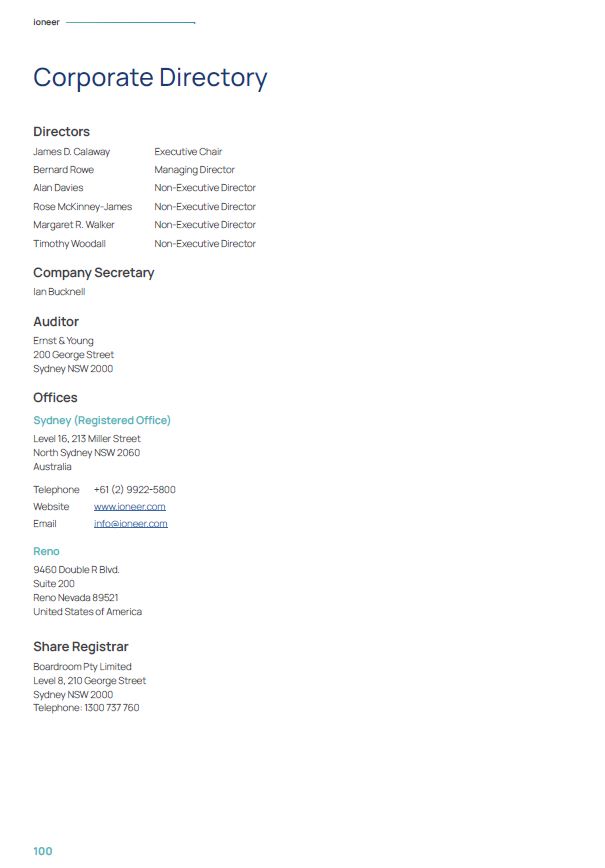
Suite 16.01, 213 Miller Street
North Sydney, NSW, 2060, Australia
(Address of principal executive offices)


Indicate by check mark whether the registrant files or will file annual reports under cover of Form 20-F or Form 40-F.

 
Form 20-F ☒    Form 40-F ☐


EXHIBIT INDEX
The following exhibits are filed as part of this Form 6-K:
Exhibit
 
Description
     
 
2025 Annual Report
 
2025 Sustainability Report


SIGNATURE

Pursuant to the requirements of the Securities Exchange Act of 1934, the registrant has duly caused this report to be signed on its behalf by the undersigned, thereunto duly authorized.
 
ioneer Ltd
 
(registrant)
   
Date: September 17, 2025
By:
/s/ Ian Bucknell
 
 
Name: Ian Bucknell
 
Title:   Chief Financial Officer & Company Secretary


EX-99.1 2 ef20055695_ex99-1.htm EXHIBIT 99.1
Exhibit 99.1

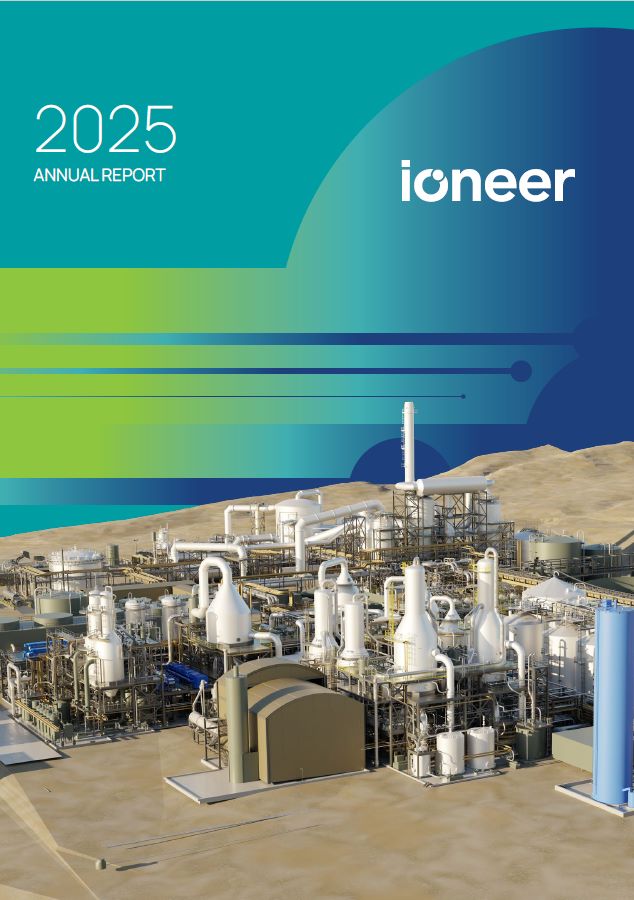
 2025  ANNUAL REPORT 
 

 AGM  The 2025 Annual General Meeting of shareholders of Ioneer Limited (Company) will be held on Friday, 31 October 2025 as a virtual meeting online at https://web.lumiagm.com/349221399 commencing at 10am (Sydney time). Shareholders are invited to attend the virtual AGM online.  Executive Chair’s letter  2  Year in Review  4  Directors’ Report  11  FY2025 Highlights  12  Business Strategy  14  Auditor’s Independence Declaration  25  Remuneration Report  26  Consolidated Financial Statements  56  Notes to and forming part of the Consolidated Financial Statements  61  Consolidated Entity Disclosure Statement  87  Directors’ Declaration  88  Independent Auditor’s Report  89  Other Information  94  Shareholder and ASX Information  98  Corporate Directory  100  ioneer 
 

 Providing materials for a sustainable and thriving planet  Ioneer Ltd is the 100% owner of the Rhyolite Ridge Lithium-Boron Project located in Nevada, USA, one of only a small number of lithium-boron  ore deposits globally. Rhyolite Ridge is expected to become a globally significant, long-life, low-cost source of lithium and boron vital to a sustainable future.  1  Annual Report 2025 
 

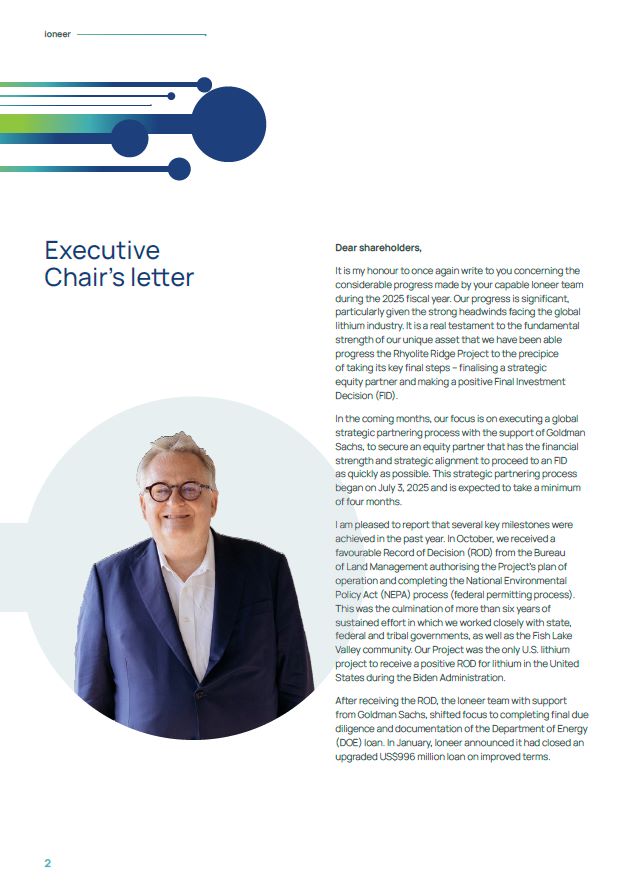
 Executive Chair’s letter  Dear shareholders,  It is my honour to once again write to you concerning the considerable progress made by your capable Ioneer team during the 2025 fiscal year. Our progress is significant, particularly given the strong headwinds facing the global lithium industry. It is a real testament to the fundamental strength of our unique asset that we have been able progress the Rhyolite Ridge Project to the precipice  of taking its key final steps – finalising a strategic equity partner and making a positive Final Investment Decision (FID).  In the coming months, our focus is on executing a global strategic partnering process with the support of Goldman Sachs, to secure an equity partner that has the financial strength and strategic alignment to proceed to an FID  as quickly as possible. This strategic partnering process began on July 3, 2025 and is expected to take a minimum of four months.  I am pleased to report that several key milestones were achieved in the past year. In October, we received a favourable Record of Decision (ROD) from the Bureau of Land Management authorising the Project’s plan of operation and completing the National Environmental Policy Act (NEPA) process (federal permitting process). This was the culmination of more than six years of sustained effort in which we worked closely with state, federal and tribal governments, as well as the Fish Lake Valley community. Our Project was the only U.S. lithium  project to receive a positive ROD for lithium in the United States during the Biden Administration.  After receiving the ROD, the Ioneer team with support from Goldman Sachs, shifted focus to completing final due diligence and documentation of the Department of Energy (DOE) loan. In January, Ioneer announced it had closed an upgraded US$996 million loan on improved terms.  ioneer  2 
 

 Sibanye-Stillwater announced in February that it was terminating its agreement to joint venture in the Rhyolite Ridge Project. Their decision, whilst creating near-term delay and uncertainty, was not unexpected, and in our judgement fortuitous for the company.  At the project level, much has been achieved during the year. At the highest level we completed a comprehensive mine plan, updated our Resources and Reserve Estimate, revised our cost estimate to a Class II level, and delivered an SK1300 compliant project to both Sibanye Stillwater and DOE for review. It is hard to overstate the quantity and quality of work required to complete these matters in a timely way. It is a testament to the Ioneer team led by our able CEO, Bernard Rowe, that the work was achieved.  These accomplishments are now allowing our team to focus more time and resources on optimisation  planning and forward growth. We are finding low hanging opportunities to optimise production of the stage one plant. The main opportunity is focused on Sulphuric Acid Yield. Our work shows that towards the final third of the currently planned leach process there are diminishing returns from acid leach and higher contaminates readings in the pregnant leach solution. Extensive new test data developed by our process team shows that by reducing leach time, we are able to maximise production per tonne of sulphuric acid and minimise contaminants in the  leach solution. This work has limited impact on Capex, while generating materially higher lithium and boric acid production from the planned plant.  The updated Ore Reserve estimate, long duration mine plan, and robust Project economics reaffirms Rhyolite Ridge as a highly attractive global Project to produce lithium carbonate, lithium hydroxide and boric acid.  The updated findings position Ioneer, on a Lithium Carbonate Equivalent (LCE) basis, in the lowest cost quartile for lithium production globally with an estimated all-in sustaining cash cost to produce battery grade lithium hydroxide of US$5,745 and a cash cost of C1 US$3,858 per tonne net of expected boric acid revenue in the first  25 years.  As we enter the coming year, our focus is on closing a strategic partner agreement, obtaining FID approval, and on commencing construction of our globally important lithium and boric acid operation in Nevada.  Once again, let me thank our determined and capable team led by our CEO, Bernard Rowe, and our outstanding Board of Directors. It is an honour to be the Executive Chair of Ioneer. It is now time to push to the finish line and to build the Rhyolite Ridge Project.  James D. Calaway Executive Chair  Annual Report 2025  3 
 

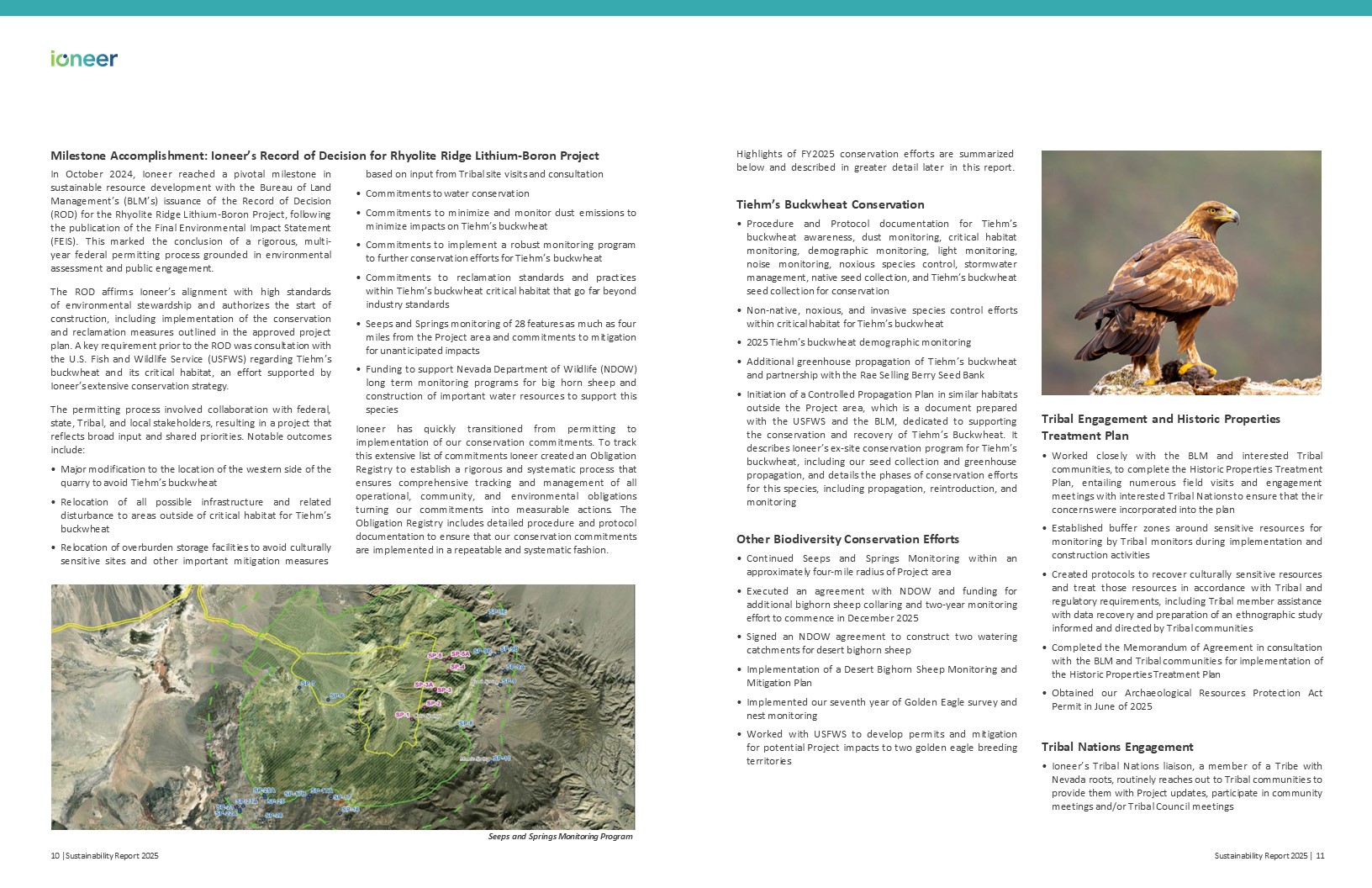
 Year in Review  Rhyolite Ridge is Permitted  Ioneer requires three key permits to commence construction at Rhyolite Ridge:  State of Nevada issued Air Quality Permit1 – received 24 June 2021.  State of Nevada issued Water Pollution Control Permit2 – received 19 July 2021.  Federal Bureau of Land Management positive Record of Decision (federal permit)3  – received 25 October 2024.  National Environmental Policy Act (NEPA)  Permitting Process Completed  During the year, the Rhyolite Ridge Lithium-Boron Project received its federal permit from the Bureau of Land Management (BLM). The formal Record of Decision (ROD) follows the issuance in September 2024 of the final Environmental Impact Statement (EIS) by the BLM, which incorporated public feedback received during the April- June open comment period and concluded the rigorous and comprehensive formal federal permitting process, which began in early 2020. Ioneer’s pre-permitting  work began in early 2019 and, in December 2022, the company formally entered the final stages of the National Environmental Policy Act (NEPA) review, as required by all projects on federal lands.  Ioneer enacted major changes to the Project throughout the permitting process resulting in a stronger, more sustainable Project that incorporates the needs and concerns of all stakeholders.  As part of the final EIS, the U.S. Fish and Wildlife Service, which oversees the administration of the Endangered Species Act (ESA), also formally released the ESA Section 7 Biological Opinion concluding Rhyolite Ridge will not jeopardise Tiehm’s buckwheat or adversely modify its critical habitat.  Refer ASX release titled ‘Ioneer Issued Air Quality Permit for Rhyolite Ridge’ announced 24 June 2021.  Refer ASX release titled ‘Issuance of Water Pollution Control Permit’ announced 19 July 2021.  Refer ASX release titled ‘Rhyolite Ridge Project Receives Final Permit’ announced 25 October 2025.  4  Other Permits  Ioneer continues to maintain compliance with the issued State of Nevada Water pollution Control and Class 2 Air Permits. No compliance issues were noted during the year and Ioneer continues to report ongoing monitoring and compliance related activities as required under these obligations.  Funding  Upsized US$996 million loan from US Department of Energy  On 20 January 2025, Ioneer announced the closing of a US$996 million loan from the U.S. Department of Energy (DOE) Loan Programs Office (LPO) under the Advanced Technology Vehicles Manufacturing (ATVM) program to support the development of an on-site processing facility at the Rhyolite Ridge Lithium-Boron Project in Esmeralda County, Nevada.  The loan, part of the LPO’s efforts to strengthen the nation’s critical mineral supply chain, will create hundreds of rural jobs, support American manufacturers and  help rebalance the global supply of lithium and boron production and processing currently dominated by China and Turkey, respectively. The $996 million loan ($968 million principal and $28 million in capitalised interest) is a $268 million increase from the conditional DOE loan commitment announced in January 2023.  The loan marks the conclusion of eight years of focused work across environmental, permitting, geology, and engineering. Ioneer engaged with DOE LPO for more than three years and transaction timing was primarily driven by receipt of the positive Record of Decision from the Department of Interior, which Ioneer received in October 2024.  ioneer 
 

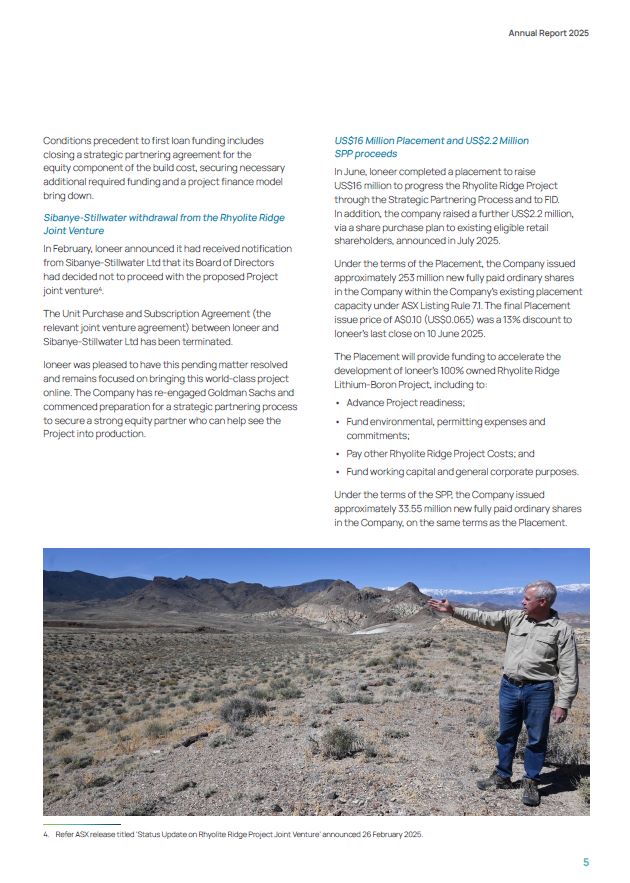
 Conditions precedent to first loan funding includes closing a strategic partnering agreement for the  equity component of the build cost, securing necessary additional required funding and a project finance model bring down.  Sibanye-Stillwater withdrawal from the Rhyolite Ridge Joint Venture  In February, Ioneer announced it had received notification from Sibanye-Stillwater Ltd that its Board of Directors had decided not to proceed with the proposed Project joint venture4.  The Unit Purchase and Subscription Agreement (the relevant joint venture agreement) between Ioneer and Sibanye-Stillwater Ltd has been terminated.  Ioneer was pleased to have this pending matter resolved and remains focused on bringing this world-class project online. The Company has re-engaged Goldman Sachs and commenced preparation for a strategic partnering process to secure a strong equity partner who can help see the Project into production.  4. Refer ASX release titled ‘Status Update on Rhyolite Ridge Project Joint Venture’ announced 26 February 2025.  US$16 Million Placement and US$2.2 Million SPP proceeds  In June, Ioneer completed a placement to raise US$16 million to progress the Rhyolite Ridge Project through the Strategic Partnering Process and to FID.  In addition, the company raised a further US$2.2 million, via a share purchase plan to existing eligible retail shareholders, announced in July 2025.  Under the terms of the Placement, the Company issued approximately 253 million new fully paid ordinary shares in the Company within the Company’s existing placement capacity under ASX Listing Rule 7.1. The final Placement issue price of A$0.10 (US$0.065) was a 13% discount to Ioneer’s last close on 10 June 2025.  The Placement will provide funding to accelerate the development of Ioneer’s 100% owned Rhyolite Ridge Lithium-Boron Project, including to:  Advance Project readiness;  Fund environmental, permitting expenses and commitments;  Pay other Rhyolite Ridge Project Costs; and  Fund working capital and general corporate purposes.  Under the terms of the SPP, the Company issued approximately 33.55 million new fully paid ordinary shares in the Company, on the same terms as the Placement.  Annual Report 2025  5 
 

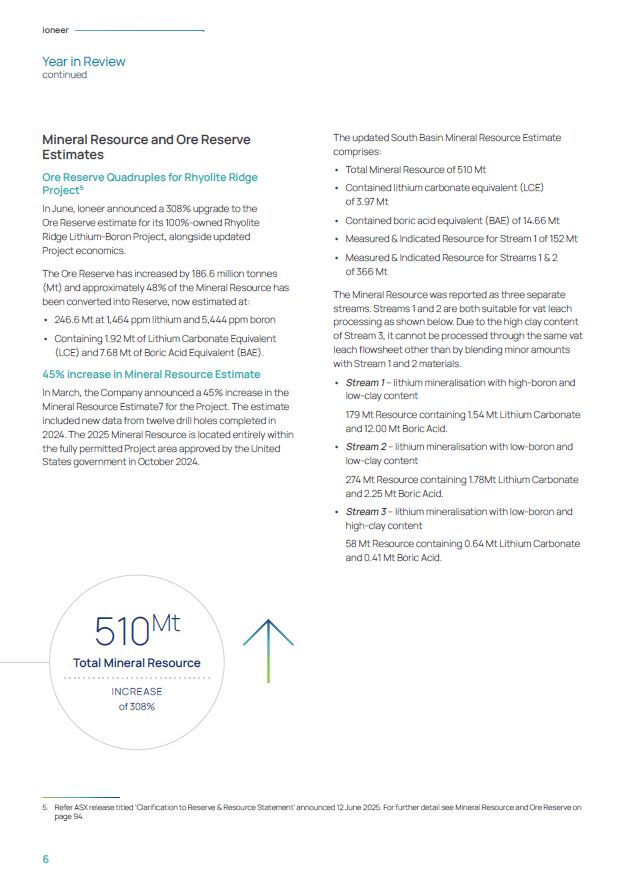
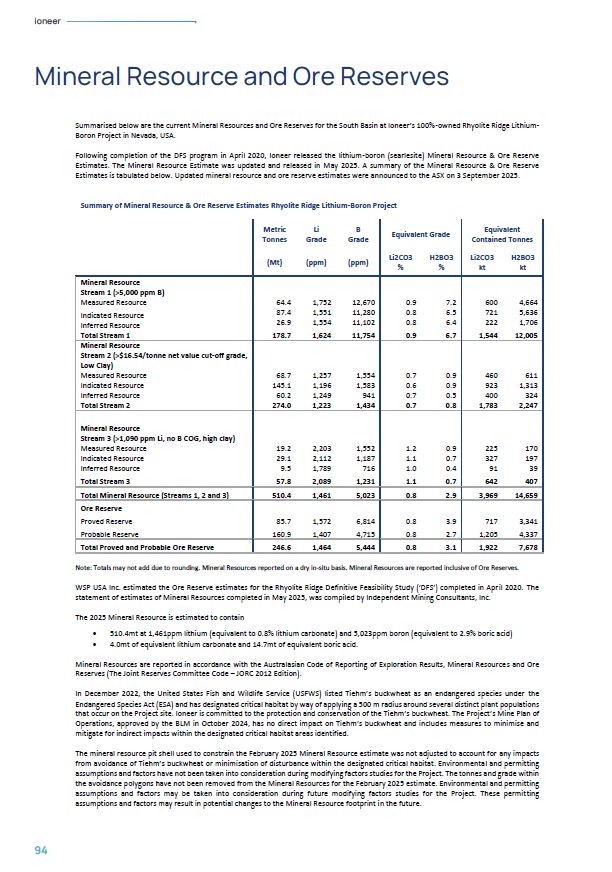
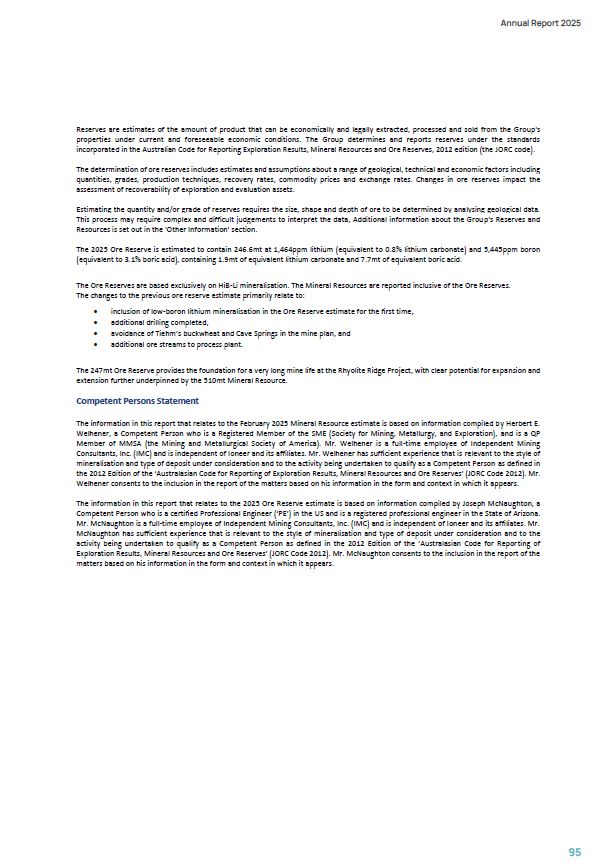
 Mineral Resource and Ore Reserve Estimates  Ore Reserve Quadruples for Rhyolite Ridge Project5  In June, Ioneer announced a 308% upgrade to the Ore Reserve estimate for its 100%-owned Rhyolite Ridge Lithium-Boron Project, alongside updated Project economics.  The Ore Reserve has increased by 186.6 million tonnes (Mt) and approximately 48% of the Mineral Resource has been converted into Reserve, now estimated at:  246.6 Mt at 1,464 ppm lithium and 5,444 ppm boron  Containing 1.92 Mt of Lithium Carbonate Equivalent (LCE) and 7.68 Mt of Boric Acid Equivalent (BAE).  45% increase in Mineral Resource Estimate  In March, the Company announced a 45% increase in the Mineral Resource Estimate7 for the Project. The estimate included new data from twelve drill holes completed in 2024. The 2025 Mineral Resource is located entirely within the fully permitted Project area approved by the United States government in October 2024.  5. Refer ASX release titled ‘Clarification to Reserve & Resource Statement’ announced 12 June 2025. For further detail see Mineral Resource and Ore Reserve on page 94.  The updated South Basin Mineral Resource Estimate comprises:  Total Mineral Resource of 510 Mt  Contained lithium carbonate equivalent (LCE) of 3.97 Mt  Contained boric acid equivalent (BAE) of 14.66 Mt  Measured & Indicated Resource for Stream 1 of 152 Mt  Measured & Indicated Resource for Streams 1 & 2 of 366 Mt  The Mineral Resource was reported as three separate streams. Streams 1 and 2 are both suitable for vat leach processing as shown below. Due to the high clay content of Stream 3, it cannot be processed through the same vat leach flowsheet other than by blending minor amounts with Stream 1 and 2 materials.  Stream 1 – lithium mineralisation with high-boron and low-clay content  179 Mt Resource containing 1.54 Mt Lithium Carbonate and 12.00 Mt Boric Acid.  Stream 2 – lithium mineralisation with low-boron and low-clay content  274 Mt Resource containing 1.78Mt Lithium Carbonate and 2.25 Mt Boric Acid.  Stream 3 – lithium mineralisation with low-boron and high-clay content  58 Mt Resource containing 0.64 Mt Lithium Carbonate and 0.41 Mt Boric Acid.  ↑  510Mt  Total Mineral Resource  INCREASE   of 308%  ioneer  Year in Review  continued  6 
 

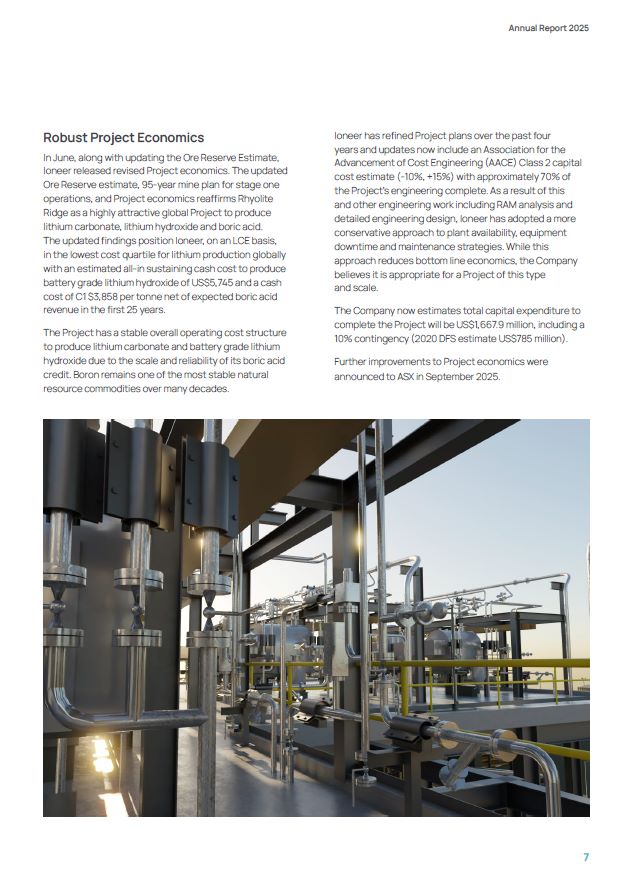
 Robust Project Economics  In June, along with updating the Ore Reserve Estimate, Ioneer released revised Project economics. The updated Ore Reserve estimate, 95-year mine plan for stage one operations, and Project economics reaffirms Rhyolite Ridge as a highly attractive global Project to produce lithium carbonate, lithium hydroxide and boric acid.  The updated findings position Ioneer, on an LCE basis, in the lowest cost quartile for lithium production globally with an estimated all-in sustaining cash cost to produce battery grade lithium hydroxide of US$5,745 and a cash cost of C1 $3,858 per tonne net of expected boric acid revenue in the first 25 years.  The Project has a stable overall operating cost structure to produce lithium carbonate and battery grade lithium hydroxide due to the scale and reliability of its boric acid credit. Boron remains one of the most stable natural resource commodities over many decades.  Ioneer has refined Project plans over the past four years and updates now include an Association for the  Advancement of Cost Engineering (AACE) Class 2 capital cost estimate (-10%, +15%) with approximately 70% of the Project’s engineering complete. As a result of this and other engineering work including RAM analysis and detailed engineering design, Ioneer has adopted a more conservative approach to plant availability, equipment downtime and maintenance strategies. While this approach reduces bottom line economics, the Company believes it is appropriate for a Project of this type  and scale.  The Company now estimates total capital expenditure to complete the Project will be US$1,667.9 million, including a 10% contingency (2020 DFS estimate US$785 million).  Further improvements to Project economics were announced to ASX in September 2025.  Annual Report 2025  7 
 

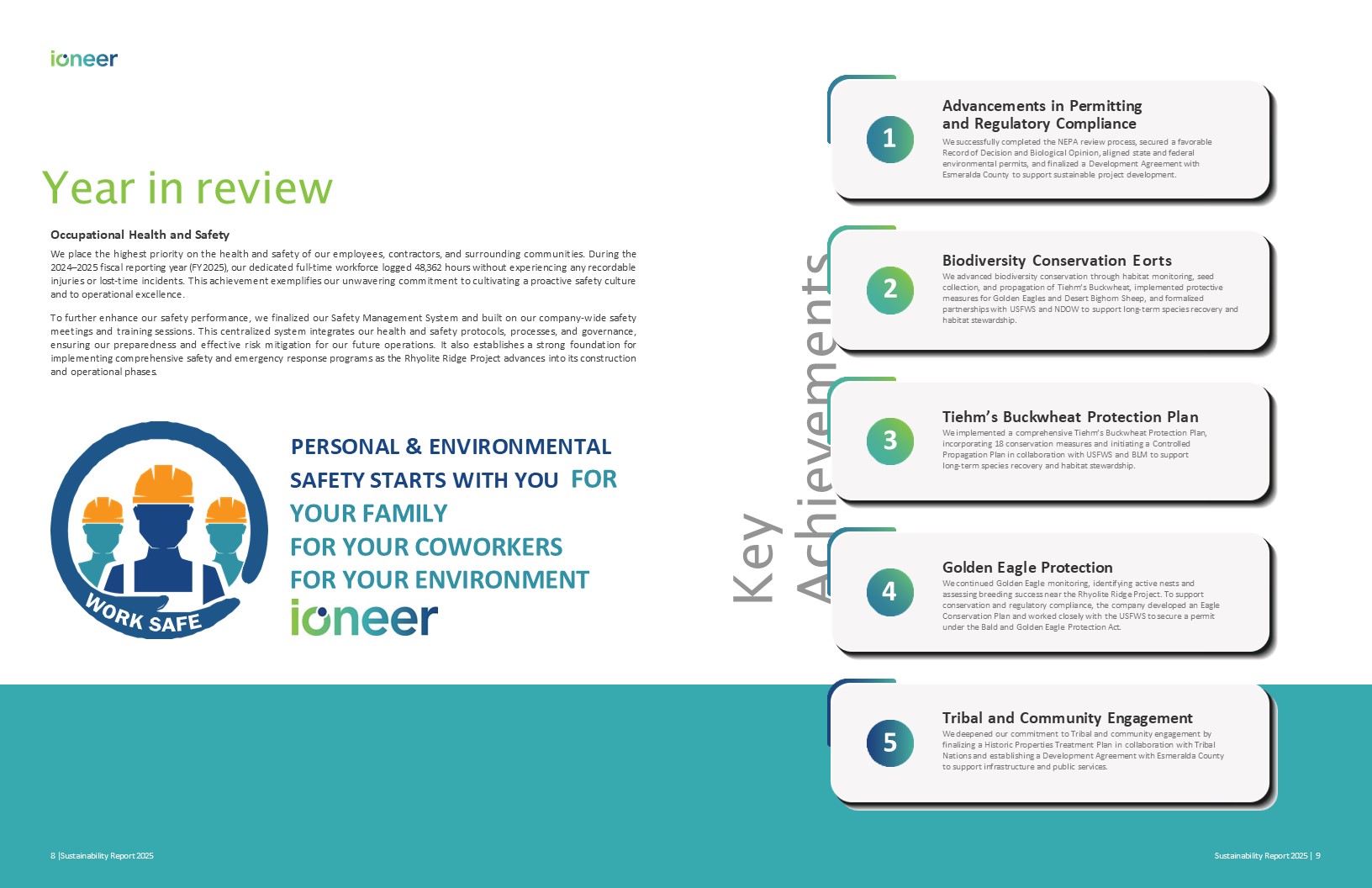
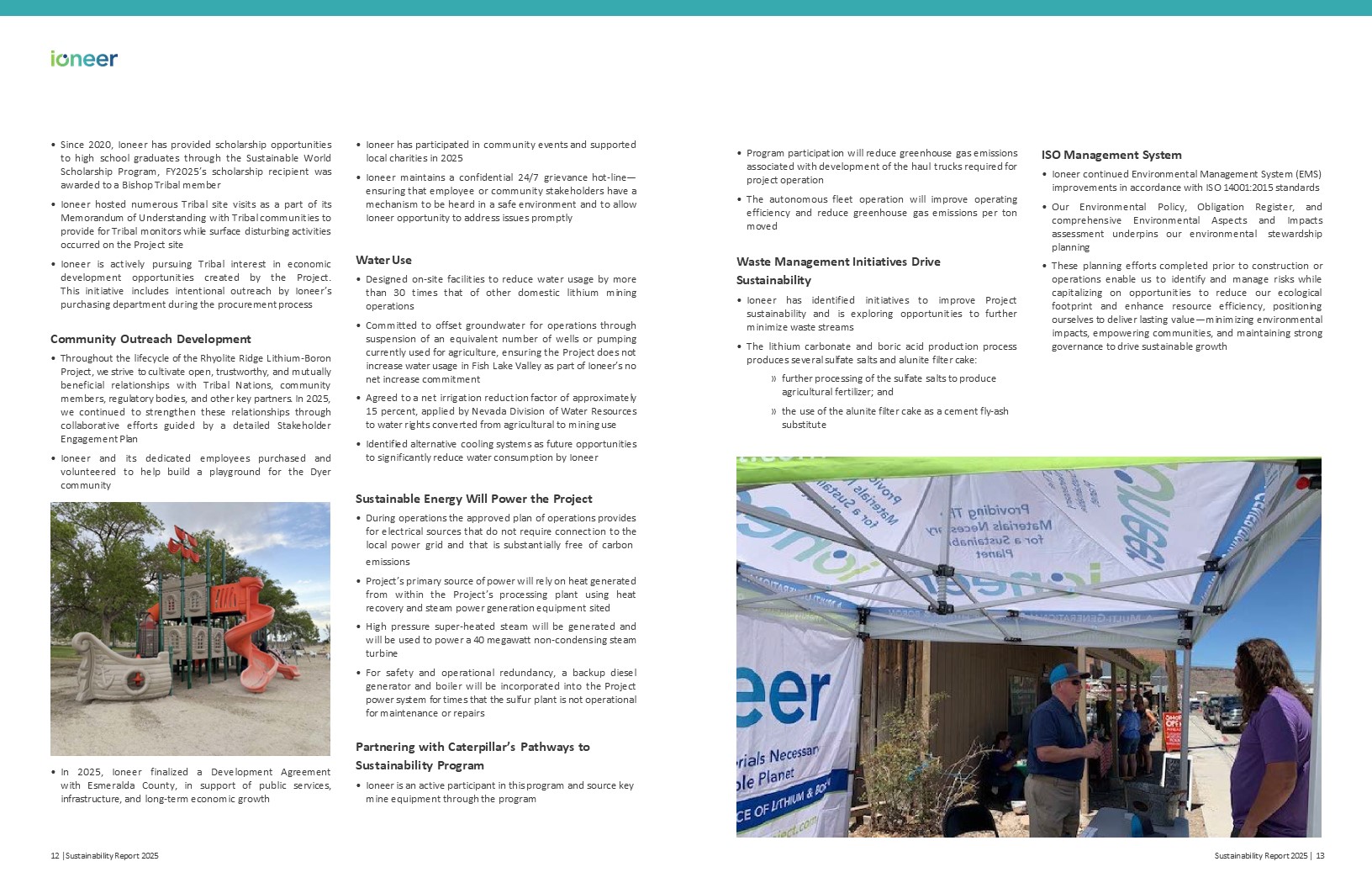
 Growth Opportunities  Expansion Pathways  Throughout FY2025, Ioneer continued to evaluate future growth potential at the Rhyolite Ridge Project.  Rhyolite Ridge and Beacon Hill Resources are substantial, containing attractive quantities of recoverable lithium and boron sufficient to contemplate multiple high boron and low boron expansion plants. These Resources are expected to grow substantially with further exploration work. Given the large resource and reserve base and  long mine life, future expansions are likely and will be a high priority.  The expansion strategy is simple, build similar sized acid plants to accelerate the monetisation of the Rhyolite Ridge Resource increasing total lithium production above 100,000 Tonnes per year through a total of four South Basin production facilities (Stage 1 plus expansion  Stages 2-4). In parallel, continue exploration and Resource definition associated with the Beacon Hill (North Basin) culminating in one Beacon Hill Facility (expansion stage 5).  Any high boron expansion would leverage the metallurgical test work and engineering of the Rhyolite Ridge  Stage 1 Project. Development of a low boron flowsheet is underway, informed by the high boron flowsheet, extensive process test work of PFS quality completed by Ioneer and in partnership with EcoPro Innovation on low boron streams.  Optimisation Opportunities  During FY2025, Ioneer identified a number of potential optimisation opportunities to improve the overall economics of the Rhyolite Ridge Project. These potential opportunities fell into two categories:  Reduce the cost of production (increase reagent utilisation, reducing or eliminate supply costs).  Increase overall revenue by increasing lithium and boron production or producing additional products.  The Company will continue to advance these opportunities in FY2026.  EcoPro Lithium Clay Project  The EcoPro Lithium Clay R&D project has shown promising progress in FY2025 and demonstrated positive momentum in balancing lithium recovery and impurity removal with reduced sulfuric acid consumption or cost.  The current work plan is to complete the calcining process by November 2025.  Environmental, Health, Safety  & Sustainability  Ioneer is committed to sustainability principles and as we grow, seek to embed them as fundamental elements of our organisational DNA. During the year, Ioneer reported no lost time incidents, first aid incidents, or fatalities.  Tiehm’s buckwheat conservation efforts continued during the year and focussed on seed collection and preparation for the upcoming growing season. These activities are being conducted at the Company’s dedicated greenhouse in Nevada. The Company continues to demonstrate the ability to grow and reproduce Tiehm’s buckwheat from seed in a variety of soil types including soils that are  low in both lithium and boron. This bodes well for future out-planting at and near the Rhyolite Ridge site, including on disturbed soils associated with past and future mining activities.  Community & Tribal Nations  Ioneer remains committed to engaging with local communities and Tribal Nations to address environmental and social concerns and enhance local economic opportunities.  During the year, Ioneer announced a binding, Development Agreement with Esmeralda County, Nevada (County),  to develop and deliver an investment plan for County residents alongside the advancement of the Rhyolite Ridge Lithium-Boron Project. The agreement provides funding for expanded public services and infrastructure upgrades and establishes a framework for continued collaboration. Through construction, the agreement is expected to provide an estimated $5-7 million in County benefits in addition to more than $10 million in County road upgrades.  ioneer  Year in Review  continued  8 
 

 The funding is separate from Project-related Company investments to develop the Rhyolite Ridge Lithium-Boron Project. In addition to creating hundreds of jobs and  tens of millions in wages and salaries, a 2024 third party analysis estimated Rhyolite Ridge will support a minimum of $340 million of economic activity annually in Nevada and provide more than $8.5 million each year in fiscal revenue for Esmeralda County.  Sales & Marketing  Lithium Offtakes  Ioneer has binding offtake agreements for more than 90% of its expected total 19,200 tonnes per annum (tpa) of lithium carbonate to be produced from Rhyolite Ridge.  EcoPro Innovation Co. Ltd – For 7,000 tpa of lithium carbonate over a 3-year term.  Ford Offtake Agreement – For 7,000 tpa of lithium carbonate over a 5-year term for use in Ford electric vehicles produced through BlueOval SK, the Ford-SK On battery manufacturing joint venture.  PPES Offtake Agreement – For 4,000 tpa of lithium carbonate over a 5-year term. PPES is a joint venture between Toyota Motor Corporation and Panasonic Corporation  Dragonfly Energy Corporation – Dragonfly Energy Corporation (NASDAQ: DFLI) is an industry leader in energy storage. For the supply of lithium carbonate over a 3-year term, with variable volumes based on surplus tonnes available after meeting other offtake commitments.  Boric Acid Offtake  Ioneer has three offtake agreements in place for its boric acid production, which were announced in FY2020 and together account more than 100% of Ioneer’s first five years of boric acid production. During the year, the Ioneer Sales & Marketing team continued to maintain strong relationships with our offtake partners and to update contracts where necessary.  Engineering  During the year, Ioneer worked to complete an updated AACE Class 2 capital estimate and associated back up documentation and operating cost estimates required under the Approved Feasibility Study. The Class 2 estimate and updated economic analysis were finalised to coincide with delivery of the ROD (issued in October), and to support the DOE LPO Loan. Detailed engineering is now circa 70% complete with little additional engineering spend required to make a Final Investment Decision.  Bernard Rowe  CEO and Managing Director  Annual Report 2025  9 
 

 Directors’ report and consolidated financial statements  10  ioneer 
 

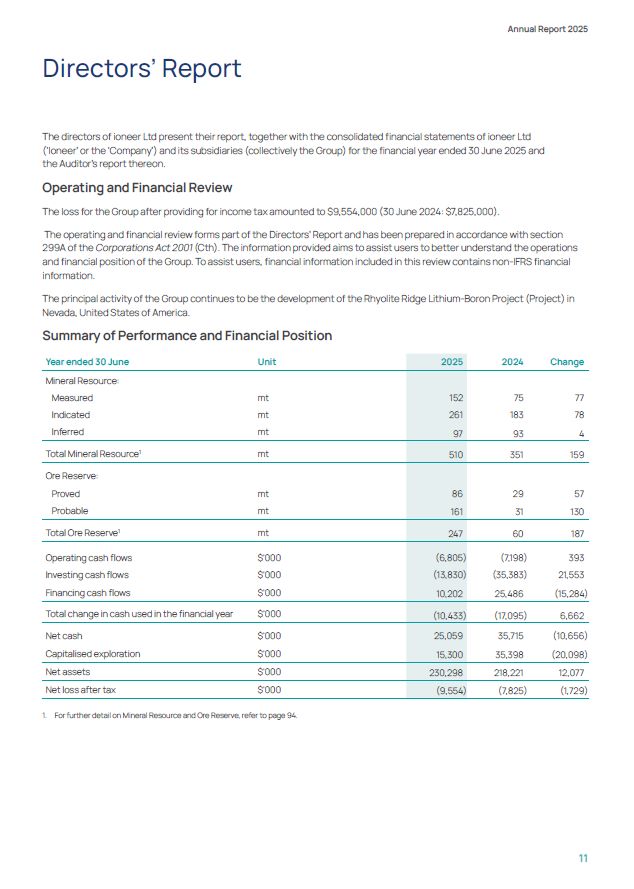
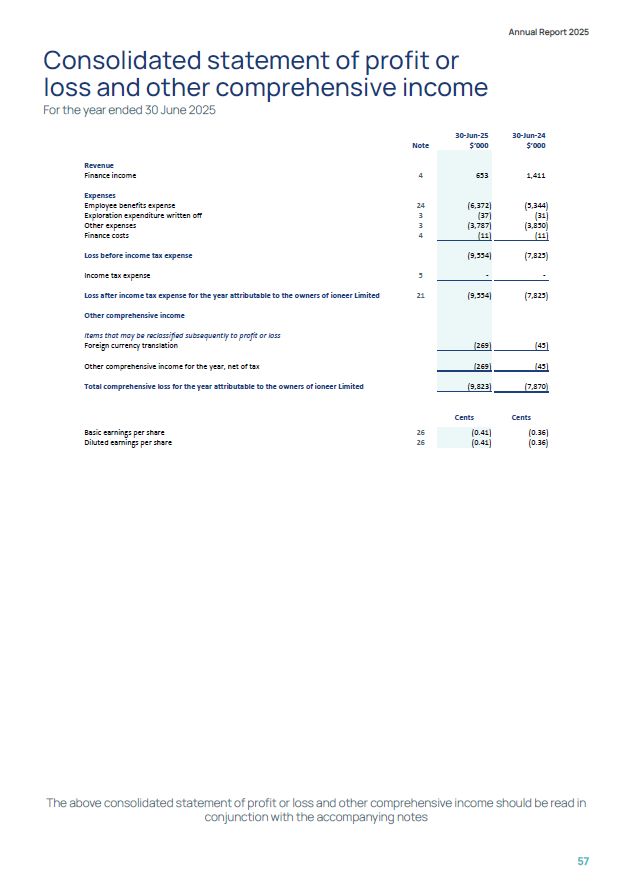
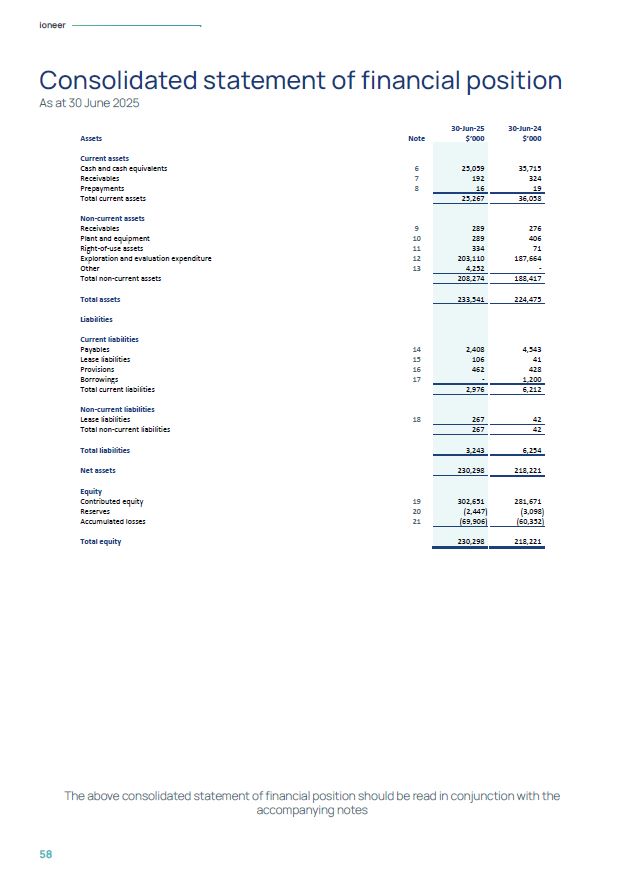
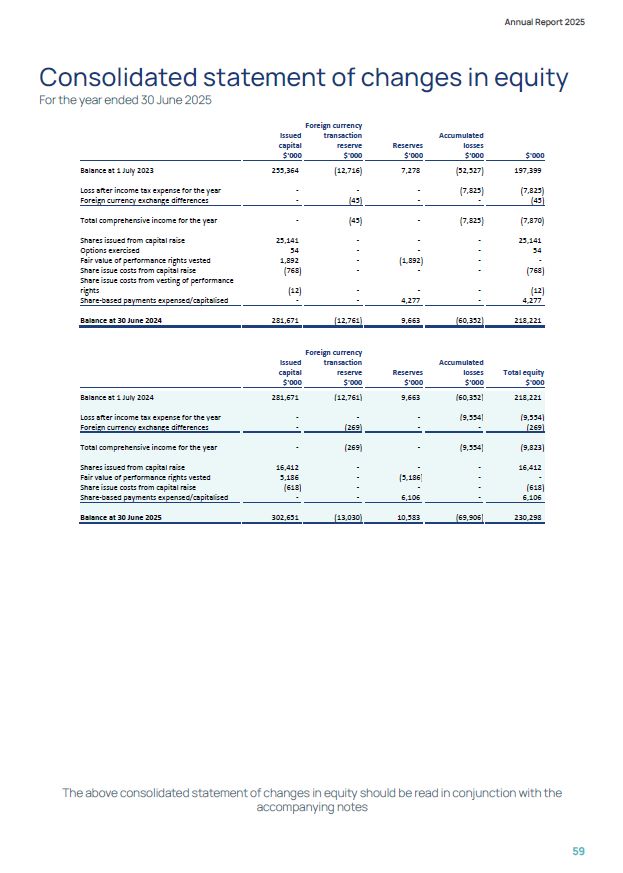
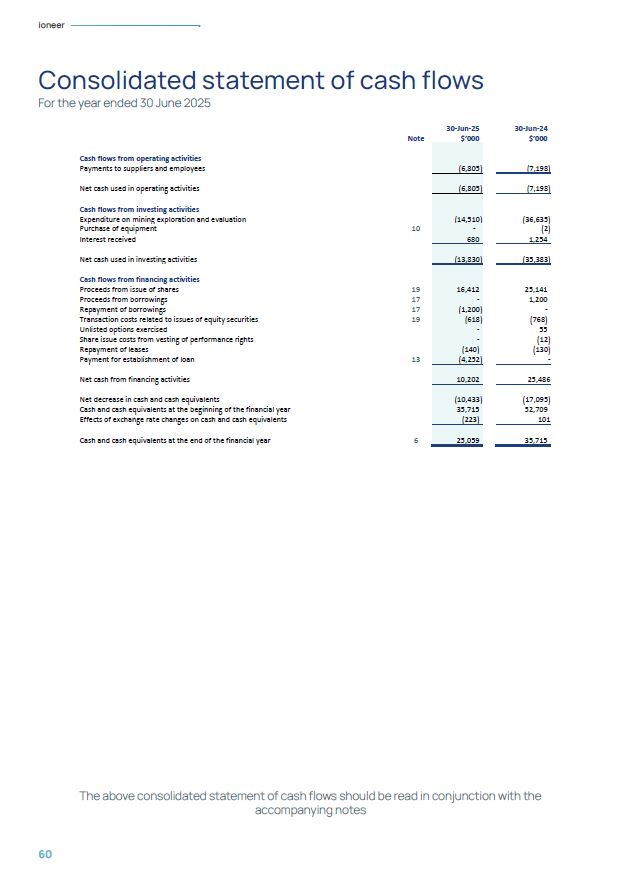
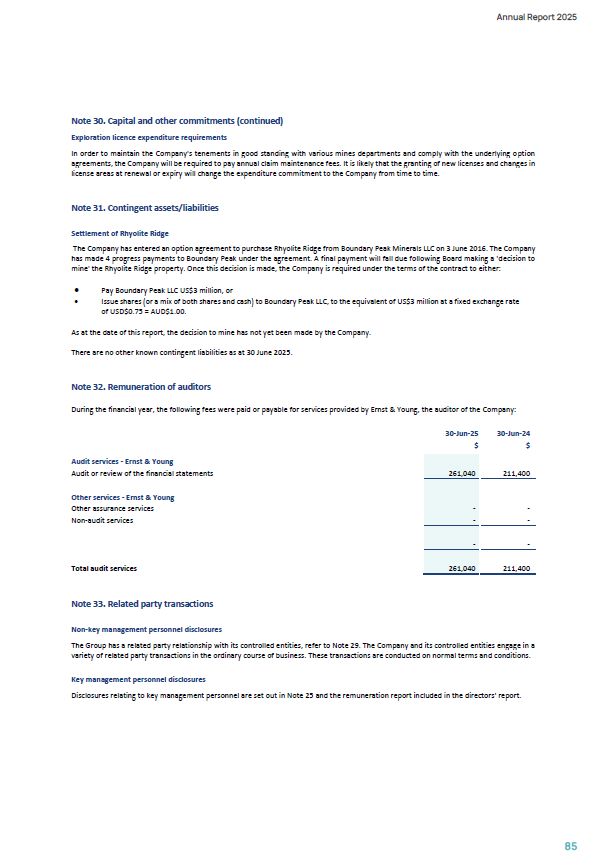
 Directors’ Report  The directors of ioneer Ltd present their report, together with the consolidated financial statements of ioneer Ltd (‘Ioneer’ or the ‘Company’) and its subsidiaries (collectively the Group) for the financial year ended 30 June 2025 and the Auditor’s report thereon.  Operating and Financial Review  The loss for the Group after providing for income tax amounted to $9,554,000 (30 June 2024: $7,825,000).  The operating and financial review forms part of the Directors’ Report and has been prepared in accordance with section 299A of the Corporations Act 2001 (Cth). The information provided aims to assist users to better understand the operations and financial position of the Group. To assist users, financial information included in this review contains non-IFRS financial information.  The principal activity of the Group continues to be the development of the Rhyolite Ridge Lithium-Boron Project (Project) in Nevada, United States of America.  Summary of Performance and Financial Position  Year ended 30 June  Unit  2025  2024  Change  Mineral Resource:  Measured  mt  152  75  77  Indicated  mt  261  183  78  Inferred  mt  97  93  4  Total Mineral Resource1  mt  510  351  159  Ore Reserve:  Proved  mt  86  29  57  Probable  mt  161  31  130  Total Ore Reserve1  mt  247  60  187  Operating cash flows  $'000  (6,805)  (7,198) 393  Investing cash flows  $'000  (13,830)  (35,383) 21,553  Financing cash flows  $'000  10,202  25,486 (15,284)  Total change in cash used in the financial year  $’000  (10,433)  (17,095)  6,662  Net cash  $'000  25,059  35,715 (10,656)  Capitalised exploration  $'000  15,300  35,398 (20,098)  Net assets  $'000  230,298  218,221  12,077  Net loss after tax  $'000  (9,554)  (7,825) (1,729)  1. For further detail on Mineral Resource and Ore Reserve, refer to page 94.  Annual Report 2025  11 
 

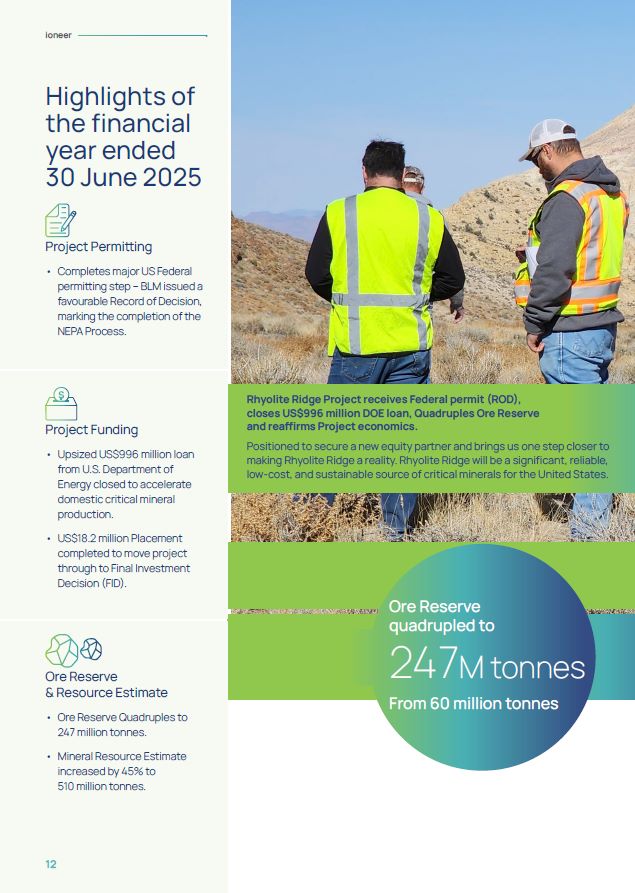
 Ore Reserve quadrupled to  247M tonnes  From 60 million tonnes  Rhyolite Ridge Project receives Federal permit (ROD), closes US$996 million DOE loan, Quadruples Ore Reserve and reaffirms Project economics.  Positioned to secure a new equity partner and brings us one step closer to making Rhyolite Ridge a reality. Rhyolite Ridge will be a significant, reliable, low-cost, and sustainable source of critical minerals for the United States.  Highlights of the financial year ended 30 June 2025  Project Permitting  Completes major US Federal permitting step – BLM issued a favourable Record of Decision, marking the completion of the NEPA Process.  Ore Reserve  & Resource Estimate  Ore Reserve Quadruples to 247 million tonnes.  Mineral Resource Estimate increased by 45% to  510 million tonnes.  Project Funding  Upsized US$996 million loan from U.S. Department of Energy closed to accelerate domestic critical mineral production.  US$18.2 million Placement completed to move project through to Final Investment Decision (FID).  ioneer  12 
 

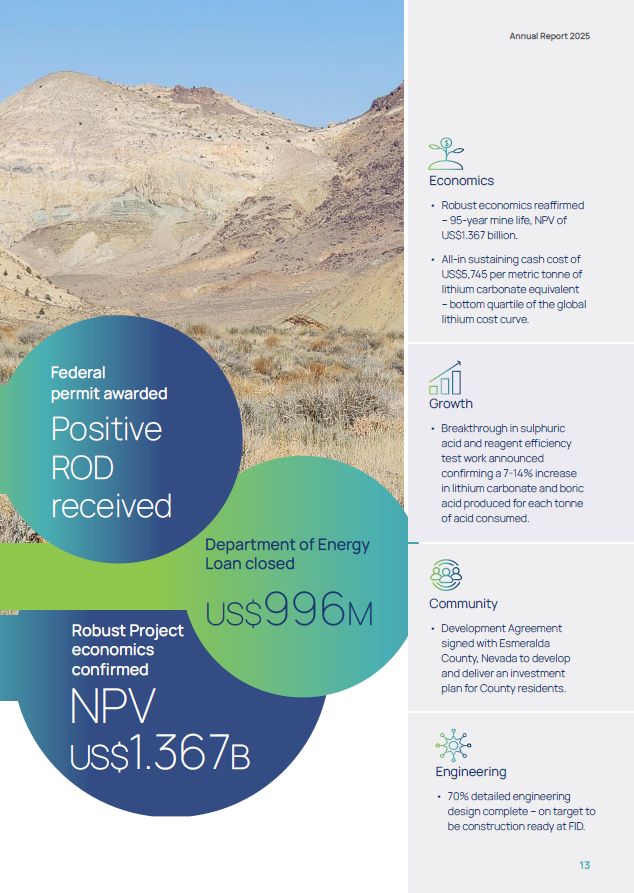
 Economics  Robust economics reaffirmed – 95-year mine life, NPV of US$1.367 billion.  All-in sustaining cash cost of US$5,745 per metric tonne of lithium carbonate equivalent – bottom quartile of the global lithium cost curve.  Engineering  70% detailed engineering design complete – on target to be construction ready at FID.  Growth  Breakthrough in sulphuric acid and reagent efficiency test work announced confirming a 7-14% increase in lithium carbonate and boric acid produced for each tonne of acid consumed.  Federal  permit awarded  Positive ROD  received  Department of Energy Loan closed  US$996M  NPV  US$1.367b  Community  Development Agreement signed with Esmeralda County, Nevada to develop and deliver an investment plan for County residents.  Robust Project economics  confirmed  Annual Report 2025  13 
 

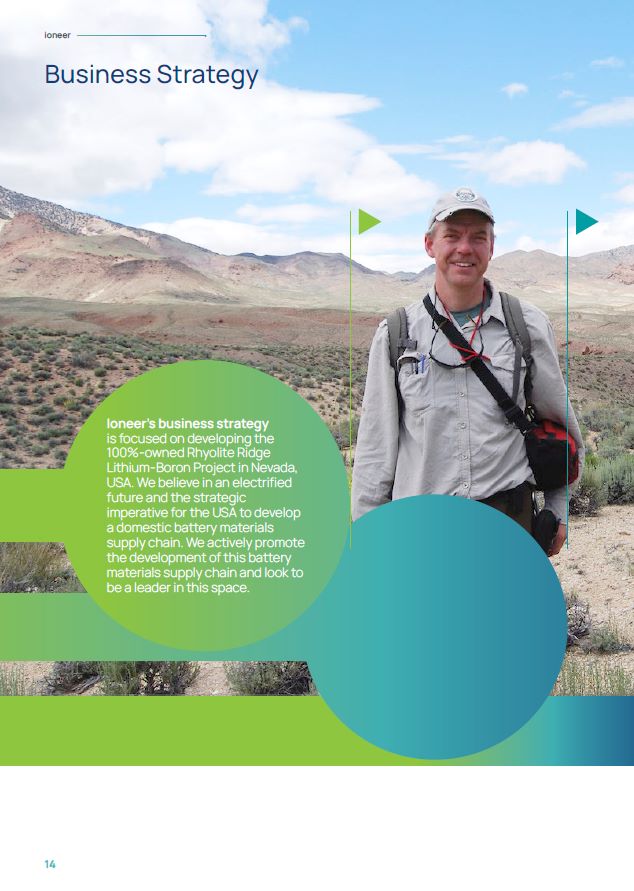
 Business strategy  Ioneer’s business strategy is focused on developing the 100%-owned Rhyolite Ridge  Lithium-Boron Project in Nevada,  USA. We believe in an electrified future and the strategic imperative for the USA to develop a domestic battery materials supply chain. We actively promote the development of this battery materials supply chain and look to be a leader in this space.  Business Strategy  ioneer  14 
 

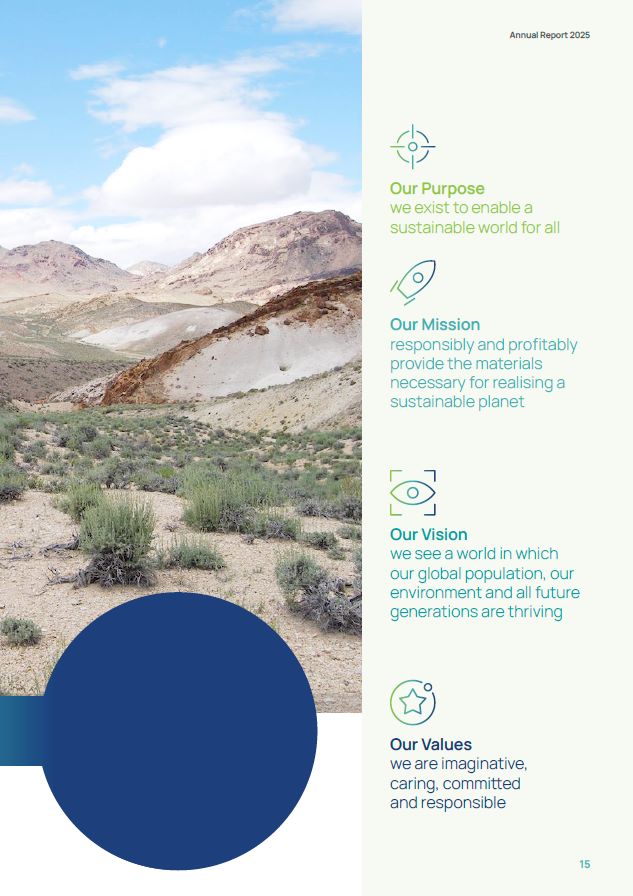
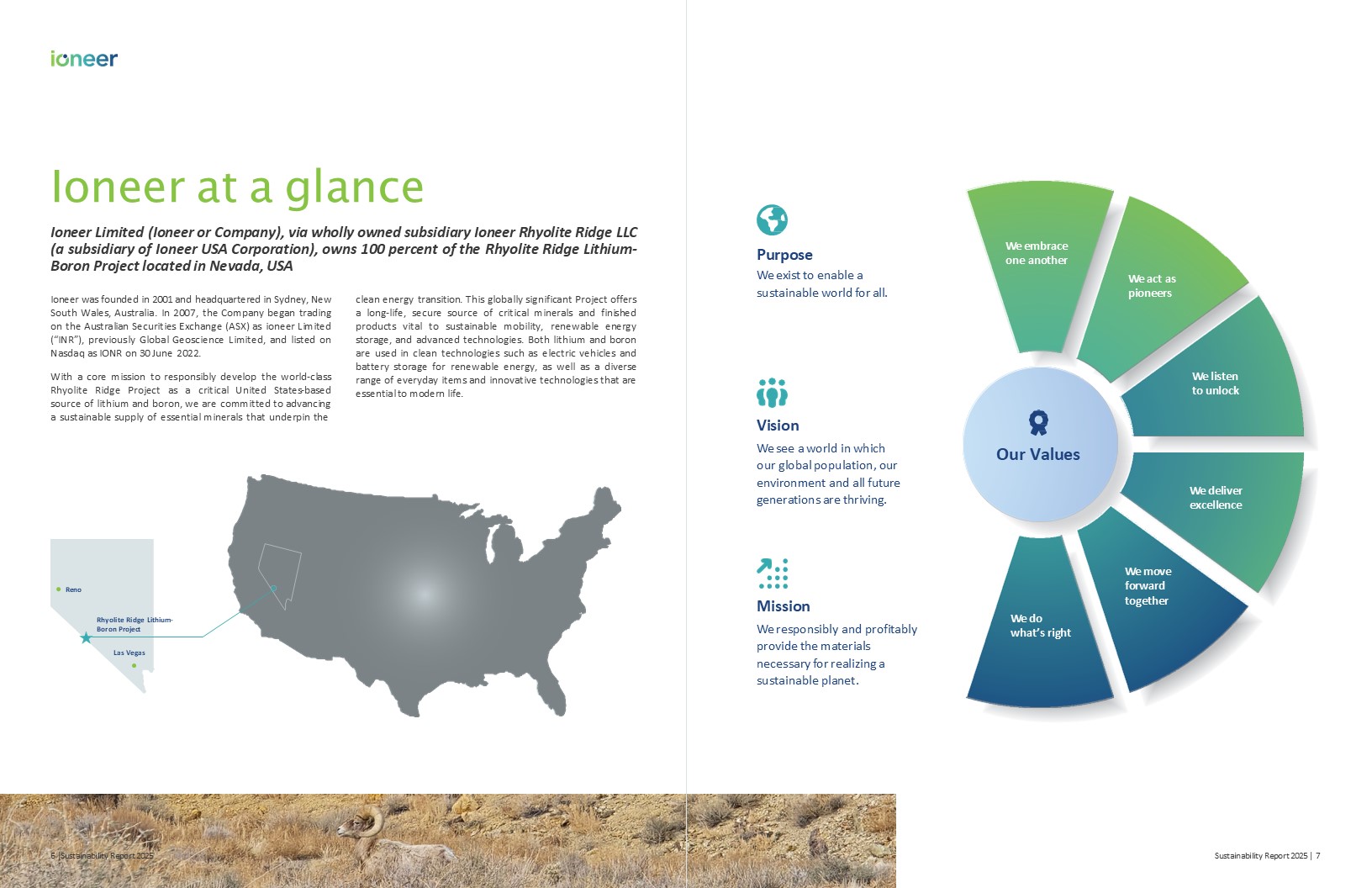
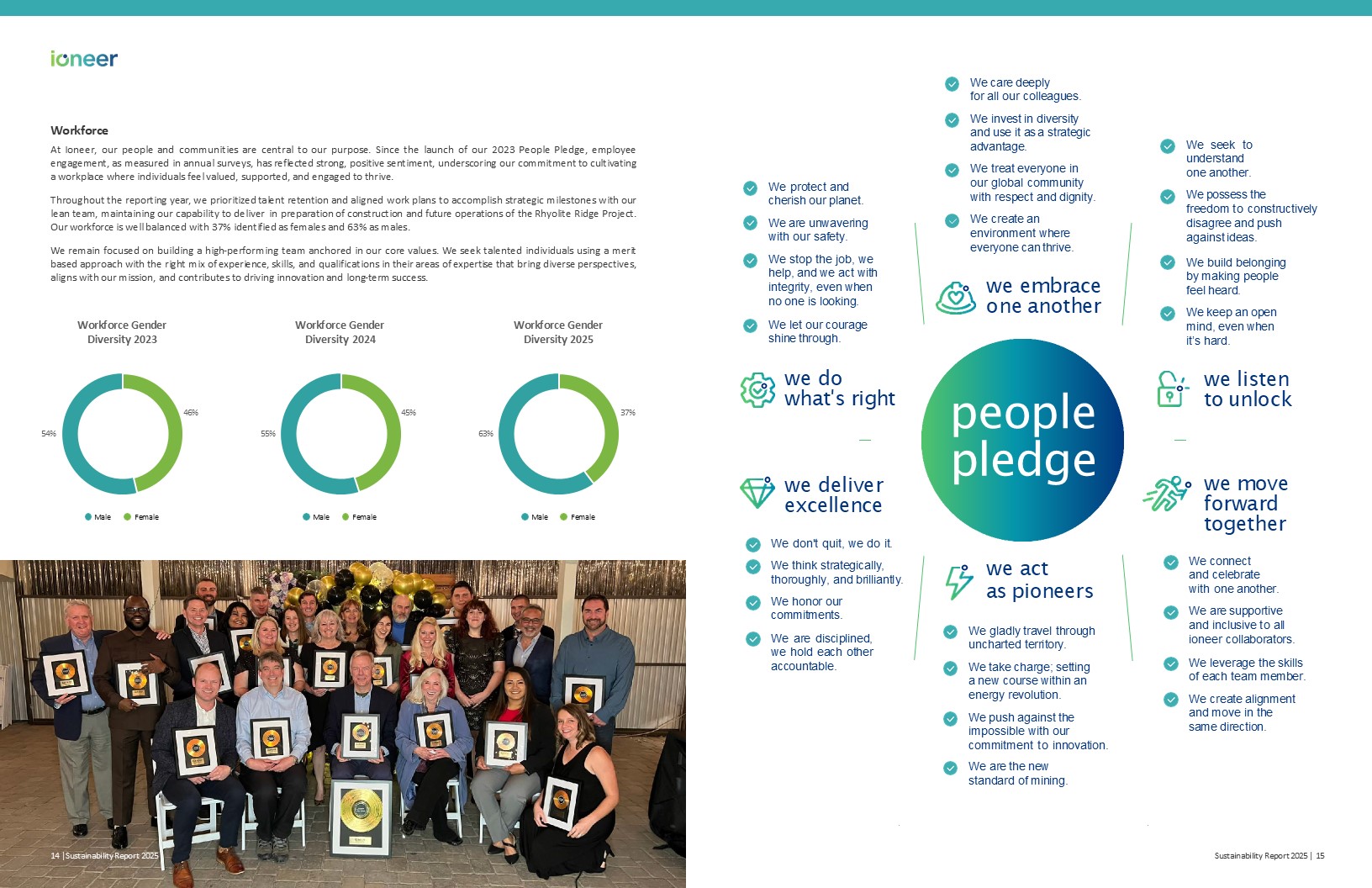
 Our Purpose  we exist to enable a sustainable world for all  Our Mission  responsibly and profitably provide the materials necessary for realising a sustainable planet  Our Vision  we see a world in which our global population, our environment and all future generations are thriving  Our Purpose  we are imaginative, caring, committed and responsible e  Our Purpose  we exist to enable a sustainable world for all  Our Mission  responsibly and profitably provide the materials necessary for realising a sustainable planet  Our Vision  we see a world in which our global population, our environment and all future generations are thriving  Our Values  we are imaginative, caring, committed and responsible  Annual Report 2025  15 
 

 Opportunities  The focus of the Company is developing Rhyolite Ridge. After successfully delivering this Project, Ioneer will pursue other growth initiatives from its existing portfolio (the current estimated resource is open to the north, south and east and does not include the north basin tenements) as well as new opportunities which are value accretive and where balance sheet capacity exists to support future development.  Material business risks  The following material business risks have been identified as key issues that have the potential to impact the Company’s performance:   Health, safety and environmental risks are of critical importance in ensuring we safely and responsibly build and operate a sustainable business.  Global economic conditions – Economic conditions, both domestic and global, may affect the performance of the Company and the Project. Adverse changes in macroeconomic conditions, including global and country-specific growth rates, the cost and availability of credit, the rate of inflation, interest rates, exchange rates, government policy and regulations, general consumption and consumer spending, input costs, employment rates and industrial disruptions, among others, are variables which while generally outside the control of the Company and its Directors, may result in material adverse impacts on the Company’s businesses and its operational and financial performance.  Execution of the Project – As the Company progresses the development of its Rhyolite Ridge Project, there are risks and uncertainties involved which could result in the Company not delivering on its anticipated timing for future milestones, including those for permitting, taking a Final Investment Decision and for construction. Upon construction commencing, the Company and the Project will be subject to risks associated with construction of Stage 1 of the Project until such time as practical completion of construction and first production is achieved.  Funding risk – The Company’s continued ability to operate the Project and effectively implement its business plan over time will depend in part on its ability to raise funds for operations and growth activities. As announced on 20 January 2025, the Company has closed a US$996 million loan from the U.S. Department of Energy Loan Programs Office (“DOE LPO”) via the Advanced Technology Vehicles Manufacturing program to support the development of an on-site processing facility at the Project. To the extent that the conditions precedent under the DOE LPO Loan are unable to be satisfied or waived, such funding will become unavailable to the Company and would require the Company to find alternative funding sources. There can be no guarantee that the Company will be able to raise sufficient funding on acceptable terms, or at all, to fund the Project. Funding terms may also place restrictions on the manner in which the Company conducts its business and impose limitations on the Company’s ability to execute on its business plan and growth strategies. An inability to obtain finance on acceptable terms, or at all, may cause, among other things, substantial delays in, or prevent, the funding of the Project to Final Investment Decision, and in turn the development or operation of the Project.  Partner risk – Construction at the Project will begin following a successful Final Investment Decision (“FID”), which is subject to the Company’s ability to secure an equity partner to help see the Project into production via the strategic partnership process recommenced in Q2 of 2025 (“Strategic Partnership Process”). There can be no assurance  that the Strategic Partnering Process will be successful, nor any certainty that the Company will make the FID to commence construction.  Offtake risk, including volume and price risks associated with the sale of technical grade lithium carbonate and boric acid, counterparty risk and contract terms. Pricing of lithium is likely to be largely subject to the rate of uptake in electric vehicles. The Company has entered into binding offtake agreements and distribution and sales agreements for the supply of boric acid from the Project. There is a risk that the parties to the agreements may not perform their respective  obligations or may breach the agreements. The offtake agreements include conditions precedent that include the timing of the Final Investment Decision and first production. There can be no guarantee that the Company will be able to renegotiate these conditions precedent on acceptable terms should there be delays in the Project.  ioneer  Directors’ Report  continued  16 
 

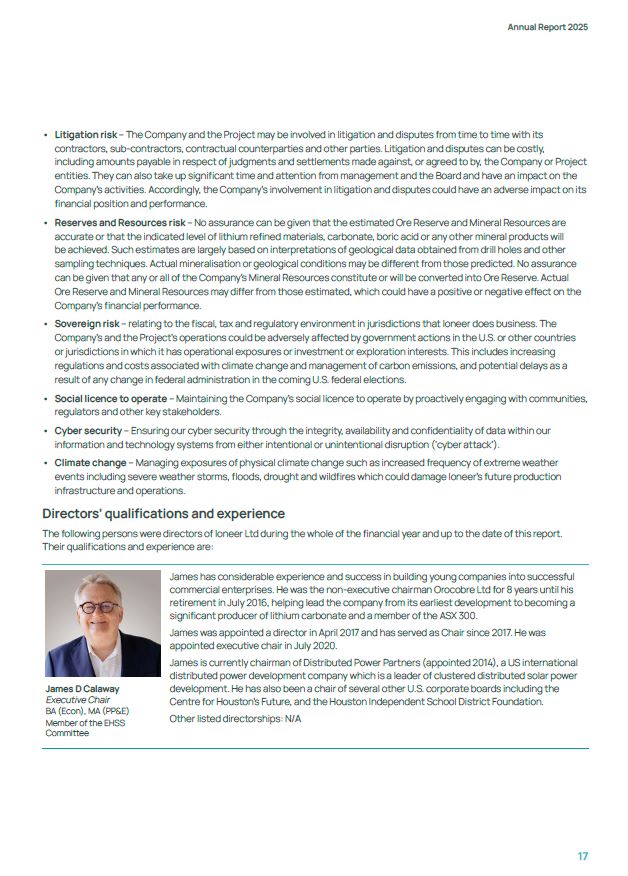
 Litigation risk – The Company and the Project may be involved in litigation and disputes from time to time with its contractors, sub-contractors, contractual counterparties and other parties. Litigation and disputes can be costly,  including amounts payable in respect of judgments and settlements made against, or agreed to by, the Company or Project entities. They can also take up significant time and attention from management and the Board and have an impact on the Company’s activities. Accordingly, the Company’s involvement in litigation and disputes could have an adverse impact on its financial position and performance.  Reserves and Resources risk – No assurance can be given that the estimated Ore Reserve and Mineral Resources are accurate or that the indicated level of lithium refined materials, carbonate, boric acid or any other mineral products will be achieved. Such estimates are largely based on interpretations of geological data obtained from drill holes and other sampling techniques. Actual mineralisation or geological conditions may be different from those predicted. No assurance can be given that any or all of the Company’s Mineral Resources constitute or will be converted into Ore Reserve. Actual  Ore Reserve and Mineral Resources may differ from those estimated, which could have a positive or negative effect on the Company’s financial performance.  Sovereign risk – relating to the fiscal, tax and regulatory environment in jurisdictions that Ioneer does business. The Company’s and the Project’s operations could be adversely affected by government actions in the U.S. or other countries or jurisdictions in which it has operational exposures or investment or exploration interests. This includes increasing regulations and costs associated with climate change and management of carbon emissions, and potential delays as a result of any change in federal administration in the coming U.S. federal elections.  Social licence to operate – Maintaining the Company’s social licence to operate by proactively engaging with communities, regulators and other key stakeholders.  Cyber security – Ensuring our cyber security through the integrity, availability and confidentiality of data within our information and technology systems from either intentional or unintentional disruption (‘cyber attack’).  Climate change – Managing exposures of physical climate change such as increased frequency of extreme weather events including severe weather storms, floods, drought and wildfires which could damage Ioneer’s future production infrastructure and operations.  Directors’ qualifications and experience  The following persons were directors of Ioneer Ltd during the whole of the financial year and up to the date of this report. Their qualifications and experience are:  James D Calaway  Executive Chair  BA (Econ), MA (PP&E)  Member of the EHSS Committee  James has considerable experience and success in building young companies into successful commercial enterprises. He was the non-executive chairman Orocobre Ltd for 8 years until his retirement in July 2016, helping lead the company from its earliest development to becoming a significant producer of lithium carbonate and a member of the ASX 300.  James was appointed a director in April 2017 and has served as Chair since 2017. He was appointed executive chair in July 2020.  James is currently chairman of Distributed Power Partners (appointed 2014), a US international distributed power development company which is a leader of clustered distributed solar power development. He has also been a chair of several other U.S. corporate boards including the Centre for Houston’s Future, and the Houston Independent School District Foundation.  Other listed directorships: N/A  Annual Report 2025  17 
 

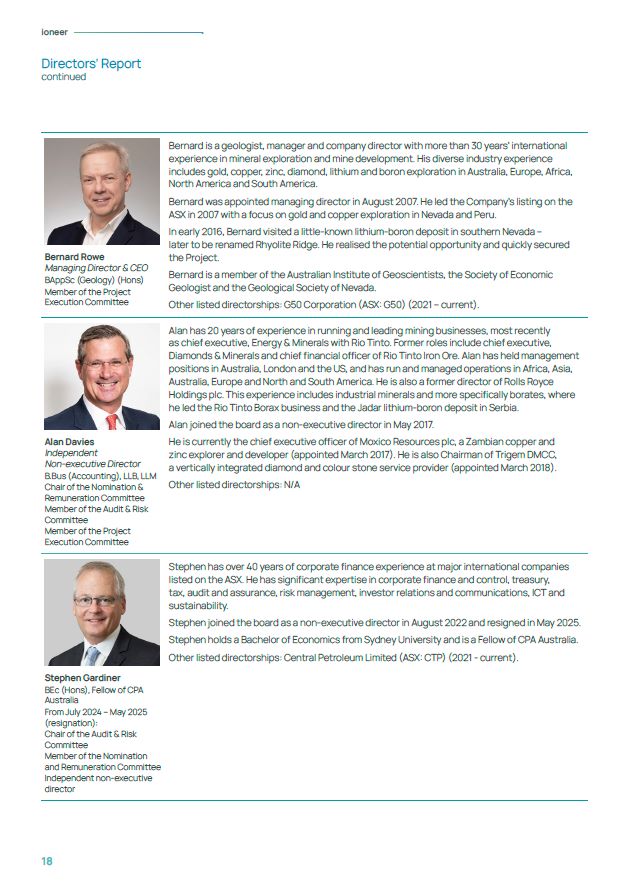
 Bernard Rowe  Managing Director & CEO  BAppSc (Geology) (Hons) Member of the Project Execution Committee  Bernard is a geologist, manager and company director with more than 30 years’ international experience in mineral exploration and mine development. His diverse industry experience includes gold, copper, zinc, diamond, lithium and boron exploration in Australia, Europe, Africa, North America and South America.  Bernard was appointed managing director in August 2007. He led the Company’s listing on the ASX in 2007 with a focus on gold and copper exploration in Nevada and Peru.  In early 2016, Bernard visited a little-known lithium-boron deposit in southern Nevada –  later to be renamed Rhyolite Ridge. He realised the potential opportunity and quickly secured the Project.  Bernard is a member of the Australian Institute of Geoscientists, the Society of Economic Geologist and the Geological Society of Nevada.  Other listed directorships: G50 Corporation (ASX: G50) (2021 – current).  Alan Davies  Independent  Non-executive Director  B.Bus (Accounting), LLB, LLM Chair of the Nomination & Remuneration Committee Member of the Audit & Risk Committee  Member of the Project Execution Committee  Alan has 20 years of experience in running and leading mining businesses, most recently as chief executive, Energy & Minerals with Rio Tinto. Former roles include chief executive,  Diamonds & Minerals and chief financial officer of Rio Tinto Iron Ore. Alan has held management positions in Australia, London and the US, and has run and managed operations in Africa, Asia, Australia, Europe and North and South America. He is also a former director of Rolls Royce Holdings plc. This experience includes industrial minerals and more specifically borates, where he led the Rio Tinto Borax business and the Jadar lithium-boron deposit in Serbia.  Alan joined the board as a non-executive director in May 2017.  He is currently the chief executive officer of Moxico Resources plc, a Zambian copper and zinc explorer and developer (appointed March 2017). He is also Chairman of Trigem DMCC, a vertically integrated diamond and colour stone service provider (appointed March 2018).  Other listed directorships: N/A  Stephen has over 40 years of corporate finance experience at major international companies listed on the ASX. He has significant expertise in corporate finance and control, treasury,  tax, audit and assurance, risk management, investor relations and communications, ICT and sustainability.  Stephen joined the board as a non-executive director in August 2022 and resigned in May 2025. Stephen holds a Bachelor of Economics from Sydney University and is a Fellow of CPA Australia. Other listed directorships: Central Petroleum Limited (ASX: CTP) (2021 - current).  Stephen Gardiner  BEc (Hons), Fellow of CPA Australia  From July 2024 – May 2025 (resignation):  Chair of the Audit & Risk Committee  Member of the Nomination and Remuneration Committee Independent non-executive director  ioneer  Directors’ Report  continued  18 
 

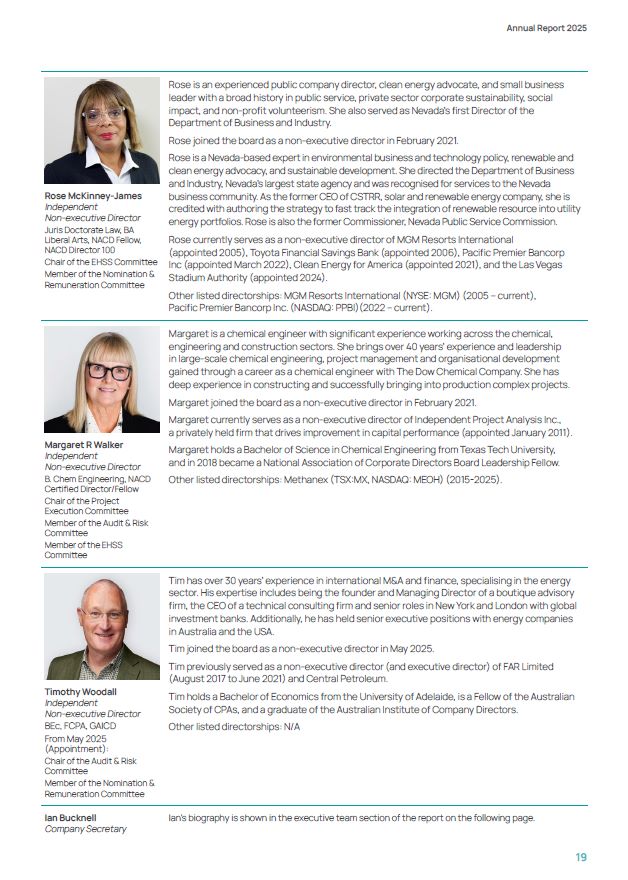
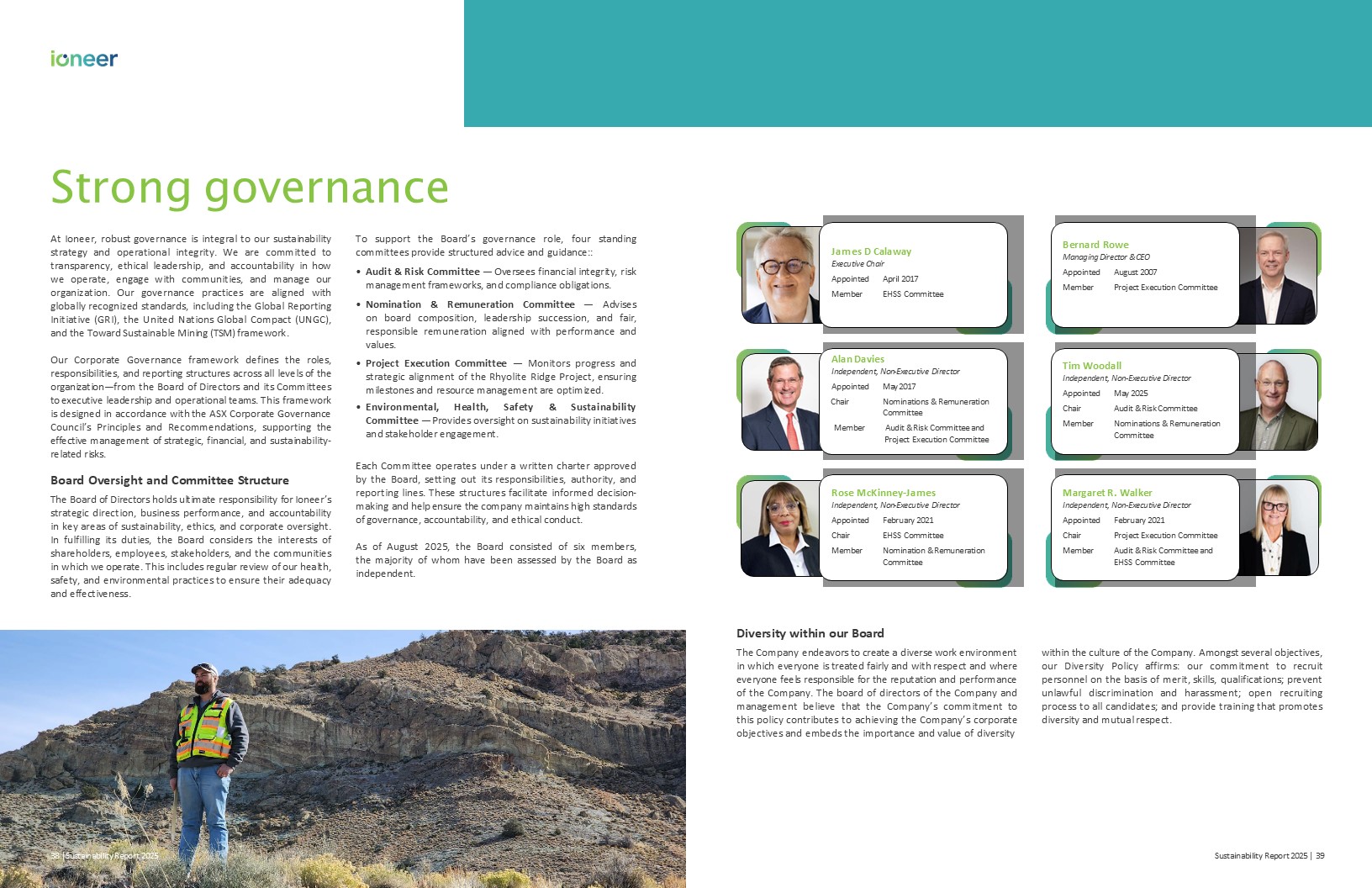
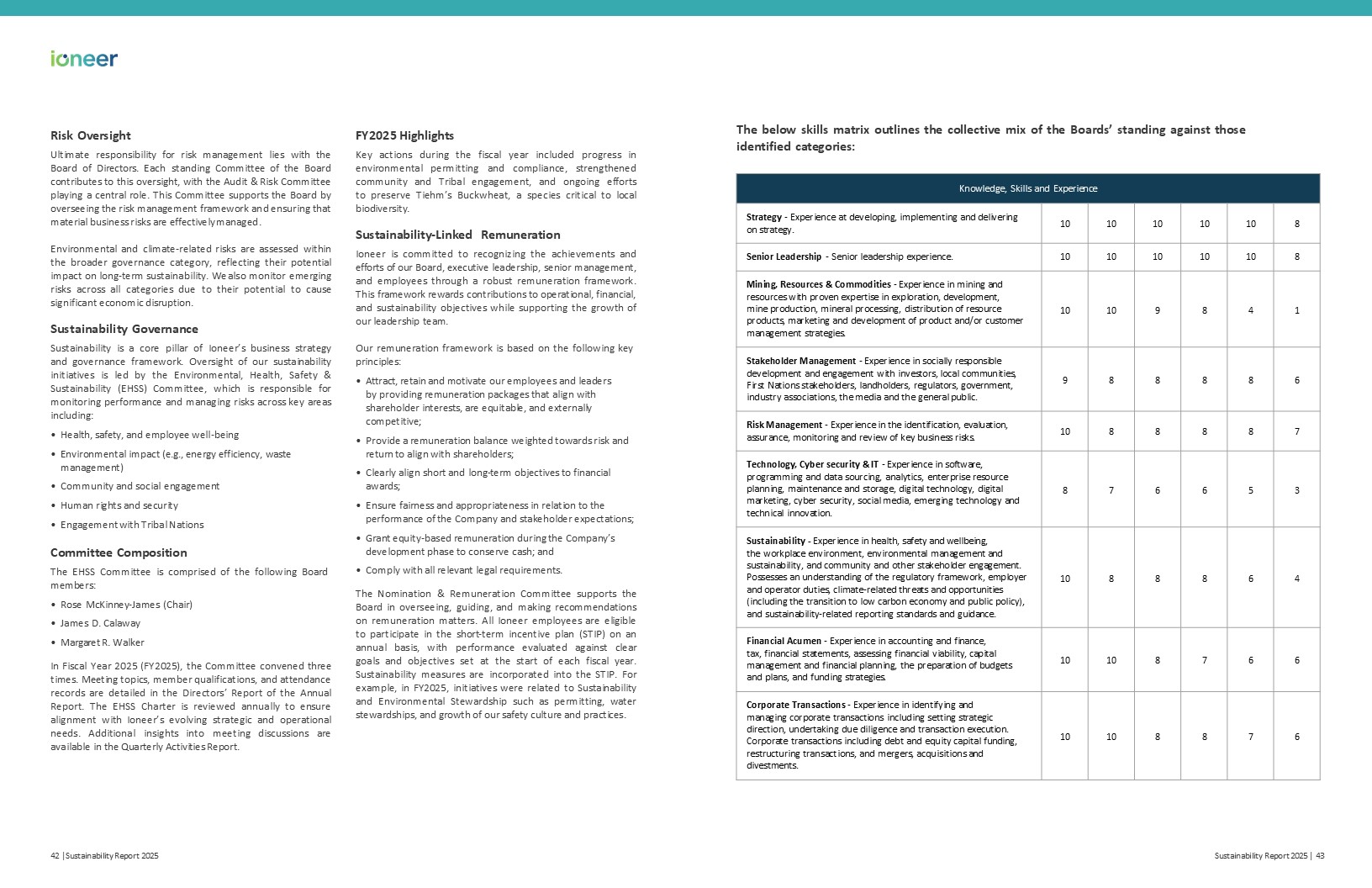
 Rose McKinney-James  Independent  Non-executive Director  Juris Doctorate Law, BA Liberal Arts, NACD Fellow, NACD Director 100  Chair of the EHSS Committee Member of the Nomination & Remuneration Committee  Rose is an experienced public company director, clean energy advocate, and small business leader with a broad history in public service, private sector corporate sustainability, social impact, and non-profit volunteerism. She also served as Nevada’s first Director of the Department of Business and Industry.  Rose joined the board as a non-executive director in February 2021.  Rose is a Nevada-based expert in environmental business and technology policy, renewable and clean energy advocacy, and sustainable development. She directed the Department of Business and Industry, Nevada’s largest state agency and was recognised for services to the Nevada business community. As the former CEO of CSTRR, solar and renewable energy company, she is credited with authoring the strategy to fast track the integration of renewable resource into utility energy portfolios. Rose is also the former Commissioner, Nevada Public Service Commission.  Rose currently serves as a non-executive director of MGM Resorts International  (appointed 2005), Toyota Financial Savings Bank (appointed 2006), Pacific Premier Bancorp Inc (appointed March 2022), Clean Energy for America (appointed 2021), and the Las Vegas Stadium Authority (appointed 2024).  Other listed directorships: MGM Resorts International (NYSE: MGM) (2005 – current), Pacific Premier Bancorp Inc. (NASDAQ: PPBI)(2022 – current).  Margaret R Walker  Independent  Non-executive Director  B. Chem Engineering, NACD Certified Director/Fellow Chair of the Project Execution Committee Member of the Audit & Risk Committee  Member of the EHSS Committee  Margaret is a chemical engineer with significant experience working across the chemical, engineering and construction sectors. She brings over 40 years’ experience and leadership in large-scale chemical engineering, project management and organisational development gained through a career as a chemical engineer with The Dow Chemical Company. She has deep experience in constructing and successfully bringing into production complex projects.  Margaret joined the board as a non-executive director in February 2021.  Margaret currently serves as a non-executive director of Independent Project Analysis Inc.,  a privately held firm that drives improvement in capital performance (appointed January 2011).  Margaret holds a Bachelor of Science in Chemical Engineering from Texas Tech University, and in 2018 became a National Association of Corporate Directors Board Leadership Fellow.  Other listed directorships: Methanex (TSX:MX, NASDAQ: MEOH) (2015-2025).  Timothy Woodall  Independent  Non-executive Director  BEc, FCPA, GAICD  From May 2025 (Appointment):  Chair of the Audit & Risk Committee  Member of the Nomination & Remuneration Committee  Tim has over 30 years’ experience in international M&A and finance, specialising in the energy sector. His expertise includes being the founder and Managing Director of a boutique advisory firm, the CEO of a technical consulting firm and senior roles in New York and London with global investment banks. Additionally, he has held senior executive positions with energy companies in Australia and the USA.  Tim joined the board as a non-executive director in May 2025.  Tim previously served as a non-executive director (and executive director) of FAR Limited (August 2017 to June 2021) and Central Petroleum.  Tim holds a Bachelor of Economics from the University of Adelaide, is a Fellow of the Australian Society of CPAs, and a graduate of the Australian Institute of Company Directors.  Other listed directorships: N/A  Ian Bucknell  Company Secretary  Ian’s biography is shown in the executive team section of the report on the following page.  Annual Report 2025  19 
 

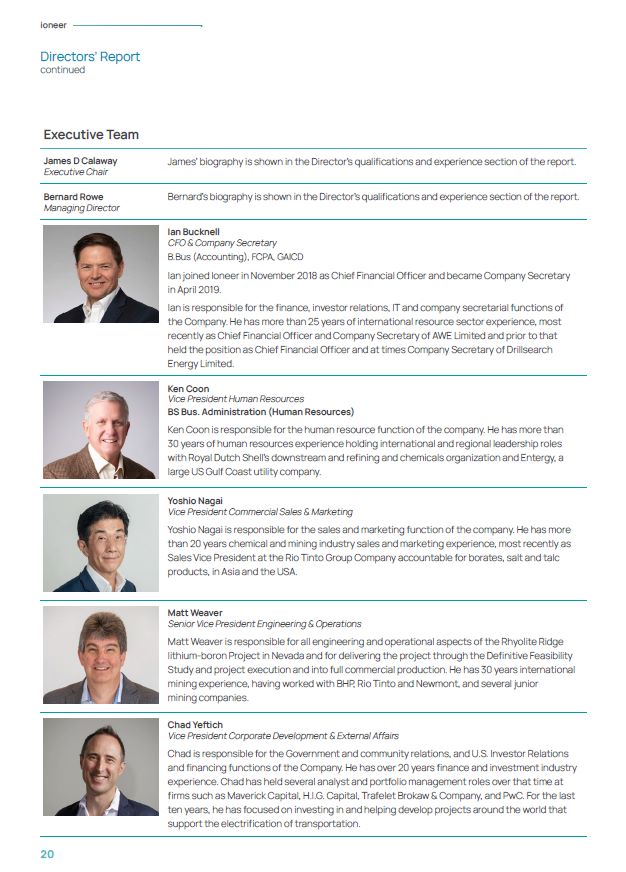
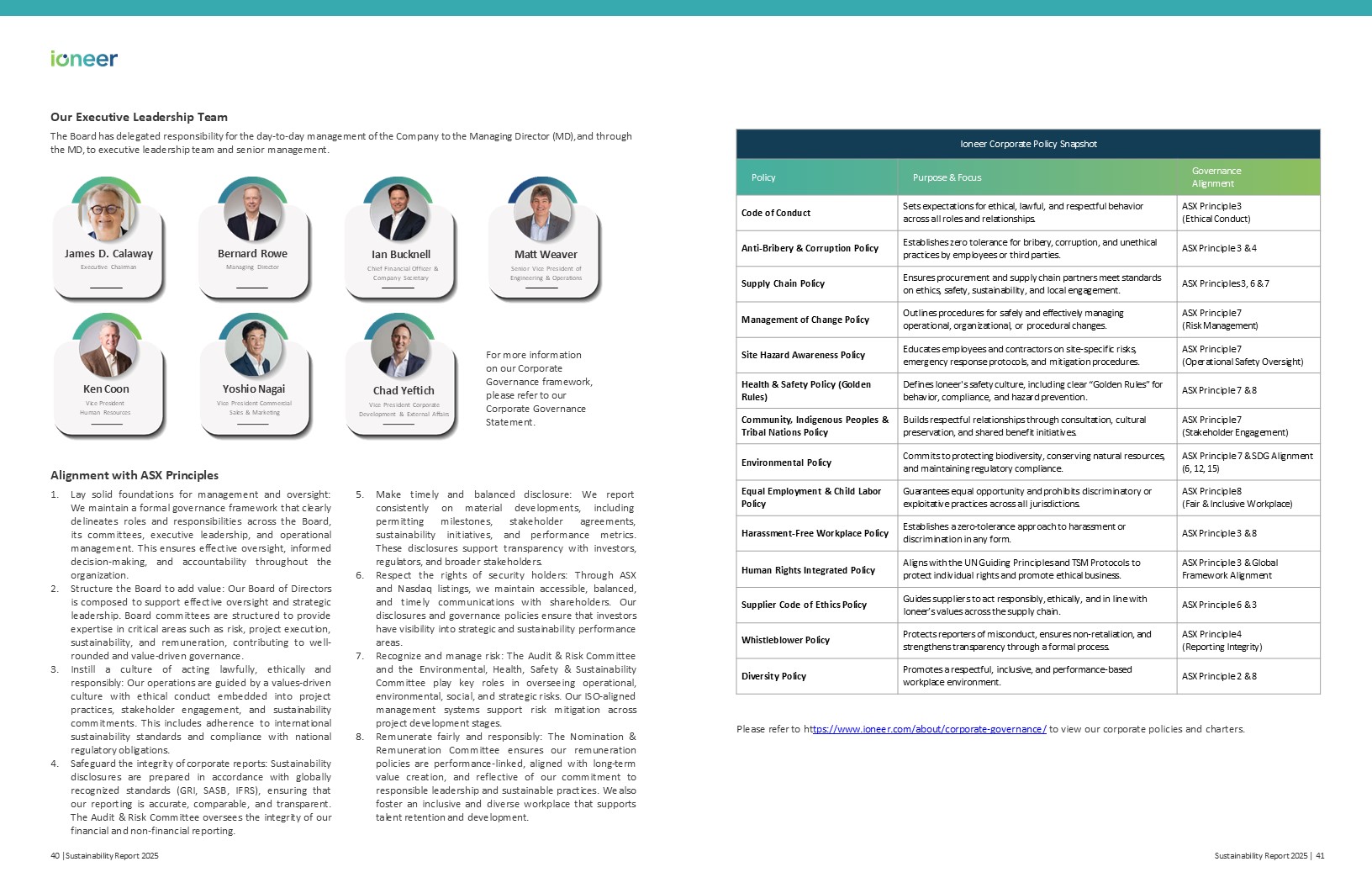
 Executive Team  James D Calaway  Executive Chair  James’ biography is shown in the Director’s qualifications and experience section of the report.  Bernard Rowe  Managing Director  Bernard’s biography is shown in the Director’s qualifications and experience section of the report.  Ian Bucknell  CFO & Company Secretary  B.Bus (Accounting), FCPA, GAICD  Ian joined Ioneer in November 2018 as Chief Financial Officer and became Company Secretary in April 2019.  Ian is responsible for the finance, investor relations, IT and company secretarial functions of the Company. He has more than 25 years of international resource sector experience, most recently as Chief Financial Officer and Company Secretary of AWE Limited and prior to that held the position as Chief Financial Officer and at times Company Secretary of Drillsearch Energy Limited.  Ken Coon  Vice President Human Resources  BS Bus. Administration (Human Resources)  Ken Coon is responsible for the human resource function of the company. He has more than 30 years of human resources experience holding international and regional leadership roles with Royal Dutch Shell’s downstream and refining and chemicals organization and Entergy, a large US Gulf Coast utility company.  Yoshio Nagai  Vice President Commercial Sales & Marketing  Yoshio Nagai is responsible for the sales and marketing function of the company. He has more than 20 years chemical and mining industry sales and marketing experience, most recently as Sales Vice President at the Rio Tinto Group Company accountable for borates, salt and talc products, in Asia and the USA.  Matt Weaver  Senior Vice President Engineering & Operations  Matt Weaver is responsible for all engineering and operational aspects of the Rhyolite Ridge lithium-boron Project in Nevada and for delivering the project through the Definitive Feasibility Study and project execution and into full commercial production. He has 30 years international mining experience, having worked with BHP, Rio Tinto and Newmont, and several junior  mining companies.  Chad Yeftich  Vice President Corporate Development & External Affairs  Chad is responsible for the Government and community relations, and U.S. Investor Relations and financing functions of the Company. He has over 20 years finance and investment industry experience. Chad has held several analyst and portfolio management roles over that time at firms such as Maverick Capital, H.I.G. Capital, Trafelet Brokaw & Company, and PwC. For the last ten years, he has focused on investing in and helping develop projects around the world that support the electrification of transportation.  ioneer  Directors’ Report  continued  20 
 

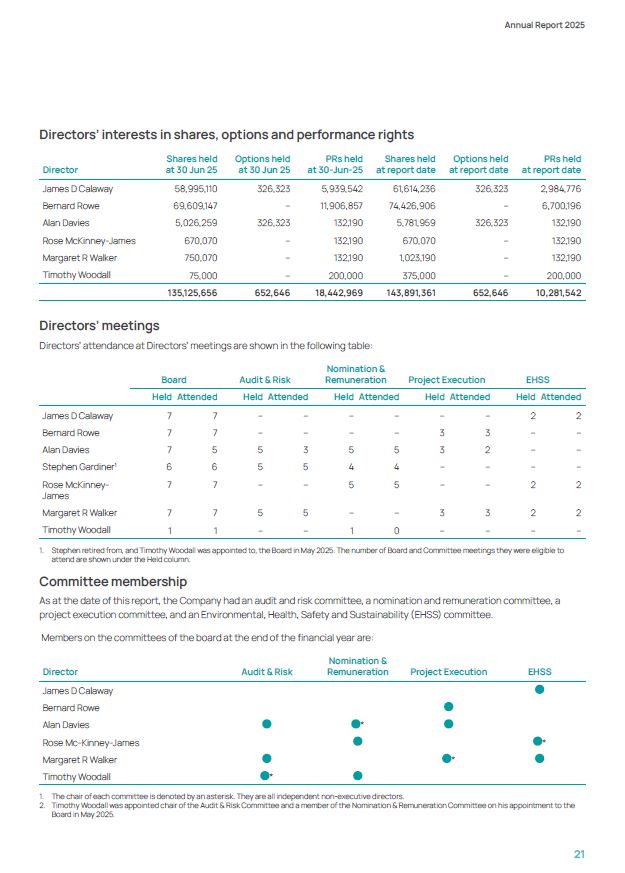
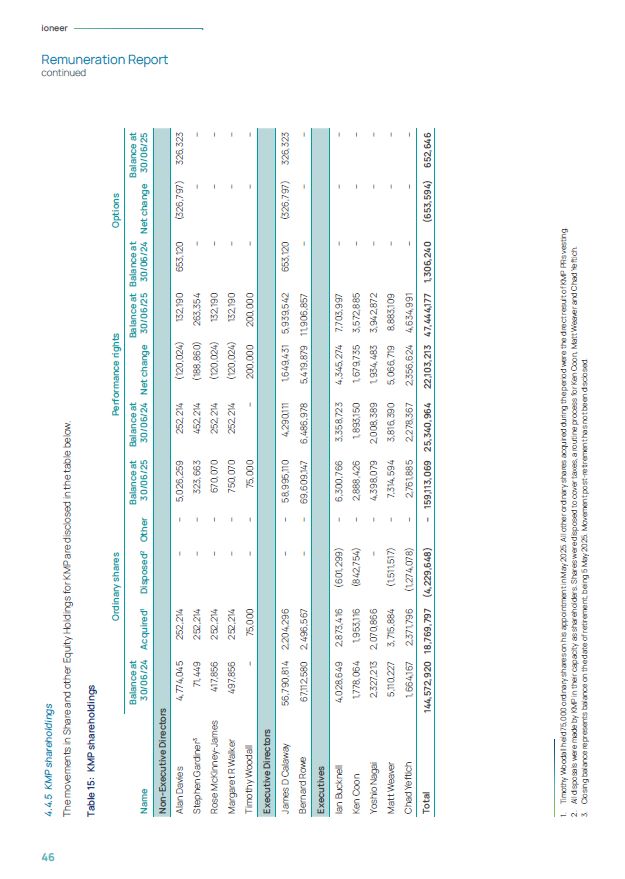
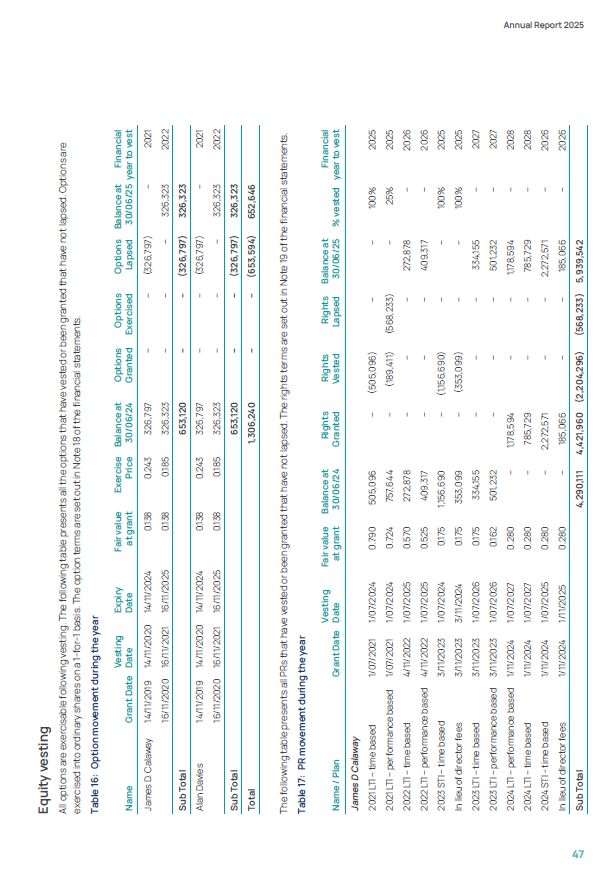
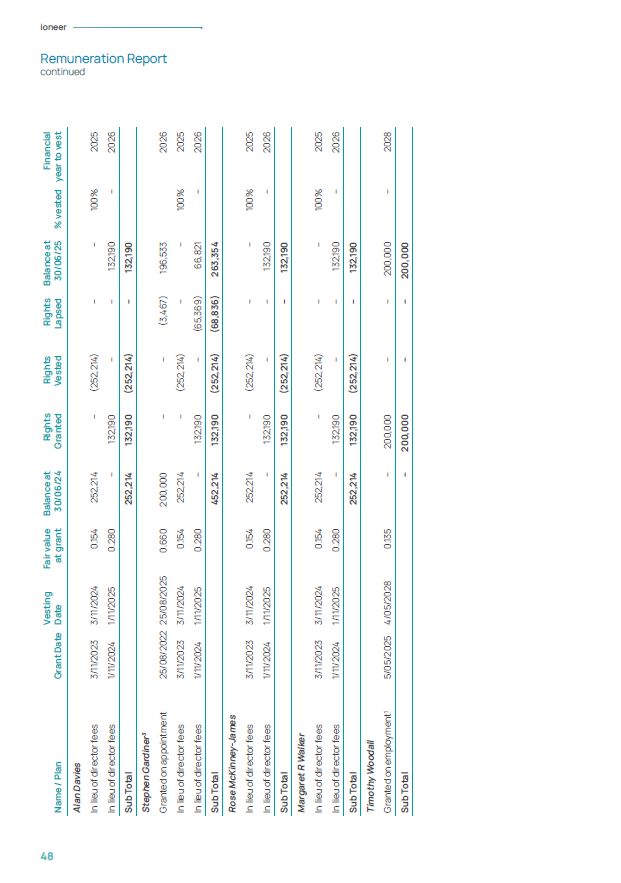
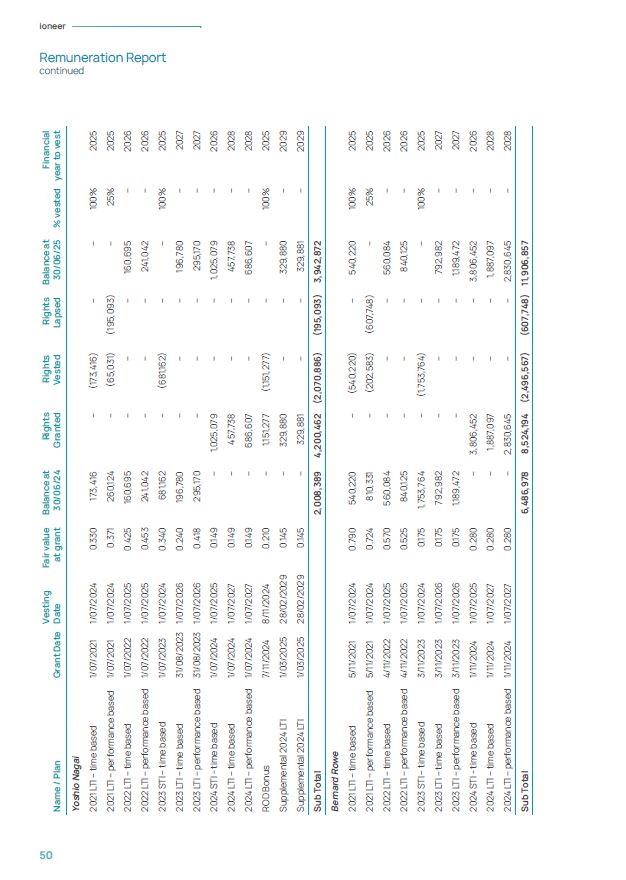
 Directors’ interests in shares, options and performance rights  Shares held Options held PRs held Shares held  Options held  PRs held  Director  at 30 Jun 25  at 30 Jun 25  at 30-Jun-25  at report date  at report date  at report date  James D Calaway  58,995,110  326,323  5,939,542  61,614,236  326,323  2,984,776  Bernard Rowe  69,609,147  –  11,906,857  74,426,906  –  6,700,196  Alan Davies  5,026,259  326,323  132,190  5,781,959  326,323  132,190  Rose McKinney-James  670,070  –  132,190  670,070  –  132,190  Margaret R Walker  750,070  –  132,190  1,023,190  –  132,190  Timothy Woodall  75,000  –  200,000  375,000  –  200,000  135,125,656  652,646  18,442,969  143,891,361  652,646  10,281,542  Directors’ meetings  Directors’ attendance at Directors’ meetings are shown in the following table:  Nomination &  Board  Audit & Risk  Remuneration  Project Execution  EHSS  Held Attended  Held Attended  Held Attended  Held Attended  Held Attended  James D Calaway  7  7  –  –  –  –  –  –  2  2  Bernard Rowe  7  7  –  –  –  –  3  3  –  –  Alan Davies  7  5  5  3  5  5  3  2  –  –  Stephen Gardiner1  6  6  5  5  4  4  –  –  –  –  Rose McKinney- James  7  7  –  –  5  5  –  –  2  2  Margaret R Walker  7  7  5  5  –  –  3  3  2  2  Timothy Woodall  1  1  –  –  1  0  –  –  –  –  1. Stephen retired from, and Timothy Woodall was appointed to, the Board in May 2025. The number of Board and Committee meetings they were eligible to attend are shown under the Held column.  Committee membership  As at the date of this report, the Company had an audit and risk committee, a nomination and remuneration committee, a project execution committee, and an Environmental, Health, Safety and Sustainability (EHSS) committee.  Members on the committees of the board at the end of the financial year are:  Nomination &  Director Audit & Risk Remuneration Project Execution EHSS  James D Calaway Bernard Rowe Alan Davies  Rose Mc-Kinney-James Margaret R Walker Timothy Woodall  *  *  *  *  The chair of each committee is denoted by an asterisk. They are all independent non-executive directors.  Timothy Woodall was appointed chair of the Audit & Risk Committee and a member of the Nomination & Remuneration Committee on his appointment to the Board in May 2025.  Annual Report 2025  21 
 

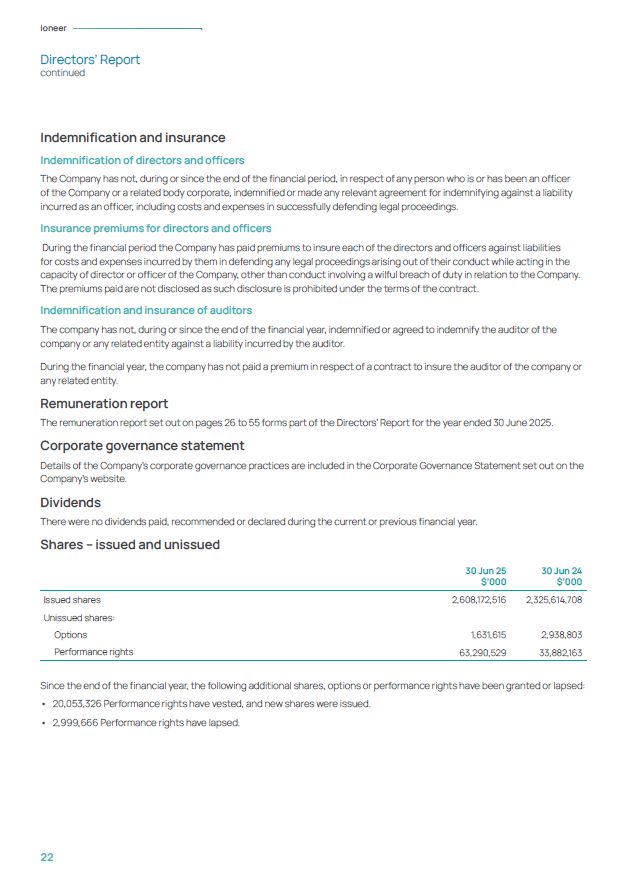
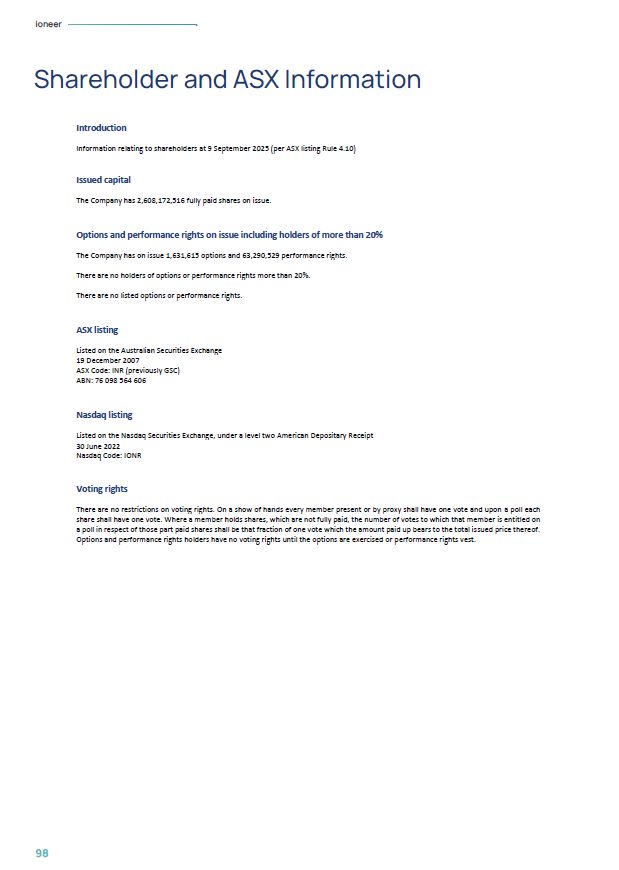
 Indemnification and insurance  Indemnification of directors and officers  The Company has not, during or since the end of the financial period, in respect of any person who is or has been an officer of the Company or a related body corporate, indemnified or made any relevant agreement for indemnifying against a liability incurred as an officer, including costs and expenses in successfully defending legal proceedings.  Insurance premiums for directors and officers  During the financial period the Company has paid premiums to insure each of the directors and officers against liabilities for costs and expenses incurred by them in defending any legal proceedings arising out of their conduct while acting in the  capacity of director or officer of the Company, other than conduct involving a wilful breach of duty in relation to the Company. The premiums paid are not disclosed as such disclosure is prohibited under the terms of the contract.  Indemnification and insurance of auditors  The company has not, during or since the end of the financial year, indemnified or agreed to indemnify the auditor of the company or any related entity against a liability incurred by the auditor.  During the financial year, the company has not paid a premium in respect of a contract to insure the auditor of the company or any related entity.  Remuneration report  The remuneration report set out on pages 26 to 55 forms part of the Directors’ Report for the year ended 30 June 2025.  Corporate governance statement  Details of the Company’s corporate governance practices are included in the Corporate Governance Statement set out on the Company’s website.  Dividends  There were no dividends paid, recommended or declared during the current or previous financial year.  Shares – issued and unissued  30 Jun 25  $’000  30 Jun 24  $’000  Issued shares  2,608,172,516  2,325,614,708  Unissued shares:  Options  1,631,615  2,938,803  Performance rights  63,290,529  33,882,163  Since the end of the financial year, the following additional shares, options or performance rights have been granted or lapsed:  20,053,326 Performance rights have vested, and new shares were issued.  2,999,666 Performance rights have lapsed.  ioneer  Directors’ Report  continued  22 
 

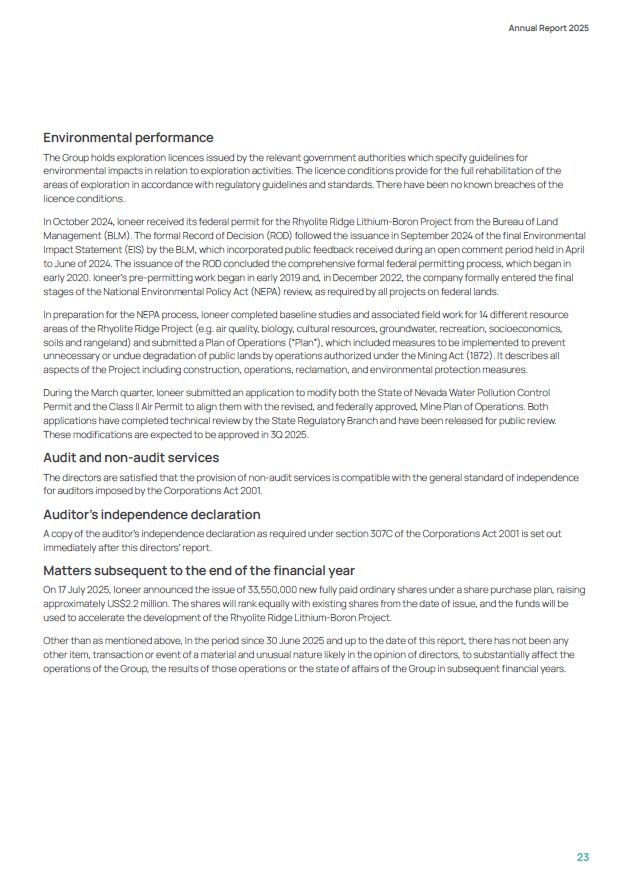
 Environmental performance  The Group holds exploration licences issued by the relevant government authorities which specify guidelines for environmental impacts in relation to exploration activities. The licence conditions provide for the full rehabilitation of the areas of exploration in accordance with regulatory guidelines and standards. There have been no known breaches of the licence conditions.  In October 2024, Ioneer received its federal permit for the Rhyolite Ridge Lithium-Boron Project from the Bureau of Land Management (BLM). The formal Record of Decision (ROD) followed the issuance in September 2024 of the final Environmental Impact Statement (EIS) by the BLM, which incorporated public feedback received during an open comment period held in April to June of 2024. The issuance of the ROD concluded the comprehensive formal federal permitting process, which began in early 2020. Ioneer’s pre-permitting work began in early 2019 and, in December 2022, the company formally entered the final stages of the National Environmental Policy Act (NEPA) review, as required by all projects on federal lands.  In preparation for the NEPA process, Ioneer completed baseline studies and associated field work for 14 different resource areas of the Rhyolite Ridge Project (e.g. air quality, biology, cultural resources, groundwater, recreation, socioeconomics, soils and rangeland) and submitted a Plan of Operations (“Plan”), which included measures to be implemented to prevent unnecessary or undue degradation of public lands by operations authorized under the Mining Act (1872). It describes all aspects of the Project including construction, operations, reclamation, and environmental protection measures.  During the March quarter, Ioneer submitted an application to modify both the State of Nevada Water Pollution Control Permit and the Class II Air Permit to align them with the revised, and federally approved, Mine Plan of Operations. Both applications have completed technical review by the State Regulatory Branch and have been released for public review. These modifications are expected to be approved in 3Q 2025.  Audit and non-audit services  The directors are satisfied that the provision of non-audit services is compatible with the general standard of independence for auditors imposed by the Corporations Act 2001.  Auditor’s independence declaration  A copy of the auditor’s independence declaration as required under section 307C of the Corporations Act 2001 is set out immediately after this directors’ report.  Matters subsequent to the end of the financial year  On 17 July 2025, Ioneer announced the issue of 33,550,000 new fully paid ordinary shares under a share purchase plan, raising approximately US$2.2 million. The shares will rank equally with existing shares from the date of issue, and the funds will be used to accelerate the development of the Rhyolite Ridge Lithium-Boron Project.  Other than as mentioned above, In the period since 30 June 2025 and up to the date of this report, there has not been any other item, transaction or event of a material and unusual nature likely in the opinion of directors, to substantially affect the operations of the Group, the results of those operations or the state of affairs of the Group in subsequent financial years.  Annual Report 2025  23 
 

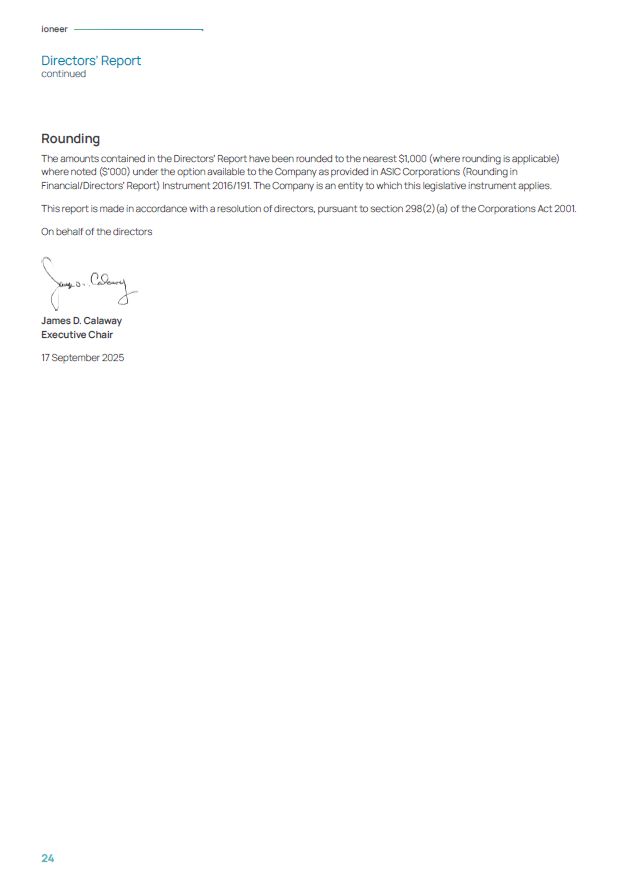
 Rounding  The amounts contained in the Directors’ Report have been rounded to the nearest $1,000 (where rounding is applicable) where noted ($’000) under the option available to the Company as provided in ASIC Corporations (Rounding in Financial/Directors’ Report) Instrument 2016/191. The Company is an entity to which this legislative instrument applies.  This report is made in accordance with a resolution of directors, pursuant to section 298(2)(a) of the Corporations Act 2001. On behalf of the directors  James D. Calaway Executive Chair  17 September 2025  ioneer  Directors’ Report  continued  24 
 

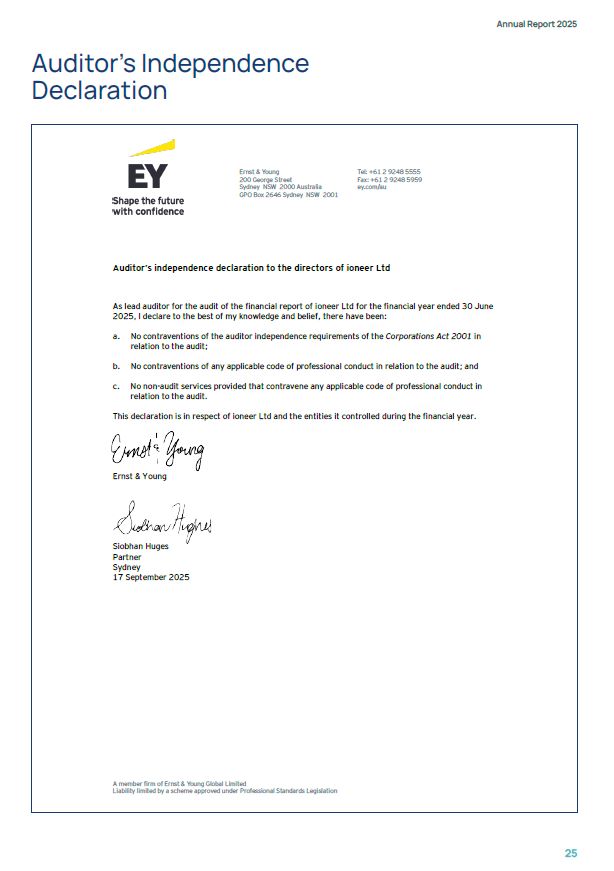
 A member firm of Ernst & Young Global Limited  Liability limited by a scheme approved under Professional Standards Legislation  Ernst & Young 200 George Street  Sydney NSW 2000 Australia  GPO Box 2646 Sydney NSW 2001  Tel: +61 2 9248 5555  Fax: +61 2 9248 5959  ey.com/au  Auditor’s independence declaration to the directors of ioneer Ltd  As lead auditor for the audit of the financial report of ioneer Ltd for the financial year ended 30 June 2025, I declare to the best of my knowledge and belief, there have been:  No contraventions of the auditor independence requirements of the Corporations Act 2001 in relation to the audit;  No contraventions of any applicable code of professional conduct in relation to the audit; and  No non-audit services provided that contravene any applicable code of professional conduct in relation to the audit.  This declaration is in respect of ioneer Ltd and the entities it controlled during the financial year.  Ernst & Young  Siobhan Huges Partner Sydney  17 September 2025  Auditor’s Independence Declaration  Annual Report 2025  25 
 

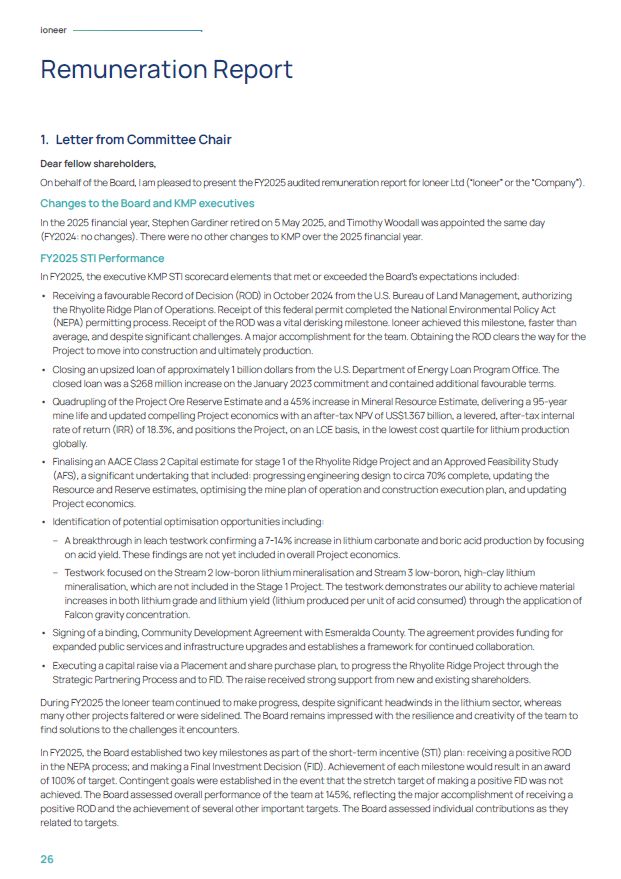
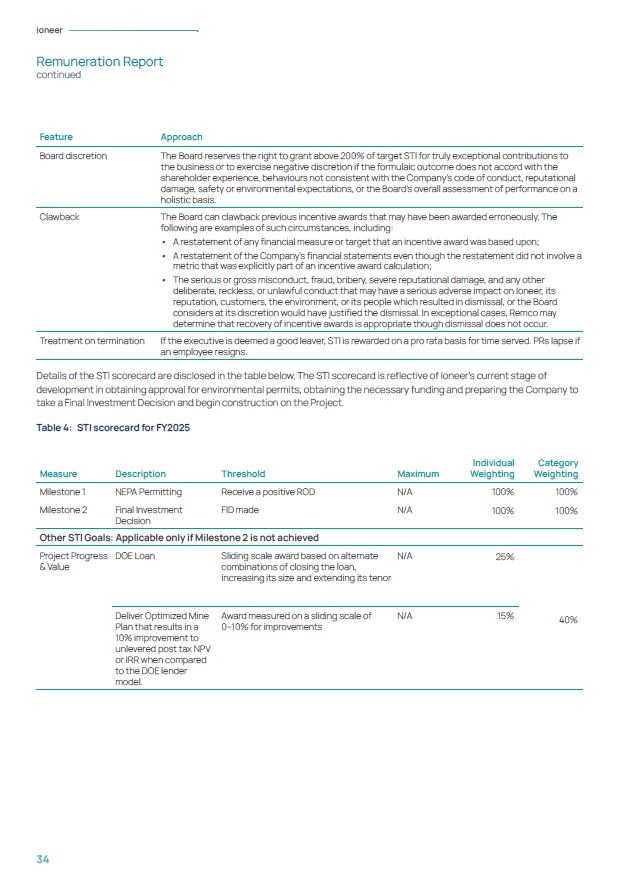
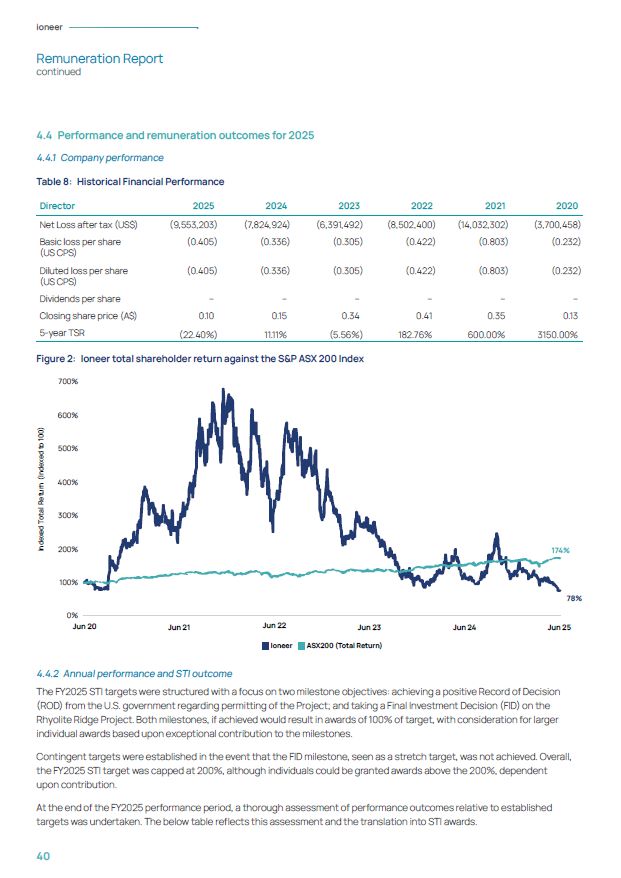
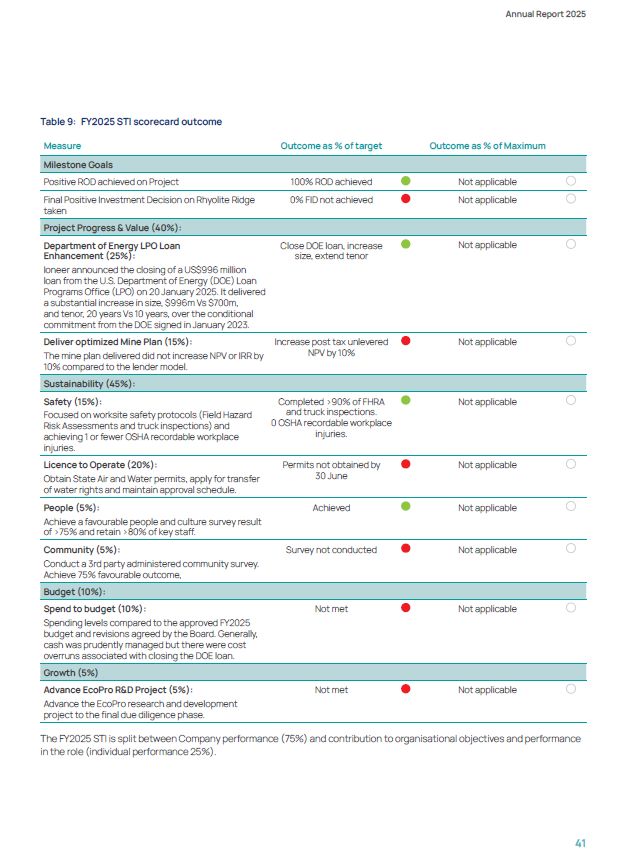
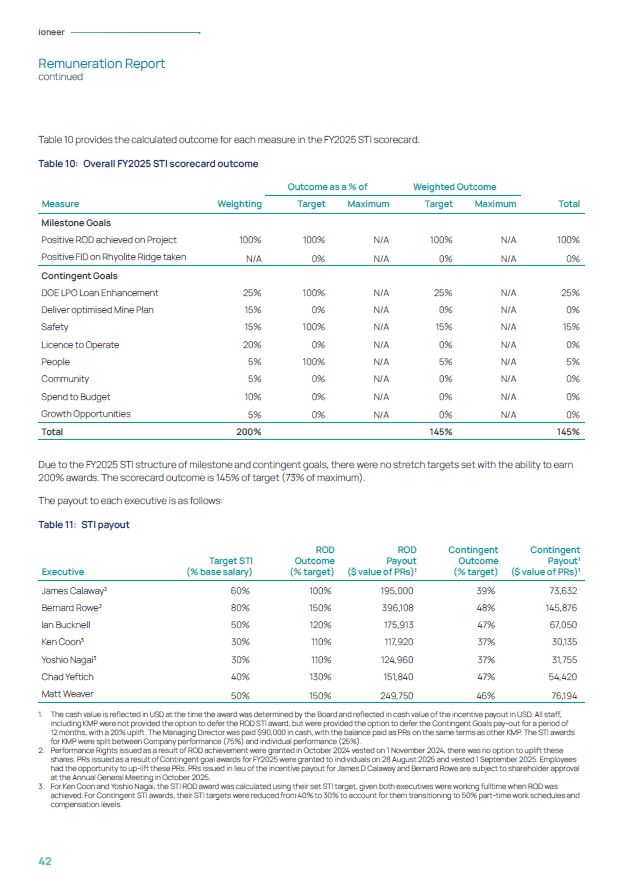
 Letter from Committee Chair  Dear fellow shareholders,  On behalf of the Board, I am pleased to present the FY2025 audited remuneration report for Ioneer Ltd (“Ioneer” or the “Company”).  Changes to the Board and KMP executives  In the 2025 financial year, Stephen Gardiner retired on 5 May 2025, and Timothy Woodall was appointed the same day (FY2024: no changes). There were no other changes to KMP over the 2025 financial year.  FY2025 STI Performance  In FY2025, the executive KMP STI scorecard elements that met or exceeded the Board’s expectations included:  Receiving a favourable Record of Decision (ROD) in October 2024 from the U.S. Bureau of Land Management, authorizing the Rhyolite Ridge Plan of Operations. Receipt of this federal permit completed the National Environmental Policy Act (NEPA) permitting process. Receipt of the ROD was a vital derisking milestone. Ioneer achieved this milestone, faster than average, and despite significant challenges. A major accomplishment for the team. Obtaining the ROD clears the way for the Project to move into construction and ultimately production.  Closing an upsized loan of approximately 1 billion dollars from the U.S. Department of Energy Loan Program Office. The closed loan was a $268 million increase on the January 2023 commitment and contained additional favourable terms.  Quadrupling of the Project Ore Reserve Estimate and a 45% increase in Mineral Resource Estimate, delivering a 95-year mine life and updated compelling Project economics with an after-tax NPV of US$1.367 billion, a levered, after-tax internal rate of return (IRR) of 18.3%, and positions the Project, on an LCE basis, in the lowest cost quartile for lithium production globally.  Finalising an AACE Class 2 Capital estimate for stage 1 of the Rhyolite Ridge Project and an Approved Feasibility Study (AFS), a significant undertaking that included: progressing engineering design to circa 70% complete, updating the Resource and Reserve estimates, optimising the mine plan of operation and construction execution plan, and updating Project economics.  Identification of potential optimisation opportunities including:   A breakthrough in leach testwork confirming a 7-14% increase in lithium carbonate and boric acid production by focusing on acid yield. These findings are not yet included in overall Project economics.   Testwork focused on the Stream 2 low-boron lithium mineralisation and Stream 3 low-boron, high-clay lithium mineralisation, which are not included in the Stage 1 Project. The testwork demonstrates our ability to achieve material increases in both lithium grade and lithium yield (lithium produced per unit of acid consumed) through the application of Falcon gravity concentration.  Signing of a binding, Community Development Agreement with Esmeralda County. The agreement provides funding for expanded public services and infrastructure upgrades and establishes a framework for continued collaboration.  Executing a capital raise via a Placement and share purchase plan, to progress the Rhyolite Ridge Project through the Strategic Partnering Process and to FID. The raise received strong support from new and existing shareholders.  During FY2025 the Ioneer team continued to make progress, despite significant headwinds in the lithium sector, whereas many other projects faltered or were sidelined. The Board remains impressed with the resilience and creativity of the team to find solutions to the challenges it encounters.  In FY2025, the Board established two key milestones as part of the short-term incentive (STI) plan: receiving a positive ROD in the NEPA process; and making a Final Investment Decision (FID). Achievement of each milestone would result in an award of 100% of target. Contingent goals were established in the event that the stretch target of making a positive FID was not achieved. The Board assessed overall performance of the team at 145%, reflecting the major accomplishment of receiving a positive ROD and the achievement of several other important targets. The Board assessed individual contributions as they related to targets.  26  Remuneration Report  ioneer 
 

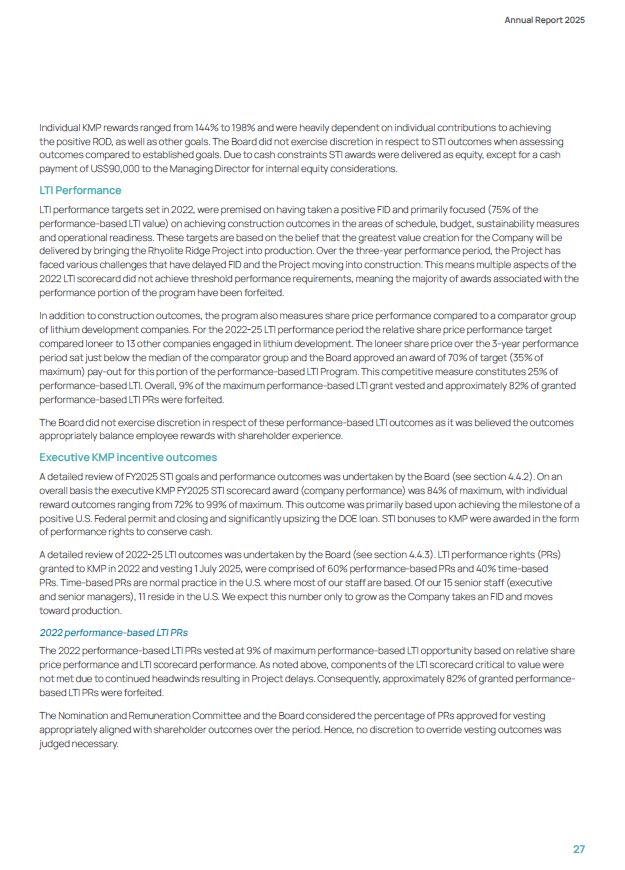
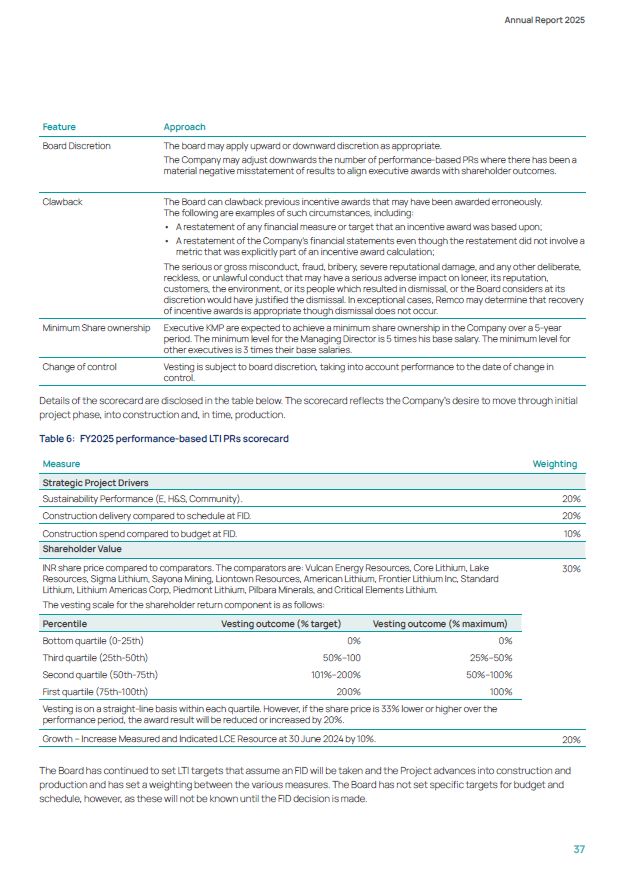
 Individual KMP rewards ranged from 144% to 198% and were heavily dependent on individual contributions to achieving the positive ROD, as well as other goals. The Board did not exercise discretion in respect to STI outcomes when assessing outcomes compared to established goals. Due to cash constraints STI awards were delivered as equity, except for a cash payment of US$90,000 to the Managing Director for internal equity considerations.  LTI Performance  LTI performance targets set in 2022, were premised on having taken a positive FID and primarily focused (75% of the performance-based LTI value) on achieving construction outcomes in the areas of schedule, budget, sustainability measures and operational readiness. These targets are based on the belief that the greatest value creation for the Company will be delivered by bringing the Rhyolite Ridge Project into production. Over the three-year performance period, the Project has faced various challenges that have delayed FID and the Project moving into construction. This means multiple aspects of the 2022 LTI scorecard did not achieve threshold performance requirements, meaning the majority of awards associated with the performance portion of the program have been forfeited.  In addition to construction outcomes, the program also measures share price performance compared to a comparator group of lithium development companies. For the 2022-25 LTI performance period the relative share price performance target compared Ioneer to 13 other companies engaged in lithium development. The Ioneer share price over the 3-year performance period sat just below the median of the comparator group and the Board approved an award of 70% of target (35% of maximum) pay-out for this portion of the performance-based LTI Program. This competitive measure constitutes 25% of performance-based LTI. Overall, 9% of the maximum performance-based LTI grant vested and approximately 82% of granted performance-based LTI PRs were forfeited.  The Board did not exercise discretion in respect of these performance-based LTI outcomes as it was believed the outcomes appropriately balance employee rewards with shareholder experience.  Executive KMP incentive outcomes  A detailed review of FY2025 STI goals and performance outcomes was undertaken by the Board (see section 4.4.2). On an overall basis the executive KMP FY2025 STI scorecard award (company performance) was 84% of maximum, with individual reward outcomes ranging from 72% to 99% of maximum. This outcome was primarily based upon achieving the milestone of a positive U.S. Federal permit and closing and significantly upsizing the DOE loan. STI bonuses to KMP were awarded in the form of performance rights to conserve cash.  A detailed review of 2022-25 LTI outcomes was undertaken by the Board (see section 4.4.3). LTI performance rights (PRs) granted to KMP in 2022 and vesting 1 July 2025, were comprised of 60% performance-based PRs and 40% time-based PRs. Time-based PRs are normal practice in the U.S. where most of our staff are based. Of our 15 senior staff (executive and senior managers), 11 reside in the U.S. We expect this number only to grow as the Company takes an FID and moves toward production.  2022 performance-based LTI PRs  The 2022 performance-based LTI PRs vested at 9% of maximum performance-based LTI opportunity based on relative share price performance and LTI scorecard performance. As noted above, components of the LTI scorecard critical to value were not met due to continued headwinds resulting in Project delays. Consequently, approximately 82% of granted performance- based LTI PRs were forfeited.  The Nomination and Remuneration Committee and the Board considered the percentage of PRs approved for vesting appropriately aligned with shareholder outcomes over the period. Hence, no discretion to override vesting outcomes was judged necessary.  Annual Report 2025  27 
 

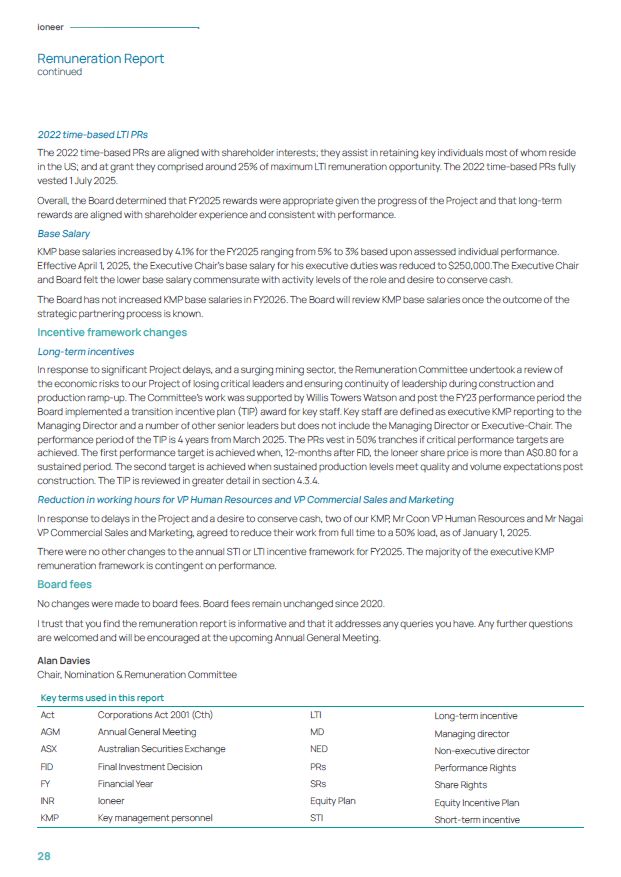
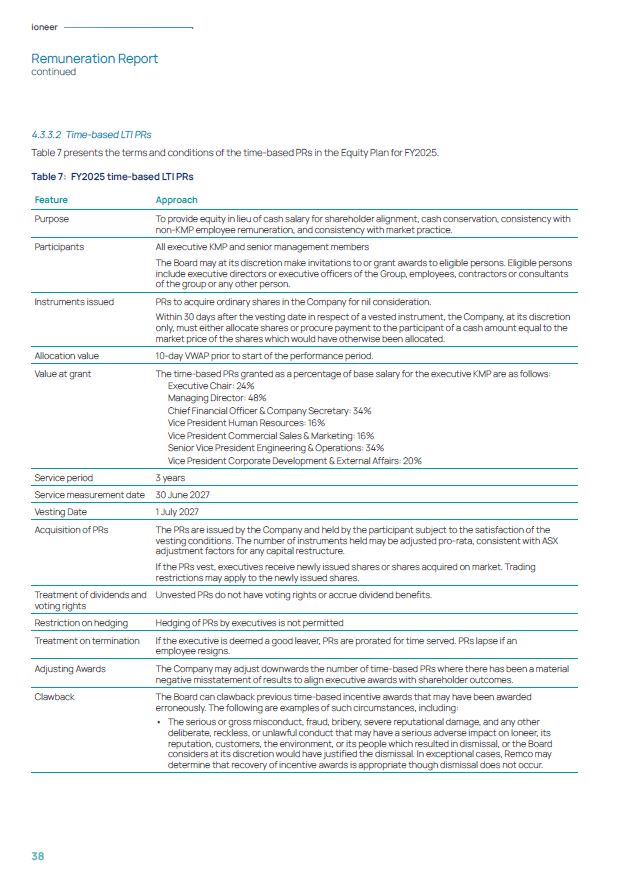
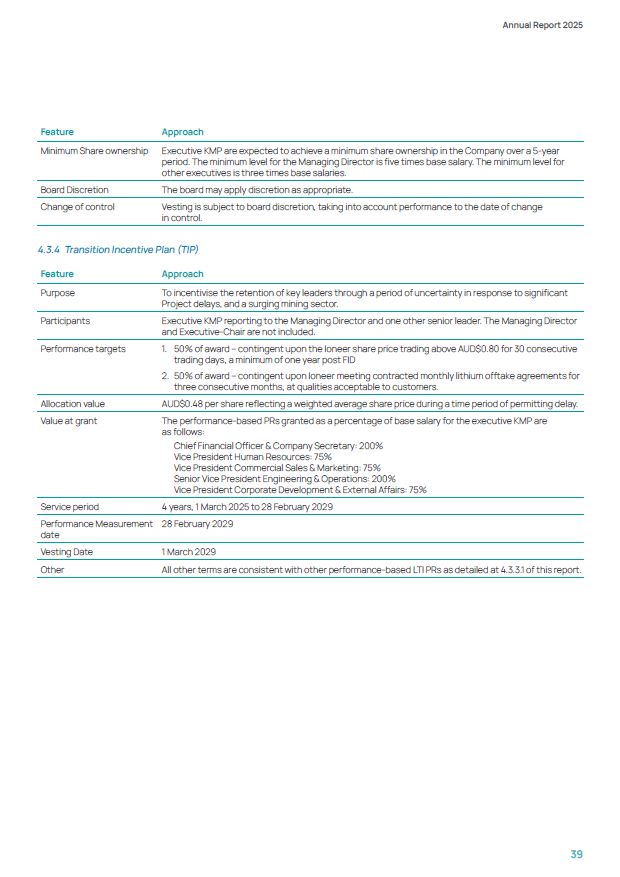
 2022 time-based LTI PRs  The 2022 time-based PRs are aligned with shareholder interests; they assist in retaining key individuals most of whom reside in the US; and at grant they comprised around 25% of maximum LTI remuneration opportunity. The 2022 time-based PRs fully vested 1 July 2025.  Overall, the Board determined that FY2025 rewards were appropriate given the progress of the Project and that long-term rewards are aligned with shareholder experience and consistent with performance.  Base Salary  KMP base salaries increased by 4.1% for the FY2025 ranging from 5% to 3% based upon assessed individual performance. Effective April 1, 2025, the Executive Chair’s base salary for his executive duties was reduced to $250,000.The Executive Chair and Board felt the lower base salary commensurate with activity levels of the role and desire to conserve cash.  The Board has not increased KMP base salaries in FY2026. The Board will review KMP base salaries once the outcome of the strategic partnering process is known.  Incentive framework changes  Long-term incentives  In response to significant Project delays, and a surging mining sector, the Remuneration Committee undertook a review of the economic risks to our Project of losing critical leaders and ensuring continuity of leadership during construction and  production ramp-up. The Committee’s work was supported by Willis Towers Watson and post the FY23 performance period the Board implemented a transition incentive plan (TIP) award for key staff. Key staff are defined as executive KMP reporting to the Managing Director and a number of other senior leaders but does not include the Managing Director or Executive-Chair. The performance period of the TIP is 4 years from March 2025. The PRs vest in 50% tranches if critical performance targets are achieved. The first performance target is achieved when, 12-months after FID, the Ioneer share price is more than A$0.80 for a sustained period. The second target is achieved when sustained production levels meet quality and volume expectations post construction. The TIP is reviewed in greater detail in section 4.3.4.  Reduction in working hours for VP Human Resources and VP Commercial Sales and Marketing  In response to delays in the Project and a desire to conserve cash, two of our KMP, Mr Coon VP Human Resources and Mr Nagai VP Commercial Sales and Marketing, agreed to reduce their work from full time to a 50% load, as of January 1, 2025.  There were no other changes to the annual STI or LTI incentive framework for FY2025. The majority of the executive KMP remuneration framework is contingent on performance.  Board fees  No changes were made to board fees. Board fees remain unchanged since 2020.  I trust that you find the remuneration report is informative and that it addresses any queries you have. Any further questions are welcomed and will be encouraged at the upcoming Annual General Meeting.  Alan Davies  Chair, Nomination & Remuneration Committee  Key terms used in this report  Act  Corporations Act 2001 (Cth)  LTI  Long-term incentive  AGM  Annual General Meeting  MD  Managing director  ASX  Australian Securities Exchange  NED  Non-executive director  FID  Final Investment Decision  PRs  Performance Rights  FY  Financial Year  SRs  Share Rights  INR  Ioneer  Equity Plan  Equity Incentive Plan  KMP  Key management personnel  STI  Short-term incentive  28  ioneer  Remuneration Report  continued 
 

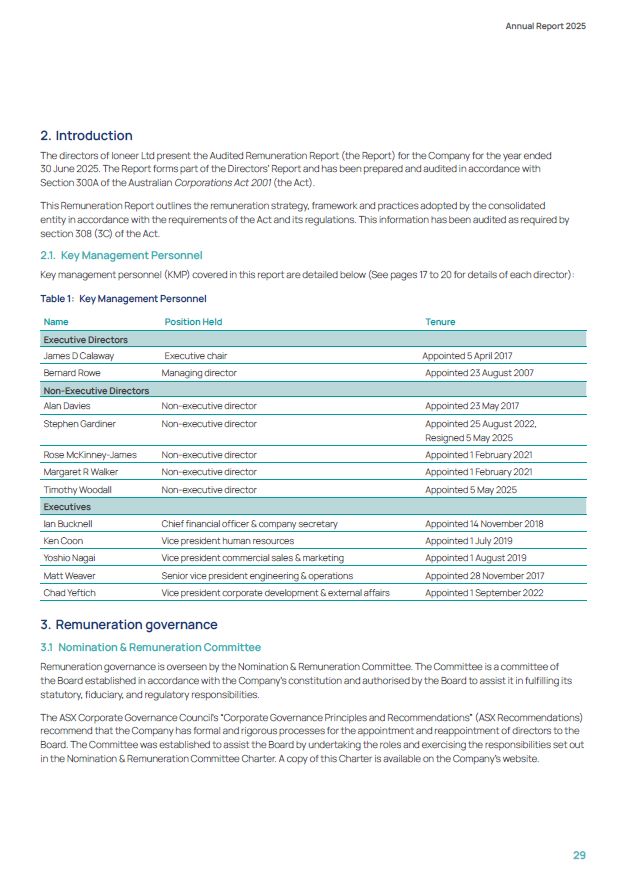
 Introduction  The directors of Ioneer Ltd present the Audited Remuneration Report (the Report) for the Company for the year ended 30 June 2025. The Report forms part of the Directors’ Report and has been prepared and audited in accordance with Section 300A of the Australian Corporations Act 2001 (the Act).  This Remuneration Report outlines the remuneration strategy, framework and practices adopted by the consolidated entity in accordance with the requirements of the Act and its regulations. This information has been audited as required by section 308 (3C) of the Act.  Key Management Personnel  Key management personnel (KMP) covered in this report are detailed below (See pages 17 to 20 for details of each director):  Table 1: Key Management Personnel  Name  Position Held  Tenure  Executive Directors  James D Calaway  Executive chair  Appointed 5 April 2017  Bernard Rowe  Managing director  Appointed 23 August 2007  Non-Executive Directors  Alan Davies  Non-executive director  Appointed 23 May 2017  Stephen Gardiner  Non-executive director  Appointed 25 August 2022,  Resigned 5 May 2025  Rose McKinney-James  Non-executive director  Appointed 1 February 2021  Margaret R Walker  Non-executive director  Appointed 1 February 2021  Timothy Woodall  Non-executive director  Appointed 5 May 2025  Executives  Ian Bucknell  Chief financial officer & company secretary  Appointed 14 November 2018  Ken Coon  Vice president human resources  Appointed 1 July 2019  Yoshio Nagai  Vice president commercial sales & marketing  Appointed 1 August 2019  Matt Weaver  Senior vice president engineering & operations  Appointed 28 November 2017  Chad Yeftich  Vice president corporate development & external affairs  Appointed 1 September 2022  Remuneration governance  Nomination & Remuneration Committee  Remuneration governance is overseen by the Nomination & Remuneration Committee. The Committee is a committee of the Board established in accordance with the Company’s constitution and authorised by the Board to assist it in fulfilling its statutory, fiduciary, and regulatory responsibilities.  The ASX Corporate Governance Council’s “Corporate Governance Principles and Recommendations” (ASX Recommendations) recommend that the Company has formal and rigorous processes for the appointment and reappointment of directors to the Board. The Committee was established to assist the Board by undertaking the roles and exercising the responsibilities set out in the Nomination & Remuneration Committee Charter. A copy of this Charter is available on the Company’s website.  Annual Report 2025  29 
 

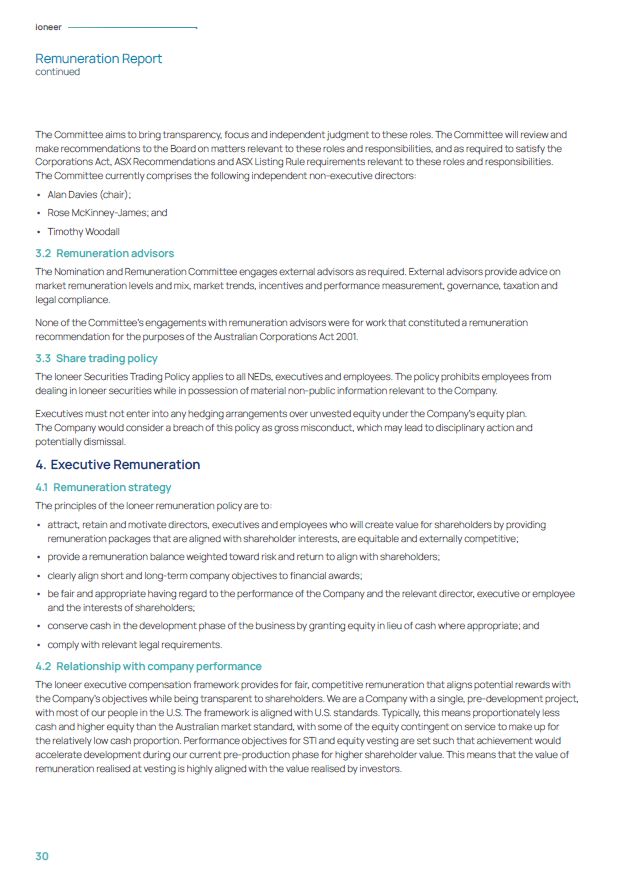
 The Committee aims to bring transparency, focus and independent judgment to these roles. The Committee will review and make recommendations to the Board on matters relevant to these roles and responsibilities, and as required to satisfy the Corporations Act, ASX Recommendations and ASX Listing Rule requirements relevant to these roles and responsibilities.  The Committee currently comprises the following independent non-executive directors:  Alan Davies (chair);  Rose McKinney-James; and  Timothy Woodall  3.2 Remuneration advisors  The Nomination and Remuneration Committee engages external advisors as required. External advisors provide advice on market remuneration levels and mix, market trends, incentives and performance measurement, governance, taxation and legal compliance.  None of the Committee’s engagements with remuneration advisors were for work that constituted a remuneration recommendation for the purposes of the Australian Corporations Act 2001.  3.3 Share trading policy  The Ioneer Securities Trading Policy applies to all NEDs, executives and employees. The policy prohibits employees from dealing in Ioneer securities while in possession of material non-public information relevant to the Company.  Executives must not enter into any hedging arrangements over unvested equity under the Company’s equity plan. The Company would consider a breach of this policy as gross misconduct, which may lead to disciplinary action and potentially dismissal.  Executive Remuneration  Remuneration strategy  The principles of the Ioneer remuneration policy are to:  attract, retain and motivate directors, executives and employees who will create value for shareholders by providing remuneration packages that are aligned with shareholder interests, are equitable and externally competitive;  provide a remuneration balance weighted toward risk and return to align with shareholders;  clearly align short and long-term company objectives to financial awards;  be fair and appropriate having regard to the performance of the Company and the relevant director, executive or employee and the interests of shareholders;  conserve cash in the development phase of the business by granting equity in lieu of cash where appropriate; and  comply with relevant legal requirements.  4.2 Relationship with company performance  The Ioneer executive compensation framework provides for fair, competitive remuneration that aligns potential rewards with the Company’s objectives while being transparent to shareholders. We are a Company with a single, pre-development project, with most of our people in the U.S. The framework is aligned with U.S. standards. Typically, this means proportionately less cash and higher equity than the Australian market standard, with some of the equity contingent on service to make up for  the relatively low cash proportion. Performance objectives for STI and equity vesting are set such that achievement would accelerate development during our current pre-production phase for higher shareholder value. This means that the value of remuneration realised at vesting is highly aligned with the value realised by investors.  ioneer  Remuneration Report  continued  30 
 

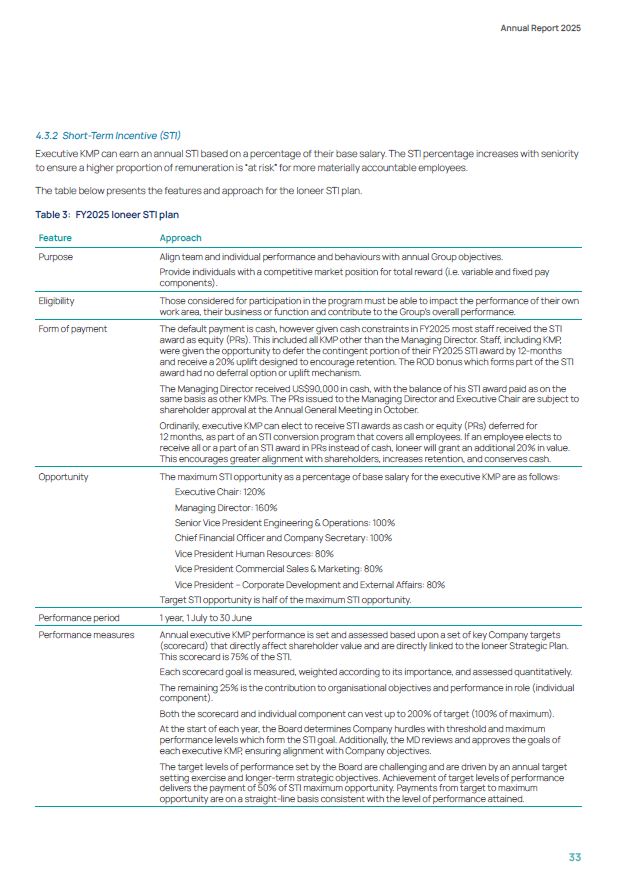
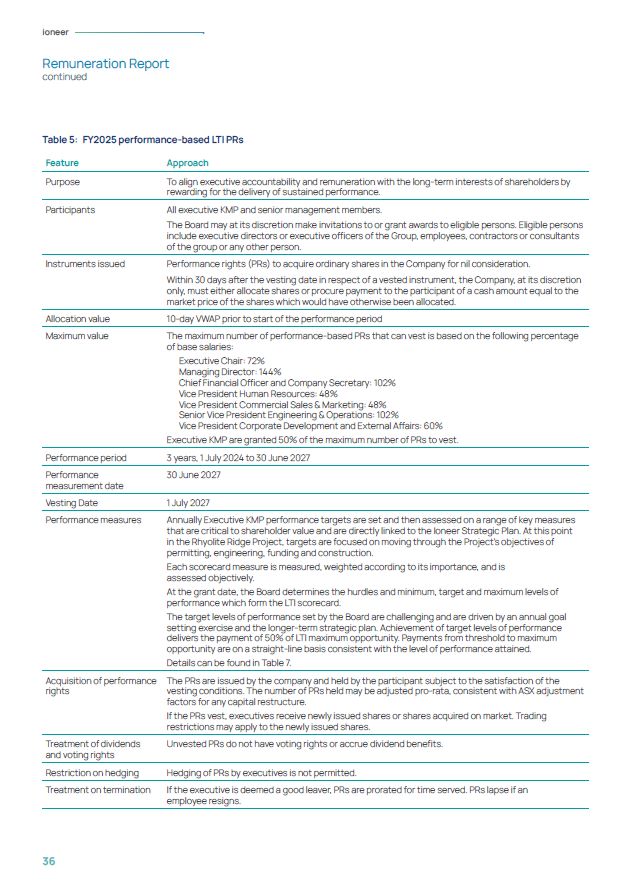
 Key remuneration elements are reviewed annually to determine appropriate awards based upon factors such as individual performance, Company results and competitive benchmark survey data. The following is a brief description of the approach for each element:  Base salary is reviewed annually and adjusted for individual performance and benchmarks that may be reviewed from time to time to ensure competitiveness.  Short term incentives are reviewed annually with awards granted based upon individual performance and Company results. STI targets are benchmarked from time to time to ensure competitiveness. STIs may range from 0 to 200% of target. The Board reserves the right to grant STI outcomes greater than 200% of target for exceptional contributions to Company objectives, as well as exercise negative discretion when formulaic outcomes do not align with the shareholder experience. As part of a program that covers all employees, executives are encouraged to receive the STI in PRs as by opting to do so, they will receive an additional 20% in STI value. The PRs are deferred for a year to encourage retention, conserve cash, and enhance alignment with shareholders.  Equity grants are reviewed annually. The Board has a current practice of granting a target grant ratio with a ratio of  60% performance-based PRs and 40% time-based PRs. A key risk for Ioneer is not being able to attract and retain qualified and experienced U.S. executives. The remuneration framework needs to have full regard for U.S. market standards, optimal shareholder alignment and cash conservation.  Performance-based PRs make up 60% of the annual target grant value. The final vesting may range between  0% to 200% of grant based on achievement of a scorecard of business objectives suited to the Company’s current pre-production phase, such that if all were achieved, they would add substantially to market value.   Time-based PRs make up 40% of the annual target grant value, equivalent to 25% of maximum potential grant value. Vesting is based on the executive remaining employed to the vesting date. The grant aligns employees with shareholders; conserves cash that would otherwise have to be used for higher salaries and meets U.S. market standards.  4.3 Remuneration framework  Remuneration information is derived from relevant remuneration surveys conducted by independent third parties. Remuneration is benchmarked against a peer group of direct competitors and a sector peer group.  Ioneer’s remuneration framework and executive reward strategy provides a mix of fixed and variable remuneration with a blend of short-term incentives and long-term equity grants. The key elements of the remuneration packages are as follows:  Annual base salary: reviewed annually and adjusted based upon individual performance and competitive benchmarks that may be reviewed from time to time to ensure competitiveness.  Post-employment benefits: superannuation contributions for Australian based executives and similar retirement benefits savings for non-Australia based executives.  Fixed (TFR): Annual base salary plus superannuation for Australia based executives and annual base salary for non-Australia based executives.  Short-term incentive (STI): Remuneration for performance measured over one year or less, including any deferred amounts.  Equity incentive grants: Equity granted under shareholder approved equity plans.  Annual Report 2025  31 
 

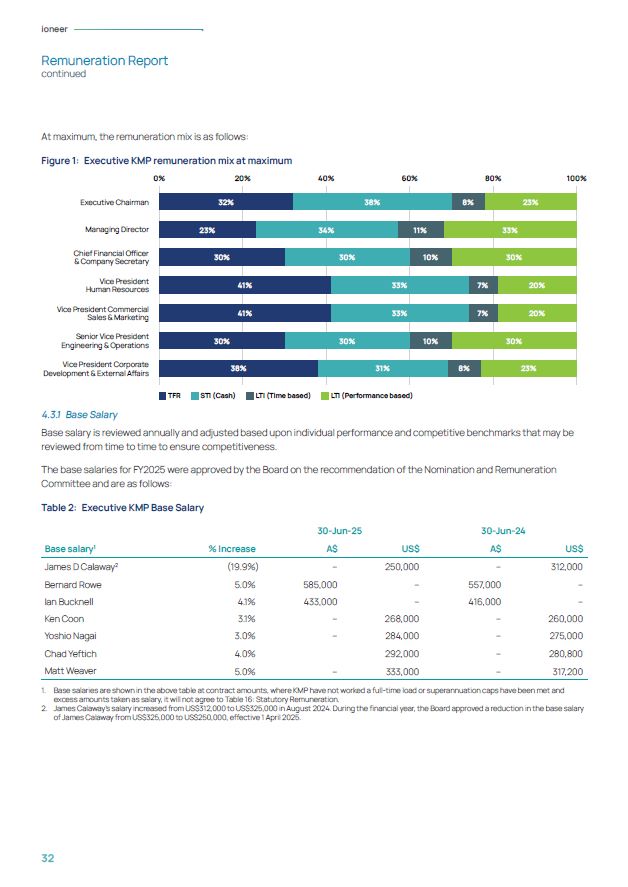
 At maximum, the remuneration mix is as follows:  Figure 1: Executive KMP remuneration mix at maximum  0% 20%  40%  60%  80%  100%  Executive Chairman  Managing Director  Chief Financial Officer & Company Secretary  Vice President Human Resources  Vice President Commercial  Sales & Marketing  Senior Vice President Engineering & Operations  Vice President Corporate Development & External Affairs  32%  38%  8%  23%  23%  34%  11%  33%  30%  30%  10%  30%  41%  33%  7%  20%  41%  33%  7%  20%  30%  30%  10%  30%  38%  31%  8%  23%  TFR STI (Cash) LTI (Time based) LTI (Performance based)  4.3.1 Base Salary  Base salary is reviewed annually and adjusted based upon individual performance and competitive benchmarks that may be reviewed from time to time to ensure competitiveness.  The base salaries for FY2025 were approved by the Board on the recommendation of the Nomination and Remuneration Committee and are as follows:  Table 2: Executive KMP Base Salary  Base salary1  % Increase  30-Jun-25  A$  US$  30-Jun-24  A$  US$  James D Calaway2  (19.9%)  –  250,000  –  312,000  Bernard Rowe  5.0%  585,000  –  557,000  –  Ian Bucknell  4.1%  433,000  –  416,000  –  Ken Coon  3.1%  –  268,000  –  260,000  Yoshio Nagai  3.0%  –  284,000  –  275,000  Chad Yeftich  4.0%  292,000  –  280,800  Matt Weaver  5.0%  –  333,000  –  317,200   Base salaries are shown in the above table at contract amounts, where KMP have not worked a full-time load or superannuation caps have been met and excess amounts taken as salary, it will not agree to Table 16: Statutory Remuneration.  James Calaway’s salary increased from US$312,000 to US$325,000 in August 2024. During the financial year, the Board approved a reduction in the base salary of James Calaway from US$325,000 to US$250,000, effective 1 April 2025.  ioneer  Remuneration Report  continued  32 
 

 4.3.2 Short-Term Incentive (STI)  Executive KMP can earn an annual STI based on a percentage of their base salary. The STI percentage increases with seniority to ensure a higher proportion of remuneration is “at risk” for more materially accountable employees.  The table below presents the features and approach for the Ioneer STI plan.  Table 3: FY2025 Ioneer STI plan  Feature Approach  Purpose  Align team and individual performance and behaviours with annual Group objectives.  Provide individuals with a competitive market position for total reward (i.e. variable and fixed pay components).  Eligibility  Those considered for participation in the program must be able to impact the performance of their own work area, their business or function and contribute to the Group’s overall performance.  Form of payment  The default payment is cash, however given cash constraints in FY2025 most staff received the STI award as equity (PRs). This included all KMP other than the Managing Director. Staff, including KMP, were given the opportunity to defer the contingent portion of their FY2025 STI award by 12-months and receive a 20% uplift designed to encourage retention. The ROD bonus which forms part of the STI award had no deferral option or uplift mechanism.  The Managing Director received US$90,000 in cash, with the balance of his STI award paid as on the same basis as other KMPs. The PRs issued to the Managing Director and Executive Chair are subject to shareholder approval at the Annual General Meeting in October.  Ordinarily, executive KMP can elect to receive STI awards as cash or equity (PRs) deferred for  12 months, as part of an STI conversion program that covers all employees. If an employee elects to receive all or a part of an STI award in PRs instead of cash, Ioneer will grant an additional 20% in value. This encourages greater alignment with shareholders, increases retention, and conserves cash.  Opportunity  The maximum STI opportunity as a percentage of base salary for the executive KMP are as follows: Executive Chair: 120%  Managing Director: 160%  Senior Vice President Engineering & Operations: 100% Chief Financial Officer and Company Secretary: 100% Vice President Human Resources: 80%  Vice President Commercial Sales & Marketing: 80%  Vice President – Corporate Development and External Affairs: 80% Target STI opportunity is half of the maximum STI opportunity.  Performance period  1 year, 1 July to 30 June  Performance measures  Annual executive KMP performance is set and assessed based upon a set of key Company targets (scorecard) that directly affect shareholder value and are directly linked to the Ioneer Strategic Plan. This scorecard is 75% of the STI.  Each scorecard goal is measured, weighted according to its importance, and assessed quantitatively.  The remaining 25% is the contribution to organisational objectives and performance in role (individual component).  Both the scorecard and individual component can vest up to 200% of target (100% of maximum).  At the start of each year, the Board determines Company hurdles with threshold and maximum performance levels which form the STI goal. Additionally, the MD reviews and approves the goals of each executive KMP, ensuring alignment with Company objectives.  The target levels of performance set by the Board are challenging and are driven by an annual target setting exercise and longer-term strategic objectives. Achievement of target levels of performance delivers the payment of 50% of STI maximum opportunity. Payments from target to maximum opportunity are on a straight-line basis consistent with the level of performance attained.  Annual Report 2025  33 
 

 Feature  Approach  Board discretion  The Board reserves the right to grant above 200% of target STI for truly exceptional contributions to the business or to exercise negative discretion if the formulaic outcome does not accord with the shareholder experience, behaviours not consistent with the Company’s code of conduct, reputational damage, safety or environmental expectations, or the Board’s overall assessment of performance on a holistic basis.  Clawback  The Board can clawback previous incentive awards that may have been awarded erroneously. The following are examples of such circumstances, including:  A restatement of any financial measure or target that an incentive award was based upon;  A restatement of the Company’s financial statements even though the restatement did not involve a metric that was explicitly part of an incentive award calculation;  The serious or gross misconduct, fraud, bribery, severe reputational damage, and any other deliberate, reckless, or unlawful conduct that may have a serious adverse impact on Ioneer, its reputation, customers, the environment, or its people which resulted in dismissal, or the Board considers at its discretion would have justified the dismissal. In exceptional cases, Remco may determine that recovery of incentive awards is appropriate though dismissal does not occur.  Treatment on termination  If the executive is deemed a good leaver, STI is rewarded on a pro rata basis for time served. PRs lapse if an employee resigns.  Details of the STI scorecard are disclosed in the table below. The STI scorecard is reflective of Ioneer’s current stage of development in obtaining approval for environmental permits, obtaining the necessary funding and preparing the Company to take a Final Investment Decision and begin construction on the Project.  Table 4: STI scorecard for FY2025  Measure  Description  Threshold  Maximum  Individual Weighting  Category Weighting  Milestone 1  Milestone 2  NEPA Permitting  Final Investment Decision  Receive a positive ROD FID made  N/A N/A  100%  100%  100%  100%  Other STI Goals: Applicable only if Milestone 2 is not achieved  Project Progress DOE Loan & Value  Sliding scale award based on alternate N/A combinations of closing the loan,  increasing its size and extending its tenor  25%  40%  Deliver Optimized Mine Plan that results in a 10% improvement to unlevered post tax NPV or IRR when compared to the DOE lender model.  Award measured on a sliding scale of 0–10% for improvements  N/A  15%  ioneer  Remuneration Report  continued  34 
 

 Individual  Category  Measure  Description  Threshold  Maximum  Weighting Weighting  Sustainability  Safety  Complete >90% field hazard  N/A  15%  assessments when working in the field.  (5%)  Complete truck inspections >90% of  times truck is used. (5%)  Record 1 or less OSHA recordable  workplace injuries (no lost time) (5%)  Licence to Operate  Obtain State Air and Water (WPCP) permits.  N/A  20%  Apply for and progress production water  45%  rights to agreed schedule  People  Receive >75% favourable employee  N/A  5%  culture survey results from 3rd party  administered survey. (2.5%)  Retain 80% or higher of key staff (2.5%)  Community  Receive >75% favourable community  N/A  5%  survey results from 3rd party  administered survey. (5%)  Cost Control  Spend to budget  No award if spend exceeds budget  N/A  10%  10%  Growth  Advance EcoPro R&D  Advance EcoPro R&D Project to  N/A  5%  5%  Project  commercially feasible process flowsheet  stage and advance project to final due  diligence phase.  There were two Project milestones set in FY2025, achieving a positive Record of Decision in the NEPA permitting process, and the Board taking a Final Investment Decision to develop the Rhyolite Ridge Project. If both milestones were achieved in the year, employees have the opportunity to earn 200% of their base salaries with the Board retaining discretion to award  individuals more based on their personal contributions to the milestones. If both milestones were achieved the other STI goals would not apply.  Where the first milestone of achieving a positive ROD is achieved but the second milestone not reached, the Other STI Goals apply. Under this scenario, employees have the opportunity to earn 200% of their base salaries with the Board retaining discretion to award individuals more based on their personal contributions to the milestones and STI goals.  Long-Term Incentive (LTI) Equity Grants  The executive KMP LTI equity grant comes in 2 parts, a performance-based PR grant and a time-based PR grant. The tables below present the features and approaches for both components of the grant.  Performance-based LTI PRs  Table 5 presents the terms and conditions of the performance-based PRs for 2025.  Annual Report 2025  35 
 

 Table 5: FY2025 performance-based LTI PRs  Feature Approach  Purpose  To align executive accountability and remuneration with the long-term interests of shareholders by rewarding for the delivery of sustained performance.  Participants  All executive KMP and senior management members.  The Board may at its discretion make invitations to or grant awards to eligible persons. Eligible persons include executive directors or executive officers of the Group, employees, contractors or consultants of the group or any other person.  Instruments issued  Performance rights (PRs) to acquire ordinary shares in the Company for nil consideration.  Within 30 days after the vesting date in respect of a vested instrument, the Company, at its discretion only, must either allocate shares or procure payment to the participant of a cash amount equal to the market price of the shares which would have otherwise been allocated.  Allocation value  10-day VWAP prior to start of the performance period  Maximum value  The maximum number of performance-based PRs that can vest is based on the following percentage of base salaries:  Executive Chair: 72%  Managing Director: 144%  Chief Financial Officer and Company Secretary: 102% Vice President Human Resources: 48%  Vice President Commercial Sales & Marketing: 48% Senior Vice President Engineering & Operations: 102%  Vice President Corporate Development and External Affairs: 60%  Executive KMP are granted 50% of the maximum number of PRs to vest.  Performance period  3 years, 1 July 2024 to 30 June 2027  Performance measurement date  30 June 2027  Vesting Date  1 July 2027  Performance measures  Annually Executive KMP performance targets are set and then assessed on a range of key measures that are critical to shareholder value and are directly linked to the Ioneer Strategic Plan. At this point in the Rhyolite Ridge Project, targets are focused on moving through the Project’s objectives of permitting, engineering, funding and construction.  Each scorecard measure is measured, weighted according to its importance, and is assessed objectively.  At the grant date, the Board determines the hurdles and minimum, target and maximum levels of performance which form the LTI scorecard.  The target levels of performance set by the Board are challenging and are driven by an annual goal setting exercise and the longer-term strategic plan. Achievement of target levels of performance delivers the payment of 50% of LTI maximum opportunity. Payments from threshold to maximum opportunity are on a straight-line basis consistent with the level of performance attained.  Details can be found in Table 7.  Acquisition of performance rights  The PRs are issued by the company and held by the participant subject to the satisfaction of the vesting conditions. The number of PRs held may be adjusted pro-rata, consistent with ASX adjustment factors for any capital restructure.  If the PRs vest, executives receive newly issued shares or shares acquired on market. Trading restrictions may apply to the newly issued shares.  Treatment of dividends and voting rights  Unvested PRs do not have voting rights or accrue dividend benefits.  Restriction on hedging  Hedging of PRs by executives is not permitted.  Treatment on termination  If the executive is deemed a good leaver, PRs are prorated for time served. PRs lapse if an employee resigns.  ioneer  Remuneration Report  continued  36 
 

 Feature  Approach  Board Discretion  The board may apply upward or downward discretion as appropriate.  The Company may adjust downwards the number of performance-based PRs where there has been a material negative misstatement of results to align executive awards with shareholder outcomes.  Clawback  The Board can clawback previous incentive awards that may have been awarded erroneously. The following are examples of such circumstances, including:  A restatement of any financial measure or target that an incentive award was based upon;  A restatement of the Company’s financial statements even though the restatement did not involve a metric that was explicitly part of an incentive award calculation;  The serious or gross misconduct, fraud, bribery, severe reputational damage, and any other deliberate, reckless, or unlawful conduct that may have a serious adverse impact on Ioneer, its reputation, customers, the environment, or its people which resulted in dismissal, or the Board considers at its discretion would have justified the dismissal. In exceptional cases, Remco may determine that recovery of incentive awards is appropriate though dismissal does not occur.  Minimum Share ownership  Executive KMP are expected to achieve a minimum share ownership in the Company over a 5-year period. The minimum level for the Managing Director is 5 times his base salary. The minimum level for other executives is 3 times their base salaries.  Change of control  Vesting is subject to board discretion, taking into account performance to the date of change in control.  Percentile  Vesting outcome (% target)  Vesting outcome (% maximum)  Bottom quartile (0-25th)  0%  0%  Third quartile (25th-50th)  50%–100  25%–50%  Second quartile (50th-75th)  101%–200%  50%–100%  First quartile (75th-100th)  200%  100%  Details of the scorecard are disclosed in the table below. The scorecard reflects the Company’s desire to move through initial project phase, into construction and, in time, production.  Table 6: FY2025 performance-based LTI PRs scorecard  Measure Weighting  Strategic Project Drivers  Sustainability Performance (E, H&S, Community). 20%  Construction delivery compared to schedule at FID. 20%  Construction spend compared to budget at FID. 10%  Shareholder Value  INR share price compared to comparators. The comparators are: Vulcan Energy Resources, Core Lithium, Lake Resources, Sigma Lithium, Sayona Mining, Liontown Resources, American Lithium, Frontier Lithium Inc, Standard Lithium, Lithium Americas Corp, Piedmont Lithium, Pilbara Minerals, and Critical Elements Lithium.  The vesting scale for the shareholder return component is as follows:  30%  Vesting is on a straight-line basis within each quartile. However, if the share price is 33% lower or higher over the performance period, the award result will be reduced or increased by 20%.  Growth – Increase Measured and Indicated LCE Resource at 30 June 2024 by 10%.  20%  The Board has continued to set LTI targets that assume an FID will be taken and the Project advances into construction and production and has set a weighting between the various measures. The Board has not set specific targets for budget and schedule, however, as these will not be known until the FID decision is made.  Annual Report 2025  37 
 

 4.3.3.2 Time-based LTI PRs  Table 7 presents the terms and conditions of the time-based PRs in the Equity Plan for FY2025.  Table 7: FY2025 time-based LTI PRs  Feature Approach  Purpose  To provide equity in lieu of cash salary for shareholder alignment, cash conservation, consistency with non-KMP employee remuneration, and consistency with market practice.  Participants  All executive KMP and senior management members  The Board may at its discretion make invitations to or grant awards to eligible persons. Eligible persons include executive directors or executive officers of the Group, employees, contractors or consultants of the group or any other person.  Instruments issued  PRs to acquire ordinary shares in the Company for nil consideration.  Within 30 days after the vesting date in respect of a vested instrument, the Company, at its discretion only, must either allocate shares or procure payment to the participant of a cash amount equal to the market price of the shares which would have otherwise been allocated.  Allocation value  10-day VWAP prior to start of the performance period.  Value at grant  The time-based PRs granted as a percentage of base salary for the executive KMP are as follows: Executive Chair: 24%  Managing Director: 48%  Chief Financial Officer & Company Secretary: 34% Vice President Human Resources: 16%  Vice President Commercial Sales & Marketing: 16% Senior Vice President Engineering & Operations: 34%  Vice President Corporate Development & External Affairs: 20%  Service period  3 years  Service measurement date  30 June 2027  Vesting Date  1 July 2027  Acquisition of PRs  The PRs are issued by the Company and held by the participant subject to the satisfaction of the vesting conditions. The number of instruments held may be adjusted pro-rata, consistent with ASX adjustment factors for any capital restructure.  If the PRs vest, executives receive newly issued shares or shares acquired on market. Trading restrictions may apply to the newly issued shares.  Treatment of dividends and voting rights  Unvested PRs do not have voting rights or accrue dividend benefits.  Restriction on hedging  Hedging of PRs by executives is not permitted  Treatment on termination  If the executive is deemed a good leaver, PRs are prorated for time served. PRs lapse if an employee resigns.  Adjusting Awards  The Company may adjust downwards the number of time-based PRs where there has been a material negative misstatement of results to align executive awards with shareholder outcomes.  Clawback  The Board can clawback previous time-based incentive awards that may have been awarded erroneously. The following are examples of such circumstances, including:  The serious or gross misconduct, fraud, bribery, severe reputational damage, and any other deliberate, reckless, or unlawful conduct that may have a serious adverse impact on Ioneer, its reputation, customers, the environment, or its people which resulted in dismissal, or the Board considers at its discretion would have justified the dismissal. In exceptional cases, Remco may determine that recovery of incentive awards is appropriate though dismissal does not occur.  ioneer  Remuneration Report  continued  38 
 

 Feature  Approach  Minimum Share ownership  Executive KMP are expected to achieve a minimum share ownership in the Company over a 5-year period. The minimum level for the Managing Director is five times base salary. The minimum level for other executives is three times base salaries.  Board Discretion  The board may apply discretion as appropriate.  Change of control  Vesting is subject to board discretion, taking into account performance to the date of change in control.  4.3.4 Transition Incentive Plan (TIP)  Feature Approach  Purpose  To incentivise the retention of key leaders through a period of uncertainty in response to significant Project delays, and a surging mining sector.  Participants  Executive KMP reporting to the Managing Director and one other senior leader. The Managing Director and Executive-Chair are not included.  Performance targets  50% of award – contingent upon the Ioneer share price trading above AUD$0.80 for 30 consecutive trading days, a minimum of one year post FID  50% of award – contingent upon Ioneer meeting contracted monthly lithium offtake agreements for three consecutive months, at qualities acceptable to customers.  Allocation value  AUD$0.48 per share reflecting a weighted average share price during a time period of permitting delay.  Value at grant  The performance-based PRs granted as a percentage of base salary for the executive KMP are as follows:  Chief Financial Officer & Company Secretary: 200% Vice President Human Resources: 75%  Vice President Commercial Sales & Marketing: 75% Senior Vice President Engineering & Operations: 200%  Vice President Corporate Development & External Affairs: 75%  Service period  4 years, 1 March 2025 to 28 February 2029  Performance Measurement date  28 February 2029  Vesting Date  1 March 2029  Other  All other terms are consistent with other performance-based LTI PRs as detailed at 4.3.3.1 of this report.  Annual Report 2025  39 
 

 Performance and remuneration outcomes for 2025  Company performance  Table 8: Historical Financial Performance  Director  2025  2024  2023  2022  2021  2020  Net Loss after tax (US$)  (9,553,203)  (7,824,924)  (6,391,492)  (8,502,400)  (14,032,302)  (3,700,458)  Basic loss per share (US CPS)  (0.405)  (0.336)  (0.305)  (0.422)  (0.803)  (0.232)  Diluted loss per share (US CPS)  (0.405)  (0.336)  (0.305)  (0.422)  (0.803)  (0.232)  Dividends per share  –  –  –  –  –  –  Closing share price (A$)  0.10  0.15  0.34  0.41  0.35  0.13  5-year TSR  (22.40%)  11.11%  (5.56%)  182.76%  600.00%  3150.00%  Figure 2: Ioneer total shareholder return against the S&P ASX 200 Index  700%  174%  78%  100%  200%  300%  400%  500%  600%  0%  Jun 20  Jun 21  Jun 22  Jun 23  Jun 24  Jun 25  Indexed Total Return (Indexed to 100)  Ioneer  ASX200 (Total Return)  4.4.2 Annual performance and STI outcome  The FY2025 STI targets were structured with a focus on two milestone objectives: achieving a positive Record of Decision (ROD) from the U.S. government regarding permitting of the Project; and taking a Final Investment Decision (FID) on the Rhyolite Ridge Project. Both milestones, if achieved would result in awards of 100% of target, with consideration for larger individual awards based upon exceptional contribution to the milestones.  Contingent targets were established in the event that the FID milestone, seen as a stretch target, was not achieved. Overall, the FY2025 STI target was capped at 200%, although individuals could be granted awards above the 200%, dependent upon contribution.  At the end of the FY2025 performance period, a thorough assessment of performance outcomes relative to established targets was undertaken. The below table reflects this assessment and the translation into STI awards.  40  ioneer  Remuneration Report  continued 
 

 Table 9: FY2025 STI scorecard outcome  Measure  Outcome as % of target  Outcome as % of Maximum  Milestone Goals  Positive ROD achieved on Project  100% ROD achieved  Not applicable  Final Positive Investment Decision on Rhyolite Ridge  0% FID not achieved  Not applicable  taken  Project Progress & Value (40%):  Department of Energy LPO Loan  Close DOE loan, increase  Not applicable  Enhancement (25%):  size, extend tenor  Ioneer announced the closing of a US$996 million  loan from the U.S. Department of Energy (DOE) Loan  Programs Office (LPO) on 20 January 2025. It delivered  a substantial increase in size, $996m Vs $700m,  and tenor, 20 years Vs 10 years, over the conditional  commitment from the DOE signed in January 2023.  Deliver optimized Mine Plan (15%):  Increase post tax unlevered  Not applicable  The mine plan delivered did not increase NPV or IRR by  NPV by 10%  10% compared to the lender model.  Sustainability (45%):  Safety (15%):  Focused on worksite safety protocols (Field Hazard Risk Assessments and truck inspections) and achieving 1 or fewer OSHA recordable workplace  Completed >90% of FHRA and truck inspections.  0 OSHA recordable workplace injuries.  Not applicable  injuries.  Licence to Operate (20%):  Permits not obtained by  Not applicable  Obtain State Air and Water permits, apply for transfer  30 June  of water rights and maintain approval schedule.  People (5%):  Achieved  Not applicable  Achieve a favourable people and culture survey result  of >75% and retain >80% of key staff.  Community (5%):  Survey not conducted  Not applicable  Conduct a 3rd party administered community survey.  Achieve 75% favourable outcome,  Budget (10%):  Spend to budget (10%):  Not met  Not applicable  Spending levels compared to the approved FY2025  budget and revisions agreed by the Board. Generally,  cash was prudently managed but there were cost  overruns associated with closing the DOE loan.  Growth (5%)  Advance EcoPro R&D Project (5%):  Not met  Not applicable  Advance the EcoPro research and development  project to the final due diligence phase.  The FY2025 STI is split between Company performance (75%) and contribution to organisational objectives and performance in the role (individual performance 25%).  Annual Report 2025  41 
 

 Table 10 provides the calculated outcome for each measure in the FY2025 STI scorecard.  Table 10: Overall FY2025 STI scorecard outcome  Outcome as a % of Weighted Outcome  Measure  Weighting  Target  Maximum  Target  Maximum  Total  Milestone Goals  Positive ROD achieved on Project  100%  100%  N/A  100%  N/A  100%  Positive FID on Rhyolite Ridge taken  N/A  0%  N/A  0%  N/A  0%  Contingent Goals  DOE LPO Loan Enhancement  25%  100%  N/A  25%  N/A  25%  Deliver optimised Mine Plan  15%  0%  N/A  0%  N/A  0%  Safety  15%  100%  N/A  15%  N/A  15%  Licence to Operate  20%  0%  N/A  0%  N/A  0%  People  5%  100%  N/A  5%  N/A  5%  Community  5%  0%  N/A  0%  N/A  0%  Spend to Budget  10%  0%  N/A  0%  N/A  0%  Growth Opportunities  5%  0%  N/A  0%  N/A  0%  Total  200%  145%  145%  Due to the FY2025 STI structure of milestone and contingent goals, there were no stretch targets set with the ability to earn 200% awards. The scorecard outcome is 145% of target (73% of maximum).  The payout to each executive is as follows:  Table 11: STI payout  Target STI  ROD  Outcome  ROD  Payout  Contingent Outcome  Contingent  Payout1  Executive  (% base salary)  (% target)  ($ value of PRs)1  (% target)  ($ value of PRs)1  James Calaway2  60%  100%  195,000  39%  73,632  Bernard Rowe2  80%  150%  396,108  48%  145,876  Ian Bucknell  50%  120%  175,913  47%  67,050  Ken Coon3  30%  110%  117,920  37%  30,135  Yoshio Nagai3  30%  110%  124,960  37%  31,755  Chad Yeftich  40%  130%  151,840  47%  54,420  Matt Weaver  50%  150%  249,750  46%  76,194   The cash value is reflected in USD at the time the award was determined by the Board and reflected in cash value of the incentive payout in USD. All staff, including KMP were not provided the option to defer the ROD STI award, but were provided the option to defer the Contingent Goals pay-out for a period of 12 months, with a 20% uplift. The Managing Director was paid $90,000 in cash, with the balance paid as PRs on the same terms as other KMP. The STI awards for KMP were split between Company performance (75%) and individual performance (25%).  Performance Rights issued as a result of ROD achievement were granted in October 2024 vested on 1 November 2024, there was no option to uplift these shares. PRs issued as a result of Contingent goal awards for FY2025 were granted to individuals on 28 August 2025 and vested 1 September 2025. Employees had the opportunity to up-lift these PRs. PRs issued in lieu of the incentive payout for James D Calaway and Bernard Rowe are subject to shareholder approval at the Annual General Meeting in October 2025.   For Ken Coon and Yoshio Nagai, the STI ROD award was calculated using their set STI target, given both executives were working fulltime when ROD was achieved. For Contingent STI awards, their STI targets were reduced from 40% to 30% to account for them transitioning to 50% part-time work schedules and compensation levels.  ioneer  Remuneration Report  continued  42 
 

 4.4.3 LTI PRs vesting  Table 12 shows the scorecard outcome for performance-based PRs granted as LTIs in FY2022 with a performance period from 1 July 2022 to 30 June 2025. The grant vested 1 July 2025 (FY2026).  Table 12: 2022 Performance Based PR Scorecard Outcome  Measure Outcome  Measure Outcome  Overall Outcome  Overall Outcome  Measure  Weighting  (% target)  (% max.)  (% target)  (% max.)  Assumes: ROD, FID, and Construction  Top quartile HSE & Community performance (compared to North American mining projects)  19%  0%  0%  0%  0%  Construction schedule on pace as stated at FID  19%  0%  0%  0%  0%  Project spend within margin established at FID  19%  0%  0%  0%  0%  Operations & Business readiness on track for start-up (recruiting, systems, training)  18%  0%  0%  0%  0%  Not tied to ROD, FID, Construction  INR share price compared to comparators  25%  70%  35%  18%  9.0%  Total  100%  18%  9.0%  No. % to granted  INR share price compared to comparators was just below the mid-point of 13 other Lithium developing companies. The Company uses the following vesting guideline: Threshold: 25th percentile of peers = 50% award payout; Target 50th percentile of peers  = 100% award payout; Maximum 75th percentile or greater = 200% award payout. If share price falls between threshold and target or target and maximum the payout will be determined based on straight line interpolation. However, if the share price is 33% lower or higher over the performance period, the award result will be reduced or increased by 20%.  Eighteen percent of target (9.0% of maximum) performance-based PRs granted in 2022 vested on 1 July 2025. In addition, all of the time-based PRs vested.  Table 13 presents the vesting outcome of the 2022 LTI.  Table 13: 2022 LTI vesting  Time-based PR Performance-based PR Total  Max.  vesting  target no.(200%  % of  %  No. to (granted)  % total1  No. to  Executive  No. to vest  (target)  vest  target)  max. vest  vest  to vest  to vest  vest  James Calaway  272,878  409,317  18%  818,634  9%  72,677  51%  32%  346,555  Bernard Rowe  560,084  840,125  18%  1,680,250  9%  151,223  51%  32%  711,307  Ian Bucknell  292,581  438,871  18%  877,742  9%  78,997  51%  32%  371,578  Ken Coon  151,599  227,398  18%  454,796  9%  40,932  51%  32%  192,531  Yoshio Nagai  160,695  241,042  18%  482,084  9%  43,388  51%  32%  204,083  Chad Yeftich  204,658  306,987  18%  613,974  9%  55,258  51%  32%  259,916  Matt Weaver  323,663  485,495  18%  970,990  9%  87,389  51%  32%  411,052  1. Total refers to maximum performance-based PRs plus time-based PRs.  Annual Report 2025  43 
 

 4.4.4 Statutory remuneration  Table 14 sets out KMP remuneration for the 2025 and 2024 Financial Year in US Dollars and has been prepared in accordance with the requirements of Section 300A of the Australian Corporations Act 2001 and associated accounting standards.  Table 14: Statutory remuneration  Name (Position)  Year  Base Salary  Super- annuation  Health & Life Benefits  Non- Monetary Benefits1  STI  Long Service Leave  Share Based Payment Options & Rights2  Total Statutory Remuneration  % of performance- based rem.  Non-Executive Director  Alan Davies  Stephen Gardiner  Rose McKinney-James  Margaret R Walker  Timothy Woodall  2025  2024  2025  2024  2025  2024  2025  2024  2025  2024  65,000  65,000  52,600  65,000  65,000  65,000  65,000  65,000  12,400  –  –  –  –  –  –  –  –  –  –  –  –  –  –  –  –  –  –  –  –  –  –  –  –  –  –  –  –  –  –  –  –  –  –  –  –  –  –  –  –  –  –  –  –  –  –  –  –  –  –  –  15,000  35,807  46,681  64,658  15,000  48,609  15,000  48,049  972 –  80,000  100,807  99,281  129,658  80,000  113,049  80,000  113,609  13,372  –  19%  36%  47%  50%  19%  43%  19%  43%  7% –  Executive Director  James D Calaway  Bernard Rowe  2025  2024  2025  2024  462,500  462,000  421,009  386,361  –  – 19,454  18,032  –  – 3,742  –  –  –  –  –  82,180  188,000  144,546  313,000  –  – 7,255  15,114  340,591  146,767  844,085  240,071  885,271  796,767  1,440,091  972,578  48%  42%  69%  57%  Non-monetary benefits relate to leased accommodation provided to Executive in Reno.  Share based payment expense for the year ended 30 June 2025.  ioneer  Remuneration Report  continued  44 
 

 Name (Position)  Year  Base Salary  Super- annuation  Health & Life Benefits  Non- Monetary Benefits1  STI  Long Service Leave  Share Based Payment Options & Rights2  Total Statutory Remuneration  % of performance- based rem.  Executives  Ian Bucknell  66%  57%  62%  48%  60%  52%  59%  52%  67%  59%  2025  2024  2025  2024  2025  2024  2025  2024  2025  2024  2025  2024  298,209  294,749  200,333  258,167  212,298  274,717  291,067  275,580  331,683  312,524  2,477,099  2,524,097  19,454  18,032  –  – 11,490  12,400  8,070  31,455  16,584  15,809  75,052  95,728  4,081  – 1,033  1,027  4,116  4,116  15,869  14,493  14,145  6,127  42,985  25,763  –  – 3,950  46,289  –  –  –  –  –  –  3,950  46,289  66,438  141,000  29,325  85,000  30,905  103,000  52,908  112,000  72,528  165,000  478,830  1,107,000  4,962  40,269  –  –  –  –  –  –  –  –  12,217  55,383  571,535  335,562  309,602  199,807  312,068  215,971  398,909  234,278  669,894  314,123  3,539,336  1,884,261  964,679  829,612  544,243  590,289  570,877  610,203  766,823  667,807  1,104,834  813,583  6,629,470  5,738,522  Ken Coon3  Yoshio Nagai3  Chad Yeftich  Matt Weaver  Total  3. Ken Coon and Yoshio Nagai transitioned from full-time to part-time employment, effective 1 January 2025.  Annual Report 2025  45 
 

 4.4.5 KMP shareholdings  The movements in Share and other Equity Holdings for KMP are disclosed in the table below.  Table 15: KMP shareholdings  Ordinary shares  Performance rights  Options  Name  Balance at 30/06/24  Acquired1  Disposed2  Other  Balance at 30/06/25  Balance at 30/06/24  Balance at Net change 30/06/25  Balance at 30/06/24  Balance at Net change 30/06/25  Non-Executive Directors  Alan Davies  Stephen Gardiner3 Rose McKinney-James Margaret R Walker Timothy Woodall  4,774,045  71,449  417,856  497,856  –  252,214  252,214  252,214  252,214  75,000  –  –  –  –  –  –  –  –  –  –  5,026,259  323,663  670,070  750,070  75,000  252,214  452,214  252,214  252,214  –  (120,024)  (188,860)  (120,024)  (120,024)  200,000  132,190  263,354  132,190  132,190  200,000  653,120  –  –  –  –  (326,797)  –  –  –  –  326,323  –  –  –  –  Executive Directors  James D Calaway  Bernard Rowe  56,790,814  67,112,580  2,204,296  2,496,567  –  –  –  –  58,995,110  69,609,147  4,290,111  6,486,978  1,649,431  5,419,879  5,939,542  11,906,857  653,120  –  (326,797)  –  326,323  –  Executives  Ian Bucknell  Ken Coon Yoshio Nagai Matt Weaver Chad Yeftich  Total  4,028,649  1,778,064  2,327,213  5,110,227  1,664,167  144,572,920  2,873,416  1,953,116  2,070,866  3,715,884  2,371,796  18,769,797  (601,299)  (842,754)  – (1,511,517)  (1,274,078)  (4,229,648)  –  –  –  –  –  –  6,300,766  2,888,426  4,398,079  7,314,594  2,761,885  159,113,069  3,358,723  1,893,150  2,008,389  3,816,390  2,278,367  25,340,964  4,345,274  1,679,735  1,934,483  5,066,719  2,356,624  22,103,213  7,703,997  3,572,885  3,942,872  8,883,109  4,634,991  47,444,177  –  –  –  –  –  1,306,240  –  –  –  –  – (653,594)  –  –  –  –  –  652,646  Timothy Woodall held 75,000 ordinary shares on his appointment in May 2025. All other ordinary shares acquired during the period were the direct result of KMP PRs vesting.  All disposals were made by KMP in their capacity as shareholders. Shares were disposed to cover taxes, a routine process for Ken Coon, Matt Weaver and Chad Yeftich.  Closing balance represents balance on the date of retirement, being 5 May 2025. Movement post-retirement has not been disclosed.  ioneer  Remuneration Report  continued  46 
 

 Equity vesting  All options are exercisable following vesting. The following table presents all the options that have vested or been granted that have not lapsed. Options are exercised into ordinary shares on a 1-for-1 basis. The option terms are set out in Note 18 of the financial statements.  Table 16: Option movement during the year  Name  James D. Calaway  Grant Date  14/11/2019  16/11/2020  Vesting Date  14/11/2020  16/11/2021  Expiry Date  14/11/2024  16/11/2025  Fair value at grant  0.138  0.138  Exercise  Price  0.243  0.185  Balance at  Financial  30/06/25 year to vest  2021  2022  Sub Total  Alan Davies  14/11/2019  16/11/2020  14/11/2020  16/11/2021  14/11/2024  16/11/2025  0.138  0.138  0.243  0.185  2021  2022  Sub Total  Total  Balance at 30/06/24  326,797  326,323  653,120  326,797  326,323  653,120  1,306,240  Options Granted  –  –  –  –  –  –  –  Options Exercised  –  –  –  –  –  –  –  Options Lapsed  (326,797)  – (326,797)  (326,797)  – (326,797)  (653,594)  –  326,323  326,323  – 326,323  326,323  652,646  The following table presents all PRs that have vested or been granted that have not lapsed. The rights terms are set out in Note 19 of the financial statements.  Table 17: PR movement during the year  Name / Plan  James D Calaway  2021 LTI – time based  2021 LTI – performance based 2022 LTI – time based  2022 LTI – performance based 2023 STI – time based  In lieu of director fees 2023 LTI – time based  2023 LTI – performance based 2024 LTI – performance based 2024 LTI – time based  2024 STI - time based In lieu of director fees Sub Total  Grant Date  Vesting Date  Fair value at grant  Balance at 30/06/24  Rights Granted  Rights Vested  Rights Lapsed  Balance at 30/06/25  % vested  Financial year to vest  1/07/2021  1/07/2021  4/11/2022  4/11/2022  3/11/2023  3/11/2023  3/11/2023  3/11/2023  1/11/2024  1/11/2024  1/11/2024  1/11/2024  1/07/2024  1/07/2024  1/07/2025  1/07/2025  1/07/2024  3/11/2024  1/07/2026  1/07/2026  1/07/2027  1/07/2027  1/07/2025  1/11/2025  0.790  0.724  0.570  0.525  0.175  0.175  0.175  0.162  0.280  0.280  0.280  0.280  505,096  757,644  272,878  409,317  1,156,690  353,099  334,155  501,232  –  –  –  –  4,290,111  –  –  –  –  –  –  –  – 1,178,594  785,729  2,272,571  185,066  4,421,960  (505,096)  (189,411)  –  – (1,156,690)  (353,099)  –  –  –  –  –  – (2,204,296)  –  (568,233)  –  –  –  –  –  –  –  –  –  – (568,233)  –  – 272,878  409,317  –  – 334,155  501,232  1,178,594  785,729  2,272,571  185,066  5,939,542  100%  25%  –  – 100%  100%  –  –  –  –  –  –  2025  2025  2026  2026  2025  2025  2027  2027  2028  2028  2026  2026  Annual Report 2025  47 
 

 Name / Plan  Alan Davies  In lieu of director fees In lieu of director fees Sub Total  Stephen Gardiner3 Granted on appointment In lieu of director fees  In lieu of director fees  Sub Total  Rose McKinney-James  In lieu of director fees In lieu of director fees Sub Total  Margaret R Walker  In lieu of director fees In lieu of director fees Sub Total  Timothy Woodall Granted on employment1 Sub Total  Grant Date  Vesting Date  Fair value at grant  Balance at 30/06/24  Rights Granted  Rights Vested  Rights Lapsed  Balance at 30/06/25  % vested  Financial year to vest  3/11/2023  1/11/2024  3/11/2024  1/11/2025  0.154  0.280  252,214  –  252,214  –  132,190  132,190  (252,214)  – (252,214)  –  –  –  –  132,190  132,190  100%  –  2025  2026  25/08/2022  3/11/2023  1/11/2024  25/08/2025  3/11/2024  1/11/2025  0.660  0.154  0.280  200,000  252,214  –  452,214  –  – 132,190  132,190  –  (252,214)  – (252,214)  (3,467)  – (65,369)  (68,836)  196,533  – 66,821  263,354  2026  2025  2026  100%  –  3/11/2023  1/11/2024  3/11/2024  1/11/2025  0.154  0.280  252,214  –  252,214  –  132,190  132,190  (252,214)  – (252,214)  –  –  –  –  132,190  132,190  100%  –  2025  2026  3/11/2023  1/11/2024  3/11/2024  1/11/2025  0.154  0.280  252,214  –  252,214  –  132,190  132,190  (252,214)  – (252,214)  –  –  –  –  132,190  132,190  100%  –  2025  2026  5/05/2025  4/05/2028  0.135  –  –  200,000  200,000  –  –  –  –  200,000  200,000  –  2028  ioneer  Remuneration Report  continued  48 
 

 Name / Plan  Ian Bucknell  2021 LTI – time based  2021 LTI – performance based 2022 LTI – time based  2022 LTI – performance based 2023 STI – time based  2023 LTI – time based  2023 LTI – performance based 2024 STI - time based  2024 LTI – time based  2024 LTI – performance based ROD Bonus2  Supplemental 2024 LTI  Supplemental 2024 LTI  Sub Total  Ken Coon  2021 LTI – time based  2021 LTI – performance based 2022 LTI – time based  2022 LTI – performance based 2023 STI – time based  2023 LTI – time based  2023 LTI – performance based 2024 STI - time based  2024 LTI – time based  2024 LTI – performance based ROD Bonus2  Supplemental 2024 LTI  Supplemental 2024 LTI  Sub Total  Grant Date  Vesting Date  Fair value at grant  Balance at 30/06/24  Rights Granted  Rights Vested  Rights Lapsed  Balance at 30/06/25  % vested  Financial year to vest  1/07/2021  1/07/2021  1/07/2022  1/07/2022  1/07/2023  1/07/2023  1/07/2023  1/07/2024  1/07/2024  1/07/2024  7/11/2024  1/03/2025  1/03/2025  1/07/2024  1/07/2024  1/07/2025  1/07/2025  1/07/2024  1/07/2026  1/07/2026  1/07/2025  1/07/2027  1/07/2027  8/11/2024  28/02/2029  28/02/2029  0.330  0.371  0.425  0.453  0.340  0.340  0.599  0.149  0.149  0.149  0.210  0.145  0.145  290,268  435,402  292,581  438,871  853,586  419,206  628,809  –  –  –  –  –  –  3,358,723  –  –  –  –  –  –  – 1,717,742  989,382  1,484,073  1,620,711  866,666  866,667  7,545,241  (290,268)  (108,851)  –  – (853,586)  –  –  –  –  – (1,620,711)  –  – (2,873,416)  –  (326,551)  –  –  –  –  –  –  –  –  –  –  – (326,551)  –  – 292,581  438,871  – 419,206  628,809  1,717,742  989,382  1,484,073  – 866,666  866,667  7,703,997  100%  25%  –  – 100%  –  –  –  –  – 100%  –  –  2025  2025  2026  2026  2025  2027  2027  2026  2028  2028  2025  2029  2029  1/07/2021  1/07/2021  1/07/2022  1/07/2022  1/07/2023  1/07/2023  1/07/2023  1/07/2024  1/07/2024  1/07/2024  7/11/2024  1/03/2025  1/03/2025  1/07/2024  1/07/2024  1/07/2025  1/07/2025  1/07/2024  1/07/2026  1/07/2026  1/07/2025  1/07/2027  1/07/2027  8/11/2024  28/02/2029  28/02/2029  0.330  0.371  0.425  0.453  0.340  0.340  0.599  0.149  0.149  0.149  0.210  0.145  0.145  162,978  244,466  151,599  227,398  642,605  185,642  278,462  –  –  –  –  –  –  1,893,150  –  –  –  –  –  –  – 1,027,493  431,950  647,925  1,086,416  311,208  311,208  3,816,200  (162,978)  (61,117)  –  – (642,605)  –  –  –  –  – (1,086,416)  –  – (1,953,116)  –  (183,349)  –  –  –  –  –  –  –  –  –  –  – (183,349)  –  – 151,599  227,398  – 185,642  278,462  1,027,493  431,950  647,925  – 311,208  311,208  3,572,885  100%  25%  –  – 100%  –  –  –  –  – 100%  –  –  2025  2025  2026  2026  2025  2027  2027  2026  2028  2028  2025  2029  2029  Annual Report 2025  49 
 

 Name / Plan  Yoshio Nagai  2021 LTI – time based  2021 LTI – performance based 2022 LTI – time based  2022 LTI – performance based 2023 STI – time based  2023 LTI – time based  2023 LTI – performance based 2024 STI - time based  2024 LTI – time based  2024 LTI – performance based ROD Bonus  Supplemental 2024 LTI  Supplemental 2024 LTI  Sub Total  Bernard Rowe  2021 LTI – time based  2021 LTI – performance based 2022 LTI – time based  2022 LTI – performance based 2023 STI – time based  2023 LTI – time based  2023 LTI – performance based 2024 STI - time based  2024 LTI – time based  2024 LTI – performance based  Sub Total  Grant Date  Vesting Date  Fair value at grant  Balance at 30/06/24  Rights Granted  Rights Vested  Rights Lapsed  Balance at 30/06/25  % vested  Financial year to vest  1/07/2021  1/07/2021  1/07/2022  1/07/2022  1/07/2023  31/08/2023  31/08/2023  1/07/2024  1/07/2024  1/07/2024  7/11/2024  1/03/2025  1/03/2025  1/07/2024  1/07/2024  1/07/2025  1/07/2025  1/07/2024  1/07/2026  1/07/2026  1/07/2025  1/07/2027  1/07/2027  8/11/2024  28/02/2029  28/02/2029  0.330  0.371  0.425  0.453  0.340  0.240  0.418  0.149  0.149  0.149  0.210  0.145  0.145  173,416  260,124  160,695  241,042  681,162  196,780  295,170  –  –  –  –  –  –  2,008,389  –  –  –  –  –  –  – 1,025,079  457,738  686,607  1,151,277  329,880  329,881  4,200,462  (173,416)  (65,031)  –  – (681,162)  –  –  –  –  – (1,151,277)  –  – (2,070,886)  –  (195,093)  –  –  –  –  –  –  –  –  –  –  – (195,093)  –  – 160,695  241,042  – 196,780  295,170  1,025,079  457,738  686,607  – 329,880  329,881  3,942,872  100%  25%  –  – 100%  –  –  –  –  – 100%  –  –  2025  2025  2026  2026  2025  2027  2027  2026  2028  2028  2025  2029  2029  5/11/2021  5/11/2021  4/11/2022  4/11/2022  3/11/2023  3/11/2023  3/11/2023  1/11/2024  1/11/2024  1/11/2024  1/07/2024  1/07/2024  1/07/2025  1/07/2025  1/07/2024  1/07/2026  1/07/2026  1/07/2025  1/07/2027  1/07/2027  0.790  0.724  0.570  0.525  0.175  0.175  0.175  0.280  0.280  0.280  540,220  810,331  560,084  840,125  1,753,764  792,982  1,189,472  –  –  –  6,486,978  –  –  –  –  –  –  – 3,806,452  1,887,097  2,830,645  8,524,194  (540,220)  (202,583)  –  – (1,753,764)  –  –  –  –  – (2,496,567)  –  (607,748)  –  –  –  –  –  –  –  – (607,748)  540,220  – 560,084  840,125  – 792,982  1,189,472  3,806,452  1,887,097  2,830,645  11,906,857  100%  25%  –  – 100%  –  –  –  –  –  2025  2025  2026  2026  2025  2027  2027  2026  2028  2028  ioneer  Remuneration Report  continued  50 
 

 Name / Plan  Chad Yeftich  2021 LTI – time based  2021 LTI – performance based 2022 LTI – time based  2022 LTI – performance based 2023 STI – time based  2023 LTI – time based  2023 LTI – performance based 2024 STI - time based  2024 LTI – time based  2024 LTI – performance based ROD Bonus2  Supplemental 2024 LTI  Supplemental 2024 LTI  Sub Total  Matt Weaver  2021 LTI – time based  2021 LTI – performance based 2022 LTI – time based  2022 LTI – performance based 2023 STI – time based  2023 LTI – time based  2023 LTI – performance based 2024 STI - time based  2024 LTI – time based  2024 LTI – performance based ROD Bonus2  Supplemental 2024 LTI  Supplemental 2024 LTI  Sub Total Total  Grant Date  Vesting Date  Fair value at grant  Balance at 30/06/24  Rights Granted  Rights Vested  Rights Lapsed  Balance at 30/06/25  % vested  Financial year to vest  5/11/2021  5/11/2021  1/07/2022  1/07/2022  1/07/2023  31/08/2023  31/08/2023  1/07/2024  1/07/2024  1/07/2024  7/11/2024  1/03/2025  1/03/2025  1/07/2024  1/07/2024  1/07/2025  1/07/2025  1/07/2024  1/07/2026  1/07/2026  1/07/2025  1/07/2027  1/07/2027  8/11/2024  28/02/2029  28/02/2029  0.510  0.457  0.615  0.645  0.340  0.240  0.418  0.149  0.149  0.149  0.210  0.145  0.145  100%  25%  –  – 100%  –  –  –  –  – 100%  –  –  2025  2025  2026  2026  2025  2027  2027  2026  2028  2028  2025  2029  2029  223,084  223,084  204,658  306,987  694,014  250,616  375,924  –  –  –  –  –  –  2,278,367  –  –  –  –  –  –  – 1,353,872  588,290  882,435  1,398,927  336,104  335,105  4,895,733  (223,084)  (55,771)  –  – (694,014)  –  –  –  –  – (1,398,927)  –  – (2,371,796)  –  (167,313)  –  –  –  –  –  –  –  –  –  –  – (167,313)  –  – 204,658  306,987  – 250,616  375,924  1,353,872  588,290  882,435  – 336,104  335,105  4,634,991  1/07/2021  1/07/2021  1/07/2022  1/07/2022  1/07/2023  31/08/2023  31/08/2023  1/07/2024  1/07/2024  1/07/2024  7/11/2024  1/03/2025  1/03/2025  1/07/2024  1/07/2024  1/07/2025  1/07/2025  1/07/2024  1/07/2026  1/07/2026  1/07/2025  1/07/2027  1/07/2027  8/11/2024  28/02/2029  28/02/2029  0.330  0.371  0.425  0.453  0.340  0.240  0.418  0.149  0.149  0.149  0.210  0.145  0.145  100%  25%  –  – 100%  –  –  –  –  – 100%  –  –  2025  2025  2026  2026  2025  2027  2027  2026  2028  2028  2025  2029  2029  345,907  518,860  323,663  485,495  939,275  481,276  721,914  –  –  –  –  –  –  3,816,390  25,340,964  –  –  –  –  –  –  – 1,994,544  1,140,516  1,710,775  2,300,987  1,012,463  1,012,463  9,171,748  43,304,298  (345,907)  (129,715)  –  – (939,275)  –  –  –  –  – (2,300,987)  –  – (3,715,884)  (18,694,817)  –  (389,145)  –  –  –  –  –  –  –  –  –  –  – (389,145)  (2,506,268)  –  – 323,663  485,495  – 481,276  721,914  1,994,544  1,140,516  1,710,775  – 1,012,463  1,012,463  8,883,109  47,180,823  Timothy Woodall was granted 200,000 performance rights on appointment and will be issued 200,000 full paid ordinary shares on vesting, 3 years after date of appointment.  ROD bonuses are a one-off time-based grant issued to staff granted upon achievement of a positive Record of Decision, with a 1-day vesting period.   Non-executive director Stephen Gardiner had retired on 5 May 2025. The Board approved that his performance rights will be pro-rated over the performance period to his retirement date and will vest on the original date.  Annual Report 2025  51 
 

 Key terms of executive KMP employment contracts  Notice and termination payments  Table 18 sets out for the contractual provisions for current executive KMP.  Table 18: KMP contracts  Contract  Notice Period  Termination Notice Period Payment for  Treatment of STI on  Treatment of unvested LTI on  Position  Type  for Company  for Employee  Change of control  termination  termination  Executive chair  12 months  1 month  1 month  Nil  Pro–rata for time served as executive  Lapses  MD  Open term agreement  6 months  6 months  12 months  Pro–rata for good leavers  Lapses  Executive KMP  Open term agreement  6 Months  3 Months  12 months  Pro–rata for good leavers  Lapses  Termination payments are calculated based upon base salary at the date of termination. No payment is made for termination due to gross misconduct.  4.5.2 Executive Directors’ employment agreements  Table 19: Executive chair contract  Feature Approach  Term  Expected to continue until a Final Investment Decision (FID) has been accomplished. The FID is expected to be achieved in FY2026.  Base Salary  US$250,000 per annum, effective 4 January 2025. This is in addition to the existing non-executive chair remuneration of US$185,000.  Base salary does not include pension and non-cash benefits.  STI  For FY2025, the executive chair was eligible for a target bonus that is 60% of base salary. Maximum STI is 200% of target (120% of base salary).  Further details are discussed in section 4.3.2.  Equity Grants  For FY2025, the executive chair was eligible for an equity grant at 60% of base salary in the form of PRs.  60% of the PRs will be performance based. 40% of the PRs will be time based. As the executive chair’s contract is defined in U.S. dollars, the number of PRs awarded is calculated using a VWAP up to and including 30 June each year and the closing exchange rate as at 30 June.  Performance based awards may range from 0 to 200% of grant based upon achievement of pre-established targets. Maximum performance-based PRs is 72% of base salary. Time based PRs is 24% of base salary.  Further details are discussed in section 4.3.3  Termination  Either party may terminate the contract with one month’s notice. The Company may also terminate the contract without notice in circumstances such as material breach or serious misconduct.  ioneer  Remuneration Report  continued  52 
 

 Table 20: Managing director contract  Feature Approach  Term Open term agreement  Base Salary  AU$557,400 per annum.  Base salary does not include superannuation and non-cash benefits.  STI  For FY2025, the MD was eligible for a target bonus that is 80% of base salary. Maximum STI is 200% of target (160% of base salary).  Further details are discussed in section 4.3.2.  Equity Grants  For FY2025, the MD was eligible for an equity grant at 120% of base salary in the form of PRs. 60% of the PRs will be performance based. 40% of the PRs will be time based.  Performance based awards may range from 0 to 200% of grant based upon achievement of pre-established targets. Maximum performance-based PRs is 144% of base salary. Time based PRs is 48% of base salary.  Further details are discussed in section 4.3.3.  Termination  By executive: 6 months’ notice By company: 6 months’ notice  Table 21: Other executive contracts  Feature Approach  KMP  Senior vice president engineering & operations Chief financial officer  Vice president human resources  Vice president commercial sales & marketing  Vice president corporate development & external affairs  Term  Open-term agreements  Base Salary  See section 4.3.1.  Base salary does not include superannuation and non-cash benefits.  STI  For FY2025, the:  Senior vice president engineering & operations was eligible for a target bonus that is 50% of base salary. Maximum STI is 200% of target (100% of base salary.  Chief financial officer was eligible for a target bonus that is 50% of base salary. Maximum STI is 200% of target (100% of base salary).  Vice president human resources was eligible for a target bonus that is 40% of base salary. Maximum STI is 200% of target (80% of base salary).  Vice president commercial sales & marketing was eligible for a target bonus that is 40% of base salary. Maximum STI is 200% of target of target (80% of base salary).  Vice president commercial corporate development & external affairs was eligible for a target bonus that is 40% of base salary. Maximum STI is 200% of target of target (80% of base salary).  Further details are discussed in section 4.3.2.  Annual Report 2025  53 
 

 Feature  Approach  Equity Grants  For FY2025, 60% of the PRs will be performance based. 40% of the PRs will be time based.  Performance-based awards may range from 0 to 200% of grant based upon achievement of pre-established targets.  For FY2025, the:  Senior vice president engineering & operations was eligible for an equity grant at 85% of base salary in the form of PRs. Maximum performance-based PRs is 102% of base salary. Time based PRs is 34% of base salary.  Chief financial officer was eligible for an equity grant at 85% of base salary in the form of PRs. Maximum performance-based PRs is 102% of base salary. Time based PRs is 34% of base salary.  Vice president human resources was eligible for an equity grant at 40% of base salary in the form of PRs. Maximum performance-based PRs is 48% of base salary. Time based PRs is 16% of base salary.  Vice president commercial sales & marketing was eligible for an equity grant at 40% of base salary in the form of PRs. Maximum performance-based PRs is 48% of base salary. Time based PRs is 16% of base salary.  Vice president commercial corporate development & external affairs was eligible for an equity grant at 50% of base salary in the form of PRs. Maximum performance-based PRs is 60% of base salary. Time based PRs is 20% of base salary.  Further details are discussed in section 4.3.3.  Termination  By executive: 3 months’ notice By company: 6 months’ notice  Non-executive Director remuneration policy  Remuneration Policy  Remuneration for Non-executive Directors (NEDs) is subject to the aggregate limit of A$1,000,000 per annum which was set by shareholders at the 2017 Annual Meeting. This includes superannuation and other retirement benefits and does not include any payments made to the executive chair for his role as an executive.  Fees for Non-executive Directors are fixed and are not linked to the financial performance of the Company. In addition to Board and Committee fees, Non-executive Directors are entitled to be reimbursed for all reasonable travel, accommodation and other expenses incurred in attending meetings of the Board, Committees, or shareholders or while engaged on  Ioneer business.  Table 22 sets out the Board fee structure effective 1 July 2024. The fees do not include superannuation or other retirement benefits.  Table 22: Board fees  Chair  Member  Cash  Equity  Cash  Equity  Board  $150,000  $35,000  $60,000  $25,000  Audit & Risk committee  $5,000  –  –  –  Remuneration committee  $5,000  –  –  –  Projection Execution committee  $5,000  –  –  –  Environmental, Health, Safety and Sustainability committee  $5,000  –  –  –  ioneer  Remuneration Report  continued  54 
 

 5.2 NED equity  As discussed in Table 22, a portion of the NED fees are paid in the form of time-based performance rights. Table 23 presents the terms of the NED equity arrangement.  Table 23: NED equity terms  Feature Approach  Purpose Issued in lieu of paying remuneration in cash.  Participants The executive chair and NEDs. Instruments issued Time-based Performance Rights (PRs). Allocation value 10-day VWAP up to the AGM.  Value of SRs to be granted  Executive chair: US$35,000 (18.9% of total non-executive chair fees). NEDs: US$25,000 (27.8% of total NED fees).  Vesting Date  1 year from date of approval.  Acquisition of PRs and shares  PRs are issued by the company and held by the participant subject to the satisfaction of the time requirement. The number of PRs held may be adjusted pro-rata, consistent with ASX adjustment factors for any capital restructure.  If the PRs vest, NEDs receive newly issued shares.  Treatment of dividends and voting rights  PRs do not have voting rights or provide dividend payments.  Equity Incentive Plan and/or clawback  N/A  Restriction on hedging  Hedging of PRs by NEDs is not permitted.  Treatment on termination  Some or all of the grants may remain on foot.  Annual Report 2025  55 
 

 Consolidated financial statements  56  ioneer 
 

 Annual Report 2025  The above consolidated statement of profit or loss and other comprehensive income should be read in conjunction with the accompanying notes  57  Consolidated statement of profit or loss and other comprehensive income  For the year ended 30 June 2025  Revenue  Note  30-Jun-25  $’000  30-Jun-24  $’000  Finance income  4  653  1,411  Expenses  Employee benefits expense  24  (6,372)  (5,344)  Exploration expenditure written off  3  (37)  (31)  Other expenses  3  (3,787)  (3,850)  Finance costs  4   (11)   (11)  Loss before income tax expense  (9,554)  (7,825)  Income tax expense  5   -    -   Loss after income tax expense for the year attributable to the owners of ioneer Limited  21  (9,554)  (7,825)  Other comprehensive income  Items that may be reclassified subsequently to profit or loss  Foreign currency translation   (269)   (45)  Other comprehensive income for the year, net of tax   (269)   (45)  Total comprehensive loss for the year attributable to the owners of ioneer Limited  (9,823)  (7,870)  Cents  Cents  Basic earnings per share  26  (0.41)  (0.36)  Diluted earnings per share  26  (0.41)  (0.36) 
 

 ioneer  The above consolidated statement of financial position should be read in conjunction with the accompanying notes  58  Consolidated statement of financial position  As at 30 June 2025  Assets  Note  30-Jun-25  $’000  30-Jun-24  $’000  Current assets  Cash and cash equivalents  6  25,059  35,715  Receivables  7  192  324  Prepayments  8  16  19  Total current assets  25,267  36,058  Non-current assets  Receivables  9  289  276  Plant and equipment  10  289  406  Right-of-use assets  11  334  71  Exploration and evaluation expenditure  12  203,110  187,664  Other  13  4,252  -  Total non-current assets  208,274  188,417  Total assets  233,541  224,475  Liabilities  Current liabilities  Payables  14  2,408  4,543  Lease liabilities  15  106  41  Provisions  16  462  428  Borrowings  17  -  1,200  Total current liabilities  2,976  6,212  Non-current liabilities  Lease liabilities  18  267  42  Total non-current liabilities  267  42  Total liabilities  3,243  6,254  Net assets  230,298  218,221  Equity  Contributed equity  19  302,651  281,671  Reserves  20  (2,447)  (3,098)  Accumulated losses  21  (69,906)  (60,352)  Total equity  230,298  218,221 
 

 Annual Report 2025  The above consolidated statement of changes in equity should be read in conjunction with the accompanying notes  59  Consolidated statement of changes in equity  For the year ended 30 June 2025  Issued capital  Foreign currency  transaction  reserve  Reserves  Accumulated  losses   $'000 $'000 $'000 $'000 $'000  Balance at 1 July 2023  255,364  (12,716)  7,278  (52,527)  197,399  Loss after income tax expense for the year  -  -  -  (7,825)  (7,825)  Foreign currency exchange differences - (45) - - (45)  Total comprehensive income for the year  -  (45)  -  (7,825)  (7,870)  Shares issued from capital raise  25,141  -  -  -  25,141  Options exercised  54  -  -  -  54  Fair value of performance rights vested  1,892  -  (1,892)  -  -  Share issue costs from capital raise  Share issue costs from vesting of performance  (768)  -  -  -  (768)  rights  (12)  -  -  -  (12)  Share-based payments expensed/capitalised - - 4,277 - 4,277   Balance at 30 June 2024  281,671  (12,761)  9,663  (60,352)  218,221  Issued  Foreign currency  transaction  Accumulated  capital  reserve  Reserves  losses  Total equity   $'000 $'000 $'000 $'000 $'000  Balance at 1 July 2024  281,671  (12,761)  9,663  (60,352)  218,221  Loss after income tax expense for the year  -  -  -  (9,554)  (9,554)  Foreign currency exchange differences - (269) - - (269)  Total comprehensive income for the year  -  (269)  -  (9,554)  (9,823)  Shares issued from capital raise  16,412  -  -  -  16,412  Fair value of performance rights vested  5,186  -  (5,186)  -  -  Share issue costs from capital raise  (618)  -  -  -  (618)  Share-based payments expensed/capitalised - - 6,106 - 6,106   Balance at 30 June 2025 302,651 (13,030) 10,583 (69,906) 230,298 
 

 ioneer  The above consolidated statement of cash flows should be read in conjunction with the accompanying notes  60  Consolidated statement of cash flows  For the year ended 30 June 2025  Cash flows from operating activities  Note  30-Jun-25  $’000  30-Jun-24  $’000  Payments to suppliers and employees   (6,805)   (7,198)  Net cash used in operating activities   (6,805)   (7,198)  Cash flows from investing activities  Expenditure on mining exploration and evaluation  (14,510)  (36,635)  Purchase of equipment  10  -  (2)  Interest received   680    1,254   Net cash used in investing activities   (13,830)   (35,383)  Cash flows from financing activities  Proceeds from issue of shares  19  16,412  25,141  Proceeds from borrowings  17  -  1,200  Repayment of borrowings  17  (1,200)  -  Transaction costs related to issues of equity securities  19  (618)  (768)  Unlisted options exercised  -  55  Share issue costs from vesting of performance rights  -  (12)  Repayment of leases  (140)  (130)  Payment for establishment of loan  13   (4,252)   -  Net cash from financing activities   10,202    25,486  Net decrease in cash and cash equivalents  (10,433)  (17,095)  Cash and cash equivalents at the beginning of the financial year  35,715  52,709  Effects of exchange rate changes on cash and cash equivalents   (223)    101  Cash and cash equivalents at the end of the financial year  6  25,059  35,715 
 

 Annual Report 2025  61  Notes to and forming part of the Consolidated Financial Statements  Note 1. Basis of preparation and Material accounting policies  Corporate information  The consolidated financial statements of Ioneer Ltd (the Company or parent) and its subsidiaries (collectively, the Group) for the year ended 30 June 2025 was authorised for issue in accordance with a resolution of the Directors on 17 September 2025.  The Group is a for-profit company limited by shares and incorporated in Australia whose shares are publicly traded on the Australian Securities Exchange under the ticker code "INR" and on Nasdaq under the ticker code "IONR". The registered office of the Company is suite 16.01, 213 Miller Street, North Sydney, NSW 2060 Australia.  The Group is principally engaged in the development of the Rhyolite Ridge lithium-boron deposit in the state of Nevada, United States of America. Further information about the nature of the Group's operations and activities is provided in the Directors' Report. Information on the group structure is set out in Note 29 of this report and information on other related party disclosures of the Group is provided in Note 33.  Basis of preparation  These consolidated financial statements of the Group have been prepared in accordance with Australian Accounting Standards and Interpretations issued by the Australian Accounting Standards Board ('AASB') and the Corporations Act 2001, as appropriate for for-profit oriented entities. These financial statements also comply with International Financial Reporting Standards as issued by the International Accounting Standards Board ('IASB'), including new or amended accounting standards effective for reporting periods beginning 1 July 2024.  The consolidated financial statements have been prepared on a historical cost basis. The consolidated financial statements are presented in USD, and all values are rounded to the nearest thousand (‘$000), except where otherwise indicated. The Group has prepared the financial statements on the basis that it will continue to operate as a going concern.  The consolidated financial statements provide comparative information in respect of the previous period.  Change in fiscal year  In September 2025, the Board of Directors approved a change in Ioneer Limited's fiscal year end from June 30 to December 31. The fiscal year change will be effective for the period beginning January 1, 2026.  New or amended Accounting Standards and Interpretations  The Group has adopted all of the new or amended Accounting Standards and Interpretations issued by the Australian Accounting Standards Board ('AASB') that are mandatory for the current reporting period.  Any new or amended Accounting Standards or Interpretations that are not yet mandatory have not been early adopted.  The adoption of these Accounting Standards and Interpretations did not have any significant impact on the financial performance or position of the Group.  The following standards and interpretations that have recently been issued but are not yet mandatory, have not been early adopted by the Group for the annual reporting period ended 30 June 2025. The Group's management have yet to assess the impact of these new or amended Accounting Standards and Interpretations, which are most relevant to the Group are set out below:  AASB 18 - Presentation and Disclosure in Financial Statements  AASB 18 replaces AASB 101 as the standard describing the primary financial statements and sets out the requirements for the presentation and disclosure of information in AASB-compliant financial statements. Amongst other changes, it introduces the concept of 'management-defined performance measure' to financial statements and requires the classification of transactions presented within the statement of profit or loss within one of five categories - operating, investing, financing, income taxes and discontinued operations. It also provides enhanced requirements for the aggregation and disaggregation of information.  AASB 7 and AASB 9 – Financial Instruments  The amendments to AASB 7 and AASB 9 clarify that a financial liability is derecognised on settlement date, i.e. when the related obligation is discharged, cancelled, expires or the liability otherwise disqualifies for recognition. It also clarifies how to assess contractual cash flow characteristics.  The Group is currently assessing the impact the amendments will have on current practice.  1.5. Basis of consolidation  Controlled entities  The consolidated financial statements comprise the financial statements of the Company and its subsidiaries as at 30 June 2025. Control is achieved when the Group is exposed, or has rights, to variable returns from its involvement with the investee and has the ability to affect those returns through its power over the investee. Specifically, the Group controls an investee if, and only if, the Group has:  Power over the investee (i.e. existing rights that give it the current ability to direct the relevant activities of the investee)  Exposure, or rights, to variable returns from its involvement with the investee  The ability to use its power over the investee to affect its returns  Generally, there is a presumption that a majority of voting rights results in control. To support this presumption and when the Group has less than a majority of the voting or similar rights of an investee, the Group considers all relevant facts and circumstances in assessing whether it has power over an investee, including:  The contractual arrangement(s) with the other vote holders of the investee  Rights arising from other contractual arrangements  The Group's voting rights and potential voting rights  There has been no change in the control of any subsidiaries during the financial period. All subsidiaries are 100% owned by the Company (2024: 100%). 
 

 ioneer  Notes to and forming part of the Consolidated Financial Statements  continued  62  Note 1. Basis of preparation and Material accounting policies  Transactions eliminated on consolidation  All intercompany balances and transactions, including unrealised profits arising from intra-group transactions, have been eliminated in full.  Accounting policies  The financial statements of subsidiaries are prepared for the same reporting period as the parent company, using consistent accounting policies.  1.6. Current and non-current classification  The Group presents assets and liabilities in the statement of financial position based on current and non-current classification.  An asset is classified as current when: it is either expected to be realised or intended to be sold or consumed in the Group's normal operating cycle; it is held primarily for the purpose of trading; it is expected to be realised within 12 months after the reporting period; or the asset is cash or cash equivalent unless restricted from being exchanged or used to settle a liability for at least 12 months after the reporting period. All other assets are classified as non-current.  A liability is classified as current when: it is either expected to be settled in the Group's normal operating cycle; it is held primarily for the purpose of trading; it is due to be settled within 12 months after the reporting period; or there is no right to defer the settlement of the liability for at least 12 months after the reporting period. All other liabilities are classified as non-current.  Deferred tax assets and liabilities are always classified as non- current assets and liabilities.  1.7. Critical accounting estimates and judgements  The preparation of these financial statements in conformity with Australian Accounting Standards has required management to make judgements, estimates and assumptions which impact the application of policies and reported amounts of assets and liabilities, income and expenses. These estimates and associated assumptions are based on historical knowledge and various other factors that are believed to be reasonable in the circumstance. Actual results may differ from these estimates.  Estimates and underlying assumptions are reviewed regularly and revisions to accounting estimates are reviewed in the period in which the estimate is revised. The most significant estimates and assumptions are based on historical knowledge and various other factors that are believed to be reasonable in the circumstance. Actual results may differ from these estimates.  Exploration and evaluation assets  The Group's policy for exploration and evaluation expenditure is set out in Note 12. The application of this policy requires certain judgements and assumptions as to the future events and circumstances, in particular the assessment of whether economic quantities of reserves will be found. Any such judgements and assumptions may change as new information becomes available. If, after capitalisation of expenditure under the policy, it is concluded that the capitalised expenditure will not be recovered by future exploitation or sale, then the relevant amount will be written off in the statement of profit and loss. Changes in judgements and assumptions may result in a material adjustment to the carrying amount of exploration and evaluation assets.  Share-based payment transactions  The Group measure the cost of equity-settled transactions with employees by reference to the fair value of the equity instruments at the date on which they are granted.  1.8. Foreign currency transactions and balances  Functional and presentation currency  The functional currency of each of the Group's entities is measured using the currency of the primary economic environment in which that entity operates.  The functional currency of the entities in the Group is predominately US Dollars, with the exception of Ioneer Ltd which has a functional currency of Australian Dollars.  Transactions and balances  Foreign currency transactions are translated at the foreign exchange rate at the date of transaction. Monetary assets and liabilities denominated in a foreign currency at the end of the reporting period are translated at the year-end exchange rate. Exchange differences arising on the translation of monetary items are recognised in the statement of profit and loss.  Non-monetary items measured at historical cost continue to be carried at the exchange rate at the date of transaction. Exchange differences arising on the translation of non-monetary items are recognised directly in other comprehensive income to the extent that the underlying gain or loss is recognised in other comprehensive income; otherwise, the exchange difference is recognised in the profit and loss.  Presentation of foreign exchange gains or losses in the statement of profit or loss  The Group presents its foreign exchange gains and losses within net financing income/(costs) in the statement of profit and loss.  Borrowings  Loans and borrowings are initially recognised at the fair value of the consideration received, net of transaction costs. They are subsequently measured at amortised cost using the effective interest method. The transaction costs that are incurred in advance of the loan and borrowings are deferred and recognised as other receivables. These costs will be subsequently accounted for as part of the amortised cost of the borrowings.  Finance costs  Finance costs attributable to qualifying assets are capitalised as part of the asset. All other finance costs are expensed in the period in which they are incurred 
 

 Annual Report 2025  63  Note 1. Basis of preparation and Material accounting policies (continued)  1.9. Going Concern  The Directors believe that the going concern basis is appropriate for the preparation of the consolidated financial statements, notwithstanding continued losses and no ongoing revenue stream, with the Group having a strong fund-raising track record.  The Group currently has sufficient cash reserves to support this Going Concern position and is confident in its ability to raise further funds from securing an equity partner via the strategic partnership process recommenced in Q2 of 2025, equity capital markets or a mixture of both. 
 

 ioneer  Notes to and forming part of the Consolidated Financial Statements  continued  64  Note 2. Financial Performance  2.1. Operating Segments  An operating segment is a component of the Group that engages in business activities from which it may earn revenues and incur expenses; including revenues and expenses that relate to transactions with any of the Group's other components. An operating segment's operating results are reviewed regularly by the Chief Operating Decision Maker (CODM) to make decisions about resources to be allocated to the segment and assess its performance, and for which discrete financial information is available. The Managing Director is considered to be the CODM and is empowered by the Board to allocate resources and assess the performance of the Group.  Segment results that are reported to the CODM include items directly attributable to a segment as well as those that can be allocated on a reasonable basis.  Description of segments  The Company operates predominantly as a mineral exploration and development company. The operating segments are based on the reports reviewed by the Managing Director for assessing performance and determining the allocation of resources and strategic decision making within the Group.  North America Australia  Represents activity in the US primarily in relation to Rhyolite Ridge and the Reno office.  Represents head office expenditure, including ASX listing costs, employee benefits, exchange gains and losses and corporate assets (predominantly cash).  North America  North America  Australia  Australia  Total  Total  Segment information  30-Jun-25  30-Jun-24  30-Jun-25  30-Jun-24  30-Jun-25  30-Jun-24  (US$’000)  Exploration and evaluation expenditure - non-core Other expenses  Reportable segment profit / loss  (31)   (2,383)   (2,414)  -  -  (31)   (3,850)   (3,881)  (37)   (1,899)   (1,936)   (1,888)    (1,888)   (37)   (3,787)   (3,824)   (1,467)   (1,467)  Employee benefits and other expenses  Net financing (expense)/income  (2,680)   (3,173)  (2,407)   (1,802)  (3,692)   3,815   (2,937)   3,202   (6,372)   642   (5,344)   1,400   Net loss before income tax  (7,789)  (6,623)  (1,765)  (1,202)  (9,554)  (7,825)  Exploration and evaluation assets  203,110  187,664  -  -  203,110  187,664  Other assets   9,443   8,576    20,988    28,235    30,431   36,811   Total assets   212,553   196,240    20,988    28,235    233,541   224,475   Payables  2,124  4,442  390  142  2,514  4,584  Provisions  165  177  297  251  462  428  Borrowings  -  1,200  -  -  -   1,200   Total current liabilities   2,289   5,819    687    393    2,976    6,212   Payables   267    (8)    -    50    267    42   Total non-current liabilities   267    (8)    -    50    267    42   Total liabilities   2,556    5,811    687    443    3,243    6,254   Net assets  209,997  190,429  20,301  27,792  230,298  218,221  Major customers  This Company has no major customers and nil revenues (2024: nil) 
 

 Annual Report 2025  65  Note 3. Expenses  Impairment  30-Jun-25  $'000  30-Jun-24  $'000  Exploration expenditure written off   (37)   (31)  (37)  (31)  Other expenses  30-Jun-25  $'000  30-Jun-24  $'000  General and administration expenses  1,877  1,668  Consulting and professional costs  1,633  1,922  Depreciation and amortisation   277    260   Total other expenses  3,787  3,850  Note 4. Net finance income  30-Jun-25  $'000  30-Jun-24  $'000  Interest income from external parties  608  1,293  Net foreign exchange gain   45    118   Finance income  653  1,411  Bank charges  (9)  (9)  Lease interest   (2)   (2)   Finance costs  (11)  (11)  Net finance income  642  1,400  Note 5. Income tax benefit  30-Jun-25  $'000  30-Jun-24  $'000  Numerical reconciliation of income tax benefit and tax at the statutory rate  Loss before income tax expense   (9,554)   (7,825)  Tax at the statutory tax rate of 30%  (2,866)  (2,348)  Tax effect amounts which are not deductible/(taxable) in calculating taxable income: Difference in tax rates  273  232  Non-deductible expenses  1,162  746  Foreign exchange and other translation adjustments  (38)  (130)  Additional tax-deductible expenditure  (4)  (7)  Unrecognised tax losses relating to current year   1,473    1,507   Income tax benefit  -  - 
 

 ioneer  Notes to and forming part of the Consolidated Financial Statements  continued  66  Note 5. Income tax benefit (continued)  No provision for income tax is considered necessary in respect of the Company for the year ended 30 June 2025. No recognition has been given to any future income tax benefit which may arise from operating losses not claimed for tax purposes (2024: nil). The Group has estimated tax loss positions across the Group as follows:  30-Jun-2025  $'000  30-Jun-2024  $'000  Deferred tax relates to the following: Foreign exchange gain/loss  (1,406)  (1,368)  Losses available for offsetting against future taxable income   1,406    1,368   Net deferred tax asset  -  -  The Group has tax losses for which no deferred tax assets has been recognised on the Statement of Financial Position that amounted to $45.9 million (2024: $40.5 million).  30-Jun-25  $'000  30-Jun-24  $'000  Total tax losses Deferred tax recognised  50,563   (4,688)   45,875  45,017   (4,560)   40,457  Jurisdiction Revenue Losses  USA  $'000  Australia  $'000  Canada  $'000  Total  $’000  35,666  Balance at the beginning of the period Movement during the period  12,391 23,087 188   (684) 5,959 139 5,414   11,707 29,046 327 41,080  Balance at the end of the period  Jurisdiction Capital Losses  USA  $'000  Non-recognised tax losses - capital  Australia  $'000  Canada  $'000  Total  $'000  4,792  Balance at the beginning of the period Movement during the period  4,792 - -   3 - - 3   Total capital tax losses not recognised   4,795 - - 4,795   Total revenue and capital tax losses not recognised  16,502 29,046 327  45,875  These amounts will only be obtained if:  the Company and Controlled Entities derive future assessable income of a nature and of an amount sufficient to enable the benefit from the deductions for the losses to be realised.  the Company and Controlled Entities continue to comply with the conditions for deductibility imposed by the law, and  no changes in tax legislation adversely affect the Company and Controlled Entities in realising the benefit from the deductions for the losses, i.e. current tax legislation permits carried forward tax losses to be carried forward indefinitely.  the accumulated tax losses in Australia may be carried forward and offset against taxable income in the future for an indefinite period, subject to meeting Australian tax rules around continuity of ownership or business continuity test.  The accumulated tax losses in the USA can be carried forward and used to offset future taxable income for a period of 20 years from the year in which the losses were incurred and losses will start to expire from the year 2027 onwards.  Ioneer Ltd is not part of an Australian tax-consolidated group. Current and deferred tax amounts (if any) are measured as a stand-alone taxpayer. There are no tax funding arrangements or tax sharing agreements in place. 
 

 Annual Report 2025  Note 8. Current assets - other  30-Jun-25  $'000  30-Jun-24  $'000  Prepayments  16  19  67  Note 5. Income tax benefit (continued)  The Group has additional tax value embedded in the Rhyolite Ridge exploration asset. Future deductibility is expected against anticipated assessable income from the Project once in production.  Note 6. Current assets - cash and cash equivalents  30-Jun-25  30-Jun-24  $'000  $'000  Cash at bank  21,001  19,205  Short term deposits   4,058    16,510   25,059  35,715  Cash flow reconciliation  Reconciliation of net cash outflow from operating activities to operating loss after tax  Loss for the period  (9,554)  (7,825)  Adjustments to reconcile profit to net cash flows  Depreciation  277  118  Exploration expenditure written off  37  31  Share-based payments  3,164  1,633  Net foreign exchange differences - unrealised  (45)  (96)  Interest income  (681)  (1,293)  Interest expense  26  11  Decrease/(increase) in trade and other receivables  127  (50)  Increase/(decrease) in provisions and employee benefits  34  (60)  (Decrease)/increase in accounts payables  (173)  344  Interest paid   (17)   (11)   Net cash flow from operating activities  (6,805)  (7,198)  Cash and short-term deposits in the statement of financial position comprise cash at bank and on hand and short term highly liquid deposits with a maturity of three months or less, that are readily convertible to a known amount of cash and subject to an insignificant risk of changes in value.  Note 7. Current assets - receivables  30-Jun-25  30-Jun-24  $'000  $'000  Other debtors  143  195  Prepayments   49    129   Total current receivables  192  324  Receivables are recognised initially at fair value and subsequently measured at amortised cost using the effective interest rate method less provision for impairment. Impairment losses, if any, are recognised in the profit and loss. 
 

 ioneer  Notes to and forming part of the Consolidated Financial Statements  continued  68  Note 9. Non-current assets - receivables  30-Jun-25  30-Jun-24  $'000  $'000  Other debtors  289  276  Non-current other debtors represent security deposits.  Note 10. Non-current assets - property, plant and equipment  30-Jun-25  30-Jun-24  $'000  $'000  Plant and equipment - at cost  606  606  Less: Accumulated depreciation   (317)   (200)   Total plant and equipment  289  406  Reconciliation of the movement  30-Jun-25  $'000  30-Jun-24  $'000  Opening balance  406  522  Additions  -  2  Depreciation expense   (117)   (118)   Closing balance  289  406  Plant and equipment assets are stated at cost less accumulated depreciation and any impairment in value. Depreciation is calculated on a straight-line basis over the useful life of the asset being between 1-4 years.  An item of plant and equipment is derecognised upon disposal. Any gain or loss arising on derecognition of the asset (calculated as the difference between the net disposal proceeds and the carrying amount of the item) is included in the statement of profit and loss in the period the item is derecognised.  The residual values, useful lives and methods of depreciation of property, plant and equipment are reviewed at each financial year end adjusted prospectively, if appropriate. At each reporting date, the Group assesses whether there is any indication that an asset may be impaired. Where an indicator of impairment exists, the Group makes a formal estimate of the recoverable amount. Where the carrying amount of an asset exceeds its recoverable amount, the asset is considered impaired and is written down to its recoverable amount. Recoverable amount is the greater of fair value less costs to sell and value in use. 
 

 Annual Report 2025  69  Note 11. Non-current assets - right-of-use assets  30-Jun-25  $'000  30-Jun-24  $'000  Plant and equipment - right-of-use  755  368  Less: Accumulated depreciation   (421) (297)   Total right-of-use assets  334  71  Reconciliation of the movement  30-Jun-25  $'000  30-Jun-24  $'000  Opening balance  71  202  Additions  423  11  Depreciation expense  Closing balance   (160) (142)   334 71  The Group recognises right-of-use assets at the commencement date of the lease (i.e., the date the underlying asset is available for use). Right-of-use assets are measured at cost, less any accumulated depreciation and impairment losses, and adjusted for any remeasurement of lease liabilities. The cost of right-of-use assets includes the amount of lease liabilities recognised, initial direct costs incurred, and lease payments made at or before commencement date less any less incentives received. Unless the Group is reasonably certain to obtain ownership of the leased asset at the end of the lease term, the recognised right-of-use assets are depreciated on a straight-line basis over the shorter of their estimated useful life and the lease term. Right-of-use assets are subject to impairment. The current lease terms range between 1-4 years (2024: 1-4 years).  Note 12. Non-current assets - exploration and evaluation  Exploration and evaluation expenditure incurred by or on behalf of the Group is accumulated separately for each area of interest. Such expenditure comprises net direct costs and an appropriate portion of related overhead expenditure but does not include general overheads or administrative expenditure not having a specific connection with a particular area of interest.  Exploration and evaluation costs in relation to separate areas of interest for which rights of tenure are current are brought to account in the year in which they are incurred and carried forward provided that:  such costs are expected to be recouped through successful development and exploitation of the area, or alternatively through its sale; or  exploration and/or evaluation activities in the area have not yet reached a stage which permits a reasonable assessment of the existence or otherwise of economically recoverable reserves.  The types of costs recognised as exploration and evaluation assets include costs to acquire the legal rights to explore in the specific area and costs incurred in respect of the search for mineral resources, determination of technical feasibility and the assessment of commercial viability of an identified resource, in accordance with AASB 6.  A Final Investment Decision (FID) to develop the Project is expected to be made after considering the following key factors: required permits are in place, engineering has reached construction ready status, adequate offtake agreements have been signed to underwrite any debt requirements, and the Project is funded through a mix of equity and debt. In order for FID and to attract funding, the Project will need to demonstrate technical feasibility and commercial viability.  Once FID has been taken, all past and future exploration and evaluation assets in respect of the area of interest are tested for impairment and transferred to the costs of development. To date, no development decision has been made.  The Directors assess at each reporting date whether there is an indication that an asset has been impaired and for exploration and evaluation costs carried forward whether the above carry forward criteria are met. No indicators of impairment have been identified as at 30 June 2025.  When the above criteria do not apply or when the Directors assess that the carrying value may exceed the recoverable amount, the accumulated costs in respect of areas of interest are written off in the Statement of profit and loss and other comprehensive income. 
 

 ioneer  Notes to and forming part of the Consolidated Financial Statements  continued  70  Note 12. Non-current assets - exploration and evaluation (continued)  30-Jun-25  $'000  30-Jun-24  $'000  Exploration assets  203,110  187,664  30-Jun-25  30-Jun-24  Reconciliation of movement  $'000  $'000  Opening balance  187,664  152,226  Additions - Rhyolite Rydge  15,300  35,398  Exploration expenditure - noncore  184  71  Exploration expenditure - written off  Carrying amount at the end of the financial year   (37) (31)   203,111 187,664  The above amounts represent costs of areas of interest carried forward as an asset in accordance with the accounting policy described above. The ultimate recoupment of exploration and evaluation expenditure in respect of an area of interest carried forward is dependent upon the discovery of commercially viable reserves and the successful development and exploitation of the respective areas or alternatively sale of the underlying areas of interest for at least their carrying value. Amortisation, in respect of the relevant area of interest, is not charged until a mining operation has commenced.  Exploration and evaluation costs carried forward relate primarily to the Rhyolite Ridge Lithium-Boron Project in Nevada, USA. Exploration and evaluation expenditure on all other tenements owned by the Company have been fully impaired where applicable.  Note 13. Non-current assets – other  30-Jun-25  $'000  30-Jun-24  $'000  Unamortised loan fees  4,252  -  The Company paid fees to establish a loan with the US Department of Energy (DOE). The fees will be amortised over the life of the loan. Amortisation begins after the first draw on said loan. The total loan amount is US$996 million (US$968 million in principal and US$28 million in capitalised interest during construction). The loan term is 20 years, and the interest rate is fixed from the date of each advance for the term of the loan at the applicable long-dated U.S. Treasury rate.  Note 14. Current liabilities - payables  30-Jun-25  $'000  30-Jun-24  $'000  Trade payables  2,066  4,056  Accrued expenses  Total current payables   342 487   2,408 4,543  All financial liabilities are recognised initially at fair value net of directly attributable transaction costs.  After initial measurement, financial liabilities are subsequently measured at amortised cost. Current payables, other than lease liabilities, due to their short-term nature, are measured at amortised cost and are not discounted.  The current payables, other than lease liabilities, are unsecured and are non-interest bearing generally on 30-60 day terms. The carrying amounts approximate fair value. 
 

 Annual Report 2025  71  Note 15. Current liabilities - lease liabilities  30-Jun-25  $'000  30-Jun-24  $'000  Lease liability  106  41  At the commencement date of the lease, the Group recognises lease liabilities measured at the present value of lease payments to be made over the lease term. The lease payment includes fixed payments (including in-substance fixed payments) less any lease incentives receivable, variable lease payments that depend on an index or a rate, and amounts expected to be paid under residual value guarantees. The lease payments also include the exercise price of a purchase option reasonably certain to be exercised by the Group and payments of penalties for terminating a lease, if the lease term reflects the Group exercising the option to terminate. The variable lease payments that do not depend on an index or a rate are recognised as expense in the period on which the event or condition that triggers the payment occurs.  In calculating the present value of lease payments, the Group uses the incremental borrowing rate at the lease commencement date if the interest rate implicit in the lease is not readily determinable. After the commencement date, the amount of lease liabilities is increased to reflect the accretion of interest and reduced for the lease payments made. In addition, the carrying amount of lease liabilities is remeasured if there is a modification, a change in lease term, a change in the in-substance fixed lease payments or a change in the assessment to purchase the underlying asset.  Note 16. Current liabilities - provisions  30-Jun-25  $'000  30-Jun-24  $'000  Provision for employee benefits  462  428  Provisions are made for the Group's liability for employee benefits arising from services rendered by employees to the end of the reporting period. Employee benefits that are expected to be settled within one year have been measured at the amounts expected to be paid when the liability is settled. Employees benefits payable later than one year have been measured at the present value of the estimated future cash outflows to be made for those benefits. In determining the liability, consideration is given to employee wage increases and the probability that the employee may satisfy vesting requirements. Those cash flows are discounted using market yields on high quality corporate bonds with terms to maturity that match the expected timing of cash flows.  Note 17. Current liabilities - borrowings  30-Jun-25  $'000  30-Jun-24  $'000  Other current debt  -  1,200  In the previous financial year, the current debt was comprised of an unsecured loan from Sibanye Stillwater Limited. In February 2025, the Company received notification that Sibanye Stillwater Limited decided not to proceed with Rhyolite Ridge joint venture. In accordance with the strategic partnership unit purchase and subscription agreement, ioneer Limited repaid the unsecured loan of $1,200,000 within 30 days following the notification, and the agreement was terminated.  Note 18. Non-current liabilities - lease liabilities  30-Jun-25  $'000  30-Jun-24  $'000  Lease liability  267  42 
 

 ioneer  Notes to and forming part of the Consolidated Financial Statements  continued  72  Note 19. Equity - issued capital  30-Jun-25  Shares  30-Jun-24  Shares  30-Jun-25  $'000  30-Jun-24  $'000  Ordinary shares - fully paid  2,608,172,516  2,325,614,708  302,651  281,671  Movements in ordinary share capital  Details  Shares  $'000  Balance at 30 June 2023  2,098,818,267  255,364  Capital raise  213,602,562  25,141  Options exercised  357,710  54  Performance rights vested 1  12,836,169  1,892  Share issue costs from vesting of performance rights  -  (12)  Share issue costs from capital raise   -    (768)   Balance at year ended 30 June 2024  2,325,614,708  281,671  Capital raise  252,500,000  16,412  Performance rights vested 1  30,057,808  5,186  Share issue costs from capital raise - (618)   Balance at year ended 30 June 2025 2,608,172,516 302,651  Ordinary shares issued to employees upon vesting of performance rights  Ordinary shares are classified as equity. There are no restrictions on voting rights. On a show of hands every member present or by proxy shall have one vote and upon a poll each share shall have one vote. Where a member holds shares, which are not fully paid, the number of votes to which that member is entitled on a poll in respect of those part paid shares shall be fraction of one vote which the amount paid up bears to the total issued price thereof. They have the right to receive dividends as declared and, in the event of winding up of the Company, to participate in the proceeds from the sale of all surplus assets in proportion to the number of and amounts paid up on shares held.  Incremental costs directly attributable to the issue of new shares, options or rights are shown in equity as a deduction from the proceeds.  Management controls the capital of the Group in order to maintain a sustainable debt to equity ratio, generate long-term shareholder value and that the Group can fund its operations and continue as a going concern.  The Group is not subject to any externally imposed capital requirements.  During the year ended 30 June 2025, the Company issued 30,057,807 shares as a consequence of Performance Rights vesting under the Equity Incentive Plan, nil shares as a result of options exercised, and 252,500,000 shares as a consequence of a capital raise.  During the year ended 30 June 2024, the Company issued 12,836,169 shares as a consequence of Performance Rights vesting under the Equity Incentive Plan, 357,710 shares as a result of options exercised, and 213,602,562 shares as a consequence of a capital raise.  Share schemes  The Company has two share schemes in operation:  The Share Option Plan; and  The Equity Incentive Plan.  Under these plans, ordinary shares have been granted to senior executives, directors and employees and a number of consultants. Further details about the operation of these plans are set out in Note 27, Share-based payments. The Equity Incentive Plan is capable of issuing both options and performance rights. The pre-existing Share Option Plan will be phased out as existing options are issued or expire. The movement in options and performance rights issued under these plans is set out in the following tables. 
 

 Annual Report 2025  73  Note 19. Equity - issued capital (continued)  Share options  Movement in options on issue for the year ended 30 June 2025  Grant date  Vesting  Expiry date  FV per option at  Exercise  Opening  Expired Closing balance  date  grant date  price  balance  A$  A$  NEDs (1) 14-Nov-19 14-Nov-20  14-Nov-24  0.138  0.243  653,594  (653,594)  -  Ex-NEDs (2) 14-Nov-19 14-Nov-20  14-Nov-24  0.138  0.243  653,594  (653,594)  -  NEDs 16-Nov-20 16-Nov-21  16-Nov-25  0.138  0.185  652,646  -  652,646  Ex-NEDs 16-Nov-20 16-Nov-21  16-Nov-25  0.138  0.185  978,969  -  978,969  Movement for the year ended 30 June 2025  2,938,803  (1,307,188)  1,631,615  Movement in options on issue for the year ended 30 June 2024  Grant  Vesting  Expiry date  FV per  Exercise  Opening  Exercised  Expired  Closing  date  date  option at  grant  date A$  price  A$  balance  balance  NEDs  09-Nov-18  09-Nov-19  09-Nov-23  0.126  0.242  715,420  (357,710)  (357,710)  -  Ex-NEDs  09-Nov-18  09-Nov-19  14-Nov-24  0.126  0.242  715,420  -  (715,420)  -  NEDs  14-Nov-19  14-Nov-20  14-Nov-24  0.138  0.243  653,594  -  -  653,594  Ex-NEDs  14-Nov-19  14-Nov-20  14-Nov-24  0.138  0.243  653,594  -  -  653,594  NEDs  16-Nov-20  16-Nov-21  16-Nov-25  0.138  0.185  652,646  -  -  652,646  Ex-NEDs  16-Nov-20  16-Nov-21  16-Nov-25  0.138  0.185  978,969  -  -  978.969  Movement for the year ended 30 June 2024  4,369,643  (357,710)  (1,073,130)  2,938,803  (1)  (2)  NEDs refers to Non-executive directors.  Ex-NEDs refers to former Non-executive directors. 
 

 ioneer  Notes to and forming part of the Consolidated Financial Statements  continued  74  Note 19. Equity - issued capital (continued)  Performance rights  Movement in performance rights on issue for the year ended 30 June 2025  Grant date  Vesting date  Fair value  Opening balance  Issued  Exercised  Forfeited  Closing balance  per right at  grant date  A$  No.  No.  No.  No.  No.  2021 LTI perf. based - KMP 1-Jul-21  1-Jul-24  0.3710  1,458,852  -  (364,714)  (1,094,138)  -  2021 LTI time based - KMP 1-Jul-21  1-Jul-24  0.3300  972,569  -  (972,569)  -  -  Retention on employment – 1-Jul-21  1-Jul-24  0.3300  679,146  -  (679,146)  -  -  staff  2021 LTI perf. based – staff 26-Aug-21  1-Jul-24  0.4570  354,093  -  (88,525)  (265,568)  -  2021 LTI perf. based –s KMP 26-Aug-21  1-Jul-24  0.4570  223,084  (55,771)  (167,313)  -  2021 LTI time based – staff 26-Aug-21  1-Jul-24  0.5100  721,111  -  (721,111)  -  -  2021 LTI time based – KMP 26-Aug-21  1-Jul-24  0.5100  223,084  -  (223,084)  -  -  2021 LTI perf. based – KMP 5-Nov-21  1-Jul-24  0.7240  1,567,975  -  (391,995)  (1,175,980)  -  2021 LTI time based – KMP 5-Nov-21  1-Jul-24  0.7900  1,045,316  -  (1,045,316)  -  -  Retention on employment – 16-Nov-21  16-Nov-24  0.7050  115,000  -  (115,000)  -  -  staff  2022 LTI perf. based – KMP 1-Jul-22  1-Jul-25  0.4528  1,392,806  -  -  -  1,392,806  2022 LTI time based – KMP 1-Jul-22  1-Jul-25  0.4250  928,538  -  -  -  928,538  Retention on employment – 1-Jul-22  1-Jul-25  0.4250  35,000  -  -  -  35,000  staff  2022 LTI time based – staff 22-Aug-22  1-Jul-25  0.6800  200,000  -  -  (57,773)  142,227  Retention on employment – 25-Aug-22  25-Aug-25  0.6600  200,000  -  -  (3,467)  196,533  directors  2022 LTI perf. based – staff 1-Sep-22  1-Jul-25  0.6128  59,905  -  -  (19,258)  40,647  2022 LTI time based – staff 1-Sep-22  1-Jul-25  0.6500  179,715  -  -  -  179,715  2022 LTI perf. based – KMP 5-Sep-22  1-Jul-25  0.6448  306,987  -  -  -  306,987  2022 LTI time based – KMP 5-Sep-22  1-Jul-25  0.6150  204,658  -  -  -  204,658  2022 LTI perf. based – staff 5-Sep-22  1-Jul-25  0.5780  651,640  -  -  -  651,640  2022 LTI time based – staff 5-Sep-22  1-Jul-25  0.6150  961,948  -  -  -  961,948  2022 LTI perf. based – KMP 4-Nov-22  1-Jul-25  0.5245  1,249,442  -  -  -  1,249,442  2022 LTI time based – KMP 4-Nov-22  1-Jul-25  0.5700  832,962  -  -  -  832,962  Retention on employment - 1-Jan-23  1-Jan-26  0.3700  200,000  -  -  (200,000)  -  staff  2023 STI time based – staff 1-Jul-23  1-Jul-24  0.3400  548,268  -  (548,268)  -  -  2023 STI perf. based - KMP 1-Jul-23  1-Jul-24  0.3400  3,810,642  -  (3,810,642)  -  -  2023 LTI time based – staff 12-Sep-23  1-Jul-26  0.2250  2,249,082  -  -  (197,049)  2,052,033  2023 LTI perf. based – staff 12-Sep-23  1-Jul-26  0.2250  1,361,291  -  -  (149,891)  1,211,400  2023 LTI time based – KMP 12-Sep-23  1-Jul-26  0.2250  1,533,520  -  -  -  1,533,520  2023 LTI perf. based – KMP 12-Sep-23  1-Jul-26  0.2250  2,300,279  -  -  -  2,300,279  2023 LTI time based – KMP 12-Sep-23  1-Jul-26  0.2250  1,127,137  -  -  -  1,127,137  2023 LTI perf. based – KMP 12-Sep-23  1-Jul-26  0.2250  1,690,704  -  -  -  1,690,704  Retention on employment – 1-Oct-23  30-Sep-26  0.2200  225,000  -  -  -  225,000  staff  2023 STI time based – KMP 3-Nov-23  1-Jul-24  0.1750  2,910,454  -  (2,910,454)  -  -  Retention on employment – 3-Nov-23  2-Nov-24  0.2400  1,361,955  -  (1,361,955)  -  -  directors  2024 STI time based – staff 1-Jul-24  1-Oct-24  0.1488  -  3,417,317  (722,266)  -  2,695,051  2024 STI time based – KMP 1-Jul-24  1-Oct-24  0.1488  -  7,338,731  -  -  7,338,731  2024 LTI perf. based – KMP 30-Sep-24  0.1488  -  5,411,818  -  -  5,411,818  2024 LTI time based – KMP 30-Sep-24  1-Jul-27  0.1488  -  3,607,876  -  -  3,607,876  2024 LTI perf. based – staff 30-Sep-24  1-Jul-27  0.1488  -  2,815,486  -  (54,774)  2,760,712  2024 LTI time based – staff 30-Sep-24  1-Jul-27  0.1488  -  4,494,646  -  (164,323)  4,330,323  2024 LTI perf. based – KMP 1-Nov-24  1-Jul-27  0.2800  -  4,009,239  -  -  4,009,239  2024 LTI time based – KMP 1-Nov-24  1-Jul-27  0.2800  -  2,672,826  -  -  2,672,826  2024 STI – KMP 1-Nov-24  1-Jul-25  0.2800  -  6,079,022  -  -  6,079,022  Retention on employment – 1-Nov-24  1-Nov-25  0.2800  -  713,826  -  (65,369)  648,457  directors  ROD bonus time based – KMP 7-Nov-24  8-Nov-24  0.2100  -  7,558,318  (7,558,318)  -  -  ROD bonus time based – staff 7-Nov-24  8-Nov-24  0.2100  -  8,488,674  (8,488,674)  -  -  2024 Supplemental LTI 1-Mar-25  28-Feb-29  0.1450  -  6,273,298  -  -  6,273,298  Retention on appointment – 5-May-25  4-May-28  0.1350  -  200,000  -  -  200,000  directors  Movement for the year ended 30 June 2025  33,882,163  63.081,077  (30,057,808)  (3,614,903)  63,290,529 

 

 Annual Report 2025  75  Note 19. Equity - issued capital (continued)  Movement in performance rights on issue for the year ended 30 June 2024  Grant date  Vesting date  Fair value per right at  grant date  A$  Opening balance  No.  Issued  No.  Exercised  No.  Forfeited  No.  Closing balance  No.  2020 LTI perf. based – staff  1-Jul-20  1-Jul-23  0.1370  1,527,255  -  (534,541)  (992,714)  -  2020 LTI time based - staff  1-Jul-20  1-Jul-23  0.1250  2,170,190  -  (2,170,190)  -  -  2020 LTI perf. based - KMP  1-Jul-20  1-Jul-23  0.1370  3,642,025  -  (1,274,711)  (2,367,314)  -  2020 LTI time based - KMP  1-Jul-20  1-Jul-23  0.1250  2,428,016  -  (2,428,016)  -  -  Retention on employment – staff  30-Sep-20  30-Sep-23  0.1200  226,129  -  (226,129)  -  -  2020 LTI perf. based - KMP  6-Nov-20  1-Jul-23  0.1665  2,016,774  -  (705,871)  (1,310,903)  -  2020 LTI time based - KMP  6-Nov-20  1-Jul-23  0.1950  1,344,516  -  (1,344,516)  -  -  Retention on employment – directors  1-Feb-21  1-Feb-24  0.3300  600,000  -  (600,000)  -  -  2021 LTI perf. based - KMP  1-Jul-21  1-Jul-24  0.3710  1,458,852  -  -  -  1,458,852  2021 LTI time based - KMP  1-Jul-21  1-Jul-24  0.3300  972,569  -  -  -  972,569  Retention on employment – staff  1-Jul-21  1-Jul-24  0.3300  679,146  -  -  -  679,146  2021 LTI perf. based – staff  26-Aug-21  1-Jul-24  0.4570  605,125  -  -  (27,948)  577,177  2021 LTI time based – staff  26-Aug-21  1-Jul-24  0.5100  1,028,040  -  -  (83,845)  944,195  2021 LTI perf. based – KMP  5-Nov-21  1-Jul-24  0.7240  1,567,975  -  -  -  1,567,975  2021 LTI time based – KMP  5-Nov-21  1-Jul-24  0.7900  1,045,316  -  -  -  1,045,316  Retention on employment - staff  16-Nov-21  16-Nov-24  0.7050  115,000  -  -  -  115,000  2022 LTI perf. based – KMP  1-Jul-22  1-Jul-25  0.4528  1,392,806  -  -  -  1,392,806  2022 LTI time based – KMP  1-Jul-22  1-Jul-25  0.4250  928,538  -  -  -  928,538  Retention on employment – staff  1-Jul-22  1-Jul-25  0.4250  35,000  -  -  -  35,000  2022 cash bonus conversion – KMP  1-Jul-22  1-Jul-23  0.4250  1,207,370  -  (1,207,370)  -  -  2022 cash bonus conversion – staff  1-Jul-22  1-Jul-23  0.4250  929,307  -  (929,307)  -  -  2022 LTI time based – staff  22-Aug-22  1-Jul-25  0.6800  200,000  -  -  -  200,000  Retention on employment – directors  25-Aug-22  25-Aug-25  0.6600  200,000  -  -  -  200,000  2022 LTI perf. based – staff  1-Sep-22  1-Jul-25  0.6128  59,905  -  -  -  59,905  2022 LTI time based – staff  1-Sep-22  1-Jul-25  0.6500  179,715  -  -  -  179,715  2022 LTI perf. based – KMP  5-Sep-22  1-Jul-25  0.6448  306,987  -  -  -  306,987  2022 LTI time based – KMP  5-Sep-22  1-Jul-25  0.6150  204,658  -  -  -  204,658  2022 LTI perf. based – staff  5-Sep-22  1-Jul-25  0.5780  681,095  -  -  (29,455)  651,640  2022 LTI time based – staff  5-Sep-22  1-Jul-25  0.6150  1,050,312  -  -  (88,364)  961,948  2022 LTI perf. based – KMP  4-Nov-22  1-Jul-25  0.5245  1,249,442  -  -  -  1,249,442  2022 LTI time based – KMP  4-Nov-22  1-Jul-25  0.5700  832,962  -  -  -  832,962  PRs in lieu of directors fees  4-Nov-22  4-Nov-23  0.5700  385,824  -  (385,824)  -  -  Retention on employment - staff  1-Jan-23  1-Jan-26  0.5700  200,000  -  -  -  200,000  2023 STI time based – staff  1-Jul-23  1-Jul-24  0.3400  -  548,268  -  -  548,268  2023 STI perf. based - KMP  1-Jul-23  1-Jul-24  0.3400  -  3,810,642  -  -  3,810,642  2023 LTI time based – staff  12-Sep-23  1-Jul-26  0.2250  -  2,249,082  -  -  2,249,082  2023 LTI perf. based – staff  12-Sep-23  1-Jul-26  0.2250  -  1,361,291  -  -  1,361,291  2023 LTI time based – KMP  12-Sep-23  1-Jul-26  0.2250  -  1,533,520  -  -  1,533,520  2023 LTI perf. based – KMP  12-Sep-23  1-Jul-26  0.2250  -  2,300,279  -  -  2,300,279  2023 LTI time based – KMP  12-Sep-23  1-Jul-26  0.2250  -  1,127,137  -  -  1,127,137  2023 LTI perf. based - KMP  12-Sep-23  1-Jul-26  0.2250  -  1,690,704  -  -  1,690,704  2023 cash bonus conversion –  29-Sep-23  1-Oct-23  0.2250  -  749,694  (749,694)  -  -  staff  Retention on employment –  1-Oct-23  30-Sep-26  0.2200  -  225,000  -  -  225,000  staff  2023 MD Awards – KMP  1-Oct-23  3-Oct-23  0.2200  -  280,000  (280,000)  -  -  2023 STI time based – KMP  3-Nov-23  1-Jul-24  0.1750  -  2,910,454  -  -  2,910,454  Retention on employment –  3-Nov-23  2-Nov-24  0.2400  -  1,361,955  -  -  1,361,955  directors  Movement for the year ended 30 June 2024  31,470,849  20,148,026  (12,836,169)  (4,900,543)  33,882,163 
 

 ioneer  Notes to and forming part of the Consolidated Financial Statements  continued  76  Note 20. Equity - reserves  30-Jun-25  $'000  30-Jun-24  $'000  Foreign currency translation reserve  (13,030)  (12,761)  Equity compensation reserve  Total reserves   10,583 9,663   (2,447) (3,098)  The equity compensation reserve is used to recognise the value of equity-settled share-based payments provided to employees, directors and consultants. The fair value of such compensation is measured using generally accepted valuation methodologies for pricing financial instruments, and incorporates all factors and assumptions that knowledgeable, willing market participants would consider in setting the price. The fair value of instruments granted is recognised as an expense or capitalised if appropriate over the vesting period with a corresponding increase in equity.  The foreign currency translation reserve comprises all foreign exchange differences arising from the following:  The translation of the financial statements of foreign operations where the functional currency is different to functional currency of the parent entity; and  Exchange differences arise on the translation of monetary items which form part of the net investment in the foreign operation.  Movements in reserves  Movements in each class of reserve during the current and previous financial year are set  out below:  Equity  Foreign currency  compensation  reserve  translation  reserve  Total reserves  $'000  $'000  $'000  Balance at 1 July 2023  7,278  (12,716)  (5,438)  Share based payment expensed/capitalised  4,277  -  4,277  Fair value of performance rights vested  (1,892)  -  (1,892)  Foreign currency translation differences for foreign operations   - (45) (45)  Balance at 30 June 2024  9,663  (12,761)  (3,098)  Share based payment expensed/capitalised  6,106  -  6,106  Fair value of performance rights vested  (5,186)  -  (5,186)  Foreign currency translation differences for foreign operations   - (269) (269)  10,583 (13,030) (2,447)  Balance at 30 June 2025  Note 21. Equity - accumulated losses  30-Jun-25  $'000  30-Jun-24  $'000  Accumulated losses at the beginning of the financial year  (60,352)  (52,527)  Loss after income tax expense for the year  Accumulated losses at the end of the financial year   (9,554) (7,825)   (69,906) (60,352)  Note 22. Equity - dividends  There were no dividends paid, recommended or declared during the current or previous financial year. 
 

 Annual Report 2025  77  Note 23. Financial instruments  23.1. Classification and measurement  The carrying values of financial assets and liabilities of the Group approximate their value.  The Group measures and recognises in the statement of financial position on a recurring basis certain assets and liabilities at fair value in accordance with AASB 13 Fair value measurement. The fair value must be estimated for recognition and measurement or for disclosure purposes in accordance with the following hierarchy:  Level 1:  Level 2:  Quoted prices (unadjusted) in active markets for identical assets or liabilities;  Inputs other than quoted prices included within level 1 that are observable for the asset or liability, either directly (as prices) or indirectly (derived from prices); and  Inputs for the assets or liabilities which are not based on observable market data (unobservable inputs).  Level 3:  The Group has no financial assets where the carrying amount exceeds net fair values at balance date. The Group's receivables at balance date are detailed in Note 7 of this report.  23.2. Financial risk management  Framework  The Group is involved in activities that expose it to a variety of financial risks, including:  a)  b)  c)  d)  Credit risk Liquidity risk  Capital management risk  Market risk related to commodity pricing, interest rates and currency fluctuations.  The Board of Directors has overall responsibility for the establishment and oversight of the financial risk management framework of the group. Management is responsible for monitoring the financial risks.  The objective of the financial risk management strategy is to minimise the impact of volatility in financial markets on the financial performance, cash flows and shareholder returns. This requires the identification and analysis of relevant financial risks and possible impact on the achievement of the Group's objectives.  The Group does not undertake any hedging activities.  Credit risk  Credit risk is the risk of sustaining a financial loss as a result of the default by a counterparty to make full and timely payments on transactions which have been executed, after allowing for set-offs which are legally enforceable.  Credit risk arises from investments in cash and cash equivalents with banks and credit exposure to customers and/or suppliers. Receivables and cash and cash equivalents represent the Group's maximum exposure to credit risk.  There are no trade receivables past due or impaired at the end of the reporting period (2024: nil).  Liquidity risk  Liquidity risk is the risk that the Group will not have sufficient liquidity to meet its financial obligations as they fall due. 
 

 ioneer  Notes to and forming part of the Consolidated Financial Statements  continued  78  Note 23. Financial instruments (continued)  The Group manages liquidity by continually monitoring forecast and actual cash flows and matching maturity profiles of financial assets and liabilities. Short-term and long-term cash flow projections are prepared periodically and submitted to the Board.  Below is a table representing the Group's undiscounted contractual cash flows:  Contractual cash flows  Note  Less than 1  year  '000  1-2 years  '000  2-5 years  '000  More than 5  years  '000  Total '000  Consolidated - 2025  Payables  14  2,408  -  -  -  2,408  Lease liabilities  15  118  168  108  -  394  2,526  168  108  -  2,802  Consolidated - 2024  Payables  14  4,614  -  -  -  4,614  Lease liabilities  15  41  29  13  -  83  Borrowings  17  1,200  -  -  -  1,200  5,855  29  13  -  5,897  c. Capital management risk  The overriding objective of the Group's capital management strategy is to increase shareholder return whilst maintaining the flexibility to pursue strategic initiatives within a prudent capital structure.  The primary objective of the capital management policy is to ensure the Group maintains a strong credit profile and appropriate capital ratios to support the development of the Company's assets.  The Company manages its capital structure and makes adjustments to it in light of economic conditions.  d. Market risk  The method and assumptions remain consistent with prior periods.  Foreign exchange risk  Foreign exchange risk arises from the commercial transactions and valuations of assets and liabilities that are denominated in a currency that is not the entity's functional currency.  The Group has monetary items, including financial assets, denominated in currencies other than the functional currency of the entity. These are primarily US$ cash and intercompany loan balances in the holding company, which has a A$ functional currency. These items are restated to A$ equivalent at each period end, and the associated gain or loss is taken to the income statement. The US$ equivalent of these FX balances is reported in the group income statement as the functional currency financial statements are translated to US$ reporting currency for group reporting purposes.  The Group operates in a predominately US$ environment. The majority of the Group's financial position is managed and reported in US$. There is a foreign exchange exposure where the Group holds financial assets and liabilities in A$. These positions are summarised in the table below: 
 

 Annual Report 2025  79  Note 23. Financial instruments (continued)  Average rate for the year  ended  Spot rate at  Exchange rates applied during the year  30-Jun-25  30-Jun-25  AUD/USD  0.6465  0.6561  Financial instruments denominated in Australian dollars  30-Jun-25  $'000  30-Jun-24  $'000  Financial assets  Cash  16,398  11,513  Trade and other receivables  19  105  Financial liabilities  Trade and other payables Provisions  Net financial instruments  (321) (120)   (296) (251)   15,800 11,247  10% increase in the AUD:USD foreign exchange rate  10% decrease in AUD:USD foreign exchange rate  10% increase in the AUD:USD foreign exchange rate  10% decrease in AUD:USD foreign exchange rate  Foreign exchange rate sensitivity  2025  2025  2024  2024  Impact to A$ balance:  Financial assets  Cash  1,639,839  (1,639,839)  1,151,297  (1,151,297)  Trade and other receivables  1,858  (1,858)  10,492  (10,492)  Financial liabilities  Trade and other payables  32,146  (32,146)  11,981  (11,981)  Provision  29,650  (29,650)  25,081  (25,081)  There is no impact to the current year loss on the above scenarios as the impact is taken to the foreign currency translation reserve.  Interest rate risk  The Company's exposure to interest rate risk, which is the risk that a financial instrument's value will fluctuate as a result of reasonable possible changes in the market interest rates, arise in relation to the Company's bank balance.  The Company does not engage in any hedging or derivative transactions to manage interest rate risk.  An increase of interest rates of 1% would result in $255,326 (30 June 2024: $308,000) decrease in the current year loss and an increase in interest income related to cash deposits. A decrease of interest rates of 1% would result in $255,326 (30 June 2024: $308,000) increase in the current year loss and a decrease in interest income related to cash deposits.  Commodity price risk  The Company is exposed to future commodity price risk. This risk arises from its activities directed at exploration and development of mineral commodities. If commodity prices fall, the share price for companies exploring for these commodities may be affected. The Company does not hedge its exposures. 
 

 ioneer  Notes to and forming part of the Consolidated Financial Statements  continued  80  Note 24. Employee benefits expensed  30-Jun-25  $'000  30-Jun-24  $'000  Non-executive Director fees  410  410  Executive Director fees  313  311  Employee benefits expense  2,485  2,990  Share-based payments  Total employee benefits expensed   3,164 1,633   6,372 5,344  Note 25. Key management personnel disclosures  Compensation  The aggregate compensation made to directors and other members of key management personnel of the company is set out below:  30-Jun-25  $'000  30-Jun-24  $'000  Salary and short-term incentives  3,015  3,734  Post-employment benefits  75  121  Share-based payments  Total key management personnel compensation   3,539 1,884   6,629 5,739  Transactions with directors and KMP  With the exception of the disclosures within this note, no director or executive has entered into any material contracts with the Group since the end of the previous financial year and there were no material contracts involving director or executive interests existing at year end.  The Company has entered into indemnity deeds to indemnify executives and directors of the Company against certain liabilities incurred in the course of performing their duties.  Note 26. Earnings per share  30-Jun-25  30-Jun-24  Earnings used in calculating earnings per share  $'000  $'000  Loss after income tax attributable to the owners of ioneer Limited  (9,554)  (7,825)  Weighted average number of ordinary shares used as the denominator  Number  Number  Issued ordinary shares - opening balance  2,325,614,708  2,098,818,267  Effect of shares issued   31,960,803    46,244,015   Weighted average number of ordinary shares  2,357,575,511  2,145,062,282  Weighted average number of shares (diluted)  30-Jun-25  $'000  30-Jun-24  $'000  Weighted average number of ordinary shares at 30 June for basic EPS  2,357,575,511  2,145,062,282  Effect of dilution from options and rights on issue  Weighted average number of ordinary shares adjusted for effect of dilution   - -   2,357,575,511 2,145,062,282 
 

 Annual Report 2025  81  Note 26. Earnings per share (continued)  The options and performance rights are anti-dilutive and have been excluded from the diluted EPS calculation below:  30-Jun-25  Cents  30-Jun-24  Cents  Basic loss per share attributable to the ordinary equity holders of the company  (0.41)  (0.36)  Diluted loss per share attributable to the ordinary equity holders of the company  (0.41)  (0.36)  Basic EPS is calculated by dividing the profit for the year attributable to ordinary equity holders of the parent by the weighted average number of ordinary shares outstanding during the year.  Diluted EPS is calculated by dividing the profit attributable to ordinary equity holders of the parent by the weighted average number of shares outstanding during the year plus the weighted average number of ordinary shares that would be issued on conversion of all the dilutive potential ordinary shares into ordinary shares. The effect of the dilution from options and rights on issue in the financial year would be 64,922,144 (2024: 36,944,618). The impact of the potential ordinary shares is treated as dilutive only when their conversion to ordinary shares would decrease EPS.  Note 27. Share-based payments  Share-based compensation is provided to employees via rights or options to acquire shares in the Company. As described in Note 19, the Company has two share schemes in operation. Under these plans, options or performance rights which may be converted into ordinary shares have been granted to non-executive directors, senior executives, employees and a number of consultants.  The cost of these equity-settled transactions is determined by reference to the fair value at the date at which they are granted. The fair value of the options granted is determined by using the Black & Scholes option pricing model. The fair value of the performance rights granted with time-based hurdles is determined using the 10-day VWAP of the Company's fully paid share capital, up to and including the date the performance rights are granted. For the performance-based performance rights, the fair value is determined by using a Monte Carlo model for the valuation of the performance rights subject to the relative performance hurdle and for those rights subject to the business objectives, the valuation is equal to the value of the share price at grant date, multiplied by the number of shares anticipated to vest.  The cumulative expense recognised for equity-settled transactions at each reporting date reflects:  i.  ii.  the extent to which the vesting period has expired, and  the number of awards that, in the opinion of the directors of the Company, will ultimately vest.  This opinion is formed based on the best available information at balance date. Where an equity-settled award is cancelled, the estimate is treated as if it had vested on the date of cancellation, and any expense not yet recognised for the award is recognised immediately.  Each plan is described in more detail below. 
 

 ioneer  Notes to and forming part of the Consolidated Financial Statements  continued  82  Note 27. Share-based payments (continued)  Equity Incentive Plan - established at the 2018 AGM  An Equity Incentive Plan was established following the AGM held on 31 October 2018. The purpose of the new Equity Incentive Plan ("the Plan") is to provide eligible persons the opportunity to participate in the growth and profits of the Company, and to attract, motivate and retain their services to promote the Company's long-term success.  Under the terms of the Plan, the Board may at its discretion invite eligible persons to participate in a grant of awards. An award may be either an option or performance right, to acquire a share in the capital of the Company in accordance with the Plan rules.  Expiry date  Options and rights issued under the terms and conditions and of the Plan are as follows:  Type Key terms  Options  Non-Executive Directors  The options were issued at an exercise price equal to VWAP for the Company's shares over the 10 trading days immediately before the date of the AGM. The options vest after 12 months and expire 60 months from the date of issue.  Tranche 2:  14 Nov 24  Performance rights – time based  Retention on Employment  Agreements with early recruits including vesting in equal instalments after 12, 24 and 36 months. However, since mid-2019 a standard approach of vesting after 3 years has been implemented.  Conditional on the achievement of continuing employment  N/A  Deferred STI  12 month vesting period from 1 July the tear following the relevant STI period  Conditional on the achievement of continuing employment  LTI grants  36 month vesting period from 1 July of relevant period  Conditional on the achievement of continuing employment  Performance rights – performance based  LTI grants  36 month vesting period from 1 July of relevant period  The Board will employ discretion in assessing Project results and determining vesting of performance units; below, at or above targets:  HSE: Top quartile E, H&S and Community performance (compared to North American Mining Projects)  Construction: Construction delivery compared to schedule at FID  Growth: Measured and indicated LCE resource increased levels by 10% above July 2024 levels  Cost Control: Project spend compared to budget at FID  Share price: INR shareholder return compared to competitors  Unlike producing organisations with established operations that typically aim to deliver performance conditions tied to anticipated revenues, production levels and growth objectives, Ioneer has a single pre-production project with less certainty or control over key deliverables. Providing the Board with the discretion to assess the extent of delivery, the importance/value of the various targets delivered (or not) allows the ability to balance shareholder expectations and KMP reward, motivation and retention.  The Board will employ discretion in assessing Project results and determining the vesting of performance units; below, at or above targets (up to 200%).  N/A  Key features include:        The Board may at its discretion make invitations to or grant awards to eligible persons.  Award means an option or a performance right to acquire a Share in the capital of the Company.  Eligible Persons include executive directors or executive officers of the Group, employees, contractors or consultants of the Group or any other persons.  A participant may not sell or assign awards.  Within 30 days after the vesting date in respect of a vested performance right, the Company must either allocate shares or procure payment to the participant of a cash amount equal to the market price of the shares which would have otherwise been allocated.  At any time during the exercise period, a participant may exercise any or all of their vested options by paying the exercise price.  Whilst there are a number of options and performance rights remaining on issue under the terms and conditions of previous schemes, no further options or rights will be issued under these pre-existing schemes which are described below. 
 

 Annual Report 2025  83  Note 27. Share-based payments (continued)  Share Option Plan  The Group established a Share Option Plan in 2010 (and reconfirmed it at the 2016 AGM) to assist in the attraction, retention and motivation of KMP and in the retention of key consultants. Key features include:    Full or part time employee or consultants of the Group are eligible to participate.  Options issued pursuant to the plan will be issued free of charge.  Options are time based and there are no performance conditions.  Options cannot be transferred and are not quoted on the ASX.  Options expire if not exercised 90 days after a participant resigns from the company.  The exercise of the options, at grant date, shall be as the directors in their absolute discretion determine, provided the exercise price shall not be less than the weighted average of the last sale price of the Company's shares on ASX at the close of business on each of the 5 business days immediately preceding the date on which the directors resolve to grant the options.  The directors may limit the total number of options which may be exercised under the plan in any year.  A summary of options and performance rights on issue is set out in Note 19.  Note 28. Parent entity disclosures  30-Jun-25  30-Jun-24  Result for the parent entity  $'000  $'000  Loss for the period   (1,767)   (1,202)  Total comprehensive loss for the period  (1,767)  (1,202)  Financial position of the parent entity  Current assets  117,668  97,578  Non-current assets   151,237    151,218   Total assets  268,905  248,796  30-Jun-25  30-Jun-24  $'000  $'000  Current liabilities  618  442  Non-current liabilities   69    -   Total liabilities  687  442  Net assets  268,218  248,354  Contributed equity  302,651  281,671  Reserves  (11,184)  (11,835)  Accumulated losses   (23,249)   (21,482)  Total equity  268,218  248,354  Parent entity contingencies and disclosures  Commitments of the Company as at reporting date are disclosed in Note 30 to the financial statements.  Parent entity guarantees in respect of debts of its subsidiaries  No guarantees have been entered into by the Company in relation to the debts of its subsidiaries. 
 

 ioneer  Notes to and forming part of the Consolidated Financial Statements  continued  84  Note 29. Controlled entities  The consolidated financial statements incorporate the assets, liabilities and results of the following subsidiaries in accordance with the accounting policy described in Note 1:  Ownership interest  Controlled entities of Ioneer Limited  Principal place of business /  Country of incorporation  30-Jun-25  %  30-Jun-2024  %  Ioneer USA Corporation  USA  100.00%  100.00%  Ioneer Minerals Corporation  USA  100.00%  100.00%  Ioneer Holdings USA Inc.  USA  100.00%  100.00%  Ioneer Holdings Nevada Inc.  USA  100.00%  100.00%  Gerlach Gold LLC  USA  100.00%  100.00%  Paradigm AZ LLC  USA  100.00%  100.00%  Ioneer Rhyolite Ridge Holdings LLC  USA  100.00%  100.00%  Ioneer Rhyolite Ridge Midco LLC  USA  100.00%  100.00%  Ioneer Rhyolite Ridge LLC  USA  100.00%  100.00%  Ioneer SLP LLC  USA  0.00%  100.00%  Ioneer Canada ULC  Canada  100.00%  100.00%  Note 30. Capital and other commitments  30-Jun-25  30-Jun-24  $'000  $'000  Payable within one year  Water rights  1,336  498  Non-cancellable lease commitments  261  267  Exploration and evaluation expenditure commitments   317    216    1,913    981   Payable after one year but not later than five years  Water rights  4,971  953  Non-cancellable lease commitments  288  54  Exploration and evaluation expenditure commitments   317    432    5,576    1,439   Payable later than five years  Water rights  9,116  -  Non-cancellable lease commitments  -  -  Exploration and evaluation expenditure commitments   -    -    9,116    -   Total commitments  16,605  2,420  Water rights  The Company has secured water rights via exclusive options to enter into long-term leases. In addition, there is an option to purchase these water rights and associated land at any time at the Company's sole election. This is a discretionary purchase and is excluded from the commitments disclosed above.  Non-cancellable lease commitments  Included within non-cancellable lease commitments is the lease of a neighbouring property to the Rhyolite Ridge Lithium-Boron Project. The Company has entered an option agreement to purchase this property. The cost of this discretionary purchase is excluded from the commitments disclosed above. 
 

 Annual Report 2025  85  Note 30. Capital and other commitments (continued)  Exploration licence expenditure requirements  In order to maintain the Company's tenements in good standing with various mines departments and comply with the underlying option agreements, the Company will be required to pay annual claim maintenance fees. It is likely that the granting of new licenses and changes in license areas at renewal or expiry will change the expenditure commitment to the Company from time to time.  Note 31. Contingent assets/liabilities  Settlement of Rhyolite Ridge  The Company has entered an option agreement to purchase Rhyolite Ridge from Boundary Peak Minerals LLC on 3 June 2016. The Company has made 4 progress payments to Boundary Peak under the agreement. A final payment will fall due following Board making a 'decision to mine' the Rhyolite Ridge property. Once this decision is made, the Company is required under the terms of the contract to either:  Pay Boundary Peak LLC US$3 million, or  Issue shares (or a mix of both shares and cash) to Boundary Peak LLC, to the equivalent of US$3 million at a fixed exchange rate of USD$0.75 = AUD$1.00.  As at the date of this report, the decision to mine has not yet been made by the Company. There are no other known contingent liabilities as at 30 June 2025.  Note 32. Remuneration of auditors  During the financial year, the following fees were paid or payable for services provided by Ernst & Young, the auditor of the Company:  30-Jun-25  $  30-Jun-24  $  Audit services - Ernst & Young  Audit or review of the financial statements   261,040    211,400   Other services - Ernst & Young  Other assurance services Non-audit services  -  -   - -    - - 261,040  Total audit services  211,400  Note 33. Related party transactions  Non-key management personnel disclosures  The Group has a related party relationship with its controlled entities, refer to Note 29. The Company and its controlled entities engage in a variety of related party transactions in the ordinary course of business. These transactions are conducted on normal terms and conditions.  Key management personnel disclosures  Disclosures relating to key management personnel are set out in Note 25 and the remuneration report included in the directors' report. 
 

 ioneer  Notes to and forming part of the Consolidated Financial Statements  continued  86  Note 34. Events after the reporting period  On 17 July 2025, Ioneer announced the issue of 33,550,000 new fully paid ordinary shares under a share purchase plan, raising approximately US$2.2 million. The shares will rank equally with existing shares from the date of issue, and the funds will be used to accelerate the development of the Rhyolite Ridge Lithium-Boron Project.  Other than as mentioned above, In the period since 30 June 2025 and up to the date of this report, there has not been any other item, transaction or event of a material and unusual nature likely in the opinion of directors, to substantially affect the operations of the Group, the results of those operations or the state of affairs of the Group in subsequent financial years. 
 

 Annual Report 2025  87  Entity name  Entity type  Body corporates  Place formed or incorporated  Body corporates  % of share capital held  Tax residency  Australian or foreign  Tax residency  Foreign jurisdiction  Ioneer Limited  Body corporate  Australia  N/A  Australian  N/A  Ioneer Canada ULC  Body corporate  Canada  100%  Australian  CAD  Ioneer Holdings USA Inc.  Body corporate  USA  100%  Foreign  USA  Ioneer Holdings Nevada Inc.  Body corporate  USA  100%  Foreign  USA  Ioneer USA Corporation  Body corporate  USA  100%  Foreign  USA  Gerlach Gold LLC  Body corporate  USA  100%  Foreign  USA  Ioneer Rhyolite Ridge Holdings LLC  Body corporate  USA  100%  Foreign  USA  Ioneer Rhyolite Ridge Midco LLC  Body corporate  USA  100%  Foreign  USA  Ioneer Rhyolite Ridge LLC  Body corporate  USA  100%  Foreign  USA  Ioneer Minerals Corporation  Body corporate  USA  100%  Foreign  USA  Paradigm AZ LLC  Body corporate  USA  100%  Foreign  USA  Consolidated Entity Disclosure Statement 
 

 ioneer  88  In the directors' opinion:  the attached financial statements and notes comply with the Corporations Act 2001, the Accounting Standards, the Corporations Regulations 2001 and other mandatory professional reporting requirements;  the attached financial statements and notes comply with International Financial Reporting Standards as issued by the International Accounting Standards Board as described in note 1 to the financial statements;  the attached financial statements and notes give a true and fair view of the company's financial position as at 30 June 2025 and of its performance for the financial year ended on that date;  there are reasonable grounds to believe that the company will be able to pay its debts as and when they become due and payable; and  ●  the consolidated entity disclosure statement required by section 295(3A) of the Corporations Act is true and correct.  The directors have been given the declarations required by section 295A of the Corporations Act 2001.  Signed in accordance with a resolution of directors made pursuant to section 295(5)(a) of the Corporations Act 2001. On behalf of the directors  James D Calaway Executive Chairman  17 September 2025  Directors’ Declaration 
 

 Annual Report 2025  89  Independent Auditor’s Report  A member firm of Ernst & Young Global Limited  Liability limited by a scheme approved under Professional Standards Legislation  Ernst & Young 200 George Street  Sydney NSW 2000 Australia  GPO Box 2646 Sydney NSW 2001  Tel: +61 2 9248 5555  Fax: +61 2 9248 5959  ey.com/au  Independent auditor’s report to the members of ioneer Ltd  Report on the audit of the financial report  Opinion  We have audited the financial report of ioneer Ltd (the Company) and its subsidiaries (collectively the Group), which comprises the consolidated statement of financial position as at 30 June 2025, the consolidated statement of profit or loss and other comprehensive income, consolidated statement of changes in equity and consolidated statement of cash flows for the year then ended, notes to the financial statements, including material accounting policy information, the consolidated entity disclosure statement and the directors’ declaration.  In our opinion, the accompanying financial report of the Group is in accordance with the Corporations Act 2001, including:  Giving a true and fair view of the consolidated financial position of the Group as at 30 June 2025 and of its consolidated financial performance for the year ended on that date; and  Complying with Australian Accounting Standards and the Corporations Regulations 2001.  Basis for opinion  We conducted our audit in accordance with Australian Auditing Standards. Our responsibilities under those standards are further described in the Auditor’s responsibilities for the audit of the financial report section of our report. We are independent of the Group in accordance with the auditor independence requirements of the Corporations Act 2001 and the ethical requirements of the Accounting Professional and Ethical Standards Board’s APES 110 Code of Ethics for Professional Accountants (including Independence Standards) (the Code) that are relevant to our audit of the financial report in Australia. We have also fulfilled our other ethical responsibilities in accordance with the Code.  We believe that the audit evidence we have obtained is sufficient and appropriate to provide a basis for our opinion.  Key audit matters  Key audit matters are those matters that, in our professional judgment, were of most significance in our audit of the financial report of the current year. These matters were addressed in the context of our audit of the financial report as a whole, and in forming our opinion thereon, but we do not provide a separate opinion on these matters. For each matter below, our description of how our audit addressed the matter is provided in that context.  We have fulfilled the responsibilities described in the Auditor’s responsibilities for the audit of the financial report section of our report, including in relation to these matters. Accordingly, our audit included the performance of procedures designed to respond to our assessment of the risks of material misstatement of the financial report. The results of our audit procedures, including the procedures performed to address the matters below, provide the basis for our audit opinion on the accompanying financial report. 
 

 ioneer  Independent Auditor’s Report  continued  90  A member firm of Ernst & Young Global Limited  Liability limited by a scheme approved under Professional Standards Legislation  Page 2  Indicators of Impairment - Exploration and Evaluation Assets  Why significant  How our audit addressed the key audit matter  At 30 June 2025 the Group recorded capitalised exploration and evaluation (E&E) assets of US$203.1 million relating to its Rhyolite Ridge Project (the “Asset”) as disclosed in note 12.  At each reporting date, the Company assesses for indicators of impairment by assessing whether there are any facts and circumstances that suggest that the carrying amount of the E&E asset may exceed its recoverable amount.  This assessment involves significant judgment, including:  Whether the Group’s exploration licenses are current;  The Group’s ability and intention to continue to evaluate and develop the Rhyolite Ridge project;  Whether the results of the Group’s exploration and evaluation work to date are sufficiently progressed for a decision to be made as to the commercial viability or otherwise of the project;  Whether any other factors are present which would suggest the carrying value is not recoverable through either successful development or sale.  Given the value of the asset, the significance of E&E to users of the financial statements and the judgmental nature of impairment indicator assessments associated with E&E assets, we considered this to be a key audit matter.  Our audit procedures included the following:  Assessed the Group’s right to explore in the relevant exploration area, which included obtaining relevant documentation such as license agreements and permit approvals;  Evaluated the Group’s ability and intention to carry out significant E&E activity in the relevant exploration area which included assessment of the Group’s budgets, planned spend and discussions/inquiry with senior management as to the intentions and strategy of the Group;  Considered whether there is any information which would suggest that there are not commercially viable quantities of resources present, including obtaining and reviewing the latest reserves and resource statements prepared by an independent competent person;  Performed a valuation cross check using lithium trading and transaction multiples sourced by EY Valuations specialists and compared with the Asset’s carrying value;  Assessed whether any other evidence existed that would indicate that the carrying  value of capitalised exploration and evaluation expenditure is unlikely to be  recovered through successful development or sale. This included:  Review of other publicly available information in respect of the Asset and  considered whether any contrary  information exists to the conclusion that no indicators are present;  Consideration of the impact of the ongoing strategic partnership process being run and the potential implications to the Asset and its recoverable amount;  Performed a cross check of the net assets to  market capitalisation, considering drivers of the share price movements during the period and control premiums;  Assessed the adequacy of disclosures included in the notes to the financial report  including those made with respect to judgments and estimates. 
 

 Annual Report 2025  91  A member firm of Ernst & Young Global Limited  Liability limited by a scheme approved under Professional Standards Legislation  Page 3  Information other than the financial report and auditor’s report thereon  The directors are responsible for the other information. The other information comprises the information included in the Company’s 2025 annual report, but does not include the financial report and our auditor’s report thereon.  Our opinion on the financial report does not cover the other information and accordingly we do not express any form of assurance conclusion thereon, with the exception of the Remuneration Report and our related assurance opinion.  In connection with our audit of the financial report, our responsibility is to read the other information and, in doing so, consider whether the other information is materially inconsistent with the financial report or our knowledge obtained in the audit or otherwise appears to be materially misstated.  If, based on the work we have performed, we conclude that there is a material misstatement of this other information, we are required to report that fact. We have nothing to report in this regard.  Responsibilities of the directors for the financial report  The directors of the Company are responsible for the preparation of:  The financial report (other than the consolidated entity disclosure statement) that gives a true and fair view in accordance with Australian Accounting Standards and the Corporations Act 2001; and  The consolidated entity disclosure statement that is true and correct in accordance with the  Corporations Act 2001; and  for such internal control as the directors determine is necessary to enable the preparation of:  The financial report (other than the consolidated entity disclosure statement) that gives a true and fair view and is free from material misstatement, whether due to fraud or error; and  The consolidated entity disclosure statement that is true and correct and is free of misstatement, whether due to fraud or error.  In preparing the financial report, the directors are responsible for assessing the Group’s ability to continue as a going concern, disclosing, as applicable, matters relating to going concern and using the going concern basis of accounting unless the directors either intend to liquidate the Group or to cease operations, or have no realistic alternative but to do so.  Auditor’s responsibilities for the audit of the financial report  Our objectives are to obtain reasonable assurance about whether the financial report as a whole is free from material misstatement, whether due to fraud or error, and to issue an auditor’s report that includes our opinion. Reasonable assurance is a high level of assurance, but is not a guarantee that an audit conducted in accordance with the Australian Auditing Standards will always detect a material misstatement when it exists. Misstatements can arise from fraud or error and are considered material 
 

 ioneer  Independent Auditor’s Report  continued  92  Page 4  if, individually or in the aggregate, they could reasonably be expected to influence the economic decisions of users taken on the basis of this financial report.  As part of an audit in accordance with the Australian Auditing Standards, we exercise professional judgment and maintain professional scepticism throughout the audit. We also:  Identify and assess the risks of material misstatement of the financial report, whether due to fraud or error, design and perform audit procedures responsive to those risks, and obtain audit evidence that is sufficient and appropriate to provide a basis for our opinion. The risk of not detecting a material misstatement resulting from fraud is higher than for one resulting from error, as fraud may involve collusion, forgery, intentional omissions, misrepresentations, or the override of internal control.  Obtain an understanding of internal control relevant to the audit in order to design audit procedures that are appropriate in the circumstances, but not for the purpose of expressing an opinion on the effectiveness of the Group’s internal control.  Evaluate the appropriateness of accounting policies used and the reasonableness of accounting estimates and related disclosures made by the directors.  Conclude on the appropriateness of the directors’ use of the going concern basis of accounting and, based on the audit evidence obtained, whether a material uncertainty exists related to events or conditions that may cast significant doubt on the Group’s ability to continue as a going concern. If we conclude that a material uncertainty exists, we are required to draw attention in our auditor’s report to the related disclosures in the financial report or, if such disclosures are inadequate, to modify our opinion. Our conclusions are based on the audit evidence obtained up to the date of our auditor’s report. However, future events or conditions may cause the Group to cease to continue as a going concern.  Evaluate the overall presentation, structure and content of the financial report, including the disclosures, and whether the financial report represents the underlying transactions and events in a manner that achieves fair presentation.  Plan and perform the Group audit to obtain sufficient appropriate audit evidence regarding the financial information of the entities or business units within the Group as a basis for forming an opinion on the Group financial report. We are responsible for the direction, supervision and review of the audit work performed for the purposes of the Group audit. We remain solely responsible for our audit opinion.  We communicate with the directors regarding, among other matters, the planned scope and timing of the audit and significant audit findings, including any significant deficiencies in internal control that we identify during our audit.  We also provide the directors with a statement that we have complied with relevant ethical requirements regarding independence, and to communicate with them all relationships and other matters that may reasonably be thought to bear on our independence, and where applicable, actions taken to eliminate threats or safeguards applied.  From the matters communicated to the directors, we determine those matters that were of most significance in the audit of the financial report of the current year and are therefore the key audit matters. We describe these matters in our auditor’s report unless law or regulation precludes public disclosure about the matter or when, in extremely rare circumstances, we determine that a matter  A member firm of Ernst & Young Global Limited  Liability limited by a scheme approved under Professional Standards Legislation 
 

 Annual Report 2025  93  A member firm of Ernst & Young Global Limited  Liability limited by a scheme approved under Professional Standards Legislation  Page 5  should not be communicated in our report because the adverse consequences of doing so would reasonably be expected to outweigh the public interest benefits of such communication.  Report on the audit of the Remuneration Report  Opinion on the Remuneration Report  We have audited the Remuneration Report included within the directors’ report for the year ended 30 June 2025.  In our opinion, the Remuneration Report of ioneer Ltd for the year ended 30 June 2025, complies with section 300A of the Corporations Act 2001.  Responsibilities  The directors of the Company are responsible for the preparation and presentation of the Remuneration Report in accordance with section 300A of the Corporations Act 2001. Our responsibility is to express an opinion on the Remuneration Report, based on our audit conducted in accordance with Australian Auditing Standards.  Ernst & Young  Siobhan Hughes Partner  Sydney  17 September 2025 
 

 ioneer  94  Mineral Resource and Ore Reserves  Summarised below are the current Mineral Resources and Ore Reserves for the South Basin at Ioneer’s 100%-owned Rhyolite Ridge Lithium- Boron Project in Nevada, USA.  Following completion of the DFS program in April 2020, Ioneer released the lithium-boron (searlesite) Mineral Resource & Ore Reserve Estimates. The Mineral Resource Estimate was updated and released in May 2025. A summary of the Mineral Resource & Ore Reserve Estimates is tabulated below. Updated mineral resource and ore reserve estimates were announced to the ASX on 3 September 2025.  Summary of Mineral Resource & Ore Reserve Estimates Rhyolite Ridge Lithium-Boron Project  Metric Tonnes  (Mt)  Li Grade  (ppm)  B  Grade  (ppm)  Equivalent Grade  Li2CO3 H2BO3  % %  Equivalent Contained Tonnes  Li2CO3 H2BO3  kt kt  Mineral Resource  Stream 1 (>5,000 ppm B)  Measured Resource  64.4  1,752  12,670  0.9  7.2  600  4,664  Indicated Resource  87.4  1,551  11,280  0.8  6.5  721  5,636  Inferred Resource  26.9  1,554  11,102  0.8  6.4  222  1,706  Total Stream 1  178.7  1,624  11,754  0.9  6.7  1,544  12,005  Mineral Resource  Stream 2 (>$16.54/tonne net value cut-off grade,  Low Clay)  Measured Resource  68.7  1,257  1,554  0.7  0.9  460  611  Indicated Resource  145.1  1,196  1,583  0.6  0.9  923  1,313  Inferred Resource  60.2  1,249  941  0.7  0.5  400  324  Total Stream 2  274.0  1,223  1,434  0.7  0.8  1,783  2,247  Mineral Resource  Stream 3 (>1,090 ppm Li, no B COG, high clay)  Measured Resource  19.2  2,203  1,552  1.2  0.9  225  170  Indicated Resource  29.1  2,112  1,187  1.1  0.7  327  197  Inferred Resource  9.5  1,789  716  1.0  0.4  91  39  Total Stream 3  57.8  2,089  1,231  1.1  0.7  642  407  Total Mineral Resource (Streams 1, 2 and 3)  510.4  1,461  5,023  0.8  2.9  3,969  14,659  Ore Reserve  Proved Reserve  85.7  1,572  6,814  0.8  3.9  717  3,341  Probable Reserve  160.9  1,407  4,715  0.8  2.7  1,205  4,337  Total Proved and Probable Ore Reserve  246.6  1,464  5,444  0.8  3.1  1,922  7,678  Note: Totals may not add due to rounding. Mineral Resources reported on a dry in-situ basis. Mineral Resources are reported inclusive of Ore Reserves.  WSP USA Inc. estimated the Ore Reserve estimates for the Rhyolite Ridge Definitive Feasibility Study (‘DFS’) completed in April 2020. The statement of estimates of Mineral Resources completed in May 2025, was compiled by Independent Mining Consultants, Inc.  The 2025 Mineral Resource is estimated to contain  510.4mt at 1,461ppm lithium (equivalent to 0.8% lithium carbonate) and 5,023ppm boron (equivalent to 2.9% boric acid)  4.0mt of equivalent lithium carbonate and 14.7mt of equivalent boric acid.  Mineral Resources are reported in accordance with the Australasian Code of Reporting of Exploration Results, Mineral Resources and Ore Reserves (The Joint Reserves Committee Code – JORC 2012 Edition).  In December 2022, the United States Fish and Wildlife Service (USFWS) listed Tiehm’s buckwheat as an endangered species under the Endangered Species Act (ESA) and has designated critical habitat by way of applying a 500 m radius around several distinct plant populations that occur on the Project site. Ioneer is committed to the protection and conservation of the Tiehm’s buckwheat. The Project’s Mine Plan of Operations, approved by the BLM in October 2024, has no direct impact on Tiehm’s buckwheat and includes measures to minimise and mitigate for indirect impacts within the designated critical habitat areas identified.  The mineral resource pit shell used to constrain the February 2025 Mineral Resource estimate was not adjusted to account for any impacts from avoidance of Tiehm’s buckwheat or minimisation of disturbance within the designated critical habitat. Environmental and permitting assumptions and factors have not been taken into consideration during modifying factors studies for the Project. The tonnes and grade within the avoidance polygons have not been removed from the Mineral Resources for the February 2025 estimate. Environmental and permitting assumptions and factors may be taken into consideration during future modifying factors studies for the Project. These permitting assumptions and factors may result in potential changes to the Mineral Resource footprint in the future. 
 

 Annual Report 2025  95  Reserves are estimates of the amount of product that can be economically and legally extracted, processed and sold from the Group's properties under current and foreseeable economic conditions. The Group determines and reports reserves under the standards incorporated in the Australian Code for Reporting Exploration Results, Mineral Resources and Ore Reserves, 2012 edition (the JORC code).  The determination of ore reserves includes estimates and assumptions about a range of geological, technical and economic factors including quantities, grades, production techniques, recovery rates, commodity prices and exchange rates. Changes in ore reserves impact the assessment of recoverability of exploration and evaluation assets.  Estimating the quantity and/or grade of reserves requires the size, shape and depth of ore to be determined by analysing geological data. This process may require complex and difficult judgements to interpret the data, Additional information about the Group's Reserves and Resources is set out in the 'Other Information' section.  The 2025 Ore Reserve is estimated to contain 246.6mt at 1,464ppm lithium (equivalent to 0.8% lithium carbonate) and 5,445ppm boron (equivalent to 3.1% boric acid), containing 1.9mt of equivalent lithium carbonate and 7.7mt of equivalent boric acid.  The Ore Reserves are based exclusively on HiB-Li mineralisation. The Mineral Resources are reported inclusive of the Ore Reserves. The changes to the previous ore reserve estimate primarily relate to:  inclusion of low-boron lithium mineralisation in the Ore Reserve estimate for the first time,  additional drilling completed,  avoidance of Tiehm’s buckwheat and Cave Springs in the mine plan, and  additional ore streams to process plant.  The 247mt Ore Reserve provides the foundation for a very long mine life at the Rhyolite Ridge Project, with clear potential for expansion and extension further underpinned by the 510mt Mineral Resource.  Competent Persons Statement  The information in this report that relates to the February 2025 Mineral Resource estimate is based on information compiled by Herbert E. Welhener, a Competent Person who is a Registered Member of the SME (Society for Mining, Metallurgy, and Exploration), and is a QP Member of MMSA (the Mining and Metallurgical Society of America). Mr. Welhener is a full-time employee of Independent Mining Consultants, Inc. (IMC) and is independent of Ioneer and its affiliates. Mr. Welhener has sufficient experience that is relevant to the style of mineralisation and type of deposit under consideration and to the activity being undertaken to qualify as a Competent Person as defined in the 2012 Edition of the ‘Australasian Code for Reporting of Exploration Results, Mineral Resources and Ore Reserves’ (JORC Code 2012). Mr. Welhener consents to the inclusion in the report of the matters based on his information in the form and context in which it appears.  The information in this report that relates to the 2025 Ore Reserve estimate is based on information compiled by Joseph McNaughton, a Competent Person who is a certified Professional Engineer (‘PE’) in the US and is a registered professional engineer in the State of Arizona. Mr. McNaughton is a full-time employee of Independent Mining Consultants, Inc. (IMC) and is independent of Ioneer and its affiliates. Mr. McNaughton has sufficient experience that is relevant to the style of mineralisation and type of deposit under consideration and to the activity being undertaken to qualify as a Competent Person as defined in the 2012 Edition of the ‘Australasian Code for Reporting of Exploration Results, Mineral Resources and Ore Reserves’ (JORC Code 2012). Mr. McNaughton consents to the inclusion in the report of the matters based on his information in the form and context in which it appears. 
 

 ioneer  96  Glossary and Abbreviations  B  Carbonate minerals DFS  H2BO3 GSC  INR  K-feldspar km  kt K2SO4  Li  Li2BO3 LCE  mt Mt PFS  ppm Searlesite Sepiolite BLM  FWS  ROD FID  Boron  Calcite and dolomite Definitive Feasibility Study Boric acid  Global Geoscience Limited Ioneer Limited  Potassium feldspar Kilometre Kilotonne Potassium sulphate Lithium  Lithium carbonate  Lithium carbonate equivalent Million tonnes  Metric tonnes  Pre-Feasibility Study parts per million  Sodium borosilicate mineral Magnesium silicate  Bureau of Land Management US Fish and Wildlife Service Record of Decision  Final Investment Decision 
 

 Annual Report 2025  97  Schedule of Tenements  Project  Country  Tenement ID  Tenement Name  Area (km2)  Interest at  30 June  2025  Interest at  end of quarter  Note  Beacon Hill  USA  NMC118666  NLB claims (160)  12.80  100%  100%  No change  Beacon Hill  USA  NV106310781  NLB claims (41)  3.30  100%  100%  No change  Rhyolite Ridge  USA  NMC1117360  SLB claims (199)  15.90  100%  100%  No change  Rhyolite Ridge  USA  NV105809159  SLB claims (18)  1.40  100%  100%  No change  Rhyolite Ridge  USA  NMC1171536  SLM claims (122)  9.60  100%  100%  No change  Rhyolite Ridge  USA  NMC1179516  RR claims (65)  4.80  100%  100%  No change  Rhyolite Ridge  USA  NV105810398  RR claims (14)  1.10  100%  100%  No change  Beacon Hill  USA  NMC1129523  BH claims (81)  6.00  100%  100%  No change  Rhyolite Ridge  USA  NV105272779  RMS mill sites (23)  0.50  100%  100%  No change  Rhyolite Ridge  USA  NV106354216  RMS mill sites (325)  6.50  100%  100%  No change  Rhyolite Ridge  USA  NMC1147932  SLP claims (120)  9.60  100%  100%  No change  Rhyolite Ridge  USA  NV105272053  PR claims (11)  0.90  100%  100%  No change  Sarcobatus Basin  USA  NV106735396  COB claims (231)  18.50  0%  100%  Addition  SM  USA  NMC1166813  SM claims (96)  7.70  100%  100%  No change  GD  USA  NMC1166909  GD claims (13)  1.00  100%  100%  No change  CLD  USA  NMC1167700  CLD claims (65)  5.10  100%  100%  No change 
 

 ioneer  98  Shareholder and ASX Information  Introduction  Information relating to shareholders at 9 September 2025 (per ASX listing Rule 4.10)  Issued capital  The Company has 2,608,172,516 fully paid shares on issue.  Options and performance rights on issue including holders of more than 20%  The Company has on issue 1,631,615 options and 63,290,529 performance rights. There are no holders of options or performance rights more than 20%.  There are no listed options or performance rights.  ASX listing  Listed on the Australian Securities Exchange 19 December 2007  ASX Code: INR (previously GSC) ABN: 76 098 564 606  Nasdaq listing  Listed on the Nasdaq Securities Exchange, under a level two American Depositary Receipt 30 June 2022  Nasdaq Code: IONR  Voting rights  There are no restrictions on voting rights. On a show of hands every member present or by proxy shall have one vote and upon a poll each share shall have one vote. Where a member holds shares, which are not fully paid, the number of votes to which that member is entitled on a poll in respect of those part paid shares shall be that fraction of one vote which the amount paid up bears to the total issued price thereof. Options and performance rights holders have no voting rights until the options are exercised or performance rights vest. 
 

 Annual Report 2025  99  Top 20 shareholders as at 9 September 2025  Name  Shares  %  Citicorp Nominees Pty Ltd  685,889,916  25.710%  HSBC Custody Nominees (Australia) Limited  308,750,905  11.573%  J P Morgan Nominees Australia Pty Limited  144,410,737  5.413%  Merrill Lynch (Australia) Nominees Pty Ltd  89,616,248  3.359%  Lithium Investors America LLC  56,268,106  2.109%  BNP Paribas Nominees Pty Ltd (IB AU Noms Retail Client)  48,847,059  1.831%  Warbont Nominees Pty Ltd (IB AU Noms Retail Clients)  47,992,863  1.799%  Mopti Pty Ltd (The Rowe Family A/C)  36,690,902  1.375%  FNL Investments Pty Ltd  28,950,000  1.085%  Versatile Money Pty Ltd (Versatile Money A/C)  27,907,639  1.046%  BNP Paribas Noms Pty Ltd  24,421,448  0.916%  FNL Investments Pty Ltd (Superannuation Plan A/C)  24,000,000  0.900%  Howarth Commercial Pty Ltd  19,631,627  0.773%  Kolley Pty Ltd (Lucas Family A/C)  19,610,000  0.735%  Quality Life Pty Ltd (The Viking Fund A/C)  19,024,590  0.713%  Quality Life Pty Ltd (The Neill Family A/C)  18,581,579  0.697%  BNP Paribas Nominees Pty Ltd (Clearstream)  18,149,127  0.680%  BNP Paribas Nominees Pty Ltd (HUB24 Custodial Serv Ltd)  17,372,332  0.651%  Bond Street Custodians (Laman – D05019 A/C)  15,500,000  0.581%  HSBC Custody Nominees (Australia) Limited – A/C 2   12,167,879   0.456%  Total  1,664,778,929  Distribution of shareholders  Holders  Total Units  %  1-1000  701  455,032  0.02%  1001-5000  2,955  8,229,026  0.32%  5001-10,000  1,685  13,559,745  0.51%  10,001-100,000  4,702  180,912,050  6.78%  101,000 and over   1,566 2,464,453,791   92.37%  Total  11,609 2,667,809,644  Unmarketable parcels  Minimum parcel size  Holders  Minimum $500 parcel at $0.177 per unit  4,733  3,146  Substantial shareholders  The following are substantial shareholder registered as at 9 September 2025.  Name  Shares  %  Centaurus  Bank of New York Mellon Corporation  377,352,433  148,871,580  14.468%  5.708%  On-market buy-back  There is no current on-market buy-back. 
 

 Directors  James D. Calaway Bernard Rowe Alan Davies  Rose McKinney-James  Margaret R. Walker Timothy Woodall  Executive Chair  Managing Director  Non-Executive Director Non-Executive Director Non-Executive Director Non-Executive Director  Company Secretary  Ian Bucknell  Auditor  Ernst & Young  200 George Street  Sydney NSW 2000  Offices  Sydney (Registered Office)  Level 16, 213 Miller Street North Sydney NSW 2060 Australia  Telephone Website Email  +61 (2) 9922-5800  www.ioneer.com info@ioneer.com  Reno  9460 Double R Blvd. Suite 200  Reno Nevada 89521 United States of America  Share Registrar  Boardroom Pty Limited Level 8, 210 George Street  Sydney NSW 2000  Telephone: 1300 737 760  ioneer  100  Corporate Directory 
 

 Annual Report 2025  101 


EX-99.2 3 ef20055695_ex99-2.htm EXHIBIT 99.2

Exhibit 99.2

 2025  Sustainability Report 
 

 Contents  This report covers the fiscal year from July 1, 2024, to June 30, 2025, demonstrating progress towards the development of Rhyolite Ridge, our world-class lithium-boron project located in Esmeralda County, Nevada, USA.  This edition highlights our strengthened sustainability strategy, along with key achievements and significant milestones. It outlines material topics relevant to our organization, and highlights our commitment to environmental stewardship, social responsibility, and governance excellence.  This report has been prepared with reference to the Global Reporting Initiative (GRI) Standards 2021. In addition, we  have adopted the Sustainability Accounting Standards Board (SASB) Metals and Mining Standard, version 2023- 12, and the International Financial Reporting Standards (IFRS) Foundation’s General Requirements for Disclosure of Sustainability-related (S1) and Climate-related (S2) Financial Information to guide our data disclosures.  We also outline our contributions to the United Nations Sustainable Development Goals (SDGs), a global agenda aimed at ending poverty, protecting the planet, and promoting prosperity for all. A comprehensive GRI Content Index is provided at the end of this report, compiling disclosures across this report and detailing any omissions.  About this report  We are pleased to present Ioneer’s 2025 Sustainability Report—our fourth annual comprehensive disclosure reflecting our continued commitment to sustainability through well-established programs, practices, and policies.  ABOUT THIS REPORT  2 | Sustainability Report 2025  Sustainability Report 2025 | 3  03  MESSAGE FROM LEADERSHIP  04  IONEER AT A GLANCE  06  YEAR IN REVIEW  08  APPROACH TO SUSTAINABILITY  16  ENVIRONMENTAL STEWARDSHIP  18  PARTNERING WITH COMMUNITIES  28  MATERIALITY TOPICS  31  WHAT WE DID  32  OUR PEOPLE  34  STRONG GOVERNANCE  38  GRI CONTENT INDEX  44 
 

 Message from leadership  At Ioneer, our commitment to core values serves as a compass for decision-making, shaping how our employees interact with each other, stakeholders, and the community.  Ioneer’s pursuit of a sustainable future is one built on responsibility, transparency, and doing what is right. We are pleased to present our 2025 Sustainability Report, reflecting significant progress across environmental stewardship, stakeholder engagement, and regulatory alignment.  This past year, we achieved critical permitting milestones, including successful completion of the Federal National Environmental Policy Act (NEPA) review process in collaboration with the Bureau of Land Management (BLM) and the United States Fish and Wildlife Service (USFWS). This culminated in a favorable Record of Decision (ROD) and Biological Opinion issued in October 2024. Central to these successes were the Project’s commitments to minimizing our impact, sharing economic benefit, and continued conservation of Tiehm’s Buckwheat, and initiation of a Controlled Propagation Plan with USFWS and the BLM to reintroduce Tiehm’s buckwheat in similar habitats outside the Project area. Concurrently, we worked closely with the State of Nevada and county governments to ensure that our environmental permits were aligned with federal requirements. Through active engagement with county officials and local stakeholders, we executed a sustainability Development Agreement reflecting shared priorities and strengthening our operational foundation.  These milestones reflect our commitment to sustainable and responsible mining practices, shaped by the invaluable insights gained through open and meaningful engagement with our stakeholders. These perspectives continue to guide our efforts to create lasting positive impacts for our communities, environment, and industry and underscores our efforts to align operations with leading sustainability frameworks, including GRI, SASB, IFRS, and the United Nations SDGs.  Preparing for Construction and Operations  As we advance the Rhyolite Ridge Project, we recognize that a solid foundation for future operations requires transparent communication, active stakeholder engagement, rigorous environmental stewardship, and strong corporate governance. While commercial operations have not yet commenced, Ioneer has initiated the transition from Project design and permitting into construction and future operations. The active implementation of our sustainability commitments, prior to the initiation of mineral recovery, demonstrates the importance Ioneer places on these obligations.  Our efforts now focus on maintaining and expanding the partnerships and systems essential to ensuring successful operations. These initiatives are designed to uphold our commitment to responsible development, stakeholder collaboration, and the integration of sustainability into every phase of our business.  The issuance of the ROD by the BLM concluded a thorough and collaborative permitting process. This is not an end, but rather just the beginning, and we look forward to strengthening the many relationships that we have developed to reach this point in our journey. Words cannot express our appreciation for the many who have passionately participated in the permitting process; all contributed to and improved our Project.  Bernard Rowe, CEO & Managing Director  Rose McKinney-James, EHSS Committee Chair  4 | Sustainability Report 2025  Sustainability Report 2025 | 5 
 

 Ioneer at a glance  Ioneer was founded in 2001 and headquartered in Sydney, New South Wales, Australia. In 2007, the Company began trading on the Australian Securities Exchange (ASX) as ioneer Limited (“INR”), previously Global Geoscience Limited, and listed on Nasdaq as IONR on 30 June 2022.  With a core mission to responsibly develop the world-class Rhyolite Ridge Project as a critical United States-based source of lithium and boron, we are committed to advancing a sustainable supply of essential minerals that underpin the  clean energy transition. This globally significant Project offers a long-life, secure source of critical minerals and finished products vital to sustainable mobility, renewable energy storage, and advanced technologies. Both lithium and boron are used in clean technologies such as electric vehicles and battery storage for renewable energy, as well as a diverse range of everyday items and innovative technologies that are essential to modern life.  Reno  Las Vegas  Rhyolite Ridge Lithium- Boron Project  Purpose  We exist to enable a sustainable world for all.  Mission  We responsibly and profitably provide the materials necessary for realizing a sustainable planet.  Vision  We see a world in which our global population, our environment and all future generations are thriving.  Our Values  We embrace one another  6 | Sustainability Report 2025  Sustainability Report 2025 | 7  We do what’s right  We act as pioneers  We move forward together  We listen to unlock  We deliver excellence  Ioneer Limited (Ioneer or Company), via wholly owned subsidiary Ioneer Rhyolite Ridge LLC (a subsidiary of Ioneer USA Corporation), owns 100 percent of the Rhyolite Ridge Lithium- Boron Project located in Nevada, USA 
 

 Year in review  Occupational Health and Safety  We place the highest priority on the health and safety of our employees, contractors, and surrounding communities. During the 2024–2025 fiscal reporting year (FY2025), our dedicated full-time workforce logged 48,362 hours without experiencing any recordable injuries or lost-time incidents. This achievement exemplifies our unwavering commitment to cultivating a proactive safety culture and to operational excellence.  To further enhance our safety performance, we finalized our Safety Management System and built on our company-wide safety meetings and training sessions. This centralized system integrates our health and safety protocols, processes, and governance, ensuring our preparedness and effective risk mitigation for our future operations. It also establishes a strong foundation for implementing comprehensive safety and emergency response programs as the Rhyolite Ridge Project advances into its construction and operational phases.  Key Achievements  PERSONAL & ENVIRONMENTAL SAFETY STARTS WITH YOU FOR YOUR FAMILY  FOR YOUR COWORKERS FOR YOUR ENVIRONMENT  Tiehm’s Buckwheat Protection Plan  We implemented a comprehensive Tiehm’s Buckwheat Protection Plan, incorporating 18 conservation measures and initiating a Controlled Propagation Plan in collaboration with USFWS and BLM to support long-term species recovery and habitat stewardship.  Golden Eagle Protection  We continued Golden Eagle monitoring, identifying active nests and assessing breeding success near the Rhyolite Ridge Project. To support conservation and regulatory compliance, the company developed an Eagle Conservation Plan and worked closely with the USFWS to secure a permit under the Bald and Golden Eagle Protection Act.  Advancements in Permitting and Regulatory Compliance  We successfully completed the NEPA review process, secured a favorable Record of Decision and Biological Opinion, aligned state and federal environmental permits, and finalized a Development Agreement with Esmeralda County to support sustainable project development.  1  Tribal and Community Engagement  We deepened our commitment to Tribal and community engagement by finalizing a Historic Properties Treatment Plan in collaboration with Tribal Nations and establishing a Development Agreement with Esmeralda County to support infrastructure and public services.  Biodiversity Conservation Eorts  We advanced biodiversity conservation through habitat monitoring, seed collection, and propagation of Tiehm’s Buckwheat, implemented protective measures for Golden Eagles and Desert Bighorn Sheep, and formalized partnerships with USFWS and NDOW to support long-term species recovery and habitat stewardship.  2  8 | Sustainability Report 2025  Sustainability Report 2025 | 9  3  4  5 
 

 Milestone Accomplishment: Ioneer’s Record of Decision for Rhyolite Ridge Lithium-Boron Project  In October 2024, Ioneer reached a pivotal milestone in sustainable resource development with the Bureau of Land Management’s (BLM’s) issuance of the Record of Decision (ROD) for the Rhyolite Ridge Lithium-Boron Project, following the publication of the Final Environmental Impact Statement (FEIS). This marked the conclusion of a rigorous, multi- year federal permitting process grounded in environmental assessment and public engagement.  The ROD affirms Ioneer’s alignment with high standards of environmental stewardship and authorizes the start of construction, including implementation of the conservation and reclamation measures outlined in the approved project plan. A key requirement prior to the ROD was consultation with the U.S. Fish and Wildlife Service (USFWS) regarding Tiehm’s buckwheat and its critical habitat, an effort supported by Ioneer’s extensive conservation strategy.  The permitting process involved collaboration with federal, state, Tribal, and local stakeholders, resulting in a project that reflects broad input and shared priorities. Notable outcomes include:  Major modification to the location of the western side of the quarry to avoid Tiehm’s buckwheat  Relocation of all possible infrastructure and related disturbance to areas outside of critical habitat for Tiehm’s buckwheat  Relocation of overburden storage facilities to avoid culturally sensitive sites and other important mitigation measures  based on input from Tribal site visits and consultation  Commitments to water conservation  Commitments to minimize and monitor dust emissions to minimize impacts on Tiehm’s buckwheat  Commitments to implement a robust monitoring program to further conservation efforts for Tiehm’s buckwheat  Commitments to reclamation standards and practices within Tiehm’s buckwheat critical habitat that go far beyond industry standards  Seeps and Springs monitoring of 28 features as much as four miles from the Project area and commitments to mitigation for unanticipated impacts  Funding to support Nevada Department of Wildlife (NDOW) long term monitoring programs for big horn sheep and construction of important water resources to support this species  Ioneer has quickly transitioned from permitting to implementation of our conservation commitments. To track this extensive list of commitments Ioneer created an Obligation Registry to establish a rigorous and systematic process that ensures comprehensive tracking and management of all operational, community, and environmental obligations turning our commitments into measurable actions. The Obligation Registry includes detailed procedure and protocol documentation to ensure that our conservation commitments are implemented in a repeatable and systematic fashion.  Highlights of FY2025 conservation efforts are summarized below and described in greater detail later in this report.  Tiehm’s Buckwheat Conservation  Procedure and Protocol documentation for Tiehm’s buckwheat awareness, dust monitoring, critical habitat monitoring, demographic monitoring, light monitoring, noise monitoring, noxious species control, stormwater management, native seed collection, and Tiehm’s buckwheat seed collection for conservation  Non-native, noxious, and invasive species control efforts within critical habitat for Tiehm’s buckwheat  2025 Tiehm’s buckwheat demographic monitoring  Additional greenhouse propagation of Tiehm’s buckwheat and partnership with the Rae Selling Berry Seed Bank  Initiation of a Controlled Propagation Plan in similar habitats outside the Project area, which is a document prepared with the USFWS and the BLM, dedicated to supporting the conservation and recovery of Tiehm’s Buckwheat. It describes Ioneer’s ex-site conservation program for Tiehm’s buckwheat, including our seed collection and greenhouse propagation, and details the phases of conservation efforts for this species, including propagation, reintroduction, and monitoring  Other Biodiversity Conservation Efforts  Continued Seeps and Springs Monitoring within an approximately four-mile radius of Project area  Executed an agreement with NDOW and funding for additional bighorn sheep collaring and two-year monitoring effort to commence in December 2025  Signed an NDOW agreement to construct two watering catchments for desert bighorn sheep  Implementation of a Desert Bighorn Sheep Monitoring and Mitigation Plan  Implemented our seventh year of Golden Eagle survey and nest monitoring  Worked with USFWS to develop permits and mitigation for potential Project impacts to two golden eagle breeding territories  Tribal Engagement and Historic Properties Treatment Plan  Worked closely with the BLM and interested Tribal communities, to complete the Historic Properties Treatment Plan, entailing numerous field visits and engagement meetings with interested Tribal Nations to ensure that their concerns were incorporated into the plan  Established buffer zones around sensitive resources for monitoring by Tribal monitors during implementation and construction activities  Created protocols to recover culturally sensitive resources and treat those resources in accordance with Tribal and regulatory requirements, including Tribal member assistance with data recovery and preparation of an ethnographic study informed and directed by Tribal communities  Completed the Memorandum of Agreement in consultation with the BLM and Tribal communities for implementation of the Historic Properties Treatment Plan  Obtained our Archaeological Resources Protection Act Permit in June of 2025  Tribal Nations Engagement  Ioneer’s Tribal Nations liaison, a member of a Tribe with Nevada roots, routinely reaches out to Tribal communities to provide them with Project updates, participate in community meetings and/or Tribal Council meetings  Seeps and Springs Monitoring Program  10 | Sustainability Report 2025  Sustainability Report 2025 | 11 
 

 Since 2020, Ioneer has provided scholarship opportunities to high school graduates through the Sustainable World Scholarship Program, FY2025’s scholarship recipient was awarded to a Bishop Tribal member  Ioneer hosted numerous Tribal site visits as a part of its Memorandum of Understanding with Tribal communities to provide for Tribal monitors while surface disturbing activities occurred on the Project site  Ioneer is actively pursuing Tribal interest in economic development opportunities created by the Project. This initiative includes intentional outreach by Ioneer’s purchasing department during the procurement process  Community Outreach Development  Throughout the lifecycle of the Rhyolite Ridge Lithium-Boron Project, we strive to cultivate open, trustworthy, and mutually beneficial relationships with Tribal Nations, community members, regulatory bodies, and other key partners. In 2025, we continued to strengthen these relationships through collaborative efforts guided by a detailed Stakeholder Engagement Plan  Ioneer and its dedicated employees purchased and volunteered to help build a playground for the Dyer community  In 2025, Ioneer finalized a Development Agreement with Esmeralda County, in support of public services, infrastructure, and long-term economic growth  Ioneer has participated in community events and supported local charities in 2025  Ioneer maintains a confidential 24/7 grievance hot-line— ensuring that employee or community stakeholders have a mechanism to be heard in a safe environment and to allow Ioneer opportunity to address issues promptly  Water Use  Designed on-site facilities to reduce water usage by more than 30 times that of other domestic lithium mining operations  Committed to offset groundwater for operations through suspension of an equivalent number of wells or pumping currently used for agriculture, ensuring the Project does not increase water usage in Fish Lake Valley as part of Ioneer’s no net increase commitment  Agreed to a net irrigation reduction factor of approximately 15 percent, applied by Nevada Division of Water Resources to water rights converted from agricultural to mining use  Identified alternative cooling systems as future opportunities to significantly reduce water consumption by Ioneer  Sustainable Energy Will Power the Project  During operations the approved plan of operations provides for electrical sources that do not require connection to the local power grid and that is substantially free of carbon  emissions  Project’s primary source of power will rely on heat generated from within the Project’s processing plant using heat recovery and steam power generation equipment sited  High pressure super-heated steam will be generated and will be used to power a 40 megawatt non-condensing steam turbine  For safety and operational redundancy, a backup diesel generator and boiler will be incorporated into the Project power system for times that the sulfur plant is not operational for maintenance or repairs  Partnering with Caterpillar’s Pathways to Sustainability Program  Ioneer is an active participant in this program and source key mine equipment through the program  Program participation will reduce greenhouse gas emissions associated with development of the haul trucks required for project operation  The autonomous fleet operation will improve operating efficiency and reduce greenhouse gas emissions per ton moved  Waste Management Initiatives Drive Sustainability  Ioneer has identified initiatives to improve Project sustainability and is exploring opportunities to further minimize waste streams  The lithium carbonate and boric acid production process produces several sulfate salts and alunite filter cake:  » further processing of the sulfate salts to produce agricultural fertilizer; and  » the use of the alunite filter cake as a cement fly-ash substitute  ISO Management System  Ioneer continued Environmental Management System (EMS) improvements in accordance with ISO 14001:2015 standards  Our Environmental Policy, Obligation Register, and comprehensive Environmental Aspects and Impacts assessment underpins our environmental stewardship planning  These planning efforts completed prior to construction or operations enable us to identify and manage risks while capitalizing on opportunities to reduce our ecological footprint and enhance resource efficiency, positioning ourselves to deliver lasting value—minimizing environmental impacts, empowering communities, and maintaining strong governance to drive sustainable growth  12 | Sustainability Report 2025  Sustainability Report 2025 | 13 
 

 Workforce  At Ioneer, our people and communities are central to our purpose. Since the launch of our 2023 People Pledge, employee engagement, as measured in annual surveys, has reflected strong, positive sentiment, underscoring our commitment to cultivating a workplace where individuals feel valued, supported, and engaged to thrive.  Throughout the reporting year, we prioritized talent retention and aligned work plans to accomplish strategic milestones with our lean team, maintaining our capability to deliver in preparation of construction and future operations of the Rhyolite Ridge Project. Our workforce is well balanced with 37% identified as females and 63% as males.  We remain focused on building a high-performing team anchored in our core values. We seek talented individuals using a merit based approach with the right mix of experience, skills, and qualifications in their areas of expertise that bring diverse perspectives, aligns with our mission, and contributes to driving innovation and long-term success.  Workforce Gender Diversity 2023  54%  46%  Male  Female  Workforce Gender Diversity 2024  55%  45%  Male  Female  Workforce Gender Diversity 2025  63%  37%  Male  Female  we listen to unlock  We seek to understand one another.  We possess the  freedom to constructively disagree and push against ideas.  We build belonging by making people feel heard.  We keep an open mind, even when it’s hard.  We connect and celebrate  with one another.  We are supportive and inclusive to all ioneer collaborators.  We leverage the skills of each team member.  We create alignment and move in the same direction.  we move forward together  we do what's right  We protect and cherish our planet.  We are unwavering with our safety.  We let our courage shine through.  We stop the job, we help, and we act with integrity, even when no one is looking.  we embrace one another  We care deeply  for all our colleagues.  We invest in diversity and use it as a strategic advantage.  We treat everyone in our global community with respect and dignity.  We create an environment where everyone can thrive.  We don't quit, we do it.  We think strategically, thoroughly, and brilliantly.  We honor our commitments.  We are disciplined, we hold each other accountable.  we deliver excellence  We gladly travel through uncharted territory.  We take charge; setting a new course within an energy revolution.  We push against the impossible with our commitment to innovation.  We are the new standard of mining.  we act  as pioneers  people  pledge  4  14 | Sustainability Report 2025  Sustainability Report 2025 | 15 
 

 Approach to sustainability  Transparent & Responsible Development  Environmental Stewardship  GHG & Energy Efficiency  Biodiversity Conservation  Water Stewardship  Stakeholder Engagement  Governance & Standards  Social Responsibility  Innovation & Efficiency  Sustainability Strategic Plan  Ioneer’s sustainability strategy is grounded in a steadfast commitment to responsible development and global leadership in ethical and environmentally conscious practices. Sustainability is integral to every facet of Ioneer’s operations—from Project design and execution to active community engagement and stakeholder collaboration.  Lithium is designated as a critical mineral by the United States government due to its strategic importance in clean energy, defense, and industrial applications, while boron is classified as a strategic material for defense. Rhyolite Ridge is one of only two advanced lithium projects in the United States and the only known lithium-boron deposit in North America, making it uniquely positioned to diversify and secure domestic supply. Ioneer believes that not only producing, but responsibly sourcing these critical minerals is essential to powering the global transition to clean energy, electrification, and resilient supply chains. By proactively preparing for construction and future operations, we are laying the foundation for long-term economic, environmental, and social value.  The Project is expected to produce 19,200 tonnes of lithium carbonate annually. Co-production of boric acid (estimated at 116,400 tonnes annually) provides a dual revenue stream,  enhancing economic resilience and lowering overall production costs. While production has not yet commenced, the active implementation of our sustainability commitments, prior to the initiation of mineral recovery, demonstrates the importance Ioneer places on these obligations. By integrating innovative technologies such as zero-carbon power generation and water recycling, we advance a cleaner, more sustainable energy future while supporting economic growth and preserving biodiversity in the regions where we operate.  Our actions, ensure that the Rhyolite Ridge Lithium-Boron Project operates with minimal environmental impact, resource efficiency, and strong community engagement.  16 | Sustainability Report 2025  Sustainability Report 2025 | 17 
 

 Environmental stewardship  During the FY2025 reporting year, Ioneer achieved significant milestones in the development and permitting of the Rhyolite Ridge Lithium-Boron Project with the issuance of the Record of Decision by the Bureau of Land Management and obtaining a secured loan from the United States Department of Energy for Project development funding. This effort culminated many years of environmental planning and community outreach efforts by Ioneer and the agencies responsible for overseeing and approving Project development plans. Some of the more substantive permitting milestones achieved this year include:  BLM FEIS and ROD for the Mine Plan of Operations  Completion of Ioneer’s Buckwheat Protection Plan and the Section 7 Consultation  Execution of the Memorandum of Agreement, Historic Properties Treatment Plan, and Archaeological Resources Protection Plan permit  Revision to existing Class II Air Quality Operating Permit  Dam Safety Permit for Spent Ore Storage Facility  Nevada State Reclamation Permit  Utility Environmental Protection Act Permit  Water Pollution Control Permit Major Modification  Development Agreement with Esmeralda County  The issuance of the ROD concluded a thorough and  cooperative permitting process that involved numerous federal agencies, Tribal communities, local communities, State  agencies, and the public. This collaborative effort resulted in a sustainable Project that incorporates the needs and concerns of stakeholders. Following the success of these collaborative efforts, Ioneer has quickly transitioned from permitting to implementation of our conservation commitments. To track this extensive list of commitments Ioneer created an Obligation Registry to establish a rigorous systematic process that ensures comprehensive tracking and management of all operational and environmental obligations turning our commitments into measurable actions. With this we have begun to prepare detailed procedure and protocol documentation to ensure that our conservation commitments are implemented in a repeatable and systematic fashion.  In this section we provide more detail regarding the key achievements and milestones achieved during the FY2025 reporting year.  APCM Description  APCM-1 Avoidance of Tiehm’s buckwheat and designated critical habitat  APCM-2 Geotechnical design of the quarry walls to provide appropriate margins of safety APCM-3 Geotechnical monitoring  APCM-4  Establish fencing and signage to protect Tiehm’s buckwheat and critical habitat designated for Tiehm’s buckwheat  APCM-5  Restrict public access to all roads in and through critical habitat  APCM-6  Development of a pollinator habitat reclamation program within critical habitat  APCM-7  Control of nonnative, invasive, and noxious species  APCM-8  Light management to minimize adverse impacts to pollinators  APCM-9  Dust control and monitoring of fugitive dust emissions within Tiehm’s buckwheat subpopulations  APCM-10  Remove fencing and debris from the three UNR transplant experimental sites that are located within Tiehm’s buckwheat critical habitat  APCM-11  Utilize blasting mats when any blasting is to occur proximate to Tiehm’s buckwheat subpopulations and trim blasting techniques and charge delays  APCM-12  Demographic and recruitment monitoring  APCM-13  Develop an ERTI-specific environmental awareness program for project employees, contractors, and guests  APCM-14  Monitor stormwater control measures for project activities located in or with the potential to discharge to critical habitat  APCM-15  Critical habitat subpopulation monitoring  APCM-16  Monitor insect visitors and pollinator diversity and abundance  APCM-17  Monitor noise proximate to Tiehm’s buckwheat subpopulations  APCM-18  Develop and ex-situ conservation program in cooperation with USFWS and BLM  Tiehm’s buckwheat, Nathan Hurner/USFWS, Public Domain, https://www.fws.gov/media/tiehms-buckwheat-10  Tiehm’s buckwheat, Robyn Gertenslager/USFWS, Public Domain, https://www.fws.gov/ media/tiehms-buckwheat-13  18 | Sustainability Report 2025  Sustainability Report 2025 | 19  Tiehm’s Buckwheat Conservation  Tiehm’s buckwheat (Eriogonum tiehmii) is a low-growing perennial herb, first identified in Esmeralda County, Nevada, in 1983. In December 2022, the United States Fish and Wildlife Service (USFWS) listed Tiehm’s buckwheat under the Endangered Species Act and designated 910 acres of critical habitat to help conserve the plant. To ensure the long-term viability of Tiehm’s buckwheat within and near Rhyolite Ridge, we evaluated a broad range of protection and management measures to maintain and uplift the species. In developing these measures, Ioneer consulted with experts who have studied other buckwheat species in Nevada, and who are familiar with similar conservation plans in the Western United States. With the listing of the species and designation of critical habitat in 2022, authorization of the Rhyolite Ridge Project 
 

 Development of a Pollinator Habitat Reclamation Program Within Critical Habitat (APCM-6) – As part of the proposed concurrent reclamation plan, Ioneer will enhance reclamation efforts inside of critical habitat to foster faster recovery of pollinator habitat. The reclamation goals are informed by reference ecosystems but consider how ecological conditions are changed by quarry development. The overall goal of the reclamation is to support the restoration of ecosystem processes and function. Specifically, reclamation efforts inside of critical habitat will be enhanced to accelerate the establishment of habitat suitable for the various life history stages of the diverse pollinator guild that supports Tiehm’s buckwheat (Functional Habitat). As described in the Buckwheat Protection Plan, several methods to enhance the establishment of vegetation within critical habitat will be evaluated during the early phases of concurrent reclamation. These methods will include, but may not be limited to, soil amendments to facilitate establishment of soil biome, establishment of biological soil crusts, enhanced (diversity and quantity) seed mixes, containerized plantings, supplemental irrigation approaches, and salvaged succulents. The validation and the effectiveness of these various methods will be refined and optimized during early phase reclamation efforts, mine years 4 to 18, and prior to implementation of the bulk of reclamation efforts within critical habitat which will begin in Year 19.  required the BLM consult with the USFWS in accordance with the requirements established under Section 7 of the Endangered Species Act. Importantly, Ioneer proactively integrated conservation measures for the species into the Rhyolite Ridge Project well before its proposed listing, investing  $2.5 million in studies to support its protection. Activities included funding studies by the University of Nevada at Reno, other studies by independent consultants, construction of a greenhouse to support conservation efforts for the species, and multiple years of population surveys.  The foundation of the successful Section 7 consultation completed during this reporting year between the USFWS and the BLM was Ioneer’s development of its Buckwheat Protection Plan: Applicant Proposed Conservation Measures for Tiehm’s Buckwheat and its Critical Habitat, which has been incorporated into the approved mine plan of operations and Final Environmental Impact Statement (FEIS) for the Rhyolite Ridge Lithium-Boron Project. This document reflects a collaborative process with the USFWS, the BLM, and Ioneer’s permitting team to create a robust conservation strategy for the plant. Applicant proposed conservation measures and proposed actions are summarized below.  Avoidance of Tiehm’s Buckwheat and Designated Critical Habitat (APCM-1) – Ioneer has redesigned significant parts of its Plan of Operations since the original submission in 2020 to avoid impacts to Tiehm’s buckwheat subpopulations and avoid and minimize impacts to designated critical habitat. Thishasbeen an iterative process that hasincludedrelocation of Project infrastructure, including the haul road. This evaluation required extensive evaluation of slope stability, quarry sequencing, collection of additional geotechnical data, and iterative quarry wall stability assessment along  with revision of appropriate mitigative measures to achieve stability requirements.  Geotechnical Design of the Quarry Walls to Provide Appropriate Margins of Safety and Monitoring (APCM-2 and APCM-3) - Ioneer has implemented geotechnical design and monitoring measures to ensure the stability of quarry walls and protect sensitive species like Tiehm’s buckwheat. To maintain a minimum Factor of Safety (FOS) of 1.20 during operations, ground anchors will be added where needed, and large buttresses will be constructed during closure for long-term stability. Continuous geotechnical monitoring will be conducted using visual inspections, radar, and various remote and subsurface technologies. This continuous monitoring will guide adaptive management actions.  Establish Fencing and Signage to Protect Tiehm’s Buckwheat and Critical Habitat Designated for Tiehm’s buckwheat (APCM-4) - Ioneer will install approximately 40,000 linear feet of wildlife-friendly fencing and signage to clearly mark and protect the boundaries of Tiehm’s buckwheat critical habitat from unauthorized disturbance. Gates will be strategically placed to control access. Signage will be posted every 100 feet to reinforce habitat boundaries. Ioneer will contract a licensed professional to survey the fence alignment, and a Biological Monitor will oversee construction to ensure compliance with habitat protection protocols.  Restrict Public Access to the County Road (APCM-5) - Ioneer will restrict public access to Cave Springs Road where it intersects with mine operations and critical habitat, in compliance with MSHA requirements. Ioneer will use pilot vehicles to manage interactions between public traffic and mine operations, ensuring safety and minimizing disturbance within critical habitat areas.  2020 Proposed Plan of Operations  292.9 acres of disturbance within critical habitat before concurrent reclamation to establish functional pollinator habitat. 2.98 acres of direct impact to Tiehm’s buckwheat subpopulations. Subpopulations 4,  5, 6a, 6b, and 7 affected.  2022 Proposed Plan of Operations  357.2 acres of disturbance within critical habitat before concurrent reclamation to establish functional pollinator habitat. No direct impacts to Tiehm’s buckwheat subpopulations.  2023 Applicant Preferred Alt. (North South Alternative)  191.4 acres of disturbance within critical habitat before concurrent reclamation to establish functional pollinator habitat. No direct impact to Tiehm’s buckwheat subpopulations.  Schematic Depiction of Clustered Planting Approach Proposed for Enhanced and Accelerated Reclamation Efforts within Critical Habitat  Control of Nonnative, Invasive, and Noxious Species (APCM-7) – Ioneer will implement a non-native, noxious, and invasive weed species control program within the operations footprint with a particular focus on saltlover (collectively ‘weeds’) for the life of the Project. Areas of existing disturbance will be evaluated on an annual basis to determine the relative level of infestation and required weed control efforts. Weed treatment will be achieved using herbicide treatments and, where appropriate, mechanical removal techniques. Timing of weed control activities is important to the overall success of the effort. Application will take advantage of post emergence when weeds are small and growing rapidly, but prior to the blooming period to prevent seed development.  Light Management to Minimize Adverse Impacts to Pollinators (APCM-8) – Ioneer will use dark sky lighting best management practices throughout the operations area to minimize the effects of lighting on pollinators and other wildlife that may be present in the area. These efforts would utilize hooded stationary lights and lighting plants. Lighting will be directed onto the pertinent site only and away from adjacent areas not in use, with safety and proper lighting of the active work areas being a priority. As appropriate and when color rendering is not critical or an important part of the job task, the use of sub-500 nanometer lighting spectra will be limited by using 500nm filtered LED fixtures or pure narrow-band amber LED lamps or their equivalent. To help guide efforts to minimize the potential adverse effects of light from operations on adjacent ecosystems, a qualified light management consultant will be retained to assist Ioneer with implementation of this APCM. As a first principle, the implementation of this requirement must comply with safety requirements prescribed by the Mine Safety and Health Administration.  Dust Control and Monitoring of fugitive dust emissions within Tiehm’s Buckwheat Subpopulations (APCM-9) – The Air Quality Impact Analysis (AQIA) prepared for the Project has shown that primary and secondary air quality standards are met during the life of the mine Project. Contour maps of expected emissions show that within critical habitat, including the subpopulations dust emissions will be less than the primary standards. Fugitive dust will be controlled on roadways and other areas of disturbance within the Project in accordance with the Project’s Air Quality Operating permit and expected dust deposition from haul truck traffic along the haul road where it is closest to buckwheat subpopulations 3 and 6 is estimated to be significantly below trigger values established by dust studies conducted on other endangered plants in Nevada.  20 | Sustainability Report 2025  Sustainability Report 2025 | 21 
 

 major storm events to ensure effectiveness and compliance. Monitoring results and any updates to the stormwater plan will be documented in quarterly critical habitat reports.  Critical Habitat Subpopulation Monitoring (APCM-15) – On a quarterly basis, Ioneer will engage qualified biological monitors to monitor, on foot, the conservation fencing surrounding undisturbed critical habitat and document general condition of critical habitat, including the Tiehm’s buckwheat subpopulations. Monitoring efforts will focus on qualitative assessments of general habitat condition, whether or not the fencing constructed as part of APCM- 4 is intact or in need of repair, and if there have been any unauthorized encroachments or disturbance.  Monitoring of Insect Visitors and Pollinator Diversity and Abundance and Noise (APCM-16 and 17) – This monitoring will take place annually. Insect visitors and pollinator diversity and abundance will be conducted using camera and pan traps. Noise monitoring will be conducted near Tiehm’s buckwheat subpopulations. These two new monitoring efforts, coupled with previously identified monitoring protocols, will be looked at comprehensively with other abiotic and biotic monitoring data on an annual basis.  Develop an ex-situ Conservation Program (APCM-18)  - The goal of the conservation program is to identify seed collection, seed storage, and propagation requirements and methods to establish Tiehm’s buckwheat grown in an ex-situ greenhouse setting in potentially suitable reclaimed and undisturbed sites. The program would build on Ioneer’s ongoing seed collection work currently authorized by the USFWS and greenhouse propagation being conducted by Ioneer in the greenhouse constructed on private lands and built for this purpose.  As a part of these conservation efforts, detailed procedures and protocol documents are being developed to facilitate implementation of the conservation measures in a repeatable sustainable fashion. Key procedure and protocol documents that have been developed and approved for use by the USFWS and the BLM include:  Tiehm’s buckwheat awareness,  dust monitoring,  critical habitat monitoring, demographic and recruitment monitoring,  light monitoring,  noise monitoring,  non-native, noxious, and invasive species control,  stormwater management, and  native seed collection for conservation and reclamation purposes  During the FY2025 reporting year, we have completed initial weed control efforts on lands outside of critical habitat, scheduled control efforts within critical habitat, and we have completed the 2025 demographic and recruitment monitoring efforts. Tiehm’s buckwheat awareness training has been given to Ioneer employees and Ioneer contractors working within the operations planning area.  During FY2025, to further the conservation of Tiehm’s buckwheat, Ioneer initiated the development of a Controlled Propagation Plan in collaboration with USFWS and the BLM. The objectives of this plan are to establish new populations of Tiehm’s buckwheat to promote redundancy, representation, and resilience in the species. This will be a multi-year effort that evaluates and refines propagation methods, identifies optimal timing and seasonality for direct seeding and transplantation, and develop management and maintenance activities to optimize success.  Legend  Project Area  GIS Analysis Area  BLM Wilderness Study Area Potential Out Planning Sites  Low Potential  Medium Low Potential Medium Potential Medium High Potential High Potential  Potential Out-Planting Sites  Ioneer is aware of no studies that look at the effects of dust on Tiehm’s buckwheat and proposes as part of this APCM to fund research using Tiehm’s buckwheat plants growing in its greenhouse and, if authorized, in-situ studies at the site. Such a study would further our understanding of the physiology and growth of Tiehm’s buckwheat, and the data will be used to refine thresholds for implementation of management strategies  Remove Fencing and Debris from the Three UNR Transplant Experimental Sites that are Located within Tiehm’s Buckwheat Critical Habitat (APCM-10) - Ioneer will decommission three UNR transplant experimental sites located within Tiehm’s buckwheat critical habitat. This includes the removal of fencing and research-related debris such as clay pots, hoses, and wire baskets. A Biological Monitor will oversee the closure activities and ensure minimal natural contours are restored. The experimental sites will be seeded in the fall using an approved native species to promote revegetation and erosion control. Ioneer will conduct three years of incidental and qualitative monitoring, including annual assessments of vegetation recovery and noxious weed presence, with photo documentation and potential supplemental seeding as needed. This proactive approach supports long-term habitat health.  Utilize Blasting Mats when any Blasting is to Occur Proximate To Tiehm’s Buckwheat Subpopulations And Trim Blasting Techniques And Charge Delays (APCM-11)  - Ioneer will implement specialized blasting protocols near Tiehm’s buckwheat subpopulations to minimize vibration, flyrock, and dust impacts. This includes the use of perimeter/ trim blasting techniques, pre-splitting, and controlled charge delays to reduce energy transmission to the quarry highwall and maintain slope stability. Within 100 meters of sensitive habitat, blasting mats—such as heavy rubber or wire rope— will be used to physically contain flyrock and suppress dust. A Biological Monitor will inspect nearby Tiehm’s buckwheat populations within 24 hours of any blasting activity to assess potential impacts.  Demographic and Recruitment Monitoring (APCM- 12) – Ioneer will collect quantitative data along previously established transects on an annual basis to estimate the number of plants in each subpopulation and track changes in population density, flower production, and size and structure. Every four years a full census of the subpopulations will be conducted. Following the procedures currently authorized by endangered species recovery permit (ESPER2424938) and in accordance with the currently accepted standards determined by the Center for Plant Conservation, Tiehm’s buckwheat seed collection will continue and inform long term monitoring of seed set and  viability. Viability determinations shall be made by the Rae Selling Berry Seed Bank and Plant Conservation Program where the collected seeds are conserved.  Develop an ERTI-Specific Environmental Awareness Program for Project Employees, Contractors, and Guests (APCM-13) - Ioneer will implement an Environmental Awareness Program tailored to the Rhyolite Ridge Project. Integrated into mandatory MSHA site-specific training, the program will educate employees, contractors, and guests on the natural history and conservation status of Tiehm’s buckwheat and its critical habitat. It will outline project-specific conservation measures and clearly communicate restrictions on unauthorized access, including consequences for non-compliance. For operational staff whose duties intersect with habitat protection—such as maintenance crews, autonomous vehicle operators, and field supervisors—additional task-specific training will be provided to ensure alignment with conservation goals and regulatory requirements.  Monitor Stormwater Control Measures for Project Activities Located in or with the Potential to Discharge to Critical Habitat (APCM-14) - Ioneer has developed a comprehensive stormwater control plan to protect Tiehm’s buckwheat and its critical habitat from runoff impacts associated with Project activities. The plan includes structural and procedural best management practices (BMPs) designed to separate contact water from non-contact surface runoff and prevent discharge into undisturbed habitat areas. Stormwater features—including sediment basins and BMPs—will be inspected monthly and after  22 | Sustainability Report 2025  Sustainability Report 2025 | 23 
 

 Other Biodiversity Conservation Efforts  Bighorn Sheep Collaring  Ioneer has entered into a cooperative conservation agreement with the Nevada Department of Wildlife (NDOW) to minimize and mitigate for potential Project effects on desert bighorn sheep. The western side of the Silver Peak Range is identified as occupied desert bighorn sheep habitat. Bighorn sheep are documented to occur within the Project. Within the general area containing the Project the NDOW habitat delineations estimate that there is approximately 38,202 acres of year-round desert bighorn sheep habitat. Escape terrain and multiple springs are located in the hills surrounding the Project and afford ideal bighorn sheep habitat.  Bighorn sheep populations within NDOW’s Management Area 21 are some of only a few remnant herds in west-central Nevada. These bighorn herds have been analyzed genetically, found to be unique, and given the moniker of the “Great Basin Race”. Historically, bighorn sheep movement occurred regularly between the Silver Peak Range (Unit 211), Monte Cristo Range (Unit 213), and Lone Mountain (Unit 212).  In Unit 211, aerial surveys in 2023 detected lamb ratios that were greatly improved (the 2023 classified lamb ratio was 42 lambs per 100 ewes and the previous most recent survey in 2021 was 24 lambs per 100 ewes). Notably, sample size was drastically decreased from previous years. This population has experienced population level contractions primarily caused by bacterial pneumonia and drought conditions. Given the importance of retaining the remnant herd genetics, the conservation of their habitat is paramount.  In collaboration with the NDOW, Ioneer developed and is implementing a Desert Bighorn Sheep Monitoring and Mitigation Plan for the Rhyolite Ridge Lithium-Boron Project. Environmental Protection Measures implemented as part of this plan include:  Operators would be trained to monitor the Operational Project Area (OPA) for the presence of larger wildlife such as deer, antelope, and sheep. Mortality information would be collected and reported, as necessary.  Ioneer would establish wildlife protection policies that prohibit feeding or harassment of wildlife within the OPA boundary.  Following Project construction, areas of disturbed land no longer required for operations would be reclaimed as  required by the BLM to promote the re-establishment of native plant and wildlife habitat.  Speed limits would be posted at 35 miles per hour (mph) on haul roads, 45 mph on access roads, and 25 mph in the OPA.  The processing facility, the quarry, explosive storage area, and contact water ponds would be fenced to specifications outlined in the BLM Handbook 1741-1, as applicable. All fences would include double swing gates to allow for human access. Ioneer would also coordinate with NDOW on fencing specifications. Avian and wildlife protection measures would be in compliance with Industrial Artificial Pond Permit measures.  In addition, Ioneer, BLM, and NDOW developed specific Project mitigation and monitoring measures during the development of the FEIS. To formalize the funding of these mitigation and monitoring measures, Ioneer entered into a cooperative agreement with NDOW in November 2024 and provided the initial funding for the mitigation and monitoring work shortly after entering the agreement.  Two monitoring campaigns are proposed. The first has been funded by Ioneer, is scheduled to occur as soon as December of 2025. The second campaign would commence five years after Ioneer begins site construction activities. To initiate each monitoring campaign a vendor licensed under the State of Nevada will complete the capture work of 20 desert bighorn sheep. NDOW will have a veterinarian and wildlife technicians present to monitor animal health and minimize risk of capture. The capture crew will use a net-gun to capture desert bighorn sheep and will physically restrain individuals with hobbles and blindfolds then sling them back to a basecamp operation. Once at base camp, NDOW personnel will collect biological samples,  collect morphometric data, check for injuries and outfit each sheep with a GPS collar and identifying ear tags. Monitoring of the collared sheep is anticipated to last for two years after initial capture and collaring.  Additional mitigation measures to address potential impacts on bighorn sheep have been identified and will be implemented as Mitigation Measure WL-02. These measures shall take effect two years following the commencement of Project construction activities. Ioneer will fund, and NDOW will construct, two large volume guzzlers in the vicinity of the Project area as described in the FEIS and ROD.  24 | Sustainability Report 2025  Sustainability Report 2025 | 25 
 

 Golden Eagle Conservation  Since 2018, Ioneer has monitored Golden Eagle nesting in the vicinity of the Rhyolite Ridge Lithium-Boron Project to further conservation of the golden eagle and compliance with the Bald and Golden Eagle Protection Act of 1940. The 2024 breeding season resulted in seven nests that were in use and breeding attempts in two of the nests, both of which were successful. The 2025 breeding season resulted in seven nests that were in use and again breeding attempts in two of the nests. Likely in response to regional drought conditions, both nests failed in 2025. To support golden eagle conservation an Eagle Conservation Plan was developed to assess risk to eagles and support permitting efforts for the Project. Ioneer has elected to secure a permit issued under the authority of the Bald and Golden Eagle Protection Act from the USFWS and provide mitigation for eagle conservation as part of Ioneer’s larger conservation efforts. During this reporting year Ioneer has been working closely with the USFWS to complete NEPA review and consultation efforts for this permit program and issuance of the permit and funding of conservation activities is anticipated shortly.  Tribal Engagement and Historic Properties Treatment Plan  Tribal Engagement: During the reporting period Ioneer continued to work closely with Tribal representatives, implementing a Memorandum of Understanding for pre- Project activities to incorporate Tribal perspectives through Tribal monitoring of surface disturbance, revising activities as necessary to avoid sensitive areas. The preparation of the  Environmental Impact Statement and Historic Properties Treatment Plan involved extensive conversations with Tribes to establish mitigation measures that met the needs of all Tribes consulted with on the Project. Ioneer is dedicated to continuous engagement with Tribal communities throughout the construction, implementation, and reclamation phases of the Project. Ioneer continues to be committed to responsible mining practices that honor the cultural and traditional values of Tribal communities.  The Finalization of the Historic Properties Treatment Plan: During the reporting period Ioneer finalized our Historic Properties Treatment Plan (HPTP) through proactive engagement with the Bureau of Land Management and Tribal communities. This effort included numerous meetings on site with these organizations. This plan outlines the actions that Ioneer will take to avoid, minimize and mitigate impacts to historic properties including archaeological sites determined eligible under for protection under Section 106 of the National Historic Preservation Act (NHPA). As part of this process, Ioneer consulted with these valued stakeholders to produce a Historic Properties Treatment Plan (HPTP) that proposes effective avoidance, treatment, and mitigation strategies including the implementation of buffer zones around sensitive areas, monitoring construction activities, recovering sensitive data through archaeological testing and excavation, community outreach through interpretive materials that will be shared with the public, and support of an ethnographic review informed by Tribal communities. Through engagement and review by the Tribes, BLM, and the State Historic Preservation Office, the HPTP was approved by all parties in March 2025. Subsequently, Ioneer secured an Archaeological Resources Protection Act (ARPA) Permit in June 2025 for a cultural resource consultant to implement the mitigation measures outlined in the HPTP prior to Project construction.  Water Use  To uphold Ioneer’s commitment to no net increase in water pumping from Fish Lake Valley during operations, we have collaborated with stakeholders to ensure that Project water used from Fish Lake Valley is offset. We estimate operational water needs for the Rhyolite Ridge Lithium-Boron Project will require approximately 2,500 gallons per minute. During the construction and operational phases, water will be sourced from Quarry dewatering wells and during operations additional supplemental water will be sourced from existing or new water wells in Fish Lake Valley. To offset this use, an equivalent number of agriculture wells or associated pumping in Fish Lake Valley will be suspended. When the Nevada Division of Water Resources’ adjustment to account for the conversion from agricultural use to mining and milling use is factored into  the analysis, these efforts will result in an estimated reduction of approximately 15 percent while the Project’s mining operations are ongoing. In addition, Ioneer has identified potential alternative cooling systems in the processing plant that may further reduce water consumption and increase recycling rates.  Tribal Nations Engagement  Ioneer’s Tribal Nations liaison, a member of a Nevada Tribe, routinely reaches out to Tribal communities to provide them with Project updates, participate in community meetings and/or Tribal Council meetings. A key aspect of the Tribal liaison position is to actively pursue partnering opportunities or opportunities to engage Tribal entities in economic development opportunities that derive from the Project.  Community Outreach Development  Meaningful and transparent engagement with stakeholders and local communities is a cornerstone of Ioneer’s approach to responsible resource development, which is reflected in our approach to Project permitting. Working with our stakeholders and local communities played a significant role in the timely and successful acquisition of the Project’s permits. In 2025, we continued to strengthen these relationships through collaborative efforts guided by our detailed Stakeholder Engagement Plan.  On April 1, 2025, the Esmeralda County Commission unanimously adopted a Development Agreement. This agreement will support public services, infrastructure, and long-term economic growth by providing approximately  $5-7 million to Fish Lake Valley and over $10 million in road upgrades to the surrounding Esmeralda County. To further reinforce Ioneer’s commitment to doing business locally, Ioneer will focus on local hiring, workforce development, and partnerships with local businesses through a series of job fairs and additional events, ensuring residents have direct access to employment opportunities as they become available. This agreement solidifies years of collaboration and commitment to environmental sustainability and community outreach in Esmeralda County.  Sustainable Energy Will Power the Project  Providing essential minerals, including the strategic development of minerals essential for a sustainable power future, is at the core of Ioneer’s mission. This value is reflected in our approach to the sustainable development of the Rhyolite Ridge Project. The approved plan of operations provides for the use of electricity that does not require connection to the  local power grid and that is substantially free of GHG carbon emissions. Power for the Project will rely on waste heat from other plant processes as its primary source of power through the use of heat recovery and power generation equipment sited within the Project’s processing plant. High pressure super-heated steam will be generated in the sulfuric acid plant and will be used to power a non-condensing steam turbine. For safety and operational redundancy, a backup diesel generator and diesel boiler will be incorporated into the Project power system for times that the sulfur plant is not operational for maintenance or repairs. During the reporting period, Ioneer obtained its Nevada Utility Protection Act (UEPA) permit to develop this unique power source and to decouple the Project from the regional grid, further reaffirming our commitment to  reducing Carbon Dioxide emissions.  Partnering with Caterpillar’s Pathways to Sustainability Program  Ioneer has partnered with Caterpillar’s Pathways to Sustainability Program for automation and reduction of greenhouse gas emissions through their remanufacturing and metals recycling programs aimed at reducing lifecycle product waste. Caterpillar’s rebuild program can extend to the life of a haul truck and its components well beyond 100,000 hours. The program employs reused steel, resulting in lower manufacturing energy requirements and reduced GHG emissions. CAT’s MineStar Command provides fully integrated autonomous mining systems that increase efficiency and reduce GHG emissions by decreasing idle time and delay and minimizing empty travel. Ioneer’s partnership with Caterpillar’s Pathways to Sustainability Program will reduce the overall GHG emissions for the Rhyolite Ridge project and provides an excellent example of the sustainability opportunities provided by Ioneer’s strategic partnering program.  Waste Management Initiatives Drive Sustainability  During the reporting period Ioneer continues to explore circular economic initiatives to improve Project sustainability by minimizing waste streams. The lithium carbonate and boric acid production process produces several sulfate salts, an alunite filter cake, and spent ore as unused materials. Ioneer is assessing the use of calcium and magnesium salts as potential dust control alternatives, further processing of the sulfate salts to produce agricultural fertilizer, and the use of the alunite filter cake as a cement fly-ash substitute.  26 | Sustainability Report 2025  Sustainability Report 2025 | 27 
 

 Partnering with communities  Stakeholder Engagement  Continuous stakeholder engagement empowers us to create sustainable value and lasting positive impact. Over the past year, we’ve prioritized inclusive collaboration to ensure that our strategies and actions effectively address the diverse needs and concerns of our stakeholders. In addition, we have strengthened our commitment to social responsibility by actively investing in and engaging with local communities, fostering long-term partnerships that promote shared value, resilience, and sustainable development.  To affirm our dedication to safety, Ioneer attended the Walker River Fire Safety Day event in support of the Walker River Paiute Tribe and First Responders.  Ioneer, along with one of our charitable employees, contributed $20,000 at the Esmeralda County Commission meeting in December towards the purchase of new  playground equipment at the Fish Lake Valley Community Center, providing essential funding that transformed this mission from concept to reality. Ioneer demonstrated its commitment to social responsibility by not only providing financial support but also contributing hands-on volunteer efforts to build the playground for the Dyer Community, exemplifying our dedication to meaningful stakeholder engagement and community partnership.  We advanced our Sustainable World Scholarship Program, supporting Nevada students pursuing higher education in Engineering, Science, and/or Mining who share Ioneer’s vision of developing the critical materials and innovative solutions essential for building a sustainable and thriving future. This years’ recipients will receive annual scholarships for tuition fees and room & board assistance at the college or university of their choice.  Government and Regulatory Bodies  How we engage Key topics of engagement  Meetings  Formal Project Updates  Q&A Sessions  Workshops  Weekly Meetings with County Liaison  Economic development and job creation  Taxation and investment incentivization  Biodiversity and land use  Formal project updates  Community  How we engage Key topics of engagement  Community Meetings  Listening Sessions  Newsletters / Email Announcements  Local Publications  Workshops  Community Events  Economic development and job creation  Local employment  Community investment and support  Water stewardship  Transportation and mobility  Housing and community development initiatives  Formal project updates  Tribal Nations  How we engage Key topics of engagement  Direct Consultations  Indirect Consultations facilitated between the BLM and Tribal governments (as part of the NEPA review)  On-site Cultural Monitoring  Social and economic inclusion  Indigenous peoples employment  Community investment and partnerships  Potential impacts to cultural resources  Institutions and Associations  28 | Sustainability Report 2025  Sustainability Report 2025 | 29  How we engage Key topics of engagement  Meetings  Conferences / Symposiums  Workshops  Biodiversity and land use  Environment and emissions reduction  Process technology  Housing and community development initiatives  Workforce development 
 

 Investors  How we engage Key topics of engagement  Annual Meeting of Shareholders  Quarterly Analyst Calls  SEC Filings  Annual Sustainability Report  Investor Presentations and Investor Days  Regular Investor Outreach and Engagement  Materiality Assessment Exercise  Biodiversity and land use  Emissions reductions  Energy transition  Water stewardship  Governance and executive compensation  Economic development  Emerging regulations  Financial discipline and capital allocation  Transparency/ external reporting  Safety and operational performance  Commitment to local communities  Health, safety, and well being  Talent attraction  Customers and Supply Chain  How we engage Key topics of engagement  Contract Negotiations  Supplier Enrollment Process  Supplier Meetings  Performance expectations  Cost efficiencies  Alignment with safety standards and regulatory compliance expectations  Employees  How we engage Key topics of engagement  Organizational Health Surveys  Performance Management  Career Development  Health and Safety Training  Policy Training  Town Halls  Integrity Helpline  Employee Wellness Programs  Health, safety and the environment  Career development and enhancement  Ethics and compliance  Benefits  This reporting year, we built on last years five most critical material topics shaping Ioneer’s economic, environmental, and social performance—factors that drive our organization’s decisions and those of our stakeholders. We use the Global Reporting Initiative (GRI) definition of materiality, which states that a material topic reflects a reporting organization’s significant economic, environmental, and social impacts, or substantively influences the assessments and decisions of stakeholders. Once identified, these topics were prioritized in terms of importance to our business and stakeholders. In the upcoming year, these key topics will continue to guide our focus and set our priorities.  Focused FY2025 Materiality Topics  01  05  02  03  04  Biodiversity and Land Use  Sustainability and Greenhouse Gas Emissions  Local Communities and Indigenous Peoples  Talent Attraction, Development, and Retention  Water and Effluents  Material topics  Given the constantly evolving business landscape, we recognize that material topics may shift over time. At Ioneer, our team is committed to regularly reviewing external factors, understanding their implications for our business, and maintaining our competitive edge. We plan to conduct a materiality assessment every two to three years to ensure our strategy reflects the changing environment.  30 | Sustainability Report 2025  Sustainability Report 2025 | 31 
 

 With the signing of our positive Record of Decision, we were able to initiate our work on conserving Tiehm’s buckwheat, begin our support for monitoring and enhancing the local population and habitat for Desert Bighorn Sheep, and continue our work monitoring Golden Eagle nesting and reproduction. Additionally, Ioneer obtained an Archaeological Resources Protection Act Permit to initiate implementation of our Historic Properties Treatment Plan.  We invested in our local communities and indigenous peoples through collaboration on the finalized Esmeralda County Development Agreement focusing on road improvements and maintenance, and the Historic Properties Treatment Plan.  Scholarship donations of approximately $10,000  Tonopah Historic Mining Park Foundation Donation  Walker River Paiute Tribe PowWow Donation  University of Nevada Reno PowWow Donation  Dorca’s Women’s Club - Senior Dinner (Fish Lake Valley) Donation  Dozers and Dirt Sponsorship (Nevada Children’s Cancer Foundation)  FLV Poker Run (EMS and Fire Fundraiser) In-Kind, Plus Monetary Donation  Fish Lake Community Support Association – Fourth of July Celebration & playground equipment purchase  Jim butler days in Tonopah participation and donation  Tonopah main street Donation  Goldfield main street Donation  Goldfield days Donation  Fish Lake Elementary career days and school supplies  Communities in schools and school supply drive donations – provided by charitable ioneer employees  Radio Goldfield (NonProfit) Donation monthly  Support of Local Publication Dyer Flyer  We committed to our goal of no net increase in water use during our operational phase by managing our acquired water rights with an adjustment from the Nevada Division of Water Resources to reach, on an annual basis, a net reduction in the amount of water pumped in Fish Lake Valley.  We focused our hiring efforts on local hiring, workforce development, and partnerships with local businesses through a series of job fairs and additional events, ensuring that residents of Fish Lake Valley have direct access to employment opportunities as they become available.  Contribution to UN SDGS  The 17 United Nations Sustainable Development Goals (UN SDGs) provide a blueprint for a more prosperous world and the roadmap out of current global crises. Ioneer has aligned our strategies, operations, and goals with the UN SDGs to contribute towards achieving these global objectives. During the last year, Ioneer has focused on advancing five of the 17 SDGs: Clean Water and Sanitation, Affordable and Clean Energy, Industry, Innovation, and Infrastructure, Responsible Consumption and Growth, and Life on Land.  SDG 6 (Clean Water and Sanitation): Ioneer committed to fulfilling its no net increase in water pumping from Fish Lake Valley and implemented best management practices in the design of the Rhyolite Ridge Lithium-Boron Project, reducing stormwater runoff, aligning our work with the UN’s goal of ensuring availability and sustainable management of water and sanitation for all.  SDGs 7, 9, and 12 (Affordable and Clean Energy; Industry, Innovation, and Infrastructure; and Responsible Consumption and Growth): Aligned with Ioneer’s foundational mission statement, providing materials for a sustainable and thriving planet. The Rhyolite Ridge Lithium-Boron Project will not only quadruple the United States’ domestic lithium supply but will also strengthen the domestic electric vehicle battery supply chain, providing materials that are essential in achieving a sustainable future for the planet.  SDG 15 (Life on Land): Ioneer began to implement the conservation measures outlined in the Buckwheat Protection Plan for Tiehm’s buckwheat, and other measures outlined in the Final Environmental Impact Statement and Record of Decision. Conservation measures were built into the design plans for the Rhyolite Ridge Lithium-Boron Project, and Ioneer is actively working with the Bureau of Land Management and United States Fish and Wildlife Service to promote biodiversity and enhance habitat for Tiehm’s buckwheat, Desert Bighorn Sheep, and Golden Eagles.  What we did  This past year, we made significant progress in promoting biodiversity and minimizing our land use impacts.  Reporting Framework  Commitment to Transparency & Accountability: TSM  As in previous years, Ioneer’s goal is to achieve a “Level A” rating under the TSM accountability framework to guide our sustainable strategy by executing transparent, accountable, credible, and measurable actions across eight protocols and 30 indicators. During FY2025, we continued to build and strengthen our protocols as we move towards a future assessment by TSM.  Sustainability Strategic Plan Progress  Our Sustainability Strategic Plan remains the compass for our actions, anchored in four key pillars:  Environmental: Established an Obligation Registry, advanced water sustainability, and prioritized biodiversity  Social—Internal: Enhanced our internal training on environmental and safety policies and procedures, advancing a company culture of responsibility and care.  Social—External: Fostered authentic dialogue through stakeholder, community, and Tribal engagement, ensuring diverse voices are heard and integrated into Project planning.  Governance: In 2025, reinvigorated our training policies and procedures to better incorporate and address diversity, identify and stop human trafficking and child labor/slavery, and refine our risk management at the board level.  Continuous Improvement and Future Focus  As we enter the construction and operational stages, we are dedicated to evolving our current initiatives to align fully with the UN SDGs, TSM accountability standards, and our Sustainability Strategic Plan, ensuring a sustainable future for Ioneer.  Advancing United States Energy Independence  The Project has received full federal permitting and closed a $996 million loan from the United States Department of Energy under the Advanced Technology Vehicles Manufacturing (ATVM) program.  By processing lithium carbonate on-site, Ioneer avoids reliance on foreign refineries, helping to localize the EV battery supply chain and reduce geopolitical risk.  Offtake agreements with manufacturers like Ford, PPES (a Toyota-Panasonic Joint Venture), and EcoPro Innovation demonstrate strong market integration and support for domestic manufacturing.  Electrification Impact  The Project is projected to reduce gasoline consumption by 145–176 million gallons annually and prevent the release of  1.29–1.56 million tons of CO₂.  Lithium sourced from Rhyolite Ridge will facilitate the transition to vehicles that lower CO2 emissions, grid-scale battery storage to support dependable utilities and artificial intelligence infrastructure, and strengthen renewable energy infrastructure.  The site will operate with steam-powered energy generation, minimizing carbon emissions and reducing dependence on the Nevada grid.  Boron’s Role in Clean Tech and Industry  Glass and ceramics used in solar panels and electronics.  Fiberglass insulation and permanent magnets in EV motors.  Agricultural fertilizers that improve crop yields.  Its stable pricing and broad industrial use make boron a strategic buffer against lithium market volatility.  Rhyolite Ridge will be the first new boron mine in the United States in nearly a century, revitalizing domestic production of this underappreciated strategic mineral.  Sustainability and Innovation  The Project avoids evaporation ponds and tailings dams, reducing environmental footprint.  Water usage is low (~4,000 acre-ft/year), and over 50% of water used will be recycled.  Ioneer is implementing automation of its mining fleet, improving safety and operational efficiency.  Extensive stakeholder engagement and habitat protection (e.g., Tiehm’s buckwheat) reflect a commitment to responsible development.  Long-Term Vision  With a projected mine life of 95 years, Rhyolite Ridge is designed for long-term impact on United States energy security, economic growth, and responsible development.  Its vertically integrated model—from mining to chemical conversion—serves as a blueprint for future critical mineral development in stable jurisdictions.  32 | Sustainability Report 2025  Sustainability Report 2025 | 33 
 

 Our people  Talent Attraction, Development, and Retention at Ioneer  At Ioneer, we are committed to creating a workplace where every team member feels valued, safe, and engaged every day. We actively support career development through hands- on learning, targeted training programs, and continuous skills development opportunities. Recognizing the unique contributions of our employees, we offer fair, competitive, and equitable compensation—including base and variable pay—that exceeds living wage standards and is benchmarked annually against market data. This ensures our talent feels genuinely recognized and motivated.  Our remuneration approach includes eligibility for all employees to participate in our Short-Term Incentive Plan (STIP), with targets aligned to industry standards and roles across the organization. Senior-level and key contributors also have access to our Long-Term Incentive Plan (LTIP). While our workforce is not currently covered by collective bargaining agreements, we prioritize open communication and responsive employment practices.  Given the challenges of attracting and retaining qualified candidates in rural areas and the inherent uncertainties associated with being part of an energy transition start-up, we have introduced a supportive three-month notice period. This approach balances the needs of our employees for employment security with the operational requirements of the business during our development phase. As our Project moves  into construction and operational phases, we anticipate these unique arrangements will evolve accordingly.  To prepare for growth, we concentrated on developing a comprehensive workforce planning framework. This framework forecasts the full-time equivalents (FTEs) and roles needed to support future operational and strategic objectives. It enables proactive market engagement, focused upskilling, and the creation of competitive compensation packages to attract and onboard talent that closes capability gaps.  In readiness for moving into production, a draft Talent Acquisition Plan has been developed that once finalized will guide team expansion through the construction and operations phases. This plan outlines critical skills requirements, labor supply analysis across jurisdictions, equal opportunity objectives, work schedules, commuting support, resettlement assistance, compensation structures, team culture initiatives, and recruitment approaches designed to attract and retain high-quality talent.  By cultivating a corporate culture that fosters excellence and supports our employees’ professional and personal growth, Ioneer strives to build a resilient, skilled, and motivated workforce poised to deliver lasting value and propel our mission forward.  01  05  04  06  07  08  02  03  Inclusivity  Creating a workplace where everyone can thrive.  34 | Sustainability Report 2025  Sustainability Report 2025 | 35  Accountability  Holding ourselves accountable.  Open Communication  Listening and valuing diverse perspectives.  Respect  Prioritizing respect for all individuals.  Supportiveness  O ering a supportive environment.  Integrity  Consistently doing what is right.  Collaboration  Listening and valuing diverse perspectives.  Innovation  Encouraging creative solutions.  Employee Engagement  At Ioneer, employee engagement is central to building a resilient, motivated, and high-performing workforce that shares our commitment to sustainability and innovation. We conduct annual engagement surveys to collect valuable insight and actionable feedback that enable us to continuously improve employee experience and promote a positive workplace culture.  Employee Training and Upskilling  Through its Training & Development Policy, Ioneer will equip the Rhyolite Ridge Lithium-Boron Project workforce with essential skills and proactively prepare for future development needs as the Project enters its operational phase, ensuring team capabilities and sustained success. Additionally, our annual performance reviews focus on setting development goals for the coming year. These goals often include participating in training sessions for skill enhancement, fostering future growth, and encouraging continuous education.  Prevention of Child and Forced Labor Across Our Value Chain  Ioneer firmly condemns any forms of human rights violations, including modern slavery, child labor, and forced labor, both within our own operations and among our suppliers. According to our Supplier Code of Ethics, all suppliers are required to adhere to the International Labor Organization’s (ILO) Declaration of Fundamental Principles and Rights at Work. In accordance with the TSM Guiding Principles, suppliers must not participate in, or support forced or child labor practices.  Health, Safety, and Wellbeing  Our culture is founded on the core values of inclusion, integrity, collaboration, transparent communication, and a strong drive to deliver innovative results. At Ioneer, we are dedicated to:  1. Ensuring a healthy and safe workplace for employees, contractors, and business partners to minimize incidents and accidents and eliminate serious injuries. 
 

 2. Fostering a diverse and inclusive work environment that mirrors the communities in which we operate, supporting equal opportunities for success and growth, and maintaining a zero-tolerance policy for biased or unethical behavior  The EHSS Committee provides guidance that drives all safety related processes and practices at Ioneer. This Committee is responsible for addressing health and safety incidents, system failures, and operational concerns, as well as for the development, review, and approval of safety procedures and policies related to the Rhyolite Ridge Project.  Benefits and Wellbeing  We deeply care for the physical and emotional wellbeing of our employees. We do so by providing our employees competitive healthcare benefits, paid time off, and retirement savings investment accounts. All full-time employees are eligible to enroll in group medical, dental, vision, life, and long-term disability benefits, and for their dependents, beginning on their first day of the month after employment at Ioneer. Our voluntary 401K plan is available to our United States based full-time employees, in which Ioneer matches contributions for  up to 5% of earnings. Benefits begin the first day of the month after employment.  Through our primary health care provider strong support is provided for virtual, and out-patient mental health and substance abuse disorders. Ioneer’s suite of health and wellness programs also includes an Employee Assistance Program, through another insurance provider that includes help at no cost for confidential emotional counseling, work-life solutions, financial resources, identity theft services, legal guidance and online will preparation.  Per our time-off policy, we offer our full-time employees vacation time based on experience and years of service, in addition to a sick-time package upon hire. Our employees are eligible for a remote working arrangement if agreed upon with the hiring manager or situational circumstances.  Health and Safety  Health and safety are critical priorities for Ioneer, essential not only to our organization but to the entire industry. We are committed to ensuring that all our employees – full-  time, part-time, and contract – return safely to their families. We are pleased to report zero injuries or lost time over the 48,363 hours worked by our full-time employees. To support this commitment, we have established a Safety Committee composed of members from various departments. We also conduct a series of “lunch and learn” sessions throughout the year, covering topics such as Protecting Tiehm’s Buckwheat: Our Role in Preserving a Rare Species. Looking forward, our fully vetted Safety Management System to document our health and safety protocols, processes, and governance. Additionally, we are developing a Crisis Management program to guide our response to emergency scenarios and ensure prompt, effective action.  Within the reporting year, our employees participated in both online and in-person safety-related training sessions equating to over 233 hours. Such topics within these training sessions included:  Working at Heights  Safe Driving  Bloodborne Pathogens  Workplace Violence  Fire Prevention  Corporate Policies (Supply Chain Code of Ethics)  Environmental Awareness and Compliance (incl. Spill prevention and Control, Hazardous Waste, etc.)  Material Handling  Job Safety and Field Hazard Assessments  Sulfur Safety  2024-2025 health and safety metrics:  » 43,363 total hours worked by our FTEs  » 198 hours of health and safety related training undergone by our FTEs  » 0 Lost time  PLAN  Identify the problem  CHECK  Verify effectiveness  DO  Test possible solutions  ACT  Implement the best solution  ISO 45001  and 14001  36 | Sustainability Report 2025  Sustainability Report 2025 | 37 
 

 Strong governance  At Ioneer, robust governance is integral to our sustainability strategy and operational integrity. We are committed to transparency, ethical leadership, and accountability in how we operate, engage with communities, and manage our organization. Our governance practices are aligned with globally recognized standards, including the Global Reporting Initiative (GRI), the United Nations Global Compact (UNGC), and the Toward Sustainable Mining (TSM) framework.  Our Corporate Governance framework defines the roles, responsibilities, and reporting structures across all levels of the organization—from the Board of Directors and its Committees to executive leadership and operational teams. This framework is designed in accordance with the ASX Corporate Governance Council’s Principles and Recommendations, supporting the effective management of strategic, financial, and sustainability- related risks.  Board Oversight and Committee Structure  The Board of Directors holds ultimate responsibility for Ioneer’s strategic direction, business performance, and accountability in key areas of sustainability, ethics, and corporate oversight. In fulfilling its duties, the Board considers the interests of shareholders, employees, stakeholders, and the communities in which we operate. This includes regular review of our health, safety, and environmental practices to ensure their adequacy and effectiveness.  To support the Board’s governance role, four standing committees provide structured advice and guidance::  Audit & Risk Committee — Oversees financial integrity, risk management frameworks, and compliance obligations.  Nomination & Remuneration Committee — Advises on board composition, leadership succession, and fair, responsible remuneration aligned with performance and values.  Project Execution Committee — Monitors progress and strategic alignment of the Rhyolite Ridge Project, ensuring milestones and resource management are optimized.  Environmental, Health, Safety & Sustainability Committee — Provides oversight on sustainability initiatives and stakeholder engagement.  Each Committee operates under a written charter approved by the Board, setting out its responsibilities, authority, and reporting lines. These structures facilitate informed decision- making and help ensure the company maintains high standards of governance, accountability, and ethical conduct.  As of August 2025, the Board consisted of six members, the majority of whom have been assessed by the Board as independent.  Margaret R. Walker  Independent, Non-Executive Director  Appointed February 2021  Chair Project Execution Committee  Member Audit & Risk Committee and  EHSS Committee  Tim Woodall  Independent, Non-Executive Director  Appointed May 2025  Chair Audit & Risk Committee  Member Nominations & Remuneration  Committee  Bernard Rowe  Managing Director & CEO  Appointed August 2007  Member Project Execution Committee  Diversity within our Board  The Company endeavors to create a diverse work environment in which everyone is treated fairly and with respect and where everyone feels responsible for the reputation and performance of the Company. The board of directors of the Company and management believe that the Company’s commitment to this policy contributes to achieving the Company’s corporate objectives and embeds the importance and value of diversity  within the culture of the Company. Amongst several objectives, our Diversity Policy affirms: our commitment to recruit personnel on the basis of merit, skills, qualifications; prevent unlawful discrimination and harassment; open recruiting process to all candidates; and provide training that promotes diversity and mutual respect.  James D Calaway  Executive Chair  Appointed April 2017  Member EHSS Committee  Alan Davies  Independent, Non-Executive Director  Appointed May 2017  Chair Nominations & Remuneration Committee  Member Audit & Risk Committee and  Project Execution Committee  Rose McKinney-James  Independent, Non-Executive Director  Appointed February 2021  Chair EHSS Committee  Member Nomination & Remuneration  Committee  38 | Sustainability Report 2025  Sustainability Report 2025 | 39 
 

 Our Executive Leadership Team  The Board has delegated responsibility for the day-to-day management of the Company to the Managing Director (MD), and through the MD, to executive leadership team and senior management.  Alignment with ASX Principles  Lay solid foundations for management and oversight: We maintain a formal governance framework that clearly delineates roles and responsibilities across the Board, its committees, executive leadership, and operational management. This ensures effective oversight, informed decision-making, and accountability throughout the organization.  Structure the Board to add value: Our Board of Directors is composed to support effective oversight and strategic leadership. Board committees are structured to provide expertise in critical areas such as risk, project execution, sustainability, and remuneration, contributing to well- rounded and value-driven governance.  Instill a culture of acting lawfully, ethically and responsibly: Our operations are guided by a values-driven culture with ethical conduct embedded into project practices, stakeholder engagement, and sustainability commitments. This includes adherence to international sustainability standards and compliance with national regulatory obligations.  Safeguard the integrity of corporate reports: Sustainability disclosures are prepared in accordance with globally recognized standards (GRI, SASB, IFRS), ensuring that our reporting is accurate, comparable, and transparent. The Audit & Risk Committee oversees the integrity of our financial and non-financial reporting.  5. Make timely and balanced disclosure: We report  consistently on material developments, including  permitting milestones, stakeholder agreements, sustainability initiatives, and performance metrics. These disclosures support transparency with investors, regulators, and broader stakeholders.  Respect the rights of security holders: Through ASX and Nasdaq listings, we maintain accessible, balanced, and timely communications with shareholders. Our disclosures and governance policies ensure that investors have visibility into strategic and sustainability performance areas.  Recognize and manage risk: The Audit & Risk Committee and the Environmental, Health, Safety & Sustainability Committee play key roles in overseeing operational, environmental, social, and strategic risks. Our ISO-aligned management systems support risk mitigation across project development stages.  Remunerate fairly and responsibly: The Nomination & Remuneration Committee ensures our remuneration policies are performance-linked, aligned with long-term value creation, and reflective of our commitment to responsible leadership and sustainable practices. We also foster an inclusive and diverse workplace that supports talent retention and development.  James D. Calaway  Executive Chairman  Bernard Rowe  Managing Director  Ian Bucknell  Chief Financial Officer & Company Secretary  Chad Yeftich  Vice President Corporate Development & External Affairs  Ken Coon  Vice President Human Resources  Yoshio Nagai  Vice President Commercial Sales & Marketing  Matt Weaver  Senior Vice President of Engineering & Operations  For more information on our Corporate Governance framework, please refer to our Corporate Governance Statement.  Please refer to https://www.ioneer.com/about/corporate-governance/ to view our corporate policies and charters.  Ioneer Corporate Policy Snapshot  Policy  Purpose & Focus  Governance Alignment  Code of Conduct  Sets expectations for ethical, lawful, and respectful behavior across all roles and relationships.  ASX Principle 3 (Ethical Conduct)  Anti-Bribery & Corruption Policy  Establishes zero tolerance for bribery, corruption, and unethical practices by employees or third parties.  ASX Principle 3 & 4  Supply Chain Policy  Ensures procurement and supply chain partners meet standards on ethics, safety, sustainability, and local engagement.  ASX Principles 3, 6 & 7  Management of Change Policy  Outlines procedures for safely and effectively managing operational, organizational, or procedural changes.  ASX Principle 7 (Risk Management)  Site Hazard Awareness Policy  Educates employees and contractors on site-specific risks, emergency response protocols, and mitigation procedures.  ASX Principle 7  (Operational Safety Oversight)  Health & Safety Policy (Golden Rules)  Defines Ioneer's safety culture, including clear “Golden Rules” for behavior, compliance, and hazard prevention.  ASX Principle 7 & 8  Community, Indigenous Peoples & Tribal Nations Policy  Builds respectful relationships through consultation, cultural preservation, and shared benefit initiatives.  ASX Principle 7 (Stakeholder Engagement)  Environmental Policy  Commits to protecting biodiversity, conserving natural resources, and maintaining regulatory compliance.  ASX Principle 7 & SDG Alignment (6, 12, 15)  Equal Employment & Child Labor Policy  Guarantees equal opportunity and prohibits discriminatory or exploitative practices across all jurisdictions.  ASX Principle 8  (Fair & Inclusive Workplace)  Harassment-Free Workplace Policy  Establishes a zero-tolerance approach to harassment or discrimination in any form.  ASX Principle 3 & 8  Human Rights Integrated Policy  Aligns with the UN Guiding Principles and TSM Protocols to protect individual rights and promote ethical business.  ASX Principle 3 & Global Framework Alignment  Supplier Code of Ethics Policy  Guides suppliers to act responsibly, ethically, and in line with Ioneer’s values across the supply chain.  ASX Principle 6 & 3  Whistleblower Policy  Protects reporters of misconduct, ensures non-retaliation, and strengthens transparency through a formal process.  ASX Principle 4 (Reporting Integrity)  Diversity Policy  Promotes a respectful, inclusive, and performance-based workplace environment.  ASX Principle 2 & 8  40 | Sustainability Report 2025  Sustainability Report 2025 | 41 
 

 Risk Oversight  Ultimate responsibility for risk management lies with the Board of Directors. Each standing Committee of the Board contributes to this oversight, with the Audit & Risk Committee playing a central role. This Committee supports the Board by overseeing the risk management framework and ensuring that material business risks are effectively managed.  42 | Sustainability Report 2025  Sustainability Report 2025 | 43  Environmental and climate-related risks are assessed within the broader governance category, reflecting their potential impact on long-term sustainability. We also monitor emerging risks across all categories due to their potential to cause significant economic disruption.  Sustainability Governance  Sustainability is a core pillar of Ioneer’s business strategy and governance framework. Oversight of our sustainability initiatives is led by the Environmental, Health, Safety & Sustainability (EHSS) Committee, which is responsible for monitoring performance and managing risks across key areas including:  Health, safety, and employee well-being  Environmental impact (e.g., energy efficiency, waste management)  Community and social engagement  Human rights and security  Engagement with Tribal Nations  Committee Composition  The EHSS Committee is comprised of the following Board members:  Rose McKinney-James (Chair)  James D. Calaway  Margaret R. Walker  In Fiscal Year 2025 (FY2025), the Committee convened three times. Meeting topics, member qualifications, and attendance records are detailed in the Directors’ Report of the Annual Report. The EHSS Charter is reviewed annually to ensure alignment with Ioneer’s evolving strategic and operational needs. Additional insights into meeting discussions are available in the Quarterly Activities Report.  FY2025 Highlights  Key actions during the fiscal year included progress in environmental permitting and compliance, strengthened community and Tribal engagement, and ongoing efforts to preserve Tiehm’s Buckwheat, a species critical to local biodiversity.  Sustainability-Linked Remuneration  Ioneer is committed to recognizing the achievements and efforts of our Board, executive leadership, senior management, and employees through a robust remuneration framework. This framework rewards contributions to operational, financial, and sustainability objectives while supporting the growth of our leadership team.  Our remuneration framework is based on the following key principles:  Attract, retain and motivate our employees and leaders by providing remuneration packages that align with shareholder interests, are equitable, and externally competitive;  Provide a remuneration balance weighted towards risk and return to align with shareholders;  Clearly align short and long-term objectives to financial awards;  Ensure fairness and appropriateness in relation to the performance of the Company and stakeholder expectations;  Grant equity-based remuneration during the Company’s development phase to conserve cash; and  Comply with all relevant legal requirements.  The Nomination & Remuneration Committee supports the Board in overseeing, guiding, and making recommendations on remuneration matters. All Ioneer employees are eligible to participate in the short-term incentive plan (STIP) on an annual basis, with performance evaluated against clear goals and objectives set at the start of each fiscal year. Sustainability measures are incorporated into the STIP. For example, in FY2025, initiatives were related to Sustainability and Environmental Stewardship such as permitting, water stewardships, and growth of our safety culture and practices.  Knowledge, Skills and Experience  Strategy - Experience at developing, implementing and delivering on strategy.  10  10  10  10  10  8  Senior Leadership - Senior leadership experience.  10  10  10  10  10  8  Mining, Resources & Commodities - Experience in mining and resources with proven expertise in exploration, development, mine production, mineral processing, distribution of resource products, marketing and development of product and/or customer management strategies.  10  10  9  8  4  1  Stakeholder Management - Experience in socially responsible development and engagement with investors, local communities, First Nations stakeholders, landholders, regulators, government, industry associations, the media and the general public.  9  8  8  8  8  6  Risk Management - Experience in the identification, evaluation, assurance, monitoring and review of key business risks.  10  8  8  8  8  7  Technology, Cyber security & IT - Experience in software, programming and data sourcing, analytics, enterprise resource planning, maintenance and storage, digital technology, digital marketing, cyber security, social media, emerging technology and technical innovation.  8  7  6  6  5  3  Sustainability - Experience in health, safety and wellbeing, the workplace environment, environmental management and  sustainability, and community and other stakeholder engagement. Possesses an understanding of the regulatory framework, employer and operator duties, climate-related threats and opportunities (including the transition to low carbon economy and public policy), and sustainability-related reporting standards and guidance.  10  8  8  8  6  4  Financial Acumen - Experience in accounting and finance, tax, financial statements, assessing financial viability, capital  management and financial planning, the preparation of budgets and plans, and funding strategies.  10  10  8  7  6  6  Corporate Transactions - Experience in identifying and managing corporate transactions including setting strategic direction, undertaking due diligence and transaction execution.  Corporate transactions including debt and equity capital funding, restructuring transactions, and mergers, acquisitions and divestments.  10  10  8  8  7  6  The below skills matrix outlines the collective mix of the Boards’ standing against those identified categories: 
 

 GRI content index  44 | Sustainability Report 2025  Sustainability Report 2025 | 45  Statement of use  Ioneer has reported the information cited in this GRI content index for the period of July 1, 2024, to June 30, 2025 with reference to the GRI Universal 2021 Standards.  2021 GRI Standard  2021  Disclosure Number  Disclosure Title  Location  Page Number  The Organisation and its Reporting Practices  GRI 2:  General Disclosures 2021  2-1  Organisational details  Ioneer at a Glance Headquarters: Nevada, USA  06  GRI 2:  General Disclosures 2021  2-2  Entities included in the organisation’s sustainability reporting  About this Report  03  GRI 2:  General Disclosures 2021  2-3  Reporting period, frequency, and contact point  About this Report  Publication Date: September 18, 2025  03  GRI 2:  General Disclosures 2021  2-4  Restatements of information  Not applicable  GRI 2:  General Disclosures 2021  2-5  External assurance  2025 Sustainability Report has not been externally assured  Activities and Workers  GRI 2:  General Disclosures 2021  2-6  Activities, value chain, and other business relationships  Ioneer at a Glance  06  GRI 2:  General Disclosures 2021  2-7  Employees  Talent Attraction, Development, and Retention  34  GRI 2:  General Disclosures 2021  2-8  Workers who are not employees  Governance  GRI 2:  General Disclosures 2021  2-9  Governance structure and composition  Strong Governance  For more information on our governance structure, please refer to our Corporate Governance Statement  38  GRI 2:  General Disclosures 2021  2-10  Nomination and selection of the highest governance body  Strong Governance 2025 Annual Report  38  2021 GRI Standard  2021  Disclosure Number  Disclosure Title  Location  Page Number  GRI 2:  General Disclosures 2021  2-11  Chair of the highest governance body  Strong Governance  For more information on our governance structure, please refer to our Corporate Governance Statement  38  GRI 2:  General Disclosures 2021  2-12  Role of the highest governance body in overseeing the management of impacts  Strong Governance  For more information on our governance structure, please refer to our Corporate Governance Statement  38  GRI 2:  General Disclosures 2021  2-13  Delegation of responsibility for managing impacts  Sustainability Governance  42  GRI 2:  General Disclosures 2021  2-14  Role of the highest governing body in sustainability reporting  Sustainability Governance  42  GRI 2:  General Disclosures 2021  2-15  Collective knowledge of the highest governance body  Strong Governance  For more information on our governance structure, please refer to our Corporate Governance Statement  38  GRI 2:  General Disclosures 2021  2-16  Communications of Critical Concern  Strong Governance  38  GRI 2:  General Disclosures 2021  2-17  Collective knowledge of the highest governance body  Strong Governance  For more information on our governance structure, please refer to our Corporate Governance Statement  38  GRI 2:  General Disclosures 2021  2-18  Evaluation of the performance of the highest governance body  Strong Governance  For more information on our governance structure, please refer to our Corporate Governance Statement  38  GRI 2:  General Disclosures 2021  2-19  Remuneration policies  Sustainability-linked Remuneration For more information, please refer to Annual Report (Director’s Report on Remuneration)  42  GRI 2:  General Disclosures 2021  2-20  Process to determine remuneration  Sustainability-linked Remuneration For more information, please refer to Annual Report (Director’s Report on Remuneration)  42  Strategy, Policies, and Practices  GRI 2:  General Disclosures 2021  2-21  Annual total compensation ratio  Not Applicable 
 

 2021 GRI Standard  2021  Disclosure Number  Disclosure Title  Location  Page Number  GRI 2:  General Disclosures 2021  2-22  Statement on sustainable development strategy  Message from Leadership  04  GRI 2:  General Disclosures 2021  2-23  Policy commitments  Ioneer Corporate Policy Snapshot Risk Oversight  41 & 42  GRI 2:  General Disclosures 2021  2-24  Embedding policy commitments  Strong Governance  38  GRI 2:  General Disclosures 2021  2-25  Processes to remediate negative impacts  Stakeholder Engagement Year in Review Environmental Stewardship Risk Oversight  08, 18, 28,  & 42  GRI 2:  General Disclosures 2021  2-26  Mechanisms for seeking advice and raising concerns  Stakeholder Engagement Risk Oversight  28 & 42  GRI 2:  General Disclosures 2021  2-27  Compliance with laws and regulations  Zero cases of instances of non- compliance  GRI 2:  General Disclosures 2021  2-28  Membership associations  Not Applicable  Stakeholder Engagement  GRI 2:  General Disclosures 2021  2-29  Approach to stakeholder engagement  Stakeholder Engagement  16-17  GRI 2:  General Disclosures 2021  2-30  Collective bargaining agreements  Not Applicable  Disclosures on Material Topics  GRI 3:  Material Topics 2021  3-1  Process to determine material topics  Our Material Topics  31  GRI 3:  Material Topics 2021  3-2  List of material topics  Our Material Topics  31  Priority topic: Energy and Emissions  Emissions  GRI 3:  Material Topics 2021  3-3  Management of material topics  Our Material Topics GHG Emissions  31 & 33  2021 GRI Standard  2021  Disclosure Number  Disclosure Title  Location  Page Number  GRI 305:  Emissions 2016  305-1  Direct (Scope 1) GHG emissions  Please note that the Rhyolite Ridge Project is currently not operational. Hence, we are not monitoring our greenhouse gas emissions. We will report our emissions inventory once we start operations  GRI 305:  Emissions 2016  305-2  Energy indirect (Scope 2) GHG emissions  Please note that the Rhyolite Ridge Project is currently not operational. Hence, we are not monitoring our greenhouse gas emissions. We will report our emissions inventory once we start operations  GRI 305:  Emissions 2016  305-3  Other indirect (Scope 3) GHG emissions  Please note that the Rhyolite Ridge Project is currently not operational. Hence, we are not monitoring our greenhouse gas emissions. We will report our emissions inventory once we start operations  GRI 305:  Emissions 2016  305-4  GHG emissions intensity  GHG Emissions  31  GRI 305:  Emissions 2016  305-5  Reduction of GHG emissions  GHG Emissions  Please note that the Rhyolite Ridge Project is currently not operational. Hence, we are not monitoring our greenhouse gas emissions as well as impact of emissions reduction initiatives. We have partnered with Caterpillar’s Pathways to Sustainability Program to improve operating efficiency and reduce GHG emissions to be implemented in the operational phase. A  high-level snapshot of our planned  initiatives is provided  27 & 33  Priority topic: Water and Effluents  Water  GRI 3: Material Topics 2021  3-3  Management of material topics  Our Material Topics Water and Effluents  31  GRI 303:  Water and Effluents 2018  303-1  Interactions with water as a shared resource  Water and Effluents  26  GRI 303:  Water and Effluents 2018  303-5  Water consumption  Water and Effluents  26  46 | Sustainability Report 2025  Sustainability Report 2025 | 47 
 

 2021 GRI Standard  2021  Disclosure Number  Disclosure Title  Location  Page Number  Priority topic: Water and Effluents  Water  GRI 304:  Biodiversity 2016  3-3  Management of material topics  Our Material Topics Biodiversity and Land Use  18-27 & 31  GRI 304:  Biodiversity 2016  304-2  Significant impacts of activities, products and services on biodiversity  Biodiversity and Land Use  18-27  Priority topic: Talent Retention, Development, and Attraction  Employment  GRI 3: Material Topics 2021  3-3  Management of material topics  Our Material Topics Our People  31 & 34  GRI 401:  Employment 2016  401-1  New employee hires and employee turnover  Talent Attraction, Development, and Retention  34  GRI 401:  Employment 2016  401-2  Benefits provided to full-time employees that are not provided to temporary or part time employees  Benefits and Wellbeing  36  Training and Education  GRI 3:  Material Topics 2021  3-3  Management of material topics  Our Material Topics Our People  31 & 34  GRI 404:  Training and Education 2016  404-1  Average hours of training per year per employee  Health and Safety  27  Priority topic: Local Community  Local Communities  GRI 3:  Material Topics 2021  3-3  Management of material topics  Our Material Topics Partnering with Communities  28-30 & 31  2021 GRI Standard  2021  Disclosure Number  Disclosure Title  Location  Page Number  GRI 413:  Local Communities 2016  413-1  Operations with local community engagement, impact assessments, and development programs  Partnering with Communities  28  Occupational Health and Safety  GRI 3:  Material Topics 2021  3-3  Management of material topics  Our Material Topics  Health, Safety, and Well-being  31 & 35-36  GRI 403:  Occupational Health and Safety 2018  403-1  Occupational health and safety management system  Health, Safety, and Well-being  35-36  GRI 403:  Occupational Health and Safety 2018  403-4  Worker participation, consultation, and communication on occupational health and safety  Health, Safety, and Well-being  35-36  GRI 403:  Occupational Health and Safety 2018  403-5  Worker training on occupational health and safety  Health, Safety, and Well-being  35-36  GRI 403:  Occupational Health and Safety 2018  403-9  Work-related injuries  Health, Safety, and Well-being  35-36  GRI 403:  Occupational Health and Safety 2018  403-10  Work-related ill health  Health, Safety, and Well-being  35-36  48 | Sustainability Report 2025  Sustainability Report 2025 | 49 
 

 2025 Sustainability Report  Offices  Corporate Office  Suite 16.01  Level 16, 213 Miller Street North Sydney NSW 2060 Australia  Telephone: +61 2 9922 5800  Reno Office  9460 Double R. Blvd, Suite 200  Reno Nevada 89521 USA  Telephone: +1 775 382 4800  Website: www.ioneer.com Email: info@ioneer.com  Inquiries  Investor Relations:  Email: ir@ioneer.com Telephone: (US) +1 775 993 8563  Telephone: (AUS) +61 2 8355 1817  Media:  Email: ioneer@fgsglobal.com  Community Grievance Reporting  Refer to the Company’s Contact - Ioneer  https://report.syntrio.com/ioneer  Toll-Free Telephone:  English-speaking USA and Canada: 833-759-7300  Spanish-speaking USA and Canada: 800-216-1288  Email: reports@syntrio.com  Share Registrar  Boardroom Pty Limited  Grosvenor Place  Level 12, 225 George Street  Sydney NSW 2000  Telephone: 1300 737 760  Social Media