Event # n (%) Any TEAE 18 5 (83.3) Mild 15 5 (83.3) Moderate 2 2
(33.3) Severe 1 1 (16.7) Treatment-related TEAEs 18 5 (83.3) Treatment-emergent SAE 0 0 Death 0 0 TEAEs by Preferred Term Headache 4 3 (50.0) Nausea 6 2 (33.3) Anxiety 2 2 (33.3) Paresthesia 1 1
(16.7) Agitation 1 1 (16.7) Hypoaesthesia oral 1 1 (16.7) Neck pain 1 1 (16.7) Fatigue 1 1 (16.7) Cough 1 1 (16.7) -18 -16 -14 -12 -10 -8 -6 -4 -2 0 Mean (SD) Change in MADRS from Baseline Day 2 -13.3
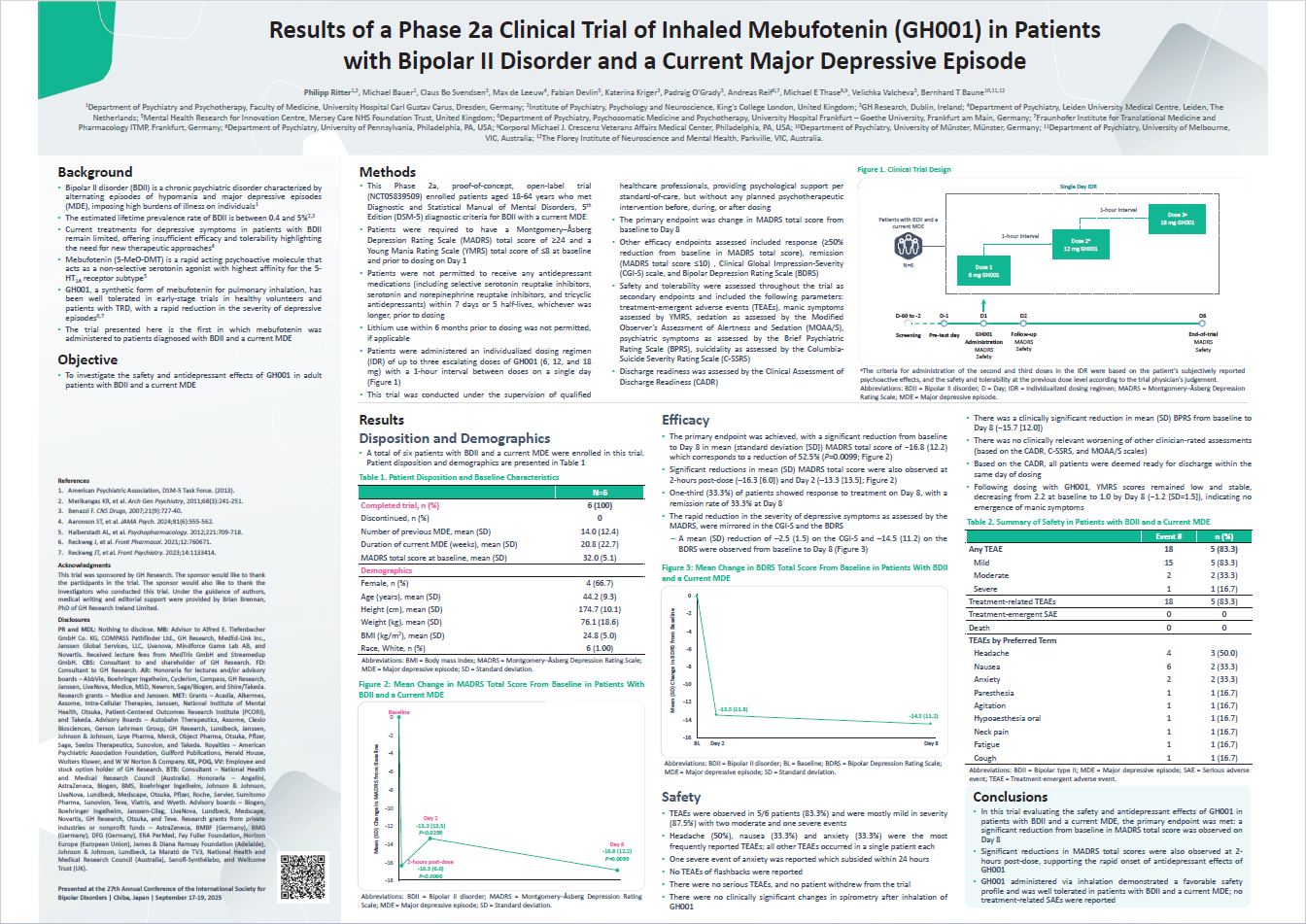
(13.5) P<0.0299 Baseline Efficacy The primary endpoint was achieved, with a significant reduction from baseline to Day 8 in mean (standard deviation [SD]) MADRS total score of −16.8 (12.2) which corresponds to a reduction of 52.5%
(P=0.0099; Figure 2) Significant reductions in mean (SD) MADRS total score were also observed at 2-hours post-dose (–16.3 [6.0]) and Day 2 (–13.3 [13.5]; Figure 2) One-third (33.3%) of patients showed response to treatment on Day 8, with a
remission rate of 33.3% at Day 8 The rapid reduction in the severity of depressive symptoms as assessed by the MADRS, were mirrored in the CGI-S and the BDRS – A mean (SD) reduction of –2.5 (1.5) on the CGI-S and –14.5 (11.2) on the BDRS
were observed from baseline to Day 8 (Figure 3) Results Disposition and Demographics A total of six patients with BDII and a current MDE were enrolled in this trial. Patient disposition and demographics are presented in Table
1 References American Psychiatric Association, DSM-5 Task Force. (2013). Merikangas KR, et al. Arch Gen Psychiatry, 2011;68(3):241-251. Benazzi F. CNS Drugs, 2007;21(9):727-40. Aaronson ST, et al. JAMA Psych.
2024;81(6):555-562. Halberstadt AL, et al. Psychopharmacology. 2012;221:709-718. Reckweg J, et al. Front Pharmacol. 2021;12:760671. Reckweg JT, et al. Front Psychiatry. 2023;14:1133414. Acknowledgments This trial was sponsored by GH
Research. The sponsor would like to thank the participants in the trial. The sponsor would also like to thank the investigators who conducted this trial. Under the guidance of authors, medical writing and editorial support were provided by
Brian Brennan, PhD of GH Research Ireland Limited. Disclosures PR and MDL: Nothing to disclose. MB: Advisor to Alfred E. Tiefenbacher GmbH Co. KG, COMPASS Pathfinder Ltd., GH Research, MedEd-Link Inc., Janssen Global Services, LLC,
Livanova, Mindforce Game Lab AB, and Novartis. Received lecture fees from MedTrix GmbH and Streamedup GmbH. CBS: Consultant to and shareholder of GH Research. FD: Consultant to GH Research. AR: Honoraria for lectures and/or advisory boards –
AbbVie, Boehringer Ingelheim, Cyclerion, Compass, GH Research, Janssen, LivaNova, Medice, MSD, Newron, Sage/Biogen, and Shire/Takeda. Research grants – Medice and Janssen. MET: Grants – Acadia, Alkermes, Axsome, Intra-Cellular Therapies,
Janssen, National Institute of Mental Health, Otsuka, Patient-Centered Outcomes Research Institute (PCORI), and Takeda. Advisory Boards – Autobahn Therapeutics, Axsome, Clexio Biosciences, Gerson Lehrman Group, GH Research, Lundbeck, Janssen,
Johnson & Johnson, Luye Pharma, Merck, Object Pharma, Otsuka, Pfizer, Sage, Seelos Therapeutics, Sunovion, and Takeda. Royalties – American Psychiatric Association Foundation, Guilford Publications, Herald House, Wolters Kluwer, and W W
Norton & Company. KK, POG, VV: Employee and stock option holder of GH Research. BTB: Consultant – National Health and Medical Research Council (Australia). Honoraria – Angelini, AstraZeneca, Biogen, BMS, Boehringer Ingelheim, Johnson
& Johnson, LivaNova, Lundbeck, Medscape, Otsuka, Pfizer, Roche, Servier, Sumitomo Pharma, Sunovion, Teva, Viatris, and Wyeth. Advisory boards – Biogen, Boehringer Ingelheim, Janssen-Cilag, LivaNova, Lundbeck, Medscape, Novartis, GH
Research, Otsuka, and Teva. Research grants from private industries or nonprofit funds – AstraZeneca, BMBF (Germany), BMG (Germany), DFG (Germany), ERA PerMed, Fay Fuller Foundation, Horizon Europe (European Union), James & Diana Ramsay
Foundation (Adelaide), Johnson & Johnson, Lundbeck, La Marató de TV3, National Health and Medical Research Council (Australia), Sanofi-Synthélabo, and Wellcome Trust (UK). Presented at the 27th Annual Conference of the International
Society for Bipolar Disorders | Chiba, Japan | September 17-19, 2025 Background Bipolar II disorder (BDII) is a chronic psychiatric disorder characterized by alternating episodes of hypomania and major depressive episodes (MDE), imposing
high burdens of illness on individuals1 The estimated lifetime prevalence rate of BDII is between 0.4 and 5%2,3 Current treatments for depressive symptoms in patients with BDII remain limited, offering insufficient efficacy and tolerability
highlighting the need for new therapeutic approaches4 Mebufotenin (5-MeO-DMT) is a rapid acting psychoactive molecule that acts as a non-selective serotonin agonist with highest affinity for the 5- HT receptor subtype5 1A GH001, a
synthetic form of mebufotenin for pulmonary inhalation, has been well tolerated in early-stage trials in healthy volunteers and patients with TRD, with a rapid reduction in the severity of depressive episodes6,7 The trial presented here is
the first in which mebufotenin was administered to patients diagnosed with BDII and a current MDE Objective To investigate the safety and antidepressant effects of GH001 in adult patients with BDII and a current MDE Philipp Ritter1,2,
Michael Bauer1, Claus Bo Svendsen3, Max de Leeuw4, Fabian Devlin5, Katerina Kriger3, Padraig O’Grady3, Andreas Reif6,7, Michael E Thase8,9, Velichka Valcheva3, Bernhard T Baune10,11,12 1Department of Psychiatry and Psychotherapy, Faculty of
Medicine, University Hospital Carl Gustav Carus, Dresden, Germany; 2Institute of Psychiatry, Psychology and Neuroscience, King’s College London, United Kingdom; 3GH Research, Dublin, Ireland; 4Department of Psychiatry, Leiden University
Medical Centre, Leiden, The Netherlands; 5Mental Health Research for Innovation Centre, Mersey Care NHS Foundation Trust, United Kingdom; 6Department of Psychiatry, Psychosomatic Medicine and Psychotherapy, University Hospital Frankfurt –
Goethe University, Frankfurt am Main, Germany; 7Fraunhofer Institute for Translational Medicine and Pharmacology ITMP, Frankfurt, Germany; 8Department of Psychiatry, University of Pennsylvania, Philadelphia, PA, USA; 9Corporal Michael J.
Crescenz Veterans Affairs Medical Center, Philadelphia, PA, USA; 10Department of Psychiatry, University of Münster, Münster, Germany; 11Department of Psychiatry, University of Melbourne, VIC, Australia; 12The Florey Institute of Neuroscience
and Mental Health, Parkville, VIC, Australia. This Phase 2a, proof-of-concept, open-label trial (NCT05839509) enrolled patients aged 18-64 years who met Diagnostic and Statistical Manual of Mental Disorders, 5th Edition (DSM-5) diagnostic
criteria for BDII with a current MDE Patients were required to have a Montgomery–Åsberg Depression Rating Scale (MADRS) total score of ≥24 and a Young Mania Rating Scale (YMRS) total score of ≤8 at baseline and prior to dosing on Day
1 Patients were not permitted to receive any antidepressant medications (including selective serotonin reuptake inhibitors, serotonin and norepinephrine reuptake inhibitors, and tricyclic antidepressants) within 7 days or 5 half-lives,
whichever was longer, prior to dosing Lithium use within 6 months prior to dosing was not permitted, if applicable Patients were administered an individualized dosing regimen (IDR) of up to three escalating doses of GH001 (6, 12, and 18 mg)
with a 1-hour interval between doses on a single day (Figure 1) This trial was conducted under the supervision of qualified healthcare professionals, providing psychological support per standard-of-care, but without any planned
psychotherapeutic intervention before, during, or after dosing The primary endpoint was change in MADRS total score from baseline to Day 8 Other efficacy endpoints assessed included response (≥50% reduction from baseline in MADRS total
score), remission (MADRS total score ≤10) , Clinical Global Impression-Severity (CGI-S) scale, and Bipolar Depression Rating Scale (BDRS) Safety and tolerability were assessed throughout the trial as secondary endpoints and included the
following parameters: treatment-emergent adverse events (TEAEs), manic symptoms assessed by YMRS, sedation as assessed by the Modified Observer’s Assessment of Alertness and Sedation (MOAA/S), psychiatric symptoms as assessed by the Brief
Psychiatric Rating Scale (BPRS), suicidality as assessed by the Columbia- Suicide Severity Rating Scale (C-SSRS) Discharge readiness was assessed by the Clinical Assessment of Discharge Readiness (CADR) Figure 1. Clinical Trial Design aThe
criteria for administration of the second and third doses in the IDR were based on the patient’s subjectively reported psychoactive effects, and the safety and tolerability at the previous dose level according to the trial physician’s
judgement. Abbreviations: BDII = Bipolar II disorder; D = Day; IDR = Individualized dosing regimen; MADRS = Montgomery–Åsberg Depression Rating Scale; MDE = Major depressive episode. Single Day IDR Dose 1 6 mg GH001 Dose 2a 12 mg
GH001 Dose 3a 18 mg GH001 1-hour interval 1-hour interval N=6 Patients with BDII and a current MDE Table 1. Patient Disposition and Baseline Characteristics N=6 Completed trial, n (%) 6 (100) Discontinued, n (%) 0 Number of
previous MDE, mean (SD) 14.0 (12.4) Duration of current MDE (weeks), mean (SD) 20.8 (22.7) MADRS total score at baseline, mean (SD) 32.0 (5.1) Demographics Female, n (%) 4 (66.7) Age (years), mean (SD) 44.2 (9.3) Height (cm), mean
(SD) 174.7 (10.1) Weight (kg), mean (SD) 76.1 (18.6) BMI (kg/m2), mean (SD) 24.8 (5.0) Race, White, n (%) 6 (1.00) Abbreviations: BMI = Body mass index; MADRS = Montgomery–Åsberg Depression Rating Scale; MDE = Major depressive
episode; SD = Standard deviation. Abbreviations: BDII = Bipolar II disorder; MADRS = Montgomery–Åsberg Depression Rating Scale; MDE = Major depressive episode; SD = Standard deviation. Figure 2: Mean Change in MADRS Total Score From
Baseline in Patients With BDII and a Current MDE Figure 3: Mean Change in BDRS Total Score From Baseline in Patients With BDII and a Current MDE Abbreviations: BDII = Bipolar II disorder; BL = Baseline; BDRS = Bipolar Depression Rating
Scale; MDE = Major depressive episode; SD = Standard deviation. There was a clinically significant reduction in mean (SD) BPRS from baseline to Day 8 (−15.7 [12.0]) There was no clinically relevant worsening of other clinician-rated
assessments (based on the CADR, C-SSRS, and MOAA/S scales) Based on the CADR, all patients were deemed ready for discharge within the same day of dosing Following dosing with GH001, YMRS scores remained low and stable, decreasing from 2.2
at baseline to 1.0 by Day 8 (−1.2 [SD=1.5]), indicating no emergence of manic symptoms Table 2. Summary of Safety in Patients with BDII and a Current MDE Abbreviations: BDII = Bipolar type II; MDE = Major depressive episode; SAE = Serious
adverse event; TEAE = Treatment-emergent adverse event. Results of a Phase 2a Clinical Trial of Inhaled Mebufotenin (GH001) in Patients with Bipolar II Disorder and a Current Major Depressive Episode Methods Conclusions In this trial
evaluating the safety and antidepressant effects of GH001 in patients with BDII and a current MDE, the primary endpoint was met: a significant reduction from baseline in MADRS total score was observed on Day 8 Significant reductions in MADRS
total scores were also observed at 2- hours post-dose, supporting the rapid onset of antidepressant effects of GH001 GH001 administered via inhalation demonstrated a favorable safety profile and was well tolerated in patients with BDII and a
current MDE; no treatment-related SAEs were reported GH001 Administration MADRS Safety D-1 End-of-trial MADRS Safety Screening Pre-test day D8 D1 D-60 to -2 D2 Follow-up MADRS Safety BL Day 2 Day 8 Mean (SD) Change in BDRS
from Baseline -13.5 (11.8) -14.5 (11.2) 0 -2 -4 -6 -8 -10 -12 -14 -16 Safety TEAEs were observed in 5/6 patients (83.3%) and were mostly mild in severity (87.5%) with two moderate and one severe events Headache (50%), nausea
(33.3%) and anxiety (33.3%) were the most frequently reported TEAEs; all other TEAEs occurred in a single patient each One severe event of anxiety was reported which subsided within 24 hours No TEAEs of flashbacks were reported There were
no serious TEAEs, and no patient withdrew from the trial There were no clinically significant changes in spirometry after inhalation of GH001 Day 8 -16.8 (12.2) P=0.0099 2-hours post-dose -16.3 (6.0) P<0.0006
 エドガーで原本を確認する