 エドガーで原本を確認する
|
Exhibit
|
Description
|
|
|
Press Release
|
|
ioneer Ltd
|
|
|
(registrant)
|
|
|
Date: September 3, 2025
|
By: /s/ Ian Bucknell
|
|
Name: Ian Bucknell
|
|
|
Title: Chief Financial Officer & Company Secretary
|
 |
 |
|
Leach Optimisation and New Mine Plan Yields
Material Improvement in Project Economics
|
||
|
|
||
|
|
● |
38% increase in unlevered life of mine NPV to US$1,888 million
|
|
|
● |
16% increase in unlevered life of mine IRR to 16.8%
|
|
|
● |
20% increase in annual lithium hydroxide production years 3-25 to 25,500 tpa
|
|
|
● |
9% increase in annual boric acid production years 1-25 to 126,700 tpa
|
|
|
● |
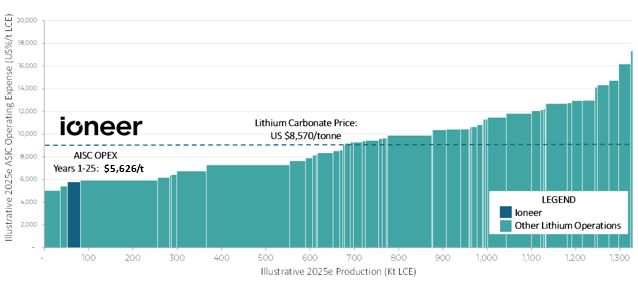
All-in sustaining cash cost of US$5,626 per metric tonne lithium carbonate equivalent
|
|
|
● |
Made possible by reducing vat leach retention time from three days to two days, enabling a reduction in acid consumption per tonne of ore processed and a subsequent 25% increase in the amount of ore processed from 2.4 Mtpa to 3.0
Mtpa using the available surplus acid, far exceeding earlier expectations
|
| ● |
Rhyolite Ridge is the only known lithium deposit globally that is amenable to vat and heap leaching, reflecting its unique mineralogy and allows for on-site production of lithium and
boron high-purity chemicals
|
|
|
|
|
|
|
|
● |
The large Ore Reserve and Mineral Resource supports future expansions to further increase lithium and boron production to supply the rapidly growing US strategic demand for both products
|
|
|
|
|
|
|
● |
Improvements made possible with no increase in project capital costs and no change to process plant design
|
|
|
 |
 |
 |
|
KEY PARAMETERS
|
UNIT
|
YEARS 1-25
AVERAGE
|
LOM
AVERAGE
|
|
|
PHYSICALS
|
||||
|
Ore processing rate
|
Mtpa
|
3.0
|
3.2
|
|
|
Total tonnes processed
|
Mt
|
75.2
|
260.3
|
|
|
Lithium carbonate grade (equivalent)
|
%
|
0.94
|
0.78
|
|
|
Boric acid grade (equivalent)
|
%
|
5.48
|
3.04
|
|
|
Recoveries – Lithium carbonate
|
%
|
83.5
|
81.6
|
|
|
Recoveries – Lithium hydroxide (year three and beyond)
|
%
|
96.0
|
96.0
|
|
|
Recoveries – Boric acid
|
%
|
76.1
|
65.9
|
|
|
Lithium carbonate equivalent (LCE) production1
|
tpa
|
~22,400
|
~19,300
|
|
|
Lithium hydroxide (year three and beyond) production
|
tpa
|
~25,500
|
~21,900
|
|
|
Boric acid production
|
tpa
|
~126,700
|
~68,000
|
|
|
OPERATING AND CAPITAL COSTS
|
||||
|
LCE All-in Sustaining Cost (AISC) (net of boric acid credit)
|
US$/t LCE
|
5,626
|
7,165
|
|
|
LCE direct cost (C1) (net of boric acid credit)
|
US$/t LCE
|
3,554
|
5,636
|
|
|
Mining cost per ore tonne (inclusive of waste)
|
US$/t
|
21.0
|
10.1
|
|
|
|
Processing cost per ore tonne
|
US$/t
|
61.9
|
53.3
|
|
|
Mining cost per total tonnes (ore and waste)
|
US$/t
|
2.33
|
2.28
|
|
KEY PARAMETERS
|
UNIT
|
YEARS 1-25
AVERAGE
|
LOM
AVERAGE
|
|
|
PRICING ASSUMPTIONS
|
||||
|
Lithium hydroxide index price2
|
US$/t
|
23,040
|
23,012
|
|
|
Boric acid price3
|
US$/t
|
1,296
|
1,368
|
|
|
FINANCIAL PERFORMANCE
|
||||
|
Annual revenue
|
US$Mpa
|
724.8
|
575.4
|
|
|
Annual revenue – Lithium
|
US$Mpa
|
555.1
|
482.7
|
|
|
Annual revenue – Boric acid
|
US$Mpa
|
169.6
|
92.7
|
|
|
Annual EBITDA
|
US$Mpa
|
497.2
|
383.8
|
|
|
Annual EBITDA margin
|
%
|
68.6
|
66.7
|
|
|
After-tax unlevered NPV @ 8% real discount rate
|
US$M
|
1,444.9
|
1,887.8
|
|
|
After-tax Internal unlevered Rate of Return (IRR)
|
%
|
16.4
|
16.8
|
|
|
After-tax levered NPV @ 8% real discount rate
|
US$M
|
1,998.1
|
||
|
After-tax levered Internal Rate of Return (IRR)
|
%
|
20.9
|
||
|
Payback period (from start of operations)
|
years
|
7.0
|
|
KEY PARAMETERS
|
UNIT
|
YEARS 1-25
TOTAL
|
LOM
TOTAL
|
|
|
CAPITALIZED EXPENDITURE
|
||||
|
Initial capital expenditure (including contingencies)
|
US$M
|
1,667.9
|
||
|
Sustaining capital expenditure
|
US$M
|
1,033.2
|
2,242.0
|
|
|
Capitalized deferred pre-stripping costs4
|
US$M
|
546.9
|
798.3
|
|
|
|
|
|
|
• |
Lithium Carbonate (Technical Grade), available from start-up and reprocessed into lithium hydroxide monohydrate from year 3,
|
|
|
• |
Lithium Hydroxide Monohydrate (Battery Grade) from year 3, and
|
|
|
• |
Boric Acid (technical grade), available from start-up.
|
|
|
|
|
|
|
KEY HIGHLIGHTS
|
||
|
|
|
● |
Fully permitted and engineering ready
|
|
|
|
● |
Water rights fully secured
|
|
|
|||
|
|
|
● |
Closed DOE LPO loan for US$996 million (including capitalised interest during construction of US$28 million5).
DOE LPO loan has conditions to first draw
|
|
|
|||
|
|
|
● |
Robust, strategic partner process launched with Goldman Sachs in late June
|
|
|
|||
|
|
|
● |
Compelling Project Economics for Stage One of Project
|
|
|
|||
|
|
|
● |
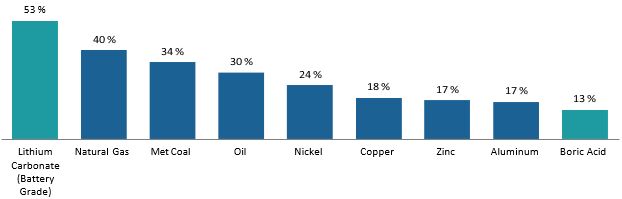
All-in Sustaining Cash Cost in the lowest quartile of the Global Cost Curve
|
| |
|||
|
|
|
● |
Well Defined and Reliable Operating Cost and Capital Cost Estimates (AACE Class 2)
|
|
|
|||
|
|
|
● |
Long-Life Resource with Optimisation Upside and Verified Expansion Potential
|
|
|
|||
|
|
|
● |
US Advantage and Low-Risk, Mining-Friendly Jurisdiction
|
|
|
|
|
|
Processing
Stream
|
Group
|
Classification
|
Tonnes
(M)
|
Li
(ppm)
|
B
(ppm)
|
Li2CO3
(wt. %)
|
H3BO3
(wt. %)
|
Li2CO3
(kt)
|
H3BO3
(kt)
|
||
|
Combined
Streams
|
August 2025
Resource
|
Mea + Ind
|
434.3
|
1,437
|
5,092
|
0.76
|
2.91
|
3,321
|
12,645
|
||
|
Inf
|
105.1
|
1,332
|
3,472
|
0.71
|
1.99
|
745
|
2,088
|
||||
|
Total
|
539.5
|
1,417
|
4,776
|
0.75
|
2.73
|
4,067
|
14,733
|
||||
|
February
2025
Resource
|
Mea + Ind
|
413.8
|
1,479
|
5.321
|
0.79
|
3.04
|
3,257
|
12,591
|
|||
|
Inf
|
96.6
|
1,387
|
3,745
|
0.74
|
2.14
|
713
|
2,069
|
||||
|
Total
|
510.4
|
1,462
|
5,023
|
0.78
|
2.87
|
3,970
|
14,659
|
||||
|
Variation
|
Mea + Ind
|
20.5
|
64.6
|
54.7
|
|||||||
|
Inf
|
8.6
|
32.3
|
19.0
|
||||||||
|
Total
|
29.1
|
97.0
|
73.7
|
|
Group
|
Classification
|
Tonnes
(Mt)
|
Li
(ppm)
|
B
(ppm)
|
Li2CO3
(wt. %)
|
H3BO3
(wt. %)
|
Li2CO3
(kt)
|
H3BO3
(kt)
|
|
|
August 2025
Reserve
|
Proved
|
89.5
|
1,574
|
6,589
|
0.84
|
3.77
|
750
|
3,373
|
|
|
Probable
|
170.8
|
1,386
|
4,473
|
0.74
|
2.56
|
1,260
|
4,369
|
||
|
Total
|
260.3
|
1,451
|
5,201
|
0.77
|
2.97
|
2,010
|
7,742
|
||
|
May 2025
Reserve
|
Proved
|
85.7
|
1,572
|
6,814
|
0.84
|
3.90
|
717
|
3,341
|
|
|
Probable
|
160.9
|
1,407
|
4,715
|
0.75
|
2.70
|
1,205
|
4,337
|
||
|
Total
|
246.6
|
1,464
|
5,444
|
0.78
|
3.11
|
1,922
|
7,678
|
||
|
Variation
|
Proved
|
3.8
|
2
|
-225
|
33
|
32
|
|||
|
Probable
|
9.9
|
-21
|
-242
|
55
|
32
|
||||
|
Total
|
13.7
|
-13
|
-243
|
88
|
-64
|
|
|
• |
Secure equity financing to sit alongside U.S. Government debt ($996 million)7
|
|
|
• |
Final Investment Decision once equity and debt are in place
|
|
|
• |
Construction Phase. Expected to take approximately 36 months (including procurement of long lead items)
|
|
|
|
|
• |
First Production – 36 months from FID1
|
|
|
• |
Pathway to future growth
|
|
Chad Yeftich
Ioneer USA Corporation
Investor Relations (USA)
T: +1 775 993 8563
E: ir@ioneer.com
|
Ian Bucknell
Ioneer Limited
Investor Relations (AUS)
T: +61 434 567 155
E: ibucknell@ioneer.com
|
|
Daniel Francis, FGS Global
E: daniel.francis@fgsglobal.com
|
|
|
|
|
|
|
|
June 2025
3-day leach
|
August 2025
2-day leach
|
|
|
$1,367 million
|
Unlevered NPV8
|
$1,888 million
|
|
|
|
|
|
|
|
|
|
$497 million
|
Avg. LOM Annual Revenue
|
$575 million
|
|
|
|
|
|
|
|
|
|
17,200 tpa
|
Avg. LOM Annual LCE
Production
|
19,300 tpa
|
|
|
|
|
|
|
|
|
|
60,400 tpa
|
Avg. LOM Annual Boric Acid
Production
|
68,000 tpa
|
|
|
|
|
|
|
|
|
|
246.6 Mt
|
Ore Processed
|
260.3 Mt
|
|
|
|
|
|
|
|
|
|
95 years
|
Life of Project
|
82 years
|
|
|
|
|
|
|
|
|
|
$319 million
|
Average Annual EBITDA
|
$384 million
|
|
|
|
|
|
|
|
|
|
$1,667.9 million
AACE Class 2 estimate
|
Capital Costs
|
$1,667.9 million
AACE Class 2 estimate
|
|
|
|
|
|
|
|
|
|
$1,830 million
|
Sustaining Capex
|
$2,242 million
|
|
|
|
|
|
|
|
|
|
14.5%
|
Unlevered IRR
|
16.8%
|
|
|
|
|
|
|
|
|
|
8.0 years
(from operations)
|
Payback Period
|
7.0 years
(from operations)
|
|
|
|
|
|
|
|
|
|
P65
|
Confidence Level
|
P65
|
|
|
|
|
|
|
|
Stream
|
Group
|
Classification
|
Tonnage
(ktonnes)
|
Li
ppm
|
B
ppm
|
Li2CO3
Wt. %
|
H3BO3
Wt. %
|
Contained
|
|
|
Li2CO3
(ktonnes)
|
H3BO3
(ktonnes)
|
||||||||
|
Stream 1
(>=5,000 ppm B)
|
Upper
Zone
M5 Unit
|
Measured
|
4,562
|
2,350
|
7,592
|
1.25
|
4.34
|
57
|
198
|
|
Indicated
|
4,224
|
2,231
|
7,450
|
1.19
|
4.26
|
50
|
180
|
||
|
Inferred
|
763
|
2,197
|
6,515
|
1.17
|
3.73
|
9
|
28
|
||
|
Total
|
9,549
|
2,285
|
7,443
|
1.22
|
4.26
|
116
|
406
|
||
|
Upper
Zone
B5 Unit
|
Measured
|
38,404
|
1,891
|
15,282
|
1.01
|
8.74
|
386
|
3,356
|
|
|
Indicated
|
38,670
|
1,743
|
13,996
|
0.93
|
8.00
|
359
|
3,095
|
||
|
Inferred
|
10,628
|
1,712
|
10,563
|
0.91
|
6.04
|
97
|
642
|
||
|
Total
|
87,702
|
1,804
|
14,143
|
0.96
|
8.09
|
842
|
7,092
|
||
|
Upper
Zone
S5 Unit
|
Measured
|
3,693
|
1,419
|
7,641
|
0.75
|
4.37
|
28
|
161
|
|
|
Indicated
|
4,747
|
1,285
|
7,415
|
0.68
|
4.24
|
32
|
201
|
||
|
Inferred
|
1,572
|
1,400
|
6,469
|
0.75
|
3.70
|
12
|
58
|
||
|
Total
|
10,013
|
1,352
|
7,350
|
0.72
|
4.20
|
72
|
421
|
||
|
Upper
Zone
Total
|
Measured
|
46,660
|
1,899
|
13,926
|
1.01
|
7.96
|
471
|
3,715
|
|
|
Indicated
|
47,641
|
1,741
|
12,760
|
0.93
|
7.30
|
441
|
3,476
|
||
|
Inferred
|
12,963
|
1,703
|
9,828
|
0.91
|
5.62
|
117
|
728
|
||
|
Total
|
107,264
|
1,805
|
12,913
|
0.96
|
7.38
|
1,030
|
7,920
|
||
|
Lower
Zone L6
Unit
|
Measured
|
17,726
|
1,366
|
9,361
|
0.73
|
5.35
|
129
|
949
|
|
|
Indicated
|
39,731
|
1,324
|
9,507
|
0.70
|
5.44
|
280
|
2,160
|
||
|
Inferred
|
13,914
|
1,415
|
12,287
|
0.75
|
7.03
|
105
|
978
|
||
|
Total
|
71,370
|
1,352
|
10,012
|
0.72
|
5.73
|
514
|
4,086
|
||
|
Total
Stream 1
(all zones)
|
Measured
|
64,385
|
1,752
|
12,669
|
0.93
|
7.24
|
600
|
4,664
|
|
|
Indicated
|
87,372
|
1,551
|
11,280
|
0.83
|
6.45
|
721
|
5,636
|
||
|
Inferred
|
26,877
|
1,554
|
11,101
|
0.83
|
6.35
|
222
|
1,706
|
||
|
Total
|
178,634
|
1,624
|
11,754
|
0.86
|
6.72
|
1,544
|
12,006
|
||
|
Stream 2
($11.13/tonne
net value cut- off
grade, Low
Clay)
|
Upper
Zone
B5 Unit
|
Measured
|
4,966
|
2,228
|
2,212
|
1.19
|
1.26
|
59
|
63
|
|
Indicated
|
4,746
|
2,116
|
2,511
|
1.13
|
1.44
|
53
|
68
|
||
|
Inferred
|
3,696
|
1,694
|
1,774
|
0.90
|
1.01
|
33
|
37
|
||
|
Total
|
13,408
|
2,041
|
2,197
|
1.09
|
1.26
|
146
|
168
|
||
|
Upper
Zone
S5 Unit
|
Measured
|
24,405
|
1,012
|
1,164
|
0.54
|
0.67
|
131
|
162
|
|
|
Indicated
|
35,477
|
867
|
1,014
|
0.46
|
0.58
|
164
|
206
|
||
|
Inferred
|
15,491
|
889
|
1,014
|
0.47
|
0.58
|
73
|
90
|
||
|
Total
|
75,373
|
918
|
1,063
|
0.49
|
0.61
|
368
|
458
|
||
|
Upper
Zone
|
Measured
|
29,371
|
1,218
|
1,341
|
0.65
|
0.77
|
190
|
225
|
|
|
Indicated
|
40,223
|
1,014
|
1,191
|
0.54
|
0.68
|
217
|
274
|
||
|
Total
|
Inferred
|
19,187
|
1,044
|
1,160
|
0.56
|
0.66
|
107
|
127
|
|
|
Total
|
88,782
|
1,088
|
1,234
|
0.58
|
0.71
|
514
|
626
|
||
|
Lower
Zone
L6 Unit
|
Measured
|
43,979
|
1,211
|
1,582
|
0.64
|
0.90
|
283
|
398
|
|
|
Indicated
|
120,143
|
1,180
|
1,573
|
0.63
|
0.90
|
754
|
1,081
|
||
|
Inferred
|
47,474
|
1,244
|
790
|
0.66
|
0.45
|
314
|
214
|
||
|
Total
|
211,597
|
1,201
|
1,399
|
0.64
|
0.80
|
1,352
|
1,693
|
||
|
Total
Stream 2
(all zones)
|
Measured
|
73,350
|
1,214
|
1,486
|
0.65
|
0.85
|
474
|
623
|
|
|
Indicated
|
160,367
|
1,138
|
1,477
|
0.61
|
0.84
|
972
|
1,354
|
||
|
Inferred
|
66,662
|
1,186
|
897
|
0.63
|
0.51
|
421
|
342
|
||
|
Total
|
300,378
|
1,167
|
1,350
|
0.62
|
0.77
|
1,866
|
2,319
|
||
|
Stream
3($11.13/tonne net
value cut-off
|
Total
Stream 3
(M5 zone)
|
Measured
|
19,223
|
2,201
|
1,550
|
1.17
|
0.89
|
225
|
170
|
|
Indicated
|
29,615
|
2,089
|
1,168
|
1.11
|
0.67
|
329
|
198
|
||
|
Inferred
|
11,608
|
1,654
|
601
|
0.88
|
0.34
|
102
|
40
|
||
|
Total
|
60,446
|
2,041
|
1,181
|
1.09
|
0.68
|
657
|
408
|
||
|
Grand Total All Streams
and All Units
|
Measured
|
156,958
|
1,555
|
6,081
|
0.83
|
3.48
|
1,299
|
5,458
|
|
|
Indicated
|
277,354
|
1,370
|
4,532
|
0.73
|
2.59
|
2,022
|
7,188
|
||
|
Inferred
|
105,147
|
1,332
|
3,472
|
0.71
|
1.99
|
745
|
2,088
|
||
|
Total
|
539,458
|
1,417
|
4,776
|
0.75
|
2.73
|
4,067
|
14,733
|
||
|
|
7. |
The mineral resource is reported inclusive of the mineral reserves.
|
|
Processing
Stream
|
Group
|
Classification
|
Tonnes
(M)
|
Li
(ppm)
|
B
(ppm)
|
Li2CO3
(wt. %)
|
H3BO3
(wt. %)
|
Li2CO3
(kt)
|
H3BO3
(kt)
|
|
Combined
Streams
|
August 2025
Resource
|
Mea + Ind
|
434.3
|
1,437
|
5,092
|
0.76
|
2.91
|
3,321
|
12,645
|
|
Inf
|
105.1
|
1,332
|
3,472
|
0.71
|
1.99
|
745
|
2,088
|
||
|
Total
|
539.5
|
1,417
|
4,776
|
0.75
|
2.73
|
4,067
|
14,733
|
||
|
February 2025
Resource
|
Mea + Ind
|
413.8
|
1,479
|
5.321
|
0.79
|
3.04
|
3,257
|
12,591
|
|
|
Inf
|
96.6
|
1,387
|
3,745
|
0.74
|
2.14
|
713
|
2,069
|
||
|
Total
|
510.4
|
1,462
|
5,023
|
0.78
|
2.87
|
3,970
|
14,659
|
||
|
Variation
|
Mea + Ind
|
20.5
|
64.6
|
54.7
|
|||||
|
Inf
|
8.6
|
32.3
|
19.0
|
||||||
|
Total
|
29.1
|
97.0
|
73.7
|
|
|
• |
Reduced leach retention time is reduced from three days to two days;
|
|
|
• |
The reduction in retention time reduced the recovery of lithium and boron in the B5, S5 and L6 seams, the predominate impact is to Stream 2;
|
|
|
• |
The reduction in retention time also reduced the acid consumption of the gangue minerals in the B5, S5 and L6 seams for both Streams 1 and 2;
|
|
|
• |
The definition of the resource pit shell includes a G&A cost of $US 11.13/tonne down from $16.54/tonne in the August 2025 estimate, and:
|
|
|
• |
Decreased the net value cutoff for Streams 2 and 3 from $16.54 per tonne to $11.13 per tonne.
|
|
|
• |
The Rhyolite Ridge Mineral Resource area extends over a north-south strike length of 4,240 m (from 4,337,540 mN – 4,341,780mN), has a maximum width of 2,110m (863,330 mE – 865,440 mE) and includes the 585 m vertical interval from
2,065mRL to 1,480 mRL.
|
|
|
• |
The Rhyolite Ridge Project tenements (unpatented mining claims) are owned by Ioneer Minerals Corporation, a company wholly owned by Ioneer Ltd. The unpatented mining claims are located on US federal land administered by the Bureau
of Land Management (BLM).
|
|
|
• |
Lithium and boron mineralisation is stratiform in nature and is hosted within Late Miocene-age carbonate-rich sedimentary rock, deposited in a lacustrine environment in the Basin and Range terrain of Nevada, USA.
|
|
|
• |
Drill holes used in the Mineral Resource estimate included 50 reverse circulation (RC) holes and 110 core holes for a total of 32,530m within the defined mineralisation. The full database for
the South Basin contains records for 166 drill holes for 33,519m of drilling.
|
|
|
• |
Drill hole spacing is 100m by 100m (or less) over most of the deposit.
|
|
|
• |
Drill holes were logged for a combination of geological and geotechnical attributes. The core has been photographed and measured for RQD and core recovery.
|
|
|
• |
Drilling was conducted by American Lithium Minerals Inc., the previous owner of the property between 2010 and 2011 and by Ioneer in 2017 to 2019 and 2022 to 2024. For RC drilling, a 12.7-centimetre (cm) hammer was used with sampling conducted on 1.52m intervals and split using a rig mounted rotary splitter. The hammer was replaced with a tri-cone bit in instances of high groundwater flow. For
diamond core, PQ and HQ core size diameter with standard tube was used. Core recoveries of 93% were achieved by Ioneer at the project. The core was sampled as half core at 1.52m intervals using a standard electric core saw.
|
|
|
• |
Samples were submitted to ALS Minerals Laboratory in Reno, Nevada for sample preparation and analysis. The entire sample was oven dried at 105˚C and crushed to -2 millimetre (mm). A
sub-sample of the crushed material was then pulverised to better than 85% passing -75 microns (µm) using a LM5 pulveriser. The pulverised sample was split with multiple feed in a Jones riffle
splitter until a 100-200 gram (g) sub-sample was obtained for analysis.
|
|
|
• |
Analysis of the samples was conducted using aqua regia 2-acid for ICP-MS on a multi-element suite. This method is appropriate for understanding sedimentary lithium deposits and is a total method.
|
|
|
• |
Standards for lithium and boron and blanks were routinely inserted into sample batches and acceptable levels of accuracy were reportedly obtained. Based on an evaluation of the quality assurance and quality control (QA/QC) results all assay data has been deemed by the IMC Competent Person as suitable and fit for purpose in Mineral Resource estimation.
|
|
|
• |
The Mineral Resource estimate presented in this Report has been constrained by the application of an optimized Mineral Resource pit shell. The Mineral Resource pit shell was developed using the Independent Mining Consultants,
Inc. (IMC) Mine Planning software.
|
|
|
• |
The Mineral Resource estimate assumes the use of three processing streams: one which can process ore with boron content greater than 5,000 ppm and two which can process ore with boron content less than 5,000 ppm.
|
|
|
• |
The Mineral Resource estimate has been constrained by applying a 5,000 ppm Boron cut-off grade to HiB-Li mineralisation within the B5, M5, S5 and L6 geological units as well as a $11.13/tonne net value cut-off grade to LoB-Li
mineralisation in the M5, B5, S5 and L6 geological units.
|
|
|
• |
Key input parameters and assumptions for the Mineral Resource pit shell included the following:
|
|
|
• |
B cut-off grade of 5,000 ppm for HiB-Li processing stream and no B cut-off grade for LoB-Li processing stream
|
|
|
• |
No Li cut-off grade for HiB-Li processing stream and net value cutoff of $11.13/tonne for LoB- Li processing stream
|
|
|
• |
Overall pit slope angle of 42 degrees in all rock units (wall angle guidance provided by Geo- Logic Associates who developed the geotechnical design)
|
|
|
• |
Fixed mining cost of US$1.69 /tonne and a variable incremental mining cost of $0.005/tonne per vertical meter from reference elevation of 6,210 ft amsl
|
|
|
• |
G&A cost of US$11.13/tonne processed
|
|
|
• |
Ore processing and grade control costs include a fixed cost per tonne and a variable cost of acid based on the acid consumption rate which is calculated for each block within the mineralized seams. For Stream 1 the total
(combined fixed and acid) cost is between $34.18/mt and $92.84/mt. For Stream 2, the combined cost ranges between $18.87/mt to $78.57/mt and for Stream 3 costs ranged between $45.99/mt and $98.63/mt This wide range is explained by
the variability in acid consumption for each of these streams, mostly due to the variability in calcium grade.
|
|
|
• |
Boron and Lithium recovery are variable by lithology for Stream 1 and are respectively for boron and lithium: M5 80.2% and 85.7%, B5 78.3% and 85.2%, S5 77.0% and 82.5%, L6 75.8% and 79.4%.
|
|
|
• |
Boron Recovery for Stream 2 and 3 are variable by lithology as follows: 65% in M5 Unit, 78.3% in B5 unit, 46.8% in S5 unit, and 32.9% in L6 unit
|
|
|
• |
Lithium Recovery for Stream 2 and 3 are variable by lithology as follows: 78% in M5 unit, 85.2% in B5 unit, 84.8% in S5 unit, and 78.7% in L6 unit
|
|
|
• |
Boric Acid sales price of US$1,172.78/tonne
|
|
|
• |
Lithium Carbonate sales price of US$19,351.38/tonne
|
|
|
• |
Sales/Transport costs are included in the G&A cost
|
|
|
• |
Drill core samples were assayed on nominal 1.52 m lengths and this data set was composited to 1.52m lengths which respected seam contacts and was used for the interpolation of grade data into a 1.52m bench height block model.
The data set honoured geological contacts (i.e. assay intervals did not span unit contacts).
|
|
|
• |
Based on a statistical analysis, extreme B grade values were identified in some of the units other than the targeted G5, B5, M5, S5, G6, L6 and Lsi units. The units other than these units were not
estimated so no grade capping was applied to the drill hole database. The units B5, M5, S5 and L6 are the units of economic interest and the grades in these units and the adjacent units were estimated for completeness when
re-blocking to a 9.14m bench height block model used to tabulate the mineral resource.
|
|
|
• |
The geological model was developed as a gridded surface stratigraphic model with fault domains included which offset the stratigraphic units in various areas of the deposit. The geological model was
developed by GSI under direction of Ioneer and provided to IMC as the geologic basis for grade estimation. IMC has reviewed the geological model and accepts the interpretation.
|
|
|
• |
Domaining in the model was constrained by the roof and floor surfaces of the geological units. The unit boundaries were modelled as hard boundaries, with samples interpolated only within the unit in which they occurred.
|
|
|
• |
The geological model used as the basis for estimating Mineral Resources was developed as a stratigraphic gridded surface model using a 7.6m regularized grid in plan. The grade block model was developed using a 7.6m north-south
by 7.6m east-west by 1.52m vertical block dimension (no sub- blocking was applied). The grid cell and block size dimensions represent 25 percent of the nominal drill hole spacing across the model area. The model was reblocked to
9.14 m high blocks (six 1.52m blocks combined vertically) for assigning the economic attributes and tabulating the mineral resource.
|
|
|
• |
Inverse Distance Squared (‘ID2’) grade interpolation was used for the estimate, constrained by stratigraphic unit roof and floor surfaces from the
geological model. The search direction for estimating grade varied and followed the floor orientation of the seams which changed within the fault block domains. The search distances ranged from 533 m in B5 to 229 m in S5. The
number of drill hole composites used to estimate the grades of a model block ranges from a minimum of two composites to a maximum of 10 composites, with no more than 3 composites from one drill hole.
|
|
|
• |
The density values used to convert volumes to tonnages were assigned on a by-geological unit basis using mean values calculated from 120 density samples collected from drill core during the 2018 and more recent 2022-2023 P1 and
P2 drilling programs. The density values by seam ranged from 1.53 grams per cubic centimeter (‘g/cm3’) for S3 to 1.98/cm3 in seam L6. The density analyses performed by geotechnical consultants present during both the 2018 and 2022-2023 drilling programs (P1 and P2) followed a strict repeatable
process in sample collection and analysis utilizing the Archimedes-principle (water displacement) method for density determination, with values reported in dry basis. This provided consistent representative data. The 2018 and
2022-2023 data aligned well and proved to be representative across the resource.
|
|
|
• |
Estimated Mineral Resources were classified as follows:
|
|
|
• |
Measured: Between 107 and 122m spacing between points of observation depending on the seam, with sample interpolation from a minimum of four drill holes.
|
|
|
• |
Indicated: Between 168 and 244m spacing between points of observation depending on the seam, with sample interpolation from a minimum of two drill holes.
|
|
|
• |
Inferred: To the limit of the estimation range (maximum 533m, depending on the seam), with sample interpolation from a minimum of one drill hole (2 composites).
|
|
|
• |
The Mineral Resource classification included the consideration of data reliability, spatial distribution and abundance of data and continuity of geology, fault structures and grade parameters.
|
|
|
• |
The Mineral Resource estimate presented in this Report was developed with the assumption that the HiB-Li mineralisation within the Mineral Resource pit shell has a reasonable prospect for eventual
economic extraction using current conventional open pit mining methods.
|
|
|
• |
The basis of the mining assumptions made in establishing the reasonable prospects for eventual economic extraction of the HiB-Li mineralisation are based on preliminary results from mine design and
planning work that is in-progress as part of an ongoing update to the Feasibility Study for the Project based on new information.
|
|
|
• |
The basis of the metallurgical assumptions made in establishing the reasonable prospects for eventual economic extraction of the HiB-Li (Stream 1) mineralisation are based on results from
metallurgical and material processing work that was developed as part of the ongoing Feasibility Study for the Project. This test work was performed using current processing and recovery methods for producing Boric acid and
Lithium carbonate products.
|
|
|
• |
A second process stream (Stream 2) to recover Li from low boron mineralized- low clay (LoB-Li) units has been confirmed. Current results indicate a reasonable process and expectation for economic
extraction of the LoB-Li from the S5, B5 and L6 units. This test work was performed using current processing and recovery methods for producing Boric acid and Lithium carbonate products.
|
|
|
• |
A third process stream (Stream 3) to recover Li from low boron high clay mineralized (LoB-Li) units has been confirmed. Current results indicate a reasonable process and expectation for economic
extraction of the LoB-Li from M5 unit. This test work was performed using current processing and recovery methods for producing Boric acid and Lithium carbonate products.
|
|
Area
|
Group
|
Classification
|
Metric
|
Lithium
|
Boron
|
Contained
Equivalent
Grade2
|
Contained6
Equivalent2
Tonnes
|
Recovered6
Equivalent2
Tonnes |
|||||
|
Tonnes2
|
Grade7
|
Grade7
|
|||||||||||
|
Li
|
B
|
Li2CO3
|
H3BO3
|
Li2CO3
|
H3BO3
|
Li2CO3
|
H3BO3
|
||||||
|
(ktonnes)
|
(ppm)
|
(ppm)
|
(Wt.
%)
|
(Wt.
%)
|
(kt)
|
(kt)
|
(kt)
|
(kt)
|
|||||
|
Stream 1
(>= 5,000 ppm B)
|
Upper
Zone
|
Proven
|
3,489
|
2,401
|
7,652
|
1.28
|
4.38
|
45
|
153
|
38
|
122
|
||
|
M5 Unit
|
Probable
|
3,410
|
2,262
|
7,430
|
1.20
|
4.25
|
41
|
145
|
35
|
116
|
|||
|
Sub-total B5
Unit
|
6,899
|
2,332
|
7,542
|
1.24
|
4.31
|
86
|
298
|
73
|
239
|
||||
|
Upper
Zone
|
Proven
|
27,991
|
1,880
|
15,364
|
1.00
|
8.79
|
280
|
2,459
|
239
|
1,925
|
|||
|
B5 Unit
|
Probable
|
31,456
|
1,742
|
14,169
|
0.93
|
8.10
|
292
|
2,549
|
248
|
1,995
|
|||
|
Sub-total M5
Unit
|
59,447
|
1,807
|
14,732
|
0.96
|
8.42
|
572
|
5,008
|
487
|
3,921
|
||||
|
Upper
Zone
|
Proven
|
2,237
|
1,326
|
7,754
|
0.71
|
4.43
|
16
|
99
|
13
|
76
|
|||
|
S5 Unit
|
Probable
|
3,355
|
1,166
|
7,533
|
0.62
|
4.31
|
21
|
145
|
17
|
111
|
|||
|
Sub-total S5
Unit
|
5,592
|
1,230
|
7,621
|
0.65
|
4.36
|
37
|
244
|
30
|
187
|
||||
|
Upper
Zone
|
Proven
|
33,717
|
1,897
|
14,061
|
1.01
|
8.04
|
340
|
2,711
|
290
|
2,124
|
|||
|
(B5, M5
& S5)
|
Probable
|
38,221
|
1,738
|
12,985
|
0.92
|
7.42
|
353
|
2,838
|
301
|
2,223
|
|||
|
Sub-
Total
|
Sub-
total Upper
Zone
|
71,938
|
1,813
|
13,489
|
0.96
|
7.71
|
694
|
5,549
|
591
|
4,347
|
|||
|
Lower
Zone
|
Proven
|
5,712
|
1,389
|
8,357
|
0.74
|
4.78
|
42
|
273
|
34
|
207
|
|||
|
L6 Unit
|
Probable
|
13,592
|
1,334
|
7,856
|
0.71
|
4.49
|
96
|
611
|
77
|
463
|
|||
|
Sub-
total Lower
Zone
|
19,303
|
1,350
|
8,004
|
0.72
|
4.58
|
139
|
883
|
110
|
670
|
||||
|
Total
Stream 1
(all zones)
|
Proven
|
39,428
|
1,824
|
13,235
|
0.97
|
7.57
|
383
|
2,984
|
323
|
2,331
|
|||
|
Probable
|
51,813
|
1,632
|
11,640
|
0.87
|
6.66
|
450
|
3,448
|
377
|
2,686
|
||||
|
Sub-
total Stream
1
|
91,241
|
1,715
|
12,329
|
0.91
|
7.05
|
833
|
6,432
|
700
|
5,017
|
||||
|
Stream 2
($16.54/tonne net
value cut-off grade,
Low Clay)
|
Upper Zone
|
Proven
|
4,528
|
2,219
|
2,143
|
1.18
|
1.23
|
53
|
55
|
46
|
43
|
||
|
B5 Unit
|
Probable
|
4,384
|
2,118
|
2,415
|
1.13
|
1.38
|
49
|
61
|
42
|
47
|
|||
|
Sub-
total B5 Unit
|
8,912
|
2,169
|
2,277
|
1.15
|
1.30
|
103
|
116
|
88
|
91
|
||||
|
Upper
Zone
|
Proven
|
15,005
|
1,022
|
1,125
|
0.54
|
0.64
|
82
|
97
|
69
|
45
|
|||
|
S5 Unit
|
Probable
|
27,495
|
825
|
866
|
0.44
|
0.50
|
121
|
136
|
102
|
64
|
|||
|
Sub-
total S5 Unit
|
42,500
|
895
|
957
|
0.48
|
0.55
|
202
|
233
|
172
|
109
|
||||
|
Upper
Zone
|
Proven
|
19,533
|
1,299
|
1,361
|
0.69
|
0.78
|
135
|
152
|
115
|
89
|
|||
|
(B5 & S5)
|
Probable
|
31,880
|
1,003
|
1,079
|
0.53
|
0.62
|
170
|
197
|
144
|
111
|
|||
|
Sub- Total
|
Sub- total Upper
Zone
|
51,413
|
1,116
|
1,186
|
0.59
|
0.68
|
305
|
349
|
259
|
200
|
|||
|
Lower
Zone
|
Proven
|
24,936
|
1,254
|
1,279
|
0.67
|
0.73
|
166
|
182
|
131
|
60
|
|||
|
L6 Unit
|
Probable
|
68,952
|
1,196
|
1,535
|
0.64
|
0.88
|
439
|
605
|
345
|
199
|
|||
|
Sub- total Lower
Zone
|
93,888
|
1,211
|
1,467
|
0.64
|
0.84
|
605
|
788
|
476
|
259
|
||||
|
Total Stream 2 (all zones)
|
Proven
|
44,469
|
1,274
|
1,315
|
0.68
|
0.75
|
302
|
334
|
246
|
149
|
|||
|
Probable
|
100,832
|
1,135
|
1,391
|
0.60
|
0.80
|
609
|
802
|
490
|
310
|
||||
|
Sub-
total Stream
2
|
145,301
|
1,177
|
1,368
|
0.63
|
0.78
|
911
|
1,136
|
736
|
459
|
||||
|
Stream 3
($16.54/tonne
net value cut-
off
grade, High
Clay)
|
Total Stream 3 (M5
zone)
|
Proven
|
5,621
|
2,199
|
1,702
|
1.17
|
0.97
|
66
|
55
|
51
|
36
|
||
|
Probable
|
18,178
|
2,082
|
1,145
|
1.11
|
0.65
|
201
|
119
|
157
|
77
|
||||
|
Sub-
total Stream 3
|
23,799
|
2,110
|
1,277
|
1.12
|
0.73
|
267
|
174
|
208
|
113
|
||||
|
TOTAL of All Streams, All Seams, and All
Proven & Probable
|
260,341
|
1,451 |
5,201
|
0.77
|
2.97
|
2,010
|
7,742
|
1,645
|
5,588
|
||||
|
1.
|
The statement of estimates of Ore Reserves has been compiled by Mr. Joseph S.C. McNaughton, a Competent Person is a Registered Professional Engineer in State of Arizona. Mr
McNaughton is a full-time employee of IMC Inc. and is independent of Ioneer and its affiliates. Mr. Joseph McNaughton is responsible for the estimate, has sufficient experience that is relevant to the style of mineralisation and
type of deposit under consideration and to the activity being undertaken to qualify as a Competent Person as defined in the JORC Code (2012).
|
|
2.
|
The ore reserve estimates the result of determining the measured and indicated resource that incorporates modifying factors demonstrating that it is economically minable, allowing
for the conversion to proven and probable. In making this determination, constraints were applied to the geological model based upon a pit optimization analysis that defined a conceptual pit shell limit. The conceptual pit shell
was based upon a net value per tonne calculation including a 5,000ppm boron cut-off grade for high boron – high lithium (HiB-Li) mineralisation (Stream 1) and a $11.13/tonne net value cut-off grade for low boron (LoB-Li)
mineralisation below 5,000ppm boron broke into two material types, low clay and high clay material respectfully (Stream 2 and Stream 3). The pit shell was constrained by a conceptual Mineral Resource optimized pit shell for the
purpose of establishing reasonable prospects of eventual economic extraction based on potential mining, metallurgical and processing grade parameters identified by mining, metallurgical and processing studies performed to date on
the Project. The conceptual pit shell was used a guide to the engineered quarry designs used to constrain the Mineral Reserves.
|
|
3.
|
Key inputs in developing the Mineral Resource pit shell included a 5,000ppm boron cut-off grade for HiB-Li mineralisation, $11.13/tonne net value cut-off grade for LoB-Li low clay
mineralisation and LoB-Li high clay mineralisation; mining cost of US$1.69 /tonne; G&A cost of US$11.13 /process tonne; plant feed processing and grade control costs which range between US$18.87/tonne and US$98.63/tonne of
plant feed (based on the acid consumption per stream and the mineral resource average grades); boron and lithium recovery for Stream 1 by seam: M5 80.2% and 85.7%, B5 78.3% and 85.2%, S5 77.0% and 82.5%, L6 76.8% and 79.4% ;
Stream 2 and 3: M5 65% and 78%, B5 78.3% and 85.2%, S5 46.8% and 84.8%, L6 32.9% and 78.7%, respectively; boric acid sales price of US$1,172.78/tonne; lithium carbonate sales price of US$19,351.38/tonne were selected based on the
market analysis.
|
|
4.
|
Ore reserves are based on a block model that is 7.62m x 7.62m30 in plan and 9.14m high. The model block size used for the ore reserve estimate is based on selected mining equipment
and approached used within the mine plan. As a result, the dilution and ore loss are incorporated within the block model
|
|
5.
|
Ore reserves reported on a dry in-situ basis. The contained and recovered lithium carbonate and boric acid are reported in the table above in metric tonnes. Lithium is converted to
equivalent contained tonnes of lithium carbonate using a stochiometric conversion factor of 5.322, and boron is converted to equivalent contained tonnes of boric acid using a stochiometric conversion factor of 5.718. Equivalent
stochiometric conversion factors are derived from the molecular weights of the individual elements which make up lithium carbonate and boric acid. The equivalent recovered tons of lithium carbonate and boric acid is the portion of
the contained tonnage that can be recovered after processing.
|
|
6.
|
All ore reserve figures represent estimates as of August 2025. Ore reserve estimates are not precise calculations, being dependent on the interpretation of limited information on the
location, shape and continuity of the occurrence and on the available sampling results. The totals have been rounded to reflect the relative uncertainty of the estimate. Totals may not sum due to rounding.
|
|
7.
|
Kt – thousand metric tonnes, MT – million metric tonnes, ktonne = thousand metric tons; Li = lithium; B = boron; ppm= parts per million; Li2CO3 = lithium carbonate; H3BO3 = boric
acid. Equivalent lithium carbonate and boric acid grades have been rounded to the nearest tenth of a percent.
|
|
Group
|
Classification
|
Tonnes
(Mt)
|
Li
(ppm)
|
B
(ppm)
|
Li2CO3
(wt. %)
|
H3BO3
(wt. %)
|
Li2CO3
(kt)
|
H3BO3
(kt)
|
|
August 2025
Reserve
|
Proved
|
89.5
|
1,574
|
6,589
|
0.84
|
3.77
|
750
|
3,373
|
|
Probable
|
170.8
|
1,386
|
4,473
|
0.74
|
2.56
|
1,260
|
4,369
|
|
|
Total
|
260.3
|
1,451
|
5,201
|
0.77
|
2.97
|
2,010
|
7,742
|
|
|
May 2025
Reserve
|
Proved
|
85.7
|
1,572
|
6,814
|
0.84
|
3.90
|
717
|
3,341
|
|
Probable
|
160.9
|
1,407
|
4,715
|
0.75
|
2.70
|
1,205
|
4,337
|
|
|
Total
|
246.6
|
1,464
|
5,444
|
0.78
|
3.11
|
1,922
|
7,678
|
|
|
Variation
|
Proved
|
3.8
|
2
|
-225
|
33
|
32
|
||
|
Probable
|
9.9
|
-21
|
-242
|
55
|
32
|
|||
|
Total
|
13.7
|
-13
|
-243
|
88
|
-64
|
|
•
|
Revised with increase of 2 % in proven and probable total tonnes.
|
|
•
|
With an increase in Stream2 Ore feed overall lithium grade has remained relatively the same but Boron grade decreased by 2%.
|
|
•
|
The changes as compared to the previous ore reserve estimate primarily relate to:
|
|
o
|
Decrease of vat resident leach time
|
|
o
|
Decrease in acid consumption
|
|
o
|
Inclusion of addition Stream 2 and Stream 3
|
|
o
|
Decrease in boron and lithium recovery in seams B5, S5 and L6.
|
|
•
|
Modifying factors;
|
|
•
|
Unit costs, including mining, processing, and sales costs;
|
|
•
|
Metallurgical recovery;
|
|
•
|
Sales prices;
|
|
•
|
Cut-off grades;
|
|
•
|
Geotechnical criteria, including overall quarry slopes;
|
|
•
|
Other external constraints such as the locations of buckwheat, permit boundaries, public utilities and infrastructure.
|
|
|
Seam
|
Boron to Boric Acid
|
Lithium to Lithium Carbonate
|
||||||
|
Stream 1
|
Streams 2 & 3
|
Stream 1
|
Streams 2 & 3
|
||||||
|
|
M5
|
80.2%
|
65.0%
|
85.7%
|
78.0%
|
||||
|
|
B5
|
78.3%
|
78.3%
|
85.2%
|
85.2%
|
||||
|
|
S5
|
77.0%
|
46.8%
|
82.5%
|
84.8%
|
||||
|
|
L6
|
75.8%
|
32.9%
|
79.4%
|
78.7%
|
||||
|
Item
|
Unit
|
Description
|
|||
|
Revenue
|
US$ million
|
47,179
|
|||
|
Pre-tax cash flow
|
US$ million
|
26,716
|
|||
|
Post-tax cash flow
|
US$ million
|
23,788
|
|||
|
Unlevered post-tax net present value
|
US$ million
|
1,888
|
|||
|
Unlevered post-tax internal rate of return
|
%
|
16.78
|
|||
|
Payback period (including construction)
|
Years
|
10
|
|||
|
Mine life
|
Years
|
83
|
|||
|
Ore Processing period
|
Years
|
82
|
|
|
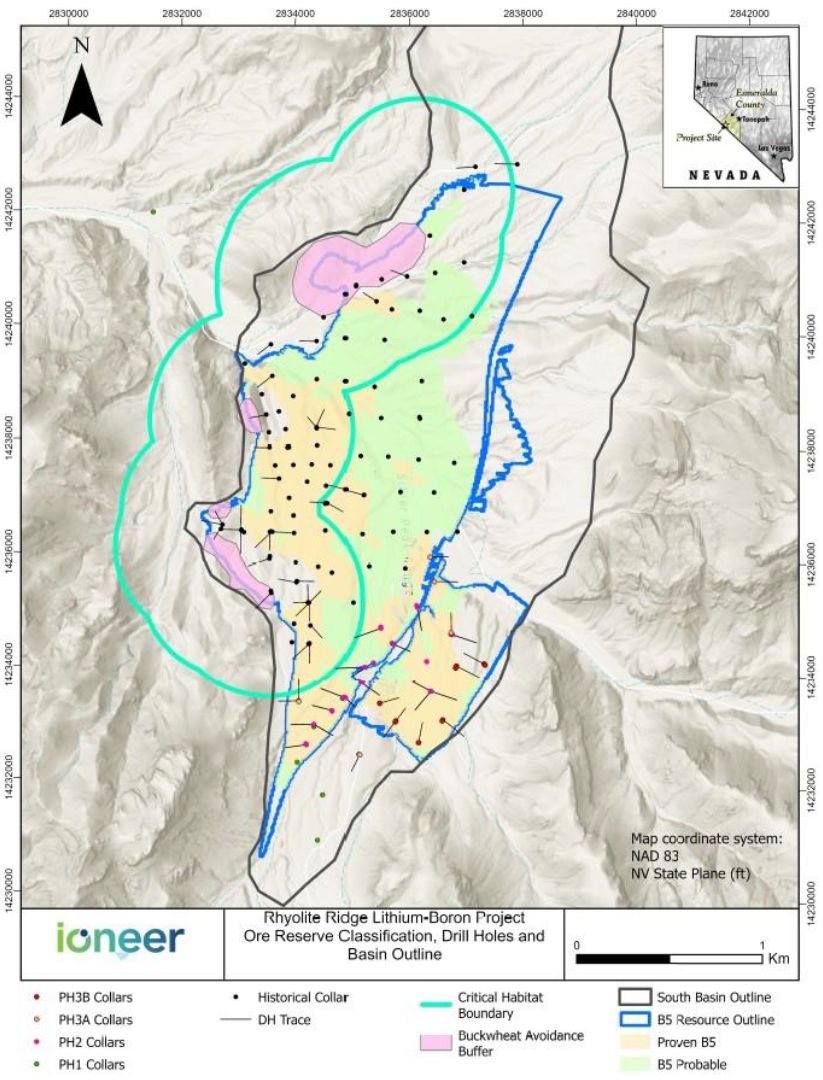
1. |
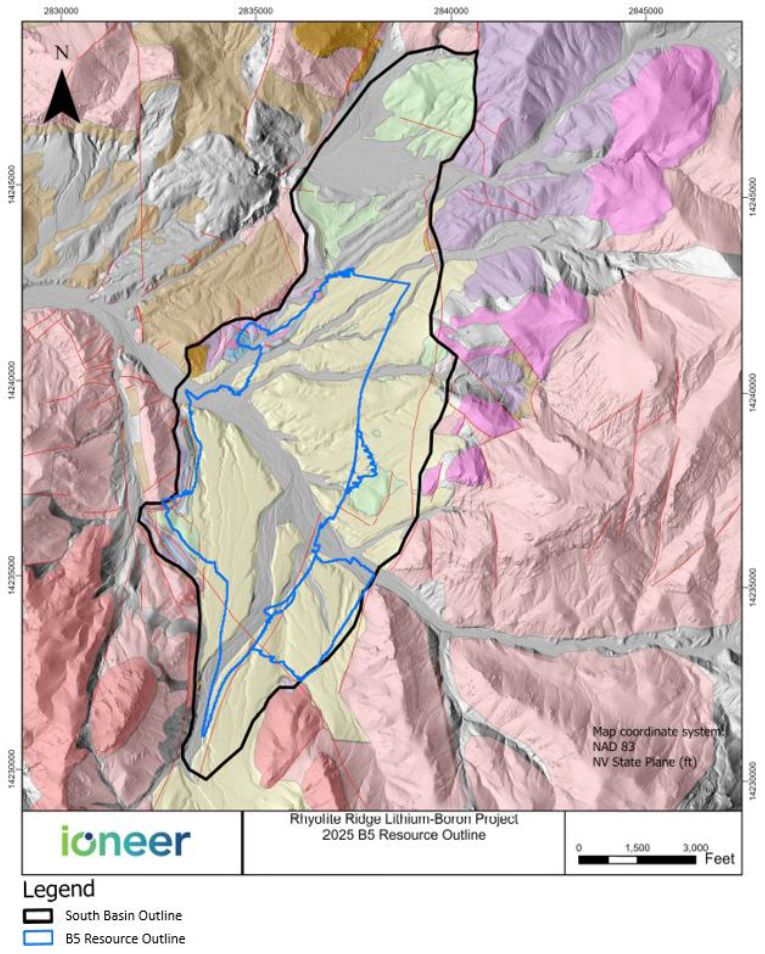
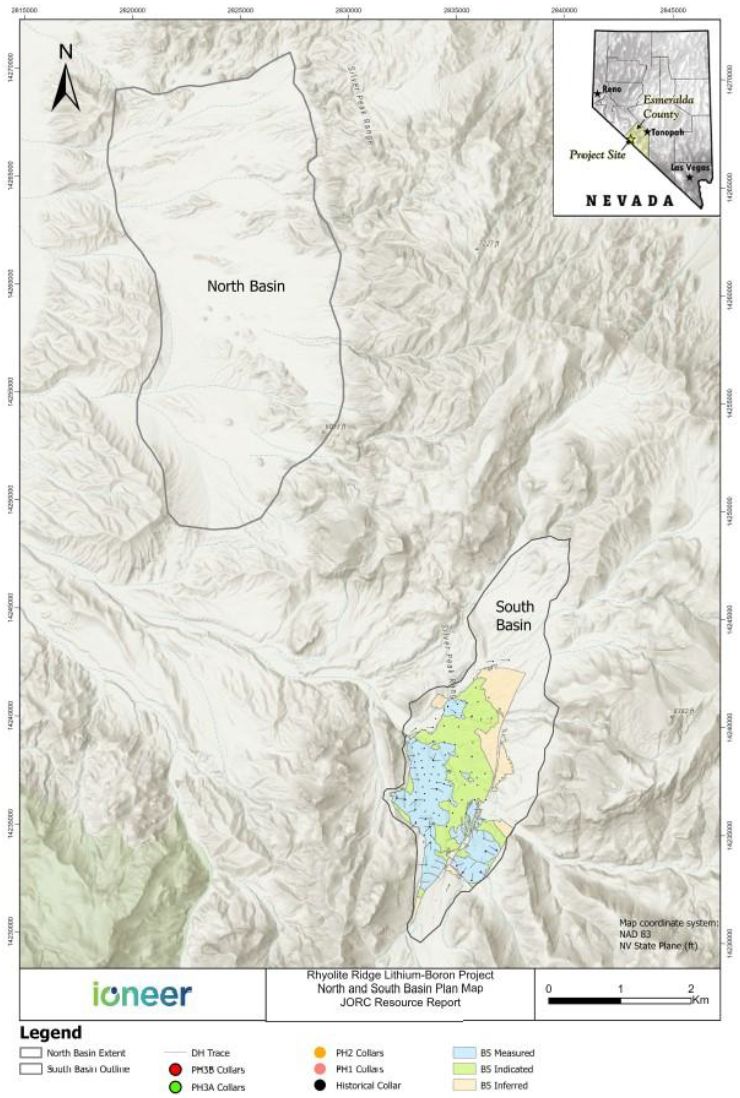
North and South Basin plan showing the location of drill holes, Resource and tenement boundary.
|
|
|
2. |
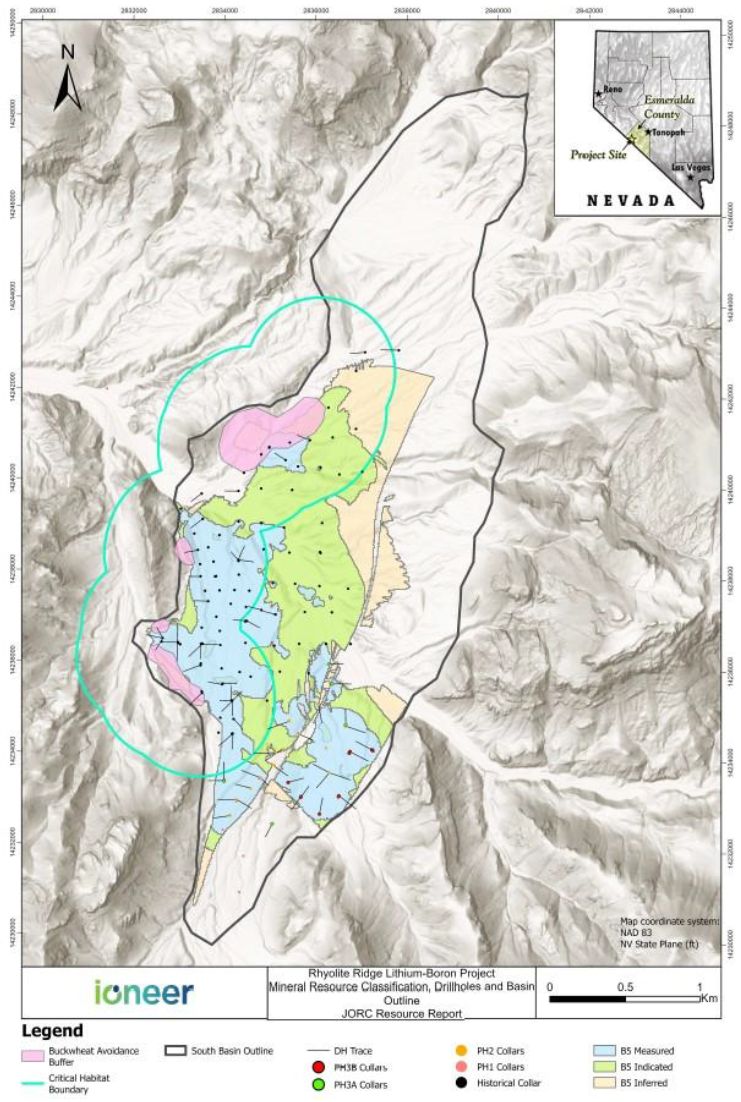
South Basin plan showing outlines of Measured, Indicated and Inferred Mineral Resources
|
|
|
3. |
South Basin South- North Cross Section looking West
|
|
|
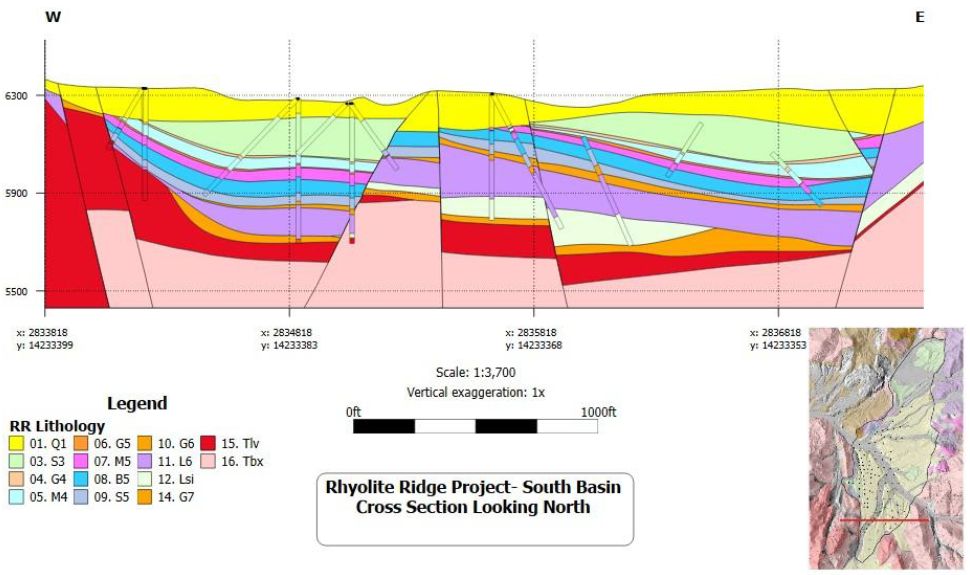
4. |
South Basin Cross Section Looking North
|
|
|
5. |
South Basin plan showing outlines of Proved and Probable Ore Reserves
|

|
APPENDIX D: JORC Code, 2012 Edition - Table 1
|
|
Criteria
|
JORC Code 2012 Explanation
|
Commentary
|
||||
|
Sampling
Techniques
|
• Nature and quality of sampling (e.g. cut channels, random chips, or specific specialised industry standard measurement tools appropriate to the
minerals under investigation, such as down hole gamma sondes, or handheld XRF instruments, etc.). These examples should not be taken as limiting the broad meaning of sampling
|
• The nature and quality of the sampling from the various sampling programs includes the following:
• Reverse circulation (RC) Drilling: a sample was collected every 1.52 metre (m) from a 127-millimetre (mm) diameter drill
hole and split using a rig-mounted rotary splitter. Samples, with a mean weight of 4.8 kilograms (kg) were submitted to ALS Minerals laboratory in Reno, NV where they were processed for assay. RC
samples represent 49% of the total intervals sampled to date.
• Core Drilling: Core samples were collected from HQ (63.5 mm core diameter) and PQ (85.0 mm core diameter) drill core, on a mean interval of 1.52 m, and cut using a
water-cooled diamond blade core saw. Samples, with a mean weight of 1.8 kg, were submitted to ALS where they were proceeded for assay.
• Drill Hole Deviation: Inclined core drill holes were surveyed to obtain downhole deviation by the survey company (International Directional Services, LLC) or
drilling company (Idea Drilling, Alford Drilling, IG Drilling, Boart Long Year, Major Drilling,) with a downhole Reflex Mems Gyros and Veracio TruShot tools and, for all but three of the drill holes. One drill hole could not be surveyed due
to tool error (SBH-72), and two were intentionally surveyed using an Acoustic Televiewer (SBH-60, SBH-79).
• Trenches: In addition to sampling from drill holes, samples were collected from 19 mechanically excavated trenches in 2010. The trenches were excavated from the
outcrop/subcrop using a backhoe and or hand tools.
|
|
APPENDIX D: JORC Code, 2012 Edition - Table 1
|
|
Criteria
|
JORC Code 2012 Explanation
|
Commentary
|
||||
|
Chip samples were then collected from the floor of the trench. Due to concerns with correlation and reliability of the results from the trenches, The Competent Person has not included any
of this data in the geological model or Mineral Resource estimate.
|
||||||
|
• Include reference to measures taken to ensure sample representivity and the appropriate calibration of any measurement tools or systems used.
|
• Measures taken to ensure sample representivity include the following:
• Due to the nature of RC samples, lithological boundaries are not easily honoured; therefore, continuous 1.52 m sample intervals were taken to ensure as
representative a sample as possible. Lithological boundaries were adjusted as needed by a senior Ioneer geologist once the assay results were received.
• Core sample intervals were selected to reflect visually identifiable lithological boundaries wherever possible, to ensure sample representivity. In cases where the
lithological boundaries were gradational, the best possible interval was chosen and validated by geochemical assay results.
• All chip and core sampling were completed by or supervised by a senior Ioneer geologist. The senior Ioneer, Newfield’s and WSP geologists referenced here, and
throughout this Table 1, have sufficient relevant experience for the exploration methods employed, the type of mineralisation being evaluated, and are registered professional geologists in their jurisdiction; however, they are not Competent
Persons according to the definition presented in JORC as they are not members of one of the Recognized Professional Organization” included in the ASX list referenced by JORC.
• The Competent Person was not directly involved during the exploration drilling programs and except for observing sampling procedures on two drill holes during the
site visit (August 10, 2023), was not present to observe sample selection. Based on review of the procedures during the site visit and subsequent review of the data, it is the opinion of the Competent Person that the measures taken to
ensure sample representivity were reasonable for the purpose of estimating Mineral Resources.
|
|||||
|
• Aspects of the determination of mineralisation that are Material to the Public Report. In cases where‘industry
|
• Aspects of the determination of mineralisation included visual identification of mineralized intervals by a senior Ioneer geologist using lithological characteristics including clay
and carbonate content, grain size and the presence of key minerals such as Ulexite (hydrated sodium calcium borate hydroxide) and Searlesite
|
|
APPENDIX D: JORC Code, 2012 Edition - Table 1
|
|
Criteria
|
JORC Code 2012 Explanation
|
Commentary
|
||||
|
standard’ work has been done this would be relatively simple (eg ‘reverse circulation drilling was used to obtain 1 m samples from which 3 kg was pulverised to produce a 30 g charge for fire
assay’). In other cases more explanation may be required, such as where there is coarse gold that has inherent sampling problems. Unusual commodities or mineralisation types (e.g. submarine nodules) may warrant disclosure of detailed
information
|
(sodium borosilicate). A visual distinction between some units, particularly where geological contacts were gradational was initially made. Final unit contacts were then determined by a
senior Ioneer geologist once assay data were available.
• The Competent Person was not directly involved during the exploration drilling programs; however, the visual identification of mineralized zones and the process
for updating unit and mineralized contacts was reviewed with the Ioneer senior geologist during the site visit. The Competent Person evaluated the identified mineralized intervals against the analytical results and agrees with the
methodology used by Ioneer to determine material mineralisation.
|
|||||
|
Drilling
techniques
|
• Drill type (e.g. core, reverse circulation, open-hole hammer, rotary air blast, auger, Bangka, sonic, etc..) and details (e.g. core diameter, triple
or standard tube, depth of diamond tails, face- sampling bit or other type, whether core is oriented and if so, by what method, etc.).
|
• Both RC and core drilling techniques have been used on the Project. Exploration drilling programs targeting Lithium-Boron (Li-B)
mineralisation on the Project have been implemented by American Lithium Minerals Inc. (2010-2012) and Ioneer (formerly Global Geoscience) in 2016, 2017, 2018, 2019, 2022, and 2023.
• Prior to 2018, all RC drilling was conducted using a 127 mm hammer. All pre-2018 core drill holes were drilled using HQ sized core with a double- tube core barrel.
• For the 2018-2023 drilling programs, all core holes (vertical and inclined) were tricone drilled through unconsolidated alluvium, then cored through to the end of
the drill hole. A total of 91 core holes were drilled, 64 holes were PQ diameter and 27 were drilled as HQ diameter. Drilling was completed using a triple-tube core barrel (split inner tube) which was preferred to a double-tube core barrel
(solid inner tube) as the triple-tube improved core recovery and core integrity during core removal from the core barrel.
|
||||
|
Drill sample
recovery
|
• Method of recording and assessing core and chip sample recoveries and results assessed.
|
• Prior to 2017, chip recovery was not recorded for the RC drilling therefore the Competent Person cannot comment on drill sample recovery for this period of
drilling.
For the 2017 RC drilling program, the drill holes were geologically logged as they were being drilled; however, no estimates of chip recoveries were recorded. Therefore, the Competent
Person cannot comment on drill sample recovery for this period of drilling.
• For the 2010-2012 and 2016 core drilling programs, both core recovery and rock quality index (RQD) were recorded for each
|
|
APPENDIX D: JORC Code, 2012 Edition - Table 1
|
|
Criteria
|
JORC Code 2012 Explanation
|
Commentary
|
||||
|
cored interval. Core recovery was determined by measuring the recovered linear core length and then calculating the recovered percentage against the total length of the core run from the
drill advance. The core recovery for all the drilling ranged from 0% to 100%, with over 65 % of the drill holes having greater than 80% mean core recovery. The core recovery values were recorded by the logging geologist and reviewed by the
senior Ioneer geologist. The majority of the 2010-2012 and 2016 core drill holes reported greater than 95% recovery in the B5, M5 and L6 mineralized intervals.
• For the 2018-2019 drilling program, both core recovery and RQD were recorded for each cored interval. Core recovery was determined by measuring the recovered
linear core length and then calculating the recovered percentage against the total length of the core run from the drill advance. The core recovery for all the drilling ranged from 41% to 100%, with over 65% of the drill holes having
greater than 90% mean core recovery. The core recovery values were recorded by the logging geologist and reviewed by the senior Ioneer geologist. In the target mineralized intervals (M5, B5 & L6), the mean core recovery was 86% in the
B5, 87% in the M5 and 95% in the L6 units, with most of the drill holes reporting greater than 90% recovery in the mineralized intervals.
• The Competent Person considers the core recovery for the 2023, 2022, 2018- 2019, 2016 and 2010-2012 core drilling programs to be acceptable based on statistical
analysis which identified no grade bias between sample intervals with high versus low core recoveries. On this basis, the Competent Person has made the reasonable assumption that the sample results are reliable for use in estimating Mineral
Resources.
|
||||||
|
• Measures taken to maximise sample recovery and ensure representative nature of the samples.
|
• Chip recoveries were not recorded for the 2010-2012 and 2017 RC drilling programs, and there is no indication of measures taken to maximize sample recovery and ensure representative
nature of samples.
• No specific measures for maximizing sample recovery were documented for the 2010-2012 and 2016 core drilling programs.
• During the 2018-2023 drilling programs, Ioneer used a triple-tube core barrel to maximize sample recovery and ensure
|
|
APPENDIX D: JORC Code, 2012 Edition - Table 1
|
|
Criteria
|
JORC Code 2012 Explanation
|
Commentary
|
||||
|
• representative nature of samples. The use of triple-tube was originally used during the 2018 drill program. A triple-tube core barrel generally provides improved
core recovery over double-tube core barrels, resulting in more complete and representative intercepts for core logging, sampling and geotechnical evaluation. It also limited any potential sample bias due to preferential loss/gain of
material.
|
||||||
|
• Whether a relationship exists between sample recovery and grade and whether sample bias may have occurred due to preferential
loss/gain of fine/coarse material.
|
• Chip recovery was not recorded for the 2010-2012 and 2017 RC drilling program and, therefore, there is no basis for evaluating the relationship between grade and
sample recovery for samples from these programs.
• Based on the Competent Person’s review of the 2010-2012, 2016 and 2018- 2019, 2022-2023 core drilling recovery and grade data there was no observable relationship
between sample recovery and grade.
|
|||||
|
Logging
|
• Whether core and chip samples have been geologically and geotechnically logged to a level of detail to support appropriate Mineral Resource
estimation, mining studies and metallurgical studies.
|
• All core and chip samples have been geologically logged to a level of detail to support appropriate Mineral Resource estimation, such that there are lithological
intervals for each drill hole, with a correlatable geological/lithological unit assigned to each interval.
• The 2018-2019 and 2022-2023 drilling were also geotechnically logged to a level of detail to support appropriate Mineral Resource estimation.
• The Competent Person has reviewed all unit boundaries in conjunction with the Ioneer senior geologist, and where applicable, adjustments have been made to the
mineralized units based on the assay results intervals to limit geological dilution.
|
||||
|
• Whether logging is qualitative or quantitative in nature.
|
• The RC and core logging were both qualitative (geological/lithological descriptions and observations) and quantitative (unit lengths, angles of contacts and
structural features and fabrics).
|
|||||
|
• Core (or costean, channel, etc.) photography.
|
• All chip trays and Core photography was completed on every core drill hole for the 2010-2012, 2016, 2018-2019 and 2022-2023 drilling programs.
|
|||||
|
• The total length and percentage of the relevant intersections logged.
|
• Prior to 2018, a total length of 8,900 m of RC drilling and 6,000 m of core drilling was completed for the Project, 100% of which was geologically logged by a
logging geologist and reviewed by the senior Ioneer geologist.
• For the 2018-2019 drilling, a total length of 548 m of RC drilling and
|
|
APPENDIX D: JORC Code, 2012 Edition - Table 1
|
|
Criteria
|
JORC Code 2012 Explanation
|
Commentary
|
||||
|
• The total length and percentage of the relevant intersections logged. (Con’t)
|
• 9,321 m of core drilling was completed for the Project, 100% of which was geologically logged by a logging geologist and reviewed by the senior Ioneer geologist
• For the 2018-2019 drilling, 86% of the 9,321 m of core was geotechnically logged by an engineering geologist/ geotechnical engineer and reviewed by the senior Ioneer
geologist.
• For the 2022-2023 drilling, 100% of the 7,362m of core was geotechnically logged by an engineering geologist/ geotechnical engineer and reviewed by the senior Ioneer
geologist
The Competent Person reviewed the geological core logging and sample selection for two drill holes.
|
|||||
|
• If core, whether cut or sawn and whether quarter, half or all core taken.
|
• The following sub-sampling techniques and sample selection procedures apply to drill core samples:
• During the 2010-2012 and 2016 program, core samples were collected on a mean 1.52 m down hole interval and cut in two halves using a manual core splitter. The entire
sample was submitted for analysis with no sub-sampling prior to submittal.
• During the 2018-2019 drilling program, core samples were collected for every 1.52 m down hole interval and cut using a water-cooled diamond blade core saw
utilizing the following methodology for the two target units. For the M5 unit, ½ core samples were submitted for assay, while the remaining ½ core was retained for reference. For the B5 unit, ¼ core samples were submitted for assay, while ¼
was reserved for future metallurgical test work and ½ core was retained reference.
• During the 2022-2023 drilling programs, core samples were collected for target units every 1.52 m down hole interval. Target units were cut using a water-cooled
diamond blade core saw utilizing the following methodology for the target units. For the M4, M5, B5, S5 and L6 unit, ½ core samples (HQ) or ¼ core samples (PQ) were submitted for assay, while the remaining ½- ¾ core was retained for
reference.
|
|
APPENDIX D: JORC Code, 2012 Edition - Table 1
|
|
Criteria
|
JORC Code 2012 Explanation
|
Commentary
|
||||
|
Sub-sampling
techniques
and sample
preparation
Sub-sampling
techniques
and sample
preparation
|
• If core, whether cut or sawn and whether quarter, half or all core taken.
If non-core, whether riffled, tube sampled, rotary split, etc. and whether sampled wet or dry.
|
• The following sub-sampling techniques and sample selection procedures apply to drill core samples:
• During the 2010-2012 and 2016 program, core samples were collected on a mean 1.52 m down hole interval and cut in two halves using a manual core splitter. The entire
sample was submitted for analysis with no sub-sampling prior to submittal.
• During the 2018-2019 drilling program, core samples were collected for every 1.52 m down hole interval and cut using a water-cooled diamond blade core saw
utilizing the following methodology for the two target units. For the M5 unit, ½ core samples were submitted for assay, while the remaining ½ core was retained for reference. For the B5 unit, ¼ core samples were submitted for assay, while ¼
was reserved for future metallurgical test work and ½ core was retained for reference.
• During the 2022-2024 drilling programs, core samples were collected for target units every 1.52 m down hole interval. Target units were cut using a water-cooled
diamond blade core saw utilizing the following methodology for the target units. For the M4, M5, B5, S5 and L6 unit, ½ core samples (HQ) or ¼ core samples (PQ) were submitted for assay, while the remaining ½- ¾ core was retained for
reference.
• The following sub-sampling techniques and sample selection procedures apply to RC Chip Samples:
• Pre-2017 RC chips samples were collected using a wet rotary splitter approximately every 1.52 m depth interval. Two samples were collected for every interval (one
main sample and one duplicate). Only the main sample was submitted for analysis.
2017 RC chip samples were collected using a wet rotary splitter attached to a cyclone. One, approximately 10 kg, sample was collected every 1.52 m depth interval. All samples were submitted
for analysis.
|
|
APPENDIX D: JORC Code, 2012 Edition - Table 1
|
|
Criteria
|
JORC Code 2012 Explanation
|
Commentary
|
||||
|
• For all sample types, the nature, quality and appropriateness of the sample preparation technique.
|
• The Competent Person considers the nature, type and quality of the sample preparation techniques to be appropriate based on the general homogeneous nature of the
mineralized zones and the drilling methods employed to obtain each sample (i.e., RC and core).
|
|||||
|
• Quality control procedures adopted for all sub-sampling stages to maximise representivity of samples.
|
• Quality control procedures adopted for sub-sampling to maximize representivity include the following:
• During 2016-2017 and 2018-2023 drilling programs, field duplicate/replicate samples were obtained. For the 2017 and 2023 RC drilling, a duplicate sample was
collected every 20th sample. For the 2016 and 2018-2023 core drilling programs two ¼ core samples were taken at the same time and were analysed in sequence by the laboratory to assess the representivity.
• Twin drill holes at the same site were drilled during the 2010- 2012 drilling program. The twin drill hole pairing comprises one RC drill hole (SBH-04) and one
core drill hole (SBHC-01). The Competent Person recommends twinning additional drill hole pairs as part of any future pre-production or infill drilling programs to allow for a more robust review of sample representivity.
• The Competent Person reviewed the results of the duplicate/replicate sampling and twin drill holes. For the duplicate/replicate samples, the R2 value is
0.99, which is very good. Visual observation of the lithological intervals and the assays for the twin drill holes show that they are very similar, despite the difference in drilling techniques.
|
|||||
|
• Measures taken to ensure that the sampling is representative of the in situ material collected, including for instance results for field
duplicate/second-half sampling.
|
• The Competent Person considers the samples to be representative of the in-situ material as they conform to lithological boundaries determined during core logging. A
review of the primary and duplicate sample analyses indicates a high degree of agreement between the two sample sets (R2 value of 0.99).
|
|||||
|
• Whether sample sizes are appropriate to the grain size of
|
• The Competent Person considers the sample sizes to be
|
|
APPENDIX D: JORC Code, 2012 Edition - Table 1
|
|
Criteria
|
JORC Code 2012 Explanation
|
Commentary
|
||||
|
the material being sampled.
|
appropriate given the general homogeneous nature of the mineralized zones. The two main types of mineralisation are lithium mineralisation with high boron >/=5,000 parts per million (ppm) (HiB-Li) and lithium mineralisation with low boron <5,000 ppm (LoB-Li). The HiB-Li mineralisation occurs
consistently throughout the B5, M5 and L6 target zones, while LoB-Li mineralisation occurs throughout the M5, S5 and L6 units, and is not nuggety or confined to discreet high-grade and low-grade bands.
|
|||||
|
Quality of
assay data
and
laboratory
tests
|
• The nature, quality and appropriateness of the assaying and laboratory procedures used and whether the technique is considered partial or total.
|
• The nature and quality of the assaying and laboratory procedures used include the following:
• All RC and core samples were processed, crushed, split, and then a sub-sample was pulverized by ALS Minerals in Reno, Nevada.
• All sub-samples were analysed by Aqua Regia with ICP mass spectrometry (ICP-MS) finish for 51 elements (including Lithium (Li)) and Boron (B) by Na2O2 fusion/ICP high grade analysis (>/=10,000 ppm B).
• Additionally, 95% of the 2018-2019 samples were analysed for Inorganic Carbon and 30% were analysed for Fluorine (F).
• The laboratory techniques are total.
• The Competent Person considers the nature and quality of the laboratory analysis methods and procedures to be appropriate for the type of mineralisation.
|
||||
|
• For geophysical tools, spectrometers, handheld XRF instruments, etc., the parameters used in determining the analysis including instrument
make and model, reading times, calibrations factors applied and their derivation, etc..
|
• Not applicable to this Report, no geophysical tools, spectrometers, handheld XRF instruments were used on the Project.
|
|||||
|
• Nature of quality control procedures adopted (e.g. standards, blanks, duplicates, external laboratory checks) and whether acceptable levels of
accuracy (i.e. lack of bias) and precision have been established.
|
• The following Quality Assurance and Quality Control (QA/QC) procedures were adopted for the various drilling programs:
• During the 2010-2012 program, Standard Reference Material (SRM) samples and a small number of field blanks were also
inserted regularly into the sample sequence to QA/QC of the laboratory analysis.
• For 2016-2017 program, a duplicate sample was collected every 20th primary sample. Field blanks and SRM’s were also inserted approximately every 25 samples to
assess QA/QC.
• During the 2018-2019 and 2022-2023 programs, QA/QC samples
|
|
APPENDIX D: JORC Code, 2012 Edition - Table 1
|
|
Criteria
|
JORC Code 2012 Explanation
|
Commentary
|
||||
|
Quality of assay
data and
laboratory (Con’t)
|
• comprising 1 field blank and 1 SRM standard inserted into each sample batch every 25 samples. Submission of field duplicates, laboratory coarse/pulp replicates and
umpire assays were submitted in later stages of the 2018-2019 and 2022-2023 drilling programs.
• The Competent Person reviewed the SRM, field blanks and field duplicates and determined the following:
• SRMs: Review of the five SRMs used determined that there was a reasonable variability for Li between the upper and lower control limits (± 2 standard deviation (SD)), however B shows an overall bias towards lower than expected values (i.e. less than the mean) for all sample programs. For each of the 5 SRMs, there were some sample outliers (both low and high);
however, the majority fell within the control limits. It is recommended that two additional SRM samples be added which have grades between current high and low grade samples and are closer to the cutoff range for boron ( 5,000 ppm).
• Field Blanks: Review of the field blanks indicate that there is some variability in both the Li and B results. There are several samples that return higher than
expected values, with an increased number being from the 2018-2019 drilling program. Further review is required to determine if this is a result of the material used for field blanks (coarse dolomite) or a problem with the laboratory
analysis.
• Field Duplicates: No field duplicates were submitted for the pre-2018 drilling programs. Review of the 230 field duplicate sample pairs from the 2018-2019 drilling
program determined that there was a strong correlation between each pair, as evidenced by an R2 value of 0.99 for Li.
• Umpire Laboratory Duplicates: 20 assay pulp rejects were sent from ALS to American Assay Laboratories (AAL) in Sparks, NV for umpire laboratory analysis in 2018
Review of the 20 umpire duplicate pairs found a strong correlation between each pair, with B returning an R2 value of 0.98. 44 Assay pulp rejects were sent from ALS to American Assay Laboratories in Sparks, NV for umpire laboratory analysis
in 2024. Review of the 44 umpire duplicate pairs returned similar results
• The Competent Person reviewed the control charts produced for each SRM, field blank and field duplicate, and determined that there was an acceptable level of
accuracy and precision for each for the purpose of estimating Mineral Resources.
|
|
APPENDIX D: JORC Code, 2012 Edition - Table 1
|
|
Criteria
|
JORC Code 2012 Explanation
|
Commentary
|
||||
|
Verification of
sampling and
assaying
|
The verification of significant intersections by either independent or alternative company personnel.
|
• Significant intersections have been verified by visual inspection of the drill core intervals by at least two Ioneer geologists for all drilling programs.
|
||||
|
The use of twinned holes.
|
• One pair of twin drill holes at the same site were drilled during the 2010- 2012 drilling program. The twin drill hole pairing comprises one RC drill hole (SBH-04)
and one core drill hole (SBHC-01).
• The Competent Person reviewed and assessed two drill holes and the variance for thickness and grade parameters were within acceptable levels.
|
|||||
|
Documentation of primary data, data entry procedures, data verification, data storage (physical and electronic) protocols.
|
• For the 2022-2023 drilling programs, the field protocols utilized in the 2018-2019 drilling program were reviewed by both Ioneer and WSP. These protocols were
refined and improved to assure proper compliance. Formal Documentation and enforcement by WSP and Ioneer personnel actively involved in the program.
• For the 2018-2019 drilling program, Newfields developed a series of field protocols covering all aspects of the exploration program, including surveying, logging,
sampling and data documentation. These protocols were followed throughout the 2018-2019 drilling program. Formal documentation of field protocols does not exist prior to the 2018-2019 program; however, the same senior personnel were
involved in the earlier programs and field protocols employed were essentially the same as those documented in the 2018-2019 protocols.
• Primary field data was captured on paper logs for the 2010-2012 drilling program, then transcribed into Microsoft (MS) Excel
files. For the 2016 through 2019 drilling, all field data was captured directly into formatted MS Excel files by logging geologists. All primary field data was reviewed by the senior Ioneer geologist.
• 2019 Data was stored in digital format in a MS Access database. This database was compiled, updated and maintained by Newfields personnel during the 2018-2019
drilling program.
• In 2024 drill data including assays and drill logs were transitioned to a Hexagon Torque database. This data is updated and maintained by Ioneer.
|
|||||
|
Documentation of primary data, data entry procedures, data verification, data storage (physical and electronic) protocols
|
• The Competent Person used the relevant information from various tabular data files provided by Ioneer and Newfields in a MS Access database, which was reviewed and
verified by the Competent Person prior to inclusion in the geological model.
|
|
APPENDIX D: JORC Code, 2012 Edition - Table 1
|
|
Criteria
|
JORC Code 2012 Explanation
|
Commentary
|
||||
|
• Discuss any adjustment to assay data.
|
• There has been no adjustment to assay data.
|
|||||
|
Location of data
points
|
• Accuracy and quality of surveys used to locate drill holes (collar and down-hole surveys), trenches, mine workings and other locations used in
Mineral Resource estimation.
|
• Accuracy and quality of surveys used to locate drill holes is as follows:
• All inclined core drill holes were surveyed to obtain downhole deviation using a downhole Reflex Mems Gyros tool, except for SBH- 72, which could not be surveyed
due to tool error. Two core drill holes (SBH-60, SBH-79) were surveyed using an Acoustic Televiewer instead of the Gyros tool.
• All 2018-2019 drill hole collars were surveyed using a differentially corrected GPS (DGPS).
• Locatable pre-2018 drill holes that were previously only surveyed by handheld GPS have been re-surveyed in 2019 using DPGS. Some pre- 2018 drill holes could not be
located by the surveyor in 2019, and the original locations were assumed to be correct.
• Upon completion, drill casing was removed, and drill collars were marked with a permanent concrete monument with the drill hole name and date recorded on a metal
tag on the monument.
|
||||
|
• Specification of the grid system used.
|
• All pre-2018 and 2018-2019 drill holes were originally surveyed using handheld GPS units in UTM Zone 11 North, North American Datum 1983 (NAD83) coordinate system. Pre-2018 drill holes were re-surveyed using DPGS in NAD83 in 2017/2018.
• All 2018-2019 drill holes and locatable pre-2018 drill holes were re- surveyed in 2019 using DPGS in NAD83 coordinate system. All surveyed coordinates were
subsequently converted to Nevada
• State Plane Coordinate System of 1983, West Zone (NVSPW 1983) for use in developing the geological model. Those holes that
could not be located had the original coordinates converted to NVSPW 1983 and their locations verified against the original locations.
• All 2022-2023 holes were surveyed Nevada State Plane Coordinate System of 1983, West Zone (NVSPW 1983) for use in
developing the geological model.
|
|||||
|
• Quality and adequacy of topographic control.
|
• The quality and adequacy of the topographic surface and the topographic control is very good based on comparison against survey monuments, surveyed drill hole
collars and other surveyed surface features.
|
|
APPENDIX D: JORC Code, 2012 Edition - Table 1
|
|
Criteria
|
JORC Code 2012 Explanation
|
Commentary
|
||||
|
Quality and adequacy of topographic control. (Con’t)
|
• A 2018 satellite survey with an accuracy of ± 0.17 m was produced for the Project by PhotoSat Information Ltd. The final report generated by PhotoSat stated that
the difference between the satellite and Ioneer provided ground survey control points was less than 0.8 m.
• The topographic survey was prepared in NAD83, which was converted to NVSPW 1983 by Newfields prior to geological modelling.
|
|||||
|
Data spacing
and
distribution
|
• Data spacing for reporting of Exploration Results.
|
• Drill holes are generally spaced between 90 m and 170 m on east- west cross-section lines spaced approximately 180 m apart. There was no distinction between RC and
core holes for the purpose of drill hole spacing.
• For the 2018-2023 drilling program, there were multiple occurrences where several inclined drill holes were drilled from the same drill pad and oriented at varying
angles away from each other. The collar locations for these inclined drill holes drilled from the same pad varied in distance from 0.3 m to 6.0 m apart; intercept distances on the floors of the target units were typically in excess of 90 m
spacing.
|
||||
|
• Whether the data spacing and distribution is sufficient to establish the degree of geological and grade continuity appropriate for the Mineral
Resource and Ore Reserve estimation procedure(s) and classifications applied.
|
• The spacing is considered sufficient to establish geological and grade continuity appropriate for a Mineral Resource estimation.
|
|||||
|
• Whether sample compositing has been applied.
|
• Samples were predominately (91%) 1.52 m intervals honouring lithological boundaries. The sample intervals were composited to 1.52m lengths, respecting the seam
contacts to regularize the database used for grade estimation. The 1.52 m sample length represents the modal value of the sample length distribution and the 1.52m vertical block height in the model.
|
|||||
|
Orientation of
data in relation to
geological
structure
|
Whether the orientation of sampling achieves unbiased sampling of possible structures and the extent to which this is known, considering the deposit type.
|
• Drill holes were angled between -45 and -90 degrees from horizontal and at an azimuth of between 0- and 350-degrees.
• Inclined drill holes orientated between 220- and 350-degrees azimuth introduced minimal sample bias, as they primarily intercepted the mineralisation at angles near
orthogonal (94 drill holes with intercept angles between 70-90 degrees) to the dip of
• the beds, approximating true-thickness.
|
|
APPENDIX D: JORC Code, 2012 Edition - Table 1
|
|
Criteria
|
JORC Code 2012 Explanation
|
Commentary
|
||||
|
• If the relationship between the drilling orientation and the orientation of key mineralised structures is considered to have introduced a sampling
bias, this should be assessed and reported if material.
|
• Inclined drill holes orientated between 0- and 220-degrees azimuth, especially those that were drilled at between 20- and 135-degrees azimuth, generally
intercepted the beds down dip (14 drill holes with intercept angles between 20-70 degrees), exaggerating the mineralized zone widths in these drill holes.
|
|||||
|
Sample
security
|
• The measures taken to ensure sample security.
|
• The measures taken to ensure sample security include the following:
• For the 2010-2012 drill holes, samples were securely stored on-site and then collected from site by ALS. Chain of custody forms were maintained by ALS.
• For the 2016-2017 drill holes, samples were securely stored on-site and then collected from site by ALS and transported to the laboratory by truck. Chain of custody
forms were maintained by ALS.
• For the 2018-2019 and 2022-2023 drill holes, core was transported daily by Ioneer and/or Newfields personnel from the drill site to the Ioneer secure core shed
(core storage) facility in Tonopah. Core awaiting logging was stored in the core shed until it was logged and sampled, at which time it was stored in secured sea cans inside a fenced and locked core storage facility on site. Samples were
sealed in poly-woven sample bags, labelled with a pre-form numbered and barcoded sample tag, and securely stored until shipped to or dropped off at the ALS laboratory in Reno by either Ioneer or Newfields personnel. Chain of custody forms
were maintained by either Newfields or Ioneer and ALS.
|
||||
|
Audits or
reviews
|
• The results of any audits or reviews of sampling techniques and data.
|
• There were no audits performed on the RC sampling or for the pre-2018 drilling programs.
• The Competent Person reviewed the core and sampling techniques during a site visit in August 2023. The Competent Person found that the sampling techniques were
appropriate for collecting data for the purpose of preparing geological models and Mineral Resource estimates.
|
|
APPENDIX D: JORC Code, 2012 Edition - Table 1
|
|
Criteria
|
JORC Code 2012 Explanation
|
Commentary
|
||||
|
Mineral
tenement and
land tenure
status
|
• Type, reference name/number, location and ownership including agreements or material issues with third parties such as joint ventures, partnerships,
overriding royalties, native title interests, historical sites, wilderness or national park and environmental settings.
|
• The mineral tenement and land tenure for the South Basin of Rhyolite Ridge (the Project) comprise 386 unpatented Lode Mining Claims (totalling approximately 3,150
hectare (Ha)); claim groups SLB, SLM and RR, spatial extents of which are presented in maps and tables within the body of the Report are held by Ioneer Minerals Corporation, a wholly owned subsidiary
of Ioneer. The Competent Person has relied upon information provided by Ioneer regarding mineral tenement and land tenure for the Project; the Competent Person has not performed any independent legal verification of the mineral tenement and
land tenure.
• The Competent Person is not aware of any agreements or material issues with third parties such as joint ventures, partnerships, overriding royalties, native title
interests, historical sites, wilderness or national park and environmental settings relating to the 386 Lode Mining Claims for the Project.
• The mineral tenement and land tenure referenced above excludes 241 additional unpatented Lode Mining Claims (totaling approximately 2,000 Ha) for the North Basin
which are located outside of the current South Basin Project Area presented in this Report. These additional claims are held by Ioneer subsidiaries (NLB claim group; 160 claims and BH claim group; 81 claims).
|
||||
|
• The security of the tenure held at the time of reporting along with any known impediments to obtaining a licence to operate in the area.
|
• There are no identified concerns regarding the security of tenure nor are there any known impediments to obtaining a license to operate within the limits of the
Project. The 386 unpatented Lode Mining Claims for the Project are located on federal land and are administered by the United States Department of the Interior - Bureau of Land Management (BLM).
|
|||||
|
Exploration
|
• Acknowledgment and appraisal of exploration by other
|
• There have been two previous exploration campaigns targeting Li-
|
|
APPENDIX D: JORC Code, 2012 Edition - Table 1
|
|
Criteria
|
JORC Code 2012 Explanation
|
Commentary
|
||||
|
done by other
parties
|
parties.
|
B mineralisation at the Project site.
• US Borax conducted surface sampling and drilling in the 1980s, targeting B mineralisation, with less emphasis on Li mineralisation. A total of 44 drill holes
(totalling approximately 14,900 m) were drilled in the North Borate Hills area, with an additional 16 drill holes (unknown total meterage) in the South Basin area. These drill holes were not available for use in the current Study.
• American Lithium Minerals Inc and Japan Oil, Gas and Metals National Corporation (JOGMEC) conducted further Li
exploration in the South Basin area in 2010-2012. The exploration included at least 465 surface and trench samples and 36 drill holes (totalling approximately 8,800 m), of which 21 were core and 15 were RC. Data collected from this
program, including drill core, was made available to Ioneer. The Competent Person reviewed the data available from this program and believes this exploration program, except for the trench data, was conducted appropriately and the
information generated is of high enough quality to include in preparing the current geological model and Mineral Resource estimate.
• Due to concerns regarding the ability to reliably correlate the trenches with specific geological units as well as concerns regarding representivity of samples
taken from incomplete exposures of the units in the trenches, the Competent Person does not feel the trench sample analytical results are appropriate for use and has excluded them from use in preparing the geological model and Mineral
Resource estimate.
|
||||
|
Geology
|
• Deposit type, geological setting and style of mineralisation.
|
• The HiB-Li and LoB-Li mineralisation at Rhyolite Ridge occurs in two separate late-Miocene sedimentary basins; the North Basin and the South Basin, located
within the Silver Peak Range in the Basin and Range terrain of Nevada, USA. The South Basin is the focus of the Study presented in this Report and the following is focused on the geology and mineralisation of the South Basin.
• The South Basin stratigraphy comprises lacustrine sedimentary rocks of the Cave Spring Formation overlaying volcanic flows and volcaniclastic rocks of the
Rhyolite Ridge Volcanic unit. The Rhyolite Ridge Volcanic unit is dated at approximately 6 mega- annum (Ma) and comprises rhyolite tuffs, tuff breccias and flows.
|
|
APPENDIX D: JORC Code, 2012 Edition - Table 1
|
|
Criteria
|
JORC Code 2012 Explanation
|
Commentary
|
||||
|
The Rhyolite Ridge Volcanic rocks are underlain by sedimentary rocks of the Silver Peak Formation.
• The Cave Spring Formation comprises a series of 11 sedimentary units deposited in a lacustrine environment, as shown in the following table. Within the study
area the Cave Spring Formation can reach total thickness in excess of 400 m. Age dating of overlying units outside of the area and dates for the underlying Rhyolite Ridge Volcanic unit bracket deposition of the Cave Spring Formation
between 4-6 Ma; this relatively young geological age indicates limited time for deep burial and compaction of the units. The Cave Spring Formation units are generally laterally continuous over several miles across the extent of the
South Basin; however, thickness of the units can vary due to both primary depositional and secondary structural features. The sedimentary sequence generally fines upwards, from coarse clastic units at the base of the formation, upwards
through siltstones, marls and carbonate units towards the top of the sequence.
• The key mineralized units are in the Cave Spring Formation and are, from top to bottom, the M5 (high-grade Li, low- to moderate- grade B bearing carbonate-clay
rich marl), the B5 (high-grade B, moderate-grade Li marl), the S5 (low- to high Li, very low B) and the L6 (broad zone of laterally discontinuous low- to high- grade Li and B mineralized horizons within a larger low-grade to barren
sequence of siltstone-claystone). The sequence is marked by a series of four thin (generally on the scale of several meters or less) coarse gritstone layers (G4 through G7); these units are interpreted to be pyroclastic deposits that
blanketed the area. The lateral continuity across the South Basin along with the distinctive visual appearance of the gritstone layers relative to the less distinguishable sequence of siltstone-claystone-marl that comprise the bulk of
the Cave Spring Formation make the four grit stone units good marker horizons within the stratigraphic sequence.
• The Cave Springs Formation is unconformably overlain by a unit of poorly sorted alluvium, ranging from 0 to 40 m (mean of 20 m) within the Study Area. The
alluvium is unconsolidated and comprises sand through cobble sized clasts (with isolated occurrences of large boulder sized clasts) of the Rhyolite Ridge
|
|
APPENDIX D: JORC Code, 2012 Edition - Table 1
|
|
Criteria
|
JORC Code 2012 Explanation
|
Commentary
|
||||
|
Volcanic Rocks and other nearby volcanic units.
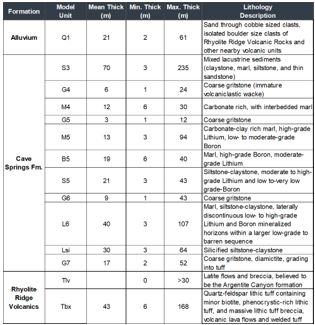 • Structurally, the South Basin is bounded along its western and eastern margins by regional scale high angle faults of unknown displacement, while localized
steeply dipping normal, reverse and strike-slip faults transect the Cave Spring formation throughout the
|
|
APPENDIX D: JORC Code, 2012 Edition - Table 1
|
|
Criteria
|
JORC Code 2012 Explanation
|
Commentary
|
||||
|
the basin. Displacement on these faults is generally poorly known but most appear to be on the order of tens of meters of displacement although several located along
the edge of the basin may have displacements greater than 30 m. Major fault structures within the basin tend to have a series of minor faults associated with them. These tend to have smaller offset than the parent fault structure. Along
the western side, South Basin is folded into a broad, open syncline with the sub- horizontal fold axis oriented approximately north-south. The syncline is asymmetric, moderate to locally steep dips along the western limb. The
stratigraphy is further folded, including a significant southeast plunging syncline located in the southern part of the study area.
• HiB-Li and LoB-Li mineralisation is interpreted to have been emplaced by hydrothermal/epithermal fluids travelling up the basin bounding faults; based on
HiB-Li and LoB-Li grade distribution and continuity it is believed the primary fluid pathway was along the western bounding fault. Differential mineralogical and permeability characteristics of the various units within the Cave Spring
Formation resulted in the preferential emplacement of HiB-Li bearing minerals in the B5 and L6 units and LoB-Li bearing minerals in the M5, S5 and L6 units. HiB-Li mineralisation occurs in isolated locations in some of the other units
in the sequence, but with nowhere near the grade and continuity observed in the aforementioned units.
|
||||||
|
Drill hole
Information
|
• A summary of all information material to the understanding of the exploration results including a tabulation of the following information for
all Material drill holes:
o easting and northing of the drill hole collar
o elevation or RL (Reduced Level – elevation above sea level in feet) of the drill hole collar
o dip and azimuth of the hole
o down hole length and interception depth
o hole length.
|
• Exploration Results are not being reported.
• A summary table providing key details for all identified drill holes for the Project is presented by type and drilling campaign in the following table:
 |
|
APPENDIX D: JORC Code, 2012 Edition - Table 1
|
|
Criteria
|
JORC Code 2012 Explanation
|
Commentary
|
||||
|
• If the exclusion of this information is justified on the basis that the information is not Material and this exclusion does not detract from the
understanding of the report, the Competent Person should clearly explain why this is the case.
|
• Of the 166 drill holes reviewed, 162 (50 RC and 112 core) were included in the geological model and 4 were omitted. One RC twin hole was omitted in favour of
the cored hole at the same location. Three water/geotechnical drill holes were omitted due to a lack of lithology and quality data relevant to the geological model.
|
|||||
|
Data aggregation
methods
|
• In reporting Exploration Results, weighting averaging techniques, maximum and/or minimum grade truncations (e.g. cutting of high grades) and
cut-off grades are usually Material and should be stated.
|
• Exploration Results are not being reported.
• All grade parameters presented as part of the Mineral Resource estimates prepared by IMC are presented as mass weighted grades.
• Drill core samples are predominately 1.52 m lengths (91%) and this data set composited to regularized 1.52m lengths, respecting seam contacts and used for the
interpolation of grade data into the block model. The data set honoured geological contacts (i.e. composite intervals did not span unit contacts). The data set is the 1.52 m composited developed from the drill hole assay database.
• No minimum bottom cuts or maximum top cuts were applied to the thickness or grade data used to construct the geological models. No interpolation was applied to
B and Li grade data for units other than the targeted units (G5, M5, B5, S5, G6, L6 and Lsi; discussed further in the Estimation and Modelling Techniques section of this Table 1).
• A cut-off grade of 5,000 ppm B for the HiB-Li mineralisation and 11.13/tonne net value for the LoB-Li mineralisation was applied during the Mineral Resource
tabulation for the purpose of establishing reasonable prospects of eventual economic extraction based on high level mining, metallurgical and processing grade parameters identified by mining, metallurgical and processing studies
performed to date on the Project.
|
||||
|
• Where aggregate intercepts incorporate short lengths of high grade results and longer lengths of low grade results, the
procedure used for such aggregation should be stated and some typical examples of such aggregations should be shown in detail.
|
• Not applicable as individual intercepts or Exploration Results are not being reported.
|
|||||
|
• The assumptions used for any reporting of metal equivalent values should be clearly stated.
|
• Metal equivalents were not used in the Mineral Resource estimates prepared by IMC.
|
|
APPENDIX D: JORC Code, 2012 Edition - Table 1
|
|
Criteria
|
JORC Code 2012 Explanation
|
Commentary
|
||||
|
Relationship
between
mineralisation
widths and
intercept lengths
|
• These relationships are particularly important in the reporting of Exploration Results.
|
• All drill hole intercepts presented in the Report are down hole thickness not true thickness. As discussed in the Orientation of Data section of this Table 1,
most drill hole intercepts are approximately orthogonal to the dip of the beds (intercept angles between 70-90 degrees).
|
||||
|
• If the geometry of the mineralisation with respect to the drill hole angle is known, its nature should be reported.
|
• Based on the geometry of the mineralisation, it is reasonable to treat all samples collected from inclined drill holes at intercept angles of greater than 70
degrees as representative of the true thickness of the zone sampled.
|
|||||
|
• If it is not known and only the down hole lengths are reported, there should be a clear statement to this effect
(e.g. ‘down hole length, true width not known’).
|
• Not applicable as individual down hole intercepts or Exploration Results are not being reported.
|
|||||
|
Diagrams
|
• Appropriate maps and sections (with scales) and tabulations of intercepts should be included for any
significant discovery being reported These should include, but not be limited to a plan view of drill hole collar locations and appropriate sectional views.
|
• Appropriate plan maps and sections are appended to the Report.
|
||||
|
Balanced
reporting
|
• Where comprehensive reporting of all Exploration Results is not practicable, representative reporting of
both low and high grades and/or widths should be practiced to avoid misleading reporting of Exploration Results.
|
• Exploration Results are not being reported.
|
||||
|
Other substantive
exploration data
|
• Other exploration data, if meaningful and material, should be reported including (but not limited to): geological
observations; geophysical survey results; geochemical survey results; bulk samples – size and method of treatment; metallurgical test results; bulk density, groundwater, geotechnical and rock characteristics; potential
deleterious or contaminating substances.
|
• Surficial geological mapping performed by a senior Ioneer geologist was used in support of the drill holes to define the outcrops and subcrops as well as
bedding dip attitudes in the geological modelling. Mapped geological contacts and faults were imported into the model and used as surface control points for the corresponding beds or structures.
• Magnetic and Gravity geophysical surveys were performed and interpreted to inform the geological model, particularly in the identification of faulting and
geologic structures.
|
||||
|
Further work
|
• The nature and scale of planned further work (e.g. tests for lateral extensions or depth extensions or large-scale
step- out drilling).
|
• Additional in-fill drilling and sampling may be performed based on the results of current mining project studies
|
||||
|
• Diagrams clearly highlighting the areas of possible extensions, including the main geological interpretations and
future drilling areas, provided this information is not commercially sensitive.
|
• Refer to Figure 1 in the body of this report.
|
|
APPENDIX D: JORC Code, 2012 Edition - Table 1
|
|
Criteria
|
JORC Code 2012 explanation
|
Commentary
|
||||
|
Database
integrity
|
• Measures taken to ensure that data has not been corrupted by, for example, transcription or keying errors, between its initial collection and
its use for Mineral Resource estimation purposes.
|
• Measures taken to ensure the data has not been corrupted by transcription or keying errors or omissions included recording of drill hole data and observations by
the logging geologists using formatted logging sheets in Microsoft (MS) Excel. Data and observations entered into the logging sheets were reviewed by senior Ioneer geologists prior to importing
into Torque Database
• IMC evaluated the tabular data provided by Ioneer for errors or omissions as part of the data validation procedures described in the following section.
|
||||
|
• Data validation procedures used.
|
• IMC performed data validation on the drill hole database records using available underlying data and documentation including but not limited to original drill
hole descriptive logs, core photos and laboratory assay certificates. Drill hole data validation checks were performed using a series of in-house data checks to evaluate for common drill hole data errors including, but not limited to,
data gaps and omissions, overlapping lithology or sample intervals, miscorrelated units, drill hole deviation errors and other indicators of data corruption including transcription and keying errors.
• Database assay values for every sample were visually compared to the laboratory assay certificates to ensure the tabular assay data was free of errors or
omissions by Golder for the 2020 resource estimate. IMC compared database to certificates for about 20% of the phase 2 and 3 drill holes and found no errors.
|
|||||
|
Site visits
|
• Comment on any site visits undertaken by the Competent Person and the outcome of those visits.
|
• The IMC Competent Person Herbert E. Welhener made a personal site inspection, this visit was performed on the Project site on August 10th 2023 for the Project.
During the site visit the IMC Competent Person visited the Ioneer core shed in Tonopah NV, and the South Basin area of the Rhyolite Ridge Project site, which is the
focus of the current exploration and resource evaluation efforts by Ioneer.
|
|
APPENDIX D: JORC Code, 2012 Edition - Table 1
|
|
Criteria
|
JORC Code 2012 explanation
|
Commentary
|
||||
|
• The IMC Competent Person observed the active drilling, logging and sampling process and interviewed site personnel regarding exploration drilling, logging,
sampling and chain of custody procedures.
• The outcome of the site visit was that the IMC Competent Person developed an understanding of the general geology of the Rhyolite Ridge Project. The IMC
Competent Person was also able to visually confirm the presence of a selection of monumented drill holes from each of the previous drilling programs as well as to observe drilling, logging and sampling procedures during the current
drilling program and to review documentation for the logging, sampling and chain of custody protocols for previous drilling programs.
|
||||||
|
• If no site visits have been undertaken indicate why this is the case.
|
• Not applicable.
|
|||||
|
Geological
interpretation
|
• Confidence in (or conversely, the uncertainty of) the geological interpretation of the mineral deposit.
|
• The IMC Competent Person is confident that the geological interpretation of the mineral deposit is reasonable for the purposes of Mineral Resource estimation.
|
||||
|
• Nature of the data used and of any assumptions made.
|
• The data used in the development of the geological interpretation included drill hole data and observations collected from 112 core and 50 RC drill holes,
supplemented by surface mapping of outcrops and faults performed by Ioneer personnel. Regional scale public domain geological maps and studies were also incorporated into the geological interpretation.
• It is assumed that the mineralized zones are continuous between drill holes as well as between drill holes and surface mapping. It is also assumed that grades
vary between drill holes based on a distance- weighted interpolator.
|
|||||
|
• The effect, if any, of alternative interpretations on Mineral Resource estimation.
|
• There are no known alternative interpretations.
|
|||||
|
• The use of geology in guiding and controlling Mineral Resource estimation.
|
• Geology was used directly in guiding and controlling the Mineral Resource estimation. The mineralized zones were modelled as stratigraphically controlled HiB-Li
and LoB-Li deposits. As such, the primary directions of continuity for the mineralisation are horizontally within the preferentially mineralized B5, M5, S5 and L6
|
|
APPENDIX D: JORC Code, 2012 Edition - Table 1
|
|
Criteria
|
JORC Code 2012 explanation
|
Commentary
|
||||
|
|
geological units.
|
|||||
|
• The factors affecting continuity both of grade and geology.
|
|
• The primary factor affecting the continuity of both geology and grade is the lithology of the geological units. HiB-Li mineralisation is favourably
concentrated in marl-claystone of the B5 and L6 units and LoB-Li in the M5, S5 and L6 units. Mineralogy of the units also has a direct effect on the continuity of the mineralisation, with elevated B grades in the B5 and M5 units
associated with a distinct reduction in carbonate and clay content in the units, while higher Li values tend to be associated with elevated carbonate content in these units and sometimes k-felspar.
• Additional factors affecting the continuity of geology and grade include the spatial distribution and thickness of the host rocks which have been impacted by
both syn-depositional and post- depositional geological processes (i.e. localized faulting, erosion and so forth).
|
||||
|
Dimensions
|
• The extent and variability of the Mineral Resource expressed as length (along strike or otherwise), plan width, and depth
below surface to the upper and lower limits of the Mineral Resource.
|
|
• The Mineral Resource evaluation presented in this Report covers an area of approximately 458 Ha within the South Basin of Rhyolite Ridge. The Mineral Resource
plan dimensions, defined by the spatial extent of the B5 unit Inferred classification limits, are approximately 3,650 m North-South by 1,400 m East-West. The upper and lower limits of the Mineral Resource span from surface, where the
mineralized units outcrop locally, through to a maximum depth of 420 m below surface for the base of the lower mineralized zone (L6 unit).
• Variability of the Mineral Resource is associated primarily with the petrophysical and geochemical properties of the individual geological units in the Cave
Spring Formation. These properties played a key role in determining units that were favourable for hosting HiB-Li and LoB-Li mineralisation versus those that were not.
|
|||
|
Estimation and modelling
techniques
|
• The nature and appropriateness of the estimation technique(s) applied and key assumptions, including treatment of extreme grade values,
domaining, interpolation parameters and maximum distance of extrapolation from data points. If a computer assisted estimation method was chosen include a description of computer software and parameters used.
|
|
• Geological modelling and Mineral Resource estimation for the Project was performed under the supervision of the Competent Person
• Based on a statistical analysis, extreme B grade values were identified in some of the units other than the targeted B5, M5, S5 and L6 units. Boron, Lithium and the other elements
were estimated in only units B5, M5, S5 and L6, and the adjacent units of G5, G6 and Lsi. Grades in the adjacent units were incorporated
|
|
APPENDIX D: JORC Code, 2012 Edition - Table 1
|
|
Criteria
|
JORC Code 2012 explanation
|
Commentary
|
|||||||
|
Estimation and
modelling
techniques
|
|
into the re-blocked model with a 9.14m bench height (combined six 1.52 m benches).
• The geological model was developed as a gridded surface stratigraphic model by GSI Environmental and Ioneer and provided to IMC as surfaces and solids. The
stratigraphically constrained grade block model was developed using Hexagon and IMC software, which are computer- assisted geological, grade modelling, and estimation software applications.
• Domaining in the model was constrained by the roof and floor surfaces of the geological units. The unit boundaries were modelled as hard boundaries, with
samples interpolated only within the unit in which they occurred. The impact of faulting is represented in fault blocks which generated sub-sets of the seam units. The faulting altered the orientation of the seam floors where were used
during the grade estimation process. Grade continuity is assumed across faults which in some cases offset the seams in a vertical direction. A larger vertical window was used during grade estimation to allow estimation of grades across
faults, still limited to the seam being estimated.
• Key modelling and estimation parameters included the following:
|
|
||||||
|
Estimation Parameter
|
Description
|
||||||||
|
Estimation Block Size
|
7.62 x 7.62 x 1.524 m
|
||||||||
|
Estimation Method
|
Inverse Distance Squared
|
||||||||
|
Seams for Grade Estimation
|
G5, M5, B5, S5, G6, L6, Lsi
|
||||||||
|
Maximum search distance, G5
|
305 x 305 x 61 m
|
||||||||
|
Maximum search distance, M5
|
533 x 305 x 61 m
|
||||||||
|
Maximum search distance, B5
|
533 x 305 x 61 m
|
||||||||
|
Maximum search distance, S5
|
229 x 229 x 61 m
|
||||||||
|
Maximum search distance, G6
|
229 x 229 x 61 m
|
||||||||
|
Maximum search distance, L6
|
305 x 305 x 61 m
|
||||||||
|
Maximum search distance, Lsi
|
305 x 305 x 61 m
|
||||||||
|
Minimum & Maximum samples
|
2 and 10
|
||||||||
|
Maximum samples per hole
|
3
|
||||||||
|
APPENDIX D: JORC Code, 2012 Edition - Table 1
|
|
|
Criteria
|
JORC Code 2012 explanation
|
Commentary
|
|||
|
• The availability of check estimates, previous estimates and/or mine production records and whether the Mineral Resource
estimate takes appropriate account of such data.
|
• The Table below presents a summary comparison of the current August 2025 Mineral Resource estimate against the previous Mineral Resource estimate for the Project, prepared by IMC
in February 2025.
|
|||||
|
|
|
|
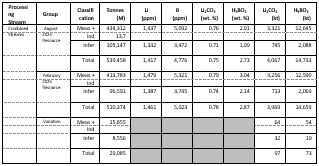 • There has been no HiB-Li or LoB-Li production on the Project to date.
|
|||
|
• The assumptions made regarding recovery of by-products.
|
• No by-products are being considered for recovery at present.
|
|||||
|
• Estimation of deleterious elements or other non- grade variables of economic significance (e.g. sulphur for acid mine drainage
characterisation).
|
• In addition to Li and B, the geological model also included 10 additional non-grade elements (Sr, Ca, Mg, Na, K, Rb, Cs, Mo, Fe, Al) to allow for calculation
of acid consumption values for the metallurgical process. No deleterious elements were estimated.
|
|||||
|
• In the case of block model interpolation, the block size in relation to the average sample spacing and the search employed.
|
• The stratigraphic gridded surface model was developed using a 7.62 m regularized grid. The grade block model was developed from the stratigraphic model using a
7.62 m North-South by 7.62 m East-West by 1.52 m vertical block dimension with no sub- blocks. The block size dimensions represent 12 percent of the closer spaced drill hole spacing and 6 percent of the wider spaced spacing across the
model
|
|
APPENDIX D: JORC Code, 2012 Edition - Table 1
|
|
|
Criteria
|
|
JORC Code 2012 explanation
|
|
Commentary
|
|
|
|
|
|
|
|
area. Grade interpolation into the model blocks was performed using an Inverse Distance Squared (ID2) interpolator with unique search distances for each of the 7 seams being estimated as shown in the table above. The same search parameters were used for all of the elements being estimated (B, Li, Sr, Ca, Mg, Na, K,
Rb, Cs, Mo, Fe, Al) within each of the seams.
|
|
|
|
|
|
• Any assumptions behind modelling of selective mining units.
|
|
• The mining selective vertical unit of 9.14m is based on the selected mining equipment. The 1.52 m bench block model was re-blocked after grade estimation to
9.14m bench height blocks keeping the horizontal dimensions the same at 7.62 by 7.62m.
• The re-blocked 9.14m was developed in the following steps:
• Seams and fault block domains were assigned to the model from the surfaces and solids files;
• Tonnes per block from the 1.52 m model were added together;
• Grades were weighted averaged by tonnes per 1.52 m blocks;
• Class was assigned by majority; when equal number of 1.52m blocks were present, the lower class was assigned;
• Fault block domains with no drill data and received grade estimates from surrounding data received a classification of inferred.
|
|
|
|
• Any assumptions about correlation between variables.
|
|
• No assumptions or calculations relating to the correlation between variables were made at this time.
|
|
||
|
|
• Description of how the geological interpretation was used to control the resource estimates.
|
|
• The geological interpretation was used to control the Mineral Resource estimate by developing a contiguous stratigraphic model (all units in the sequence were modelled) of the host
rock units deposited within the basin, the roof and floor contacts of which then served as hard contacts for constraining the grade interpolation. Grade values were interpolated within the geological units using only samples intersected
within those units.
|
|
||
|
|
• Discussion of basis for using or not using grade cutting or capping.
|
|
• Grade capping or cutting was not applied for the targeted mineralized units B5, M5, S5 and L6, and adjacent units included in the estimation process as a
statistical analysis of the grade data indicated there was no bias or influence by extreme outlier grade values.
• Mineral Resources were not estimated for the other units. Grades have been estimated for adjacent units to allow for potential mining dilution.
|
|
|
APPENDIX D: JORC Code, 2012 Edition - Table 1
|
|
Criteria
|
JORC Code 2012 explanation
|
Commentary
|
||||
|
The process of validation, the checking process used, the comparison of model data to drill hole data, and use of reconciliation data if available.
|
The geological model validation and review process involved visual inspection of drill hole data as compared to model geology and grade parameters using plan isopleth maps and
approximately 300m spaced cross-sections through the model. Drill hole and model values were compared statistically along with grade estimates using polygon and ordinary kriging approaches.
• No reconciliation data is available because the property is not in production.
|
|||||
|
Moisture
|
Whether the tonnages are estimated on a dry basis or with natural moisture, and the method of determination of the moisture content.
|
• The estimated Mineral Resource tonnages are presented on a dry basis.
• A moisture content evaluation needs to be done as part of future analytical programs.
|
||||
|
Cut-off
parameters
|
• The basis of the adopted cut-off grade(s) or quality parameters applied.
|
• The Mineral Resource estimate presented in this Report has been constrained by the application of an optimized Mineral Resource pit shell. The Mineral Resource
pit shell was developed using the IMC Mine Planning software.
• The Mineral Resource estimate assumes the use of three processing streams: one which can process ore with boron content greater than 5,000 ppm and two which can
process ore with boron content less than 5,000 ppm.
• Key input parameters and assumptions for the Mineral Resource pit shell included the following:
• B cut-off grade of 5,000 ppm for HiB-Li processing stream and no B cut- off grade for LoB-Li processing stream
• No Li cut-off grade for HiB-Li processing stream and $11.13/t net value cutoff for LoB-Li processing stream
• Overall pit slope angle of 42 degrees (wall angle guidance provided by Geo-Logic Associates who developed the geotechnical design).
• Mining cost of US$1.69/tonne based on recent studies by Ioneer.
• G&A cost of US$11.13/tonne processed based on recent studies by Ioneer.
• Ore processing and grade control costs vary by process stream and seam unit and are divided into fixed cost and the cost of acid consumption. Shown below are
the costs based on the average grades of the acid consuming elements in the Mineral Resource:
• Stream 1 (HiB-Li): fixed process cost = $30.50/mt and acid
|
|
APPENDIX D: JORC Code, 2012 Edition - Table 1
|
|
Criteria
|
JORC Code 2012 explanation
|
Commentary
|
||||
|
costs range between $22.42/mt and $52.05/mt based on the average grades of the acid consuming elements in each seam.
• Streams 2 & 3 (LoB-Li): both the fixed and acid costs vary by seam with the fixed cost ranging between $15.19/mt to $30.80/mt and the acid costs range
between $3.68/mt and $67.83/mt.
• Boron and Lithium recovery of varied by seam for HiB-Li Processing Stream 1 with the respective recoveries being: M5 80.2% and 85.7%, B5 78.3% and 85.2%, S5
77.0% and 82.5%, L6 75.8% and 79.4% .
• Boron Recovery for LoB-Li Processing Stream variable by lithology as follows: 65% in M5 Unit, 78.3% in B5 unit, 46.8% in S5 unit, and 32.9% in L6 unit.
• Lithium Recovery for LoB-Li Processing Stream variable by lithology as follows: 78% in M5 unit, 85.2% in B5 unit, 84.8% in S5 unit, and 78.7% in L6 unit.
• Boric Acid sales price of US$1,172.78/tonne.
• Lithium Carbonate sales price of US$19,351.38/tonne.
• Sales/Transport costs are included in the process fixed cost/t.
|
||||||
|
Mining factors
or assumptions
|
• Assumptions made regarding possible mining methods, minimum mining dimensions and internal (or, if applicable, external) mining dilution. It is
always necessary as part of the process of determining reasonable prospects for eventual economic extraction to consider potential mining methods, but the assumptions made regarding mining methods and parameters when estimating
Mineral Resources may not always be rigorous. Where this is the case, this should be reported with an explanation of the basis of the mining assumptions made.
|
• The Mineral Resource estimate presented in this Report was developed with the assumption that the HiB-Li and LoB-Li mineralisation within the Mineral Resource
pit shell, as described in the preceding section, has a reasonable prospect for eventual economic extraction using current conventional open pit mining methods.
• Except for the Mineral Resource pit shell criteria discussed in the preceding section, no other mining factors, assumptions or mining parameters such as mining
recovery, mining loss or dilution have been applied to the Mineral Resource estimate presented in this Report.
|
|
APPENDIX D: JORC Code, 2012 Edition - Table 1
|
|
Criteria
|
JORC Code 2012 explanation
|
Commentary
|
||||
|
Metallurgical
factors or
assumptions
|
The basis for assumptions or predictions regarding metallurgical amenability. It is always necessary as part of the process of determining reasonable prospects for
eventual economic extraction to consider potential metallurgical methods, but the assumptions regarding metallurgical treatment processes and parameters made when reporting Mineral Resources may not always be rigorous. Where this is the
case, this should be reported with an explanation of the basis of the metallurgical assumptions made.
|
• The basis of the metallurgical assumptions made in establishing the reasonable prospects for eventual economic extraction of the HiB-Li mineralisation are based
on results from metallurgical and material processing work that was developed as part of the ongoing Feasibility Study for the Project. This test work was performed using current processing and recovery methods for producing Boric acid
and Lithium carbonate products
A second process stream to recover Li from low boron mineralized (LoB-Li) units is being developed. Current results indicate a reasonable process and expectation for economic
extraction of the LoB-Li from the S5, B5, M5 and L6 units. This test work was performed using current processing and recovery methods for producing Boric acid and Lithium carbonate products.
|
||||
|
Environment- al
factors or
assumptions |
Assumptions made regarding possible waste and process residue disposal options. It is always necessary as part of the process of determining reasonable prospects for
eventual economic extraction to consider the potential environmental impacts of the mining and processing operation. While at this stage the determination of potential environmental impacts, particularly for a greenfields project, may
not always be well advanced, the status of early consideration of these potential environmental impacts should be reported. Where these aspects have not been considered this should be reported with an explanation of the environmental
assumptions made.
|
• The project will require waste and process residue disposal. Assumptions have been made that all environmental requirements will be achieved through necessary
studies, designs and permits.
• Currently, baseline studies and detailed designs have been completed for both waste and process residue disposal facilities.
• In December 2022, the United States Fish and Wildlife Service (USFWS) listed Tiehm’s buckwheat as an endangered species under the Endangered Species Act (ESA)
and has designated critical habitat by way of applying a 500 m radius around several distinct plant populations that occur on the Project site. Ioneer is committed to the protection and conservation of the Tiehm’s buckwheat. The
Project’s Mine Plan of Operations was submitted to the BLM in July 2022. In October 2024, Ioneer received its federal permit for the Rhyolite Ridge Lithium-Boron Project from the BLM. The formal Record of Decision (ROD) follows the
issuance in September 2024 of the final Environmental Impact Statement (EIS) by the BLM As part of the final EIS, the U.S. Fish and Wildlife Service, which oversees the administration of the Endangered Species Act (ESA), also formally
released the ESA Section 7 Biological Opinion concluding Rhyolite Ridge will not jeopardise Tiehm’s buckwheat or adversely modify its critical habitat.
• The mineral resource pit shell used to constrain the August 2025, mineral resource estimate was not adjusted to account for any impacts from avoidance of
Tiehm’s buckwheat or minimisation of disturbance within the designated critical habitat. Environmental and permitting
|
|
APPENDIX D: JORC Code, 2012 Edition - Table 1
|
|
Criteria
|
JORC Code 2012 explanation
|
Commentary
|
||||
|
assumptions and factors will be taken into consideration during future modifying factors studies for the Project. These permitting assumptions and factors may result
in potential changes to the Mineral Resource footprint in the future.
|
||||||
|
Bulk density
|
• The density values used to convert volumes to tonnages were assigned on a by-geological unit basis using mean values calculated from 120 density samples collected from drill core
during the 2018-2019 and the 2023-2024 drilling programs. The density analyses were performed using the water displacement method for density determination, with values reported in dry basis.
|
|||||
|
• Whether assumed or determined. If assumed, the basis for the assumptions. If determined, the method used, whether wet or dry, the frequency of
the measurements, the nature, size and representativeness of the samples.
|
• The application of assigned densities by geological unit assumes that there will be minimal variability in density within each of the units across their
spatial extents within the Project area. The use of assigned density with a very low number of samples, as is the case with several waste units, is a factor that increases the uncertainty and represents a risk to the Mineral Resource
estimate confidence
|
|||||
|
• The bulk density for bulk material must have been measured by methods that adequately account for void spaces (vugs,
porosity, etc.), moisture and differences between rock and alteration zones within the deposit.
|
• The Archimedes-principle method for density determination accounts for void spaces, moisture and differences in rock type.
|
|
APPENDIX D: JORC Code, 2012 Edition - Table 1
|
|
Criteria
|
JORC Code 2012 explanation
|
Commentary
|
||||||||
|
Bulk density
(Con’t)
|
Discuss assumptions for bulk density estimates used in the evaluation process of the different materials.
|
• Density values were assigned for all geological units in the model, including mineralized units as well as overburden, interburden and underburden waste units. By-unit densities
were assigned in the grade block model based on the block geological unit code as follows:
|
||||||||
|
Modeled Seams
|
Mean of
Density (gm/cm3)
|
|||||||||
|
Q1
|
Overburden
|
1.80
|
||||||||
|
S3
|
1.53
|
|||||||||
|
G4
|
1.62
|
|||||||||
|
M4
|
1.86
|
|||||||||
|
G5
|
1.65
|
|||||||||
|
M5
|
Mineralized
|
1.64
|
||||||||
|
B5
|
1.78
|
|||||||||
|
S5
|
Mineralized/
Interburden
|
1.84
|
||||||||
|
G6
|
Interburden
|
1.85
|
||||||||
|
L6
|
Mineralized
|
1.98
|
||||||||
|
Lsi
|
Underburden
|
1.98
|
||||||||
|
G7
|
1.86
|
|||||||||
|
Tbx
|
1.86
|
|||||||||
|
APPENDIX D: JORC Code, 2012 Edition - Table 1
|
|
Criteria
|
JORC Code 2012 explanation
|
Commentary
|
||||
|
Classification
|
The basis for the classification of the Mineral Resources into varying confidence categories.
|
• The Mineral Resource estimate for the Project is reported here in accordance with the “Australian Code for Reporting of Exploration Results, Mineral Resources
and Ore Reserves” as prepared by the Joint Ore Reserves Committee (the JORC Code, 2012 Edition).
• IMC performed a statistical and geostatistical analysis for the purpose of evaluating the confidence of continuity of the geological units and grade
parameters. The results of this analysis were applied to developing the Mineral Resource classification criteria for the 1.52m bench height block model.
• Estimated Mineral Resources were classified as follows:
• Measured: Between 107 and 122 m spacing between points of observation depending on the seam, with sample interpolation from a minimum of four drill holes.
• Indicated: Between 168 and 244 m spacing between points of observation, with sample interpolation from a minimum of two drill holes.
• Inferred: To the limit of the estimation range (maximum 533 m, depending on the seam), with sample interpolation from a minimum of one drill hole (2 samples).
• The class was assigned from the 1.52m model to the 9.14m model by majority of the six 1.52m blocks combined to one 9.14m block, with the following exceptions:
• If equal number of two classes (3 blocks and 3 blocks) the lower class was assigned,
• If the block is located within a fault block of a particular seam that has no drill data or less than two holes and was assigned grades from surrounding data,
the class was set to inferred.
|
||||
|
• Whether appropriate account has been taken of all relevant factors (i.e. relative confidence in tonnage/grade estimations, reliability of input
data, confidence in continuity of geology and metal values, quality, quantity and distribution of the data).
|
• The Mineral Resource classification has included the consideration of data reliability, spatial distribution and abundance of data and continuity of geology and
grade parameters
|
|||||
|
• Whether the result appropriately reflects the Competent Person’s view of the deposit.
|
• It is the Competent Persons view that the classification criteria applied to the Mineral Resource estimate are appropriate for the reliability and spatial
distribution of the base data and reflect the confidence of continuity of the modelled geology and grade parameters.
|
|
APPENDIX D: JORC Code, 2012 Edition - Table 1
|
|
Criteria
|
JORC Code 2012 explanation
|
|
Commentary
|
|||
|
|
• The results of any audits or reviews of Mineral Resource estimates.
|
|
• Beyond high level review for the purpose of understanding the Project history, no formal audits or reviews of previous or historical Mineral Resource estimates
were performed as part of the scope of work; Mineral Resource estimation evaluation is limited to the estimate prepared by IMC and presented in this Report.
|
|||
|
|
• Where appropriate a statement of the relative accuracy and confidence level in the Mineral Resource estimate using an approach or procedure
deemed appropriate by the Competent Person. For example, the application of statistical or geostatistical procedures to quantify the relative accuracy of the resource within stated confidence limits, or, if such an approach is not
deemed appropriate, a qualitative discussion of the factors that could affect the
• relative accuracy and confidence of the estimate.
|
|
• IMC performed a statistical and geostatistical analysis and applied Mineral Resource classification criteria to reflect the relative confidence level of the
estimated Mineral Resource tonnes and grades estimated globally across the model area for the Project.
|
|||
|
Audits or
reviews
|
|
• The statement should specify whether it relates to global or local estimates, and, if local, state the relevant tonnages, which should be
relevant to technical and economic evaluation. Documentation should include assumptions
• made and the procedures used.
|
|
• The Mineral Resource tonnes and grade have been estimated globally across the model area for the Project.
|
||
|
Discussion of
relative
accuracy/
confidence
|
|
These statements of relative accuracy and confidence of the estimate should be compared with production data, where available.
|
|
• Reconciliation against production data/results was not possible as the Project is currently in the development stage and there has been no production on the
Project to date.
|
|
APPENDIX D: JORC Code, 2012 Edition - Table 1
|
|
Criteria
|
JORC Code 2012 Explanation
|
Commentary
|
||||
|
Mineral
Resource
estimate for
conversion to
Ore Reserves
|
• Description of the Mineral Resource estimate used as a basis for the conversion to an Ore Reserve.
|
|
• The August 2025 Mineral Resource estimate is based on information compiled by Herbert E. Welhener, a Competent Person is a Registered Member of the SME (Society for Mining,
Metallurgy, and Exploration), and is a QP Member of MMSA (the Mining and Metallurgical Society of America). Mr. Welhener is a full-time employee of Independent Mining Consultants, Inc. (IMC) and is independent of Ioneer and its
affiliates. Mr. Welhener has sufficient experience that is relevant to the style of mineralisation and type of deposit under consideration and to the activity being undertaken to qualify as a Competent Person as defined in the 2012
Edition of the ‘Australasian Code for Reporting of Exploration Results, Mineral Resources and Ore Reserves’ (JORC Code 2012). Mr. Welhener consents to the inclusion in this report.
• The August 2025 Mineral Reserve estimate is based on information compiled by Joseph S.C. McNaughton, a Competent Person is a Registered PE (Professional Engineer) in the state of
Arizona. Mr. McNaughton is a full- time employee of Independent Mining Consultants, Inc. (IMC) and is independent of Ioneer and its affiliates. Mr. McNaughton has sufficient experience that is relevant to the style of mineralisation and
type of deposit under consideration and to the activity being undertaken to qualify as a Competent Person as defined in the 2012 Edition of the ‘Australasian Code for Reporting of Exploration Results, Mineral Resources and Ore Reserves’
(JORC Code 2012). Mr. McNaughton consents to the inclusion in this report.
|
|||
|
• Clear statement as to whether the Mineral Resources are reported additional to, or inclusive of, the Ore Reserves.
|
• The Mineral Resources are reported inclusive of the Ore Reserves.
|
|||||
|
Site visits
|
• Comment on any site visits undertaken by the Competent Person and the outcome of those visits.
|
• The IMC Competent Person Herbert E. Welhener and Joseph Mc Naughton made personal site inspections, this visit was performed on the Project site on August 10th
2023 for the Project.
• During the site visit the IMC Competent Persons visited the Ioneer core shed in Tonopah NV, and the South Basin area of the Rhyolite Ridge Project site, which
is the focus of the current exploration and resource evaluation efforts by Ioneer.
• The IMC Competent Persons observed the active drilling, logging and sampling process and interviewed site personnel regarding exploration drilling, logging,
sampling and chain of custody procedures.
• The outcome of the site visit was that the IMC Competent Persons
|
|
APPENDIX D: JORC Code, 2012 Edition - Table 1
|
|
Criteria
|
JORC Code 2012 Explanation
|
Commentary
|
||||
|
|
developed an understanding of the general geology of the Rhyolite Ridge Project. The IMC Competent Person was also able to visually confirm the presence of a selection of monumented drill
holes from each of the previous drilling programs as well as to observe drilling, logging and sampling procedures during the current drilling program and to review documentation for the logging, sampling and chain of custody protocols
for previous drilling programs.
• During the site visit, the Competent Person confirmed that the type of data was applicable for Ore Reserve estimation. The Competent Person observed project surface conditions for
the purpose of understanding project boundaries, physical characteristics of the resource for determining appropriate extraction methodology. drainage and infrastructure requirements, appropriate locations for overburden storage
facilities (OSFs), as well as access from the proposed quarry to the proposed process plant site location.
|
|||||
|
• If no site visits have been undertaken indicate why this is the case.
|
• Not Applicable
|
|||||
|
Study status
|
• The type and level of study undertaken to enable Mineral Resources to be converted to Ore Reserves.
|
• As part of the August 2025 Ore Reserves estimate, an open-pit mine plan was developed that was technically achievable and economically viable. The mine plan considered material
Modifying Factors such as dilution and ore loss, various boundary constraints, processing recoveries and all costs associated with mining, processing, transportation and selling product.
|
||||
|
• The Code requires that a study to at least Pre-Feasibility Study level has been undertaken to convert Mineral Resources to Ore Reserves. Such
studies will have been carried out and will have determined a mine plan that is technically achievable and economically viable, and that material Modifying Factors have been considered.
|
• The 2025FS was undertaken to convert Mineral Resources to Ore Reserves. The 2025FS determined a mine plan that is technically achievable and economically viable, and that material
Modifying Factors were considered.
• The Mineral Resources have been converted to Ore Reserves by means of an open-pit optimisation and pit design, completed by IMC, and supported by geotechnical studies undertaken
by Geo-Logic Associates (GLA). Only Measured and Indicated Mineral Resources have been included in the Ore Reserves. Modifying factors have been applied as stated below.
|
|||||
|
Cut-off
parameters
|
• The basis of the cut-off grade(s) or quality parameters applied.
|
• IMC applied a two-phase approach to defining the cut-off grade, including a grade-tonnage evaluation and an economic evaluation.
|
|
APPENDIX D: JORC Code, 2012 Edition - Table 1
|
|
Criteria
|
JORC Code 2012 Explanation
|
Commentary
|
||||
|
|
• The grade tonnage evaluation limited the stream 1 process feed to material with boron grades >5,000 ppm boron cut-off grade for high boron – high lithium (HiB-Li) mineralisation
(M5, B5, L6) and net value (net of process) cut-off grade of $11.13/t for low boron (LoB-Li) mineralisation below 5,000 ppm boron which is split into two material types: low clay and high clay material, respectfully, Stream 2 and Stream
3.
|
|||||
|
Mining factors or assumptions
|
• The method and assumptions used as reported in the Pre- Feasibility or Feasibility Study to convert the Mineral Resource to an Ore Reserve (i.e.
either by application of appropriate factors by optimisation or by preliminary or detailed design).
|
• This Ore Reserve estimate is based on work completed for a 2025FS. The ore reserve was developed from the 9.14m(30ft) mine planning block model and is the
total of all proven and probable category ore that is planned for processing.
• The mineral ore reserve was estimated by tabulating the contained tonnage of measured and indicated mineral resources (proven and probable ore reserves) within the designed final
pit geometry at the planned cut-off grade. The final pit design and the internal phase (pushback) designs were guided by the results of the Lerchs-Grossmann algorithm, project constraints, and other relevant factors. Multiple quarry
design objectives and constraints were incorporated into the pit targeting exercise, resulting in five pushback designs that guided the mine planning. These phase designs had a significant impact on various outcomes, including the final
quarry designs, the quarrying approach, and the corresponding mine production plan.
• Modifying Factors (listed below) and GLA’s geotechnical recommendations listed below IMC’s pit design was further analysed by GLA to check for pit slope stability. The analysis
found that the pit design is predicted to be in a stable configuration
|
||||
|
• The choice, nature and appropriateness of the selected mining method(s) and other mining parameters including associated design issues such as
pre-strip, access, etc
|
• The deposit is to be mined by open-pit mining methods with 9.14 metre (m) bench heights using 27 cubic metre (m3) wheel loader, and 136-tonne autonomous haul trucks (AHTs). This is the most
appropriate mining method for extraction of the resource due to the moderately steep dip of the deposit, moderate stripping ratio, mining equipment access requirements to remove overburden and extract ore, and rock properties of the
various stratigraphic units present in the deposit.
• The planned quarry area includes problematic adversely oriented bedding conditions where very low strength materials (i.e. layers M4, M5a, M5, and B5) daylight on the proposed
slope faces. GLA notes that
|
|
APPENDIX D: JORC Code, 2012 Edition - Table 1
|
|
Criteria
|
JORC Code 2012 Explanation
|
Commentary
|
||||
|
Mining factors or assumptions
(con’t)
|
• there are some aspects of the quarry design that are based on limited geotechnical laboratory testing, in particular, the northern extents of the LOM quarry limits.
|
|||||
|
The assumptions made regarding geotechnical parameters (e.g. pit slopes, stope sizes, etc), grade control and pre-production drilling.
|
• Geo-Logic Associates (GLA) completed the geotechnical quarry slope designs, which included limit equilibrium stability and kinematic stability evaluations, including structurally
controlled failures and toppling evaluations. The planned quarry area includes problematic adversely oriented bedding conditions where very low strength materials (i.e. layers M4, M5a, M5, and B5) daylight on the proposed slope faces.
The results of the kinematic and backbreak analyses indicate that these factors would not control the quarry designs. The inter-ramp angle (IRA) results from the backbreak and kinematic analyses for the LOM quarry was 42° in all
materials other than Alluvial, alluvial material has an IRA of 35°. The ground anchor support structure recommended by GLA is included within the pit design and mine plan prepared by IMC.
|
|||||
|
The assumptions made regarding geotechnical parameters (e.g. pit slopes, stope sizes, etc), grade control and pre-production drilling.
|
• Control of blasting will be extremely important as production progresses; especially where steeply dipping materials are present. The potential need for controlled blasting
techniques near the final quarry wall may be required during normal operations. Such techniques may include buffer blasting, trim blasting, pre-splitting, post-split blasting, and line drilling. GLA recommends that radar monitoring and
prisms be implemented, at a minimum, for increased safety and productivity, as well as for protection of the Tiehm’s buckwheat population
|
|||||
|
The major assumptions made and Mineral Resource model used for pit and slope optimisation (if appropriate).
|
• Pit optimisations were performed on August 2025 Mineral Resource model, IMC performed numerous pit targeting exercises under various scenarios and assumptions to identify the
economic extents of the LOM Quarry using the 9.14m mine planning geological block model and Hexagon MinePlan® software’s quarry optimization capabilities. Using the above geotechnical parameters and applied recovery, pro-forma mining
cost, processing cost, transportation cost and sales price assumptions listed below:
• Boron cut-off grade of 5,000 ppm (Stream 1)
|
|
APPENDIX D: JORC Code, 2012 Edition - Table 1
|
|
Criteria
|
JORC Code 2012 Explanation
|
Commentary
|
||||
|
Mining factors or assumptions
|
|
• Boron cutoff grade < 5,000 ppm and Net value of $11.13/t (Stream 2 & 3)
• Boron recovery of between 32.9% to 80.2%, based on process stream and seam.
• Lithium recovery between 78.0% to 85.7%, based on process stream and seam.
• Mining cost of US$1.69 per tonne (t)
• Additional haulage cost of US$0.0059/t per vertical metre
• Average Processing cost of US$58.11/t
• G&A cost of $11.13/t
• Boric Acid sales price of US$1,172.78/tonne
• Lithium Carbonate sales price of US$19,351.38/tonne
|
||||
|
• The mining dilution factors used.
|
• Mining will be performed on a horizontal 9.14m high bench. It is assumed that no split benches will be mined. To incorporate the estimate of dilution and ore loss from adjacent
seams, a 9.14m bench height block model was developed for use in the mine plan and tabulation of the Ore Reserves. The steps to develop this block model are:
• The geologic solids and surfaces were assigned to the block model with a block size of 7.62 by 7.62 meter in plan and 9.14m high. In instances where a model block intersected more
than one seam, the seam with the majority of the block volume was assigned to the total block.
• The grades were averaged, weighted by ktonnes from the 1.52m model;
• Class was assigned by majority from the 1.52m model with the following modifications:
• If there were equal number of blocks (3 and 3), the classification used the lower class: measured moved to indicated or indicated moved to inferred;
• In fault block domains with few or no composites, the following edits were done:
• Measured set to inferred if there are no composites in fault block,
• Measured set to inferred if less than four (< 4) composites in fault block,
|
|
APPENDIX D: JORC Code, 2012 Edition - Table 1
|
|
Criteria
|
JORC Code 2012 Explanation
|
Commentary
|
||||
|
• Measured set to indicated if four to nine (4 – 9) composites in fault block,
• Indicated set to inferred if less than (< 4) composites in fault block
|
||||||
|
• The mining recovery factors used.
|
• The mining recovery factor assumes the use of front end loaders and dozers outfitted with high- precision GPS and integrated FMS and competent operators mining on a 9.14m bench.
The recovery and losses are assumed to be incorporated into the 9.14m bench height model used to tabulate the ore reserve and mine plan tonnages and grades.
|
|||||
|
• Any minimum mining widths used.
|
• Due to the continuous thickness of the B5 and L6 seams within the designed pit, no minimum mining thickness was applied in the Ore Reserves estimate.
|
|||||
|
• The manner in which Inferred Mineral Resources are utilised in mining studies and the sensitivity of the outcome to their inclusion.
|
• Stated Ore Reserves have only been reported from the Measured and Indicated Resource categories with Modifying Factors applied.
|
|||||
|
• The infrastructure requirements of the selected mining methods.
|
• The Project is currently in the design stage, and no site-specific infrastructure has been built to date. Infrastructure required for the Project includes haul roads, ground
anchoring highwall support structure, Overburden Storage Facilities (OSFs), Spent Ore Storage Facility (SOSF), Contact Water Ponds (CWPs), the processing plant which includes processing structures and facilities, maintenance facilities,
warehousing, shipping and receiving, fuel island, Sulphuric Acid Plant (SAP), Steam Turbine Generator (STG) responsible for power generation/transmission, and administrative buildings.
|
|
APPENDIX D: JORC Code, 2012 Edition - Table 1
|
|
Criteria
|
JORC Code 2012 Explanation
|
Commentary
|
||||
|
Metallurgical
factors or
assumptions
|
• The metallurgical process proposed and the appropriateness of that process to the style of mineralisation.
|
• The Rhyolite Ridge Li-B ore is unique, and no reference installations exist for processing this type of ore. Advanced scientific investigative and confirmatory test work was
therefore required to optimise the process flowsheet for the 2020FS. Bench and pilot plant testing were conducted at Kemetco Research, Inc. (Kemetco) in Richmond, British Columbia, and overseen
by Norm Chow and Anca Nacu PhD with Kemetco; Patrick Glynn P.E., Jaegan Mohan and Kyle Marte, PEng with Fluor; and Peter Ehren and Michael Osborne with Ioneer. Kappes Cassiday Associates (KCA)
performed baseline metallurgical test work for vat leaching test work, FLSmidth performed crushing and filtration test work, and Veolia performed evaporation and crystallisation test work that formed the basis of the 2020FS.
• Ore will be processed by ore sizing, vat acid leaching, impurity removal, evaporation, and crystallisation using a flowsheet developed specifically for the Project to generate
technical-grade lithium carbonate and boric acid. Test work has also confirmed that refining the technical-grade lithium carbonate to battery-grade lithium hydroxide is technically and commercially feasible through a liming route. No
impediments have been identified to the technical and commercial feasibility for conversion of the technical-grade lithium carbonate to battery-grade lithium carbonate through the bicarbonation route.
• Key process engineering deliverables completed include the block flow diagram (BFD), process flow diagrams (PFDs), process design criteria, piping and instrumentation diagrams (P&IDs), and heat and mass balance (summarized on the PFDs). The heat and mass balance has been compiled
using the Metsim process simulation software package and is a fully integrated model comprising all major process unit operations and recycle streams. The model tracks all elements/compounds of interest throughout the process. Notably
lithium wash losses, which can be significant in lithium brine flowsheets, are estimated through detailed modelling of all dewatering and wash unit operations.
|
|
APPENDIX D: JORC Code, 2012 Edition - Table 1
|
|
Criteria
|
JORC Code 2012 Explanation
|
Commentary
|
||||
|
|
• An on-site SAP will produce commercial-grade sulphuric acid for vat leaching the ore. The selection of the technology for the large SAP is based on a proven operating design
and specialty technology provider. The SAP is a double conversion, double adsorption system that has proven to be reliable and predictable.
|
|||||
|
• Whether the metallurgical process is well-tested technology or novel in nature.
|
• The Rhyolite Ridge Li-B ore is unique, and no reference installations exist for processing this type of ore. Advanced scientific investigative and confirmatory test work was
therefore required to optimise the process flowsheet. Bench and pilot plant testing were performed by Kemetco, KCA performed baseline metallurgical test work for vat leaching test work, FLSmidth performed crushing and filtration
test work, and Veolia performed evaporation and crystallisation test work that formed the basis of the 2020FS. However, the proposed metallurgical process uses known and commercially proven equipment and technology and is ready
for commercialisation.
|
|||||
|
• The nature, amount and representativeness of metallurgical test work undertaken, the nature of the metallurgical domaining applied and the
corresponding metallurgical recovery factors applied.
|
• The Rhyolite Ridge Li-B ore is unique, and no reference installations exist for processing this type of ore. Advanced scientific investigative and confirmatory test work was
therefore required on bulk samples taken from the outcrop and on core samples. Bench and pilot plant testing were performed by Kemetco, KCA performed baseline metallurgical test work for vat leaching test work, FLSmidth performed
crushing and filtration test work, and Veolia performed evaporation and crystallisation test work that formed the basis of the 2020FS. The metallurgical testing programs were fit for purpose and no standardized test methods were
used to govern testing programs. Test work was structured and guided using the general principles and definition of the CIM Best Practice Guidelines for mineral processing. At a finer level each metallurgical laboratory has their
own standard operating procedures (SOPs) and use a wide range of standards for individual test procedures and assaying. A list of these procedures has not been compiled. The majority of
metallurgical test work has been performed on material from the South Basin, which was the focus of the 2020FS and the proposed location of the quarry, though some test work has also been done on core from the North Basin where
operations could potentially expand in the future.
|
|
APPENDIX D: JORC Code, 2012 Edition - Table 1
|
|
Criteria
|
JORC Code 2012 Explanation
|
Commentary
|
||||
|
• In-depth metallurgical test work and pilot plant programs were performed over the 18-month duration of the 2020FS on over 27 tonnes of material (primarily limited to the
B5 unit) to optimise the process flowsheet. Some metallurgical test work is still ongoing to confirm and further reduce risk of specific areas in the process flowsheet. The results from the test work will be incorporated and
updated during the detailed engineering phase, over the next year, based on the criticality of the effect on the current design.
• The process flowsheet was customised to the metallurgical and chemical characteristics of the unique Rhyolite Ridge ore to reflect each unit operation of the proposed
Rhyolite Ridge processing facilities. This extensive effort has resulted in achieving a high level of confidence in the process flowsheet and reducing process risk and uncertainty. The major unit operations of the Rhyolite Ridge
flowsheet have been operated at pilot plant scale on over 27 tonnes of material. The metallurgical test work is representative of the process planned for treating the Rhyolite Ridge ore delivered from the mine.
• Based on the metallurgical test work, corresponding recoveries for lithium and for boron to be applied to all ore planned to be mined based on stream and seam as follows.
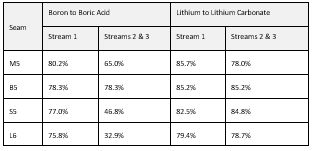 These figures are cumulative recoveries for the unit processes that span from vat leaching to product production.
|
|
APPENDIX D: JORC Code, 2012 Edition - Table 1
|
|
Criteria
|
JORC Code 2012 Explanation
|
Commentary
|
||||
|
• Any assumptions or allowances made for deleterious elements.
|
|
• In addition to lithium and boron, deleterious elements including magnesium, calcium, aluminium, potassium, and iron impact the amount of sulphuric acid consumed by processing
plant feed material and annual ore throughputs. The process plant design is based on maximising the sulphuric acid output by the SAP. The ore throughput through the processing plant is therefore variable to counter the effect of
varying acid consumptions to give a constant annual acid consumption. The ore throughput of the process plant is based on achieving the maximum ore throughput anticipated in the mine plan on a monthly basis.
|
||||
|
• The existence of any bulk sample or pilot scale test work and the degree to which such samples are considered representative of the
orebody as a whole.
|
|
• Extensive test work and pilot plant programs were performed as part of the 2020FS on bulk samples taken from the outcrop and on core samples. The majority of metallurgical
test work has been performed on material from the proposed quarry location in the South Basin, which was the focus of the 2020FS. Most test work was performed on B5. Test work has been performed on over 27 tonnes of material, and
the samples are representative of the ore body as a whole.
|
||||
|
• For minerals that are defined by a specification, has the ore reserve estimation been based on the appropriate mineralogy to meet the
specifications?
|
|
• Kemetco, KCA, FLSmidth, and Veolia have performed sufficient bench scale and pilot plant test work to indicate that technical grade lithium carbonate with 99% purity,
battery-grade lithium hydroxide with 99.5% purity, and boric acid with 99.9% purity can be produced from the Rhyolite Ridge ore. The Ore Reserves are of the mineralogy that the plant is designed to process and support these
specifications based on metallurgical test work.
|
||||
|
Environmental
|
• The status of studies of potential environmental impacts of the mining and processing operation. Details of waste rock characterisation
and the consideration of potential sites, status of design options considered and, where applicable, the status of approvals for process residue storage and waste dumps should be reported.
|
|
• The Project is designed to be a sustainable, environmentally sensitive operation with no grid energy requirements, low water usage, low emissions, and a modest surface
footprint.
• The BLM permitting process required compliance with the National Environmental Policy Act (NEPA); The NEPA requirements included
baseline reports for 14 different resource areas of the Project, including air quality, biology, cultural resources, groundwater, recreation, socioeconomics, soils, and rangeland.
• Baseline environmental studies were performed as part of the 2020FS. Updates to the air quality impacts assessment, and groundwater were completed in 2023 and 2024.
• The permits deemed critical to the advance of the overall Project included the Bureau of Land Management (BLM) Plan of Operations,
the State of Nevada Water Pollution Control Permit (WPCP) required to construct, operate, and close a mining facility, and the Nevada Bureau of Air Pollution Control air quality permit.
Ioneer has received these three critical permits as of October 2024.
• Bureau of Land Management (BLM) – Mine Plan of Operations, and
|
|
APPENDIX D: JORC Code, 2012 Edition - Table 1
|
|
Criteria
|
JORC Code 2012 Explanation
|
Commentary
|
||||
|
|
|
|
|
State of Nevada Bureau of Mining Regulation and Reclamation (BMRR) – Nevada Reclamation Permit – applications were submitted to both agencies and the BLM determined the application
complete on August 26, 2020. An amended version of the applications was submitted to the BLM and BMRR in July 2022.
• The State of Nevada Bureau of Air Pollution Control – Air Quality Permit – was obtained on June 14, 2021 (AP1099-4256).
• The State of Nevada BMRR – Water Pollution Control Permit (required to construct, operate, and close a mining facility) – was obtained on July 1, 2021 (NVN-2020107).
• The Plan of Operations filing triggered the environmental review process under the NEPA that is expected to follow an Environmental Impact Statement (EIS) pathway. The NEPA process was guided by the 2023 implemented requirements in the NEPA regulations under 40 Code of Federal Regulations 1500 and other U.S. Department of Interior guidance,
as well as the BLM Battle Mountain District Instruction that streamline the overall environmental review and permitting processes. The BLM selected a third-party EIS contractor in September 2020. That contractor subsequently
commenced preliminary NEPA work for the BLM, including assessing the adequacy of the baseline data for use in the EIS. The BLM published a Notice of Intent to prepare an EIS in December 2022. Scoping was completed in the first
quarter of 2023. The Draft EIS was completed in April 2024 and the Notice of Availability was published in the second quarter of 2024. In October 2024, Ioneer received its federal permit for the Rhyolite Ridge Lithium-Boron
Project from the BLM. The formal Record of Decision (ROD) follows the issuance in September 2024 of the final Environmental Impact Statement (EIS) by the BLM, which incorporated public feedback received during the April-June 2024
open comment period.
• Ioneer has focused its efforts to date on preparing permits for the initial phases of the quarry south of the county road estimated to allow for the first 10 years, and
little work has been done to date on preparing permit applications for the larger LOM, which is effectively an expansion of the current planned quarry. The permitting process for the LOM Quarry will begin after the initial stages
of project construction. Based on the current mine plan, the LOM Quarry permits will need to be secured by the end of the fifth year of production, which is currently slated for 2034.
• A geochemistry study was conducted as part of the 2020FS to assess
|
|
APPENDIX D: JORC Code, 2012 Edition - Table 1
|
|
Criteria
|
JORC Code 2012 Explanation
|
Commentary
|
||||
|
|
|
|
acid rock drainage (ARD), metals leaching (ML), and salinity generation potential of all major
lithologic units and residual process materials. The study also aimed to understand mineral composition and geochemical controls on water quality, evaluate potential impacts from the project and associated protection measures and
provide information to support geochemical models and evaluations for water quality predictions. Overburden and ore samples were collected from existing exploration drill core and 137 samples representing 15 different units were
geochemically analysed to characterise the potential of these materials to generate acidic drainage or to leach metals based on regulatory guidance documents published by the Nevada Division of Environmental Protection (NDEP) and the Nevada BLM. Testing included acid-base accounting (ABA), net acid generation pH, short-term leach testing by meteoric water mobility
procedure, bulk elemental content, X-ray diffraction, optical mineralogy, and humidity cell testing (HCT). While most Project materials are non-potentially acid generating (non-PAG), HCTs for all major lithologic units are required because a post-closure quarry lake will develop. A geochemistry study was conducted by Piteau in 2023 to support the application to
modify the Project’s existing WPCP NEV2020107 issued August 24, 2021. The updated Geochemical Report was completed and submitted to NDEP with the modification application submitted July 17, 2024Two ex-pit OSFs have been designed
to accommodate the storage of overburden and low-grade M5 material, namely, the South OSF and the North OSF. The South OSF is located to the south of the quarry. This site was selected due to its proximity to the quarry to
minimise haul distances and prevent sterilisation of Mineral Resources; as well as not move the OSF out of critical habitat. The North OSF is located approximately 1.1 kilometres (km)
northwest of the quarry between the quarry limits and the processing plant. The North OSF site was selected due to boundary restrictions and the location of the Cave Springs Formation outcroppings. In-pit storage of overburden and
low- grade M5 material can commence as soon as sufficient pit floor space is available and the orientation of the advancing mining face becomes conducive to in-pit backfilling. The initial South OSF with an estimated three years
of capacity was designed to a relative accuracy and confidence level consistent with a Feasibility Study, whereas the North OSF, and In-Pit Overburden Backfill (IOB) designs were performed
to a relative accuracy and confidence level consistent with
|
|
APPENDIX D: JORC Code, 2012 Edition - Table 1
|
|
Criteria
|
JORC Code 2012 Explanation
|
Commentary
|
||||
|
|
|
|
a Pre-Feasibility Study. To date, no additional issues have been identified that would materially impact the proposed locations of the South and North OSFs.
• A tail gas scrubber will be installed on the SAP to remove remaining sulphur dioxide (SO2) from the gas stream to make certain that environmental emissions requirements are met.
• Process residue will be stacked in a Spent Ore Storage Facility (SOSF) located 1.6 km south of the processing plant that has been
designed to store a composite consisting of leached ore from the vats plus sulphate salts generated in the evaporation and crystallisation circuits. This material is suitable for dry stacking, so there is no need for a
conventional tailings dam. A double-sided, textured high-density polyethylene (HDPE) geomembrane liner will provide containment and will be protected by a granular layer to facilitate
long-term drainage. The SOSF engineering has been completed to a detailed design level with drawings issued for construction as this level of engineering completion is required by regulatory authorities and will be submitted as
part of the overall permitting process. To date, no issues have been identified that would materially impact the proposed location of the SOSF.
|
|||
|
|
Infrastructure
|
|
• The existence of appropriate infrastructure: availability of land for plant development, power, water, transportation (particularly for
bulk commodities), labour, accommodation; or the ease with which the infrastructure can be provided, or accessed.
|
|
• The Project is currently in the development stage, and no site-specific infrastructure has been built to date.
• Sufficient land exists to locate all proposed infrastructure required for the Project, including haul roads, ground anchoring highwall support structures, Overburden Storage
Facilities (OSFs), Spent Ore Storage Facility (SOSF), Contact Water Ponds (CWPs), the processing plant (which
includes processing structures and facilities), maintenance facilities, warehousing, shipping and receiving, fuel island, Sulphuric Acid Plant (SAP), Steam Turbine Generator (STG) responsible for power generation/transmission, and administrative buildings.
• The STG will generate 42 mega-Watts (‘MW’) of electricity using steam generated by the waste heat boiler in the SAP. The STG power generation will exceed the power
requirements to run the entire facility and will be separate from the Nevada state power grid
|
|
APPENDIX D: JORC Code, 2012 Edition - Table 1
|
|
Criteria
|
JORC Code 2012 Explanation
|
Commentary
|
||||
|
Infrastructure
(con’t)
|
.
|
|
• Two backup diesel generators will also be available to provide black- start capability and provide power to essential systems should the STG be down. The Project has been
designed to be an environmentally sensitive operation with low water usage and water recycling and reuse where possible. There is sufficient water available to meet processing and dust control requirements.
• For geotechnical stability the use of a system of ground anchors, primary located on the western wall will be utilized to stabilize
the slopes where low strength material could not be removed in preservation of the Tiehm’s Buckwheat populations and their proximity to the quarry highwall. A constructability review of the recommended structural support has been
completed to assure the feasibility of the design, availability of contractors to perform the work and supply chain availability from 3 different source.
• The Rhyolite Ridge site is currently accessed from the cities of Reno and Las Vegas, Nevada from Nevada Stage Highway 264 and the unpaved Hot Ditch and Cave Springs county
roads. Ioneer is working with Esmeralda County officials in developing a traffic management plan that will integrate new access roads to the facility with the existing county roads in the area. Consideration will be given to make
certain that the safety of all users of county roads is not compromised through development of the Project.
• Nevada is considered one of the world’s most favourable and stable mining jurisdictions, and there is a high degree of experienced, competent, and skilled personnel available
to meet workforce requirements for the Project.
A workforce camp is not foreseen for use in housing Owner personnel. Ioneer staff conducted a study of local housing options, Local housing, apartments, motels, and recreational vehicle (RV) sites were located, evaluated, and quantified. Only a very limited amount of accommodation is available in the nearest residential next closest available accommodations are in the city of
Tonopah, Nevada, which is roughly 1.5 hours to the Project site. A few inactive RV sites were located near the site, but re-activation potential was not evaluated, and these sites are limited to 25 by regulation due to needs for
infrastructure for larger RV areas. Due to the potential areas, the small town of Dyer, Nevada, and Bishop, California. The need to develop housing, Ioneer may contribute individual housing support, which is included in the
operating costs estimate for those employees hired before turnover. In addition, Ioneer
|
|
APPENDIX D: JORC Code, 2012 Edition - Table 1
|
|
Criteria
|
JORC Code 2012 Explanation
|
Commentary
|
||||
|
|
|
|
|
may invest over two years in local housing infrastructure under the assumption that roughly 20% of the Ioneer workforce will be local hires and an additional 20% of employees will be
drive-in/drive-out.
• A project execution plan has been developed based on an Engineering, Procurement, and Construction Management (EPCM) delivery
framework. Project execution is based on continuing with the same companies (Fluor, SNC-Lavalin, MECS, Kemetco, KCA, FLSmidth, Veolia, EM Strategies, NewFields, and Trinity) that completed the FS to maintain continuity and
retain project knowledge. In addition to new service providers like IMC & GLA. Construction of processing plant, SAP, and SOSF facilities is planned to be facilitated by various consultants and contractors with Ioneer
oversight, whereas construction of the mine haul roads and initial box-cut is planned to be performed by Ioneer.
|
||
|
Costs
|
• The derivation of, or assumptions made, regarding projected capital costs in the study.
|
• The capital cost estimate is based on work completed to update the 2020FS to an AACE Class 2 capital cost estimate with an accuracy range of -10%/+15% to produce an updated
2024FS, where engineering design is ~70% complete. The estimate reflects the Project’s EPCM execution strategy and baseline project schedule.
• Capital costs for various Work Breakdown Structure (WBS) codes were independently developed by third parties and consolidated by
Fluor. More than 1,500 deliverables were produced during the 2024FS to support the capital costs estimate.
• The capital cost estimate covers the period from 2024FS completion to commissioning and is reported in first Quarter (Q1) 2024 real US
dollars without allowances for escalation or currency fluctuation. The estimate does not include sunk costs.
A contingency of 10% was applied to the capital costs estimate using a Monte Carlo simulation to achieve a P65 (i.e., the probability at the 65th percentile) confidence level for the estimate and P50
for schedule according to the model and ranges established by Fluor. The estimate, including contingency, has an expected accuracy range of +15%/-10% as per the basis of estimate. The capital schedule for mining equipment includes
new equipment required to meet production targets of the 96-year mine plan and replacement equipment based on useful service lives
|
|
APPENDIX D: JORC Code, 2012 Edition - Table 1
|
|
Criteria
|
JORC Code 2012 Explanation
|
Commentary
|
||||
|
• provided by the vendor or based on other industry standards. Rebuilds have also been included in the capital schedule at regular intervals based on rebuild lives
provided by the vendor or other industry standards.
• Capital costs of mining equipment were derived from quotes received in April 2024 from an equipment vendor with offices in Nevada. Taxes for the AHTs were estimated
using a tax rate of 6.85%, but freight and assembly costs were assumed to remain unchanged from the conventional haul truck.
• The capital cost estimates are not 100% equity based. Capital cost estimates for new and replacement mining equipment assume that 90% of the total equipment cost
inclusive of the base cost, taxes, freight, and assembly would be financed and included in the operating costs estimate based on terms provided by the equipment manufacturer. The 20% down payment for equipment was included
in the capital costs estimate.
Capital costs for the haul roads, OSFs, SOSF, CWPs, the processing plant (which includes processing structures and facilities), maintenance facilities, warehousing, shipping and receiving, fuel
island, SAP, STG, and administrative buildings were estimated from material take-off (MTO) quantities developed for the 2024FS by various third parties. Each of the above have an
engineering design that is at least 30% complete with some items with a level of design maturity completed to detailed engineering and issued for construction.
|
||||||
|
• The methodology used to estimate operating costs
|
• Operating costs are based on Ioneer’s basis of operating cost estimates dated March 2024 and their latest operating cost estimate model.
• Sustaining capital costs have been included in the operating costs estimate.
• Operating cost estimates for the quarry and processing plant were developed by Ioneer and Fluor and consolidated by Fluor for input into the cash flow model.
• Direct mine operating costs are zero-based and developed from first- principles from the mine plan production statistics using methodologies consistent with a 2025FS.
Except for blasting and preventative maintenance, all production tasks are assumed to be self-performed by the owner (Ioneer). Mine mobile equipment will be monitored and
|
|
APPENDIX D: JORC Code, 2012 Edition - Table 1
|
|
Criteria
|
JORC Code 2012 Explanation
|
Commentary
|
||||
|
|
• maintained through a Master Service Agreement with Empire Southwest the Caterpillar dealership. The contract includes cost of service, management, supplies, and
parts management. Operation costs and component sustainable capital costs were based on a firm bid.
• Blasting is assumed to be performed by a qualified subcontractor.
• Hourly operating costs for equipment were based on vendor guidelines and supported by budgetary quotes for consumable items from local vendors, including fuel, diesel
exhaust fluid, lubricants and greases, rubber tyres, ground-engaging tools, and wear parts. Hourly undercarriage and general repair and replacement parts were estimated from a third-party cost database and escalated to 2019
US dollars.
• Annual costs for an integrated Fleet Management System (FMS) have been included based on a budgetary quote provided by a local
vendor. Based on information provided by the equipment vendor, an annual license fee was applied to each AHT required to meet production in a given year.
• The mine was assumed to operate two-shifts-per-day, 365 days per year with no scheduled off days for the first 19 years of production. The mine was then assumed to
transition to a one-shift-per-day basis from Year 20 through the remaining mine life. Labour wages are fully burdened and were developed based on a survey of local mining wages.
• Costs for the “License Team” and Caterpillar “Run Team” personnel required to remotely monitor the AHTs each shift and make sure they are performing to specifications
have been included in the mine operating costs.
• Costs for the “License Team” and Caterpillar “Run Team” personnel required to remotely monitor the AHTs each shift and make sure they are performing to specifications
have been included in the mine operating costs.
• Mining equipment financing costs are included in the operating costs. For the purposes of the estimate, 80% of the total equipment cost inclusive of the base cost,
taxes, freight, and assembly are assumed to be financed based on terms provided by the equipment manufacturer. The 20% down payment was included in the capital costs estimate.
• Processing costs spent ore removal and SOSF costs, SAP costs, and other indirect operating costs were estimated by Fluor and
|
|
APPENDIX D: JORC Code, 2012 Edition - Table 1
|
|
Criteria
|
JORC Code 2012 Explanation
|
Commentary
|
||||
|
|
• SNC Lavalin from first principles using the ore production schedule from the mine plan. These costs were estimated using methodologies consistent with a 2020FS and
included quoted firm pricing from major reagent suppliers, quoted freight costs from transport firms, and workforce costs based on industry norms for salary and wage data within the region consistent with the mine workforce
costs. Reasonable scenarios for other requirements such as outsourced services with quoted rates or estimates were also included. Quantities of reagents were established during pilot testing with ore.
|
|||||
|
• Allowances made for the content of deleterious elements.
|
• No penalties for deleterious elements were forecast in the economic analysis.
|
|||||
|
• The source of exchange rates used in the study.
|
• Exchange rates not applicable
|
|||||
|
• Derivation of transportation charges.
|
• Transportation charges for all significant materials were derived from quotes. Historical data were used for some minor charges.
|
|||||
|
• The basis for forecasting or source of treatment and refining charges, penalties for failure to meet
• specification, etc.
|
• Not applicable.
|
|||||
|
• The allowances made for royalties payable, both Government and private.
|
• Net proceeds (in the form of taxes) were included in the economic analysis. No royalties are paid to private organisations or individuals.
|
|||||
|
• The derivation of, or assumptions made regarding revenue factors including head grade, metal or commodity price(s) exchange rates,
transportation and treatment charges, penalties, net smelter returns, etc.
|
• The revenue factors used in the economic analysis were based on work performed for the 2020FS and updated in Q1 2025.
• Annual saleable lithium carbonate, lithium hydroxide, and boric acid tonnages reflect the head grade dictated by the mine plan and anticipated metallurgical recoveries
estimated from test work.
• Price forecasts for lithium carbonate and lithium hydroxide were obtained from a range of market research companies, investment banks, and other reputable sources. For
the financial model price forecasts rather than the current or historical prices were used. This approach allows to better account for future market conditions and potential price trends, providing a more accurate financial
assessment.
• The offtake agreement prices of technical-grade lithium carbonate are based on the delivered price formula using the battery-grade lithium hydroxide index price from
Benchmark
|
|
APPENDIX D: JORC Code, 2012 Edition - Table 1
|
|
Criteria
|
JORC Code 2012 Explanation
|
Commentary
|
||||
|
|
Mineral Intelligence (Q1, 2025) battery-grade lithium hydroxide price forecast. The offtake price formulas are the agreed price index minus the agreed conversion cost and discount, the
agreed price index minus the agreed discount minus the agreed conversion cost, or the agreed price index minus the conversion cost.
|
|||||
|
|
• The derivation of, or assumptions made regarding revenue factors including head grade, metal or commodity price(s) exchange rates,
transportation and treatment charges, penalties, net smelter returns, etc. (Con’t)
|
• The estimated price for boric acid was based on an analysis by Ioneer’s Sales and Marketing team using 1) Ioneer current contracts, and 2) based
on internal analysis of historical prices and volumes extracted from Datamyne’s trade data, import prices and volumes from Japan, South Korea, Southeast Asia, and China, customers and distributors’ interviews, China Boron
Association data, and Internal market equilibrium assumptions.
• No exchange rates were applied to metal or commodity prices. All commodity prices are transacted and stated in US Dollars.
• Transportation charges for all significant materials were derived from quotes in Q1 2025. Historical data were used for some minor charges not
derived from quotes.
• No penalties were forecast in the economic analysis.
|
||||
|
The derivation of assumptions made of metal or commodity price(s), for the principal metals, minerals and co-products.
|
• The revenue factors used in the economic analysis were based on work performed for the 2020FS and updated in Q1 2025.
• Price forecasts for lithium carbonate and lithium hydroxide were obtained from a range of market research companies, investment banks, and other reputable sources.
For the financial model price forecasts rather than the current or historic prices were used. This allows to better account for future market conditions and potential price trends, providing a more accurate financial
assessment.
|
|||||
|
|
Revenue
factors
|
|
• The offtake agreement prices of lithium chemicals are based on the delivered price formula using the battery-grade lithium hydroxide index
price from Benchmark Mineral Q1 2025) battery-grade lithium hydroxide price forecast. The offtake price formulas are the agreed price index minus the agreed conversion cost and minus discount, or the agreed price
index minus the agreed discount minus the agreed conversion cost, or the agreed price index minus conversion cost. In year three Ioneer will have completed construction of a Lithium Hydroxide facility at site
allowing the battery grade lithium hydroxide price to be realized thus eliminating the conversion cost.
• The estimated price for boric acid used in the economic analysis was
|
|
APPENDIX D: JORC Code, 2012 Edition - Table 1
|
|
Criteria
|
JORC Code 2012 Explanation
|
Commentary
|
||||
| |
based on an analysis by Ioneer’s Sales and Marketing team using 1) Ioneer current contracts, and 2) based on internal analysis of historical prices and volumes extracted
from Datamyne’s trade data, import prices and volumes from Japan, South Korea, Southeast Asia, and China, customers and distributors interviews, China Boron Association data, and Internal market equilibrium
assumptions.
|
|||||
|
Market
assessment
|
• The demand, supply and stock situation for the particular commodity, consumption trends and factors likely to affect supply and
demand into the future.
|
• Market demand and supply trends for lithium products and borates were completed by Ioneer’s Sales & Marketing team.
• Ioneer’s efforts were led by Yoshio Nagai, Ioneer’s Vice President of Sales & Marketing. Mr. Nagai has more than 30 years of experience in the
chemical and mining industry sales and marketing, most recently as Sales Vice President of Rio Tinto Minerals, accountable for borates, salt, and talc products in Asia and the USA.
• Lithium
• Lithium extraction produces lithium carbonate, lithium hydroxide, lithium chloride, butyl lithium, and lithium metal. Lithium carbonate can be
produced with different qualities, such as industrial grade (typically ≥98.5% purity), technical grade (≥99% purity), and battery grade (≥99.5% purity). Some industrial-grade lithium carbonate (i.e., from brines in China)
has a lower purity than 95%. Industrial- grade and technical-grade lithium carbonate are typically used for glass, fluxing agents, ceramics, and lubricants, and feedstock to produce various battery-grade lithium products.
Battery-grade lithium carbonate and hydroxide are used to produce lithium-ion battery cathodes.
• Lithium Supply Demand Balance -The current market demand for lithium is substantial, driven primarily by the increasing adoption of electric
vehicles (EVs) and the growing use of lithium-ion batteries in various applications, including consumer electronics and energy storage systems. While the lithium market is experiencing price pressures due to the market
oversupply, the market is forecasted to enter a market deficit from 2030, and the long-term outlook remains positive, driven by the ongoing shift towards electric mobility and renewable energy storage solutions.
• Lithium demand will increase from 1.45 Mt in 2025 to 2.445 Mt in 2030 and 4.37 Mt in 2040 (Wood Mackenzie, Q1 2025).
• According to Wood Mackenzie, regarding battery chemistry, Lithium Iron Phosphate (LFP) is projected to experience strong growth until 2031, after
which its growth rate is expected to decelerate. Concurrently, high-
|
|
APPENDIX D: JORC Code, 2012 Edition - Table 1
|
|
Criteria
|
JORC Code 2012 Explanation
|
Commentary
|
||||
| |
|
nickel cathodes are forecast to maintain robust demand, surpassing LFP by 2035. This shift reflects the saturation of the Chinese market and the expansion of Western markets, which tend to
favour high-nickel chemistries. Consequently, battery-grade lithium carbonate is expected to dominate demand until 2039. Technical-grade lithium chemical demand is projected to grow in line with broader macroeconomic
trends.
• Longterm, the most significant growth is expected in battery-grade lithium hydroxide. It is forecasted to increase by a
CAGR of 9.46%, reaching 969 kt by 2030 and 2.09 Mt by 2040. It is driven by the increased adoption of medium to higher-density cathodes, providing higher density and a more extended range.
Battery-grade lithium carbonate is expected to grow at a CAGR of 6.7%, reaching 1.26 Mt by 2030 and 1.97 Mt by 2040. This growth will be driven by
the global market adoption of lower-density, less expensive lithium iron phosphate (LFP) cathodes.
• According to Wood Mackenzie’s “all-case scenario,” the battery-grade lithium chemicals market is expected to be oversupplied over the next four
years, with the surplus peaking in 2026/2027 and then a shortage starting in 2030 (Wood Mackenzie, Q1 2025). In contrast, Benchmark Mineral Intelligence (Q1 2025) forecasts a market surplus from 2025 to 2028 and a deficit
beginning in 2029. It is essential to consider the new supply risks in market balance forecasting.
• Boric acid
• Large-scale borate commercial production is confined to five main areas of the world: Turkey, the southwest US, the Andes belt of South America, Northeast China, and
the eastern region of Russia. The borates market is supplied principally by two major players, Eti Maden (Eti) and Rio Tinto, though there are other smaller players. The term
“borates” describes a commercial source of chemical boric oxide (B2O3) in the form of sodium borate compounds, minerals, refined
(i.e., boric acid), calcined, or specialty forms of borate.
• Borate is typically refined, but some producers sell some of the raw or concentrated minerals as a substitute for the refined product at a lower price.
• Borates have more than 300 applications, including specialty glasses (i.e., borosilicate and TFT glasses), fiberglass, ceramics, insulation, agricultural,
industrial/chemical, pesticides, cleaning products, cosmetics, and pharmaceuticals, etc.
|
|
APPENDIX D: JORC Code, 2012 Edition - Table 1
|
|
Criteria
|
JORC Code 2012 Explanation
|
Commentary
|
||||
| |
|
• Boric Acid Supply-Demand Balance
• The 2024 boric acid demand was estimated at 1,138 ktpy at a 78% utilization rate of the nameplate capacity of 1,445 ktpy, with a historic industry
capacity utilization rate of 85%. Demand is expected to grow at a minimum of 3% (compound annual growth rate, CAGR) through 2040. The growth of borate demand is relative to the growth of global gross domestic
product (GDP).
• The utilization rate is expected to increase through 2040 and exceed historic capacity utilization of 85%, reaching 86% by 2033, and 100% by 2037.
Additional boric acid will be required from 2033, when the utilization rate exceeds 85%.
• Boric acid demand may fluctuate as customers switch between various borate products, considering price, product availability, and technology developments.
|
||||
| |
• A customer and competitor analysis along with the identification of likely market windows for the product.
|
• Customer and competitor analyses were performed as part of the 2020FS and updates in Q1 2025.
• Lithium
o The major producer of lithium concentrates and brine, such as Albemarle, Sociedad Química y
Minera de Chile (SQM), and Ganfeng Lithium, continue to promote production capacity expansion (Wood Mackenzie, Q1 2025). Albemarle is undertaking an expansion project to increase its production capacity from
184.1 ktpy in 2025 to 282.8 ktpy in 2035; however, it is delaying and adjusting production due to the existing oversupply market. SQM will increase its production capacity from 242.8 ktpy in 2025 to 274.4 ktpy
in 2035. The largest Chinese producer, Ganfeng Lithium, is also expected to increase its production capacity from 190.9 ktpy in 2025 to 309.7 ktpy in 2035, surpassing Albemarle and becoming the largest lithium
supplier.
o Existing producers have experienced extreme price volatility over the past few years due to
oversupply and new production entering the market, which will peak in 2026 to 2027. The current price is below many producers cost and Wood Mackenzie expects minor price correction in second half of 2025.
o Lithium prices are in cyclical low, and as a result, some existing spodumene producers have temporarily or permanently been
|
|
APPENDIX D: JORC Code, 2012 Edition - Table 1
|
|
Criteria
|
JORC Code 2012 Explanation
|
Commentary
|
||||
|
|
|
|
o shut down, and new greenfield producers are delaying or suspending the project. This will impact the market
long-term, as demand grow through decarbonization efforts, and new supplies takes time to build, the deficit market impact will be larger.
o Lithium prices are anticipated to rebound when the market enters the deficit from 2030. The offtake agreements have
been secured with four customers in the lithium-ion battery sector, with diversified customers in various industrial sectors, such as cathode manufacturers, battery makers, and OEMs who will further process the
carbonate and convert it to battery-grade lithium.
o A lithium compound operating cost curve was developed as part of the 2020FS, updated in Q1 2025. If Ioneer can produce as anticipated, all-in cost per tonne, it
will be at the competitive end of the cost curve.
• Boric acid
• The borates market is supplied principally by two major players, Eti and Rio Tinto, though other smaller players exist. Eti, a Turkish
state-owned mining and chemicals company, is the world’s largest borate supplier by market share and Proven Ore Reserves and holds 72% of worldwide borate reserves. Rio Tinto has a large borate product portfolio but has
not announced any plans to expand borate production. However, they have built a pilot plant to produce lithium from mine waste with a plan to invest additional money to produce a small amount of borate as a by-product of
lithium production if the associated pilot production of boric acid is successful, but with no progress update. MCC Russian Bor CJSC (Bor) in south-eastern Russia supplies 6% of boric acid demand and is regarded as the
best quality in terms of impurities. However, Bor has historically struggled with production due to financial and employee relationship issues and has faced sanctions from Western countries. In addition to Rhyolite
Ridge, five other boron greenfield projects worldwide are in various exploration and engineering development stages. These greenfield projects are the Rio Tinto Jadar project, which was stopped due to local protests, the
5E/Fort Cady project in California, the Magdalena Basin project in Mexico, the Pobrdje project in Serbia, and some exploration work in the Balkans. The Fort Cady project is expected to commence production in 2028,
subject to financing, while production of the other projects is delayed or cancelled.
|
|
APPENDIX D: JORC Code, 2012 Edition - Table 1
|
|
Criteria
|
JORC Code 2012 Explanation
|
Commentary
|
||||
| Price and volume forecasts and the basis for these forecasts. |
• Lithium
• Consensus price (in real terms) and volume forecasts for lithium carbonate and lithium hydroxide are based on Q1 2025 Benchmark Mineral
Intelligence Lithium report, an internationally recognized research organization that have focused on lithium supply and demand studies, providing short and long-term forecasts. Suppliers and customers use their
information/data sets to make pricing decisions.
• Price forecasts rather than the current or historic prices were used. This approach allows to better account for future market conditions and
potential price trends, providing a more accurate and forward-looking financial assessment.
|
|||||
|
|
|
|
|
|
• The Ioneer prices of technical-grade lithium carbonate are based on the delivered price formula using the battery-grade lithium hydroxide
index price.
• Benchmark Mineral Intelligences’ price forecast for:
• battery-grade lithium hydroxide in real terms ranges from US$9,928/t to US$23,000/t between 2025 and 2040. The average price from 2025 to 2040
is US$21,099/t.
• Lithium demand will increase from 1.45 Mt in 2025 to 2.45 Mt in 2030 and 4.37 Mt in 2040 (Wood Mackenzie, Q1 2025).
• According to Wood Mackenzie, regarding battery chemistry, Lithium Iron Phosphate (LFP) is projected to experience
strong growth until 2031, after which its growth rate is expected to decelerate. Concurrently, high-nickel cathodes are forecast to maintain robust demand, surpassing LFP by 2035. This shift reflects the
saturation of the Chinese market and the expansion of Western markets, which tend to favour high-nickel chemistries. Consequently, battery-grade lithium carbonate is expected to dominate demand until 2039.
Technical-grade lithium chemical demand is projected to grow in line with broader macroeconomic trends.
• Longterm, the most significant growth is expected in battery-grade lithium hydroxide. It is forecasted to increase by a CAGR of 9.46%,
|
|
APPENDIX D: JORC Code, 2012 Edition - Table 1
|
|
Criteria
|
JORC Code 2012 Explanation
|
Commentary
|
||||
|
|
|
|
|
|
o reaching 969 kt by 2030 and 2.09 Mt by 2040, driven by the increased adoption of medium to higher-density cathodes,
providing higher density and longer range.
o Battery-grade lithium carbonate is expected to grow at a CAGR of 6.7%, reaching 1.26 Mt by 2030 and 1.97 Mt by 2040.
This growth will be driven by the global market adoption of lower- density, less expensive lithium iron phosphate (LFP) cathodes.
• Boric acid
o The boric acid market is opaque, and there are no reliable market intelligence providers, therefore
requiring expertise. In line with major borate supplier Rio Tinto Minerals, Ioneer boric acid price forecasts were based on internal analysis of historical prices and volumes extracted from Datamyne’s
trade data, import prices, and volumes from Japan, South Korea, Southeast Asia, and China, customers and dealers’ interviews, China Boron Association data, and Internal market equilibrium assumptions.
o Q1 2025 delivered boric acid price (CIF and FOB West Coast) ranged from US$900 - $1100/t, and Asian prices from US$835 -
$1,180/t.
o Price arbitration exists between regions, and by customer size results in wider price ranges.
o Ioneer’s price forecast is based on demand and supply assumptions.
o Trend analysis was used as the methodology for price forecasting. The price forecast ranges from US$830/t to
US$1,400/t between 2025 and 2040, with an average price of US$1,172.78/t.
o The 2024 boric acid demand was estimated at 1,138 ktpy at a 78% utilization rate of the nameplate capacity
of 1,455 ktpy, with a historic industry capacity utilization rate of 85%. Demand is expected to grow at a minimum of 3% (compound annual growth rate, CAGR) through 2040. The growth of borate demand is
relative to the growth of global gross domestic product (GDP).
o The utilization rate is expected to increase through 2040 and exceed historic capacity
utilization of 85%, reaching 86% by 2033, and 100% by 2037.
|
|
APPENDIX D: JORC Code, 2012 Edition - Table 1
|
|
Criteria
|
JORC Code 2012 Explanation
|
Commentary
|
||||
|
|
|
|
|
|
• Additional boric acid will be required from 2033, when the utilization rate reaches 86%, exceeding historic capacity rate of 85%.
|
|
|
|
|
|
• For industrial minerals the customer specification, testing and acceptance requirements prior to a supply contract.
|
|
• Lithium carbonate: Ioneer technical grade specification is approved under all four offtake agreements.
• Boric acid: Ioneer technical grade boric acid specification is of the highest quality, comparable to leading quality supplier Rio
Tinto.
• Received pre-approval based on pilot production samples from major customers. Major customers must undergo a large-scale commercial
production trial for final product approval. Note that some customers only require lab tests to confirm the specifications for product approval.
|
|
|
|
• The inputs to the economic analysis to produce the net present value (NPV) in the study, the source and
confidence of these economic inputs including estimated inflation, discount rate, etc.
|
• The production schedule and associated capital and operating costs estimates were analyzed using an economic model developed by
Ioneer. Inputs into the economic analysis include the capital and operating costs, saleable lithium carbonate, and boric acid tonnages, commodity price and revenue forecasts, and transportation and management
costs. An AACE Class 2 cost estimate with an accuracy range of -10% / +15% was produced for the 2024FS, and engineering design is ~70% complete. The estimate reflects the Project’s EPCM execution strategy and
baseline project schedule. An 8% discount rate was applied to estimate Project Net Present Value (NPV).
|
|
APPENDIX D: JORC Code, 2012 Edition - Table 1
|
|
|
Criteria |
|
JORC Code 2012 Explanation |
|
Commentary |
|
||||
|
|
|
|
|
|
|
|
||||
|
|
|
|
• NPV ranges and sensitivity to variations in the significant assumptions and inputs.
|
|
Sensitivity Factor
|
NPV with
(-15%)
Adjustment
Factor (US$
Millions)
|
NPV with
(+15%)
Adjustment
Factor (US$
Millions)
|
|
||
|
|
|
|
|
Lithium Grade
|
1,248
|
2,524
|
|
|||
|
|
|
|
|
Lithium Recovery
|
1,248
|
2,524
|
|
|||
|
|
|
|
|
Lithium Carbonate Price
|
1,238
|
2,462
|
|
|||
|
|
|
|
|
Capital Costs
|
2,161
|
1,615
|
|
|||
|
|
|
|
|
Operating Costs
|
2,214
|
1,562
|
|
|||
|
|
|
|
|
Boric Acid Price
|
1,732
|
2.043
|
|
|||
|
|
|
|
|
Boron Grade
|
1,748
|
2,027
|
|
|||
|
|
|
|
|
Boric Acid Recovery
|
1,748
|
2,027
|
|
|||
|
|
|
|
|
Labour
|
1,929
|
1,846
|
|
|||
|
|
Value (NPV) in real dollars was calculated at an applied 8% discount rate. The outcomes of this analysis are shown in the table below in order of highest to lowest sensitivity.
• A sensitivity analysis on the applied discount rate used to estimate Project NPV below was also performed. The results of this
analysis are summarised in the table below.
|
|||||||||
|
Discount
Rate (%)
|
NPV (US $
Millions)
|
|||||||||
|
12%
|
622 |
|||||||||
|
11%
|
843 |
|||||||||
|
10%
|
1,116
|
|||||||||
|
9%
|
1,457 |
|||||||||
|
8%
|
1,888 |
|||||||||
|
7%
|
2,449 |
|||||||||
|
6%
|
3,186 |
|||||||||
|
APPENDIX D: JORC Code, 2012 Edition - Table 1
|
|
Criteria
|
JORC Code 2012 Explanation
|
Commentary
|
||||
|
|
Economic
|
|
|
|
• Based on the above sensitivity factors, the Project is most sensitive to increases in discount rate and least sensitive to changes in
labour cost.
|
|
|
||||||
|
|
Social
|
|
• The status of agreements with key stakeholders and matters leading to social licence to operate.
|
|
• The Project has been evaluated under an EIS, completed by a BLM- approved third-party contractor selected by Ioneer. Public comment periods
were required as part of the EIS process and taken into consideration in the final EIS published in September 2024. A Record of Decision was issued by the BLM in October 2024.
• Ioneer executed a Development Agreement with Esmeralda County (Nevada) in April 2025 to provide funding for expanded public services,
infrastructure upgrades, and establishes a framework for continued collaboration.
• Ioneer has entered into three different water rights lease, purchase, and options agreements with a local corporation and LLC (limited liability
corporation) along with local landowners that grant rights for water usage, primarily for irrigation.
|
|
|
|
Other
|
|
• To the extent relevant, the impact of the following on the project and/or on the estimation and classification of
the
• Ore Reserves:
|
|
• No Comment
|
|
|
|
|
|
• Any identified material naturally occurring risks.
|
|
• See the “Mining factors or assumptions” subsection above fora discussion on the risks associated with the M5a geological unit.
• No hydrogeological data was incorporated into the geotechnical analyses of the underlying geology, pit configurations, or pit design parameters. As such, GLA’s geotechnical analyses were
completed under the assumption that the underlying geology and pit walls would be dry. If the pit walls cannot be fully dewatered, then the outcomes of pit slope stability analyses may change and
could result in a decrease of the maximum allowable inter-ramp angle used to design the pit walls, thereby increasing strip ratio and associated overburden tonnages. If the M5 material that is
stockpiled within the OSFs is above 18% moisture saturation by weight, then the Engineer should be contacted to review and provide recommendations for design or material handling revisions. Actions
that can be performed to remedy high moisture M5 are: spreading and drying prior to stockpiling; stacking and sequencing revisions; additional geotechnical testing and analyses to support higher
moisture contents;
|
|
|
APPENDIX D: JORC Code, 2012 Edition - Table 1
|
|
Criteria
|
JORC Code 2012 Explanation
|
Commentary
|
||||
|
|
|
|
|
|
or design revision to achieve geotechnical stability (which may result in reduced storage capacity of the OSFs).
• The Project area is in a moderately high seismic zone as determined by the NewFields Seismic Hazard Assessment prepared for the SOSF. The pit
wall slope stability analyses have been performed assuming from a seismic return period of 475-years as determined by the USGS. However, there are always a risk of larger earthquakes occurring. A
475-year event has a probability of annual exceedance of 2%. As the probability of recurrence is increased (e.g., from 475 years to 2,475 years) the probability decreases while intensity increases.
Typically, pit walls are designed to remain stable during the 475-year earthquake. A larger earthquake than the 475-year event could cause pit wall failure in areas of the quarry where there is no
in-pit backfill stacked against the pit walls.
• The OSF slope stability analysis has been performed assuming an earthquake with a peak ground acceleration of 0.31g, resulting from a seismic
return period of 475-years as determined by NewFields. However, there is always a risk of larger earthquakes occurring. A 475-year event has a probability of annual exceedance of 2%. As the probability of
recurrence is increased (e.g., from 475 years to 2,475 years) the probability decreases while intensity increases. Dumps are typically designed to remain stable during the 475-year earthquake an
earthquake with a peak ground acceleration of 0.25g, resulting The Project area is in an area with low annual precipitation where most precipitation is obtained through short duration monsoon storms
resulting in flash floods. Permanent surface water controls around the OSFs, SOSF, and quarry have been designed to convey the 500-year, 24-hour peak design storm event. Haul roads outside of permanent
facilities risk being washed out during minor storm events that could cause a short-term disruption in ore delivery to the processing plant.
|
|
APPENDIX D: JORC Code, 2012 Edition - Table 1
|
|
Criteria
|
JORC Code 2012 Explanation
|
Commentary
|
||||
|
|
|
|
• The status of material legal agreements and marketing arrangements.
|
|
• Ioneer currently holds a Water Rights Lease Agreement, an Option and Purchase Agreement, and an Option for Water Rights Lease. These
permits are for non-mining and milling purposes. The Water Rights Lease Agreement and the Option and Purchase Agreement allow for permitted use of water for irrigation. The Option for Water
Rights Lease grants the rights to lease water for irrigation, stockwater, and commercial use on an annual basis with theoption to increase leased water rights.
• Ioneer has signed offtake and sales distribution company for lithium and boric acid as follows.
Lithium agreements
- EcoPro Innovation Co. Ltd.’s offtake agreement dated June 30th,
2021, and volume amendment agreement dated February 14, 2022.
- Ford Motor Company offtake agreement dated July 21, 2022.
- Prime Planet Energy & Solutions, Inc. offtake agreement dated August 1, 2022.
- Dragonfly Energy Corporation offtake agreement dated May 9, 2023.
Boric acid agreements
- Dalian Jinma Boron Technology Group Co. Ltd offtake agreement dated December 16, 2019.
- Iwatani Corporation sales/distributor agreement dated July 15, 2020.
- Kintatamani Resources Pte Ltd sales/distributor agreement dated April 20, 2020.
- Boron Bazar Ltd sales/distributor agreement dated April 20, 2020.
- Ioneer plans to secure additional boric acid distributor sales agreements in
North America following Financial Investment Decision (FID) to increase sales.
- Ioneer’s contracts embed a volume adjustment clause to mitigate increased or decreased volume risk. Even in oversupplied markets, Ioneer
can increase sales across all contracts through market intelligence and existing customer relationships.
|
|
APPENDIX D: JORC Code, 2012 Edition - Table 1
|
|
Criteria
|
JORC Code 2012 Explanation
|
Commentary
|
||||
|
|
|
|
• The status of governmental agreements and approvals critical to the viability of the project, such as mineral tenement status, and government and
statutory approvals. There must be reasonable grounds to expect that all necessary Government approvals will be received within the timeframes anticipated in the Pre-Feasibility or Feasibility study. Highlight
and discuss the materiality of any unresolved matter that is dependent on a third party on which extraction of the reserve is contingent.
|
|
Please refer to the “Environmental” subsection for a discussion on the status of government agreements and approvals for permits.
|
|
|
|
|
|
The basis for the classification of the Ore Reserves into varying confidence categories.
|
|
• The Ore Reserves estimate for the Project is reported in accordance with the “Australian Code for Reporting of Exploration Results,
Mineral Resources and Ore Reserves” as prepared by the Joint Ore Reserves Committee (the JORC Code, 2012 Edition).
• Only Measured and Indicated Mineral Resources within the final 56 year pit design with the above Modifying Factors applied have been
included in the Ore Reserves and classified into Proved and Probable categories. Ore Reserves within the Measured Mineral Resource classification have been categorised as Proved Ore Reserves, whereas Ore
Reserves within the Indicated Mineral Resource classification have been categorised as Probable Ore Reserves.
• The Ore Reserves are stated as dry tonnes of ore delivered at the processing plant ore stockpile.
|
|
|
|
Classification
|
|
• Whether the result appropriately reflects the Competent Person’s view of the deposit.
|
|
• The Ore Reserves consist of 35% Proved Reserve
• The Competent Person is satisfied that the stated Ore Reserves classification reflects the outcome of the technical and economic
studies performed as part of the 2025AFS.
|
|
|
• The proportion of Probable Ore Reserves that have been derived from Measured Mineral Resources (if any).
|
• No Probable Reserves have been derived from Measured Mineral Resources.
|
|
APPENDIX D: JORC Code, 2012 Edition - Table 1
|
|
Criteria
|
JORC Code 2012 Explanation
|
Commentary
|
||||
|
|
Audits or
reviews
|
|
The results of any audits or reviews of Ore Reserve estimates
|
|
• Not applicable.
|
|
|
|
Discussion of
relative
accuracy/
confidence
|
|
Where appropriate a statement of the relative accuracy and confidence level in the Ore Reserve estimate using an approach or procedure deemed appropriate by
the Competent Person. For example, the application of statistical or geostatistical procedures to quantify the relative accuracy of the reserve within staged confidence limits, or, if such an approach is not
deemed appropriate, a qualitative discussion of the factors which could affect the relative accuracy and confidence of the estimate.
|
|
• The economic analysis supporting the Ore Reserve has been completed with a relative accuracy and confidence level consistent with a
Feasibility Study.
• An AACE Class 2 cost estimate with an accuracy range of -10% / +15% was produced for the 2024FS, and engineering design is ~70%
complete.
• Appropriate assessments and studies have been carried out and include consideration of and modification by realistically assumed
mining, metallurgical, economic, marketing, legal, environmental, social, and governmental factors. These assessments demonstrate at the time of reporting that the extraction could be reasonably justified.
Project economics were tested with a suite of sensitivities (described in the “Economics” subsection) which indicate that the Project is economic under
reasonable variations in key cost and price parameters.
|
|
|
|
• The statement should specify whether it relates to global or local estimates, and, if local, state the relevant
tonnages, which should be relevant to technical and economic evaluation. Documentation should include
• assumptions made and procedures used.
|
|
• The Ore Reserve tonnes and grade have been estimated globally across the model area (i.e., the South Basin) for the Project.
|
|||
|
|
• Accuracy and confidence discussions should extend to specific discussions of any applied Modifying Factors that may
have a material impact on Ore Reserve viability, or for which there are remaining areas of uncertainty at the current study stage.
• It is recognised that this may not be possible or appropriate in all circumstances. These statements of relative
accuracy and confidence of the estimate should
• be compared with production data, where available.
|
|
• Reconciliation against production data/results was not possible as the Project is currently in the development stage and there has
been no production on the Project to date.
• Ore head grade, lithium recovery and price have the largest impacts on NPV and Ore Reserve viability.
|