000113754712/312025Q3falsexbrli:sharesiso4217:USDiso4217:USDxbrli:sharesxbrli:pureubfo:ratingubfo:loanubfo:borrowerubfo:contractubfo:pureubfo:propertyutr:acre00011375472025-01-012025-09-3000011375472025-10-3100011375472025-09-3000011375472024-12-310001137547ubfo:AvailableForSaleSecuritiesExcludingNontaxableMunicipalBondsMember2025-09-300001137547ubfo:AvailableForSaleSecuritiesExcludingNontaxableMunicipalBondsMember2024-12-3100011375472025-07-012025-09-3000011375472024-07-012024-09-3000011375472024-01-012024-09-300001137547us-gaap:CommonStockIncludingAdditionalPaidInCapitalMember2024-06-300001137547us-gaap:RetainedEarningsMember2024-06-300001137547us-gaap:AccumulatedOtherComprehensiveIncomeMember2024-06-3000011375472024-06-300001137547us-gaap:AccumulatedOtherComprehensiveIncomeMember2024-07-012024-09-300001137547us-gaap:RetainedEarningsMember2024-07-012024-09-300001137547us-gaap:CommonStockIncludingAdditionalPaidInCapitalMember2024-07-012024-09-300001137547us-gaap:CommonStockIncludingAdditionalPaidInCapitalMember2024-09-300001137547us-gaap:RetainedEarningsMember2024-09-300001137547us-gaap:AccumulatedOtherComprehensiveIncomeMember2024-09-3000011375472024-09-300001137547us-gaap:CommonStockIncludingAdditionalPaidInCapitalMember2025-06-300001137547us-gaap:RetainedEarningsMember2025-06-300001137547us-gaap:AccumulatedOtherComprehensiveIncomeMember2025-06-3000011375472025-06-300001137547us-gaap:AccumulatedOtherComprehensiveIncomeMember2025-07-012025-09-300001137547us-gaap:RetainedEarningsMember2025-07-012025-09-300001137547us-gaap:CommonStockIncludingAdditionalPaidInCapitalMember2025-07-012025-09-300001137547us-gaap:CommonStockIncludingAdditionalPaidInCapitalMember2025-09-300001137547us-gaap:RetainedEarningsMember2025-09-300001137547us-gaap:AccumulatedOtherComprehensiveIncomeMember2025-09-300001137547us-gaap:CommonStockIncludingAdditionalPaidInCapitalMember2023-12-310001137547us-gaap:RetainedEarningsMember2023-12-310001137547us-gaap:AccumulatedOtherComprehensiveIncomeMember2023-12-3100011375472023-12-310001137547us-gaap:AccumulatedOtherComprehensiveIncomeMember2024-01-012024-09-300001137547us-gaap:RetainedEarningsMember2024-01-012024-09-300001137547us-gaap:CommonStockIncludingAdditionalPaidInCapitalMember2024-01-012024-09-300001137547us-gaap:CommonStockIncludingAdditionalPaidInCapitalMember2024-12-310001137547us-gaap:RetainedEarningsMember2024-12-310001137547us-gaap:AccumulatedOtherComprehensiveIncomeMember2024-12-310001137547us-gaap:AccumulatedOtherComprehensiveIncomeMember2025-01-012025-09-300001137547us-gaap:RetainedEarningsMember2025-01-012025-09-300001137547us-gaap:CommonStockIncludingAdditionalPaidInCapitalMember2025-01-012025-09-300001137547us-gaap:USGovernmentAgenciesDebtSecuritiesMember2025-09-300001137547us-gaap:MortgageBackedSecuritiesIssuedByUSGovernmentSponsoredEnterprisesMember2025-09-300001137547us-gaap:MunicipalBondsMember2025-09-300001137547us-gaap:CorporateBondSecuritiesMember2025-09-300001137547us-gaap:USGovernmentAgenciesDebtSecuritiesMember2024-12-310001137547us-gaap:MortgageBackedSecuritiesIssuedByUSGovernmentSponsoredEnterprisesMember2024-12-310001137547us-gaap:MunicipalBondsMember2024-12-310001137547us-gaap:CorporateBondSecuritiesMember2024-12-310001137547us-gaap:CarryingReportedAmountFairValueDisclosureMember2025-09-300001137547us-gaap:EstimateOfFairValueFairValueDisclosureMember2025-09-300001137547us-gaap:CarryingReportedAmountFairValueDisclosureMember2024-12-310001137547us-gaap:EstimateOfFairValueFairValueDisclosureMember2024-12-310001137547ubfo:CommercialAndIndustrialMemberubfo:CommercialAndBusinessLoansMember2025-09-300001137547ubfo:CommercialAndIndustrialMemberubfo:CommercialAndBusinessLoansMemberus-gaap:CreditConcentrationRiskMemberubfo:FinancingReceivableBenchmarkMember2025-01-012025-09-300001137547ubfo:CommercialAndIndustrialMemberubfo:CommercialAndBusinessLoansMember2024-12-310001137547ubfo:CommercialAndIndustrialMemberubfo:CommercialAndBusinessLoansMemberus-gaap:CreditConcentrationRiskMemberubfo:FinancingReceivableBenchmarkMember2024-01-012024-12-310001137547ubfo:CommercialAndIndustrialMemberubfo:GovernmentProgramLoansMember2025-09-300001137547ubfo:CommercialAndIndustrialMemberubfo:GovernmentProgramLoansMemberus-gaap:CreditConcentrationRiskMemberubfo:FinancingReceivableBenchmarkMember2025-01-012025-09-300001137547ubfo:CommercialAndIndustrialMemberubfo:GovernmentProgramLoansMember2024-12-310001137547ubfo:CommercialAndIndustrialMemberubfo:GovernmentProgramLoansMemberus-gaap:CreditConcentrationRiskMemberubfo:FinancingReceivableBenchmarkMember2024-01-012024-12-310001137547ubfo:CommercialAndIndustrialMember2025-09-300001137547ubfo:CommercialAndIndustrialMemberus-gaap:CreditConcentrationRiskMemberubfo:FinancingReceivableBenchmarkMember2025-01-012025-09-300001137547ubfo:CommercialAndIndustrialMember2024-12-310001137547ubfo:CommercialAndIndustrialMemberus-gaap:CreditConcentrationRiskMemberubfo:FinancingReceivableBenchmarkMember2024-01-012024-12-310001137547ubfo:RealEstateMortgageMemberus-gaap:CommercialRealEstateMember2025-09-300001137547ubfo:RealEstateMortgageMemberus-gaap:CommercialRealEstateMemberus-gaap:CreditConcentrationRiskMemberubfo:FinancingReceivableBenchmarkMember2025-01-012025-09-300001137547ubfo:RealEstateMortgageMemberus-gaap:CommercialRealEstateMember2024-12-310001137547ubfo:RealEstateMortgageMemberus-gaap:CommercialRealEstateMemberus-gaap:CreditConcentrationRiskMemberubfo:FinancingReceivableBenchmarkMember2024-01-012024-12-310001137547ubfo:RealEstateMortgageMemberus-gaap:ResidentialMortgageMember2025-09-300001137547ubfo:RealEstateMortgageMemberus-gaap:ResidentialMortgageMemberus-gaap:CreditConcentrationRiskMemberubfo:FinancingReceivableBenchmarkMember2025-01-012025-09-300001137547ubfo:RealEstateMortgageMemberus-gaap:ResidentialMortgageMember2024-12-310001137547ubfo:RealEstateMortgageMemberus-gaap:ResidentialMortgageMemberus-gaap:CreditConcentrationRiskMemberubfo:FinancingReceivableBenchmarkMember2024-01-012024-12-310001137547ubfo:RealEstateMortgageMemberus-gaap:HomeEquityMember2025-09-300001137547ubfo:RealEstateMortgageMemberus-gaap:HomeEquityMemberus-gaap:CreditConcentrationRiskMemberubfo:FinancingReceivableBenchmarkMember2025-01-012025-09-300001137547ubfo:RealEstateMortgageMemberus-gaap:HomeEquityMember2024-12-310001137547ubfo:RealEstateMortgageMemberus-gaap:HomeEquityMemberus-gaap:CreditConcentrationRiskMemberubfo:FinancingReceivableBenchmarkMember2024-01-012024-12-310001137547ubfo:RealEstateMortgageMember2025-09-300001137547ubfo:RealEstateMortgageMemberus-gaap:CreditConcentrationRiskMemberubfo:FinancingReceivableBenchmarkMember2025-01-012025-09-300001137547ubfo:RealEstateMortgageMember2024-12-310001137547ubfo:RealEstateMortgageMemberus-gaap:CreditConcentrationRiskMemberubfo:FinancingReceivableBenchmarkMember2024-01-012024-12-310001137547us-gaap:ConstructionLoansMember2025-09-300001137547us-gaap:ConstructionLoansMemberus-gaap:CreditConcentrationRiskMemberubfo:FinancingReceivableBenchmarkMember2025-01-012025-09-300001137547us-gaap:ConstructionLoansMember2024-12-310001137547us-gaap:ConstructionLoansMemberus-gaap:CreditConcentrationRiskMemberubfo:FinancingReceivableBenchmarkMember2024-01-012024-12-310001137547ubfo:AgriculturalMember2025-09-300001137547ubfo:AgriculturalMemberus-gaap:CreditConcentrationRiskMemberubfo:FinancingReceivableBenchmarkMember2025-01-012025-09-300001137547ubfo:AgriculturalMember2024-12-310001137547ubfo:AgriculturalMemberus-gaap:CreditConcentrationRiskMemberubfo:FinancingReceivableBenchmarkMember2024-01-012024-12-310001137547us-gaap:ConsumerPortfolioSegmentMember2025-09-300001137547us-gaap:ConsumerPortfolioSegmentMemberus-gaap:CreditConcentrationRiskMemberubfo:FinancingReceivableBenchmarkMember2025-01-012025-09-300001137547us-gaap:ConsumerPortfolioSegmentMember2024-12-310001137547us-gaap:ConsumerPortfolioSegmentMemberus-gaap:CreditConcentrationRiskMemberubfo:FinancingReceivableBenchmarkMember2024-01-012024-12-310001137547ubfo:TotalPortfolioMemberus-gaap:CreditConcentrationRiskMemberubfo:FinancingReceivableBenchmarkMember2025-01-012025-09-300001137547ubfo:TotalPortfolioMemberus-gaap:CreditConcentrationRiskMemberubfo:FinancingReceivableBenchmarkMember2024-01-012024-12-310001137547us-gaap:CommitmentsToExtendCreditMember2025-09-300001137547us-gaap:CommitmentsToExtendCreditMember2024-12-310001137547us-gaap:StandbyLettersOfCreditMember2025-09-300001137547us-gaap:StandbyLettersOfCreditMember2024-12-310001137547ubfo:CommercialAndIndustrialMemberubfo:CommercialAndBusinessLoansMemberus-gaap:FinancingReceivables30To59DaysPastDueMember2025-09-300001137547ubfo:CommercialAndIndustrialMemberubfo:CommercialAndBusinessLoansMemberus-gaap:FinancingReceivables60To89DaysPastDueMember2025-09-300001137547ubfo:CommercialAndIndustrialMemberubfo:CommercialAndBusinessLoansMemberus-gaap:FinancingReceivablesEqualToGreaterThan90DaysPastDueMember2025-09-300001137547ubfo:CommercialAndIndustrialMemberubfo:CommercialAndBusinessLoansMemberus-gaap:FinancialAssetPastDueMember2025-09-300001137547ubfo:CommercialAndIndustrialMemberubfo:CommercialAndBusinessLoansMemberus-gaap:FinancialAssetNotPastDueMember2025-09-300001137547ubfo:CommercialAndIndustrialMemberubfo:GovernmentProgramLoansMemberus-gaap:FinancingReceivables30To59DaysPastDueMember2025-09-300001137547ubfo:CommercialAndIndustrialMemberubfo:GovernmentProgramLoansMemberus-gaap:FinancingReceivables60To89DaysPastDueMember2025-09-300001137547ubfo:CommercialAndIndustrialMemberubfo:GovernmentProgramLoansMemberus-gaap:FinancingReceivablesEqualToGreaterThan90DaysPastDueMember2025-09-300001137547ubfo:CommercialAndIndustrialMemberubfo:GovernmentProgramLoansMemberus-gaap:FinancialAssetPastDueMember2025-09-300001137547ubfo:CommercialAndIndustrialMemberubfo:GovernmentProgramLoansMemberus-gaap:FinancialAssetNotPastDueMember2025-09-300001137547ubfo:CommercialAndIndustrialMemberus-gaap:FinancingReceivables30To59DaysPastDueMember2025-09-300001137547ubfo:CommercialAndIndustrialMemberus-gaap:FinancingReceivables60To89DaysPastDueMember2025-09-300001137547ubfo:CommercialAndIndustrialMemberus-gaap:FinancingReceivablesEqualToGreaterThan90DaysPastDueMember2025-09-300001137547ubfo:CommercialAndIndustrialMemberus-gaap:FinancialAssetPastDueMember2025-09-300001137547ubfo:CommercialAndIndustrialMemberus-gaap:FinancialAssetNotPastDueMember2025-09-300001137547ubfo:RealEstateMortgageMemberus-gaap:CommercialRealEstateMemberus-gaap:FinancingReceivables30To59DaysPastDueMember2025-09-300001137547ubfo:RealEstateMortgageMemberus-gaap:CommercialRealEstateMemberus-gaap:FinancingReceivables60To89DaysPastDueMember2025-09-300001137547ubfo:RealEstateMortgageMemberus-gaap:CommercialRealEstateMemberus-gaap:FinancingReceivablesEqualToGreaterThan90DaysPastDueMember2025-09-300001137547ubfo:RealEstateMortgageMemberus-gaap:CommercialRealEstateMemberus-gaap:FinancialAssetPastDueMember2025-09-300001137547ubfo:RealEstateMortgageMemberus-gaap:CommercialRealEstateMemberus-gaap:FinancialAssetNotPastDueMember2025-09-300001137547ubfo:RealEstateMortgageMemberus-gaap:ResidentialMortgageMemberus-gaap:FinancingReceivables30To59DaysPastDueMember2025-09-300001137547ubfo:RealEstateMortgageMemberus-gaap:ResidentialMortgageMemberus-gaap:FinancingReceivables60To89DaysPastDueMember2025-09-300001137547ubfo:RealEstateMortgageMemberus-gaap:ResidentialMortgageMemberus-gaap:FinancingReceivablesEqualToGreaterThan90DaysPastDueMember2025-09-300001137547ubfo:RealEstateMortgageMemberus-gaap:ResidentialMortgageMemberus-gaap:FinancialAssetPastDueMember2025-09-300001137547ubfo:RealEstateMortgageMemberus-gaap:ResidentialMortgageMemberus-gaap:FinancialAssetNotPastDueMember2025-09-300001137547ubfo:RealEstateMortgageMemberus-gaap:HomeEquityMemberus-gaap:FinancingReceivables30To59DaysPastDueMember2025-09-300001137547ubfo:RealEstateMortgageMemberus-gaap:HomeEquityMemberus-gaap:FinancingReceivables60To89DaysPastDueMember2025-09-300001137547ubfo:RealEstateMortgageMemberus-gaap:HomeEquityMemberus-gaap:FinancingReceivablesEqualToGreaterThan90DaysPastDueMember2025-09-300001137547ubfo:RealEstateMortgageMemberus-gaap:HomeEquityMemberus-gaap:FinancialAssetPastDueMember2025-09-300001137547ubfo:RealEstateMortgageMemberus-gaap:HomeEquityMemberus-gaap:FinancialAssetNotPastDueMember2025-09-300001137547ubfo:RealEstateMortgageMemberus-gaap:FinancingReceivables30To59DaysPastDueMember2025-09-300001137547ubfo:RealEstateMortgageMemberus-gaap:FinancingReceivables60To89DaysPastDueMember2025-09-300001137547ubfo:RealEstateMortgageMemberus-gaap:FinancingReceivablesEqualToGreaterThan90DaysPastDueMember2025-09-300001137547ubfo:RealEstateMortgageMemberus-gaap:FinancialAssetPastDueMember2025-09-300001137547ubfo:RealEstateMortgageMemberus-gaap:FinancialAssetNotPastDueMember2025-09-300001137547us-gaap:ConstructionLoansMemberus-gaap:FinancingReceivables30To59DaysPastDueMember2025-09-300001137547us-gaap:ConstructionLoansMemberus-gaap:FinancingReceivables60To89DaysPastDueMember2025-09-300001137547us-gaap:ConstructionLoansMemberus-gaap:FinancingReceivablesEqualToGreaterThan90DaysPastDueMember2025-09-300001137547us-gaap:ConstructionLoansMemberus-gaap:FinancialAssetPastDueMember2025-09-300001137547us-gaap:ConstructionLoansMemberus-gaap:FinancialAssetNotPastDueMember2025-09-300001137547ubfo:AgriculturalMemberus-gaap:FinancingReceivables30To59DaysPastDueMember2025-09-300001137547ubfo:AgriculturalMemberus-gaap:FinancingReceivables60To89DaysPastDueMember2025-09-300001137547ubfo:AgriculturalMemberus-gaap:FinancingReceivablesEqualToGreaterThan90DaysPastDueMember2025-09-300001137547ubfo:AgriculturalMemberus-gaap:FinancialAssetPastDueMember2025-09-300001137547ubfo:AgriculturalMemberus-gaap:FinancialAssetNotPastDueMember2025-09-300001137547us-gaap:ConsumerPortfolioSegmentMemberubfo:InstallmentandStudentLoansMemberus-gaap:FinancingReceivables30To59DaysPastDueMember2025-09-300001137547us-gaap:ConsumerPortfolioSegmentMemberubfo:InstallmentandStudentLoansMemberus-gaap:FinancingReceivables60To89DaysPastDueMember2025-09-300001137547us-gaap:ConsumerPortfolioSegmentMemberubfo:InstallmentandStudentLoansMemberus-gaap:FinancingReceivablesEqualToGreaterThan90DaysPastDueMember2025-09-300001137547us-gaap:ConsumerPortfolioSegmentMemberubfo:InstallmentandStudentLoansMemberus-gaap:FinancialAssetPastDueMember2025-09-300001137547us-gaap:ConsumerPortfolioSegmentMemberubfo:InstallmentandStudentLoansMemberus-gaap:FinancialAssetNotPastDueMember2025-09-300001137547us-gaap:ConsumerPortfolioSegmentMemberubfo:InstallmentandStudentLoansMember2025-09-300001137547us-gaap:FinancingReceivables30To59DaysPastDueMember2025-09-300001137547us-gaap:FinancingReceivables60To89DaysPastDueMember2025-09-300001137547us-gaap:FinancingReceivablesEqualToGreaterThan90DaysPastDueMember2025-09-300001137547us-gaap:FinancialAssetPastDueMember2025-09-300001137547us-gaap:FinancialAssetNotPastDueMember2025-09-300001137547ubfo:CommercialAndIndustrialMemberubfo:CommercialAndBusinessLoansMemberus-gaap:FinancingReceivables30To59DaysPastDueMember2024-12-310001137547ubfo:CommercialAndIndustrialMemberubfo:CommercialAndBusinessLoansMemberus-gaap:FinancingReceivables60To89DaysPastDueMember2024-12-310001137547ubfo:CommercialAndIndustrialMemberubfo:CommercialAndBusinessLoansMemberus-gaap:FinancingReceivablesEqualToGreaterThan90DaysPastDueMember2024-12-310001137547ubfo:CommercialAndIndustrialMemberubfo:CommercialAndBusinessLoansMemberus-gaap:FinancialAssetPastDueMember2024-12-310001137547ubfo:CommercialAndIndustrialMemberubfo:CommercialAndBusinessLoansMemberus-gaap:FinancialAssetNotPastDueMember2024-12-310001137547ubfo:CommercialAndIndustrialMemberubfo:GovernmentProgramLoansMemberus-gaap:FinancingReceivables30To59DaysPastDueMember2024-12-310001137547ubfo:CommercialAndIndustrialMemberubfo:GovernmentProgramLoansMemberus-gaap:FinancingReceivables60To89DaysPastDueMember2024-12-310001137547ubfo:CommercialAndIndustrialMemberubfo:GovernmentProgramLoansMemberus-gaap:FinancingReceivablesEqualToGreaterThan90DaysPastDueMember2024-12-310001137547ubfo:CommercialAndIndustrialMemberubfo:GovernmentProgramLoansMemberus-gaap:FinancialAssetPastDueMember2024-12-310001137547ubfo:CommercialAndIndustrialMemberubfo:GovernmentProgramLoansMemberus-gaap:FinancialAssetNotPastDueMember2024-12-310001137547ubfo:CommercialAndIndustrialMemberus-gaap:FinancingReceivables30To59DaysPastDueMember2024-12-310001137547ubfo:CommercialAndIndustrialMemberus-gaap:FinancingReceivables60To89DaysPastDueMember2024-12-310001137547ubfo:CommercialAndIndustrialMemberus-gaap:FinancingReceivablesEqualToGreaterThan90DaysPastDueMember2024-12-310001137547ubfo:CommercialAndIndustrialMemberus-gaap:FinancialAssetPastDueMember2024-12-310001137547ubfo:CommercialAndIndustrialMemberus-gaap:FinancialAssetNotPastDueMember2024-12-310001137547ubfo:RealEstateMortgageMemberus-gaap:CommercialRealEstateMemberus-gaap:FinancingReceivables30To59DaysPastDueMember2024-12-310001137547ubfo:RealEstateMortgageMemberus-gaap:CommercialRealEstateMemberus-gaap:FinancingReceivables60To89DaysPastDueMember2024-12-310001137547ubfo:RealEstateMortgageMemberus-gaap:CommercialRealEstateMemberus-gaap:FinancingReceivablesEqualToGreaterThan90DaysPastDueMember2024-12-310001137547ubfo:RealEstateMortgageMemberus-gaap:CommercialRealEstateMemberus-gaap:FinancialAssetPastDueMember2024-12-310001137547ubfo:RealEstateMortgageMemberus-gaap:CommercialRealEstateMemberus-gaap:FinancialAssetNotPastDueMember2024-12-310001137547ubfo:RealEstateMortgageMemberus-gaap:ResidentialMortgageMemberus-gaap:FinancingReceivables30To59DaysPastDueMember2024-12-310001137547ubfo:RealEstateMortgageMemberus-gaap:ResidentialMortgageMemberus-gaap:FinancingReceivables60To89DaysPastDueMember2024-12-310001137547ubfo:RealEstateMortgageMemberus-gaap:ResidentialMortgageMemberus-gaap:FinancingReceivablesEqualToGreaterThan90DaysPastDueMember2024-12-310001137547ubfo:RealEstateMortgageMemberus-gaap:ResidentialMortgageMemberus-gaap:FinancialAssetPastDueMember2024-12-310001137547ubfo:RealEstateMortgageMemberus-gaap:ResidentialMortgageMemberus-gaap:FinancialAssetNotPastDueMember2024-12-310001137547ubfo:RealEstateMortgageMemberus-gaap:HomeEquityMemberus-gaap:FinancingReceivables30To59DaysPastDueMember2024-12-310001137547ubfo:RealEstateMortgageMemberus-gaap:HomeEquityMemberus-gaap:FinancingReceivables60To89DaysPastDueMember2024-12-310001137547ubfo:RealEstateMortgageMemberus-gaap:HomeEquityMemberus-gaap:FinancingReceivablesEqualToGreaterThan90DaysPastDueMember2024-12-310001137547ubfo:RealEstateMortgageMemberus-gaap:HomeEquityMemberus-gaap:FinancialAssetPastDueMember2024-12-310001137547ubfo:RealEstateMortgageMemberus-gaap:HomeEquityMemberus-gaap:FinancialAssetNotPastDueMember2024-12-310001137547ubfo:RealEstateMortgageMemberus-gaap:FinancingReceivables30To59DaysPastDueMember2024-12-310001137547ubfo:RealEstateMortgageMemberus-gaap:FinancingReceivables60To89DaysPastDueMember2024-12-310001137547ubfo:RealEstateMortgageMemberus-gaap:FinancingReceivablesEqualToGreaterThan90DaysPastDueMember2024-12-310001137547ubfo:RealEstateMortgageMemberus-gaap:FinancialAssetPastDueMember2024-12-310001137547ubfo:RealEstateMortgageMemberus-gaap:FinancialAssetNotPastDueMember2024-12-310001137547us-gaap:ConstructionLoansMemberus-gaap:FinancingReceivables30To59DaysPastDueMember2024-12-310001137547us-gaap:ConstructionLoansMemberus-gaap:FinancingReceivables60To89DaysPastDueMember2024-12-310001137547us-gaap:ConstructionLoansMemberus-gaap:FinancingReceivablesEqualToGreaterThan90DaysPastDueMember2024-12-310001137547us-gaap:ConstructionLoansMemberus-gaap:FinancialAssetPastDueMember2024-12-310001137547us-gaap:ConstructionLoansMemberus-gaap:FinancialAssetNotPastDueMember2024-12-310001137547ubfo:AgriculturalMemberus-gaap:FinancingReceivables30To59DaysPastDueMember2024-12-310001137547ubfo:AgriculturalMemberus-gaap:FinancingReceivables60To89DaysPastDueMember2024-12-310001137547ubfo:AgriculturalMemberus-gaap:FinancingReceivablesEqualToGreaterThan90DaysPastDueMember2024-12-310001137547ubfo:AgriculturalMemberus-gaap:FinancialAssetPastDueMember2024-12-310001137547ubfo:AgriculturalMemberus-gaap:FinancialAssetNotPastDueMember2024-12-310001137547us-gaap:ConsumerPortfolioSegmentMemberubfo:InstallmentandStudentLoansMemberus-gaap:FinancingReceivables30To59DaysPastDueMember2024-12-310001137547us-gaap:ConsumerPortfolioSegmentMemberubfo:InstallmentandStudentLoansMemberus-gaap:FinancingReceivables60To89DaysPastDueMember2024-12-310001137547us-gaap:ConsumerPortfolioSegmentMemberubfo:InstallmentandStudentLoansMemberus-gaap:FinancingReceivablesEqualToGreaterThan90DaysPastDueMember2024-12-310001137547us-gaap:ConsumerPortfolioSegmentMemberubfo:InstallmentandStudentLoansMemberus-gaap:FinancialAssetPastDueMember2024-12-310001137547us-gaap:ConsumerPortfolioSegmentMemberubfo:InstallmentandStudentLoansMemberus-gaap:FinancialAssetNotPastDueMember2024-12-310001137547us-gaap:ConsumerPortfolioSegmentMemberubfo:InstallmentandStudentLoansMember2024-12-310001137547us-gaap:FinancingReceivables30To59DaysPastDueMember2024-12-310001137547us-gaap:FinancingReceivables60To89DaysPastDueMember2024-12-310001137547us-gaap:FinancingReceivablesEqualToGreaterThan90DaysPastDueMember2024-12-310001137547us-gaap:FinancialAssetPastDueMember2024-12-310001137547us-gaap:FinancialAssetNotPastDueMember2024-12-310001137547us-gaap:ConstructionLoansMemberus-gaap:ResidentialMortgageMember2025-09-300001137547us-gaap:ConstructionLoansMemberus-gaap:ResidentialMortgageMember2024-12-310001137547ubfo:CommercialAndIndustrialMemberubfo:CommercialAndBusinessLoansMemberus-gaap:PassMember2025-09-300001137547ubfo:CommercialAndIndustrialMemberubfo:CommercialAndBusinessLoansMemberus-gaap:SpecialMentionMember2025-09-300001137547ubfo:CommercialAndIndustrialMemberubfo:CommercialAndBusinessLoansMemberus-gaap:SubstandardMember2025-09-300001137547ubfo:CommercialAndIndustrialMemberubfo:CommercialAndBusinessLoansMember2025-01-012025-09-300001137547ubfo:CommercialAndIndustrialMemberubfo:GovernmentProgramLoansMemberus-gaap:PassMember2025-09-300001137547ubfo:CommercialAndIndustrialMemberubfo:GovernmentProgramLoansMemberus-gaap:SpecialMentionMember2025-09-300001137547ubfo:CommercialAndIndustrialMemberubfo:GovernmentProgramLoansMemberus-gaap:SubstandardMember2025-09-300001137547ubfo:CommercialAndIndustrialMemberubfo:GovernmentProgramLoansMember2025-01-012025-09-300001137547ubfo:RealEstateMortgageMemberus-gaap:CommercialRealEstateMemberus-gaap:PassMember2025-09-300001137547ubfo:RealEstateMortgageMemberus-gaap:CommercialRealEstateMemberus-gaap:SpecialMentionMember2025-09-300001137547ubfo:RealEstateMortgageMemberus-gaap:CommercialRealEstateMemberus-gaap:SubstandardMember2025-09-300001137547ubfo:RealEstateMortgageMemberus-gaap:CommercialRealEstateMember2025-01-012025-09-300001137547ubfo:RealEstateMortgageMemberus-gaap:ResidentialMortgageMemberubfo:NotGradedMember2025-09-300001137547ubfo:RealEstateMortgageMemberus-gaap:ResidentialMortgageMemberus-gaap:PassMember2025-09-300001137547ubfo:RealEstateMortgageMemberus-gaap:ResidentialMortgageMemberus-gaap:SpecialMentionMember2025-09-300001137547ubfo:RealEstateMortgageMemberus-gaap:ResidentialMortgageMemberus-gaap:SubstandardMember2025-09-300001137547ubfo:RealEstateMortgageMemberus-gaap:ResidentialMortgageMember2025-01-012025-09-300001137547ubfo:RealEstateMortgageMemberus-gaap:HomeEquityMemberubfo:NotGradedMember2025-09-300001137547ubfo:RealEstateMortgageMemberus-gaap:HomeEquityMemberus-gaap:PassMember2025-09-300001137547ubfo:RealEstateMortgageMemberus-gaap:HomeEquityMemberus-gaap:SpecialMentionMember2025-09-300001137547ubfo:RealEstateMortgageMemberus-gaap:HomeEquityMemberus-gaap:SubstandardMember2025-09-300001137547ubfo:RealEstateMortgageMemberus-gaap:HomeEquityMember2025-01-012025-09-300001137547us-gaap:ConstructionLoansMemberus-gaap:PassMember2025-09-300001137547us-gaap:ConstructionLoansMemberus-gaap:SpecialMentionMember2025-09-300001137547us-gaap:ConstructionLoansMemberus-gaap:SubstandardMember2025-09-300001137547us-gaap:ConstructionLoansMember2025-01-012025-09-300001137547ubfo:AgriculturalMemberus-gaap:PassMember2025-09-300001137547ubfo:AgriculturalMemberus-gaap:SpecialMentionMember2025-09-300001137547ubfo:AgriculturalMemberus-gaap:SubstandardMember2025-09-300001137547ubfo:AgriculturalMember2025-01-012025-09-300001137547us-gaap:ConsumerPortfolioSegmentMemberubfo:NotGradedMember2025-09-300001137547us-gaap:ConsumerPortfolioSegmentMemberus-gaap:PassMember2025-09-300001137547us-gaap:ConsumerPortfolioSegmentMemberus-gaap:SpecialMentionMember2025-09-300001137547us-gaap:ConsumerPortfolioSegmentMemberus-gaap:SubstandardMember2025-09-300001137547us-gaap:ConsumerPortfolioSegmentMember2025-01-012025-09-300001137547ubfo:NotGradedMember2025-09-300001137547us-gaap:PassMember2025-09-300001137547us-gaap:SpecialMentionMember2025-09-300001137547us-gaap:SubstandardMember2025-09-300001137547ubfo:CommercialAndIndustrialMemberubfo:CommercialAndBusinessLoansMemberus-gaap:PassMember2024-12-310001137547ubfo:CommercialAndIndustrialMemberubfo:CommercialAndBusinessLoansMemberus-gaap:SpecialMentionMember2024-12-310001137547ubfo:CommercialAndIndustrialMemberubfo:CommercialAndBusinessLoansMemberus-gaap:SubstandardMember2024-12-310001137547ubfo:CommercialAndIndustrialMemberubfo:CommercialAndBusinessLoansMember2024-01-012024-12-310001137547ubfo:CommercialAndIndustrialMemberubfo:GovernmentProgramLoansMemberus-gaap:PassMember2024-12-310001137547ubfo:CommercialAndIndustrialMemberubfo:GovernmentProgramLoansMemberus-gaap:SpecialMentionMember2024-12-310001137547ubfo:CommercialAndIndustrialMemberubfo:GovernmentProgramLoansMemberus-gaap:SubstandardMember2024-12-310001137547ubfo:CommercialAndIndustrialMemberubfo:GovernmentProgramLoansMember2024-01-012024-12-310001137547ubfo:RealEstateMortgageMemberus-gaap:CommercialRealEstateMemberus-gaap:PassMember2024-12-310001137547ubfo:RealEstateMortgageMemberus-gaap:CommercialRealEstateMemberus-gaap:SpecialMentionMember2024-12-310001137547ubfo:RealEstateMortgageMemberus-gaap:CommercialRealEstateMemberus-gaap:SubstandardMember2024-12-310001137547ubfo:RealEstateMortgageMemberus-gaap:CommercialRealEstateMember2024-01-012024-12-310001137547ubfo:RealEstateMortgageMemberus-gaap:ResidentialMortgageMemberubfo:NotGradedMember2024-12-310001137547ubfo:RealEstateMortgageMemberus-gaap:ResidentialMortgageMemberus-gaap:PassMember2024-12-310001137547ubfo:RealEstateMortgageMemberus-gaap:ResidentialMortgageMemberus-gaap:SpecialMentionMember2024-12-310001137547ubfo:RealEstateMortgageMemberus-gaap:ResidentialMortgageMemberus-gaap:SubstandardMember2024-12-310001137547ubfo:RealEstateMortgageMemberus-gaap:ResidentialMortgageMember2024-01-012024-12-310001137547ubfo:RealEstateMortgageMemberus-gaap:HomeEquityMemberubfo:NotGradedMember2024-12-310001137547ubfo:RealEstateMortgageMemberus-gaap:HomeEquityMemberus-gaap:PassMember2024-12-310001137547ubfo:RealEstateMortgageMemberus-gaap:HomeEquityMemberus-gaap:SpecialMentionMember2024-12-310001137547ubfo:RealEstateMortgageMemberus-gaap:HomeEquityMemberus-gaap:SubstandardMember2024-12-310001137547ubfo:RealEstateMortgageMemberus-gaap:HomeEquityMember2024-01-012024-12-310001137547us-gaap:ConstructionLoansMemberus-gaap:PassMember2024-12-310001137547us-gaap:ConstructionLoansMemberus-gaap:SpecialMentionMember2024-12-310001137547us-gaap:ConstructionLoansMemberus-gaap:SubstandardMember2024-12-310001137547us-gaap:ConstructionLoansMember2024-01-012024-12-310001137547ubfo:AgriculturalMemberus-gaap:PassMember2024-12-310001137547ubfo:AgriculturalMemberus-gaap:SpecialMentionMember2024-12-310001137547ubfo:AgriculturalMemberus-gaap:SubstandardMember2024-12-310001137547ubfo:AgriculturalMember2024-01-012024-12-310001137547us-gaap:ConsumerPortfolioSegmentMemberubfo:NotGradedMember2024-12-310001137547us-gaap:ConsumerPortfolioSegmentMemberus-gaap:PassMember2024-12-310001137547us-gaap:ConsumerPortfolioSegmentMemberus-gaap:SpecialMentionMember2024-12-310001137547us-gaap:ConsumerPortfolioSegmentMemberus-gaap:SubstandardMember2024-12-310001137547us-gaap:ConsumerPortfolioSegmentMember2024-01-012024-12-3100011375472024-01-012024-12-310001137547ubfo:NotGradedMember2024-12-310001137547us-gaap:PassMember2024-12-310001137547us-gaap:SpecialMentionMember2024-12-310001137547us-gaap:SubstandardMember2024-12-310001137547ubfo:CommercialAndIndustrialMember2025-06-300001137547ubfo:RealEstateMortgageMember2025-06-300001137547us-gaap:ConstructionLoansMember2025-06-300001137547ubfo:AgriculturalMember2025-06-300001137547us-gaap:ConsumerPortfolioSegmentMember2025-06-300001137547ubfo:CommercialAndIndustrialMember2025-07-012025-09-300001137547ubfo:RealEstateMortgageMember2025-07-012025-09-300001137547us-gaap:ConstructionLoansMember2025-07-012025-09-300001137547ubfo:AgriculturalMember2025-07-012025-09-300001137547us-gaap:ConsumerPortfolioSegmentMember2025-07-012025-09-300001137547us-gaap:UnfundedLoanCommitmentMember2025-07-012025-09-300001137547ubfo:CommercialAndIndustrialMember2024-06-300001137547ubfo:RealEstateMortgageMember2024-06-300001137547us-gaap:ConstructionLoansMember2024-06-300001137547ubfo:AgriculturalMember2024-06-300001137547us-gaap:ConsumerPortfolioSegmentMember2024-06-300001137547ubfo:CommercialAndIndustrialMember2024-07-012024-09-300001137547ubfo:RealEstateMortgageMember2024-07-012024-09-300001137547us-gaap:ConstructionLoansMember2024-07-012024-09-300001137547ubfo:AgriculturalMember2024-07-012024-09-300001137547us-gaap:ConsumerPortfolioSegmentMember2024-07-012024-09-300001137547ubfo:CommercialAndIndustrialMember2024-09-300001137547ubfo:RealEstateMortgageMember2024-09-300001137547us-gaap:ConstructionLoansMember2024-09-300001137547ubfo:AgriculturalMember2024-09-300001137547us-gaap:ConsumerPortfolioSegmentMember2024-09-300001137547us-gaap:UnfundedLoanCommitmentMember2024-07-012024-09-300001137547ubfo:CommercialAndIndustrialMember2025-01-012025-09-300001137547ubfo:RealEstateMortgageMember2025-01-012025-09-300001137547us-gaap:UnfundedLoanCommitmentMember2025-01-012025-09-300001137547ubfo:CommercialAndIndustrialMember2023-12-310001137547ubfo:RealEstateMortgageMember2023-12-310001137547us-gaap:ConstructionLoansMember2023-12-310001137547ubfo:AgriculturalMember2023-12-310001137547us-gaap:ConsumerPortfolioSegmentMember2023-12-310001137547ubfo:CommercialAndIndustrialMember2024-01-012024-09-300001137547ubfo:RealEstateMortgageMember2024-01-012024-09-300001137547us-gaap:ConstructionLoansMember2024-01-012024-09-300001137547ubfo:AgriculturalMember2024-01-012024-09-300001137547us-gaap:ConsumerPortfolioSegmentMember2024-01-012024-09-300001137547us-gaap:UnfundedLoanCommitmentMember2024-01-012024-09-300001137547us-gaap:ConstructionLoansMemberus-gaap:AssetPledgedAsCollateralMember2025-09-300001137547us-gaap:ConstructionLoansMemberus-gaap:AssetPledgedAsCollateralMember2024-12-310001137547ubfo:AgriculturalMemberus-gaap:AssetPledgedAsCollateralMember2025-09-300001137547ubfo:AgriculturalMemberus-gaap:AssetPledgedAsCollateralMember2024-12-310001137547us-gaap:AssetPledgedAsCollateralMember2025-09-300001137547us-gaap:AssetPledgedAsCollateralMember2024-12-310001137547us-gaap:UnfundedLoanCommitmentMember2025-09-300001137547us-gaap:UnfundedLoanCommitmentMember2024-09-300001137547ubfo:CommercialAndIndustrialMemberubfo:CommercialAndBusinessLoansMemberus-gaap:ExtendedMaturityMember2025-07-012025-09-300001137547ubfo:CommercialAndIndustrialMemberubfo:CommercialAndBusinessLoansMember2025-07-012025-09-300001137547ubfo:CommercialAndIndustrialMemberubfo:CommercialAndBusinessLoansMemberus-gaap:ExtendedMaturityMember2024-07-012024-09-300001137547ubfo:CommercialAndIndustrialMemberubfo:CommercialAndBusinessLoansMember2024-07-012024-09-300001137547ubfo:CommercialAndIndustrialMemberubfo:CommercialAndBusinessLoansMemberus-gaap:ExtendedMaturityMember2025-01-012025-09-300001137547ubfo:CommercialAndIndustrialMemberubfo:CommercialAndBusinessLoansMemberus-gaap:ExtendedMaturityMember2024-01-012024-09-300001137547ubfo:CommercialAndIndustrialMemberubfo:CommercialAndBusinessLoansMember2024-01-012024-09-300001137547us-gaap:StudentLoanMember2025-09-300001137547us-gaap:StudentLoanMember2024-12-310001137547ubfo:NotYetEnteredRepaymentMemberus-gaap:StudentLoanMember2025-09-300001137547ubfo:NotYetEnteredRepaymentMemberus-gaap:StudentLoanMember2024-12-310001137547ubfo:GraceMemberus-gaap:StudentLoanMember2025-09-300001137547ubfo:GraceMemberus-gaap:StudentLoanMember2024-12-310001137547ubfo:RepaymentMemberus-gaap:StudentLoanMember2025-09-300001137547ubfo:RepaymentMemberus-gaap:StudentLoanMember2024-12-310001137547ubfo:DefermentMemberus-gaap:StudentLoanMember2025-09-300001137547ubfo:DefermentMemberus-gaap:StudentLoanMember2024-12-310001137547ubfo:ForbearanceMemberus-gaap:StudentLoanMember2025-09-300001137547ubfo:ForbearanceMemberus-gaap:StudentLoanMember2024-12-310001137547us-gaap:StudentLoanMember2025-01-012025-09-300001137547us-gaap:StudentLoanMember2024-01-012024-09-300001137547us-gaap:StudentLoanMember2025-07-012025-09-300001137547us-gaap:StudentLoanMember2024-07-012024-09-300001137547ubfo:RepaymentandForbearanceMemberus-gaap:StudentLoanMemberus-gaap:FinancingReceivables1To29DaysPastDueMember2025-09-300001137547ubfo:RepaymentandForbearanceMemberus-gaap:StudentLoanMemberus-gaap:FinancingReceivables1To29DaysPastDueMember2024-12-310001137547ubfo:RepaymentandForbearanceMemberus-gaap:StudentLoanMemberus-gaap:FinancingReceivables30To59DaysPastDueMember2025-09-300001137547ubfo:RepaymentandForbearanceMemberus-gaap:StudentLoanMemberus-gaap:FinancingReceivables30To59DaysPastDueMember2024-12-310001137547ubfo:RepaymentandForbearanceMemberus-gaap:StudentLoanMemberus-gaap:FinancingReceivables60To89DaysPastDueMember2025-09-300001137547ubfo:RepaymentandForbearanceMemberus-gaap:StudentLoanMemberus-gaap:FinancingReceivables60To89DaysPastDueMember2024-12-310001137547ubfo:RepaymentandForbearanceMemberus-gaap:StudentLoanMemberubfo:FinancialAsset91to120DaysPastDueMember2025-09-300001137547ubfo:RepaymentandForbearanceMemberus-gaap:StudentLoanMemberubfo:FinancialAsset91to120DaysPastDueMember2024-12-310001137547ubfo:RepaymentandForbearanceMemberus-gaap:StudentLoanMember2025-09-300001137547ubfo:RepaymentandForbearanceMemberus-gaap:StudentLoanMember2024-12-310001137547us-gaap:LineOfCreditMember2025-09-300001137547us-gaap:LineOfCreditMember2024-12-310001137547us-gaap:FederalHomeLoanBankAdvancesMember2025-09-300001137547us-gaap:FederalHomeLoanBankAdvancesMember2024-12-310001137547us-gaap:FederalReserveBankAdvancesMember2025-09-300001137547us-gaap:FederalReserveBankAdvancesMember2024-12-310001137547us-gaap:JuniorSubordinatedDebtMember2025-09-300001137547us-gaap:JuniorSubordinatedDebtMember2024-12-310001137547us-gaap:JuniorSubordinatedDebtMember2025-01-012025-09-300001137547us-gaap:MeasurementInputDiscountRateMemberus-gaap:JuniorSubordinatedDebtMember2025-09-300001137547us-gaap:JuniorSubordinatedDebtMember2024-09-300001137547us-gaap:JuniorSubordinatedDebtMember2025-07-012025-07-010001137547us-gaap:JuniorSubordinatedDebtMember2025-07-010001137547us-gaap:JuniorSubordinatedDebtMember2025-07-012025-09-300001137547us-gaap:JuniorSubordinatedDebtMember2024-07-012024-09-300001137547us-gaap:JuniorSubordinatedDebtMember2024-01-012024-09-300001137547us-gaap:ValuationTechniqueDiscountedCashFlowMembersrt:WeightedAverageMemberus-gaap:MeasurementInputEntityCreditRiskMemberus-gaap:JuniorSubordinatedDebtMember2025-09-300001137547us-gaap:ValuationTechniqueDiscountedCashFlowMembersrt:WeightedAverageMemberus-gaap:MeasurementInputEntityCreditRiskMemberus-gaap:JuniorSubordinatedDebtMember2024-09-300001137547us-gaap:SubordinatedDebtObligationsMember2025-01-012025-09-300001137547us-gaap:SubordinatedDebtObligationsMember2024-01-012024-09-300001137547us-gaap:FairValueInputsLevel1Member2025-09-300001137547us-gaap:FairValueInputsLevel2Member2025-09-300001137547us-gaap:FairValueInputsLevel3Member2025-09-300001137547us-gaap:FairValueInputsLevel1Member2024-12-310001137547us-gaap:FairValueInputsLevel2Member2024-12-310001137547us-gaap:FairValueInputsLevel3Member2024-12-310001137547us-gaap:USGovernmentAgenciesDebtSecuritiesMemberus-gaap:FairValueMeasurementsRecurringMember2025-09-300001137547us-gaap:USGovernmentAgenciesDebtSecuritiesMemberus-gaap:FairValueMeasurementsRecurringMemberus-gaap:FairValueInputsLevel1Member2025-09-300001137547us-gaap:USGovernmentAgenciesDebtSecuritiesMemberus-gaap:FairValueMeasurementsRecurringMemberus-gaap:FairValueInputsLevel2Member2025-09-300001137547us-gaap:USGovernmentAgenciesDebtSecuritiesMemberus-gaap:FairValueMeasurementsRecurringMemberus-gaap:FairValueInputsLevel3Member2025-09-300001137547us-gaap:MortgageBackedSecuritiesIssuedByUSGovernmentSponsoredEnterprisesMemberus-gaap:FairValueMeasurementsRecurringMember2025-09-300001137547us-gaap:MortgageBackedSecuritiesIssuedByUSGovernmentSponsoredEnterprisesMemberus-gaap:FairValueMeasurementsRecurringMemberus-gaap:FairValueInputsLevel1Member2025-09-300001137547us-gaap:MortgageBackedSecuritiesIssuedByUSGovernmentSponsoredEnterprisesMemberus-gaap:FairValueMeasurementsRecurringMemberus-gaap:FairValueInputsLevel2Member2025-09-300001137547us-gaap:MortgageBackedSecuritiesIssuedByUSGovernmentSponsoredEnterprisesMemberus-gaap:FairValueMeasurementsRecurringMemberus-gaap:FairValueInputsLevel3Member2025-09-300001137547us-gaap:MunicipalBondsMemberus-gaap:FairValueMeasurementsRecurringMember2025-09-300001137547us-gaap:MunicipalBondsMemberus-gaap:FairValueMeasurementsRecurringMemberus-gaap:FairValueInputsLevel1Member2025-09-300001137547us-gaap:MunicipalBondsMemberus-gaap:FairValueMeasurementsRecurringMemberus-gaap:FairValueInputsLevel2Member2025-09-300001137547us-gaap:MunicipalBondsMemberus-gaap:FairValueMeasurementsRecurringMemberus-gaap:FairValueInputsLevel3Member2025-09-300001137547us-gaap:CorporateBondSecuritiesMemberus-gaap:FairValueMeasurementsRecurringMember2025-09-300001137547us-gaap:CorporateBondSecuritiesMemberus-gaap:FairValueMeasurementsRecurringMemberus-gaap:FairValueInputsLevel1Member2025-09-300001137547us-gaap:CorporateBondSecuritiesMemberus-gaap:FairValueMeasurementsRecurringMemberus-gaap:FairValueInputsLevel2Member2025-09-300001137547us-gaap:CorporateBondSecuritiesMemberus-gaap:FairValueMeasurementsRecurringMemberus-gaap:FairValueInputsLevel3Member2025-09-300001137547us-gaap:FairValueMeasurementsRecurringMember2025-09-300001137547us-gaap:FairValueMeasurementsRecurringMemberus-gaap:FairValueInputsLevel1Member2025-09-300001137547us-gaap:FairValueMeasurementsRecurringMemberus-gaap:FairValueInputsLevel2Member2025-09-300001137547us-gaap:FairValueMeasurementsRecurringMemberus-gaap:FairValueInputsLevel3Member2025-09-300001137547us-gaap:USGovernmentAgenciesDebtSecuritiesMemberus-gaap:FairValueMeasurementsRecurringMember2024-12-310001137547us-gaap:USGovernmentAgenciesDebtSecuritiesMemberus-gaap:FairValueMeasurementsRecurringMemberus-gaap:FairValueInputsLevel1Member2024-12-310001137547us-gaap:USGovernmentAgenciesDebtSecuritiesMemberus-gaap:FairValueMeasurementsRecurringMemberus-gaap:FairValueInputsLevel2Member2024-12-310001137547us-gaap:USGovernmentAgenciesDebtSecuritiesMemberus-gaap:FairValueMeasurementsRecurringMemberus-gaap:FairValueInputsLevel3Member2024-12-310001137547us-gaap:MortgageBackedSecuritiesIssuedByUSGovernmentSponsoredEnterprisesMemberus-gaap:FairValueMeasurementsRecurringMember2024-12-310001137547us-gaap:MortgageBackedSecuritiesIssuedByUSGovernmentSponsoredEnterprisesMemberus-gaap:FairValueMeasurementsRecurringMemberus-gaap:FairValueInputsLevel1Member2024-12-310001137547us-gaap:MortgageBackedSecuritiesIssuedByUSGovernmentSponsoredEnterprisesMemberus-gaap:FairValueMeasurementsRecurringMemberus-gaap:FairValueInputsLevel2Member2024-12-310001137547us-gaap:MortgageBackedSecuritiesIssuedByUSGovernmentSponsoredEnterprisesMemberus-gaap:FairValueMeasurementsRecurringMemberus-gaap:FairValueInputsLevel3Member2024-12-310001137547us-gaap:MunicipalBondsMemberus-gaap:FairValueMeasurementsRecurringMember2024-12-310001137547us-gaap:MunicipalBondsMemberus-gaap:FairValueMeasurementsRecurringMemberus-gaap:FairValueInputsLevel1Member2024-12-310001137547us-gaap:MunicipalBondsMemberus-gaap:FairValueMeasurementsRecurringMemberus-gaap:FairValueInputsLevel2Member2024-12-310001137547us-gaap:MunicipalBondsMemberus-gaap:FairValueMeasurementsRecurringMemberus-gaap:FairValueInputsLevel3Member2024-12-310001137547us-gaap:CorporateBondSecuritiesMemberus-gaap:FairValueMeasurementsRecurringMember2024-12-310001137547us-gaap:CorporateBondSecuritiesMemberus-gaap:FairValueMeasurementsRecurringMemberus-gaap:FairValueInputsLevel1Member2024-12-310001137547us-gaap:CorporateBondSecuritiesMemberus-gaap:FairValueMeasurementsRecurringMemberus-gaap:FairValueInputsLevel2Member2024-12-310001137547us-gaap:CorporateBondSecuritiesMemberus-gaap:FairValueMeasurementsRecurringMemberus-gaap:FairValueInputsLevel3Member2024-12-310001137547us-gaap:FairValueMeasurementsRecurringMember2024-12-310001137547us-gaap:FairValueMeasurementsRecurringMemberus-gaap:FairValueInputsLevel1Member2024-12-310001137547us-gaap:FairValueMeasurementsRecurringMemberus-gaap:FairValueInputsLevel2Member2024-12-310001137547us-gaap:FairValueMeasurementsRecurringMemberus-gaap:FairValueInputsLevel3Member2024-12-310001137547us-gaap:ValuationTechniqueDiscountedCashFlowMembersrt:WeightedAverageMemberus-gaap:MeasurementInputEntityCreditRiskMemberus-gaap:JuniorSubordinatedDebtMember2024-12-310001137547us-gaap:SubordinatedDebtObligationsMember2025-06-300001137547us-gaap:SubordinatedDebtObligationsMember2024-06-300001137547us-gaap:SubordinatedDebtObligationsMember2024-12-310001137547us-gaap:SubordinatedDebtObligationsMember2023-12-310001137547us-gaap:SubordinatedDebtObligationsMember2025-07-012025-09-300001137547us-gaap:SubordinatedDebtObligationsMember2024-07-012024-09-300001137547us-gaap:SubordinatedDebtObligationsMember2025-09-300001137547us-gaap:SubordinatedDebtObligationsMember2024-09-300001137547us-gaap:AccumulatedNetUnrealizedInvestmentGainLossMember2024-12-310001137547us-gaap:AccumulatedDefinedBenefitPlansAdjustmentMember2024-12-310001137547us-gaap:AccumulatedGainLossFinancialLiabilityFairValueOptionAttributableToParentMember2024-12-310001137547us-gaap:AccumulatedNetUnrealizedInvestmentGainLossMember2023-12-310001137547us-gaap:AccumulatedDefinedBenefitPlansAdjustmentMember2023-12-310001137547us-gaap:AccumulatedGainLossFinancialLiabilityFairValueOptionAttributableToParentMember2023-12-310001137547us-gaap:AccumulatedNetUnrealizedInvestmentGainLossMember2025-01-012025-09-300001137547us-gaap:AccumulatedDefinedBenefitPlansAdjustmentMember2025-01-012025-09-300001137547us-gaap:AccumulatedGainLossFinancialLiabilityFairValueOptionAttributableToParentMember2025-01-012025-09-300001137547us-gaap:AccumulatedNetUnrealizedInvestmentGainLossMember2024-01-012024-12-310001137547us-gaap:AccumulatedDefinedBenefitPlansAdjustmentMember2024-01-012024-12-310001137547us-gaap:AccumulatedGainLossFinancialLiabilityFairValueOptionAttributableToParentMember2024-01-012024-12-310001137547us-gaap:AccumulatedNetUnrealizedInvestmentGainLossMember2025-09-300001137547us-gaap:AccumulatedDefinedBenefitPlansAdjustmentMember2025-09-300001137547us-gaap:AccumulatedGainLossFinancialLiabilityFairValueOptionAttributableToParentMember2025-09-300001137547ubfo:BankingSegmentMember2025-01-012025-09-300001137547ubfo:BankingSegmentMember2024-01-012024-09-300001137547ubfo:BankingSegmentMember2025-09-300001137547ubfo:BankingSegmentMember2024-09-300001137547us-gaap:WhollyOwnedPropertiesMemberubfo:YorkMontereyPropertiesIncMember2025-09-300001137547us-gaap:WhollyOwnedPropertiesMemberubfo:YorkMontereyPropertiesIncMember2025-01-012025-09-300001137547us-gaap:WhollyOwnedPropertiesMemberubfo:YorkMontereyPropertiesIncMemberus-gaap:RealEstateAcquiredInSatisfactionOfDebtMember2025-09-300001137547us-gaap:WhollyOwnedPropertiesMemberubfo:YorkMontereyPropertiesIncMemberubfo:RealEstateAcquiredFromBankMember2025-09-300001137547us-gaap:WhollyOwnedPropertiesMemberubfo:YorkMontereyPropertiesIncMemberus-gaap:RealEstateAcquiredInSatisfactionOfDebtMember2025-01-140001137547ubfo:YorkMontereyPropertiesIncMember2025-01-140001137547ubfo:YorkMontereyPropertiesIncMember2025-09-300001137547ubfo:YorkMontereyPropertiesIncMember2024-12-310001137547ubfo:YorkMontereyPropertiesIncMemberubfo:OtherRealEstateOwnedMember2025-09-300001137547ubfo:YorkMontereyPropertiesIncMemberubfo:OtherRealEstateOwnedMember2024-12-310001137547ubfo:LimitedPartnershipMemberus-gaap:UnfundedLoanCommitmentMember2025-09-300001137547ubfo:LimitedPartnershipMemberus-gaap:UnfundedLoanCommitmentMember2024-12-31
UNITED STATES
SECURITIES AND EXCHANGE COMMISSION
WASHINGTON, D.C. 20549
FORM 10-Q
|
|
|
|
|
|
| ☒ |
QUARTERLY REPORT PURSUANT TO SECTION 13 OR 15(d) OF THE SECURITIES EXCHANGE ACT OF 1934 FOR THE QUARTERLY PERIOD ENDED SEPTEMBER 30, 2025 |
|
|
|
|
|
|
| ☐ |
TRANSITION REPORT PURSUANT TO SECTION 13 OR 15(d) OF THE SECURITIES EXCHANGE ACT OF 1934 FOR THE TRANSITION PERIOD FROM TO . |
Commission file number: 000-32897
UNITED SECURITY BANCSHARES
(Exact name of registrant as specified in its charter)
|
|
|
|
|
|
|
|
|
| CALIFORNIA |
|
91-2112732 |
| (State or other jurisdiction of incorporation or organization) |
|
(I.R.S. Employer Identification No.) |
| |
|
|
2126 Inyo Street, Fresno, California |
|
93721 |
| (Address of principal executive offices) |
|
(Zip Code) |
Registrant’s telephone number, including area code (559) 248-4930
|
|
|
|
|
|
|
|
|
|
|
|
|
|
|
| Securities registered pursuant to Section 12(b) of the Act: |
| Title of each class |
|
Trading Symbol |
|
Name of each exchange on which registered |
| Common Stock, no par value |
|
UBFO |
|
Nasdaq |
Indicate by check mark whether the registrant (1) has filed all reports required to be filed by Section 13 or 15(d) of the Securities Exchange Act of 1934 during the preceding 12 months (or for such shorter period that the registrant was required to file such reports), and (2) has been subject to such filing for the past 90 days. Yes ☒ No ☐
Indicate by check mark whether the registrant has submitted electronically every Interactive Data File required to be submitted and posted pursuant to Rule 405 of Regulation S-T (§232.405 of this chapter) during the preceding 12 months (or for such shorter period that the registrant was required to submit and post such files). Yes ☒ No ☐
Indicate by check mark whether the registrant is a large accelerated filer, an accelerated filer, a non-accelerated filer, a small reporting company, or an emerging growth company. See the definitions of “large accelerated filer,” “accelerated filer,” “smaller reporting company,” and “emerging growth company” in Rule 12b-2 of the Exchange Act.
|
|
|
|
|
|
|
|
|
| Large accelerated filer ☐ |
Accelerated filer ☐ |
Non-accelerated filer ☒ |
Smaller reporting company ☒ |
|
Emerging growth company ☐ |
If an emerging growth company, indicate by check mark if the registrant has elected not to use the extended transition period for complying with any new or revised financial accounting standards provided pursuant to Section 13(a) of the Exchange Act. ☐
Indicate by check mark whether the registrant is a shell company (as defined in Rule 12b-2 of the Act). Yes ☐ No ☒
Indicate the number of shares outstanding of each of the issuer’s classes of common stock, as of the latest practicable date.
Common Stock, no par value
(Title of Class)
Shares outstanding as of October 31, 2025: 17,575,853
TABLE OF CONTENTS
|
|
|
|
|
|
|
|
|
|
|
|
| PART I. Financial Information |
|
| |
|
|
| |
|
|
|
| |
|
|
|
|
|
|
|
| |
|
|
|
| |
|
|
|
| |
|
|
|
| |
|
|
| |
|
|
|
| |
|
|
|
| |
|
|
|
| |
|
|
|
|
|
|
| |
|
|
| PART II. Other Information |
|
| |
Item 1. |
|
|
|
Item 1A. |
|
|
| |
Item 2. |
|
|
| |
Item 3. |
|
|
| |
Item 4. |
|
|
| |
Item 5. |
|
|
| |
Item 6. |
|
|
|
|
PART I. Financial Information
Item 1 - Financial Statements (Unaudited)
United Security Bancshares and Subsidiaries
Condensed Consolidated Balance Sheets – (unaudited)
|
|
|
|
|
|
|
|
|
|
|
|
|
|
|
| (In thousands except shares) |
|
September 30, 2025 |
|
December 31, 2024 |
| Assets |
|
|
|
|
|
|
|
|
|
|
|
|
|
|
| Cash and cash equivalents |
|
$ |
66,767 |
|
|
$ |
56,211 |
|
|
|
|
|
|
| Investment securities (at fair value) |
|
|
|
|
Available-for-sale (AFS) securities net of allowance for credit losses of $0 (amortized cost of $157,049 and $179,753) |
|
140,917 |
|
|
157,382 |
|
| Marketable equity securities |
|
3,425 |
|
|
3,326 |
|
| Total investment securities |
|
144,342 |
|
|
160,708 |
|
| Loans |
|
960,329 |
|
|
930,244 |
|
| Unearned fees and unamortized loan origination costs - net |
|
(1,981) |
|
|
(1,782) |
|
| Allowance for credit losses - loans |
|
(16,235) |
|
|
(16,046) |
|
| Net loans |
|
942,113 |
|
|
912,416 |
|
| Premises and equipment - net |
|
9,069 |
|
|
8,668 |
|
| Accrued interest receivable |
|
7,474 |
|
|
8,104 |
|
| Other real estate owned |
|
7,852 |
|
|
4,582 |
|
| Goodwill |
|
4,488 |
|
|
4,488 |
|
| Investment in limited partnerships |
|
4,275 |
|
|
4,275 |
|
| Deferred tax assets - net |
|
13,004 |
|
|
14,419 |
|
| Cash surrender value of life insurance - net |
|
21,092 |
|
|
20,692 |
|
| Operating lease right-of-use assets |
|
2,587 |
|
|
3,069 |
|
| Other assets |
|
12,557 |
|
|
14,086 |
|
| Total assets |
|
$ |
1,235,620 |
|
|
$ |
1,211,718 |
|
|
|
|
|
|
| Liabilities & Shareholders’ Equity |
|
|
|
|
| Liabilities |
|
|
|
|
| Deposits |
|
|
|
|
| Non-interest-bearing |
|
$ |
384,367 |
|
|
$ |
360,152 |
|
| Interest-bearing |
|
691,533 |
|
|
697,470 |
|
| Total deposits |
|
1,075,900 |
|
|
1,057,622 |
|
|
|
|
|
|
| Operating lease liabilities |
|
2,679 |
|
|
3,161 |
|
| Other liabilities |
|
10,514 |
|
|
9,001 |
|
| Junior subordinated debentures (at fair value) |
|
9,145 |
|
|
11,572 |
|
| Total liabilities |
|
1,098,238 |
|
|
1,081,356 |
|
Commitments and contingent liabilities ( Note 18) |
|
|
|
|
| Shareholders’ Equity |
|
|
|
|
Common stock, no par value; 20,000,000 shares authorized; issued and outstanding: 17,557,427 at September 30, 2025 and 17,364,894 at December 31, 2024 |
|
61,928 |
|
|
61,267 |
|
| Retained earnings |
|
86,020 |
|
|
83,447 |
|
| Accumulated other comprehensive loss, net of tax |
|
(10,566) |
|
|
(14,352) |
|
| Total shareholders’ equity |
|
137,382 |
|
|
130,362 |
|
| Total liabilities and shareholders’ equity |
|
$ |
1,235,620 |
|
|
$ |
1,211,718 |
|
See accompanying notes to condensed consolidated financial statements.
United Security Bancshares and Subsidiaries
Condensed Consolidated Statements of Income
(Unaudited)
|
|
|
|
|
|
|
|
|
|
|
|
|
|
|
|
|
|
|
|
|
|
|
|
|
|
|
| |
|
Three Months Ended September 30, |
|
Nine Months Ended September 30, |
| (In thousands, except shares and EPS) |
|
2025 |
|
2024 |
|
2025 |
|
2024 |
| Interest Income: |
|
|
|
|
|
|
|
|
| Interest and fees on loans |
|
$ |
14,266 |
|
|
$ |
14,401 |
|
|
$ |
41,973 |
|
|
$ |
41,457 |
|
| Interest on investment securities |
|
1,040 |
|
|
1,298 |
|
|
3,386 |
|
|
3,955 |
|
| Interest on deposits at other banks |
|
320 |
|
|
56 |
|
|
554 |
|
|
193 |
|
| Total interest income |
|
15,626 |
|
|
15,755 |
|
|
45,913 |
|
|
45,605 |
|
| Interest Expense: |
|
|
|
|
|
|
|
|
| Interest on deposits |
|
3,045 |
|
|
3,064 |
|
|
8,694 |
|
|
6,645 |
|
| Interest on other borrowed funds |
|
162 |
|
|
879 |
|
|
643 |
|
|
3,914 |
|
| Total interest expense |
|
3,207 |
|
|
3,943 |
|
|
9,337 |
|
|
10,559 |
|
| Net Interest Income |
|
12,419 |
|
|
11,812 |
|
|
36,576 |
|
|
35,046 |
|
| Provision for credit losses |
|
948 |
|
|
1,558 |
|
|
5,106 |
|
|
1,750 |
|
| Net Interest Income after Provision for Credit Losses |
|
11,471 |
|
|
10,254 |
|
|
31,470 |
|
|
33,296 |
|
| Noninterest Income: |
|
|
|
|
|
|
|
|
| Customer service fees |
|
847 |
|
|
719 |
|
|
2,211 |
|
|
2,143 |
|
| Increase in cash surrender value of bank-owned life insurance |
|
135 |
|
|
132 |
|
|
400 |
|
|
399 |
|
| Gain on proceeds from bank-owned life insurance |
|
— |
|
|
— |
|
|
— |
|
|
573 |
|
|
|
|
|
|
|
|
|
|
| Gain on fair value and partial redemption of junior subordinated debentures (TruPS) |
|
247 |
|
|
661 |
|
|
200 |
|
|
141 |
|
|
|
|
|
|
|
|
|
|
| (Loss) gain on sale of assets |
|
— |
|
|
— |
|
|
(54) |
|
|
11 |
|
| Other |
|
389 |
|
|
511 |
|
|
982 |
|
|
1,324 |
|
| Total noninterest income |
|
1,618 |
|
|
2,023 |
|
|
3,739 |
|
|
4,591 |
|
| Noninterest Expense: |
|
|
|
|
|
|
|
|
| Salaries and employee benefits |
|
3,619 |
|
|
3,526 |
|
|
11,391 |
|
|
10,414 |
|
| Occupancy expense |
|
997 |
|
|
990 |
|
|
2,892 |
|
|
2,731 |
|
| Data processing |
|
414 |
|
|
467 |
|
|
1,220 |
|
|
776 |
|
| Technology |
|
704 |
|
|
604 |
|
|
2,042 |
|
|
2,017 |
|
| Professional fees |
|
331 |
|
|
318 |
|
|
1,327 |
|
|
1,204 |
|
| Loan-related expenses |
|
110 |
|
|
205 |
|
|
243 |
|
|
637 |
|
| Regulatory assessments |
|
176 |
|
|
159 |
|
|
518 |
|
|
493 |
|
Director expenses |
|
190 |
|
|
105 |
|
|
581 |
|
|
336 |
|
| Other |
|
893 |
|
|
768 |
|
|
2,564 |
|
|
2,241 |
|
| Total noninterest expense |
|
7,434 |
|
|
7,142 |
|
|
22,778 |
|
|
20,849 |
|
| Income before provision for taxes |
|
5,655 |
|
|
5,135 |
|
|
12,431 |
|
|
17,038 |
|
| Provision for income taxes |
|
1,632 |
|
|
1,306 |
|
|
3,557 |
|
|
4,751 |
|
| Net income |
|
$ |
4,023 |
|
|
$ |
3,829 |
|
|
$ |
8,874 |
|
|
$ |
12,287 |
|
| Net Income per common share |
|
|
|
|
|
|
|
|
| Basic |
|
$ |
0.23 |
|
|
$ |
0.22 |
|
|
$ |
0.51 |
|
|
$ |
0.72 |
|
| Diluted |
|
$ |
0.23 |
|
|
$ |
0.22 |
|
|
$ |
0.51 |
|
|
$ |
0.72 |
|
| Weighted average common shares outstanding |
|
|
|
|
|
|
|
|
| Basic |
|
17,483,334 |
|
|
17,194,024 |
|
|
17,467,163 |
|
|
17,183,757 |
|
| Diluted |
|
17,488,826 |
|
|
17,206,391 |
|
|
17,471,005 |
|
|
17,187,102 |
|
See accompanying notes to condensed consolidated financial statements.
United Security Bancshares and Subsidiaries
Condensed Consolidated Statements of Comprehensive Income
(Unaudited)
|
|
|
|
|
|
|
|
|
|
|
|
|
|
|
|
|
|
|
|
|
|
|
|
|
|
|
|
|
|
|
|
|
|
|
|
|
|
Three Months Ended September 30, |
|
Nine Months Ended September 30, |
| (In thousands) |
|
2025 |
|
2024 |
|
2025 |
|
2024 |
| Net Income |
|
$ |
4,023 |
|
|
$ |
3,829 |
|
|
$ |
8,874 |
|
|
$ |
12,287 |
|
Unrealized gain on available-for-sale securities |
|
2,080 |
|
|
5,772 |
|
|
6,239 |
|
|
5,711 |
|
| Unrealized gain on unrecognized post-retirement costs |
|
8 |
|
|
10 |
|
|
25 |
|
|
30 |
|
| Unrealized loss on junior subordinated debentures |
|
(161) |
|
|
(596) |
|
|
(396) |
|
|
(321) |
|
Reclassification effect of partial redemption of junior subordinated debentures |
|
(444) |
|
|
— |
|
|
(444) |
|
|
— |
|
| Other comprehensive income, before tax |
|
1,483 |
|
|
5,186 |
|
|
5,424 |
|
|
5,420 |
|
| Tax expense related to available-for-sale securities |
|
(615) |
|
|
(1,706) |
|
|
(1,844) |
|
|
(1,688) |
|
| Tax expense related to unrecognized post-retirement costs |
|
(2) |
|
|
(3) |
|
|
(7) |
|
|
(9) |
|
| Tax benefit related to junior subordinated debentures |
|
47 |
|
|
176 |
|
|
116 |
|
|
95 |
|
| Tax effect on OCI reclassification of TruPS partial redemption |
|
97 |
|
|
— |
|
|
97 |
|
|
— |
|
| Total other comprehensive income |
|
1,010 |
|
|
3,653 |
|
|
3,786 |
|
|
3,818 |
|
| Comprehensive income |
|
$ |
5,033 |
|
|
$ |
7,482 |
|
|
$ |
12,660 |
|
|
$ |
16,105 |
|
See accompanying notes to condensed consolidated financial statements.
United Security Bancshares and Subsidiaries
Condensed Consolidated Statements of Changes in Shareholders’ Equity (Unaudited)
For the Three Months Ended September 30, 2025, and 2024
|
|
|
|
|
|
|
|
|
|
|
|
|
|
|
|
|
|
|
|
|
|
|
|
|
|
|
|
|
|
|
|
|
| |
|
Common Stock |
|
Retained Earnings |
|
Accumulated Other Comprehensive (Loss) Income |
|
|
| (Dollars in thousands) |
|
Number of Shares |
|
Amount |
|
|
|
Total |
| Balance June 30, 2024 |
|
17,322,758 |
|
|
$ |
60,938 |
|
|
$ |
81,285 |
|
|
$ |
(14,873) |
|
|
$ |
127,350 |
|
| Other comprehensive income |
|
— |
|
|
— |
|
|
— |
|
|
3,653 |
|
|
3,653 |
|
Dividends payable ($0.12 per share) |
|
— |
|
|
— |
|
|
(2,079) |
|
|
— |
|
|
(2,079) |
|
| Restricted stock units released |
|
500 |
|
|
— |
|
|
— |
|
|
— |
|
|
— |
|
|
|
|
|
|
|
|
|
|
|
|
| Restricted stock awards granted |
|
4,866 |
|
|
— |
|
|
— |
|
|
— |
|
|
— |
|
|
|
|
|
|
|
|
|
|
|
|
| Stock-based compensation expense |
|
— |
|
|
103 |
|
|
— |
|
|
— |
|
|
103 |
|
| Net income |
|
— |
|
|
— |
|
|
3,829 |
|
|
— |
|
|
3,829 |
|
| Balance September 30, 2024 |
|
17,328,124 |
|
|
$ |
61,041 |
|
|
$ |
83,035 |
|
|
$ |
(11,220) |
|
|
$ |
132,856 |
|
|
|
|
|
|
|
|
|
|
|
|
| Balance June 30, 2025 |
|
17,475,927 |
|
|
$ |
61,727 |
|
|
$ |
84,103 |
|
|
$ |
(11,576) |
|
|
$ |
134,254 |
|
Other comprehensive income |
|
— |
|
|
— |
|
|
— |
|
|
1,010 |
|
|
1,010 |
|
Dividends payable ($0.12 per share) |
|
— |
|
|
— |
|
|
(2,106) |
|
|
— |
|
|
(2,106) |
|
|
|
|
|
|
|
|
|
|
|
|
| Restricted stock units released |
|
500 |
|
|
— |
|
|
— |
|
|
— |
|
|
— |
|
| Restricted stock awards granted |
|
81,000 |
|
|
— |
|
|
— |
|
|
— |
|
|
— |
|
|
|
|
|
|
|
|
|
|
|
|
| Stock-based compensation expense |
|
— |
|
|
201 |
|
|
— |
|
|
— |
|
|
201 |
|
| Net income |
|
— |
|
|
— |
|
|
4,023 |
|
|
— |
|
|
4,023 |
|
| Balance September 30, 2025 |
|
17,557,427 |
|
|
$ |
61,928 |
|
|
$ |
86,020 |
|
|
$ |
(10,566) |
|
|
$ |
137,382 |
|
See accompanying notes to condensed consolidated financial statements.
United Security Bancshares and Subsidiaries
Condensed Consolidated Statements of Changes in Shareholders’ Equity (Unaudited)
For the Nine Months Ended September 30, 2025, and 2024
|
|
|
|
|
|
|
|
|
|
|
|
|
|
|
|
|
|
|
|
|
|
|
|
|
|
|
|
|
|
|
|
|
| |
|
Common Stock |
|
Retained Earnings |
|
Accumulated Other Comprehensive (Loss) Income |
|
|
| (Dollars in thousands) |
|
Number of Shares |
|
Amount |
|
|
|
Total |
| Balance December 31, 2023 |
|
17,167,895 |
|
|
$ |
60,585 |
|
|
$ |
76,995 |
|
|
$ |
(15,038) |
|
|
$ |
122,542 |
|
| Other comprehensive income |
|
— |
|
|
— |
|
|
— |
|
|
3,818 |
|
|
3,818 |
|
Dividends paid ($0.12 per share) |
|
— |
|
|
— |
|
|
(4,168) |
|
|
— |
|
|
(4,168) |
|
Dividends payable ($0.12 per share) |
|
— |
|
|
— |
|
|
(2,079) |
|
|
— |
|
|
(2,079) |
|
| Restricted stock units released |
|
24,006 |
|
|
— |
|
|
— |
|
|
— |
|
|
— |
|
|
|
|
|
|
|
|
|
|
|
|
| Restricted stock awards granted |
|
136,223 |
|
|
— |
|
|
— |
|
|
— |
|
|
— |
|
|
|
|
|
|
|
|
|
|
|
|
| Stock-based compensation expense |
|
— |
|
|
456 |
|
|
— |
|
|
— |
|
|
456 |
|
| Net income |
|
— |
|
|
— |
|
|
12,287 |
|
|
— |
|
|
12,287 |
|
| Balance September 30, 2024 |
|
17,328,124 |
|
|
$ |
61,041 |
|
|
$ |
83,035 |
|
|
$ |
(11,220) |
|
|
$ |
132,856 |
|
|
|
|
|
|
|
|
|
|
|
|
| Balance December 31, 2024 |
|
17,364,894 |
|
|
$ |
61,267 |
|
|
$ |
83,447 |
|
|
$ |
(14,352) |
|
|
$ |
130,362 |
|
Other comprehensive income |
|
— |
|
|
— |
|
|
— |
|
|
3,786 |
|
|
3,786 |
|
Dividends paid ($0.12 per share) |
|
— |
|
|
— |
|
|
(4,195) |
|
|
— |
|
|
(4,195) |
|
Dividends payable ($0.12 per share) |
|
— |
|
|
— |
|
|
(2,106) |
|
|
— |
|
|
(2,106) |
|
| Restricted stock units released |
|
2,154 |
|
|
— |
|
|
— |
|
|
— |
|
|
— |
|
|
|
|
|
|
|
|
|
|
|
|
| Restricted stock awards granted |
|
190,379 |
|
|
— |
|
|
— |
|
|
— |
|
|
— |
|
|
|
|
|
|
|
|
|
|
|
|
| Stock-based compensation expense |
|
— |
|
|
661 |
|
|
— |
|
|
— |
|
|
661 |
|
| Net income |
|
— |
|
|
— |
|
|
8,874 |
|
|
— |
|
|
8,874 |
|
| Balance September 30, 2025 |
|
17,557,427 |
|
|
$ |
61,928 |
|
|
$ |
86,020 |
|
|
$ |
(10,566) |
|
|
$ |
137,382 |
|
See accompanying notes to condensed consolidated financial statements.
United Security Bancshares and Subsidiaries
Condensed Consolidated Statements of Cash Flows (unaudited)
|
|
|
|
|
|
|
|
|
|
|
|
|
|
|
| |
|
Nine months ended September 30, |
| (In thousands) |
|
2025 |
|
2024 |
| Cash Flows From Operating Activities: |
|
|
|
|
| Net Income |
|
$ |
8,874 |
|
|
$ |
12,287 |
|
| Adjustments to reconcile net income to net cash provided by operating activities: |
|
|
|
|
| Provision for credit losses |
|
5,106 |
|
|
1,750 |
|
| Depreciation and amortization |
|
1,085 |
|
|
1,095 |
|
| Noncash lease expense |
|
609 |
|
|
485 |
|
| Amortization of premium/discount on investment securities, net |
|
288 |
|
|
329 |
|
| Operating lease payments |
|
(609) |
|
|
(491) |
|
| Decrease (increase) in accrued interest receivable |
|
630 |
|
|
(365) |
|
| Increase in accrued interest payable |
|
70 |
|
|
9 |
|
Increase (decrease) in accounts payable and accrued liabilities |
|
1,107 |
|
|
(141) |
|
| Increase in unearned fees and unamortized loan origination costs, net |
|
199 |
|
|
172 |
|
| Decrease in income taxes receivable |
|
128 |
|
|
854 |
|
| Gain on marketable equity securities |
|
(99) |
|
|
(270) |
|
| Stock-based compensation expense |
|
661 |
|
|
456 |
|
| Benefit for deferred income taxes |
|
(210) |
|
|
— |
|
|
|
|
|
|
|
|
|
|
|
|
|
|
|
|
|
|
|
|
|
| Gain on bank owned life insurance |
|
— |
|
|
(573) |
|
| Increase in cash surrender value of bank-owned life insurance |
|
(400) |
|
|
(399) |
|
| Loss (gain) on fair value option of junior subordinated debentures |
|
41 |
|
|
(141) |
|
| Gain on partial redemption of junior subordinated debentures |
|
(241) |
|
|
— |
|
|
|
|
|
|
|
|
|
|
|
| Gain on calls on investment securities |
|
(17) |
|
|
— |
|
|
|
|
|
|
Loss (gain) on sale of assets |
|
54 |
|
|
(11) |
|
| Net decrease in other assets |
|
1,411 |
|
|
76 |
|
| Net cash provided by operating activities |
|
18,687 |
|
|
15,122 |
|
| Cash Flows From Investing Activities: |
|
|
|
|
|
|
|
|
|
|
|
|
|
|
| Purchase of correspondent bank stock |
|
(21) |
|
|
(12) |
|
|
|
|
|
|
| Maturities and calls of available-for-sale securities |
|
9,000 |
|
|
15,609 |
|
| Principal payments of available-for-sale securities |
|
13,433 |
|
|
5,829 |
|
|
|
|
|
|
|
|
|
|
|
| Net increase in loans |
|
(37,989) |
|
|
(56,555) |
|
|
|
|
|
|
|
|
|
|
|
| Investment in limited partnerships |
|
— |
|
|
(700) |
|
|
|
|
|
|
|
|
|
|
|
Proceeds from bank-owned life insurance |
|
— |
|
|
2,385 |
|
|
|
|
|
|
| Capital expenditures of premises and equipment |
|
(1,540) |
|
|
(843) |
|
| Net cash used in investing activities |
|
(17,117) |
|
|
(34,287) |
|
| Cash Flows From Financing Activities: |
|
|
|
|
| Net increase in demand deposits and savings accounts |
|
20,447 |
|
|
50,347 |
|
| Net (decrease) increase in time deposits |
|
(2,170) |
|
|
10,196 |
|
| Partial redemption of junior subordinated debentures |
|
(3,000) |
|
|
— |
|
|
|
|
|
|
| Net decrease in short-term borrowings |
|
— |
|
|
(28,000) |
|
| Dividends on common stock |
|
(6,291) |
|
|
(6,247) |
|
| Net cash provided by financing activities |
|
8,986 |
|
|
26,296 |
|
| Net change in cash and cash equivalents |
|
10,556 |
|
|
7,131 |
|
| Cash and cash equivalents at beginning of period |
|
56,211 |
|
|
40,784 |
|
| Cash and cash equivalents at end of period |
|
$ |
66,767 |
|
|
$ |
47,915 |
|
See accompanying notes to condensed consolidated financial statements.
United Security Bancshares and Subsidiaries - Notes to Condensed Consolidated Financial Statements - (Unaudited)
1.Organization and Summary of Significant Accounting and Reporting Policies
The consolidated financial statements include the accounts of United Security Bancshares (“Company” or “USB”) and its wholly-owned subsidiaries, United Security Bank (“Bank”) and York Monterey Properties, Inc. (“YMP”). Intercompany accounts and transactions have been eliminated in consolidation.
These unaudited financial statements have been prepared in accordance with accounting principles generally accepted in the United States (GAAP) for interim financial information on a basis consistent with the accounting policies reflected in the audited consolidated financial statements of the Company included in its 2024 Annual Report on Form 10-K. These interim consolidated financial statements do not include all of the information and footnotes required by GAAP for complete financial statements. In the opinion of management, all adjustments consisting of a normal, recurring nature and considered necessary for a fair presentation have been included. Operating results for the interim periods presented are not necessarily indicative of the results that may be expected for any other interim period or for the year as a whole.
2.Investment Securities
Following is a comparison of the amortized cost and fair value of securities available-for-sale as of September 30, 2025, and December 31, 2024:
|
|
|
|
|
|
|
|
|
|
|
|
|
|
|
|
|
|
|
|
|
|
|
|
|
|
|
|
|
September 30, 2025 |
| (In thousands) |
|
Amortized Cost |
|
Gross Unrealized Gains |
|
Gross Unrealized Losses |
|
Fair Value (Carrying Amount) |
| Securities available-for-sale: |
|
|
|
|
|
|
|
|
| U.S. Government agencies |
|
$ |
1,600 |
|
|
$ |
— |
|
|
$ |
(14) |
|
|
$ |
1,586 |
|
| U.S. Government-sponsored entities and agencies collateralized by mortgage obligations |
|
84,985 |
|
|
9 |
|
|
(10,006) |
|
|
74,988 |
|
|
|
|
|
|
|
|
|
|
| Municipal bonds |
|
49,832 |
|
|
— |
|
|
(5,388) |
|
|
44,444 |
|
| Corporate bonds |
|
20,632 |
|
|
26 |
|
|
(759) |
|
|
19,899 |
|
| Total securities available-for-sale |
|
$ |
157,049 |
|
|
$ |
35 |
|
|
$ |
(16,167) |
|
|
$ |
140,917 |
|
|
|
|
|
|
|
|
|
|
|
|
|
|
|
|
|
|
|
|
|
|
|
|
|
|
|
|
|
|
December 31, 2024 |
| (In thousands) |
|
Amortized Cost |
|
Gross Unrealized Gains |
|
Gross Unrealized Losses |
|
Fair Value (Carrying Amount) |
| Securities available-for-sale: |
|
|
|
|
|
|
|
|
| U.S. Government agencies |
|
$ |
2,666 |
|
|
$ |
— |
|
|
$ |
(22) |
|
|
$ |
2,644 |
|
| U.S. Government-sponsored entities and agencies collateralized by mortgage obligations |
|
92,121 |
|
|
4 |
|
|
(13,244) |
|
|
78,881 |
|
|
|
|
|
|
|
|
|
|
|
|
|
|
|
|
|
|
|
| Municipal bonds |
|
50,082 |
|
|
— |
|
|
(7,715) |
|
|
42,367 |
|
| Corporate bonds |
|
34,884 |
|
|
34 |
|
|
(1,428) |
|
|
33,490 |
|
| Total securities available-for-sale |
|
$ |
179,753 |
|
|
$ |
38 |
|
|
$ |
(22,409) |
|
|
$ |
157,382 |
|
The amortized cost and fair value of securities available for sale at September 30, 2025, by contractual maturity, are shown below. Actual maturities may differ from contractual maturities because issuers have the right to call or prepay obligations with or without call or prepayment penalties. Contractual maturities on collateralized mortgage obligations cannot be anticipated due to allowed paydowns.
|
|
|
|
|
|
|
|
|
|
|
|
|
|
|
| |
|
September 30, 2025 |
| (In thousands) |
|
Amortized Cost |
|
Fair Value (Carrying Amount) |
| Due in one year or less |
|
$ |
100 |
|
|
$ |
98 |
|
| Due after one year through five years |
|
32,760 |
|
|
31,395 |
|
| Due after five years through ten years |
|
39,204 |
|
|
34,436 |
|
|
|
|
|
|
| Collateralized mortgage obligations |
|
84,985 |
|
|
74,988 |
|
| |
|
$ |
157,049 |
|
|
$ |
140,917 |
|
Proceeds and gross realized gains (losses) from sales of available-for-sale investment securities are shown below:
|
|
|
|
|
|
|
|
|
|
|
|
|
|
|
|
|
|
|
|
|
|
|
|
|
|
|
|
|
Three Months Ended |
|
Nine Months Ended |
| (In thousands) |
|
September 30, 2025 |
|
September 30, 2024 |
|
September 30, 2025 |
|
September 30, 2024 |
| Proceeds from sales or calls |
|
$ |
— |
|
|
$ |
— |
|
|
$ |
9,000 |
|
|
$ |
— |
|
| Gross realized gains from sales or calls |
|
— |
|
|
— |
|
|
17 |
|
|
— |
|
| Gross realized losses from sales or calls |
|
— |
|
|
— |
|
|
— |
|
|
— |
|
As market interest rates or risks associated with a security’s issuer continue to change and impact the actual or perceived values of investment securities, the Company may determine that selling these securities and using the proceeds to purchase securities that better fit with the Company’s current risk profile is appropriate and beneficial to the Company. There were no losses recorded due to credit-related factors for the three- and nine-month periods ended September 30, 2025, or September 30, 2024.
At September 30, 2025, available-for-sale securities with an amortized cost of approximately $86.3 million and a fair value of $75.8 million were pledged as collateral for short-term borrowings, securitized deposits, and public funds balances. At December 31, 2024, available-for-sale securities with an amortized cost of approximately $90.7 million and a fair value of $77.8 million were pledged as collateral for short-term borrowings, securitized deposits, and public funds balances.
The following summarizes available-for-sale securities in an unrealized loss position for which a credit loss has not been recorded:
|
|
|
|
|
|
|
|
|
|
|
|
|
|
|
|
|
|
|
|
|
|
|
|
|
|
|
|
|
|
|
|
|
|
|
|
|
|
|
|
|
Less than 12 Months |
|
12 Months or More |
|
Total |
| (In thousands) |
|
Fair Value (Carrying Amount) |
|
Unrealized Losses |
|
Fair Value (Carrying Amount) |
|
Unrealized Losses |
|
Fair Value (Carrying Amount) |
|
Unrealized Losses |
| September 30, 2025 |
|
|
|
|
|
|
|
|
|
|
|
|
| U.S. Government agencies |
|
$ |
150 |
|
|
$ |
— |
|
|
$ |
1,436 |
|
|
$ |
(14) |
|
|
$ |
1,586 |
|
|
$ |
(14) |
|
| U.S. Government sponsored entities and agencies collateralized by mortgage obligations |
|
1,466 |
|
|
(6) |
|
|
72,879 |
|
|
(10,000) |
|
|
74,345 |
|
|
(10,006) |
|
|
|
|
|
|
|
|
|
|
|
|
|
|
| Municipal bonds |
|
— |
|
|
— |
|
|
44,443 |
|
|
(5,388) |
|
|
44,443 |
|
|
(5,388) |
|
| Corporate bonds |
|
— |
|
|
— |
|
|
17,881 |
|
|
(759) |
|
|
17,881 |
|
|
(759) |
|
|
|
|
|
|
|
|
|
|
|
|
|
|
| Total available-for-sale |
|
$ |
1,616 |
|
|
$ |
(6) |
|
|
$ |
136,639 |
|
|
$ |
(16,161) |
|
|
$ |
138,255 |
|
|
$ |
(16,167) |
|
|
|
|
|
|
|
|
|
|
|
|
|
|
| December 31, 2024 |
|
|
|
|
|
|
|
|
|
|
|
|
| U.S. Government agencies |
|
$ |
— |
|
|
$ |
— |
|
|
$ |
2,644 |
|
|
$ |
(22) |
|
|
$ |
2,644 |
|
|
$ |
(22) |
|
| U.S. Government sponsored entities and agencies collateralized by mortgage obligations |
|
1,640 |
|
|
(6) |
|
|
76,686 |
|
|
(13,238) |
|
|
78,326 |
|
|
(13,244) |
|
|
|
|
|
|
|
|
|
|
|
|
|
|
| Municipal bonds |
|
2,509 |
|
|
(501) |
|
|
39,858 |
|
|
(7,214) |
|
|
42,367 |
|
|
(7,715) |
|
| Corporate bonds |
|
2,791 |
|
|
(28) |
|
|
24,696 |
|
|
(1,400) |
|
|
27,487 |
|
|
(1,428) |
|
|
|
|
|
|
|
|
|
|
|
|
|
|
| Total available-for-sale |
|
$ |
6,940 |
|
|
$ |
(535) |
|
|
$ |
143,884 |
|
|
$ |
(21,874) |
|
|
$ |
150,824 |
|
|
$ |
(22,409) |
|
Management has evaluated each available-for-sale investment security in an unrealized loss position to determine if it would be required to sell the security before the fair value increases to amortized cost and whether any unrealized losses are due to credit losses or noncredit factors such as current market rates, which would not require the establishment of an allowance for credit losses. At September 30, 2025, the decline in fair value of the available-for-sale securities is attributed to changes in interest rates and not credit quality. While the interest rate increases of 2022 and 2023 led to large decreases in bond prices, reductions in interest rates during 2024 and 2025 led to some price increases but not a return to previous values. Because the Company does not intend to sell these securities, and because it is more likely than not that it will not be required to sell these securities before their anticipated recovery, the Company did not consider it necessary to provide an allowance for credit losses for any available-for-sale security at September 30, 2025, or December 31, 2024.
During the nine months ended September 30, 2025 and 2024, the Company realized gains of $99,000 and $270,000, respectively, related to one mutual fund included in marketable equity securities. During the quarters ended September 30, 2025 and 2024, the Company realized losses of $42,000 and realized gains of $224,000, respectively, related to the same mutual fund.
The Company had no held-to-maturity or trading securities at September 30, 2025, or December 31, 2024.
3.Loans
Loans, net of unearned fees and unamortized loan origination costs, are comprised of the following:
|
|
|
|
|
|
|
|
|
|
|
|
|
|
|
|
|
|
|
|
|
|
|
|
|
|
|
| (In thousands) |
|
September 30, 2025 |
|
December 31, 2024 |
| Commercial and industrial: |
|
|
|
|
|
|
|
|
| Commercial and business loans |
|
$ |
43,312 |
|
|
4.52 |
% |
|
$ |
63,653 |
|
|
6.86 |
% |
| Government program loans |
|
54 |
|
|
<0.01 |
% |
|
62 |
|
|
<0.01 |
% |
| Total commercial and industrial |
|
43,366 |
|
|
4.53 |
% |
|
63,715 |
|
|
6.86 |
% |
| Real estate mortgage: |
|
|
|
|
|
|
|
|
| Commercial real estate |
|
427,077 |
|
|
44.56 |
% |
|
419,422 |
|
|
45.17 |
% |
| Residential mortgages |
|
239,698 |
|
|
25.01 |
% |
|
247,248 |
|
|
26.63 |
% |
| Home improvement and home equity loans |
|
17 |
|
|
<0.01 |
% |
|
24 |
|
|
<0.01 |
% |
| Total real estate mortgage |
|
666,792 |
|
|
69.58 |
% |
|
666,694 |
|
|
71.81 |
% |
| Real estate construction and development |
|
142,537 |
|
|
14.87 |
% |
|
111,145 |
|
|
11.97 |
% |
| Agricultural |
|
72,132 |
|
|
7.53 |
% |
|
49,462 |
|
|
5.33 |
% |
| Installment and student loans |
|
33,521 |
|
|
3.49 |
% |
|
37,446 |
|
|
4.04 |
% |
| Total loans |
|
$ |
958,348 |
|
|
100.00 |
% |
|
$ |
928,462 |
|
|
100.00 |
% |
The Company’s loans are predominantly in the San Joaquin Valley and the greater Oakhurst/Eastern Madera County area, as well as the Campbell area of Santa Clara County. The Company’s participation loans with other financial institutions are primarily within the state of California.
Commercial and industrial loans are generally made to support the ongoing operations of small- and medium-sized commercial businesses. Commercial and industrial loans have a high degree of industry diversification and provide working capital, financing for the purchase of manufacturing plants and equipment, and funding for growth and general business expansion. A substantial portion of commercial and industrial loans are secured by accounts receivable, inventory, leases, or other collateral, including real estate. While the remainder are unsecured, those extensions of credit are predicated upon the financial capacity of the borrower. Repayment of commercial and industrial loans generally comes from the cash flow of the borrower.
Real estate mortgage loans are secured by trust deeds on primarily commercial property and by trust deeds on single-family residences. Repayment of real estate mortgage loans is generally from the cash flow of the borrower.
•Commercial real estate mortgage loans comprise the largest segment of this loan category and are available on income-producing and commercial properties, including: office buildings and shopping centers, apartments and motels, owner-occupied buildings, manufacturing facilities, and other properties. Commercial real estate mortgage loans can also be used to refinance existing debt. Repayment of commercial real estate loans is typically from the borrower’s business operations, rental income associated with the real property, or personal assets.
•Residential mortgage loans are provided to individuals to finance or refinance single-family residences. Residential mortgages are not a primary business line offered by the Company. The majority of loans in this category are conventional mortgages that were purchased as a pool.
•Home improvement and home equity loans comprise a relatively small portion of total real estate mortgage loans. Home equity loans are generally secured by junior trust deeds, but may also be secured by 1st trust deeds.
Real estate construction and development loans consist of loans for residential and commercial construction projects, as well as land acquisition and development, and land held for future development. Loans in this category are secured by real estate including improved and unimproved land, as well as single-family residential, multi-family residential, and commercial properties in various stages of completion. All real estate loans have established equity requirements. Repayment on construction loans generally comes from long-term mortgages with other lending institutions obtained at the completion of the project or from the sale of the constructed homes to individuals.
Agricultural loans are generally secured by land, equipment, inventory, and receivables. Repayment is from the cash flow of the borrower.
Installment loans consist primarily of student loans as well as loans to individuals for household, family, and other personal expenditures such as automobiles and other consumer items. See “
Note 4 - Student Loans” for specific information on the student loan portfolio.
Off-Balance Sheet Instruments
In the normal course of business, the Company is party to financial instruments with off-balance sheet risk to meet the financing needs of its customers. At September 30, 2025, and December 31, 2024, these financial instruments included commitments to extend credit of $214.3 million and $204.0 million, respectively, and standby letters of credit of $5.0 million and $29.2 million for the same period ends, respectively. These instruments involve elements of credit risk in excess of the amount recognized on the consolidated balance sheet. The contract amounts of these instruments reflect the extent of the involvement the Company has in off-balance sheet financial instruments.
The Company’s exposure to credit loss in the event of nonperformance by the counterparty to the financial instrument for commitments to extend credit and standby letters of credit is represented by the contractual amounts of those instruments. The Company applies the same credit policies as it does for on-balance sheet instruments.
Commitments to extend credit are agreements to lend to a customer, as long as there is no violation of any condition established in the contract. Substantially all of these commitments are at floating interest rates based on the prime rate. Commitments generally have fixed expiration dates. The Company evaluates each customer’s creditworthiness on a case-by-case basis. The amount of collateral obtained, if necessary, is based on management’s credit evaluation. Collateral held varies but includes accounts receivable, inventory, leases, property, plant and equipment, residential real estate, and income-producing properties.
Standby letters of credit are generally unsecured and are issued by the Company to guarantee the performance of a customer to a third party. The credit risk involved in issuing letters of credit is essentially the same as that involved in extending loans to customers.
Past Due Loans
The following is a summary of the amortized cost of delinquent loans, net of unearned fees and costs, at September 30, 2025:
|
|
|
|
|
|
|
|
|
|
|
|
|
|
|
|
|
|
|
|
|
|
|
|
|
|
|
|
|
|
|
|
|
|
|
|
|
|
|
|
|
|
|
|
|
| (In thousands) |
|
Loans
30-60 Days Past Due |
|
Loans
61-89 Days Past Due |
|
Loans
90 or More
Days Past Due |
|
Total Past Due Loans |
|
Current Loans |
|
Total Loans |
|
Accruing Loans 90 or More Days Past Due |
| Commercial and business loans |
|
$ |
— |
|
|
$ |
— |
|
|
$ |
— |
|
|
$ |
— |
|
|
$ |
43,312 |
|
|
$ |
43,312 |
|
|
$ |
— |
|
| Government program loans |
|
— |
|
|
— |
|
|
— |
|
|
— |
|
|
54 |
|
|
54 |
|
|
— |
|
| Total commercial and industrial |
|
— |
|
|
— |
|
|
— |
|
|
— |
|
|
43,366 |
|
|
43,366 |
|
|
— |
|
| Commercial real estate loans |
|
— |
|
|
— |
|
|
— |
|
|
— |
|
|
427,077 |
|
|
427,077 |
|
|
— |
|
| Residential mortgages |
|
— |
|
|
— |
|
|
— |
|
|
— |
|
|
239,698 |
|
|
239,698 |
|
|
— |
|
| Home improvement and home equity loans |
|
— |
|
|
— |
|
|
— |
|
|
— |
|
|
17 |
|
|
17 |
|
|
— |
|
| Total real estate mortgage |
|
— |
|
|
— |
|
|
— |
|
|
— |
|
|
666,792 |
|
|
666,792 |
|
|
— |
|
| Real estate construction and development loans |
|
— |
|
|
— |
|
|
5,685 |
|
|
5,685 |
|
|
136,852 |
|
|
142,537 |
|
|
— |
|
| Agricultural loans |
|
— |
|
|
— |
|
|
— |
|
|
— |
|
|
72,132 |
|
|
72,132 |
|
|
— |
|
| Installment and student loans |
|
971 |
|
|
855 |
|
|
555 |
|
|
2,381 |
|
|
31,140 |
|
|
33,521 |
|
|
555 |
|
| Total loans |
|
$ |
971 |
|
|
$ |
855 |
|
|
$ |
6,240 |
|
|
$ |
8,066 |
|
|
$ |
950,282 |
|
|
$ |
958,348 |
|
|
$ |
555 |
|
The following is a summary of the amortized cost of delinquent loans, net of unearned fees and costs, at December 31, 2024:
|
|
|
|
|
|
|
|
|
|
|
|
|
|
|
|
|
|
|
|
|
|
|
|
|
|
|
|
|
|
|
|
|
|
|
|
|
|
|
|
|
|
|
|
|
| (In thousands) |
|
Loans
30-60 Days Past Due |
|
Loans
61-89 Days Past Due |
|
Loans
90 or More
Days Past Due |
|
Total Past Due Loans |
|
Current Loans |
|
Total Loans |
|
Accruing Loans 90 or More Days Past Due |
| Commercial and business loans |
|
$ |
— |
|
|
$ |
— |
|
|
$ |
— |
|
|
$ |
— |
|
|
$ |
63,653 |
|
|
$ |
63,653 |
|
|
$ |
— |
|
| Government program loans |
|
— |
|
|
— |
|
|
— |
|
|
— |
|
|
62 |
|
|
62 |
|
|
— |
|
| Total commercial and industrial |
|
— |
|
|
— |
|
|
— |
|
|
— |
|
|
63,715 |
|
|
63,715 |
|
|
— |
|
|
|
|
|
|
|
|
|
|
|
|
|
|
|
|
| Commercial real estate loans |
|
— |
|
|
— |
|
|
— |
|
|
— |
|
|
419,422 |
|
|
419,422 |
|
|
— |
|
| Residential mortgages |
|
214 |
|
|
— |
|
|
— |
|
|
214 |
|
|
247,034 |
|
|
247,248 |
|
|
— |
|
| Home improvement and home equity loans |
|
— |
|
|
— |
|
|
— |
|
|
— |
|
|
24 |
|
|
24 |
|
|
— |
|
| Total real estate mortgage |
|
214 |
|
|
— |
|
|
— |
|
|
214 |
|
|
666,480 |
|
|
666,694 |
|
|
— |
|
| Real estate construction and development loans |
|
— |
|
|
— |
|
|
12,185 |
|
|
12,185 |
|
|
98,960 |
|
|
111,145 |
|
|
— |
|
| Agricultural loans |
|
— |
|
|
— |
|
|
— |
|
|
— |
|
|
49,462 |
|
|
49,462 |
|
|
— |
|
| Installment and student loans |
|
1,625 |
|
|
1,373 |
|
|
421 |
|
|
3,419 |
|
|
34,027 |
|
|
37,446 |
|
|
421 |
|
| Total loans |
|
$ |
1,839 |
|
|
$ |
1,373 |
|
|
$ |
12,606 |
|
|
$ |
15,818 |
|
|
$ |
912,644 |
|
|
$ |
928,462 |
|
|
$ |
421 |
|
Nonaccrual Loans
The following table presents the amortized cost basis of loans on nonaccrual status and accruing loans more than 90 days past due:
|
|
|
|
|
|
|
|
|
|
|
|
|
|
|
|
|
|
|
|
|
|
|
|
|
|
|
|
|
|
|
|
|
|
|
|
|
|
|
|
|
September 30, 2025 |
|
December 31, 2024 |
| (In thousands) |
|
Nonaccrual Loans With No Allowance For Credit Losses |
|
Total Nonaccrual Loans |
|
Accruing Loans 90 or More Days Past Due |
|
Nonaccrual Loans With No Allowance For Credit Losses |
|
Total Nonaccrual Loans |
|
Accruing Loans 90 or More Days Past Due |
|
|
|
|
|
|
|
|
|
|
|
|
|
|
|
|
|
|
|
|
|
|
|
|
|
|
|
|
|
|
|
|
|
|
|
|
|
|
|
|
|
|
|
|
|
|
|
|
|
|
|
|
|
|
|
|
|
|
|
|
|
|
|
|
|
|
|
|
|
|
|
|
|
|
|
|
|
|
|
|
|
|
|
|
|
|
|
|
|
|
|
|
|
|
|
|
|
|
|
|
|
|
|
|
| Real estate construction and development loans |
|
$ |
5,699 |
|
|
$ |
5,699 |
|
|
$ |
— |
|
|
$ |
12,198 |
|
|
$ |
12,198 |
|
|
$ |
— |
|
|
|
|
|
|
|
|
|
|
|
|
|
|
| Installment and student loans |
|
— |
|
|
— |
|
|
555 |
|
|
— |
|
|
— |
|
|
421 |
|
| Total |
|
$ |
5,699 |
|
|
$ |
5,699 |
|
|
$ |
555 |
|
|
$ |
12,198 |
|
|
$ |
12,198 |
|
|
$ |
421 |
|
There were no remaining undisbursed commitments to extend credit on nonaccrual loans at September 30, 2025, or December 31, 2024.
Credit Quality Indicators
As part of its credit monitoring program, the Company utilizes a risk rating system to quantify the risk the Company estimates it has assumed during the life of a loan. This system rates the strength of the borrower and the facility or transaction, and is designed to provide a program for risk management and early detection of problems.
For each new credit approval, credit extension, renewal, or modification of existing credit facilities, the Company assigns risk ratings utilizing the rating scale identified in this policy. In addition, on an ongoing basis, loans and credit facilities are reviewed for internal and external influences impacting the credit facility that would warrant a change in the risk rating. Each credit facility is given a risk rating that takes into account factors that materially affect credit quality.
When assigning risk ratings, the Company evaluates two risk-rating approaches; a facility rating and a borrower rating.
Facility Rating:
The facility rating is determined by the analysis of positive and negative factors that may indicate that the quality of a particular loan or credit arrangement requires a different risk rating than that assigned to the borrower. The Company assesses the risk impact of these factors:
Collateral - The rating may be affected by the type and quality of the collateral, the degree of coverage, the economic life of the collateral, the liquidation value, and the Company's ability to dispose of the collateral.
Guarantees - The value of third-party support arrangements varies widely. Unconditional guarantees from persons with demonstrable ability to perform are more substantial than that of persons closely-related to the borrower who offer only modest support.
Unusual Terms - Credit may be extended on terms that subject the Company to a higher level of risk than indicated in the rating of the borrower.
Borrower Rating:
The borrower rating is a measure of loss possibility based on the historical, current, and anticipated financial characteristics of the borrower in the current risk environment. To determine the rating, the Company considers the following factors:
- Quality of management
- Liquidity
- Leverage/capitalization
- Profit margins/earnings trend
- Adequacy of financial records
- Alternative funding sources
- Geographic risk
- Industry risk
- Cash flow risk
- Accounting practices
- Asset protection
- Extraordinary risks
The Company assigns risk ratings to loans other than consumer loans and other homogeneous loan pools based on the following scale. The risk ratings are used when determining borrower ratings as well as facility ratings. When the borrower rating and the facility ratings differ, the lowest rating applied is:
Pass Ratings:
- Grades 1 and 2 – These grades include loans which are given to high-quality borrowers with high credit quality and sound financial strength. Key financial ratios are generally above industry averages and the borrower’s strong earnings history or net worth. These may be secured by deposit accounts or high-grade investment securities.
- Grade 3 – This grade includes loans to borrowers with solid credit quality with minimal risk. The borrower’s balance sheet and financial ratios are generally in line with industry averages, and the borrower has historically demonstrated the ability to manage economic adversity. Real estate and asset-based loans assigned this risk rating must have characteristics which place them well above the minimum underwriting requirements for those departments. Asset-based borrowers assigned this rating must exhibit extremely favorable leverage and cash flow characteristics, and consistently demonstrate a high level of unused borrowing capacity.
- Grades 4 and 5 – These include “pass” grade loans to borrowers of acceptable credit quality and risk. The borrower’s balance sheet and financial ratios may be below industry averages, but above the lowest industry quartile. Leverage is above and liquidity is below industry averages. Inadequacies evident in financial performance and/or management sufficiency are offset by readily available features of support, such as adequate collateral, or good guarantors having the liquid assets and/or cash flow capacity to repay the debt. While the borrower may have recognized a loss over three or four years, recent earnings trends, while perhaps somewhat cyclical, are improving and cash flows are adequate to cover debt service and fixed obligations. Real estate and asset-borrowers who fully comply with all underwriting standards and perform according to projections would be assigned this rating. These also include grade 5 loans which are “leveraged” or on management’s “watch list.” While still considered pass loans (loans given a grade 5), the borrower’s financial condition, cash flow, or operations evidence more than average risk and short term weaknesses. These loans warrant a higher than average level of monitoring, supervision, and attention from the Company, but do not reflect credit weakness trends that weaken or inadequately protect the Company’s credit position. Loans with a grade rating of 5 are not normally acceptable as new credits unless they are adequately secured or carry substantial endorsers/guarantors.
- Grade 6 – This grade includes “special mention” loans which are loans that are currently protected but are potentially weak. This generally is an interim grade classification and these loans will usually be upgraded to an “acceptable” rating or downgraded to a “substandard” rating within a reasonable time period. Weaknesses in special mention loans may, if not checked or corrected, weaken the asset or inadequately protect the Company’s credit position at some future date. Special mention loans are often loans which exhibit weaknesses inherent in the loan origination and loan servicing, and may have some technical deficiencies. The main theme in special mention credits is the distinct probability that the classification will deteriorate to a more adverse class if the noted deficiencies are not addressed by the loan officer or loan management.
- Grade 7 – This grade includes “substandard” loans which are inadequately supported by the current sound net worth and paying capacity of the borrower or of the collateral pledged, if any. Substandard loans have a well-defined weakness or weaknesses that may impair the regular liquidation of the debt. When a loan has been downgraded to “substandard,” there exists a distinct possibility that the Company will sustain a loss if the deficiencies are not corrected.
- Grade 8 – This grade includes “doubtful” loans which exhibit the same characteristics as the “substandard” loans. Additionally, loan weaknesses make collection or liquidation in full, on the basis of currently existing facts, conditions and values, highly questionable and improbable. The possibility of loss is extremely high, but because of certain important and reasonably specific pending factors, which may work to the advantage and strengthening of the loan, its classification as an estimated loss is deferred until its more exact status can be determined. Pending factors include a proposed merger, acquisition, or liquidation procedures, capital injection, perfecting liens on additional collateral, and refinancing plans.
- Grade 9 – This grade includes loans classified “loss” which are considered uncollectible and of such little value that their continuance as bankable assets is not warranted. This classification does not mean that the asset has absolutely no recovery or salvage value, but rather it is not practical or desirable to defer writing off the asset even though partial recovery may be achieved in the future.
The following table presents loans by class, at amortized cost (net of unearned fees and costs), by risk rating, and period indicated as of or for the nine months ended September 30, 2025:
|
|
|
|
|
|
|
|
|
|
|
|
|
|
|
|
|
|
|
|
|
|
|
|
|
|
|
|
|
|
|
|
|
|
|
|
|
|
|
|
|
|
|
|
|
|
|
|
|
|
|
|
|
|
|
|
|
|
|
Term Loans Amortized Cost Basis by Origination Year - As of September 30, 2025 |
|
Revolving Loans Amortized Cost Basis |
|
Revolving Loans Converted to Term Loans |
|
|
| (In thousands) |
|
2025 |
|
2024 |
|
2023 |
|
2022 |
|
2021 |
|
Prior |
|
|
|
Total |
| Commercial and business |
|
|
|
|
|
|
|
|
|
|
|
|
|
|
|
|
| Pass |
|
$ |
889 |
|
|
$ |
1,818 |
|
|
$ |
3,923 |
|
|
$ |
372 |
|
|
$ |
149 |
|
|
$ |
760 |
|
|
$ |
13,045 |
|
|
$ |
— |
|
|
$ |
20,956 |
|
| Special Mention |
|
— |
|
|
— |
|
|
— |
|
|
— |
|
|
— |
|
|
— |
|
|
— |
|
|
— |
|
|
— |
|
| Substandard |
|
— |
|
|
— |
|
|
— |
|
|
50 |
|
|
— |
|
|
6,298 |
|
|
16,008 |
|
|
— |
|
|
22,356 |
|
|
|
|
|
|
|
|
|
|
|
|
|
|
|
|
|
|
|
|
| Total |
|
$ |
889 |
|
|
$ |
1,818 |
|
|
$ |
3,923 |
|
|
$ |
422 |
|
|
$ |
149 |
|
|
$ |
7,058 |
|
|
$ |
29,053 |
|
|
$ |
— |
|
|
$ |
43,312 |
|
| Current period gross charge-offs |
|
$ |
— |
|
|
$ |
— |
|
|
$ |
— |
|
|
$ |
— |
|
|
$ |
— |
|
|
$ |
— |
|
|
$ |
— |
|
|
$ |
— |
|
|
$ |
— |
|
|
|
|
|
|
|
|
|
|
|
|
|
|
|
|
|
|
|
|
| Government program |
|
|
|
|
|
|
|
|
|
|
|
|
|
|
| Pass |
|
$ |
— |
|
|
$ |
— |
|
|
$ |
— |
|
|
$ |
— |
|
|
$ |
— |
|
|
$ |
54 |
|
|
$ |
— |
|
|
$ |
— |
|
|
$ |
54 |
|
| Special Mention |
|
— |
|
|
— |
|
|
— |
|
|
— |
|
|
— |
|
|
— |
|
|
— |
|
|
— |
|
|
— |
|
| Substandard |
|
— |
|
|
— |
|
|
— |
|
|
— |
|
|
— |
|
|
— |
|
|
— |
|
|
— |
|
|
— |
|
|
|
|
|
|
|
|
|
|
|
|
|
|
|
|
|
|
|
|
| Total |
|
$ |
— |
|
|
$ |
— |
|
|
$ |
— |
|
|
$ |
— |
|
|
$ |
— |
|
|
$ |
54 |
|
|
$ |
— |
|
|
$ |
— |
|
|
$ |
54 |
|
| Current period gross charge-offs |
|
$ |
— |
|
|
$ |
— |
|
|
$ |
— |
|
|
$ |
— |
|
|
$ |
— |
|
|
$ |
— |
|
|
$ |
— |
|
|
$ |
— |
|
|
$ |
— |
|
|
|
|
|
|
|
|
|
|
|
|
|
|
|
|
|
|
|
|
| Commercial real estate |
|
|
|
|
|
|
|
|
|
|
|
|
|
|
| Pass |
|
$ |
22,231 |
|
|
$ |
78,104 |
|
|
$ |
33,939 |
|
|
$ |
74,551 |
|
|
$ |
30,338 |
|
|
$ |
171,136 |
|
|
$ |
2,894 |
|
|
$ |
— |
|
|
$ |
413,193 |
|
| Special Mention |
|
— |
|
|
— |
|
|
— |
|
|
— |
|
|
— |
|
|
13,349 |
|
|
— |
|
|
— |
|
|
13,349 |
|
| Substandard |
|
— |
|
|
— |
|
|
— |
|
|
— |
|
|
535 |
|
|
— |
|
|
— |
|
|
— |
|
|
535 |
|
|
|
|
|
|
|
|
|
|
|
|
|
|
|
|
|
|
|
|
| Total |
|
$ |
22,231 |
|
|
$ |
78,104 |
|
|
$ |
33,939 |
|
|
$ |
74,551 |
|
|
$ |
30,873 |
|
|
$ |
184,485 |
|
|
$ |
2,894 |
|
|
$ |
— |
|
|
$ |
427,077 |
|
| Current period gross charge-offs |
|
$ |
— |
|
|
$ |
— |
|
|
$ |
— |
|
|
$ |
— |
|
|
$ |
— |
|
|
$ |
— |
|
|
$ |
— |
|
|
$ |
— |
|
|
$ |
— |
|
|
|
|
|
|
|
|
|
|
|
|
|
|
|
|
|
|
|
|
| Residential mortgages |
|
|
|
|
|
|
|
|
|
|
|
|
|
|
| Not graded |
|
$ |
— |
|
|
$ |
— |
|
|
$ |
— |
|
|
$ |
21,967 |
|
|
$ |
189,277 |
|
|
$ |
8,065 |
|
|
$ |
— |
|
|
$ |
— |
|
|
$ |
219,309 |
|
| Pass |
|
4,767 |
|
|
4,825 |
|
|
3,074 |
|
|
1,926 |
|
|
4,185 |
|
|
1,612 |
|
|
— |
|
|
— |
|
|
20,389 |
|
| Special Mention |
|
— |
|
|
— |
|
|
— |
|
|
— |
|
|
— |
|
|
— |
|
|
— |
|
|
— |
|
|
— |
|
| Substandard |
|
— |
|
|
— |
|
|
— |
|
|
— |
|
|
— |
|
|
— |
|
|
— |
|
|
— |
|
|
— |
|
|
|
|
|
|
|
|
|
|
|
|
|
|
|
|
|
|
|
|
| Total |
|
$ |
4,767 |
|
|
$ |
4,825 |
|
|
$ |
3,074 |
|
|
$ |
23,893 |
|
|
$ |
193,462 |
|
|
$ |
9,677 |
|
|
$ |
— |
|
|
$ |
— |
|
|
$ |
239,698 |
|
| Current period gross charge-offs |
|
$ |
— |
|
|
$ |
— |
|
|
$ |
— |
|
|
$ |
— |
|
|
$ |
— |
|
|
$ |
— |
|
|
$ |
— |
|
|
$ |
— |
|
|
$ |
— |
|
|
|
|
|
|
|
|
|
|
|
|
|
|
|
|
|
|
|
|
| Home improvement and home equity |
|
|
|
|
|
|
|
|
|
|
|
|
|
|
| Not graded |
|
$ |
— |
|
|
$ |
— |
|
|
$ |
— |
|
|
$ |
— |
|
|
$ |
— |
|
|
$ |
17 |
|
|
$ |
— |
|
|
$ |
— |
|
|
$ |
17 |
|
| Pass |
|
— |
|
|
— |
|
|
— |
|
|
— |
|
|
— |
|
|
— |
|
|
— |
|
|
— |
|
|
— |
|
| Special Mention |
|
— |
|
|
— |
|
|
— |
|
|
— |
|
|
— |
|
|
— |
|
|
— |
|
|
— |
|
|
— |
|
| Substandard |
|
— |
|
|
— |
|
|
— |
|
|
— |
|
|
— |
|
|
— |
|
|
— |
|
|
— |
|
|
— |
|
|
|
|
|
|
|
|
|
|
|
|
|
|
|
|
|
|
|
|
| Total |
|
$ |
— |
|
|
$ |
— |
|
|
$ |
— |
|
|
$ |
— |
|
|
$ |
— |
|
|
$ |
17 |
|
|
$ |
— |
|
|
$ |
— |
|
|
$ |
17 |
|
| Current period gross charge-offs |
|
$ |
— |
|
|
$ |
— |
|
|
$ |
— |
|
|
$ |
— |
|
|
$ |
— |
|
|
$ |
— |
|
|
$ |
— |
|
|
$ |
— |
|
|
$ |
— |
|
|
|
|
|
|
|
|
|
|
|
|
|
|
|
|
|
|
|
|
| Real estate construction and development |
|
|
|
|
|
|
|
|
|
|
| Pass |
|
$ |
12,163 |
|
|
$ |
23,878 |
|
|
$ |
9,491 |
|
|
$ |
— |
|
|
$ |
— |
|
|
$ |
32,829 |
|
|
$ |
58,477 |
|
|
$ |
— |
|
|
$ |
136,838 |
|
| Special Mention |
|
— |
|
|
— |
|
|
— |
|
|
— |
|
|
— |
|
|
— |
|
|
— |
|
|
— |
|
|
— |
|
| Substandard |
|
— |
|
|
— |
|
|
— |
|
|
— |
|
|
— |
|
|
5,699 |
|
|
— |
|
|
— |
|
|
5,699 |
|
|
|
|
|
|
|
|
|
|
|
|
|
|
|
|
|
|
|
|
| Total |
|
$ |
12,163 |
|
|
$ |
23,878 |
|
|
$ |
9,491 |
|
|
$ |
— |
|
|
$ |
— |
|
|
$ |
38,528 |
|
|
$ |
58,477 |
|
|
$ |
— |
|
|
$ |
142,537 |
|
| Current period gross charge-offs |
|
$ |
— |
|
|
$ |
— |
|
|
$ |
— |
|
|
$ |
— |
|
|
$ |
— |
|
|
$ |
— |
|
|
$ |
— |
|
|
$ |
— |
|
|
$ |
— |
|
|
|
|
|
|
|
|
|
|
|
|
|
|
|
|
|
|
|
|
|
|
|
|
|
|
|
|
|
|
|
|
|
|
|
|
|
|
|
|
|
|
|
|
|
|
|
|
|
|
|
|
|
|
|
|
|
|
|
|
Term Loans Amortized Cost Basis by Origination Year - As of September 30, 2025 |
|
Revolving Loans Amortized Cost Basis |
|
Revolving Loans Converted to Term Loans |
|
|
| (In thousands) |
|
2025 |
|
2024 |
|
2023 |
|
2022 |
|
2021 |
|
Prior |
|
|
|
Total |
| Agricultural |
|
|
|
|
|
|
|
|
|
|
|
|
|
|
|
|
|
|
| Pass |
|
$ |
6,150 |
|
|
$ |
3,087 |
|
|
$ |
— |
|
|
$ |
3,902 |
|
|
$ |
425 |
|
|
$ |
13,918 |
|
|
$ |
40,021 |
|
|
$ |
— |
|
|
$ |
67,503 |
|
| Special Mention |
|
— |
|
|
— |
|
|
— |
|
|
1,052 |
|
|
— |
|
|
580 |
|
|
2,997 |
|
|
— |
|
|
4,629 |
|
| Substandard |
|
— |
|
|
— |
|
|
— |
|
|
— |
|
|
— |
|
|
— |
|
|
— |
|
|
— |
|
|
— |
|
|
|
|
|
|
|
|
|
|
|
|
|
|
|
|
|
|
|
|
| Total |
|
$ |
6,150 |
|
|
$ |
3,087 |
|
|
$ |
— |
|
|
$ |
4,954 |
|
|
$ |
425 |
|
|
$ |
14,498 |
|
|
$ |
43,018 |
|
|
$ |
— |
|
|
$ |
72,132 |
|
| Current period gross charge-offs |
|
$ |
— |
|
|
$ |
— |
|
|
$ |
— |
|
|
$ |
— |
|
|
$ |
— |
|
|
$ |
— |
|
|
$ |
— |
|
|
$ |
— |
|
|
$ |
— |
|
|
|
|
|
|
|
|
|
|
|
|
|
|
|
|
|
|
|
|
| Installment and student loans |
|
|
|
|
|
|
|
|
|
|
| Not graded |
|
$ |
1,111 |
|
|
$ |
211 |
|
|
$ |
1,413 |
|
|
$ |
70 |
|
|
$ |
31 |
|
|
$ |
29,690 |
|
|
$ |
440 |
|
|
$ |
— |
|
|
$ |
32,966 |
|
| Pass |
|
— |
|
|
— |
|
|
— |
|
|
— |
|
|
— |
|
|
— |
|
|
— |
|
|
— |
|
|
— |
|
| Special Mention |
|
— |
|
|
— |
|
|
— |
|
|
— |
|
|
— |
|
|
— |
|
|
— |
|
|
— |
|
|
— |
|
| Substandard |
|
— |
|
|
— |
|
|
— |
|
|
— |
|
|
— |
|
|
555 |
|
|
— |
|
|
— |
|
|
555 |
|
|
|
|
|
|
|
|
|
|
|
|
|
|
|
|
|
|
|
|
| Total |
|
$ |
1,111 |
|
|
$ |
211 |
|
|
$ |
1,413 |
|
|
$ |
70 |
|
|
$ |
31 |
|
|
$ |
30,245 |
|
|
$ |
440 |
|
|
$ |
— |
|
|
$ |
33,521 |
|
| Current period gross charge-offs |
|
|
|
$ |
— |
|
|
$ |
— |
|
|
$ |
— |
|
|
$ |
— |
|
|
$ |
4,829 |
|
|
$ |
— |
|
|
$ |
— |
|
|
$ |
4,829 |
|
|
|
|
|
|
|
|
|
|
|
|
|
|
|
|
|
|
|
|
| Total loans outstanding (risk rating): |
|
|
|
|
|
|
|
|
|
|
| Not graded |
|
$ |
1,111 |
|
|
$ |
211 |
|
|
$ |
1,413 |
|
|
$ |
22,037 |
|
|
$ |
189,308 |
|
|
$ |
37,772 |
|
|
$ |
440 |
|
|
$ |
— |
|
|
$ |
252,292 |
|
| Pass |
|
46,200 |
|
|
111,712 |
|
|
50,427 |
|
|
80,751 |
|
|
35,097 |
|
|
220,309 |
|
|
114,437 |
|
|
— |
|
|
658,933 |
|
| Special Mention |
|
— |
|
|
— |
|
|
— |
|
|
1,052 |
|
|
— |
|
|
13,929 |
|
|
2,997 |
|
|
— |
|
|
17,978 |
|
| Substandard |
|
— |
|
|
— |
|
|
— |
|
|
50 |
|
|
535 |
|
|
12,552 |
|
|
16,008 |
|
|
— |
|
|
29,145 |
|
|
|
|
|
|
|
|
|
|
|
|
|
|
|
|
|
|
|
|
| Grand total loans |
|
$ |
47,311 |
|
|
$ |
111,923 |
|
|
$ |
51,840 |
|
|
$ |
103,890 |
|
|
$ |
224,940 |
|
|
$ |
284,562 |
|
|
$ |
133,882 |
|
|
$ |
— |
|
|
$ |
958,348 |
|
| Total current period gross charge-offs |
|
$ |
— |
|
|
$ |
— |
|
|
$ |
— |
|
|
$ |
— |
|
|
$ |
— |
|
|
$ |
4,829 |
|
|
$ |
— |
|
|
$ |
— |
|
|
$ |
4,829 |
|
The following table presents loans by class, at amortized cost (net of unearned fees and costs), by risk rating, and period indicated as of or for the year ended December 31, 2024:
|
|
|
|
|
|
|
|
|
|
|
|
|
|
|
|
|
|
|
|
|
|
|
|
|
|
|
|
|
|
|
|
|
|
|
|
|
|
|
|
|
|
|
|
|
|
|
|
|
|
|
|
|
|
|
|
|
|
|
Term Loans Amortized Cost Basis by Origination Year - As of December 31, 2024 |
|
Revolving Loans Amortized Cost Basis |
|
Revolving Loans Converted to Term Loans |
|
|
| (In thousands) |
|
2024 |
|
2023 |
|
2022 |
|
2021 |
|
2020 |
|
Prior |
|
|
|
Total |
| Commercial and business |
|
|
|
|
|
|
|
|
|
|
|
|
|
|
|
|
| Pass |
|
$ |
2,374 |
|
|
$ |
3,640 |
|
|
$ |
2,076 |
|
|
$ |
341 |
|
|
$ |
408 |
|
|
$ |
764 |
|
|
$ |
29,349 |
|
|
$ |
— |
|
|
$ |
38,952 |
|
| Special Mention |
|
— |
|
|
2,000 |
|
|
— |
|
|
— |
|
|
— |
|
|
— |
|
|
— |
|
|
— |
|
|
2,000 |
|
| Substandard |
|
— |
|
|
— |
|
|
68 |
|
|
— |
|
|
6,989 |
|
|
— |
|
|
15,644 |
|
|
— |
|
|
22,701 |
|
|
|
|
|
|
|
|
|
|
|
|
|
|
|
|
|
|
|
|
| Total |
|
$ |
2,374 |
|
|
$ |
5,640 |
|
|
$ |
2,144 |
|
|
$ |
341 |
|
|
$ |
7,397 |
|
|
$ |
764 |
|
|
$ |
44,993 |
|
|
$ |
— |
|
|
$ |
63,653 |
|
| Current period gross charge-offs |
|
$ |
— |
|
|
$ |
— |
|
|
$ |
— |
|
|
$ |
— |
|
|
$ |
— |
|
|
$ |
— |
|
|
$ |
— |
|
|
$ |
— |
|
|
$ |
— |
|
|
|
|
|
|
|
|
|
|
|
|
|
|
|
|
|
|
|
|
| Government program |
|
|
|
|
|
|
|
|
|
|
|
|
|
|
| Pass |
|
$ |
— |
|
|
$ |
— |
|
|
$ |
— |
|
|
$ |
— |
|
|
$ |
2 |
|
|
$ |
60 |
|
|
$ |
— |
|
|
$ |
— |
|
|
$ |
62 |
|
| Special Mention |
|
— |
|
|
— |
|
|
— |
|
|
— |
|
|
— |
|
|
— |
|
|
— |
|
|
— |
|
|
— |
|
| Substandard |
|
— |
|
|
— |
|
|
— |
|
|
— |
|
|
— |
|
|
— |
|
|
— |
|
|
— |
|
|
— |
|
|
|
|
|
|
|
|
|
|
|
|
|
|
|
|
|
|
|
|
| Total |
|
$ |
— |
|
|
$ |
— |
|
|
$ |
— |
|
|
$ |
— |
|
|
$ |
2 |
|
|
$ |
60 |
|
|
$ |
— |
|
|
$ |
— |
|
|
$ |
62 |
|
| Current period gross charge-offs |
|
$ |
— |
|
|
$ |
— |
|
|
$ |
— |
|
|
$ |
— |
|
|
$ |
— |
|
|
$ |
— |
|
|
$ |
— |
|
|
$ |
— |
|
|
$ |
— |
|
|
|
|
|
|
|
|
|
|
|
|
|
|
|
|
|
|
|
|
| Commercial real estate |
|
|
|
|
|
|
|
|
|
|
|
|
|
|
| Pass |
|
$ |
78,889 |
|
|
$ |
32,794 |
|
|
$ |
80,121 |
|
|
$ |
31,376 |
|
|
$ |
37,480 |
|
|
$ |
151,066 |
|
|
$ |
1,491 |
|
|
$ |
— |
|
|
$ |
413,217 |
|
| Special Mention |
|
— |
|
|
— |
|
|
— |
|
|
— |
|
|
5,653 |
|
|
— |
|
|
— |
|
|
— |
|
|
5,653 |
|
| Substandard |
|
— |
|
|
— |
|
|
— |
|
|
552 |
|
|
— |
|
|
— |
|
|
— |
|
|
— |
|
|
552 |
|
|
|
|
|
|
|
|
|
|
|
|
|
|
|
|
|
|
|
|
| Total |
|
$ |
78,889 |
|
|
$ |
32,794 |
|
|
$ |
80,121 |
|
|
$ |
31,928 |
|
|
$ |
43,133 |
|
|
$ |
151,066 |
|
|
$ |
1,491 |
|
|
$ |
— |
|
|
$ |
419,422 |
|
| Current period gross charge-offs |
|
$ |
— |
|
|
$ |
— |
|
|
$ |
— |
|
|
$ |
— |
|
|
$ |
— |
|
|
$ |
— |
|
|
$ |
— |
|
|
$ |
— |
|
|
$ |
— |
|
|
|
|
|
|
|
|
|
|
|
|
|
|
|
|
|
|
|
|
| Residential mortgages |
|
|
|
|
|
|
|
|
|
|
|
|
|
|
| Not graded |
|
$ |
— |
|
|
$ |
— |
|
|
$ |
23,929 |
|
|
$ |
196,340 |
|
|
$ |
2,480 |
|
|
$ |
6,226 |
|
|
$ |
— |
|
|
$ |
— |
|
|
$ |
228,975 |
|
| Pass |
|
4,824 |
|
|
3,969 |
|
|
1,926 |
|
|
4,320 |
|
|
1,580 |
|
|
1,654 |
|
|
— |
|
|
— |
|
|
18,273 |
|
| Special Mention |
|
— |
|
|
— |
|
|
— |
|
|
— |
|
|
— |
|
|
— |
|
|
— |
|
|
— |
|
|
— |
|
| Substandard |
|
— |
|
|
— |
|
|
— |
|
|
— |
|
|
— |
|
|
— |
|
|
— |
|
|
— |
|
|
— |
|
|
|
|
|
|
|
|
|
|
|
|
|
|
|
|
|
|
|
|
| Total |
|
$ |
4,824 |
|
|
$ |
3,969 |
|
|
$ |
25,855 |
|
|
$ |
200,660 |
|
|
$ |
4,060 |
|
|
$ |
7,880 |
|
|
$ |
— |
|
|
$ |
— |
|
|
$ |
247,248 |
|
| Current period gross charge-offs |
|
$ |
— |
|
|
$ |
— |
|
|
$ |
— |
|
|
$ |
— |
|
|
$ |
— |
|
|
$ |
— |
|
|
$ |
— |
|
|
$ |
— |
|
|
$ |
— |
|
|
|
|
|
|
|
|
|
|
|
|
|
|
|
|
|
|
|
|
| Home improvement and home equity |
|
|
|
|
|
|
|
|
|
|
|
|
|
|
| Not graded |
|
$ |
— |
|
|
$ |
— |
|
|
$ |
— |
|
|
$ |
— |
|
|
$ |
— |
|
|
$ |
24 |
|
|
$ |
— |
|
|
$ |
— |
|
|
$ |
24 |
|
| Pass |
|
— |
|
|
— |
|
|
— |
|
|
— |
|
|
— |
|
|
— |
|
|
— |
|
|
— |
|
|
— |
|
| Special Mention |
|
— |
|
|
— |
|
|
— |
|
|
— |
|
|
— |
|
|
— |
|
|
— |
|
|
— |
|
|
— |
|
| Substandard |
|
— |
|
|
— |
|
|
— |
|
|
— |
|
|
— |
|
|
— |
|
|
— |
|
|
— |
|
|
— |
|
|
|
|
|
|
|
|
|
|
|
|
|
|
|
|
|
|
|
|
| Total |
|
$ |
— |
|
|
$ |
— |
|
|
$ |
— |
|
|
$ |
— |
|
|
$ |
— |
|
|
$ |
24 |
|
|
$ |
— |
|
|
$ |
— |
|
|
$ |
24 |
|
| Current period gross charge-offs |
|
$ |
— |
|
|
$ |
— |
|
|
$ |
— |
|
|
$ |
— |
|
|
$ |
— |
|
|
$ |
— |
|
|
$ |
— |
|
|
$ |
— |
|
|
$ |
— |
|
|
|
|
|
|
|
|
|
|
|
|
|
|
|
|
|
|
|
|
|
|
|
|
|
|
|
|
|
|
|
|
|
|
|
|
|
|
|
|
|
|
|
|
|
|
|
|
|
|
|
|
|
|
|
|
|
|
|
|
|
|
|
|
|
|
|
|
|
|
|
|
|
|
|
|
|
|
|
|
|
|
|
|
|
|
|
|
|
|
|
|
|
|
|
|
|
|
|
|
|
|
|
|
|
|
|
|
|
|
|
|
|
|
|
|
|
|
|
|
|
|
|
|
|
|
|
|
|
|
|
|
|
|
|
|
|
|
|
|
|
|
|
|
|
|
|
|
|
|
|
|
|
|
|
Term Loans Amortized Cost Basis by Origination Year - As of December 31, 2024 |
|
Revolving Loans Amortized Cost Basis |
|
Revolving Loans Converted to Term Loans |
|
|
| (In thousands) |
|
2024 |
|
2023 |
|
2022 |
|
2021 |
|
2020 |
|
Prior |
|
|
|
Total |
| Real estate construction and development |
|
|
|
|
|
|
|
|
|
|
|
|
|
|
| Pass |
|
$ |
13,761 |
|
|
$ |
15,743 |
|
|
$ |
8,004 |
|
|
$ |
— |
|
|
$ |
32,389 |
|
|
$ |
2,473 |
|
|
$ |
26,577 |
|
|
$ |
— |
|
|
$ |
98,947 |
|
| Special Mention |
|
— |
|
|
— |
|
|
— |
|
|
— |
|
|
— |
|
|
— |
|
|
— |
|
|
— |
|
|
— |
|
| Substandard |
|
— |
|
|
— |
|
|
— |
|
|
— |
|
|
3,524 |
|
|
8,674 |
|
|
— |
|
|
— |
|
|
12,198 |
|
|
|
|
|
|
|
|
|
|
|
|
|
|
|
|
|
|
|
|
| Total |
|
$ |
13,761 |
|
|
$ |
15,743 |
|
|
$ |
8,004 |
|
|
$ |
— |
|
|
$ |
35,913 |
|
|
$ |
11,147 |
|
|
$ |
26,577 |
|
|
$ |
— |
|
|
$ |
111,145 |
|
| Current period gross charge-offs |
|
$ |
— |
|
|
$ |
— |
|
|
$ |
— |
|
|
$ |
— |
|
|
$ |
— |
|
|
$ |
— |
|
|
$ |
— |
|
|
$ |
— |
|
|
$ |
— |
|
|
|
|
|
|
|
|
|
|
|
|
|
|
|
|
|
|
|
|
| Agricultural |
|
|
|
|
|
|
|
|
|
|
| Pass |
|
$ |
3,097 |
|
|
$ |
2,115 |
|
|
$ |
3,990 |
|
|
$ |
490 |
|
|
$ |
2,861 |
|
|
$ |
11,586 |
|
|
$ |
22,705 |
|
|
$ |
— |
|
|
$ |
46,844 |
|
| Special Mention |
|
— |
|
|
— |
|
|
1,503 |
|
|
— |
|
|
440 |
|
|
285 |
|
|
— |
|
|
— |
|
|
2,228 |
|
| Substandard |
|
— |
|
|
— |
|
|
— |
|
|
— |
|
|
— |
|
|
— |
|
|
390 |
|
|
— |
|
|
390 |
|
|
|
|
|
|
|
|
|
|
|
|
|
|
|
|
|
|
|
|
| Total |
|
$ |
3,097 |
|
|
$ |
2,115 |
|
|
$ |
5,493 |
|
|
$ |
490 |
|
|
$ |
3,301 |
|
|
$ |
11,871 |
|
|
$ |
23,095 |
|
|
$ |
— |
|
|
$ |
49,462 |
|
| Current period gross charge-offs |
|
$ |
— |
|
|
$ |
— |
|
|
$ |
— |
|
|
$ |
— |
|
|
$ |
— |
|
|
$ |
— |
|
|
$ |
— |
|
|
$ |
— |
|
|
$ |
— |
|
|
|
|
|
|
|
|
|
|
|
|
|
|
|
|
|
|
|
|
| Installment and student loans |
|
|
|
|
|
|
|
|
|
|
| Not graded |
|
$ |
440 |
|
|
$ |
1,607 |
|
|
$ |
103 |
|
|
$ |
99 |
|
|
$ |
8 |
|
|
$ |
34,162 |
|
|
$ |
606 |
|
|
$ |
— |
|
|
$ |
37,025 |
|
| Pass |
|
— |
|
|
— |
|
|
— |
|
|
— |
|
|
— |
|
|
— |
|
|
— |
|
|
— |
|
|
— |
|
| Special Mention |
|
— |
|
|
— |
|
|
— |
|
|
— |
|
|
— |
|
|
— |
|
|
— |
|
|
— |
|
|
— |
|
| Substandard |
|
— |
|
|
— |
|
|
— |
|
|
— |
|
|
— |
|
|
421 |
|
|
— |
|
|
— |
|
|
421 |
|
|
|
|
|
|
|
|
|
|
|
|
|
|
|
|
|
|
|
|
| Total |
|
$ |
440 |
|
|
$ |
1,607 |
|
|
$ |
103 |
|
|
$ |
99 |
|
|
$ |
8 |
|
|
$ |
34,583 |
|
|
$ |
606 |
|
|
$ |
— |
|
|
$ |
37,446 |
|
| Current period gross charge-offs |
|
$ |
— |
|
|
$ |
20 |
|
|
$ |
— |
|
|
$ |
— |
|
|
$ |
— |
|
|
$ |
2,842 |
|
|
$ |
— |
|
|
$ |
— |
|
|
$ |
2,862 |
|
|
|
|
|
|
|
|
|
|
|
|
|
|
|
|
|
|
|
|
| Total loans outstanding (risk rating): |
|
|
|
|
|
|
|
|
|
|
| Not graded |
|
$ |
440 |
|
|
$ |
1,607 |
|
|
$ |
24,032 |
|
|
$ |
196,439 |
|
|
$ |
2,488 |
|
|
$ |
40,412 |
|
|
$ |
606 |
|
|
$ |
— |
|
|
$ |
266,024 |
|
| Pass |
|
102,945 |
|
|
58,261 |
|
|
96,117 |
|
|
36,527 |
|
|
74,720 |
|
|
167,603 |
|
|
80,122 |
|
|
— |
|
|
616,295 |
|
| Special Mention |
|
— |
|
|
2,000 |
|
|
1,503 |
|
|
— |
|
|
6,093 |
|
|
285 |
|
|
— |
|
|
— |
|
|
9,881 |
|
| Substandard |
|
— |
|
|
— |
|
|
68 |
|
|
552 |
|
|
10,513 |
|
|
9,095 |
|
|
16,034 |
|
|
— |
|
|
36,262 |
|
|
|
|
|
|
|
|
|
|
|
|
|
|
|
|
|
|
|
|
| Grand total loans |
|
$ |
103,385 |
|
|
$ |
61,868 |
|
|
$ |
121,720 |
|
|
$ |
233,518 |
|
|
$ |
93,814 |
|
|
$ |
217,395 |
|
|
$ |
96,762 |
|
|
$ |
— |
|
|
$ |
928,462 |
|
| Total current period gross charge-offs |
|
$ |
— |
|
|
$ |
20 |
|
|
$ |
— |
|
|
$ |
— |
|
|
$ |
— |
|
|
$ |
2,842 |
|
|
$ |
— |
|
|
$ |
— |
|
|
$ |
2,862 |
|
Allowance for Credit Losses on Loans
The following summarizes the activity in the allowance for credit losses by loan category:
|
|
|
|
|
|
|
|
|
|
|
|
|
|
|
|
|
|
|
|
|
|
|
|
|
|
|
|
|
|
|
|
|
|
|
|
|
|
|
|
|
|
|
Three Months Ended September 30, 2025 |
| (In thousands) |
|
Commercial and Industrial |
|
Real Estate Mortgage |
|
Real Estate Construction Development |
|
Agricultural |
|
Installment and Student Loans |
|
|
|
Total |
| Beginning balance |
|
$ |
2,330 |
|
|
$ |
1,552 |
|
|
$ |
2,844 |
|
|
$ |
1,530 |
|
|
$ |
7,709 |
|
|
|
|
$ |
15,965 |
|
Provision (reversal) for credit losses (1) |
|
(405) |
|
|
34 |
|
|
357 |
|
|
288 |
|
|
632 |
|
|
|
|
906 |
|
| Charge-offs |
|
— |
|
|
— |
|
|
— |
|
|
— |
|
|
(683) |
|
|
|
|
(683) |
|
| Recoveries |
|
— |
|
|
1 |
|
|
— |
|
|
— |
|
|
46 |
|
|
|
|
47 |
|
| Ending balance |
|
$ |
1,925 |
|
|
$ |
1,587 |
|
|
$ |
3,201 |
|
|
$ |
1,818 |
|
|
$ |
7,704 |
|
|
|
|
$ |
16,235 |
|
(1) Not included in the above table is an unfunded loan commitment provision of $42,000.
|
|
|
|
|
|
|
|
|
|
|
|
|
|
|
|
|
|
|
|
|
|
|
|
|
|
|
|
|
|
|
|
|
|
|
|
|
|
|
|
|
Three Months Ended September 30, 2024 |
| (In thousands) |
|
Commercial and Industrial |
|
Real Estate Mortgage |
|
Real Estate Construction Development |
|
Agricultural |
|
Installment and Student Loans |
|
Total |
| Beginning balance |
|
$ |
2,113 |
|
|
$ |
2,743 |
|
|
$ |
2,397 |
|
|
$ |
1,181 |
|
|
$ |
6,889 |
|
|
$ |
15,323 |
|
|
|
|
|
|
|
|
|
|
|
|
|
|
Provision (reversal) for credit losses (1) |
|
393 |
|
|
(143) |
|
|
423 |
|
|
539 |
|
|
621 |
|
|
1,833 |
|
| Charge-offs |
|
— |
|
|
— |
|
|
— |
|
|
— |
|
|
(658) |
|
|
(658) |
|
| Recoveries |
|
— |
|
|
1 |
|
|
— |
|
|
— |
|
|
24 |
|
|
25 |
|
| Ending balance |
|
$ |
2,506 |
|
|
$ |
2,601 |
|
|
$ |
2,820 |
|
|
$ |
1,720 |
|
|
$ |
6,876 |
|
|
$ |
16,523 |
|
(1) Not included in the above table is an unfunded loan commitment reversal of provision of $270,000.
|
|
|
|
|
|
|
|
|
|
|
|
|
|
|
|
|
|
|
|
|
|
|
|
|
|
|
|
|
|
|
|
|
|
|
|
|
|
|
|
|
|
|
Nine Months Ended September 30, 2025 |
| (In thousands) |
|
Commercial and Industrial |
|
Real Estate Mortgage |
|
Real Estate Construction Development |
|
Agricultural |
|
Installment and Student Loans |
|
|
|
Total |
| Beginning balance |
|
$ |
2,839 |
|
|
$ |
2,634 |
|
|
$ |
2,504 |
|
|
$ |
1,028 |
|
|
$ |
7,041 |
|
|
|
|
$ |
16,046 |
|
Provision (reversal) for credit losses (1) |
|
(915) |
|
|
(1,049) |
|
|
697 |
|
|
790 |
|
|
5,299 |
|
|
|
|
4,822 |
|
| Charge-offs |
|
— |
|
|
— |
|
|
— |
|
|
— |
|
|
(4,829) |
|
|
|
|
(4,829) |
|
| Recoveries |
|
1 |
|
|
2 |
|
|
— |
|
|
— |
|
|
193 |
|
|
|
|
196 |
|
| Ending balance |
|
$ |
1,925 |
|
|
$ |
1,587 |
|
|
$ |
3,201 |
|
|
$ |
1,818 |
|
|
$ |
7,704 |
|
|
|
|
$ |
16,235 |
|
(1) Not included in the above table is an unfunded loan commitment provision of $284,000.
|
|
|
|
|
|
|
|
|
|
|
|
|
|
|
|
|
|
|
|
|
|
|
|
|
|
|
|
|
|
|
|
|
|
|
|
|
|
|
|
|
|
|
Nine Months Ended September 30, 2024 |
| (In thousands) |
|
Commercial and Industrial |
|
Real Estate Mortgage |
|
Real Estate Construction Development |
|
Agricultural |
|
Installment and Student Loans |
|
|
|
Total |
| Beginning balance |
|
$ |
1,903 |
|
|
$ |
2,524 |
|
|
$ |
3,614 |
|
|
$ |
1,250 |
|
|
$ |
6,367 |
|
|
|
|
$ |
15,658 |
|
Provision (reversal) for credit losses (1) |
|
602 |
|
|
72 |
|
|
(794) |
|
|
470 |
|
|
1,790 |
|
|
|
|
2,140 |
|
| Charge-offs |
|
— |
|
|
— |
|
|
— |
|
|
— |
|
|
(1,471) |
|
|
|
|
(1,471) |
|
| Recoveries |
|
1 |
|
|
5 |
|
|
— |
|
|
— |
|
|
190 |
|
|
|
|
196 |
|
| Ending balance |
|
$ |
2,506 |
|
|
$ |
2,601 |
|
|
$ |
2,820 |
|
|
$ |
1,720 |
|
|
$ |
6,876 |
|
|
|
|
$ |
16,523 |
|
(1) Not included in the above table is an unfunded loan commitment reversal of provision of $373,000.
Collateral-Dependent Loans
A loan is considered collateral-dependent when the borrower is experiencing financial difficulty and repayment is expected to be provided substantially through the operation or sale of the collateral.
The following table presents the recorded investment in collateral-dependent loans by type of loan:
|
|
|
|
|
|
|
|
|
|
|
|
|
|
|
|
|
|
|
|
|
|
|
|
|
|
|
|
|
| |
|
September 30, 2025 |
|
December 31, 2024 |
| (Dollars in thousands) |
|
Amount |
|
|
Number of Collateral-Dependent Loans |
|
Amount |
|
|
Number of Collateral-Dependent Loans |
|
|
|
|
|
|
|
|
|
|
|
|
|
|
|
|
|
|
|
|
|
|
|
|
|
|
|
|
|
|
|
|
|
|
|
|
|
|
|
|
|
|
|
|
|
|
|
|
|
|
|
|
|
|
|
|
|
|
|
|
|
|
|
|
|
|
|
|
|
|
|
|
|
|
|
|
|
| Real estate construction and development loans |
|
$ |
5,685 |
|
|
|
1 |
|
|
$ |
12,185 |
|
|
|
3 |
|
| Agricultural loans |
|
— |
|
|
|
— |
|
|
390 |
|
|
|
1 |
|
|
|
|
|
|
|
|
|
|
|
|
| Total |
|
$ |
5,685 |
|
|
|
1 |
|
|
$ |
12,575 |
|
|
|
4 |
|
Reserve for Unfunded Commitments
The allowance for off-balance sheet credit exposure relates to commitments to extend credit, letters of credit, and undisbursed funds on lines of credit. The Company evaluates credit risk associated with the off-balance sheet loan commitments in the same manner as it evaluates credit risk within the loan portfolio. There was a provision of $42,000 for unfunded loan commitments made during the quarter ended September 30, 2025, increasing the balance to $1.06 million. For the quarter ended September 30, 2024, there was a reversal of provision of $270,000 made for unfunded loan commitments decreasing the balance to $462,000. For the nine months ended September 30, 2025, and 2024, a provision of $284,000 and a reversal of provision of $373,000 were made, respectively.
The reserve for the unfunded loan commitments is a liability on the Company’s consolidated financial statements and is included in other liabilities.
Loan Modifications
Occasionally, the Company modifies loans to borrowers in financial distress by providing principal forgiveness, term extension, and other-than-insignificant payment delay or interest rate reduction. When principal forgiveness is provided, the amount of forgiveness is charged off against the allowance for credit losses. There was one loan modification made during the quarter ended September 30, 2025, and two loan modifications made during the nine months ended September 30, 2025. Both loans were given term extensions. There were no loans modified made during the quarter ended September 30, 2024, and one loan modification made during the nine months ended September 30, 2024. This loan was also given a term extension.
The following tables present outstanding loan modifications made to borrowers experiencing financial difficulties and the financial effects of those modifications during the periods indicated:
|
|
|
|
|
|
|
|
|
|
|
|
|
|
|
|
|
|
|
|
|
|
|
|
|
|
|
|
|
|
|
|
|
|
|
|
|
|
|
|
|
Three Months Ended |
|
|
September 30, 2025 |
|
September 30, 2024 |
| (In thousands) |
|
Term Extension |
|
Extension Period |
|
% of Loans Outstanding |
|
Term Extension |
|
Extension Period |
|
% of Loans Outstanding |
| Commercial and business loans |
|
$ |
202 |
|
|
4 months |
|
0.04 |
% |
|
$ |
— |
|
|
— |
|
— |
|
|
|
|
|
|
|
|
|
|
|
|
|
|
|
|
|
|
|
|
|
|
|
|
|
|
|
|
|
|
|
|
|
|
|
|
|
|
|
|
|
|
|
|
|
|
|
|
|
|
|
|
|
|
|
|
|
|
|
|
|
|
|
|
|
|
|
|
|
|
|
|
|
|
|
|
|
|
|
|
|
|
|
|
|
|
|
|
|
|
|
|
|
|
|
|
|
|
|
|
|
|
|
|
|
|
|
|
|
|
|
|
|
|
|
|
|
|
|
|
|
|
|
|
|
|
|
|
|
|
|
|
|
|
|
|
|
|
|
|
|
|
|
|
|
|
|
|
|
|
|
|
|
|
|
|
|
|
|
|
|
|
|
|
|
|
|
|
|
|
|
Nine Months Ended |
|
|
September 30, 2025 |
|
September 30, 2024 |
| (In thousands) |
|
Term Extension |
|
Extension Period |
|
% of Loans Outstanding |
|
Term Extension |
|
Extension Period |
|
% of Loans Outstanding |
| Commercial and business loans |
|
$ |
202 |
|
|
4 months |
|
0.04 |
% |
|
$ |
52 |
|
|
7 months |
|
<0.01% |
|
|
|
|
|
|
|
|
|
|
|
|
|
|
|
|
|
|
|
|
|
|
|
|
|
|
|
|
|
|
|
|
|
|
|
|
|
|
|
|
|
|
|
|
|
|
|
|
|
|
|
|
|
|
|
|
|
|
|
|
|
|
|
|
|
|
|
|
|
|
|
|
|
|
|
|
|
|
|
|
|
|
|
|
|
|
|
|
|
|
|
|
|
|
|
|
|
|
|
|
|
|
|
|
|
|
|
|
|
|
|
|
|
|
|
|
|
|
|
|
|
|
|
|
|
|
|
|
|
|
At September 30, 2025 and September 30, 2024, there were no commitments to extend credit to borrowers whose loans had been modified. There were also no defaults on any loans modified during the 12 months preceding September 30, 2025, and 2024.
4.Student Loans
Included in the installment loan portfolio are $28.8 million and $33.9 million in student loans at September 30, 2025, and December 31, 2024, respectively, made to medical and pharmacy school students. Upon graduation, the loan is automatically placed in a grace period of six months. This may be extended up to 48 months for graduates enrolling in internships, medical residency, or fellowship programs. As approved, the student may receive additional deferment for hardship or administrative reasons in the form of forbearance for a maximum of 36 months throughout the life of the loan. Student loans have not been originated or purchased since 2019.
As of September 30, 2025 and December 31, 2024, reserves against the student loan portfolio totaled $7.7 million and $7.0 million, respectively. At September 30, 2025, the substandard category included $555,000 in student loans. At December 31, 2024, $421,000 in student loans were included in the substandard category.
The following tables summarize the credit quality indicators for outstanding student loans:
|
|
|
|
|
|
|
|
|
|
|
|
|
|
|
|
|
|
|
|
|
|
|
|
|
|
|
|
|
|
|
|
|
|
|
|
|
|
|
| |
|
September 30, 2025 |
|
December 31, 2024 |
| (Dollars in thousands) |
|
Number of Loans |
|
Principal Amount |
|
Accrued Interest |
|
Number of Loans |
|
Principal Amount |
|
Accrued Interest |
| School |
|
20 |
|
$ |
614 |
|
|
$ |
491 |
|
|
26 |
|
|
$ |
692 |
|
|
$ |
512 |
|
| Grace |
|
10 |
|
|
213 |
|
|
186 |
|
|
3 |
|
|
100 |
|
|
63 |
|
| Repayment |
|
315 |
|
|
15,030 |
|
|
209 |
|
|
406 |
|
|
19,647 |
|
|
324 |
|
| Deferment |
|
158 |
|
|
7,795 |
|
|
1,848 |
|
|
219 |
|
|
9,954 |
|
|
2,593 |
|
| Forbearance |
|
98 |
|
|
5,195 |
|
|
171 |
|
|
65 |
|
|
3,496 |
|
|
133 |
|
| Total |
|
601 |
|
|
$ |
28,847 |
|
|
$ |
2,905 |
|
|
719 |
|
|
$ |
33,889 |
|
|
$ |
3,625 |
|
School - The time in which the borrower is still actively in school at least half-time. No payments are expected during this stage, though the borrower may make payments during this time.
Grace - A six-month period of time granted upon graduation, or end of active-student status, during which payment is not required but interest continues to accrue. Upon completion of the six-month grace period, the loan is transferred to repayment status. This status may also represent an in-school borrower activated to military duty. The borrower must return to at least half-time status within six months of their active-duty end date to return to in-school status.
Repayment - The time in which the borrower is no longer attending school at least half-time, and has not received an approved grace, deferment, or forbearance. Regular payment is expected from these borrowers under an allotted payment plan.
Deferment - May be granted for up to 48 months for borrowers who have begun the repayment period on their loans but are either actively enrolled in an eligible school at least half-time or actively enrolled in an approved and verifiable medical residency, internship, or fellowship program.
Forbearance - The period of time during which the borrower may postpone making principal and interest payments due to either hardship or administrative reasons. Interest will continue to accrue on loans during periods of authorized forbearance and will be capitalized at the end of the forbearance period. If the borrower is delinquent at the time the forbearance is granted, unpaid interest and interest accrued during the delinquency will also be capitalized. Loan terms will not change as a result of forbearance and payment amounts may be increased to allow the loan to pay off in the required time frame. A forbearance that results in an insignificant delay in payment, is not considered a concessionary change in terms, provided the borrower affirms the obligation. Forbearance is not an uncommon status designation and is considered standard industry practice, consistent with the succession of students migrating from school to career. However, additional risk is associated with this designation.
Student Loan Aging
Student loans are generally charged off at the end of the quarter during which the account becomes 120 days contractually past due. Accrued but unpaid interest related to charged-off student loans is reversed and charged against interest income. For the nine months ended September 30, 2025, $344,000 in accrued interest receivable was reversed, due to charge-offs of $4.8 million. For the nine months ended September 30, 2024, $131,000 in accrued interest receivable was reversed, due to charge-offs of $1.4 million. For the quarters ended September 30, 2025 and September 30, 2024, $52,000 in accrued interest receivable was reversed, due to charge-offs of $683,000, and $73,000 in accrued interest receivable was reversed, due to charge-offs of $654,000, respectively.
The following table summarizes the student loan aging for loans in repayment and forbearance:
|
|
|
|
|
|
|
|
|
|
|
|
|
|
|
|
|
|
|
|
|
|
|
|
|
|
|
| |
|
September 30, 2025 |
|
December 31, 2024 |
| (Dollars in thousands) |
|
Number of Borrowers |
|
Amount |
|
Number of Borrowers |
|
Amount |
| Current or less than 31 days |
|
163 |
|
$ |
17,857 |
|
|
185 |
|
|
$ |
19,737 |
|
| 31 - 60 days |
|
7 |
|
958 |
|
|
9 |
|
|
1,625 |
|
| 61 - 90 days |
|
7 |
|
855 |
|
|
7 |
|
|
1,360 |
|
| 91 - 120 days |
|
3 |
|
|
555 |
|
|
2 |
|
|
421 |
|
|
|
|
|
|
|
|
|
|
| Total |
|
180 |
|
$ |
20,225 |
|
|
203 |
|
|
$ |
23,143 |
|
5.Deposits
Deposits include the following:
|
|
|
|
|
|
|
|
|
|
|
|
|
|
|
| (In thousands) |
|
September 30, 2025 |
|
December 31, 2024 |
| Noninterest-bearing deposits |
|
$ |
384,367 |
|
|
$ |
360,152 |
|
| Interest-bearing deposits: |
|
|
|
|
| NOW and money market accounts |
|
498,516 |
|
|
504,466 |
|
| Savings accounts |
|
116,829 |
|
|
114,648 |
|
| Time deposits: |
|
|
|
|
| Under $250,000 |
|
43,553 |
|
|
45,141 |
|
| $250,000 and over |
|
32,635 |
|
|
33,215 |
|
| Total interest-bearing deposits |
|
691,533 |
|
|
697,470 |
|
| Total deposits |
|
$ |
1,075,900 |
|
|
$ |
1,057,622 |
|
|
|
|
|
|
|
|
|
|
|
Deposit balances representing overdrafts reclassified as loan balances totaled $669,000 and $178,000 as of September 30, 2025 and December 31, 2024, respectively.
Included in total deposits at September 30, 2025 and December 31, 2024 are $100.3 million in interest-bearing, brokered demand deposit accounts.
6.Short-term Borrowings/Other Borrowings
The following table sets forth the Company’s credit lines, balances outstanding, and pledged collateral:
|
|
|
|
|
|
|
|
|
|
|
|
|
|
|
| (In thousands) |
|
September 30, 2025 |
|
December 31, 2024 |
| Unsecured credit lines: |
|
|
|
|
| Credit limit |
|
$ |
90,000 |
|
|
$ |
90,000 |
|
| Balance outstanding |
|
— |
|
|
— |
|
| Federal Home Loan Bank: |
|
|
|
|
| Credit limit |
|
125,299 |
|
|
135,634 |
|
| Balance outstanding |
|
— |
|
|
— |
|
| Collateral pledged |
|
227,852 |
|
|
230,001 |
|
| Federal Reserve Bank: |
|
|
|
|
| Credit limit |
|
492,316 |
|
|
499,069 |
|
| Balance outstanding |
|
— |
|
|
— |
|
| Collateral pledged |
|
598,160 |
|
|
617,860 |
|
|
|
|
|
|
|
|
|
|
|
At September 30, 2025, the Company’s available lines of credit totaled $707.6 million. All lines of credit are on an “as available” basis and can be revoked by the grantor at any time. These lines of credit have interest rates that are generally tied to the Federal Funds rate or are indexed to short-term U.S. Treasury rates or SOFR. At September 30, 2025, pledged collateral at the Federal Home Loan Bank consisted of $1.8 million in available-for-sale investment securities and $226.1 million in loan balances. Pledged collateral at the Federal Reserve Bank consisted of $3.4 million in available-for-sale investment securities and $594.8 million in loan balances. At December 31, 2024, $228.1 million in loans and $1.9 million in available-for-sale investment securities were pledged as collateral for FHLB advances. Additionally, $614.2 million in loans and $3.7 million in available-for-sale investment securities were pledged as collateral for advances at the Federal Reserve Bank.
7.Leases
The Company leases land and premises for its branch banking offices, administration facility, and ITMs. The initial terms of these leases expire at various dates through 2044. Under the provisions of most of these leases, the Company has the option to extend the leases beyond their original terms at rental rates adjusted to certain economic indices or market conditions. Lease terms may also include options for termination. Under guidance from ASC Topic 842, the discount rate applied to the lease liability is calculated by determining the Bank’s incremental borrowing rate.
Current rates for fully-secured loans with amounts and terms similar to the lease amount and term at inception are used to calculate the incremental borrowing rate. The liability is reduced at each reporting period based on the discounted present value of remaining payments. As of September 30, 2025, the Company had 14 operating leases and no financing leases.
Operating lease expenses for the quarters ended September 30, 2025 and September 30, 2024, totaled $215,000 and $199,000, respectively. For the nine months ended September 30, 2025, and 2024, operating lease expenses totaled $608,000 and $562,000, respectively.
Supplemental information related to leases is as follows:
|
|
|
|
|
|
|
|
|
|
|
|
|
|
|
|
|
Nine Months Ended |
| (Dollars in thousands) |
|
September 30, 2025 |
|
September 30, 2024 |
|
|
|
|
|
|
|
|
|
|
|
|
|
|
|
|
|
|
|
|
| Operating cash flows from operating leases |
|
$ |
609 |
|
|
$ |
567 |
|
|
|
|
|
|
| ROU assets obtained in exchange for new operating lease liabilities |
|
$ |
— |
|
|
$ |
2,320 |
|
|
|
|
|
|
| Weighted-average remaining lease term in years for operating leases |
|
8.81 |
|
8.71 |
| Weighted-average discount rate for operating leases |
|
5.06 |
% |
|
5.06 |
% |
Maturities of lease liabilities are as follows:
|
|
|
|
|
|
|
|
|
| (In thousands) |
|
September 30, 2025 |
| 2025 |
|
$ |
146 |
|
| 2026 |
|
481 |
|
| 2027 |
|
425 |
|
| 2028 |
|
424 |
|
| 2029 |
|
340 |
|
| 2030 |
|
288 |
|
| Thereafter |
|
1,270 |
|
| Total undiscounted cash flows |
|
3,374 |
|
| Less: present value discount |
|
(695) |
|
| Present value of net future minimum lease payments |
|
$ |
2,679 |
|
8.Supplemental Cash Flow Disclosures
|
|
|
|
|
|
|
|
|
|
|
|
|
|
|
| |
|
Nine Months Ended |
| (In thousands) |
|
September 30, 2025 |
|
September 30, 2024 |
| Cash paid during the period for: |
|
|
|
|
| Interest |
|
$ |
9,267 |
|
|
$ |
10,551 |
|
| Income taxes |
|
2,890 |
|
|
5,400 |
|
| Noncash investing activities: |
|
|
|
|
|
|
|
|
|
|
|
|
|
|
| ROU asset recognized |
|
— |
|
|
2,320 |
|
| Unrealized gain on unrecognized post-retirement costs, net of tax |
|
18 |
|
|
21 |
|
| Unrealized gain on available-for-sale securities, net of tax |
|
4,395 |
|
|
4,023 |
|
| Unrealized loss on junior subordinated debentures, net of tax |
|
(627) |
|
|
(226) |
|
| Cash dividend declared |
|
2,107 |
|
|
2,079 |
|
9.Dividends on and Repurchase of Common Stock
On September 23, 2025, the Company’s Board of Directors declared a cash dividend of $0.12 per share on the Company’s common stock. The dividend was payable on October 21, 2025, to shareholders of record as of October 3, 2025.
Approximately $2.1 million was transferred from retained earnings to dividends payable as of September 30, 2025, to allow for distribution of the dividend to shareholders.
The Company has a program to repurchase up to $3.0 million of its outstanding common stock. The timing of the purchases will depend on certain factors including, but not limited to, market conditions and prices, available funds, and alternative uses of capital. The stock repurchase program may be carried out through open-market purchases, block trades, or negotiated private transactions. During the three- and nine-month periods ended September 30, 2025, and September 30, 2024, no shares were repurchased.
10.Net Income per Common Share
The following table provides a reconciliation of the numerator and the denominator of the basic EPS computation with the numerator and the denominator of the diluted EPS computation:
|
|
|
|
|
|
|
|
|
|
|
|
|
|
|
|
|
|
|
|
|
|
|
|
|
|
|
| |
|
Three Months Ended |
|
Nine Months Ended |
|
|
September 30, 2025 |
|
September 30, 2024 |
|
September 30, 2025 |
|
September 30, 2024 |
Net income (in thousands) |
|
$ |
4,023 |
|
|
$ |
3,829 |
|
|
$ |
8,874 |
|
|
$ |
12,287 |
|
| Weighted average shares issued and outstanding |
|
17,483,334 |
|
|
17,194,024 |
|
|
17,467,163 |
|
|
17,183,757 |
|
| Add: dilutive effect of stock options and unvested restricted stock |
|
5,492 |
|
|
12,367 |
|
|
3,842 |
|
|
3,345 |
|
| Weighted average shares outstanding adjusted for potential dilution |
|
17,488,826 |
|
|
17,206,391 |
|
|
17,471,005 |
|
|
17,187,102 |
|
| Basic earnings per share |
|
$ |
0.23 |
|
|
$ |
0.22 |
|
|
$ |
0.51 |
|
|
$ |
0.72 |
|
| Diluted earnings per share |
|
$ |
0.23 |
|
|
$ |
0.22 |
|
|
$ |
0.51 |
|
|
$ |
0.72 |
|
| Weighted average anti-dilutive shares excluded from earnings per share calculation |
|
82,000 |
|
|
75,000 |
|
|
79,000 |
|
|
154,000 |
|
11.Taxes on Income
The Company periodically reviews its tax positions under the accounting standards related to uncertainty in income taxes, which defines the criteria that an individual tax position would have to meet for some or all of the income tax benefit to be recognized in a taxable entity’s financial statements. Under the guidelines, an entity should recognize the financial statement benefit of a tax position if it determines that it is more likely than not that the position will be sustained on examination. The term “more likely than not” means a likelihood of more than 50 percent. In assessing whether the more-likely-than-not criterion is met, the entity should assume that the tax position will be reviewed by the applicable taxing authority and all available information is known to the taxing authority.
The Company periodically evaluates its deferred tax assets to determine whether a valuation allowance is required based upon a determination that some or all of the deferred assets may not be ultimately realized. At September 30, 2025, and December 31, 2024, the Company had no recorded valuation allowance.
The Company’s policy is to recognize any interest or penalties related to uncertain tax positions in income tax expense. There were no interest or penalties recognized on uncertain tax positions during the periods ended September 30, 2025, and 2024.
The Company reported a provision for income taxes of $1.6 million for the quarter ended September 30, 2025, compared to $1.3 million for the quarter ended September 30, 2024. The effective tax rate was 28.86% for the quarter ended September 30, 2025, compared to 25.43% for the comparable period of 2024. For the nine months ended September 30, 2025 and September 30, 2024, tax provisions of $3.6 million and $4.8 million were recorded, respectively. The effective tax rate was 28.61% for the nine months ended September 30, 2025, compared to 27.88% for the comparable period of 2024.
12.Junior Subordinated Debt/Trust Preferred Securities
The contractual principal balance of the Company’s debentures relating to its trust preferred securities was $9.0 million at September 30, 2025, and $12.0 million at December 31, 2024. The Company may redeem the junior subordinated debentures at any time at par.
The Company accounts for its TruPS issued under USB Capital Trust II at fair value. The Company believes the election of fair value accounting for the TruPS better reflects the true economic value of the debt instrument on the consolidated balance sheet. As of September 30, 2025, the rate paid on TruPS issued under USB Capital Trust II is 3-month SOFR plus 129 basis points, and is adjusted quarterly.
At September 30, 2025, the Company performed a fair value measurement analysis on TruPS using a cash flow model approach to determine the present value of those cash flows. The cash flow model utilizes the forward 3-month SOFR curve to estimate future quarterly interest payments due over the remaining life of the debt instrument. These cash flows are discounted at a rate which incorporates a current market rate for similar-term debt instruments, adjusted for additional credit and liquidity risks associated with TruPS. The 5.95% discount rate used represents what a market participant would consider under the circumstances based on current market assumptions. At September 30, 2025, and September 30, 2024, the total cumulative gain recorded on the debt was $453,000 and $1.3 million, respectively.
On July 1, 2025, the Company made a partial redemption of $3.0 million of TruPS, lowering the contractual principal balance to $9.0 million. The partial redemption resulted in a gain of $241,000, which was recorded in the income statement.
The following table provides detail on the Company’s junior subordinated debt/trust preferred securities:
|
|
|
|
|
|
|
|
|
|
|
|
|
|
|
|
|
|
|
|
|
|
|
|
|
|
|
|
|
Three Months Ended |
|
Nine Months Ended |
| (In thousands) |
|
September 30, 2025 |
|
September 30, 2024 |
|
September 30, 2025 |
|
September 30, 2024 |
| Fair value calculation gain (loss) |
|
$ |
(155) |
|
|
$ |
65 |
|
|
$ |
(437) |
|
|
$ |
(180) |
|
| Other comprehensive income gain (loss) |
|
(161) |
|
|
(596) |
|
|
(396) |
|
|
(321) |
|
Realized gain (loss) on fair value |
|
6 |
|
|
661 |
|
|
(41) |
|
|
141 |
|
| Adjustment to fair value on partial redemption of TruPS |
|
(203) |
|
|
— |
|
|
(203) |
|
|
— |
|
| Adjustment to other comprehensive income - junior subordinated debentures partial redemption |
|
(444) |
|
|
— |
|
|
(444) |
|
|
— |
|
| Realized gain on redemption of junior subordinated debentures |
|
241 |
|
|
— |
|
|
241 |
|
|
— |
|
| Cumulative fair value adjustment |
|
453 |
|
|
1,282 |
|
|
453 |
|
|
1,282 |
|
| Discount rate |
|
5.95 |
% |
|
5.83 |
% |
|
5.95 |
% |
|
5.83 |
% |
The fair value calculation performed as of September 30, 2025, resulted in a net pretax loss adjustment of $437,000 for the nine months ended September 30, 2025, compared to a net pretax loss adjustment of $180,000 for the nine months ended September 30, 2024.
For the nine months ended September 30, 2025, the net $437,000 fair value loss adjustment, inclusive of a change in accrued interest of $67,000, was separately presented as a $41,000 loss, ($27,000 net of tax) recognized on the consolidated statements of income, and a $396,000 loss, ($279,000 net of tax) associated with the instrument-specific credit risk recognized in other comprehensive income. For the nine months ended September 30, 2024, the net $180,000 fair value loss adjustment, inclusive of a change in accrued interest of $1,000, was separately presented as a $141,000 gain, ($99,000 net of tax) recognized on the consolidated statements of income, and a $321,000 loss, ($226,000 net of tax) associated with the instrument-specific credit risk recognized in other comprehensive income.
Included in the change in fair value for the three- and nine-month periods ended September 30, 2025, was a gain of $241,000 resulting from the partial redemption of $3.0 million in TruPS. Additionally, an adjustment to OCI of $444,000 and adjustment to fair value of $203,000 was recorded as a result of the partial redemption.
The Company calculated the change in the discounted cash flows based on updated market credit spreads for the periods indicated.
13.Fair Value Measurements and Disclosure
The following summary disclosures are made in accordance with the guidance provided by ASC Topic 825 “Fair Value Measurements and Disclosures” which requires the disclosure of fair value information for both on- and off-balance sheet financial instruments where it is practicable to estimate that value.
GAAP guidance clarifies the definition of fair value, describes methods used to appropriately measure fair value in accordance with generally accepted accounting principles, and expands fair value disclosure requirements. This guidance applies whenever other accounting pronouncements require or permit fair value measurements.
The fair value hierarchy prioritizes the inputs to valuation techniques used to measure fair value into three broad levels:
•Level 1 inputs are unadjusted quoted prices in active markets (as defined) for identical assets or liabilities that the reporting entity has the ability to access at the measurement date.
•Level 2 inputs are inputs other than quoted prices included within Level 1 that are observable for the asset or liability, either directly or indirectly.
•Level 3 inputs are unobservable inputs for the asset or liability and reflect the reporting entity’s assumptions regarding the pricing of an asset or liability by a market participant (including assumptions about risk).
The table below is a summary of fair value estimates for financial instruments and the level of the fair value hierarchy within which the fair value measurements are categorized at the periods indicated:
|
|
|
|
|
|
|
|
|
|
|
|
|
|
|
|
|
|
|
|
|
|
|
|
|
|
|
|
|
|
|
|
|
|
|
September 30, 2025 |
| (In thousands) |
|
Carrying Amount |
|
Estimated Fair Value |
|
Quoted Prices In Active Markets for Identical Assets Level 1 |
|
Significant Other Observable Inputs Level 2 |
|
Significant Unobservable Inputs Level 3 |
| Financial Assets: |
|
|
|
|
|
|
|
|
|
|
|
|
|
|
|
|
|
|
|
|
|
|
|
|
|
|
|
|
|
|
|
|
| Investment securities |
|
$ |
140,917 |
|
|
$ |
140,917 |
|
|
$ |
— |
|
|
$ |
140,917 |
|
|
$ |
— |
|
| Marketable equity securities |
|
3,425 |
|
|
3,425 |
|
|
3,425 |
|
|
— |
|
|
— |
|
| Loans, net |
|
942,113 |
|
|
914,599 |
|
|
— |
|
|
— |
|
|
914,599 |
|
| Financial Liabilities: |
|
|
|
|
|
|
|
|
|
|
| Time deposits |
|
76,188 |
|
|
75,819 |
|
|
— |
|
|
— |
|
|
75,819 |
|
|
|
|
|
|
|
|
|
|
|
|
| Junior subordinated debt |
|
9,145 |
|
|
9,145 |
|
|
— |
|
|
— |
|
|
9,145 |
|
|
|
|
|
|
|
|
|
|
|
|
|
|
|
|
|
|
|
|
|
|
|
|
|
|
|
|
|
|
|
|
|
|
|
|
|
|
|
|
|
|
|
|
|
|
|
|
|
|
|
|
|
|
|
|
|
|
December 31, 2024 |
| (In thousands) |
|
Carrying Amount |
|
Estimated Fair Value |
|
Quoted Prices In Active Markets for Identical Assets Level 1 |
|
Significant Other Observable Inputs Level 2 |
|
Significant Unobservable Inputs Level 3 |
| Financial Assets: |
|
|
|
|
|
|
|
|
|
|
|
|
|
|
|
|
|
|
|
|
|
|
|
|
|
|
|
|
|
|
|
|
| Investment securities |
|
$ |
157,382 |
|
|
$ |
157,382 |
|
|
$ |
— |
|
|
$ |
157,382 |
|
|
$ |
— |
|
| Marketable equity securities |
|
3,326 |
|
|
3,326 |
|
|
3,326 |
|
|
— |
|
|
— |
|
| Loans, net |
|
912,416 |
|
|
874,105 |
|
|
— |
|
|
— |
|
|
874,105 |
|
| Financial Liabilities: |
|
|
|
|
|
|
|
|
|
|
| Time deposits |
|
78,356 |
|
|
77,981 |
|
|
— |
|
|
— |
|
|
77,981 |
|
|
|
|
|
|
|
|
|
|
|
|
| Junior subordinated debt |
|
11,572 |
|
|
11,572 |
|
|
— |
|
|
— |
|
|
11,572 |
|
|
|
|
|
|
|
|
|
|
|
|
|
|
|
|
|
|
|
|
|
|
|
The Company performs fair value measurements on certain assets and liabilities as the result of the application of current accounting guidelines. Some fair value measurements, such as those on investment securities and junior subordinated debt, are performed on a recurring basis, while others, such as evaluations of loans, other real estate owned, goodwill, and other intangibles, are performed on a nonrecurring basis.
•Level 1 financial assets consist of money market funds and highly liquid mutual funds for which fair values are based on quoted market prices.
•Level 2 financial assets include highly liquid debt instruments of U.S. government agencies, collateralized mortgage obligations, and debt obligations of states and political subdivisions, whose fair values are obtained from readily-available pricing sources for the identical or similar underlying security that may or may not be actively traded.
•Level 3 financial assets include certain instruments where the assumptions may be made by the Company or third parties about assumptions that market participants would use in pricing the asset or liability.
The Company recognizes transfers between Levels 1, 2, and 3 when a change in circumstances warrants a transfer. There were no transfers between fair value measurement classifications during the three- and nine-month periods ended September 30, 2025, or September 30, 2024.
The following methods and assumptions were used in estimating the fair values of financial instruments measured at fair value on a recurring and non-recurring basis:
Investment Securities - Available-for-sale and marketable equity security values are based on open-market price quotes obtained from reputable third-party brokers. Market pricing is based upon specific CUSIP identification for each individual security. To the extent there are observable prices in the market, the mid-point of the bid/ask price is used to determine the fair value of individual securities. If that data is not available for the last 30 days, a Level 2-type matrix pricing-approach, based on comparable securities in the market, is utilized. Level 2 pricing may include the use of a forward spread from the last observable trade or may use a proxy bond, such as a TBA mortgage, to determine the price for the security being valued. Changes in fair market value are recorded through other-accumulated-comprehensive-income as an unrecognized gain or loss on fair value.
Loans – Fair values of loans are estimated as follows: Fixed and variable loans are valued using discounted cash flow analysis, which takes into account various factors, including the type of loan, expected credit losses, and prepayment expectations. The cash flows from the loans are discounted to their present value by using a combination of current market rates, liquidity spreads, and the underlying index rates and margins on variable-rate loans. This process results in a Level 3 classification for the valuations.
Individually-Evaluated Loans - Fair value measurements for individually-evaluated loans are performed pursuant to authoritative accounting guidance and are based upon either collateral values supported by third-party appraisals or observed market prices. Collateral-dependent loans are measured for impairment using the fair value of the collateral. There were no individually-evaluated loans measured at fair value as of September 30, 2025 or December 31, 2024.
Other Real Estate Owned - Nonrecurring adjustments to certain commercial and residential real estate properties classified as other real estate owned (OREO) are measured at the lower of carrying amount or fair value, less costs to sell. Fair values are generally based on third-party appraisals of the property, resulting in a Level 3 classification. In cases where the carrying amount exceeds the fair value, less costs to sell, an impairment loss is recognized. No OREO properties were measured at fair value as of September 30, 2025, or December 31, 2024.
Time Deposits - The fair value is calculated by applying the current SOFR/SWAP curve rate to the discounted value of contractual cash flows.
Junior Subordinated Debt - The fair value of junior subordinated debentures (TruPS) is based on a discounted cash flow model utilizing observable market rates and credit characteristics for similar debt instruments. In its analysis, the Company uses characteristics that market participants would generally use, and considers factors specific to the liability and the principal, or most advantageous, market for the liability. Cash flows are discounted at a rate which incorporates a current market rate for similar-term debt instruments, adjusted for credit and liquidity risks associated with similar debt and circumstances unique to the Company. The Company believes that the subjective nature of these inputs, credit concerns in the capital markets, and inactivity in the trust preferred markets, limit the observability of market spreads, requiring TruPS to be classified at a Level 3 fair value.
The following tables summarize the Company’s assets and liabilities that were measured at fair value on a recurring basis as of September 30, 2025:
|
|
|
|
|
|
|
|
|
|
|
|
|
|
|
|
|
|
|
|
|
|
|
|
|
|
|
|
|
|
|
| (In thousands) |
|
September 30, 2025 |
|
Quoted Prices in Active Markets for Identical Assets
(Level 1) |
|
Significant Other
Observable Inputs
(Level 2) |
|
Significant
Unobservable
Inputs
(Level 3) |
|
|
|
|
| Assets: |
|
|
|
|
|
|
|
|
|
|
|
|
| AFS Securities: |
|
|
|
|
|
|
|
|
|
|
|
|
| U.S. Government agencies |
|
$ |
1,586 |
|
$ |
— |
|
|
$ |
1,586 |
|
|
$ |
— |
|
|
|
|
|
| U.S. Government collateralized mortgage obligations |
|
74,988 |
|
— |
|
|
74,988 |
|
|
— |
|
|
|
|
|
|
|
|
|
|
|
|
|
|
|
|
|
|
| Municipal bonds |
|
44,444 |
|
— |
|
|
44,444 |
|
|
— |
|
|
|
|
|
|
|
|
|
|
|
|
|
|
|
|
|
|
| Corporate bond |
|
19,899 |
|
— |
|
|
19,899 |
|
|
— |
|
|
|
|
|
| Total AFS securities |
|
140,917 |
|
|
— |
|
|
140,917 |
|
|
— |
|
|
|
|
|
| Marketable equity securities |
|
3,425 |
|
|
3,425 |
|
|
— |
|
|
— |
|
|
|
|
|
| Total |
|
$ |
144,342 |
|
$ |
3,425 |
|
|
$ |
140,917 |
|
|
$ |
— |
|
|
|
|
|
|
|
|
|
|
|
|
|
|
|
|
|
|
|
|
|
|
|
|
|
|
|
|
|
|
|
|
| Liabilities: |
|
|
|
|
|
|
|
|
| Junior subordinated debt |
|
$ |
9,145 |
|
|
$ |
— |
|
|
$ |
— |
|
|
$ |
9,145 |
|
| Total |
|
$ |
9,145 |
|
|
$ |
— |
|
|
$ |
— |
|
|
$ |
9,145 |
|
The following tables summarize the Company’s assets and liabilities that were measured at fair value on a recurring basis as of December 31, 2024:
|
|
|
|
|
|
|
|
|
|
|
|
|
|
|
|
|
|
|
|
|
|
|
|
|
|
|
| (In thousands) |
|
December 31, 2024 |
|
Quoted Prices in Active Markets for Identical Assets
(Level 1) |
|
Significant
Other
Observable
Inputs
(Level 2) |
|
Significant
Unobservable
Inputs
(Level 3) |
| Assets: |
|
|
|
|
|
|
|
|
| AFS Securities: |
|
|
|
|
|
|
|
|
| U.S. Government agencies |
|
$ |
2,644 |
|
|
$ |
— |
|
|
$ |
2,644 |
|
|
$ |
— |
|
| U.S. Government collateralized mortgage obligations |
|
78,881 |
|
|
— |
|
|
78,881 |
|
|
— |
|
|
|
|
|
|
|
|
|
|
| Municipal bonds |
|
42,367 |
|
|
— |
|
|
42,367 |
|
|
— |
|
|
|
|
|
|
|
|
|
|
| Corporate bonds |
|
33,490 |
|
|
— |
|
|
33,490 |
|
|
— |
|
| Total AFS securities |
|
157,382 |
|
|
— |
|
|
157,382 |
|
|
— |
|
| Marketable equity securities |
|
3,326 |
|
|
3,326 |
|
|
— |
|
|
— |
|
| Total |
|
$ |
160,708 |
|
|
$ |
3,326 |
|
|
$ |
157,382 |
|
|
$ |
— |
|
|
|
|
|
|
|
|
|
|
|
|
|
|
|
|
|
|
|
|
|
|
|
|
|
|
|
|
| Liabilities: |
|
|
|
|
|
|
|
|
| Junior subordinated debt |
|
$ |
11,572 |
|
|
$ |
— |
|
|
$ |
— |
|
|
$ |
11,572 |
|
| Total |
|
$ |
11,572 |
|
|
$ |
— |
|
|
$ |
— |
|
|
$ |
11,572 |
|
There were no non-recurring fair value adjustments at September 30, 2025, or December 31, 2024.
The following table provides a description of the valuation technique, unobservable inputs, and qualitative information about the unobservable inputs for the Company’s assets and liabilities classified as Level 3 and measured at fair value on a recurring basis at September 30, 2025, and December 31, 2024:
|
|
|
|
|
|
|
|
|
|
|
|
|
|
|
|
|
|
|
|
|
|
|
|
|
|
|
|
|
|
|
|
|
|
|
|
|
|
|
|
|
|
|
|
|
| September 30, 2025 |
|
December 31, 2024 |
| Financial Instrument |
|
Valuation Technique |
|
Unobservable Input |
|
Weighted Average |
|
Financial Instrument |
|
Valuation Technique |
|
Unobservable Input |
|
Weighted Average |
| Junior Subordinated Debt |
|
Discounted cash flow |
|
Market credit risk-adjusted spreads |
|
5.95% |
|
Junior Subordinated Debt |
|
Discounted cash flow |
|
Market credit risk-adjusted spreads |
|
6.40% |
Management believes that the credit risk-adjusted spread utilized in the fair value measurement of the junior subordinated debentures is indicative of the nonperformance risk premium a willing market participant would require under current, inactive market conditions. Management attributes the change in fair value of the junior subordinated debentures to market changes in the nonperformance expectations and pricing of this type of debt. Generally, an increase in the credit risk-adjusted spread and/or a decrease in the forward three-month SOFR curve will result in a positive fair value adjustment and a decrease in the fair value measurement. Conversely, a decrease in the credit risk adjusted spread and/or an increase in the forward three-month SOFR curve will result in a negative fair value adjustment and an increase in the fair value measurement. The decrease in discount rate between the periods ended September 30, 2025, and December 31, 2024, is primarily due to decreases in rates for similar debt instruments.
The following table provides a reconciliation of liabilities at fair value using Level 3 significant, unobservable inputs on a recurring basis:
|
|
|
|
|
|
|
|
|
|
|
|
|
|
|
|
|
|
|
|
|
|
|
|
|
|
|
|
|
Three Months Ended |
|
Nine Months Ended |
| (In thousands) |
|
September 30, 2025 |
|
September 30, 2024 |
|
September 30, 2025 |
|
September 30, 2024 |
| Junior Subordinated Debt: |
|
|
|
|
|
|
|
|
| Beginning balance |
|
$ |
11,831 |
|
|
$ |
11,454 |
|
|
$ |
11,572 |
|
|
$ |
11,213 |
|
| Gross (gain) loss included in earnings |
|
(6) |
|
|
(661) |
|
|
41 |
|
|
(141) |
|
| Gross loss related to changes in instrument-specific credit risk |
|
161 |
|
|
596 |
|
|
396 |
|
|
320 |
|
| Partial redemption of liability at par |
|
(3,000) |
|
|
— |
|
|
(3,000) |
|
|
— |
|
| Adjustment to other comprehensive income - junior subordinated debentures partial redemption |
|
444 |
|
|
— |
|
|
444 |
|
|
— |
|
| Realized gain on redemption of junior subordinated debentures |
|
(241) |
|
|
— |
|
|
(241) |
|
|
— |
|
| Increase (decrease) in accrued interest |
|
(44) |
|
|
4 |
|
|
(67) |
|
|
1 |
|
| Ending balance |
|
$ |
9,145 |
|
|
$ |
11,393 |
|
|
$ |
9,145 |
|
|
$ |
11,393 |
|
| Amount of total (gain) loss for the period included in earnings attributable to the change in realized and unrealized gains or losses relating to liabilities held at the reporting date |
|
$ |
(247) |
|
|
$ |
(661) |
|
|
$ |
(200) |
|
|
$ |
(141) |
|
14.Goodwill and Intangible Assets
At September 30, 2025, the Company held goodwill of $4.5 million in connection with various business combinations and purchases. This amount was unchanged from the balance of $4.5 million at December 31, 2024. The Company conducts impairment analysis on goodwill both annually and in the event of triggering events, if any. The Company performed an analysis of goodwill impairment and concluded goodwill was not impaired as of December 31, 2024, with no triggering events occurring through the period ended September 30, 2025.
15.Accumulated Other Comprehensive Income (Loss)
The components of accumulated other comprehensive income included in shareholders’ equity are as follows:
|
|
|
|
|
|
|
|
|
|
|
|
|
|
|
|
|
|
|
|
|
|
|
|
|
|
|
|
|
|
|
|
|
|
|
|
|
|
|
|
|
September 30, 2025 |
|
December 31, 2024 |
| (In thousands) |
|
Net unrealized gain (loss) on available-for-sale securities |
|
Unfunded status of the supplemental retirement plans |
|
Net unrealized gain (loss) on junior subordinated debentures |
|
Net unrealized gain (loss) on available-for-sale securities |
|
Unfunded status of the supplemental retirement plans |
|
Net unrealized gain (loss) on junior subordinated debentures |
| Beginning balance |
|
$ |
(15,760) |
|
|
$ |
(147) |
|
|
$ |
1,555 |
|
|
$ |
(16,290) |
|
|
$ |
(130) |
|
|
$ |
1,382 |
|
| Current period comprehensive income (loss), net of tax |
|
4,395 |
|
|
18 |
|
|
(627) |
|
|
530 |
|
|
(17) |
|
|
173 |
|
| Ending balance |
|
$ |
(11,365) |
|
|
$ |
(129) |
|
|
$ |
928 |
|
|
$ |
(15,760) |
|
|
$ |
(147) |
|
|
$ |
1,555 |
|
| Accumulated other comprehensive loss |
|
|
|
|
|
$ |
(10,566) |
|
|
|
|
|
|
$ |
(14,352) |
|
16. Segment Information
The Company’s reportable segment is determined by the Chief Executive Officer, who is the designated chief operating decision maker, based upon information provided about the Company’s products and services offered, primarily banking operations. The segment is also distinguished by the level of information provided to the chief operating decision maker, who uses such information to review performance of various components of the business, such as branches, which are then aggregated if operating performance, product and services, and customers are similar. The chief operating decision maker will evaluate the financial performance of the Company’s business components by evaluating revenue streams, significant expenses, and budget to actual results in assessing the Company’s segment and in the determination of resource allocations. The chief operating decision maker uses revenue streams to evaluate product pricing and uses significant expenses to assess performance and evaluate return on assets. The chief operating decision maker uses consolidated net income to benchmark the Company against its competitors. The benchmarking analysis coupled with monitoring of budget to actual results are used in assessment performance and in establishing compensation. Loans, investments, and deposits provide the revenues in the banking operation. Interest expense, provisions for credit losses, and salaries and employee benefits provide the significant expenses in the banking operation. All operations are domestic.
Detailed information related to the Company’s banking segment for the nine months ended is as follows:
|
|
|
|
|
|
|
|
|
|
|
|
|
|
|
|
|
|
|
Banking Segment |
|
|
| (In thousands) |
|
September 30, 2025 |
|
September 30, 2024 |
|
|
| Interest income |
|
$ |
45,913 |
|
|
$ |
45,605 |
|
|
|
| Noninterest income |
|
3,739 |
|
|
4,591 |
|
|
|
| Total revenue |
|
49,652 |
|
|
50,196 |
|
|
|
|
|
|
|
|
|
|
| Less: |
|
|
|
|
|
|
| Interest expense |
|
9,337 |
|
|
10,559 |
|
|
|
|
|
|
|
|
|
|
| Less: |
|
|
|
|
|
|
| Provision for credit losses |
|
5,106 |
|
|
1,750 |
|
|
|
| Salaries and employee benefits |
|
11,391 |
|
|
10,414 |
|
|
|
Provision for income taxes |
|
3,557 |
|
|
4,751 |
|
|
|
| Occupancy Expense |
|
2,892 |
|
|
2,731 |
|
|
|
| Technology |
|
2,042 |
|
|
2,017 |
|
|
|
| Depreciation and amortization, premises and equipment |
|
1,085 |
|
|
1,095 |
|
|
|
| Other amortization expense (1) |
|
1,096 |
|
|
986 |
|
|
|
| Other expenses (2) |
|
4,272 |
|
|
3,606 |
|
|
|
| Banking segment net income |
|
$ |
8,874 |
|
|
$ |
12,287 |
|
|
|
|
|
|
|
|
|
|
| Reconciliation of assets: |
|
|
|
|
|
|
| Banking segment assets |
|
$ |
1,235,620 |
|
|
$ |
1,255,376 |
|
|
|
|
|
|
|
|
|
|
| Total consolidated assets |
|
$ |
1,235,620 |
|
|
$ |
1,255,376 |
|
|
|
(1) Includes amortization of investment securities, lease assets, and loan costs and fees.
(2) Other segment items include professional fees, loan-related expenses, regulatory assessments, director fees and data processing fees.
17. Investment in York Monterey Properties
The Bank wholly owns the subsidiary, York Monterey Properties, Inc. (“Properties”), which is organized as a California corporation. The Bank capitalized the subsidiary through the transfer of eight unimproved lots at a historical cost of $5.3 million comprised of approximately 105.65 acres in the York Highlands subdivision of the Monterra Ranch residential development in Monterey County, California, together with cash contributions. The Bank transferred the properties to York Monterey Properties, Inc., to maintain ownership beyond the ten-year regulatory holding period applicable to a state bank. The Bank acquired five of the lots through a non-judicial foreclosure on or about May 29, 2009. In addition, the Bank purchased three of the lots from another bank. The Bank has continuously held the Properties from the date of foreclosure and acquisition until the time of transfer. At the time of transfer, the Properties had reached the end of the ten-year regulatory holding period limit. On January 14, 2025, the Bank acquired an additional six lots comprised of approximately 61.47 acres through a second non-judicial foreclosure. The additional lots were transferred to York Monterey Properties, Inc., and the related nonaccrual loans, totaling $3.3 million, were transferred to OREO.
At September 30, 2025 and December 31, 2024, the Bank’s investment in York Monterey Properties, Inc., totaled $8.0 million and $5.0 million, respectively. York Monterey Properties, Inc., is included within the consolidated financial statements of the Company, with $7.9 million of the total investment recognized within the balance of other real estate owned on the consolidated balance sheets at September 30, 2025. At December 31, 2024, $4.6 million of the total investment was recognized within the balance of other real estate owned.
18. Commitments and Contingent Liabilities
Financial Instruments with Off-Balance Sheet Risk: The Company is party to financial instruments with off-balance sheet risks which arise in the normal course of business. These instruments, which may contain elements of credit risk, interest rate risk, and liquidity risk, include commitments to extend credit and standby letters of credit. The credit risks associated with these instruments are essentially the same as those involved in extending credit to customers and are represented by the contractual amount indicated in the table below:
|
|
|
|
|
|
|
|
|
|
|
|
|
|
|
| (In thousands) |
|
September 30, 2025 |
|
December 31, 2024 |
| Commitments to extend credit |
|
$ |
214,274 |
|
|
$ |
204,033 |
|
| Standby letters of credit |
|
$ |
5,004 |
|
|
$ |
29,174 |
|
Commitments to extend credit are agreements to lend to a customer, as long as conditions established in the contract have not been violated. These commitments are floating-rate instruments based on the current prime rate, and, in most cases, have fixed expiration dates. The Company evaluates each customer’s creditworthiness on a case-by-case basis, and the amount of collateral obtained is based on management’s credit evaluation. Collateral held varies but includes accounts receivable, inventory, leases, property, plant and equipment, residential real estate, and income-producing properties. As many of the commitments are expected to expire without being drawn upon, the total commitment amounts do not necessarily represent the future cash requirements of the Company.
Standby letters of credit are generally unsecured and are issued by the Company to guarantee the performance of a customer to a third party. The credit risk involved in issuing letters of credit is essentially the same as that involved in extending loans to customers. The Company’s letters of credit are short-term guarantees and generally have terms from one month to three years. At September 30, 2025, the maximum potential amount of future undiscounted payments the Company could be required to make under outstanding standby letters of credit totaled $5.0 million.
Contingent Liabilities. The remaining unfunded commitments for the investment in limited partnerships totaled $2.2 million at September 30, 2025, and December 31, 2024.
In the ordinary course of business, the Company may become involved in litigation arising out of its normal business activities. Management, after consultation with legal counsel, believes that the ultimate liability, if any, resulting from the disposition of such claims would not be material to the financial position of the Company.
Item 2 - Management’s Discussion and Analysis of Financial Condition and Results of Operations
Overview
Certain matters discussed, or incorporated by reference in this Quarterly Report of Form 10-Q, contain forward-looking statements about the Company that are intended to be covered by the safe harbor for “forward-looking statements” provided by the Private Securities Litigation Reform Act of 1995 and are not guarantees of future performance and are subject to risks and uncertainties that could cause actual results to differ materially from those projected. Such risks and uncertainties include, but are not limited to, the following factors:
•adverse developments with respect to U.S. or global economic conditions and other uncertainties, including the impact of supply chain disruptions, inflationary pressures, labor shortages, and global conflict and unrest;
•geopolitical and domestic political developments that can increase levels of political and economic unpredictability, contribute to rising energy and commodity prices, and increase the volatility of financial markets;
•the current administration’s policy pronouncements, executive orders and imposition of tariffs (and the threat thereof) create an unpredictable regulatory landscape and have increased market volatility that could affect the availability and cost of capital, the valuation of our assets, the stability of our funding sources, and the financial health and operations of our borrowers, particularly our borrowers connected to agriculture and construction;
•the impact of natural disasters, droughts, earthquakes, floods, wildfires, terrorist attacks, health epidemics, and threats of war or actual war, including current military actions involving the Russian Federation and Ukraine and the conflict in the Middle East, which may impact the local economy and/or the condition of real estate collateral;
•changes in general economic and financial market conditions, either nationally or locally;
•fiscal policies of the U.S. government, including interest rate policies of the Board of Governors of the Federal Reserve System and the resulting impact on the Company’s interest-rate sensitive assets and liabilities;
•changes in banking laws or regulations and government policies that could lead to a tightening of credit and/or a requirement that the Company raise additional capital;
•increased competition in the Company’s markets, impacting the ability to execute its business plans;
•continued or increasing competition from other financial institutions, credit unions, and non-bank financial services companies, many of which are subject to different regulations than the Company is, and the Company’s response to competitive pressure;
•loss of, or inability to attract, key personnel;
•unanticipated deterioration in the loan portfolio, credit losses, and the sufficiency of the allowance for credit losses;
•the ability to grow the loan portfolio due to constraints on concentrations of credit;
•challenges arising from unsuccessful attempts to expand into new geographic markets, products, or services;
•the impact of technological changes and the ability to develop and maintain secure and reliable electronic communication systems, including failures in or breaches of the Company’s operational and/or security systems or infrastructure, and the Company’s ability to identify and address cyber-security risks such as data security breaches, “denial of service” attacks, “hacking” and identity theft, and other attacks on the Company’s information technology systems or on the third-party vendors who perform functions for the Company;
•the failure to maintain effective controls over financial reporting;
•risks related to the sufficiency of liquidity, including the quality and quantity of the Company’s deposits and the ability to attract and retain deposits and other sources of funding and liquidity;
•adverse developments in the financial services industry generally, such as the bank failures in 2023 and 2024 and any related impact on depositor behavior or investor sentiment;
•the possibility that the recorded goodwill could become impaired which may have an adverse impact on earnings and capital;
•asset/liability matching risks; and
•changes in accounting policies or procedures.
The information set forth herein should be carefully considered when evaluating the business prospects of the Company. For additional information concerning risks and uncertainties related to the Company and its operations, please refer to the Company’s Annual Report on Form 10-K for the year ended December 31, 2024.
The Company
United Security Bancshares, a California corporation, is a bank holding company registered under the Bank Holding Company Act (BHCA) with corporate headquarters located in Fresno, California. The principal business of United Security Bancshares is to serve as the holding company for its wholly-owned subsidiary, United Security Bank. References to the “Bank” refer to United Security Bank together with its wholly-owned subsidiary, York Monterey Properties, Inc. References to the “Company”
refer to United Security Bancshares together with its subsidiaries on a consolidated basis. References to the “Holding Company” refer to United Security Bancshares, the parent company, on a stand-alone basis. The Bank currently maintains 13 banking branches, which provide banking services in Fresno, Madera, Kern, and Santa Clara counties, in the state of California. In addition to full-service branches, the Bank has several stand-alone interactive teller machines (ITMs) within its geographic footprint.
Executive Summary
During 2025, the Company has worked closely with long-term, core customers to provide deposit and lending solutions that meet their business and individual needs. The Company has also focused on maintaining adequate liquidity, managing credit risk, and responsibly managing growth on the balance sheet.
Third Quarter 2025 Highlights (as of, or for, the quarter ended September 30, 2025, except where noted):
▪Net interest margin increased to 4.35% for the quarter ended September 30, 2025, compared to 4.20% for the quarter ended September 30, 2024.
▪Annualized average cost of deposits was 1.12% for the quarter ended September 30, 2025, compared to 1.18% for the quarter ended September 30, 2024.
▪Net income for the quarter increased 5.07% to $4.0 million, compared to $3.8 million for the quarter ended September 30, 2024.
▪Loan interest and fees decreased 0.94% to $14.3 million, compared to $14.4 million for the third quarter of 2024.
▪Interest income decreased 0.82% to $15.6 million, compared to $15.8 million for the third quarter of 2024, due to the decrease in loan and fee income and a decrease in investment securities income, partially offset by an increase in interest income on overnight investments held at the Federal Reserve.
▪Interest expense decreased 18.67% to $3.2 million, as a result of decreases in short-term borrowing costs, compared to $3.9 million for the third quarter of 2024.
▪Noninterest income decreased 20.02% to $1.6 million, compared to $2.0 million for the quarter ended September 30, 2024. This decrease was primarily due to a decrease in the gain on the fair value of the junior subordinated debentures (“TruPS”) of $414,000.
▪On July 1, 2025, a partial redemption of $3.0 million was recorded on TruPS, leaving a remaining contractual balance of $9.0 million at September 30, 2025. The partial redemption resulted in a realized gain of $241,000, which was recorded in the income statement.
▪Following the partial redemption, the total fair value of TruPS, inclusive of a change in accrued interest of $44,000, changed by $155,000 during the quarter ended September 30, 2025. A realized gain of $6,000 was recorded through the income statement, and a loss of $161,000 was recorded through accumulated other comprehensive income. For the quarter ended September 30, 2024, the total fair value of TruPS, inclusive of a change in accrued interest of $3,000, changed by $65,000. A realized gain of $661,000 was recorded through the income statement, and an unrealized $596,000 loss was recorded through accumulated other comprehensive income.
▪The Company recorded a provision for credit losses of $948,000 for the quarter ended September 30, 2025, compared to $1.6 million for the quarter ended September 30, 2024. The decreased credit provision was due to a decrease in charge-offs within the student loan portfolio.
▪Noninterest expense increased 4.09% to $7.4 million, compared to $7.1 million for the quarter ended September 30, 2024. This increase was due primarily to increases in technology expense and expenses on salaries and employee benefits.
▪Annualized return on average assets (ROAA) increased to 1.29% for the quarter ended September 30, 2025, compared to 1.24% for the quarter ended September 30, 2024.
▪Annualized return on average equity (ROAE) increased to 11.68% for the quarter ended September 30, 2025, compared to 11.63% for the quarter ended September 30, 2024.
▪Total loans, net of unearned fees, increased 3.22% to $958.3 million, compared to $928.5 million at December 31, 2024.
▪Total deposits increased 1.73% to $1.08 billion, compared to $1.06 billion at December 31, 2024.
Trends Affecting Results of Operations and Financial Position
The Company’s operations are influenced by various factors, including interest rates, margin spreads, and the composition of the consolidated balance sheet. One of the Company’s primary strategic goals is to maintain a mix of assets that generate a reasonable return without undue risk, and to finance those assets with low-cost, stable funds. Liquidity and capital resources are also considered to mitigate risk and support growth.
The Bank’s operations and cash flows are subject to economic changes in California’s Central Valley and its business results depend largely on local business activity, population, income levels, deposits, and real estate activity. Economic declines can adversely affect the Bank. The Central Valley’s dependence on agriculture means downturns in this sector can indirectly impact the Company. Declines in agricultural prices and yields, and increases in operating costs can reduce farm cash flows and land values, increasing default risks and reducing collateral values. Weaker prices coupled with increased production costs may stress farming operations and reduce demand for agricultural lending, and the recent declines in farm income and farmland prices reflect this trend. While most borrowers are not directly involved in agriculture, many local jobs are related to agricultural production, processing, marketing, and sales.
Despite recent normal precipitation, California has experienced severe droughts, leading to water-allocation reductions for Central Valley farmers. The impact of water issues on local businesses and consumers is unpredictable. The Sustainable Groundwater Management Act, passed in 2014, aims for sustainable groundwater management by 2042, with effects yet to be determined.
Recent tariffs and trade wars may negatively impact the Central Valley’s agricultural and construction industries. Increased prices for imported agricultural goods and construction materials and decreased exports, especially to China, could significantly affect the local economy.
The Company’s earnings are influenced by U.S. government monetary and fiscal policies. The Federal Reserve Bank (FRB) impacts depository institutions by implementing national monetary policy to curb inflation and combat recession. The FRB controls bank loans, investments, and deposits through the issuance of government securities and regulation of the discount rate. Since 2024, the Federal Open Market Committee (FOMC) has lowered interest rates four times, totaling a 125-basis point decrease, and is expected to continue lowering rates at present. However, concerns about inflation and unemployment have lead to some economic uncertainty. It is unknown what effect these factors, alongside international instability, will have on FRB monetary policy.
The Company continuously evaluates its strategic business plan in response to changing economic and market conditions. Key priorities include managing the balance sheet, enhancing revenue sources, attracting and retaining deposit customers, and maintaining market share.
Results of Operations
On a year-to-date basis, the Company reported net income of $8.9 million, or $0.51 per share ($0.51 diluted), for the nine months ended September 30, 2025, compared to $12.3 million, or $0.72 per share ($0.72 diluted), for the same period in 2024. The decrease in net income was primarily due to an increase in the provision for credit losses related to deterioration within the student loan portfolio as well as increases in deposit interest expense. The decrease was partially offset by decreases in short-term borrowing expenses and income tax expenses, a change in the fair value of TruPS, a gain realized on partial redemption of TruPS, an increase in loan and fee income, and interest on overnight investments held at the Federal Reserve. Additionally, a gain on proceeds from life insurance of $573,000 was realized during the nine months ended September 30, 2024, increasing income for that period. Noninterest expenses increased on a year-over-year basis due to increases in salaries and employee benefit expenses and data processing expenses. Included in the increase in loan and fee income for the nine months ended September 30, 2025, was the collection of $890,000 in foregone interest related to a nonaccrual loan payoff. The Company’s annualized return on average assets was 0.98% for the nine months ended September 30, 2025, compared to 1.36% for the nine months ended September 30, 2024. The Company’s annualized return on average equity was 8.79% for the nine months ended September 30, 2025, compared to 12.95% for the nine months ended September 30, 2024. The decrease in the return on average assets was primarily attributable to the decrease in income. The decrease in the return on average equity was primarily due to a decrease in net income and an increase in average equity.
Net Interest Income
The following table presents condensed average balance sheet information, together with interest income and yields earned on average interest-earning assets and interest expense and rates paid on average interest-bearing liabilities for the three and nine month periods ended September 30, 2025, and 2024.
Distribution of Average Assets, Liabilities and Shareholders’ Equity:
|
|
|
|
|
|
|
|
|
|
|
|
|
|
|
|
|
|
|
|
|
|
|
|
|
|
|
|
|
|
|
|
|
|
|
|
|
|
|
|
|
Three Months Ended |
| |
|
September 30, 2025 |
|
September 30, 2024 |
| (Dollars in thousands) |
|
Average Balance |
|
Interest |
|
Yield/Rate (2) |
|
Average Balance |
|
Interest |
|
Yield/Rate (2) |
| Assets: |
|
|
|
|
|
|
|
|
|
|
|
|
| Interest-earning assets: |
|
|
|
|
|
|
|
|
|
|
|
|
| Loans (1) (2) |
|
$ |
956,832 |
|
|
$ |
14,266 |
|
|
5.92 |
% |
|
$ |
949,207 |
|
|
$ |
14,401 |
|
|
6.04 |
% |
| Investment securities (3) |
|
147,049 |
|
|
1,040 |
|
|
2.81 |
% |
|
166,977 |
|
|
1,298 |
|
|
3.09 |
% |
| Interest-bearing deposits in other banks |
|
29,172 |
|
|
320 |
|
|
4.35 |
% |
|
3,896 |
|
|
56 |
|
|
5.72 |
% |
| Total interest-earning assets |
|
1,133,053 |
|
|
$ |
15,626 |
|
|
5.47 |
% |
|
1,120,080 |
|
|
$ |
15,755 |
|
|
5.60 |
% |
| Allowance for credit losses |
|
(15,953) |
|
|
|
|
|
|
(15,296) |
|
|
|
|
|
| Noninterest-earning assets: |
|
|
|
|
|
|
|
|
|
|
|
|
| Cash and due from banks |
|
32,320 |
|
|
|
|
|
|
34,113 |
|
|
|
|
|
| Nonaccrual loans |
|
5,685 |
|
|
|
|
|
|
12,053 |
|
|
|
|
|
| Premises and equipment, net |
|
8,812 |
|
|
|
|
|
|
9,014 |
|
|
|
|
|
| Accrued interest receivable |
|
6,517 |
|
|
|
|
|
|
7,293 |
|
|
|
|
|
| Other real estate owned |
|
7,852 |
|
|
|
|
|
|
4,582 |
|
|
|
|
|
| Other non-earning assets |
|
59,901 |
|
|
|
|
|
|
59,443 |
|
|
|
|
|
| Total average assets |
|
$ |
1,238,187 |
|
|
|
|
|
|
$ |
1,231,282 |
|
|
|
|
|
| Liabilities and Shareholders’ Equity: |
|
|
|
|
|
|
|
|
|
|
|
|
| Interest-bearing liabilities: |
|
|
|
|
|
|
|
|
|
|
|
|
| NOW accounts |
|
$ |
84,372 |
|
|
$ |
30 |
|
|
0.14 |
% |
|
$ |
118,014 |
|
|
$ |
196 |
|
|
0.66 |
% |
| Money market accounts |
|
410,359 |
|
|
2,471 |
|
|
2.39 |
% |
|
368,369 |
|
|
2,258 |
|
|
2.44 |
% |
| Savings accounts |
|
118,018 |
|
|
33 |
|
|
0.11 |
% |
|
114,839 |
|
|
32 |
|
|
0.11 |
% |
| Time deposits |
|
76,695 |
|
|
511 |
|
|
2.64 |
% |
|
77,112 |
|
|
578 |
|
|
2.98 |
% |
| Other borrowings |
|
2,364 |
|
|
28 |
|
|
4.70 |
% |
|
44,704 |
|
|
667 |
|
|
5.94 |
% |
| Junior subordinated debentures (4) |
|
9,464 |
|
|
134 |
|
|
5.62 |
% |
|
12,464 |
|
|
211 |
|
|
6.73 |
% |
| Total interest-bearing liabilities |
|
701,272 |
|
|
$ |
3,207 |
|
|
1.81 |
% |
|
735,502 |
|
|
$ |
3,942 |
|
|
2.13 |
% |
| Noninterest-bearing liabilities: |
|
|
|
|
|
|
|
|
|
|
|
|
| Noninterest-bearing deposits |
|
387,108 |
|
|
|
|
|
|
353,944 |
|
|
|
|
|
| Other liabilities |
|
13,104 |
|
|
|
|
|
|
10,907 |
|
|
|
|
|
| Total liabilities |
|
1,101,484 |
|
|
|
|
|
|
1,100,353 |
|
|
|
|
|
| Total shareholders’ equity |
|
136,703 |
|
|
|
|
|
|
130,929 |
|
|
|
|
|
| Total average liabilities and shareholders’ equity |
|
$ |
1,238,187 |
|
|
|
|
|
|
$ |
1,231,282 |
|
|
|
|
|
| Interest income as a percentage of average earning assets |
|
|
|
|
|
5.47 |
% |
|
|
|
|
|
5.60 |
% |
| Interest expense as a percentage of average earning assets |
|
|
|
|
|
1.12 |
% |
|
|
|
|
|
1.40 |
% |
| Net interest margin |
|
|
|
|
|
4.35 |
% |
|
|
|
|
|
4.20 |
% |
(1)Loan interest income includes loan fee costs of approximately $253,000 for the three months ended September 30, 2025, and loan fee costs of $161,000 for the three months ended September 30, 2024.
(2)Interest income/expense is divided by actual number of days in the period times 365 days in the yield calculation.
(3)Yields on investment securities, aside from marketable equity securities, are calculated based on average amortized cost balances rather than fair value, as changes in fair value are reflected as a component of shareholders’ equity.
(4)Yields on junior subordinated debentures are calculated based on average amortized cost balances rather than fair value, as changes in fair value are reflected as a component of shareholders’ equity.
|
|
|
|
|
|
|
|
|
|
|
|
|
|
|
|
|
|
|
|
|
|
|
|
|
|
|
|
|
|
|
|
|
|
|
|
|
|
|
|
|
Nine Months Ended |
| |
|
September 30, 2025 |
|
September 30, 2024 |
| (Dollars in thousands) |
|
Average Balance |
|
Interest |
|
Yield/Rate (2) |
|
Average Balance |
|
Interest |
|
Yield/Rate (2) |
| Assets: |
|
|
|
|
|
|
|
|
|
|
|
|
| Interest-earning assets: |
|
|
|
|
|
|
|
|
|
|
|
|
| Loans (1) (2) |
|
$ |
935,727 |
|
|
$ |
41,973 |
|
|
6.00 |
% |
|
$ |
921,454 |
|
|
$ |
41,457 |
|
|
6.01 |
% |
| Investment securities (3) |
|
154,025 |
|
|
3,386 |
|
|
2.94 |
% |
|
169,924 |
|
|
3,955 |
|
|
3.11 |
% |
| Interest-bearing deposits in other banks |
|
16,733 |
|
|
554 |
|
|
4.43 |
% |
|
4,634 |
|
|
193 |
|
|
5.56 |
% |
| Total interest-earning assets |
|
1,106,485 |
|
|
$ |
45,913 |
|
|
5.55 |
% |
|
1,096,012 |
|
|
$ |
45,605 |
|
|
5.56 |
% |
| Allowance for credit losses |
|
(15,750) |
|
|
|
|
|
|
(15,476) |
|
|
|
|
|
| Noninterest-earning assets: |
|
|
|
|
|
|
|
|
|
|
|
|
| Cash and due from banks |
|
32,983 |
|
|
|
|
|
|
33,140 |
|
|
|
|
|
| Nonaccrual loans |
|
5,685 |
|
|
|
|
|
|
11,995 |
|
|
|
|
|
| Premises and equipment, net |
|
8,634 |
|
|
|
|
|
|
9,066 |
|
|
|
|
|
| Accrued interest receivable |
|
7,047 |
|
|
|
|
|
|
7,255 |
|
|
|
|
|
| Other real estate owned |
|
7,572 |
|
|
|
|
|
|
4,582 |
|
|
|
|
|
| Other non-earning assets |
|
59,868 |
|
|
|
|
|
|
60,083 |
|
|
|
|
|
| Total average assets |
|
$ |
1,212,524 |
|
|
|
|
|
|
$ |
1,206,657 |
|
|
|
|
|
| Liabilities and Shareholders’ Equity: |
|
|
|
|
|
|
|
|
|
|
|
|
| Interest-bearing liabilities: |
|
|
|
|
|
|
|
|
|
|
|
|
| NOW accounts |
|
$ |
102,808 |
|
|
$ |
324 |
|
|
0.42 |
% |
|
$ |
127,264 |
|
|
$ |
569 |
|
|
0.60 |
% |
| Money market accounts |
|
388,617 |
|
|
6,771 |
|
|
2.33 |
% |
|
305,665 |
|
|
4,354 |
|
|
1.90 |
% |
| Savings accounts |
|
115,647 |
|
|
95 |
|
|
0.11 |
% |
|
117,716 |
|
|
97 |
|
|
0.11 |
% |
| Time deposits |
|
76,730 |
|
|
1,504 |
|
|
2.62 |
% |
|
74,054 |
|
|
1,624 |
|
|
2.93 |
% |
| Other borrowings |
|
4,406 |
|
|
155 |
|
|
4.71 |
% |
|
77,417 |
|
|
3,286 |
|
|
5.67 |
% |
| Junior subordinated debentures (4) |
|
11,453 |
|
|
488 |
|
|
5.69 |
% |
|
12,464 |
|
|
628 |
|
|
6.73 |
% |
| Total interest-bearing liabilities |
|
699,661 |
|
|
$ |
9,337 |
|
|
1.78 |
% |
|
714,580 |
|
|
$ |
10,558 |
|
|
1.97 |
% |
| Noninterest-bearing liabilities: |
|
|
|
|
|
|
|
|
|
|
|
|
| Noninterest-bearing deposits |
|
365,386 |
|
|
|
|
|
|
355,599 |
|
|
|
|
|
| Other liabilities |
|
12,470 |
|
|
|
|
|
|
9,721 |
|
|
|
|
|
| Total liabilities |
|
1,077,517 |
|
|
|
|
|
|
1,079,900 |
|
|
|
|
|
| Total shareholders’ equity |
|
135,007 |
|
|
|
|
|
|
126,757 |
|
|
|
|
|
| Total average liabilities and shareholders’ equity |
|
$ |
1,212,524 |
|
|
|
|
|
|
$ |
1,206,657 |
|
|
|
|
|
| Interest income as a percentage of average earning assets |
|
|
|
|
|
5.55 |
% |
|
|
|
|
|
5.56 |
% |
| Interest expense as a percentage of average earning assets |
|
|
|
|
|
1.13 |
% |
|
|
|
|
|
1.29 |
% |
| Net interest margin |
|
|
|
|
|
4.42 |
% |
|
|
|
|
|
4.27 |
% |
(1)Loan interest income includes loan fee costs of approximately $778,000 for the nine months ended September 30, 2025, and loan fee costs of $533,000 for the nine months ended September 30, 2024.
(2)Interest income/expense is divided by actual number of days in the period times 365 days in the yield calculation.
(3)Yields on investment securities, aside from marketable equity securities, are calculated based on average amortized cost balances rather than fair value, as changes in fair value are reflected as a component of shareholders’ equity.
(4)Yields on junior subordinated debentures are calculated based on average amortized cost balances rather than fair value, as changes in fair value are reflected as a component of shareholders’ equity.
The prime rate decreased from 8.00% at September 30, 2024, to 7.25% at September 30, 2025. Future increases or decreases will affect both interest income and expense and the resultant net interest margin.
Both net interest income and net interest margin are affected by changes in the amount and mix of interest-earning assets and interest-bearing liabilities, referred to as volume change. Both are also affected by changes in yields on interest-earning assets and rates paid on interest-bearing liabilities, referred to as rate change. The following table sets forth the changes in interest income and interest expense for each major category of interest-earning assets and interest-bearing liabilities, and the amount of change attributable to volume and rate changes for the periods indicated.
Rate and Volume Analysis:
|
|
|
|
|
|
|
|
|
|
|
|
|
|
|
|
|
|
|
|
|
|
|
Three Months Ended |
|
|
September 30, 2025, compared to September 30, 2024 |
| (In thousands) |
|
Rate |
|
Volume |
|
Total |
| Increase (decrease) in interest income: |
|
|
|
|
|
|
| Loans |
|
$ |
(261) |
|
|
$ |
126 |
|
|
$ |
(135) |
|
| Investment securities available for sale |
|
(113) |
|
|
(145) |
|
|
(258) |
|
| Interest-bearing deposits in FRB |
|
70 |
|
|
194 |
|
|
264 |
|
| Total interest income |
|
(304) |
|
|
175 |
|
|
(129) |
|
| Increase (decrease) in interest expense: |
|
|
|
|
|
|
| Interest-bearing demand accounts |
|
(1) |
|
|
49 |
|
|
48 |
|
| Savings and money market accounts |
|
— |
|
|
1 |
|
|
1 |
|
| Time deposits |
|
(65) |
|
|
(3) |
|
|
(68) |
|
| Other borrowings |
|
(116) |
|
|
(524) |
|
|
(640) |
|
| Junior subordinated debentures |
|
(31) |
|
|
(46) |
|
|
(77) |
|
| Total interest expense |
|
(213) |
|
|
(523) |
|
|
(736) |
|
(Decrease) increase in net interest income |
|
$ |
(91) |
|
|
$ |
698 |
|
|
$ |
607 |
|
For the three months ended September 30, 2025, total interest income decreased $129,000, or 0.82%, compared to the three months ended September 30, 2024. In comparing the two periods, average interest-earning assets increased $13.0 million, with an increase of $25.3 million in average balances held at the Federal Reserve Bank and an increase of $7.6 million in average loan balances, offset by a decrease of $19.9 million in average investment securities balances. The increase in average loan balances is attributed primarily to increases in the real estate construction and development portfolio and the agricultural portfolio, offset by decreases in the real estate mortgage portfolio, commercial and industrial portfolio, and the installment portfolio. Loan yields decreased 12 basis points and investment securities yields decreased 28 basis points. The average yield on total interest-earning assets decreased 13 basis points. The decrease in yields was primarily the result of decreases in the prime rate due to the interest rate cuts made by the Federal Reserve.
|
|
|
|
|
|
|
|
|
|
|
|
|
|
|
|
|
|
|
|
|
|
|
Nine Months Ended |
|
|
September 30, 2025, compared to September 30, 2024 |
| (In thousands) |
|
Rate |
|
Volume |
|
Total |
| Increase (decrease) in interest income: |
|
|
|
|
|
|
| Loans |
|
$ |
(91) |
|
|
607 |
|
|
$ |
516 |
|
| Investment securities available for sale |
|
(210) |
|
|
(359) |
|
|
(569) |
|
| Interest-bearing deposits in FRB |
|
56 |
|
|
305 |
|
|
361 |
|
| Total interest income |
|
(245) |
|
|
553 |
|
|
308 |
|
| Increase (decrease) in interest expense: |
|
|
|
|
|
|
| Interest-bearing demand accounts |
|
1,448 |
|
|
723 |
|
|
2,171 |
|
| Savings and money market accounts |
|
— |
|
|
(2) |
|
|
(2) |
|
| Time deposits |
|
(177) |
|
|
57 |
|
|
(120) |
|
| Other borrowings |
|
(476) |
|
|
(2,655) |
|
|
(3,131) |
|
| Junior subordinated debentures |
|
(92) |
|
|
(48) |
|
|
(140) |
|
| Total interest expense |
|
703 |
|
|
(1,925) |
|
|
(1,222) |
|
(Decrease) increase in net interest income |
|
$ |
(948) |
|
|
$ |
2,478 |
|
|
$ |
1,530 |
|
For the nine months ended September 30, 2025, total interest income increased $308,000, or 0.68%, compared to the nine months ended September 30, 2024. In comparing the two periods, average interest-earning assets increased $10.5 million, with an increase of $12.1 million in average balances held at the Federal Reserve Bank and an increase of $14.3 million in average loan balances, offset by a decrease of $15.9 million in average investment securities balances. The increase in average loan balances is attributed primarily to increases in the real estate construction and development portfolio, the real estate mortgage portfolio, and the agricultural portfolio, offset by decreases in the commercial and industrial portfolio and the installment portfolio. Loan yields decreased 1 basis point and investment securities yields decreased 17 basis points. The average yield on total interest-earning assets decreased 1 basis point. This decrease in yields was primarily the result of decreases in the prime rate due to the interest rate cuts made by the Federal Reserve. Included in the increase in net interest income was the collection of $890,000 in foregone interest related to a nonaccrual loan payoff in 2025.
The overall average yield on the loan portfolio decreased to 6.00% for the nine months ended September 30, 2025, compared to 6.01% for the nine months ended September 30, 2024. At September 30, 2025, 29.72% of the Company’s loan portfolio consisted of floating rate instruments, compared to 29.40% of the portfolio at December 31, 2024, with the majority of those tied to the prime rate. Approximately 67.38%, or $191.9 million, of the floating-rate loans had rate floors at September 30, 2025. Approximately 59.42%, or $162.2 million, of the floating-rate loans had rate floors at December 31, 2024.
The Company’s net interest margin increased to 4.42% for the nine months ended September 30, 2025, compared to 4.27% for the nine months ended September 30, 2024. The net interest margin increased primarily as a result of decreases in yields on interest-bearing liabilities outpacing decreases in yields on interest-earning assets. While loan yields, investment securities yields, and yields on short-term borrowings decreased, yields on deposits increased during the period. The increase in deposit yields was primarily due to increases in money market rates, offset by decreases in rates paid on NOW accounts and time deposits. The yield on average interest-earning assets decreased from 5.56% to 5.55%. Yields on average interest-bearing liabilities decreased from 1.97% to 1.78%.
The Company’s disciplined deposit pricing efforts have helped keep the Company’s cost of funds relatively low. The cost of deposits increased from 0.91% September 30, 2024 to 1.11% at September 30, 2025, primarily due to the higher rates paid for money market accounts. The rates paid on interest-bearing liabilities, which includes interest-bearing deposits, short-term borrowings, and TruPS, decreased to 1.78% for the nine months ended September 30, 2025, compared to 1.97% for the nine months ended September 30, 2024. For the nine months ended September 30, 2025, total interest expense decreased approximately $1.2 million, or 11.57%, compared to the nine months ended September 30, 2024. Between those two periods, average interest-bearing liabilities decreased by $14.9 million due to decreases in NOW accounts, savings accounts, and short-term borrowings, partially offset by increases in money market accounts and time deposits. Included in the balance of money market accounts at September 30, 2025 and December 31, 2024, were $100.3 million in purchased brokered deposits. The Company held $100.3 million in brokered deposits at September 30, 2024. The average rate paid on brokered deposits was 4.53% for the nine months ended September 30, 2025, and 5.51% for the nine months ended September 30, 2024.
Interest-Earning Assets and Liabilities:
The following table summarizes the year-to-date (YTD) averages of the components of interest-earning assets as a percentage of total interest-earning assets and the components of interest-bearing liabilities as a percentage of total interest-bearing liabilities:
|
|
|
|
|
|
|
|
|
|
|
|
|
|
|
|
|
|
|
|
|
|
|
YTD Averages |
|
|
September 30, 2025 |
|
December 31, 2024 |
|
September 30, 2024 |
| Loans |
|
84.57% |
|
84.13% |
|
84.08% |
| Investment securities available for sale |
|
13.92% |
|
15.33% |
|
15.50% |
| Interest-bearing deposits in other banks |
|
1.51% |
|
0.54% |
|
0.42% |
| Total interest-earning assets |
|
100.00% |
|
100.00% |
|
100.00% |
| NOW accounts |
|
14.69% |
|
17.55% |
|
17.82% |
| Money market accounts |
|
55.54% |
|
45.04% |
|
42.78% |
| Savings accounts |
|
16.53% |
|
16.36% |
|
16.47% |
| Time deposits |
|
10.97% |
|
10.60% |
|
10.36% |
| Other borrowings |
|
0.63% |
|
8.71% |
|
10.83% |
| Junior subordinated debentures |
|
1.64% |
|
1.74% |
|
1.74% |
| Total interest-bearing liabilities |
|
100.00% |
|
100.00% |
|
100.00% |
Noninterest Income
Changes in Noninterest Income:
The following tables set forth the amount and percentage changes in the categories presented for the three and nine month periods ended September 30, 2025, and 2024:
|
|
|
|
|
|
|
|
|
|
|
|
|
|
|
|
|
|
|
|
|
|
|
|
|
|
|
|
|
Three Months Ended |
|
|
|
|
| (In thousands) |
|
September 30, 2025 |
|
September 30, 2024 |
|
$ Change |
|
% Change |
| Customer service fees |
|
$ |
847 |
|
|
$ |
719 |
|
|
$ |
128 |
|
|
17.80 |
% |
| Increase in cash surrender value of bank-owned life insurance |
|
135 |
|
|
132 |
|
|
3 |
|
|
2.27 |
% |
|
|
|
|
|
|
|
|
|
| Gain (loss) on fair value and partial redemption of junior subordinated debentures (TruPS) |
|
247 |
|
|
661 |
|
|
(414) |
|
|
62.63 |
% |
|
|
|
|
|
|
|
|
|
| Other |
|
389 |
|
|
511 |
|
|
(122) |
|
|
(23.87) |
% |
| Total noninterest income |
|
$ |
1,618 |
|
|
$ |
2,023 |
|
|
$ |
(405) |
|
|
(20.02) |
% |
Noninterest income for the quarter ended September 30, 2025, decreased $405,000 to $1.6 million compared to the quarter ended September 30, 2024. The change in fair value of junior subordinated debentures, including the change in fair value due to the partial redemption of junior subordinated debentures, caused a $247,000 gain for the quarter ended September 30, 2025, compared to a $661,000 gain for the quarter ended September 30, 2024, resulting in a decrease in income of $414,000 between the two periods. The change in the fair value of junior subordinated debentures was caused by fluctuations in the SOFR yield curve and the partial redemption. Customer service fees for the quarter ended September 30, 2025 increased $128,000 when compared to the quarter ended September 30, 2024.
|
|
|
|
|
|
|
|
|
|
|
|
|
|
|
|
|
|
|
|
|
|
|
|
|
|
|
|
|
Nine Months Ended |
|
|
|
|
| (In thousands) |
|
September 30, 2025 |
|
September 30, 2024 |
|
$ Change |
|
% Change |
| Customer service fees |
|
$ |
2,211 |
|
|
$ |
2,143 |
|
|
$ |
68 |
|
|
3.17 |
% |
| Increase in cash surrender value of bank-owned life insurance |
|
400 |
|
|
399 |
|
|
1 |
|
|
0.25 |
% |
| Gain on death benefit proceeds from bank-owned life insurance |
|
— |
|
|
573 |
|
|
(573) |
|
|
(100.00) |
% |
| Gain (loss) on fair value and partial redemption of junior subordinated debentures (TruPS) |
|
200 |
|
|
141 |
|
|
59 |
|
|
(41.84) |
% |
| (Loss) gain on sale of assets |
|
(54) |
|
|
11 |
|
|
(65) |
|
|
(590.91) |
% |
| Other |
|
982 |
|
|
1,324 |
|
|
(342) |
|
|
(25.83) |
% |
| Total noninterest income |
|
$ |
3,739 |
|
|
$ |
4,591 |
|
|
$ |
(852) |
|
|
(18.56) |
% |
Noninterest income for the nine months ended September 30, 2025, decreased $852,000 to $3.7 million compared to the nine months ended September 30, 2024. The change in fair value of junior subordinated debentures, including the partial redemption of junior subordinated debentures, caused a $200,000 gain for the nine months ended September 30, 2025, compared to a $141,000 gain for the nine months ended September 30, 2024, resulting in a difference of $59,000. The change in the fair value of junior subordinated debentures was caused by fluctuations in the SOFR yield curve and the partial redemption of junior subordinated debentures. A gain on proceeds from life insurance of $573,000 was realized during the nine months ended September 30, 2024, with no similar gain realized during 2025. Customer service fees for the nine months ended September 30, 2025 increased $68,000 when compared to the nine months ended September 30, 2024.
Noninterest Expense
Changes in Noninterest Expense:
The following tables set forth the amount and percentage changes in the categories presented for the three and nine month periods ended September 30, 2025, and 2024:
|
|
|
|
|
|
|
|
|
|
|
|
|
|
|
|
|
|
|
|
|
|
|
|
|
|
|
|
|
Three Months Ended |
|
|
|
|
| (In thousands) |
|
September 30, 2025 |
|
September 30, 2024 |
|
$ Change |
|
% Change |
| Salaries and employee benefits |
|
$ |
3,619 |
|
|
$ |
3,526 |
|
|
$ |
93 |
|
|
2.64 |
% |
| Occupancy expense |
|
997 |
|
|
990 |
|
|
7 |
|
|
0.71 |
% |
| Data processing |
|
414 |
|
|
467 |
|
|
(53) |
|
|
(11.35) |
% |
| Technology |
|
704 |
|
|
604 |
|
|
100 |
|
|
16.56 |
% |
| Professional fees |
|
331 |
|
|
318 |
|
|
13 |
|
|
4.09 |
% |
| Loan-related expenses |
|
110 |
|
|
205 |
|
|
(95) |
|
|
(46.34) |
% |
| Regulatory assessments |
|
176 |
|
|
159 |
|
|
17 |
|
|
10.69 |
% |
Director expenses |
|
190 |
|
|
105 |
|
|
85 |
|
|
80.95 |
% |
| Other |
|
893 |
|
|
768 |
|
|
125 |
|
|
16.28 |
% |
| Total expense |
|
$ |
7,434 |
|
|
$ |
7,142 |
|
|
$ |
292 |
|
|
4.09 |
% |
Noninterest expense for the quarter ended September 30, 2025, increased $292,000 to $7.4 million, compared to the quarter ended September 30, 2024. The increase was primarily attributed to increases in technology expense and salaries and employee benefits, and was partially offset by decreases in loan-related expenses and data processing expense. The increase in salaries and employee benefits was caused by increases in group insurance expense, employee salary expense, and 401(k) expenses. Technology expense increased due to increases in technology-related annual service contract expenses. Loan-related expenses decreased due to decreases in loan-related legal expenses during the quarter ended September 30, 2025.
|
|
|
|
|
|
|
|
|
|
|
|
|
|
|
|
|
|
|
|
|
|
|
|
|
|
|
|
|
Nine Months Ended |
|
|
|
|
| (In thousands) |
|
September 30, 2025 |
|
September 30, 2024 |
|
$ Change |
|
% Change |
| Salaries and employee benefits |
|
$ |
11,391 |
|
|
$ |
10,414 |
|
|
$ |
977 |
|
|
9.38 |
% |
| Occupancy expense |
|
2,892 |
|
|
2,731 |
|
|
161 |
|
|
5.90 |
% |
| Data processing |
|
1,220 |
|
|
776 |
|
|
444 |
|
|
57.22 |
% |
| Technology |
|
2,042 |
|
|
2,017 |
|
|
25 |
|
|
1.24 |
% |
| Professional fees |
|
1,327 |
|
|
1,204 |
|
|
123 |
|
|
10.22 |
% |
| Loan-related expenses |
|
243 |
|
|
637 |
|
|
(394) |
|
|
(61.85) |
% |
| Regulatory assessments |
|
518 |
|
|
493 |
|
|
25 |
|
|
5.07 |
% |
Director expenses |
|
581 |
|
|
336 |
|
|
245 |
|
|
72.92 |
% |
| Other |
|
2,564 |
|
|
2,241 |
|
|
323 |
|
|
14.41 |
% |
| Total expense |
|
$ |
22,778 |
|
|
$ |
20,849 |
|
|
$ |
1,929 |
|
|
9.25 |
% |
Noninterest expense for the nine months ended September 30, 2025, increased $1.9 million to $22.8 million, compared to the nine months ended September 30, 2024. The increase was primarily attributed to increases in salaries and employee benefits and data processing expenses, and was partially offset by a decrease in loan-related expenses. The increase in salaries and employee benefits was caused by increases in group insurance expense, employee salary expense, and stock-based compensation expense. The increase in data processing expense was due to increases in core processing expense. Loan-related expenses decreased partially due to the recovery of loan-related legal expenses totaling $168,000 during the nine months ended September 30, 2025, related to the payoff of one nonaccrual loan. Other expenses increased primarily due to increases in OREO expense.
Income Taxes
The Company’s income tax expense is impacted to some degree by permanent taxable differences between income reported for book purposes and income reported for tax purposes, as well as certain tax credits which are not reflected in the Company’s pretax income or loss shown in the statements of operations and comprehensive income. As pretax income or loss amounts become smaller, the impact of these differences becomes more significant and are reflected as variances in the Company’s effective tax rate for the periods presented. In general, the permanent differences and tax credits affecting tax expense have a positive impact and tend to reduce the effective tax rates shown in the Company’s statements of income and comprehensive income.
The Company reviews its current tax positions at least quarterly based on the accounting standards related to uncertainty in income taxes. These standards identify the individual tax position criteria that would have to be met to recognize an income tax benefit on a taxable entity’s financial statements. Under the income tax guidelines, an entity should recognize the financial statement benefit of a tax position if it determines that it is more likely than not that the position will be sustained on examination. The term “more likely than not” means a likelihood of more than 50 percent. In assessing whether the more likely than not criterion is met, the entity should assume that the tax position will be reviewed by the applicable taxing authority.
The Company has reviewed all of its tax positions as of September 30, 2025, and has determined that there are no material additional amounts to be recorded under the current income tax accounting guidelines.
The Company’s effective tax rate for the three months ended September 30, 2025, was 28.86% compared to 25.43% for the three months ended September 30, 2024. The effective tax rates for the nine months ended September 30, 2025 and September 30, 2024, were 28.61% and 27.88%, respectively.
Financial Condition
The following table illustrates the changes in balances as of and for the periods ended:
|
|
|
|
|
|
|
|
|
|
|
|
|
|
|
|
|
|
|
|
|
|
|
|
|
|
|
|
|
|
|
|
|
|
|
|
|
| (In thousands) |
|
September 30, 2025 |
|
December 31, 2024 |
|
|
|
September 30, 2024 |
|
Year-to-Date $ Change |
|
Prior Period $ Change |
|
|
| Cash and cash equivalents |
|
$ |
66,767 |
|
|
$ |
56,211 |
|
|
|
|
$ |
47,915 |
|
|
$ |
10,556 |
|
|
$ |
18,852 |
|
|
|
| Net loans |
|
942,113 |
|
|
912,416 |
|
|
|
|
958,628 |
|
|
29,697 |
|
|
(16,515) |
|
|
|
| Investment securities |
|
144,342 |
|
|
160,708 |
|
|
|
|
168,835 |
|
|
(16,366) |
|
|
(24,493) |
|
|
|
| Total assets |
|
1,235,620 |
|
|
1,211,718 |
|
|
|
|
1,255,376 |
|
|
23,902 |
|
|
(19,756) |
|
|
|
| Total deposits |
|
1,075,900 |
|
|
1,057,622 |
|
|
|
|
1,065,021 |
|
|
18,278 |
|
|
10,879 |
|
|
|
| Total liabilities |
|
1,098,238 |
|
|
1,081,356 |
|
|
|
|
1,122,520 |
|
|
16,882 |
|
|
(24,282) |
|
|
|
| Average interest-earning assets |
|
1,106,485 |
|
|
1,100,634 |
|
|
|
|
1,096,012 |
|
|
5,851 |
|
|
10,473 |
|
|
|
| Average interest-bearing liabilities |
|
699,661 |
|
|
714,403 |
|
|
|
|
714,580 |
|
|
(14,742) |
|
|
(14,919) |
|
|
|
Net loans increased on a year-to-date basis due to organic growth and decreased on a year-over-year basis due to loan payoffs and principal paydowns. Investment securities decreased on a year-to-date and year-over-year basis due to repayments of principal and calls on, and maturities of, four corporate securities during 2025. Deposits increased on a year-to-date basis due to increases in non-interest bearing deposits and savings accounts. On a year-over-year basis, deposits also increased due to increases in non-interest bearing deposits and savings accounts. Deposits at September 30, 2024 included $100.3 million in purchased brokered deposits, compared to $100.3 million in brokered deposits held at December 31, 2024 and September 30, 2025. The balance changes in cash and cash equivalents were reflective of the changes in deposit balances as well as changes in short-term borrowings. There were no short-term borrowings at September 30, 2025 or December 31, 2024. Short-term borrowing totaled $34.0 million at September 30, 2024.
Earning assets averaged $1.11 billion during the nine months ended September 30, 2025, compared to $1.10 billion for the same period in 2024 and $1.10 billion for the year ended December 31, 2024. Average interest-bearing liabilities decreased to $699.7 million for the nine months ended September 30, 2025, from $714.6 million for the comparative period of 2024. Average Interest-bearing liabilities totaled $714.4 million at December 31, 2024.
Loans
The Company’s primary business is that of acquiring deposits and making loans, with the loan portfolio representing the largest and most important component of earning assets. Gross loans totaled $958.3 million at September 30, 2025, an increase of $29.9 million, or 3.22%, when compared to the balance of $928.5 million at December 31, 2024, and a decrease of $16.8 million, or 1.72%, when compared to the balance of $975.2 million reported at September 30, 2024. Loans on average increased $14.3 million, or 1.55%, between the nine months ended September 30, 2024 and September 30, 2025, with loans, excluding nonaccrual loans, averaging $935.7 million for the nine months ended September 30, 2025, as compared to $921.5 million for the same period in 2024.
The following table sets forth the amounts of loans, net of unearned income, outstanding by category and the category percentages for the periods presented:
|
|
|
|
|
|
|
|
|
|
|
|
|
|
|
|
|
|
|
|
|
|
|
|
|
|
|
|
|
|
|
|
|
|
|
|
|
|
|
| |
|
September 30, 2025 |
|
December 31, 2024 |
|
September 30, 2024 |
| (In thousands) |
|
Amount |
|
% of Loans |
|
Amount |
|
% of Loans |
|
Amount |
|
% of Loans |
| Commercial and industrial |
|
$ |
43,366 |
|
|
4.50 |
% |
|
$ |
63,715 |
|
|
6.86 |
% |
|
$ |
56,686 |
|
|
5.81 |
% |
| Real estate – mortgage |
|
666,792 |
|
|
69.60 |
% |
|
666,694 |
|
|
71.81 |
% |
|
687,908 |
|
|
70.54 |
% |
| Real estate construction and development |
|
142,537 |
|
|
14.90 |
% |
|
111,145 |
|
|
11.97 |
% |
|
123,624 |
|
|
12.68 |
% |
| Agricultural |
|
72,132 |
|
|
7.50 |
% |
|
49,462 |
|
|
5.33 |
% |
|
66,547 |
|
|
6.82 |
% |
| Installment and student loans |
|
33,521 |
|
|
3.50 |
% |
|
37,446 |
|
|
4.03 |
% |
|
40,386 |
|
|
4.15 |
% |
| Total gross loans |
|
$ |
958,348 |
|
|
100.00 |
% |
|
$ |
928,462 |
|
|
100.00 |
% |
|
$ |
975,151 |
|
|
100.00 |
% |
Loan volume continues to be highest in what has historically been the Bank’s primary lending emphasis: real estate mortgage and real estate construction and development lending. Total loans increased $29.9 million during the nine months ended September 30, 2025. There were increases of $22.7 million, or 45.83%, in agricultural loans, $31.4 million, or 28.24%, in real estate construction and development loans, and $98,000, or 0.01%, in real estate mortgage loans.
Commercial and industrial loans decreased $20.3 million, or 31.94%, and installment loans decreased $3.9 million, or 10.48%.
The real estate mortgage loan portfolio, totaling $666.8 million at September 30, 2025, consists of commercial real estate, residential mortgages, and home equity loans. Commercial real estate loans have remained a significant percentage of total loans over the past year, amounting to 44.56%, 45.17%, and 45.04% of the total loan portfolio at September 30, 2025, December 31, 2024, and September 30, 2024, respectively. Commercial real estate balances increased to $427.1 million at September 30, 2025, from $419.4 million at December 31, 2024. Commercial real estate loans are generally a mix of short- to medium-term, fixed- and floating-rate instruments and are mainly secured by commercial income and multi-family residential properties.
Residential mortgage loans are generally 30-year amortizing loans with an average life of nine to 11 years. These loans totaled $239.7 million, or 25.01%, of the portfolio at September 30, 2025, $247.2 million, or 26.63%, of the portfolio at December 31, 2024, and $248.7 million, or 25.50%, of the portfolio at September 30, 2024. Included in the residential mortgage portfolio are purchased home-mortgage loan pools with aggregate balances of $212.3 million, comprising 88.56% of the total residential mortgage portfolio at September 30, 2025. These loans were purchased in whole-loan form, in several pools, during 2021 and 2022. Dovenmuehle Mortgage, Inc., (DMI) is the third-party sub-servicer for the Company’s purchased residential mortgage portfolio. DMI’s services include administration, Company-approved modification, escrow management, monitoring, and collection. DMI is paid a monthly servicing fee based primarily upon the number of loans being serviced which, at September 30, 2025, totaled 245.
Real estate construction and development loans, representing 14.87%, 11.97%, and 12.68% of total loans at September 30, 2025, December 31, 2024, and September 30, 2024, respectively, consisted of loans for residential and commercial construction projects, as well as land acquisition and development, and land held for future development. Loans in this category are secured by real estate, including improved and unimproved land, as well as single-family residential, multi-family residential, and commercial properties in various stages of completion. All real estate loans have established equity requirements. Repayment on construction loans generally comes from long-term mortgages with other lending institutions obtained at the completion of the project or from the sale of the constructed homes to individuals.
Commercial and industrial loans decreased $20.3 million between December 31, 2024, and September 30, 2025, and decreased $13.3 million between September 30, 2024, and September 30, 2025. Agricultural loans increased $22.7 million between December 31, 2024, and September 30, 2025, and increased $5.6 million between September 30, 2024, and September 30, 2025. Installment loans decreased $3.9 million between December 31, 2024, and September 30, 2025, and decreased $6.9 million between September 30, 2024, and September 30, 2025, primarily due to decreases in student loan balances.
Included in installment loans are $28.8 million in unsecured student loans made to medical and pharmacy school students in the US and Caribbean, all of which are exclusively US citizens. Student loans decreased $7.3 million between the nine months ended September 30, 2025, and 2024, due to paydowns, consolidations with other lenders, and charge-offs totaling $4.8 million. The outstanding balance of loans for students who are in school or in a grace period and have not entered repayment status totaled $827,000 at September 30, 2025. At September 30, 2025, there were 571 loans within repayment, deferment, and forbearance which represented $15.0 million, $7.8 million, and $5.2 million in outstanding balances, respectively. Student loans have not been originated or purchased since 2019.
Repayment of the unsecured student loans is premised on the medical and pharmacy students graduating and becoming high-income earners. Under program guidelines, repayment terms can vary per borrower; however, repayment occurs on average within 10 to 20 years. Additional repayment capacity is provided by non-student, co-borrowers for roughly one-third of the portfolio. The average student loan balance per borrower as of September 30, 2025, was approximately $118,700. At September 30, 2024, the average balance per borrower was approximately $112,400. Loan interest rates are primarily variable and ranged from 6.00% to 12.125% at September 30, 2025.
ZuntaFi is the third-party servicer for the student loan portfolio. ZuntaFi’s services include application administration, processing, approval, documenting, funding, collection, and borrower file custodial responsibilities. Except in cases where applicants/loans do not meet program requirements or extreme delinquency, ZuntaFi is responsible for complete program management. ZuntaFi is paid a monthly servicing fee based on the outstanding principal balance and a collection fee on successful recoveries.
The Company classifies student loans delinquent more than 90 days as substandard. At September 30, 2025, the substandard category included ten loans made to three borrowers, totaling $555,000. At December 31, 2024, ten loans made to two borrowers, totaling $421,000, were included in the substandard category. As of September 30, 2025, and December 31, 2024, reserves against the student loan portfolio totaled $7.7 million and $7.0 million, respectively.
For the nine months ended September 30, 2025, $344,000 in accrued interest receivable was reversed, due to charge-offs of $4.8 million. For the nine months ended September 30, 2024, $131,000 in accrued interest receivable was reversed, due to charge-offs of $1.4 million.
The following table sets forth the Bank’s student loan portfolio with activity from December 31, 2024, to September 30, 2025:
|
|
|
|
|
|
|
|
|
| (In thousands) |
|
Balance |
Balance at December 31, 2024 |
|
$ |
33,889 |
|
| Capitalized interest |
|
1,978 |
|
| Loan consolidations/payoffs |
|
(1,282) |
|
| Payments received |
|
(909) |
|
| Loans charged-off |
|
(4,829) |
|
Balance at September 30, 2025 |
|
$ |
28,847 |
|
Loan participations purchased totaled $8.0 million, or 0.83%, of the portfolio, at September 30, 2025, $3.6 million, or 0.39%, of the portfolio at December 31, 2024, and $13.2 million, or 1.35%, of the portfolio at September 30, 2024. Loan participations sold totaled $2.3 million, or 0.24%, of the portfolio, at September 30, 2025, $4.2 million, or 0.45%, of the portfolio, at December 31, 2024, and $4.2 million, or 0.43%, of the portfolio at September 30, 2024.
Deposits
Deposit balances totaled $1.08 billion at September 30, 2025, representing a increase of $18.3 million, or 1.73%, from the balance of $1.06 billion reported at December 31, 2024, and an increase of $10.9 million, or 1.02%, from the balance of $1.07 billion at September 30, 2024. Included in the balances reported at September 30, 2025 and December 31, 2024 were $100.3 million in purchased brokered deposits.
The following table sets forth the amounts of deposits outstanding by category at September 30, 2025 and December 31, 2024, and the net change between the two periods presented:
|
|
|
|
|
|
|
|
|
|
|
|
|
|
|
|
|
|
|
|
|
|
|
|
|
|
|
|
|
|
|
|
|
| (In thousands) |
|
September 30, 2025 |
|
December 31, 2024 |
|
$ Change |
| Noninterest-bearing deposits |
|
$ |
384,367 |
|
|
35.73 |
% |
|
$ |
360,152 |
|
|
34.05 |
% |
|
$ |
24,215 |
|
| Interest-bearing deposits: |
|
|
|
|
|
|
|
|
|
|
| NOW and money market accounts |
|
498,516 |
|
|
46.33 |
% |
|
504,466 |
|
|
47.70 |
% |
|
(5,950) |
|
| Savings accounts |
|
116,829 |
|
|
10.86 |
% |
|
114,648 |
|
|
10.84 |
% |
|
2,181 |
|
| Time deposits: |
|
|
|
|
|
|
|
|
|
|
| Under $250,000 |
|
43,553 |
|
|
4.05 |
% |
|
45,141 |
|
|
4.27 |
% |
|
(1,588) |
|
| $250,000 and over |
|
32,635 |
|
|
3.03 |
% |
|
33,215 |
|
|
3.14 |
% |
|
(580) |
|
| Total interest-bearing deposits |
|
691,533 |
|
|
64.27 |
% |
|
697,470 |
|
|
65.95 |
% |
|
(5,937) |
|
| Total deposits |
|
$ |
1,075,900 |
|
|
100.00 |
% |
|
$ |
1,057,622 |
|
|
100.00 |
% |
|
$ |
18,278 |
|
The following tables set forth estimated deposit balances exceeding the FDIC insurance limits as of:
|
|
|
|
|
|
|
|
|
|
|
|
|
|
|
|
|
| (In thousands) |
|
September 30, 2025 |
|
December 31, 2024 |
|
|
Uninsured deposits (1) |
|
$ |
447,027 |
|
|
$ |
524,116 |
|
|
|
(1) Represents the estimated amount over the FDIC insurance limit.
|
|
|
|
|
|
|
|
|
|
|
|
|
|
|
|
|
|
|
|
|
|
|
|
|
|
|
|
|
|
|
|
|
|
|
September 30, 2025 |
| (In thousands) |
|
Three months or less |
|
Over three months through six months |
|
Over six months through 12 months |
|
Over 12 months |
|
Total |
Uninsured time deposits (1) (2) |
|
$ |
2,610 |
|
|
$ |
5,201 |
|
|
$ |
2,393 |
|
|
$ |
10,201 |
|
|
$ |
20,405 |
|
(1) Represents the estimated amount over the FDIC insurance limit.
(2) Uninsured time deposits are a subset of the above table.
|
|
|
|
|
|
|
|
|
|
|
|
|
|
|
|
|
|
|
|
|
|
|
|
|
|
|
|
|
|
|
|
|
|
|
December 31, 2024 |
| (In thousands) |
|
Three months or less |
|
Over three months through six months |
|
Over six months through 12 months |
|
Over 12 months |
|
Total |
Uninsured time deposits (1) (2) |
|
$ |
2,142 |
|
|
$ |
7,946 |
|
|
$ |
2,201 |
|
|
$ |
10,002 |
|
|
$ |
22,291 |
|
(1) Represents the estimated amount over the FDIC insurance limit.
(2) Uninsured time deposits are a subset of the above table.
Core deposits, defined by the Company as consisting of all deposits other than time deposits of more than $250,000 and brokered deposits, continue to provide the foundation of the Company’s principal sources of funding and liquidity. These core deposits amounted to 87.65% and 87.38% of total deposits at September 30, 2025, and December 31, 2024, respectively. The Company held $100.3 million in brokered deposits at September 30, 2025, and December 31, 2024.
On a year-to-date average basis, the Company experienced an increase of $68.9 million, or 7.03%, in total deposits between the nine months ended September 30, 2025, and the nine months ended September 30, 2024. Between these two periods, interest-bearing deposits increased $59.1 million, or 9.46%, and noninterest-bearing deposits increased $9.8 million, or 2.75%. Included in the balance of average interest-bearing deposits at September 30, 2025 and September 30, 2024, are $100.0 million in purchased brokered deposits.
Short-Term Borrowings
At September 30, 2025, the Company had collateralized lines of credit with the Federal Reserve Bank of San Francisco totaling $492.3 million, as well as Federal Home Loan Bank (FHLB) lines of credit totaling $125.3 million. At September 30, 2025, the Company had uncollateralized lines of credit with Pacific Coast Bankers Bank (PCBB), Zions Bank, and US Bank totaling $50.0 million, $20.0 million, and $20.0 million, respectively. These lines of credit generally have interest rates tied to either the Federal Funds rate or short-term U.S. Treasury rates. All lines of credit are on an “as available” basis and can be revoked by the grantor at any time. The Company held no outstanding borrowings at September 30, 2025, and $34.0 million in outstanding borrowings at September 30, 2024. The Company had collateralized FRB lines of credit of $499.1 million, collateralized FHLB lines of credit totaling $135.6 million, and uncollateralized lines of credit of $50.0 million with PCBB, $20.0 million with Zion’s Bank, and $20.0 million with US Bank at December 31, 2024.
Asset Quality and Allowance for Credit Losses
Lending money is the Company’s principal business activity, and ensuring appropriate evaluation, diversification, and control of credit risks is a primary management responsibility. Losses are implicit in lending activities and the amount of such losses will vary, depending on the risk characteristics of the loan portfolio as affected by local economic conditions and the financial experience of borrowers.
The Company utilizes a current expected credit loss (CECL) methodology which relies on segmenting the loan portfolio into pools with similar risks, tracking the performance of the pools over time, and using the data to determine pool loss experience. The allowance for credit losses on most loans is measured on a collective (pool) basis for loans with similar characteristics. The Company estimates the appropriate level of allowance for credit losses for collateral-dependent loans by evaluating them separately. The Company also uses the CECL model to calculate the allowance for credit losses on off-balance sheet credit exposures, such as undrawn amounts on lines of credit. While the allowance for credit losses on loans is reported as a contra-asset for loans, the allowance for credit losses on off-balance sheet credit exposure is reported as a liability.
The eight (8) segments of the loan portfolio are as follows, net of unearned fees and unamortized loan origination costs (subtotals are provided as needed to allow the reader to reconcile the amounts to loan classifications reported elsewhere in this report):
|
|
|
|
|
|
|
|
|
|
|
|
|
|
|
|
|
|
| Loan Segments for Allowance for Credit Loss Analysis |
|
September 30, 2025 |
|
December 31, 2024 |
|
|
|
| (In thousands) |
|
|
|
|
|
| Commercial and business loans |
|
$ |
43,312 |
|
|
$ |
63,653 |
|
|
|
|
| Government program loans |
|
54 |
|
|
62 |
|
|
|
|
| Total commercial and industrial |
|
43,366 |
|
|
63,715 |
|
|
|
|
| Real estate – mortgage: |
|
|
|
|
|
|
|
| Commercial real estate |
|
427,077 |
|
|
419,422 |
|
|
|
|
| Residential mortgages |
|
239,698 |
|
|
247,248 |
|
|
|
|
| Home improvement and home equity loans |
|
17 |
|
|
24 |
|
|
|
|
| Total real estate mortgage |
|
666,792 |
|
|
666,694 |
|
|
|
|
| Real estate construction and development |
|
142,537 |
|
|
111,145 |
|
|
|
|
| Agricultural |
|
72,132 |
|
|
49,462 |
|
|
|
|
| Installment and student loans |
|
33,521 |
|
|
37,446 |
|
|
|
|
|
|
|
|
|
|
|
|
|
|
|
|
|
|
|
|
|
|
|
|
|
|
|
|
|
|
|
|
|
|
|
|
| Total loans |
|
$ |
958,348 |
|
|
$ |
928,462 |
|
|
|
|
Individually-Evaluated Loans and Specific Reserves:
The following table summarizes the components of individually-evaluated loans and related specific reserves:
|
|
|
|
|
|
|
|
|
|
|
|
|
|
|
|
|
|
|
|
|
|
|
|
|
|
|
|
|
September 30, 2025 |
|
December 31, 2024 |
| (In thousands) |
|
Individually-Evaluated Loan Balances |
|
Specific Reserve |
|
Individually-Evaluated Loan Balances |
|
Specific Reserve |
|
|
|
|
|
|
|
|
|
|
|
|
|
|
|
|
|
|
| Real estate construction and development |
|
$ |
5,685 |
|
|
$ |
— |
|
|
$ |
12,185 |
|
|
$ |
— |
|
| Agricultural |
|
— |
|
|
— |
|
|
390 |
|
|
— |
|
|
|
|
|
|
|
|
|
|
| Total individually-evaluated loans |
|
$ |
5,685 |
|
|
$ |
— |
|
|
$ |
12,575 |
|
|
$ |
— |
|
Individually-evaluated loans decreased $6.9 million to $5.7 million at September 30, 2025, compared to $12.6 million at December 31, 2024. This decline was related to the payoff of one nonaccrual loan and the transfer of one nonaccrual loan to OREO. There were no reserves for individually-evaluated loans using the discounted cash flow method at September 30, 2025 or December 31, 2024.
Collateral-Dependent Loans:
A loan is considered collateral-dependent when the borrower is experiencing financial difficulty and repayment is expected to be provided substantially through the operation or sale of the collateral.
The following table presents the recorded investment in collateral-dependent loans by type of loan:
|
|
|
|
|
|
|
|
|
|
|
|
|
|
|
|
|
|
|
|
|
|
|
|
|
|
|
|
|
| |
|
September 30, 2025 |
|
December 31, 2024 |
| (Dollars in thousands) |
|
Amount |
|
|
Number of Collateral-Dependent Loans |
|
Amount |
|
|
Number of Collateral-Dependent Loans |
|
|
|
|
|
|
|
|
|
|
|
|
|
|
|
|
|
|
|
|
|
|
|
|
|
|
|
|
|
|
|
|
|
|
|
|
|
|
|
|
|
|
|
|
|
|
|
|
|
|
|
|
|
|
|
|
|
|
|
|
|
|
|
|
|
|
|
|
|
|
|
|
|
|
|
|
|
| Real estate construction and development loans |
|
$ |
5,685 |
|
|
|
1 |
|
|
$ |
12,185 |
|
|
|
3 |
|
| Agricultural loans |
|
— |
|
|
|
— |
|
|
390 |
|
|
|
1 |
|
|
|
|
|
|
|
|
|
|
|
|
| Total |
|
$ |
5,685 |
|
|
|
1 |
|
|
$ |
12,575 |
|
|
|
4 |
|
Credit Quality Indicators for Outstanding Student Loans:
The following table summarizes the credit quality indicators for outstanding student loans as of:
|
|
|
|
|
|
|
|
|
|
|
|
|
|
|
|
|
|
|
|
|
|
|
|
|
|
|
|
|
|
|
|
|
|
|
|
|
|
|
| |
|
September 30, 2025 |
|
December 31, 2024 |
| (Dollars in thousands) |
|
Number of Loans |
|
Amount |
|
Accrued Interest |
|
Number of Loans |
|
Amount |
|
Accrued Interest |
| School |
|
20 |
|
|
$ |
614 |
|
|
$ |
491 |
|
|
26 |
|
|
$ |
692 |
|
|
$ |
512 |
|
| Grace |
|
10 |
|
|
213 |
|
|
186 |
|
|
3 |
|
|
100 |
|
|
63 |
|
| Repayment |
|
315 |
|
|
15,030 |
|
|
209 |
|
|
406 |
|
|
19,647 |
|
|
324 |
|
| Deferment |
|
158 |
|
|
7,795 |
|
|
1,848 |
|
|
219 |
|
|
9,954 |
|
|
2,593 |
|
| Forbearance |
|
98 |
|
|
5,195 |
|
|
171 |
|
|
65 |
|
|
3,496 |
|
|
133 |
|
| Total |
|
601 |
|
|
$ |
28,847 |
|
|
$ |
2,905 |
|
|
719 |
|
|
$ |
33,889 |
|
|
$ |
3,625 |
|
Included in installment loans are $28.8 million and $33.9 million in student loans at September 30, 2025, and December 31, 2024, respectively, made to medical and pharmacy school students. As of September 30, 2025, and December 31, 2024, the reserve against the student loan portfolio totaled $7.7 million and $7.0 million, respectively. Loan interest rates on the student loan portfolio are primarily variable and ranged from 6.00% to 12.125% at September 30, 2025, and 6.00% to 12.875% at December 31, 2024.
Nonperforming Assets:
The following table summarizes the components of nonperforming assets as of September 30, 2025, and December 31, 2024, and the percentage of nonperforming assets to total gross loans, total assets, and the percentage of nonperforming assets to allowance for loan losses:
|
|
|
|
|
|
|
|
|
|
|
|
|
|
|
| (In thousands) |
|
September 30, 2025 |
|
December 31, 2024 |
| Nonaccrual loans |
|
$ |
5,699 |
|
|
$ |
12,198 |
|
| Loans past due 90 days or more, still accruing |
|
555 |
|
|
421 |
|
| Total nonperforming loans |
|
6,254 |
|
|
12,619 |
|
| Other real estate owned |
|
7,852 |
|
|
4,582 |
|
| Total nonperforming assets |
|
$ |
14,106 |
|
|
$ |
17,201 |
|
| Nonperforming loans to total gross loans |
|
0.65 |
% |
|
1.36 |
% |
| Nonperforming assets to total assets |
|
1.14 |
% |
|
1.42 |
% |
Allowance for credit losses to nonperforming loans |
|
259.59 |
% |
|
127.16 |
% |
Nonperforming assets, which are primarily related to the real estate loan and other-real-estate-owned portfolio, decreased $3.1 million from $17.2 million at December 31, 2024, to $14.1 million at September 30, 2025. Nonaccrual loan balances decreased to $5.7 million between the two periods. The decrease in nonaccrual loans was related to the transfer of one nonaccrual loan to other-real-estate-owned and the payoff of one nonaccrual loan with a book balance of $3.2 million. The increase in other-real-estate-owned was due to the foreclosure on the transferred nonaccrual loan totaling $3.3 million. Nonaccrual loan totals at September 30, 2025, consisted of one loan which was well-collateralized and in the process of collection.
The following table summarizes the nonaccrual totals by loan category for the periods shown:
|
|
|
|
|
|
|
|
|
|
|
|
|
|
|
|
|
|
|
|
|
| (In thousands) |
|
September 30, 2025 |
|
December 31, 2024 |
|
$ Change |
| Nonaccrual Loans: |
|
|
|
|
|
|
|
|
|
|
|
|
|
|
|
|
|
|
|
|
| Real estate construction and development |
|
$ |
5,699 |
|
|
$ |
12,198 |
|
|
$ |
(6,499) |
|
|
|
|
|
|
|
|
|
|
|
|
|
|
|
|
|
|
|
|
|
|
Loans past due more than 30 days receive increased management attention and are monitored for increased risk. The Company continues to move past-due loans to nonaccrual status in an ongoing effort to recognize and address loan problems as early and most effectively as possible and appropriate. As individually-evaluated loans, nonaccrual, and modified loans are reviewed for specific reserve allocations, the allowance for credit losses is adjusted accordingly.
Except for nonaccrual and individually-evaluated loans, there were no loans at September 30, 2025, where the known credit problems of a borrower caused the Company to have serious doubts as to the ability of such borrower to comply with loan repayment terms.
Nonaccrual loans, consisting of one real estate construction loan, totaled $5.7 million at September 30, 2025, a decrease of $6.5 million from the $12.2 million reported at December 31, 2024. Of the three nonaccrual loans held at December 31, 2024, one loan, totaling $3.2 million was paid off during the first quarter of 2025, and one loan, totaling $3.3 million, was transferred to the York Monterey Properties investment (please see “
Note 17 - Investment in York Monterey Properties” for additional information). In determining the adequacy of the underlying collateral related to the remaining loan, management monitors trends within specific geographical areas, the loan-to-value ratio, appraisals, and other credit-related issues. Nonaccrual loans represented 0.59% of total loans at September 30, 2025 and 1.31% at December 31, 2024. The allowance for credit losses represented 284.87% and 131.55%, respectively, of nonaccrual loans for the same periods.
Other real estate owned through foreclosure increased to $7.9 million at September 30, 2025, compared to $4.6 million at December 31, 2024. This was due to the transfer of the nonaccrual loan to the York Monterey Properties investment. Nonperforming assets as a percentage of total assets decreased from 1.42% at December 31, 2024, to 1.14% at September 30, 2025.
Management continues to monitor economic conditions in the real estate market for signs of deterioration or improvement which may impact the level of the allowance for credit losses required to cover identified and potential losses in the loan portfolio. Focus has been placed on monitoring and reducing the level of problem assets.
The following table summarizes special mention loans by type as of:
|
|
|
|
|
|
|
|
|
|
|
|
|
|
|
| (In thousands) |
|
September 30, 2025 |
|
December 31, 2024 |
| Commercial and industrial |
|
$ |
— |
|
|
$ |
2,000 |
|
|
|
|
|
|
| Commercial real estate mortgage |
|
13,349 |
|
|
5,653 |
|
|
|
|
|
|
|
|
|
|
|
|
|
|
|
|
|
|
|
|
|
| Agricultural |
|
4,629 |
|
|
2,228 |
|
|
|
|
|
|
| Total special mention loans |
|
$ |
17,978 |
|
|
$ |
9,881 |
|
The following table summarizes substandard loans by type as of:
|
|
|
|
|
|
|
|
|
|
|
|
|
|
|
| (In thousands) |
|
June 30, 2025 |
|
December 31, 2024 |
| Commercial and industrial |
|
$ |
22,356 |
|
|
$ |
22,701 |
|
|
|
|
|
|
| Commercial real estate mortgage |
|
535 |
|
|
552 |
|
|
|
|
|
|
|
|
|
|
|
|
|
|
|
|
| Real estate construction and development |
|
5,699 |
|
|
12,198 |
|
| Agricultural |
|
— |
|
|
390 |
|
| Installment and student loans |
|
555 |
|
|
421 |
|
| Total special mention loans |
|
$ |
29,145 |
|
|
$ |
36,262 |
|
The Company remains focused on competition and other economic conditions within its market area which may ultimately affect the risk assessment of the portfolio. The Company continues to experience increased competition from major banks, local independents, and non-bank institutions, which creates pressure on loan pricing. Increased emphasis has been placed on reducing both the level of nonperforming assets and potential losses on the disposition of those assets. It is in the best interest of both the Company and the borrowers to seek alternative options to foreclosure to reduce the impacts on the real estate market. As part of this strategy, the Company enters into loan modifications when it improves collection prospects. Management recognizes the increased risk of loss due to the Company’s exposure to local and worldwide economic conditions, as well as potentially volatile real estate markets, and takes these factors into consideration when analyzing the adequacy of the allowance for credit losses.
The following table provides a summary of the Company’s allowance for loan credit losses, loan loss provisions, and charge-off and recovery activity affecting the allowance for credit losses for the nine months ended September 30, 2025, and September 30, 2024.
Allowance for Credit Losses - Summary of Activity:
|
|
|
|
|
|
|
|
|
|
|
|
|
|
|
| (In thousands) |
|
September 30, 2025 |
|
September 30, 2024 |
| Total loans outstanding at end of period before deducting allowances for credit losses |
|
$ |
958,348 |
|
|
$ |
975,151 |
|
| Average loans outstanding during period |
|
941,412 |
|
|
933,449 |
|
|
|
|
|
|
| Balance of allowance at beginning of period |
|
$ |
16,046 |
|
|
$ |
15,658 |
|
| Loans charged-off: |
|
|
|
|
|
|
|
|
|
|
|
|
|
|
|
|
|
|
|
| Installment and student loans |
|
(4,829) |
|
|
(1,471) |
|
| Total loans charged-off |
|
(4,829) |
|
|
(1,471) |
|
| Recoveries of loans previously charged off: |
|
|
|
|
| Real estate |
|
2 |
|
|
5 |
|
| Commercial and industrial |
|
1 |
|
|
1 |
|
| Installment and student loans |
|
193 |
|
|
190 |
|
| Total loan recoveries |
|
196 |
|
|
196 |
|
| Net loans charged-off |
|
(4,633) |
|
|
(1,275) |
|
| Provision charged to operating expense (1) |
|
4,822 |
|
|
2,140 |
|
| Balance of allowance for credit losses at end of period |
|
$ |
16,235 |
|
|
$ |
16,523 |
|
|
|
|
|
|
| Net loan charged-off to total average loans (annualized) |
|
0.66 |
% |
|
0.18 |
% |
| Net loan charged-off to loans at end of period (annualized) |
|
0.64 |
% |
|
0.13 |
% |
| Allowance for credit losses to total loans at end of period |
|
1.69 |
% |
|
1.69 |
% |
| Net loan charged-off to allowance for credit losses (annualized) |
|
38.06 |
% |
|
30.04 |
% |
Provision for credit losses to net charge-offs |
|
104.08 |
% |
|
167.84 |
% |
(1) There was a provision of $284,000 for unfunded loan commitments made during the nine months ended September 30, 2025. There was a reversal of provision of $373,000 for unfunded loan commitments made during the nine months ended September 30, 2024.
Provisions for credit losses are determined based on management’s periodic credit review of the loan portfolio, consideration of past loan loss experience, expected losses within the portfolio, current and future economic conditions, and reasonable and supportable forecasts. Credit losses expected over the lifetime of a financial asset are determined when the asset is recognized rather than when the probable loss event occurs. Management believes its estimate of the allowance for credit losses adequately covers estimated losses inherent in the loan portfolio and, based on the condition of the loan portfolio, management believes the allowance is sufficient to cover risk elements in the loan portfolio. For the nine months ended September 30, 2025, a $4.8 million provision was recorded to the allowance for credit losses compared to a $2.1 million provision for the nine months ended September 30, 2024. The persistent high rate of student loan charge-offs is mainly due to the end of pandemic-related payment forbearance programs, leading to increased provisions. Despite potential future charge-offs, the overall credit loss allowance is deemed sufficient.
The following provides a summary of the Company’s net charge-offs as a percentage of average loan balances (including nonaccrual loans) in each category for the nine months ended September 30, 2025 and September 30, 2024:
|
|
|
|
|
|
|
|
|
|
|
|
|
|
|
|
|
|
|
|
|
|
|
|
|
|
|
|
|
|
|
|
|
|
|
|
|
|
|
|
|
|
|
|
|
| |
|
September 30, 2025 |
|
September 30, 2024 |
|
|
|
|
|
|
| (In thousands) |
|
Net Charge-offs (Recoveries) |
|
Average Loan Balance |
|
Percentage |
|
Net Charge-offs (Recoveries) |
|
Average Loan Balance |
|
Percentage |
|
|
|
|
|
|
| Commercial and industrial |
|
$ |
(1) |
|
|
$ |
53,954 |
|
|
<0.01% |
|
$ |
(1) |
|
|
$ |
56,324 |
|
|
<0.01% |
|
|
|
|
|
|
| Real estate mortgages |
|
(2) |
|
|
664,399 |
|
|
<0.01% |
|
(5) |
|
|
662,786 |
|
|
<0.01% |
|
|
|
|
|
|
| Real estate construction and development |
|
— |
|
|
124,178 |
|
|
— |
% |
|
— |
|
|
119,171 |
|
|
— |
% |
|
|
|
|
|
|
| Agricultural |
|
— |
|
|
62,593 |
|
|
— |
% |
|
— |
|
|
53,747 |
|
|
— |
% |
|
|
|
|
|
|
| Installment and student loans |
|
4,636 |
|
|
36,288 |
|
|
12.78 |
% |
|
1,281 |
|
|
41,421 |
|
|
3.09 |
% |
|
|
|
|
|
|
| Total |
|
$ |
4,633 |
|
|
$ |
941,412 |
|
|
0.49 |
% |
|
$ |
1,275 |
|
|
$ |
933,449 |
|
|
0.14 |
% |
|
|
|
|
|
|
Net charge-offs during the nine months ended September 30, 2025, totaled $4.6 million as compared to net charge-offs of $1.2 million for the nine months ended September 30, 2024. The Company charged off or had partial charge-offs on 79 loans to 25 borrowers during the nine months ended September 30, 2025, compared to 27 loans to 14 borrowers during the same period ended September 30, 2024. Most of these charge-offs were the result of delinquencies within the student loan portfolio where borrowers typically carry more than one loan. The annualized percentage of net charge-offs to average loans was 0.66% for the nine months ended September 30, 2025, 0.28% for the year ended December 31, 2024, and 0.18% for the nine months ended September 30, 2024. The Company’s loans, net of unearned fees, decreased from $975.2 million at September 30, 2024, to $958.3 million at September 30, 2025.
The allowance for credit losses at September 30, 2025, was 1.69% of outstanding loan balances, as compared to 1.72% at December 31, 2024, and 1.69% at September 30, 2024. At September 30, 2025, and September 30, 2024, unfunded loan commitment reserves of $1.06 million and $462,000, respectively, were reported in other liabilities.
Management believes that the loan allowance for credit losses, totaling 1.69% of the loan portfolio at September 30, 2025, is adequate to absorb both known and inherent risks in the loan portfolio. No assurance can be given, however, regarding future economic conditions, or other circumstances, which may adversely affect the Company’s service areas and result in losses in the loan portfolio not captured by the current allowance for credit losses. Management is not currently aware of any conditions that may adversely affect the levels of losses incurred in the Company’s loan portfolio.
Liquidity and Capital Resources
The Company’s asset/liability management, liquidity strategy, and capital planning are guided by policies formulated and monitored by the Asset and Liability Management Committee (ALCO) and Management, to provide adequate liquidity and maintain an appropriate balance between interest-sensitive assets and interest-sensitive liabilities.
Liquidity
Liquidity management may be described as the ability to maintain sufficient cash flows to fulfill both on- and off-balance sheet financial obligations, including loan funding commitments and customer deposit withdrawals, without straining the Company’s equity structure. To maintain an adequate liquidity position, the Company relies on, in addition to cash and cash equivalents, cash inflows from deposits and short-term borrowings, repayments of principal on loans and investments, and interest income received. The Company’s principal cash outflows are for loan originations, purchases of investment securities, depositor withdrawals, and payment of operating expenses.
The Company’s liquid asset base, which generally consists of cash and due from banks, federal funds sold, and investment securities, is maintained at levels deemed sufficient to provide the cash necessary to fund loan growth, unfunded loan commitments, and deposit runoff. Included in this framework is the objective of maximizing the yield on earning assets. This is generally achieved by maintaining a high percentage of earning assets in loans and investment securities, which typically provide higher yields than cash balances.
The following table sets forth asset balances as of:
|
|
|
|
|
|
|
|
|
|
|
|
|
|
|
|
|
|
|
|
|
|
|
|
|
|
|
|
|
|
|
|
|
|
|
|
|
|
September 30, 2025 |
|
December 31, 2024 |
|
|
|
|
|
|
|
|
|
| (Dollars in thousands) |
|
Balance |
|
% Total Assets |
|
Balance |
|
% Total Assets |
|
|
|
|
|
|
|
|
|
| Cash and cash equivalents |
|
$ |
66,767 |
|
|
5.40 |
% |
|
$ |
56,211 |
|
|
4.64 |
% |
|
|
|
|
|
|
|
|
|
| Loans, net of unearned income |
|
958,348 |
|
|
77.56 |
% |
|
928,462 |
|
|
76.62 |
% |
|
|
|
|
|
|
|
|
|
| Unpledged investment securities |
|
65,124 |
|
|
5.27 |
% |
|
79,623 |
|
|
6.57 |
% |
|
|
|
|
|
|
|
|
|
|
|
|
|
|
|
|
|
|
|
|
|
|
|
|
|
|
|
At September 30, 2025, the loan-to-deposit ratio was 89.07%, compared to a loan-to-deposit ratio of 87.79% at December 31, 2024.
Liabilities used to fund liquidity sources include core and non-core deposits as well as short-term borrowing capabilities. Core deposits, which comprised approximately 87.65% of total deposits at September 30, 2025, provide a significant and stable funding source for the Company. The Bank held no borrowings at September 30, 2025. Unused lines of credit with the Federal Reserve Bank and FHLB, totaling $707.6 million, were collateralized by investment securities and certain qualifying loans in the Company’s portfolio. The carrying value of loans pledged on these borrowing lines totaled $820.9 million at September 30, 2025. For further detail on the Company’s borrowing arrangements, please see “
Note 6 - Short-term Borrowings/Other Borrowings” in the notes to the consolidated financial statements.
The balances of cash and cash equivalents for the dates shown are as follows (from Consolidated Statements of Cash Flows):
|
|
|
|
|
|
|
|
|
| (In thousands) |
|
Balance |
| December 31, 2023 |
|
$ |
40,784 |
|
| September 30, 2024 |
|
47,915 |
|
| December 31, 2024 |
|
56,211 |
|
| September 30, 2025 |
|
66,767 |
|
Capital and Dividends
The Company and the Bank are subject to various regulatory capital requirements adopted by the Board of Governors of the Federal Reserve System (the “Board of Governors”). Failure to meet minimum capital requirements can initiate certain mandates and possible additional discretionary actions by regulators that, if undertaken, could have a direct material effect on the Company’s consolidated financial statements. Under capital adequacy guidelines and the regulatory framework, the Company and the Bank must meet specific capital guidelines that include quantitative measures of their assets, liabilities, and certain off-balance sheet items, as calculated under regulatory accounting practices. Capital levels and classifications are also subject to qualitative judgments by the regulators regarding components, risk weightings, and other factors.
The Company’s capital plan includes guidelines and trigger points designed to ensure sufficient capital is maintained at both the Bank and Company levels. Capital ratios are maintained at a level deemed appropriate under regulatory guidelines given the Bank’s level of classified assets, concentrations of credit, allowance for credit losses, current and projected growth, and projected retained earnings. The capital plan contains contingency strategies to obtain additional capital as required to fulfill future capital requirements for both the Bank, as a separate legal entity, and the Company, on a consolidated basis. The capital plan requires the Bank to maintain a Tier 1 Leverage Ratio equal to or greater than 9.00%. The Bank’s Tier 1 Leverage Ratio was 12.11% and 12.35% at September 30, 2025, and 2024, respectively.
The following table sets forth the Company’s and the Bank’s actual capital positions at September 30, 2025 and December 31, 2024:
Capital Ratios:
|
|
|
|
|
|
|
|
|
|
|
|
|
|
|
|
|
|
|
|
|
|
|
|
|
|
|
|
|
September 30, 2025 |
|
December 31, 2024 |
|
Minimum Requirement to be Well Capitalized |
|
Minimum requirement for CBLR (1) |
|
|
|
|
|
|
|
|
|
|
|
|
|
|
|
|
|
|
|
|
|
|
|
|
|
|
|
|
|
|
|
|
|
|
|
|
|
|
|
|
|
|
|
|
|
|
|
|
|
|
|
|
|
|
|
|
|
|
|
|
|
|
|
|
|
|
|
|
|
|
|
|
|
|
|
|
|
|
|
|
|
| Tier 1 capital to adjusted average assets (Leverage Ratio) |
|
|
|
|
|
|
|
|
| Company |
|
12.42% |
|
12.57% |
|
5.00% |
|
9.00% |
| Bank |
|
12.11% |
|
12.59% |
|
5.00% |
|
9.00% |
(1) If the Bank’s Leverage Ratio exceeds the minimum ratio under the Community Bank Leverage Ratio Framework (CBLR), it is deemed to be “well capitalized” under all other regulatory capital requirements. If the Bank’s leverage ratio falls below the minimum required, it would no longer be eligible to elect the use of the CBLR framework.
As of September 30, 2025, the Company and the Bank meet all capital adequacy requirements to which they are subject. Management believes that, under the current regulations, both the Company and the Bank will continue to meet their minimum capital requirements for the foreseeable future.
Dividends
Dividends paid to shareholders by the Holding Company are subject to restrictions set forth under the California General Corporation Law. As applicable to the Holding Company, the California General Corporation Law provides that the Holding Company may make a distribution to its shareholders if either retained earnings immediately prior to the dividend payout are at least equal to the amount of the proposed distribution or, following the distribution, the value of the Holding Company’s assets would equal or exceed the sum of its total liabilities. The primary source of funds for dividends paid to shareholders is cash dividends received by the Holding Company from the Bank.
On April 25, 2017, the Board of Directors announced the authorization of the repurchase of up to $3.0 million of the outstanding stock of the Holding Company. This amount represents 2.18% of total shareholders’ equity of $137.4 million at September 30, 2025. The timing of the purchases will depend on certain factors including, but not limited to, market conditions and prices, available funds, and alternative uses of capital. The stock repurchase program may be carried out through open-market purchases, block trades, or negotiated private transactions. During the nine months ended September 30, 2025, there were no repurchases of any available shares.
During the nine months ended September 30, 2025, the Bank paid $13.2 million in cash dividends to the Holding Company which funded the Holding Company’s operating costs, payments of interest on TruPS, a partial redemption of TruPS, and dividend payments to shareholders.
On September 23, 2025, the Company’s Board of Directors declared a cash dividend of $0.12 per share on the Company’s common stock. The dividend was paid on October 21, 2025, to shareholders of record as of October 3, 2025. Approximately $2.1 million was transferred from retained earnings to dividends payable to allow for the distribution of the dividend to shareholders.
The Bank, as a state-chartered bank, is subject to dividend restrictions set forth in the California Financial Code, as administered by the Commissioner of the Department of Financial Protection and Innovation (the “Commissioner”). As applicable to the Bank, the Financial Code provides that the Bank may not pay cash dividends in an amount that exceeds the lesser of the retained earnings of the Bank or the Bank’s net income for the last three fiscal years less the amount of distributions to the Holding Company during that period of time. If the above test is not met, cash dividends may only be paid with the prior approval of the Commissioner, in an amount not exceeding the Bank’s net income for its last fiscal year or the amount of its net income for the current fiscal year. Such restrictions do not apply to stock dividends, which generally require neither the satisfaction of any tests nor the approval of the Commissioner. Notwithstanding the foregoing, if the Commissioner finds that the shareholders’ equity of the Bank is not adequate or that the declaration of a dividend would be unsafe or unsound, the Commissioner may order the Bank not to pay any dividend. The Federal Reserve Bank may also limit dividends paid by the Bank.
Item 3 - Quantitative and Qualitative Disclosures about Market Risk
This item is not applicable to smaller reporting companies.
Item 4. Controls and Procedures
Conclusion Regarding the Effectiveness of Disclosure Controls and Procedures
The Company maintains disclosure controls and procedures that are designed to ensure that information required to be disclosed in Exchange Act reports is recorded, processed, summarized, and reported within the time periods specified in the SEC’s rules and forms and that such information is accumulated and communicated to our management, including our Chief Executive Officer and Chief Financial Officer as appropriate, to allow for timely decisions regarding required disclosures. In designing and evaluating disclosure controls and procedures, management recognizes that any controls and procedures, no matter how well-designed and executed, can provide only reasonable assurance that desired control objectives will be achieved. Management is required to apply its judgment in evaluating the cost-benefit relationship of controls and procedures.
As of September 30, 2025, an evaluation of the effectiveness of the design and operation of disclosure controls and procedures was carried out under the supervision and participation of management, including the Chief Executive Officer and the Chief Financial Officer. Based on the foregoing evaluation, our Chief Executive Officer and Chief Financial Officer concluded that our disclosure controls and procedures were effective at a reasonable assurance level.
Changes in Internal Control over Financial Reporting
There were no changes made to the Company’s internal control over financial reporting during the quarter ended September 30, 2025, that materially affected, or were reasonably likely to materially affect, the Company’s internal control over financial reporting.
The Company does not expect that its disclosure controls and procedures and internal control over financial reporting will prevent all error and fraud. A control procedure, no matter how well conceived and executed, can provide only reasonable, not absolute, assurance that the objectives of the control procedure will be met. Because of these inherent limitations in control procedures, no evaluation of controls can provide absolute assurance that all control issues and instances of fraud, if any, within the Company have been detected. These inherent limitations include the realities that judgments in decision-making can be faulty, and that breakdowns in controls or procedures can occur due to simple errors or mistakes. Additionally, controls can be circumvented by the individual acts of a person, by collusion of two or more people, or by management override of the control. The design of any control procedure is based in part upon certain assumptions about the likelihood of future events, and there can be no assurance that any design will succeed in achieving its stated goals under all potential future conditions. Over time, controls may become inadequate due to changes in conditions or deterioration in the degrees of compliance with policies and/or procedures. Because of the inherent limitations in a cost-effective control procedure, misstatements due to error or fraud may occur and may not be detected.
PART II. Other Information
Item 1. Legal Proceedings
The Company is involved in various legal proceedings in the normal course of business. In the opinion of Management, any liability resulting from such proceedings would not have a material adverse effect on the Company’s financial condition or results of operations.
Item 1A. Risk Factors
N/A
Item 2. Unregistered Sales of Equity Securities and Use of Proceeds
None during the quarter ended September 30, 2025.
Item 3. Defaults Upon Senior Securities
N/A
Item 4. Mine Safety Disclosures
N/A
Item 5. Other Information
N/A
Item 6. Exhibits:
(a)Exhibits:
|
|
|
|
|
|
|
Articles of Incorporation of Registrant (1) |
| |
|
|
Amended Articles of Incorporation |
|
|
|
Bylaws of Registrant (1) |
| |
|
|
Amended Bylaws of Registrant |
|
|
|
Specimen common stock certificate of United Security Bancshares (1) |
| |
|
|
Amended and Restated Executive Salary Continuation Agreement for Dennis Woods (2) |
| |
|
|
Amended and Restated Employment Agreement for Dennis R. Woods (4) |
| |
|
|
United Security Bancshares 2015 Equity Incentive Award Plan (3) |
|
|
|
Executive Salary Continuation Agreement for William Yarbenet (4) |
|
|
|
Employment Agreement for William Yarbenet (4) |
|
|
|
Change in Control Agreement for Robert Oberg (5) |
|
|
|
Executive Salary Continuation Agreement for Robert Oberg (5) |
|
|
|
Information Technology Engagement Letter with Mahmood, LLC, Dated June 29, 2022 |
|
|
|
Employment Agreement for David Kinross (6) |
|
|
|
Employment Agreement for Porsche Saunders |
|
|
|
Change in Control Agreement for Porsche Saunders |
|
|
|
First Amendment to Employment Agreement for Porsche Saunders |
|
|
|
United Security Bancshares 2025 Equity Incentive Award Plan (7) |
|
|
|
Employment Agreement for Kevin Williams |
|
|
|
Computation of earnings per share. See Note 10 to Consolidated Financial Statements set forth in “Item 1. Financial Statements and Supplementary Data” of this Report. * |
|
|
|
|
|
|
|
|
|
|
|
|
|
|
|
Certification of the Chief Executive Officer of United Security Bancshares pursuant to Section 302 of the Sarbanes-Oxley Act of 2002 |
| |
|
|
Certification of the Chief Financial Officer of United Security Bancshares pursuant to Section 302 of the Sarbanes-Oxley Act of 2002 |
| |
|
|
Certification of the Chief Executive Officer of United Security Bancshares pursuant to Section 906 of the Sarbanes-Oxley Act of 2002 |
| |
|
|
Certification of the Chief Financial Officer of United Security Bancshares pursuant to Section 906 of the Sarbanes-Oxley Act of 2002 |
|
|
| 101 |
Interactive data files pursuant to Rule 405 of Regulation S‑T: (i) the Consolidated Balance Sheets as of December 31, 2022 and 2021, (ii) the Consolidated Statements of Income for the years ended December 31, 2022 and 2021, (iii) the Consolidated Statements of Comprehensive Income for the years ended December 31, 2022 and 2021, (iv) the Consolidated Statement of Changes in Shareholders’ Equity for the years ended December 31, 2022 and 2021, (v) the Consolidated Statements of Cash Flows for the years ended December 31, 2022 and 2021, and (vi) the Notes to Consolidated Financial Statements. (Pursuant to Rule 406T of Regulation S‑T, this information is deemed furnished and not filed for purposes of Sections 11 and 12 of the Securities Act of 1933 and Section 18 of the Securities Exchange Act of 1934.) (Filed herewith). |
* Data required by Accounting Standards Codification (ASC) 260, Earnings per Share, is provided in
Note 10 to the consolidated financial statements in this report.
(1) Previously filed on April 4, 2001 as an exhibit to the Company’s filing on Form S-4 (file number 333-58256).
(2) Previously filed on March 17, 2008 as an exhibit to the Company’s filing on Form 10-K for the year ended December 31, 2007 (file number 000-32897).
(3) Previously filed on April 13, 2015 as Appendix A to the Company’s 2015 Schedule 14A Definitive Proxy (file number 000-32897).
(4) Previously filed on March 2, 2018 as an exhibit to the Company’s filing on Form 10-K for the year ended December 31, 2017 (file number 000-32897).
(5) Previously filed on March 1, 2019 as an exhibit to the Company’s filing on Form 10-K for the year ended December 31, 2018 (file number 000-32897).
(6) Previously filed on November 1, 2022 as an exhibit to the Company’s filing on Form 8-K (file number 000-32897).
(7) Previously filed on April 7, 2025 as Appendix A to the Company’s 2025 Schedule 14A Definitive Proxy (file number 000-32897).
Signatures
Pursuant to the requirements of the Securities Exchange Act of 1934, the Registrant has duly caused this report to be signed on its behalf by the undersigned thereunto duly authorized.
|
|
|
|
|
|
|
|
|
|
|
United Security Bancshares |
|
|
|
| Date: |
November 7, 2025 |
/S/ Dennis R. Woods |
|
|
Dennis R. Woods |
|
|
President and Chief Executive Officer |
|
|
|
|
|
/S/ David A. Kinross |
|
|
David A. Kinross |
|
|
Senior Vice President and Chief Financial Officer |
EX-3.3
2
bylaws_amendedx03222011.htm
EX-3.3
bylaws_amendedx03222011
1 BYLAWS, AMENDED OF UNITED SECURITY BANCSHARES ARTICLE I Offices Section 1.1. Principal Office. The principal executive office of the corporation is hereby located at such place as the board of directors (the Aboard@) shall determine. The board is hereby granted full power and authority to change said principal executive office from one location to another. Section 1.2. Other Offices. Other business offices may, at any time, be established by the board at such other places as it deems appropriate. ARTICLE II Meetings of Shareholders Section 2.1. Place of Meetings. Meetings of shareholders may be held at such place within or outside the state of California designated by the board. In the absence of any such designation, shareholders’ meetings shall be held at the principal executive office of the corporation. Section 2.2. Annual Meeting. The annual meeting of shareholders shall be held for the election of directors on a date and at a time designated by the board. The date so designated shall be within fifteen (15) months after the last annual meeting. At such meeting, directors shall be elected, and any other proper business within the power of the shareholders may be transacted. Section 2.3. Special Meetings. Special meetings of the shareholders may be called at any time by the board, the chairperson of the board, the president, or by the holders of shares entitled to cast not less than ten percent (10%) of the votes at such meeting. If a special meeting is called by any person or persons other than the board, the request shall be in writing, specifying the time of such meeting and the general nature of the business proposed to be transacted, and shall be delivered personally or by registered mail to the chairperson of the board, the president, any vice president or the secretary of the corporation. The officer receiving the request shall cause notice to be promptly given to the shareholders entitled to vote that a meeting will be held at a time requested by the person or persons calling the meeting, not less than 35 nor more than 60 days after receipt of the request, except if the special meeting called for by a shareholder is to be held for election of directors, in which case for nominations to be properly brought by a shareholder before a special meeting of shareholders pursuant to Section 3.3(b) of these bylaws, the
2 shareholder must have given timely notice thereof in writing to the secretary of the corporation. To be timely in the event of a special meeting called for by a shareholder for the election of directors, a shareholder’s notice shall be delivered to or mailed and received at the principal executive offices of the corporation (A) not earlier than 120 days prior to the date of the special meeting and (B) not later than the later of 90 days prior to the date of the special meeting or the 10th day following the day on which public announcement of the date of the special meeting was first made. Such shareholder’s notice to the secretary of the corporation shall also comply with the notice requirements of Section 3.3(a)(iii). If the notice of special meeting is not given within 20 days after receipt of the request for a special meeting (other than for a special meeting called for by a shareholder to be held for the election of directors), the person or persons requesting the meeting may give the notice. Nothing in this paragraph shall be construed as limiting, fixing or affecting the time when a meeting of shareholders called by action of the board may be held. [amended on March 22, 2011] Section 2.4. Notice of Meetings. Written notice, in accordance with Section 2.5 of this Article II, of each annual or special meeting of shareholders shall be given not less than 10 nor more than 60 days before the date of the meeting to each shareholder entitled to vote thereat. Such notice shall state the place, date and hour of the meeting and (a) in the case of a special meeting, the general nature of the business to be transacted, and no other business may be transacted, or (b) in the case of the annual meeting, those matters which the board, at the time of the mailing of the notice, intends to present for action by the shareholders, but, subject to the provisions of applicable law, any proper matter may be presented at the meeting for such action. The notice of any meeting at which directors are to be elected shall include the names of nominees intended at the time of the notice to be presented by the board for election. If action is proposed to be taken at any meeting for approval of (a) a contract or transaction in which a director has a direct or indirect financial interest, pursuant to Section 310 of the California Corporations Code, as amended (the ACode@), (b) an amendment of the articles of incorporation, pursuant to Section 902 of the Code, (c) a reorganization of the corporation, pursuant to Section 1201 of the Code, (d) a voluntary dissolution of the corporation, pursuant to Section 1900 of the Code, or (e) a distribution in dissolution other than in accordance with the rights of outstanding preferred shares, pursuant to Section 2007 of the Code, the notice shall also state the general nature of that proposal. Section 2.5. Manner of Giving Notice. Notice of a shareholders’ meeting shall be given either personally or by first-class mail or telegraphic or other written communication, charges prepaid, addressed to the shareholder at the address of that shareholder appearing on the books of the corporation or given by the shareholder to the corporation for the purpose of notice. If no such address appears on the corporation’s books or is given, notice shall be deemed to have been given if sent to that shareholder by first-class mail or telegraphic or other written communication to the corporation’s principal executive office or if published at least once in a newspaper of general circulation in the county in which the principal executive office is located. Notice shall be deemed to have been given at the time when delivered personally or deposited in the mail or sent by telegram or other means of written communication. An affidavit of mailing or other means of giving any
3 notice in accordance with the above provisions, executed by the secretary, assistant secretary or any transfer agent, shall be prima facie evidence of the giving of the notice. If any notice addressed to the shareholder at the address of such shareholder appearing on the books of the corporation is returned to the corporation by the United States Postal Service marked to indicate that the United States Postal Service is unable to deliver the notice to the shareholder at such address, all future notices shall be deemed to have been duly given without further mailing if the same shall be available for the shareholder upon written demand of the shareholder at the principal executive office of the corporation for a period of one year from the date of the giving of the notice to all other shareholders. Section 2.6. Quorum. A majority of the shares entitled to vote, represented in person or by proxy, shall constitute a quorum at any meeting of shareholders. The shareholders present at a duly called or held meeting at which a quorum is present may continue to transact business until adjournment notwithstanding the withdrawal of enough shareholders to leave less than a quorum, if any action taken (other than adjournment) is approved by at least a majority of the shares required to constitute a quorum. Section 2.7. Adjourned Meeting and Notice Thereof. Any shareholders’ meeting, whether or not a quorum is present, may be adjourned from time to time by the vote of a majority of the shares represented either in person or by proxy at the meeting, but in the absence of a quorum (except as provided in Section 2.6 of this Article II) no other business may be transacted at such meeting. When any meeting of shareholders, either annual or special, is adjourned to another time or place, notice need not be given of the adjourned meeting if the time and place are announced at the meeting at which the adjournment is taken. However, when any shareholders’ meeting is adjourned for more than 45 days from the date set for the original meeting, or, if after adjournment a new record date is fixed for the adjourned meeting, notice of the adjourned meeting shall be given to each shareholder of record entitled to vote at the meeting. At any adjourned meeting the corporation may transact any business which might have been transacted at the original meeting. Section 2.8. Voting. The shareholders entitled to notice of any meeting or to vote at any such meeting shall be only persons in whose name shares stand on the stock records of the corporation on the record date determined in accordance with Section 2.9 of this Article II. Voting of shares of the corporation shall in all cases be subject to the provisions of Sections 700 through 711, inclusive, of the Code. The shareholders’ vote may be by voice or ballot; provided, however, that any election for directors must be by ballot if demanded by any shareholder before the voting has begun. On any matter other than election of directors, any shareholder may vote part of the shares in favor of the proposal and refrain from voting the remaining shares or vote them against the proposal (other than the election of directors), but, if the shareholder fails to specify the number of shares which the shareholder is voting affirmatively, it will be conclusively presumed that the shareholder’s approving vote is with respect to all shares that the shareholder is entitled to vote. If a quorum is present, the affirmative vote of the majority of the shares represented at the meeting and entitled to vote on any matter (other
4 than the election of directors) shall be the act of the shareholders, unless the vote of a greater number or voting by classes is required by the Code or by the articles of incorporation. Subject to the following sentence and the provisions of Section 708 of the Code, every shareholder entitled to vote at any election of directors may cumulate such shareholder’s votes and give one candidate a number of votes equal to the number of directors to be elected multiplied by the number of votes to which the shareholder’s shares are entitled, or distribute the shareholder’s votes on the same principle among as many candidates as the shareholder thinks fit. No shareholder shall be entitled to cumulate votes for any candidate or candidates pursuant to the preceding sentence unless such candidate’s or candidates’ names have been placed in nomination prior to the voting and the shareholder has given notice at the meeting and prior to the voting of the shareholder’s intention to cumulate the shareholder’s votes. If any one shareholder has given such notice, all shareholders may cumulate their votes for candidates in nomination. In any election of directors, the candidates receiving the highest number of affirmative votes of the shares entitled to be voted for them, up to the number of directors to be elected, shall be elected. Votes against the director and votes withheld shall have no legal effect. Section 2.9. Record Date. The board may fix, in advance, a record date for the determination of the shareholders entitled to notice of any meeting or to vote or to receive payment of any dividend or other distribution, or allotment of any rights, or to exercise any rights in respect of any other lawful action. The record date so fixed shall be not more than 60 days nor less than 10 days prior to the date of the meeting nor more than 60 days prior to any other action. When a record date is so fixed, only shareholders of record on that date are entitled to notice of and to vote at the meeting or to receive the dividend, distribution, or allotment of rights, or to exercise rights, as the case may be, notwithstanding any transfer of shares on the books of the corporation after the record date. A record date for a meeting of shareholders shall apply to any adjournment of the meeting unless the board fixes a new record date for the adjourned meeting. The board shall fix a new record date if the meeting is adjourned for more than 45 days. If no record date is fixed by the board, the record date for determining shareholders entitled to notice of or to vote at a meeting of shareholders shall be at the close of business on the business day next preceding the day on which notice of the meeting is given or, if notice is waived, the close of business on the business day next preceding the day on which the meeting is held. The record date for determining shareholders for any purpose other than as set forth in this Section 2.9 or Section 2.11 of this Article II shall be at the close of business on the day on which the board adopts the resolution relating thereto, or the sixtieth day prior to the date of such other action, whichever is later. Section 2.10. Consent of Absentees. The transactions of any meeting of shareholders, however called and noticed, and wherever held, are as valid as though had at a meeting duly held after regular call and notice, if a quorum is present either in person or by proxy, and if, either before or after the meeting, each of the persons entitled to vote, who was not present in person or by proxy, signs a written waiver of notice, or a consent to the holding of the meeting or an approval of the minutes thereof. All such waivers, consents or approvals shall be filed with the corporate records or made a

5 part of the minutes of the meeting. Attendance of a person at a meeting shall constitute a waiver of notice of and presence at such meeting, except when the person objects, at the beginning of the meeting, to the transaction of any business because the meeting is not lawfully called or convened and except that attendance at a meeting is not a waiver of any right to object to the consideration of matters required by the Code to be included in the notice but not so included, if such objection is expressly made at the meeting. Neither the business to be transacted at, nor the purpose of, any regular or special meeting of shareholders need be specified in any written waiver of notice, consent to the holding of the meeting or approval of the minutes of the meeting, except that if action is taken or proposed to be taken for approval of any of those matters specified in the second paragraph of Section 2.4 of this Article II, the waiver of notice, consent or approval shall state the general nature of the proposal. Section 2.11. Action by Written Consent Without a Meeting. Subject to Section 603 of the Code, any action which may be taken at any annual or special meeting of shareholders may be taken without a meeting and without prior notice if a consent in writing, setting forth the action so taken, is signed by the holders of the outstanding shares, or their proxies, having not less than the minimum number of votes that would be necessary to authorize or take such action at a meeting at which all shares entitled to vote thereon were present and voted. All such consents shall be filed with the secretary of the corporation and shall be maintained in the corporate records; provided, however, that (1) unless the consents of all shareholders entitled to vote have been solicited in writing, notice of any shareholder approval without a meeting by less than unanimous consent shall be given, as provided by Section 603(b) of the Code, and (2) in the case of election of directors, such a consent shall be effective only if signed by the holders of all outstanding shares entitled to vote for the election of directors; provided, however, that subject to applicable law, a director may be elected at any time to fill a vacancy on the board that has not been filled by the directors, by the written consent of the holders of a majority of the outstanding shares entitled to vote for the election of directors. Any written consent may be revoked by a writing received by the secretary of the corporation prior to the time that written consents of the number of shares required to authorize the proposed action have been filed with the secretary. Unless a record date for voting purposes be fixed as provided in Section 2.9 of this Article II, the record date for determining shareholders entitled to give consent pursuant to this Section 2.11, when no prior action by the board has been taken, shall be the day on which the first written consent is given. Section 2.12. Proxies. Every person entitled to vote shares or execute written consents has the right to do so either in person or by one or more persons authorized by a written proxy executed and dated by such shareholder and filed with the secretary of the corporation prior to the convening of any meeting of the shareholders at which any such proxy is to be used or prior to the use of such written consent. A validly executed proxy which does not state that it is irrevocable continues in full force and effect unless: (1) revoked by the person executing it prior to the vote pursuant thereto, by a writing delivered to the corporation stating that the proxy is revoked or by a subsequent proxy executed by the person executing the prior proxy and presented to the meeting, or as to any meeting of shareholders, by attendance at such meeting and voting in person by the person executing the proxy; or (2) written notice of the death or incapacity of the maker of the proxy is received by the corporation before the vote pursuant thereto is counted; provided, however, that no proxy shall be
6 valid after the expiration of 11 months from the date of its execution unless otherwise provided in the proxy. Section 2.13. Inspectors of Election. In advance of any meeting of shareholders, the board may appoint any persons other than nominees for office as inspectors of election to act at such meeting and any adjournment thereof. If no inspectors of election are so appointed, or if any persons so appointed fail to appear or refuse to act, the chairperson of any such meeting may, and on the request of any shareholder or shareholder’s proxy shall, appoint inspectors of election at the meeting. The number of inspectors shall be either one (1) or three (3). If inspectors are appointed at a meeting on the request of one or more shareholders or proxies, the holders of a majority of shares or their proxies present shall determine whether one (1) or three (3) inspectors are to be appointed. The duties of such inspectors shall be as prescribed by Section 707(b) of the Code and shall include: determining the number of shares outstanding and the voting power of each; determining the shares represented at the meeting; determining the existence of a quorum; determining the authenticity, validity and the effect of proxies; receiving votes, ballots or consents; hearing and determining all challenges and questions in any way arising in connection with the right to vote; counting and tabulating all votes or consents; determining when the polls shall close; determining the result; and doing such acts as may be proper to conduct the election or vote with fairness to all shareholders. If there are three inspectors of election, the decision, act or certificate of a majority is effective in all respects as the decision, act or certificate of all. Section 2.14. Conduct of Meetings. The president shall preside at all meetings of the shareholders and shall conduct each such meeting in a businesslike and fair manner, but shall not be obligated to follow any technical, formal or parliamentary rules or principles of procedure. The presiding officer’s rulings on procedural matters shall be conclusive and binding on all shareholders, unless at the time of ruling a request for a vote is made to the shareholders entitled to vote and represented in person or by proxy at the meeting, in which case the decision of a majority of such shares shall be conclusive and binding on all shareholders. Without limiting the generality of the foregoing, the presiding officer shall have all the powers usually vested in the presiding officer of a meeting of shareholders. ARTICLE III Directors Section 3.1. Powers. Subject to the provisions of the Code and any limitations in the articles of incorporation and these bylaws relating to actions required to be approved by the shareholders or by the outstanding shares, the business and affairs of the corporation shall be managed and all corporate powers shall be exercised by or under the direction of the board. The board may delegate the management of the day-to-day operations of the business of the corporation to a management company or other person provided that the business and affairs of the corporation shall be managed and all corporate powers shall be exercised under the ultimate direction of the board. Without prejudice to such general powers, but subject to the same limitations, it is hereby expressly declared

7 that the board shall have the following powers in addition to the other powers enumerated in these bylaws: (a) to select and remove all the other officers, agents and employees of the corporation, prescribe any qualifications, powers and duties for them that are consistent with law, the articles of incorporation or these bylaws, fix their compensation, and require from them security for faithful service; (b) to conduct, manage and control the affairs and business of the corporation and to make such rules and regulations therefor not inconsistent with law, the articles of incorporation or these bylaws, as they may deem best; (c) to adopt, make and use a corporate seal, to prescribe the forms of certificates of stock, and to alter the form of such seal and of such certificates from time to time as in their judgment they may deem best; (d) to authorize the issuance of shares of stock of the corporation from time to time, upon such terms and for such consideration as may be lawful; (e) to borrow money and incur indebtedness for the purposes of the corporation, and to cause to be executed and delivered therefor, in the corporate name, promissory and capital notes, bonds, debentures, deeds of trust, mortgages, pledges, hypothecations or other evidences of debt and securities therefor and any agreements pertaining thereto; (f) to prescribe the manner in which and the person or persons by whom any or all of the checks, drafts, notes, contracts and other corporate instruments shall be executed; (g) to appoint and designate, by resolution adopted by a majority of the authorized number of directors, one or more committees, each consisting of two or more directors, including the appointment of alternate members of any committee who may replace any absent member at any meeting of the committee; and (h) generally, to do and perform every act or thing whatever that may pertain to or be authorized by the board of directors of a corporation incorporated under the laws of this state. Section 3.2. Number and Qualification of Directors. The authorized number of directors of the corporation shall not be less than eight (8) nor more than fifteen (15) until changed by an amendment of the articles of incorporation or by a bylaw amending this Section 3.2 duly adopted by the vote or written consent of holders of a majority of the outstanding shares entitled to vote. The exact number of directors shall be fixed from time to time, within the range specified in the articles of incorporation or in this Section 3.2: (i) by a resolution duly adopted by the board; (ii) by a bylaw or amendment thereof duly adopted by the vote of a majority of the shares entitled to vote represented at a duly held meeting at which a quorum is present, or by the written consent of the holders of a majority of the outstanding shares entitled to vote; or (iii) by approval of the shareholders (as defined in Section 153 of the Code.
8 Section 3.3. NOMINATIONS OF DIRECTORS AND SHAREHOLDER PROPOSALS. (a) Annual Meetings of Shareholders. (i) Nominations of persons for election to the board of directors of the corporation or the proposal of other business to be transacted by the shareholders may be made at an annual meeting of shareholders only (A) pursuant to the corporation’s notice of meeting (or any supplement thereto), (B) by or at the direction of the board of directors or any committee thereof or (C) by any shareholder of the corporation who is a shareholder of record at the time of giving of notice provided for in this Section 3.3(a) and at the time of the annual meeting, who shall be entitled to vote at the meeting and who complies with the procedures set forth in this Section 3.3(a). (ii) For nominations or other business to be properly brought before an annual meeting of shareholders by a shareholder pursuant to clause (C) of paragraph (a)(i) of this Section 3.3, the shareholder must have given timely notice thereof in writing to the secretary of the corporation and any such proposed business (other than the nominations of persons for election to the board of directors) must constitute a proper matter for shareholder action. To be timely, a shareholder’s notice shall be delivered to, or mailed and received by, the secretary of the corporation at the principal executive offices of the corporation not less than 90 days nor more than 120 days prior to the first anniversary of the date of the corporation’s proxy statement release to shareholders for the previous shareholders annual meeting; provided, however, that in the event that the date of the annual meeting is advanced more than 30 days prior to such anniversary date or delayed more than 70 days after such anniversary date, then to be timely, such notice must be received by the corporation no earlier than 120 days prior to such annual meeting and no later than the later of 70 days prior to the date of the meeting or the 10th day following the day on which public announcement of the date of the meeting was first made by the corporation. In no event shall the public announcement of an adjournment or postponement of an annual meeting commence a new time period (or extend any time period) for the giving of a shareholder’s notice as described above. (iii) A shareholder’s notice to the secretary shall set forth (A) as to each person whom the shareholder proposes to nominate for election or reelection as a director: (1) all information relating to such person that is required to be disclosed in solicitations of proxies for election of directors, or is otherwise required, in each case pursuant to Regulation 14A under the Securities Exchange Act of 1934 (the “Exchange Act”) (including such person’s written consent to being named in the proxy statement as a nominee and to serving as a director if elected); (2) the address of each proposed nominee; (3) the number of shares of capital stock of any bank, bank holding company, savings and loan association or other depository institution owned beneficially by the nominee or by
9 the notifying shareholder and the identities and locations of any such institutions; and (4) whether the proposed nominee is subject to an order, or an agreement that prohibits him or her from serving as a director of a parent corporation for an insured depository institution, (B) as to any other business that the shareholder proposes to bring before the meeting, a brief description of the business desired to be brought before the meeting, the text of the proposal (including the text of any resolutions proposed for consideration and in the event that such business includes a proposal to amend these bylaws, the text of the proposed amendment), the reasons for conducting such business and any material interest in such business of such shareholder and the beneficial owner, if any, on whose behalf the proposal is made, and (C) as to the shareholder giving the notice and the beneficial owner, if any, on whose behalf the proposal is made: (1) the name and address of such shareholder (as they appear on the corporation’s books) and of any such beneficial owner; (2) the class or series and number of shares of capital stock of the corporation which are held of record or are beneficially owned by such shareholder and by any such beneficial owner; (3) a description of any agreement, arrangement or understanding between or among such shareholder and any such beneficial owner, any of their respective affiliates or associates, and any other person or persons (including their names) in connection with the proposal of such nomination or other business; (4) a description of any agreement, arrangement or understanding (including the form of settlement of any derivative, long or short positions, profit interests, forwards, futures, swaps, options, warrants, convertible securities, stock appreciation or similar rights, hedging transactions and borrowed or loaned shares) that has been entered into by or on behalf of, or any other agreement, arrangement or understanding that has been made, the effect or intent of which is to create or mitigate loss to, manage risk or benefit of share price changes for, or increase or decrease the voting power of, such shareholder or any such beneficial owner [or any such nominee] with respect to the corporation’s securities; (5) a representation that the shareholder is a holder of record of stock of the corporation entitled to vote at such meeting and intends to appear in person or by proxy at the meeting to bring such nomination or other business before the meeting; and (6) a representation signed by the shareholder as to whether such shareholder or any such beneficial owner intends or is part of a group that intends to (i) deliver a proxy statement and/or form of proxy to holders of at least the percentage of the voting power of the corporation’s outstanding capital stock required to approve or adopt the proposal or to elect each such nominee and/or (ii) otherwise to solicit proxies from shareholders in
10 support of such proposal or nomination. (b) Special Meetings of Shareholders. If the election of directors is included as business to be brought before a special meeting in the corporation’s notice of meeting, then nominations of persons for election to the board of directors of the corporation at a special meeting of shareholders may be made by any shareholder who is a shareholder of record at the time of giving of notice provided for in this Section 3.3(b) and at the time of the special meeting, who shall be entitled to vote at the meeting and who complies with the procedures set forth in this Section 3.3(b). For nominations to be properly brought by a shareholder before a special meeting of shareholders pursuant to this Section 3.3(b), the shareholder must have given timely notice thereof in writing to the secretary of the corporation. To be timely, a shareholder’s notice shall be delivered to or mailed and received at the principal executive offices of the corporation (A) not earlier than 120 days prior to the date of the special meeting and (B) not later than the later of 90 days prior to the date of the special meeting or the 10th day following the day on which public announcement of the date of the special meeting was first made. A shareholder’s notice to the secretary of the corporation shall comply with the notice requirements of Section 3.3(a)(iii). (c) General. (i) At the request of the board of directors, any person nominated by the board of directors for election as a director shall furnish to the secretary of the corporation the information that is required to be set forth in a shareholder’s notice of nomination that pertains to the nominee. No person shall be eligible to be nominated by a shareholder to serve as a director of the corporation unless nominated in accordance with the procedures set forth in this Section 3.3. No business proposed by a shareholder shall be conducted at a shareholder meeting except in accordance with this Section 3.3. The chairman of the meeting shall, if the facts warrant, determine and declare to the meeting that a nomination was not made in accordance with the procedures prescribed by these bylaws or that business was not properly brought before the meeting, and if he or she should so determine, he or she shall so declare to the meeting and the defective nomination shall be disregarded or such business shall not be transacted, as the case may be. Notwithstanding the foregoing provisions of this Section 3.3, unless otherwise required by law, if the shareholder (or a qualified representative of the shareholder) does not appear at the annual or special meeting of shareholders of the corporation to present a nomination or other proposed business, such nomination shall be disregarded or such proposed business shall not be transacted, as the case may be, notwithstanding that proxies in respect of such vote may have been received by the corporation. For purposes of this Section 3.3, to be considered a qualified representative of the shareholder, a person must be a duly authorized officer, manager or partner of such shareholder or must be authorized by a writing executed by such shareholder or an electronic transmission delivered by such shareholder to act for such shareholder as proxy at the meeting of shareholders and such person must produce such writing or electronic transmission, or a reliable reproduction of the writing or electronic transmission, at the meeting of shareholders.
11 (ii) Without limiting the foregoing provisions of this Section 3.3, a shareholder shall also comply with all applicable requirements of the Exchange Act and the rules and regulations thereunder with respect to the matters set forth in this Section 3.3; provided, however, that any references in these bylaws to the Exchange Act or such rules and regulations are not intended to and shall not limit any requirements applicable to nominations or proposals as to any other business to be considered pursuant to this Section 3.3, and compliance with paragraphs (a)(i)(C) and (b) of this Section 3.3 shall be the exclusive means for a shareholder to make nominations or submit other business (other than as provided in paragraph (c)(iii)). (iii) Notwithstanding anything to the contrary, the notice requirements set forth herein with respect to the proposal of any business pursuant to this Section 3.3 shall be deemed satisfied by a shareholder if such shareholder has submitted a proposal to the corporation in compliance with Rule 14a-8 or a nomination in compliance with Rule 14a-11 under the Exchange Act, and such shareholder’s proposal or nomination, as the case may be, has been included in a proxy statement that has been prepared by the corporation to solicit proxies for the meeting of shareholders. RESOLVED FURTHER, that each of the officers of this corporation is authorized and directed to take such further actions and to execute and deliver such further documents as shall be necessary to effect said amendment to the Bylaws of this corporation, including the filing of an appropriate report of the Bylaw amendment with the Securities and Exchange Commission. [amended March 22, 2011] Section 3.4. Election and Term of Office. The directors shall be elected at each annual meeting of shareholders, but if any annual meeting is not held or the directors are not elected thereat, the directors may be elected at any special meeting of shareholders held for that purpose. Each director shall hold office until the next annual meeting and until a successor has been elected and qualified. Section 3.5. Vacancies. Vacancies on the board, except for a vacancy created by the removal of a director, may be filled by a majority of the remaining directors, though less than a quorum, or by a sole remaining director, and each director so elected shall hold office until the next annual meeting and until such director’s successor has been elected and qualified. A vacancy on the board created by the removal of a director may only be filled by the vote of a majority of the shares entitled to vote represented at a duly held meeting at which a quorum is present, or by the written consent of the holders of all of the outstanding shares. The shareholders may elect a director or directors at any time to fill any vacancy or vacancies not filled by the directors. Any such election by written consent other than to fill a vacancy created by removal requires the consent of a majority of the outstanding shares entitled to vote. Any director may resign effective upon giving written notice to the chairperson of the board, the president, secretary, or the board, unless the notice specifies a later time for the effectiveness of such resignation. If the board accepts the resignation of a director tendered to take effect at a future time, the board or the shareholders shall have power to elect a successor to take office when the resignation is to become effective.
12 A vacancy or vacancies on the board shall be deemed to exist in case of the death, resignation or removal of any director, or if the authorized number of directors is increased, or if the shareholders fail, at any annual or special meeting of shareholders at which any director or directors are elected, to elect the full authorized number of directors to be voted for at that meeting. The board may declare vacant the office of a director who has been declared of unsound mind by an order of court or convicted of a felony. No reduction of the authorized number of directors shall have the effect of removing any director prior to the expiration of the director’s term of office. Section 3.6. Place of Meetings. Regular or special meetings of the board shall be held at any place within or outside the state of California which has been designated in the notice of meeting or if there is no notice, at the principal executive office of the corporation, or at a place designated by resolution of the board or by the written consent of the board. Any regular or special meeting is valid wherever held if held upon written consent of all members of the board given either before or after the meeting and filed with the secretary of the corporation. Section 3.7. Regular Meetings. Immediately following each annual meeting of shareholders, the board shall hold a regular meeting for the purpose of organization, any desired election of officers and the transaction of other business. Notice of this meeting shall not be required. Other regular meetings of the board shall be held at any place within the State of California which has been designated from time to time by resolution of the board or by written consent of all members of the board. In the absence of such designation, regular meetings shall be held at the principal executive office of the corporation. Special meetings of the board may be held either at a place so designated, within the State of California, or at the principal executive office. Call and notice of all regular meetings of the board are hereby dispensed with. Section 3.8. Special Meetings. Special meetings of the board for any purpose or purposes may be called at any time by the chairperson of the board, the president, any vice president, the secretary or by any two directors. Special meetings of the board shall be held upon four days written notice by mail or 48 hours notice delivered personally or by telephone, telegraph, telex or other similar means of communication. Any such notice shall be addressed or delivered to each director at the director’s address as shown upon the records of the corporation or as given to the corporation by the director for purposes of notice or, if such address is not shown on such records or is not readily ascertainable, at the place in which the meetings of the directors are regularly held. Such notice may, but need not, specify the purpose of the meeting, or the place if the meeting is to be held at the principal executive office of the corporation. Notice by mail shall be deemed to have been given at the time a written notice is deposited in the United States mails, postage prepaid. Any other written notice shall be deemed to have been given at the time it is personally delivered to the recipient or is delivered to a common carrier for transmission, or actually transmitted by the person giving the notice by electronic means or by
13 facsimile transmission, to the recipient. Oral notice shall be deemed to have been given at the time it is communicated, in person or by telephone or wireless, to the recipient or to a person at the office of the recipient whom the person giving the notice has reason to believe will promptly communicate it to the recipient. Section 3.9. Quorum. A majority of the authorized number of directors constitutes a quorum of the board for the transaction of business, except to adjourn as hereinafter provided. Every act or decision done or made by a majority of the directors present at a meeting duly held at which a quorum is present shall be regarded as the act of the board, unless a greater number be required by the articles of incorporation and subject to the provisions of Section 310 of the Code (as to approval of contracts or transactions in which a director has a direct or indirect material financial interest) and Section 317(e) of the Code (as to indemnification of directors). A meeting at which a quorum is initially present may continue to transact business notwithstanding the withdrawal of directors, if any action taken is approved by at least a majority of the required quorum for such meeting. Section 3.10. Participation in Meetings by Conference Telephone. Members of the board may participate in a meeting through use of a conference telephone or similar communications equipment, so long as all members participating in such meeting can hear one another. Participation in a meeting pursuant to this Section 3.10 constitutes presence in person at such meeting. Section 3.11. Waiver of Notice. Notice of a meeting need not be given to any director who signs a waiver of notice or a consent to holding the meeting or an approval of the minutes of the meeting, whether before or after the meeting, or who attends the meeting without protesting, before the meeting or at its commencement, the lack of notice to such director. All such waivers, consents or approvals shall be filed with the corporate records or made a part of the minutes of the meeting. Section 3.12. Adjournment. A majority of the directors present, whether or not a quorum is present, may adjourn any directors’ meeting to another time and place. Notice of the time and place of holding an adjourned meeting need not be given, unless the meeting is adjourned for more than twenty-four hours, in which case notice of the time and place shall be given before the time of the adjourned meeting to the directors who were not present at the time of the adjournment. Section 3.13. Action Without Meeting. Any action required or permitted to be taken by the board may be taken without a meeting if all members of the board shall individually or collectively consent in writing to such action. Such written consent or consents shall be filed with the minutes of the proceedings of the board. Such action by written consent shall have the same effect as a unanimous vote of the board. Section 3.14. Fees and Compensation. Directors and members of committees may receive such compensation, if any, for their services, and such reimbursement for expenses, as may be fixed or determined by the board. This Section 3.14 shall not be construed to preclude any director from serving the corporation in any other capacity as an officer, agent, employee or otherwise, and receiving compensation for those services. Section 3.15. Rights of Inspection. Every director of the corporation shall have the absolute right at any reasonable time to inspect and copy all books, records and documents of every kind and to
14 inspect the physical properties of the corporation and also of its subsidiary corporations, domestic or foreign. Such inspection by a director may be made in person or by agent or attorney, and the right of inspection includes the right to copy and make extracts. Section 3.16. Removal of Director without Cause. Any or all of the directors of the corporation may be removed without cause if the removal is approved by the outstanding shares, subject to the following: (a) Except if the corporation has a classified board, no director may be removed (unless the entire board is removed) when the votes cast against removal, or not consenting in writing to the removal, would be sufficient to elect the director if voted cumulatively at an election at which the same total number of votes were cast (or, if the action is taken by written consent, all shares entitled to vote were voted) and the entire number of directors authorized at the time of the director’s most recent election were then being elected. (b) When by the provisions of the articles the holders of the shares of any class or series, voting as a class or series, are entitled to elect one or more directors, any director so elected may be removed only by the applicable vote of the holders of the shares of that class or series. (c) When the corporation has a classified board, a director may not be removed if the votes cast against removal of the director, or not consenting in writing to the removal, would be sufficient to elect the director if voted cumulatively (without regard to whether shares may otherwise be voted cumulatively) at an election at which the same total number of votes were cast (or, if the action is taken by written consent, all shares entitled to vote were voted) and either the number of directors elected at the most recent annual meeting of shareholders, or if greater, the number of directors for whom removal is being sought, were then being elected. Section 3.17. Removal of Directors by Shareholder’s Suit. The superior court of the proper county may, at the suit of the shareholders holding at least 10 percent of the number of outstanding shares of any class, remove from office any director in case of fraudulent or dishonest acts or gross abuse of authority or discretion with reference to the corporation and may bar from reelection any director so removed for a period prescribed by the court. The corporation shall be made a party to such action. ARTICLE IV Officers Section 4.1. Officers. The officers of the corporation shall be a president, a secretary and a chief financial officer. The corporation may also have, at the discretion of the board, a chairperson of the board, a vice chairperson of the board, one or more vice presidents, one or more assistant secretaries, one or more assistant financial officers and such other officers as may be elected or appointed in accordance with the provisions of Section 4.3 of this Article IV. One person may hold two or more offices, except those of president and secretary.
15 Section 4.2. Appointment. The officers of the corporation, except such officers as may be appointed in accordance with the provisions of Section 4.3 or Section 4.5 of this Article IV, shall be chosen by, and shall serve at the pleasure of, the board, and shall hold their respective offices until their resignation, removal or other disqualification from service, or until their respective successors shall be appointed, subject to the rights, if any, of an officer under any contract of employment. Section 4.3. Subordinate Officers. The board may appoint, or may empower the president to appoint, such other officers as the business of the corporation may require, each to hold office for such period, have such authority and perform such duties as are provided in these bylaws or as the board may from time to time determine. Section 4.4. Removal and Resignation. Subject to the rights, if any, of an officer under any contract of employment, any officer may be removed, either with or without cause, by the board at any time, or, except in the case of an officer chosen by the board, by any officer upon whom such power of removal may be conferred by the board. Any officer may resign at any time by giving written notice to the corporation without prejudice to the rights, if any, of the corporation under any contract to which the officer is a party. Any such resignation shall take effect at the date of the receipt of such notice or at any later time specified therein; and, unless otherwise specified therein, the acceptance of such resignation shall not be necessary to make it effective. Section 4.5. Vacancies. A vacancy in any office because of death, resignation, removal, disqualification or any other cause shall be filled in the manner prescribed in these bylaws for regular appointment to such office. Section 4.6. Chairperson. The chairperson of the board, if there shall be such an officer, shall, if present, preside at all meetings of the board and exercise and perform such other powers and duties as may be assigned from time to time by the board. Section 4.7. Vice Chairperson. The vice chairperson of the board, if there shall be such an officer, shall, in the absence of the chairperson of the board, preside at all meetings of the board and exercise and perform such other powers and duties as may be assigned from time to time by the board. Section 4.8. President. Subject to such powers, if any, as may be given by the board to the chairperson of the board, if there shall be such an officer, the president is the general manager and chief executive officer of the corporation and has, subject to the control of the board, general supervision, direction and control of the business and affairs of the corporation. The president shall preside at all meetings of the shareholders and in the absence of both the chairperson of the board and the vice chairperson, or if there be none, at all meetings of the board. The president has the general powers and duties of management usually vested in the office of president and chief executive officer of a corporation and such other powers and duties as may be prescribed by the board. Section 4.9. Vice President. In the absence or disability of the president, the vice presidents in order of their rank as fixed by the board or, if not ranked, the vice president designated by the board,
16 shall perform all the duties of the president and, when so acting, shall have all the powers of, and be subject to all the restrictions upon, the president. The vice presidents shall have such other powers and perform such other duties as from time to time may be prescribed for them respectively by the bylaws, the board, the president or the chairperson of the board. Section 4.10. Secretary. The secretary shall keep or cause to be kept, at the principal executive office or such other place as the board may order, a book of minutes of all meetings of shareholders, the board and its committees, with the time and place of holding, whether regular or special, and, if special, how authorized, the notice or waivers of notice thereof given, the names of those present at the board and committee meetings, the number of shares present or represented at shareholders’ meetings, and the proceedings thereof. The secretary shall keep, or cause to be kept, a copy of the bylaws of the corporation at the principal executive office or business office in accordance with Section 213 of the Code. The secretary shall keep, or cause to be kept, at the principal executive office or at the office of the corporation’s transfer agent or registrar, if one is appointed, a record of its shareholders, or a duplicate record of its shareholders, giving the names and addresses of all shareholders and the number and class of shares held by each. The secretary shall give, or cause to be given, notice of all the meetings of the shareholders, of the board and of any committees thereof required by these bylaws or by law to be given, shall keep the seal of the corporation in safe custody, and shall have such other powers and perform such other duties as may be prescribed by the board. Section 4.11. Assistant Secretary. The assistant secretary or the assistant secretaries, in the order of their seniority, shall, in the absence or disability of the secretary, or in the event of such officer’s refusal to act, perform the duties and exercise the powers of the secretary and shall have such additional powers and discharge such duties as may be assigned from time to time by the president or by the board. Section 4.12. Chief Financial Officer. The chief financial officer shall keep and maintain, or cause to be kept and maintained, adequate and correct books and records of the properties and financial and business transactions of the corporation, including accounts of its assets, liabilities, receipts, disbursements, gains, losses, capital, retained earnings and shares, and shall send or cause to be sent to the shareholders of the corporation such financial statements and reports that by law or these bylaws are required to be sent to them. The books of account shall at all times be open to inspection by any director of the corporation. The chief financial officer shall deposit all monies and other valuables in the name and to the credit of the corporation with such depositories as may be designated by the board. The chief financial officer shall disburse the funds of the corporation as may be ordered by the board, shall render to the president and directors, whenever they request it, an account of all transactions engaged in as chief financial officer and of the financial condition of the corporation, and shall have such other powers and perform such other duties as may be prescribed by the board.
17 Section 4.13. Assistant Financial Officer. The assistant financial officer or the assistant financial officers, in the order of their seniority, shall, in the absence or disability of the chief financial officer, or in the event of such officer’s refusal to act, perform the duties and exercise the powers of the chief financial officer, and shall have such additional powers and discharge such duties as may be assigned from time to time by the president or by the board. Section 4.14. Salaries. The salaries of the officers shall be fixed from time to time by the board and no officer shall be prevented from receiving such salary by reason of the fact that such officer is also a director of the corporation. Section 4.15. Officers Holding More Than One Office. Any two or more offices, except those of president and secretary, may be held by the same person, but no officer shall execute, acknowledge or verify any instrument in more than one capacity. Section 4.16. Inability to Act. In the case of absence or inability to act of any officer of the corporation and of any person herein authorized to act in his or her place, the board may from time to time delegate the powers or duties of such officer to any other officer, or any director or other person whom it may select. ARTICLE V Indemnification Section 5.1. Definitions. For use in this Article V, certain terms are defined as follows: (a) AAgent@: A director, officer, employee or agent of the corporation or a person who is or was serving at the request of the corporation as a director, officer, employee or agent of another foreign or domestic corporation, partnership, joint venture, trust, or other enterprise (including service with respect to employee benefit plans and service on creditors’ committees with respect to any proceeding under the Bankruptcy Code, assignment for the benefit of creditors or other liquidation of assets of a debtor of the corporation), or a person who was a director, officer, employee or agent of a foreign or domestic corporation which was a predecessor corporation of the corporation or of another enterprise at the request of the predecessor corporation. (b) ALoss@: All expenses, liabilities, and losses including attorneys’ fees, judgments, fines, ERISA excise taxes and penalties, amounts paid or to be paid in settlement, any interest, assessments, or other charges imposed thereon, and any federal, state, local, or foreign taxes imposed on any Agent as a result of the actual or deemed receipt of any payments under this Article. (c) AProceeding@: Any threatened, pending or completed action, suit or proceeding including any and all appeals, whether civil, criminal, administrative or investigative.
18 Section 5.2. Right to Indemnification. Each person who was or is a party or is threatened to be made a party to or is involved (as a party, witness or otherwise) in any Proceeding, by reason of the fact that he or she, or a person of whom he or she is the legal representative, is or was an Agent, is entitled to indemnification. Agent shall be indemnified and held harmless by the corporation to the fullest extent authorized by law. The right to indemnification conferred in this Article V shall be a contract right. It is the corporation’s intention that these bylaws provide indemnification in excess of that expressly permitted by Section 317 of the Code, as authorized by the corporation’s articles of incorporation. Section 5.3. Authority to Advance Expenses. The right to indemnification provided in Section 5.2 of these bylaws shall include the right to be paid, in advance of a Proceeding’s final disposition, expenses incurred in defending that Proceeding, provided, however, that if required by the California General Corporation Law, as amended, the payment of expenses in advance of the final disposition of the Proceeding shall be made only upon delivery to the corporation of an undertaking by or on behalf of the Agent to repay such amount if it shall ultimately be determined that he or she is not entitled to be indemnified by the corporation as authorized under this Article V or otherwise. The Agent’s obligation to reimburse the corporation for advances shall be unsecured and no interest shall be charged thereon. Section 5.4. Right of Claimant to Bring Suit. If a claim under Section 5.2 or 5.3 of these bylaws is not paid in full by the corporation within thirty (30) days after a written claim has been received by the corporation, the claimant may at any time there-after bring suit against the corporation to recover the unpaid amount of the claim and, if successful in whole or in part, the claimant shall be entitled to be paid also the expenses (including attorneys’ fees) of prosecuting such claim. It shall be a defense to any such action (other than an action brought to enforce a claim for expenses incurred in defending a Proceeding in advance of its final disposition) that the claimant has not met the standards of conduct that make it permissible under the California General Corporation Law for the corporation to indemnify the claimant for the amount claimed. The burden of proving such a defense shall be on the corporation. Neither the failure of the corporation (including its board of directors, independent legal counsel, or its shareholders) to have made a determination prior to the commencement of such action that the indemnification of the claimant is proper under the circumstances because he or she has met the applicable standard of conduct set forth in the California General Corporation Law, nor an actual determination by the corporation (including its board of directors, independent legal counsel, or its shareholders) that the claimant has not met such applicable standard of conduct, shall be a defense to the action or create a presumption that claimant has not already met the applicable standard of conduct. Section 5.5. Provisions Nonexclusive. The rights conferred on any person by this Article V shall not be exclusive of any other rights that such person may have or hereafter acquire under any statute, provision of the articles of incorporation, agreement, vote of shareholders or disinterested directors, or otherwise, both as to action in an official capacity and as to action in another capacity while holding such office. To the extent that any provision of the articles of incorporation, agreement, or vote of the shareholders or disinterested directors is inconsistent with these bylaws, the provision, agreement, or vote shall take precedence.

19 Section 5.6. Authority to Insure. The corporation may purchase and maintain insurance to protect itself and any Agent against any Loss asserted against or incurred by such person, whether or not the corporation would have the power to indemnify the Agent against such Loss under applicable law or the provisions of this Article V. If the corporation owns all or a portion of the shares of the company issuing the insurance policy, the company and/or the policy must meet one of the two sets of conditions set forth in Section 317 of the Code. Section 5.7. Survival of Rights. The rights provided by this Article V shall continue as to a person who has ceased to be an Agent and shall inure to the benefit of the heirs, executors, and administrators of such person. Section 5.8. Settlement of Claims. The corporation shall not be liable to indemnify any Agent under this Article V: (a) for any amounts paid in settlement of any action or claim effected without the corporation’s written consent, which consent shall not be unreasonably withheld; or (b) for any judicial award, if the corporation was not given a reasonable and timely opportunity, at its expense, to participate in the defense of such action. Section 5.9. Effect of Amendment. Any amendment, repeal or modification of this Article V shall not adversely affect any right or protection of any Agent existing at the time of such amendment, repeal or modification. Section 5.10. Subrogation. Upon payment under this Article V, the corporation shall be subrogated to the extent of such payment to all of the rights of recovery of the Agent, who shall execute all papers required and shall do everything that may be necessary to secure such rights, including the execution of such documents necessary to enable the corporation effectively to bring suit to enforce such rights. Section 5.11. No Duplication of Payments. The corporation shall not be liable under this Article V to make any payment in connection with any claim made against the Agent to the extent the Agent has otherwise actually received payment (under any insurance policy, agreement, vote or otherwise) of the amounts otherwise indemnifiable hereunder. ARTICLE VI Other Provisions Section 6.1. Inspection of Corporate Records. (a) A shareholder or shareholders of the corporation holding at least five percent (5%) in the aggregate of the outstanding voting shares of the corporation or who hold at least one percent (1%) of the outstanding voting shares and have filed a Schedule 14B with the United States Securities and Exchange Commission relating to the election of directors of the corporation shall have an absolute right to do either or both of the following:
20 (i) inspect and copy the record of shareholders’ names and addresses and shareholdings during usual business hours upon five business days prior written demand upon the corporation; or (ii) obtain from the transfer agent, if any, for the corporation, upon written demand and upon the tender of its usual charges for such a list (the amount of which charges shall be stated to the shareholder by the transfer agent upon request), a list of the shareholders’ names and addresses who are entitled to vote for the election of directors and their shareholdings, as of the most recent record date for which it has been compiled, or as of a date specified by the shareholder subsequent to the date of demand. The corporation shall have a responsibility to cause the transfer agent to comply with this Section 6.1; (b) The record of shareholders shall also be open to inspection and copying by any shareholder or holder of a voting trust certificate at any time during usual business hours upon written demand on the corporation, for a purpose reasonably related to such holder’s interest as a shareholder or holder of a voting trust certificate. A written demand for such inspection shall be accompanied by a statement in reasonable detail of the purpose of the inspection. (c) The accounting books and records and minutes of proceedings of the shareholders and the board and committees of the board shall be open to inspection upon written demand on the corporation by any shareholder or holder of a voting trust certificate at any reasonable time during usual business hours, for a purpose reasonably related to such holder’s interest as a shareholder or as a holder of such voting trust certificate. The right of inspection created by this Section 6.1(c) shall extend to the records of each subsidiary of the corporation. A written demand for such inspection shall be accompanied by a statement in reasonable detail of the purpose of the inspection. (d) Any inspection and copying under this Section 6.1 may be made in person or by agent or attorney. Section 6.2. Inspection of Bylaws. The corporation shall keep at its principal executive office in California the original or a copy of these bylaws as amended to date, which shall be open to inspection by shareholders at all reasonable times during office hours. Section 6.3. Execution of Documents, Contracts. Subject to the provisions of applicable law, any note, mortgage, evidence of indebtedness, contract, share certificate, initial transaction statement or written statement, conveyance or other instrument in writing and any assignment or endorsement thereof executed or entered into between the corporation and any other person, when signed by the chairperson of the board, the president or any vice president and the secretary, any assistant secretary, the chief financial officer or any assistant financial officer of the corporation, or when stamped with a facsimile signature of such appropriate officers in the case of share certificates, shall be valid and binding upon the corporation in the absence of actual knowledge on the part of the other person that the signing officers did not have authority to execute the same. Any such instruments may be signed by any other person or persons and in such manner as from time to time shall be determined by the board, and unless so authorized by the board, no officer, agent or employee shall
21 have any power or authority to bind the corporation by any contract or engagement or to pledge its credit or to render it liable for any purpose or amount. Section 6.4. Certificates of Stock. Every holder of shares of the corporation shall be entitled to have a certificate signed in the name of the corporation by the chairperson or the vice chairperson of the board or the president or a vice president and by the secretary or an assistant secretary or the chief financial officer or an assistant financial officer, certifying the number of shares and the class or series of shares owned by the shareholder. The signatures on the certificates may be facsimile signatures. If any officer, transfer agent or registrar who has signed a certificate or whose facsimile signature has been placed upon the certificate shall have ceased to be such officer, transfer agent or registrar before such certificate is issued, it may be issued by the corporation with the same effect as if such person were an officer, transfer agent or registrar at the date of issue. Except as provided in this Section 6.4, no new certificate for shares shall be issued in lieu of an old certificate unless the latter is surrendered and canceled at the same time. The board may, however, in case any certificate for shares is alleged to have been lost, stolen or destroyed, authorize the issuance of a new certificate in lieu thereof, and the corporation may require that the corporation be given a bond or other adequate security sufficient to indemnify it against any claim that may be made against it (including any expense or liability) on account of the alleged loss, theft or destruction of such certificate or the issuance of such new certificate. Prior to the due presentment for registration of transfer in the stock transfer book of the corporation, the registered owner shall be treated as the person exclusively entitled to vote, to receive notifications and otherwise to exercise all the rights and powers of an owner, except as expressly provided otherwise by the laws of the state of California. Section 6.5. Representation of Shares of Other Corporations. The president or any other officer or officers authorized by the board or the president are each authorized to vote, represent and exercise on behalf of the corporation all rights incident to any and all shares or other securities of any other corporation or corporations standing in the name of the corporation. The authority herein granted may be exercised either by any such officer in person or by any other person authorized to do so by proxy or power of attorney duly executed by said officer. Section 6.6. Seal. The corporate seal of the corporation shall consist of two concentric circles, between which shall be the name of the corporation, and in the center shall be inscribed the word AIncorporated@ and the date of its incorporation. Section 6.7. Fiscal Year. The fiscal year of the corporation shall begin on the first day of January and end on the 31st day of December of each year. Section 6.8. Construction and Definitions. Unless the context otherwise requires, the general provisions, rules of construction and definitions contained in the Code and the California General Corporation Law shall govern the construction of these bylaws. Without limiting the generality of this provision, the singular number includes the plural, the plural number includes the singular, and the term Aperson@ includes both a corporation and a natural person.
22 Section 6.9. Bylaw Provisions Contrary to or Inconsistent with Provisions of Law. Any article, section, subsection, subdivision, sentence, clause or phrase of these bylaws which, upon being construed in the manner provided in this Section 6.9, shall be contrary to or inconsistent with any applicable provision of the Code or other applicable laws of the state of California or of the United States shall not apply so long as said provisions of law shall remain in effect, but such result shall not affect the validity or applicability of any other portions of these bylaws, it being hereby declared that these bylaws would have been adopted and each article, section, subsection, subdivision, sentence, clause or phrase thereof, irrespective of the fact that any one or more articles, sections, subsections, subdivisions, sentences, clauses or phrases is or are illegal. ARTICLE VII Amendments Section 7.1. Amendment by Shareholders. New bylaws may be adopted or these bylaws may be amended or repealed by the vote or written consent of holders of a majority of the outstanding shares entitled to vote; provided, however, that if the articles of incorporation of the corporation set forth the number of authorized directors of the corporation, the authorized number of directors may be changed only by an amendment of the articles of incorporation and provided also that a bylaw reducing the fixed number or the minimum number of directors to a number less than five cannot be adopted if the votes cast against adoption at a meeting, or the shares not consenting in the case of action by written consent, are equal to more than 16 2/3 percent of the outstanding shares entitled to vote. Section 7.2. Amendment by Directors. Subject to the rights of the shareholders as provided in Section 7.1 of this Article VII, bylaws, other than a bylaw specifying or changing a fixed number of directors or the maximum or minimum number or changing from a fixed to a variable board or vice versa, may be adopted, amended or repealed by the board.
23 CERTIFICATE OF SECRETARY I, the undersigned, do hereby certify: 1. That I am the duly elected and acting secretary of United Security Bancshares, a California corporation; and 2. That the foregoing Bylaws, as amended comprising 22 pages, constitute the Bylaws, as amended of United Security Bancshares as duly adopted by action of the board of directors of United Security Bancshares duly taken on March 22, 2011. _____/s/ Robert G. Bitter__________ Robert G. Bitter, Pharm. D., Secretary
EX-10.12
3
saundersamendmenttoemplo.htm
EX-10.12
saundersamendmenttoemplo
FIRST AMENDMENT TO EMPLOYMENT AGREEMENT This First Amendment to Employment Agreement ("Amendment") is made by and between United Security Bank, a California banking corporation (the "Bank"), having a principal place of business at 2126Inyo Street, Fresno, CA93721, and Porsche Saunders (ooExecutive"), to which united Security Bancshares is a party, with reference to the following. RECITALS A. On or about February 27,2024, the Bank and Executive entered into an Employment Agreement speciS'ing the terms and conditions of Executive's employment as Senior Vice President and Chief Lending Officer of the Bank ("Agreement'o), attached hereto as Exhibit o'A" and incorporated herein by this reference. B. The Bank and Executive have agreed to make a change to the terms and conditions of the Agreement with respect to a vehicle allowance, which is reflected in this Amendment. AGREEMENT NOW THEREFORE, in consideration of the foregoing recitals and the mutual covenants and agreements contained herein, and for other good and valuable consideration, the receipt and sufficiency of which are hereby acknowledged, the parties hereby agree as follows: l. Defined Terms. All terms defined in the Agreement when used herein shall have their respective meanings as set forth in the Agreement unless expressly superseded by the terms of this Amendment. All references in this Amendment to an "Article," "Section," or ooParagraph" shall refer to the applicable article, section, or paragraph of the Agreement, unless otherwise specifically provided. 2. Amendment. a. Section D(3) of the Agreement is hereby deleted in its entirety and replaced with the following: "3. Bank Automobile Allowance. Commencing April 1,2025 and continuing for the term of this Agreement, the Bank shall provide Executive with an automobile allowance of not less than One Thousand Dollars ($1,000) per month." 3. Ratification and Conflict. Except as expressly amended by this Amendment, the terms and conditions of the Agreement shall remain unaltered, are hereby reaffirmed, and shall continue in full force and effect. In the event of any conflict or inconsistency between the terms of the Agreement and the terms of this Amendment, the terms of this Amendment shall govem and control. 4. Incorporation. The Recitals set forth above are hereby incorporated into this Amendment as though fully set forth herein. 17 623 | 007 / 0703242 1. DOCX) 4939-0470-6094, v. 1
IT WITNESS WHEREOF, the parties have executed this Amendment as of the date set forth below: Dated this 25th day of March of the year 2025. aa tivett Saunders otBank'o UNITED SECURITY BANK By Its: President & CEO R. oods SECURITY BANCSHARES By: Its: R. Woods President & CEO 17 623 / OO7 / 0 1O3 Z42r.D O Cx\ 4939-0470-6094, v. 1

Exhibit "A" Employment Agreement
EMPLOYMENT AGREEMENT This Employment Agreement (this "Agreement") is made on this 27rh day of February 2024, between United Security Bank, a California banking corporation (the "Bank"), having a principal place of business at 2126 Inyo Street, Fresno, CA 93721, and Porsche Saunders ("Executive"), to which United Security Bancshares is a party, with reference to the following: RECITALS WHEREAS' the Bank is a California banking corporation duly organized, validly existing, and in good standing under the laws of the state of California, with power to own property and carry on its business as it is now being conducted; WHEREAS, the Bank is a wholly-owned subsidiary of United Security Bancshares, a California corporation (the "Parent"); WHEREAS, the Bank desires to continue to avail itself of the skill, knowledge and experience of Executive in order to insure the successful management of its business; and WHEREAS, the parties hereto desire to specify the terms of Executive's continued employment by the Bank. NOW, THEREFORE, in consideration of the mutual covenants hereinafter set fortlr, it is agreed that, effective February 27, 2024 (the "Effective Date"), the following terms and conditions shall apply to Executive's employment: AGREEMENT A. Term of Employment 1. Term. The Bank hereby agrees to employ Executive, and Executive hereby accepts employment with the Bank, for the period commencing with the Effective Date and terminating on December 31,2024; provided, however, unless notice is given by either party to the other party of nonrenewal prior to each January I'r during the Term, effective each January I't during the Term the termination date shall be extended by one (l) calendar yea\ subject, however, to prior termination of this Agreement and Executive's employment as hereinafter provided. Thus, for example, unless notice to the contrary is delivered prior to January 1,2025, effective January 1,2025, the Terun will be extended to December 31,2025. Where used herein, "Term" shall refer to the entire period of employment of Executive by the Bank hereunder, whether for the period provided above, including any extensions thereof, or whether terminated earlier as hereinafter provided. B. Duties of Executive L Duties. Executive shall perform the duties and responsibilities of Senior Vice President and Chief Lending Officer of the Bank, which include, but are not limited to those {-70s7 100 t lo t7 68874. Docx )
duties and responsibilities specified on the Bank's Job Description for the positions of Senior Vice President and Chief Lending Officer, attached as Exhibit A hereto, and Executive shall have such authority and power as are inherent in her positions (and the undertakings applicable to her positions) and as are necessary to carry out the duties and responsibilities required of her hereunder, subject to the powers by law vested in the Chief Executive Officer, the Board of Directors of the Bank and in the Parent, as the Bank's sole shareholder. 2. Faithful Performance. Executive shall perform exclusively the services herein contemplated to be performed by Executive faithfully, diligently and to the best of Executive's ability, consistent with the highest and best standards of the banking industry and in compliance with all applicable laws and Bank's Articles of Incorporation and Bylaws. 3. Code of Ethics. Executive shall conduct herself at all times with due regard to public conventions and morals and shall abide by and reflect those conventions and morals in her personal actions for the Bank. Executive further agrees not to do or commit any act that will reasonably tend to degrade her or to bring her into public hatred, contempt or ridicule, or that will reasonably tend to shock or offend any community in which the Parent, the Bank, or any of their affiliates engages in business, or to reflect poorly on the Parent, the Bank, any other affiliate, or the banking industry in general. 4. Conflicts of Interests. Executive shall devote substantially all of Executive's full business time, ability and attention to the business of the Bank during the Term, Notwithstanding the foregoing, Executive may pursue other appropriate civic, charitable or religious activities so long as such activities do not interfere with Executive's performance of her duties hereunder. In addition, Executive shall be permitted to make passive investments in other business ventures provided such investments are not in businesses that compete with the Parent or the Bank and which arc fully discloscd to thc Boald of Dilectols uf the Bark priur to thy tirne uf suclt invostment (other than investments represcnting lcss thun fivc pcrccnt (5.096) of thc scsuriticg of companies that are regularly traded on a national securities exchange (as that term is used in the Securities Exchange Act of 1934, as amended)). Executive shall also be permitted to serve on the board of directors (but not as an officer) of any non-profit entity, subject to prior full disclosure to the Board of Directors of the Bank. Executive may not serve on the board of directors (or as an officer) of any for-profit entity without the express written prior approval of the Board of Directors of the Bank. Executive shall report to the Board of Directors of the Bank, on an annual basis, all positions held with other business, civic or charitable organizations. 5. Place of Performance, In connection with her employment with the Bank, Executive will be based at an office designated by the Bank, located in Fresno, California. C. Compensation t. Basc Salary. For Executive's services hereunder, the Bank shall pay or cause to be paid as base salary to Executive the amount of not less than per month. Said base salary shall be Eighteen Thousand Seven Hundred Fifty Dollars ($18,750.00) payable in equal installments on the l5th and the 30th of each month, less federal and state income tax withholding and other applicable payroll withholdings. The Board of Directors of the Bank from time to time may 2{70s7 100 t l0 t7 68874. Docx}
review Executive's base salary, at its discrction, and Executive shall receive such base salary increases, if any, as the Board of Directors, in its sole discretion (or as may be recommended by the Compensation Committee), shall determine. 2. Incentive Bonus. During the Term Executive shall be eligible to earn an incentive bonus through the loan hub managers' incentive plan (or any other incentive bonus program that may be developed and implemented by the Board of Directors from time to time). 3. Discretionary Bonus. During the Term, Executive may receive such discretionary bonuses, if any, as the Board of Directors, in its sole discretion, shall determine. 4. Claw tlqck. If the Compensation Committee or the Board of Directors of either the Bank or the Parent determines, in good faith and within three (3) years of the date the incentive or discretionary bonus was paid, that any fraud, negligence or intentional misconduct by Executive was a significant contributing factor to the Parent having to restate all or a portion of its financial staternents, the Compensation Committee or the Board of Directors may require rEimbursement of the incentive or discretionary bonus to the extent the payout would have been reduced due to such restatement. The reimbursement shall be net of taxes, to the extent the claw back is not tax deductible by Executive, and shall be paid by Executive within sixty (60) days aftel demand. D. Execrrtive Benefits J. Vacation. Executive shall acciue twenty (20) days of paid vacation, and ten (10)days of Personal Time Off, atExecutive's regular base pay rate during each year of the Term, in accordance with the Bank's vacation policies; provided, however, that, during eaoh year of the Tcrm, Exccutivc is rcquircd to and shall takc at lcast ten (10) days of the vacatiorr (the "lVlandatory Vacation"), r'r,hich shall bo taken coneecr.rtivoly. Exeoutivo shall not bs entitlod to pay in lieu of the Mandatory Vacation. Executive's entitlementto the accumulation of vacation not used that is in excess of the Mandatory Vacation and Executive's entitlement to pay for vacation in lieu of accumulating vacation shall be governed by the Bank's Employee Handbook. In scheduling vacations, Executive shall take into consideration the needs and activities of the Bank. 2. Sick Leave Croup_Medical and Other Benefits. The Bank shall provide for Executive's participation in all benefit plans or programs sponsored by the Bank or Parent, including, without limitation, participation in any group health, medical reimbursement, dental, disability, accidental death or dismemberment or life insurance plan (the costs, including premiums, of which shall by paid exclusively by the Bank), and sick leave; provided that the plan and programs shall be maintained by the Bank or Parent on terms no less favorable to Executive than those plans and programs in effect on the date hereof. Notwithstanding the foregoing, if Executive shall be unable to render the services required hereunder on account of personal injuries or physical or mental illness that do not result in total disability, she shall continue to receive all payments provided in this Agreement (subject to early termination as provided elsewhere herein); provided, however, that any such payments may, at the sole option of the Bank, be reduced by any amount that the Executive receives for the period covered by J{7 0 s7 100 t I 0 t 7 688 74. DOCX}
such payments as disability compensation under insurance policies, if any, maintained by the Bank or under government programs. 3. Intentionally Renroved. 4. Kev Man and Disabilitv Insurance. The Bank or Parent shall have the right to obtain and hold a "key man" life insurance policy on the life of Executive and/or a disability insurance policy with the Bank or Parent as the beneficiary of the policy. Executive agrees to provide any information required for the issuance of such policy and submit herself to any physical examination required for such policy. 5. Indemnification. The Bank and the Parent will, to the maximum extent permitted by law, defend, indemnify and hold harmless Executive and her heirs, estate, executors and administrators against any costs, losses, claims, suits, proceedings, damages or liabilities to which Executive may become subject which arise out of or are based upon or relate to Executive's employment by the Bank, or the Executive's service as an officer of the Bank or the Parent, including without limitation the advance of legal or other expenses reasonably incurred by Executive in connection with investigation and defending against any such costs, losses, claims, suits, proceedings, damages or liabilities, provided that any reimbursement provided by this Paragraph D.5 to Executive for costs or legal fees arising out of claims made against Executive shall be subject to compliance with Section 4094 of the Internal Revenue Code. The Bank or the Parent shall maintain directors' and officers' liability insurance in commercially reasonable amounts (as reasonably determined by the Board), and Executive shall be covered under such insurance to the same extent as other senior management employees of the Bank or the Parent. D. Business Dxpenses and Reimbursenreut l. Business Expenses. Executive shall be entitled to reimbursement by the Bank for any ordinary and necessary business expenses incurred by Executive in the performance of Executive's duties and in acting for the Bank during the Term, which types of expenditures shall be determined by the Board of Directors of the Bank but shall include, but not be limited to entertainment, meals, travel, cellular phone, and expenses associated with participation on the Board of Directors, provided that: (a) Each such expenditure is of a nature qualifying it as a proper deduction on the federal and state income tax returns of the Parent or the Bank as a business €xpense and not as deductible compensation to Executive; and (b) Executive furnishes to the Bank adequate records, including receipts for expenditures and other documentary evidence required by federal and state statutes and regulations issued by the appropriate taxing authority for the substantiation ofsuch expenditures as deductible business expenses of the Parent or the Bank and not as deductible compensation to Executive. 4{7057 l00l l0 t'7 688?4.DOCX}
2. ftgirnbursenrent. Executive agrees to submit her expense reimburcement requests to the CEO for approval. Executive agrees that, if at any time payment made to Executive by the Bank for business expense reimbursement shall be disallowed in whole or in part as a deductible business expense by the appropriate taxing authorities, the amount so disallowed shall be treated as taxable compensation to Executive. F. Termination l. Termination for CArIse. The Bank may terminate this Agreement and Executive's employment at any time without further obligation or liability to Executive, by action of its Board of Directors: (a) If Executive commits an act or acts or an omission to act which constitutes: (i) willful misconduct or a willful breach of a material duty in the course of Executive's employment; (ii) a habitual neglect of a material duty; (iii) a willful violation of any applicable banking law or regulation; or (iv) a willful violation of any material policy, procedure, practice, method of operation or specific mode of conduct established by the Board of Directors or as set forth in any Bank policy; (b) If Executive engages in any activity which materially and adversely affects the Parent's or the Bank's reputation in the community, as determined by the Board of Direc,tors in goocl faith; (c) If Executive has committed any act which would cause termination of coverage under the Bank's Bankers Blanket Bond, as to Executive or as to the Bank as a whole; (d) IfExccutivc is deceased; or (e) If Executive is found to be physically or mentally incapable of performing Executive's duties for a period of at least six (6) months by the Board of Directors, in good faith. Such termination shall not prejudice any remedy that the Bank may have at law, in equity, or under this Agreement. Termination pursuant to this Paragraph F.1 shall become effective upon written notice of termination. 2. Actiqn by Sunervisor.v Authorit.v. This Agreement and Executive's employment shall terminate immediately without further liability or obligation to Executive: (a) If the Bank is closed or taken over by the California Department of Financial Protection and Innovation or other supervisory authority, including the Federal Deposit lnsurance Corporation; or (b) If such supervisory authority should exercise its statutory cease and desist powers to remove Executive from office. 5{7057/00 I /0 I 7688 74.DOCX}
3. Merger or'l'ransfer qf Assetq. This Agreement and Executive's employment shall not be terminated due to: (a) a merger where the Parent or the Bank is not the surviving corporation; (b) a consolidation; (c) a transfer ofall or substantially all ofthe assets ofthe Parent or the Bank; or (d) a ooChange in Control" (as defined below). The Bank shall take all actions necessary to insure that the surviving or resulting corporation, if other than the Parent or the Bank, or a transferee ofthe Parent's or the Bank's assets, is bound by and shall have the benefit of the provisions of this Agreement. In the case of dissolution, this Agreement and Executive's employment shall be terminated, 4. Termination without Cause. Notwithstanding anything to the contrary herein, this Agreement and Executive's employment may be terminated at any time without cause by the Bank upon seven (7) days' written notice of termination to Executive and by Executive upon three (3) months' written notice of termination to the Bank. 5. Effect of Termination. (a) In the event of termination of this Agreement and Executive's employment prior to the completion of the Term for any of the reasons specified in Paragraphs F.l through F.4 or in the event of the termination of this Agreement and Executives employment upon expiration of the Term due to non-renewal, or in the event Executive elects to terminate this Agreement and Executive's employment pursuant to the provisions of Paragraph F,4 other than for "Good Cause" (as defined belorv) after a "Change in Control" (as defined below), Executive shall be entitled to the salary and other benefits earned by Executive prior to the date of termination as provided for in this Agreement including accrued but unpaid vacation computed pro rata up to and including that date, and Executive's incentive bonus, if any and prorated for any partial computation period; but Executive shall be entitled to no further compcnsation for scrvice rendered after the date of terurination. (b) [n the event the Bank elects to terminate this Agreement and Executive's employment pursuant to the provisions of Paragraph F.4, or in the event Executive elects to terminate this Agreement for Good Cause, in addition to the items in Subparagraph F.5(a), Executive shall be entitled to: (i) severance compensation equal to twelve (12) months' then current base salary, payable in equal installments of a twelve (12) month period in conformity with the Bank's normal payroll periods; and (ii) continuation of Executive's group medical insurance benefits or payment of COBRA continuation benefits for twelve (12) months after which she will be entitled to self-pay COBRA continuation benefits for as long as legally available; provided, however, in the event the Bank or its successor elects to terminate Executive's employment pursuant to the provisions hereof and there has been a Change in Control within the prior twelve (12) months, or in the event Executive elects to terminate her employment for Good Cause within twelve (12) months after a Change in Control, Executive shall be entitled to: (i) severance compensation equal to twenty-four (24) months' then current base salary, payable in a lump sum; and (ii) continuation of group medical insurance benefits or payment of COBRA continuation benefits for twenty-four (24) months after which she will be entitled to self-pay COBRA continuation benefits for as long as legally available. 6{7057/00 I /0 r 768874.DOCXi
(c) For purposes of this Agreement, a "Change in Control" shall be deemed to have occurred: (i) in the event of a merger or consolidation where the Parent and/or the Bank is not the suryiving corporation, except where the Parent's or the Bank's shareholders, as applicable, exchange their interests in the Parent or the Bank, as applicable, for more than fifty percent (50.0%) control of the surviving corporation; (ii) in the event of the Parent's sale, transfer or other disposition of more than forty percent (40%) control of the Bank; (iii) in the event of a transfer of at least forty percent (40%) of the assets of the Parent or the Bank to a transferee that does not control, is not controlled by, or is not under common control with, the Parent or the Bank; (iv) in the event of any other corporate reorganization of the Parent or the Bank where there is a change in ownership of more than fifty percent (50.0%o), except as may result from a transfer of shares to another corporation in exohange lor more than fifty percent (50.0%) control of that corporation, and except as may result from a transfer of shares of the Bank to another corporation controlling, controlled by, or under common control with the Parent; (v) in the event a majority of the members of the Bank's or the Parent's Board of Directors is replaced during any twelve (12) month period by directors whose appointment or election is not endorsed by a rnajority of the members of the Board of Directors prior to the date of their appointment or election; or (vi) in the event there shall have occurred a transaction or series of transactions of a nature such that disclosure would be required in response to Item 6(e) of Schedule l4A of Regulation 14A promulgated under the Securities Exchange Act of 1934, as amended. (d) For prrrposes of this Agreement, the following shall constitute "Good Cause": (i) subsequent to a Change in Control of the Parent or the Bank, and without Executive's express written consent, the assignment to Executive of any duties substantially inconsistent with Executive's positions, duties, responsibilities and status with the Bank immediately prior to the Change in Control, or a substantial change in Executive's reporting responsibilities, titles or offices as in effect immediately prior to thc Changc in Control, or any removal of Executive from or an)/ failure to re-elect Executive to any of such pocitions, oxoept in oonnootion with the termination of Executive's employment pursuant to Paragraphs F.l or F.2, or as a result of Executive's retirement, or by Executive other than for "Good Cause"; (ii) subsequent to a Change in Control of the Parent or the Bank, a five percent(5.0%) or greater reduction by the Bank in Executive's base salary and benefits as in effect on the Effective Date or as the same may be increased from time to time; (iii) subsequent to a Change in Control of the Parent or the Bank and without Executive's express written consent, the Bank's requiring Executive to be based anywhere other than within ten (10) miles of the Bank's present main office location, exclusive of required travel on the Bank's business; or (iv) subsequent to a Change in Control of the Parent or the Bank, the failure by the Bank to obtain the assumption of the agreement to perform this Agreement by any successor as contemplated in Paragraph G.4 hereof. (e) Section 2800 Exccss Parachute Payr-n.eQls. (i) If any payment or benefit received or to be received by Executive, whether payable pursuant to the terms of this Agreement or any other plan, arrangement or agreement with the Bank or Parent (the "Total Payments"), constitutes an "excess parachute payment" within the rneaning of Section 280G of the Internal Revenue Code of 1986, as amended (the "Code"), that would be subject to the excise tax imposed by Section 4999 of the 7{70s7100r/0t 768874.DOCX}
Code or any similar federal or state law (an 'oExcise Tax"), the Bank will reduce such Total Payments to Executive until such Total Payments are no longer subject to any tax under Section 4999 of the Code. (ii) All calculations under this Subparagraph are to be made initially by the Bank and the Bank's tax advisor and the Bank will provide prompt written notice thereof to Executive. Upon request of Executive, the Bank will provide Executive with sufficient tax and compensation data to enable Executive or her tax advisor to independently make the calculations described in Subparagraph F.5(e)(i) above, and the Bank will reimburse Executive for reasonable fees and expenses incurred for any such verification. (iii) If Executive provides written notice to the Bank of any objection to the results of the Bank's calculations within sixty (60) days after Executive's receipt of written notice thereof, the Bank will refer that dispute for determination to tax counsel selected by the independent auditors of the Bank, and the Bank witl pay all fees and expenses of that tax counsel. (0 llequlatory Prohibition. Notwithstanding anything to the contrary contained herein, Executive shall not be entitled to the payment of any severance benefit to the extent that such payment shall be deemed a "golden parachute payment" as defined in Section 359.I(D of the Federal Deposit Insurance Corporation's Rules and Regulations. (g) M.itjqatioU. The Executive shall not be required to mitigate the amount of any payment provided for in this Agreement by seeking other employment or otherwise. The Bank shall not be entitled to set off against the amounts payable to Executive under this Agreement with the Bank any amounts earned by Executive in other employment after tormination of hcr cmploymcnt with thc Bank, or any amounts which might havc bccn carncd by Emplol,es in other emplol,rngnt had he sought such other employment. 6. ReFtiction on 'l'iming ofl Distributions. In the event that Code Section 409A applies to any compensation with respect to a separation from service, payment of that compensation shall be delayed if Executive is a "specified employee" as defined in Section a09A(a)(2)(B)(i), and such delayed payment is required by Section 409A. Such delay shall last six (6) months from the date of separation from service (or as otherwise required by Section 409,4). On the day following the end of such six (6)- month period, the Bank shall make a catch-up payment to Executive equal to the total amount of such payments that would have been made during the six (6)-month period but for this Paragraph F.6. 7 . Release of All Claims. As a condition for receiving any severance pay hereunder, Executive hereby agrees to execute a full and complete release of any and all claims against the Parent and the Bank and their respective officers, agents, directors, attorneys, insurers, employees and successors in interest arising from or in any way related to Executive's employment with the Bank or the termination thereof which release shall include reasonable protection from improper use of confidential information, as provided in Paragraph G.l . 80 as1 I 00 t l0 t7 688 74. DOCX)
G. General Provisions l. liade Secr-ets. Executive agrees that, during tlre Term, Executive will have access to, and become acquainted with, confidential, trade secret, and proprietary information concerning the Parent and the Bank, including any subsidiaries, successors and assigns, which may include, without limitation, information on their operations and financial condition and financial needs, information concerning customer lists, products, procedures, operations, investments, financing, costs, employees, accounting, marketing, salaries, pricing, profits and plans for future development, the identity, requirements, preferences, practices and methods of doing business of specific parties with whorn the Bank or Parent transact business, and all other information which is related to any product, service or business of the Bank, other than information which is generally known in the industry in which the Bank transacts business or is acquired from public sources, and information regarding the Bank's customers, including knowledge of their financial condition and financial needs, as well as such customers'methods of doing business, all of which information is valuable propeity of the Bank ("Trade Secrets"). Executive shall not, without the prior written consent of the Board of Directors in each instance, disclose or use in any way, during the term of her employment by the Bank and for one (l) year thereafter (or longer required by law), except as required in the course of such employment, any such Trade Secrets acquired in the course of such employment, whether or not patentable, copyrightable or otherwise protected by law, and whether or not conceived of or prepared by her; provided, however, that, following termination of employment, Employee shall be entitled to retain a copy of any rnlodex or other compilation maintained by her of the names of husiness contacts with their addresses, telephone numbers and similar information. 2.' Return of Documents. Executive expressly agrees that all manuals, documents, files, reports, studies, instruments or other materials used and/or developed by Executive during Exccutivc's cmployment with thc Dank, arc solcly the propcrty of thc Parcnt or thc Bank, as applicablo, that Executive has no right, title or intorost theroin, and that Exeoutive shall not remove such documents, whether in physical or electronic form, from the premises of the Bank, except as required in the course of employment by the Bank, without the prior written oonsent of the Board of Directors in each instance. Upon termination of Executive's employment or upon demand by the Bank, Executive or Executive's representative shall promptly deliver possession of all of said property to the Bank in good condition. 3. Notices. Any notice, request, demand or other communication required or permitted hereunder shall be deemed to be properly given when personally served in writing or by facsimile, one (l) week after having been deposited in the United States mail, registered or certified, postage prepaid, or when communicated to a public telegraph company for transmittal and the appropriate answerback confirmation is received. Either party may change its address by written notice in the manner set forth herein. 4. Bencfit of Aqreement. This Agreement shall inure to the benefit of and be binding upon the parties hereto and their respective executors, administrators, successors and assigns. Notwithstanding the foregoing, neither this Agreement nor any rights hereunder shall be assigned, pledged, hypothecated or otherwise transferred by Executive without the prior written consent of the Board of Directors in each instance. Nothing in the Agreement, expressed or 9{7057/00 r /0 l 768874.DOCX}
implied, is intended to confer upon any person other than the Bank, Parent or the Executive any rights or remedies under or by reason of this Agreement. 5. Applicable Law: Venue. This Agreement is to be governed by and construed under the laws of the State of California applicable to contracts made and to be performed with that state. Subject to Paragraph G.8, each party hereto, to the fullest extent it may effectively do so under applicable law, irrevocably (i) submits to the exclusive jurisdiction of any court of the State of California or the United States of America sitting in the City of Fresno over any suit, action or proceeding arising out of or relating to this Agreement and (ii) waives and agrees not to assert, by way of motion, as a defense or otherwise, any claim that it is not subject to the jurisdiction of any such court, any objection that it may now or hereafter have to the establishment of the venue of any such suit, action or proceeding brought in any such court md any clairn that any such suit, action or proceeding brought in any such court has been brought in an inconvenient forum 6. Caption and Palagraph l-leadings. Captions and paragraph headings used herein are for convenience only and are not a part of this Agreement and shall not be used in construing it. 7. Invalid Provisions. Should any provisions of this Agreement for any reason be declared invalid, void, or unenforceable by a court of competent jurisdiction, the validity and binding effect of any remaining portions shall not he affected, and the remaining portions of this Agreement shall remain in full force and effect as if this Agreement had been executed with said provision eliminated. 8. Arbitration. Any dispute, controversy or claim arising out of or relating to this Agreement (or its validity, interprotation or enforcoment), the employment relotionship or the srrhject mafter hereof shall, at the request of either pafi1r, be settled by binding arbitration in Fresno County, California, in accordance with the Commercial Arbitration Rules of the American Arbitration Association and judgment upon the award rendered by the arbitrator(s) may be entered in any court having jurisdiction thereof. The arbitration of such issues, including the determination of any amounts of damages suffered, shall be final and binding upon the parties to the maximum extent permitted by law. The parties shall have rights to discovery as provided in Section 1283.05 of the California Code of Civil Procedure, including without limitation Section 1283.1thereof. Except as otherwise required by law, each party shall bear its own attorneys' fees, costs and expenses; provided, however, the Bank shall bear the costs of the arbitrator(s). The provisions of this Paragraph G.8 shall not affect or limit the rights and remedies available to the patties under the laws of the State of California relating to injunctive or other equitable relief to enforce the covenants contained herein or the agreements made pursuant hereto or in furtherance hereof. Neither party shall institute a proceeding hereunder until that party has furnished to the other party at least thirty (30) days' prior written notice of its intent to do so. 9. lnjunctive Rglief. Executive hereby acknowledges and agrees that it would be difficult to fully compensate the Bank for damages resulting from the breach or threatened breach of certain provisions of this Agreement, including but not limited to Paragraphs G.l and {7 0s7 100 t l0 t7 68874. DOCX} l0
G.2, and that, accordingly, the Bank shall be entitled to seek temporary and injunctive relief, including temporary restraining orders, preliminary injunctions and permanent injunctions, to enforce such provisions without the necessity of proving actual damages and without the necessity of posting any bond or other undertaking in connection therewith. This provision with respect to injunctive relief shall not, however, diminish the Bank's right to claim and recover damages. 10. Attornevs' Fee.q. In the event either parly takes legal action to enforce any of the terms of this Agreement, the unsuccessful patty to such action shall pay the successful party's expenses, including attorneys' fees, incurred in such action. I 1. Dntire Agleemcnt. Except for stock option agreements and participation in other compensation , bonus, salary continuation or severance plans and agreements which may be entered into by and between the Bank and Executive, this Agreement contains the entire agreement of the parties and supersedes any and all other agreements, either oral or in writing, between the parties hereto with respect to the employment of Executive by the Bank. Each party to this Agreement acknowledges that no representations, inducements, promises, or agreements, oral or otherwise, have been made by any party, or anyone acting on behalf of any party, which are not embodied herein, and that no other agreement, statement, or promise not contained in this Agreement, or in any stock option agreement or other compensation, bonus, salary continuation or severance agreement , shall be valid or binding. 12. Amendments and Waivers. This Agreement may not be modified or amended by oral agreement, but only by an agreement in writing signed by the Bank and Executive. Any waiver of any provision of this Agreement shall be effective only if in writing and signed by the patties hereto. Any waiver of a breach of any provision hereof shall not operate as or be construed as a lvoiver of ony subsequcnt brcoch of thc samc provision or any othcr provision hereof. 13. lnterpretation. If any claim is made by any party hereto relating to any conflict, omission or ambiguity of this Agreement, no presumption or burden of proof or persuasion shall be implied by reason of the fact that this Agreement was prepared by or at the request of any particular party hereto or such party's counsel. Each party hereto acknowledges that no party was in a superior bargaining position regarding the substantive terms of this Agreement. 14. Ernployee Acknowledglncnt. Executive acknowledges that she has had the opportunity to consult legal counsel in regard to this Agreement, that she has read and understands this Agreement, that she is fully aware of its legal effect, and that he has entered into it freely and voluntarily and based on her own judgment and not on any representations or promises other than those contained in this Agreement. 15, Counterpafts. This Agreement may be executed in one or more counterparts, each of which shall be deemed to be an original but all of which together will constitute one and the same instrument. {70s7100 ti0l768874.DOCX} ll
IN WITNESS WHEREOF, the parties hereto have executed this Agreement as of the day and year first above written. SECURITY \ By: Its: Dennis President & CEO oods TJNITED SECURITY By: Its: President & CEO R. {7057 100 | totT 68874, DOCX} t2
EX-10.14
4
a4d6williamsemploymentag.htm
EX-10.14
a4d6williamsemploymentag

EMPLOYMENT AGREEMENT This Employment Agreement (“Agreement”) dated as of May 30, 2025 (“Effective Date”), between United Security Bank, a California banking corporation (the “Bank”), having a principal place of business at 2126 Inyo Street, Fresno, CA 93721, and Kevin Williams (“Executive”), to which United Security Bancshares is a party, with reference to the following (collectively the “Parties” and interchangeably each a “Party”): RECITALS WHEREAS, the Bank is a California banking corporation duly organized, validly existing, and in good standing under the laws of the state of California, with power to own property and carry on its business as it is now being conducted; WHEREAS, the Bank is a wholly-owned subsidiary of United Security Bancshares, a California corporation (the “Parent”); WHEREAS, the Bank desires to continue to avail itself of the skill, knowledge and experience of Executive in order to ensure the successful management of its business; WHEREAS, the Parties have heretofore reached a tentative non-binding agreement as to Executive’s terms of employment hereunder; WHEREAS, if there is a conflict between the terms of this Agreement and the terms of the tentative non-binding agreement, the terms of this Agreement shall control; and WHEREAS, the parties hereto desire to specify the terms of Executive’s continued at-will employment by the Bank. NOW, THEREFORE, in consideration of the mutual covenants hereinafter set forth below and further valuable consideration, the receipt and sufficiency of which is hereby acknowledged, the Parties hereby agree that the following terms and conditions shall apply to Executive’s employment at the Bank: AGREEMENT A. Term of Employment. The Bank hereby agrees to employ Executive, and Executive hereby accepts employment with the Bank, for the period commencing with the Effective Date and terminating close of business on May 29, 2026 (the “Initial Term”) subject, however, to prior termination of this Agreement and Executive’s employment terms and conditions as hereinafter provided. Upon the expiration of the Initial Term, this Agreement shall automatically renew without requiring notice, signature or acknowledgement from either Party, and all terms hereof shall continue in full force and effect. Each such renewed term shall be for a period of one year to begin on May 30th of the year in which the prior term expired, and to conclude close of business on May 29th of the following year. Each such renewed term shall be referred to as an “Extended Term”, and (collectively with the Initial Term) all Extended Terms shall be referred to as the
2 “Term.” Both Parties hereby acknowledge and agree that Executive’s Employment at Bank is on an “at-will” basis. Either Party may terminate this Agreement upon 60 days’ written notice of termination to the other Party. Notwithstanding the foregoing, in the event Bank terminates Executive’s employment hereunder pursuant to a Termination For Cause (as defined in section F.1. below), Bank is only obligated to provide Executive with seven (7) days’ written notice of termination. Upon receipt of either Party’s written notice to terminate, this Agreement shall continue in full force and effect until the end of the 60 or 7 day period (whichever the case may be), to begin as of the date the written notice of termination is received pursuant to subsection G.3. below. B. Executive’s Duties. At all times throughout the Term of this Agreement, Executive shall perform those services, duties, responsibilities and obligations, and possess those titles, credentials, licenses and authorizations, as is customary for a Senior Vice President & Chief Banking Officer under the laws of the State of California including, but not limited to, the following: 1. Duties. Executive shall perform the duties and responsibilities of Senior Vice President & Chief Banking Officer, which include, but are not limited to those duties and responsibilities specified on the Bank’s Job Description for the positions of Senior Vice President & Chief Banking Officer, attached as Exhibit A hereto, and Executive shall have such authority and power as are inherent in his position (and the undertakings applicable to his position) and as are necessary to carry out the duties and responsibilities required of him hereunder, subject to the powers by law vested in the Chief Executive Officer, the Board of Directors of the Bank and in the Parent, as the Bank’s sole shareholder. 2. Faithful Performance. Executive shall perform exclusively the services herein contemplated to be performed by Executive faithfully, diligently and to the best of Executive’s ability, consistent with the highest and best standards of the banking industry and in compliance with all applicable laws and Bank’s Articles of Incorporation and Bylaws, a copy of which has been provided to and reviewed by Executive. 3. Code of Ethics. Executive shall conduct himself at all times with due regard to public conventions and morals and shall abide by and reflect those conventions and morals in his personal actions for the Bank. Executive further agrees not to do or commit any act that will reasonably tend to degrade him or to bring upon himself or the Bank public hatred, contempt or ridicule, or that will reasonably tend to shock or offend any community in which the Parent, the Bank, or any of their affiliates engage in business, or to reflect poorly on the Parent, the Bank, any other affiliate, or the banking industry in general. Executive hereby understands that the Bank and Parent may update their Code of Ethics and Code of Conduct from time to time and agrees to be bound by such updated codes. Executive understands and agrees that Bank and Parent may determine, apply, and enforce any such Code of Ethics or Code of Conduct (including through this provision) in their sole discretion.
3 4. Conflicts of Interests. Executive shall devote substantially all of Executive’s full business time, ability and attention to the business of the Bank during the Term. Notwithstanding the foregoing, Executive may pursue other appropriate civic, charitable or religious activities so long as such activities do not interfere with Executive’s performance of his duties hereunder or otherwise conflict with the preceding sentence. In addition, Executive shall be permitted to make passive investments in other business ventures provided such investments are not in businesses that compete with the Parent or the Bank and which are fully disclosed to the Board of Directors of the Bank prior to the time of such investment (other than investments representing less than five percent (5.0%) of the securities of companies that are regularly traded on a national securities exchange (as that term is used in the Securities Exchange Act of 1934, as amended (the “Exchange Act”))). Executive shall also be permitted to serve on the board of directors (but not as an officer) of any non-profit entity, subject to prior full disclosure to the Board of Directors of the Bank. Executive may not serve on the board of directors (or as an officer) of any for-profit entity without the express written prior approval of the Board of Directors of the Bank. Executive shall report to the Board of Directors of the Bank, on an annual basis, all positions held with other business, civic or charitable organizations. 5. Place of Performance. In connection with his employment with the Bank, Executive will be based at an office designated by the Bank, located in Fresno, California. C. Compensation. In consideration for the services and obligations required by Executive hereunder, Executive shall be entitled to the following Compensation throughout the Term: 1. Base Salary. The Bank shall pay or cause to be paid as base salary to Executive the amount of not less than $24,583.34 per month ($295,000.00 annually), payable in equal installments on the 15th and the 30th of each month, less federal and state income tax withholding and other applicable payroll withholdings (collectively, the “Base Salary”). The Bank’s Board of Directors may review Executive’s base salary from time to time, at their sole discretion, and Executive shall receive such base salary increases, if any, as determined the Board of Directors in their sole discretion (or as may be recommended by the Compensation Committee in its sole discretion). 2. Annual Bonus. Upon the successful completion of employment through the Initial Term and each Extended Term to the satisfaction of Bank and Parent, Executive may be entitled to an annual base bonus up to thirty-five percent (35%) of Executive’s salary for the preceding year. Executive’s annual bonus will be based on the Bank’s performance to the benefit of shareholders throughout the preceding year and the sole discretion of the Board of Directors. 3. Discretionary Bonus. Executive may receive such discretionary bonuses, if any, as the Board of Directors, in its sole discretion, shall determine. 4. 401k Plan. Upon completion of a ninety (90) day probationary period to begin as of the Effective Date, Executive shall be entitled to participate in the Bank or Parent’s 401k plan
4 (whichever the case may be) as implemented and amended by the Bank or Parent from time to time. Bank hereby agrees to match one-hundred percent (100%) of Executive’s contributions to such 401k plan; provided, however, that Bank shall not be obligated to contribute more than 4% of Executive’s total Plan Compensation (as defined by the United Security Bank Cash or Deferred Stock Ownership Plan) for any given tax year. 5. Long-Term Incentive Plan; Restricted Stock Award Grant. Executive shall be eligible to participate in the Bank’s long term incentive plan as determined by the Board in its sole discretion. As of the Effective Date, Executive shall be entitled to elect to participate in Parent’s 2025 Equity Incentive Award Plan (the “Equity Plan”), subject to the terms and conditions of the Equity Plan as determined from time to time by the Compensation Committee. Following the commencement of Executive’s employment, Executive will be granted an award of 81,000 shares of restricted stock with a vesting anniversary effective as of May 30, 2025, pursuant to and subject to the terms and conditions set forth in the Equity Plan and the applicable Restricted Share Award Agreement to be entered into between Executive and Parent. 6. Incentive Stock Option. Upon expiration of the Initial Term, the Compensation Committee shall grant Executive the option to purchase twenty-five thousand (25,000.00) shares, or any equivalent value of shares, in Parent stock (as determined by the Compensation Committee), to vest over a five year period at twenty percent (20%) each year, subject to the terms and conditions of the Equity Plan and the applicable stock option agreement (the “Incentive Stock Option”). As an alternative to receiving the Incentive Stock Option, Executive may elect, in the manner and within the time period prescribed by the Compensation Committee, to receive in lieu thereof a grant of restricted stock in an amount that the Committee determines to be economically equivalent to the Incentive Stock Option, which restricted stock shall vest over a five year period at twenty percent (20%) each year, subject to the terms and conditions of the Equity Plan and the applicable restricted share award agreement. 7. Change-in-Control. Upon completion of a thirty (30) day probationary period to begin as of the Effective Date, pursuant to section F.5.(c), Executive shall be eligible to receive severance in connection with a Change in Control (as defined in section F.5.(d) below), which provides Executive a lump sum severance payment equal to one year’s base salary and a bonus equal to the bonus paid to Executive for the preceding calendar year in effect at the time of employment termination due to a Change in Control. 8. Claw-Back. If Bank or Parent’s Compensation Committee and/or Board of Directors (whichever the case may be) determines, in good faith, that any fraud, negligence or intentional misconduct by Executive was a significant contributing factor to Parent having to restate all or a portion of its financial statements, said Compensation Committee or Board of Directors may require reimbursement of any bonus offered hereunder to the extent such bonus would have been reduced in lieu of such restatement. The reimbursement shall be net of taxes, to the extent the claw back is not tax deductible by Executive, and shall be paid by Executive within
5 sixty (60) days after demand. Bank and Parent’s claw-back authority granted by this provision shall extend for a period of three (3) years after the financial statement(s) were filed and corresponding bonus(es) were paid to Executive. Without limiting the generality of the foregoing, Bank and Parent’s window to exercise their claw-back authority as granted by this provision will coincide (and be deemed to run concurrently) with the applicable statute of limitations on assessment and collection as granted by 26 U.S. Code § 6501. 9. Acknowledgement of Tax Liability. Bank and Parent make no representation or warranty with respect to the tax consequences of the payments, bonuses, awards, benefits, and any other consideration and/or remuneration for services provided to Executive or made on his behalf under the terms of this Agreement. Executive agrees and understands that he is responsible for payment, if any, of local, state, and/or federal taxes on the payments and any other consideration provided hereunder by the Bank and Parent and any penalties or assessments thereon. Executive further agrees to indemnify and hold the Bank and Parent harmless from any claims, demands, deficiencies, penalties, interest, assessments, executions, judgments, or recoveries by any government agency against the them for any amounts claimed due on account of (a) Executive’s failure to pay or delayed payment of any taxes, penalties or assessments, or (b) damages sustained by the Bank or Parent by reason of any such claims, including attorneys’ fees and costs Bank or Parent incurs in defending such claims. D. Executive Benefits. 1. Vacation. Upon completion of a ninety (90) day probationary period to begin as of the Effective Date, Executive shall accrue twenty (20) days of paid vacation, and ten (10) days of Personal Time Off, on a pro-rata basis at Executive’s regular base pay rate during each year of the Term, in accordance with the Bank’s vacation policies, to apply retroactively as of the Effective Date; provided, however, that, during each year of the Term, Executive is required to and shall take at least five (5) days of the vacation (the “Mandatory Vacation”), which shall be taken consecutively, consistent with the Bank’s Required Annual Absence For Sensitive Positions Policy. Executive shall not be entitled to pay in lieu of the Mandatory Vacation. Executive’s entitlement to the accumulation of vacation not used that is in excess of the Mandatory Vacation and Executive’s entitlement to pay for vacation in lieu of accumulating vacation shall be governed by the Bank’s Employee Handbook. In scheduling vacations, Executive shall take into consideration the needs and activities of the Bank. Vacation time may only be taken as it accrues. 2. Group Medical and Other Benefits. Upon completion of a sixty (60) day probationary period to begin as of the Effective Date, the Bank shall provide (for Executive’s participation and enrollment) all benefit plans or programs sponsored by the Bank or Parent, including, without limitation, participation in any group health, medical reimbursement, general medical, vision, dental, long or short-term disability, accidental death or dismemberment, or life insurance plan (with a maximum value of $500,000.00; the costs, including premiums, of which shall by paid exclusively by the Bank); provided that the plan and programs shall be maintained
6 by the Bank or Parent on terms no less favorable to Executive than those plans and programs in effect on the date hereof. Notwithstanding the foregoing, if Executive shall be unable to render the services required hereunder on account of personal injuries or physical or mental illness that do not result in total disability, he shall continue to receive all payments provided in this Agreement (subject to early termination as provided elsewhere herein); provided, however, that any such payments may, at the sole option of the Bank, be reduced by any amount that the Executive receives for the period covered by such payments as disability compensation under insurance policies, if any, maintained by the Bank or under government programs. 3. Key Man and Disability Insurance. The Bank or Parent shall have the right to obtain and hold a “key man” life insurance policy on the life of Executive and/or a disability insurance policy with the Bank or Parent as the beneficiary of the policy. Executive agrees to provide any information required for the issuance of such policy and submit himself to any physical examination required for such policy. 4. Indemnification. The Bank and the Parent will, to the maximum extent permitted by law, defend, indemnify and hold harmless Executive and his heirs, estate, executors and administrators against any costs, losses, claims, suits, proceedings, damages or liabilities to which Executive may become subject which arise out of or are based upon or relate to Executive’s employment by the Bank, or the Executive’s service as an officer of the Bank or the Parent, including without limitation the advance of legal or other expenses reasonably incurred by Executive in connection with investigation and defending against any such costs, losses, claims, suits, proceedings, damages or liabilities, provided that any reimbursement provided by this Section D.4. to Executive for costs or legal fees arising out of claims made against Executive shall be subject to compliance with Section 409A of the Internal Revenue Code. The Bank or the Parent shall maintain directors’ and officers’ liability insurance in commercially reasonable amounts (as reasonably determined by Bank or Parent’s Board of Directors), and Executive shall be covered under such insurance to the same extent as other senior management employees of the Bank or the Parent. E. Business Expenses and Reimbursement. 1. Business Expenses. Executive shall be entitled to reimbursement by the Bank for any ordinary and necessary business expenses incurred by Executive in the performance of Executive’s duties and in acting for the Bank during the Term, which types of expenditures shall be determined by the Board of Directors of the Bank but shall include, but not be limited to entertainment, meals, travel, cellular phone, and expenses associated with participation on the Board of Directors, provided that: (a) Each such expenditure is of a nature qualifying it as a proper deduction on the federal and state income tax returns of the Parent or the Bank as a business expense and not as deductible compensation to Executive; and
7 (b) Executive furnishes to the Bank adequate records, including receipts for expenditures and other documentary evidence required by federal and state statutes and regulations issued by the appropriate taxing authority for the substantiation of such expenditures as deductible business expenses of the Parent or the Bank and not as deductible compensation to Executive. 2. Reimbursement. Executive agrees to submit his expense reimbursement requests to the CEO for approval. Executive agrees that, if at any time payment made to Executive by the Bank for business expense reimbursement shall be disallowed in whole or in part as a deductible business expense by the appropriate taxing authorities, the amount so disallowed shall be treated as taxable compensation to Executive. 3. Auto Expenses. Bank hereby covenants to provide Executive with a monthly allowance of one-thousand dollars ($1,000.00) for Executive’s automobile expenses and mileage incurred in connection with his provision of required services hereunder. F. Termination. 1. Termination for Cause. The Bank may terminate this Agreement and Executive’s employment at any time without further obligation or liability to Executive, by action of its Board of Directors, based upon any of the following each of which shall constitute a “Termination For Cause”: (a) If Executive commits an act or acts (or an omission to act) which constitutes: (i) willful misconduct or a willful breach of a material duty in the course of Executive’s employment; (ii) a habitual neglect of a material duty; (iii) a willful violation of any applicable banking law or regulation; or (iv) a willful violation of any material policy, procedure, practice, method of operation or specific mode of conduct established by the Board of Directors or as set forth in any Bank policy; (b) If Executive engages in any activity which materially and adversely affects the Parent’s or the Bank’s reputation in the community, as determined by the Board of Directors in good faith; (c) If Executive has committed any act which would cause termination of coverage under the Bank’s Bankers Blanket Bond, as to Executive or as to the Bank as a whole; (d) If Executive is deceased; or (e) If Executive is found to be physically or mentally incapable of performing Executive’s duties for a period of at least six (6) months by the Board of Directors, in good faith.
8 Any such Termination For Cause shall not prejudice any remedy that the Bank may have at law, in equity, or under this Agreement. Termination pursuant to this Section F.1. shall become effective upon written notice of termination. 2. Action by Supervisory Authority. This Agreement and Executive’s employment shall terminate immediately without further liability or obligation to Executive: (a) If the Bank is closed or taken over by the California Department of Financial Protection and Innovation or other supervisory authority, including the Federal Deposit Insurance Corporation; or (b) If such supervisory authority should exercise its statutory cease and desist powers to remove Executive from office. 3. Merger or Transfer of Assets. Bank and Parent agree to take all commercially reasonable actions available to them to ensure that this Agreement and Executive’s employment shall not be terminated due to: (a) a merger where the Parent or the Bank is not the surviving corporation; (b) a consolidation; (c) a transfer of all or substantially all of the assets of the Parent or the Bank; or (d) a “Change in Control” (as defined below). The Bank shall take all commercially reasonable actions available to them to ensure that the surviving or resulting corporation, if other than the Parent or the Bank, or a transferee of the Parent’s or the Bank’s assets, is bound by and shall have the benefit of the provisions of this Agreement. In the case of dissolution, this Agreement and Executive’s employment shall be terminated. 4. Termination without Cause. Notwithstanding anything to the contrary herein, the Parties heretofore agree and acknowledge that Executive’s employment with the Bank is on an “at- will” basis, and that Executive’s employment at Bank may be terminated at any time by either Party, with or without cause, provided that the notice provisions of section A. have been satisfied. 5. Effect of Termination. (a) In the event of termination of this Agreement and Executive’s employment prior to the completion of the Term for any of the reasons specified in Sections F.1. through F.4. or in the event of the termination of this Agreement and Executives employment upon expiration of the Term due to non-renewal, or in the event Executive elects to terminate this Agreement and Executive’s employment pursuant to the provisions of Section F.4. other than for ‘‘Good Cause” (as defined below), Executive shall be entitled to the salary and other benefits earned by Executive prior to the date of termination as provided for in this Agreement including accrued but unpaid vacation computed pro rata up to and including that date, and Executive’s incentive bonus, if any and prorated for any partial computation period; but Executive shall be entitled to no further compensation for service rendered after the date of termination.
9 (b) In the event the Bank elects to terminate this Agreement and Executive’s employment pursuant to the provisions of Section F.4., in addition to the items in Subsection F.5.(a), Executive shall be entitled to: (i) severance compensation equal to six (6) months’ then current base salary, payable in equal installments of a six (6) month period in conformity with the Bank’s normal payroll periods; and (ii) continuation of Executive’s group medical insurance benefits or payment of COBRA continuation benefits for six (6) months after which he will be entitled to self-pay COBRA continuation benefits for as long as legally available. (c) In the event the Bank or its successor elects to terminate Executive’s employment pursuant to the provisions of Section F.4. and there has been a Change in Control within the prior twelve (12) months, or in the event Executive elects to terminate his employment for Good Cause within twelve (12) months after a Change in Control, Executive shall be entitled to: (i) severance compensation equal to twelve (12) months’ then current base salary, payable in a lump sum; (ii) the amount of the bonus paid to Executive by the Company for the preceding calendar year, payable in a lump sum; and (iii) continuation of group medical insurance benefits or payment of COBRA continuation benefits for twelve (12) months after which he will be entitled to self-pay COBRA continuation benefits for as long as legally available. (d) For purposes of this Agreement, a “Change in Control” means any transaction or series of related transactions as a result of which: (i) The Company (as defined below) consummates a reorganization, merger or consolidation, or sale or other disposition of at least forty percent (40%) of its assets (each a “Business Combination”), in each case unless immediately following the consummation of such Business Combination all of the following conditions are satisfied: (A) Persons (as defined below), who, immediately prior to such Business Combination, were the beneficial owners of the Outstanding Voting Securities (as defined below) of the Company beneficially own (within the meaning of Rule 13d-3 promulgated under the Exchange Act, directly or indirectly, more than 50% of the combined voting power of the then Outstanding Voting Securities of the entity (the “Resulting Entity”) resulting from such Business Combination (including, without limitation, an entity which as a result of such transaction owns the Company or all or substantially all of the Company’s assets either directly or through one or more subsidiaries); (B) no Person beneficially owns (within the meaning of Rule l3d-3), directly or indirectly, more than: (i) 50% of the then outstanding combined voting power of the Outstanding Voting Securities of the Resulting Entity,
10 except to the extent that such Person’s beneficial ownership of the Company immediately prior to the Business Combination exceeded such threshold; (C) at least one-half of the members of the board of directors of the Resulting Entity were members of the Company’s Board at the time the Company’s Board authorized the Company to enter into the definitive agreement providing for such Business Combination; and (D) the Company continues to own at least sixty percent (60%) of the assets it held immediately prior to the Business Combination (such percentage to be based on fair market value); or (ii) Any Person acquires beneficial ownership (within the meaning of Rule 13d- 3) of more than 50% of the combined voting power (calculated as provided in Rule l3d-3 in the case of rights to acquire securities) of the then Outstanding Voting Securities of the Company; provided, however, that for purposes of this clause, the following acquisitions shall not constitute a Change in Control: (x) any acquisition directly from the Company, (y) any acquisition by the Company, or (z) any acquisition by any employee benefit plan (or related trust) sponsored or maintained by the Company or any entity controlled by the Company; or (iii) A majority of the members of the Company’s Board is replaced during any twelve (12) month period by directors whose appointment or election is not endorsed by a majority of the members of the Board prior to the date of their appointment or election. For purposes of this Agreement: (A) “Company” means the Parent and/or the Bank, individually or collectively; (B) the involuntary dissolution of the Bank by the regulatory authorities shall not be deemed a “Business Combination”; (C) “Outstanding Voting Securities” of any Person means the outstanding securities of such Person entitling the holders thereof to vote generally in the election of directors of such Person; and (D) “Person” shall have the same meaning ascribed to such term in Section 3(a)(9) of the Exchange Act, which definition shall include a “person” within the meaning of Section 13(d)(3) of the Exchange Act. (e) For purposes of this Agreement, the following shall constitute “Good Cause”: (i) subsequent to a Change in Control of the Company, and without Executive’s express written consent, the assignment to Executive of any duties substantially inconsistent with Executive’s positions, duties, responsibilities and status with the Bank immediately prior to the Change in Control, or a substantial change in Executive’s reporting responsibilities, titles or offices as in effect immediately prior to the Change in Control, or any removal of Executive from or any failure to re-elect Executive to any of such positions, except in connection with the termination of Executive’s employment pursuant to Sections F.l. or
11 F.2., or as a result of Executive’s retirement, or by Executive’s willful withdrawal or resignation other than for “Good Cause”; (ii) subsequent to a Change in Control of the Company, a five percent (5.0%) or greater reduction by the Bank in Executive’s base salary and benefits as in effect on the Effective Date or as the same may be increased from time to time and, in any event, upon a reduction of five percent (5.0%) or greater of Executive’s base salary and benefits as in effect immediately prior to such Change in Control; (iii) subsequent to a Change in Control of the Company and without Executive’s express written consent, the Bank’s requiring Executive to be based anywhere other than within ten (10) miles of the Bank’s present main office location, exclusive of required travel on the Bank’s business; or (iv) subsequent to a Change in Control of the Parent or the Bank, the failure by the Bank to obtain the assumption of the agreement to perform this Agreement by any successor as contemplated in Section G.4. hereof. (f) Section 280G Excess Parachute Payments. (i) If any payment or benefit received or to be received by Executive, whether payable pursuant to the terms of this Agreement or any other plan, arrangement or agreement with the Bank or Parent (the “Total Payments”), constitutes an “excess parachute payment” within the meaning of Section 280G of the Internal Revenue Code of 1986, as amended (the “Code”), that would be subject to the excise tax imposed by Section 4999 of the Code or any similar federal or state law (an “Excise Tax”), the Bank will reduce such Total Payments to Executive until such Total Payments are no longer subject to any tax under Section 4999 of the Code. (ii) All calculations under this Subsection are to be made initially by the Bank and the Bank’s tax advisor and the Bank will provide prompt written notice thereof to Executive. Upon request of Executive, the Bank will provide Executive with sufficient tax and compensation data to enable Executive or his tax advisor to independently make the calculations described in Subsection F.5.(f)(i) above, and the Bank will reimburse Executive for reasonable fees and expenses incurred for any such verification. (iii) If Executive provides written notice to the Bank of any objection to the results of the Bank’s calculations within sixty (60) days after Executive’s receipt of written notice thereof, the Bank will refer that dispute for determination to tax counsel selected by the independent auditors of the Bank, and the Bank will pay all fees and expenses of that tax counsel. (g) Regulatory Prohibition. Notwithstanding anything to the contrary contained herein, Executive shall not be entitled to the payment of any severance benefit to the extent that such payment shall be deemed a “golden parachute payment” as defined in Section 359.l(f) of the Federal Deposit Insurance Corporation’s Rules and Regulations.
12 (h) Mitigation. Executive shall not be required to mitigate the amount of any payment provided for in this Agreement by seeking other employment or otherwise. The Bank shall not be entitled to set off against the amounts payable to Executive under this Agreement with the Bank any amounts earned by Executive in other employment after termination of his employment with the Bank, or any amounts which might have been earned by Executive in other employment had he sought such other employment. 6. Restriction on Timing of Distributions. In the event that Code Section 409A applies to any compensation with respect to a separation from service, payment of that compensation shall be delayed if Executive is a “specified employee” as defined in Section 409A(a)(2)(B)(i), and such delayed payment is required by Section 409A. Such delay shall last six (6) months from the date of separation from service (or as otherwise required by Section 409A). On the day following the end of such six (6)- month period, the Bank shall make a catch-up payment to Executive equal to the total amount of such payments that would have been made during the six (6)-month period but for this Section F.6. 7. Release of All Claims. As a condition for receiving any severance pay hereunder, Executive hereby agrees to execute a full and complete release of any and all claims against the Parent and the Bank and their respective officers, agents, directors, attorneys, insurers, employees and successors in interest arising from or in any way related to Executive’s employment with the Bank or the termination thereof which release shall include reasonable protection from improper use of confidential information or Trade Secrets, as provided in Section G.1. G. Miscellaneous Provisions. 1. Trade Secrets; Automatic Assignment Under CA Labor Code § 2870, et seq. Executive agrees that, during the Term, Executive will have access to, and become acquainted with, confidential, trade secret, and proprietary information concerning the Parent and the Bank, including any subsidiaries, successors and assigns, which may include, without limitation, information on their operations and financial condition and financial needs, information concerning customer lists, products, procedures, operations, investments, financing, costs, employees, accounting, marketing, salaries, pricing, profits and plans for future development, the identity, requirements, preferences, practices and methods of doing business of specific parties with whom the Bank or Parent transact business, and all other information which is related to any product, service or business of the Bank, other than information which is generally known in the industry in which the Bank transacts business or is acquired from public sources, and information regarding the Bank’s customers, including knowledge of their financial condition and financial needs, as well as such customers’ methods of doing business, all of which information is valuable property of the Bank (collectively, “Trade Secrets”). Executive shall not, without the prior written consent of the Board of Directors in each instance, disclose or use in any way, during the Term and for the greater of (a) one (1) year thereafter, or (b) to the maximum extent permitted by law, except as required in the course of such employment or as a required disclosure pursuant to a Court (or
13 equivalent) order, any such Trade Secrets acquired in the course of such employment, whether or not patentable, copyrightable or otherwise protected by law, and whether or not conceived of or prepared by him; provided, however, that, following termination of employment, Executive shall be entitled to retain a copy of any rolodex or other compilation maintained by him of the names of business contacts with their addresses, telephone numbers and similar information. Notwithstanding the foregoing, Executive hereby agrees, covenants, warrants, and represents that he has hereby automatically assigned any and all such Trade Secrets (whether invented already or to be invented) to Bank and/or Parent (whichever the case may be) without the need for a formal assignment or transfer document; provided, however, that such assignment shall not apply to those specific Trade Secrets that “qualif[y] fully under” California Labor Code § 2870, a true and correct copy of which (as of the Effective Date) is restated below: “(a) Any provision in an employment agreement which provides that an employee shall assign, or offer to assign, any of his or her rights in an invention to his or her employer shall not apply to an invention that the employee developed entirely on his or her own time without using the employer’s equipment, supplies, facilities, or trade secret information except for those inventions that either: (1) Relate at the time of conception or reduction to practice of the invention to the employer’s business, or actual or demonstrably anticipated research or development of the employer; or (2) Result from any work performed by the employee for the employer. (b) To the extent a provision in an employment agreement purports to require an employee to assign an invention otherwise excluded from being required to be assigned under subdivision (a), the provision is against the public policy of this state and is unenforceable.” 2. Return of Documents. Executive expressly agrees that all manuals, documents, files, reports, studies, instruments or other materials used and/or developed by Executive during Executive’s employment with the Bank, are solely the property of the Parent or the Bank, as applicable, that Executive has no right, title or interest therein, and that Executive shall not remove such documents, whether in physical or electronic form, from the premises of the Bank, except as required in the course of employment by the Bank, without the prior written consent of the Board of Directors in each instance. Upon termination of Executive’s employment or upon demand by the Bank, Executive or Executive’s representative shall promptly deliver possession of all of said property to the Bank in good condition. 3. Notices. Any notice, request, demand or other communication required or permitted hereunder shall be deemed to be properly given when personally served in writing or by facsimile, one (l) week after having been deposited in the United States mail, registered or certified, postage prepaid, or when communicated to a public telegraph company for transmittal and the appropriate answerback confirmation is received. Either party may change its address by written notice in the manner set forth herein. The Parties hereby acknowledge and authorize that notice may be effected hereunder by e-mail, and any such notice via e-mail shall be deemed delivered when sent.

14 4. Benefit of Agreement. This Agreement shall inure to the benefit of and be binding upon the parties hereto and their respective executors, administrators, successors and assigns. Notwithstanding the foregoing, neither this Agreement nor any rights hereunder shall be assigned, pledged, hypothecated or otherwise transferred by Executive without the prior written consent of the Board of Directors in each instance. Nothing in the Agreement, expressed or implied, is intended to confer upon any person other than the Bank, Parent or the Executive any rights or remedies under or by reason of this Agreement. 5. Applicable Law; Venue. This Agreement is to be governed by and construed under the laws of the State of California applicable to contracts made and to be performed with that state. Subject to section G.8., each party hereto, to the fullest extent it may effectively do so under applicable law, irrevocably (i) submits to the exclusive jurisdiction of any court of the State of California or the United States of America sitting in the City of Fresno over any suit, action or proceeding arising out of or relating to this Agreement and (ii) waives and agrees not to assert, by way of motion, as a defense or otherwise, any claim that it is not subject to the jurisdiction of any such court, any objection that it may now or hereafter have to the establishment of the venue of any such suit, action or proceeding brought in any such court and any claim that any such suit, action or proceeding brought in any such court has been brought in an inconvenient forum. 6. Caption and Section Headings. Captions and section headings used herein are for convenience only and are not a part of this Agreement and shall not be used in construing it. 7. Invalid Provisions. Should any provisions of this Agreement for any reason be declared invalid, void, or unenforceable by a court of competent jurisdiction, the validity and binding effect of any remaining portions shall not be affected, and the remaining portions of this Agreement shall remain in full force and effect as if this Agreement had been executed with said provision eliminated. 8. Arbitration. Any dispute, controversy or claim arising out of or relating to this Agreement (or its validity, interpretation or enforcement), the employment relationship or the subject matter hereof shall, at the request of either Party, be settled by binding arbitration in Fresno County, California, in accordance with the Commercial Arbitration Rules of the American Arbitration Association and judgment upon the award rendered by the arbitrator(s) may be entered in any court having jurisdiction thereof. The arbitration of such issues, including the determination of any amounts of damages suffered, shall be final and binding upon the Parties to the maximum extent permitted by law. The Parties shall have rights to discovery as provided in Section 1283.05 of the California Code of Civil Procedure, including without limitation Section 1283.1 thereof. Except as otherwise required by law, each Party shall bear its own attorneys’ fees, costs and expenses; provided, however, the Bank shall bear the costs of the arbitrator(s). The provisions of this section G.8. shall not affect or limit the rights and remedies available to the Parties under the laws of the State of California relating to injunctive or other equitable relief to enforce the covenants contained herein or the agreements made pursuant hereto or in furtherance hereof.
15 Neither Party shall institute a proceeding hereunder until that Party has furnished to the other Party at least thirty (30) days’ prior written notice of its intent to do so. 9. Injunctive Relief. Executive hereby acknowledges and agrees that it would be difficult to fully compensate the Bank for damages resulting from the breach or threatened breach of certain provisions of this Agreement, including but not limited to sections G.1. and G.2., and that, accordingly, the Bank shall be entitled to seek temporary and injunctive relief, including temporary restraining orders, preliminary injunctions and permanent injunctions, to enforce such provisions without the necessity of proving actual damages and without the necessity of posting any bond or other undertaking in connection therewith. This provision with respect to injunctive relief shall not, however, diminish the Bank’s right to claim and recover damages. 10. Attorneys’ Fees. In the event either Party takes legal action to enforce any of the terms of this Agreement, the unsuccessful Party to such action shall pay the successful Party’s expenses, including attorneys’ fees, incurred in such action. 11. Entire Agreement. Except for stock option agreements and participation in other compensation, bonus, salary continuation or severance plans and agreements which may be entered into by and between the Bank and Executive, this Agreement contains the entire agreement of the Parties and supersedes any and all other agreements, either oral or in writing, between the Parties hereto with respect to the employment of Executive by the Bank. Each Party to this Agreement acknowledges that no representations, inducements, promises, or agreements, oral or otherwise, have been made by any Party, or anyone acting on behalf of any Party, which are not embodied herein, and that no other agreement, statement, or promise not contained in this Agreement, or in any stock option agreement or other compensation, bonus, salary continuation or severance agreement, shall be valid or binding. 12. Amendments and Waivers. This Agreement may not be modified or amended by oral agreement, but only by an agreement in writing signed by the Bank and Executive. Any waiver or amendment of any provision of this Agreement shall be effective only if in writing and signed by the Parties hereto; including the Party sought to be bound by such waiver or amendment. Any waiver of a breach of any provision hereof (material or not) shall not operate as or be construed as a continuing general waiver, or a continuing specific waiver of any subsequent breach of the same provision or any other provision hereof. 13. Interpretation. If any claim is made by any Party hereto relating to any conflict, omission or ambiguity of this Agreement, no presumption or burden of proof or persuasion shall be implied by reason of the fact that this Agreement was prepared by or at the request of any particular Party hereto or such Party’s counsel. Each Party hereto acknowledges that no Party was in a superior bargaining position regarding the substantive terms of this Agreement. 14. Executive’s Acknowledgment. Executive acknowledges that he has had the opportunity to consult legal counsel in regard to this Agreement, that he has read and understands

16 this Agreement, that he is fully aware of its legal effect, and that he has entered into it freely and voluntarily and based on his own judgment and not on any representations or promises other than those contained in this Agreement. 15. Counterparts. This Agreement may be executed in one or more counterparts, each of which shall be deemed to be an original but all of which together will constitute one and the same instrument. [Signatures to Follow]
17 IN WITNESS WHEREOF, the Parties hereto have executed this Agreement as of the Effective Date. EXECUTIVE __/s/ Kevin Williams___________________ Kevin Williams UNITED SECURITY BANK __/s/ Dennis Woods___________________ By: Dennis R. Woods Its: President & CEO UNITED SECURITY BANCSHARES __/s/ Dennis Woods____________________ By: Dennis R. Woods Its: President & CEO
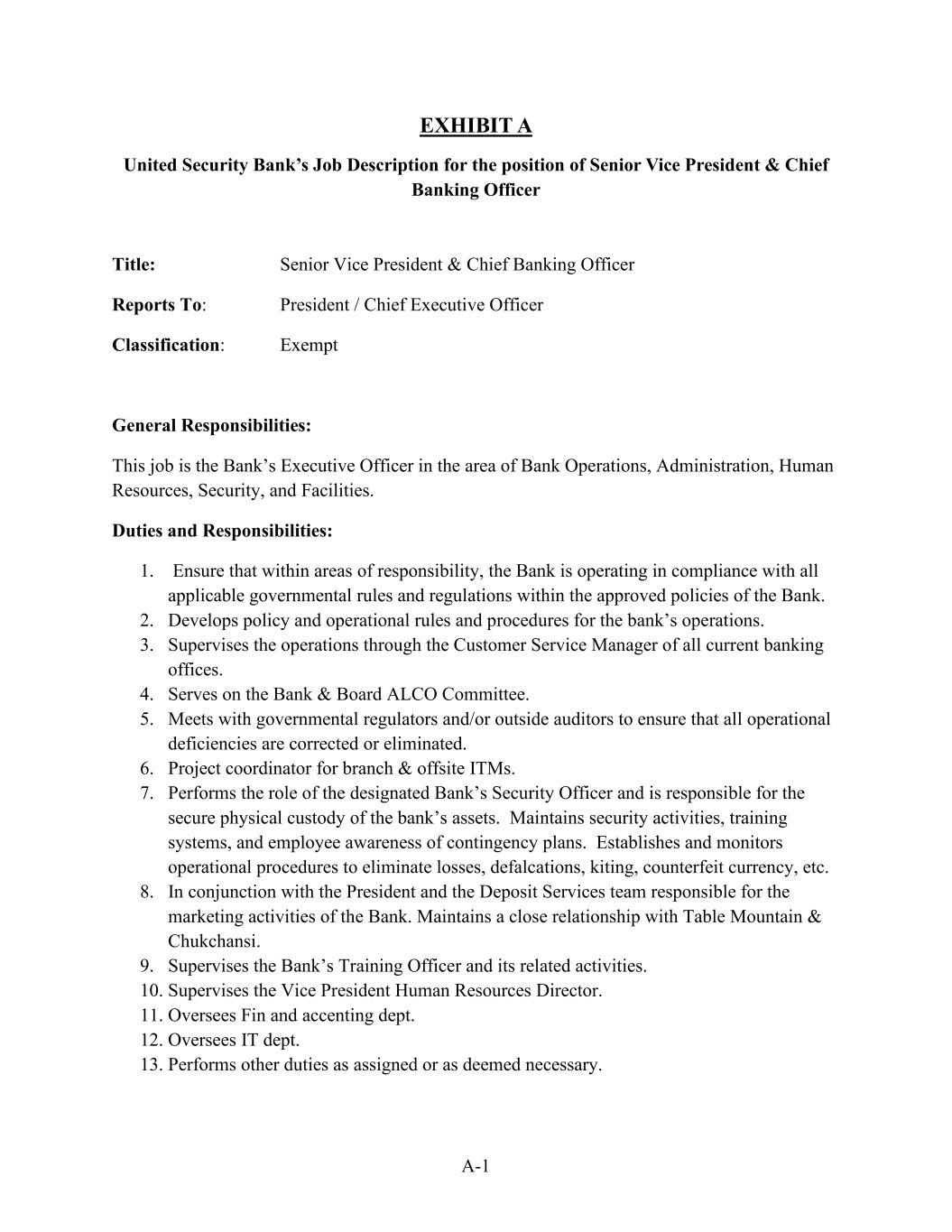
A-1 EXHIBIT A United Security Bank’s Job Description for the position of Senior Vice President & Chief Banking Officer Title: Senior Vice President & Chief Banking Officer Reports To: President / Chief Executive Officer Classification: Exempt General Responsibilities: This job is the Bank’s Executive Officer in the area of Bank Operations, Administration, Human Resources, Security, and Facilities. Duties and Responsibilities: 1. Ensure that within areas of responsibility, the Bank is operating in compliance with all applicable governmental rules and regulations within the approved policies of the Bank. 2. Develops policy and operational rules and procedures for the bank’s operations. 3. Supervises the operations through the Customer Service Manager of all current banking offices. 4. Serves on the Bank & Board ALCO Committee. 5. Meets with governmental regulators and/or outside auditors to ensure that all operational deficiencies are corrected or eliminated. 6. Project coordinator for branch & offsite ITMs. 7. Performs the role of the designated Bank’s Security Officer and is responsible for the secure physical custody of the bank’s assets. Maintains security activities, training systems, and employee awareness of contingency plans. Establishes and monitors operational procedures to eliminate losses, defalcations, kiting, counterfeit currency, etc. 8. In conjunction with the President and the Deposit Services team responsible for the marketing activities of the Bank. Maintains a close relationship with Table Mountain & Chukchansi. 9. Supervises the Bank’s Training Officer and its related activities. 10. Supervises the Vice President Human Resources Director. 11. Oversees Fin and accenting dept. 12. Oversees IT dept. 13. Performs other duties as assigned or as deemed necessary.

A-2 Minimum Job Requirements: 1. College graduate or equivalent training and experience, plus appropriate and specific education and training in banking subjects. 2. Ten to fifteen years of banking experience with assignments of increasing difficulty. Should have at least ten years of supervisory or managerial experience in bank operations. 3. Ability to plan, organize, and control areas of responsibility and supervise the people and work involved. 4. Possess a high degree of human relations skills. Must be an effective communicator both oral and written. Must have the ability to work effectively with the business community, clients, other staff members, outside auditors, and bank regulators. 5. Must have a high level of ability to analyze all types of data and information input and arrive at judgments regarding the Bank’s activities and direction. 6. Have the ability to accurately work with numbers and perform and prepare internal and external reports. 7. Must understand the use of computers in the banking environment and supervise its effective utilization.
EX-31.1
5
ubfo-20250930exhibit311.htm
EX-31.1
Document
EXHIBIT 31.1
CERTIFICATION UNDER SECTION 302 OF
THE SARBANES-OXLEY ACT OF 2002
I, Dennis R. Woods, certify that:
1. I have reviewed this report on Form 10-Q of United Security Bancshares;
2. Based on my knowledge, this report does not contain any untrue statement of a material fact or omit to state a material fact necessary to make the statements made, in light of the circumstances under which such statements were made, not misleading with respect to the period covered by this report;
3. Based on my knowledge, the financial statements, and other financial information included in this report, fairly present in all material respects the financial condition, results of operations and cash flows of the registrant as of, and for, the periods presented in this report;
4. The registrant’s other certifying officer and I are responsible for establishing and maintaining disclosure controls and procedures (as defined in Exchange Act Rules 13(a) - 15(e) and 15d - 15(e)) and internal control over financial reporting (as defined in Exchange Act Rules 13a-15(f) and 15d-15(f)) for the registrant and have:
a) Designed such disclosure controls and procedures, or caused such disclosure controls and procedures to be designed under our supervision, to ensure that material information relating to the registrant, including its consolidated subsidiaries, is made known to us by others within those entities, particularly during the period in which this report is being prepared;
b) Designed such internal control over financial reporting, or caused such internal control over financial reporting to be designed under our supervision, to provide reasonable assurance regarding the reliability of financial reporting and the preparation of financial statements for external purposes in accordance with generally accepted accounting principles;
c) Evaluated the effectiveness of the registrant’s disclosure controls and procedures and presented in this report our conclusions about the effectiveness of the disclosure controls and procedures, as of the end of the period covered by this report based on such evaluation; and
d) Disclosed in this report any change in the registrant’s internal control over financial reporting that occurred during the registrant’s most recent quarter (the registrant’s fourth quarter in the case of an annual report) that has materially affected, or is reasonably likely to materially affect, the registrant’s internal control over financial reporting; and
5. The registrant’s other certifying officer and I have disclosed, based on our most recent evaluation of internal control over financial reporting, to the registrant’s auditors and the audit committee of registrant’s board of directors (or persons performing the equivalent functions):
a) All significant deficiencies and material weaknesses in the design or operation of internal control over financial reporting which are reasonably likely to adversely affect the registrant’s ability to record, process, summarize and report financial information; and
b) Any fraud, whether or not material, that involves management or other employees who have a significant role in the registrant’s internal control over financial reporting.
|
|
|
| Date: November 7, 2025 |
| |
| /S/ Dennis R. Woods |
| Dennis R. Woods |
| President and Chief Executive Officer |
A signed original of this written statement required by Section 302 of the Sarbanes-Oxley Act of 2002 has been provided to United Security Bancshares and will be retained by United Security Bancshares and furnished to the SEC or its staff upon request.
EX-31.2
6
ubfo-20250930exhibit312.htm
EX-31.2
Document
EXHIBIT 31.2
CERTIFICATION UNDER SECTION 302 OF
THE SARBANES-OXLEY ACT OF 2002
I, David Kinross, certify that:
1. I have reviewed this report on Form 10-Q of United Security Bancshares;
2. Based on my knowledge, this report does not contain any untrue statement of a material fact or omit to state a material fact necessary to make the statements made, in light of the circumstances under which such statements were made, not misleading with respect to the period covered by this report;
3. Based on my knowledge, the financial statements, and other financial information included in this report, fairly present in all material respects the financial condition, results of operations and cash flows of the registrant as of, and for, the periods presented in this report;
4. The registrant’s other certifying officer and I are responsible for establishing and maintaining disclosure controls and procedures (as defined in Exchange Act Rules 13(a) - 15(e) and 15d - 15(e)) and internal control over financial reporting (as defined in Exchange Act Rules 13a-15(f) and 15d-15(f)) for the registrant and have:
a) Designed such disclosure controls and procedures, or caused such disclosure controls and procedures to be designed under our supervision, to ensure that material information relating to the registrant, including its consolidated subsidiaries, is made known to us by others within those entities, particularly during the period in which this report is being prepared;
b) Designed such internal control over financial reporting, or caused such internal control over financial reporting to be designed under our supervision, to provide reasonable assurance regarding the reliability of financial reporting and the preparation of financial statements for external purposes in accordance with generally accepted accounting principles;
c) Evaluated the effectiveness of the registrant’s disclosure controls and procedures and presented in this report our conclusions about the effectiveness of the disclosure controls and procedures, as of the end of the period covered by this report based on such evaluation; and
d) Disclosed in this report any change in the registrant’s internal control over financial reporting that occurred during the registrant’s most recent quarter (the registrant’s fourth quarter in the case of an annual report) that has materially affected, or is reasonably likely to materially affect, the registrant’s internal control over financial reporting; and
5. The registrant’s other certifying officer and I have disclosed, based on our most recent evaluation of internal control over financial reporting, to the registrant’s auditors and the audit committee of registrant’s board of directors (or persons performing the equivalent functions):
a) All significant deficiencies and material weaknesses in the design or operation of internal control over financial reporting which are reasonably likely to adversely affect the registrant's ability to record, process, summarize and report financial information; and
b) Any fraud, whether or not material, that involves management or other employees who have a significant role in the registrant's internal control over financial reporting.
|
|
|
| Date: November 7, 2025 |
| |
| /S/ David A. Kinross |
| David A. Kinross |
| Senior Vice President and Chief Financial Officer |
A signed original of this written statement required by Section 302 of the Sarbanes-Oxley Act of 2002 has been provided to United Security Bancshares and will be retained by United Security Bancshares and furnished to the SEC or its staff upon request.
EX-32.1
7
ubfo-20250930exhibit321.htm
EX-32.1
Document
EXHIBIT 32.1
SECTION 906 CERTIFICATION
The certification set forth below is being submitted to the Securities and Exchange Commission solely for the purpose of complying with Section 1350 of Chapter 63 of Title 18 of the United States Code.
Date: November 7, 2025
Dennis R. Woods, the Chief Executive Officer of United Security Bancshares certifies:
1. that this quarterly report on Form 10-Q for the quarter ended September 30, 2025, fully complies with the requirements of section 13(a) or 15(d) of the Securities Exchange Act of 1934; and
2. that information contained in this quarterly report on Form 10-Q for the quarter ended September 30, 2025, fairly presents, in all material respects, the financial condition and results of operations of United Security Bancshares.
|
|
|
| /s/ Dennis R. Woods |
| Dennis R. Woods |
| President and Chief Executive Officer |
EX-32.2
8
ubfo-20250930exhibit322.htm
EX-32.2
Document
EXHIBIT 32.2
SECTION 906 CERTIFICATION
The certification set forth below is being submitted to the Securities and Exchange Commission solely for the purpose of complying with Section 1350 of Chapter 63 of Title 18 of the United States Code.
November 7, 2025
David Kinross, the Chief Financial Officer of United Security Bancshares certifies:
1. that this quarterly report on Form 10-Q for the quarter ended September 30, 2025, fully complies with the requirements of section 13(a) or 15(d) of the Securities Exchange Act of 1934; and
2. that information contained in this quarterly report on Form 10-Q for the quarter ended September 30, 2025, fairly presents, in all material respects, the financial condition and results of operations of United Security Bancshares.
|
|
|
| /s/ David A. Kinross |
| David A. Kinross |
| Senior Vice President and Chief Financial Officer |
 エドガーで原本を確認する